
Web Smart 24-Port Gigabit Ethernet Switch
|
|
|
- Garry Oliver
- 9 years ago
- Views:
Transcription
1 Web Smart 24-Port Gigabit Ethernet Switch User s Manual DOC i

2 User Manual Release Manufacture Corporation. All rights reserved. All brand and product names are trademarks or registered trademarks of their respective companies. ii

3 The information in this document is subject to change without notice. Unless the explicit written permission of Manufacture Corporation, this document in whole or in part shall not be replicated or modified or amended or transmitted, in any from, or by any means manual, electric, electronic, electromagnetic, mechanical, optical or otherwise for any purpose. DURATION OF HARDWARE WARRANTY HARDWARE: In accordance with the provisions described under, Manufacture Corporation (hereinafter called Manufacture ) warrants its hardware products (hereinafter referred to as Product ) specified herein to be for a period of twelve (12) months from the date of shipment. Should a Product fail to perform during the effective warranty period as described above, Manufacture shall replace the defective Product or part, or delivering a functionally equivalent Product or part in receipt of customer s request, provided that the customer complies with the return material authorization (RMA) procedures and returns all defective Product prior to installation of the replacements to Manufacture. All defective Products must be returned to Manufacture with issuance of a Return Material Authorization number (RMA number) assigned to the reseller from whom the end customer originally purchased the Product. The reseller is responsible for ensuring the shipments are insured, with the transportation charges prepaid and the RMA number clearly marked on the outside of the package. Manufacture will not accept collect shipments or those returned without an RMA number. Manufacture shall not be responsible for any software, firmware, information or memory data contained in, stored on or integrated with any Product returned to Manufacture pursuant to any warranty. EXCLUSIONS. The warranty as mentioned above does not apply to the following conditions, in Manufacture s judgment, it contains (1) customer does not comply with the manual instructions offered by Manufacture in installation, operation, repair or maintenance, (2) Product fails due to damage from unusual external or electrical stress, shipment, storage, accident, abuse or misuse, (3) Product is used in an extra hazardous environment or activities, (4) any serial number on the Product has been removed or defaced, (5) this warranty will be of no effect if the repair is via anyone other than Manufacture or the approved agents, or (6) In the event of any failures or delays by either party hereto in the performance of all or any part of this agreement due to acts of God, war, riot, insurrection, national emergency, strike, embargo, storm, earthquake, or other natural forces, or by the acts of anyone not a party to this agreement, or by the inability to secure materials or transportation, then the party so affected shall be executed from any further performance for a period of time after the occurrence as may reasonably be necessary to remedy the effects of that occurrence, but in no event more than sixty (60) days. If any of the stated events should occur, Party A shall promptly notify Party B in writing as soon as commercially practicable, but in no event more than twenty (20) business days and provide documentation evidencing such occurrence. In no event shall the maximum liability of Manufacture under this warranty exceed the purchase price of the Product covered by this warranty. DISCLAIMER. EXCEPT AS SPECIFICALLY PROVIDED ABOVE AS REQUIRED AS IS AND THE WARRANTIES AND REMEDIES STATED ABOVE ARE EXCLUSIVE AND IN LIEU OF ALL OTHERS, ORAL OR WRITTEN, EXPRESS OR IMPLIED. ANY AND ALL OTHER WARRANTIES, INCLUDING IMPLIED WARRANTIES OF MERCHANTABILITY, FITNESS FOR A PARTICULAR PURPOSE AND NONINFRINGEMENT OR THIRD PARTY RIGHTS ARE EXPRESSLY EXCLUDED. MANUFACTURE SOFTWARE LICENSE AGREEMENT NOTICE: Please carefully read this Software License Agreement (hereinafter referred to as this Agreement ) before copying or using the accompanying software or installing the hardware unit with pre-enabled software or firmware (each of which is referred to as Software in this Agreement). BY COPYING OR USING THE SOFTWARE, YOU ACCEPT ALL OF THE PROVISIONS AND CONDITIONS OF THIS AGREEMENT. THE PROVISIONS EXPRESSED IN THIS AGREEMENT ARE THE ONLY PROVISION UNDER WHICH MANUFACTURE WILL PERMIT YOU TO USE THE SOFTWARE. If you do not accept these provisions and conditions, please immediately return the unused software, manual and the related product. Written approval is NOT a prerequisite to the validity or enforceability of this Agreement and no solicitation of any such written approval by or on behalf of Manufacture shall be deemed as an inference to the contrary. LICENSE GRANT. The end user (hereinafter referred to as Licensee ) of the Software is granted a personal, non-sublicensable, nonexclusive, nontransferable license by Manufacture Corporation ( Manufacture ): (1) To use the Manufacture s software ( Software ) in object code form solely on a single central processing unit owned or leased by Licensee or otherwise embedded in the equipment offered by Manufacture. (2) To copy the Software only for backup purposes in support of authorized use of the Software. (3) To use and copy the documentation related to the Software solely in support of authorized use of the Software by Licensee. The License applies to the Software only except other Manufacture s software or hardware products. Without the prior written consent of Manufacture, Licensee has no right to receive any source code or design documentation with respect to the Software. RESTRICTIONS ON USE; RESERVATION OF RIGHTS. The Software and related documentation are protected under copyright laws. Manufacture and/or its licensors retain all title and ownership in both the Software and its related documentation, including any revisions made by Manufacture. The copyright notice must be reproduced and included with any copy of any portion of the Software or related documentation. Except as expressly authorized above, Licensee shall not copy or transfer the Software or related documentation, in whole or in part. Licensee also shall not modify, translate, decompile, disassemble, use for any competitive analysis, reverse compile or reverse assemble all or any portion of the Software, related documentation or any copy. The Software and related documentation embody Manufacture s confidential and proprietary intellectual property. Licensee is not allowed to disclose the Software, or any information about the operation, design, performance or implementation of the Software and related documentation that is confidential to Manufacture to any third party. Software and related documentation may be delivered to you subject to export authorization required by governments of Taiwan and other countries. You agree that you will not export or re-export any Software or related documentation without the proper export licenses required by the governments of affected countries. LIMITED SOFTWARE WARRANTY. Manufacture warrants that any media on which the Software is recorded will be free from defects in materials under normal use for a period of twelve (12) months from date of shipment. If a defect in any such media should occur during the effective warranty period, the media may be returned to Manufacture, then Manufacture will replace the media. Manufacture shall not be responsible for the replacement of media if the failure of the media results from accident, abuse or misapplication of the media. EXCLUSIONS. The warranty as mentioned above does not apply to the Software, which (1) customer does not comply with the manual instructions offered by Manufacture in installation, operation, or maintenance, (2) Product fails due to damage from unusual external or electrical stress, shipment, storage, accident, abuse or misuse, (3) Product is used in an extra hazardous environment or activities, (4) any serial number on the Product has been removed or defaced, or (5) this warranty will be of no effect if the repair is via anyone other than Manufacture or the authorized agents. The maximum liability of Manufacture under this warranty is confined to the purchase price of the Product covered by this warranty.

4 DISCLAIMER. EXCEPT AS PROVIDED ABOVE, THE SOFTWARE IS PROVIDED AS IS AND MANMANUFACTURE AND ITS LICENSORS MAKE NO WARRANTIES, EXPRESS OR IMPLIED, WITH REPSECT TO THE SOFTWARE AND DOCUMENTAITON. MANUFACTURE AND ITS LICENSORS DISCLAIM ALL OTHER WARRANTIES, INCLUSIVE OF WITHOUT LIMITATION, IMPLIED WARRANTIES OR MERCHANTABILITY, FITNESS FOR A PARTICULAR PURPOSE AND NONINFRINGEMENT. FURTHER, MANUFACTURE DOES NOT WARRANT, GUARANTEE, OR MAKE ANY REPRESENTATIONS REGARDING THE USE, OR THE RESULTS OF THE USE, OF THE SOFTWARE OR RELATED WRITTEN DOCUMENTAITON IN TERMS OF CORRECTNESS, ACCURACY, RELIABILITY, OR OTHERWISE. CONSEQUENTIAL DAMAGES. IN NO EVENT SHALL MANUFACTURE OR ITS AUTHORIZED RESELLER BE LIABLE TO LICENSEE OR ANY THIRD PARTY FOR (A) ANY MATTER BEYOND ITS REASONABLE CONTROL OR (B) ANY CONSEQUENTIAL, SPECIAL, INDIRECT OR INCIDENTAL DAMAGES ARISING OUT OF THIS LICENSE OR USE OF THE SOFTWARE PROVIDED BY MANUFACTURE, EVEN IF MANUFACTURE HAS BEEN NOTIFIED OF THE POSSIBILITY OF SUCH DAMAGES IN ADVANCE. IN NO EVENT SHALL THE LIABILITY OF MANUFACTURE IN CONNECTION WITH THE SOFTWARE OR THIS AGREEMENT EXCEED THE PRICE PAID TO MANUFACTURE FOR THE LICENSE. TERM AND TERMINATION. The License is effective until terminated; however, all of the restrictions in regard to Manufacture s copyright in the Software and related documentation will cease being effective at the date of expiration; Notwithstanding the termination or expiration of the term of this agreement, it is acknowledged and agreed that those obligations relating to use and disclosure of Manufacture s confidential information shall survive. Licensee may terminate this License at any time by destroying the software together with all copies thereof. This License will be immediately terminated if Licensee fails to comply with any term and condition of the Agreement. Upon any termination of this License for any reason, Licensee shall discontinue to use the Software and shall destroy or return all copies of the Software and the related documentation. GENERAL. This License shall be governed by and construed pursuant to the laws of Taiwan. If any portion hereof is held to be invalid or unenforceable, the remaining provisions of this License shall remain in full force and effect. Neither the License nor this Agreement is assignable or transferable by Licensee without Manufacture s prior written consent; any attempt to do so shall be void. This License constitutes the entire License between the parties with respect to the use of the Software. LICENSEE ACKNOWLEDGES THAT LICENSEE HAS READ THIS AGREEMENT, UNDERSTANDS IT, AND AGREES TO BE BOUND BY ITS TERMS AND CONDITIONS. LICENSEE FURTHER AGREES THAT THIS AGREEMENT IS THE ENTIRE AND EXCLUSIVE AGREEMENT BETWEEN MANUFACTURE AND LICENSEE. iv

5 Table of Contents CAUTION... VIII ELECTRONIC EMISSION NOTICES... VIII WARNING:... IX 1. INTRODUCTION OVERVIEW OF 24-PORT GBE WEB SMART SWITCH CHECKLIST FEATURES VIEW OF 24-PORT GBE WEB SMART SWITCH User Interfaces on the Front Panel (Button, LEDs and Plugs) User Interfaces on the Rear Panel VIEW OF THE OPTIONAL MODULES INSTALLATION STARTING 24-PORT GBE WEB SMART SWITCH UP Hardware and Cable Installation Cabling Requirements Configuring the Management Agent of 24-Port GbE Web Smart Switch IP Address Assignment TYPICAL APPLICATIONS BASIC CONCEPT AND MANAGEMENT WHAT S THE ETHERNET LOGICAL LINK CONTROL (LLC) MEDIA ACCESS CONTROL (MAC) FLOW CONTROL HOW DOES A SWITCH WORK? VIRTUAL LAN OPERATION OF WEB-BASED MANAGEMENT WEB MANAGEMENT HOME OVERVIEW CONFIGURATION System Information Port Configuration VLAN Mode Configuration VLAN Group Configuration VLAN Port Isolation Configuration Aggregation IGMP Snooping Mirroring Configuration SNMP Loop Detection Broadcast Strom Protection QoS(Quality of Service) Configuration MONITORING Statistics Overview Detailed Statistics IGMP Status Ping Status MAINTENANCE Warm Restart Factory Default Software Upgrade Configuration File Transfer... 84

6 Logout MAINTENANCE RESOLVING NO LINK CONDITION Q&A APPENDIX A TECHNICAL SPECIFICATIONS vi

7 Revision History Release Date Revision 0.93 Aug. 29/2012 A Nov. 21/2012 A Nov. 22/2013 A1

8 Caution Circuit devices are sensitive to static electricity, which can damage their delicate electronics. Dry weather conditions or walking across a carpeted floor may cause you to acquire a static electrical charge. To protect your device, always: Touch the metal chassis of your computer to ground the static electrical charge before you pick up the circuit device. Pick up the device by holding it on the left and right edges only. If you need using outdoor device connect to this device with cable then you need to addition an arrester on the cable between outdoor device and this device. Fig. Addition an arrester between outdoor device and this switch The switch supports the SFP Vendor includes: Manufacture, Agilent, Avago and Finisa Electronic Emission Notices Federal Communications Commission (FCC) Statement This equipment has been tested and found to comply with the limits for a class A computing device pursuant to Subpart J of part 15 of FCC Rules, which are designed to provide reasonable protection against such interference when operated in a commercial environment. European Community (CE) Electromagnetic Compatibility Directive This equipment has been tested and found to comply with the protection requirements of European Emission Standard EN55022/EN and the Generic European Immunity Standard EN EMC: EN55022(2003)/CISPR-2( 2002) IEC (2001) IEC ( 2002) IEC (2001) class A 4K V CD, 8KV, AD 3V/m 1KV (power line), 0.5KV (signal line) viii

9 Warning: Self-demolition on Product is strictly prohibited. Damage caused by selfdemolition will be charged for repairing fees. Do not place product at outdoor or sandstorm. Before installation, please make sure input power supply and product specifications are compatible to each other.

10

11 About this user s manual This user s manual provides instructions on how to install your Web Smart Switch. This guide also covers management options and detailed explanation about hardware and software functions. Overview of this user s manual Chapter 1 Introduction describes the features of 24-port Gigabit Web Smart Switch Chapter 2 Installation Chapter 3 Operating Concept and Management Chapter 4 Operation of Web-based Management Chapter 5 Maintenance 1

12 1. Introduction 1-1. Overview of 24-Port GbE Web Smart Switch The 24-port Gigabit Web Smart Switch is a standard switch that meets all IEEE 802.3/u/x/z Gigabit, Fast Ethernet specifications. The switch has 20 10/100/1000Mbps TP ports and 4 Gigabit TP/SFP transceiver slots; it supports http and SNMP interface for switch management. The network administrator can logon the switch to monitor, configure and control each port s activity. In addition, the switch implements the QoS (Quality of Service), VLAN, and Trunking. It is suitable for office application. Others the switch increase support the Power saving for reduce the power consumption with "ActiPHY Power Management" and "PerfectReach Power Management" two technique.it could efficient saving the switch power with auto detect the client idle and cable length to provide different power. In this switch, Port 21, 22, 23, 24 includes two types of media --- TP and SFP Fiber (LC, BiDi-SC ); this port supports 10/100/1000Mbps TP or 1000Mbps SFP Fiber with auto-detected function. 1000Mbps SFP Fiber transceiver is used for highspeed connection expansion. 1000Mbps LC, Multi-Mode, SFP Fiber transceiver 1000Mbps LC, 10km, SFP Fiber transceiver 1000Mbps LC, 30km, SFP Fiber transceiver 1000Mbps LC, 50km, SFP Fiber transceiver 1000Mbps BiDi-SC, 20km, 1550nm SFP Fiber WDM transceiver 1000Mbps BiDi-SC, 20km, 1310nm SFP Fiber WDM transceiver 10/100/1000Mbps TP is a standard Ethernet port that meets all IEEE 802.3/u/x/z Gigabit, Fast Ethernet specifications. 1000Mbps SFP Fiber transceiver is a Gigabit Ethernet port that fully complies with all IEEE 802.3z and 1000Base- SX/LX standards. 1000Mbps Single Fiber WDM (BiDi) transceiver is designed with an optic Wavelength Division Multiplexing (WDM) technology that transports bi-directional full duplex signal over a single fiber simultaneously. Key Features in the Device QoS: VLAN: The switch offers powerful QoS function. This function supports 802.1p VLAN tag priority and DSCP on Layer 3 of network framework. Supports Port-based VLAN, IEEE802.1Q Tag VLAN. And supports 24 active VLANs and VLAN ID 1~

13 Port Trunking: Allows one or more links to be aggregated together to form a Link Aggregation Group by the static setting. Power Saving: The Power saving using the "ActiPHY Power Management" and "PerfectReach Power Management" two techniques to detect the client idle and cable length automatically and provides the different power. It could efficient to save the switch power and reduce the power consumption Checklist Before you start installing the switch, verify that the package contains the following: 24-Port GbE Web Smart Switch Modules (optional) Mounting Accessory (for 19 Rack Shelf) This User's Manual in CD-ROM AC Power Cord Please notify your sales representative immediately if any of the aforementioned items is missing or damaged Features The 24-Port GbE Web Smart Switch, a standalone off-the-shelf switch, provides the comprehensive features listed below for users to perform system network administration and efficiently and securely serve your network. Hardware 20 10/100/1000Mbps Auto-negotiation Gigabit Ethernet TP ports 4 10/100/1000Mbps TP or 1000Mbps SFP Fiber dual media auto sense 512KB on-chip frame buffer Jumbo frame support 9KB Programmable classifier for QoS (Layer 2/Layer 3) 8K MAC address and support VLAN ID (1~4094) Per-port shaping, policing, and Broadcast Storm Control Power Saving with "ActiPHY Power Management" and "Perfect Reach Power Management" techniques. IEEE802.1Q-in-Q nested VLAN support Full-duplex flow control (IEEE802.3x) and half-duplex backpressure Extensive front-panel diagnostic LEDs; System: Power, TP Port1-24: LINK/ACT,10/100/1000Mbps, SFP Port 21,22,23,24: SFP(LINK/ACT)

14 Management Supports concisely the status of port and easily port configuration Supports per port traffic monitoring counters Supports a snapshot of the system Information when you login Supports port mirror function Supports the static trunk function Supports 802.1Q VLAN Supports user management and limits one user to login Maximal packet length can be up to 9600 bytes for jumbo frame application Supports Broadcasting Suppression to avoid network suspended or crashed Supports to send the trap event while monitored events happened Supports default configuration which can be restored to overwrite the current configuration which is working on via Web UI and Reset button of the switch Supports on-line plug/unplug SFP modules Supports Quality of Service (QoS) for real time applications based on the information taken from Layer 2 to Layer 3. Built-in web-based management instead of using CLI interface, providing a more convenient GUI for the user 4

15 1-4. View of 24-Port GbE Web Smart Switch Fig. 1-1 Full View of 24-PORT GbE WEB SMART SWITCH User Interfaces on the Front Panel (Button, LEDs and Plugs) There are 24 TP Gigabit Ethernet ports and 4 SFP fiber ports for optional removable modules on the front panel of the switch. LED display area, locating on the left side of the panel, contains a Power LED, which indicates the power status and 24 ports working status of the switch. Fig. 1-2 Front View of 24-PORT GbE WEB SMART Switch

16 LED Indicators LED Color Function System LED POWER Green Lit when +3.3V power is coming up LINK/ACT SPD LINK/ACT SPD 10/100/1000Ethernet TP Port 1 to 20 LED Green Lit when connection with remote device is good Blinks when any traffic is present Green/ Lit Green when TP link on 1000Mbps speed Yellow/ Lit Yellow when TP link on 10/100Mbps speed Off Off when no link occur 1000SX/LX Gigabit Fiber Port 21,22,23,24 LED Green Green/ Yellow/ Off Table User Interfaces on the Rear Panel Lit when SFP connection with remote device is good Blinks when any traffic is present Lit Green when SFP link on 1000Mbps speed Lit Yellow when SFP link on 100Mbps speed Off when no link occur Fig. 1-3 Rear View of 24-PORT GBE WEB SMART SWITCH 6

17 1-5. View of the Optional Modules In the switch, Port 21~24 include two types of media --- TP and SFP Fiber (LC, BiDi-SC ); they support 10/100/1000Mbps TP or 1000Mbps SFP Fiber with auto-detected function. 1000Mbps SFP Fiber transceiver is used for high-speed connection expansion; nine optional SFP types provided for the switch are listed below: 1000Mbps LC, MM, SFP Fiber transceiver (SFP.LC) 1000Mbps LC, SM 10km, SFP Fiber transceiver (SFP.LC.S10) 1000Mbps LC, SM 30km, SFP Fiber transceiver (SFP.LC.S30) 1000Mbps LC, SM 50km, SFP Fiber transceiver (SFP.LC.S50) 1000Mbps BiDi SC, SM 20km, 1310nm SFP Fiber WDM transceiver (SFP.BS3.S20) 1000Mbps BiDi SC, SM 20km, 1550nm SFP Fiber WDM transceiver (SFP.BS5.S20) PS: The other spec. is available upon request. Fig. 1-4 Front View of 1000Base-SX/LX LC, SFP Fiber Transceiver Fig. 1-5 Front View of 1000Base-LX BiDi SC SFP Fiber Transceiver

18 2. Installation 2-1. Starting 24-Port GbE Web Smart Switch Up This section will give users a quick start for: - Hardware and Cable Installation - Management Station Installation - Software booting and configuration Hardware and Cable Installation At the beginning, please do first: Wear a grounding device to avoid the damage from electrostatic discharge Be sure that power switch is OFF before you insert the power cord to power source Installing Optional SFP Fiber Transceivers to the 24-Port GbE Web Smart Switch Note: If you have no modules, please skip this section. Fig. 2-1 Installation of Optional SFP Fiber Transceiver Connecting the SFP Module to the Chassis: The optional SFP modules are hot swappable, so you can plug or unplug it before or after powering on. 1. Verify that the SFP module is the right model and conforms to the chassis 2. Slide the module along the slot. Also be sure that the module is properly seated against the slot socket/connector 3. Install the media cable for network connection 4. Repeat the above steps, as needed, for each module to be installed into slot(s) 5. Have the power ON after the above procedures are done TP Port and Cable Installation 8

19 In the switch, TP port supports MDI/MDI-X auto-crossover, so both types of cable, straight-through (Cable pin-outs for RJ-45 jack 1, 2, 3, 6 to 1, 2, 3, 6 in 10/100M TP; 1, 2, 3, 4, 5, 6, 7, 8 to 1, 2, 3, 4, 5, 6, 7, 8 in Gigabit TP) and crossed-over (Cable pin-outs for RJ-45 jack 1, 2, 3, 6 to 3, 6, 1, 2) can be used. It means you do not have to tell from them, just plug it. Use Cat. 5 grade RJ-45 TP cable to connect to a TP port of the switch and the other end is connected to a network-aware device such as a workstation or a server. Repeat the above steps, as needed, for each RJ-45 port to be connected to a Gigabit 10/100/1000 TP device. Now, you can start having the switch in operation. Power On The switch supports VAC, Hz power supply. The power supply will automatically convert the local AC power source to DC power. It does not matter whether any connection plugged into the switch or not when power on, even modules as well. After the power is on, all LED indicators will light up and then all off except the power LED still keeps on. This represents a reset of the system. Firmware Loading After resetting, the bootloader will load the firmware into the memory. It will take about 30 seconds, after that, the switch will flash all the LED once and automatically performs self-test and is in ready state.

20 Cabling Requirements To help ensure a successful installation and keep the network performance good, please take a care on the cabling requirement. Cables with worse specification will render the LAN to work poorly Cabling Requirements for TP Ports For Fast Ethernet TP network connection The grade of the cable must be Cat. 5 or Cat. 5e with a maximum length of 100 meters. Gigabit Ethernet TP network connection The grade of the cable must be Cat. 5 or Cat. 5e with a maximum length of 100 meters. Cat. 5e is recommended Cabling Requirements for 1000SX/LX SFP Module It is more complex and comprehensive contrast to TP cabling in the fiber media. Basically, there are two categories of fiber, multi-mode (MM) and single mode (SM). The latter is categorized into several classes by the distance it supports. They are SX, LX, LHX, XD, and ZX. From the viewpoint of connector type, there mainly are LC and BIDI SC. Gigabit Fiber with multi-mode LC SFP module Gigabit Fiber with single-mode LC SFP module Gigabit Fiber with BiDi SC 1310nm SFP module Gigabit Fiber with BiDi SC 1550nm SFP module The following table lists the types of fiber that we support and those else not listed here are available upon request. Multi-mode Fiber Cable and Modal Bandwidth IEEE 802.3z Gigabit Ethernet 1000SX 850nm 1000Base- LX/LHX/XD/ZX 1000Base-LX Single Fiber (BIDI SC) Multi-mode 62.5/125 m Multi-mode 50/125 m Modal Modal Distance Distance Bandwidth Bandwidth 160MHz-Km 220m 400MHz-Km 500m 200MHz-Km 275m 500MHz-Km 550m Single-mode Fiber 9/125 m Single-mode transceiver 1310nm 10, 30Km Single-mode transceiver 1550nm 50Km Single-Mode TX(Transmit) 1310nm *20Km RX(Receive) 1550nm Single-Mode TX(Transmit) 1550nm *20Km RX(Receive) 1310nm Table Switch Cascading in Topology 10

21 Takes the Delay Time into Account Theoretically, the switch partitions the collision domain for each port in switch cascading that you may up-link the switches unlimitedly. In practice, the network extension (cascading levels & overall diameter) must follow the constraint of the IEEE 802.3/802.3u/802.3z and other series protocol specifications, in which the limitations are the timing requirement from physical signals defined by series specification of Media Access Control (MAC) and PHY, and timer from some OSI layer 2 protocols such as 802.1d, 802.1q and so on. The fiber, TP cables and devices bit-time delay (round trip) are as follows: 1000Base-X TP, Fiber 100Base-TX TP 100Base-FX Fiber Round trip Delay: 4096 Round trip Delay: 512 Cat. 5 TP Wire: 11.12/m Cat. 5 TP Wire: 1.12/m Fiber Cable: 1.0/m Fiber Cable : 10.10/m TP to fiber Converter: 56 Bit Time unit : 1ns (1sec./1000 Mega bit) Bit Time unit: 0.01 s (1sec./100 Mega bit) Table 2-2 Sum up all elements bit-time delay and the overall bit-time delay of wires/devices must be within Round Trip Delay (bit times) in a half-duplex network segment (collision domain). For full-duplex operation, this will not be applied. You may use the TP-Fiber module to extend the TP node distance over fiber optic and provide the long haul connection. Typical Network Topology in Deployment A hierarchical network with minimum levels of switch may reduce the timing delay between server and client station. Basically, with this approach, it will minimize the number of switches in any one path; will lower the possibility of network loop and will improve network efficiency. If more than two switches are connected in the same network, select one switch as Level 1 switch and connect all other switches to it at Level 2. Server/Host is recommended to connect to the Level 1 switch. This is general if no VLAN or other special requirements are applied.
22 Case1: All switch ports are in the same local area network. Every port can access each other (See Fig. 2-2) Fig. 2-2 No VLAN Configuration Diagram If VLAN is enabled and configured, each node in the network that can communicate each other directly is bounded in the same VLAN area. Here VLAN area is defined by what VLAN you are using. The switch supports both port-based VLAN and tag-based VLAN. They are different in practical deployment, especially in physical location. The following diagram shows how it works and what the difference they are. Case2a: Port-based VLAN (See Fig.2-3). Fig. 2-3 Port-based VLAN Diagram 1. The same VLAN members could not be in different switches. 2. Every VLAN members could not access VLAN members each other. 3. The switch manager has to assign different names for each VLAN groups at one switch. 12
23 Case 2b: Port-based VLAN (See Fig.2-4). Fig. 2-4 Port-based VLAN Diagram 1. VLAN1 members could not access VLAN2, VLAN3 and VLAN4 members. 2. VLAN2 members could not access VLAN1 and VLAN3 members, but they could access VLAN4 members. 3. VLAN3 members could not access VLAN1, VLAN2 and VLAN4. 4. VLAN4 members could not access VLAN1 and VLAN3 members, but they could access VLAN2 members. Case3a: The same VLAN members can be at different switches with the same VID (See Fig. 2-5). Fig. 2-5 Attribute-based VLAN Diagram
24 Configuring the Management Agent of 24-Port GbE Web Smart Switch In the way of web, user is allowed to startup the switch management function. Users can use any one of them to monitor and configure the switch. You can touch them through the following procedures. Section : Configuring Management Agent of 24-Port GbE Web Smart Switch through Ethernet Port Configuring Management Agent of 24-Port GbE Web Smart Switch through Ethernet Port There are two ways to configure and monitor the switch through the switch s Ethernet port. They are Web browser and SNMP manager. The user interface for the last one is Management software dependent and does not cover here. We just introduce the first type of management interface. Web-based UI for the switch is an interface in a highly friendly way. 24-PORT GBE WEB SMART SWITCH Default IP Setting: IP = Subnet Mask = Default Gateway = Ethernet LAN Assign a reasonable IP address, For example: IP = Subnet Mask = Default Gateway = Fig. 2-6 Managing 24-Port GbE Web Smart Switch through Ethernet Port Before you communicate with the switch, you have to finish first the configuration of the IP address or to know the IP address of the switch. Then, follow the procedures listed below. 1. Set up a physical path between the configured the switch and a PC by a qualified UTP Cat. 5 cable with RJ-45 connector. Note: If PC directly connects to the switch, you have to setup the same subnet mask between them. But, subnet mask may be different for the PC in the remote site. Please refer to Fig. 2-6 about the 24-Port GbE Web Smart Switch default IP address information. 2. Run web browser and follow the menu. Please refer to Chapter 4. 14
25 Fig. 2-7 the Login Screen for Web IP Address Assignment For IP address configuration, there are three parameters needed to be filled in. They are IP address, Subnet Mask, Default Gateway and DNS. IP address: The address of the network device in the network is used for internetworking communication. Its address structure looks is shown in the Fig It is classful because it is split into predefined address classes or categories. Each class has its own network range between the network identifier and host identifier in the 32 bits address. Each IP address comprises two parts: network identifier (address) and host identifier (address). The former indicates the network where the addressed host resides, and the latter indicates the individual host in the network which the address of host refers to. And the host identifier must be unique in the same LAN. Here the term of IP address we used is version 4, known as IPv4. 32 bits Network identifier Host identifier Fig. 2-8 IP address structure With the classful addressing, it divides IP address into three classes, class A, class B and class C. The rest of IP addresses are for multicast and broadcast. The bit length of the network prefix is the same as that of the subnet mask and is denoted as IP address/x, for example, /10. Each class has its address range described below. Class A: Address is less than There are a total of 126 networks can be defined because the address is reserved for default route and /8 is reserved for loopback function. Bit # Network address Host address Class B:
26 IP address range between and Each class B network has a 16-bit network prefix followed 16-bit host address. There are 16,384 (2^14)/16 networks able to be defined with a maximum of (2^16 2) hosts per network. Bit # Network address Host address Class C: IP address range between and Each class C network has a 24-bit network prefix followed 8-bit host address. There are 2,097,152 (2^21)/24 networks able to be defined with a maximum of 254 (2^8 2) hosts per network. Bit # Network address Host address Class D and E: Class D is a class with first 4 MSB (Most significance bit) set to and is used for IP Multicast. See also RFC Class E is a class with first 4 MSB set to and is used for IP broadcast. According to IANA (Internet Assigned Numbers Authority), there are three specific IP address blocks reserved and able to be used for extending internal network. We call it Private IP address and list below: Class A Class B Class C Please refer to RFC 1597 and RFC 1466 for more information. Subnet mask: It means the sub-division of a class-based network or a CIDR block. The subnet is used to determine how to split an IP address to the network prefix and the host address in bitwise basis. It is designed to utilize IP address more efficiently and ease to manage IP network. For a class B network, , it may have a subnet mask in default, in which the first two bytes is with all 1s. This means more than 60 thousands of nodes in flat IP address will be at the same network. It s too large to manage practically. Now if we divide it into smaller network by extending network prefix from 16 bits to, say 24 bits, that s using its third byte to subnet this class B network. Now it has a subnet mask , in which each bit of the first three bytes is 1. It s now clear that the first two bytes is used to identify the class B network, the third byte is used to identify the subnet within this class B network and, of course, the last byte is the host number. 16
27 Not all IP address is available in the sub-netted network. Two special addresses are reserved. They are the addresses with all zero s and all one s host number. For example, an IP address , what IP address reserved will be looked like? All 0s mean the network itself, and all 1s mean IP broadcast /25 Network Subnet bits All 0s = All 1s= In this diagram, you can see the subnet mask with 25-bit long, , contains 126 members in the sub-netted network. Another is that the length of network prefix equals the number of the bit with 1s in that subnet mask. With this, you can easily count the number of IP addresses matched. The following table shows the result. Prefix Length No. of IP matched No. of Addressable IP / / / / / / / / / / / / / / / / /
28 Table 2-3 According to the scheme above, a subnet mask will partition a network with the class C. It means there will have a maximum of 254 effective nodes existed in this sub-netted network and is considered a physical network in an autonomous network. So it owns a network IP address which may looks like With the subnet mask, a bigger network can be cut into small pieces of network. If we want to have more than two independent networks in a worknet, a partition to the network must be performed. In this case, subnet mask must be applied. For different network applications, the subnet mask may look like This means it is a small network accommodating a maximum of 15 nodes in the network. Default gateway: For the routed packet, if the destination is not in the routing table, all the traffic is put into the device with the designated IP address, known as default router. Basically, it is a routing policy. For assigning an IP address to the switch, you just have to check what the IP address of the network will be connected with the switch. Use the same network address and append your host address to it. Fig. 2-8 First, IP Address: as shown in the Fig. 2-8, enter , for instance. For sure, an IP address such as x must be set on your PC. Second, Subnet Mask: as shown in the Fig. 2-8, enter Any subnet mask such as x is allowable in this case. 18
29 2-2. Typical Applications The 24-Port GbE Web Smart Switch implements 24 Gigabit Ethernet TP ports with auto MDIX and four slots for the removable module supporting comprehensive fiber types of connection, including LC and BiDi-LC SFP modules. For more details on the specification of the switch, please refer to Appendix A. The switch is suitable for the following applications. Central Site/Remote site application is used in carrier or ISP (See Fig. 2-10) Peer-to-peer application is used in two remote offices (See Fig. 2-11) Office network(see Fig. 2-12) Central Site Fig Network Connection between Remote Site and Central Site Fig is a system wide basic reference connection diagram. This diagram demonstrates how the switch connects with other network devices and hosts.
30 Fig Peer-to-peer Network Connection Fig Office Network Connection 20
31 3. Basic Concept and Management This chapter will tell you the basic concept of features to manage this switch and how they work What s the Ethernet Ethernet originated and was implemented at Xerox in Palo Alto, CA in 1973 and was successfully commercialized by Digital Equipment Corporation (DEC), Intel and Xerox (DIX) in In 1992, Grand Junction Networks unveiled a new high speed Ethernet with the same characteristic of the original Ethernet but operated at 100Mbps, called Fast Ethernet now. This means Fast Ethernet inherits the same frame format, CSMA/CD, software interface. In 1998, Gigabit Ethernet was rolled out and provided 1000Mbps. Now 10G/s Ethernet is under approving. Although these Ethernet have different speed, they still use the same basic functions. So they are compatible in software and can connect each other almost without limitation. The transmission media may be the only problem. Fig. 3-1 IEEE reference model vs. OSI reference mode In Fig. 3-1, we can see that Ethernet locates at the Data Link layer and Physical layer and comprises three portions, including logical link control (LLC), media access control (MAC), and physical layer. The first two comprises Data link layer, which performs splitting data into frame for transmitting, receiving acknowledge frame, error checking and re-transmitting when not received correctly as well as provides an error-free channel upward to network layer.
32 IEEE LLC Data Link Layer IEEE802.3 CSMA/CD MAC IEEE PLS CS Physical Layer MII IEEE MAU ANSI X3T9.5 PMD Coaxial/STP/UTP Fiber This above diagram shows the Ethernet architecture, LLC sub-layer and MAC sub-layer, which are responded to the Data Link layer, and transceivers, which are responded to the Physical layer in OSI model. In this section, we are mainly describing the MAC sub-layer Logical Link Control (LLC) Data link layer is composed of both the sub-layers of MAC and MAC-client. Here MAC client may be logical link control or bridge relay entity. Logical link control supports the interface between the Ethernet MAC and upper layers in the protocol stack, usually Network layer, which is nothing to do with the nature of the LAN. So it can operate over other different LAN technology such as Token Ring, FDDI and so on. Likewise, for the interface to the MAC layer, LLC defines the services with the interface independent of the medium access technology and with some of the nature of the medium itself. The table 3-1 is the Table 3-1 LLC Format 22 format of LLC PDU. It
33 comprises four fields, DSAP, SSAP, Control and Information. The DSAP address field identifies the one or more service access points, in which the I/G bit indicates it is individual or group address. If all bit of DSAP is 1s, it s a global address. The SSAP address field identifies the specific services indicated by C/R bit (command or response). The DSAP and SSAP pair with some reserved values indicates some well-known services listed in the table below. 0xAAAA 0xE0E0 0xF0F0 0xFEFE 0xFFFF 0x4242 0x0606 0x9898 SNAP Novell IPX NetBios IOS network layer PDU Novell IPX RAW packet STP BPDU IP ARP Table 3-2 LLC type 1 connectionless service, LLC type 2 connection-oriented service and LLC type 3 acknowledge connectionless service are three types of LLC frame for all classes of service. In Fig 3-2, it shows the format of Service Access Point Fig. 3-3 SAP Format (SAP). Please refer to IEEE802.2 for more details.
34 3-3. Media Access Control (MAC) MAC Addressing Because LAN is composed of many nodes, for the data exchanged among these nodes, each node must have its own unique address to identify who should send the data or should receive the data. In OSI model, each layer provides its own mean to identify the unique address in some form, for example, IP address in network layer. The MAC is belonged to Data Link Layer (Layer 2), the address is defined to be a 48-bit long and locally unique address. Since this type of address is applied only to the Ethernet LAN media access control (MAC), they are referred to as MAC addresses. The first three bytes are Organizational Unique Identifier (OUI) code assigned by IEEE. The last three bytes are the serial number assigned by the vendor of the network device. All these six bytes are stored in a non-volatile memory in the device. Their format is as the following table and normally written in the form as aa-bb-cc-dd-ee-ff, a 12 hexadecimal digits separated by hyphens, in which the aa-bb-cc is the OUI code and the dd-ee-ff is the serial number assigned by manufacturer. Bit 47 bit 0 1st byte 2nd byte 3rd byte 4th byte 5th byte 6th byte OUI code Serial number Table 3-3 Ethernet MAC address The first bit of the first byte in the Destination address (DA) determines the address to be a Unicast (0) or Multicast frame (1), known as I/G bit indicating individual (0) or group (1). So the 48-bit address space is divided into two portions, Unicast and Multicast. The second bit is for global-unique (0) or locally-unique address. The former is assigned by the device manufacturer, and the later is usually assigned by the administrator. In practice, global-unique addresses are always applied. A unicast address is identified with a single network interface. With this nature of MAC address, a frame transmitted can exactly be received by the target an interface the destination MAC points to. A multicast address is identified with a group of network devices or network interfaces. In Ethernet, a many-to-many connectivity in the LANs is provided. It provides a mean to send a frame to many network devices at a time. When all bit of DA is 1s, it is a broadcast, which means all network device except the sender itself can receive the frame and response Ethernet Frame Format There are two major forms of Ethernet frame, type encapsulation and length encapsulation, both of which are categorized as four frame formats 802.3/802.2 SNAP, 802.3/802.2, Ethernet II and Netware RAW. We will introduce the basic Ethernet frame format defined by the IEEE standard required for all MAC implementations. It contains seven fields explained below. 24
35 PRE SFD DA SA Type/Length Data Pad bit if any FCS Table. 3-4 Ethernet frame structure - Preamble (PRE) The PRE is 7-byte long with alternating pattern of ones and zeros used to tell the receiving node that a frame is coming, and to synchronize the physical receiver with the incoming bit stream. The preamble pattern is: Start-of-frame delimiter (SFD) The SFD is one-byte long with alternating pattern of ones and zeros, ending with two consecutive 1-bits. It immediately follows the preamble and uses the last two consecutive 1s bit to indicate that the next bit is the start of the data packet and the left-most bit in the left-most byte of the destination address. The SFD pattern is Destination address (DA) The DA field is used to identify which network device(s) should receive the packet. It is a unique address. Please see the section of MAC addressing. - Source addresses (SA) The SA field indicates the source node. The SA is always an individual address and the left-most bit in the SA field is always 0. - Length/Type This field indicates either the number of the data bytes contained in the data field of the frame, or the Ethernet type of data. If the value of first two bytes is less than or equal to 1500 in decimal, the number of bytes in the data field is equal to the Length/Type value, i.e. this field acts as Length indicator at this moment. When this field acts as Length, the frame has optional fields for 802.3/802.2 SNAP encapsulation, 802.3/802.2 encapsulation and Netware RAW encapsulation. Each of them has different fields following the Length field. - If the Length/Type value is greater than 1500, it means the Length/Type acts as Type. Different type value means the frames with different protocols running over Ethernet being sent or received. For example, 0x0800 0x0806 0x0835 0x8137 0x86DD IP datagram ARP RARP IPX datagram IPv6 - Data Less than or equal to 1500 bytes and greater or equal to 46 bytes. If data is less than 46 bytes, the MAC will automatically extend the padding bits and have the payload be equal to 46 bytes. The length of data field must equal the value of the Length field when the Length/Type acts as Length. - Frame check sequence (FCS) This field contains a 32-bit cyclic redundancy check (CRC) value, and is a check sum computed with DA, SA, through the end of the data field with the following polynomial.
36 - It is created by the sending MAC and recalculated by the receiving MAC to check if the packet is damaged or not. How does a MAC work? The MAC sub-layer has two primary jobs to do: 1. Receiving and transmitting data. When receiving data, it parses frame to detect error; when transmitting data, it performs frame assembly. 2. Performing Media access control. It prepares the initiation jobs for a frame transmission and makes recovery from transmission failure. Frame transmission As Ethernet adopted Carrier Sense Multiple Access with Collision Detect (CSMA/CD), it detects if there is any carrier signal from another network device running over the physical medium when a frame is ready for transmission. This is referred to as sensing carrier, also Listen. If there is signal on the medium, the MAC defers the traffic to avoid a transmission collision and waits for a random period of time, called backoff time, then sends the traffic again. After the frame is assembled, when transmitting the frame, the preamble (PRE) bytes are inserted and sent first, then the next, Start of frame Delimiter (SFD), DA, SA and through the data field and FCS field in turn. The followings summarize what a MAC does before transmitting a frame. 1. MAC will assemble the frame. First, the preamble and Start-of-Frame delimiter will be put in the fields of PRE and SFD, followed DA, SA, tag ID if tagged VLAN is applied, Ethertype or the value of the data length, and payload data field, and finally put the FCS data in order into the responded fields. 2. Listen if there is any traffic running over the medium. If yes, wait. 3. If the medium is quiet, and no longer senses any carrier, the MAC waits for a period of time, i.e. inter-frame gap time to have the MAC ready with enough time and then start transmitting the frame. 4. During the transmission, MAC keeps monitoring the status of the medium. If no collision happens until the end of the frame, it transmits successfully. If there is a collision happened, the MAC will send the patterned jamming bit to guarantee the collision event propagated to all involved network devices, then wait for a random period of time, i.e. back off time. When backoff time expires, the MAC goes back to the beginning state and attempts to transmit again. After a collision happens, MAC increases the transmission attempts. If the count of the transmission attempt reaches 16 times, the frame in MAC s queue will be discarded. 26
37 Ethernet MAC transmits frames in half-duplex and full-duplex ways. In halfduplex operation mode, the MAC can either transmit or receive frame at a moment, but cannot do both jobs at the same time. As the transmission of a MAC frame with the half-duplex operation exists only in the same collision domain, the carrier signal needs to spend time to travel to reach the targeted device. For two most-distant devices in the same collision domain, when one sends the frame first, and the second sends the frame, in worstcase, just before the frame from the first device arrives. The collision happens and will be detected by the second device immediately. Because of the medium delay, this corrupted signal needs to spend some time to propagate back to the first device. The maximum time to detect a collision is approximately twice the signal propagation time between the two most-distant devices. This maximum time is traded-off by the collision recovery time and the diameter of the LAN. In the original specification, Ethernet operates in half duplex only. Under this condition, when in 10Mbps LAN, it s 2500 meters, in 100Mbps LAN, it s approximately 200 meters and in 1000Mbps, 200 meters. According to the theory, it should be 20 meters. But it s not practical, so the LAN diameter is kept by using to increase the minimum frame size with a variable-length non-data extension bit field which is removed at the receiving MAC. The following tables are the frame format suitable for 10M, 100M and 1000M Ethernet, and some parameter values that shall be applied to all of these three types of Ethernet. Actually, the practice Gigabit Ethernet chips do not feature this so far. They all have their chips supported full-duplex mode only, as well as all network vendors devices. So this criterion should not exist at the present time and in the future. The switch s Gigabit module supports only full-duplex mode. 64 bytes Fig. 3-4 Gigabit Ethernet Frame
38 Parameter value/lan 10Base 100Base 1000Base Max. collision 100 meters for UTP 100 meters for UTP domain DTE to 100 meters 412 meters for fiber 316 meters for fiber DTE Max. collision domain with 2500 meters 205 meters 200 meters repeater Slot time 512 bit times 512 bit times 512 bit times Interframe Gap 9.6us 0.96us 0.096us AttemptLimit BackoffLimit JamSize 32 bits 32 bits 32 bits MaxFrameSize MinFrameSize BurstLimit Not applicable Not applicable bits Table 3-5 Ethernet parameters for half duplex mode In full-duplex operation mode, both transmitting and receiving frames are processed simultaneously. This doubles the total bandwidth. Full duplex is much easier than half duplex because it does not involve media contention, collision, retransmission schedule, padding bits for short frame. The rest functions follow the specification of IEEE For example, it must meet the requirement of minimum inter-frame gap between successive frames and frame format the same as that in the half-duplex operation. Because no collision will happen in full-duplex operation, for sure, there is no mechanism to tell all the involved devices. What will it be if receiving device is busy and a frame is coming at the same time? Can it use backpressure to tell the source device? A function flow control is introduced in the full-duplex operation. 28
39 3-4. Flow Control Flow control is a mechanism to tell the source device stopping sending frame for a specified period of time designated by target device until the PAUSE time expires. This is accomplished by sending a PAUSE frame from target device to source device. When the target is not busy and the PAUSE time is expired, it will send another PAUSE frame with zero time-to-wait to source device. After the source device receives the PAUSE frame, it will again transmit frames immediately. PAUSE frame is identical in the form of the MAC frame with a pause-time value and with a special destination MAC address C As per the specification, PAUSE operation cannot be used to inhibit the transmission of MAC control frame. Normally, in 10Mbps and 100Mbps Ethernet, only symmetric flow control is supported. However, some switches (e.g. 24-Port GbE Web Smart Switch) support not only symmetric but asymmetric flow controls for the special application. In Gigabit Ethernet, both symmetric flow control and asymmetric flow control are supported. Asymmetric flow control only allows transmitting PAUSE frame in one way from one side, the other side is not but receipt-and-discard the flow control information. Symmetric flow control allows both two ports to transmit PASUE frames each other simultaneously. Inter-frame Gap time After the end of a transmission, if a network node is ready to transmit data out and if there is no carrier signal on the medium at that time, the device will wait for a period of time known as an inter-frame gap time to have the medium clear and stabilized as well as to have the jobs ready, such as adjusting buffer counter, updating counter and so on, in the receiver site. Once the inter-frame gap time expires after the de-assertion of carrier sense, the MAC transmits data. In IEEE802.3 specification, this is 96-bit time or more. Collision Collision happens only in half-duplex operation. When two or more network nodes transmit frames at approximately the same time, a collision always occurs and interferes with each other. This results the carrier signal distorted and undiscriminated. MAC can afford detecting, through the physical layer, the distortion of the carrier signal. When a collision is detected during a frame transmission, the transmission will not stop immediately but, instead, continues transmitting until the rest bits specified by jamsize are completely transmitted. This guarantees the duration of collision is enough to have all involved devices able to detect the collision. This is referred to as Jamming. After jamming pattern is sent, MAC stops transmitting the rest data queued in the buffer and waits for a random period of time, known as backoff time with the following formula. When backoff time expires, the device goes back to the state of attempting to transmit frame. The backoff time is determined by the formula below. When the times of collision is increased, the backoff time is getting long until the collision times excess 16. If this happens, the frame will be discarded and backoff time will also be reset. where k = min (n, 10)
40 Frame Reception In essence, the frame reception is the same in both operations of half duplex and full duplex, except that full-duplex operation uses two buffers to transmit and receive the frame independently. The receiving node always listens if there is traffic running over the medium when it is not receiving a frame. When a frame destined for the target device comes, the receiver of the target device begins receiving the bit stream, and looks for the PRE (Preamble) pattern and Start-of- Frame Delimiter (SFD) that indicates the next bit is the starting point of the MAC frame until all bit of the frame is received. For a received frame, the MAC will check: 1. If it is less than one slottime in length, i.e. short packet, and if yes, it will be discarded by MAC because, by definition, the valid frame must be longer than the slottime. If the length of the frame is less than one slottime, it means there may be a collision happened somewhere or an interface malfunctioned in the LAN. When detecting the case, the MAC drops the packet and goes back to the ready state. 2. If the DA of the received frame exactly matches the physical address that the receiving MAC owns or the multicast address designated to recognize. If not, discards it and the MAC passes the frame to its client and goes back to the ready state. 3. If the frame is too long. If yes, throws it away and reports frame Too Long. 4. If the FCS of the received frame is valid. If not, for 10M and 100M Ethernet, discards the frame. For Gigabit Ethernet or higher speed Ethernet, MAC has to check one more field, i.e. extra bit field, if FCS is invalid. If there is any extra bits existed, which must meet the specification of IEEE When both FCS and extra bits are valid, the received frame will be accepted, otherwise discards the received frame and reports framecheckerror if no extra bits appended or alignmenterror if extra bits appended. 5. If the length/type is valid. If not, discards the packet and reports lengtherror. 6. If all five procedures above are ok, then the MAC treats the frame as good and de-assembles the frame. What if a VLAN tagging is applied? VLAN tagging is a 4-byte long data immediately following the MAC source address. When tagged VLAN is applied, the Ethernet frame structure will have a little change shown as follows. Only two fields, VLAN ID and Tag control information are different in comparison with the basic Ethernet frame. The rest fields are the same. The first two bytes is VLAN type ID with the value of 0x8100 indicating the received frame is tagged VLAN and the next two bytes are Tag Control Information (TCI) used to provide user priority and VLAN ID, which are explained respectively in 30
41 the following table. Bits User Priority 7-0, 0 is lowest priority CFI (Canonical Format Indicator) Bit 12 1: RIF field is present in the tag header 0: No RIF field is present VID (VLAN Identifier) 0x000: Null VID. No VID is present and only user Bits 11-0 priority is present. 0x001: Default VID 0xFFF: Reserved Table 3-5 Note: RIF is used in Token Ring network to provide source routing and comprises two fields, Routing Control and Route Descriptor. When MAC parses the received frame and finds a reserved special value 0x8100 at the location of the Length/Type field of the normal non-vlan frame, it will interpret the received frame as a tagged VLAN frame. If this happens in a switch, the MAC will forward it, according to its priority and egress rule, to all the ports that is associated with that VID. If it happens in a network interface card, MAC will deprive of the tag header and process it in the same way as a basic normal frame. For a VLAN-enabled LAN, all involved devices must be equipped with VLAN optional function. At operating speeds above 100 Mbps, the slottime employed at slower speeds is inadequate to accommodate network topologies of the desired physical extent. Carrier Extension provides a means by which the slottime can be increased to a sufficient value for the desired topologies, without increasing the minframesize parameter, as this would have deleterious effects. Nondata bits, referred to as extension bits, are appended to frames that are less than slottime bits in length so that the resulting transmission is at least one slottime in duration. Carrier Extension can be performed only if the underlying physical layer is capable of sending and receiving symbols that are readily distinguished from data symbols, as is the case in most physical layers that use a block encoding/decoding scheme. The maximum length of the extension is equal to the quantity (slottime - minframesize). The MAC continues to monitor the medium for collisions while it is transmitting extension bits, and it will treat any collision that occurs after the threshold (slottime) as a late collision.
42 3-5. How does a switch work? The switch is a layer 2 Ethernet Switch equipped with 24 Gigabit Ethernet ports and 4 optional modules which support Gigabit Ethernet or 100M Ethernet. Each port on it is an independent LAN segment and thus has 24 LAN segments and 26 collision domains, contrast to the traditional shared Ethernet HUB in which all ports share the same media and use the same collision domain and thus limit the bandwidth utilization. With switch s separated collision domain, it can extend the LAN diameter farther than the shared HUB does and highly improve the efficiency of the traffic transmission. Due to the architecture, the switch can provide full-duplex operation to double the bandwidth per port and many other features, such as VLAN, bandwidth aggregation and so on, not able to be supported in a shared hub Terminology - Separate Access Domains: As per the description in the section of What s the Ethernet, Ethernet utilizes CSMA/CD to arbitrate who can transmit data to the station(s) attached in the LAN. When more than one station transmits data within the same slot time, the signals will collide, referred to as collision. The arbitrator will arbitrate who should gain the media. The arbitrator is a distributed mechanism in which all stations contend to gain the media. Please refer to What s the Ethernet for more details. In Fig.3-6, assumed in half duplex, you will see some ports of the switch are linked to a shared HUB, which connects many hosts, and some ports just are individually linked to a single host. The hosts attached to a shared hub will be in the same collision domain, separated by the switch, and use CSMA/CD rule. For the host directly attached to the switch, because no other host(s) joins the traffic contention, hence it will not be affected by CSMA/CD. These LAN segments are separated in different access domains by the switch. - Micro-segmentation: To have a port of the switch connected to a single host is referred to as micro-segmentation. It has the following interesting characteristics. - There is no need the access contention (e.g.collision). They have their own access domain. But, collision still could happen between the host and the switch port. - When performing the full duplex, the collision vanishes. - The host owns a dedicated bandwidth of the port. The switch port can run at different speed, such as 10Mbps, 100Mbps or 1000Mbps. A shared hub cannot afford this. 32
43 Fig.3-6 Collision Domain Extended Distance Limitations: The diameter of a half-duplex LAN segment is determined by its maximum propagation delay time. For example, in 10M LAN, the most distance of a LAN segment using yellow cable is 2500 meters and 185 meters when using coaxial cable. The switch with its per port per collision domain can extend the distance like a bridge does. And what s more, when operating in full-duplex mode, the distance can reach farther than half duplex because it is not limited by the maximum propagation delay time (512 bits time). If fiber media is applied, the distance can be up to tens of kilometers. - Traffic Aggregation: Traffic aggregation is to aggregate the bandwidth of more than one port and treat it as a single port in the LAN. This single port possesses the features of a normal port but loading balance. This is a great feature for the port needing more bandwidth but cannot afford paying much cost for high bandwidth port.
44 Fig How does a switch operate? A Layer 2 switch uses some features of the Data Link layer in OSI model to forward the packet to the destination port(s). Here we introduce some important features of a switch and how they work. - MAC address table When a packet is received on a port of switch, the switch first checks if the packet good or bad and extracts the source MAC address (SA) and destination MAC address (DA) to find 1) if SA is existed in the MAC address table, if no, puts it in the MAC address table, if yes, 2) looks up DA and its associated port to which the traffic is forwarded. If DA does not exist, have the packet broadcasted. Due to the size of the MAC address limited, MAC address aging function is applied. When the MAC address has resided and keeps no update in the table for a long time, this means the traffic using that entry has yet come for a while. If this time period is more than the aging time, the entry will be marked invalid. The vacancy is now available for other new MAC. Both learning and forwarding are the most important functions in a switch. Besides that, VLAN can be one of the rules to forward the packet. There are ingress rule and egress rule applied. The ingress rule is used to filter the incoming packet by VLAN ID and so on and to decide whether the packet is allowed to enter the switch or not. The egress rule is used to forward the packet to the proper port. - Mac address aging There is a field in MAC address table used to put the entry s Age time which determines how long a MAC entry can reside in a switch. The age time is refreshed when a packet with that SA. Usually, the age time is programmable. - Transmission schedule In most layer 2 switches, the QoS is supported. QoS in a switch must 34
45 associate a transmission schedule to transmit the packet. This function is much to do with the priority level a packet has. With the given priority, the scheduler will do the proper action on it. The scheduler has many ways to implement, and different chips may support different schedule algorithms. Most common schedulers are: FCFS: First Come First Service. Strictly Priority: All High before Low. Weighted Round Robin: Set a weight figure to the packet with a priority level, say 5-7, and next, set another weight to the packet with a priority level, say 2-4 and so on. The WRR will transmit the packet with the weight. So the packet of each priority level can be allocated a fixed bandwidth. Bandwidth rating Bandwidth rating is the limitation set by administrator, and it can be applied to those with SLA. Bandwidth rating can be total bandwidth, types of service of a port with many steps. The switch supports by-port Ingress and Egress total bandwidth rate control capacity. The bandwidth rate resolution is 0.1 Mbps (100Kbps) and ranges from 0 to 100Mbps.
46 3-6. Virtual LAN What is a VLAN? It is a subset of a LAN. Before we discuss VLAN, we must understand what LAN is. In general, a LAN is composed of different physical network segments bridged by switches or bridges which attach to end stations in the same broadcast domain. The traffic can reach any station on the same LAN. Beyond this domain, the traffic cannot go without router s help. This also implies that a LAN is limited. If you need to communicate with the station outside the LAN, a router is needed which always lies on the edge of the LAN. For a layer 2 VLAN, it assumes it is a logical subset of a physical LAN separated by specific rules such as tag, port, MAC address and so on. In other words, they can communicate with each other between separated small physical LANs within a LAN but cannot be between any two separated logical LANs. Fig. 3-8 In the figure above, all stations are within the same broadcast domain. For these stations, it is obviously that the traffic is getting congested while adding more stations on it. With the more and more users joining the LAN, broadcast traffic will rapidly decrease the performance of the network. Finally, the network may get down. 36
47 Fig. 3-9 Now we apply VLAN technology to configure the system shown as the figure above. We can partition the users into the different logical networks which have their own broadcast domain. The traffic will not disturb among these logical networks. The users 1x (x denotes a ~ d) are members of VLAN 1. Any traffic within VLAN 1 does not flow to VLAN 2 and others. This helps us configure the network easily according to the criteria needed, for example, financial, accounting, R&D and whatever you think it necessary. You can also easily move a user to a different location or join a new user somewhere in the building to VLAN. Without VLAN, it is very hard to do. Basically, VLAN can afford offering at least 3 benefits: move and change users, reduce broadcast traffic and increase performance, Security. Besides, VLAN can highly reduce the traffic congestion and increase total performance because there are no more too many users in the same broadcast domain. There are many types of VLAN applied. Most popular is port-based VLAN, tag-based VLAN and protocol-based VLAN. Port-based VLAN Some physical ports are configured as members of a VLAN. All stations attached on these ports can communicate with each other. Tag-based VLAN It identifies the membership by VLAN ID, no matter where the packet comes from. It is also referred to as 802.1Q VLAN. Protocol-based VLAN It identifies the VLAN membership by layer 3 protocol types, for example IPX, Appletalk, IP, etc. Other VLAN technologies not mentioned above are MAC-based VLAN, IPbased VLAN and so on.
48 Terminology Tagged Frame: A frame, carrying a tag field following the source MAC address, is four bytes long and contains VLAN protocol ID and tag control information composed of user priority, Canonical Format Indicator (CFI) and optional VLAN identifier (VID). Normally, the maximal length of a tagged frame is 1522 bytes Q VLAN-tagged Ethernet frame VLAN Protocol Tag Control Length DA SA ID Information /Type VLAN Protocol ID = 0x8100 User Priority CFI VLAN identifier Fig.3-10 Tag Format VLAN Protocol ID: 8100 is reserved for VLAN-tagged frame. User Priority: 3 bits long. User priority is defined to is the lowest priority. CFI: Canonical Format Indicator. 1 bit long. It is used to encapsulate a token ring packet to let it travel across the Ethernet. Usually, it is set to 0. VLAN ID: 12 bits long. 0 means no VLAN ID is present. 1 means default VLAN, 4095 reserved. VLAN-tagged frame: An Ethernet frame, carrying VLAN tag field, contains VLAN identification without the value of 0 and 4095, and priority information. Priority-tagged frame: An Ethernet frame, carrying VLAN tag field, contains VLAN identification with the value of 0 and priority information. Untagged frame: An Ethernet frame carries no VLAN tag information. VLAN Identifier: Also referred to as VID. It is used to identify a member whether it belongs to the VLAN group with the VID. The assignable number is If VID=0, the tagged frame is a priority packet. Both the value of 0 and 4095 also cannot be assigned in VLAN management. 38
49 Port VLAN Identifier: VLAN identifier of a port. It also can be referred to as PVID. When an untagged frame or a priority-tagged frame is received, the frame will be inserted the PVID of that port in the VLAN tag field. The frame with VID assigned by a port is called PVID. Each port can only be assigned a PVID. The default value for PVID is 1, the same as VID. Ingress filtering: The process to check a received packet and compare its VID to the VLAN membership of the ingress port. The ingress filtering can be set by per port. When receiving a packet, VLAN bridge examines if the VID in the frame s header presents. If the VID of the received packet presents, the VID of the packet is used. And VLAN bridge will check its MAC address table to see if the destination ports are members of the same VLAN. If both are members of the tagged VLAN, then the packet will be forwarded. If the packet is an untagged or a null tag packet, the ingress port s PVID is applied to the packet. VLAN bridge will then look up the MAC address table and determine to which ports the packet should be forwarded. Next, it will check to see if the destination ports belong to the same VLAN with that PVID. If the destination ports are members of the VLAN used by ingress port, the packet will be forwarded. Note: VID cannot be 0 or Ingress Rule: Each packet received by a VLAN-aware bridge will be classified to a VLAN. The classification rule is described as follows. 1. If the VID of the packet is null VID (VID=0)or this packet is an untagged packet: a. If there are still some other ways(e.g. protocol, MAC address, application, IP-subnet, etc.) to classify the incoming packets beside port-based classification in implement and these approaches can offer non-zero VID, then, use the value of VID offered by other classifications for VLAN s classification. b. If there is only port-based classification in implement or other classification approaches cannot offer non-zero VID for the incoming packets, then assign the PVID to the incoming packets as VID for the classification of the VLAN group. 2. If the VID is not a null VID (VID 0), then use the value to classify the VLAN group. Egress Rule: An egress list is used to make the tagging and forwarding decision on an outgoing port. It specifies the VLANs whose packets can be transmitted out and specifies if the packet should be tagged or not. It can be configured for port s VLAN membership, and tagged or untagged for a transmitted packet. When a packet is transmitted out, the VLAN bridge checks the port s egress list. If the VLAN of the packet is on the egress list of the port on which the packet transmits out, the packet will be transmitted with the priority accordingly. If enabled, an egress port will transmit out a tagged packet if the port is connected to a 802.1Q-compliant device. If an egress port is connected to a non-802.1q device or an end station, VLAN bridge must transmit out an untagged packet, i.e. the tag has been stripped off in an egress port. Egress rule can be set by per port. Independent VLAN Learning (IVL):
50 It specifies the mode how to learn MAC address. For a specified VLAN, it will use an independent filtering database (FID) to learn or look up the membership information of the VLAN and decide where to go. Shared VLAN Learning (SVL): It specifies the mode how to learn MAC address. In this mode, some VLAN or all VLANs use the same filtering database storing the membership information of the VLAN to learn or look up the membership information of the VLAN. In 24-Port GbE Web Smart Switch, you can choose a VID for sharing filtering database in Shared VID field if you wish to use the existed filtering database. For a specified VLAN, when a MAC address is learned by a switch, VLAN will use this formation to make forwarding decision. Filtering Database: Referred to as FID. It can provide the information where the packet will be sent to. Filtering database will supply the outgoing port according to the request from forwarding process with VID and DA. When a packet is received, if it has a non-zero VID, then FID will offer the associated outgoing ports information to the packet. In SVL, VLANs use the same Filtering Database. In IVL, VLANs use different FIDs. Any VID can be assigned to the same FID by administrator. How does a Tagged VLAN work? If the ingress filtering is enabled and when a packet is received, VLAN bridge will first check if the VID of the packet presents. 1). If the packet has a non-zero VID, VLAN bridge will apply this VID as the VLAN ID of the packet in the network. 2). For a packet with null tag or no VLAN tag, if VLAN bridge provides rules to decide its VID, then apply this VID to the packet. If VLAN bridge does not support any rule for VID, then apply the PVID of the port to the packet which came from that port. VLAN bridge checks to see if the ingress port and the received packet are on the same VLAN. If not, drops it. If yes, forwards it to the associated ports. Meanwhile, this VLAN must be applied to the egress port, or the packet will be dropped. If ingress filtering is disabled, VLAN bridge will only check the MAC address table to see if the destination VLAN exists. If VLAN does not exist, then drop the packet, and if both DA and VLAN do not exist, forwards the packet. If just knows VLAN existed, then floods the packet to all the ports the VLAN covers. If we plan to deploy four VLANs in an office and use a switch to partition them, we should check which ports belong to which VLAN first. Assuming a 24-port switch is applied. 40
51 Name VID Port Members Marketing 2 1,2,3,4,5 Service 3 6,7,20,21,22 Sales 4 8,9,10,11,12,13,14,15,16 Administration 1 17,18,19,23,24 Table 3-5 Next, assigns IP address to each VLAN. Usually, we use 10.x.x.x as internal IP block. Because there are total four VLANs in the network, we must assign 4 IP blocks to each of them. Name VID Network Address Marketing /24 Service /24 Sales /24 Administration /24 Table 3-6 Here we apply the subnet mask , and each VLAN is capable of supporting 254 nodes.
52 4. Operation of Web-based Management This chapter would introduce how to manage your Web Smart Switch and how to configure the 10/100/1000Mbps TP Ports and Gigabit SFP Fiber ports on the switch via web user interfaces. Web Smart Switch provides 20 fixed Gigabit Ethernet TP ports and 4 optional Gigabit dual media ports. With this facility, you can easily access and monitor the status like MIBs, port activity, and multicast traffic through any ports on the switch. The default values of 24-Port GbE Web Smart Switch are listed in the table below: IP Address Subnet Mask Default Gateway Password Table 4-1 admin When the configuration of your Web Smart Switch is finished, you can browse it by the IP address you set up. For instance, type in the address row in a browser, then the following screen (see Fig.4-1) would show up and ask for your password input for login and access authentication. The default password is admin. For the first time access, please enter the default password, and click <Apply> button. The login process now would be completed. Web Smart Switch supports a simplified user management function which allows only one administrator to configure the switch at one time. To optimize the display effect, we recommend Microsoft IE and 1024x768 display resolution. Fig
53 4-1. Web Management Home Overview After login, System Information would be displayed as Fig. 4-2 illustrated. This page lists default values and shows you the basic information of the switch, including Switch Status, TP Port Status, Fiber Port Status, Aggregation, VLAN, Mirror, SNMP, and Maximum Packet Length. With this information, you will know the software version, MAC address, ports available and so on. It would be helpful while malfunction occurred. For more details, please refer to Section Fig The Information of Page Layout On the top part of the information page, it shows the front panel of the switch. Linked ports will be displayed in green color, and linked-off ones will be in black. For the optional modules, the slots with no module will only show covered plates, the other slots with installed modules would present modules. The images of modules would depend on the ones you insert. Vice versa, if ports are disconnected, they will show just in black. On the left side, the main menu tree for web is listed in the page. According to the function name in boldface, all functions can be divided into three parts, including Configuration, Monitoring and Maintenance. The functions of each folder are described in its corresponded section respectively. As to the function names in normal type are the sub-functions. When clicking it, the function is performed. The following list is the main function tree for web user interface.
54 Root Configuration Monitoring Maintenance 44
55 4-2. Configuration Configuration includes the following functions: System Configuration, Ports Configuration, VLAN Mode Configuration, VLAN Group Configuration, Aggregation, RSTP, IGMP Snooping, Mirror, QoS, Loop Detection, Broadcast Strom Protection and SNMP. Configuration System Information Ports Configuration VLAN Mode Configuration VLAN Group Configuration VLAN Isolation Aggregation RSTP IGMP Snooping Mirroring SNMP Loop Detection Broadcast Strom Protection QoS
56 System Information System configuration is one of the most important functions. Without a proper setting, network administrator would not be able to manage the device. The switch supports manual IP address setting. Function name: System Configuration Function description: Fig. 4-3 Show system description, firmware version, hardware version, MAC address, serial number, active IP address, active subnet mask, active gateway, DHCP server and Lease time left. Set device name, DHCP enable, fallback IP address, fallback subnet mask, 46
57 fallback gateway, management VLAN, password and inactivity timeout. Parameter description: System Description: The simple description of this switch. Firmware Version: The firmware version of this switch. Hardware Version: The hardware version of this switch. MAC Address: It is the Ethernet MAC address of the management agent in this switch. Serial Number: The serial number is assigned by the manufacturer. Active IP Address: Show the active IP address of this switch. Active Subnet Mask: Show the active subnet mask of this switch. Active Gateway: Show the active gateway of this switch. DHCP Server: Show the IP address of the DHCP server. Default: Lease Time Left: Show the lease time left of DHCP client. Device Name: Set a special name for this switch. Up to 16 characters are allowed in this parameter. Any alphanumeric character and null are acceptable. Default: Giga Switch DHCP Enabled: Enable DHCP snooping, Just tick the check box ( ) to enable it. Default: disable Fallback IP Address: Users can configure the IP settings and fill in new values. Then, click <Apply> button to update. Default: Fallback Subnet Mask: Subnet mask is made for the purpose to get more network address because any IP device in a network must own its IP address, composed of Network address and Host address, otherwise can t communicate with
58 other devices each other. But unfortunately, the network classes A, B, and C are all too large to fit for almost all networks, hence, subnet mask is introduced to solve this problem. Subnet mask uses some bits from host address and makes an IP address looked Network address, Subnet mask number and host address. It is shown in the following figure. This reduces the total IP number of a network able to support, by the amount of 2 power of the bit number of subnet number (2^(bit number of subnet number)). 32 bits Network ID Host ID Network ID Host ID Subnet number Subnet mask is used to set the subnet mask value, which should be the same value as that of the other devices resided in the same network it attaches. For more information, please also see the Section IP Address Assignment in this manual. Default: Fallback Gateway: Set an IP address for a gateway to handle those packets that do not meet the routing rules predefined in the device. If a packet does not meet the criteria for other pre-defined path, it must be forwarded to a default router on a default path. This means any packet with undefined IP address in the routing table will be sent to this device unconditionally. Default: Management VLAN: Show the management VLAN number. Password: Set a password for this switch. Up to 16 characters are allowed in this parameter. Any alphanumeric character is acceptable. Default: admin Inactivity Timeout(secs): Set the auto-logout timer. The valid value is 0 ~ 60 in the unit of minute and a decimal point is not allowed. The value 0 means auto-logout timer is disabled. Default: 0 48
59 Port Configuration Function name: Port Configuration Function description: Port Configuration is applied for the settings of the ports on the switch. By this function, you can set or reset the values for Mode and Flow Control. Others you could set the power saving mode for switch power consumption.
60 Parameter description: Enable Jumbo Frames: Fig. 4-4 Port Configuration This function support jumbo frames of up to 9600 bytes, Just tick the check box ( ) to enable it. Default: disable Perfect Reach/Power Saving Mode: This function supports Power Saving and perfect Reach, Just select with the Full/ Link-up/ Link-down/ Disable Default: disable Link: Show link status of this port. Mode: Set the speed and duplex of the port. If the media is 1Gbps fiber, there are three modes to choose: Auto Speed, 1000 Full and Disable. If the media is TP, the Speed/Duplex is comprised of the combination of speed mode, 10/100/1000Mbps, and duplex mode, full duplex and half duplex. The following table summarized the function the media supports. Media type NWay Speed Duplex 1000M TP ON/OFF 10/100/1000M Full for all, Half for 10/ M Fiber ON/OFF 1000M Full In Auto Speed mode, no default value. In Forced mode, default value depends on your setting. Flow Control: You can Just tick the check box ( ) to enable flow control. If flow control is set Enable, both parties can send PAUSE frame to the transmitting device(s) if the receiving port is too busy to handle. When it is set Disable, there will be no flow control in the port. It drops the packet if too much to handle. Default: Disable 50
61 VLAN Mode Configuration Web Smart Switch supports Port-based VLAN and Tag-based VLAN (802.1q). Its VLAN mode supports 10 active VLANs and the available VLAN ID range is from 1~4094. VLAN configuration is used to divide a LAN into smaller ones. With proper configuration, you can gain not only improved security and increased performance, but also save a lot of VLAN management effort. Function name: VLAN Mode Setting Function description: The VLAN Mode Selection function includes four modes: Port-based, Tagbased, Metro mode or Disable, you can choose one of them by pulling down list and pressing the <Downward> arrow key. Then, click <Apply> button, the settings will take effect immediately. Parameter description: VLAN Mode: Port-based: Fig. 4-5 Select VLAN Mode Port-based VLAN is defined by port. Any packet coming in or outgoing from any one port of a port-based VLAN will be accepted. No filtering criterion applies in port-based VLAN. The only criterion is the physical port you connect to. For example, for a port-based VLAN named PVLAN-1 contains port members Port 1&2&3&4. If you are on the port 1, you can communicate with port 2&3&4. If you are on the port 5, then you cannot talk to them. Each port-based VLAN you built up must be assigned a group name. This switch can support up to maximal 10 port-based VLAN groups. Tag-based: Tag-based VLAN identifies its member by VID. This is quite different from port-based VLAN. If there are any more rules in ingress filtering list or egress filtering list, the packet will be screened with more filtering criteria to determine if it can be forwarded. The switch supports supplement of 802.1q. For more details, please see the section VLAN in Chapter 3. Each tag-based VLAN you built up must be assigned VLAN name and VLAN ID. Valid VLAN ID is User can create total up to 10 Tag VLAN groups.
62 VLAN Group Configuration Function name: Tag-Based VLAN Configuration (Tag based VLAN mode) Function description: The VLAN membership configuration for the selected switch can be monitored and modified here. Up to 4094 VLANs are supported. This page allows for adding and deleting VLANs as well as adding and deleting port members of each VLAN. Fig tag- VLAN Mode Fig Per port configuration 52
63 Parameter description: VID: Member: Port: VLAN identifier. Each tag-based VLAN group has a unique VID. It appears only in tag-based mode. In modify function this is used to enable or disable if a port is a member of the new added VLAN, Enable means it is a member of the VLAN. Just tick the check box ( ) beside the port x to enable it. Port number. VLAN aware Enabled: Discard other VLAN group packets, only forward this port joined VLAN group packets. Packet Type: All: Forward all tagged and untagged packets. Tagged Only: Forward tagged packets only and discard untagged packets. Pvid: This PVID range will be Before you set a number x as PVID, you have to create a Tag-based VLAN with VID x. For example, if port x receives an untagged packet, the switch will apply the PVID (assume as VID y) of port x to tag this packet, the packet then will be forwarded as the tagged packet with VID
64 Function name: Port-Based VLAN Configuration (Port-based VLAN mode) Function description: It shows the information of VLAN Groups, and allows administrators to maintain them by modifying and deleting each VLAN group. User also can add a new VLAN group by inputting a new VLAN name and VLAN ID. If you are in port-based VLAN, it will just show the ID Member of the existed port-based VLAN group. If you are in tag-based VLAN, it will show the ID VID Member of the existed tag-based VLAN group. The switch can store the configuration of port-based VLAN and tag-based VLAN separately. When you choose one of VLAN mode, the switch will bring you the responded VLAN configuration which keeps the default data. You can easily create and delete a VLAN group by pressing <Add> and <Delete> function buttons, or click the Group ID directly to edit it. Fig. 4-6 Port-Based VLAN Configuration 54
65 Fig. 4-7 Add or Remove VLAN Member Parameter description: ID (Group ID): When you want to edit a VLAN group, you must select the Group ID field. Then, you will enter Tag Base VLAN Group Setting or Port Base VLAN Group Setting page, which depends on your VLAN mode selection. Member: In modify function this is used to enable or disable if a port is a member of the new added VLAN, Enable means it is a member of the VLAN. Just tick the check box ( ) beside the port x to enable it. Add Group: Create a new port-based VLAN or tag-based VLAN, which depends on the VLAN mode you choose in VLAN mode function. Delete Group: Just tick the check box ( ) beside the ID, then press the <Delete> button to delete the group.
66 VLAN Port Isolation Configuration Function name: Port Isolation Configuration Function description: Port Isolation provides for an apparatus and method to isolate ports on layer 2 switches on the same VLAN to restrict traffic flow. The apparatus comprises a switch having said plurality of ports, each port configured as a protected port or a non-protected port. An address table memory stores an address table having a destination address and port number pair. A forwarding map generator generates a forwarding map which is responsive to a destination address of a data packet. The method for isolating ports on a layer 2 switch comprises configuring each of the ports on the layer 2 switch as a protected port or a non-protected port. A destination address on an data packet is matched with a physical address on said layer 2 switch and a forwarding map is generated for the data packet based upon the destination address on the data packet. The data packet is then sent to the plurality of ports pursuant to the forwarding map generated based upon whether the ingress port was configured as a protected or non-protected port. This page is used for enabling or disabling port isolation on ports in a Private VLAN.A port member of a VLAN can be isolated to other isolated ports on the same VLAN and Private VLAN. Fig. 4-9 Port Isolation configuration Parameter description: Port Members: A check box is provided for each port of a private VLAN. When checked, port isolation is enabled on that port. When unchecked, port isolation is disabled on that port. By default, port isolation is disabled on all ports. 56
67 Aggregation The Aggregation (Port Trunking) Configuration is used to configure the settings of Link Aggregation. You can bundle ports by same speed, MAC, and full duplex to be a single logical port, thus the logical port can aggregate the bandwidth of these ports. This means you can apply your current Ethernet equipment to build the bandwidth aggregation. For example, if three Fast Ethernet ports are aggregated into a logical port, then this logical port s bandwidth would be as three times high as a single Fast Ethernet ports. Function name: Aggregation Configuration Function description: Display the current setup of Aggregation Trunking. With this function, user is allowed to add a new trunking group or modify the members of an existed trunking group. Fig Aggregation/Trunking Configuration Parameter description: Normal: Set up the ports that do not join any aggregation trunking group. Group 1~8: Group the ports you choose together. Up to 12 ports can be selected for each group.
68 IGMP Snooping Function name: IGMP Snooping Configuration Function description: IGMP Snooping lets administrators configure a switch to constrain multicast traffic by listening to Internet Group Management Protocol (IGMP). After finishing the settings, please press <Apply> button to start up the function. Parameter description: IGMP Enabled: Fig IGMP Configuration Just tick the check box ( ) to enable this function. Default: disable Router Ports: Just tick the check box ( ) beside the port x to enable router ports, then press the <Apply> button to start up. Default: none Unregistered IGMP Flooding enabled: Just tick the check box ( ) to enable this function. Default: enable VLAN ID: At the IGMP Enable mode being selected, it will list the VLAN ID number. IGMP Snooping Enabled: After IGMP Enabled function start up then user can tick the check box ( ) to enable this function. 58
69 Default: enable IGMP Querying Enabled: After IGMP Enabled function start up then user can tick the check box ( ) to enable this function. Default: enable
70 Mirroring Configuration Function name: Mirror Configuration Function description: Mirror Configuration is provided to monitor the traffic in the network. This switch supports one-port mirror multi-ports. For example, we assume that Port A and Port B are Source Ports, and Port C is Mirror Port respectively, thus, the traffic passing through Port A and Port B will be copied to Port C for monitor purpose. Parameter description: Source Port: Set up the port for being monitored. Just tick the check box ( ) beside the port x and valid port is Port 1~24. Mirror Port: Use the drop-down menu to select a mirror port. Fig Mirror ports configuration 60
71 SNMP Any Network Management System (NMS) running the Simple Network Management Protocol (SNMP) can manage the Managed devices equipped with SNMP agent, provided that the Management Information Base (MIB) is installed correctly on the managed devices. It is a protocol used to govern the transfer of information between SNMP manager and agent and traverses the Object Identity (OID) of the management Information Base (MIB), described in the form of SMI syntax. SNMP agent is running on the switch to response the request issued by SNMP manager. Basically, it is passive except issuing the trap information. The switch supports a switch to turn on or off the SNMP agent. If you set the field SNMP Enable, SNMP agent will be started up. If the field SNMP is set Disable, SNMP agent will be de-activated, the related Community Name, Trap Host IP Address, Trap and all MIB counters will be ignored. Function name: SNMP Configuration Function description: This function is used to configure SNMP settings, community name, trap host and public traps as well as the throttle of SNMP. A SNMP manager must pass the authentication by identifying both community names, then it can access the MIB information of the target device. So, both parties must have the same community name. Once completing the setting, click <Apply> button, the setting takes effect. Fig SNMP Configuration
72 Parameters description: SNMP enable: The term SNMP enable here is used for the activation or de-activation of SNMP. Default is Disable. Get/Set/Trap Community: Community name is used as password for authenticating if the requesting network management unit belongs to the same community group. If they both don t have the same community name, they don t belong to the same group. Hence, the requesting network management unit cannot access the device with different community name via SNMP protocol; If they both have the same community name, they can talk each other. Community name is user-definable with a maximum length of 15 characters and is case sensitive. There is not allowed to put any blank in the community name string. Any printable character is allowable. The community name for each function works independently. Each function has its own community name. Say, the community name for Read only works for Read function and can t be applied to other function such as Write and Trap. Default SNMP function: Disable Default community name for Get: public Default community name for Set: private Default community name for Trap: public System Event: The System Event trap enable here is used for the Cold Boot or Warm Boot of system Event. Default is Disable. TP and Fiber Port Event: The TP and Fiber Port Event trap enable here is used for the Link Up or Link Down of system Event. Default is Disable. 62
73 Loop Detection Function name: Loop Detection Configuration Function description: The loop detection is used to detect the presence of traffic. When switch receives packet s(looping detection frame) MAC address the same as oneself from port, show Loop detection happens. The port will be locked when it received the looping detection frames. If you want to resume the locked port, please find out the looping path and take off the looping path, then select Unlock port and click on Apply to turn on the locked ports. Parameter description: Fig Loop Detection Configuration
74 Port: State: Local port number Show the status on the port. Protocol Enabled: Controls whether Loop Detection is enabled on this switch port. When Port No is chosen and enable port' s Loop detection, the port can detect loop happens and port will be Locked. If Loop did not happen, port maintains Unlocked. Unlock port: When ticking the port, port locked will be opened and turned into unlocked. If not ticking the port, Port maintains locked. 64
75 Broadcast Strom Protection Function name: Broadcast Strom Protection configuration Function description: When the broadcast packets received by the switch exceed the threshold configured, the port will be blocked for a period of time which can be set. After a configured time, the switch will detect whether the broadcast packets received on the port still exceed the threshold. If the broadcast traffic is still higher than, the port will be closed for a period of time again. If the broadcast traffic is under the threshold, the port will re-open and forward the packets normally. Fig Rate Limit Configuration
76 Parameter description: Mode: Controls whether Broadcast Strom Protection is enabled (as a whole). Packet Per Second: It is a threshold. When the broadcast packet traffic in a second is higher than the threshold configured, the Broadcast Strom Protection enable. Unlock Time: State: The period (in seconds) for which a port will be kept disabled in the event of a loop is detected (and the port action is to shut down the port). Show the status on the port. Protocol Enabled: Controls whether Broadcast Strom Protection is enabled on this switch port. Unlock port: When ticking the port, port locked will be opened and turned into unlocked. If not ticking the port, Port maintains locked. 66
77 QoS(Quality of Service) Configuration The switch offers powerful QoS function. This function supports VLAN-tagged priority that can make precedence of 8 priorities, and DSCP(Differentiated Services Code Point) on Layer 3 of network framework. Function name: QoS Configuration Function description: Fig QoS Configuration While setting QoS function, please select QoS Mode in drop-down menu at first. Then you can use 802.1p Priority and DSCP Priority functions. In this function, you can enable/disable QoS Mode and set Priority Control, such as: 802.1p and DSCP. The switch only supports Strict Priority. High priority queue is always passed first. Function name: 802.1p QoS Mode Function description: This function will affect the priority of VLAN tag. Based on priority of VLAN tag, it can arrange 0~7 priorities, priorities can map to 4 queues of the switch (low, normal, medium, high) and possess different bandwidth distribution according to your weight setting. Fig p Setting
78 Parameter description: Prioritize Traffic Five Prioritize Traffic values are provided: Custom, All Low Priority, All Normal Priority, All Medium Priority, and All High Priority. The QoS setting would apply to all ports on the switch if one of the following values is selected: All Low Priority, All Normal Priority, All Medium Priority, or All High Priority. Port Number When Custom is selected for Prioritize Traffic, you may assign specific Port Number for 802.1p Configuration p Configuration: Each Priority can select any of Queue. In Default, Priority 0 is mapping to Queue normal, Priority 1 is mapping to Queue low, Priority 2 is mapping to Queue low, Priority 3 is mapping to Queue normal, Priority 4 is mapping to Queue medium, Priority 5 is mapping to Queue medium, Priority 6 is mapping to Queue high, and Priority 0 is mapping to Queue high. 68
79 Function name: DSCP QoS Mode Function description: In the late 1990s, the IETF redefined the meaning of the 8-bit SERVICE TYPE field to accommodate a set of differentiated services (DS). Under the differentiated services interpretation, the first six bits comprise a codepoint, which is sometimes abbreviated DSCP, and the last two bits are left unused. DSCP can form total 64 (0~63) kinds of Traffic Class based on the arrangement of 6-bit field in DSCP of the IP packet. In the switch, user is allowed to set up these 64 kinds of Class that belong to any of queue (low, normal, medium, high). Fig DSCP Setting Parameter description: Prioritize Traffic Five Prioritize Traffic values are provided: Custom, All Low Priority, All Normal Priority, All Medium Priority, and All High Priority. The QoS setting would apply to all ports on the switch if one of the following values is selected: All Low Priority, All Normal Priority, All Medium Priority, or All High Priority. Port Number When Custom is selected for Prioritize Traffic, you may assign specific Port Number for DSCP Configuration.
80 DSCP Configuration: 64 kinds of priority traffic as mentioned above, user can set up any of Queue (low, normal, medium, high). In default, Priority 0~63 are mapping to Queue high. 70
81 4-3. Monitoring There are six functions contained in the monitoring function. Monitoring Statistics Overview Detailed Statistics IGMP Status Ping
82 Statistics Overview Function name: Statistics Overview for all ports Function description: The section describes to the Port statistics information and provides overview of general traffic statistics for all switch ports. Fig Statistics Overview for all ports Parameter description: Tx/Rx Bytes: The number of received and transmitted bytes per port. Tx/Rx Frames: The number of received and transmitted frames per port. Tx/Rx Errors: The number of frames received in error and the number of incomplete transmissions per port. 72
83 Detailed Statistics Function name: Detailed Statistics Function description: Display the detailed counting number of each port s traffic. In the Fig. 4-20, the window can show all counter information each port at one time. Parameter description: Rx Packets: Fig Detailed Statistics for each port The counting number of the packet received. RX Octets: Total received bytes. Rx High Priority Packets: Number of Rx packets classified as high priority. Rx Low Priority Packets: Number of Rx packets classified as low priority. Rx Broadcast: Show the counting number of the received broadcast packet. Rx Multicast: Show the counting number of the received multicast packet. Rx Broad- and Multicast: Show the counting number of the received broadcast with multicast packet. Rx Error Packets: Show the counting number of the received error packets. Tx Packets:
84 TX Octets: The counting number of the packet transmitted. Total transmitted bytes. Tx High Priority Packets: Number of Tx packets classified as high priority. Tx Low Priority Packets: Number of Tx packets classified as low priority. Tx Broadcast: Show the counting number of the transmitted broadcast packet. Tx Multicast: Show the counting number of the transmitted multicast packet. Tx Broad- and Multicast: Show the counting number of the transmitted broadcast with multicast packet. Tx Error Packets: Show the counting number of the received error packets. Rx 64 Bytes: Number of 64-byte frames in good and bad packets received. Rx Bytes: Number of 65 ~ 126-byte frames in good and bad packets received. Rx Bytes: Number of 127 ~ 255-byte frames in good and bad packets received. Rx Bytes: Number of 256 ~ 511-byte frames in good and bad packets received. Rx Bytes: Number of 512 ~ 1023-byte frames in good and bad packets received. Rx 1024-Bytes: Number of 1024-max_length-byte frames in good and bad packets received. Tx 64 Bytes: Number of 64-byte frames in good and bad packets transmitted. Tx Bytes: Number of 65 ~ 126-byte frames in good and bad packets transmitted. Tx Bytes: Number of 127 ~ 255-byte frames in good and bad packets transmitted. Tx Bytes: Number of 256 ~ 511-byte frames in good and bad packets transmitted. 74
85 Tx Bytes: Number of 512 ~ 1023-byte frames in good and bad packets transmitted. Tx 1024-Bytes: Number of 1024-max_length-byte frames in good and bad packets transmitted. Rx CRC/Alignment: Number of Alignment errors and CRC error packets received. Rx Undersize: Number of short frames (<64 Bytes) with valid CRC. Rx Oversize: Number of long frames(according to max_length register) with valid CRC. Rx Fragments: Number of short frames (< 64 bytes) with invalid CRC. Rx Jabber: Number of long frames(according tomax_length register) with invalid CRC. Rx Drops: Frames dropped due to the lack of receiving buffer. Tx Collisions: Tx Drops: Number of collisions transmitting frames experienced. Number of frames dropped due to excessive collision, late collision, or frame aging. Tx Overflow: Number of frames dropped due to the lack of transmitting buffer.
86 IGMP Status Function name: IGMP Status Function description: Display IGMP status. In Fig. 4-21, the window shows VLAN ID for each multicast group. Parameter description: VLAN Id: Querier: Fig IGMP Status Show VLAN Id for each multicast group. Show the group membership queries status. Queries transmitted: To count the group membership queries transmitted. Queries received: To count the group membership queries received. V1 Reports: When a host receives a group membership query, it identifies the groups associated with the query and determines to which groups it belongs. The host then sets a timer, with a value less than the Max Response Time field in the query, for each group to which it belongs. It Calculate the number of times of IGMPV1 report. V2 Reports: When a host receives a group membership query, it identifies the groups associated with the query and determines to which groups it belongs. The host then sets a timer, with a value less than the Max Response Time field in the query, for each group to which it belongs. It Calculate the number of times of IGMPV2 report. 76
87 V3 Reports: When a host receives a group membership query, it identifies the groups associated with the query and determines to which groups it belongs. The host then sets a timer, with a value less than the Max Response Time field in the query, for each group to which it belongs. It Calculate the number of times of IGMPV3 report. V2 Leaves: When a host leaves a group, it sends a leave group membership message to multicast routers on the network, it show the leaves number.
88 Ping Status Function name: Ping Status Function description: To set up target IP address for ping function and display ping status. In Fig. 4-22, the window shows the ping information. Parameter description: Ping Parameters: Target IP address: Fig Ping Set up a Target IP address to ping. Count: Use drop-down menu to set number of echo requests to send. Four type of number can choose, there are 1, 5, 10 and 20. Default: 1 Time Out (in secs): Use drop-down menu to set number of echo requests time out in second. Four type numbers can choose, there are 1,5,10 and 20. Default: 1 NOTE: All the functions should press <Apply> button to start up after you set up the parameters. Ping Results: Target IP address: 78
89 Show the active target IP address. Status: Show the result of the ping status. Received replies: Show the received replies number of times. Request timeouts: Show the timeout of request. Average Response times (In ms): Show the average response time in milliseconds.
90 4-4. Maintenance There are five functions contained in the maintenance function. Maintenance Warm Restart Factory Default Software Upgrade Configuration File Transfer Logout 80
91 Warm Restart Web Smart Switch offers many approaches to reboot your switch, such as: power up, hardware reset and software reset. You can press RESET button in the front panel of your switch to reset the device and to retrieve default settings. After upgrading software, you have to reboot the device to have new configuration take effect. The function being discussed here is software reset. Function name: Warm Restart Function description: Reboot the switch. Reboot takes the same effect as the RESET button on the front panel of the switch. Press <Yes> button to confirm warm restart function and it will take around thirty (30) seconds to complete the system boot. Fig Warm Restart
92 Factory Default Function name: Factory Default Function description: Factory Default provides the function to retrieve default settings and replace current configuration. Except the IP address setting, all settings will be restored to the factory default values when Factory Default function is performed. If you want to restore all configurations including the IP address setting to the factory default, please press the RESET button on the front panel. Note for RESET button: You must press the RESET button over 3 seconds to restore the factory default setting. Fig Factory Default 82
93 Software Upgrade Function name: Software Upgrade Function description: You can just click Browse button to retrieve the file you want in your system to upgrade your switch. Fig Software Upgrade
94 Configuration File Transfer Function name: Configuration File Transfer Function description: You can backup your switch s configuration file into your computer folder in case accident happens. In addition, uploading backup configuration file into a new or a crashed switch can save much time and avoid mistakes. Fig Configuration Upload/Download 84
95 Logout In addition to auto logout function we just mentioned in system configuration section, the switch also allows administrators to logout manually by Logout function. Function name: Logout Function description: The switch allows you to logout the system to prevent other users from the system without the permission. If you do not logout and exit the browser, the switch will automatically have you logout. Besides this manually logout and implicit logout, you can set up the parameter of Auto Logout Timer in system configuration function to explicitly ON/OFF this logout function. Parameter description: Auto/Manual Logout: Fig If no action and no key is stroke as well in any function screen more than the minutes you set up in Auto Logout Timer, the switch will have you logout automatically. Or press the <Logout> button in Logout function to exit the system manually.
96 5. Maintenance 5-1. Resolving No Link Condition The possible causes for a no link LED status are as follows: The attached device is not powered on The cable may not be the correct type or is faulty The installed building premise cable is faulty The port may be faulty 5-2. Q&A 1. Computer A can connect to Computer B, but cannot connect to Computer C through the 24-Port GbE Web Smart Switch. The network device of Computer C may fail to work. Please check the link/act status of Computer C on the LED indicator. Try another network device on this connection. The network configuration of Computer C may be something wrong. Please verify the network configuration on Computer C. 2. The uplink connection function fails to work. The connection ports on another must be connection ports. Please check if connection ports are used on that 24-Port GbE Web Smart Switch. Please check the uplink setup of the 24-Port GbE Web Smart Switch to verify the uplink function is enabled. 3. The console interface cannot appear on the console port connection. 24-Port GbE Web Smart Switch has no console port, so you cannot use console interface to connect with 24-Port GbE Web Smart Switch. 4. How to configure the 24-Port GbE Web Smart Switch. User can use IE browser program in window series of computer to control the web smart functions in 24-Port GbE Web Smart Switch. First, choose any port in 24-Port GbE Web Smart Switch. Then, use IE and type default IP address, , to connect to 24 Gigabit with RJ45 network line. Finally, the login screen will appear at once. 86
97 Features Appendix A Technical Specifications 20 (10/100/1000Mbps) Gigabit Ethernet (TP) switching ports are compliant with IEEE802.3, 802.3u, 802.3z and 802.3ab. 4 Gigabit TP/SFP fiber are dual media ports with auto detected function. Non-blocking store-and-forward shared-memory Web-Smart switched. Supports auto-negotiation for configuring speed, duplex mode. Supports 802.3x flow control for full-duplex ports. Supports collision-based and carrier-based backpressure for half-duplex ports. Any ports can be in disable mode, force mode or auto-polling mode. Supports Head of Line (HOL) blocking prevention. Supports broadcast storm filtering. Web-based management provides the ability to completely manage the switch from any web browser. Supports Port-based VLAN and Tag-based (IEEE802.1Q) VLAN. Auto-aging with programmable inter-age time. Supports 802.1p Class of Service with 2-level priority queuing. Supports port trunking with flexible load distribution and failover function. Supports port sniffer function Programmable maximum Ethernet frame length of range from 1518 to 9600 bytes jumbo frame. Efficient self-learning and address recognition mechanism enables forwarding rate at wire speed.
98 Hardware Specifications Standard Compliance: IEEE802.3/802.3ab / 802.3z / 802.3u / 802.3x Network Interface: Configuration Mode Connector Port 10/100/1000Mbps Gigabit TP NWay TP (RJ-45) Base-SX Gigabit Fiber 1000 FDX *SFP (Option) 1000Base-LX Gigabit Fiber 1000 FDX *SFP (Option) 1000Base-LX Single Fiber WDM (BiDi) 1000 FDX *SFP (Option) *Port are TP/SFP fiber dual media ports with auto detected function *Optional SFP module supports LC or BiDi SC transceiver Transmission Mode: 10/100Mbps support full or half duplex 1000Mbps support full duplex only Transmission Speed: 10/100/1000Mbps for TP 100/1000Mbps for Fiber Full Forwarding/Filtering Packet Rate: PPS (packets per second) Forwarding Rate 1,488,000PPS 148,800PPS 14,880PPS Speed 1000Mbps 100Mbps 10Mbps MAC Address and Self-learning: 8K MAC address Buffer Memory: Embedded 512 KB frame buffer Flow Control: IEEE802.3x compliant for full duplex Backpressure flow control for half duplex Cable and Maximum Length: TP Cat. 5 UTP cable, up to 100m Up to 220/275/500/550m, 1000Base-SX which depends on Multi-Mode Fiber type 1000Base-LX Single-Mode Fiber, up to10/30/50km 1000Base-LX WDM (BiDi) Single-Mode Single Fiber, up to 20Km 88
99 Diagnostic LED: System LED : Per Port LED: 10/100/1000M TP Port 1 to M SFP Fiber Port 21 to 24 Power : LINK/ACT, SPD : LINK/ACT, SPD Power Requirement : AC Line Voltage : V Frequency : Hz Consumption : 16W Ambient Temperature : 0 to 40 C Humidity : 10% to 90% Dimensions : 44(H) 442(W) 170.3(D) mm Comply with FCC Part 15 Class A & CE Mark Approval Management Software Specifications System Configuration VLAN Function Trunk Function Quality of Service (QoS) Network Management Auto-negotiation support on 10/100Base-TX ports, Web browser can set transmission speed (10/100Mbps) and operation mode (Full/Half duplex) on each port, enable/disable any port, set VLAN group, set Trunk Connection. Port-Base / 802.1Q-Tagged, allowed up to 24 static VLANs in one switch. Ports trunk connections allowed Referred as Class of Service (CoS) by the IEEE 802.1P standard DSCP included Web browser support based on HTTP Server Note: Any specification is subject to change without notice.
24 Port Gigabit Ethernet PoE Switch. User Manual MS400830M
 24 Port Gigabit Ethernet PoE Switch User Manual MS400830M Release 1.44 April, 2014 i 24 Port Gigabit Ethernet PoE Switch User Manual ii Table of Contents ELECTRONIC EMISSION NOTICES... IV WARNING:... IV
VigorSwitch G1241 User s Guide
 i ii VigorSwitch G1241 24 Gigabit Port Web Smart Switch User s Guide Version: 1.02 Firmware Version: V1.2 Date: April 9, 2015 (For future update, please visit DrayTek web site for further information)
16-Port 1000BASE-TX L2 Plus Managed Ethernet Switch
 16-Port 1000BASE-TX L2 Plus Managed Ethernet Switch i Table of Contents CAUTION... VI ELECTRONIC EMISSION NOTICES... VI 1. INTRODUCTION...2 1-1. OVERVIEW OF LGB1002A-R2...2 1-2. CHECKLIST...5 1-3. FEATURES...5
Management Software. Web Browser User s Guide AT-S106. For the AT-GS950/48 Gigabit Ethernet Smart Switch. Version 1.0.0. 613-001339 Rev.
 Management Software AT-S106 Web Browser User s Guide For the AT-GS950/48 Gigabit Ethernet Smart Switch Version 1.0.0 613-001339 Rev. A Copyright 2010 Allied Telesis, Inc. All rights reserved. No part of
OPERATING MANUAL. GSM2112-POE Switch
 12 OPERATING MANUAL GSM2112-POE Switch CORPORATE HEADQUATERS 5001 American Blvd. W., Suite 605 945 37 th Avenue, NW Bloomington, MN 55437 Rochester, MN 55901 Phone: 800.441.5319 Phone: 800.328.2275 Phone:
4 Ports + 3 SFP Gigabit Smart Switch Use Manual. Ver.A0
 4 Ports + 3 SFP Gigabit Smart Switch Use Manual Ver.A0 Chapter 1 Product Specification 1.1 Product Characteristics Complies with IEEE802.3,IEEE802.3u,IEEE802.3ab standards; 4 10/100/1000Mbps Auto-Negotiation
CCNA R&S: Introduction to Networks. Chapter 5: Ethernet
 CCNA R&S: Introduction to Networks Chapter 5: Ethernet 5.0.1.1 Introduction The OSI physical layer provides the means to transport the bits that make up a data link layer frame across the network media.
20 GE + 4 GE Combo SFP + 2 10G Slots L3 Managed Stackable Switch
 GTL-2691 Version: 1 Modules are to be ordered separately. 20 GE + 4 GE Combo SFP + 2 10G Slots L3 Managed Stackable Switch The LevelOne GEL-2691 is a Layer 3 Managed switch with 24 x 1000Base-T ports associated
Installation Guide for GigaBit Fiber Port Aggregator Tap with SFP Monitor Ports
 Installation Guide for GigaBit Fiber Port Aggregator Tap with SFP Monitor Ports (800-0037) Doc. PUBTPASXSFPU Rev., 07/08 Contents Introduction.... Key Features... Unpacking and Inspection....3 Product
FCC Certifications. CE Mark Warning
 FCC Certifications This Equipment has been tested and found to comply with the limits for a Class A digital device, pursuant to part 15 of the FCC Rules. These limits are designed to provide reasonable
FSW-0505TX/0805TX 5/8 Port SOHO 10/100Mbps NWay Switch FSW-0505TX FSW-0805TX. 5/8 Port SOHO 10/100Mbps NWay Switch. User s Manual. (Revision 1.
 FSW-0505TX FSW-0805TX 5/8 Port SOHO 10/100Mbps NWay Switch User s Manual (Revision 1.0) FCC Class A Appliance This equipment generates and uses radio frequency energy. If it is not installed and used
SG70660M Web Smart 6-Port Gigabit Ethernet Switch with one mini-gbic Port. Installation Guide
 SG70660M Web Smart 6-Port Gigabit Ethernet Switch with one mini-gbic Port Installation Guide February 2006 VERSITRON, Inc. 83 Albe Drive / Suite C Newark, DE 19702 www.versitron.com SG70660M Rev. B The
Local Area Networks transmission system private speedy and secure kilometres shared transmission medium hardware & software
 Local Area What s a LAN? A transmission system, usually private owned, very speedy and secure, covering a geographical area in the range of kilometres, comprising a shared transmission medium and a set
ALL8894WMP. User s Manual. 8-Port 10/100/1000Mbps with 4-port PoE. Web Management Switch
 ALL8894WMP 8-Port 10/100/1000Mbps with 4-port PoE Web Management Switch User s Manual Content Content I Introduction..3 Product Overview.3 Web Management Feature.3 Specification..4 Mechanical...4 Performance...5
Industrial 10/100/1000BASE-T to 100/1000BASE-X SFP Media Converter
 Industrial 10/100/BASE-T to 100/BASE-X SFP Media Converter Physical Port 1-port 10/100/BASE-T RJ45 with auto MDI / MDI-X function 1 SFP interface, 100/BASE-X dual mode (auto detection) Layer 2 Features
HP ProCurve High-Speed Transceivers Installation Guide
 HP ProCurve High-Speed Transceivers Installation Guide Introduction The HP ProCurve High-Speed Transceivers can be installed into a number of HP ProCurve networking devices to provide 100 Mbps and 1000
TP-LINK. 24-Port Gigabit Smart PoE Switch with 4 Combo SFP Slots. Overview. Datasheet TL-SG2424P. www.tp-link.com
 Power Budget TP-LINK 24-Port Gigabit Smart PoE Switch with 4 Combo SFP Slots Overview The provides 24 10/100/1000Mbps ports that supports 802.3at/af-compliant PoE, with a total PoE power supply up to 180W,
ESSENTIALS. Understanding Ethernet Switches and Routers. April 2011 VOLUME 3 ISSUE 1 A TECHNICAL SUPPLEMENT TO CONTROL NETWORK
 VOLUME 3 ISSUE 1 A TECHNICAL SUPPLEMENT TO CONTROL NETWORK Contemporary Control Systems, Inc. Understanding Ethernet Switches and Routers This extended article was based on a two-part article that was
20 GE PoE-Plus + 4 GE PoE-Plus Combo SFP + 2 GE SFP L2 Managed Switch, 370W
 GEP-2672 Version: 1 20 GE PoE-Plus + 4 GE PoE-Plus Combo SFP + 2 GE SFP L2 Managed Switch, 370W The LevelOne GEP-2672 is a Layer 2 Managed switch with 24 x 1000Base-T PoE-Plus ports associated with 4 x
Ethernet Link SGI-2424
 Ethernet Link SGI-2424 24 Combo Ports (10/100/1000Mbps Copper and Dual-Speed SFP) + 2G TP/SFP Combo Layer 2+ Managed Gigabit Ethernet Switch Overview LinkPro SGI-2424 is a layer-2+ gigabit access switch
Data Link Protocols. TCP/IP Suite and OSI Reference Model
 Data Link Protocols Relates to Lab. This module covers data link layer issues, such as local area networks (LANs) and point-to-point links, Ethernet, and the Point-to-Point Protocol (PPP). 1 TCP/IP Suite
Ring Local Area Network. Ring LANs
 Ring Local Area Network Ring interface (1-bit buffer) Ring interface To station From station Ring LANs The ring is a series of bit repeaters, each connected by a unidirectional transmission link All arriving
8-port 10/100Base-TX +2-port 100Base-FX Switch. User s Guide
 8-port 10/100Base-TX +2-port 100Base-FX Switch User s Guide COPYRIGHT All rights reserved. No part of this publication may be reproduced, stored in a retrieval system, or transmitted in any form or by
Manageable 10/100/1000 Mbs Ethernet Modular Multi-Media Switch
 Manageable 10/100/1000 Mbs Ethernet Modular Multi-Media Switch CMX-2400G SNMP/Web Manageable, Modular Switch chassis with two GBIC slots Features: Modules with eight 10/100 UTP or LC Fiber ports: CMX-8TX,
48 GE PoE-Plus + 2 GE SFP L2 Managed Switch, 375W
 GEP-5070 Version: 1 48 GE PoE-Plus + 2 GE SFP L2 Managed Switch, 375W The LevelOne GEP-5070 is an intelligent L2 Managed Switch with 48 x 1000Base-T PoE-Plus ports and 2 x 100/1000BASE-X SFP (Small Form
AT-S41 Version 1.1.4 Management Software for the AT-8326 and AT-8350 Series Fast Ethernet Switches. Software Release Notes
 AT-S41 Version 1.1.4 Management Software for the AT-8326 and AT-8350 Series Fast Ethernet Switches Software Release Notes Please read this document before you begin to use the AT-S41 management software.
hp ProLiant network adapter teaming
 hp networking june 2003 hp ProLiant network adapter teaming technical white paper table of contents introduction 2 executive summary 2 overview of network addressing 2 layer 2 vs. layer 3 addressing 2
CITRIX SYSTEMS, INC. SOFTWARE LICENSE AGREEMENT
 CITRIX SYSTEMS, INC. SOFTWARE LICENSE AGREEMENT PLEASE READ THIS SOFTWARE LICENSE AGREEMENT CAREFULLY BEFORE DOWNLOADING, INSTALLING OR USING CITRIX OR CITRIX-SUPPLIED SOFTWARE. BY DOWNLOADING OR INSTALLING
Installation Guide for. 10/100 to Triple-speed Port Aggregator. Model TPA-CU. 800-0045-001 Doc. PUBTPACUU Rev. 1, 12/08. In-Line
 Installation Guide for 10/100 to Triple-speed Port Aggregator Model TPA-CU In-Line 800-0045-001 Doc. PUBTPACUU Rev. 1, 12/08 Contents Introduction.....................................................
TP-LINK. JetStream 28-Port Gigabit Stackable L3 Managed Switch. Overview. Datasheet T3700G-28TQ. www.tp-link.com
 TP-LINK JetStream 28-Port Gigabit Stackable L3 Managed Switch Overview TP-LINK s is an L3 managed switch designed to build a highly accessible, scalable, and robust network. The switch is equipped with
10 Port L2 Managed Gigabit Ethernet Switch with 2 Open SFP Slots - Rack Mountable
 10 Port L2 Managed Gigabit Ethernet Switch with 2 Open SFP Slots - Rack Mountable StarTech ID: IES101002SFP The IES101002SFP 10-port Ethernet switch delivers flexibility and control of your network by
24 GE + 2 GE SFP L2 Managed Switch
 GEL-2670 Version: 1 24 GE + 2 GE SFP L2 Managed Switch The LevelOne GEL-2670 is an intelligent L2 Managed Switch with 24 x 1000Base-T ports and 2 x 100/1000BASE-X SFP (Small Form Factor Pluggable) slots.
Quick Installation Guide 24-port PoE switch with 2 copper Gigabit ports and 2 Gigabit SFP ports (af Version 15.4W)
 Quick Installation Guide 24-port PoE switch with 2 copper Gigabit ports and 2 Gigabit SFP ports (af Version 15.4W) Table of Contents Introduction.. Power Over Ethernet (PoE) & Features.... Unpacking and
TP-LINK. 24-Port Gigabit Smart Switch with 4 SFP Slots. Overview. Datasheet T1600G-28TS (TL-SG2424) www.tp-link.com
 TP-LINK 24-Port Gigabit Smart Switch with 4 SFP Slots Overview TP-LINK JetStream Gigabit Smart Switch T1600G-28TS is a cost-effective product solution for small and medium-sized business which provides
Data Link Layer. Page 1. Ethernet
 Sicherungsebene Network Categories Local Area Networks (LAN): 10m - few km, simple connection structure Ethernet/Fast Ethernet/Gigabit Ethernet Token Bus, Token Ring LAN Wireless LAN (WLAN, up to a few
16-Port and 24-Port 10/100 Switches
 16-Port and 24-Port 10/100 Switches Use this guide to install the following products: SR216 SR224 16-Port 10/100 Switch 24-Port 10/100 Switch User Guide COPYRIGHT & TRADEMARKS Specifications are subject
TP-LINK. Gigabit L2 Managed Switch. Overview. Datasheet TL-SG3216 / TL-SG3424. www.tp-link.com
 TP-LINK TM Gigabit L2 Managed Switch TL-SG3216 / TL-SG3424 Overview TP-LINK JetStream TM gigabit L2 managed switch 3 series family consists of two switches: TL-SG3216 with 16 10/100/1000Mbps ports and
48-10/100Mbps + 4G Ethernet Web Smart Switch FGSW-4840S. User s Manual
 48-10/100Mbps + 4G Ethernet Web Smart Switch FGSW-4840S User s Manual Trademarks Copyright PLANET Technology Corp. 2004. Contents subject to revision without prior notice. PLANET is a registered trademark
Installation Guide for. 10/100BaseT Port Aggregator Tap with Active Response. Models PA-CU-AR, PAD-CU-AR. Doc. PUBPACUARU Rev.
 Installation Guide for /0BaseT Port Aggregator Tap with Active Response Models PA-CU-AR, PAD-CU-AR Doc. PUBPACUARU Rev. 1, 06/06 /0 Port Aggregator Tap Contents Introduction.....................................................
TP-LINK L2 Managed Switch
 NEW TP-LINK L2 Managed Switch TM NEW TL-SL3428/TL-SL3452 Overview TP-LINK JetStream TM L2 managed switch TL-SL3428/TL-SL3452 provides 24/48 10/100Mbps ports, the switch provide high performance, enterprise-level
Ethernet/IEEE 802.3 evolution
 Ethernet/IEEE 802.3 evolution Pietro Nicoletti www.studioreti.it 8023-Evolution-Engl - 1 P. Nicoletti: see note pag. 2 Copyright note These slides are protected by copyright and international treaties.
This is a product of VCCI Class B Compliance
 FCC Warning This equipment has been tested and found to comply with the regulations for a Class B digital device, pursuant to Part 15 of the FCC Rules. These limits are designed to provide reasonable protection
netis Web Management Switch User's Guide Manual Version:1.1: 2015-03-12-1
 netis Web Management Switch User's Guide Manual Version:1.1: 2015-03-12-1 1 COPYRIGHT & TRADEMARKS Specifications are subject to change without notice. NETIS is a registered trademark of NETCORE Technologies
TP-LINK. 24-Port 10/100Mbps + 4-Port Gigabit L2 Managed Switch. Overview. Datasheet TL-SL5428E. www.tp-link.com
 TP-LINK 24-Port 10/100Mbps + 4-Port Gigabit L2 Managed Switch Overview TP-LINK JetStream L2 managed switch provides high performance, enterprise-level QoS, advanced security strategies and rich layer 2
GEU-0822 8-Port Gigabit Switch
 GEU-0822 8-Port Gigabit Switch 1 V1. 1_20150622 1. INTRODUCTION... 3 1.1 Product Briefs... 3 1.2 Product Features... 3 1.3 Hardware Introduction... 4 2. CONNECTING THE SWITCH... 5 2.1 Package Contents...
Cisco SLM2048 48-Port Gigabit Smart Switch Cisco Small Business Smart Switches
 Cisco SLM2048 48-Port Gigabit Smart Switch Cisco Small Business Smart Switches Cost-Effective, Secure Switching with Simplified Management for Your Growing Business Highlights Easy-to-use web browser interface
SHEET. Skorpion Managed Ethernet Switch Series. EISK8M Series
 EISK8M Series d a t a SHEET Skorpion Managed Ethernet Switch Series The EISK8M Series offers a compact rugged managed 10/100 Mbps Ethernet switch with a choice of eight copper ports or a mix of six copper
USER MANUAL MODEL 2300M SERIES. OpticLink Ethernet Media Converters (2300M, 2310M, 2311M, & 2312M)
 USER MANUAL MODEL 2300M SERIES OpticLink Ethernet Media Converters (2300M, 2310M, 2311M, & 2312M) An ISO-9001 Certified Company Part# 07M2300M Doc# 077321U Rev. A Revised 4/14/03 SALES OFFICE (301) 975-1000
Copper to Fiber Stand-Alone Media Converter. Quick Installation Guide
 Copper to Fiber Stand-Alone Media Converter Quick Installation Guide Model No. FVT-2001 FVT-2002 FVT-2201 FVT-2401 GVT-2000 GVT-2001 Description 10/100BASE-TX to 100BASE-FX MMF SC Converter, 2km 10/100BASE-TX
AT-S60 Version 1.1.4 Management Software for the AT-8400 Series Switch. Software Release Notes
 AT-S60 Version 1.1.4 Management Software for the AT-8400 Series Switch Supported Platforms Software Release Notes Please read this document before you begin to use the AT-S60 management software. The AT-S60
TP-LINK. 24-Port 10/100Mbps + 4-Port Gigabit L2 Managed Switch. Overview. Datasheet TL-SL3428. www.tp-link.com
 TP-LINK TM 24-Port 10/100Mbps + 4-Port Gigabit L2 Managed Switch Overview TP-LINK JetStream TM gigabit L2 managed switch provides 24 10/100Mbps ports. The switch provides high performance, enterprise-level
User Manual 24 Port PoE 10/100/1000M with 4 Combo Gigabit SFP Open Slot Web Smart Switch
 User Manual 24 Port PoE 10/100/1000M with 4 Combo Gigabit SFP Open Slot Web Smart Switch FCC Warning This Equipment has been tested and found to comply with the limits for a Class-A digital device, pursuant
Layer 3 Network + Dedicated Internet Connectivity
 Layer 3 Network + Dedicated Internet Connectivity Client: One of the IT Departments in a Northern State Customer's requirement: The customer wanted to establish CAN connectivity (Campus Area Network) for
WSG24POE Switch. User Manual
 WSG24POE Switch User Manual Version: 01/01/2011 Introduction! 4 Product Overview! 4 Specifications! 5 Package Contents! 5 Hardware Description! 6 Physical Dimensions/ Weight! 6 Front Panel! 6 LED Indicators!
How To Install An At-S100 (Geo) On A Network Card (Geoswitch)
 AT-S100 Version 1.0.3 Patch 1 Management Software for the AT-9000/28 Managed Layer 2 GE ecoswitch and AT-9000/28SP Managed Layer 2 GE ecoswitch Software Release Notes Please read this document before you
Gigabit Ethernet: Architectural Design and Issues
 Gigabit Ethernet: Architectural Design and Issues Professor of Computer and Information Sciences Columbus, OH 43210 http://www.cis.ohio-state.edu/~jain/ 9-1 Overview Distance-Bandwidth Principle 10 Mbps
Quick Start Guide. Cisco Small Business. 200E Series Advanced Smart Switches
 Quick Start Guide Cisco Small Business 200E Series Advanced Smart Switches Welcome Thank you for choosing the Cisco 200E series Advanced Smart Switch, a Cisco Small Business network communications device.
Ethernet Link SGI-4844F
 Ethernet Link SGI-4844F 44 ports 100/1000Mbps SFP + 4 Combo port RJ-45 + 100/1000Mbps SFP slot Layer 2+ Managed Ethernet Switch Overview LinkPro SGI-4844F is a layer-2+ gigabit access switch equipped with
RFC 2544 Testing of Ethernet Services in Telecom Networks
 RFC 2544 Testing of Ethernet Services in Telecom Networks White Paper Nigel Burgess Agilent Technologies Introduction The object of this paper is to discuss the use and testing of Ethernet services in
Local Area Networks. Guest Instructor Elaine Wong. Elaine_06_I-1
 Local Area Networks Guest Instructor Elaine Wong Elaine_06_I-1 Outline Introduction to Local Area Networks (LANs) Network architecture Geographical area LAN applications LAN Technologies Ethernet Fiber
ENET-710. ENET-710 - Ethernet Module ENET-710 JAN / 06 FOUNDATION
 ENET-710 ENET-710 - Ethernet Module JAN / 06 ENET-710 FOUNDATION E N E T 7 1 0 ME smar www.smar.com Specifications and information are subject to change without notice. Up-to-date address information is
D-Link DES-1024D 24-Port 10/100Mbps Ethernet Switch. Manual
 D-Link DES-1024D 24-Port 10/100Mbps Ethernet Switch Manual TABLE OF CONTENTS About This Guide... 1 PURPOSE...1 TERMS/USAGE...1 OVERVIEW OF THIS USER S GUIDE...1 Introduction... 2 FAST ETHERNET TECHNOLOGY...2
5-port / 8-port 10/100BaseTX Industrial Ethernet Switch User Manual
 5-port / 8-port 10/100BaseTX Industrial Ethernet Switch User Manual Content Overview... 1 Introduction... 1 Features... 3 Packing List... 4 Safety Precaution... 4 Hardware Description... 5 Front Panel...
ProSafe Plus Switch Utility
 ProSafe Plus Switch Utility User Guide 350 East Plumeria Drive San Jose, CA 95134 USA September 2010 202-10524-03 v1.0 ProSafe Plus Switch Utility User Guide 2010 NETGEAR, Inc. All rights reserved. No
TP-LINK. 24-Port Gigabit L2 Managed PoE Switch with 4 Combo SFP Slots. Overview. Datasheet TL-SG3424P. www.tp-link.com
 TP-LINK TM 24-Port Gigabit L2 Managed PoE Switch with 4 Combo SFP Slots Overview The provides 24 10/100/1000Mbps ports that supports 802.3at/af-compliant PoE, with a total PoE power supply up to 320W,
Network Design. Yiannos Mylonas
 Network Design Yiannos Mylonas Physical Topologies There are two parts to the topology definition: the physical topology, which is the actual layout of the wire (media), and the logical topology, which
Intel Express 460T Standalone Switch
 Intel Express 460T Standalone Switch User Guide Copyright 2001, Intel Corporation. All rights reserved. Intel Corporation, 5200 NE Elam Young Parkway, Hillsboro OR 97124-6497 Intel Corporation assumes
Easy Smart Configuration Utility
 Easy Smart Configuration Utility REV1.1.0 1910010977 CONTENTS Chapter 1 About this Guide...1 1.1 Intended Readers... 1 1.2 Conventions... 1 1.3 Overview of This Guide... 1 Chapter 2 Getting Started...4
PoE+ Extender Switch User's Manual. Rev. 2.00-60W
 PoE+ Extender Switch User's Manual Rev. 2.00-60W We make no warranties with respect to this documentation and disclaim any implied warranties of merchantability, quality, or fitness for any particular
TP-LINK. 48-Port Gigabit Smart Switch with 4 SFP Slots. Overview. Datasheet T1600G-52TS (TL-SG2452) www.tp-link.com
 TP-LINK 48-Port Gigabit Smart Switch with 4 SFP Slots Overview TP-LINK JetStream Gigabit Smart Switch T1600G-52TS is a cost-effective product solution for small and medium-sized business which provides
Management Software. User s Guide AT-S84. For the AT-9000/24 Layer 2 Gigabit Ethernet Switch. Version 1.1. 613-000368 Rev. B
 Management Software AT-S84 User s Guide For the AT-9000/24 Layer 2 Gigabit Ethernet Switch Version 1.1 613-000368 Rev. B Copyright 2006 Allied Telesyn, Inc. All rights reserved. No part of this publication
Wireless Router Setup Manual
 Wireless Router Setup Manual NETGEAR, Inc. 4500 Great America Parkway Santa Clara, CA 95054 USA 208-10082-02 2006-04 2006 by NETGEAR, Inc. All rights reserved. Trademarks NETGEAR is a trademark of Netgear,
Management Software. User s Guide AT-S88. For the AT-FS750/24POE Fast Ethernet Smart Switch. Version 1.0. 613-000555 Rev. B
 Management Software AT-S88 User s Guide For the AT-FS750/24POE Fast Ethernet Smart Switch Version 1.0 613-000555 Rev. B Copyright 2007 Allied Telesis, Inc. All rights reserved. No part of this publication
Computer Networks. Definition of LAN. Connection of Network. Key Points of LAN. Lecture 06 Connecting Networks
 Computer Networks Lecture 06 Connecting Networks Kuang-hua Chen Department of Library and Information Science National Taiwan University Local Area Networks (LAN) 5 kilometer IEEE 802.3 Ethernet IEEE 802.4
Fiber Distributed Data Interface
 CHPTER 8 Chapter Goals Provide background information about FDDI technology. Explain how FDDI works. Describe the differences between FDDI and Copper Distributed Data Interface (CDDI). Describe how CDDI
Gigabit Ethernet MAC. (1000 Mbps Ethernet MAC core with FIFO interface) PRODUCT BRIEF
 Gigabit Ethernet MAC (1000 Mbps Ethernet MAC core with FIFO interface) PRODUCT BRIEF 1. INTRODUCTION This document serves as a product info for the Gigabit Ethernet MAC from Hitek Systems. The core supports
32-bit PCI 10/100/1000Mbps Gigabit Ethernet Card. User s Guide. FCC Warning. CE Mark Warning. VCCI Warning
 FCC Warning 32-bit PCI 10/100/1000Mbps Gigabit Ethernet Card User s Guide This equipment has been tested and found to comply with the regulations for a Class B digital device, pursuant to Part 15 of the
16 GE with 2 Shared SFP-Web-Smart-Switch
 GES-1651 Version: 1 16 GE with 2 Shared SFP-Web-Smart-Switch LevelOne GES-1651 is a powerful, high-performance Gigabit Ethernet switch with 16 10/100/1000Mbps ports shared 2 SFP(mini GBIC) ports, providing
Cisco SLM2024 24-Port Gigabit Smart Switch Cisco Small Business Smart Switches
 Cisco SLM2024 24-Port Gigabit Smart Switch Cisco Small Business Smart Switches Cost-Effective, Secure Switching with Simplified Management for Your Small Business Highlights Easy-to-use web browser interface
Fast Ethernet and Gigabit Ethernet. Networks: Fast Ethernet 1
 Fast Ethernet and Gigabit Ethernet Networks: Fast Ethernet 1 Fast Ethernet (100BASE-T) How to achieve 100 Mbps capacity? MII LLC MAC Convergence Sublayer Media Independent Interface Media Dependent Sublayer
2. What is the maximum value of each octet in an IP address? A. 128 B. 255 C. 256 D. None of the above
 1. How many bits are in an IP address? A. 16 B. 32 C. 64 2. What is the maximum value of each octet in an IP address? A. 128 B. 255 C. 256 3. The network number plays what part in an IP address? A. It
High Speed Ethernet. Dr. Sanjay P. Ahuja, Ph.D. Professor School of Computing, UNF
 High Speed Ethernet Dr. Sanjay P. Ahuja, Ph.D. Professor School of Computing, UNF Hubs and Switches Hubs and Switches Shared Medium Hub The total capacity in the shared medium hub configuration (figure
Starting a Management Session
 Management Software AT-S63 Starting a Management Session AT-S63 Version 2.2.0 for the AT-9400 Layer 2+ Switches AT-S63 Version 3.0.0 for the AT-9400 Basic Layer 3 Switches 613-000817 Rev. A Copyright 2007
M7250P. PoE Powered. Gigabit Ethernet Media Converter 1000BASE-TX TO 1000BASE-SX/LX. Installation Guide
 M7250P PoE Powered Gigabit Ethernet Media Converter 1000BASE-TX TO 1000BASE-SX/LX Installation Guide September 2009 VERSITRON, Inc. 83 Albe Drive - Suite C Newark, DE 19702 www.versitron.com www.versitron.com
TP-LINK. 24-Port Gigabit L2 Managed Switch with 4 SFP Slots. Overview. Datasheet TL-SG5428. www.tp-link.com
 TP-LINK TM 24-Port Gigabit L2 Managed Switch with 4 SFP Slots Overview Designed for workgroups and departments, from TP-LINK provides full set of layer 2 management features. It delivers maximum throughput
MDI/MDIX) FEP-32008T-3
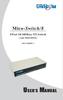 TM Mico-Switch/8 8 Port 10/100Base-TX Switch (Auto MDI/MDIX) FEP-32008T-3 U SER S M ANUAL (Auto MDI/MDIX) FEP-32008T-3 TM TM Package Contents Package contents include the following: Micro-Switch/8; 8 Port
AT-S45 Version 1.0.7 Management Software for the AT-9410GB Gigabit Ethernet Switches. Software Release Notes
 AT-S45 Version 1.0.7 Management Software for the AT-9410GB Gigabit Ethernet Switches Product Documentation Software Release Notes Please read this document before you begin to use the AT-S45 management
ALLNET ALL8944WMP Layer 2 Management 24 Port Giga PoE Current Sharing Switch
 ALLNET ALL8944WMP Layer 2 Management 24 Port Giga PoE Current Sharing Switch 24-Port Giga PoE Current Sharing Pv6 and IPv4 Dual Protocol SNMP v1/v2c/v3 SSH version 2.0 Authentication TACACS+ Jumbo Frames
Pervasive Software Inc. Pervasive PSQL v11 Insurance License Agreement
 Pervasive Software Inc. Pervasive PSQL v11 Insurance License Agreement IMPORTANT: DO NOT INSTALL THE ENCLOSED OR DOWNLOADED SOFTWARE UNTIL YOU HAVE READ THIS PERVASIVE PSQL LICENSE AGREEMENT ( AGREEMENT
Ixia Director TM. Powerful, All-in-One Smart Filtering with Ultra-High Port Density. Efficient Monitoring Access DATA SHEET
 Ixia Director TM Powerful, All-in-One Smart Filtering with Ultra-High Port Density The Ixia Director TM is a smart filtering appliance that directs traffic of interest to your monitoring tools. Now you
AT-S84 Version 1.3.0 (1.0.0.90) Management Software for the AT-9000/24 Gigabit Ethernet Switch Software Release Notes
 AT-S84 Version 1.3.0 (1.0.0.90) Management Software for the AT-9000/24 Gigabit Ethernet Switch Software Release Notes Please read this document before you begin to use the management software. Supported
USER S MANUAL. Ethernet 10/100 Transceiver Series DL221/DL221A
 USER S MANUAL Ethernet 10/100 Transceiver Series DL221/DL221A June 1999 ETHERNET 10/100 TRANSCEIVER INSTRUCTION MANUAL SERIES DL221/DL221A INTRODUCTION Thank you for purchasing the Radiant Communications
SOHOware Long Reach Ethernet (LRE) Solution
 Application Note - LRE SOHOware Long Reach Ethernet (LRE) Solution LRE Technology Benefits SOHOware solution is based on Very high bit-rate DSL (VDSL) robust technology Solution supports transfer rates
User Guide. MC100CM MC110CS Fast Ethernet Media Converter. MC111CS MC112CS WDM Fast Ethernet Media Converter
 User Guide MC100CM MC110CS Fast Ethernet Media Converter MC111CS MC112CS WDM Fast Ethernet Media Converter COPYRIGHT & TRADEMARKS Specifications are subject to change without notice. is a registered trademark
Broadband Router ESG-103. User s Guide
 Broadband Router ESG-103 User s Guide FCC Warning This equipment has been tested and found to comply with the limits for Class A & Class B digital device, pursuant to Part 15 of the FCC rules. These limits
24-Port 10/100/1000Mbps Gigabit Ethernet Web Smart Switch
 24-Port 10/100/1000Mbps Gigabit Ethernet Web Smart Switch with 24 10/100/1000Mbps UTP ports plus 2 1000Mbps mini-gbic ports (share) User s Guide FCC Warning This equipment has been tested and found to
palm Switch 500 5 Port 10/100 Base-TX Switch with Auto MDI/MDI-X User Guide
 palm Switch 500 5 Port 10/100 Base-TX Switch with Auto MDI/MDI-X User Guide Rev. 1.0 June, 2003 User Guide 1. Introduction Welcome to the World of Mini-Networking. In the modern business society, communication
Your single source for network transmission solutions.
 Transmission Network Solutions Safety Security Certainty Your single source for network transmission solutions. Robust performance and complete flexibility to meet all your current and future transmission
48-Port 10/100/1000Mbps Gigabit Ethernet Web Smart Switch
 48-Port 10/100/1000Mbps Gigabit Ethernet Web Smart Switch with 48 10/100/1000Mbps UTP ports plus 4 1000Mbps mini-gbic ports (share) User s Guide FCC Warning This equipment has been tested and found to
MICROSENS Media Converter 10/100/1000T to Gigabit Fiber
 MICROSENS Media Converter 10/100/1000T to Gigabit Fiber User Guide 10/100/100 TX to Gigabit Fiber Media Converter Page 2/7 Package Contents Please refer to the package content list below to verify them