
Your 14.3% Defined Benefit
|
|
|
- Edward Merritt
- 9 years ago
- Views:
Transcription
1 Your 14.3% Defined Benefit Product Disclosure Statement Scan this image using your smartphone s camera to go directly to apss.com.au to learn more about your super in the APSS and check your current APSS balance. You may first need to download a free barcode reader app that suits your brand of smartphone. Date of preparation: 16 September 2014

2 PRODUCT DISCLOSURE STATEMENT THIS PAGE HAS BEEN LEFT BLANK INTENTIONALLY 2 of 40

3 14.3% DEFINED BENEFIT Contents About this Product Disclosure Statement (PDS) 4 What you get a snapshot 6 What you get the detail 8 Ceasing employment 15 Investments 17 Accessing your super 20 Significant risks 22 Fees and other costs 22 Taxation information 25 Additional information 28 Glossary of terms 30 Form Provide your Tax File Number (TFN) 39 This Product Disclosure Statement (PDS) contains general information about the APSS for eligible employees of Australia Post or an Associated Employer who have 14.3% Defined Benefit entitlements in the APSS. It is not financial product advice, and should not be relied upon as such. Before making any decisions on the basis of the information contained in this document, you should obtain independent advice that takes into account your particular circumstances. The Trustee of the APSS, and the issuer of interests in the APSS, is PostSuper Pty Limited. PostSuper Pty Limited is not required to and does not hold an Australian Financial Services Licence. Therefore, it is not licensed to provide you with financial product advice regarding your investment in the APSS. 3 of 40

4 PRODUCT DISCLOSURE STATEMENT About this PDS WHAT IS THE PURPOSE OF THIS DOCUMENT? This document has been prepared for eligible employees of Australia Post or an Associated Employer who have 14.3% Defined Benefit entitlements in the APSS whilst they are employed by Australia Post or an Associated Employer. You should read it in its entirety before making a decision about the superannuation that you receive from Australia Post or your Associated Employer in the APSS. Words and expressions that are capitalised in this PDS are defined in the Glossary of terms. References to the Trustee, us, we or our throughout this PDS are references to PostSuper Pty Limited. References to your Employer are references to Australia Post or your Associated Employer. ABOUT THE APSS In addition to the Defined Benefit the APSS also allows employee members to save their own money in the APSS or rollover money from other superannuation funds into the APSS (we call these Member Savings ). If you want to add to your Defined Benefit with your own Member Savings or open an account in the APSS for your spouse, please read the separate Your APSS Member Savings at a glance Product Disclosure Statement (PDS) and if you need more information, Your APSS Member Savings in detail. They are available at apss.com.au or by calling SuperPhone THE ROLE OF YOUR EMPLOYER Australia Post is the principal employer-sponsor of the APSS. Australia Post and the Associated Employers provide superannuation benefits for their eligible employees through the APSS. MEMBERSHIP OF THE APSS 14.3% DEFINED BENEFIT From 1 July 2012, Australia Post and its Associated Employers no longer offer membership of the APSS 14.3% Defined Benefit to new employees. Instead, new employees are offered super benefits outside the APSS. This decision does not affect the benefits of existing APSS 14.3% Defined Benefit Members. Choices you can make now You can add to your Defined Benefit with your own Member Savings or open an account for your spouse. Refer to the Your APSS Member Savings at a glance PDS for more information. You can also nominate Beneficiaries. You ll find more detail as to how on page 12. Other products and services As an employee member of the APSS, you can: save your own money in the APSS or rollover money from other superannuation funds into the APSS (we call this Member Savings) open a spouse account for your spouse in the APSS potentially commence an APSS Pre-Retirement Pension. When you cease employment, you can: retain your benefits in the APSS and continue to make Member Savings, if eligible commence an allocated pension in the APSS (if you have retired or are otherwise eligible). If you re interested in any of these options (either now or when you cease employment), please obtain a copy of the Your APSS Member Savings at a glance PDS (and associated booklet) and/or the Your APSS Pension PDS from apss.com.au. 4 of 40

5 14.3% DEFINED BENEFIT HOW YOU CAN CONTACT US go online at apss.com.au by just log on and click contact us call SuperPhone on by mail at: APSS Locked Bag A5005 Sydney South NSW 1235 INFORMATION AND DOCUMENTS AVAILABLE FROM APSS WEBSITE The APSS website at apss.com.au includes Trustee and executive remuneration details and other APSS documents and information that must be disclosed under superannuation legislation. Refer to the APSS Governance page in the About the Scheme section of the APSS website for details and links to this information and documents. by fax: (02) It s a good idea to have your member number and Personal Identification Number (PIN) handy when contacting us online or by phone. Keeping you up-to-date Information contained in this PDS may change from time to time. If changes are materially adverse to readers of this PDS, we will update or replace this PDS to reflect the changes. To find out about any up-to-date information not contained in this PDS, you can: go online at apss.com.au call SuperPhone on A paper copy of any updated information will be given to you without charge on request. 5 of 40
6 PRODUCT DISCLOSURE STATEMENT What you get a snapshot The following is what your Employer provides for you in the APSS for just being an employee and it s at no cost to you. 14.3% DEFINED BENEFIT The superannuation benefit is a defined benefit. It is defined by the formula: 14.3% x Final Average Salary (FAS) x Years of full-time service This is applied to your years of service and FAS to determine your Defined Benefit. During periods of probationary employment this figure is consistent with the Superannuation Guarantee rate, which is currently 9.5%. You will find the full definition of FAS in the Glossary of terms. FAS is generally the average of your Superannuation Salaries received on your last three birthdays at your Employer. Your benefit will generally keep pace with inflation. As your salary increases so too does your Defined Benefit. This is made up of how long you work. For every day you work, your superannuation grows. It begins building up from the day you commence employment and ends on your last day of employment. Years of service are adjusted for any periods of part-time work (refer to page 10). Also, your Employer has adopted procedures to make sure that your Superannuation Salary will not go down (refer to page 9). 6 of 40

7 14.3% DEFINED BENEFIT Investment market returns do not impact on your Defined Benefit. TPD AND DEATH BENEFIT You and your family have significant protection against the financial impact of your Total and Permanent Disablement (TPD) or your death. For more information, go to pages DEDICATED MEMBER SERVICE The APSS is at your service. Our member contacts are: a website that allows you to monitor the growth of your superannuation and obtain benefit estimates online at any time at apss.com.au a dedicated phone line SuperPhone to attend to any queries you have on You can speak with our Service Representatives between the hours of 9am and 5.30pm (AEST) Monday to Friday by mail: APSS Locked Bag A5005 Sydney South NSW 1235 by fax: (02) You will receive from us: annual benefit statements regular communications notification of material changes and significant events that affect your APSS membership, as required by law. 7 of 40

8 PRODUCT DISCLOSURE STATEMENT What you get the detail Here we look in more detail at the differences between a defined benefit and a defined contribution fund. We look at how your Defined Benefit is calculated, including what happens during any probationary period of employment, what happens during periods of part-time employment and what happens if you take approved leave without pay. We also detail how the TPD and death benefit is calculated and who receives the TPD and death benefit. DIFFERENCES BETWEEN DEFINED BENEFIT AND DEFINED CONTRIBUTION The superannuation benefit your Employer provides to eligible employees through the APSS is a defined benefit. It is a benefit defined in terms of your Final Average Salary ( FAS ) and how long you have been employed by your Employer. Because your defined benefit is not influenced by investment markets and is therefore immune from investment market instability, you have peace of mind and certainty. and the difference between the APSS Defined Benefit and a defined contribution is? In a defined contribution fund the member carries the investment risk. YOUR DEFINED BENEFIT Your Defined Benefit is calculated in accordance with the following formula (adjusted for probationary periods of employment): 14.3% x FAS x years of full-time service Suppose that you become a member of the APSS and work full-time as a permanent employee of Australia Post from your first day of work to your last day of work, and you have no probationary period of employment. Suppose also that you work for 10 years (maintaining your membership all this time) and leave Australia Post with a FAS of $50,000. In this example, your defined benefit will be $71,500: 14.3% x FAS x years of full-time service = Defined Benefit 14.3% x $50,000 x 10 years = $71,500 In the APSS, your Employer carries the investment risk in relation to the Defined Benefit. In a defined contribution fund only the amount of the contribution is known with certainty the benefit depends on investment returns and expenses incurred. Defined contributions attract investment earnings or losses caused by negative returns. Administration fees and insurance premiums (neither of which currently apply in the APSS) can further reduce defined contribution benefits. 8 of 40

9 14.3% DEFINED BENEFIT What is your FAS? Final Average Salary ( FAS ) is generally the average of your Superannuation Salaries received on your last three birthdays with your Employer. Your Superannuation Salary is generally your full time equivalent salary, before tax, including recognised allowances, as at your last birthday. Salary sacrificing does not affect your Superannuation Salary. If you were not a member of the APSS on your last birthday, your Superannuation Salary is simply your before-tax salary as at the date you joined the APSS. Your Superannuation Salary is based on payroll information provided to the APSS by your Employer. Given that your FAS is made up of the average of your Superannuation Salaries on your last three birthdays, your benefit will generally keep pace with inflation. Your Employer has adopted procedures that make sure that, should your salary decrease, your Superannuation Salary (and, therefore, your FAS) will not decrease. A minimum level of FAS ( MinFAS ) applies if you retire on or after your 55th birthday. MinFAS will also apply to any benefit accrued during any period of probationary service and/or non-permanent service if you leave your Employer before age 55. The MinFAS is indexed on 1 July each year in line with general wage increases within Australia Post. As at 1 July 2014, MinFAS was $45,334. What happens during a probationary period of employment? The Defined Benefit during any probationary period (if applicable) is the Superannuation Guarantee (SG) Accrual Rate multiplied by FAS for the length of your probationary period of employment in years. Once your probationary period of employment finishes your Defined Benefit will be 14.3% multiplied by your FAS for the length of your subsequent period of full-time service with your Employer. For example, if your 10 years of full-time employment at Australia Post includes a three-month probationary period during which the SG Accrual Rate was 9%, and you end up with a FAS of $50,000, you would have a benefit of $70,838. Calculating your Defined Benefit including period of probationary employment: Rate x FAS x years of full-time service = Defined Benefit 9% x $50,000 x 0.25 years = $1,125 PLUS 14.3% x $50,000 x 9.75 years = $69,713 Total Defined Benefit = $70,838 9 of 40

10 PRODUCT DISCLOSURE STATEMENT What you get the detail (cont.) What happens during periods of part-time employment? The Defined Benefit you accrue as an APSS member employed part-time is calculated using your FAS full-time equivalent multiplied by your service fraction (that is, your hours of part-time service expressed as a fraction of the hours of full-time service). Your FAS during periods of part-time service is based on your full-time equivalent salary. For example, suppose that, after completing your threemonth probationary period, you work full-time for five years and nine months, then start working three days a week (i.e. three of five days) for another four years and, as before, your FAS is $50,000. Over this 10-year service period, you would end up with a Defined Benefit of $59,398: Calculating your Defined Benefit including periods of probationary and part-time employment: Rate x FAS x years of full-time = Defined Benefit service 9% x $50,000 x 0.25 years = $1,125 PLUS 14.3% x $50,000 x 5.75 years = $41,113 PLUS 14.3% x $50,000 x Total Defined Benefit 4 years x 3/5 = $17,160 = $59,398 Your FAS stays the same. Your FAS doesn t go down just because you work part-time. So your Defined Benefit doesn t go down. What happens if you take approved leave without pay? During periods of Employer-approved leave without pay that commence on or after 1 July 2014, your Defined Benefit will continue to accrue (at the full or part-time rate that applied immediately prior to starting your approved leave) for the following period, as applicable to you: 28 days for most approved leave without pay; or a maximum of 12 months in total for approved maternity, paternity or adoption leave, inclusive of both paid and unpaid periods of leave. In addition, you will still be eligible for an additional Death or Total and Permanent Disablement (TPD) benefit whilst on Employer-approved leave without pay, up to a maximum of 12 months. If your approved leave without pay extends beyond 12 months, your additional Death or TPD benefit entitlements will cease. Your leave status (including the type of leave you are on and whether it has been approved) is based on information provided to the APSS by your Employer. The APSS is not involved in leave applications and we do not have details about employees leave entitlements. What is the Superannuation Guarantee top-up? Under Superannuation Guarantee legislation, employers have to provide a minimum amount of superannuation for their employees (to avoid liability for the Superannuation Guarantee charge). This is called the minimum Superannuation Guarantee benefit. The superannuation your Employer provides for 14.3% Defined Benefit members via the APSS is usually more than is required by law. To ensure that your benefit always meets the Superannuation Guarantee requirements, a Superannuation Guarantee top-up may be calculated for you. This is the amount by which the minimum Superannuation Guarantee benefit exceeds your Defined Benefit. Most 14.3% Defined Benefit members will not have a Superannuation Guarantee top-up because the Defined Benefit is generally higher than the minimum Superannuation Guarantee benefit. If you are entitled to a Superannuation Guarantee top-up, it can go up or down when your Defined Benefit changes and when the minimum Superannuation Guarantee changes. Visit the website at apss.com.au or call the SuperPhone on if you would like to find out if you have a Superannuation Guarantee top-up. 10 of 40

11 14.3% DEFINED BENEFIT TOTAL AND PERMANENT DISABLEMENT (TPD) AND DEATH BENEFIT You and your family have significant protection against the financial impact of your Total and Permanent Disablement (TPD) or your death: Cash lump sum benefit. You re covered 24 hours a day, 7 days a week while you remain an APSS member and an employee of Australia Post or your Associated Employer. No need to sit a separate medical you don t have to provide information to the Trustee about your health status on joining the APSS to be eligible. At no cost to you because the costs are met by your Employer. TPD and death benefits provide financial support to you or your Dependants in the event of your TPD or your death. These benefits are available once you have completed any probationary period of employment. For details on the death benefit available for permanent employees during periods of probationary employment see page 12. The TPD and death benefit is a cash lump sum consisting of, in the case of permanent employees under the age of 60, an amount equivalent to: 14.3% x FAS x years from date of TPD or death to date member would have attained age 60. The TPD and death benefit is payable in addition to the member s accrued Defined Benefit as at the date of TPD or death. A top up may be applied to ensure that a member s benefits meet the minimum death benefit requirements under Superannuation Guarantee law. Calculating the benefit payable upon TPD or death In calculating the TPD and death benefit, FAS is determined as if the member s Superannuation Salary on the date of TPD or death remained unchanged from that date to the date the member would have attained age 60. For example, a 35-year-old has 25 years to age 60. Suppose this member suffers a TPD or dies having served three years employment with Australia Post the first three months being a probationary period at an SG Accrual Rate of 9%. If this member has a Superannuation Salary of $54,000, the total TPD or death benefit would be $215, Accrued Defined Benefit to the date of TPD or death SG Accrual Rate x FAS x probationary service 9% x $54,000 x 0.25 years = $1, PLUS 14.3% Rate x FAS x years of full-time permanent service 14.3% x $54,000 x 2.75 years = $21, PLUS Additional TPD/death benefit 14.3% Rate x FAS x years of potential membership between date of TPD or death and 60th birthday 14.3% x $54,000 x 25 years = $193, Total Defined Benefit payable upon TPD or death = $215, If the member had resigned, their FAS would have been the average of their last three Superannuation Salaries. Let s say they were $50,000, $52,000 and $54,000 then his FAS would have been $52,000 and his total benefit payable upon resignation would have been $21, of 40

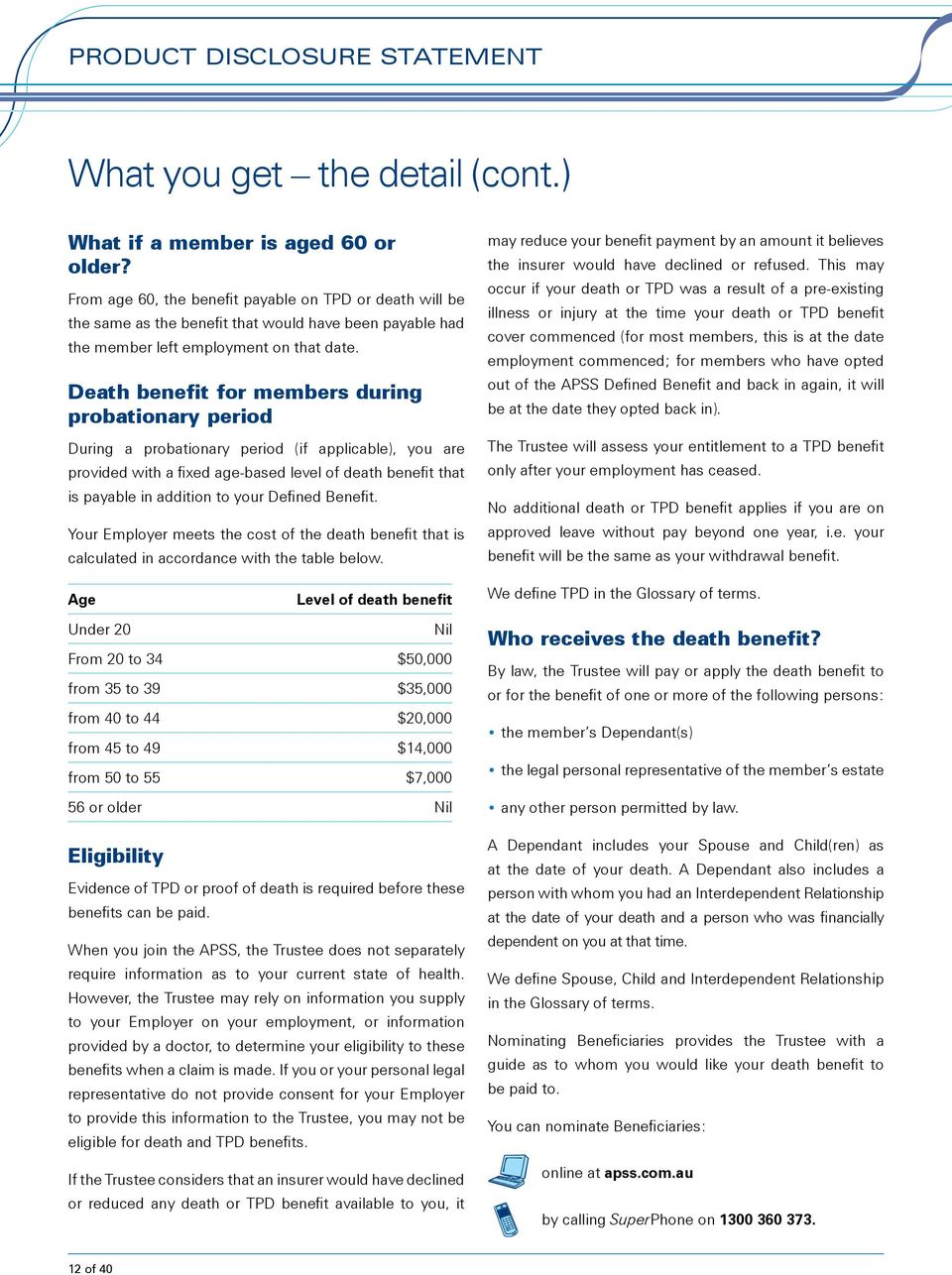
12 PRODUCT DISCLOSURE STATEMENT What you get the detail (cont.) What if a member is aged 60 or older? From age 60, the benefit payable on TPD or death will be the same as the benefit that would have been payable had the member left employment on that date. Death benefit for members during probationary period During a probationary period (if applicable), you are provided with a fixed age-based level of death benefit that is payable in addition to your Defined Benefit. Your Employer meets the cost of the death benefit that is calculated in accordance with the table below. may reduce your benefit payment by an amount it believes the insurer would have declined or refused. This may occur if your death or TPD was a result of a pre-existing illness or injury at the time your death or TPD benefit cover commenced (for most members, this is at the date employment commenced; for members who have opted out of the APSS Defined Benefit and back in again, it will be at the date they opted back in). The Trustee will assess your entitlement to a TPD benefit only after your employment has ceased. No additional death or TPD benefit applies if you are on approved leave without pay beyond one year, i.e. your benefit will be the same as your withdrawal benefit. Age Level of death benefit We define TPD in the Glossary of terms. Under 20 Nil From 20 to 34 $50,000 from 35 to 39 $35,000 from 40 to 44 $20,000 from 45 to 49 $14,000 from 50 to 55 $7, or older Nil Eligibility Evidence of TPD or proof of death is required before these benefits can be paid. When you join the APSS, the Trustee does not separately require information as to your current state of health. However, the Trustee may rely on information you supply to your Employer on your employment, or information provided by a doctor, to determine your eligibility to these benefits when a claim is made. If you or your personal legal representative do not provide consent for your Employer to provide this information to the Trustee, you may not be eligible for death and TPD benefits. If the Trustee considers that an insurer would have declined or reduced any death or TPD benefit available to you, it Who receives the death benefit? By law, the Trustee will pay or apply the death benefit to or for the benefit of one or more of the following persons: the member s Dependant(s) the legal personal representative of the member s estate any other person permitted by law. A Dependant includes your Spouse and Child(ren) as at the date of your death. A Dependant also includes a person with whom you had an Interdependent Relationship at the date of your death and a person who was financially dependent on you at that time. We define Spouse, Child and Interdependent Relationship in the Glossary of terms. Nominating Beneficiaries provides the Trustee with a guide as to whom you would like your death benefit to be paid to. You can nominate Beneficiaries: online at apss.com.au by calling SuperPhone on of 40
13 14.3% DEFINED BENEFIT However, remember that the Trustee is not bound by your nomination and is guided by the purposes of the APSS, which include providing superannuation benefits for members upon their retirement from service and, on the death of members, for their Dependants. By law the Trustee cannot pay a benefit to a person that does not fit one of the categories listed on the previous page. Your benefits must be paid out of the APSS in the event of your death. Change in Member Savings upon Notification of Death If the APSS is notified of your death any Market Return Member Savings you have will be automatically switched to Cash Return Member Savings at the end of the fortnight in accordance with the normal APSS switching timeframe (which is usually the next fortnight, based on Australia Post s payroll dates, but in some instances may be the following fortnight refer to Your APSS Member Savings at a glance PDS or call SuperPhone for details). This means that from that point on, these Member Savings will be allocated investment returns using the Cash Return Crediting Rate that cannot be negative and will preserve the dollar value of your Member Savings. IMPORTANT INFORMATION CONCERNING YOUR BENEFITS Tax File Numbers The APSS is authorised by law to ask members for their Tax File Number ( TFN ). For new employees, your Employer is also required to pass on your TFN to the APSS. If you do not provide your TFN, the APSS may have to pay additional tax that could result in a reduction to your APSS benefit. If your Member Savings are sufficient it will be deducted from your Member Savings account but, if this account is not sufficient, your Defined Benefit may be reduced by the establishment of an offset account. If an offset account is established for you, any additional tax the APSS may be required to pay which cannot be deducted from your Member Savings would be credited to this offset account. The account balance would increase or decrease according to the Crediting Rates for Market Return Member Savings. When your Defined Benefit becomes payable, the balance of the offset account would be deducted or offset from the benefit payable. Because the Market Return Crediting Rates are applied to these offset accounts, the balance of the offset account can be expected to increase beyond the initial amount of Defined Benefit used to pay the tax. The Your APSS Member Savings at a glance PDS provides more information about Member Savings including how Crediting Rates are calculated. If you quote your TFN within four years, we may be able to reclaim the tax paid from the ATO. If this occurs, and your Defined Benefit has been reduced for the tax paid, the amount reclaimed would first be debited to your offset account with any excess added to your Member Savings. However, the ATO will not compensate the APSS for the forgone investment earnings so even if this occurs you still may have an offset account. Also, it may not be possible for the APSS to reclaim the tax from the ATO or to reduce the amount of tax deducted from your benefit. If you would like to provide the APSS with your TFN, just complete the Provide your Tax File Number form on page 39 and return it to APSS, Locked Bag A5005, Sydney South NSW You can also provide your TFN by calling SuperPhone on Concessional (before-tax) contributions For employee members, concessional contributions include: the notional amount your Employer contributes to provide your Defined Benefit (your Notional Taxed Contribution, explained on the next page); and any salary sacrifice contributions you make from your before-tax salary. 13 of 40

14 PRODUCT DISCLOSURE STATEMENT What you get the detail (cont.) Limits on concessional contributions The Government imposes limits on the amount of contributions that can be made to your super in each financial year that are taxed at concessional rates. If you exceed these limits you could potentially pay extra tax. For the financial year, the limit for concessional (before-tax) contributions is: $30,000 p.a. for person under age 50 at the end of the financial year; and $35,000 p.a. for persons aged 50 or over at the end of the financial year. These limits may increase by indexation or be changed by Government in later years. For employee members, your Notional Taxed Contribution and any salary sacrifice contributions count towards your concessional contributions limit. Therefore, this limit is an important consideration for employee members who are making salary sacrifice contributions to their APSS Member Savings or another super fund. Employee members can see an estimate of their concessional contributions for the financial year to date online at apss.com.au (refer to Concessional Contributions under My APSS Information). Excess contributions Concessional (before-tax) contributions are generally taxed at 15%** when received by the APSS. Excess concessional contributions will be included in an individual s assessable income and taxed at their marginal tax rate (subject to a tax offset for the 15% contributions tax already paid) plus an additional interest charge. In addition, persons who exceed their concessional contributions limit may also elect to have up to 85% of their excess concessional contributions released from their superannuation. If you have sufficient APSS Member Savings to make the release, you will have this option available to you, however if your Member Savings are insufficient, the option to release an amount from your Defined Benefit is not currently available. An individual s excess concessional contributions also count towards their non-concessional (after-tax) contributions limit for the relevant financial year. This may be relevant to any voluntary after-tax contributions made to your APSS Member Savings or another super fund. Refer to the Your Member Savings at a glance PDS for further information about non-concessional (after-tax) contributions. Notional taxed contribution (NTC) The Government has prescribed a standard formula to calculate the notional amount your employer contributes to provide your Defined Benefit. For most 14.3% Defined Benefit members, your NTC is your Superannuation Salary at the start of the financial year (1 July), adjusted for part-time service, multiplied by 10.8%.* Therefore, if you are earning $50,000 at the start of the year and work full time your NTC for the financial year is $5,400. Special grandfathering arrangements generally apply to employee members who had a Defined Benefit on 12 May 2009 and whose notional contributions would otherwise exceed the before-tax contribution limit. If eligible, their NTC is capped at the concessional contributions limit. However, salary sacrifice contributions can still cause such members to exceed their concessional contributions limit. * This rate applies for the financial year. A higher rate applies if your superannuation salary is less than $40,270. A different rate applies for SG Defined Benefit members and some 14.3% Defined Benefit Members. For more details on this call SuperPhone on of 40

15 14.3% DEFINED BENEFIT Please note that for the and earlier years, excess concessional contributions were generally subject to additional tax at a rate of 30% plus the Medicare levy. ** If you do not provide your TFN, additional tax may apply (refer page 25). Additional tax of 15% may also apply to very high income earners whose income and concessional contributions (excluding excess contributions) exceed $300,000 in a financial year. Low Income Superannuation Contribution (LISC) The Government has introduced the Low Income Superannuation Contribution for the financial year onwards. This is an additional superannuation contribution by the Government of between $10 and $500 for individuals with an adjusted taxable income of $37,000 or less for a financial year who have Concessional Contributions made for them in that year. To be eligible, at least 10% of your income must be derived from employment or business. Temporary residents are not eligible. The contribution will be calculated at 15% of the individual s Concessional Contributions, up to a maximum contribution of $500. Employee Members eligible for this contribution will receive their payment automatically into an APSS Member Savings Account from the Australian Taxation Office (ATO) once they complete their annual tax return. If Employee Members do not already have a Member Savings Account, this payment will automatically open an APSS Member Savings Employee Account and the contribution will be deposited into Cash Return Member Savings (the default) until we are advised otherwise. As a result of recent legislative change, the LISC could be abolished from 1 July Defined Benefit offset accounts An offset account may be established for you if: part of your Defined Benefit has been released early on compassionate grounds or for severe financial hardship (refer page 20-21); we don t have your TFN (refer page 13); you have used part of your Defined Benefit to commence an APSS Pre-Retirement Pension (refer to the APSS Pensions PDS); and/or you have a Family Law Account or a Surcharge Tax Account (defined in the Glossary). The APSS deducts the balance of your offset accounts from your APSS benefit when it becomes payable. The opening balance of the account will be the amount of your Defined Benefit that has been released or paid. This amount will accumulate at the relevant interest rate or according to the Crediting Rates for APSS Market Return Member Savings (as applicable) until your benefit is payable. Your annual APSS Periodic Statement will provide details of how your offset accounts (if any) have been adjusted each year. Ceasing employment When you cease employment with your Employer, you can choose to: continue your APSS membership by: transferring your benefits to the APSS Rollover taking your APSS retirement benefit in the form of an APSS Pension leave the APSS. What happens to your Defined Benefit when you leave employment? Once your Employer notifies the APSS of you leaving and provides all the necessary information about your service, we will send you an estimate of your Defined Benefit. This Defined Benefit estimate may not be the same as the final APSS benefit paid because adjustments must be made for interest that accrues to the date your Defined Benefit is actually paid. The interest rate used is the Crediting Rate of the Cash Return Member Savings (refer to the Your APSS Member Savings at a glance PDS for more information). Your estimate will be sent to you, together with a Benefit Payment Direction form. You will need to complete and return this form within 60 days in order for the APSS to act on your instructions. 15 of 40

16 PRODUCT DISCLOSURE STATEMENT Ceasing employment (cont.) Advise us within 60 days If you do not tell the APSS what you want to do with your benefit within 60 days of us writing to you with details of your estimate, your benefit will be paid automatically as soon as practicable to an Eligible Rollover Fund (ERF), unless we are prevented from doing so by law. Details of the current ERF and further information can be found on page 29. If you would like to continue your APSS membership after leaving employment with your Employer, you can get more detail about the APSS Rollover and APSS Pensions: online at apss.com.au by downloading copies of the Member Savings PDS (Your APSS Member Savings at a glance) or Pensions PDS (Your APSS Pension), as applicable call SuperPhone on If you would prefer to transfer your benefits to another complying superannuation fund, you will need to provide details of the fund in the Benefit Payment Direction form. PROVIDING PROOF OF IDENTITY The security of your super entitlements in the APSS is a key priority for the Trustee. We have procedures in place to manage risks associated with fraud and other illegal activities. At times, these procedures may cause inconvenience to you. Please remember that they are being applied to protect your entitlements. In addition, under the Anti-Money Laundering and Counter- Terrorism Financing Act 2006, superannuation funds are required to have an anti-money laundering and counterterrorism financing program in place. A key element of this program is customer identification and verification procedures. Typically, you will be required to provide proof of your identity before you withdraw benefits from the APSS or commence a pension. As a result, some requested transactions cannot proceed until we receive and verify the necessary identification documents. The Trustee does not accept liability for any loss you may incur as a result of circumstances such as a delay in payment of a benefit or commencement of an income stream where the delay arises from our need to comply with legislative requirements. We may be required to request additional customer identification or related information from you at other times. If we cannot obtain the required information from you, we may be unable to process your requested transaction. The Trustee must also report specified matters to the regulator, AUSTRAC, and this may include the provision of personal information about you. If this happens, the Trustee is not permitted to advise you that such a report has been made. 16 of 40

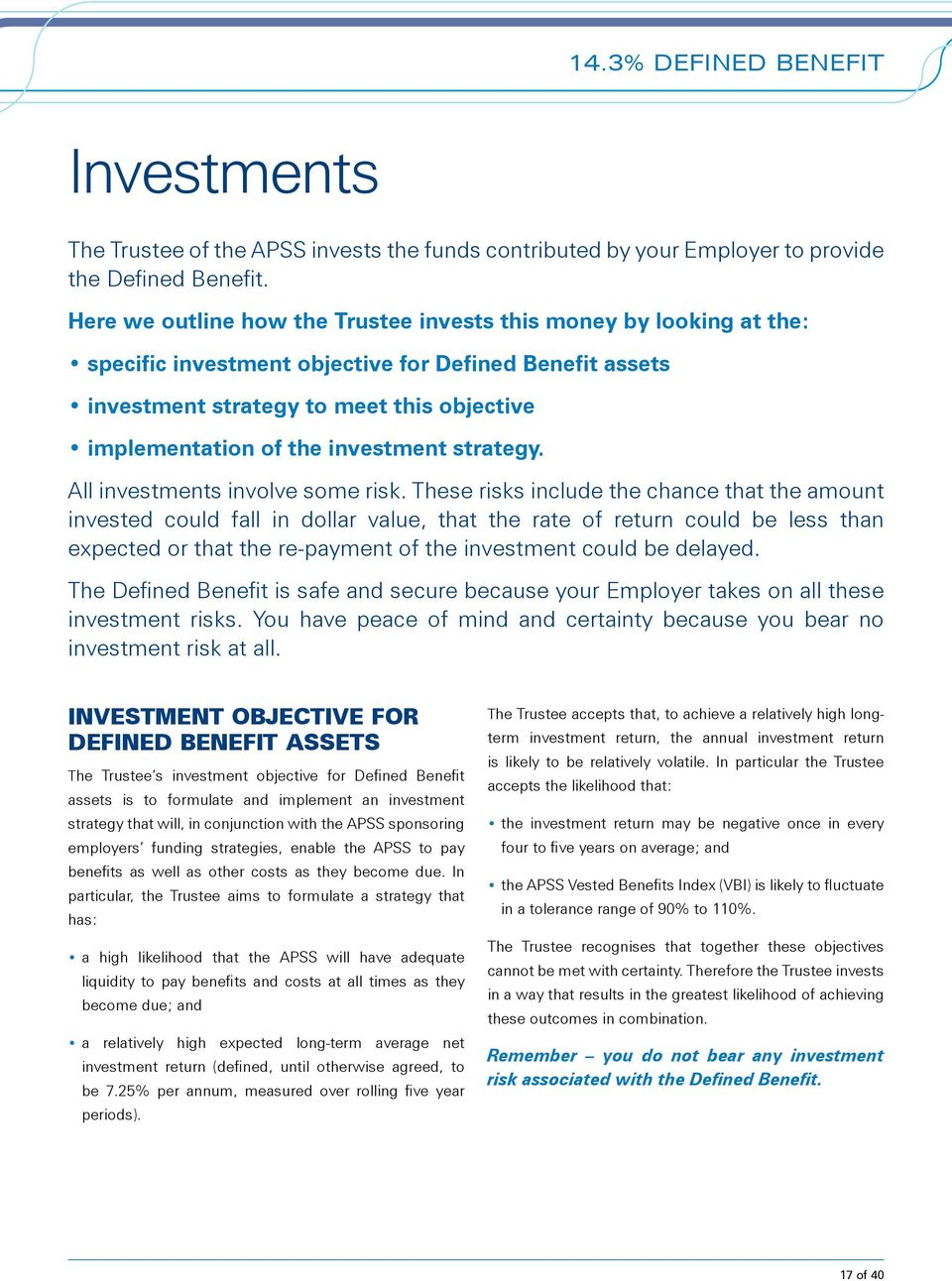
17 14.3% DEFINED BENEFIT Investments The Trustee of the APSS invests the funds contributed by your Employer to provide the Defined Benefit. Here we outline how the Trustee invests this money by looking at the: specific investment objective for Defined Benefit assets investment strategy to meet this objective implementation of the investment strategy. All investments involve some risk. These risks include the chance that the amount invested could fall in dollar value, that the rate of return could be less than expected or that the re-payment of the investment could be delayed. The Defined Benefit is safe and secure because your Employer takes on all these investment risks. You have peace of mind and certainty because you bear no investment risk at all. INVESTMENT OBJECTIVE FOR DEFINED BENEFIT ASSETS The Trustee s investment objective for Defined Benefit assets is to formulate and implement an investment strategy that will, in conjunction with the APSS sponsoring employers funding strategies, enable the APSS to pay benefits as well as other costs as they become due. In particular, the Trustee aims to formulate a strategy that has: a high likelihood that the APSS will have adequate liquidity to pay benefits and costs at all times as they become due; and a relatively high expected long-term average net investment return (defined, until otherwise agreed, to be 7.25% per annum, measured over rolling five year periods). The Trustee accepts that, to achieve a relatively high longterm investment return, the annual investment return is likely to be relatively volatile. In particular the Trustee accepts the likelihood that: the investment return may be negative once in every four to five years on average; and the APSS Vested Benefits Index (VBI) is likely to fluctuate in a tolerance range of 90% to 110%. The Trustee recognises that together these objectives cannot be met with certainty. Therefore the Trustee invests in a way that results in the greatest likelihood of achieving these outcomes in combination. Remember you do not bear any investment risk associated with the Defined Benefit. 17 of 40
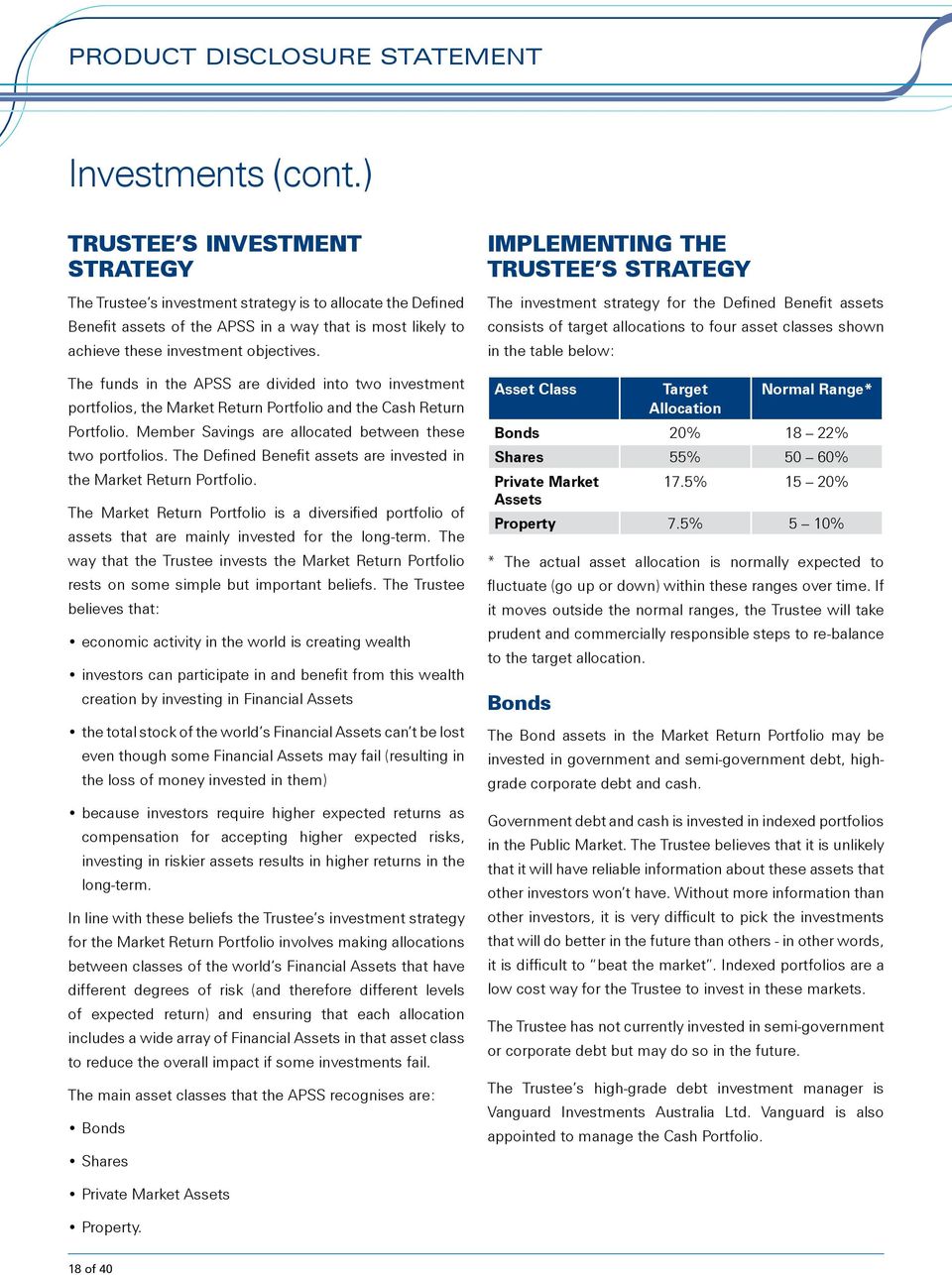
18 PRODUCT DISCLOSURE STATEMENT Investments (cont.) TRUSTEE S INVESTMENT STRATEGY The Trustee s investment strategy is to allocate the Defined Benefit assets of the APSS in a way that is most likely to achieve these investment objectives. The funds in the APSS are divided into two investment portfolios, the Market Return Portfolio and the Cash Return Portfolio. Member Savings are allocated between these two portfolios. The Defined Benefit assets are invested in the Market Return Portfolio. The Market Return Portfolio is a diversified portfolio of assets that are mainly invested for the long-term. The way that the Trustee invests the Market Return Portfolio rests on some simple but important beliefs. The Trustee believes that: economic activity in the world is creating wealth investors can participate in and benefit from this wealth creation by investing in Financial Assets the total stock of the world s Financial Assets can t be lost even though some Financial Assets may fail (resulting in the loss of money invested in them) because investors require higher expected returns as compensation for accepting higher expected risks, investing in riskier assets results in higher returns in the long-term. In line with these beliefs the Trustee s investment strategy for the Market Return Portfolio involves making allocations between classes of the world s Financial Assets that have different degrees of risk (and therefore different levels of expected return) and ensuring that each allocation includes a wide array of Financial Assets in that asset class to reduce the overall impact if some investments fail. The main asset classes that the APSS recognises are: Bonds Shares IMPLEMENTING THE TRUSTEE S STRATEGY The investment strategy for the Defined Benefit assets consists of target allocations to four asset classes shown in the table below: Asset Class Target Normal Range* Allocation Bonds 20% 18 22% Shares 55% 50 60% Private Market 17.5% 15 20% Assets Property 7.5% 5 10% * The actual asset allocation is normally expected to fluctuate (go up or down) within these ranges over time. If it moves outside the normal ranges, the Trustee will take prudent and commercially responsible steps to re-balance to the target allocation. Bonds The Bond assets in the Market Return Portfolio may be invested in government and semi-government debt, highgrade corporate debt and cash. Government debt and cash is invested in indexed portfolios in the Public Market. The Trustee believes that it is unlikely that it will have reliable information about these assets that other investors won t have. Without more information than other investors, it is very difficult to pick the investments that will do better in the future than others - in other words, it is difficult to beat the market. Indexed portfolios are a low cost way for the Trustee to invest in these markets. The Trustee has not currently invested in semi-government or corporate debt but may do so in the future. The Trustee s high-grade debt investment manager is Vanguard Investments Australia Ltd. Vanguard is also appointed to manage the Cash Portfolio. Private Market Assets Property. 18 of 40
19 14.3% DEFINED BENEFIT Shares This includes Public Market Shares as well as core Private Market equity instruments (through funds that invest in private companies). The Trustee intends to scale down the private equity investments in the Market Return Portfolio over the 3-5 years from June 2013 and this asset class will ultimately consist of Public Market Shares only. Like government debt, the Public Market Shares are invested in indexed portfolios because the Trustee believes it is difficult to beat the market because it is unlikely to have reliable information about these assets that other investors won t have. This means that investments are made in a way that this is designed to give the same return as the whole market, measured by commonly recognised market indexes, such as the ASX200 index for the Australian share market. The Trustee s Public Market Shares investment manager is Vanguard Investments Australia Ltd. Private Market investment involves the purchase of privately-traded assets such as companies and buildings. Core Private Market equity involves investing in established and start-up privately traded companies. More detail on how the Trustee invests in Private Market investments is provided below under Private Market Assets. The Trustee expects to make no further commitments to core Private Market equity. Over time more and more of the assets in the Shares asset class will become Public Market Shares. Private Market Assets This will include Private Market investments that are not included in Shares or Property asset types. In particular, it includes privately-traded debt and privately-traded noncore equity. Information about privately traded investment opportunities and access to them is quite restricted. Very few people or groups have the resources, business relationships, skills and money to make a bid for a privately-traded asset. Privately-traded assets within Shares, Property and Private Market Assets are invested by the Trustee on the advice of APSS Management, who retains advisers with specialist expertise and access to privately-traded assets around the globe. The Trustee has made investments in investment vehicles, most of which invest in a number of individual assets, resulting in a globally diversified portfolio for the APSS. Property This includes Private Market Property and Infrastructure investments. Private Market Property includes privatelytraded buildings, including building development. Infrastructure includes privately-traded assets. More detail on how the Trustee invests in Private Market investments is provided under Private Market Assets. Managing currency risk The APSS s investments cover all major financial regions of the world as well as Australia. This introduces currency risk the risk that the value of overseas investments will be affected by unpredictable movements in exchange rates. The Trustee has appointed a currency risk manager Macquarie Investment Management Limited to manage the effect of exchange rate movements. Labour standards and environmental, social and ethical issues The Trustee does not take into account labour standards, environmental, social or ethical considerations ( SRI ) in the selection, retention or realisation of the APSS s investments or in the appointment or termination of the APSS s investment managers. The APSS s investment managers do not take into account SRI considerations in the selection, retention or realisation of investments. These considerations may be taken into account if they have the potential to materially affect the value of investment, but no specific methodology is applied. 19 of 40

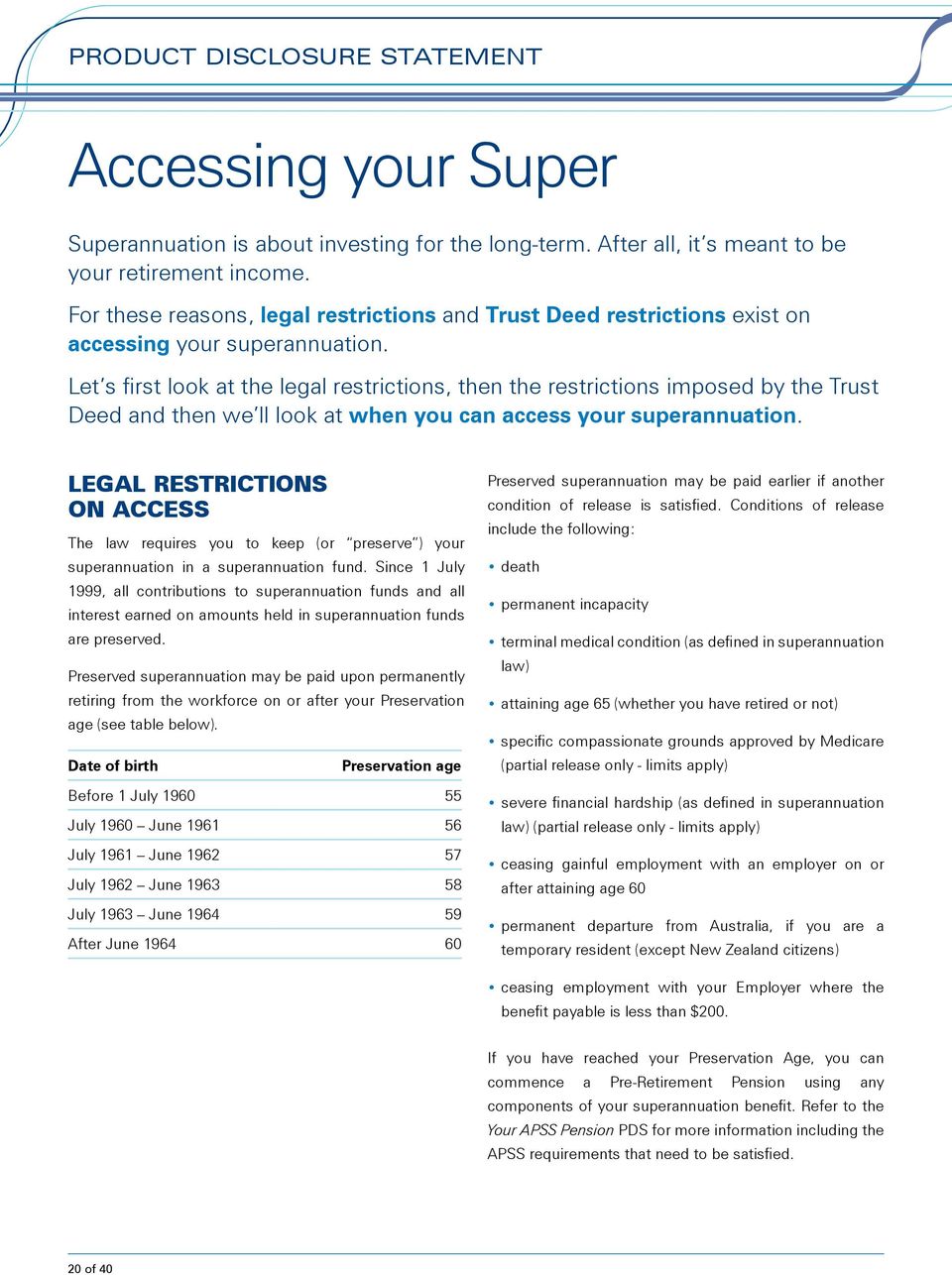
20 PRODUCT DISCLOSURE STATEMENT Accessing your Super Superannuation is about investing for the long-term. After all, it s meant to be your retirement income. For these reasons, legal restrictions and Trust Deed restrictions exist on accessing your superannuation. Let s first look at the legal restrictions, then the restrictions imposed by the Trust Deed and then we ll look at when you can access your superannuation. LEGAL RESTRICTIONS ON ACCESS The law requires you to keep (or preserve ) your superannuation in a superannuation fund. Since 1 July 1999, all contributions to superannuation funds and all interest earned on amounts held in superannuation funds are preserved. Preserved superannuation may be paid upon permanently retiring from the workforce on or after your Preservation age (see table below). Date of birth Preservation age Before 1 July July 1960 June July 1961 June July 1962 June July 1963 June After June Preserved superannuation may be paid earlier if another condition of release is satisfied. Conditions of release include the following: death permanent incapacity terminal medical condition (as defined in superannuation law) attaining age 65 (whether you have retired or not) specific compassionate grounds approved by Medicare (partial release only - limits apply) severe financial hardship (as defined in superannuation law) (partial release only - limits apply) ceasing gainful employment with an employer on or after attaining age 60 permanent departure from Australia, if you are a temporary resident (except New Zealand citizens) ceasing employment with your Employer where the benefit payable is less than $200. If you have reached your Preservation Age, you can commence a Pre-Retirement Pension using any components of your superannuation benefit. Refer to the Your APSS Pension PDS for more information including the APSS requirements that need to be satisfied. 20 of 40
21 14.3% DEFINED BENEFIT TRUST DEED RESTRICTIONS ON ACCESS Under the Trust Deed, your accrued Defined Benefit generally cannot be paid to you in cash while you are employed by your Employer except where some of your accrued Defined Benefit is approved for release prior to this - either to commence an APSS Pre-Retirement Pension, if approved by Medicare on compassionate grounds, or if you meet the criteria for severe financial hardship prescribed under superannuation law. If any of your Defined Benefit is released early, we will establish an offset account that will be deducted from your APSS benefit when it becomes payable (refer to page 15). The balance of this account will accumulate according to the Crediting Rates for Market Return Member Savings until your benefit is payable. PRESERVATION COMPONENTS As a result of these legal and Trust Deed restrictions, your superannuation benefit may be made up of three components: Unrestricted non-preserved component payable in cash at any time; Preserved component must be retained in a superannuation fund or other approved superannuation arrangement until you satisfy a relevant condition of release); and Restricted non-preserved component although not preserved, you are restricted from accessing this component while you are employed by Australia Post or an Associated Employer. Your annual APSS Benefit Statement will show what proportion of your superannuation is preserved, unrestricted non-preserved and restricted nonpreserved. Also refer to the Glossary for explanations of these terms. Age barriers Members can keep their superannuation in the APSS, regardless of their age and working status. A Member s Defined Benefit will cease to accrue with additional years of service when: they cease employment with your Employer; or they reach age 65 unless employed on at least a part-time basis (i.e. at least 40 hours in a period of 30 consecutive days during the most recent financial year); or they reach age 75. The minimum Superannuation Guarantee benefit will continue to accrue after age 75 for Members who remain in employment with their Employer. For details on how to retain your benefit in APSS refer to page Transferring your Defined Benefit out of the APSS The portability laws that allow superannuation to be transferred to another complying fund at any time (subject to certain restrictions) do not apply to your accrued Defined Benefit. That is you cannot generally take your Defined Benefit out of the APSS while you remain employed by your Employer. However, if you are over Preservation Age, you are able to commence a Pre-Retirement Pension while you remain employed (refer to Your APSS Pension PDS for more information). Temporary residents Where a temporary resident does not claim their benefits (net of tax) from the APSS within six months of permanently departing Australia, the Trustee may be required to transfer these benefits to the ATO. Exceptions apply to New Zealand citizens or persons who are applying for permanent residency status. Thereafter, the former temporary resident will need to claim the benefits directly from the ATO. The amount transferred to the ATO will not earn interest, so it is a good idea to quickly claim such benefits after permanently leaving Australia. 21 of 40
22 PRODUCT DISCLOSURE STATEMENT Significant risks APSS-SPECIFIC RISKS The Defined Benefit is a defined benefit, which means your Employer carries the investment risk rather than you. However, there is no guarantee that the assets of the APSS will at all times be sufficient to meet the accrued benefits of members (including the accrued Defined Benefits of employee members). If there is a deficit, your Employer is under no liability under the Trust Deed to meet the shortfall. Similarly, your Employer has the right under the Trust Deed, following consultation with the Australian Council of Trade Unions, to reduce, terminate or suspend its future contributions to the APSS. Many of the costs of running the APSS are borne by Australia Post and Associated Employers. There is a risk that these arrangements may be discontinued or amended in future. The APSS governing rules or our policies may also change from time to time and this may impact your membership and benefits. There is also the risk that the APSS may terminate in accordance with the procedures of the Trust Deed. CHANGES IN SUPERANNUATION REGULATION Superannuation and taxation laws change often. These changes can impact on the value of your superannuation, or your ability to access your benefits or your entitlements to social security. INVESTMENT RISKS Your Defined Benefit is not affected by investment returns, which means that the risk of low, variable or negative investment returns on funds contributed by your Employer to provide your Defined Benefit is carried by your Employer. Fees and other costs Fees or other costs do not impact on your Defined Benefit. We are required by law to include the table below in this PDS. DID YOU KNOW? Small differences in both investment performance and fees and costs can have a substantial impact on your long-term returns. For example, total annual fees and costs of 2% of your account balance rather than 1% could reduce your final return by up to 20% over a 30 year period (for example, reduce it from $100,000 to $80,000). You should consider whether features such as superior investment performance or the provision of better member services justify higher fees and costs. Your employer may be able to negotiate to pay lower administration fees. Ask the fund or your financial adviser. TO FIND OUT MORE If you would like to find out more, or see the impact of the fees based on your own circumstances, the Australian Securities and Investments Commission (ASIC) website ( has a superannuation fee calculator to help you check out different fee options. 22 of 40
23 14.3% DEFINED BENEFIT Fees and other costs (cont.) This section shows fees and other costs that you may be charged. These fees and other costs may be deducted from your money, from the returns on your investment or from the assets of the superannuation entity as a whole. Other fees, such as activity fees, may also be charged, but these will depend on the nature of the activity chosen by you. Taxes are set out in another part of this document (see page 25). You should read all the information about fees and other costs because it is important to understand their impact on your investment. Fees and costs for APSS Defined Benefits Type of fee Amount How and when paid Investment fee Nil Not applicable Administration fee Nil Not applicable Buy-sell spread Nil Not applicable Switching fee Nil Not applicable Exit fee Nil Not applicable Advice fees relating to all members investing in a particular MySuper product or investment option Other fees and costs 1 Nil Not applicable Indirect cost ratio Nil Not applicable 1. Family Law fees may apply (refer to the Family Law Fees section). ADDITIONAL EXPLANATION OF FEES AND COSTS The types of fees and costs listed in the table above do not apply to your APSS Defined Benefit, including any Death or TPD benefit entitlements. This is because they are defined benefits and many of the costs of running the APSS are effectively met by your Employer through its contribution obligations to the APSS (although there is a risk that these arrangements may be discontinued or amended in future). Family Law Fees Family Law legislation allows for super benefits to be divided between couples upon their separation or divorce. You can request information about your benefit, as can your spouse or someone who is considering entering into a superannuation agreement with you as an APSS member. As an APSS member, you will not be charged fees in relation to activities regarding your benefits in the APSS. However, where an eligible person (including another APSS member) makes a request for information about another person s benefits in the APSS in relation to Family Law matters, that person will be charged $220 (inclusive of GST). You and your spouse will not be charged a fee for splitting a superannuation payment upon receipt of a Family Law splitting agreement or court order. Changes in fees and costs All fees, costs and expenses may change. The Trustee can change the amount of fees charged to members at any time without obtaining member consent. We will, however, provide you with at least 30 days prior notice of any increase to the fees charged. 23 of 40
24 PRODUCT DISCLOSURE STATEMENT Fees and other costs (cont.) Member protection Member protection requirements have been removed from super legislation. Defined fees The following fee definitions relate to terms used in this section. These definitions are prescribed by superannuation law. Activity fees A fee is an activity fee if: (a) the fee relates to costs incurred by the trustee of the superannuation entity that are directly related to an activity of the trustee: (i) that is engaged in at the request, or with the consent, of a member; or (ii) that relates to a member and is required by law; and (b) those costs are not otherwise charged as an administration fee, an investment fee, a buy-sell spread, a switching fee, an exit fee, an advice fee or an insurance fee. Administration fees An administration fee is a fee that relates to the administration or operation of the superannuation entity and includes costs incurred by the trustee of the entity that: (a) relate to the administration or operation of the entity; and (b) are not otherwise charged as an investment fee, a buy-sell spread, a switching fee, an exit fee, an activity fee, an advice fee or an insurance fee. Advice fees A fee is an advice fee if: (a) the fee relates directly to costs incurred by the trustee of the superannuation entity because of the provision of financial product advice to a member by: (i) a trustee of the entity; or (ii) another person acting as an employee of, or under an arrangement with, the trustee of the entity; and (b) those costs are not otherwise charged as an administration fee, an investment fee, a switching fee, an exit fee, an activity fee or an insurance fee. Buy-sell spreads A buy-sell spread is a fee to recover transaction costs incurred by the trustee of the superannuation entity in relation to the sale and purchase of assets of the entity. Exit fees An exit fee is a fee to recover the costs of disposing of all or part of members interests in the superannuation entity. Indirect cost ratio The indirect cost ratio (ICR), for a MySuper product or an investment option offered by a superannuation entity, is the ratio of the total of the indirect costs for the MySuper product or investment option, to the total average net assets of the superannuation entity attributed to the MySuper product or investment option. Note: A dollar-based fee deducted directly from a member s account is not included in the indirect cost ratio. Investment fees An investment fee is a fee that relates to the investment of the assets of a superannuation entity and includes: (a) fees in payment for the exercise of care and expertise in the investment of those assets (including performance fees); and (b) costs incurred by the trustee of the entity that: (i) relate to the investment of assets of the entity; and (ii) are not otherwise charged as an administration fee, a buy-sell spread, a switching fee, an exit fee, an activity fee, an advice fee or an insurance fee. Switching fees A switching fee is a fee to recover the costs of switching all or part of a member s interest in the superannuation entity from one class of beneficial interest in the entity to another. 24 of 40
25 14.3% DEFINED BENEFIT Taxation information HOW IS YOUR DEFINED BENEFIT TAXED? Tax in the APSS applies to the contributions, investment earnings and benefits paid. Tax laws are complex and are governed by legislation that is subject to change. Contact the ATO Superannuation Helpline on or visit the ATO s website at ato.gov.au or speak to your taxation adviser for more information or advice which is tailored to your circumstances. TAX ON CONTRIBUTIONS For employee members, concessional (before-tax) contributions include: the notional amount your Employer contributes to provide your Defined Benefit (your Notional Taxed Contribution, explained below); and any salary sacrifice contributions you make from your before-tax salary. Concessional (before-tax) contributions are generally taxed at 15% when received by the APSS, provided we have your tax file number (TFN). This does not impact your Defined Benefit because your Employer meets the cost of this tax. If you choose to boost your super by making voluntary contributions to your APSS Member Savings, the amount of contributions tax payable will depend on: whether the contributions are before-tax or after-tax; whether you have exceeded you concessional (beforetax) or non-concessional (after-tax) contributions limits; whether the APSS has your tax file number (TFN); and whether you are a high income earner (over $300,000). No TFN contributions If the APSS does not have your TFN, additional tax may be payable on your concessional (before-tax) contributions and deducted from your benefits as described on page 13. For the financial year, the additional tax rate on no TFN contributions is 34%*. * Includes a Medicare levy of 2%, along with an additional 2% temporary budget repair levy that will also apply to no-tfn contributions for three years commencing in Concessional contribution limits For the financial year, the limit for concessional (before-tax) contributions is: $30,000 p.a. for person under age 50 at the end of the financial year; and $35,000 p.a. for persons aged 50 or over at the end of the financial year. The limits for non-concessional (after-tax) contribution are set out in the Your APSS Member Savings at a glance PDS. These limits may increase by indexation or be changed by Government in later years. For employee members, your Notional Taxed Contribution and any salary sacrifice contributions count towards your concessional contributions limit. Therefore, this limit is an important consideration for employee members who are making salary sacrifice contributions to their APSS Member Savings or another super fund. Employee members can see an estimate of their concessional contributions for the financial year to date online at apss.com.au (refer to Concessional Contributions under My APSS Information). Notional taxed contribution (NTC) The Government has prescribed a standard formula to calculate the notional amount your employer contributes to provide your Defined Benefit. For most 14.3% Defined Benefit members, your NTC is your Superannuation Salary at the start of the financial year (1 July), adjusted for part-time service, multiplied by 10.8%.* Therefore, if you are earning $50,000 at the start of the year and work full time your NTC for the financial year is $5, of 40
26 PRODUCT DISCLOSURE STATEMENT Tax information (cont.) Special grandfathering arrangements generally apply to employee members who had a Defined Benefit on 12 May 2009 and whose notional contributions would otherwise exceed the before-tax contribution limit. If eligible, their NTC is capped at the concessional contributions limit. However, salary sacrifice contributions can still cause such members to exceed their concessional contributions limit. * This rate applies for the financial year. A higher rate applies if your superannuation salary is less than $40,270. A different rate applies for SG Defined Benefit members and some 14.3% Defined Benefit Members. For more details on this call SuperPhone on Excess concessional contributions Excess concessional contributions will be included in an individual s assessable income and taxed at their marginal tax rate (subject to a tax offset for the 15% contributions tax already paid) plus an additional interest charge. In addition, persons who exceed their concessional contributions limit may also elect to have up to 85% of their excess concessional contributions released from their superannuation. If you have sufficient APSS Member Savings to make the release, you will have this option available to you. However, if you do not have sufficient APSS Member Savings, the option to release an amount from your Defined Benefit is not currently available. An individual s excess concessional contributions also count towards their non-concessional (after-tax) contributions limit for the relevant financial year. This may be relevant to any voluntary after-tax contributions made to your APSS Member Savings or another super fund. Refer to the Your Member Savings at a glance PDS for further information about non-concessional (after-tax) contributions. Please note that for the and earlier years, excess concessional contributions were generally subject to additional tax at a rate of 30% plus the Medicare levy. Additional tax for high income earners From 1 July 2012, an additional tax of 15% applies to individuals whose relevant income and concessionally taxed contributions (referred to as low tax contributions ) are more than $300,000 a year. Income for the purposes of calculating this additional tax includes, but is not limited to, taxable income, reportable fringe benefits and total net investment losses. Low tax contributions for an employee member will be the total of their: defined benefit contributions (calculated as prescribed by law); PLUS other concessional (before-tax) contributions (either to APSS Member Savings or another super fund); MINUS excess concessional contributions (if any). As an interim measure for the financial year, defined benefit contributions were calculated in the same way as Notional Taxed Contributions (NTCs) meaning that, for pre-12 May 2009 employee members who are eligible for special grandfathering arrangements (as described above), their defined benefit contributions were deemed to be capped at their concessional contributions limit. However, legislative changes have been made for the financial year onwards so that the defined benefit contributions for these grandfathered members will not be capped at their concessional contributions limit, meaning that the full amount of their NTCs will be counted for purpose of assessing whether they are liable for this additional tax. The ATO determines whether any additional tax is payable and, if so, would issue the individual with an assessment notice. The individual is responsible for paying the additional tax, but may be able to have amounts released from their APSS Member Savings or another accumulation super account to pay some or all of the additional tax (if there are sufficient amounts available). For an employee member of the APSS, the payment of additional tax that is related to their Defined Benefit would generally be deferred until their Defined Benefit becomes payable. The additional tax would be included in a debt account maintained by the ATO, to which interest is added annually at the long term bond rate. Although the tax 26 of 40
27 14.3% DEFINED BENEFIT would only be payable when a benefit becomes payable in relation to their defined benefit membership, they could elect to pay the amount at any time, from accumulation super accounts or non-super money. Individuals who have a tax debt account are required to notify the ATO when a benefit is paid in relation to their defined benefit membership. You can find out more about this additional tax from the ATO s website at ato.gov.au. Tax on investment earnings Investment earnings by the APSS are taxed at a maximum rate of 15%. Capital gains made by the APSS are taxed at a discounted rate of 10% in some circumstances. Tax on benefit payments The tax treatment of any lump sum superannuation benefit that is paid to you from the APSS will depend upon your circumstances at the time. If you are aged 60 or over, benefits paid to you will generally be tax free, provided that we have your TFN. A lump sum benefit paid to you because you suffer from a terminal medical condition (defined in the Glossary) will also be tax free. If you are aged less than 60, the tax treatment of lump sum benefits paid to you will depend on things such as: your age at the time (i.e. higher tax rates may apply if under age 55); the reason the benefit is paid (e.g. upon permanent incapacity or retirement); and the composition of your benefit (your benefit will consist of a tax-free component and a taxable component). We will withhold the appropriate tax from any benefit amounts we pay to you. More details on how your APSS benefits will be taxed will be provided when your benefit is paid. You should consider seeking independent financial advice before making withdrawals or requesting benefit payments from your super, particularly if you are under age 60. Death benefits Death benefits paid to your Dependant(s) or legal personal representative are taxed differently. Generally, death benefits received by a Death Benefit Dependant will be tax free. Death benefits received by someone who is not a Death Benefit Dependant may be subject to tax. A Death Benefit Dependant may not necessarily include all of your Dependants (defined in the Glossary) but includes: your Spouse or former Spouse; your Child aged less than 18; any person with whom you had an Interdependent Relationship at the time of your death; and any other person who was financially dependent on you at the time of your death. Tax File Numbers Superannuation funds are authorised to ask members for their Tax File Number (TFN) by law. You do not have to provide your TFN but if you do not provide it: we cannot accept after-tax contributions made for you; we may be required to deduct tax at the top marginal rate (plus the Medicare Levy) on the taxable portion of your benefits (note: you will only be able to obtain a refund of any part of this tax upon lodgement of your tax return); we may be required to deduct additional tax* from any before-tax contributions made for you (note: if you provide your TFN within four years, we may be able to claim back the additional tax and refund this, however this may not always be possible); and it will be more difficult to trace different super accounts in your name. Therefore, it is very important that you provide your TFN to the Trustee if you have not already done so. If you have already provided your TFN, it will be indicated on your last APSS Benefit Statement. You can also find out if you have provided it by logging on to apss.com.au and clicking on My APSS Information and then Your Details. * For the year, at a rate of 30% plus the Medicare levy of 2%, along with an additional 2% temporary budget repair levy that applies for three years commencing in If your TFN has not been provided, you can complete the Provide your Tax File Number form at the end of this PDS. You can also provide it over the phone by calling SuperPhone on of 40
28 PRODUCT DISCLOSURE STATEMENT Additional information OPTING OUT OF THE APSS WHILE STILL EMPLOYED Employee members can choose to opt out of the APSS Defined Benefit arrangements by choosing another eligible complying superannuation fund for their Employer s future superannuation contributions (this is called exercising Choice of Fund ). If you decide to exercise Choice of Fund, your Employer will commence paying contributions to your chosen fund based on a percentage of your salary (as advised to you by your Employer) from the effective time of your choice. If you choose to opt out of the APSS by exercising Choice of Fund, you cannot opt back in to the APSS Defined Benefit arrangements in future. Opt out members will still be defined benefit members until they cease employment with their Employer. However, their accrued Defined Benefit prior to exercising Choice of Fund will only grow in line with any Final Average Salary (FAS) increases, and will not take into account any service with their Employer after the date they exercised Choice of Fund. In addition, opt out members are not eligible for any additional Death or TPD benefits from the APSS. If you want to exercise Choice of Fund and opt out of the APSS Defined Benefit arrangements, call SuperPhone on and a service representative can send out the relevant paperwork to you. THE TRUSTEE OF THE APSS The legal entity responsible for operating a superannuation fund is known as the Trustee. The Trustee is required to act and operate only with the interests of members in mind. The Trustee is PostSuper Pty Limited ABN , a company established specifically for the purpose of acting as the trustee of the APSS. Ownership of the Trustee is held for the benefit of APSS members. The Trustee has three directors appointed by union organisations and three appointed by Australia Post. These directors, together, appoint a seventh independent director who is also Chairman of PostSuper Pty Limited. Directors meet the requirements of Superannuation Industry (Supervision) ( SIS ) legislation and the Corporations Act. The APSS is registered with APRA as a Registrable Superannuation Entity (RSE) with Registration Number R and ABN APRA has granted the Trustee a (non-public offer entity class) licence. The Trustee s RSE Licence Number is L APPOINTMENT AND REMOVAL OF TRUSTEE DIRECTORS All directors are appointed for a term of no more than three years, at which time they are eligible for reappointment. All directors may resign or retire from office at any time. Directors appointed by Australia Post may be removed or replaced at any time at the discretion of Australia Post. Directors nominated by the sponsoring unions may be removed or replaced at any time at the discretion of the relevant union organisation. The sponsoring unions are: Community and Public Sector Union (CPSU); Communications Electrical Plumbing Union of Australia (CEPU); and Australian Council of Trade Unions (ACTU). The directors appoint the Independent Director who, as provided in the Trust Deed, is the Chairman. The removal or replacement of the Independent Director requires a resolution passed by at least a two-thirds majority of the directors. TRUSTEE INDEMNITY INSURANCE Indemnity insurance has been taken out to protect the Trustee directors and their officers against certain financial losses arising from claims that may be lodged against the Trustee. The cost of this insurance is effectively borne by your Employer through its contribution obligations to the APSS. PRIVACY POLICY The APSS has always respected your privacy, and has policies in place to ensure that your personal information is kept private and confidential. These policies are aligned with Australian Privacy Principles in the Privacy Act of 40
29 14.3% DEFINED BENEFIT To access the Trustee s Privacy Policy go online at apss. com.au or call SuperPhone on RESOLVING COMPLAINTS The SuperPhone service representatives may be able to resolve your complaint over the phone. If they can t or you are not satisfied with the outcome or response you have received, you may wish to make a complaint in writing. This may be done by using the APSS complaint form obtained by contacting SuperPhone, or you can write directly to the APSS. To make a complaint in writing, call SuperPhone on to obtain a complaint form and return it to the APSS. We will work to resolve your complaint as quickly as possible. All complaints will be brought to the attention of the APSS Inquiry and Complaints Officer, whose contact details are: Inquiries and Complaints Officer APSS Locked Bag A5005 Sydney South NSW 1235 If we have not resolved your complaint to your satisfaction within 90 days, you may have a right to lodge a complaint about the decision with the Superannuation Complaints Tribunal (SCT). The SCT is an independent body established by the Federal Government to review Trustee decisions relating to Members (as opposed to Trustee decisions relating to the management of the APSS as a whole). The Tribunal can be contacted: By phone: By By mail: Superannuation Complaints Tribunal Locked Bag 3060 Melbourne VIC ELIGIBLE ROLLOVER FUND (ERF) Once your Employer notifies the APSS of your leaving employment and provides all the necessary information about your service, we will send you an estimate of your Defined Benefit, together with a Benefit Payment Direction form. If you do not tell us within 60 days of us writing to you, your superannuation will be paid automatically to the ERF used by the APSS as soon as practicable after this date, without your prior consent (unless we are prevented from doing so by law). If your superannuation is transferred to the ERF, you will cease to be a member of the APSS and the Trustee will cease to have a responsibility to administer your superannuation or to pay superannuation to you. In this event, you will need to contact the ERF in order to access your superannuation. The ERF used by APSS provides a capital guarantee that ensures that returns will never be negative. No insurance cover for death or disablement benefits is provided. Any superannuation transferred to an ERF can subsequently be transferred to another approved fund or, subject to preservation requirements, be paid to you, but cannot be transferred back into the APSS. An ERF is not generally considered to be a suitable investment vehicle for your superannuation over the long term. This is because ERFs invest in assets that do not have much potential for longer-term growth. The ERF appointed by APSS is the: AMP Eligible Rollover Fund Locked Bag 300, Parramatta NSW 2124 Phone: Fax: Online: amp.com.au/erf Registered trademark of AMP Limited ABN You should contact the ERF if you require further details. CONSENTS Where applicable, any person mentioned within this PDS has consented to the inclusion in this PDS of the statements they have made in the manner in which they have made them. 29 of 40
30 PRODUCT DISCLOSURE STATEMENT Glossary of terms Accumulation accounts In general, accumulation accounts are members superannuation accounts where the benefit is determined by an accumulation of: contributions made to that account by the member, their spouse and their employer (if applicable), along with any super co-contributions and rollovers from another superannuation fund; investment returns (either positive or negative); less the fees and taxes deducted from the account; less any rollovers made to or from another superannuation fund and benefit payments (upon retirement or otherwise as permitted under preservation rules). An accumulation account works much like a regular bank account, but with superannuation rather than regular money. Unlike a bank account, you generally don t have ready access to your money because it s intended that this money will be available for you to use in your retirement. APSS Member Savings accounts (i.e. Employee, Spouse and Rollover Accounts) are accumulation accounts. Actuary This is a professional person with special qualifications in analysing financial transactions and assessing risks. Actuaries report to superannuation fund Trustees on the financial position of funds. After Tax Contributions see Non-Concessional Contributions APRA Means the Australian Prudential Regulation Authority, the Commonwealth agency which is the prudential regulator of the Australian financial services industry, including superannuation funds. APSS Means the Australia Post Superannuation Scheme (APSS ABN , APSS Registration Number R ). APSS Defined Benefit The Defined Benefit superannuation entitlements that Australia Post and Associated Employers provide to eligible employees. APSS Management Means Australia Post appointed and acting under a services deed entered into between the Trustee and Australia Post. APSS Member Savings (see Member Savings) APSS Rollover Account The APSS Rollover Account enables employee members to retain their superannuation in an accumulation account in the APSS after the member ceases employment with Australia Post or an Associated Employer. It is also available to Spouse Account members whose spouse has ceased to meet the definition of spouse or whose spouse (the employee member) has ceased to be an employee member. APSS Spouse Account An APSS Spouse Account is available for Spouses of Employee Members to establish an accumulation account in the APSS. Once established, the Spouse Member may make after-tax contributions, contributions for which the Spouse may claim a tax deduction (if self-employed), rollover super from other superannuation funds and may be eligible for the Government Co-contributions. APSS SuperPhone Means the APSS dedicated Member help and assistance phone number. The number is and open from Monday to Friday from 9am to 5.30pm (AEST). ASIC Means the Australian Securities and Investments Commission, a Commonwealth body responsible for enforcing and regulating company, consumer protection and financial services laws, including those that apply to superannuation. 30 of 40
31 14.3% DEFINED BENEFIT Asset allocation Asset allocation is the distribution of investments among various asset classes or sectors. Asset class An asset class refers to a broad grouping of investments according to their expected return and risk, and whether they are traded in public or private markets. Each asset class has a different level of risk and return in the long term. Generally the greater the potential return in the long term, the greater the risk an asset class has. Associated Employer Means each employer sponsor of the APSS (other than Australia Post). ATO Means the Australian Taxation Office, the Commonwealth body which is the Government s principal revenue collection agency and, within this role, is responsible for administering the superannuation and income tax revenue collection system. Australia Post Means the Australian Postal Corporation. Before-tax Contributions (see Concessional Contributions) Beneficiaries Beneficiaries include people you nominate to receive your APSS superannuation benefits in the event of your death. You may nominate one or more Beneficiaries. It s important to nominate Beneficiaries to give the Trustee a guide as to whom benefits may be paid in the event of death. Your nominated Beneficiaries must be people who meet the definition of Dependant or your legal personal representative (i.e. the executor of your will or administrator of your estate). The Trustee is not bound by the nomination and is guided by the purposes of the APSS, which include providing benefits for members upon their retirement from service and on the death of members for their Dependants. Bonds Bonds (also known as debt securities) are a type of financial asset that is essentially an I owe you issued to investors from governments, corporations and other large institutions seeking to raise money. Investing in bonds basically involves acquiring the right to receive interest and a repayment of the original amount of the money raised by the borrower. In the APSS Market Return Portfolio, the Bonds asset class includes fixed, floating or inflation-linked interest securities and cash. Capital Guarantee The Capital Guarantee that Australia Post provides to Cash Return Member Savings means that the Crediting Rates and Interim Crediting Rates for Cash Return Member Savings cannot be negative, whatever investment markets do. Cash / Cash Portfolio The APSS Cash Portfolio can include bank deposits, bills or securities with very high credit quality either held directly or via a managed investment trust. Cash Return The Trustee s objective for Cash Return Member Savings is to preserve the dollar value of your Member Savings at all times, while also aiming to earn a rate of interest that lets the value of the savings at least keep up with inflation over the longer term. The Crediting Rates for Cash Return Member Savings are determined by reference to the investment returns of the Cash Portfolio. The Cash Return investment option is relatively low risk, but with an expectation of lower returns compared with Market Return Member Savings over the long term. Cash Return Member Savings are covered by a Capital Guarantee. Child In relation to a member, includes an adopted Child, a foster Child, a ward or a Child recognised as your Child or your Spouse s Child under family law legislation. 31 of 40
32 PRODUCT DISCLOSURE STATEMENT Glossary of terms (cont.) Co-contributions The co-contribution is a Government initiative to help eligible individuals boost their super savings for the future. If you are a low or middle-income earner, you can take advantage of the super co-contribution payment by making eligible personal super contributions to your APSS Member Savings account. The co-contribution payable depends on the income year in which you made your eligible personal super contributions and whether your total income falls between the super co-contribution income thresholds for that year. For current thresholds and limits, visit ato.gov.au. Concessional contributions Concessional contributions (also called before-tax contributions) are contributions made to a superannuation fund that are taxed in the superannuation fund and for which a tax deduction has been claimed by the contributor. For employee members, these include the notional amount your Employer contributes to provide your Defined Benefit (ie. your Notional Taxed Contribution or NTC). This amount counts towards your concessional (before-tax) contribution limit, along with any employer salary sacrifice contributions made to your APSS Member Savings or another super fund. Crediting Rate(s) The Crediting Rate is the rate of return allocated to Member Savings. The rates are declared fortnightly. The Crediting Rates for Market Return Member Savings and Cash Return Member Savings are different, reflecting the different investment returns on the Market Return Portfolio and Cash Portfolio in the APSS. The Crediting Rate for Market Return Member Savings can be positive or negative. However, Cash Return Member Savings are covered by a Capital Guarantee, which means that Crediting Rates for these Member Savings cannot be negative. Death Benefit Dependant A Death Benefit Dependant is: (a) your Spouse or former Spouse; (b) your Child aged less than 18; (c) any other person with whom you had an Interdependent Relationship at the time of your death; or (d) any other person who was financially dependent on you at the time of your death. Defined Benefit Means a superannuation benefit that is calculated using a defined formula. Please refer to pages 6-11 for further information. Dependant Means a Member s Spouse or Child, or any other person who was, in the opinion of the Trustee, in any way financially dependent on the Member at the time of their death or with whom the Member had an Interdependent Relationship at the time of their death. Eligible Rollover Fund (ERF) An Eligible Rollover Fund (ERF) is a separate fund managed by AMP that is used by the APSS to transfer certain benefits (refer page 29). Employee Means you are a current permanent or non-permanent (either full-time or part-time) employee of Australia Post or an Associated Employer. Employee Member Savings Account Opening an Employee Member Savings Account can enable employee members to save more towards their retirement, in an accumulation account, in addition to their APSS Defined Benefit. An Employee Member Savings Account can accept regular before-tax contributions (salary sacrifice), after-tax contributions, rollovers from other superannuation funds, the Government co-contribution and contributions your Spouse chooses to split with you or make for you. 32 of 40
33 14.3% DEFINED BENEFIT Family Law Account A Family Law Account may be established for you if your Defined Benefit has been the subject of a Family Law splitting order or agreement under which a base amount has been allocated to your former spouse from your Defined Benefit interest. This amount will accrue with interest at the rate prescribed under family law legislation. The APSS will deduct the balance of your Family Law Account from your APSS benefit when it becomes payable. Final Average Salary (FAS) FAS is used in the calculation of your Defined Benefit. FAS is generally the average of your Superannuation Salaries received on your last three birthdays at your Employer. Because FAS is made up of the average of Superannuation Salaries on the last three birthdays, the benefit will generally keep pace with inflation. Your Employer has procedures in place that make sure that, should an employee s salary decrease, their Superannuation Salary (and therefore their FAS) will not decrease. If you stay with your Employer until you retire and leave service on the last working day before turning 65 years of age, your FAS will be calculated as the average of Superannuation Salaries on your 63rd and 64th birthdays and your last day of work. A minimum level of FAS applies (MinFAS) upon retirement at or after age 55. MinFAS will also apply to any benefit accrued during any period of probationary service and/ or non-permanent service if you leave before age 55. The MinFAS is indexed on 1 July each year in line with general wage increases within Australia Post. As at 1 July 2014, the MinFAS was $45,334. Financial Assets Financial Assets are assets that have a value linked to a real asset, like a building or a business. They are a way for investors to add their money (provide capital) towards the purchase or operation of real assets without engaging directly in the management of those assets by hiring staff, finding tenants and buyers etc. In turn, financial assets give investors the right to some of the income or profits earned by real assets. Infrastructure Infrastructure assets provide essential services with sustainable and predictable cashflows. The services provided typically have a monopolistic or quasimonopolistic market position due to geography or regulation, and demand for services is often not sensitive to price changes. The form of the investment may be a long-term lease or concession to operate a facility that is owned and previously operated by a government entity, or may be an equity interest in a company that is regulated or that has long term contracts in place. Interdependent Relationship An interdependent relationship means: you live with someone in a close personal relationship, and one of you provides the other with financial assistance, domestic support and personal care. If you have a close personal relationship but don t meet the other requirements because either or both of you suffer from a disability, or you are temporarily living apart (e.g. temporarily working overseas or in gaol), your relationship may still be classified as interdependent. When calculating additional Death or TPD benefits, FAS is determined as if you were aged 60 and your Superannuation Salary remained unchanged from the date of death or TPD to the date you would have attained age of 40
34 PRODUCT DISCLOSURE STATEMENT Glossary of terms (cont.) Interim Crediting Rates When your benefit is paid, your account balance will be updated from the beginning of the previous fortnight for which a Crediting Rate has been declared using Interim Crediting Rates. If a partial payment is made, Interim Crediting Rates are generally used from the beginning of the previous fortnight for the portion of the account paid out. The Interim Crediting Rate for Market Return Member Savings is the Trustee s estimate of the investment return of the Market Return Portfolio for the part of the fortnight for which it applies. The Interim Crediting Rate for Cash Return Member Savings is the Trustee s estimate of the investment return of the Cash Portfolio for the part of the fortnight for which it applies subject to the Capital Guarantee. Market Return The Trustee s objective for Market Return Member Savings is to credit returns over the long term that both exceed the rate of inflation and exceed the return credited to Cash Return Member Savings after all taxes and costs are allowed for, while accepting that the annual return will be relatively volatile. The Crediting Rates for Market Return Member Savings are determined by reference to the investment returns of the Market Return Portfolio. Crediting Rates for Market Return Member Savings can be positive or negative. The Market Return investment option has a higher relative risk and volatility than the Cash Return investment option with an expectation of higher returns over the long term. The APSS adopts strategies aimed at reducing the impact of volatility in financial markets and currency markets. Market Return Portfolio The Market Return Portfolio in the APSS is invested in a broad range of shares, real estate and bonds comprising both listed (public) and unlisted (private) global assets. Medicare levy Most taxpayers pay an additional tax on their taxable income in the form of a Medicare levy. The levy is used to fund Medicare, the scheme that gives Australian Residents access to health care. From 1 July 2014 onwards, the Medicare levy increased from 1.5% to 2%. Member Means an APSS Member, either an Employee, Spouse, Rollover or Pension Member. Member Savings This is the money that members save in accumulation accounts in the APSS. These include contributions made by you or your spouse to an Employee Member Savings Account, a Spouse Account or a Rollover Account. These savings can also include co-contributions and super you transfer from other funds. You have a choice of investment options for your Member Savings account between Market Return Member Savings or Cash Return Member Savings or a combination of both. Fortnightly declared Crediting Rates are used to allocate investment returns to Member Savings. Interim Crediting Rates are used when payments are made. Different Crediting Rates apply to the Market Return and Cash Return investment options. Refer to the Your APSS Member Savings at a glance PDS and Your APSS Member Savings in detail booklet for further details about APSS Member Savings. Non-concessional contributions Non-concessional contributions (also called after-tax contributions) are contributions that are not taxed in the superannuation fund and for which a tax deduction has not been claimed by the contributor. These contributions include after-tax contributions made from after-tax salary or savings on which income tax has already been paid, including personal voluntary contributions and spouse contributions. 34 of 40
35 14.3% DEFINED BENEFIT Non-Preserved This refers to the part of a member s benefit that is not subject to Preservation. Portability The law allows accumulation-style superannuation like APSS Allocated Pensions and Member Savings accounts (i.e. Employee, Rollover or Spouse Account) to be transferred out of the APSS and into another complying superannuation fund at any time. This is called portability. Portability does not apply to your APSS Defined Benefit entitlements and may not apply to a Pre-Retirement Pension (if applicable). PostSuper Pty Ltd PostSuper Pty Limited (ABN , RSE Licence Number L ) is a company established specifically for the purpose of acting as the Trustee of the APSS. Preservation Preservation refers to that part of your benefit the law requires you to keep or preserve in a superannuation fund until you retire permanently from the workforce after your Preservation Age or satisfy another condition of release. Since 1 July 1999, all contributions to superannuation funds and all interest earned on those monies are preserved. Preservation age Your Preservation Age depends on when you were born: Date of birth Preservation Age Before 1 July July June July June July June July June After 30 June Private Market Private market investments include privately traded assets. These investments are usually locked in by longterm contracts which mean that they cannot be bought or sold readily. However, because their value is not set by trading on public markets, private market investments don t generally display much volatility over short periods. In the APSS Market Return Portfolio, there are private market investments within the Shares, Property and Private market asset classes. The Private Market asset class includes investments in private market assets that are not included in Shares or Property asset types, selected to enhance the long-term returns and diversify the Market Return Portfolio to help reduce risk. In particular, it includes privately-traded debt and privately-traded non-core equity. Property In the APSS Market Return Portfolio, the Property asset class includes private market investments in real estate, infrastructure and similar assets. These include privatelytraded buildings, including building developments. Infrastructure includes privately-traded assets. Public Market Public Market investments are shares, property and bonds that are traded on public exchanges like the Australian Stock Exchange. They can be bought and sold easily and are therefore referred to as liquid. This also means that their value can change very quickly if investor demand rises or falls, a characteristic referred to as volatility. Restricted Non-Preserved This is the part of your APSS benefit that is Non-Preserved, but which you are restricted from withdrawing in cash (or transferring to the APSS Rollover) while you are employed by Australia Post or an Associated Employer. 35 of 40
36 PRODUCT DISCLOSURE STATEMENT Glossary of terms (cont.) Rollover The transfer of superannuation from one superannuation fund to another is called a rollover. Members can choose to rollover your superannuation from other complying superannuation funds to the APSS, or rollover their Member Savings to another complying superannuation fund. Shares Shares (also known as equity) are financial assets that assign ownership of companies to investors, giving them an interest in the management of the company. Ownership of shares in a company entitles investors to their proportional share of the company s profits. The company s profits may be distributed to shareholders in the form of dividends or invested back into the company to increase its future profits. Ownership of shares also entitles investors to their share of the price of the company if it is sold, once all expenses and debts have first been paid. In the APSS Market Return Portfolio, the Shares asset class includes a combination of public market shares and private equity investments (through funds that invest in private market companies). Spouse Means: a person who is legally married to a member a person who, although not legally married to a member is living with the member on a genuine domestic basis in a relationship as a couple; or a person (whether of the same or a different sex) with whom a member is in a registered relationship under laws in Victoria, Tasmania, New South Wales, Queensland or the Australian Capital Territory. SG Accrual Rate This is the defined benefit accrual rate for APSS members with SG Defined Benefit entitlements. The same accrual rate applies to other employee members during any probationary period of service. For members who had a probationary period at any time between 1 July 2002 and 30 June 2013, the SG Accrual Rate was 9%. This rate increased to 9.25% on 1 July 2013 and 9.5% on 1 July 2014 and will increase in future in line with the SG charge percentage prescribed under the Superannuation Guarantee legislation (refer below). Superannuation Guarantee (SG) This is the minimum amount of superannuation that employers have to provide for their employees to satisfy their obligations under SG legislation. This minimum amount of superannuation has steadily increased over the years and from 1 July 2014, increased to 9.5% of each employee s ordinary time earnings up to the maximum contribution base applicable under the SG legislation. Superannuation Guarantee rates Period SG 1 July December % 1 January June % 1 July June % 1 July June % 1 July June % 1 July June % 1 July June % 1 July June 2015* 9.5% *This rate is scheduled to remain at 9.5% for 7 years from 1 July 2014 to 30 June 2021, then gradually increase by 0.5% each financial year from 1 July 2022 until it reaches 12% from 1 July 2025 onwards. 36 of 40
37 14.3% DEFINED BENEFIT Superannuation Salary This is generally your full time equivalent salary, before tax, including recognised allowances, as at your last birthday. If you were not a member on your last birthday, your Superannuation Salary is simply your beforetax salary as at the date you joined the APSS. Salary sacrificing does not affect your Superannuation Salary. Your Superannuation Salary is based on payroll information provided to the APSS by your Employer. Surcharge Tax Account A Surcharge Tax Account may be established for you where the APSS has been required to pay a surcharge tax liability to the ATO from your Defined Benefit. The surcharge tax amount will accrue with interest at the 10- Year Commonwealth Government Bond rate. The APSS will deduct the balance of your Surcharge Tax Account from your APSS benefit when it becomes payable. While surcharge tax was abolished from 1 July 2005, surcharge assessments from earlier financial years may still be outstanding. Terminal medical condition Under superannuation law, this is where: two registered medical practitioners have certified (jointly or separately) that a member suffers from an illness or has incurred an injury that is likely to result in their death within a period that ends not more than 12 months after the date of the certification (the certification period ), and at least one of the registered medical practitioners is a specialist practising in an area related to the illness or injury suffered by the member, and the certification period for each of the certificates has not ended. Total and Permanent Disablement (TPD) TPD is defined under the Trust Deed as follows: (1) If you last became an APSS member on or before 30 June 2014 Disablement due to illness or injury as a result of which the member has suffered, while a member, the loss of two limbs or the sight of both eyes or the loss of one limb and the sight of one eye (where limb is defined as the whole hand or the whole foot). OR Disablement due to illness or injury as a result of which: the member has been continuously absent from work for a period of not less than six months or such lesser period (if any) as may be agreed between Australia Post and the Trustee from time to time either generally or in any particular case; and the Trustee receives a certificate signed on behalf of the Claims Assessor to the effect that, in the opinion of the Claims Assessor, the member is incapacitated to such an extent as to render the member unlikely ever to engage in regular employment for which the member is, for the time being, reasonably qualified by reason of education, training or experience. (2) If you were admitted to APSS membership on or after 1 July 2014 Ill-health (whether physical or mental) where the Trustee is reasonably satisfied that the member is unlikely, because of ill-health, to engage in gainful employment for which the member is reasonably qualified by education, training or experience. The above definitions are subject to the proviso that (unless Australia Post otherwise determines, either generally or in any particular case), TPD shall not include disablement as a result of illness or injury which in the opinion of the Claims Assessor (or the Trustee, if there is no Claims Assessor) has been inflicted, incurred or aggravated for the purposes of obtaining a benefit under the APSS. The Claims Assessor is a specialist claims assessment person appointed by the Trustee, with the approval of Australia Post, under the Trust Deed. 37 of 40
38 PRODUCT DISCLOSURE STATEMENT Glossary of terms (cont.) Please note that being retired from your Employer on the grounds of ill health does not automatically qualify you for a TPD benefit. The decision to retire employees on the grounds of ill health is a matter for your Employer. Trust Deed and Rules These are the principal governing rules of the APSS. Trustee, us, we or our The Trustee is the legal entity responsible for operating a superannuation fund. Your Trustee is required to act in good faith and in the best interests of members, and operate in accordance with the APSS Trust Deed and relevant legislation. The Trustee is PostSuper Pty Limited (ABN , RSE Licence Number L ) a company established specifically for the purpose of acting as the Trustee of the APSS. Unrestricted Non-Preserved This refers to the part of a member s benefit that is not subject to preservation and may be accessed at any time. Volatility When investing, volatility is a measure of risk that refers to the extent to which investments rise and fall in value over a specific period of time. The more the value of the asset fluctuates (goes up and down) over time, the more volatile it is considered to be. Historically the most volatile asset classes have been shares and property while the least volatile assets have generally been bonds and cash. In general, asset classes like shares are regarded as more volatile, higher risk investments, but have the expectation of higher returns over the long term compared to lower risk investments like bonds and cash. 38 of 40
39 Form Provide your Tax File Number (TFN) June 2012 Page 1 of % DEFINED BENEFIT This is the form you should fill in to provide the Trustee with your TFN. Under the Superannuation Industry (Supervision) Act 1993, the Trustee of the Australia Post Superannuation Scheme (APSS) is authorised to collect your TFN, which will only be used for lawful purposes. These purposes may change in the future as a result of legislative change. The Trustee of the APSS may disclose your TFN to another superannuation provider, when your benefits are being transferred, unless you request the Trustee of the APSS in writing that your TFN not be disclosed to any other superannuation provider.! Important: It is not an offence not to quote your TFN. However, giving your TFN to the APSS has the following advantages (which may not otherwise apply): the APSS will be able to accept all types of contributions to your Member Savings; the tax on contributions will not increase; other than the tax that may ordinarily apply, no additional tax will be deducted when you start drawing down your superannuation benefits; and it will make it much easier to trace different superannuation accounts in your name so that you receive all your superannuation benefits when you retire. I elect to provide my TFN to the Trustee of the APSS. CUT OUT AND AND RETURN RETURN COMPLETED COMPLETED FORM TO: APSS, FORM LOCKED TO: APSS, BAG A5005, LOCKED SYDNEY BAG SOUTH A5005, NSW SYDNEY 1235 SOUTH NSW 1235 Surname: Tax File Number: / / Member number: This number is shown on your Periodic Statement Part 1 (annual benefit statement). For Australia Post Employees it is the same as your APS number. Signature Please return the original copy of this form to: APSS, Locked Bag A5005, SYDNEY SOUTH NSW 1235 Australia Post Superannuation Scheme (ABN ). Issuer: PostSuper Pty Ltd (ABN ) RSE Licence Number L APSS Registration Number R Given name: Date 39 of 40 For more information call SuperPhone on or visit apss.com.au Page 39
40 We value your feedback Send your ideas and suggestions anytime at apss.com.au, by clicking on Contact Us and completing the e-form or call SuperPhone on Australia Post Superannuation Scheme (ABN ) Issuer: PostSuper Pty Ltd (ABN ) RSE Licence Number L APSS Registration Number R
Your Super Guide. Product Disclosure Statement 15 December 2014 Nestlé Super Insured Accumulation category. Contents. Important Information
 Australia Group Superannuation Fund Your Super Guide Product Disclosure Statement 15 December 2014 Nestlé Super Insured Accumulation category Contents 1 About Nestlé Super p2 2 How super works p2 3 Benefits
Guide to your Nestlé Super. Defined Benefit category IBR
 Australia Group Superannuation Fund Guide to your Nestlé Super Defined Benefit category IBR The information in this document forms part of the Nestlé Super Product Disclosure Statement Defined Benefit
MLC MasterKey Super & Pension Fundamentals MLC MasterKey Super & Pension How to Guide
 MLC MasterKey Super & Pension Fundamentals MLC MasterKey Super & Pension How to Guide Preparation date 1 July 2015 Issued by The Trustee, MLC Nominees Pty Limited (MLC) ABN 93 002 814 959 AFSL 230702 The
2015 Product Disclosure Statement
 2015 Product Disclosure Statement Personal Division Issued 1 November 2015 Contents 1. About NSF Super 2. How super works 3. Benefits of investing with NSF Super 4. Risks of super 5. How we invest your
AustChoice Super general reference guide (ACH.02)
 AustChoice Super general reference guide (ACH.02) Issued: 28 May 2015 This guide contains important information not included in the AustChoice Super PDS. We recommend you read this entire guide. The information
ENTERPRISE SUPER MEMBERS GUIDE. EMPLOYER SPONSORED SUPERANNUATION & PERSONAL SUPERANNUATION Issue Date: 22 June 2012
 ENTERPRISE SUPER EMPLOYER SPONSORED SUPERANNUATION & PERSONAL SUPERANNUATION Issue Date: 22 June 2012 Enterprise Super is a division of General Retirement Plan, ABN 32 894 907 884 PO Box 1282, Albury NSW
Product Disclosure Statement
 Product Disclosure Statement MYSUPER AUTHORISATION NUMBER 72229227691044 1 July 2014 NESS Super, the industry fund to power your financial future inside 1 About NESS Super 2 2 How super works 2 3 Benefits
General reference guide
 General reference guide (TPS.01) Issued: 1 July 2015 The Portfolio Service Super Essentials The Portfolio Service Superannuation Plan The Portfolio Service Retirement Income Plan This guide contains important
Telstra Super Personal Plus
 01/ 17 NOVEMBER 2015 PRODUCT DISCLOSURE STATEMENT Telstra Super Personal Plus Making the most of your future Contents 01 About Telstra Super and Telstra Super Personal Plus 02 02 How super works 02 03
BT Lifetime. Personal Super. Contents. 1. About BT Lifetime Personal Super 2 2. How super works 2 3.
 Contents BT Lifetime Personal Super Product Disclosure Statement (PDS) Dated 1 July 2014 1. About BT Lifetime Personal Super 2 2. How super works 2 3. Benefits of investing with BT Lifetime Personal Super
BT Super for Life. Product Disclosure Statement (PDS) Contents. Dated 1 July 2014
 Contents BT Super for Life Product Disclosure Statement (PDS) Dated 1 July 2014 1. About BT Super for Life 2 2. How super works 2 3. Benefits of investing with BT Super for Life 3 4. Risks of super 5 5.
ESSS Defined Benefit Fund Product Disclosure Statement. Proudly serving our members. For operational emergency services members. Issued 1 January 2016
 ESSS Defined Benefit Fund Product Disclosure Statement For operational emergency services members Proudly serving our members Issued 1 January 2016 Issued by: Emergency Services Superannuation Board ABN
BT Super for Life. Product Disclosure Statement (PDS) Contents. Dated: 1 July 2015
 Contents BT Super for Life Product Disclosure Statement (PDS) Dated: 1 July 2015 1. About BT Super for Life 2 2. How super works 2 3. Benefits of investing with 3 BT Super for Life 4. Risks of super 5
KPMG Staff Superannuation Plan Product Disclosure Statement
 KPMG Staff Superannuation Plan Product Disclosure Statement Prepared: 27 June 2014 Things you should know: This Product Disclosure Statement ( PDS ) is a summary of significant information and contains
Understanding Superannuation
 Understanding Superannuation Client Fact Sheet July 2012 Superannuation is an investment vehicle designed to assist Australians save for retirement. The Federal Government encourages saving through superannuation
SOUTH AUSTRALIAN AMBULANCE SERVICE SUPERANNUATION SCHEME
 SOUTH AUSTRALIAN AMBULANCE SERVICE SUPERANNUATION SCHEME Product Disclosure Statement Product Disclosure Statement Date of issue: September 2015 IMPORTANT INFORMATION Issuer Super SA Board ABN 81 557 964
Product Disclosure Statement
 AMP Retirement Savings Account Product Disclosure Statement Contents 1. About AMP Retirement Savings Account 2. How super works 3. Benefits of investing with AMP Retirement Savings Account 4. Risks of
Personal Choice Private ewrap Super/Pension
 Personal Choice Private ewrap Super/Pension Product Disclosure Statement PART 1 General Information I 1 July 2014 PERSONAL CHOICE PRIVATE Trustee of Personal Choice Private ewrap Super/Pension and issuer
ewrap Super/Pension Additional Information Booklet
 ewrap Super/Pension Additional Information Booklet Issue date: 24 November 2014 This ewrap Super/Pension Additional Information Booklet (this Booklet) has been prepared by the trustee of ewrap Super/Pension:
Reliance Super. Taxation Supplement. 14 March 2014. a membership category of Maritime Super
 Taxation Supplement 14 March 2014 Contents Tax on contributions 2 Tax on rollovers 3 Tax on investment earnings 3 Tax on super benefits 3 Spouse tax offset 7 Tax deductions for the self-employed 7 Low
Additional Information Booklet
 SuperWrap Additional Information Booklet Dated 20 November 2015 This Additional Information Booklet ( Booklet ) has been prepared by the issuer of SuperWrap: BT Funds Management Limited ABN 63 002 916
Challenger Guaranteed Allocated Pension
 Challenger Guaranteed Allocated Pension Product Disclosure Statement (PDS) Dated 1 January 2015 Challenger Retirement Fund Allocated Pension (SPIN CIT0101AU) (ABN 87 883 998 803) (RSE Registration Number
Personal Choice Private ewrap Super/Pension
 Personal Choice Private ewrap Super/Pension Product Disclosure Statement (PDS) Part 2 Additional Information I 1 July 2014 PERSONAL CHOICE PRIVATE This Personal Choice Private ewrap Super/Pension PDS Part
REST Super Member Guide
 REST Super Member Guide Effective 1 October 2015 REST Super has a MySuper option The information in this document forms part of the REST Super Product Disclosure Statement (PDS), effective 1 October 2015.
2013 Benefit Statement Notes
 2013 Benefit Statement Notes At 30 June 2013 Important information The Board of Trustees of the State Public Sector Superannuation Scheme (ABN 32 125 059 006) (QSuper Board) is required to provide you
State Super retirement FuND
 State Super retirement FuND Additional Information Booklet Date of Issue 20 January 2015 State Super Financial Services Australia Limited ABN 86 003 742 756 Australian Financial Services Licence No. 238430
CLIENT FACT SHEET. If you are under age 65 you may make personal contributions to superannuation on your own behalf.
 CLIENT FACT SHEET July 2010 Understanding superannuation and superannuation contributions Superannuation is an investment vehicle designed to assist Australians in saving for their retirement. The Government
Tax on contributions. Non-concessional (after tax) contribution caps. Age at 1 July 2015 Annual cap Tax rate Under 65 $180,000* Nil 65-74 $180,000 Nil
 This section summarises the main Federal Government taxes that apply to superannuation at the time of preparation. For more information, contact MyLife MySuper on 1300 MYLIFE (695 433) or the Australian
AMP Eligible Rollover Fund Product Disclosure Statement
 AMP Eligible Rollover Fund Product Disclosure Statement Issued 30 June 2014 Contents 1. About AMP Eligible Rollover Fund 2. How super works 3. Benefits of investing with AMP Eligible Rollover Fund 4. Risks
Investment Bond & Rollover
 Investment Bond & Rollover This report includes: Deferred Annuity Capital Guaranteed Collection Rollover Rollover Portfolio and Rollover Parking Fund Capital Guaranteed Collection Investment Bond Investment
Contributions are taxed differently depending on whether you are making contributions to a taxed or untaxed fund.
 Tax and super Issue Date: 1 July 2015 SUP E R ANNUATION The information in this document forms part of the Product Information Booklets for GESB Super and West State Super, each dated 1 July 2015. You
ADVANCE RETIREMENT SAVINGS ACCOUNT Annual Report for year ended 30 June 2014. Issued by BT Funds Management Limited ABN 63 002 916 458 AFSL 233724
 ADVANCE RETIREMENT SAVINGS ACCOUNT Annual Report for year ended 30 June 2014 Issued by BT Funds Management Limited ABN 63 002 916 458 AFSL 233724 CONTENTS Introduction... 1 Recent developments in superannuation...
Superannuation. A Financial Planning Technical Guide
 Superannuation A Financial Planning Technical Guide 2 Superannuation Contents Superannuation overview 4 Superannuation contributions 4 Superannuation taxation 7 Preservation 9 Beneficiary nomination 9
Issued ₁ July ₂₀₁₅. Member guide. SuperLeader Fact sheet. AMP Corporate Super Registered trademark of AMP Life Limited ABN 84 079 300 379.
 Issued ₁ July ₂₀₁₅ Member guide SuperLeader Fact sheet AMP Corporate Super Registered trademark of AMP Life Limited ABN 84 079 300 379. This is a member guide fact sheet for SuperLeader. It is an important
How To Understand Your Superannuation Account At Sunsuper For Life
 Sunsuper for life guide Want to know more about: Superannuation Income in retirement Preparation date: 9 June 2015 Issue date: 1 July 2015 Contents 1 Benefits of investing with Sunsuper for life 1 Here
AMP Eligible Rollover Fund
 AMP Eligible Rollover Fund Fact sheet Issued 30 June 2014 Issued by AMP Superannuation Limited ABN 31 008 414 104, AFSL No. 233060, the Trustee of AMP Eligible Rollover Fund ABN 32 931 224 407. Registered
Making the Most of Your Super
 Making the Most of Your Super For many people, super is one of the best ways to accumulate wealth. The Government provides tax benefits to encourage people to fund their own retirement. With more Australians
MEMBER GUIDE PRODUCT DISCLOSURE STATEMENT
 MEMBER GUIDE PRODUCT DISCLOSURE STATEMENT Date of issue: 13 August 2015 2 SUPER SA SELECT > PDS CONTENTS 1. About Super SA Select 3 2. How super works 4 3. Benefits of investing with Super SA Select 6
SUPER SA PRODUCT DISCLOSURE STATEMENT. Date of issue: 10 August 2015. m e m be r g u id e:
 SUPER SA PRODUCT DISCLOSURE STATEMENT Date of issue: 10 August 2015 m e m be r g u id e: S e l p i r T Triple S > PDS CONTENTS > 2 1. About Triple S 3 2. How super works 4 3. Benefits of investing with
Fact Sheet Tax on Super 2009/10
 It pays to belong TM Key Focus A tax of 15% applies to concessional (i.e. before tax) contributions. All employer and salary sacrifice contributions will be taxed at the top marginal rate if your super
Member Booklet: RBF Tasmanian. Accumulation Scheme. Table of contents. About the RBF Tasmanian 2. Accumulation Scheme
 Member Booklet: RBF Tasmanian Accumulation Scheme Information in this booklet is current as at 1 July 2015 Table of contents About the RBF Tasmanian 2 Accumulation Scheme How super works Benefits of investing
Things you should know
 Westpac Group Plan Defined Benefit Pension (including Spouse pension) Product Disclosure Statement (PDS) Dated: 1 July 2014 Things you should know The Westpac Group Plan Defined Benefit pension provides
Additional Information Booklet
 SuperWrap Additional Information Booklet Dated 1 July 2014 This Additional Information Booklet ( Booklet ) has been prepared by the issuer of SuperWrap: BT Funds Management Limited ABN 63 002 916 458 AFSL
Taxpayers Australia Inc
 Taxpayers Australia Inc Superannuation Australia (A wholly owned subsidiary of Taxpayers Australia Inc) Glossary of superannuation terms These terms are commonly used in the superannuation sector. Account-based
Your Guide. to the Meridian. Personal. Super Plan. Product Disclosure Statement. Issued 1 January 2004 MPS 4
 Your Guide to the Meridian Product Disclosure Statement Issued 1 January 2004 Personal Super Plan MPS 4 What this Guide is about MPSuper Product Disclosure Statement This Guide was prepared and issued
Lump Sum My Retirement
 Lump Sum My Retirement General advice warning The schemes administered by Super SA are exempt public sector schemes and therefore we are not required to hold an Australian Financial Services licence to
SignatureSuper Member Guide Fact Sheet
 SignatureSuper Member Guide Fact Sheet Issued 30 June 2014 AMP Corporate Super The information in this Fact Sheet forms part of the SignatureSuper Product Disclosure Statement dated 1 January 2014 for
Atwood Oceanics Australia Superannuation Plan sub-plan of The Executive Superannuation Fund
 Atwood Oceanics Australia Superannuation Plan sub-plan of The Executive Superannuation Fund ACCUMULATION DIVISION INCORPORATED INFORMATION Prepared: 11 September 2012 The issuer and Trustee of the Atwood
Superannuation Product Disclosure Statement effective 1 January 2016
 Superannuation Pensions Insurance Financial Advice Superannuation Product Disclosure Statement effective 1 January 2016 Contents About us 2 How super works 3 Benefits of investing with us 3 Risks of super
Member Product Disclosure Statement
 Member Product Disclosure Statement Dated: 1 December 2012 CONTENTS About MTAA Super...2 How super works...2 Benefits of investing with MTAA Super...3 Risks of super...3 How we invest your money...4 Fees
Defence Bank Super Assured Retirement Savings Account
 RETIREMENT SAVINGS ACCOUNT (RSA) Defence Bank Super Assured Retirement Savings Account Superannuation fee free. The way it should be for all Australians. General Information and Application Form Product
Super taxes, caps, payments, thresholds and rebates
 Fact Sheet Super taxes, caps, payments, thresholds and rebates This fact sheet provides a useful one-stop reference guide to the tax rates, caps, thresholds and rebates that apply or are related to superannuation
The Executive Superannuation Fund
 The Executive Superannuation Fund Agenda Overview of The Executive Superannuation Fund ( the Fund ) Contributions ti and insurance benefits available to KPMG staff Investment option asset allocation Investment
HOSTPLUS Superannuation Fund and HOSTPLUS Personal Super Plan Member Guide. Everything you need to get the most from your super.
 Everything you need to get the most from your super Product Disclosure Statement 31 October 2011 Issued by Host-Plus Pty Limited ABN 79 008 634 704, AFSL No. 244392 as trustee for the HOSTPLUS Superannuation
How super works. VicSuper FutureSaver Member Guide
 How super works VicSuper FutureSaver Member Guide Date prepared 1 July 2015 The information in this document forms part of the VicSuper FutureSaver Product Disclosure Statement (PDS) dated 1 July 2015.
Challenger Guaranteed Annuity (Liquid Lifetime)
 Challenger Guaranteed Annuity (Liquid Lifetime) Product Disclosure Statement (PDS) Dated 27 October 2014 Challenger Guaranteed Annuity (SPIN CHG0005AU) Issuer Challenger Life Company Limited (ABN 44 072
Retirement Savings Account (RSA)
 Retirement Savings Account (RSA) Product Disclosure Statement (PDS) Incorporated (by reference) Information Booklet - Superannuation, Rollovers and Pensions. As at 24 September 2014 Issued by the Qantas
Product Disclosure Statement
 AMP Retirement Savings Account Product Disclosure Statement Contents 1. About AMP Retirement Savings Account 2. How super works 3. Benefits of investing with AMP Retirement Savings Account 4. Risks of
LifeTrack Personal Superannuation
 This product disclosure statement has been produced for the successor fund transfer of existing members of the LifeTrack Superannuation Fund to the IOOF Portfolio Service Superannuation Fund. LifeTrack
Personal Plan. Product Disclosure Statement. www.australiansuper.com/join
 Personal Plan Product Disclosure Statement www.australiansuper.com/join 1. About AustralianSuper 2. How super works 3. Benefits of investing with AustralianSuper 4. Risks of super 5. How we invest your
secure your future the lump sum scheme Everything you need to know about your super DIVISION 2 - MEMBERS BOOKLET DIVISION 2 - MEMBERS BOOKLET
 the lump sum scheme secure your future Everything you need to know about your super DIVISION 2 - MEMBERS BOOKLET 1 Adding power to your financial future 3 THE LUMP sum scheme MADE EASY 4 CONTRIBUTIONS
Defined Benefits Fund guide
 Defined Benefits Fund guide Queensland local government employees other than Brisbane City Council, Queensland Urban Utilities and associated employees Closed to new members from 1 July 1998 Date prepared:
MyState Wealth Management Superannuation Account Reference Guide
 MyState Wealth Management Superannuation Account Reference Guide 19 August 2015 Superannuation Account Reference Guide 1 Trustee and Issuer: The Trust Company (Superannuation) Limited ABN 49 006 421 638
How super is taxed. VicSuper FutureSaver Member Guide
 How super is taxed VicSuper FutureSaver Member Guide Date prepared 1 July 2015 The information in this document forms part of the VicSuper FutureSaver Product Disclosure Statement (PDS) dated 1 July 2015.
Plum Superannuation Fund Plum Superannuation Fund Plum Personal Plan Preparation date: 18 December 2015
 Plum Superannuation Fund Plum Superannuation Fund Plum Personal Plan Preparation date: 18 December 2015 This update to the Plum Superannuation Fund Product Disclosure Statement is provided as a result
Accumulation 1. Inside. Product Disclosure Statement issued 22 July 2013 by UniSuper Limited ABN 54 006 027 121
 Accumulation 1 Product Disclosure Statement issued 22 July 2013 by UniSuper Limited ABN 54 006 027 121 Inside 1. About UniSuper 2. How super works 3. Benefits of investing with UniSuper 4. Risks of super
Insurance Cover Changes SIGNIFICANT EVENT NOTICE
 Insurance Cover Changes SIGNIFICANT EVENT NOTICE This Significant Event Notice is issued by CSF Pty Limited (ABN 30 006 169 286), (AFSL 246664) in its capacity as trustee of the Catholic Superannuation
Lump sum benefit payment request for your superannuation or account based pension
 Lump sum benefit payment request for your superannuation or account based pension How to claim a benefit To claim a benefit you will need to complete the attached Benefit Payment Request and send it direct
WA Super Member Guide
 MY SUPER APPROVED D uper OVED WA Super Member Guide The information in this document forms part of the WA Super Product Disclosure Statement, November 2013 You should read the PDS in conjunction with this
A DIFFERENT KIND OF WEALTH MANAGEMENT FIRM. www.jaswealth.com.au. Superannuation 101. Everything you always wanted to know but were too afraid to ask
 A DIFFERENT KIND OF WEALTH MANAGEMENT FIRM www.jaswealth.com.au Superannuation 101 Everything you always wanted to know but were too afraid to ask What is Superannuation? Superannuation 101 Contents What
SuperFuture Retirement Savings Account
 SuperFuture Retirement Savings Account Part 1 - SuperFuture Retirement Savings Account Product Disclosure Statement (Corporations Act (Cth) 2001) This Product Disclosure Statement document for the SuperFuture
Product Disclosure Statement
 Product Disclosure Statement bcu Retirement Savings Account (Current as at August 20, 2014) Bananacoast Community Credit Union Ltd ABN 50 087 649 750 AFSL No. 241077 The information in this PDS is general
Getting to know your AMP Flexible Super
 Issued ₁ July ₂₀₁₅ Getting to know your AMP Flexible Super Fact sheet Registered trademark of AMP Limited ABN 49 79 354 519 This is a fact sheet for AMP Flexible Super. The AMP Flexible Super fact sheets
Family law and superannuation
 Family law and superannuation Fact sheet This fact sheet looks at the process of splitting a superannuation benefit under the family law process and the types of benefits that may be affected, including
Superannuation Technical Information Booklet
 Superannuation Technical Information Booklet Macquarie Wrap Document number MAQST02 The information contained in this Technical Information Booklet should be read in conjunction with the relevant Product
Australian Equities Index Fund
 Contents Page 1. About netwealth 2 2. How the Fund works 2 3. Benefits of investing in the Fund 4 4. Risks of managed investment schemes 4 5. How we invest your money 5 6. Fees and costs 6 7. How managed
The sooner you start thinking about growing your super, the better. But it s never too late.
 > Get calculating! If you d like to see the effect that personal contributions may have on your final entitlement, access the Super SA Benefit Projector on the Super SA website www.supersa.sa.gov.au. The
SUPERANNUATION. Home Insurance. Super fundamentals. Foundations for your future
 SUPERANNUATION Home Insurance Super fundamentals Foundations for your future As one of your most important financial investments, it s worth understanding how superannuation works. For many Australians,
Superannuation and Residency Fact Sheet - October 2014
 Superannuation and Residency Fact Sheet - October 2014 A change in residence has significant implications for superannuation. A number of issues arise when an individual relocates overseas whether temporarily
If you work in Australia, your employer may have to contribute to a superannuation fund for you under the Superannuation Guarantee system if you:
 Superannuation is a tax advantaged way of saving for retirement and makes up two of the three pillars of the Government s retirement income policy. The three pillars are: A Government funded means-tested
Important Information and Issuer Information. Contents. 1. About ING DIRECT 3. 2. Benefits of ING DIRECT Living Super 3. 3.
 1 Contents 1. About ING DIRECT 3 2. Benefits of ING DIRECT Living Super 3 3. How super works 5 4. How your ING DIRECT Living Super account works 10 5. Investment options 20 6. Fees and other costs 27 7.
SALARY PACKAGING SUPERANNUATION GUIDE TO EMPLOYEES
 SALARY PACKAGING SUPERANNUATION GUIDE TO EMPLOYEES Superannuation Introducing Salary Packaging Salary packaging has been made available to all staff of the University through the Enterprise Agreement process.
ANZ Superannuation Savings Account
 ANZ Superannuation Savings Account ADDITIONAL INFORMATION GUIDE 21 JUNE 2012 Issued by OnePath Custodians Pty Limited ABN 12 008 508 496, AFSL 238346, RSE L0000673 About this Additional Information Guide
Contributing to your super
 SUP E R ANNUATION Contributing to your super GESB Super and West State Super ISSUE DATE: 1 July 2015 PREPARATION DATE: 26 June 2015 Government Employees Superannuation Board ABN 43 418 292 917 Contents
Smart strategies for your super
 Smart strategies for your super 2010 Make your super count Superannuation is still one of the best ways to accumulate wealth and save for your retirement. The main reason, of course, is the favourable
ANZ Smart Choice Super
 ANZ Smart Choice Super PRODUCT DISCLOSURE STATEMENT EMPLOYERS AND THEIR EMPLOYEES 25 MAY 2015 Contents 1. About ANZ Smart Choice Super 3 2. How super works 3 3. Benefits of investing with ANZ Smart Choice
Understanding superannuation Version 5.0
 Understanding superannuation Version 5.0 This document provides some additional information to help you understand the financial planning concepts discussed in the SOA in relation to superannuation. This
Reliance Super. Product Disclosure Statement. 1 July 2015. Contents. a membership category of Maritime Super. Contact Member Services
 Product Disclosure Statement 1 July 2015 Contents 1. About Maritime Super s Reliance Super 2 Reliance Super a membership category of Maritime Super 2. How super works 2 3. Benefits of investing with Reliance
BT Super for Life. Additional. Dated 1 July 2014. Dated July 2013. Things you should know information
 BT Super for Life Additional Product Information Disclosure Booklet Statement Dated July 2013 Dated 1 July 2014 We recommend that you read this Product Disclosure Statement (PDS) in full before making
OneAnswer Personal Super and Pension. Additional Information Guide
 OneAnswer Personal Super and Pension Additional Information Guide 27 February 2012 Entity details in this guide Name of legal entity Registered numbers Abbreviated terms used throughout the PDS OnePath
Retirement Savings Account (RSA)
 Retirement Savings Account (RSA) Product Disclosure Statement (PDS) Incorporated (by reference) Information Booklet - Superannuation, Rollovers and Pensions. As at 12 March 2012 Issued by the Qantas Staff
How To Stay A Member Of Unisuper
 Your super when you leave your job Issued January 2015 by UniSuper Limited ABN 54 006 027 121 Dr Ann McNeill, the University of Adelaide Prepared by UniSuper Management Pty Ltd (ABN 91 006 961 799, AFSL
iaccess Personal Super Allocated Pension
 Personal Super Allocated Pension Product Disclosure Statement (PDS) Part A Issue Number 10, 5 November 2012 Effective 12 November 2012 This iaccess Personal Super and Allocated Pension PDS comprises: Part
Product Disclosure Statement
 Product Disclosure Statement Prepared and issued 15 June 2015 CONTENTS 1. About QIEC Super 2. How super works 3. Benefits of investing with QIEC Super 4. Risks of super 5. How we invest your money 6. Fees
BT Select Portfolio SuperWrap
 BT Select Portfolio SuperWrap Product Disclosure Statement BT Select Portfolio SuperWrap Personal Super Plan BT Select Portfolio SuperWrap Pension Plan Dated 11 March 2013 The distributor of BT Select
BT Lifetime Personal Super (BT Super)
 BT Lifetime Personal Super (BT Super) Additional Information Booklet Part 1 General Information Dated 1 July 2014 Things you should know The information in this document forms part of the Product Disclosure