
Eighth District Electrical Benefit Fund
|
|
|
- Jayson Gaines
- 9 years ago
- Views:
Transcription
1 Eighth District Electrical Benefit Fund Summary Plan Description/Plan Rules Regulations describing the Medical, Dental, Vision Plans, Insured Organ Tissue Transplant Benefit, Personal Care Account, Weekly Disability Benefit, Life Accidental Death Dismemberment, Dependent Life Insurance Plan for Active Employees, Early (non-medicare-eligible) Retirees Medicare-eligible Retirees Amended, restated effective January 1, 2007 Includes Amendment Numbers 1-22

2 TABLE OF CONTENTS ARTICLE I: INTRODUCTION...1 ARTICLE II: QUICK REFERENCE CHART...3 ARTICLE III: ELIGIBILITY...5 ARTICLE IV: SELF-PAYMENT PROVISIONS FOR CONTINUATION OF COVERAGE INCLUDING COBRA...18 ARTICLE V: PERSONAL CARE ACCOUNTS (PCA)...27 ARTICLE VI: MEDICAL PLAN...32 ARTICLE VII: SCHEDULE OF MEDICAL PLAN BENEFITS...37 ARTICLE VIII: MEDICAL NETWORKS...57 ARTICLE IX: PRECERTIFICATION AND MEDICAL REVIEW...58 ARTICLE X: MEDICAL PLAN EXCLUSIONS...61 ARTICLE XI: TRANSPLANT INSURANCE BENEFITS...67 ARTICLE XII: VISION PLAN...68 ARTICLE XIII: DENTAL PLANS...70 ARTICLE XIV: WEEKLY DISABILITY BENEFITS...77 ARTICLE XV: CLAIM FILING AND APPEAL INFORMATION...78 ARTICLE XVI: COORDINATION OF BENEFITS (COB)...96 ARTICLE XVII: GENERAL PROVISIONS AND ERISA INFORMATION ARTICLE XVIII: DEFINITIONS ARTICLE XIX: LIFE AND ACCIDENTAL DEATH AND DISMEMBERMENT ARTICLE XX: DEPENDENT LIFE INSURANCE...144

3 Eighth District Electrical Benefit Fund Dear Participant: We are pleased to present you with this updated Summary Plan Description/Plan Rules Regulations document describing the Medical, Dental, Vision Plans, the insured Transplant benefits, Weekly Disability benefit, Personal Care Account, Life Accidental Death Dismemberment Dependent Life Insurance benefits of the Eighth District Electrical Benefit Fund. This booklet replaces all other Summary Plan Descriptions Plan Rules previously provided to you. The information in this booklet describes the benefits to which you your eligible dependents are entitled, including the eligibility rules the procedures you are required to follow in order to obtain benefits. This booklet has been extensively rewritten to provide you with comprehensive information about your benefits explained in a more reader-friendly way. The majority of benefits described in this booklet are self-funded provided by the Fund, except for the Life Accidental Death Dismemberment Insurance benefits certain Organ Tissue Transplant benefits that are underwritten by Insurance Companies (whose names can be found on the Quick Reference Chart toward the front of this document). The benefits in this document are important valuable we want to make sure you underst how they work. We request you read this booklet carefully so you may fully underst the extent of the benefits to which you are entitled. You are encouraged to keep this booklet for future reference. Important phone numbers are listed on the Quick Reference Chart in the front of this document. See the Table of Contents to help you locate information in here. We would like to take this opportunity to remind you that the Fund participates with a network of Preferred Health Care Providers. The utilization of the Preferred Providers could result in substantial savings to you the Fund. Included in this booklet is certain information as required by the Employee Retirement Income Security Act of 1974 (ERISA). Only the full Board of Trustees is authorized to interpret the Plan. No individual Trustees, employer, union representative, or Employee of the Administrative Office has the authority to interpret the Plan on behalf of the Board or to act as an agent of the Board. If however, you have general questions about the information in this booklet or if you need assistance in filing a claim, the staff at the Administrative Office will be happy to assist you. Sincerely, The Board of Trustees

4 ARTICLE I: INTRODUCTION A. WHAT THIS DOCUMENT TELLS YOU This Summary Plan Description/Plan Rules Regulations document describes the Medical, Dental, Vision Plans, insured Transplant benefits, Weekly Disability benefit, Personal Care Account, Life Accidental Death Dismemberment Dependent Life Insurance benefits of the Eighth District Electrical Benefit Fund hereafter referred to as the Plan or the Fund. Contributions provide coverage for applicable Medical Dental plan benefits, insured Transplant benefits, Life insurance AD&D insurance Dependent Life insurance benefits. The Vision, Personal Care Account, Weekly Disability benefits described in this document are available if your local union has negotiated a contribution for those benefits. The Plan described in this document is effective January 1, 2007, except for those provisions that specifically indicate other effective dates, replaces all other summary plan descriptions plan rules regulations previously provided to you. This document will help you underst use the benefits provided by the Fund. You should review it share it with those members of your family who are or will be covered by the Plan. It will give all of you an understing of the coverages provided; the procedures to follow in submitting claims; your responsibilities to provide necessary information to the Plan. Be sure to read the Exclusions Definitions chapters. Remember, not every expense you incur for health care is covered by the Plan. All provisions of this document contain important information. If you have any questions about your coverage or your obligations under the terms of the Plan, be sure to seek help or information. A Quick Reference Chart to sources of help or information about the Plan appears in this chapter. IMPORTANT NOTE The Fund is committed to maintaining health care coverage for Employees Retirees their families at an affordable cost, however, because future conditions cannot be predicted, the Plan reserves the right to amend or terminate coverages at any time for any reason. As the Plan is amended from time to time, you will be sent information explaining the changes. If those later notices describe a benefit or procedure that is different from what is described here, you should rely on the later information. Be sure to keep this document, along with notices of any Plan changes, in a safe convenient place where you your family can find refer to them. This Plan is established under subject to the federal law, Employee Retirement Income Security Act of 1974, as amended, commonly known as ERISA. The medical, personal care account, dental, vision, weekly disability, dependent life insurance benefits of the Plan are self-funded with contributions from participating employers Eligible Employees Retirees held in a Trust. An independent Claims Administrator pays benefits out of Trust assets. The Transplant benefits (except kidney cornea transplants) are insured with a Transplant Insurance Company whose name is listed on the Quick Reference Chart in this document. The Life Insurance Accidental Death Dismemberment benefits of the Plan are insured with a Life Insurance Company whose name is listed on the Quick Reference Chart in this document. IMPORTANT: This Plan does administer a Pre-Existing Condition Limitation. Refer to Article VI, Section 3 for information. YOU MUST KEEP THE PLAN INFORMED You or your Dependents must promptly furnish to the Plan Administrator information regarding change of name, address, marriage, divorce or legal separation, death of any covered family member, change in status of a Dependent Child, Medicare enrollment or disenrollment or the existence of other coverage. Failure to do so may cause you or your Dependents to lose certain rights under the Plan or result in your liability to the Plan if any benefits are paid to an ineligible person. 1

5 B. SUGGESTIONS FOR USING THIS DOCUMENT This document provides detail about your Plan. We suggest that you pay particular attention to the following: Read through this Introduction look at the Table of Contents that immediately precedes it. If you do not underst a term, look it up in the Definitions chapter. The Table of Contents provides you with an outline of all the chapters/articles. The Definitions chapter explains many technical, medical legal terms that appear in the text. This document contains a Quick Reference Chart following this introductory text. This is a hy resource for the names, addresses, phone numbers of the key contacts for your benefits such as the Claims Administrator. The Eligibility chapter outlines who is eligible for coverage when coverage begins ends. Then the chapter/article on Self-Payment Provisions including COBRA discusses your options if coverage ends for you or a covered Spouse or Dependent Child. Review the Medical Plan, Schedule of Medical Benefits Medical Plan Exclusions chapters/articles. See also the Transplant Insurance Benefits chapter. These describe your benefits in more detail. There are examples, charts, tables to help clarify key provisions more technical details of the coverages. Review the Medical Networks Precertification chapters. They describe how you can maximize plan benefits by following the provisions explained in these chapters. Review the Vision Plan, Schedule of Vision Benefits Vision Exclusions chapters for information on the benefits available to care for your eyes. Review the Dental Plan options, Schedule of Dental Benefits Dental Exclusions chapters for an explanation of the dental benefits of this Plan. Refer to the General Provisions chapter for information regarding your rights information about ERISA. The Claim Filing Appeal Information chapter tells you what you must do to file a claim how to seek review (appeal) if you are dissatisfied with a claims decision. The chapter on Coordination of Benefits discusses situations where you have coverage under more than one group health care plan, Medicare, another government plan, personal injury protection under matory no-fault automobile insurance coverage, workers compensation, or where you can recover expenses from any other source. C. ENROLLMENT CARD, BENEFICIARY DESIGNATION AND CLAIM FORM Enrollment Card: A completed enrollment card must be on file with the Plan in order to allow the processing of claims. Enrollment cards can be obtained from returned to the Administrative Office whose address is listed on the Quick Reference Chart in the front of this document. The enrollment card also contains your beneficiary designation, described below: Beneficiary Designation: You need to designate one or more beneficiaries for your life insurance benefits. Beneficiary Designation is part of the Enrollment card (noted above) that can be obtained from returned to the Administrative Office whose address is listed on the Quick Reference Chart in the front of this document. Claim Form: You must complete sign a claim form at least once each year. Claim forms can be obtained from returned to the Administrative Office whose address is listed on the Quick Reference Chart in the front of this document. 2

6 QUICK REFERENCE CHART FOR HELP OR INFORMATION When you need information, please check this document first. If you need further help, call the people listed in the following Quick Reference Chart: Amendment No. 1 effective January 1, 2007 Amendment No. 21 effective January 1, 2012 Amendment No. 22 effective January 1, 2012 ARTICLE II: QUICK REFERENCE CHART Information Needed Claims Administrator (Administrative Office) Claims appeals for: Medical, Retail Prescription Drugs, Dental, Vision, Weekly Disability, Dependent Life Insurance Claim Forms (Medical, Dental or Vision) Weekly Disability Claims Administration Personal Care Account (PCA) Administration Eligibility for Coverage Plan Benefit Information HIPAA Certificate of Creditable Coverage Medicare Part D Notice of Creditable Coverage ID cards PPO Networks Medical Network Provider Directory Additions/Deletions of Providers Prescription Drug Program for Mail Order Specialty Drugs Retail Pharmacies for Discount Drug Purchases Mail Order (Home Delivery) Pharmacy Prescription Drug Information Precertification (medical review) of Certain Drugs Specialty Drug Program: Precertification Ordering Utilization Management Company (Amendment No. 21) Precertification of Organ Tissue transplants. Please Contact CompuSys of Utah, Inc. Mailing Address: P. O. Box Salt Lake City, UT West 2200 South Salt Lake City, Utah Phone: (801) or toll free (800) Fax: For residents of Utah, the PPO Network is: WISE Provider Network or toll-free at Website for providers: For residents of Idaho, Montana & Wyoming the PPO Network is: First Health Network Website for providers: For residents of Colorado the PPO Network is: CIGNA Website for providers: For residents of Wyoming the PPO Network is also: Effective 4/1/10 (Amendment No. 21) CIGNA Website for providers: Sav-Rx Customer Service for Mail Order: Specialty Drug Program: Mail Order Address: Sav-Rx Prescription Services P. O. Box 8 Fremont, NE (information claim forms) Dobson Associates (Amendment No. 21) Phone:

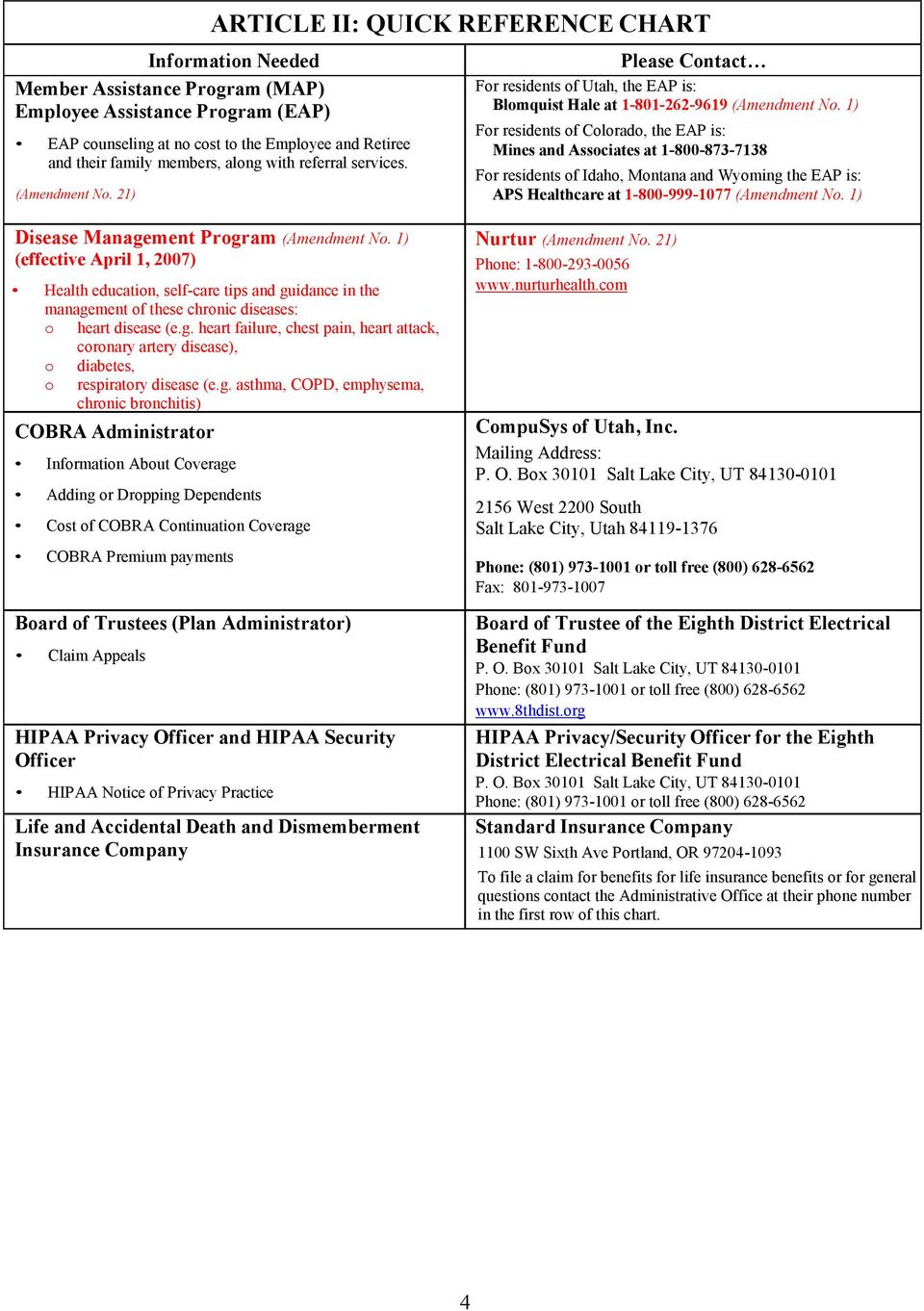
7 Information Needed Member Assistance Program (MAP) Employee Assistance Program (EAP) ARTICLE II: QUICK REFERENCE CHART EAP counseling at no cost to the Employee Retiree their family members, along with referral services. (Amendment No. 21) Please Contact For residents of Utah, the EAP is: Blomquist Hale at (Amendment No. 1) For residents of Colorado, the EAP is: Mines Associates at For residents of Idaho, Montana Wyoming the EAP is: APS Healthcare at (Amendment No. 1) Disease Management Program (Amendment No. 1) (effective April 1, 2007) Health education, self-care tips guidance in the management of these chronic diseases: o heart disease (e.g. heart failure, chest pain, heart attack, coronary artery disease), o diabetes, o respiratory disease (e.g. asthma, COPD, emphysema, chronic bronchitis) COBRA Administrator Information About Coverage Adding or Dropping Dependents Cost of COBRA Continuation Coverage COBRA Premium payments Board of Trustees (Plan Administrator) Claim Appeals HIPAA Privacy Officer HIPAA Security Officer HIPAA Notice of Privacy Practice Life Accidental Death Dismemberment Insurance Company Nurtur (Amendment No. 21) Phone: CompuSys of Utah, Inc. Mailing Address: P. O. Box Salt Lake City, UT West 2200 South Salt Lake City, Utah Phone: (801) or toll free (800) Fax: Board of Trustee of the Eighth District Electrical Benefit Fund P. O. Box Salt Lake City, UT Phone: (801) or toll free (800) HIPAA Privacy/Security Officer for the Eighth District Electrical Benefit Fund P. O. Box Salt Lake City, UT Phone: (801) or toll free (800) Stard Insurance Company 1100 SW Sixth Ave Portl, OR To file a claim for benefits for life insurance benefits or for general questions contact the Administrative Office at their phone number in the first row of this chart. 4
8 ARTICLE III: ELIGIBILITY WHO IS ELIGIBLE, HOW AND WHEN COVERAGE BEGINS AND ENDS Amendment No. 4 effective January 1, 2008 Amendment No. 7 effective July 1, 2008 Amendment No. 8 effective March 1, 2008 Amendment No. 11 effective April 1, 2009 Amendment No. 12 effective June 1, 2009 Amendment No. 14 effective January 1, 2010 Amendment No. 19 effective January 1, 2011 Throughout the entire Summary Plan Description/Plan rules Regulations, including amendments Numbered 7, 8, 9, 12; the term dollar bank is removed changed to hour bank. (Amendment No. 14) Section 1: ELIGIBILITY FOR BARGAINING EMPLOYEES a. General Provisions. Bargaining Employees will become eligible for coverage in accordance with the following rules. Hours worked for a Contributing Employer will not be credited to a Bargaining Employee until the required contributions have been made by the Contributing Employer. No medical examination is required in order to become covered under this Plan. b. Eligibility. Eligibility for benefits provided by the Plan will be established under an hour bank system. (Amendment No. 14) c. Presently Eligible Employees. A Bargaining Employee eligible on January 1, 2007 will continue to remain eligible until that Employee fails to meet the requirements as set forth under Termination of Eligibility in this Article. d. Initial Eligibility. 1. A Bargaining Employee not eligible on January 1, 2007 will become eligible on the first day of the second calendar month next following the date on which sufficient contributions have been received from one (1) or more Contributing Employers to provide at least one (1) month of eligibility. 2. In order that there will be sufficient time for contributing Employer reports contributions to be received processed by the Administrative Office, a lag month will be used in determining a Bargaining Employee s monthly eligibility. The lag month is the month between the report period the month of actual coverage. 3. Each Bargaining Employee must complete an enrollment card submit it to the Administrative Office prior to payment of any claims under the Fund. e. Special Note on Effective Date. The effective date of coverage for the Bargaining Employee will be the date on which the Employee becomes eligible for benefits in accordance with the above rules, subject to the Pre-Existing Condition provision as described in this Article, except that no benefits are payable for services rendered prior to that date. f. Continuation of Eligibility. 1. Contributions received from Contributing Employers for hours worked by a Bargaining Employee will be credited to the Bargaining Employee s hour bank account. The monthly charge-off will be deducted from the Bargaining Employee s hour bank account for each month of coverage. A Bargaining Employee will continue to remain covered as long as their hour bank account contains at least one (1) month s charge-off amount required for coverage. (Amendment No. 14) 2. Whenever a Bargaining Employee is credited with more than one (1) month s charge-off amount (which is required to furnish one (1) month of coverage), the excess contributions will be added to the Bargaining Employee s hour bank accumulation not to exceed a maximum of three (3) months of coverage. (Amendment No. 14) 3. Continuation of Eligibility While Disabled. If a Bargaining Employee is continuously disabled for more than thirty (30) days, no deduction will be made from their hour bank account from the first day of the month in which their disability begins. In other words, the hour bank account will be frozen the entire program of health benefits will remain in effect for the disabled Employee their Dependents. This extended coverage will continue until the earlier of the first day of the month after the month in which the disability ends, or the first day of the fourth (4 th ) month. Protection will be extended for a maximum period of three (3) months under this rule. (Amendment No. 14) 4. It will be the responsibility of such Employee to notify the Administrative Office of a disability that continues for more than thirty (30) days. g. Termination of Eligibility for a Bargaining Employee. A Bargaining Employee s coverage under the hour bank 5

9 will terminate on the last day of the calendar month in which the credits in the account fall below the appropriate monthly charge-off amount. Notwithsting any other provisions of this Plan Document to the contrary, an Employee s coverage eligibility under this section will terminate on the last day of the calendar month in which: 1. such Employee commences work in covered employment in the electrical industry within the jurisdiction of the Eighth District with an employer who does not make contributions to the Plan; or 2. a Contributing Employer is delinquent in making required contributions to the Fund, except the Fund will allow a maximum of three (3) months of hours to be posted retroactively to the Employee s hour bank account when the delinquent Contributing Employer executes a payment agreement that is personally guaranteed; or (Amendment No. 8) 3. the contributions made by a Contributing Employer on behalf of such Employee are less than the Minimum Contribution established by the Board of Trustees; or 4. the Bargaining Employee s hour bank account balance falls below one (1) month s charge-off amount; or 5. the date the Plan is discontinued; or 6. the date the Bargaining Employee exhausts the lifetime maximum allowed under the Plan. A Bargaining Employee whose coverage terminates under this section shall not be entitled to continue coverage under the Self-Payment Provisions for Continuation Coverage unless such termination of coverage constitutes a Qualifying Event. In the event a small man shop remits contributions for any calendar month which are less that the then current level of Minimum Contributions as determined from time to time by the Board of Trustees (refer to Section 3 hereafter), the contributions will not be accepted by the Benefit Fund will not be credited toward eligibility for coverage or an hour bank for the owner working with the tools. In addition, owners working with the tools of the trade shall not have the ability to make a self-payment under the Self-Pay option permitted under the Plan, unless a Qualifying Event under COBRA has occurred. Failure to pay a Minimum Contribution by a small man shop shall not constitute a Qualifying Event under COBRA or the Plan's COBRA provisions. In no event shall Minimum Contributions be accepted by the Benefit Fund or applied to give coverage under this Plan or credited to an hour bank on behalf of any individual who does not receive W-2 wages. If a small man shop fails to pay Minimum Contributions for any calendar month, the owner working with the tools whose coverage under this Plan is terminated shall not be eligible for coverage under the Plan for a period of twelve (12) consecutive months from the termination of coverage. (Amendment No. 7 & 14) h. Reinstatement of Eligibility. An Employee whose eligibility has terminated (under either the hour bank or selfpayment provisions) shall again become eligible when Employee contributions reach the monthly minimum within a six (6) consecutive calendar month period, subsequent to the termination of eligibility. Such reinstatement shall be effective on the first day of the second month that follows the month in which this requirement is. If the Employee is not reinstated within this six (6) calendar month period, any reserves in the Employee s account will be forfeited; the Employee will then become eligible for coverage upon completion of the eligibility requirements for Initial Eligibility. Employees who reinstate eligibility will not be required to satisfy a new Pre-Existing Condition limitation period. (Amendment No. 14) i. Transfer from Bargaining Employee Participation to Non-Bargaining Status. A Bargaining Employee, who has at least one (1) month of minimum contributions in their current hour bank transfers to a non-bargaining status for a Contributing Employer, may elect to freeze their hour bank effective on the first (1 st ) day of the calendar month next following or coinciding with the effective date of such transfer. Such election shall be at the sole discretion of the Bargaining Employee must be made within thirty (30) calendar days immediately following the date of transfer. Such request must be made in writing on a form as prescribed by the Board of Trustees. The hour bank may be frozen for a period not to exceed thirty (30) consecutive calendar months, after which time, the hour bank will be terminated. (Amendment No. 14) j. Reciprocity Agreements. The Board of Trustees have entered into reciprocity agreements with other health funds, whereby eligibility may be continued for a Bargaining Employee working out of the jurisdiction of the local union, provided contributions are made to the Eighth District Electrical Benefit Fund in accordance with the provisions of the reciprocity agreements. k. Elected Public Officials. In the event a Bargaining Employee becomes an elected public official, the Employee shall have the right annually to elect to participate in this Plan or such other County, City, State, or Federal plan for which the Employee may be eligible to become effective on the first of the month following enrollment in such plan. An elected public official may add to their hour bank account their contributions for hours worked in covered employment for the period June through December, up to the maximum hour bank. In the event the elected public official elects coverage under another plan for themselves their Dependents, the Employee s hour bank account will be frozen accumulated credits will be reinstated effective immediately upon such Bargaining Employee s election to be covered under this Plan. (Amendment No. 14) 6

10 l. Waiver of Initial Eligibility Requirements with Respect to Employees of a Newly Organized Contributing Employer. The Board of Trustees may waive its Plans initial eligibility requirements to Employees of a newly organized Contributing Employer who is currently providing their Employees group medical coverage. The effect of this waiver shall be as follows: 1. The Fund will provide eligibility for the first month of coverage at one hundred forty-three (143) hours for each Active Employee. 2. The newly organized Contributing Employer will make an initial contribution of one hundred seventy-three (173) hours at the Fund s current contribution rate, on all Bargaining Employees. This initial contribution will provide the second month of coverage. Excess contributions will be allocated to the Employee s hour bank. (Amendment No. 14) 3. After the initial month, for all subsequent months, the newly organized Contributing Employer will make contributions based on the current contribution amount established by the Board of Trustees. 4. In addition, the newly organized Contributing Employer shall make contributions on behalf of all such Bargaining Employees based on the actual hours worked during the first month of participation. Such hours shall be used for the purpose of the third month s eligibility so forth. Excess contributions will be credited to the Bargaining Employee s hour bank. (Amendment No. 14) 5. In the event the Bargaining Employee fails to receive the minimum monthly contribution in any subsequent month of their employment with a newly organized Contributing Employer, there are not sufficient contributions to cover the current month s coverage, their eligibility will be terminated the Employee shall be eligible to continue coverage in accordance with the Self-Payment Provisions for COBRA Continuation of Coverage. 6. This provision shall apply only to those Bargaining Employees who were employed by the newly organized Contributing Employer on the employer s effective date of participation for whom the employer had previously provided group medical coverage. Employees employed after the employer s initial effective date of participation shall be subject to the initial eligibility requirements described herein. 7. Bargaining Employees of a Contributing Employer will have their eligibility terminated at the end of the month following the date such Contributing Employer elects to withdraw from participation in the Fund /or ceases to maintain with the local union a written agreement requiring contributions. Bargaining Employees who continue to work for the noncontributing employer are not eligible to continue coverage in accordance with the Self-Payment Provisions for COBRA Continuation Coverage. m. Hour Bank Freeze for Continuation of Eligibility While Disabled: Effective July 1, 2006, if a Bargaining Employee is continuously disabled for more than thirty (30) days, no deduction will be made from his/her hour bank account from the first day of the month in which the disability begins. In other words, the hour bank account will be frozen the entire program of health benefits will remain in effect for the disabled Employee their Dependents. (Amendment No. 14) This extended coverage will continue until the earlier of the first day of the month after the month in which the disability ends, or the first day of the fourth (4 th ) month. Protection will be extended for a maximum period of three (3) months under this rule. It will be the responsibility of such Employee to notify the Administrative Office of a disability that continues for more than thirty (30) days. Section 2: ELIGIBILITY FOR NON-BARGAINING EMPLOYEE PARTICIPATION. a. Contributing Employer Participation. A Contributing Employer must make application to the Board of Trustees for non-bargaining participation. An application must be completed for each company requesting participation. The Board of Trustees reserves the right to accept or reject any non-bargaining application. 1. When a Contributing Employer s participation has been approved by the Board of Trustees, or their designee, the Contributing Employer will be notified in writing by the Administrative Office. 2. A Contributing Employer must contribute on all full-time* non-bargaining personnel who do not sign a waiver of benefit coverage card. To waive benefits, the Waiver of Benefits card must be completed with the name of the other coverage that must be group health insurance coverage (such as coverage through the Spouse/s employer), along with proof of this other coverage. The Waiver of Benefits card is available from should be returned to the Administrative office. * Must work at least thirty (30) hours per week for the participating Contributing Employer. b. Employee Application for Participation. Each non-bargaining Employee must complete an application form (available at the Administrative Office), which will be submitted by the Contributing Employer to the Board of Trustees, or their designee, for consideration. The non-bargaining Employee application form must include the following information for each non-bargaining Employee: 1. name of non-bargaining Employee each Dependent; 7

11 2. marital status of non-bargaining Employee; 3. date of birth of the non-bargaining Employee each Dependent; 4. sex of the non-bargaining Employee the relationship of each Dependent; 5. date of employment; 6. medical history form as provided by the Administrative Office; 7. HIPAA Certificate of Creditable Coverage. A waiver of benefit coverage card signed by the non-bargaining Employee must be submitted for each non-bargaining Employee not included in the Contributing Employer application. Those electing to sign a waiver card will be required to provide evidence to the Administrative Office of alternate group health insurance coverage. Any non-bargaining Employee who executes a waiver of coverage card must state in writing the reason coverage is being waived, to confirm entitlement to special enrollment, described hereafter, at a later date. c. Class of Non-Bargaining Employees Eligible. Non-bargaining Employees eligible to participate are as follows: 1. Employees of the proprietorship (including the proprietor); 2. Employees of a partnership (including the partners); 3. Employees of corporations; 4. Employees of the association; 5. clerical Employees of the Local Unions, Affiliated Electrical Joint Apprenticeship Training Programs, Affiliated Credit Unions Administrative Office Employees. d. Benefits. Non-bargaining Employees will be entitled to all benefits provided by the Fund (i.e. Dependent Life, Medical Plan, Weekly Disability) Life, Accidental Death Dismemberment, Organ/Bone Marrow Transplant Benefits underwritten by an insurance carrier. e. Contributing Employer Non-Bargaining Participation Effective Date. The effective date of the Contributing Employer non-bargaining participation shall be the first of the month following the date the application has been approved by the Board of Trustees. f. Non-Bargaining Employee Effective Date of Coverage. All full-time non-bargaining Employees their Dependents, excluding those non-bargaining Employees who have executed a waiver of coverage card, will become eligible for coverage, subject to the Pre-Existing Condition provision of this Plan, on the initial effective date of Contributing Employer non-bargaining participation, subject to the Board of Trustees approval. Non-bargaining Employees hired on or after the initial effective date of Contributing Employer non-bargaining participation must complete an application for participation or execute a waiver of coverage card within thirty (30) days from their original date of employment. The date of coverage, subject to the Board of Trustees approval, shall be the first day of the second month next following thirty (30) days of full-time employment with the Contributing Employer. Any non-bargaining Employee must complete an enrollment card submit it to the Administrative Office prior to payment of any claims under the Fund. g. Special Enrollment. Special enrollment is allowed for non-bargaining Employees or Dependents who originally declined coverage if they: 1. had other coverage, which they later lost because of separation/divorce, termination of employment or reduction in hours, death or the cessation of employer contributions for their coverage (unless it was for cause or failure to pay Employee contributions on time), reached the lifetime maximum under the other coverage; or 2. on account of Medicaid or a State Children s Health Insurance Program (CHIP); or (Amendment No. 11) 3. were on COBRA, but their COBRA eligibility has expired. If a non-bargaining Employee who did not initially enroll later marries or has or adopts a Child, the non-bargaining Employee is entitled to special enrollment along with the Dependent. A person eligible for special enrollment has thirty (30) days (or as applicable 60 days) from the date of the event within which to enroll, shall become an eligible Participant on the first day of the month following receipt of the properly completed enrollment form. Failure to enroll means that claims cannot be considered for coverage until a completed enrollment form has been submitted. If the individual requests Special Enrollment within 60 days of the date of the Special Enrollment opportunity related to Medicaid or a State Children s Health Insurance program (CHIP), generally coverage will become effective on the first day of the month following the date of the event that allowed this Special Enrollment opportunity. Effective April 1, 2009, you your dependents may also enroll in this Plan if you (or your eligible dependents): 8

12 a. have coverage through Medicaid or a State Children's Health Insurance Program (CHIP) you (or your dependents) lose eligibility for that coverage. However, you must request enrollment in this Plan within 60 days after the Medicaid or CHIP coverage ends; or b. become eligible for a premium assistance program through Medicaid or CHIP. However, yo u must request enrollment in this Plan within 60 days after you (or your dependents) are determined to be eligible for such premium assistance. To obtain more information about Special Enrollment contact the Administrative Office. (Amendment No. 11) h. Monthly Premium Payment. The amount of the monthly premium to be remitted by the Contributing Employer on each participating non-bargaining Employee will be determined by the Board of Trustees. The Contributing Employer will be required to pre-pay two (2) months premium each month thereafter the Contributing Employer must prepay the monthly premium on or before the fifteenth (15th) day of the month. In this regard, a lag month will be used in determining monthly eligibility. For example: September contributions will provide coverage for the month of November. The premiums must be remitted to the depository bank or the Administrative Office. i. Termination of Coverage for a Non-Bargaining Employee. If a non-bargaining Employee s employment terminates, coverage will terminate on the last day of the second month following the month in which such termination occurs. Coverage for a non-bargaining Employee will terminate on the earliest of the following events: 1. the date the Plan is discontinued; 2. termination of participation of the non-bargaining group, by the Board of Trustees at their discretion, for any reason; 3. the last day of the second month following the month of the non-bargaining Employee s death (e.g. a person who dies in January means the person has coverage through March); 4. the date the non-bargaining Employee exhausts the lifetime maximum provided under the Plan; 5. in the event a Contributing Employer is delinquent in remitting contributions or submitting monthly reports for bargaining /or non-bargaining Employees, coverage will terminate for non-bargaining Employees on the first (1st) day of the month for which the Contributing Employer is delinquent; 6. the end of the calendar month in which (a) the Contributing Employer is no longer a Contributing Employer subject to a written agreement calling for contributions to be made into the Fund on behalf of Bargaining Employees, or (b) the Contributing Employer s contributions made on behalf of Bargaining Employees are less than the Minimum Contribution established by the Board of Trustees. Non-bargaining Employees whose coverage terminates, as noted above, shall not be entitled to continue their coverage under the Self-Payment Provisions for Continuation Coverage unless such termination of coverage constitutes a Qualifying Event the self-payment is for COBRA continuation coverage. Non-bargaining Employees may be eligible to participate under the Eighth District Electrical Benefit Fund as a Retiree provided they qualify as a Retiree under this Plan. j. Reinstatement Provision. Once a non-bargaining group, /or non-bargaining Employee thereof, terminates their coverage, they must reapply, subject to the Board of Trustees approval, before their coverage shall again become effective. Section 3: MINIMUM CONTRIBUTION LEVELS a. Minimum Contribution means the contribution determined, established fixed by the Board of Trustees, from time to time, as the Board of Trustees, in their absolute discretion, deem appropriate necessary to maintain a uniform Plan of benefits for Eligible Employees. b. As established by the Board of Trustees, the Minimum Contribution required by an owner working with tools (also known as a small man shop) is 143 hours. If more hours are worked those actual hours worked must be reported. c. As established by the Board of Trustees, any contributions received under a Reciprocal Agreement that exceed the Minimum Contribution levels will be deposited in a Personal Care Account for the Active Employee as set forth in ARTICLE V. (Amendment No. 4) Section 4: ELIGIBILITY FOR DEPENDENTS OF BARGAINING AND NON-BARGAINING EMPLOYEES a. Eligibility of Dependents of Active Employees: 1. Dependent Eligibility: Employees must enroll their eligible Dependent (including a Spouse, Child, Domestic Partner, or Child of a Domestic Partner) in order for that Dependent to be eligible for benefits under the Plan. There are three opportunities to enroll Dependents for coverage under this Plan: Initial Enrollment (becoming enrolled at the same time the Employee is first eligible), New Dependent Enrollment, Rolling 9

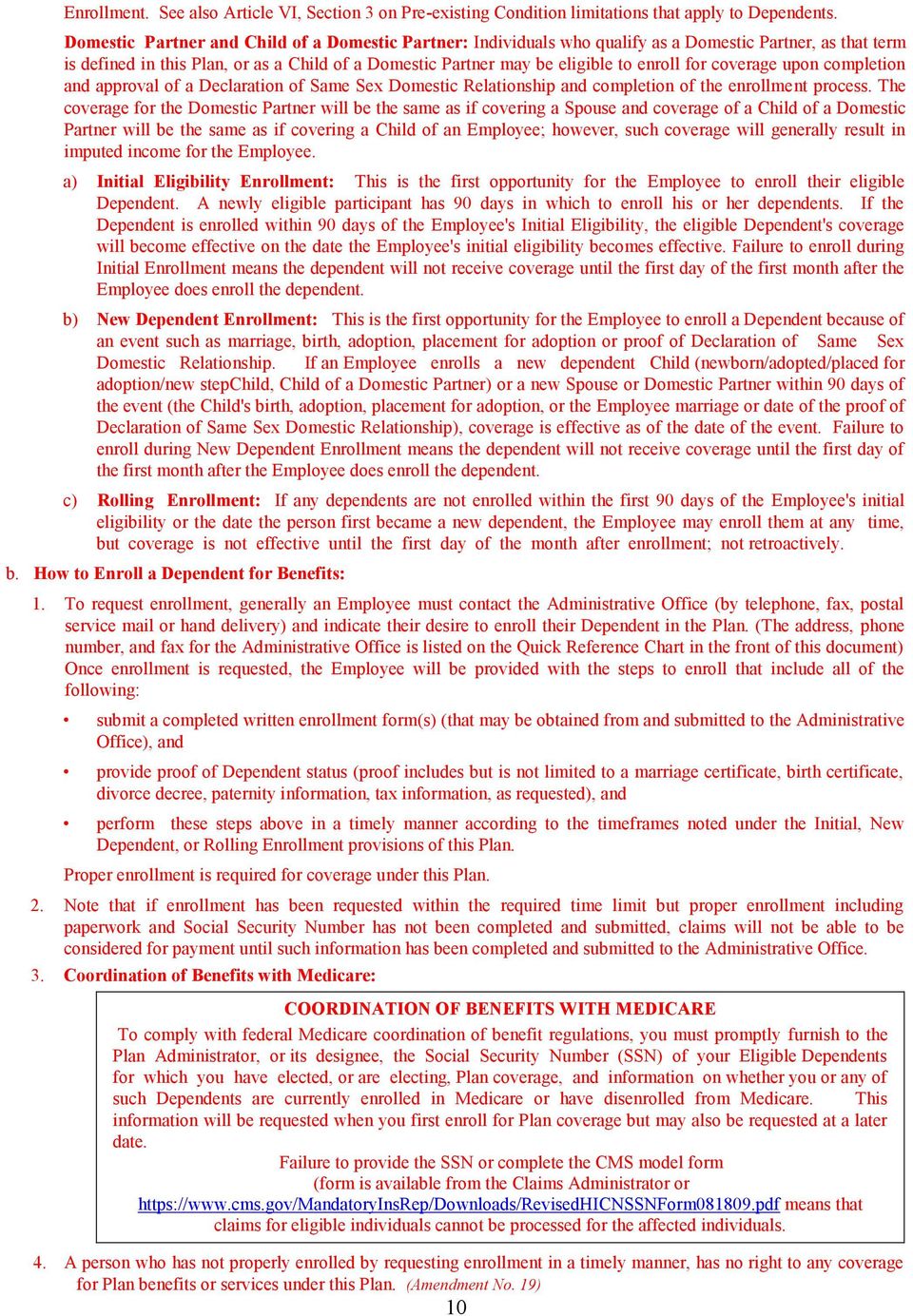
13 Enrollment. See also Article VI, Section 3 on Pre-existing Condition limitations that apply to Dependents. Domestic Partner Child of a Domestic Partner: Individuals who qualify as a Domestic Partner, as that term is defined in this Plan, or as a Child of a Domestic Partner may be eligible to enroll for coverage upon completion approval of a Declaration of Same Sex Domestic Relationship completion of the enrollment process. The coverage for the Domestic Partner will be the same as if covering a Spouse coverage of a Child of a Domestic Partner will be the same as if covering a Child of an Employee; however, such coverage will generally result in imputed income for the Employee. a) Initial Eligibility Enrollment: This is the first opportunity for the Employee to enroll their eligible Dependent. A newly eligible participant has 90 days in which to enroll his or her dependents. If the Dependent is enrolled within 90 days of the Employee's Initial Eligibility, the eligible Dependent's coverage will become effective on the date the Employee's initial eligibility becomes effective. Failure to enroll during Initial Enrollment means the dependent will not receive coverage until the first day of the first month after the Employee does enroll the dependent. b) New Dependent Enrollment: This is the first opportunity for the Employee to enroll a Dependent because of an event such as marriage, birth, adoption, placement for adoption or proof of Declaration of Same Sex Domestic Relationship. If an Employee enrolls a new dependent Child (newborn/adopted/placed for adoption/new stepchild, Child of a Domestic Partner) or a new Spouse or Domestic Partner within 90 days of the event (the Child's birth, adoption, placement for adoption, or the Employee marriage or date of the proof of Declaration of Same Sex Domestic Relationship), coverage is effective as of the date of the event. Failure to enroll during New Dependent Enrollment means the dependent will not receive coverage until the first day of the first month after the Employee does enroll the dependent. c) Rolling Enrollment: If any dependents are not enrolled within the first 90 days of the Employee's initial eligibility or the date the person first became a new dependent, the Employee may enroll them at any time, but coverage is not effective until the first day of the month after enrollment; not retroactively. b. How to Enroll a Dependent for Benefits: 1. To request enrollment, generally an Employee must contact the Administrative Office (by telephone, fax, postal service mail or h delivery) indicate their desire to enroll their Dependent in the Plan. (The address, phone number, fax for the Administrative Office is listed on the Quick Reference Chart in the front of this document) Once enrollment is requested, the Employee will be provided with the steps to enroll that include all of the following: submit a completed written enrollment form(s) (that may be obtained from submitted to the Administrative Office), provide proof of Dependent status (proof includes but is not limited to a marriage certificate, birth certificate, divorce decree, paternity information, tax information, as requested), perform these steps above in a timely manner according to the timeframes noted under the Initial, New Dependent, or Rolling Enrollment provisions of this Plan. Proper enrollment is required for coverage under this Plan. 2. Note that if enrollment has been requested within the required time limit but proper enrollment including paperwork Social Security Number has not been completed submitted, claims will not be able to be considered for payment until such information has been completed submitted to the Administrative Office. 3. Coordination of Benefits with Medicare: COORDINATION OF BENEFITS WITH MEDICARE To comply with federal Medicare coordination of benefit regulations, you must promptly furnish to the Plan Administrator, or its designee, the Social Security Number (SSN) of your Eligible Dependents for which you have elected, or are electing, Plan coverage, information on whether you or any of such Dependents are currently enrolled in Medicare or have disenrolled from Medicare. This information will be requested when you first enroll for Plan coverage but may also be requested at a later date. Failure to provide the SSN or complete the CMS model form (form is available from the Claims Administrator or means that claims for eligible individuals cannot be processed for the affected individuals. 4. A person who has not properly enrolled by requesting enrollment in a timely manner, has no right to any coverage for Plan benefits or services under this Plan. (Amendment No. 19) 10
14 c. Termination of Eligibility of a Dependent of a Bargaining or Non-Bargaining Employee. The eligibility with respect to a Dependent (Spouse or Dependent Child) of a Bargaining or Non-Bargaining Employee shall automatically terminate upon the occurrence of the first of the following events: (Amendment No. 12) 1. when the Dependent ceases to be eligible as a Dependent as set forth under the definition of Dependent; 2. when the Dependent enters full-time military service; 3. expiration of the period of coverage stated in the QMCSO; 4. the date the Plan is discontinued; 5. when the Eligible Employee s eligibility terminates. (Amendment No. 19) d. Termination of Eligibility of a Domestic Partner. The eligibility with respect to a Domestic Partner, shall automatically terminate upon the occurrence of the first of the following events: 1. when the Domestic Partner ceases to be eligible as a Domestic Partner as set forth under the definition of Domestic Partner (such as the Domestic Partnership is terminated); 2. when the Domestic Partner enters foil-time military service; 3. the date the Plan is discontinued; 4. when the Eligible Employee's eligibility terminates. e. Termination of Eligibility of a Domestic Partner's Dependent Child. The eligibility with respect to a Dependent of Domestic Partner, shall automatically terminate upon the occurrence of the first of the following events: 1. when the Dependent Child ceases to be eligible as a Dependent of a Domestic Partner as set forth under the definition of Domestic Partner's Dependent Child; 2. expiration of the period of coverage for the Dependent of a Domestic Partner as stated in the QMCSO; 3. the date the Plan is discontinued; 4. the date the Domestic Partnership is terminated; 5. when the Eligible Employee's eligibility terminates. (Amendment No. 12 & 19) f. Coverage for Dependents of a Deceased Active Employee. If termination of an Active Employee s coverage is due to the Employee s death, coverage for Dependents of a deceased Employee (the surviving Spouse or Domestic Partner Dependent Children) shall remain in effect until the earlier of: (Amendment No. 12) 1. the deceased Bargaining Employee s hour bank account has been exhausted. Coverage under the hour bank terminates the last day of the month in which there is less than one (1) month s charge-off amount remaining in the deceased Bargaining Employee s hour bank account; 2. the last day of the second month following the death of the non-bargaining Employee; 3. the date the Dependent meets any of the provisions for Termination of a Dependent of a Bargaining or Non- Bargaining Employee as noted in the sub-section above. Such Dependents may continue coverage as described under the Self-Payment Provisions for Surviving Spouse or Domestic Partner Dependent Children Continuation Coverage. (Amendment No. 12 & 14) Section 5: ELIGIBILITY FOR RETIREES: Early (non-medicare Eligible) Retirees Medicare-Eligible Retirees). a. Application to Participate. The application to participate must be filed with the Administrative Office by the first day of the month coinciding with the effective date of the applicant s Pension from the Eighth District Electrical Pension Fund or by the fifteenth (15th) day of the month following the month in which the applicant lost eligibility under the eligibility rules of the Medical Plan for Active Employees, whichever occurs later. Coverage under the Plan as a Retiree (Early Retiree or Medicare-eligible Retiree) must be continuous immediately following the loss of eligibility as an Active Employee. b. Payment of Premium. Premium rates are established by the Board of Trustees. Premium rates are based on years of participation in the Eighth District Electrical Pension Fund. The first payment must accompany the application. Each subsequent payment must be received by the Administrative Office by the first (1st) day of the month for which the coverage is intended. c. Those Eligible for Participation as a Retiree prior to April 1, Individuals who meet the following requirements are eligible to participate under the Eighth District Electrical Benefit Fund Plan as a Retiree: 1. an Employee who is receiving or is entitled to receive any pension benefit under the Eighth District Electrical Pension Fund; 2. a former non-bargaining Employee who has worked for had contributions paid into the Fund by a contributing employer for thirty-six (36) consecutive months immediately prior to retirement is eligible for Medicare at the date of retirement; 11

15 3. a surviving Spouse or Dependent Child of a deceased Retired Employee; or 4. a disabled Employee who is entitled to Medicare. d. Those Eligible for Participation as a Retiree on or after April 1, Individuals who retire on or after April 1, 2003 must meet the following requirements in order to be eligible to participate under the Eighth District Electrical Benefit Fund Plan as a Retiree (either Non-Medicare Eligible or Medicare-Eligible): 1. If the Employee retires between the ages of fifty-five (55) sixty (60), the Employee must have participated in the Medical Plan as an Active Employee for: a. five (5) of the last seven (7) years immediately prior to retirement; b. a minimum of twenty (20) years. 2. If the Employee retires at age sixty (60) or older, the Employee must have participated in the Medical Plan as an Active Employee for: a. five (5) of the last seven (7) years immediately prior to retirement; b. a minimum of ten (10) years. e. Working for a Non-Contributing Employer. If a Retired Employee starts to work in covered employment for an employer not subject to a written agreement requiring a contribution to the Medical Plan for Active Employees, his/her eligibility under the Plan benefits will terminate on the earliest of the following dates: 1. the last day of the month in which the Retired Employee has exhausted the eighteen (18) month minimum; or 2. the last day of the month following commencement of such employment. Such former Retired Employee shall not be permitted to participate in the Plan after the date such eligibility terminated. Such former Retired Employee, who loses eligibility under this provision shall again become eligible for coverage only upon completion of the Reinstatement of Eligibility or Initial Eligibility rules of the Medical Plan for Active Employees. f. Classifications. Premium rates have been established by the Board of Trustees in the following classifications: 1. Early (non-medicare eligible) Retirees Dependents 2. Medicare-eligible Retirees Spouse 3. Surviving (Medicare-eligible) Spouse of a deceased Retired Employee or Medicare-eligible Retiree with no dependents 4. Retired Employee Spouse, one of which is covered by Medicare. g. Effective Date of Coverage. A Retired Employee will become eligible under the Plan as a Retiree on the first day of the month during which application for a pension or disability application has been approved from the Eighth District Electrical Pension Fund or the date eligibility under the Medical Plan for Active Employees for the Eighth District Electrical Benefit Fund terminates after approval of the pension application, whichever is later, provided application to participate the required self-payment premium has been made. Coverage under the Plan as a Retiree must be continuous upon loss of eligibility under the Medical Plan for Active Employees. h. Type of Coverage. The benefits otherwise covered payable under this Plan shall be reduced by the charges for services supplies for which the Participant is eligible to be reimbursed by the Medicare Program Parts A B. If ineligibility for reimbursement is a result of a Participant s failure to enroll in or apply for benefits under Medicare Parts A B, then his/her benefits hereunder shall be reduced by amounts equal to the Medicare benefits which would have otherwise been available. This provision shall be applied in any benefit determination prior to the application of the Coordination of Benefits provision. Retirees are eligible to enroll in the following Benefit Options: Type of Benefits (* denotes an insured benefit) Option A: Medical Plan including Prescription Drugs Organ/Bone Marrow Transplant* benefits BUT NOT the Dental Plan, Life Insurance*, AD&D*, Dependent Life Insurance*. Option B: Medical Plan including Prescription Drugs Organ/Bone Marrow Transplant* benefits PLUS Life Insurance*, AD&D*, Dependent Life Insurance* BUT NOT the Dental Plan. 12 Early Retiree (not Medicare-eligible) Yes Yes Medicare-eligible Retiree Yes No

16 Personal Care Account: Is only available if an individual had this benefit as an active participant. Amounts remaining in the PCA are available for use by a self-pay participant however, no additional contributions will be allowed to be deposited into the PCA. See comments to the left. See comments to the left. Newly eligible Early (non-medicare eligible) Retirees will have a one time option for life accidental death dismemberment benefits. This one time option is only available at retirement. Note however, that the life accidental death dismemberment benefit is not available to Medicare Retirees. Once a selection is made, it cannot be changed at a later date, except when a non-medicare Retired Employee becomes eligible for Medicare he/she will automatically be transferred to the applicable Plans on the first day of the month following the date he/she becomes eligible for Medicare. i. Termination of Retiree Eligibility. An Early Retiree s or Medicare-eligible Retiree s eligibility shall terminate for the following reasons, whichever should occur first: 1. failure to make the required self-payment within the specified time; 2. the date the Retired Employee is no longer receiving a pension benefit; 3. the date the Plan is discontinued; 4. the last day of the month in which the minimum of eighteen (18) months is exhausted or the last day of the month following the date the Retired Employee starts to work in covered employment for an employer not subject to a written agreement requiring a contribution to the Medical Plan; 5. the date the Retiree dies (See also the Self-Pay provisions of this Plan for continuation of coverage for a surviving Spouse surviving Dependent Children). j. A Retiree who returns to work for a Contributing Employer may be eligible for a waiver of the monthly self-payment requirements if sufficient hours are reported. k. Self-Payment Grace Period. Each self-payment is due by the first of the month for which coverage is intended, shall be considered timely if received within thirty (30) days of the date due. If self-payments are not received in a timely manner coverage will terminate. Section 6: ELIGIBILITY FOR DEPENDENTS OF A RETIREE a. Eligibility of dependents of a Retired Employee (Retiree): 1. Dependent Eligibility: Retirees must enroll their eligible Dependent (including a Spouse, Child, Domestic Partner, or Child of a Domestic Partner) in order for that Dependent to be eligible for benefits under the Plan. There are three opportunities to enroll Dependents for coverage under this Plan: Initial Enrollment (becoming enrolled at the same time the Retiree is first eligible), New Dependent Enrollment, Rolling Enrollment. Retirees must enroll their Dependents when they start eligibility as a Retiree. See also Article VI, Section 3 on Pre-existing Condition limitations that apply to Dependents. Domestic Partner Child of a Domestic Partner: Individuals who qualify as a Domestic Partner, as that term is defined in this Plan, or as a Child of a Domestic Partner may be eligible to enroll for coverage upon completion approval of a Declaration of Same Sex Domestic Relationship completion of the enrollment process. The coverage for the Domestic Partner will be the same as if covering a Spouse coverage of a Child of a Domestic Partner will be the same as if covering a Child of a Retiree; however, such coverage will generally result in imputed income for the Retiree. 2. Initial Eligibility Enrollment: This is the first opportunity for the Retiree to enroll their eligible Dependent. A newly eligible participant has 90 days in which to enroll his or her d ependents. If the Dependent is enrolled within 90 days of the Retiree's Initial Eligibility, the eligible Dependent's coverage will become effective on the date the Retiree's initial eligibility becomes effective, Failure to enroll during Initial Enrollment means the dependent will not receive coverage until the first day of the first month after the Retiree does enroll the dependent. 3. New Dependent Enrollment: This is the first opportunity for the Retiree to enroll a Dependent because of an event such as marriage, birth, adoption, placement for adoption or proof of Declaration of Same Sex Domestic Relationship. If a Retiree enrolls a new dependent Child (newborn/adopted/placed for adoption/new stepchild, Child of a Domestic Partner) or a new Spouse or Domestic Partner within 90 days of the event (the Child s birth, adoption, placement for adoption, or the Retiree's marriage or date of the proof of Declaration of Same Sex Domestic Relationship), coverage is effective as of the date of the event. Failure to enroll during New Dependent Enrollment means the dependent will not receive coverage until the first day of the first month after the Retiree does enroll the dependent. 4. Rolling Enrollment: If any dependents are not enrolled within the first 90 days of the Retiree s initial 13

17 eligibility or the date the person first became a new dependent, the Retiree may enroll them at any time, but coverage is not effective until the first day of the month after enrollment, not retroactively. b. How to Enroll a Dependent for Benefits: 1. To request enrollment, generally a Retiree must contact the Administrative Office (by telephone, fax, postal service mail or h delivery) indicate their desire to enroll their Dependent in the Plan. (The address, phone number, fax for the Administrative Office is listed on the Quick Reference Chart in the front of this document.) Once enrollment is requested, the Retiree will be provided with the steps to enroll that include.all of the following: submit a completed written enrollment form(s) (that may be obtained from submitted to the Administrative Office), provide proof of Dependent status (proof includes but is not limited to a marriage certificate, birth certificate, divorce decree, paternity information, tax information, as requested), perform these steps above in a timely manner according to the timeframes noted under the Initial, New Dependent, or Rolling Enrollment provisions of this Plan. Proper enrollment is required for coverage under this Plan. 2. Note that if enrollment has been requested within the required time limit but proper enrollment including paperwork Social Security Number has not been completed submitted, claims will not be able to be considered for payment until such information has been completed submitted to the Administrative Office. 3. Coordination of Benefits with Medicare: COORDINATION OF BENEFITS WITH MEDICARE To comply with federal Medicare coordination of benefit regulations, you must promptly furnish to the Plan Administrator, or its designee, the Social Security Number (SSN) of your Eligible Dependents for which you have elected, or are electing, Plan coverage, information on whether you or any of such Dependents are currently enrolled in Medicare or have disenrolled from Medicare. This information will be requested when you first enroll for Plan coverage but may also be requested at a later date. Failure to provide the SSN or complete the CMS model form (form is available from the Claims Administrator or means that claims for eligible individuals cannot be processed for the affected individuals. 4. A person who has not properly enrolled by requesting enrollment in a timely manner, has no right to any coverage for Plan benefits or services under this Plan. (Amendment No. 19) c. Termination of Eligibility for a Dependent of a Retiree. The eligibility with respect to a Dependent of a Retiree shall automatically terminate upon the occurrence of the first of the following events: 1. when the Dependent ceases to be eligible as a Dependent as set forth under definition of Dependent; 2. when the Retiree s eligibility terminates; 3. the date the Retiree dies (See also the Self-Pay provisions of this Plan for continuation of coverage for a surviving Spouse surviving Dependent Children); 4. failure to make the required self-payment within the specified time; 5. upon the Dependent Spouse s entrance into full-time active duty with the armed forces of the United States; (Amendment No. 19) 6. the date the Plan is terminated. d. Coverage for Surviving Spouse Dependent Children of a Deceased Retired Employee. If termination of a Retired Employee s coverage is due to the Retired Employee s death, coverage for the Dependents of that deceased Retiree (the surviving Spouse Dependent Children) will remain in effect until the Surviving Spouse Surviving Dependent Children meet the termination provisions outlined below. 1. Termination of Eligibility for the Surviving Spouse Dependent Children. The coverage for a Surviving Spouse Dependent Children of a Deceased Retiree coverage will terminate the first of the following events: 2. The surviving Spouse s coverage will terminate on the earlier of any of the following reasons: (a) the surviving Spouse remarries; (b) failure to make the required self-payment within the specified time; (c) the surviving Spouse becomes covered under any other group policy; 14

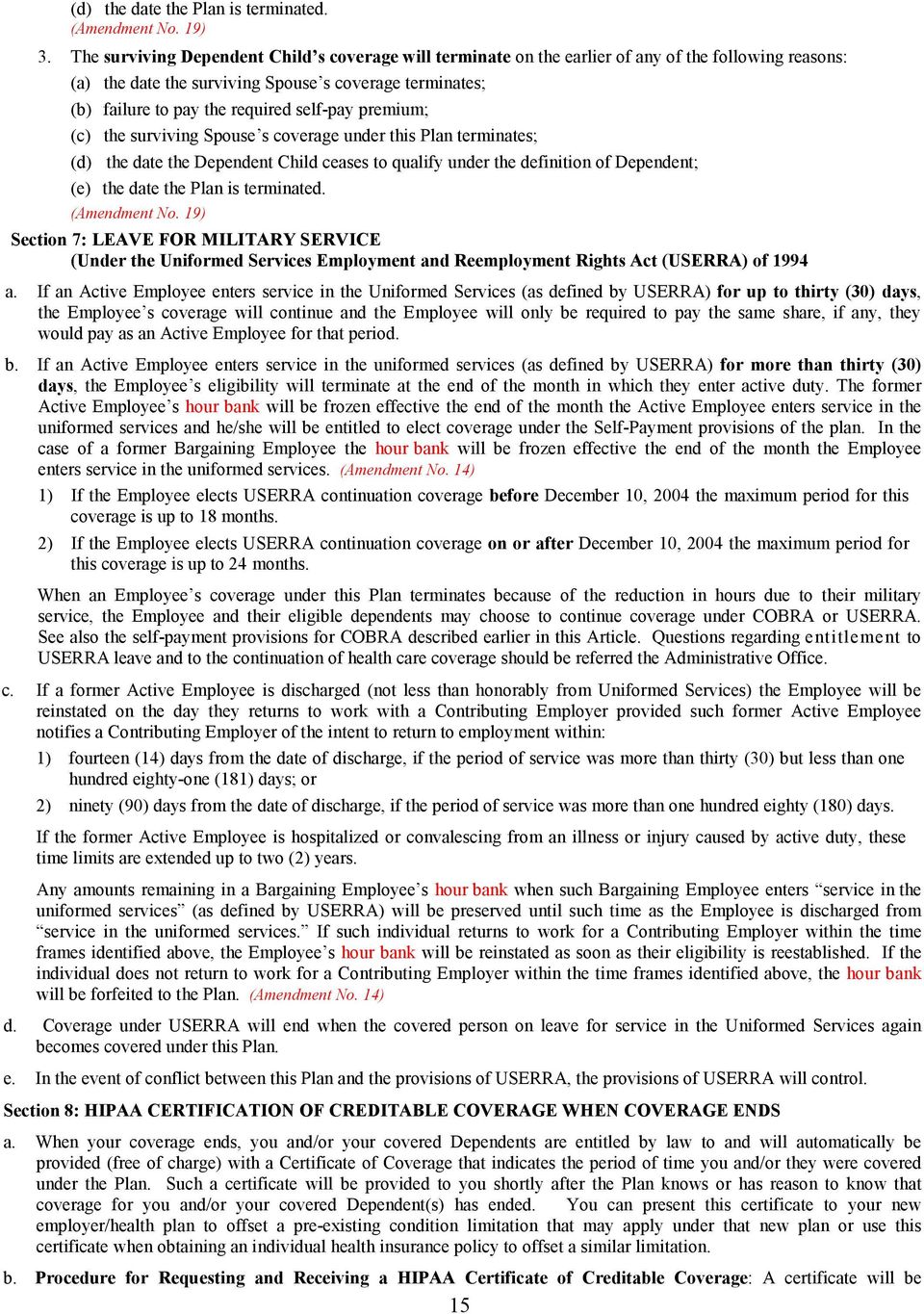
18 (d) the date the Plan is terminated. (Amendment No. 19) 3. The surviving Dependent Child s coverage will terminate on the earlier of any of the following reasons: (a) the date the surviving Spouse s coverage terminates; (b) failure to pay the required self-pay premium; (c) the surviving Spouse s coverage under this Plan terminates; (d) the date the Dependent Child ceases to qualify under the definition of Dependent; (e) the date the Plan is terminated. (Amendment No. 19) Section 7: LEAVE FOR MILITARY SERVICE (Under the Uniformed Services Employment Reemployment Rights Act (USERRA) of 1994 a. If an Active Employee enters service in the Uniformed Services (as defined by USERRA) for up to thirty (30) days, the Employee s coverage will continue the Employee will only be required to pay the same share, if any, they would pay as an Active Employee for that period. b. If an Active Employee enters service in the uniformed services (as defined by USERRA) for more than thirty (30) days, the Employee s eligibility will terminate at the end of the month in which they enter active duty. The former Active Employee s hour bank will be frozen effective the end of the month the Active Employee enters service in the uniformed services he/she will be entitled to elect coverage under the Self-Payment provisions of the plan. In the case of a former Bargaining Employee the hour bank will be frozen effective the end of the month the Employee enters service in the uniformed services. (Amendment No. 14) 1) If the Employee elects USERRA continuation coverage before December 10, 2004 the maximum period for this coverage is up to 18 months. 2) If the Employee elects USERRA continuation coverage on or after December 10, 2004 the maximum period for this coverage is up to 24 months. When an Employee s coverage under this Plan terminates because of the reduction in hours due to their military service, the Employee their eligible dependents may choose to continue coverage under COBRA or USERRA. See also the self-payment provisions for COBRA described earlier in this Article. Questions regarding entitlement to USERRA leave to the continuation of health care coverage should be referred the Administrative Office. c. If a former Active Employee is discharged (not less than honorably from Uniformed Services) the Employee will be reinstated on the day they returns to work with a Contributing Employer provided such former Active Employee notifies a Contributing Employer of the intent to return to employment within: 1) fourteen (14) days from the date of discharge, if the period of service was more than thirty (30) but less than one hundred eighty-one (181) days; or 2) ninety (90) days from the date of discharge, if the period of service was more than one hundred eighty (180) days. If the former Active Employee is hospitalized or convalescing from an illness or injury caused by active duty, these time limits are extended up to two (2) years. Any amounts remaining in a Bargaining Employee s hour bank when such Bargaining Employee enters service in the uniformed services (as defined by USERRA) will be preserved until such time as the Employee is discharged from service in the uniformed services. If such individual returns to work for a Contributing Employer within the time frames identified above, the Employee s hour bank will be reinstated as soon as their eligibility is reestablished. If the individual does not return to work for a Contributing Employer within the time frames identified above, the hour bank will be forfeited to the Plan. (Amendment No. 14) d. Coverage under USERRA will end when the covered person on leave for service in the Uniformed Services again becomes covered under this Plan. e. In the event of conflict between this Plan the provisions of USERRA, the provisions of USERRA will control. Section 8: HIPAA CERTIFICATION OF CREDITABLE COVERAGE WHEN COVERAGE ENDS a. When your coverage ends, you /or your covered Dependents are entitled by law to will automatically be provided (free of charge) with a Certificate of Coverage that indicates the period of time you /or they were covered under the Plan. Such a certificate will be provided to you shortly after the Plan knows or has reason to know that coverage for you /or your covered Dependent(s) has ended. You can present this certificate to your new employer/health plan to offset a pre-existing condition limitation that may apply under that new plan or use this certificate when obtaining an individual health insurance policy to offset a similar limitation. b. Procedure for Requesting Receiving a HIPAA Certificate of Creditable Coverage: A certificate will be 15
19 provided upon receipt of a written request for such a certificate that is received by the Administrative Office within two years after the date coverage ended under this Plan. The written request must be mailed or faxed to the Administrative Office should include the names of the individuals for whom a certificate is requested (including Spouse Dependent Children) the address where the certificate should be mailed. The address fax of the Administrative Office is on the Quick Reference Chart in the front of this document. A copy of the certificate will be mailed by the Plan to the address indicated. See the COBRA section of this Article for an explanation of when how certificates of coverage will be provided after COBRA coverage ends. Section 9: SPECIAL ENROLLMENT a. This Plan complies with the Federal law regarding Special Enrollment by virtue of the fact that all eligible Employees, their eligible Dependents are automatically enrolled in this Plan as soon as the Eligibility requirements of the Plan are. There is no option to decline coverage. Special Enrollment provisions also apply to Retirees. Section 10: QUALIFIED MEDICAL CHILD SUPPORT ORDERS (QMCSO) (Special Rule for Enrollment) a. This Plan will provide benefits in accordance with a National Medical Support Notice. In this document the term QMCSO is used includes compliance with a National Medical Support Notice. b. According to federal law, a Qualified Medical Child Support Order is a judgment, decree or order (issued by a court or resulting from a state s administrative proceeding) that creates or recognizes the rights of a Child, also called the alternate recipient, to receive benefits under a group health plan, typically the non-custodial parent s plan. The QMCSO typically requires that the plan recognize the Child as a dependent even though the Child may not meet the plan s definition of dependent. A QMCSO usually results from a divorce or legal separation typically: Designates one parent to pay for a Child s health plan coverage; Indicates the name last known address of the parent required to pay for the coverage the name mailing address of each Child covered by the QMCSO; Contains a reasonable description of the type of coverage to be provided under the designated parent s health care plan or the manner in which such type of coverage is to be determined; States the period for which the QMCSO applies; Identifies each health care plan to which the QMCSO applies. c. An order is not a QMCSO if it requires the Plan to provide any type or form of benefit or any option that the Plan does not otherwise provide, or if it requires an Employee who is not covered by the plan to provide coverage for a Dependent Child, except as required by a state s Medicaid-related Child support laws. For a state administrative agency order to be a QMCSO, state statutory law must provide that such an order will have the force effect of law, the order must be issued through an administrative process established by state law. d. If a court or state administrative agency has issued an order with respect to health care coverage for any Dependent Child of the Employee, the Administrative Office will determine if that order is a QMCSO as defined by federal law. That determination will be binding on the Employee, the other parent, the Child, any other party acting on behalf of the Child. The Administrative Office will notify the parents each Child if an order is determined to be a QMCSO, if the Employee is covered by the Plan, advise them of the procedures to be followed to provide coverage of the Dependent Child(ren). e. No coverage will be provided for any Dependent Child under a QMCSO unless the applicable Employee contributions for that Dependent Child s coverage are paid, all of the Plan s requirements for coverage of that Dependent Child have been satisfied. f. Coverage of a Dependent Child under a QMCSO will terminate when coverage of the Employee-parent terminates for any reason, including failure to pay any required contributions, subject to the Dependent Child s right to elect COBRA Continuation Coverage if that right applies. For additional information regarding the procedures for administration of QMCSOs, contact the Administrative Office see also the Claim Filing Appeal Information chapter of this document for payment of claims under QMCSOs. Section 11: PROOF OF DEPENDENT STATUS See also the definition of Dependent in the Definitions chapter of this document. Specific documentation to substantiate Dependent status will be required by the Plan may include proof of the same principal place of abode any of the following: a. Marriage: copy of the certified marriage certificate. b. Birth: copy of the certified birth certificate. c. Adoption or placement for adoption: court order signed by the judge. d. Full-time student status: Birth certificate (if not already on file) written verification from the school of the Child s full-time status as defined by the school the student is attending. Proof of full-time status means a copy of the current semester official class schedule reflecting full-time student status or signed statement from the Registrar or 16

20 Dean of Students verifying full-time student status or copy of the current semester tuition bill showing proof of payment for full-time student status/credit hours. The Administrative Office will request documentation of student status upon their receipt of a claim. e. Religious Missionary: a signed statement, from a person qualified to represent the religious organization in these matters, that verifies that the Child will be participating in a religious missionary, the location for the assigned missionary duty the dates of the missionary assignment. f. Legal Guardianship: a copy of your court-appointed permanent legal guardianship documents a copy of the certified birth certificate. g. Disabled Dependent Child: Current written statement from the Child s physician indicating the Child s diagnoses that are the basis for the physician s assessment that the Child is currently mentally or physically Hicapped (as that term is defined in this document) is incapable of self-sustaining employment as a result of that hicap; dependent chiefly on you /or your Spouse for support maintenance. The plan may require that you show proof of initial ongoing disability that the Child meets the Plan s definition of Dependent Child. h. Qualified Medical Child Support Order (QMCSO): Valid QMCSO document or National Medical Support Notice. i. Domestic Partners: Signed Declaration by the Employee Domestic Partner that they meet the requirements of this Plan's Domestic Partner eligibility using the Plan's "Declaration of Same Sex Domestic Relationship" form meet the following requirements: have had an intimate, committed relationship of mutual caring for a period of at least twelve (12) months immediately prior to the date of this Affidavit, intend to remain sole Domestic Partners indefinitely, have shared a common residence for at lea t twelve (12) months (proof required, such as rental agreement, mortgage, state or federal tax returns, etc); both are 18 years of age or older neither is legally married. Both are the same sex. Neither is related by blood in a way that would prevent them from being married to each other; neither has a different Domestic Partner now or has had a different Domestic Partner in the last twelve (12) months. j. Child of a Domestic Partner: copy of certified birth certificate. (Amendment No. 12) Section 12: FAMILY AND MEDICAL LEAVE ACT (FMLA) a. Coverage under the Fund will continue while an Active Employee is on an approved leave of absence under the Family Medical Leave Act of b. It is the responsibility of the Employee s last employer to make any required contributions to the Fund during a period of leave taken under FMLA. Section 13: NOTICE TO THE PLAN NOTICE YOU NEED TO GIVE TO THE PLAN You, your Spouse, or any of your Dependent Children must notify the Plan preferably within 31 days but no later than 60 days after the date that a: Spouse ceases to meet the Plan s definition of Spouse (such as in a divorce); Dependent Child ceases to meet the Plan s definition of Dependent (such as the Dependent Child reaches the Plan s limiting age or the Dependent Child ceases to have any physical or mental Hicap); Domestic Partner ceases to meet the Plan s definition of Domestic Partner (such as a termination of a Domestic Partnership); A Domestic Partners Child ceases to meet the Plan s definition of Domestic Partner Dependent Child (such as the Child reaches the Plan s limiting age or the Child ceases to have any physical or mental Hicap). Failure to give this Plan a timely notice will cause your Spouse, Domestic Partner /or Dependent Child(ren) to lose their right to obtain COBRA Continuation Coverage or will cause the coverage of a Dependent Child to end when it otherwise might continue because of a physical or mental Hicap. (Amendment No. 12) 17

21 ARTICLE IV: SELF-PAYMENT PROVISIONS FOR CONTINUATION OF COVERAGE INCLUDING COBRA Amendment No. 9 effective October 1, 2008 Amendment No. 11 effective April 1, 2009 Amendment No. 12 effective June 1, 2009 Amendment No. 14 effective January 1, 2010 Section 1: OVERVIEW This article discusses several options for self-payment of continuation of coverage. a. For Active Employees their eligible Dependents, if you were covered by the medical, dental or vision benefits under the Medical Plan as an Active Employee then lose your eligibility for those coverages (for example, because you do not have at least one (1) month s charge-off amount in your hour bank), the Medical, Dental Vision Plan benefits can be continued temporarily under COBRA continuation coverage or, as an alternative to continuation of the Medical Plan under COBRA, the Low-Option Self-Pay Plan may be elected. (The Low-Option Self-Pay Plan is described in Section 27 of this Article.) (Amendment No. 14) Because the Low Option Self-Pay Plan is an alternative to COBRA, once an election for COBRA or the Low Option Self-Pay Plan is made, an individual is not permitted to change medical plan options, upgrade or down grade or reenroll in the coverages that were not selected. This means that once COBRA is elected there is no opportunity to elect the Low Option Self-Pay Plan when COBRA has been exhausted. The Low Option Self-Pay plan is an alternative to COBRA so once the Low Option Self-Pay Plan has been elected, there is no opportunity to elect COBRA upon the exhaustion of that Low Option Self-Pay Plan. b. For Early Retirees who are not yet Medicare-eligible their eligible Dependents, the Medical Plan benefits can be continued under COBRA continuation coverage for up to 18 months, or, as an alternative to COBRA for those Early Retirees who meet the Early Retiree requirements of this Plan (discussed in Article III), the Medical Plan as a Retiree with a greater, can be elected. The Low Option Self-Pay Plan is not an available alternative to COBRA for Early Retirees their dependents. c. For Medicare-eligible Retirees their eligible Dependents, the Medical Plan benefits can be continued under COBRA continuation coverage for up to 18 months, or, as an alternative to COBRA the Medical Plan with a greater, can be elected. The Low Option Self-Pay Plan is not an available alternative to COBRA for Medicareeligible Retirees their dependents. d. Note that a Retiree will not be entitled to continuation coverage under COBRA then later be entitled to participate under the Medical Plan as a Retiree. Section 2: CONTINUATION OF COVERAGE UNDER COBRA a. Eligibility. A Qualified Beneficiary may temporarily continue health care coverage under COBRA for the maximum periods specified below, by making an election to do so with the Administrative Office submitting the applicable COBRA self-payment contribution. The amount of the monthly self-payment contribution will be established by the Board of Trustees. b. Compliance with COBRA. Active Employees whose hour bank is forfeited termination of non-bargaining participation due to a Contributing Employer s termination of participation in the Fund are not entitled to the health care continuation coverage under this section unless they incur a Qualifying Event prior to the date of withdrawal of the Contributing Employer. (Amendment No. 14) Furthermore, continuation of coverage under this section shall be terminated under this Fund for Qualified Beneficiaries of a Contributing Employer on the date of termination of participation in the Fund by the Contributing Employer. c. Entitlement to COBRA Continuation Coverage. In compliance with a federal law commonly called COBRA, this Plan, offers its eligible Employees Retirees their covered Dependents (called Qualified Beneficiaries ) the opportunity to elect a temporary continuation of the group medical plan coverage ( COBRA Continuation Coverage ) sponsored by the Fund, including medical only or medical, dental, vision coverage (the Plan ), when that coverage would otherwise end because of certain events (called Qualifying Events by the law). 18
22 Qualified Beneficiaries who elect COBRA Continuation Coverage must pay for it at their own expense under the selfpay provisions of this Plan. This Plan provides no greater COBRA rights than what is required by law nothing in this chapter is intended to exp a person s COBRA rights. Section 3: COBRA ADMINISTRATOR The name, address telephone number of the COBRA Administrator responsible for the administration of COBRA, to whom you can direct questions about COBRA, is shown in the Quick Reference Chart in the front of this document. IMPORTANT: This chapter serves as a notice to summarize your rights obligations under the COBRA continuation coverage law. It is provided to all covered Employees, Retirees, their covered Spouses is intended to inform them ( their covered dependents, if any) in a summary fashion about COBRA coverage, when it may become available what needs to be done to protect the right to receive COBRA coverage. Since this is only a summary, actual rights will be governed by the provisions of the COBRA law itself. It is important that you your Spouse take the time to read this notice carefully be familiar with its contents. Section 4: WHO IS ENTITLED TO COBRA CONTINUATION COVERAGE, WHEN AND FOR HOW LONG Each Qualified Beneficiary has an independent right to elect COBRA Continuation Coverage when a Qualifying Event occurs, as a result of that Qualifying Event, that person s health care coverage ends, either as of the date of the Qualifying Event or as of some later date. A parent or legal guardian may elect COBRA for a minor Child. A Qualified Beneficiary also has the same rights enrollment opportunities under the Plan as other covered individuals including Special Enrollment. Note: Domestic Partners Children of Domestic Partners are offered the ability to elect COBRA-like temporary continuation of benefits when coverage ends (described in this chapter); however, Domestic Partners Children of Domestic Partners are not considered Qualified Beneficiaries therefore may not have all the federally protected rights afforded to a Qualified Beneficiary. This chapter describes in general how the Domestic Partner COBRA-like benefit will work. Contact the Administrative Office for questions. (Amendment No. 12) a. Qualified Beneficiary : Under the law, a Qualified Beneficiary is any Employee or Retiree or the Spouse or Dependent Child of an Employee or Retiree who was covered by the Plan when a Qualifying Event occurs, who is therefore entitled to elect COBRA Continuation Coverage. A Child who becomes a Dependent Child by birth, adoption, or placement for adoption with the covered Qualified Beneficiary during a period of COBRA Continuation Coverage is also a Qualified Beneficiary. A Child of the covered Employee or Retiree who is receiving benefits under the Plan because of a Qualified Medical Child Support Order (QMCSO), during the Employee s or Retiree s period of employment, is entitled to the same rights under COBRA as an eligible Dependent Child. A person who becomes the new Spouse of an existing COBRA participant during a period of COBRA Continuation Coverage may be added to the COBRA coverage of the existing COBRA participant but is not a Qualified Beneficiary. This means that if the existing COBRA participant dies or divorces before the expiration of the maximum COBRA coverage period, the new Spouse is not entitled to elect COBRA for him/herself. b. Qualifying Event : Qualifying Events are those shown in the chart below. Qualified Beneficiaries are entitled to COBRA Continuation Coverage when Qualifying Events (which are specified in the law) occur,, as a result of the Qualifying Event, coverage of that Qualified Beneficiary ends. A Qualifying Event triggers the opportunity to elect COBRA when the covered individual LOSES health care coverage under this Plan. If a covered individual has a qualifying event but does not lose their health care coverage under this Plan, (e. g. Employee continues working even though entitled to Medicare) then COBRA is not yet offered. Section 5: FAILURE TO ELECT COBRA CONTINUATION COVERAGE In considering whether to elect COBRA, you should take into account that failure to continue your group health coverage will affect your future rights under federal law, as noted below: a. You can lose the right to avoid having pre-existing condition exclusions applied to you by other group health plans if you have more than a 63-day gap in health coverage; electing COBRA may help you not have such a gap; b. You will also lose the guaranteed right to purchase individual health insurance policies that do not impose such preexisting condition exclusions if you do not get COBRA continuation coverage for the maximum time available to you. Section 6: SPECIAL ENROLLMENT RIGHTS You have special enrollment rights under federal law that allows you to request special enrollment under another group health plan for which you are otherwise eligible (such as a plan sponsored by your Spouse s or Domestic Partner s employer) 19
23 within 30 days after your group health coverage ends because of the qualifying events listed in this chapter. The special enrollment right is also available to you if you continue COBRA for the maximum time available to you. Section 7: MAXIMUM PERIOD OF COBRA CONTINUATION COVERAGE The maximum period of COBRA Continuation Coverage is generally either 18 months or 36 months, depending on which Qualifying Event occurred, measured from the date the Qualifying Event occurs. The 18-month period of COBRA Continuation Coverage may be extended for up to 11 months under certain circumstances (described in another section of this chapter on extending COBRA in cases of disability). The maximum period of COBRA coverage may be cut short for the reasons described in the section on Early Termination of COBRA Continuation Coverage that appears later in this chapter. Section 8: MEDICARE ENTITLEMENT A person becomes entitled to Medicare on the first day of the month in which he or she attains age 65, but only if he or she submits the required application for Social Security retirement benefits within the time period prescribed by law. Generally a person becomes entitled to Medicare on the first day of the 30 th month after the date on which he or she was determined by the Social Security Administration to be totally permanently disabled so as to be entitled to Social Security disability income benefits. Section 9: COBRA QUALIFYING EVENTS The following chart lists the COBRA Qualifying Events, who can be a Qualified Beneficiary the maximum period of COBRA coverage based on that Qualifying Event: Qualifying Event Causing Health Care Coverage to End Duration of COBRA for Qualified Beneficiaries 1 Employee Spouse or Domestic Partner (Amend. No. 12) Dependent Child(ren) or Children of Domestic Partners (Amendment No. 12) Employee terminated (for other than gross misconduct). 18 months 18 months 18 months Employee reduction in hours worked (making Employee ineligible for the same coverage) months 18 months 18 months Employee dies. N/A 36 months 36 months Employee becomes divorced or legally separated. N/A 36 months 36 months Dependent Child ceases to have Dependent status. N/A N/A 36 months 1: When a covered Employee s qualifying event (e.g. termination of employment or reduction in hours) occurs within the 18-month period after the Employee becomes entitled to Medicare (entitlement means the Employee is eligible for enrolled in Medicare), the Employee s covered Spouse Dependent Children who are qualified beneficiaries (but not the Employee, the Domestic Partner the Child of a Domestic Partner may become entitled to COBRA coverage for a maximum period that ends 36 months after the Medicare entitlement. (Amendment No. 12) Section 10: PROCEDURE ON WHEN THE PLAN MUST BE NOTIFIED OF A QUALIFYING EVENT (Very Important Information) In order to have the chance to elect COBRA Continuation Coverage after a divorce, legal separation, or a Child ceasing to be a Dependent Child under the Plan, you /or a family member must inform the Plan in writing of that event no later than 60 days after that event occurs. That written notice should be sent to the COBRA Administrator whose address is listed on the Quick Reference Chart in the front of this document. The written notice can be sent via first class mail, or be h-delivered, is to include your name, the qualifying event, the date of the event, appropriate documentation in support of the qualifying event, such as divorce documents. NOTE: If such a notice is not received by the COBRA Administrator within the 60-day period, the Qualified Beneficiary will not be entitled to choose COBRA Continuation Coverage. In addition, the Trustees will pursue the Employee or Retiree ineligible dependents for any benefits paid on their behalf. Officials of the Employee s own employer should notify the COBRA Administrator of an Employee s death, termination of employment, reduction in hours, or entitlement to Medicare. However, you or your family should also promptly notify the COBRA Administrator in writing if any such event occurs in order to avoid confusion over the status of your health care in the event there is a delay or oversight in providing that notification. Section 11: NOTICES RELATED TO COBRA CONTINUATION COVERAGE When:
24 a. your employer notifies the Plan that your health care coverage has ended because your employment terminated, your hours are reduced so that you are no longer entitled to coverage under the Plan, you died, have become entitled to Medicare, or b. you notify the COBRA Administrator that a Dependent Child lost Dependent status, you divorced or have become legally separated, then the COBRA Administrator will give you /or your covered Dependents notice of the date on which your coverage ends the information forms needed to elect COBRA Continuation Coverage. Failure to notify the Plan in a timely fashion may jeopardize an individual s rights to COBRA coverage. Under the law, you /or your covered Dependents will then have only 60 days from the date of receipt of that notice, to elect COBRA Continuation Coverage. NOTE: If you /or any of your covered dependents do not choose COBRA coverage within 60 days after receiving notice, you /or they will have no group health coverage from this Plan after the date coverage ends. Section 12: THE COBRA CONTINUATION COVERAGE THAT WILL BE PROVIDED If you elect COBRA Continuation Coverage, you will be entitled to the same health coverage that you had when the event occurred that caused your health coverage under the Plan to end, but you must pay for it. See the section on Paying for COBRA Continuation Coverage that appears later in this chapter for information about how much COBRA Continuation Coverage will cost you about grace periods for payment of those amounts. If there is a change in the health coverage provided by the Plan to similarly situated active Employees or Retirees their families, that same change will apply to your COBRA Continuation Coverage. Section 13: PAYING FOR COBRA CONTINUATION COVERAGE (THE COST OF COBRA) By law, any person who elects COBRA Continuation Coverage will have to pay the full cost of the COBRA Continuation Coverage. The Fund is permitted to charge the full cost of coverage for similarly situated active Employees or Retirees families (including both the Fund s Employee s/retiree s share), plus an additional 2%. If the 18-month period of COBRA Continuation Coverage is extended because of disability, the Plan may add an additional 50% applicable to the COBRA family unit (but only if the disabled person is covered) during the 11-month additional COBRA period. Each person will be told the exact dollar charge for the COBRA Continuation Coverage that is in effect at the time he or she becomes entitled to it. The cost of the COBRA Continuation Coverage may be subject to future increases during the period it remains in effect. Section 14: THE TRADE ACT The Trade Adjustment Assistance Reform Act of 2002 (also called the Trade Act) creates a new tax credit for certain individuals who become eligible for trade adjustment assistance for certain retired Employees who are receiving pension payments from the Pension Benefit Guaranty Corporation (PBGC) (called eligible individuals). Under the new tax provisions, eligible individuals can either take a tax credit or get advance payment of 65% of premiums paid for qualified health insurance, including COBRA. If you have questions about these new tax provisions call the Health Care Tax Credit Customer Contact Center toll free at (TTD/TTY: ). See also the information about the Trade Act at: Section 15: GRACE PERIODS The initial payment for the COBRA Continuation Coverage is due to the COBRA Administrator 45 days after COBRA Continuation Coverage is elected. If this payment is not made when due, COBRA Continuation Coverage will not take effect. After the initial COBRA payment, subsequent payments are due on the first day of each month, but there will be a 30-day grace period to make those payments. If payments are not made within the time indicated in this paragraph, COBRA Continuation Coverage will be canceled as of the due date. Payment is considered made when it is postmarked. Section 16: CONFIRMATION OF COVERAGE BEFORE ELECTION OR PAYMENT OF COBRA COVERAGE If a Health Care Provider requests confirmation of coverage you, your Spouse or Dependent Child(ren) have elected COBRA Continuation Coverage the amount required for COBRA Continuation Coverage has not been paid while the grace period is still in effect or you, your Spouse or Dependent Child(ren) are within the COBRA election period but have not yet elected COBRA, COBRA Continuation Coverage will be confirmed, but with notice to the Health Care Provider that the cost of the COBRA Continuation Coverage has not been paid, that no claims will be paid until the amounts due have been received, that the COBRA Continuation Coverage will terminate effective as of the due date of any unpaid amount if payment of the amount due is not received by the end of the grace period. Section 17: ADDITION OF NEWLY ACQUIRED DEPENDENTS If, while you (the Employee or Retiree) are enrolled for COBRA Continuation Coverage, you marry, have a newborn Child, 21
25 adopt a Child, or have a Child placed with you for adoption, or have a Domestic Partner or Child of a Domestic Partner that now qualifies for benefits, you may enroll that Spouse or Child or Domestic Partner or Child of Domestic Partner for coverage for the balance of the period of COBRA Continuation Coverage if you do so within 31 days after the marriage, birth, adoption, or placement for adoption. Adding a Spouse or Dependent Child or Domestic Partner or Child of a Domestic Partner may cause an increase in the amount you must pay for COBRA Continuation Coverage. Contact the COBRA Administrator to add a dependent. (Amendment No. 12) Section 18: LOSS OF OTHER GROUP HEALTH PLAN COVERAGE If, while you (the Employee or Retiree) are enrolled for COBRA Continuation Coverage your Spouse or dependent loses coverage under another group health plan, you may enroll the Spouse or dependent for coverage for the balance of the period of COBRA Continuation Coverage. The Spouse or Dependent must have been eligible but not enrolled in coverage under the terms of the pre-cobra plan, when enrollment was previously offered under that pre-cobra healthcare plan declined, the Spouse or Dependent must have been covered under another group health plan or had other health insurance coverage. The loss of coverage must be due to exhaustion of COBRA Continuation Coverage under another plan, termination as a result of loss of eligibility for the coverage, or termination as a result of employer contributions toward the other coverage being terminated. Loss of eligibility does not include a loss due to failure of the individual or participant to pay premiums on a timely basis or termination of coverage for cause. You must enroll the Spouse or Dependent within 31 days after the termination of the other coverage. Adding a Spouse or Dependent Child may cause an increase in the amount you must pay for COBRA Continuation Coverage. Section 19: NOTICE OF UNAVAILABILITY OF COBRA COVERAGE In the event the Plan is notified of a qualifying event but determines that an individual is not entitled to the requested COBRA coverage, the individual will be sent, by the COBRA Administrator an explanation indicating why COBRA coverage is not available. This notice of the unavailability of COBRA coverage will be sent according to the same timeframe as a COBRA election notice. Section 20: EXTENDED COBRA COVERAGE WHEN A SECOND QUALIFYING EVENT OCCURS DURING AN 18-MONTH COBRA CONTINUATION PERIOD If, during an 18-month period of COBRA Continuation Coverage resulting from loss of coverage because of your termination of employment or reduction in hours, you die, become divorced or legally separated, become entitled to Medicare, or if a covered Child ceases to be a Dependent Child under the Plan, the maximum COBRA Continuation period for the affected Spouse /or Child is extended to 36 months measured from the date of your termination of employment or reduction in hours (or the date you first became entitled to Medicare, if that is earlier, as described below). Medicare entitlement is not a qualifying event under this Plan as a result, Medicare entitlement following a termination of coverage or reduction in hours will not extend COBRA to 36 months for Spouses dependents who are qualified beneficiaries. Notifying the Plan: To extend COBRA when a second qualifying event occurs, you must notify the COBRA Administrator in writing within 60 days of a second qualifying event. Failure to notify the Plan in a timely fashion may jeopardize an individual s rights to extended COBRA coverage. The written notice can be sent via first class mail, or be h-delivered, is to include your name, the second qualifying event, the date of the second qualifying event, appropriate documentation in support of the second qualifying event, such as divorce documents. This extended period of COBRA Continuation Coverage is not available to anyone who became your Spouse after the termination of employment or reduction in hours. This extended period of COBRA Continuation Coverage is available to any Child(ren) born to, adopted by or placed for adoption with you (the covered Employee/Retiree) during the 18-month period of COBRA Continuation Coverage. In no case is an Employee whose employment terminated or who had a reduction in hours entitled to COBRA Continuation Coverage for more than a total of 18 months (unless the Employee is entitled to an additional period of up to 11 months of COBRA Continuation Coverage on account of disability as described in the following section). As a result, if an Employee experiences a reduction in hours followed by termination of employment, the termination of employment is not treated as a second qualifying event COBRA may not be extended beyond 18 months from the initial qualifying event. In no case is anyone else entitled to COBRA Continuation Coverage for more than a total of 36 months. Section 21: EXTENDED COBRA COVERAGE IN CERTAIN CASES OF DISABILITY DURING AN 18-MONTH COBRA CONTINUATION PERIOD If, at any time before or during the first 60 days of an 18-month period of COBRA Continuation Coverage, the Social Security Administration makes a formal determination that you or a covered Spouse or Dependent Child become totally 22
26 permanently disabled so as to be entitled to Social Security Disability Income benefits (SSDI), the disabled person any covered family members who so choose, may be entitled to keep the COBRA Continuation Coverage for up to 29 months (instead of 18 months) or until the disabled person becomes entitled to Medicare or ceases to be disabled (whichever is sooner). 1. This extension is available only if: a. the Social Security Administration determines that the individual s disability began no later than 60 days after the termination of employment or reduction in hours; b. Notifying the Plan: you or another family member follow this procedure (to notify the Plan) by sending a written notification to the COBRA Administrator of the Social Security Administration determination within 60 days after that determination was received by you or another covered family member. Failure to notify the Plan in a timely fashion may jeopardize an individual s rights to extended COBRA coverage. The written notice can be sent via first class mail, or be h-delivered, is to include your name, the request for extension of COBRA due to a disability, the date the disability began appropriate documentation in support of the disability including a copy of the written Social Security Administration disability award documentation, that notice must be received by the COBRA Administrator before the end of the 18-month COBRA Continuation period. 2. The cost of COBRA Continuation Coverage during the additional 11-month period of COBRA Continuation Coverage will be higher than the cost for that coverage during the 18-month period. If the 18-month period of COBRA Continuation Coverage is extended because of disability, the Plan may add an additional 50% applicable to the COBRA family unit (but only if the disabled person is covered) during the 11-month additional COBRA period. 3. The COBRA Administrator must also be notified within 30 days of the determination by the Social Security Administration that you are no longer disabled. Section 22: EARLY TERMINATION OF COBRA CONTINUATION COVERAGE Once COBRA Continuation Coverage has been elected, it may be cut short (terminated early) on the occurrence of any of the following events: 1. The date on which the Employee s Contributing employer no longer provides group health coverage to any of its Employees; 2. The first day of the time period for which the amount due for the COBRA Continuation Coverage is not paid on time; 3. The date, after the date of the COBRA election, on which the covered person first becomes entitled to Medicare; 4. The date the lifetime benefit maximum is exhausted on all benefits; 5. The date, after the date of the COBRA election, on which the covered person first becomes covered under another group health plan that plan does not contain any legally applicable exclusion or limitation with respect to a Pre- Existing Condition that the covered person may have; 6. The date the Plan has determined that the covered person must be terminated from the Plan for cause; 7. The date the Plan is terminated; 8. During an extension of the maximum coverage period to 29 months due to the disability of the covered person, the disabled person is determined by the Social Security Administration to no longer be disabled. Section 23: NOTICE OF EARLY TERMINATION OF COBRA CONTINUATION COVERAGE The Plan will notify a qualified beneficiary if COBRA coverage terminates earlier than the end of the maximum period of coverage applicable to the qualifying event that entitled the individual to COBRA coverage. This written notice will explain the reason COBRA terminated earlier than the maximum period, the date COBRA coverage terminated, any rights the qualified beneficiary may have under the Plan to elect alternate or conversion coverage. The notice will be provided as soon as practicable after the COBRA Administrator determines that COBRA coverage will terminate early. Section 24: NO ENTITLEMENT TO CONVERT TO AN INDIVIDUAL HEALTH PLAN AFTER COBRA ENDS There is no opportunity to convert to an individual health plan after COBRA ends under this Plan. Section 25: COBRA QUESTIONS OR TO GIVE NOTICE OF CHANGES IN YOUR CIRCUMSTANCES If you have any questions about your COBRA rights, please contact the COBRA Administrator whose address is listed on the Quick Reference Chart in the front of this document. For more information about your rights under ERISA, COBRA, the Health Insurance Portability Accountability Act (HIPAA), other laws affecting group health plans, contact the nearest Regional or District Office of the U.S. Department of Labor s Employee Benefits Security Administration (EBSA) in your area or visit their website at The addresses phone numbers of Regional District EBSA offices are available through this 23
27 website. Also, remember that to avoid loss of any of your rights to obtain or continue COBRA Continuation Coverage, you must notify the COBRA Administrator: 1. within 31 days of a change in marital status (e.g. marry, divorce); or have a new Dependent Child; or 2. within 60 days of the date you or a covered dependent Spouse or Child has been determined to be totally permanently disabled by the Social Security Administration; or 3. within 60 days if a covered Child ceases to be a Dependent Child as that term is defined by the Plan; or 4. promptly if an individual has changed their address, becomes entitled to Medicare, or is no longer disabled. Section 26: HIPAA CERTIFICATION OF CREDITABLE COVERAGE WHEN COVERAGE ENDS When COBRA coverage ends, the Administrative Office will automatically provide you /or your covered Dependents (free of charge) with a Certificate of Coverage that indicates the period of time you /or they were covered under the Plan. If your coverage under this Plan ends, you /or your covered Dependents become eligible for coverage under another group health plan, or if you buy, for yourself /or your covered Dependents, a health insurance policy, you may need this certificate (to prove that you did not have a break in coverage of 63 consecutive days or more) in order to reduce any exclusion for Pre-Existing Conditions that may apply to you /or your covered Dependents in that new group health plan or health insurance policy. The certificate will indicate the period of time you /or they were covered under this Plan, certain additional information that is required by law. The certificate will be sent to you (or to any of your covered Dependents) by first class mail shortly after your (or their) coverage under this Plan ends. This certificate will be in addition to any certificate provided to you after your pre-cobra group health coverage terminated. In addition, a certificate will be provided to you /or any covered Dependent upon receipt of a written request for such a certificate if that request is received by the Administrative Office within two years after the later of the date your coverage under this Plan ended or the date COBRA coverage ended. Section 27: CONTINUATION OF BENEFITS UNDER NON-COBRA SELF-PAYMENT PROVISIONS a. LOW OPTION SELF-PAY PLAN (an option available only to Active Employees their eligible Dependents) 1. This Low Option Self-Pay Plan is an alternative to (in lieu of) COBRA continuation coverage is not a benefit that can be obtained in addition to COBRA. If you elect coverage under this Low Option Self-Pay Plan, you will have waived your rights to COBRA Continuation coverage. 2. The maximum period of Self Payments under this Low Option Self-Pay Plan will be when 18 months have passed since the end of employment-generated coverage. 3. The Administrative Office will notify you of the self-pay premium rates within 44 days after loss of coverage. 4. See the Schedule of Medical Benefits for information on the benefits payable under the Low Option Self-Pay Medical Plan. For more information on the Low Option Self-Pay Plan, contact the Administrative Office. b. SELF-PAYMENT WHEN WORKING FOR A DELINQUENT CONTRIBUTING EMPLOYER 1. In the event a Contributing Employer becomes delinquent in making the required contributions, a Bargaining Employee may make self-payments under COBRA continuation coverage for six (6) consecutive calendar months, provided the individual does not have hour bank coverage. (Amendment No. 9 & 14) 2. If the Contributing Employer does not become current with the required contributions, the eligibility for such Bargaining Employees employed by the delinquent Contributing Employer will be terminated on the first day of the fourth month. 3. Upon termination of this initial six month COBRA self-payment provision the Bargaining Employee Dependents may elect to temporarily continue the remainder of the COBRA coverage period (but not the Low Option Self-Pay Plan provisions of this Plan). See the above Section 27a for information on the Low Option Self- Pay Plan. (Amendment No. 9) c. SELF-PAYMENT FOR DEPENDENTS OF A DECEASED ACTIVE EMPLOYEE (SURVIVING SPOUSE AND DEPENDENT CHILDREN) 1. The surviving Spouse of a deceased Active Employee may continue coverage under the Medical Plan for Active Employees (but not the Low Option Self-Pay Plan), including coverage for their Dependent Children, until terminated from this Plan. See also the Termination of Eligibility for the Surviving Spouse Dependent Children provisions in Article III. d. DISABLED EMPLOYEE AND SURVIVING SPOUSE OF A DECEASED DISABLED EMPLOYEE 24
28 1. An Active Employee who becomes totally permanently disabled may continue coverage under COBRA (but not the Low Option Self-Pay Plan) for him/herself, including continuation of coverage for Dependents, under the Medical Plan for Active Employees (but not the Low Option Self-Pay Plan). 2. Coverage for a Disabled Employee will terminate on the first of the following events: (a) (b) (c) (d) (e) (f) the disabled individual exhausts COBRA, the disabled individual is no longer disabled, the disabled individual who received a Social Security disability award is no longer receiving Social Security disability benefits, the disabled individual exhausts their lifetime maximum, the Plan is discontinued, failure to pay the required premium within the specified time. 3. When such disabled Employee becomes entitled to Medicare, COBRA coverage will terminate. See the provisions for Early Termination of COBRA described earlier in this chapter. Note however that certain qualified beneficiaries (certain disabled Employees their eligible dependents dependents of a deceased active Employee) have negotiated a benefit to allow for the continuation of self-payment beyond the COBRA period with coverage under the Medical Plan at Retiree rates with the Medicare Coordination of Benefits provisions. 4. The surviving Spouse of a deceased disabled Employee may continue coverage under the Medical Plan (but not the Low Option Self-Pay Plan), including coverage for Dependent Children. 5. Coverage for a surviving Spouse of a deceased disabled Employee will terminate on the first of the following events: (a) the surviving Spouse remarries; (b) failure to pay the required premium within the specified time; (c) the surviving Spouse becomes covered under any other group policy; (d) the surviving Spouse becomes entitled to Medicare (at which time the surviving Spouse will be covered under the Medical Plan as a Retiree); (e) the date the Dependent ceases to qualify under the definition of Dependent; (f) the surviving Spouse s lifetime maximum benefits are exhausted; (g) the date the Plan is terminated. 6. The surviving Dependent Child s coverage shall terminate on the first of any of the following events: (a) the date the surviving Spouse s coverage terminates; (b) upon entrance into full-time active duty with the armed forces of the United States; (c) the Dependent s lifetime maximum benefits are exhausted; (d) failure to pay the required premium within the specified time; (e) the date the Dependent Child ceases to qualify under the definition of Dependent; (f) the date the Plan is terminated. e. BENEFIT OPTIONS FOR SELF-PAY PARTICIPANTS A self-pay participant can choose to continue benefits under the applicable Benefit Options noted below. Once an option is elected that benefit option may not be changed to a different option. Benefit Options (* denotes an insured benefit) Option A: Medical Plan including Prescription Drugs Organ/Bone Marrow Transplant* benefits BUT NOT the Dental Plan, Life Insurance*, AD&D*, Dependent Life Insurance*. COBRA Self-Pay Participants X Non-Medicare-eligible Retirees Medicareeligible Retirees X 25
29 Option B: Medical Plan including Prescription Drugs Organ/Bone Marrow Transplant* benefits PLUS Life Insurance*, AD&D*, Dependent Life Insurance* BUT NOT the Dental Plan. Benefit Options (* denotes an insured benefit) Option C: Low-Option Medical Plan including Prescription Drugs Organ/Bone Marrow Transplant* benefits BUT NOT the Dental Plan, Life Insurance*, AD&D*, Dependent Life Insurance*. Option D: Medical Plan including Prescription Drugs Organ/Bone Marrow Transplant* benefits the Dental Plan, BUT NOT Life Insurance*, AD&D*, Dependent Life Insurance*. Option E: Medical Plan including Prescription Drugs Organ/Bone Marrow Transplant* benefits, the Dental Plan PLUS Life Insurance*, AD&D*, Dependent Life Insurance*. Personal Care Account (PCA) Vision Plan X COBRA Self-Pay Participants Yes, for former Active Employees their Dependents No, for Early Retirees Medicare-eligible Retirees X X Only available if an individual had this benefit as an active participant. Amounts remaining in the PCA are available for use by a self-pay participant however no additional contributions will be allowed to be deposited into the PCA. Yes, for Active Employee their dependents who were covered under the Vision Plan when coverage terminated. No, for Early Retirees Medicare-eligible Retirees X Non-Medicare-eligible Retirees Medicareeligible Retirees Option not available Option not available Option not available Only available if an individual had this benefit as an active participant. Amounts remaining in the PCA are available for use by a self-pay participant however no additional contributions will be allowed to be deposited into the PCA. Option not available 26
30 ARTICLE V: PERSONAL CARE ACCOUNTS (PCA) Amendment No. 4 effective January 1, 2008 Amendment No. 5 effective January 1, 2007 Amendment No. 13 effective January 1, 2009 Amendment No. 15 effective January 1, 2010 Amendment No. 16 effective January 1, 2011 Section 1: ESTABLISHMENT OF PERSONAL CARE ACCOUNT(S) This portion of the plan is designed to permit an Active Employee to obtain reimbursement of Medical Care Expenses on a nontaxable basis from the Personal Care Account (PCA). a. The Personal Care Account benefits described in this document are available if your local union has negotiated a contribution for those benefits. However, in the case of an Active Employee working under a Reciprocal Agreement when the required contributions exceeded the Minimum Contribution levels required by this Plan, the coverage will establish a PCA for such individual, regardless whether the contribution has been negotiated. (Amendment No. 4) (1) In addition, an Active Employee may establish a Personal Care Account in instances where the Active Employee is working under the geographic jurisdiction of the Eighth District Electrical Benefit Fund as a traveler the contribution rate of the home local health welfare fund for which health welfare contributions are directed to be reciprocated is an hourly rate less than the contribution rate established under the collective bargaining agreement in which the Active Employee is working. In such event, the excess contribution not subject to reciprocity will be used to establish a Personal Care Account for the Active Employee. (Amendment No. 13) (2) Finally, an Active Employee who is working as a traveler in a geographic jurisdiction outside of the Eighth District Electrical Benefit Fund may establish a Personal Care Account with regard to any excess funds received by the Eighth District Electrical Benefit fund through reciprocity if the hourly contribution rate remitted to the Eighth District Electrical Benefit fund exceeds the hourly contribution rate for health welfare contributions established by the Active Employee s home local collective bargaining agreement. In such event, the excess contribution received by the Benefit Fund via reciprocity will be used to establish a Personal Care Account for the Active Employee. (Amendment No. 13) b. The PCA is not a benefit for any Medicare-eligible or non-medicare-eligible Retiree; however, if you had the PCA benefit as an active Employee then you retired, you may use the balance of your PCA for payment of your self-pay premiums. c. Legal Status This Plan is intended to qualify as an employer-provided medical reimbursement plan under Code regulations issued thereunder, as a health reimbursement arrangement as defined under IRS Notice , shall be interpreted to accomplish that objective. The Medical Care Expenses, COBRA premiums Retiree selfpayments reimbursed under the Plan are intended to be eligible for exclusion from participating Employees gross income under Code 105(b). d. Definitions 1. Code means the Internal Revenue Code of 1986, as amended. 2. Health FSA means a health flexible spending arrangement as defined in Prop. Treas. Reg , Q/A-7(a). 3. Highly Compensated Individual means an individual defined under Code 105(h), as amended, as a highly compensated individual or highly compensated Employee. 4. PCA means a health reimbursement arrangement as defined in IRS Notice PCA Account means the personal care (health reimbursement arrangement) account described later in this chapter under Establishment of Account. 6. Medical Care Expenses has the meaning described later in this chapter under Eligible Medical Care Expenses. 7. PCA Participant means a person who is an Active Employee for whom the required contributions have been negotiated paid, who is participating in the PCA portion of this Plan. 8. Period of Coverage means the Plan Year, with the following exceptions: (a) for Active Employees who first become eligible to participate, it shall mean the portion of the Plan Year following the date participation commences; (b) for Active Employees who terminate participation, it shall mean the portion of the Plan Year prior to the date 27
31 participation terminates, unless there is an account balance in which case claims can be reimbursed from the PCA account after the date of termination until the account balance is depleted. The Period of Coverage also includes any COBRA extension period, in which PCA funds can be used to pay COBRA premiums. (Amendment No. 15) e. Benefits Offered Method of Funding 1. Benefits Offered. When an Active Employee becomes a PCA Participant, an account will be established for such PCA Participant to receive benefits in the form of reimbursements for Medical Care Expenses, COBRA premiums Retiree self-payments, as described later in the section titled Health Reimbursement Benefits. In no event shall benefits be provided in the form of cash or any other taxable or nontaxable benefit other than reimbursement for Medical Care Expenses. 2. Plan PCA Participant Contributions. a) Plan Contributions. When the required contributions have been negotiated the Contributing Employer will submit the contributions in the appropriate manner. In addition, Plan Contributions will be received a PCA established for each Active Employee described in Section 1(a)(1) 1(a)(2) above. (Amendment No. 13) b) PCA Participant Contributions. There are no PCA Participant contributions for benefits under the Plan. 3. No Funding Under Cafeteria Plan. Under no circumstances will the benefits be funded with salary reduction contributions, employer contributions (e.g., flex credits) or otherwise under a cafeteria plan. Section 2: HEALTH REIMBURSEMENT BENEFITS a. Benefits. The Plan will reimburse PCA Participants for Medical Care Expenses, COBRA premiums Retiree selfpayments up to the unused amount in the PCA Participant s account, as described later in the section titled Health Reimbursement Benefits, provided a claim for such benefits is submitted in the appropriate manner, as determined by the Board of Trustees. In addition, the Plan will reimburse Qualified Beneficiaries, in the event of the Employee s death, for COBRA premiums. (Amendment No. 5) b. Eligible Medical Care Expenses. Under the PCA, a PCA Participant may receive reimbursement for Medical Care Expenses incurred during a Period of Coverage, provided a claim for such benefits is submitted in the appropriate manner, as determined by the Board of Trustees. c. Incurred. A Medical Care Expense is incurred at the time the medical care or service giving rise to the expense is furnished, not when the individual incurring the expense is formally billed for, is charged for, or pays for the medical care. Medical Care Expenses incurred before a PCA Participant first becomes covered by the Plan are not eligible. However, a Medical Care Expense incurred during one Period of Coverage may be paid during a later Period of Coverage, provided that the PCA Participant was a PCA Participant in the Plan during both Periods of Coverage. d. Medical Care Expenses Generally. Medical Care Expenses means expenses incurred by a PCA Participant or his/her Dependents for medical care, as defined in Code (d) (including, for example, amounts for certain bills for hospital care, doctors, dental care, vision care prescription drugs), but shall not include expenses that are described in the section of this chapter titled Exclusions to the PCA Account. Reimbursements due for Medical Care Expenses incurred by the PCA Participant or the PCA Participant s Dependents shall be charged against the PCA Participant s account. e. Medical Care Expenses Exclusions. Medical Care Expenses shall not include: 1. health insurance premiums for individual policies or for any other group health plan (including a plan sponsored by a Contributing Employer); 2. the expenses listed as exclusions under the section of this chapter titled Exclusions to the PCA Account. Notwithsting the foregoing, a PCA may reimburse COBRA premiums or self-payment premiums for coverage under this Plan. f. Cannot Be Reimbursed or Reimbursable from Another Source. Medical Care Expenses can only be reimbursed to the extent that the PCA Participant or other person incurring the expense is not reimbursed for the expense (nor is the expense reimbursable) through the Plan, other insurance, or any other accident or health plan (if the other health plan is a Health FSA). If only a portion of a Medical Care Expense has been reimbursed elsewhere (e.g., because the Plan imposes copayment or limitations), the PCA can reimburse the remaining portion of such expense if it otherwise meets the requirements herein. g. Maximum Benefits. There will not be a maximum dollar amount that may be credited to a PCA Account for an Active Employee. Unused amounts may be carried over to the next Period of Coverage, as provided hereafter. h. Nondiscrimination. Reimbursements to Highly Compensated Individuals may be limited or treated as taxable compensation to comply with Code 105(h), as may be determined by the Board of Trustees in its sole discretion. i. Establishment of Account. The Administrative Office will establish maintain a PCA Account with respect to 28
32 each PCA Participant but will not create a separate fund or other wise segregate assets for this purpose. The PCA Account so established will merely be a recordkeeping account with the purpose of keeping of contributions available reimbursement amounts. j. Crediting of Accounts. A PCA Participant s account will be credited at the beginning of each month with an amount equal to the contributions received based on the hours worked, increased by any carryover of unused account balance from prior Periods of Coverage. k. Debiting of Accounts. A PCA Participant s account will be debited during each Period of Coverage for any reimbursement of Medical Care Expenses, COBRA premiums or Retiree self-payments incurred during the Period of Coverage. l. Available Amount. The amount available for reimbursement of Medical Care Expenses is the amount credited to the Participant s PCA as described above reduced by prior reimbursements debited as described above. m. Carryover of Accounts. If any balance remains in the PCA Participant s account for a Period of Coverage after all reimbursements have been made for the Period of Coverage, such balance shall be carried over to reimburse the PCA Participant for Medical Care Expenses incurred during a subsequent Period of Coverage. However, upon termination of employment or other loss of eligibility, the PCA Participant s coverage ceases, expenses incurred after such time will not be reimbursed unless COBRA or Retiree self-payment is elected (see the Article on Self-Payment for more information). (Amendment No. 15) Section 3: REIMBURSEMENT PROCEDURE a. Timing. Within thirty (30) days after receipt by the Administrative Office of a reimbursement claim from a PCA Participant, the Administrative Office will reimburse the PCA Participant for appropriate Medical Care Expenses, or the Administrative Office will notify the PCA Participant that his/her claim has been denied. 1. This time period may be extended for an additional fifteen (15) days for matters beyond the control of the Administrative Office, including in cases where a reimbursement claim is incomplete. 2. The Administrative Office will provide written notice of any extension, including the reasons for the extension, will allow the PCA Participant forty-five (45) days in which to complete an incomplete reimbursement claim. b. Claims Substantiation. A PCA Participant who seeks benefits may apply for reimbursement of claims that were incurred during a Period of Coverage by submitting an application in writing to the Administrative Office in such form as the Board of Trustees may prescribe. (Amendment No. 15) 1. the person or persons on whose behalf Medical Care Expenses have been incurred; 2. the nature date of the Medical Care Expenses so incurred; 3. the amount of the requested reimbursement; 4. a statement that such Medical Care Expenses have not otherwise been reimbursed are not reimbursable through any other source that Health FSA coverage, if any, for such Medical Care Expenses has been exhausted. The application shall be accompanied by bills, invoices, or other statements from an independent third party showing that the Medical Care Expenses have been incurred the amounts of such Medical Care Expenses, together with any additional documentation that the Administrative Office may request. Except for the final reimbursement claim for a Period of Coverage, no claim for reimbursement may be made unless until the aggregate claims for reimbursement is at least $25. c. Claims Denied. For reimbursement PCA claims that are denied, see the post-service appeals procedure in the Claim Filing Appeals Information Article in this document. Section 4: REIMBURSEMENTS AFTER TERMINATION AND COBRA/SELF-PAYMENT a. When a PCA Participant ceases to be a PCA Participant hereunder, the PCA Participant will not be able to receive reimbursements for Medical Care Expenses incurred after his/her participation terminates, unless there is an account balance in which case claims can be reimbursed from the PCA account after the date of termination until the account balance is depleted. (Amendment No. 15) b. Notwithsting any other provisions herein to the contrary, an Employee s coverage eligibility will terminate on the last day of the calendar month in which: 1) such Employee commences work in covered employment in the electrical industry within the Eighth District with an employer who does not make contributions to the Plan; or 2) the contributions made by a Contributing Employer on behalf of such Employee are less than the Minimum Contribution established by the Board of Trustees. c. An Active Employee whose coverage terminates under this PCA provision shall not be entitled to continue coverage under the Self-Payment Provisions for Continuation Coverage unless such termination of coverage constitutes a 29
33 COBRA Qualifying Event. d. PCA Participant claims are reimbursable after PCA Participation terminates as long as there is an account balance. (Amendment No. 15) Section 5: RECORDKEEPING AND ADMINISTRATION a. Inability to Locate Payee. If the Administrative Office is unable to make payment to any PCA Participant or other person to whom a payment is due under the Plan because it cannot ascertain the identity or whereabouts of such PCA Participant or other person after reasonable efforts have been made to identify or locate such person, then such payment all subsequent payments otherwise due to such PCA Participant or other person shall be subject to the provisions set forth in the Account Forfeiture section described later in this Article. b. Effect of Mistake. In the event of a mistake as to the eligibility or participation of an Active Employee, or the allocations made to the account of any PCA Participant, or the amount of benefits paid or to be paid to a PCA Participant or other person, the Administrative Office shall, to the extent that it deems administratively possible otherwise permissible under Code 105, the regulations issued thereunder or other applicable law, cause to be allocated or cause to be withheld or accelerated, or otherwise make adjustment of, such amounts as it will in its judgment accord to such PCA Participant or other person the credits to the PCA or distributions to which he/she is properly entitled under the Plan. Such action by the Administrative Office may include withholding of any amounts due to the Plan from any future benefits. c. Termination Rehire. If a PCA Participant terminates his/her employment for any reason, including (but not limited to) disability, retirement, layoff or voluntary resignation, then is rehired within thirty (30) days or less of the date of a termination of employment, the individual will be reinstated with the same PCA Account balance that such individual had before termination. If an Active Employee (whether or not a PCA Participant) terminates employment is not rehired within thirty (30) days or ceases to be an Active Employee for any other reason, including (but not limited to) a reduction in hours, then becomes an Active Employee again, the Active Employee will again become eligible to participate in the Plan in accordance with the Eligibility provisions of the Plan. d. Account Forfeiture. Any account that remains inactive (no money coming in or money going out) for twelve (12) consecutive months, will have a $25 per month administrative fee assessed beginning on the first day of the thirteenth month until the account balance is exhausted. In the event an account balance is $25 or less, the money will be forfeited the account will be closed. Note however that an account balance will be forfeited if the PCA Participant works in non-covered employment. (Amendment No. 15) e. No Guarantee of Tax Consequences. Neither the Administrative Office nor the Board of Trustees makes any commitment or guarantee that any amounts paid to or for the benefit of a PCA Participant under this portion of the Plan will be excludable from the PCA Participant s gross income for federal, state or local income tax purposes. It shall be the obligation of each PCA Participant to determine whether each payment under this portion of the Plan is excludable from the PCA Participant s gross income for federal, state local income tax purposes, to notify the Administrative Office if the PCA Participant has any reason to believe that such payment is not so excludable. Section 6: EXCLUSIONS TO THE PCA ACCOUNT - MEDICAL EXPENSES NOT REIMBURSABLE FROM A PCA ACCOUNT The Plan document contains the general rules governing what expenses are reimbursable. This section specifies certain expenses that are not reimbursable by this Plan, even if they meet the definition of medical care under Code 213 may otherwise be reimbursable under IRS guidance pertaining to PCAs. a. Health insurance premiums for any other plan (including a plan sponsored by the Employer). (Notwithsting the foregoing, the PCA Account may reimburse COBRA premiums that a PCA Participant pays on an after-tax basis under any other group health plan sponsored by the Employer.) b. Long-term care services. c. Cosic surgery or other similar procedures, unless the surgery or procedure is necessary to ameliorate a deformity arising from, or directly related to, a congenital abnormality, a personal injury resulting from an accident or trauma, or a disfiguring disease. Cosic surgery means any procedure that is directed at improving the patient s appearance does not meaningfully promote the proper function of the body or prevent or treat illness or disease. d. Cosic dental services. e. The salary expense of a nurse to care for a healthy newborn at home. f. Funeral burial expenses. 30
34 g. Household domestic help (even though recommended by a qualified physician due to an Employee s or Dependent s inability to perform physical housework). h. Massage therapy. i. Home or automobile improvements. j. Custodial care. k. Costs for sending a Child to a special school for benefits that the Child may receive from the course of study disciplinary hods. l. Health club or fitness program dues, even if the program is necessary to alleviate a specific medical condition such as obesity. m. Social activities, such as dance lessons (even though recommended by a physician for general health improvement). n. Bottled water. o. Diaper service or diapers. p. Cosics, toiletries, toothpaste, etc. q. Vitamins food supplements, even if prescribed by a physician. r. Uniforms or special clothing, such as maternity clothing. s. Automobile insurance premiums. t. Transportation expenses of any sort, including transportation expenses to receive medical care. u. Marijuana other controlled substances that are in violation of federal laws, even if prescribed by a physician. v. Any item that does not constitute medical care as defined under Code 213. w. To be reimbursed for eligible over-the-counter drugs from your Personal Care Account, you must obtain a prescription from your doctor submit that prescription with your request for reimbursement. 31
35 ARTICLE VI: MEDICAL PLAN Amendment No. 6 effective January 1, 2008 Amendment No. 16 effective January 1, 2011 Section 1: ELIGIBLE MEDICAL EXPENSES (Covered Charges) a. You are covered for expenses you incur for most, but not all, medical services supplies. The expenses for which you are covered are called eligible medical expenses or covered charges they are limited to those that are: not subject to the Plan s Pre-existing condition Limitation (described below); determined by the Plan Administrator or its designee to be Medically Necessary, but only to the extent that the charges are Usual Customary (as those terms are defined in the Definitions chapter of this document); not services or supplies that are excluded from coverage (as provided in the Exclusions chapter of this document); not services or supplies in excess of the Lifetime Maximum Plan Benefit or any applicable Limited Overall /or Annual Maximum Plan Benefits shown in the Schedule of Medical Benefits for the diagnosis or treatment of an injury or illness (except where certain wellness/preventive services are payable by the Plan as noted in the Schedule of Medical Benefits in this document). b. Generally, the Plan will not reimburse you for all Eligible Medical Expenses. Usually, you will have to satisfy some Deductibles pay some Coinsurance, or make some Copayments toward the amounts you incur that are Eligible Medical Expenses. However, once you have incurred a maximum out-of-pocket cost each calendar year, applicable only to the Coinsurance, no further Coinsurance will be applied for that calendar year. Section 2: NON-ELIGIBLE MEDICAL EXPENSES a. The Plan will not reimburse you for any expenses that are not Eligible Medical Expenses. That means you are responsible for paying the full cost of all expenses that are determined to be medically unnecessary, determined to be in excess of the Usual Customary charges, not covered by the Plan, in excess of the Lifetime Maximum Plan Benefit or any applicable Limited Overall /or Annual Maximum Plan Benefits, or not payable on account of failure to comply with the Plan s Precertification requirements as described in another chapter of this document. Section 3: PRE-EXISTING CONDITION LIMITATIONS a. The pre-existing condition limitation described here applies to the Medical plan benefits. See also the Transplant Insurance Benefits chapter for details on pre-existing condition limitation that apply to those transplant benefits. b. A Pre-Existing Condition is any illness or injury (whether physical or mental) regardless of its cause, for which medical advice, diagnosis, care, or treatment was recommended or received within the 90-day period ending on the Enrollment Date as defined below. Treatment includes an individual taking a prescribed drug within the 90-day period. c. When a Pre-existing Condition Limitation Does NOT apply: To Children under 19 years of age. Genetic information (in the absence of a diagnosis of a resulting condition) including family history the results of genetic testing, pregnancy are not Pre-Existing Conditions for the purposes of this Plan. Pre-existing condition limitations are not applied to the following Plan benefits: the prescription drug benefits, vision plan or dental plan. No exclusion of a Pre-Existing Condition may apply with respect to any condition of a newborn Child who is enrolled for creditable coverage (as defined below) under this Plan, or an adopted Child or Child placed for adoption or a Child qualifying under a Qualified Medical Child Support Order-QMCSO. d. Enrollment Date, as it pertains to pre-existing conditions, means the earlier of the first day of coverage or the first day of the waiting period (defined below) for that coverage. It is the date that will be used to measure the 90- day period prior to which medical advice, diagnosis, care, or treatment for a Pre-Existing Condition was recommended or received (also called the look-back period), to measure the 12-month period during which the Plan may exclude coverage of expenses related to a Pre-Existing Condition. With respect to Initial Enrollment, the Enrollment Date is the earlier of the first day of coverage or the first day of the waiting period for coverage. Under this Plan this means that the Enrollment Date is the first day of the month in which the Employee begins to accrue the required number of hours of employment to become eligible for coverage. 32
36 With respect to Special Enrollment, the Enrollment Date is the date of enrollment in the Plan. For this Plan this means the date of the event that created entitlement to Special Enrollment occurred. e. A Waiting Period is the period that must pass before coverage for an Employee or dependent otherwise eligible to enroll under the terms of the Plan can become effective. For this Plan it means the time period in which a participant must satisfy the hours accumulation requirements to begin coverage is considered a waiting period. f. Maximum Period of Pre-Existing Conditions Exclusion After Initial or Special Enrollment: If, after you /or your Eligible Dependents have completed an Initial or Special Enrollment, the Plan Administrator or its designee determines that you or any of your covered Dependents has a Pre-Existing Condition, expenses related to that Pre- Existing Condition will be payable to a maximum of $5,000 for a period of 12 months from the Enrollment Date (as this term is defined above in this chapter). g. Credit for Previous Coverage: You must submit evidence of the period of creditable coverage (often called a HIPAA Certificate of Creditable Coverage) under any other health care plan or insurance policy in order to prove that you are entitled to a credit for the time you were covered under that other plan or policy in order to reduce the maximum period of exclusion of coverage for this Plan s Pre-Existing Conditions, that there has been no break in coverage. A Break in Coverage means a period of 63 consecutive days or more between the date coverage ended under the other health care plan or insurance policy the Enrollment Date. Your previous employer, insurer or plan is required by law to provide such a certification to you on your request. If you have difficulty obtaining a certification, this Plan will assist you. If there HAS BEEN a Break in Coverage, no such credit will be provided for any periods of coverage prior to the Break in Coverage. A leave of absence under the provisions of the Family Medical Leave Act or the Uniformed Service Employment Reemployment Rights Act will not be counted as a Break in Coverage. If there has been NO Break in Coverage, the maximum period of exclusion of coverage for Pre-Existing Conditions under this Plan will be reduced by the period of time that the individual was covered under any creditable coverage. Creditable coverage includes most types of health insurance such as COBRA or any group health plan or insurance policy (whether or not it is employer-sponsored), any individual health insurance policy or program, Medicare, Medicaid, military-sponsored health care, program of the Indian Health Service, state health benefits risk pool, State Children s Health Insurance Program (SCHIP), foreign plans US government plan, the federal Employees health benefit program, a public health plan, /or any health benefit plan provided under the Peace Corps. Section 4: NETWORK AND NON-NETWORK HEALTH CARE PROVIDER SERVICES a. In-Network (also called Participating, Contracted, Network PPO): In-Network refers to health care providers who are contracted with the PPO Network who are located within the service area of the PPO Network. If you receive medical services or supplies from a Health Care Provider that is contracted with the Plan's PPO you will be responsible for paying less money out of your pocket. Health Care Providers who are under a contract with the PPO have agreed to accept the discounted amount the Plan pays for covered services, plus any additional, copayments or coinsurance you are responsible for paying, as payment in full, except with respect to certain claims involving a third party payer. See Article VIII, the Medical Network chapter for more details. b. Out-of-Network (also called Non-Network, Non-PPO, Non-Contracted or Non-Participating): Out of Network refers to providers who are not contracted with the PPO Network but who are located within the service area of the PPO network. These Out of Network Health Care Providers may bill a Plan Participant a nondiscounted amount for any balance that may be due in addition to the allowed amount payable by the Plan, also called balance billing. See Article VIII, the Medical Network chapter for more details. c. Out of Area: Out of Area refers to Out of Network providers who are not contracted with the PPO Network who are located outside the service area of the PPO Network. These Out of Network Health Care Providers may bill a Plan Participant a non-discounted amount for any balance that may be due in addition to the allowed amount payable by the Plan, also called balance billing. See Article VIII, the Medical Network chapter for more details. Section 5: PRECERTIFICATION a. Precertification is required for inpatient admission partial hospitalization behavioral health services, organ tissue transplant services as described under Transplants in the Schedule of Medical Benefits, for certain classes of drugs under the Prescription Drug Program (as described on the Schedule of Medical Benefits under the Drugs row). See also the Precertification chapter of this document. (Amendment No. 21) 33
37 Section 6: DEDUCTIBLES a. The is the amount of expenses incurred for covered charges each calendar year before medical benefits are payable by the Plan. Each calendar year, you ( not the Plan) are responsible for paying all of your Eligible Medical Expenses until you satisfy the annual Deductible then the Plan begins to pay benefits. b. Deductibles are applied to the Eligible Medical Expenses in the order in which claims are received by the Plan. c. Deductibles under this Plan are accumulated on a Calendar Year basis. d. Only Eligible Medical Expenses can be used to satisfy the Plan s Deductibles. As a result, Non-Eligible Medical Expenses described above do not count toward the Deductibles. e. Copayments are also not applied to meet the f. There are two types of Deductibles: Individual Family. The Individual Deductible is the maximum amount one covered person has to pay toward Eligible Medical Expenses before Plan benefits begin. The Plan s Individual Deductible varies depending on the Plan design. The Family Deductible is the maximum amount that a family of three or more persons is responsible for paying toward Eligible Medical Expenses before Plan benefits begin. The Plan s Family Deductible varies depending on the Plan design. g. Expenses Not Subject to Deductibles: Certain Eligible Medical Expenses are not subject to Deductibles. These expenses may be covered 100% by the Plan, or they may be subject to Copayments (explained below). See the Schedule of Medical Benefits to determine when Eligible Medical Expenses are not subject to Deductibles. Section 7: COINSURANCE a. Once you ve your annual Deductible, the Plan generally pays a percentage of the Eligible Medical Expenses, you ( not the Plan) are responsible for paying the rest. The part you pay is called the Coinsurance. If you use the services of a Health Care Provider who is a member of the Plan s PPO, you will be responsible for paying less money out of your pocket. This feature is described in more detail in the Medical Network chapter of this document. b. Coinsurance When You Don t Comply with Precertification Requirements of this Plan: If you fail to follow certain requirements of the Plan s Precertification Requirements (as described in the Precertification chapter of this document) the Plan may pay a smaller percentage of the cost of those services, you will have to pay a greater percentage of those costs, the additional amount you ll have to pay will not be subject to the Plan s Deductibles or Out-of-Pocket Maximum described below. Section 8: COPAYMENT a. A copayment (or copay, as it is soimes called) is a set dollar amount you ( not the Plan) are responsible for paying when you incur an Eligible Medical Expense. The Plan s copayments are indicated in the Schedule of Medical Benefits. Copayments are not used to satisfy the or out-of-pocket maximum or lifetime maximum. Copayments will continue to be your responsibility even after you reach your annual out of pocket maximum. Copayments do not apply to meet your, out of pocket maximum or lifetime maximum. Section 9: OUT-OF-POCKET EXPENSES (COINSURANCE MAXIMUM) a. Each Calendar Year, after an individual has incurred a maximum Out-of-Pocket cost for Coinsurance (the amount varies whether you use In-Network, Out of Network or Out of Area providers or are covered under the Medical Plan as an Active Employee, Early Retiree, Medicare-eligible Retiree or the Low Option Medical Plan), no further Coinsurance will apply to covered Eligible Medical Expenses. b. Family Coinsurance Maximum: Note that three individuals in the same family who each satisfy their individual coinsurance maximum will be considered to have the family coinsurance maximum for that calendar year. c. As a result of satisfying the coinsurance maximum, the Plan will pay 100% of all covered Eligible Medical Expenses, except for the Out-of-Pocket Expenses You Always Pay, listed below, that are incurred during the remainder of the Calendar Year after the Out-of-Pocket Maximum has been reached. d. Out-of-Pocket Expenses You Always Pay: This Plan never pays benefits equal to all the medical expenses you may incur. You are always responsible for paying for certain expenses for medical services supplies yourself. Under the Plan, each year, you will be responsible for paying the following expenses out of your own pocket these expenses do not accumulate to meet the out of pocket maximum: 1. Any plan Deductible or Copayment (except coinsurance for drugs does apply to the Coinsurance Maximum for Low Option Self-Pay Plan Participants). 2. The coinsurance that is paid by a plan participant up to the point that the out of pocket maximum is. 34
38 3. All expenses for medical services or supplies that are not covered by the Plan. 4. All charges in excess of the Usual Customary Charge determined by the Plan. (See the definitions of Usual Customary balance billing in the Definitions chapter of this document.) 5. All charges in excess of the Plan s Lifetime, Limited Overall /or Annual Maximum Benefits, or in excess of any other limitation of the Plan. (These maximums are discussed below.) 6. All expenses for medical services or supplies in excess of Plan benefits or that are incurred with respect to Outpatient Prescription Mail Order Drugs. 7. All expenses for Out-of-Network providers under the Low Option Self-pay Plan. e. Note that expenses incurred in-network, out of network out of area are combined to meet your annual coinsurance maximums. Section 10: MAXIMUM PLAN BENEFITS a. Types of Maximum Plan Benefits: There are two types of maximum amounts of benefits payable by the Plan on account of medical expenses incurred by any covered Plan Participant under this Plan. They are described in detail in the following sections, they are: Limited Overall Maximum Plan Benefit; Annual Maximum Plan Benefit. b. Limited Overall Maximum Plan Benefits: Certain Plan benefits are subject to limitations that are not considered Lifetime maximums or Annual maximums. These other types of maximums are referred to under this Plan as Limited Overall Maximums. Examples include: Morbid Obesity, Respite care, Inpatient mental health/substance abuse services. The services or supplies that are subject to Limited Overall Maximum Plan Benefits the amounts of these maximums are identified in the Schedule of Medical Benefits. Once the Plan has paid the Limited Overall Maximum Plan benefit for any of those services or supplies on behalf of any Covered Individual, it will not pay any further Plan benefits for those services or supplies on account of that Covered Individual, even though the Lifetime Maximum Plan Benefit has not been reached. c. Annual Maximum Plan Benefits: Plan benefits for certain Eligible Medical Expenses are subject to Annual Maximums per Covered Individual or family during each Calendar Year. Once the Plan has paid the Annual Maximum Plan Benefit for any of those services or supplies on behalf of any Covered Individual or family, it will not pay any further Plan benefits for those services or supplies on account of that Individual or family for the balance of the Calendar Year. The services or supplies that are subject to Annual Maximum Plan Benefit are identified in the Schedule of Medical Benefits. Any reference to termination of coverage on account of exhausting the Plan s lifetime maximum is deleted as there is no overall medical plan lifetime maximum no transplant benefit maximum starting January 1, Section 11: INFORMATION ABOUT MEDICARE PART D PRESCRIPTION DRUG PLANS FOR PEOPLE WITH MEDICARE a. If you /or your Dependent(s) are enrolled in either Part A or B of Medicare, you are also eligible for Medicare Part D Prescription Drug benefits. It has been determined that the prescription drug coverage outlined in this document is creditable. Creditable means that the value of this Plan s prescription drug benefit is, on average for all plan participants, expected to pay out as much as the stard Medicare prescription drug coverage will pay. b. Because this Plan s prescription drug coverage is as good as Medicare, you do not need to enroll in a Medicare Prescription Drug Plan in order to avoid a late penalty under Medicare. You may, in the future, enroll in a Medicare Prescription Drug Plan during Medicare s annual enrollment period (November 15 through December 31 of each year). c. You can keep your current medical prescription drug coverage with this Plan you do not have to enroll in Medicare Part D. If however you keep this Plan coverage also enroll in a Medicare Part D prescription drug plan you will have dual prescription drug coverage this Plan will coordinate its drug payments with Medicare. See the Coordination of Benefit chapter for more details on how the Plan coordinates with Medicare. If you enroll in a Medicare prescription drug plan you will need to pay the Medicare Part D premium out of your own pocket. d. Medicare-eligible people can enroll in a Medicare prescription drug plan at one of the following 3 times: when they first become eligible for Medicare; or during Medicare s annual election period (from November 15 th through December 31 st ); or for beneficiaries leaving employer/union coverage, you may be eligible for a Special Enrollment Period in which to sign up for a Medicare prescription drug plan e. If you do not do not have creditable prescription drug coverage you do not enroll in a Medicare prescription drug plan you may have a late enrollment fee on the premium you pay for Medicare coverage if when you do enroll. 35
39 f. For more information about creditable coverage or Medicare Part D coverage see the Plan s Notice of Creditable Coverage (a copy is available from the Administrative Office. See also: for personalized help or call MEDICARE ( ). g. The Medicare program has arranged to let Plans who have filed for a subsidy, like this Plan, know if their participants have tried to enroll in a Medicare Prescription Drug Plan. This is because many people with Medicare may not underst that they are able to keep their current prescription drug coverage do not need the Medicare Part D prescription drug coverage. If we find out that you have tried to enroll in a Medicare Prescription Drug Plan, we will contact you to see if that is your final decision or just an error. Section 12: SCHEDULE OF MEDICAL BENEFITS a. A schedule of the Plan s Medical Benefits appears on the following pages in a chart format. The Plan s Medical benefits are described in the first column. Explanations limitations that apply to each of the benefits are shown in the second column. Specific differences in the benefits when they are provided In-Network (when you use PPO Network Providers) Out-of-Network (when you use Non-PPO, Non-Network Providers) are shown in the subsequent columns. b. Lifetime Maximum Plan Benefits, Deductibles Annual Out-of-Pocket Maximums vary by whether you are an Active Employee, Early Retiree, Medicare-eligible Retiree or Low Option Self-pay Participant. After these benefits are explained all other benefits are listed in alphabetical order. Unless there is a specific statement in the Schedule of Medical Benefits, all benefits shown are subject to the Plan s Deductibles. c. To determine the extent to which limitations apply to the benefits that are payable for any health care services or supplies you receive, you should also check the Exclusions chapter of this document to see if they are excluded. 36
40 ARTICLE VII: SCHEDULE OF MEDICAL PLAN BENEFITS Amendment No. 2 effective January 1, 2007 & April 1, 2007 Amendment No. 3 effective May 1, 2007 Amendment No. 4 effective January 1, 2007 & January 1, 2008 Amendment No. 6 effective January 1, 2008 Amendment No. 9 effective July 1, 2008 Amendment No. 10 effective September 1, 2009 Amendment No. 16 effective January 1, 2011 Amendment No. 18 effective November 1, 2010 Amendment No. 20 effective January 1, 2012 Amendment No. 21 effective January 1, 2012 Amendment No. 22 effective January 1, 2012 This chart explains the benefits payable by the Plan. All benefits are subject to the except where noted. See also the Exclusions Definitions chapters of this document. *IMPORTANT: Out of Network providers are paid according to Usual Customary as defined in the Definitions chapter could result in balance billing to you. Effective November 4, 2010, the Summary Plan Description/Plan Rules Regulations is amended as follows: The Low Option Plan is to be eliminated in its entirety by January 1, 2012 any reference to benefits for a Low Option Plan are removed from the Summary Plan Description/Plan Rules Regulations. Individual who currently participate in the Low Option Plan will continue to use it until midnight on December 31, Ef Benefit Description Lifetime Maximum Plan Benefit Lifetime maximum is the most this Plan will pay for all covered medical expenses for any person regardless of the plan option in which a person is enrolled. See also the information on Lifetime Maximum in Article VI. Explanations Limitations Note that certain services do not accumulate toward the Lifetime maximum such as Mail Order prescription drugs, Vision Plan benefits, Dental Plan benefits, Weekly (short term) Disability benefits Life Insurance benefits. The insured transplant benefits of the Plan do not accumulate toward the lifetime maximum plan benefit. See also the information on Lifetime Maximum in Article VI. In-Network Preferred Provider (PPO) in PPO Area Out of Network Non-Preferred provider in PPO Area Out of Area Non-Preferred Provider in Non-PPO area or services unavailable through PPO Active Employees their Dependents Early (non-medicare-eligible) Retirees their Dependents: $2 million per person (does not include insured transplant benefits) (Amendment No. 6) Medicare-eligible Retirees their Medicare-eligible Dependents: $100,000 per person (does not include insured transplant benefits) For all plan participants for insured transplant benefits: $2,000,000 per person for transplant services. 37
41 Benefit Description Calendar Year Benefit Maximum Explanations Limitations Eligible medical expenses are payable each calendar year until the Calendar Year Benefit maximum is reached. Once the Plan has paid the Calendar Year Benefit maximum benefit on behalf of any Covered Individual, no further Plan benefits will be paid on account of that Individual for the balance of the calendar year. Note that outpatient prescription drug expenses do not accumulate to meet the Annual medical Plan Maximum. In-Network Preferred Provider (PPO) in PPO Area Out of Network Non-Preferred provider in PPO Area Out of Area Non-Preferred Provider in Non-PPO area or services unavailable through PPO The Calendar year Benefit Maximum per person is as follows: $750,000 for the period through $1,250,000 for the period through $2,000,000 for the period through Starting January 1, 2014 there is no Calendar year Benefit maximum Deductibles The amount you must pay each calendar year before the Plan pays benefits. Note that expenses incurred in-network, out of network out of area are combined to meet your annual amount. See also the information on Deductible in Article VI. Active Employees their Dependents: $400/person $1,200/family Early (non-medicare-eligible) Retirees their Dependents: $400/person $1,200/family Medicare-eligible Retirees their Dependents: $400/person $1,200/family Annual Out-of-Pocket (Coinsurance) Maximum The maximum amount each person is responsible for paying each calendar year, in addition to the, before the Plan pays 100% of covered Eligible Medical Expenses. Some out-of-pocket expenses do not apply to this maximum. Note that expenses incurred in-network, out of network out of area are combined to meet your annual coinsurance maximum. Certain expenses do not accumulate to the out-of-pocket maximum. See also the information on Out-of-Pocket Maximum in Article VI. Family Coinsurance Maximum: Note that once three individuals in the same family each satisfy their individual coinsurance maximum the family coinsurance maximum will be considered to have been for that calendar year. Retirees In-Network: 75% of $8,000 ($2,000/person/year) Out of Network: 50% Unlimited Out of Area: 75% of $8,000 ($2,000/person/year) 38
42 ARTICLE VII: SCHEDULE OF MEDICAL PLAN BENEFITS This chart explains the benefits payable by the Plan. All benefits are subject to the except where noted. See also the Exclusions Definitions chapters of this document. *IMPORTANT: Out of Network providers are paid according to Usual Customary as defined in the Definitions chapter could result in balance billing to you. Benefit Description Allergy Services Allergy sensitivity testing, including skin patch or blood tests such as Rast or Mast. Desensitization hyposensitization (allergy shots given at periodic intervals). Allergy antigen solution. Explanations Limitations Allergy services are covered only when ordered by a Physician. In-Network Preferred Provider (PPO) in PPO Area 75% after Out of Network Non-Preferred provider in PPO Area 50% after Out of Area Non-Preferred Provider in Non-PPO area or services unavailable through PPO 75% after Ambulance Services Ground vehicle transportation to the nearest appropriate facility as medically necessary for treatment of a medical Emergency, acute illness or inter-health care facility transfer. Air/sea transportation only as medically necessary due to inaccessibility by ground transport /or if the use of ground transport would be detrimental to the patient s health status. Expenses for ambulance services are covered only when those services are for an Emergency as that term is defined in the Definitions chapter of this document or for medically necessary inter-facility transport. 75% after 75% after 75% after Ambulatory Surgery See Outpatient Surgery in this schedule. 39
43 ARTICLE VII: SCHEDULE OF MEDICAL PLAN BENEFITS This chart explains the benefits payable by the Plan. All benefits are subject to the except where noted. See also the Exclusions Definitions chapters of this document. *IMPORTANT: Out of Network providers are paid according to Usual Customary as defined in the Definitions chapter could result in balance billing to you. Benefit Description Behavioral Health Services: (Mental Health Substance Abuse Treatment) In or Out of Network: Inpatient Admission: Including partial hospitalization. (Amendment No. 22) Outpatient Visits: (Amendment No. 22) NOTE: The EAP Program offers free counseling visits. See the Quick Reference Chart for the phone number to the EAP Program. Explanations Limitations Partial hospitalization means treatment of mental, nervous, or emotional disorders substance abuse for at least three (3) hours, but not more than twelve (12) hours in a twenty-four (24) hour period. See the specific exclusions related to Behavioral Health Services in the Exclusions chapter. Outpatient prescription drugs for Behavioral Health payable under Drugs in this Schedule of Medical Benefits. The EAP benefits of this Plan may be used for smoking/tobacco cessation counseling. (Amendment No. 2 effective April 1, 2007) In-Network Preferred Provider (PPO) in PPO Area 75% after Out of Network Non-Preferred provider in PPO Area 50% after Out of Area Non-Preferred Provider in Non-PPO area or services unavailable through PPO 75% after Blood Transfusions Blood transfusions blood products equipment for its administration. Covered only when ordered by a Physician. Expenses related to autologous blood donation (patient s own blood) are covered. 75% after 50% after 75% after Cardiac Rehabilitation See Rehabilitation Services: Cardiac in this schedule. Chemotherapy Chemotherapy drugs supplies administered under the direction of a Physician in a Hospital, Health Care Facility, Physician s office or at home. 75% after 50% after 75% after Chiropractic Services See the Spinal Manipulation section of this Schedule of Medical Benefits. 40
44 ARTICLE VII: SCHEDULE OF MEDICAL PLAN BENEFITS This chart explains the benefits payable by the Plan. All benefits are subject to the except where noted. See also the Exclusions Definitions chapters of this document. *IMPORTANT: Out of Network providers are paid according to Usual Customary as defined in the Definitions chapter could result in balance billing to you. Benefit Description Colonoscopy, Screening Benefit Explanations Limitations In-Network Preferred Provider (PPO) in PPO Area Out of Network Non-Preferred provider in PPO Area Out of Area Non-Preferred Provider in Non-PPO area or services unavailable through PPO A screening colonoscopy is payable once every five years for individuals age 50 older, more frequently than every five years or starting earlier than age 50 if the individual is at high risk of colon cancer, such as having a family history of colon cancer. (Amendment No. 18) 75% after 50% after 75% after Corrective Appliances: (Prosthetic & Orthotic Devices, other than Dental) Corrective appliances includes prosthetics devices Orthotics devices such as casts, splints, braces crutches as follows: rental for the first 90 days will be used as an offset against the purchase price (but only up to the allowed purchase price of the device). purchase of stard model. adjustment or servicing of the device repair or replacement of the device is limited to once in any five calendar year period or if the device cannot be satisfactorily repaired. Colostomy or ostomy (orthotic) supplies. See the exclusions related to Corrective Appliances in the Medical Exclusions chapter. To help determine what Prosthetic or Orthotic Appliances are covered, see the definitions of Prosthetics Orthotics in the Definitions chapter. Corrective Appliances are covered only when ordered by a Physician or Health Care Practitioner. Prosthetic Devices are payable including the temporary definitive (permanent) appliance, necessary supplies. Foot Orthotics (including orthopedic or corrective shoes other supportive devices for the feet), when prescribed by a Physician, are payable for one pair of foot orthotics per person per calendar year. Post-mastectomy bras are payable to a maximum of two bras per calendar year. 75% after 50% after 75% after 41
45 ARTICLE VII: SCHEDULE OF MEDICAL PLAN BENEFITS This chart explains the benefits payable by the Plan. All benefits are subject to the except where noted. See also the Exclusions Definitions chapters of this document. *IMPORTANT: Out of Network providers are paid according to Usual Customary as defined in the Definitions chapter could result in balance billing to you. Dialysis Benefit Description Hemodialysis or peritoneal dialysis supplies administered under the direction of a Physician in a Hospital, Health Care Facility, Physician s office or at home. Explanations Limitations Benefit payments may vary depending on the location in which the hemodialysis or peritoneal dialysis is performed or received by the patient. In-Network Preferred Provider (PPO) in PPO Area 75% after Out of Network Non-Preferred provider in PPO Area 50% after Out of Area Non-Preferred Provider in Non-PPO area or services unavailable through PPO 75% after Diabetes Education Educational services for a Plan Participant diagnosed with diabetes mellitus. 75% after 50% after 75% after 42
46 ARTICLE VII: SCHEDULE OF MEDICAL PLAN BENEFITS This chart explains the benefits payable by the Plan. All benefits are subject to the except where noted. See also the Exclusions Definitions chapters of this document. *IMPORTANT: Out of Network providers are paid according to Usual Customary as defined in the Definitions chapter could result in balance billing to you. Benefit Description Drugs (Outpatient Prescription Medicines) Coverage is provided only for those pharmaceuticals (drugs medicines) approved by the US Food Drug Administration (FDA) as requiring a prescription are FDA approved for the condition, dose, route, duration frequency, if prescribed by a Physician or other Health Care Practitioner authorized by law to prescribe them. Coverage is provided for insulin, insulin syringes, diabetic supplies prescription contraceptives. Contact the Prescription Drug Program (whose phone number is listed on the Quick Reference Chart in the front of this document) for precertification information on Specialty Drugs. Specialty drugs are available on an outpatient basis only when ordered through managed by the Prescription Drug Program. Specialty drugs are products derived from living organisms used by individuals with unique health concerns include items such as injectables for multiple sclerosis, hepatitis, or rheumatoid arthritis. These drugs need precertification are managed because they often require special hling, are date sensitive are usually available only in a 30-day quantity. Drugs not yet approved by the FDA are not covered. New FDA-approved drugs will be covered unless an amendment states otherwise or the class of drug is excluded. Explanations Limitations The Prescription Drug Program: Benefits for prescription drugs are provided through the Plan s Prescription Drug Program whose name is listed on the Quick Reference Chart in the front of this document. Retail Drugs: To obtain up to a 30-day supply of medicine present your ID card to any innetwork retail pharmacy. Contact the Prescription Drug Program (whose name is listed on the Quick Reference Chart) for the location of in-network retail pharmacies. (Amendment No. 4) Mail Order (Home Delivery) Drug Service: The mail order service is the easiest least expensive way to obtain many medications plus the medications are mailed directly to your home. You may use the mail order service (see the Quick Reference Chart) to receive up to a 90-day supply of non-emergency, extended-use "maintenance" prescription drugs, such as for high blood pressure or diabetes. Not all medicines are available via mail order. Check with the Prescription Drug Program for further information. To use the mail order service: a) Have your doctor write the prescription for a 90-day supply, with the appropriate refills. b) Mail your prescription, copay the mail order form to the Mail Order Services of the Prescription Drug Program whose address is listed on the Quick Reference Chart. Mail order forms may be obtained from the Prescription Drug Program. Allow up to 14 days to receive your order. Use of an Out of Network Retail Pharmacy: If you fill a prescription at an out of network pharmacy location, you will need to pay for the drug at the time of purchase later, send your drug receipt to the Administrative Office at their address listed on the Quick Reference Chart. For eligible prescriptions, you will be reimbursed according to the billed charges minus your copay/coinsurance. No coverage for vitamins including prenatal vitamins, non-prescription contraceptives, over the counter (OTC) medications, erectile dysfunction drug treatment, testosterone replacement therapy drugs, fertility/infertility drugs, weight control drugs, etc. See also exclusions under Drugs (Medicines) in the Exclusions chapter. (Amendment No. 2) Coverage is extended for over-the-counter or prescription tobacco cessation products (such as nicotine gum or patches) intended to assist an individual to stop smoking or using tobacco products. The drugs are payable through the Prescription Drug Program at the appropriate copay (retail or mail order). You must present a written prescription from a physician for over the counter or prescription tobacco cessation products to the retail pharmacist. You may also submit a prescription order through the mail order program. See also the Behavioral health benefit row of this schedule regarding payment for smoking/tobacco cessation counseling. (Amendment No. 2 & 22) Copayments for drugs are not applied to meet the Plan s Coinsurance Maximum or Deductibles. In-Network Preferred Provider (PPO) in PPO Area Out of Network Non-Preferred provider in PPO Area Out of Area Non-Preferred Provider in Non-PPO area or services unavailable through PPO Note that if the cost of the drug is less than the copay you pay just the drug cost. ACTIVES AND RETIREES: In-Network Retail Pharmacy (up to a 30-day supply): Generic: You pay 10% of the drug cost with a minimum copay of $10 a maximum copay of $20 Preferred Br: You pay 25% of the drug cost with a minimum copay of $25 a maximum copay of $50 Non-Preferred Br: You pay the greater of 50% of the drug cost or a $50 copay Specialty Drugs (up to a 30-day supply): 100% after a $35.00 copay (Amendment No. 4) Mail Order Service (up to a 90-day supply): Generic: 100% after a $20 copay Preferred Br: 100% after a $50 copay Non-Preferred Br: You pay 50% of the drug cost (Amendment No. 4, 16 & 20) Retail Pharmacy (up to a 30-day supply): Generic, Br, Specialty Drugs or Mail Order: 70% after the medical plan is (Amendment No. 10 & 16) 43
47 ARTICLE VII: SCHEDULE OF MEDICAL PLAN BENEFITS This chart explains the benefits payable by the Plan. All benefits are subject to the except where noted. See also the Exclusions Definitions chapters of this document. *IMPORTANT: Out of Network providers are paid according to Usual Customary as defined in the Definitions chapter could result in balance billing to you. Benefit Description Drugs (Outpatient Prescription Medicines) Continuation from above Explanations Limitations Proton Pump Inhibitor (PPI) Step Therapy Program: PPI drugs, such as Nexium, Prevacid Prilosec, are used to block the production of stomach acid. The PPI Step therapy Program ensures that these drugs are used in accordance with FDA guidelines. Unless otherwise medically indicated, PPI drugs will only be covered for one 90-day supply. You have the option of having your generic PPI drugs delivered through mail order without prior authorization. (Amendment No. 4) Effective September 1, 2009, the step therapy program is exped for cholesterol-lowering drugs (statins), sleep aids, SSRI antidepressants, COX-2 anti-inflammatory drugs steroid nasal sprays. (Amendment No. 10) The Quantity Limitation Program is designed to protect patients taking excessive amounts of narcotic pain relievers, migraine medications, respiratory asthma medications or sedative hypnotics. Any usage that exceeds FDA guidelines will require prior authorization. (Amendment No. 4) The prescription drug benefits of this Plan are creditable with Medicare Part D prescription drug coverage. In-Network Preferred Provider (PPO) in PPO Area Out of Network Non-Preferred provider in PPO Area Out of Area Non-Preferred Provider in Non-PPO area or services unavailable through PPO Durable Medical Equipment (DME) Coverage is provided for: rental for the first 90 days will be used as an offset against the purchase price (but only up to the allowed purchase price of the device). purchase of stard model; adjustment or servicing; repair or replacement is limited to once in any 5 calendar year period unless due to pathological changes or normal growth or if the equipment cannot be satisfactorily repaired. See the exclusions related to Corrective Appliances Durable Medical Equipment in the Exclusions chapter. To help determine what Durable Medical Equipment is covered, see the definition of Durable Medical Equipment in the Definitions chapter. Durable Medical Equipment is covered only when its use is medically necessary it is ordered by a Physician or Health Care Practitioner. A Continuous Positive Airway Pressure (CPAP) humidifier is payable once every 5 years. (Amendment No.16) 75% after 50% after 75% after Coverage is provided for medically necessary oxygen, along with the medically necessary equipment supplies required for its administration. 44
48 ARTICLE VII: SCHEDULE OF MEDICAL PLAN BENEFITS This chart explains the benefits payable by the Plan. All benefits are subject to the except where noted. See also the Exclusions Definitions chapters of this document. *IMPORTANT: Out of Network providers are paid according to Usual Customary as defined in the Definitions chapter could result in balance billing to you. Benefit Description Emergency Room & Urgent Care Services (facility fees) Hospital emergency room (ER) for a medical Emergency. Use of an Urgent Care facility. Ancillary charges (such as lab or x-ray) performed during the ER or Urgent care visit. (See also the Ambulance section of this schedule.) Explanations Limitations Expenses for Emergency Room services are covered only when those services are for an Emergency as that term is defined in the Definitions chapter of this document. There is no requirement to precertify the use of a hospital based emergency room visit. In-Network Preferred Provider (PPO) in PPO Area For Urgent Care Services for 75% after For Emergency Room Services for After a $200 copay per ER visit after the is, the Plan pays 75% Out of Network Non-Preferred provider in PPO Area For Urgent Care Services for 50% after For Emergency Room Services for After a $200 copay per ER visit after the is, the Plan pays 75% Out of Area Non-Preferred Provider in Non-PPO area or services unavailable through PPO For Urgent Care Services for 75% after For Emergency Room Services for After a $200 copay per ER visit after the is, the Plan pays 75% 45
49 ARTICLE VII: SCHEDULE OF MEDICAL PLAN BENEFITS This chart explains the benefits payable by the Plan. All benefits are subject to the except where noted. See also the Exclusions Definitions chapters of this document. *IMPORTANT: Out of Network providers are paid according to Usual Customary as defined in the Definitions chapter could result in balance billing to you. Benefit Description Endoscopy Facility (Outpatient) Endoscopy is a procedure to evaluate the interior surfaces of an organ by inserting a device such as an endoscope into the body, including but not limited to the lungs, intestines, bladder, sinus, etc. Explanations Limitations See also the Colonoscopy (screening) benefit in a separate row of this Schedule. In-Network Preferred Provider (PPO) in PPO Area Facility Fees: 75% after Out of Network Non-Preferred provider in PPO Area Facility Fees: 50% after Out of Area Non-Preferred Provider in Non-PPO area or services unavailable through PPO Facility Fees: 75% after Family Planning Contraceptive Services Sterilization services (e.g., vasectomy, tubal ligation, implants such as Essure). Prescription contraceptives such as oral birth control pills/patch, injectables (e.g., Depo- Provera, Lunelle), intrauterine device (IUD), cervical cap, contraceptive ring, diaphragm, implantable birth control device/service. Certain contraceptives are payable under the Drugs (Medicines) row in this Schedule. See the specific exclusions related to Drugs, Medicines Nutrition; Fertility Infertility; Maternity Services; Erectile Dysfunction Services in the Exclusions chapter. No coverage for the treatment of Fertility Infertility. No coverage for the treatment of erectile dysfunction (impotency) including medical (e.g., prescription drugs such as Viagra, Cialis) medical or surgical services. 75% after 50% after 75% after Genetic Testing Counseling The only genetic testing payable under this Plan is for fluid/tissue obtained as a result of amniocentesis, chorionic villus sampling (CVS), alphafetoprotein (AFP) analysis in covered pregnant women only if the procedure is medically necessary as determined by the Plan Administrator or its designee. Genetic Counseling only when provided before /or after payable genetic testing. See the definitions of Genetic Counseling Genetic Testing in the Definitions chapter. See the Exclusions chapter for exclusions relating to Genetic Testing Counseling, other than those indicated here as covered. No coverage for Pre-parental genetic testing intended to determine if a prospective parent or parents have chromosomal abnormalities that are likely to be transmitted to a Child of that parent or parents. No coverage of genetic testing of plan participants if the testing is performed primarily for the medical management of family members who are not covered under this Plan. 75% after 50% after 75% after 46
50 ARTICLE VII: SCHEDULE OF MEDICAL PLAN BENEFITS This chart explains the benefits payable by the Plan. All benefits are subject to the except where noted. See also the Exclusions Definitions chapters of this document. *IMPORTANT: Out of Network providers are paid according to Usual Customary as defined in the Definitions chapter could result in balance billing to you. Benefit Description Hearing Services Explanations Limitations In-Network Preferred Provider (PPO) in PPO Area Out of Network Non-Preferred provider in PPO Area Out of Area Non-Preferred Provider in Non-PPO area or services unavailable through PPO Hearing Testing (audiology examination). Hearing aides are not payable. See the hearing exclusions in the Exclusions chapter of this document 75% after 50% after 75% after Home Health Care Home Infusion Services Part-time, intermittent Skilled Nursing Care services medically necessary supplies to provide Home Health Care or home infusion services. Certified nurse aide services under the supervision of a registered nurse. Home Health Care Home Infusion services are covered only when ordered by a Physician or Health Care Practitioner provided by a licensed home health care agency. Home Hospice coverage is payable under Hospice benefits. Home Physical Therapy services coverage is payable under the Rehabilitation Services benefits. See the exclusions related to Home Health Care Custodial Care (including personal care Child care) in the Exclusions chapter of this document. 75% after 50% after 75% after Hospice Hospice services include inpatient hospice care outpatient home hospice when the patient meets the definition of Hospice in the Definitions chapter of this document. Bereavement counseling beyond that included as part of the Hospice provider s normal services is payable under the Behavioral Health benefits of this Plan. Inpatient Respite Care is payable to a maximum of 8 days per person per lifetime. 75% after 50% after 75% after 47
51 ARTICLE VII: SCHEDULE OF MEDICAL PLAN BENEFITS This chart explains the benefits payable by the Plan. All benefits are subject to the except where noted. See also the Exclusions Definitions chapters of this document. *IMPORTANT: Out of Network providers are paid according to Usual Customary as defined in the Definitions chapter could result in balance billing to you. Benefit Description Hospital Services (Inpatient) (including licensed birthing center) Daily average room & board facility fees in a semiprivate room with general nursing services. Specialty care units (e.g., intensive care unit, cardiac/coronary care unit). Lab/x-ray/diagnostic services. Related medically necessary ancillary services (e.g., prescriptions, anesthesia, blood, supplies). Routine nursery care of a newborn Child newborn circumcision. Laboratory Services (Outpatient) Explanations Limitations Private room is covered only if medically necessary or if the facility does not provide semi-private rooms. A stay in a health care facility after outpatient surgery for more than 24 hours is considered to be an inpatient hospital service. For a hospital admission occurring on or after January 1, 2011, in addition to the coinsurance, there is a $200 copay per admission. (Amendment No. 16) Technical professional fees. Covered only when ordered by a Physician or Health Care Practitioner. Inpatient Laboratory Services are covered under the Hospital Services section of this Schedule of Medical Benefits. Some laboratory services are payable under the Wellness benefits in this Schedule. In-Network Preferred Provider (PPO) in PPO Area 75% after 75% after Out of Network Non-Preferred provider in PPO Area 50% after 50% after Out of Area Non-Preferred Provider in Non-PPO area or services unavailable through PPO 75% after 75% after 48
52 ARTICLE VII: SCHEDULE OF MEDICAL PLAN BENEFITS This chart explains the benefits payable by the Plan. All benefits are subject to the except where noted. See also the Exclusions Definitions chapters of this document. *IMPORTANT: Out of Network providers are paid according to Usual Customary as defined in the Definitions chapter could result in balance billing to you. Benefit Description Maternity Services Hospital Birth (Birthing) Center charges Physician Licensed Nurse Midwife fees for medically necessary maternity services. Plan benefits are payable for charges incurred by a Participant as a result of pregnancy, Childbirth or a related medical condition. Elective induced abortion. See Genetic Testing for additional information. Nondurable Supplies Explanations Limitations See the exclusions related to Maternity Services in the Exclusions chapter. See the Eligibility chapter on how to enroll a Newborn Dependent Child(ren). Pregnancy-related care is covered for a female Participant. No coverage is provided for the baby of a Dependent Child. Hospital Length of Stay for Childbirth: This Plan complies with federal law that prohibits restricting benefits for any Hospital length of stay in connection with Childbirth for the mother or newborn Child to less than 48 hours following a normal vaginal delivery, or less than 96 hours following a cesarean section, or requiring a Health Care Practitioner to obtain authorization from the Plan for prescribing a length of stay not in excess of those periods. However, federal law generally does not prohibit the mother s or newborn s attending Health Care Practitioner, after consulting with the mother, from discharging the mother or her newborn earlier than 48 hours (or 96 hours, if applicable). In-Network Preferred Provider (PPO) in PPO Area 75% after Out of Network Non-Preferred provider in PPO Area 50% after Out of Area Non-Preferred Provider in Non-PPO area or services unavailable through PPO 75% after Coverage is provided for up to a 31-day supply of: Sterile surgical supplies used immediately after surgery. Supplies needed to operate or use covered Durable Medical Equipment or Corrective Appliances. Supplies needed for use by skilled home health or home infusion personnel, but only during the course of their required services. Diabetic supplies (e.g., insulin syringes, test strips, lancets, alcohol swabs) are covered under this benefit or under the Prescription Drug Program. To determine what Nondurable Medical Supplies are covered, see the definition of Nondurable Supplies in the Definitions chapter. 75% after 50% after 75% after Obesity Services See the Weight Management row of this Schedule. 49
53 ARTICLE VII: SCHEDULE OF MEDICAL PLAN BENEFITS This chart explains the benefits payable by the Plan. All benefits are subject to the except where noted. See also the Exclusions Definitions chapters of this document. *IMPORTANT: Out of Network providers are paid according to Usual Customary as defined in the Definitions chapter could result in balance billing to you. Benefit Description Oral, Craniofacial, TMJ Services Accidental Injury to Teeth/Jaw Temporomibular Joint (TMJ) dysfunction or syndrome. Oral /or Craniofacial Surgery. Explanations Limitations See the exclusions related to Dental Services in the Exclusions chapter. Treatment of Accidental Injuries to the Teeth: This medical plan will pay for treatment of certain accidental injuries to the teeth jaws when, in the opinion of the Plan Administrator or its designee, all of the following conditions are : The accidental injury must have been caused by an extrinsic/external force not an intrinsic force (such as the force of chewing or biting); The dental treatment to be payable is the most cost-effective option that meets acceptable stards of professional dental practice; The dental treatment will return the person's teeth to their pre-injury level of health function. See also the definition of Injury to Teeth in the Definitions chapter of this document. Oral or craniofacial surgery is limited to cutting procedures to remove tumors, cysts, abscess, acute injury for reconstructive but not cosic purposes. No coverage for dental services such as removal of wisdom teeth, root canal, gingivectomy, or dental abscess treatment. In-Network Preferred Provider (PPO) in PPO Area 75% after Out of Network Non-Preferred provider in PPO Area 50% after Out of Area Non-Preferred Provider in Non-PPO area or services unavailable through PPO 75% after Outpatient (Ambulatory) Surgery Facility Ambulatory (Outpatient) Surgical Facility (e.g. surgicenter, same day surgery). Physician fees payable under the Physician services section of this Schedule of Medical Benefits. A stay in a health care facility after outpatient surgery for more than 24 hours is considered to be an inpatient hospital service. 75% after 50% after 75% after 50
54 ARTICLE VII: SCHEDULE OF MEDICAL PLAN BENEFITS This chart explains the benefits payable by the Plan. All benefits are subject to the except where noted. See also the Exclusions Definitions chapters of this document. *IMPORTANT: Out of Network providers are paid according to Usual Customary as defined in the Definitions chapter could result in balance billing to you. Benefit Description Physician Other Health Care Practitioner Services Benefits are payable for professional fees when provided by a Physician or other covered Health Care Practitioner in an office, hospital, emergency room (ER), urgent care facility or other covered health care facility location. Payable Physicians Health Care Practitioner professional fees include: Surgeon; Assistant surgeon (if medically necessary); Anesthesia by Physicians Certified Registered Nurse Anesthetists; Pathologist; Radiologist; Physician Assistant; Nurse Practitioner; Nurse Midwife. Explanations Limitations Assistant Surgeon fees will be reimbursed for medically necessary services to a maximum of 20% of the eligible expenses payable to the primary surgeon. If the assistant surgeon is a Certified Surgical Assistant the reimbursement will be 10% of the eligible expenses payable to the primary surgeon. See also the definition of Physician, Health Care Practitioner Surgery in the Definitions chapter. The Plan Administrator or its designee will determine if multiple surgical or other medical procedures will be covered as separate procedures or as a single procedure based on the factors in the definition of Surgery in the Definitions chapter. The Plan does not require the selection of a primary care physician (PCP) therefore you have the right to be seen by any primary care provider who participates in the Plan s medical PPO network who is available to accept you or your eligible family members. You do not need prior authorization from the Plan or from any other person (including a primary care provider) in order to obtain access to obstetrical or gynecological care from a health care professional in the medical plan network who specializes in obstetrics or gynecology. The health care professional, however, may be required to comply with certain procedures, including obtaining prior authorization for certain services. For a list of participating health care professionals who specialize in obstetrics or gynecology, contact the medical plan PPO network at their website listed under PPO Networks on the Quick Reference Chart in this document. In-Network Preferred Provider (PPO) in PPO Area 75% after Out of Network Non-Preferred provider in PPO Area 50% after Out of Area Non-Preferred Provider in Non-PPO area or services unavailable through PPO 75% after 51
55 ARTICLE VII: SCHEDULE OF MEDICAL PLAN BENEFITS This chart explains the benefits payable by the Plan. All benefits are subject to the except where noted. See also the Exclusions Definitions chapters of this document. *IMPORTANT: Out of Network providers are paid according to Usual Customary as defined in the Definitions chapter could result in balance billing to you. Benefit Description Radiology (X-Ray), Nuclear Medicine Radiation Therapy Services (Outpatient) Technical professional fees associated with diagnostic curative radiology services, including radiation therapy. Explanations Limitations Covered only when ordered by a Physician or Health Care Practitioner. Some Radiology procedures are covered under the Wellness Programs described in this Schedule. In-Network Preferred Provider (PPO) in PPO Area 75% after Out of Network Non-Preferred provider in PPO Area 50% after Out of Area Non-Preferred Provider in Non-PPO area or services unavailable through PPO 75% after Reconstructive Services Breast Reconstruction After Mastectomy This Plan complies with the Women s Health Cancer Rights Act (WHCRA) that indicates that for any Covered Individual who is receiving benefits in connection with a mastectomy who elects breast reconstruction in connection with it, coverage is provided for: reconstruction of the breast on which the mastectomy was performed; surgery reconstruction of the other breast to produce a symrical appearance; prostheses physical complications for all stages of mastectomy, including lymphedemas. Reconstructive Surgery only if such procedures or treatment are intended to improve bodily function /or to correct deformity resulting from disease, infection, trauma, or congenital anomaly that causes a functional defect. See the exclusions related to Cosic Services (including Reconstructive Surgery) in the Exclusions chapter. Cosic Dental (including Orthognathic) services are excluded from coverage. Breast reduction guidelines: A female Employee/Retiree or dependent seeking coverage for breast reduction surgery must submit, to the Administrative Office, information medical documentation which supports the medical necessity of the recommended procedure, prior to the expenses being incurred. Medical necessity would require that at least 450 grams of tissue must be removed from each breast. This must be certified by a medical doctor who performs such surgical procedures. Reconstructive services are payable if medically necessary because of congenital disease or anomaly of a Dependent Child that has resulted in a functional defect. Non-functional defects resulting from congenital malformations of a Dependent Child will be covered after review by the Board of Trustees or its designee, on a case by case basis. 75% after 50% after 75% after 52
56 ARTICLE VII: SCHEDULE OF MEDICAL PLAN BENEFITS This chart explains the benefits payable by the Plan. All benefits are subject to the except where noted. See also the Exclusions Definitions chapters of this document. *IMPORTANT: Out of Network providers are paid according to Usual Customary as defined in the Definitions chapter could result in balance billing to you. Benefit Description Rehabilitation Services: Cardiac Cardiac Rehabilitation is available to those individuals who have had cardiac (heart) surgery or a heart attack (myocardial infarction or M.I.). Rehabilitation Services (Physical, Occupational & Speech Therapy) Short term active, progressive Rehabilitation Services (Occupational, Physical, or Speech Therapy) performed by licensed or duly qualified therapists as ordered by a Physician. Inpatient Rehabilitation Services in an acute Hospital, rehabilitation unit or facility or Skilled Nursing Facility for short term, active, progressive Rehabilitation Services that cannot be provided in an outpatient or home setting. Explanations Limitations Cardiac Rehabilitation programs must be ordered by a Physician. See also the Definition of Cardiac Rehabilitation in the Definitions chapter of this document. Rehabilitation services are covered only when ordered by a Physician. Outpatient Rehabilitation Services (any combination of Physical, Occupational Speech Therapy) are payable up to 50 visits per person per calendar year. Outpatient Physical Therapy or Occupational Therapy services prescribed by a Physician are payable up to two (2) consecutive months when in the judgment of the Physician, significant improvement can be obtained. Additional need for therapy must be certified by the attending Physician to be medically necessary. When prescribed or provided by a Physician, the following types of therapy are covered: 1. Physical Therapy performed by a Physician or a registered physical therapist. 2. Occupational Therapy performed by a properly accredited occupational therapist (OT) or certified occupational therapy assistant (COTA). 3. Speech Therapy performed by a certified speech therapist. Benefits are not payable for Physical, Occupational or Speech Therapy services to maintain function at the level to which it has been restored, or when no further significant practical improvement can be expected. Physical Therapy Occupational Therapy which are prescribed by a Physician in lieu of non-medical treatment (e.g., exercise) are not considered Medically Necessary reasonable treatment would not be payable by the Plan. Speech therapy is covered if the services are provided by a licensed or duly qualified speech therapist for: a) Childhood developmental speech delays disorders, b) adults to restore normal speech or to correct dysphagic or swallowing defects disorders lost due to illness, injury or surgical procedure. Outpatient physical therapy performed in conjunction with Spinal Manipulation services is subject to the Plan s limitations for Spinal Manipulation services. 53 In-Network Preferred Provider (PPO) in PPO Area 75% after 75% after Out of Network Non-Preferred provider in PPO Area 50% after 50% after Out of Area Non-Preferred Provider in Non-PPO area or services unavailable through PPO 75% after 75% after
57 ARTICLE VII: SCHEDULE OF MEDICAL PLAN BENEFITS This chart explains the benefits payable by the Plan. All benefits are subject to the except where noted. See also the Exclusions Definitions chapters of this document. *IMPORTANT: Out of Network providers are paid according to Usual Customary as defined in the Definitions chapter could result in balance billing to you. Respite Care Benefit Description See Hospice in this Schedule. Explanations Limitations In-Network Preferred Provider (PPO) in PPO Area Out of Network Non-Preferred provider in PPO Area Out of Area Non-Preferred Provider in Non-PPO area or services unavailable through PPO Skilled Nursing Facility (SNF) or Subacute Facility Skilled Nursing Facility (SNF). Subacute Care Facility. Services must be ordered by a Physician along with a written treatment plan. To determine if a facility is a skilled nursing or subacute facility see the Definitions chapter of this document. Skilled Nursing Facility confinement or Subacute care facility confinement payable to a maximum of 70 days per calendar year. 75% after 50% after 75% after Smoking/Tobacco Cessation (Amendment No. 2) Coverage is provided for free counseling sessions through the EAP, over-the-counter or retail prescription drug tobacco cessation products at the Plan s copay coinsurance provisions. Counseling sessions are covered under the Plan s EAP, up to the number of visits available from a particular EAP vendor. (Refer to Article II Quick Reference Chart for the EAP in your area phone number.) (Amendment No. 22) Plan pays 100% ACTIVES AND RETIREES: In-Network Retail Pharmacy (up to a 30-day supply): Generic: 100% after a $5.00 copay Br: 90% after a $25.00 copay Specialty Drugs (up to a 30-day supply): Generic: 100% after a $10.00 copay Br: 100% after a $35.00 copay Mail Order Service (up to a 90-day supply): Generic: 100% after a $10.00 copay Br: 100% after a $35.00 copay 54
58 ARTICLE VII: SCHEDULE OF MEDICAL PLAN BENEFITS This chart explains the benefits payable by the Plan. All benefits are subject to the except where noted. See also the Exclusions Definitions chapters of this document. *IMPORTANT: Out of Network providers are paid according to Usual Customary as defined in the Definitions chapter could result in balance billing to you. Benefit Description Spinal Manipulation Services Explanations Limitations In-Network Preferred Provider (PPO) in PPO Area Out of Network Non-Preferred provider in PPO Area Out of Area Non-Preferred Provider in Non-PPO area or services unavailable through PPO Spinal Manipulation Services (from a Physician or Chiropractor) including related ancillary services (e.g., office visit, x-rays). No other benefits are payable for services rendered by a chiropractor. Chiropractic care means only manipulations /or mobilizations performed by a Physician or Chiropractor. Services are payable to a maximum of 20 visits per person per year in or out of network. 75% after 50% after 75% after Surgeon, Assistant Surgeon See the Physician row in this Schedule. Transplants, Organ Tissue Coverage is provided only for eligible services directly related to non-experimental transplants of human organs or tissue (specifically cornea, bone marrow, peripheral stem cells, heart, heart/lung, intestine, islet tissue, kidney, kidney/pancreas, liver, liver/kidney, lung(s), pancreas, bone, tendons or skin) along with the facility professional services, FDA approved drugs, medically necessary equipment supplies. (Amendment No. 21) Organ or tissue testing, procurement acquisition fees, including surgery, storage, organ or tissue transport costs directly related to a living or nonliving donor. Transplants require precertification by contacting the UM Company at their phone number listed on the Quick Reference Chart in the front of the document. (Amendment No. 21) See also the next row on the insured transplant benefits the separate chapter on the Transplant Insurance Benefits. Donor expenses are payable at 100%, no. (Amendment No. 16 & 21) Donor expenses are not payable unless the person who receives the donated organ/tissue is a person covered by this Plan. See the specific exclusions related to Experimental Investigational Services Transplants in the Exclusions chapter. (Amendment No. 21) 75% after 50% after 75% after Reasonable necessary expenses incurred by a donor who is covered by this Plan, without any Deductibles Coinsurance applicable to those expenses. Reasonable necessary expenses incurred by a donor who is not covered by this Plan, without any Deductibles Coinsurance applicable to those expenses, but only to the extent the donor is not covered by the donor s own insurance or health care plan. 55
59 ARTICLE VII: SCHEDULE OF MEDICAL PLAN BENEFITS This chart explains the benefits payable by the Plan. All benefits are subject to the except where noted. See also the Exclusions Definitions chapters of this document. *IMPORTANT: Out of Network providers are paid according to Usual Customary as defined in the Definitions chapter could result in balance billing to you. Benefit Description Weight Management Surgical treatment of morbid obesity. Explanations Limitations The Plan pays up to $10,000 per person per lifetime toward the surgical treatment of Morbid Obesity. Benefits will only be allowed for obesity when a surgical procedure is required due to morbid obesity. Morbid obesity is a condition in which persistent uncontrollable weight gain causes a threat to life. See also the definition of Morbid Obesity in the Definitions Article of this document. Surgery benefits will not be allowed unless written authorization is received in advance of the date of surgery, regardless of the medical necessity for the surgery. In-Network Preferred Provider (PPO) in PPO Area 75% after Out of Network Non-Preferred provider in PPO Area 50% after Out of Area Non-Preferred Provider in Non-PPO area or services unavailable through PPO 75% after Wellness (Preventive): Well Child Examinations Immunizations (Amendment No 16) Coverage is provided for preventive services that are required to be covered under the federal law Affordable Care Act, in accordance with the US Preventive Services Task Force Health Resources Services Administration (HRSA) immunizations approved by the Centers for Disease Control (CDC). For a list of payable services, visit this website: 100% no No coverage 100% no Wellness (Preventive): Adult Health Maintenance Examinations (Employee/Retiree Spouse only) (Amendment No 16) Coverage is provided for preventive services that are required to be covered under the federal law Affordable Care Act, in accordance with the US Preventive Services Task Force Health Resources Services Administration (HRSA) immunizations approved by the Centers for Disease Control (CDC). For a list of payable services (including immunizations, mammogram, pap smear, colonoscopy) visit this website: 100% no No coverage 100% no 56
60 ARTICLE VIII: MEDICAL NETWORKS Section 1: IN-NETWORK AND OUT-OF-NETWORK SERVICES Plan Participants may obtain health care services from In-Network or Out-of-Network Health Care Providers. a. IN-NETWORK SERVICES: In-network health care providers have agreements with the Plan s Preferred Provider Organization (PPO) under which they provide health care services supplies for a favorable negotiated discount fee for plan participants. When a plan participant uses the services of an in-network health care provider, except with respect to any applicable, the plan participant is responsible for paying the applicable coinsurance on the discounted fees or copayment for any medically necessary services or supplies, subject to the Plan s limitations exclusions. Because providers are added to dropped from the PPO network periodically throughout the year it is best if you ask your health care provider IF they are still participating with the PPO each time BEFORE you seek services. You may also verify if your health care provider is an in-network provider by contacting the PPO at their phone number website listed on the Quick Reference Chart in the front of this document. b. OUT-OF-NETWORK SERVICES: Out-of-Network (also called Non-Network, Non-Contracted or Non-PPO) health care providers have no agreements with the Plan are generally free to set their own charges for the services or supplies they provide. The Plan will reimburse the Plan participant for the Usual Customary Charge (as defined in this document) for any medically necessary services or supplies, subject to the Plan s s, coinsurance (on nondiscounted services), copayments, limitations exclusions. Plan participants must submit proof of claim before any such reimbursement will be made. Out of Network Health Care Providers may bill the Plan participant for any balance that may be due in addition to the amount payable by the Plan, also called balance billing. You can avoid balance billing by using in-network providers. (See the definitions of Usual Customary Balance Billing in the Definitions chapter of this document.) c. OUT OF AREA: Out of Area refers to Out of Network providers who are not contracted with a PPO Network who are located outside the service area of the PPO Network. These Out of Network Health Care Providers may bill a Plan Participant a non-discounted amount for any balance that may be due in addition to the allowed amount payable by the Plan, also called balance billing. (See the definitions of Usual Customary Balance Billing in the Definitions chapter of this document.) Section 2: PREFERRED PROVIDER ORGANIZATION (PPO) The Plan s Preferred Provider Organizations (PPOs) are networks of Hospitals, Physicians, laboratories other Health Care Providers who have agreed to provide health care services supplies for favorable negotiated discount fees applicable only to Plan participants. If you receive medically necessary services or supplies from a PPO Provider you will pay less than if you received those medically necessary services or supplies from a Health Care Provider who is not a PPO Provider; the PPO Provider has agreed to accept the Plan s payment plus any applicable Deductible, Coinsurance or Copayment that you are responsible for paying as payment in full. Before you obtain services or supplies from an Out-of-Network Health Care Provider, you can find out whether the Plan will provide In-Network or Out-of-Network Benefits for those services or supplies by contacting the Claims Administrator at their phone number website shown on the Quick Reference Chart in the front of this document. Section 3: DIRECTORIES OF NETWORK PROVIDERS Physicians Health Care Providers who participate in the Plan s Network are added deleted during the year. At any time, you can find out if any Health Care Provider is a member of the Network by contacting the PPO at their telephone number or website shown on the Quick Reference Chart in the front of this document. Updated Provider Directories are available from the PPO at their telephone number or website noted on the Quick Reference Chart in the front of this document sent to you at no cost, on request. 57
61 ARTICLE IX: PRECERTIFICATION AND MEDICAL REVIEW Amendment No. 1 effective January 1, 2007 Amendment No. 21 effective January 1, 2012 Amendment No. 22 effective January 1, 2012 Section 1: PURPOSE OF THE PRECERTIFICATION PROGRAM To enable your plan to provide coverage in a cost-effective way, your plan has adopted a medical review program designed to help control increasing health care costs by avoiding unnecessary services or services that are more costly than others that can achieve the same result. By doing this, the Fund is better able to afford to maintain the plan all its benefits. If you follow the procedures of the plan s precertification procedures, you may avoid some out-of-pocket costs. However, if you do not follow these procedures, your plan provides reduced benefits, you will be responsible for paying more out of your own pocket. Section 2: MEDICAL REVIEW PROGRAM The Plan s Medical Review Program is administered by independent professional medical review firms operating under a contract with the Plan. The name, address telephone number of the Medical Review firms appear in the Quick Reference Chart in the front of this document. The health care professionals of the Medical Review firms focus their review on the necessity appropriateness of certain proposed health care services. In carrying out their responsibilities under the Plan, the Medical Review firms have been given discretionary authority by the Plan Administrator to determine if a course of care or treatment is medically necessary with respect to the patient s condition within the terms provisions of this Plan. Section 3: ELEMENTS OF THE MEDICAL REVIEW PROGRAM The Plan s Medical Review Program consists of: a. Precertification (preservice) review: review of proposed health care services before the services are provided; b. Concurrent (continued stay) review: ongoing assessment of the health care as it is being provided, especially (but not limited to) inpatient confinement in a hospital or health care facility or continued duration of healthcare services; c. Retrospective (post-service) review: review of health care services after they have been provided. d. Case Management: a process whereby the patient, the patient s family, physician /or other health care providers, the Fund work together under the guidance of the plan s independent Medical Review firm to coordinate a quality, timely cost-effective treatment plan. Section 4: RESTRICTIONS AND LIMITATIONS OF THE MEDICAL REVIEW PROGRAM ( Very Important Information) a. The fact that your Physician recommends Surgery, Hospitalization, confinement in a Health Care Facility, or that your Physician or other Health Care Provider proposes or provides any other medical services or supplies doesn t mean that the recommended services or supplies will be an eligible expense or be considered medically necessary for determining coverage under the Medical Plan. b. The Medical Review Program is not intended to diagnose or treat medical conditions, validate eligibility for coverage, or guarantee payment of Plan benefits. The Medical Review firm s certification that a service is medically necessary does not mean that a benefit payment is guaranteed. c. Eligibility for actual payment of benefits are subject to the terms conditions of the Plan as described in this document. For example, benefits would not be payable if your eligibility for coverage ended before the services were rendered or if the services were not covered by the Plan either in whole or in part. d. All treatment decisions rest with you your Physician (or other Health Care Provider). You should follow whatever course of treatment you your Physician (or other Health Care Provider) believe to be the most appropriate, even if the Medical Review firm does not certify proposed surgery/treatment/service or admission as medically necessary or as an eligible expense. However, the benefits payable by the Plan may be affected by the determination of the Medical Review firm. e. With respect to the administration of this Plan, the Fund, the Administrative Office the Medical Review firms are not engaged in the practice of medicine, none of them takes responsibility either for the quality of health care services actually provided, even if they have been certified by the Medical Review firm as medically necessary, or for the results if the patient chooses not to receive health care services that have not been certified by the Medical Review 58
62 firm as medically necessary. Section 5: PRECERTIFICATION (PRESERVICE) REVIEW a. How Precertification Review Works: Precertification Review is a procedure, administered by the Medical Review firms under contract to the Plan, to assure that health care services meet or exceed accepted stards of care that health care services are medically necessary. The following services must be precertified (pre-approved) BEFORE the services are provided: (Amendment No. 21) WHAT SERVICES MUST BE PRECERTIFIED: All Transplant related services including testing surgery Certain Specialty prescription drugs. MEDICAL REVIEW FIRM TO BE CONTACTED The Utilization Management (UM) Company whose name phone number are listed on the Quick Reference Chart in the front of this document. (Amendment No. 21) Prescription Drug Program whose name phone number are listed on the Quick Reference Chart in the front of this document. PENALTY FOR FAILURE TO PRECERTIFY 1 If you fail to notify the UM Company before receiving any transplant services, benefits will NOT be paid for the transplant related expenses. (Amendment No. 21) No coverage for the prescription drugs that require precertification. b. How to Request Precertification (Pre-service Review): It is your responsibility to assure that precertification occurs when it is required by this Plan. Any penalty for failure to precertify is the responsibility of the plan participant, not the health care provider. You or your Physician must call the appropriate Medical Review firm (as noted in the chart above) at their telephone number shown in the Quick Reference Chart in the front of this document. 1. Calls for Elective services should be made at least 7 days before the expected date of service. 2. The caller should be prepared to provide all of the following information: the Fund s name, Employee s/retiree s name, patient s name, address, phone number social security number; Physician s name, phone number or address; the name of the Health Care Provider that will be providing services; the reason for the health care services or supplies; the proposed date for performing the services or providing the supplies. 3. When calling to precertify, if the preservice review process was not properly followed the caller will be notified as soon as possible but not later than 5 calendar days after your request. 4. If additional information is needed, the Medical Review firm will advise the caller. The Medical Review firm will review the information provided, will let you your Health Care Provider, the Administrative Office know whether or not the proposed health care services have been certified as medically necessary. The Medical Review firm will usually respond to your Health Care Provider by telephone within 3 working days (but not later than 15 calendar days) after it receives the request any required medical records /or information, its determination will then be confirmed in writing. 5. If your health care service is determined not to be medically necessary or an eligible expense, you your health care provider will be given recommendations for alternative treatment. You may also pursue an appeal. See the Claim Filing Appeal Information chapter regarding appealing a Medical Review determination. Section 6: DISEASE MANAGEMENT (DM) Disease Management (DM) refers to a health education self-care promotion program offered at no cost to Plan Participants diagnosed with certain chronic health conditions. The program is managed by an independent Disease Management Program whose name phone number are listed on the Quick Reference Chart in front of this document. This disease management program is available for Plan Participants who have been diagnosed with the following chronic conditions: heart disease (e.g. heart failure, chest pain, heart attack, coronary artery disease), diabetes, respiratory disease (e.g. asthma, COPD, emphysema, chronic bronchitis). While any Plan Participant with these diseases can request Disease Management services by calling the Disease Management 59
63 Program, the Disease Management Program will automatically be screening claims data to identify those patients who could benefit from Disease Management services. Disease Management programs support the patient/physician relationship the plan of care, emphasize techniques for prevention of disease progression disease complications, help the patient with strategies to improve self-care. Individuals who properly manage their chronic conditions have fewer complications, shorter fewer hospital stays emergency room visits, are more productive improve the quality of their life. The Disease Management Program may find that some individuals with chronic diseases are low risk their condition is fairly well managed so that they may only need some occasional written educational material. Other higher risk individuals may be struggling to control their chronic condition need, in addition to written educational material, more support from the Disease Management Program, such as telephone calls by the company's professional medical staff with customized education tips self-care support. This is a voluntary Disease Management Program so a person can decline the educational support services of the Disease Management Program. (Amendment No. 1) 60
64 ARTICLE X: MEDICAL PLAN EXCLUSIONS Amendment No. 2 effective January 1, 2007 Amendment No. 11 effective April 1, 2009 Amendment No. 21 effective January 1, 2012 The following is a list of services supplies or expenses not covered (excluded) by the Medical Plan. The Plan Administrator, other Plan fiduciaries individuals to whom responsibility for the administration of the Medical program has been delegated, will have discretionary authority to determine the applicability of these exclusions the other terms of the Plan to determine eligibility entitlement to Plan benefits in accordance with the terms of the Plan. General Exclusions are listed first followed by specific medically related plan exclusion. Section 1: GENERAL EXCLUSIONS (applicable to all medical services supplies) 1. Autopsy: Expenses for an autopsy any related expenses, except as required by the Plan Administrator or its designee. 2. Complications of a Non-covered Service: Any services, supplies or accommodations related to complications of noncovered services/treatment. 3. Costs of Reports, Bills, etc.: Expenses for preparing medical reports, bills or claim forms; mailing, shipping or hling expenses; charges for broken/missed appointments, telephone calls, interest charges, late fees, mileage costs, provider administration fees /or photocopying fees. 4. Educational Services: Even if they are required because of an injury, illness or disability of a Covered Individual, the following expenses are not payable by the Plan: expenses for learning deficiencies, behavioral problems or Special Education, educational services, supplies or equipment, including, but not limited to computers, software, printers, books, tutoring, visual aides, vision therapy, auditory aides, speech aids, device/programs/services for behavioral training including intensive intervention programs for behavior change /or developmental delays or auditory perception or listening/learning skills, programs/services to remedy or enhance concentration, memory, motivation, reading or self-esteem, etc., special education associated costs in conjunction with sign language education for a patient or family members, implantable medical identification/tracking devices. Certain educational services may be listed as a covered benefit in the Schedule of Medical Benefits in this document. 5. Employer-Provided Services: Expenses for services rendered through a medical department, clinic or similar facility provided or maintained by the Fund or a participating employer of the Fund, or if benefits are otherwise provided under this Plan or any other plan that the employer contributes to or otherwise sponsors. 6. Expenses Exceeding Maximum Plan Benefits: Expenses that exceed any Plan benefit limitation, Annual Maximum Plan Benefits, or Overall ( Lifetime ) Maximum Plan Benefits as described in the Medical Plan chapter of this document. 7. Expenses Exceeding Usual Customary Charges: Any portion of the expenses for covered medical services or supplies that are determined by the Plan Administrator or its designee to exceed the Usual Customary Charge as defined in the Definitions chapter of this document. 8. Expenses for Which a Third Party Is Responsible: Expenses for services or supplies for which a third party may be required to pay are not covered, except as provide for in the provisions relating to Third Party Liability in the chapter on Coordination of Benefits. See the provisions relating to Third Party Liability in the chapter on Coordination of Benefits in this document for an explanation of the circumstances under which the Plan will advance the payment of benefits until it is determined that the third party is required to pay for those services or supplies. 9. Expenses Incurred Before or After Coverage: Expenses for services rendered or supplies provided before the patient became covered under the medical program; or after the date the patient s coverage ends, except under those conditions described in the COBRA chapter of this document. 10. Experimental /or Investigational Services: Expenses for any medical services, supplies, or drugs or medicines that are determined by the Plan Administrator or its designee to be Experimental /or Investigational as defined in the Definitions chapter of this document. 11. Failure to Comply with Medically Appropriate Treatment: Expenses incurred by any Covered Individual as a result of failure to comply with medically appropriate treatment, as determined by the Plan Administrator or its designee. 12. Government-Provided Services (Tricare/CHAMPUS, VA, etc.): Expenses for services when benefits for them are provided to the Covered Individual under any plan or program (including, without limitation, Tricare/CHAMPUS Veterans programs) established under the laws or regulations of any government, including the federal, state, or local government or the government of any other political subdivision of the United States, or of any other country or any political subdivision of any other country; or under any plan or program in which any government participates other than as an employer, unless the governmental program provides otherwise. 61
65 13. Illegal Act: Expenses incurred by any Covered Individual for injuries resulting from or sustained as a result of commission, or attempted commission by the Covered Individual, of an illegal act that the Plan Administrator determines in his or her sole discretion, on the advice of legal counsel, involves violence or the threat of violence to another person or in which a firearm, explosive or other weapon likely to cause physical harm or death is used by the Covered Individual. The Plan Administrator s discretionary determination that this exclusion applies will not be affected by any subsequent official action or determination with respect to prosecution of the Covered Individual (including, without limitation, acquittal, or failure to prosecute) in connection with the acts involved. 14. Internet/Virtual Office/Telemedicine Services: Expenses related to an online internet consultation with a Physician or other Health Care Practitioner, also called a virtual office visit/consultation, physician-patient web service or physician-patient service, or telemedicine (realtime or store forward types) telehealth, e-health, remote diagnosis treatment, real-time video-conferencing including receipt of advice, treatment plan, prescription drugs or medical supplies obtained from an online internet provider. 15. Leaving a Hospital Contrary to Medical Advice: Hospital or other Health Care Facility expenses if you leave the facility against the medical advice of the attending Physician within 72 hours after admission. 16. Medical Students, Interns or Residents: Expenses for the services of a medical student, intern or resident. 17. Medically Unnecessary Services: Services or supplies determined by the Plan Administrator or its designee not to be medically necessary as defined in the Definitions chapter of this document, except for certain wellness benefits as outlined in the Schedule of Medical Benefits. 18. Modifications of Homes or Vehicles: Expenses for construction or modification to a home, residence or vehicle required as a result of an injury, illness or disability of a Covered Individual, including, without limitation, construction or modification of ramps, elevators, h rails, chair lifts, spas/hot tubs, air conditioning, dehumidification devices, asbestos removal, air filtration/purification, swimming pools, emergency alert system, etc. 19. No-Cost Services: Expenses for services rendered or supplies provided for which a Covered Individual is not required to pay or which are obtained without cost, or for which there would be no charge if the person receiving the treatment were not covered under this Plan. 20. Occupational Illness, Injury or Conditions Subject to Workers Compensation: All expenses incurred by you or any of your covered Dependents arising out of or in the course of employment (including self-employment) if the injury, illness or condition is subject to coverage, in whole or in part, under any workers compensation or occupational disease or similar law. This applies even if you or your covered Dependent were not covered by workers compensation insurance, or if the Covered Individual s rights under workers compensation or occupational disease or similar law has been waived or qualified. 21. Personal Comfort Items: Expenses for patient convenience, including, but not limited to, care of family members while the Covered Individual is confined to a Hospital or other Health Care Facility or to bed at home, guest meals, television, VCR/DVD, telephone, barber or beautician services, house cleaning or maintenance, shopping, birth announcements, photographs of new babies, etc. 22. Physical Examinations, Tests for Employment, School, etc.: Expenses for physical examinations testing required for employment, government or regulatory purposes, insurance, school, camp, recreation, sports, or by any third party. 23. Private Room in a Hospital or Health Care Facility: The use of a private room in a Hospital or other Health Care Facility, unless the facility has only private room accommodations or unless the use of a private room is certified as medically necessary by the Plan Administrator or its designee. 24. Relatives Providing Services: Expenses for services provided by any Physician or other Health Care Practitioner who is the parent, Spouse, sibling (by birth or marriage) or Child of the patient or covered Employee/Retiree. 25. Services for Pre-Existing Conditions: Expenses arising from a Pre-Existing Condition during the period described in the Eligibility chapter. 26. Services Not Prescribed by a Physician: Expenses for services rendered or supplies provided that are not recommended or prescribed by a Physician, except for covered services provided by a Behavioral Health Practitioner, Audiologist, Chiropractor, Dentist, Midwife or Nurse Midwife, Nurse Practitioner, Physician Assistant or Podiatrist. 27. Services Provided Outside the United States: Expenses for medical services or supplies rendered or provided outside the United States, except for treatment for a medical Emergency as defined in the Definitions chapter of this document. 28. St-By Physicians or Health Care Practitioners: Expenses for any Physician or other Health Care Provider who did not directly provide or supervise medical services to the patient, even if the Physician or Health Care Practitioner was available to do so on a st-by basis. 29. Telephone Calls: Expenses for any all telephone calls between a Physician or other Health Care Provider any patient, other Health Care Provider, Medical Review firm, or any representative of the Plan for any purpose whatsoever, including, without limitation: communication with any representative of the Plan or its Medical Review firm, for any purpose related to the care or treatment of a Covered Individual, consultation with any Health Care Provider regarding medical management or care of a patient; coordinating medical management of a new or established 62
66 patient; coordinating services of several different health professionals working on different aspects of a patient s care; discussing test results; initiating therapy or a plan of care that can be hled by telephone; providing advice to a new or established patient; providing counseling to anxious or distraught patients or family members. 30. Travel Related Expenses: Expenses for related to travel or transportation (including lodging, meals related expenses of a Health Care Provider, Covered Individual or family member of a Covered Individual, unless those expenses have been pre-approved by the Plan Administrator or its designee. 31. Travel Contrary to Medical Advice: Expenses incurred by any Covered Individual during travel if a Physician or other Health Care Provider has specifically advised against such travel because of the health condition of the Covered Individual. 32. War or Similar Event: Expenses incurred as a result of an injury or illness due to any act of war, either declared or undeclared, war-like act, riot, insurrection, rebellion, invasion, or release of nuclear energy, except as required by law. 33. Failure to Provide Required Information: If the Plan requests information from a Plan Participant in order to process a claim for benefits that requested information is not provided within the timeframe allowed under the Plan, no payment will be extended for the questionable services. If the requested information is later received by the Plan in a timely manner according to the claim filing article of this document, the claim will be reviewed. 34. Testosterone Replacement Therapy associated prescription drugs. (Amendment No. 2) 35. Expenses related to complications of a non-covered service. (Amendment No. 11) Section 2: EXCLUSIONS APPLICABLE TO SPECIFIC MEDICAL SERVICES AND SUPPLIES A. Alternative/Complementary Health Care Services Exclusions 1. Expenses for acupuncture /or acupressure. 2. Expenses for chelation therapy, except as may be medically necessary for treatment of acute arsenic, gold, mercury or lead poisoning, for diseases due to clearly demonstrated excess of copper or iron. 3. Expenses for prayer, religious healing, or spiritual healing including services provided by a Christian Science Practitioner. 4. Expenses for naturopathic, naprapathic /or homeopathic services or treatments/supplies. B. Behavioral Health Care Exclusions 1. Expenses for residential care services for Behavioral Health Care. 2. Expenses for hypnosis, hypnotherapy /or biofeedback. 3. Expenses related to enuresis (bedwetting). 4. Expenses not precertified by the EAP Program. See Article IX for details. 5. Expenses for Behavioral Health Care services related to: dyslexia, learning disorders, educational delays, including tests related expenses to determine the presence of or degree of a person s dyslexia or learning/reading disorder. vocational disabilities; court-ordered Behavioral Health Care services or custody counseling; family planning/pregnancy/adoption counseling, transsexual/gender reassignment/sex counseling; Marital or family counseling (except that such counseling is available from the Plan s Employee Assistance Program (EAP). C. Corrective Appliances, Durable Medical Equipment Nondurable Supplies Exclusions 1. Expenses for any items that are not Corrective Appliances, Orthotic Devices, Prosthetic Appliances, or Durable Medical Equipment as each of those terms is defined in the Definitions chapter of this document, including but not limited to air purifiers, air conditioners, swimming pools, spa/whirlpools, saunas, escalators, lifts, motorized modes of transportation, pillows, mattresses, water beds. 2. Expenses for replacement of lost, missing, or stolen, duplicate or personalized Corrective Appliances, Orthotic Devices, Prosthetic Appliances, or Durable Medical Equipment. 3. Expenses for Corrective Appliances Durable Medical Equipment to the extent they exceed the cost of stard models of such appliances or equipment. 4. Expenses for occupational therapy adaptive supplies devices used to assist a person in performing activities of daily living including self-help devices such as feeding utensils, reaching tools devices to assist in dressing undressing, shower bench, raised toilet seat, etc. 5. Expenses for nondurable supplies, except as payable under Nondurable Supplies in the Schedule of Medical Benefits. D. Cosic Services Exclusions 1. No coverage for surgery or medical treatment to improve or preserve physical appearance, but not physical 63
67 function. Cosic Surgery or Treatment includes, but is not limited to removal of tattoos, breast augmentation/breast reduction, elimination of redundant skin of the abdomen, treatment of varicose veins or other medical or surgical treatment intended to restore or improve physical appearance, as determined by the Plan Administrator or its designee. 2. The Medical Program does cover medically necessary Reconstructive Services following a surgery-related to a malignancy reconstruction after a mastectomy. To determine the extent of this coverage, see Reconstructive Services in the Schedule of Medical Benefits. Reconstructive surgery is payable for surgery that is necessary for the repair or alleviation of damage predominately caused by accidental bodily injuries precipitated by external means. Expenses are also considered payable for surgery that is necessary because of congenital disease or anomaly of a Dependent Child that has resulted in a functional defect. Non-functional defects resulting from congenital malformations of a Dependent Child will be considered on a case by case basis when determined by the Board of Trustees or their designated agent that such surgery is medically indicated based upon the recommendation of a Physician designated by the Board of Trustees. E. Custodial Care Exclusions 1. Expenses for Custodial Care as defined in the Definitions chapter of this document, regardless of where they are provided, including, without limitation, adult day care, Child day care, residential care, services of a homemaker, or personal care, sitter/companion service, except when Custodial Care is provided as part of a covered Hospice program or is provided during a covered hospitalization, or when the services of Certified nurse aides are payable under Home Health Care Services in the Schedule of Medical Benefits. 2. Any services that can be learned to be performed or provided by a family member who is not a Physician, Nurse or other skilled Health Care Provider are not covered, even if they are medically necessary. F. Dental Services Exclusions 1. Expenses for Dental services or supplies of any kind, (even if they are necessary because of symptoms, congenital anomaly or illness affecting the mouth or another part of the body) including but not limited to dental prosthetics dental services for the care, filling, removal or replacement of teeth, or disease of the teeth, gums or structures directly supporting or attached to the teeth. 2. Expenses for Dental services may be covered under the Medical Plan if they are incurred for the repair or replacement of Accidental Injury to Teeth or restoration of the jaw if damaged by an external object in an accident. For the purposes of this coverage by the Plan, an accident does not include any injury caused by biting or chewing. See Oral, Craniofacial TMJ Services in the Schedule of Medical Benefits to determine if those services are covered. 3. Expenses for Orthognathic services/surgery for treatment of aesthetic malposition of the bones of the jaw such as with Prognathism, Retrognathism, or other cosic reasons. See Oral, Craniofacial TMJ Services in the Schedule of Medical Benefits for additional information. G. Drugs, Medicines Nutrition Exclusions 1. Pharmaceuticals requiring a prescription that have not been approved by the US Food Drug Administration (FDA); or are not approved by the FDA for the condition, dose, route frequency for which they are prescribed (i.e. are used off-label ). 2. Non-prescription (or non-legend or over-the-counter) drugs or medicines, except insulin. 3. Foods nutritional supplements including, but not limited to, home meals, formulas, foods, diets, dietary supplements, vitamins, herbs minerals, enzymes (whether they can be purchased over-the-counter or require a prescription), except foods nutritional supplements provided during covered hospitalization. 4. Naturopathic, naprapathic or homeopathic services substances. 5. Drugs, medicines or devices for: non-prescription contraceptives; fertility /or infertility; drugs related to testosterone replacement therapy; (Amendment No. 2) hair removal or hair growth products (e.g., Propecia, Rogaine, Minoxidil, Vaniqa); growth hormone; erectile dysfunction (e.g., Viagra, Muse, Caverject); vitamins including prenatal vitamins; vitamin A derivatives (retinoids) for dermatologic use (e.g. Retin A, Renova) are excluded after age 26; weight control, appetite suppressants or anorexiants (e.g., Meridia, Xenical) except those anorexiants used for treatment of Children with attention deficit hyperactivity disorder (ADHD) or individuals with narcolepsy. 6. Compounded prescriptions in which there is not at least one ingredient that is a legend drug requiring a prescription as defined by federal or state law. 7. Self-help devices such as a scale, pill crusher, magnifying glass/device, etc. 64
68 H. Durable Medical Equipment Exclusions See the Exclusions related to Corrective Appliances Durable Medical Equipment. I. Fertility Infertility Services Exclusions 1. Expenses for the treatment of infertility along with services to induce pregnancy complications thereof, including, but not limited to services, prescription drugs, procedures or devices to achieve fertility, in vitro fertilization, low tubal transfer, artificial insemination, embryo transfer, gae transfer, zygote transfer, surrogate parenting, donor egg/semen, cryostorage of egg or sperm, adoption, ovarian transplant, infertility donor expenses, fetal implants, fetal reduction services, surgical impregnation procedures reversal of sterilization procedures. J. Foot/H Care Exclusions 1. Expenses for routine foot care, (including but not limited to trimming of toenails, removal or reduction of corns callouses, removal thick/cracked skin on heels, foot massage, preventive care with assessment of pulses, skin condition sensation) or h care including manicure skin conditioning, unless the Plan Administrator or its designee determines such care to be medically necessary. Medical treatment of the foot, by a podiatrist, is payable for individuals with diabetes or a neurological or vascular insufficiency affecting the feet. 2. Expenses for weak or fallen arches, flat or pronated foot atarsalgia or foot strain, orthopedic shoes, foot orthotics supportive devices for the feet such as arch supports, heel lifts, strapping or similar items unless listed as payable under the Corrective Appliances section of the Schedule of Medical Benefits in this document. K. Genetic Testing Counseling Exclusions 1. Genetic Testing: Expenses for genetic tests, including obtaining a specimen laboratory analysis, to detect or evaluate chromosomal abnormalities or genetically transmitted characteristics, including: Pre-parental genetic testing intended to determine if a prospective parent or parents have chromosomal abnormalities that are determined by the Plan Administrator or its designee to be likely to be transmitted to a Child of that parent or parents. No coverage of genetic testing of plan participants if the testing is performed primarily for the medical management of family members who are not covered under this Plan; Prenatal genetic testing intended to determine if a fetus has chromosomal abnormalities that indicate the presence of a genetic disease or disorder. Note however that genetic testing is payable when those tests are performed using fluid or tissue samples obtained through amniocentesis, chorionic villus sampling (CVS), fetoscopy alphafetoprotein (AFP) analysis in pregnant women. 2. Genetic Counseling: Expenses for genetic counseling, except when associated with a covered genetic test. L. Hair Exclusions 1. Expenses for related to hair removal or hair transplants other procedures to replace lost hair or to promote the growth of hair, including prescription non-prescription drugs such as Minoxidil, Propecia, Rogaine, Vaniqa; or expenses for related to hair replacement including, but not limited to, devices, wigs, toupees /or hairpieces or hair analysis. M. Hearing Care Exclusions 1. Expenses for related to the purchase, servicing, fitting /or repair of hearing aid devices. N. Home Health Care Exclusions 1. Expenses for any Home Health Care services other than part-time, intermittent skilled nursing services supplies, except when the services of Home Health aides are payable under Home Health Care Services in the schedule of Medical Benefits. 2. Expenses under a Home Health Care program for services that are provided by someone who ordinarily lives in the patient s home or is a parent, Spouse, sibling by birth or marriage, or Child of the patient; or when the patient is not under the continuing care of a Physician. 3. Expenses for a homemaker, custodial care, Child care, adult care or personal care attendant, except as provided under the Plan s Hospice coverage, when custodial care is provided by Home Health aides that are payable under Home Health Care Services in the Schedule of Medical Benefits. O. Maternity/Family Planning/Contraceptive Exclusions 1. Contraception: Expenses related to non-prescription contraceptive drugs devices such as condoms. 2. Expenses for Childbirth education, Lamaze classes, breast-feeding classes. 3. Expenses related to the maternity care delivery expenses associated with a surrogate mother s pregnancy. 4. Expenses related to cryostorage of umbilical cord blood or other tissue or organs. 5. No coverage is provided for the baby of a Dependent Child. Pregnancy-related care is covered for a female 65
69 Participant. For Nondurable supplies (see Corrective Appliances). P. Nursing Care Exclusions 1. Expenses for services of private duty nurses. Q. Rehabilitation Therapy Exclusions (Inpatient or Outpatient) 1. Expenses for educational, job training, vocational rehabilitation. 2. Expenses for massage therapy, rolfing (deep muscle manipulation massage), craniosacral therapy (noninvasive rhythmic manipulation of the craniosacral areas) related services. 3. Expenses incurred at an inpatient rehabilitation facility for any inpatient Rehabilitation Therapy services provided to an individual who is unconscious, comatose, or in the judgment of the Plan Administrator or its designee, is otherwise incapable of conscious participation in the therapy services /or unable to learn /or remember what is taught, including, but not limited to coma stimulation programs services. 4. Expenses for Maintenance Rehabilitation as defined under Rehabilitation in the Definitions chapter of this document. 5. Expenses for speech therapy for functional purposes including, but not limited to a speech impediment, stuttering, lisping, tongue thrusting, stammering conditions of psychoneurotic origin or for Childhood developmental speech delays disorders. 6. Expenses for treatment of delays in Childhood speech development unless as a direct result of an injury, surgery or result of a covered treatment. R. Sexual/Erectile Dysfunction Services Exclusions 1. Treatment of Erectile Dysfunction (Impotency): Expenses for prescription drugs (e.g. Viagra) /or medical or surgical treatment of erectile dysfunction or inadequacy. 2. Sex Change Counseling, Therapy Surgery: Expenses for medical, surgical or prescription drug treatment related to transsexual/gender reassignment (sex change) procedures, or the preparation for such procedures, or any complications resulting from such procedures. S. Transplant (Organ Tissue) Exclusions 1. Expenses for human organ /or tissue transplants that are Experimental /or Investigational, including, but not limited to, donor screening, acquisition selection, organ or tissue removal, transportation, transplants, postoperative services drugs/medicines all complications thereof, except those Transplant Services their complications that are listed as payable under Transplantation in the Schedule of Medical Benefits. (Amendment No. 21) 2. Expenses related to non-human (Xenografted) organ /or tissue transplants or implants, except heart valves. 3. Expenses for insertion maintenance of an artificial heart or other organ or related device including complications thereof, except heart valves, kidney dialysis, a ventricular assist device (VAD) (that is a mechanical pump used to assist a damaged or weakened heart in pumping blood) only when used as a bridge to a heart transplant or for support of blood circulation post-cardiotomy (following open-heart surgery, or for destination therapy (permanent mechanical cardiac support only if there is approval from the FDA for that purpose, the device is used according to the FDA-approved labeling instructions). 4. Donor expenses unless the person who receives the donated organ/tissue is a person covered by this Plan. T. Vision Care Exclusions 1. Expenses for surgical correction of refractive errors refractive keratoplasty procedures including, but not limited to, Radial Keratotomy (RK) Automated Keratoplasty (ALK), or Laser In-Situ Keratomileusis (LASIK). 2. Expenses for diagnosis treatment of refractive errors, including eye examinations, purchase, fitting repair of eyeglasses or lenses associated supplies, except as provided by the Vision Plan. 3. Vision therapy (orthoptics) supplies. U. Weight Management Physical Fitness Exclusions 1. Expenses for weight loss drugs surgical treatment of obesity that does not meet the Weight Management benefit of the Plan as described in the Schedule of Medical Benefits. 2. Expenses for memberships in or visits to health clubs, exercise programs, gymnasiums, /or any other facility for physical fitness programs, including exercise equipment, work hardening /or weight training services, expenses for a masseur, physical culturist, physical education instructor, swimming program/sessions. 66
70 ARTICLE XI: TRANSPLANT INSURANCE BENEFITS Amendment No. 21 effective January 1, 2012 Per Amendment No. 21, Article XI Transplant Insurance Benefits is deleted in its entirety. 67
71 Section 1: OVERVIEW OF THE VISION PLAN ARTICLE XII: VISION PLAN Amendment No. 16 effective January 1, 2011 a. Active Employees their eligible Dependents may participate in this Vision Plan if your local union has negotiated a contribution for those benefits. b. Retirees Low Option Self-Pay Plan participants are not eligible for Vision Plan benefits. c. The Vision Plan is designed to provide for regular vision examinations benefits toward eyeglasses or contact lenses. d. There is no vision network so you are free to seek care from any vision provider. You pay for the service later send your claims to the Administrative Office for reimbursement. Services may be received from any licensed optorist, ophthalmologist /or dispensing optician; this Plan will reimburse as noted in the Schedule of Vision Benefits. The itemized bill reflecting the provider s fees must be submitted to the Administrative Office for reimbursement. You will be reimbursed according to the usual customary fee up to the amount allowed by the Plan. e. Covered expenses are noted in the Schedule of Vision Benefits in this chapter. You are covered for expenses you incur for many, but not all, routine vision services supplies that are determined by the Plan Administrator or its designee to be Medically Necessary, but only to the extent that: services or supplies are not excluded from coverage (as provided in the Vision Exclusions section of this chapter); services or supplies are not in excess of a Maximum Plan Benefit as shown in this Vision chapter; the charges for services are Usual Customary. See the Definitions chapter under Usual Customary. Section 2: DEFINITION OF TERMS USED IN THIS VISION PLAN a. A vision exam includes a professional examination an eye refraction including case history, exam for pathological abnormalities of the eyes lids, ranges of clear single vision balance coordination of muscles for far-seeing near-seeing special working distances. b. Dispensing optician means a person qualified to manufacture sell eyeglasses /or contact lenses. c. Optorist is a person licensed to practice optory. d. Ophthalmologist is a physician licensed to practice ophthalmology. Covered Vision Benefits Vision Examination Frames for Eyeglasses Lenses for Eyeglasses Contact Lenses Section 3: SCHEDULE OF VISION BENEFITS This chart shows what the Plan pays. You pay the difference between the amount that is payable by this Plan the provider s bill. Explanations Limitations See also the Vision Plan Exclusions section. Vision Benefits Payable by this Plan One vision exam is payable each calendar year. 100% after a $10 copay per exam to a maximum of $40 One frame is payable every 24 months. For Children under age 19 years an annual vision exam is payable at 100% no copay. Lenses are payable every 24 months. One set of contact lenses are payable every 24 months. 100% to a maximum of $50 Single Vision (Stard): 100% to a maximum of $30 Bifocal: 100% to a maximum of $40 Trifocals: 100% to a maximum of $55 Lenticular: 100% to a maximum of $80 100% to a maximum of $150 68
72 Section 4: FILING A VISION CLAIM/APPEALING A DENIED CLAIM a. If you use the services of a vision provider, you will need to pay the provider for all services then, at a later date, submit the bill to the Administrative Office (whose name address are listed on the Quick Reference Chart in the front of this section of the hbook). You will be reimbursed up to the amount allowed under the Vision Plan as noted in the Schedule of Vision Benefits. b. Vision claims must be submitted by July 1 of the year following the year in which services were provided, or else the service may not be considered for reimbursement. c. Your appeal of a denied vision claim should be submitted to the Plan according to the Claim Appeal procedures in the Claim Filing Appeals Information chapter of this document. Section 5: VISION PLAN EXCLUSIONS The Vision Plan is designed to cover visual needs rather than cosic materials. In addition to the Exclusion Limitations in Article X, the following is a list of services supplies or expenses not covered (excluded) by the Vision Plan. The Plan Administrator, other Plan fiduciaries individuals to whom responsibility for the administration of the Vision Plan has been delegated, will have discretionary authority to determine the applicability of these exclusions the other terms of the Plan to determine eligibility entitlement to Plan benefits in accordance with the terms of the Plan. a. Oversized lenses (larger than 61mm), coated lenses, tinted lenses (addition of substance to produce a color such as pink or green, etc.), photochromic lenses (changes color with intensity of sunlight), sunglasses (plain or prescription), laminated lenses, plano (non-prescription/no refractive power) lenses or orthokeratology lenses for reshaping the cornea of the eye to improve vision. b. Vision services supplies that cost more than the Plan s allowance as noted in the Schedule of Vision Benefits. c. Orthoptics (vision training to improve the visual perception coordination of the two eyes), subnormal vision aids any associated supplemental testing. d. Lenses frames furnished under this program, which are lost or broken, will not be replaced except at the normal intervals when services are otherwise available as described in the Schedule of Vision Benefits. e. Glasses secured when there is no prescription charge, such as reading glasses obtained from a drugstore. f. Two pair of lenses or eyeglasses in lieu of bifocals. g. Medical or surgical treatment of the eyes, including, but not limited to, refractive keratoplasty (RK) or laser assisted in situ keratoplasty (LASIK). h. Vision check-ups or screenings requested by the participant s employer, school or government. i. Experimental /or investigational treatment or procedure. j. Any service or material provided by any other vision care plan or group benefit plan containing benefits for vision care. k. Eye examinations or eyewear required as a condition of employment. 69
73 Section 1: ELIGIBILITY FOR THE DENTAL PLANS ARTICLE XIII: DENTAL PLANS Amendment No. 4 effective January 1, 2007 Amendment No. 16 effective January 1, 2011 There are two Dental Plan options: the Basic Dental Plan the Negotiated Dental Plan. Active Employees their eligible Dependents may participate in the Negotiated Dental Plan if your local union has negotiated a contribution for those benefits. All other Active Employees their eligible Dependents will participate in the Basic Dental Plan. Early (non-medicare eligible) Retirees, Medicare-eligible Retirees Low Option Self-Pay Plan participants are not eligible for Dental Plan benefits. The Dental Plan is designed to provide preventive comprehensive dental services. There is no dental network so you are free to seek care from any licensed dental provider. Section 2: COVERED DENTAL EXPENSES You are covered for expenses you incur for most, but not all, dental services supplies provided by a Dental Care Provider (as this term is defined in the Definitions chapter of this document) that are determined by the Plan Administrator or its designee to be Medically Necessary, but only to the extent that: the Plan Administrator or its designee determines that the services are the most cost-effective ones that meet acceptable stards of professional dental practice would produce a satisfactory result; services are not experimental or investigational; services or supplies are not excluded from coverage (see the Dental Exclusions in this document); services or supplies are not in excess of a Maximum Dental Plan Benefit as shown in this Article; the charges for dental services are Usual Customary. See the Definitions chapter under Usual & Customary. Section 3: NON-ELIGIBLE DENTAL EXPENSES EXPLAINED The Plan will not reimburse you for any expenses that are not Eligible Dental Expenses. That means you must pay the full cost for all expenses that are not covered by the Plan, as well as any charges for Eligible Dental Expenses that exceed the amount determined by the Plan to be Usual Customary. Section 4: DENTAL PLANS There are two Dental Plans: the Basic Dental Plan the Negotiated Dental Plan. The Plans vary by the amount, annual dental plan maximum the coinsurance for Diagnostic/Preventive services. Section 5: OVERVIEW OF DENTAL DEDUCTIBLE, ANNUAL MAXIMUM AND COINSURANCE This chart only provides a brief overview. For full details, including restrictions limitations read this entire Dental Plan chapter. DENTAL PLANS DENTAL PLAN DEDUCTIBLE ANNUAL DENTAL PLAN MAXIMUM BENEFIT COINSURANCE There are 2 dental plans outlined in the rows below The maximum amount you must pay each calendar year before the Plan pays dental benefits. The most this Plan will pay for all covered dental expenses for any person (family member) each calendar year. How you the Plan will split the cost of certain covered dental expenses, after the is. Basic Dental Plan No Deductible $125 per family member per calendar year. The maximum does not apply to Children under 19 years of age. Diagnostic/Preventive: 100%, Basic: No Coverage Major: No Coverage Orthodontia: No coverage 70
74 Section 6: DEDUCTIBLES Each calendar year, you are responsible for paying all your Eligible Dental Expenses until you satisfy the annual Deductible. Then, the Plan begins to pay benefits. There are two types of Deductibles that may apply: Individual Family. The Individual Deductible is the maximum amount one covered person has to pay each calendar year before Plan benefits begin. The Plan s Individual Deductible depends on the Dental Plan. The Family Deductible is the maximum amount that a family of three or more has to pay each calendar year before Plan benefits begin. The Plan s Family Deductible also depends on the Dental Plan. For details on s see the chart earlier in this chapter called Overview Of Dental Deductible, Annual Maximum Coinsurance. Note that Eligible Dental Expenses incurred for Preventive Services are not subject to Deductibles. Section 7: COINSURANCE Once you ve your annual Deductible, the Plan pays a percentage of the Eligible Dental Expenses, you are responsible for paying the rest. The applicable percentage paid by the Plan is shown in the Schedule of Dental Benefits. The part you pay is called the Coinsurance. Section 8: ANNUAL MAXIMUM DENTAL PLAN BENEFITS The Plan s Annual Maximum Dental Plan Benefits payable for any individual covered under this Plan depends on the Dental Plan in which you are enrolled. For details on annual maximums see the chart earlier in this chapter called Overview Of Dental Deductible, Annual Maximum Coinsurance. The Annual Maximum Dental Plan Benefit does not apply to Children under 19 years of age. Section 9: PRETREATMENT ESTIMATES Whenever you expect that your dental expenses for a course of treatment may be significant, you may use the pretreatment estimate procedure. This procedure lets you know how much you will have to pay before you begin treatment. To obtain a pretreatment estimate, you your Dentist should complete the regular dental claim form, available from to be sent to the Administrative Office (whose name address is listed on the Quick Reference Chart in the front of this document) indicating the type of work to be performed along with pertinent dental documents. Once it is received, the Administrative Office will review the form then send you your Dentist (within 30 days) a statement showing what the Plan will pay. Your Dentist may call the Administrative Office for a prompt determination of the benefits payable for a particular dental procedure. Section 10: PRESCRIPTION DRUGS NEEDED FOR DENTAL PURPOSE Necessary prescription drugs needed for a dental purpose, such as antibiotics or pain medications, should be obtained using the Prescription Drug Benefit of the Medical Plan. See the Drug section of the Schedule of Medical Benefits for more information. Section 11: SCHEDULE OF DENTAL BENEFITS A chart outlining a description of the Plan s Dental Benefits the explanations of them appears on the following pages. 71
75 Section 12: SCHEDULE OF DENTAL BENEFITS See the Exclusions Definitions chapters of this document for important information. This chart notes what this Plan pays Benefit Description Explanations Limitations Basic Dental Plan Negotiated Dental Plan Preventive Diagnostic Services Oral examination. Prophylaxis (cleaning of the teeth). Periodontal prophylaxis. Problem focused examination. Bitewing x-rays. Full mouth or panoramic x-rays. Space maintainers. Preventive services are subject to the Annual Maximum Dental Plan Benefits. Oral examination limited to twice in every 12-month period. (Amendment No. 4) Prophylaxis (including periodontal prophylaxis), scaling, cleaning polishing payable twice in every 12-month period. (Amendment No. 4) Periodontal maintenance limited to 4 times a year. The combination of prophylaxis periodontal maintenance is payable to a maximum of 4 times per year. Bitewing x-rays limited to twice in every 12-month period. (Amendment No. 4) Full mouth x-rays or panoramic x-rays limited to once in 3 years. No, 100% of UCR No, 80% of UCR X-ray as required for diagnosis of a specific dental condition. Topical application of sodium or stannous fluoride. Basic Services Periodontal Services (treatment of the gums bones supporting the teeth) Periodontal scaling root planing (SCRP); treatment of periodontal other diseases of the gums supporting structures of the mouth (gingiva /or alveolar bone). Application of sealants (protective coating) on posterior teeth (molars). Tooth extractions. Palliative services (treatment to relieve pain) Amalgam (silver), silicate, acrylic, synthetic porcelain composite (white) filling restoration for decayed or broken teeth. Oral surgery, including extractions surgical procedures. Administration of general anesthesia when administered by a Dentist for a covered oral surgery procedure. Endodontic treatment (treatment of the tooth pulp), including root canal therapy. Gingivectomy. Repair of partial or complete dentures, including rebase procedures relining. Fluoride treatment limited to family members under the age of 19 twice in every 12-month period. (Amendment No. 4) Space maintainers for the premature loss of posterior primary teeth, limited to Dependent Children. Basic services are subject to the Annual Maximum Dental Plan Benefits. Application of sealants payable for permanent molars (teeth with no decay no restorations with the occlusal surface intact) on Children less than age 15, once in a period of 36 consecutive months. No coverage for the repair or replacement of a sealant on any tooth within 3 years of its application. Full mouth (4 separate quadrants) periodontal scaling root planing (SCRP) payable once in 24 months. Oral surgery for removal of wisdom teeth. Rebasing or relining of a denture is payable only if it has been less than 6 months from the date of initial placement not more often than once in any 2 year period. Temporary partial dentures are allowed only when anterior teeth are missing. Replacement of prosthetics is payable after five years since the preceding placement. Replacement of an existing prosthetic appliance is allowed only if the appliance is unsatisfactory cannot be made satisfactory. Laboratory services for biopsy or cultures necessary for treatment of a specific dental condition are covered under the Medical Plan. After, Plan pays 80% of UCR After, Plan pays 80% of UCR 72
76 Section 12: SCHEDULE OF DENTAL BENEFITS See the Exclusions Definitions chapters of this document for important information. This chart notes what this Plan pays Benefit Description Explanations Limitations Basic Dental Plan Negotiated Dental Plan Major Services Porcelain Crowns, Jackets Cast Restorations Dentures Prosthodontics: fixed bridge, partial complete dentures Major services are subject to the Annual Maximum Plan Benefits. Crowns, jackets cast restorations are for the treatment of carious lesions (visible decay of the hard tooth structure) when teeth cannot be restored with amalgam, synthetic porcelain plastic restorations or prefabricated stainless steel restoration. The Plan will not pay to replace any crown, jacket or cast restoration that the enrollee received in the previous 5 years. Prosthodontic Services Procedures for construction of fixed bridges, partial complete dentures repair of fixed bridges. Benefit Limitations: The Plan will not pay to replace any bridge or denture that the enrollee received in the previous five years. An exception is made if the bridge or denture cannot be made satisfactory due to a change in supporting tissues or because too many teeth have been lost. The Plan will limit benefits for dentures to a stard partial or complete denture. A stard denture means a removable appliance to replace missing natural, permanent teeth that is made from acceptable materials by conventional means. After, Plan pays 50% of UCR After, Plan pays 50% of UCR The Plan will not pay for implants (artificial teeth implanted into or on bone or gums), their removal or other associated procedures; but the Plan will credit the cost of a single crown or a stard complete or partial denture that would have been allowed under this Plan toward the cost of an implant related services (coinsurance amounts apply). 73
77 Section 13: DENTAL PLAN EXCLUSIONS In addition to the Exclusion Limitations in Article X, the following is a list of dental services supplies or expenses not covered by the Dental Plans. The Plan Administrator, other Plan fiduciaries individuals to whom responsibility for the administration of the Dental Plans has been delegated, will have discretionary authority to determine the applicability of these exclusions the other terms of the Plan to determine eligibility entitlement to Plan benefits in accordance with the terms of the Plan. EXCLUSIONS (Applicable to all dental services supplies): 1. Costs of Reports, Bills, etc.: Expenses for preparing dental reports, bills or claim forms; mailing, shipping or hling expenses; charges for broken/missed appointments, telephone calls, interest charges, late fees /or photocopying fees. 2. Expenses Exceeding Maximum Plan Benefits: Expenses that exceed any Plan benefit limitation or Annual Dental Maximum Plan Benefits. 3. Expenses Exceeding Usual Customary Charges: Any portion of the expenses for covered dental services or supplies that are determined by the Plan Administrator or its designee to exceed the Usual Customary Charge as defined in the Definitions chapter of this document, or that exceed the Plan s fee schedule for dental services. 4. Expenses for Which a Third Party Is Responsible: Expenses for services or supplies for which a third party is required to pay because of the negligence or other tortious or wrongful act of that third party. See the provisions relating to Third Party Liability in the chapter on Coordination of Benefits. 5. Expenses Incurred Before or After Coverage: Expenses for services rendered or supplies provided before the patient became covered under the dental program (such as a bridge or crown started before the date the person was eligible for dental benefits); or after the date the patient s coverage ends, except under those conditions described in the Extension of Dental Benefits in the Dental Plan chapter or under the COBRA provisions of the plan. 6. Experimental /or Investigational Services: Expenses for any dental services, supplies, or drugs or medicines that are determined by the Plan Administrator or its designee to be Experimental /or Investigational as defined in the Definitions chapter of this document. 7. Government-Provided Services (Tricare/CHAMPUS, VA, etc.): Expenses for services when benefits for them are provided to the Covered Individual under any plan or program (including, without limitation, Tricare/CHAMPUS VA programs) established under the laws or regulations of any government, including the federal, state, or local government or the government of any other political subdivision of the United States, or of any other country or any political subdivision of any other country; or under any plan or program in which any government participates other than as an employer, unless the governmental program provides otherwise. 8. Illegal Act: Expenses incurred by any Covered Individual for injuries resulting from or sustained as a result of commission, or attempted commission by the Covered Individual, of an illegal act that the Plan Administrator determines in his or her sole discretion, on the advice of legal counsel, involves violence or the threat of violence to another person or in which a firearm, explosive or other weapon likely to cause physical harm or death is used by the Covered Individual. The Plan Administrator s discretionary determination that this exclusion applies will not be affected by any subsequent official action or determination with respect to prosecution of the Covered Individual (including, without limitation, acquittal or failure to prosecute) in connection with the acts involved. 9. Medically Unnecessary Services: Services or supplies determined by the Plan Administrator or its designee not to be medically necessary as defined in the Definitions chapter of this document. 10. Non-Dentist: Expenses for services rendered or supplies provided that are not recommended or prescribed by a Dentist. 11. Occupational Illness, Injury or Conditions Subject to Workers Compensation: All expenses incurred by you or any of your covered Dependents arising out of or in the course of employment (including self-employment) if the injury, illness or condition is subject to coverage, in whole or in part, under any workers compensation or occupational disease or similar law. This applies even if you or your covered Dependent were not covered by workers compensation insurance, or if the Covered Individual s rights under workers compensation or occupational disease or similar law has been waived or qualified. 12. Relatives Providing Services: Expenses for services provided by a Dentist or dental hygienist or other Dental Care Practitioner who is the parent, Spouse, sibling (by birth or marriage) or Child of the patient or covered Employee. 13. Services Provided Outside the United States: Expenses for dental services or supplies rendered or provided outside the United States, except for treatment for an Emergency as defined in the Definitions chapter of this document. 14. War or Similar Event: Expenses incurred as a result of an injury or illness due to any act of war, either declared or undeclared, war-like act, riot, insurrection, rebellion, or invasion, except as required by law. 74
78 15. Analgesia, Sedation, Hypnosis, etc.: Expenses for analgesia, sedation including intravenous sedation, nitrous oxide the like, hypnosis /or related services. 16. Cosic Services: Expenses for dental surgery or dental treatment for cosic purposes, as determined by the Plan Administrator or its designee, including but not limited to bleaching of teeth, veneers, facings enamel hypoplasia (lack of development), fluorosis (tooth discoloration). However, the following will be covered if they otherwise qualify as covered dental expenses: Reconstructive dental surgery when that service is incidental to or follows surgery resulting from trauma, infection or other diseases of the involved part; Surgery or treatment to correct deformities caused by sickness; Surgery or treatment to correct birth defects outside the normal range of human variation; Reconstructive dental surgery because of congenital disease or anomaly of a covered Dependent Child that has resulted in a functional disorder. 17. Drugs Medicines: Expenses for prescription drugs medications. 18. Duplicate or Replacement Bridges, Dentures or Appliances: Expenses for: a. any duplicate or replacement of any lost, missing or stolen Bridge, Denture or Orthodontic Appliance, other than replacements described in the Major Services section of the Schedule of Dental Benefits. b. Rebasing or relining of a denture is payable only if it has been less than 6 months from the date of initial placement not more often than once in any 2 year period. c. Replacement of prosthetics is not payable unless it has been five years since the preceding placement. d. Replacement of an existing prosthetic appliance is allowed only if the appliance is unsatisfactory cannot be made satisfactory. e. Temporary partial dentures are allowed only when anterior teeth are missing. Precious als for removable appliances is not payable. f. Unless authorized, fixed bridges /or cast partials are not a benefit for Children under sixteen (16) years of age. g. A posterior fixed bridge is not a covered dental service when done in connection with a removable prosthetic appliance in the same arch 19. Special Limitations on Dental Services: a. An allowance for a stard procedure will be made toward the cost of a more complex procedure. b. Veneers on crowns or prosthetic appliances posterior to maxillary first molar or mibular second bicuspids are considered optional, as such are not covered dental services. c. Porcelain, gold, porcelain veneer, acrylic veneer, or precious al crowns over vital teeth are not covered dental services for Children under twelve (12) years of age. 20. Duplication of Dental Services: If a person covered by this Plan transfers from the care of one Dentist to the care of another Dentist during the course of any treatment, or if more than one Dentist renders services for the same dental procedure, the Plan will not be liable for more than the amount that it would have been liable had but one Dentist rendered all the services during each course of treatment, nor will the Plan be liable for duplication of services. 21. Gnathologic Recordings for Jaw Movement Position: Expenses for gnathologic recordings (measurement of force exerted in the closing of the jaws) as performed for jaw movement position. 22. Education Services Home Use Supplies: Expenses for dental education such as for plaque control, oral hygiene or diet or home use supplies, including, but not limited to, toothpaste, toothbrush, water-pick type device, fluoride, mouthwash, dental floss, etc. 22. Hospital Expenses Related to Dental Care: Expenses for hospitalization related to Dental Surgery or care except as may be payable under the Medical Plan as noted in the Schedule of Medical Benefits. 23. Implantology: Expenses related to implantology (items that serve as artificial or replacement root structures placed into the jaw to support/anchor replacement teeth, bridgework, dentures or other dental prostheses) including, but not limited to, tooth transplants or tooth implants, also referred to as dental implants or endosseous implants. The Plan will not pay for implants (artificial teeth implanted into or on bone or gums), their removal or other associated procedures; but the Plan will credit the cost of a single crown or a stard complete or partial denture that would have been allowed under this Plan toward the cost of an implant related services (coinsurance amounts apply). 24. Mouth Guards: Expenses for athletic mouth guards associated devices. 25. Myofunctional Therapy: Expenses for myofunctional therapy. 26. Periodontal/Dental Splinting: Expenses for periodontal splinting (tying two or more teeth together when there is bone loss 75
79 to gain additional stability), or periodontal occlusal guard. 27. Personalized Bridges, Dentures, or Appliances: Expenses for personalization or characterization of any Dental Prosthesis, including but not limited to any Bridge, Denture, or Appliance. 28. Photographs of Teeth/gums/oral cavity. 29. Orthodontia care, treatment, services or supplies. 30. Expenses for dental services or appliances to increase vertical dimension, restore occlusion, stabilize tooth structure lost by wear or bruxism other harmful habits like thumb-sucking. 31. Services Not Performed by a Dentist or Dental Hygienist: Expenses for dental services not performed by a Dentist (except for services of a Dental Hygienist that are supervised billed by a Dentist are for cleaning or scaling of teeth or for fluoride treatments). 32. Study Models, etc.: Expenses for anterior space maintainers, study models, molds /or casts. 33. Treatment of Jaw or Temporomibular Joints (TMJ): Expenses for prevention of treatment, by any means, of jaw joint problems including temporomibular joint (TMJ) dysfunction, disorder, or syndrome, except to the extent payable under the Schedule of Medical Benefits, any other craniomibular disorders or other conditions of the joint linking the jawbone skull, the muscles, nerves other tissues relating to that joint. 34. Bacteriologic studies susceptibility testing for dental caries (cavities) not covered. 35. Services performed on deciduous teeth near exfoliation. 36. Services that are an integral component of a covered treatment (e.g. unbundling). 37. Fees charged for infection control procedures compliance with Occupational Safety Health Administration (OSHA) requirements. 38. Charges for which the participant is not required to pay including charges for services furnished by an hospital or organization which normally makes no charge if the patient has no hospital, surgical, medical or dental insurance. 39. Expenses for Orthognathic services/surgery for treatment of aesthetic malposition of the bones of the jaw such as with Prognathism, /or Retrognathism. 40. Service or procedure for which any benefit is payable under your medical plan benefits. 41. Specialized techniques, precious als for removable appliances, implants associated appliances, personalization characterization. However, an allowance for a stard procedure will be made for a more complex procedure. 42. Inlays onlays. 76
80 ARTICLE XIV: WEEKLY DISABILITY BENEFITS Section 1: ELIGIBILITY a. Active Employees are eligible for weekly disability benefits only when required contributions are negotiated paid. Section 2: BENEFITS a. Overview of Weekly Disability Benefits. Waiting Period (Elimination Period) Maximum Weekly Benefit Maximum Possible Disability Benefit Period (Benefit Duration) Overview of Weekly Disability Benefits No waiting period if disability caused by an accident or, if otherwise hospital confined (benefits begin on the 1 st day) 7 days if disability caused by a sickness (benefits begin on the 8 th day) $30 (minus FICA taxes) per week for an occupational disability $250 (minus FICA taxes) per week for a non-occupational disability 39 calendar weeks b. Weekly Benefit. If an Active Employee becomes totally disabled because of either an accident or sickness (whether due to an occupational or non-occupational cause), the Plan shall, subject to the provisions hereafter stated upon receipt of claim, which includes a Physician s (M.D. or D.O.) certification of total disability satisfactory to the Board of Trustees, pay to the Employee a benefit during the period of disability as follows: $30 (minus FICA taxes) per week for an occupational disability; $250 (minus FICA taxes) per week for a non-occupational disability; not to exceed thirty-nine (39) weeks of payments for any one (1) period of disability. c. Commencement of Benefits. Weekly disability benefits begin on: the first (1 st ) day of disability caused by an accident or, if otherwise hospital confined, or on the eighth (8 th ) consecutive day of disability caused by a sickness, provided the Active Employee is eligible under the Plan on the date of the accident or on the first day of sickness causing the disability. Disabilities occurring in the lag month do not qualify for coverage. d. Successive Periods of Disability. Successive periods of disability separated by less than thirty (30) days of full-time active employment will be considered one (1) period of disability unless the subsequent disability is due to a cause or causes entirely unrelated to the previous disability commences after the Employee has returned to full-time active employment. e. Totally Disabled/Total Disability Defined. An Active Employee is totally disabled when he/she is prevented by reason of bodily injury or sickness from engaging in his or her own occupation for wages or profit. f. Cessation of Weekly Benefit. Benefits herein described shall cease when the disabled Employee attains age sixty-five (65) or begins receiving any of the following, whichever occurs first: Social Security Disability Benefits or Social Security Benefits. Disability Pension Benefits from the Eighth District Electrical Pension Plan or other pension plan(s) to which the participant may be entitled. Upon exhaustion of the thirty-nine (39) week period. g. Hour Bank Freeze for Continuation of Eligibility While Disabled: See Article III, Section 1 for information on this provision. (Amendment No. 14) Section 3: EXCLUSIONS RELATED TO WEEKLY DISABILITY BENEFITS a. Benefits are not payable for a disability resulting from acts of war. b. Disabilities occurring in the lag month. c. Retired Employees. 77
81 Section 1: OVERVIEW ARTICLE XV: CLAIM FILING AND APPEAL INFORMATION Amendment No. 16 effective January 1, 2011 Amendment No. 17 effective January 1, 2011 This chapter describes the procedures for filing claims for certain benefits under this Plan for appealing adverse benefit determinations in connection with those claims in compliance with 29 CFR Claims covered by these procedures include those claims filed under the Medical Plan (including prescription drugs), Dental Plan, Vision Plan, Weekly Disability Plan, Life Insurance AD&D. The Plan takes steps to assure that Plan provisions are applied consistently with respect to you other similarly situated Plan participants. The claims procedures outlined in this chapter will afford you a full, fair fast review of the claim to which it applies. This chapter also discusses the process the Plan undertakes on certain appealed claims, to consult with a Health Care Professional with appropriate training experience when reviewing an adverse benefit determination that is based in whole or in part on a medical judgment (such as a determination that a service is not medically necessary, is experimental or investigational). Section 2: QUALIFIED MEDICAL CHILD SUPPORT ORDERS (QMCSOS) A Qualified Medical Child Support Order (QMCSO) may require the Plan to pay Plan benefits on account of eligible expenses incurred by Dependent Child(ren) covered by the Plan either to the provider who rendered the services or to the custodial parent of the Dependent Child(ren). If coverage of the Dependent Child(ren) is actually provided by the Plan, if the Plan Administrator or its designee determines that it has received a QMCSO, it will pay Plan benefits on account of expenses incurred by Dependent Child(ren) to the extent otherwise covered by the Plan as required by that QMCSO. For additional information regarding QMCSOs, see the Eligibility provisions in Article III, Section 10 of this document. Section 3: WHEN YOU MUST REPAY PLAN BENEFITS If it is found that the Plan benefits paid by the Plan are too much because: 1. some or all of the health care expenses were not payable by you or your covered Dependent; or 2. you or your covered Dependent received money to pay some or all of those health care expenses from a source other than the Plan; or 3. you or your covered Dependent achieve any recovery whatsoever, through a legal action or settlement in connection with any sickness or injury alleged to have been caused by a third party, regardless of whether or not some or all of the amount recovered was specifically for the health care expenses for which Plan benefits were paid (see also the Subrogation section of Article XVI, the COB chapter);or 4. the Plan erroneously paid benefits to which you were not entitled under the terms provisions of the Plan; or 5. the Plan erroneously paid benefits because of false information entered on your enrollment form, claim form or required documentation; then, the Plan will be entitled to a. a refund from you or your Health Care Provider for the difference between the amount paid by the Plan for those expenses the amount of Plan benefits that should have been paid by the Plan for those expenses based on the actual facts; b. offset future benefits (that would otherwise be payable on behalf of you or your dependents) if necessary in order to recover such expenses; /or c. its attorney s fees, costs expenses incurred in recovering monies that were wrongfully paid. Section 4: TIME LIMIT FOR INITIAL FILING OF HEALTH AND DISABILITY CLAIMS TIME LIMIT FOR INITIAL FILING OF HEALTH AND DISABILITY CLAIMS All post-service claims should be submitted to the Plan s Claims Administrator by July 1 st of the year following the year in which the claims were incurred or in which the disability occurred. Section 5: ADDITIONAL INFORMATION NEEDED There may be times during the filing or appeal of a claim that you are asked to submit additional information. You will be told how much time is allowed for you to submit this additional information. The Plan is not legally required to consider information submitted after these stated time frames. 78
82 Section 6: WHEN YOU MUST GET PLAN APPROVAL IN ADVANCE OF OBTAINING HEALTH CARE Some Plan benefits are payable without a financial penalty only if the Plan approves payment before you receive the services. These benefits are referred to as pre-service claims (also known as preauthorization or precertification). See the definition of pre-service claims in this chapter. See also Article IX Precertification for which services require precertification. You are not required to obtain approval in advance for emergency care or hospital admission for delivery of a baby. Section 7: KEY DEFINITIONS a. Days: For the purpose of the claim appeal procedures outlined in this chapter, days refers to calendar days, not business days. b. Adverse Benefit Determination: For the purpose of the initial appeal claims processes, an adverse benefit determination is defined as: a denial, reduction, or termination of, or a failure to provide or make payment in whole or in part for a benefit including any such denial, reduction, termination or failure to provide or make a payment that is based on: a determination of an individual s eligibility to participate in the Plan; or a determination that a benefit is not a covered benefit; or a reduction in a benefit resulting from the application of any utilization review (medical review) or failure to cover an item or service for which benefits are otherwise provided because it is determined to be experimental or investigational or not medically necessary or appropriate. any rescission of coverage, whether or not there is an adverse effect on any particular benefit at that time. A rescission of coverage is a cancellation or discontinuance of coverage that has a retroactive effect, except to the extent it is attributable to a failure to timely pay required premiums or contributions. c. Claim: For purposes of benefits covered by these procedures, a claim is a request for a Plan benefit made by an individual (commonly called the claimant but hereafter referred to as you ) or that individual s authorized representative (as defined later in this chapter) in accordance with the Plan s claims procedures, described in this chapter. There are five types of claims covered by the procedures in this chapter: Pre-service, Urgent, Concurrent, Postservice Disability, described later in this chapter. The type of claim is determined as of the time the claim or review of denial of the claim is being processed. For the insured benefits of the Plan, such as Transplant services Life insurance, follow the claims appeal procedures outlined in the documents produced by those insurers. A claim must include the following elements to trigger the Plan s claims processing procedures: 1. be written or electronically submitted (oral communication is acceptable only for urgent care claims), 2. be received by the Appropriate Claims Administrator as that term is defined in this chapter; 3. name a specific individual, 4. name a specific medical condition or symptom, 5. name a specific treatment, service or product for which approval or payment is requested, 6. made in accordance with the Plan s benefit claims filing procedures described in this chapter. A claim is NOT: 1. a request made by someone other than the individual or his/her authorized representative; 2. a request made by a person who will not identify him/herself (anonymous); 3. a casual inquiry about benefits such as verification of whether a service/item is a covered benefit or the estimated allowed cost for a service; 4. a request for prior approval of Plan benefits where prior approval is not required by the Plan; 5. an eligibility inquiry that does not request Plan benefits. However, if a benefit claim is denied on the grounds of lack of eligibility, it is treated as an adverse benefit determination the individual will be notified of the decision allowed to file an appeal; 6. a request for services claims for a work-related injury/illness, unless the Workers Compensation program has provided a written confirmation that the injury/illness is not compensable as a work-related claim. A request is also not a claim if you or your covered Dependent were not covered by workers compensation insurance, or if the Covered Individual s rights under workers compensation or occupational disease or similar law have been declined/waived, not purchased or qualified. 7. a submission of a prescription with a subsequent adverse benefit determination at the point of sale at a retail pharmacy or from a mail order service. 79
83 d. Appropriate Claims Administrator: means the companies types of claims outlined in the chart below. (See the Quick Reference chart in the front of this document for the name address of these Appropriate Claims Administrators) Appropriate Claims Administrator Administrative Office Behavioral Health/(MAP) EAP Program 80 Types of Claims Processed Medical, Prescription Drug, Dental Vision post-service claims. Weekly disability claims PCA claims Preservice claims for EAP visits Behavioral Health pre-service urgent care claims (also called precertification review) as noted under Behavioral Health Services in the Schedule of Medical Benefits. Prescription Drug Program Drugs needing pre-service review Transplant Insurance Company Preservice requests for transplants (except kidney cornea) Life Insurance Accidental Death Life Insurance Post-service Claims Dismemberment Accidental Death Dismemberment Post-service Claims e. Pre-Service Claim: A pre-service claim is a request for benefits under this group health Plan where the Plan conditions payment, in whole or in part, on the approval of the benefit in advance of obtaining health care. For example, the services that require precertification (also called prior authorization) include transplants behavioral health services. See the Precertification chapter of this document. The Plan Administrator may determine, in its sole discretion, to pay benefits for the services needing precertification (that were obtained without prior approval) if you were unable to obtain prior approval because circumstances existed that made obtaining such prior approval impossible, or application of the pre-service (precertification) procedure could have seriously jeopardized the patient s life or health. f. Urgent Care Claim: An urgent care claim is a claim (request) for medical care or treatment in which applying the time periods for precertification: could seriously jeopardize the life or health of the individual or the ability of the individual to regain maximum function, or in the opinion of a physician with knowledge of the individual s medical condition, would subject the individual to severe pain that cannot be adequately managed without the care or treatment that is the subject of the claim, or is a claim involving urgent care. The services that require precertification (also called prior authorization) are listed in Article IX, the Precertification chapter of this document. g. Concurrent Care Claim: A concurrent care claim refers to a Plan decision to reduce or terminate a pre-approved ongoing course of treatment before the end of the approved treatment. A concurrent care claim also refers to a request by you to extend a pre-approved course of treatment. Individuals will be given the opportunity to argue in favor of uninterrupted continuity of care before treatment is cut short. The services that may receive concurrent care review are listed in the Precertification chapter in this document. h. Post-Service Claim: A post-service claim is a claim for benefits under the Plan that is not a pre-service claim. Post-service claims are claims that involve only the payment or reimbursement of the cost of the care that has already been provided. A stard paper claim an electronic bill, submitted for payment after services have been provided, are examples of postservice claims. A claim regarding rescission of coverage will be treated as a post-service claim. i. Life Insurance/Accidental Death Dismemberment Claim: A life insurance/ad&d claim is a claim for benefits under the Plan to which the Plan conditions availability of the benefit on proof of a claimant s death or proof of accidental dismemberment. See the Life insurance documents for details on their claim filing appeals. j. Disability Claim: A disability claim is a claim for benefits under the Plan (also called Weekly disability) to which the Plan conditions the availability of the benefit on proof of a claimant s disability. k. Health Care Professional: Means a Physician or other Health Care Professional licensed, accredited or certified to perform specified health services consistent with State law. l. Tolled: Means stopped or suspended, particularly as it refers to time periods during the claims process. Section 8: REVIEW OF ISSUES THAT ARE NOT A CLAIM AS DEFINED IN THIS CHAPTER A Plan participant may request review of an issue (that is not a claim as defined in this chapter) by writing to the Board of Trustees whose address is listed on the Quick Reference chart in the front of this document. The request will be reviewed the participant will be advised of the decision within 90 days of the receipt of the request.
84 Section 9: AUTHORIZED REPRESENTATIVE This Plan recognizes an authorized representative as any person at least 18 years old whom you have designated in writing as the person who can act on your behalf to file a claim appeal an adverse benefit determination under this Plan (because of your death, disability or other reason acceptable to the Plan). An authorized representative under this Plan also includes a Health Care Professional. The Plan requires a written statement from an individual that he/she has designated an authorized representative along with the representative s name, address, phone number duration of representation. To designate an authorized representative, you must submit a completed authorized representative form (available from the Appropriate Claims Administrator). Where an individual is unable to provide a written statement, the Plan will require written proof that the proposed authorized representative has the power of attorney for health care purposes (e.g. notarized power of attorney for health care purposes, court order of guardianship/conservatorship or is the individual s legal Spouse, parent, grparent or Child over the age of 18). Once the Plan receives an authorized representative form, future claims appeals-related correspondence will be routed to the authorized representative not the individual as specified on the authorized representative form. The Plan will honor the designated authorized representative until the designation is revoked, or as mated by a court order. A participant may revoke a designated authorized representative status by submitting a completed change of authorized representative form available from to be returned to the Administrative Office. In the case of an urgent care claim, if a Health Care Professional with knowledge of your medical condition determines that a claim involves urgent care (within the meaning of the definition of urgent care), such Health Care Professional will be considered by this Plan to be your authorized representative bypassing the need for completion of the Plan s written authorized representative form. The Plan reserves the right to withhold information from a person who claims to be your authorized representative if there is suspicion about the qualifications of that individual. Section 10: HOW TO FILE A CLAIM FOR WEEKLY DISABILITY BENEFITS (DISABILITY CLAIM PROCESS) A claim for disability benefits is a request for weekly disability plan benefits made by you (an individual covered under the Weekly Disability Benefits) or your authorized representative (as defined in this chapter) in accordance with the Plan s disability claims procedures, described below in this chapter. See also the Key Definitions subheading of this chapter for a definition of a claim the information on what is is not considered a claim. Eligible Employees who become totally disabled from an occupational or non-occupational illness or injury should apply (file a claim) for disability benefits within 30 calendar days after the date on which the illness or injury began, according to the following steps: 1. Obtain a disability claim form from the Administrative Office. Complete the patient portion of the form. Then give the form to your physician to complete the health care provider section of the form. Return the completed disability claim form to the Administrative Office at their address listed on the Quick Reference chart in the front of this document. Disability claims will be determined no later than 45 calendar days after receipt of the claim for disability benefits by the Appropriate Claims Administrator. 2. You will be notified if you did not follow the disability claim process or if you need to submit additional medical information or records to prove a disability claim provided 45 calendar days in which to obtain this additional information. Proof of disability must be provided to the Plan no later than 90 calendar days after the end of the period for which disability benefits are payable. If you do not provide proof of disability within the time specified, you can still claim full benefits if you can show that proof was furnished as soon as reasonably possible. The Plan reserves the right to have a Physician examine you (at the Plan s expense) as often as is reasonable while a claim for benefit is pending or payable. 3. The Board of Trustees or its designee determines if Employees are eligible to receive disability benefits under this Plan. The Plan will review your disability claim notify you or your authorized representative in writing (or electronically, as applicable) no later than 45 calendar days from the date the Appropriate Claims Administrator receives the claim. This 45-day period may be extended for up to 30 calendar days provided the Appropriate Claims Administrator determines that an extension is necessary due to matters beyond their control notifies you in writing (or electronically, as applicable) prior to the expiration of the initial 45-day period, that additional time is needed to process the claim, the special circumstances for this extension the date by which it expects to render its determination. If, prior to the end of this first 30 day extension, the Appropriate Claims Administrator determines that due to matters beyond its control a decision cannot be rendered within the first 30-day extension period, the determination period may 81
85 be extended for up to an additional 30 calendar days provided you are notified prior to the first 30-day extension period of the circumstances requiring the second extension the date a decision is expected to be rendered. A Notice of Extension will explain the stards on which entitlement to a benefit is based, the unresolved issues that prevent a decision the additional information needed to resolve those issues. If the Appropriate Claims Administrator needs additional information from you to make its decision, you will have at least 45 calendar days to submit the additional information. (If a period of time is extended due to failure to submit information, the time period is tolled from the date on which the Notice of Extension is sent until the earlier of the date on which you respond or 60 days has elapsed since the Notice was sent to you. 4. Disability benefits begin when the claim for disability benefits has been determined to meet the definition of total disability under this Plan it is determined that Plan disability exclusions do not apply to the claim. 5. If the claim for disability benefits is approved, benefit payments will begin. 6. If the claim for disability benefits is denied in whole or in part, a notice of this initial denial (adverse benefit determination) will be provided to the Employee in writing (or electronically, as applicable). This notice of initial denial will: give the specific reason(s) for the denial; reference the specific Plan provision(s) on which the determination is based; describe any additional information needed to perfect the claim an explanation of why such added information is necessary; provide an explanation of the Plan s appeal procedure along with time limits; contain a statement that you have the right to bring civil action under ERISA section 502(a) following an appeal; if the denial was based on an internal rule, guideline, protocol or similar criterion, a statement will be provided that such rule, guideline, protocol or criteria that was relied upon will be provided free of charge to you, upon request; if the denial was based on medical necessity, experimental treatment, or similar exclusion or limit, a statement will be provided that an explanation regarding the scientific or clinical judgment for the denial will be provided free of charge to you, upon request. 7. If you disagree with a denial of a disability claim, you or your authorized representative may ask for an appeal review as described below. You have 180 calendar days following receipt of an initial denial to request an appeal review. The Plan will not accept appeals filed after this 180-calendar day period. Section 11: APPEAL OF A DENIAL OF A DISABILITY CLAIM Appeals must be in writing to the Board of Trustees whose address is listed on the Quick Reference chart in the front of this document. You will be provided with: the opportunity, upon request without charge, reasonable access to copies of all relevant documents, records other information relevant to your claim for benefits; the opportunity to submit written comments, documents, records other information relating to the claim for benefits; a full fair review that takes into account all comments, documents, records other information submitted by you, without regard to whether such information was submitted or considered in the initial benefit determination; a review that does not afford deference to the initial adverse benefit determination that is conducted by an appropriate named fiduciary of the Plan who is neither the individual who made the adverse benefit determination that is the subject of the appeal, nor the subordinate of such individual; in deciding an appeal of any adverse benefit determination that is based in whole or in part on a medical judgment, including whether a particular treatment, drug or other item is experimental, investigational, not medically necessary or not appropriate, the appropriate named fiduciary will: consult with a Health Care Professional who has appropriate experience in the field of medicine involved in the medical judgment is neither an individual who was consulted in connection with the adverse benefit determination that is the subject of the appeal nor the subordinate of any such individual; provide the identification of medical or vocational experts whose advice was obtained in connection with an adverse benefit determination without regard to whether the advice was relied upon in making the benefit determination. 1. The Plan then will make a determination as follows: no later than the date of the Board of Trustees meeting that immediately follows the Plan s receipt of a request for review, unless the request for review is filed within 30 calendar days preceding the date of such meeting. In such case, a benefit determination will be made no later than the date of the second meeting following the Plan s receipt of the request for review. 82
86 If special circumstances (such as the need to hold a hearing) require a further extension of time for processing, a benefit determination will be made no later than the third meeting of the Board following the Plans receipt of the request for review. If such an extension is necessary the Plan will provide to you a Notice of Extension describing the special circumstances date the benefit determination will be made. The Plan will notify you of the benefit determination on the appeal no later than 5 calendar days after the benefit determination is made. 2. The Plan may obtain a 45-day extension if you are notified of the need reason for an extension before expiration of the initial 45-day period. (If a period of time is extended due to failure to submit information, the time period is tolled from the date on which the Notice of Extension is sent until the earlier of the date on which you respond or 60 days has elapsed since the Notice was sent to you. 3. You will receive a notice of the appeal determination. If that determination is adverse, it will include: the specific reason(s) for the adverse appeal review decision; reference the specific Plan provision(s) on which the determination is based; a statement that you are entitled to receive upon request, free access to copies of documents relevant to your claim; a statement that you have the right to bring civil action under ERISA section 502(a) following the appeal; if the denial was based on an internal rule, guideline, protocol or similar criterion, a statement will be provided that such rule, guideline, protocol or criteria that was relied upon will be provided free of charge to you, upon request; if the denial was based on medical necessity, experimental treatment, or similar exclusion or limit, a statement will be provided that an explanation regarding the scientific or clinical judgment for the denial will be provided free of charge to you, upon request; the statement that You your Plan may have other voluntary dispute resolution options such as mediation. One way to find out what may be available is to contact your local U. S. Department of Labor Office (if applicable) your State insurance regulatory agency. 4. This concludes the disability appeal process under this Plan. This Plan does not offer a voluntary 3 rd -level appeal process. Section 12: HOW TO FILE A POST-SERVICE CLAIM FOR BENEFITS UNDER THIS PLAN A claim for post-service benefits is a request for Plan benefits (that is not a preservice claim) made by you or your authorized representative, in accordance with the Plan s claims procedures, described in this chapter. See also the Key Definitions subheading of this chapter for a definition of a claim the information on what is is not considered a claim. 1. Plan benefits for post-service claims are considered for payment on the receipt of a written (or electronic where appropriate) proof of claim, commonly called a bill. A completed claim usually contains the necessary proof of claim but soimes additional information or records may be required. 2. Generally, Plan benefits for a Hospital or Health Care Facility will be paid directly to the facility. Plan benefits for surgery will usually be paid directly to the surgeon anesthesiologist providing the services. 3. If health care services are provided through the Preferred Provider Organization (PPO) the PPO Health Care Provider will usually submit the written proof of claim directly to the Appropriate Claims Administrator. 4. If you pay for non-ppo health care services at the time services are provided, you may later submit the bill to the Appropriate Claims Administrator. At the time you submit your claim you must furnish evidence acceptable to the Appropriate Claims Administrator that you or your covered dependent paid some or all of those charges. Plan benefits will be paid to you up to the amount allowed by the Plan for those eligible expenses. The Appropriate Claims Administrator will not accept a balance due statement, cash register receipts, photocopy, canceled checks or credit card receipts as proof of claim. 5. Claim Forms: Occasionally a health care provider will send a claim directly to you. In this case you should contact the Appropriate Claims Administrator (defined in this chapter) to find out if they require you to complete a claim form. If a claim form is required it may be obtained from the Appropriate Claims Administrator whose name address are listed on the Quick Reference chart in the front of this document. Complete the Employee part of the claim form in full. Answer every question, even if the answer is none or not applicable (N/A). The instructions on the claim form will tell you what documents or medical information are necessary to support the claim. Your Physician or Health Care Practitioner or Dentist can complete the Health Care Provider part of the claim form, or you can attach the bill for professional services if it contains all of the following information: A description of the services or supplies provided. Details of the charges for those services or supplies, including CPT/CDT codes. 83
87 Diagnosis including ICD codes. Date(s) the services or supplies were provided. Patient s name, social security or ID number, address date of birth. Insured s name, social security or ID number, address date of birth, if different from the patient. Provider s name, address, phone number, professional degree or license, federal tax identification number. Please review your bills to be sure they are appropriate correct. Report any discrepancies in billing to the Appropriate Claims Administrator. This can reduce costs to you the Plan. Complete a separate claim form for each person for whom Plan benefits are being requested. If another plan is the primary payer, send a copy of the other plan s Explanation of Benefits (EOB) along with the claim you submit to this Plan. Mail the claim form a copy of the provider s actual claim to the Appropriate Claims Administrator. 6. In all instances, when s, coinsurance or copayments apply, you are responsible for paying your share of the charges. 7. The Appropriate Claims Administrator will review your post-service claim no later than 30 calendar days from the date the claim is received. You will be notified if you did not properly follow the post-service claims process. This 30-day period may be extended one time for up to 15 additional calendar days if the Appropriate Claims Administrator determines that an extension is necessary due to matters beyond its control, the date by which it expects to make a decision notifies you prior to the expiration of the initial 30 day period using a written Notice of Extension. The Notice of Extension will explain the stards on which entitlement to a benefit is based, the unresolved issues that prevent a decision (such as your failure to submit information necessary to decide the claim) additional information needed to resolve those issues. You will be notified of the need for additional information in the Notice of Extension allowed at least 45 calendar days from receipt of the Notice of Extension to provide the additional information. If a period of time is extended due to failure to submit information, the time period is tolled from the date on which the Notice of Extension is sent until the earlier of the date on which you respond or 60 days has elapsed since the Notice was sent to you. The Appropriate Claims Administrator will then make a claim determination no later than 15 calendar days from the earlier of the date the Plan receives the additional information or the date displayed in the Notice of Extension on which the Plan will make a decision if no additional information is received. Proof of Dependent Status: When processing claims submitted on behalf of a Dependent, follow the guidelines for Proof of Dependent Status located in Article III in this document. When processing claims submitted on behalf of a newborn Dependent Child the Appropriate Claims Administrator must receive confirmation of the Child s eligibility for coverage (e.g. copy of certified birth certificate for newborn). When processing claims submitted on behalf of a Dependent Child who is over the age of 19 the Appropriate Claims Administrator must receive confirmation of the Child s eligibility (e.g. full time student status verification). When processing claims submitted on behalf of a new Spouse, the Appropriate Claims Administrator must receive confirmation of the Spouse s eligibility (e.g. copy of marriage certificate). When processing claims related to an accident the Appropriate Claims Administrator will need information about the details of the accident. 8. The Plan will provide you, free of charge, with any new or additional evidence considered, relied upon, or generated by the Plan (or at the direction of the Plan) in connection with the claim. Such evidence will be provided as soon as possible ( sufficiently in advance of the date on which the notice of adverse benefit determination on review is required to be provided) to give you a reasonable opportunity to respond prior to that date. Additionally, before the Plan issues an adverse benefit determination on review based on a new or additional rationale, you will be provided, free of charge, with the rationale. The rationale will be provided as soon as possible ( sufficiently in advance of the date on which the notice of adverse benefit determination on review is required to be provided) to give you a reasonable opportunity to respond prior to that date. If the post-service claim is approved, you will be notified in writing (or electronically, as applicable) on a form commonly referred to as an Explanation of Benefits or EOB. The provider of service (or you when applicable) will be paid according to Plan benefits. 9. If the post-service claim is denied in whole or in part, a notice of this initial denial will be provided to you in writing (or electronically, as applicable) on a form commonly referred to as the Explanation of Benefits or EOB. This notice of initial denial will: identify the claim involved; 84
88 give the specific reason(s) for the denial, including the denial code its corresponding meaning as well as any plan stards used in denying the claim; reference the specific Plan provision(s) on which the determination is based; describe any additional information needed to perfect the claim an explanation of why such added information is necessary; provide an explanation of the Plan s internal appeal procedure external review processes along with time limits information regarding how to initiate an appeal; contain a statement that you have the right to bring civil action under ERISA section 502(a) after the appeal is completed; if the denial was based on an internal rule, guideline, protocol or similar criterion, a statement will be provided that such rule, guideline, protocol or criteria that was relied upon will be provided free of charge to you, upon request; if the denial was based on medical necessity, experimental treatment, or similar exclusion or limit, a statement will be provided that an explanation regarding the scientific or clinical judgment for the denial will be provided free of charge to you, upon request; disclose the availability of, contact information for, any applicable ombudsman established under the Affordable Care Act to assist individuals with internal claims appeals external review processes. 10. If you disagree with a denial of a post-service claim, you or your authorized representative may ask for a post-service appeal review. You have 180 calendar days following receipt of an initial denial to request an appeal review. The Plan will not accept appeals filed after this 180-calendar day period. Section 13: APPEAL OF A DENIAL OF A POST-SERVICE CLAIM This Plan maintains a 1 level appeals process. Appeals must be in writing to the Board of Trustees, whose address is listed on the Quick Reference chart in the front of this document. You will be provided with: the opportunity, upon request without charge, reasonable access to copies of all relevant documents, records other information relevant to your claim for benefits; the opportunity to submit written comments, documents, records other information relating to the claim for benefits; a full fair review that takes into account all comments, documents, records other information submitted by you, without regard to whether such information was submitted or considered in the initial benefit determination; a review that does not afford deference to the initial adverse benefit determination that is conducted by an appropriate named fiduciary of the Plan who is neither the individual who made the adverse benefit determination that is the subject of the appeal, nor the subordinate of such individual; in deciding an appeal of any adverse benefit determination that is based in whole or in part on a medical judgment, including whether a particular treatment, drug or other item is experimental, investigational, not medically necessary or not appropriate, the appropriate named fiduciary will: consult with a Health Care Professional who has appropriate experience in the field of medicine involved in the medical judgment is neither an individual who was consulted in connection with the adverse benefit determination that is the subject of the appeal nor the subordinate of any such individual; provide the identification of medical or vocational experts whose advice was obtained in connection with an adverse benefit determination without regard to whether the advice was relied upon in making the benefit determination. 1. The Plan will make an appeal determination according to the following timeframes: If an appeal is filed with the Plan more than 30 days before the next Board meeting, the review will occur at the next Board meeting date. If an appeal is filed with the Plan within 30 days of the next Board meeting, the Board review will occur no later than the second meeting following receipt of the appeal. If special circumstances (such as the need to hold a hearing) require a further extension of time the Board s review will occur at the third meeting following receipt of the appeal. If such an extension is necessary the Plan will provide to you a Notice of Extension describing the special circumstances date the benefit determination will be made. After the Board makes their decision on the appeal, you will be notified of the benefit determination on the appeal no later than 5 calendar days after the benefit determination is made. 2. You have the right to review documents relevant to the claim to submit your own comments in writing. These materials will be considered during the Plan s review of the denial. Your claim will be reviewed by a person at a higher level of management than the person who originally denied the claim. 3. If the claim was denied due to medical necessity, experimental treatment, or similar exclusion or limit, the Plan will consult 85
89 with a Health Care Professional who has appropriate training experience in the field of medicine involved in the medical judgment who was not consulted in the original denial, nor the subordinate of any such individual. 4. You will receive a notice of the appeal determination. If that determination is adverse, it will include: the specific reason(s) for the adverse appeal review decision; reference the specific Plan provision(s) on which the determination is based; a statement that you are entitled to receive upon request, free access to copies of documents relevant to your claim; a statement that you have the right to bring civil action under ERISA Section 502(a) following the appeal; if the denial was based on an internal rule, guideline, protocol or similar criterion, a statement will be provided that such rule, guideline, protocol or criteria that was relied upon will be provided free of charge to you, upon request; if the denial was based on medical necessity, experimental treatment, or similar exclusion or limit, a statement will be provided that an explanation regarding the scientific or clinical judgment for the denial will be provided free of charge to you, upon request; the statement that You your Plan may have other voluntary dispute resolution options such as mediation. One way to find out what may be available is to contact your local U. S. Department of Labor Office (if applicable) your State insurance regulatory agency. 5. This concludes the post-service appeal process under this Plan. This Plan does not offer a voluntary 3 rd -level appeal process. Section 14: HOW TO FILE AN URGENT CARE CLAIM FOR BENEFITS UNDER THIS PLAN If your claim involves urgent care (as defined earlier in this chapter), you may file the claim or the Plan will honor a Health Care Professional as your authorized representative in accordance with the Plan s urgent care claims procedures described below. 1. Urgent care claims (as defined previously in this chapter) may be requested by you orally or by writing to the Appropriate Claims Administrator whose phone number mailing address are listed on the Quick Reference chart in the front of this document. 2. In the case of an urgent care claim, if a Health Care Professional with knowledge of your medical condition determines that a claim involves urgent care (within the meaning of the definition of urgent care), the Health Care Professional will be considered by this Plan to be the authorized representative bypassing the need for completion of the Plan s written authorized representative form. 3. You will be notified of the Plan s benefit determination as soon as possible but no later than 72 hours after receipt of an urgent care claim by the Appropriate Claims Administrator. You will be notified if you fail to follow the urgent care claim procedures or fail to provide sufficient information to determine whether or to what extent benefits are covered or payable under the Plan. 4. If you fail to provide sufficient information to decide an urgent care claim, you will be notified as soon as possible, but no later than 24 hours after receipt of the urgent care claim by the Appropriate Claims Administrator, of the specific information necessary to complete the urgent care claim you will be allowed not less than 48 hours to provide the information. You will then be notified of the Plan s benefit determination on the urgent care claim as soon as possible but no later than 48 hours after the earlier of the receipt of the needed information or the end of the period of time allowed to you in which to provide the information. 5. If the urgent care claim is approved you will be notified orally followed by written (or electronic, as applicable) notice provided no later than 3 calendar days after the oral notice. 6. If the urgent care claim is denied in whole or in part, you will be notified orally with written (or electronic, as appropriate) notice provided no later than 3 calendar days after the oral notice. The notice of initial urgent care claim denial will: give the specific reason(s) for the denial; reference the specific Plan provision(s) on which the determination is based; describe any additional information needed to perfect the claim an explanation of why such added information is necessary; provide an explanation of the Plan s appeal procedure along with time limits; contain a statement that you have the right to bring civil action under ERISA section 502(a) after the appeal is completed; if the denial was based on an internal rule, guideline, protocol or similar criterion, a statement will be provided that such rule, guideline, protocol or criteria that was relied upon will be provided free of charge to you, upon request; if the denial was based on medical necessity, experimental treatment, or similar exclusion or limit, a statement will be provided that an explanation regarding the scientific or clinical judgment for the denial will be provided free of charge to you, upon request, you will be provided a description of the expedited appeal review process for urgent care claims. 7. If you disagree with a denial of an urgent care claim, you or your authorized representative may ask for an appeal review 86
90 as described below. You have 180 calendar days following receipt of an initial denial to request an appeal review. The Plan will not accept appeals filed after this 180-calendar day period. Section 15: APPEAL OF A DENIAL OF AN URGENT CARE CLAIM 1. You may request an appeal review of an urgent care claim by submitting the request orally (for an expedited review) or in writing to the Appropriate Claims Administrator, at their phone number or address listed on the Quick Reference chart in the front of this document. 2. You will be provided with: the opportunity, upon request without charge, reasonable access to copies of all relevant documents, records other information relevant to your claim for benefits; the opportunity to submit written comments, documents, records other information relating to the claim for benefits; a full fair review that takes into account all comments, documents, records other information submitted by you, without regard to whether such information was submitted or considered in the initial benefit determination; a review that does not afford deference to the initial adverse benefit determination that is conducted by an appropriate named fiduciary of the Plan who is neither the individual who made the adverse benefit determination that is the subject of the appeal, nor the subordinate of such individual; in deciding an appeal of any adverse benefit determination that is based in whole or in part on a medical judgment, including whether a particular treatment, drug or other item is experimental, investigational, not medically necessary or not appropriate, the Plan will: consult with a Health Care Professional who has appropriate experience in the field of medicine involved in the medical judgment is neither an individual who was consulted in connection with the adverse benefit determination that is the subject of the appeal nor the subordinate of any such individual; provide the identification of medical or vocational experts whose advice was obtained in connection with an adverse benefit determination without regard to whether the advice was relied upon in making the benefit determination. 3. The Plan will make a determination on the appeal (without the opportunity for an extension) as soon as possible but no later than 72 hours after receipt of the appeal. 4. The notice of appeal review of an urgent care claim will be provided orally with written confirmation (or electronic, as appropriate). If that determination is adverse, it will include: the specific reason(s) for the adverse appeal review decision; reference the specific Plan provision(s) on which the determination is based; a statement that you are entitled to receive upon request, free access to copies of documents relevant to your claim; a statement that you have the right to bring civil action under ERISA Section 502(a) following the appeal; if the denial was based on an internal rule, guideline, protocol or similar criterion, a statement will be provided that such rule, guideline, protocol or criteria that was relied upon will be provided free of charge to you, upon request; if the denial was based on medical necessity, experimental treatment, or similar exclusion or limit, a statement will be provided that an explanation regarding the scientific or clinical judgment for the denial will be provided free of charge to you, upon request; the statement that You your Plan may have other voluntary dispute resolution options such as mediation. One way to find out what may be available is to contact your local U. S. Department of Labor Office (if applicable) your State insurance regulatory agency. 5. This concludes the urgent care claim appeal process under this Plan. This Plan does not offer a voluntary 3 rd -level appeal process. Section 16: HOW TO FILE A CONCURRENT CLAIM FOR BENEFITS UNDER THIS PLAN If your claim involves concurrent care (as that term is defined earlier in this chapter), you may file the claim by writing (orally for an expedited review) to the Appropriate Claims Administrator whose phone number mailing address are listed on the Quick Reference chart in the front of this document. 1. If a decision is made to reduce or terminate an approved course of treatment, you will be provided notification of the termination or reduction sufficiently in advance of the reduction or termination to allow you to appeal obtain a determination of that adverse benefit determination before the benefit is reduced or terminated. 2. Concurrent claims that are an urgent care claim will be processed according to the initial review appeals procedures timeframes noted under the Urgent care claim section of this chapter. 3. Concurrent claims that are not an urgent care claim will be processed according to the initial review appeals procedures timeframes applicable to the claims as noted under the Preservice or Post-service claim sections of this chapter. 87
91 4. If the concurrent care claim is approved you will be notified orally followed by written (or electronic, as applicable) notice provided no later than 3 calendar days after the oral notice. 5. If the concurrent care claim is denied, in whole or in part, you will be notified orally with written (or electronic, as appropriate) notice. The notice of initial concurrent denial will: give the specific reason(s) for the denial; reference the specific Plan provision(s) on which the determination is based; describe any additional information needed to perfect the claim an explanation of why such added information is necessary; provide an explanation of the Plan s appeal procedure along with time limits; contain a statement that you have the right to bring civil action under ERISA section 502(a) after the appeal is completed; if the denial was based on an internal rule, guideline, protocol or similar criterion, a statement will be provided that such rule, guideline, protocol or criteria that was relied upon will be provided free of charge to you, upon request; if the denial was based on medical necessity, experimental treatment, or similar exclusion or limit, a statement will be provided that an explanation regarding the scientific or clinical judgment for the denial will be provided free of charge to you, upon request. 6. If you disagree with a denial of a concurrent claim, you or your authorized representative may ask for an appeal review as described below. You have 180 calendar days following receipt of an initial denial to request an appeal review. The Plan will not accept appeals filed after this 180-calendar day period. Section 17: APPEAL OF A DENIAL OF A CONCURRENT CARE CLAIM 1. You may request an appeal review of a concurrent care claim by submitting the request orally (for an expedited review) or in writing to the Appropriate Claims Administrator, at their phone number or address listed on the Quick Reference chart in the front of this document. 2. You will be provided with: the opportunity, upon request without charge, reasonable access to copies of all relevant documents, records other information relevant to your claim for benefits; the opportunity to submit written comments, documents, records other information relating to the claim for benefits; a full fair review that takes into account all comments, documents, records other information submitted by you, without regard to whether such information was submitted or considered in the initial benefit determination; a review that does not afford deference to the initial adverse benefit determination that is conducted by an appropriate named fiduciary of the Plan who is neither the individual who made the adverse benefit determination that is the subject of the appeal, nor the subordinate of such individual; in deciding an appeal of any adverse benefit determination that is based in whole or in part on a medical judgment, including whether a particular treatment, drug or other item is experimental, investigational, not medically necessary or not appropriate, the appropriate named fiduciary will: consult with a Health Care Professional who has appropriate experience in the field of medicine involved in the medical judgment is neither an individual who was consulted in connection with the adverse benefit determination that is the subject of the appeal nor the subordinate of any such individual; provide the identification of medical or vocational experts whose advice was obtained on behalf of the Plan in connection with an adverse benefit determination without regard to whether the advice was relied upon in making the benefit determination. 3. A determination will be made on the appeal (without the opportunity for extension) as soon as possible before the benefit is reduced or treatment is terminated. 4. The notice of appeal review for the concurrent claim may be provided orally (for urgent care claims), with follow-up written (or electronic, as appropriate) notice. If that determination is adverse, it will include: the specific reason(s) for the adverse appeal review decision; reference the specific Plan provision(s) on which the determination is based; a statement that you are entitled to receive upon request, free access to copies of documents relevant to your claim; a statement that you have the right to bring civil action under ERISA Section 502(a) following the appeal; if the denial was based on an internal rule, guideline, protocol or similar criterion, a statement will be provided that such rule, guideline, protocol or criteria that was relied upon will be provided free of charge to you, upon request; if the denial was based on medical necessity, experimental treatment, or similar exclusion or limit, a statement will be provided that an explanation regarding the scientific or clinical judgment for the denial will be provided free of charge 88
92 to you, upon request; the statement that You your Plan may have other voluntary dispute resolution options such as mediation. One way to find out what may be available is to contact your local U. S. Department of Labor Office (if applicable) your State insurance regulatory agency. 5. This concludes the concurrent claim appeal process under this Plan. This Plan does not offer a voluntary 3 rd -level appeal process. Section 18: HOW TO FILE A PRE-SERVICE CLAIM FOR BENEFITS UNDER THIS PLAN 1. A claim for pre-service (as defined in this chapter) must be made by a claimant or the claimant s authorized representative (as described in this chapter) in accordance with this Plan s claims procedures outlined in this chapter. 2. A pre-service claim (claim which requires precertification) must be submitted (orally or in writing) in a timely fashion (as discussed in the Precertification chapter of this document) to the Appropriate Claims Administrator (as defined in this chapter). 3. The pre-service claim will be reviewed no later than 15 calendar days from the date the pre-service claim is received by the Appropriate Claims Administrator. If you do not follow the pre-service claim filing process, you will be notified as soon as possible or within 5 calendar days from your request. 4. The 15 calendar day review period may be extended one time for up to 15 additional calendar days if it is determined that an extension is necessary due to matters beyond the control of the Appropriate Claims Administrator, the date by which it expects to make a decision notifies you prior to the expiration of the initial 15-day period by using a written Notice of Extension. 5. If a period of time is extended due to failure to submit information, the time period is tolled from the date on which the Notice of Extension is sent until the earlier of the date on which you respond or 60 days has elapsed since the Notice was sent to you. 6. The Notice of Extension will explain the stards on which entitlement to a benefit is based, the unresolved issues that prevent a decision (such as your failure to submit information necessary to decide the claim) additional information needed to resolve those issues. 7. In either case noted above, you will be notified of the need for additional information in the Notice of Extension allowed at least 45 calendar days from receipt of the Notice of Extension to provide the additional information. 8. A claim determination will be made no later than 15 calendar days from the earlier of the date the additional information is received or the date displayed in the Notice of Extension on which a decision will make if no additional information is received. 9. If the pre-service claim is approved you will be notified orally in writing (or electronic, as applicable). 10. If the pre-service claim is denied in whole or in part, a notice of this initial denial will be provided to you orally in writing (or electronic, as applicable). This notice of initial denial will: give the specific reason(s) for the denial; reference the specific Plan provision(s) on which the determination is based; describe any additional information needed to perfect the claim an explanation of why such added information is necessary; provide an explanation of the Plan s appeal procedure along with time limits; contain a statement that you have the right to bring civil action under ERISA section 502(a) after the appeal is completed; if the denial was based on an internal rule, guideline, protocol or similar criterion, a statement will be provided that such rule, guideline, protocol or criteria that was relied upon will be provided free of charge to you, upon request; if the denial was based on medical necessity, experimental treatment, or similar exclusion or limit, a statement will be provided that an explanation regarding the scientific or clinical judgment for the denial will be provided free of charge to you, upon request. 11. If you disagree with a denial of a pre-service claim, you or your authorized representative may ask for a pre-service appeal review. You have 180 calendar days following receipt of an initial denial to request an appeal review. The Plan will not accept appeals filed after this 180-calendar day period. Section 19: APPEAL OF A DENIAL OF A PRE-SERVICE CLAIM This Plan maintains a 2 level appeals process. Appeals must be in writing to the Appropriate Claims Administrator (as outlined under the Definitions section of this chapter). You will be provided with: the opportunity, upon request without charge, reasonable access to copies of all relevant documents, records 89
93 other information relevant to your claim for benefits; the opportunity to submit written comments, documents, records other information relating to the claim for benefits; a full fair review that takes into account all comments, documents, records other information submitted by you, without regard to whether such information was submitted or considered in the initial benefit determination; a review that does not afford deference to the initial adverse benefit determination that is conducted by an appropriate named fiduciary of the Plan who is neither the individual who made the adverse benefit determination that is the subject of the appeal, nor the subordinate of such individual; in deciding an appeal of any adverse benefit determination that is based in whole or in part on a medical judgment, including whether a particular treatment, drug or other item is experimental, investigational, not medically necessary or not appropriate,: the appropriate named fiduciary will: consult with a Health Care Professional who has appropriate experience in the field of medicine involved in the medical judgment is neither an individual who was consulted in connection with the adverse benefit determination that is the subject of the appeal nor the subordinate of any such individual; provide the identification of medical or vocational experts whose advice was obtained on behalf of the Plan in connection with an adverse benefit determination without regard to whether the advice was relied upon in making the benefit determination. 1. Under this Plan s 2 level appeal process, the Plan subcontracts the first level of review to the Appropriate Claims Administrator (except the insured transplant benefits) who will make the first level determination on the pre-service appeal no later than 15 calendar days from receipt of the appeal. 2. There is no extension permitted to the Plan in the first or second level of the appeal review process. You will be sent a written (or electronic, as appropriate) notice of the appeal determination as discussed below. 3. If still dissatisfied with the initial appeal level determination you will have 180 calendar days under this Plan from receipt of the first level review determination to request a second level appeal review by writing to the Board of Trustees whose address is listed on the Quick Reference chart in the front of this document. 4. A second level determination will be made no later than 15 calendar days from receipt of the second level appeal. 5. You have the right to review documents relevant to the claim to submit your own comments in writing. These materials will be considered during the review of the denial. Your claim will be reviewed by a person at a higher level of management than the person who originally denied the claim. 6. If the claim was denied due to medical necessity, experimental treatment, or similar exclusion or limit the Plan will consult with a Health Care Professional who has appropriate training experience in the field of medicine involved in the medical judgment who was not consulted in the original denial, nor the subordinate of any such individual. 7. You will receive a notice of the appeal determination. If that determination is adverse, it will include at each level of the appeal review, the following: the specific reason(s) for the adverse appeal review decision; reference the specific Plan provision(s) on which the determination is based; a statement that you are entitled to receive upon request, free access to copies of documents relevant to the claim; a statement that you have the right to bring civil action under ERISA section 502(a) following the appeal; if the denial was based on an internal rule, guideline, protocol or similar criterion, a statement will be provided that such rule, guideline, protocol or criteria that was relied upon will be provided free of charge to you, upon request; if the denial was based on medical necessity, experimental treatment, or similar exclusion or limit, a statement will be provided that an explanation regarding the scientific or clinical judgment for the denial will be provided free of charge to you, upon request; the statement that You your Plan may have other voluntary dispute resolution options such as mediation. One way to find out what may be available is to contact your local U. S. Department of Labor Office (if applicable) your State insurance regulatory agency. In the notice of first level appeal review determination, the notice will describe the process to proceed to a second level appeal review timeframes if still dissatisfied with the determination. 8. This concludes the pre-service appeal process under this Plan. This Plan does not offer a voluntary 3 rd -level appeal process. Section 20: OUTLINE OF THE TIMEFRAMES FOR THE CLAIM FILING AND CLAIM APPEAL PROCESS For the insured benefits of the Plan, such as Transplant services Life insurance, follow the claims appeal procedures outlined in the documents produced by those insurers. 90
94 Plan must make Initial Claim Benefit Determination as soon as possible but no later than: Extension permitted during initial benefit determination? First (initial) Appeal Review must be submitted to the Plan within: Plan must make Appeal Claim Benefit Determination as soon as possible but no later than: Second Appeal Review must be submitted to the Plan within: Extension permitted during appeal review? Overview of Claims Appeals Timeframes Urgent Concurrent Pre-service Post-service Disability Before the benefit is 72 hours reduced or 15 days 30 days 45 days treatment terminated. No 1 No Yes, one 15-day extension. Yes, one 15-day extension. Yes, up to 2 extensions each 30 days in duration. 180 days 180 days 180 days 180 days 180 days 72 hours NA Before the benefit is reduced or treatment terminated. NA 30 days 180 days of receipt of the first level appeal determination within the timeframe for Board meetings, outlined below 180 days of receipt of the first level appeal determination within the timeframe for Board meetings outlined below 180 days of receipt of the first level appeal determination No No No No Yes no formal extension for urgent care claims but regulation does allow that if a claimant files insufficient information the claimant will be allowed up to 48 hours to provide the information. Post-service Disability Appeal Timeframes for Multiemployer Plan with Committee or Boards of Trustees that meet at least Quarterly Board review occurs no later than the second meeting following receipt of the appeal. Appeal filed within 30 days of the next Board meeting: Appeal filed more than 30 days before next Board meeting: Board review occurs at the next Board meeting date. If special circumstances require an extension of time, Board review can occur at the third meeting following receipt of the appeal. If special circumstances require an extension of time, Board review can occur at the second meeting following receipt of the appeal. Board s decision on the appeal to be provided to claimant as soon as possible after the Board decision but no later than 5 days after the Board s decision date. Section 21: LIMITATION ON WHEN A LAWSUIT MAY BE STARTED You may not start a lawsuit to obtain benefits until after you have exhausted this Plan s Claims procedures or until the appropriate time frame described above has elapsed since you filed a request for review you have not received a final decision or notice that an extension will be necessary to reach a final decision. Section 22: DISCRETIONARY AUTHORITY OF PLAN ADMINISTRATOR AND DESIGNEES In carrying out their respective responsibilities under the Plan, the Plan Administrator or its delegate, other Plan fiduciaries, the insurers or administrators of each Program of the Plan, have full discretionary authority to interpret the terms of the Plan to determine eligibility entitlement to Plan benefits in accordance with the terms of the Plan. Any interpretation or determination made under that discretionary authority will be given full force effect, unless it can be shown that the interpretation or determination was arbitrary capricious. Section 23: ELIMINATION OF CONFLICT OF INTEREST To ensure that the persons involved with adjudicating claims appeals (such as claim adjudicators medical experts) act independently impartially, decisions related to those persons employment status (such as decisions related to hiring, 91
95 compensation, promotion, termination or retention), will not be made on the basis of whether that person is likely to support a denial of benefits. Section 24: EXTERNAL REVIEW OF CLAIMS This External Review process is intended to comply with the Affordable Care Act (ACA) external review requirements as set forth in Interim Final Regulations implementing the ACA in Technical Release For purposes of this section, references to "you" or ''your include you, your covered dependent(s), you your covered dependent(s)' authorized representatives; references to "Plan" include the Plan its designee(s). If your appeal of a claim, whether urgent, concurrent, pre-service or post-service claim, is denied, you may request further review by an independent review organization ("IRO") as described below. Generally, you may only request external review after you have exhausted the internal review appeals process described above. This external review process does not pertain to claims for life/death benefits, AD&D, or disability or if your claim was denied due to your failure to meet the requirements for eligibility under the terms of the Plan. There are two types of External Claims outlined below: Stard (Non-Urgent) Claims Expedited Urgent Claims. 1. External Review of Stard (Non-Urgent) Claims. Your request for external review of a stard (not urgent) claim must made, in writing, within four (4) months of the date that you receive notice of an Initial Claim Benefit Determination or adverse Appeal Claim Benefit Determination. For convenience, these Determinations are referred to below as an "Adverse Determination," unless it is necessary to address them separately. Because the Plan's internal review appeals process, generally, must be exhausted before external review is available, in the normal course, external review of stard claims will only be available for Appeal Claim Benefit Determinations. A. Preliminary Review of Stard Claims. 1.) Within five (5) business days of the Plan's receipt of your request for an external review of a stard claim, the Plan will complete a preliminary review of the request to determine whether: a. You are/were covered under the Plan at the time the health care item or service is/was requested or, in the case of a retrospective review, were covered under the Plan at the time the health care item or service was provided; b. The Adverse Determination does not relate to your failure to meet the requirements for eligibility under the terms of the Plan; c. You have exhausted the Plan's internal claims appeals process (except, in limited, exceptional circumstances when under the regulations you are not required to do so); d. You have provided all of the information forms required to process an external review. 2.) Within one (1) business day of completing its preliminary review, the Plan will notify you in writing as to whether your request for external review meets the above requirements for external review. This notification will inform you: a. If your request is complete eligible for external review; or b. If your request is complete but not eligible for external review, in which case the notice will include the reasons for its ineligibility, contact information for the Employee Benefits Security Administration (toll-free number EBSA (3272)) c. If your request is not complete (incomplete), the notice will describe the information or materials needed to complete the request, allow you to perfect (complete) the request for external review within the four (4) month filing period, or within a 48-hour period following receipt of the notification, whichever is later. B. Review of Stard Claims by an Independent Review Organization (IRO) 1.) If the request is complete eligible for an external review, the Plan will assign the request to an IRO. (Note that the IRO is not eligible for any financial incentive or payment based on the likelihood that the IRO would support the denial of benefits. The Plan may rotate assignment among IROs with which it contracts.) Once the claim is assigned to an IRO, the following procedure will apply: 92
96 a. The assigned IRO will timely notify you in writing of the request's eligible acceptance for external review, including directions about how you may submit additional information regarding your claim (generally, you are to submit such information within ten (10) business days). b. Within five (5) business days after the external review is assigned to the IRO, the Plan will provide the IRO with the documents information the Plan considered in making its Adverse Determination. c. If you submit additional information related to your claim to the IRO, the assigned IRO must, within one (1) business day, forward that information to the Plan. Upon receipt of any such information, the Plan may reconsider its Adverse Determination that is the subject of the external review. Reconsideration by the Plan will not delay the external review. However, if upon reconsideration, the Plan reverses its Adverse Determination, the Plan will provide written notice of its decision to you the IRO within one (1) business day after making that decision. Upon receipt of such notice, the IRO will terminate its external review. d. The IRO will review all of the information documents timely received. In reaching a decision, the IRO will review the claim de novo (as if it is new) will not be bound by any decisions or conclusions reached during the Plan's internal claims appeals process. However, the IRO will be bound to observe the terms of the Plan to ensure that the IRO decision is not contrary to the terms of the Plan, unless the terms are inconsistent with applicable law. The IRO also must observe the Plan's requirements for benefits, including the Plan's stards for clinical review criteria, medical necessity, appropriateness, health care setting, level of care, or effectiveness of a covered benefit. In addition to the documents information provided, the assigned IRO, to the extent the information or documents are available appropriate, may consider additional information, including information from your medical records, recommendations or other information from your treating (attending) health care providers, other information from you or the Plan, reports from appropriate health care professionals, appropriate practice guidelines applicable evidence-based stards, the Plan's applicable clinical review criteria /or the opinion of the IRO's clinical reviewer(s). e. The assigned IRO will provide written notice of its final external review decision to you the Plan within 45 days after the IRO receives the request for the external review. f. The assigned IRO's decision notice will contain: (1) A general description of the reason for the request for external review, including information sufficient to identify the claim (including the date or dates of service, health care provider, claim amount (if applicable), diagnosis code its corresponding meaning, treatment code its corresponding meaning, reason for the previous denial); (2) The date that the IRO received the request to conduct the external review the date of the IRO decision; (3) References to the evidence or documentation considered in reaching its decision, including the specific coverage provisions evidence-based stards; (4) A discussion of the principal reason(s) for the IRO's decision, including the rationale for its decision any evidence-based stards that were relied on in making the decision; (5) A statement that the IRO's determination is binding on the Plan you (unless other remedies may be available to you or the Plan under applicable State or Federal law); (6) A statement that judicial review maybe available to you; (7) Current contact information, including phone number, for any applicable office of health insurance consumer assistance or ombudsman established under the Affordable Care Act to assist with external review processes. g. If the IRO's final external review reverses the Plan's Adverse Determination, upon the Plan's receipt of the notice of such reversal, the Plan will immediately provide coverage or payment for the reviewed claim. 2. External Review of Expedited Urgent Care Claims. A. You may request an expedited external review if: 1.) you receive an adverse Initial Claim Benefit Determination that involves a medical condition for which the timeframe for completion of an expedited internal appeal would seriously jeopardize your life or health, or would jeopardize your ability to regain maximum function, you have filed a request for an expedited internal appeal; or 93
97 2.) you receive an adverse Appeal Claim Benefit Determination that involves a medical condition for which the timeframe for completion of a stard external review would seriously jeopardize your life or health or would jeopardize your ability to regain maximum function; or, you receive an adverse Appeal Claim Benefit Determination that concerns an admission, availability of care, continued stay, or health care item or service for which you received emergency services, but you have not yet been discharged from a facility. B. Preliminary Review for an Expedited Claim. Immediately upon receipt of the request for expedited external review, the Plan will complete a preliminary review of the request to determine whether the requirements for preliminary review are (as described under Stard claims above). The Plan will immediately notify you (e.g. telephonically, via fax) as to whether your request for review meets the preliminary review requirements, if not, will provide or seek the information (also described under Stard Claims above). C. Review of Expedited Claim by an Independent Review Organization (IRO). 1.) Following the preliminary review that a request is eligible for expedited external review, the Plan will assign an IRO (following the process described under Stard Review above). The Plan will expeditiously provide or transmit to the assigned IRO all necessary documents information that it considered in making its Adverse Determination. 2.) The assigned IRO, to the extent the information or documents are available the IRO considers them appropriate, must consider the information or documents described in the procedures for stard review, (described above under Stard Claims). In reaching a decision, the assigned IRO must review the claim de novo (as if it is new) is not bound by any decisions or conclusions reached during the Plan's internal claims appeals process. However, the IRO will be bound to observe the terms of the Plan to ensure that the IRO decision is not contrary to the terms of the Plan, unless the terms are inconsistent with applicable law. 3.) The IRO also must observe the Plan's requirements for benefits, including the Plan's stards for clinical review criteria, medical necessity, appropriateness, health care setting, level of care, or effectiveness of a covered benefit 4.) The IRO will provide notice of their final expedited external review decision, in accordance with the requirements, set forth above under Stard Claims, as expeditiously as your medical condition or circumstances require, but-in no event more than seventy-two (72) hours after the IRO receives the request for an expedited external review. If the notice of the IRO's decision is not in writing, within forty-eight (48) hours after the date of providing that notice, the IRO must provide written confirmation of the decision to you the Plan. a. If the IRO's final external review reverses the Plan's Adverse Determination, upon the Plan's receipt of the notice of such reversal, the Plan will immediately provide coverage or payment for the reviewed claim. b. If the final external review upholds the Plan s Adverse Determination, the Plan will continue not to provide coverage or payment for the reviewed claim. If you are dissatisfied with the external review determination, you may seek judicial review as permitted under ERISA Section 502(a). 3. Overview of the Timeframes During the Federal External Review Process. Steps in the External Review Process Timeframe for Stard Claims Timeframe for Expedited Urgent Care Claims Claimant requests an external review (generally after internal claim appeals procedures have been exhausted) Plan performs preliminary review Plan's notice to claimant regarding the results of the preliminary review When appropriate, claimant s timeframe for perfecting an incomplete external review request Within 4 months after receipt of an Adverse Claim Benefit Determination (benefits denial notice) Within 5 business days following receipt of an external review request Within 1 business day after Plan s completion of the preliminary review Remainder of the 4 month filing period or if later, 48 hours following receipt of the notice that the external review is incomplete. 94 After receipt of an Adverse Claim Benefit Determination (benefits denial notice) Immediately Immediately Expeditiously Plan assigns case to IRO In a timely manner Expeditiously Notice by IRO to claimant that case has been accepted for review along with the In a timely manner Expeditiously
98 timeframe for submission of any additional information Time period for the Plan to provide the IRO documents information the Plan considered in making its benefit determination Claimant s submission of additional information to the IRO IRO forwards to the Plan any additional information submitted by the claimant If (on account of the new information) the Plan reverses it denial provides coverage, a Notice is provided to claimant IRO External Review2 decision by IRO to claimant Upon Notice from the IRO that it has reversed the plan s adverse benefit determination (Amendment No. 17) Within 5 business days of assigning the IRO to the Case Within 10 business days following the claimant s receipt of a notice from the IRO that additional information is needed (IRO may accept information after 10 business days) Within 1 business day of the IRO s receipt of the information Within 1 business day of the Plan s decision Within 45 calendar days of the IRO s receipt of the request for external review Plan must immediately provide coverage or payment for the claim Expeditiously Expeditiously Expeditiously Expeditiously As expeditiously as the claimant s medical condition or circumstances require but in no event more than 72 hours after the IRO's receipt of the request for expedited external review. (If notice is not in writing, within 48 hours of the date of providing such non-written notice, IRO must provide written notice to claimant Plan.) Plan must immediately provide coverage or payment for the claim 95
99 ARTICLE XVI: COORDINATION OF BENEFITS (COB) Section 1: HOW DUPLICATE COVERAGE OCCURS This chapter describes the circumstances when you or your covered Dependents may be entitled to health care benefits (including medical, dental vision) under this Plan may also be entitled to recover all or part of your health care expenses from some other source. In this chapter the term you references all covered Plan Participants. In many of those cases, either this Plan or the other source (the primary plan or program) pays benefits or provides services first, the other (the secondary plan or program) pays some or all of the difference between the total cost of those services payment by the primary plan or program. In other cases, only one plan pays benefits. This can occur if you or a covered Dependent is also covered by: 1. Another group health care plan (including but not limited to a plan which provides the Covered Individual with COBRA continuation coverage); or 2. Medicare; or 3. Other government program, such as Medicaid, Tricare/CHAMPUS, or a program of the U.S. Department of Veterans Affairs, motor vehicle including but not limited to no-fault, uninsured motorist or underinsured motorist coverage for medical/dental/vision expenses, or any coverage provided by a federal, state or local government or agency; or 4. Workers compensation. Duplicate recovery of health care expenses can also occur if there is any other coverage for your health care expenses including third party liability. This chapter describes the rules that determine which plan pays first (is primary) which pays second (is secondary), or when one of the plans is responsible for benefits the other is not. This Plan operates under rules that prevent it from paying benefits which, together with the benefits from another source you possess (as described above), would allow you to recover more than 100% of expenses you incur. In many instances, you may recover less than 100% of those expenses from the duplicate sources of coverage or recovery. In some instances, this Plan will not provide coverage if you can recover from some other resource. In other instances, this Plan will advance its benefits, but only subject to its right to recover them if when you or your covered Dependent actually recover some or all of your losses from a third party (see also the subrogation provisions in this chapter). Duplicate recovery of health care expenses may also occur if a third party caused the injury or illness by negligent or intentionally wrongful action. Section 2: COVERAGE UNDER MORE THAN ONE GROUP HEALTH PLAN When How Coordination of Benefits (COB) Applies 1. For the purposes of this Coordination of Benefits chapter, the word plan refers to any group medical or dental policy, contract or plan, whether insured or self-insured, that provides benefits payable on account of medical or dental services incurred by the Covered Individual or that provides health care services to the Covered Individual. A group plan provides its benefits or services to Employees, Retirees or members of a group who are eligible for have elected coverage (including but not limited to a plan that provides the Covered Individual with COBRA continuation coverage). 2. Many families that have more than one family member working outside the home are covered by more than one medical, vision or dental plan. If this is the case with your family, you must let this Plan its Claims Administrators or its insurers know about all your coverages when you submit a claim. 3. Coordination of Benefits (or COB, as it is usually called) operates so that one of the plans (called the primary plan) will pay its benefits first. The other plan, (called the secondary plan) may then pay additional benefits. In no event will the combined benefits of the primary secondary plans exceed 100% of the health care expenses incurred. Soimes, the combined benefits that are paid will be less than the total expenses. Section 3: WHICH PLAN PAYS FIRST: ORDER OF BENEFIT DETERMINATION RULES The Overriding Rules 1. Group plans determine the sequence in which they pay benefits, or which plan pays first, by applying a uniform order of benefit determination rules in a specific sequence. This Plan uses the order of benefit determination rules established by the National Association of Insurance Commissioners (NAIC) which are commonly used by insured self-insured plans. Any group plan that does not use these same rules always pays its benefits first. 2. When two group plans cover the same person, the following order of benefit determination rules establish which plan is the primary plan that pays first which is the secondary plan that pays second. If the first of the following rules does not establish a sequence or order of benefits, the next rule is applied, so on, until an order of benefits is established. These rules are: Rule 1: Non-Dependent/Dependent A. The plan that covers a person as an Employee, Retiree, member or subscriber (that is, other than as a dependent) pays 96
100 first; the plan that covers the same person as a dependent pays second. B. There is one exception to this rule. If the person is also a Medicare beneficiary, as a result of the provisions of Title XVIII of the Social Security Act implementing regulations (the Medicare rules), Medicare is secondary to the plan covering the person as a dependent; primary to the plan covering the person as other than a dependent (that is, the plan covering the person as a retired Employee); then the order of benefits is reversed, so that the plan covering the person as a dependent pays first; the plan covering the person other than as a dependent (that is, as a retired Employee) pays second. Rule 2: Dependent Child Covered Under More Than One Plan A. The plan that covers the parent whose Birthday falls earlier in the calendar year pays first; the plan that covers the parent whose Birthday falls later in the calendar year pays second, if: 1. the parents are married; 2. the parents are not separated (whether or not they ever have been married); or 3. a court decree awards joint custody without specifying that one parent has the responsibility to provide health care coverage for the Child. B. If both parents have the same Birthday, the plan that has covered one of the parents for a longer period of time pays first; the plan that has covered the other parent for the shorter period of time pays second. C. The word Birthday refers only to the month day in a calendar year; not the year in which the person was born. D. If the specific terms of a court decree state that one parent is responsible for the Child s health care expenses or health care coverage, that plan pays first. However, this provision does not apply during any Plan Year during which any benefits were actually paid or provided before the plan had actual knowledge of the specific terms of that court decree. E. If the parents are not married, or are separated (whether or not they ever were married), or are divorced, there is no court decree allocating responsibility for the Child s health care services or expenses, the order of benefit determination among the plans of the parents their Spouses (if any) is: 1. The plan of the custodial parent pays first; 2. The plan of the non-custodial parent pays second; 3. The plan of the Spouse of the custodial parent pays third; 4. The plan of the Spouse of the non-custodial parent pays last. Rule 3: Active/Laid-Off or Retired Employee A. The plan that covers a person either as an active Employee (that is, an Employee who is neither laid-off nor retired), or as that active Employee s dependent, pays first; the plan that covers the same person as a laid-off or retired Employee, or as that laid-off or retired Employee s dependent, pays second. B. If the other plan does not have this rule, if, as a result, the plans do not agree on the order of benefits, this rule is ignored. C. If a person is covered as a laid-off or retired Employee under one plan as a dependent of an active Employee under another plan, the order of benefits is determined by Rule 1 rather than by this rule. Rule 4: Continuation Coverage A. If a person whose coverage is provided under a right of continuation under federal or state law is also covered under another plan, the plan that covers the person as an Employee, Retiree, member or subscriber (or as that person s dependent) pays first, the plan providing continuation coverage to that same person pays second. B. If the other plan does not have this rule, if, as a result, the plans do not agree on the order of benefits, this rule is ignored. C. If a person is covered other than as a dependent (that is, as an Employee, former Employee, Retiree, member or subscriber) under a right of continuation coverage under federal or state law under one plan as a dependent of an active Employee under another plan, the order of benefits is determined by Rule 1 rather than by this rule. Rule 5: Longer/Shorter Length of Coverage A. If none of the four previous rules determines the order of benefits, the plan that covered the person for the longer period of time pays first; the plan that covered the person for the shorter period of time pays second. B. To determine how long a person was covered by a plan, two plans are treated as one if the person was eligible for coverage under the second plan within 24 hours after the first plan ended. C. The start of a new plan does not include a change: 1. in the amount or scope of a plan s benefits; 2. in the entity that pays, provides or administers the plan; or 3. from one type of plan to another (such as from a single employer plan to a multiple employer plan). D. The length of time a person is covered under a plan is measured from the date the person was first covered under that plan. If that date is not readily available, the date the person first became a member of the group will be used to determine the length of time that person was covered under the plan presently in force. 97
101 Section 4: HOW MUCH THIS PLAN PAYS WHEN IT IS SECONDARY a. Secondary Liability of this Plan For Active Employee Plan Participants Early (non-medicare eligible) When this Plan pays second, it will pay, 100% of Allowable Expenses less whatever payments were actually made by the plan (or plans) that paid first. It will reduce its benefits so that the total benefits paid or provided by all coordinating plans is not more than 100% of total allowable expenses in no case will this Plan pay more in benefits than it would have paid had it been the Plan that paid first. b. Secondary Liability of this Plan for Medicare-eligible Retirees before their first self-payment is made: When this Plan pays second, it will pay the same benefits that it would have paid had it paid first, less whatever payments were actually made by the plan (or plans) that paid first. In no case will this Plan pay more in benefits for each claim as it is submitted than it would have paid had it been the Plan that paid first. This has the effect of maintaining this Plan s s, coinsurance exclusions. As a result, when this Plan pays second, you may not receive the equivalent of 100% of the total cost of the covered health care services. After the first self-payment is made, this Plan pays in accordance with the provisions under the section on Coordination with Medicare in this chapter. c. Benefit Reserve for Active Employee Plan Participants Early (non-medicare eligible) This Plan does administer a benefit reserve (also called a benefit bank, credit balance, credit reserve or credit savings) calculation in the coordination of benefits ONLY for Active Employee Plan Participants Early Retirees. When it does so, this Plan will calculate its savings by subtracting the amount that it pays as the secondary plan from the amount that it would have paid had it been the primary plan. These savings will be recorded as a benefit reserve for the covered person for whom the claim is being determined those savings in the benefit reserve will be used by the secondary plan to pay any allowable expenses not otherwise paid from all previous claims incurred by that covered person during the current calendar year. At the end of the calendar year, all unused amounts in the benefit reserve are canceled a new benefit reserve will be established with respect to claims incurred in the following calendar year. Guidelines about this Plan s benefit reserve include: The benefits reserve is used to pay claims incurred during any one calendar year the benefit reserve cannot be carried over from one calendar year into the next. The benefits reserve must be used throughout the entire calendar year until the reserve amount is exhausted even though the other group health plan may have terminated during the calendar year. The benefits reserve cannot be transferred cannot be used to pay claims incurred by another family member. Benefit reserve accumulations may be used to pay for allowable expenses that the secondary plan does not cover, or to pay for allowable expenses that are covered only in part by both plans. The benefit reserve is not used to pay an amount the primary plan did not pay because the allowable expense was reduced (such as for failure to obtain precertification). The benefit reserve is not used to provide payments for benefits that have reached a plan limitation, are excluded by the Plan, or are subject to a pre-existing condition limitation. d. Allowable Expense means the lowest of the a health care service or expense, including s, coinsurance or copayments, which is covered in full or in part by any of the plans covering the person, except as provided below or where a statute applicable to this Plan requires a different definition. This means that an expense or service (or any portion of an expense or service) that is not covered by any of the plans is not an allowable expense. The following are examples of expenses or services that are not allowable expenses: The difference between the cost of a semi-private room in a Hospital or Health Care Facility a private room, unless the patient s stay in a private Hospital room is medically necessary. If the coordinating plans determine benefits on the basis of Usual Customary Charges, any amount in excess of the highest Usual Customary Charge is not an allowable expense. If the coordinating plans provide benefits or services on the basis of negotiated fees, any amount in excess of the highest of the negotiated fees is not an allowable expense. If one coordinating plan determines benefits on the basis of Usual Customary Charges the other coordinating plan provides Benefits or services on the basis of negotiated fees, the primary plan s payment arrangement is the allowable expense for all plans. When benefits are reduced by a primary plan because a Covered Individual did not comply with the primary plan s provisions, such as the provisions related to Precertification/Medical Review in this Plan similar provisions in other plans, the amount of those reductions will not be considered an allowable expense by this Plan when it pays second. Allowable expenses do not include expenses for services received because of an occupational sickness or injury, or expenses for services that are excluded or not covered under this Plan. Section 5: ADMINISTRATION OF COB a. To administer COB, the Plan reserves the right to: 98
102 exchange information with other plans involved in paying claims; require that you or your Health Care Provider furnish any necessary information; reimburse any plan that made payments this Plan should have made; or recover any overpayment from your Hospital, Physician, Dentist, other Health Care Provider, other insurance company, you or your Dependent. b. If this Plan should have paid benefits that were paid by any other plan, this Plan may pay the party that made the other payments in the amount this Plan Administrator or its designee determines to be proper under this provision. Any amounts so paid will be considered to be benefits under this Plan, this Plan will be fully discharged from any liability it may have to the extent of such payment. c. To obtain all the benefits available to you, you should file a claim under each plan that covers the person for the expenses that were incurred. However, any person who claims benefits under this Plan must provide all the information the Plan needs to apply COB. d. This plan follows the customary coordination of benefits rule that the medical program coordinates with only other medical plans or programs, not with any dental plan or program the dental program coordinates only with other dental plans or programs not with any other medical plan or program. Therefore, when this Plan is secondary, it will pay secondary medical benefits only when the coordinating primary plan provides medical benefits, it will pay secondary dental benefits only when the primary plan provides dental benefits. e. If this Plan is primary, if the coordinating secondary plan is an HMO, EPO or other plan that provides benefits in the form of services, this Plan will consider the reasonable cash value of each service to be both the allowable expense the benefits paid by the primary plan. The reasonable cash value of such a service may be determined based on the prevailing rates for such services in the community in which the services were provided. f. If this Plan is secondary, if the coordinating primary plan does not cover health care services because they were obtained out-of-network, benefits for services covered by this Plan will be payable by this Plan subject to the rules applicable to COB, but only to the extent they would have been payable if this Plan were the primary plan. g. If this Plan is secondary, if the coordinating plan is also secondary because it provides by its terms that it is always secondary or excess to any other coverage, or because it does not use the same order of benefit determination rules as this Plan, this Plan will not relinquish its secondary position. However, if this Plan advances an amount equal to the benefits it would have paid had it been the primary plan, this Plan will be subrogated to all rights the Plan Participant may have against the other plan, the Plan Participant must execute any documents required or requested by this Plan to pursue any claims against the other plan for reimbursement of the amount advanced by this Plan. Section 6: COORDINATION WITH MEDICARE a. Entitlement to Medicare Coverage: Generally, anyone age 65 or older is entitled to Medicare coverage. Anyone under age 65 who is entitled to Social Security Disability Income benefits is also entitled to Medicare coverage (generally after a waiting period). b. Medicare Participants May Retain or Cancel Coverage Under This Plan: If an eligible individual under this Plan becomes covered by Medicare, whether because of end-stage renal disease (ESRD), disability or age, that individual may either retain or cancel coverage under this Plan. If the eligible individual under this Plan is covered by both this Plan by Medicare, as long as the eligible Employee remains actively employed, that Employee s medical expense coverage will continue to provide the same benefits contributions for that coverage will remain the same. In that case, this Plan pays first Medicare pays second. If an eligible individual under this Plan is covered by Medicare an Employee cancels coverage under this Plan, coverage of their Spouse /or Dependent Child(ren) will terminate, but they may be entitled to COBRA Continuation Coverage. See the COBRA chapter for further information about COBRA Continuation Coverage. If any of the eligible Employee s Dependents are covered by Medicare the Employee cancels that Dependent s coverage under this Plan, that Dependent will not be entitled to COBRA Continuation Coverage. The choice of retaining or canceling coverage under this Plan of a Medicare participant is the responsibility of the Employee. Neither this Plan nor the Employee s employer will provide any consideration, incentive or benefits to encourage cancellation of coverage under this Plan. c. Coverage Under Medicare This Plan When Totally Disabled: If an eligible individual under this Plan becomes Totally Disabled entitled to Medicare because of that disability, the eligible Employee will no longer be considered to remain actively employed. As a result, once entitled to Medicare because of that disability, Medicare pays first this Plan pays second. d. Coverage Under Medicare This Plan for End-Stage Renal Disease: If, while actively employed, an eligible individual under this Plan becomes entitled to Medicare because of end-stage renal disease (ESRD), this Plan pays first Medicare pays second for 30 months starting the earlier of the month in which Medicare ESRD coverage begins; or the first month in which the individual receives a kidney transplant. Then, starting with the 31st month after the start of Medicare coverage, Medicare pays first this Plan pays second. 99
103 e. How Much This Plan Pays When It Is Secondary to Medicare 1. When Covered by this Plan also by Medicare Parts A, /or B: When an eligible individual under this Plan is also covered by Medicare Parts A, /or B this Plan is secondary to Medicare, this Plan pays as follows: the Plan s is taken on the balance after Medicare s payment or allowance, then the Plan pays the appropriate coinsurance on the balance. Benefits payable by this Plan are based on the fees allowed by Medicare not on the Usual Customary Charges of the Health Care Provider. 2. When Covered by this Plan also by a Medicare Advantage Program (formerly called Medicare + Choice or Part C) without prescription drug benefits: If an individual is covered by both this Plan a Medicare Advantage program, this Plan will NOT reimburse any applicable copayments will NOT pay the same benefits provided for active. 3. When Covered by this Plan Eligible for but Not Covered by Medicare: When the Covered individual is covered by this Plan is also eligible for, but is not enrolled in Medicare Parts A, B /or D, this Plan pays the same benefits provided for active Employees less the amounts that would have been paid by Medicare had the individual been covered by Medicare Parts A, B D not on the Usual Customary Charges of the Health Care Provider. 4. When Covered by this Plan the Individual also Enters Into a Medicare Private Contract: Under the law a Medicare participant is entitled to enter into a Medicare private contract with certain Health Care Practitioners under which he or she agrees that no claim will be submitted to or paid by Medicare for health care services /or supplies furnished by that Health Care Practitioner. If a Medicare participant enters into such a contract this Plan will NOT pay any benefits for any health care services /or supplies the Medicare participant receives pursuant to it. 5. When Covered by this Plan also by Medicare the Veteran s Affairs benefits: Either Medicare or Veteran s pays first, this Plan pays second. Under Medicare s COB rules, Veteran s (VA) claims will not be covered. If a claim is not filed with the VA, then Medicare will pay. VA Medicare will not both reimburse on the same claim. 6. When Covered by this Plan also by a Medicare Part D Plan such as a Prescription Drug Plan: Any Medicare-eligible person can elect coverage under a Medicare prescription drug plan in place of, or in addition to, this group health Plan s prescription drug coverage. Medicare must be notified of any duplicate prescription drug coverage that you maintain. a. If you have dual coverage under both this Plan Medicare, the following explains if how this Plan Medicare will coordinate that dual coverage: 1. For Medicare-eligible Retirees their Medicare-eligible Dependents, Medicare Part D coverage is primary this group health plan DOES NOT pay secondary. 2. For Medicare eligible Active Employees Early (non-medicare eligible) Retirees their Medicare eligible Dependents, this group health plan pays primary Medicare Part D coverage is secondary. b. For more information on Medicare Part D refer to the Medicare You hbook provided to you by Medicare or or contact the Administrative Office. Section 7: COORDINATION WITH OTHER GOVERNMENT PROGRAMS a. Medicaid: If an individual is covered by both this Plan Medicaid, this Plan pays first Medicaid pays second. b. Tricare/CHAMPUS: If a Covered Dependent is covered by both this Plan the Tricare/Civilian Health Medical Program of the Uniformed Service (CHAMPUS), the program that provides health care services to dependents of active armed services personnel, this Plan pays first Tricare/CHAMPUS pays second. For an Employee called to active duty for more than 30 days, who is covered by both Tricare this Plan, Tricare is primary this plan is secondary. c. Veterans Affairs Facility Services: If an eligible individual under this Plan receives services in a U.S. Department of Veterans Affairs Hospital or facility on account of a military service-related illness or injury, benefits are not payable by the Plan. If an eligible individual under this Plan receives services in a U.S. Department of Veterans Affairs Hospital or facility on account of any other condition that is not a military service-related illness or injury, benefits are payable by the Plan to the extent those services are medically necessary the charges are Usual Customary. d. Motor Vehicle Coverage Required by Law: If an eligible individual under this Plan is covered for benefits by both this Plan any motor vehicle coverage (or should have been covered because of state law), including but not limited to nofault, uninsured motorist, underinsured motorist or personal injury protection rider to a motor vehicle liability policy, that motor vehicle coverage pays first, this Plan pays second. e. Other Coverage Provided by State or Federal Law: If an eligible individual under this Plan is covered by both this Plan any other coverage (not already mentioned above) that is provided by any other state or federal law, the coverage provided by any other state or federal law pays first this Plan pays second. Section 8: WORKERS COMPENSATION a. This Plan does not provide benefits if the expenses are covered by workers compensation or occupational disease law (or 100
104 should have been covered but such coverage was declined/not purchased). If the individual s employer contests the application of workers compensation law for the illness or injury for which expenses are incurred, this Plan will pay benefits, subject to its right to recover those payments if when it is determined that they are covered under a workers compensation or occupational disease law. However, before such payment will be made, the individual must execute a subrogation reimbursement agreement acceptable to the Plan Administrator or its designee. Section 9: THIRD PARTY LIABILITY/SUBROGATION Reimbursement for Expenses paid as a result of Acts of Third Parties. If a Participant or Beneficiary receives benefits from this Trust for an injury or illness sustained from the acts or omissions of any third party, the Trust shall have the right to be reimbursed in the event the Participant or Beneficiary recovers all or any portion of the benefits paid by the Trust by legal action, settlement, or otherwise, regardless of whether such benefits were paid by this Trust prior to or after the date of any such recovery. The Participant or Beneficiary will not be entitled to receive any benefits for such expenses under this Trust unless he executes a Subrogation Agreement agrees in writing to the following conditions: a. Reimbursement to Trust. The Participant or Beneficiary authorizes reimbursement to the Trust upon obtaining any monetary recovery from any party or organization for such injury or illness, whether by action at law, settlement or otherwise by virtue of executing a Subrogation Agreement, with the understing that any all monies recovered as a result of the actions of a third party shall be reimbursed to the Trust in accordance with these provisions. b. Assignment of Rights. The Participant or Beneficiary irrevocably assigns to the Trust all rights to recover monetary compensation from the third party to the extent of all benefits paid by this Plan to give notice of this assignment directly to such third parties, their agents or insurance carriers, or to any agent or attorney who may represent the Participant or Beneficiary. The assignment shall entitle the Trust to reimbursement from any sums to be held or received by the following third parties which are due to the Participant or Beneficiary prior to any distribution of funds to the Participant or Beneficiary, shall provide that such parties shall specifically direct that any all monies recovered from any third party are to be reimbursed to the Trust in accordance with these provisions. The parties who shall be bound by such assignment are: (1) Any party or its insurance carriers making payments to or on behalf of the Participant or Beneficiary, including pursuant to any uninsured or under-insured motorist provision of any insurance policy; or, (2) Any agent or attorney receiving payments for or on behalf of the Participant or Beneficiary. c. Notice. The Participant or Beneficiary agrees to notify the Trust of any claim or legal action asserted against any third party or any insurance carrier(s) for such injuries or illnesses, as well as the name address of such third parties, insurance carrier(s), any agent or attorney who is representing or acting on behalf of the Participant or Beneficiary or the estate of the Participant or Beneficiary, or any person claiming a right through such Participant or Beneficiary, on a form to be supplied by the Trust. d. Schedule of Reimbursement. The Trust shall be reimbursed in accordance with the following schedule based on the net recovery received by the Participant or Beneficiary from all sources, whether from more than one tortfeasor, under any Worker's Compensation law or otherwise: Net Recovery 101 Trust Reimbursement 2 times or more of benefits paid by the Trust 100% of benefits paid 1½ times or more of benefits paid by the Trust Equal or more of benefits paid by the Trust ½ or more of benefits paid by the Trust Less than ½ of benefits paid by the Trust 75% of benefits paid 66 % of benefits paid 50% of benefits paid 33 % of benefits paid For the purpose of this Section "net recovery" means the actual amount to be received by the Participant or Beneficiary from all sources after deducting all attorney s fees court costs actually incurred. In no event will the Trust s recovery exceed the amount of all proceeds received by the Participant or Beneficiary from the third party or its insurers. e. Subrogation. The Plan shall have the independent right to bring suit in the name of the Participant or Beneficiary. The Plan shall also have the right to intervene in any action brought by the Participant or Beneficiary against any third party, to including the insurance carrier of the Participant or Beneficiary under any uninsured or under-insured motorist provision or policy. The Participant or Beneficiary further agrees to take no action inconsistent with the requirements of this provision. f. Cooperation With Trust. The Participant or Beneficiary agrees to cooperate fully with the Trustees in the exercise of any Assignment or right of Subrogation, not to take any action or refuse to take any action which would prejudice the rights of the Trust.
105 g. Withholding Future Benefits. The Participant or Beneficiary agrees to acknowledge that this Trust shall have the Right of Recovery against the Participant or Beneficiary, should the Participant or Beneficiary /or their legal representative fail to execute an Assignment, Subrogation Agreement or any other documents required herein, or fail to reimburse the Trust in accordance with these provisions. In addition, in such event, the Trust may withhold future benefit payments to be made on behalf of the Participant or Beneficiary until such time as the Trust is fully reimbursed as provided for in this Section. h. Disclaimer. If there is any reasonable cause to believe that the injuries or illnesses sustained by a Participant or Beneficiary were in any way the result of the acts or omissions of a third party or parties, but the Participant or Beneficiary disclaims any third party involvement, the Trust shall have the right to require the Participant or Beneficiary to sign a declaration, under penalty of perjury, regarding such disclaimer as a pre-condition to the payment of any benefits. i. Separate Rights. Each of the provisions set forth above relating to the right of this Trust to receive reimbursement for eligible expenses paid to or on behalf of a Participant or Beneficiary because of injuries sustained relating to or resulting from the acts omissions of any third party is separate any illegality or invalidity of any one provision shall not affect the legality or validity of any other provision. j. Medical Expenses Incurred After Settlement or Final Judgment in Third Party Claim. In the event a Participant or Beneficiary incurs medical expenses relating to his or her injuries or disabilities which are the subject of a Subrogation Agreement following any settlement or final judgment received from the third party (ies) responsible for the injuries, the Plan shall have no further responsibility to pay for such medical expenses. The Participant or Beneficiary shall agree to release hold the Trust harmless from any further obligations under the Subrogation Agreement for any future medical expenses incurred following any settlement or final judgment received from the third party(ies) responsible for the injuries. However, provisions can be made by the Participant or Beneficiary for the continued payment of such medical expenses by the third party(ies) pursuant to a settlement agreement which must be approved by the Trust in writing prior to the execution thereof. In that event, the rights of the Participant or Beneficiary to the continued payment of medical expenses shall also be assigned to the Trust under the Subrogation Agreement the Participant or Beneficiary shall be required to reimburse the Trust for 100% of all medical expenses paid by the Trust under this provision following execution payment by the responsible third party(ies) under the settlement agreement or final judgment. k. This Plan does not recognize the Make-Whole Doctrine. This Plan is entitled to obtain restitution of any amounts owed to it either from third-party funds received by the Participant or the Beneficiary, regardless of whether the Participant or the Beneficiary have been made whole for losses sustained as a result of the act of a third party. l. This Plan expressly rejects the Common Fund Doctrine with respect to payment of attorney s fees. A Plan representative may commence or intervene in any proceeding or take any other necessary action to protect or exercise this plan s equitable (or other) right to obtain full restitution. m. Cooperation with Trust. The Participant or Beneficiary, as well as their attorney or agent, shall cooperate fully with the Trustees in the exercise of any Assignment or right of Subrogation, not to take any action or refuse to take any action which would prejudice the rights of the Trust. n. Acknowledgment by Agent or Attorney. The Agent or Attorney for the Participant or Beneficiary must acknowledge that no claim for benefits under the Trust will be processed or paid by the Trust until the Trust Office receives a duly executed acknowledgment of the terms of the required Subrogation Agreement from the agent or the attorney of the Participant or Beneficiary in the form content acceptable to the Trust. The Participant or Beneficiary shall direct that the agent or attorney shall readily comply with the terms of the Subrogation Agreement to reimburse the Trust in accordance with the Reimbursement Schedule as outlined above. 102
106 ARTICLE XVII: GENERAL PROVISIONS AND ERISA INFORMATION Amendment No. 16 effective January 1, 2007 Amendment No. 21 effective January 1, 2012 Section 1: NAME OF THE PLAN Eighth District Electrical Benefit Fund Section 2: NAME AND ADDRESS OF PLAN SPONSOR/PLAN ADMINISTRATOR Board of Trustees of the Eighth District Electrical Benefit Fund P. O. Box Salt Lake City, Utah Phone: or This Plan is administered exclusively by the Board of Trustees which consists of representatives appointed by the Union by the Employers through their collective bargaining associations. The Trustees serve without compensation. Section 3: EMPLOYER IDENTIFICATION NUMBER (EIN) Section 4: TYPE OF PLAN AND PLAN NUMBER Employee Welfare Benefits Plan including: 1. Medical expense benefits (501); 2. Dental Vision expense benefits (501); 3. Weekly Disability benefits (501) 4. Life Insurance AD&D Insurance (501) 5. Dependent Life Insurance benefit (501) 6. Personal Care Account (501) Section 5: TYPE OF ADMINISTRATION The Eighth District Electrical Benefit Fund is a group health plan self-funds the eligible medical, personal care account, dental, vision, weekly disability expense benefit dependent life insurance benefits under the Plan. Claims for these benefits are administered by an independent claims administrator (referred to as the Administrative Office) as listed on the Quick Reference Chart in the front of this document. (Amendment No. 21) Independent insurance companies (whose names addresses are listed on the Quick Reference Chart in the front of this document) administer the fully insured benefits of this Plan (including life insurance accidental death dismemberment (AD&D) insurance benefits) provide payment of claims associated with these benefits. (Amendment No. 21) Section 6: CLAIMS ADMINISTRATORS With respect to all matters regarding eligibility adjudication of medical, dental, vision weekly disability claims, please contact the Administrative Office at their address listed on the Quick Reference Chart in the front of this document. With respect to the insured benefits of the Plan, please contact the insurance companies whose names addresses are listed on the Quick Reference Chart in the front of this document. Section 7: AGENT FOR SERVICE OF LEGAL PROCESS For disputes arising under the self-funded portion of the Plan, service of legal process may be made on any Plan Trustee or on the Plan s General Counsel: Administrative Office Melissa W. Cook Esq. CompuSys 3444 Camino Del Rio North, Suite 106 or 2156 West 2200 South San Diego, CA Salt Lake City, Utah For disputes arising under those portions of the Plan that are insured, service of legal process may be made upon that Insurance Company at the address listed on the Quick Reference Chart in the front of this document, or upon the supervisory official of the State Insurance Department. Section 8: COLLECTIVE BARGAINING AGREEMENT This Plan is maintained according to collective bargaining agreements between employers the Union. A copy of such agreement may be obtained by Plan participants upon written request to the Administrative Office, is available for examination by Plan participants. 103
107 Section 9: FUNDING MEDIUM Benefits are provided from the Fund's assets which are accumulated under the provisions of the Collective Bargaining Agreement the Trust Agreement held in a Trust Fund for the purpose of providing benefits to Eligible Persons defraying reasonable administrative expenses. All self-funded benefits are provided directly through the Trust Fund as set forth in the Plan Rules. Section 10: CONTRIBUTION SOURCE All contributions to the plan are made by employers in accordance with Collective Bargaining Agreements participation agreements between the Eighth District Electrical Benefit Fund employers in the industry. The Collective Bargaining participation Agreements require contributions to the plan at a fixed rate per hour worked. The Administrative Office will provide you, upon written request, information as to whether a particular employer is contributing to this Plan on behalf of Eligible Persons working under the Collective Bargaining Agreement, additional information about the Collective Bargaining Agreement, the Fund's investment of assets checking accounts. Section 11: PLAN YEAR The Plan s fiscal records are kept on a Calendar Year basis beginning on January 1 ending on December 31. Note that the contract year for Life AD&D Insurance is from July 1 to June 30 th. Section 12: PLAN TRUSTEES Management Trustees Pat Carlson Wyoming Chapter National Electrical Contractors Association 158 South Fenway Casper, WY Union Trustees Bob Bodell Business Manager IBEW Local #449 P. O. Box 4949 Pocatello, ID Klass DeBoer, Jr. Intermountain Chapter National Electrical Contractors Association 2125 West 2300 South West Valley City, UT Ray Friend Electric Service Company 5315 Sawyer Ave Boise, ID Jerry Grippa Quality Service Corporation 2101 West Amherst Avenue Englewood, CO James Peterson, Chairman Berwick Electric 3450 N. Nevada Ave, #100 Colorado Springs, CO Mike Schmidt Reddi Electric, Inc. P. O. Box Billings, MT Marshall (Mark) Johnson Business Manager IBEW Local # Naegele Rd Colorado Springs, CO Scott Hudson Business Manager P. O. Box Billings, MT Todd Miller Business Manager IBEW Local # West 2100 South Salt Lake City, UT Charlie Dockham Business Manager IBEW Local # English Drive Casper, WY Dennis Whalen, Secretary Business Manager IBEW Local # Logan St. Denver, CO
108 Section 13: PLAN S REQUIREMENTS FOR ELIGIBILITY AND BENEFITS The Plan s requirements with respect to eligibility as well as circumstance that may result in disqualification, ineligibility or denial or loss of benefits are described in the Eligibility chapter in this document. The benefits provided by the Plan are described in the remaining chapters/articles of this SPD/Plan Rules document such as in the Medical Plan, Dental Plan, Vision Plan, PCA Plan, Weekly disability benefits other chapters/articles described in the Table of Contents. Section 14: STATEMENT OF ERISA RIGHTS As a participant in the Eighth District Electrical Benefit Plan, you are entitled to certain rights protections under the Employee Retirement Income Security Act of 1974 (ERISA). ERISA provides that all plan participants shall be entitled to: Receive Information About Your Plan Benefits: 1. Examine, without charge, at the Administrative Office (whose address is listed on the Quick Reference Chart in the front of this document) at other specified locations such as worksites union halls, all documents governing the Plan, including insurance contracts collective bargaining agreements, a copy of the latest annual report (Form 5500 Series) filed by the Plan with the U.S. Department of Labor available at the Public Disclosure Room of the Employee Benefits Security Administration (formerly known as the Pension Welfare Benefit Administration). 2. Obtain, upon written request to the Plan Administrator, copies of documents governing the operation of the Plan, including insurance contracts collective bargaining agreements, copies of the latest annual report (Form 5500 Series) updated summary plan description. The Plan Administrator may make a reasonable charge for the copies. 3. Receive a summary of the plan s annual financial report. The Plan Administrator is required by law to furnish each participant with a copy of this summary annual report. Continue Group Health Plan Coverage 1. Continue health care coverage for yourself, Spouse or Dependents if there is a loss of coverage under the Plan as a result of a Qualifying Event, as described in the COBRA chapter. You /or your Dependents may have to pay for such coverage, if it is elected. Review this summary plan description the documents governing the plan on the rules governing your COBRA continuation coverage rights. 2. Reduction or elimination of exclusionary periods of coverage for Pre-Existing Conditions under your group health plan if you have creditable coverage from another plan. You should be provided a Certificate of Creditable Coverage, free of charge, from your group health plan or health insurer when you lose coverage under the plan, when you become entitled to elect COBRA Continuation Coverage, when your COBRA Continuation Coverage ceases, if you request it before losing coverage, or if you request it up to 24 months after losing coverage. Without evidence of creditable coverage, you may be subject to a Pre-Existing Condition exclusion for 12 months after your Enrollment Date in your coverage. Prudent Actions by Plan Fiduciaries 1. In addition to creating rights for plan participants, ERISA imposes duties upon the people who are responsible for the operation of the Employee benefit plan. The people who operate your plan, called fiduciaries of the plan, have a duty to do so prudently in the interest of you other plan participants beneficiaries. 2. No one, including your employer, your union, or any other person may fire you or otherwise discriminate against you in any way to prevent you from obtaining a welfare benefit or exercising your rights under ERISA. Enforce Your Rights 1. If your claim for a welfare benefit is denied or ignored, in whole or in part, you have a right to know why this was done, to obtain copies of documents relating to the decision without charge, to appeal any denial, all within certain time schedules, as discussed in the Claims Filing Appeals Information chapter of this document. 2. Under ERISA, there are steps you can take to enforce the above rights. For instance, if you request a copy of plan documents or the latest annual report from the plan do not receive them within 30 days, you may file suit in a Federal court. In such a case, the court may require the Plan Administrator to provide the materials pay you up to $110 a day until you receive the materials, unless the materials were not sent because of reasons beyond the control of the administrator. 3. If you have a claim for benefits that is denied or ignored, in whole or in part, you may file suit in a state or Federal court. See the Plan s Claims Filing Appeal information on the requirement to appeal a denied claim before filing a lawsuit. 4. In addition, if you disagree with the plan s decision or lack thereof concerning the qualified status of a medical Child 105
109 support order (QMCSO), you may file suit in Federal court. 5. If it should happen that plan fiduciaries misuse the plan s money, or if you are discriminated against for asserting your rights, you may seek assistance from the U. S. Department of Labor, or you may file suit in a Federal court. The court will decide who should pay court costs legal fees. If you are successful the court may order the person you have sued to pay these costs fees. If you lose, the court may order you to pay these costs fees, for example, if it finds your claim is frivolous. Assistance with Your Questions 1. If you have any questions about your Plan, you should contact the Plan Administrator. If you have any questions about this statement or about your rights under ERISA, or if you need assistance in obtaining documents from the Plan Administrator, you should contact the nearest office of the Employee Benefits Security Administration (formerly known as the Pension Welfare Benefit Administration), U.S. Department of Labor, listed in your telephone directory or the Division of Technical Assistance Inquiries, Employee Benefits Security Administration (formerly known as the Pension Welfare Benefit Administration), U.S. Department of Labor, 200 Constitution Avenue, N. W., Washington, DC You may obtain certain publications about your rights responsibilities under ERISA by calling the publications hotline of the Employee Benefits Security Administration (formerly known as the Pension Welfare Benefit Administration). Section 15: PAYMENT OF CLAIMS Benefits under the Plan this Restated Plan Document will be paid only after receipt by the Administrative Office of written notice of claim filed by the Participant or someone on the Participant s behalf if they are unable to file such written notice of claim, properly completed covering the occurrence, character extent of the event for which the claim is made supported by proper documentation. Section 16: ASSIGNMENT OF BENEFITS Benefits payable hereunder shall not be subject in any manner to anticipation, alienation, sale, transfer, assignment, pledge, encumbrance or charge by any person; however, any Participant may direct that benefits due to them be paid to an institution in which the Participant or their Dependent is hospitalized, to any provider of medical services or supplies in consideration for medical, hospital, dental or vision services rendered or to be rendered, or supplies furnished or to be furnished, or to any other person or agency that may have provided or paid for, or agreed to provide or pay for, any benefits payable hereunder. Benefits will be directly assigned to a Preferred Provider. Section 17: FILING OF CLAIMS/APPEAL OF CLAIMS Benefits will be paid by the Plan only if written notice of claim is filed in accordance with the Claim Filing Claim Appeal Information chapter of this document. Appeals may be made by following the appeals procedures discussed in the Claim Filing Claim Appeal Information chapter. Section 18: AUTHORITY TO INTERPRET PLAN The Board of Trustees, or where Board of Trustee responsibility has been delegated to others, such delegates shall have complete authority discretion to determine the stard of proof required in any case, to determine eligibility benefits, to construe, apply interpret this Restated Plan Document. The decisions of the Board of Trustees or its delegates shall be final binding. All questions or controversies, of whatsoever character, arising in any manner or between any parties or persons in connection with this Plan or its operation, whether as to any claim for benefits, or as to the construction of language or meaning of this Plan Document, or as to any writing, decision, instrument or account in connection with the operation of the Plan or otherwise, shall be submitted to the Board of Trustees or, where Board of Trustee responsibility has been delegated to others, to such delegates for decision. The decision of the Board of Trustees or its delegates shall be binding upon all persons dealing with the Plan or claiming any benefit hereunder, except to the extent that such decision may be determined to be arbitrary or capricious by a court having jurisdiction over such matters. Section 19: PROOF OF CLAIM The Board of Trustees, at its own expense, shall have the right opportunity to examine the person of any Participant when so often as it may reasonably require during the pendency of any claim, also the right opportunity to make an autopsy in case of death where it is not forbidden by law. Notice of claim forms, as well as other forms hods of administration procedure, will be solely determined by the Trustees. Section 20:WORKERS COMPENSATION The benefits provided by this Plan are not in lieu of do not affect any requirement for coverage by Workers Compensation Insurance Laws or similar legislation. 106
110 Section 21: TRUST AGREEMENT The provisions of this Restated Plan Document are subject to controlled by the provisions of the Trust Agreement, in the event of any conflict between the provisions of this Restated Plan Document the provisions of the Trust Agreement, the provisions of the Trust Agreement shall prevail. Section 22: FACILITY OF PAYMENT In the event the Plan determines that the Participant is incompetent or incapable of executing a valid receipt no guardian has been appointed, or in the event the Participant has not provided the Plan with an address at which he can be located for payment, the Plan may, during the lifetime of the Participant, pay any amount otherwise payable to the Participant to the husb or wife or relative by blood of the Participant, or to any other person or institution determined by the plan to be equitably entitled thereto; or in the case of the death of the Participant before all amounts payable under the Plan have been paid, the Plan may pay any such amount to any person or institution determined by the Plan to be equitably entitled thereto. The remainder of such amount shall be paid to one (1) or more of the following surviving relatives of the Eligible Employee: lawful Spouse, Child or Children, mother, father, brothers or sisters, or to the Participant s estate, as the Board of Trustees in its sole discretion may designate. Any payment in accordance with this provision shall discharge the obligation of the Plan hereunder to the extent of such payment. Section 23: SUBROGATION This Plan shall be subrogated shall succeed to the Participant s rights of recovery from a third party or under any uninsured or underinsured automobile insurance coverage for incurred Hospital, medical surgical expenses. The Participant shall pay over to the Plan all sums recovered by suit, settlement or otherwise in an amount equal to such services or benefits which the Plan provided, subject to the provisions of any Subrogation Assignment Agreement between the Participant the Fund. The Participant shall, upon request, execute deliver such instrument or papers including a written subrogation agreement with the Plan as may be required do whatever else is necessary to carry out this provision. Refer also to the Third Party Liability section of the Coordination of Benefits chapter. Section 24: AMENDMENT AND TERMINATION In order that the Plan may carry out its obligation to maintain, within the limits of its resources, a program dedicated to providing the maximum possible benefits for all Employees, the Board of Trustees expressly reserves the right, at any time from time to time, but upon a non-discriminatory basis to: a. terminate, change, or amend either the amount or the conditions with respect to any benefit; b. alter or postpone the hod of payment of any benefit; c. amend, change, or rescind any provisions of this Restated Plan Document; d. determine the amount of the required contribution by Contributing Employers Participants; e. change the providers for any portion of the plan of benefits; or f. terminate the plan of benefits in its entirety or terminate portions of the plan of benefits. Such amendment, termination or change shall be documented in written amendment form approved by action of the Board of Trustees. Section 25: DISCLAIMER None of the medical, personal care account, dental, vision or weekly disability benefits provided in this Restated Plan Document are insured by any contract of there is no liability on the Board of Trustees or any other individual or entity to provide payment over beyond the amounts in the Fund collected available for such purpose. Section 26: TITLES Titles of provisions are for convenience of reference only are not to be considered in interpreting this Plan. The headings of chapters/articles, sections, subchapters or subsections text appearing in bold or CAPITAL LETTERS font size of sections, paragraphs subparagraphs are included for the sole purpose of generally identifying the subject matter of the substantive text for the convenience of the reader. The headings are not part of the substantive text of any provision, they should not be construed to modify the text of any substantive provision in any way. Section 27: GENDER Wherever any words are used in this Plan in masculine gender, they should be construed as though they were also used in the feminine gender in all situations where they would so apply; wherever any words are used in the Plan in the singular form, they should be construed as though they were also in the plural form in all situations where they would so apply, vice versa. Section 28: NON-REVERSION OF EMPLOYER REFUNDS 107
111 It is expressly understood that in no event shall any of the corpus or assets of the Plan revert to the Contributing Employers or Participants or be subject to any claims of any kind or nature by the Contributing Employers or Participants, except for Employee benefits made available to Participants, under the Plan, provided, however, that contributions made by a Contributing Employer by mistake of fact or law (other than a mistake relating to whether the Plan is described in Section 401(a) of the Internal Revenue Code of 1986 or the Trust which is part of such Plan is exempt from taxation under Section 501(a) of such Code) may be returned to such Contributing Employer within six (6) months after the Administrative Office determines that the contribution was made by such a mistake. Section 29: NO VESTED RIGHTS No Participant, or any other person shall have any vested right to any benefit(s) provided by the Plan or under this Restated Plan Document. Section 30: SUBMISSION OF FALSIFIED OR FRAUDULENT CLAIMS All claims or enrollment cards submitted to the Fund shall be honest, accurate as complete as possible. If the Board of Trustees finds, at any time, that there has been an intentional falsification of any document submitted in support of a claim, either by use of forgery or intentionally inaccurate information or any other fraudulent means whatsoever, it shall have the right to terminate coverage (after giving at least a 30-day written notice). The coverage to be terminated, if the Board of Trustees so determines, shall be that of the Eligible Employee Dependents who are related to the person submitting the false or fraudulent claim. The Plan Administrator or tis designee may end your coverage /or the coverage of any of your covered Dependents for cause 30 days after it gives you written notice of its finding that you or your covered Dependent: 1. made a fraudulent statement, a material misrepresentation, or omitted any material information in any enrollment, claim or other form in order to obtain coverage, services or benefits under the Plan; or 2. allowed anyone else to use the identification card that entitles you or your covered Dependent to coverage, services or benefits under the Plan. You may appeal a rescission determination by following the post-service claims process outlined in article XV. Section 31: NO LIABILITY FOR PRACTICE OF MEDICINE The Plan, Board of Trustees or any of their designees are not engaged in the practice of medicine, nor do any of them have any control over any diagnosis, treatment, care or lack thereof, or any health care services provided or delivered to you by any Health Care Provider. Neither the Plan, Plan Administrator, nor any of their designees, will have any liability whatsoever for any loss or injury caused to you by any Health Care Provider by reason of negligence, by failure to provide care or treatment, or otherwise. Section 32: WOMEN S HEATH AND CANCER RIGHTS ACT (WHCRA) AND NEWBORNS AND MOTHERS HEALTH PROTECTION ACT (NEWBORNS ACT) This Plan complies with the Women s Health Cancer Rights Act the Newborns Mothers Health Protection Act. See the information described under Reconstructive services Maternity services in the Schedule of Medical Benefits chart in this document. Section 33: HIPAA: USE AND DISCLOSURE OF PROTECTED HEALTH INFORMATION Use Disclosure of Protected Health Information (PHI). The Plan will use protected health information (PHI) to the extent of in accordance with the uses disclosures permitted by the privacy regulations under the Health Insurance Portability Accountability Act of 1996 (HIPAA). Specifically, the Plan will use disclose PHI for purposes related to health care treatment, payment for health care health care operations. a. Treatment is the provision, coordination or management of health care related services. It also includes but is not limited to coordination of benefits with a third party consultations referrals between one or more of your health care providers. b. Payment includes activities undertaken by the Plan to obtain premiums or determine or fulfill its responsibility for coverage provision of plan benefits that relate to an individual to whom health care is provided. These activities include, but are not limited to, the following: 1. determination of eligibility, coverage cost sharing amounts (for example, cost of a benefit, plan maximums copayments as determined for an individual's claim); 2. coordination of benefits; 3. adjudication of health benefit claims (including appeals other payment disputes); 4. subrogation of health benefit claims; 5. establishing Employee contributions; 108
112 6. risk adjusting amounts due based on enrollee health status demographic characteristics; 7. billing, collection activities related health care data processing; 8. claims management related health care data processing, including auditing payments, investigating resolving payment disputes responding to participant inquiries about payments; 9. obtaining payment under a contract for reinsurance (including stop-loss excess of loss insurance); 10. medical necessity reviews or reviews of appropriateness of care or justification of charges; 11. utilization review/medical review, including precertification, preauthorization, concurrent review retrospective review; 12. disclosure to consumer reporting agencies related to the collection of premiums or reimbursement (the following PHI may be disclosed for payment purposes: name address, date of birth, social Security number, payment history, account number name address of the provider /or health plan); 13. reimbursement to the plan. c. Health Care Operations include, but are not limited to, the following activities: 1. quality assessment; 2. population-based activities relating to improving health or reducing health care costs, protocol development, case management care coordination, disease management, contracting health care providers patients with information about treatment alternatives related functions; 3. rating provider plan performance, including accreditation, certification, licensing or credentialing activities; 4. underwriting, premium rating other activities relating to the creation, renewal or replacement of a contract of health insurance or health benefits, ceding (surrendering), securing or placing a contract for reinsurance of risk relating to health care claims (including stop-loss insurance excess of loss insurance); 5. conducting or arranging for medical review, legal services auditing functions, including fraud abuse detection compliance programs; 6. business planning development, such as conducting cost-management planning related analyses related to managing operating the Plan, including formulary development administration, development or improvement of payment hods or coverage policies; 7. business management general administrative activities of the Plan, including, but not limited to (a) management activities relating to the implementation of compliance with HIPAA's administrative simplification requirements, or (b) customer service, including the provision of data analyses for Eighth District Electrical Benefit Funds, plan sponsors or other customers; 8. resolution of internal grievances; 9. due diligence in connection with the sale or transfer of assets to a potential successor in interest, if the potential successor in interest is a "covered entity" under HIPAA or, following completion of the sale or transfer, will become a covered entity. d. The Plan Will Use Disclose PHI as Required by Law as Permitted by Authorization of the Participant or Beneficiary. With a written authorization, the Plan will disclose PHI to another benefit plan for purposes related to administration of that plan. e. For Purposes of This Section the Board of Trustees Is the Plan Sponsor. The Plan shall disclose PHI to the Plan Sponsor for the purpose of deciding health claim appeals. The Plan will disclose PHI to the Plan Sponsor only upon receipt of a certification from the Plan Sponsor that the Plan documents have been amended to incorporate the following provisions. f. With Respect to PHI, the Plan Sponsor Agrees to Certain Conditions. The Sponsor agrees to: 1. not use or further disclose PHI other than as permitted or required by the Plan document or as required by law; 2. ensure that any agents or independent contractors, including a subcontractor, to whom the Plan Sponsor provides PHI received from the Plan agree to the same restrictions conditions that apply to the Plan Sponsor with respect to such PHI; 3. not use or disclose PHI for employment-related actions decisions unless authorized by an individual; 4. not use or disclose PHI in connection with any other benefit or Employee benefit plan of the Plan Sponsor unless authorized by an individual; 5. report to the Plan any PHI use or disclosure that is inconsistent with the uses or disclosures provided for of which it becomes aware; 6. make PHI available to an individual in accordance with HIPAA's access requirements; 7. make PHI available for amendment incorporate any amendments to PHI in accordance with HIPAA; 109
113 8. make available the information required to provide an accounting of disclosures; 9. make internal practices, books records relating to the use disclosure of PHI received from Plan available to the HHS Secretary for the purposes of determining the Plan's compliance with HIPAA; 10. if feasible, return or destroy all PHI received from the Plan that the Plan Sponsor still maintains in any form, retain no copies of such PHI when no longer needed for the purpose for which disclosure was made (or if return or destruction is not feasible, limit further uses disclosures to those purposes that make the return or destruction infeasible). g. Adequate Separation Between the Plan the Plan Sponsor Must Be Maintained. In accordance with HIPAA, only the Board of Trustees, other Plan contracted Covered Entities Business Associates may be given access to PHI. h. Limitations of PHI Access Disclosure. The persons described in section f. may only have access to use disclose PHI for plan administration functions that the Plan Sponsor performs for the Plan. If the persons described in section g. do not comply with this Plan document, the Plan Sponsor shall provide a mechanism for resolving issues of noncompliance, including disciplinary sanctions. i. HIPAA Security Rule Compliance. The Plan Sponsor will: 1. implement administrative, physical technical safeguards that reasonably appropriately protect the confidentiality, integrity availability of electronic PHI that it creates, receives, maintains, or transmits on behalf of the group health plan, 2. ensure that the adequate separation discussed in f. above, specific to electronic PHI, is supported by reasonable appropriate security measures, 3. ensure that any agent or independent contractor, including a subcontractor, to whom it provides electronic PHI agrees to implement reasonable appropriate security measures to protect the electronic PHI, 4. report to the Plan any security incident of which it becomes aware concerning electronic PHI. 110
114 ARTICLE XVIII: DEFINITIONS Amendment No. 11 effective April 1, 2009 Amendment No. 12 effective June 1, 2009 Amendment No. 14 effective January 1, 2010 Amendment No. 16 effective January 1, 2011 Amendment No. 21 effective January 1, 2012 The following are definitions of specific terms words used in this document or that would be helpful in understing covered or excluded health care services. These definitions do not, should not be interpreted to, extend coverage under the Plan. Certain definitions pertaining to a particular chapter are found in that chapter. Accident: A sudden unforeseen event as a result of an external or extrinsic source, that is not work-related. See also the term Injury to Teeth. Active Employee: means any Employee who meets the hour bank eligibility rules or the Non-Bargaining Participation provisions as set forth in Article III. (Amendment No. 14) Activities of Daily Living: Activities performed as part of a person s daily routine, such as getting in out of bed, bathing, dressing, feeding or eating, use of the toilet, ambulating, taking drugs or medicines that can be self-administered. Acupuncture: A technique for treating disorders of the body by passing long thin needles through the skin. This technique is based on the belief that physical illness disorders are caused by imbalances in the life force, called Qi, which flows through the body along meridians or channels, that the needles stimulate the natural healing energy flow. Administrative Office: means the individual or entity designated engaged by the Board of Trustees to administer the Plan process benefit claims. See the Quick Reference Chart in the front of this document. Adverse Benefit Determination: See the Claim Filing Appeal Information chapter for the definition. Allowable Expense: A health care service or expense, including s, coinsurance or copayments, that is covered in full or in part by any of the plans covering a Plan Participant (see also the COB chapter of this document), except as otherwise provided by the terms of this Plan or where a statute applicable to this Plan requires a different definition. This means that an expense or service (or any portion of an expense or service) that is not covered by any of the plans is not an Allowable Expense. Allowed Amount/Allowable Charge: means the amount of this Plan allows a payment for eligible medically necessary services or supplies. The allowed charge amount is determined by the Plan Administrator or its designee to be the lowest of: 1. With respect to a network provider (PPO network Health Care or Dental Care provider/facility), the fee set forth in the agreement between the PPO network Health Care or Dental Care Provider/facility the PPO network or the Plan; or 2. With respect to a non-network provider, allowed charge amount means the schedule that lists the dollar amounts the Plan has determined it will allow for eligible medically necessary services or supplies performed by non-network providers. The Plan s allowed charge amount list is not based on or intended to be reflective of fees that are or may be described as usual customary (U&C), reasonable customary (R&C), usual customary reasonable charge (UCR) or any similar term. The Plan reserves the right to have the billed amount of a claim reviewed by an independent medical review firm/provider to assist in determining the amount the Plan will allow for the submitted claim. See also the definition of Billing in this chapter; or 3. For an In-Network health care provider/facility whose network contract stipulates that they do not have to accept the network discount for claims involving a third party payer, including but not limited to auto insurance, workers compensation or other individual insurance or where this Plan may be a secondary payer, the allowed charge amount under this Plan is the discounted fee that would have been payable by the Plan had the claim been processed as an In-Network claim; or 4. The Health Care or Dental Care Provider s/facility s actual billed charge. The Plan will not always pay benefits equal to or based on the Health Care or Dental Care Provider s actual charge for health care services or supplies, even after you have paid the applicable Deductible Coinsurance. This is because the Plan covers only the allowed charge amount for health care services or supplies. Any amount in excess of the allowed charge amount does not count toward the Plan s annual Out-of-Pocket Maximums. Participants are responsible for amounts that exceed allowed charge amounts by the Plan. (Amendment No. 11) Ambulance: A vehicle, helicopter, airplane or boat that is licensed or certified for emergency patient transportation by the jurisdiction in which it operates. Ambulatory Surgical Facility/Center: A specialized facility that is established, equipped, operated staffed primarily for the purpose of performing surgical procedures which is licensed as an Ambulatory Surgical Facility/Center by the regulatory authority responsible for the licensing under the laws of the jurisdiction in which it is located. An Ambulatory Surgical 111
115 Facility/Center that is part of a Hospital, as defined in this chapter, will be considered an Ambulatory Surgical Facility/Center for the purposes of this Plan. Ancillary Services: Services provided by a Hospital or other Health Care Facility other than room board, including but not limited to, use of the operating room, recovery room, intensive care unit, etc., laboratory x-ray services, drugs medicines, medical supplies provided during confinement. Anesthesia: The condition produced by the administration of specific agents (anesthetics) to render the patient unconscious without conscious pain response (e.g. general anesthesia), or to achieve the loss of conscious pain response /or sensation in a specific location or area of the body (e.g. regional or local anesthesia). Anesthetics are commonly administered by injection or inhalation. Appliance (Dental): A device to provide or restore function or provide a therapeutic (healing) effect. Fixed Appliance: A device that is cemented to the teeth or attached by adhesive materials. Prosthetic Appliance: A removable device that replaces a missing tooth or teeth. Appropriate: See the definition of Medically Necessary for the definition of Appropriate as it applies to medical services that are medically necessary. Assistant Surgeon: An assistant surgeon is also referred to as an assistant at surgery or first assistant. A person who functions as an assistant surgeon actively assists the physician in charge of a surgical case (the surgeon) in performing a surgical procedure. This plan allows payment of an assistant surgeon under the following conditions: a. the individuals functioning as an assistant surgeon is properly licensed as a Physician, Nurse Practitioner, Certified Nurse Midwife, Physician Assistant, Registered Nurse First Assistant (RNFA) or Certified Surgical Assistant (CSA, SA-C), but not an Employee of a hospital or surgical facility, or an intern, resident or other trainee; b. the use of an assistant surgeon is determined by the Plan Administrator or its designee to be medically necessary; c. the assistant surgeon actively participated in the surgical procedure (was not st-by). Authorized Representative: See the Claim Filing Appeal Information chapter for the definition. Balance Billing: A bill from a health care provider to a patient for the difference (or balance) between what this Plan pays what the provider actually charged. Generally, amounts for which balance billing is made are never covered by this Plan, even if the Plan s Out-of-Pocket maximum limits are reached because they usually involve expenses that are not covered by the Plan. See the provisions related to the Plan s Out-of-Pocket Expenses for more details. See also the definition of Usual Customary in this chapter. Note that amounts over Usual Customary do not count toward the Plan's out of pocket maximum may result in balance billing to you. Typically, in-network providers do not balance bill. Out of Network Health Care Providers commonly engage in balance billing a Plan participant for any balance that may be due in addition to the amount payable by the Plan. Generally you can avoid balance billing by using In-Network providers. Bargaining Employee. Bargaining Employee means an Employee on whose behalf a Contributing Employer makes hourly contributions to the Fund under a collective bargaining agreement. Behavioral Health Disorder: A Behavioral Health Disorder is any illness that is defined within the mental disorders section of the current edition of the International Classification of Diseases (ICD) manual or is identified in the current edition of the Diagnostic Statistical Manual of Mental Disorders (DSM), including a psychological /or physiological dependence on or addiction to alcohol or psychiatric drugs or medications regardless of any underlying physical or organic cause. Behavioral health disorder includes, among other things, autism, depression, schizophrenia, substance abuse treatment that primarily uses psychotherapy or other psychotherapist hods, is provided by Behavioral Health Practitioners as defined in this chapter. Certain Behavioral Health Disorders, conditions diseases are specifically excluded from coverage as noted in the Medical Plan Exclusions chapter of this document. See also the definitions of Chemical Dependency Substance Abuse. Behavioral Health Practitioners: A psychiatrist, psychologist, or a mental health or substance abuse counselor or social worker who has a Master s degree who is legally licensed /or legally authorized to practice or provide service, care or treatment of Behavioral Health Disorders under the laws of the state or jurisdiction where the services are rendered; acts within the scope of his or her license; is not the patient or the parent, Spouse, sibling (by birth or marriage) or Child of the patient. Behavioral Health Treatment: Behavioral Health Treatment includes all inpatient services, including room board, given by a Behavioral Health Treatment Facility or area of a Hospital that provides behavioral or mental health or Substance Abuse treatment for a mental disorder identified in the current edition of the Diagnostic Statistical Manual of Mental Disorders (DSM). If there are multiple diagnoses, only the treatment for the Illness that is identified under the DSM code is considered a Behavioral Health Treatment for the purposes of this Plan. Behavioral Health Treatment Facility: A specialized facility that is established, equipped, operated staffed primarily for the purpose of providing a program for diagnosis, evaluation effective treatment of Behavioral Health Disorders which is licensed as a Behavioral Health Treatment Facility by the regulatory authority having responsibility for the licensing under the laws of the jurisdiction in which it is located. A Behavioral Health Treatment Facility that qualifies as a Hospital is covered by 112
116 this Plan as a Hospital not a Behavioral Health Treatment Facility. A residential treatment facility, transitional facility, group home, halfway house or temporary shelter is not a Behavioral Health Treatment Facility under this Plan. Benefit, Benefit Payment, Plan Benefit: The amount of money payable for a claim, based on the Usual Customary Charge, after calculation of all Deductibles, Coinsurance Copayments, after determination of the Plan s exclusions, limitations maximums. Birth (or Birthing) Center: A specialized facility that is primarily a place for delivery of Children following a normal uncomplicated pregnancy which is licensed by the regulatory authority having responsibility for the licensing under the laws of the jurisdiction in which it is located. A Birth (or Birthing) Center that is part of a Hospital, as defined in this chapter, will be considered to be a Birth (or Birthing) Center for the purposes of this Plan. Bitewing X-Rays (Dental): Dental x-rays showing the coronal (crown) halves of the upper lower teeth when the mouth is closed. Board of Trustees. Board of Trustees means the Board of Trustees established by the Trust Agreement. Break in Coverage: For the definition of Break in Coverage as it relates to the Plan s exclusion of Pre-Existing Conditions, see the section on Pre-Existing Conditions in the Eligibility chapter. Bridge, Bridgework (Dental): Fixed: A prosthesis that replaces one or more teeth is cemented in place to existing abutment teeth. It consists of one or more Pontics one or more retainers (Crowns or Inlays). The patient cannot remove the prosthesis. Removable: A prosthesis that replaces one or more teeth which is held in place by clasps. The patient can remove the prosthesis. Calendar Year: The 12-month period beginning January 1 ending December 31. For the Medical, Dental Vision Plans, all annual Deductibles, Out of Pocket Maximums Annual Maximum Plan benefits are determined during the calendar year. Cardiac Rehabilitation: Cardiac Rehabilitation refers to a formal program of controlled exercise training cardiac education under the supervision of qualified medical personnel capable of treating cardiac emergencies, as provided in a hospital outpatient department or other outpatient setting. The goal is to advance the patient to a functional level of activity exercise without cardiovascular complications in order to limit further cardiac damage reduce the risk of death. Patients are to continue at home, the exercise educational techniques they learn in this program. Cardiac rehabilitation services are payable for patients who have had a heart attack (myocardial infarction) or open heart surgery. Certified Surgical Assistant (CSA, SA-C): A person who is at least a high school graduate who has successfully passed a national surgical assistant program. A CSA does not typically hold a valid healthcare license as a RN, Nurse Practitioner (NP), Physician Assistant (PA), Midwife, Podiatrist, Dentist, MD or DO. A CSA is typically not a licensed health professional. A CSA assists the primary surgeon with a surgical procedure in the operating room is not an Employee of a health care facility. Such individual may be payable by this Plan, including but not limited to designation as a Certified Surgical Assistant (CSA, SA-C), Certified Surgical Technologist (CST), Certified First Assistant (CFA), Certified Surgical Technologist (CST), Certified Technical Assistant (CTA), or Certified Operating Room Technician (CORT), only IF the use of an assistant surgeon is medically necessary. Chemical Dependency: This is another term for Substance Abuse. See also the definitions of Behavioral Health Disorders Substance Abuse. Child(ren): See the definition of Dependent Child(ren). Chiropractor: A person who holds the degree of Doctor of Chiropractic (DC); is legally licensed authorized to practice the detection correction, by mechanical means, of the interference with nerve transmissions expressions resulting from distortion, misalignment or dislocation of the spinal column (vertebrae); acts within the scope of his or her license; is not the patient or the parent, Spouse, sibling (by birth or marriage) or Child of the patient. Christian Science Practitioner: Christian Science is a system of religious teaching based on an interpretation of Scripture, founded in 1866 by Mary Baker Eddy. It emphasizes full healing of disease by mental spiritual means. Certain members of the Christian Science church are designated as Christian Science Practitioners who counsel assist church members in mental spiritual means to overcome illness based on Christian Science teachings. Christian Science Practitioners are not payable under this Plan. Claim, Claimant: See the Claim Filing Appeal Information chapter for the definition. Claims Administrator: See the term Administrative Office. Coinsurance: That portion of Eligible Medical Dental Expenses for which the covered person has financial responsibility. In most instances, the Covered Individual is responsible for paying a fixed percentage of covered medical expenses in excess of the Plan s. In some instances, the Covered Individual may be responsible for paying a higher percentage of those expenses, in other instances, no Coinsurance applies. Coinsurance amounts are listed on the Schedule of Medical Benefits. 113
117 Complications of Pregnancy: An added difficulty, complex state, disease or accident superimposed on a pregnancy without being specifically related, yet affecting or modifying the prognosis of the pregnancy, as determined by the Plan Administrator or its designee. Complications of pregnancy can include but are not limited to the following diagnoses: anemia, bleeding during pregnancy, cervical incompetence, ectopic or molar pregnancy, gestational diabetes, excessive vomiting, miscarriage, placenta abruptio or previa, preeclampsia, or preterm labor. Complications of pregnancy does not include common symptoms/discomforts associated with pregnancy such as spotting, false labor, morning sickness, skin changes, backache, headache, leg cramps, indigestion, constipation/hemorrhoids, or the usual lab/ultrasound tests to monitor status progression of the pregnancy. Compound Drugs: See the definition of Prescription Drugs. Concurrent Care Claim: See the Claim Filing Appeal Information chapter for the definition. Concurrent Review: A managed care program designed to assure that Hospitalization Health Care Facility admissions length of stay, surgery other health care services are medically necessary by having the Medical Review firm conduct ongoing assessment of the health care as it is being provided, especially (but not limited to) inpatient confinement in a Hospital or Health Care Facility. Also called Continued Stay Review. Contributing Employer: Contributing Employer means any employer who is required by a collective bargaining agreement with the union, the Trust Agreement, or any other written agreement, to make contributions to the Medical Plan for Active Employees or who, in fact, makes one (1) or more contributions to the Medical Plan for Active Employees. The term Contributing Employer shall also include the Local Unions, Affiliated Electrical Joint Apprenticeship Training Programs Affiliated Credit Unions if contributions are made to the Plan by a Local Union, Affiliated Electrical Joint Apprenticeship Training Program or Affiliated Credit Union on behalf of its non-clerical Employees; provided the inclusion of said Local Unions, Affiliated Electrical Joint Apprenticeship Training Programs, or Affiliated Credit Unions is not a violation of any existing law or regulation. Clerical Employees shall be eligible to participate under the Non-Bargaining Participation provisions as set forth in Article III. Bargaining Employees of utilities may participate under the Non-Bargaining Participation provisions as set forth in Article III, upon approval of the Board of Trustees. Convalescent Care Facility: See the definition of Skilled Nursing Facility. Coordination of Benefits (COB): The rules procedures applicable to determination of how Plan benefits are payable when a person is covered by two or more health care plans. See also the Coordination of Benefits chapter. Copayment, Copay: The fixed dollar amount you are responsible for paying when you incur an Eligible Medical Expense for certain services. The services with a copay are listed on the Schedule of Medical Benefits in this document, such as under the Drug row. Corrective Appliances: The general term for appliances or devices that support a weakened body part (Orthotic) or replace a missing body part (Prosthetic). To determine the category of any particular item, see also the definitions of Durable Medical Equipment, Nondurable Supplies, Orthotic appliance (or Device) Prosthetic appliance (or Device). Cosic Surgery or Treatment: Surgery or medical treatment to improve or preserve physical appearance, but not physical function. Cosic Surgery or Treatment includes, but is not limited to, removal of tattoos, breast augmentation, or other medical, dental or surgical treatment intended to restore or improve physical appearance, as determined by the Plan Administrator or its designee. Cost-Efficient: See the definition of Medically Necessary for the definition of Cost-Efficient as it applies to medical services that are medically necessary. Course of Treatment (Dental): The planned program of one or more services or supplies, provided by one or more Dentists to treat a dental condition diagnosed by the attending Dentist as a result of an oral examination. The course of treatment begins when a Dentist first renders a service to correct or treat the diagnosed dental condition. Covered Individual: Covered Individual: Any Employee /or Retiree that person s eligible Spouse, Domestic Partner or Dependent Child (as these terms are defined in the Plan) who has completed all required formalities for enrollment for coverage under the Plan is actually covered by the Plan. (Amendment No. 12) Covered Medical /or Dental Expenses: See the definition of Eligible Medical /or Dental Expenses. Crown (Dental): The portion of a tooth covered by enamel. An artificial crown is a dental prosthesis used to return a tooth to proper occlusion, contact contour, as used as a restoration or an abutment for a fixed prosthesis. Custodial Care: Care services given mainly for personal hygiene or to perform the activities of daily living. Some examples of Custodial Care include helping patients get in out of bed, bathe, dress, eat, use the toilet, walk (ambulate), or take drugs or medicines that can be self-administered. These services are Custodial Care regardless of where the care is given or who recommends, provides, or directs the care. Custodial Care can be given safely adequately (in terms of generally accepted medical stards) by people who are not trained or licensed medical or nursing personnel. Custodial care may be payable by 114
118 this plan under certain circumstances such as when custodial care is provided during a covered hospitalization or during a covered period of hospice care or in conjunction with covered home health services. Customary Charge: See the definition of Usual Customary Charge. Days (as relates to claim filing appeals): See the Claim Filing Appeal Information chapter for the definition. Deductible: The amount of Eligible Medical or Dental Expenses you are responsible for paying before the Plan begins to pay benefits. The amount of s is discussed in the Medical Plan Dental Plan chapters of this document. Dental: As used in this document, Dental refers to any services performed by or under the supervision of a Dentist, or supplies, including Dental Prosthetics. Dental services include treatment to alter, correct, fix, improve, remove, replace, reposition, restore or treat: teeth; the gums tissues around the teeth; the parts of the upper or lower jaws that contain the teeth (the alveolar processes ridges); the jaw, any jaw implant, or the joint of the jaw (the temporomibular joint); bite alignment, or the meeting of upper or lower teeth, or the chewing muscles; /or teeth, gums, jaw or chewing muscles because of pain, injury, decay, malformation, disease or infection. Dental Care Provider: A Dentist, or Dental Hygienist or other Health Care Practitioner or Nurse as those terms are specifically defined in this chapter of the document, who is legally licensed who is a Dentist or performs services under the direction of a licensed Dentist; acts within the scope of his or her license; is not the patient or the parent, Spouse, sibling (by birth or marriage) or Child of the patient. Dental Subspecialty Areas: Subspecialty Endodontics Implantology Oral Surgery Orthodontics Pedodontics Periodontics Prosthodontics Services related to the diagnosis, treatment or prevention of diseases related to: the dental pulp its surrounding tissues. attachment of permanent artificial replacement of teeth directly to the jaw using artificial root structures. extractions surgical procedures of the mouth. abnormally positioned or aligned teeth. treatment of dental problems of Children. structures that support the teeth (gingivae, alveolar bone, periodontal membrane or ligament, cementum). construction of artificial appliances for the mouth (Bridges, Dentures, Crowns). Dental Hygienist: A person who is trained legally licensed authorized to perform dental hygiene services, such as prophylaxis (cleaning of teeth), under the direction of a licensed Dentist, who acts within the scope of his or her license; is not the patient or the parent, Spouse, sibling (by birth or marriage) or Child of the patient. Dentist: A person holding the degree of Doctor of Dental Surgery (DDS) or Doctor of Dental Medicine (DMD) who is legally licensed authorized to practice all branches of dentistry under the laws of the state or jurisdiction where the services are rendered; acts within the scope of his or her license; is not the patient or the parent, Spouse, sibling (by birth or marriage) or Child of the patient. Denture (Dental): A device replacing missing teeth. Dependent: Any of the following individuals: Dependent Child(ren), Spouse or Domestic Partner as those terms are defined in this document. See also Eligible Dependent Domestic Partner. Dependent means: (Amendment No. 12 & 16) a. Spouse: The Eligible Employee s lawful Spouse, which shall include only: 1. a person to whom the Eligible Employee is legally married (a marriage between a man woman licensed, solemnized, registered as a legal marriage); 2. a person of the opposite sex who is not legally married to the Eligible Employee, but who cohabits with the Eligible Employee (an Employee that is not currently married) in the good faith belief, such person is married to the Eligible Employee. Good faith belief shall require that the Eligible Employee such person submit an affidavit supporting documentation satisfactory to the Administrative Office establishing that the Eligible Employee such person consented to be married that the Eligible Employee, only such person, mutually assumed a marital relationship, rights, duties obligations for at least twelve (12) continuous months prior to the execution of the affidavit. Such affidavit supporting documentation shall be filed with the Administrative Office prior to the time of accrual of any benefits under the Plan by such person. b. Dependent Child: For the purposes of this Plan, a Dependent Child is any of the Employee s/retiree s Children listed below who are under the age of 26 (whether married or unmarried); Son or daughter (proof of relationship age may be required) Stepson or stepdaughter (proof of relationship age may be required) 115
119 Legally adopted Child or Child placed for adoption with the Employee/Retiree (proof of adoption or placement for adoption age may be required). Placed for adoption means the assumption retention by the eligible Employee/Retiree of a legal obligation for total or partial support of such Child in anticipation of adoption of such Child. The Child s placement for adoption terminates upon the termination of such legal obligation. Child under a permanent legal guardianship (proof of court ordered guardianship may be required) Also, if the adult Child you plan to add for coverage does not qualify as a tax dependent under applicable state law, benefits may need to be imputed as income to the Employee for the purposes of state tax. Except as provided below with respect to a disabled Child, coverage will terminate for a Dependent Child at the end of the month in which the Child attains age Dependent Child also includes a Dependent Child of an Eligible Employee, designated as an Alternate Recipient under the terms of a Qualified Medical Child Support Order (QMCSO) within the meaning of 609(a) of ERISA, 29 U.S.C c. The Eligible Employee s unmarried Dependent Children who are incapable of self-sustaining employment by reasons of mental or physical disability will continue to be covered for benefits provided such incapacity commenced while the Child was an eligible Dependent prior to the end of the month in which the Dependent attains age 26 years provided the Child is dependent upon the Eligible Employee for support maintenance. Notification proof of such disability must be submitted to the Administrative Office within thirty-one (31) days of the date the Dependent Child s coverage would otherwise terminate. d. When both husb wife are Eligible Employees, their Children are eligible as Dependents of both. If a person has dual coverage, because they are the Dependent of two (2) covered Eligible Employees, the total amount of benefits payable on their account by reason of such dual coverage will in no event exceed 100% of allowable charges. Such dual coverage will be subject to all Plan provisions (i.e. calendar year /or benefit maximums). Disabled: See the definitions of Totally Disabled Hicapped. Domestic Partner: A Domestic Partner is a person of the same gender (same sex) who have executed filed with the Administrative Office a Plan-approved "Declaration of Same Sex Domestic Relationship" form indicating they meet the following requirements: have had an intimate, committed relationship of mutual caring for a period of at least twelve (12) months immediately prior to the date of this Affidavit, intend to remain sole Domestic Partners indefinitely, have shared a common residence for at least twelve (12) months (proof required, such as rental agreement, mortgage, state or federal tax returns, etc); both are 18 years of age or older neither is legally married Both are the same sex. Neither is related by blood in a way that would prevent them from being married to each other; neither has a different Domestic Partner now or has had a different Domestic Partner in the last twelve (12) months. If a Domestic Partner is enrolled in the Plan, the Employee may also apply for coverage for the Domestic Partner's Children (see the definition of a Domestic Partner Dependent Child). (Amendment No. 12) Domestic Partner Dependent Child: The Eligible Domestic Partner s Children who are under the age of 26 (whether married or unmarried): Son or daughter (proof of relationship age may be required) Stepson or stepdaughter (proof of relationship age may be required) Legally adopted Child or Child placed for adoption with the Employee/Retiree (proof of adoption or placement for adoption age may be required). Placed for adoption means the assumption retention by the eligible Employee/Retiree of a legal obligation for total or partial support of such Child in anticipation of adoption of such Child. The Child s placement for adoption terminates upon the termination of such legal obligation. Child under a permanent legal guardianship (proof of court ordered guardianship may be required) Except as provided below with respect to a disabled Child, coverage will terminate for a Dependent Child at the end of the month in which the Child attains age 26. Note that coverage for a Child of a Domestic Partner may need to be imputed as income to the Employee/Retiree. 1. Dependent Child also includes a Dependent Child of an Eligible Employee, designated as an Alternate Recipient under the terms of a Qualified Medical Child Support Order (QMCSO) within the meaning of 609(a) of ERISA, 29 U.S.C The Eligible Domestic Partner's unmarried Dependent Children who are incapable of self-sustaining employment 116
120 by reasons of mental or physical disability will continue to be covered for benefits provided such incapacity commenced while the Child was an eligible Dependent prior to the end of the month in which the Dependent attains age 26 years provided the Child is dependent upon the Eligible Domestic Partner for support maintenance. Notification proof of such disability must be submitted to the Administrative Office within thirty-one (31) days of the date the Dependent Child's coverage would otherwise terminate. 3. When both Domestic Partners are Eligible Employees, their Children are eligible as Dependents of both if a person has dual coverage, because they are the Dependent of two (2) covered Eligible Employees, the total amount of benefits payable on their account by reason of such dual coverage will in no event exceed 100% of allowable charges. Such dual coverage will be subject to all Plan provisions (i.e. calendar year /or benefit maximums). It is the Domestic Partner s obligation to inform the Plan promptly if any of the requirements set out in this definition of a Child of a Domestic Partner are NOT with respect to any Child for whom coverage is sought or is being provided. (Amendment No. 12 & 16) Durable Medical Equipment: means items which can withst repeated use, are primarily used to serve a medical purpose, are generally not useful to a person in the absence of illness, injury or disease, are appropriate for use in the patient s home is not disposable or non-durable. Durable Medical Equipment includes, but is not limited to, apnea monitors, blood sugar monitors, electric hospital beds with safety rails, electric manual wheelchairs, nebulizers, oxiers, oxygen supplies, ventilators. See also the definitions of Corrective Appliances, Nondurable Supplies, Orthotic appliance (or Device) Prosthetic appliance (or Device). Early Retiree: Individuals who are eligible to participate under the Eighth District Electrical Benefit Fund Plan as a Retiree but who is not yet eligible for Medicare. Elective Hospital Admission, Service or Procedure: Any non-emergency Hospital admission, service or procedure that can be scheduled or performed at the patient s or Physician s convenience without jeopardizing the patient s life or causing serious impairment of body function. Eligible Dependent: Your lawful Spouse, Domestic Partner, Dependent Child(ren) a Domestic Partner s Dependent Child. An Eligible Dependent may be enrolled for coverage under the Plan by following the procedures required by the Plan. See the Eligibility chapter for further information. Once an Eligible Dependent is duly enrolled for coverage under the Plan, coverage begins in accordance with the terms provisions of the Plan, as described in the Eligibility chapter, that person is a covered Dependent, remains a covered Dependent until his or her coverage ends in accordance with the terms provisions of the Plan. (Amendment No. 12) Eligible Employee: means each Active Employee each Self-pay Employee. Eligible Medical /or Dental Expenses: Expenses for medical /or dental services or supplies, but only to the extent that the expenses meet all of the following qualification as determined by the Plan Administrator or its designee: are medically necessary, as defined in this Definitions chapter; the charges for them are Usual Customary, as defined in this Definitions chapter; coverage for the services or supplies is not excluded; the Lifetime, Limited Overall, /or Annual Maximum Plan benefits for those services or supplies has not been reached; are for the diagnosis or treatment of an injury or illness (except where wellness/preventive services are payable by the Plan as noted in the Schedule of Medical Benefits in this document. Emergency Care/Emergency: The Plan Administrator or its designee has the discretion authority to determine if a service or supply is or should be classified as Emergency Care. Emergency care means medical or dental care treatment provided after the sudden unexpected onset of a medical or dental condition manifesting itself by acute symptoms, including severe pain, which are severe enough that the lack of immediate medical or dental attention could reasonably be expected to result in any of the following: 1. The patient s life or health would be placed in serious jeopardy. 2. There would be a serious dysfunction or impairment of a bodily organ or part. 3. In the event of a Behavioral Health Disorder, the lack of the treatment could reasonably be expected to result in the patient harming himself or herself /or other persons. However for emergency services performed in a hospital Emergency Room, the following definition applies: Emergency Services: means with respect to an emergency medical condition (defined below), a medical screening examination within the emergency department of a hospital including ancillary services routinely available to the emergency department to evaluate the emergency medical condition, along with additional medical examination treatment to the extent they are within the capabilities of the staff facilities available at the hospital to stabilize the patient. The term to stabilize means, with respect to an emergency medical condition, to provide such medical treatment of the condition as may be necessary to assure, within reasonable medical probability, that no material deterioration of the 117
121 condition is likely to result from or occur during the transfer of the individual from a facility, or, with respect to an emergency medical condition, to deliver a newborn Child (including the placenta). The term emergency medical condition means a medical condition manifesting itself by acute symptoms of sufficient severity (including severe pain) so that a prudent layperson who possesses an average knowledge of health medicine, could reasonably expect the absence of immediate medical attention to result in serious jeopardy to the health of the individual (or for a pregnant woman, the health of the woman of her unborn Child), serious impairment to bodily functions or serious dysfunction of any bodily organ or part. The Plan Administrator or its designee has the discretion authority to determine if a service or supply is or should be classified as an Emergency Medical Condition. Emergency Surgery: A surgical procedure performed within 24 hours of the sudden unexpected severe symptom of an illness or within 24 hours of an accidental injury causing a life-threatening situation. Employee: See the term Eligible Employee. Enroll, Enrollment: The process of completing submitting a written enrollment form indicating that coverage by the Plan is requested by the Employee. An Employee may request coverage for an Eligible Dependent only if he or she is or will be covered by the Plan. See the Eligibility chapter for details regarding the mechanics of enrollment. Enrollment Date: For the definition of Enrollment Date as it relates to the application of the Plan s exclusion of Pre-Existing Conditions, see the Section on Pre-Existing Conditions in the Eligibility chapter. Exclusions: Specific conditions, circumstances, limitations, as set forth in the Medical, Dental Weekly Disability chapters of this document for which the Plan does not provide Plan benefits. Exhausted (in reference to COBRA Continuation Coverage): For the definition of Exhausted in connection with COBRA Continuation Coverage as it relates to entitlement to Special Enrollment for coverage, see the section on Special Enrollment in the Eligibility chapter. Experimental /or Investigational: The Plan Administrator or its designee has the discretion authority to determine if a service or supply is or should be classified as Experimental /or Investigational. A service or supply will be deemed to be Experimental /or Investigational if, in the opinion of the Plan Administrator or its designee, based on the information resources available at the time the service was performed or the supply was provided, or the service or supply was considered for Precertification under the Plan s Medical Review program, any of the following conditions were present with respect to one or more essential provisions of the service or supply: 1. The service or supply is described as an alternative to more conventional therapies in the protocols (the plan for the course of medical treatment that is under investigation) or consent document (the consent form signed by or on behalf of the patient) of the Health Care Provider that performs the service or prescribes the supply; 2. The prescribed service or supply may be given only with the approval of an Institutional Review Board as defined by federal law; 3. In the opinion of the Plan Administrator or its designee, there is either an absence of authoritative medical, dental or scientific literature on the subject, or a preponderance of such literature published in the United States; written by experts in the field; that shows that recognized medical, dental or scientific experts: classify the service or supply as experimental /or investigational; or indicate that more research is required before the service or supply could be classified as equally or more effective than conventional therapies; 4. With respect to services or supplies regulated by the Food Drug Administration (FDA), FDA approval is required in order for the service supply to be lawfully marketed; it has not been granted at the time the service or supply is prescribed or provided; or a current investigational new drug or new device application has been submitted filed with the FDA. However, a drug will not be considered Experimental /or Investigational if it is: approved by the FDA as an investigational new drug for treatment use ; or classified by the National Cancer Institute as a Group C cancer drug when used for treatment of a life threatening disease as that term is defined in FDA regulations; or approved by the FDA for the treatment of cancer has been prescribed for the treatment of a type of cancer for which the drug was not approved for general use, the FDA has not determined that such drug should not be prescribed for a given type of cancer. 5. The prescribed service or supply is available to the covered person only through participation in Phase I or Phase II clinical trials; or Phase III experimental or research clinical trials or corresponding trials sponsored by the FDA, the National Cancer Institute or the National Institutes of Health. In determining if a service or supply is or should be classified as Experimental /or Investigational, the Plan Administrator or its designee will rely only on the following specific information resources that are available at the time the service or supply was performed, provided or considered for Precertification under the Plan s Medical Review program: 1. Medical or dental records of the covered person; 2. The consent document signed, or required to be signed, in order to receive the prescribed service or supply; 118
122 3. Protocols of the Health Care Provider that renders the prescribed service or prescribes or dispenses the supply; 4. Authoritative peer reviewed medical or scientific writings that are published in the United States regarding the prescribed service or supply for the treatment of the covered person s diagnosis, including, but not limited to United States Pharmacopeia Dispensing Information ; American Hospital Formulary Service ; 5. The published opinions of: the American Medical Association (AMA), such as The AMA Drug Evaluations The Diagnostic Therapeutic Technology Assessment (DATTA) Program, etc.; or specialty organizations recognized by the AMA; or the National Institutes of Health (NIH); or the Center for Disease Control (CDC); or the Office of Technology Assessment; or the American Dental Association (ADA), with respect to dental services or supplies. 6. Federal laws or final regulations that are issued by or applied to the FDA or Department of Health Human Services regarding the prescribed service or supply. 7. The latest edition of The Medicare Coverage Issues Manual. Extended Care Facility: See the definition of Skilled Nursing Facility. Federal Legend Drugs: See the definition of Prescription Drugs. Fluoride (Dental): A solution applied to the surface of teeth or a prescription drug (usually in pill form) to prevent dental decay. Food Drug Administration (FDA): The U.S. government agency responsible for administration of the Food, Drug Cosic Act whose approval is required for certain Prescription Drugs other medical services supplies to be lawfully marketed. Genetic Counseling: Counseling services provided before or in the absence of Genetic Testing to educate the patient about issues related to chromosomal abnormalities or genetically transmitted characteristics /or the possible impacts of the results of Genetic Testing; provided after Genetic Testing to explain to the patient his or her family the significance of any detected chromosomal abnormalities or genetically transmitted characteristics that indicate either the presence of or predisposition to a disease or disorder of the individual tested, or the presence of or predisposition to a disease or disorder in a fetus of a pregnant woman to allow the patient to make an informed decision. Genetic Information: Information regarding the presence or absence of chromosomal abnormalities or genetically transmitted characteristics in a person that is obtained from Genetic Testing or that may be inferred from a person s family medical history. Genetic Testing: Tests that involve the extraction of DNA from an individual s cells analysis of that DNA to detect the presence or absence of chromosomal abnormalities or genetically transmitted characteristics that indicate the presence of a disease or disorder, the individual s predisposition to a disease or disorder, or the probability that the chromosomal abnormality or characteristic will be transmitted to that person s Child, who will then either have that disease or disorder, a predisposition to develop that disease or disorder, or become a carrier of that abnormality or characteristic with the ability to transmit it to future generations. Hicapped Child: means a Child who is mentally retarded, hard of hearing, deaf, speech impaired, visually hicapped, determined by a qualified mental health practitioner as having a serious emotional disturbance, orthopedically impaired, other physical health impairment, blind, multi-hicapped, or having specific learning disabilities. Hicap or Hicapped (Physically or Mentally): The inability of a person to be self-sufficient as the result of a condition such as mental retardation, cerebral palsy, epilepsy or another neurological disorder, psychosis, or is otherwise Totally Disabled, (as that term is defined in this Plan) provided the condition was diagnosed by a Physician, accepted by the Plan Administrator or its designee, as a permanent continuing condition. See the definition of Totally Disabled. Health Care Facilities: For the purposes of this Plan, Health Care Facilities include Outpatient Ambulatory Surgical Facilities, Behavioral Health Treatment Facilities, Birthing Centers, Hospices, Skilled Nursing Facilities, Subacute Care Facilities, as those terms are defined in this Definitions chapter. Health Care Practitioner: A Physician, Behavioral Health Practitioner, Chiropractor, Dental Hygienist, Dentist, Nurse, Nurse Practitioner, Nurse Midwife, Physician Assistant, Podiatrist, or Occupational, Physical, Respiratory or Speech Therapist or Speech Pathologist, Master s prepared Audiologist, (Ophthalmologist, Optorist, or Optician for vision plan benefits), who is legally licensed /or legally authorized to practice or provide certain health care services under the laws of the state or jurisdiction where the services are rendered: acts within the scope of his or her license /or scope of practice; is not the patient or the parent, Spouse, sibling (by birth or marriage) or Child of the patient. Health Care Provider: A Health Care Practitioner as defined above, or a Hospital, Ambulatory Surgical Facility, Behavioral Health Treatment Facility, Birthing Center, Home Health Care Agency, Hospice, Skilled Nursing Facility, or Subacute Care Facility, as those terms are defined in this Definitions chapter. Home Health Care: Intermittent Skilled Nursing Care services provided by a licensed Home Heath Care Agency as those terms are defined in this chapter. 119
123 Home Health Care Agency: An agency or organization that provides a program of home health care is approved by Medicare; is licensed as a Home Health Care Agency by the regulatory authority having responsibility for the licensing under the laws of the jurisdiction in which it is located. Homeopathy: A school of medicine based on the theory that when large doses of drugs or substances will produce symptoms of an Illness in healthy people, administration of very small doses of those drugs or substances will cure the same symptoms. Homeopathy principles are designed to enhance the body s natural protective mechanisms based on a theory that like cures like or treatment by similar. Homeopathy is not a covered benefit under this plan. Hospice Benefit Period: means the period that begins on the date the Physician certifies that the Participant is a Terminally Ill Patient ends six (6) months after it began or on the death of the Participant, if sooner. If the Hospice Benefit Period ends before the death of the Participant, a new Hospice Benefit Period may begin if the Physician again certifies that the Participant is a Terminally Ill Patient. Hospice Care: means palliative supportive medical health care other services provided to Terminally Ill Patients to meet special physical emotional needs as part of dying so that a hospice patient may remain at home, to the maximum extent possible, with home-like inpatient care utilized only if while it is necessary. A hospice agency must be licensed by the state of its situs meet the certification requirements of a hospice agency as required by Medicare. Hospice: An agency or organization that administers a program of palliative supportive health care services providing physical, psychological, social spiritual care for terminally ill persons assessed to have a life expectancy of 6 months or less. Hospice care is intended to let the terminally ill spend their last days with their families at home (home Hospice services) or in a home-like setting (Inpatient Hospice), with emphasis on keeping the patient as comfortable free from pain as possible, providing emotional support to the patient his or her family. The agency must be approved by Medicare; be licensed as a Hospice by the regulatory authority having responsibility for the licensing under the laws of the jurisdiction in which it is located. A Hospice that is part of a Hospital, as defined in this chapter, will be considered a Hospice for the purposes of this Plan. Hospital: A public or private facility or institution, licensed operating according to law, that: 1. is accredited by the Joint Commission on Accreditation of Healthcare Organizations (JCAHO); 2. is approved by Medicare as a Hospital; 3. provides care treatment by Physicians Nurses on a 24-hour basis for illness or injury through the medical, surgical diagnostic facilities on its premises. A hospital may include facilities for Behavioral Health treatment that are licensed operated according to law. Any portion of a Hospital used as an Ambulatory Surgical Facility, Birth (or Birthing) Center, Hospice, Skilled Nursing Facility, Subacute Care Facility, or other residential treatment facility or place for rest, Custodial Care, or the aged will not be regarded as a Hospital for any purpose related to this Plan. A stay in a health care facility after outpatient surgery for more than 24 hours is considered to be an inpatient hospital service. Illness: Any bodily sickness or disease, including any congenital abnormality of a newborn Child, as diagnosed by a Physician as compared to the person s previous condition. Impression (Dental): A negative reproduction of the teeth gums, from which models of the jaws are made. These models are used to study certain conditions to make dental appliances prostheses. Inherited Metabolic Disorder: A genetically acquired disorder of abolism involving the inability to properly abolize amino acids, carbohydrates or fats, as diagnosed by a Physician using stard blood, urine, spinal fluid, tissue or enzyme analysis. Inherited abolic disorders are also referred to inborn errors of abolism include Phenylketonuria (PKU), Maple Syrup Urine Disease, Homocystinuria Galactosemia. Lactose intolerance without a diagnosis of Galactosemia diabetes are not inherited abolic disorders under this Plan. See also Medical Foods. Injury: Any damage to a body part resulting from trauma from an external source. Injury to Teeth: An injury to the teeth caused by trauma from an external source. This does not include an injury to the teeth caused by any intrinsic force, such as the force of biting or chewing. Benefits for Accidental Injury to Teeth may be payable under Oral services in the Schedule of Medical Benefits. Inlay(Dental): A Restoration made to fit a prepared tooth cavity then cemented into place. See the definition of Restoration. In-Network Services: Services provided by a Health Care Provider that is a member of the Plan s Preferred Provider Organization (PPO), as distinguished from Out-of-Network Services that are provided by a Health Care Provider that is not a member of the PPO. Inpatient Services: Services provided in a Hospital or other Health Care Facility during the period when charges are made for room board. A stay in a health care facility after outpatient surgery for more than 24 hours is considered to be an inpatient hospital service. 120
124 Intensive Care Unit or Coronary Care Unit. means a section or wing within the Hospital which is operated for critically ill patients provides special supplies, equipment supervision care by a registered nurse (R.N.) or other trained Hospital personnel. Investigational: See the definition of Experimental /or Investigational. Lifetime Benefit: This term does not denote, nor should it be construed to denote, any obligation by the Plan to pay any benefits for the lifetime of the Plan Participant. Rather, it is a popular term that describes the maximum amount of benefits payable by the Plan during the entire time a Plan Participant is covered under this Plan any previous medical expense plan provided by the Fund. See the definition of Maximum Plan benefits. Low Option Self-Pay Medical Plan: means the benefits payable in accordance with Article IV Section 27. Maintenance Care: Services supplies provided primarily to maintain, support /or preserve a level of physical or mental function rather than to improve such function. Managed Care: Procedures designed to help control health care costs by avoiding unnecessary services or services that are more costly than others that can achieve the same result. Maximum Plan Benefits: The maximum amount of benefits payable by the Plan ( described more fully in the Medical Plan Dental Plan chapters of this document) on account of medical expenses incurred by any covered Plan Participant. There are three types of plan maximums, described below: Lifetime Maximum Plan Benefit is the maximum amount of benefits payable by the Plan during the entire time a Plan Participant is covered under this Plan any previous medical expense plan provided by the Fund. The Lifetime Maximum Plan benefits is often referred to as a Lifetime benefit, but this reference does not denote, nor should it be construed to denote, any obligation by the Plan to pay any benefits for the lifetime of the Plan Participant. Limited Overall Maximum Plan Benefits are the maximum amount of benefits payable on account of certain covered medical services or supplies by the Plan during the entire time a Plan Participant is covered under this Plan any previous medical expense plan provided by the Fund. The services or supplies that are subject to Limited Overall Maximum Plan benefits the limits of those benefits are identified in the Schedule of Medical Benefits. Annual Maximum Plan Benefits are the maximum amount of benefits payable each Calendar Year on account of certain medical expenses incurred by any covered Plan Participant or family of the Plan Participant under this Plan. Medically Necessary: A. A medical or dental service or supply will be determined to be Medically Necessary by the Plan Administrator or its designee if it: 1. is provided by or under the direction of a Physician or other duly licensed Health Care Practitioner who is authorized to provide or prescribe it or Dentist if a dental service or supply is involved; 2. is determined by the Plan Administrator or its designee to be necessary in terms of generally accepted American medical dental stards; 3. is determined by the Plan Administrator or its designee to meet all of the following requirements: It is consistent with the symptoms or diagnosis treatment of an illness or injury; It is not provided solely for the convenience of the patient, Physician, Dentist, Hospital, Health Care Provider, or Health Care Facility; It is an Appropriate service or supply given the patient s circumstances condition; It is a Cost-Efficient supply or level of service that can be safely provided to the patient. B. A medical or dental service or supply will be considered to be Appropriate if: 1. It is a diagnostic procedure that is called for by the health status of the patient, is as likely to result in information that could affect the course of treatment as, no more likely to produce a negative outcome than, any alternative service or supply, both with respect to the illness or injury involved the patient s overall health condition. 2. It is care or treatment that is as likely to produce a significant positive outcome as no more likely to produce a negative outcome than any alternative service or supply, both with respect to the illness or injury involved the patient s overall health condition. C. A medical or dental service or supply will be considered to be Cost-Efficient if it is no more costly than any alternative appropriate service or supply when considered in relation to all health care expenses incurred in connection with the service or supply. D. The fact that your Physician or Dentist may provide, order, recommend or approve a service or supply does not mean that the service or supply will be considered to be medically necessary for the medical or dental coverage provided by the Plan. E. A Hospitalization or confinement to a Health Care Facility will not be considered to be medically necessary if the patient s illness or injury could safely appropriately be diagnosed or treated while not confined. F. A medical or dental service or supply that can safely appropriately be furnished in a Physician s or Dentist s office or 121
125 other less costly facility will not be considered to be medically necessary if it is furnished in a Hospital or Health Care Facility or other more costly facility. G. The non-availability of a bed in another Health Care Facility, or the non-availability of a Health Care Practitioner to provide medical services will not result in a determination that continued confinement in a Hospital or other Health Care Facility is medically necessary. H. A medical or dental service or supply will not be considered to be medically necessary if it does not require the technical skills of a Dental or Health Care Practitioner or if it is furnished mainly for the personal comfort or convenience of the patient, the patient s family, any person who cares for the patient, any Dental or Health Care Practitioner, Hospital or Health Care Facility. Medical Review: A managed care procedure to determine the medical necessity, appropriateness, location, costeffectiveness of health care services. This review can occur before, during or after the services are rendered may include, but is not limited to Precertification /or preauthorization; Concurrent /or continued stay review; Discharge planning; Retrospective review; Case Management; Hospital or other Health Care Provider bill audits; Health Care Provider fee negotiation. Medical Review is soimes referred to as Utilization Management, UM services, Utilization Review services, or UR services. Medical Review is provided by professionals employed by the Medical Review firm operating under a contract with the Plan. Medicare: means the benefits provided under Title XVIII of the U.S. Social Security Act of 1965 as it is amended from time to time. Member Assistance Program (MAP): means the program approved by the Board of Trustees, as amended from time to time, whereby a Participant may obtain counseling for mental, nervous, emotional disorders /or substance abuse problems. In the case of mental, nervous emotional disorders /or substance abuse problems, any inpatient or outpatient services must be authorized by the designated agent in advance. If advance authorization is not received from the designated agent, no Plan benefits will be payable. Mental Disorder; Mental Nervous Disorder: See the definition of Behavioral Health Disorder. Midwife, Nurse Midwife: A person legally licensed as a midwife or certified as a certified nurse midwife in the area of managing the care of mothers babies throughout the maternity cycle, as well as providing general gynecological care, including history taking, performing physical examinations, ordering laboratory tests x-ray procedures, managing labor, delivery the post-delivery period, administer intravenous fluids certain medications, provide emergency measures while awaiting aid, perform newborn evaluation, sign birth certificates, bill be paid in his or her own name, who acts within the scope of his or her license; is not the patient or the parent, Spouse, sibling (by birth or marriage) or Child of the patient. A Midwife may not independently manage moderate or high-risk mothers, admit to a hospital, or prescribe all types of medications. See also the definition of Nurse. Minimum Contribution: means the contribution determined, established fixed by the Board of Trustees, from time to time, as the Board of Trustees, in their absolute discretion, deem appropriate necessary to maintain a uniform Plan of benefits for Eligible Employees. Morbidly Obese, Morbid Obesity: Under this Plan the term means the: 1. Presence of morbid obesity that has persisted for at least 5 years, defined as either: a. body mass index (BMI) (term defined at the end of this definition) exceeding 40; or b. BMI greater than 35 in conjunction with ANY of the following severe comorbidities: (1) coronary heart disease; or (2) type 2 diabetes mellitus; or (3) clinically significant obstructive sleep apnea; or (4) high blood pressure/hypertension (BP > 140 mmhg systolic /or 90 mmhg diastolic) AND 2. Individual has completed growth (18 years of age or documentation of completion of bone growth); AND 3. Individual has participated in a physician-supervised nutrition exercise program (including dietician consultation, low calorie diet, increased physical activity, behavioral modification), documented in the medical record. This physiciansupervised nutrition exercise program must meet ALL of the following criteria: a. Participation in nutrition exercise program must be supervised monitored by a physician working in cooperation with dieticians /or nutritionists; AND b. Nutrition exercise program must be 6 months or longer in duration; AND c. Nutrition exercise program must occur within the two years prior to surgery; AND d. Participation in physician-supervised nutrition exercise program must be documented in the medical record by an attending physician who does not perform bariatric surgery. Note: A physician s summary letter is not sufficient 122
126 documentation. NOTE: BMI is calculated by dividing the individual s weight (in kilograms) by height (in ers) squared: BMI = (weight in kilograms) divided by (height in ers) times (height in ers) or compute using the Obesity Education Initiative website: To convert pounds to kilograms, multiply pounds by To convert inches to ers, multiply inches by Surgery benefits will not be allowed unless written authorization is received in advance of the date of surgery, regardless of the medical necessity for the surgery. Naturopathy: A therapeutic system based on principles of treating diseases with natural forces such as water, heat, diet, sunshine, stress reduction, physical manipulation, massage or herbal tea. Naturopathy is not a covered benefit under this Plan. Nondurable Supplies: Goods or supplies that cannot withst repeated use /or that are considered disposable limited to either use by a single person or one-time use, including, but not limited to, bages, hypodermic syringes, diapers, soap or cleansing solutions, etc. See also the definitions of Corrective Appliances, Durable Medical Equipment, Orthotic appliance (or Device) Prosthetic appliance (or Device). Only those nondurable supplies identified in the Schedule of Medical Benefits are covered by this Plan. All others are not. Non-Network: See Out of Network. Non-Participating Provider (Non-Preferred Provider): A Health Care Provider who does not participate in the Plan s Preferred Provider Organization (PPO). Nurse: A person legally licensed as a Registered Nurse (RN), Certified Registered Nurse Anesthetist (CRNA), Certified Nurse Midwife or licensed Midwife, Nurse Practitioner (NP), Licensed Practical Nurse (LPN), Licensed Vocational Nurse (LVN), Psychiatric Mental Health Nurse, or any equivalent designation, under the laws of the state or jurisdiction where the services are rendered, who acts within the scope of his or her license; is not the patient or the parent, Spouse, sibling (by birth or marriage) or Child of the patient. Nurse Anesthetist: A person legally licensed as a Certified Registered Nurse Anesthetist (CRNA), Registered Nurse Anesthetist (RNA) or Nurse Anesthetist (NA), authorized to administer anesthesia in collaboration with a Physician, bill be paid in his or her own name, or any equivalent designation, under the laws of the state or jurisdiction where the services are rendered, who acts within the scope of his or her license; is not the patient or the parent, Spouse, sibling (by birth or marriage) or Child of the patient. Nurse Practitioner: A person legally licensed as a Nurse Practitioner (NP), Family Nurse Practitioner (FNP) or Registered Nurse Practitioner (RNP) who acts within the scope of his or her license who in collaboration with a Physician, examines patients, establishes medical diagnoses; orders, performs interprets laboratory, radiographic other diagnostic tests, identifies, develops, implements evaluates a plan of patient care, prescribes dispenses medication, refers to consults with appropriate Health Care Practitioners bills is able to be paid in his or her own name under the laws of the state or jurisdiction where the services are rendered is not the patient or the parent, Spouse, sibling (by birth or marriage) or Child of the patient. Occupational Therapist: A person legally licensed as a professional occupational therapist who acts within the scope of their license who is not the patient or the parent, Spouse, sibling (by birth or marriage) or Child of the patient, acts under the direction of a physician to assess the presence of defects in an individual s ability to perform self-care skills activities of daily living (such as eating, bathing, dressing) who formulates carries out a plan of action to restore or support the individual s ability to perform such skills in order to regain independence. Other occupational therapy services can include assessment of perceptual motor sensory activity, the design, fabrication or application of selected support devices (orthotics) such as a wrist brace or ankle support, training on how to utilize prosthetic devices to maximize independence, guidance in the selection use of adaptive equipment, teaching exercises to enhance functional performance adaptation of environments for people with mental physical disabilities. Office Visit: A direct personal contact between a Physician or other Health Care Practitioner a patient in the Health Care Practitioner s office for diagnosis or treatment associated with the use of the appropriate office visit code in the Current Procedural Terminology (CPT) manual of the American Medical Association or the Current Dental Terminology (CDT) manual of the American Dental Association with documentation that meets the requirement of such CPT or CDT coding. The following are not considered an office visit: a telephone discussion with a Physician or other Health Care Practitioner, internet/virtual office visit, a visit to a Health Care Practitioner s office where no office visit code is billed or a visit to a Health Care Practitioner s office for blood drawing, leaving a specimen, or receiving a routine injection. Onlay (Dental): An Inlay Restoration that is extended to cover the biting surface of the tooth, but not the entire tooth. It is often used to restore lost weakened tooth structure. 123
127 Orthodontics, Orthodontia: The science of the movement of teeth in order to correct a malocclusion or crooked teeth. Orthognathic Services: Services dealing with the cause treatment of malposition of the bones of the jaw, such as to shorten or lengthen the horizontal, vertical or transverse dimensions of the jaw so that facial soft tissue, teeth /or other facial structures are in aesthetic alignment/balance. Malposition can produce conditions such as Prognathism, Retrognathism, or TMJ syndrome/dysfunction. See the definitions of Prognathism, Retrognathism, TMJ syndrome/dysfunction. Orthotic (Appliance or Device): A type of Corrective Appliance or device, either customized or available over-the-counter, designed to support a weakened body part, including, but not limited to, crutches, specially designed corsets, leg braces, extremity splints, walkers. For the purposes of the Medical Plan, this definition does not include Dental Orthotics. See also the definitions of Corrective Appliance, Durable Medical Equipment, Nondurable Supplies Prosthetic appliance (or Device). Out-of-Network Services (Non-network): Services provided by a Health Care Provider that is not a member of the Plan s Preferred Provider Organization (PPO) as distinguished from In-Network Services, that are provided by a Health Care Provider that is a member of the PPO. Out-of-Pocket Maximum: The maximum amount of coinsurance each covered person or family is responsible for paying during a Calendar Year before the coinsurance required by the Plan ceases to apply. When the Out-of-Pocket Maximum is reached, the Plan will pay 100% of any additional covered expenses for the remainder of the Calendar Year. See the section on Out of Pocket Maximum in the Medical Plan chapter for details about what expenses do not count toward the Out-of-Pocket Maximum. Outpatient Services: Services provided either outside of a hospital or Health Care Facility setting or at a hospital or Health Care Facility when room board charges are not incurred. However, a stay in a health care facility after outpatient surgery for more than 24 hours is considered to be an inpatient hospital service. Partial Denture (Dental): A Prosthesis that replaces one or more, but less than all, of the natural teeth associated structures. The denture may be removable or fixed. Participant. Participant means: a. an Eligible Employee or Retiree b. an Eligible Employee s or Retiree s eligible Dependents; c. COBRA Qualified Beneficiaries. Participating Provider: A Health Care Provider who participates in the Plan s Preferred Provider Organization (PPO). Pharmacist: A person legally licensed under the laws of the state or jurisdiction where the services are rendered, to prepare, compound dispense drugs medicines, who acts within the scope of his or her license. Physical Therapist: A person legally licensed as a professional physical therapist who acts within the scope of their license who is not the patient or the parent, Spouse, sibling (by birth or marriage) or Child of the patient, acts under the direction of a physician to perform physical therapy services including the evaluation treatment of a person using physical measures, therapeutic exercise, thermal (hot/cold) techniques /or electrical stimulation to correct or alleviate a physical functional disability/impairment. Physical therapists may also perform testing retraining of muscle strength, joint motion, or sensory neurological function along with balance, coordination, flexibility in order to enhance mobility independence. Physical Therapy: means rehabilitation directed at restoring function following disease, injury, surgery or loss of body part using therapeutic properties such as active passive exercise, cold, heat, electricity, traction, diathermy, /or ultrasound to improve circulation, strengthen muscles, return motion, /or train/retrain an individual to perform certain activities of daily living such as walking getting in out of bed. Physician: means a Physician or Surgeon (M.D. or D.O.) licensed to practice medicine in the state in which he/she practices is not the patient or the parent, Spouse, sibling (by birth or marriage) or Child of the patient. To the extent that benefits are provided while practicing within the scope of his license the term Physician includes a dentist, podiatrist, chiropractor. In addition, the term Physician will include, to the extent that benefits are provided for herein while practicing within the scope of his/her license, the following providers of care: a. a licensed psychologist; b. a licensed clinical social worker or clinical specialist psychiatric registered nurse (CSPRN) to the extent that he/she shall render services which he/she is legally qualified licensed to perform; c. any licensed /or certified practitioner rendering counseling therapy services when regulated by the appropriate state agency. Physician Assistant (PA): A person legally licensed as a Physician Assistant, who acts within the scope of his or her license acts under the supervision of a Physician to examine patients, establish medical diagnoses; order, perform interpret laboratory, radiographic other diagnostic tests; identify, develop, implement evaluate a plan of patient care; prescribe 124
128 dispense medication within the limits of his or her license; refer to consult with the supervising Physician; bill be paid in his or her own name under the laws of the state or jurisdiction where the services are rendered, is not the patient or the parent, Spouse, sibling (by birth or marriage) or Child of the patient. Placed for Adoption: For the definition of Placed for Adoption as it relates to coverage of adopted Dependent Children, see the definition in the section on Adopted Dependent Children in the Eligibility chapter. Plan or Fund: means the Eighth District Electrical Benefit Fund (established by the Trust Agreement) which is described in this document. Plan Administrator: The Board of Trustees who has the fiduciary responsibility for the overall administration of the Plan. Plan Participant: See the definition of Participant. Plan Year: means the fiscal year, which begins January 1 ends December 31. Benefits of the Medical Plan are provided on a calendar year basis beginning January 1 ending December 31 of each year. Podiatrist: A person legally licensed as a Doctor of Podiatric Medicine (DPM) who acts within the scope of his or her license who is authorized to provide care treatment of the human foot under the laws of the state or jurisdiction where the services are rendered is not the patient or the parent, Spouse, sibling (by birth or marriage) or Child of the patient. Pontic (Dental): The part of a fixed bridge that is suspended between two abutments replaces a missing tooth. Post-service Claim: See the Claim Filing Appeal Information chapter for the definition. Pre-Admission Testing: Laboratory tests x-rays other medically necessary tests performed on an outpatient basis prior to a scheduled hospital admission or outpatient surgery. Precertification: Precertification is a review procedure performed by a Medical Review firm under contract to the Plan before services are rendered, to assure that health care services meet or exceed accepted stards of care that the service is appropriate medically necessary. Pre-Existing Condition: For the definition of Pre-Existing Condition as it applies to the exclusion by the Plan of coverage of Pre-Existing Conditions, see the section on Pre-Existing Conditions in the Eligibility chapter. Preferred Provider. Preferred Provider means any Plan recognized provider, corporation, organization or entity which has contracted with the Plan to provide covered charges in accordance with this Plan. With respect to the treatment of mental, nervous or emotional disorders substance abuse, Preferred Provider means only those Hospitals, free-sting facilities, Physicians when referred by the Employee Assistance Program (EAP) whose name phone number are listed on the Quick Reference Chart in the front of this document. Preferred Provider Organization (PPO): An independent group or network of Health Care Providers (e.g. hospitals, physicians, laboratories) under contract with the Plan to provide health care services supplies at agreed-upon discounted/reduced rates. Prescription Drugs: For the purposes of this Plan, Prescription Drugs include: 1. Federal Legend Drug: Any medicinal substance that the Federal Food, Drug Cosic Act requires to be labeled, Caution Federal Law prohibits dispensing without prescription. 2. Compound Drug: Any drug that has more than one ingredient at least one of them is a Federal Legend Drug or a drug that requires a prescription under state law. 3. Br drug: means a drug that has been approved by the U.S. Food Drug Administration (FDA) that drug has been granted a 20-year patent, which means that no other company can make it for the entire duration of the patent period. This patent protection means that only the company who holds the patent has the right to sell that br drug. A br drug cannot have competition from a generic drug until after the br-name patent or other marketing exclusivities have expired the FDA grants approval for a generic version. 4. Generic drug: means a generic form of a br-name drug. The generic drug must be the same (or bio-equivalent) in several respects: the active ingredients (those ingredients that are responsible for the drug's effects), the dosage amount, the way in which the drug is taken must be the same as the br name drug, the safety must be the same the amount of time the generic drug takes to be absorbed into the body must be the same as the br name drug. A generic drug has been approved by the U.S. Food Drug Administration (FDA), is basically a copy of a br name drug. Generic drugs can have different names, shapes, colors inactive ingredients than the original br name drug. 5. Specialty drug: see the separate definition of Specialty drugs in this chapter. Pre-service Claim: See the Claim Filing Appeal Information chapter for the definition. Prevailing Charge: See the definition of Usual Customary for the definition of Prevailing Charge as it relates to the determination that a Health Care Provider s charge is Usual Customary. Prognathism: The malposition of the bones of the jaw resulting in projection of the lower jaw beyond the upper part of the face. 125
129 See also Orthognathic. Progressive Lenses (Vision): Bifocal or trifocal lenses that appear to be single vision with no distinct lines between the various focal lengths. Prophylactic Surgery: A surgical procedure performed for the purpose of (1) avoiding the possibility or risk of an illness, disease, physical or mental disorder or condition based on Genetic Information or Genetic Testing, or (2) treating the consequences of chromosomal abnormalities or genetically transmitted characteristics, when there is an absence of objective medical evidence of the presence of disease or physical or mental disorder, even at its earliest stages. An example of Prophylactic Surgery is a mastectomy performed on a woman who has been diagnosed as having a genetic predisposition to breast cancer /or has a history of breast cancer among her family members when, at the time the surgery is to be performed, there is no objective medical evidence of the presence of the disease, even if there is medical evidence of a chromosomal abnormality or genetically transmitted characteristic indicating a significant risk of breast cancer coupled with a history of breast cancer among family members of the woman. Prophylaxis (Dental): The removal of tartar stains from the teeth. The cleaning scaling of the teeth is performed by a Dentist or Dental Hygienist. Prosthesis (Dental): An artificial replacement of one or more natural teeth /or associated structures. Prosthetic Appliance (or Device): A type of Corrective Appliance or device designed to replace all or part of a missing body part, including, but not limited to, artificial limbs, heart pacemakers, or corrective lenses needed after cataract surgery. See also the definitions of Corrective Appliances, Durable Medical Equipment, Nondurable Supplies Orthotic appliance (or Device). Provider: See the definition of Health Care Provider. Qualified Beneficiary: means an individual who, on the day before a COBRA Qualifying Event is an Eligible Employee or Retiree or is the Dependent of an Eligible Employee or Retiree. In the case of a Qualifying Event described in Article IV, Qualified Beneficiary means an individual who on the day before such Qualifying Event is an Active Employee or Retiree. A newborn Child, adopted Child of a Qualified Beneficiary or a Child placed for adoption with a Qualified Beneficiary who was not a covered Employee or Retiree will be entitled to the same continuation coverage period available to the Qualified Beneficiary, however, such Child shall not become a Qualified Beneficiary. A newborn Child, adopted Child or Child placed for adoption with a Qualified Beneficiary who was a covered Employee or Retiree shall become a Qualified Beneficiary in his/her own right shall be entitled to benefits as a Qualified Beneficiary. A Qualified Beneficiary must notify the Administrative Office within thirty-one (31) days of the Child s birth, adoption or placement for adoption in order to add the Child to the continuation coverage. Qualifying Event: A Qualifying Event triggers the opportunity to elect COBRA when the covered individual LOSES health care coverage under this Plan. If a covered individual has a qualifying event but does not lose their health care coverage under this Plan, (e. g. Employee continues working even though entitled to Medicare) then COBRA is not yet offered. A qualifying event means any of the following: a. termination of coverage as a result of termination of the hour bank or non-bargaining participation due to the death of an Active Employee or Retiree; (Amendment No. 14) b. termination of coverage as a result of termination of the hour bank or non-bargaining participation due to the voluntary or involuntary termination of employment (other than by reason of gross misconduct), reduction in hours of an Active Employee, or retirement; (Amendment No. 14) c. termination of Domestic Partnership (Declaration of Termination of Domestic Relationship form must be completed); (Amendment No. 12) d. the divorce or legal separation of an Eligible Employee or Retiree from his/her Spouse; e. commencement of entitlement to Medicare coverage of a former Active Employee during an eighteen (18) month continuation period; f. a Dependent Child ceasing to be a Dependent Child as that term is defined in this chapter. g. a Child of a Domestic Partner ceases to be a Domestic Partner Dependent Child as that term is defined in this chapter. (Amendment No. 12) Qualified Medical Child Support Order (QMCSO): A court order that complies with requirements of federal law requiring an Employee to provide health care coverage for a Dependent Child, requiring that benefits payable on account of that Dependent Child be paid directly to the Health Care Provider who rendered the services or to the custodial parent of the Dependent Child. See also Article III, the Eligibility chapter of this document. Reconstructive Surgery: A medically necessary surgical procedure performed on an abnormal or absent structure of the body to 126
130 correct damage caused by a congenital birth defect, an accidental injury, infection, disease or tumor, or for breast reconstruction following a total or partial mastectomy. Rehabilitation Facility: means a facility that is recognized by the Plan licensed or certified to perform rehabilitative health care services by the state or jurisdiction where services are provided. Services of such a facility must also be among those covered by the Plan. Rehabilitation Therapy: Physical, occupational, or speech therapy that is prescribed by a Physician when the bodily function has been restricted or diminished as a result of illness, injury or surgery, with the goal of improving or restoring bodily function by a significant measurable degree to as close as reasonably medically possible to the condition that existed before the injury, illness or surgery, that is performed by a licensed therapist acting within the scope of his or her license. See the Schedule of Medical Benefits the Exclusions chapter of this document to determine the extent to which Rehabilitation Therapies are covered. See also the definition of Physical Therapy, Occupational Therapy, Speech Therapy, Cardiac Rehabilitation. 1. Active Rehabilitation refers to therapy in which a patient, who has the ability to learn remember, actively participates in the rehabilitation that is intended to provide significant measurable improvement of an individual who is restricted cannot perform normal bodily function. 2. Maintenance Rehabilitation refers to therapy in which a patient actively participates, that is provided after a patient has the functional goals of Active Rehabilitation so that no continued significant measurable improvement is reasonably medically anticipated, but where additional therapy of a less intense nature decreased frequency may reasonably be prescribed to maintain, support, /or preserve the patient s functional level. Maintenance Rehabilitation is not covered by the Plan. 3. Passive Rehabilitation refers to therapy in which a patient does not actively participate because the patient does not have the ability to learn /or remember (that is, has a cognitive deficit), or is comatose or otherwise physically or mentally incapable of active participation. Passive Rehabilitation may be covered by the Plan, but only during a course of Hospitalization for acute care. Techniques for passive rehabilitation are commonly taught to the family/caregivers to employ on an outpatient basis with the patient when until such time as the patient is able to achieve active rehabilitation. Continued Hospitalization for the sole purpose of providing Passive Rehabilitation will not be considered to be medically necessary for the purposes of this Plan. Respite Care: means care that is furnished to a Terminally Ill Patient when confined as an inpatient so that the family unit may have relief from the stress of the care of the Participant. Restatement Effective Date. Restatement Effective Date means January 1, This Plan has been amended restated to incorporate all amendments to update the wording of this Plan Document. This Plan Document/Summary Plan Description replaces all previously issued Plan Document/Summary Plan Descriptions amendments to those documents. Restoration (Dental): A broad term applied to any filling, crown, bridge, partial denture or complete denture that restores or replaces loss of tooth structure, teeth or oral tissue. The term applies to the end result of repairing restoring or reforming the shape function of part or all of the tooth or teeth. Retired Employee or Retiree: means an Early (non-medicare eligible) Retired Employee or a Medicare-eligible Retired Employee who meets the eligibility requirements set forth in Article III. The terms Retired Employee or Retiree shall not include a Dependent Child, the surviving Spouse, surviving Domestic Partner, or surviving Domestic Partner s Dependent Child, of a deceased Retiree. (Amendment No. 12) Retiree Plan: means the Eighth District Electrical Benefit Fund s Medical plan of benefits (as described in this document) that is maintained by the Board of Trustees which is available to eligible Early (non-medicare eligible) Retirees or eligible Medicare-eligible Retirees as outlined in the Schedule of Medical Benefits in this document. Retrognathism: The malposition of the bones of the jaw resulting in the retrogression of the lower jaw from the upper part of the face. See also Orthognathic. Retrospective Review: Review of health care services after they have been provided to determine if those services were medically necessary /or if the charges for them are Usual Customary Charges. Root Canal (Endodontic) Therapy (Dental): Treatment of a tooth having a damaged pulp. The treatment is usually performed by completely removing the pulp, sterilizing the pulp chamber root canals, filling these spaces with a sealing material. Scale (Dental): To remove calculus (tartar) stains from the teeth with special instruments. Second Opinion: A consultation /or examination, by a board certified Physician not affiliated with the primary attending Physician, to evaluate the medical necessity advisability of undergoing surgery or receiving a medical service. Self-Pay Employee: means an Active Employee who subsequently loses eligibility or, a Retired Employee who elects to continue coverage under the Plan in accordance with the Self-Pay provisions of this plan as described in Article IV. 127
131 Self-Pay Participant: means a Self-Pay Employee or eligible Dependent of a deceased Active Employee, or Retired Employee who subsequently loses eligibility elects to continue coverage under the Plan under the Self-Payment Provisions for described in Article IV. Service Area: The geographic area serviced by the In-Network Health Care Providers who have agreements with the Plan s PPO. See Article VIII, the chapter on Medical Networks for additional information. Skilled Nursing Care: Services performed by a licensed nurse (RN, LVN or LPN) if the services are ordered by provided under the direction of a Physician; are intermittent part-time, generally not exceeding 16 hours a day, are usually provided on less-than-daily basis; require the skills of a nurse because the services are so inherently complex that they can be safely effectively performed only by or under the supervision of a nurse. Examples of Skilled Nursing Care services include, but are not limited to the initiation of intravenous therapy the initial management of medical gases such as oxygen. Skilled Nursing Facility (SNF): A public or private facility, licensed operated according to law, that primarily provides skilled nursing related services to people who require medical or nursing care that rehabilitates injured, disabled or sick people, that meets all of the following requirements: 1. It is accredited by the Joint Commission on Accreditation of Healthcare Organizations (JCAHO) as a Skilled Nursing Facility or is recognized by Medicare as a Skilled Nursing Facility; 2. It is regularly engaged in providing room board continuously provides 24 hour-a-day Skilled Nursing Care of sick injured persons at the patient s expense during the convalescent stage of an Injury or Illness, maintains on its premises all facilities necessary for medical care treatment, is authorized to administer medication to patients on the order of a licensed Physician; 3. It provides services under the supervision of Physicians; 4. It provides nursing services by or under the supervision of a licensed Registered Nurse (RN), with one licensed Registered Nurse on duty at all times; 5. It maintains a daily medical record of each patient who is under the care of a licensed Physician. A Skilled Nursing Facility that is part of a Hospital, as defined in this document, will be considered a Skilled Nursing Facility for the purposes of this Plan. Special Education.: means specially designed instruction to meet unique needs of an individual, including classroom instruction, instruction in physical education, home instruction, instruction in hospitals institutions. Specialty Care Unit: A section, ward, or wing within a hospital that offers specialized care for the patient s needs. Such a unit usually provides constant observation, special supplies, equipment, care provided by Registered Nurses or other highly trained personnel. Examples include Intensive Care Units (ICU) Cardiac Care Units (CCU). Specialty Drugs: Generally refers to high-cost, low volume, biotechnology-engineered FDA approved, non-experimental medications used to treat complex, chronic or rare diseases. These medications may also have one or more of the following qualities: are injectable, require an infusion, must be administered by a health care practitioner, have side-effects or compliance issues that need monitoring, require substantial patient education/support before self-administration, /or unique manufacturing, hling distribution issues that make them unable to be purchased from a retail /or mail order service. Specialty drugs are managed by the Prescription Drug Program under contract to the Plan. Examples of specialty drugs can include certain medications to treat hemophilia, immunity disorders, multiple sclerosis, rheumatoid arthritis, hepatitis or certain types of cancer. Speech Therapist: A person legally licensed as a professional speech therapist who acts within the scope of their license who is not the patient or the parent, Spouse, sibling (by birth or marriage) or Child of the patient, acts under the direction of a physician to perform speech therapy services including the application of principles, hods procedures for the measurement, testing, evaluation, prediction, counseling, instruction, or rehabilitation related to disorders of speech, voice, language, swallowing or feeding. Speech Therapy: Rehabilitation directed at treating defects disorders of spoken written communication to restore normal speech or to correct dysphagic or swallowing defects disorders lost due to illness, injury or surgical procedure. Spinal Manipulation: The detection correction, by manual or mechanical means, of the interference with nerve transmissions expressions resulting from distortion, misalignment or dislocation of the spinal (vertebrae) column. Spinal Manipulation is commonly performed by Chiropractors, but it can be performed by Physicians. Spouse: See the definition of Dependent. Subacute Care Facility: A public or private facility, either free-sting, Hospital-based or based in a Skilled Nursing Facility, licensed operated according to law authorized to provide Subacute Care, that primarily provides, immediately after or instead of acute care, comprehensive inpatient care for an individual who has had an acute illness, injury, or exacerbation of a disease process, with the goal of discharging the patient after a limited term of confinement to the patient s home or to a suitable Skilled Nursing Facility, that meets all of the following requirements: 128
132 1. It is accredited by the Joint Commission on Accreditation of Healthcare Organizations (JCAHO) as a Subacute Care Facility or is recognized by Medicare as a Subacute Care Facility; 2. It maintains on its premises all facilities necessary for medical care treatment; 3. It provides services under the supervision of Physicians; 4. It provides nursing services by or under the supervision of a licensed Registered Nurse. Subacute care facility is soimes referred to as a specialty hospital or long term care acute facility. Subrogation: This is a technical legal term for the right of one party to be substituted in place of another party in a lawsuit. See the Third Party Liability subchapter in the chapter on Coordination of Benefits for an explanation of how the Plan may use the right of subrogation to be substituted in place of a Covered Individual in that person s claim against a third party who wrongfully caused that person s injury or illness, so that the Plan may recover medical /or dental benefits paid if the Covered Individual recovers any amount from the third party either by way of a settlement or judgment in a lawsuit. See also the definition of Tortfeasor. Substance Abuse: A psychological /or physiological dependence or addiction to alcohol or drugs or medications, regardless of any underlying physical or organic cause, /or other drug dependency as defined by the current edition of the ICD manual or identified in the current edition of the Diagnostic Statistical Manual of Mental Disorders (DSM). See the definitions of Behavioral Health Disorders Chemical Dependency. Surgery: Any operative or diagnostic procedure performed in the treatment of an injury or illness by instrument or cutting procedure through an incision or any natural body opening. When more than one surgical procedure is performed through the same incision or operative field or at the same operative session, the Plan Administrator or its designee will determine which surgical procedures will be considered to be separate procedures which will be considered to be included as a single procedure for the purpose of determining Plan benefits. When the procedures will be considered to be separate procedures, the following percentages of the Usual Customary Charge will be allowed as the Plan s benefit: 1. Allowances for multiple surgeries through the same incision or operational field: Primary procedure Secondary additional procedures 100% of U & C Charge 50% of U & C Charge per procedure 2. Allowances for multiple surgeries through separate incisions or operative fields performed at the same operative session: First site primary procedure First site secondary additional procedures Second site primary additional procedures 100% of U & C Charge 50% of U & C Charge per procedure 50% of U & C Charge per procedure Surgical Assistant: See Certified Surgical Assistant. Temporomibular Joint (TMJ), Temporomibular Joint (TMJ) Dysfunction or Syndrome: The temporomibular (or craniomibular) joint (TMJ) connects the bone of the temple or skull (temporal bone) with the lower jawbone (the mible). TMJ dysfunction or syndrome refers to a variety of symptoms where the cause is not clearly established, including, but not limited to, masticatory muscle disorders producing severe aching pain in about the TMJ (soimes made worse by chewing or talking), myofacial pain (pain in the muscles of the face), headaches, earaches, limitation of the joint, clicking sounds during chewing, tinnitus (ringing, roaring or hissing in one or both ears) /or hearing impairment. These symptoms may be associated with conditions such as malocclusion (failure of the biting surfaces of the teeth to meet properly), ill-fitting dentures, or internal derangement of the TMJ. Terminally Ill Patient: means a patient whose Physician certifies that such patient is terminally ill who is expected to live six (6) months or less. Therapist: A person trained skilled in giving therapy in a specific field of health care such as occupational, physical, radiation, respiratory speech therapy who is legally licensed to perform such services (where licensing required by State law) who works within the scope of his or her license provides services under the direction of a Physician, is allowed to bill be paid in his or her own name, or any equivalent designation, under the laws of the state or jurisdiction where the services are rendered, is not the patient or the parent, Spouse, sibling (by birth or marriage) or Child of the patient. For further information, see the definition of Occupational, Physical Speech Therapy. Third Opinion: A consultation /or examination, by a board certified Physician not affiliated with the primary attending Physician, to evaluate the Medical Necessity advisability of undergoing Surgery or receiving a medical service, provided by the Plan when the Second Opinion indicates that the recommended Surgery or medical service is not medically necessary. Topical (Dental): Painting the surface of teeth as in a fluoride treatment or application of a cream-like anesthetic formula to the 129
133 surface of the gum. Tort, Tortfeasor: A civil wrong or injury, typically arising negligent or intentional act of an individual, who is called a tortfeasor. See also the definition of Subrogation. Total Disability, Totally Disabled: The inability of a covered Employee to perform all the duties of his or her occupation as a result of an illness or injury, or the inability of a covered Dependent to perform the normal activities or duties of a person of the same age sex. See also the definition of Hicap. Transplant, Transplantation: The transfer of organs (such as the heart, kidney, liver) or living tissue/cells (such as bone marrow, stem cells or skin) from a donor to a recipient with the intent to maintain the functional integrity of the transplanted organ or tissue in the recipient. Autologous refers to transplants of organs, tissues or cells from one part of the body to another. Bone marrow skin transplants are often autologous. Allogenic refers to transplants of organs, tissues or cells from one person to another person. Heart transplants are allogenic. Xenographic/xenotransplant refers to transplantation, implantation or infusion of organs, tissues or cells from one species to another (for example, the transplant of an organ from an animal to a human). Expenses related to xenographic services are not covered by this Plan. See the Schedule of Medical Benefits the Exclusions chapters for additional information regarding Transplants. See also the Precertification chapter of this document for information about precertification requirements for transplantation services. (Amendment No. 21) Urgent Care: Health care services that are required by the onset of a medical condition that manifests itself by symptoms of sufficient severity that prompt medical attention is appropriate even though health life is not in jeopardy. Examples of medical conditions that may be appropriate for Urgent Care include, but are not limited to, fever, sprains, bone or joint injuries, continuing diarrhea or vomiting, or bladder infections. Trust Agreement or Trust: means the Agreement Declaration of Trust establishing the Eighth District Electrical Benefit Fund, as modified or amended. Urgent Care Claim: See the Claim Filing Appeal Information chapter for the definition. Urgent Care Facility: A public or private Hospital-based or free-sting facility that is licensed or legally operating as an Urgent Care Facility, that primarily provides minor Emergency episodic medical care, in which one or more Physicians, Nurses, x-ray technicians are in attendance at all times when the facility is open, that includes x-ray laboratory equipment a life support system. Usual Customary Charge (U&C): The charge for medically necessary services or supplies will be determined by the Plan Administrator or its designee to be the lowest of: 1. With respect to a PPO or Participating Health Care Provider, the fee set forth in the agreement between the PPO or Participating Health Care Provider the PPO (also called the allowed amount) or the Plan; or 2. For medical benefits, no more than the 90 th percentile of Ingenix (formerly called MDR), a national schedule of prevailing health care charges (defined below), updated semi-annually; or for dental benefits no more than the 90 th percentile of Ingenix (formerly called MDR), a national schedule of prevailing dental care charges (defined below), updated semiannually;), updated annually; or See also the definition of Balance Billing in this chapter. 3. The Health Care or Dental Care Provider s actual charge; or 4. The usual charge by the Health Care or Dental Care Provider for the same or similar service or supply. 5. With respect to Medicare-eligible Participants, the term Usual Customary means the maximum amount allowed by Medicare for participating non-participating Medicare Physicians. The Prevailing Charge of most other Health Care or Dental Care Providers in the same or similar geographic area for the same or similar health care service or supply will be determined by the Claims Administrator using proprietary data that is provided by a reputable company or entity is updated no less frequently than annually. The Plan will not always pay benefits equal to or based on the Health Care or Dental Care Provider s actual charge for health care services or supplies, even after you have paid the applicable Deductible Coinsurance. This is because the Plan covers only the Usual Customary charge for health care services or supplies. Any amount in excess of the Usual Customary Charge does not count toward the Plan s annual Out-of-Pocket Maximums. Participants are responsible for amounts that exceed UCR allowances payable by this Plan. The Usual Customary Charge is soimes referred to as the U & C Charge, reasonable customary charge, R & C charge, usual, customary reasonable charge, or UCR charge. Visit: See the definition of Office Visit. 130
134 Vocational Rehabilitation: means teaching training which allows an individual to resume his/her previous job or to train for a new job. Well Baby Care; Well Child Care: Health care services provided to a healthy newborn or Child that are determined by the Plan to be medically necessary even though they are not provided as a result of illness, injury or congenital defect. The Plan s coverage of Well Child Care is described under Wellness/Preventive Care in the Schedule of Medical Benefits. You, Your: When used in this document, these words refer to the Employee who is covered by the Plan. They do not refer to any Dependent of the Employee. 131
135 ARTICLE XIX: LIFE AND ACCIDENTAL DEATH AND DISMEMBERMENT Section 1: OVERVIEW This chapter outlines the coverage for group Life Insurance Accidental Death Dismemberment (AD&D) Insurance as provided by an independent Life Insurance Company whose name address are listed on the Quick Reference Chart in the front of this document. Since this chapter is only a summary of benefits, you should refer to the Group Certificate of Insurance documents provided to you by the Life Insurance Company. If there is a difference between the information contained in this chapter the documents of the Life Insurance Company, the Life Insurance Company documents will prevail. See also the Dependent Life Insurance described in another Article in this document. Section 2: WHO IS ELIGIBLE FOR LIFE AD&D INSURANCE BENEFITS To become insured for Life AD&D Insurance you must: a. Be an eligible Employee as described below; b. Complete your Eligibility Waiting Period (described below); c. Meet the requirements outlined in the Life Insurance section in this chapter. Eligible Employees (who are eligible for Life AD&D Insurance) are one of the following: a. An active Employee of an Employer who is subject to a collective bargaining agreement between the Employer the Eighth District Electrical Benefit Fund; or b. An active Employee of an Employer who is not subject to a collective bargaining agreement between the Employer the Eighth District Electrical Benefit Fund, but who is eligible to participate in the Eighth District Electrical Benefit Fund's group life insurance plan under the terms of a participation agreement between the Employer the Eighth District Electrical Benefit Fund; or c. A retired Employee of an Employer who is under age 65 receiving pension benefits under the Eighth District Electrical Benefit Fund's retirement program. You are not eligible if you are a temporary or seasonal Employee, a leased Employee, an independent contractor, or a full-time member of the armed forces of any country. Active Employees, under these Life AD&D Insurance benefits, are also referred to as Class 1 Retired Employees are referred to as Class 2. Section 3: ELIGIBILITY WAITING PERIOD a. You are eligible for Life AD&D Insurance benefits on the date you become eligible for coverage under the terms of the Eighth District Electrical Benefit Fund's Medical Plan as an Active or Early Retiree. b. Life Insurance becomes effective for eligible persons on the date you become eligible for life insurance. c. If you were insured under the Prior Life Insurance Plan on the day before the effective date of this life insurance coverage your eligibility waiting period is waived. d. Evidence of Insurability (EOI) is not required. Section 4: WHAT IS THE COST FOR LIFE AND AD&D COVERAGE? a. Class 1 Employees (actives): There is no cost to you for the Life AD&D Insurance outlined in this chapter. b. Class 2 Employees (Retirees): You are eligible to elect Life AD&D Insurance under this group policy however you must pay the required initial premium for the coverage. If you elect to continue this coverage, the premium is included in the self- payment amount. Contact the Administrative Office for details. Section 5: HOW THE LIFE INSURANCE BENEFIT WORKS If you, the eligible Employee, die while insured for Life Insurance benefits under this Plan, the Life Insurance Company will pay benefits according to the terms of the Group Life Insurance Policy after they receive satisfactory Proof of Loss. a. The Life Insurance benefit under this Plan is $20,000. b. Proof of Loss means written proof that a loss occurred for which the Group Life Insurance Policy provides benefits which is not subject to any exclusions which meets all other conditions for benefits. Proof of Loss includes any other information the Life Insurance Company may reasonably require in support of a claim. Proof of Loss must be in writing must be provided at the expense of the claimant. No benefits will be provided until the Life Insurance Company receives Proof of Loss. Repatriation Benefit is a benefit that pays the expenses incurred to transport your body to a mortuary near your primary place of residence. The repatriation benefit pays an amount not to exceed $5,000 or 10% of the Life Insurance Benefit, whichever is less. Repatriation Benefits are payable if all of the following requirements are : a. A Life Insurance Benefit is payable because of your death 132
136 b. You die more than 200 miles from your primary place of residence c. Expenses are incurred to transport your body to a mortuary near your primary place of residence. When Life Insurance Ends: Life Insurance ends automatically on the earliest of: 1. The date the last period ends for which you made a premium contribution, if your insurance coverage requires you to pay the premium (is Contributory); 2. The date the Group Life Insurance Policy terminates; 3. With respect to Class 2 Retirees, the last day of the calendar month in which you reach age 65; 4. The last day of the calendar month in which your employment terminates, unless your insurance is continued under the Retirement Continuation Provision (discussed later in this chapter); 5. The date you cease to be eligible for coverage under the terms of the Eighth District Electrical Benefit Fund's Medical Plan as an Active Employee or Retiree; 6. The last day of the calendar month in which you cease to be eligible. However, if you cease to be eligible because you are working less than the required minimum number of hours, your Life Insurance will be continued (with premium payment) during the following periods, unless it ends under 1 through 5 above. a. While your ability to work is limited because of Sickness, Injury, or Pregnancy. Continuation During Total Disability: If you are Totally Disabled you are not eligible for Waiver of Premium (see Waiver of Premium discussed later in this chapter), your Life Insurance will continue, while you remain Totally Disabled, for a period of not less than six months, but not beyond the date the Group Life Insurance Policy terminates. (See Waiver of Premium for definition of Total Disability). b. During a leave of absence if continuation of your insurance under the Group Life Insurance Policy is required by a state-mated family or medical leave act or law. Reinstatement of Life Insurance: If your Life Insurance ends, you may become insured again as a new individual. If your Life Insurance ends because you are on a federal or state-mated family or medical leave of absence, you become eligible again immediately following the leave period allowed, your insurance will be reinstated pursuant to the federal or state-mated family or medical leave act or law. Section 6: HOW THE ACCIDENTAL DEATH AND DISMEMBERMENT (AD&D) INSURANCE BENEFIT WORKS If you have an accident, including accidental exposure to adverse conditions, while insured for AD&D Insurance, the accident results in a Loss (defined in this chapter), the Life Insurance Company will pay benefits according to the terms of the Group Life Insurance Policy after the Life Insurance Company receives satisfactory Proof of Loss. The amount of your AD&D Insurance Benefit is equal to the amount of your Life Insurance Benefit. The amount payable for certain Losses is less than 100% of the AD&D Insurance Benefit. See AD&D Table of Losses described in this chapter. Changes in your AD&D Insurance will become effective on the date your Life Insurance changes. Class 1 Employees become eligible for AD&D Insurance on the date the Life Insurance is effective. Definition of Loss For AD&D Insurance: Loss means loss of life, h, foot, sight, speech, hearing in both ears, thumb index finger of the same h Quadriplegia, Hemiplegia or Paraplegia which meets all of the following requirements: 1. Is caused solely directly by an accident. 2. Occurs independently of all other causes. 3. Occurs within 365 days of the accident. 4. With respect to Loss of life, is evidenced by a certified copy of the death certificate. 5. With respect to all other Losses, is certified by a Physician in the appropriate specialty as determined by the Life Insurance Company. 6. With respect to Loss of life, death will be presumed if you disappear the disappearance: 1. Is caused solely directly by an accident that reasonably could have caused Loss of life; 2. Occurs independently of all other causes; 3. Continued for a period of 365 days after the date of the accident, despite reasonable search efforts. 7. With respect to a h or foot, Loss means actual permanent severance from the body at or above the wrist or ankle joint, whether or not surgically reattached. 8. With respect to sight, Loss means entire, uncorrectable, irrecoverable loss of sight. With respect to speech, Loss means entire, uncorrectable, irrecoverable loss of audible speech. With respect to hearing, Loss means entire, uncorrectable, irrecoverable loss of hearing in both ears. With respect to thumb index finger of the same h, Loss means actual permanent severance from the body at or above the acarpophalangeal joints. 9. With respect to Quadriplegia, Hemiplegia, Paraplegia, Loss must be permanent, complete, irreversible. 133
137 Quadriplegia means total paralysis of both upper lower limbs. Hemiplegia means total paralysis of the upper lower limbs on the same side of the body. Paraplegia means total paralysis of both lower limbs. Amount Payable under AD&D Insurance The amount of your AD&D Insurance Benefit is equal to the amount of your Life Insurance Benefit; however, the amount payable for certain Losses is less than 100% of the AD&D Insurance Benefit may be a percentage of the AD&D Insurance Benefit in effect on the date of the accident is determined by the Loss suffered. See AD&D Table of Losses below: AD&D TABLE OF LOSSES No more than 100% of your AD&D Insurance will be paid for all Losses resulting from one accident. * No AD&D Insurance Benefit will be paid for Loss of thumb index finger of the same h if an AD&D Insurance Benefit is payable for the Loss of that entire h. Percentage of the AD&D Insurance Benefit Loss that is Payable a. Life 100% b. One h or one foot 50% c. Sight in one eye, speech, or hearing in both ears 50% d. Two or more of the Losses listed in b. c. above 100% e. Thumb index finger of the same h 25%* f. Quadriplegia 100% g. Hemiplegia 50% h. Paraplegia 50% Schedule Of Additional AD&D Insurance Benefits Seat Belt Benefit: The amount of the Seat Belt Benefit is the lesser of (1) $10,000 or (2) the amount of AD&D Insurance Benefit payable for Loss of your life. The Life Insurance Company will pay a Seat Belt Benefit if all of the following requirements are : 1. You die as a result of an Automobile accident for which an AD&D Insurance Benefit is payable for Loss of your life; 2. You are wearing properly utilizing a Seat Belt System at the time of the accident, as evidenced by a police accident report. Seat Belt System means a properly installed combination lap shoulder restraint system that meets the Federal Vehicle Safety Stards of the National Highway Traffic Safety Administration. Seat Belt System will include a lap belt alone, but only if the Automobile did not have a combination lap shoulder restraint system when manufactured. Seat Belt System does not include a shoulder restraint alone. Automobile means a motor vehicle licensed for use on public highways. Air Bag Benefit: The amount of the Air Bag Benefit is the lesser of (1) $5,000; or (2) the amount of AD&D Insurance Benefit payable for Loss of your life. The Life Insurance Company will pay an Air Bag Benefit if all of the following requirements are : 1. You die as a result of an automobile accident for which a Seat Belt Benefit is payable for Loss of your life. 2. The Automobile is equipped with an Air Bag System that was installed as original equipment by the Automobile manufacturer has received regular maintenance or scheduled replacement as recommended by the Automobile or Air Bag manufacturer. 3. You are seated in the driver's or a passenger's seating position intended to be protected by the Air Bag System the Air Bag System deploys, as evidenced by a police accident report. Air Bag System means an automatically inflatable passive restraint system that is designed to provide automatic crash protection in front or side impact Automobile accidents meets the Federal Vehicle Safety Stards of the National Highway Traffic Safety Administration. Automobile means a motor vehicle licensed for use on public highways. Career Adjustment Benefit: The Career Adjustment Benefit is the tuition expenses for training incurred by your Spouse within 36 months after the date of your death, exclusive of room board, but not to exceed $5,000 per year, or the cumulative total of $10,000 or 25% of the AD&D Insurance Benefit, whichever is less. (No Career Adjustment Benefit will be paid if you have no surviving Spouse.) The Life Insurance Company will pay a Career Adjustment Benefit to your Spouse if all of the following requirements are : 1. You are insured for AD&D Insurance under the Group Life Insurance Policy. 2. You die as a result of an accident for which an AD&D Insurance Benefit is payable for Loss of your life. 3. Your Spouse is, within 36 months after the date of your death, registered in attendance at a professional or trades training program for the purpose of obtaining employment or increasing earnings. Child Care Benefit: The Child Care Benefit is the total Child care expense incurred by your Spouse within 36 months after the date of your death for all Children under age 13, but not to exceed $5,000 per year, or the cumulative total of $10,000 or 134
138 25% of the AD&D Insurance Benefit, whichever is less. (No Child Care Benefit will be paid if you have no surviving Spouse.) The Life Insurance Company will pay a Child Care Benefit to your Spouse if all of the following requirements are : 1. You are insured for AD&D Insurance under the Group Life Insurance Policy. 2. You die as a result of an accident for which an AD&D Insurance Benefit is payable for Loss of your life. 3. Your Spouse pays a licensed Child care provider who is not a member of your family for Child care provided to your Child(ren) under age 13 within 36 months of your death. 4. The Child care is necessary in order for your Spouse to work or to obtain training for work or to increase earnings. Higher Education Benefit: The Higher Education Benefit is the tuition expenses incurred per Child within 4 years after the date of your death at an accredited institution of higher education, exclusive of room board, but not to exceed $5,000 per year, or the cumulative total of $20,000 or 25% of the AD&D Insurance Benefit, whichever is less. The Life Insurance Company will pay a Higher Education Benefit to your Child if all of the following requirements are : 1. You are insured for AD&D Insurance under the Group Life Insurance Policy. 2. You die as a result of an accident for which an AD&D Insurance Benefit is payable for Loss of your life. 3. Your Child is, within 12 months after the date of your death, registered in full-time attendance at an accredited institution of higher education beyond high school. The Higher Education Benefit will be paid annually to each Child who meets the requirements of item 3 above, for a maximum of 4 consecutive years beginning on the date of your death. No Higher Education Benefit will be paid if there is no Child eligible to receive it. Occupational Assault Benefit: The Occupational Assault Benefit is the lesser of (1) $25,000; or (2) 50% of the amount of the AD&D Insurance Benefit otherwise payable for the Loss. The Life Insurance Company will pay an Occupational Assault Benefit if all of the following requirements are : 1. While actively at work for your Employer you suffer a Loss for which an AD&D Insurance Benefit is payable. 2. The Loss is the result of an act of physical violence against you that is punishable by law is evidenced by a police report. Public Transportation Benefit: The Public Transportation Benefit is the lesser of (1) $200,000; or (2) 100% of the amount of the AD&D Insurance Benefit otherwise payable for Loss of your life. The Life Insurance Company will pay a Public Transportation Benefit if all of the following requirements are : 1. You die as a result of an accident for which an AD&D Insurance Benefit is payable for Loss of your life. 2. The accident occurs while you are riding as a fare-paying passenger on Public Transportation. Public Transportation means a public passenger conveyance operated by a licensed common carrier for the transportation of the general public for a fare operating on regular passenger routes with a definite schedule of departures arrivals. AD&D Insurance Exclusions: No AD&D Insurance benefit is payable if the accident or Loss is caused or contributed to by any of the following: 1. War or act of War. War means declared or undeclared war, whether civil or international, any substantial armed conflict between organized forces of a military nature. 2. Suicide or other intentionally self-inflicted Injury, while sane or insane. 3. Committing or attempting to commit an assault or felony, or actively participating in a violent disorder or riot. Actively participating does not include being at the scene of a violent disorder or riot while performing your official duties. 4. The voluntary use or consumption of any poison, chemical compound, alcohol or drug, unless used or consumed according to the directions of a Physician. 5. Sickness or Pregnancy existing at the time of the accident. 6. Heart attack or stroke. 7. Medical or surgical treatment for any of the above. When AD&D Insurance Ends: AD&D Insurance ends automatically on the earliest of 1. The date your Life Insurance ends. 2. The date the last period ends for which you made a premium contribution, if your insurance is Contributory. 3. The date your Waiver of Premium begins. 4. The date your Life Insurance is continued under Continuation During Total Disability. (See the section on When Life Insurance Ends outlined earlier in this chapter.) 5. The date AD&D Insurance terminates under the Group Life Insurance Policy. 135
139 Section 7: PORTABILITY OF INSURANCE If your insurance under the Group Life Insurance Policy ends because your employment with your Employer terminates, you may be eligible to buy portable group insurance coverage, as described in this chapter, for yourself, without submitting Evidence of Insurability. To be eligible you must satisfy the following requirements: 1. On the date your employment terminates, you must be able to perform with reasonable continuity the material duties of at least one gainful occupation for which you are reasonably fitted by education, training experience. (If you are unable to meet this requirement, see the Right To Convert Waiver of Premium provisions for other options that may be available to you under the Group Life Insurance Policy.) 2. On the date your employment terminates, you are under age On the date your employment terminates, you must have been continuously insured under the Group Life Insurance Policy for at least 12 consecutive months. In computing the 12 consecutive month period, the Life Insurance Company will include time insured under the Prior Plan. 4. You must apply in writing (when applicable) pay the first premium directly to the Life Insurance Company Home Office within 31 days after the date your employment terminates. You must purchase portable group life insurance coverage for yourself in order to purchase any other insurance eligible for portability. This portable group insurance will be provided under a Life Portability Insurance Policy will contain provisions that differ from your Employer's coverage under the Group Life Insurance Policy. Amount of Portable Insurance: The minimum maximum amounts that you are eligible to buy under the Group Life Portability Insurance Policy are shown in the chart below. You may buy less than the maximum amounts in increments of $1,000. The combined amounts of insurance purchased under this Portability of Insurance provision the Right To Convert provision cannot exceed the amount in effect under the Group Life Insurance Policy on the day before your employment terminates. Minimum Combined Maximum Combined Amount Amount Life Insurance $10,000 $300,000 AD&D Insurance $10,000 $300,000 When Portable Insurance Becomes Effective: Portable group insurance will become effective the day after your employment with your Employer terminates, if you apply within 31 days after the date your employment terminates. If death occurs within 31 days after the date insurance ends under the Group Life Insurance Policy, life insurance benefits, if any, will be paid according to the terms of the Group Life Insurance Policy in effect on the date your employment terminates not the terms of the Group Life Portability Insurance Policy. AD&D benefits, if any, will be paid according to the terms of the Group Life Insurance Policy or the Group Life Portability Insurance Policy, but not both. In no event will the benefits paid exceed the amount in effect under the Group Life Insurance Policy on the day before your employment terminates. Section 8: RETIREMENT CONTINUATION PROVISION Insurance may be continued during your retirement under your Employer's retirement program if you are eligible. You must apply in writing (to the Life Insurance Company) for a continuation of insurance on or before the date of your retirement agree to pay any premiums required. Insurance under this provision will end on the earliest of: 1. Any Premium Due Date if you fail to make the required premium contribution on or before that date. 2. The date the Group Life Insurance Policy terminates. You will not become eligible for Waiver of Premium or the Accelerated Benefit if you become Totally Disabled while your insurance is continued under this provision. Section 9: WAIVER OF PREMIUM IF TOTALLY DISABLED (for Class 1 Employees only) Insurance will be continued without payment of premiums while you are Totally Disabled if: 1. You become Totally Disabled while insured under the Group Life Insurance Policy you are under age 60; 2. You complete your Waiting Period; 3. You give the Life Insurance Company satisfactory Proof of Loss. The Life Insurance Company may have you examined at their expense at reasonable intervals. Any such examination will be conducted by specialists of their choice. Premium payment must continue until the later of the date you complete your Waiting Period; the date the Life Insurance Company approves your claim for Waiver of Premium. The Life Insurance Company will refund up to 12 months of the premiums that were paid for Insurance after the date you become Totally Disabled. Definitions For Waiver of Premium: 136
140 1. Insurance means all your insurance under the Group Life Insurance Policy, except AD&D Insurance. 2. Totally Disabled means that, as a result of Sickness, accidental Injury, or Pregnancy, you are unable to perform with reasonable continuity the material duties of any gainful occupation for which you are reasonably fitted by education, training experience. 3. Waiting Period means the 180 consecutive day period beginning on the date you become Totally Disabled. Waiver of Premium begins when you complete the Waiting Period. Other Provisions About Waiver of Premium Amount of Insurance: The amount of Insurance eligible for Waiver of Premium is the amount in effect on the day before you become Totally Disabled. However, the following will apply: 1. Insurance will be reduced or terminated according to the Group Life Insurance Policy provisions in effect on the day before you become Totally Disabled. 2. If you become insured under a group life insurance plan that replaces this Group Life Insurance Policy while you are eligible for Waiver of Premium, any death benefit payable under this Group Life Insurance Policy will be reduced by the amount payable under the replacement group life insurance plan. 3. If you receive an Accelerated Benefit, Insurance will be reduced according to the Accelerated Benefit provision. Effect of Death During The Waiting Period: If you die during the Waiting Period are otherwise eligible for Waiver of Premium, the Waiting Period will be waived. Termination Or Amendment of The Group Life Insurance Policy: Insurance will not be affected by termination or amendment of the Group Life Insurance Policy after you become Totally Disabled. Waiver of Premium ends on the earliest of: 1. the date you cease to be Totally Disabled; days after the date the Life Insurance Company mail you a request for additional Proof of Loss, if it is not given; 3. the date you fail to attend an examination or cooperate with the examiner; 4. with respect to the amount of Insurance which an insured has converted, the effective date of the individual life insurance policy issued to the insured. Section 10: ACCELERATED BENEFIT (for Class 1 Employees only) If you qualify for Waiver of Premium give the Life Insurance Company satisfactory proof of having a Qualifying Medical Condition (defined below) while you are insured under the Group Life Insurance Policy, you may have the right to receive during your lifetime a portion of your Insurance as an Accelerated Benefit. Insurance means your Life Insurance Benefit under the Group Life Insurance Policy. You must have at least $10,000 of Insurance in effect to be eligible. If your Insurance is scheduled to end within 24 months following the date you apply for the Accelerated Benefit, you will not be eligible for the Accelerated Benefit. The Life Insurance Company may have you examined at their expense in connection with your claim for an Accelerated Benefit. Any such examination will be conducted by one or more Physicians of their choice. Qualifying Medical Condition means you are terminally ill as a result of an illness or physical condition which is reasonably expected to result in death within 12 months. You must apply for an Accelerated Benefit. To apply you must give the Life Insurance Company satisfactory Proof of Loss on the Life Insurance Company forms. Proof of Loss must include a statement from a Physician that you have a Qualifying Medical Condition. You may receive an Accelerated Benefit of up to 80% of your Insurance. The maximum Accelerated Benefit is $500,000. The minimum Accelerated Benefit is $5,000 or 10% of your Insurance, whichever is greater. If the amount of your Insurance is scheduled to reduce within 24 months following the date you apply for the Accelerated Benefit, your Accelerated Benefit will be based on the reduced amount. The Accelerated Benefit will be paid to you once in your lifetime in a lump sum. If you recover from your Qualifying Medical Condition after receiving an Accelerated Benefit, the Life Insurance Company will not ask you for a refund. Effect On Insurance And Other Benefits: For any purpose other than premium payment, the amount of your Insurance after payment of the Accelerated Benefit will be the greater of the amounts in (1) (2) below; however, if you assign your rights under the Group Life Insurance Policy, the amount of your Insurance will be the amount in (2) below. (1) 10% of the amount of your Insurance as if no Accelerated Benefit had been paid; or (2) The amount of your Insurance as if no Accelerated Benefit had been paid; minus the amount of the Accelerated Benefit; minus an interest charge calculated as follows: A times B times C divided by 365 = interest charge. 137
141 A = The amount of the Accelerated Benefit. B = The monthly average of the Life Insurance Company variable policy loan interest rate. C = The number of days from payment of the Accelerated Benefit to the earlier of (1) the date you die, (2) the date you have a Right To Convert. Your AD&D Insurance, if any, is not affected by payment of the Accelerated Benefit. Accelerated Benefit Exclusions: No Accelerated Benefit will be paid if: 1. All or part of your Insurance must be paid to your Child(ren), or your Spouse or former Spouse as part of a court approved divorce decree, separate maintenance agreement, or property settlement agreement. 2. You are married live in a community property state unless you give the Life Insurance Company a signed written consent from your Spouse. 3. You have filed for bankruptcy, unless you give the Life Insurance Company written approval from the Bankruptcy Court for payment of the Accelerated Benefit. 4. You are required by a government agency to use the Accelerated Benefit to apply for, receive, or continue a government benefit or entitlement. 5. You have previously received an Accelerated Benefit under the Group Life Insurance Policy. Section 11: RIGHT TO CONVERT You may buy an individual policy of life insurance without Evidence of Insurability if your Insurance ends or is reduced due to a Qualifying Event (defined below) you apply in writing pay the Life Insurance Company the first premium during the Conversion Period (defined below). Except as limited under the section below titled Limits On Right To Convert, the maximum amount you have a Right To Convert is the amount of your Insurance which ended. Definitions For Right To Convert: Conversion Period means the 31-day period after the date of any Qualifying Event. Insurance means all your insurance under the Group Life Insurance Policy, including insurance continued under Waiver of Premium, but excluding AD&D Insurance. Qualifying Event means termination or reduction of your Insurance for any reason except: a. The eligible person s failure to make a required premium contribution. b. Payment of an Accelerated Benefit. You your mean any person insured under the Group Life Insurance Policy. Limits On Right To Convert: If your Insurance ends or is reduced because of termination or amendment of the Group Life Insurance Policy, 1 2 below will apply. 1. You may not convert Insurance which has been in effect for less than the Minimum Time Insured (5 years). 2. The maximum amount you have a Right To Convert is the lesser of: a. The amount of your Insurance which ended, minus any other group life insurance for which you become eligible during the Conversion Period; b. The Maximum Conversion Amount ($10,000). You may select any form of individual life insurance policy the Life Insurance Company issues to persons of your age, except: 1. A term insurance policy; 2. A policy with disability, accidental death, or other additional benefits; or 3. A policy in an amount less than the minimum amount the Life Insurance Company issue for the form of life insurance you select. The individual policy of life insurance will become effective on the day after the end of the Conversion Period. The Life Insurance Company will use the Life Insurance Company s published rates for stard risks to determine the premium. If you die during the Conversion Period, the Life Insurance Company will pay a death benefit equal to the maximum amount you had a Right To Convert, whether or not you applied for an individual policy. The benefit will be paid according to the Benefit Payment Beneficiary Provisions (described earlier in this chapter). You will receive a written Notice of Right To Convert from the Eighth District Electrical Benefit Fund at least 30 days before the date your Insurance ends because of termination or amendment of the Group Life Insurance Policy. Section 12: CLAIMS Filing A Claim: Claims should be filed on Life Insurance Company forms. If the Life Insurance Company does not provide forms within 15 days after they are requested, the claim may be submitted in a letter to the Life Insurance Company. Proof of Loss must be provided within 90 days after the date of the loss. If that is not possible, it must be provided as soon as reasonably possible. Proof of Loss for Waiver of Premium must be provided within 12 months after the end of the Waiting Period. The Life Insurance Company will require further Proof pf Loss at reasonable intervals, but not more often than once a 138
142 year after you have been continuously Totally Disabled for two years. If Proof of Loss is filed outside these time limits, the Life Insurance Company can demonstrate that they are prejudiced by the delay, the claim will be denied. These limits will not apply while the eligible person or Beneficiary lacks legal capacity. Proof of Loss means written proof that a loss occurred: 1. For which the Group Life Insurance Policy provides benefits; 2. Which is not subject to any exclusions; 3. Which meets all other conditions for benefits. Proof of Loss includes any other information the Life Insurance Company may reasonably require in support of a claim. Proof of Loss must be in writing must be provided at the expense of the claimant. No benefits will be provided until the Life Insurance Company receives Proof of Loss. Investigation of Claim: The Life Insurance Company may have you examined at the Life Insurance Company s expense at reasonable intervals. Any such examination will be conducted by specialists of their choice. The Life Insurance Company may have an autopsy performed at their expense, except where prohibited by law. Time of Payment: The Life Insurance Company will pay benefits within 15 days after Proof of Loss is satisfied. Notice of Decision On Claim: The Life Insurance Company will evaluate a claim for benefits promptly after the Life Insurance Company receives it. With respect to all claims except Waiver of Premium claims, within 90 days after the Life Insurance Company receives the claim the Life Insurance Company will send the claimant: (a) a written decision on the claim; or (b) a notice that the Life Insurance Company is extending the period to decide the claim for an additional 90 days. With respect to Waiver of Premium claims, within 45 days after the Life Insurance Company receives the claim the Life Insurance Company will send the claimant: (a) a written decision on the claim; or (b) a notice that the Life Insurance Company is extending the period to decide the claim for 30 days. Before the end of this extension period the Life Insurance Company will send the claimant: (a) a written decision on the Waiver of Premium claim; or (b) a notice that the Life Insurance Company is extending the period to decide the claim for an additional 30 days. If an extension is due to the claimant's failure to provide information necessary to decide the Waiver of Premium claim, the extended time period for deciding the claim will not begin until the claimant provides the information or otherwise responds. If the Life Insurance Company extend the period to decide the claim, the Life Insurance Company will notify the claimant of the following: (a) the reasons for the extension; (b) when the Life Insurance Company expects to decide the claim; (c) an explanation of the stards on which entitlement to benefits is based; (d) the unresolved issues preventing a decision; (e) any additional information the Life Insurance Company needs to resolve those issues. If the Life Insurance Company request additional information, the claimant will have 45 days to provide the information. If the claimant does not provide the requested information within 45 days, the Life Insurance Company may decide the claim based on the information the Life Insurance Company has received. If the Life Insurance Company denies any part of the claim, the Life Insurance Company will send the claimant a written notice of denial containing: 1. The reasons for their decision. 2. Reference to the parts of the Group Life Insurance Policy on which their decision is based. 3. Reference to any internal rule or guideline relied upon in deciding a Waiver of Premium claim. 4. A description of any additional information needed to support the claim. 5. Information concerning the claimant's right to a review of the Life Insurance Company decision. 6. Information concerning the right to bring a civil action for benefits under section 502(a) of ERISA if the claim is denied on review. Review Procedure: If all or part of a claim is denied, the claimant may request a review. The claimant must request a review in writing: 1. Within 180 days after receiving notice of the denial of a claim for Waiver of Premium; 2. Within 60 days after receiving notice of the denial of any other claim. The claimant may send written comments or other items to support the claim. The claimant may review receive copies of any non-privileged information that is relevant to the request for review. There will be no charge for such copies. The review will include any written comments or other items the claimant submits to support the claim. The Life Insurance Company will review the claim promptly after the Life Insurance Company receives the request. With respect to all claims except Waiver of Premium claims, within 60 days after the Life Insurance Company receives the request for review the Life Insurance Company will send the claimant: (a) a written decision on review; or (b) a notice that the Life Insurance Company is extending the review period for 60 days. With respect to Waiver of Premium claims, within 45 days after the Life Insurance Company receives the request for review the Life Insurance Company will send the claimant: (a) a written decision on review; or (b) a notice that the Life Insurance Company is extending the review period for 45 days. 139
143 If an extension is due to the claimant's failure to provide information necessary to decide the claim on review, the extended time period for review of the claim will not begin until the claimant provides the information or otherwise responds. If the Life Insurance Company extends the review period, the Life Insurance Company will notify the claimant of the following: (a) the reasons for the extension; (b) when the Life Insurance Company expects to decide the claim on review; (c) any additional information the Life Insurance Company needs to decide the claim. If the Life Insurance Company request additional information, the claimant will have 45 days to provide the information. If the claimant does not provide the requested information within 45 days, the Life Insurance Company may conclude the Life Insurance Company review of the claim based on the information the Life Insurance Company has received. With respect to Waiver of Premium claims, the person conducting the review will be someone other than the person who denied the claim will not be subordinate to that person. The person conducting the review will not give deference to the initial denial decision. If the denial was based on a medical judgment, the person conducting the review will consult with a qualified health care professional. This health care professional will be someone other than the person who made the original medical judgment will not be subordinate to that person. The claimant may request the names of medical or vocational experts who provided advice to the Life Insurance Company about a claim for Waiver of Premium. If the Life Insurance Company denies any part of the claim on review, the claimant will receive a written notice of denial containing: 1. The reasons for their decision. 2. Reference to the parts of the Group Life Insurance Policy on which their decision is based. 3. Reference to any internal rule or guideline relied upon in deciding a Waiver of Premium claim. 4. Information concerning the claimant's right to receive, free of charge, copies of non-privileged documents records relevant to the claim. 5. Information concerning the right to bring a civil action for benefits under section 502(a) of ERISA. The Group Life Insurance Policy does not provide voluntary alternative dispute resolution options. However, you may contact your local U.S. Department of Labor Office your State insurance regulatory agency for assistance. Section 13: ASSIGNMENT You may make an absolute assignment of all your Life AD&D Insurance, subject to 1 through 8 below. 1. All insurance under the Group Life Insurance Policy, including AD&D Insurance, is assignable. 2. You may not make a collateral assignment. 3. The assignment must be absolute irrevocable. It must transfer all rights, including: a. The right to change the Beneficiary; b. The right to buy an individual life insurance policy on your life under Right To Convert; c. The right to receive accidental dismemberment benefits; d. The right to apply for receive an Accelerated Benefit. 4. The assignment will apply to all of your Life AD&D Insurance in effect on the date of the assignment or becoming effective after that date. 5. The assignment may be to any person permitted by law. 6. The assignment will have no effect unless it is: made in writing, signed by you, delivered to the Eighth District Electrical Benefit Fund or Employer in your lifetime. Neither the Life Insurance Company, the Eighth District Electrical Benefit Fund, nor the Employer are responsible for the validity, sufficiency or effect of the assignment. 7. All accidental dismemberment benefits will be paid to the assignee. All death benefits will be paid according to the beneficiary designation on file with the Eighth District Electrical Benefit Fund or Employer, the Benefit Payment Beneficiary Provisions. 8. The assignment will not change the Beneficiary, unless the assignee later changes the Beneficiary. Any payment the Life Insurance Company make according to the beneficiary designation on file with the Eighth District Electrical Benefit Fund or Employer, the Benefit Payment Beneficiary Provisions will fully discharge the Life Insurance Company to the extent of the payment. You may not make an assignment that is contrary to the rules in 1 through 8 above. Section 14: BENEFIT PAYMENT AND BENEFICIARY PROVISIONS Payment of Benefits: Except as provided under the Additional Benefits paragraph below, benefits payable because of your death will be paid to the Beneficiary you name. AD&D Insurance benefits payable for Losses other than Loss of life will be paid to the person who suffers the Loss for which benefits are payable. Any such benefits remaining unpaid at that person's death will be paid according to the provisions for payment of a death benefit. Accelerated Benefits will be paid to you if you are living. Additional Benefits will be paid as follows: 140
144 1. The Child Care Benefit will be paid to your surviving Spouse. No Child Care Benefit will be paid if you have no Spouse. 2. The Career Adjustment Benefit will be paid to your Spouse. No Career Adjustment Benefit will be paid if you have no Spouse. 3. The Higher Education Benefit will be paid annually to each eligible Child. No Higher Education Benefit will be paid if there is no Child eligible to receive it. 4. The Repatriation Benefit will be paid to the person who incurs the transportation expenses. Naming A Beneficiary: Beneficiary means a person you name to receive death benefits. You may name one or more Beneficiaries. If you name two or more Beneficiaries in a class: 1. Two or more surviving Beneficiaries will share equally, unless you provide for unequal shares. 2. If you provide for unequal shares in a class, two or more Beneficiaries in that class survive, the Life Insurance Company will pay each surviving Beneficiary his or her designated share. Unless you provide otherwise, the Life Insurance Company will then pay the share(s) otherwise due to any deceased Beneficiary(ies) to the surviving Beneficiaries pro rata based on the relationship that the designated percentage or fractional share of each surviving Beneficiary bears to the total shares of all surviving Beneficiaries. 3. If only one Beneficiary in a class survives, the Life Insurance Company will pay the total death benefits to that Beneficiary. You may name or change Beneficiaries at any time without the consent of a Beneficiary. Your Beneficiary designation must be the same for Life Insurance AD&D Insurance death benefits. You must name or change Beneficiaries in writing. Your Beneficiary designation: 1. Must be dated signed by you; 2. Must be delivered to the Eighth District Electrical Benefit Fund or Employer during your lifetime; 3. Must relate to the insurance provided under the Group Life Insurance Policy; 4. Will take effect on the date it is delivered to the Eighth District Electrical Benefit Fund or Employer. If the Life Insurance Company approves it, a designation, which meets the requirements of a Prior Plan will be accepted as your Beneficiary designation under the Group Life Insurance Policy. Simultaneous Death Provision: If a Beneficiary or a person in one of the classes listed in the No Surviving Beneficiary section (below) dies on the same day you die, or within 15 days thereafter, benefits will be paid as if that Beneficiary or person had died before you, unless Proof of Loss with respect to your death is delivered to the Life Insurance Company before the date of the Beneficiary's death. No Surviving Beneficiary: If you do not name a Beneficiary, or if you are not survived by one, benefits will be paid in equal shares to the first surviving class of the classes below. 1. Your Spouse. 2. Your Children. 3. Your parents. 4. Your brothers sisters. 5. Your estate. Method of Payment: 1. Lump Sum: If the amount payable to a Recipient is less than $25,000, the Life Insurance Company will pay it in a lump sum. Recipient means a person who is entitled to benefits under this Benefit Payment Beneficiary Provisions section. 2. Stard Secure Access Checking Account: If the amount payable to a Recipient is $25,000, or more, the Life Insurance Company will deposit it into a Stard Secure Access checking account which: a. Bears interest; b. Is owned by the Recipient; c. Is subject to the terms conditions of a confirmation certificate which will be given to the Recipient; d. Is fully guaranteed by the Life Insurance Company. 3. Installments: Payment to a Recipient may be made in installments if: a. The amount payable is $25,000 or more; b. The Recipient chooses; c. The Life Insurance Company agrees. To the extent permitted by law, the amount payable to the Recipient will not be subject to any legal process or to the claims of any creditor or creditor's representative. Section 15: RESERVATION OF DISCRETION: Benefits under this Group Life Insurance Policy will be paid only if the Life Insurance Company decides in their discretion that you are entitled to them. The Life Insurance Company also has discretion to determine eligibility for benefits to interpret the terms conditions of the Group Life Insurance Policy. Determinations made by the Life Insurance Company pursuant to this reservation of discretion does not prohibit or prevent you from seeking judicial review in court of their determinations. The 141
145 reservation of discretion made under this provision only establishes the scope of review that a court will apply when you seek judicial review of their determination of eligibility for benefits, the payment of benefits, or interpretation of the terms conditions applicable to the Group Life Insurance Policy. The Life Insurance Company provides insurance to this benefit plan the court will determine the level of discretion that it will accord their determinations. Section 16: TIME LIMITS ON LEGAL ACTIONS: No action at law or in equity may be brought until 60 days after the Life Insurance Company has been given Proof of Loss. No such action may be brought more than three years after the earlier of the date the Life Insurance Company receives Proof of Loss, the time within which Proof of Loss is required to be given. Section 17: INCONTESTABILITY PROVISIONS: 1. Incontestability of Insurance: any statement made to obtain or to increase insurance is a representation not a warranty. No misrepresentation will be used to reduce or deny a claim unless: a. The insurance would not have been approved if the Life Insurance Company had known the truth; b. The Life Insurance Company has given you or any other person claiming benefits a copy of the signed written instrument which contains the misrepresentation. The Life Insurance Company will not use a misrepresentation to reduce or deny a claim after the insured's insurance has been in effect for two years during the lifetime of the insured. 2. Incontestability of Group Life Insurance Policy: Any statement made by the Eighth District Electrical Benefit Fund or Employer to obtain the Group Life Insurance Policy is a representation not a warranty. No misrepresentation by the Eighth District Electrical Benefit Fund or Employer will be used to deny a claim or to deny the validity of the Group Life Insurance Policy unless: a. The Group Life Insurance Policy would not have been issued if the Life Insurance Company had known the truth; b. The Life Insurance Company has given the Eighth District Electrical Benefit Fund or Employer a copy of a written instrument signed by the Eighth District Electrical Benefit Fund or Employer which contains the misrepresentation. The validity of the Group Life Insurance Policy will not be contested after it has been in force for two years, except for nonpayment of premiums. Section 18: CLERICAL ERROR, AGENCY, AND MISSTATEMENT: Clerical error by the Eighth District Electrical Benefit Fund, your Employer, or their respective Employees or representatives will not cause a person to become insured, invalidate insurance otherwise validly in force, or continue insurance otherwise validly terminated. The Eighth District Electrical Benefit Fund your Employer act on their own behalf as your agent, not as the Life Insurance Company agent. If a person's age has been misstated, the Life Insurance Company will make an equitable adjustment of premiums, benefits, or both. The adjustment will be based on the amount of insurance based on the correct age; the difference between the premiums paid the premiums which would have been paid if the age had been correctly stated. Section 19: TERMINATION OR AMENDMENT OF THE GROUP LIFE INSURANCE POLICY: The Group Life Insurance Policy may be terminated by the Life Insurance Company or the Eighth District Electrical Benefit Fund according to its terms. It will terminate automatically for nonpayment of premium. The Eighth District Electrical Benefit Fund may terminate the Group Life Insurance Policy in whole, may terminate insurance for any class or group of Members, at any time by giving the Life Insurance Company written notice. Benefits under the Group Life Insurance Policy are limited to its terms, including any valid amendment. No change or amendment will be valid unless it is approved in writing by one of the Life Insurance Company executive officers given to the Eighth District Electrical Benefit Fund for attachment to the Group Life Insurance Policy. If the terms of the Certificate differ from the Group Life Insurance Policy, the terms stated in the Group Life Insurance Policy will govern. The Eighth District Electrical Benefit Fund, your Employer, their respective Employees or representatives have no right or authority to change or amend the Group Life Insurance Policy or to waive any of its terms or provisions without the Life Insurance Company signed written approval. The Life Insurance Company may change the Group Life Insurance Policy in whole or in part when any change or clarification in law or governmental regulation affects the Life Insurance Company obligations under the Group Life Insurance Policy, or with the Eighth District Electrical Benefit Fund's consent. Any such change or amendment of the Group Life Insurance Policy may apply to current or future Members or to any separate classes or groups thereof. Section 20: DEFINITIONS PERTINENT TO THE LIFE AND AD&D INSURANCE a. AD&D Insurance means accidental death dismemberment insurance, if any, under the Group Life Insurance Policy. b. Annual Earnings means your annual rate of earnings from your Employer. Your Annual Earnings will be based on your earnings in effect on your last full day of active work for your Employer. Annual Earnings includes: 1. Contributions you make through a salary reduction agreement with your Employer to an Internal Revenue Code (IRC) Section 401(k), 403(b), 408(k), or 457 deferred compensation arrangement; or an executive nonqualified deferred 142
146 compensation arrangement. 2. Amounts contributed to your fringe benefits according to a salary reduction agreement under an IRC Section 125 plan. Annual Earnings does not include: bonuses, commissions overtime pay, shift differential pay, your Employer's contributions on your behalf to any deferred compensation arrangement or pension plan, or any other extra compensation. c. Contributory means you pay all or part of the premium for insurance. d. Eligibility Waiting Period means the period before you become eligible for insurance. See the Eligibility section of this chapter. e. Evidence of Insurability means an applicant must: 1. Complete sign the Life Insurance Company medical history statement; 2. Sign the Life Insurance Company form authorizing the Life Insurance Company to obtain information about the applicant's health; 3. Undergo a physical examination, if required by the Life Insurance Company, which may include blood testing; 4. Provide any additional information about the applicant's insurability that the Life Insurance Company may reasonably require. f. Group Life Insurance Policy means the group life insurance policy issued by the Life Insurance Company to the Eighth District Electrical Benefit Fund identified by the Group Life Insurance Policy Number. g. Injury means an injury to your body. h. Life Insurance means life insurance under the Group Life Insurance Policy. i. Noncontributory means the Eighth District Electrical Benefit Fund or your Employer pays the entire premium for insurance. j. Physician means a licensed M.D. or D.O., acting within the scope of the license. Physician does not include you or your Spouse, or the brother, sister, parent or Child of either you or your Spouse. k. Pregnancy means your pregnancy, Childbirth, or related medical conditions, including complications of pregnancy. l. Prior Plan means your Employer's group life insurance plan in effect on the day before the effective date of your Employer's coverage under the Group Life Insurance Policy which is replaced by the Group Life Insurance Policy. m. Sickness means your sickness, illness, or disease. n. Spouse means a person to whom you are legally married. However, for purposes of insurance under the Group Life Insurance Policy, Spouse does not include a person who is a full-time member of the armed forces of any country or a person from whom you are divorced or legally separated. Section 21: ERISA INFORMATION AND NOTICE OF RIGHTS: See Article XVII. 143
147 ARTICLE XX: DEPENDENT LIFE INSURANCE Section 1: Overview The benefits described in this chapter are self-funded by the Trust payable by the Administrative Office whose name address are listed on the Quick Reference Chart in the front of this document. Section 2: LIFE BENEFIT a. Maximum Benefit. If an Eligible Employee s or Qualified Beneficiary s Dependent dies, the Plan will, subject to the provisions hereafter stated pay a benefit of: Dependent Benefit Dependent Spouse $2,000 Dependent Children - birth to six (6) months of age $1,000 Dependent Children - six (6) months to the end of the month in which the Dependent Child attains age nineteen (19) or twenty-five (25) if a full-time student $2,000 b. Beneficiary. The Dependent life benefit payable by the Plan due to the death of a Dependent shall be paid to the Eligible Employee/Qualified Beneficiary, if living, or if the Eligible Employee/Qualified Beneficiary is not living at the time of payment, payment may be made to the executors or administrator of the survivor of the Eligible Employee/Qualified Beneficiary or such Dependent as the Board of Trustees, in its sole discretion, may designate. Section 3: EXCLUSIONS This Dependent Life Insurance benefit is not extended to self-pay individuals not enrolled under the appropriate benefit option providing Dependent life benefits v13/
SUMMARY PLAN DESCRIPTION
 SUMMARY PLAN DESCRIPTION of the UFCW Local 1459 and Contributing Employers Health and Welfare Fund RESTATED AND AMENDED AS OF JANUARY 1, 2011 This booklet describes the benefits available to Plan Participants
Milwaukee Carpenters' District Council Health Fund. Summary Plan Description
 Milwaukee Carpenters' District Council Health Fund Summary Plan Description Effective June 1, 2014 Milwaukee Carpenters District Council Health Fund To All Active Employees and Retirees: We are happy to
GOVERNMENT OF THE DISTRICT OF COLUMBIA FLEXIBLE SPENDING PLAN SUMMARY PLAN DESCRIPTION
 GOVERNMENT OF THE DISTRICT OF COLUMBIA FLEXIBLE SPENDING PLAN SUMMARY PLAN DESCRIPTION TABLE OF CONTENTS I ELIGIBILITY 1. When can I become a participant in the Plan?...1 2. What are the eligibility requirements
How To Get A Pension From The Boeing Company
 Employee Benefits Retiree Medical Plan Retiree Medical Plan Boeing Medicare Supplement Plan Summary Plan Description/2006 Retired Union Employees Formerly Represented by SPEEA (Professional and Technical
SOUTH COLONIE CENTRAL SCHOOLS HEALTH INSURANCE REGULATIONS JULY 1, 2015
 SOUTH COLONIE CENTRAL SCHOOLS HEALTH INSURANCE REGULATIONS JULY 1, 2015 I. Types of Plans (availability is dependent upon employee bargaining unit contract) Blue Shield of Northeastern New York 907 Plan
EPK & Associates, Inc. MBA Health Insurance Trust Administrative Manual Regence. MBA HEALTH INSURANCE TRUST Administrative Manual
 EPK & Associates, Inc. MBA Health Insurance Trust Administrative Manual MBA HEALTH INSURANCE TRUST Administrative Manual Key Contacts For answers to questions about benefits issues and for help with claims
National Benefit Fund
 1199SEIU National Benefit Fund June 2015 SUMMARY PLAN DESCRIPTION Section VI Retiree Health Benefits A. Retiree Health Benefits B. Using Your Benefits Wisely C. If You Retire at or after Age 65 and Live
Carpenters Health and Security Plan of Western Washington
 Carpenters Health and Security Plan of Western Washington COBRA Coverage Election Notice This notice contains important information about your right to continue your health care coverage in the Carpenters
SECTION I ELIGIBILITY
 SECTION I ELIGIBILITY A. Who Is Eligible B. When Your Coverage Begins C. Enrolling in the Fund D. Coordinating Your Benefits E. When Your Benefits Stop F. Your COBRA Rights 11 ELIGIBILITY RESOURCE GUIDE
National Automatic Sprinkler Industry Welfare Fund. Benefits Highlights
 National Automatic Sprinkler Industry Welfare Fund Benefits Highlights 2014 This Benefits Highlights booklet does not contain the full plan document and is not a Summary Plan Description for the NASI Welfare
This booklet constitutes a small entity compliance guide for purposes of the Small Business Regulatory Enforcement Fairness Act of 1996.
 This publication has been developed by the U.S. Department of Labor, Employee Benefits Security Administration (EBSA). To view this and other EBSA publications, visit the agency s Website at dol.gov/ebsa.
HMSA s. COBRA Assist INSTRUCTION GUIDE C ONSOLIDATED O MNIBUS B UDGET R ECONCILIATION A CT
 HMSA s COBRA INSTRUCTION GUIDE To assist employers in meeting their obligations under the final federal COBRA regulations, HMSA s COBRA contains sample notices that incorporate the new requirements. As
General Notice. COBRA Continuation Coverage Notice (and Addendum)
 University Human Resources Benefits Office 3810 Beardshear Hall Ames, Iowa 50011-2033 515-294-4800 / 1-877-477-7485 Phone 515-294-8226 FAX General Notice And COBRA Continuation Coverage Notice (and Addendum)
COBRA Continuation Rights Under Federal Law
 Article I. COBRA Continuation Rights Under Federal Law A federal law commonly referred to as COBRA requires that most employers sponsoring group health plans offer employees and their families the opportunity
How To Get A Cobra Pension Plan
 SDC-LEAGUE HEALTH PLAN SUMMARY PLAN DESCRIPTION SDC-LEAGUE HEALTH PLAN 1501 Broadway, Suite 1701 New York, New York 10036 (212) 869-8129 (800) 317-9373 Revised August 2012 STAGE DIRECTORS AND CHOREOGRAPHERS
WELFARE FUND SUMMARY PLAN DESCRIPTION. Local No.1 U.A. PLUMBING INDUSTRY BOARD - PLUMBERS LOCAL UNION
 WELFARE FUND SUMMARY PLAN DESCRIPTION Local No.1 U.A. PLUMBING INDUSTRY BOARD - PLUMBERS LOCAL UNION 158-29 GEORGE MEANY BOULEVARD, HOWARD BEACH, NEW YORK 11414 2005 To All Eligible Employees: This booklet
Office of Group Benefits Health Reimbursement Arrangement for State of Louisiana Employees
 Office of Group Benefits Health Reimbursement Arrangement for State of Louisiana Employees provided by 5525 Reitz Avenue Baton Rouge, Louisiana 70809-3802 www.bcbsla.com Blue Cross and Blue Shield of Louisiana
Your healthcare benefits (Post-1989 associate retirees)
 Your healthcare benefits (Post-1989 associate retirees) Contents Your healthcare benefits...1 About this SPD... 1 Verizon Benefits Center... 3 Changes to the Plan... 3 Participating in the Plan...4 Eligibility...
How To Get A Health Insurance Plan
 Document title: AUTHORIZED COPY Progress Energy Health Benefit Plans Document number: HRI-SUBS-00010 Applies to: Keywords: Eligible non-bargaining unit employees of Progress Energy, Inc., Progress Energy
Summary Plan Description (SPD)
 1199SEIU 1199SEIU National Benefit Fund Summary Plan Description (SPD) June 2015 National Benefit Fund SUMMARY PLAN DESCRIPTION June 2015 Section I Eligibility A. Who Is Eligible B. When Your Coverage
HEALTH REIMBURSEMENT ARRANGEMENT
 HEALTH REIMBURSEMENT ARRANGEMENT C O M M U N I T Y C O L L E G E S Y S T E M O F N E W H A M P S H I R E S U M M A R Y P L A N D E S C R I P T I O N Copyright 2005 SunGard Inc. 04/01/05 TABLE OF CONTENTS
Illinois Insurance Facts Health Insurance Continuation Rights -- COBRA. Illinois Department of Insurance
 Illinois Insurance Facts Health Insurance Continuation Rights -- COBRA Illinois Department of Insurance Updated July 2014 Note: This information was developed to provide consumers with general information
State Group Insurance Program. Continuing Insurance at Retirement
 State Group Insurance Program Continuing Insurance at Retirement State and Higher Education January 2015 If you need help... For additional information about a specific benefit or program, refer to the
TABLE OF CONTENTS Introduction... 1 Employee Life and AD&D Insurance... 13 Dependent Life Insurance... 15 Long Term Disability Insurance...
 TABLE OF CONTENTS Introduction... 1 Benefits Overview... 6 Flexible Benefits Overview... 6 Non-Flexible Benefits... 6 Flexible Benefit Waiver Payments... 6 Effect on Social Security... 7 How To Enroll
Effective Jan. 1, 2015. STRS Ohio Health Care Program Guide
 Effective Jan. 1, 2015 2015 STRS Ohio Health Care Program Guide 2 www.strsoh.org Welcome Thank you for your interest in the STRS Ohio Health Care Program. We understand that choosing a health care plan
About Your Benefits 1
 About Your Benefits 1 BENEFIT HIGHLIGHTS Your Benefits. Provide Immediate Eligibility for You and Your Family As a Full-time or Part-time Employee, you are eligible for coverage under most benefits on
SUMMARY PLAN DESCRIPTION. for. the Retiree Medical and Dental Benefits of the. Bentley University. Employee Health and Welfare Benefit Plan
 SUMMARY PLAN DESCRIPTION for the Retiree Medical and Dental Benefits of the Bentley University Employee Health and Welfare Benefit Plan Effective January 1, 2015 Table of Contents page Introduction...
Your Health Care Benefit Program
 Your Health Care Benefit Program HMO ILLINOIS A Blue Cross HMO a product of Blue Cross and Blue Shield of Illinois HMO GROUP CERTIFICATE RIDER This Certificate, to which this Rider is attached to and becomes
FAQs about COBRA. FAQs About COBRA Continuation Health Coverage. 1 Discovery Benefit Solutions (DBS): 888 490 7530
 FAQs About COBRA Continuation Health Coverage What is COBRA continuation health coverage? Congress passed the landmark Consolidated Omnibus Budget Reconciliation Act (COBRA) health benefit provisions in
COUNTY OF KERN. HEALTH BENEFITS ELIGIBILITY POLICY for participants without Active Employee Medical Coverage. Rev 6/13
 COUNTY OF KERN HEALTH BENEFITS ELIGIBILITY POLICY for participants without Active Employee Medical Coverage Rev 6/13 Date: June 2013 To: From: Kern County Health Benefits Plan Participants Kern County
Exploring Your Healthcare Benefits Through LACERA. Retiree Healthcare Administrative Guidelines
 Exploring Your Healthcare Benefits Through LACERA Retiree Healthcare Administrative Guidelines To Los Angeles County Retirees: Welcome to retirement! This is an important transition in your life you now
Electrical. Insurance. Trustees. Health Care Booklet for Electrical Construction Workers
 Electrical Insurance Trustees Health Care Booklet for Electrical Construction Workers Contents Page About This Booklet....................................................1 Your Benefits At-A-Glance...............................................2
AN EMPLOYEE S GUIDE TO HEALTH BENEFITS UNDER COBRA EMPLOYEE BENEFITS SECURITY ADMINISTRATION UNITED STATES DEPARTMENT OF LABOR
 AN EMPLOYEE S GUIDE TO HEALTH BENEFITS UNDER COBRA EMPLOYEE BENEFITS SECURITY ADMINISTRATION UNITED STATES DEPARTMENT OF LABOR This publication has been developed by the U.S. Department of Labor, Employee
and How to Enroll Medical and Vision Care Programs for Pre-Medicare Retirees WE ARE BNSF.
 Who Is Eligible and and How to Enroll Medical and Vision Care Programs for Pre-Medicare Retirees WE ARE BNSF. Who Is Eligible and How to Enroll Medical and Vision Care Programs for Pre-Medicare Retirees
This certificate of coverage is only a representative sample and does not constitute an actual insurance policy or contract.
 Your Health Care Benefit Program BLUE PRECISION HMO a product of Blue Cross and Blue Shield of Illinois A message from BLUE CROSS AND BLUE SHIELD Your Group has entered into an agreement with us (Blue
NJ State Health Benefits Program 2015 Open Enrollment LOCAL GOVERNMENT Employers
 NJ State Health Benefits Program 2015 Open Enrollment LOCAL GOVERNMENT Employers Presented by Roseann Whypp Pensions Benefits Specialist www.state.nj.us/treasury/pensions 2015 Open Enrollment Overview
State of New Hampshire Employee Health Benefit Program. Health Reimbursement Arrangement. Benefit Booklet
 State of New Hampshire Employee Health Benefit Program Health Reimbursement Arrangement Benefit Booklet January 2014 Table of Contents INTRODUCTION... 4 I. Benefits & Eligibility... 4 1. What Benefits
Operating Engineers Health and Welfare Trust Fund
 Operating Engineers Health and Welfare Trust Fund Health and Welfare Benefits Health and Welfare Benefits for Participants in Plan A and for Their Participants Eligible Dependents in Plan and Their Eligible
Qualified Status Change (QSC) Matrix
 Employee may enroll newly eligible Spouse/Domestic Partner and children. Employee may waive medical coverage. Employee may decline dental and/or vision. Employee may opt out only if proof of other group
Comparison of Federal and New Jersey Continuation Laws
 COBRA NEW JERSEY Comparison of Federal and New Jersey Continuation Laws Covered Employers and Plan Coverage Qualified Beneficiaries (Employee / Dependents) FEDERAL (COBRA) Group health plans maintained
THE UNIVERSITY OF IOWA. Life Insurance Long Term Disability Insurance and Retirement Annuity Protection Insurance
 THE UNIVERSITY OF IOWA Life Insurance Long Term Disability Insurance and Retirement Annuity Protection Insurance 1 2 TABLE OF CONTENTS Page(s) GENERAL INFORMATION... 4-5 Participation in Insurance Programs...
Group Health Plans. Information to help you administer your group health insurance program
 Group Health Plans Employer s Administrative Guide Information to help you administer your group health insurance program Group Health Plans Administrative Instructions for Employers Welcome! Your administrative
LONG TERM DISABILITY INSURANCE CERTIFICATE BOOKLET
 LONG TERM DISABILITY INSURANCE CERTIFICATE BOOKLET GROUP INSURANCE FOR SOUTH LYON COMMUNITY SCHOOL NUMBER 143 TEACHERS The benefits for which you are insured are set forth in the pages of this booklet.
An Employer s Guide to Group Health Continuation Coverage Under COBRA
 An Employer s Guide to Group Health Continuation Coverage Under COBRA The Consolidated Omnibus Budget Reconciliation Act EMPLOYEE BENEFITS SECURITY ADMINISTRATION UNITED STATES DEPARTMENT OF LABOR This
NYU HOSPITALS CENTER. Retirement Plan. Your Health & Welfare Plan Benefits
 NYU HOSPITALS CENTER Retirement Plan Your Health & Welfare Plan Benefits 1 What s Inside Welcome to the NYU Hospitals Center Retiree Health & Welfare Program Retiree Health & Welfare Benefits At-A-Glance...
LONG TERM DISABILITY INSURANCE CERTIFICATE BOOKLET
 LONG TERM DISABILITY INSURANCE CERTIFICATE BOOKLET GROUP INSURANCE FOR WAYNE WESTLAND COMMUNITY SCHOOLS SCHOOL NUMBER 944 TEACHERS The benefits for which you are insured are set forth in the pages of this
24HourFlex 7100 E. Belleview Ave. Suite 300 Greenwood Village, CO 80111 7/8/2015
 24HourFlex 7100 E. Belleview Ave. Suite 300 Greenwood Village, CO 80111 Demo Guy & Family 7100 E. Belleview Ave. Ste 300 Greenwood Village, CO 80111 7/8/2015 Dear Demo Guy & Family: As your life events
SECTION I ELIGIBILITY
 SECTION I ELIGIBILITY A. Who s Eligible B. When Your Coverage Begins C. Enrolling in the Benefit Fund D. How to Determine Your Level of Benefits E. Your ID Cards F. Coordinating Your Benefits G. When Others
Summary Plan Description for Eaton Employees
 EatonBenefits.com Summary Plan Description Effective January 1, 2015 Health and Insurance Benefits Summary Plan Description for Eaton Employees EATON EMPLOYEE BENEFIT PLANS OVERVIEW This Summary Plan Description
Enrolling in Health Benefits Coverage When You Retire
 HR-0111-1214 Fact Sheet #11 Enrolling in Health Benefits Coverage When You Retire State Health Benefits Program and School Employees Health Benefits Program ELIGIBILITY The following full-time employees,
Companion Life Insurance Company. Administrative Guide
 Companion Life Insurance Company Administrative Guide Contents Section.Title About Your Companion Life Administrative Guide I. Online Services II. New Enrollments Who is Eligible for insurance? Processing
CONTINUATION COVERAGE NOTIFICATION (COBRA)
 CONTINUATION COVERAGE NOTIFICATION (COBRA) This notice has important information about your right to continue your health coverage in the Texas Employees Group Benefits Program (GBP), as well as other
Your Health Care Benefit Program. The City of Oklahoma City
 Your Health Care Benefit Program For Employees of The City of Oklahoma City Effective January 1, 2010 Administered by: Table of Contents Plan Summary.........................................................................
City of New York Health Benefits Program Frequently Asked Questions for Retirees
 City of New York Health Benefits Program Frequently Asked Questions for Retirees UPON YOUR RETIREMENT YOU WILL BE ENROLLED FOR HEALTH BENEFITS ON THE FIRST DAY OF YOUR RETIREMENT PROVIDED YOUR APPLICATION
Gap Inc. Welcome to Gap Inc. Benefits. Lifestyle Benefits and Programs
 Welcome Eligibility Eligible Employees Eligible Dependents Child Support Orders Enrollment How to Enroll If You Do Not Enroll After You Enroll Late Enrollment for Life Insurance Beneficiaries When Coverage
It's Your Fund - Your Money - Your Choice You can earn up to $2,400 per year
 UFCW Local 1776 and Participating Employers Health and Welfare Fund 3031 B Walton Road, Plymouth Meeting, PA 19462 Phone (610) 941-9400 Fax (610) 941-5325 www.ufcw1776benefitfunds.org [email protected]
Sprint Flex Plans Life Events Section
 Sprint Flex Plans Life Events Section What is Inside Sprint Flex Plans... 3 General Rule... 3 Process and Deadlines... 4 Effectiveness of Changes... 5 Enrollment/Election Change Appeals... 7 Index of Life
This booklet constitutes a small entity compliance guide for purposes of the Small Business Regulatory Enforcement Act of 1996.
 This publication has been developed by the U.S. Department of Labor, Employee Benefits Security Administration (EBSA), and is available on the Web at www.dol.gov/ebsa. For a complete list of EBSA publications,
WISCONSIN PIPE TRADES HEALTH FUND BENEFIT HIGHLIGHTS SUMMARY
 WISCONSIN PIPE TRADES HEALTH FUND BENEFIT HIGHLIGHTS SUMMARY Prepared by: Lee Jost and Associates April, 2007 WISCONSIN PIPE TRADES HEALTH FUND Eligibility Requirements 1 Employee Class Initial Eligibility
LONG TERM DISABILITY INSURANCE CERTIFICATE BOOKLET
 LONG TERM DISABILITY INSURANCE CERTIFICATE BOOKLET GROUP INSURANCE FOR MONROE CO COMMUNITY COLLEGE SCHOOL NUMBER 704 TEACHERS The benefits for which you are insured are set forth in the pages of this booklet.
STATE OF IDAHO SECTION 125 PLAN AND ALL SUPPORTING FORMS HAVE BEEN PRODUCED FOR STANLEY, HUNT, DUPREE & RHINE
 STATE OF IDAHO SECTION 125 PLAN AND ALL SUPPORTING FORMS HAVE BEEN PRODUCED FOR STANLEY, HUNT, DUPREE & RHINE Copyright 2012 SunGard All Rights Reserved STATE OF IDAHO SECTION 125 PLAN TABLE OF CONTENTS
BARTON COUNTY COMMUNITY COLLEGE EMPLOYEE HEALTH CARE PLAN. Summary Plan Description
 BARTON COUNTY COMMUNITY COLLEGE EMPLOYEE HEALTH CARE PLAN Summary Plan Description PO Box 1090, Great Bend, KS 67530/ (620) 792-1779/ (800) 290-1368 www.bmikansas.com BARTON COUNTY COMMUNITY COLLEGE EMPLOYEE
COORDINATION OF BENEFITS MODEL REGULATION
 Table of Contents Model Regulation Service October 2013 Section 1. Section 2. Section 3. Section 4. Section 5. Section 6. Section 7. Section 8. Section 9. Section 10. Appendix A. Appendix B. Section 1.
Group Health Benefit. Benefits Handbook
 Group Health Benefit Benefits Handbook IMPORTANT DO NOT THROW AWAY Contents INTRODUCTION... 3 General Overview... 3 Benefit Plan Options in Brief... 4 Contact Information... 4 ELIGIBILITY REQUIREMENTS...
Welfare Fund. Summary Plan Description
 Welfare Fund Summary Plan Description Local 14-14B Table of Contents INTRODUCTION 3 ELIGIBILITY FOR COVERAGE 4 When Coverage Begins 5 ENROLLING FOR COVERAGE 7 Special Enrollment 7 Start of Coverage for
(Available on DOL website) (For use by single-employer group health plans) (Suggested revisions underlined)
 [Enter date of notice] Model Cobra Continuation Coverage Election Notice (Available on DOL website) (For use by single-employer group health plans) (Suggested revisions underlined) Dear: [Identify the
NC General Statutes - Chapter 58 Article 68 1
 Article 68. Health Insurance Portability and Accountability. 58-68-1 through 58-68-20: Repealed by Session Laws 1997-259, s. 1(a). Part A. Group Market Reforms. Subpart 1. Portability, Access, and Renewability
DRAKE UNIVERSITY SECTION 125 PRE-TAX SALARY REDUCTION PREMIUM PAYMENT PLAN
 SUMMARY PLAN DESCRIPTION under the DRAKE UNIVERSITY SECTION 125 PRE-TAX SALARY REDUCTION PREMIUM PAYMENT PLAN Dated August 2012 TABLE OF CONTENTS Q-1. What is the purpose of the Plan?.... Page 1 Q-2. What
GROUP LIFE INSURANCE PROGRAM. Bentley University
 GROUP LIFE INSURANCE PROGRAM Bentley University RELIANCE STANDARD LIFE INSURANCE COMPANY Home Office: Chicago, Illinois Administrative Office: Philadelphia, Pennsylvania CERTIFICATE OF INSURANCE We certify
Qualified Status Change (QSC) Matrix
 Employee may enroll newly eligible Spouse/Domestic Partner and children. Employee may waive medical coverage. Employee may decline dental and/or vision. Employee may opt out only if proof of other group
Enrolling in the State Health Benefits Program When You Retire
 Enrolling in the State Health Benefits Program When You Retire State Health Benefits Program ELIGIBILITY The following full-time employees, who are eligible for employer-paid health insurance coverage
FAQs for Employees about COBRA Continuation Health Coverage
 FAQs for Employees about COBRA Continuation Health Coverage U.S. Department of Labor Employee Benefits Security Administration March 2011 Q1: What is COBRA continuation health coverage? Congress passed
Voluntary Term Life Insurance
 Voluntary Term Life Insurance Employee Benefit Booklet CITY OF TUCSON GAZ80191-0001 Class 1-01 Products and services marketed under the Dearborn National brand and the star logo are underwritten and/or
Summary Plan Description and Benefit Programs
 Summary Plan Description and Benefit Programs INTRODUCTION Ryder System, Inc. Summary Plan Description Full-Time Employees January 2013 1 INTRODUCTION TABLE OF CONTENTS INTRODUCTION... 3 ELIGIBILITY...
METROPOLITAN D.C. PAVING INDUSTRY EMPLOYEES HEALTH AND WELFARE FUND SUMMARY PLAN DESCRIPTION. Effective October 1, 2012
 METROPOLITAN D.C. PAVING INDUSTRY EMPLOYEES HEALTH AND WELFARE FUND SUMMARY PLAN DESCRIPTION Effective October 1, 2012 TABLE OF CONTENTS INTRODUCTION... 1 NOTICE REQUIRED UNDER THE AFFORDABLE CARE ACT...
Summary Plan Description for the North Las Vegas Fire Fighters Health and Welfare Trust Health Reimbursement Arrangement Plan
 Summary Plan Description for the Health Reimbursement Arrangement Plan General Benefit Information Eligible Expenses All expenses that are eligible under Section 213(d) of the Internal Revenue Code, such
Continuing Coverage under COBRA
 Continuing Coverage under COBRA The right to purchase a temporary extension of health coverage was created by the Consolidated Omnibus Budget Reconciliation Act of 1985, a federal law commonly known as
Self-Administrative Manual. Self- Administration Manual
 Self- Administration 1 Welcome Dear Valued Customer: Thank you for choosing DirectPay as Administrator of your Direct Reimbursement Self Administration Plan. We appreciate your business and look forward
How To Get Health Insurance For A Company
 State Street Health and Insurance Benefits Programs Summary Plan Description STATE STREET CORPORATION January 1, 2014 This booklet is a Summary Plan Description (SPD) of the State Street Corporation Employee
Open Enrollment. and Summary of Material Modifications. prepared for
 2016 Open Enrollment and Summary of Material Modifications prepared for Medical/Vision, Dental, Disability, Life/AD&D, Flexible Spending Accounts, Employee Assistance Program 2016 Open Enrollment and Summary
Your Pension Benefits from The City of Atlanta and The Atlanta Board of Education
 Rev. 12/05 Your Pension Benefits from The City of Atlanta and The Atlanta Board of Education Summary Plan Description for the General Employees Pension Plan Police Officer s Pension Plan Firefighter s
LIFE INSURANCE BENEFITS FOR U.S. EMPLOYEES AND RETIREES. And. ACCIDENTAL DEATH and DISMEMBERMENT INSURANCE BENEFITS FOR U.S. EMPLOYEES.
 LIFE INSURANCE BENEFITS FOR U.S. EMPLOYEES AND RETIREES And ACCIDENTAL DEATH and DISMEMBERMENT INSURANCE BENEFITS FOR U.S. EMPLOYEES Under THE RAILROAD EMPLOYEES NATIONAL HEALTH AND WELFARE PLAN 2004 TABLE
INFORMATION ON THE CONTINUATION OF GROUP HEALTH INSURANCE COVERAGE FOR NEW EMPLOYEES AND DEPENDENTS UNDER THE PROVISIONS OF COBRA IMPORTANT NOTICE
 HC-0247-1108q INFORMATION ON THE CONTINUATION OF GROUP HEALTH INSURANCE COVERAGE FOR NEW EMPLOYEES AND DEPENDENTS UNDER THE PROVISIONS OF COBRA IMPORTANT NOTICE CONSOLIDATED OMNIBUS BUDGET RECONCILIATION
An Employer s Guide to Group Health Continuation Coverage Under COBRA
 An Employer s Guide to Group Health Continuation Coverage Under COBRA The Consolidated Omnibus Budget Reconciliation Act U.S. Department of Labor Employee Benefits Security Administration This publication
Group Long Term Disability. Income Protection. For State IIA Association Members Effective July, 2001. with monthly benefits to $10,000
 Group Long Term Disability Income Protection with monthly benefits to $10,000 Since 1964 KELSEY NATIONAL CORPORATION With Your State IIA Endorsed Group Long Term Disability Income Protection You Get These