
Student Code of Conduct: Grades K-12
|
|
|
- Linda Park
- 10 years ago
- Views:
Transcription
1 Student Code of Conduct: Grades K-12 A Guide for Students, Families and Staff Our mission: Every student succeeds

2 Student Code of Conduct: Grades K-12 Superintendent s Message Dear ACPS Families: Welcome to a new school year! We look forward to partnering with our families to ensure the safety and well-being of all our students. We begin this partnership by making sure our families and students clearly understand the expectations for student behavior and conduct. I invite both families and students to closely read this updated and improved Code of Conduct that thoroughly covers many areas related to student behavior and conduct. It s important that you talk with your student about this handbook so that your child understands that you hold the same high expectations for him or her as we do. Then, please be sure both you and your child sign the ACPS Signature Form that is included in your welcome packet which indicates you have read and understood this document, then return the signed form to your child s school. We deeply appreciate the support of our families in helping our students become their very best. I wish you a successful and safe school year! Sincerely, Alvin L. Crawley, Ed.D. Superintendent Parent/Guardian Request for Signature By signing and returning the ACPS Signature Form in the Welcome to School Packet, parent(s)/guardian(s) shall not be deemed to waive, but do expressly reserve, their rights protected by the Constitution or laws of the United States and/or the Commonwealth of Virginia, and shall have the right to express disagreement with the school division s policies and or decisions. This booklet, required by the law, contains the following: Responsible Computer System Use Policy for Students Compulsory School Attendance Information Standards of Student Conduct Equity and Excellence Policy Honor Code Parents/guardians have a duty to assist ACPS schools in enforcing the standards of student conduct and compulsory school attendance. Parents/guardians have a responsibility to understand the Code of Conduct, promote proper student conduct, assist the school with the discipline of the student, and meet with school officials if requested to discuss matters related to discipline and school attendance. The law also requires that parent/guardians sign a statement showing that they know their responsibilities. Please sign the ACPS Signature Form in your child s Welcome to School Packet that states you have read and understood the Code of Conduct.

3 Student Code of Conduct: Grades K-12 Table of Contents About ACPS... 1 Expectations for Students, Parents/Guardians and Staff... 2 Interventions and Disciplinary Procedures Multi-Tiered System of Support Guidelines for Behavior...2 Interventions and Consequences Levels...5 Infractions and Disciplinary Consequences...6 Resolving Concerns at School... 8 Attendance... 8 Bullying Prevention... 9 Discipline of Students with Disabilities Suspension Search and Seizure Disciplinary Hearings Definitions of Disciplinary Terms Appendices Appendix A: Important ACPS Contact Information...24 Appendix B: Equity and Excellence, Policy IGBJ...24 Appendix C: Responsible Computer System Use, Policy IIBEA/GAB Appendix D: Student Use of Social Media, Policy IIBEB Appendix E: Honor Code Appendix F: Standards of Student Conduct, Policy JFC-R Appendix G: Student Suspension/Expulsion, Policy JGD-R/JGE-R...35 Appendix H: Relations with Law Enforcement Authorities, Policy KNAJ Appendix I: Non-Discrimination and FERPA...37

4 Student Code of Conduct: Grades K-12 1 About ACPS MISSION Every student succeeds: Educating lifelong learners and inspiring civic responsibility. VISION Our students achieve at high levels, are well-rounded, critical thinkers, and have a passion to learn. ACPS has an engaging and collaborative climate that promotes ethical behavior and values diversity. ACPS is a vital part of the fabric of our community, and Alexandria residents and businesses take pride in our schools. PRINCIPLES We Believe In Educational Excellence We Believe In High Achievement for All We Believe In a Culture of Collaboration We Believe In Continuous Improvement and Accountability We Believe In Environmental Stewardship GOALS Academic Excellence and Educational Equity Every student will be academically successful and prepared for life, work, and college. Family and Community Engagement ACPS will partner with families and the community in the education of Alexandria s youth. An Exemplary Staff ACPS will recruit, develop, support and retain a staff that meets the needs of every student. Facilities and the Learning Environment ACPS will provide optimal and equitable learning environments. Health and Wellness ACPS will promote efforts to enable students to be healthy and ready to learn. Effective and Efficient Operations ACPS will be efficient, effective, and transparent in its business operations. Student enrollment: 14,157 * *as of September 30, 2014 Our Schools 1 PreK-8 12 Elementary 2 Middle 1 High (2 campuses) 4 Alternative Ed. Programs Hispanic 34.95% Black 30.94% White 26.74% Asian 4.32% Native American 0.48% Native Hawaiian/Pacific Islander 0.25% Multi-racial 2.32%

5 Student Code of Conduct: Grades K-12 Expectations for Students, Parents/Guardians and Staff WE ALL SHARE RESPONSIBILITY FOR SAFE AND ORDERLY SCHOOLS In order for ACPS students to experience access to education in a safe and orderly environment, all members of the community, including students, teachers, administrators, support staff, parent/ guardians and others must work collaboratively. Students have the right to expect an educational environment in which they can strive to achieve full intellectual potential. All students are responsible for: Attending school regularly. Studying diligently. Acting cooperatively to gain maximum benefits from school by adhering to school policies and procedures. Behaving in a way so that the rights and privileges of others are not violated. Helping prevent problems from happening and helping solve problems if they occur. Reporting to a school staff member any information concerning threats or disruptions involving the safety of students, staff or the school environment. Parents/guardians have a responsibility to assist the school in enforcing standards of student conduct and compulsory school attendance so that education can be conducted in an atmosphere free of disruption and threat. Parents are expected to: Assume responsibility for the student s behavior and support the school in enforcing the Student Code of Conduct. Maintain regular communication with school authorities. Require and monitor daily attendance. Bring to the attention of school authorities any problem that affects the student or other children in the school. Report to a school staff member any information concerning threats or disruptions involving the safety of students, staff, or the school environment. Teachers and staff hold the major responsibility for classroom management. Each teacher/staff member should: Develop and promote a positive school climate that is conducive to learning. Establish, publish and consistently enforce expectations for classroom behavior. Intervene to prevent and correct misbehavior in a positive manner. When all classroom strategies have been exhausted, refer a student to the school administrator or dean for discipline when the situation warrants such action. Administrators have the responsibility and authority to teach and enforce the school rules and this Student Code of Conduct. They should exercise reasonable judgment and consider the circumstances in determining the disciplinary action to be administered. The school administrative team shall: Create an environment where positive behaviors are taught, modeled, and expected. Support school staff to foster and maintain a positive school climate. Provide clear expectations to staff. Notify the parents/guardians of any student who violates a School Board policy when the violation could result in the student s suspension, whether or not the school administration has imposed any disciplinary action. Notify the parent/guardian of any student involved in an incident required to be reported to the Superintendent and the Virginia Board of Education. Interventions and Disciplinary Procedures Multi-Tiered System of Support Guidelines for Behavior ACPS is committed to a Multi-Tiered System of Support (MTSS) that is needs-based and holistic. This system is aligned with early identification, data-based decision making, and implementation of evidence-based practices of appropriate intensity and duration. Students displaying difficulty in the areas of social, emotional, or behavioral development will be provided services and interventions that address their specific need. Positive Behavioral Interventions and Supports (PBIS) is a proactive approach to establish the behavioral supports and social culture needed for all students to achieve social, emotional, and academic success. It uses preventative strategies to define, teach and support appropriate student behavior in order to create a positive learning environment. Attention is focused on developing

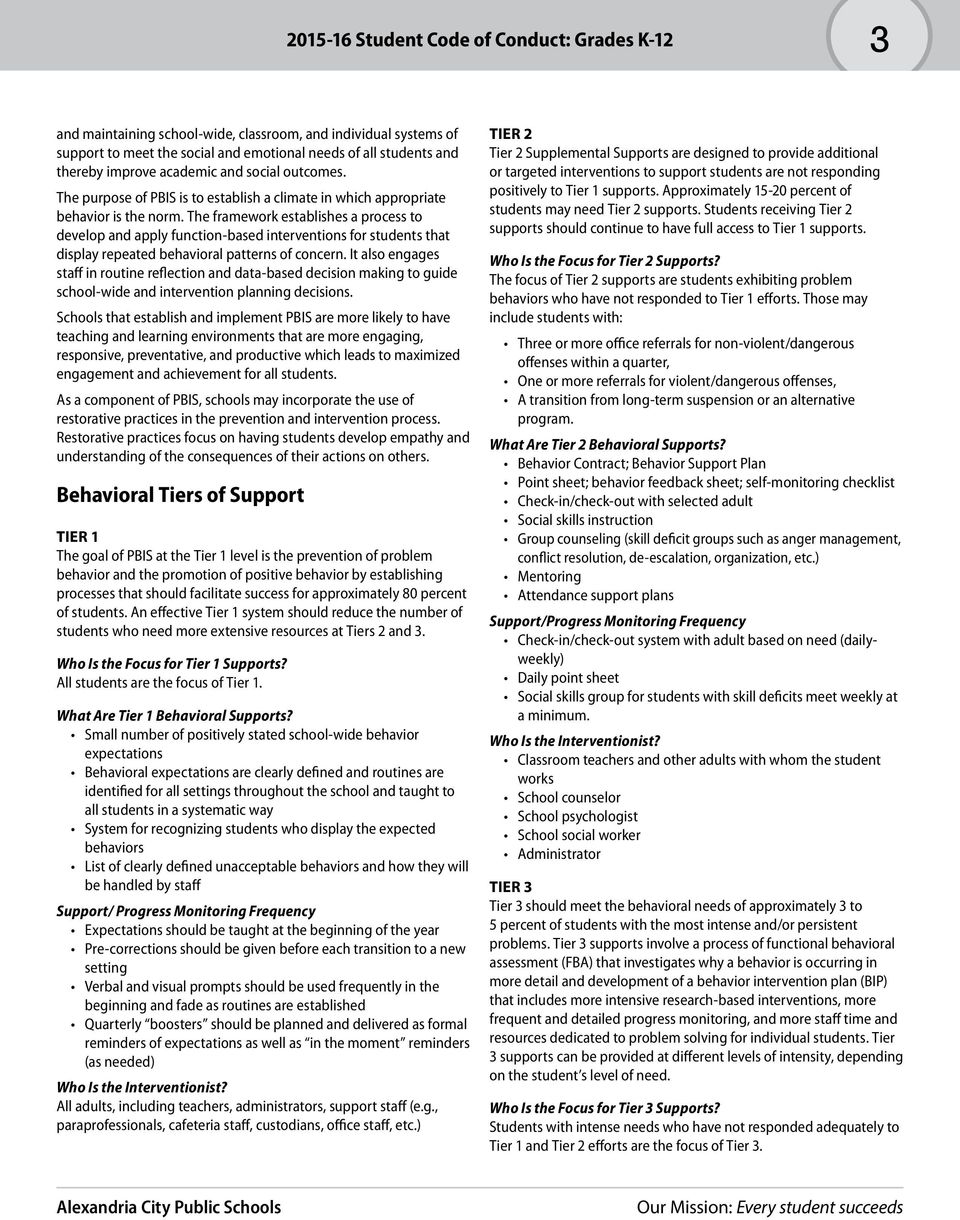
6 Student Code of Conduct: Grades K-12 3 and maintaining school-wide, classroom, and individual systems of support to meet the social and emotional needs of all students and thereby improve academic and social outcomes. The purpose of PBIS is to establish a climate in which appropriate behavior is the norm. The framework establishes a process to develop and apply function-based interventions for students that display repeated behavioral patterns of concern. It also engages staff in routine reflection and data-based decision making to guide school-wide and intervention planning decisions. Schools that establish and implement PBIS are more likely to have teaching and learning environments that are more engaging, responsive, preventative, and productive which leads to maximized engagement and achievement for all students. As a component of PBIS, schools may incorporate the use of restorative practices in the prevention and intervention process. Restorative practices focus on having students develop empathy and understanding of the consequences of their actions on others. Behavioral Tiers of Support TIER 1 The goal of PBIS at the Tier 1 level is the prevention of problem behavior and the promotion of positive behavior by establishing processes that should facilitate success for approximately 80 percent of students. An effective Tier 1 system should reduce the number of students who need more extensive resources at Tiers 2 and 3. Who Is the Focus for Tier 1 Supports? All students are the focus of Tier 1. What Are Tier 1 Behavioral Supports? Small number of positively stated school-wide behavior expectations Behavioral expectations are clearly defined and routines are identified for all settings throughout the school and taught to all students in a systematic way System for recognizing students who display the expected behaviors List of clearly defined unacceptable behaviors and how they will be handled by staff Support/ Progress Monitoring Frequency Expectations should be taught at the beginning of the year Pre-corrections should be given before each transition to a new setting Verbal and visual prompts should be used frequently in the beginning and fade as routines are established Quarterly boosters should be planned and delivered as formal reminders of expectations as well as in the moment reminders (as needed) Who Is the Interventionist? All adults, including teachers, administrators, support staff (e.g., paraprofessionals, cafeteria staff, custodians, office staff, etc.) TIER 2 Tier 2 Supplemental Supports are designed to provide additional or targeted interventions to support students are not responding positively to Tier 1 supports. Approximately percent of students may need Tier 2 supports. Students receiving Tier 2 supports should continue to have full access to Tier 1 supports. Who Is the Focus for Tier 2 Supports? The focus of Tier 2 supports are students exhibiting problem behaviors who have not responded to Tier 1 efforts. Those may include students with: Three or more office referrals for non-violent/dangerous offenses within a quarter, One or more referrals for violent/dangerous offenses, A transition from long-term suspension or an alternative program. What Are Tier 2 Behavioral Supports? Behavior Contract; Behavior Support Plan Point sheet; behavior feedback sheet; self-monitoring checklist Check-in/check-out with selected adult Social skills instruction Group counseling (skill deficit groups such as anger management, conflict resolution, de-escalation, organization, etc.) Mentoring Attendance support plans Support/Progress Monitoring Frequency Check-in/check-out system with adult based on need (dailyweekly) Daily point sheet Social skills group for students with skill deficits meet weekly at a minimum. Who Is the Interventionist? Classroom teachers and other adults with whom the student works School counselor School psychologist School social worker Administrator TIER 3 Tier 3 should meet the behavioral needs of approximately 3 to 5 percent of students with the most intense and/or persistent problems. Tier 3 supports involve a process of functional behavioral assessment (FBA) that investigates why a behavior is occurring in more detail and development of a behavior intervention plan (BIP) that includes more intensive research-based interventions, more frequent and detailed progress monitoring, and more staff time and resources dedicated to problem solving for individual students. Tier 3 supports can be provided at different levels of intensity, depending on the student s level of need. Who Is the Focus for Tier 3 Supports? Students with intense needs who have not responded adequately to Tier 1 and Tier 2 efforts are the focus of Tier 3.
7 Student Code of Conduct: Grades K-12 What Are Tier 3 Behavioral Supports? Intensified Tier 2 interventions Individual counseling by school counselor, social worker, or psychologist Intensified social skills instruction led by school counselor, social worker or psychologist Functional behavior assessment (FBA)/ Behavior intervention plan (BIP) Consultation and coordination with outside agencies to ensure wraparound services and support Support/Progress monitoring frequency First meeting should be held after four weeks of implementation. Follow up meetings should be held at least every six to eight weeks after that time. Meetings should be held more frequently if needed. The case manager assigned to each student brings data as well as written draft recommendations for BIP revisions if data indicates a need for change. Who Is the Interventionist? Social worker School psychologist Collaborating agency (DSS, Court, Mental Health, etc.) Special education: Individualized Education Program (IEP) team MULTI-TIERED SYSTEM OF SUPPORT Academic Systems (Response to Intervention - RTI) Behavioral Systems (Positive Behavioral Interventions and Supports - PBIS) Tier 3/Intensive Interventions 1-5% 1-5% Tier 3/Intensive Interventions Individual students Assessment-based High intensity Individual students Assessment-based High intensity, function-driven Tier 2/Targeted Interventions 5-15% 5-15% Tier 2/Secondary Interventions Some students (at promise) Small group interventions Rapid response Targeted content Some students (at promise) Small group interventions Rapid response Targeted content Tier 1/Universal Core Instruction and Supports 80-90% All students Clearly articulated learning outcomes Explicit lesson design and implementation Differentiated instructional practices Balanced assessment using diagnosis, formative and summative tasks Tier 1/Universal Behavior 80-90% Instruction and Supports All students; all settings (school-wide) Clearly articulated and explicitly taught behavioral and social expectations Ongoing system of recognition for students and staff Consistent behavior data collection and analysis

8 Student Code of Conduct: Grades K-12 5 Interventions and Consequences Levels Level I Infractions (when these interventions are used successfully in the classroom, additional disciplinary action is not required) Level II Infractions (these interventions are used with the assistance of the school support staff and may include administrative support) Level III Infractions (these are addressed solely by administration at the school) Teacher conference with the student Time out Reflection of the incident (verbal or written) Seat change Warning (verbal or visual) Redirection Review of appropriate behavior Loss of privilege Confiscation of item Phone call and or letter to parent/ guardian Teacher conference with parent/ guardian Parent, student, and teacher contract Counseling Mediation Conflict resolution Peer mediation Confiscation of personal devices Mentoring Review of Individual Career and Academic Plan (ICAP) Student apology (written or verbal) Behavioral contract Restricted activity Require the student to complete a community service task Refer to intervention assistance team (student support team) Refer to community-based services Loss of privilege 30-day suspension from activities Office referral Detention Restorative practice session Behavior progress report Modification of IEP Class or schedule change Child study meeting Counseling Functional behavioral assessment (FBA) Behavior intervention plan (BIP) Alternate instructional assignment In-school suspension (1/2 day) Loss of parking privilege In-school suspension Suspension, 1-5 days Suspension, 6-10 days Referral to community agency Alternative program placement Restitution Restorative practice: harm repair circle Long-term suspension Expulsion Behavior intervention plan (BIP) Functional behavioral assessment (FBA) Disciplinary hearing

9 Student Code of Conduct: Grades K-12 Infractions and Disciplinary Consequences Offense and/or Violation Level I Level II Level III Chronic unexcused absence (In accordance with the Compulsory School Attendance Code of VA , suspension is not permitted for truancy.) Alcohol - under the influence Alcohol - possession/consumption Alcohol distribution Arson or fire Assault on student without injuries Assault on student with injuries Assault on staff without injuries Assault on staff with injuries Assault on others (non-student, non-staff ) Bomb threat (threat assessment should be completed) Bullying including cyberbullying Cheating including plagiarism Computer/tablet misuse Destruction of property or vandalism Disrespect (inappropriate gesture, talking back, etc.) Disruption to classroom, school or bus Drugs or controlled substance - under the influence (to include tobacco) Drugs or controlled substance possession Drugs or controlled substance use (on school-related property) Drugs or controlled substance distribution Electronic device or cell phone misuse Endangering the well-being of others Destructive or explosive devices (to include possession and/or use)

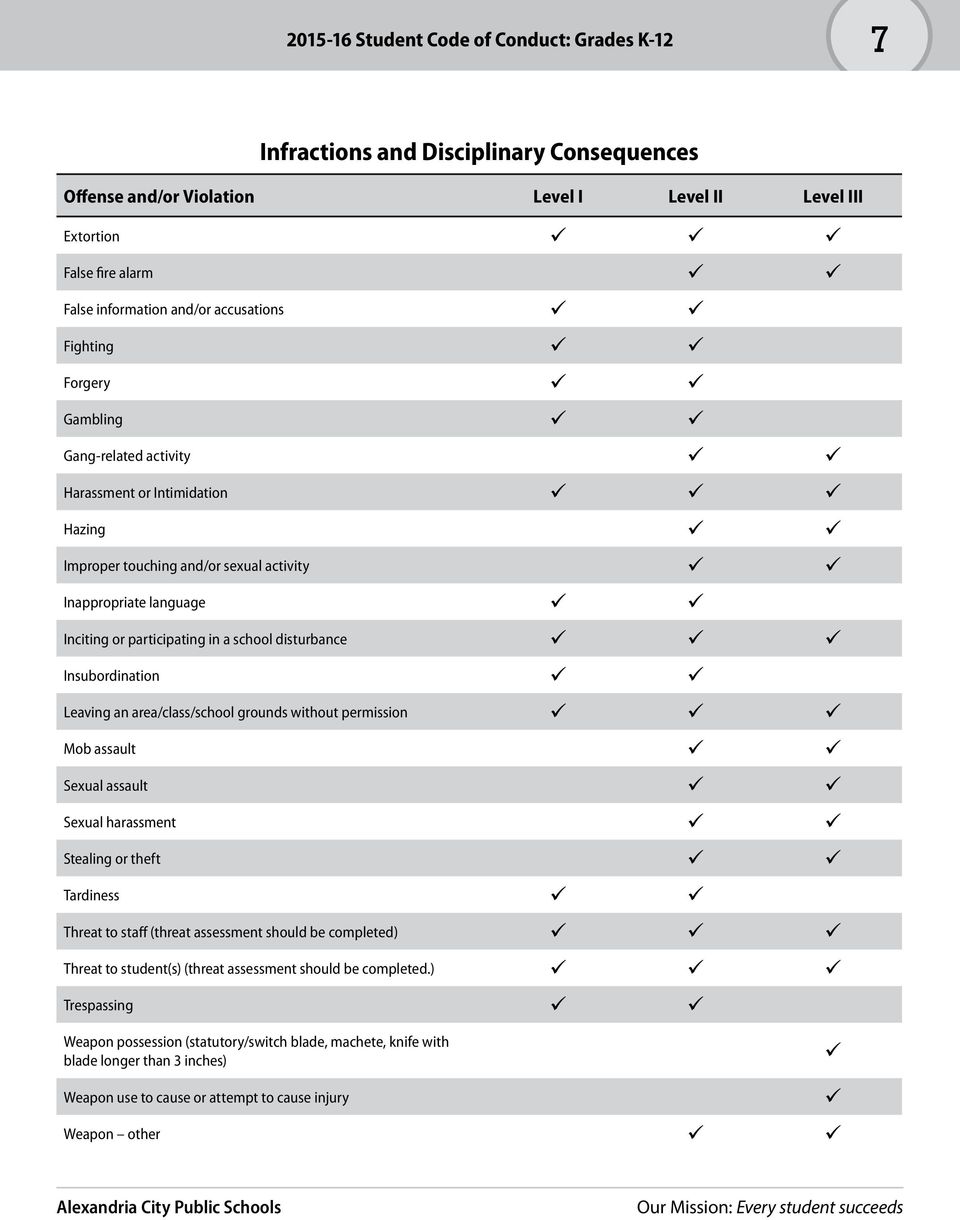
10 Student Code of Conduct: Grades K-12 7 Infractions and Disciplinary Consequences Offense and/or Violation Level I Level II Level III Extortion False fire alarm False information and/or accusations Fighting Forgery Gambling Gang-related activity Harassment or Intimidation Hazing Improper touching and/or sexual activity Inappropriate language Inciting or participating in a school disturbance Insubordination Leaving an area/class/school grounds without permission Mob assault Sexual assault Sexual harassment Stealing or theft Tardiness Threat to staff (threat assessment should be completed) Threat to student(s) (threat assessment should be completed.) Trespassing Weapon possession (statutory/switch blade, machete, knife with blade longer than 3 inches) Weapon use to cause or attempt to cause injury Weapon other
11 Student Code of Conduct: Grades K-12 Resolving Concerns at School Should you have concern regarding a disciplinary matter with your child, please contact the school directly to discuss the issue with the people who work with your child. Many issues can be resolved at the school level in collaboration with an administrator, classroom teacher or member of the student support team. PARENT NOTIFICATION Student has a disciplinary infraction Teacher or member of the administration contacts the parent or guardian Parent Response Parent Response Parent Response If questions exist, parent contacts the classroom teacher first, if that is the person who reached out to the parent If the matter is resolved, no need to proceed any further Parent discussed the matter with the teacher, but still has additional questions Contact the school administrator for clarification If the matter is resolved, no need to proceed any further Parent has spoken with the administrator, but still has additional questions Contact the Executive Director of Elementary Instruction or Executive Director of Secondary Instruction If the matter is resolved, no need to proceed any further Parent Response Parent has discussed the matter with the Executive Director of Elementary or Secondary Instruction, but still has concerns Contact the Offi ce of the Superintendent Attendance Students are expected attend school each school day, and to arrive to class on time and prepared to actively participate. If a student is absent or tardy to school, an appropriate note from his/her parent/ guardian, school permission or an otherwise valid excuse is required. Procedure for Students Experiencing Issues with Unexcused Absences or Tardiness Whenever any student fails to report to school for a total of five scheduled school days for the school year, and no indication has been received by school personnel that the student s parent/ guardian is aware of and supports the student s absence, and a reasonable effort to notify the parent/guardian has failed, the school principal or the school social worker shall make a reasonable effort to ensure that direct contact is made with the parent/guardian, either in person or through telephone conversation, to obtain an explanation for the student s absence and to explain to the parent/ guardian the consequences of continued absence. The school principal or principal s designee, the school social worker, the student, and the student s parent/guardian shall jointly develop a plan to resolve and improve attendance. If the student is absent an additional day after the plan is made and the school social worker has received no indication that the student s parent/ guardian is aware of and supports the student s absence, the school social worker should schedule an Attendance Panel Conference with the student, his/her parent/guardian and school personnel. The conference may include other community service providers to assist in resolving issues related to the student s absence. Upon the next absence by such student, without indication that the parent/ guardian is aware of and supports the student s absence, the school principal or the school social worker may notify the court and initiate either or both of the following: 1. Filing a petition with the Juvenile and Domestic Relations Court alleging that the student is a child in need of supervision (CHINS), or 2. Filing a warrant against the parent/guardian for educational neglect.

12 Student Code of Conduct: Grades K-12 9 If a student who is under 18 years of age has 10 or more unexcused absences from school on consecutive school days, the principal may, in accordance with Policy JED: Student Absences/Excuses/Dismissals, notify the Juvenile and Domestic Relations Court, which may take action to suspend the student s driver s license. Additional information on attendance can be provided by the school social worker, as well as the ACPS Department of Student Services, Alternative Programs, and Equity. Bullying Prevention Bullying Prevention in ACPS ACPS is strongly committed to creating a safe and positive school environment in which the academic performance and social emotional and physical well-being of all students is supported. The ACPS Department of Student Services, Alternative Programs, and Equity provides programs and staff that promote healthy, caring, and responsible behaviors among students. What is Bullying? Bullying, harassment and intimidation are not tolerated in ACPS. As per sec of the Code of Virginia, bullying is defined as unwanted, aggressive behavior that: Is intended to harm, intimidate or humiliate the targeted person, Involves a real or perceived imbalance of power or strength; and Is typically repeated over time or causes severe emotional trauma. Bullying can take a variety of forms, such as: Verbal bullying which includes name calling, making threats, insults, intimidation, remarks regarding race, gender, religion, physical abilities, sexual orientation, physical characteristics or other forms of verbal abuse. Physical bullying which consists of hitting, kicking, tripping, spitting, pinching, pushing, or damaging someone s property. Relational or social bullying which is designed to hurt someone s reputation or relationships. It includes:» Spreading rumors» Embarrassing or humiliating someone publicly.» Excluding or encouraging others to exclude someone. Cyberbullying which is taunting or humiliation through the use of electronic technology such as cell phones, computers, tablets and communication tools including social media sites, text messages, chat and websites. It includes:» Mean text messages and s» Rumors sent by or posted on social networking sites» Posting embarrassing pictures, videos, websites or fake online profiles Bullying does not include Ordinary teasing or horseplay, Mutual arguments or peer conflict, Isolated acts of meanness, aggression, social rejection or fights. Bullying can have damaging effects on those targeted by the behaviors, those who witness the behavior and those who engage in the behavior. In some cases, the negative impact of bullying can be long term and has the potential to cause emotional trauma. Reporting Bullying ACPS investigates all reports of bullying. Students or parents/ guardians of students who have been bullied or witnessed bullying should immediately report such incidents to the school principal or assistant principal. When an incident occurs, the following steps are taken to address the matter: 1. A report is generated that outlines the incident and the parties involved. 2. A thorough investigation is conducted by the designated site administrator. 3. Parents of both the victim and perpetrator are notified of the incident. 4. Disciplinary action, if necessary, is taken and enforced by the site administrator. 5. The victim will be provided counseling if needed. Please refer to the following webpage for additional resources on bullying:

13 Student Code of Conduct: Grades K-12 Discipline of Students with Disabilities This information is intended to provide ACPS families with information related to processes and procedures that must be addressed when making decisions regarding the discipline of students with disabilities. Governing Principles There are five themes in the federal and state regulations that guide ACPS discipline requirements for students with disabilities: 1. All students deserve safe, well-disciplined schools and orderly learning environments grounded in the framework of positive behavioral interventions and supports; 2. Teachers and school administrators should have the tools they need to assist them in preventing misconduct and discipline problems and to address these problems, if they arise; 3. There must be a balanced approach to the issue of discipline of students with disabilities that reflects the need for orderly and safe schools and the need to protect the rights of students with disabilities to a free appropriate public education; 4. Appropriately developed Individualized Education Programs (IEPs) with well-developed behavior intervention strategies decrease school discipline problems; and 5. School personnel may consider any unique circumstances on a case-by-case basis when determining whether a change in placement is appropriate for a student with a disability who violates a code of student conduct. In the event the student s behavior impedes the student s learning or that of others, the IEP team must consider the use of positive behavioral interventions, strategies and supports to address the behavior. The IEP team must consider either: Developing goals and services specific to the student s behavioral needs; or Conducting a functional behavioral assessment (FBA) and determining the need for a behavioral intervention plan (BIP) to address the student s behavioral needs. If the student engages in behavior that results in disciplinary action that leads to, or may lead to, short-term or long-term removal, the IEP team shall address the behavior violation. IEP team discussions and revisions must focus on efforts to address the student s behavioral problems in order to minimize and/or prevent the behavior from recurring. Appropriate supports and services that may be considered include: Conducting a functional behavioral assessment (FBA) Developing or revising a behavior intervention plan (BIP) Providing counseling Providing social skills training Providing adaptive behavior technique training (i.e., teaching of replacement skills designed not to have the behavior recur)» Providing conflict management skills» Providing peer mediation skills Short-Term Removal Virginia regulations stress the importance of the IEP team addressing a student s behavioral challenges before an incident arises that leads to a disciplinary infraction. As such, the most appropriate course of action is to convene an IEP team and determine the need for conducting a functional behavioral assessment (if one has not been done), and developing or reviewing a behavioral intervention plan prior to a short-term removal or a series of short-term removals accruing. These proactive measures will document preventive steps for processing short-term removals. When an administrator deems it necessary to remove a student with a disability short term from the student s current educational setting to an alternative educational setting or through suspension, this may be done to the extent those alternatives are applied to a student without disabilities. Administrators must be cautious in determining the length of time of removal for each infraction. It may be considered excessive to remove a student for close to or up to 10 school days when an infraction may not warrant such a time frame; this is especially true if such disciplinary action is not applied consistently or to students without disabilities. When a student has been suspended for 10 days or more in a school year for separate incidents of misconduct that constitute a pattern, this is considered a change in placement (see procedures for long-term removal). The school-based administrator, in collaboration with personnel in the Office of Special Education Services, determines when isolated, short-term removals for unrelated instances of misconduct are considered a pattern. If the infraction, albeit individual and distinct, shares similarities (common elements) then it could be relevant in determining if a pattern exists. In order to promote a truly collaborative approach to reviewing the issue of pattern, parents should be consulted in the process and informed of the decision immediately. Documentation of the decision regarding pattern shall include a summary of information gathered through a review of disciplinary records, a review of the student s IEP which includes any behavior intervention plan developed, other educational records and input from any other relevant sources. Individuals consulted in making the decision should also be documented. In reviewing if the student s behavior and separate incidents of misconduct to establish whether a pattern does or does not exist; the school-based administrator shall contact the ACPS procedural coordinator who will assist with the following: Analyzing factors related to the behaviors that resulted in suspension;» Where the incident occurred (environment);» Interactions with other people;» Requirements of a task;

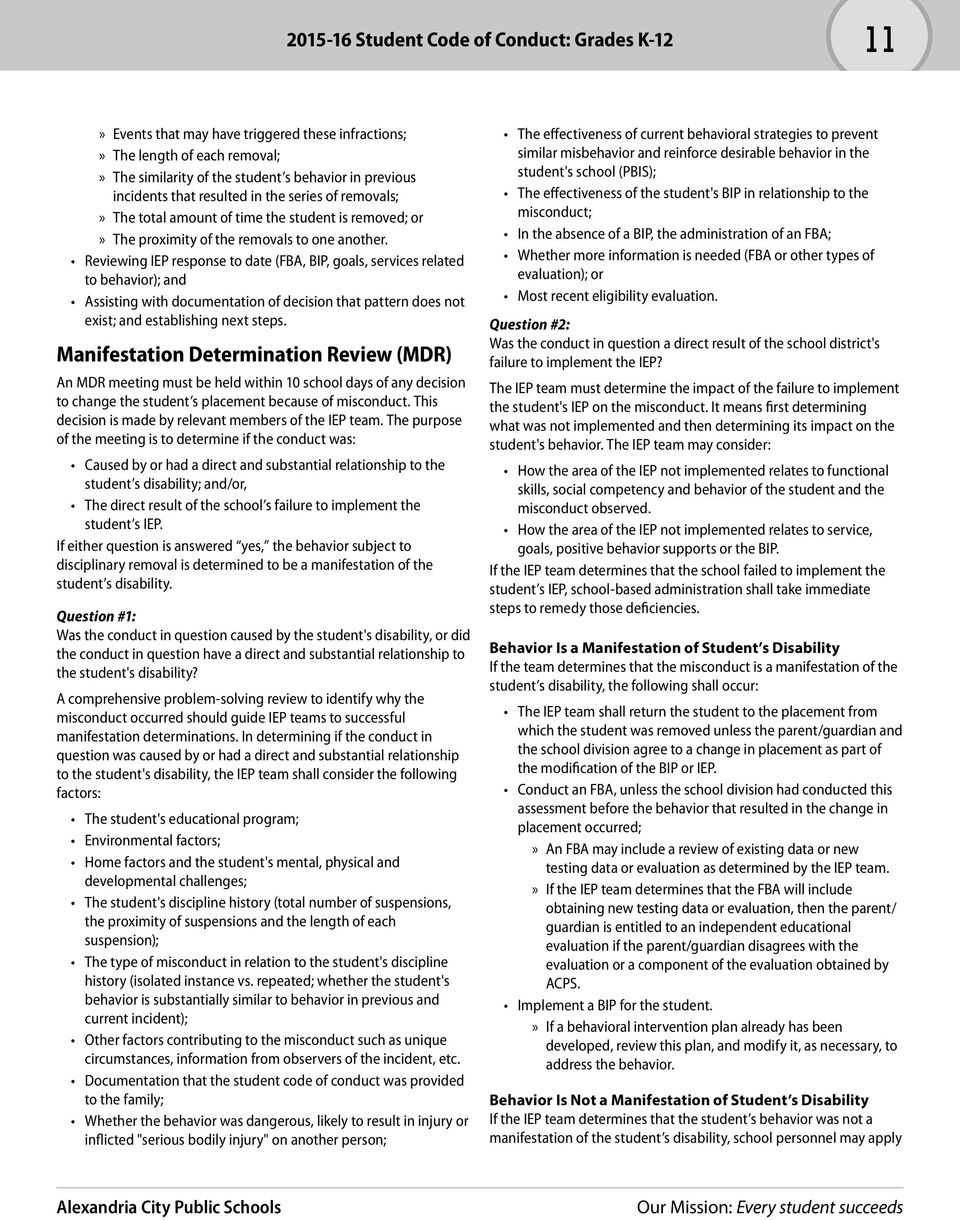
14 Student Code of Conduct: Grades K-12 11» Events that may have triggered these infractions;» The length of each removal;» The similarity of the student s behavior in previous incidents that resulted in the series of removals;» The total amount of time the student is removed; or» The proximity of the removals to one another. Reviewing IEP response to date (FBA, BIP, goals, services related to behavior); and Assisting with documentation of decision that pattern does not exist; and establishing next steps. Manifestation Determination Review (MDR) An MDR meeting must be held within 10 school days of any decision to change the student s placement because of misconduct. This decision is made by relevant members of the IEP team. The purpose of the meeting is to determine if the conduct was: Caused by or had a direct and substantial relationship to the student s disability; and/or, The direct result of the school s failure to implement the student s IEP. If either question is answered yes, the behavior subject to disciplinary removal is determined to be a manifestation of the student s disability. Question #1: Was the conduct in question caused by the student's disability, or did the conduct in question have a direct and substantial relationship to the student's disability? A comprehensive problem-solving review to identify why the misconduct occurred should guide IEP teams to successful manifestation determinations. In determining if the conduct in question was caused by or had a direct and substantial relationship to the student's disability, the IEP team shall consider the following factors: The student's educational program; Environmental factors; Home factors and the student's mental, physical and developmental challenges; The student's discipline history (total number of suspensions, the proximity of suspensions and the length of each suspension); The type of misconduct in relation to the student's discipline history (isolated instance vs. repeated; whether the student's behavior is substantially similar to behavior in previous and current incident); Other factors contributing to the misconduct such as unique circumstances, information from observers of the incident, etc. Documentation that the student code of conduct was provided to the family; Whether the behavior was dangerous, likely to result in injury or inflicted "serious bodily injury" on another person; The effectiveness of current behavioral strategies to prevent similar misbehavior and reinforce desirable behavior in the student's school (PBIS); The effectiveness of the student's BIP in relationship to the misconduct; In the absence of a BIP, the administration of an FBA; Whether more information is needed (FBA or other types of evaluation); or Most recent eligibility evaluation. Question #2: Was the conduct in question a direct result of the school district's failure to implement the IEP? The IEP team must determine the impact of the failure to implement the student's IEP on the misconduct. It means first determining what was not implemented and then determining its impact on the student's behavior. The IEP team may consider: How the area of the IEP not implemented relates to functional skills, social competency and behavior of the student and the misconduct observed. How the area of the IEP not implemented relates to service, goals, positive behavior supports or the BIP. If the IEP team determines that the school failed to implement the student s IEP, school-based administration shall take immediate steps to remedy those deficiencies. Behavior Is a Manifestation of Student s Disability If the team determines that the misconduct is a manifestation of the student s disability, the following shall occur: The IEP team shall return the student to the placement from which the student was removed unless the parent/guardian and the school division agree to a change in placement as part of the modification of the BIP or IEP. Conduct an FBA, unless the school division had conducted this assessment before the behavior that resulted in the change in placement occurred;» An FBA may include a review of existing data or new testing data or evaluation as determined by the IEP team.» If the IEP team determines that the FBA will include obtaining new testing data or evaluation, then the parent/ guardian is entitled to an independent educational evaluation if the parent/guardian disagrees with the evaluation or a component of the evaluation obtained by ACPS. Implement a BIP for the student.» If a behavioral intervention plan already has been developed, review this plan, and modify it, as necessary, to address the behavior. Behavior Is Not a Manifestation of Student s Disability If the IEP team determines that the student s behavior was not a manifestation of the student s disability, school personnel may apply
15 Student Code of Conduct: Grades K-12 the relevant disciplinary procedures to students with disabilities in the same manner and for the same duration as the procedures would be applied to students without disabilities, except that services shall be provided as determined required by the IEP team. Services During Long-Term Removal The IEP team shall meet prior to the 11th day of removal, or as soon as possible, to determine the services needed for a student who is facing a long-term suspension, so as to enable the student to: Continue to participate in the general educational curriculum, although in another setting; Continue to receive supports and services described in the student s current IEP which will enable the student to progress toward meeting IEP goals; and Receive, as appropriate, an FBA, and behavioral intervention supports and services, which are designed to address the behavior violation so that it does not recur. An IEP addendum shall be developed to document the proposed services during a long-term removal. The amount and type of instructional services to be provided in order to allow the student to continue to participate in the general education curriculum would depend on: The length of the removal, The extent to which the student has been removed previously, and The student s educational needs and goals. In order to serve the student during a long-term removal, the IEP team shall consider alternative instructional techniques, such as alternate/highly supervised partial school attendance (e.g., two hours per week after school dismissal) or home-based instruction. School personnel must ensure that the student will have the opportunity to avoid falling behind and enable the student to progress in the general curriculum and on IEP goals and objectives. Additionally, students who are removed from school during state or division-wide testing must be provided arrangements for participation in all required assessments. Special Circumstances Involving Weapons, Drugs or Serious Bodily Injury Special circumstances may require a student with a disability to meet with the ACPS Department of Student Services administrator. The student with a disability may be placed by the designee in an interim alternative educational setting for 45 school days for situations involving the student at school, on school premises, or at school functions under the jurisdiction of the school division for the following special circumstances: Weapons: carrying or possessing a weapon Drugs: knowingly possessing or using illegal drugs, or selling or soliciting the sale of a controlled substance Serious Bodily Injury: inflicting serious bodily injury upon another person. In situations involving weapons, drugs and/or serious bodily injury, the Superintendent s designee may assign the student to an interim alternative educational setting for a maximum of 45 school days without regard to whether the behavior is determined to be a manifestation of the student s disability. Special Education Services on the Eleventh Day Beginning on the 11th cumulative day in a school year that a student with a disability is removed from the student s current placement, and for any subsequent removals, educational services must be provided. Services for 11th day or subsequent short-term removals are determined by school personnel by assessing the student s progress and the impact of the interruption. School-based administration, in consultation with the student s general education and special education teachers, determines the necessary services, if any, for the student to continue to: Participate in the general education curriculum, and Progress toward meeting the goals set out in the student s IEP. Portions of the School Day Removal of a student for disciplinary purposes for portions of the school day shall be counted toward the cumulative amount of time removed. Any portion of a day less than half shall be considered a half day of removal; portions greater than half shall be considered a full school day of removal. Long-Term Removal The purpose of long-term removal as a disciplinary measure is to ensure that schools are safe and conducive to learning for all students and to give school personnel and parent/guardians the opportunity to determine what is appropriate for the student. Long-term removals constitute a change of placement when there are more than 10 consecutive school days or cumulative school days which constitute a pattern. A change in placement requires relevant members of the IEP team to meet and conduct a Manifestation Determination Review (MDR). The IEP team must determine appropriate services during the longterm removal. Should the school-based administration refer the student to the ACPS Department of Student Services administrator, and the removal constitutes a change of placement (more than 10 days), the Manifestation Determination Review must be conducted as soon as possible so as to inform the designee of the results. The results of the manifestation when available shall be provided to the ACPS Department of Student Services administrator prior to the scheduled meeting. Additional information can be found in School Board Policy JGDA Disciplining Students with Disabilities at manual/jgda.pdf.

16 Student Code of Conduct: Grades K Suspension The Virginia Standards of Accreditation (2000), Section 8 VAC A., states that the principal "is recognized as the instructional leader of the school and is responsible for effective school management that promotes positive student achievement, a safe and secure environment in which to teach and learn, and efficient use of resources." Section B.2. specifies that the principal shall "ensure that the school division's student code of conduct is enforced and seek to maintain a safe and secure school environment." Section 8 VAC C.3., requires a school administration to ensure "a written procedure, in accordance with guidelines established by the local board, for responding to violent, disruptive or illegal activities by students on school property or during a school-sponsored activity." I. Suspensions and Expulsions of Students Students may be suspended or expelled from attendance at school for sufficient cause; however, in no case may sufficient cause for suspension include only instances of truancy. Any student for whom the superintendent of the school division in which the student is enrolled has received a report pursuant to Va. Code sec of an adjudication of delinquency or a conviction may be suspended or expelled from school attendance. The authority of teachers to remove students from their classes in certain instances of disruptive behavior shall not be interpreted to affect the operation of this policy. Parents/guardians may choose to appeal a suspension. Information is provided on the appeal process in this document. II. Short-Term Suspension A student may be suspended for not more than 10 school days by either the school principal or appropriate administrator. The principal or appropriate administrator may suspend the student after giving the student oral or written notice of the charges against him/ her, and if he/she denies them, an explanation of the facts as known to school personnel and an opportunity to present his/her version of what occurred. In the case of any student whose presence poses a continuing danger to persons or property, or whose presence is an ongoing threat of disruption, the student may be removed from school immediately and the notice, explanation of facts, and opportunity to present his/her version shall be given as soon as is practical thereafter. Upon suspension of any student, the principal or appropriate administrator responsible for such suspension shall report the facts of the case in writing to the Superintendent or designee and parent/guardian of the student suspended. The Superintendent or designee shall review forthwith the action taken by the principal or appropriate administrator upon a petition for such review by any party in interest and confirm or disapprove such action based on an examination of the record of the student s behavior. The parent/guardian shall be notified that the decision of the Superintendent or designee is the final decision of the School Board, and that no further appeal or hearing of the School Board is available. Any oral or written notice to the parent/guardian of a student who is suspended from school attendance for not more than 10 days shall include notification of the length of the suspension, information regarding the availability of community-based education programs, alternative education programs or other educational options, and of the student s right to return to regular school attendance upon the expiration of the suspension. The costs of any communitybased educational program, or alternative education program or educational option, which is not part of the educational program offered by the school division, shall be borne by the parent/guardian of the student. III. Long-Term Suspension A student may be suspended from attendance for more than 10 days after written notice is provided to the student and parent/guardian of the proposed action and the reason therefore and of the right to a hearing before the School Board or the Superintendent or designee. The decision of Superintendent or designee may be appealed to the full School Board. Such appeals shall be decided by the School Board within 30 days. Any such written notice should state the length of suspension and shall provide information concerning the availability of communitybased educational, alternative education, or intervention programs. Such notice shall also state that the student is eligible to return to regular school attendance upon expiration of the suspension or to attend an appropriate alternative education program approved by the School Board during or upon the expiration of the suspension. The costs of any community-based educational, alternative education or intervention program that is not a part of the educational program offered by the school division that the student may attend during his/her suspension shall be borne by the parent/ guardian. Nothing herein shall be construed to prohibit the School Board from permitting or requiring students suspended pursuant to this section to attend an alternative education program provided by the School Board for the term of such suspension. IV. Expulsion A. Generally Students may be expelled from attendance at school after written notice to the student and parent/guardian of the proposed action and reasons therefore and of the right to a hearing before the School Board. The written notice given to the student and parent/guardian shall include notification of the length of the expulsion and shall provide information to the parent/guardian concerning the availability of

17 Student Code of Conduct: Grades K-12 community-based educational, training and intervention programs. The notice shall also state whether or not the student is eligible to return to regular school attendance, or to attend an appropriate alternative education program approved by the School Board, or an adult education program offered by the school division, during or upon expiration of the expulsion, and the terms or conditions of such readmission. The costs of any community-based educational, training or intervention program that is not part of the educational program offered by the school division that the student may attend during his/her expulsion shall be borne by the parent/guardian. Nothing in this policy shall be construed to prohibit the School Board from permitting or requiring students expelled pursuant to this policy to attend an alternative education program provided by the School Board for the term of such expulsion. If the School Board determines that the student is ineligible to return to regular school attendance or to attend during the expulsion an alternative education program or an adult education program in the school division, the written notice shall also advise the parent/ guardian of such student that the student may petition the School Board for readmission to be effective one calendar year from the date of his/her expulsion, and of the conditions, if any, under which readmission may be granted. The School Board shall establish, by regulation, a schedule pursuant to which such students may apply and reapply for readmission to school. Such schedule shall be designed to ensure that any initial petition for readmission will be reviewed by the School Board, or the Superintendent, and, if granted, would enable the student to resume school attendance one calendar year from the date of the expulsion. If the Superintendent denies such petition, the student may petition the School Board for review of such denial. B. Conduct Giving Rise to Expulsion Recommendations for expulsions for actions other than those specified below are based on consideration of the following factors: The nature and seriousness of the conduct; The degree of danger to the school community; The student s disciplinary history, including the seriousness and number of previous infractions The appropriateness and availability of an alternative education placement or program; The student s age and grade level; The results of any mental health, substance abuse or special education assessments; The student s attendance and academic records; and Other appropriate matters. No decision to expel a student shall be reversed on the grounds that such factors were not considered. Nothing in this subsection precludes the School Board from considering any of the factors listed above as special circumstances for purposes of expulsions discussed in the following subsections. Firearms The School Board may expel from school attendance for a period of not less than one year any student whom such School Board has determined to have brought a firearm onto school property or to a school-sponsored activity prohibited by Va. Code sec , or to have brought a firearm as defined in this policy or an air rifle or BB gun on school property or to a school-sponsored activity. A school administrator, pursuant to school board policy, or the School Board may, however, determine, based on the facts of a particular situation that special circumstances exist and no disciplinary action or another disciplinary action or another term of expulsion is appropriate. The exemptions set out in Va. Code sec regarding concealed weapons shall apply, mutatis mutandis, to the provisions of the policy. The provisions of this policy do not apply to persons who possess such firearm or firearms as a part of the curriculum or other programs sponsored by the schools in the school division or any organization permitted by the school to use its premises or to any law enforcement officer while engaged in his/her duties as such. Drug Offenses The School Board may expel from school attendance any student whom the School Board has determined to have brought a controlled substance, imitation controlled substance, or marijuana as defined in Va. Code sec , onto school property or to a school-sponsored activity. The School Board may, however, determine, based on the facts of the particular case that special circumstances exist and another disciplinary action is appropriate. C. Procedure for School Board Hearing The procedure for the School Board hearing shall be as follows: 1. The School Board shall determine the propriety of attendance at the hearing of persons not having a direct interest in the hearing. The hearing shall be private unless otherwise specified by the School Board. 2. The School Board may ask for opening statements from the principal or his/her representative and the student or his/her parent/guardian (or their representative) and, at the discretion of the School Board, may allow closing statements. 3. The parties shall then present their evidence. Because the principal has the ultimate burden of proof, he/she shall present evidence first. Witnesses may be questioned by the School Board members and by the parties (or their representative). The School Board may, at its discretion, vary this procedure, but it shall afford full opportunity to both parties for presentation of any material or relevant evidence and shall afford the parties the right of cross-examination provided, however, that the School Board may take the testimony of student witnesses outside the presence of the student, his/ her parent/guardian and their representative if School Board determines, in its discretion, that such action is necessary to protect the student witness. 4. The parties shall produce such additional evidence as the School Board may deem necessary. The School Board shall be the judge of the relevancy and materiality of the evidence.

18 Student Code of Conduct: Grades K Exhibits offered by the parties may be received in evidence by the School Board and, when so received, shall be marked and made part of the record. 6. The School Board may, by majority vote, uphold, reject or alter the recommendations. 7. The School Board shall transmit its decision, including the reasons therefore, to the student, his/her parent/guardian(s), the principal and Superintendent. D. Alternative Education Program The School Board may require any student who has been (1) charged with an offense relating to the laws of Virginia, or with a violation of School Board policies, on weapons, alcohol or drugs, or intentional injury to another person, or with an offense that is required to be disclosed to the Superintendent pursuant to Va. Code sec G; (2) found guilty or not innocent of an offense relating to Virginia s laws on weapons, alcohol, or drugs, or of a crime that resulted in or could have resulted in injury to others, or of an offense that is required to be disclosed to the Superintendent of the school division pursuant to Va. Code sec G.; (3) found to have committed a serious offense or repeated offenses in violation of School Board policies; (4) suspended pursuant to Va. Code sec ; or (5) expelled pursuant to Va. Code sections , or or subsection B of Va. Code sec , to attend such an alternative education program. The School Board may require such student to attend such programs regardless of where the crime occurred. The School Board may require any student who has been found to have been in possession of, or under the influence of, drugs or alcohol on a school bus, on school property, or at a schoolsponsored activity in violation of school board policies, to undergo evaluation for drug or alcohol abuse, or both, if recommended by the evaluator and with the consent of the student s parent/guardian, to participate in a treatment program. A principal (or his/her designee) may impose a short-term suspension, pursuant to Va. Code sec , upon a student who has been charged with an offense involving intentional injury enumerated in Va. Code sec G, to another student in the same school pending a decision as to whether to require that such student attend an alternative education program. As used herein charged means that a petition or warrant has been filed or is pending against a student. E. Reporting A. Except as may otherwise be required by federal law; regulation, or jurisprudence, reports shall be made to the principal or his/her designee on all incidents involving: 1. The assault or assault and battery, without bodily injury, of any person on a school bus, on school property or at a schoolsponsored activity; 2. The assault and battery that results in a bodily injury, sexual assault, death, shooting, stabbing, cutting, or wounding of any person, or stalking of any person as described in Va. Code sec , on a school bus, on school property or at a schoolsponsored activity; 3. Any conduct involving alcohol, marijuana, a controlled substance, imitation controlled substance, or an anabolic steroid on a school bus, on school property, or at a schoolsponsored activity, including the theft or attempted theft of student prescription medications; 4. Any threats against school personnel while on a school bus, on school property or at a school-sponsored activity; 5. The illegal carrying of a firearm as defined in Va. Code onto school property; 6. Any illegal conduct involving firebombs, explosive materials or devices, or hoax explosive devices, as defined in Va. Code sec or explosive or incendiary devices, as defined in Va. Code sec , or chemical bombs, as described in Va. Code sec , on a school bus, on school property or a school-sponsored activity; or 7. Any threats or false threats to bomb, as described in Va. Code sec , made against school personnel or involving school property or school buses. B. The Superintendent and the principal or designee shall receive reports made by local law enforcement authorities on offense, wherever committed, by students enrolled at the school if the offense would be a felony if committed by an adult or would be a violation of the Drug Control Act, Va. Code sec et seq., and occurred on a school bus, on school property, or at a schoolsponsored activity, or would be an adult misdemeanor involving any incidents described in the clauses (1) through (7) of subsection VII. A of this policy, and whether the student is released to the custody of his/her parent/guardian or, if 18 years of age or more, is released on bond. A Superintendent who receives notification that a juvenile has committed an act that would be a crime if committed by an adult pursuant to subsection G of sec shall report such information to the principal of the school in which the juvenile is enrolled. C. The principal or his/her designee submits a report of all incidents required or authorized to be reported pursuant to VII.A (1-7) of this policy to the Superintendent. The Superintendent shall annually report all such incidents to the Virginia Department of Education. In submitting reports of such incidents, principals and the Superintendent shall accurately indicate any offenses, arrests or charges as recorded by law enforcement authorities and required to be reported by such authorities pursuant to subsection VII.B of this policy. D. The principal or his/her designee shall also notify the parent/ guardian of any student involved in an incident required or authorized by this subsection to be reported, regardless of whether disciplinary action is taken against such student or the nature of the disciplinary action. Such notice shall relate to

19 Student Code of Conduct: Grades K-12 only the relevant student s involvement and shall not include information concerning other students. E. Whenever any student commits any reportable incident as set forth in this subsection, such student shall be required to participate in such prevention and intervention activities as deemed appropriate by the Superintendent or designee. Prevention and intervention activities shall be identified in the local school division drug and alcohol violence prevention plans developed pursuant to the federal Improving America s Schools Act of 1994 (Title IV-Safe and Drug-Free Schools and Communities Act.). F. Except as may otherwise be required by federal law regulation, or jurisprudence, a principal shall immediately report to the local law-enforcement agency any act enumerated in clauses (2) through (5) of subsection VII.A of this policy that may constitute a criminal offense to the parent/guardians of any minor student who is the specific object of such act. Further, the principal shall report that the incident has been reported to local law enforcement as required by law and that the parent/guardians may contact local law enforcement for further information, if they so desire. For purposes of this section, a parent/guardian means any parent/ guardian or other person having control or charge of a child. F. Readmission of Suspended and/or Expelled Students Any student who has been suspended from an ACPS school is not eligible to attend any other school within ACPS until eligible to return to his/her regular school. Any student who has been expelled or suspended for more than 30 days from attendance at school by a School Board or a private school in this Commonwealth or in another state or for whom admission has been withdrawn by a private school in this Commonwealth or in another state may be excluded from attendance in ACPS, in accordance with Policy JEC. In the case of a suspension of more than 30 days, the term of the exclusion may not exceed the duration of the suspension. In excluding any such expelled student from school attendance, the School Board may accept or waive any or all of any conditions for readmission imposed upon such student by the expelling School Board pursuant to Va. Code sec The excluding School Board shall not impose additional conditions for readmission to school. No suspended student shall be admitted to the regular school program until such student and his/her parent/guardian have met with school officials to discuss improvement of the student s behavior, unless the school principal or his/her designee determines that re-admission, without parent/guardian conference, is appropriate for the student. If the parent/guardian fails to comply with this policy or Policy JEC, the School Board may ask the Juvenile and Domestic Relations Court to proceed against the parent/guardian for willful and unreasonable refusal to participate in efforts to improve the student s behavior. Upon the expiration of the exclusion period for an expulsion or a withdrawal of admission, which period shall be established by the School Board, or Superintendent or designee, as the case may be at the relevant hearing, the student may re-petition the School Board for admission. If the petition for admission is rejected, the School Board shall identify the length of the continuing exclusion period and the subsequent date upon which such student may repetition the School Board for admission. Regulation regarding Readmission of Expelled Students Students who are expelled from the and who are not permitted during the expulsion to return to regular school attendance or to attend an alternative education program, may petition for readmission to be effective one year after the date of the expulsion. The process for the readmission of any expelled student is as follows: A. In order to ensure that a student has an opportunity for timely readmission to school, a petition for readmission must be filed not earlier than nine months, and not later than 10 months from the date of the School Board s decision letter expelling the student. Failure to file a petition for readmission in a timely manner may result in a delayed decision on the petition. Petitions must be in writing and must be filed with the ACPS Department of Student Services, Alternative Programs, and Equity. Any student age 18 or older must file a petition on his/her own behalf. If the student is under the age of 18, the parent(s)/guardian(s) may act on the student s behalf; B. Within 21 days of the receipt of a written petition for readmission, the ACPS Department of Student Services, Alternative Programs, and Equity will schedule a hearing. At the time of the hearing, the student and/or parent(s)/guardian(s) must come prepared to explain why the student should be readmitted to school, and how the school can be assured that the student s behavior has improved and that there will be no recurrences of inappropriate behavior. If any conditions for readmission had been imposed by the School Board at the time of the student s expulsion, the hearing will review whether all of those conditions have been achieved. The Department of Student Services administrator will issue a written decision within seven days of the hearing. The parent(s)/guardian(s) and/or student will receive a copy of the decision. C. Parent(s)/guardian(s) and/or the student may appeal the decision of the Department of Student Services administrator to the School Board within five days of receiving that decision. A copy of the administrator s decision, a copy of the expulsion decision, and any other materials that have been submitted concerning the expulsion, and petition for readmission will be provided to the Board. The Board may, but need not, hold a further hearing. The Board shall issue its decision within 21 days of convening to consider the appeal. D. Where a petition for readmission is denied, a student (or if applicable, his/her parent(s)/guardian(s)), may reapply on an annual basis in accordance with the above schedule.

20 Student Code of Conduct: Grades K Search and Seizure Whether a search of a student is permissible depends on a balancing of the student s right to privacy and freedom from unreasonable search and seizure against the school division s responsibility to protect the health, safety and welfare of all persons in the school community and to carry out its educational mission. To maintain order and discipline in the schools and to protect the health, safety and welfare of students and school personnel, school authorities may search a student, student belongings, student lockers or student automobiles under the circumstances outlined below and may seize any illegal, unauthorized or contraband materials discovered in the search. As used in this section, the term "unauthorized" means any item dangerous to the health or safety of students or school personnel, or disruptive of any lawful function, mission or process of the school, or any item described as unauthorized in school rules available beforehand to the student. Student belongings include but are not limited to, backpacks, mobile phones or other electronic devices, purses, jackets, or other personal effects. A student's failure to permit searches and seizures as provided in this policy will be considered grounds for disciplinary action. The locations at which searches of students and student property may be conducted are not limited to the school building or school property. Searches may be conducted wherever the student is involved in a school-sponsored function. Personal Searches A student s person (including outer clothing) and/or personal effects may be searched by a school official whenever the official has a reasonable suspicion to believe that the student is in possession of illegal or unauthorized materials or has violated or is about to violate the law or a school rule and that the search will yield evidence of the violation. All individual searches of students must be initiated based on reasonable suspicion, i.e., a moderate chance of finding evidence of wrongdoing. In order to be permissible, the search must be: 1. Justified by reasonable suspicion at its inception and 2. Reasonably related in scope to the circumstances justifying the search. An individual search is justified at its inception when a school official has a reasonable suspicion, based on the totality of the known circumstances, for suspecting that the search will reveal evidence that the student has violated or is violating either the law or the rules of the school. A school search is permissible in its scope when the measures adopted are reasonably related to the objectives of the search and not excessively intrusive in light of the age and sex of the student and the nature of the suspected infraction. An individual search is justified at its inception when a school official has a reasonable suspicion, based on the totality of the known circumstances, for suspecting that the search will reveal evidence that the student has violated or is violating either the law or the rules of the school. A school search is permissible in its scope when the measures adopted are reasonably related to the objectives of the search and not excessively intrusive in light of the age and sex of the student and the nature of the suspected infraction. Searches may be conducted of student lockers, desks, school computers and other technology, and automobiles when on school property. Consent Searches If a student gives a school official consent for a search of his/her person, personal effects, and/or the interior of his/her vehicle, the school official does not need to demonstrate reasonable suspicion. A student s consent is only valid if given willingly and with knowledge of the meaning of consent. Students should be told of their right to refuse to be searched, and a student must not perceive himself/ herself at risk of punishment for refusing to grant permission for the search. Investigations by Law Enforcement Officers at School When it becomes necessary for any law enforcement officer to interrogate a student on school premises, the school principal shall be contacted immediately. The principal or designee shall make a reasonable effort to contact the parent or guardian and have the parent or guardian in attendance for the conference. If the parent or guardian cannot be present for the conference, then the principal or designee shall be present throughout the interrogation. Additional information may be found in the School Board Policies JFG: Search and Seizure and KNAJ: Relations with Law Enforcement Authorities. These policies can be found at board/manual/jfg.pdf and pdf.

21 Student Code of Conduct: Grades K-12 Disciplinary Hearings What if I don't agree with the initial suspension? If you disagree with the initial suspension, then you would prepare a letter of appeal. Please follow the procedures outlined below. Appeal Procedure for Short-Term Suspensions - One to Ten School Days The following procedures are required when a parent/guardian/ student appeals a short-term school suspension of one to 10 school days. 1. Submit a letter explaining your reasons for appealing the suspension to the school administrator who suspended the student. Deliver, or mail the appeal letter to the school within three school days after the first day of the suspension. 2. If your appeal is denied by the administrator who suspended the student, you may appeal in writing to the principal. The appeal letter must be mailed, ed or delivered to the school within two school days of the day you receive your response from the administrator who suspended the student. 3. If your appeal is denied by the principal, you may appeal directly to the Executive Director of Student Services. 4. If your appeal is denied by the Executive Director of Student Services, you may appeal the decision directly to the Superintendent. A written letter of appeal must be submitted to: Office of the Superintendent 1340 Braddock Place, 6th Floor Alexandria, Virginia Suspension Pending a Discipline Hearing Why? Each student has the right to expect an educational environment in which he or she can strive to achieve his/her intellectual potential. The student is expected to attend school regularly, be diligent in his/ her studies and conduct him/herself in such a way that the rights and privileges of others are not violated. The student is expected to accept and demonstrate the obligation of good citizenship to help prevent problems from happening and help solve problems if they occur. Student disciplinary hearings are conducted when the school believes a student has violated the ACPS Student Code of Conduct and a long-term suspension (10 or more days) or expulsion should be considered. How does this happen? When a violation of the Student Code of Conduct occurs that is considered to be especially serious (i.e., weapon at school, drugs or alcohol, physical altercation), the principal will make a determination as to whether or not the violation warrants a long-term suspension or expulsion. Prior to this determination, your child has the right to due process, which means he or she will: 1. Be informed of the rule violation and evidence, 2. Be provided with an opportunity to present his/her side of the situation, and 3. Be provided with an opportunity to appeal the decision. Once this has occurred, and your child has been suspended with a recommendation for expulsion, it is the responsibility of the parent/ guardian to contact the Department of Student Services, Alternative Programs, and Equity ( ) to establish a date and time for the hearing. Suspension days prior to the hearing? Your student will be suspended from ACPS until the time of the hearing. During that time, he or she is not allowed on any ACPS campus or allowed to attend any ACPS events. Why a hearing? A hearing is used to determine the appropriate consequence of the significant violation. What happens at the hearing? During the hearing, which is facilitated by the Department of Student Services administrator, the number of steps that is followed to ensure that all pertinent information is presented. Below is a sample agenda of a hearing: 1. Introductions 2. Review of hearing structure 3. Reading of incident report 4. Administrative presentation 5. Student presentation 6. Parent/guardian presentation 7. Additional statements 8. Summary 9. Closure/determination Who attends the hearing? The principal and/or assistant principal, or dean of students from your child's school will attend the hearing. The school resource officer (SRO) may also attend. Additionally, the school may bring witnesses to testify. It is important that both you and your child attend the hearing so that your child has an opportunity to provide his/her version of the incident. You are allowed to have witnesses come and testify on your child's behalf. You are also allowed to have an attorney if you choose. In addition, the Department of Student Services administrator will facilitate the session and if needed, a translator or interpreter may also be present.
22 Student Code of Conduct: Grades K What are possible consequences from the hearing? The Department of Student Services administrator has a wide range of consequences at his/her discretion, including, but not limited to: Alternative education program placement Counseling Court action Detention at school Expulsion from ACPS schools In-school suspension (ISS) Mediation Out-of-school suspension (OSS) Parent conference Restitution Saturday suspension School/community service projects Suspension of student privileges Tasks assigned by administration The Department of Student Services administrator also has the authority to suspend your child for up to one year and recommend expulsion to the Alexandria City School Board. Further Questions If you have any additional questions, please contact the Department of Student Services, Alternative Programs, and Equity at Definitions of Disciplinary Terms Alcohol use, possession, sale or distribution: Violating laws or ordinances prohibiting the manufacture, sale, purchase, transportation, possession, or consumption of intoxicating alcoholic beverages or substances represented as alcohol. Suspicion of being under the influence of alcohol may be included if it results in disciplinary action. Altercation: A confrontation, tussle, or verbal/physical aggression that does not result in injury. Alternative education programs: Shall include, but not be limited to, night school, adult education, or another education program designed to offer instruction to students for whom the regular program of instruction may be inappropriate. Arson: Unlawfully and intentionally damaging or attempting to damage any school or personal property by fire or incendiary device. Firecrackers, fireworks, and trash can fires would be included in this category if they were contributing factors to a damaging fire. Assault and Battery: Voluntary fighting resulting in physical injury to another person shall be considered assault and battery. Physical assault includes any physical confrontation that may result in no injury, minor injury, or serious injury that includes, but may not be limited to, kicking, shoving, pushing, hitting and fighting. An actual offensive, forceful, violent and intentional touching or striking of a student against his/her will, intentionally causing bodily harm with the use of a firearm or other weapon. Battery: The unlawful application of force to the person of another. Behavior intervention plan (BIP): A plan that uses positive behavioral interventions and supports to address behaviors which interfere with the learning of students with disabilities or with the learning of others or that require disciplinary action. Behavior on school bus: Students shall not behave in a disruptive manner or otherwise violate these standards of conduct while waiting for a school bus, while on a school bus or after being discharged from a school bus. Bomb threats: Students shall not engage in any illegal conduct involving firebombs, explosive or incendiary materials or devices or hoax explosive devices or chemical bombs as defined in the Code of Virginia. Moreover, students shall not make any threats or false threats to bomb school personnel or school property. Breaking and entering (burglary): Unlawfully entering or attempting to enter a building or other structure with the intent to commit a crime. Bullying: Using repeated negative behaviors intended to frighten or cause harm. These may include, but are not limited to, verbal or written threats or physical harm, intimidation, taunting, namecalling, and insults and any combination of prohibited activities. A student, either individually or as part of a group, shall not harass or bully others either in person or by use of any communication technology including computer systems, telephones, pagers, or instant messaging systems. Prohibited conduct includes verbal conduct consisting of comments regarding the race, gender, religion, physical abilities, sexual orientation, or characteristics or associates of the targeted person. Cyberbullying: Using information and communication technologies, such as cell phone text messages and pictures and internet , social networking websites, defamatory personal websites, and defamatory online personal polling websites to support deliberate, hostile, behavior intended to harm others. Change of placement: For the purposes of discipline, means: A removal of a student from the student s current educational placement for more than 10 consecutive days; or The student is subjected to a series of removals that constitute a pattern because they accumulate to more than 10 school days in a school year. Cheating: To give answers to others, copy assignments, imagery or tests from others, or look at the tests, coursework (homework and classwork), teacher materials and similar assignments of others.
23 Student Code of Conduct: Grades K-12 Defiance of the authority of school personnel: Students shall comply with any oral or written instructions made by school personnel within the scope of their authority as provided by Board policies and regulations. Destructive device: (1) any explosive, incendiary, or poison gas, bomb, grenade, rocket having a propellant charge of more than four ounces, missile having an explosive or incendiary charge of more than one-quarter ounce, mine, or similar device; (2) any weapon, except a shotgun or a shotgun shell generally recognized as particularly suitable for sporting purposes, by whatever name known that will, or may be readily converted to, expel a projectile by the action of an explosive or other propellant, and that has any barrel with a bore of more than one-half inch in diameter; and (3) any combination of parts either designed or intended for use in converting any device into any destructive device described herein and from which a destructive device may be readily assembled. Destructive device shall not include any device that is not designed or redesigned for use as a weapon, or any device originally designed for use as a weapon and that is redesigned for use as a signaling, pyrotechnic, line-throwing, safety, or other similar device. Disorderly conduct/insubordination: The unwillingness to submit to authority or refusal to respond to a reasonable request or any act that intentionally disrupts the orderly conduct of a school function. Disruptive behavior: A violation of School Board regulations governing student conduct that interrupts or obstructs the learning environment. Disruptive conduct: Any act intended to be disruptive of any school activity, function or process of the school or is dangerous to the health or safety of students or others. Distribution or sale of illegal drugs or possession or distribution with intent to sell: Students shall not manufacture, give, sell, distribute or possess with intent to give, sell or distribute marijuana, synthetic cannabinoids, or other controlled substance as defined in the Drug Control Act, Chapter 15.1 of Title 54 of the Code of Virginia. Drug violation: Violation of laws or ordinances prohibiting the manufacture, transportation, possession or consumption of marijuana, Schedule I & II drugs, and anabolic steroid use. Suspicion of being under the influence of marijuana may be included if it results in disciplinary action. Unlawfully using, cultivating, manufacturing, purchasing, possessing, transporting or importing any substances represented as drug lookalikes or inhalants is not permitted. Unlawfully possessing or attempting to take possession of drugs prescribed for another. Unlawfully possessing with the intent to distribute, sell or solicit any Schedule I or II drug, marijuana or anabolic steroid. Unlawfully using or possessing with the intent to distribute, selling or soliciting any controlled drug or narcotic substance not specified in previous drug categories. Having equipment (paraphernalia) for use in consuming illegal drugs in one s pocket, bag, car or locker. Unlawful use, distribution, sale, solicitation, purchase, possession, transportation or importation of over-the-counter medication. Exclusion: A School Board s denial of school admission to a student who has been expelled or has been placed on long-term suspension of more than 30 calendar days by another school board or private school, either in Virginia or another state. Expulsion: Any disciplinary action imposed by the School Board, as provided in School Board policy, whereby a student is not permitted to attend school within the school division and is ineligible for readmission for 365 calendar days after the date of the expulsion. Extortion: Unlawfully obtaining or attempting to obtain something of value from another by compelling the other person to deliver it by the threat or eventual physical injury or other harm to that person or person s property. False charges: Students or school personnel who knowingly make false charges of harassment shall be subject to disciplinary action. Felony charges: Students charged with any offense, wherever committed, that would be a felony if committed by an adult may be disciplined and/or required to participate in prevention/intervention activities. Fighting with no injury or minor injury: Mutual participation in a fight involving physical violence, where there are no or minor injuries. These may include, but not be limited to, the following: scrape on body (e.g., knee, elbow, hand) or minor bruising. Firearm: Any weapon prohibited on school property or at a school-sponsored activity pursuant to Va. Code sec , or (1) any weapon, including a starter gun, that will, or is designed or may readily be converted to, expel single or multiple projectiles by the action of an explosion of a combustible material; (2) the frame or receiver of any such weapon; (3) any firearm muffler or firearm silencer; (4) any destructive device; or (5) any unloaded firearm in a closed container. Functional behavioral assessment (FBA): A process to determine the underlying cause or functions of a student s behavior that impede the learning of the student with a disability or the learning of the student s peers. A functional behavioral assessment may include a review of existing data or new testing data or evaluation as determined by the IEP team. Gambling: Making, placing, or receiving any bet or wager of money or other thing of value dependent upon the result of the game, contest or any other event with an uncertain outcome. Gang activity: A student shall not engage in gang activities as defined in Policy JFCE, incorporated by reference. Street gang means any ongoing organization, association, or group of three or more persons, whether formal or informal, that has as one of its primary objectives or activities to commit one or more criminal or non-criminal gang activities. This includes articles of clothing that
24 Student Code of Conduct: Grades K symbolize association, rituals or activities identified by groups of students. Harassment: Repeatedly annoying or attacking a student or a group of students or other personnel which creates an intimidating or hostile educational or work environment A student shall not harass another student or any school employee, volunteer, student teacher or any other person present in school facilities or at school functions in violation of Policy JFHA/GBA Sexual Harassment/ Harassment Based on Race, National Origin, Disability, Sexual Orientation, and Religion. Hazing: To recklessly or intentionally endanger the health or safety of a student or students or to inflict bodily harm on a student or students in connection with or for the purpose of initiation, admission into or affiliation with or as a condition for continued membership in a club, organization, association, fraternity, sorority, or student body regardless of whether the student or students so endangered or injured participated voluntarily in the relevant activity. The principal of any school at which hazing causes bodily injury occurs shall report the hazing to the local Commonwealth Attorney. Hazing, as defined above, is a Class I misdemeanor which may be punished by confinement in jail for up to 12 months and a fine of up to $2,500, or both, in addition to any disciplinary consequences which may be imposed under this policy. In addition, any person receiving bodily injury by hazing has a right to sue, civilly, the person or persons guilty thereof, whether adults or infants. See Va. Code sec Hearings office: Conducts discipline hearings and determines outcomes on behalf of the Superintendent; makes discipline recommendations to the School Board and represents the Superintendent at School Board hearings; maintains records and statistics related to expulsion, exclusion, and reassignment recommendations and outcomes; decides suspension appeals; provides resource assistance and training to school-based and central office administrators; and conducts employee grievance hearings on behalf of the Superintendent. Inciting a riot: Unlawful use of force or violence that seriously jeopardizes the public safety, peace or order; three or more people acting together. Kidnapping: Unlawfully seizing, transporting, and/or detaining a person against his/her will, or a minor without the consent of his/her custodial parent(s) or legal guardian. This category includes hostagetaking. Long-term suspension: Any disciplinary action whereby a student is not permitted to attend school for more than 10 school days but less than 365 calendar days. Long-term removal: The suspension of a student with a disability to an alternative setting for more than 10 consecutive school days in a school year; or, when the student is subjected to a series of removals that constitute a pattern because they cumulate to more than 10 school days in a school year. Manifestation determination review: A process to review all relevant information and the relationship between the student s disability and the behavior subject to the disciplinary action. Other violations: In addition to these specific standards, students shall not engage in any conduct which materially and substantially disrupts the ongoing educational process or which is otherwise a violation of federal, state or local law. Pattern: Separate incidents of removal which cumulate to more than 10 school days in a given school year and constitute a change of placement. Possession of beepers, cellular telephones, personal digital assistants (PDAs) or similar communications: Students may possess a beeper, cellular telephones, personal digital assistant (PDA) or other communications devices on school property, including school buses, provided that the devices remain off and out of sight during the school day. If a student possesses such a device other than as permitted in this policy, in addition to other disciplinary sanctions which may be imposed, the device may be confiscated from the student and returned only to the student s parent/guardian. Possession or use of weapons or other dangerous articles: Students shall not have in their possession any type of unauthorized firearm or other article which may be used as a weapon, regardless of whether it is commonly accepted as such. This regulation incorporates Policy JFCD. Profane, obscene or abusive language: Language, gestures, or conduct that is vulgar, profane, obscene or disrupts the teaching and learning environment. Removals: Excluding the student from the student s current educational placement due to inappropriate behavior resulting in disciplinary action. Reports of conviction or adjudication of delinquency pursuant to sec : Any student for whom the Superintendent has received a report pursuant to Va. Code sec of an adjudication of delinquency or a conviction for an offense listed in subsection G of Va. Code sec may be suspended or expelled. Retaliation: Retaliation against students or school personnel who report harassment or participate in any related proceedings is prohibited and will be punished. Robbery: Taking, or attempting to take, anything of value owned by another person or organization under confrontational circumstances by force or threat of force or violence and/or by putting the victim in fear. Sexual harassment: Unwelcome sexual advances, requests for sexual favors, sexually motivated physical conduct or other verbal or physical conduct or communication of a sexual nature, including gender-based harassment that creates an intimidating, hostile, or offensive educational or work environment. The Alexandria City School Board prohibits sexual harassment of any student or school personnel at school or any school-sponsored activity. Additional information is listed below.
25 Student Code of Conduct: Grades K-12 Complaint procedure: Any student who believes that he or she has been subjected to sexual harassment should report the alleged act immediately to the principal, who will report the complaint to the proper authorities. If the complaint is against the principal, the student shall file the complaint with the director of school counseling at the school. Further details regarding the Complaint Procedure are available at k12.va.us/board/manual/jb-r.pdf. In accordance with federal and state laws, the School Division shall: (1) promptly investigate all complaints, written or verbal, of sexual harassment and harassment based on race, national origin, disability, religion, gender, gender identity, gender expression or sexual orientation (2) promptly take appropriate action to stop any harassment and (3) take appropriate action against any student or school personnel who violates this policy and take any other action reasonably calculated to end and prevent further harassment of school personnel or students. Short-term removal: Suspending a student with a disability to an alternative setting for 10 school days or less in a school year. It also applies to removals when the cumulative amount is 10 school days, but not consecutive and does not constitute a pattern or change of placement. Technology use: A student shall not intentionally take the personal property of another person without consent under duress, threat or otherwise. Students are required to abide by the rules for use of technology. Use of hardware, software, network or telecommunications in violation of these rules is prohibited. Students shall abide by the ACPS Responsible Computer System Use Policy IIBEA and Regulation. Theft: Intentionally taking the personal property of another person without consent under duress, threat or otherwise. Threats or intimidation: Students shall not make any verbal, written, or physical threat of bodily injury or use of force directed toward another person for the purpose of extortion or for any other reason. Unlawfully placing a staff member in fear of bodily harm through physical, verbal, written or electronic threats which immediately creates fear of harm without displaying a weapon or subjecting the person to actual physical attack. Tobacco use, possession, sale, distribution: Possessing, using, distributing, or selling tobacco products, including smokeless tobacco, on school grounds, at school-sponsored events, and/or on school transportation. Trespass: Entering or remaining on a public school campus or School Board facility without authorization or invitation and with no lawful purpose for entry, including students under suspension or expulsion and unauthorized persons who enter or remain on a campus or School Board facility after being directed to leave. Use and/or possession of alcohol, tobacco, anabolic steroids and other drugs: A student shall not possess, use, and/or distribute alcohol, tobacco and/or tobacco products, or other drugs on school property, on school buses, or during school activities, on or off school property. This includes, but may not be limited to, smokeless tobacco, anabolic steroids, lookalike drugs, drug paraphernalia, and any prescription or non-prescription drug not possessed in accordance with Policy JHCD. A student shall not possess, procure or purchase or attempt to possess, procure, or purchase, or be under the influence of (legal intoxication not required), or use or consume or attempt to use or consume, any of the restricted substances listed in this regulation or what is represented by or to the student to be any of the restricted substances listed in this regulation or what the student believes is any of the restricted substances in this regulation. This regulation incorporates Policy JFCF. Restricted substances include alcoholic drinks, marijuana, narcotic drugs, hallucinogens, stimulants, depressants, and anything else covered by the Drug Control Act referenced below, as well as any amusable inhalant materials, anabolic steroids and both prescription and nonprescription drugs if they are not taken according to the prescription or directions on the package and includes anything that a student represents to be a restricted substance or which a student believes is a restricted substance. In addition to any other consequences that may result, a student who is a member of a school athletic team will be ineligible for two school years to compete in interscholastic athletic competition if the school principal and the Superintendent determine that the student used anabolic steroids during the training period immediately preceding or during the sport season of the athletic team, unless such steroid was prescribed by a licensed physician for a medical condition. Vandalism: Willfully and/or maliciously destroying, damaging or defacing public or private property without the consent of the owner or the person having custody or control of it. This category includes graffiti. Students shall not willfully or maliciously damage or deface any school building or other property owned or under the control of the School Board. In addition, students shall not willfully or maliciously damage or deface property belonging to or under the control of any other person at school, on a school bus or at school-sponsored events. Weapons and ammunition: Possession of any type of ammunition. Ammunition means ammunition or cartridges, cases, primers, bullets, or propellant powder designed for use in any firearm. Any device that looks like a real gun or is a toy gun (i.e., water pistols). Category also includes look-alike weapons. Possessing or bringing to school or a school-sponsored event any substance used as a weapon. The substance would include mace, tear gas, or pepper spray. Possessing knife less than three inches, razor blades, box cutters, fireworks, firecrackers, or bringing stink bombs to school or a school event. Possessing or bringing any mechanism that is designed to emit an electronic, magnetic or another charge or shock through the use of a projectile and used for the purpose of temporarily incapacitating a person. Possessing or bringing any mechanism that is designed to emit an electronic, magnetic or other charge that exceeds the equivalency of five milliamp 60 hertz shock and used for the purpose of temporarily incapacitating a person.
26 APPENDICES Appendix A: Appendix B: Appendix C: Appendix D: Appendix E: Appendix F: Appendix G: Appendix H: Appendix I: Important ACPS Contact Information Equity and Excellence, Policy IGBJ Responsible Computer System Use, Policy IIBEA/GAB Student Use of Social Media, Policy IIBEB-1 Honor Code Standards of Student Conduct, Policy JFC-R Student Suspension/Expulsion, Policy JGD-R/JGE-R Relations with Law Enforcement Authorities, Policy KNAJ Non-Discrimination and FERPA
27 Student Code of Conduct: Grades K-12 Appendix A: Important ACPS Contact Information Office Phone Administrator English Language Learning Office Executive Director of ELL Services Family and Community Engagement Center (FACE) Program Director Office of Elementary Instruction Executive Director of Elementary Instruction Office of Secondary Instruction Executive Director of Secondary Instruction Special Education Office Executive Director of Special Education School Nutrition Services Director of School Nutrition Student Services School Counseling Services School Psychology Services School Social Work Services Truancy and Homeless Services Health Services Chief of Student Services, Alternative Programs, and Equity Director of School Counseling Lead Psychologist Lead Social Worker Lead Social Worker Health Services Coordinator Office of the Superintendent Superintendent of Schools Appendix B: Equity and Excellence POLICY IGBJ The (ACPS) commits to achieving equity and excellence for each and every student, preparing them for citizenship, higher education and the workforce. The School Board will provide the leadership and resources such that every student, with support for his or her unique circumstances, has access to and is provided the opportunities and experiences that lead to academic, emotional, physical, and social success. ACPS supports constructive and life-affirming educational outcomes for our students. Through an individualized approach to monitoring students interests and progress, ACPS will build on the strengths and gifts of each student. ACPS believes each student will reach high levels of achievement when supported by a challenging curriculum, effective instruction, engaging relationships, and an environment that promotes his or her well-being academically, emotionally, physically, and socially. ACPS commits to policies, regulations, and practices that incorporate and are consistent with the following principles: Developmentally responsive educational practices and inclusive learning environments empower students to perform at high levels. ACPS will maintain, and employees will use, differentiated teaching strategies, assessment and other tools that support students in their learning. Educational outcomes are not presumed by income, race, disability, gender, first language, or family background. Access to educational programs, services, and opportunities do not depend on eligibility criteria other than those prescribed by ACPS policies, or local, state, or federal law. ACPS employees are expected to be aware of such applicable ACPS policies and local, state, and federal laws. Home, school, and community all play a vital role in student success. Providing a challenging educational program to every student with an emphasis on acceleration of learning opportunities is the responsibility of each administrator, teacher, and staff member.
28 Student Code of Conduct: Grades K By working together, administrators, teachers, and staff members model collaborative behavior to improve the quality of learning for all students. Each employee is responsible and accountable for the learning and achievement of all students, and will help build a culture that reinforces this responsibility. Employees advocate for the success of each student through program recommendations and robust communication with students and their families regarding opportunities for learning. Positive educational outcomes are the responsibility of ACPS employees and our students, in partnership with our families and community. The Whole Child framework ( will guide our work with students. Adopted: September 13, 2012 Affirmed: June 11, 2015 Cross References: IGBA Programs for Students with Disabilities IGBB Programs for Gifted Students IGBF Limited English Proficient Students IGBGA Online Courses and Virtual School Programs JB Equal Education Opportunities / Non-Discrimination JBA Section 504 Hearing Procedures Appendix C: Responsible Computer System Use POLICY IIBEA/GAB The (ACPS) and its employees are committed to using technology consistently, responsibly, and effectively for teaching and learning, communications, and productivity. The School Board provides a computer system, including access to the Internet, to promote educational excellence by facilitating resourcesharing, innovation, and communication. The term computer system includes all ACPS-provided hardware, software, data, communications lines and computing devices, storage media, services, servers, printers, and access to the Internet and other internal and external networks. All use of the ACPS computer network system must: Fully support the ACPS goals for integrating technology into teaching and learning, communications and productivity; Acknowledge an employee and student requirement to uphold the policy; be used for legitimate school business; Not jeopardize the safety and security of students, staff, facilities, and operations; Not cause degradation of service; and Not involve the use of unauthorized devices. Access to the computer system should not be abused in the amount of time used, type of use, or content. Any individual who uses the ACPS computer system has no expectation of privacy regarding that use. Individuals are responsible and accountable for material located on or accessed by their ACPS- issued equipment. ACPS expressly reserves the right to monitor all computer use activity. Any communication or material used on the computer system, including without limitation, electronic mail or other files, created, sent, or deleted from an ACPS computer user s account, may be monitored and/or read by school officials. ACPS permits incidental personal use of technology resources consistent with this policy. At ACPS this means: Incidental personal use of electronic accounts, Internet access, printers, and copiers is restricted to ACPS staff and students and does not include family members or others not affiliated with the division; Incidental use must not result in direct costs to ACPS or cause legal action against or cause embarrassment to ACPS Incidental use must not interfere with the normal performance of an employee s work duties; and Incidental use of ACPS technology resources (including personal pictures, music, messages, voice messages, and documents) should be nominal.
29 Student Code of Conduct: Grades K-12 ACPS is not responsible for storing, protecting, supporting and/or restoring personal files. In accordance with Va. Code , ACPS teaches students to use best practices in internet safety. The Superintendent shall establish administrative regulations containing the appropriate uses, ethics, and protocol for the computer system. The regulations shall include: a prohibition against use by division employees and students of the division s computer equipment and communications services for sending, receiving, viewing, or downloading illegal materials, as described below, via the Internet [refer to Reproduction of Copyright Policy and Computer Software Copyright Compliance egaaa.pdf]; provisions, including the selection and operation of a technology protection measure for the division s computers having Internet access to filter or block Internet access through such computers, that seek to prevent access to: (a) child pornography as set out in Va. Code sec :1 or as defined in sec. 18 U.S.C. sec. 2256; (b) obscenity as defined by Va. Code sec or 18 U.S.C. sec. 1460; and (c) material that the school division deems to be harmful to juveniles as defined in Va. Code sec , material that is harmful to minors as defined in 47 U.S.C. sec. 254(h)(7)(G), and material that is otherwise inappropriate for minors; provisions establishing that the technology protection measure is enforced during any use of ACPS s computers; provisions establishing that online activities will be monitored; provisions designed to protect the safety and security of students and employees when using electronic mail, chat rooms, and other forms of direct electronic communications; provisions designed to prevent unauthorized online access by minors, including hacking, cyber bullying, and unlawful activities by minors online; provisions prohibiting the unauthorized disclosure, use, and dissemination of personal information regarding students and employees; and the requirement that ACPS staff must use the ACPS electronic accounts when communicating with students. The ACPS computer system is not a public forum. Each employee, student, and parent/guardian of each student shall sign the Responsible Computer System Use agreement, IIBEA-2, before using the ACPS computer system. The failure of any employee or student to follow the terms of the Agreement, this policy, or accompanying regulation may result in the loss of computer system privileges, disciplinary action, and/or appropriate legal action. The Alexandria City School Board is not responsible for any information that may be lost, damaged, or unavailable when using the computer system or for any information retrieved via the Internet. Furthermore, the School Board is not responsible for any unauthorized charges or fees resulting from access to the computer system. The Superintendent shall submit to the Virginia Department of Education this policy and accompanying regulation biennially. Adopted: October 4, 2001 Amended: July 1, 2005 Amended: May 18, 2006 Amended: September 20, 2007 Amended: April 12, 2012 Amended: January 22, 2015 Legal Refs: Code of Virginia, 1950, as amended, sections , :1, , , and U.S.C. sec U.S.C. sec. 254
30 Student Code of Conduct: Grades K Appendix D: Student Use of Social Media POLICY IIBEB-1 The (ACPS) and its students are committed to using technology in a safe, consistent, responsible and effective manner for learning, communications and productivity. ACPS recognizes and supports the use of approved online social media to enhance instruction and research, support the learning environment and improve communication. ACPS also strives to teach its students about the responsible and safe use of these technologies. ACPS students may use these tools and other communication technologies in fulfilling their responsibility for communicating appropriately and effectively with other students, staff members and the community. For purposes of this policy, online social media is defined to include web logs (blogs), wikis, social media networks, online forums, virtual worlds and any other social media generally available to the public or consumers. Educational and Appropriate Use of Social Media Online social media, outside of those pre-approved by the division, may not be used for educational or school-sponsored activities without the prior approval of a supervising staff member or sponsor. Furthermore, if approval is granted, the supervising staff member or sponsor must be provided with administrative access to the accounts. ACPS recognizes the value and benefits of open sharing, diversity of opinion, and civil discourse. Therefore a student should remember to be respectful, responsible, accountable and careful when using social media. Conduct that is prohibited in a face-to-face educational environment is also prohibited through electronic communication such as bullying, using unacceptable language or sharing inappropriate images. Online communication between students, staff members and volunteers must be clear and appropriate in content and tone. Personal Use of Social Media All ACPS students are advised to serve as responsible representatives for our schools and the school division and to remember they are role models to other students in this community. Students should avoid posting any information or engaging in communications that violate local, state or federal laws or division policies or are otherwise disruptive to the educational environment of the school. Failure to Comply with This Policy Failure to comply with this policy and its regulations may result in loss of computer system privileges, disciplinary action and/or appropriate legal action. The superintendent shall develop regulations to support this policy. Cross References: GAC IIBEA/GAB JFC Employee Use of Social Media Policy Responsible Use of Technology Student Conduct
31 Student Code of Conduct: Grades K-12 Appendix E: Honor Code ACPS, including its students, faculty, and leadership, is committed to honorable behavior in all aspects of the academic life of our learning community. We trust one another to act honorably in our dealings with one another while recognizing that our diversity requires that we reinforce expected behaviors in order to ensure that all of us have a common understanding of the personal honor upon which we rely. We pledge to discuss our interpretation of honor and the mutual respect that is intrinsic to a learning community. One of the most important elements of the honor to which we are committed is the belief that cheating, plagiarism, and other examples of academic dishonesty are serious breaches of academic integrity. For that reason, we set out below our understanding of unacceptable behavior that we judge to be a violation of the honor to which we are pledged. I. Purpose of the Honor Code This Honor Code builds on the School Board s Policy IKB, which states that, The student is the center and heart of the learning process. Therefore, students are expected to assume responsibility for their own learning. They will work in partnership with the instructor and peers and contribute to classroom activities and discussions. They will complete all assignments according to instructor specifications, deadlines, and evaluation criteria. Additionally, they will revisit work in a timely manner when standards and expectations are not achieved. As part of this process, students will play an active role in monitoring their own progress We believe it is necessary to have in place standards and expectations to which students will be accountable throughout the learning process. In our efforts to align with ACPS School Board Policy concerning the Five High Yield College Competencies (Policy IKB and Regulation IKB-R), students will need to be instructed in how to identify issues of academic dishonesty (plagiarism, cheating) and how to avoid them. In creating a culture of college and career readiness, the ACPS community believes it is the responsibility of the faculty and leadership to prepare students to be ethical in the production of their work. Additionally, we believe students must develop a level of accountability that will be expected at ACPS schools, their place of future employment, and college. Our hope is to develop well rounded students who are prepared to succeed beyond the walls of ACPS. Failure to adhere to ethics in the production of student work can result in dismissal from employment and expulsion from college. II. Cheating and Plagiarism The ACPS Code of Conduct states: Alexandria City Public School students are expected to perform honestly through the production of their own work. They should also demonstrate respect for the belongings and rights of others. Students shall not cheat, plagiarize, or knowingly make false statements with respect to any assigned schoolwork or tests, nor provide a student the opportunity to do so. III. Plagiarism Defined To plagiarize is (1) to steal and pass off (the ideas or words of another) as one s own; (2) use (a created production) without crediting the source; (3) to commit literary theft; to present as new and original an idea or product derived from an existing source. Source: Webster s Ninth New Collegiate Dictionary This includes the act of recycling or purchasing assignments or papers. If a student attempts to claim the work of another as his or her own he or she is in violation of this Honor Code. IV. Cheating Defined To cheat is to give answers to others, copy assignments, imagery or tests from others, or look at the tests, coursework (homework and classwork), teacher materials, and similar assignments of others. V. Teacher Expectations Teachers are expected to teach and reteach students on plagiarism, how to avoid it, the consequences of plagiarism, and the proper methods of attributing sources for assignments that require citations. The following link is to the T.C. Williams Library website explaining how to avoid plagiarism: pid dt-content-rid _5/library/t.c.%20williams/research/plagiarism.html
32 Student Code of Conduct: Grades K VI. Student Certification At the start of each course each year, students at all secondary schools will be requested to recertify their agreement to and understand of this Honor Code, including consequences for violation of the Code. Each school shall work out the mechanism to be used at that school to process the certification, whether orally or in writing. Nothing in the Honor Code shall prohibit required recertification of adherence to the standards laid out in this document before each major examination, paper submission, or other project. Decisions on whether such recertification shall be required at a school will be made by the academic community at the school with the concurrence of the school principal. VII. Effective Date This Honor Code shall be in effect from January 5, VI. Honor Code Procedures In such cases of plagiarism, copying/sharing assignments, cheating, the use of translation software without express permission from the instructor, and similar violations of this Honor Code, the following consequences will be instituted. First Offense Teacher WILL: Contact the parent/guardian & conference with student concerning the violation. Refer the matter to the appropriate Dean/Assistant Principal. Refer the matter to academic honor societies such as National Honor Society for consideration and discipline according to its governing principles, including possible expulsion from the organization. Student WILL: Receive a zero on the assignment, with no chance at a makeup/retake or correction. Lose any opportunity for recognition of academic achievement such as Honor Roll for that marking period even if the student has a qualifying grade point average. Repeat Offenses Teacher MAY: Require student to forfeit any chance at future extra credit for that marking period, but student is still allowed to revisit other assignments in compliance with Regulations Governing the Assessment and Evaluation Policy (IFA-R). Require student to forfeit the opportunity to be involved in any activity related to the assignment, i.e., Science Fair. Consider this matter in any applications or letters of recommendation written on behalf of the student. In addition to the items listed in the first offense column, the following may result for repeat offenses: A student may be suspended from any athletic or extra-curricular school activities for a period of up to one week (5 school days). This includes practices, competitions, rehearsals, performances and other extra-curricular activities. A student may be required to relinquish any student government office. Further violations could result in a student being removed from the extra-curricular activity and/or student government offices altogether, including dances or formals/prom. Administration reserves the right to enact discipline beyond those listed if circumstances require it. Appeals A student accused of an Honor Code violation has the right to appeal the punishment to the principal, who may hear the appeal or assign it to another administrator or a body established for the purpose of regulating and monitoring the Honor Code. The school-level appeals process shall be final.
33 Student Code of Conduct: Grades K-12 Appendix F: Standards of Student Conduct POLICY JFC-R The following are standards of student conduct established by the School Board for all students under its jurisdiction. Consequences shall be determined on the basis of the facts presented in each instance of misconduct in the reasonable discretion of the School Board, its designated committees, and other appropriate school officials. 1. Neglect of Studies A student shall not persistently and continuously neglect his/her school work and fail to take advantage of the educational opportunities offered by the schools. 2. Student Dress A student s dress and appearance shall not be such that it causes disruption, distracts others from the educational process or creates a health or safety problem. Students must comply with specific building dress regulations and of which students will be given prior notice. 3. Unexcused Absence or Tardiness Students shall not be absent from or report late to class or school without appropriate parent/guardian permission, school permission, or an otherwise valid excuse. Whenever any student fails to report to school for a total of five (5) scheduled school days for the school year, and no indication has been received by school personnel that the student s parent/guardian is aware of and supports the student s absence, and a reasonable effort to notify the parent/guardian has failed, the school principal or the school social worker shall make a reasonable effort to ensure that direct contact is made with the parent/guardian, either in person or through telephone conversation, to obtain an explanation for the pupil s absence and to explain to the parent/guardian the consequences of continued non-attendance. The school principal or principal s designee, the school social worker, the student, and the student s parent/guardian shall jointly develop a plan to resolve and improve student s non-attendance. If the student is absent an additional day after the plan is made and the school social worker has received no indication that the student s parent/guardian is aware of and supports the student s absence, the school social worker should schedule an Attendance Panel Conference with the student, his/her parent/guardian and school personnel. The conference may include other community service providers to assist in resolving issues related to the student s non-attendance. Upon the next absence by such student, without indication that the parent/guardian is aware of and supports the student s absence, the school principal or the school social worker may notify the court and initiate either or both of the following: 1. Filing a petition with the Juvenile and Domestic Relations Court alleging that the student is a child in need of supervision (CHINS), or 2. Filing a warrant against the parent/guardian for educational neglect. If a student who is under 18 years of age has 10 or more unexcused absences from school on consecutive school days, the principal may in accordance with Policy JED: Student Absences/Excuses/Dismissals notify the juvenile and domestic relations court, which may take action to suspend the student s driver s license. 4. Disruptive Conduct Students shall not engage in conduct that is or is intended to be disruptive of any school activity, function, or process of the school or is dangerous to the health or safety of students or others. 5. Profane, Obscene or Abusive Language Students shall not use language, a gesture, or engage in conduct that is vulgar, profane, obscene, or disrupts the teaching and learning environment. 6. Threats or Intimidation Students shall not make any verbal, written, or physical threat of bodily injury or use of force directed toward another person for the purpose of extortion or for any other reason.
34 Student Code of Conduct: Grades K Assault and Battery Students shall not use language, a gesture, or engage in conduct that is vulgar, profane, obscene, or disrupts the teaching and learning environment. A student shall not assault or commit battery upon another person. Voluntary fighting resulting in physical injury to another person shall be considered assault and battery. Physical Assault includes any physical confrontation that may result in no injury, minor injury, or serious injury that includes, but may not be limited to, kicking, shoving, pushing, hitting, and fighting. Battery is the unlawful application of force to the person of another. 8. Bullying A student, either individually or as part of a group, shall not harass or bully others either in person or by use of any communication technology, including computer systems, telephones, pagers, or instant messaging systems. Prohibited conduct includes, but is not limited to, physical, verbal, or written intimidation, taunting, name-calling, and insults and any combination of prohibited activities. Prohibited conduct includes verbal conduct consisting of comments regarding the race, gender, religion, physical abilities, sexual orientation, or characteristics or associates of the targeted person. 9. Gambling A student shall not play or participate in any game in which the outcome is uncertain and a matter of chance, or bet for money or other things of value, or knowingly play or participate in any game involving such a bet, on school property or during any school related activity. 10. Use and/or Possession of Alcohol, Tobacco, Anabolic Steroids, and Other Drugs A student shall not possess, use, and/or distribute alcohol, tobacco and/or tobacco products, or other drugs on school property, on school buses, or during school activities, on or off school property. This includes, but may not be limited to, smokeless tobacco, anabolic steroids, lookalike drugs, drug paraphernalia, and any prescription or non-prescription drug not possessed in accordance with Policy JHCD: Administering Medicines to Students. A student shall not possess, procure or purchase or attempt to possess, procure, or purchase, or be under the influence of (legal intoxication not required), or use or consume or attempt to use or consume, any of the restricted substances listed in this regulation or what is represented by or to the student to be any of the restricted substances listed in this regulation or what the student believes is any of the restricted substances in this regulation. This regulation incorporates Policy JFCF: Drugs in School. Restricted substances include alcoholic drinks, marijuana, narcotic drugs, hallucinogens, stimulants, depressants, and anything else covered by the Drug Control Act referenced below, as well as any abusable inhalant materials, anabolic steroids and both prescription and nonprescription drugs if they are not taken according to the prescription or directions on the package, and include anything that a student represents to be a restricted substance or which a student believes is a restricted substance. In addition to any other consequences which may result, a student who is a member of a school athletic team will be ineligible for two school years to compete in interscholastic athletic competition if the school principal and the division superintendent determine that the student used anabolic steroids during the training period immediately preceding or during the sport season of the athletic team, unless such steroid was prescribed by a licensed physician for a medical condition. 11. Distribution or Sale of Illegal Drugs or Possession or Distribution with Intent to Sell Students shall not manufacture, give, sell, distribute, or possess with intent to give, sell, or distribute marijuana or other controlled substance as defined in the Drug Control Act, Chapter 15.1 of Title 54 of the Code of Virginia. 12. Vandalism Students shall not willfully or maliciously damage or deface any school building or other property owned or under the control of the School Board. In addition, students shall not willfully or maliciously damage or deface property belonging to or under the control of any other person at school, on a school bus, or at school-sponsored events.
35 Student Code of Conduct: Grades K Defiance of the Authority of School Personnel Students shall comply with any oral or written instructions made by school personnel within the scope of their authority as provided by School Board policies and regulations. 14. Possession or Use of Weapons or Other Dangerous Articles Students shall not have in their possession any type of unauthorized firearm or other article which may be used as a weapon, regardless of whether it is commonly accepted as such. This regulation incorporates Policy JFCD: Weapons in School. 15. Theft A student shall not intentionally take the personal property of another person without consent by applying duress, threat, or otherwise. 16. Behavior on School Bus Students shall not behave in a disruptive manner or otherwise violate these Standards of Conduct while waiting for a school bus, while on a school bus, or after being discharged from a school bus. 17. Cheating Students shall not cheat, plagiarize, or knowingly make false statements with respect to any assigned school work or tests. 18. Trespass The student shall not trespass on school property or use school facilities without proper authority or permission, or during a period of suspension or expulsion. 19. Gang Activity A student shall not engage in gang activities as defined in Policy JFCE: Gang Activity or Association, incorporated by reference. 20. Harassment A student shall not harass another student or any school employee, volunteer, student teacher, or any other person present in school facilities or at school functions in violation of Policy JFHA/GBA Sexual Harassment/Harassment Based on Race, National Origin, Disability, Religion, Gender, Gender Identity, Gender Expression, and Sexual Orientation. 21. Possession of Beepers, Cellular Telephones, Other Electronic Devices, or Similar Communications Devices Students may possess beepers, cellular telephones, or other communications devices on school property, including school buses, provided that the devices remain off and out of sight during the instructional day unless such use occurs under the direction of an instructor. If a student possesses such a device other than as permitted in this policy, in addition to other disciplinary sanctions which may be imposed, the device may be confiscated from the student and returned only to the student s parent/guardian. 22. Technology Use Students are required to abide by the rules for the responsible use of technology. Use of hardware, software, network, or telecommunications in violation of these rules is prohibited. Students shall abide by the ACPS Responsible Computer System Use Policy IIBEA and Regulation. 23. Reports of Conviction or Adjudication of Delinquency Pursuant to sec Any student for whom the Superintendent has received a report pursuant to Va. Code sec of an adjudication of delinquency or a conviction for an offense listed in subsection G of Va. Code sec may be suspended or expelled.
36 Student Code of Conduct: Grades K Laser Pointers Students shall not have in their possession laser pointers. 24. Bomb Threats Students shall not engage in any illegal conduct involving firebombs, explosive, or incendiary materials or devices or hoax explosive devices or chemical bombs as defined in the Code of Virginia. Moreover, students shall not make any threats or false threats to bomb school personnel or school property. 25. Felony Charges Students charged with any offense, wherever committed, that would be a felony if committed by an adult may be disciplined and/or required to participate in prevention/intervention activities. 26. Other Conduct In addition to these specific standards, students shall not engage in any conduct which materially and substantially disrupts the ongoing educational process or which is otherwise a violation of federal, state or local law. 27. Hazing Students shall not engage in hazing. Hazing means to recklessly or intentionally endanger the health or safety of a student or students or to inflict bodily harm on a student or students in connection with or for the purpose of initiation, admission into or affiliation with or as a condition for continued membership in a club, organization, association, fraternity, sorority, or student body regardless of whether the student or students so endangered or injured participated voluntarily in the relevant activity. The principal of any school at which hazing which causes bodily injury occurs shall report the hazing to the local Commonwealth Attorney. Hazing, as defined above, is a Class I misdemeanor which may be punished by confinement in jail for up to 12 months and a fine of up to $2,500, or both, in addition to any disciplinary consequences which may be imposed under this policy. In addition, any person receiving bodily injury by hazing has a right to sue, civilly, the person or persons guilty thereof, whether adults or infants. See Va. Code sec Corrective Actions The following corrective actions are among those available to the school administration for violation of the Student Code of Conduct. Each offense shall be considered fully in determining reasonable corrective actions. 1. Counseling 2. Admonition 3. Reprimand 4. Loss of certain privileges 5. Parental conferences 6. Tasks or restrictions assigned by the principal or principal s designee 7. Detention after school or before school (Parents/guardians must be notified of any before- or after-school detention.) 8. Suspension from school-sponsored activities or events prior to, during, or after the regular school day 9. In-school suspension 10. Out-of-school suspension 11. Referral to an alternative education program 12. Notification of legal authority where appropriate 13. Recommendation for expulsion 14. Evaluation for alcohol or substance abuse. 15. Participation in a drug, alcohol or violence intervention, prevention, or treatment program 16. Petition filed with the juvenile and domestic relations court to declare the student a child in need of supervision. Board Review: December 5, 1996 Adopted: July 10, 1997 Amended: July 9, 1998
37 Student Code of Conduct: Grades K-12 Amended: June 23, 1999 Amended: July 6, 2000 Amended: June 21, 2001 Amended: September 20, 2001 Amended: June 19, 2003 Amended: June 15, 2004 Amended: July 1, 2005 Amended: June 15, 2006 Amended: June 12, 2008 Amended: June 18, 2009 Amended: July 1, 2011 Amended: June 18, 2015 Legal Refs. Code of Virginia, 1950, as amended, sections , , , , , , , , , , , , :7.B.3, , , :1, , , , , Student Conduct Policy Guidelines 2005 Update, Virginia Board of Education, September 21, Information Brief: Cyberbullying and School Policy (Virginia Department of Education August 2008) Cross References: CLA Reporting Acts of Violence and Substance Abuse ECAB Vandalism GAB/IIBEA Responsible Computer System Use GAB-R/IIBEA-R Responsible Computer System Use Regulation IEA Pledge of Allegiance IGAG Driver Education JED Student Absences/Excuses/Dismissals JFC Student Conduct JFCD Weapons in School JFCE Gang Activity or Association JFCF Drugs in School JFHA/GBA Sexual Harassment/Harassment Based on Race, National Origin, Disability, Religion, Gender, Gender Identity, Gender Expression and Sexual Orientation JGA Corporal Punishment JGD/JGE Student Suspension/Expulsion JGDA Disciplining Students with Disabilities JGDB Discipline of Students with Disabilities for Infliction of Serious Bodily Injury JHCD Administering Medicines to Students JN Student Fees, Fines and Charges
38 Student Code of Conduct: Grades K Appendix G: Student Suspension/Expulsion POLICY JGD-R/JGE-R I. Grounds for Suspension and Expulsion The following examples of violations of the Student Code of Conduct and School Board policy may be grounds for suspension: Arson Threats or Intimidation Assault and Battery/Fighting Persistently Disruptive Conduct Profane or Abusive Language Gambling Use, possession, or Distribution of Alcohol or Other Drugs or Restricted Substances Vandalism Defiance of the Authority of School Personnel Weapon Possession Theft Violation of Bus Regulations Trespass Gang Activity Use or Possession of Tobacco Sexual Harassment The following examples of violations of the Student Code of Conduct and School Board policy may be grounds for expulsion: Arson Threats or Intimidation Assault and Battery/Fighting Gambling Use, Possession, or Distribution of Alcohol or Other Drugs, or Restricted Substances Vandalism II. Appeal of Suspension and Expulsions Defiance of the Authority of School Personnel Weapon Possession Theft Violation of Bus Regulations Gang Activity Sexual Harassment The decision of the Superintendent or his/her designee for a suspension for 10 days or less may not be appealed to the School Board pursuant to policy JGD/JGE. In the case of a suspension for more than ten days, the student and his/her parent(s), guardian(s), or person having control or charge of the student may appeal the decision to the School Board pursuant to Policy JGD/JEG. Students may be expelled from attendance at school after written notice to the student and his/her parent/guardian of the proposed action and reasons therefore and of the right to a hearing before the School Board. Regardless of whether the student exercises the right to a hearing, the School Board shall confirm or disapprove of the proposed expulsion. III. Readmission of Expelled Students Students who are expelled from the and who are not permitted during the expulsion to return to regular school attendance or to attend an alternative education program, may petition for readmission to be effective one year after the date of the expulsion. The process for the readmission of any expelled student is as follows: A. In order to ensure that a student has an opportunity for timely readmission to school, a petition for readmission must be filed not earlier than nine months, and not later than ten months from the date of the School Board s decision letter expelling the student. Failure to file a petition for readmission in a timely manner may result in a delayed decision on the petition. Petitions must be in writing and must be filed with the ACPS Office of Equity. Any student aged eighteen (18) or older must file a petition on his or her own behalf. If the student is under the age of eighteen (18), the parent(s)/guardian(s) may act on the student s behalf; B. Within twenty-one (21) days of the receipt of a written petition for readmission, the Office of Equity will schedule a hearing before the Director of Equity. At the time of the hearing, the student and/or parent(s)/guardian(s) must come prepared to explain why the student should be readmitted to school, and how the school can be assured that the student s behavior has improved and that there will be no recurrences of inappropriate behavior. If any conditions for readmission had been imposed by the School Board at the time of the student s expulsion, the hearing will review whether all of those conditions have been achieved. The Director of Equity will issue a written decision within seven days of the hearing. The parent(s)/guardian(s) and/or student will receive a copy of the decision.
39 Student Code of Conduct: Grades K-12 C. Parent(s)/guardian(s) and/or the student may appeal the decision of the Director of Equity to the School Board within five days of receiving that decision. A copy of the Director of Equity s decision, a copy of the expulsion decision, and any other materials which have been submitted concerning the expulsion, and petition for readmission will be provided to the Board. The Board may, but need not, hold a further hearing. The Board shall issue its decision within 21 days of convening to consider the appeal. D. Where a petition for readmission is denied, a student (or if applicable, his/her parent(s)/guardian(s)), may reapply on an annual basis in accordance with the above schedule. Adopted: September 5, 1996 Amended: July 10, 1997 Amended: June 18, 1998 Amended: July 12, 2001 Amended: July 1, 2005 Amended: June 15, 2006 Amended: December 19, 2013 Amended: December 18, 2014 Amended: June 11, 2015 Legal Ref.: Code of Virginia, 1950, as amended sections , , , Appendix H: Relations with Law Enforcement Authorities POLICY KNAJ Investigations by Law Enforcement Officers at School When it becomes necessary for any law enforcement officer to interrogate a student on school premises, the school principal shall be contacted immediately. The principal or his/her designee shall make a reasonable effort to contact the parent or guardian and have the parent or guardian in attendance for the conference. If the parent or guardian cannot be present for the conference, then the principal or his/ her designee shall be present throughout the interrogation. Service of Process at School Should there be a need to serve a student or school employee with any legal process, the School Board encourages the process server to make all reasonable attempts to serve such documents off school premises; however, if the documents must be served on school premises, they shall be served at the principal s office of the school at which the student is in attendance or the main office of the facility at which the employee is assigned. In any case in which custody or visitation of a minor child is at issue and a summons is issued for the attendance and testimony of a teacher or other school employee who is not a party to the proceeding, if such summons is served on school property, it may be served only by a sheriff or his deputy. Development of Programs The Superintendent shall seek to develop, in cooperation with the local law-enforcement agencies, juvenile and domestic relations court judges and personnel, parents, and the community at large, programs and procedures to prevent violence and crime on school property and at school-sponsored events. The superintendent shall obtain and use Sex Offender Registry Information in accordance with policy KN. Report to Law Enforcement Officials Except as may otherwise be required by federal law, regulation, or jurisprudence, the principal shall immediately report to local law enforcement officials all incidents listed below that may constitute a criminal offense: assault and battery which results in bodily injury, sexual assault, death, shooting, stabbing, cutting or wounding of any person on a school bus, on school property, or at a school-sponsored activity; or
40 Student Code of Conduct: Grades K any conduct involving alcohol, marijuana, synthetic cannabinoids as defined in sec :1 a controlled substance, imitation controlled substance, or an anabolic steroid on a school bus, on school property, or at a school-sponsored activity; or any threats against school personnel while on a school bus, on school property, or at school-sponsor activity, including the theft of or attempted theft of student prescription medications; or the illegal carrying of a firearm, as defined by Va. Code sec , onto school property, any illegal conduct involving firebombs, explosive materials or devices, or hoax explosive devices, as defined in Va. Code sec , or chemical bombs, as described in Va. Code sec , on a school bus, on school property, or at a school-sponsored activity; or any threats or false threats to bomb, as described in Va. Code sec , made against school personnel involving school property or school buses. The principal may report to local law enforcement officials any incident involving the assault or assault and battery, without bodily injury, of any person on a school bus, on school property, or at a school-sponsored activity. Adopted: November 21, 1996 Revised: April 6, 2006 Revised: July 1, 2011 Legal Refs.: Code of Virginia, 1950, as amended, sections , , , , , , , :1, (B-D) Cross Ref.: JFC Student Conduct JGD/JGE Student Suspension/Expulsion CLA Reporting Acts of Violence and Substance Abuse KN Sex Offender Registry Information Appendix I: Non-Discrimination and FERPA Non-Discrimination The Alexandria City School Board does not discriminate on the basis of race, color, national origin, ancestry, sex, disability, age, religion, gender, gender identity, gender expression, sexual orientation, genetic information, marital status, status as a parent or pregnancy in its programs and activities. Please direct all inquiries regarding ACPS non-discrimination policies to the Department of Student Services, Alternative Programs, and Equity, 1340 Braddock Place, Alexandria, Virginia or Annual Notification The school division shall annually notify parent/guardians and eligible students of their rights under the Family Education Rights and Privacy Act (FERPA) including: the right to inspect and review the student's educational records and the procedure for exercising this right; the right to request amendment of the student's educational records that the parent/guardian believes to be inaccurate, misleading, or in violation of the student's privacy rights and the procedure for exercising this right; the right to consent to disclosure of personally identifiable information contained in the student's education records, exempt to the extent that FERPA authorizes disclosure without consent; the type of information designated as directory information and the right to opt out of release of directory information; that the school division releases records to other institutions that have requested the information and in which the student seeks or intends to enroll or is already enrolled so long as the disclosure is for purposes related to the student's enrollment or transfer; the right to opt out of releasing the student's name, address and phone number to military recruiters or institutions of higher education that request such information; a specification of the criteria for determining who constitutes a school official and what constitutes a legitimate educational interest; and The right to file complaints with the Family Policy Compliance Office in the United States Department of Education concerning the school division s alleged failure to comply with FERPA.
Seven Generations Charter School 154 East Minor Street Emmaus, PA 18049. Board of Trustees Policy
 Seven Generations Charter School 154 East Minor Street Emmaus, PA 18049 Board of Trustees Policy Disciplinary Exclusions of Special Education Students Policy There are special rules in Pennsylvania for
HARTFORD PUBLIC SCHOOLS DISTRICT SAFE SCHOOL CLIMATE PLAN
 HARTFORD PUBLIC SCHOOLS DISTRICT SAFE SCHOOL CLIMATE PLAN The Hartford Public Schools Board of Education is committed to creating and maintaining a physically, emotionally, and intellectually safe educational
Chicago Public Schools Policy Manual
 Chicago Public Schools Policy Manual Title: ANTI-BULLYING POLICY Section: 705.5A Board Report: 14-0625-PO1 Date Adopted: June 25, 2014 Policy: ANTI-BULLYING POLICY Purpose The Illinois General Assembly
INTRODUCTION STUDENT RIGHTS
 INTRODUCTION Fairfax County Public Schools is committed to creating a safe, welcoming school community that stimulates intellectual curiosity, fosters respect for individual differences, inspires and enables
Keeping Kids in School and Out of the Pipeline: Ensuring Due Process and Chapter 222
 Keeping Kids in School and Out of the Pipeline: Ensuring Due Process and Chapter 222 *School Discipline in Massachusetts 1. Codes of Student Conduct 2. Manifestation Determination Reviews 3. Chapter 222
Landmark School Bullying Prevention & Intervention Plan
 I. Introduction Landmark School Bullying Prevention & Intervention Plan Landmark School believes that a healthy environment depends upon every student's trust in the safety and integrity of the community.
APPENDIX C. HARASSMENT, BULLYING, DISCRIMINATION, AND HATE CRIMES (Adaptedfrom the Attorney General's Safe Schools initiative)
 APPENDIX C HARASSMENT, BULLYING, DISCRIMINATION, AND HATE CRIMES (Adaptedfrom the Attorney General's Safe Schools initiative) This section of the Code of Conduct has been adapted from the Greenfield Public
RIGHTS OF YOUTH IN MASSACHUSETTS PUBLIC SCHOOLS REGARDING SCHOOL DISCIPLINE. Prepared by the Mental Health Legal Advisors Committee * March 2015
 RIGHTS OF YOUTH IN MASSACHUSETTS PUBLIC SCHOOLS REGARDING SCHOOL DISCIPLINE Prepared by the Mental Health Legal Advisors Committee * March 2015 This pamphlet describes the rights of youth attending public
YORK REGION DISTRICT SCHOOL BOARD
 YORK REGION DISTRICT SCHOOL BOARD Policy and Procedure #668.0, Caring and Safe Schools Procedure #668.1, Student Suspensions Procedure #668.2, Student Expulsions Procedure #668.3, Inappropriate Behaviour
SWITZERLAND COUNTY School Corporation Policy Anti-Bullying Policy
 SWITZERLAND COUNTY School Corporation Policy Anti-Bullying Policy SCSC POLICY 6.72 The following policy has been established by the school board of Switzerland County School Corporation regarding anti-bullying.
South Dakota Parental Rights and Procedural Safeguards
 South Dakota Parental Rights and Procedural Safeguards Special Education Programs Revised July 2011 Prior Written Notice... 1 Definition of Parental Consent... 3 Definition of a Parent... 3 Parental Consent...
Levels of Behaviors, Interventions and Responses. Level One Behavior Examples Name Calling
 Levels of Behaviors, Interventions and Responses Level One Behavior Definition 1. Behavior that is of student/ 2. Refusal to comply with reasonable requests. 3. Behavior that is generally managed with
Safe & Caring Schools Policy Revised 2013
 Safe & Caring Schools Policy Revised 2013 1. Background and Purpose Increased public awareness and concern regarding the societal issues of bullying and violent behaviour among youth prompted the Department
Edward W. Brooke Charter School Bullying Prevention and Intervention Plan 12.14.2010
 I. LEADERSHIP & PROCESS Priority Statement Edward W. Brooke Charter School has always been and will continue to be a place where students are held to the highest behavioral standards and where we work
SANTA MONICA-MALIBU UNIFIED SCHOOL DISTRICT INFORMATION FOR STUDENTS AND PARENTS Controlled Substance
 SANTA MONICA-MALIBU UNIFIED SCHOOL DISTRICT INFORMATION FOR STUDENTS AND PARENTS Controlled Substance Controlled Substance BP 5131.61 Students Possession or use of drugs or alcohol on a school campus represents
POLICY 5111 ANTI-BULLYING/HARASSMENT/HATE
 POLICY 5111 Purpose/Introduction: The Kenosha Unified School District strives to provide a safe, secure and respectful learning environment for all students in school buildings, on school grounds, in school
SPECIAL EDUCATION RIGHTS OF PARENTS AND CHILDREN UNDER FEDERAL AND STATE REQUIREMENTS
 SPECIAL EDUCATION RIGHTS OF PARENTS AND CHILDREN UNDER FEDERAL AND STATE REQUIREMENTS The Individuals with Disabilities Education Act Amendments of 1997 (IDEA 97) is a federal special education law that
HAZING AND BULLYING (Harassment, Intimidation and Dating Violence)
 HAZING AND BULLYING (Harassment, Intimidation and Dating Violence) The prohibition against hazing, dating violence, harassment, intimidation or bullying is publicized in student handbooks and in the publications
A positive school climate and a safe learning and teaching environment are essential if students are to succeed in school.
 Suspension and What Parents Need to Know Expulsion: A positive school climate and a safe learning and teaching environment are essential if students are to succeed in school. Positive School Climate A
Court, School and Law Enforcement Collaborative Task Force: Guidelines for Schools in Contacting Law Enforcement Appendix A
 A: Aggravated Assault Alcohol Armed Robbery Arson, of an occupied structure Arson, of a structure or property(not occupied) Assault B: Bomb Threat Bullying Burglary/ Breaking & Entering (2 nd & 3 rd Degree)
CALIFORNIA EDUCATION CODE: Suspension and Expulsion
 CALIFORNIA EDUCATION CODE: Suspension and Expulsion EC 48900 - Grounds for suspension or expulsion; jurisdiction; legislative intent (Amended by Assembly Bill 86 effective January 1, 2009) A pupil shall
IDEA 2004 Close Up: Disciplining Students With Disabilities
 IDEA 2004 Close Up: Disciplining Students With Disabilities If your child has an IEP, you should understand the legal provisions for disciplining him at school. By Candace Cortiella, The Advocacy Institute
Burlington Public Schools. Bullying Prevention and Intervention Plan
 Burlington Public Schools Bullying Prevention and Intervention Plan The Burlington Public Schools adopted the Department of Elementary and Secondary Education s (Department) Model Bullying Prevention and
Springfield Public Schools
 Springfield Public Schools BULLYING POLICY Approved by School Committee May 13, 2010 Amended March 6, 2014 Amended December 5, 2014 SPRINGFIELD PUBLIC SCHOOLS BULLYING PREVENTION POLICY INTRODUCTION Bullying
I. Policy Statement. Definitions. Within the context of this policy, the following definitions apply:
 BOARD OF EDUCATION POLICY 7030 EMPLOYEE CONDUCT AND DISCIPLINE Effective: July 1, 2010 I. Policy Statement The Board of Education believes that all employees will conduct themselves in accordance with
TEXAS SAFE SCHOOLS ACT
 TEXAS SAFE SCHOOLS ACT Your Rights and Responsibilities 2007-2009 UPDATE Texas AFT www.texasaft.org July 2009 Dear Colleague, Seventeen years ago, Texas AFT launched its campaign for a Safe Schools Act
HIGH SCHOOL FOR RECORDING ARTS
 Adopted Revised High School for Recording Arts Bullying Prohibition Policy 1. Purpose Students have the right to be safe and free from threatening situations on school property and at school activities
Home >> Codes and Regulations >> Basic Education Circulars >> PA Codes >> Disciplinary Exclusions of Students Who Are Eligible for Special Education
 Home >> Codes and Regulations >> Basic Education Circulars >> PA Codes >> Disciplinary Exclusions of Students Who Are Eligible for Special Education DISCIPLINARY EXCLUSIONS OF STUDENTS WHO ARE ELIGIBLE
SPECIAL EDUCATION RIGHTS AND RESPONSIBILITIES
 SPECIAL EDUCATION RIGHTS AND RESPONSIBILITIES Chapter 8 Information on Discipline of Students with Disabilities TABLE OF CONTENTS Question Page 1. For what reasons can a school district suspend or expel
FAIRFIELD AREA SCHOOL DISTRICT
 No. 249 FAIRFIELD AREA SCHOOL DISTRICT SECTION: PUPILS TITLE: BULLYING / CYBERBULLYING ADOPTED: REVISED: August 11, 2015 249. BULLYING / CYBERBULLYING 1. Purpose 2. Definitions The Board is committed to
Franklin Technology Center s Code of Conduct
 Franklin Technology Center s Code of Conduct Franklin Technology Center is comprised of students, faculty, staff and administrators. This community recognizes the need to establish a code of conduct that
STUDENT BULLYING PREVENTION AND INTERVENTION
 0115 STUDENT BULLYING PREVENTION AND INTERVENTION The Board of Education is committed to providing an educational and working environment that promotes respect, dignity and equality. The Board recognizes
KANSAS STATE DEPARTMENT OF EDUCATION PARENT RIGHTS IN SPECIAL EDUCATION (Procedural Safeguards)
 KANSAS STATE DEPARTMENT OF EDUCATION PARENT RIGHTS IN SPECIAL EDUCATION (Procedural Safeguards) Both you and the school share in your child s education. If you or the school has issues or concerns about
WYOMING VALLEY WEST SCHOOL DISTRICT
 No. 204 WYOMING VALLEY WEST SCHOOL DISTRICT SECTION: TITLE: ADOPTED: REVISED: PUPILS ATTENDANCE 204. ATTENDANCE 1. Purpose The Board of Education requires that school aged pupils enrolled in the schools
RIGHTS OF MASSACHUSETTS SPECIAL EDUCATION STUDENTS REGARDING EXCLUSION FROM SCHOOL Prepared by the Mental Health Legal Advisors Committee January 2015
 RIGHTS OF MASSACHUSETTS SPECIAL EDUCATION STUDENTS REGARDING EXCLUSION FROM SCHOOL Prepared by the Mental Health Legal Advisors Committee January 2015 DETERMINING IF A STUDENT, BEING DISCIPLINED, IS PROTECTED
Earl Warren Middle School Discipline Policies 2014-2015
 Earl Warren Middle School Discipline Policies 2014-2015 BEHAVIOR The following is a list of unacceptable behaviors and the possible consequences of each. This list is not all-inclusive and is meant as
Springfield School District Policy Springfield, Vermont STUDENT ALCOHOL AND DRUG ABUSE
 Springfield School District Policy Springfield, Vermont STUDENT ALCOHOL AND DRUG ABUSE Code F7 Policy 1. The Springfield School District is concerned with the safety, health and well-being of all of its
Johnson Creek School District Parent/Student Information Packet
 Johnson Creek School District Parent/Student Information Packet This packet includes Johnson Creek School Board policies as referenced on the Parent/Student Signature Page, as well as, the Johnson Creek
The following procedures are established in implementation of Policy No. 5530, Substance Abuse.
 R5530.DR Page 1 of 11 The following procedures are established in implementation of Policy No. 5530,. A. Definitions 1. Evaluation means those procedures used by a certified or licensed professional to
REGULATION POINT PLEASANT SCHOOLS. PUPILS R 5530/page 1 of 12 Substance Abuse M R 5530 SUBSTANCE ABUSE
 R 5530/page 1 of 12 M R 5530 SUBSTANCE ABUSE The following procedures are established in implementation of Policy No. 5530, Substance Abuse. A. Definitions 1. Evaluation means those procedures used by
Williamstown Middle School Discipline Code
 Williamstown Middle Discipline Code Type of Unacceptable Student Behavior Grades 1 st Offense 2 nd Offense 3 rd Offense 4 th Offense 5 th Offense Bomb Scare Out of ; Out of ; Out of ; Bullying See Harassment
of the Chancellor SUMMARY OF CHANGES
 Subject: SECURITY IN THE SCHOOLS Page: 1 of 1 SUMMARY OF CHANGES This regulation supersedes A-412 dated September 13, 2005. It sets forth the reporting and notification requirements that school officials
Rumson School District School Counseling Program
 Rumson School District School Counseling Program We inspire all students to believe in their own potential, pursue a passion for inquiry and knowledge, excel at learning, as well as act as responsible
How To Deal With A Pupil Who Is Under The Influence Of Alcohol Or Drugs
 R 5530/Page 1 of 12 R 5530 The following procedures are established in implementation of Policy No. 5530, Substance Abuse. A. Definitions 1. Evaluation means those procedures used by a certified or licensed
YORK CATHOLIC DISTRICT SCHOOL BOARD
 YORK CATHOLIC DISTRICT SCHOOL BOARD BOARD POLICY Policy Section Policy Number Students 202 Former Policy # Original Approved July 3 rd, 2001 Page 1 of 7 Subsequent Approval s October 24, 2001 January 22,
A STUDENT WILL BE DENIED THE PRIVILEGE OF PARTICIPATION IN THE ATHLETIC PROGRAM IF HE/SHE CHOOSES NOT TO FOLLOW THE RULES ESTABLISHED BY THIS CODE.
 EAST LIVERPOOL SCHOOLS ATHLETIC ASSOCIATION 100 MAINE BOULEVARD EAST LIVERPOOL, OHIO 43920 PREFACE The coaches, administration, and athletic director believe that the philosophy and purpose of interscholastic
POLICIES AND REGULATIONS Policy #48
 Peel District School Board POLICIES AND REGULATIONS Policy #48 SAFE SCHOOLS Statement of Policy The Peel District School Board is committed to providing and maintaining safe and healthy environments conducive
WHEREAS, Parties mutually agree that sharing resources, where feasible, may result in improved coordination;
 INTER-AGENCY AGREEMENT BETWEEN CITY OF LARAMIE, WYOMING, COUNTY ATTORNEY S OFFICE OF ALBANY, WYOMING, WYOMING DEPARTMENT OF FAMILY SERVICES AND THE ALBANY COUNTY SCHOOL DISTRICT #1 FOR EXCHANGE OF JUVENILE
AR 5145.7 (a) Students SEXUAL HARASSMENT
 AR 5145.7 (a) Students SEXUAL HARASSMENT As defined by Education Code Section 212.5, Sexual harassment means unwelcome sexual conduct including advances, requests for sexual favors, and other verbal, visual,
ENDS (Required by Minnesota Statute) Policy Title Policy Level Date Approved/Revised Chemical Use & Abuse EM-020.8 5/20/08 Revised: 7/23/13
 ENDS (Required by Minnesota Statute) Policy Title Policy Level Date Approved/Revised Chemical Use & Abuse 5/20/08 Revised: 7/23/13 1) General Statement of Policy 2) Definitions 3) Students a) Use of controlled
Utah Military Academy Incentive/ Phase Program. This document is the preliminary plan to address cadet conduct beginning in the 2015-2016 school year.
 Utah Military Academy Incentive/ Phase Program This document is the preliminary plan to address cadet conduct beginning in the 2015-2016 school year. The Phase Program consists of 4 phases. As cadets advance
BULLYING/ANTI-HARASSMENT
 BULLYING/ANTI-HARASSMENT The state of Mississippi has established legislation requiring Bullying Prevention to be taught in schools. Executive Summary The purpose of this policy is to assist the Mississippi
SUSPENSIONS. A record of the suspension will be included in your child s Ontario Student Record (OSR).
 SUSPENSIONS Having your child sent home from school can be one of the most difficult situations for a parent or guardian, and can be very disruptive for your family. If your child is suspended, expelled,
The University of Iowa College of Nursing Undergraduate Student Code of Academic and Professional Behavior
 The University of Iowa College of Nursing Undergraduate Student Code of Academic and Professional Behavior Policy: Effective Fall 2011(Revised Spring 2013) I. Introduction The education of students at
ESTACADA SCHOOL DISTRICT 108 STUDENT DRUG AND ALCOHOL PREVENTION PLAN
 ESTACADA SCHOOL DISTRICT 108 STUDENT DRUG AND ALCOHOL PREVENTION PLAN OREGON ADMINISTRATIVE REGULATIONS 581-022-0413 INTRODUCTION Estacada School District #108 has as its three year plan the development
Section 5-Scope of Authority/Criminal Reportable Offenses/Institutional Transitions
 Section 5-Scope of Authority/Criminal Reportable Offenses/Institutional Transitions Students are responsible for conducting themselves in a safe and orderly manner. A student who commits an illegal violent
AN ACT RELATIVE TO BULLYING IN SCHOOLS.
 Senate, No. 2404 [Senate, Wednesday, April 28, 2010 Report of the committee of conference on the disagreeing votes of the two branches, with reference to the House amendments to the Senate Bill relative
5530 SUBSTANCE ABUSE (M)
 Haddonfield 5530 / Page 1 of 10 5530 SUBSTANCE ABUSE (M) The following procedures are established in implementation of Policy No. 5530, Substance Abuse. A. Definitions 1. Evaluation means those procedures
SCHOOL DISCIPLINE AND STUDENTS WITH DISABILITIES
 SCHOOL DISCIPLINE AND STUDENTS WITH DISABILITIES IMPORTANT: ELC's publications are intended to give you a general idea of the law. However, each situation is different. If, after reading our publications,
Responsibilities of school counselors include, but are not limited to:
 1 Guidance/Counseling Services The Governing Board recognizes that a structured, coherent and comprehensive counseling program promotes academic achievement and serves the diverse needs of all district
Section XVII. School Admission
 Section XVII. School Admission 123 124 125 126 127 128 FORMS 129 Student s Contract for Alcohol Abuse Policy Violation First Offense Policy A Student s Contract for Alcohol Abuse Policy Violation First
School Guidance and Counseling Services, Elementary, Middle, and High School
 School Guidance and Counseling Services, Elementary, Middle, and High School This regulation implements School Board Policy 651, School Guidance and Counseling Services, Elementary, Middle, and High School,
Disciplinary Action Rule
 West Virginia Northern Community College Disciplinary Action Rule Rule Number: NC-2031 Effective Date: April 1, 2009 Date Approved by WVNCC Board of Governors: March 26, 2009 Authority Reference: WV Code
2015-16. Code of Acceptable Behavior and Discipline. Student Bill of Rights. and the. Jefferson County Public Schools
 Questions concerning the Code of Acceptable Behavior and Discipline and the Student Bill of Rights should be directed to the director of Student Due Process (485-3803). Jefferson County Board of Education
SPECIAL EDUCATION IN MASSACHUSETTS
 SPECIAL EDUCATION IN MASSACHUSETTS Children's Law Center of Massachusetts 298 Union Street Lynn, MA 01901 (781) 581-1977 *updated February 2013 Introduction.1 When is a student eligible for special education
positive you don t tolerate: you GUIDING PRINCIPLES FOR THE SCHOOL COMMUNITY parent 1. RESPECT 2. RESPONSIBILITY 4. HONESTY
 LOS ANGELES UNIFIED SCHOOL DISTRICT School-Wide Positive Behavior Intervention and Support Attachment A GUIDING PRINCIPLES FOR THE SCHOOL COMMUNITY parent positive support 1. RESPECT I treat others the
ETSB00-148 2000-06-27 Effective as of 2000-06-27 SECTION 1: PHILOSOPHY STATEMENT
 EASTERN TOWNSHIPS SCHOOL BOARD Title: SUBSTANCE ABUSE STATEMENT AND PROCEDURE Source: Council of Commissioners Director Ped. Services Adopted: ETSB00-148 2000-06-27 Effective as of 2000-06-27 Reference
Manson School District Volunteer Applicants. Human Resources Department. Volunteer Applicant Procedures
 TO: FROM: RE: Manson School District Volunteer Applicants Human Resources Department Volunteer Applicant Procedures Thank you for your interest in volunteering with the Manson School District. School and
Memorandum of Agreement By and Between Bridgeport Public Schools And Bridgeport Police Department
 Memorandum of Agreement By and Between Bridgeport Public Schools And Bridgeport Police Department I. Introduction Schools and law enforcement share responsibility for school safety and must work together
HILLSDALE BOARD OF EDUCATION FILE CODE: 5131.6* SUBSTANCE ABUSE
 HILLSDALE BOARD OF EDUCATION Hillsdale, NJ 07642 SUBSTANCE ABUSE Possible Drug and Alcohol Related Situations Whenever it shall appear to any teaching staff member, school nurse or other education personnel
Acalanes Union HSD Board Policy Sexual Harassment
 Acalanes Union HSD Board Policy Sexual Harassment BP 5145.7 Students The Governing Board is committed to maintaining a safe school environment that is free from harassment and discrimination. The Board
THE NEWARK PUBLIC SCHOOLS Newark, New Jersey POLICY
 THE NEWARK PUBLIC SCHOOLS Newark, New Jersey POLICY FILE CODE: 5113 (Page 1 of 6) ABSENCES AND EXCUSES In order for the Newark Public Schools to fulfill its responsibility for providing a thorough and
REGULATIONSPEQUANNOCK TOWNSHIP BOARD OF EDUCATION
 5530R - SUBSTANCE ABUSE PUPILS 5530R / PAGE 1 0F 11 M The following procedures are established in implementation of Policy No. 5530, Substance Abuse. A. Definitions 1. "Evaluation" means those procedures
BULLYING AND HARASSMENT 5.421*
 BULLYING AND HARASSMENT 5.421* I. Bullying and Harassment Prohibited A. It is the policy of the Seminole County School Board that all of its students, volunteers, and school district level employees have
REGULATION STANHOPE BOARD OF EDUCATION. PUPILS R 5530/page 1 of 15 Substance Abuse M R 5530 SUBSTANCE ABUSE
 R 5530/page 1 of 15 M R 5530 SUBSTANCE ABUSE The following procedures are established in implementation of Policy No. 5530, Substance Abuse. A. Definitions 1. Evaluation means those procedures used by
PROFESSIONAL BACKGROUND
 Statement of Benjamin S. Fernandez, MSEd, Lead School Psychologist Loudon County Public Schools, Virginia NASP Briefing: Effective Discipline Policies and Practices Thursday, April 18, 2013 My name is
Crosswalk of the New Colorado Principal Standards (proposed by State Council on Educator Effectiveness) with the
 Crosswalk of the New Colorado Principal Standards (proposed by State Council on Educator Effectiveness) with the Equivalent in the Performance Based Principal Licensure Standards (current principal standards)
Mandatory Review Date: January 15, 2018
 THE SHERIDAN COLLEGE INSTITUTE OF TECHNOLOGY AND ADVANCED LEARNING TITLE: Student Code of Conduct Policy Date of Approval: January 13, 2015 Effective Date: January 15, 2015 Mandatory Review Date: January
DRUG, NARCOTIC, AND ALCOHOL POLICY 6360
 POTTSTOWN SCHOOL DISTRICT DRUG, NARCOTIC, AND ALCOHOL POLICY 6360 6360.1 Through the use of an up-to-date curriculum, classroom activities, community support and resources, a strong and consistent administrative
Manifestation Determinations: Legal and Practical Considerations
 CSE Chairpersons Technical Assistance Meeting Manifestation Determinations: Legal and Practical Considerations presented by Susan T. Johns, Esq. Ferrara, Fiorenza, Larrison, Barrett & Reitz, P.C. [email protected]
Chicago Public Schools Policy Manual
 Chicago Public Schools Policy Manual Title: STUDENT CODE OF CONDUCT FOR CHICAGO PUBLIC SCHOOLS (EFFECTIVE SEPTEMBER 8, 2015) Section: 705.5 Board Report: 15-0722-PO1 Date Adopted: July 22, 2015 Policy:
1. Preamble This policy is created with due regard to Law Number 61 of July 17, 1998 about primary and secondary education.
 1. Preamble This policy is created with due regard to Law Number 61 of July 17, 1998 about primary and secondary education. This policy addresses expected student behavior, the consequences of rule violations
Student Drug, Alcohol and Tobacco Use ABERDEEN SCHOOL DISTRICT #58. POLICY NO: 551 PAGE 1 of 5 PHILOSOPHY
 POLICY TITLE: Student Drug, Alcohol and Tobacco Use ABERDEEN SCHOOL DISTRICT #58 POLICY NO: 551 PAGE 1 of 5 PHILOSOPHY It is the Idaho Legislature s intent that parental involvement in all aspects of a
BP 5131.6 Adopted: 06/28/05 Page 1 of 5 BOARD POLICY. Students. Alcohol and Other Drugs
 Page 1 of 5 The Governing Board believes that the use of alcohol or other drugs adversely affects a student's ability to achieve academic success, is physically and emotionally harmful, and has serious
Department shall mean the Department of Elementary and Secondary Education.
 603 CMR 46.00: PREVENTION OF PHYSICAL RESTRAINT AND REQUIREMENTS IF USED Section 46.01: Scope, Purpose and Construction 46.02: Definitions 46.03: Use of Restraint 46.04: Policy and Procedures; Training
DISCIPLINE CODE FOR STUDENT CONDUCT
 DISCIPLINE CODE FOR STUDENT CONDUCT Parents choosing Catholic school for their children frequently cite our commitment to structure and discipline as a major reason for their investment in Catholic education.
ANTI-DISCRIMINATION, HARASSMENT AND BULLYING (STUDENT POLICY)
 Page 1 ANTI-DISCRIMINATION, HARASSMENT AND BULLYING (STUDENT POLICY) The Board of Education is committed to promoting the worth and dignity of all individuals. It believes that all employees and students
STUDENT PROTECTION FROM DISCRIMINATION AND HARASSMENT
 STUDENT PROTECTION FROM DISCRIMINATION AND HARASSMENT The Law School has been embracing diversity and equal opportunity since its founding in 1899. Our founders believed that a legal education should be
Bullying. Take Action Against. stealing money. switching seats in the classroom. spreading rumors. pushing & tripping
 switching seats in the classroom stealing money Take Action Against Bullying spreading rumors pushing & tripping U.S. DEPARTMENT OF HEALTH & HUMAN SERVICES Substance Abuse and Mental Health Services Administration
4014.2. PERSONNEL All Staff Permanent Personnel Conditions of Employment Equal Employment Opportunity/Anti-Harassment
 PERSONNEL All Staff Permanent Personnel Conditions of Employment Equal Employment Opportunity/Anti-Harassment 4014.2 It is the policy of the Clintonville Public School District that no person may be illegally
ALCOHOL, TOBACCO AND OTHER DRUG ABUSE POLICY IMPLEMENTATION PROCEDURES
 ALCOHOL, TOBACCO AND OTHER DRUG ABUSE POLICY IMPLEMENTATION PROCEDURES I. PROCEDURES FOR REPORTING AND RESPONDING TO AN ALCOHOL, TOBACCO, OR OTHER DRUG INCIDENT A. Confrontation and Reporting 1. School