
Building a Healthy Worksite
|
|
|
- Vincent Newton
- 9 years ago
- Views:
Transcription
1 Guide Building a Healthy Worksite A Guide to Lower Health Care Costs and More Productive Employees Bureau of Health Promotion

2

3 Table of Contents Foreword: Letter from Governor Jon Huntsman... 4 What is a Worksite Wellness Program?... 5 Why Should I Invest in Worksite Wellness? What Do Worksite Wellness Programs Cost? How Do I Get Started? Step One: Get Senior Level Support...10 Step Two: Develop Your Wellness Committee Step Three: Assess Your Worksite Step Four: Develop Your Operating Plan Step Five: Plan and Implement Your Program E-10. Tobacco Cessation Prevention & Control..45 E-11. Violence & Injury Prevention...46 G. Screening Recommendations H. Policy Examples H-1. Wellness Council Bylaws Example H-2. Healthy Food Policy Example H-3. Healthy Worksite Nutrition Guidelines H-4. Tobacco-free Campus Policy Example H-5. Exercise Release Time Policy Example H-6. Breast-feeding Release Time Guidelines...64 I. Cultural Competence in the Workplace Step Six: Create a Supportive Environment Step Seven: Evaluate & Maintain Your Program Appendices A. Online Resources and Tools...21 B. Physical Environment Assessment C-1. Worksite Wellness Interest Survey C-2. WELCOA Needs and Interest Survey D. Health Risk (HRA) Resources...34 E. Utah Department of Health Resources E-1. Arthritis...35 E-2. Asthma...36 E-3. Baby Your Baby E-4. Cancer...39 E-5. Check Your Health...40 E-6. Diabetes...41 E-7. Family Health History...42 E-8. Healthy Utah...43 E-9. Heart Disease and Stroke
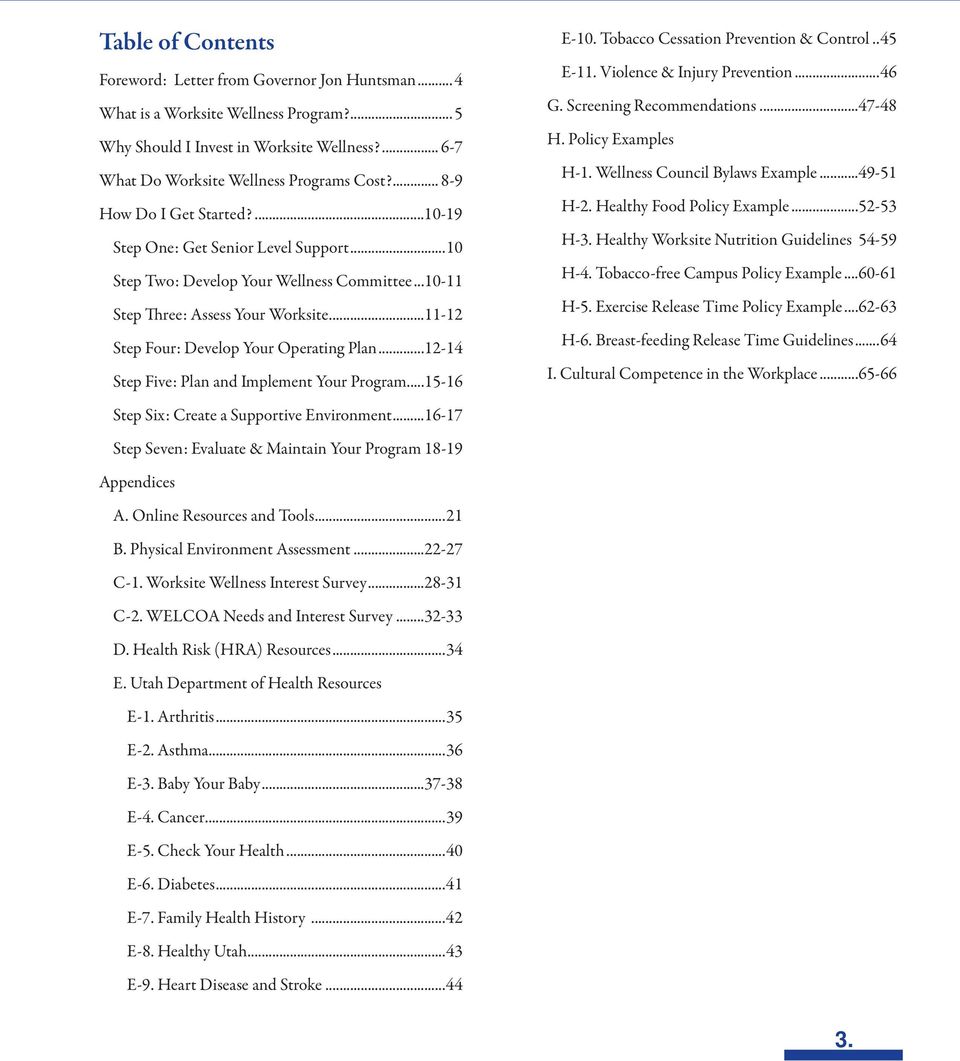
4 4. Foreward
5 What Is A Worksite Wellness Program? Worksite wellness encompasses the education and activities that an employer may do to promote healthy lifestyles to workers and their families. These programs often offer a variety of services that help employees maintain or improve their health. There is no perfect type of worksite wellness program. Each company is unique in its needs and must create a program that benefits both the employer and employees. However, the most successful programs have similar components: 1. Health education to build skills, change behaviors, and increase awareness, tailored to employees interests and needs. 2. Supportive social and physical environments that promote healthy policies and behaviors. 3. Integration of the worksite program into the company s structure. 4. Linkage to related programs like employee assistance programs (EAPs) and tobacco cessation resources. 5. Worksite screening programs ideally linked to medical care to ensure follow-up and treatment as necessary. 6. Follow-up interventions to support individual behavior change. 7. Evaluation to determine how the program is working and how it can be improved. 5.

6 Why Invest In Worksite Wellness? Employee health affects your company s bottom line. Worksite wellness programs can lower health care costs, increase productivity and staff retention, and improve morale. Because employees spend many of their waking hours at work, the workplace is an ideal setting to promote health and wellness. Wellness programs help control health care costs. Employees with risk factors such as being overweight, smoking, and diabetes pay more for health care and cost more to insure than people with fewer risk factors. Worksite wellness programs can help healthy employees remain in a lower-cost group. They can also help high-risk employees make lifestyle changes that improve health, enhance quality of life, and lower costs. Wellness programs can increase productivity. Simply put, healthy employees are more productive. Worksite wellness programs help reduce presenteeism, in which employees are physically present on the job but are not being productive. Wellness programs can reduce absenteeism. When employees are healthy they miss less work. And because healthy behaviors often carry over into the family, employees may miss less work caring for ill family members, too. Wellness programs can improve morale and enhance the company s image. Companies with worksite wellness programs save money by retaining workers who enjoy their wellness benefits. These companies are also seen as a better place to work because they care about employee health, giving them an edge in recruiting new employees. Treating employee health care as an investment, rather than a cost, can yield long-term dividends. Consider this: 6. The Rising Cost of Health Care An investment in your employees health may lower health care costs or slow the increase in providing that important benefit. In fact, employees with more risk factors, including being overweight, smoking and having diabetes, cost more to insure and pay more for health care than people with fewer risk factors. Preventable illnesses account for about 70 percent of all costs associated with illness. It is projected that health care costs will nearly double by 2017 (U.S. News and World Report, 2008). More and more research shows that poor diet and lack of exercise are major drivers of increases in health care costs for employers. The number of obese adults has doubled since the 1970s (www. dshs.state.tx.us/wellness). Obesity is causing rapid increases in type 2 diabetes and contributed directly to a 65 percent increase in diabetes treatment

7 from 1987 to Nearly $1 of every $5 spent on health care in the United States is for a person with diabetes ( The rise in obesity has a huge impact on health care costs. On average, 2002 health-care costs for an obese person were $1,244 higher than for a person with a healthy weight ( A study involving the Chrysler Corporation and the United Auto Workers Union showed that smokers generated 31 percent higher claim costs than non-smokers (Healthy Workforce 2010). Workers at an unhealthy weight had 143 percent higher hospital inpatient utilization than those at a healthy weight (Healthy Workforce 2010). Worksite Wellness Programs Can Help Overall, benefit-to-cost ratios of $3.84 in reduced health care costs and $5.82 in lower absenteeism costs per dollar invested ( wellness). Companies that support wellness and healthy decisions have a greater percentage of employees at work every day. Savings from small decreases in absenteeism can more than offset the cost of a health promotion program. Direct costs from lost time totaled nearly 15 cents of every dollar spent on payroll (Strum, 2002). In short, a wellness program is an investment in human capital. Employees are more likely to be on the job and performing well when they are in the best physical and psychological health. They are also more likely to be attracted to, remain with, and value a company that obviously values them. A company s productivity depends on employee health (Healthy Workforce 2010). Benefits to Employees Worksite wellness program participants may see a reduction in: Risk of dying from heart disease Blood pressure Risk of diabetes complications Feelings of depression, anxiety and stress These workers may also see improvements in their: Cholesterol Ability to manage weight Mental health Out-of-pocket health care costs Benefits to Employers Companies with worksite wellness programs tend to see improvements in: Quality and quantity of production Corporate image Community relations Job satisfaction Employee morale These companies tend to see a reduction in: Health care costs Staff turnover Absenteeism Presenteeism On-the-job injuries Worker compensation claims Work-related conflicts 7.

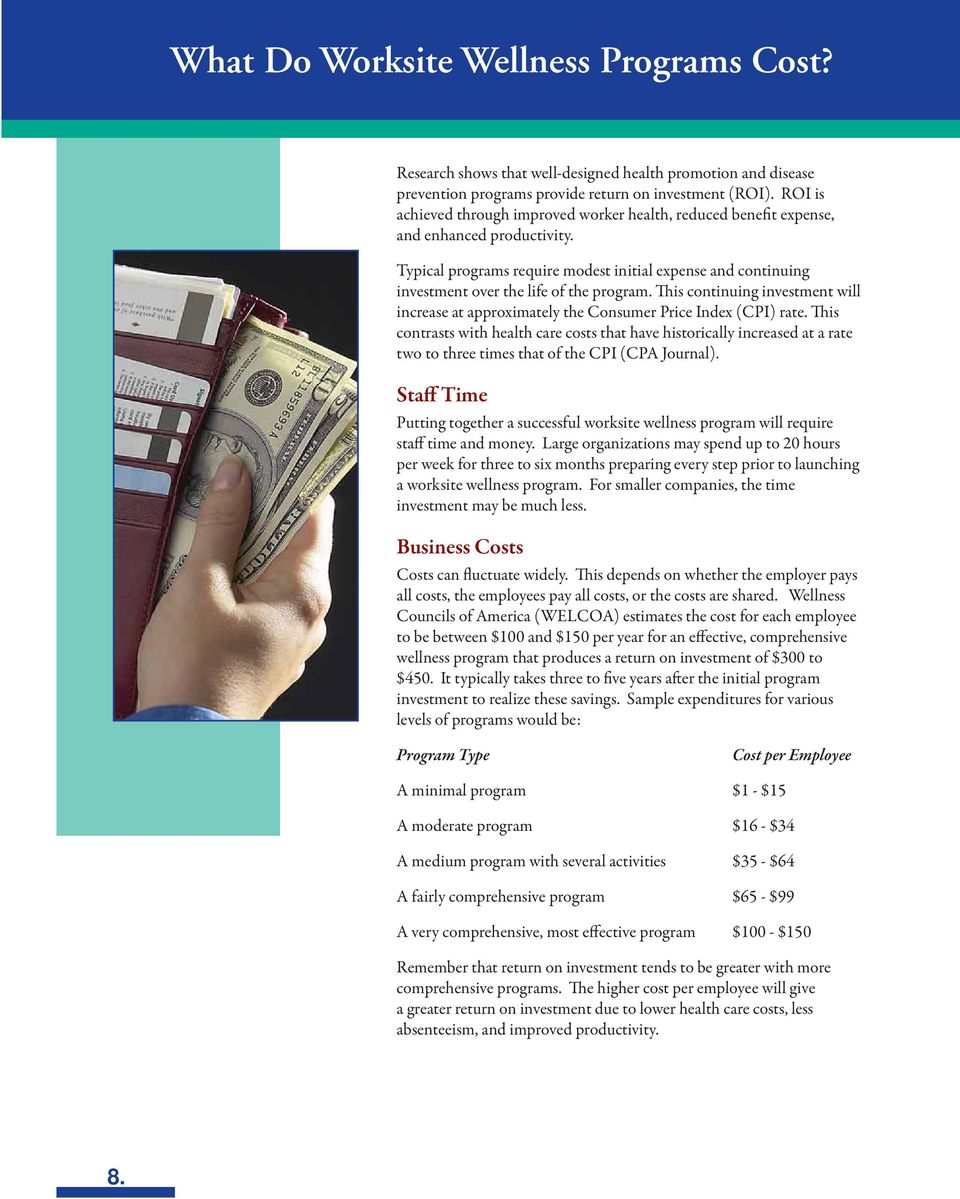
8 What Do Worksite Wellness Programs Cost? Research shows that well-designed health promotion and disease prevention programs provide return on investment (ROI). ROI is achieved through improved worker health, reduced benefit expense, and enhanced productivity. Typical programs require modest initial expense and continuing investment over the life of the program. This continuing investment will increase at approximately the Consumer Price Index (CPI) rate. This contrasts with health care costs that have historically increased at a rate two to three times that of the CPI (CPA Journal). Staff Time Putting together a successful worksite wellness program will require staff time and money. Large organizations may spend up to 20 hours per week for three to six months preparing every step prior to launching a worksite wellness program. For smaller companies, the time investment may be much less. Business Costs Costs can fluctuate widely. This depends on whether the employer pays all costs, the employees pay all costs, or the costs are shared. Wellness Councils of America (WELCOA) estimates the cost for each employee to be between $100 and $150 per year for an effective, comprehensive wellness program that produces a return on investment of $300 to $450. It typically takes three to five years after the initial program investment to realize these savings. Sample expenditures for various levels of programs would be: Program Type Cost per Employee A minimal program $1 - $15 A moderate program $16 - $34 A medium program with several activities $35 - $64 A fairly comprehensive program $65 - $99 A very comprehensive, most effective program $100 - $150 Remember that return on investment tends to be greater with more comprehensive programs. The higher cost per employee will give a greater return on investment due to lower health care costs, less absenteeism, and improved productivity. 8.
9 To estimate your costs and potential cost savings, visit: 1. American Cancer Society ROI Calculator for Obesity and Physical Activity, 2. Magellan Health Services Obesity Cost Calculator, For more detailed information on worksite wellness return on investment (ROI), visit v06n05.pdf Typical programs require modest initial expense and continuing investment over the life of the program. 9.
10 How Do I Get Started? There are a number of common elements in successful worksite wellness programs. These elements have been used to build quality, resultsoriented programs in hundreds of companies across the United States. Results-oriented programs have been carefully researched, designed, and implemented. They are focused not on just offering random programs and classes, but on impacting the company s bottom line through improved employee health. Using the following seven steps will help your program be resultsoriented rather than activity-driven. Your worksite wellness program can attain measurable results. Step One: Get Senior Level Support Getting upper management s buy-in is vital to starting an effective program. Employees must understand that their management is supportive of the wellness program. Use the information from previous sections of this toolkit to educate management of the importance of worksite wellness, from both a health and financial point of view. Once support has been cultivated from all levels of management, it is vital that high-level executives clearly and frequently convey the wellness message. Leadership by example is best. Written communication, public speeches, and incorporation of employee wellness into the company s mission are also very effective and should be encouraged. Communicate to all levels of management about the program and help them make worksite wellness part of the company culture. Small business owners or top managers who participate in a program encourage others to participate by their example. Step Two: Develop Your Wellness Committee A wellness committee/team is a diverse group of employees who work to improve the health and well-being of employees. It is ideal (but not necessary) to hire a full-time person to run your program; however, putting only one person in charge of a wellness program is a big mistake. A wellness team will ensure continuation of the program, even if the person in charge gets burned out, promoted, or takes a new job. 10. Not involving key members of your company on your wellness team can mean failure. Wellness teams are important because it is the people on these teams who actually get things done. Your wellness team should be comprised of workers from management all the way to front line employees. It is crucial to have the right people on your team doing the right things.

11 A wellness committee should be formed as early in the process as possible and should include: A cross-section of potential program participants. Individuals who may have a role in program implementation or evaluation. Someone to represent management. Wellness teams implement programs to help workers be healthy, and create environmental and policy changes. These changes within a company are some of the most cost-effective aspects of a wellness program. When a health promotion program is unfocused, it has little long-term impact. Established wellness teams provide an organized, systematic business approach to health promotion at the worksite. Step Three: Assess Your Worksite Studies show that when a health promotion program is unfocused, it has little long-term impact. So choosing the right kind of program is vital to its success, impact on employee health, return on investment, and ability of the program to be sustained. To be successful, worksite wellness programs should focus on helping workers achieve and maintain optimal health. This typically means improved nutrition, increased physical activity, stress reduction, tobacco cessation, and better blood pressure and cholesterol levels. Your company may have additional needs such as worker safety, repetitive injury prevention, fatigue management, or ergonomics. To determine the right focus for your worksite wellness program, an assessment should be completed. The purpose of completing the assessment is to identify your worksite s strengths and areas that you need to focus on. Assessment results can also be used as a baseline measure for evaluating your program later. Different assessments will produce different types of helpful information. In the appendices, you will find the following surveys and resources to use when assessing your worksite. Worksite Organizational Health Survey An organizational health survey is used to obtain information on your company s environment from both managers and the general workforce. This survey helps reveal the extent to which opportunities exist in the workplace to pursue and maintain a healthy lifestyle. Worksite Wellness Individual Interest Survey An employee survey is conducted to get a better understanding of your target audience and get an idea of their current health habits and areas of interest. 11.

12 A Health Risk Assessment (HRA) will help you identify the problems of your workforce and establish targets for improvement. Health Risk Assessment (HRA) A Health Risk Assessment (HRA) will help you identify the problems of your workforce and establish targets for improvement. By using the HRA, you can discover risk levels, determine helpful interventions, and measure results. HRAs help workers manage their health care and allow companies to control their health care costs. The three components of an HRA are: 1. Questionnaire 2. Risk calculation 3. Educational reports The results of an HRA are invaluable to a good worksite wellness program. On average, an HRA costs $15-50 per employee. However, many company insurance providers include HRAs as part of the benefits package. Check with your insurer when planning your health risk assessment activities. Physical Environment Data Examine the physical environment of your workplace, including workstation ergonomics, heating/ventilation, stairwell access, and cafeteria set-up. Employee Data Collect baseline information such as absenteeism, disability, workers compensation, modifiable health care claims, and demographic data. Step Four: Develop Your Operating Plan The operating plan is critical because it keeps everyone moving in the same direction when key players might want to do their own thing. It lets people perform their own tasks while staying aligned with the team. The plan will also serve as a communication with upper management, and will keep the program stable as membership turns over within the team. When creating your operating plan, include the following elements: Mission Statement. A program mission statement briefly lists the general values that drive the program and the ultimate goals that the project will strive to achieve. Mission statements do not have to be complicated, but should convey the vision for the program. Examples: The Wellness Council functions to enhance and foster the health and well-being of the XYZ Company employees, and Health from Hire to Retire. 2. Goals and Objectives. Goals are statements of broad, long-term accomplishments expected from the program. Objectives should be specific, measurable, achievable, relevant, and time-based. Each goal has one or more objectives established to ensure that the goal will be successfully accomplished.

13 Taking the time to determine goals and objectives is the only concrete way to demonstrate outcomes. They will serve as benchmarks when you evaluate your program and will help determine where to focus future efforts. Example: Goal: Enhance knowledge and skills among employees to affect and improve weight management capacity. Objective 1: By July 2010 a minimum of 100 people will successfully participate in an approved weight management program. Objective 2: Provide weekly information to 100% of employees about weight management. 3. Timeline. Timelines state what needs to be done and when it needs to be accomplished. Make sure your timeline is realistic, giving just enough pressure to do things but not so much that people burn out. 4. Budget. Budgets force the team to figure out what the program is going to cost. Consider things like printing, materials, health risk appraisals, incentives, staff time, release time for employees to participate, evaluation, etc. An accurate budget will allow the wellness team to compare program costs and outcomes during the program evaluation. Remember that programs with moderate costs are more likely to achieve cost-savings. Adjust your budget according to the types of resources you have. The operating plan is critical because it keeps everyone moving in the same direction when key players might want to do their own thing. Low Resource Examples Largely paper program. Monthly newsletter. Posters hung around the office promoting health. Health education and information pamphlets. Medium Resource Examples Health fair as a program kick-off. Preventive wellness screenings. Confidential health risk appraisals. High Resource Examples Provide health care coverage for prevention and rehabilitation of chronic disease. Adding weight management, nutrition, and physical activity counseling as a member benefit in health insurance contracts. Hire a team to do worksite wellness appraisals on-site. Offer on-site fitness opportunities, like group classes or personal training. 13.
14 Sell the program by explaining to employees what is in it for them. 5. Marketing. No one will join your program if they don t know what is going on or how they can get involved. You want to let workers know that the program exists and that senior management wants them to participate. Use a mix of upbeat methods to promote the program including bulletin boards, pamphlets, payroll inserts, voic messages, electronic billboards, messages, etc. Remember to sell the program by explaining to employees what is in it for them. The best marketing tool of all is a happy program participant who advertises for you via word-of-mouth. A creative program name and logo will help create a positive image, too. 6. Evaluation. Outline how you will evaluate your program. Include participation; satisfaction; changes in knowledge, attitudes and behaviors; and changes in environment and culture. Make sure your evaluation links back to your goals and objectives. Below, we build upon our previous goal/objective example to include an evaluation section. Example: Goal: Enhance knowledge and skills among employees to affect and improve weight management capacity. Objective 1: By July 2010, a minimum of 100 people will successfully participate in an approved weight management program. Objective 2: Provide weekly information to 100% of employees about weight management. Goal Evaluation: Document the number of weight management program participants. Document the number of total pounds lost among weight management program participants. Document the number of employees receiving weekly weight management messages. 14.

15 Step Five: Plan and Implement Your Program Results from the assessments you performed during step three are now going to be used to determine your wellness program s focus. Offer programs that are consistent with your company s needs and what your workers want. To be successful, your program should include educational efforts that address knowledge, attitude, and behavior change. The program should also have skill building sessions and social support. When planning the interventions for your program, consider these issues: Offer programs that are consistent with your company s needs and what our workers want. 1. The programs. Programs that are generally great for any working population include physical activity, nutrition/weight management, smoking cessation, stress management, ergonomics, disease management, financial management, and work/family balance. Your data may point to other specific needs, such as fatigue management, worker safety, or repetitive injury prevention. 2. The timing. Determine the best times to offer programs. Some may need to be scheduled monthly or quarterly, while others are best offered annually or every couple years. The activities should be scheduled at times that are convenient for potential participants. For example, it may be necessary to offer multiple activities before and after work to meet the needs of shift workers. 3. The population (spouses, dependents, retirees, part-time workers). Your budget and resources will help you determine the extent to which you can reach people. Note that healthy behaviors are most likely to be sustained when they are reinforced at work and home, so spouses can be an important group to include in your program efforts. 4. The incentives. Incentives are offered to build motivation by offering rewards for healthy behaviors. Incentives also create interest in joining/ completing the program. When you provide incentives, the company sends the message that it is committed to employee health. Some examples of incentives could be contributions to a health promotion medical savings account, merchandise awards, extra time off from work, travel awards, or discounts to health clubs. A common incentive for important behavior changes is discounted health insurance premiums. Consider these additional incentive tips: Ask workers what incentives they value most. Figure out what incentives the company can provide. Integrate your incentives into your benefits strategy. Offer participation incentives. Make sure every participant who achieves a goal receives some recognition. Use incentives to promote your worksite wellness program through logos and branding. Avoid rewards for biometric changes (i.e., pounds lost, cholesterol improvements). 15.

16 Encourage employees to consult a physician before starting any type of exercise or nutrition program. Avoid offering incentives for the best or the most. This tends to discourage participation by those who are likely to get the most benefit from joining. When planning your program, you may find it useful to pull the goals and objectives from your operating plan and add in your strategies. Strategies are the specific programs, services, and activities you will offer in order to meet your objectives. Strategies may change from year to year as you evaluate and adjust your program, but your goals and objectives are more likely to remain consistent over time. Example: Goal: Enhance knowledge and skills among employees to affect and improve weight management capacity. Objective 1: By July 2010, a minimum of 100 people will successfully participate in an approved weight management program. Strategy A: Offer an on-site Weight Watchers at Work class. Strategy B: Contract with a registered dietitian to teach a monthly nutrition class. Objective 2: Provide weekly information to 100% of employees about weight management. Strategy A: Utilize the company system weekly to educate members on a topic related to weight management. Strategy B: Include one article on a weight management topic in each monthly employee newsletter. Once your program is planned, it is finally time to put your plan into action! Consider a kick-off event that is fun and inviting to all. A good rule to follow is to begin the program slowly and lead off with the activities most likely to succeed. Step Six: Create a Supportive Environment Studies show that healthy, long-term changes occur only when a worksite s environment and policies support employee health. Creating a company culture where wellness is encouraged will reinforce healthy behaviors. For instance, teaching workers about nutrition will have little impact if the only on-site food choices are unhealthy. Offering smoking cessation classes won t do much good if smoking is allowed on campus and in company vehicles. Your company environment can promote participation in your wellness program. Specific policies that address release time to participate in wellness activities during the workday can dramatically increase participation. Make sure to include shift workers and those at remote sites when considering these types of policies. 16.
17 The following are some examples of environment and policy changes that can be done at your worksite to improve the health of your employees: Nutrition Offer healthy menu choices at each work meeting, conference, and training where food is served. Post healthy eating messages in cafeterias, break rooms, and vending areas. Offer healthy choices at on-site cafeterias. Set up a break room with microwaves and refrigerators so employees can bring lunches from home. Have fruit and vegetable choices available at the worksite (community fruit bowl, cafeteria, and/or vending). Adopt a policy that requires healthy choices be offered and labeled in vending machines. Physical Activity Encourage workers to exercise by adopting an exercise release policy of 30 minutes during lunch breaks, three times per week, with supervisor approval. Promote the use of stairs as a way to get more daily physical activity. Educate employees about trails and pathways that are safe and near worksites. Hold organized sports activities at work (walking, Ultimate Frisbee, basketball, etc.). Sponsor on-site aerobics or yoga classes. Hold an annual golf tournament. Offer an on-site shower and changing facility. Place equipment near gathering areas (break room, copy machines) for office workouts. Ensure stairwells are well lit, easily accessible, and inviting. Stress Management Promote your Employee Assistance Program (EAP). Offer on-site massage services. Sponsor a healthy employee spotlight/recognition program. Develop a worksite relaxation center. Tobacco Cessation Adopt a tobacco-free campus policy (no tobacco use on campus grounds). Provide tobacco cessation, counseling, and medication to employees. Enforce the Utah Indoor Clean Air Act (including no smoking within 25 feet of the building). See appendices for examples of healthy policies you can modify and use. 17.

18 If your company does not have the resources to complete each type of evaluation, concentrate on the types you have the capacity to do. Step Seven: Evaluate and Maintain Your Program Annual evaluation is the step that will tell you which parts of your program are working and those that need help. Long-term survival of the program will depend on the ability to show that progress is being made. A well-designed evaluation will help you determine 1) how well the program is working, and 2) if it is achieving expected results. Evaluations will provide you with information to improve your program and to measure whether any changes have occurred with the participants. The Wellness Councils of America recommends evaluating the following eight targets ( If your company does not have the resources to complete each type of evaluation, concentrate on the types you have the capacity to do. 1. Participation. This basic measure will tell you how many employees are utilizing the wellness program. 2. Participant satisfaction. This type of evaluation is typically given at the end of a specific campaign. Responding to what your participants want gives them a sense of ownership in the wellness program. It may also be useful to ask people who are not participating why they choose not to do so. 3. Improvements in knowledge, attitudes, and behaviors. These three items are important when discussing the outcomes of results-oriented programs. Standardized tools are available to help evaluate these measures. 4. Changes in biometric measures. Evaluate changes in measures such as cholesterol levels, blood pressure, body weight, and body mass index (BMI). 5. Risk factors. The goal of risk factor evaluation is to identify individuals at high risk and help them so they don t develop additional risk factors. With low-risk employees, try to keep them from moving to a higher risk status. 6. Physical environment and corporate culture. Measure changes in the corporate culture and physical environment to ensure this support for employee health is happening. 7. Productivity. Measuring things like absenteeism, turnover, and morale can help you determine the impact your wellness program is having. 8. Return on investment. This gold standard of evaluation efforts is an excellent measure, and often requires outside investment and expert consultation. Modify the Program as Needed Every wellness program changes along with the needs and interests of employees and employers. After gathering your evaluation data, figure out the elements of your wellness program that show progress with your employees and areas of the program that need to be improved. Use your data to make strategy changes while still focusing on the goals and objectives you set in your Operating Plan. 18.
19 Maintain Participation and Interest Once the excitement of a new worksite wellness program has faded, you might find yourself needing to bolster interest to increase participation. Consider these tools to help you maintain interest in your program: 1. Target communications. Personalized messages to workers have increased participation five-fold in some worksite programs. 2. Conduct regular needs assessments. Repeat the assessments you completed in Step Three to ensure that your program is adapting to changing interests and concerns. 3. Offer a variety of intervention options. This helps to ensure that each employee can find an aspect of the wellness program that works best for him or her. 4. Use incentives wisely. Well-conceived incentives can be expected to increase program participation rates by 12 to 35 percent. For example, offering a financial incentive can greatly increase the rate of participation in an HRA. 5. Create and maintain a worksite culture of good health. This will help your employees stick with their health goals. 6. Measure participation continuously. Document how many people complete the initial assessment, how many drop out of the program, and how many complete the follow-up assessments. 7. Involve people in planning. Broad employee involvement stimulates interest and ownership of the program. Encourage wellness team members to talk up the program informally, even before the program starts. Word of mouth is one of the best marketing tools. 8. Ask people what they want and give it to them. A needs assessment survey builds a sense of anticipation and excitement that can help increase participation. 9. Make the program fun. People enjoy doing fun things. Create a festive atmosphere for your program activities. 10. Remove barriers. Make program activities easy to join, easy to participate in, and conveniently located. A needs assessment survey builds a sense of anticipation and excitement that can help increase participation. 19.

20 Notes

21 Appendices Appendix A: Online Resources and Tools Program Planning WELCOA s Seven Benchmarks of Success. The Wellness Councils of America (WELCOA) has developed this indepth description of their seven gold standard steps to developing a results-oriented wellness program. WELCOA s Free Resources. Find a wide variety of useful information that can assist you in your quest to build a results-oriented wellness program. Includes: free reports, expert interviews, presentations, surveys and samples, and case studies. Cost/Savings Information To estimate your costs and potential cost savings, visit: American Cancer Society ROI Calculator for Obesity and Physical Activity Magellan Health Services Obesity Cost Calculator Detailed information on worksite wellness return on investment (ROI) General Worksite Wellness Program Information Centers for Disease Control and Prevention (CDC) Healthier Worksite Initiative. This site is designed for worksite health promotion planners. You will find information, resources, and step-by-step toolkits to help you improve the health of your employees. CDC s Guide to Community Preventive Services Worksite. The topics and their related interventions selected by the CDC as priorities for worksite health promotion. The National Institute for Occupational Safety and Health (NIOSH). A site dedicated to preventing work-related illnesses and injuries. The Utah Council for Worksite Health Promotion. Your local connection to worksite health promotion and wellness information. The UCWHP provides an annual worksite health promotion conference, a worksite awards program, resources for implementing wellness programs, and links to the best worksite wellness web services
22 Appendix B: Physical Environment Assessment Example 1.0 Preliminary Information 1.1 Name of Company: 1.2 Name of Rater: 1.3 Date of Interview: 1.4 Name of Interviewee: 1.5 What is your current position? 2.0 Organizational Demographics 2.1 Is the worksite self-insured for employee health and medical benefits? (circle the correct response) 1 Yes 0 No 2.2 About what percent of the workforce is unionized? (circle the response) 1 0% % % % % 2.3 As of the last payroll and not counting temporary or seasonal employees, how many employees: # # work here? are under 40? work full time? are Caucasian/White? work part time? are African American? are female? are Hispanic? 2.4 Excluding any security staff, which of the following work shifts does this worksite have? (circle all that apply) 1 day 2 evening 3 night 4 other: 2.5 Does the worksite occupy more than one building? 1 Yes 0 No 2.6 What percent of your employees are eligible to participate in your health plan? 1 0% % % % % 2.7 What percent are enrolled in your health plan? 1 0% % % % % 3. Smoking YES NO Does the worksite have a written smoke-free work environment policy? If no, skip to question
23 3.1.1 What is the extent of the smoking ban? (circle the most appropriate response from the values below) 1. a partial ban on smoking (designated or de facto smoking areas in the building) 2. smoking allowed on the grounds but not in the building or jobsite 3. a total ban throughout the premises (including grounds) Is the policy enforced? For example, are there any penalties for individuals who do not comply with the policy either verbal or written? 3.2 Does the worksite provide any type of incentives for being a non-smoker or quitting smoking? Incentives could include: improved benefit allowances (discounted health insurance, increased disability payments, additional life insurance), added vacation well days off, direct cash payments or bonuses, material prizes or awards, etc. 3.3 Can tobacco products be purchased anywhere at the worksite (e.g., vendors)? 4. Nutrition YES NO Does the worksite have vending machines in each building for employees to access food during working hours? If no, skip to question Are there healthy options available in the vending machines? (e.g., low-fat granola bars, low-fat yogurt, fresh fruit) 4.3 Do the people who manage the vending machines provide labels to identify healthy foods?* (e.g., Apples are healthy and low fat! ) Note: This refers to information in addition to what is given on the product s label. They are not messages attached to commercialized food packages such as statements like lite, low fat or sugar free. 4.4 In the past 12 months, has the worksite had any special promotions or sales of low fat foods, fresh fruits, vegetables, etc., in the vending machines? Does the worksite have a cafeteria or regular catering service? If no, skip to question Are healthy food options offered in the cafeteria or regular catering service? (e.g., whole grain sandwiches, tossed salads, fresh fruit) 4.7 Does the worksite provide labels to identify healthy foods in the cafeteria? 4.8 Does the worksite provide written policies that require healthy food preparation practices in each cafeteria (e.g., steaming, low fat/salt substitutes, limited frying)? 4.9 Did the worksite provide any special cafeteria promotions in the last 12 months to increase the sale or consumption of low fat foods, fresh fruits, vegetables, etc.? 4.10 Does the worksite encourage provision of nutritious food options at employee meetings? 4.11 Does the worksite raise the price of unhealthy foods to encourage employees to purchase lower priced healthier selections? 4.12 Does the worksite require caterers to provide healthy food options? (e.g., whole grain sandwiches, tossed salads, fresh fruit) 5. Physical Activity YES NO 23.
24 5.1 Does the worksite have an on-site exercise facility? If no, skip to question Is the facility open at convenient times (before and after normal work hours, weekends)? Does it provide aerobic equipment (e.g., bikes) or facilities (track, pool)? Does the worksite promote the availability of the exercise facility? Is the facility free for employees? 5.2 Does the worksite subsidize (pay some of the costs of) an off-site exercise facility membership? 5.3 Does the worksite sponsor any employee sports teams? 5.4 Does the worksite provide or maintain outdoor exercise areas or playing fields outside each building for employees? 5.5 Does the worksite have a written policy statement supporting employee physical fitness? (e.g., policies that allow workers additional time off from lunch to exercise, walk breaks, stretching) 5.6 Does the worksite have a written flex-time policy which allows employees to be physically active during the work shift? (e.g., flex-time means employees can, for example, come in early so that they can extend lunch for physical activity) 5.7 Is the area surrounding each worksite building within one mile of a safe and pleasant place to walk, run, or bike? 5.8 Are there bike racks at each worksite building available for employees? 5.9 Does the worksite provide any incentives for engaging in physical activity? (e.g., improved benefit allowances (discounted health insurance, additional life insurance), added vacation well days off, direct cash payments/bonuses, material prizes or awards, etc.) 5.10 Does the worksite provide a shower and changing facility in each building for employees? 5.11 Are there any stairways at your worksite building? If no, skip to question Are the stairways clean and safe? Are the stairways accessible and clearly marked? Has stairway use been promoted by the worksite in the last 12 months? 6. Screening or assessment YES NO 6.1 During the previous 24 months, has the worksite provided any of the following screenings or assessments (beyond pre-employment physicals): (If answering no to , go to section 7) blood pressure cholesterol blood glucose health risk assessments fitness assessments 24.
25 6.1.6 weight, height and BMI 6.2 If answered Yes to any of the questions in section 6.1, was the program: Free to employees Available to employee s family members Offered at a time that was convenient for employees to attend Who conducted the screening? Employee of worksite contractor Health Plan Other: 6.4 Does the worksite administration have access to the aggregate screening or assessment information? 6.5 Does your worksite or health plan offer employee s incentives to participate in health screenings or assessments? 7. Programs/Educational Messages YES NO 7.1 During the previous 24 months, did the worksite provide or promote insurance company-sponsored programs in the areas listed below? High blood pressure control High blood cholesterol control Diabetes management Tobacco cessation Weight control or healthy eating counseling/advice Fitness (other than use of an exercise facility, e.g. walking programs) 7.2 If answered Yes to any of the questions in section 7.1, were the program(s): (circle all that apply) Free Subsidized Full Price To employees To employee family members 7.3 In the previous 12 months, has the worksite provided health and wellness messages to the general employee population on any of the topics listed below? (e.g., posters, brochures, videos) Signs and symptoms of heart attack Signs and symptoms of stroke Blood pressure levels Cholesterol levels Diabetes Management Call in case of an emergency Tobacco cessation Healthy eating (weight control) Exercise/ Physical fitness 7.4 If answered Yes to any of the questions in section 7.3, did the insurance provider offer discounted policy premiums for promoting these messages? 25.
26 7.5 Does the employer or the employer-sponsored health plan provide follow-up risk factor counseling and education for the following? High blood pressure control High blood cholesterol control Diabetes Management Tobacco Cessation Weight control or healthy eating counseling/advice Fitness (other than use of an exercise facility, e.g. walking programs) 8. Administrative Support YES NO 8.1 Does the worksite have a wellness committee? Does the committee meet at least quarterly? Is it represented by a cross section of the workforce? Does it include at least one senior manager? Is there a written mission or goal statement for the committee? Does the committee have a budget? 8.2 Does the worksite have an individual responsible for employee health and wellness programs? If no, skip to question 8.3 Are at least half of his/her responsibilities devoted to health promotion? Does the individual have a budget to work with? 8.3 Does the worksite link its employee wellness program to the company s overall business objectives? (written strategic plan) 8.4 Does the worksite organizational mission statement contain references to improving/ maintaining employee health? 8.5 Does the worksite provide management support for worksite health promotion? For example, does the CEO/manager provide at least annual messages supporting health promotion (personal address, memo, newsletter article, etc.)? 8.6 Does the worksite offer members incentives to participate in lifestyle and behavior education/modification programs (e.g., no cost to members, discounts to fitness centers)? 8.7 Does the worksite measure the return on investment (ROI) for health and wellness prevention efforts? If no, Skip to section How is ROI measured by your worksite? 9. Cardiopulmonary Resuscitation (CPR)/Automated External Defibrillator (AED)/Blood Pressure YES NO 9.1 Does your worksite offer training in CPR, also called Basic Life Support? (If yes, go to question 9.1.1, if no, go to question 9.2) Are these classes available for all employees? 26.
27 9.1.2 Are these classes available to family members of employees? Is the cost of the class free? Is the cost of the class subsidized? 9.2 Does your worksite require that at least one person with CPR certification be on-site at all times? 9.3 Does your worksite have at least one AED on each floor/jobsite of your worksite? If yes, answer question If no, go to question 9.4 Has your worksite registered the AED(s) with your local Emergency Medical Service (EMS) and/or other entities required by ordinance, such as a local city AED registry? In the event of an emergency, can the AED(s) be administered by a trained employee within 5 minutes? Are trainings available for all employees to learn how to use the AED? Does the worksite have trained, designated employees on each floor/unit who will assist a person in need with an AED? Does the worksite require that somebody with AED training be on-site on each floor/unit at all times? Is there a dedicated employee to conduct monthly maintenance of the AEDs? 9.4 Outside of screening events, does your worksite have permanent on-site access for employee to check their blood pressure? 10. Program Evaluation of Wellness Program/Activities 10.1 Does the worksite conduct program evaluation of wellness programs/activities? 10.2 Does the worksite share results of program evaluation with employees? 10.3 Does the worksite use program evaluation results in future program planning and implementation of wellness programs and activities? 27.
28 Appendix C - 1: Worksite Wellness Individual Interest Survey 1. Which workplace health areas would you like information or training on? Injury prevention Communication Stress Management Organizing and managing work Other, please specify 2. What healthy living areas would you like information or training on? Eating healthier foods Easy, healthy cooking Weight management Physical activity, exercising more Relieving depression Quitting smoking/chewing tobacco Alternative health practices (i.e., biofeedback, chiropractic care, meditation, mind/body therapy) Other, please specify 3. If the wellness council either provided or purchased a monthly newsletter with information regarding many types of health information what is the likelihood that you would read it? Read it every time 100% Read it most of the time 75% Read it occasionally 50% Read it sometimes 25% Never read it 4. What life skills areas would you like information or training in? Mark all that apply. Balancing work and family Time management Relationships and communicating Conflict resolution Personal financial management Retirement planning/budgeting Other, please specify 5. I am currently participating in (mark all that apply). Regular exercise programs either organized or self-directed Organized sports activities Weight loss programs Counseling for personal issues Other, please specify 28.
29 6. How many times per week do you exercise (a minimum of 30 minutes per session)? 0 times per week 1-2 times per week 3-5 times per week 6-7 times per week Other, please specify 7. Do you feel you get enough physical exercise? Yes No Additional Comment 8. Do you participate in or use any of the following. Mark all that apply. Walking Trail Gym Fitness center/weight room Home Fitness Equipment Other, please specify 9. If you do not use any of the above, what are your reasons for not doing so? Too busy Not enough equipment Don t know how to operate equipment Don t like to sweat during the work day Childcare Other, please specify 10. If a group fitness activity was organized (i.e. hiking, walking, sports, etc.) would you participate? Yes No Additional Comment 11. What wellness seminar topics interest you? Physical activity Nutrition/healthy food choices Stress management General health Mental health Elder care/parent care Raising healthy children Alternative health practices (i.e. Massage therapy, chiropractic care, meditation, biofeedback, etc.) Other, please specify 29.
30 12. What time would you prefer a brown bag lunch seminar to start? 11:00 11:30 12:00 12:30 1:00 Other, please specify 13. How often to do you go out for lunch? 0 times per week 1 time per week 2 times per week 3 times per week Other, please specify 14. In general would you say your physical health is: Excellent Very Good Good Fair Poor 15. In general would you say your mental health is: Excellent Very Good Good Fair Poor 16. How would you like to get your health and lifestyle information. Mark all that apply 1 on 1 counseling in person with a health professional 1 on 1 counseling over the phone with a health professional Internet Class, workshop or seminar Books Health fairs or screenings Health incentive programs Printed materials (pamphlets, self directed programs, workbooks, newsletters, magazines) Video/DVD Other, please specify 30.
31 17. Which incentives would help motivate you to become healthier? Mark all that apply. Money Paid leave (Not available for spouses and part-time employees) Competition Swimming pool pass or Recreation Center pass T-shirts/hats Recognition Drawings for prizes (i.e., gift cards, electronics, massages, DVDs, CDs, etc.) Other, please specify 18. Other interests, questions, or comments? 31.
32 Appendix C - 2: WELCOA Needs and Interest Survey Needs & Interest Survey Fort Martin/Albright Region Worksite Wellness Program Needs & Interest Survey Please indicate how likely you would be to participate in each of the following programs if they were offered at work during the next year. Extremely Likely Somewhat Unlikely 1. Body Fat Testing Educational Programs: a) Back Safety b) Cancer Prevention c) Heart Disease Prevention d) Stroke Prevention Programs e) Cholesterol Reduction f) Home Safety g) Substance Abuse h) Headache Prevention & Treatment i) Cold / Flu Prevention & Treatment Employee Assistance Programs: a) Depression Treatment b) Financial Management c) Job Stress Management d) Accepting Change e) Parenting Difficulties f) Managing Chronic Health Conditions (diabetes, hypertension,...) g) Managing Chronic Pain (neck & shoulder injuries, back injuries, ) h) Controlling Anger / Emotions Fitness Programs: a) Corporate Fitness Membership Rates b) Exercise Tolerance (STRESS) Testing c) On-Site, Low-impact Exercise Equipment d) Prescribed Exercise Programs e) Stretching Programs f) Walk-Fit Programs Immunization Programs: a) Flu Shots b) Tetanus Shots c) Lyme Disease Vaccine d) Hepatitis 'B' Vaccine Wellness Councils of America Continued 32.
33 Appendix C - 2: WELCOA Needs and Interest Survey (continued) Needs & Interest Survey 6. Nutrition Education Programs: a) Healthy Cooking (meals/snacks) b) Healthy Eating (do's & don'ts) c) Weight Management Programs (diet & exercise) d) Onsite Vending Machines with Healthy Choices Screening Programs: a) Blood Pressure Checks b) Blood Sugar (diabetes) c) Cholesterol Levels d) Multiphasic Blood Screenings e) Cardiovascular (EKG's) f) Colon / Rectal (cancer) g) Prostate Checks (PSA) h) Stool Checks (bowels) i) Mammograms j) Vision k) Other Specify Smoking Cessation Programs Stress Reduction Programs Time Management Programs Visiting On-site Healthcare Nurse Self-Help / Self-Care Extremely Likely Somewhat Unlikely Please indicate how likely you would be to participate in health promotion programs during the following times: 13. Health Promotion Programs a) Before Work b) During Lunch at Work c) After Work ANY OTHER INTEREST OR SUGGESTIONS (PLEASE SPECIFY) Please list any positive (or negative) comments regarding the impact of the current Wellness Program. Include how this program may have affected you personally. List any suggestions on how we can improve the current program or things you would like to see implemented. Your input is an IMPORTANT element to the success of our program Wellness Councils of America 33.
34 Appendix D: Health Risk (HRA) Resources Health Risk Assessment Resources Wellsource: Wellstream : Stay Well: Summit Health: Well Call: Trale Inc.: PreceptGroup: RealAge: 34.
35 Appendix E - 1: Utah Department of Health, ARTHRITIS Program Resource Sheet What is Arthritis? The word arthritis means inflammation of the joint. There are more than 100 types of arthritis. The most common type, Osteoarthritis also known as degenerative joint disease is caused by worn and/or damaged cartilage. When this happens, bone begins to rub against bone, causing discomfort. The three most common symptoms of arthritis people need to be aware of are: Swelling in or around a joint Heat and/or redness in or around a joint Pain in or around a joint Arthritis is more likely to occur if: You re past age 45 You ve had a joint injury You re a woman Your parents have/had it You re overweight You re inactive Ideas for Employers Wellness Messages-risk factors and what to do if you have arthritis Arthritis Education and Management Programs with individual goal-setting Physical Activity Programs for employees that focus on range of motion Low-cost, nutritious food in cafeterias and snack bars; point-of-purchase information Places for physical activity: marked walking paths, signage to encourage stair use Health clubs/gyms Incentives to engage in healthy behaviors References Contact Information Phone: (801) [email protected] Website: 35.
36 Appendix E - 2: Utah Department of Health, ASTHMA Program Resource Sheet What are Asthma and Work-related Asthma? Asthma is a chronic inflammatory disease of the lungs. During an asthma attack, the linings of the airways become inflamed and swell, more mucus is produced, and the muscles around the airway tighten, making the opening in the airway smaller. Work-related asthma is asthma that is caused by, or made worse by, exposures or triggers in the workplace. Ideas for Employers Ensure that formularies include a wide range of asthma medications and equipment. Ensure that health plans are appropriately screening, diagnosing, treating and managing individuals with asthma. Educate your employees about asthma. Support smoking cessation programs for your employees. Ensure that your worksite has clean and safe air and is asthma-friendly by banning smoking at and around the worksite and reducing or eliminating sources of mold and mildew. Use regular maintenance activities such as cockroach control, leak prevention, heating/cooling system cleaning, and window sealing. (Adapted from: Managing Child Asthma: Prevention and Treatment, National Business Group on Health, May 2005) References Contact Information Phone: (801) [email protected] Website: 36.
37 Appendix E - 3: Utah Department of Health, BABY YOUR BABY Program Resource Sheet What is Maternal and Child Health in the Workplace? Women are the fastest-growing segment of the U.S. labor force. Approximately 70% of employed mothers with children younger than 3 years work full time. One-third of these mothers return to work within 3 months after birth and two-thirds return within 6 months. Approximately 60% of children and 66% of pregnant women are covered by employer-sponsored benefits. Maternal and child health is important to business. Maternal and child health care services (e.g., labor and delivery, childhood immunizations) account for $1 out of every $5 large employers spend on health care. Furthermore, a substantial proportion of an employee s lost work time can be attributed to children s health problems. And pregnancy is a leading cause of short- and long-term disability and turnover for most companies. Employers who provide evidence-informed, highvalue health benefits and innovative family-friendly work/life benefits can lower their health care costs, improve employee productivity, and reduce turnover. Working outside the home is related to a shorter duration of breastfeeding, and intentions to work full-time are significantly associated with lower rates of breastfeeding initiation and shorter duration. Low-income women, among whom African American and Hispanic women are overrepresented, are more likely than their higher-income counterparts to return to work earlier and to be engaged in jobs that make it challenging for them to continue breastfeeding. Given the substantial presence of mothers in the work force, there is a strong need to establish lactation support in the workplace. Barriers identified in the workplace include a lack of flexibility for milk expression in the work schedule, lack of accommodations to pump or store breast-milk, concerns about support from employers and colleagues, and real or perceived low milk supply. Ideas for Employers Worksite opportunities to support Maternal and Child Health include: Educate employees to help make better health care decisions. Provide health care coverage, which includes preventive services. Communicate breastfeeding support policies to all employees. Provide a small, private space for a lactation room (that is not a restroom) with a sink nearby for handwashing and washing of pump parts. Worksites may also wish to provide a refrigerator for storage of expressed milk. Allow flexible breaks to allow women to breastfeed or express milk. Consider flexible scheduling options, part-time work, or job-sharing. Provide on-site child care. Resources March of Dimes Healthy Babies, Healthy Business 37.
38 Premature birth is a serious, common and costly problem. Since 1981, the rate of premature birth has increased approximately 30%, accounting for more than 500,000 babies a year. It s the leading cause of newborn death and may result in lifelong disabilities. Nearly 50% of the total charges for infant hospital stays in 2002 were for babies who were born too soon or too small. March of Dimes has created a free tool to help employees make better health care decisions. Healthy Babies, Healthy Business is a multi-dimensional health education program for the workplace. It offers resources to help companies improve employee health and the health of the company s bottom line, including health and wellness information for the company web site or intranet and access to March of Dimes information specialists. The Business Case for Breastfeeding Companies successful at retaining valued employees after childbirth find that two components can make a difference: providing dedicated space for breastfeeding employees to express milk in privacy, and providing worksite lactation support. The Utah Breastfeeding Coalition will provide you with direct assistance in developing a lactation support program for your employees. Centers for Disease Control and Prevention: Nation Women s Health Information Center: United States Breastfeeding Committee: Washington Business Group on Health: LaLeche League International: Contact Information Phone: [email protected] Website: 38.
39 Appendix E - 4: Utah Department of Health, CANCER Program Resource Sheet Why is Cancer Prevention Important? Cancer is the second leading cause of death in the U.S., accounting for one of every four deaths. According to the American Cancer Society, 1,437,180 new cancer cases are expected to be diagnosed, and about 565,650 Americans are expected to die of cancer in About one-third of these deaths will be related to overweight or obesity, physical activity, and nutrition, with another 170,000 caused by tobacco use, all of which could be prevented. The costs of cancer not only affects the individual, but society as a whole. Regular screening for certain cancers can increase the chances of discovering cancer early, when treatment is more likely to be successful. Here are some tips to help employers combat cancer in the workplace: Ideas for Employers Choose employee health plans that provide cancer screening and access to cancer care Educate employees on the importance of cancer screening Provide easy access to screening by providing employees time off or flextime for screening appointments Organize on-site screening programs Provide information on cancer clinical trials References Contact Information Phone: Website: [email protected] 39.
40 Appendix E - 5: Utah Department of Health, CHECK YOUR HEALTH Program Resource Sheet What is Check Your Health? Check Your Health encourages all Utah families to make healthy food choices, develop a regular family mealtime, use correct portion sizes, and get at least 30 minutes of moderate to vigorous physical activity every day. Ideas for Employers Nutrition and Activity Tracker Provide this guide to employees to help them recognize and manage eating patterns and activity level. Guide to Healthy Eating An excellent guide that teaches that with a little planning, substituting, and creativity, eating will be more fun, flavor-filled, and healthy for you and your family. Medication Management Checkbook Provides individuals a place to collect information on the medicines they take and other important medical information. Workouts on the Web Workout segments available to watch via computer or podcast. Each exercise is available in PDF format to print and keep as well. Healthy Cooking Fresh From the Kitchen Cooking segments are available to watch via computer or podcast. The recipes and nutritional analysis are available online in PDF format to print and keep as well. References and click on Workouts on the Web Contact Information Phone: [email protected] Website: 40.
41 Appendix E - 6: Utah Department of Health, DIABETES Program Resource Sheet What is Diabetes? Diabetes is a disease in which the body does not produce or properly use insulin. Insulin is a hormone that is needed to convert sugar, starches, and other food into energy needed for daily life. The cause of diabetes continues to be a mystery, although both genetics and environmental factors such as obesity and lack of exercise appear to play roles. Diabetes has reached epidemic proportions in the United States, affecting a growing number and percentage of people every year. Many people do not recognize that they are at risk for diabetes (or diabetes-related complications if they already have diabetes). However, type 2 diabetes can be prevented or delayed for many of those at high risk for diabetes and diabetesrelated complications can be also be prevented or delayed for those with diabetes (American Diabetes Association). Ideas for Employers Create diabetes management policies for employees who need to administer insulin. Implement a wellness program to help employees achieve healthy goals. Include a weight management program. Include a stress management program. Include a nutrition program. Include a general diabetes awareness and education program. Ensure that health plan benefits include diabetes and diabetes-related complication screenings, diagnoses, medication and equipment, and management and treatment. Support smoking cessation programs for your employees. References and Resources Contact Information Phone: (801) Website: 41.
42 Appendix E - 7: Utah Department of Health, FAMILY HEALTH HISTORY Resource Sheet What is a Family Health History? Family health history captures the interaction between genetics, behaviors, and environmental factors that impact health. Family health history can serve as a motivating tool for both individuals and families to make healthy lifestyle choices. Ideas for Employers Hold a brown bag presentation on family health history or other genetics-related topic (e.g., genetics and depression, stem cell research). If your worksite has an incentive program, include collecting a family health history as an activity or goal. Sponsor a Tell Us Your Story contest in which employees submit a story about what they did to collect their family health history or how this information has impacted their lives. Hold an Exercise Your DNA walk and post signs with genetics facts around your building for employees to read while getting some exercise. Include an article on why family health history is important in your company newsletter or employee paystubs. References
43 Appendix E - 8: Utah Department of Health, HEALTHY UTAH Program Resource Sheet What is Healthy Utah? Healthy Utah is an employee wellness program sponsored by Public Employees Health Program (PEHP). Healthy Utah is a free benefit for State of Utah and local government employees and their PEHP-covered spouses. Our primary goal is to enhance the well-being of our members by: Increasing awareness of health risks and healthy lifestyle choices. Providing support in making healthy lifestyle choices. Helping agencies develop supportive workplace environments that support health. Healthy Utah offers a variety of programs, services, and resources to help members meet their health and wellness goals. We help them with their concerns about weight, diabetes, cholesterol, blood pressure, stress management, nutrition, physical activity, and tobacco cessation. Ideas for Employers Offer healthy menu choices in each work meeting, conference, and training where food is served. Post healthy eating messages in cafeterias, break rooms, and vending areas (Visit and go to our downloads section). Work with vendors to include healthy options in vending machines, based on customer preference. Encourage employees to exercise by adopting a work release policy (see Appendix I-5 for a sample exercise release time policy). Promote the use of stairs as a way to get more daily physical activity. Encourage employees to walk, bike, or bus to work and, where circumstances permit, provide showers, lockers, bike racks, discounted bus passes, and flexible working schedules. Educate employees about trails and pathways that are safe and near worksites. Implement a tobacco-free campus. Establish a worksite wellness council to support healthy eating and daily physical activity. References Contact Information Phone: (801) or toll-free at 1-(888) [email protected] Website: 43.
44 Appendix E - 9: Utah Department of Health, HEART DISEASE AND STROKE Program Resource Sheet What are Heart Disease and Stroke? Heart disease is a generic term that describes many different problems affecting the heart. It can affect your coronary arteries, heart valves, and heart muscle and can also affect your heart rate and rhythm. Heart disease is the number one killer of Americans. A stroke is often referred to as a brain attack that cuts off blood and oxygen to the brain cells that control everything we do, from speaking to walking to breathing. Most strokes occur when arteries are blocked by blood clots or by the buildup of plaque and other fatty deposits. Ideas for Employers Smoke-free policies and tobacco cessation services. Health education classes and support groups with individual goal setting. Low-cost nutritious food in cafeterias and snack bars; point-of-purchase information. Places for physical activity: marked walking paths, signage to encourage stair use, health clubs/gyms. Wellness messages on the warning signs and symptoms of heart attack and stroke, and when to call Incentives to engage in healthy behaviors. Blood pressure monitors, CPR classes, Automated External Defibrillators (AED). References Contact Information Phone: (801) [email protected] Website: 44.
45 Appendix E - 10: Utah Department of Health, TOBACCO PREVENTION AND CONTROL Program Resource Sheet Tobacco-free Policies and Cessation The U.S. Centers for Disease Control and Prevention (CDC) puts a $3,383 price tag on each employee who smokes: $1,760 in lost productivity and $1,623 in excess medical expenditures. Employers can cut those costs and improve employees health and productivity by helping people quit tobacco. Ideas for Employers Develop and implement a tobacco-free workplace policy. Contact your state or local health department about the Utah Indoor Clean Air Act requirements and assistance in developing tobacco-free policies. ( ). Post appropriate signage on buildings and the premises to inform workers and patrons about the tobacco-free policy. Provide cessation medications through health insurance. Provide counseling through a health plan-sponsored individual, group, or telephone counseling program. Develop a policy supporting participation in tobacco cessation activities during work time (flex-time). Promote the free cessation services available through the Utah Tobacco Quit Line ( TRUTH) and Utah QuitNet (utahquitnet.com). Resources Keep Your Business Healthy: Utah Tobacco-free Workplace Toolkit ( ). This guide outlines three steps an employer can take to help employees quit using tobacco and to protect workers and patrons from secondhand smoke. The Utah Tobacco Quit Line ( TRUTH) and Utah QuitNet (utahquitnet.com). These services are offered free of charge to Utah residents and have been proven to increase the likelihood of quitting tobacco successfully. The Utah Indoor Clean Air Act Business Guide ( The Business Guide is designed to help business owners and operators understand what the Utah Indoor Clean Air Act requires and how to best accomplish those requirements. Utah s Tobacco Prevention and Control Program website ( This website contains extensive information about policy development, local services, health care resources, tobacco laws, and tobacco data and reports. Contact Information For more information on how to help your employees quit using tobacco or to request free promotional materials, please call the Tobacco Free Resource Line at Phone: [email protected] Website: 45.
46 Appendix E - 11: Utah Department of Health, VIOLENCE AND INJURY PREVENTION Program Resource Sheet What is Workplace Violence? All worksites want their employees to be healthy and safe while at work. An estimated 1.7 million workers are injured each year during workplace assaults; in addition, violent workplace incidents account for 18% of all violent crime in the United States [Bureau of Justice Statistics, 2001]. A safe work environment, just like having a healthy employee, can increase productivity, increase employee morale, and decrease absenteeism. The National Institute for Occupational Safety and Health defines workplace violence as any physical assault, threatening behavior, or verbal abuse occurring in the workplace. The workplace may be any location, either permanent or temporary, where an employee performs any work-related duty. Ideas for Employers WORKPLACE VIOLENCE PREVENTION STRATEGIES In order to prevent workplace violence, a commitment involving both management and staff needs to exist. The distribution of adequate prevention resources and the development of a violence-free culture must be present within an organization. An organization must take a multidisciplinary team approach where staff members from different expertise, disciplines, and departments are involved in planning and implementing a violence prevention program. In addition to creating a workplace violence prevention program, an organization should develop a documented workplace violence prevention policy. WORKPLACE VIOLENCE PREVENTION POLICY A workplace violence prevention policy should clearly define workplace violence and provide guidelines as what to do in a dangerous or emergency situation. The policy should include risk reduction measures, reporting procedures, and enforcement for violating the policy. For a sample of a workplace violence prevention policy, log onto References Contact Information Phone: (801) [email protected] Website: 46.
47 Appendix G: Employer Screening Recommendations Conducting annual employee health screenings is an important and useful part of your worksite health program. The results from health screenings can help you identify the types of health promotion activities to implement. For instance, if a large percentage of your employees has high blood pressure, you could address that through educational materials. If many employees have unhealthy BMIs, you might implement a weight management or nutrition campaign. Regular screenings can also tell you if your employee wellness program is working over time and if you need to make adjustments. The following tests are recommended annual screenings for the workplace. Please discuss ways to conduct these screenings with management, human resources, and your insurance carrier. Total Cholesterol Desirable (<200 mg/dl) Borderline High* ( mg/dl) High Risk (>240 mg/dl) Persons with these levels who have diagnosed coronary heart disease (CHD) or two or more of the following risk factors are placed in the High Risk category. Coronary Heart Disease Risk Factors Controllable Uncontrollable Cigarette Smoking High Blood Pressure Low HDL Gender Heredity Age Obesity Physical Inactivity Diabetes Note: Subtract one risk factor if you have >60 mg/dl HDL HDL Cholesterol High/Excellent (>60 mg/dl) Desirable (>40 mg/dl) Low/Less Healthy (<40 mg/dl) 47.
48 Blood Glucose Non-Fasting Desirable (<140 mg/dl) Refer to physician (>140 mg/dl) Fasting Desirable (<126 mg/dl) Refer to physician (>126 mg/dl) Body Mass Index (BMI) Underweight (<18.5) Normal ( ) Overweight ( ) Obesity I ( ) Obesity II ( ) Obesity III (>40) Blood Pressure Systolic (mm/hg) Diastolic (mm/hg) Normal (120) AND Normal (<80) Pre-hypertension ( ) OR Pre-hypertension (80-89) Stage 1 ( ) OR Stage 1 (90-99) Stage 2 (>160) OR Stage 2 (>100) 48.
49 Appendix H-1: Wellness Council Bylaws Example AUTHORITY and NAME The XYZ COMPANY established the XYZ Wellness Council. MISSION The XYZ Wellness Council functions to enhance and foster the health and well-being of the COMPANY employees. MEMBERSHIP Eligibility Members must work in the COMPANY building(s) and maintain an interest in worksite wellness. Obligations of Membership Members must share a commitment to the mission and goals of the organization. Members must be willing to accept duties on assigned projects. Members must be able to serve as co-chair, which rotates annually. Members must include Wellness Council responsibilities in their Performance Plans. ORGANIZATIONAL STRUCTURE Composition Membership will include two co-chairs, a minimum of 10 division representatives, and various members at large. Membership Representation The following COMPANY divisions will provide the basic membership: DIVISION 1 DIVISION 2 DIVISION 3 DIVISION 4 DIVISION 5 DIVISION 6 DIVISION 7 2 members 2 members 2 members 2 members 1 member 1 member 1 member (non-voting) Other COMPANY employees interested in participating on the XYZ Wellness Council are welcomed and will be considered Members at Large. Members at Large will not be required to include XYZ Wellness Council responsibilities in their Performance Plans. Term of Office The term of office for the co-chairs is one year beginning July 1. The term of assignment for division representative members will be evaluated annually in June, in order to accommodate Performance Plan changes, which are due in August. 49.
50 Selection of Office The co-chair rotation was randomly selected in June The rotation will repeatedly occur in the following order. FY10 DIVISION 1 FY11 DIVISION 2 FY12 DIVISION 3 FY13 DIVISION 4 FY14 DIVISION 5 Co-chair Responsibilities 1. Attend and conduct all meetings. 2. Oversee the planning of agendas for all meetings and the creation of committees. Notify members of meetings 10 days in advance. Coordinate the documentation of meeting minutes and distribute them to members within 10 days. Act as a spokesperson for the group, advancing the purpose and positions of the XYZ Wellness Council through all appropriate means possible. Work with Human Resources and Division Directors to make committee member or replacement appointments as needed. Submit or oversee the submission of initiative proposals to Human Resources and/or Senior Management. Member Responsibilities 1. Attend and participate in all meetings or send a representative as necessary. 2. Assist in the planning and implementation of council initiatives and projects. Promote council efforts among division staff. Perform other duties as requested by the co-chairs. If unwilling or unable to actively participate as an XYZ Wellness Council member, assist co-chairs and division director with finding a replacement. DECISION MAKING A. Present members will vote on all major decisions. B. Voting will occur only when there is a quorum of at least half of the membership. Decisions made at meetings will be considered final unless the majority of members choose to amend them. Only active and participating members will be called upon to vote. 50.
51 GOALS A. Advise COMPANY Senior Management Team on the development of worksite wellness activities that improve or maintain the physical, social, emotional, occupational, and environmental health of employees. B. Secure approval from Human Resources and/or Senior Management Team on suggested strategies. C. Assess, plan, implement, and evaluate (as appropriate) various activities, policies, and environmental supports that encourage and facilitate the health and well-being of XYZ employees. STRATEGIES A. Identify gaps in COMPANY wellness programming and services. B. Prioritize COMPANY needs through assessments. C. Recommend or take actions that will improve employee wellness. Follow up to assure appropriate action has been taken. Evaluate outcomes and recommend modifications to Senior Management Team as needed. Prepare an annual report for Senior Management Team. Present various project findings at other meetings as requested. PERFORMANCE PLAN RESPONSIBILITIES A. The COMPANY Office of Human Resources approved the following verbiage for XYZ Wellness Council members to be included in their Performance Plans. Responsibility # - XYZ Wellness Council (5%) Performance will be rated as Passing when employee:» As a member of the XYZ Wellness Council, is responsible for attending and participating in meetings, assisting in the planning and implementation of council initiatives, and for promotion of council efforts among division staff. 51.
52 Appendix H 2: Healthy Food Policy Example Instructions In the left column, itemize all food and beverage items to be offered. In the right column, explain how each menu item is healthy (i.e., sandwich bread is whole wheat, no cheese on the sandwiches, chips are baked, etc.). Review your menu and this form with your program Office Technician (OT) for compliance with the Healthy Food Policy. The OT will veto your menu if it does not comply with the policy. Include the two completed pages of this Checklist with your Food Request Memo and PO. Your OT and Division Manager must sign below before the memo is considered approved. File this form with the copy of your Food Request Memo. Include food evaluation questions on your event evaluation forms. Helpful Hints Food Request Memos without this form will be denied. See Healthy Food Policy Guidelines for healthy menu ideas. Include per diem exception language in your Food Request Memo if necessary. Note: Most caterers can offer healthy substitutions within the per diem price. Discuss healthy options with your caterer before submitting this form. Offer vegetarian alternatives for all meals. Contact for assistance with this form or to help determine healthy menu options. Employee name: Phone: Program: Event: Location: Date: Catering Company: Primary Contact: Phone: 52.
53 Starter/Appetizer Food Item Healthy Explanation Entrée/Main Meal Food Item CHOICE OF: Healthy Explanation Sides Food Item Healthy Explanation Beverages Food Item Healthy Explanation Snacks Food Item Healthy Explanation Office Technician Date Division Manager Date 53.
54 Appendix H 3: Healthy Worksite Nutrition Guidelines Note: These Guidelines include the accompanying Recommendations for Cafeteria, Vending, and Break Room Food Standards in Utah Workplaces document. General Definition of Healthy Food Options (Per Serving) A minimum of two of the five following criteria must be met for a food item to be considered a healthy option:» Has 30% or less of its total calories from fat.» Has 10% or less of its total calories from saturated and trans fats combined.» Has 35% or less of its weight from sugars, excluding sugars occurring naturally in fruits, vegetables, and dairy ingredients.» Has no more than 700 mg of sodium.» Has at least 3-5 grams of fiber. General Tips for Planning Healthy Work Events Offer healthy food choices at work functions as per the COMPANY s Healthy Food Policy, which includes meetings, conferences, and receptions. Consider not offering food at mid-morning or mid-afternoon meetings, presentations, and seminars, or at breaks during day-long conferences and events. If you choose to serve food at mid-morning and mid-afternoon breaks, offer fruit and/or vegetable trays instead of cookies, pastries, doughnuts, and other foods with minimal nutritional value. Speak to the caterer/vendor about making healthier substitutions on set menus. Most caterers are willing to accommodate requests as long as they can keep them in a similar price range. Healthy Suggestions for Meals, Snacks, and Beverages Beverages» Water» 100% fruit and vegetable juices» Fat-free and light (1%) milk» Coffee and tea» Fat-free milk in addition to half-and-half or creamer for coffee and tea» Fat-free or low-fat fruit smoothies or frozen yogurt-based milkshakes 54.
55 Breakfast and Brunch Fruit Whole wheat breads and cereals Toast, bagels, fruit breads, and muffins instead of doughnuts, biscuits, and pastries Fruit spreads in addition to butter for toast and bagels Fat-free and light (1% milk fat) yogurt High-fiber cereals like bran flakes and low-fat granola Fruit toppings (raisins, dried fruit mix, fresh strawberries, bananas, blueberries, peaches) for hot and cold cereals Pancakes, waffles, and crepes with fruit toppings Vegetables like mushrooms, red peppers, onions, tomatoes, green peppers, and spinach for omelet fillings or added to scrambled eggs Plain eggs or omelets made with egg substitute or without yolks Canadian bacon instead of high-fat meats like sausage or bacon Baked hash browns instead of fried hash browns Lunch and Dinner Whole grain breads in addition to white Salad dressings on the side, including a light version Broth or vegetable-based soups instead of cream soups Fruit as a side item Vegetables as a side item, seasoned with fresh herbs instead of butter or cream sauces Brown rice instead of white rice Pastas with tomato or other vegetable-based sauces, instead of cream sauces Chicken, turkey, and fish instead of beef, pork, and lamb Limit red meat (beef, pork, and lamb) to 3-4-ounce servings Offer a vegetarian alternative to all meals Steamed, poached, baked, and broiled meats instead of fried Avoid fried foods like French fries, onion rings, and fried chicken Reduced-fat cheese in menu items requiring cheese, like lasagna Fruit desserts in addition to other desserts Salads made with pasta, vegetables, chicken, or tuna Vegetable and/or chicken pizza on English muffins Baked potato with toppings such as assorted vegetables, beans, and low-fat cheeses, sour cream or plain yogurt Bean burritos Grilled vegetable quesadillas Veggie burgers Tortilla wraps with vegetables, tuna, and/or chicken 55.
56 Snacks Fruit and vegetable dips Tortilla chips with bean dip and salsa Pretzels, hot pretzels with mustard, or plain popcorn Cookies or other sweets with fresh fruit kebobs 56.
57 Recommendations for Cafeteria, Vending, and Break Room Food Standards in Utah Workplaces FOOD ITEM Recommendation Rationale Examples of what would be in and Out Beverages Beverages that contain Fruits and vegetables In: Vegetable and 100% fruit juice with no contain necessary fruit juices added sweeteners nutrients Water Water is an essential In: Bottled Water nutrient and a healthy beverage choice Low-fat/nonfat milk Availability promotes In: Low-fat and nonfat milk and choco- calcium consumption without contributing late milk. unnecessary calories from fat 57.
58 SNACKS, SWEETS, Portion Size: SIDE DISHES See accompanying chart ENTREE ITEMS and SIDE DISHES VEGETABLES and FRUITS Fat: No more than 30% of total calories from fat Saturated Fat: No more than 10% of calories from saturated fat plus trans fat Sugar: No more than 35% by weight (excluding sugars occurring naturally in fruits, vegetables, and dairy ingredients) Portion Size: See Chart below Require the availability of quality vegetables and fruits at all meal purchase points and at all conferences or meetings Larger serving sizes Out: All large-sized can lead to over-consumption portions High-fat foods add unnecessary calories to the diet Foods that are high in saturated fat increase the risk of coronary artery disease by raising blood cholesterol Eliminate foods that (1) are high in calories and low in nutrients, and (2) promote dental caries In: Baked potato chips, pretzels, some popcorn, some granola bars, some baked French fries, chocolate-covered peppermint candy, candy bars labeled lite or lowfat, fruit chews or hard candy Out: Regular potato chips, fried French fries, some granola bars In: Some granola bars, trail mix, animal crackers, Devil s food cookies, gelatin desserts, fat-free fudge bar, frozen fruit bar Out: Some granola bars, some cookies, all candy Extra-large-sized portions add unnecessary portions of pizza, In: Reasonable calories, including hamburgers, burritos, luncheon meats, calories from fat, especially saturated fat chicken nuggets Out: All oversized portions Vegetables and fruits In: All vegetables and provide needed nutrients without adding dried, and canned fruits: fresh, cooked, low-nutrient dense without additional calories sweeteners 58.
59 Recommended Portion Sizes for Snacks and Sweets. Snacks and Sweets chips, crackers, popcorn, cereal, trail mix, nuts, seeds, dried fruit, jerky Cookies/Cereal Bars Bakery items (e.g. pastries, muffins) Frozen desserts, ice cream Yogurt Beverages (no limit on water) 1.25 ounces or ¼ cup 1-2 ounces, 1 cookie, 1 cereal bar 3 ounces or 1/3 cup 3 ounces or ½ cup 8 ounces or 1 cup 12 fluid ounces or 1 cup Recommended Portion Sizes for Entrée Items and Side Dishes Bread, cereal, rice, pasta, and other whole grains Poultry, fish, red meat Oils, butter, mayonnaise, or other fats 1 ounce or 1 slice bread, 1/3 cup rice, 1/2 cup cereal, pasta or other whole grains 3 oz. or the size of a deck of playing cards 1 teaspoon Adapted from California Center for Public Health Advocacy 2002 National Consensus Panel on School Nutrition: Recommendations for Competitive Food Standards in California Schools 59.
60 Appendix H 4: Tobacco-free Campus Policy Example I. Authority NAME, CEO, COMPANY, directed that all COMPANY campuses become tobacco-free. The XYZ Wellness Council was instructed to oversee the drafting of the tobacco-free campus policy. II. Background The goal of this tobacco-free policy is to improve the health of COMPANY employees and visitors by 1) reducing exposure to secondhand smoke and 2) promoting tobacco use cessation. This goal is consistent with the COMPANY s vision and mission statements. More than 200,000 Utahns currently use tobacco. Each year, more than 1,100 Utah adults die as a result of their own smoking, and an estimated adults, children, and infants die due to secondhand smoke exposure. The Utah economy loses a staggering $618 million annually to smoking-attributable medical and productivity costs. Use of smokeless tobacco, cigars, pipes, bidis, and other tobacco products also leads to disease and death. Therefore, this policy is designed to include all tobacco products. Because there is no safe tobacco product, the only logical action is to promote a campus that is tobacco-free. Reducing tobacco use also increases productivity in the workplace, decreases absenteeism, and lowers excess medical expenditures and other costs associated with tobacco use in the workplace. III. Policy A. Prohibition of Tobacco Use Effective July 1, 20XX, the use of tobacco products (including cigarettes, cigars, pipes, smokeless tobacco, and other tobacco products) is prohibited at all times: in all interior space owned, rented, or leased by COMPANY; in all company vehicles; and on all outside property or grounds owned or leased by COMPANY. B. Tobacco Use During Paid Breaks COMPANY employees will not be paid for time spent using tobacco products, unless this time is during the legally defined and allowed break-time appropriate to the employee s work schedule. C. Communication of Policy Signs bearing the message Tobacco-free Campus will be posted at each vehicular and pedestrian campus entrance (as applicable). Other signs, such as For the health of our employees and visitors, this campus is tobacco-free and other appropriate messages, may be posted as necessary. However, tobacco-free zones apply on the grounds around COMPANY facilities whether or not signs are posted. No ashtrays will be provided on tobacco-free campus grounds. To ensure new employees are aware of the tobacco policy, supervisors will discuss it with employees during the orientation to their jobs. 60.
61 D. Tobacco Use Cessation Programs As tobacco cessation represents the single most important step users can take to enhance the length and quality of their lives, COMPANY is committed to providing support to its employees who wish to stop using tobacco products. COMPANY is committed to ensuring that employees have access to several types of assistance, including: The Utah Tobacco Quit Line ( TRUTH) provides telephone-based counseling, support materials, and referrals to local classes and additional assistance when appropriate. Callers may also qualify for free nicotine replacement therapy. Utah QuitNet ( provides quitting guides, peer support through message boards and , expert advice, and other services to help people quit using tobacco. Tobacco Free Resource Line ( or provides materials including brochures, Quit Line cards, posters, and fact sheets. Supervisors may encourage employees, clients, and other personnel to access cessation services for which they are eligible. IV. Responsibilities Adherence to the tobacco-free policy is the responsibility of all COMPANY employees, clients, and visitors. Employees who do not conform to this policy are subject to disciplinary action. This policy will be enforced through administrative action by supervisors and managers. In general, supervisors are responsible for ensuring that employees under their direction are aware of the policy and comply with it and for taking appropriate action to correct noncompliance. Supervisors are responsible for ensuring that all employees are notified of the new policy. The policy will be posted on the COMPANY intranet. Any person who observes violations of the policy may report these violations to the supervisor of the employee in question. If the employee s supervisor is not known, or if the violator is a visitor to the building, Human Resources will be notified. Once the employee s supervisor has been notified of a violation, or if the supervisor directly observes a violation by an employee under his or her direction, the supervisor is responsible for discussing the violation with the employee and taking appropriate administrative action. The same disciplinary approach that is used in addressing violations of other company policies should be used to address tobacco violations. This approach involves a series of disciplinary actions that become progressively more severe if an employee commits repeated violations (e.g., oral warnings, written warnings, reprimands, etc.). Supervisors should consult with Human Resources for advice on the appropriate administrative action. Any violation in question will be thoroughly investigated. 61.
62 Appendix H 5: Exercise Release Time Policy Agreement Example Purpose Aerobic exercise and other health improvement activities can be a significant factor in preventing disease and improving one s outlook on life. Some studies document that increased energy generated by aerobic exercise increases employee productivity. Therefore, in order to encourage employee participation in exercise and other health-enhancing activities, the following policy is issued: Policy 1. The COMPANY encourages all of its employees to engage in a regular program of exercise and health improvement (unless existing medical conditions make such a program inadvisable). 2. With the written approval of the Department Director, employees who wish to exercise during the work day may be granted thirty minutes per day, for a maximum of three times per week (See Attachment #1 - Employee Request for Exercise and Health Activity Time). The time for this activity shall be determined by agreement between the employee and his/her immediate supervisor so as not to interfere with normal work requirements. Supervisors are encouraged, where possible, to schedule working hours such that any employee who wishes to participate in an exercise program may do so. 3. Exercise programs such as structured aerobics, walking, jogging, swimming, bicycling, and weight control programs are examples of programs that qualify for approval. However, other appropriate exercise programs may be approved. Supervisors are encouraged to contact Human Resources if there is some concern regarding appropriateness of activities for which approval is requested The immediate supervisor must approve schedule modifications to the original Employee Request for Exercise and Health Activity Time. Renewal or continuation of approval to participate in exercise and/or health activities subject to this policy shall be reviewed annually, preferably during the employee s performance review. Employees on formal corrective or disciplinary action are not eligible to participate in this program. Employees needing information on exercise safety, personal exercise prescriptions, and assessments are encouraged to call NAME HERE at (801) ###-####. 62.
63 Attachment 1 COMPANY Employee Request For Exercise And Health Activity Time In accordance with COMPANY Exercise and Health Activity Time Policy, I request permission to participate in the following health improvement program: Health Activity Location The following time schedule will be observed: Day(s) of the Week Times All terms of the COMPANY policy on Exercise and Health Activity Time will be followed. Employee Signature *Approved: Immediate Supervisor *Approved: Department Director Date Date Date * Approval is an endorsement of policy intent and does not warrant or guarantee freedom from accident or injury. cc: Personnel File 63.
64 Appendix H 6: Breastfeeding Released Time Guidelines Purpose These guidelines were developed to give supervisors a basic framework for administering and encouraging participation in the Breastfeeding Release Time Program. Justification The promotion and support of breastfeeding in the workplace can have a positive impact on the health and well-being of mothers and infants which, in turn, can lead to benefits for the employer. Decreased tardiness and reduced absenteeism can result from employees who have healthier babies. This, combined with higher employee morale, can result in a more productive staff and possible cost savings. The COMPANY supports breastfeeding as the optimal method of feeding infants. Breast milk is superior both nutritionally and immunogically. It also provides hygienic benefits at low cost and benefits to the health care system in general. Therefore, in order to encourage employee participation in breastfeeding, the following guidelines are to be used at the supervisor s discretion: Guidelines 1. Flexible work hours so the employee can express breast milk or breastfeed her infant. 2. Because of the uniqueness of breastfeeding, immediate supervisors may authorize release time up to 30 minutes per day. 3. A private, clean break area for breastfeeding or expressing breast milk during working hours. Employees wishing to breastfeed may frequent the SPECIFY AREA OF THE COMPANY BUILDING TO BE USED FOR BREAST FEEDING/PUMPING. The COMPANY places a high priority on affording nursing employees the accommodations they require. Employees needing information may contact Human Resources at ###-####. 4. A work environment that allows support for the breastfeeding employee and her infant. 5. Other guidelines are left to the supervisor s discretion. The office of Human Resources will assist the supervisor and employee in developing satisfactory guidelines for this program. Additional Breastfeeding Policy and Guideline Information
65 Appendix I: Cultural Competence in the Workplace How skilled are you at working with people from other cultures? A multicultural workforce is becoming the norm, not the exception, so it s important to: Be aware of cultural differentiations, and Be able to interact with people from other cultures and countries. Cultural Differentiations Culture is a shared way of perceiving, believing, evaluating, and behaving. No individual can know all cultures, but understanding the critical features that differentiate them gives people an essential tool. Cultures are differentiated by the following basic parameters: Individualism vs. Collectivism. When great value is placed on individuals and their decisions, the culture is said to be individualistic. When great value is placed on the group and membership in the group, the culture is said to be collectivist. Individualistic cultures are found in Europe, North America, Australia, and New Zealand. Collectivist cultures are found in Asia, Latin America, and Africa. In the workplace, individualists value personal accomplishments and recognition, are more comfortable with equalstatus relationships, are at ease working alone, and may place little importance on gender and age. Collectivists, on the other hand, prefer to work in teams and are slow to develop personal relationships. They may feel more comfortable with authority and titles recognizing the importance of vertical relationships. Views of Time and Space. Cultures are often distinguished by how strictly they adhere to a schedule. Individuals in clock-time cultures organize their days around clocks and daily planners and emphasize punctuality. Other cultures, including American Indian and Hispanic, are more event-oriented. Rather than adhering strongly to schedules, they emphasize completion of one event (however long that takes) before beginning another. Cultural differences are also evident in the use of personal space. Asians prefer a greater conversational distance than Americans, who, in turn, may feel uncomfortable with the closeness of stance of individuals from other cultures (e.g., Middle Eastern, African American). Roles of Men and Women. The roles of men and women vary substantially across cultures, influencing access to education, ownership, and choice of profession. Concepts of Class and Status. Among Euro-American groups, social class typically is defined by income, job prestige, and level of education; status refers to one s place of respect within a society. Americans tend to be egalitarian, whereas in other cultures hierarchies exist and individuals of higher class or status may expect privileges. Asians, who value professional achievements and who are comfortable with status distances and hierarchies, are likely to prefer that professionals use their titles and display degrees. However, an American Indian may not be impressed by professional degrees and may be more interested in personal qualities and relationships to his or clan. Values. The values that people of a culture share can be understood from the culture s view of the relationship of man to nature and of human beings to other human beings, the importance of ancestors and of the environment, and the degree of materialism. When treating a Hispanic, for example, you need to have a sense of concepts such as familismo, indicating that the family relationship is paramount; respeto, the treatment of authority figures (parents, elders, priests) with respect; and personalismo, a personal rather than impersonal interest in a relationship. Language. Communication differs among cultures in the amount of information implied by setting or context. Cultures differ on a continuum ranging from high to low context. In high-context cultures for example, Japanese, African American, Mexican, and Hispanic the contribution of the context, in addition to the words themselves, is very important to communicating meaning. In low-context cultures German, Swedish, European-American, and English the words themselves are crucial. Computer language, in which every statement must be precise, is an 65.
66 extreme example of low-context language. When interacting with individuals from high-context cultures, you should be cognizant of the nonverbal aspects of the communication exchange such as eye contact, gestures, space, use of silence, and touch. Significance of Work. Americans are defined by their work. People in many other cultures are defined by the groups to which they belong and their role in the community. Beliefs about Health. Cultures differ in the ways illnesses and diseases are explained. In many cultures, illness occurs when an individual is out of harmony with nature or the universe. In many cultures spiritualists, folk healers, herbalists, or witch doctors may be chosen over Western medical professionals. In addition to the macrocultural values that bind people together, each individual belongs to several microcultures defined by variables such as age, geographic region, and education. It is useful to be familiar with microcultures and their impact on cross-cultural interactions. How to Improve Your Cross-Cultural Skills Multicultural skills are acquired over time, not overnight. Since most of us tend to avoid anything that is unfamiliar, it takes a true commitment to educate ourselves and broaden our comfort zone. Take the following steps: Make an effort to interpret and understand body language as well as words, and become conscious of your own body language and what it might be communicating. Learn to recognize when people are becoming confused or are withdrawing from a conversation. Learn to dialogue, not debate. The dictionary defines dialogue as an open and frank discussion of ideas. It is an attempt to seek mutual understanding and harmony. A debate is defined as a discussion of opposing viewpoints, or an argument in which one side wins. In seeking to build a solid working relationship, your goal should always be to reach a common understanding, not to argue a point. Even if there is a right way and a wrong way to do a task, you won t get very far by debating a point until you re proven right. You ll gain more by dialoguing until you reach a common understanding and a common goal. Be open to change. When working with people from other cultures, remember that your way isn t the only way. You may need to remind yourself that different is not the same as wrong. Share your ideas and yourself. If your goal is to move toward a more thorough knowledge and understanding of diverse cultures, your primary learning modality should be personal interaction. Your increased awareness and openness will translate into improved interpersonal relations and a better work environment for everyone. Focus on skills and qualifications, not on the way people dress or the way they talk. Look below the surface. Take the time to ask questions about cultural customs, and get to know others as individuals. Each ethnic, racial, and religious group is made up of individuals who have some things in common but who are also different from one another. Get involved in social and business organizations that include culturally diverse persons. Read and travel to expand your awareness. Most stereotypes and prejudices are based on ignorance. Many people fear what they don t understand. When you understand more about other cultures, you can work comfortably with a wider range of people. By valuing differences and working effectively with people from other cultures, you are demonstrating the type of leadership needed to be successful. How to Learn More About Cultural Competency For additional resources on cultural competence visit 66.
67 67.
68 Bureau of Health Promotion P.O. Box Salt Lake City, UT (801) or (888)
Successful Wellness Program
 6 Key Steps TO A Successful Wellness Program by Don Hall, DrPH, CHES 2 6 KEY STEPS TO A SUCCESSFUL WELLNESS PROGRAM What Are the Benefits of Wellness? You certainly know the consequences of not feeling
WELLNESS COMMITTEE GUIDE
 WELLNESS COMMITTEE GUIDE WELLNESS COMMITTEE GUIDE TABLE OF CONTENTS I. What Is a Worksite Wellness Program?... 1 II. What Is a Worksite Wellness Committee?... 3 III. Establishing and Maintaining... 5 a
2011 WellPoint Associate Wellness Programs Program Name Eligibility Program Summary More Information
 Program Name Eligibility Program Summary More Information Wellness Credit Program Wellness Credit Program, spouses and who are enrolled in a Total Rewards medical plan (see Wellness Credit Program Guidelines
Worksite Wellness Employee Interest Survey
 Worksite Wellness Employee Interest Survey We d like to learn about your interest in worksite wellness. Please take a few minutes to complete this survey. Your responses will be used in planning worksite
TotalCare Wellness Programs Reduce Health Care Costs and Improve Productivity
 TotalCare Wellness Programs Reduce Health Care Costs and Improve Productivity Up to 70% of an employer s health care spending is attributed to unhealthy lifestyle behaviors Poor Health Behaviors Drive
Internal Wellness Programs in the Corporate Environment: Success and Failures
 Internal Wellness Programs in the Corporate Environment: Success and Failures Elizabeth Campbell, MPH, ATC Wellness/Fitness Supervisor BlueCross BlueShield of South Carolina Objectives Introduce several
Knox County Health Department Worksite Wellness Toolkit
 Knox County Health Department Worksite Wellness Toolkit For Small Businesses K n o x C o u n t y Health Department E v e r y P e r s o n, A H e a l t h y P e r s o n 140 Dameron Avenue Knoxville, Tennessee
5/11/2015. Seven Benchmarks of a Successful Worksite Wellness Program. Benchmark #1 Capturing Senior Level Support
 Healthcare costs are an issue of significant concern. Much of the illness in the U.S. is directly preventable. With over 60% of Americans in the workforce, it is an is an ideal setting to address health
Worksite Wellness Criteria and Guidelines
 Worksite Wellness Criteria and Guidelines Welcome to Fitness For Life Around Grant counties (FFLAG) Worksite Wellness Award Initiative. The Worksite Wellness Award is designed to honor worksites which
Setting up a. Wellness Program. A Checklist for Success
 Setting up a Wellness Program A Checklist for Success About This Checklist This publication, a companion to the Guide to Workplace Wellness, provides a step-by-step guide to initiate a business strategy
Creating an effective wellness strategy
 Creating an effective wellness strategy Plan Sponsor Wellness Guide Investing in health and wellness in the workplace can really pay off. 20.02.103.1 (5/08) Healthy change starts with you Save by targeting
101 Low-cost ideas for worksite wellness
 101 Low-cost ideas for worksite wellness The following ideas for worksite wellness can be implemented with limited resources. Many of these ideas have been found to help employees of all physical abilities
Bonnie Dunton RN COHC OHN DuPont NA Region IHS Consultant
 Bonnie Dunton RN COHC OHN DuPont NA Region IHS Consultant It is common knowledge that a healthier workforce benefits both the business and the employee by: increased productivity safer work environment
WHITE PAPER Wellness that Works
 WHITE PAPER Wellness that Works How program integration can maximize participation and create a culture of total health and wellness Written by the behavioral experts at eni www.eniweb.com Successfully
Wellness Strategies. Use and Management of Downsizing to Improve Employee Health, Performance and the Bottom Line. SHRM Foundation Executive Briefing
 SHRM Foundation Executive Briefing Wellness Strategies Use and Management of Downsizing to Improve Employee Health, Performance and the Bottom Line By David Chenoweth, Ph.D., FAWHP Sponsored by HUMANA
HEALTH MANAGEMENT TOOLKIT SMALL BUSINESS SOLUTIONS
 HEALTH MANAGEMENT TOOLKIT SMALL BUSINESS SOLUTIONS www.mma-newengland.com Table of Contents Small Business Solutions: Health Management Overview 1 Getting Started: Health Management at Work 2 Health Management
Build It and They Will Come: Employee Wellness Programming that Works
 Build It and They Will Come: Employee Wellness Programming that Works Kristi Bracewell, BSc Certified Worksite Wellness Manager Owner, Totasola, LLC Fundamentals Understand the importance of developing
Introducing. Accelerating employee engagement to drive healthier lifestyles
 Introducing Accelerating employee engagement to drive healthier lifestyles Your goal is to keep employees healthy, happy, and more productive. Our goal is to help you achieve just that. In building a worksite
Creating a Workplace Wellness Committee
 Creating a Workplace Wellness Committee A Toolkit for Employers Congratulations! By choosing to implement a Workplace Wellness Program you are making a smart investment in the health and productivity of
Creating a healthy and engaged workforce. A guide for employers
 Creating a healthy and engaged workforce A guide for employers 1 Introduction The health and wellbeing of your workforce is fundamental to the achievement of your company s current goals and future ambitions.
CORPORATE WELLNESS PROGRAM
 CORPORATE WELLNESS PROGRAM Why Corporate Wellness? Our mission is to inspire, educate and improve the lives of your employees, as reflected in their positive attitude and contribution to not only their
Introduction to Wellness Programs. Why Get Started
 Introduction to Wellness Programs Why Get Started HR Department goal to have healthy employees and families by promoting healthy life choices Investment in Company s most important resources Looking at
2016 Wellness Benefits and Incentive Rewards
 Simple Steps to Living Well Together 2016 Wellness Benefits and Incentive Rewards Caring for Your Health Worldwide ACHIEVING AND MAINTAINING GOOD HEALTH IMPORTANT STEPS FOR YOUR WELL-BEING The FOREIGN
Tailoring Your Approach to Workplace Health Based on Your Budget and Organizational Culture
 Tailoring Your Approach to Workplace Health Based on Your Budget and Organizational Culture Breakout Session 2014 Iowa Governor s Safety & Health Conference Cedar Rapids, IA ; November 7, 2013 2 nd Annual
Working toward Wellness: Creating Consumer-Friendly Workplace Wellness Programs
 Wellness Programs: Checklist and Profiles From Families USA July 2012 Working toward Wellness: Creating Consumer-Friendly Workplace Wellness Programs Wellness programs can be a powerful tool to help people
British Columbia Institute of Technology
 An Organizational Health Strategy for British Columbia Institute of Technology Presented by: The Human Resources Department in partnership with The Research and Health Consulting Group Shepell fgi 130
Sample Business Plan. Employee Wellness Program for (location) VA Hospital. Table of Contents. 1. Executive Summary. 2. Description. 3.
 Sample Business Plan Employee Wellness Program for (location) VA Hospital Table of Contents 1. Executive Summary 2. Description 3. Background 4. Organizational Assessment 5. Proposed Services 6. Target
Wellness leadership: culture + strategy = results!
 Wellness leadership: culture + strategy = results! Bryce Williams, Vice President, Well-Being Blue Shield of California costs health blueshieldca.com Wellness leadership 2 Employers are the ultimate purchasers
Wasteful spending in the U.S. health care. Strategies for Changing Members Behavior to Reduce Unnecessary Health Care Costs
 Strategies for Changing Members Behavior to Reduce Unnecessary Health Care Costs by Christopher J. Mathews Wasteful spending in the U.S. health care system costs an estimated $750 billion to $1.2 trillion
Developing Wellness Programs in the Public Sector
 Developing Wellness Programs in the Public Sector CCAO Second Wednesday s Program May 9, 2012 Presented By: Pamela Boyer, Human Resources and Benefits Manager Developing a Wellness Program: Wood County
Collaborative Onsite Medical Care in the Workplace
 Collaborative Onsite Medical Care in the Workplace Sue Dierksen, MPH,RN, COHN-S/CM, CSP Director of Business Health- Aspirus Clinics Holly Bauer, RN BSN Health Services Supervisor, Sentry Insurance Objectives
TABLE OF CONTENTS. The Cost of Diabesity... 3. Employer Solutions... 4 Provide a Worksite Weight Loss Program Tailored for Diabetes...
 TH E TABLE OF CONTENTS The Cost of Diabesity... 3 Employer Solutions... 4 Provide a Worksite Weight Loss Program Tailored for Diabetes... 4 Provide Healthy Food Options at the Workplace... 4 Make it Easy
Corporate Wellness Programs A Guide to Strategic Design
 Background The rising cost of healthcare has forced employers to look for a variety of alternative health and welfare solutions to improve the health of their employee population, improve productivity
How to Increase Value on Investment for Your Wellness Program
 How to Increase Value on Investment for Your Wellness Program A Real World Case Study 2016 Health Designs. All rights reserved. Introduction Onsite Intrinsic Coaching Improves Health, Well-Being and Job
NJWELL SHBP/SEHBP. Overview for Employees enrolled in the SHBP/SEHBP
 NJWELL SHBP/SEHBP Overview for Employees enrolled in the SHBP/SEHBP What is NJWELL? Incentive-based wellness program available to active employees and covered spouses/partners who participate in the State
Corporate Wellness Programs
 The StayFit Plan a division of Simplicity Health Plans Background The rising cost of healthcare has forced employers to look for a variety of alternative health and welfare solutions to improve the health
The Jefferson Health Plan. Member Organization Wellness Program Incentive Guide July 1, 2015 June 30, 2016
 The Jefferson Health Plan Member Organization Wellness Program Incentive Guide July 1, 2015 June 30, 2016 Incentive Programs Program Descriptions: As a means to encourage member groups to enroll in the
INTRODUCING YOUR NEW WELLNESS PROGRAM see inside for details >
 INTRODUCING YOUR NEW WELLNESS PROGRAM see inside for details > what s inside? 2 3 4 5 6 Letter From the President Get in the Know...and Feel Great! Designed Wellness Telephone-Based Coaching Web Portal
Health Promotion and Wellness in Texas
 LONG LIVE TEXANS WORKPLACE ACTION GUIDE GUIDELINES FOR IMPLEMENTING WELLNESS POLICIES AND PROGRAMS IN THE WORKPLACE Developed for Texas Employers by the Texas Department of State Health Services, Health
Health Fair Planning Guide. Planning, Promoting and Executing A Workplace Health Fair
 Health Fair Planning Guide Planning, Promoting and Executing A Workplace Health Fair Why Have a Health Fair? It s Fun and Creates a Culture of Health A health fair opens the window of opportunity to a
EMPLOYEE WELLNESS KEY ELEMENTS FOR A SUCCESSFUL PROGRAM
 EMPLOYEE WELLNESS KEY ELEMENTS FOR A SUCCESSFUL PROGRAM 1 ABOUT THIS DOCUMENT Many employers have launched employee wellness programs in recent years with different degrees of success or failure. What
NEW BEGINNINGS SCHOOL FOUNDATION SCHOOL WELLNESS POLICY
 Purpose: New Beginnings School Foundation wellness policy was developed to fulfill the school s commitment to the health of its students, as well as to comply with the federal Child Nutrition Reauthorization
Presented By: Best Practices for Premium Differentials in Tobacco Cessation PRESENTED BY:
 Presented By: Best Practices for Premium Differentials in Tobacco Cessation PRESENTED BY: TABLE OF CONTENTS Introduction... 3 Defining the Premium Differential... 4 Types of Premium Differentials... 4
Oswald Wellness Playbook. Program Measurement
 Oswald Wellness Playbook Program Measurement Health management starts with health measurement. Introduction Health management starts with health measurement. Quality assurance through appropriate measurement
Corporate Health & Wellness
 Corporate Health & Wellness Healthier Companies Do your healthcare costs continue to rise while your benefi t brokers sit on the sideline? At Clarke & Company Benefi ts, wellness is part of our client
Employee Benefits Summary
 2015 Employee Benefits Summary 1 The benefits of work worth doing Quintiles cares about its employees and invests in them with resources and incentives that allow them to establish and maintain comfortable
WKU Wellness Portal Frequently Asked Questions
 WKU Wellness Portal Frequently Asked Questions Wellness Portal/Zone What is the wellness portal? What is the wellness zone? The wellness web portal is your homepage and link to the WKU Employee Wellness
An Integrated, Holistic Approach to Care Management Blue Care Connection
 An Integrated, Holistic Approach to Care Management Blue Care Connection With health care costs continuing to rise, both employers and health plans need innovative solutions to help employees manage their
Healthy Workplace Kit. Your guide to implementing health and wellbeing programs at work
 Healthy Workplace Kit Your guide to implementing health and wellbeing programs at work Can you afford NOT to invest in the health and wellbeing of your workforce? Welcome The Healthy Workplace Kit is your
Evaluating Your Workplace Wellness Program. Making the Case for Evaluation Process, Impact and Outcome
 Evaluating Your Workplace Wellness Program Making the Case for Evaluation Process, Impact and Outcome Table of Contents Purpose 3 Why is evaluation important? 3 Process Evaluation 4 Impact Evaluation 5
APPLICATION FORM. Large Organizations. Community Champions. [email protected]
 APPLICATION FORM Title of Entry: Worksite Wellness A Key to Population Health Division: Large Organizations Award: Community Champions Entrant s Name and Title: Nancy Urick, MSN, RN Manager Community &
Michelle Sentell, RN, MSN Director of Healthcare Operations Miranda Escobar Rehab/Wellness Administrator Refuah Health Center, Spring Valley, NY
 Michelle Sentell, RN, MSN Director of Healthcare Operations Miranda Escobar Rehab/Wellness Administrator Refuah Health Center, Spring Valley, NY Disclosure Refuah Health Center discloses that it does not
Worksite Wellness Workbook A step-by-step guide and resources for developing a worksite wellness program for your organization.
 Worksite Wellness Workbook A step-by-step guide and resources for developing a worksite wellness program for your organization. Table of Contents Overview and Objectives. How to Use This Book... i ii Phase
Data Analytics and Wellness Programming
 Click to edit Master title style Data Analytics and Wellness Programming Presented to: International Public Management Association for Human Resources January 9, 2014 Presented by: Erin Eason and Bridgette
Total Rewards and Employee Well-Being. research. A report by WorldatWork February 2012
 Total Rewards and Employee Well-Being research A report by WorldatWork February 2012 Contact: WorldatWork Customer Relations 14040 N. Northsight Blvd. Scottsdale, Arizona USA 85260-3601 Toll free: 877-951-9191
All students in grades K-12 will have opportunities, support, and encouragement to be physically active on a regular basis.
 EFA. DISTRICT WELLNESS PROGRAM Introduction Childhood obesity has become a national epidemic. Obesity rates have doubled in children and adolescents over the last two decades (NIH Word on Health, June
Health Assessment Toolkit GuidanceResources
 Health Assessment Toolkit GuidanceResources Health Assessment ToolKit Table of Contents 1. The Healthy You: The Importance of Taking Care of Your Health 2. Introduction to the HealthyGuidance program 3.