
ADOLESCENT HEALTH. A Guide for Providers
|
|
|
- Erick Banks
- 10 years ago
- Views:
Transcription
1 ADOLESCENT HEALTH A Guide for Providers Guidelines on health and health-related legal issues for professionals who provide services, information, and support to young people.

2 b

3 How to Use this Guide The Adolescent Health Guide is designed for health-care providers, social workers, counselors, teachers, and other professionals who provide services, information, and support to young people. It offers guidelines on health and health-related legal issues pertinent to the adolescent years. For specific concerns or questions regarding state or federal law, it is recommended that you seek advice from legal counsel, your licensing board, the local school district, or other applicable state agencies. Information in this guide is current as of August
4 Many legal requirements regarding health-related issues apply to minors. In Texas, a minor is a person under 18 years of age who has never been married and never been declared an adult by a court (emancipated). Texas Family Code , , , ; Texas Civil Practices & Remedies Code

5 CONTENTS Stages of Adolescence 4 Decision-Making Transition from Childhood to Adulthood 5 Parental Consent to Medical Care 6 When Minors Can Consent 7 Consent by a Non-Parent 8 Confidentiality 9 HIPAA Privacy Rule 10 High-Risk Behaviors 11 Tips for Effective Communication 12 Sexual Activity 13 Family Planning 14 Parental Notification for Abortion 15 Rights When Pregnant 16 Minors Rights as Parents 17 Alcohol and Substance Abuse 18 Smoking 19 Mental Health Crisis 20 Violence 21 Nutrition 22 Oral Health 23 Requirements for Reporting Abuse & Neglect 24 Examination of Abuse or Neglect Without Consent 24 Reporting to CPS 24 Statutory Definitions for Abuse & Neglect 25 Requirements for Reporting Unlawful Sexual Contact 26 Statutory Definition of Sexual Contact 26 Eligibility Requirements for Health-Care/Social Service Programs 27 HEADDSSS Interview Screen 28 Glossary Resources 31 Minor Consent Legal Reference Chart 32 3
6 Adolescence is not one size fits all. There are three recognized developmental stages. Keep in mind that an adolescent s physical, intellectual, and social maturity may not be synchronized at all stages. Stages of Adolescence Early Adolescence Growth spurt. Signs of sexual maturation. Concrete thinking but without consistent ability to process consequences of actions. Initial development of abstract thought. Mid-Adolescence Physical pubertal changes stabilizing. Growing sense of identity. Progress in developing reflective thought. Peer relationships and risktaking more prominent. Late Adolescence Physically adult form. Set sense of identity. More mature relationships. Transition to living away from family. 4

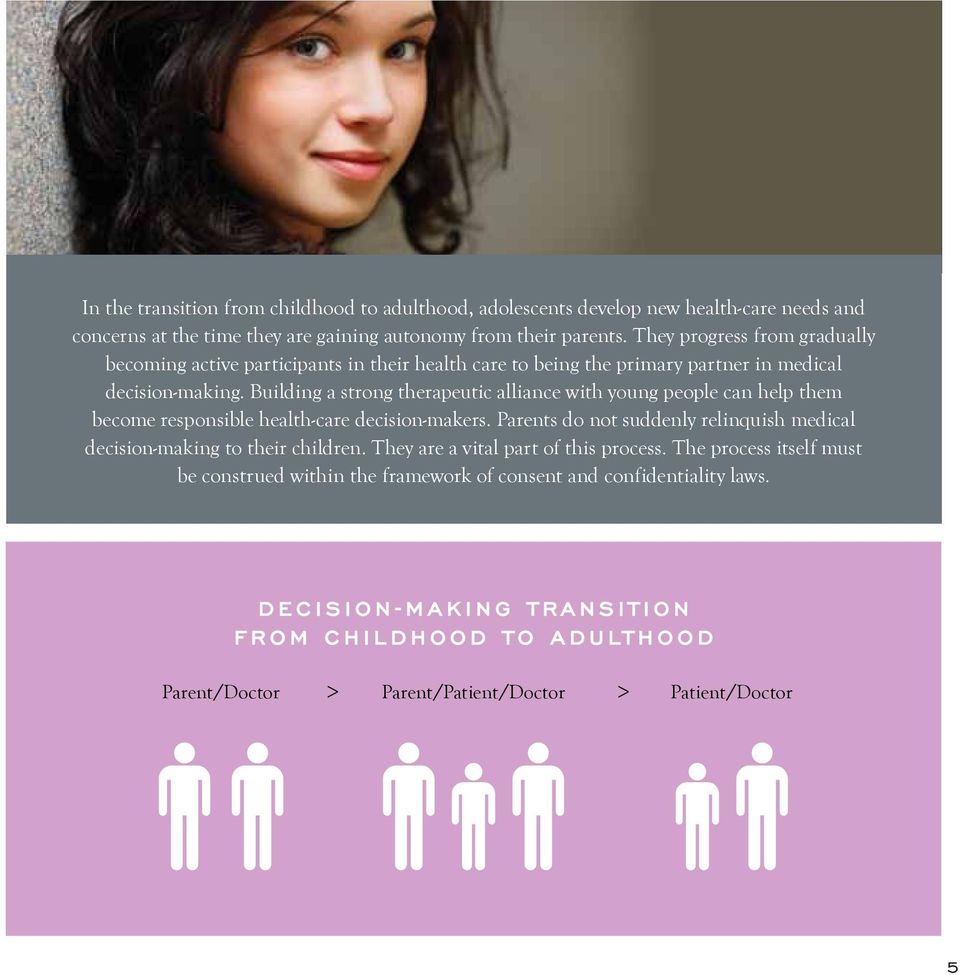
7 In the transition from childhood to adulthood, adolescents develop new health-care needs and concerns at the time they are gaining autonomy from their parents. They progress from gradually becoming active participants in their health care to being the primary partner in medical decision-making. Building a strong therapeutic alliance with young people can help them become responsible health-care decision-makers. Parents do not suddenly relinquish medical decision-making to their children. They are a vital part of this process. The process itself must be construed within the framework of consent and confidentiality laws. Decision-making Transition from Childhood to Adulthood Parent/Doctor > Parent/Patient/Doctor > Patient/Doctor 5
8 parental consent to medical care Parents have the right to consent to their minor child s medical and dental care. Texas Family Code (See p. 7 for situations in which a minor can give consent.) When Parents are Divorced Either parent can give consent for any emergency health care, including surgical procedures. Sole managing conservator parents may give consent for a minor s non-emergency surgical procedure. Joint custodial parents may have all rights associated with a managing conservator, unless specifically limited by the divorce decree. Non-custodial parents usually have the right to consent for medical/ dental care not involving a surgical procedure, except in an emergency. Non-parent sole managing conservators and legal guardians have essentially the same rights and duties as parent sole-managing conservators. Note: For emergency treatment to preserve life and limb, a provider does not need the consent of a parent or conservator. A parent must consent to immunizations of a minor. A minor cannot consent to his or her own immunizations. A minor parent can consent to immunizations for his or her own child. Texas Family Code , , and Health and Saftey Code Consent and access to information by divorced parents are covered by Texas Family Code , ; Texas Occupations Code For more information about consent issues, see the Texas Health Steps Online Provider Education module titled Teen Consent and Confidentiality. 6

9 When Minors Can Consent Minors can consent to treatment by a physician or dentist when the minor is: On active duty with armed services. 16 years old or older and residing apart from parents, managing conservator, or guardian and managing his or her own financial affairs. Unmarried and pregnant and consenting to treatment related to pregnancy other than abortion. Unmarried and the parent of a child and has actual custody of that child and consents for him or her. Consenting to diagnosis or treatment of an infectious, contagious, or communicable disease that is reportable to the Texas Department of State Health Services (DSHS). Consenting to examination or treatment for chemical addiction, dependency, or any other condition directly related to chemical use. Consenting for counseling for suicide prevention, chemical addiction or dependency, or for sexual, physical, or emotional abuse. Texas Family Code Notes: For inpatient mental health treatment: A person age 16 or older, or a person younger than 16 who is or has been married, may give consent when requesting admission to an inpatient mental health facility by filing a request with the administrator of the facility. Texas Health and Safety Code Instances in which a minor may consent to emergency shelter or care are covered in Texas Family Code and Texas Health and Safety Code

10 Consent by a Non-parent THE FOLLOWING INDIVIDUALS MAY consent to health-care treatment of a minor (other than immunization) when a parent or conservator cannot be contacted and that person has not given express notice to the contrary: Grandparent, adult brother or sister, or adult aunt or uncle of the minor. Adult who has actual care, control, and possession of the minor and has written authorization to consent from a person having the right to consent. Adult responsible for the actual care, control, and possession of a minor under the jurisdiction of a juvenile court or committed by a juvenile court to the care of an agency of the State or County. Court having jurisdiction over a suit affecting the parent-child relationship of which the minor is the subject. Educational institution in which the child is enrolled that has received written authorization to consent from a person having the right to consent. Peace officer in lawful custody of a minor if the peace officer has reasonable grounds to believe the minor is in need of immediate medical treatment. Texas Youth Commission (TYC) facility in which the minor is committed when the person having the right to consent has been contacted and that person has not given actual notice to the contrary. Only the superintendent can provide consent. TYC will defer to and attempt to contact the person having authority to consent when such medical treatment may be necessary. If a youth is being transported to a hospital, and a consent form is not sent with the youth, the ER calls the superintendent to get verbal permission. (The form is still completed and maintained in the youth s TYC master file and medical record.) Texas Family Code ; TYC General Administrative Policy Manual Note: For state law on consent to immunization for minors and non-parents, see Texas Family Code
11 Confidentialit y Sensitive communication and assurance of confidentiality are critical to ensuring access to care for teens. Without such assurance, teens can be reluctant or unwilling to seek health care or refuse services. Except as permitted by law, a doctor is legally required to maintain the confidentiality of care provided to a minor. If a provider has agreed to treat a minor confidentially based on the minor s own consent, the doctor should not write or call the parent or guardian to discuss any related issues. Transmission of medical records to the minor should be marked confidential. Texas Occupations Code 159 Limitations: Confidential care cannot be provided when the law requires parental notification or consent or when the law requires the provider to report health information. (See pp. 24 and 26 for more information about reporting.) A licensed physician, dentist, or psychologist may, with or without the consent of a child who is a patient, advise the parents, managing conservator, or guardian of the child of the treatment given to or needed by the child. Texas Family Code Note: Providers must have a responsible adult a parent, guardian, or other authorized adult present during any Texas Health Steps medical or dental checkup for patients younger than 15 years old. The responsible adult must come with the patient and stay throughout the checkup. School health clinics are exempt if the clinic has received consent from the parent or guardian within the year prior to the visit. HRC (s)-(s-1) and 25 TAC For more information about confidentiality issues, see the Texas Health Steps Provider Education module titled Teen Consent and Confidentiality. 9
12 HIPAA Privacy Rule HIPAA requires a covered entity to treat a personal representative the same as the individual with respect to uses/disclosures of the individual s protected health information. Generally, parents are the personal representatives for their minor children and can exercise individual rights, such as access to medical records, on behalf of their minor children. Exceptions: Minors are treated as individuals under HIPAA when: The minor obtains care without parental consent and the minor, a court, or someone else has consented; The minor has the right to consent and has consented; or Parents consent to a confidentiality agreement between the minor and the health-care provider. 45 Code of Federal Regulations For more information about the HIPAA privacy rule, see the Texas Health Steps Provider Education module titled Teen Consent and Confidentiality. 10

13 High-Risk Behaviors Adolescence brings an increased participation in high-risk behaviors. The leading causes of adolescent mortality are accidents, homicide, and suicide. Health-care providers and other professionals should communicate openly that they have a suspicion or concern about a young person s behavior. Young people engaging in high-risk behaviors need to get help as soon as possible. (See pp. 13, 24, and 26 for reportable activities and p. 20 for emergency intervention in mental health crises.) High-Risk Behaviors prevalent in Adolescents Reckless driving Distracted driving Violence Suicidal and self-injurious behaviors Sexual behaviors Substance use Disordered eating Poor nutrition Inadequate physical activity See p. 28 for the HEADDSSS psychosocial interview format, which can help providers screen young people for risky behavior. For more information about adolescent high-risk behaviors, see the Texas Health Steps Online Provider Education modules titled Adolescent Health Screening and Identifying and Treating Young People with High-Risk Behaviors. 11

14 Tips for Effective Communication with Adolescent Patients Spend time talking with the young person and his or her parent individually. Make time also to visit with the parent and young person together. Encourage teens to discuss confidential issues with their parents. Use the HEADDSSS* psychosocial interview format: Home, Education/Employment, Activities, Depression, Drugs, Safety, Sexuality, Suicidality. (Refer to page 28 to see an example of HEADDSSS.) Ask patients about their friends involvements in risky behavior: For example, Do any of your friends smoke or drink alcohol? Encourage adolescents to share their knowledge about a proposed treatment with you before giving them information. Ask open-ended questions. For more information on effective communication with adolescents, see the Texas Health Steps Online Provider Education modules titled Teen Consent and Confidentiality and Cultural Competence. *HEADDSSS: Stephens, M. B. (2006). Preventive Health Counseling for Adolescents. American Family Physician 74(7):
15 SEXUAL ACTIVITY Research* has found that more than 40 percent of young people engage in sexual activity before any discussion with their parents about sexually transmitted infections (STIs), condom use, or birth control. REPORTABLE COMMUNICABLE DISEASES Minor Consent Minors may consent to diagnosis and treatment of STIs, which are required to be reported to the local health officer or DSHS. Texas Family Code Reporting Requirements Providers must report diagnoses of STIs, in addition to other communicable diseases, to the appropriate health authorities. Texas Administrative Code ; Texas Health and Safety Code 81.41, Note: For more information on sexual activity-related issues, see the Texas Health Steps Online Provider Education modules titled Adolescent Health Screening, Identifying and Treating Young People with High-Risk Behaviors, and Teen Consent and Confidentiality. *Beckett, M.K., Elliott, M.N., Martino, S., Kanouse, D.E., Corona, R., Klein, D.J., & Schuster, M.A. (2010). Timing of parent and child communication about sexuality relative to children s sexual behaviors [Abstract]. Pediatrics, 125:
16 FAMILY PLANNING CONTRACEPTIVES Parental consent is not required for minors to purchase nonprescription contraceptives (e.g., condoms) or to receive information about family planning. Minors must get a parent s permission to receive prescription contraception.* Minors may give their own consent and receive confidential family planning services on request if the funding source is Medicaid or Title X Family Planning Program. The constitutional right of privacy has been found to cover a minor s access to contraceptives. 42 Code of Federal Regulations 59.5 (a) (4) EXCEPTIONS Minors may consent for prescription contraceptives if they are legally emancipated or 16 years old and living on their own. This does not include abortion. Texas Family Code Notes: Several state and federally funded programs provide family planning services. See p. 27 for eligibility requirements. A locator for family planning clinics in Texas is available online at For more information on minor consent related to family planning, see the Texas Health Steps Online Provider Education module titled Teen Consent and Confidentiality. *Providers may provide family planning services, including prescription drugs, without the consent of the minor s parent, managing conservator, or guardian only as authorized by Chapter 32 of the Texas Family Code or by federal law or regulations. When parental consent is required, the parent must sign both the general consent for treatment and the method-specific consent for a prescription method of contraception. Whenever the method is changed to another prescription method, the parent must sign that methodspecific consent. Other than the exceptions noted above, no state funds may be used to dispense prescription drugs to minors without parental consent. 14

17 parental notification for ABORTION A physician may not perform an abortion on an unemancipated minor unless one of the two situations described below exists. Texas Family Code The physician gives at least 48 hours actual notice, in person or by telephone, of his or her intent to perform the abortion to a parent of the minor, her managing conservator, or her guardian. The physician performing the abortion: Concludes that, on the basis of his or her good faith clinical judgment, a condition exists that complicates the medical condition of the pregnant minor and necessitates the immediate abortion of her pregnancy to avert her death, or to avoid a serious risk of substantial and irreversible impairment of a major bodily function; and Certifies in writing to the Department of State Health Services and in the patient s medical record that the medical indications supporting the physician s judgment exist. Exception: A minor can have an abortion without notification to one of her parents, managing conservator, or guardian if she obtains judicial approval (also known as a judicial bypass ). More information on judicial bypass is in the Glossary on p. 29. See information in the publication So You re Pregnant, Now What? regarding the laws on abortion and judicial bypass on p. 29. For more information on notification and consent related to abortion, see the Texas Health Steps Online Provider Education modules titled Teen Consent and Confidentiality and Adolescent Health Screening. 15

18 RIGHTS when pregnant Minors can consent to medical treatment related to pregnancy, other than abortion. Eligible young women can receive prenatal care from Medicaid or CHIP. Pregnant young women have the right to refuse prenatal care. Texas Family Code TITLE IX RIGHTS TO EDUCATION Pregnant and parenting students have the same rights to access school activities and special services that temporarily disabled students have a right to access. These include the right to: Continue going to school, take regular classes, and participate in school activities. This also applies to individuals who have given birth or had an abortion. Choose to attend a special program for pregnant or parenting students. Such a program must offer the same opportunities available at their regular school. Decline to attend a special program for pregnant or parenting students. Be excused for medically necessary absences due to pregnancy or childbirth. Not need a doctor s note to continue going to school or engaging in activities, unless all students must have one. Title IX, Education Amendments of 1972 (Title 20 U.S.C ) Note: Private schools that do not receive federal funds do not have to follow Title IX. 16
19 MINORs Rights AS PARENTS Minors may consent to health and dental care for their children. Pregnant minors and minor parents may receive health services. Minor parents may also receive public assistance for their children. Health-care/Social Service Public Assistance Programs Texas Health Steps (THSteps) Comprehensive child preventive health services for children from birth through age 20. Medicaid Children s Services (CCP) Medically necessary diagnostic and treatment services. Case Management for Children and Pregnant Women Case management services for Medicaid-eligible children and youth who have a health condition or health risk and Medicaid-eligible, high-risk pregnant women of any age. Medical Transportation Program Free transportation to the doctor, dentist, and other covered Medicaid or Children with Special Health Care Needs (CSHCN) Program services (such as to the drug store for medications). Children s Health Insurance Program (CHIP) Health-care coverage for low-income children of low-income families without private insurance and ineligible for Medicaid. Supplemental Nutrition Assistance Program (SNAP) Food assistance (formerly food stamp program). Title V Maternal & Child Health (MCH) Services Title V MCH provides prenatal care, preventive and primary child health care, case management for children from birth to one year and high-risk pregnant women, as well as dental care for children and adolescents and services to children with special needs. Women, Infants and Children (WIC) Nutrition education and counseling, nutritious foods, and assistance accessing health care. See p. 27 for eligibility requirements for these programs. 17

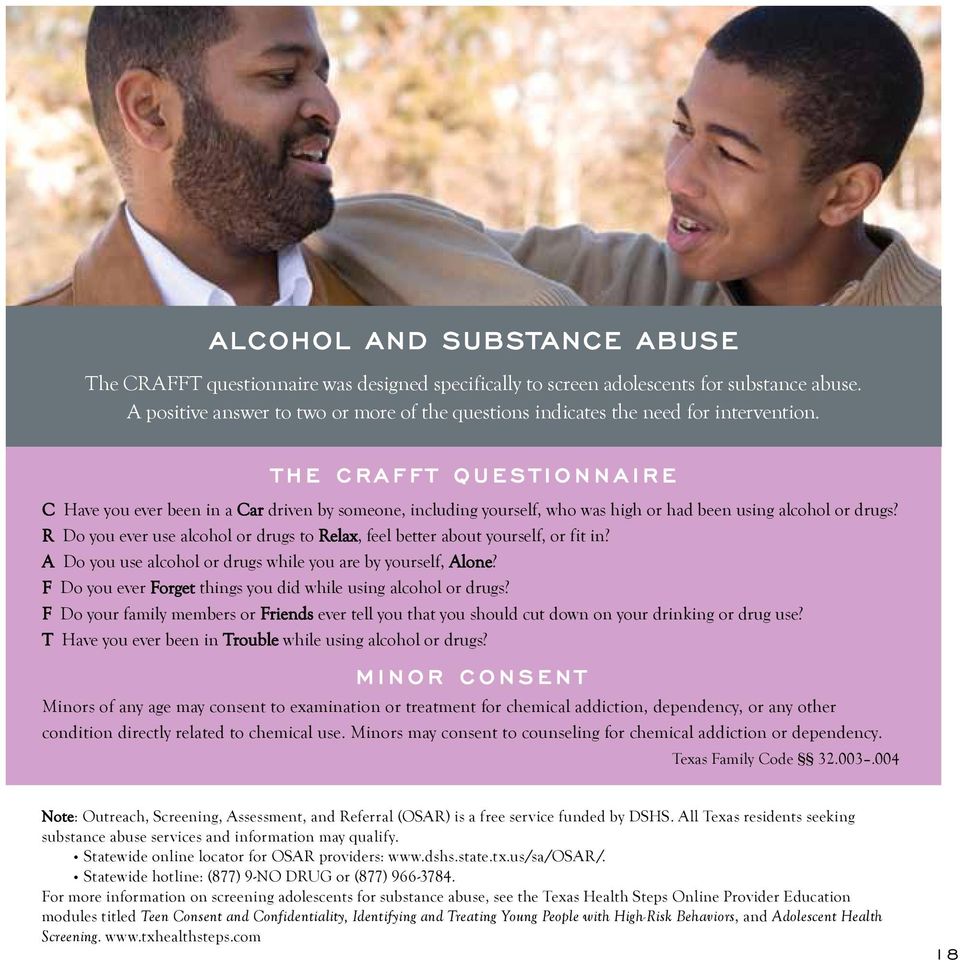
20 Alcohol AND Substance Abuse The CRAFFT questionnaire was designed specifically to screen adolescents for substance abuse. A positive answer to two or more of the questions indicates the need for intervention. THE CRAFFT questionnaire C Have you ever been in a Car driven by someone, including yourself, who was high or had been using alcohol or drugs? R Do you ever use alcohol or drugs to Relax, feel better about yourself, or fit in? A Do you use alcohol or drugs while you are by yourself, Alone? F Do you ever Forget things you did while using alcohol or drugs? F Do your family members or Friends ever tell you that you should cut down on your drinking or drug use? T Have you ever been in Trouble while using alcohol or drugs? MINOR CONSENT Minors of any age may consent to examination or treatment for chemical addiction, dependency, or any other condition directly related to chemical use. Minors may consent to counseling for chemical addiction or dependency. Texas Family Code Note: Outreach, Screening, Assessment, and Referral (OSAR) is a free service funded by DSHS. All Texas residents seeking substance abuse services and information may qualify. Statewide online locator for OSAR providers: Statewide hotline: (877) 9-NO DRUG or (877) For more information on screening adolescents for substance abuse, see the Texas Health Steps Online Provider Education modules titled Teen Consent and Confidentiality, Identifying and Treating Young People with High-Risk Behaviors, and Adolescent Health Screening. 18
21 SMOKING Medical and non-medical staff can support patients who choose to quit by providing information, referral to telephone counseling services, and behavioral counseling using motivational interviewing techniques, where resources permit. Drug therapy to manage nicotine dependence can significantly improve patients chances of quitting successfully and is recommended for people who smoke ten or more cigarettes per day. All interventions should be tailored to the individual s circumstances and attitudes. adolescents and smoking A person must be at least 18 years old to smoke tobacco legally. Counseling adolescents to not smoke or to quit smoking for health-related reasons is an important component of health education and anticipatory guidance. All young people need access to smoking cessation programs, especially medically fragile teens, who are at higher risk than their peers for smoking-related complications. Texas Health & Safety Code International Primary Care Respiratory Group (IPCRG). (2008). Consensus statement: Tackling the smoking epidemic-practical guidance for primary care. Primary Care Respiratory Journal, 17(3):
22 Mental health crisis When a provider suspects a mental health crisis, he or she must make every effort to obtain a prompt mental health evaluation and any medically necessary information. Emergency Referrals Suicidal thoughts, threats, or behaviors. Homicidal thoughts, threats, or behaviors. Resources Local police/sheriff or other law enforcement officials or 911. Local emergency room or psychiatric hospital. Local Mental Health and Substance Abuse center/ hotline or Mental Health Crisis center/hotline. Local information can be found by dialing or searching online at Local Mental Health Authorities (LMHAs) provide outpatient services. Statewide online locator for LMHAs*. Minor Consent Youths age 16 or older, or one younger than 16 who is/has been married, may give consent when requesting admission to an inpatient mental health facility by filing a request with the administrator of the facility. Minors may consent for counseling for suicide prevention. Texas Health and Safety Code ; Texas Family Code * 20
23 violence Professionals must immediately report abuse if the victim is under 18 years of age. Professionals should also encourage the young person to seek help, and they should share information about victim service providers. See p. 24 for reporting requirements. DEFINITIONS Dating Violence: An act by one person against another person with whom there is a dating relationship, and the act is intended to result in physical harm, bodily injury, assault, or sexual assault. A threat that reasonably places the individual in fear of imminent physical harm, bodily injury, assault, or sexual assault. Family Violence: An act by a member of a family or household against another family or household member that is meant to result in physical harm, bodily injury, assault, or sexual assault. A threat that reasonably places the member in fear of imminent physical harm, bodily injury, assault, or sexual assault. Texas Family Code For more information on reporting abuse, see the Texas Health Steps Online Provider Education module titled Teen Consent and Confidentiality. 21
24 nutrition During medical checkups: Assess dietary practices to identify eating habits or possible eating disorders. Make a qualitative/quantitative determination about the adolescent s diet. Provide health education and anticipatory guidance. Disordered Eating With disordered eating, physical hunger and satiety are often ignored. It encompasses a range of abnormal eating, including behavior seen in eating disorders, such as: Anorexia. Chronic restrained eating. Bulimia. Habitual dieting. Compulsive eating. Irregular, chaotic eating patterns. Disordered eating negatively affects overall health emotional, social, and physical. It may cause tiredness, depression, and decreased mental functioning and concentration. Disordered eating may also lead to malnutrition, with risk to bone health, physical growth, and brain development. For information on nutrition and disordered eating, see the Texas Health Steps Online Provider Education modules titled Nutrition and Management of Overweight and Obesity in Children and Adolescents. 22
25 ORAL HEALTH Tooth decay is the most common chronic childhood disease. Focusing on oral health during adolescence is important, as many childhood risk factors persist and new oral health risk factors may emerge. An oral examination should be a part of all routine medical checkups and physical examinations. At this time, providers have the opportunity to educate their patients about good oral health practices and provide information about oral health risks due to smoking, poor eating habits, and other behaviors. AN ORAL EXAMINATION SHOULD INCLUDE: Inspection of teeth for signs of caries. Inspection of the oral soft tissues for any abnormalities. Referral to a dentist if problems exist. Anticipatory guidance to include: The need for thorough daily oral hygiene practices. Potential gingival manifestations for patients with diabetes and those under long-term medications therapy. For more information on oral health, see the Texas Health Steps Online Provider Education module titled Oral Health for Primary Care Providers. 23
26 Requirements for Reporting Abuse & Neglect A professional who has reason to believe a minor s health and safety may be affected by abuse or neglect must report the case to a local law enforcement agency or to the Child Protective Services (CPS) Division of the Texas Department of Family and Protective Services within 48 hours of when he or she first suspects that the child has been or may be abused or neglected. A professional may not delegate to or rely on another person to make the report. Texas Family Code Examination of Abuse or Neglect Without Consent A physician, dentist, or psychologist having reasonable grounds to believe that a minor s physical or mental condition has been adversely affected by abuse or neglect may examine the minor without the consent of the patient, the patient s parents, or other person authorized to consent to treatment. Texas Family Code Exception: Unless consent is obtained as otherwise allowed by law, a physician, dentist, or psychologist may not examine a child 16 years old or older who refuses to consent or for whom consent is prohibited by a court order. Reporting to CPS Phone: Fax: web: Note: HHSC and DSHS have established policies for child abuse screening, documenting, and reporting policy for Medicaid contractors or providers. Refer to the 2011 Texas Medicaid Provider Procedures Manual, Section The manual is available from the Texas Medicaid Healthcare Partnership (TMHP) website, 24
27 Statutory definitions for abuse & neglect Abuse is defined by Texas law as: Mental or emotional injury to a child. Causing or permitting a child to be in a situation in which the child sustains mental or emotional injury. Physical injury that results in substantial harm to the child or the genuine threat of substantial harm from physical injury to the child. This excludes an accident or reasonable discipline by a parent or guardian. Failure to make a reasonable effort to prevent an action by another that results in physical injury and substantial harm to the child. Sexual conduct harmful to a child s mental, emotional, or physical welfare, including continuous sexual abuse of a young child, indecency with a child, sexual assault, or aggravated sexual assault as defined by the Texas Penal Code. Failure to make a reasonable effort to prevent sexual conduct harmful to a child. Compelling or encouraging a child to engage in sexual conduct as defined by the Penal Code. Causing, permitting, encouraging, engaging in, or allowing the photographing, filming, or depicting of the child in obscene or pornographic material. Current use of a controlled substance in a way or to the extent that it results in physical, mental, or emotional injury to a child. Causing, expressly permitting, or encouraging a child to use a controlled substance. Causing, permitting, encouraging, engaging in, or allowing a sexual performance by a child. Neglect includes the following acts or omissions: Leaving a minor in a situation where he or she would be exposed to substantial risk of physical or mental harm without arranging for necessary care for the minor and a demonstration of an intent not to return by a parent, guardian, or managing or possessory conservator. Placing the minor in or failing to remove him or her from a situation that a reasonable person would realize requires judgment or actions beyond the minor s level of maturity, physical condition, or mental ability and that results in bodily injury or a substantial risk of immediate harm to the minor. Failing to seek, obtain, or follow through with medical care for the minor, with the failure resulting in or presenting a substantial risk of death, disfigurement, or bodily injury or with the failure resulting in an observable and material impairment to the growth, development, or functioning of the minor. Failing to provide the minor with food, clothing, or shelter necessary to sustain the minor s life or health, excluding failure caused primarily by financial inability unless relief services had been offered and refused. Placing the minor in or failing to remove the minor from a situation in which he or she would be exposed to a substantial risk of sexual conduct harmful to the minor. Failure by the person responsible for a minor s care, custody, or welfare to permit the minor to return to his or her home without arranging for the necessary care after the minor has been absent from the home for any reason. Texas Family Code
28 Requirements for Reporting Unlawful Sexual ContacT A professional must report nonconsensual sexual contact with an unmarried minor under the age of 17 within 48 hours to CPS or local law enforcement. Texas Penal Code states that a person commits an offense if, with a child younger than 17 years and not the person s spouse, whether of the same or opposite sex, the person: Engages in sexual contact with the child or causes the child to engage in sexual contact; or With intent to arouse or gratify the sexual desire of any person, the actor exposes the person s anus or any part of the person s genitals, knowing the child is present, or causes the child to expose the child s anus or any part of the child s genitals. Statutory Definition of Sexual Contact Per Texas Penal Code , sexual contact means the following acts, if committed with the intent to arouse or gratify the sexual desire of any person: Any touching by a person, including touching through clothing, of the anus, breast, or any part of the genitals of a child. Any touching of any part of the body of a child, including touching through clothing, with the anus, breast, or any part of the genitals of a person. Under of the Penal Code, an affirmative defense to prosecution related to minor sexual contact may apply if the offender: Was not more than three years older than the victim and of the opposite sex. Did not use duress, force, or a threat against the victim at the time of the offense. Has no history of being a sex offender at the time of the offense. Sexual activity with a child under the age of 14 years is against the law and has no defense. Note: Professionals are not expected to know all of the facts of an incident or make a legal determination on whether it is a crime or there is a defense to the crime before reporting possible abuse. For more information on reporting unlawful sexual contact, see the Texas Health Steps Online Provider Education module titled Teen Consent and Confidentiality. 26
29 Eligibility Requirements for Health-care/Social Service Programs Case Management for Children and Pregnant Women Medicaid-eligible children from birth through age 20 with a health condition/health risk. Medicaid-eligible women of any age with a high-risk pregnancy. Children s Health Insurance Program (CHIP) Children from birth through age 18. Texas resident and U.S. citizen or permanent resident. Age-based family income qualifications. Income too high to qualify for Medicaid. Family Planning Services Provided to women and men: Health assessment including medical history and physical exam. Follow-up for routine, problem, and/or birth control supplies. Lab testing Pap smears, STIs, HIV, diabetes, anemia, etc. STI and urinary infection treatment. Pre-conception, genetic, infertility counseling and referral. Pregnancy testing, counseling, and referral. Postpartum evaluation. Prenatal and other medical referrals. Community and individual education. Social services referrals jobs, housing, mental health, etc. Partner violence screening and referral. Natural family planning. Eligibility is based on client income, family size, and residency. Medicaid Children from birth through age 18. (Once enrolled, eligible through age 20.) Texas resident and U.S. citizen or permanent resident. Family income qualifications. Medicaid Children s Services (CCP) Children eligible for Texas Health Steps with an illness or condition that requires medically necessary diagnostic and treatment services. Medical Transportation Program Be enrolled in Medicaid or Children with Special Health Care Needs Services Program. Have no other means of transportation to a medically needed service or benefit. Supplemental Nutrition Assistance Program (SNAP) Families with gross income at or below 130 percent of Federal Poverty Level (per family size). Categorical Eligibility: If all household members receive or are authorized to receive Supplemental Social Security Income (SSI) or Temporary Assistance for Needy Families (TANF), the household is eligible for SNAP, if qualified under special conditions. Texas Health Steps Medical and dental services and case management for children from birth through age 20 who have Medicaid. Title V Maternal and Child Health Services Prenatal care, preventive and primary child health-care, case management for children from birth to one year and high-risk pregnant women, and dental care for children and adolescents. Eligibility: Texas residents with family incomes less than 185 percent of the federal poverty level who are not eligible for Medicaid or covered by CHIP. Women, Infants and Children (WIC) Pregnant women of any age. Women who are breastfeeding a baby under one year of age. Women who have had a baby in the past six months. Parents, stepparents, guardians, and foster parents of infants and children under the age of five can apply for their child. 27
30 HEADDSSS Interview Screen H Home Who lives with the young person? Where? Do they have their own room? What are relationships like at home? What do parents and relatives do for a living? Ever institutionalized? Incarcerated? Recent moves? Running away? New people in home environment? E Education and Employment School or grade performance any recent changes? Any dramatic past changes? Favorite subjects worst subjects? (include grades) Relationships with teachers school attendance? Any years repeated or classes failed? Suspension, termination, dropping out? Future education plans? Any current or past employment? Relationships with employers work attendance? Future employment plans? A Activities On own, with peers what do you do for fun? Where? When? With family? Sports regular exercise? Church attendance, clubs, projects? Hobbies their activities? Reading for fun what? TV how much weekly? Favorite shows? Favorite music? Does young person have a car, use seat belts? History of arrests acting out crime? Eating habits? (not on HEADDSSS but recommended question) D Drugs Use by peers? Use by young person? (address alcohol, tobacco, and other drugs) Use by family members? Amounts, frequency, patterns of use or abuse, and car use while intoxicated? Source how paid for? D Depression Sleep disorders? (usually induction problems, also early or frequent waking or greatly increased sleep and complaints of increasing fatigue) Appetite or eating behavior changes? Feelings of boredom? Emotional outbursts and highly impulsive behavior? History of withdrawal or isolation? Hopeless or helpless feelings? S Safety Domestic violence? Relationship violence? Gun availability? Seat belt use? S Sexuality Orientation? Degree and types of sexual experience and acts? Number of partners? Masturbation? (normalize) History of pregnancy or abortion? Sexually transmitted diseases knowledge and prevention? Contraception? Frequency of use? Need for barrier contraceptive use? Comfort with sexual activity, enjoyment or pleasure obtained? History of sexual or physical abuse? S Suicidality Hopeless or helpless feelings? History of past suicide attempts, depression, psychological counseling? History of suicide attempts by family or peers? History of recurrent serious accidents? Psychosomatic symptomology? Suicidal ideation? (including significant current and past losses) Decreased affect on interview, avoidance of eye contact, depression posturing? Preoccupation with death? (clothing, media, music, art) 28
31 GLOSSARY Confidentiality Confidentiality is the obligation of the health-care provider not to disclose information. Except as permitted by law, a provider is legally required to maintain the confidentiality of care provided to a minor. Confidential care cannot be assured when the law requires parental notification or consent or when the law requires the provider to report health information, such as in the cases of contagious disease or abuse. Consent The legal doctrine of informed consent for health care is an agreement to a recommended treatment when the consenting person is in possession of all of the facts relevant to the decision and potential consequences. Consent must be voluntary and not just represent acquiescence. Consent must also be rational, that is, given by an intellectually competent individual with the sufficient cognitive ability to make a decision. Emancipation A minor may obtain legal emancipation when a judge is convinced that the minor can take care of himself or herself and be treated as an adult. Legal Guardian Guardianship is a legal designation that places the rights, safety, well-being, and legal choices of a person into the hands of another. Guardianship is conferred on a relative, friend, guardianship program, or private professional guardian by a judge s decision that a person is deemed incapacitated. The definition of an incapacitated person under the Texas Probate Code includes minors. Managing Conservators A court-appointed, non-parental, sole managing conservator must be a competent adult, an authorized agency, or a licensed child-placing agency. A parental sole managing conservator (custodial parent) is court-appointed when the parents are or will be separated or divorced. If a managing conservator is appointed, the court may appoint one or more possessory conservators (noncustodial parent and/or person). Minor In Texas, the legal definition of a minor is a person under 18 years of age who has never been married and never been declared an adult by a court. HIPAA The Health Insurance Portability and Accountability Act (HIPAA) requires the establishment of national standards for electronic health-care transactions and national identifiers for providers, health insurance plans, and employers. It also contains provisions that address the security and privacy of health data. Judicial Bypass A minor can have an abortion without notification to one of her parents, managing conservator, or guardian if she obtains judicial approval (also known as a judicial bypass ). To receive a bypass, a minor must file an application for a court order authorizing her consent to an abortion without notification. The court enters an order authorizing the minor s consent if the hearing judge determines that she meets at least one of the required grounds for approval. The process and requirements for obtaining judicial approval are detailed in Texas Family Code (cont. on next page) 29
32 The court shall enter an order authorizing the minor s consent if the hearing judge determines that she meets at least one of the following grounds: She is mature and sufficiently well-informed about her pregnancy options to make the decision without a parent or legal guardian being involved. It is not in her best interest for her parent or legal guardian to be notified. Notification of her parent or guardian could lead to physical, sexual, or emotional abuse. The law stipulates that the court shall rule on the minor s application by 5 p.m. on the second business day after the date the application is filed with the court, unless the minor requests an extension. In this case, the ruling must be made by 5 p.m. on the second business day after the date the minor states she is ready to proceed to a hearing. If the court fails to rule within these times, the application is deemed to be granted, and the physician may perform an abortion. If the court determines that judicial approval should not be granted, the minor has the right to appeal. Title V As applicable in this guidebook, the general goal of Title V of the Social Security Act Maternal And Child Health Services Block Grant is to provide and to assure mothers and children (in particular those with low income or with limited availability of health services) access to quality maternal and child health services. Title IX Title IX forbids that any person, on the basis of sex, be excluded from participation in, be denied the benefits of, or be subjected to discrimination under any education program or activity receiving federal financial assistance. The legislation covers all educational activities and complaints under Title IX alleging sex discrimination in fields, such as science or math education, or in other aspects of academic life, such as access to health care and non-sport activities, such as school band and clubs. It applies to an entire school or institution if any part of that school receives federal funds. Title X Title X is the only federal grant program dedicated solely to providing individuals with comprehensive family planning and related preventive health services. The Title X program is designed to provide access to contraceptive services, supplies, and information to all who want and need them. The law gives priority to persons from low-income families. Title XX The Social Services Block Grant, or Title XX of the Social Security Act, consolidated federal assistance to states into a single grant. Each state determines how its Title XX funds will be used. While Texas uses no state funding streams to provide for family planning services, it does allocate a portion of its Title XX funds to pay for family planning services to low-income individuals. 30
33 RESOURCES American Academy of Pediatrics, Committee on Bioethics. (1995; 2007). Informed consent, parental permission, and assent in pediatric practice. Pediatrics, 116, American Academy of Pediatrics, Committee on Pediatric Emergency Medicine. (2003; 2007). Consent for emergency medical services for children and adolescents. Pediatrics, 111 (3), HEADDSSS Interview Screen: Stephens, M. B. (2006). Preventive Health Counseling for Adolescents. American Family Physician 74(7): Texas Behavioral Health Clearinghouse Social Security Online Society for Adolescent Health and Medicine Texas Family Code Texas Health and Human Services Commission, Your Texas Benefits website: Texas Health & Safety Code Texas Health Steps Provider Education Modules at Adolescent Health Screening Cultural Competence Identifying and Treating Young People with High-Risk Behaviors Mental Health Screening Teen Consent and Confidentiality So You re Pregnant, Now What? is a DSHS publication for young people to understand the laws associated with abortion and the judicial bypass process. It is a legislatively mandated document and available for order from the DSHS. Texas Occupation Code Texas Penal Code 31
34 MINOR CONSENT LEGAL REFERENCE CHART Topic Texas Law Citation Age of Majority Texas Civil Practice & Remedies Code ; Texas Family Code Communicable Disease Care 25 Texas Administrative Code 97.3, ; Texas Family Code Consent and Access to Information by Divorced Parents Texas Family Code , , , ; Texas Occupations Code Consent by Child Texas Family Code Consent by Non-Parent Texas Family Code Consent for Chemical Addiction, Dependency, Texas Family Code or other condition related to chemical use Consent for Immunizations Texas Family Code Consent for Incarcerated Youth Texas Family Code ; TYC General Administrative Policy Manual Consent to Counseling Texas Family Code Consent to Emergency Shelter or Care by Minor Texas Family Code Consent to Inpatient Mental Health Treatment Texas Health and Safety Code Disclosure of Information to Parents Texas Family Code Related to Treatment Emancipated Minor Texas Family Code , , Emergency Care Texas Health and Safety Code Judicial Approval for Abortion on a Minor Texas Family Code Mandatory Reporting Requirements Texas Health & Safety Code , Married Minor Texas Family Code Parental Consent Texas Family Code Parental Notification for Abortion Texas Family Code Physician Patient Confidential Communication Texas Occupations Code 159 Pregnant Minor Texas Family Code Pregnant Minors and Education Title IX of the Education Act of 1972 Reporting of Abuse and Neglect Texas Health and Safety Code Reporting of Communicable Diseases Texas Health and Safety Code ,.046; Texas Administrative Code Requirements for Reporting Unlawful Sexual Contact Texas Penal Code txhealthsteps.com 32
35 Free Online Continuing Education /2011
TEXAS FAMILY CODE CHAPTER 32. CONSENT TO TREATMENT OF CHILD BY NON PARENT OR CHILD
 TEXAS FAMILY CODE CHAPTER 32. CONSENT TO TREATMENT OF CHILD BY NON PARENT OR CHILD SUBCHAPTER A. CONSENT TO MEDICAL, DENTAL, PSYCHOLOGICAL, AND SURGICAL TREATMENT 32.001. Consent by Non-Parent (a) The
Minor Rights: Access and Consent to Health Care
 Minor Rights: Access and Consent to Health Care A resource for providers, parents and educators Not a legal document. This resource is intended to provide basic information about minors ability to consent
Legal Rights of Pregnant Teens and Legal and Ethical Considerations for the Public School Counselor Tina Hester Jane s Due Process Sara Leon Powell &
 Legal Rights of Pregnant Teens and Legal and Ethical Considerations for the Public School Counselor Tina Hester Jane s Due Process Sara Leon Powell & Leon, LLP School Counselors serve as the gateway for
The Healthy Michigan Plan Handbook
 The Healthy Michigan Plan Handbook Introduction The Healthy Michigan Plan is a health care program through the Michigan Department of Community Health (MDCH). The Healthy Michigan Plan provides health
Texas PENAL CODE CHAPTER 21. SEXUAL OFFENSES
 Texas PENAL CODE CHAPTER 21. SEXUAL OFFENSES 21.01. DEFINITIONS. In this chapter: (1) "Deviate sexual intercourse" means: (A) any contact between any part of the genitals of one person and the mouth or
The Healthy Michigan Plan Handbook
 The Healthy Michigan Plan Handbook Introduction The Healthy Michigan Plan is a health care program through the Michigan Department of Community Health (MDCH). Eligibility for this program will be determined
Legal Issues for People with HIV
 Legal Issues for People with HIV Duke Legal Project Box 90360 Durham, NC 27708-0360 (919) 613-7169 (888) 600-7274 Duke Legal Project is a clinical legal education program of Duke Law School. Legal Representation
Iowa s Maternal Health, Child Health and Family Planning Business Plan
 Iowa s Maternal Health, Child Health and Family Planning Business Plan CHILD HEALTH Who we are... A public-private partnership that... Promotes access to regular preventive health care services for children
A Guide for Larimer County Parents
 Services Child Protection A Guide for Larimer County Parents This booklet was prepared by the Program Committee of the Larimer County Child Advocacy Center in consultation with the Larimer County Department
A BILL FOR AN ACT ENTITLED: "AN ACT REVISING LAWS RELATING TO GUARDIANSHIP; REVISING
 HB0.0 HOUSE BILL NO. INTRODUCED BY J. ESSMANN, M. FUNK A BILL FOR AN ACT ENTITLED: "AN ACT REVISING LAWS RELATING TO GUARDIANSHIP; REVISING LAWS RELATING TO THE COMMITMENT OF INCAPACITATED PERSONS; PROVIDING
Education Code 26.0091; Family Code 261.111(1)
 ANTI- VICTIMIZATION PROGRAM The District shall provide child abuse anti-victimization programs in elementary and secondary schools. Education Code 38.004 DUTY TO REPORT BY ANY PERSON Any person who has
Harris County - Texas HIPAA Notice of Privacy Practices
 Harris County - Texas HIPAA Notice of Privacy Practices Effective Date: September 23, 2013. THIS NOTICE DESCRIBES HOW MEDICAL INFORMATION ABOUT YOU MAY BE USED AND DISCLOSED AND HOW YOU CAN GET ACCESS
What Everyone Needs to Know About Elder Abuse 1 Rebecca C. Morgan Stetson University College of Law
 What Everyone Needs to Know About Elder Abuse 1 Rebecca C. Morgan Stetson University College of Law I. WHAT IS ELDER ABUSE? A. Although abuse, neglect and exploitation are separate problems with separate
What is DOMESTIC VIOLENCE?
 What is DOMESTIC VIOLENCE? Domestic violence is a pattern of control used by one person to exert power over another. Verbal abuse, threats, physical, and sexual abuse are the methods used to maintain power
PARENT AND CHILD. Chapter Twelve
 Chapter Twelve PARENT AND CHILD Every person under the age of 18 is considered a minor in the State of Alaska. Upon your 18th birthday, you reach the age of majority. [AS 25.20.010.] Parents have certain
2) Recurrent emotional abuse. 3) Contact sexual abuse. 4) An alcohol and/or drug abuser in the household. 5) An incarcerated household member
 Co Occurring Disorders and the on Children: Effectively Working with Families Affected by Substance Abuse and Mental Illness Definition (Co-Occurring also called Dual Dx) A professional diagnosis of addictive/substance
CHILD ABUSE AND NEGLECT SERVICES CHILD PROTECTIVE SERVICES
 PORTAGE COUNTY HEALTH AND HUMAN SERVICES CHILD ABUSE AND NEGLECT SERVICES CHILD PROTECTIVE SERVICES Frequently Asked Questions Regarding Child Abuse and Neglect How do I make a child abuse and/or neglect
WHAT HAPPENS NEXT? A guide to the NORTH DAKOTA CHILD PROTECTION SERVICES. This guide is made available by
 WHAT HAPPENS NEXT? A guide to the NORTH DAKOTA CHILD PROTECTION SERVICES This guide is made available by NORTH DAKOTA CHILD PROTECTION SERVICES CHILDREN AND FAMILY SERVICES North Dakota Department of Human
MANDATED REPORTING OF CHILD NEGLECT OR PHYSICAL OR SEXUAL ABUSE
 POLICY #414 MANDATED REPORTING OF CHILD NEGLECT OR PHYSICAL OR SEXUAL ABUSE I. PURPOSE The purpose of this policy is to make clear the statutory requirements of school personnel to report suspected child
Module 4 Chapter 3: Minnesota Criminal Code - Chapter 609
 : Minnesota Criminal Code - Chapter 609 Overview This chapter provides an overview of Minnesota s Criminal Code, Chapter 609 of Minnesota Statutes, to help you recognize the most common types of criminal
36 Interviewing the Patient, Taking a History, and Documentation
 CHAPTER 36 Interviewing the Patient, Taking a History, and Documentation Learning Outcomes 36.1 Identify the skills necessary to conduct a patient interview. 36.2 Implement the procedure for conducting
How Health Reform Will Help Children with Mental Health Needs
 How Health Reform Will Help Children with Mental Health Needs The new health care reform law, called the Affordable Care Act (or ACA), will give children who have mental health needs better access to the
The National Survey of Children s Health 2011-2012 The Child
 The National Survey of Children s 11-12 The Child The National Survey of Children s measures children s health status, their health care, and their activities in and outside of school. Taken together,
MANDATED REPORTING OF CHILD NEGLECT OR PHYSICAL OR SEXUAL ABUSE
 No. _414 I. PURPOSE MANDATED REPORTING OF CHILD NEGLECT OR PHYSICAL OR SEXUAL ABUSE The purpose of this policy is to make clear the statutory requirements of school personnel to report suspected child
California: Minor Consent Rules for Adolescent Health Care
 California: Minor Consent Rules for Adolescent Health Care Because adolescents are not yet adults 1, parents have the right to make most health care decisions on their behalf. This generally includes the
Parent s Guide. to Child Protective Services (CPS) Children s. Administration. Division. of Children. and Family. Services
 Parent s Guide to Child Protective Services (CPS) Children s Administration Division of Children and Family Services Table Of Contents Topic Page What Is Child Protective Services (CPS)?... What Is Child
THE CHILD ABUSE ASSESSMENT:
 THE CHILD ABUSE ASSESSMENT: A Guide for Foster Parents Iowa Foster and Adoptive Parents Association Acknowledgements This publication was developed under the guidance of an advisory committee comprised
THE LAW. Legal Issues in School Nursing. Legal Foundations
 Legal Issues in School Nursing Basic knowledge to support safe practice Presented by Mary Claire Ikenberry, RN, MS School Health Specialist, Virginia Department of Education THE LAW School nurses confront
INDEPENDENT SCHOOL DISTRICT #877 POLICY. Buffalo-Hanover-Montrose
 INDEPENDENT SCHOOL DISTRICT #877 POLICY Buffalo-Hanover-Montrose INDEX TITLE Employee/Personnel SERIES NO. 400 Mandated Reporting of Child Neglect or POLICY TITLE Physical or Sexual Abuse CODE NO. 414.
NOTICE OF PRIVACY PRACTICES. The University of North Carolina at Chapel Hill. UNC-CH School of Nursing Faculty Practice Carolina Nursing Associates
 NOTICE OF PRIVACY PRACTICES The University of North Carolina at Chapel Hill UNC-CH School of Nursing Faculty Practice Carolina Nursing Associates THIS NOTICE DESCRIBES HOW MEDICAL INFORMATION ABOUT YOU
650 Clark Way Palo Alto, CA 94304 650.326.5530
 THIS NOTICE DESCRIBES HOW MEDICAL INFORMATION ABOUT YOU MAY BE USED AND DISCLOSED AND HOW YOU CAN GET ACCESS TO THIS INFORMATION. PLEASE REVIEW IT CAREFULLY. (Adopted 4-14-03; revised December 2006) If
Providing support to vulnerable children and families. An information sharing guide for registered school teachers and principals in Victoria
 Providing support to vulnerable children and families An information sharing guide for registered school teachers and principals in Victoria Service Coordination Tool Templates 2006 reference guide Providing
Collaborative Care for Pregnant Women with Substance Use Disorders
 Collaborative Care for Pregnant Women with Substance Use Disorders Alane O Connor DNP Maine Dartmouth Family Medicine Residency MaineGeneral Medical Center Dartmouth Medical School Vanderbilt University
Your DCS Representative is:
 Your DCS Representative is: Name Address City Phone No. A Guide to the Department of Child Safety We know that a visit or notice from a DCS Representative concerning your family can be difficult and confusing.
Sarasota Personal Medicine 1250 S. Tamiami Trail, Suite 202 Sarasota, FL 34239 Phone 941.954.9990 Fax 941.954.9995
 Sarasota Personal Medicine 1250 S. Tamiami Trail, Suite 202 Sarasota, FL 34239 Phone 941.954.9990 Fax 941.954.9995 NOTICE OF PRIVACY PRACTICES THIS NOTICE DESCRIBES HOW MEDICAL INFORMATION ABOUT YOU MAY
Order in Suit Affecting the Parent-Child Relationship (Nonparent Custody Order)
 NOTICE: THIS DOCUMENT CONTAINS SENSITIVE DATA Cause Number: (Write the cause number and other case information exactly as it appears on the Petition.) In the Interest of the following Minor Child(ren):
UNIVERSITY PHYSICIANS OF BROOKLYN, INC. POLICY AND PROCEDURE. No: Supersedes Date: Distribution: Issued by:
 UNIVERSITY PHYSICIANS OF BROOKLYN, INC. POLICY AND PROCEDURE Subject: ALCOHOL & SUBSTANCE ABUSE INFORMATION Page 1 of 10 No: Prepared by: Shoshana Milstein Original Issue Date: NEW Reviewed by: HIPAA Policy
414 MANDATED REPORTING OF CHILD NEGLECT OR PHYSICAL OR SEXUAL ABUSE
 I. PURPOSE 414 MANDATED REPORTING OF CHILD NEGLECT OR PHYSICAL OR SEXUAL ABUSE The purpose of this policy is to make clear the statutory requirements of school personnel to report suspected child neglect
Adult Protective Services
 Chapter 7.E Guardianship/conservatorship and Mental Health Board A. Guardianship/Conservatorship 1. A guardian or conservator is a person or entity appointed by a court of competent jurisdiction to have
9-12. Health and Wellness Curriculum Framework. Revised 2011
 9-12 Health and Wellness Curriculum Framework Revised 2011 Course Title: Health and Wellness Course/Unit Credit:.05 Course Number: 480000 Teacher Licensure: Please refer to the Course Code Management System
Substance-Exposed Newborns
 Substance-Exposed Newborns State of Oklahoma 2013 Substance-Exposed Newborns State of Oklahoma 2013 Legal Background Federal guidelines in the Child Abuse Prevention and Treatment Act (CAPTA) require states
TIVERTON PSYCHOLOGICAL SERVICES 2128 MAIN ROAD TIVERTON, RI 02878 www.tivertonpsych.com Phone: 401-624-9972; Fax: 401-624-1452
 TIVERTON PSYCHOLOGICAL SERVICES 2128 MAIN ROAD TIVERTON, RI 02878 www.tivertonpsych.com Phone: 401-624-9972; Fax: 401-624-1452 Dorothy B. Brown, Ph.D. Anne Davidge, Ph.D. Dennis J. Rog, Ed.D. Licensed
GONZABA MEDICAL GROUP PATIENT REGISTRATION FORM
 GONZABA MEDICAL GROUP PATIENT REGISTRATION FORM DATE: CHART#: GUARANTOR INFORMATION LAST NAME: FIRST NAME: MI: ADDRESS: HOME PHONE: ADDRESS: CITY/STATE: ZIP CODE: **************************************************************************************
Summary Guide for MANDATED REPORTERS in New York State
 Summary Guide for MANDATED REPORTERS in New York State Table of Contents Who Are Mandated Reporters?... 2 When Am I Mandated to Report?... 3 What Is Abuse and Maltreatment?... 4 How Do I Recognize Child
ABUSE, NEGLECT, SELF- NEGLECT & EXPLOITATION OF VULNERABLE ADULTS
 ABUSE, NEGLECT, SELF- NEGLECT & EXPLOITATION OF VULNERABLE ADULTS INDEX CODE: 1810 EFFECTIVE DATE: 01-29-09 Contents: I. Purpose II. Definitions III. Investigative Procedures IV. Protective Services V.
Chapter 3 Maternal Child Health Subchapter 4. Home Visiting Rule
 Chapter 3 Maternal Child Health Subchapter 4 Home Visiting Rule 1.0 Authority This rule is adopted pursuant to Act No. 66 of the Acts of the 2013 Sess. (2013) (An act relating to home visiting standards.),
1 Responsibilities associated with parenting;
 15.17 1 OF 7 I PURPOSE To establish a uniform process for screening and managing pregnant females at the Youth Study Center YSC, that ensures the female residents will receive adequate support in accepting
Guide to Health and Social Services
 Guide to Health and Social Services Health Services If you have little or no insurance and need health services: You can visit one of the 159 county health departments across the state. The local health
Please note that this Act can also be viewed online on the Illinois General Assembly website at www.ilga.gov.
 Please note that this Act can also be viewed online on the Illinois General Assembly website at www.ilga.gov. SCHOOLS (105 ILCS 10/) Illinois School Student Records Act. (105 ILCS 10/1) (from Ch. 122,
Working Together HEALTH SERVICES FOR CHILDREN IN FOSTER CARE
 Chapter Eight Maintaining Health Records Maintaining the health records of children in foster care is critical to providing and monitoring health care on an ongoing basis. When health records are maintained
Healthy Michigan MEMBER HANDBOOK
 Healthy Michigan MEMBER HANDBOOK 2014 The new name for Healthy 1 TABLE OF CONTENTS WELCOME TO HARBOR HEALTH PLAN.... 2 Who Is Harbor Health Plan?...3 How Do I Reach Member Services?...3 Is There A Website?....
Rights for Individuals in Mental Health Facilities
 HANDBOOK Rights for Individuals in Mental Health Facilities Admitted Under the Lanterman-Petris-Short Act C A L I F O R N I A D E P A R T M E N T O F Mental Health How to Reach Your Patients Rights Advocate
Alcoholism and Substance Abuse
 State of Illinois Department of Human Services Division of Alcoholism and Substance Abuse OVERVIEW The Illinois Department of Human Services, Division of Alcoholism and Substance Abuse (IDHS/DASA) is the
 Form Approved OMB No: 0920-0445 Expiration Date: 11/30/2008 Mental Health and Social Services State Questionnaire School Health Policies and Programs Study 2006 Attn: Beth Reed, Project Manager 126 College
South Dakota Parental Rights and Procedural Safeguards
 South Dakota Parental Rights and Procedural Safeguards Special Education Programs Revised July 2011 Prior Written Notice... 1 Definition of Parental Consent... 3 Definition of a Parent... 3 Parental Consent...
Melanie Bierenbaum, Psy.D. Licensed Psychologist 3040 E. Cactus Rd, Suite A Phoenix, AZ 85032 Office: 602-769-2773
 Service Agreement and Treatment Consent Welcome and thank you for choosing to work with Dr. Bierenbaum. This document contains important information about professional services, the psychologist-patient
HIPAA PRIVACY NOTICE PLEASE REVIEW IT CAREFULLY
 HIPAA PRIVACY NOTICE THIS NOTICE DESCRIBES HOW MEDICAL INFORMATION ABOUT YOU MAY BE USED AND DISCLOSED AND HOW YOU CAN OBTAIN ACCESS TO THIS INFORMATION. INTRODUCTION PLEASE REVIEW IT CAREFULLY Moriarty
HIPAA Privacy Rule CLIN-203: Special Privacy Considerations
 POLICY HIPAA Privacy Rule CLIN-203: Special Privacy Considerations I. Policy A. Additional Privacy Protection for Particularly Sensitive Health Information USC 1 recognizes that federal and California
Child s Legal Name: Date of Birth: Age: First, Middle, and Last Name. Nicknames: Social Security #: - - Current address: Apt #:
 Parent Questionnaire Child s Legal Name: Date of Birth: Age: First, Middle, and Last Name Nicknames: Social Security #: - - Current address: Apt #: City: State: Zip Code: Home Phone: Cell/Other #: Parent
Sacramento County Child Protective Services
 Sacramento County Child Protective Services The Mission of Sacramento County CPS To assess the safety of the children (abuse and/or neglect) To protect the children To strengthen and empower families To
*****THIS FORM IS NOT A PROTECTIVE ORDER APPLICATION OR A PROTECTIVE ORDER*****
 SHAREN WILSON CRIMINAL DISTRICT ATTORNEY OF TARRANT COUNTY, TEXAS PROTECTIVE ORDER UNIT Family Law Center Phone Number 817-884-1623 200 East Weatherford Street # 3040 Fax Number 817-212-7393 Fort Worth,
We are required to provide this Notice to you by the Health Insurance Portability and Accountability Act ("HIPAA")
 PRIVACY NOTICE We are required to provide this Notice to you by the Health Insurance Portability and Accountability Act ("HIPAA") THIS NOTICE DESCRIBES HOW PERSONAL AND MEDICAL INFORMATION ABOUT YOU MAY
Texas Health Steps. Presented by. NM-THStp12 rev. 2015-02-05
 Texas Health Steps Presented by NM-THStp12 rev. 2015-02-05 Overview The Early and Periodic Screening, Diagnosis, and Treatment (EPSDT) program is a federally mandated health care program. EPSDT is Medicaid's
Health Net Life Insurance Company California Farm Bureau Members Health Insurance Plans Major Medical Expense Coverage Outline of Coverage
 Health Net Life Insurance Company California Farm Bureau Members Health Insurance Plans Major Medical Expense Coverage Outline of Coverage Read Your Certificate Carefully This outline of coverage provides
HILLSDALE BOARD OF EDUCATION FILE CODE: 5131.6* SUBSTANCE ABUSE
 HILLSDALE BOARD OF EDUCATION Hillsdale, NJ 07642 SUBSTANCE ABUSE Possible Drug and Alcohol Related Situations Whenever it shall appear to any teaching staff member, school nurse or other education personnel
NOTICE OF HEALTH INFORMATION PRIVACY PRACTICES (HIPAA)
 NOTICE OF HEALTH INFORMATION PRIVACY PRACTICES (HIPAA) THIS NOTICE OF PRIVACY PRACTICES DESCRIBES HOW HEALTH INFORMATION ABOUT YOU MAY BE USED AND DISCLOSED AND HOW YOU CAN GET ACCESS TO THIS INFORMATION.
Child Abuse and Neglect AAP Policy Recommendations
 Child Abuse and Neglect AAP Policy Recommendations When Inflicted Skin Injuries Constitute Child Abuse Committee on Child Abuse and Neglect PEDIATRICS Vol. 110 No. 3 September 2002, pp. 644-645 Recommendations
Consent to Medical Treatment for Minor Children: Overview of North Carolina Law. Jill D. Moore, JD, MPH UNC School of Government April 2015
 Consent to Medical Treatment for Minor Children: Overview of North Carolina Law Jill D. Moore, JD, MPH UNC School of Government April 2015 Who may give consent for a minor to receive medical treatment?
*****THIS FORM IS NOT A PROTECTIVE ORDER APPLICATION OR A PROTECTIVE ORDER*****
 SHAREN WILSON CRIMINAL DISTRICT ATTORNEY OF TARRANT COUNTY, TEXAS PROTECTIVE ORDERS Family Law Center Phone Number 817-884-1623 200 East Weatherford Street # 3040 Fax Number 817-212-7393 Fort Worth, Texas
Maternal Substance Use & Abuse
 Maternal Substance Use & Abuse A Charged and Complex Problem that Requires a Reasoned and Coordinated Response Across Agencies, Fund Sources & Systems The Scope of the Problem In the US: 9% of all children
Involuntary Commitments and Psychiatric Hospitals
 Involuntary Commitments and Psychiatric Hospitals What does this mean to You and Your Loved Ones? 515 28 3/4 Road Grand Junction, CO 81501 970.263.4918 WestSpringsHospital.org M-1: INVOLUNTARY COMMITMENT
Mental Health and Social Services District Questionnaire
 Form Approved OMB No: 0920-0445 Expiration Date: 09/30/2012 Mental Health and Social Services District Questionnaire School Health Policies and Practices Study 2012 Attn: Tonja Kyle/Alice Roberts, Project
JEWISH FAMILY SERVICE NOTICE OF PRIVACY PRACTICES
 Jewish Family Service takes pride in treating our clients and each other with respect and dignity. Protecting your health information is very important to us. We want you to have a clear understanding
Austin Independent School District Police Department Policy and Procedure Manual
 Policy 4.11 Austin Independent School District Police Department Policy and Procedure Manual Domestic Violence I. POLICY (TPCAF 7.08.1) It is the policy of the AISD Police Department to respond to all
HEAD START PERFORMANCE STANDARDS W/ MENTAL HEALTH FOCUS
 HEAD START PERFORMANCE STANDARDS W/ MENTAL HEALTH FOCUS This list represents a variety of Head Start Performance Standards that include some aspect of mental health; however, it is not exhaustive of every
On behalf of the Association of Maternal and Child Health Programs (AMCHP), I am
 Christopher Kus, M.D., M.P.H. Association of Maternal and Child Health Programs, Public Witness Testimony House Labor, Health and Human Services and Education Appropriations Subcommittee March 13, 2013
Public Health Services
 Public Health Services FUNCTION The functions of the Public Health Services programs are to protect and promote the health and safety of County residents. This is accomplished by monitoring health status
MANDATED REPORTING OF CHILD NEGLECT OR PHYSICAL OR SEXUAL ABUSE 214. A. Child means a person under age 18.
 I. PURPOSE It is the policy of Lakes International Language Academy (the school ) to maintain this policy on mandated reporting of child neglect or physical or sexual abuse. The purpose of this policy
Legal FAQs Regarding Child Abuse
 Legal FAQs Regarding Child Abuse In Pennsylvania, The Child Protective Services Act codifies effective ways that services can be provided for children (including infants) who may be suffering from child
Montana Elder and Persons With Developmental Disabilities Abuse Prevention Act
 Montana Elder and Persons With Developmental Disabilities Abuse Prevention Act 52-3-801. Short title. This part may be cited as the "Montana Elder and Persons With Developmental Disabilities Abuse Prevention
Notice of Privacy Practices
 Notice of Privacy Practices THIS NOTICE DESCRIBES HOW MEDICAL INFORMATION ABOUT YOU MAY BE USED AND DISCLOSED AND HOW YOU CAN GET ACCESS TO THIS INFORMATION. PLEASE REVIEW IT CAREFULLY. About this notice
Counseling Intake Form (Each person attending therapy should complete a form)
 Counseling Intake Form (Each person attending therapy should complete a form) Name Male Female Mailing Address Date of Birth Home Phone Work Email How would you like to be contacted? Home Work Email Okay
5530 SUBSTANCE ABUSE (M)
 Haddonfield 5530 / Page 1 of 10 5530 SUBSTANCE ABUSE (M) The following procedures are established in implementation of Policy No. 5530, Substance Abuse. A. Definitions 1. Evaluation means those procedures
How To Deal With A Pupil Who Is Under The Influence Of Alcohol Or Drugs
 R 5530/Page 1 of 12 R 5530 The following procedures are established in implementation of Policy No. 5530, Substance Abuse. A. Definitions 1. Evaluation means those procedures used by a certified or licensed
MILITARY HEALTH SYSTEM NOTICE OF PRIVACY PRACTICES. Effective April 14, 2003
 HEALTH AFFAIRS MILITARY HEALTH SYSTEM NOTICE OF PRIVACY PRACTICES Effective April 14, 2003 THIS NOTICE DESCRIBES HOW MEDICAL INFORMATION ABOUT YOU MAY BE USED AND DISCLOSED AND HOW YOU CAN GET ACCESS TO
Illinois Insurance Facts Illinois Department of Insurance
 Illinois Insurance Facts Illinois Department of Insurance Women s Health Care Issues Revised August 2012 Note: This information was developed to provide consumers with general information and guidance
Health Insurance Portability and Accountability Policy 1.8.4
 Health Insurance Portability and Accountability Policy 1.8.4 Appendix C Uses and Disclosures of PHI Procedures This Appendix covers procedures related to Uses and Disclosures of PHI. Disclosures to Law
The Family Counseling Center of Fulton County NOTICE OF PRIVACY PRACTICES
 The Family Counseling Center of Fulton County NOTICE OF PRIVACY PRACTICES This notice describes the privacy practices of The Family Counseling Center of Fulton County and the privacy rights of the people
What Happens Next? A PARENTS' A PARENTS GUIDE TO NEW YORK STATE CHILD PROTECTIVE SYSTEM
 What Happens Next? A PARENTS' A PARENTS GUIDE TO NEW YORK STATE CHILD PROTECTIVE SYSTEM Revised: April 2012 Adapted by Prevent Child Abuse New York, Inc. from a piece of the same name by Margo Hittleman,
A Guide for Hospitals and Health Care Providers Perinatal Substance Use: Promoting Healthy Outcomes
 A Guide for Hospitals and Health Care Providers Perinatal Substance Use: Promoting Healthy Outcomes Virginia Legal Requirements and Health Care Practice Implications Perinatal Care To promote healthy maternal
Social Security Act, Title IV, Part A, Sec. 402(a) 1975 PA 238 (MCL 722.621 et seq.) 1973 PA 116 (MCL 722.111-722.128)
 PSM 711-4 1 of 11 LEGAL BASE The following federal and state laws are the legal base for Children s Protective Services in Michigan: Federal Law Social Security Act, Title IV, Part A, Sec. 402(a) Federal
Mental Health Services
 Handbook of Consumer Rights Mental Health Services Consumer Services and Rights Protection 2007 This Book Belongs To: Table of Contents Handbook of Mental Health Consumer Rights... 2 Your Right To Be Informed
HIPAA NOTICE TO PATIENTS
 HIPAA NOTICE TO PATIENTS THIS NOTICE DESCRIBES HOW MEDICAL INFORMATION ABOUT YOU MAY BE USED AND DISCLOSED AND HOW YOU CAN GET ACCESS TO THIS INFORMATION. PLEASE REVIEW IT CAREFULLY. Federal regulations
WHAT HAPPENS NEXT? A GUIDE TO THE CHILD and FAMILY SERVICES DIVISION (CFSD) child protection services (cps) September 2010
 WHAT HAPPENS NEXT? A GUIDE TO THE CHILD and FAMILY SERVICES DIVISION (CFSD) child protection services (cps) September 2010 TABLE OF CONTENTS A NOTE ABOUT THIS GUIDE...1 EXPLANATION OF TERMS AND ABBREVIATIONS...
Reproductive Medicine Associates of New Jersey, LLC
 NOTICE OF PRIVACY PRACTICES Effective Date: September 20, 2013 Last Modified: May 12, 2013 THIS NOTICE DESCRIBES HOW MEDICAL INFORMATION ABOUT YOU MAY BE USED AND DISCLOSED AND HOW YOU CAN GET ACCESS TO