
Tax basics for small business
|
|
|
- Jeffery Franklin
- 10 years ago
- Views:
Transcription
1 Guide for small business operators Tax basics for small business Information about your tax obligations and entitlements. For more information visit NAT

2 OUR COMMITMENT TO YOU We are committed to providing you with accurate, consistent and clear information to help you understand your rights and entitlements and meet your obligations. If you follow our information in this publication and it turns out to be incorrect, or it is misleading and you make a mistake as a result, we must still apply the law correctly. If that means you owe us money, we must ask you to pay it but we will not charge you a penalty. Also, if you acted reasonably and in good faith we will not charge you interest. If you make an honest mistake in trying to follow our information in this publication and you owe us money as a result, we will not charge you a penalty. However, we will ask you to pay the money, and we may also charge you interest. If correcting the mistake means we owe you money, we will pay it to you. We will also pay you any interest you are entitled to. If you feel that this publication does not fully cover your circumstances, or you are unsure how it applies to you, you can seek further assistance from us. We regularly revise our publications to take account of any changes to the law, so make sure that you have the latest information. If you are unsure, you can check for more recent information on our website at or contact us. This publication was current at July ABOUT THIS G UIDE If you operate a small business as a sole trader, partnership, company or trust, you can use this guide to help you: use the services we offer when you start your business work out if you are operating a business register your business for tax purposes keep proper records work out income tax obtain tax concessions for small business learn how GST works find out things to consider as an employer meet your super obligations meet your fringe benefits tax (FBT) obligations complete activity statements complete tax returns pay your tax find out things to consider as your business grows sell or close your business. For more information about your tax obligations as a small business operator, refer to: Record keeping for small business (NAT 3029) GST for small business (NAT 3014) Home-based business (NAT 10709) PAYG withholding (NAT 8075). Throughout this guide you will find important notes (look for the symbol) that will help you with key information. You will also find more information boxes (look for the symbol) that will show any more steps you may need to take or extra information you may need. AUSTRALIAN TAXATION OFFICE FOR THE COMMONWEALTH OF AUSTRALIA, 2011 You are free to copy, adapt, modify, transmit and distribute this material as you wish (but not in any way that suggests the ATO or the Commonwealth endorses you or any of your services or products). PUBLISHED BY Australian Taxation Office Canberra July 2011 JS 19865

3 CONTENTS A QUICK TAX GUIDE FOR YOUR BUSINESS 4 01 STARTING YOUR BUSINESS 6 Get the right advice 6 Working out if you are operating a business 6 02 CHOOSING A BUSINESS STRUCTURE 8 Features of different business structures 9 03 REGISTERING YOUR BUSINESS FOR TAX PURPOSES 13 Common business tax registrations 13 Working out if you need a TFN 13 Working out if you need an ABN 13 Working out if you need to register for GST 14 Working out if you need to register for PAYG withholding 14 Working out if you need other business tax registrations 15 FBT 15 Changing your registration details 15 Cancelling a registration 16 Non-tax business registrations 16 Your registration checklist KEEPING GOOD RECORDS 19 Legal requirement 19 Keeping manual or electronic records 19 Records you need to keep 19 Special records you may need to keep 20 Record keeping tips 21 Record keeping tools WORKING OUT YOUR INCOME TAX 22 Self-assessment 22 Working out taxable income 22 Assessable income 22 Allowable deductions 22 Taxable income 22 Working out how much tax to pay 22 Making payments towards your income tax CLAIMING DEDUCTIONS 26 Making a claim 26 Things you cannot claim 26 When to start claiming deductions 27 Claiming motor vehicle expenses 27 Claiming working from home expenses 28 Claiming business travel expenses 30 Claiming deductions for decline in value (depreciation) 30 Small business and general tax break 31 TAX BASICS FOR SMALL BUSINESS 1

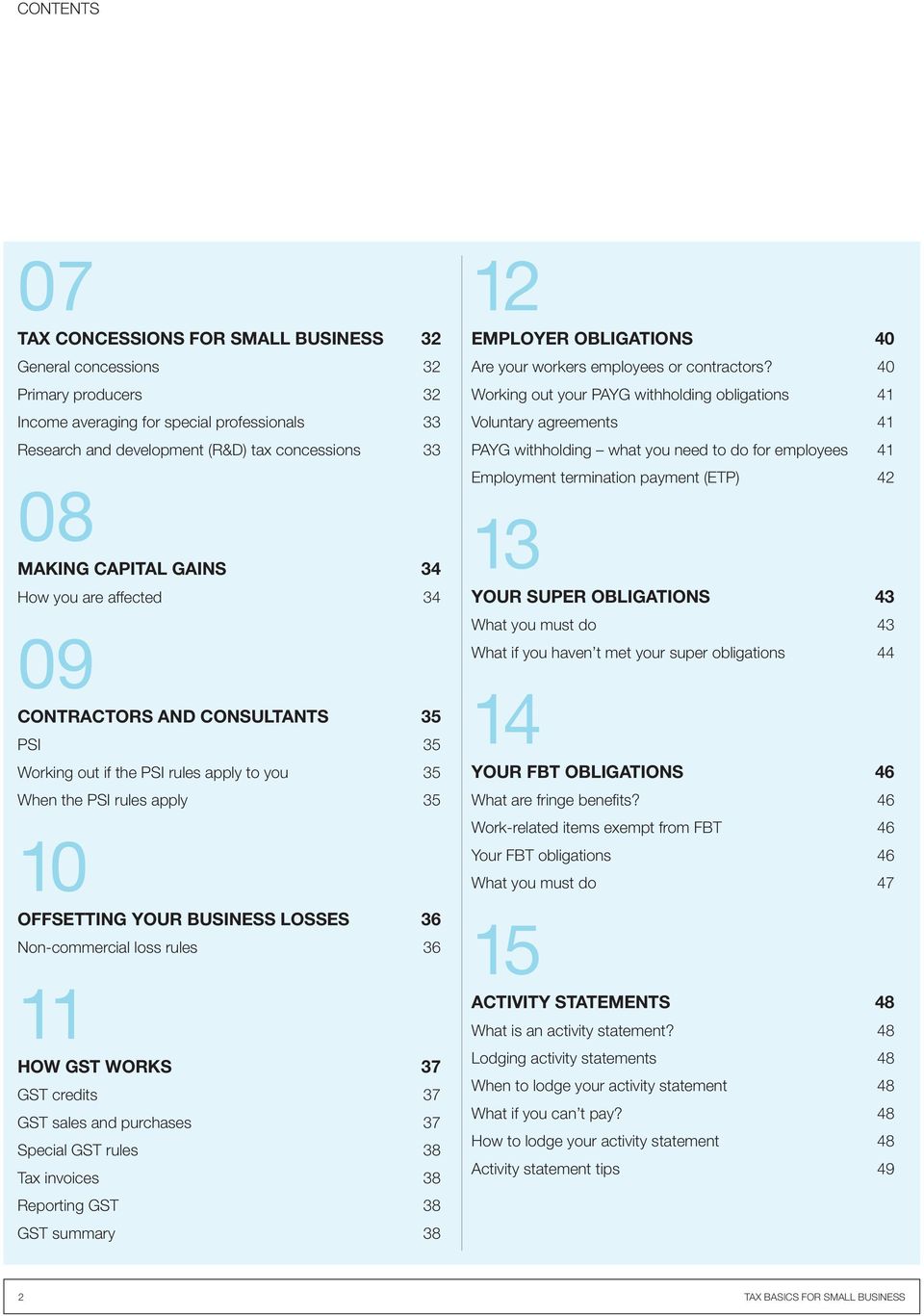
4 CONTENTS 07 TAX CONCESSIONS FOR SMALL BUSINESS 32 General concessions 32 Primary producers 32 Income averaging for special professionals 33 Research and development (R&D) tax concessions MAKING CAPITAL GAINS 34 How you are affected CONTRACTORS AND CONSULTANTS 35 PSI 35 Working out if the PSI rules apply to you 35 When the PSI rules apply OFFSETTING YOUR BUSINESS LOSSES 36 Non-commercial loss rules HOW GST WORKS 37 GST credits 37 GST sales and purchases 37 Special GST rules 38 Tax invoices 38 Reporting GST 38 GST summary EMPLOYER OBLIGATIONS 40 Are your workers employees or contractors? 40 Working out your PAYG withholding obligations 41 Voluntary agreements 41 PAYG withholding what you need to do for employees 41 Employment termination payment (ETP) YOUR SUPER OBLIGATIONS 43 What you must do 43 What if you haven t met your super obligations YOUR FBT OBLIGATIONS 46 What are fringe benefits? 46 Work-related items exempt from FBT 46 Your FBT obligations 46 What you must do ACTIVITY STATEMENTS 48 What is an activity statement? 48 Lodging activity statements 48 When to lodge your activity statement 48 What if you can t pay? 48 How to lodge your activity statement 48 Activity statement tips 49 2 TAX BASICS FOR SMALL BUSINESS
5 CONTENTS 16 TAX RETURNS 50 Lodging tax returns 50 When to lodge your tax return 50 How to lodge your tax return PAYING YOUR TAX 51 Payment options 51 Paying from overseas 52 What if you can t pay right now? 52 Budgeting to pay your tax SELLING OR ENDING YOUR BUSINESS 55 GST 55 CGT 55 SUPPORT FOR SMALL BUSINESS 56 Online services 56 Payment methods 56 Face-to-face 56 Contacting us by phone 57 DEFINITIONS 58 INDEX 59 MORE INFORMATION inside back cover YOUR FIRST YEAR IN BUSINESS 53 Is your budget working? 53 Are you lodging your activity statements on time? 53 Are you lodging your tax return on time? 53 Are you meeting your superannuation guarantee responsibilities? AS YOUR BUSINESS GROWS 54 Is your business structure still suitable? 54 Do you need additional tax registrations? 54 Is your current GST reporting cycle still suitable? 54 Is your record-keeping system working? 54 Are you dealing with us online? 54 Dealing with significant one-off transactions 54 TAX BASICS FOR SMALL BUSINESS 3

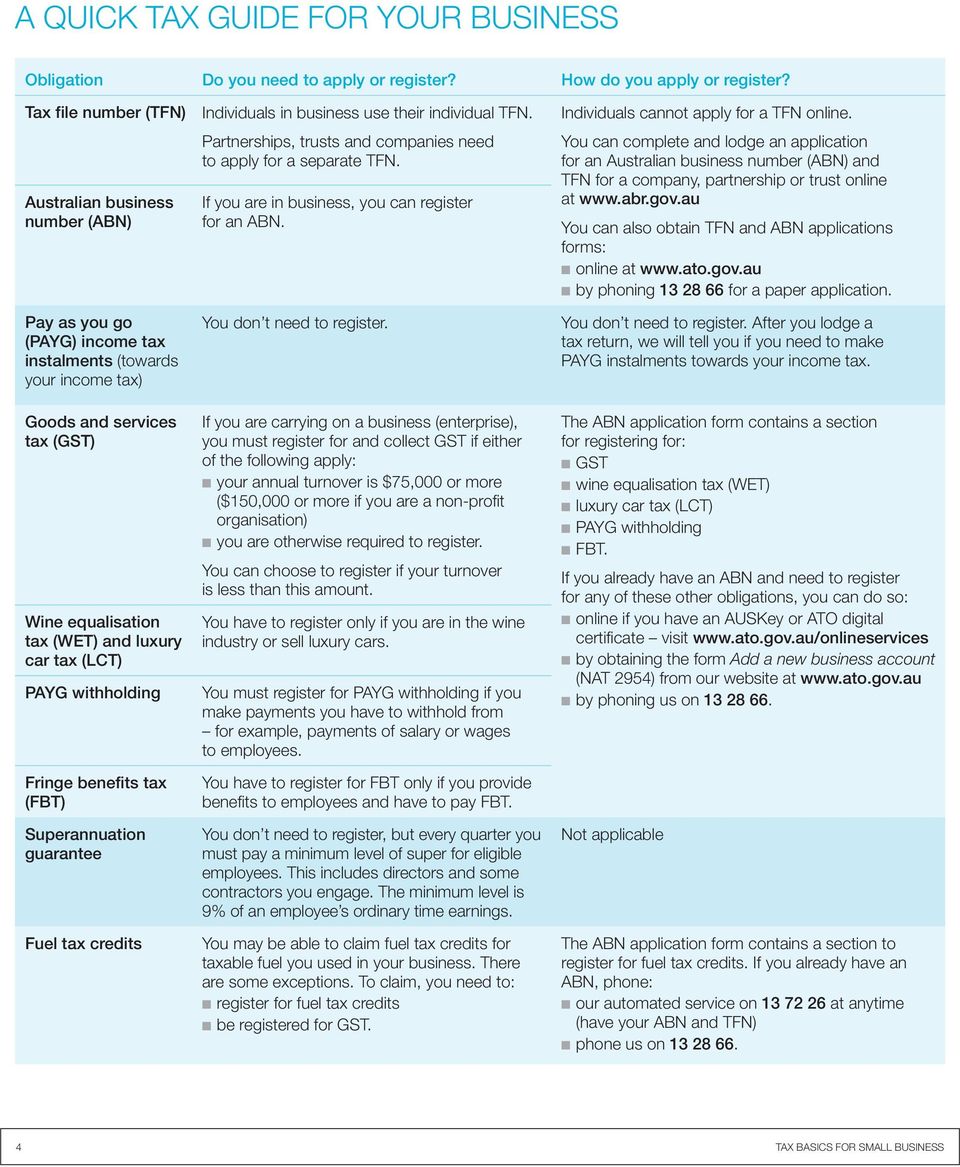
6 A QUICK TAX GUIDE FOR YOUR BUSINESS Obligation Do you need to apply or register? How do you apply or register? Tax file number (TFN) Australian business number (ABN) Pay as you go (PAYG) income tax instalments (towards your income tax) Goods and services tax (GST) Wine equalisation tax (WET) and luxury car tax (LCT) PAYG withholding Fringe benefits tax (FBT) Superannuation guarantee Fuel tax credits Individuals in business use their individual TFN. Partnerships, trusts and companies need to apply for a separate TFN. If you are in business, you can register for an ABN. You don t need to register. If you are carrying on a business (enterprise), you must register for and collect GST if either of the following apply: your annual turnover is $75,000 or more ($150,000 or more if you are a non-profit organisation) you are otherwise required to register. You can choose to register if your turnover is less than this amount. You have to register only if you are in the wine industry or sell luxury cars. You must register for PAYG withholding if you make payments you have to withhold from for example, payments of salary or wages to employees. You have to register for FBT only if you provide benefits to employees and have to pay FBT. You don t need to register, but every quarter you must pay a minimum level of super for eligible employees. This includes directors and some contractors you engage. The minimum level is 9% of an employee s ordinary time earnings. You may be able to claim fuel tax credits for taxable fuel you used in your business. There are some exceptions. To claim, you need to: register for fuel tax credits be registered for GST. Individuals cannot apply for a TFN online. You can complete and lodge an application for an Australian business number (ABN) and TFN for a company, partnership or trust online at You can also obtain TFN and ABN applications forms: online at by phoning for a paper application. You don t need to register. After you lodge a tax return, we will tell you if you need to make PAYG instalments towards your income tax. The ABN application form contains a section for registering for: GST wine equalisation tax (WET) luxury car tax (LCT) PAYG withholding FBT. If you already have an ABN and need to register for any of these other obligations, you can do so: online if you have an AUSKey or ATO digital certificate visit by obtaining the form Add a new business account (NAT 2954) from our website at by phoning us on Not applicable The ABN application form contains a section to register for fuel tax credits. If you already have an ABN, phone: our automated service on at anytime (have your ABN and TFN) phone us on TAX BASICS FOR SMALL BUSINESS
7 A QUICK TAX GUIDE FOR YOUR BUSINESS What ongoing reporting responsibilities will you have? When do you lodge and pay, or claim a refund? See page You only have to apply for a TFN once. If you carry on a business, you must lodge annual tax returns. Not applicable 13 If you operate a business as a sole trader, partnership, company or trust, you only need to apply for an ABN once. If you carry on a business, we will send you activity statements. You must complete and return them by the due dates. Not applicable 13 You report instalments on your activity statement and also have to lodge an annual tax return. If you are registered for GST, you must lodge an activity statement. You report any WET or LCT liabilities on your activity statement. You report amounts you withheld from payments on your activity statement. You also have to lodge an annual payment summary statement. You may have to: lodge an annual FBT return pay quarterly instalments on your activity statement. If you don t meet your super obligations, you must pay the superannuation guarantee charge. You can claim fuel tax credits on your business activity statement (BAS). You report and pay PAYG instalments by the due date shown on your activity statement. You may have to make a balancing payment when you lodge your annual tax return, which is usually due by 31 October. You report and pay GST, and claim any GST credits, by the due date shown on your activity statement. Most small businesses report GST quarterly, but some choose, or are required, to report monthly. Others may be eligible to report annually and pay by instalments, or report and pay annually. You pay WET or LCT by the due date shown on your activity statement. You pay amounts withheld quarterly (smaller businesses) or monthly, when your activity statement is due. You may have to make a balancing payment when your annual PAYG payment summary statement is due by 14 August. You may have to pay quarterly instalments when your activity statement is due. You may have to make a balancing payment when you lodge your FBT return, which is due by 21 May. If you have not met your obligations in any quarter you must lodge a Superannuation guarantee charge statement quarterly (NAT 9600) by the relevant due dates in the following quarter (28 November, 28 February, 28 May and 28 August). You need to lodge your BAS by the due date shown on the form. 23 and and and and TAX BASICS FOR SMALL BUSINESS 5

8 01 STARTING YOUR BUSINESS GET THE RIGHT ADVICE Once you have decided that you want to start a business, the following information sources can help get you off on the right foot: talk to a financial adviser or small business advisory service ask your local council or state government office how to contact organisations in your state that can provide free assistance look under Small business in the Yellow pages. These organisations can help you plan your business and get access to the financial support you need. Talk to successful people in a business similar to yours. Ask them what their experience was when they started and what they did that made their business a success? Research what other rules or regulations will apply to you. The internet is a great source of information if you are looking to start a business. Check out your local, state or federal government websites. Visit business.gov.au for useful information about: business structures forming a company accessing finances business licences complying super funds payroll tax workers compensation. WORKING OUT IF YOU ARE OPERATING A BUSINESS If you are in business: the money you earn from your business activities is generally assessable income you can generally claim a deduction for the expenses you incur in earning that income you may be able to offset any loss you incur against other income you earn or carry the loss forward to offset future income. If your activities are a hobby, these points do not apply. What is an enterprise? You will often see the term enterprise, especially in relation to the ABN and GST. Basically, this term covers commercial activities but does not include hobbies or employment. Businesses are referred to as enterprises for GST and ABN purposes, and so are the activities of charities and religious institutions. Carrying on a business includes anything you do in the course of starting or ending a business. Often, the date you start the business is before the business starts to trade. Characteristics of a business The following are some factors that courts and tribunals take into account in working out if a business exists for tax purposes. While no one factor can be used to work out if you are carrying on a business, taken together they can show if your activity is a business. Does your activity have a significant commercial character? It is important to consider if you carry on your activity for commercial reasons and in a commercially viable way. Do you have more than just an intention to engage in business? You must have made a decision to start your business and have done something about it. If you are still setting up or preparing to go into business, you might not yet have started the business. Do you have the purpose of profit as well as the prospect of profit? Do you intend to make a profit or genuinely believe you will make a profit, even if you are unlikely to do so in the short term? Is there repetition and regularity to your activity? Businesses usually repeat similar types of activities, although one-off transactions can amount to a business in some cases. Is your business similar to other businesses in your industry? Is the way you operate consistent with industry norms or other businesses in your industry? What is the size, scale or permanency of your activity? Is the size or scale of your activity consistent with other businesses in your industry? Is it enough to allow you to make a sustainable profit? Is your activity planned, organised and carried on in a businesslike manner? This can be shown using: business records and account books a separate business bank account business premises licenses or qualifications a registered business name. 6 TAX BASICS FOR SMALL BUSINESS

9 01 STARTING YOUR BUSINESS EXAMPLE: Carrying on a business Bill sells wooden toys from a retail outlet. His outlet is open the same hours as other retail outlets. He advertises in the Yellow pages as well as in regional toy magazines. He sells to clients within his region and to other people who have seen his advertisement. He sells his toys at a price that lets him make a profit. Bill is carrying on a business. What is a non-profit organisation? A non-profit organisation is an organisation that is not operating for the profit or gain (either direct or indirect) of its individual members. It: uses any profit it makes to further the objectives of the organisation does not distribute any profit to any of its members cannot distribute its assets to members if the organisation is wound up. EXAMPLE: Conducting a hobby Tchen makes wooden toys at home. He works on the toys about six hours a week and sells them only to his family and friends. He expects his toy making activity to remain small and is happy if all he does is cover his costs. Tchen s toy making activity is considered a hobby. This means Tchen: would not include any amounts he received from selling his toys in his tax return cannot claim any expenses related to his hobby. If you are a sole trader or partner in a partnership involved in a business activity that makes a loss, you must meet certain conditions to be able to claim that loss against your income from other sources, such as wages. For more information, see Offsetting your business losses on page 36. A non-profit organisation is not simply an organisation that has not made a profit. Non-profit organisations are treated differently for tax purposes. Examples of organisations that may be non-profit are: churches community centres cultural societies environmental protection societies public museums and libraries scholarship funds sports clubs traditional service clubs. We have a range of publications and services specifically for non-profit organisations, including charities. For more information about non-profit organisations and their tax obligations: visit the Non-profit organisations section of our website at refer to Tax basics for non-profit organisations (NAT 7966) phone us on TAX BASICS FOR SMALL BUSINESS 7

10 02 CHOOSING A BUSINESS STRUCTURE When starting a business, it is very important to choose the business structure that best suits your needs. There are four main business structures commonly used by small businesses in Australia: sole trader partnership trust company. We can t advise which structure you should choose, but we can show you how different structures will affect the way we tax your business income. The structure you choose may affect: the tax you are liable to pay asset protection ongoing costs your clients for example, some prefer to deal only with companies. Whichever structure you choose, make sure you understand the responsibilities that go with that structure. Typically, costs and complexity increase as you move from a sole trader to a partnership to a company or trust. You are not locked into any structure and you can change the structure as your business changes or grows. The following information shows the main features of different business structures. It may help you decide which structure is best for your business. For more information about business structures and responsibilities, contact the: Office of Fair Trading in your state Australian Securities & Investments Commission (ASIC) if you operate your business as a company. If you are not sure which structure to choose, talk to an accountant, tax adviser, solicitor or other business adviser. 8 TAX BASICS FOR SMALL BUSINESS

11 02 CHOOSING A BUSINESS STRUCTURE FEATURES OF DIFFERENT BUSINESS STRUCTURES Sole trader Structure Sole trader Features Description: A sole trader is the simplest business structure. If you operate your business as a sole trader, you trade on your own and control and manage the business. TFN: As a sole trader, you use your individual TFN when you lodge your tax return. ABN: As a sole trader, if you carry on an enterprise in Australia, you can apply for an ABN for your business and use this number for all your business dealings. Who pays income tax? The business income is treated as your individual income and you are solely responsible for any tax the business must pay. This means that, after claiming a deduction for all allowable expenses, you include all your business income with any other income and report it on your individual tax return. As a sole trader, you pay the same tax as individual taxpayers, at personal income tax rates (see income tax rates on page 23). Individuals who are Australian residents don t pay tax on the first $6,000 they earn. This is called the tax-free threshold. You must generally pay PAYG instalments during the year towards the amount of tax you expect to pay at the end of the year. GST: As a sole trader, you can register for GST if you carry on an enterprise. You can apply for registration on the ABN application form. You must be registered for GST if your annual GST turnover is $75,000 or more. Drawings: As a sole trader, you cannot claim a deduction for money you draw from your business. Amounts you take from your sole trader business are not wages for tax purposes, even if you think of them as wages. Personal services income (PSI): If you are a contractor or consultant, you may have to treat deductions in relation to this income differently (see PSI on page 35). Super: As a sole trader, you are responsible for your own super arrangements. You may also be able to claim a deduction for any personal super contributions you make. If you have any eligible workers, you must pay a minimum of 9% of their ordinary time earnings as superannuation guarantee contributions on their behalf. TAX BASICS FOR SMALL BUSINESS 9

12 02 CHOOSING A BUSINESS STRUCTURE Partnerships Structure Partnership Features Description: For tax purposes, a partnership is an association of people who carry on a business as partners or receive income jointly. TFN: If you operate your business as a partnership, it needs its own TFN that you use when lodging its annual business tax return. You can apply for this on the ABN application form. ABN: If you carry on an enterprise as a partnership in Australia, you can apply for an ABN for the partnership and use it for all the partnership s business dealings. Who pays income tax? A partnership is not a separate legal entity and doesn t pay income tax on the income it earns. Instead, you and each of your partners pay tax on the share of net partnership income you each receive. While the partnership doesn t pay tax, it does have to lodge an annual partnership tax return to show all income the partnership earned and deductions it claimed for expenses it incurred in carrying on the partnership business. The tax return also shows each partner s share of the net partnership income. Partnerships are not liable to pay PAYG instalments. Instead, you and the other partners may be liable to pay PAYG instalments on the share of income you each receive from each partnership you are a member of (see Making payments towards your income tax on page 23). Drawings: As a member of a partnership, you cannot claim a deduction for money you draw from the business. Amounts you take from a partnership business are not wages for tax purposes, even if you think of them as wages. GST: As a member of a partnership, you can apply for GST registration for the partnership if it is carrying on an enterprise. You can apply to register on the ABN application form. A partnership must be registered for GST if its annual GST turnover is $75,000 or more. PSI: You may treat income and deductions in relation to this income differently (see PSI on page 35). Super: As a member of a partnership, you are responsible for your own super arrangements as you are not employees of the partnership. You may also be able to claim separately a deduction for personal super contributions you make. If you have any eligible workers, you must pay a minimum of 9% of their ordinary time earnings as superannuation guarantee contributions on their behalf. 10 TAX BASICS FOR SMALL BUSINESS

13 02 CHOOSING A BUSINESS STRUCTURE Trusts Structure Trust Features Description: A trust is an obligation imposed on a person to hold property or income for the benefit of others. These others are known as beneficiaries. TFN: A trust must have its own TFN to use when lodging its annual tax return. If you are the trustee of the trust, you must apply for a TFN for the trust. You can do this on the ABN application form. ABN: If the trust is carrying on an enterprise in Australia, as the trustee, you must register for an ABN for the trust. Who pays income tax? Whether or not a trust is liable to pay tax depends on what type of trust it is, the wording of its trust deed and if any of the income the trust earns is distributed to its beneficiaries. Where the whole of the net trust income is distributed to adult resident beneficiaries, the trust is not liable to pay tax. Where all or part of the net trust income is distributed to either foreign residents or minors, as the trustee, you are assessed on that share on behalf of the beneficiaries. In this case, the beneficiaries must declare that share of net trust income on their individual tax returns, and also claim a credit for the amount of tax you paid on their behalf as the trustee. Where the trust accumulates net trust income, as the trustee, you are assessed on that accumulated income at the highest individual marginal rate. If a trust is carrying on a business, each year all income the trust earns and deductions it claims for expenses it incurs in carrying on that business, must be shown on a trust tax return. The tax return also shows the amount of income distributed to each beneficiary. Trusts are not liable to pay PAYG instalments. Instead, the beneficiaries or trustees may be liable to pay instalments (see Making payments towards your income tax on page 23). GST: If the trust is carrying on an enterprise, you can register for GST as trustee of the trust. You can do this using the ABN application form. A trust must be registered for GST if its annual GST turnover is $75,000 or more. The registration threshold for non-profit organisations is $150,000. PSI: You may treat income and deductions in relation to this income differently (see PSI on page 35). Super: If the trust has any eligible workers, it must pay a minimum of 9% of their ordinary time earnings as superannuation guarantee contributions on their behalf. This may include you as the trustee if you are also employed by the trust. TAX BASICS FOR SMALL BUSINESS 11

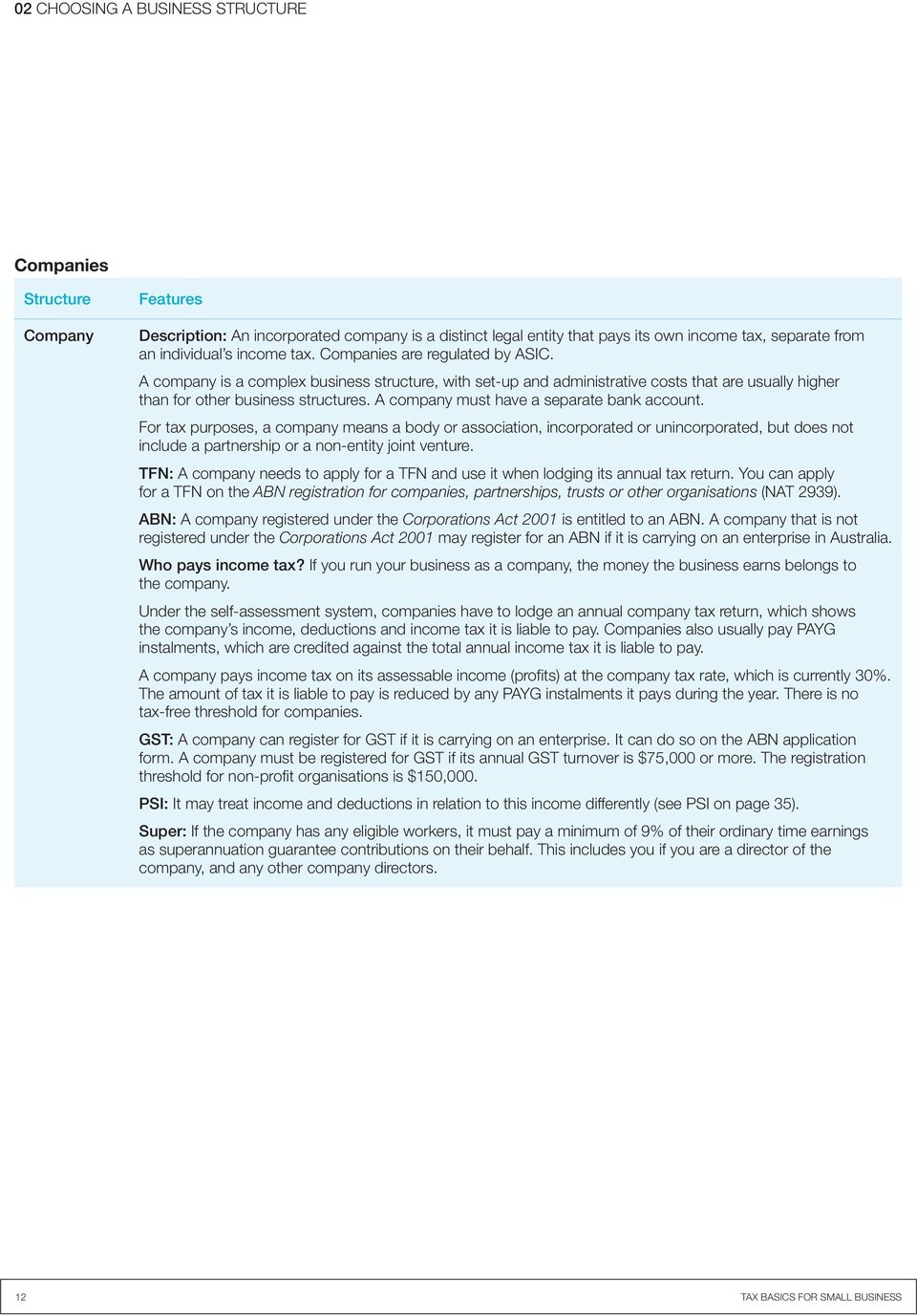
14 02 CHOOSING A BUSINESS STRUCTURE Companies Structure Company Features Description: An incorporated company is a distinct legal entity that pays its own income tax, separate from an individual s income tax. Companies are regulated by ASIC. A company is a complex business structure, with set-up and administrative costs that are usually higher than for other business structures. A company must have a separate bank account. For tax purposes, a company means a body or association, incorporated or unincorporated, but does not include a partnership or a non-entity joint venture. TFN: A company needs to apply for a TFN and use it when lodging its annual tax return. You can apply for a TFN on the ABN registration for companies, partnerships, trusts or other organisations (NAT 2939). ABN: A company registered under the Corporations Act 2001 is entitled to an ABN. A company that is not registered under the Corporations Act 2001 may register for an ABN if it is carrying on an enterprise in Australia. Who pays income tax? If you run your business as a company, the money the business earns belongs to the company. Under the self-assessment system, companies have to lodge an annual company tax return, which shows the company s income, deductions and income tax it is liable to pay. Companies also usually pay PAYG instalments, which are credited against the total annual income tax it is liable to pay. A company pays income tax on its assessable income (profits) at the company tax rate, which is currently 30%. The amount of tax it is liable to pay is reduced by any PAYG instalments it pays during the year. There is no tax-free threshold for companies. GST: A company can register for GST if it is carrying on an enterprise. It can do so on the ABN application form. A company must be registered for GST if its annual GST turnover is $75,000 or more. The registration threshold for non-profit organisations is $150,000. PSI: It may treat income and deductions in relation to this income differently (see PSI on page 35). Super: If the company has any eligible workers, it must pay a minimum of 9% of their ordinary time earnings as superannuation guarantee contributions on their behalf. This includes you if you are a director of the company, and any other company directors. 12 TAX BASICS FOR SMALL BUSINESS
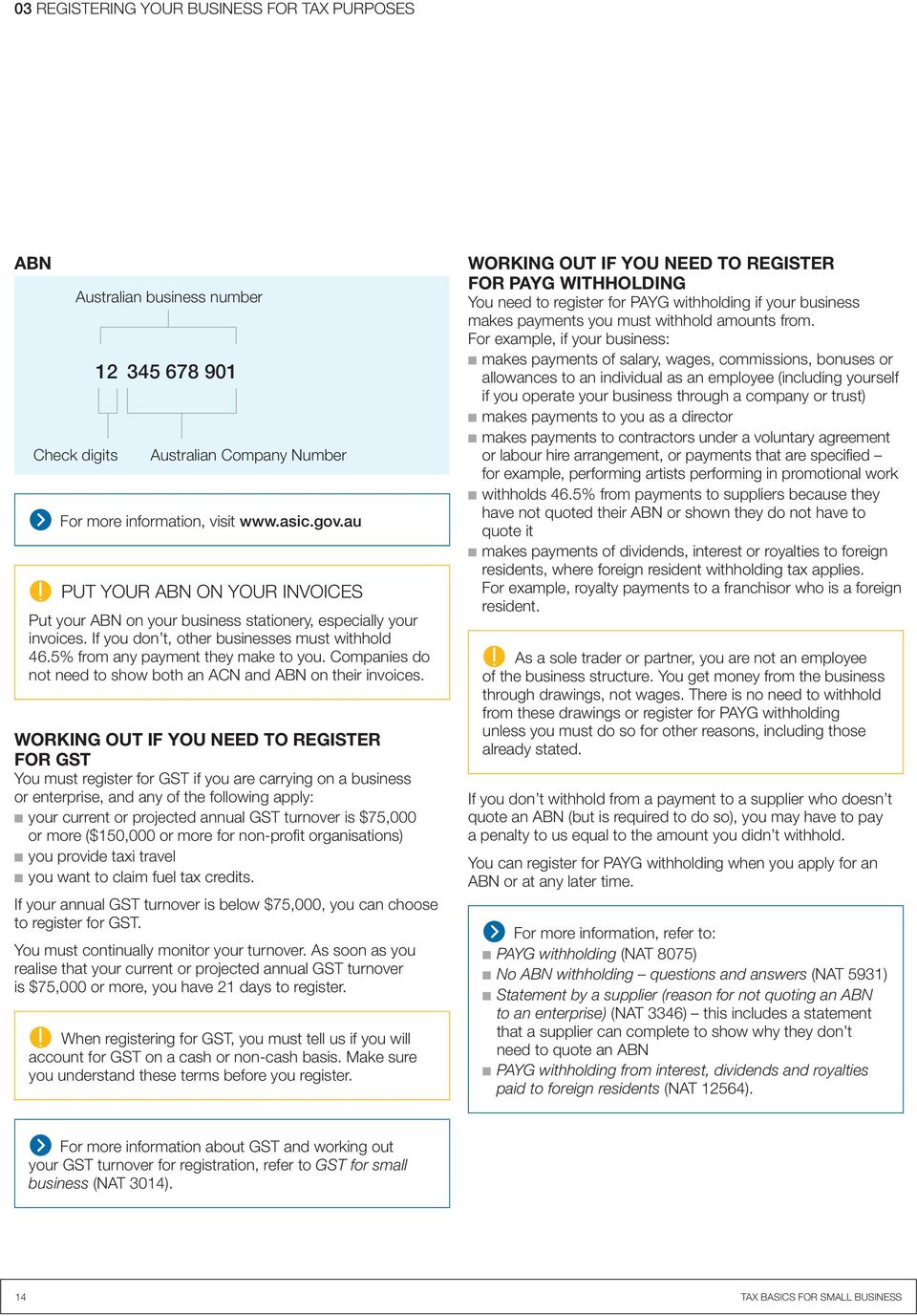
15 REGISTERING YOUR BUSINESS FOR TAX PURPOSES 03 You will need to register your business for a number of tax obligations. You can complete and lodge applications for most tax obligations: online at through your tax agent by phoning us on for paper application forms. However, if you operate your business as a sole trader, you cannot apply for a TFN online. If you don t already have a TFN, phone us on for a paper application. The ABN application form contains a section for registering for: GST WET LCT PAYG withholding FBT. These obligations are explained on pages You can register for these obligations when you apply for an ABN, or at any later time. If you need to register later, you can do so: by registering online if you have an AUSkey or ATO digital certificate using the form Add a new business account (NAT 2954), available on our website at by phoning us on COMMON BUSINESS TAX REGISTRATIONS The most common tax registrations businesses need are: a TFN an ABN GST PAYG withholding fuel tax credits. WORKING OUT IF YOU NEED A TFN If you have decided to operate your bus iness as a sole trader, you use your individual TFN for both your business and personal dealings with us. Most people already have an individual TFN, but if you don t, you need to complete a Tax file number application or enquiry for an individual (NAT 1432) and send it to us. You can phone us on and we will send you an application. If you have chosen to operate your business through a partnership, company or trust, you will need a separate TFN. You can apply for a TFN when you register for an ABN. WORKING OUT IF YOU NEED AN ABN You do not have to have an ABN, but having an ABN will: make it easier to register for GST and other business tax registrations, such as PAYG withholding avoid having amounts withheld from payments to you businesses must withhold 46.5% of any payments they make to you unless you quote an ABN. Each entity (sole trader, partnership, company or trust) receives one ABN, regardless of the number of commercial activities or enterprises it undertakes. For example, a single entity running a cafe and a newsagency would have only one ABN. But if you set up separate companies, partnerships or trusts, each entity must register in its own right. Australian Business Register (ABR) If you are a partnership, company or trust, you can complete and lodge an application for an ABN and business TFN online at When you register for an ABN, the business details from your application are added to the ABR. The register is the central collection, storage and verification system for basic identity information about all businesses with an ABN. You can log onto the register to check that an ABN quoted to you is genuine, to make sure you meet the no-abn withholding rules. You can also update your details online. To do this, you need an AUSkey or ATO digital certificate. Changes you make are updated immediately once you submit all the details and the ABR confirms them. For more information about AUSkey and ATO digital certificates, visit our website at The Australian Company Number (ACN) and the ABN If you choose a company structure, you will first need to register your company with ASIC. ASIC will issue your company with an ACN. When you register your company for an ABN, you will be asked to supply your ACN. The ABN issued to your company by the ABR will be the company s ACN plus two check digits at the beginning, as shown in the following table. TAX BASICS FOR SMALL BUSINESS 13

16 03 REGISTERING YOUR BUSINESS FOR TAX PURPOSES ABN Australian business number Check digits Australian Company Number For more information, visit PUT YOUR ABN ON YOUR INVOICES Put your ABN on your business stationery, especially your invoices. If you don t, other businesses must withhold 46.5% from any payment they make to you. Companies do not need to show both an ACN and ABN on their invoices. WORKING OUT IF YOU NEED TO REGISTER FOR G ST You must register for GST if you are carrying on a business or enterprise, and any of the following apply: your current or projected annual GST turnover is $75,000 or more ($150,000 or more for non-profit organisations) you provide taxi travel you want to claim fuel tax credits. If your annual GST turnover is below $75,000, you can choose to register for GST. You must continually monitor your turnover. As soon as you realise that your current or projected annual GST turnover is $75,000 or more, you have 21 days to register. When registering for GST, you must tell us if you will account for GST on a cash or non-cash basis. Make sure you understand these terms before you register. WORKING OUT IF YOU NEED TO REGISTER FOR PA YG WITHHOLDING You need to register for PAYG withholding if your business makes payments you must withhold amounts from. For example, if your business: makes payments of salary, wages, commissions, bonuses or allowances to an individual as an employee (including yourself if you operate your business through a company or trust) makes payments to you as a director makes payments to contractors under a voluntary agreement or labour hire arrangement, or payments that are specified for example, performing artists performing in promotional work withholds 46.5% from payments to suppliers because they have not quoted their ABN or shown they do not have to quote it makes payments of dividends, interest or royalties to foreign residents, where foreign resident withholding tax applies. For example, royalty payments to a franchisor who is a foreign resident. As a sole trader or partner, you are not an employee of the business structure. You get money from the business through drawings, not wages. There is no need to withhold from these drawings or register for PAYG withholding unless you must do so for other reasons, including those already stated. If you don t withhold from a payment to a supplier who doesn t quote an ABN (but is required to do so), you may have to pay a penalty to us equal to the amount you didn t withhold. You can register for PAYG withholding when you apply for an ABN or at any later time. For more information, refer to: PAYG withholding (NAT 8075) No ABN withholding questions and answers (NAT 5931) Statement by a supplier (reason for not quoting an ABN to an enterprise) (NAT 3346) this includes a statement that a supplier can complete to show why they don t need to quote an ABN PAYG withholding from interest, dividends and royalties paid to foreign residents (NAT 12564). For more information about GST and working out your GST turnover for registration, refer to GST for small business (NAT 3014). 14 TAX BASICS FOR SMALL BUSINESS
17 03 REGISTERING YOUR BUSINESS FOR TAX PURPOSES WORKING OUT IF YOU NEED OTHER BUSINESS TAX REGISTRATIONS Other business tax registrations you may need are for: FBT, if you provide fringe benefits to employees WET, if you are a wine manufacturer, wholesaler or importer LCT, if you are a retailer, wholesaler or manufacturer of luxury cars fuel tax credits, if you use eligible fuel in your business. Super You don t have to register with us fo r super purposes, but you must offer your eligible employees a choice of super fund. If your eligible employees do not choose a fund, you must pay their super contributions into the employer nominated fund. FBT If you are an employer and you provide fringe benefits to your employees, you may have to pay FBT. We recommend you register as soon as you have decided you will provide benefits. Some common fringe benefits are: private use of a work car by an employee or director paying private expenses for an employee or director for example health insurance costs club memberships school fees holiday expenses on-site accommodation. For more information about fringe benefits, refer to Fringe benefits tax for small business (NAT 8164). LCT Cars with a GST-inclusive value above the LCT threshold ($57,466 for ) are subject to LCT. The LCT threshold is equal to the car limit, which is reviewed each financial year and may change. The 33% tax must be paid on the portion of the GST-exclusive value of the car that exceeds the threshold. Retailers, wholesalers and manufacturers of luxury cars may have a liability for LCT. Importers (including private buyers) also pay LCT. For more information about the LCT threshold, refer to Luxury car tax (NAT 3394). Fuel tax credits You can claim credits for the fuel tax (excise or customs duty) included in the price of fuel you use in your business activities, machinery, plant, equipment and heavy vehicles. Ineligible fuels include aviation fuels, alternative fuels and fuel used in light vehicles of 4.5 tonne gross vehicle mass (GVM) or less travelling on public roads. This means most businesses can now claim fuel tax credits it is just the rate that varies depending on your business activity. For more information about fuel tax credits: visit our website at refer to Fuel tax credits for business (NAT 14584) phone us on between 8.00am and 6.00pm, Monday to Friday. WET WET is a value-based tax of 29% on whole sale sales of wine or an equivalent value when there is no wholesale sale. Wine manufacturers, wholesalers and importers collect WET and send it to us. The Australian Customs and Border Protection Service collects WET on imported wine. Retailers do not generally have to pay WET unless they bottle or package wine for sale, or make their own wholesale sales of wine, that is, to a reseller. The retailer is not entitled to a credit for WET. For more information, visit our website at and select Tax topics A-Z Wine equalisation tax (WET). CHANGING YOUR REGISTRATION DETAILS Once you are registered, you must tell us if your details or business circumstances change. You can update your registration details either: on the ABR at by phoning us on If you have an AUSkey or ATO digital certificate, you can update your details on the Business Portal at For more information, visit TAX BASICS FOR SMALL BUSINESS 15

18 03 REGISTERING YOUR BUSINESS FOR TAX PURPOSES CANCELLING A REGISTRATION If you need to cancel your registration, phone us on and we will help you work through what you need to do. NON-TAX BUSINESS REGISTRATIONS Your business may need other licences, permits or registrations to operate. Things you may need to consider could include the following. Registering your business name Most businesses will need to register their business or trading name. You can carry on a business in your own name without registering a trading name if you don t change or add anything to your name. For example, if your name is John Smith, you don t have to register a name to trade as J Smith or John Smith. However, if you trade as John Smith Landscaping, you need to register the name with the relevant government body in your state. When you apply for an ABN, you must provide the trading name of your business, so make sure you register your trading name before you apply for an ABN. For more information, visit business.gov.au Getting an ACN If your entity is a company, you need to apply for an ACN before applying for an ABN. State government licences Some businesses need licences to operate. These are usually issued by your state government. Most states have a small business department that can tell you what licences you need and how to get them. EXAMPLE: Registration Alex All Electrical Alex started his own business as an electrician. He does repairs on site or at his workshop. Structure: sole trader Expected turnover: $40,000 Staff: works alone Business registrations for All Electrical TFN ABN GST PAYG withholding FBT Alex doesn t need a separate TFN because, as a sole trader, he uses his individual TFN. Alex needs an ABN as he is going to register for GST and needs to quote an ABN when dealing with other businesses. Alex doesn t have to register for GST because his expected annual GST turnover is less than $75,000, but he prefers to charge GST and claim GST credits. Alex plans to work alone, with no employees. He can register later if he needs to for example, if he needs to withhold from a supplier that doesn t quote an ABN. Alex has no employees. Alex can register for an ABN and GST either: online at by phoning us on to obtain an ABN application form for an individual (sole trader). He cannot apply for a TFN online. Council permits You may need a council permit to operate your business; for example, to use a building for a specific purpose, or sell food or dangerous goods. Check any requirements with your local council. For more information about other business registrations: visit the Australian Government s business resource website at business.gov.au check the White pages under small business. 16 TAX BASICS FOR SMALL BUSINESS

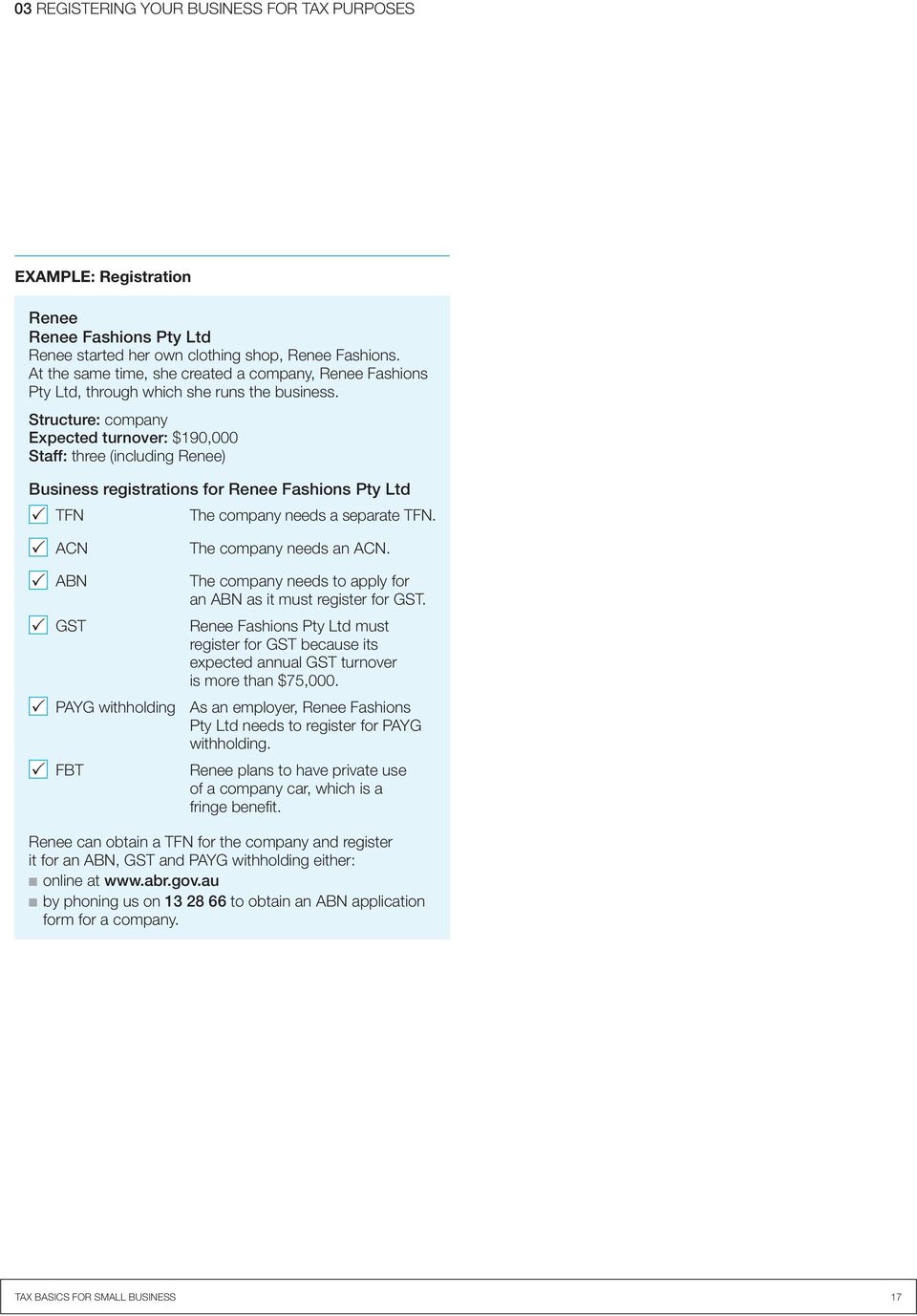
19 03 REGISTERING YOUR BUSINESS FOR TAX PURPOSES EXAMPLE: Registration Renee Renee Fashions Pty Ltd Renee started her own clothing shop, Renee Fashions. At the same time, she created a company, Renee Fashions Pty Ltd, through which she runs the business. Structure: company Expected turnover: $190,000 Staff: three (including Renee) Business registrations for Renee Fashions Pty Ltd TFN ACN ABN GST PAYG withholding FBT The company needs a separate TFN. The company needs an ACN. The company needs to apply for an ABN as it must register for GST. Renee Fashions Pty Ltd must register for GST because its expected annual GST turnover is more than $75,000. As an employer, Renee Fashions Pty Ltd needs to register for PAYG withholding. Renee plans to have private use of a company car, which is a fringe benefit. Renee can obtain a TFN for the company and register it for an ABN, GST and PAYG withholding either: online at by phoning us on to obtain an ABN application form for a company. TAX BASICS FOR SMALL BUSINESS 17
20 03 KEEPING GOOD RECORDS YOUR REGISTRATION CHECKLIST Use this registration checklist to record what tax registrations you need for your business and find out how to register. Tick if you need to register Registration type Individual TFN (only if you don t have one already) Can you apply on your ABN registration form? Complete a Tax file number application (NAT 1432) and send it to us. Can you register online? Visit our website at for details on how to order. Partnership TFN Visit Company TFN Trust TFN ABN to register online. Who to phone if you need help Phone us on Phone us on ACN (for companies only you need an ACN before you can apply for an ABN) Visit to download an ACN application form. Phone ASIC on Business name Visit business.gov.au and follow the links to your state s application form. GST Visit PAYG withholding FBT WET LCT Fuel tax credit You can apply online while registering for an ABN. We may contact you for more information about: WET LCT fuel tax credit. Look under Business or State government in the Yellow pages. Phone us on TAX BASICS FOR SMALL BUSINESS

21 KEEPING GOOD RECORDS 04 Poor record keeping is one of the main reasons why many small businesses fail. Good business records will help you manage your business, meet your tax obligations and make sound business decisions. They will save you time and money. Specifically, good records will help you: work out your costs and profitability and monitor your stock show your financial position to banks and other lenders, or to prospective buyers of your business use your accountant s time for business and financial planning, not for sorting out your receipts and invoices complete and lodge activity statements and income tax returns make super contributions by the quarterly cut-off dates manage your cash flow so you can pay your tax on time. LEGAL REQUIREMENT The final reason for keeping good records is that the tax laws say you must. If you don t keep appropriate records, you can incur penalties. You must keep records that explain all your business transactions. You must keep written records in English. If you keep electronic records on your computer, they must be in a form that you can easily access and convert into written English. You must keep any account books, records or documents related to preparing your tax return for at least five years after they are prepared, obtained or the transaction is completed, whichever occurs last. Some records need to be kept for longer than five years. For capital gains tax (CGT), you must keep records for at least five years after the relevant CGT event for example, the sale of an asset. You may have purchased the asset many years before you sold it. To streamline record keeping, you can choose to enter information from your CGT records into an asset register. For more information, refer to Guide to capital gains tax (NAT 4151). When claiming earlier year losses, you must keep records relating to those losses for five years following the year you claimed the losses in. KEEPING MANUAL OR ELECTRONIC RECORDS Good records are the foundation of a good business, so it is a good idea to have a suitable record keeping system ready to go from day one. If you need to, get some help to set up and manage your records. Your record keeping system should be as simple as your business needs and capabilities allow. You can keep your records electronically or on paper. Paper records are generally quicker to start with but can be slower at the end of the month or at tax time when you have to total everything. A variety of electronic record-keeping packages are available. They can take more time to set up but have advantages, including automatically totalling amounts, printing invoices and providing summary details for your activity statements and tax returns. If you do decide to keep electronic records, make sure you choose a software package that meets your business needs and our requirements. For information about commercially available software products that may suit your business needs, visit our website at If you are thinking about getting a tax adviser to help with your tax, before you choose a record-keeping system, talk to them about what system is best for you. RECORDS YOU NEED TO KEEP Generally, records you need to keep include: Income and sales records Keep records of all sales and barter transactions for example, invoices, receipt books, cash register tapes and records of cash sales. Expense or purchase records Keep records of all business expenses, including cash purchases. Records could include receipts, invoices, cheque butts, credit card vouchers and diaries to record petty cash expenses. Bank records Keep all bank records, such as bank statements and loan documents. TAX BASICS FOR SMALL BUSINESS 19
22 04 KEEPING GOOD RECORDS Asset purchase records Keep details of what assets you buy and what you spend on those assets. An asset register can help you keep track of these expenses. Contracts and agreements Keep copies of contracts and franchise or other agreements. Year-end records These include lists of creditors or debtors and worksheets for depreciating assets. Minor deductible expenses For certain work, car and business travel expenses, it is not always possible to get a receipt. But you can still claim the expenses as deductions as long as you record the details of these expenses in a diary or logbook. For more information, refer to Record keeping for small business (NAT 3029). Motor vehicle records You may have to keep logbooks, lease or loan documents or yearly odometer readings for motor vehicles you use in your business. Stocktake records Businesses that sell goods usually have to do a stocktake (a physical count and valuation) at 30 June each year. You take changes in stock levels into account in working out your taxable income for the year. Broadly, if your annual turnover is less than $2 million, you can use simpler stocktake rules. No ABN withholding Keep statements by suppliers who have not quoted their ABN, records of any amounts you have withheld from them and payment summaries you have given them. SPECIAL RECORDS YOU MAY NEED TO KEEP As well as general records, you may need to keep other records, depending on your tax obligations or the type of expense. GST records The main GST records you need to keep are tax invoices and adjustment notes. Remember, you need a tax invoice to claim GST credits. You must also keep any other document that records an election, choice, estimate, determination or calculation made for GST purposes. For more information, refer to How to set out tax invoices and invoices (NAT 11675). Employee or contractor records For employees or contractors, you need to keep: records of wages, allowances and other payments you made to them superannuation guarantee records, including payments you made and records that show you have met your choice of super fund obligations records of FBT calculations, worksheets, declarations, elections and supporting details copies of TFN declarations or withholding declarations copies of any contracts you have with contractors. Put your ABN on your business stationery, especially on your invoices. The businesses you deal with need your ABN so they don t have to withhold the highest rate of tax from payments for supplies you make to them. For more information, refer to Statement by a supplier (reason for not quoting an ABN to an enterprise) (NAT 3346). Fuel tax credit To support your claims for fuel tax credits, you must keep records that show you: acquired the fuel used the fuel in your business applied the correct rate when working out how much you could claim. You must keep these records for five years after you make the claim. If you are claiming fuel tax credits of $300 or less in a financial year, you do not have to keep records of fuel purchases. For more information, visit our website at 20 TAX BASICS FOR SMALL BUSINESS
23 04 KEEPING GOOD RECORDS RECORD KEEPING TIPS Use the record keeping evaluation tool This is a free, interactive software program that will help you understand what records you need to keep and evaluate whether your record-keeping practices are adequate. It provides a list of records tailored specifically for your business, a report on how well the business is keeping its records and suggested improvements where appropriate. We cannot access the information you enter in the tool. To download the tool, visit our website at Set up a good filing system for your records This will help you keep the right records and have them available when you need them. Get into a routine and do your books regularly. Fill in cheque butts in detail Write enough information on your cheque butts so that you (or your accountant) can understand what the payment was for later on. Clearly separate business and private expenditure We recommend you keep your business and personal banking in separate accounts. If you have a company or trust, it is a legal requirement. Avoid paying personal expenses from your business account. Cross-reference your transactions When you pay bills, write the invoice number on the cheque butt, and the cheque number on the invoice. This will help you track down information if you have any problems later. Regularly reconcile your cash book entries with bank statements Reconciling your accounts helps find errors or omissions. It could save your accountant time, which will save you money. Avoid keeping cash register tapes If you use a cash register, you can discard your cash register tapes after one month, provided you keep Z-totals and they have been reconciled with actual sales and banking for the period. Otherwise, you must keep the full rolls for five years. The Z-total is the figure printed by the cash register showing the total of all recorded takings for a day. For more information, refer to Record keeping for small business (NAT 3029). RECORD KEEPING TOOLS Use our record keeping evaluation tool to help work out your business s record keeping needs. Based on the information you provide, the tool will produce: a list of business records you should keep a report that shows how well you are keeping your business records suggestions for improvement. TAX BASICS FOR SMALL BUSINESS 21
24 05 WORKING OUT YOUR INCOME TAX SELF-ASSESSMENT Australia s income tax system works on the self-assessment principle. This means we initially accept that the information you provide is accurate and work out the tax you are liable to pay on this basis. However, we may ask you to show records to support your information, so it is important to keep the necessary records to verify your claims. WORKING OUT TAXABLE INCOME We work out your individual or business income tax based on your taxable income using the following formula: Assessable income allowable deductions = taxable income (the amount you pay tax on) ASSESSABLE INCOME Most money you receive in carrying on your business is assessable income. There are some exceptions, such as: loans you receive money you contribute as the business owner GST you collect. For more information about what is included in assessable income, refer to Income and deductions for small business (NAT 10710). ALLOWABLE DEDUCTIONS You can claim a deduction for most expenses you incur in carrying on your business and you can generally claim: an immediate deduction for expenses that are necessary for the everyday running of your business a deduction over a number of years (depreciation) for other expenses for example, capital assets such as machinery, tools or computers. You cannot claim a deduction for all expenses you incur. This includes: loans the business makes money you draw or borrow from the business as the business owner private or domestic expenses GST you pay if you can claim it as a credit on your activity statement. If you exchange goods or services for items other than cash (that is, you trade or barter), you must include in your assessable income the value of the goods or services you received in exchange. For more information, refer to Bartering and barter exchanges (NAT 9748). TAXABLE INCOME When you have worked out your assessable income and the deductions you can claim, you can calculate your taxable income. This is the amount your tax return will show as the net taxable income from your business. It is the amount you pay tax on. If you are a sole trader or partner in a partnership, do not confuse amounts you draw from your business to live on (drawings) with taxable income. You have to pay tax on your business s taxable income, regardless of the amount of drawings you make over the year. You must lodge a tax return for any income year you carry on a business in, even if you expect you will not have to pay any income tax. Activity statements are different from tax returns. Even if you report your PAYG instalments and other obligations on an activity statement, you must still lodge a tax return. WORKING OUT HOW MUCH TAX TO PAY To work out ho w much tax you have to pay, apply the appropriate tax rate to your taxable income. This will vary according to your business structure. Current tax rates for resident individuals Individual tax rates apply to you if you are any of the following: a sole trader a partner in a partnership a beneficiary of a trust an employee of your trust or company. 22 TAX BASICS FOR SMALL BUSINESS
25 05 WORKING OUT YOUR INCOME TAX TABLE: Tax rates for and Taxable income $0 $6,000 Nil Tax payable $6,001 $37,000 15% of amount over $6,000 $37,001 $80,000 $4,650 plus 30% of amount over $37,000 $80,001 $180,000 $17,550 plus 37% of amount over $80,000 Over $180,000 MEDICARE LEVY $54,550 plus 45% of amount over $180,000 If you are an Australian resident and your taxable income is above the low income threshold, it is likely you will have to pay 1.5% of your taxable income as a Medicare levy. You may also have to pay the 1% Medicare levy surcharge if you don t have a complying private health insurance policy and your taxable income for the income year is more than: $77,000 if you are single with no dependent children $154,000 if you have a spouse or dependent child. This amount increases by $1,500 for each dependent child after the first. Your spouse includes another person (whether of the same sex or opposite sex) who: you were in a relationship with that was registered under a prescribed state or territory law although not legally married to you, lived with you on a genuine domestic basis in a relationship as a couple. Flood levy These rates do not include the flood levy, which applies to the income year only. If your taxable income is $50,000 or less in the income year, you will not pay the levy. However, if your taxable income is between $50,001 and $100,000, you will pay 0.5% on that part of your taxable income over $50,000. If your taxable income is $100,001 or more, you will pay: 0.5% on that part of your taxable income between $50,001 and $100,00 1.0% on that part of your taxable income above $100,000. You may be entitled to an exemption from the levy. Current tax rate for companies The company tax rate for the income year is 30%. This rate is applied equally to all the taxable income of a company. Unlike individuals, companies do not have marginal tax rates or tax-free thresholds. Employees of a company, which usually include the owner or director, must include any wages or salary from the company in their individual tax return. If you earn income mainly from your personal efforts or skills, your income may be taxed at your personal tax rate, even if it is paid to a company, partnership or trust and not directly to you. For more information, see PSI on page 35. MAKING PAYMENTS TOWARDS YOUR INCOME TAX PAYG in stalments is a system for individuals and companies to pay instalments towards their income tax. In your first year of business, you generally don t pay PAYG instalments. After you lodge your first tax return showing a profit from business or investment income, we send you a letter if you must pay PAYG instalments. The letter and additional information will tell you your payment options and how often to pay usually quarterly, but you may be able to pay annually. Once you enter the PAYG instalments system, we credit any instalments you pay during the year towards your final tax assessment after you lodge your tax return. Budgeting to pay your tax You will need to budget for the total amount of income tax you are liable to pay, especially in your first year of business. This is because we may not receive your tax return and assess your PAYG instalments until some time after the end of the first year. One way to budget to pay your tax is to make voluntary payments to us during the year. You must be able to estimate the total amount of tax you will be liable to pay to do this. For more information about making voluntary payments towards your tax, phone us on TAX BASICS FOR SMALL BUSINESS 23
26
27 05 WORKING OUT YOUR INCOME TAX EXAMPLE Renee Fashions Pty Ltd (company) In , Renee Fashions Pty Ltd has assessable income of $165,000 and allowable deductions of $152,000, including a salary of $36,000 paid to Renee. Renee includes these amounts in the company s company tax return. Renee works out the company s taxable income for the year as follows: Assessable income $165,000 allowable deductions $152,000 = taxable income $13,000 To work out the total amount of income tax the company is liable to pay, Renee applies the company tax rate of 30% to all taxable income: 30% (company tax rate) $13,000 (taxable income) = $3,900 (tax to pay) Renee reports her salary of $36,000 on her individual tax return and pays tax on this salary at the rates for individuals. TAX BASICS FOR SMALL BUSINESS 25
28 06 CLAIMING DEDUCTIONS MAKING A CLAIM Under income tax law, if you carry on a business, you can generally claim a deduction for expenses you incur in carrying on the business; however, there are some basic rules: you must have actually paid or committed to spending the money the expense must be related to your business you must be able to show why you needed to spend the money to carry on your business. Common claims There is no complete list of what you can claim because what businesses do, and how they do it, varies. However, the following is a list of common expenses you can generally claim: advertising bank fees and charges business travel (away from home) decline in value of depreciating assets (depreciation) electricity employee wages the cost of any fringe benefits you provided, and FBT you incurred hiring or leasing plant and equipment home office expenses interest on borrowed money motor vehicle expenses phone expenses registered tax agent fees renting or leasing business premises (including home business premises) repairs super contributions for employees trading stock transport and freight. If you are not sure about what you can claim, check with us or consult your tax adviser. If you make an ineligible claim, we may amend your tax return and you may have to pay more tax. THINGS YOU CANNOT CLAIM You cannot claim: private or domestic expenses for example, food or ordinary clothing. If the expense is part private and part business, you can only claim a deduction for the business part capital expenses these are the expenses you incur in establishing, replacing, enlarging or improving a business operation, as distinct from everyday working or operating expenses. You can claim deductions for some capital expenses for example, machinery, tools or computers see Claiming deductions for decline in value (depreciation) on page 30 a deduction for GST if you can claim GST credits you claim GST credits separately on your activity statement (see page 48) the superannuation guarantee charge this is an amount you must pay if you don t contribute enough super for your employees or if you contribute after the quarterly cut-off date expenses you incur before you started your business you generally must have started business before you can claim deductions but there are some exceptions and you can write off over five years, at 20% a year, some business related capital expenses you incur before your business starts operating for example, the cost of feasibility studies and legal expenses to establish your partnership, trust or company claim the cost of licences and permits start claiming the decline in value (depreciation) of plant and equipment as soon as it is installed ready to use. For more information about deductions for business related capital costs, refer to Guide to depreciating assets (NAT 1996). The PSI rules There are some expenses you may not be able to claim if the tax rules relating to PSI apply to you (see PSI on page 35). If you pay interest, foreign dividend or royalty payments to someone who is not a resident of Australia, those payments may be subject to special withholding rules which may require you to withhold part of the payment and send it to us. For more information, refer to PAYG withholding from interest, dividends and royalties paid to foreign residents (NAT 12564). 26 TAX BASICS FOR SMALL BUSINESS
29 06 CLAIMING DEDUCTIONS WHEN TO START CLAIMING DEDUCTIONS Sometimes it is easy to identify when your business started, for example, the date you started production or the date your shop opened. However, this is not always clear and you may want to record milestones in a diary so you and your tax adviser can establish a clear or notional start date for your business. For example: 18 March applied for an ABN 19 March set up business bank account. For more information about claiming deductions, refer to Income and deductions for small business (NAT 10710). You must be able to support your claim for any business deductions. Records to verify claims for deductions include: business books evidence of transactions, such as invoices and receipts evidence of use, such as motor vehicle logbooks and airline tickets. You must keep records of your business transactions for five years from when you last used them to prepare a return. For more information, refer to Record keeping for small business (NAT 3029). CLAIMING MOTOR VEHICLE EXPENSES Most people use one or more vehicles in their business. How you claim motor vehicle expenses differs significantly depending on whether you operate your business as either: a company or trust as a sole trader or partnership. Companies and trusts If you operate your business through a company or trust, the company or trust can claim a full deduction for expenses involved in running motor vehicles it owns or leases. If those vehicles are also used for private purposes, the company or trust may have to pay FBT. Sole traders and partnerships If you operate your business as a sole trader or a partnership, you work out your motor vehicle deductions differently, depending on whether the vehicles you use in your business are: business purpose vehicles other vehicles. Business purpose vehicles You usually get a deduction for the running costs of these vehicles: larger trucks or vans smaller vehicles, such as utes, wagons or panel vans, that have been heavily modified for business use, or where private use is restricted to home-to-work travel and very minor other use. Other vehicles Other vehicles include: ordinary cars, station wagons or four-wheel drive vehicles most other vehicles designed to carry less than one tonne or less than nine passengers utes and panel vans where private use is not strictly limited. You have a choice of methods for working out your deduction for these other vehicles. The methods treat the private use of vehicles differently. They depend on whether you travel more or less than 5,000 business kilometres a year, as shown in the following table. 5,000 business km or less More than 5,000 business km cents-per-kilometre method logbook method cents-per-kilometre method (claim limited to 5,000 km) logbook method one-third of actual expenses method 12% of original value method If you use more than one vehicle in your business, you can choose the same or different methods for each vehicle. If you use the logbook method for more than one vehicle, you must maintain logbooks for the same 12-week period for each vehicle. Choosing a method to work out your car expenses When choosing a method of working out your car expenses, you can: choose the method that gives you the best result use different methods for different cars change methods from year to year. You must keep appropriate records, regardless of which method you choose. TAX BASICS FOR SMALL BUSINESS 27
30 06 CLAIMING DEDUCTIONS To help you work out your work-related car expenses, we have developed an electronic calculator. To use it, visit our website at and select Find a rate or calculator Business Calculators Income tax. Generally, you cannot claim a deduction for the cost of travelling between your home and place of business and you cannot include this expense in your claim. However, you can claim the expense of: travelling to clients premises if your home is your place of business carrying heavy or bulky items or tools of trade between your home and your place of work if there is no secure storage facility on your worksite. GST and motor vehicle costs As a sole trader or a partner in a partnership, you can only claim GST credits for the GST you pay in the cost of using your vehicle for business purposes. If you are registered for GST and use the cents-per-kilometre, logbook, 12% of original value or one-third of actual expenses method to claim income tax deductions for car expenses, we will specify the amount of GST credits you can claim. For more information, refer to GST Bulletin GSTB 2006/1 How to claim input tax credits for car expenses. To obtain a copy, visit our website at Law, rulings and policy Legal Database Legal Database homepage and search for GSTB 2006/1. CLAIMING WORKING FROM HOME EXPENSES If you operate your business in full or in part from your home, you may be able to claim a deduction for: occupancy expenses such as rent, mortgage interest, rates, land taxes and house insurance premiums running expenses such as phone rental and business calls, internet fees, depreciation of office furniture and equipment, additional heating, cooling, lighting and cleaning expenses. Whether you can claim both running expenses and occupancy expenses depends on whether: your home is your place of business and you have an area set aside exclusively for business activities your home is not your place of business but you have an area set aside exclusively for business activities you work at home but have no home work area you work when others are not present in a living area or garage but your home is not your place of business and you don t have an area set aside primarily or exclusively for business activities. If your home is your place of business and you have an area set aside exclusively for business activities, you may be able to claim both running and occupancy expenses. If you carry on your business elsewhere and also do some work at home, you cannot claim occupancy expenses even if you have a home work area set aside. The following table shows the deductions you can claim for the three ways you can work at home. What you can claim Running expenses Cost of using a room (utilities such as gas and electricity) Business phone costs Depreciation of office plant and equipment (for example, desks, chairs, computers) Occupancy expenses* Cost of owning or renting the house (rent, mortgage interest, insurance, rates) How you operate your business Home is your place of business and you have a home work area Home is not your place of business but you have a home work area Yes Yes Yes Yes Yes Yes Yes Yes Yes Yes No No * If your income includes PSI, you may not be able to claim a deduction for occupancy expenses (see PSI on page 35). You work at home but don t have a home work area 28 TAX BASICS FOR SMALL BUSINESS
31 06 CLAIMING DEDUCTIONS CGT and working from home If your home is your place of business, CGT may apply when you sell your home. For example, if you are carrying on a business at or from your home, you have a home work area and your business occupies 15% of the total area of your home, you can claim 15% of your mortgage interest, rent, council rates and insurance premiums. However, 15% of the capital gain you make when you sell your home will be subject to CGT. This gain may be reduced by the 50% CGT discount and the small business concessions if you meet the relevant conditions. The remaining 85% of the capital gain will be exempt from CGT. CGT may still apply, even though you haven t claimed mortgage interest as a deduction. For more information about CGT, refer to: Guide to capital gains tax (NAT 4151) Guide to capital gains tax concessions for small business (NAT 8384). How much can you claim? When working out your allowable deductions, focus on: additional costs you incur because you conduct business activities from home excluding any part of an expense that is related to private use. You need to use a reasonable method of dividing your business and private costs. For example, you might allocate heating and lighting costs based on the floor area of the business part of your home, relative to the total floor area. It is also important to keep records to support your claims, for example: electricity and phone bills rental receipts. If you are carrying on a business at or from your home, you also need to have a reasonable estimate of your home s value at the time you started your business. You will need this to work out if you have made a capital gain or a capital loss if you sell your home. For more information about working from home expenses: refer to Home-based business (NAT 10709) phone us on To help you work out your expenses for a home work area, we have developed an electronic calculator. To use the calculator, visit our website at and select Find a rate or calculator Business Calculators Income tax. EXAMPLE Alex All Electrical (sole trader) Alex uses his home as his base for his electrical business. He has converted his garage to a workshop but does most of his electrical work on clients premises. He has a van that he uses to carry his tools and electrical equipment from job to job. Alex works out that his workshop covers about 10% of the floor area of his home. On this basis, he claims deductions for 10% of the costs for gas, electricity, insurance premiums, council rates and mortgage interest. Based on a review of his itemised home phone bills, he estimates that 10% of calls from his house are for business purposes. On this basis, he claims 10% of his total call costs and line rental fees for his home phone. Alex also claims deductions for the decline in value of depreciating furniture he uses for the business. Utilities, rates, insurance, interest $10,500 Business floor area 10% $1,050 Home phone costs $800 Business use of phone 10% $80 Decline in value of business furniture $100 $100 Total deductions $1,230 TAX BASICS FOR SMALL BUSINESS 29
32 06 CLAIMING DEDUCTIONS CLAIMING BUSINESS TRAVEL EXPENSES Companies and trusts If you run your business through a company or trust, the company or trust can claim a full deduction for expenses for business travel. If the travel is partly for private purposes, the company or trust may have to pay FBT. Sole traders and partnerships You can claim a deduction for the business travel expenses you incur if you run your business as a sole trader or partnership. If you travel away from home overnight, you must keep written evidence of all expenses you incur. If you travel for more than six consecutive nights, you must also keep a record of all business activities you conduct. One way to do this is to record in a diary: the nature of any business activity the day and approximate time the activity began how long it lasted where you engaged in the activity. If travel is for both business and private purposes, you cannot claim the private expenses. CLAIMING DEDUCTIONS FOR DECLINE IN VALUE (DEPRECI ATION) You may be able to claim a deduction for the decline in value of your depreciating assets. A depreciating asset is an asset that has a limited effective life and can reasonably be expected to decline in value over the time it is used. Examples include: computers electrical tools furnishings carpet and curtains motor vehicles. You can claim a deduction for part of the value of these assets in each year of their effective life. That is, the length of time you expect to use the asset for business purposes. We publish a complete list of assets and their effective life to help you work out these claims, or you can assess the effective life of the depreciating assets yourself. You can work out your deductions using the uniform capital allowance system or, if you operate a small business, you can use simpler depreciation methods. Uniform capital allowance system Generally, you work out the decline in value of depreciating assets using one of two calculation methods: the prime cost method the diminishing value method. Both methods are based on the effective life of the asset. Subject to certain conditions, you can pool assets costing less than $1,000 (low-cost assets) or assets that have been depreciated to an adjusted value of less than $1,000 (low-value assets). You can then claim a deduction of 37.5% of their combined value each year. In the first year, you can claim a deduction for assets you have newly acquired at 18.75%. Subject to certain conditions, you may be able to claim a full deduction for an item costing $100 or less in the year you purchased it. Simpler depreciation rules Broadly, if you operate a small business with less than $2 million turnover, you can choose to use a simpler and more generous treatment of depreciating assets. By using the simpler depreciation rules, you can: immediately write off most depreciating assets that cost less than $1,000 each pool most other depreciating assets and claim a deduction for them at a rate of 30% (if their effective life is less than 25 years) or 5% (if their effective life is 25 years or more). If you use an asset partly for private purposes, you can only claim a deduction for the business-use part. For more information: refer to Simplified depreciation rules (NAT 71874) Concessions for small business entities overview (NAT 71398) about the uniform capital allowance system, refer to Guide to depreciating assets (NAT 1996). You can also use our online decline in value calculator. To use the calculator, visit our website at and select Find a rate or calculator Business Calculators Income tax. 30 TAX BASICS FOR SMALL BUSINESS
33 06 CLAIMING DEDUCTIONS SMALL BUSINESS AND GENERAL TAX BREAK If you are a small business (with a turnover less than $2 million a year including the turnover of any business connected with you), you can claim the small business and general business tax break for expenditure on eligible new tangible depreciating assets. The tax break: provides an extra tax deduction of 50% of the cost of eligible new tangible depreciating assets applies to new tangible depreciating assets and certain new investments in existing assets. You can claim the tax break where both of the following apply: you committed to investing in the asset between 13 December 2008 and 31 December 2009 inclusive you first use the asset, install it ready to use, or (in the case of new investment in an existing asset) bring the asset to its modified or improved state, on or before 31 December Generally, you commit to investing when you do one of the following: enter into a contract the asset is held under start to construct the asset start to hold the asset in some other way. You can claim the deduction for eligible assets costing $1,000 or more. If you have a turnover of $2 million or more a year, different rules apply. To meet the relevant threshold, you can combine your investment in a set of assets, or in a group of assets where the assets in the group are identical or substantially identical. The tax break is in addition to any capital allowance deduction you can claim for the asset. Provided you meet all of the eligibility criteria, you can claim the deduction in the income year you first used or installed the asset ready for use. For more information, visit our website at and search for Investment allowance: small business and general business tax break. TAX BASICS FOR SMALL BUSINESS 31
34 07 TAX CONCESSIONS FOR SMALL BUSINESS GENERAL CONCESSIONS If you operate a small business with an annual turnover of less than $2 million, you may be eligible for a range of tax concessions. When working out your turnover, you must include the turnover of any other business you are connected with. The small business tax concessions include: the choice to account for GST on a cash basis the choice to pay GST by instalments annually apportioning GST credits simpler trading stock rules simpler depreciation rules the entrepreneurs tax offset the CGT 15-year asset exemption the CGT 50% active asset reduction the CGT retirement exemption the CGT roll-over provisions the FBT car-parking concession PAYG instalments based on gross domestic product-adjusted (GDP-adjusted) notional tax a two-year period for amending assessments (exceptions may apply) immediate deductions for certain prepaid business expenses. For more information: visit our website at refer to Concessions for small business entities overview (NAT 71398). PRIMARY PRODUCERS The tax laws include special provisions to help primary producers. Examples of primary production activities include farming, fishing and aquaculture. To use these provisions, you need to check you meet our definition of carrying on a primary production business. Some of the factors we may consider include: the size or scale of your activities if the activities are profitable or, if not, whether you genuinely believe the activities will be profitable if the activities are carried on in the same way others ordinarily carry out that type of activity. What do these provisions include? The special provisions include: accelerated depreciation for some items special deductions for water facilities and landcare operations income averaging over up to five years concessions for forced disposal or death of livestock special treatment for insurance recoveries special treatment of proceeds from early shearing caused by drought, fire or flood not necessarily having to apply the non-commercial business losses rules in some circumstances access to the farm management deposits scheme. Farm management deposits scheme As a primary producer, the farm management deposits scheme can help you deal with uneven income streams. Under the scheme, you can claim a deduction for deposits you make in the year you make them for example, in a high income year. When funds are repaid, you include the amount in your assessable income in the year the repayment was made for example, in a later, low income year. Farm management deposits do not generally have any tax benefit where they are withdrawn within 12 months of you depositing them. For more information about the special provisions for primary producers and if we consider you to be a primary producer: refer to Taxation Ruling TR 97/11 Am I carrying on a business of primary production? Information for primary producers (NAT 1712) Tax averaging for primary producers (NAT 8914) Farm management deposits scheme (NAT 8776) phone us on talk to your tax adviser. 32 TAX BASICS FOR SMALL BUSINESS
35 07 TAX CONCESSIONS FOR SMALL BUSINESS INCOME AVERAGING FOR SPECIAL PROFESSIONALS If you are one of the following special professionals, in certain circumstances you may be eligible to average your income over a number of years: artist author composer inventor performing artist production associate sportsperson. For more information: refer to Income averaging for special professionals (NAT 2475) Taxation Ruling TR 2005/1 Carrying on a business as a professional artist phone us on talk to your tax adviser. RESEARCH AND DEVELOPMENT (R&D) TAX CONCESSIONS If you operate a company and you incur R&D expenses, you may be eligible to claim a tax offset or a tax deduction to reduce your assessable income. The concession includes increased deduction rates. You can only claim the tax concession for expenses you incur on eligible R&D activities. The Industry Research & Development (IR&D) Board and AusIndustry decide which R&D activities are eligible. You must be registered with the IR&D Board through AusIndustry for each year you want to claim the concession. For more information about R&D expenditure and claiming the concession: refer to Research and development tax concession schedule instructions (NAT 6708) Guide to the research and development tax concession phone us on TAX BASICS FOR SMALL BUSINESS 33
36 08 MAKING CAPITAL GAINS A capital gain or capital loss is the difference between the amount you receive when you sell an asset and what the asset cost you. HOW YOU ARE AFFECTED Not all assets attract CGT. As a small business operator, you most commonly make a capital gain or capital loss when you sell one of the assets you use in your business, for example, your business premises or goodwill. If you conduct your business through a company or trust, you may make a capital gain or capital loss if you sell your shares in the company or interest in the trust. CGT does not generally apply to depreciating assets you use only in your business, for example, tools or motor vehicles. Gains from these assets are included in your income and you can claim a deduction for your losses. CGT affects the amount of income tax you are liable to pay because you must include any net capital gain you made in your assessable income. Your net capital gain is the total of your capital gains for the year, less any capital losses for the year or earlier years, and any relevant concessions. There is a range of CGT concessions that can reduce the tax you must pay on capital gains. You must keep records of any act, transaction, event or circumstance that might reasonably be expected to be relevant to working out a capital gain or capital loss. You must do this even if the capital gain or capital loss hasn t yet happened. For more information, refer to: Guide to capital gains tax (NAT 4151) Guide to capital gains tax concessions for small business (NAT 8384). 34 TAX BASICS FOR SMALL BUSINESS
37 CONTRACTORS AND CONSULTANTS 09 If you are a contracto r or consultant and you earn PSI, special tax rules may affect what amounts you include in your assessable income and what deductions you can claim. PSI rules can apply to sole traders, partnerships, companies or trusts. PSI PSI is income that is mainly a reward for, or the result of, your personal efforts or skills. Examples of PSI include: income earned by consultants from exercising personal expertise income of a professional practitioner in sole practice income payable under a contract that is wholly or principally for the labour or services of a person income derived by a professional sportsperson or entertainer from the exercise of professional skills. PSI does not include income that is mainly: for supplying or selling goods for granting a right to use property generated by an income producing asset, such as income derived from the use of a truck generated by a business structure, for example, a large accounting firm. WHEN THE PSI RULES APPLY If you are a sole trader, the PSI rules limit the deductions you can claim. For example, claims you can make are limited for: rent, mortgage interest, rates or land tax on your residence wages or super payments for associates. For companies, partnerships or trusts: there are limits on the deductions you can claim we regard the income (less certain reductions) for tax purposes as your income and you must include it in your personal assessable income the company, partnership or trust will have an additional PAYG withholding obligation on the income attributed to you. For more information about these rules: refer to What is personal services income? sole traders (NAT 72511) What is personal services income? companies, partnerships and trusts (NAT 72510) talk to your tax adviser. WORKING OUT IF THE PSI RULES APPLY TO YOU If you are conducting a personal services business or you hold a personal services business determination from us, the PSI rules do not apply to you. You qualify as a personal services business if any of the following apply: you meet the results test less than 80% of your PSI in an income year comes from each client and you meet one of the other three personal services business tests (the unrelated clients test, employment test or business premises test) you obtain a determination from us confirming that you are a personal services business. You can apply for a determination if any of the following apply: you are not sure if you meet one or more of the personal services business tests you don t meet the results test and 80% or more of your PSI comes from one client unusual circumstances prevent you from meeting one or more of the tests. If you don t meet the results test and 80% or more of PSI comes from one client, the PSI rules will affect you unless you get a determination from us. TAX BASICS FOR SMALL BUSINESS 35
38 10 OFFSETTING YOUR BUSINESS LOSSES You incur a tax los s when the total deductions you can claim for an income year (excluding tax losses from earlier income years) is more than your total assessable income and net exempt income. However, there are some deductions you cannot use to create or increase a tax loss, including donations or gifts and personal super contributions. NON-COMMERCIAL LOSS RULES This information applies only if you operate a business as a sole trader or as an individual partner in a partnership. Although you are in business, you may have income from other sources. For example, you may have income from salary or wages as well as your business. If you are a sole trader or partner in a partnership and you make a net loss from your business activity, you can claim that loss by offsetting it against your other income if you meet certain criteria. How non-commercial loss rules affect you You can claim a business loss by offsetting it against your other income only if one of the following applies: your business is a primary production business or a professional arts business and you make less than $40,000 (excluding any net capital gains) in an income year from other sources your loss was solely due to a deduction claimed under the small business and general business tax break we allow you to offset the loss against other income you meet the income requirement and pass one of the four tests. Tests You will be able to offset your loss against other income if your business meets one of the following tests: it has assessable income of at least $20,000 in the income year it has made a profit in three out of the past five years (including the current year) it uses or has an interest in real property worth at least $500,000, on a continuing basis (this excludes a dwelling and adjacent land) it uses certain other assets (excluding motor vehicles), worth at least $100,000, on a continuing basis we allow you to offset the loss because of special or unusual circumstances. If you do not meet any of these requirements, you cannot offset your business loss against any of your other assessable income for that income year. However, you can defer the loss or carry it forward to future years. If your business makes a profit in a following year, you can offset the deferred loss against the amount of this profit. For more information, refer to: Non-commercial losses: overview (NAT 3379) Non-commercial losses: Commissioner s discretion (NAT 3386). Income requirement You meet the income requirement if the total of the following amounts is less than $250,000: taxable income (ignoring any business losses) total reportable fringe benefits reportable super contributions total net investment losses including financial investment losses and rental property losses. 36 TAX BASICS FOR SMALL BUSINESS
39 HOW GST WORKS 11 TERMS WE USE In this section, when we say: GST credit, we mean the GST term input tax credit sell or sale, we mean the GST term supply this term includes a sale or supply of goods, lease of premises, hire of equipment, giving of advice, export of goods and supply of other things buy or purchase, we mean the GST term acquire or acquisition this term includes an acquisition of goods or services such as trading stock, a lease, consumables and other things payment, we mean the GST term consideration. GST is a 10% tax on most goods and services sold in Australia. It is collected by registered businesses at each step in the supply chain. If you are registered for GST, you send the GST you collect (less GST credits you can claim) to us monthly, quarterly or annually, if you are eligible. For more information about if you must be registered for GST, see Working out if you need to register for GST on page 14. GST CREDITS If you are registered for GST, you can generally claim a credit for any GST included in the price you pay for your business purchases, provided you hold a tax invoice. This is called a GST credit. If you purchase goods or services you use for both business and personal purposes, you can only claim a GST credit for the amount you use the goods or services for business purposes. For example, if you use something 50% for your business, you can claim 50% of the GST credit. You may be able to choose to work out your private use just once a year. If you are eligible, you can claim a GST credit for the total amount of GST you paid in the purchase price and then make an adjustment after the end of your income year to account for your private use of these purchases. GST SALES AND PURCHASES What are the different types of GST sale? There are three types of GST sale: taxable GST-free input taxed. It is important to understand which type of sales you make because this affects whether you collect GST or can claim GST credits (see Collecting and claiming GST on different types of sa les below). Taxable sales Most goods and services sold in Australia are taxable sales. This can include the sale of business assets. GST-free sales Some sales are GST-free sales, including: basic food for human consumption, for example, fruit, vegetables, plain milk and bread exports some health services and education courses some activities of charitable institutions childcare religious services water and sewerage services the sale of a going concern for example, a business. Input taxed sales Input taxed sales include: financial supplies, for example, loans by banks residential rent. Collecting and claiming GST on different types of sa les Type of sale Do you collect GST? Taxable Yes Yes GST-free No Yes Input taxed No No Can you claim GST credits? For more information, refer to GST and annual private apportionment (NAT 12877). TAX BASICS FOR SMALL BUSINESS 37
40 11 HOW GST WORKS SPECIAL GST RULES Special rules apply to collecting GST or claiming credits for: food the costs of setting up your business second-hand goods cars with a GST-inclusive value above the LCT threshold sales you make to associates for nominal or no payment the sale or purchase of property using the margin scheme insurance settlements long-term accommodation in commercial residential premises financial supplies (finance industry) imports exports. TAX INVOICES If you make a taxable sale, by law you must provide a tax invoice to your customer if: they ask for one the sale was for more than $82.50, including GST. A tax invoice is like a normal invoice, but must include some extra information. You must have a tax invoice to claim a GST credit (there are some concessions for purchases of $82.50 or less). As a buyer, you may need to ask the seller to provide a tax invoice if you don t get one at the time of the sale. The seller must then provide it to you within 28 days. As a seller, you must provide a tax invoice within 28 days to anyone who buys goods or services from you and asks for one. If your business is not registered for GST, you cannot issue tax invoices or claim GST credits. REPORTING GST You report your GST on the activity statement we send you at the end of each tax period. As a small business, you will normally have quarterly tax periods, but may choose to report monthly. If you are eligible, you can choose to: pay quarterly instalments (that we work out) and lodge an annual GST return report and pay GST annually if you are voluntarily registered for GST. For more information, refer to Report your GST once a year (NAT 12906). Keep the GST aside Remember, the GST you collect does not belong to you. You must pay any GST you collect (less GST credits) to us. GST SUMMARY Below is a brief summary of how GST will affect your business. You are registered for GST (or required to be registered) Collect GST on taxable sales. Invoices you issue must include specific information to be called tax invoices. Claim GST credits on your activity statement. You are not registered for GST (and not required to be registered) Do not collect GST. Your invoices must not be called tax invoices. Do not claim GST credits. For more information, refer to: Valid tax invoices and GST credits (NAT 12358) GST for small business (NAT 3014) How to set out tax invoices and invoices (NAT 11675). Your income tax deduction excludes GST. Your income tax deduction is the full cost, including GST. Keep an eye on GST turnover. If your current or projected GST turnover is $75,000 or more, you must register within 21 days of realising this. For more information, refer to: GST for small business (NAT 3014) GST and the disposal of capital assets (NAT 7682). 38 TAX BASICS FOR SMALL BUSINESS
41 11 HOW GST WORKS EXAMPLE: Alex All Electrical (sole trader) Alex operates a business that is registered for GST and has quarterly tax periods. In his first quarter, Alex makes taxable sales of $2,200, buys stock costing $880 and has phone expenses of $44. For each of these things, he can work out the GST part by simply dividing the total amount by 11. Alex works out GST for his first activity statement as follows: GST collected on sales ($2,200 11) $200 Less GST credits: stock ($880 11) $80 expenses ($44 11) $4 $84 Net GST to pay ($200 $84) $116 TAX BASICS FOR SMALL BUSINESS 39
42 12 EMPLOYER OBLIGATIONS If your business engages workers, you need to know how to meet your tax and super obligations. If you work in the business, you need to know if the business has any obligations to you. The following tables summarise the obligations different business structures have for: PAYG withholding super FBT. First, it is important to know the status of your workers for tax purposes, because you have different obligations depending on whether a worker is an employee or a contractor. For more information, refer to: the Employee/contractor decision tool on our website at How to determine if workers are employees or independent contractors (NAT 2780) Super what employers need to know (NAT 71038). ARE YOUR WORKERS EMPLOYEES OR CONTRACTORS? The following table will help you work out if your workers are employees or independent contractors. The information is only a guide and you will have to consider all the terms of any contract. Factors to consider Employee Contractor Control over work Independence Payment Commercial risks Ability to delegate Tools and equipment The employer has an implied right in industrial law to direct and control the work of an employee. The employee works in the employer s business and the employer is free to manage their business as they see fit. An employee works in the payer s business. Their work is an integral part of the business. Payment is often based on the period of time the employee worked, but an employee can also work on piece rates or commission. An employee generally bears no legal risks in respect of the work. Since they work in the employer s business, the employer is legally responsible for any work the employee performs. An employee performs the work personally and generally cannot subcontract the work to someone else. The employer, except when specifically agreed otherwise, usually provides tools and equipment. A payer has a right to specify how the contractor will perform the contracted services. However, such control must be specified in the terms of the contract, otherwise the contractor is free to exercise their discretion. Although the work of a contractor is done for the business, it is not integrated into it but is complementary to it. Payment depends on the performance of the contracted services. A contractor bears legal risk in respect of the work. They have the potential to make a profit or loss, and must fix any faulty work at their own expense. Unless otherwise specified in the contract, a contractor can subcontract or delegate the work. Generally, a contractor provides their own tools and equipment. 40 TAX BASICS FOR SMALL BUSINESS
43 12 EMPLOYER OBLIGATIONS WORKING OUT YOUR PAYG WITHHOLDING OBLIGATIONS You may have to withhold amounts from payments you make to employees and other workers, and send the withheld amounts to us. This process is called withholding and is done using the PAYG withholding system. The following table summarises the PAYG withholding obligations you have to yourself, your employees and contractors, depending on your business structure. Yourself Employees Contractors Sole trader or partnership If you are a sole trader or a partner in a partnership, you don t pay yourself a wage or salary, as such, and none of the PAYG withholding rules apply. Instead, you draw money from the business to live on. You pay tax on your entitlement to your business s net profit, regardless of how much or how little you draw from it. Company or trust If your business is operated through a company or trust, it is likely you are an employee (and/or director) of the company or trust. The company or trust has the same responsibilities to you as it does to any other employee. Sole trader, partnership, company or trust Regardless of your business structure, you must withhold amounts from most payments you make to employees and send the withheld amounts to us. This includes workers you pay on commission, piece rates, hourly rates or salary. Sole trader, partnership, company or trust Under the PAYG withholding system, contractors can do either of the following: provide for the income tax they are liable to pay by paying PAYG instalments enter into a voluntary agreement with you to withhold from their payments. Unless a contractor seeks a voluntary agreement or does not quote an ABN, you don t have to withhold from payments you make to them. PSI If the PSI rules apply to your company, partnership or trust, you may have extra PAYG obligations (see PSI on page 35). VOLUNTARY AGREEMENTS If your business makes a volunta ry agreement with a contractor, you withhold amounts from payments you make to them and send these amounts to us. The contractor will not have to pay PAYG instalments for that income because it has already been subject to PAYG withholding and therefore is not included in their instalment income. You can enter into a voluntary agreement with a contractor only if they are an individual who has an ABN, not a company, partnership or trust. As a business operator, to enter into a voluntary agreement with a contractor, both you and the contractor need to complete the following: PAYG withholding voluntary agreements (NAT 3063) Statement by a supplier (reason for not quoting an ABN to an enterprise) (NAT 3346). PAYG WITHHOLDING WHAT YOU NEED TO DO FOR EMPLOYEES You (or the partnership, company or trust) must: register for PAYG withholding work out which payments to withhold from work out how much to withhold report and pay withheld amounts to us provide annual payment summaries to employees send an annual statement to us. Register for PAYG withholding You must register with us before you withhold from payments to employees. Work out how much to withhold The amount you withhold from an employee s pay depends on the amount you pay them and the information they have given you on either or both of a: Tax file number declaration Withholding declaration. We publish PAYG withholding tables that show the amounts to withhold from weekly, fortnightly and monthly payments. We also have a tax withheld calculator to help you work out how much to withhold. Some business accounting software packages will do the calculations for you. If you use one of these packages, it is important to keep it up to date as tax rates and other withholding factors may change from year to year. TAX BASICS FOR SMALL BUSINESS 41
44 12 EMPLOYER OBLIGATIONS Some of your workers may find the amount withheld using the tax tables is either too much or too little when compared to their actual end-of-year tax liability. In this situation, a worker can apply to us to vary their rate of withholding upwards or downwards. For more information about withholding variations, refer to PAYG withholding (NAT 8075). You can obtain: the tax tables by either visiting our website at phoning us on employee declarations by phoning us on Both are also available from most newsagents. Report and pay withheld amounts As a small business, you generally report and pay the withheld amounts to us quarterly when you lodge your activity statements. You must also: provide each employee with an annual payment summary showing the amount you withheld from them during the year send an annual report to us showing withheld amounts. Each year we send a stationery package to employers who are registered for PAYG withholding (except those who report electronically). The package includes copies of payment summaries, guidelines for completing payment summaries and other information. For more information, refer to PAYG withholding (NAT 8075). EMPLOYMENT TERMINATION PAYMENT (ETP) An ETP is a lump sum payment you make to an employee when they stop working for you. ETPs are taxed at different rates depending on your employee s age and length of employment. You must generally make an ETP within 12 months of your employee s termination in order to qualify for lower rates of tax withholding. There is a limit on the amount of an ETP that qualifies for a lower rate of tax withholding. This limit is called the ETP cap. You must complete a payment summary for ETPs, called a PAYG payment summary employment termination payment (NAT 70868). ETPs include: payment in lieu of notice a gratuity or golden handshake compensation for loss of job compensation for wrongful dismissal, provided it is paid within 12 months of the actual termination of employment payments for loss of future super payments payments arising from your employee s termination because of ill health (invalidity), other than compensation for personal injury payments you made for genuine redundancy or under an early retirement scheme that exceed the tax-free part unused rostered days off (RDOs) unused sick leave. ETPs do not include: payments for unused annual leave or leave loading payments for unused long service leave salary, wages, allowances, bonuses and incentives you owe the employee for work done or leave already taken compensation for personal injury payment for restraint of trade foreign termination payments employee share scheme payments an advance or loan payments you made for genuine redundancy or under an early retirement scheme that are within the tax-free limit. For more information: refer to Employment termination payments when an employee leaves (NAT 71043) Employment termination payments (NAT 70643) Tax table for employment termination payments schedule 32 (NAT 70980) use the Employment termination payment calculator to use the calculator, visit our website at and select Find a rate or calculator List all the rates and calculators Calculators Employment termination payments. 42 TAX BASICS FOR SMALL BUSINESS
45 YOUR SUPER OBLIGATIONS 13 As an employer, you must pay su per for your eligible employees and certain contractors. This obligation is called the superannuation guarantee. Your employees may also be eligible to choose the super fund you pay their super into. The following table summarises the super obligations you have to yourself, employees and contractors, depending on your business structure. Yourself Employees Contractors Sole trader or partnership If you operate your business as a sole trader or partnership, you are not an employee and the superannuation guarantee rules don t apply to you. Instead, like any self-employed person, you can claim a deduction for personal contributions you make to a super fund. You may also be eligible for a super co-contribution if you make personal super contributions. We recommend you seek professional advice when considering your own super. Company or trust If your business operates as a company or a trust, you are likely to be a director or an employee. In this case, the superannuation guarantee minimum rules apply to you in the same way as they apply to other employees. Sole trader, partnership, company or trust Regardless of your business structure, you must contribute 9% of an eligible employee s ordinary time earnings to a complying super fund or retirement savings account at least every quarter. You may have to allow your eligible employees to choose which super fund they want to use. You must also pass on each of your employees TFN (provided in their Tax file number declaration form) to their super funds. Sole trader, partnership, company or trust You must make super contributions for a contractor if they: are remunerated wholly or principally for their personal labour and skills must perform the contract work personally are paid by reference to hours worked rather than completion of the contract. WHAT YOU MUST DO You must: work out which workers are eligible offer a choice of fund to eligible employees work out how much to pay and which complying super funds or retirement savings accounts to pay into pay at least quarterly by the cut-off dates understand what you need to do if you do not pay the minimum amount of super by the cut-off dates pass on your employees TFN to their super funds. Working out which workers are eligible Generally, employees aged between 18 and 70 who are paid $450 (before tax) or more in a calendar month are covered by the superannuation guarantee law, whether they work full-time, part-time or on a casual basis. The definition of employees is extended, for super purposes, to include some additional categories of workers, including company directors and contractors who wholly or mainly supply labour. Exceptions include employees who are: paid less than $450 (before tax) in a calendar month aged 70 years and over non-resident employees paid solely for work done outside Australia under 18 years and employed for no more than 30 hours a week paid to do work of a domestic or private nature that is, work that relates personally to the payer or the payer s home or household affairs, for not more than 30 hours a week. Offer a choice of super fund You must offer eligible employees a choice of super fund. To do this, provide each new eligible employee with the Standard choice form (NAT 13080) within 28 days of their start date so they can nominate a fund for their super contributions. You should already have done this for existing employees. Work out how much you must pay The minimum amount of super you must contribute for your employees is equal to 9% of each employee s earnings base. For most employees, their earning base is their ordinary time earnings as defined in the superannuation guarantee law. Any existing super obligations you have under an industrial award count towards the minimum level of support you must provide. However, an employee s own contributions (for example, amounts they ask you to deduct from their salary) do not count towards your obligations. TAX BASICS FOR SMALL BUSINESS 43
46 13 YOUR SUPER OBLIGATIONS Where to pay contributions You must pay the super contributions you make for your employees at least quarterly into a complying super fund or retirement savings account. If an employee doesn t choose a fund, you can pay the contributions into the fund you have chosen as your employer-nominated or default fund. From 1 July 2008, as an employer, you must nominate a super fund that offers minimum life insurance benefits for its members. If an employee chooses a fund and provides all of the necessary information to you, you must start paying contributions to the chosen fund within two months. A super fund is complying if it meets specific requirements and obligations under super law. You can check the register of complying super funds by visiting the ABR website at and selecting Super Fund Lookup. What is a retirement savings account? A retirement savings account is a type of account offered by: banks building societies credit unions life insurance companies prescribed financial institutions. It is used for retirement savings and is similar to a super fund. When to make payments The table below shows the quarterly cut-off dates for superannuation guarantee payments. If the cut-off date for payment falls on a weekend or public holiday, you must make the payment by the next working day. Quarterly cut-off date for paying superannuation guarantee payments Quarter Cut-off date 1 July 30 September 28 October 1 October 31 December 28 January 1 January 31 March 28 April 1 April 30 June 28 July Do you have to report to workers? If you make super contributions under a salary sacrifice arrangement or extra super contributions to a super fund for an employee, you may need to report those contributions on your employee s payment summary. These contributions are called reportable employer super contributions. WHAT IF YOU HAVEN T MET YOUR SUPER OBLIGATIONS If you haven t met your super obligations as an employer, you have to lodge a Superannuation guarantee charge statement quarterly (NAT 9599) and pay a superannuation guarantee charge to us by the due dates outlined in the following table. Quarter 1 July 30 September 28 November 1 October 31 December 28 February 1 January 31 March 28 May 1 April 30 June 28 August Date for lodging statement and paying superannuation guarantee charge You must pay the superannuation guarantee charge if you do not pay: enough super contributions (at least 9%) for your eligible employees this is called a superannuation guarantee shortfall super contributions by the quarterly cut-off dates super to your eligible employee s chosen super fund this is called a choice liability. The superannuation guarantee charge is made up of three parts: superannuation guarantee shortfall amounts, including any choice liability interest on that amount 10% per annum an administration fee of $20 per employee per quarter. Payments for super are normally tax deductible, but if you haven t met your obligations and have to pay the superannuation guarantee charge, no part of the superannuation guarantee charge is deductible. Once you lodge a statement and pay the superannuation guarantee charge, we will transfer the superannuation guarantee shortfall amount and any interest to your employee s chosen super fund. 44 TAX BASICS FOR SMALL BUSINESS
47 13 YOUR SUPER OBLIGATIONS Changes to contribution offsets If you have made a late contribution to a super fund for an employee, you may be able to offset that payment against the amount of superannuation guarantee charge you have to pay for that employee for that period. You can offset the superannuation guarantee contributions you pay late to a super fund against the superannuation guarantee charge if all of the following apply: you have made a late payment to your employee s super fund you made the payment before the date we made your original superannuation guarantee charge assessment you lodge the late payment offset election to us within four years of your original assessment date. For more information about your super responsibilities: visit our website at refer to Super what employers need to know (NAT 71038) Choosing a super fund How to complete your Standard choice form (NAT 13080) Completing your Superannuation guarantee charge statement quarterly (NAT 9600) phone us on We have a range of web-based decision tools and calculators to help you work out and meet your superannuation guarantee obligations, refer to: Super guarantee eligibility decision tool Superannuation guarantee (SG) contributions calculator Super guarantee charge calculator Employment termination payment calculator. To access these tools and calculators, visit our website at and select Find a rate or calculator List all the rates and calculators. TAX BASICS FOR SMALL BUSINESS 45
48 14 YOUR FBT OBLIGATIONS FBT is a tax you pay on certain benefits you provide to your employees or your employees associates (typically family members) in place of, or as well as, salary or wages. FBT is separate from income tax and is based on the taxable value of the various fringe benefits you have provided. WHAT ARE FRINGE BENEFITS? Basically, a fringe benefit is a benefit you provide to an employee (or their associate) because that person is an employee. If you operate your business as a company or trust, it is likely you are an employee and/or director of that business. You may be providing a fringe benefit when you do any of the following: allow an employee to use a work car for private purposes give an employee a low interest loan pay an employee s private health insurance costs provide cleaning services for an employee s private residence reimburse an expense your employee has incurred provide entertainment by way of food, drink or recreation to an employee. WORK-RELATED ITEMS EXEMPT FROM FBT An FBT exemption applies for the following work-related items purchased after 7.30pm on the 13 May 2008: a portable electronic device an item of computer software an item of protective clothing a briefcase a tool of trade. The exemption is limited to: items mainly used for work-related purposes one item per FBT year for items that have a substantially identical function, unless the item is a replacement item. YOUR FBT OBLIGATIONS The following table summarises the FBT obligations you have to yourself, your employees and contractors, depending on your business structure. Yourself Employees Contractors Sole trader or partnership If you are a sole trader or a partner in a partnership, you are not an employee of the business. FBT applies only to benefits you provide to your employees it doesn t apply to benefits you provide to yourself. Company or trust If your business operates through a company or a trust, you are likely to be an employee and/or director. FBT obligations for fringe benefits provided to you will be the same as for other employees. Sole trader, partnership, company or trust Regardless of your business structure, you must pay FBT on all taxable fringe benefits you provide to your employees or their associates. Sole trader, partnership, company or trust Regardless of your business structure, if your workers are independent contractors you don t have any FBT obligations for them as they are not employees. For more information about the work-related items exemption, refer to Fringe benefits tax exempt workrelated items (NAT ). 46 TAX BASICS FOR SMALL BUSINESS
49 14 YOUR FBT OBLIGATIONS WHAT YOU MUST DO If you provide fringe benefits to employees, you must: work out how much FBT you have to pay keep the necessary FBT records register for FBT report fringe benefits on your employees payment summaries lodge a return and pay FBT to us. Working out the amount of FBT you have to pay Work out the taxable value of each fringe benefit you provide to each employee, including those benefits you don t have to report on payment summaries. The rules for working out the taxable value of a fringe benefit vary according to the type of benefit. Keep the necessary records You must keep all records related to providing the benefit, including how you worked out the taxable value of benefits. Reporting and paying FBT If you haven t paid FBT before, you make one payment for the year when you lodge your annual FBT return. In future years, we may ask you to make quarterly FBT instalments through your quarterly activity statements. The annual FBT return is due by 21 May. For more information about providing benefits to employees: visit our website at refer to Fringe benefits tax what you need to know (NAT 1744) Fringe benefits tax for small business (NAT 8164) Fringe benefits tax a guide for employers (NAT 1054) Reportable fringe benefits facts for employees (NAT 2836). Registering for FBT We recommend you register as soon as you have decided to provide benefits. Once you are registered, we will send you extra information to help you lodge your return. To register for FBT: refer to Application to register for fringe benefits tax (NAT 1055) have one sent to you by phoning us on Reporting fringe benefits on your employees payment summaries If you provide certain fringe benefits with a total taxable value of more than $2,000 to an employee in an FBT year (1 April to 31 March), you must report the grossed-up taxable value of the fringe benefits on the employee s payment summary for the corresponding income year (1 July to 30 June). TAX BASICS FOR SMALL BUSINESS 47
50 15 ACTIVITY STATEMENTS WHAT IS AN ACTIVITY STATEMENT? An a ctivity statement is a form you use to report information to us. Businesses report and pay most of their taxes through their activity statements and tax return. Some businesses may have to lodge other forms, such as a FBT return. Businesses use an activity statement to report and pay: PAYG instalments PAYG withholding GST and related tax obligations fuel tax credits FBT instalments some company and super fund instalments. When you apply for an ABN, you tell us the expected start date for your business. We then send you the appropriate activity statement for the reporting period in time for you to complete and lodge it. It will be sent to the postal address you have chosen for activity statement purposes. Some parts of your activity statement are already filled in to save you time. It generally shows only the obligations that relate to you. For example, if you do not have a PAYG withholding obligation, this section will not appear on your activity statement. LODGING ACTIVITY STATEMENTS You must complete an activity statement at the end of each reporting period if you have any of the obligations mentioned earlier, even if you have nothing to report for that period. You may receive more than one activity statement. For example, if you are a partner in a partnership that is registered for GST, the partnership will receive an activity statement for GST and you may also receive an activity statement for your individual PAYG instalment obligations. If your only obligation is to pay PAYG instalments, you may only receive an instalment notice. The instalment notice will contain information telling you what to lodge and pay. WHEN TO LODGE YOUR ACTIVITY STATEMENT We print on your activity statement the: due date for lodging it the period for each of your obligations it covers. It is important to lodge your activity statement and pay any amount owing by the due date, as you may have to pay penalties if you lodge or pay late. You generally have to lodge your activity statement or instalment notice monthly or quarterly. However, you may be eligible to choose to report your GST or PAYG instalments annually. If you are eligible to do so, your activity statement or instalment notice will provide you with this option. If GST is the only obligation you have to report, you can lodge an annual GST return after the end of the year. WHAT IF YOU CAN T PAY? If you are having difficulty making a payment, phone us on before the due date to discuss your circumstances. You must lodge your activity statement by the due date even if you can t pay the amount owing. HOW TO LODGE YOUR ACTIVITY STATEMENT The easiest, most convenient and secure way to lodge your activity statement is online: using the Business Portal using our electronic commerce interface (ECI) for businesses that need to lodge multiple activity statements each period through your tax adviser. You may be eligible for a two-week deferral if you lodge and pay your activity statement online. Terms and conditions apply. Otherwise, you can lodge the paper activity statement we send you. To lodge an activity statement when you have nothing to report at each label, phone us on and select the Nil activity statement option from the lodgment menu. You will need your ABN and the document ID number from the front right side of the activity statement you want to lodge. 48 TAX BASICS FOR SMALL BUSINESS
51 15 ACTIVITY STATEMENTS ACTIVITY STATEMENT TIPS Use the following tips when completing your activity statements: use the original form only we cannot accept photocopies if you lose a form, ask us for a replacement use a black pen only don t fill in any boxes you don t have to complete sign your activity statement always lodge your activity statement by the due date, even if you have nothing to report you need to keep your address details up-to-date if paying at a post office, remember you still need to send your activity statement to us to avoid delays, keep your financial institution details up-to-date keep a copy for your records. For more information: refer to GST completing your activity statement (NAT 7392) PAYG instalments how to complete your activity statement (NAT 7393) PAYG withholding how to complete your activity statement (NAT 7394) Fuel tax credits how to complete your business activity statement (NAT 15531) Wine equalisation tax how to complete your activity statement (NAT 7390) Luxury car tax how to complete your activity statement (NAT 7391) visit our website at and select Fringe benefits tax (FBT) instalments. TAX BASICS FOR SMALL BUSINESS 49
52 16 TAX RETURNS You will probably be familiar with lodging your individual tax return but may not have lodged a business tax return. You may want to use a tax agent to prepare your return. However, even though your agent may prepare your income tax return, you have to sign it because you are responsible for providing accurate information on your return. Keeping good records makes it easier for you (or your tax agent) to complete your return. LODGING TAX RETURNS You must lodge a tax return for any year you carry on a business, even if you expect you won t have to pay any income tax. Remember, activity statements are different from tax returns. Even if you report your PAYG instalments and other obligations on an activity statement, you must still lodge a tax return. WHEN TO LODGE YOUR TAX RETURN Individual tax returns are due by 31 October each year. If you use a tax agent, you may be able to lodge at a later date, but you need to register with an agent before 31 October. Lodgment dates for companies may vary. We will tell you when you must lodge. Avoid penalties by lodging your tax returns on time. HOW TO LODGE YOUR TAX RETURN If you are a sole trader, you must include all your business information in your individual tax return using a Business and professional items schedule. As a sole trader, you can lodge electronically using e-tax or through your tax agent. Using e-tax is a fast, free and secure way to lodge your individual tax return online. All you need is access to a personal computer and the internet. When using e-tax, you are guided through an on-screen interview and your tax return is completed based on your responses. It gives you an estimate of your individual tax refund or debt. Nearly 2.5 million annual returns are lodged using e-tax and most are processed within 14 days. To use e-tax, visit our website at Paper return forms (TaxPack) are available from us and from most newsagents. For business, you will also need the TaxPack supplement and Business and professional items schedule. Partnerships, companies and trusts must each lodge separate returns. For more information, refer to: Business and professional items schedule (NAT 2543) Partnership tax return instructions (NAT 73750) Trust tax return instructions (NAT 73751) Company tax return instructions (NAT 0669). 50 TAX BASICS FOR SMALL BUSINESS
53 PAYING YOUR TAX 17 PAYMENT OPTIONS There are a number of options for paying amounts you owe us. You must always include the relevant payment slip or EFT code details with your payment. Your EFT code is the payment reference number (PRN). It is printed directly above the barcode on your payment slip. Whichever method you choose, your payment must reach us on or before its due date to avoid any late payment penalties. You cannot make payments at any of our offices. BPAY Make a payment directly from your cheque or savings account to us using your financial institution s telephone or internet banking service. You must quote our biller code (75556) and the EFT code or PRN from the relevant payment advice. Credit card Credit card payments can be made online or by phone. To make a credit card payment you will need: a current Visa, MasterCard or American Express card your EFT code or PRN. A card payment fee applies to transactions made using the credit card payment service. To make credit card payments: online or for further information, visit phone Direct credit You can transfer your payment to us online from your cheque or savings account. Details you need: Bank: Reserve Bank of Australia BSB: Account number: Account name: ATO EFT direct credit official administered receipts account Reference: Your EFT code or PRN from the relevant payment slip Direct debit You can have your payment automatically deducted from a cheque or savings account if you complete a Direct debit request (NAT 2284) form and return it to us. To find out more about direct debits and EFT, you can also: phone us on between 8.00am and 6.00pm, Monday to Friday us at [email protected] Mail The mailing address for payments is shown on the relevant payment slip or pre-addressed envelope, if supplied. You should include your payment slip or a note that states your: full name address and phone number account identifier for example, your TFN, ABN or client identification number payment type, for example, BAS payment, income tax or Higher Education Loan Program (HELP). Do not send cash or use pins, staples, paper clips or adhesive tape to secure paperwork. Australia Post If you have a pre-printed payment slip with a barcode, you can pay in person at any Australia Post outlet. We cannot accept photocopies of payment slips. A $3,000 limit applies to cash payments and EFTPOS payments are subject to your financial institution s daily withdrawal limits. If paying at a post office, you still need to send your activity statement to us. Make cheques and money orders: for amounts in Australian dollars payable to the Deputy Commissioner of Taxation. Your cheque must: be crossed Not negotiable not be post dated. Registered to BPAY Pty Ltd ABN TAX BASICS FOR SMALL BUSINESS 51
54 17 PAYING YOUR TAX PAYING FROM OVERSEAS BPAY If you have an Australian bank account, see the directions for direct credit on this page. Direct credit through SWIFT or by mail To order a book of payment slips, phone us on: for activity statement payment slips you will need your ABN to use this automated service for personal income tax, HELP or Student Financial Supplement Scheme (SFSS) payment slips you will need your TFN to use this automated service. For more information about paying, visit our website at WHAT IF YOU CAN T PAY RIGHT NOW? If your debt is less than $25,000, you can use our automated self-help service at any time to arrange to pay by instalments. If you have a debt on your: individual income tax assessment, phone us on business income tax assessment, phone us on You will need your TFN or ABN to use these automated services. To help you in working out a payment arrangement that suits you: visit our website at and search for Payment arrangement calculator phone us on If your debt is more than $25,000 (regardless of whether or not it is your individual or business debt) or you need more information about making a payment arrangement, phone us on BUDGETING TO PAY YOUR TAX Budgeting for your tax obligations is the same as budgeting for any other business expenses. You need to estimate how much tax you will have to pay and then put enough money aside to cover your tax bill when it is due. Because tax bills are often due quarterly or annually, you may overlook them when you budget for more frequent bills or expenses. It is especially important to budget for your tax bill in your first year of business when you are probably not paying PAYG instalments towards the total amount of tax you will be liable to pay at the end of the year. You can make it easier to budget for your tax bill by: monitoring your business cash flow Record keeping for small business (NAT 3029) has tips on managing cash flow and a sample spreadsheet for monitoring cash flow estimating your income for the current financial year and the amount of tax you will be liable to pay update your projections during the year as more information on sales and expenses becomes available. An electronic record keeping system will give you the information you need to budget for your tax. Making an early payment You can make an early payment to offset the amount of tax you have to pay in the future by credit card, direct credit or BPAY using your EFT code, or by using a personalised payment advice form. Phone us on to order personalised payment advice forms. You must always lodge on time, even if you can t pay. For more information about: BPAY, direct credit, mail and Australia Post payments phone us on us at [email protected] credit card payments, phone us on direct debit payments, phone us on To use our online payment arrangement calculator, visit our website at and select Make a payment Payments and refunds home Calculators. 52 TAX BASICS FOR SMALL BUSINESS
55 YOUR FIRST YEAR IN BUSINESS 18 For most businesses the tax year runs from 1 July to 30 June. Once your business is operating, there are some important things you need to consider. IS YOUR BUDGET WORKING? By now you should have a picture of when and why money flows in and out of your business. You should be able to plan ahead to budget for paying your bills to suppliers and lenders, as well as your tax bills. For example, do you always have enough set aside to cover GST and PAYG instalments when your activity statement is due? If not, perhaps you need to improve your cash flow budgeting process. Keeping track of people who owe your business money (debtors) and people your business owes money to (creditors) helps keep tabs on your business finances. For more information, refer to Record keeping for small business (NAT 3029). ARE YOU LODGING YOUR TAX RETURN ON TIME? You must lodge a tax return for any year you carry on a business in, even if you expect you won t have to pay any income tax. ARE YOU MEETING YOUR SUPERANNUATION GUARANTEE RESPONSIBILITIES? Under the superannuation guarantee law, you must: contribute 9% of each eligible employee s earnings base to a complying super fund or retirement savings account at least quarterly offer your eligible employees a choice of super fund act on your employees choice of super fund pass on your employees TFNs to their super fund. If you have not met your obligations, you must lodge a Superannuation guarantee charge statement quarterly (NAT 9599) with us by the superannuation guarantee charge due dates (28 November, 28 February, 28 May and 28 August). You cannot claim a tax deduction for any superannuation guarantee charge amount you pay. ARE YOU LODGING YOUR ACTIVITY STATEMENTS ON TIME? You could save time by lodging your activity statements electronically via the Business Portal. You may also be eligible for a two-week deferral if you lodge and pay your activity statement online refer to the terms and conditions in Activity statement lodgment essentials by visiting our website at and select Lodge a business activity statement (BAS) Activity statement home. For more information, see Your super obligations on page 43. Avoid penalties by lodging and paying on time. For help with your activity statement: visit our website at phone us on TAX BASICS FOR SMALL BUSINESS 53
56 19 AS YOUR BUSINESS GROWS IS YOUR BUSINESS STRUCTURE STILL SUITABLE? Once you have been in business for a while, you may need to look at how you originally set it up. As time goes on, you may need to change some things to make it easier to meet your tax obligations. A professional adviser can assess whether your current business structure is still the best for your business. DO YOU NEED ADDITIONAL TAX REGISTRATIONS? Changing business operations may mean you must register for more obligations, for example: GST as your business sales increase, you may exceed the GST registration threshold. If you do, you should register for GST within 21 days PAYG withholding if you start to employ workers, you must register for PAYG withholding FBT if you or your employees are receiving fringe benefits (for example, use of a company car), you may need to register for FBT. IS YOUR CURRENT GST REPORTING CYCLE STILL SUITABLE? If you are reporting monthly, you may want to consider reporting quarterly or even reporting annually and paying by instalments we work out, if you are eligible. You will still be able to make regular voluntary payments towards the amount of GST you will have to pay at the end of the year. If you are reporting quarterly, you may be eligible to elect to report and pay GST annually. IS YOUR RECORD-KEEPING SYSTEM WORKING? Are your records up to date? Is your record-keeping system providing you with the information you need? Is it time to start reporting electronically? Should you employ someone to do your bookwork while you concentrate on growing the business? ARE YOU DEALING WITH US ONLINE? You may save time and money by dealing with us online. You can use the Business Portal to: lodge your activity statement and revise, view and print details of previously lodged activity statements view your activity statement, income tax, FBT and certain super accounts online request transfers and refunds of credit amounts view and update most business registration details, including your address and bank account details send secure messages to us and receive secure replies about information available on the Business Portal. Our handy tools include: superannuation guarantee eligibility tool and calculators Record keeping evaluation tool Fringe benefits tax car calculator Tax withheld calculator Payment arrangement calculator. To access these tools and calculators, visit our website at and select Find a rate or calculator. DEALING WITH SIGNIFICANT ONE-OFF TRANSACTIONS During the life of your business, you will occasionally undertake unusual or one-off transactions. Some of these transactions may create tax issues you do not have to consider in everyday trading. For example, if you are registered for GST, you may need to include GST in the price of business assets you sell, such as when you sell or trade in your business vehicle. If you sell a business asset (for example, your business premises), you will need to work out if it is subject to capital gains tax. If you are not sure about how to treat unusual or large transactions, contact us or talk to your tax adviser. 54 TAX BASICS FOR SMALL BUSINESS
57 SELLING OR ENDING YOUR BUSINESS 20 There are a number of tax matters you may need to deal with if you: stop operating your business sell the business register a business but don t actually start the business. These may include: cancelling your ABN and other registrations lodging and paying any outstanding activity statements and instalment notices making GST adjustments on your final activity statement lodging final tax returns. You should also check if your state or territory government has any special requirements. For more information about: cancelling tax registrations refer to What you need to tell us when your business ceases (NAT 11108) phone us on and we will help you work through what you need to do government regulations concerning company and business name deregistration, employee payments, and specific state or territory requirements, visit business.gov.au and select Exiting a business. CGT You may have to pay CGT on business assets you sell, such as land or buildings, or intangible assets such as patents, licences or goodwill. However, you may be able to use the discount method and one or more of the small business capital gains tax concessions to reduce your taxable gains. For more information, refer to: Guide to capital gains tax (NAT 4151) Guide to capital gains tax concessions for small business (NAT 8384) Concessions for small business entities overview (NAT 71398). Remember to keep your business records for at least five years after the end of the financial year you sell or close your business in. GST If you sell your business as a going concern, the sale is GST-free if: you supply everything necessary to continue operating the business to the buyer you carry on the business until the day it is sold the buyer is registered or required to be registered for GST you sell the business in return for a payment before the sale, you agree with the buyer in writing that the sale is of a going concern. If you are registered for GST, you may need to include GST in the price of individual business assets you sell. TAX BASICS FOR SMALL BUSINESS 55
58 SUPPORT FOR SMALL BUSINESS ONLINE SERVICES Save time, go online at We offer a range of services to help you manage your tax affairs online. We also offer a range of fast, convenient and secure online calculators and tools to make it easier for you to meet your business tax obligations. Business Portal at The portal is a secure website that can help reduce the time and paperwork associated with your tax transactions. You can use the portal to: lodge an activity statement and receive instant confirmation that you ve been successful revise your activity statements online view details of activity statements you have lodged view your activity statements online view your business registration details update certain business registration details (address, contact details) request a refund for accounts in credit request a transfer of amounts across your different business accounts send a secure message to us and receive a secure response from us on selected topics. You need to register to use the portal. ABR at You can use this register to: apply for a business TFN (except for sole traders) register for or cancel an ABN register for GST and PAYG withholding access your ABN details and update them as you need to check the details of other businesses, such as their ABN or GST registration register for fuel tax credits. Business Entry Point at This website offers convenient access to government information, transactions and services. It is a whole-of-government service providing essential information on planning, starting and running your business. PAYMENT METHODS A range of payment options are available: BPAY credit card direct credit direct debit mail. Your payment slip will detail the payment options available and the information you will need. For more information about making payments, visit A card payment fee applies to transactions made using the credit card payment service. FACE-TO-FACE Free help, no strings attached To make it as easy as possible to meet your tax obligations, use our free assistance visits service. Visits are confidential and conducted by tax officers at your place of business, or your preferred location within Australia. We will work through and discuss specific tax information that interests you. You can: view a short video about assistance visits on our website at and search for Free and helpful tax assistance no strings attached arrange an assistance visit online, visit our website at and search for Register for an assistance visit phone us on Seminars and workshops We hold regular tax basics seminars and workshops about employer responsibilities and record keeping. To find out if there is a seminar or workshop near you or to make a booking, you can: visit our website at phone us on TAX BASICS FOR SMALL BUSINESS
59 SUPPORT FOR SMALL BUSINESS CONTACTING US BY PHONE Business You can phone us on Monday to Friday, between 8.00am and 6.00pm. We can help you with: ABN and GST registration and changing your details activity statements and PAYG account queries, including payments and refunds FBT, income tax and CGT fuel tax credits. ATO Business Direct You can phone ATO Business Direct on This is a self-help service that operates all the time. Make sure you have your ABN and TFN handy when calling. You can use this service to: verify an ABN lodge a nil activity statement arrange to pay a debt find out where your refund is order PAYG withholding forms register for fuel tax credits. Individuals You can phone us on Monday to Friday, between 8.00am and 6.00pm. For personal tax enquiries including: TaxPack e-tax HELP notices of assessment TFNs. If you do not speak English well and need help from the ATO, phone the Translating and Interpreting Service on If you are deaf, or have a hearing or speech impairment, phone the ATO through the National Relay Service (NRS) on the numbers listed below: TTY users, phone and ask for the ATO number you need Speak and Listen (speech-to-speech relay) users, phone and ask for the ATO number you need internet relay users, connect to the NRS on and ask for the ATO number you need. Super You can phone us on Monday to Friday, between 8.00am and 6.00pm. You can use this service to find out more about: super co-contributions lost super unpaid super superannuation guarantee self-managed super funds, including trustee responsibilities taxing super, including employer termination payments, pensions and annuities. TAX BASICS FOR SMALL BUSINESS 57
60 DEFINITIONS Associates Associates include people and entities closely associated with you, such as relatives, or closely connected companies or trusts. A partner in a partnership is an associate of the partnership. Australian business number Your Australian business number (ABN) is your identifier for certain dealings with us and other government departments and agencies. Enterprise An enterprise includes a business. It also includes other commercial activities but does not include: private recreational pursuits and hobbies activities carried on as an employee, labour hire worker, director or office holder activities carried on by individuals (other than trustees of charitable funds) or partnerships (in which all or most of the partners are individuals) without a reasonable expectation of profit. It includes the activities of entities such as charities, deductible gift recipients, religious and government organisations, and certain non-profit organisations. Entity For the purposes of this guide, an entity means an individual, a body corporate (for example, a company), a body politic, a partnership, an unincorporated association or body of persons, a trust or a super fund. GST-free sales Some goods and services are not subject to GST and are sold without GST in their price. Examples of GST-free sales include basic food, exports, sewerage and water services, the sale of a business as a going concern, non-commercial activities of charities, and most education and health services. If you sell GST-free goods or services, you do not include GST in the price of sales that you make. However, you can claim credits for the GST included in the price of your inputs (the goods or services you used to make the goods or services you sold). Input taxed sales Some goods and services are sold without GST in their price, even though GST was included in the price of the inputs used to make or supply them. These sales are referred to as input taxed sales. If you make an input taxed sale, you can t claim credits for the GST in the price of your inputs (the goods or services you used to make the goods or services your sold). Two of the most common types of input taxed sales are: financial supplies supplies of residential premises by way of rent or sale. In special cases, you may be able to claim a GST credit for a purchase that relates to making financial supplies. Instalment income Generally speaking, instalment income is your total ordinary income for the relevant period a PAYG instalment is due for. Tax period A tax period is the length of time for accounting for GST on your GST return or activity statement. It may be a quarterly, monthly or annual tax period. Quarterly tax periods are periods of three months ending on 30 September, 31 December, 31 March and 30 June. Monthly tax periods end on the last day of each calendar month. An annual tax period is the financial year or that part of the financial year you are a GST instalment payer for. If you are registered for GST, you must lodge an activity statement for each quarterly or monthly tax period. You can lodge an annual GST return if you are a GST instalment payer or voluntarily registered for GST. Turnover Turnover is income your business earns before you deduct any costs for expenses. Turnover is sometimes called gross receipts, gross sales or gross revenue. It does not include any amounts of GST you collected. For GST purposes, your turnover does not include all sales. For example, you don t include sales that are not connected with Australia when working out current or projected GST turnover. 58 TAX BASICS FOR SMALL BUSINESS
61 INDEX A ABNs (Australian business numbers), 4, 9, 10, 11, 12 ACN and, 13 14, 16 activity statements and, 48 application for, and start date of business, 48 application form content, 4, 9, 10, 11, 12, 13 applying for, 4, 5, 48 applying online for, 13 benefits of, 13 cancelling, 55 definition of, 58 invoices and, 14, 20 no-abn withholding rules, 13, 20 quoting, 20 registering for, 4 trading names and, 16 accommodation long-term, commercial residential premises, 38 on-site, 15 accountants, 8, 19, 21, 54 see also tax advisers accounting firms, 35 ACN (Australian company number), 13, 14, 16 acquisitions, 20, 30 definition of, 37 see also purchases activity statements, 5, 22, 38, 42, 47, 48 9, 50 definition of, 48 document ID number, 48 due dates for lodgment, 5, 48 final, 55 lodgment, 48, 53 multiple, 48 nil to report, 48, 57 online lodgment, 53, 54 payment difficulties, 48 penalties for late lodgment, 48, 53 records, 48 tips, 49 two-week deferral of, 48, 53 adjustment notes, 20 advances to employees, 42 advertising, 26 advice, business, 6 7, 8, 54 agreements, business, 20 see also voluntary agreements with contractors allowable deductions, 6, 9, 22, common claims, 26 decline in value, depreciating assets, 30 example, sole trader, 29 minor, 20 motor vehicle expenses, 27 8 prepaid expenses, 32 records, 27 small business and general tax break, 31 travel expenses, 30 when to start claiming, 27 working from home expenses, 28 9 see also depreciating assets; home office; motor vehicles; non-allowable deductions allowances, 14, 31, 42 investment, 31 alternative fuels, 15 annual leave, unused, 42 annual reporting, 5, 42, 47, 48, 54 see also tax returns, annual aquaculture, 32 artists, 33 assessable income, 6, 12, 22, 35 exceptions, 22 net capital gain and, 34 offsetting business losses, 36 assets constructing new, 31 effective life of, 30 income producing, 35 intangible, 55 leased, 20, 26, 27, 37 livestock, forced disposal of, 32 low-cost, 30 pooling, 30 purchase records, 20 sale of, 37, 54, 55 see also depreciating assets asset register, 19, 20 associates definition of, 58 fringe benefits tax and, 46 sales made to, 38 wages or super payments for, 35 ATO see Tax Office ATO Business Direct, 57 AusIndustry, 33 AUSkey, 4, 13, 15 Australia Post, making income tax payments at, 51 Australian Business Register (ABR), 13, 15, 54, 56 Australian Customs and Border Protection Service, 15 Australian Securities & Investments Commission, 8, 12 Australian Taxation Office (ATO) see Tax Office authors, 33 aviation fuels, 15 B bank accounts business, 6, 12, 21 personal, 21 bank loans, 37 bank records, 20 bank statements, 21 banks, 44 fees and charges, 26 barter transactions, records, 19 beneficiaries of trusts, 11, 22, 24 bonuses, 14, 42 bread, 37 briefcases, 46 budgeting, 24, 52, 53 building societies, 44 buildings sales, 55 use of for specific purpose, 16 business bank account, 6, 12 ceasing, 6, 55 characteristics of, 6 7 commencing trading, 6 commercial, 6 7 example of, 7 first year of, 24, 30, 52, 53 goodwill, 34, 55 growth, 54 licences, 6, 55 name, 6, 16 patents, 55 premises, 6, 34, 54 profit, 6, 7 purpose of, 6 records, 6 registration, 4, sale of, 37, 55, 58 similarity to other businesses, 6, 32 starting, 6 7, 24, 48 unusual/one-off transactions, 54 see also companies; partnerships; sole traders; trusts business activity statement (BAS) see activity statements business assistance, 56 7 business contact us, 57 Business Portal, ATO website, 15, 48, 53, 54, 56 business registration, 13 18, 54 cancelling, 16, 55 changing details, 15 checklist, 18 common tax registrations, 13 company example, 17 monitoring obligations, 54 non-tax, 16 quick guide, 4 sole trader example, 16 business travel see taxi travel; travel expenses; see also motor vehicles business seminars and workshops, 56 business structures, 6, 8 12 changing, 8 features, different types of, 9 12 monitoring, 54 C cafes, 13 calculators, online decline in value, 30 employment termination payments, 42 home office expenses, 29 record keeping evaluation tool, 21, 54 super guarantee charge, 45 super guarantee contributions, 45 super guarantee eligibility decision tool, 45 tax withheld, 41, 54 work-related car expenses, 28 capital allowance system, uniform, 30 capital assets, 22 capital gains tax (CGT), 19, 34, 54, 55 concessions, 34 depreciating assets and, year asset exemption, 32 50% active asset reduction, 32 TAX BASICS FOR SMALL BUSINESS 59
62 INDEX home office and, 29 records, 34 retirement exemption, 32 roll-over provisions, 32 small business concessions, 32, 55 capital losses, 29, 34 car, private use of, 15 car retailers/wholesalers/manufacturers/ importers, 15 car-parking concession, 32 carpet and curtains, 30 cars see motor vehicles cash book entries, reconciliation with bank statements, 21 cash flow, 19, 53 monitoring, 52 cash register tapes, 19, 21 Z-totals, 21 cash sales, 19 casual employees, 43 ceasing business, 6, 55 chairs, 28 charities/charitable institutions, 6, 37, 58 cheque butts, 19 cross-referencing with invoices, 21 details, 21 childcare, 37 choice of fund (superannuation), 15, 43 churches, 7 cleaning expenses, 28, 46 closing down a business, 6, 55 clothing, protective, 46 clothing retailers, 17, 25 club memberships, 15 commercial business, 6 commission(s), 14, 40, 41 community centres, 7 companies, 4, 5, 8, 12 ABN, 12, ACN, 13, 14 bank account, 21 capital gains tax, 34 deregistration of name, 55 directors of, 4, 12, 15, 41, 43, 46, 58 example of, 17, 25 features of, 12 forming, 6 fringe benefits tax, 30, 46 GST, 12 income tax, 12 name, 6, 16, 18, 55 PAYG instalments, 12 PAYG withholding, 35, 41 personal services income, 12, 35, 41 quick tax guide, 4 5 superannuation, 12, 43 tax file number, 4, 12, 13 tax rate, 23 tax returns, 50 travel expenses, 30 compensation, 42 composers, 33 computer programmers, 33 computers depreciation, 28, 30 internet fees, 28 software, 46 concessions, tax, 32 3 consideration, definition of, 37 consultants, 35 contact us, 57 contractors and consultants, 35 difference from employees, 40 fringe benefits tax, 46 PAYG withholding, 41 personal services income, 35 records, 20 subcontractors, 40 superannuation guarantee, 4, 43 voluntary agreements, 14, 41 contracts, 20, 40 assets held under, 31 records, 20 cooling expenses, 28 Corporations Act 2001, 12 council rates, 29, 35 councils, 6 permits, 16 courts and tribunals, 6 credit card vouchers, 19 credit cards, 51 credit unions, 44 creditors, 20, 53 cultural societies, 7 curtains, 30 customs duty, 15 D dangerous goods, 16 debtors, 20, 53 decline in value see depreciation; see also depreciating assets deductions see allowable deductions; non-allowable deductions definitions, 58 depreciating assets, 20, 26, 28, 29, 30 capital gains tax and, 34 effective life, 30 first year of business, 30 low cost pool, 30 office furniture, 28 small business and general tax break, 31 writing off, 30 depreciation (decline in value), 22, 26, 30 accelerated, 32 electronic decline in value calculator, 30 simpler rules, 30, 32 uniform capital allowance system, 30 desks, 28 diaries, 19, 20 travel expense records, 30 digital certificate, ATO, 4, 13, 15 diminishing value method, depreciation, 30 direct credit payments, 51, 52, 56 direct debit payments, 51, 52 directors, company as employees, 23, 41, 43 fringe benefits tax, 46 payments to, 14 payment of private expenses for, 15 private use of company car, 15 super guarantee, 4, 12, 43 wages or salary, 23 disposal of livestock, 32 dividends paid by business, 14, 26 domestic expenses, 22, 26, 43 donations, 36 drawings, 9, 10, 14, 22 drought, 32 E early payments, tax, 52 early retirement, 42 ECI (electronic commerce interface), 48 education courses, 37, 58 EFT (electronic funds transfer), 51 electrical tools, 30 electrician, sole trader, 16, 25, 29 electricity, 26 records, 29 electronic devices, portable, 46 electronic calculators, web-based decline in value, 30 employment termination payments, 42 home office expenses, 29 record keeping evaluation tool, 21, 54 super guarantee charge, 45 super guarantee contributions, 45 super guarantee eligibility decision tool, 45 tax withheld, 41, 54 work-related car expenses, 28 electronic commerce interface (ECI), 48 electronic records, advantages of, 19, 52 electronic reporting see online services employee share scheme payments, 42 employees, 40 2 annual payment summaries, 41 difference from contractors, 40 PAYG withholding, 41 payments to, 4, 14, 23, 25, 41, 42 payments of private expenses for, 15 records, 20 salary sacrifice, 44 superannuation contributions on behalf of, 4, 9, 10, 11, 12, 43 5 tax rates, 23 tax returns, 23 employer obligations, 40 2, 43 5 PAYG withholding, 41 superannuation, 43 5 voluntary agreements, 41 employment termination payments (ETPs), 42 enterprise, definition of, 6, 58 entertainers, 35 entertainment provided to employees, 46 entity, definition of, 55 entrepreneurs tax offset, 32 environmental protection societies, 7 equipment, 15, 29, 40 depreciation, 26, 28 hire, 26, 37 establishment of business, 6 7, 24, 48 e-tax, 50 evaluation tool, record keeping, 21, 54 examples allowable deductions, 29 business registration, 16, TAX BASICS FOR SMALL BUSINESS
63 INDEX business vs. hobby, 7 calculating income tax, 25 companies, 17, 25 GST, 39 sole traders, 16, 25, 29, 39 excise, 15 expenses, personal, 21, 29, 30, 37, 58 employee reimbursement, 46 expenses, records, 19, 20 see also allowable deductions; non-allowable deductions; travel expenses exports, 37, 38, 58 F face-to-face assistance (ATO), 56 farm management deposits scheme, 32 farming, 32 fashion company example business registration, 17 example tax payable, 25 feasibility studies, 26 filing system, 21 finance, accessing, 6 financial adviser, 6 financial institutions, 44 financial investment losses, 36 financial supplies, 38, 58 fire, 32 first year of business, 24, 30, 52, 53 activity statements, 53 budgeting, 53 super guarantee responsibilities, 53 fishing, 32 flood, 32 food, 26 fringe benefit, 46 GST and, 37, 38, 58 selling, 16 foreign termination payments, 42 franchise agreements, 20 franchisors, 14 freight, 26 fringe benefits definition of, 46 reportable, 36, 47 fringe benefits tax, 4, 15, 26, 4 7 amount to be paid, 47 annual return, 5, 47 car-parking concession, 32 date FBT return due, 47 exemptions from, 46 instalments, 47, 48 obligations, 46 records, 20, 47 registering for, 15, 47 fruit, 37 fuel tax credits, 4, 5, 14, 15, 48 ineligible fuels, 15 less than $300, 20 records, 20 fuels alternative, 15 used in light vehicles, 15 furnishings, 30 furniture, office, 28, 29 future income, 6 G gas 28, 29 gifts, 36 going concern, sale of, 37, 55, 58 golden handshakes, 42 goodwill, 34 government federal, 6 state/territory, 6, 16, 55 websites, 6, 56 see also councils government information, access to, 56 gratuities, 42 gross receipts/sales/revenue, 58 GST (goods and services tax), 9, 10, 37 9 activity statements, and, 5, 48 annual return, 38, 48, 54 cash or non-cash basis, 14, 32 collected, 22 collecting on different types of sales, 37 definition of, 37 example of, sole trader, 38 monitoring turnover, 14, 38, 54 payment by instalments, 5, 32, 58 payments, 5, 38 records, 20 registering for, 4, 12, 14, 37 registration threshold, 9, 10, 11, 12 reporting, 5, 38, 54 sale of business and, 37, 55, 58 sales and purchases, 37, 55 sole trader example, 38 special rules, 38 summary of, 38 tax period, 58 terms used, 37 turnover, 4, 9, 10, 11, 12, 14, 38, 54, 58 tax invoices and, 20, 37, 38 GST credits, 5, 20, 22, 28, 37, 38 annual apportionment, 32 example of, 39 GST-free sales, 37 definition of, 58 H health insurance, 15, 46 and Medicare levy, 23 health services, 37, 58 heating expenses, 28, 29 heavy vehicles, 15 hire costs, 26 hobbies, 6, 7, 58 example of, 7 holiday expenses, 15 home office, 28 9 capital gains tax, 29 electronic expenses calculator, 29 example calculation, 29 expenses, 26, 28 9 records, 29 rent, 26 house insurance premiums, 28, 29 valuing for home office, 29 I ill health termination, 42 imports, 38 wine, 15 income assessable, 6, 12, 22, 34, 35, 36 estimating, 52 taxable, 20, 22, 36 income averaging, 32 special professionals, 33 income tax, 9, 10, 11, 12, 22 5 budgeting to pay, 24, 52 early payment, 52 estimating, 24 example, company, 25 example, sole trader, 25 first year of business, 24, 52 formula for calculating, 22 partnerships and trusts, 24 payments, 5, 51 2 see also PAYG individuals see sole traders Individuals contact us, 57 Industry Research & Development (R&D) Board, 33 input tax credit, definition of, 58 input taxed sales, 37 definition of, 58 instalment income, definition of, 58 insurance health, 15, 23, 46 house, 28, 29 life, and superannuation, 44 recoveries/settlements, 32, 38 interest mortgage, 28, 29, 35 payable on borrowed money, 26 payable to non-residents, 14, 26 internet fees, 28 invalidity termination, 42 inventors, 33 investment allowance, 31 income, 2, 3, 5 losses, 36 invoices ABN, 14 numbers, 21 printing, 19 quoting ABN, 14 records, 19, 27 tax, 14, 20, 37, 38 J joint venture, non-entity, 12 L labour hire arrangements, 14, 58 land sales, 55 taxes, 28, 35 landcare operations, 32 lease costs, 26 leases business premises, 26 records, 20 TAX BASICS FOR SMALL BUSINESS 61
64 INDEX leave loading, unused, 42 legal expenses, 26 legal requirements banking, 21 business expenses, 26 GST, 38 industrial law, 40 primary producers, 32 records, 19 super funds, 44 super guarantee, 43, 53 tax invoices, 38 legal risk, 40 libraries, 7 licences, business, 6 life insurance, 44 light vehicles, 15 lighting expenses, 28, 29 livestock, death or forced disposal of, 32 loans documents, 20 low-interest, to employees, 46 made by banks, 37 made by the business, 22, 42, 46 received, 22, 26 records, 20 logbooks, 20, 27, 28 long service leave, unused, 42 losses capital, 34 carrying forward, 6, 36 non-commercial rules, 32, 36 offsetting, 6, 7, 36 records, 19 low-cost assets, 30 luxury car tax (LCT), 4, 5, 13, 15 tax percentage, 15 threshold, 15 M machinery, 15, 26 depreciation, 22 maintenance repairs, 26 manual/paper records, 19 manufacturers, 15 margin scheme, 38 marginal tax rates, 25 Medicare levy, 23 example of, 25 milk, 37 minors, 11 mortgage interest, 28, 29, 35 motor vehicles, 15, 26, 27 8 business purpose vehicles, 27 capital gains tax and, 34 depreciation, 30 electronic work-related car expenses calculator, 28 luxury cars, 38 methods of claiming expenses, 27 8 records, 20, 27, 28 travelling between home and place of business, 28 use of for private purposes, 46 see also luxury car tax museums, 7 N name, registered business, 6, 16 net capital gains, 34 newsagents, 13, 42, 50 non-allowable deductions, 22 see also allowable deductions non-commercial loss rules, 36 income requirement, 36 tests, 36 non-profit organisations, 4, 58 definition of, 7 GST registration threshold, 11 non-residents of Australia, 14, 26, 43 O occupancy expenses, home office, 28 odometer readings, 20 office furniture, 28 Office of Fair Trading, 8 offsetting future tax, 52 losses, 6, 7, 36 research and development costs, 33 super guarantee charge, 45 one-off transactions, significant, 54 online service, government entry point for business, 56 online services (ATO), 4, 13, 48, 54, 56 Business Portal, 15, 48, 53, 54, 56 decline in value calculator, 30 electronic commerce interface (ECI) employment termination payments calculator, 42 e-tax, 50 home office expenses calculator, 29 payment methods, 51, 56 record keeping evaluation tool, 21, 54 super guarantee charge calculator, 45 super guarantee contributions calculator, 45 super guarantee eligibility decision tool, 45 tax return lodgment, 50 tax withheld calculator, 41, 54 work-related car expenses calculator, 28 on-site accommodation, 15 owner contribution to the business, 22 owner drawings, 9, 10, 14, 22 P panel vans, 27 paper activity statements, 48 application forms, 13 records, 19 tax returns, 50 partners, individual GST credits and motor vehicle expenses, 28 income tax, 24 losses, 36 PAYG instalments, 10 share of partnership income, 10 superannuation, 10 tax rates, 23 taxable income, 22 partnerships, 4, 5, 7, 8, 12, 13, 24 ABN, 10 activity statements, and, 48 drawings, 10, 14, 22, 41 features of, 10 fringe benefits tax, 46 GST, 10, 48 income tax, 10 motor vehicle expenses, 27 PAYG instalments, 10, 48 PAYG withholding, 35, 41 personal services income, 10, 35, 41 quick tax guide, 4 5 superannuation, 10, 43 tax file number, 4, 10 tax returns, 50 travel expenses, 30 wages, 10, 41 patents, 55 PAYG (pay as you go) activity statements, and, 48 annual report, 42, 48 balancing payment, 5 digital certificate, 4 employee annual payment summaries, 41, 42, 47 first year of business, 24, 52 instalment payments, 5, 10, 11, 12, 24, 42, 48 instalments based on GDP adjusted notional tax, 32 registering for, 4 stationery package, 42 withholding, 4, 5, 13, 14, 24, 35, 41, 48 PAYG payment summary statements, 5, 41, 42, 44, 47 payment difficulties, 48, 52 payment frequency, 5 payment in lieu of notice, 42 payment summaries, 5, 41, 42, 44, 47 payments to the ATO, 5, 51 2 payroll tax, 6 penalties activity statement, late lodgment, 48 failure to keep records, 19 failure to withhold, suppliers with ABN not quoted, 14 tax return, late lodgment, 50, 51 performing artists, 14, 33 personal injury termination, 42 personal services income, 9, 10, 11, 12, 23, 35 business tests, 35 definition of, 35 examples of, 35 rules, 35 personal use, separating from business use, 21, 29, 30, 37, 58 petty cash, 19 phone expenses, 26, 28 records, 29 phone numbers, ATO, 57 piece rates, 40, 41 plant and equipment, 15, 26 pooled assets, 30 portable electronic devices, 46 post office, tax payments at, 51 premises, business, 6, 34 sale of, 54 prepaid business expenses, TAX BASICS FOR SMALL BUSINESS
65 INDEX primary producers, 33, 36 prime cost method, depreciation, 30 private expenses, 22 payment of, 15 records, 21 separating from business, 21, 29, 30, 37, 58 production associates, 33 professional practitioners and personal services income, 35 special, income averaging, 33 professional arts business, 36 profit, 6, 7, 12, 36 profitability, 19, 32 promotional work, 14 property rental, losses, 36 right to use, 35 sale or purchase under margin scheme, 38 see also buildings; premises, business protective clothing, 46 public organisations, 7 publications (ATO), 14, 15, 19, 20, 21, 22, 24, 26, 27, 28, 29, 30, 32, 33, 34, 35, 36, 37, 38, 40, 42, 45, 47, 49, 50, 52, 53, 55, 65 purchases, 19, 20, 30 cash, 19 FBT exemption, 46 GST and, 37 8, 58 records, 19, 20 Q quick guide for business, 4 5 R rates, council, 28, 29, 35 receipts and receipt books, 19, 20, 27 see also records; transactions record keeping, 6, 19 21, 54 electronic, 19, 54 evaluation tool, 21, 54 software, 19 tips, 21 records, benefits of, 19 capital gains, 19, 34 cash register tapes, 19, 21 cross-referencing, 21 filing system, 21 language of, 19 legal requirement, 19 manual or electronic system, 19 motor vehicle expenses, retention periods, 19, 20, 27, 55 sale of business and, 55 special, 20 travel expenses, 30 types of, recreation benefits, 46 recreational pursuits, 6, 7, 58 redundancy, 42 refunds, tax, 5 registration, business, 13 18, 54 cancelling, 16, 55 changing details, 15 checklist, 18 common tax registrations, 13 company example, 17 monitoring obligations, 54 non-tax, 16 quick guide, 4 sole trader example, 16 relatives, 7, 46, 58 religious institutions, 6, 7, 58 religious services, 37 rent home office, 28, 29, 35 paid for business premises, 26 receipts, 29 residential, 37 rental property losses, 36 repairs, 26 reporting responsibilities, 5, 42, 38, 47, 48, 54 see also annual reporting research and development (R&D), 33 residential premises, 22 3, 37, 38, 58 restraint of trade, 42 retailers, 15, 17, 25 retirement CGT exemption, 32 early, 42 retirement savings account, 43, 44 definition of, 44 see also superannuation; superannuation funds rostered days off (RDOs), unused, 42 royalties, 14, 26 running expenses, home office, 28 S salary and wages, 26, 41, 42 payments, 14 received, 7, 9, 36 records, 20 sale of business, 37, 55, 58 sales, 19, 21, 52, 54, 58 assets, 19, 37 to associates, 38 cash, 19 dangerous goods, 16 financial, 58 food, 16 going concern/business, 37, 55, 58 GST and, 37 8, 39 GST-free, 37, 55, 58 input taxed, 37, 58 records, 19 residential, 58 wine, 19 sales transactions, records, 19 cash, 19 scholarship funds, 7 school fees, 15 second-hand goods, 38 self-assessment, 22 self-employed, 43 see also contractors and consultants; sole traders seminars and workshops, ATO, 56 service clubs, traditional, 7 sewerage services, 37, 58 share scheme payments, 42 shearing, 32 sick leave, unused, 42 simpler depreciation rules, 30, 32 simpler trading stock rules, 32 small business advisory service, 6 small business and general tax break, 31, 36 software, computer accounting, 42 record keeping, 19 see also calculators, online sole traders (individuals), 7, 8 ABN, 5, 13 associates of, 35 drawings, 9, 14, 22, 41 example, business registration 16 example, GST calculations, 39 example, home office expenses, 29 example, tax payable, 25 features of, 9 GST, 9, 39 GST credits, 28, 39 GST registration, and turnover threshold, 9 income tax, 9 losses, 36 motor vehicle expenses, 27, 28 PAYG instalments, 9 PAYG withholding, 41 personal services income, 9, 35 quick tax guide, 4 5 superannuation, 9, 43 tax file number, 4, 9, 13 tax rates, 22 3 tax returns, 9, 50 travel expenses, 30 wages, 9, 41 wages or super payments for associates, 35 solicitors, 8 special professionals, income averaging, 33 sports clubs, 7 sportspersons, 33, 35 state/territory government, 6, 18, 55 licences, 16 station wagons, 27 stationery business, 14, 20 PAYG, 42 stock, trading, 26, 32 stocktake records, 20 simpler rules, 20 structures, business, 6 subcontractors, 40 super contact us, 57 superannuation, 4, 43 5 co-contributions, 43 employment termination payments and, 42 personal contributions, 9, 10, 36, 43 salary sacrifice arrangement, 44 tax file numbers and, 43 superannuation funds choice of, 15, 20, 43, 44 complying, 6, 43, 44 employer-nominated, 44 default, 44 life insurance and, 44 superannuation guarantee, 4, 9, 10, 11, 12, TAX BASICS FOR SMALL BUSINESS 63
66 INDEX 26, 43 5 amount to be paid, 43 charge, 5, 44, 45, 53 cut-off date for payments, 44 eligible workers, 43 industrial awards, 43 late contributions, 45 loss of future payments, 42 obligations not met, 5, 44 records, 20 summary of responsibilities, 53 tax deductibility, 44 suppliers ABN not quoted, 14, 20 withholding from, 14 supply, definition of, 37 support for small business, ATO, 56 7 T tax advisers, 8, 19, 26, 35, 48, 54 tax agents fees, 26 tax return preparation, 50 tax assessments, 23, 52 two-year period for amending, 32 tax break, small business and general, 31, 36 tax concessions for small business, 32 3 general concessions, 32 income averaging for special professionals, 33 primary producers, 32 research and development (R&D), 33 small business and general tax break, 31, 36 tax credits, 11 tax file numbers, 4, 9, 10, 11 applying for, 4, 5, 13 business, applying for online, 13 declarations, 20, 43 tax invoices, 20, 37, 38 quoting ABN, 14, 20 tax liability, 8, 10, 11, 12, 22 5, 34, 41, 42, 52 nil, 23 tax losses, 36 see also losses Tax Office business assistance, 56 7 Business Portal, 15, 48, 53, 54, 56 contact points, 56 7 digital certificate, 4, 13, 15 face-to-face assistance, 56 online services, 56 phone assistance, 57 publications, 14, 15, 19, 20, 21, 22, 24, 26, 27, 28, 29, 30, 32, 33, 34, 35, 36, 37, 38, 40, 42, 45, 47, 49, 50, 52, 53, 55, 65 seminars and workshops, 56 tax payment information, 51 2 website addresses,56 tax offsets, 32, 33 tax payable calculating, 22 example of calculations, 25 tax payments, 51 2 budgeting for, 52 cash payment limit, 51 early, 52 inability to pay, 52 options, 51 paying from overseas, 51 2 payment by instalment, 52 tax period, definition of, 58 tax rates, 22 3, 42 companies, 23 resident individuals, 22 3 tax registrations, business, 4, checklist, 18 tax reporting, ongoing responsibilities, 5 tax returns, annual, 4, 5, 7, 9, 10, 11, 12, 50 dates for lodgment, 50 e-tax, 50 examples of, 25 final, 55 lodgment, 22, 50, 53 taxable income, 20, 22, 36 formula for calculating, 24 taxable sales, 37 taxable value of benefits, 47 tax-free threshold, 9, 23 taxi travel, 14 TaxPack, 50, 57 telephone expenses, 26, 28 termination payments, 42 tools of trade, 28, 34, 40, 46 trading name, 16 trading stock, 26 simpler rules, 32 transactions barter, 19 cross-referencing, 21 government, 56 records, 19, 27, 34 significant, one-off, 6, 54 tax, 56 transport, 26 see also fuel tax credits; motor vehicles; taxi travel; travel expenses travel expenses, 15, 20, 26, 30 between home and business, 27, 28 see also motor vehicles trucks, 27, 35 trusts, 11 ABN, 11, 13 bank account, 21 beneficiaries, 11, 24 capital gains tax, 34 employees of, 11 features of, 11 fringe benefits tax, 30, 46 GST, 11 income tax, 11 motor vehicle expenses, 27 PAYG instalments, 11, 24 PAYG withholding, 35, 41 personal services income, 11, 35, 41 quick tax guide, 4 5 superannuation, 11, 43 tax file number, 4, 11, 13 tax returns, 11, 50 travel expenses, 30 trustees, 11, 24 turnover definition of, 58 monitoring for GST purposes, 14, 38, 54 simpler stocktake rules and, 20 threshold for small business and general tax break, 31 U uniform capital allowance system, 30 unrelated clients test, personal services income, 35 utes, 27 utility expenses, 28, 29 V vans, 27 vegetables, 37 vehicles see motor vehicles voluntary agreements with contractors, 14, 41 W wages see salary and wages water facilities, 32 and sewerage services, 37, 58 websites ATO, 4, 56 government, 6, 56 White pages, 16 wholesalers, 15 wine equalisation tax (WET), 4, 5, 13, 15 registering for, 15 wine manufacturers/wholesalers/importers, 15 withholding see PAYG withholding workers compensation, 6 workers, payments to, 4, 14, 23, 25, 41, 42 workshops and seminars, ATO, 56 wrongful dismissal, compensation for, 42 Y year-end records, 20 Yellow pages, 6, 7 64 TAX BASICS FOR SMALL BUSINESS
67 MORE INFORMATION For more information about your tax obligations as a small business operator, refer to: Record keeping for small business (NAT 3029) Home-based business (NAT 10709) GST for small business (NAT 3014) Super what employers need to know (NAT 71038) Income and deductions for small business (NAT 10710) PAYG withholding (NAT 8075) Taxation Ruling TR 93/30 Income tax: deductions for homeoffice expenses Practice Statement PS LA 2001/6 Home office expenses; diaries of use and calculation of home office expenses. To obtain copies of our publications: visit our website at phone us on
68
Tax basics for small business
 BUSINESS SMALL BUSINESS GUIDE NAT 1908-06.2004 SEGMENT AUDIENCE FORMAT PRODUCT ID Tax basics for small business A guide to your tax obligations and entitlements when running a small business Visit www.ato.gov.au
Introduction for Indigenous small business. Record keeping. keeping your business paperwork in order
 Introduction for Indigenous small business Record keeping keeping your business paperwork in order GETTING STARTED If you are running a small business, it is important to keep track of your business paperwork.
Record keeping for small business
 Guide for small business operators Record keeping for small business Explains what business records you need to keep and outlines a basic record keeping system. For more information visit www.ato.gov.au
Pay as you go withholding
 Introduction for employers Pay as you go withholding What you need to know Our commitment to you We are committed to providing you with accurate, consistent and clear information to help you understand
Small Business Tax Interview Checklist - 2011 Tax Return
 The interview checklist is a series of questions to assist clients and tax practitioners complete tax returns efficiently and consistently and to help identify relevant tax issues for special consideration.
SMALL BUSINESS TAX INTERVIEW CHECKLIST 2012 INCOME TAX RETURN
 The interview checklist is a series of questions to assist clients and tax practitioners complete tax returns efficiently and consistently and to help identify relevant tax issues for special consideration.
Small Business Tax Interview Checklist - 2010 Income Tax Return
 Please answer the following and supply supporting information where applicable. This will guide the completion of the business and professional items schedule. 2009/2010 refers to the period from 1 July
Completing your Superannuation guarantee charge statement quarterly
 Instructions and form for employers Completing your Superannuation guarantee charge statement quarterly This statement is to be used for quarters starting on or after 1 July 2003. To obtain additional
Tax basics for non profit organisations
 Guide for non-profit organisations Tax basics for non profit organisations A guide to tax issues affecting non-profit organisations including charities, clubs, societies and associations You should use
Notes on the Small Business Tax Interview Checklist
 Notes on the Small Business Tax Interview Checklist The interview checklist are a series of questions to assist client sand tax practitioners complete tax returns efficiently and consistently and help
GST for small business
 Guide for small business GST for small business For more information, visit ato.gov.au NAT 3014-09.2013 OUR COMMITMENT TO YOU We are committed to providing you with accurate, consistent and clear information
Individual Tax Return Checklist 2015
 Individual Tax Return Checklist 2015 This checklist has been prepared by Rose Guerin Chartered Accountants to assist clients to prepare for their 2015 individual tax return. Personal Details Client One
How to complete the PAYG payment summary individual non business
 Instructions for PAYG withholding payers How to complete the PAYG payment summary individual non business Instructions to help you complete PAYG payment summary individual non business (NAT 0046) WHEN
GST for small business
 Guide for small business GST for small business For more information visit www.ato.gov.au NAT 3014-12.2008 OUR COMMITMENT TO YOU We are committed to providing you with advice and guidance you can rely
GST completing your activity statement
 Instructions for GST-registered businesses GST completing your activity statement Other activity statement instructions are available for pay as you go instalments, pay as you go withholding, fringe benefits
Advanced guide to capital gains tax concessions for small business 2012 13
 Guide for small business operators Advanced guide to capital gains tax concessions for small business 2012 13 For more information visit ato.gov.au NAT 3359 06.2013 OUR COMMITMENT TO YOU We are committed
DOING BUSINESS IN AUSTRALIA. Presented by Sean Urquhart Tax Partner at Nexia Australia T: 61 2 9251 4600 E: [email protected].
 DOING BUSINESS IN AUSTRALIA Presented by Sean Urquhart Tax Partner at Nexia Australia T: 61 2 9251 4600 E: [email protected] DISCLAIMER The material contained in this publication is in the nature
Company tax return 2015
 Company tax return 2015 Day Month Year Day Month Year to Or specify period if part year or approved substitute period tes to help you prepare this tax return are in the Company tax return instructions
Advanced guide to capital gains tax concessions for small business 2013 14
 Guide for small business operators Advanced guide to capital gains tax concessions for small business 2013 14 For more information visit ato.gov.au NAT 3359 06.2014 OUR COMMITMENT TO YOU We are committed
2.4 GST and Tax Invoices. 2.4.1 Introduction to the GST
 2.4 GST and Tax Invoices 2.4.1 Introduction to the GST The Goods and Services Tax (GST) commenced in Australia on 1 July 2000. The principle Act governing the operation of the GST is the Goods and Services
Tax file number declaration
 Instructions and form for taxpayers Individuals Tax file number declaration Information you provide in this declaration will allow your payer to work out how much tax to withhold from payments made to
Year-end Tax Planning Guide - 30 June 2014 BUSINESSES
 Year-end Tax Planning Guide - 30 The end of the financial year is fast approaching. In the lead up to 30 June, this newsletter covers some of the year-end tax planning matters for your consideration. BUSINESSES
Choosing a super fund
 Instructions and form for employers and employees Choosing a super fund How to complete your Standard choice form (NAT 13080). DO YOU NEED TO COMPLETE THIS FORM? Employers You must complete this form if
SOLE TRADERS 2015 year end information and checklist In brief
 Vision, understanding and results SOLE TRADERS 2015 year end information and checklist In brief Date 7:30pm AEST 12 May 2015 Pre 30 June 2015 Changes and actions Small businesses with a turnover below
Tax and Small Business: Navigating the ATO minefield as June 30 draws closer
 June 23, 2015 Tax and Small Business: Navigating the ATO minefield as June 30 draws closer The small business sector has variously been described as the engine room of the economy, as well as the biggest
Locum guide for optometrists
 Locum guide for optometrists 1. Introduction A locum is a person who provides professional optometric services, on an irregular basis, to other optometrists. The period of the locum might be a few hours,
Guidelines for Self-Employed Persons
 INLAND REVENUE DEPARTMENT Saint Lucia Guidelines for Self-Employed Persons Our Mission The Inland Revenue Department stands committed in its impartial treatment of its customers. We aim to provide efficient,
BUSINESS EXPENSES AND DEDUCTIONS
 03 BUSINESS EXPENSES AND DEDUCTIONS Claim deductions for your business expenses when you lodge your income tax return, see page 18. To claim deductions for your business expenses when you lodge your income
Year-end Tax Planning Guide - 30 June 2013 BUSINESSES
 Year-end Tax Planning Guide - 30 The end of the financial year is fast approaching. In the lead up to 30 June, this newsletter covers some of the year-end tax planning matters for your consideration. BUSINESSES
Setting up a self-managed super fund
 Introduction for people setting up an SMSF Setting up a self-managed super fund What you need to know NAT 71923-03.2009 Our commitment to you We are committed to providing you with guidance you can rely
2015 Individual Tax Return Checklist
 2015 Individual Tax Return Checklist Name of taxpayer: Address: Preferred contact no.: Income PAYG payment summaries (eg from employers) Lump sum payments (eg employment termination payment) Partnership
How to complete the PAYG payment summary individual non-business form
 Instructions for PAYG withholding payers How to complete the PAYG payment summary individual non-business form Use these instructions when completing a PAYG payment summary individual non-business (NAT
You and your shares 2013
 Instructions for shareholders You and your shares 2013 For 1 July 2012 30 June 2013 Covers: n individuals who invest in shares or convertible notes n taxation of dividends from investments n allowable
Setting up a self-managed super fund
 Introduction for people setting up an SMSF Setting up a self-managed super fund What you need to know to set up a self managed super fund NAT 71923-11.2013 NAT 72579-03.2013 NAT 71454 03.2013 COVER ICON
NB: receipt of an allowance does not automatically entitle an employee to a deduction. Compare to ATO Portal report.
 INCOME (PLEASE OBTAIN EVIDENCE WHERE APPLICABLE) 1. Salary and wages NB: have you received all your payment summaries from all your employers? Obtain and attach PAYG summaries. Non cash benefits received
THE NECESSARY FBT RECORDS
 THE NECESSARY FBT RECORDS Under tax law, you must keep sufficient records to enable your FBT liability to be assessed. You must keep your records in English. If your records are not in a written form (for
New Business Start-up & Business Purchase Package
 Ph. (07) 5592 3644 Fax: (07) 5527 6739 Unit 10, The Pegasus Centre, 42 Bundall Road, Bundall QLD 4217 PO Box 7826 GCMC, Bundall QLD 4217 www.walshaccountants.com [email protected] New Business
Completing your 2015 fringe benefits tax return
 Instructions for employers lodging an FBT return Completing your 2015 fringe benefits tax return Fringe benefits tax returns must be lodged with us by 21 May 2015 Details on how to lodge your return and
Defence Bank Pension Pension Tax File Number Declaration
 Defence Bank Pension Pension Tax File Number Declaration < Instructions This declaration is NOT an application for a tax file number. Please print neatly in BLOCK LETTERS and use a BLACK pen. Print X in
baggetta & co accountants financial planners self managed super funds 2013 Individual Tax Return Checklist
 baggetta & co accountants financial planners self managed super funds 2013 Individual Tax Return Checklist Provide all supporting documentation to substantiate your claims Such as copies of receipts, tax
LWK. Chartered Accountants. Individual Tax Return Checklist
 LWK Pty. Limited ACN 121 288 373 Chartered Accountants Business Advisers and Consultants Business Advisers an Individual Tax Return Checklist This checklist has been prepared by LWK Pty Limited Chartered
Business finance. a practical guide BUILDING YOUR KNOWLEDGE. smallbusiness.wa.gov.au. The small business specialists
 Business finance a practical guide BUILDING YOUR KNOWLEDGE Small Business Development Corporation 13 12 49 smallbusiness.wa.gov.au The small business specialists A practical guide to business finance An
Business Activity Statement Instructions
 Business Activity Statement Instructions THE NEW TAX SYSTEM Make it your business Australian Taxation Office Business Activity Statement Instructions Commonwealth of Australia 2000 This work is copyright.
Tax basics for non profit organisations
 Guide for non-profit organisations Tax basics for non profit organisations A guide to tax issues affecting non-profit organisations including charities, clubs, societies and associations You should use
2012 Annual Financial Statements Questionnaire
 Nair & Chen Chartered Accountants Limited 280 Great South Rd PO BOX 74-322 Greenlane Auckland 1051, New Zealand 2012 Annual Financial Statements Questionnaire Business Name: Financial Year ended: 2012
How To Know If You Can Pay Lct On A Luxury Car
 Guide for taxpayers with a luxury car tax obligation Luxury car tax For more information visit www.ato.gov.au NAT 3394-10.2009 OUR COMMITMENT TO YOU We are committed to providing you with advice and guidance
2014 Tax Questionnaire
 CLIENT: CBS Accountants CONTACT: Scott Burchfield PROJECT: CBS / Brand DATE: 15 June 2011 REF: Final ART 2014 Tax Questionnaire Make your 2014 Tax Return easy for just $275* Completing CBS Accountants
2014 Tax Questionnaire
 Heffernan Crawford Accountants 2014 Tax Questionnaire Make your 2014 Tax Return easy For just 250* Completing Heffernan Crawford Accountants "2014 Tax Questionnaire" can save you time and money in preparing
Tax Planning Checklist
 Tax Planning Checklist For the year ended 31 March 2014 Contents Year end tax planning checklist 1 General tips on minimising tax 4 Help us to process your records efficiently and quickly 5 Help yourself
Statement of formulas for calculating amounts to be withheld
 Schedule Pay as you go (PAYG) withholding NAT 00 Statement of formulas for calculating amounts to be withheld For payments made on or after July 0 This document is a withholding schedule made by the Commissioner
TAX GUIDE FOR THE TAXI AND SHUTTLE INDUSTRIES
 TAX GUIDE FOR THE TAXI AND SHUTTLE INDUSTRIES Information to help your business IR 135 October 2010 Help is at hand This tax guide gives you, as a self-employed person, an overview of your tax entitlements
Part 2 PROCESSING TRANSACTIONS in GENERIC SOFTWARE
 11 Part 2 PROCESSING TRANSACTIONS in GENERIC SOFTWARE 2.1 Getting Started Other manuals in this series have been written for specific accounting software, e.g. MYOB and QuickBooks. This manual is generic,
Contributing to your super
 SUP E R ANNUATION Contributing to your super GESB Super and West State Super ISSUE DATE: 1 July 2015 PREPARATION DATE: 26 June 2015 Government Employees Superannuation Board ABN 43 418 292 917 Contents
INTERNATIONAL PRODUCTION IN AUSTRALIA
 INTERNATIONAL PRODUCTION IN AUSTRALIA GOODS & SERVICES TAX (GST) & CAST/CREW WITHHOLDING TAX GUIDE FOR FOREIGN PRODUCERS Prepared by Moneypenny Services in conjunction with Disclaimer The information has
Company Income Tax and Other Taxes
 Company Income Tax and Other Taxes Company Taxation Arrangements The company tax rate (also known as the corporate) is 30%. The treatment of business expenditure for the mining and petroleum industries
Monash University. Novated Lease Vehicle Policy
 Novated Lease Vehicle Policy Please note: changes and modifications to this policy and its attachments may occur from time to time without prior notice. It is encouraged that you review the policy on the
2015 YEAR END TAX & SUPERANNUATION PLANNING GUIDE
 2015 YEAR END TAX & SUPERANNUATION PLANNING GUIDE We are pleased to provide our year end tax planning guide for 2015. Tax Planning should be done on a regular basis throughout the year. However, these
NOTES TO ASSIST COMPLETION OF BUSINESS QUESTIONNAIRE
 NOTES TO ASSIST COMPLETION OF BUSINESS QUESTIONNAIRE Never change company shareholding without conferring with us because there are tax implications. Please note the following comments 1. Cars If you sell
Winding up a self managed super fund
 Introduction for SMSF trustees Winding up a self managed super fund What you need to know NAT 8107-08.2012 Our commitment to you We are committed to providing you with accurate, consistent and clear information
Guide to capital gains tax concessions for
 business small business guide NAT 8384 05.2007 SEGMENT AUDIENCE FORMAT PRODUCT ID Guide to capital gains tax concessions for small business A number of legislative changes have been made to the concessions
TAX DIRECTIONS. What you need to know about GST
 TAX DIRECTIONS Information to help your business Information to help your business What you need to know about GST IR 214 April 2014 IR 214 June 2007 This brochure gives you an overview of GST (goods and
Bardi Management Group Pty Limited
 Bardi Management Group Pty Limited Suite 5, 57 Bells Line of Road (Cnr Grose Vale Road) North Richmond, NSW 2754 PO Box 129 North Richmond, NSW 2754 Telephone (02) 4571 3599 Fax (02) 4571 2548 Index The
Income Tax Return Checklist Please attach all relevant documents (e.g. Payment summary, etc.)
 Income Tax Return Checklist Please attach all relevant documents (e.g. Payment summary, etc.) YEAR ENDED: 30 June 227 Hutt Street, Adelaide SA 5000 Telephone 08 8272 6833 Facsimile 08 8227 2608 www.efcgroup.com.au
Income Tax Return Information Checklist for Company For the Year Ended 30 th June 2013
 Income Tax Return Information Checklist for Company For the Year Ended 30 th June 2013 IMPORTANT NOTE WORKFLOW MANAGEMENT As your 2013 Tax Return is due for lodgment by the 15 th May 2014 (or as otherwise
Programmed Employee Share Acquisition Plan (PESAP)
 Programmed Employee Share Acquisition Plan (PESAP) Programmed Employee Share Acquisition Plan ( PESAP ) Key Dates Offer commences Wednesday 1 June 2016 Initial offer close date Monday 20 June 2016 Contributions
Managing the tax affairs of someone who has died
 Page 1 of 13 Managing the tax affairs of someone who has died Introduction This guide will help you finalise the tax affairs of a deceased person. It tells you what tax returns you may need to lodge and
2.1 Entering Transactions
 April 2.1 Entering Transactions You are now ready to start entering transactions. These can be divided into a variety of categories, as detailed below: (a) Sales Sales involve all sales that the organisation
2015 PERSONAL INCOME TAX WORKSHEET
 2015 PERSONAL INCOME TAX WORKSHEET TAXPAYER DETAILS Title Tax File Number Surname of Birth First Name Best Contact Number ( ) Other Name/s Or Mobile Telephone Occupation (not Title) Residential Address
How To Keep Track Of Your Money
 Inland Revenue Department P.O. Box 99 Brades Montserrat Business Tax Guide An introductory guide for businesses Table of Contents Part 1 General...1 Introduction... 1 Business types... 1 Getting an IRD
Payment of unclaimed superannuation money
 Instructions and form for super fund members Payment of unclaimed superannuation money How to complete your Application for payment of unclaimed superannuation money individual. For information about unclaimed
Medicare levy variation declaration
 individuals SEGMENT taxpayers AUDIENCE instructions and form FORMAT NAT 0929-07.2007 PRODUCT ID Medicare levy variation declaration Complete this declaration if you want to: n increase the amount withheld
SALARY PACKAGING SUPERANNUATION GUIDE TO EMPLOYEES
 SALARY PACKAGING SUPERANNUATION GUIDE TO EMPLOYEES Superannuation Introducing Salary Packaging Salary packaging has been made available to all staff of the University through the Enterprise Agreement process.
2007 ANNUAL ACCOUNTS QUESTIONNAIRE Financial year ended 1 April 2006 to 31 March 2007
 Business Name Main Contact Email Mobile Phone Please check the list below to ensure you have provided all the applicable information and return this completed questionnaire with your records. Incomplete
GST completing your activity statement
 Instructions for GST-registered businesses GST completing your activity statement Other activity statement instructions are available for pay as you go instalments, pay as you go withholding, fringe benefits
Individual Tax Interview Checklist - 2010 Income Tax Return
 Where reply is Yes, supply supporting information 2009/2010 refers to the period from 1 July 2009 to 30 June 2010 Unless otherwise stated, this checklist refers to events occurring in 2009/2010 Client
REGISTRATION FOR WORKCOVER INSURANCE FORM
 REGISTRATION FOR WORKCOVER INSURANCE FORM ASSISTANCE WITH THIS FORM Guidance on who needs to register for WorkCover Insurance and completing this form can be found on page 5. WorkCover use only Registration
Salary Packaging. Information Kit. Catholic Schools Office Diocese of Lismore
 Salary Packaging Information Kit Catholic Schools Office Diocese of Lismore 13 TABLE OF CONTENTS SALARY PACKAGING... 1 HOW IT WORKS... 1 SALARY PACKAGING AND THE OPERATION OF INCOME TAX LEGISLATION...
Super taxes, caps, payments, thresholds and rebates
 Fact Sheet Super taxes, caps, payments, thresholds and rebates This fact sheet provides a useful one-stop reference guide to the tax rates, caps, thresholds and rebates that apply or are related to superannuation
Private health insurance rebate and Medicare levy surcharge changes. June 2012
 June 2012 IN THIS ISSUE Private health insurance rebate and Medicare Levy surcharge changes 30 June is around the corner Tax Changes affecting Small businesses Changes to the timing of Trust resolutions
RECENT INCOME TAX CHANGES
 RECENT INCOME TAX CHANGES Financial Institution Details Required From 1 July 2013, when preparing your income tax returns we will need to include your nominated Australian bank account details when a refund
Deduction for personal super contributions
 Instructions for super fund members Deduction for personal super contributions How to complete your Notice of intent to claim or vary a deduction for personal super contributions This form should only
LOCUM TENENS GUIDE FOR OPTOMETRISTS
 LOCUM TENENS GUIDE FOR OPTOMETRISTS CONTENTS PAGE Contents 2 Introduction 3 Steps to Take (In Approximate Order) 4 Attachment A Sample Tax Invoice (GST Purposes) 9 Attachment B Sample Locum Agreement 10
Understanding tax Version 5.0
 Understanding tax Version 5.0 This document provides some additional information to help you understand the financial planning concepts discussed in the SOA in relation to tax. This document has been published