
OVERVIEW OF COMMON ISSUES IN CONSTRUCTION DEFECT CLAIMS
|
|
|
- Jordan Brown
- 10 years ago
- Views:
Transcription
1 OVERVIEW OF COMMON ISSUES IN CONSTRUCTION DEFECT CLAIMS 1. DISTINCTION BETWEEN DEFECT AND PROPERTY DAMAGE A. In order to trigger coverage under a liability policy, an occurrence giving rise to property damage within the policy period must take place. Property damage has been defined as physical injury to tangible property... B. The timing of an accident or other event causing the property damage (i.e., the negligent work of the insured) is largely immaterial to establishing coverage; it can occur before or during the policy period. Neither is the date of discovery of the property damage controlling; it might or might not be contemporaneous with the causal event. It is only the effect of that occurrence (i.e., the occurrence of property damage during the policy period) that triggers potential coverage. Montrose Chemical Corp. v. Admiral Ins. Co. (1995) 10 Cal.4th 645; Stonelight Tile v. CIGA (2007) 150 Cal.App.4th 19. C. Continuing or progressive property damage is deemed to occur over the entire process of the continuing injury. Whether property damage is in fact continuous is a matter to be determined by the trier of fact. Montrose Chemical Corp. v. Admiral Ins. Co., supra; Pepperell v. Scottsdale Ins. Co. (1998) 62 Cal.App.4th 1045; Stonelight Tile v. CIGA, supra. D. The mere presence or incorporation of defective materials or work of the insured does not constitute property damage covered by policies of liability insurance issued to contractors. Page 1

2 Armstrong World Industries, Inc. v. Aetna Casualty & Surety Co. (1996) 45 Cal.App.4th 1; F&H Construction v. ITT Hartford Insurance Co. (2004) 118 Cal.App.4th 364; Watts Industries, Inc. v. Zurich American Ins. Co. (2004) 121 Cal.App.4th E. The phrase, legally obligated to pay damages, as used in the policy s grant of coverage, does not necessarily preclude coverage for losses pled as arising from breach of contract. The focus of coverage is on the nature of the property, the injury, and the risk that caused the injury, rather than the form of action pled. Shade Foods, Inc. v. Innovative Products Sales & Marketing (2000) 78 Cal.App.4th 847; Vandenberg v. Superior Court (Centennial Ins. Co.) (1999) 21 Cal.4th 815; Waller v. Truck Ins. Exchange (1995) 11 Cal.4th 1. F. A homeowner may not recover the cost of repair of, or the diminished value attributable to, proven construction defects that have not caused property damage. Aas v. Superior Court (2000) 24 Cal.4th 627; Rosen v. State Farm General Insurance Co. (2003) 30 Cal.4th G. California Civil Code Section 895, et seq., the so-called fix it law effective 1/1/03 expressly provides that with respect to residential construction, defects are defined as set forth in Civil Code Section 896 and said defects do not require appreciable property damage. The holding in Aas is expressly superseded for construction completed on or after January 1, The new Civil Code sections have three main impacts with respect to construction defect litigation. First, the statutes establish functionality requirements by defining what a construction defect is. The following are typical examples of the new code definitions: Page 2

3 (a) Foundations. Foundations will not allow water or vapor to enter the structure and damage another building component. Foundations shall be constructed to materially comply with design criteria set by applicable building codes, regulations, and ordinances for chemical deterioration or corrosion in effect at the time of the original construction. California Civil Code Section 896(a)(7); California Civil Code Section 896(b)(3). (b) Framing / Structure. The building shall be constructed to materially comply with design criteria for earthquake and wind load resistance as set forth in the applicable government building codes, regulations and ordinances in effect at the time of the original construction. California Civil Code Section 896(b)(4). 2. The new statutes provide meet and confer guidelines concerning the builder s right to fix alleged defects and specifically provides time limits in which to respond to a claim (14 days) and the time allowed for inspections and the repair of the property (14 days and 30 days, respectively). Under these new statutes, the builder maintains the right to offer alternative dispute resolution options such as arbitration and judicial reference. 3. The new statutes have significant procedural and legal modifications. (a) Aas decision largely abrogated by Civil Code Section 896, there is no need to establish resulting property damage. Mere failure to comply with performance standards is enough to sustain a defect claim. (b) The standards do not require breach of contract and may be enforced either by homeowners associations or an individual homeowner of a single home. (c) With respect to Statute of Limitations issues, the three-year discovery statute and four year patent defect statute no longer apply to claims for violations of the standards. All claims must instead be brought within ten years following substantial Page 3
4 completion unless otherwise specified. There are, however, new statutes of limitations for various minor components such as inner-unit noise transmission, operation of electrical systems and the like. They are specified as one and two year statute of limitations. California Civil Code Section 896. H. Disclosure requirements of SB 800 do not apply to builders who opt out of SB 800 s pre-litigation procedures in favor of their own procedures. 1. Plaintiff sued developer for defects arising from the construction of 32 homes. Developer sought compliance with Civil Code Section 895 et seq. and plaintiffs asserted that developer had failed to comply with the disclosure requirements of Civil Code Section 912, thereby relieving plaintiffs of the duty to comply with the Right to Repair Act. Developer opposed plaintiffs motion on the basis that the disclosure provisions of Civil Code Section were inapplicable as the purchase and sell agreements provided for an opt out of such provisions in favor of developer s own disclosure provisions. Under Civil Code Section 914(a), a builder can opt out of the statutory procedures in favor of its own alternative procedures, as long as the builder notifies the homeowner of its intent to use alternative non-adversarial contract provisions. The Fifth District Court of Appeal held that a builder who opts out of SB 800 s statutory pre-litigation procedures in favor of its own purchase and sale contractual procedures opts out of the entirety of SB 800 s pre-litigation procedures, meaning that the disclosure provisions of Civil Code Section 912 do not apply to that builder. Accordingly, builder had no obligation to comply with the disclosure requirements, and plaintiffs were required to comply with the builder s remaining prelitigation procedures before continuing to prosecute their construction defect action. Baeza v. Superior Court (2011) 201 Cal.App.4 th Builder may halt construction defect lawsuit and withhold requested documents where a homeowner failed to serve builder with pre-litigation notice of complaint. Pursuant to a writ from the trial court, the California Court of Appeal First Appellate District determined the question of whether a homeowner must serve notice of a construction defect claim under Civil Code Section 910(a) for a builder to be obligated to respond to their request for documents under Civil Code Section 912(a). The court Page 4

5 concluded that the homeowner must serve a notice of a construction defect claim under Civil Code Section 910 to commence the statutory pre-litigation procedure, and until such service the builder has no obligation to respond to a request for documents under any other sections of the SB 800 Right to Repair Act. Typically, if the homeowner files a lawsuit before the pre-litigation procedure is completed, a builder may obtain a stay of the lawsuit pursuant to Civil Code Section 930(b). However, if that builder fails to comply with the requirements of the pre-litigation procedure, the homeowner may proceed with a lawsuit without completing the pre-litigation process pursuant to Civil Code Section 930(a) and 912(i). Darling v. Superior Court (2012) DJDAR I. Homeowners may sue developers for decreased value and desirability of their homes. The plaintiffs were homeowners who purchased homes from developers between 2004 and The plaintiffs allege that over time, the value of their homes decreased not solely because of the national housing crises, but also because developer s conduct created a negative impact upon the homeowners neighborhoods. The plaintiff homeowners specifically contended that the developers had represented that they would sell houses to buyers who could be expected to afford them and would be stable neighbors. Plaintiffs further contended that the developer marketed the neighboring homes to unqualified buyers who posed a high risk of foreclosure and abandonment of their homes, and they therefore misrepresented the character of the neighborhoods to the plaintiff buyers. Developers contended that the homeowners lacked standing to sue as they failed to allege concrete, particularized and actual injury caused by developers. The U.S. District Court, Central District of California, dismissed the complaint and denied homeowners request to amend. The Ninth Circuit Court of Appeals reversed, holding that the alleged damages were actual and concrete economic injuries, and that homeowners of large subdivisions have standing to sue developers for the decreased value and desirability of their homes. Maya v. Centex (2011) 658 F.3d 1060 (9 th Cir. 2011). Page 5
6 2. THE DUTIES TO DEFEND AND INDEMNIFY A. An insurer s duty to defend an insured is broader than its duty to indemnify for a loss, but that duty is not unlimited. It extends beyond claims that are actually covered to those that are also potentially covered, in light of facts alleged or otherwise disclosed. It arises as soon as tender is made, and is discharged when the action is concluded Manzarek v. St. Paul Fire & Marine Ins. Co. (9th Cir. 2008) 519 F.2d 1025; Montrose Chemical Corp. v. Superior Court (1993) 6 Cal.4th 287; Buss v. Superior Court (1999) 16 Cal.4th 35; Buena Vista Mines, Inc. v. Industrial Indemnity Co. (2001) 87 Cal.App.4th B. An insurer s duty to indemnify runs to claims that are actually covered, in light of facts proved, and arises only after liability is established. Montrose Chemical Corp. v. Admiral Ins. Co., supra; Armstrong World Industries, Inc. v. Aetna Casualty & Surety Co., supra; Qualcomm, Inc. v. Certain Underwriters at Lloyds, London (2008) 161 Cal.App.4th 184. C. In the recent California Supreme Court case of Crawford v. Weathershield Manufacturing, Inc. (2008) 44 Cal.4th 541, the court addressed the issue concerning the contractual duty to defend in a non-insurance context. In particular, the court considered whether the provisions of a pre-2006 residential construction subcontract obligated the subcontractor to defend its indemnitee - the developer-builder of the project - in lawsuits brought against both parties, based on plaintiff s complaints of alleged construction defects arising from the subcontractor s negligence. Notwithstanding the fact that the jury ultimately found that the subcontractor was not negligent, and the parties accepted an interpretation of the subcontract that gave the builder no right of indemnity unless the subcontractor was negligent, the court concluded the subcontractor still had a contractual duty to defend the developer in this context. Page 6

7 Crawford v. Weathershield Manufacturing, Inc. (2008) 44 Cal.4th 541. D. After the ruling in Crawford, certain subcontractors and their insurers sought to avoid the immediate duty to defend obligation in Crawford by arguing that a showing of negligence was necessary to trigger the defense obligation. Subsequently, a California Court of Appeal decision held a duty to indemnity is not dependent upon an allegation or a determination of negligence to trigger the duty. In the case, developer pursued its own cross-complaint for indemnity against an engineering firm after having tendered to that firm and the tender being rejected. The developer incurred its own defense costs and settled with the plaintiff HOA. At trial, the jury found that the firm was not negligent in the provision of its services. Nonetheless, the trial court ordered the firm to reimburse the developer for its defense costs related to defense of that firm's work. The Court of Appeal affirmed and expressly stated that a duty to defend arose when the developer's cross-complaint attributed responsibility for the plaintiff's damage to the firm's deficient provision of its services for the construction project. Specifically, the court held that if the indemnity language is clear and explicit on the point, and the appropriate tender is made, the indemnitee must either defend or proceed at its own caution within the framework of Civil Code Section UDC Development, LP v. CH2M Hill (2010) 181 Cal.App.4th 10. E. However, even assuming the general contractor s contractual right to indemnity from the subcontractor was triggered, the contractual indemnity clause does not control the payment obligations of the parties respective insurers. The obligations are determined by the language in the applicable policies of insurance JPI West Coast Construction v. RJS & Associates (2007) 156 Cal.App.4th F. In a mixed action (i.e., where some of the claims are at least potentially covered and the others are not), the insurer has a duty to defend the entire action. However, an insurer may obtain reimbursement of those defense costs that can be allocated solely to the non-covered claims for which a defense was provided. To do so, it must carry the burden of proof of these costs by a preponderance of the evidence. Page 7

8 Buss v. Superior Court, supra; Lyons v. Fire Ins. Exchange (2008) 161 Cal.App.4th 880. G. In order to avail itself of its right to seek reimbursement of defense costs for non-covered claims, an insurer must: 1. Specifically advise the insured, in a Reservation of Rights letter, that it reserves its right to seek reimbursement of defense expenses paid for non-covered claims; and 2. Seek recovery of those defense costs by way of an action for Declaratory Relief and Reimbursement, specifically alleging its implied-in-law rights based on a claim of unjust enrichment. Buss v. Superior Court, supra; Scottsdale Insurance Co. v. MV Transportation (2005) 36 Cal.4th 643. H. An insurer who defends an insured, while reserving its right to dispute coverage, may seek reimbursement from the insured for money it paid to settle a non-covered claim, even in the absence of the insured s consent to such settlement. It may also seek reimbursement from other insurers on various equitable grounds. Blue Ridge Ins. Co. v. Jacobson (2001) 25 Cal.4th 489; Hartford Cas. Ins. Co. v. Mt. Hawley Ins. Co. (2004) 123 Cal.App.4th 278. I. An insurer that properly reserved rights may later recoup defense costs if it is subsequently determined that no duty to defend arose. Scottsdale Insurance Co. v. MV Transportation, supra. J. In an action for equitable contribution by a settling insurer against a nonparticipating insurer, the settling insurer has met its burden of proof and it makes a prima facie showing of coverage by proving that there was merely a potential for coverage (the same showing necessary to trigger the duty to defend). Upon a prima facie showing, the Page 8

9 burden of proof shifts to the non-participating insurer to prove the absence of actual coverage. Safeco Insurance Company of America v. Superior Court (2006) 140 Cal.App.4th 874. Limit on Defending Insurer Liability K. Where liability insurer provides defense to a claim asserted against insured, and settles the case without cost to the insured, carrier has no liability to insured for attorney s fees incurred paid to private counsel hired to defend insured against claim. Lazy Acres Market, Inc. v. Tseng (2007) 152 Cal.App.4th Supplementary Payments L. Most CGL policies include a "supplementary payments" provision. The clause generally requires insurers to pay the following types of expenses as a component of their defense obligations: (1) investigation expenses incurred by the insured at the insurer's request; (2) court costs awarded against the insured; and (3) pre-judgment and postjudgment interests. Pritchard v. Liberty Mutual Ins. Co. (2010) 84 Cal.App.4th 890. M. California courts construe the "costs taxed" language of most supplementary payments provisions to include attorney's fees awarded to the opposing party. However, the supplementary payments provision can only be utilized to pay "costs taxed," including attorney's fees, if the insurer actually owed a duty to defend. Employers Mut. Cas. Co. v. Philadelphia Indemnity Ins. (2008) 169 Cal.App.4th 340; Golden Eagle Ins. Corp. v. Cen-Fed, Ltd. (2007) 148 Cal.App.4th 976. Page 9

10 Broker Liability N. Insurance brokers have no duty to inform OCIP enrollees or insurers of insurer s subsequent insolvency. General contractor engaged an insurance broker to obtain an owner-controlled insurance program ( OCIP ) for construction projects in San Diego. The broker procured coverage for all OCIP enrollees from Legion Insurance Company which was solvent during construction. When Legion subsequently became insolvent, the broker informed the general contractor of the same, but did not inform any of the subcontractors who had enrolled in the OCIP. A suit for construction defects was later filed against the general contractor, who cross-complained for indemnity against all of the subcontractors. The subcontractors cross-complained against the insurance broker alleging fraudulent concealment by the broker of the insurance company s insolvency. The broker claimed that as an insurance broker, it owed no duty to inform the subcontractors of the carrier s subsequent insolvency. The Fourth District Court of Appeal held that the insurance broker had no duty to inform a subcontractor of the carrier s post-issuance insolvency because insurance brokers are limited to the duty of using reasonable care in procuring the insurance requested by an insured. However, the court did further find that the general contractor had a contractual duty to inform all parties enrolled in the OCIP of the carrier s insolvency because the general contractor had contracted with and been informed by the insurance broker of the insolvency. Pacific Rim Mechanical Contractors v. AON Risk Ins. Services West (2012) 203 Cal.App.4 th POLICY EXCLUSIONS loss. An insured cannot avoid policy exclusions by mischaracterizing the event causing Plaintiff s purchased an undeveloped lot intending to build a home and their lender required that they first obtain a Course of Construction insurance policy. During Page 10
11 construction, a landslide occurred causing substantial damage to the property. The carrier denied the claim because it determined that the damage was caused by earth movement which was excluded from the policy. Plaintiffs conceded the earth movement was excluded, but they argued that the developer had negligently concealed evidence of a potential landslide and that this act of development negligence was covered. The court rejected the argument finding that the concealment by the developer was not a separate cause for the loss, but merely a separate explanation for the single cause of loss, i.e., earth movement. Roberts v. Assurance Co. of America (2008) 163 Cal.App.4th The following exclusions are those typically considered when determining whether an insurer has a duty to indemnify for a loss. The Loss In Progress Exclusion A. The Loss In Progress or Known Loss exclusion is in reality a rule which holds that once an insured becomes aware of damages which form the basis of a claim, that loss is no longer fortuitous and the damages not unexpected. B. However, application of the Loss In Progress rule in third-party liability claims has been criticized and narrowly enforced. 1. For example, a developer s knowledge of one defect or set of defects (plumbing leaks, cracks in unit slabs, and window leaks) in units of a development prior to sale was held not equivalent to knowledge of other, distinct defects discovered after sale of the units (slope and drainage problems, decaying stucco, and problems with exterior plumbing). Chu v. Canadian Indemnity Co. (1990) 224 Cal.App.3d 86; Pines of La Jolla Homeowner s Association v. Industrial Indemnity (1992) 51 Cal.App.4th 714 (reversed on other grounds). C. However, standard known loss provisions have not proven particularly helpful in construction defect actions, particularly given the broad duty to defend. Furthermore, in Page 11

12 these types of actions, when the damage is known will not be clear as of the date of the tender, such that the known loss provisions are generally left to matters involving reservation of rights. D. There is no published authority in California that interprets and applies the standard ISO known loss provisions. In certain out-of-state decisions addressing the scope and application of the known loss provisions the United States District Court in applying Florida and Georgia law has essentially stated that language of the known loss must be applied to each specific aspect of property damage and doesn t generally encompass the global concept, i.e., based on individual defects known to the insured. CEG Essex Insurance Co. v. H&H Land Development Corporation (MD Georgia 2007) 525 F.Supp.2d The Work Performed and Product Exclusions A. These two exclusions, commonly combined and referred to as the workproduct exclusion, eliminate coverage for property damage to the insured s own work or product, but will not preclude coverage for damage caused by the negligence of other subcontractors, or to other property not the work or product of the insured. Hillenbrand, Inc. v. Insurance Co. of North America (2002) 104 Cal.App.4th 784; Western Employers Ins. Co. v. Arciero & Sons (1983) 146 Cal.App.3d 1027; Insurance Co. of North America v. National American Ins. Co. (1995) 37 Cal.App.4th Deficiencies in roofing, drainage systems, structural elements, water leaks, and inadequate foundations have been held to comprise part of the work-product of a developer and general contractor, thus precluding coverage for damages arising from those defects. Page 12
13 Diamond Heights Homeowners Association v. National American Ins. Co. (1991) 227 Cal.App.3d 563; Baroco West, Inc. v. Scottsdale Insurance Co. (2003) 110 Cal.App.4th Coverage for a general contractor who built an apartment building, and furnished and installed allegedly defective roofs, hot water and electrical heaters, and windows, did not apply because the damage was due to... work completed by or for the named insured, out of which the accident arises... Rafiero v. American Employers Ins. Co. (1970) 5 Cal.App.3d Allegations of inadequate structural design, defective soils beneath structures, defective doors, roofs and ceilings, and defective wall systems eliminated coverage for a developer/general contractor for (o)... property damage to work performed by or on behalf of the named insured arising out [of] the work or any portion thereof, or out of materials, parts or equipment furnished in connection therewith Maryland Casualty Co. v. Imperial Contracting Co. (1989) 212 Cal.App.3d B. Whereas the usual Completed Operations coverage, with no Broad Form Property Damage endorsement attached, flatly excludes property damage to work performed by or on behalf of the named insured arising out of the work, the Broad Form Property Damage endorsement only excludes coverage for work performed by the named insured. In such cases, damages arising out of work performed on behalf of the named insured would be covered. Thus, where the named insured is the developer or general contractor who hires the subcontractors, and the subcontractors work causes damage, the named insured would be covered for the work performed on its behalf by its subcontractors. Blackhawk Corp. v. Gotham Ins. Co. (1997) 54 Cal.App.4th 1090; Maryland Casualty Co. v. Reeder (1990) 221 Cal.App.3d 961; Page 13

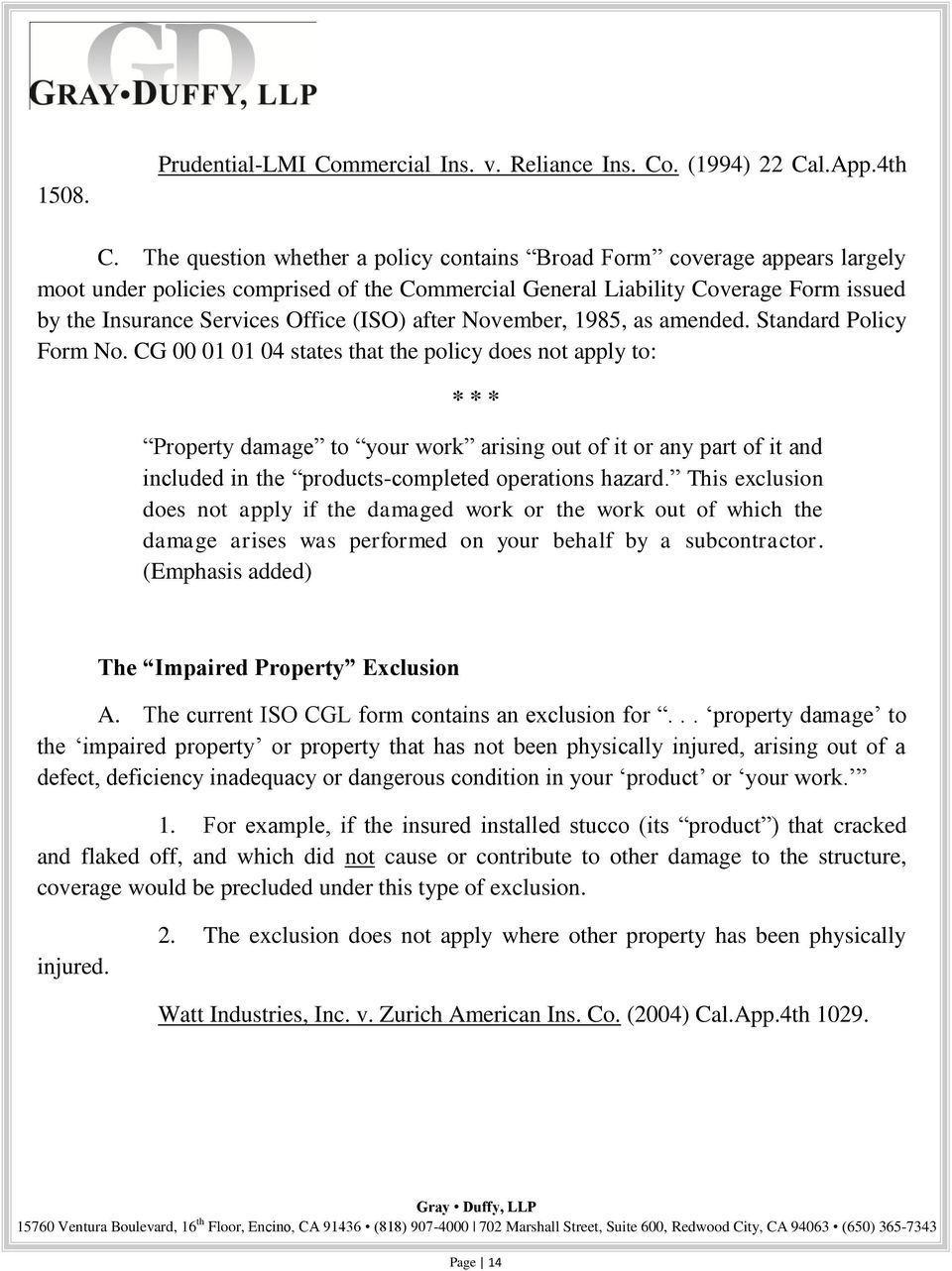
14 1508. Prudential-LMI Commercial Ins. v. Reliance Ins. Co. (1994) 22 Cal.App.4th C. The question whether a policy contains Broad Form coverage appears largely moot under policies comprised of the Commercial General Liability Coverage Form issued by the Insurance Services Office (ISO) after November, 1985, as amended. Standard Policy Form No. CG states that the policy does not apply to: * * * Property damage to your work arising out of it or any part of it and included in the products-completed operations hazard. This exclusion does not apply if the damaged work or the work out of which the damage arises was performed on your behalf by a subcontractor. (Emphasis added) The Impaired Property Exclusion A. The current ISO CGL form contains an exclusion for... property damage to the impaired property or property that has not been physically injured, arising out of a defect, deficiency inadequacy or dangerous condition in your product or your work. 1. For example, if the insured installed stucco (its product ) that cracked and flaked off, and which did not cause or contribute to other damage to the structure, coverage would be precluded under this type of exclusion. injured. 2. The exclusion does not apply where other property has been physically Watt Industries, Inc. v. Zurich American Ins. Co. (2004) Cal.App.4th Page 14
15 B. A condominium project has been held not to be the product of the developer of the project, thus making the exclusion inapplicable where the insured was the developer or builder. Maryland Casualty Co. v. Reeder, supra. The Incorrectly Performed Work Exclusion A. Under this exclusion, the policy does not provide coverage for property damage to [t]hat particular part of any property that must be restored, repaired or replaced because your work was incorrectly performed on it For example, when a subcontractor returns to the project to perform repairs to or service on his prior work, damage caused by this subsequent work to the prior work would be excluded. B. This exclusion is the successor to the faulty workmanship exclusion, and differs from its predecessor in two important aspects: 1. First, the new exclusion applies to work being performed either on or off the insured s premises, whereas the old exclusion applied only to property away from the premises owned by or rented to the insured; 2. Second, the new exclusion makes clear it does not apply to property damage within the products-completed operations hazard, whereas it was unclear whether the faulty workmanship exclusion did or did not apply to the insured s completed operations. The Owned Property Exclusion A. This exclusion precludes coverage for... property damage to... property you own... B. This exclusion is rarely applicable in construction defect cases, since a contractor does not usually own the property in question, and ownership of materials Page 15
![Under this exclusion, the policy does not provide coverage for property damage to [t]hat particular part of any property that must be restored, repaired or replaced because your work was incorrectly](/docs-images/40/1753563/images/page_15.jpg "performed on it... 1.")
16 used or furnished by the contractor are generally transferred to the owner upon completion of the contractor s work. C. However, the exclusion may preclude coverage for a developer who owned the property if damage occurs before its sale to others. The exclusion has been upheld in cases involving pollution and environmental contamination issues. D. No California case has interpreted the Owned Property exclusion in the context of a construction defect case. E. The owned property exclusion comes up more frequently in the environmental claims area. Shell Oil Co. v. Winterthur Swiss Ins. Co. (1993) 12 Cal.App.4th 715. The Alienated Premises Exclusion A. Standard general liability policies contain exclusions for property damage to... premises alienated by the named insured arising out of such premises or any part thereof, or, in later policies, property damage to... [p]remises you sell, give away or abandon, if the property damage arises out of any part of those premises.... This exclusion does not apply if the premises are your work and were never occupied, rented or held for rental by you. B. As the exclusion makes clear, where an insured is not an owner of the property, the exclusion does not apply. Moreover, under the later exclusionary language, it does not apply to the typical completed operations of an insured developer or contractor, as those operations would qualify as the insured s work, and the property was never intended to be occupied, rented or held for rental by the insured, but was built for resale. Prudential-LMI Commercial Ins. Co. v. Reliance Ins. Co., supra. Page 16

17 The Contractual Liability Exclusion A. The 1988 standard ISO CGL policy s contractual liability exclusion provides that coverage will not apply to property damage... for which the insured is obligated to pay as damages by reason of the assumption of liability in a contract or agreement. However, the exclusion then states it does not apply to damages (1) [a]ssumed in a contract or agreement that is an insured contract... B. The term insured contract has been defined to include... [t]hat part of any contract or agreement pertaining to your business... under which you assume the tort liability of another to pay for... property damage to a third person or organization.... Tort liability means a liability that would be imposed by law in the absence of any contract or agreement. This would include a construction subcontract which obligates the subcontractor to indemnify, defend and hold harmless the general contractor and/or owner. C. A recent California Supreme Court case has held that the phrase, legally obligated to pay damages, found in the insuring agreement of a CGL policy, provides coverage for damages arising from breach of contract, not just for damages based on tort. 837; Golden Eagle Ins. Co. v. Insurance Co. of the West (2002) 99 Cal.App.4th Vandenberg v. Superior Court (Centennial Ins. Co.), supra. The Joint Venture Exclusion A. This exclusion, usually contained in the policy s definition of, Who Is An Insured, provides that coverage does not apply to property damage... arising out of the conduct of any partnership or joint venture of which the insured is a partner or member and which is not designated in this policy as a named insured. B. There is scant California decisional authority on the application and interpretation of the joint venture exclusion. In one case, the court found that whether the insured built the condominium project as a joint venture which was not listed as such on the policy was a matter to be determined by the trier of fact. Page 17
![However, the exclusion then states it does not apply to damages (1) [a]ssumed in a contract or agreement that is an insured contract... B. The term insured contract has been defined to include.](/docs-images/40/1753563/images/page_17.jpg ".. [t]hat part of any contract or agreement pertaining to your business... under which you assume the tort liability of another to pay for... property damage to a third person or organization.")
18 Maryland Casualty Co. v Reeder, supra. The Subsidence Exclusion A. Neither the 1986 or later standard ISO CGL policies contain earth movement and/or subsidence exclusions, which are usually endorsed to the policy by way of manuscript language. B. An endorsement which precluded coverage for property damage... caused by, resulting from, contributed to or aggravated by subsidence and arising out of or attributable to any operations of the insured... was upheld as eliminating coverage for a developer who constructed and graded unimproved lots which were later sold to building contractors. Subsidence was defined to include earth movement, including but not limited to... earth sinking, earth rising or earth shifting. The term operations was defined as any act, error or omission on the part of the insured, including but not limited to improper grading or site preparation, error in design, faulty materials or faulty workmanship. The exclusion applies to damage attributable to any operations of the insured. This is broad enough to include work by the insured s subcontractors as well as its own employees. Thus, the independent contractors negligence in performing the grading operations for the developer were thus acts or omissions on the part of the insured. Blackhawk Corp. v. Gotham Ins. Co. (1997) 54 Cal.App.4th The Montrose Exclusion A. In response to the California Supreme Court s decision of Montrose Chemical Corporation v. Admiral Ins. Co., supra., insurers have attempted to preclude coverage for damages commencing prior to the inception of a policy but arguably continuing through the policy period. Such exclusions are commonly known as Montrose exclusions. Page 18

19 B. Whether coverage exists for losses commencing before the current policy period and continuing into the policy period is subject to interpretation of the Loss in progress rules. California Insurance Code 22 and 250 provide that only contingent or unknown risks are insurable. This phrase was interpreted by the Montrose Court to mean that insurance cannot be obtained for a known liability, but liability coverage may exist where there is uncertainty about the imposition of liability and no legal obligation to pay has yet been established. C. Under the current CGL form, there is no coverage for bodily injury or property damage beginning before the policy period if known to the insured, even if such injury or damage continues during the policy period (e.g., pollution claims). [CG , Sec. I, Coverage A, 1.b.(3)] Bodily injury or property damage is known to the insured if the insured or any agent or employee authorized to give or receive notice of a claim: 1. reports the injury or damage to an insurer; or (2) receives a written or verbal demand or claim for damages because of bodily injury or property damage; or becomes aware by any other means that bodily injury or property damage has occurred or has begun to occur. [CG , Sec. I, Coverage A, 1.d. This language does not appear in pre 2001 CGL forms. D. For example, one endorsement entitled, Pre-Existing Damage Exclusion, eliminates coverage for... [a]ny damages arising out of or related to... property damage... [ ] (a) which first occurred prior to the inception date of this policy... ; or [ ] (b) which is, or is alleged to be, in the process of occurring as of the inception date of this policy... even if the occurrence continues during this policy period... E. The current CGL provision redefines the known loss rule to exclude coverage for losses which existed before the policy period even if no liability or obligation to pay had yet been imposed. Policyholders may argue that Montrose cannot be avoided in California by a CGL policy provision because Montrose is an interpretation of California statutes (Ins. C. 22, 250) defining the known loss rule. Courts have previously held that Policy provisions contrary to California statutes have been unenforceable. The more convincing argument is that insurers are free to limit coverage in any way they choose as long as the limitation satisfies the plain, clear and conspicuous standard under California law. Page 19

20 F. Another example of an attempted Montrose exclusion precludes coverage for property damage that was...known to you, any additional insured, or anyone working on your behalf; and/or [] reported to you, any additional insured, or anyone working on your behalf, before the inception date of this policy... G. California courts have yet to determine the application and viability of any Montrose exclusion. Page 20

21 Nonstandard Exclusions and Limitations Mold Exclusion: Excludes coverage for bodily injury or property damage caused by the invasions or existence of water or moisture including but not limited to mold, mildew, rot and deterioration of property. A. Mold exclusion applies to sudden and accidental release of water. When a homeowner filed a claim for water related damage for a home which had become contaminated with mold, the insurer denied the mold claim based upon the terms of the policy, specifically, the mold exclusion. The plaintiff homeowner asserted that the insurer could not rely on the mold exclusion in light of Insurance Code Section 530 which provides that an insurer is liable for losses proximately caused by insured risks, and sudden and accidental discharge of water was an insured risk. The Court of Appeal held the clear language of the mold exclusion applied. De Bruyn v. Farmers Group, Inc. (2008) 158 Cal.App.4th B. Typically, mold exclusions in cases involving construction defects are more likely to be a matter for reservation of rights than for an outright denial. Even in those cases where there is a standard fungi or bacterial mold exclusion that precluded coverage for injury or damage arising out of, or resulting from mold etc., the court held that the exclusion did not apply to preclude a duty to defend where it was alleged that the insured had constructed a building to allow moisture to enter into the interior causing damage and mold growth. Schmidt v. Navigator s Insurance Co. Specified Projects or Operations Exclusion 1. Tract Housing/Condos/Townhomes Exclusion: A. Excludes coverage for any apartments, condominiums or townhomes or attached homes... B. Condominium Exclusion upheld while criticizing court s own prior decision. Page 21
22 A developer of a residential housing development hired a subcontractor to perform rough framing work. Homeowner sued the developer for defective construction, and the developer cross-complained against the subcontractor for indemnity. Subcontractor tendered to its CGL insurer, who disclaimed coverage based on a Manuscript Condominium Exclusion. After obtaining a judgment on its cross-complaint against the subcontractor, the developer filed an Insurance Code Section action directly against the insurer seeking to satisfy its judgment. The developer conceded the project was recorded legally to qualify as a condominium project, but contended that the project actually consisted of single family homes and therefore the exclusion did not apply. Alternatively, the developer argued that coverage should nonetheless extend to the homes as the project constituted condominiums but did not materially alter the risk the insurer agreed to undertake. The developer relied upon Scottsdale Insurance Company v. Essex Insurance Company (2002) 98 Cal.App.4 th 86 in which the court refused to enforce a Joint Venture Exclusion on the basis that the capacity under which the insured performed its work did not adversely impact the insurer s underwriting intent. The Fourth District Court of Appeal held that the term condominium was statutorily defined and upheld the exclusion. With respect to the developer s additional argument that the project did not materially alter the insurer s risk, the court refused to follow the Scottsdale case (even though it came out of the same division) and the justice who wrote the Scottsdale case concurred with the court s opinion in the current case. The court concluded that the Scottsdale holding that a court may invalidate an exclusionary clause based on the lack of material impact upon insurer s underwriting intent was not a valid basis for such exclusion. California Traditions v. Claremont Liability Insurance Co. (2011) 197 Cal.App.4 th Exclusion for Size of Project or Limitation to Single Family Homes: Excludes coverage for any apartment or condominium or any single-family or tract homes where the total project or development exceeds homes and/or units. Page 22
23 3. Exclusion for Work or Operations Prior to Policy Period: Excludes coverage for your work... prior to the policy period or for any preexisting construction or preparation for construction INDEMNITY AGREEMENTS A. A named insured s assumption of another s liability under a hold harmless or indemnity provision within an insured contract is considered derivative liability and is covered under the policy s contractual liability coverage/exclusion. Insurance Co. of North America v. National American Ins. Co., supra. 1. An indemnity agreement which expressly and unequivocally provides that the indemnitor will indemnify the indemnitee for the indemnitee s negligence, regardless if that negligence is active or passive, is considered a Type I indemnity agreement. (Formerly typical agreement between subcontractor contractor. See below) MacDonald & Kruse, Inc. v. San Jose Steel Co. (1972) 29 Cal.App.3d An indemnity agreement which provides that the indemnitor will indemnify the indemnitee for the indemnitee s own acts of passive negligence, is considered a Type II indemnity agreement. An indemnitee s active negligence is a bar to recovery under this form of indemnity agreement. C.I. Engineers & Constructors, Inc. v. Johnson & Turner Painting Co. (1983) 140 Cal.App.3d 1011; Guy F. Atkinson Co. v. Schatz (1980) 102 Cal.App.3d An indemnity agreement which provides that the indemnitor will indemnify the indemnitee for the indemnitor s negligence only is considered Type III Page 23
24 indemnity agreement. Any negligence on the part of the indemnitee or others will bar enforcement of the agreement. This agreement is rare. MacDonald & Kruse, Inc. v. San Jose Steel Co., supra. B. The question of whether an Indemnity Agreement covers a given case turns primarily on contractual interpretation, and it is the intent of the parties that is expressed in the Agreement that should control. This requires an inquiry under the circumstances of the damage or injury in the language of the contract. Rossmoor Sanitation, Inc. v. Pylon, Inc. (1975) 13 Cal.3d 622, 633. C. California courts, when interpreting express indemnity agreements, generally have employed a three-type analysis, originally set forth in MacDonald & Kruse, Inc. v. San Jose Steel Co. (1972) 29 Cal.App.3d 413, which focus on the indemnitees active or passive negligence. MacDonald & Kruse, Inc. v. San Jose Steel Co. (1972) 29 Cal.App.3d 413. D. Given the establishment of the Type I indemnity, the critical inquiry is whether or not the indemnity provisions at issue apply absent proof by the developer that subcontractor was at fault. Stated differently, the question to be decided is whether or not the indemnity provisions require the establishment of subcontractor fault (negligence plus causation) as a prerequisite to triggering the contractual obligations to indemnify under the subcontractor agreement.1. An indemnity agreement in a commercial setting which provided that the indemnitor/subcontractor would indemnify the indemnitee/general contractor for a loss which... arises out of or is in any way connected with the subcontractor s performance of its work under the contract, and... shall apply to any acts or omissions, willful misconduct or negligent misconduct, whether active or passive, on the part of the Subcontractor..., did not require a showing of fault on the part of the subcontractor by the general contractor to enforce indemnification. Continental Heller Corp. v. Amtech Mechanical Services, Inc. (1997) 53 Cal.App.4th 500; Page 24
25 McCrary Construction Co. v. Metal Deck Specialists, Inc. (2005) 133 Cal.App.4th In contrast, an indemnity provision (in a standard multiple party construction defect action) which provided that the subcontractor would indemnify the owner for... damage to property arising out of or in connection with Subcontractor s... performance of the Work and for any breach or default of the Subcontractor in the performance of its obligations... required the developer to prove negligence on the part of the subcontractor to trigger its indemnity obligation to the developer. Heppler v. J.M. Peters Co. (1999) 73 Cal.App.4th An indemnity agreement which provided that all work performed by the subcontractor shall be at the risk of [the subcontractor] exclusively, and that the subcontractor would indemnify and hold harmless the general contractor from any claim or loss resulting from [the general contractor s] alleged or actual negligent act or omission, regardless of whether such act or omission is active or passive..., did not require the general contractor to prove negligence on the part of the subcontractor to obtain indemnity Centex Golden Construction Company v. Dale Tile Co. (2000) 78 Cal.App.4th E. Major Changes Have Been Undertaken to the California Indemnity Statutes as They Relate to Construction Contracts 1. The indemnity statutes delineate between residential construction and non-residential construction. Specifically, in 2008, the California Legislature amended Civil Code Section 2782 in an attempt to limit the applicability of Type I indemnity for construction defect claims in residential construction projects. The statute specifically indicates that for contracts entered into on or after January 1, 2009, it invalidates provisions that purport to require subcontractors to indemnify certain indemnitees (including builders, developers, and general contractors) against liability for construction defect claims on residential projects to the extent that such claims arise out of, pertain to, or relate to the negligence of such purported indemnitee(s). This means that each party will be held liable to the respective degree to which it is found to be at fault. There is no indemnity for Page 25
26 construction defects for either active or passive negligence of a general contractor developer. There are limitations to the limitation on indemnity. First, the limitation of the indemnity applies only to construction defects claims. This means that a Type I indemnity provision is not invalid with respect to a bodily injury or wrongful death claim. 2. Civil Code Section 2782(d) addresses defense obligations and the timing thereof. In an attempt to correlate with S.B. 800 protocols (The Right to Repair Act), the obligation to defend begins with a written tender of the claim regardless if formal litigation has been commenced. If an indemnitee tenders a claim to a subcontractor, the subcontractor must, within specified deadlines, agree to defend the claim except to the extent it results from the scope of work, actions, or omissions of the indemnitee or any other party. Alternatively, the subcontractor must pay on an ongoing basis during the pendency of the claim no more than a reasonable allocated share of the indemnitee s defense fees and costs. Such payments are subject to later re-allocation, and all party s rights to seek equitable indemnity are preserved. California Civil Code Section 2782 F. Civil Code Section Extends the Provisions of California Civil Code Section 2782 to Any Construction Contract (Non-Residential) Entered Into on or after January 1, 2013 In Civil Code Section (a), the Legislature provides that any indemnification provisions that purport to insure or indemnify,... against liability... are void and unenforceable to the extent the claims arise out of, pertain to, or relate to the active negligence or willful misconduct of that general contractor, construction manager, or other subcontractor, or their other agents, other servants, or other independent contractors who are responsible to the general contractor, construction manager, or other subcontractor. The Legislature further codifies that no party may waive or modify these provisions by contract. However, the Legislature does provide that contractual provisions, clauses, covenants, or agreements not expressly prohibited herein are reserved to the agreement of the parties. Essentially, the Legislature is providing that the parties may enter into certain types of Page 26
27 agreements, as long as the indemnitee cannot avoid its obligations for its active negligence or willful misconduct. Civil Code Section (b) sets forth 13 different scenarios to which the statute does not apply. Specifically, the Legislature indicates that Civil Code Section does not apply to WRAP or OCIP policies. Under Section , the Legislature created a mechanism to trigger the obligations of the parties subject to an indemnification agreement. In Civil Code Section (e), the Legislature sets forth the basis upon which the indemnity provision shall be applicable to the indemnitor. Civil Code Section (e) provides that Subdivision (a) does not prohibit a subcontractor and a general contractor or construction manager from mutually agreeing to the timing or immediacy of the defense.... The Legislature placed the onus on the party seeking indemnification to notify the indemnitor of their demand for indemnity. Civil Code Section provides that the subcontractor has no obligation to defend or indemnify the general contractor or construction manager until the general contractor or construction manager provides a written tender of the claim. This written tender requires information regarding the claims by the claimants implicating the subcontractor s scope of work. The Legislature has also placed another burden on the general contractor or construction manager in the submission of their written tender of the claim to a subcontractor. The general contractor or construction manager must present a reasonable allocation of fees and costs. The general contractor or construction manager has the burden of providing, in writing, how the allocated share of fees and costs was determined. This requirement makes the general contractor or construction manager put forth the basis for each subcontractor s involvement in the litigation, and how much exposure the general contractor or construction manager believes each subcontractor should be allocated. Without some type of agreement as to the timing of the triggering of the obligation under the indemnification provision, Civil Code Section provides the mechanism for the subcontractor to respond to an indemnification tender. The subcontractor has two choices under the statute. The subcontractor may defend the claim with counsel of its choice and thereby maintain control of the defense. However, the statute also makes it clear Page 27
28 that the defense by the subcontractor shall be a complete defense of the claims against the subcontractor s scope of work including claims of vicarious liability resulting from the subcontractor s scope of work. The statute also makes it clear that the subcontractor is not responsible for defending claims against the scope of work of any other party, including the general contractor or construction manager. Civil Code Section also gives the subcontractor the ability to prove, to the satisfaction of the general contractor or construction manager, that the subcontractor s scope of work is not implicated or, at the very least, is a small portion of the claim. As such, it is of benefit to both the subcontractor by giving it the opportunity to set forth evidence showing it is not at fault and the general contractor or construction manager by obtaining information to help it defend against such allegations. Both sides have a vested interest in doing the work necessary to show that the scope of work of the subcontractor was implicated unjustly. California Civil Code Section G. The California Supreme Court in Crawford v. Weathershield, supra, has clarified any issues with respect to defense obligations and indemnity agreements. 1. In Crawford, the California Supreme Court considered whether a pre-2006 residential construction subcontract required the subcontractor to defend the indemnitee developer-builder in suits brought against both parties where the plaintiffs complaints alleged construction defects arising from the subcontractor s negligence even though (1) a jury ultimately found that the subcontractor was not negligent, and (2) the subcontract gave the builder no right of indemnity unless the subcontractor was negligent. The court concluded that the subcontractor had such a duty, determining that pursuant to the subcontract language, subcontractor had agreed to defend any suit or action, against the developer founded upon any claim growing out of the execution of the work. The court found that the duty to defend was clear from the contract and reasoned that a contractual promise to defend another against specified claims clearly meant an immediate and active obligation for the promisee s defense to provide a defense on the promisee s behalf as soon as such claims are made against the promisee and until they were resolved. The duty to Page 28
29 defend was determined by the court to attach to indemnity claims which, at the time of tender, alleged facts that would give rise to a duty to indemnify. Similarly, in UDC-Universal Development, LP v. CH2M Hill (2010) 181 Cal.App.4 th 10, the Court of Appeal found that a duty to defend arises out of an indemnity obligation as soon as the litigation commences and regardless of whether the indemnitor is ultimately found negligent. In UDC, the contract s indemnity provision did not state that there must be an underlying claim of negligence specifically against the subcontractor to trigger the subcontractor s defense obligation. Rather, the court determined that the subcontract agreement called for indemnification when claims against UDC arise out of or are any way connected with a negligent act or omission by the subcontractor. The court determined the duty to defend applied to any suit or action brought against the developer on any claim or demand covered. The court determined that an indemnitee should not have to rely on the plaintiff to name a particular subcontractor in order to obtain a promised defense by the one that the indemnitee believed was responsible for the plaintiff s damages. Crawford v. Weathershielf Manufacturing, supra. UDC Development, LP v. CH2M Hill (2010) 181 Cal.App.4 th 10 H. Indemnity for Attorney s Fees 1. Under standard subcontract agreements, general contractors assert entitlement to indemnity based on, among other theories, a contractual indemnity agreement. Contracts have prevailing party clauses entitling a prevailing party to its attorney s fees. Fees under such a contractual clause are allowable as costs under Code of Civil Procedure 1032 and Such costs would normally fall within the Supplementary Payments provision. 2. Agreements between contractors and owners which have attorney fee provisions, but not indemnity provisions, do not necessarily allow recoverable attorney s fees under the policy based on the fact the owner/contractor agreement is not an insured agreement. This could impact settlement issues in these types of cases. Page 29
30 I. Horizontal Exhaustion Rule Trumps Indemnity Agreement Between Insured Parties RJS was a subcontractor on an apartment construction project and carried primary liability insurance with Lloyds of London ($1,000,000). It also carried excess coverage with Great American Insurance. JPI was the general contractor on the project and carried primary insurance with Transcontinental Insurance ($1,000,000). The terms of the subcontract included a Type II indemnity agreement which extended indemnity by RJS to JPI for any claims arising out of RJS work. In this action, Great American sought to recover from Transcontinental the amount it had paid out in settlement in settling the claim against JPI. Transcontinental argued that the indemnity agreement between the parties required under the principles articulated in Rossmor Sanitation, that the entire burden should fall on RJS insurers and therefore it owed nothing. Great American, on the other hand, argued that, as an excess insurer, it had no liability until all of the primary insurance had been exhausted (the Horizontal Exhaustion Rule ). The trial court agreed with Great American and entered judgment in its favor establishing that while an indemnity provision can impact the rights of the insurers of both the indemnitee and indemnitor, it will not be controlling in cases involving insurers that have different levels of exposure (primary versus excess). JPI WestCoast Construction, Inc. v. RJS & Associates, Inc. (2007) 156 Cal.App.4th J. Ten-Year Statute of Limitations Applies to Cross-Complaints for Indemnity Plaintiff, the buyer of an apartment complex, sued defendant developer-sellers after discovering that all of the windows of the complex lacked flashing which led to water damage. Developers filed a cross-complaint for indemnification against the cross-defendant subcontractors. The subcontractors moved for summary judgment on the grounds that the cross-complaint was barred by the statute of limitations and failed to allege a specific claim. The Court of Appeal held that the cross-complaint that asserted a theory of recovery was not barred under Code of Civil Procedure Section , and found that the exemption under (f) for actions based on willful misconduct applied to the cross-complaints for indemnity. Page 30
31 Pine Terrace Apartments, L.P. v. Windscape, LLC (2009) 170 Cal.App.4th 1. Fees K. A Standard Indemnity Clause Does Not Create a Reciprocal Right to Attorney s The City of Chowchilla contracted with Carr Business Enterprises to do improvement work on city streets. A series of problems arose delaying the work which caused Carr to incur additional costs. Carr sued Chowchilla for those extra costs and later moved for an award of attorney s fees arguing that the indemnity provisions included in the contract authorized the award of attorney s fees because the language in the provisions included within their scope of actions arising out of the performance of the work provided in the contracts. The Appellate Court disagreed and interpreted the provisions as standard indemnity provisions applicable only to third party claims. The court found that there was no express language authorizing recovery of fees in an action to enforce the contracts. 25. Carr Business Enterprises, Inc. v. City of Chowchilla (2008) 166 Cal.App.4th 5. ADDITIONAL INSURED ENDORSEMENTS A. Coverage may also be afforded by virtue of an additional insured endorsement. The three most common types of endorsements are as follows: 1. ISO CG This standard endorsement, commonly referred to as a 20 09, is also known as the long form or Form A, and grants coverage to the additional insured... but only with respect to liability arising out of : [ ] A. [The named insured s] ongoing operations performed for the additional insured(s) at the location designated above; or [ ] B. Acts or omissions of the additional insured(s) in connection with their general supervision of such operations. Page 31
32 This form is the most limited, covering only the ongoing or current operations of the named insured, and does not confer additional insured status once the named insured s work at the project has been completed. The term ongoing operations in the endorsement is not defined and thus subject to interpretation. Many independent acts of the additional insured could reasonably fall within the scope of that term, such as coordination and scheduling of a subcontractor s work, inspection of the work, or ordering changes to its subcontractor s work. 2. ISO CG The 20 10" endorsement, also known as Form B, confers additional insured status, but only with respect to liability arising out of... your work for that [additional] insured by or for you (1985 version) or... your ongoing operations performed for that [additional] insured. (1993 version) a. Acceptance Ins. Co. v. Syufy Enterprises (1999) 69 Cal.App.4th 321 (coverage for the additional insured/developer was found where an employee of the insured/subcontractor was injured on the job site, even though the employee s injuries were not directly caused by the work of the subcontractor, since the injury arose from work he was performing on the building owned by the additional insured/developer.). b. Pardee Construction Co. v. Ins. Co. of the West (2000) 77 Cal.App.4th 1340 (a pre endorsement provided the additional insured general contractor with coverage for liability arising from the named insured subcontractor s work even after the work had been completed, since coverage was afforded based on the named insured s work or product, rather than its ongoing operations or work in progress. ). c. St. Paul Fire & Marine Insurance Co. v. American Dynasty Surplus Lines (2002) 101 Cal.App.4th 1038 (subcontract did not require electrical subcontractor to indemnify general contractor for liability to subcontractor s employee who was injured by explosion of pipe during pressure testing by general contractor; the subcontract required indemnity for liability attributable to bodily injury arising out of or resulting from the performance of the work that was the subject of the subcontract, if the liability arose from any act or omission of the subcontractor, but the employee s mere presence at the job site Page 32
33 was not a sufficient act or omission by the subcontractor, and the subcontractor performed no act or omission. d. Hartford Casualty Insurance Co. v. Traveler s Indemnity Co. (2003) 110 Cal.App.4th 710 (coverage under tenant s commercial general liability insurance policy was not limited to liability directly caused by tenant and related to subjects much broader than mere operations or use of the interior of leased premises, including liabilities potentially imposed on landlord that were related to tenant s business presence in landlord s facilities, as well as specific events occurring during the actual performance of tenant s own work or operations). e. No coverage for claim unrelated to named insured s work. Does not provide coverage for homeowner s claims against developer for negligent misrepresentation in its sales literature or breach of fiduciary duty. Transcontinental Ins. Co. v. Insurance Co. of State of Penn. (2007) 148 Cal.App.4th ISO CG 7634 Finally, this form provides slightly modified Type I coverage for the additional insured, and covers liability arising out of the named insured s work, and liability arising from its supervision of the named insured, but excludes coverage for damages arising out of the sole negligence or willful misconduct of, or for defects in design furnished by, [the additional insured]. a. National Union Fire Ins. Co. v. Nationwide Ins. Co. (1999) 69 Cal.App.4th 70 (general contractor s inadequate remedial measures to address hazards of ponding rain water and failure to properly coordinate its subcontractors work schedules were held to constitute its sole negligence, thus precluding the insurer s duty to indemnify). b. An additional insured endorsement in a policy issued to a subcontractor, which amended the policy to add the general contractor as an insured... Page 33
34 but only with respect to liability arising out of your work for that insured by or for you, required the insurer to provide the additional insured with a full defense, not just for the claims related to the subcontractor s work. Presley Homes, Inc. v. American States Ins. Co. (2001) 90 Cal.App.4th RULES FOR ALLOCATION OF DEFENSE COSTS A. In general, once coverage of a policy potentially has been triggered, an insurer has an indivisible obligation to defend its insured, even if other insurers also cover the claim. The allocation of that burden is to be determined at a later date. Aerojet-General Corp. v. Transport Indemnity Co. (1997) 17 Cal.4th 38; Haskell, Inc. v. Superior Court (1995) 33 Cal.App.3d 963, 976, fn Where several liability insurers cover the same risk, each insurer's duty to defend must be assessed independently since the duty of each is independent of whatever duty another might have. Wausau Underwriters Ins. Co. v. Unigard Security Ins. Co. (1998) 68 Cal.App.4th 1030, 1033, 80 Cal.Rptr.2d 688, 689. B. There are no hard and fast rules which govern the allocation of defense costs among multiple insurers who have a duty to defend an insured. Costs of defense must be apportioned on the basis of equitable considerations not found in the contracts of insurance, since insurers who share the burden have no contractual agreement among themselves. 1. Where several insurers jointly cover the same risk, they must share defense costs. Even in the absence of a prior agreement to do so, the court will apportion costs on the basis of equitable considerations... which depend on the particular policies of insurance, the nature of the claim made, and the relation of the insured to the insurers. Page 34
35 Centennial Ins. Co. v. United States Fire Ins. Co. (2001) 88 Cal.App.4th 105, , 105 Cal.Rptr.2d 559, Each of the insurers on the risk has a duty to defend the action in its entirety and the duty is separate and independent from the other insurers, each also has a corresponding right of some sort to require the others to share in discharging the duty or at least contribute to its costs. Aerojet-General Corp. v. Transport Indem. Co. (1997) 17 Cal.4th 38, 70, 70 Cal.Rptr.2d 118, 138; 598; CNA Casualty of California v. Seaboard Surety Co. (1986) 176 Cal.App.3d Signal Companies, Inc. v. Harbor Ins. Co. (1980) 27 Cal.3d 359; Centennial Ins.Co. v. United States Fire Ins. Co. (2001) 88 Cal.App.4th 105. C. Courts have addressed and approved various ways to allocate indemnity payments, as well as defense costs, among multiple insurers for the same loss, given the specific facts and equities of each case: 1. Absent other considerations, where several insurers cover the same risk, defense costs must also be shared between them pro rata in proportion to the respective coverage afforded by them to the insurance. CNA Cas. of Calif. v. Seaboard Sur. Co., supra. 2. If one of the insurers on the risk has defenses the others lack (e.g., fraudulent misrepresentations by the insured in applying for coverage), to avoid its obligation to share defense costs, that insurer must establish there is no potential for coverage under its policy by obtaining an adjudication of its coverage defense. Maryland Cas. Co. v. National American Ins. Co. of Calif. (1996) 48 Cal.App.4th 1822, , 56 Cal.Rptr.2d 498. Page 35
36 3. Because the duty to defend is determined at the time of tender a subsequent judicial determination that the claim was not covered under any of the several policies involved does not preclude a finding that there was a potential for coverage hence, a duty to defend when the claim was tendered. In that event, non-defending insurers who owe no duty to indemnify must nevertheless contribute to defense costs paid by the defending insurer. Wausau Underwriters Ins. Co. v. Unigard Security Ins. Co., supra. 4. Apportionment based on relative policy limits (the policy limits method). (CNA Casualty of Calif., supra; Employers Reinsurance Corp. v. Phoenix 8Ins. Co. (1986) 186 Cal.App.3d 545); Argonaut Ins. Co. v. Transport Indemnity Co. (1972) 6 Cal.3d The Loss in progress rule applies to render each insurer providing occurrence-type liability coverage liable for all damages attributable to underlying defect manifested during policy period, though damage may have become progressively worse during other insurer s tenure. (Pines of La Jolla Homeowners Association v. Industrial Indemnity (1992) 5 Cal.App.4th 714). 6. Apportionment based on the relative duration of each primary policy as compared with the overall period during which the occurrences occurred (the time on the risk method). (Stonewall Ins. Co. v. City of Palos Verdes Estates (1996) 46 Cal.App.4th 1810; Centennial Ins. Co. v. United States Fire Ins. Co., supra); and 7. Equal Shares approach. Reliance Ins. Co. v. St. Paul Surplus Lines Ins. (4 th Cir. 1985) 753 F.2d Apportionment based on relative duration of each policy multiplied by the amount of the respective limits (the qualified time on the risk method). Armstrong World Industries, supra. 9. There is no contribution from self-insured parties. Insurers that pay defense costs may seek contribution only from other insurers. They cannot obtain contribution from codefendants or other parties who are uninsured (self-insured) Equitable Page 36
37 contribution applies only between insurers and has no place between insurer and insured, nor between insurer and uninsured or self-insured party. Aerojet-General Corp. v. Transport Inc., supra. D. Where multiple insurers share the same level of liability on the same risk for the same insured, the doctrine of equitable contribution, rather than equitable subrogation, will apply to apportion defense costs among equally responsible insurers. Fireman s Fund Insurance Company v. Maryland Casualty Company (1998) 65 Cal.App.4th 1279; Hartford Casualty Insurance Company v. Travelers Indemnity Company (2003) 110 Cal.App.4th 710. E. In contrast, an insurer, who had an obligation to defend its insured, the general contractor, for the general contractor s own independent acts of negligence, was not entitled to seek equitable subrogation for defense costs from other carriers who insured the general contractor as an additional insured for derivative liability, arising out of the acts or omissions of the general contractor s subcontractors. Maryland Casualty Company v. Nationwide Mutual Insurance Company (2000) 81 Cal.App.4th F. A secondary insurer s coverage is triggered when the applicable limit of underlying insurance has been exhausted by payment of claims and only arises when neither the specifically identified underlying primary policy nor other insurance applies. Horizontal exhaustion of all triggered primary policies is required before the secondary insurer could owe a duty to defend. Traveler s Casualty & Surety Co. v. Transcontinental Ins. Co. (2004) 122 Cal.App.4th 949; Padilla Const. Co. v. Transportation Ins. Co. (2007) 150 Cal.App.4th 984. Page 37
38 Equitable Contribution G. Where subcontractor s policy did not provide coverage for the additional insured general contractor, subcontractor s insurer had no liability for equitable contribution to the general contractor s insurer Monticello Insurance Co. v. Essex Insurance Co. (2008) 162 Cal.App.4th H. Where insurer's policy period began after termination of the insurance contract, subsequent insurer has no duty to defend. Plaintiff's contracted with Hilmore Development to build its home. Insurer A insured the property for one year. Insurer B insured the property in the subsequent year. During Insurer B's policy period and prior to the completion of the home, plaintiff's terminated their contract with the insured/developer. Plaintiff subsequently filed an action alleging construction defects. Insurer A settled with plaintiffs and brought this action against Insurer B for equitable contribution. The Second District Court of Appeal held that Insurer B was not liable for equitable contribution as the policy excluded coverage for work that had not been completed, or abandoned, during its policy period. Clarendon America Insurance v. General Security Indemnity Company of Arizona (2011) 193 Cal.App.4th DEDUCTIBLES AND SELF-INSURED RETENTIONS A. In general, a deductible provision in a policy acts as a partial offset of an insurer s indemnity obligation after the resolution of a claim. It may apply on a per claim or per occurrence basis, and an insurer s defense duties and other obligations are usually unaffected whether it is paid or not. B. In contrast, the existence of a self-insured retention (SIR) endorsement operates to limit an insurer s obligations to the insured (i.e., defense and indemnity) until the insured has satisfied a previously-agreed upon limit of liability (called the retained limit ). Page 38
39 C. A number of cases have held that SIRs are equivalent to primary coverage, and policies subject to SIRs are thus excess policies with no duty to defend or indemnify until the SIR is exhausted. 1270; Pacific Employers Ins. Co. v. Domino s Pizza, Inc. (9th Cir. 1998) 144 F.3d Padilla Construction v. Transportation Ins. Co., supra. D. The absence of an aggregate retained limit in a SIR does not transform the SIR into a deductible, but requires application of the retained limit to each new claim before an insurer s duties arise. General Star Indemnity Co. v. Superior Court (Hard Rock Cafe America, L.P.) (1996) 47 Cal.App.4th Some policies provide that a separate deductible applies to each occurrence, accident or claim made against the insured. Where numerous claims or claimants are involved, the number of deductibles chargeable to the insured depends on interpretation of the terms occurrence, accident or claim. Where the policy provides a deductible for each claim made, separate claims may result in separate deductibles, even though all claims arise out of the same occurrence. To have this effect, however, the wording of the deductible must be clear and unambiguous. 2. To the extent that there is any ambiguity in the policy language, the California Supreme Court has required that any ambiguity should be resolved according to the insured's objectively reasonable expectations. AIU Ins. Co. v. Sup. Ct. (FMC) (1990) 51 Cal.3d 807; Bank of the West v. Sup. Ct. (Industrial Indemnity Co.) (1992) 2 Cal.4th Any ambiguity as to the term "claim" is construed strictly against the carrier. Two insurance companies insured a developer under separate and consecutive General Commercial Liability policies. When the insured was sued for construction defects Page 39
40 it tendered its defense to both carriers. The first carrier defended the insured under a Reservation of Rights, eventually settling the case. The second carrier, North American Capacity ("NAC"), argued that its duty to defend never arose because the insured never paid a self-insured retention for each home involved in the action. NAC argued that "claim" referred to each separate house. Insurer No. 1 argued that the SIR in North American Capacity's policy applied to the underlying action as a whole, not to each of the allegedly defective homes. The Fourth District Court of Appeal agreed and held that as the term "claim" was susceptible to both parties' proffered meanings, NAC had the burden of establishing "claim" existed on a per house basis and failed to meet that burden. Clarendon America Ins. Co. v. North American Capacity Ins. Co. (2010) 186 Cal.App.4th 556. E. Absent further definition, the term occurrence, as used in a deductible clause, has been interpreted to mean a loss, and all claims due to the same cause were considered a single loss to which a single deductible and policy limit applied. 1. EOTT Energy Corp. v. Storebrand International Ins. Co. (1996) 45 Cal.App.4th 565 (where policy did not define the term occurrence, the court held that 635 separate thefts of diesel fuel over an 11-month period were a series of related acts attributable to a single cause or occurrence (i.e., a systematic, organized scheme to steal fuel.)) 2. Where a deductible is stated in terms of per occurrence, the term occurrence is subject to the same causation analysis as is applied to determine the per occurrence policy limits, i.e., it means the underlying cause of injury, rather than the injury or claim itself. Chemstar, Inc. v. Liberty Mut. Ins. Co. (9th Cir. 1994) 41 F.3d 429, 433 (applying Calif. law). (Plaster manufacturer (Insured) was sued for defective plaster walls in 28 different homes. Although multiple claimants were involved, the damage suffered by each resulted from the same cause. There was a single occurrence subject to only one deductible.) Page 40
41 3. Where the insured makes a claim under a single policy with adequate coverage limits, the insurer paying the loss cannot reduce its liability by stacking deductibles under other policies triggered by the continuing injury. The court s rationale was that because the deductible is stated in terms of occurrence (cause of injury), and there is only a single occurrence, only a single deductible is chargeable to the insured. Aggregate retention: California Pac. Homes, Inc. v. Scottsdale Ins. Co. (1999) 70 Cal.App.4th Under the provision quoted above, a separate SIR amount applies to each occurrence. But other policy forms may contain an aggregate retained limit amount (usually, at an additional cost). Such a provision limits the insured's risk in the event of several covered claims: i.e., payments made by the insured are aggregated until the aggregate limit is exhausted; thereafter, the insurance company must cover any additional claims from the first dollar. General Star Indem. Co. v. Sup. Ct. (Hard Rock Cafe America), supra, 47 Cal.App.4th at 1594, 55 Cal.Rptr.2d at 326. The effect of a policy provision requiring the insured to retain the first portion of a loss is that the insurer is essentially providing excess insurance: i.e., no coverage attaches unless and until the insured becomes legally obligated for a loss in excess of the SIR. Until then, the insurer has no duty to defend or indemnify. General Star Indem. Co. v. Sup. Ct. (Hard Rock Cafe America), supra, 47 Cal.App.4th at 1593, 55 Cal.Rptr.2d at 325; Vons Cos., Inc. v. United States Fire Ins. Co., supra, 78 Cal.App.4th at 63 64, 92 Cal.Rptr.2d at 605. F. In one case, in which five consecutive policies each contained an SIR endorsement with a retained limit of $250,000 for any one occurrence, the court held that the insured need satisfy the SIR only once, where the damage constituted a single occurrence of continuous and progressive injury during all policy years. Page 41
42 California Pacific Homes, Inc. v. Scottsdale Ins. Co. (1999) 69 Cal.App.4th ( CPH ) G. The CPH decision may be limited to its facts for a number of reasons: 1. First of all, the language of the policies in question was important to the court s ruling. There, the policies did not contain all sums language, but instead required Scottsdale to pay the...ultimate net loss [of any one occurrence] in excess of the retained limit... [for] which the Insured shall become legally obligated to pay as damages...; 2. In footnote 3 of the decision, there is an inference the insured itself did not actually pay the retained limit (and was probably not obligated to do so, given the absence of such a specific requirement). Rather, that limit was deducted from the carriers agreedupon contribution; 3. The parties had stipulated that the underlying claim against the insured arose from a single occurrence involving continuous or progressive property damage; and 4. The case involved an insured vs. insurer dispute, rather than one among the carriers themselves, and the issue of allocation for the loss among the insurers was therefore not before the court. H Further, the court has recently held that self-insured retention limits are not primary policies, and the principle of horizontal exhaustion did not apply to require that SIRs be exhausted before a number of excess insurers incurred obligations under their respective policies. Montgomery Ward & Co., Inc., v. Imperial Casualty & Indemnity Co. (2000) 81 Cal.App.4th 356. I. Where an SIR endorsement did not expressly require the insured to satisfy the retained limits, and the endorsement s language made it subject to all of the policy s other terms and conditions, including the other insurance clause, the court held payment of the SIR by other insurance was permitted. Had the carrier wanted to limit satisfaction of the SIR by payment from the insured only, it could have used specific language to that effect. Page 42
43 The Vons Companies, Inc. v. United States Fire Ins. Co. (2000) 78 Cal.App.4th Where a loss commences during one policy period and continues through several others (e.g., environmental pollution), coverage is triggered under all liability policies in effect during those periods Unless the policies provide otherwise, each insurer is liable up to its policy limits upon exhaustion of the SIR in its own policy. J. Under policies containing a covenant to pay for all sums for which the insured shall become liable to pay as damages... (emphasis added), where any portion of the continuing and progressive damage occurs within any of the policies, the insured may select one of those policies triggered by the loss to fully respond to the claim. Subsequent allocation of the loss among the insurers is subject to principles of contract law, the express terms and limitations of the policies on the risk, and equitable considerations. Armstrong World Industries, Inc., supra. K. An insurer providing a defense to an insured must promptly notify other nondefending insurers of its intention to seek contribution for indemnity and defense costs paid, or otherwise it may be later barred from obtaining contribution against those non-defending carriers. Truck Insurance Exchange v. Unigard Insurance Company (2000) 79 Cal.App.4th DUTY TO DEFEND AS BETWEEN PRIMARY AND EXCESS INSURERS A. The primary insurer owes the exclusive duty to defend (and the corollary right to control the defense) even where the third party claim against the insured is for more than the amount of primary coverage, i.e., the fact that the claim may invade the overlying excess coverage does not shift the duty to defend. The same principle applies where there is a self- Page 43
44 insured retention.the liability insurer is treated as an excess insurer and has no duty to defend until the self-insured retention has been exhausted by defense costs or settlements. General Star Indem. Co. v. Sup.Ct. (Hard Rock Cafe America) (1996) 47 Cal.App.4th 1586, 1593, 55 Cal.Rptr.2d 322, 325; Signal Cos., Inc. v. Harbor Ins. Co. (1980) 27 Cal.3d 359, 368, 165 Cal.Rptr. 799, 804. B. No reimbursement for defense costs. The primary insurer, being obligated to defend, may not seek contribution from the excess carrier even where its successful settlement or defense relieves the excess insurer from indemnifying the injured party. Signal Cos., Inc. v. Harbor Ins. Co., supra, C. Duty to defend shifts upon exhaustion of primary coverage. Once the primary limits are exhausted, the defense burden shifts to the excess carrier. This is true even if the excess policy does not expressly provide for a defense. The obligation to defend is implied from the obligation to indemnify the insured after the primary insurance is exhausted. However, if there is a dispute as to whether the primary coverage is exhausted, the primary insurer must continue to defend until a judicial determination is obtained. Aetna Cas. & Sur. Co. v. Certain Underwriters at Lloyds (1976) 56 Cal.App.3d 791, 804, 129 Cal.Rptr. 47, The primary insurer cannot avoid its duty to defend before coverage is exhausted by tendering its policy limits to the excess insurer to settle the case. Chubb/Pacific Indem. Group v. Insurance Co. of No. America (1987) 188 Cal.App.3d 691, 698, 233 Cal.Rptr. 539, The excess policy may specifically exclude any obligation to furnish a defense; e.g., provisions incorporating all terms of the primary coverage except... the obligation to investigate and defend ; or requiring the excess insurer's written consent Page 44
45 before it shall be liable for defense costs. To have this effect, the exclusion must be clear and specific. Doubts will be resolved against the excess insurer. 3. Even if the excess policy specifically excludes the duty to defend, there may be cases in which the excess insurer is equitably obligated to share defense costs with the primary insurer. If there is a risk that the insured would be left without a defense, compelling equitable principles may require the excess insurer to reimburse the primary insurer for defense costs, even in contravention of its policy provisions. Signal Cos., Inc. v. Harbor Ins. Co. (1980) 27 Cal.3d 359, 165 Cal.Rptr The insurer's duty to defend continues until the third party litigation ends unless the insurer sooner proves, by facts subsequently developed, that the potential for coverage which previously appeared cannot possibly materialize, or no longer exists. 147, 156. Scottsdale Ins. Co. v. MV Transp. (2005) 36 Cal.4th 643, 657, 31 Cal.Rptr.3d D. Exhaustion of policy limits by payment of a settlement or judgment against the insured may terminate any further defense duty. Whether payment of policy limits to one of several claimants terminates the insurer's duty to defend is unsettled. However, if the insurer pays its policy limits to one of several claimants in the same lawsuit, the insurer owes no further duty to defend the other claims against the insured in that lawsuit. Johnson v. Continental Ins. Cos. (1988) 202 Cal.App.3d Where the policy limits are self-consuming (i.e., reduced by defense costs), the insurer's duty to defend terminates when it has paid out the full limits in defense even if no settlement or judgment has been reached. However, if a dispute arises over exhaustion of policy limits, the insurer must continue the defense until it obtains a judicial determination that it has exhausted its policy limits. Hartford Acc. & Indem. Co. v. Sup. Ct. (Syntex) (1994) 23 Cal.App.4th 1774, 1778, 29 Cal.Rptr.2d 32, 36; Page 45
46 Aerojet-General Corp. v. Transport Indem. Co. (1997) 17 Cal.4th 38, 77, 70 Cal.Rptr.2d 118, 142. E. CIGA is not required to assume liability if unexhausted excess insurance coverage exists to cover the claim. In an action brought by a homeowners association against the developer and subcontractors, the California Insurance Guarantee Association ( CIGA ) agreed to defend the subcontractors. The developer settled by exhausting its primary policy and a contribution by the excess insurer that did not exhaust the excess policy. CIGA took the position that the developer s remaining excess policy constituted other insurance available to the HOA which must necessarily be exhausted before CIGA can be compelled to pay any settlements or judgments. The Court of Appeal held that the HOA s claim was not a covered claim within the meaning of the CIGA statutes because there was other insurance available, namely the remaining limits of the developer s excess policy. The case raises an important point that a claimant cannot bootstrap its claim against CIGA by releasing its right to recover under an available policy and then claim that there is no other insurance. Park Woods Community Association v. California Insurance Guarantee Association (2006) 141 Cal.App.4th TENDER AND WITHDRAWAL OF DEFENSE ISSUES A. The duty to defend arises when the insured tenders defense of the third party lawsuit to the insurer: Imposition of an immediate duty to defend is necessary to afford the insured what it is entitled to: the full protection of a defense on its behalf. Montrose Chem. Corp. v. Sup. Ct., supra. B. The duty to defend is separate from the duty to indemnify. The insurer must pay defense costs before liability is established and apart therefrom; the insurer is responsible for those costs whether or not there is ultimately any duty to indemnify the insured for the claim. Page 46
47 Montgomery Ward & Co., Inc. v. Imperial Cas. & Indem. Co. (2000) 81 Cal.App.4th 356, 373, 97 Cal.Rptr.2d 44, 55. C. A tender by the insured creates a duty to defend where the following conditions are met: (1) there is a policy in effect and if Suit has been filed against the insured: CGL policies typically provide that the insurer shall have the right and duty to defend any suit against the insured... and may make such investigation and settlement of any claim or suit as it deems expedient. Current CGL policies define suit to include arbitrations, alternative dispute resolution proceedings [CG , Sec. V, 18] and administrative hearings. Foster-Gardner, Inc. v. National Union Fire Ins. Co. (1998) 18 Cal.4th 857, 863, 77 Cal.Rptr.2d 107, Even though there is no duty to defend, insurers are authorized to investigate and settle pre-lawsuit claims. It is often in the insurer's interest to assist its insured in administrative proceedings that could lead to an award of damages in subsequent civil proceedings which they will ultimately have to indemnify. (H)owever, this is a judgment call left solely to the insurer. Foster-Gardner, Inc. v. National Union Fire Ins. Co., supra, 18 Cal.4th at 883, 77 Cal.Rptr.2d at A tender of a claim simply requires the insured to provide some notice of the claim to the insurer in order to trigger its duty to defend the insured. No formal request that the insurer undertake the defense is required. The tender can either be formal or constructive. A defense is owed if the insurer has constructive notice of the tender, i.e., notice of facts that would put a reasonable person on inquiry. If the insurer fails to make inquiry in the face of such facts, and thus erroneously fails to defend, it will be liable for breach of contract. California Shoppers, Inc. v. Royal Globe Ins. Co. (1985) 175 Cal.App.3d 1; Truck Ins. Exch. v. Unigard Ins. Co. (2000) 79 Cal.App.4th 966, 979, 94 Cal.Rptr.2d 516. Page 47
48 3. Prejudicial delay by the insured in tendering the claim may excuse the insurer from liability on the claim (i.e., it may excuse not only the duty to defend but also the duty to indemnify). (I)f successful, the insurers notice defense could prevent any recovery under the policy. However, The insurer bears the burden of proving it was substantially prejudiced by the delay. Select Ins. Co. v. Sup.Ct. (Custer) (1990) 226 Cal.App.3d 631, 639, 276 Cal.Rptr. 598, Similarly, an insurer must suffer actual and substantial prejudice to avoid default judgment following lack of notice from insured. Plaintiff filed an action against a general contractor (insured) for water leaks relating to the building, alleging causes of action for negligence and breach of contract. The insured did not tender the defense to the insurer and a default judgment was taken against the insured. The insurer denied coverage based on the failure of the insured to notify and failure to cooperate with the investigation. Plaintiff homeowner brought suit against the insurance carrier to recover the amount of the default judgment. The Court of Appeal held that when a default judgment results from lack of notice by the insured, the insurer is liable unless it suffered actual and substantial prejudice. The inability to investigate the claim or present a defense in the underlying suit does not satisfy the prejudice requirement. To demonstrate substantial prejudice, the insurer must show at the very least that if the notice clause had not been breached there was a substantial likelihood that the insurer would have received a favorable judgment, settled the claim for less, or been able to reduce the insured s liability. Belz v. Clarendon American Insurance Co. (2007) 158 Cal.App.4th 615. D. An insured may incur investigation or legal expenses in connection with a third party lawsuit before tendering defense to the insurer. Whether the insured is entitled to recover such expenses from the insurer depends on the terms of the policy. Liability policies usually prohibit voluntary payments by the insured. For example: No insured will, except at that insured's own cost, voluntarily make a payment, assume any obligation, or incur any expense, other than for first aid, without our consent. [CG , Sec. IV, 2.d.] Page 48
49 1. Courts disagree whether liability insurers must reimburse an insured for investigation or legal expenses voluntarily incurred by the insured before tendering defense to the insurer. Several cases hold the insurer owes no duty to reimburse the insured for pretender expenses because it owed no duty to defend the insured until the defense was tendered. For example, a Developer (Insured) spent more than $1.4 million to repair water intrusion defects in a residential development before notifying its liability insurer. The insurer had no duty to reimburse the insured for the costs incurred Jamestown Builders, Inc. v. General Star Indem. Co. (1999) 77 Cal.App.4th 2. Other cases treat the matter as unsettled. The (no voluntary payments) provision does not specifically refer to the costs of defense and there is a question what a reasonable insured would understand reading the provision. Fiorito v. Sup.Ct. (State Farm Fire & Cas. Co.) (1990) 226 Cal.App.3d 433. E. Recent cases have defined the concept of "suit" for defense purposes. 1. A homeowner's association has served a developer with a Notice of Commencement of Proceedings pursuant to the Calderon Act. Developer sued its additional insurers for defense costs. The insurers contended that the Calderon process did not constitute a "suit" within the meaning of the defense agreement in its CGL policies. The Fourth District Court of Appeal held that the Calderon process is an integral part of construction defect litigation and therefore the carriers must provide a defense. 2. The California Supreme Court recently held that the definition of "suit" is a broad definition. The United States Department of Interior contracted with a general contractor to supply siphons for an aqueduct. The general contractor contracted part of the job to a subcontractor. The Department of Interior ultimately determined that the siphons were defective and the matter was settled through a payment of $10,000,000. The subcontractor insurers refused to defend and indemnity the general contractor and subcontractor. The California Supreme Court held that a reasonable policyholder would believe that a policy providing coverage for a "suit" would provide coverage for Page 49
50 Department of Interior proceedings. The Supreme Court defined the term "suit" in a comprehensive general liability insurance policy as a core proceeding initiated by the filing of a complaint, and held that the IBCA proceeding was a suit for the purposes of the duty to defend and the potential coverage, thus broadening the definition of "suit." Ameron v. Insurance Company of the State of Pennsylvania (2010) 50 Cal.4th F. Withdrawal. 1. If the insurer is defending under a reservation of rights and subsequently determines there is in fact no potential for coverage, it may withdraw by notifying the insured that it will no longer furnish a defense in the action. An insurer may withdraw from defending a claim once it is able to demonstrate, by reference to undisputed facts, that the claim cannot be covered. If the termination is challenged by the insured, the insurer bears the burden of proving the absence of any potential for coverage Ringler Assocs. Inc. v. Maryland Cas. Co. (2000) 80 Cal.App.4th One of the more interesting issues regarding withdrawal is based on the insured's failure to cooperate. Such withdrawal is justified, however, only if the insured's conduct has substantially prejudiced the insurer's ability to conduct the defense. Substantially prejudiced has not been defined by the courts in this context. Hall v. Travelers Ins. Cos. (1971) 15 Cal.App.3d ARBITRATION AND SETTLEMENT ISSUES A. Arbitration. As noted above, under the new fix it law, arbitration is available to builders to resolve claims of homeowners. Similarly, arbitration is available in the commercial context with respect to construction issues. This presents several issues. Page 50
51 1. The law is well settled that a party to a contract which contains an arbitration provision cannot compel a non-party to arbitrate. The courts have repeatedly held that arbitration is consensual in nature and that a contract agreement between two parties cannot bind a non-party to the contract and, therefore, an insurer cannot be bound by that agreement. Crowley Maritime Corp. v. Boston Old Colony Insurance Co. (2008) 158 Cal.App.4th This comes up more frequently in the situations where a general contractor will have an arbitration provision in an agreement with an owner, but has no similar provisions in its subcontract agreements with the subcontractors. Under that scenario, the general contractor is left to defend the arbitration and has to bring a companion civil litigation against the non-arbitrating subcontractors. This can result in an additional time and expense in defense, and potentially inconsistent rulings. Where this matter routinely comes into play is cases involving pool contractors who generally have arbitration provisions in their agreements but have no subcontract agreements with their long time subcontractors such as the gunite supplier or deck coating subcontractors. 3. Plaintiffs have the right to have a statute of limitations issue heard before an arbitrator, and a trial court has no authority to decide that issue. The California Supreme Court recently ruled that an arbitration agreement obligates the parties to resolve their controversies, including disputes about the viability of potentially time-barred claims, before an arbitrator rather than a court. Wagner Construction v. Pacific Mechanical Corp. (2007) 41 Cal.4th However, the question of whether or not a plaintiff has agreed to arbitrate its claims must be heard before the court who has the authority to determine the enforceability of the provision. In a recent Court of Appeal decision, the court noted that a Page 51
52 party cannot be forced to arbitrate anything, including the arbitability of the claim until a court has made a threshold determination that the party did agree to arbitrate the claim. Bruni v. Didion (2008) 106 Cal.App.4th A party who obtains an order denying a petition to compel arbitration is a prevailing party in an action on the contract when this is the only issue before the court even though the merits of the underlying contractual dispute have not been resolved Otay River Constructors v. San Diego Expressway (2008) 158 Cal.App.4th 6. Arbitration provisions that risk conflicting rulings on common issues are not enforceable. In a case brought by mobile home residents against a mobile home park owner for alleged failure to maintain the park's facilities, some of the leases, but not all of them, contained an alternative dispute resolution provision. The mobile home park owner sought to enforce the arbitration provision. The court ultimately determined that there was a possibility that resolution of some of the common questions in different forums (i.e., arbitration or superior court) presented the possibility that inconsistent rulings might occur, and pursuant to California Code of Civil Procedure Section (c) the court did not enforce the arbitration provision. Abaya v. Spanish Ranch I, LP (2010) 189 Cal.App.4th Arbitration provision is unenforceable in a lawsuit that arises from related transactions. Developer built and sold a home to a famous actor, who subsequently sold it to plaintiff. Plaintiff s purchase agreement with the actor contained an arbitration clause. Plaintiff later sued the developer for alleged construction defects and sued the actor for failure to disclose the defects. The actor sought to compel plaintiff to arbitrate his claims against it pursuant to the arbitration clause, contending that plaintiff s claims against it were only tangentially related to its construction defect related claims against the developer. The trial court denied the actor s motion, finding that there was a possibility of conflicting rulings on common issues of law and fact. The Court of Appeal held that the trial court did not abuse its discretion in denying the actor s motion to compel arbitration against the Page 52
53 plaintiff. The claims arose out of a series of related transactions which is a proper basis for a denial pursuant to California Code of Civil Procedure Section (c). It was reasonable for the trial court to conclude that the entire case should be resolved in a single litigation. Lendemann v. Hume (2012) 204 Cal.App.4 th Unreasonable delay in seeking arbitration can result in waiving the right to arbitrate. Plaintiff brought a Superior Court action against defendant for claims relating to the sale of a vehicle. Defendant proceeded to litigate the matter in Superior Court, including filing demurrers and engaging in the discovery process. On the eve of trial, defendant sought to compel arbitration. The Court of Appeal held that the defendant had waived its right to arbitrate by using the court proceedings for its own purposes, and therefore the public policy argument for seeking arbitration (to take advantage of the efficiencies of arbitration) was frustrated, and therefore arbitration was denied. Adolph v. Coastal Auto Sales, Inc. (2010) 184 Cal.App.4th Arbitration clauses in homeowner's association's CC&Rs which seek to have home buyers give up their rights to a jury trial are not enforceable. Two separate cases have recently held that the arbitration provision in a CC&R document created by developers does not prevent individual homeowners from bringing actions in the Superior Court. Pinnacle Museum Tower Association v. Pinnacle Market Development (2010) 187 Cal.App.4th 24; Villa Vicenza Homeowners Association v. Nobel Court Development, LLC (2011) 191 Cal.App.4th Bad faith issues are to be addressed before arbitration of Civil Code Section 2860 fee dispute issues. Plaintiff HOA filed a construction defect suit against the developer, who in turn filed a cross-complaint against the general contractor. The developer tendered its defense to general contractor s insurer who had issued several CGL policies. The insurer immediately acknowledged the tender, but stated it was investigating Page 53
54 the claim, and proceeded to investigate the claim (for the next two years). As a result of the delay in determining its investigation, developer advised insurer of its intent to file a bad faith complaint if the insurer did not respond meaningfully within 30 days. The insurer then agreed to defend the developer under Reservation of Rights and then acknowledged a Cumis obligation to provide separate counsel pursuant to Civil Code Section The insurer later disputed the fees submitted by Cumis counsel and asked the developer to submit the billing issues to arbitration. The developer refused to arbitrate, and insurer invoked its right to arbitration under Section 2860 and filed a petition to compel arbitration, which the developer sought to dismiss. The Court of Appeal acknowledged the insurer s right to arbitration pursuant to Civil Code Section 2860, but held that the parties should first proceed with developer s bad faith lawsuit which would allow the parties to address threshold issues such as the duty to defend, any breach, waiver and/or bad faith Janopaul + Block Companies, LLC v. Superior Court (2011) 200 Cal.App.4 th B. Settlement Related Issues. 1. The cooperation action and voluntary payments clauses in liability policies generally, as a preliminary matter, allow an insurer to control a settlement of a claim, and courts have recognized an insurer s right to settle a claim over an insured s objections Maryland Casualty v. Imperial Contracting Co. (1989) 212 Cal.App.3d 712, 2. While an insured has general discretion to control settlement decisions, evaluating a settlement demand, an insurer may not consider its own coverage beliefs. An insurer must act as if it alone were liable for the entire amount of any judgment or settlement. Cal.3d 9. Johansen v. Cal State Auto Association Inter-Insurance Bureau (1975) 15 Page 54
55 C. Mediation. In a case which has major implications for construction defect actions, a recent California Court of Appeal decision held that trial courts do not have the authority to order parties in a complex civil action to attend and pay for private mediation. The court ruled that the participation in the mediation is completely voluntary and the mediator must refrain from coercing any party into participating. Compulsory payment and attendance is not authorized by the mediation program, and is contrary to the voluntary nature of mediation. The case cited can be used for the proposition that a mediator cannot require the personal appearance of an adjustor unless the settlement conference is being held as a mandatory settlement conference. Under the California Rules of Court, there can be only on mandatory settlement conference in a case. Jeld-Wen v. Superior Court (2007) 146 Cal.App.4th A settlement agreement prepared during mediation is not enforceable unless it states that it is intended to be enforceable. In a matter being mediated under Judicial Arbitration Mediation Services, the parties entered into an agreement which indicated that the document comprised the settlement terms. The parties were unable to finalize the settlement, and the plaintiff petitioned to compel arbitration pursuant to the JAMS rules. The California Supreme Court held that the settlement document was not admissible as it did not reflect an agreement. California Evidence Code Section 1123 provides that a settlement agreement prepared in the course of mediation is admissible if the agreement provides that it is admissible or enforceable or words to that effect. The court ruled that parties express such an intent only through a direct statement of intention to be bound by the signed document. Fair v. Bakhtiari (2006) 40 Cal.4th Plaintiff, a beneficiary of her deceased husband, brought a claim alleging breach of contract against the executor of the decedent s estate. Plaintiff, along with two of the decedent s children, had executed a settlement agreement during the course of mediation. One of the decedent s children was not present at the mediation and did not sign the settlement agreement. At trial, plaintiff sought to introduce the settlement agreement and enforce its provisions. The court held that a mediation settlement agreement was Page 55
56 inadmissible, and before an agreement can be enforced, it must first be admissible. The document prepared for purposes of mediation was inadmissible under Evidence Code Section Rael v. Davis (2008) 166 Cal.App.4th A stipulated written settlement created at mediation was enforceable even though not signed by defendant s officer and mediation privilege barred evidence of coercion and duress. Defendant medical center terminated plaintiff s employment as an Anesthesiologist. Plaintiff filed suit under the California Whistleblower Protection Act alleging that he was wrongfully terminated for reporting alleged illegal conduct of the defendant. The parties attended mediation, and as a result thereof, executed a stipulated settlement. After the parties had approved the agreement but before they executed it, plaintiff indicated that he would not sign it, alleging that defendant did not properly execute it because the signatory was not an officer of defendant, and that among other things, the agreement did not contain all material terms, and that it was obtained by duress and coercion. The Court of Appeal held that plaintiff failed to meet his burden of proof on any of the allegations, and therefore the settlement was enforceable. The court further concluded that the defendant s authorized representative s signature was sufficient for an enforceable settlement in accordance with California Code of Civil Procedure Section The court further found that the mediation confidentiality provisions of Evidence Code Section 1119 barred evidence of alleged coercion or duress Provost v. Regents of the University of California (2011) 201 Cal.App.4 th 4. Section 998 Offer to Compromise must be interpreted as a contract and silence on an issue does not preclude its recovery. Chin v. KMR Property Management (2008) 166 Cal.App.4th Mediation related communications between attorneys and their clients are confidential and are not admissible in a legal malpractice action. The California Supreme Page 56
57 Court has recently held that all attorney-client communications throughout mediation, including pre-mediation, is protected speech and not admissible in legal malpractice actions. Cassel v. Superior Court (2011) 51 Cal.4th Mediation privilege prohibits mediator from testifying to anything about a settlement agreement, including its number of pages. The Second District Court of Appeal recently held that mediation confidentiality statutes prohibit a mediator from discussing anything about the agreement including who executed the agreement, the number of pages and the like. Radford v. Shehorn (2010) 187 Cal.App.4th 852. D. Statutory Offers to Compromise. Pre-judgment interest accrues from the date of the first rejected 998 settlement offer. In a situation where a plaintiff provided subsequent settlement offers (reducing the settlement demand) and obtains a jury verdict in excess of the settlement offer, prejudgment interest runs from plaintiff s first settlement offer. Ray v. Goodman (2006) 142 Cal.App.4th A party who accepts a Section 998 offer is entitled to costs and fees unless they are specifically excluded in the offer. A recent Court of Appeal decision held that despite broad release language in a settlement offer, the rule is that a Section 998 offer to compromise excludes fees only if it says so expressly. Engle v. Copenbarger & Copenbarger (2007) 157 Cal.App.4th California Code of Civil Procedure Section 998 offer does not constitute general appearance under code. Plaintiff filed a complaint against two foreign defendants. The defendants filed motions to quash due to lack of personal jurisdiction, and shortly thereafter served plaintiff with a California Code of Civil Procedure Section 998 settlement offer. Plaintiff contended that service of the offer constituted a general appearance and that defendants waived their right to contest personal jurisdiction. The Fourth District Court of Page 57
58 Appeal held that the "act" of serving the Section 998 Offer did not constitute a general appearance. Air Machine Com SRL v. Superior Court (2010) 186 Cal.App.4th Costs under California Code of Civil Procedure Section 998 denied where early settlement offer precludes reasonable opportunity to evaluate the offer. In a personal injury action, the jury found defendant was the sole cause of the accident. Plaintiff claimed entitlement to expert fees and pre-judgment interest because defendant had allegedly failed to accept plaintiff's California Code of Civil Procedure Section 998 offer settlement which was served concurrently with the summons and complaint. The Fifth District Court of Appeal held that plaintiff's Section 998 offer was not reasonable or made in good faith because there was no special circumstance present to show that at the early juncture in the case defendant's counsel had access to information or a reasonable opportunity to evaluate the plaintiff's offer within the 30 day statutory acceptance. Najera v. Huerta (2011) 191 Cal.App.4th A California Code of Civil Procedure Section 998 statutory offer to compromise must contain a provision stating that the recipient can accept the offer by signing a statement that the offer is accepted. Plaintiff, acting as his own attorney, sued defendant as a result of a car accident. Defendant made a pre-trial settlement offer under Code of Civil Procedure Section 998 to waive costs in exchange for a dismissal. Plaintiff did not accept the offer, and after a one day trial, the court found in the defendant s favor. Defendant then filed a Memorandum of Costs and the court subsequently ordered his costs. The plaintiff appealed the decision and argued that the pre-trial settlement offer did not comply with the strict language of the code. The Fourth District Court of Appeal held that, pursuant to Code of Civil Procedure Section 998(b) a pre-trial settlement offer must include a provision that allows the accepting party to indicate acceptance of the offer. The statute s language had been amended to eliminate any uncertainty by removing the possibility that an oral acceptance might be valid. The Appellate Court then found that the prior Code of Civil Procedure Section 998 offer was invalid. Puerta v. Torres (2011) 195 Cal.App.4 th Page 58
59 5. Subsequent offers of judgment do not extinguish earlier offers of judgment. When plaintiff was injured in an electrical accident at work, the plaintiff sued the company who had performed demolition at that job site. The plaintiff and his wife subsequently made two separate offers of compromise. Defendant rejected both offers. After a jury trial, plaintiffs were awarded damages, and the wife s award was equal to the first offer of judgment. Based upon said award, plaintiffs sought over $500,000 of itemized costs incurred after the first Code of Civil Procedure Section 998 offer. Defendant filed a motion to tax certain costs incurred between the first and second offers contending that the second offer of judgment operated to extinguish the first offer of judgment. The Second District Court of Appeal held that since the second offer was made after the initial offer statutorily lapsed, each offer remained valid and enforceable. The second offer did not operate to extinguish the earlier offer. Martinez v. Brownco Construction Co., Inc. (2012) 203 Cal.App.4 th 507. E. Set-offs and Settlement Allocation. In construction defect actions, subcontractors are entitled to an offset based on the pre-trial settlement by the defendants including the developer and other subcontractors. The right of offset is provided by statute under California Code of Civil Procedure Section 877 which expressly provides that settlement is given in good faith before verdict or judgment to one or more of a number of tortfeasors claiming to be liable for the same tort..., it shall reduce the claims against the others in the amount stipulated by the... settlement. Practically speaking, the issues of offsets and deductions are not determined by the jury, but determined by the trial court after an award of damages has been rendered to the plaintiff. CACI F. Good Faith Settlements. Most construction defect actions, in terms of separate settlements, are undertaken subject to California Code of Civil Procedure Sections and involving the application of good faith settlement. The California Supreme Court has held that while a good faith settlement cuts off the rights of other defendants to seek contribution or Page 59
60 comparative indemnity from the settling defendant, the non-settling defendants obtain in return a reduction in their ultimate liability to the plaintiff. Abbott Ford, Inc. v. Superior Court (1987) 43 Cal.3d For the purposes of computing the setoff, California Code of Civil Procedure Section 887 does not require any defendant to prove that the settling codefendants were in fact liable, only that they were claimed to be liable for the same tort. Knox v. County of Los Angeles (1980) 109 Cal.App.3d In multiple party, multiple issue, cases such as construction defect actions, the settling parties are obligated to specify under the settlement agreement the allocation of settlement among parties and issues. However, the agreement of the settling parties is not necessarily dispositive of the issue of the offset to which the non-settling parties are entitled. Erreca s v. Superior Court (1993) 19 Cal.App.4th When the settling parties have not stipulated to an allocation as part of their settlement agreement, the trial court must allocate in a manner which is most advantageous to the non-settling party. Dillingham Construction, N.A., Inc. v. Nadal Partnership, Inc. (1998) 64 Cal.App.4th The trial court has the latitude to adjust good faith settlement allocations among joint tortfeasors. Where multiple defendants cause indivisible damage, their joint tortfeasors are entitled to reduce liability through credits from settling defendant s payments. This ensures that plaintiffs do not receive double recovery and that defendants do not bear a disproportionate share of liability. Particularly in multi-party construction defect litigation cases, the court must adjust credits as evidence is adduced at trial to ensure fairness to the parties. El Escorial Owners Association v. DLC Plastering, Inc. (2007) 154 Cal.App.4th Page 60
61 5. The amount of the setoff is not just inclusive of the cash consideration, but also includes a non-cash component of such consideration such as an assignment of rights. If a settling defendant assigns indemnity rights to the plaintiff, the assignment may constitute valuable additional consideration for settlement and this added value would then be included in any offset to any judgment against a non-settling party. Alcal Roofing & Insulation v. Superior Court (1992) 8 Cal.App.4th Determination of good faith settlement by a trial court can rely on factors such as potential liability, reasonableness and lack of intent to injure other tortfeasors. Plaintiff suffered severe burns when his window washing pole made contact with the power company s 12,000 volt electrical line located adjacent to the property. Plaintiff filed a personal injury action against the power company, but not the owners of the property, and subsequently settled with the owners for $25,000 in exchange for the release of all claims. The power company filed a cross-complaint against the owners for apportionment of fault and equitable indemnification, but the trial court found that the prior settlement between the owners of the property and the plaintiffs was in good faith and dismissed the crosscomplaint. The Court of Appeal held that the trial court did not abuse its discretion in determining that the settlement between the property owners and the plaintiff was made in good faith within the meaning of California Code of Civil Procedure Section Cahill v. San Diego Gas & Electric Company (2011) 194 Cal.App.4 th 939.G. Indemnity Versus Contractual Indemnity. Equitable In certain situations, developer may elect to assign to the plaintiff their equitable causes of action as part of any settlement. If there is a contractual indemnity claim which exists, the cases have uniformly held that the doctrine of equitable indemnity does not apply as the contractual indemnity clause is preemptive. Therefore, the assignment of such equitable indemnity rights has no value. Rossmoor Sanitation, Inc. v. Pylon, Inc. (1975) 13 Cal.3d There can be no equitable indemnity absent apportionment of fault. The doctrine of equitable indemnity flows from the doctrine of comparative fault and therefore Page 61
62 any such indemnity award must be based upon a finding by a trier of fact of a proportion of fault attributable to each tortfeasor, several tortfeasor or obligor. Li v. Yellow Cab Co. (1975) 13 Cal.3d 804. CONSTRUCTION BASICS FROM TOP TO BOTTOM General Overview of Construction Terms and Typical Defects I. Cast of Characters: Typically, a construction project, whether it s a large scale development or a single family remodel, utilizes many distinct disciplines to complete the construction activities. We provide a brief summary description of each unique construction expert. A. Architect: Prepares the project plans and specifications (the Bible ) upon which the other construction professionals will rely in constructing the buildings. The Architect generally submits the project plans to governing agencies to show compliance with codes and standards of the industry and obtains approval for construction. In large scale developments, the Architect simply provides plans for the construction of various residences and serves in more of a clerical role, and overall management of the project is handled by the Developer. In commercial and smaller scale projects, the architect prepares a bid package for construction of the project and solicits bids from various general contractors to obtain reasonable construction costs. The architect may then oversee the construction of the project and processes documentation to insure timely and adequate completion of the construction by the general contractor for the owner. B. Engineers: 1. Geotechnical (Soil) Engineer: Generally deals with site specific soils and soil features that affect the construction of buildings and foundation systems adjacent to and within soils. For multi-residential projects, a Page 62
63 geotechnical engineer would study the topography of the land, the nature and type of soil, its composition and properties (i.e., highly expansive soil), and establish specific soil parameters to be used in the design of the construction components that interface with soils. These parameters would include the design of the foundation system, retaining walls and other structural systems, in conjunction with the structural engineer. Typical soil issues would involve analysis of expansive capability of the soil, whether the soil is cut or compacted fill and whether there was the existence of any landslides. 2. Civil Engineer: The civil engineer prepares the tract map, which legally describes a project s land and any easements thereon. The civil engineer also prepares the grading plan, which considers the topography of the land including site development of slopes, drainage systems, streets, water supply and waste systems and roadway design. 3. Structural Engineer: Designs the building and its foundation to the architectural requirements, including calculations for loads, including sheer and seismic requirements. The structural engineer works with the soils engineer with respect to foundation systems. 4. A mechanical engineer designs the heating and ventilation system and the insulation components of a building. 5. The Electrical Engineer designs the electrical needs for mechanical systems and occupant needs of a building. C. Contractors 1. General Contractor: Typically oversees management of the project, coordinates with all subcontractors to ensure proper sequencing of the project, and interfaces with the owner. In large scale projects the general contractor, does not do any construction work, the general contractor simply manages subcontractors. In smaller jobs, the general contractor may do some of the work themselves (i.e., framing) pursuant to a B-1 Page 63
64 license which allows the general contractor to do all construction activities, whether qualified or not. 2. Subcontractor: Engages in specific aspects of the construction, such as stucco, roofing or plumbing. The subcontractor has the responsibility to interface with other scopes of work which touch their work (i.e., framing and roofing) but has no responsibility for overall management. Generally subcontractors have C specialty licenses (i.e., concrete). Problems can arise when the general contractor, without specific expertise, orders the subcontractor to undertake construction in a manner not consistent with good construction principles. II. Geotechnical Terms and Typical Defects Soils related claims present unique issues, not the least of which is determining the value of such claims in light of standard soil subsidence exclusions in general liability insurance policies. Homeowner s counsel always attempt to establish soils claims as it maximizes the defects. For example, if a stucco crack can be tied to expansive soil or an issue with a cut/fill transition, then the repair is not only to fix the stucco crack, but also to stabilize the soil, which generally involves considerable expense and necessitates relocation of the homeowners. Soil claims can be broken down into discrete categories, but to understand the issues, one needs to examine the specific soil related activities which take place during construction. A. Grading of Soils In large development projects, raw land is ultimately converted to level pads for constructing houses. This involves mass grading, which is the term usually applied to grading which modifies existing landforms into engineered building lots and streets, including slopes. This can involve cutting hillsides to create level areas or alternatively filling in large canyons and valleys to create level areas. Both processes are fraught with potential problems. After mass grading, rough grading is undertaken to establish finish grade elevations to within one-tenth of a foot for street elevations, lot drainage patterns, building pads and Page 64
65 slopes. Finally, finish grading takes place and provides certified elevations for building construction, street improvements, hardscape, landscape and drainage patterns. B. Typical Soils Issues The issues which routinely arise in construction defect actions involving soils are related to cut/fill transitions, compaction problems, expansive soils conditions, and to some extent, landslides and slope creep. It should be noted that almost all of these conditions are caused by or exacerbated by the introduction of water, either through rain or irrigation. Different soils have different combinations of soil particles of varying sizes, from microscopic particles to larger aggregates. Soil is essentially composed of three discrete materials: soil particles, air and water. By the nature of the soil structure there are voids in the soil which allow the transmission of water and air. When water is added past the optimum water content of the soil, the soil becomes highly plastic with a quick loss of strength. Additional water causes the bond of adjacent soil particles to be broken, which causes a loss of friction between the particles, allowing slippage or movement of the soil and corresponding loss of strength. Controlling water by proper grading and drainage dramatically impacts the soil related issues. 1. Cut/Fill Issues: Most large scale developments have had some type of soil work done, either the soil is removed (cut) or soil is added (fill) to balance for the grading. If this process is not properly monitored and tested for compaction, the soil may fail with consequential land subsidence. Cut is the term used to describe the removal of existing landforms (i.e., hills) in order to create a building pad or other designed improvement. Fill is the term used to describe the installation of native or other soils to raise the grade elevation (i.e. fill in valleys) to accommodate construction of a building pad or other improvement. If either of the soil methods are done incorrectly, there is a high probability that the soil will not be compacted properly and will suffer reduced strength and subsidence. If this occurs, the residence will likely evidence cracks in stucco, drywall, tile floors, concrete flatwork, and there may be interior distress to doors and windows Page 65
66 which will cause them to be difficult to open. It is difficult to determine the exact cause of such distress without resorting to the testing methodologies discussed below. Cracking may also be indicative of structural problems, concrete problems, or a defect in the product itself (i.e., stucco). 2. Compaction Principles Fundamentally, the point of properly preparing the soil is to provide a competent surface or platform for the construction of the building. The soil needs to be able to withstand the weight and loads of the building, as well as any influences from the environment, such as rain. The key is to have proper compaction of the soil with relevant design criteria for soil influences such as expansive soil conditions. Competent soil is soil that is able to safely support the weight of the structure to be built with little compression of the soil material. Generally this is done through the placement of certified fill, which is placed in layers, and compacted to a specific relative compaction. Certified fill is soil. Competent soil can either be certified fill or natural soil of uniform soil properties and strength. Often times, in order to establish grades for level lots, fill is needed. Developers and graders many times simply use dirt which was lying on site (generally from cutting of hills) to serve as fill. This creates two problems. Uncertified fill refers to native soil or soil placed and not compacted to a specific relative compaction density. Since the fill density is not controlled, the soil strength is not uniform and probably of low value. Second, fill is often placed to remedy expansive soil conditions (i.e., placement of three feet of fill over natural soil to mitigate expansive conditions). When dirt is used, this soil is also expansive which does not alleviate the condition, but in fact exacerbates the problem. From a compaction standpoint, a soil s maximum strength is directly proportional to its density, and a function of the optimum water content at Page 66
67 a specific dry density. The makeup of the size of the particles, their uniformity and shape factor and their percentage of the soil mass, determines the maximum dry weight for any particular soil, and indirectly impacts the soil s strength. A compaction test measures the moisture content of the soil and indirectly, the soil strength and the state of added water within the soil matrix. The optimum moisture content is determined in the soil laboratory for the determination of the maximum soil strength. The engineer advises during grading whether the appropriate determination of relative compaction has been reached, which is usually 90% relative compaction. 3. Expansive Soil This is a significant issue, particularly in Southern California where most of the soil has a significant clay component. Clay tends to hold in water, which causes the soil to swell in an upward direction when excess water is present. When the water is removed (through normal drying processes) the soil shrinks back to its original volume. The continued movement of the soil causes significant movement in the building structure which is evident in cracks in the rigid building structure. Soils engineers can undertake a swell test or an expansion index test which can tell them the expansive characteristics of the soil. General precautions can be taken such as to remove a certain amount of the expansive soil near the surface (three to five feet) and replace that soil with soil material which has a low expansion index. The foundations can also be designed to be post tension slabs which can handle vertical movement without showing deflection. Finally, systems to mitigate water from near the foundation, such as French drains, can be added. 4. Landslides Landslides typically are caused by a slide plane that is created when the mechanics of dissimilar soils (such as a sandy soil layer over a clay layer) are modified through seismic trauma or saturation, with a resultant loss in Page 67
68 friction and cohesion. In essence, one type of soil is moving on top of another type of soil, sliding along a crack. Again, such movement generally does not occur unless water has reached this slide plane causing a loss in the friction of the soil materials. Landslides typically are referred as ancient landslides, which have existed for hundreds if not thousands of years. During grading, they are often completely removed, but they can be left in place and buttressed with appropriate design parameters. Usually, these left in place slides are the ones which fail. This is a dramatic event but not particularly common in terms of defect actions. 5. Slope Creep More common is the phenomena of slope creep, which is the almost imperceptible movement of a slope in a downward direction. The movement is measured in terms of hundredths of an inch. Usually there is no evidence of slope creep other than the block fences and walls showing rotation or movement down slope. Depending on where the slope creep is manifesting (bottom of slope or near top of slope with pool), the repair may be as simple as replacing the wall, or might entail the placement of soldier piles (24 inch diameter pilings) placed deep into bedrock to stabilize the slope. 6. Soil Testing Methodologies Popular testing methods for soils include inclinometers, manometers, borings and corings, and piezometers. The methods of use for each of these and determinations that can be made for each method are described below. a. Inclinometers. This instrument is used to investigate the stability of a slope over a period or increment of time by monitoring its movement. Inclinometers are instruments inserted into a drilled vertical shaft in the soil that measure any tilting of the drilled shaft or subsequent lateral movement within the soil profile. By drilling the shaft into competent stable bedrock, the movement of a slide Page 68
69 and the depth of the sliding plane can be determined. Periodic measurements will indicate if a slope is moving and the rate of movement. This allows the engineer to determine the extent and location of any localized soil movement. It is typically used to monitor landslide or slope creep movements. b. Manometers. This instrument is used to measure the relative flatness of a foundation slab. Manometers measure the vertical offset or the ups and downs within a plane by comparing the local elevation to a reference datum point. Manometers are used to determine if there are soil influences affecting the levelness of the slabs, which occurs with expansive soil or subsidence, due to improper compaction. c. Borings and Corings. Borings refer to holes drilled into the soil to explore either the soil s properties or the profile or a soil. Corings refer to holes drilled into concrete to either create an opening in the concrete or to obtain a sample for laboratory analysis. Borings generally allow a soil engineer to go down hole (24 inches in diameter) to sample the soil for further laboratory analysis, and determine the visual characteristics of the soil. This visual analysis is somewhat subjective and leads to much debate among experts (i.e., clayey sandy soil vs. sandy clayey soil). The cores taken are generally tested for compressive strength (by breaking the core under pressure) which provides information as to the relative strength of the concrete, which is usually specified in the plans and specifications. The cores can also be examined under microscopes to determine whether the concrete has any voids or is being chemically attacked (the dreaded sulfate attack ). d. Piezometers. Piezometers are instruments which measure the depth to an underground water level. Piezometers are inserted into a shaft in the ground similar to an inclinometer. Subsequent monitoring of a piezometer will show the time dependent change of the water Page 69
70 level, which allows the engineer to determine if there are water influences affecting the soil. e. Laboratory Tests: Tests undertaken include compaction testing to determine appropriateness of grading, swell tests and expansion index tests to determine expansive characteristics of soil, as well as shear tests to determine the ability of the soil to withstand sheering or slide forces. III. Foundation Terms and Typical Defects Concrete foundations are the building component which is placed immediately on top of the prepared soil surface. Residential foundations are generally one of two types, either Slab-on-grade or a Post-Tension Slab. A. Slab-On-Grade A slab-on-grade foundation is a conventional concrete foundation slab that is poured or placed against the earth. This type of slab may be either plain concrete or reinforced concrete. Plain concrete is concrete that contains (pursuant to the Uniform Building Code) a minimum amount of steel and supports only vertical (gravity generated) bearing loads. Reinforced concrete slabs contain more steel or rebar reinforcement and are engineered to support both vertical and shear (lateral) loads. Conventional slabs are usually constructed on a flat uniform soil and are not engineered beyond the minimum requirements of the Uniform Building Code, except for determining the required depth or width of the footing. B. Post-Tension Slab Post-tension slabs are usually utilized where there are expansive soils conditions, or where additional stability of the slab is required to account for non-uniform foundation loads. Post-tension slabs are engineered slabs that are poured utilizing shielded tendons, which are essentially a braided wire rope covered with a lubricant such as grease. The tendon is placed at both ends of the concrete slab. After the concrete is poured and has obtained a certified minimum compressive strength, the tendons are tightened to a desired tension similar to tightening a guitar string. The difference between the two types of slabs is Page 70
71 relatively simple. Conventionally constructed slabs cost less, but permit only certain sections of the concrete to be able to withstand upward or tensile pressures, while posttensioned concrete costs more, but allows the entire slab to move in a monolithic fashion with less evident stresses to the concrete. C. Concrete Footings The other component of the foundation system besides the slab is the Concrete footings. Footings are typically the concrete placed along the outside edge of the concrete slabs. They provide perimeter support for the slabs and vertical load bearing support for interior bearing walls (walls which are supporting the roof structure). A typical single-story residence with a standard truss roof usually only requires perimeter footings around the residence and garage. In normal soils conditions, a footing for a one-story residence would be 12 inches wide by 12 inches thick (measured from adjacent finish grade to bottom of the footing) with two steel re-bars placed in the footing. A typical two-story residence would contain perimeter footings, as well as interior bearing footings, to transfer vertical and lateral load from the second floor. A typical two-story footing would be 18 inches wide by 18 to 24 inches deep. Variations in footing size and reinforcement are based on structural or soils related issues. (i.e., footings that support shear walls usually require additional steel reinforcement). D. Building a Slab Regardless of the type of slab, construction of the foundation generally follows the same construction blueprint. (1) After the soil is fine graded, several inches of clean sand are placed to provide a uniform and consolidated bedding for the concrete slab. Sand allows water to migrate through without any expansive action and consolidates or compresses better than soil so there is no flex in the concrete. (2) After the first layer of sand is placed, a layer of Visqueen (polyethylene sheathing or a heavy plastic sheet) is laid down. In foundation construction, the primary purpose of visqueen is to act as a vapor barrier in order to prevent moisture and/or chemical salts such as sulfates from penetrating the concrete. Typically, visqueen is sandwiched between layers of clean sand. (3) The layering of visqueen and sand depends on the soil conditions, but normally two inches of sand is Page 71
72 placed over the finish grade surface, followed by a layer of visqueen, followed by two more inches of sand. (4) Concrete is poured and allowed to cure for a specified number of days. E. Typical Concrete Defects The nature and type of defects generally correspond to each phase of the construction of the slab. Similar to soil defects, Plaintiff s counsel like to allege these type of defects as they know there is more bang for the buck. For example, if it is alleged that the slab has a deformity (i.e., curling or edge lift), the typical repair is to remove all floor finishes on the first floor, remove drywall up to 18 inches on the wall, and saw cut out all the concrete, which is removed and replaced at a cost of approximately $100,000 per residence. Defects are either defects in the concrete itself, or have caused other damage to the residence. 1. Defects in Concrete Generally speaking, these defects primarily consist of claims that the concrete as placed is sufficiently weaker than intended. For example, claims have been made that concrete placed in a highly corrosive soil environment (i.e., sulfate) is chemically attacked by the sulfate salts which leads to a disintegration of the cement paste, which creates voids in the concrete, substantially weakening the slab. This particular defect has morphed into an argument that sulfate attack increases vapor transmission through the slab which causes mold in the areas of the building in contact with the concrete. The recommended Plaintiff fix is as noted above. A defense fix would be to remove the cabinets etc. in contact with the concrete, and apply a topical sealer to the concrete preventing any further vapor transmission. Other defects asserted relate to the lack of compressive strength of the concrete (tested by coring), and the novel concept that the rebar placed in the concrete is too low (or too high) which has impacted the strength of the slab (all, of course, requiring replacement of the slab). Page 72
73 2. Concrete causing damage to other property IV. Structural Related Defects These defects are intimately tied to the soils issues, particularly subsidence and expansive soil. If the concrete is not strong enough to withstand the soil influences, you get the effect of an edge lift, where the edges of the slab are higher than the middle. If the phenomena continues, eventually you achieve a doming situation where the center of the floor is higher than the edges. In either instance, there is generally corresponding damage to floor finishes, concrete cracking, an additional manifestation of cracked stucco, and visual observation that doors and windows are out of alignment. Of all the areas of construction, structural issues are the most esoteric and confusing. We have found that juries (and mediators) usually don t understand the issues, and this gives plaintiffs counsel another avenue to try to maximize their damage claims. While the concepts are confusing, we will try to simplify the issues to the basic nuts and bolts. A. Structural Basics From a structural engineering standpoint, a building or structure must safely transmit the effect of all loads from the roof through the building components (i.e., walls) to the foundation, through what is called the load path. Any design calculations must also take into consideration the relationship of all of the building s structural elements to form a stable and safe structure. The goal of structural engineering is to transfer the loads or forces on the building into the ground (i.e., grounding the building). Any building must transmit two types of loads to its foundation: vertical loads and lateral loads. Vertical loads are simply the effect of gravity upon a building, which have the effect of trying to compress or push down lower supporting building components. Laterals loads are the effect of either wind or seismic activity upon a building, and have the effect of trying to push (horizontally), lift, and overturn the building. Page 73
74 For example, a vertical load on a building begins at the roof. The vertical load then gets transferred from the roof into the walls below and ultimately to the foundation. In a normal bearing wall system of framing for a building, loads are transmitted through shear walls to the foundation. B. Specific Structural Elements While vertical and lateral loads are transferred from the top down, for ease of convenience, we will sequentially deal with the structural components from the concrete slab up. 1. Anchor Bolts and Hold Downs Anchor bolts connect the building s walls to the concrete foundation. A typical installation of anchor bolts is to place a threaded L -shaped rod into the newly poured concrete before it sets. After the concrete cures, a pre-framed wall with holes drilled into the sill plate (piece of wood which forms bottom of wall) can then be set down over the anchor bolts and attached with a washer and nut. Anchor bolts provide only a lateral shear resistance (i.e., resist overturning) to lateral loads placed upon the concrete foundation. Type, location and quantity of anchor bolts is specified by the Uniform Building Code, and is specifically indicated on the architectural plans. For example, each separate sill plate must contain at least two anchor bolts, one at each end within 12-inches. As more fully discussed below, Shear walls are specially constructed walls that provide resistance to lateral shear forces and can provide resistance to uplift. A hold down is a special metal connector that provides uplift resistance for a shear wall, and is typically attached to the end wall stud with machine bolts, and is also connected to an embedded anchor bolt cast into the foundation slab (See Figure 1) Page 74
75 (Figure 1) 2. Shear walls Shear walls are typically plywood sheathing on the frame of the building which are placed pursuant to specific structural requirements. The nailing of the shear wall is done pursuant to specific requirements of the building code and includes nature and type of nail, location of the nail in the outside of the shear wall, as well as the nail schedule or nailing on the interior of the plywood sheet. Typically shear walls are stacked on top of one another on successive floor levels and multiple story units. Shear walls are generally designed to collect lateral loads from above and transmit them through the story level to the next level below, and so on. Similarly, plywood shear walls transfer loads from the horizontal diaphragm. The horizontal diaphragm is typically understood to be the roof and floor systems with any building. Generally, the load path that is followed has loads transmitted from the diaphragm through nails which have been inserted into blocking or roof rafters or floor joists. The load is then transmitted from roof to the top of the wall (known as top wall plates) usually by the use of manufactured metal anchorage such as Simpson A 35 framing anchors. The load then Page 75
76 travels from the top plate into the shear wall through the nails. The nails then transmit the load from the plywood shear wall into the bottom plate at the upper stories, or the steel plate (bottom of the wall) at the foundation. In essence, all of the wood frame members work in concert, with the shear walls providing strength both from a vertical and horizontal standpoint. The bottom line with respect to the shear walls and other structural components is that they are highly specified by the code as to the location, nature, extent and type of components that may be used. Plaintiffs experts typically like to determine that shear walls were improperly nailed (i.e., not enough nails in the perimeter of the shear walls)or the wrong nails were used or otherwise. They use this argument to assert that the structural integrity of the building has been compromised such that the shear walls must be entirely replaced (which necessarily would require a removal of exterior and/or interior finishes greatly increasing the cost of repair). One of the issues which arises is whether or not the particular defect, (i.e., lack of nailing of the shear wall or missing anchor bolts), for example, actually has impacted to a significant extent the structural integrity of the building. Typically, structural engineers over design the buildings with relatively high margins of safety. Rather than simply assert that a particular component is defective and must be replaced, generally the better reasoned approach is to analyze the structural integrity of the building in total as built, and determine whether there is any requirement for modification and repair of the particular component. In terms of manifestations of damages, it is generally asserted that the improper structural elements have caused or contributed to excessive movement in the building so as to cause cracks in the exterior stucco or interior drywall thereby providing property damage. A limited list of plaintiffs defects would include the following: Improper sole plate anchorage (undersized or missing anchor bolts), improper nailing of plywood, missing or inadequate top plate straps, missing hold downs, Page 76
77 undersized hold downs, improper location of hold downs and anchor bolts etc., again, with the potential damage of there being cracked finishes. V. Water Intrusion, the force that drives the Insurance Industry As is evident in the industry, predominant claimed defects in any construction scenario always relate to water intrusion issues which have occurred in the building structure. While it is possible that water intrusion could manifest through the actual physical plane of the building (i.e., stucco), the predominant sources of and/or locations of water intrusions are generally related to openings such as doors and windows, and roof penetrations. We will deal with each of these sequentially. A. Windows Generally speaking two separate issues arise with respect to the installation of windows in a residence. Either the windows themselves have been manufactured defectively so as to allow window leaks, or the actual installation of the window and associated flashings have caused the problem. Window manufacturing defects generally manifest themselves in frame corner leaks, and unless the window is completely out of square, this repair generally involves a caulking repair to the frame corner. More significant, both in terms of time and costs, are repairs associated with window installation. 1. Window Installation Basics While windows may be manufactured from a variety of components including wood, vinyl, aluminum, or steel (with the predominant windows now being vinyl windows in tract residences) the installation of the windows is essentially the same. The framers have generally framed out a rough window opening to a specific window frame size. The window Page 77
78 frame (with complete window assembly) is usually attached to the rough framed opening with fasteners applied through a nail fin on the window frame. Typically, prior to installation of the window ledge frame, flashing paper (a water protective fiber reinforced heavy duty paper) usually referred to as sisalkraft, is placed around the perimeter of the rough opening at the window jambs (sides of window) and sill (bottom of window) in a specified method and procedure generally referred to as shingling. This paper overlaps at the various intersecting corners with the intention of shedding water away from the window. After installation of the frame itself, an additional piece of flashing paper is applied over the nailing fin at the top or head of the window. The nailing fin sticks out approximately an inch and a half to two inches from the opening of the window and allows the window to be securely attached to the building. Corners and intersections are then corresponding overlapped with the flashing paper. Following the installation of this window flashing, a different type of flashing paper known as building paper, (generally the black asphalt paper you see wrapped around a building after framing) is again installed in a shingled fashion and tied into the window flashing paper. The entire assembly which has been put together is the primary means of protection from water intrusion into the building structure at the window location. Generally, the window installation is undertaken by the framer and that is one of the sources of recovery to the extent there are window installation leaks. Often when these windows are deconstructed during litigation, it is determined that the method of placing the building paper or lathing the paper, has in fact been reversed by the workers in the field, causing water to migrate into the residence. This is particularly true in the situations where there is wind driven rain which is essentially applying water at a 90 degree angle to the window, and thus able to find any minute entry points for the water to penetrate the structure. Page 78
79 One of the ways that windows are tested to see if there are window installation issues, is to use a spray rack test under ASTM guidelines. This test is done under specific controlled environment and applies a certain pressurized spray of water pursuant to a rack 18 inches away from the window at a specified interval. The problem with this standardized test is that the amount of water applied pursuant to a spray rack test far exceeds any natural water which could ever be placed upon the window. Therefore, there are often times artificial readings that the window is defective when in fact there has been no physical observable evidence (i.e., any stains in the wall cavity or on the drywall) at the window location. These are issues which the defense experts have to deal with on a routine basis. In addition to windows, homes typically have sliding glass doors as well. Sliding glass doors are manufactured with the same type of material as windows, and usually the design matches the window type. However, sliding glass doors are installed differently. A typical window frame is a one piece manufactured unit which is simply placed at the location. Sliding glass doors are usually frames which must be assembled at the location and include a separate jamb (side) head (top) and threshold (bottom edge) components. Like windows, paper perimeter flashings are installed at the jams and the head in a similar fashion. Typically, there are less leaks at sliding glass doors than windows, except that a number of leaks generally occur at the thresholds of the doors at the lower level, sometimes due to the fact that the thresholds are set below grade from the exterior of the residence, thus allowing water to migrate at that level. B. Stucco One of the tie-ins to the window installation flashing is the interface with stucco. Typically, in California stucco is the primary exterior product applied to a residence. Stucco is nothing more than a cementitious product containing cement, sand and water. In Southern California in particular, most stucco applications are known as a three coat plastering system. Prior to the initial application of any plaster or stucco, the entire exterior surface of the building is covered in building paper similar to the installation identified above under the window installation. The building paper is weather resistive and is again installed in a shingled fashion and tied into other paper flashing components and sheet metals. (See discussion below.) All the stucco must necessarily end or terminate into a Page 79
80 joint or device, be it a door frame, window frame, sheet metal flashing, screed, wood stop or trim. The stucco simply can t end in a vacuum, it must have a termination point. In terms of the installation stucco, wire lath (sometimes referred to as chicken wire) is installed over the building paper. The first coat of plaster which is then applied is referred to as the scratch coat and it is usually 3/8th to ½ inch thick and is installed over the lath. This coat has a rough texture to allow for adhesion of the subsequent applications. After the appropriate drying time, a second or brown coat of stucco is then placed. This coat is smooth in texture and usually brings the total thickness of stucco to approximately 3/4 of an inch. The third coat of plaster is referred to as the color coat and primarily consists of cement with color integrated into it. This is material that is generally trolled over the brown coat and provides the final color and texture for the plastered finish. The issue with water intrusion arises in connection with the building paper placed by the stucco subcontractor as it ties into window and door openings. Typically the building paper and the window flashing paper must be integrated so that there are no open avenues for water to enter. In any given situation involving membrane issues with windows, both the framers (windows and doors) and the stucco subcontractors are generally implicated in any water intrusion issues due to their joint involvement in the construction at or near the window and door locations. C. Roofs Other than windows, the single biggest water intrusion area in a residence is the roof, and its associated penetrations and accessories. 1. Types There are generally two types of roofs, flat roof and pitched roofs. Flat roofs generally involve having a built up roofing material consisting of multiple layers of sheet membranes or asphalt related products. The layers are installed with a hot tar, a technique known as hot mopping which covers the joints and seams. Built up roofing may have a finished surface known as a cap sheet. Typically, flat roofs are more of a commercial design such as low story commercial buildings and apartment Page 80
81 buildings. Flat roofs by their very nature have limited slope and thus do not allow water to run off as readily as on a pitched roof. Under the Uniform Building Code, such roofing systems require the roofs to be sloped at a minimum of 1/4 inch per every 12 inches of positive drainage, and most manufacturers require the roofs to be free of ponding water 48 hours after rainfall. Water can not drain over the roof edge (in the situation where the roof walls are slightly higher than the roof itself) (again, apartment design.) The roofs are required to have roof drains and an overflow drain at the low point in the roofs. The asphaltic material generally must turn up the walls from the roof deck to allow for a continuous transition of roofing materials. One of the issues which generally arises is that, the sloped wall must have a proper top to it or cap so that water does not come down into the structure. Properly sloped sheet metal coping or a piece at the top of the parapet wall will reduce the potential for water intrusion and will eliminate staining from the top of the wall runoff. Stucco capped parapet walls require a higher level of care and design and construction, as stucco itself is not waterproof. Typically the problems you see with flat roofs are the fact that water is not drained properly and sits on the roof. The water then finds a seam which has separated and allows water to travel or migrate into the interior building units. 2. Pitched Roofs Pitched roofs generally have two types of products. They either have shingle products which top nail the shingle to the underlayment into the roof sheeting, or they have a concrete tile which is typically nailed through a hole in the top of the tile and then through the underlayment and into the sheeting. Concrete tiles have been the predominant roofing tile in more recent construction. Contrary to what most people think, the tile itself is not the waterproofing component of the roof. That component is referred to as the underlayment. Page 81
82 D. Underlayment Underlayment is usually an asphalt sheet product that provides a weather resistant barrier for the roof sheathing and framing components. Underlayment is usually referred to in pounds per 100 square feet, therefore a 30 pound underlayment is material that would weigh 30 pounds per 100 square foot. Underlayment is placed directly over the roof substrate such as plywood sheathing or framing components. It may be installed in single or multiple layers. In any case, the underlayment is always installed in a shingled fashion, one layer laying on top of another layer to allow appropriate water runoff. The shingle fashion begins at the lower edge of roof eave and extends up to the top most termination referred to as the ridge. In some high slope conditions with concrete tile, the underlayment is the entire waterproofing element and the roof tile is simply a decorative covering. E. Sheet metal Sheet metal is an intricate part of preventing water intrusion. Frankly, if there were no penetrations through the roof and it was simply a solid surface with underlayment and tile, there would be very few roof leaks. However, penetrations for plumbing vents, electrical vents and the like are required to be placed through the roof and such penetrations must be properly roofed in to protect against the elements. Sheet metal provides most of the finish material interfaces and terminations for the roofing material. Most of the sheet metal is preformed into specific shapes for intended uses. Typical examples are bird stops, valley flashing, eave flashing, tile pan flashing, and wall flashing. Bird stops are a pre-formed metal flashing that fits under and between concrete clay or tile to prevent intrusion by bird or rodents. Valley flashing is a piece of flat metal with a raised center used to cover the intersecting roof planes at valley conditions. This is essentially a piece of sheet metal that sits in the valley where the water flows, to keep the water flowing in a specific direction and away from the underlayment. Eave flashing is an L shaped metal with a bent drip edge which is placed at the edge of the roof along the eave lines. There is also specific sheet metal flashing, such as Z-bar flashing, which is utilized for siding or stucco termination. Page 82
83 Two specific types of sheet metal are crickets and saddles. A cricket is a formed piece of sheet metal that diverts water flow to a path that leads either to the roof edge or to a roof drain. The cricket may be a small piece of sheet metal behind a corner of a chimney on a sloped roof or could be a large piece of metal on a flat roof. A saddle is a custom piece of sheet metal that is typically found at the intersection of the sloping roof in the back of a chimney. This allows the water to flow in two directions but not into the chimney surface. In discussing any roof leaks, one must necessarily consider the scope of work of each of the subcontractors involved. Sometimes the roofer installs all of the sheet metal pursuant to its subcontract. In other situations a separate sheet metal subcontractor fabricates the sheet metal and places it on site for final installation by the roofer. A third situation is where the sheet metal subcontractor actually places and installs the sheet metal. The determination of how this sheet metal work is actually undertaken is critical to an understanding of any roof issues, as typically any roof leaks generally manifest themselves in sheet metal/roofing transitions. Very rarely do you simply find a roof leak in the field of the roof through the underlayment unless there was a complete tear in the underlayment during construction. More likely than not, the leaks are manifesting themselves at sheet metal intersection locations or vent locations which required a sheet metal component which was not properly roofed in. Typical plaintiff allegations regarding roof leaks are that there is improper and incomplete sheet metal flashing, there is missing or short cut roof underlayment felts, improper use of materials, improper slope to drain, and lack of gutters. With respect to the short roof underlayment felt, the underlayment generally needs to turn down from the roof a specified distance onto the eaves so that there is no possibility that water could land on the roof and get under the roof felt. Often, to save time, the roofer will cut the felt rather than turn it down the eave, creating this problem. F. Balcony/Decks A subset of the roofing/sheet metal issues is a balcony or a deck generally found on second story houses, or apartments or condos. A deck typically is constructed off of a sliding glass door. The decks are generally constructed with frame members or plywood, Page 83
84 over which an elastomeric type coating is placed (this is similar to an asphalt built up roof). It has been our experience that decks tend to generally be a problematic area, as they are constructed relatively quickly, and simple construction points are overlooked. If, for example there are a number of units with decks and each deck has been constructed improperly, the magnitude of the claimed repair can be significant. Typically speaking, deck leaks occur for the following reasons: improper flashing, the threshold of the sliding glass door is not higher than the deck to prevent water intrusion, there is an improper deck to wall transition, there is improper slope drainage to drain (i.e., reverse drainage towards the house instead of away from the house), improper deck finishing or coatings, and/or improper installation of deck scupper drains. We have observed all of these conditions on a routine basis in connection with decks or balconies. The manifestation of damages can run the gamut from deck structural failure, to dry rot, to interior leaks and/or stucco staining and cracking as a result of water intrusion at the wall/door threshold. One of the most obvious defects generally observed is that the waterproofing material in the deck does not in fact extend up the vertical surface of the walls by any appreciable amount (i.e., ideally 1½ to 2 inches) to create a continuous waterproof membrane along the balcony sides. While the membrane may exist on the balcony floor, any water at the transition of the wall to the deck has not been waterproofed such that water is allowed to migrate into the interior wall spaces. These are a few summary observations and analysis of common construction defects. For more detailed information or answers to specific questions, please don t hesitate to contact the firm at (818) or [email protected]. Page 84
California Senate Bill 474 Impact on Owners & Contractors
 California Senate Bill 474 Impact on Owners & Contractors Beginning January 1, 2013, project owners, general contractors ( GC ), construction managers ( CM ) and any lower tier contractor who employs subcontractors
California Civil Code 2782.05
 California Civil Code 2782.05 (a) Except as provided in subdivision (b), provisions, clauses, covenants, and agreements contained in, collateral to, or affecting any construction contract and amendments
Construction Defect Coverage Recap For 1st Quarter
 Portfolio Media. Inc. 860 Broadway, 6th Floor New York, NY 10003 www.law360.com Phone: +1 646 783 7100 Fax: +1 646 783 7161 [email protected] Construction Defect Coverage Recap For 1st Quarter
COMMENTARY. California s New Subcontractor Defense Regime for Non-Residential Projects: Creating Order or Chaos?
 May 2013 JONES DAY COMMENTARY California s New Subcontractor Defense Regime for Non-Residential Projects: Creating Order or Chaos? As explained in a recent Commentary (available at http://www.jonesday.com/navigating_treacherous_
A&E Briefings. Indemnification Clauses: Uninsurable Contractual Liability. Structuring risk management solutions
 A&E Briefings Structuring risk management solutions Spring 2012 Indemnification Clauses: Uninsurable Contractual Liability J. Kent Holland, J.D. ConstructionRisk, LLC Professional consultants are judged
Construction Defect Action Reform Act
 COLORADO REVISED STATUTES Title 13. Courts and Court Procedure Damages Regulation of Actions and Proceedings Article 20. Actions Part 8. Construction Defect Actions for Property Loss and Damage Construction
FOR PROPERTY LOSS AND DAMAGE 1
 13-20-801. Short title Colorado Revised Statutes Title 13; Article 20; Part 8: CONSTRUCTION DEFECT ACTIONS FOR PROPERTY LOSS AND DAMAGE 1 This part 8 shall be known and may be cited as the Construction
UNITED STATES DISTRICT COURT EASTERN DISTRICT OF MISSOURI EASTERN DIVISION
 UNITED STATES DISTRICT COURT EASTERN DISTRICT OF MISSOURI EASTERN DIVISION CINCINNATI INSURANCE COMPANY, Plaintiff, v. No. 4:01 CV 726 DDN VENETIAN TERRAZZO, INC., Defendant. DECLARATORY JUDGMENT Pursuant
Subcontractor General Liability Insurance Concerns
 Subcontractor General Liability Insurance Concerns By: John H. Podesta In this rapidly evolving market, many retail agents are experiencing problems in placing liability insurance for subcontractors. The
Reverse and Render in part; Affirm in part; Opinion Filed December 29, 2014. In The Court of Appeals Fifth District of Texas at Dallas
 Reverse and Render in part; Affirm in part; Opinion Filed December 29, 2014. S In The Court of Appeals Fifth District of Texas at Dallas No. 05-13-01546-CV OKLAHOMA SURETY COMPANY, Appellant/Cross-Appellee
How To Defend An Employee Against An Employee In A Construction Accident
 Risk-Shifting Agreements In Construction Contracts: Why Insurance May Not Work The Way It Used To David S. White The newer additional-insured clause might leave the owner and subcontractor without the
Indemnity Agreements & California s Crawford Decision: Its Implications and Strategies for Defense
 Indemnity Agreements & California s Crawford Decision: Its Implications and Strategies for Defense Prepared for the Construction Law Section Meeting at the 2011 Annual Meeting of the Federation of Defense
CALIFORNIA Strict Indemnity Language. CALIFORNIA Intermediate Indemnity Language
 CALIFORNIA Strict Indemnity Language Contractor (Indemnitor) shall indemnify, defend, and hold harmless Authority, its officers, officials, employees, and volunteers from and against any and all liability,
Case 8:13-cv-00295-EAK-TGW Document 145 Filed 02/12/15 Page 1 of 12 PageID 5551 UNITED STATES DISTRICT COURT MIDDLE DISTRICT OF FLORIDA TAMPA DIVISION
 Case 8:13-cv-00295-EAK-TGW Document 145 Filed 02/12/15 Page 1 of 12 PageID 5551 SUMMIT CONTRACTORS, INC., Plaintiff, UNITED STATES DISTRICT COURT MIDDLE DISTRICT OF FLORIDA TAMPA DIVISION v. CASE NO. 8:13-CV-295-T-17TGW
IN THE COURT OF APPEAL OF THE STATE OF CALIFORNIA SECOND APPELLATE DISTRICT DIVISION ONE
 Filed 5/5/09 CERTIFIED FOR PUBLICATION IN THE COURT OF APPEAL OF THE STATE OF CALIFORNIA SECOND APPELLATE DISTRICT DIVISION ONE BERNARD FREEDMAN et al., Plaintiffs and Appellants, B202617 (Super. Ct. No.
29 of 41 DOCUMENTS. SAN DIEGO ASSEMBLERS, INC., Plaintiff and Appellant, v. WORK COMP FOR LESS INSURANCE SERVICES, INC., Defendant and Respondent.
 Page 1 29 of 41 DOCUMENTS SAN DIEGO ASSEMBLERS, INC., Plaintiff and Appellant, v. WORK COMP FOR LESS INSURANCE SERVICES, INC., Defendant and Respondent. D062406 COURT OF APPEAL OF CALIFORNIA, FOURTH APPELLATE
COURT OF APPEAL, FOURTH APPELLATE DISTRICT DIVISION ONE STATE OF CALIFORNIA
 Filed 10/4/13; pub. order 10/28/13 (see end of opn.) COURT OF APPEAL, FOURTH APPELLATE DISTRICT DIVISION ONE STATE OF CALIFORNIA SAN DIEGO ASSEMBLERS, INC., D062406 Plaintiff and Appellant, v. WORK COMP
2013 CASE LAW SUMMARY. Insurance Coverage. Citizens Prop. Ins. Corp. v. Casar, 104 So. 3d 384 (Fla. 3d DCA, 2013)
 2013 CASE LAW SUMMARY Insurance Coverage Appraisal Citizens Prop. Ins. Corp. v. Casar, 104 So. 3d 384 (Fla. 3d DCA, 2013) The Third District reversed an order granting Casar s Motion to Compel Appraisal.
A. For the consideration agreed below to be paid to Contractor by City, Contractor shall provide
 STATE OF TEXAS CONTRACT FOR SERVICES COUNTY OF DALLAS THIS CONTRACT is made and entered into by and between the CITY OF DALLAS, a Texas municipal corporation, located in Dallas County, Texas (hereinafter
2014 IL App (1st) 123454-U No. 1-12-3454 February 11, 2014 Modified Upon Rehearing April 30, 2014 IN THE APPELLATE COURT OF ILLINOIS FIRST DISTRICT
 2014 IL App (1st) 123454-U No. 1-12-3454 February 11, 2014 Modified Upon Rehearing April 30, 2014 THIRD DIVISION NOTICE: This order was filed under Supreme Court Rule 23 and may not be cited as precedent
MARYLAND CLAIM SETTLEMENT LAWS AND REGULATIONS
 MARYLAND CLAIM SETTLEMENT LAWS AND REGULATIONS LAWS: SUBTITLE 3. UNFAIR CLAIM SETTLEMENT PRACTICES 27-301. Intent and effect of subtitle. (a) Intent of subtitle.- The intent of this subtitle is to provide
How To Defend A Policy In Nevada
 Insurance for In-House Counsel April 2014 Kevin Stolworthy, Esq. / Conor Flynn, Esq. / Matthew Stafford, Esq. Commercial General Liability Insurance ( CGL insurance ) Purpose of CGL Insurance CGL insurance
How To Know If A Property Damage Claim Is Covered Under A Cgl Policy
 COVERAGE FOR DEFECTIVE CONSTRUCTION AND/OR FAULTY WORKMANSHIP: EXCLUSIONS J(5) AND J(6) R. Douglas Rees Co-author Tara L. Sohlman Cooper & Scully, P.C. 900 Jackson Street, Suite 100 Dallas, Texas 75202
Illinois Official Reports
 Illinois Official Reports Appellate Court Certain Underwriters at Lloyd s London v. The Burlington Insurance Co., 2015 IL App (1st) 141408 Appellate Court Caption CERTAIN UNDERWRITERS AT LLOYD S LONDON,
NPSA GENERAL PROVISIONS
 NPSA GENERAL PROVISIONS 1. Independent Contractor. A. It is understood and agreed that CONTRACTOR (including CONTRACTOR s employees) is an independent contractor and that no relationship of employer-employee
HOLD HARMLESS, INDEMNITY, SUBROGATION AND ADDITIONAL INSURED INSURANCE IN TRANSPORTATION CONTRACTS
 HOLD HARMLESS, INDEMNITY, SUBROGATION AND ADDITIONAL INSURED INSURANCE IN TRANSPORTATION CONTRACTS By James W. Bryan Nexsen Pruet P.L.L.C. Greensboro, North Carolina 336-373-1600 [email protected]
IN THE COURT OF APPEAL OF THE STATE OF CALIFORNIA SECOND APPELLATE DISTRICT DIVISION FIVE B254585
 Filed 2/26/15 Vega v. Goradia CA2/5 NOT TO BE PUBLISHED IN THE OFFICIAL REPORTS California Rules of Court, rule 8.1115(a), prohibits courts and parties from citing or relying on opinions not certified
SAMPLE VERBIAGE OF SUBCONTRACT AGREEMENT INSURANCE REQUIREMENTS (PLEASE REFER TO YOUR STRUCTURE HOME SUBCONTRACT AGREEMENT)
 SAMPLE VERBIAGE OF SUBCONTRACT AGREEMENT INSURANCE REQUIREMENTS (PLEASE REFER TO YOUR STRUCTURE HOME SUBCONTRACT AGREEMENT) INSURANCE REQUIREMENTS A. COVERAGE: Subcontractor and its subcontractors and
2015 IL App (5th) 140227-U NO. 5-14-0227 IN THE APPELLATE COURT OF ILLINOIS FIFTH DISTRICT
 NOTICE Decision filed 10/15/15. The text of this decision may be changed or corrected prior to the filing of a Petition for Rehearing or the disposition of the same. 2015 IL App (5th 140227-U NO. 5-14-0227
CONSTRUCTION LIABILITY CLAIMS: ARE YOU COVERED? (IND004)
 CONSTRUCTION LIABILITY CLAIMS: ARE YOU COVERED? (IND004) Speakers: Edward M. Joyce, Partner, Jones Day Scott Allan, Senior Vice President, Lehman Brothers Holdings Inc. The views expressed by the speakers
ASSEMBLY BILL No. 597
 AMENDED IN ASSEMBLY APRIL 14, 2015 california legislature 2015 16 regular session ASSEMBLY BILL No. 597 Introduced by Assembly Member Cooley February 24, 2015 An act to amend Sections 36 and 877 of, and
IN THE COURT OF APPEAL OF THE STATE OF CALIFORNIA THIRD APPELLATE DISTRICT (El Dorado) ----
 Filed 5/16/13; pub. order 6/12/13 (see end of opn.) IN THE COURT OF APPEAL OF THE STATE OF CALIFORNIA THIRD APPELLATE DISTRICT (El Dorado) ---- STEVE SCHAEFER, Plaintiff and Respondent, C068229 (Super.
What You Should Know About General Agreements of Indemnity and Why You Should Know It
 What You Should Know About General Agreements of Indemnity and Why You Should Know It Summary When a contractor (for purposes of this discussion, contractor includes subcontractor) first seeks surety credit,
NEW YORK CONSTRUCTION CERTIFICATE OF LIABILITY INSURANCE ADDENDUM
 AGENCY CUSTOMER ID: NEW YORK CONSTRUCTION CERTIFICATE OF LIABILITY INSURANCE ADDENDUM DATE (MM/DD/YYYY) THIS ADDENDUM SUMMARIZES SOME OF THE POLICY PROVISIONS IN THE REFERENCED INSURANCE POLICIES AND IS
CITY OF SHERWOOD Independent Contractor Agreement (for Personal Services or for Public Works under $25,000)
 CITY OF SHERWOOD Independent Contractor Agreement (for Personal Services or for Public Works under $25,000) Dated: Parties: City of Sherwood ( CITY ) 20 NW Washington Street Sherwood, Oregon 97140 And
IN THE COURT OF APPEAL OF THE STATE OF CALIFORNIA SECOND APPELLATE DISTRICT DIVISION ONE
 Filed 101097 CERTIFIED FOR PUBLICATION IN THE COURT OF APPEAL OF THE STATE OF CALIFORNIA SECOND APPELLATE DISTRICT DIVISION ONE MITCHELL, SILBERBERG & KNUPP, Plaintiff and Appellant, B091492 (Super. Ct.
SAMPLE SERVICES CONTRACT
 SAMPLE SERVICES CONTRACT The parties to this contract are the SAN DIEGO COUNTY WATER AUTHORITY, a county water authority, (the Water Authority) and, [a / an], having its principal place of business at
CALIFORNIA DEPARTMENT OF TRANSPORTATION CONTRACTOR LIABILITY INSURANCE
 CALIFORNIA DEPARTMENT OF TRANSPORTATION CONTRACTOR LIABILITY INSURANCE The following are excerpts from Caltrans 2010Standard Specifications. Specifications are subject to change so refer to the project
IN THE NEBRASKA COURT OF APPEALS. MEMORANDUM OPINION AND JUDGMENT ON APPEAL (Memorandum Web Opinion)
 IN THE NEBRASKA COURT OF APPEALS MEMORANDUM OPINION AND JUDGMENT ON APPEAL (Memorandum Web Opinion) CITY OF LINCOLN V. DIAL REALTY DEVELOPMENT NOTICE: THIS OPINION IS NOT DESIGNATED FOR PERMANENT PUBLICATION
Construction Defects And 'The Space Between'
 Portfolio Media. Inc. 860 Broadway, 6th Floor New York, NY 10003 www.law360.com Phone: +1 646 783 7100 Fax: +1 646 783 7161 [email protected] Construction Defects And 'The Space Between' Law360,
2013 IL App (1st) 122479 - U SECOND DIVISION May 14, 2013. No. 1-12-2479
 2013 IL App (1st) 122479 - U SECOND DIVISION May 14, 2013 No. 1-12-2479 NOTICE: This order was filed under Supreme Court Rule 23 and may not be cited as precedent by any party except in the limited circumstances
April 10, 2015 FLANNER HOUSE OF INDIANAPOLIS INC FLANNER HOUSE ELEMENTARY 2424 DR MARTIN LUTHER KING ST INDIANAPOLIS IN 46208
 Liberty Mutual Insurance Processing Center PO Box 515097 Los Angeles, CA 90051-5097 April 10, 2015 FLANNER HOUSE OF INDIANAPOLIS INC FLANNER HOUSE ELEMENTARY 2424 DR MARTIN LUTHER KING ST INDIANAPOLIS
Claims College School of Construction LEVEL 1
 Claims College School of Construction LEVEL 1 Construction Defect Liability Theories and Defenses Objectives At the end of this course, you will be able to: Describe the theories of liability and defenses
The Insurance Coverage Law Information Center
 The following article is from National Underwriter s latest online resource, FC&S Legal: The Insurance Coverage Law Information Center. The Insurance Coverage Law Information Center LIABILITY CLAIMS COSTS
2012 IL App (1st) 112728-U. No. 1-11-2728
 2012 IL App (1st 112728-U FIRST DIVISION November 5, 2012 No. 1-11-2728 Notice: This order was filed under Supreme Court Rule 23 and may not be cited as precedent by any party except in the limited circumstances
Employers Liability and Insurance Coverage in the Construction Industry
 Illinois Association of Defense Trial Counsel Springfield, Illinois www.iadtc.org 800-232-0169 IDC Quarterly Volume 18, Number 1 (18.1.29) Insurance Law By: Gregory G. Vacala and Allison H. McJunkin Rusin
In the Court of Appeals of Georgia
 WHOLE COURT NOTICE: Motions for reconsideration must be physically received in our clerk s office within ten days of the date of decision to be deemed timely filed. http://www.gaappeals.us/rules/ March
IN THE SUPREME COURT OF TEXAS
 IN THE SUPREME COURT OF TEXAS NO. 13-1006 IN RE ESSEX INSURANCE COMPANY, RELATOR ON PETITION FOR WRIT OF MANDAMUS PER CURIAM Rafael Zuniga sued San Diego Tortilla (SDT) for personal injuries and then added
In Defense of Insured Contracts
 In Defense of Insured Contracts July 2007 The term "insured contract" certainly sounds reassuring. As the definition of "insured contract" lists not only certain contracts or agreements (contract for the
ATTACHMENT A.6 INSURANCE REQUIREMENTS ROUTINE CONSTRUCTION, MAINTENANCE AND REPAIR PROJECTS
 ATTACHMENT A.6 INSURANCE REQUIREMENTS ROUTINE CONSTRUCTION, MAINTENANCE AND REPAIR PROJECTS Contractor shall obtain insurance of the types and in the amounts listed below. A. COMMERCIAL GENERAL AND UMBRELLA
INDEPENDENT CONTRACTOR AGREEMENT (ICA)
 INDEPENDENT CONTRACTOR AGREEMENT (ICA) (This agreement is not a construction contract within the meaning of Civil Code section 2783, and is not an agreement for the provision of construction services within
FORC QUARTERLY JOURNAL OF INSURANCE LAW AND REGULATION
 The plaintiff in Schmidt filed suit against her employer, Personalized Audio Visual, Inc. ("PAV") and PAV s president, Dennis Smith ("Smith"). 684 A.2d at 68. Her Complaint alleged several causes of action
PUBLIC ENTITY RISK MANAGEMENT AUTHORITY MEMORANDUM OF WORKERS COMPENSATION AND EMPLOYERS LIABILITY COVERAGE
 PUBLIC ENTITY RISK MANAGEMENT AUTHORITY MEMORANDUM OF WORKERS COMPENSATION AND EMPLOYERS LIABILITY COVERAGE FOR THE PERIOD JULY 1, 2015 TO JUNE 30, 2016 EFFECTIVE: JULY 1, 2015 PUBLIC ENTITY RISK MANAGEMENT
CGL Coverage for Construction Defects in Nebraska and Iowa
 CGL Coverage for Construction Defects in Nebraska and Iowa Craig F. Martin Lamson, Dugan & Murray, LLP www.constructioncontractoradvisor.com A common question in construction law is whether commercial
Indemnity Clauses. Just boilerplate, right?
 Indemnity Clauses Just boilerplate, right? Indemnity The obligation resting on one person to make good any loss or damage another has incurred or may incur by acting at his request or for his benefit,
IN THE SUPREME COURT OF TEXAS
 IN THE SUPREME COURT OF TEXAS 444444444444 NO. 11-0425 444444444444 PETROLEUM SOLUTIONS, INC., PETITIONER, v. BILL HEAD D/B/A BILL HEAD ENTERPRISES AND TITEFLEX CORPORATION, RESPONDENTS 4444444444444444444444444444444444444444444444444444
IN THE COURT OF APPEAL OF THE STATE OF CALIFORNIA SECOND APPELLATE DISTRICT DIVISION FOUR
 Filed 8/12/13 CERTIFIED FOR PUBLICATION IN THE COURT OF APPEAL OF THE STATE OF CALIFORNIA SECOND APPELLATE DISTRICT DIVISION FOUR PROGRESSIVE CHOICE INSURANCE COMPANY, Plaintiff and Respondent, B242429
2 Summary of California Law (10th), Insurance
 2 Summary of California Law (10th), Insurance I. INTRODUCTION A. Generally. 1. [ 1] In General. 2. [ 2] Commentary and Practice Works. 3. [ 3] Classes of Insurance. 4. [ 4] Insurer's Rights of Subrogation,
Personal Property Title Insurance Owner s Policy (PPT-1)
 Personal Property Title Insurance (PPT-1) Any notice of claim and any other notice or statement in writing required to be given to the Company under this Policy must be given to the Company at the address
SUPERIOR COURT OF THE STATE OF CALIFORNIA COUNTY OF SANTA CLARA
 Jack Anderson, Esq. SBN 0 JACK ANDERSON, ESQ., APLC Balboa Avenue, Suite E San Diego, California Tel.: ( - Fax: ( 0- [email protected] Attorney for Defendant and Cross-Complainant Starline Windows,
Buckeye Brainiacs Support Terms of Service
 Buckeye Brainiacs Support Terms of Service 1. ACKNOWLEDGEMENT AND ACCEPTANCE OF TERMS OF SERVICE The Brainiacs Terms of Service ( Service Terms ) are available to you ( Customer ) at our website www.buckeyecableystem.com
NOT TO BE PUBLISHED IN THE OFFICIAL REPORTS
 Filed 4/29/14 Certain Underwriters at Lloyd s London v. Mestmaker CA5 NOT TO BE PUBLISHED IN THE OFFICIAL REPORTS California Rules of Court, rule 8.1115(a), prohibits courts and parties from citing or
CAMBRIDGE PROPERTY & CASUALTY SPECIAL REPORT
 CAMBRIDGE PROPERTY & CASUALTY SPECIAL REPORT MANAGING THE RISK OF INDEPENDENT CONTRACTORS WORKING IN YOUR BUILDING This Special Report was written by Daniel P. Hale, J.D., CPCU, ARM, CRM, LIC, AIC, AIS,
DEFECT EXCLUSIONS IN CONTRACT WORK POLICIES
 WHITEPAPER May 2014 www.beroeinc.com DEFECT EXCLUSIONS IN CONTRACT WORK POLICIES The need for risk balance and transfer of risk in highly invested construction projects has resulted in the fast growth
ASSEMBLY BILL No. 597
 california legislature 2015 16 regular session ASSEMBLY BILL No. 597 Introduced by Assembly Member Cooley February 24, 2015 An act to amend Sections 36 and 877 of, and to add Chapter 6 (commencing with
AGREEMENT BETWEEN COUNTY AND CONTRACTOR FOR GOODS AND SERVICES. THIS AGREEMENT, effective this 20th day of April in the year, 2015, between:
 AGREEMENT BETWEEN COUNTY AND CONTRACTOR FOR GOODS AND SERVICES THIS AGREEMENT, effective this 20th day of April in the year, 2015, between: MARTIN COUNTY BOARD OF COUNTY COMMISSIONERS, a political subdivision
2015 IL App (1st) 141985-U. No. 1-14-1985 IN THE APPELLATE COURT OF ILLINOIS FIRST JUDICIAL DISTRICT
 2015 IL App (1st) 141985-U No. 1-14-1985 NOTICE: This order was filed under Supreme Court Rule 23 and may not be cited as precedent by any party except in the limited circumstances allowed under Rule 23(e)(1).
ADDENDUM A1. Subcontractor Insurance Requirements
 ADDENDUM A1 Subcontractor Insurance Requirements Certificates and endorsements must be received and approved prior to the start of any work. No payments will be released until all insurance documents are
Items 1-7 above shall not be subject to any of the following limiting or exclusionary endorsements:
 Page 1 of 5 Supplier's Insurance. Before commencing the Work, and as a condition of any payment due under this Subcontract, Supplier shall, at its own expense, procure and maintain insurance on all of
ARCHITECTS AND ENGINEERS PROFESSIONAL LIABILITY INSURANCE By Bruce H. Schoumacher
 Querrey Harrow When Results Count. SM www.querrey.com Copyright 2005 Querrey & Harrow, Ltd. All Rights Reserved. ARCHITECTS AND ENGINEERS PROFESSIONAL LIABILITY INSURANCE By Bruce H. Schoumacher Architects
Other Insurance and the CGL Policy
 Other Insurance and the CGL Policy by Craig F. Stanovich Austin & Stanovich Risk Managers, LLC April 2009 We usually make sure our client has purchased its own CGL policy a policy on which it is a named
STATE OF OHIO ) IN THE COURT OF COMMON PLEAS )SS:
 STATE OF OHIO IN THE COURT OF COMMON PLEAS SS: CUYAHOGA COUNTY CASE NO. CV-484139 THE OAKWOOD CLUB Plaintiff vs. OPINION AND ORDER KINNEY GOLF COURSE DESIGN, ET AL Defendants MICHAEL J. RUSSO, JUDGE: This
CHAPTER 32-12.2 CLAIMS AGAINST THE STATE
 CHAPTER 32-12.2 CLAIMS AGAINST THE STATE 32-12.2-01. Definitions. As used in this chapter, unless the context otherwise requires: 1. "Claim" means any claim for money damages brought against the state
ENFIELD PIZZA PALACE, INC., ET AL. v. INSURANCE COMPANY OF GREATER NEW YORK (AC 19268)
 SCHALLER, J. The plaintiffs 2 appeal from the judgment rendered in favor of the defendant, Insurance Company of Greater New York, in this declaratory judgment action concerning a dispute about the defendant
Title XLV TORTS. Chapter 768 NEGLIGENCE. View Entire Chapter
 Title XLV TORTS Chapter 768 NEGLIGENCE View Entire Chapter 768.28 Waiver of sovereign immunity in tort actions; recovery limits; limitation on attorney fees; statute of limitations; exclusions; indemnification;
IN THE COURT OF APPEAL OF THE STATE OF CALIFORNIA SECOND APPELLATE DISTRICT DIVISION EIGHT
 Filed 10/11/13 CERTIFIED FOR PUBLICATION IN THE COURT OF APPEAL OF THE STATE OF CALIFORNIA SECOND APPELLATE DISTRICT DIVISION EIGHT ED AGUILAR, Plaintiff and Respondent, v. B238853 (Los Angeles County
CONSULTANT AGREEMENT
 Douglas County School District Re.1 Castle Rock, Colorado CONSULTANT AGREEMENT This agreement, dated effective as of is made and entered into by and between the Douglas County School District Re.1, Douglas
Chapter XI INSURANCE. While many insurance policies do not cover environmental remediation and damages, insurance. A. General Liability Insurance
 Chapter XI INSURANCE There are several different types of insurance that may apply to environmental problems. While many insurance policies do not cover environmental remediation and damages, insurance
THE RIGHT TO INDEPENDENT COUNSEL
 THE RIGHT TO INDEPENDENT COUNSEL Julie A. Shehane Cooper & Scully, P.C. 900 Jackson Street, Suite 100 Telephone: 214-712 712-9546 Telecopy: 214-712 712-9540 Email: [email protected] 2015 This
Introduction to Directors and Offi cers Liability Insurance
 CHAPTER 1 Martin J. O Leary Introduction to Directors and Offi cers Liability Insurance The following is a brief, general overview of coverage afforded under the Directors and Officers Liability Insurance
IN THE COURT OF APPEAL OF THE STATE OF CALIFORNIA FOURTH APPELLATE DISTRICT DIVISION THREE
 Filed 1/9/02; pub. order 1/28/02 (see end of opn.) IN THE COURT OF APPEAL OF THE STATE OF CALIFORNIA FOURTH APPELLATE DISTRICT DIVISION THREE ISRAEL P. CHAMBI, Plaintiff and Appellant, v. THE REGENTS OF
UNITED STATES COURT OF APPEALS FIFTH CIRCUIT. No. 94-11035. (Summary Calendar) GLEN R. GURLEY and JEAN E. GURLEY, AMERICAN STATES INSURANCE COMPANY,
 UNITED STATES COURT OF APPEALS FIFTH CIRCUIT No. 94-11035 (Summary Calendar) GLEN R. GURLEY and JEAN E. GURLEY, Plaintiffs-Appellants, versus AMERICAN STATES INSURANCE COMPANY, Defendant-Appellee. Appeal
THE TEXAS PROMPT PAYMENT OF CLAIMS STATUTE AND ITS APPLICATION TO THE DUTY TO DEFEND
 THE TEXAS PROMPT PAYMENT OF CLAIMS STATUTE AND ITS APPLICATION TO THE DUTY TO DEFEND January 8, 2008 THOMPSON COE I. INTRODUCTION The purpose of this article is to provide the insurance claims handler
SUPREME COURT OF ALABAMA
 REL:07/31/2009 Notice: This opinion is subject to formal revision before publication in the advance sheets of Southern Reporter. Readers are requested to notify the Reporter of Decisions, Alabama Appellate
RULE 4-1.5 FEES AND COSTS FOR LEGAL SERVICES
 RULE 4-1.5 FEES AND COSTS FOR LEGAL SERVICES (a) Illegal, Prohibited, or Clearly Excessive Fees and Costs. [no change] (b) Factors to Be Considered in Determining Reasonable Fees and Costs. [no change]