
VA Disability Medical Evaluation Example with Ratings
|
|
|
- Dominic Welch
- 10 years ago
- Views:
Transcription
1 VA Disability Medical Evaluation Example with Ratings This VA Disability Medical Report example is offered to assist our veterans, physicians, attorneys and advocates. Since physician s medical reports are relied upon by non medically trained lay persons such as Rating Officers, lawyers, advocates, and judges it is helpful if the physician will utilize the VA nomenclature, diagnoses, codes and rating schedules. Refer to Title 38: Pensions, Bonuses and Veterans Relief For more go to: - click [VA Disability] - click [VA Medical Exam Aids] VA Medical Evaluation Example with Ratings VA Joint Range of Motion Worksheet with Spinal Rating Codes & Percentages Index to Disability Examination Worksheets (Worksheets of medical conditions) Compensation & Pension Service Clinician s Guide (Worksheets of medical conditions) Schedule for Rating Disabilities (VA Rating Codes and Percentages of Disability) Physicians should base their medical opinions upon: The condition of the veteran when examined and not a future prognosticated state. Their education, training, experience, examination of the veteran and medical and other records, and upon Reasonable Medical Certainty, also known as Reasonable Medical Probability, also known in the VA system under the term As Likely as Not. Reasonable Medical Certainty & Probability and As Likely as Not each mean that there is a 50% or greater chance that the physician s opinion is correct. A physician s expert medical opinions are not based on the criminal law criteria of Beyond A Reasonable Doubt. A physician s expert medical opinions are based upon the practice of medicine and seldom have concrete answers as in math and engineering. Expert medical opinions are dynamic and can change with new medical evidence as it develops. Usually, the top several medical impressions or diagnoses are within Reasonable Medical Certainty & Probability and As Likely As Not as the following example illustrates: o A person without a Hepatitis A vaccination goes to a country with endemic Hepatitis A and one month later has yellow eyes. 1 st Medical Opinion: Jaundice caused by the Hepatitis A virus. o A test shows a large gall stone in the common bile duct. 2nd Medical Opinion: Jaundice caused by a gall stone in the bile duct. o Lab tests arrive and indicate acute Hepatitis A and obstructive jaundice. 3 rd Medical Opinion: Jaundice caused by Hepatitis A virus and a gall stone. o All three are correct at the time and are competent expert medical opinions. God Bless, John W. Ellis, M.D. Occupational & Legal Medicine Practice in Oklahoma City, OK Clinical Associate Professor University of Oklahoma School of Medicine Fellowships: American College Occupational & Environmental Medicine American Academy Family Physicians Board Certifications: American Board Environmental Medicine American Board Family Medicine Professional Certifications: American Board Disability Analysts American Board Forensic Examiners American Board Forensic Medicine American Board Independent Medical Examiners For Full Curriculum vitae: 1 VA Disability Medical Report Example
2 VA Disability Medical Report Example [The following examples are condensed and do not contain all the medical history and physical findings suggested in the VA Disability Exam Worksheets and the C&P Clinician s Guide.] Date To: Ima Heretohelp, Attorney at Law 123 W. Washington Street Anywhere, USA [Send your report to the veteran and their attorney or advocate to review and then they will forward to the appropriate Department of Veteran Affairs location] Re: JOHN Q DOE VA CSS DOB: 12/1/48, Age: 64, Sex: Male Expert Medical Opinion Concerning Service Connected Disability Department of Veterans Affairs: This veteran has requested my medical opinion as to whether they have service connected injuries and/or diseases. The veteran served honorably in the Army from 1/1/67 to 12/31/72. His top rank was Warrant Officer 2, MOS was helicopter pilot. He served for one year in Vietnam from 1/1/69 through 12/31/70. BACK While flying in Vietnam his helicopter engine was shot. He had to auto rotate. As he came through the trees, the rotator blades hit the trees. He had a sudden rapid vertical descent. At impact, the skids were splayed out and broken. He had immediate pain between his shoulders and his lower back. Initially he did not notice any pain down his legs. He was seen by a medic and placed on bed rest for two days. In about one week he was flying helicopters again. He continued to have low back pain in the service. About one month after the crash, he developed pain down his right leg into his foot. The pain would increase with prolonged sitting. At the time when he left the Army he was still having low back pain, pain in his sacroiliac areas and pain and numbness into the lateral aspect of his right foot. Within two years after leaving the service, he noticed some pain going also to the top of his right foot and associated more weakness in his right leg. After the Army, he went to college and obtained a degree in accounting. He became a CPA and worked for Acme Brick. He treated his back and leg pain with over the counter medications and back massages several times a year. 2 VA Disability Medical Report Example
![Washington Street Anywhere, USA [Send your report to the veteran and their attorney or advocate to review and then they will forward to the appropriate Department of Veteran Affairs location] Re:](/docs-images/42/1743757/images/page_2.jpg "JOHN Q DOE VA CSS 123 45 6789 DOB: 12/1/48, Age: 64, Sex: Male Expert Medical Opinion Concerning Service Connected Disability Department of Veterans Affairs: This veteran has requested my medical")
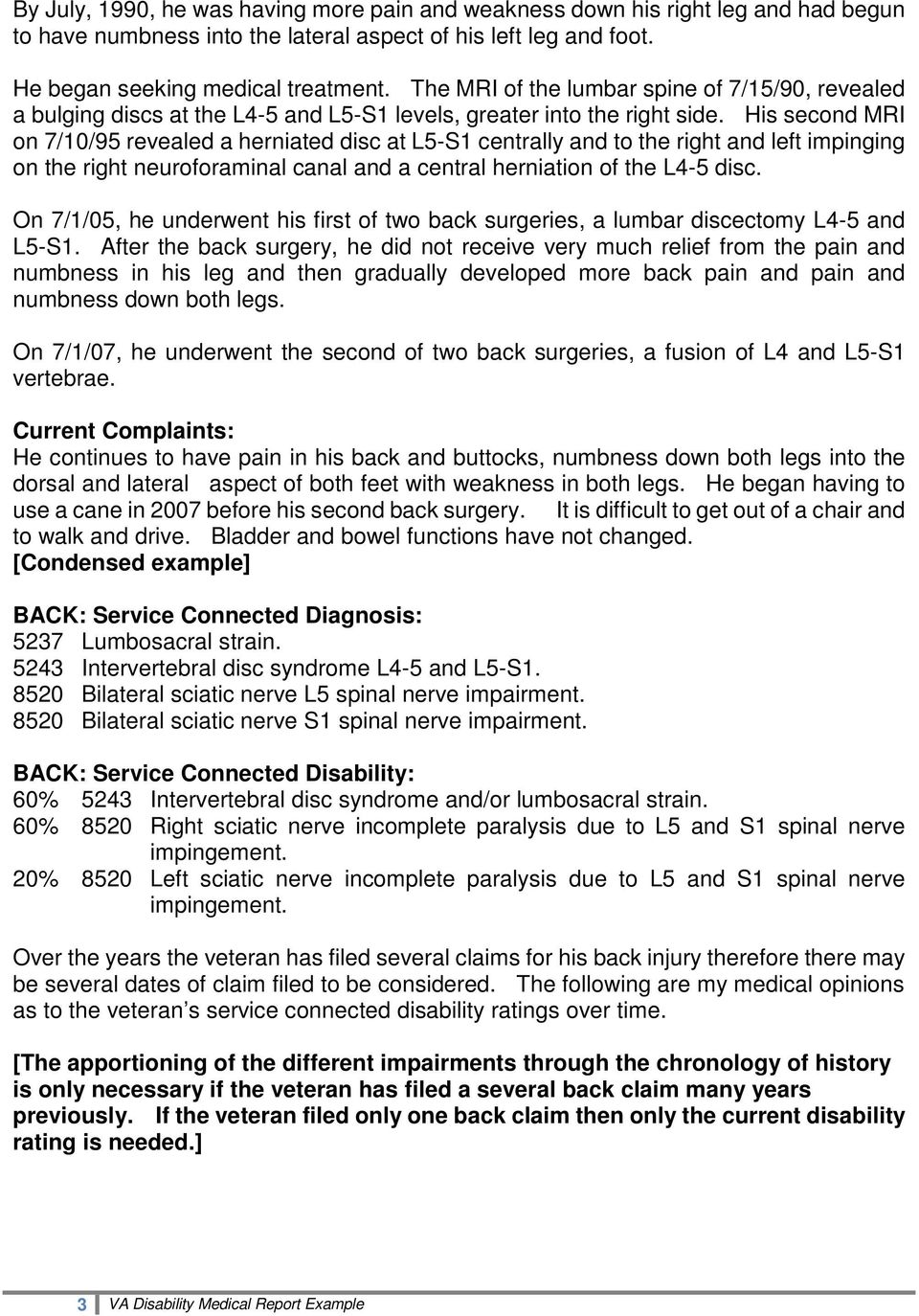
3 By July, 1990, he was having more pain and weakness down his right leg and had begun to have numbness into the lateral aspect of his left leg and foot. He began seeking medical treatment. The MRI of the lumbar spine of 7/15/90, revealed a bulging discs at the L4-5 and L5-S1 levels, greater into the right side. His second MRI on 7/10/95 revealed a herniated disc at L5-S1 centrally and to the right and left impinging on the right neuroforaminal canal and a central herniation of the L4-5 disc. On 7/1/05, he underwent his first of two back surgeries, a lumbar discectomy L4-5 and L5-S1. After the back surgery, he did not receive very much relief from the pain and numbness in his leg and then gradually developed more back pain and pain and numbness down both legs. On 7/1/07, he underwent the second of two back surgeries, a fusion of L4 and L5-S1 vertebrae. Current Complaints: He continues to have pain in his back and buttocks, numbness down both legs into the dorsal and lateral aspect of both feet with weakness in both legs. He began having to use a cane in 2007 before his second back surgery. It is difficult to get out of a chair and to walk and drive. Bladder and bowel functions have not changed. [Condensed example] BACK: Service Connected Diagnosis: 5237 Lumbosacral strain Intervertebral disc syndrome L4-5 and L5-S Bilateral sciatic nerve L5 spinal nerve impairment Bilateral sciatic nerve S1 spinal nerve impairment. BACK: Service Connected Disability: 60% 5243 Intervertebral disc syndrome and/or lumbosacral strain. 60% 8520 Right sciatic nerve incomplete paralysis due to L5 and S1 spinal nerve 20% 8520 Left sciatic nerve incomplete paralysis due to L5 and S1 spinal nerve Over the years the veteran has filed several claims for his back injury therefore there may be several dates of claim filed to be considered. The following are my medical opinions as to the veteran s service connected disability ratings over time. [The apportioning of the different impairments through the chronology of history is only necessary if the veteran has filed a several back claim many years previously. If the veteran filed only one back claim then only the current disability rating is needed.] 3 VA Disability Medical Report Example
4 Back Disability Percentages in the Past From the date of his injury in 1969 until 2001: 10% 5237 Lumbosacral strain with spasm and localized tenderness and inability to work for an accumulative total of one to two weeks a year. 10% 8520 Right sciatic nerve incomplete paralysis due to L5 and S1 spinal nerve From 2001 to 2005: 20% 5237 Lumbosacral strain, inability to work two to four weeks a year. 20% 8520 Right sciatic nerve incomplete paralysis due to L5 and S1 spinal nerve 10% 8520 Left sciatic nerve incomplete paralysis due to L5 and S1 spinal nerve From 2005 to 2007: 40% 5243 Intervertebral disc syndrome and unable to work 4 to 6 weeks a year 40% 8520 Right sciatic nerve incomplete paralysis due to L5 and S1 spinal nerve 10% 8520 Left sciatic nerve incomplete paralysis due to L5 and S1 spinal nerve From 2007 to the present: 60% 5243 Intervertebral disc syndrome and unable to work. 60% 8520 Right sciatic nerve incomplete paralysis due to L5 and S1 spinal nerve 20% 8520 Left sciatic nerve incomplete paralysis due to L5 and S1 spinal nerve Due to his service connected back injury he has been a totally disabled individual and unemployable and has been unable to work, even a sedentary job as a CPA, since 5/3/2007. BACK: Causal Relationship to Military Service: The original deceleration injury caused a strain in the muscles and ligaments in the back and injured the discs in the lower back. A deceleration injury, such as in the helicopter crash, causes greater forces in the low back than an injury such as lifting. Once the fibers of the discs in his lower back were injured, they continued to stretch and weaken causing the nuclear pulposus in the discs to begin to bulge out and then subsequently herniate. Initially, he was having lumbosacral strain with some tightness in the buttocks muscles causing some of the numbness in the back of his thighs, which would be a sciatic nerve Subsequently he developed symptoms and findings of bilateral L5 and S1 spinal nerve root impingement requiring a back surgery. The spinal nerve impingement down the legs continued to the point that he required a second surgery and fusion. But for his original service connected injury of the tearing of the muscles, ligaments and discs in his back, he would not have progressed to the spinal nerve impingements and the requirement of the two back surgeries. 4 VA Disability Medical Report Example

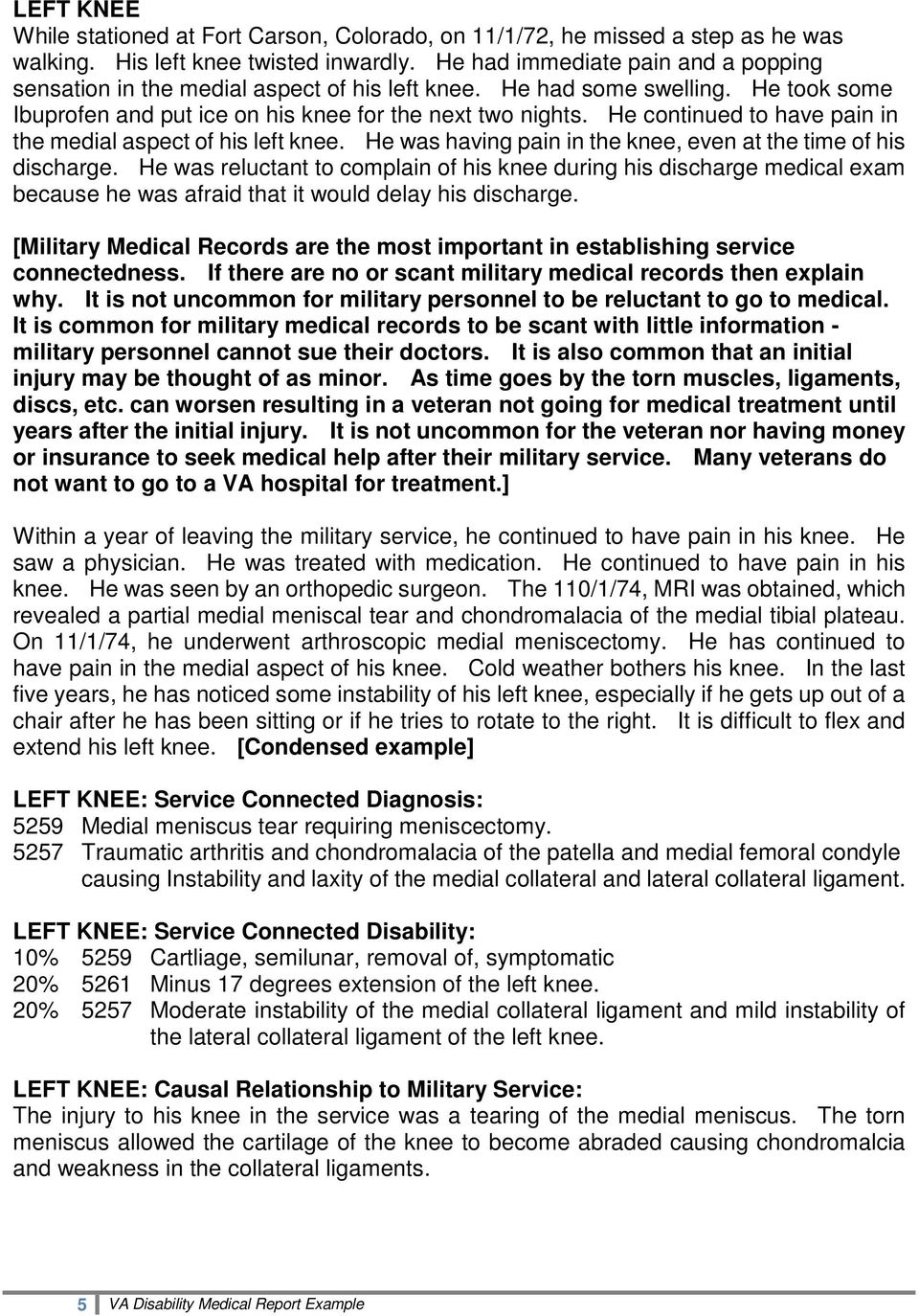
5 LEFT KNEE While stationed at Fort Carson, Colorado, on 11/1/72, he missed a step as he was walking. His left knee twisted inwardly. He had immediate pain and a popping sensation in the medial aspect of his left knee. He had some swelling. He took some Ibuprofen and put ice on his knee for the next two nights. He continued to have pain in the medial aspect of his left knee. He was having pain in the knee, even at the time of his discharge. He was reluctant to complain of his knee during his discharge medical exam because he was afraid that it would delay his discharge. [Military Medical Records are the most important in establishing service connectedness. If there are no or scant military medical records then explain why. It is not uncommon for military personnel to be reluctant to go to medical. It is common for military medical records to be scant with little information - military personnel cannot sue their doctors. It is also common that an initial injury may be thought of as minor. As time goes by the torn muscles, ligaments, discs, etc. can worsen resulting in a veteran not going for medical treatment until years after the initial injury. It is not uncommon for the veteran nor having money or insurance to seek medical help after their military service. Many veterans do not want to go to a VA hospital for treatment.] Within a year of leaving the military service, he continued to have pain in his knee. He saw a physician. He was treated with medication. He continued to have pain in his knee. He was seen by an orthopedic surgeon. The 110/1/74, MRI was obtained, which revealed a partial medial meniscal tear and chondromalacia of the medial tibial plateau. On 11/1/74, he underwent arthroscopic medial meniscectomy. He has continued to have pain in the medial aspect of his knee. Cold weather bothers his knee. In the last five years, he has noticed some instability of his left knee, especially if he gets up out of a chair after he has been sitting or if he tries to rotate to the right. It is difficult to flex and extend his left knee. [Condensed example] LEFT KNEE: Service Connected Diagnosis: 5259 Medial meniscus tear requiring meniscectomy Traumatic arthritis and chondromalacia of the patella and medial femoral condyle causing Instability and laxity of the medial collateral and lateral collateral ligament. LEFT KNEE: Service Connected Disability: 10% 5259 Cartliage, semilunar, removal of, symptomatic 20% 5261 Minus 17 degrees extension of the left knee. 20% 5257 Moderate instability of the medial collateral ligament and mild instability of the lateral collateral ligament of the left knee. LEFT KNEE: Causal Relationship to Military Service: The injury to his knee in the service was a tearing of the medial meniscus. The torn meniscus allowed the cartilage of the knee to become abraded causing chondromalcia and weakness in the collateral ligaments. 5 VA Disability Medical Report Example
6 VIETNAM AGENT ORANGE EXPOSURE: HYPERTENSION, MYOCARDIAL INFARCTION and DIABETES While being a helicopter pilot in Vietnam, he flew in II Corp and III Corp areas. In many areas he had numerous exposures to the Agent Orange as a herbicide defoliant. At age 50, he developed hypertension and began treatment with medications. In the last two years, he has developed shortness of breath with walking up a flight of stairs and walking quickly. He did not have any pitting edema, orthopnea or shortness of breath until he had a myocardial infarction on 1/5/11. On 1/5/11, he suffered an ST elevation myocardial infarction in the anterior wall of the heart with a thrombus and clot in the left anterior descending and circumflex arteries. Since then, he has had shortness of breath. He wakes up short of breath at night. At the end of the day he has pitting edema and swelling in his feet. He now cannot climb a flight of stairs or walk quickly. At age 50, he developed diabetes mellitus type II. He has been on oral medications and diet control. He started having to wear glasses at age 43. He has not noticed any peripheral neuropathy symptoms of burning in the bottom of his feet. He does have the shooting electrical symptoms consistent with bilateral L5 and S1 spinal nerve impairment down his legs as set forth in the above evaluation of his back injury. He has not noticed any burning peripheral neuropathy sensations on the bottom of his feet. [Condensed example] AGENT ORANGE: Service Connected Diagnosis: 7007 Hypertensive heart disease with heart failure Myocardial infarction 7913 Diabetes mellitus Type II AGENT ORANGE: Service Connected Disability: 30% 7007 Hypertensive heart disease with heart failure. 60% 7006 Myocardial infarction with congestive heart failure 20% 7913 Diabetes mellitus requiring oral hypoglycemic medications and restricted diet. AGENT ORANGE: Causal Relationship to Military Service: His exposures to Agent Orange and defoliants in Vietnam are presumptive evidence of causation for his hypertensive heart disease and diabetes mellitus. The hypertensive heart disease and diabetes mellitus made him much more prone to developing atherosclerosis of the coronary arteries resulting in the myocardial infarction. The hypertensive heart disease and the myocardial infarction have contributed to his congestive heart failure. 6 VA Disability Medical Report Example

7 PTSD POST TRAUMATIC STRESS DISORDER: He flew a Huey helicopter in Vietnam. He was actively engaged in the war. He also actively had to go into the hot LZs. He has had bullet holes in his helicopter. He had to pick up wounded and dead soldiers. He has continued to have intrusive thoughts of being shot at and of wounded and dead bodies. These intrusive thoughts occur as nightmares while he is sleeping and intrude into his thinking during the daytime. He has continued to be hyper vigilant and irritable. I concur with the 4/27/11 psychological evaluation by Ima Shrink, PhD. His GAF score of 45 is reasonable and consistent with my examination today. [Condensed example] PTSD: Service Connected Diagnosis: 9411 PTSD Post traumatic stress disorder. PTSD: Service Connected Diagnosis: 70% 9411 PTSD Post traumatic stress disorder. PTSD: Causal Relationship to Military Service: He was actively involved in the war. He was shot at and had bullet holes in his helicopter. He was not shot down. He went into hot landing zones and had to extract wounded and grossly deformed soldiers with visible wounds and dead soldiers. These experiences caused outpouring of excessive stress chemicals and changes in the brain. Studies have shown that there is measurable shrinkage in parts of the brain areas that will subsequently not allow the veteran suppress these stressful memories resulting in the continued stress chemical outpouring causing anxiety, the hyper vigilance and irritability and the veteran s Post Traumatic Stress Syndrome. HEARING LOSS and TINNITUS: He was exposed to loud noise of the helicopters while in the service. While in the service, he developed the difficulty in understanding speech, hearing and he developed tinnitus. Since the service, he has not had any noise exposure other than mowing his lawn. He continues to have ringing in both ears. He has difficulty understanding people if there is a noisy environment such as the television being on or in a restaurant. [Condensed example] HEARING LOSS: Service Connected Diagnosis: 6100 Hearing loss Tinnitus. HEARING LOSS: Service Connected Disability: 0% 6100 Hearing loss. 10% 6120 Tinnitus. Causal Relationship to Military Service: This veteran s audiogram is consistent with the loud noise exposures while in military service causing noise induced injury to the veteran s hearing cells. The injured hearing cells have caused hearing loss and tinnitus. The injured hearing cells will continue to degenerate causing worsening hearing loss and tinnitus. 7 VA Disability Medical Report Example

8 The following is an explanation to those veterans with a 10% service connected disability due to tinnitus but low or 0% disability due to hearing loss. Zero percent disability due to hearing loss does not mean that there should not be an accepted service connected hearing loss finding. The same loud noises that caused the tinnitus also caused hearing loss. A 0% rating may occur because noise induced hearing loss starts in the higher frequencies. Although, higher frequency hearing loss makes it difficult to understand speech, the VA Disability and other impairment systems do not rate the hearing loss in the higher frequencies. VA Disability hearing loss is calculated using both the pure tone audiogram results plus the Maryland CNC Speech Discrimination Test. This may result in a veteran with hearing aides and yet having a 0% hearing loss rating. A VA hearing loss rating is frequently lower than impairment rating of other systems such as the American Medical Association s, Guides to the Evaluation of Permanent Impairment which utilizes only the pure tone audiogram. [The VA system uses a standard audiogram plus speech discrimination. This can result in many veterans, even those with hearing aids to have a disability rating of 0% hearing loss. The hearing loss diagnosis should still be actively pursued to get it rated at 0%. As the injured hearing cells continue to die the vet s hearing loss will worsen and future audiograms will result in a disability percentage rating. It is easier to go from 0% disability to a percentage disability than to wait to when the vet is older to get the hearing loss claim accepted] RECORDS REVIEWED: [List Records or attach a list of records reviewed.] EXAMINATION and DIAGNOSTIC TESTS: [Condensed example] Ht: 5.9", Wt: 198 Without Shoes, BP: 142/88, Pulse 84, Respirations 24 GENERAL: Appears to be stated age. HEAD: Unremarkable. EYES: Pupils are equal and round. There is mild AV nicking but no hemorrhagic exudates. He does wear glasses. ENT: He has bilateral tinnitus cannot hear a soft whisper. Weber does not refer. Air conduction is louder than bone conduction. Canals are clear and drums are intact. CHEST: When he is sitting, there are faint rales in the bases. When I have him stand up and take a deep breath, the rales disappear. HEART: Regular rhythm without murmurs. There is no scar on the anterior chest wall. He underwent stenting on 1/5/12 of the left anterior descending and the circumflex. Point of maximum impulse is a centimeter left of the mid clavicular line in the fifth intercostal space. He has good radial pulses, dorsalis pedis and posterior tibial pulse. There is good capillary filling in his fingers, feet and toes. There is 1+ edema in the lower legs from the calf into the ankles. ORTHOPEDIC AND NEUROLOGICAL EXAM: [Making Topic Header for each claim s physical findings makes it easier for the VA Rating Office to check against the Title 38 criteria] BACK There is tightness of the posterior lower cervical, the thoracic and lumbar paraspinous muscles. This is consistent with spasm, especially in the lower thoracic and lumbar paraspinous muscles. There is decreased range of motion of the thoracic and lumbar 8 VA Disability Medical Report Example

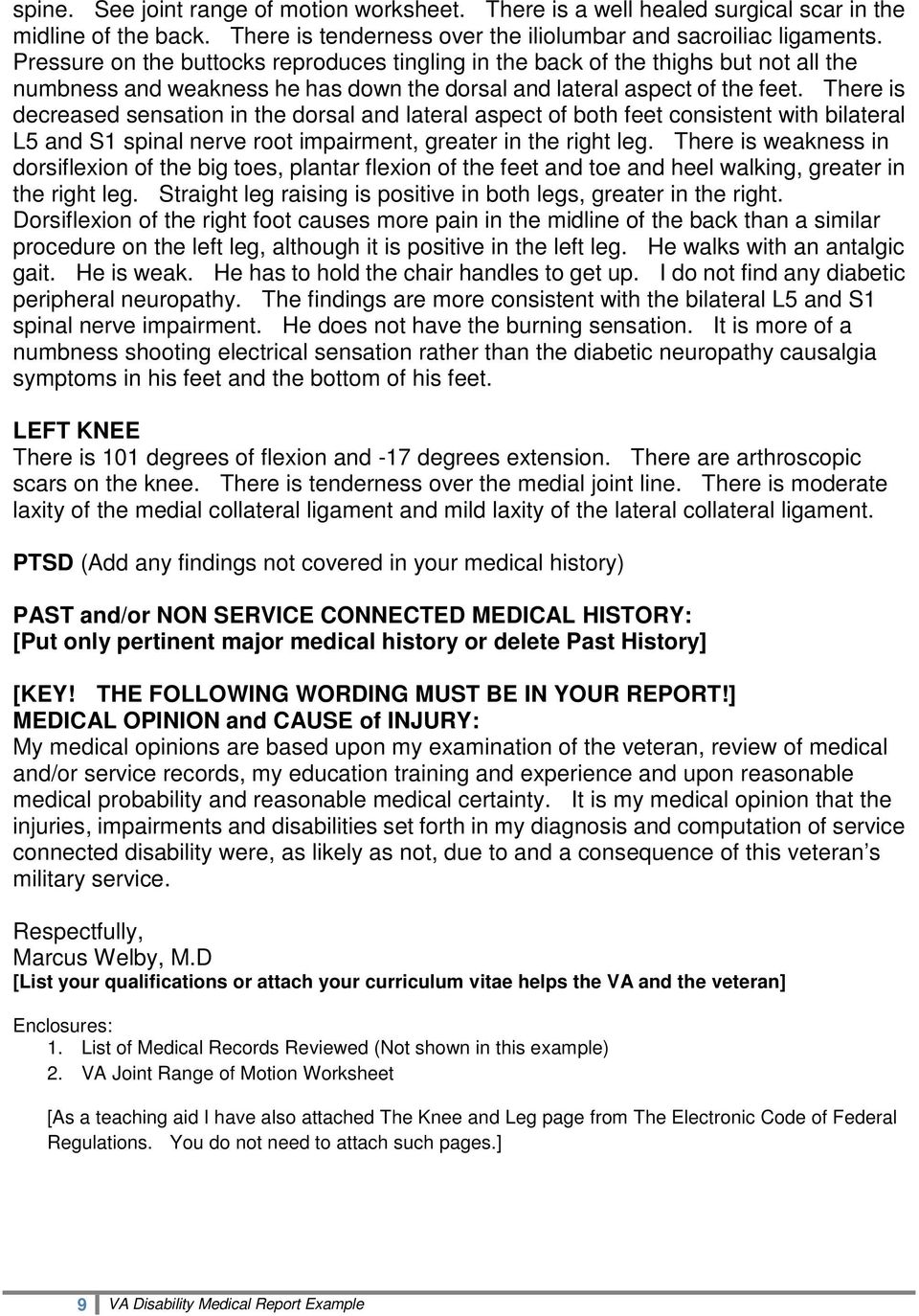
9 spine. See joint range of motion worksheet. There is a well healed surgical scar in the midline of the back. There is tenderness over the iliolumbar and sacroiliac ligaments. Pressure on the buttocks reproduces tingling in the back of the thighs but not all the numbness and weakness he has down the dorsal and lateral aspect of the feet. There is decreased sensation in the dorsal and lateral aspect of both feet consistent with bilateral L5 and S1 spinal nerve root impairment, greater in the right leg. There is weakness in dorsiflexion of the big toes, plantar flexion of the feet and toe and heel walking, greater in the right leg. Straight leg raising is positive in both legs, greater in the right. Dorsiflexion of the right foot causes more pain in the midline of the back than a similar procedure on the left leg, although it is positive in the left leg. He walks with an antalgic gait. He is weak. He has to hold the chair handles to get up. I do not find any diabetic peripheral neuropathy. The findings are more consistent with the bilateral L5 and S1 spinal nerve impairment. He does not have the burning sensation. It is more of a numbness shooting electrical sensation rather than the diabetic neuropathy causalgia symptoms in his feet and the bottom of his feet. LEFT KNEE There is 101 degrees of flexion and -17 degrees extension. There are arthroscopic scars on the knee. There is tenderness over the medial joint line. There is moderate laxity of the medial collateral ligament and mild laxity of the lateral collateral ligament. PTSD (Add any findings not covered in your medical history) PAST and/or NON SERVICE CONNECTED MEDICAL HISTORY: [Put only pertinent major medical history or delete Past History] [KEY! THE FOLLOWING WORDING MUST BE IN YOUR REPORT!] MEDICAL OPINION and CAUSE of INJURY: My medical opinions are based upon my examination of the veteran, review of medical and/or service records, my education training and experience and upon reasonable medical probability and reasonable medical certainty. It is my medical opinion that the injuries, impairments and disabilities set forth in my diagnosis and computation of service connected disability were, as likely as not, due to and a consequence of this veteran s military service. Respectfully, Marcus Welby, M.D [List your qualifications or attach your curriculum vitae helps the VA and the veteran] Enclosures: 1. List of Medical Records Reviewed (Not shown in this example) 2. VA Joint Range of Motion Worksheet [As a teaching aid I have also attached The Knee and Leg page from The Electronic Code of Federal Regulations. You do not need to attach such pages.] 9 VA Disability Medical Report Example
10 10 VA Disability Medical Report Example
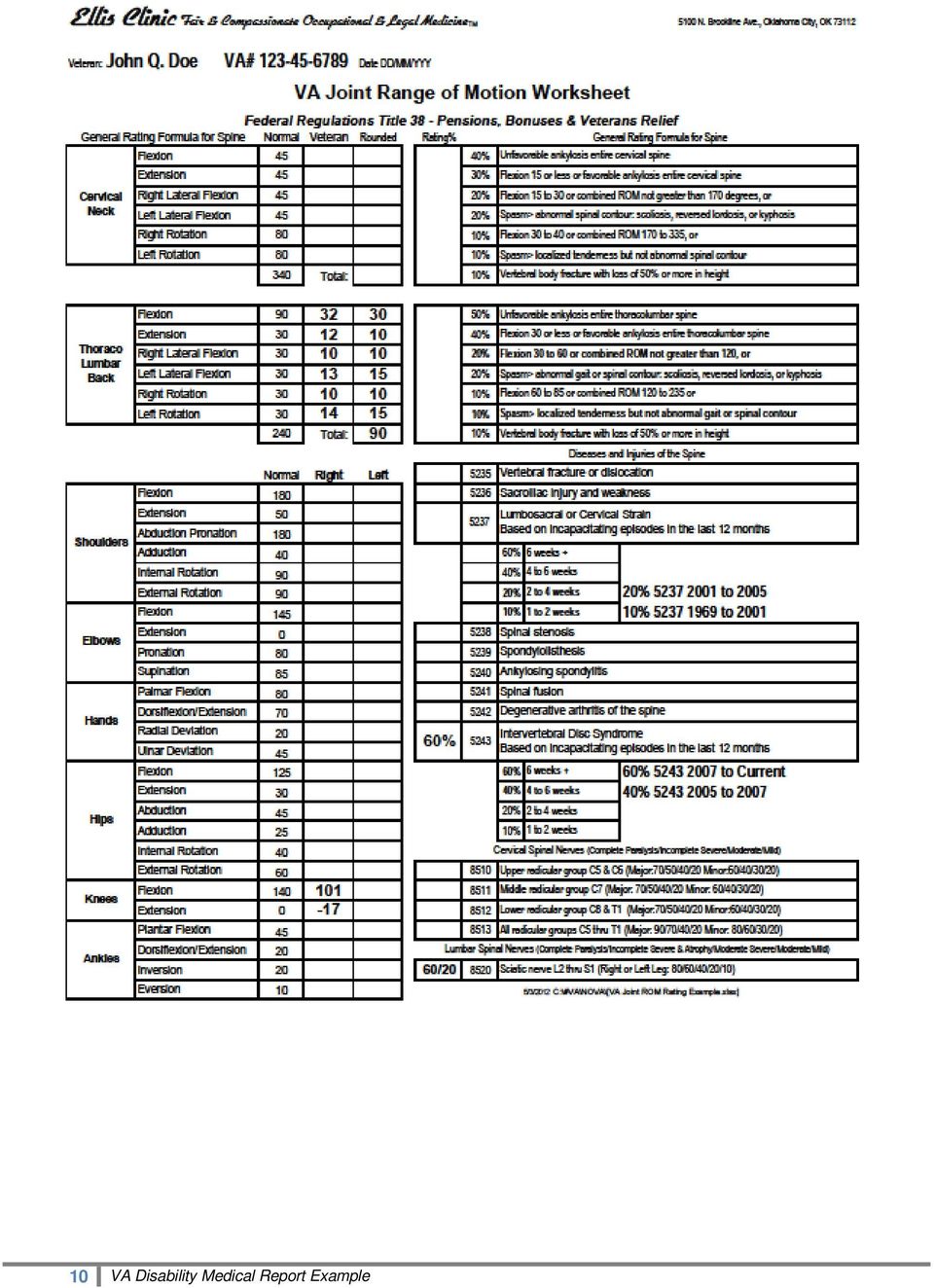
11 11 VA Disability Medical Report Example

.org. Herniated Disk in the Lower Back. Anatomy. Description
 Herniated Disk in the Lower Back Page ( 1 ) Sometimes called a slipped or ruptured disk, a herniated disk most often occurs in your lower back. It is one of the most common causes of low back pain, as
Closed Automobile Insurance Third Party Liability Bodily Injury Claim Study in Ontario
 Page 1 Closed Automobile Insurance Third Party Liability Bodily Injury Claim Study in Ontario Injury Descriptions Developed from Newfoundland claim study injury definitions No injury Death Psychological
Information on the Chiropractic Care of Lower Back Pain
 Chiropractic Care of Lower Back Pain Lower back pain is probably the most common condition seen the the Chiropractic office. Each month it is estimated that up to one third of persons experience some type
Sciatica Yuliya Mutsa PTA 236
 Sciatica Yuliya Mutsa PTA 236 Sciatica is a common type of pain affecting the sciatic nerve, which extends from the lower back all the way through the back of the thigh and down through the leg. Depending
Herniated Disk. This reference summary explains herniated disks. It discusses symptoms and causes of the condition, as well as treatment options.
 Herniated Disk Introduction Your backbone, or spine, has 24 moveable vertebrae made of bone. Between the bones are soft disks filled with a jelly-like substance. These disks cushion the vertebrae and keep
Neck Injuries and Disorders
 Neck Injuries and Disorders Introduction Any part of your neck can be affected by neck problems. These affect the muscles, bones, joints, tendons, ligaments or nerves in the neck. There are many common
 More information >>> HERE
 Herniated Disk in the Lower Back
 Nader M. Hebela, MD Fellow of the American Academy of Orthopaedic Surgeons http://orthodoc.aaos.org/hebela Cleveland Clinic Abu Dhabi Cleveland Clinic Abu Dhabi Neurological Institute Al Maryah Island
A Patient s Guide to Diffuse Idiopathic Skeletal Hyperostosis (DISH)
 A Patient s Guide to Diffuse Idiopathic Skeletal Hyperostosis (DISH) Introduction Diffuse Idiopathic Skeletal Hyperostosis (DISH) is a phenomenon that more commonly affects older males. It is associated
Hitting a Nerve: The Triggers of Sciatica. Bruce Tranmer MD FRCS FACS
 Hitting a Nerve: The Triggers of Sciatica Bruce Tranmer MD FRCS FACS Disclosures I have no financial disclosures Objectives - Sciatica Historical Perspective What is Sciatica What can cause Sciatica Clinical
Orthopaedic Spine Center. Anterior Cervical Discectomy and Fusion (ACDF) Normal Discs
 Orthopaedic Spine Center Graham Calvert MD James Woodall MD PhD Anterior Cervical Discectomy and Fusion (ACDF) Normal Discs The cervical spine consists of the bony vertebrae, discs, nerves and other structures.
If you or a loved one have suffered because of a negligent error during spinal surgery, you will be going through a difficult time.
 If you or a loved one have suffered because of a negligent error during spinal surgery, you will be going through a difficult time. You may be worried about your future, both in respect of finances and
Lower Back Pain An Educational Guide
 Lower Back Pain An Educational Guide A publication from the Center of Pain Medicine and Physiatric Rehabilitation 2002 Medical Parkway Ste 150 1630 Main St Ste 215 Annapolis, MD 21401 Chester, MD 21619
THE LUMBAR SPINE (BACK)
 THE LUMBAR SPINE (BACK) At a glance Chronic back pain, especially in the area of the lumbar spine (lower back), is a widespread condition. It can be assumed that 75 % of all people have it sometimes or
LUMBAR. Hips R L B R L B LUMBAR. Hips R L B R L B LUMBAR. Hips R L B R L B
 1 Patient Name In order to properly assess your condition, we must understand how much your BACK/LEG (SCIATIC) PAIN has affected your ability to manage everyday activities. For each item below, please
Patient Guide. Sacroiliac Joint Pain
 Patient Guide Sacroiliac Joint Pain Anatomy Where is the Sacroiliac Joint? The sacroiliac joint (SIJ) is located at the bottom end of your spine, where the "tailbone" (sacrum) joins the pelvis (ilium).
BACK PAIN: WHAT YOU SHOULD KNOW
 BACK PAIN: WHAT YOU SHOULD KNOW Diane Metzer LOWER BACK PAIN Nearly everyone at some point has back pain that interferes with work, recreation and routine daily activities. Four out of five adults experience
L5 S1 Extruded Disc Relieved with Cox Technic Decompression Spinal Adjusting
 1 L5 S1 Extruded Disc Relieved with Cox Technic Decompression Spinal Adjusting submitted by Joseph d'angiolillo DC 11 Clyde Road, Suite 103 Somerset, NJ 08873 (732) 873 2222 This is a case study of a patient
DIFFERENTIAL DIAGNOSIS OF LOW BACK PAIN. Arnold J. Weil, M.D., M.B.A. Non-Surgical Orthopaedics, P.C. Atlanta, GA
 DIFFERENTIAL DIAGNOSIS OF LOW BACK PAIN Arnold J. Weil, M.D., M.B.A. Non-Surgical Orthopaedics, P.C. Atlanta, GA MEDICAL ALGORITHM OF REALITY LOWER BACK PAIN Yes Patient will never get better until case
What are Core Muscles?... 2. A Healthy Lumbar Spine...3. What is Low Back Pain?...4. Rehabilitation...6. Stages of Rehabilitation...
 Table of Contents What are Core Muscles?... 2 A Healthy Lumbar Spine...3 What is Low Back Pain?...4 Rehabilitation...6 Stages of Rehabilitation...7 Pain Management....................... 8 Heat/Ice What
.org. Cervical Spondylosis (Arthritis of the Neck) Anatomy. Cause
 Cervical Spondylosis (Arthritis of the Neck) Page ( 1 ) Neck pain can be caused by many things but is most often related to getting older. Like the rest of the body, the disks and joints in the neck (cervical
Contact your Doctor or Nurse for more information.
 A spinal cord injury is damage to your spinal cord that affects your movement, feeling, or the way your organs work. The injury can happen by cutting, stretching, or swelling of the spinal cord. Injury
Spine Injury and Back Pain in Sports
 Spine Injury and Back Pain in Sports DAVID W. GRAY, MD 1 Back Pain Increases with Age Girls>Boys in Teenage years Anywhere from 15 to 80% of children and adolescents have back pain depending on the studies
LOW BACK PAIN EXAMINATION
 LOW BACK PAIN EXAMINATION John Petty, M.D. Medical Director Department of Physical Medicine & Rehabilitation Kettering Medical Center February 8, 2014 PRE-TEST QUESTION What part of the low back physical
Cervical Spondylosis (Arthritis of the Neck)
 Copyright 2009 American Academy of Orthopaedic Surgeons Cervical Spondylosis (Arthritis of the Neck) Neck pain is extremely common. It can be caused by many things, and is most often related to getting
Temple Physical Therapy
 Temple Physical Therapy A General Overview of Common Neck Injuries For current information on Temple Physical Therapy related news and for a healthy and safe return to work, sport and recreation Like Us
.org. Posterior Tibial Tendon Dysfunction. Anatomy. Cause. Symptoms
 Posterior Tibial Tendon Dysfunction Page ( 1 ) Posterior tibial tendon dysfunction is one of the most common problems of the foot and ankle. It occurs when the posterior tibial tendon becomes inflamed
CLINICAL PRACTICE GUIDELINES FOR MANAGEMENT OF LOW BACK PAIN
 CLINICAL PRACTICE GUIDELINES FOR MANAGEMENT OF LOW BACK PAIN Low back pain is very common, up to 90+% of people are affected by back pain at some time in their lives. Most often back pain is benign and
Avoid The Dreaded Back Injury by Proper Lifting Techniques
 Avoid The Dreaded Back Injury by Proper Lifting Techniques If you ve ever strained your back while lifting something, you ll know the importance of lifting safely. Agenda Introduction About the Back The
SPINAL STENOSIS Information for Patients WHAT IS SPINAL STENOSIS?
 SPINAL STENOSIS Information for Patients WHAT IS SPINAL STENOSIS? The spinal canal is best imagined as a bony tube through which nerve fibres pass. The tube is interrupted between each pair of adjacent
AMA Guides 6 th Edition AADEP SPINE EXAMPLES
 AMA Guides 6 th Edition AADEP SPINE EXAMPLES 1 Questions? James B. Talmage MD, Occupational Health Center, 315 N. Washington Ave, Suite 165 Cookeville, TN 38501 Phone 931-526-1604 (Fax 526-7378) [email protected]
Notice of Independent Review Decision DESCRIPTION OF THE SERVICE OR SERVICES IN DISPUTE:
 Notice of Independent Review Decision DATE OF REVIEW: 08/15/08 IRO CASE #: NAME: DESCRIPTION OF THE SERVICE OR SERVICES IN DISPUTE: Determine the appropriateness of the previously denied request for physical
A Patient s Guide to Post-Operative Physiotherapy. Following Anterior Cruciate Ligament Reconstruction of the Knee
 A Patient s Guide to Post-Operative Physiotherapy Following Anterior Cruciate Ligament Reconstruction of the Knee Introduction The anterior cruciate ligament (ACL) is one of the main supporting ligaments
Return to same game if sx s resolve within 15 minutes. Return to next game if sx s resolve within one week Return to Competition
 Assessment Skills of the Spine on the Field and in the Clinic Ron Burke, MD Cervical Spine Injuries Sprains and strains Stingers Transient quadriparesis Cervical Spine Injuries Result in critical loss
Herniated Lumbar Disc
 Herniated Lumbar Disc North American Spine Society Public Education Series What Is a Herniated Disc? The spine is made up of a series of connected bones called vertebrae. The disc is a combination of strong
Preventing & Treating Low Back Pain
 Preventing & Treating Low Back Pain An Introduction to Low Back Pain Low back pain is the number two reason that Americans see a health care practitioner second only to colds and flu. While most people
Lumbar Spinal Stenosis
 Copyright 2009 American Academy of Orthopaedic Surgeons Lumbar Spinal Stenosis Almost everyone will experience low back pain at some point in their lives. A common cause of low back pain is lumbar spinal
Low Back Injury in the Industrial Athlete: An Anatomic Approach
 Low Back Injury in the Industrial Athlete: An Anatomic Approach Earl J. Craig, M.D. Assistant Professor Indiana University School of Medicine Department of Physical Medicine and Rehabilitation Epidemiology
SPINE SURGERY - LUMBAR DECOMPRESSION
 SPINE SURGERY - LUMBAR DECOMPRESSION Information Leaflet Your Health. Our Priority. Page 2 of 7 Introduction This booklet has been compiled by the physiotherapy department to help you understand lumbar
.org. Achilles Tendinitis. Description. Cause. Achilles tendinitis is a common condition that causes pain along the back of the leg near the heel.
 Achilles Tendinitis Page ( 1 ) Achilles tendinitis is a common condition that causes pain along the back of the leg near the heel. The Achilles tendon is the largest tendon in the body. It connects your
Surgery for cervical disc prolapse or cervical osteophyte
 Mr Paul S. D Urso MBBS(Hons), PhD, FRACS Neurosurgeon Provider Nº: 081161DY Epworth Centre Suite 6.1 32 Erin Street Richmond 3121 Tel: 03 9421 5844 Fax: 03 9421 4186 AH: 03 9483 4040 email: [email protected]
PLANTAR FASCITIS (Heel Spur Syndrome)
 PLANTAR FASCITIS (Heel Spur Syndrome) R. Amadeus Mason MD Description Plantar fascitis is characterized by stiffness and inflammation of the main fascia (fibrous connective [ligament-like] tissue) on the
Open Discectomy. North American Spine Society Public Education Series
 Open Discectomy North American Spine Society Public Education Series What Is Open Discectomy? Open discectomy is the most common surgical treatment for ruptured or herniated discs of the lumbar spine.
How to Get and Keep a Healthy Back. Amy Eisenson, B.S. Exercise Physiologist
 How to Get and Keep a Healthy Back Amy Eisenson, B.S. Exercise Physiologist Lesson Objectives Statistics of Back Pain Anatomy of the Spine Causes of Back Pain Four Work Factors Core Muscles Connection
 More information >>> HERE
 Lumbar Laminectomy and Interspinous Process Fusion
 Lumbar Laminectomy and Interspinous Process Fusion Introduction Low back and leg pain caused by pinched nerves in the back is a common condition that limits your ability to move, walk, and work. This condition
.org. Cervical Radiculopathy (Pinched Nerve) Anatomy. Cause
 Cervical Radiculopathy (Pinched Nerve) Page ( 1 ) Cervical radiculopathy, commonly called a pinched nerve occurs when a nerve in the neck is compressed or irritated where it branches away from the spinal
S T A T E O F M I C H I G A N WORKER'S COMPENSATION APPELLATE COMMISSION V DOCKET #97-0791
 DEBRA CARTER-LIGE, PLAINTIFF, 1999 ACO #305 S T A T E O F M I C H I G A N WORKER'S COMPENSATION APPELLATE COMMISSION V DOCKET #97-0791 METROSTAFF HEALTH CARE SERVICES, AND LIBERTY MUTUAL INSURANCE COMPANY,
.org. Plantar Fasciitis and Bone Spurs. Anatomy. Cause
 Plantar Fasciitis and Bone Spurs Page ( 1 ) Plantar fasciitis (fashee-eye-tiss) is the most common cause of pain on the bottom of the heel. Approximately 2 million patients are treated for this condition
Report #9. Human Anatomy and Soft Tissue Injuries:
 Report #9 Human Anatomy and Soft Tissue Injuries: The most common injury occurs from the bouncing around of a body in a vehicle. Often, a car occupant s neck whips back and forth, giving rise to what is
BEFORE THE ARKANSAS WORKERS COMPENSATION COMMISSION CLAIM NUMBER F205928 DOUGLAS EUGENE WHIPKEY, EMPLOYEE CLAIMANT XPRESS BOATS, EMPLOYER RESPONDENT
 BEFORE THE ARKANSAS WORKERS COMPENSATION COMMISSION CLAIM NUMBER F205928 DOUGLAS EUGENE WHIPKEY, EMPLOYEE CLAIMANT XPRESS BOATS, EMPLOYER RESPONDENT CONTINENTAL CASUALTY CO., INSURANCE CARRIER RESPONDENT
Spine University s Guide to Kinetic MRIs Detect Disc Herniations
 Spine University s Guide to Kinetic MRIs Detect Disc Herniations 2 Introduction Traditionally, doctors use a procedure called magnetic resonance imaging (MRI) to diagnose disc injuries. Kinetic magnetic
There are four main regions of the back; the cervical (C), thoracic (T), lumbar (L), and sacral (S) regions
 Low Back Pain Overview Low back pain is one of the most common disorders in the United States. About 80 percent of people have at least one episode of low back pain during their lifetime. Factors that
Options for Cervical Disc Degeneration A Guide to the Fusion Arm of the M6 -C Artificial Disc Study
 Options for Cervical Disc Degeneration A Guide to the Fusion Arm of the M6 -C Artificial Disc Study Each year, hundreds of thousands of adults are diagnosed with Cervical Disc Degeneration, an upper spine
Employees Compensation Appeals Board
 U. S. DEPARTMENT OF LABOR Employees Compensation Appeals Board In the Matter of VERA R. PRICE and U.S. POSTAL SERVICE, POST OFFICE, Indianapolis, IN Docket No. 03-928; Submitted on the Record; Issued June
A compressive dressing that you apply around your ankle, and
 Ankle Injuries & Treatment The easiest way to remember this is: R.I.C.E. Each of these letters stands for: Rest. Rest your ankle. Do not place weight on it if it is very tender. Avoid walking long distances.
Injury Prevention for the Back and Neck
 Injury Prevention for the Back and Neck www.csmr.org We have created this brochure to provide you with information regarding: Common Causes of Back and Neck Injuries and Pain Tips for Avoiding Neck and
Pre - Operative Rehabilitation Program for Anterior Cruciate Ligament Reconstruction
 Pre - Operative Rehabilitation Program for Anterior Cruciate Ligament Reconstruction This protocol is designed to assist you with your preparation for surgery and should be followed under the direction
A Patient s Guide to Rib Joint Pain
 A Patient s Guide to Rib Joint Pain Anatomy Where are the rib joints? Your rib cage is made up of twelve pairs of ribs. The ribs attach to the spine in the back, and to the breastbone in the front. The
Back Owner s Manual A Guide to the Care of the Low Back
 Back Owner s Manual A Guide to the Care of the Low Back A Healthy Back Keeps You Moving Forward If back pain has you feeling down, you re not alone. Low back pain affects many of us. That s because we
Each year, hundreds of thousands of adults are diagnosed with Cervical Disc Degeneration, The Cervical Spine. What is the Cervical Spine?
 Each year, hundreds of thousands of adults are diagnosed with Cervical Disc Degeneration, an upper spine condition that can cause pain and numbness in the neck, shoulders, arms, and even hands. This patient
Screening Examination of the Lower Extremities BUY THIS BOOK! Lower Extremity Screening Exam
 Screening Examination of the Lower Extremities Melvyn Harrington, MD Department of Orthopaedic Surgery & Rehabilitation Loyola University Medical Center BUY THIS BOOK! Essentials of Musculoskeletal Care
Lumbar Micro-Discectomy
 Lumbar Micro-Discectomy David M. Montgomery, M.D. Orthopaedic Spine Surgeon Lisa A. Olds, RN, BSN, ONC Spine Nurse Clinician Oakland Orthopaedic Surgeons, PLLC 30575 Woodward Avenue, Suite 100 Royal Oak,
Does the pain radiating down your legs, buttocks or lower back prevent you from walking long distances?
 Does the pain radiating down your legs, buttocks or lower back prevent you from walking long distances? Do you experience weakness, tingling, numbness, stiffness, or cramping in your legs, buttocks or
CONSTRUCTION WORK and CUMULATIVE TRAUMA DISORDERS
 Connecticut Department of Public Health Environmental and Occupational Health Assessment Program 410 Capitol Avenue MS # 11OSP, PO Box 340308 Hartford, CT 06134-0308 (860) 509-7740 http://www.ct.gov/dph
THORACIC OUTLET SYNDROME & BRACHIAL PLEXUS INJURIES
 THORACIC OUTLET SYNDROME & BRACHIAL PLEXUS INJURIES I. THORACIC OUTLET SYNDROME TOS is a compression of nerves or blood vessels, or both, in the thoracic outlet region, which is the space between the collarbone
Neck Pain Frequently Asked Questions. Moe R. Lim, MD UNC Orthopaedics (919-96B-ONES) UNC Spine Center (919-957-6789)
 Neck Pain Frequently Asked Questions Moe R. Lim, MD UNC Orthopaedics (919-96B-ONES) UNC Spine Center (919-957-6789) Neck Pain Human Spine 25 bones Cervical (7) Thoracic (12) Lumbar (5) Sacrum Human Spine
.org. Fractures of the Thoracic and Lumbar Spine. Cause. Description
 Fractures of the Thoracic and Lumbar Spine Page ( 1 ) Spinal fractures can vary widely in severity. While some fractures are very serious injuries that require emergency treatment, other fractures can
The Trial of a Soft Tissue Knee Injury Case. By Ben Rubinowitz and Evan Torgan
 The Trial of a Soft Tissue Knee Injury Case By Ben Rubinowitz and Evan Torgan Although often overlooked as commonplace or insignificant, an injury to the knee joint often results in a severe, permanent
Information for the Patient About Surgical
 Information for the Patient About Surgical Decompression and Stabilization of the Spine Aging and the Spine Daily wear and tear, along with disc degeneration due to aging and injury, are common causes
https://www.laserspineinstitute.com/back_problems/foraminal_stenosis/e...
 Questions? Call toll free 1-866-249-1627 Contact us today. We're here for you seven days a week. MRI Review Consultation Live help Call 1-866-249-1627 Chat Live Home Laser Spine Institute Laser Spine Institute's
UPPER LUMBAR DISC HERNIATION WITH CENTRAL AND FAR LATERAL STENOTIC CHANGES RESULTING IN ANTERIOR THIGH PAIN
 Cox Technic Case Report #60 sent 5/13/08 1 UPPER LUMBAR DISC HERNIATION WITH CENTRAL AND FAR LATERAL STENOTIC CHANGES RESULTING IN ANTERIOR THIGH PAIN History, Examination & Imaging Review: A 53-year-old
The Petrylaw Lawsuits Settlements and Injury Settlement Report
 The Petrylaw Lawsuits Settlements and Injury Settlement Report BACK INJURIES How Minnesota Juries Decide the Value of Pain and Suffering in Back Injury Cases The Petrylaw Lawsuits Settlements and Injury
Cerebral Palsy. In order to function, the brain needs a continuous supply of oxygen.
 Cerebral Palsy Introduction Cerebral palsy, or CP, can cause serious neurological symptoms in children. Up to 5000 children in the United States are diagnosed with cerebral palsy every year. This reference
A Patient s Guide to Artificial Cervical Disc Replacement
 A Patient s Guide to Artificial Cervical Disc Replacement Each year, hundreds of thousands of adults are diagnosed with Cervical Disc Degeneration, an upper spine condition that can cause pain and numbness
TREATMENT OF AN L5/S1 EXTRUDED DISC HERNIATION USING SPINAL DECOMPRESSION: A CASE STUDY. Jack Choate, DC
 TREATMENT OF AN L5/S1 EXTRUDED DISC HERNIATION USING SPINAL DECOMPRESSION: A CASE STUDY Jack Choate, DC ABSTRACT Objective: To discuss a case of an acute lumbar disc herniation that was successfully treated
Elbow Injuries and Disorders
 Elbow Injuries and Disorders Introduction Your elbow joint is made up of bone, cartilage, ligaments and fluid. Muscles and tendons help the elbow joint move. There are many injuries and disorders that
SCRIPT NUMBER 82 SPRAINED ANKLE (TWO SPEAKERS)
 SCRIPT NUMBER 82 SPRAINED ANKLE (TWO SPEAKERS) PROGRAM NAME: HEALTH NUGGETS PROGRAM TITLE: SPRAINED ANKLE PROGRAM NUMBER: 82 SUBJECT: PATHOLOGY, CAUSES, DIAGNOSIS, TREATMENT, PREVENTION OF SPRAINED ANKLES
United States Department of Labor Employees Compensation Appeals Board DECISION AND ORDER
 United States Department of Labor V.J., Appellant and U.S. POSTAL SERVICE, MORGAN GENERAL MAIL FACILITY, New York, NY, Employer Appearances: Appellant, pro se Office of Solicitor, for the Director Docket
Lower Back Pain. Introduction. Anatomy
 Lower Back Pain Introduction Back pain is the number one problem facing the workforce in the United States today. To illustrate just how big a problem low back pain is, consider these facts: Low back pain
Brian P. McKeon MD Jason D. Rand, PA-C, PT Patient Information Sheet: Anterior Cruciate Ligament
 Brian P. McKeon MD Jason D. Rand, PA-C, PT Patient Information Sheet: Anterior Cruciate Ligament The anterior cruciate ligament or ACL is one of the major ligaments located in the knee joint. This ligament
New England Pain Management Consultants At New England Baptist Hospital
 New England Pain Management Consultants At New England Baptist Hospital Pain Management Center Health Assessment Dear New Pain Management Patient, Welcome to the New England Pain Management Consultants
Acute Oncology Service Patient Information Leaflet
 Spinal cord compression Acute Oncology Service Patient Information Leaflet Introduction If you have been diagnosed with cancer, you need to know about spinal cord compression and the warning signs. What
Herniated Cervical Disc
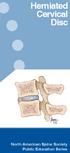 Herniated Cervical Disc North American Spine Society Public Education Series What Is a Herniated Disc? The backbone, or spine, is composed of a series of connected bones called vertebrae. The vertebrae
Clinical guidance for MRI referral
 MRI for cervical radiculopathy Referral by a medical practitioner (excluding a specialist or consultant physician) for a scan of spine for a patient 16 years or older for suspected: cervical radiculopathy
Compensation. Service-Connected Disability or Death Benefits
 Compensation Service-Connected Disability or Death Benefits The Compensation program provides tax-free monthly benefits to Veterans in recognition of the effects of disabilities caused by diseases, events,
SPINE. Postural Malalignments 4/9/2015. Cervical Spine Evaluation. Thoracic Spine Evaluation. Observations. Assess position of head and neck
 SPINE Observations Body type Postural alignments and asymmetries should be observed from all views Assess height differences between anatomical landmarks Figure 25-9 Figure 25-10 Figure 25-11 & 12 Postural
Patient Guide to Lower Back Surgery
 The following is a sampling of products offered by Zimmer Spine for use in Open Lumbar Fusion procedures. Patient Guide to Lower Back Surgery Open Lumbar Fusion Dynesys The Dynesys Dynamic Stabilization
ORTHOPAEDIC SPINE PAIN QUESTIONNAIRE
 ORTHOPAEDIC SPINE PAIN QUESTIONNAIRE NAME: DATE: ADDRESS: AGE: TELEPHONE#: RELIGION: OCCUPATION: REFERRED BY WHOM: NEAREST FRIEND/RELATIVE: TELEPHONE#: ADDRESS: PLEASE EXPLAIN WHY YOU HAVE COME TO SEE
Mike s Top Ten Tips for Reducing Back Pain
 Mike s Top Ten Tips for Reducing Back Pain The following article explains ways of preventing, reducing or eliminating back pain. I have found them to be very useful to myself, my clients and my patients.
THE PREVENTION AND REHABILITATION OF SPORTS INJURIES THE PREVENTION AND REHABILITATION OF SPORTS INJURIES. NO, there isn t.
 THE PREVENTION AND REHABILITATION OF SPORTS INJURIES VILMOS DANI M.D. Department of Family Medicine Faculty of Medicine, Semmelweis University Budapest, Hungay GIZELLA PERÉNYI M.D. Department of Rehabilitation
Treating Bulging Discs & Sciatica. Alexander Ching, MD
 Treating Bulging Discs & Sciatica Alexander Ching, MD Disclosures Depuy Spine Teaching and courses K2 Spine Complex Spine Study Group Disclosures Take 2 I am a spine surgeon I like spine surgery I believe
POST SURGICAL RETURN OF RIGHT LEG PAIN. TREATED SUCCESSFULLY WITH COX FLEXION DISTRACTION DECOMPRESSION ADJUSTING
 POST SURGICAL RETURN OF RIGHT LEG PAIN. TREATED SUCCESSFULLY WITH COX FLEXION DISTRACTION DECOMPRESSION ADJUSTING A 47 year old white married female was seen for the chief complaint of low back and right
Rehabilitation Guidelines for Knee Arthroscopy
 Rehabilitation Guidelines for Knee Arthroscopy Arthroscopy is a common surgical procedure in which a joint is viewed using a small camera. This technique allows the surgeon to have a clear view of the
Anterior Cervical Discectomy and Fusion
 A Patient s Guide to Anterior Cervical Discectomy and Fusion 651 Old Country Road Plainview, NY 11803 Phone: 5166818822 Fax: 5166813332 [email protected] DISCLAIMER: The information in this booklet is