
|
|
|
- Janel Barker
- 9 years ago
- Views:
Transcription
1 Page 1 of 55 EUROPEAN COMMISSION FOR THE EFFICIENCY OF JUSTICE (CEPEJ) SCHEME FOR EVALUATING JUDICIAL SYSTEMS 2009

2 Page 2 of 55 Country: Portugal National correspondent First Name - Last Name: DE OLIVEIRA Joao arsenio Job title: Legal consultant Organisation: Ministry of Justice [email protected] Phone Number :

3 Page 3 of Demographic and economic data General information Inhabitants and economic information 1) Number of inhabitants ) Total of annual State public expenditure / where appropriate, public expenditure at regional or federal entity level (in ) State level Regional / entity level Amount 3) Per capita GDP (in ) ) Average gross annual salary (in ) ) Exchange rate from national currency (non-euro zone) to on 1 January 2009 Please indicate the sources for questions 1 to 4 and give comments concerning the interpretation of the figures supplied if appropriate: Questions 1, 2 and 3 - National Statistics Institute (Instituto Nacional de Estatística) Question 4 - Labour Ministry and Social Welfare (Ministério do Trabalho e da Solidariedade Social) Questions 1, 2 and 3 - Provisional data Budgetary data concerning judicial system Budget (courts, public prosecution, legal aid, fees) 6) Total annual approved budget allocated to all courts (in ) ) Please specify It refers to amounts related to the functioning of the courts, including court personnel remuneration. It excludes major investments, such as new buildings. Please, also refer to question 8. 8) Does the approved budget of the courts include the following items? Please give for

4 Page 4 of 55 each item (or some of them) a specification of the amount concerned or indicate NA (not available) in case that the information cannot be supplied Please provide comments to explain the data provided under question 8: Annual public budget allocated to (gross) salaries Annual public budget allocated to computerisation (equipment, investments, maintenance) Annual public budget allocated to justice expenses Annual public budget allocated to court buildings (maintenance, operation costs) Annual public budget allocated to investments in new (court) buildings Annual public budget allocated to training and education Other (please specify): Comment : 9) Has the annual public budget of the courts changed (increased or decreased) over the last five years? If yes, please specify (i.e. provide an indication of the increase or decrease of the budget over the last five years: The general budget has increased over the last five years and the budget allocated to the Higher Courts (which have separated budgets) has also increased. 10) In general are litigants required to pay a court tax or fee to start a proceeding at a court of general jurisdiction: for criminal cases? for other than criminal cases? If yes, are there exceptions? Please specify:

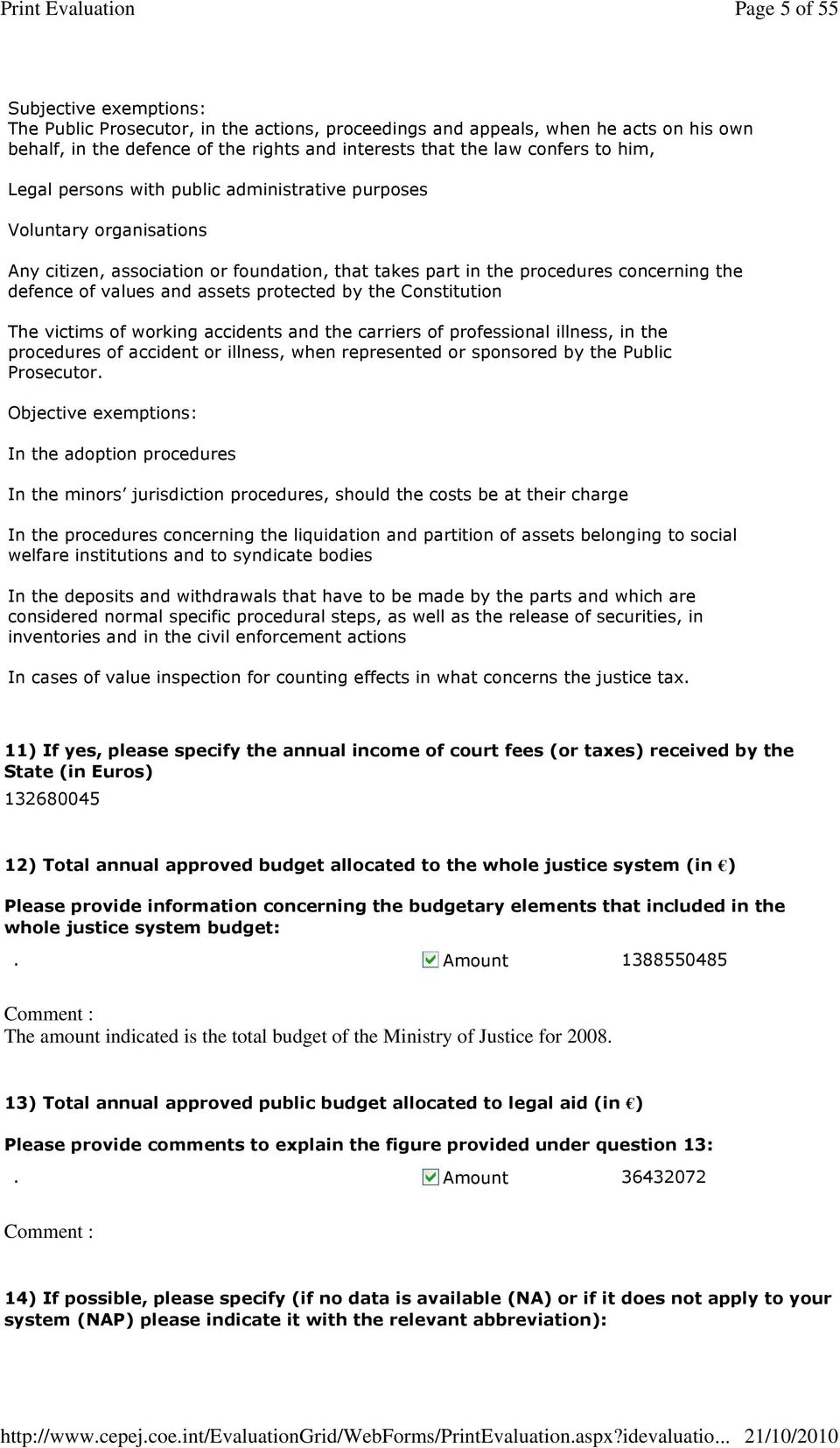
5 Page 5 of 55 Subjective exemptions: The Public Prosecutor, in the actions, proceedings and appeals, when he acts on his own behalf, in the defence of the rights and interests that the law confers to him, Legal persons with public administrative purposes Voluntary organisations Any citizen, association or foundation, that takes part in the procedures concerning the defence of values and assets protected by the Constitution The victims of working accidents and the carriers of professional illness, in the procedures of accident or illness, when represented or sponsored by the Public Prosecutor. Objective exemptions: In the adoption procedures In the minors jurisdiction procedures, should the costs be at their charge In the procedures concerning the liquidation and partition of assets belonging to social welfare institutions and to syndicate bodies In the deposits and withdrawals that have to be made by the parts and which are considered normal specific procedural steps, as well as the release of securities, in inventories and in the civil enforcement actions In cases of value inspection for counting effects in what concerns the justice tax. 11) If yes, please specify the annual income of court fees (or taxes) received by the State (in Euros) ) Total annual approved budget allocated to the whole justice system (in ) Please provide information concerning the budgetary elements that included in the whole justice system budget:. Amount Comment : The amount indicated is the total budget of the Ministry of Justice for ) Total annual approved public budget allocated to legal aid (in ) Please provide comments to explain the figure provided under question 13:. Amount Comment : 14) If possible, please specify (if no data is available (NA) or if it does not apply to your system (NAP) please indicate it with the relevant abbreviation):
6 Page 6 of 55 Annual public budget allocated to legal aid in criminal law cases Amount NA NA Annual public budget allocated to legal aid in non criminal law cases Comment : 15) Is the public budget allocated to legal aid included in the court budget? 16) Total annual approved public budget allocated to the public prosecution system (in ) Please provide comments to explain the figure provided under question 16:. Amount Comment : 17) Is the budget allocated to the public prosecution included in the court budget? 18) Authorities formally responsible for the budget allocated to the courts: Preparation of the total court budget Adoption of the total court budget Management and allocation of the budget among the individual courts Evaluation of the use of the budget at a national level Ministry of Justice Other ministry Parliament Supreme Court Judicial Council Courts Inspection body Other 19) If other Ministry and/or inspection body and/or other, please specify (in regards to question 18): t applicable. You can indicate below: - any useful comments for interpreting the data mentioned in this chapter - the characteristics of your budgetary system and the main reforms that have been implemented over the last two years
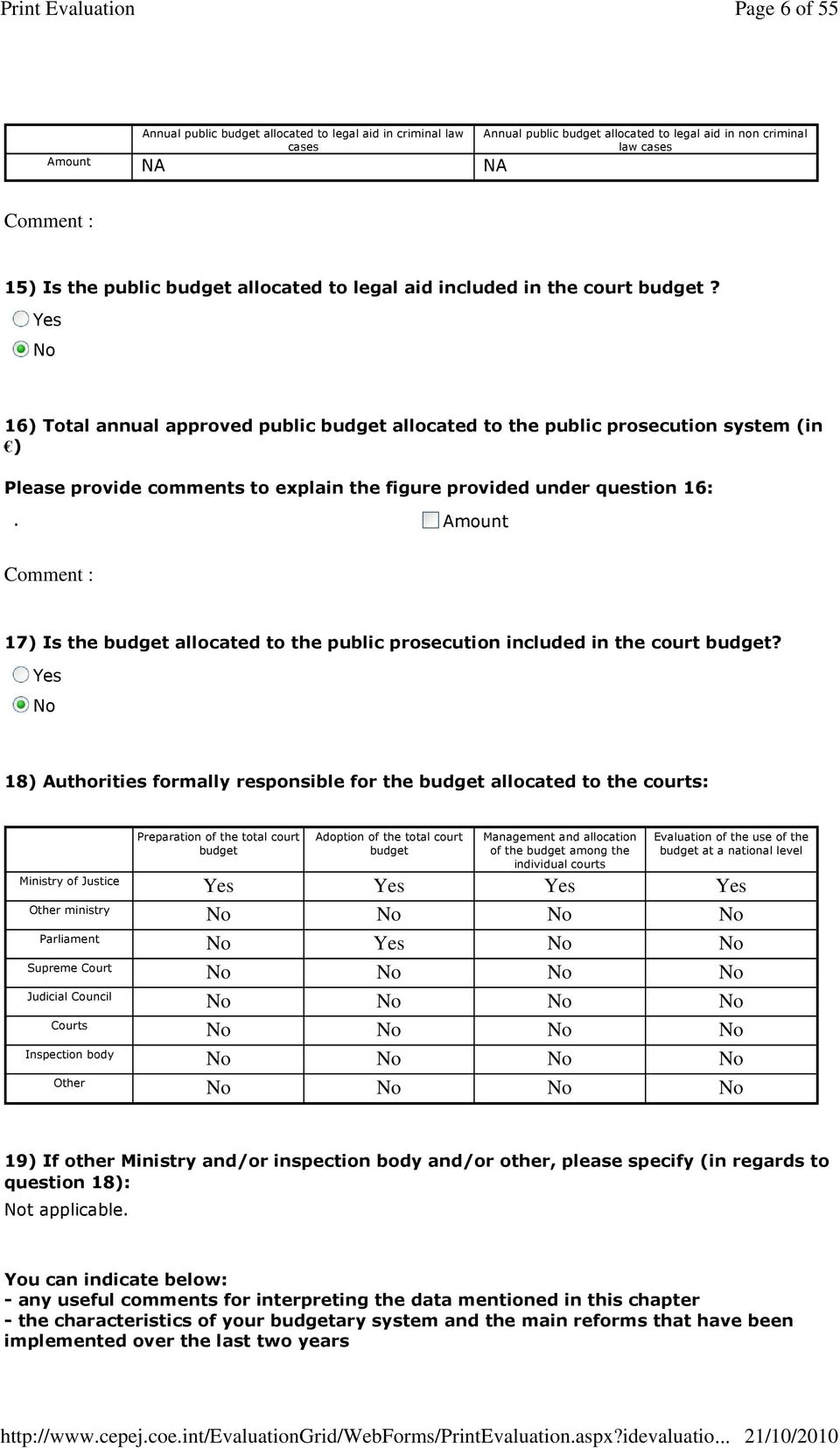
7 Page 7 of 55 - if available an organisation scheme with a description of the competencies of the different authorities responsible for the budget process te to question 18: It is up to the Justice Administration Directorate-General (Direcção-Geral da Administração da Justiça) to prepare a draft of budget to pay the salaries of court clerks and judges (first instance only) as well as some day-to-day expenses, following the instructions of the Financial and Infrastructures Management Institute (Instituto de Gestão Financeira e Infraestruturas da Justiça)and respecting the maximum and minimum amounts established by the Ministry. The same Directorate-General prepares a draft of investment budget for the expenses concerning infrastructures and equipment, namely hardware and software. Please indicate the sources for answering the questions 6, 8, 11, 12, 13, 14 and 16. Question 6 - Direcção-Geral da Administração da Justiça e Tribunais Superiores (Justice Administration Directorate-General and the High Courts) Question 7 - Direcção-Geral da Administração da Justiça e Tribunais Superiores (Directorate- General for Justice Administration and the High Courts) Question 11 - Instituto de Gestão Financeira e Infraestruturas da Justiça (Financial and Infrastructures Management Institute) Question 12 - Dossier Justiça 2006 Question 13 - Instituto de Gestão Financeira e Infraestruturas da Justiça (Financial and Infrastructures Management Institute)

8 Page 8 of Access to Justice and to all courts Legal aid Principles 20) Does legal aid concerns: Criminal cases Other than criminal cases Representation in court Legal advice Other 21) If other, please specify (in regards to question 20): Total or partial exemption from court fees and other expenses related to the case payment by instalments of the court fees and of other expenses related to the case, payment by instalments of the assigned counselour's compensation, payment of the appointed counselour's salary or private baillif (enforcement solicitor). Legal aid is also possible whem resorting to ADR. 22) Does legal aid foresee the covering or the exoneration of court fees? If yes, please specify: The Law foresses the total or partial exemption from court fees and other expenses related to the case. 23) Can legal aid be granted for the fees that are related to the execution of judicial decisions? 24) Number of cases granted with legal aid provided by (national, regional, local) public authorities (if no data is available (NA) or if it does not apply to your system (NAP) please indicate it with the relevant abbreviation): Total in criminal cases Other than criminal cases Number Comment :

9 Page 9 of 55 25) In a criminal case, can any individual who does not have sufficient financial means be assisted by a free of charge (or financed by public budget) lawyer? 26) Does your country have an income and asset test for granting legal aid: Amount in for criminal cases for other than criminal cases? X X Comment : It is not possible to give the exact amount because factors, other than the income, are also taken into consideration, namely the ones related to other expenses of the person requesting legal aid. 27) In other than criminal cases, is it possible to refuse legal aid for lack of merit of the case (for example for frivolous action)? Please provide comments to explain the answer under question 27: 28) If yes, is the decision for granting or refusing legal aid taken by: the court? an authority external to the court? a mixed decision-making authority (court and external)? 29) Is there a private system of legal expense insurance enabling individuals to finance court proceedings? Please specify: The court proceedings expenses are included in the legal expense insurance coverage. The legal expense insurance legal framework is laid down in articles 167 to 172 of Decree-Law 72/2008, of 16 April, which came into force on the 1st January This legal framework results from the transposition of Council Directive 87/334/EEC of 22 June 1987, on the coordination of laws, regulations and administrative provisions relating to legal expenses insurance. 30) Do judicial decisions have an impact on who bears the legal costs which are paid by the parties during the procedure in: (the decision has an impact on who bears the legal costs)
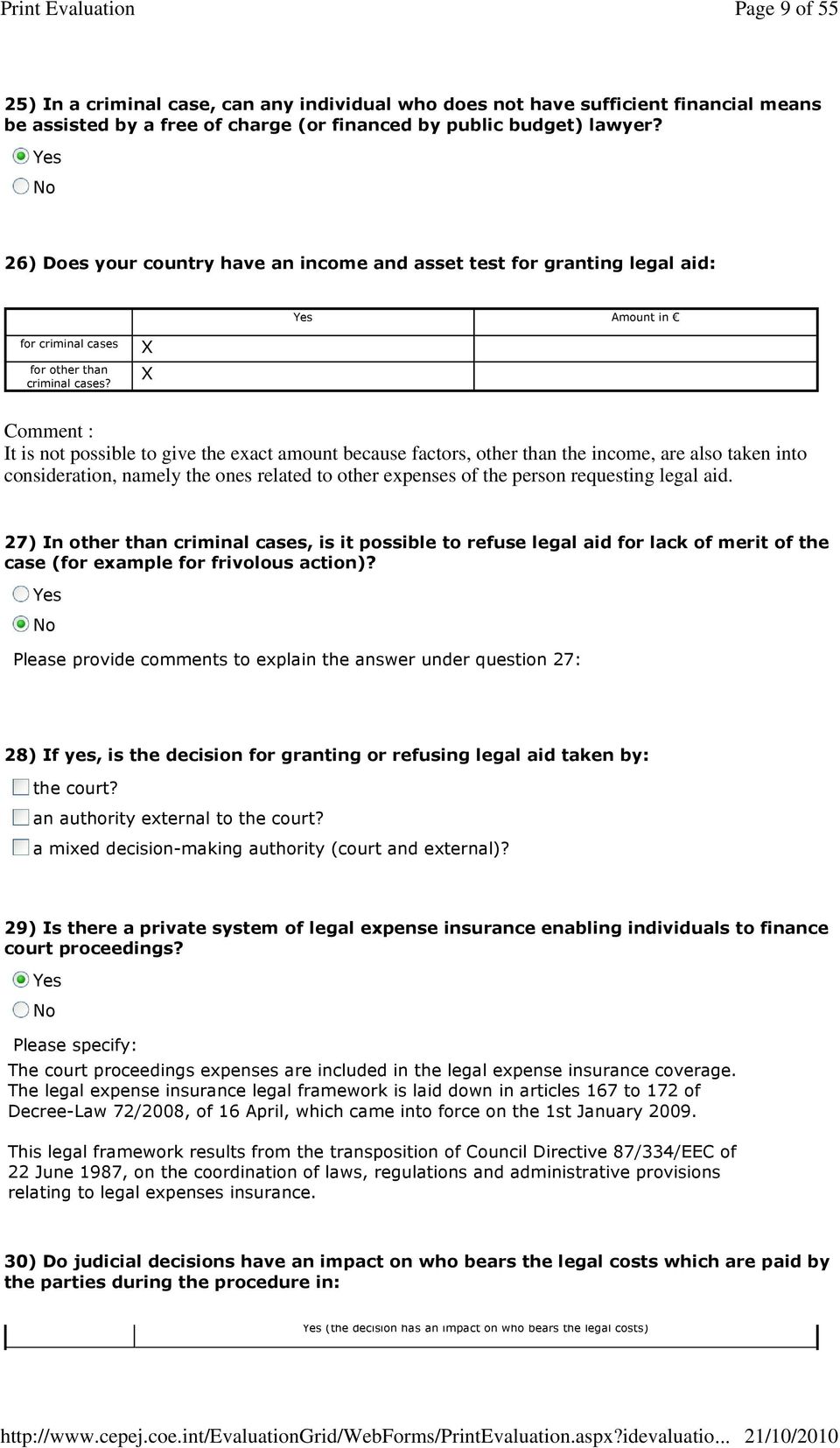
10 Page 10 of 55 criminal cases? other than criminal cases? You can indicate below: - any useful comments for interpreting the data mentioned in this chapter - the characteristics of your legal aid system and the main reforms that have been implemented over the last two years Please indicate the sources for answering the questions 24 and 26 Question 26 - Directorate-General for Justice Policy Users of the courts and victims Rights of the users and victims 31) Are there official internet sites/portals (e.g. Ministry of Justice, etc.) for the following, which the general public may have free of charge access to: legal texts (e.g. codes, laws, regulations, etc.)? Internet address(es): case-law of the higher court/s? Internet address(es): other documents (for examples forms)? Internet address(es): ) Is there an obligation to provide information to the parties concerning the foreseeable timeframe of the proceeding? If yes, please specify: 33) Is there a public and free-of-charge specific information system to inform and to help victims of crimes? If yes, please specify: The Commission for the Protection of Crime Victims notifies the victims of violent crimes on requests for reimbursement by the State, and on requests for compensation in advance to victims of domestic violence. Such is done without any charge to the victims. There are also private associations that give support to crime victims. 34) Are there special favourable arrangements to be applied, during judicial proceedings, to the following categories of vulnerable persons:
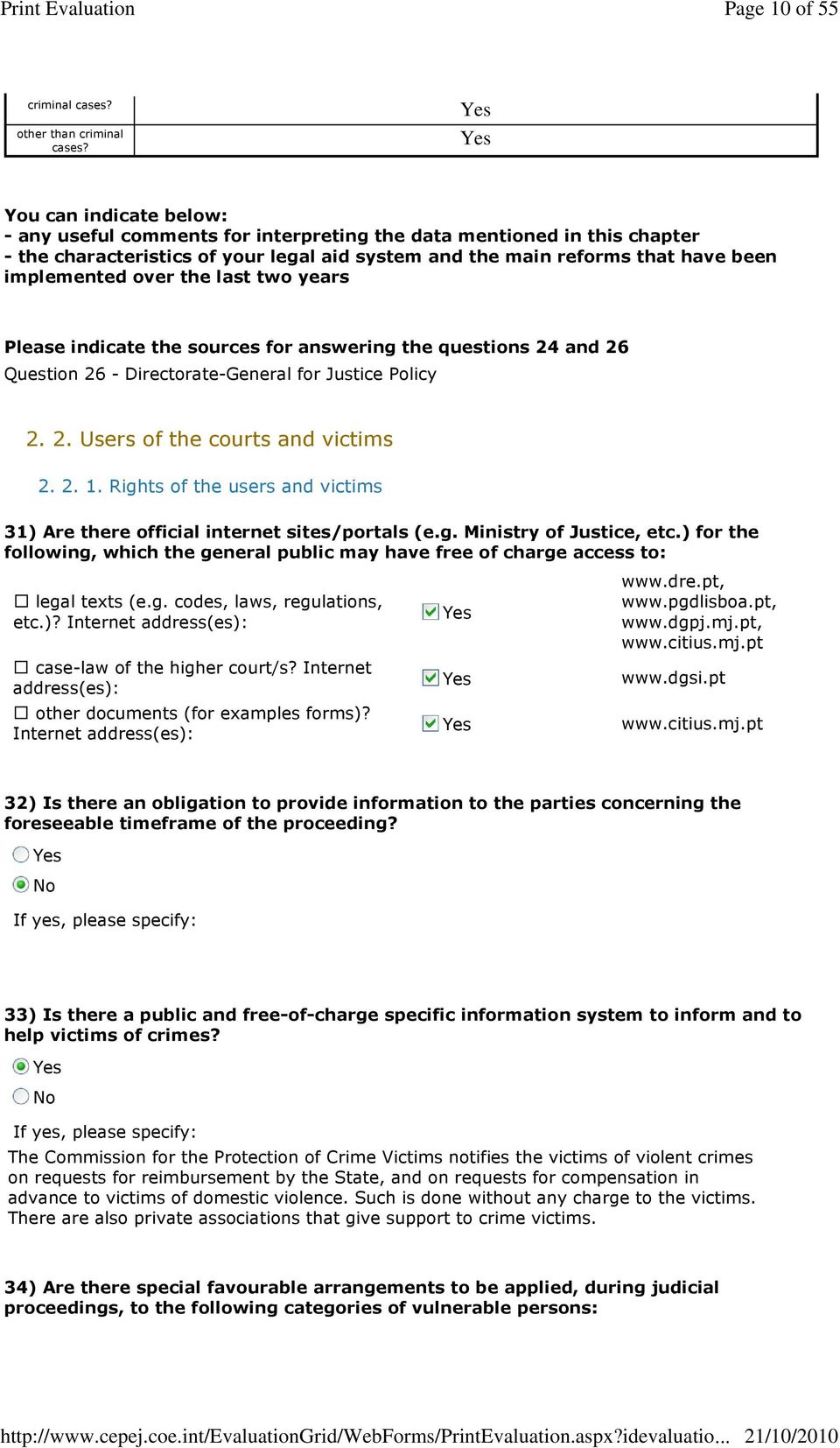
11 Page 11 of 55 Information mechanism Hearing modalities Procedural rights Other Victims of rape Victims of terrorism Children/Witnesses/Victims Victims of domestic violence Ethnic minorities Disabled persons Juvenile offenders Other Comment : 35) Does your country have a compensation procedure for victims of crimes? 36) If yes, does this compensation procedure consist in: a public fund? a court decision? a private fund? If yes, which kind of cases does this procedure concern? It applies to all cases in which intentional crimes occur that cause grievous bodily harm or death. Should any of these situations occur, the persons who have access to the compensation fund are, in accordance to the civil law, the victim himself or his/her legal heirs. 37) Are there studies to evaluate the recovery rate of the compensation awarded by courts to victims? If yes, please specify: 38) Is there a specific role for the public prosecutor with respect to the (protection of the position and assistance of) victims? If yes, please specify:

12 Page 12 of 55 In the Penal Procedural Code and with respect to the inquest phase, there are mandatory rules for the public prosecutors. These rules concern the information due to victims of any type of crime, and in particular, the information regarding the victims compensation rights and the way they can bring them into effect. In fact, the mechanisms for victim information that go beyond the aforementioned civil nature derive from the Public Prosecutor s own organisational structure which encompasses public attendance done, in great part, by the prosecutors themselves. In addition, at police level, specific units/services/departments have been set up to help victims of certain crimes and in particular of violent crimes, namely mistreatment, domestic violence and sexual abuse. On the other hand and as regards the assistance provided to victims of crime during the proceedings, it should be noted the taking of evidence for future use (to be done in the presence of an instruction judge and especially designed for situations of serious illness or transfers abroad and in cases of victims of sexual crimes). Besides, there are specific forms of hearing witnesses (including victims of crimes) such as the concealment of the witness, the taking of evidence in the absence of the defendant and the videoconference, all of them determined by the judge in the proceedings and on the basis of the circumstances or facts revealing threat and/or a high risk of coercion. To this effect, particular attention is given to their vulnerability in connection to their age. As concerns the criminal procedure and the enforcement measures, attention should be drawn to the specific protection measure, applied by the courts, to victims of crimes, by reason of which the defendant cannot dwell in the area where the crime has occurred or where resides the victim or his/her family or even anyone upon whom new crimes may be committed against (see article 200, n. 1, indent c) of the Penal Procedural Code), another enforcement measure, applicable to the cases where the defendant does not remain in preventive custody, is his/her withdrawal from the victim s residence (see article 16 of the Law n. 61/91, of 13 August). 39) Do victims of crimes have the right to contest to a decision of the public prosecution to discontinue a case? If yes, please specify:

13 Page 13 of 55 At the inquest phase (and even at the judicial phase of the proceedings), the crime victim can always interrupt/stop the criminal proceedings whenever the facts of the investigation relate to certain types of crimes foreseen in law. He/she may do it in relation to semi-public nature crimes or even private crimes, that is, those crimes in which the criminal procedure requires a complaint or a personal charge. In these cases, the criminal procedure begins when the victim decides (claim/complaint) and, because the procedure is always dependent from that free will, it immediately stops whenever the victim so decides and clearly says so in the procedure. twithstanding, the victim cannot interfere in the ongoing investigation, contest the public prosecutor s decision in relation to the conduct of the criminal proceeding, or suspend or disrupt the procedure in order to, later on, request its proceeding. Once the investigation is finished, the Public Prosecutor files the procedure if no evidence of the crime is found, if there is evidence that the defendant has not committed the crime, if the proceeding is not legally admissible or if it has not been possible to obtain enough evidence of the crime or of its perpetrators. When the Public Prosecutor decides to file the procedure, the victim may always contest the decision, once certain assumptions are observed, bearing in mind the progression of the proceedings. Hence, the victim may: - request hierarchical intervention in order to determine the charge or to proceed with the investigation (article 278 of the Penal Procedural Code) - request the opening of the instruction phase, conducted by a judge, in order to judicially reaffirm the decision to file the inquiry (or to bring charges) with the purpose either to put, or not, the case before a court (article 286 and forth of the Penal Procedural Code) - request the reopening of the inquiry, once new elements of proof occur which may annul the grounds invoked by the public prosecutor in the decision to file (article 279 of the Penal Procedural Code) Confidence of citizens in their justice system 40) Is there a system for compensating users in the following circumstances: excessive length of proceedings? non execution of court decisions? wrongful arrest? wrongful condemnation? If yes, please specify (fund, daily tariff):

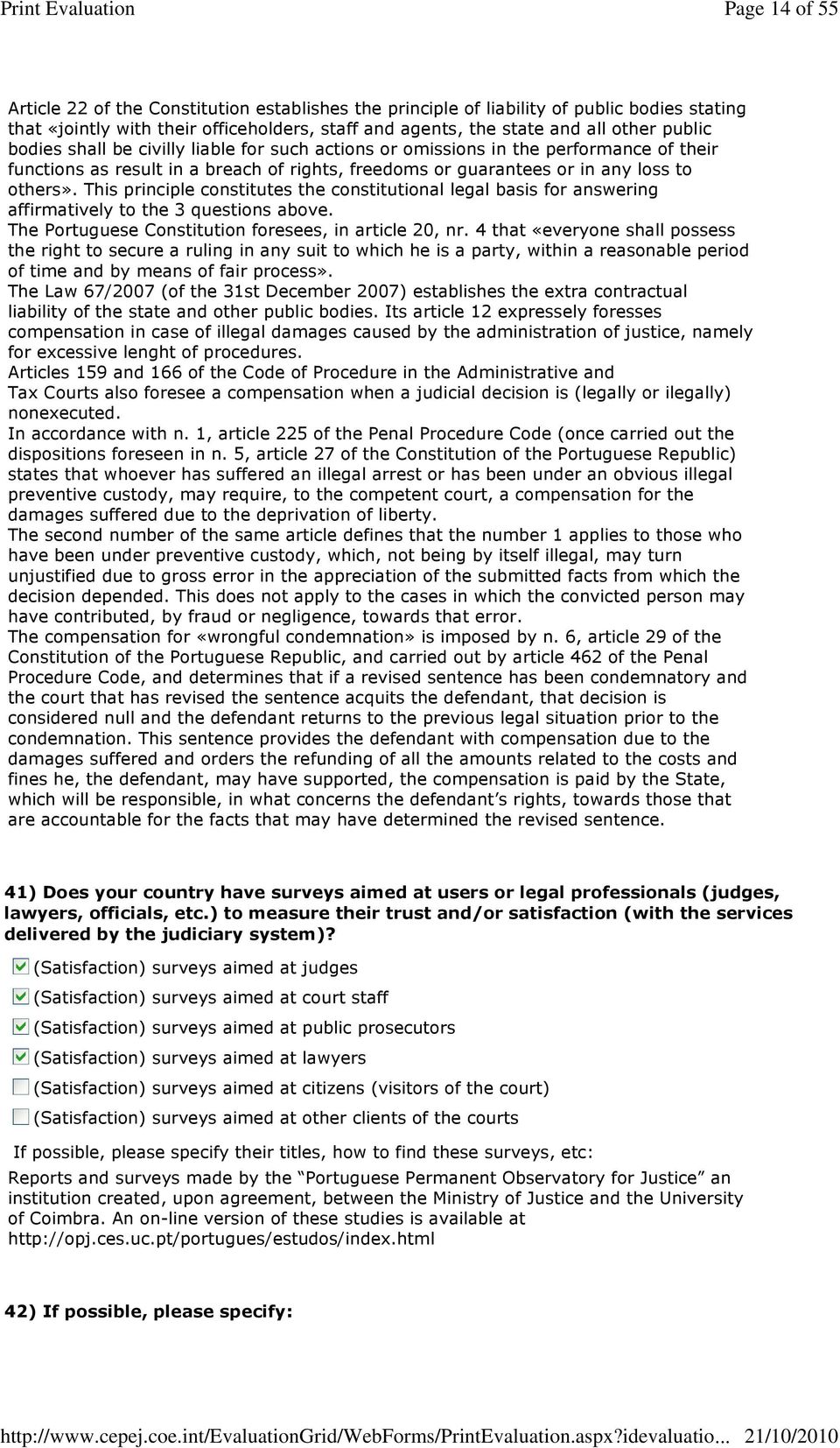
14 Page 14 of 55 Article 22 of the Constitution establishes the principle of liability of public bodies stating that «jointly with their officeholders, staff and agents, the state and all other public bodies shall be civilly liable for such actions or omissions in the performance of their functions as result in a breach of rights, freedoms or guarantees or in any loss to others». This principle constitutes the constitutional legal basis for answering affirmatively to the 3 questions above. The Portuguese Constitution foresees, in article 20, nr. 4 that «everyone shall possess the right to secure a ruling in any suit to which he is a party, within a reasonable period of time and by means of fair process». The Law 67/2007 (of the 31st December 2007) establishes the extra contractual liability of the state and other public bodies. Its article 12 expressely foresses compensation in case of illegal damages caused by the administration of justice, namely for excessive lenght of procedures. Articles 159 and 166 of the Code of Procedure in the Administrative and Tax Courts also foresee a compensation when a judicial decision is (legally or ilegally) nonexecuted. In accordance with n. 1, article 225 of the Penal Procedure Code (once carried out the dispositions foreseen in n. 5, article 27 of the Constitution of the Portuguese Republic) states that whoever has suffered an illegal arrest or has been under an obvious illegal preventive custody, may require, to the competent court, a compensation for the damages suffered due to the deprivation of liberty. The second number of the same article defines that the number 1 applies to those who have been under preventive custody, which, not being by itself illegal, may turn unjustified due to gross error in the appreciation of the submitted facts from which the decision depended. This does not apply to the cases in which the convicted person may have contributed, by fraud or negligence, towards that error. The compensation for «wrongful condemnation» is imposed by n. 6, article 29 of the Constitution of the Portuguese Republic, and carried out by article 462 of the Penal Procedure Code, and determines that if a revised sentence has been condemnatory and the court that has revised the sentence acquits the defendant, that decision is considered null and the defendant returns to the previous legal situation prior to the condemnation. This sentence provides the defendant with compensation due to the damages suffered and orders the refunding of all the amounts related to the costs and fines he, the defendant, may have supported, the compensation is paid by the State, which will be responsible, in what concerns the defendant s rights, towards those that are accountable for the facts that may have determined the revised sentence. 41) Does your country have surveys aimed at users or legal professionals (judges, lawyers, officials, etc.) to measure their trust and/or satisfaction (with the services delivered by the judiciary system)? (Satisfaction) surveys aimed at judges (Satisfaction) surveys aimed at court staff (Satisfaction) surveys aimed at public prosecutors (Satisfaction) surveys aimed at lawyers (Satisfaction) surveys aimed at citizens (visitors of the court) (Satisfaction) surveys aimed at other clients of the courts If possible, please specify their titles, how to find these surveys, etc: Reports and surveys made by the Portuguese Permanent Observatory for Justice an institution created, upon agreement, between the Ministry of Justice and the University of Coimbra. An on-line version of these studies is available at 42) If possible, please specify:
15 Page 15 of 55 (surveys at a regular interval: for example annual) (incidental surveys) Surveys at national level Surveys at court level 43) Is there a national or local procedure for making complaints about the functioning (for example the treatment of a case by a judge or the duration of a proceeding) of the judicial system? 44) If yes, please specify: Please give elements of information concerning the efficiency of this complaint procedure: Time limit to respond () Time limit for dealing with the complaint () Court concerned Higher court Ministry of Justice High Council of the Judiciary Other external organisations (e.g. Ombudsman) Comment : Although a request or complaint can be filled before the court concerned or, on appeal, before a higher court, it is possible to present those complaints, if linked to disciplinary or administrative matters, to the pertinent High Council (to the High Council for the Administrative and Tax Courts, to the High Council of the Judiciary, to other courts and to the General Prosecutor Office if the complaint is addressed against an action or omission of a public prosecutor). The reports are available on It is possible to address the Ombudsman but only on the same grounds as the High Council is able to intervene (art. 22, n. 2 of Law 9/91, of 9 April). The Ombudsman s action should be made through the pertinent High Council (art. 22, n. 3 of Law 9/91). The reports are available on

16 Page 16 of Organisation of the court system Functioning Courts 45) Number of courts considered as legal entities (administrative structures) and geographic locations (please, complete the table. If no data is available (NA) or if it does not apply to your system (NAP) please indicate it with the relevant abbreviation. Total number First instance courts of general jurisdiction Specialised first instance Courts (legal entities) All the Courts (geographic locations) * (this includes Supreme Courts and/or High Courts) ) Please specify the different areas of specialisation (and, if possible, the number of courts concerned): Criminal Instruction Courts 5 Family and Juvenile Courts 19 Labour Courts 47 Commerce Courts 2 Maritime Courts 1 Enforcement of Criminal Sanctions Courts 4 Administrative and Tax Courts 17 47) Is there a change in the structure in the courts foreseen (for example a reduction of the number of courts (geographic locations) or a change in the powers of courts)? If yes, please specify:. In 2009, due to the ongoing reform of the judiciary chart, three pilot jurisdictions were created (Baixo Vouga, Grande Lisboa-roeste e Alentejo Litoral). At the end of the reform, foreseeable at 2011, there will be 39 jurisidictions, which one having its own «juízos» of general or specific competence. Please check, «inter alia» the Law 52/2008, of the 28 Agost, the Decree-Law 25/2009, of the 26 January and the Decree-Leaw 28/2009, of the 28 January. 48) Number of first instance courts competent for a case concerning (if no data is available (NA) or if it does not apply to your system (NAP) please indicate it with the relevant abbreviation): 232 a debt collection for small claims a dismissal 59 Number

17 Page 17 of 55 a robbery 233 Please specify what is meant by small claims in your country (answer only if the definition has been changed since the previous evaluation cycle): A small claim was a claim under ,94. Please indicate the sources for answering the questions 45 and 48: Question 45 - Directorate-General for the Administration of Justice (Direcção-Geral da Administração da Justiça) Question 48 - Directorate-General for Justice Policy (Direcção-Geral da Política de Justiça) Judges, courts staff 49) Number of professional judges sitting in courts (please give the information in full time equivalent and for permanent posts; if there is no data please indicate this with NA) Please provide comments to explain the answer under question 49: Number Comment : 50) Number of professional judges sitting in courts on an occasional basis and who are paid as such: Number gross figure if possible, in full time equivalent NAP NAP 51) Please provide comments to explain the answer under question 50: NAP 52) Is there in the legal system non-professional judges (including lay judges and excluding jurees) who are not remunerated but who can possibly receive a simple defrayal of costs? (Please indicate NA if no figures are avaiiable). Please provide comments to explain the answer under question 52: Number Do you have nonprofessional judges? X 454 Comment : For this question it was considered the figure of the social judge in actual service. This number refers to the people designated as social judges, as published in the Official Journal. Being on those

18 Page 18 of 55 lists does not mean actually participating on the judicial decision making but only on the possibility of being called to participate in very specific proceedings, namely towards those cases foreseen both in the Law n. 166/99 of 14th September (article 30, n. 2 -Tutorial Educational Law) and in the Law n. 147/99 of 1st September (article 115 Protection of Minors and Juvenile in Danger Law) and they decide together with a presiding professional judge. It is impossible to determine the quantity of non-professional judges who have actually participated in judgments in The number given corresponds to the persons designated as social judges, which does not mean that they have really acted as non-professional judges. 53) Does your judicial system include trial by jury with the participation of citizens? If yes, for which type of case(s)? Whenever a trial by jury is required by the Public Prosecution, the plaintiff or the defendant, it is up to a jury panel court to judge cases that refer to crimes against cultural identity and personal integrity and crimes against the State security or to those crimes in which the sanction, abstractedly applied, is greater than 8 years of imprisonment and which are not or cannot be judged by a singular court. 54) If possible, indicate the number of citizens who were involved in such juries for the year of reference? NA 55) Number of non-judge staff who are working in courts (in full time equivalent and for permanent posts). Please indicate NA if no figures are available. Please provide comments to explain the answer under question 55: Number Comment : 56) If possible, could you distribute this staff according to the 4 following categories. If no data is available (NA) or if it does not apply to your system (NAP) please indicate it with the relevant abbreviation). - non-judge staff (Rechtspfleger or similar bodies), with judicial or quasi-judicial tasks having autonomous competence and whose decisions could be subject to appeal - non-judge staff whose task is to assist the judges (case file preparation, assistance during the hearing, keeping the minutes of the meetings, helping to prepare the decisions) such as registrars - staff in charge of different administrative tasks as well as of the management of the courts (human resources management, material and equipment management, including computer systems, financial and budgetary management, training NAP

19 Page 19 of 55 management) - technical staff 290 Comment : 57) If there are Rechtspfleger (or similar bodies) in your judicial system, please describe briefly their status and functions: NAP Prosecutors 58) Number of public prosecutors (in full time equivalent and for permanent posts). If there is no data available please indicate it (NA). Number Comment : The figure includes Public Prosecutors working at all Courts. 59) Do any other persons have similar duties as public prosecutors? If yes, please specify: 60) Number of staff (non prosecutors) attached to the public prosecution service (in full time equivalent and for permanent posts). If there is no data available please indicate it (NA). Please provide comments to explain the answer under question 60: Number Comment : The figure includes staff working for the Public Prosecution at first instance, Appellate Courts and Supreme Court Court budget and new technologies 61) Who is entrusted with the individual court budget? Preparation of the budget Arbitration and allocation Day to day management of the budget Evaluation and control of the use of the budget Management Board Court President Court administrative director Head of the court clerk office Other
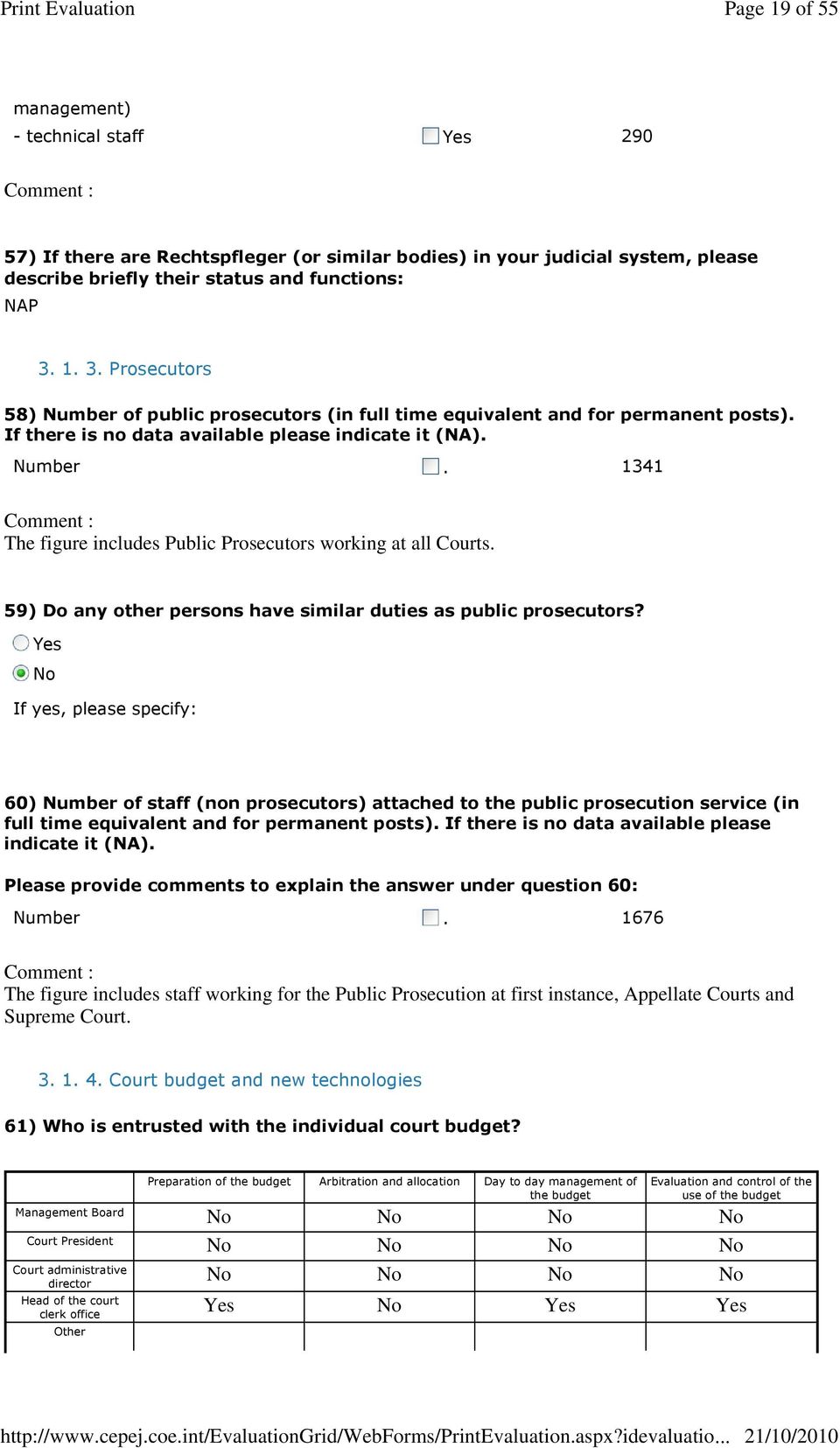
20 Page 20 of 55 62) You can indicate below: - any useful comments for interpreting the data mentioned above - if available an organisation scheme with a description of the competencies of the different authorities responsible for the budget process in the court The court official is entrusted with the issues related to the acquisition of goods and services. The remuneration of court personnel and judges (at the 1st instance courts) is in charge of the Directorate-General for Justice Administration (Direcção-Geral da Administração da Justiça). 63) For direct assistance to the judge/court clerk, what are the computer facilities used within the courts? 100% of courts +50% of courts -50% of courts -10% of courts Word processing Electronic data base of jurisprudence Electronic files Internet connection 64) For administration and management, what are the computer facilities used within the courts? 100% of courts +50% of courts -50% of courts -10% of courts Case registration system Court management information system Financial information system 65) For the communication between the court and the parties, what are the computer facilities used within the courts? 100% of courts +50% of courts -50% of courts -10% of courts Electronic web forms Special Website Other electronic communication facilities 66) Is there a centralised institution which is responsible for collecting statistical data regarding the functioning of the courts and judiciary? If yes, please specify the name and the address of this institution:

21 Page 21 of 55 Directorate-General for Justice Policy (Direcção-Geral da Política de Justiça) Avenida Óscar Monteiro Torres, Lisboa Portugal You can indicate below: - any useful comments for interpreting the data mentioned in this chapter - the characteristics of your judicial system and the main reforms that has been implemented over the last two years Monitoring and evaluation Monitoring and evaluation 67) Are the courts required to prepare an annual activity report? 68) Do you have a regular monitoring system of court activities concerning the number of incoming cases? number of decisions? number of postponed cases? length of proceedings (timeframes)? other? Please specify: Closed cases 69) Do you have a regular system to evaluate the performance of each court? Please specify: The High Council for Judiciary, through his inspection body, operates regular inspections to the performance of courts and judges (these ones with a four year regularity). 70) Concerning court activities, have you defined performance indicators (if no, go to question 72)? 71) Please select the 4 main performance and quality indicators that is used for a proper functioning of courts: incoming cases
22 Page 22 of 55 length of proceedings (timeframes) closed cases pending cases and backlogs productivity of judges and court staff percentage of cases that are treated by a single sitting judge enforcement of penal decisions satisfaction of employees of the courts satisfaction of clients (regarding the services delivered by the courts) judicial quality and organisational quality of the courts costs of the judicial procedures other: Please specify: 72) Are there performance targets defined for individual judges (if no go to question 74)? 73) Please specify who is responsible for setting the targets: executive power (for example the ministry of Justice)? legislative power judicial power (for example a High Judicial Council or a Higher Court other If other, please specify: 74) Are there performance targets defined at the level of the courts (if no go to question 77)? 75) Please specify who is responsible for setting the targets: executive power (for example the ministry of Justice)? legislative power judicial power (for example a High Judicial Council or a Higher Court) other If other, please specify:
23 Page 23 of 55 76) Please specify the main targets applied 77) Which authority is responsible for the evaluation of the performances of the courts: High Council of judiciary Ministry of justice inspection authority Supreme Court external audit body other If other, Please specify: 78) Are there quality standards (organisational quality and/or judicial quality policy) formulated for the courts (existence of a quality system for the judiciary)? If yes, please specify: 79) Do you have specialised court staff which is entrusted with quality policy and/or quality systems for the judiciary? 80) Is there a system which measures the backlogs and which detects the cases not processed within a reasonable timeframe for: civil cases? criminal cases? administrative cases? 81) Do you have a way of analysing waiting time during court procedures? If yes, please specify: 82) Is there a system to evaluate the functioning of courts on the basis of an evaluation plan (timetable for visits) agreed a priori?
24 Page 24 of 55 Please specify (including an indication of the frequency of the evaluation): Please refer to question ) Is there a system for monitoring and evaluating the functioning of the prosecution services? If yes, please specify: You can indicate below: any useful comments for interpreting the data mentioned in this chapter the characteristics of your court monitoring and evaluation system Comment on question 83; Considering the explanatory note, we think that none of the proposed answers totally apply to the monitoring and evaluation of the Public Prosecutor s activity. netheless, if an answer is really required, one may always say yes. Specifying: There is no global evaluation of the activity and functioning of the Public Prosecution Service, although the Attorney General s Office does publish an annual report on the activities that fall under its jurisdiction. The Superior Council of the Public Prosecution Service is in charge of approving an annual plan of inspections aiming at collecting information on the service and on the merits of its prosecutors. The inspections to the services aim mainly at giving a better knowledge of the state and organization of the inspected services (namely regarding their installation, the procedural movement, the adequacy and efficiency of the magistrates and supporting personnel) and to collect indications as to the way in which the inspected services worked during the period covered by the inspection, recording the needs and deficiencies and presenting proposals to resolve them, if that is the case. Regarding the inspections made to the services and to the merit of the public prosecutors they aim at evaluating the professional merit and to obtain information on the way in which they perform their duties. The parameters for the evaluation of the service are the intellectual ability, the way in which their duties are performed, namely during the court hearings, the juridical and technical quality of their work, the legal papers they have published, the working conditions, the volume and complexity of the service, the productivity and efficiency, the organization, management and method, the punctuality in the fulfillment of their duties, the zeal and dedication, the urbanity, the impartiality and exemption, the common sense, maturity and sense of justice, the relationship with the other legal agents, the capacity to articulate their work with the organs of criminal police. Besides the ordinary inspections, there are also extraordinary inspections, in result of deliberation from the Superior Council of the Public Prosecution Service or the Attorney General, the respective scope and finality being established case by case.
25 Page 25 of Fair trial Principles General principles 84) What is the percentage of judgements in first instance criminal cases in which the suspect is not attending in person or not represented by a legal professional (i.e. lawyer) during a court session (in absentia judgements)? If no data is available (NA) or if it does not apply to your system (NAP) please indicate it with the relevant abbreviation). NA 85) Is there a procedure to effectively challenge a judge if a party considers that the judge is not impartial? If possible, number of successful challenges (in a year): 86) Please give the following data concerning the number of cases regarding Article 6 of the European Convention of Human Rights (on duration and non-execution), for the year of reference. If there is no data available, please indicate it (NA). Cases declared inadmissible by the Court Friendly settlements Civil proceedings Article 6 1 (duration) Civil proceedings - Article 6 1 (nonexecution) Criminal proceedings - Article 6 1 (duration) Judgements establishing a violation Judgements establishing a non violation Timeframes of proceedings General information 87) Are there specific procedures for urgent matters as regards: civil cases? criminal cases? administrative cases? Please specify: The Civil Procedure Code, in several precepts, refers to the urgent character of certain acts and procedures. In accordance with article 382, the preventive proceedings are as such considered urgent. The Penal Procedure Code equally addresses urgent procedures, namely those procedures with defendants held in custody. The heading of Title IV of the Administrative Courts Procedure Code (article 97 and forth) is actually urgent procedures, being these applicable both to the pre-contractual disputes and to the summons.
26 Page 26 of 55 88) Are there simplified procedures for: civil cases (small claims)? criminal cases (petty offences)? administrative cases? Please specify (for example if you have introduced a new law on simplified procedures): The Decree-Law n. 269/98, of 1 September (amended several times) approves the proceedings related to pecuniary obligations arising out of contracts whose value does not exceed the ceiling set for the courts of first instance. As such it establishes a simplified regime for small claims. The Penal Procedure Code foresees summary and summary and fast proceedings. These are simplified procedures applicable to less serious crimes. In accordance with articles 255 and 256, those detainees caught in the act for crimes punishable by a maximum term of imprisonment no greater than five years, even in case of misdemeanours are tried in summary proceedings (n. 1). For that matter a judicial or police authority has to proceed with the detention [indent a)]: the detention may also be effected by any other person if, within no more than two hours, the detainee is entrusted to one of the above mentioned authorities and these have drafted a summary notice related to the hand over [indent b)]. Within the terms of the previous number, are also tried in summary proceedings, the detainees caught in the act for crimes punishable by a maximum term of imprisonment greater than 5 years, even in case of misdemeanours, whenever the Public Prosecutor, in the accusation, decides that it should not be applied an imprisonment sentence greater than 5 years (n. 2). In the terms of article 391-A (summary and fast proceedings) in cases of crimes punishable with a fine or with a prison sentence no greater than 5 years, and if there is plain and enough evidence of the crime and its agent, the Public Prosecutor in the police report or after the summary inquiry, may decide on the charge to bring before a summary and fast proceeding (n. 1). Number 2 of the same precept refers that are also tried in summary and fast proceedings, in the terms of the previous number, the crimes punishable by a maximum imprisonment sentence greater than 5 years, even in case of misdemeanours, whenever the Public Prosecutor, in the accusation, decides that it should not be applied a prison sentence greater than 5 years. In the crimes punishable with a prison sentence no greater than 5 years or only with a fine, the Public Prosecutor, on the defendant s initiative or after this one has been heard and when it decides that it should be applied a sentence or a non-custodial security measure, may require the court a summary and fast proceeding (article 392, n. 1). netheless, when the procedure is not subject to a private charge, the approval of the privy must take place (n. 2). The Administrative Courts Procedure Code also foresees simplified proceedings. Thus, unless the Code provides for otherwise, to the common administrative actions as well as to their conduct the civil procedure forms will be applied (article 35). Hence, to the administrative procedures and within the scope of a common procedure, the summary and fast proceedings shall apply (article 461 of the Civil Procedure Code). These forms of procedures are characterised as holding a procedural iter much more simplified and of having time limits other than the ones foreseen in the common ordinary ones. 89) Do courts and lawyers have the possibility to conclude agreements on the modalities for processing cases (presentation of files, decisions on timeframes for lawyers to submit their conclusions and on dates of hearings)? If yes, please specify:
27 Page 27 of Penal, civil and administrative law cases 90) Total number of cases in the first instance courts (litigious and non-litigious): please complete the table. If the data are not available (NA) or not applicable (NAP) please indicate it in the table with the relevant abbreviations. Total of civil, commercial and administrative law cases (litigious and non litigious)* 1 Civil (and commercial) litigious cases* 2 Civil (and commercial) nonlitigious cases* Pending cases on 1 Jan. 08 Incoming cases Resolved cases Pending cases on 31 Dec NA NA NA NA 3 Enforcement cases Land registry cases** 5 Business register cases** 6 Administrative law cases NAP NAP NAP NAP NAP NAP NAP NAP NA NA NA NA 7 Other NA NA NA NA Total criminal cases (8+9) 8 Criminal cases (severe criminal offences) 9 Misdemeanour and / or minor offences cases ) Comments (including an indication of the cases that are included in the total figures of civil, commercial and administrative law case and types of criminal law cases - definition of misdemeanour cases, minor offences and severe criminal cases): 1 - Includes civil cases (enforcement cases excluded), labour cases (labour accidents and other labour actions), civil cases of the Maritime Court and civil cases concerning juveniles. 2 - There is no information regarding non-litigious divorces in courts. 3 - Civil and labour enforcement cases 9 - Administrative offences and misdemeanour Criminal cases (severe criminal offences): all the criminal cases at trial stage were considered. Misdemeanour and/or minor offences cases: the misdemeanours and the appeals on administrative offences, in the scope of the criminal and labor justice. 92) Total number of cases in the second instance (appeal) courts (litigious and nonlitigious): please complete the table. If the data are not available (NA) or not applicable (NAP) please indicate it in the table with the relevant abbreviations). * Please indicate (in the comments below) which types of cases are included in the total figures of civil, commercial and administrative law cases. ** if applicable Please check the consistency of data as mentioned under question 91. Comments (including an indication of the cases that are included in the total figures of civil, commercial and administrative law case and types of criminal law cases and possibly the existence of appeal rates for some case categories): Pending cases on 1 Jan. 08 Incoming cases Resolved cases Pending cases on 31 Dec. 08
28 Page 28 of 55 Total of civil, commercial and administrative law cases (litigious and non-litigious)* 1 Civil (and commercial) litigious cases* 2 Civil (and commercial) nonlitigious cases* 3 Enforcement cases Land registry cases** 5 Business register cases** 6 Administrative law cases 7 Other NAP NAP NAP NAP NAP NAP NAP NAP NA NA NA NA Total criminal cases (8+9) 8 Criminal cases (Severe criminal offences) 9 Misdemeanour and/or minor offences cases Comment : 1 - Includes civil, labour and juveniles cases in the Appellates Courts 8 - Criminal cases in the Appellates Courts 93) Total number of cases in the highest instance courts (litigious and non-litigious): please complete the table. If the data is not available (NA) or not applicable (NAP) please indicate it in the table with the relevant abbreviations. * Please indicate (in the comments below) which types of cases are included in the total figures of civil, commercial and administrative law cases. ** if applicable Please check the consistency of data as mentioned under question 88. Comments (including an indication of the cases that are included in the total figures of civil, commercial and administrative law case and on possible limitations to the appeal to the highest instance court): Total of civil, commercial and administrative law cases* (litigious and non-litigious) 1 Civil (and commercial) litigious cases* 2 Civil (and commercial) nonlitigious cases* 3 Enforcement cases Pending cases on 1 Jan. 08 Incoming cases Resolved cases Pending cases on 31 Dec Land registry cases** 5 Business register cases** 6 Administrative law cases 7 Other Total criminal cases (8+9) 8 Criminal cases (severe criminal offences) 9 Misdemeanour NAP NAP NAP NAP NAP NAP NAP NAP NA NA NA NA
29 Page 29 of 55 cases (minor offences) Comment : 1 - Includes civil, labour and juveniles cases in the Supreme Court 8 - Criminal cases in the Supreme Court 94) Number of litigious divorce cases, employment dismissal cases, robbery cases and intentional homicide cases received and treated by first instance courts: please complete the table. If the data are not available (NA) or not applicable (NAP) please indicate it in the table with the relevant abbreviations. Litigious divorce cases* Employment dismissal cases* Pending cases on 1 Jan. 08 Incoming cases Resolved cases Pending cases on 31 Jan Robbery cases NA NA 2559 NA Intentional homicide NA NA 154 NA 95) Average length of proceeding (from the date of lodging of court proceedings) in days, number of pending cases more than 3 years and percentage of cases subject to appeal: please complete the tale. If the data is not available (NA) or not applicable (NAP) please indicate it in the table with the relevant abbreviations. Please provide comments to explain the answers to question 92: Litigious divorce cases* Employment dismissal cases* Robbery cases Intentional homicide % of decisions subject to appeal % pending cases more than 3 years 1st instance (average length) 2d instance (average length) 101 days 154 days 78 days 92 days Total procedure (average total length) Comment : 96) Where appropriate, please specify the specific procedure as regards (litigious and non-litigious) divorce: 97) How is the length of proceedings calculated for the four case categories? Please give a description of the calculation method. The data regarding the length of time in the first instance judicial courts for 2007 and 2008 is still being validated. Nevertheless, the length of proceedings starts to be measured from the day the case enters a court until it reaches a final decision in that instance, even if later it may occur an appeal on the decision before a higher court. 98) Please describe the role and powers of the prosecutor in the criminal procedure (multiple options are possible): to conduct or supervise police investigation to conduct investigation
30 Page 30 of 55 when necessary, to demand investigation measures from the judge to charge to present the case in the court to propose a sentence to the judge to appeal to supervise enforcement procedure to end the case by dropping it without the need for a judicial decision to end the case by imposing or negotiating a penalty without a judicial decision other significant powers Please specify: The Public Prosecution Service is the organ responsible for the penal action. Its intervention in the penal area, always guided by the principle of lawfulness, occurs in all the procedural stages. It is the Service s responsibility to receive denunciations; to decide on the follow up of the denunciations/complaints/penal notifications (even those that are brought before the different police forces); to lead the stage of inquest (of compulsory nature and which management is of its sole responsibility except for the occasional intervention of the judge for the practice of certain acts whenever the rights, freedoms and guaranties of the citizens are at stake -, and that comprises the set of diligences that aim at investigating the commission of a crime, to determine its agents and respective responsibility, regarding the decision on the accusation); to deduce accusation and to support it in trial; to present appeals (even if in the exclusive interest of the defendant); to promote the enforcement of the applied sentences. As to the possibility of the Public Prosecution Service to close a case without a judicial decision, we must point out that the management of the inquest is of its sole responsibility (the intervention of the judge, at this stage, is exceptional and is limited to the practice of certain acts concerning the rights, freedoms and guaranties of the citizens). The case should, therefore, be filed whenever enough proof as been collected as that the crime was not committed nor the defendant has committed it, that the procedure is legally admissible (namely due to the prescription of the penal procedure), or in the cases where it was not possible to obtain enough evidence that the crime occurred or of who committed it. However, the decision to file is liable of being verified judicially whenever the defendant or the assistant request the opening of the stage of finding of facts (optional), which falls under the jurisdiction of the judge. In what concerns the impossibility of the Public Prosecution to close the case, without a court decision, due to the imposition of a penal measure, we point out that once the investigation has ended and once enough evidence has been collected as to the fact that a crime has been committed, there are alternative mechanisms to the deduction of the accusation. In effect, once enough evidence has been collected as to the fact that a crime has been committed and as to who was the perpetrator, the Public Prosecution Service may decide on the temporary suspension of the case (conditioned to the fulfillment by the defendant of several payment orders) but that always depends on the agreement of the defendant, of the assistant (in case there is one) and of the judge. 99) Does the prosecutor also have a role in civil and/or administrative cases?
31 Page 31 of 55 Please specify: In the civil area the Public Prosecution Service, in accordance to the provisions of its Statute (Law 60/98, of 27 August, art. 3, 5 and 6) and in the civil law (Code of Civil Procedure, art. 15, 16, 17 and 20) has the responsibility of representing, at the courts, the State, the Autonomous Regions, the autarchies, the incapable (including minors and interdicted), the uncertain, the absent, the workers and their families. Regarding the area of minors and family, we point out the promotion and protection cases, the tutelary cases, the civil tutelary cases (including paternity regulation actions, tutelary actions, adoption, and judicial delivery of minors), special cases of divorce by mutual consent/paternity regulation, unofficial inquiry actions (paternity, maternity or others). Concerning the labor area, we stand out the relevant and irreplaceable intervention of the Public Prosecution Service in the cases of work accidents and professional diseases. Besides these, it also intervenes in the labor executive cases (for judicial costs or not) and, as representative of the workers, in the proposition of labor actions. It also intervenes in the appeals of impugnation of decisions issued by administrative authorities in cases of labor actions. In the administrative field, the Public Prosecution Service (according to the provisions of Law 60/98, of 27 August, art. 1 and 3, in the Statute of the Administrative and Tax Courts, art. 51, and in the Procedural Code of the Administrative Courts, art. 9, n.2, art.11, n.2, art. 62, 73, ns. 3 and 4 and art. 85) represents the State in the courts (presenting and contesting actions) and intervenes in the public actions, that is, in the propositions in defense of diffuse interests and of the community. Besides having the power, and in some cases the duty, of requiring the unlawfulness with legal force, it also has legitimacy to propose and to intervene in cases where the defense of property, assets or interests protected by the Constitution is at stake, such as public health, quality of life, environment, urbanism, planning of the national territory, cultural patrimony and assets belonging to the State, to the Autonomous Regions and to the local autarchies. 100) Functions of the public prosecutor in relation to criminal cases please complete this table. If the data is not available (NA) or not applicable (NAP) please indicate it in the table with the relevant abbreviations. Please provide comments to explain the answers to question 100 and indicate in particular if the data given include traffic offences: Total number of 1st instance criminal cases Received by the public prosecutor Discontinued by the public prosecutor because the offender could not be identified Discontinued by the public prosecutor due to the lack of an established offence or a specific legal situation Discontinued by the public prosecutor for reason of opportunity Concluded by a penalty, imposed or negotiated by the public prosecutor NA NA NA NA Charged by the public prosecutor before the courts Comment : You can indicate below: any useful comments for interpreting the data mentioned in this chapter the characteristics of your system concerning timeframes of proceedings and the main reforms that have been implemented over the last two years
32 Page 32 of 55 Please indicate the sources for answering the questions 90 to 95 and 100: Directorate-General for Justice Policy (Direcção-Geral da Política de Justiça)
33 Page 33 of Career of judges and prosecutors Appointment and training Recruitment, nomination and promotion 101) How are judges recruited? Through a competitive exam (for instance after a law degree)? A specific recruitment procedure for legal professionals with long working experience in the legal field (for example lawyers)? A combination of both Other Other, please specify: 102) Are judges initially/at the beginning of their carrier recruited and nominated by: An authority composed of judges only? An authority composed of non-judges only? An authority composed of judges and non-judges? 103) Is the same authority competent for the promotion of judges? If no, please specify which authority is competent for the promotion of judges: The High Council of the Judiciary (Conselho Superior da Magistratura)/The High Council of the Administrative and Tax Courts (Conselho Superior da Magistratura/Conselho Superior dos Tribunais Administrativos e Fiscais). 104) Which procedures and criteria are used for promoting judges? Please specify. Judges are selected: - to the Supreme Court by competitive curriculum evaluation; - to the Court of Appeal by seniority and merit. 105) How are prosecutors recruited? Through a competitive exam? (for example after a law degree) A specific recruitment procedure for legal professionals with long working experience in the legal field (for example lawyers)? A combination of both Other Other, please specify:
34 Page 34 of ) Are prosecutors initially/at the beginning of their carrier recruited and nominated by: An authority composed of prosecutors only? An authority composed of non-prosecutors only? An authority composed of prosecutors and non-prosecutors? 107) Is the same authority formally responsible for the promotion of prosecutors? If no, please specify which authority is competent for promoting prosecutors: The High Council of the Prosecutors (Conselho Superior do Ministério Público) 108) Which procedures and criteria are used for promoting prosecutors? Please specify: Access to the higher ranks of the Public Prosecution Service is made by promotion, which occurs by merit and by seniority. While the promotion to Deputy Attorney General is made only by merit, the category of Attorney General can only be achieved through both merit and seniority. In order to achieve a promotion by seniority one has to have a classification of non less than Good and in the case of the promotion by merit the requirement is the classification of Very Good or Good with distinction. In case there is more than one prosecutor in conditions to be promoted for merit, the openings are occupied, successively in the proportion of three for the classifications of Very Good and one for the classifications of Good with distinction and, in case of equal classifications, the preference goes to the one with longer service time. On the other hand the promotion to public prosecutor can be made by competition or according to the list of seniority, seeing that the public prosecutors can only be promoted in this way in case they have a minimum of 10 years of service. The openings are occupied, by order of vacancy, successively in the proportion of three by way of competition and two according to the order of list of seniority. The candidates to the competition that are not promoted in that way can also be promoted according to the order of the list of seniority, in case they did not present a declaration of waiver. The promotion by competition is attributed to the candidate with the highest classification and, in case of equality, to the one with longer service time. In the cases where an opening must be occupied by competition and there are no candidates, the promotion is made according to the order of the list of seniority. When there is place to a promotion according to the order of the list of seniority, the openings are occupied successively, in the proportion of three by merit and one by seniority. 109) Is the mandate given for an undetermined period for judges? Are there exceptions? Please specify:
35 Page 35 of ) Is there a probation period for judges? If yes, how long is this period? Duration of the probation period (in years) Probation period for judges X ) Is the mandate given for an undetermined period for prosecutors? Are there exceptions? Please specify: 112) Is there a probation period for prosecutors? If yes, how long is this period? Duration of the probation period (in years) Probation period for prosecutors X ) If the mandate for judges/prosecutors is not for an undetermined period, what is the length of the mandate? Is it renewable? Please specify the length for judges? for prosecutors? You can indicate below: any useful comments for interpreting the data mentioned in this chapter the characteristics of the selection and nomination procedure of judges and prosecutors and the main reforms that have been implemented over the last two years Training 114) Nature of the training of judges. Is it compulsory? Initial training General in-service training In-service training for specialised judicial functions (e.g. judge for economic or administrative issues) In-service training for management functions of the court (e.g. court president) In-service training for the use of computer facilities in the court) 115) Frequency of the training of judges
36 Page 36 of 55 Annual Regular Occasional Initial training training General in-service In-service training for specialised judicial functions (e.g. judge for economic or administrative issues) In-service training for management functions of the court (e.g. court president) In-service training for the use of computer facilities in the court 116) Nature of the training of prosecutors. Is it compulsory? Initial training General in-service training Specialised in-service training (specialised public prosecutor) In-service training for management functions of the prosecution services (e.g. head prosecutor and/or managers) In-service training for the use of computer facilities in the public prosecution service) 117) Frequency of the training of prosecutors Annual Regular Occasional Initial training General in-service training Specialised in-service training (specialised public prosecutor) In-service training for management functions of the prosecution services (e.g. head prosecutor and/or managers) In-service training for the use of computer facilities in the public prosecution service) You can indicate below: any useful comments for interpreting the data mentioned in this chapter comments regarding the attention given in the curricula to the European Convention on Human Rights and the case law of the Court the characteristics of your training system for judges and prosecutors and the main reforms that has been implemented over the last two years Practice of the profession Salaries
37 Page 37 of ) Salaries of judges and prosecutors: please complete the table. If the data is not available (NA) or not applicable (NAP) please indicate it in the table with the relevant abbreviations. Please provide comments to explain the answers to question 118: Gross annual salary ( ) Net annual salary ( ) First instance professional judge at the beginning of his/her career Judge of the Supreme Court or the Highest Appellate Court Public prosecutor at the beginning of his/her career Public prosecutor of the Supreme Court or the Highest Appellate Instance 34692, , , ,08 Comment : 119) Do judges and public prosecutors have additional benefits? Judges Public prosecutors Reduced taxation Special pension Housing Other financial benefit 120) If other financial benefit, please specify: A settlement subsidy and an allowance whenever the Judge/Public Prosecutor has to go abroad or anywhere within the national territory. 121) Can judges combine their work with any of the following other functions? with remuneration without remuneration Teaching Research and publication Arbitrator Consultant Cultural function Other function 122) If other function, please specify: 123) Can prosecutors combine their work with any of the following other functions?
38 Page 38 of 55 with remuneration without remuneration Teaching Research and publication Arbitrator Consultant Cultural function Other function 124) If other function, please specify: 125) Do judges receive bonus based on the fulfilment of quantitative objectives relating to the delivering of judgments? If yes, please specify: Please indicate the source for answering the question 118 The High Council of the Judiciary and the High Council of the Prosecutors (Conselho Superior da Magistratura e Conselho Superior do Ministério Público) Disciplinary procedures 126) Which authority is authorized to initiate disciplinary proceedings against judges and/or prosecutors? Please specify: Judicial judges - the High Council of the Judiciary (Conselho Superior da Magistratura) Administrative and Tax Judges - The High Council of the Administrative and Tax Courts (Conselho Superior dos Tribunais Administrativos e Fiscais) Prosecutors - the High Council of the Prosecutors (Conselho Superior do Ministério Público) 127) Which authority has the disciplinary power on judges and prosecutors? Please specify: Judicial judges - the High Council of the Judiciary (Conselho Superior da Magistratura) Administrative and Tax Judges - The High Council of the Administrative and Tax Courts (Conselho Superior dos Tribunais Administrativos e Fiscais) Prosecutors - the High Council of the Prosecutors (Conselho Superior do Ministério Público) 128) Number of disciplinary proceedings initiated against judges and prosecutors: please complete the table. If the data is not available (NA) or not applicable (NAP) please indicate it in the table with the relevant abbreviations. Please provide comments to explain the answers to question 128: Judges Prosecutors Total number ( ) 18
39 Page 39 of 55 NA 1. Breach of professional ethics 2. Professional NA inadequacy 3. Criminal offence NA 4. Other NAP Comment : 129) Number of sanctions pronounced against judges and prosecutors: please complete the table. If the data is not available (NA) or not applicable (NAP) please indicate it in the table with the relevant abbreviations. Please provide comments to explain the answers to question 129 Judges Prosecutors 31 Total number (total 1 to 9) 1. Reprimand Suspension Withdrawal of cases 4. Fine Temporary reduction of salary 6. Degradation of post 7. Transfer to another 2 geographical (court) location 8. Dismissal 1 9. Other 0 Comment : You can indicate below: any useful comments for interpreting the data mentioned in this chapter the characteristics of your system concerning disciplinary procedures for judges and prosecutors and the main reforms that have been implemented over the last two years
40 Page 40 of Lawyers Statute of the profession Profession 130) Total number of lawyers practising in your country. If there is no data available, please indicate it (NA) ) Does this figure include legal advisors (solicitors or in-house counsellor) who cannot represent their clients in court? If no go to question 133. t applicable 132) Number of legal advisors. If there is no data available, please indicate it (NA) NAP 133) Do lawyers have a monopoly of representation in (multiple options are possible): Civil cases*? Criminal cases - Defendant*? Criminal cases - Victim*? Administrative cases*? * If appropriate, please specify if it concerns first instance and appeal. And in case there is no monopoly, please specify the organisations or persons which may represent a client before a court (for example a NGO, family member, trade union, etc) and for which types of cases: Solicitadores and trainee lawyers can provide legal advice and within certain limits laid down in procedural law represent clients before courts. Restrictions to their activity follow several criteria, which stem from the idea that Solicitadores should only perform minor judicial/court related acts or others that do not involve a question of law. Some of these criteria are: Possibility of appealing to a superior court (if it is always possible to appeal, the client must be represented by a lawyer Monetary importance of the legal issue (above a certain amount clients must be represented by a lawyer) Area of law in Criminal Law defendants must be represented by a lawyer (or a trainee lawyer in some cases) whereas in executive procedures clients may be represented by Solicitadores. The Public Prosecutor usually represents the State (both in civil and administrative proceedings), and can also represent the incapacitated, the unidentified, the absent in an unknown location and, in labour cases, the workers. 134) Is the lawyer profession organised through? a national bar? a regional bar?
41 Page 41 of 55 a local bar? Please specify: The Bar Association («Ordem dos Advogados») has national jurisdiction over lawyers. It is composed by a President, an executive body, an appeal body for ethic matters, seven district councils and delegations. The «Bastonário» is the President of the Bar Association and also acts as the Chairman of the General Council, the Congress and the General Assembly. The General Council is an executive, management and regulatory body. There is one President of the Superior Council and the Council itself comprises 22 members. It works as an appeal jurisdiction body within the Bar (and in some specific cases also as the first instance jurisdiction). There are 7 District Councils which are management bodies within its territorial limits, responsible, «inter alia», for providing and encouraging the initial and ongoing training of lawyers and trainee lawyers. The Deontology or Ethics Councils (7) are the governing bodies with first instance disciplinary jurisdiction over lawyers and trainee lawyers whose professional domicile stands in within its respective district. Finally, there are 220 local delegations, composed of 2 to 4 members each. Please indicate the source for answering the questions 130 and 132: Question The Bar Association (Ordem dos Advogados) Training 135) Is there a specific initial training and/or examination to enter the profession of lawyer? 136) Is there a mandatory general system for lawyers requiring continuing professional training? 137) Is the specialisation in some legal fields tied with a specific level of training/ qualification/ specific diploma or specific authorisations? If yes, please specify:
42 Page 42 of 55 The current specialization regime was introduced by the Bar Association Regulation 204/2006, of the 30 October. This regulation revoked all the previous regulations/decisions on this subject. The necessary requirements are now more demanding: for instance, it is now necessary to hold 10 years of experience (instead of the previous 5) to apply to a specialty. The proceeding was also reassessed. Under the new Regulation, the candidate has to be submitted to a public exam. The decision to grant the title of specialist lies on the General Council. The Specialty areas recognized by the Bar are: - Administrative and Public Law; - Tax Law; - Labor Law; - Constitutional Law; - Intellectual Property Law; - Financial Law; - European and Competition Law Fees 138) Can users establish easily what the lawyers fees will be? Please provide comments to explain the answer under question 138 Lawyers fees are regulated in articles 95/a, 100,101 and 102 of the Portuguese Bar Association Statute -Law 15/2005, 26th January. Fees are also addressed in the CCBE Code of Conduct for European Lawyers ( deonto.htm) applicable to cross-border activities. The general rule conceming lawyers fees is that they are freely negotiated between lawyer and client. However fees can also be established previously, by written agreement, as expressly foreseen in the Statute (article 100/2). Fees should be an adequate/reasonable economic compensation for the services provided considering the: -Difficulty and urgency ofthe matter; -Intellectual creativity of the service provided; -Time spent; -Responsibility laid on the lawyer; -Final result; -Other professional usage (for instance, having regard for the client's financial situation, the legal usage within the court district, etc.). «Quota litis» is explicitly forbidden by article 101 of the Statute. However, one can agree that the result of the matter has an impact in the final amount of fees as one between other criteria. All in all, one can say that fees can vary considerably from lawyer to lawyer and from law firm to law firm and also according to the specific lawsuit in question and it is not easy to state what would be the average cost for lawyer's fees. Courts, lawyers and clients can get a technical opinion or recommendation on fees, if any doubt occurs, but the recommendation issued by the Superior Council of the Bar Association is not compulsory, though it is usually respected by judges and lawyers. 139) Are lawyers fees
43 Page 43 of 55 regulated by law? regulated by Bar association? freely negotiated? Please provide comments to explain the answer under question 139: Please refer to comments on question Evaluation Complaints and sanctions 140) Have quality standards been formulated for lawyers? 141) If yes, who is responsible for formulating these quality standards: the bar association? the legislature? other? Please specify (including a description of the quality criteria used): There are no quality standards «as it is», but lawyers follow professional duties (article 83/2 of the Bar Association Statute) and a Code of Conduct, that, if disrespected, may rise disciplinary responsibility (on account of professional misconduct) and even tort (civil professional liability). These duties and code of conduct laid down in the Statute are a result of self regulation powers arributed by law to the Bar Association. The Statute of the Bar Association was approved by Law 15/2005 of the 26th January. 142) Is it possible to complain about the performance of lawyers? the amount of fees? Please specify: Lawyers and trainee lawyers are under the disciplinary jurisdiction of the Bar Association. Besides disciplinary liability, lawyers are criminally liable and may be sued for damages. Under the Portuguese Bar Association Statute, all lawyers duly enrolled in the Portuguese Bar Association shall have a Professional Indemnity Insurance. It is possible to complaint about fees, as already explained above (question 138). When it comes to the lawyers' conduct itself, the Bar has exclusive jurisdiction. There are 7 Ethics Councils (Deontology Councils) which analyse and apply disciplinary measures and sanctions (articles 109 and following of the Statute). 143) Which authority is responsible for disciplinary procedures the judge? the Ministry of justice?
44 Page 44 of 55 a professional authority or other? Please specify: The Bar Association through the Deontology Councils (first instance) and the Superior Council (usually the instance of appeal). Lawyers can appeal against the disciplinary rulings of the Bar Association to the administrative courts. 144) Disciplinary proceedings initiated against lawyers: please complete the table. If the data is not available (NA) or not applicable (NAP) please indicate it in the table with the relevant abbreviations. Please provide comments to explain the answers to question 141: Annual number Breach of professional ethics Professional inadequacy Criminal offence Other Comment : 145) Sanctions pronounced against lawyers : please complete the table. If the data is not available (NA) or not applicable (NAP) please indicate it in the table with the relevant abbreviations. Please provide comments to explain the answers to question 145: Annual number Reprimand Suspension Removal Fine Other Comment : You can indicate below: any useful comments for interpreting the data mentioned in this chapter the characteristics of your system concerning the organisation of the Bar and the main reforms that have been implemented over the last two years
45 Page 45 of Alternative Dispute Resolution Mediation and other forms of ADR Mediation 146) Does the legal system provide for mediation procedures? If no go to question ) If applicable, please specify, by type of cases, the organisation of mediation Possibility for private mediation proposed by the judge or court annexed mediation Private mediator Public authority (other than the court) Judge Prosecutor Civil and commercial cases Family law cases (ex. Divorce) Administrative cases Employment dismissals Criminal cases 148) Is there a possibility to receive legal aid for mediation procedures? If yes, please specify: It is possible to benefit from legal assistance by making use of legal aid, if a party does not have sufficient financial means (Law 47/2007, 28 of August). 149) Number of accredited mediators. If there is no data available, please indicate it (NA) ) Please Indicate the total number of judicial mediation procedures per case category. If the data is not available (NA) or not applicable (NAP) please indicate it in the table with the relevant abbreviations. civil cases? 5925 family cases? 80 administrative cases? employment dismissals? criminal cases? 95 NA NA Please indicate the source for answering the question 150: Office for Alternative Dispute Resolution (Gabinete para a Resolução Alternativa de Litígios).
46 Page 46 of Other forms of alternative dispute resolution 151) Can you give information concerning other forms of alternative dispute resolution (e.g. arbitration, conciliation)? Please specify: There are entities authorised by the Ministry of Justice to carry out voluntary arbitration with an institutional character, covering different areas, such as Administrative Law, Patents and Signs and Internet domains. The Ministry of Justice financially supports some of these Arbitration Centres. In the Peace Courts (Law 78/2001, 13 July) if the parties have not reached an agreement through mediation, they go to trial, where a decision is issued by the Peace Judge, who may also promote the parties' conciliation. You can indicate below: any useful comments for interpreting the data mentioned in this chapter the characteristics of your system concerning ADR and the main reforms that have been implemented over the last two years In Portugal, in general, mediation is considered as an extra-judicial process or a process developed under the supervision of a public authority (Office for Alternative Dispute Resolution - Gabiente para a Resolução Alternativa de Litígios), on which a third party, who has no interest in the matter at stake, facilitates the discussion between the parties in order to help them to reach an agreement.
47 Page 47 of Enforcement of court decisions Execution of decisions in civil matters Functioning 152) Do you have in your system enforcement agents (judicial officers)? If no go to question ) Number of enforcement agents. If there is no data available, please indicate it (NA) ) Are enforcement agents (multiple options are possible): judges? bailiff practising as private profession ruled by public authorities? bailiff working in a public institution? other enforcement agents? Please specify their status and powers: In 2008, enforcement agents could be both «court officials» (bailiffs working in a public institution), as well as «execution solicitors» (solicitadores de execução). Since the 31st March 2009, besides these two categories, lawyers may also work as enforcement agents. 155) Is there a specific initial training or examination to enter the profession of enforcement agent? t applicable 156) Is the profession of enforcement agent organised by? a national body? a regional body? a local body? not applicable 157) Can users establish easily what the fees of the enforcement agents will be? t applicable
48 Page 48 of ) Are enforcement fees: regulated by law? freely negotiated? not applicable Please indicate the source for answering the question 153: Question the number indicated only refers to the number of enforcement agents who were «solicitadores de execução» (other enforcement agents), in May 2009, since the enforcement agents who are «baillifs working in a public institution» do not work exclusively as enforcement agents. Source: Directorate-General for justice Policy Supervision 159) Is there a body entrusted with the supervision and the control of the enforcement agents? t applicable 160) Which authority is responsible for the supervision and the control of enforcement agents: a professional body? the judge? the Ministry of justice? the prosecutor? other? Please specify: In 2008, the Ministry of Justice through the Court Officials Council should supervise and control the enforcement agents who were «bailiffs working in a public institution» and the Solicitor s Chambers (Câmara dos Solicitadores) should supervise and control the enforcement agents who were «solicitadores de execução» (other enforcement agents). Since the 31 March 2009, the supervision of «bailiffs working in a public institution» remains under control of the Ministry of Justice, but the supervision and control of the «solicitadores de execução» (other enforcement agents) is now a task of the Commission for the efficiency of the Enforcement procedures (Comissão para a Eficiência das Execuções), which is an independent body. 161) Have quality standards been formulated for enforcement agents? t applicable If yes, who is responsible for formulating these quality standards and what are the quality criteria used?
49 Page 49 of ) Is there a specific mechanism for executing court decisions rendered against public authorities, including the follow up to this execution? if yes, please specify The Procedural Code for the Administrative Courts has a special part dedicated to the enforcement of decisions against public authorities. Articles 157 to 179 regulate this matter. The regulation differs according to what is at stake. The Civil Procedure Code also applies to public instituions when these entities behave according to the civil rules. 163) Is there a system for monitoring the execution? If yes, please specify The Commission for the Efficiency of the Enforcement Procedures which was set up on the 31 March 2009, shall create a system for monitoring the execution and to gather information useful for issuing recommendations on the efficiency of the system and training of enforcement agents Complaints and sanctions 164) What are the main complaints of users concerning the enforcement procedure? Please indicate a maximum of 3. no execution at all? non execution of court decisions against public authorities? lack of information? excessive length? unlawful practices? insufficient supervision? excessive cost? other? Please specify: 165) Has your country prepared or has established concrete measures to change the situation concerning the enforcement of court decisions in particular as regards decisions against public authorities? If yes, please specify:
50 Page 50 of 55 The Decree-Law 226/2008, of the 20 vember aims to simplify the enforcement procedures and avoid useless tasks, or, in other words, to promote the efficiency of the enforcement procedures and to avoid unnecessary juducial processes. There were no specific measures concerning the enforcement of court decisions against public authorities. 166) Is there a system measuring the timeframes of the enforcement of decisions : for civil cases? for administrative cases? 167) As regards a decision on debts collection, can you estimate the average timeframe to notify the decision to the parties which live in the city where the court sits: between 1 and 5 days between 6 and 10 days between 11 and 30 days more If more, please specify 168) Number of disciplinary proceedings initiated against enforcement agents. If the data is not available (NA) or not applicable (NAP) please indicate it in the table with the relevant abbreviations. Total number of disciplinary proceedings for breach of professional ethics for professional inadequacy for criminal offence Other NA NA NA NA NA 169) Number of sanctions pronounced against enforcement agents. If the data are not available (NA) or not applicable (NAP) please indicate it in the table with the relevant abbreviations. Total number of sanctions number: 237 Reprimand number: 103 Suspension number: 3 Dismissal number: Fine number: 27 Other number: 104 You can indicate below: any useful comments for interpreting the data mentioned in this chapter the characteristics of your enforcement system of decisions in civil matters and the main reforms that has been implemented over the last two years
51 Page 51 of 55 Please indicate the source for answering the questions 167, 168 and 169: Question Directorate-General for Justice Policy Execution of decisions in criminal matters Functioning 170) Is there a judge who is in charge of the enforcement of judgments? If yes, please specify his/her functions and activities (e.g. Initiative or control functions). If no, please specify which authority is entrusted with the enforcement of judgements (e.g. prosecutor): The Enforcement of Sanctions Court is the entity in charge of imprisonment orders, according to rticle 91 of the Law on the Organisation and RFunctioning of the Judicial Courts (Law 3/99, of the 13rd January, ammended several times). 171) As regards fines decided by a criminal court, are there studies to evaluate the effective recovery rate? If yes, please specify: You can indicate below: any useful comments for interpreting the data mentioned in this chapter the characteristics of your enforcement system of decisions in criminal matters and the main reforms that have been implemented over the last two years
52 Page 52 of taries Statute Functioning 172) Do you have notaries in your country? If no go to question ) Is the status of notaries (if the data are not available (NA) or not applicable (NAP) please indicate it in the table with the relevant abbreviations): a private one (without control from public authorities)? a status of private worker ruled by the public authorities? number number 410 a public one? number 22 other? number Comment : 174) Do notaries have duties: within the framework of civil procedure? in the field of legal advice? to authenticate legal deeds? other? Please specify: The notaries are one of the entities in Portugal that can legalize contracts and documents in general, and authenticate signatures, either because the law requires it or at the parties' request. However, in most cases, even when the law requires a certain level of authenticity in the documents, it is possible for other legal professionals to do it, such as registers, lawyers or solicitors. In 2010, taries, as well as Registers, will be the only entity competent for the procedure regarding the inventory and distribution of estate of a deceased person. Please indicate the source for answering the question 173 Question Institute of Registries and taries (Instituto dos Registos e do tariado) Supervision 175) Is there an authority entrusted with the supervision and the control of the notaries?
53 Page 53 of ) Which authority is responsible for the supervision and the control of the notaries: a professional body? the judge? the Ministry of justice? the prosecutor? other? not applicable Please specify: Due to the special nature of the notary activity, there is a double supervision and control by the taries Order (the professional body of notaries in Portugal) and by the Ministry of Justice. Both entities have disciplinary jurisdiction and regulatory power over the notaries. You can indicate below: any useful comments for interpreting the data mentioned in this chapter the characteristics of your system of notaries and the main reforms that have been implemented over the last two years In order to understand the data about the number of public and private notaries it is important to refer that until 2005, the notary activity was carried out by public notaries. Since than, due to the privatization reform, most of the notary offices were licensed for private workers and the former public notaries have gradually turned into private notaries. wadays, there are very few public notaries left, and they are mostly notaries from public notary offices that were kept out of the privatization reform or from public notary offices whose licence hasn t yet been assigned. In Portugal, there is a «numerus clausus» system. All notaries are law graduates and are required to undergo special training. The practice of the profession is tightly regulated by law. They are able to provide legal advice and prepare instruments with legal effect. In spite of being a private worker, the notary is expected to be independent and impartial.
54 Page 54 of Court interpreters function Statute 177) Is the title of court interpreter protected? 178) Is the function of court interpreter regulated? 179) Number of certified court interpreters. If the data is not available (NA) or not applicable (NAP) please indicate it in the table with the relevant abbreviations NA 180) Are there binding provisions regarding the quality of court interpreting in judicial proceedings? If yes, please specify: 181) Are the courts responsible for the selection of court interpreters? Please provide comments to explain the answers to question 178 (in particular, if no, which authority selects court interpreters?) : Question There are no specific rules for interpreters. However, the rules applicable to experts are, «mutatis mutandis», also valid for interpreters. Question The function of court interpreter is regulated, namely, by articles 139, 141 e 568 and following of the Coide of Civil Procedure, by, «inter alia», articles 47, 91, 92, 153 and 162 of the Code of Criminal Procedure, as well as by article 17 of table IV of the Regulation on Judicial Fees.
55 Page 55 of Functioning of justice Foreseen reforms Reforms 182) Can you provide information on the current debate in your country regarding the functioning of justice? Are there foreseen reforms? For example changes in legislation, changes in the structure of the judiciary, innovation programmes, etc. Please specify: As concerns computer innovations, we highlight the following: 1. To endow the courts with more and better computer means connecting them to broadband internet access and giving them more reliable, useful and safer computer applications. a. The first step has been to authorize a contract aimed at improving the conditions of the justice s network in the courts where such conditions are not so favourable (around 70 courts); b. It shall soon be launched a wider competition in order to endow the justice network with more modern infrastructures throughout the country and, in particular, the optical-fibre and the broadband. 2. To consolidate, strengthen and expand the computer applications available to the justice s agents: a. The proceedings aimed at developing the CITIUS application towards a more modern and strong version have already started; such shall increase the computer devices that better suit the users needs, skilled in the use of these new tools; b. Together with PGR (General Prosecution Office) the proceedings to endow the MP (Public Prosecution) with their own computer application so that they can better manage the enquiries of criminal cases have also been initiated, responding, thus, to the specific needs in this procedural area. This comes about after several solutions in the civil courts to improve their efficiency have been tested for more than a year; c. It has also been carried out continuous improvements in the civil enforcement procedure scope, where all the electronic communications devices and the search to the databases required to improve the debt collection were put in practice. These improvements have had public recognition on the part of the courts and of the civil enforcement agents. d. Pretty soon, the access to CITIUS shall also be available to the Insolvency Administrators in order to not only streamline these cases even more but to give a better response to the cases related to insolvent companies. e. It is underway an improvement to the computer applications related to the processing of accounts and to the payment of judicial costs, as well as a planning of professional training for all those that, in the courts, need to know how to work with these applications. Such is reckoned to be the cause for the delays in the processing of the accounts which, however, does not hinder the final decision on the case (the issue of the judge s final decision). With respect to the issues under discussion which are deemed to produce legal amendments, we highlight the following: 3. The reform of the civil procedure and, in particular, the civil enforcement one: simplification of the procedure (procedural form, procedural requirements and structure of the decision); primacy of the decisions on the substance of the case over mere decisions on form; clarification and simplification of the civil enforcement action, with the introduction of procedural celerity devises specific to the enforcement phase. 4. Judicial Map: Specialised Courts and improvement of the management structures: gradual implementation of the judicial map, with a global perspective. To develop management tools and the participation of the several justice entities involved. Central courts to deal with specific issues with a high level of specialisation, where being in close proximity is not deemed a relevant factor as concerns the quality of justice 5. To rethink arbitration within the judicial system: a new law on Arbitration which may facilitate and encourage this alternative dispute resolution mechanism.
http://www.cepej.coe.int/evaluationgrid/webforms/printevaluation.aspx?idevaluatio...
 Page 1 sur 57 EUROPEAN COMMISSION FOR THE EFFICIENCY OF JUSTICE (CEPEJ) SCHEME FOR EVALUATING JUDICIAL SYSTEMS 2013 Page 2 sur 57 Country: UK-Scotland National correspondent First Name - Last Name:MARTIN
Bill for the Protection of Women and Family Members Against Domestic Violence
 Bill for the Protection of Women and Family Members Against Domestic Violence Article 1: The provisions of the present law shall apply to domestic violence as per the rules established in the Articles
HANDLING JUVENILE OFFENDERS UNDER CRIMINAL LAW IN VIETNAM
 HANDLING JUVENILE OFFENDERS UNDER CRIMINAL LAW IN VIETNAM Chu Thanh Quang* I. INTRODUCTION In Vietnam, juveniles 1 committing crimes are not handled by a separate court system, but the general criminal
ALBERTA S JUSTICE SYSTEM AND YOU
 ALBERTA S JUSTICE SYSTEM AND YOU This brochure will give you the facts about your justice system the major participants and the important roles that each plays. In addition, it will help you better understand
Criminal Justice System Commonly Used Terms & Definitions
 Criminal Justice System Commonly Used Terms & Definitions A B C D E F G H I J K L M N O P Q R S T U V W X Y Z Accused: Acquittal: Adjudication: Admissible Evidence: Affidavit: Alford Doctrine: Appeal:
REPLIES TO THE QUESTIONNAIRE ON PROTECTION OF WITNESSES AND PENTITI IN RELATION TO ACTS OF TERRORISM POLAND
 REPLIES TO THE QUESTIONNAIRE ON PROTECTION OF WITNESSES AND PENTITI IN RELATION TO ACTS OF TERRORISM POLAND a. General Information 1. Please describe the framework (legal provisions and established practice)
Naime Ahmeti A DEFENDANT RIGHTS OF THE DEFENDANT IN CRIMINAL PROCEEDINGS
 Naime Ahmeti A DEFENDANT RIGHTS OF THE DEFENDANT IN CRIMINAL PROCEEDINGS ABSTRACT Rights of the defendant in criminal proceedings are guaranteed by the Constitution and the Criminal Procedure Code of Kosovo,
Queensland DRUG REHABILITATION (COURT DIVERSION) ACT 2000
 Queensland DRUG REHABILITATION (COURT DIVERSION) ACT 2000 Act No. 3 of 2000 Queensland DRUG REHABILITATION (COURT DIVERSION) ACT 2000 Section TABLE OF PROVISIONS PART 1 PRELIMINARY Page 1 Short title.....................................................
FLORIDA STATE UNIVERSITY POLICE DEPARTMENT Chief David L. Perry
 FLORIDA STATE UNIVERSITY POLICE DEPARTMENT Chief David L. Perry 830 West Jefferson Street 850-644-1234 VICTIMS' RIGHTS BROCHURE YOUR RIGHTS AS A VICTIM OR WITNESS: ------- We realize that for many persons,
CONSULTATIVE COUNCIL OF EUROPEAN PROSECUTORS (CCPE)
 Strasbourg, 27 February 2015 CCPE (2015)1 CONSULTATIVE COUNCIL OF EUROPEAN PROSECUTORS (CCPE) Questionnaire for the preparation of the Opinion No. 10 of the CCPE on the relationship between prosecutors
MODEL LAW ON JUVENILE JUSTICE
 MODEL LAW ON JUVENILE JUSTICE Drawn up by the Centre for International Crime Prevention United Nations, Vienna International Centre, P.O. Box 500, A-1400 Vienna, Austria Tel : (43-1) 21345-4272; Fax :
LAW ON MUTUAL ASSISTANCE IN CRIMINAL MATTERS
 LAW ON MUTUAL ASSISTANCE IN CRIMINAL MATTERS I GENERAL PROVISIONS Subject and Application of the Law Article 1 This Law shall govern mutual assistance in criminal matters (hereinafter: mutual assistance)
Act on Compensation for Criminal Damage
 JLS/1374/05-EN NB: Unofficial translation Act on Compensation for Criminal Damage (935/1973; amendments up to 675/2002 included) General provisions Section 1 (63/1984) (1) Compensation shall be paid from
Information for Crime Victims and Witnesses
 Office of the Attorney General Information for Crime Victims and Witnesses MARCH 2009 LAWRENCE WASDEN Attorney General Criminal Law Division Special Prosecutions Unit Telephone: (208) 332-3096 Fax: (208)
The Juvenile and Domestic Relations District Court
 The Juvenile and Domestic Relations District Court I. General Information The juvenile and domestic relations district court handles cases involving: Juveniles accused of delinquent acts, traffic infractions
Title 15 CRIMINAL PROCEDURE -Chapter 23 ALABAMA CRIME VICTIMS Article 3 Crime Victims' Rights
 Section 15-23-60 Definitions. As used in this article, the following words shall have the following meanings: (1) ACCUSED. A person who has been arrested for committing a criminal offense and who is held
The Legal System in the United States
 The Legal System in the United States At the conclusion of this chapter, students will be able to: 1. Understand how the legal system works; 2. Explain why laws are necessary; 3. Discuss how cases proceed
court. However, without your testimony the defendant might go unpunished.
 Office of State Attorney Michael J. Satz VICTIM RIGHTS BROCHURE YOUR RIGHTS AS A VICTIM OR WITNESS: CRIMINAL JUSTICE PROCESS The stages of the criminal justice system are as follows: We realize that for
Being a witness in a criminal trial
 Being a witness in a criminal trial If you have been the victim of an offence, or a witness to that offence, you may be asked to make a formal statement. The judge who hears the case can use your statement
Under the terms of Article 161c of the Constitution, the Assembly of the Republic hereby decrees the following: Chapter I GENERAL PROVISIONS
 LAW GOVERNING THE EXERCISE OF THE RIGHT OF PETITION Note: Text of Law no. 43/90, as published in Series I of Diário da República no. 184 dated 10 August 1990, and amended by Laws nos. 6/93, 15/2003 and
The Criminal Procedure Rules Part 17 as in force on 2 February 2015 PART 17 EXTRADITION
 Contents of this Part PART 17 EXTRADITION Section 1: general rules When this Part applies rule 17.1 Meaning of court, presenting officer and defendant rule 17.2 Section 2: extradition proceedings in a
Glossary of Terms Acquittal Affidavit Allegation Appeal Arraignment Arrest Warrant Assistant District Attorney General Attachment Bail Bailiff Bench
 Glossary of Terms The Glossary of Terms defines some of the most common legal terms in easy-tounderstand language. Terms are listed in alphabetical order. A B C D E F G H I J K L M N O P Q R S T U V W
Chapter 6B STATE ELIGIBILITY GUIDELINES. Last Amended: 1 July 2006. Manual of Legal Aid
 Chapter 6B STATE ELIGIBILITY GUIDELINES Last Amended: 1 July 2006 Manual of Legal Aid TABLE OF CONTENTS CHAPTER 6B - STATE ELIGIBILITY GUIDELINES GENERAL...3 PROVISION OF LEGAL ASSISTANCE...3 GENERAL GUIDELINES
Modern Slavery Act 2015
 Modern Slavery Act 2015 CHAPTER 30 Explanatory Notes have been produced to assist in the understanding of this Act and are available separately 14.25 Modern Slavery Act 2015 CHAPTER 30 CONTENTS PART 1
Act on Compensation for Crime Damage
 NB: Unofficial translation Ministry of Justice Act on Compensation for Crime Damage (935/1973) General provisions Section 1 (63/1984) (1) Compensation shall be paid from State funds for injury or damage
How To Get A Fair Trial In Romania
 PARLIAMENT OF ROMANIA Chamber of Deputies Senate LAW No. 302 of 28 June 2004 on international judicial co-operation in criminal matters as amended and supplemented by Law No. 224/2006 TITLE I GENERAL PROVISIONS
Questionnaire on principles of public prosecution as regards juvenile justice for Consultative Council of European Prosecutors (CCPE)
 THE REPUBLIC OF CROATIA THE OFFICE OF THE STATE ATTORNEY GENERAL OF THE REPUBLIC OF CROATIA No: A-14/10 Zagreb, 11th January 2010 MK/SP SUBJECT: Questionnaire on principles of public prosecution as regards
REPORT TO CRIME & DISORDER OVERVIEW & SCRUTINY PANEL. Title: OVERVIEW OF THE CRIMINAL JUSTICE SYSTEM. Date: 27 th October 2009
 REPORT TO CRIME & DISORDER OVERVIEW & SCRUTINY PANEL Title: OVERVIEW OF THE CRIMINAL JUSTICE SYSTEM Date: 27 th October 2009 Officer Reporting: Brian Martin, Community Safety Manager Contact Officer(s):
Executive summary and overview of the national report for Denmark
 Executive summary and overview of the national report for Denmark Section I Summary of findings There is no special legislation concerning damages for breach of EC or national competition law in Denmark,
PROCEDURES GOVERNING THE PAYMENT OF CRIMINAL LEGAL AID FEES
 PROCEDURES GOVERNING THE PAYMENT OF CRIMINAL LEGAL AID FEES Courts Policy Division Department of Justice and Equality March 2015 Note: This document does not purport to provide legal advice or to provide
INDIANA FALSE CLAIMS AND WHISTLEBLOWER PROTECTION ACT. IC 5-11-5.5 Chapter 5.5. False Claims and Whistleblower Protection
 As amended by P.L.79-2007. INDIANA FALSE CLAIMS AND WHISTLEBLOWER PROTECTION ACT IC 5-11-5.5 Chapter 5.5. False Claims and Whistleblower Protection IC 5-11-5.5-1 Definitions Sec. 1. The following definitions
Queensland DANGEROUS PRISONERS (SEXUAL OFFENDERS) ACT 2003
 Queensland DANGEROUS PRISONERS (SEXUAL OFFENDERS) ACT 2003 Act No. 40 of 2003 Queensland DANGEROUS PRISONERS (SEXUAL OFFENDERS) ACT 2003 TABLE OF PROVISIONS Section Page PART 1 PRELIMINARY 1 Short title....................................................
INFORMATION FOR CRIME VICTIMS AND WITNESSES CHARLES I. WADAMS PROSECUTING ATTORNEY
 INFORMATION FOR CRIME VICTIMS AND WITNESSES CHARLES I. WADAMS PROSECUTING ATTORNEY Garden City, Idaho 6015 Glenwood St., Garden City, ID 83714 (208) 472-2900 www.gardencityidaho.org A MESSAGE Garden City
Criminal appeals. Page 1 of 19 Criminal appeals version 3.0 Published for Home Office staff on 08 July 2015
 Page 1 of 19 Criminal appeals version 3.0 Published for Home Office staff on 08 July 2015 About this guidance An overview of appeals Appeals relating to immigration enforcement investigation cases The
Purpose of the Victim/Witness Unit
 Purpose of the Victim/Witness Unit The Victim/Witness Assistance Division of the Lake County State s Attorney s Office was formed to serve the needs of people like you. The division is meant to ensure
Insurance claims and losses in Spain. Procedural aspects of the Spanish legal system
 Insurance claims and losses in Spain. Procedural aspects of the Spanish legal system Further information If you would like further information, please contact a person mentioned below or the person with
INFORMATION / FACT SHEET CRIME TO TRIAL PROCESS CRIMINAL COURT HEARINGS EXPLAINED
 INFORMATION / FACT SHEET CRIME TO TRIAL PROCESS CRIMINAL COURT HEARINGS EXPLAINED *(Please be advised that this is a general guide only and is by no means an exhaustive summary of all criminal court hearings.
Glossary of Court-related Terms
 Glossary of Court-related Terms Acquittal Adjudication Appeal Arraignment Arrest Bail Bailiff Beyond a reasonable doubt Burden of proof Capital offense Certification Charge Circumstantial evidence Citation
Pro Bono Practices and Opportunities in Georgia 1
 Pro Bono Practices and Opportunities in Georgia 1 INTRODUCTION Georgia s legal system has been transforming since it gained independence at the end of the twentieth century. Prior to that, pro bono culture
MINISTERIO DE JUSTICIA SECRETARÍA DE ESTADO DE JUSTICIA DIRECCIÓN GENERAL DE COOPERACIÓN JURÍDICA INTERNACIONAL Y RELACIONES CON LAS CONFESIONES
 SECRETARÍA DE ESTADO DIRECCIÓN GENERAL DE COOPERACIÓN JURÍDICA INTERNACIONAL Y RELACIONES CON LAS CONFESIONES REPLIES TO GREEN PAPER ON STRENGTHENING MUTUAL TRUST IN THE EUROPEAN JUDICIAL AREA APPLICATION
European Court of Human Rights. Questions & Answers
 European Court of Human Rights Questions & Answers Questions & Answers What is the European Court of Human Rights? These questions and answers have been prepared by the Registry of the Court. The document
Working on child friendly justice in Tanzania Professor Carolyn Hamilton 1
 European responses to global children s rights issues: exchanging knowledge and building capacity European Progress in Achieving Child Friendly Justice 4 February 2014, Brussels Introduction Working on
Key Functions of Legal Systems with Suggested Performance Measures
 Key Functions of Legal Systems with Suggested Performance Measures By Rick Messick This is a first draft of an effort to measure the quality of a legal system. It is in two parts. The first asks how well
General District Courts
 General District Courts To Understand Your Visit to Court You Should Know: It is the courts wish that you know your rights and duties. We want every person who comes here to receive fair treatment in accordance
Defendants charged with serious violent and sexual offences (including murder)
 Bail Amendment Bill Q+A Defendants charged with serious violent and sexual offences (including murder) How is the Government changing bail rules for defendants charged murder? The Government thinks that
Migration/ Asylum. Co-operation in the field of drugs
 Non-exhaustive list of issues and questions to facilitate preparations for the bilateral meeting with Turkey in the area of Chapter 24 Justice, freedom and security Migration/ Asylum - Which are currently
7. MY RIGHTS IN DEALING WITH CRIMINAL LAW AND THE GARDAÍ
 7. MY RIGHTS IN DEALING WITH CRIMINAL LAW AND THE GARDAÍ 7.1 Victim of a crime What are my rights if I have been the victim of a crime? As a victim of crime, you have the right to report that crime to
Going to Court as a Witness
 Going to Court as a Witness - July 2010 Going to Court as a Witness 1 Introduction Going to court can be stressful for many victims and witnesses. If you need to give evidence in a criminal trial, we hope
HOW A TYPICAL CRIMINAL CASE IS PROSECUTED IN ALASKA
 HOW A TYPICAL CRIMINAL CASE IS PROSECUTED IN ALASKA The Office of Victims Rights receives many inquiries from victims about how a criminal case in Alaska is investigated by police and then prosecuted by
ct A Insolvency Act Insolvency ISBN 978-80-7357-681-3
 Insolvency Act Insolvency Act Insolvency Act Example of quotation: Insolvency Act. Prague : Wolters Kluwer ČR, a. s., 2011, p. 216. Legal state of the publication as of 31 th August 2011. Updated version
Victims of Crime. information leaflet. Working together for a safer Scotland
 Working together for a safer Scotland If you have been a victim of crime this leaflet is to help let you know about how to find support and help and to tell you about the criminal justice system. Support
California Judges Association OPINION NO. 56. (Issued: August 29, 2006)
 California Judges Association OPINION NO. 56 (Issued: August 29, 2006) ETHICAL CONSIDERATIONS WHEN A JUDGE OR A MEMBER OF A JUDGE S FAMILY HAS BEEN ARRESTED OR IS BEING PROSECUTED FOR CRIMINAL ACTIVITY
The Rights of Crime Victims in Texas
 The Rights of Crime Victims in Texas 1 Housekeeping Please turn off cell phones and pagers or place in a silent mode. Questions can be answered in presentations or during break. 2 Constitutional Rights
Adult Plea Negotiation Guidelines
 From the office of the Rice County Attorney: Adult Plea Negotiation Guidelines Revision June, 2004 1. These guidelines apply to any adult felony defendant case prosecuted by this office, which is not disposed
Police Officers who Commit Domestic Violence-Related Criminal Offences 1
 PUBLIC DOCUMENT Association of Chief Police Officers of England, Wales and Northern Ireland Police Officers who Commit Domestic Violence-Related Criminal Offences 1 This is an ACPO policy relating to police
Compulsory Drug Treatment Correctional Centre Act 2004 No 42
 New South Wales Compulsory Drug Treatment Correctional Centre Act 2004 No 42 Contents Page 1 Name of Act 2 2 Commencement 2 3 Amendment of Drug Court Act 1998 No 150 2 4 Amendment of Crimes (Sentencing
Contents. Introduction. How to report a fraud. What happens when you report a fraud? The investigation process
 1 Contents Introduction How to report a fraud What happens when you report a fraud? The investigation process Who decides if the case should go to court? What is a non-court disposal? What happens at
Legislative Brief The Code of Criminal Procedure (Amendment) Bill, 2006
 Legislative Brief The Code of Criminal Procedure (Amendment) Bill, 2006 The Bill was introduced in the Rajya Sabha on August 23, 2006. The Bill has been referred to the Parliamentary Standing Committee
Witness Protection Act 1995 No 87
 New South Wales Witness Protection Act 1995 No 87 Status information Currency of version Current version for 5 October 2012 to date (generated 10 October 2012 at 19:15). Legislation on the NSW legislation
THE ENVIRONMENTAL CRIMINAL JUSTICE IN CHINA
 1 THE ENVIRONMENTAL CRIMINAL JUSTICE IN CHINA WANG, SULI Director, Division of Legislation, Office of Policy and Legislation, the National Environmental Protection Agency of China, No. 115, Xizhimennei
The Circuit Court. Judges and Clerks. Jurisdiction
 The Circuit Court The circuit court is the trial court of general jurisdiction in Virginia, and the court has authority to try a full range of both civil and criminal cases. Civil cases involve disputes
Criminal Procedure Act
 NB: Unofficial translation Ministry of Justice, Finland Criminal Procedure Act (689/1997; AMENDMENTS UP TO 260/2002 INCLUDED) Chapter 1 Right to bring a charge General provision Section 1 (1) A criminal
CRIMINAL INVESTIGATION IN THE SLOVAK REPUBLIC
 124 CRIMINAL INVESTIGATION IN THE SLOVAK REPUBLIC Vladimíra Trnkócyová 56 General background Historical overview and future vision of investigation in the Slovak Republic The 2001 Accession Partnership
The criminal and civil justice systems in England and Wales
 The criminal and civil justice systems in England and Wales Introduction Important differences exist between UK civil and criminal proceedings that have implications for fraud investigations, including
VERŻJONI ELETTRONIKA. A Bill entitled
 C 1165 A Bill entitled AN ACT to provide for the treatment of persons in possession of small quantities of prohibited drugs for personal use and for other measures for the rehabilitation of persons suffering
CODE OF LAW PRACTICE Royal Decree No. (M/38) 28 Rajab 1422 [ 15-October 2001] Umm al-qura No. (3867) 17- Sha ban 1422-2 November 2001
![CODE OF LAW PRACTICE Royal Decree No. (M/38) 28 Rajab 1422 [ 15-October 2001] Umm al-qura No. (3867) 17- Sha ban 1422-2 November 2001](/thumbs/31/14885660.jpg "CODE OF LAW PRACTICE Royal Decree No. (M/38) 28 Rajab 1422 [ 15-October 2001] Umm al-qura No. (3867) 17- Sha ban 1422-2 November 2001") CODE OF LAW PRACTICE Royal Decree No. (M/38) 28 Rajab 1422 [ 15-October 2001] Umm al-qura No. (3867) 17- Sha ban 1422-2 November 2001 PART ONE DEFINITION OF THE PRACTICE OF LAW AND ITS REQUIREMENTS Article
CODE OF LAW PRACTICE Royal Decree No. (M/38) 28 Rajab 1422 [ 15-October 2001] Umm al-qura No. (3867) 17- Sha ban 1422-2 November 2001 PART ONE DEFINITION OF THE PRACTICE OF LAW AND ITS REQUIREMENTS Article
Chapter 3. Justice Process at the County Level. Brooks County Courthouse
 Chapter 3 Justice Process at the County Level Brooks County Courthouse Chapter Three: Judice Process at the County Level Developmental Assets: Life Skills: TEKS: Objectives: 10. Safety 30. Responsibility
Information for witnesses going to court
 Information for witnesses going to court Useful telephone numbers Witness Service...440496 Victim Support...440496 Women s Refuge...08007 356836 (freephone) Citizen s Advice Bureau...08007 350249 (freephone)
DAPTO HIGH SCHOOL. YEAR 11 LEGAL STUDIES Preliminary Mid-Course Examination 2009
 DAPTO HIGH SCHOOL YEAR 11 LEGAL STUDIES Preliminary Mid-Course Examination 2009 General Instructions: Reading time 5 minutes Working time 1 ½ hours Write using blue or black pen Write your Student Number/Name
APPEARANCE, PLEA AND WAIVER
 Guide to Municipal Court What Types of Cases Are Heard in Municipal Court? Cases heard in municipal court are divided into four general categories: Violations of motor vehicle and traffic laws Violations
Lawyers Law, 2007, available at http://www.npc.gov.cn/englishnpc/law/2009-02/20/content_1471604.htm
 Law of the People s Republic of China on Lawyers Order of the President of the People s Republic of China No. 76 The Law of the People s Republic of China on Lawyers, revised and adopted at the 30th Meeting
Maricopa County Attorney s Office Adult Criminal Case Process
 The following is a brief description of the process to prosecute an adult accused of committing a felony offense. Most misdemeanor offenses are handled by municipal prosecutors; cases involving minors
Electronic Signature Law, 5761-2001
 Unofficial translation: Electronic Signature Law, 5761-2001 Chapter 1 : General 1. Definitions In this Act Signature Verification Device unique software, object or information required for verifying that
SUPERIOR COURT OF CALIFORNIA COUNTY OF ORANGE CIVIL MEDIATION PROGRAM GUIDELINES
 SUPERIOR COURT OF CALIFORNIA COUNTY OF ORANGE CIVIL MEDIATION PROGRAM GUIDELINES 1. Description. The Superior Court of California, County of Orange (Court), offers a voluntary civil mediation program for
(1) Sex offenders who have been convicted of: * * * an attempt to commit any offense listed in this subdivision. (a)(1). * * *
 House Proposal of Amendment S. 292 An act relating to term probation, the right to bail, medical care of inmates, and a reduction in the number of nonviolent prisoners, probationers, and detainees. The
CRIMINAL LAW & YOUR RIGHTS MARCH 2008
 CRIMINAL LAW & YOUR RIGHTS MARCH 2008 1 What are your rights? As a human being and as a citizen you automatically have certain rights. These rights are not a gift from anyone, including the state. In fact,
PART 37 TRIAL AND SENTENCE IN A MAGISTRATES COURT
 Contents of this Part PART 37 TRIAL AND SENTENCE IN A MAGISTRATES COURT When this Part applies rule 37.1 General rules rule 37.2 Procedure on plea of not guilty rule 37.3 Evidence of a witness in person
Debt collection in Russia
 By Andrey Zelenin, Lidings Law Firm Debt collection in Russia Foreign companies doing business in Russia generally have several main options of dispute resolution to choose: (i) international commercial
Maryland Courts, Criminal Justice, and Civil Matters
 Maryland Courts, Criminal Justice, and Civil Matters Presentation to the New Members of the Maryland General Assembly Department of Legislative Services Office of Policy Analysis Annapolis, Maryland December
Tarrant County College Police Department
 Tarrant County College Police Department VICTIM ASSISTANCE An Assistance Program for Victims and Family Survivors of Violent Crimes Tarrant County College The Tarrant County College District Police Department
What is the "Code Of Service Discipline"?
 This booklet has been designed to provide general information on disciplinary proceedings under the Code of Service Discipline, focusing on the rights and entitlements of CF members under the Canadian
Council Tax Reduction Anti-Fraud Policy
 Council Tax Reduction Anti-Fraud Policy Richard Davies Head of Revenues and Benefits, Torfaen Head of Benefits, Monmouthshire April 2015 1 Contents Section 1. 3 Background 3 Legislation and Governance
GUIDANCE Implementing Section 176 of the Anti-social Behaviour, Crime and Policing Act 2014: Lowvalue
 GUIDANCE Implementing Section 176 of the Anti-social Behaviour, Crime and Policing Act 2014: Lowvalue shoplifting Guidance for police in England and Wales First publication: June 2014 1 Introduction 1.
LAW FOR THE ELECTRONIC DOCUMENT AND ELECTRONIC SIGNATURE. Chapter two. ELECTRONIC DOCUMENT AND ELECTRONIC SIGNATURE
 LAW FOR THE ELECTRONIC DOCUMENT AND ELECTRONIC SIGNATURE Prom. SG. 34/6 Apr 2001, amend. SG. 112/29 Dec 2001, amend. SG. 30/11 Apr 2006, amend. SG. 34/25 Apr 2006, amend. SG. 38/11 May 2007 Chapter one.
Victims of Crime Act
 Victims of Crime Act PURPOSE Recognizing the state's concern for victims of crime, it is the purpose of the Victims of Crime Act [31-26-1 NMSA 1978] to assure that: A. the full impact of a crime is brought
CRIMINAL LAW AND VICTIMS RIGHTS
 Chapter Five CRIMINAL LAW AND VICTIMS RIGHTS In a criminal case, a prosecuting attorney (working for the city, state, or federal government) decides if charges should be brought against the perpetrator.
Mental Health Act 2000. Brief guide to the Act
 Mental Health Act 2000 Brief guide to the Act Overview Purpose This brief guide to the Act provides a quick reference to the main provisions and processes under the mental health legislation. It has been
Inquiry Concerning A Florida Lawyer
 Inquiry Concerning A Florida Lawyer This pamphlet provides general information relating to the purpose and procedures of the Florida lawyer discipline system. It should be read carefully and completely
FROM CHARGE TO TRIAL: A GUIDE TO CRIMINAL PROCEEDINGS
 FROM CHARGE TO TRIAL: A GUIDE TO CRIMINAL PROCEEDINGS If you are experiencing, or have experienced, domestic violence and/or sexual violence there are a number of ways the law can protect you. This includes
Abusive Behaviour and Sexual Harm (Scotland) Bill [AS AMENDED AT STAGE 2]
![Abusive Behaviour and Sexual Harm (Scotland) Bill [AS AMENDED AT STAGE 2]](/thumbs/40/20809684.jpg "Abusive Behaviour and Sexual Harm (Scotland) Bill [AS AMENDED AT STAGE 2]") Abusive Behaviour and Sexual Harm (Scotland) Bill [AS AMENDED AT STAGE 2] Section CONTENTS PART 1 ABUSIVE BEHAVIOUR Abusive behaviour towards partner or ex-partner 1 Aggravation of offence where abuse
Abusive Behaviour and Sexual Harm (Scotland) Bill [AS AMENDED AT STAGE 2] Section CONTENTS PART 1 ABUSIVE BEHAVIOUR Abusive behaviour towards partner or ex-partner 1 Aggravation of offence where abuse
GLOSSARY OF SELECTED LEGAL TERMS
 GLOSSARY OF SELECTED LEGAL TERMS Sources: US Courts : http://www.uscourts.gov/library/glossary.html New York State Unified Court System: http://www.nycourts.gov/lawlibraries/glossary.shtml Acquittal A
CAYMAN ISLANDS. Supplement No. 9 published with Extraordinary Gazette No. 53 of 17th July, 2015. DRUG REHABILITATION COURT LAW.
 CAYMAN ISLANDS Supplement No. 9 published with Extraordinary Gazette No. 53 of 17th July, 2015. DRUG REHABILITATION COURT LAW (2015 Revision) Law 26 of 2006 consolidated with 19 of 2012. Revised under
NOTICE TO GRANDPARENT
 A Power of Atrney may be created if the parent, guardian, or cusdian of the child is any of the following: 1. Seriously ill, incarcerated, or about be incarcerated 2. Temporarily unable provide financial
WITNESS PROTECTION ACT
 LAWS OF MALAYSIA ONLINE VERSION OF UPDATED TEXT OF REPRINT Act 696 WITNESS PROTECTION ACT 2009 As at 1 May 2013 2 WITNESS PROTECTION ACT 2009 Date of Royal Assent............... 18 April 2009 Date of publication