
How does your EHR tie into Patient Safety?
|
|
|
- Edgar Thompson
- 9 years ago
- Views:
Transcription
1 How does your EHR tie into Patient Safety? 2 nd Annual Wyoming Patient Safety Summit Casper, Wyoming November 15, 2013 David S Hanekom, M.D., F.A.C.P., C.M.P.E Chief Medical Officer MDdatacor, Inc.

2 The Challenge First, do no harm is the first principle of medicine and the first thought in every health care provider s mind when treating patients. Increasingly, we are coming to learn that our health care system does not always meet patients needs in that respect. In Wyoming, this hits even more close to home, because our patients are not anonymous statistics; they are our neighbors, friends, and co-workers. Patient safety is receiving increased attention as the result of federal health care reform and a growing movement among health care professionals, patients and others to improve patient safety, both as a way of reducing cost and simply because it s the right thing to do.

3

4 The Environment > 70% of providers using basic EHR s The healthcare industry, with the federal government at the helm, is setting sail on a voyage into the unknown: whether and to what extent patients are suffering harm from the systems that providers have spent many billions of dollars buying, and the feds many billions in incentivizing. That's the part we don't know, said Dr. Ron Wyatt, medical director, division of healthcare improvement at the Joint Commission. We know that probably less than 10% of adverse events are reported. That's how big the water is.

5 Slide 7 of 23 Safety as a system property Safety is a characteristic of a sociotechnical system System-level failures occur almost always because of unforeseen combinations of component failures

6 EMR and Patient Safety Events The two researchers obtained patient outcome data on 35 million enrollees in employersponsored benefit plans for large employers in all 50 States. This included information on claims for inpatient and outpatient care and prescription drugs. They also used an information technology database to obtain EMR data on 92,853 non-elderly adults undergoing major surgeries at 2,619 hospitals. Annual hospital survey data were used to determine hospital characteristics. Nearly 21 percent of surgeries were performed in hospitals with basic EMRs. Overall, 5 percent of the surgeries resulted in at least 1 of 24 potentially preventable adverse medical events. No differences in the rates of patient safety events were observed between EMR and non-emr hospitals. However, EMR hospitals spent less on a patient safety event ($55,810) than non-emr hospitals ($60,093). Also, in EMR hospitals, deaths after patient safety events were reduced by 34 percent and hospital readmissions by 39 percent. Additional research is needed to determine why EMRs do not prevent patient safety events, but do reduce negative outcomes once they occur. Internet Citation: Electronic medical records reduce negative outcomes and related costs after patient safety events occur: Research Activities, October 2012, No October Agency for Healthcare Research and Quality, Rockville, MD.

7 Medication Alerts use in Ambulatory Care 6.6 % 0f electronic prescriptions generated medication safety alerts Clinicians accepted 9.2% of drug interaction alerts and 23% of allergy alerts High-severity alerts were accepted slightly more often (10.4% v. 7.1%) than low-severity alerts No difference in alert acceptance between clinicians of different specialties CONCLUSION: Clinicians override most medication alerts, suggesting that current medication alerts may be inadequate to protect patient safety. Arch Intern Med Feb 9;169(3): doi: /archinternmed Overrides of medication alerts in ambulatory care. Isaac T, Weissman JS, Davis RB, Massagli M, Cyrulik A, Sands DZ, Weingart SN.

8 CPOE- Unintended Consequences More/New work for clinicians Clinical workflow mismatch Never ending system demands Problems related to paper persistence Changes in communication patterns and practices Generation of new kinds of errors Overdependence on technology

9 ERRORS RELATED TO DEFAULT VALUES Pennsylvania Patient Safety Authority Examines Electronic Health Record (EHR) Errors Related to Default Values The data analysis gives Pennsylvania healthcare facilities information they can use to avoid these types of errors when using EHRs HARRISBURG: Over 300 events related to EHR software defaults analyzed by the Pennsylvania Patient Safety Authority gives Pennsylvania healthcare facilities information they can use to avoid EHR events such as wrong-time and wrongdose errors. The information was published in the September issue of the Pennsylvania Patient Safety Advisory released today. Default values are often used to add standardization and efficiency to hospital information systems, Erin Sparnon, MEng, patient safety analyst for the Pennsylvania Patient Safety Authority said. For example, a healthy patient using a pain medication after surgery would receive a certain medication, dose and delivery of the medication already preset by the healthcare facility within the EHR system for that type of surgery. accessed 11/11/2013

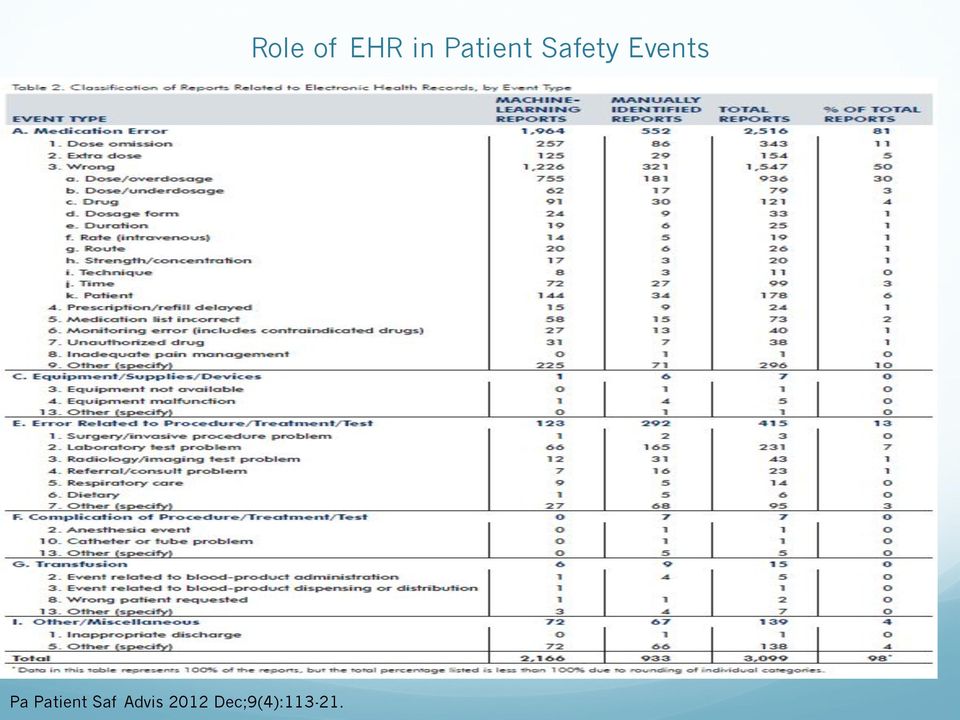
10 Pa Patient Saf Advis 2012 Dec;9(4): Role of EHR in Patient Safety Events
11 PATIENT SAFETY/CONCEPTS Quality and Safety Implications of Emergency Department Information Systems Heather L. Farley, MD; Kevin M. Baumlin, MD; Azita G. Hamedani, MD, MPH; Dickson S. Cheung, MD, MBA; Michael R. Edwards, MD; Drew C. Fuller, MD, MPH; Nicholas Genes, MD, PhD; Richard T. Griffey, MD, MPH; John J. Kelly, DO; James C. McClay, MS, MD; Jeff Nielson, MD, MS; Michael P. Phelan, MD; Jason S. Shapiro, MD; Suzanne Stone-Griffith, RN, MSN; Jesse M. Pines, MD, MBA The Health Information Technology for Economic and Clinical Health Act of 2009 and the Centers for Medicare & Medicaid Services meaningful use incentive programs, in tandem with the boundless additional requirements for detailed reporting of quality metrics, have galvanized hospital efforts to implement hospital-based electronic health records. As such, emergency department information systems (EDISs) are an important and unique component of most hospitals electronic health records. System functionality varies greatly and affects physician decisionmaking, clinician workflow, communication, and, ultimately, the overall quality of care and patient safety. This article is a joint effort by members of the Quality Improvement and Patient Safety Section and the Informatics Section of the American College of Emergency Physicians. The aim of this effort is to examine the benefits and potential threats to quality and patient safety that could result from the choice of a particular EDIS, its implementation and optimization, and the hospital s or physician group s approach to continuous improvement of the EDIS. Specifically, we explored the following areas of potential EDIS safety concerns: communication failure, wrong order wrong patient errors, poor data display, and alert fatigue. Case studies are presented that illustrate the potential harm that could befall patients from an inferior EDIS product or suboptimal execution of such a product in the clinical environment. The authors have developed 7 recommendations to improve patient safety with respect to the deployment of EDISs. These include ensuring that emergency providers actively participate in selection of the EDIS product, in the design of processes related to EDIS implementation and optimization, and in the monitoring of the system s ongoing success or failure. Our recommendations apply to emergency departments using any type of EDIS: custom-developed systems, best-of-breed vendor systems, or enterprise systems. [Ann Emerg Med. 2013;62: ] A podcast for this article is available at /$-see front matter Copyright 2013 by the American College of Emergency Physicians. INTRODUCTION The release of the 2 Institute of Medicine (IOM) reports, To Err is Human in 1999 and Crossing the Quality Chasm in 2001, focused local quality improvement and national policy efforts on reducing medical errors and improving patient safety. 1,2 One of the major interventions aimed at reducing medical errors was the development and use of electronic health records systems, also referred to as emergency department information systems (EDISs) when focused on the emergency department (ED). 3-6 The most significant legislation in this area was the Health Information Technology for Economic and Clinical Health Act of 2009, which was part of the American Recovery and Reinvestment Act and encouraged hospitals to implement such electronic records by It also promised financial penalties by 2015 Communication failure Poor data display Wrong-order-Wrong Patient Error Alert Fatigue EDISs are an important and unique component of this greater movement toward improving quality and outcomes with electronic health records. There is a wide variety of electronic systems with various functionality available for use by EDs throughout the country. Variation in EDIS functionality affects physician decisionmaking, clinician workflow, communication, and, ultimately, the overall quality of care and patient safety in a particularly challenging clinical environment (eg, high volume, time sensitive). However, the technology is constantly evolving and vendors are adapting to meet new demands by clinicians, health care administrators, and government, and as such, active engagement by front-line clinicians in improving these products is critical. Recently, studies have emerged in the literature examining 7-12

12 Recommendations 1 A local ED clinician champion should be appointed to maintain a performance improvement process for the EDIS and lead the EDIS performance improvement group. 2 A multidisciplinary EDIS performance improvement group should meet regularly and communicate regularly with ED and hospital leadership. 3 A review process should be in place to monitor ongoing patient safety issues with the EDIS. ED providers and other stakeholders should be encouraged to submit safety concerns for review. In addition, prospective risk assessments should be conducted regularly. 4 EDIS-related patient safety concerns identified by the review process should be addressed in a timely manner by ED providers, the EDIS vendors, and hospital administration. Each of these processes should be performed in full transparency, specifically with openness, communication, and accountability. 5 Lessons learned from performance improvement efforts should be measured and shared publicly, including with other EDs using the same EDIS. 6 EDIS vendors should learn from local patient safety improvements and ensure timely distribution of necessary changes to all installation sites. 7 Hold harmless or learned intermediary clauses should be removed from vendor software contracts. Annals of Emergency Medicine Volume 62, Issue 4, Pages , October 2013
13 Slide 7 of 23 Safety as a system property Safety is a characteristic of a sociotechnical system System-level failures occur almost always because of unforeseen combinations of component failures

14 Questions?

Health Information Technology: Introduction to One Key Part - the EHR
 Health Information Technology: Introduction to One Key Part - the EHR Donald P. Connelly, MD, PhD Director, Health Informatics Division University of Minnesota Medical School February 21, 2006 Minnesota
A STRATIFIED APPROACH TO PATIENT SAFETY THROUGH HEALTH INFORMATION TECHNOLOGY
 A STRATIFIED APPROACH TO PATIENT SAFETY THROUGH HEALTH INFORMATION TECHNOLOGY Table of Contents I. Introduction... 2 II. Background... 2 III. Patient Safety... 3 IV. A Comprehensive Approach to Reducing
Toward Meaningful Use of HIT
 Toward Meaningful Use of HIT Fred D Rachman, MD Health and Medicine Policy Research Group HIE Forum March 24, 2010 Why are we talking about technology? To improve the quality of the care we provide and
Conflict of Interest Disclosure
 Leveraging Clinical Decision Support for Optimal Medication Management Anne M Bobb, BS Pharm., Director Quality Informatics Children s Memorial Hospital, Chicago IL, February 20, 2012 DISCLAIMER: The views
Health Information Technology and the National Quality Agenda. Daphne Ayn Bascom, MD PhD Chief Clinical Systems Officer Medical Operations
 Health Information Technology and the National Quality Agenda Daphne Ayn Bascom, MD PhD Chief Clinical Systems Officer Medical Operations Institute of Medicine Definition of Quality "The degree to which
Patient Safety: Achieving A New Standard for Care. Institute of Medicine Committee on Data Standards for Patient Safety November, 2003
 Patient Safety: Achieving A New Standard for Care Institute of Medicine Committee on Data Standards for Patient Safety November, 2003 Outline Committee charge and definitions System support of patient
Health Management Information Systems: Clinical Decision Support Systems
 Health Management Information Systems: Clinical Decision Support Systems Lecture 5 Audio Transcript Slide 1 Welcome to Health Management Information Systems, Clinical Decision Support Systems. The component,
Norton Healthcare. Faith-Based Integrated Delivery Network of Five Not-for-Profit Hospitals 15 Out-patient Centers 130+ Physician Practices
 Norton Healthcare Faith-Based Integrated Delivery Network of Five Not-for-Profit Hospitals 15 Out-patient Centers 130+ Physician Practices 2.2 Million yearly patient encounters $1.6 Billion yearly revenue
Meaningful Use Rules Proposed for Electronic Health Record Incentives Under HITECH Act By: Cherilyn G. Murer, JD, CRA
 Meaningful Use Rules Proposed for Electronic Health Record Incentives Under HITECH Act By: Cherilyn G. Murer, JD, CRA Introduction On December 30, 2009, The Centers for Medicare & Medicaid Services (CMS)
Informatics Strategies & Tools to Link Nursing Care with Patient Outcomes in the Learning Health Care System
 Nursing Informatics Working Group Informatics Strategies & Tools to Link Nursing Care with Patient Outcomes in the Learning Health Care System Patricia C. Dykes PhD, RN, FAAN, FACMI Judy Murphy RN, FHIMSS,
Nursing Informatics Overview Mari Tietze, PhD, RN-BC, Texas Women's University School of Nursing
 Nursing Informatics Overview Mari Tietze, PhD, RN-BC, Texas Women's University School of Nursing ONCHIT update (REC initiatives, State HIE Medicaid) Susan McBride, PhD, RN, Texas Tech Health Science Center
NHCHC Meaningful Use of Electronic Health Records Resource Catalogue. Meaningful Use Overview
 Meaningful Use Overview Meaningful use is the use of a certified electronic health record (EHR) to demonstrate improved quality and safety of health care delivery for a patient population within a clinical
Chapter 15 The Electronic Medical Record
 Chapter 15 The Electronic Medical Record 8 th edition 1 Lesson 15.1 Introduction to the Electronic Medical Record Define, spell, and pronounce the terms listed in the vocabulary. Discuss the presidential
Issue Brief Findings from HSC
 Issue Brief Findings from HSC NO. 133 JULY 2010 EVEN WHEN PHYSICIANS ADOPT E-PRESCRIBING, USE OF ADVANCED FEATURES LAGS By Joy M. Grossman Physician practice adoption of electronic prescribing has not
3/9/2011 ELECTRONIC HEALTH RECORDS: A NATIONAL PRIORITY. Mandate for electronic health records is tied to:
 To lower health care cost, cut medical errors, And improve care, we ll computerize the nation s health records in five years, saving billions of dollars in health care costs and countless lives. ELECTRONIC
Master of Science in Healthcare Quality and Safety (MS-HQS)
 Master of Science in Healthcare Quality and Safety (MS-HQS) Susan DesHarnais, PhD, MPH Program Director Jefferson School of Population Health Philadelphia, Pennsylvania Background and Need: 10 Years Ago
Meaningful Use Updates. HIT Summit September 19, 2015
 Meaningful Use Updates HIT Summit September 19, 2015 Meaningful Use Updates Nadine Owen, BS,CHTS-IS, CHTS-IM Health IT Analyst Hawaii Health Information Exchange No other relevant financial disclosures.
HL7 & Meaningful Use. Charles Jaffe, MD, PhD CEO Health Level Seven International. HIMSS 11 Orlando February 23, 2011
 HL7 & Meaningful Use Charles Jaffe, MD, PhD CEO Health Level Seven International HIMSS 11 Orlando February 23, 2011 Overview Overview of Meaningful Use HIT Standards and Meaningful Use Overview HL7 Standards
AMC/NOMA Article -- Stimulus Package Promotes Health IT Adoption Amy S. Leopard Walter & Haverfield LLP
 AMC/NOMA Article -- Stimulus Package Promotes Health IT Adoption Amy S. Leopard Walter & Haverfield LLP The Obama Administration clearly expects every American to have an electronic medical record by 2014.
Health Information Technology in Healthcare: Frequently Asked Questions (FAQ) 1
 Health Information Technology in Healthcare: Frequently Asked Questions (FAQ) 1 1. What is an Electronic Health Record (EHR), an Electronic Medical Record (EMR), a Personal Health Record (PHR) and e-prescribing?
Medweb Telemedicine 667 Folsom Street, San Francisco, CA 94107 Phone: 415.541.9980 Fax: 415.541.9984 www.medweb.com
 Medweb Telemedicine 667 Folsom Street, San Francisco, CA 94107 Phone: 415.541.9980 Fax: 415.541.9984 www.medweb.com Meaningful Use On July 16 2009, the ONC Policy Committee unanimously approved a revised
Meaningful Use: Driving Physicians to eprescribing/emr and Pharma Marketing Opportunities
 Meaningful Use: Driving Physicians to eprescribing/emr and Pharma Marketing Opportunities Devin Paullin EVP, New Business Development Physicians Interactive Dan Pucci Director, Informatics Solutions Allscripts
Leveraging EHR to Improve Patient Safety: A Davies Story
 Leveraging EHR to Improve Patient Safety: A Davies Story Claudia Colgan, Vice President of Quality Initiatives Bruce Darrow, MD, PhD, Interim Chief Medical Information Officer Jill Kalman, MD, Director
T he Health Information Technology for Economic
 A BNA, INC. HEALTH IT! LAW & INDUSTRY REPORT Reproduced with permission from Health IT Law & Industry Report, 2 HITR 23, 01/18/2010. Copyright 2010 by The Bureau of National Affairs, Inc. (800-372- 1033)
Technology Mediated Translation Clinical Decision Support. Marisa L. Wilson, DNSc, MHSc, CPHIMS, RN-BC. January 23, 2015.
 Technology Mediated Translation Clinical Decision Support Marisa L. Wilson, DNSc, MHSc, CPHIMS, RN-BC January 23, 2015 Background Presidents Bush, President Obama American Recovery and Reinvestment Act
Analytic-Driven Quality Keys Success in Risk-Based Contracts. Ross Gustafson, Vice President Allina Performance Resources, Health Catalyst
 Analytic-Driven Quality Keys Success in Risk-Based Contracts March 2 nd, 2016 Ross Gustafson, Vice President Allina Performance Resources, Health Catalyst Brian Rice, Vice President Network/ACO Integration,
October 15, 2010. Re: National Health Care Quality Strategy and Plan. Dear Dr. Wilson,
 October 15, 2010 Dr. Nancy Wilson, R.N., M.D., M.P.H. Senior Advisor to the Director Agency for Healthcare Research and Quality (AHRQ) 540 Gaither Road Room 3216 Rockville, MD 20850 Re: National Health
The Road to Meaningful Use EHR Stimulus Payments. By Amy S. Leopard, Walter & Haverfield LLP
 The Road to Meaningful Use EHR Stimulus Payments By Amy S. Leopard, Walter & Haverfield LLP On July 28, 2010, the Centers for Medicare and Medicaid Services (CMS) published a final rule regarding what
Electronic Medical Records
 Electronic Medical Records Milisa K Rizer, MD, MPH Clinical Director, Integrated Healthcare Information System Associate Professor, Clinical Family Medicine The Ohio State University Medical Center 2011
Patient Safety Using Electronic Healthcare Records & Innovation Adoption in the Emergency Department
 Patient Safety Using Electronic Healthcare Records & Innovation Adoption in the Emergency Department Christopher 'Toff' Peabody, MD, MPH Emergency Physician & Clinical Assistant Professor, University of
Engaging Physicians from the Inside Resident Informatics Program
 Engaging Physicians from the Inside Resident Informatics Program Kevin Baldwin, MPH CPHIMS Strategic IT Engagement Manager, UCLA Health Program Administrator 4 hospitals 952 Inpatient beds ~60,000 hospital
Status of Electronic Health Records in Missouri Hospitals HIDI SPECIAL REPORT JULY 2012
 Status of Electronic Health Records in Missouri Hospitals HIDI SPECIAL REPORT JULY 2012 HIDI SPECIAL REPORT INTRODUCTION The steady progress that Missouri hospitals continue to demonstrate in their adoption
Adoption and Meaningful Use of EHR Technology in a Hospital
 Monday, March, 00 :5 :5 pm Adoption and Meaningful Use of EHR Technology in a Hospital Sanjay Shah, MBA, CMPE, FHIMSS President, HCIT+ (Former) VP & CIO, Cabell Huntington Hospital Anthony Adkins, RN Director
An Overview of Meaningful Use: FAQs
 An Overview of Meaningful Use: FAQs On Feb. 17, 2009, President Obama signed the American Recovery and Reinvestment Act of 2009 (ARRA) into law. This new law includes provisions (known as the HITECH Act)
Contact: Barbara J Stout RN, BSC Implementation Specialist University of Kentucky Regional Extension Center 859-323-4895
 Contact: Barbara J Stout RN, BSC Implementation Specialist University of Kentucky Regional Extension Center 859-323-4895 $19.2B $17.2B Provider Incentives $2B HIT (HHS/ONC) Medicare & Medicaid Incentives
October 18, 2013. Articulating the Value Proposition of Innovative Medical Technologies in the Healthcare Reform Landscape
 October 18, 2013 Articulating the Value Proposition of Innovative Medical Technologies in the Healthcare Reform Landscape Outline The Changing Landscape Evolving Care Delivery and Incentive Models Provider
HealthTECH Workforce Forum Presents: Electronic Health Records Adoption: Driving to 2015 and Beyond
 HealthTECH Workforce Forum Presents: Electronic Health Records Adoption: Driving to 2015 and Beyond May 19 th, 2011 EHR Implementation Panel Moderator: Paula J. Magnanti, MT(ASCP) Founder & Managing Principal
December 23, 2010. Dr. David Blumenthal National Coordinator for Health Information Technology Department of Health and Human Services
 December 23, 2010 Dr. David Blumenthal National Coordinator for Health Information Technology Department of Health and Human Services RE: Prioritized measurement concepts Dear Dr. Blumenthal: Thank you
How To Bridge The Chasm Between Provider And Patient
 the Health Care Delivery System Opportunities for Transforming the Health Care Delivery System Opportunities for Transforming the Health Care Delivery System Opportunities for Transforming Pennsylvania
Improving Safety, Quality & Efficiency with an Ambulatory EMR: Can it be done?
 Improving Safety, Quality & Efficiency with an Ambulatory EMR: Can it be done? Paula Spencer, PMP, CPHIMS Deborah Burgett, RN, MSHA DISCLAIMER: The views and opinions expressed in this presentation are
Some Tout CMS Proposed Meaningful Use Definition for Use of Electronic Health Records As Too Ambitious
 Some Tout CMS Proposed Meaningful Use Definition for Use of Electronic Health Records As Too Ambitious By Craig A. Conway, J.D., LL.M. (Health Law) [email protected] Just in time for the New Year,
ESSENTIA HEALTH AS AN ACO (ACCOUNTABLE CARE ORGANIZATION)
 ESSENTIA HEALTH AS AN ACO (ACCOUNTABLE CARE ORGANIZATION) Hello and welcome. Thank you for taking part in this presentation entitled "Essentia Health as an ACO or Accountable Care Organization -- What
Clinical Decision Support (CDS) Options in a CPOE System. Lolita G. White, PharmD Clinical Applications Analyst
 Clinical Decision Support (CDS) Options in a CPOE System Lolita G. White, PharmD Clinical Applications Analyst Clinical Decision Support Clinical decision support (CDS) systems provide clinicians, staff,
Executive Checklist: Four ways to leverage EMR to improve patient outcomes, increase satisfaction and control costs.
 White Paper Executive Checklist: Four ways to leverage EMR to improve patient outcomes, increase satisfaction and control costs. Brendon Buckley Healthcare Enterprise Solutions Manager Lorrie LiBrizzi
Health Information Technology (HIT) and the Medicaid/CHIP Health Information Exchange (HIE) Advisory Committee
 Health Information Technology (HIT) and the Medicaid/CHIP Health Information Exchange (HIE) Advisory Committee Joseph H. Schneider, MD Chair, Medicaid/CHIP HIE Advisory Committee Chair, TMA Committee on
Early Lessons learned from strong revenue cycle performers
 Healthcare Informatics June 2012 Accountable Care Organizations Early Lessons learned from strong revenue cycle performers Healthcare Informatics Accountable Care Organizations Early Lessons learned from
Faculty Disclosure. Pharmacist Learning Objectives. Pharmacy e-hit: The Future of Pharmacy and Patient Care
 Pharmacy e-hit: The Future of Pharmacy and Patient Care 1 Faculty Disclosure Ms Spiro has no actual or potential conflicts of interest associated with this presentation. 2 Pharmacist Learning Objectives
Custom Report Data Elements: IT Database Fields. Source: American Hospital Association IT Survey
 Custom Report Data Elements: IT Database Fields Source: American Hospital Association IT Survey TABLE OF CONTENTS COMPUTERIZED SYSTEM IMPLEMENTATION... 4 Bar Coding... 4 Computerized Provider Order Entry...
1/16/2015 HOW CLINICAL EDUCATORS CAN DISCLOSURE LEARNING OBJECTIVES MAKE MEANINGFUL USE MEANINGFUL. We have no financial disclosures
 HOW CLINICAL EDUCATORS CAN MAKE MEANINGFUL USE MEANINGFUL Daryl Wieland, MD Tammy Gruenberg, MD Michelle Giannone, MD Albert Einstein College of Medicine, Bronx, NY DISCLOSURE We have no financial disclosures
Special Committee on Academic Medicine
 Special Committee on Academic Medicine December 2014 December 11, 2014 8:00 a.m. - 10:00 a.m. West Committee Room, McNamara Alumni Center 1. The Future of Graduate Medical Education and its Financing Docket
A Guide to Understanding and Qualifying for Meaningful Use Incentives
 A Guide to Understanding and Qualifying for Meaningful Use Incentives A White Paper by DrFirst Copyright 2000-2012 DrFirst All Rights Reserved. 1 Table of Contents Understanding and Qualifying for Meaningful
THE 2009 HEALTH INFORMATION TECHNOLOGY FOR ECONOMIC AND CLINICAL HEALTH ACT
 July 2009 THE 2009 HEALTH INFORMATION TECHNOLOGY FOR ECONOMIC AND CLINICAL HEALTH ACT SUMMARY The Health Information Technology for Economic and Clinical Health Act (HITECH) is an important component of
Special Topics in Vendor- Specific Systems. Outline. Results Review. Unit 4 EHR Functionality. EHR functionality. Results Review
 Special Topics in Vendor- Specific Systems Unit 4 EHR Functionality EHR functionality Results Review Outline Computerized Provider Order Entry (CPOE) Documentation Billing Messaging 2 Results Review Laboratory
Comments to Legislative Workgroup on E-Prescribing
 Comments to Legislative Workgroup on E-Prescribing eqhealth Solutions is a not-for-profit, physician sponsored health care organization operating in Louisiana, Illinois, Florida and Mississippi. It has
Dr. Peters has declared no conflicts of interest related to the content of his presentation.
 Dr. Peters has declared no conflicts of interest related to the content of his presentation. Steve G. Peters MD NAMDRC 2013 No financial conflicts No off-label usages If specific vendors are named, will
Electronic Medical Records. Robert M. Underwood, MD, CPE, FAAEM CMIO, RMH Healthcare
 Electronic Medical Records Robert M. Underwood, MD, CPE, FAAEM CMIO, RMH Healthcare Disclaimer I am an employee of RMH Healthcare No financial interest in any IT company What is a CMIO? History: September
CMS Quality Measurement and Value Based Purchasing Programs Kate Goodrich, MD MHS Director, Quality Measurement and Health Assessment Group, CMS
 CMS Quality Measurement and Value Based Purchasing Programs Kate Goodrich, MD MHS Director, Quality Measurement and Health Assessment Group, CMS American Urological Association Quality Improvement Summit
Meaningful Use Stage 2 Certification: A Guide for EHR Product Managers
 Meaningful Use Stage 2 Certification: A Guide for EHR Product Managers Terminology Management is a foundational element to satisfying the Meaningful Use Stage 2 criteria and due to its complexity, and
Mona Osman MD, MPH, MBA
 Mona Osman MD, MPH, MBA Objectives To define an Electronic Medical Record (EMR) To demonstrate the benefits of EMR To introduce the Lebanese Society of Family Medicine- EMR Reality Check The healthcare
Medicaid Electronic Health Records (EHR) Incentive Program FAQ
 STATE OF NEVADA DEPARTMENT OF HEALTH AND HUMAN SERVICES DIVISION OF HEALTH CARE FINANCING AND POLICY MICHAEL J. WILLDEN Director BRIAN SANDOVAL Governor CHARLES DUARTE Administrator Medicaid Electronic
Electronic Health Records: What it Means for Today s Radiologist By: Anne Reynolds
 Electronic Health Records: What it Means for Today s Radiologist By: Anne Reynolds Introduction Program Overview In February of 2009, President Obama signed the American Recovery and Reinvestment Act of
Len Bowes, MD, MS, Intermountain Healthcare Medical Informatics Jan 2010. *ARRA = American Recovery and Reinvestment Act
 Len Bowes, MD, MS, Intermountain Healthcare Medical Informatics Jan 2010 *ARRA = American Recovery and Reinvestment Act What are HITECH and ARRA? The Health Information Technology for Economic and Clinical
Inpatient EHR. Solution Snapshot. The right choice for your patients, your practitioners, and your bottom line SOLUTIONS DESIGNED TO FIT
 Inpatient EHR The right choice for your patients, your practitioners, and your bottom line SOLUTIONS DESIGNED TO FIT Our customers do more than save lives. They re helping their communities to thrive.
Nurses at the Forefront: Care Delivery and Transformation through Health IT
 Nurses at the Forefront: Care Delivery and Transformation through Health IT Ann OBrien RN MSN CPHIMS National Senior Director of Clinical Informatics Kaiser Permanente Robert Wood Johnson Executive Nurse
Achieving meaningful use of healthcare information technology
 IBM Software Information Management Achieving meaningful use of healthcare information technology A patient registry is key to adoption of EHR 2 Achieving meaningful use of healthcare information technology
An Update in Electronic Health Records
 An Update in Electronic Health Records Mark Seigel, MD, FACOG Assistant Professor, Obstetrics and Gynecology, George Washington University School of Medicine Disclosure I have no financial interests or