
Occupational Safety & Health Council
|
|
|
- Alexis Mason
- 9 years ago
- Views:
Transcription
1 Occupational Safety & Health Council
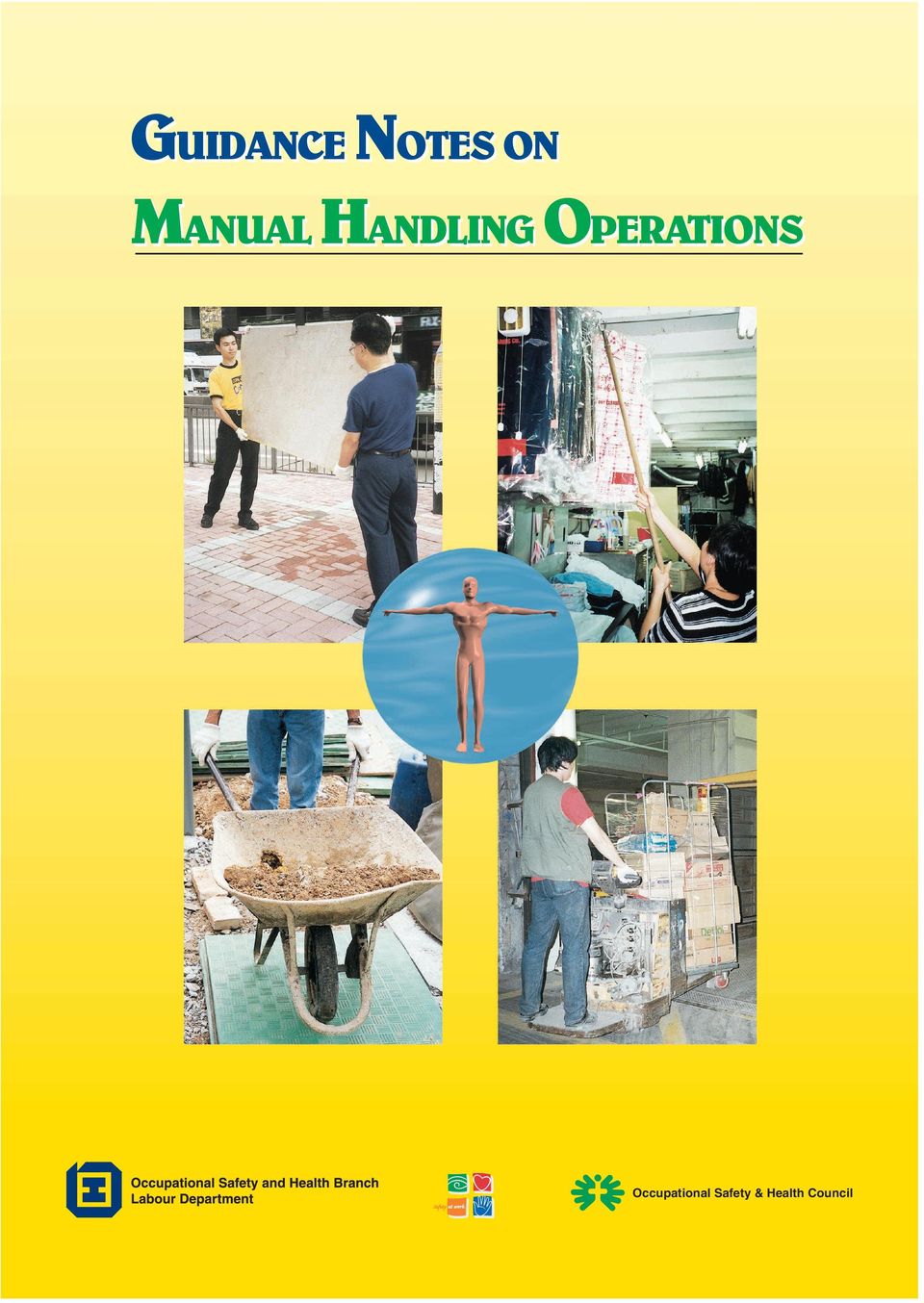
2 GUIDANCE NOTES ON MANUAL HANDLING OPERATIONS dìáç~ååé=kçíéë=çå=j~åì~ä=e~åçäáåö=lééê~íáçåë 63

3 qüáë=dìáç~ååé=kçíéë=áë=áëëìéç=ñêéé=çñ=åü~êöé=~åç=å~å=äé=çäí~áåéç=ñêçã çññáåéë=çñ=íüé=lååìé~íáçå~ä=p~ñéíó=~åç=eé~äíü=_ê~ååük==fí=å~å=~äëç=äé=ççïåäç~çéç Ñêçã=íÜÉ=i~Äçìê=aÉé~êíãÉåíDë=ïÉÄëáíÉ=~í=ÜííéWLLïïïKä~ÄçìêKÖçîKÜâK=cçê=ÉåèìáêáÉë ~Äçìí=~ÇÇêÉëëÉë=~åÇ=íÉäÉéÜçåÉ=åìãÄÉêë=çÑ=íÜÉ=çÑÑáÅÉëI=éäÉ~ëÉ=îáëáí=íÜÉ=~ÄçîÉ ïéäëáíé=çê=å~ää=orrv=oovtk qüáë=dìáç~ååé=kçíéë=ã~ó=äé=ñêééäó=êééêççìåéç=éñåééí=ñçê=~çîéêíáëáåöi ÉåÇçêëÉãÉåí=çê=ÅçããÉêÅá~ä=éìêéçëÉëK=mäÉ~ëÉ=~ÅâåçïäÉÇÖÉ=íÜÉ=pçìêÅÉ=~ë?dìáÇ~åÅÉ=kçíÉë=çå=j~åì~ä=e~åÇäáåÖ=léÉê~íáçåë?K 64
4 GUIDANCE NOTES ON MANUAL HANDLING OPERATIONS CONTENTS 1. INTRODUCTION 2 2. WHAT ARE MANUAL HANDLING OPERATIONS 3 3. WHAT THE LAW SAYS ABOUT MANUAL HANDLING OPERATIONS 4 4. HAZARDS IN MANUAL HANDLING OPERATIONS 6 5. HAZARD IDENTIFICATION 8 6. RISK ASSESSMENT RISK CONTROL PREVENTIVE AND PROTECTIVE MEASURES INFORMATION AND TRAINING REFERENCES ENQUIRIES AND COMPLAINTS 4 6 APPENDIX I: PRELIMINARY ASSESSMENT CHECKLIST FOR MANUAL HANDLING OPERATIONS (SAMPLE 1) 4 7 APPENDIX II: GUIDELINES FOR THE PRELIMINARY ASSESSMENT CHECKLIST FOR MANUAL HANDLING OPERATIONS (SAMPLE 1) 4 8 APPENDIX III: PRELIMINARY ASSESSMENT CHECKLIST FOR MANUAL HANDLING OPERATIONS (SAMPLE 2) 5 0 APPENDIX IV: HINTS ON ASSESSING THE WEIGHT OF LOADS OF MANUAL HANDLING OPERATIONS 5 1 APPENDIX V: FURTHER ASSESSMENT CHECKLIST FOR MANUAL HANDLING OPERATIONS 5 2 APPENDIX VI: GUIDELINES FOR THE FURTHER ASSESSMENT CHECKLIST FOR MANUAL HANDLING OPERATIONS 5 5 APPENDIX VII: PROPER LIFTING METHOD IN GENERAL 6 0 1

5 1. INTRODUCTION This guidance uses concise text and illustrations to explain the various sections on manual handling operations in the Occupational Safety and Health Regulation. There are many ways to protect the safety and health of employees and to minimise the risk involved in manual handling operations. These include the provision of satisfactory working conditions, good work practices, the proper use of mechanical aids and protective devices, adequate safety and health information, and sufficient staff training, etc. In addition, employers should have a well-planned management system and have undertaken a proper risk assessment exercise to ensure that their manual handling operations are safe. Apart from a brief introduction on the sections of manual handling operations under the Occupational Safety and Health Regulation, this guidance also covers the aspects of hazard identification, risk assessment and risk control in manual handling operations and provides checklists and guidelines for preliminary and further assessments. In order to allow fuller understanding of the control measures in manual handling operations, diagrams and real cases 1 have been selected from various trades and industries to show how to improve work practices and the workplace environment to reduce the potential risks in the manual handling operations. For some particular trades with specific and hazardous manual handling risks, readers are advised to refer to specialist guides for relevant information. Readers should also refer to Part VII of the Occupational Safety and Health Regulation for the details of the legislation. 1 The incorrect postures and poor work practices illustrated in some photos of this publication help the readers understand the problems on manual handling. It does not imply the related organisations, companies or persons are adopting such postures and practices in their work activities. 2 INTRODUCTION

6 GUIDANCE NOTES ON MANUAL HANDLING OPERATIONS 2. WHAT ARE MANUAL HANDLING OPERATIONS A manual handling operation takes place every time a load is moved or supported by a person's hands or arms, or by some other forms of bodily effort. It includes lifting, lowering, pushing, pulling and carrying the load. The definition of a load encompasses goods, baggage, humans and other living beings as well as an object that comprises or includes any living beings. mìëüáåö mìääáåö iáñíáåö=l=içïéêáåö `~êêóáåö eçäçáåö WHAT ARE MANUAL HANDLING OPERATIONS 3

7 3. WHAT THE LAW SAYS ABOUT MANUAL HANDLING OPERATIONS PKNK qüé=ééêëçå=êéëéçåëáääé=ñçê=~=ïçêâéä~åé=áë=éáíüéê=íüé=éãéäçóéê=çê íüé=ïçêâéä~åédë=çååìéáéêk==cçê=íüé=éìêéçëéë=çñ=íüé=lååìé~íáçå~ä p~ñéíó=~åç=eé~äíü=lêçáå~ååéi=íüé=ééêëçå=êéëéçåëáääé=ñçê=~ ïçêâéä~åé=áë=íüé=éãéäçóéê=çñ=íüé=éãéäçóééë=ïüç=~êé=éãéäçóéç=íç Å~êêó=çìí=ïçêâ=~í=íÜÉ=äçÅ~íáçåK==^äíÉêå~íáîÉäóI=áÑ=íÜÉ=ÉãéäçóÉê=ÇçÉë åçí=éñéêåáëé=~åó=çéöêéé=çñ=åçåíêçä=çîéê=íüé=êéäéî~åí=é~êí=çê=~ëééåí çñ=íüé=ïçêâéä~åéi=íüé=çååìéáéê=çñ=íüé=ïçêâéä~åé=áë=íüé=êéëéçåëáääé ééêëçåk=qüé=êéëéçåëáäáäáíáéë=çñ=íüáë=êéëéçåëáääé=ééêëçå=áååäìçéw Make a preliminary assessment of the risks of manual handling operations - if that particular operation is first undertaken at a workplace after the commencement of the law, the person responsible for the workplace must ensure that a preliminary risk assessment is made; or - if that particular operation was being undertaken at a workplace immediately before the commencement of the law and that operation is also undertaken on or after that commencement, the person responsible for the workplace must, within 14 days after that commencement, ensure that a preliminary risk assessment is made; (iv) (v) (vi) Avoid the need for employees to undertake hazardous manual handling operations as far as reasonably practicable; Make a further assessment of the manual handling risks if the hazardous operations cannot be avoided; Reduce the risks as far as reasonably practicable, and arrange for preventive and protective measures; Review and modify the preliminary or the further assessment if the circumstances have significantly changed or those assessments have become invalid; Provide relevant information to employees on the risks as well as preventive and protective measures involved in those hazardous manual handling operations; (vii) Provide effective planning, organisation, control, monitoring and review of those preventive and protective measures; and (viii) If 10 or more employees are normally employed at a workplace at any one time to undertake manual handling operations, he/she must - keep a record of the assessment for a period of not less than 3 years, and; - appoint sufficient competent persons to assist in carrying out the preventive and protective measures. 4 WHAT THE LAW SAYS ABOUT MANUAL HANDLING OPERATIONS

8 GUIDANCE NOTES ON MANUAL HANDLING OPERATIONS PKOK bãéäçóéêë=ãìëí=~äëçw Assess the respective capabilities of the employees when allocating tasks involving hazardous manual handling operations; and Provide adequate training to employees. PKP bãéäçóééë=~í=ïçêâ=ãìëíw Take care of others; and Co-operate with the employer in reducing the risks caused by manual handling work by using the mechanical aids and/or protective equipment provided. WHAT THE LAW SAYS ABOUT MANUAL HANDLING OPERATIONS 5

9 4. HAZARDS IN MANUAL HANDLING OPERATIONS QKNK eçï=éççê=ã~åì~ä=ü~åçäáåö=çééê~íáçåë=å~å=êéëìäí=áå=áåàìêó\ Manual handling operations are very often involved in everyday work. Incorrect manual handling operations involving awkward posture, incorrect application of bodily force, prolonged or frequently repetitive motions, jerky motion or unexpected movements and pressure, etc. can lead to injuries such as sprains, strains, back pain, hernia and damage to the back, joints, ligaments, muscles and intervertebral discs, etc. In most cases, manual handling injuries are cumulative. A person performing routine tasks involving manual handling operations may not feel pain until several hours after an injury has occurred. Therefore, these injuries may not be realized until a certain period from the occurrence of the incident. QKOK oáëâ=ñ~åíçêë=áå=ã~åì~ä=ü~åçäáåö The weight of an object although is the major risk factor, it is not the only factor. Several other important factors can also increase the risk of injury. These include the characteristics of the task and the load, the working environment and the individual capability, etc Characteristics of the task Posture Awkward body movements or postures, e.g. holding loads at a distance from the body, twisting, stooping and reaching upward, excessive lifting or lowering distances, etc. are the common risk factors. Load manipulation Excessive pushing, pulling of loads or excessive carrying distance are some other important risk factors in manual handling. Frequent or prolonged manual handling Frequent or prolonged physical effort or speeding up in order to increase the rate of work, will increase the risk of injury. In the same way, insufficient rest or recovery periods may increase incidence of injury Loads Weight, size and shape of the load or object are risk factors in manual handling. It is obvious that a heavy load is hard to pick up or move, but this applies equally to loads that are not so heavy but bulky. Easy-to-grasp handles should be provided for bulky loads. Unstable loads are another serious risk and thus great care should be taken in manipulating them. For example, when lifting or moving a semi-filled container containing liquid, the centre of gravity changes as the liquid moves. Another example is a box with empty space inside wherein the contents are likely to move during transportation thereby increasing the difficulty in handling or manipulation. If the object being carried is a human being or an animal, their bodily movements impose great difficulty on the handler. Objects with sharp parts, or being hot or cold, can also cause potential risks for their handlers. 6 HAZARDS IN MANUAL HANDLING OPERATIONS
10 GUIDANCE NOTES ON MANUAL HANDLING OPERATIONS Working environment Space constraints Space constraints may make it difficult for operators to employ a good posture in manual handling. Examples include manipulating or moving objects in a restricted space or carrying bulky objects along a narrow gangway. Floor or other surfaces Working on uneven, slippery or unstable floors and other surfaces increases the degree of risk. Examples include surfaces on a moving vehicle, moving platforms and stairs, etc. Other environmental factors Extremes of temperature or humidity in the working environment affect a person's ability to sustain work. Sufficient lighting is another essential factor, while strong winds require special consideration when handling a bulky load Individual capability In some particular situations, manual handling operations may require operators to be specially trained, or to possess a strong physique such as firemen. A person's state of health greatly affects his or her ability to perform manual handling operations. Women who are pregnant or returning from maternity leave should avoid manual handling work that may cause safety or health risks. People recovering from surgery or who have a health problem should consult a doctor before performing certain manual handling work Other factors If operators must use personal protective equipment in the workplace, they shall consider whether such equipment will hinder their postures or movements. To summarize, the severity of hazards depends on the way the work is organized, how long and how often the tasks are being performed, the weight, size and shape of the loads, the design and layout of the working environment, the individual capability requirements and the provision of protective and preventive measures. HAZARDS IN MANUAL HANDLING OPERATIONS 7
11 5. HAZARD IDENTIFICATION The responsible person of a workplace must carry out a preliminary assessment to evaluate the risks to the safety and health of employees performing manual handling operations. RKNK tü~í=áë=~=éêéäáãáå~êó=~ëëéëëãéåí\ The preliminary assessment serves as a hazard-identification tool with a systematic approach by pinpointing the operations that may cause injuries for further assessment. The results obtained from the assessments can help the responsible person to design and choose the appropriate preventive and protective measures. A successful preliminary assessment can also help the responsible person to give the proper priority to manual handling operations that may require further assessments. RKOK mêéäáãáå~êó=~ëëéëëãéåí=w=ëáãéäé=~åç=ëóëíéã~íáå=~ééêç~åü Making an overall risk assessment can be a complicated process and hence an assessor needs to use the right approach and a suitable standard. In order to help the assessor to make a simple and systematic assessment for manual handling operations, two samples of "Preliminary Assessment Checklist for Manual Handling Operations" are provided in Appendix I and III. To be successful, it is essential to communicate with the employees, supervisors, and safety and health representatives in the assessment process. Besides, checking the reasons of sickness records will also be useful. All this information will help identify tasks that may lead to physical strain. RKPK eçï=íç=çç=éêéäáãáå~êó=~ëëéëëãéåí=\ The responsible person should consider the employees' postures, the working environment and the weight of the loads. He/she should also assess the employees' capability to perform the task. After conducting the preliminary assessment, the responsible person should be able to make an initial judgment on the risks involved and judge whether further remedial action is required. When the risk factors concerning safety and health are identified or are uncertain, a further assessment is necessary. Assessors can use either Appendix I or Appendix III as the preliminary assessment checklist for manual handling operations, or take the "Hints on Assessing the Weight of Loads of Manual Handling Operations" at Appendix IV as a reference, to design a checklist according to the characteristics of the working environment. Guidelines for the preliminary assessment at Appendix II should be read before using the checklist at Appendix I. The completed checklists or assessment documents can serve as a record of making preliminary assessment of risks in manual handling operations. RKQK ^Åíáçå=~ÑíÉê=éêÉäáãáå~êó=~ëëÉëëãÉåí Avoid hazardous manual handling operations Don't let employees perform hazardous manual handling operations as far as reasonably practicable. 8 HAZARD IDENTIFICATION

12 GUIDANCE NOTES ON MANUAL HANDLING OPERATIONS Further assessment Make a further assessment of the manual handling risks if the hazardous operations cannot be avoided Review Review and modify the preliminary assessment if the circumstances have changed significantly or when it has become invalid Record of preliminary assessment A record of the preliminary assessment should be kept if 10 or more employees are normally employed at a workplace at any one time to perform manual handling operations. The record shall comprise: all significant findings resulting from the assessment or review; and the particulars of employees who perform hazardous manual handling operations. HAZARD IDENTIFICATION 9
13 6. RISK ASSESSMENT If it is completely unavoidable for employees to carry out manual handling operations involving safety and health risks, the responsible person must ensure that a further assessment is made. SKNK eçï=íç=çç=ñìêíüéê=~ëëéëëãéåí Base on the preliminary assessment, tasks requiring further assessment could be selected in proper priority. From this task list, begin with the highest priority tasks and work through to that with the lowest one. If it is a complex task (i.e. involving a sequence of activities), it is easier to divide it into smaller activities, each of which can be checked against all the risk factors. Risk factors to be considered include: (iv) (v) The tasks; The loads; The working environment; Individual capability; and Other matters. Relevant questions are listed in Schedule 3 of the Occupational Safety and Health Regulation. The "Further Assessment Checklist for Manual handling Operations" in Appendix V covers all factors as required in Schedule 3. Appendix VI 2 provides a guideline for completing the form. The responsible person can carry an in-depth evaluation on any particular operations but the whole assessment should include all the factors required in Schedule 3. SKOK ^Åíáçå=~ÑíÉê=ÑìêíÜÉê=~ëëÉëëãÉåí To comply with the regulation, the responsible person must take the following measures to minimise the risks at work Reduce the risk of manual handling operations by: Taking appropriate steps to reduce the risks of manual handling operations to the lowest level that is reasonably practicable; Arranging for the adoption of preventive and protective measures; and Ensuring effective planning, organisation, control, monitoring and reviewing of those preventive and protective measures Provide relevant information to the employees on the risks of manual handling operations (i.e. the weight and the heaviest side of the load). 2 The values (including the twisting angle, carrying distance, weight and dimensions of loads, etc.) provided in Appendix VI are solely for reference. They do not represent fine lines between safe and dangerous situations. The assessor could use other values with scientific grounds according to the characteristics of different trades and industries. 10 RISK ASSESSMENT

14 GUIDANCE NOTES ON MANUAL HANDLING OPERATIONS Provide mechanical aids and proper personal protective equipment to the employees Arrange a team of workers, if reasonably practicable, to carry out the manual handling operations. A team leader should be assigned to coordinate such work Review and modify the further assessment if the circumstances have changed significantly or the assessment has become invalid Keep a record of the further assessment (Please refer to Appendices V and VI for the relevant checklist and guidelines), provided that 10 or more employees are normally employed at the workplace at any one time to perform manual handling operations. This record must cover: all significant findings resulting from the assessment or review; and the particulars of employees who perform hazardous manual handling operations Appoint competent persons to assist in carrying out the preventive and protective measures: If 10 or more employees are normally employed at a workplace at any one time to perform manual handling operations involving safety and health risks, the responsible person must appoint enough competent persons to assist in carrying out the preventive and protective measures. The number of competent persons required depends on the number of employees involved in such manual handling operations, the size of the workplace, the risks to which those employees are exposed, and the distribution of those risks within the workplace. Sufficient time and resources must be provided to these appointed competent persons to efficiently carry out their responsibilities. SKPK tüç=áë=~=åçãééíéåí=ééêëçå\ A competent person is someone who has undergone the relevant training and has the experience and other characteristics necessary to ensure that he/she is capable of assisting the responsible person in complying with the requirements under the regulations concerning manual handling operations. For example, a person who has received a Certificate of Competency in Manual Handling Operations or passed any equivalent courses organized by Occupational Safety and Health Council or other appropriate institutes or authorities is considered as having fulfilled the "training" component for a competent person. The responsible person should appoint competent person(s) with a lot of experience if complex and risky manual handling operations have to be performed. RISK ASSESSMENT 11
15 7. RISK CONTROL TKNK oáëâ=`çåíêçä=läàéåíáîé The responsible person should take measures to prevent employees from performing any hazardous manual handling operations. If the task cannot be eliminated, the risks should be reduced to the lowest level that is reasonably practicable. TKOK oáëâ=`çåíêçä=píê~íéöó The responsible person should develop a risk control strategy to eliminate or reduce the risk factors with reference to the results of risk assessment. The following control strategies may be considered: (iv) Eliminate the need for the manual handling operations, e.g. introduce automation to replace operations which have significant risks; Re-design the manual handling procedures; Provide preventive and protective measures such as mechanical aids; Ensure that employees are given appropriate information and training to perform the manual handling operations. TKPK oáëâ=`çåíêçä=jéíüçççäçöó The best control method is the introduction of preventive and protective measures (e.g. automation) at the design and planning stage of the working processes. However, it will be difficult to achieve this controlling goal for existing processes in a short period. The responsible person can adopt various methods to minimise the risks such as those listed below. It should be noted that new risks should never be created when applying these control methods Modify the weight or the shape of the object The object may be modified by changing its shape or by repackaging into smaller sizes to reduce its weight. The size or shape should be designed to provide a good hold or grip Modify workplace layout The layout of the workplace can be re-arranged to provide more space for the manual handling operations. Besides, changing the position of equipment and furniture can also help. The waist-high position is the best one for manual handling operations. A good design of the workstation will also help reduce manual handling risks Re-arrange material flow Minimising the number of times required in moving objects, reducing the distance involved in such movements and placing the objects at a suitable height are some of the means in reducing risks Methods of modifying task Using suitable movements and forces Look for a different way for a manual handling task to be performed by using a different 12 RISK CONTROL
16 GUIDANCE NOTES ON MANUAL HANDLING OPERATIONS method, a different direction and force. A team lifting arrangement should be used whenever necessary to eliminate excessive exertion by an individual. Using mechanical aids Mechanical aids can reduce the risks associated with a task. For example, provision of hoists avoids manual lifting while use of trolleys reduces carrying forces required. Re-designing the work pattern If a task involves repetitive movement that leads to muscle fatigue, job rotation, workrate regulation and appropriate and sufficient work-rest regime are some effective controlling methods Equipment maintenance and workplace management Regular maintenance of plant and equipment and management of the workplace are necessary. Examples are lubrication of trolley axles, cleaning up obstructions on walk paths and clearing other obstacles that may hinder manual handling operations Using suitable tools Well-designed tools not only increase the work rate, but also reduce or eliminate the risks in manual handling operations. The following points should be considered in selecting tools: (iv) (v) (vi) Light tools should be used as far as practicable. Heavy tools should be for two-handed use. The handle of tools should be located close to the tool's centre of gravity and the grip should be designed to avoid unnatural bending of hands and arms. The handle should also be designed to suit the grip and permit the user to change grips easily. The grip surface should not easily conduct heat or cold if the tools have to be used in extreme temperatures. The grip surface should not have a sharp edge or any projections but should not be so smooth that slipping might occur. Tools should be provided with adequate vibration absorption if necessary. (vii) Tools should fit hands and suit arms of different sizes and lengths. If necessary, different sizes should be provided to meet the individual needs of employees. (viii) The positioning, direction of movement, force and length of travel should be considered when choosing which tools to use Tasks allocation When allocating work tasks to employees, the employer should consider the following points: The employer must assess the respective capabilities of the employees to perform manual handling operations that may create safety and health risks; RISK CONTROL 13

17 In the assessment, the ability of performing the manual handling operations without risks to the safety and health of the employees and other persons must be ensured. An employer must not require any of his/her employees to perform any manual handling operations that may create safety and health risks unless he/she has assessed that the employee is capable of doing so. 14 RISK CONTROL

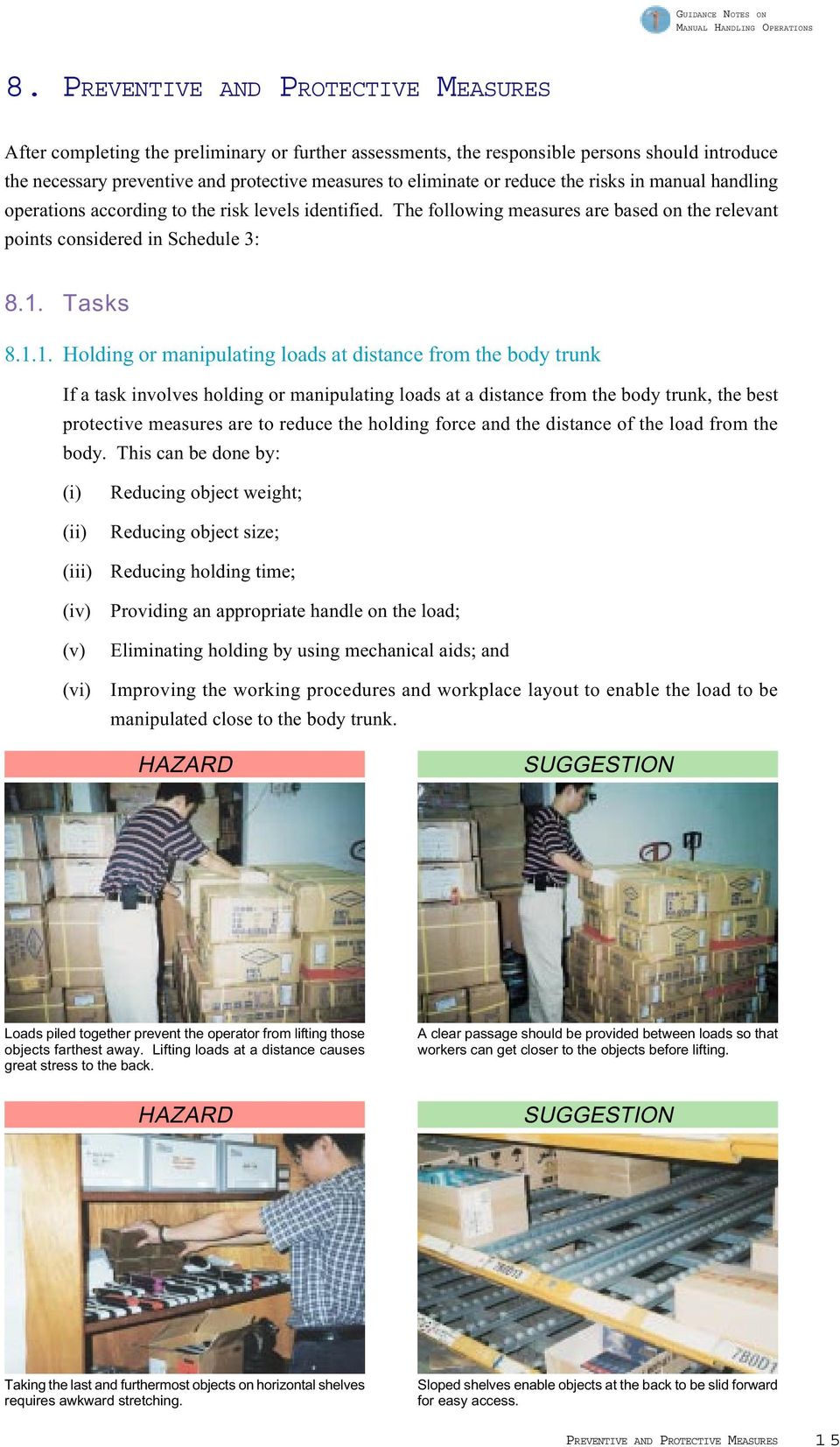
18 GUIDANCE NOTES ON MANUAL HANDLING OPERATIONS 8. PREVENTIVE AND PROTECTIVE MEASURES After completing the preliminary or further assessments, the responsible persons should introduce the necessary preventive and protective measures to eliminate or reduce the risks in manual handling operations according to the risk levels identified. The following measures are based on the relevant points considered in Schedule 3: UKNK q~ëâë Holding or manipulating loads at distance from the body trunk If a task involves holding or manipulating loads at a distance from the body trunk, the best protective measures are to reduce the holding force and the distance of the load from the body. This can be done by: (iv) (v) (vi) Reducing object weight; Reducing object size; Reducing holding time; Providing an appropriate handle on the load; Eliminating holding by using mechanical aids; and Improving the working procedures and workplace layout to enable the load to be manipulated close to the body trunk. iç~çë=éáäéç=íçöéíüéê=éêéîéåí=íüé=çééê~íçê=ñêçã=äáñíáåö=íüçëé çäàéåíë=ñ~êíüéëí=~ï~ók==iáñíáåö=äç~çë=~í=~=çáëí~ååé=å~ìëéë ÖêÉ~í=ëíêÉëë=íç=íÜÉ=Ä~ÅâK ^=ÅäÉ~ê=é~ëë~ÖÉ=ëÜçìäÇ=ÄÉ=éêçîáÇÉÇ=ÄÉíïÉÉå=äç~Çë=ëç=íÜ~í ïçêâéêë=å~å=öéí=åäçëéê=íç=íüé=çäàéåíë=äéñçêé=äáñíáåök q~âáåö=íüé=ä~ëí=~åç=ñìêíüéêãçëí=çäàéåíë=çå=üçêáòçåí~ä=ëüéäîéë êéèìáêéë=~ïâï~êç=ëíêéíåüáåök päçééç=ëüéäîéë=éå~ääé=çäàéåíë=~í=íüé=ä~åâ=íç=äé=ëäáç=ñçêï~êç Ñçê=É~ëó=~ÅÅÉëëK PREVENTIVE AND PROTECTIVE MEASURES 15
19 Unsatisfactory body movements or postures qïáëíáåö=íüé=äççó=íêìåâ If a certain task involves twisting the body trunk, the workplace layout should be re-designed and work practices modified to reduce such movements. This can be achieved by: (iv) Positioning all tools and materials in front of the operator to prevent him/her from twisting the body trunk or extending the body to reach the tools or materials on the two sides of the body; Changing the flow direction of the goods or the height at which they are stored by using conveyors, chutes, slides or turntables; Providing adjustable swivel-chairs for handlers so that they can reach the load without having to twist their trunks; and Creating sufficient work space for the employees so that they can move their bodies around freely instead of twisting their bodies. pçäéäó=íïáëíáåö=íüé=äççó=íêìåâ=íç=ã~åáéìä~íé=üé~îó=äç~çë=áë ~=Ü~ò~êÇçìë=ã~åì~ä=Ü~åÇäáåÖ=çéÉê~íáçåK jçîé=ñççíëíéé=íçöéíüéê=ïáíü=íüé=ïüçäé=äççó=íç ãáåáãáëé=íüé=êáëâ=çñ=áåàìêók 16 PREVENTIVE AND PROTECTIVE MEASURES

20 GUIDANCE NOTES ON MANUAL HANDLING OPERATIONS píççéáåö If a task requires the employee to adopt a stooping posture, it is important to reduce the bending movements. This can be done by: (iv) Adjusting the height of the loads or the work level to reduce the frequency and degree of stooping; Positioning the heavy or frequently used loads so that they can easily be gripped. The ideal position is around waist level; Eliminating large horizontal reaches; and Using lift tables or other mechanical aids to adjust the height and orientation of the load. qüé=ïçêâéê=ãìëí=äéåç=íç=~ååéëë=íüé=ççåìãéåí=éä~åéç=~í íüé=äçííçã=é~êí=çñ=íüé=äççâ=ëüéäñk açåìãéåíë=áå=üé~îó=çéã~åç=çê=çñ=öêé~í=ïéáöüí=ëüçìäç=äé éä~åéç=~êçìåç=íüé=ï~áëí=äéîéä=íç=ãáåáãáëé=íüé=ñêéèìéååó=~åç ÇÉÖêÉÉ=çÑ=ëíççéáåÖK qüé=ëáåâ=áë=íçç=çééé=çê=íçç=äçïi=å~ìëáåö=éñåéëëáîé=äéåçáåö íç=äáñí=ìé=íüé=üé~îó=íê~óë=åçåí~áåáåö=ï~íéê=~åç=çáëüéëi=éíåk ^=ëáåâ=çñ=ëìáí~ääé=üéáöüí=~åç=çñ=éêçééê=çééíü=ãáåáãáëéë ÉñÅÉëëáîÉ=ÄÉåÇáåÖ=ïÜáäÉ=~í=ïçêâK PREVENTIVE AND PROTECTIVE MEASURES 17

21 oé~åüáåö=ìéï~êç If a handler must reach upward to perform a task, it is important to reduce such stretching. This can be done by: Placing materials, workpieces and other heavy objects as near and convenient to the worker as possible; and Providing steps, a height-adjustable work platform or other aids. oé~åüáåö=ìéï~êç=ñêéèìéåíäó=áååêé~ëéë=íüé=êáëâ=çñ áåàìêók rëáåö=~=ñççíëíéé=~îçáçë=ìååéåéëë~êó=ëíêéíåüáåö ïüéå=êé~åüáåö=ìéï~êçk 18 PREVENTIVE AND PROTECTIVE MEASURES
22 GUIDANCE NOTES ON MANUAL HANDLING OPERATIONS bñåéëëáîé=ëíêéíåüáåö=åêé~íéë=íüé=êáëâ=çñ=ëíê~áåëk rëáåö=~=üççâ=ïáíü=~=äçåö=ü~åçäé=~îçáçë=éñåéëëáîé=ëíêéíåüáåök lîéêjëí~åâáåö=çñ=öçççë=åçí=çåäó=êéèìáêéë=éñåéëëáîé=êé~åüáåö Äìí=~äëç=ÄäçÅâë=íÜÉ=îáÉïI=~ÇÇáåÖ=~=ÑìêíÜÉê=êáëâ=íç=ã~åì~ä Ü~åÇäáåÖK e~åçäáåö=~å=~ééêçéêá~íé=~ãçìåí=çñ=öçççë=é~åü=íáãé=å~å êéçìåé=áåàìêáéë=~åç=~ååáçéåíëk PREVENTIVE AND PROTECTIVE MEASURES 19
23 Excessive movement of loads bñåéëëáîé=äáñíáåö=çê=äçïéêáåö=çáëí~ååéë If a task involves lifting or lowering goods for excessive distances, the risk of injury can be reduced by: (iv) (v) Substituting sliding or rolling for lifting; Eliminating manual lifting through the use of lift-tables, forklifts, conveyors, hoists and similar mechanical devices; Reducing the weight of the goods/objects; Reducing carrying time; and Reducing the variations in work levels. rëáåö=~=éççê=éçëíìêé=íç=ìåäç~ç=öçççë=ñêçã=~=íêìåâ=áååêé~ëéë íüé=êáëâ=çñ=áåàìêók rëáåö=~=íêìåâdë=éñíéåçéç=í~áääç~êç=ã~âéë=ã~åì~ä=ü~åçäáåö ãìåü=é~ëáéê=ñçê=ïçêâéêëk 20 PREVENTIVE AND PROTECTIVE MEASURES
24 GUIDANCE NOTES ON MANUAL HANDLING OPERATIONS bñåéëëáîé=å~êêóáåö=çáëí~ååéë If a task involves excessive carrying distances, the following suggestions make manual handling much easier for workers: Using mechanical aids to carry the load; and Reducing the distance, carrying time and the number of movements by re-arranging and improving the workplace layout. bñåéëëáîé=å~êêóáåö=çáëí~ååé=éä~åéë=éñíê~=çéã~åçë=çå ïçêâéêëk rëáåö=~=íêçääéó=ëáãéäáñáéë=íüé=í~ëâ=ïüéå=~=äçåö=çáëí~ååé=ãìëí ÄÉ=ÅçîÉêÉÇK qoliibvp qoliibv=tfqelrq=e^kao^fi qoliibv=tfqe=qtl=tebbip=^ka e^kao^fi=fkpq^iiba PREVENTIVE AND PROTECTIVE MEASURES 21
25 qoliibvp=tfqe=clro=tebbip=^ka=e^kao^fi=fkpq^iiba qoliibvp=clo=`^oovfkd=qllip 22 PREVENTIVE AND PROTECTIVE MEASURES
26 GUIDANCE NOTES ON MANUAL HANDLING OPERATIONS qoliibvp=clo=qo^kpmloq^qflk=lc=j^qbof^ip=^ka=`ilqebp qoliibv=tfqe=p`fpplopjifcqp qoliibv=tfqe=_o^hb qoliibv=clo=j^pp=qo^kpmloq^qflk lc=d^p=`vifkabop m^iibq=g^`h PREVENTIVE AND PROTECTIVE MEASURES 23
27 Other factors bñåéëëáîé=éìëüáåö=çê=éìääáåö=çñ=äç~çë When a task demands excessive pushing or pulling of loads, the risks can be reduced by: (iv) (v) Using conveyors to move a load, or using suitable trolleys to push or pull the load. In the selection and use of trolleys, the size of wheels, the weight limit of the axle, the weight distribution of the trolley frame and the maintenance programme of the trolley should be considered. (If the trolley is pushed or pulled at a very high or low position, the risk arising from manual handling will increase); Reducing the weight of loads; Avoiding rough and uneven floors, and floors with high friction; Providing good maintenance for transport equipment; and Improving the workplace layout to reduce the distance and the requirements for pulling or pushing loads. jçîáåö=~=íêçääéó=ïüáåü=áë=ñìää=çñ=öçççë=å~å=äé=îéêó=çáññáåìäí ~åç=ëíêéåìçìëi=éëééåá~ääó=ïüéå=ëí~êíáåö=~åç=ëíçééáåök qç=~îçáç=ìååéåéëë~êó=êáëâëi=êéèìéëí=üéäé=ñêçã=~=ëéåçåç ééêëçåi=éëééåá~ääó=ïüéå=ëí~êíáåö=~åç=ëíçééáåök tüééäë=íü~í=~êé=åçí=éêçééêäó=ã~áåí~áåéç=ã~âé=áí=ãìåü=ü~êçéê Ñçê=íÜÉ=çéÉê~íçê=íç=éìää=çê=éìëÜK oéöìä~ê=ã~áåíéå~ååé=áë=êéèìáêéç=ñçê=~ää=ãéåü~åáå~ä=~áçë=áå íüé=ïçêâéä~åék 24 PREVENTIVE AND PROTECTIVE MEASURES
28 GUIDANCE NOTES ON MANUAL HANDLING OPERATIONS oáëâ=çñ=ëìççéå=ãçîéãéåí=çñ=äç~çë Poorly balanced loading or interruption of a work process causes sudden movement of loads. For example, a trolley will speed up when being moved down a slope. The risk should be reduced by: (iv) (v) Making a risk assessment when sudden movement of loads is anticipated, and introducing preventive and protective control measures; Piling up the loads in a proper and secure way; Getting co-workers to help; Using appropriate personal protective equipment; and Using appropriate mechanical aids. fñ=~=í~áäö~íé=áë=ìëéç=ïáíüçìí=~=öì~êçi=íêçääéóë=å~å=ãçîé ëìççéåäók fåëí~ääáåö=~=öì~êç=çå=íüé=í~áäö~íé=éêéîéåíë=íêçääéóë=ñêçã ëìççéå=ãçîéãéåíëk cêéèìéåí=çê=éêçäçåöéç=éüóëáå~ä=éññçêí If the nature of the work requires frequent or prolonged physical effort, the risk of injury can be minimised by: Taking occasional breaks from the work; Practising job rotation, allowing handlers to exercise different groups of muscles at intervals, therefore enabling exhausted muscles to recover; and Minimizing jerky and hurried movements. `~êêóáåö=üé~îó=äç~çë=ñêéöìéåíäó=çê=ñçê=~=äçåö=ééêáçç=áë ÉñÜ~ìëíáåÖI=ïÜáÅÜ=áåÅêÉ~ëÉë=íÜÉ=ÅÜ~åÅÉ=çÑ=áåàìêóK ^êê~åöé=àçä=êçí~íáçå=çê=î~êó=í~ëâë=ïáíüáå=~=ëüáñí=íç=éå~ääé ÜÉ~îáäóJÉñÉêÅáëÉÇ=ãìëÅäÉë=íç=êÉÅçîÉêK PREVENTIVE AND PROTECTIVE MEASURES 25
29 fåëìññáåáéåí=êéëí=çê=êéåçîéêó=ééêáççë If a task does not include sufficient rest or recovery periods, the problem can be alleviated by: Providing sufficient rest breaks for employees; and Varying tasks within a shift to allow employees to use different groups of muscles; such arrangements allow different sets of muscles to rest and recover in succession. tçêâáåö=ìåçéê=~å=éñü~ìëíáîé=êéöáãéå=åçí=çåäó=çéåêé~ëéë íüé=éññáåáéååói=äìí=~äëç=áååêé~ëéë=íüé=êáëâ=çñ=~ååáçéåík püçêí=äêé~âë=çìêáåö=ïçêâ=üçìêë=~ääçï=ïçêâéêë=íç=êéåçîéêi áååêé~ëáåö=éññáåáéååó=~åç=çéåêé~ëáåö=íüé=åü~ååé=çñ ~ÅÅáÇÉåíëK ^=ê~íé=çñ=ïçêâ=áãéçëéç=äó=~=éêçåéëë If a task involves a rate of work imposed by a process, the following measures can be adopted to reduce the risk of injury: Training employees to adjust their rate to optimize safety, health and productivity; Providing sufficient manpower and equipment; and Designing buffer zones to cope with peak work demand periods. If the production line is moving faster than the employees' capabilities, these buffer zones would allow items to be taken off the production line for processing later. få~çéèì~íé=åçìåíéêë=áå=éé~â=üçìêë=åêé~íéë=ëíêéëë=ñçê=íüé ïçêâéêëk mêçîáçáåö=ëìññáåáéåí=ã~åéçïéê=~í=~=éêççìåíáçå=äáåé=ïáää êéçìåé=íüé=êáëâ=çñ=áåàìêók 26 PREVENTIVE AND PROTECTIVE MEASURES
30 GUIDANCE NOTES ON MANUAL HANDLING OPERATIONS UKOK iç~çë eé~îó=äç~çë Handling of heavy loads can be made easier by: (iv) (v) Using mechanical aids such as overhead cranes, hoists, slings or vacuum lifters; Reducing weight by the use of smaller containers; Sorting loads into weight categories so that additional precautions can be applied selectively; Dividing a heavy load into smaller components; and Employing team lifting. jçîáåö=~=ñìääó=äç~çéç=íìä=êéèìáêéë=ëíêéåìçìë=éññçêík rëáåö=~=ëã~ääéê=åçåí~áåéê=ã~âéë=íüé=í~ëâ=ãìåü=é~ëáéê=ñçê íüé=ïçêâéêk e~åçäáåö=üé~îó=äç~çë=áååêé~ëéë=íüé=êáëâ=çñ=áåàìêók oéçìåé=íüé=êáëâ=çñ=ü~åçäáåö=äó=çáîáçáåö=íüé=äç~çë=áåíç é~åâ~öéë=çñ=ëã~ääéê=ïéáöüík PREVENTIVE AND PROTECTIVE MEASURES 27
31 rëáåö=ü~åçäáåö=~áçë=êéçìåéë=ä~åâjé~áå=~åç=ñ~íáöìé=ñçê=åìêëéëk e~åçäáåö=üé~îó=äç~çë=áååêé~ëéë=íüé=êáëâ=çñ=áåàìêók rëé=~=íêçääéó=íç=íê~åëéçêí=üé~îó=äç~çëk 28 PREVENTIVE AND PROTECTIVE MEASURES
32 GUIDANCE NOTES ON MANUAL HANDLING OPERATIONS iáñíáåö=^áçë PREVENTIVE AND PROTECTIVE MEASURES 29
33 _ìäâó=çê=ìåïáéäçó=äç~çë Consider the following measures before moving bulky or unwieldy loads: Make the object less bulky by changing its shape or packaging, so that it can be handled as close to the employee's body as possible; Provide suitable handholds; and Employ team lifting. i~êöé=ñä~í=ëüééíë=çñ=ïçççéå=äç~êçë=~êé=ü~êç=íç=ü~åçäé=ïüéå ëíçêéç=üçêáòçåí~ääók séêíáå~ä=ëíçêáåö=çñ=ñä~í=ã~íéêá~äë=ã~âéë=ü~åçäáåö=é~ëáéêk e~åçäáåö=äìäâó=äç~çë=ïáíüçìí=~ëëáëí~ååé=êéèìáêéë=ëééåá~ä ~ííéåíáçåk oéçìåé=íüé=êáëâ=çñ=áåàìêó=äó=íé~ã=äáñíáåök 30 PREVENTIVE AND PROTECTIVE MEASURES
34 GUIDANCE NOTES ON MANUAL HANDLING OPERATIONS iç~çë=íü~í=~êé=çáññáåìäí=íç=öê~ëé Refer to the following suggestions to handle large, round, smooth, wet or greasy loads more safely. (iv) (v) Change the shape or surface of the object to make it easier to grip; Place the load in a easy-to-grasp container; Provide handles, hand grips, indents, etc. to improve the grip; and Use handling aids such as hand-held hooks or suction pads. _çñéë=ïáíüçìí=ü~åç=öêáéë=~êé=~ïâï~êç=íç=ü~åçäék ^ÇÇáåÖ=Ü~åÇÜçäÇë=íç=çééçëáíÉ=ëáÇÉë=çÑ=íÜÉ=Äçñ=áë=~å=É~ëó ~åç=éññéåíáîé=áãéêçîéãéåík píêáåöéåí=éêéå~ìíáçåë=ëüçìäç=äé=í~âéå=ïüéå=ü~åçäáåö=ö~ë ÅóäáåÇÉêëK rëé=~=ëìáí~ääé=íêçääéó=íç=íê~åëéçêí=ö~ë=åóäáåçéêëk PREVENTIVE AND PROTECTIVE MEASURES 31
35 qç=öêáé=~=ä~êöé=éáéåé=çñ=äêé~â~ääé=öä~ëë=éä~åéë=ëíêéëë=çå íüé=~êãëk pìåíáçå=é~çë=ëáãéäáñó=íüé=ü~åçäáåö=çñ=ä~êöé=éáéåéë=çñ=öä~ëëk ^=ëãççíü=äçííäé=ëìêñ~åé=ã~âéë=ü~åçäáåö=çáññáåìäík qé~ã=äáñíáåö=ëüçìäç=äé=ìëéçk rëáåö=~å=~ïâï~êç=éçëíìêé=íç=äáñí=~=é~íáéåí=ñêçã=~=äéç=å~å áååêé~ëé=íüé=êáëâ=çñ=ï~áëí=~åç=ëüçìäçéê=áåàìêáéëk rëáåö=~=äáñíáåö=äéäí=ééêãáíë=íüé=åìêëé=íç=ìëé=~=öççç=éçëíìêé áå=äáñíáåö=íüé=é~íáéåík 32 PREVENTIVE AND PROTECTIVE MEASURES
36 GUIDANCE NOTES ON MANUAL HANDLING OPERATIONS råëí~ääé=äç~ç=çê=~=äç~ç=ïüçëé=åçåíéåíë=~êé=äáâéäó=íç=ëüáñí Consider the following measures in such cases: Pack the objects so that they will not move during transportation; Use slings to maintain effective control while handling non-rigid loads; and Fill liquid containers in such a way that only a small amount of free space is left. This reduces the movement of contents during carrying. råëí~ääé=ëí~åâë=çñ=ïé~â=å~êíçåë=áååêé~ëé=íüé=êáëâë=çñ ~ÅÅáÇÉåíëK `çåëáçéê=íüé=ïéáöüí=äáãáí=çñ=íüé=äçïéê==å~êíçåë=äéñçêé ëí~åâáåök d~êãéåíë=äéáåö=íê~åëéçêíéç=~êé=ìåëí~ääé=~åç=äáâéäó=íç=ãçîék qüáë=áååêé~ëéë=íüé=çáññáåìäíó=áå=ü~åçäáåök qüé=åäçíüéë=ëüçìäç=äé=ñáêãäó=üìåö=çå=~=ëééåá~ä=åäçíüéëjê~åâ ÄÉÑçêÉ=íê~åëéçêí~íáçåK PREVENTIVE AND PROTECTIVE MEASURES 33
37 iç~çë=íü~í=~êé=ëü~êéi=üçí=çê=çíüéêïáëé=éçíéåíá~ääó=ç~ã~öáåö For loads that are sharp, hot or otherwise potentially damaging such as those at low temperature, the employees can reduce the risk of injury by: Making sure that the loads are free from dust, oil or corrosive deposits; Employing handling aids or personal protective equipment; and Using a suitable container to handle sharp objects, and using appropriate insulated personal protective equipment such as gloves or a container to handle hot or cold materials. e~åçäáåö=ñêçòéå=ãé~í=ïáíü=ä~êé=ü~åçë=ã~ó=äé~ç=íç=ëéê~áåë ~åç=ñêçëíäáíék rëáåö=ëìáí~ääé=éêçíéåíáîé=öäçîéë=å~å=êéçìåé=íüé=ü~ò~êçëk 34 PREVENTIVE AND PROTECTIVE MEASURES
38 GUIDANCE NOTES ON MANUAL HANDLING OPERATIONS UKPK tçêâáåö=båîáêçåãéåí pé~åé=åçåëíê~áåíë=íü~í=éêéîéåí=öççç=éçëíìêé If there are space constraints that prevent good posture, the risk of employee injury increases. Nullify such hazards by: Ensuring that obstructions are cleared before attempting to manoeuvre bulky loads through narrow doorways or gangways; Providing sufficient space so that lifting can be done in the work positions with correct postures. oé~åüáåö=ñçêï~êç=ñçê=~=äç~ç=ïáíüçìí=êéãçîáåö=íüé çäëíêìåíáåö=åü~áêë=áë=ü~ò~êççìëk oéãçîáåö=íüé=åü~áêë=êéçìåéë=íüé=ëíêéíåüáåö=éññçêík `ê~ãééç=åçåçáíáçåë=ã~âé=äáñíáåö=ãçêé=ëíêéåìçìë=~åç Ü~ò~êÇçìëK mêçîáçé=ëìññáåáéåí=ëé~åé=ñçê=ïçêâéêë=íç=~ççéí=~=öççç=éçëíìêé ~åç=ìëé=ãéåü~åáå~ä=~áçëk PREVENTIVE AND PROTECTIVE MEASURES 35
39 råéîéåi=ëäáéééêó=çê=ìåëí~ääé=ñäççêë Uneven, slippery or unstable floors such as ramps increase the likelihood of slips, trips and falls. These risks can be reduced by: (iv) (v) Providing stable gangways by using suitable coverings on uneven surfaces; Constructing firm and stable temporary work platforms; Promptly clearing up spillage of water, oil, soap, food scraps and other slippery substances; Applying slip-resistant surfacing to floors or ramps which may easily become wet; Providing anti-slip shoes. qüé=âáíåüéå=ñäççê=áë=çñíéå=ëäáéééêók té~êáåö=åçåjëäáéééêó=ë~ñéíó=ëüçéë=~åç=åäé~åáåö=íüé=ñäççê ÑêÉèìÉåíäó=Å~å=êÉÇìÅÉ=íÜÉ=êáëâ=çÑ=ëäáééáåÖK ^å=ìåëí~ääé=ñäççê=üáåçéêë=íüé=ãçîéãéåí=çñ=íêçääéóëk mêçîáçé=~=ëí~ääé=ö~åöï~ó=äó=ìëáåö=~=ëìáí~ääé=åçîéêáåök ^=ÅÜ~áê=ïáíÜ=ïÜÉÉäë=áë=~å=ìåëí~ÄäÉ=ÑççíëíÉéK rëé=~=ëí~ääé=åü~áê=çê=~=ëìáí~ääé=ñççíëíéék 36 PREVENTIVE AND PROTECTIVE MEASURES
40 GUIDANCE NOTES ON MANUAL HANDLING OPERATIONS s~êá~íáçå=áå=äéîéä=çñ=ñäççêë=çê=ïçêâ=ëìêñ~åéë This increases both the complexity of movement and the risk of injury. Counter-measures are to: Control floor level variations through the use of ramps; Provide steps of slight slope and of sufficient width; and Arrange tasks to be performed at a uniform height. jçîáåö=íêçääéóë=ççïå=~=ëí~áêå~ëé=áë=ü~ò~êççìëk rëáåö=~=ê~ãé=çê=~ççáåö=~=íéãéçê~êó=ê~ãé=êéçìåéë=íüé=êáëâ çñ=~ååáçéåíëk jçîáåö=å~êíçåë=äéíïééå=íïç=çáññéêéåí=ïçêâ=äéîéäë=éêçãçíéë éççê=éçëíìêéëk rëé=íêìåâë=ïáíü=~=í~áääç~êç=çê=íê~åëñéê=ñêçã=~=äç~çáåö=ä~ók tçêâáåö=~í=çáññéêéåí=äéîéäë=áååêé~ëéë=íüé=éññçêí=êéèìáêéç=áå ã~åì~ä=ü~åçäáåö=çééê~íáçåëk rëé=~=íêçääéó=éèìáéééç=ïáíü=~=ëåáëëçêjäáñí=~åç=~êê~åöé=íüé êéä~íéç=ïçêâë=~í=íüé=ë~ãé=ïçêâ=äéîéäk PREVENTIVE AND PROTECTIVE MEASURES 37
41 bñíêéãéë=çñ=íéãééê~íìêé=çê=üìãáçáíó Working in such conditions can be improved by one or more of these methods: (iv) Controlling temperature and humidity in the workplace as far as possible; Eliminating or reducing the working hours in extreme conditions; Using proper personal protective equipment; and Providing a work-rest regime with longer rests. tçêâáåö=áå=~=ñêééòéê=áë=ëíêéåìçìë=~åç=å~ìëéë=ñ~íáöìék mêçîáçé=~ééêçéêá~íé=éêçíéåíáîé=éèìáéãéåí=ñçê=ïçêâéêë=~åç ãáåáãáëé=íüé=ïçêâáåö=üçìêë=ïüéêé=íüé=ïçêâáåö=éåîáêçåãéåí êéèìáêéë=~ççáíáçå~ä=éêéå~ìíáçåëk 38 PREVENTIVE AND PROTECTIVE MEASURES
42 GUIDANCE NOTES ON MANUAL HANDLING OPERATIONS `çåçáíáçåë=å~ìëáåö=îéåíáä~íáçå=éêçääéãë=çê=öìëíë=çñ=ïáåç Such conditions can be minimised by: (iv) Relocating or taking a different route in carrying out the manual handling operations; Utilizing handling aids to support or give greater control of the load; Using a team of workers to handle the loads; and Reducing the area or size of the load or object. `~êêóáåö=äìäâó=äç~çë=áå=öìëíë=çñ=ïáåç=áååêé~ëéë=íüé=çáññáåìäíó çñ=ü~åçäáåö=~åç=íüé=êáëâ=çñ=~ååáçéåíëk rëé=çñ=íé~ã=äáñíáåö=áë=~=ë~ñé=~åç=éññéåíáîé=ãé~ëìêék mççê=äáöüíáåö=åçåçáíáçåë This can create the possibility of falling or tripping. Remedial measures include: Providing sufficient well-directed light; Providing auxiliary lighting if the operator has to read the labels on the load, so that the operator does not have to use an awkward posture; and Re-designing the lighting system to minimise contrast between areas of bright light and deep shadow. mççê=äáöüíáåö=åçåçáíáçå=áååêé~ëéë=íüé=êáëâë=çñ=áåàìêáéëk qüé=äçå~íáçå=çñ=íüé=äáöüí=ëçìêåé=~ññéåíë=íüé=äáöüíáåö=åçåçáíáçå áå=íüé=ïçêâéä~åék PREVENTIVE AND PROTECTIVE MEASURES 39
43 UKQK fåçáîáçì~ä=å~é~åáíó lééê~íáçå=êéèìáêéë=ìåìëì~ä=ëíêéåöíü=çê=üéáöüíi=çê=çíüéê=~äåçêã~ä=éüóëáå~ä ÅÜ~ê~ÅíÉêáëíáÅë In such cases, consider the following factors: Arrange for pre-employment and periodic medical examinations; and Allow a certain adjustment period for a worker who has been away from work for a long time. For example, let the employee do a job requiring a comparatively low work rate, then increase the rate gradually. Alternately, let him/her carry lighter loads. pçãé=àçäë=êéèìáêé=ìåìëì~ä=ëíêéåöíüi=üéáöüí=çê=çíüéê=ëééåá~ä éüóëáå~ä=åü~ê~åíéêáëíáåëk==eqüáë=éüçíçöê~éü=áë=éêçîáçéç=äó cpakf ^êê~åöé= éêéjéãéäçóãéåí= ~åç= ééêáççáå= ãéçáå~ä Éñ~ãáå~íáçåëK 40 PREVENTIVE AND PROTECTIVE MEASURES
44 GUIDANCE NOTES ON MANUAL HANDLING OPERATIONS lééê~íáçå=åêé~íéë=~=ü~ò~êç=íç=ééêëçåë=ïüç=~êé=éêéöå~åí=çê=ü~îé=~=üé~äíü=éêçääéã If the manual handling operation creates a hazard to workers with a health problem or to pregnant women, these protective measures can be adopted: Allocate such workers less physically demanding tasks; Take special care of women having to handle loads while pregnant or after childbirth; Assess the respective capability of employees to perform strenuous manual handling operations; (iv) When changes in the employees' health conditions (for example, hernia, pregnancy, recovery from injury or surgical operation) affect their abilities to perform normal duties, the employer should make special arrangements for them, modifying their workload or allocating other tasks for them as reasonably practicable; and (v) In doubtful cases, seek a doctor's assessment of the capability of the individual to perform the manual handling operations, instead of forming generalized conclusions on the worker's capacity to handle the task. ^ääçå~íé=ëìáí~ääé=í~ëâ=íç=ïçêâéê=ïüç=áë=áå=êéåçîéêó=ééêáçç ~åç=éäáãáå~íé=äç~ç=íê~åëéçêí~íáçåk lééê~íáçå=êéèìáêéë=ëééåá~ä=áåñçêã~íáçå=çê=íê~áåáåö=ñçê=áíë=ë~ñé=ééêñçêã~ååé The responsible person should ensure that appropriate information and a special training programme be provided because the lack of such information increases the risk of injury. mêçîáçé=áåñçêã~íáçå=ëìåü=~ë=íüé=ïéáöüí=~åç=íüé=üé~îáéê=ëáçé çñ=íüé=äç~çk mêçîáçé=ãéíüçç=~åç=áåñçêã~íáçå=çå=éêçééê=äáñíáåök mêçîáçáåö=~çéèì~íé=íê~áåáåö=ãáåáãáëéë=íüé=êáëâ=çñ=~ååáçéåíëk PREVENTIVE AND PROTECTIVE MEASURES 41
45 UKRK líüéê= Ñ~Åíçêë In some situations, employees should wear special protective clothing to reduce the risk of injury. For example, wearing gloves not only protects the hands from injury but also keeps them warm; wearing the proper shoes not only prevents slipping but lessens the chance of injury by a heavy object. If the movement or posture are hindered by personal protective equipment or by clothing, the following measures may help reduce the risk: Use personal protective equipment only when engineering or other controls do not offer adequate protection; and Wearing the properly fitted clothing allows loads to be carried close to the body and eliminates restricted body movements in manual handling. dêáééáåö=äç~çë=äéåçãéë=çáññáåìäí=áñ=öäçîéë=çñ=~=ïêçåö=ëáòé ~êé=ìëéçk däçîéë=çñ=~=êáöüí=ëáòé=å~å=ñ~åáäáí~íé=ã~åì~ä=ü~åçäáåö çééê~íáçåëk té~êáåö=äççëé=çê=íáöüí=åäçíüéë=áååêé~ëéë=íüé=êáëâ=çñ=ã~åì~ä Ü~åÇäáåÖ=çéÉê~íáçåëK `äçíüéë=çñ=~=ëìáí~ääé=ëáòé=å~å=ñ~åáäáí~íé=ã~åì~ä=ü~åçäáåö çééê~íáçåëk 42 PREVENTIVE AND PROTECTIVE MEASURES
46 GUIDANCE NOTES ON MANUAL HANDLING OPERATIONS 9. INFORMATION AND TRAINING The employer must provide adequate training and information to his/her employees so that they can perform manual handling operations safely and without harming their health. For example, information on the weight and the heavier side of a load should be provided to employees. The employer should provide training to new employees, and re-training to employees transferred to jobs with hazardous potential. When there are significant changes in the working environment, (e.g. new equipment is installed or a new system of work or work practices is introduced that may create manual handling risks to workers), the employer should review the new situation and provide sufficient information and appropriate training to the workers to handle the task in the new environment. Training programs should be modified as tasks are altered so that employees can learn new techniques to work more safely. The employer should also provide refresher courses to the employees to revise the manual handling skills and knowledge and exchange experience during the training sessions. VKNK=qóéÉë=çÑ=qê~áåáåÖ qüéêé=~êé=íïç=íóééë=çñ=íê~áåáåö=çå=ã~åì~ä=ü~åçäáåök General training General training on manual handling should take place during the job orientation. This type of training should be provided to everyone who organizes and performs hazardous manual handling operations, and includes managers, supervisors, manual handling operators and health and safety personnel. qê~áåáåö=åçåíéåíë The level of training should be commensurate with the risk involved. The coverage should be tailored to the needs of the participants. The following contents can be considered in the training course: (iv) (v) (vi) Basic function of the spine, body postures, types of muscle work, and principles of levers; Manual handling operations regulations; The role and responsibilities of the responsible persons and employees; Identification of manual handling risks; Preliminary and further risk assessment; Principles of correct manual handling operations; (vii) Hazardous manual handling operations in the workplace; (viii) Preventive and protective measures; and (ix) The risk management of manual handling operations. INFORMATION AND TRAINING 43
47 Task-specific training If the employees must undergo specific manual handling tasks, they and their supervisors should attend the task-specific training. This task-specific training should be provided before the manual handling operations are begun. Moreover, such training should be provided when there are changes to the work practices or new procedures are introduced. läàéåíáîéë=çñ=í~ëâjëééåáñáå=íê~áåáåö Participants should acquire the following skills and knowledge after training: (iv) (v) (vi) Identify factors affecting individual capability; Carry out manual handling operations according to the established safety procedures; Use relevant mechanical aids; Use proper manual handling techniques; Build up good co-ordination in team lifting and understand how to reduce associated risks; Use proper personal protective equipment; and (vii) Understand that they have the responsibility to take care of other employees and to use methods with the least risk to perform manual handling operations. VKOK qê~áåáåö= ~êê~åöéãéåí In making arrangement for training, the employers can provide general training or taskspecific training according to the level and need of the employees. The employers can also combine the general and task-specific training if necessary. 44 INFORMATION AND TRAINING
48 GUIDANCE NOTES ON MANUAL HANDLING OPERATIONS 10. REFERENCES lååìé~íáçå~ä=p~ñéíó=~åç=eé~äíü=oéöìä~íáçå=e=`ü~éíéê=rmv=f tçêâp~ñé=téëíéêå=^ìëíê~äá~=`çããáëëáçåi=`ççé=çñ=mê~åíáåé=ñçê=j~åì~ä=e~åçäáåöi NVVSK EÜííéWLLë~ÖÉKïíKÅçãK~ìLë~ÑÉíóäáåÉLíê~áåáåÖLã~åì~äLã~åN áåçküíãf k~íáçå~ä=lååìé~íáçå~ä=eé~äíü=~åç=p~ñéíó=`çããáëëáçåi=k~íáçå~ä=pí~åç~êç=ñçê j~åì~ä=e~åçäáåö=~åç=k~íáçå~ä=`ççé=çñ=mê~åíáåé=ñçê=j~åì~ä=e~åçäáåöi=^ìëíê~äá~å dçîéêåãéåí=mìääáëüáåö=péêîáåéi=`~åäéêê~i=nvvmk j~åì~ä=e~åçäáåö=w=dìáç~ååé=çå=oéöìä~íáçåë=w=j~åì~ä=e~åçäáåö=lééê~íáçåë oéöìä~íáçåë=nvvoi=eé~äíü=~åç=p~ñéíó=bñéåìíáîéi=rhi=nvvok mêéîéåíáåö=j~åì~ä=e~åçäáåö=fåàìêáéë=j=^å=lpe=qê~áåáåö=j~åì~ä EÜííéWLLë~ÖÉKïíKÅçãK~ìLë~ÑÉíóäáåÉLíê~áåáåÖLã~åì~äLã~åä áëíküíãf REFERENCES 45
49 11. ENQUIRIES AND COMPLAINTS For enquiries about this Guidance Notes or advice on occupational health and hygiene matters, please contact the Labour Department's Occupational Safety and Health Branch through: Address: 15/F, Harbour Building 38 Pier Road, Central, Hong Kong Tel: Fax: Home Page Address: Address: Information on the services offered by the Labour Department and on major labour legislation can also be found on our website. Information on the services provided by the Occupational Safety and Health Council can be obtained through its hotline and website If you have any complaints about unsafe workplaces and practices, please call the Labour Department's Occupational Safety and Health complaint hotline at All complaints will be treated in the strictest confidence. 46 ENQUIRIES AND COMPLAINTS
50 APPENDIX I: GUIDANCE NOTES ON MANUAL HANDLING OPERATIONS PRELIMINARY ASSESSMENT CHECKLIST FOR MANUAL HANDLING OPERATIONS (SAMPLE 1) (Please read the Guidelines in Appendix II before filling in this form. Please put a " " in an appropriate box.) Work locations/department of the organisation: Job Title: Job/Task description: Date of assessment: m~êí=^w=^ëëéëëãéåí 1. Does the manual handling operation involve repeated awkward postures? 2. Does the employee require strenuous effort or have difficulties in manipulating the load? 3. Is there any information indicating that this manual handling operation involves a significant risk of injury? 4. Are there any conditions in the working environment that may create additional risks to the manual handling operators? 5. Is the employee unsuitable to perform or physically incapable of performing this manual handling operation? Yes No Uncertain Notes (refer to the Guidelines in Appendix II) Twisting, kneeling, stooping, bending or twisting the wrist & extending the arm above the shoulder, etc. Strenuous effort is usually required to handle load greater than 16 kg without mechanical aids such as trolleys or other simple lifting equipment. A risky operation in the trades & industries, confirmed complaint of hazardous operation & known case of injuries or death. Risks include space constraints, slippery, uneven or unstable floors, & variations in the level of floors or work surfaces. Temporary or permanent physical injuries, musculoskeletal disorders, health problems or pregnant, etc. m~êí=_w=cáåçáåöë=(diagrams can be used to indicate the positions & postures of employees at work.) Number of employees performing this hazardous manual handling operation: The position(s) of the employees at work: Other significant findings: m~êí=`w=`çååäìëáçåë=~åç=cçääçïjìé 1. Stop the hazardous manual handling =(Note: If this operation can be avoided.) operation immediately. 2. Make a further assessment. =(Note: Part or all of the answers in Part A are "Yes" or "Uncertain".) 3. Need NO further assessment. =(Note: All the answers in "Part A" are "No".) 4. Others: Assessor: Signature: APPENDIX I 47
51 APPENDIX II: GUIDELINES FOR THE PRELIMINARY ASSESSMENT CHECKLIST FOR MANUAL HANDLING OPERATIONS (SAMPLE 1) m~êí=^w=^ëëéëëãéåí (Please put a " " in an appropriate box in Appendix I "Preliminary Assessment Checklist for Manual Handling Operations (sample 1)". Refer to Part A of Appendix I for the questions.) Question 1 'Repeated awkward postures' refer to the performance of repetitive tasks with the following postures: (iv) Twisting the body trunk; Kneeling or stooping; Bending or twisting the wrist; Extending the arm above the shoulder. Question 2 Mechanical aids include trolleys or other simple lifting equipment. Manipulation involves lifting, lowering, pushing, pulling and carrying the loads. Strenuous effort is usually required to handle loads greater than 16 kg in a standing position. In addition, it increases the risk of back injury. Question 3 The following scenarios may indicate a significant risk of injury: From safety and health publications or other sources of information in the trades and industries, the manual handling operations of the same nature involve a significant risk of injury; Complaints on the hazardous manual handling operations are received and confirmed; and There are known cases of injuries or death arising from the manual handling operations in the workplace. Question 4 Conditions in the working environment that may create additional risks are: space constraints; slippery, uneven or unstable floors; and variations in the level of floors or work surfaces. Question 5 The following conditions can be used for a preliminary assessment of whether employees are physically capable of undertaking the manual handling operation concerned: Employees are found to have visible temporary or permanent physical injuries; 48 APPENDIX II
52 GUIDANCE NOTES ON MANUAL HANDLING OPERATIONS (iv) (v) An employee who has complained of persistent symptoms such as aches and pains in the hands, wrists, arms, shoulders or back which are associated with musculoskeletal disorders; An employee has reported to the management that he/she is more susceptible to the hazardous manual handling operations because of his/her health problems; An employee has reported to the management that she is pregnant; and If the information on the employee is not available, please select "Uncertain". Before the manual handling operations are performed, review the situation when the information is available. m~êí=_w=cáåçáåöë If TEN or more employees are normally employed at a workplace at any one time to perform manual handling operations which may create safety and health risks, assessment records should be kept. Information on the employees who have performed the manual handling operations and a simple diagram indicating the positions and postures of employees at work and those environmental risk factors can be attached in the assessment records. m~êí=`w=`çååäìëáçåë=~åç=cçääçïjìé (Please put a " " in an appropriate box in Appendix I "Preliminary Assessment Checklist for Manual Handing Operations (sample 1)".) 1. If the manual handling operation is found to have a significant risk and the operation can be avoided as far as reasonably practicable, it should be stopped immediately. 2. If PART or ALL of the answers in Part A are "Yes" or "Uncertain", the manual handling operation concerned has a significant risk. When it is not feasible to stop the operation, a further assessment should be made. 3. If ALL the answers in Part A are "No", the manual handling operation DOES NOT involve a significant risk. APPENDIX II 49
53 APPENDIX III: PRELIMINARY ASSESSMENT CHECKLIST FOR MANUAL HANDLING OPERATIONS (SAMPLE 2) (Please put a " " in an appropriate box.) Work locations/department of the organisation: Job Title: Job/Task description: Date of assessment: m~êí=^w=^ëëéëëãéåí 1. Is there any information indicating that this manual handling operation involves a significant risk of injury? Yes : Please go to Q2. No : The assessment need not go any further. 2. Can the manual handling operation be avoided / mechanised / automated at a reasonable cost? Yes : Please proceed and check that the result is satisfactory. No : Please go to Q.3 3. Is the employee unsuitable to perform or physically incapable of performing this manual handling operation? Yes : Please complete "Further Assessment Checklist for Manual Handling Operations". No : Please choose No.4 of Part C. m~êí=_w=cáåçáåöë=(diagrams can be used to indicate the positions & postures of employees at work.) Number of employees performing this hazardous manual handling operation: The position(s) of the employees at work: Other significant findings: m~êí=`w=`çååäìëáçåë=~åç=cçääçïjìé 1. This manual handling operation can be avoided / mechanised / automated at a reasonable cost. 2. Make a further assessment. 3. Need NO further assessment. 4. Reduce the risk of this manual handling operation to the lowest level as far as reasonably practicable. 5. Others: Assessor: Signature: 50 APPENDIX III
54 APPENDIX IV: GUIDANCE NOTES ON MANUAL HANDLING OPERATIONS HINTS ON ASSESSING THE WEIGHT OF LOADS OF MANUAL HANDLING OPERATIONS Manual handling operations often involve complex movements. The following diagram describes the recommended weights on simple lifting or lowering for an adult male operator who works under optimum conditions. The optimum conditions mean that an operator does not involve twisting, bending or other awkward postures and the operator's hands are at vertical and horizontal position when moving a load. This guildeline assumes that the load is readily grasped with both hands and the operation takes place under reasonable working conditions with the operator at a stable body position. If the hands enter more than one of the box zones during the operation, the smallest weight figure should be used. An intermediate figure may be chosen where the hands are close to a boundary. Where lifting or lowering with hands beyond the box zones is unavoidable, a further assessment should be made. It should be noted that the given figures are not weight limits. For female operators, as a rough guide, these figures should be reduced by one third. The above diagram aims at assisting the responsible person to identify which manual handling operations require further assessments. If the weight of a load is over the recommended figures, a further assessment should be performed and controls for reducing the risk of injury should also be adopted. "Absolutely safe" manual handling operations DO NOT exist. What we can do is to make the operations safer. When manual handling operations involve frequent or repeated movements, the responsible person should conduct a further assessment. The adoption of mechanical aids or other measures should be considered. Even when the operation is performed under optimum conditions, a further assessment is needed if the weight of the load approaches 16 kg. APPENDIX IV 51
55 APPENDIX V: FURTHER ASSESSMENT CHECKLIST FOR MANUAL HANDLING OPERATIONS (Please read the Guidelines in Appendix VI before filling in this form. Please put a " " in an appropriate box.) Work locations/department of the organisation: Job title: Job/Task description: Date of assessment: m~êí=^w=^ëëéëëãéåí Yes No Comments 1. The tasks Do they involve holding or manipulating loads at a distance from the body's trunk? Do they involve unsatisfactory bodily movement or posture especially-- (a) Twisting the body's trunk? (b) Stooping? (c) Reaching upward? Do they involve excessive movement of loads, especially-- (a) Excessive lifting or lowering distances? (b) Excessive carrying distances? Do they involve-- (a) Excessive pushing or pulling of loads? (b) A risk of sudden movement of loads? (c) Frequent or prolonged physical effort? (d) Insufficient rest or recovery periods? (e) A rate of work imposed by a process? 2. The loads Are they-- (a) Heavy? (b) Bulky or unwieldy? (c) Difficult to grasp? (d) Unstable, or with contents likely to shift? (e) Sharp, hot or otherwise potentially harmful? 52 APPENDIX V
56 GUIDANCE NOTES ON MANUAL HANDLING OPERATIONS Yes No Comments 3. The working environment Are there space constraints that prevent good posture? Are there uneven, slippery or unstable floors? Are there variations in the level of floors or work surfaces? Are there extremes of temperature or humidity? Are there conditions causing ventilation problems or gusts of wind? Are the lighting conditions poor? 4. Individual capability Does the operation-- (a) Require unusual strength or height, or other special physical characteristics? (b) Create a hazard to persons with a health problem or to pregnant women? (c) Require special information or training for its safe performance? 5. Other matters Is movement or posture hindered by personal protective equipment or by clothing? m~êí=_=w cáåçáåöë=(diagrams can be used to indicate the positions and postures of employees at work.) Number of employees performing this hazardous manual handling operation: The position(s) of the employees at risk: Other significant findings: APPENDIX V 53
57 m~êí=`w `çååäìëáçåë=~åç=cçääçïjìé 1. Discussion: 2. Preventive and protective measures for this process (in the order of their completion dates): Preventive and Protective Measures Date for Date for Completion Follow-up 3. Others: Assessor: Signature: 54 APPENDIX V
58 APPENDIX VI: GUIDANCE NOTES ON MANUAL HANDLING OPERATIONS GUIDELINES FOR THE FURTHER ASSESSMENT CHECKLIST FOR MANUAL HANDLING OPERATIONS 2 m~êí=^w=^ëëéëëãéåí (Please put a " " in an appropriate box in Appendix V "Further Assessment Checklist for Manual Handling Operations". Refer to Part A of Appendix V for the questions.) 1. The tasks eçäçáåö=çê=ã~åáéìä~íáåö=äç~çë=~í=~=çáëí~ååé=ñêçã=íüé=äççódë=íêìåâ In such cases, the stress imposed on the body is much greater than when holding the same load close to the trunk. Therefore the employees should not excessively work under such situations and the employers should arrange suitable breaks for the employees. råë~íáëñ~åíçêó=äççáäó=ãçîéãéåí=çê=éçëíìêé (a) Twisting the body's trunk The greater the range of body twists, the higher the risk of getting injured. The following method is a simple way to judge whether twisting of the body trunk is excessive: If the arms move away from the body at an angle exceeding 45 while manipulating, pulling or pushing loads with two hands, it can be considered as excessive twisting. (b) Stooping If frequent bending of the waist or leaning forward is required, the stress on the back increases. (c) Reaching upward If frequent reaching over shoulder height is required, additional stresses are placed on the arms and back, making control of the load more difficult. Excessive extending of arms increases the risk of injury. 2 The values (including the twisting angle, carrying distance, weight and dimensions of loads, etc.) provided in Appendix VI are solely for reference. They do not represent fine lines between safe and dangerous situations. The assessor could use other values with scientific grounds according to the characteristics of different trades and industries. APPENDIX VI 55
59 bñåéëëáîé=ãçîéãéåí=çñ=äç~çë (a) Excessive lifting or lowering distances If the vertical distance involved is more than 25 cm, it is likely to require a change of grip during the carrying process. This increases the risk of injury. (b) Excessive carrying distances Even when a load is held close to the body and carried with a good posture, covering a distance of more than 10 m without a pause might increase the risk of muscle fatigue and injury. líüéê=ñ~åíçêë (a) Excessive pushing or pulling of loads In pushing or pulling a load, the best position of the hands should be near waist level. Even if this posture is employed, excessive effort should not be required. The situations cited below are considered as excessive: The use of about 250 Newton (N) for starting or stopping a load that is slid, rolled or supported on wheels. [250 N is approximately equivalent to the weight of a 25 kg object.] The use of over 100 N for keeping such a load in motion. [100 N is approximately equivalent to the weight of a 10 kg object.] If the position of the hands is above the shoulder or below the waist, the effective horizontal force exerted by the hands is gradually reduced. Thus, the employee has to adopt an awkward posture to push or pull the load. If there is an option to either push or pull, pushing is recommended. (b) A risk of sudden movement of loads If a load suddenly moves, and the operator is unprepared or is unable to retain complete control of the load, unpredictable stresses imposed on the body would increase the risk of injury. (c) Frequent or prolonged physical effort This can create a high risk of injury even if the loads are modest. For example, a repetitive task without rest increases the risk of injury. (d) Insufficient rest or recovery periods If the employee does not have enough rest, or if the recovery period is too short, the risk of injury increases. For instance, the same groups of muscles is exerted continuously when performing a task. (e) A rate of work imposed by a process When a worker lacks control over the pace of work, mild fatigue can become more pronounced, leading to a greater risk of injury. Moreover, having to meet tight deadlines and work during peak demand periods also contribute to higher risk. 56 APPENDIX VI
60 GUIDANCE NOTES ON MANUAL HANDLING OPERATIONS 2. The loads (a) Heavy loads According to ILO Convention No. 127 and Recommendation No. 128, the maximum permissible weight should normally not be over 55 kg when an adult male worker transports a load without mechanical aids. For women and young workers, the maximum weight of a load should be substantially less than that permitted for an adult male worker. The risk of back injury increases when a load over 16 kg is manipulated from a standing position. When a load less than or equal to 16 kg is manipulated without mechanical aids, the frequency of manipulation should be considered in the assessment. The following table gives some numerical guidelines: Loads (kg) Manual Handling Risk increases when frequency (in times/min.) exceeds (If the weight of a load lies between two categories, classify this weight as in heavier category. For example, if the weight of a load is 3.5 kg, the reading of 4-8 kg should be used.) (b) Bulky or unwieldy loads If a load to be lifted is too big or bulky, it will not be possible to handle it close to the body. In addition, a bulky load interferes with vision. When a worker has to carry such a big and bulky load, the size of the load should be reduced to enable the operator to hold it firmly and without difficulty. The range of sizes of load is as follows: (c) The object should be shorter than 50 cm; The object should be less than 30 cm wide; and The sum of any two of the object's dimensions should be less than 75 cm. Difficult-to-grasp loads Large or round loads are difficult to grasp. If the surface of a load is smooth, wet or greasy, extra grip strength is also required and the risk of dropping the load and the likelihood of fatigue will increase. (d) Unstable loads or loads with contents likely to shift Stacking loads without order affects the stability of the group of loads during movement, and increases the risk of injury. Struggling patients or disturbed animals are examples of unstable loads. When containers are partially filled with liquid, the liquid inside will move in response to the containers' movements. As the centre of gravity changes, it becomes more difficult to carry the load and the risk of injury increases. APPENDIX VI 57
61 (e) Loads which are sharp, hot or otherwise potentially harmful Such loads may impair grip and discourage good posture. 3. The working environment pé~åé=åçåëíê~áåíë=íü~í=éêéîéåí=öççç=éçëíìêé A person working in a spatially constrained area is forced to adopt a poor posture. Examples of such areas are: those with height restriction, which will force the worker to stoop; and constricted working areas, narrow doorways and aisles, which will aggravate the difficulty in handling bulky loads. råéîéåi=ëäáéééêó=çê=ìåëí~ääé=ñäççêë Working on uneven, slippery or unstable floors increases the risk of slipping, tripping and falling. Floors affected by spillage of water, oil, soap or food scraps increase the hazards of slipping. Handling loads on moving vehicles or mobile work platforms also causes difficulty and risks of injury. s~êá~íáçåë=áå=íüé=äéîéä=çñ=ñäççêë=çê=ïçêâ=ëìêñ~åéë When a worker carries a load up or down steps or steep slopes, the risk of injury increases with the movement complexity. In addition, uneven work surfaces place a greater demand on lifting and lowering. bñíêéãéë=çñ=íéãééê~íìêé=çê=üìãáçáíó Consideration on the safety and health risks of workers working under extreme temperature and humidity is of utmost importance. The assessment is not solely for assessing the effect of such extreme conditions but also for recognizing the additional risk and effort required of manual handling operators in such conditions. Please refer to other relevant publications concerning the specific methods and information in assessing the risk of extreme temperature or humidity. `çåçáíáçåë=å~ìëáåö=îéåíáä~íáçå=éêçääéãë=çê=öìëíë=çñ=ïáåç Inadequate ventilation affects the air quality. On the other hand, high winds or powerful ventilation systems make large loads more difficult to manage. mççê=äáöüíáåö=åçåçáíáçåë This aggravates tripping hazards. Any marked contrast between areas of bright light and deep shadow hinders the accurate judgment of height and distance. Auxiliary lighting may be required when the operator has to read the labels on the load. Please refer to "Guidelines for Good Occupational Hygiene Practice in a Workplace" published by the Labour Department for the Illuminance Standard. 4. Individual capability (a) Operation requiring unusual strength or height, or other special physical characteristics 58 APPENDIX VI
62 GUIDANCE NOTES ON MANUAL HANDLING OPERATIONS (b) In such cases, apart from the general assessment, a special method should be designed to assess the capabilities of the operator and the safety and health effects on the operator performing the task. When a worker is away from work for an extended period, there may be a need for a period of adjustment for the worker to return to previous workload capacities and working rates. Operation creating a hazard to persons with a health problem or to pregnant women The assessor should ask the manual handlers whether they suffer from back trouble, hernia or other health problems which may hinder their undertaking of manual handling operations. In addition, the assessor should find out whether they are recovering from surgery so that the assessor could ascertain whether such problems might increase the risk of injury of the manual handling operations. A doctor's advice should be sought if necessary. During pregnancy, hormonal changes can affect the ligaments, leading to increased susceptibility of injury. Furthermore, a pregnant woman will experience increased difficulty in holding a load close to her body as the pregnancy progresses. (c) Operation requiring special information or training for its safe performance In such cases, the assessor should confirm whether the employees have undertaken appropriate training or got sufficient information, so that they can safely perform the manual handling tasks. For example, employers should provide training on the safe use of mechanical aids. 5. Other matters jçîéãéåí=çê=éçëíìêé=üáåçéêéç=äó=ééêëçå~ä=éêçíéåíáîé=éèìáéãéåí=çê=äó ÅäçíÜáåÖ A tight or loose uniform will restrict movements, and adversely affect manual handling operations. Wearing bulky personal protective equipment will also increase stress on the body. m~êí=_w=cáåçáåöë If TEN or more employees are normally employed at a workplace at any one time to perform manual handling operations which may create safety and health risks, assessment records should be kept. Information of employees who have performed the manual handling operations and a simple diagram indicating the positions and postures of employees at work and those environmental risk factors can be attached in the assessment records. m~êí=`w=`çååäìëáçåë=~åç=cçääçïjìé The responsible persons should provide preventive and protective measures according to the assessment result to minimise the risks of injuries after the assessment. In arranging for preventive and protective measures, the responsible persons could consider the allocation of resources and manpower, the problems encountered in providing the measures and the provision of training, etc. APPENDIX VI 59
63 APPENDIX VII: PROPER LIFTING IN GENERAL qüáåâ=cáêëí devise a safe carrying procedure according to the size, shape and weight of the object; clear the corridor or path of obstructions; use appropriate personal protective equipment; use mechanical aids or get help if there is any doubt. rëé=`çêêéåí=iáñíáåö=mçëíìêé start close to the object; bend knees, squat down, straddle the load to some degree, keep the back straight; grasp the object firmly so that your grip will not slip; hold the object close to the body and lift with the legs, slowly straightening them. After the legs are straight, bring them back to a vertical position; always lift smoothly and avoid jerky motions. Turn with the feet and never twist your back. NK aéîáëé=~=ë~ñé=å~êêóáåö=éêçåéçìêé=~ååçêçáåö=íç=íüé=ëáòéi ëü~éé=~åç=ïéáöüí=çñ=íüé=çäàéåíëk OK rëé=ãéåü~åáå~ä=~áçë=çê=öéí=üéäé=áñ=íüéêé=áë=~åó=ççìäík 60 APPENDIX VII
64 GUIDANCE NOTES ON MANUAL HANDLING OPERATIONS PK=pí~êí=ÅäçëÉ=íç=íÜÉ=çÄàÉÅíK QK _ÉåÇ=âåÉÉëI=ëèì~í=ÇçïåI=ëíê~ÇÇäÉ=íÜÉ=äç~Ç=íç=ëçãÉ ÇÉÖêÉÉI=âÉÉé=íÜÉ=Ä~Åâ=ëíê~áÖÜíK RK=dê~ëé=íÜÉ=çÄàÉÅí=Ñáêãäó=ëç=íÜ~í=óçìê=Öêáé=ïáää=åçí=ëäáéK APPENDIX VII 61
65 SK eçäç=íüé=çäàéåí=åäçëé=íç=íüé=äççó=~åç=äáñí=ïáíü=íüé=äéöëi ëäçïäó=ëíê~áöüíéåáåö=íüéãk==^ñíéê=íüé=äéöë=~êé=ëíê~áöüíi ÄêáåÖ=íÜÉã=Ä~Åâ=íç=~=îÉêíáÅ~ä=éçëáíáçåK TK ^äï~óë=äáñí=ëãççíüäó=~åç=~îçáç=àéêâó=ãçíáçåëk==qìêå=ïáíü íüé=ñééí=~åç=åéîéê=íïáëí=óçìê=ä~åâk 62 APPENDIX VII
66
Manual Handling- The Whole Story!
 Manual Handling- The Whole Story! For Responsible Managers and Assessors Course Notes Mark Mallen Group Health and Safety Manager July 2005 Course Content 1 What is Manual Handling? 2 What s the Problem?
Lifting and Handling, a Risk Assessor s Guide
 Lifting and Handling, a Risk Assessor s Guide 1 Introduction Unfortunately manual handling accidents are all too common, and can lead to life-long problems with bad backs. While they do not have the same
Back Pain Musculoskeletal Disorder Updated October 2010
 Back Pain Musculoskeletal Disorder Updated October 2010 According to the Health and Safety Executive back pain is the most common health problem for British workers. Approximately 80% of people experience
MANUAL HANDLING IN OFFICES
 Manual Handling General risk assessments of work/teaching activities are required to be completed under the Management of Health and Safety at Work Regulations. Where appropriate, manual handling should
HealthandSafetyOntario.ca. Hazards. Introduction. Legislation
 Manual Materials handling Introduction Manual materials handling operations are carried out in most workplaces. Each handling task poses unique demands on the worker. However, workplaces can help workers
MANAGING MANUAL HANDLING A Guide for Managers and Heads of Departments
 MANAGING MANUAL HANDLING A Guide for Managers and Heads of Departments HEALTH & SAFETY UNIT SPRING 2006 CONTENTS INTRODUCTION...2 REGULATION...2 WHAT IS MANUAL HANDLING?...2 RESPONSIBILITIES...2 STRATEGY...2
Guidance notes for completing a detailed manual handling risk assessment
 Guidance notes for completing a detailed manual handling risk assessment This guidance should be used in conjunction with the detailed manual handling assessment form in appendix 1. When filling out the
Procedure for Managing Injury Risks Associated with Manual Tasks
 Burgess-Limerick & Associates Ergonomics and Research Consultants ABN 84976421949 Procedure for Managing Injury Risks Associated with Manual Tasks Burgess-Limerick, R. (2008). Procedure for Managing Injury
Manual Handling. Procedure
 ` Manual Handling Procedure *All Forth Valley College Health, Safety and Welfare Procedures are covered under the overarching Health, Safety and Welfare Policy. Status: Date of version: Review Date: Reviewed
PROTECTION AGAINST RISKS OF BACK INJURY AT WORK PLACES REGULATIONS
 OF BACK INJURY AT WORK PLACES [S.L.424.17 1 SUBSIDIARY LEGISLATION 424.17 PROTECTION AGAINST RISKS OF BACK INJURY AT WORK PLACES REGULATIONS LEGAL NOTICE 35 of 2003. 24th January, 2003 1. The title of
MANUAL HANDLING POLICY
 Northumberland Street Alnwick Northumberland NE 66 1 LT Tel: 01665 510 241 MANUAL HANDLING POLICY Designated Health and Safety Officer for the above address: Sally Lane (Deputy Manager) It is the responsibility
[Project name] Standard Operating Procedures. Body Mechanics
![[Project name] Standard Operating Procedures. Body Mechanics](/thumbs/27/11986346.jpg "[Project name] Standard Operating Procedures. Body Mechanics") [Project name] Standard Operating Procedures Body Mechanics PURPOSE. The purpose of this SOP is to provide information to minimize staff injuries with the focus on back injuries resulting from improper
[Project name] Standard Operating Procedures Body Mechanics PURPOSE. The purpose of this SOP is to provide information to minimize staff injuries with the focus on back injuries resulting from improper
Appendix 1: Step 1 Manual tasks: Hazard identification form (example)
 Appendix 1: Step 1 Manual tasks: Hazard identification form (example) Manual task no./name How identified Note the methods of identification include: reported hazard or injury/illness; consultation; and
These notes are designed to be used in conjunction with the Moving and Handling PowerPoint slides.
 CORE SKILLS FRAMEWORK MOVING AND HANDLING PRINCIPLES FOR STAFF: LESSON NOTES & TIPS FOR A SUGGESTED APPROACH These notes are designed to be used in conjunction with the Moving and Handling PowerPoint slides.
Safe Lifting/Back Safety Training. Presented by Rita Gagnon Occupational Health Outreach Coordinator Benefis Health Systems 406-731-8328
 Safe Lifting/Back Safety Training Presented by Rita Gagnon Occupational Health Outreach Coordinator Benefis Health Systems 406-731-8328 Risk Factors Involved with Manual Handling Tasks: Bending at Trunk
CCG CO11 Moving and Handling Policy
 Corporate CCG CO11 Moving and Handling Policy Version Number Date Issued Review Date V2 06/11/2015 01/10/2017 Prepared By: Consultation Process: Formally Approved: 05/11/2015 Governance Manager, North
Guidance for Manual Handling of Gas Cylinder
 Guidance for Manual Handling of Gas Cylinder The Manual Handling Operations Regulations 1992 (updated 1998) came into force in January 1993. The purpose of the regulations is to reduce the risk of injury
CCG CO11 Moving and Handling Policy
 Corporate CCG CO11 Moving and Handling Policy Version Number Date Issued Review Date V1: 28/02/2013 04/03/2013 31/08/2014 Prepared By: Consultation Process: Formally Approved: Information Governance Advisor
Guide to manual tasks high impact function (HIF) audit 2010 March 2010
 Guide to manual tasks high impact function (HIF) audit 2010 March 2010 1 Adelaide Terrace, East Perth WA 6004 Postal address: Mineral House, 100 Plain Street, East Perth WA 6004 Telephone: (08) 9358 8002
NATIONAL CODE OF PRACTICE FOR MANUAL HANDLING [NOHSC:2005(1990)]
![NATIONAL CODE OF PRACTICE FOR MANUAL HANDLING [NOHSC:2005(1990)]](/thumbs/30/13937452.jpg "NATIONAL CODE OF PRACTICE FOR MANUAL HANDLING [NOHSC:2005(1990)]") NATIONAL CODE OF PRACTICE FOR MANUAL HANDLING [NOHSC:2005(1990)] 13 14 1. INTRODUCTION 17 Purpose 17 Interpretation 17 Overview 17 2. GENERAL PRINCIPLES 18 Consultation 18 Design 18 Risk Identification,
NATIONAL CODE OF PRACTICE FOR MANUAL HANDLING [NOHSC:2005(1990)] 13 14 1. INTRODUCTION 17 Purpose 17 Interpretation 17 Overview 17 2. GENERAL PRINCIPLES 18 Consultation 18 Design 18 Risk Identification,
Health and Safety Initial Induction Training. Manual Handling
 Health and Safety Initial Induction Training Manual Handling This training has been designed to provide information to help you understand the problems associated with the manual handling of loads and
Hazards and risks associated with manual handling in the workplace
 14 Hazards and risks associated with manual handling in the workplace Summary Manual handling occurs in almost all working environments, though workers in construction, agriculture, hotels and restaurants
Musculoskeletal disorders in construction
 1 Musculoskeletal disorders Construction is a high-risk sector, but it is not just a worker's safety at risk, but also his health. While there are well over a thousand workers killed each year in accidents
MANUAL HANDLING IN HEALTH CARE SERVICES
 56 This Guidance is prepared by the Occupational Safety and Health Branch Labour Department First edition January 2000 This Guidance is issued free of charge and can be obtained from offices of the Occupational
Slip, Trip & Fall Prevention Handbook
 Slip, Trip & Fall Prevention Handbook This prevention handbook provides you with a basic understanding of what causes a slip, trip or fall and gives you some ideas on what you can do to stop these incidents
Tips for Eliminating and Controlling MSD Hazards
 Tips for Eliminating and Controlling MSD Hazards Force Gripping tools/equipment Provide tools that allow workers to grip the tool using a power grip Eliminate the use of pinch or key grips as much as possible
Ergonomics in the Workplace
 Ergonomics in the Workplace Ergonomics in the Workplace 1 Introduction The purpose of this short guide is to provide information to the reader on the subject of Ergonomics. It also provides guidance on
Back Safety and Lifting
 Back Safety and Lifting Structure of the Back: Spine The spine is the part of the back that supports the trunk and head. It protects the spinal cord as well as giving flexibility to the body. Vertebrae
Workplace Job Accommodations Solutions for Effective Return to Work
 Workplace Job Accommodations Solutions for Effective Return to Work Workplace Job Accommodations Solutions for Effective Return to Work Published by 102 275 Broadway Winnipeg, MB R3C 4M6 www.mflohc.mb.ca
http://intranet.urmc-sh.rochester.edu/policy/smhpolicies/section10/10-22.pdf
 APPENDIX B Patient Care Lifting Guidelines Patient handling, including lifting, transferring, and repositioning, is covered by SMH Policy 10.22 Minimal Lift for Patient Handling, which can be found at:
Guidance on the Management of Manual Handling in the Workplace
 Guidance on the Management of Manual Handling in the Workplace 1 0 Guidance on the Management of Manual Handling in the Workplace Published in June 2005 by the Health and Safety Authority, 10 Hogan Place,
Existing task Change in task, object or tool Report of musculoskeletal disorder (MSD)
 Assessment details Location of task: Description of manual task: Date of assessment: Persons doing assessment: Work area management rep: Work area H&S rep: Others (employees, consultants): Reason for identification:
Code of Practice for Manual Handling
 Code of Practice for Manual Handling How to use this Code Find out how the basic manual handling hazard management process works. Figure 1 Page 6 Read the glossary if you are not familiar with the terms
Management Tools to Prevent Material Handling Low Back Injuries
 L O S S C O N T R O L A L E R T Management Tools to Prevent Material Handling Low Back Injuries This Alert provides management tools and injury prevention strategies for manual material handling tasks.
MSD Hazards & Solutions FORCE
 FORCE Lower Force Good Posture Less Repetition Reduced MSD Risk Lifting/Lowering Hazards Lifting from the floor Overhead Lifting Lifting out of a Bin Lifting while reaching Lifting heavy loads Lifting/Lowering
usculoskeletal injuries?
 usculoskeletal injuries? How to reduce musculoskeletal injuries Ergonomics for the prevention of musculoskeletal disorders deals with working postures, working movements, physical loads and other conditions
Guidance on the Management of Manual Handling in the Workplace
 Guidance on the Management of Manual Handling in the Workplace 10 Guidance on the Management of Manual Handling in the Workplace Published in June 2005 by the Health and Safety Authority, 10 Hogan Place,
Guidelines for the Prevention. Soft Tissue Injuries. May 12, 2003
 Guidelines for the Prevention of Soft Tissue Injuries May 12, 2003 TABLE OF CONTENTS (i) (ii) Foreword Acknowledgement 1. Introduction 1.1 Purpose 1.2 Interpretation 1.3 Overview 1.4 Application 2. General
Safe Lifting and Carrying
 PART 1 Basic Lifts Proper lifting and handling will help protect against injury and make your job easier. It takes training and practice to do it right. The following are basic steps in safe lifting and
Standard Operating Procedure for Handling an Inanimate Load
 Standard Operating Procedure for Handling an Inanimate Load Moving and handling an inanimate load/s is a key part of the working day for most employees. Moving inanimate loads can take place in many different
BODY STRESSING RISK MANAGEMENT CHECKLIST
 BODY STRESSING RISK MANAGEMENT CHECKLIST BODY STRESSING RISK MANAGEMENT CHECKLIST This checklist is designed to assist managers, workplace health staff and rehabilitation providers with identifying and
Reducing Ergonomic Hazards
 Lifting and Handling Loads Part 3 Reducing Ergonomic Hazards This is the last in a three-part series of Safety Bulletins dealing with the lifting and handling of loads. Also known as manual handling or
NERC HEALTH & SAFETY PROCEDURE NUMBER 8 SAFETY IN MANUAL HANDLING OF LOADS
 NERC HEALTH & SAFETY PROCEDURE NUMBER 8 SAFETY IN MANUAL HANDLING OF LOADS VERSION NUMBER: 2.4 DATE OF ORIGINAL ISSUE: June 2001 DATE OF REVISION: June 2014 INTRODUCTION Manual lifting or handling of objects
ERGONOMICS. Improve your ergonomic intelligence by avoiding these issues: Awkward postures Repetitive tasks Forceful exertions Lifting heavy objects
 ERGONOMICS The goal of ergonomics is to reduce your exposure to work hazards. A hazard is defined as a physical factor within your work environment that can harm your body. Ergonomic hazards include working
Back Safety Goals. Back injury and injury prevention Lifting techniques Quiz
 Back Safety Back Activities Reaching, bending over, sitting Skiing, hiking, bike riding Playing with your children and grandchildren Working and feeling productive Back Safety Goals Back injury and injury
Moving and Handling Techniques
 Moving and Handling Techniques Introduction Manual handling involves any activity that requires the use of force exerted by a person to lift, lower, push, pull, carry or otherwise move or hold an object.
LOSS CONTROL ALERT Preventing low back pain injuries from material handling tasks
 LOSS CONTROL ALERT Preventing low back pain injuries from material handling tasks Low back injuries are common and costly for many companies. These injuries have many causes including sprains and strains
REFRIGERATION & AIR CONDITIONING
 Musculoskeletal hazards and controls REFRIGERATION & AIR CONDITIONING Photocopy this profile and distribute it as widely as possible! Musculoskeletal disorders (MSDs), such as chronic back pain or shoulder
HOSPITALITY RISK FACTORS & BEST PRACTICES - LAUNDRY
 Responsibilities of commercial laundry staff can include washing, drying, steaming, ironing, and chemically treating fabrics for use in hospitals, hotels, and other settings. Laundry can be heavy, treated
<< INSERT COMPANY NAME
 > SLIIP-TRIIP-FALL & STRAIIN IINJURY TRAIINIING > Fall Prevention Slips, trips, and falls constitute the majority of general industry accidents. They cause 15% of
Material 1. Dolly, hand cart, wheel cart, large box, back belt
 29CFR 1926.20(b)-Accident Reduction, 29CFR 1926.21- Safety Training & Education Back and Lifting Safety Preparation 1. Read Applicable Background information and related Company Policy Chapter. 2. Make
Good manual handling practice
 Health and Safety Services Good manual handling practice If you lift, carry, push or pull as part of your job, the following guidance is for you Injuries caused Poor lifting technique and work methods
WEEKLY SAFETY MEETING All Euramax Subsidiaries BACK SAFETY / PROPER LIFTING. Safety Meeting Contents. Meeting Notice. Leaders Guide.
 Safety Meeting Contents Meeting Notice Employee Handout Employee Quiz Meeting Sign-In Sheet Employee Puzzle PRIOR TO THE WEEKLY MEETING: - Post the meeting notice by the timeclock - Read through the and
LIFTING AND BACK SAFETY TRAINING LESSON PLAN
 LIFTING AND BACK SAFETY TRAINING LESSON PLAN Topic: Back Safety and Proper Lifting Techniques This presentation is designed to assist trainers conducting Lifting and Back Safety training for workers. Back
Working as a cashier. HealthandSafetyOntario.ca. Hazard: Poor Workstation Layout
 Working as a cashier Cashiers are at risk for many painful muscles and joint injuries, hazards due to noise, and possibly a quick pace of work. Hazard: Poor Workstation Layout The workstation surface is
Safety in Offices and other General Areas
 Safety in Offices and other General Areas 1. INTRODUCTION This document covers health and safety in offices and other 'general areas' including corridors, stairs, entrances, small kitchens and rest areas.
Wellness & Lifestyles Australia
 Wellness & Lifestyles Australia MANUAL HANDLING IN AGED CARE AND THE HEALTH CARE INDUSTRY E-BOOK prepared by Wellness & Lifestyles Australia 2007,2008,2009 Table of Contents Page No. IMPORTANT NOTICE...
Guide on the Prevention of Musculoskeletal Injuries
 Guide on the Prevention of Musculoskeletal Injuries Many hazards in the work place can lead to employee injuries. Part XIX of the Canada Occupational Health and Safety Regulations outlines a hazard prevention
Patient handling techniques to prevent MSDs in health care
 28 Introduction Patient handling techniques Work-related musculoskeletal disorders (MSDs) are a serious problem among hospital personnel, and in particular the nursing staff. Of primary concern are back
APPENDIX A. Sets = the completion of one consecutive grouping of repetitions of an exercise.
 Exercise Instruction Sheet Instructions: APPENDIX A Exercises are to be performed 3 times per week. Allow one rest day between each exercise day. You may divide the exercises into groups and perform them
Ergonomic Solutions: Baggage Handling. Ergonomic Solutions: Baggage Handling. Division of Workers Compensation HS02-023B (02-14)
 Ergonomic Solutions: Baggage Handling Ergonomic Solutions: Baggage Handling Division of Workers Compensation HS02-023B (02-14) Table of Content Baggage Check-In 3 Transferring Baggage to Main Conveyor
Workplace Health, Safety & Welfare
 Relevant Legislation Workplace (Health, Safety and Welfare) Regulations 1992 Construction (Design & Management) Regulations 2015 Provision & Use of Work Equipment Regulations 1998 (PUWER) Lifting Operations
Slips, Trips and Falls. Awareness Month. February 2005. Slips, Trips and Falls
 THE SCHOOL DISTRICT OF PITTSBURGH Slips, Trips and Falls Awareness Month Joint Labor / Management Safety Committee Please open the attachment for additional information that will answer safety questions
Chief Executive Office Risk Management Division P.O. Box 1723, Modesto, CA 95354 Phone (209) 525-5710 Fax (209) 525-5779
 Employer: Occupation: Company Contact: Analysis Provided By: Stanislaus County Resident Physician Risk Management 1010 10 th Street Modesto, California 95354 (209) 525-5770 Date: October 2008 Lyle Andersen,
HAZARDOUS MANUAL TASKS
 HAZARDOUS MANUAL TASKS Code of Practice DECEMBER 2011 Safe Work Australia is an Australian Government statutory agency established in 2009. Safe Work Australia consists of representatives of the Commonwealth,
Handling the news HANDLING THE NEWS. Who is this leaflet for? What s the problem with newspaper and magazine bundles?
 Advice for employers on manual handling of bundles Who is this leaflet for? HANDLING THE NEWS Advice for employers on manual handling of bundles This is a web friendly version of leaflet IACL105 (now withdrawn
Manual handling at work
 Manual handling at work A brief guide Introduction This leaflet describes what you, as an employer, may need to do to protect your employees from the risk of injury through manual handling tasks in the
Chief Executive Office Risk Management Division P.O. Box 1723, Modesto, CA 95354 Phone (209) 525-5710 Fax (209) 525-5779
 Employer: Occupation: Classification: Company Contact: Analysis Provided By: Stanislaus County Licensed Vocational Nurse Licensed Vocational Nurse I, II Risk Management 1010 10 th Street Modesto, California
CONSTRUCTION WORK and CUMULATIVE TRAUMA DISORDERS
 Connecticut Department of Public Health Environmental and Occupational Health Assessment Program 410 Capitol Avenue MS # 11OSP, PO Box 340308 Hartford, CT 06134-0308 (860) 509-7740 http://www.ct.gov/dph
DEMOLITION Photocopy this profile and distribute it as widely as possible!
 Musculoskeletal hazards and controls DEMOLITION Photocopy this profile and distribute it as widely as possible! Musculoskeletal disorders (MSDs), such as chronic back pain or shoulder problems, often take
Injuries from lifting, loading, pulling or pushing can happen to anyone in any industry. It is important to be aware of the risks in your workplace.
 Workplace safety: lifting One of the biggest concerns in the workplace is lifting and loading. When you lift something, the load on your spine increases and your spine can only bear so much before it is
Administrative Procedures Memorandum A4007
 Page 1 of 9 Date of Issue May 2015 Original Date of Issue March 2011 Subject WORKPLACE SAFETY AND INSURANCE BOARD (WSIB) CLAIMS References Links Contact Workplace Safety & Insurance Act (Ontario) Human
Sprains and strains prevention
 Sprains and strains prevention Think Safe - Work Smart Introduction Each year more than 85,000 workers are injured in Queensland costing Queensland billions of dollars in hidden costs. 1 This booklet
Workplace Guidelines for the Prevention of Musculoskeletal Injuries
 Workplace Guidelines for the Prevention of Musculoskeletal Injuries A Joint Initiative B.C. Government and Service Employees Union Public Service Employee Relations Commission Workplace Guidelines for
Back Safety Program POLICY AND PROCEDURE
 Back Safety Program POLICY AND PROCEDURE This is (Enter Company Name Here) Back Safety Program. It meets all OSHA requirements and applies to all our work operations. (Enter Name Here) will be responsible
Fact Sheet: Occupational Overuse Syndrome (OOS)
 Fact Sheet: Occupational Overuse Syndrome (OOS) What is OOS? Occupational Overuse Syndrome (OOS) is the term given to a range of conditions characterised by discomfort or persistent pain in muscles, tendons
Professor Alan Hedge, Cornell University, August 2013
 Lifting and Back Stress DEA3250/6510 Professor Alan Hedge Low Back Pain Low back pain occurs in 80% of adults at some point in their lives Low back pain is second only to upper respiratory infections as
Slips, trips & falls Prevention Policy & Procedure 45
 Bethany Care Ltd Slips, trips & falls Prevention Policy & Procedure 45 A little slip at work can have a big impact on your life. Date Created 30/06/2008 Date Reviewed 22/10/2014 Document Review Details
Hazardous Manual. Code of Practice. December 2012 CP110. Workplace Standards Department of Justice
 Hazardous Manual Tasks Code of Practice December 2012 CP110 Workplace Standards Department of Justice This code of practice has been approved by the Tasmanian Minister for Workplace Relations under section
Home care occupational health and safety compliance kit: How to control the most common hazardous tasks in the home care sector
 Home care occupational health and safety compliance kit: How to control the most common hazardous tasks in the home care sector Victorian workers returning home safe every day About this kit This kit has
Position Description Questionnaire
 Position Description Questionnaire To the Employee: This written information is of great value in understanding and evaluating the duties and responsibilities of the job that you presently hold. These
Why Back Safety is Important
 Back Safety Why Back Safety is Important Back injuries are considered by OSHA (the Occupational Safety and Health Administration) as the nation's #1 workplace safety problem. Back Injuries are often: Very
&'( ,,( - 0&( .&( WMSD = Work Related Muscular Skeletal Disorder
 Lotsa pounds ! "!!!" #$% &'( )*+ 0&( )*+,,( - )*+.&( /) )*+ WMSD = Work Related Muscular Skeletal Disorder Source: SHARP technical report No. 40-6-2002 #$%+#! Source: American Society of Safety Engineers
ERGONOMICS GUIDELINES FOR MANUAL HANDLING. 2 nd EDITION (2010)
 ERGONOMICS GUIDELINES FOR MANUAL HANDLING 2 nd EDITION (2010) Reprinted August 2011 TABLE OF CONTENTS Ergonomics is the science of studying people at work and then designing tasks, jobs, information, tools,
How To Ensure Safety On A Caravan Site
 EAST CAMBRIDGESHIRE DISTRICT COUNCIL A Site Operators Guide to Health and Safety Introduction The Health and Safety at Work Etc. Act 1974 places a duty on all persons having control of a caravan site to
EVIDENCE-BASED PRACTICES FOR IMPROVING INJURY REDUCTION PERFORMANCE
 EVIDENCE-BASED PRACTICES FOR IMPROVING INJURY REDUCTION PERFORMANCE To accelerate improvement in workplace safety, KP requires that the following proven practices are in place across KP s hospitals in
Pushing and pulling of loads: Assessment checklist
 Pushing and pulling of loads: Assessment checklist Section A - Preliminary Task name: Task description: Is an assessment needed? (An assessment will be needed if there is a potential risk of injury, eg
Back Injury Prevention. Back Injury. Prevention. Division of Workers Compensation HS01-023B0 (02-14)
 Back Injury Prevention Division of Workers Compensation HS01-023B0 (02-14) Table of Content Learn To Prevent Back Injury 3 Exercise To Strengthen Your Back and Reduce Stress 3 Lose Excess Weight 3 Maintain
Warehousing and storage Keep it safe
 Warehousing and storage Keep it safe This short guide is to help those involved in warehousing and storage to reduce the number of injuries and cases of occupational ill health. It contains simple advice
MATERIAL HANDLING PROGRAM (Section 10)
 MATERIAL HANDLING PROGRAM (Section 10) OVERVIEW (WMI Facility) (1) Only certified personnel will operate powered industrial lifts. (2) Training will be provided to those who require to be certified or
Ergonomics in Agriculture
 Ergonomics in Agriculture Although, agriculture has become more mechanized in the last century, there are still many small farm operations where planting and harvesting activities are done by hand-a person