
Patient Records Policy
|
|
|
- Timothy Sutton
- 9 years ago
- Views:
Transcription

1 Document Title Patient Records Policy Document Description Document Type Policy Service Application Trust Wide Version 2.2 Name Mr Amir Khan Jo Williams Lead Author(s) Job Title Medical Director Health Records Care Group Manager Change History Version Date Comments 1 October 2011 Policy developed for integrated organisation 2 July 2015 Policy re-written to include Community Executive Director / Director / Manager If you are assured that the correct procedure has been followed for the consultation of this policy, sign and date below: Name Amir Khan Date 28 August 2015 Signature Links with External Standards Department of Health Records Management Code of Practice Care Quality Commission NHSLA CNST Information Governance Toolkit Key Dates DATE Ratification Date October 2015 TMB 108/15 Review Date October
2 Document Title: Please Tick ( ) as appropriate Executive Summary Sheet Patient Records Policy This is a new document within the Trust This is a revised Document within the Trust What is the purpose of this document? The purpose of this policy is to define a structure to ensure adequate healthcare records across the Trust are maintained, managed and controlled effectively in order to comply with legal, operational and information needs and to reduce the risks associated with patient records management. What key Issues does this document explore? The processes staff are required to follow to ensure the availability of patient healthcare records across the Trust. Who is this document aimed at? All staff within Walsall Healthcare NHS Trust. What other policies, guidance and directives should this document be read in conjunction with? Department of Health Records Management Code of Practice Access to Healthcare Records Information Governance Policy Risk Management Strategy The Community Care (Delayed Discharges etc) Act 2003 How and when will this document be reviewed? To be reviewed in line with changes in Department of Health guidance 2

3 CONTRIBUTION LIST Key individuals involved in developing the document Name Jo Williams Liz Miller Sara Clarke Designation Health Records Care Group Manager Health Records/OPD Team Leader Health Records/OPD Supervisor Circulated to the following for consultation Name / Committee / Group Policies and Procedures Group Intranet Policy Forum Divisional Quality Team - Surgery Version Control Summary Significant or Substantive Changes from Previous Version A new version number will be allocated for every review even if the review brought about no changes. This will ensure that the process of reviewing the document has been tracked. The comments on changes should summarise the main areas/reasons for change. When a document is reviewed the changes should use the tracking tool in order to clearly show areas of change for the consultation process. Version Date Comments on Changes Author 3

4 Document Index Pg No 1 Introduction 6 2 Scope 7 3 Statement of Intent 8 4 Procedures 8 5 Roles and Responsibilities 11 6 Audit/Monitoring 13 7 Training 15 8 Definitions 15 9 Legal / professional Issues Related Policies 16 Appendices Pg No 1 Records Management Lifecycle 17 2 Health Records Tracking Procedure 18 3 Procedure for Preparing Healthcare Records 20 - Planned/Elective in Acute Setting - Emergency Admissions to Acute Setting - Planned Transfer from Acute Setting to Intermediate Care (Hollybank/Richmond Hall) or Spot Purchase Bed within the Community Setting - Patients Attending an Outpatient Appointment within the Acute Setting - Patient Attending an Outpatient Appointment within the Community Setting 4 Procedure for the Structure, Format and Filing of a 24 Healthcare Record 5 Procedure for Filing into Healthcare Records 26 6 Procedure for Deceased Patient Healthcare Records 27 7 Procedure for Management of Multi Volume Healthcare 28 Records 8 Procedure for Transfer of Healthcare Records to Other 29 NHS Hospitals, Outsourcing to Independent Sector (as directed by the Trust) or Patient Moving to Private Care (their choice) 9 Procedure for Requesting Healthcare Records for Audits, 30 Study or Outside of Normal Working Hours 10 Archiving of Healthcare Records - Community Procedure for Disposal and Destruction of Healthcare 34 Records 12 Procedure for Using Alerts/Warnings/Sensitives on 35 Healthcare Records 13 Procedure for Creation and Inclusion of New Documentation 36 in Healthcare Records 4

5 Appendices (Continued) Pg No 14 Procedure for using Temporary Healthcare Records Procedure for the Transfer of Healthcare Records to 38 Outreach Clinics in the Community 16 Patient Records Committee Terms of Reference Contents of a Healthcare Record Audit Tool Audit Templates and Guidance 43 - Form 1: Inclusion Criteria and Sampling - Form 2:1 Paper Healthcare Records Entry Proforma (Acute and Community) - Form 2:2 Electronic Healthcare Records Entry Proforma (Acute and Community) - Form 3: Storage Audit Proforma (Acute and Community) - Form 4: Single Assessment Process (SAP) Yellow Folder Entry Proforma (Community only) - Form 5: Results and Action Planning Template (Acute and Community) 19 Retention Periods 20 List of Abbreviations Commonly Used 5

6 1. Introduction Records Management is the process by which an organisation manages all the aspects of records whether internally or externally generated and in any format or media type, from their creation, all the way through their lifecycle to their eventual disposal. The Records Management: NHS Code of Practice has been published by the Department of Health as a guide to the required standards of practice in the management of records for those who work within or under contract to NHS organisations in England. It is based on current legal requirements and professional best practice. The Trust s records are its corporate memory, providing evidence of actions and decisions and representing a vital asset to support daily functions and operations. Records support policy formation and managerial decision-making, protect the interests of the Trust and the rights of patients, staff and members of the public. They support consistency, continuity, efficiency and productivity and help deliver services in consistent and equitable ways. The Trust has adopted this Records Management Policy and is committed to ongoing improvement of its records management functions as it believes that it will gain a number of organisational benefits. These include: Better use of physical and server space; Better use of staff time; Improved control of valuable information resources; Compliance with legislation and standards, staffs clinical governing body professional codes of practice; and Reduced costs. The Trust also believes that its internal management processes will be improved by the greater availability of information that will accrue by the recognition of records management as a designated corporate function. This document sets out a framework within which the staff responsible for managing the Trust s records can develop specific policies and procedures to ensure that records are managed and controlled efficiently and effectively, at best value, commensurate with legal, operational and information needs. This document was written in accordance with the Department of Health Guidance Records Management: NHS Code of Practice (Parts 1 and 2) and explains the Trusts processes for ensuring that all records are: Properly controlled, Readily accessible, and eventually Archived or otherwise disposed of 6

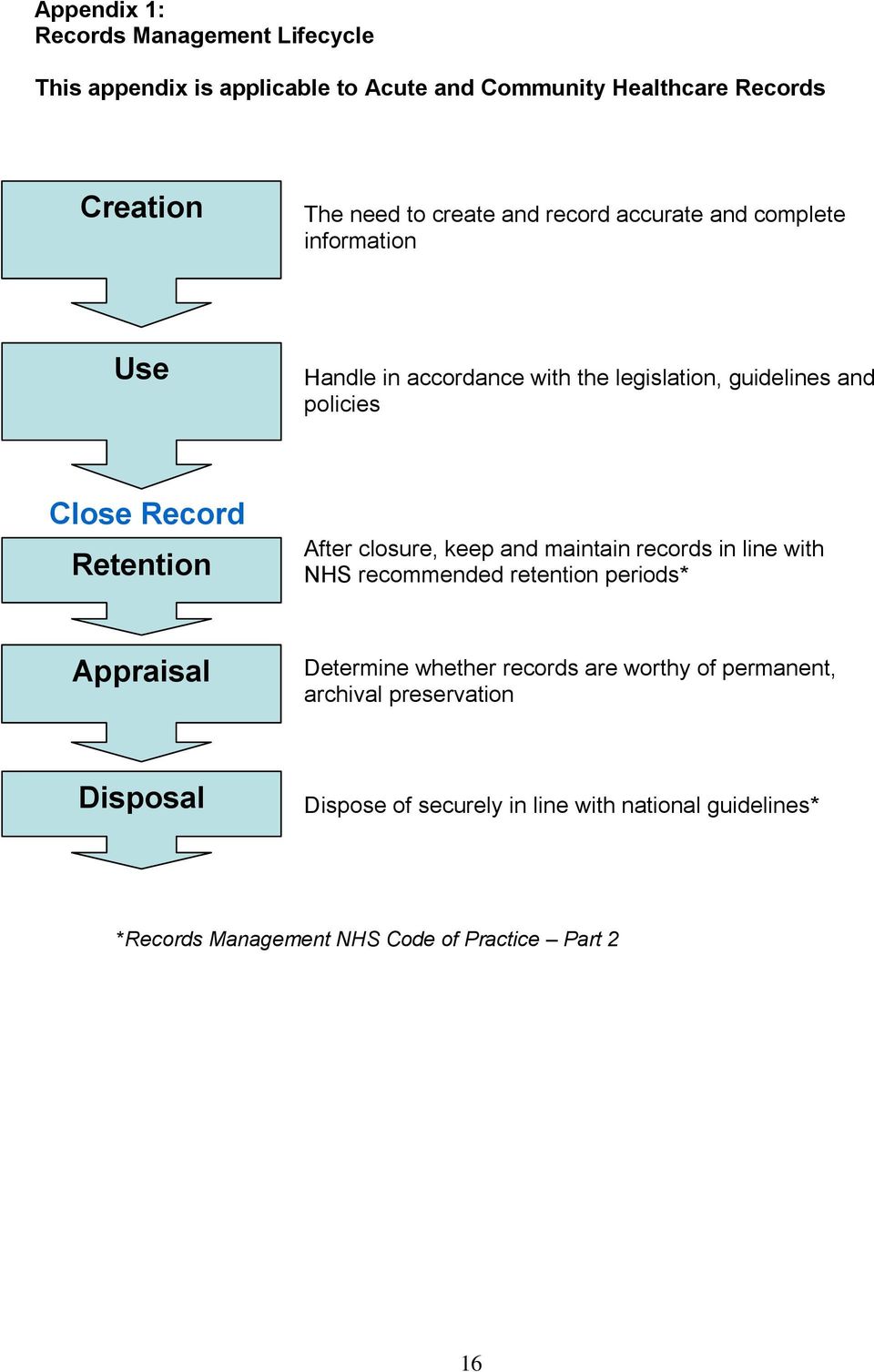
7 Record keeping is an essential requirement as part of the new Care Quality Commission Essential Standards of Quality and Safety. Regulation 20, Outcome 21 requires that records are fit for purpose and accurate and this policy will guide staff in ensuring that the Trust meets these requirements. 2. Scope Records Management is a discipline which utilises an administrative system to direct and control the creation, version control, distribution, filing, retention, storage and disposal of records, in a way that is administratively and legally sound, whilst at the same time serving the operational needs of the Trust and preserving an appropriate historical record. The key components of records management are: Record creation Record keeping Record maintenance (including tracking of record movements) Access and disclosure Closure and transfer Appraisal Archiving Disposal. The term Records Life Cycle describes the life of a record from its creation/receipt through the period of its active use, then into a period of inactive retention (such as closed files which may still be referred to occasionally) and finally either confidential disposal or archival preservation. It is imperative that records are closely monitored and managed throughout their lifecycle. The Lifecycle of a record consists of their: Creation, activation, use, retention, appraisal, retrieval, storage and disposal See appendix 1 for diagram of Record Lifecycle Management. As stated in Records Management: NHS Code of Practice All NHS records are public records, under the terms of the Public Records Act 1958 sections 3 (1)-(2) and the processes defined in this policy covers all records produced within the Trust and will be made available to independent contractors as a guide to good record keeping. Records include: Patient health records (electronic or paper based, including those concerning all specialties, including GP medical records); Birth, and all other registers; Minor operations (and other related) registers; 7
8 and may be in any medium including: X-ray and imaging reports, output and images; Photographs, slides and other images; Microform (i.e. microfiche/microfilm); Audio and video tapes, cassettes, CD-ROM etc; s; Computerised records; Scanned records; Text messages (both outgoing from the NHS and incoming responses from the patient). This policy does not apply to non clinical records or Freedom of Information requests which are dealt with under separate legislation, policies and procedures 3. Statement of Intent To provide staff with the appropriate information required to allow them to ensure that patient s health care record are prepared to Trust standards and are readily available for use when required to deliver best patient care. 4. Procedure(s) 4.1 Patient records not contained in the main hospital patient healthcare record It is not always practical to hold all records of a patient in the healthcare record. An example of this is patients who may be seeing a variety of consultants as an out-patient but whom also may be attending physiotherapy regularly. It is unlikely in this situation that the physiotherapist would be able to obtain the healthcare record for each visit and therefore a separate record is kept. In cases such as this the healthcare professional who generates a separate record must ensure that patient details, including identification number, correlate with the healthcare record. The following departments hold separate patient healthcare records: Physiotherapy Accident and Emergency (CAS Card only) Clinical Measurement Unit (pacing records and ICD only) Medical Photography Dietetics Occupational Therapy Critical Care 8
9 Sexual GUM Clinic Surgical Appliances Maternity Hand Held Pregnancy Records Orthoptics Department Post-mortem records Community Specialist Nurses Community Services Single Assessment Yellow (SAP) Folder All departments holding their own subsidiary patient notes must ensure references to these are made in the main patient notes (if applicable) and that any important clinical information is recorded in the main notes. Also, these areas will ensure that they have their own procedures and standards in place for any subsidiary note practices not covered in the main Trust policy. 4.2 Record Keeping Standards Please note that below are quotations from specific guidance so where it refers to medical records this would be referring to healthcare records for the purposes of this policy. Ink colour: - all notes within a healthcare record should be written in blue or black permanent ink. All entries into the record should be legible and readable. Date and time- this will indicate when the patient interaction occurred. Dates should include the day, the month and the year, in that order. Times should either be written in 24 hour clock format or clearly state am or pm Author of the entry should be easily identifiable ensuring that all entries have the following the signature of the author, the printed name and designation of the author. All of this should be easily read and identifiable. All entries into the record should be legible and readable. Amendments - the error should be crossed through with a single line and countersigned by the author and dated. Contemporaneous - entries to the healthcare record should be made as soon as possible after the event to be documented (e.g. change in clinical state, ward round, investigation) and before the relevant staff member goes off duty. If there is a delay, the time of the event and the delay should be recorded. Chronological order - documentation within the healthcare record should reflect the patients care and attendance and should be viewable in chronological order, secured together using the appropriate medi clip, 9

10 Identification of the patient All pages should include the name of the patient and the NHS number. Abbreviations: Abbreviations should be avoided where possible within the healthcare record. The patient record contains a designated place for the recording of hypersensitivity (allergic) reactions and other information relevant to all health care professionals. The patient record contains clear instructions regarding filing of documents. Operation notes and other key procedures (such as invasive diagnostic procedures) are readily identifiable. Machine produced recordings are securely stored. An entry should be made in the healthcare record whenever a patient is seen by a clinical member of staff. When there is no entry in the hospital record for more than four days for acute medical care or seven days for long-stay continuing care, the next entry should explain why. All notes should include the following Assessment Diagnosis Treatment/care plan Discharge arrangements. Advance directives and consent status statements must be clearly recorded in the healthcare record. There is a mechanism for identifying records that must not be destroyed. Advance decisions to refuse treatment, consent, cardio-pulmonary resuscitation decision must be clearly recorded in the healthcare record. In circumstances where the patient is not the decision maker, that person should be clearly identified ie: Lasting Power of Attorney. For the NHS Records Management Code of Practice- Retention igitalasset/dh_ pdf 10
11 5. Roles and Responsibilities 5.1 Chief Executive The Chief Executive has ultimate responsibility for the quality of healthcare records within the Trust. 5.2 Chief Operating Officer The Chief Operating Officer is ultimately responsible for the Heath Records Department. 5.3 Executive Lead The Medical Director is the nominated lead for clinical record management. 5.4 Caldicott Guardian The Trust Caldicott Guardian is responsible for approving and ensuring that national, local guidelines and protocols on the handling and management of confidential personal information are in place. This will include the need to review the content of clinical records to ensure compliance with national guidelines 5.5 Senior Information Risk Owner The Trust Senior Information Risk Owner (SIRO) is responsible for approving and ensuring that national and local guidelines and protocols on the handling and management of information are in place. This will include the need to review all information flows and the use of commercially sensitive data. The SIRO is responsible to the Board for ensuring that all information risks are recorded and mitigated where applicable. The SIRO is responsible for ensuring that all record management issues (including electronic media) are managed in accordance with this policy. 5.6 Divisional Directors Divisional Directors are designated to act as the lead for each division. The leads must monitor healthcare records that fall within this policy in their area and must highlight any risks to the Health Records Care Group Manager. Divisional Directors are responsible for ensuring that their staff have an awareness of this policy and work in accordance with it. 5.7 Care Group Managers/Care Group Managers with Professional Leadership, Matrons, Clinical Team Leaders (Community) Senior Sisters (With day to day responsibility for ward/community management), Corporate Department Managers, Consultants or equivalent. These staff groups have overall responsibility for ensuring that staff under their control complies fully with the data protection act in terms of the quality of hand written entries in the healthcare record. 11

12 5.8 All Staff (with individual responsibilities under the policy) Every member of staff who make an entry in the healthcare record or makes reference to the healthcare record has a responsibility to ensure the data protection act principles are followed. All staff should keep up-to-date with all record keeping standards and best practice Keep up to date on training. Recognise own areas of difficulty and seek support. Ensure that all standards and best practice are followed. All staff have a responsibility to ensure that filing in healthcare records is done timely and correctly. 5.9 Health Records Care Group Manager The Health Records Care Group Manager has overall responsibility for the efficient and effective running of the health records service (in the hospital), including the timely retrieval and supply of patients records when requested. The Health Records Care Group Manager carries out a monitoring role and is responsible for ensuring compliance with relevant standards such as NHSLA and Care Quality Commission Care Group Manager / Professional Lead (Community) Within the Community Setting, the Care Group Manager with Professional Leadership/Service Lead has day to day responsibility within the areas of their management responsibility along with Ensuring that arrangements are made for all healthcare records (including Single Assessment Process documentation) is monitored through the annual Record Keeping clinical audit as outlined in this policy. Draw up action plans following the annual record keeping cycle and monitor actions throughout the year to ensure changes are made for the next cycle. Ensure that all services have actioned action plan and agreed changes made, monitored and continually audited to ensure compliance. Ensure that all clinical team leads are aware of record keeping standards and the need to follow this policy. Offer appropriate support and supervision to staff in relation to record keeping standards. Ensure staff attends all relevant training in relation to record keeping standards. 12

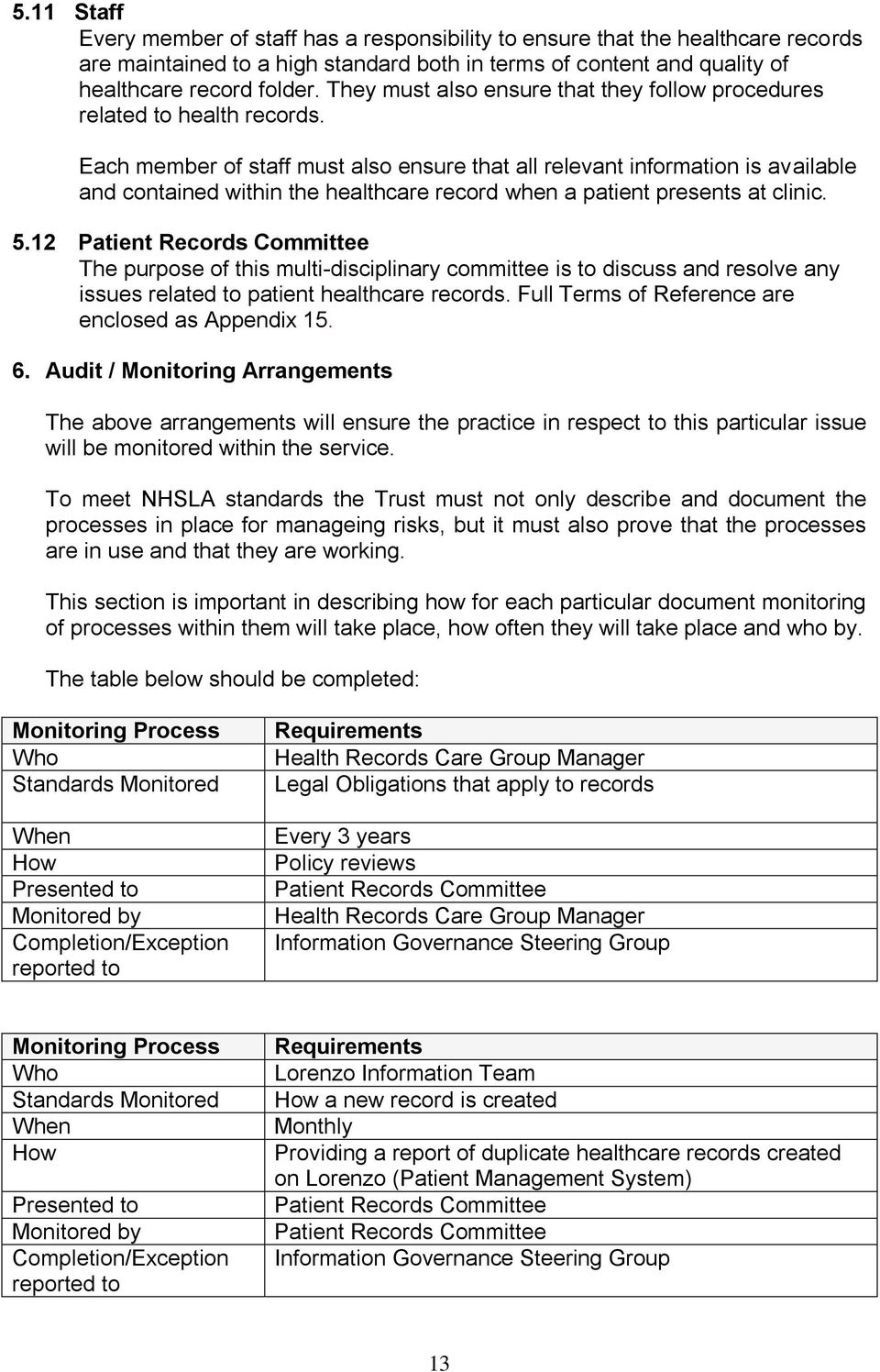
13 5.11 Staff Every member of staff has a responsibility to ensure that the healthcare records are maintained to a high standard both in terms of content and quality of healthcare record folder. They must also ensure that they follow procedures related to health records. Each member of staff must also ensure that all relevant information is available and contained within the healthcare record when a patient presents at clinic Patient Records Committee The purpose of this multi-disciplinary committee is to discuss and resolve any issues related to patient healthcare records. Full Terms of Reference are enclosed as Appendix Audit / Monitoring Arrangements The above arrangements will ensure the practice in respect to this particular issue will be monitored within the service. To meet NHSLA standards the Trust must not only describe and document the processes in place for manageing risks, but it must also prove that the processes are in use and that they are working. This section is important in describing how for each particular document monitoring of processes within them will take place, how often they will take place and who by. The table below should be completed: Monitoring Process Who Standards Monitored When How Presented to Monitored by Completion/Exception reported to Requirements Health Records Care Group Manager Legal Obligations that apply to records Every 3 years Policy reviews Patient Records Committee Health Records Care Group Manager Information Governance Steering Group Monitoring Process Who Standards Monitored When How Presented to Monitored by Completion/Exception reported to Requirements Lorenzo Information Team How a new record is created Monthly Providing a report of duplicate healthcare records created on Lorenzo (Patient Management System) Patient Records Committee Patient Records Committee Information Governance Steering Group 13
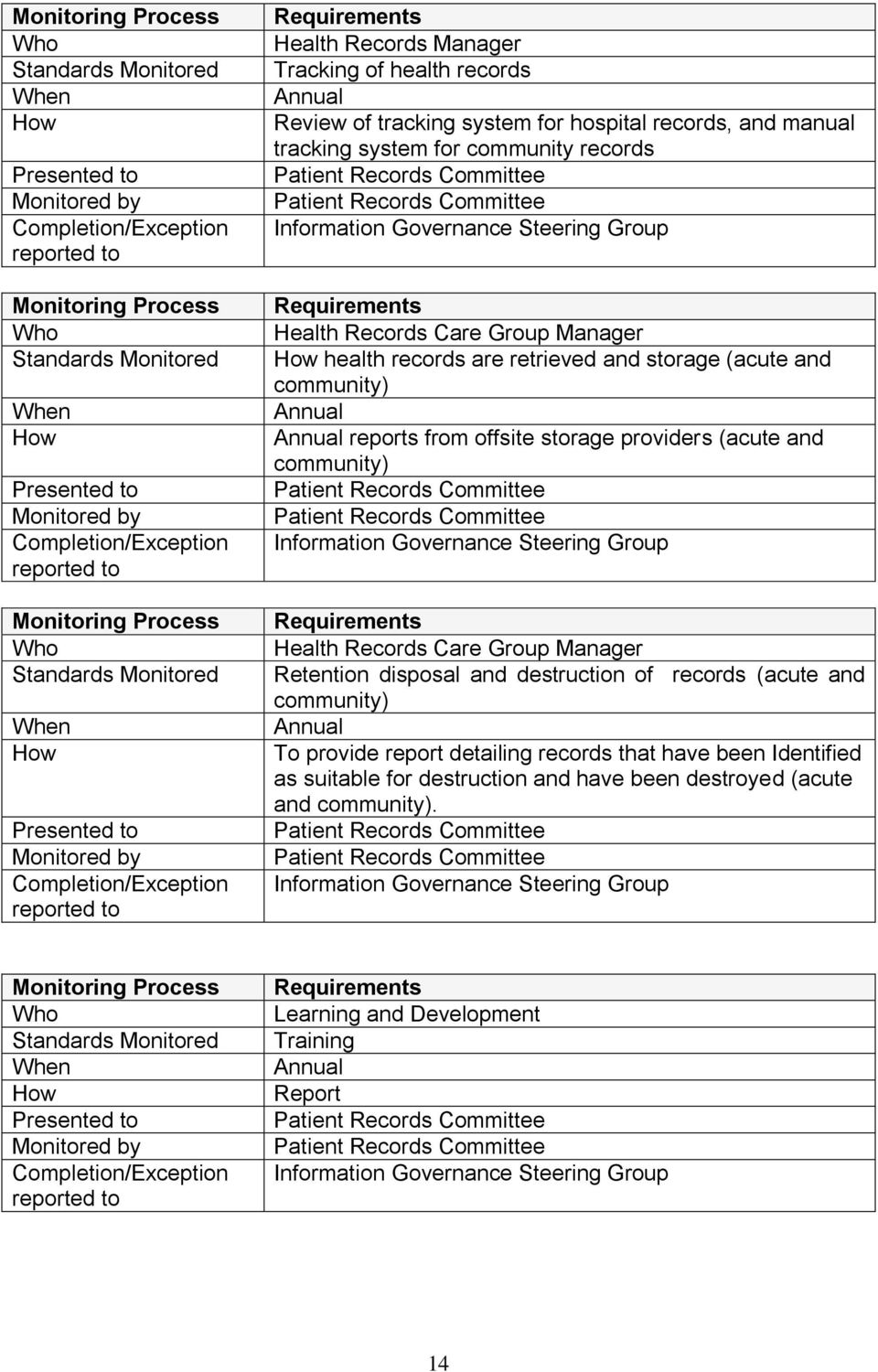
14 Monitoring Process Who Standards Monitored When How Presented to Monitored by Completion/Exception reported to Monitoring Process Who Standards Monitored When How Presented to Monitored by Completion/Exception reported to Monitoring Process Who Standards Monitored When How Presented to Monitored by Completion/Exception reported to Requirements Health Records Manager Tracking of health records Annual Review of tracking system for hospital records, and manual tracking system for community records Patient Records Committee Patient Records Committee Information Governance Steering Group Requirements Health Records Care Group Manager How health records are retrieved and storage (acute and community) Annual Annual reports from offsite storage providers (acute and community) Patient Records Committee Patient Records Committee Information Governance Steering Group Requirements Health Records Care Group Manager Retention disposal and destruction of records (acute and community) Annual To provide report detailing records that have been Identified as suitable for destruction and have been destroyed (acute and community). Patient Records Committee Patient Records Committee Information Governance Steering Group Monitoring Process Who Standards Monitored When How Presented to Monitored by Completion/Exception reported to Requirements Learning and Development Training Annual Report Patient Records Committee Patient Records Committee Information Governance Steering Group 14
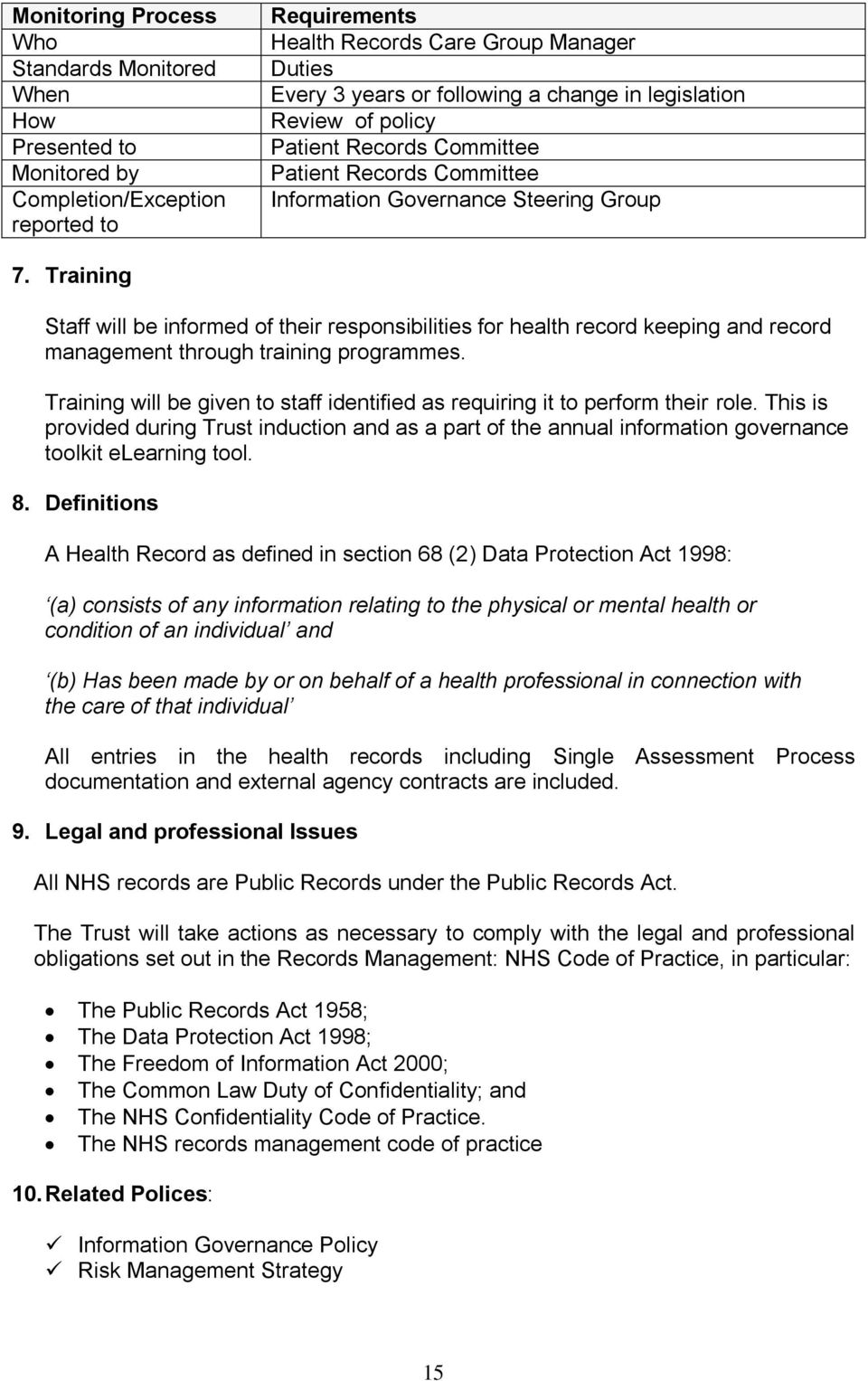
15 Monitoring Process Who Standards Monitored When How Presented to Monitored by Completion/Exception reported to Requirements Health Records Care Group Manager Duties Every 3 years or following a change in legislation Review of policy Patient Records Committee Patient Records Committee Information Governance Steering Group 7. Training Staff will be informed of their responsibilities for health record keeping and record management through training programmes. Training will be given to staff identified as requiring it to perform their role. This is provided during Trust induction and as a part of the annual information governance toolkit elearning tool. 8. Definitions A Health Record as defined in section 68 (2) Data Protection Act 1998: (a) consists of any information relating to the physical or mental health or condition of an individual and (b) Has been made by or on behalf of a health professional in connection with the care of that individual All entries in the health records including Single Assessment Process documentation and external agency contracts are included. 9. Legal and professional Issues All NHS records are Public Records under the Public Records Act. The Trust will take actions as necessary to comply with the legal and professional obligations set out in the Records Management: NHS Code of Practice, in particular: The Public Records Act 1958; The Data Protection Act 1998; The Freedom of Information Act 2000; The Common Law Duty of Confidentiality; and The NHS Confidentiality Code of Practice. The NHS records management code of practice 10. Related Polices: Information Governance Policy Risk Management Strategy 15
16 Appendix 1: Records Management Lifecycle This appendix is applicable to Acute and Community Healthcare Records Creation The need to create and record accurate and complete information Use Handle in accordance with the legislation, guidelines and policies Close Record Retention After closure, keep and maintain records in line with NHS recommended retention periods* Appraisal Determine whether records are worthy of permanent, archival preservation Disposal Dispose of securely in line with national guidelines* *Records Management NHS Code of Practice Part 2 16
17 Appendix 2: Healthcare Record Tracking Procedure This appendix is applicable to Acute and Community Healthcare Records Acute Healthcare Records The Trust uses Radio Frequency Identification (RFID) to track healthcare records around the Trust. Staff are available to view where the healthcare record is tracked via Fusion (the Clinical Portal) by viewing the patient record. All healthcare records leave the Health Records Library within the Hospital have an electronic RFID tag inserted inside the back cover at the top right hand side. Use of the system is mandatory for every ward and department that uses healthcare records and it is everyone s responsibility to ensure that healthcare records are tracked in timely and in real time. This will enable those wards and departments who require a particular set of healthcare records to quickly identify the last location. This will ensure that neither time is wasted nor patient care compromised trying to locate notes. Before healthcare records leave Health Records Library they are electronically tagged using RFID. When a request for healthcare records is received in the health records library, the RFID is checked to see if the healthcare records are in file i.e. located in Health Records Library. If they are in file use the pad to check out to the required location/user and arrange for notes to be collected/delivered. If the notes have been identified as being in secondary offsite storage location, a request for the healthcare record will be made and the relevant department/ward informed that the healthcare records have to be retrieved and we are awaiting their delivery, currently 3 deliveries per day (acute only. Recalling for community healthcare records is dealt with on a request by request basis only). All inactive healthcare records (Acute and Community) are stored off site in line with retention periods and governed by a Service Level Agreement (SLA) by the Health Records Care Group Manager. Urgent requests for Acute healthcare records out of normal working hours (after 4.30pm and before 7am) that are stored off site should be made via by the health records library staff who will request healthcare record(s). The Health Records Team will deliver notes (subject to staff availably) however there may be times this may not be possible and arrangements will be made for these to be collected from the Health Records Library. There is up to a 75 charge for requesting notes out of hours. There is also a charge to refile these when returned to off site storage. 17

18 There may be instances where healthcare records are shown on the locator to be in the library but are not in the correct location. This is known as a misfile. The following checks must be undertaken to locate the healthcare records Cross reference with the Patient Management System (Lorenzo) and the 3M Locator software for any unchecked movement of healthcare record Check pre file and quality check area. Check where healthcare record was previously tracked too Check all the end and middle unit numbers e.g Use the 3M handheld device (known as the Gun ), checking all appropriate Community Healthcare Records All inactive healthcare records (Acute and Community) are stored off site in line with retention periods and governed by a Service Level Agreement (SLA) by the Health Records Care Group Manager. Healthcare records used in the community should be tracked manually using a tracer card system which should include a minimum of NHS number, Name, Date of birth, the date the records were moved in and out and by which department or person. When the healthcare records are tracked out, the tracer card should be retained on the shelf/drawer/cupboard where the original healthcare record is stored. Regular audits of the tracer should be completed by the Care Group Manager/Professional Lead, Clinical Team Leader or designated staff member to ensure compliance. Recalling for community healthcare records is dealt with on a request by request basis only). There is up to a 80 charge for requesting notes from off site storage. 18

19 Appendix 3: Procedure for Preparing Healthcare Records This appendix is applicable to Acute and Community Healthcare Records The preparation of healthcare records is vital to ensure that the patient receives the most appropriate treatment irrespective of whether the patient is treated as a planned/elective admission or an emergency admission or receiving treatment in an outpatient setting. Procedure: Before a healthcare record can be prepared the patient should be registered on Lorenzo. It is important that all patients are traced on the Lorenzo patient administration system. Staff also need to ensure they do not over-write the details of a patient on the Lorenzo patient administration system and should check and double check the details before confirming the trace.. Duplicate registrations may lead to clinical risks, as information with regard to patients care is held within more than one health record sometimes without the knowledge of the clinician. Every effort should be made not to create two healthcare records for a patient. Planned/Elective Admissions in Acute Setting The front of the healthcare record folder must have 2 clear patient bar code labels affixed to the 2 boxes marked unit number. A current year label must be attached to the right hand side of the record if not already attached. An electronic tag must be affixed to the inside back cover of the healthcare record. The tag should be landscape with the arrow on the underside of the tag facing outwards and placed in the top right hand corner. The front cover of the record must be stamped with a RFID/folder symbol to show a tag has been attached. Inside the folder there are two medi clips. The first mediclip must have a correspondence divider (orange). The second medi clip must have an inpatient (blue) divider and a history sheet with a patient label on the top right hand corner, followed by a reports divider (grey). Two sets of patient labels (including bar code) must be contained in the patient healthcare record and attached to the first medi clip. Additional labels can be requested from printed locally. The healthcare record should be tracked in using the RFID system in real time upon receipt. 19

20 Emergency Admissions to Acute Setting In the event of a patient being admitted to hospital as an emergency, a request should be made to the health records library for any existing notes or for a new set to be made if it is the patient s first attendance. The front of the folder must have 2 clear patient bar code labels affixed to the 2 boxes marked unit number. A current year label must be attached to the right hand side of the record if not already attached. An electronic tag must be affix to the inside back cover of the healthcare record at the bottom right corner. The tag should be landscape with the arrow on the underside of the tag facing outwards and placed in the top right hand corner. The front cover of the record must be stamped with a RFID/folder symbol to show a tag has been attached. Inside the folder there are two medi clips. The first mediclip must have a correspondence divider (orange). The second medi clip must have an inpatient (blue) divider and a history sheet with a patient label on the top right hand corner, followed by a reports divider (grey). Two sets of patient labels (including bar code) must be contained in the patient healthcare record and attached to the first medi clip. Additional labels can be requested from the library or printed locally. The healthcare record should be tracked in using the RFID system in real time upon receipt. If healthcare records are required for an Acute emergency admission that are in off site storage, requests should be made via the health records library staff who will request notes. Emergency delivery of notes can be made within one hour however this should only apply to genuine medical emergency need only as there is a 75 cost per set of notes and a recharge to refile these back off site. If a patient is admitted as an emergency from the community setting ie from a spot purchase bed, Intermediate Care at Hollybank House or Richmond Hall, the Single Assessment Yellow Folder should be sent with the patient. 20

21 Planned Transfer from Acute Setting to Intermediate Care bed (Hollybank or Richmond Hall) or Spot Purchase Bed within the Community Setting A Section 2 notification completed by the Integrated Discharge Team for patient considered likely to require Social Service involvement in order to expedite their discharge along with Intermediate Care clinical assessment paperwork would need to be completed and faxed to Intermediate Care team for decision. Intermediate Care Team will accept/reject patient based on clinical assessment provided and local criteria and inform the Integrated Discharge Team of the decision. Arrangements will be made by the Integrated Discharge Team to transfer patient. A Single Assessment Process (SAP) Yellow Folder would be either made up by the Intermediate Care Team upon transfer or if the patient already had a SAP folder with them, the Intermediate Care Team would continue with its use. The SAP folder is a patient held folder and belongs to the patient. If the patient is discharged, the SAP folder follow the patient. If the patient died whilst at in the care of the Intermediate Care spot purchase, Hollybank or Richmond Hall, the SAP folder would be returned to the immediate next of kin along with the deceased personal belongings. If applicable - A Section 5 notification completed by Integrated Discharge Team if patient delayed in their transfer of care as a result of awaiting local authority provision and patient still occupying a bed in Acute however no longer require it (ie fit). Patient attending an Outpatient Appointment within the Acute Setting When a patient has an appointment for an Outpatient appointment within the main Hospital, the healthcare record must contain an Outpatient Information Insert (pink). This must have the appointment information logged ie: the consultant/clinician name and date of the appointment The healthcare record must be in a presentable condition. Replacing the cover as and when required ie: ripped/torn/unfit for purpose. Patient labels (including bar code) must be present and attached to the first mediclip behind the pink outpatient attendance divider. However, these can also be printed locally at each Outpatient Reception desk. There should be the relevant divider for each speciality the patient is attending. Dividers should be placed in order (as detailed below) within the healthcare record. 21
22 Pink Outpatient Information Green Dental, Ent, Ophthalmology Yellow Medicine Purple Obstetrics/Gynaecology/Maternity Cream Orthopaedic Surgery Green General Surgery Red Miscellaneous ( to include Podiatry, Chemotherapy, Pain Clinic) White Urology Blue Inpatient Orange Correspondance Grey Reports not held on fusion ie ECGs. There must be at least two blank history sheets behind the relevant speciality following the last attendance. Additional history sheets should they be required are available from each Outpatient Reception desk. The healthcare record should be tracked in using the RFID system in real time upon receipt by the OPD Reception team. Patient attending an Outpatient Appointment with the Community Setting When a patient has an appointment for an Outpatient appointment within a Community Clinic. The local healthcare record is used. A history sheet following the appointment would be completed within the notes detailing key points of the appointment, dated, signed and timed. There are times where Acute healthcare records are required to support an Acute Consultant Outreach Clinic. Upon agreement and funding resourced with the Health Records Care Group Manager, healthcare records would be tagged out using the RFID tracking system to the community location, delivered/collected by approved Trust courier services in readiness for the outreach appointment. The local healthcare record must be in a presentable condition. Replacing the cover as and when required ie: ripped/torn/unfit for purpose. Patient labels must be present and available within the healthcare record. 22
23 Appendix 4 Procedure for the Structure, Format and Filing of a Healthcare Records This appendix is applicable to Acute and Community Healthcare Records The use of a healthcare record is vitally important in the prompt effective treatment of patients both inpatient and outpatient. Since so many healthcare professionals use healthcare records, it is imperative that the healthcare records are set out in consistent way ensuring that the appropriate sections clearly identifiable. Acute Procedure The following procedure is suitable for all staff groups who may have to raise a new set of notes for inpatients Choose correct colour folder for unit number based on last two digits 00 Pink 10 Buff 20 Orange 30 Dark Blue 40 Purple 50 Grey 60 Yellow 70 Light Blue 80 Light Green 90 Red If the patient has only previously attended the Trust as an outpatient ensure that the blue inpatient divider is placed on top of the second medi clip The front of the folder must have 2 clear patient bar code labels affixed to the 2 boxes marked unit number. A current year label must be attached to the right hand side of the record if not already attached. An electronic tag must be affixed to the inside back cover of the healthcare record. The tag should be landscape with the arrow on the underside of the tag facing outwards and placed on the top right hand corner. The front cover of the record must be stamped with a RFID/folder symbol to show a tag has been attached. Inside the folder there are two medi clips. The first mediclip must have a correspondence divider (orange). The second medi clip must have an inpatient (blue) divider and a history sheet with a patient label on the top right hand corner, followed by a reports divider (grey). 23
24 Two sets of patient labels (including bar code) must be contained in the patient healthcare record and attached to the first medi clip. Additional labels can be printed locally. Community Procedure Healthcare records used in the community are set up as local policy. 24
25 Appendix 5 Procedure for Filing into Healthcare Records This appendix is applicable to Acute and Community Healthcare Records Acute Procedure When filing information into healthcare records, the following dividers should be used and in order as detailed below First Medi Clip Pink Green Yellow Purple Cream Green Red Outpatient Information Dental, Ent, Ophthalmology Medicine Obstetrics/Gynaecology Orthopaedic Surgery General Surgery Miscellaneous ( to include Podiatry, Chemotherapy, Pain Clinic) Urology Correspondance White Orange Second Medi Clip Blue In patient Grey Reports not held on fusion When filing Obstetrics information all documentation including tracings must be filed securely behind purple obstetrics/gynaecology divider in chronological order. CTG traces have specific envelopes and must be used at all times. The envelope must be signed and dated and sealed and attached to the medi clip For all other areas of filing please refer to individual dividers for guidance. No loose sheets of filing should be in the healthcare record. It is the responsibility of each department who created the document on ensure that all filing is placed securely in the healthcare record in the correct location using the medi clips. Note: if the documentation is available on Fusion there is no requirement to print and file this into the healthcare record as the information is available to view electronically. Any loose filing sent to Health Records Library will be returned to the department that generated them for that department to file correctly. It is not the responsibility of Health Records Library to file loose filing. Loose filing is a clinical risk and should be filed in a timely manner. Community Procedure When creating healthcare records for use within the community setting - local protocols for should be followed. 25
26 Appendix 6 Procedure for Deceased Patient Healthcare Records This appendix is applicable to Acute and Community Healthcare Records Acute Procedure When a patient dies, the patient record on Lorenzo patient management system is updated automatically by the NHS National Spine. If we are made aware locally a patient has died, it is up to the individual staff member to contact System Support and advise them of the patient, date of death and GP. The System Support Team will then update Lorenzo as appropriate. System Support on a daily basis advise the Health Records Deceased Team when a patient has died. The Deceased Team confirm the details, locate and retrieve the patients healthcare record and stamp the healthcare record folder with DECEASED and track using RFID as deceased and forward healthcare record to off site storage for retention. In the event of identifying litigation pending or a clinical trial the DO NOT DESTROY box on the front cover of the healthcare record must be completed and signed by the responsible litigation personnel. The patients healthcare record should not start their retention period in off site storage until after the completion of the litigation. Post mortem records are held separately to the patients healthcare record form part of the coroner s report. Approval should be sought from the coroner for a copy of the report to be incorporated into the patients deceased healthcare record prior to the deceased healthcare record transferring to off site storage. Community Procedure When a patient dies, the patient record on Lorenzo patient management system is updated automatically by the NHS National Spine. If we are made aware locally a patient has died, it is up to the individual staff member to contact System Support and advise them of the patient, date of death and GP. The System Support Team will then update Lorenzo as appropriate. Admin Teams within the Community confirm the details, locate and retrieve the patients healthcare record and should mark clearly across the front of the healthcare record folder DECEASED. The tracker card should also be retrieved and marked DECEASED and filed into healthcare record. The healthcare record should go into an archiving box in line with local policy for sending for off site storage. All inactive healthcare records (Acute and Community) are stored off site in line with retention periods and governed by a Service Level Agreement (SLA) by the Health Records Care Group Manager. Recalling for community healthcare records is dealt with on a request by request basis only).. 26
27 Appendix 7 Procedure for the Management of Multi-Volume Records This appendix is applicable to Acute and Community Healthcare Records The Trust has a significant number of patients whose medical condition dictates the need for more than one set of healthcare records, known as multi-volumes. The aim of this protocol is to ensure that the individual health records which run into more than one volume are presented to the clinicians in an acceptable format. Acute Procedure The health records clerk assess the need for a second or subsequent volume either prior to the healthcare record leaving the library or on return. If the healthcare record is on the ward and the volume of the record become unmanageable, the ward can either contact the health records library and request that the notes are divided into multi volumes or the ward clerk can split. There is a standard operating procedure available for staff to follow to ensure standards are maintained.. When there is a need for an additional folder the health records clerk/ward clerk will divide the original folder into the following volumes: The active volume will contain all the out patient activity all correspondence the last 12 months from the date of the latest episode any in patient activity and all reports not held on fusion. All other documents will be placed in the inactive volume. When this volume is full, the process will be repeated and live volume numbered accordingly. The active volume will always be the highest number volume. The cover of the healthcare record will clearly state if it is the active volume and what number volume it is. Routinely, only the active volume will be sent when notes are requested. For example, Volume 1, Volume 2, Volume 3 and so on. If a patient s healthcare record are extremely large and require a more in-depth split, this is known as a special multi volume split. If require do require a special split, please liaise with the Health Records Team Leader and/or Supervisor who will go confirm what is required within the healthcare record as this is patient specific. Community Procedure When splitting of healthcare records due to the size within the community setting - local protocols should be followed. All inactive healthcare records (Community) are stored off site in line with retention periods and governed by a Service Level Agreement (SLA) by the Health Records Care Group Manager. Recalling for community healthcare records is dealt with on a request by request basis only).. 27
28 Appendix 8 Procedure for the Transfer of Healthcare Records to Other NHS Hospitals, Outsourcing to Independent Sector (as directed by the Trust) or patient moving to Private Care (their choice) This appendix is applicable to Acute and Community Healthcare Records If the patient is an inpatient that is being transferred to another hospital, the ward staff must ensure that only copies of the relevant sections of the healthcare record are sent with the patient. The original healthcare record must remain at the Trust. A note should be made in the original healthcare record a copy has been made of the relevant section and sent with patient on transfer. This should be clearly documented, timed and dated. If another hospital requires the healthcare records of a patient that is not an inpatient at Walsall Manor Health, the Health Records Department must be notified that the notes are required for the ongoing treatment of the patient. The library will locate the notes and if possible, due to time constraints, arrange collection of the relevant section. The copies of healthcare record must be sealed and clearly marked private and confidential. These should be collected from the Health Records Care Group Manager or Admin Team Leader Health Records or Admin Team Leader General Officer. Proof of ID will be required at point of collection. Independent Sector: If a patient s care is transferred to the Independent Sector, as directed by the Trust, only copies of the relevant sections of the healthcare record should be sent with the patient. The original healthcare record must remain at the Trust. A note should be made in the original healthcare record, a copy has been made of the relevant section, This should be clearly documented, timed and dated. At the end of their care with the Independent Sector, the copies should be returned to the Health Records Library and securely destroyed. A note should be made in the original healthcare record, the copy has been returned and destroyed. Patient transfer their care to private (their choice): If another hospital requires the healthcare records of a patient as their care is moving from NHS to Private at the choice of the patient. A request for Access to Health Care Records would need to be completed by the patient and submitted in line with the Access to Health Care Records Policy. No original healthcare records should be sent with the patient. The only exception to this would be if the patient was blue lighted to another hospital for their on going care. The Health Records Library should be made aware asap the healthcare record has been blue lighted with the patient so the RFID can be updated. Arrangements should be made for the healthcare records to be returned to the Trust as soon as possible. Under no circumstances should healthcare records or copies of relevant sections of healthcare records be sent by taxi or unaccompanied. 28
29 Appendix 9 Procedure for Requesting Healthcare Records for Audits, Study or Outside of Normal Working Hours This appendix is applicable to Acute and Community Healthcare Records The Health Records Library deals with hundreds of requests 24 hours a day, 7 days a week, 365 days a year from various departments and individuals throughout the Trust. This procedure is intended to make staff aware of how these requests are made. Medical Audit: Any healthcare records required for a planned medical audit will be requested and pulled by the audit team. Medical staff are actively discouraged from taking, notes out of the library for study purposes. There is a quiet reading room available for staff to view notes within the Health Records Library. Study purposes: Medical staff who require healthcare records for study purposes must contact the Health Records Team Leader or Supervisor by phone or in person. Following discussions a mutually acceptable time will be agreed for the Medical Staff to pull the healthcare records themselves. There is a quiet reading room available for staff to view notes within the Health Records Library. Medical notes must not be photocopied for study purposes. Urgent healthcare record requests: For healthcare records are required urgently, it will be the responsibility of the Medical Secretary, Support Secretary, Ward Clerk or Service Area Admin and Clerical Staff to locate the healthcare record on Fusion and arrange collection for the tracked area and upon collection track into their own area within real time. Out of normal office hours (9am - 5pm). Health Records Library staff will locate and deliver the notes as requested for emergency and/or GP admissions only. If the notes are located at off site storage, these will be requested. If the healthcare record is required urgently and no one from the Records Library is available to deliver the healthcare record (due to minimum staffing levels for health and safety reasons), a member of staff from the requesting department will be required to collect them. Planned Admission: Wards/departments who carry out elective (planned) admissions have the responsibility for ensuring that healthcare records are available for the planned addition in a timely manner in readiness for the planned admission. If surgery is required urgently, you should contact the Health Records Library via phone and provide the following information patients full name, date of birth, unit number, ward extension and urgency required ie within 4 hours, within 1 hour. If the healthcare record is located at off site storage, these will be requested. There is a charge upto 75 per set of notes for recall from off site storage. If the healthcare record is required urgently and no one from the Health Records Library is available to deliver the healthcare record (due to minimum staffing levels for health and safety reasons), a member of staff from the requesting department will be required to collect them. 29
30 Medical secretaries and/or Admin or Clerical staff requiring healthcare records at short notice ie less than 2 days should make own arrangements to trace and/or pull them. Outpatient clinic pull lists are now available within real time on the Lorenzo Infohub (which is refreshed at twice nightly therefore ensuring any outpatient clinic appointment changes after the working day are captured and added to the Health Records Night team workload to pull and prep so healthcare records are available for outpatient appointments. If the healthcare record required are stored off site this will be clearly indicated on the RFID healthcare record tracking system and Fusion. They can be retrieved back from off site storage by using the web based request service. The healthcare record(s) will be delivered to the Health Records Library, the library staff will then contact the requester to confirm they have arrived. There is a charge to recall notes back and this is up to the value of 75 per set of notes. Staff should not recall notes unnecessarily. All inactive healthcare records (Acute and Community) are stored off site in line with retention periods and governed by a Service Level Agreement (SLA) by the Health Records Care Group Manager. 30
31 Appendix 10 Community Archiving Request Form This appendix is applicable to Community Healthcare Records only. This form is required to be completed by the Community Team to ensure that healthcare records within the Community setting are archived off site safely and in line with retention periods for destruction. All inactive healthcare records are stored off site in line with retention periods and governed by a Service Level Agreement (SLA) by the Health Records Care Group Manager. COMMUNITY HEALTHCARE RECORDS ARCHIVING REQUEST FORM (COMMUNITY HEALTHCARE RECORDS) Name: Department: Base: Contact Number: Contact Date Requested: Type of Request (Only tick 1 option per form) Request for Boxes & Barcodes Request for Collection of Files from Base Request for Destruction of Files in Archive Request for Withdrawal of Files from Archive Collection, Destruction or Withdrawal of Files Box Number Description Date Archived Destruction Date Please continue on separate form if necessary. Request for Boxes Type of files to be archived No of files to be archived No of Boxes needed Aprox collection date for files: 31
32 Appendix 10 (Continued) CONTENTS SHEET Department Destruction Date Type of File Barcode Details Contents of this box should be filed in alphabetical order by Surname and all contents should be of the same destruction date. If you are unsure how long these records, should be retained for, please refer to Retention Periods. File Name Last Entry Date Signed Print Title Date Risk Department Use only Date Checked Signed Print Barcode 32
33 Appendix 11 Procedure for Disposal and Destruction of Healthcare Records This appendix is applicable to Acute and Community Healthcare Records The aim of this procedure is to outline the parameters for the destruction of healthcare records with the intention of keeping hard copy patient records to a minimum. All hard copy health records of patients still attending the Trust will be retained for the appropriate retention period outlined in the Department of Health Records Management Code of Practice t/dh_ pdf Acute Procedure Healthcare records should only be destroyed by a member of staff from the health records library. The healthcare records contents will be assessed in line with the retention periods detailed in the Department of Health Records Management Code of Practice. If in the event of identifying litigation pending or a clinical trial the do not destroy box on the front cover of the healthcare record must be completed. The retention period should then be the longest period of time which will be either the period relating to the contents of the healthcare record or the period relating to litigation or clinical trial. Once the Health Records Staff have identified that the healthcare record can be destroyed they will make an entry on the Trust s patient administration system to verify that healthcare record have been destroyed. A signed list will also be kept of all of the healthcare records destroyed. Those files that have been identified for destruction will be placed in a secure destruction confidential waste bin. The bins in the health records library will be taken by Health Records Staff to the Destruction vehicle. Staff will remain there until such time as all of the notes have been destroyed. Any healthcare records stored off site, will be tracked off site using the RFID tracking system and have an identified destruction date. Prior to any destruction, confirmation and authorisation will be given by the Trust. A copy of the destruction certificates will be provided (including nhs number of healthcare record destroyed) at the point of destruction. Community Procedure Inactive healthcare records should be should be reviewed by each area in line with the Department of Health records management code of practice retention schedule, and sent to off site storage for retention. A copy of the destruction certificates will be provided (including nhs number of healthcare record destroyed) at the point of destruction. All inactive healthcare records are stored off site in line with retention periods and governed by a Service Level Agreement (SLA) by the Health Records Care Group Manager. 33
34 Appendix 12 Procedure for Using Alerts/Warnings/Sensitivities on Healthcare Records This appendix is applicable to Acute Healthcare Records This procedure is to ensure that all users of the healthcare records are aware of their roles and responsibilities with regard to when and how to record alerts/warnings in patient s healthcare records. Old style healthcare records (containing a back pocket) All old style healthcare records i.e. those with back pockets must be replaced with the current version as below. New style healthcare records (no back pocket) It is the responsibility of the healthcare professional to ensure that the alert box on the front cover is ticked and the appropriate entry has been made on the alert box on the inside front cover of the healthcare record. This should include appropriate notation and name should be printed, signed and dated by the appropriate member of staff. When replacing a healthcare record, the healthcare professional and/or health records library staff will ensure that the alert box is ticked and that all documentation including any alerts/warnings are transferred to the new healthcare record folder. If in the event of litigation pending or involvement in a clinical trail the do not destroy box on the front cover of the healthcare record must be completed. 34
35 Appendix 13 Procedure for Creation and Inclusion of New Documentation in Healthcare Records This appendix is applicable to Acute and Community Healthcare Records This procedure is designed to alleviate such duplication and streamline the process for new documentation whilst improving the quality of information available to clinical/administrative staff. A new document can be defined as any document that is not currently included routinely in the healthcare record and that will add value to patient care. It is the responsibility of all staff developing a new document that relates to patient information to ensure that the most appropriate consultation and/or trial is undertaken with all relevant parties. It is recommended that trial use is for a period of one month to ensure sufficient feedback is received to evaluate trial. Once consultation has been concluded, the documentation is to be taken to Paper Records Committee as per procedure detailed below. He/she is also responsible for ensuring the document is cascaded to all relevant parties and Groups once the document has been ratified. The author or Chair of the relevant committee developing the document should ensure that the document has been distributed for appropriate consultation for layout content, etc. Following agreement the author/chair of committee should send the document to the Patient Records Committee with a briefing note outlining the consultation process. If appropriate the author will be asked to attend the Patient Records Committee and/or Information Governance Steering Group for further clarification if required. The Patient Records Committee will at their next meeting either ratify the document or return for amendment. The Health Records Care Group Manager will then agree where the document should be filed. The author will be informed of the decision. 35
36 Appendix 14 Procedure for Using Temporary White Healthcare Records This appendix is applicable to Acute Healthcare Records Only In the first instance staff should carry an extensive search for the original healthcare record and use the gun to ensure that all areas ie the Health Records Library, areas healthcare record last tagged to have been checked. Fusion can also be checked as where healthcare records are tracked to is now visible within the patient record. The use of temporary healthcare record should only be used as a last resort. To reduce the risk of information being lost, the Trust has introduced a secure temporary folder to be used in such instances. It is coloured white to differentiate it from the permanent healthcare record folder. The following procedure is intended to be used by all staff who may handle a temporary set of patient documentation. Each ward/department will be issued with a small supply of the white temporary healthcare record folders. Further supplies are available on request from the Health Records Library. When the permanent healthcare record folder is not available, the ward/department should file all relevant documentation in the new white temporary healthcare record in the same order as if it were the permanent folder. No back pocket must be created. A patient label should be attached to the white temporary folder in the box provided on the front of the healthcare record. The temporary folder should only be used until such time as the permanent folder is available. Every effort should be made to trace the permanent healthcare records prior to making up a temporary set. On receipt of the original healthcare record folder, wards/departments must immediately file all documentation in the correct order into the permanent folder. The empty, temporary folder can be retained on the ward/dept to be re-used ensuring that the correct patient label is affixed on the front cover. A temporary white healthcare record should NEVER be tagged using the RFID tracking system. 36
37 Appendix 15 Procedure for the Transfer of Healthcare Records to Out Reach Clinics in the Community This appendix is applicable to Acute and Community Healthcare Records This procedure is intended to assist new or existing health records library staff deal with requests for healthcare records to go to outreach clinics. Note: Funded is required to support the pulling, prep and delivery/collection of these healthcare records to Community sites. A formal request is received in the Health Records Library via computer generated list. Each request must specify the patient surname, unit number, location of community clinic and date required. A minimum notice of 7 working days is required for healthcare records required for community sites. The library staff will locate the healthcare records, if in file and mark the pulling list appropriately, and use the tracking system to pad out to the required location. The healthcare records together with the lists will be clearly marked and placed in a blue transportation box awaiting for collection. ISS ltd Couriers (or Trust approved courier service) will collect the healthcare records on a daily basis and deliver them to the location specified. They are also responsible for the safe return back the Health Records Library. During transportation ISS (or Trust approved courier service) will ensure that the vehicle is locked at all time to ensure patient confidentiality. No healthcare records must be transported by taxi as this breaches Information Governance and Data Protection. 37
38 Appendix 16 Patient Records Committee: Terms of Reference This appendix is applicable to Acute and Community Healthcare Records Patient Records Committee Terms of Reference Accountable to: Reports to: Quality & Safety Committee Information Governance Steering Group (IGSG) 1. Purpose The purpose of the Group is to make adequate arrangements within the Trust to enable all areas to meet current Legal and NHS Governance requirements with regards to patient health records. To continually promote the highest standards of practice across the Trust. 2. Responsibilities / Duties / Key tasks 1) To review and approve Trust policy for: a) The production and subsequent security of all clinical records b) The destruction of clinical records c) The archiving / retrieval of clinical to/from offsite premises d) Handling multi-volume and duplicate patient records 2) To ensure the documentation of procedures associated with Records Management/Information Governance and their availability to all staff across the Trust. 3) To receive monthly reports from the Head of Health Records for assuring and monitoring availability and quality of clinical case records within the Trust. 4) To ensure the recording of audit trails of decisions made by the Trust, as required by the Freedom of Information Act, 2000, (FOI). (This to include both paper and electronic records). 5) To receive and review all audit results related to physical clinical records and electronic records. 6) To analyse risk incidents and complaints (both medical and administration) associated with clinical records and take preventative / corrective actions. 7) To receive Issues/concerns for records management arising from developments within the Trust, e.g. changes of location of departments, new builds, etc 38
39 8) Approval of clinical and administrative documentation relating to clinical records (in conjunction with other existing clinical committees). 9) To progress understanding by staff and compliance with Legislation/NHS Standards across the Trust. 10) Transition of notes from paper base to IT 3. Chair of the Group The Group will be chaired by the nominated Associate Medical Director or Medical Director. The Vice Chair and named representative for the group to attend the IGSG will be the Head of Health Records. 4. Membership Chair / Associate Medical Director Head of Health Records: Vice Chair & reporting responsibility to IGSG Divisional Director (Division of surgery) Child Health Information Manager Business Manager to the Medical Director 1 nurse from each division (3) Risk Management representative 1 Consultant representatives from each division (3) Safeguarding representative Finance representative (on invitation) Professional Development Unit representative by invitation Therapies representative Clinical Coding Manager Community representative IT representative Where members are not available a deputy must be sent in their place 5. Frequency of Meetings Monthly 6. Quorum The quorum for this committee shall be a minimum of four people attending, one of which should be either the chair or deputy chair of the committee, and one of each consultant and nurse representative. All members of this steering group are required to attend at least 70% of meetings set or send representation in their absence for continuity purposes. If the representative from any area is unable to attend then apologies are expected prior to the meetings. Attendance will be monitored by the chair of the committee on an annual basis. 39
40 APPROVED BY: CHAIR NAME SIGNATURE DATE RECEIVED BY: Chair Information Governance Steering Group NAME SIGNATURE. DATE Terms of Reference June
41 Appendix 17 Contents of Healthcare Record Audit This appendix is applicable to Acute Healthcare Records Area of Concern Does the healthcare record have a readable bar code label attached? Are all papers securely filed in notes via the medi clip? If notes contain a back pocket is It empty and sealed? Are all allergies recorded appropriately? Look at the last entry in the healthcare record: Action Are all entries dated and timed? Is there an identifiable signature? Is the NHS number on the top of the page? Is it written in black or blue ink? Is each section of the case note in chronological order? 41
42 Appendix 17 Audit templates and guidance Sample Sizing For this audit the population is defined as one of the following: a) All health records for patients / service users discharged from the designated service area for the period from the month following the last audited month to the last complete month. b) All health records for patients / service users seen by clinical staff within the designated service area for the period from the month following the last audited month to the last complete month. If there is no previous audit cycle, then the last 12 complete months should be used as a timeframe. Exceptions: None Note that the method you choose for calculating the population should remain the same for all subsequent cycles. Methods for Sampling Data The inclusion criteria (above) specify which cases are to be included in the record keeping audit (the population). Once you have determined the population, you need to consider how many cases to examine with the data collection tool. This is done by sampling the population. We would suggest a sample size of 20 cases or the whole population (whichever is smaller). However if your population size is a considerably large number and the service is divided into numerous sites across the borough then you may wish to increase your sample size to a more representative figure (Option 5 below may be most the appropriate method for this). Note that the method you choose for sampling the population should remain the same for all subsequent cycles For the purposes of this audit protocol, the statistical significance of the sample is not calculated. This audit employs non-statistical sampling methods, using samples for the purpose of obtaining information that need not be attributed to the entire population with measured reliability. As the process of record-keeping (and not the population characteristics) is being measured, large amounts of data collection to establish statistical significance are not required. Note that when identifying case notes that are retrieved from health records libraries, use the sampling methods to identify additional cases, as all records may not be available 42
43 1: Entire Population Sampling Use this method where the identified population is less than 20 cases. All of the cases within the population should be assessed using the data collection tool. Do not use any of the other sampling methods below if the population numbers less than 20 cases. 2: Random Sampling Use this method where each of the cases in the population is or can be easily numbered. Every case in the population then has an equal chance of being selected. A useful site is which has an easy to use random number generator. A random sample is selected by matching random numbers generated by a computer or selected from a random number table with, for example, the document number. With this method, every item in the population has the same probability of being selected as every other item in the population. 3: Interval Sampling Use this where items are not or cannot be easily numbered. A method by which items are selected from the population in such a way that there is a uniform interval between sample items. The first item in the series must be chosen at random and then every "n"th item is chosen to result in the desired sample size. 4: Consecutive Sampling Use this only where the above types of sampling are not possible A method by which items are selected in order e.g. the last 20 cases, or a selection of 20 consecutive cases between two time intervals. Caution should be when using this method of sampling, as it is potentially far more susceptible to the Hawthorne effect than the other methods of sampling. 5: Stratified sampling Use this method when the service provided is subdivided into further groups/teams or if the service has numerous sites and it is believed that more reliability would be achieved by sampling equally from each site/team. A method by which items in the population are segregated into two or more classes or strata. Each stratum is then sampled independently. The results for the several strata may be combined to give an overall figure. 43
44 Guidance for completing Records Entry Proforma Paper Health Records 1. Service / Contact Details These details can be entered onto the electronic spreadsheet but it may be useful to ensure that you add the date onto the individual forms for your reference. They relate to contact details of the person completing the form and not the patient s details. 2. Patient Identification All responses to section 2 refer to information that can usually be found on the front page, main page and summary or key details page of the record. 3. Health Care Professional Identification This relates to the last entry in the record The standards that relate to these questions dictate that the signature and designation of staff is written alongside each entry made in the record and that a signature list is also held by the service. 4. Case Note Entries This relates to the last entry in the record The timing of entry relates to the time that the entry was made in the notes. If this was not the same as the time of contact, then the time of entry and the time of contact must be recorded in the text. Please refer to the standards on page 5 when completing question 4.5. The entry should be made as soon as possible after the contact with the patient or reflected in the entry as to the reasons why if this is not the case. Question 4.6 If abbreviations are used and they also appear on an abbreviation list then tick Yes. If they are used but do not appear on an abbreviation list then tick No. If abbreviations have not been used in the entry then tick None used. 5. Records/Notes Question 5.3, relates to each patient record as a whole. All papers within the record must be secured so that loose papers cannot fall out. Records that are constructed using plastic wallets should also follow this principle and loose papers are secured together within the wallet. 6. Key Procedures/Information The information required for this section may not be applicable to all services. Question 6.3 relates to any allergies of the patient. Question 6.4 relates to an area on the record where information can be recorded which may be useful to other health care professionals and that can be quickly and easily identified. 44
45 Electronic Health Records Complete this form if your service uses electronic health records as the main system for recording patient contact and treatment information. The standards mirror those used for paper health records with the principle that electronic records must also contain these standards as a minimum data set. As electronic systems may vary it cannot be assumed that the date and time of entries is always recorded and visible to the user which is why these questions are also asked. 45
46 A Audit criteria Form 1: Inclusion criteria and sampling Complete details and transfer to the electronic spreadsheet to return to the Governance department via . Inclusion Criteria Please choose the definition to use for defining the population: a) All health records for patients / service users discharged by clinical staff within the designated service area for the period from the month following the last audited month to the last complete month. b) All health records for patients / service users seen by clinical staff within the designated service area for the period from the month following the last audited month to the last complete month. If there is no previous audit cycle, then the last 12 complete months should be used as a timeframe. Exceptions: None Note that the method you choose for calculating the population should remain the same for all subsequent cycles. Enter A or B Number of cases in the population Sampling We would suggest a sample size of 20 cases or the whole population (whichever is smaller). However if your population size is a considerably large number and the service is divided into numerous sites across the borough then you may wish to increase your sample size to a more representative. Note that the method you choose for sampling the population should remain the same for all subsequent cycles Please choose the method for sampling the population: (tick one only) Entire population Random sampling Interval sampling Consecutive sampling Stratified sampling Page 46 of 73
47 Form 2.1: Paper Health Records Entry Proforma Acute and Community Complete one form for each set of paper health records in your sample. Transfer information to the Results spreadsheet and to the Governance department. 1.1 Date / / 1.2 Contact Name 1.3 Tel No 1.4 Department ID 1.5 Base 2. Patient Identification (front page / main page / summary / key details page) 2.1 NHS Number (clearly & correctly documented) Yes No (2.1) 2.2 Forename (clearly & correctly documented) Yes No (2.2) 2.3 Surname (clearly & correctly documented) Yes No (2.3) 2.4 Date of Birth (clearly & correctly documented) Yes No (2.4) 2.5 Comments: (2.5) 3. Health Care Professional Identification (Last entry in the record) 3.1 Signed (identifiable signature) Yes No (3.1) 3.2 Printed Name Yes No (3.2) 3.3 Designation of staff in record Yes No (3.3) 3.4 Signature contained within signature list Yes No No signature list 3.5 Comments: (3.4) (3.5) 4. Case note Entries (Last entry in the record) 4.1 Dated (day, month, year) Yes No (4.1) 4.2 Timed (hour and minute, 24hr clock or am/pm specified) Yes No (4.2) 4.3 Legible entry (Can you read the entry?) Yes No (4.3) 4.4 Was the entry in black or blue ink? Yes No (4.4) 4.5 Was the entry written contemporaneously? Yes No (4.5) 4.6 Are abbreviations, if used, contained within an Yes No None used (4.6) agreed abbreviations list? 4.7 Is this standardised abbreviations list easily Yes No None used (4.7) accessible? 4.8 Are blank spaces scored through? Yes No (4.8) 4.9 Are any alterations/deletions countersigned? Yes No None used (4.9) 4.10 Comments: (4.10) Page 47 of 73
48 5. Records/Notes 5.1 Do all the records in the folder belong to the correct patient? Yes No (5.1) 5.2 Is the folder in a good state of repair? Yes No (5.2) (e.g. no tears or excessive user of sticky tape or staples etc) 5.3 Are all papers filed in the notes? (i.e. nothing loose) Yes No (5.3) 5.4 Is the patient s NHS number or trust ID number on every page? Yes No (5.4) 5.5 Comments: (5.5) 6. Key procedures/information 6.1 Are operation notes and other key procedures (e.g. Anaesthetic charts/operation records/ect records) readily identifiable (e.g. Colour border/specific filing area/specific sheets)? 6.2 Are machine produced recordings securely stored and mounted? Yes No Not applicable to this service Yes No Not applicable to this service (6.1) (6.2) 6.3 There is a designated place for the recording of hypersensitivity reactions 6.4 There is a designated place for the recording of other information relevant to health care professionals? Yes No (6.3) Yes No (6.4) 6.5 Are advanced directives / consent status statements clearly recorded? 6.6 Is there a standardised structure for the recording of handover information? 6.7 If the patient is part of long-stay continuing care and there is no entry in the records for more than 7 days, does the next entry explain why? 6.8 Comments: Yes No Not applicable Yes No Not applicable Yes No Not applicable (6.5) (6.6) (6.7) (6.8) Page 48 of 73
49 Form 2.2: Electronic Health Records Entry Proforma Acute and Community Complete one form for each electronic health record in your sample. Transfer information to the Results spreadsheet and to the Governance department. 1.1 Date / / 1.2 Contact Name 1.3 Tel No 1.4 Department ID 1.5 Base 2. Patient identification 2.1 Is the patient NHS number recorded? Yes No (2.1) 2.2 Forename correctly recorded? Yes No (2.2) 2.3 Surname correctly recorded? Yes No (2.3) 2.4 Date of Birth correctly recorded? Yes No (2.4) 2.5 Comments 3. Author Identification 3.1 Has the author of all entries been recorded? Yes No (3.1) 3.2 Can the designation of the author be identified? Yes No (3.2) 3.3 Comments 4. Record Entries 4.1 Has the time of entries been recorded? Yes No (4.1) 4.2 Has the date of entries been recorded? Yes No (4.2) 4.3 Was the entry written contemporaneously? Yes No (4.3) 4.4 Are abbreviations, if used, contained within an agreed abbreviations list? 4.5 Is this standardised abbreviations list easily accessible? Yes No None used Yes No None used (4.4) (4.5) 4.6 Do alterations or deletions remain logged on the system so they can be reviewed if needed? 4.7 Comments Yes No (4.6) 5. Security 5.1 Is the record password protected? Yes No (5.1) 5.2 Comments Page 49 of 73
50 6. Other Information 6.1 There is a designated place for the recording of hyper-sensitivity reactions 6.2 There is a designated place for the recording of other information relevant to health care professionals? Yes No (6.1) Yes No (6.2) 6.3 Are advanced directives / consent status statements clearly recorded? 6.4 Is there a standardised structure for the recording of handover information? 6.5 If the patient is part of long-stay continuing care and there is no entry in the records for more than 7 days, does the next entry explain why? 6.6 Comments Yes No Not applicable Yes No Not applicable Yes No Not applicable (6.3) (6.4) (6.5) Page 50 of 73
51 Form 3: Storage Audit Proforma Acute and Community Section 1-Contact and Health Records Details Please complete the information below for your department/service area. Transfer information to the Results spreadsheet and to the Governance department. 1.1 Department/Service 1.2 Base 1.3 Name of lead person completing this assessment: 1.4 Tel No 1.5 Date of this audit: / / 1.6 Date of the last audit: / / (or tick if no previous audit ) To identify the records used by your service, please fill in the table below listing each type of record separately. Type of record (e.g. paper, electronic, patient held) Number of records for this type Specialities/services using these records Page 51 of 73
52 Form 3: Storage Audit Proforma Acute and Community Section 2-Individual Record Stores for paper records One form should be filled in for each separate data store for health records. Transfer information to the Results spreadsheet and to the Governance department. Continue comments on a separate page if required. Department 2. Records storage area 2.1 Is the storage area secure / lockable? Yes No (2.1) 2.2 Is the storage area fireproof? Yes No (2.2) 2.3 Where are these records stored (e.g. filing cabinet)? 2.4 Do you have a safe working space in this area? Yes No (2.4) 2.5 Are any paper records kept loose? (Papers not bound together and kept in a pocket or flap) Yes No (2.5) 2.6 Can the confidentiality of records be assured so that no unauthorised persons have access to or can see them? Yes No (5.2) Authorised = Professional who the patients could reasonably expect to have access to their records, for the purposes of their care and /or have given their explicit permission. 2.7 Comments (for ): 3. Availability of records 3.1 Are the records routinely available during office hours (e.g. mon-fri 9am-5pm)? Yes No (3.1) 3.1a If your service delivers care to patients 24 hours a day is there 24 hour access to records? Yes No Not Applicable (3.1a) 3.1b If other specialities use these records are there provisions to make them available? Yes No Not Applicable (3.1b) 3.2 Are there provisions for emergency access when records are not routinely available? Yes No (3.2) 3.3 Comments (for ): 4. Destruction and tracking and handling 4.1 Is there a mechanism for identifying which records can and cannot be destroyed? Yes No (4.1) 4.2 Do you have a tracer system when records are removed from the store? Yes No (4.2) 4.3 Are the Records Management Code of Practice retention periods adhered to? Yes No (4.3) (See the Records Management NHS Code of Practice Part 2, Health Records Retention schedule) 4.4 Do you have documentation that contains instructions on filing/handling arrangements?yes No 4.4 Comments (for ): Page 52 of 73
53 Form 4: Single Assessment Process (SAP) Entry Quality Proforma (Community only) Name of Individual Completing Audit of SAP folder: Signature: Date of Completion: Details of patient notes being audited (Name and NHS number of patient for audit reasons) Documentation X N/A Evidence Identified actions Date actions completed Signature log included in SAP and completed Records are legible and hand written records are completed in blue/black ink All documentation sheets contain identifying details of the patient, i.e. name and NHS number Contact assessment included Contact assessment completed Overview assessment included Page 53 of 73
54 Documentation X N/A Evidence Identified actions Date actions completed Overview assessment completed Actual and potential problems identified within overview assessment Identified actual and potential problems have associated care plans Individual care plans completed Care planning demonstrates use of national evidence based guidance underpinning practice There is evidence that care planning incorporates relevant assessment tools e.g. pain, pressure area risk, falls There are no jargon terms used within the documentation Page 54 of 73
55 Documentation X N/A Evidence Identified actions Date actions completed Assessment tools are evaluated in a timely manner in response to changing patient need There is evidence of evaluation, follow up and action from identified risks/issues All new entries are dated and signed. There is evidence of patient/carer involvement in the care planning process Medication directives are current and active Previous directives have been removed from the SAP folder Current medical directive is clear, legible with no alterations Old directives have been crossed through, signed, dated and filed within clinic notes. Old documentation has been cleansed from the current SAP folder and archived appropriately leaving active care plans and evaluation sheets only Page 55 of 73
56 Documentation X N/A Evidence Identified actions Date actions completed Signature log included in SAP and completed Records are legible and hand written records are completed in blue/black ink All documentation sheets contain identifying details of the patient, i.e. name and NHS number Contact assessment included Contact assessment completed Overview assessment included Overview assessment completed Actual and potential problems identified within overview assessment Identified actual and potential problems have associated care plans Individual care plans completed Care planning demonstrates use of national evidence based guidance underpinning practice There is evidence that care planning incorporates relevant assessment tools e.g. pain, pressure area risk, falls Page 56 of 73
57 Documentation X N/A Evidence Identified actions Date actions completed Assessment tools are evaluated in a timely manner in response to changing patient need There is evidence of evaluation, follow up and action from identified risks/issues All new entries are dated and signed. There is evidence of patient/carer involvement in the care planning process Medication directives are current and active Previous directives have been removed from the SAP folder Current medical directive is clear, legible with no alterations Old directives have been crossed through, signed, dated and filed within clinic notes. Old documentation has been cleansed from the current SAP folder and archived appropriately leaving active care plans and evaluation sheets only Page 57 of 73
58 Form 5: Results and Action Planning Template Date: Department: Base: (Acute/Community) Name of Lead: Tele No: Use this template to plan actions as a result of clinical audit reports. The resulting action plan should be ratified and then monitored by a formal group/meeting Standard Result Main Finding Risk 1 Action to improve Person(s) or Committee(s) Complete by / / / / / / / / 1 58
59 Appendix 19 Retention Periods This appendix is applicable to Acute and Community Healthcare Records.A full list of the minimum periods of retention for healthcare records created with the Trust are given in Department of Health Records Management NHS Code of Practice Part 2 (2 nd Edition). For the NHS Records Management Code of Practice- Retention pdf 59
60 Appendix 20 Abbreviations commonly used by the Trust Please note these are commonly used abbreviations and do not necessarily mean than an abbreviation in the health record relates to the subject matter. It unsure, it is wise to seek further clarification from the/your Healthcare Professional. COMMON RADIOLOGY ABBREVIATIONS -Ray -Ray COMMON TEST/BLOOD TEST/PROCEDURAL ABBREVIATIONS t -Spinal Fluid Sensitivity erature Pulse Respiration COMMON MEDICATION ABBREVIATIONS Orally by mouth 60
61 Drugs) as above COMMON ADMINISTRATION ABBREVIATIONS By COMMON EQUIPMENT ABBREVIATIONS COMMON TITLE ABBREVIATIONS tor egistered General Nurse 1 or 2 61
62 COMMON SURGICAL ABBREVIATIONS DNAR Dot not attempt to WR Ward round resuscitate S/B Seen by D/W Discussed with NBM Nil by mouth ICU Intensive care unit IOL Intraocular lens THR Total hip replacement TKR Total knee replacement DRH Dorsum right hand IDD Inter-dental distance MUA Manipulation under anaesthesia EUA Examination under anaesthesia TURP Transurethral resection of prostate TURBT Transurethral resection of bladder tumour LAVH Laparoscopic assisted vaginal hysterectomy VE Vaginal examination PR Per rectum O or PO Orally Iv Intravenous Im Intramuscularly Sc Subcutaneously Ivi Intravenous infusion PCA Patient controlled analgesia ABG Arterial blood gas AF Atrial fibrillation AVR Aortic valve replacement MVR Mitral valve replacement CXR Chest xray BMI Body mass index BCC Basal cell carcinoma BM Blood glucose test Ca Carcinoma or cancer CCF Cardiac failure LVF Left ventricular failure COPD Chronic obstructive pulmonary disease CP Cerebral palsy CRP C reactive protein CVS Cardiovascular system D&V Diarrhoea & vomiting T2DM Type 2 diabetes mellitus PU Peptic ulcer DVT Deep vein thrombosis PE pulmonary embolus MI Heart attack ECG Electrocardiogram EEG Electroencephalogram egfr Estimated glomerular filtration rate ESR Erythrocyte ENT Ear nose and throat sedimentation rate FB Foreign body Hb Haemoglobin FEV1 Forced vital capacity in 1 FH Family history second GA General anaesthetic LA Local anaesthetic RA Regional anaesthetic GORD Gastro oesophageal reflux disease GUM Genitourinary medicine HI Head injury HR Heart rate SBP Systolic blood pressure IHD Ischaemic heart disease MRI Magnetic resonance imagining CT Computerised Ix Investigations tomography ΔΔ Differential diagnosis LP Lumbar puncture LFTs Liver function test NA or N/A Not applicable or not available DNA Did not arrive NKDA Not known drug allergies ADL Aids for daily living HTN Hypertension UTI Urinary tract infection PMH Past medical history ARF Acute renal failure Rx Treatment BiPAP A mode of NIV NIV Non invasive ventilation IPPV PSV PSIMV Invasive ventilation modes OE or O/E On examination 62
63 COMMON ABBREVIATIONS PAEDIATRIC on-deficit/hyperactivity disorder Acute nonlymphocytic leukemia O -Guerin a nitrogen CDP: constitutional delayed puberty ocytic leukemia cerebrospinal fluid 63
64 -resistant -IV-TR: Diagnostic and Statistical Manual of Mental Disorders, 4th edition - Text Revision -based medicine -Barr virus -cell pertussis -induced asthma -induced bronchospasm, and Throat -75: forced midexpiratory flow -stimulating hormone pin-releasing hormone -density lipoprotein -frequency ventilation pesvirus -1: insulin-like growth factor-1 64
65 ulin -acting beta2 agonist -attenuated influenza vaccine -chain acyl-coa dehydrogenase -chain fatty acid -density lipoprotein -chain acyl-coa dehydrogenase -mumps-rubella -resistant Staphylococcus aureus -inflammatory drug diatric Advanced Life Support -valent pneumococcal conjugate vaccine 3: 13-valent pneumococcal conjugate vaccine -valent pneumococcal polysaccharide vaccine ory distress syndrome 65
66 -acting beta2 agonist tosus tuberculosis -tetrahydrocannabinol mpanic membrane -stimulating hormone /Cr: urine protein/creatinine ratio n -chain fatty acids -density lipoprotein -zoster virus 66
67 -pulmonary dysplasia BC complete blood count test -esophageal reflux -splenomegaly (enlarged liver and spleen) -ventricular haemorrhage -adenopathy (enlarged lymph glands) prematurity COMMON ABBREVIATIONS NEONATAL sal, mask, or endotracheal) prefixing IPPV or IMV synchronised r haemorrhage sient Tachypnoea of the Newborn (also called wet lung) ransferase autism spectrum disorder -Guerin 67
68 plasia CDC: Center for Disease Control and Prevention CPSC: Consumer Product Safety Commission rug-resistant -IV-TR: Diagnostic and Statistical Manual of Mental Disorders, 4th edition - Text Revision vidence-based medicine -Barr virus -cell pertussis -induced asthma : exercise-induced bronchospasm ministration -75: forced midexpiratory flow 68
69 -stimulating hormone hormone -releasing hormone -density lipoprotein -frequency ventilation es simplex virus obulin -1: insulin-like growth factor-1 nferior vena cava -acting beta2 agonist -attenuated influenza vaccine g-chain acyl-coa dehydrogenase -chain fatty acid -density lipoprotein spiration syndrome -chain acyl-coa dehydrogenase 69
70 inhibitory concentration -mumps-rubella -resistant Staphylococcus aureus -inflammatory drug al pressure of arterial carbon dioxide 7: 7-valent pneumococcal conjugate vaccine -valent pneumococcal conjugate vaccine newborn -valent pneumococcal polysaccharide vaccine DA: recommended dietary allowance -acting beta2 agonist ant Death Syndrome raventricular tachycardia -tetrahydrocannabinol trivalent inactivated influenza vaccine -stimulating hormone 70
71 cystourethrography -chain fatty acids -density lipoprotein V: varicella-zoster virus e a day both ears) -pulmonary dysplasia -esophageal reflux -splenomegaly (enlarged liver and spleen) -ventricular haemorrhage -adenopathy (enlarged lymph glands) itis externa = swimmer's ear 71
72 COMMON ABBREVIATIONS NEONATAL prefixing IPPV or IMV synchronised SVIA spontaneously ventilating in air 72
73 73
What NHS staff need to know
 St George s Healthcare NHS NHS Trust Surrey Health Informatics Service Sussex Health Informatics Service Records Management Explained What NHS staff need to know A guide to Records Management Contents
NHS LANARKSHIRE HEALTH RECORDS POLICY Management and Maintenance, Security, Storage, Distribution and Retention of Health Records
 NHS LANARKSHIRE HEALTH RECORDS POLICY Management and Maintenance, Security, Storage, Distribution and Retention of Health Records Author: Responsible Lead Executive Director: Endorsing Body: Governance
RECORDS MANAGEMENT POLICY
 RECORDS MANAGEMENT POLICY Version 8.0 Purpose: For use by: This document is compliant with /supports compliance with: To outline the lifecycle of a record and to provide guidance on retention and disposal
SOMERSET PARTNERSHIP NHS FOUNDATION TRUST RECORDS MANAGEMENT STRATEGY. Report to the Trust Board 22 September 2015. Information Governance Manager
 SOMERSET PARTNERSHIP NHS FOUNDATION TRUST RECORDS MANAGEMENT STRATEGY Report to the Trust Board 22 September 2015 Sponsoring Director: Author: Purpose of the report: Key Issues and Recommendations: Director
Records Management Policy
 Once printed off, this is an uncontrolled document. Please check the Intranet for the most up to date copy Author Freedom of Information Lead Version 5.0 Issue Issue Date October 2011 Review Date October
CCG: IG06: Records Management Policy and Strategy
 Corporate CCG: IG06: Records Management Policy and Strategy Version Number Date Issued Review Date V3 08/01/2016 01/01/2018 Prepared By: Consultation Process: Senior Governance Manager, NECS CCG Head of
INFORMATION GOVERNANCE POLICY
 INFORMATION GOVERNANCE POLICY Name of Policy Author: Name of Review/Development Body: Ratification Body: Ruth Drewett Information Governance Steering Group Committee Trust Board : April 2015 Review date:
Clinical Audit Procedure for NHS-LA and CNST Casenote Audit
 Clinical Audit Procedure for NHS-LA and CNST Casenote Audit NHS Litigation Authority (NHS-LA) Risk Management Standards for Acute Trusts Pilot Clinical Negligence Scheme for Trusts (CNST) Maternity Clinical
RECORD KEEPING IN HEALTHCARE RECORDS POLICY
 RECORD KEEPING IN HEALTHCARE RECORDS POLICY Version 6.0 Key Points The Policy provides a framework for the quality of the clinical record facilitates high quality, safe patient care and that subsequently
Policies, Procedures, Guidelines and Protocols
 Title Trust Ref No 1545/17322 Local Ref (optional) Main points the document covers Who is the document aimed at? Author Approved by (Committee/Director) Policies, Procedures, Guidelines and Protocols Document
Information Management Policy CCG Policy Reference: IG 2 v4.1
 Information Management Policy CCG Policy Reference: IG 2 v4.1 Document Title: Policy Information Management Document Status: Final Page 1 of 15 Issue date: Nov-2015 Review date: Nov-2016 Document control
Evidence on the quality of medical note keeping: Guidance for use at appraisal and revalidation
 Health Informatics Unit Evidence on the quality of medical note keeping: Guidance for use at appraisal and revalidation April 2011 Funded by: Acknowledgements This project was funded by the Academy of
RECORDS MANAGEMENT POLICY
 Reference number RM001 Approved by Information Management and Technology Board Date approved 23 rd November 2012 Version 1.1 Last revised July 2013 Review date May 2015 Category Records Management Owner
Records Management and Information Lifecycle Strategy
 LINCOLNSHIRE PARTNERSHIP NHS FOUNDATION TRUST Records Management and Information Lifecycle Strategy DOCUMENT VERSION CONTROL Document Type and Title: Strategy New or Replacing: Revised/Updated Version
Patient Access Policy
 Patient Access Policy NON-CLINICAL POLICY ACE 522 Version Number: 2 Policy Owner: Lead Director: Assistant Director of Operations Director of Operations Date Approved: Approved By: Management Executive
Temporary Records Procedure
 Procedure Temporary Records Procedure Please note this procedure is mandatory and staff are required to adhere to the content DECD 07/6197 Summary That DECD Central Office, Regional Offices and sites will
Record Management Policy
 Record Management Policy Author: Kate Ayres, Governance Facilitator Owner: Fiona Jamieson, Assistant Director of Healthcare Governance Publisher: Compliance Unit Date of first issue: March 2006 Version:
Information Governance Strategy
 Information Governance Strategy Document Status Draft Version: V2.1 DOCUMENT CHANGE HISTORY Initiated by Date Author Information Governance Requirements September 2007 Information Governance Group Version
Information Governance Strategy. Version No 2.0
 Plymouth Community Healthcare CIC Information Governance Strategy Version No 2.0 Notice to staff using a paper copy of this guidance. The policies and procedures page of PCH Intranet holds the most recent
CARE RECORDS MANAGEMENT POLICY
 CARE RECORDS MANAGEMENT POLICY POLICY NUMBER & CATEGORY C 12 Clinical VERSION NUMBER & DATE 3 August 2009 RATIFYING COMMITTEE Clinical Governance Committee DATE RATIFIED 1 September 2009 NEXT REVIEW DATE
The Newcastle upon Tyne Hospitals NHS Foundation Trust. Occupational Health Records Management and Retention Operational Policy
 The Newcastle upon Tyne Hospitals NHS Foundation Trust Occupational Health Records Management and Retention Operational Policy Version No. 1.0 Effective From: 9 October 2013 Expiry Date: 30 September 2016
CONTROLLED DOCUMENT. Uncontrolled Copy. RDS014 Research Related Archiving. University Hospitals Birmingham NHS Foundation Trust
 University Hospitals Birmingham NHS Foundation Trust CONTROLLED DOCUMENT RDS014 Research Related Archiving CATEGORY: CLASSIFICATION: PURPOSE Controlled Document Number: Version Number: 1 Controlled Document
What you should know about Data Quality. A guide for health and social care staff
 What you should know about Data Quality A guide for health and social care staff Please note the scope of this document is to provide a broad overview of data quality issues around personal health information
An Approach to Records Management Audit
 An Approach to Records Management Audit DOCUMENT CONTROL Reference Number Version 1.0 Amendments Document objectives: Guidance to help establish Records Management audits Date of Issue 7 May 2007 INTRODUCTION
Claims Management Policy. Director of Corporate Affairs and Communications. First Issued On: 31 March 2009 (version 1.000)
 Title: Reference No: Owner: Author: Claims Management Policy NYYPCT/COR/02 Director of Corporate Affairs and Communications Steve Mason, Legal Services Manager First Issued On: 31 March 2009 (version 1.000)
How To Create A Health Record Index From A Computerised Health Record
 Education Module for Health Record Practice Module 6 - Hospital Health Record Computer Applications The development of automated patient information services to enable the efficient retrieval of information
INFORMATION GOVERNANCE OPERATING POLICY & FRAMEWORK
 INFORMATION GOVERNANCE OPERATING POLICY & FRAMEWORK Log / Control Sheet Responsible Officer: Chief Finance Officer Clinical Lead: Dr J Parker, Caldicott Guardian Author: Associate IG Specialist, Yorkshire
Scanning of Physical Documentation Policy
 Scanning of Physical Documentation Policy DOCUMENT CONTROL: Version: 1 Ratified by: Risk Management Sub Group Date ratified: 17 February 2016 Name of originator/author: Records Manager Name of responsible
HEALTHCARE RECORDS MANAGEMENT
 This document is uncontrolled once printed. Please refer to the Trusts Intranet site (Procedural Documents) for the most up to date version HEALTHCARE RECORDS MANAGEMENT NGH-PO-058 Ratified By: Procedural
Scotland s Commissioner for Children and Young People Records Management Policy
 Scotland s Commissioner for Children and Young People Records Management Policy 1 RECORDS MANAGEMENT POLICY OVERVIEW 2 Policy Statement 2 Scope 2 Relevant Legislation and Regulations 2 Policy Objectives
Discharge Information Information for patients This leaflet is intended to help you, your carer, relatives and friends understand and prepare for
 Discharge Information Information for patients This leaflet is intended to help you, your carer, relatives and friends understand and prepare for your discharge or transfer from hospital. Healthcare professionals
Data Protection Policy
 Issue Date: June 2014 Document Number: POL_1006 Prepared by: Information Governance Senior Manager Insert heading depending on Insert line heading length; please depending delete other on line length;
Standard Operating Procedure for Archiving Essential Documentation relating to Clinical Trials of Investigational Medicinal Products (CTIMPs)
 archiving\spon_s21_sop_for_archiving V02.doc Page 1 of 13 Standard Operating Procedure for Archiving Essential Documentation relating to Clinical Trials of Investigational Medicinal Products (CTIMPs) SOP
Information Governance Policy
 Information Governance Policy Information Governance Policy Issue Date: June 2014 Document Number: POL_1008 Prepared by: Information Governance Senior Manager Insert heading depending on Insert line heading
Policy Document Control Page
 Policy Document Control Page Title Title: Information Governance Policy Version: 5 Reference Number: CO44 Keywords: Information Governance Supersedes Supersedes: Version 4 Description of Amendment(s):
Surgical and Ambulatory Service Orthopaedic RMO Staffing Increase and Roster Impact
 Surgical and Ambulatory Service Orthopaedic RMO Staffing Increase and Roster Impact Project / Brief Name: Orthopaedic RMO Staffing Increase and Roster Impact Release date: 31 July 2015 Version: Second
INFORMATION GOVERNANCE STRATEGIC VISION, POLICY AND FRAMEWORK
 INFORMATION GOVERNANCE STRATEGIC VISION, POLICY AND FRAMEWORK Policy approved by: Assurance Committee Date: 3 December 2014 Next Review Date: December 2016 Version: 1.0 Information Governance Strategic
Emergency Care Weekly Situation Report Standard Specification
 Title Emergency Care Weekly Situation Report Specification Document ID ISB 1607 Specification Sponsor Sarah Butler, DH Status FINAL Developer Paul Steele Version 1.0 Author Paul Steele Version Date 19/03/2014
Information Governance Policy
 Author: Susan Hall, Information Governance Manager Owner: Fiona Jamieson, Assistant Director of Healthcare Governance Publisher: Compliance Unit Date of first issue: February 2005 Version: 5 Date of version
Policy Document Control Page
 Policy Document Control Page Title Title: PROCEDURE FOR SCANNING & UPLOADING DOCUMENTS TO CLINICAL INFORMATION SYSTEMS Version: 1 Reference Number: CO94 Supersedes Originator Originated By: Carole McCarthy
INFORMATION GOVERNANCE POLICY
 INFORMATION GOVERNANCE POLICY Version: 3.2 Authorisation Committee: Date of Authorisation: May 2014 Ratification Committee Level 1 documents): Date of Ratification Level 1 documents): Signature of ratifying
Subject Access Request Policy
 Trust Policy Subject Access Request Policy Department / Service: Corporate Originator: Company Secretary Accountable Director: Director of Nursing Approved by: Information Governance Steering Group Trust
Information Governance Strategy. Version No 2.1
 Livewell Southwest Information Governance Strategy Version No 2.1 Notice to staff using a paper copy of this guidance. The policies and procedures page of LSW Intranet holds the most recent version of
Steve Mason, Legal Services and Governance Lead. Ratified and Approved CCG Governing Body on 10 October 2013 by:
 Title: Claims Management Policy Reference No: Owner: Author: Steve Mason, Legal Services and Governance Lead First Issued On: Latest Issue Date: Operational Date: Review Date: Consultation Date: Policy
PATIENT ACCESS POLICY
 . PATIENT ACCESS POLICY TITLE Patient Access Policy APPLICABLE TO All administrative / clerical / managerial staff involved in the administration of patient pathway. All medical and clinic staff seeing
Information Governance Policy
 Policy Policy Number / Version: v2.0 Ratified by: Audit Committee Date ratified: 25 th February 2015 Review date: 24 th February 2016 Name of originator/author: Name of responsible committee/individual:
Human Resources Policy No. HR46
 Human Resources Policy No. HR46 Maintaining Personal Files and ESR Records Additionally refer to HR04 Verification of Professional Registration HR33 Recruitment and Selection HR34 Policy for Carrying Out
Job and Person Specification Approval. .../.../.../.../... Commissioner for Public Employment
 Title of Position Outpatient Receptionist Administrative Unit Royal Adelaide Hospital Classification Code: ASO-2 Division: Nursing, Anaesthesia, Allied Health & General Services Discipline Code: Branch:
Diagnostic Testing Procedures for Ophthalmic Science
 V3.0 09/06/15 Table of Contents 1. Introduction... 3 2. Purpose of this Policy... 3 3. Scope... 3 4. Definitions / Glossary... 3 5. Ownership and Responsibilities... 3 5.2. Role of the Managers... 3 5.3.
Guideline Health Service Directive
 Guideline Health Service Directive Guideline QH-HSDGDL-025-3:2014 Effective Date: 17 January 2014 Review Date: 17 January 2016 Supersedes: qh-hsdptl-025-3:2012 Patient Access and Flow Health Service Directive
Non ASPH Trust Staff - DATA ACCESS REQUEST Page 1/3
 Paper 9 Non ASPH Trust Staff - DATA ACCESS REQUEST Page 1/3 Please ensure that all THREE pages of this contract are returned to: Information Governance Manager, Health Informatics, Chertsey House, St Peter
INFORMATION GOVERNANCE POLICY
 INFORMATION GOVERNANCE POLICY Primary Intranet Location Information Management & Governance Version Number Next Review Year Next Review Month 7.0 2018 January Current Author Phil Cottis Author s Job Title
Review of compliance. Mid Staffordshire NHS Foundation Trust Stafford Hospital. West Midlands. Region:
 Review of compliance Mid Staffordshire NHS Foundation Trust Stafford Hospital Region: Location address: Type of service: Regulated activities provided: Type of review: West Midlands Mid Staffordshire NHS
Nursing Agencies. Minimum Standards
 Nursing Agencies Minimum Standards 1 Contents Page Introduction 3 Values underpinning the standards 6 SECTION 1 - MINIMUM STANDARDS Management of the nursing agency 1. Management and control of operations
Information Governance Strategy
 Information Governance Strategy To whom this document applies: All Trust staff, including agency and contractors Procedural Documents Approval Committee Issue Date: January 2010 Version 1 Document reference:
WEST LOTHIAN COUNCIL RECORDS MANAGEMENT POLICY. Data Label: Public
 WEST LOTHIAN COUNCIL RECORDS MANAGEMENT POLICY RECORDS MANAGEMENT POLICY CONTENTS 1. POLICY STATEMENT... 3 2. PRINCIPLES... 3 DEFINITIONS... 4 3. OBJECTIVES... 4 4. SCOPE... 4 5. OWNERSHIP & RESPONSIBILITIES...
FREEDOM OF INFORMATION (SCOTLAND) ACT 2002 CODE OF PRACTICE ON RECORDS MANAGEMENT
 FREEDOM OF INFORMATION (SCOTLAND) ACT 2002 CODE OF PRACTICE ON RECORDS MANAGEMENT November 2003 Laid before the Scottish Parliament on 10th November 2003 pursuant to section 61(6) of the Freedom of Information
A Review of the NHSLA Incident Reporting and Management and Learning from Experience Standards. Assessment Outcomes. April 2003 - March 2004
 A Review of the NHSLA Incident Reporting and Management and Learning from Experience Standards Assessment Outcomes April 2003 - March 2004 September 2004 1 Background The NHS Litigation Authority (NHSLA)
INFORMATION SHARING AGREEMENT. Multi-Disciplinary Team (MDT): Service Information Sharing
 INFORMATION SHARING AGREEMENT Multi-Disciplinary Team (MDT): Service Information Sharing SCOPE NAME OF LEAD Multi-Disciplinary Team (MDT) for high risk people: this agreement is for the patient and management
Information Governance Strategy :
 Item 11 Strategy Strategy : Date Issued: Date To Be Reviewed: VOY xx Annually 1 Policy Title: Strategy Supersedes: All previous Strategies 18/12/13: Initial draft Description of Amendments 19/12/13: Update
Information Governance Framework and Strategy. November 2014
 November 2014 Authorship : Committee Approved : Chris Wallace Information Governance Manager CCG Senior Management Team and Joint Trade Union Partnership Forum Approved Date : November 2014 Review Date
Clinical RiO Health Records Policy
 Clinical RiO Health Records Policy Interim Additional Health Records Policy for Teams Involved in Clinical RiO Rollout Note this Policy must be read in conjunction with Health Records Policy Version: 1.2
Archiving Study Documents
 This is a controlled document. The master document is posted on the JRCO website and any print-off of this document will be classed as uncontrolled. Researchers and their teams may print off this document
Information Governance Policy
 BEXLEY CARE TRUST MANAGEMENT MANUAL Title: INFORMATION GOVERNANCE POLICY Originating Department: IT DEPARTMENT Authorised by: Risk Management Committee June 2008 Reference no: CA12 Date of Issue: JANUARY
HIPAA Notice of Privacy Practices
 HIPAA Notice of Privacy Practices THIS NOTICE DESCRIBES HOW MEDICAL INFORMATION ABOUT YOU MAY BE USED AND DISCLOSED AND HOW YOU CAN GET ACCESS TO THIS INFORMATION. PLEASE REVIEW IT CAREFULLY. This Notice
About public outpatient services
 About public outpatient services Frequently asked questions What are outpatient services? Victoria s public hospitals provide services to patients needing specialist medical, paediatric, obstetric or surgical
Information Governance Policy
 Information Governance Policy Version: 4 Bodies consulted: Caldicott Guardian, IM&T Directors Approved by: MT Date Approved: 27/10/2015 Lead Manager: Governance Manager Responsible Director: SIRO Date
MOORLAND SURGICAL SUPPLIES LTD INFORMATION GOVERNANCE POLICY
 MOORLAND SURGICAL SUPPLIES LTD INFORMATION GOVERNANCE POLICY Moorland is committed to ensuring that, as far as it is reasonably practicable, the way we provide services to the public and the way we treat
INFORMATION MANAGEMENT POLICY (RECORDS QUALITY) POLICY
 BARNET CLINICAL COMMISSIONING GROUP INFORMATION MANAGEMENT POLICY (RECORDS QUALITY) POLICY PLEASE DESTROY ALL PREVIOUS VERSIONS OF THIS DOCUMENT Page 1 Responsible Person: Accountable Director: Ratifying
Type of change. V02 Review Feb 13. V02.1 Update Jun 14 Section 6 NPSAS Alerts
 Document Title Reference Number Lead Officer Author(s) (name and designation) Ratified By Central Alerting System (CAS) Policy NTW(O)17 Medical Director Tony Gray Head of Safety and Patient Experience
Standard 5. Patient Identification and Procedure Matching. Safety and Quality Improvement Guide
 Standard 5 Patient Identification and Procedure Matching Safety and Quality Improvement Guide 5 5 5October 5 2012 ISBN: Print: 978-1-921983-35-1 Electronic: 978-1-921983-36-8 Suggested citation: Australian
RECORDS MANAGEMENT FRAMEWORK
 RECORDS MANAGEMENT FRAMEWORK Policy Number: 253 Supersedes: Standards For Healthcare Services No/s 1, 19, 20 Version No: Date Of Review: Reviewer Name: 1.1 Nov 2011 Alison Gittins 1.2 Mar 2015 Alison Gittins
RECORD MANAGEMENT AND LIFE CYCLE POLICY AND STRATEGY. Dr Caroline Yates. Information Governance team
 RECORD MANAGEMENT AND LIFE CYCLE POLICY AND STRATEGY Document Owner: Developed in Consultation With: Document type: Version: Requirement: Date of ratification: Ratified By: Date to be reviewed: Dr Caroline
INFORMATION LIFECYCLE & RECORDS MANAGEMENT POLICY
 INFORMATION LIFECYCLE & RECORDS MANAGEMENT POLICY Unique Reference / Version Primary Intranet Location Information Management & Governance Secondary Intranet Location Policy Name Information Lifecycle
West Midlands Police and Crime Commissioner Records Management Policy 1 Contents
 West Midlands Police and Crime Commissioner Records Management Policy 1 Contents 1 CONTENTS...2 2 INTRODUCTION...3 2.1 SCOPE...3 2.2 OVERVIEW & PURPOSE...3 2.3 ROLES AND RESPONSIBILITIES...5 COMMISSIONED
OFFICIAL. NCC Records Management and Disposal Policy
 NCC Records Management and Disposal Policy Issue No: V1.0 Reference: NCC/IG4 Date of Origin: 12/11/2013 Date of this Issue: 14/01/2014 1 P a g e DOCUMENT TITLE NCC Records Management and Disposal Policy
BIG LOTTERY FUND Document archive and retention policy
 BIG LOTTERY FUND Document archive and retention policy December 2010 Sonia Howe Head of Information Governance For further information regarding retention schedules please contact Page 1 of 18 Version
Scope and Explanation
 The Moray Council Retention & Disposal Schedule for documents and records [paper and electronic] Scope and Explanation 1 Document Control Sheet Name of Document: The Moray Council Records Retention Schedule
The practice of medicine comprises prevention, diagnosis and treatment of disease.
 English for Medical Students aktualizované texty o systému zdravotnictví ve Velké Británii MUDr Sylva Dolenská Lesson 16 Hospital Care The practice of medicine comprises prevention, diagnosis and treatment
Patient Access. UCLH policy
 Patient Access UCLH policy Version 3.2 Version Date June 2014 Version Approved By EB Policy Approval Sub-Group Publication Date July 2013 Author Kevin Nicholson Review By Date June 2016 Responsible Director
Information Governance Strategy
 Information Governance Strategy ONCE PRINTED OFF, THIS IS AN UNCONTROLLED DOCUMENT. PLEASE CHECK THE INTRANET FOR THE MOST UP TO DATE COPY Target Audience: All staff employed or working on behalf of the
How To Manage Risk In Ancient Health Trust
 SharePoint Location Non-clinical Policies and Guidelines SharePoint Index Directory 3.0 Corporate Sub Area 3.1 Risk and Health & Safety Documents Key words (for search purposes) Risk, Risk Management,