
The Emergency Care Workforce in the U.S. August 2006
|
|
|
- Duane Shepherd
- 9 years ago
- Views:
Transcription
1 The Emergency Care Workforce in the U.S. August 2006 Prepared by the Center for Health Workforce Studies by Sandra McGinnis Jean Moore David Armstrong
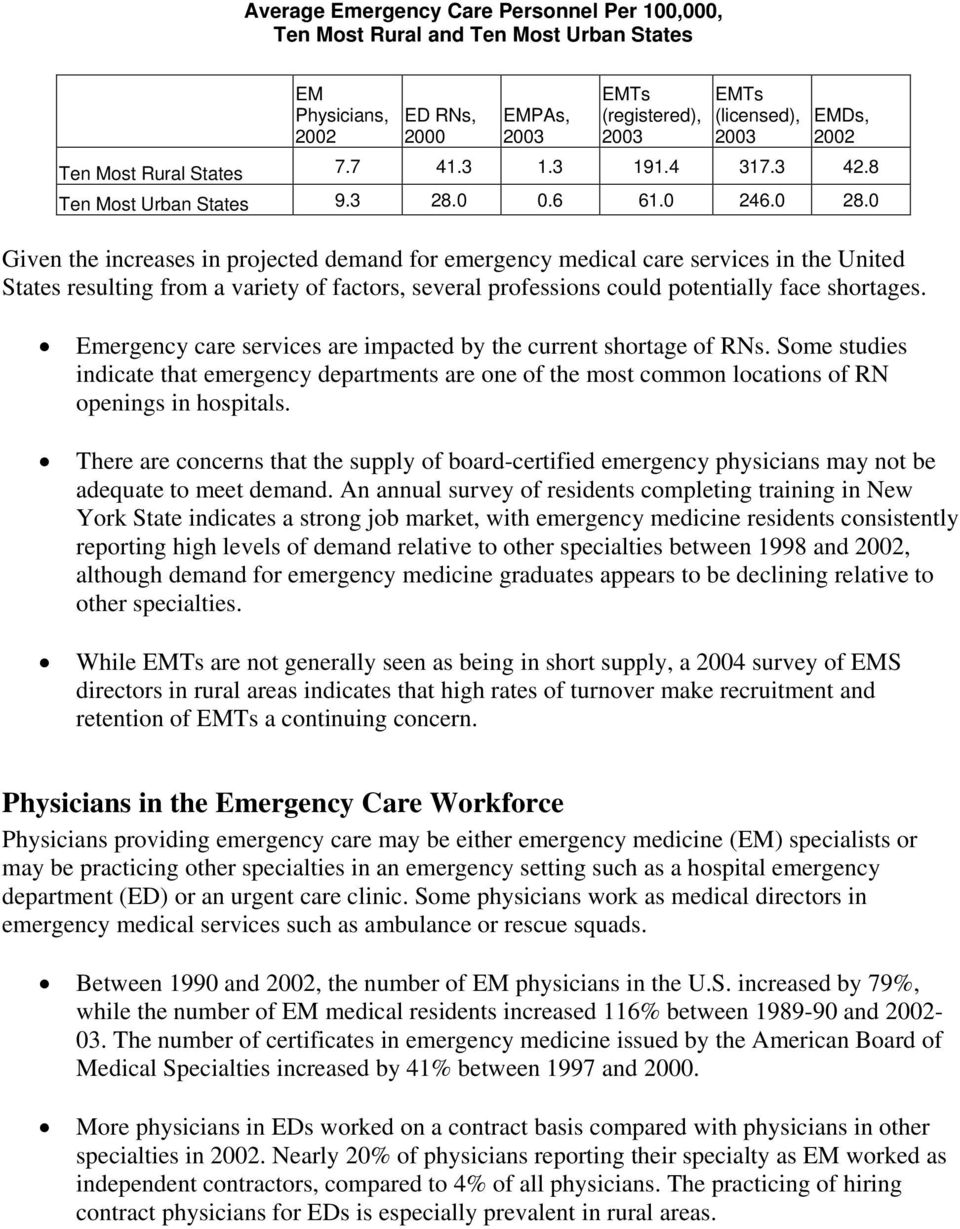
2 EXECUTIVE SUMMARY Emergency care systems in the United States include pre-hospital emergency services, emergency departments (EDs) in hospitals, freestanding urgent care centers, and teams dispatched by local, state, or federal governments or volunteer organizations such as the Red Cross in response to widespread emergency or disaster. Volunteers are used in pre-hospital settings as well, which contributes to the difficulty of estimating the number of providers. These systems employ physicians, registered nurses (RNs), physician assistants (PAs), advanced practice nurses (APNs), emergency medical technicians (EMTs) and paramedics, and emergency medical dispatchers. The total number of workers in the emergency medical care workforce is difficult to estimate due to the limitations of existing data, but some figures that are available are presented below: In 2002, there were 25,500 self-identified emergency medicine physicians in the U.S. 1, although not all work in EDs. Many additional physicians are employed in EDs practicing a specialty other than emergency medicine. Approximately 95,000 RNs and 4,500 APNs (primarily nurse practitioners and clinical nurse specialists) worked in EDs nationwide in There were an estimated 2,325 PAs in the emergency care workforce in 3 ; In, State Offices of Emergency Medical Services reported approximately 757,000 individuals throughout the country licensed as EMTs or paramedics; 4 There were approximately 90,000 emergency medical dispatchers in the U.S. in. 5 The composition of the emergency medical care workforce varies dramatically by geography, particularly in terms of urban/rural location. The ten most rural 6 states had fewer emergency medicine physicians per 100,000 than the most urban states (an average of 7.7 versus 9.3 in 2002), but had more ED RNs (41.3 versus 28.0 in 2000) and more PAs in the emergency medicine workforce (1.3 versus 0.6 in ). 1 American Medical Association, National Nurse Sample Survey, AAPA. Does not include PAs working in a non-urgent setting who reported family practice with urgent care as a specialty. 4 Emergency Medical Services Magazine. Includes licensed EMTs not actively working as EMTs. 5 BLS, In this context, rural refers to the percent of the state s population living in nonmetropolitan areas.

3 Average Emergency Care Personnel Per 100,000, Ten Most Rural and Ten Most Urban States EM Physicians, 2002 ED RNs, 2000 EMPAs, EMTs (registered), EMTs (licensed), EMDs, 2002 Ten Most Rural States Ten Most Urban States Given the increases in projected demand for emergency medical care services in the United States resulting from a variety of factors, several professions could potentially face shortages. Emergency care services are impacted by the current shortage of RNs. Some studies indicate that emergency departments are one of the most common locations of RN openings in hospitals. There are concerns that the supply of board-certified emergency physicians may not be adequate to meet demand. An annual survey of residents completing training in New York State indicates a strong job market, with emergency medicine residents consistently reporting high levels of demand relative to other specialties between 1998 and 2002, although demand for emergency medicine graduates appears to be declining relative to other specialties. While EMTs are not generally seen as being in short supply, a 2004 survey of EMS directors in rural areas indicates that high rates of turnover make recruitment and retention of EMTs a continuing concern. Physicians in the Emergency Care Workforce Physicians providing emergency care may be either emergency medicine (EM) specialists or may be practicing other specialties in an emergency setting such as a hospital emergency department (ED) or an urgent care clinic. Some physicians work as medical directors in emergency medical services such as ambulance or rescue squads. Between 1990 and 2002, the number of EM physicians in the U.S. increased by 79%, while the number of EM medical residents increased 116% between and The number of certificates in emergency medicine issued by the American Board of Medical Specialties increased by 41% between 1997 and More physicians in EDs worked on a contract basis compared with physicians in other specialties in Nearly 20% of physicians reporting their specialty as EM worked as independent contractors, compared to 4% of all physicians. The practicing of hiring contract physicians for EDs is especially prevalent in rural areas.
4 Emergency medicine physicians are less likely to be female than other physicians (20% versus 25%), despite being younger on average. There are significant differences in the racial/ethnic composition of emergency physicians and the patients they treat. In 2002, emergency medicine physicians in the U.S. were 4% African-American and 4% Hispanic, compared to a general population that was 12% African American and 13% Hispanic. Registered Nurses in the Emergency Care Workforce Emergency department (ED) nurses are registered nurses (RNs) who work in hospital emergency departments. Some RNs also provide emergency care in urgent care centers or in the pre-hospital environment as transport nurses. The estimated number of RNs working in EDs as a primary work setting nationwide increased by 41%, from 67,249 to 94,912 between 1988 and RNs in EDs tended to be younger on average than other RNs (with a median age of 40 versus 43). The majority of ED RNs in the country (89%) was non-hispanic White in 2000; 3% were Hispanic/Latino and 4% were Black/African American, lower than the percentages in the general population. RNs in EDs were also more likely to be men than other RNs, although the percentage of men was still low (14%). Physician Assistants and Advanced Practice Nurses in the Emergency Care Workforce Physician assistants (PAs) and advanced practice nurses (APNs) provide medical care to patients under the supervision of a physician. The specialty of the PA reflects the specialty of their supervising physician. The vast majority of PAs in emergency departments in reported a specialty in emergency medicine (94%), followed by surgical specialties (2%). There is no formal PA certification program for EM at this time, and only one or two residency programs for PAs in EM. For most, specialty training is based on practice and experience. APNs in emergency settings in 2001 were most likely to report certifications as a family nurse practitioner (NP) (43%), acute care NP (13%), adult care NP (12%), critical care clinical nurse specialist (9%), or pediatric NP (7%). There is currently no option of certification for NPs in EM, although it is desired by those who complete the few training programs of this type. Approximately one-third of EDs in the U.S. employed physician assistants in 1999, while nurse practitioners worked in approximately 17% of EDs. Emergency care PAs were more likely than other PAs to be male in, but were older on average than other PAs. The majority of PAs in the country were non-hispanic White; 4% were Hispanic/Latino and 3% were Black/African-American, lower than their percentages in the general population. Very large numbers of emergency care PAs had a background in the Armed Forces.
5 Emergency Medical Technicians and Paramedics Emergency medical technicians (EMTs) and paramedics are often the first providers of direct medical care to patients needing emergency treatment, although first responders, such as police and firefighters, may provide some basic care at the scene. EMTs may practice at various levels, from EMT-Basic to Paramedic. A substantial number of EMTs serve in a volunteer capacity; in, it was estimated that over one-third of registered EMTs in the U.S. were volunteers. The vast majority of EMTs in were non-hispanic White, well above their percentage in the general population, while African-Americans and Hispanics were underrepresented relative to their percentage in the population. The number of EMTs grew between 1996 and, and the Bureau of Labor Statistics projects that employment of EMTs and Paramedics will grow an additional 33.1% between 2002 and 2012, or by 59,000 new jobs. Total job openings for the period, including replacement positions, are estimated at 80,000. There are several issues with potential to substantially affect future demand for emergency care services and workers, including: A growing concern about the potential for mass casualty incidents or bioterrorism threats, leading to more focused efforts in emergency preparedness planning; The aging of America, leading to a growing cohort of the population placing new demands on the emergency care system; The increasing racial and ethnic diversity of the nation, leading to greater concern about the cultural competence and diversity of the emergency care workforce; The lack of access to medical insurance, with higher rates of underinsurance and uninsurance leading to increasing use of emergency departments for non-emergency care; Current health workforce shortages and maldistribution of health care workers, which may worsen; The closings of hospital emergency departments; and The development and use of new health care technologies, which may potentially increase the efficiency and effectiveness of emergency medical care but which may also require new skills of emergency care personnel.

LICENSED SOCIAL WORKERS IN THE UNITED STATES, 2004. Chapter 2 of 4. Demographics
 LICENSED SOCIAL WORKERS IN THE UNITED STATES, 2004 Chapter 2 of 4 Demographics Prepared by Center for Health Workforce Studies School of Public Health, University at Albany Rensselaer, NY and NASW Center
Physician Assistant and Advance Practice Nurse Care in Hospital Outpatient Departments: United States, 2008 2009
 NCHS Data Brief No. 77 November 0 Physician Assistant and Advance Practice Nurse Care in Hospital Outpatient Departments: United States, 008 009 Esther Hing, M.P.H. and Sayeedha Uddin, M.D., M.P.H. Key
Registered Nurse Survey 2012 Executive Summary
 Wisconsin Registered Nurse Survey 2012 Executive Summary wicenterfornursing.org Wisconsin Center for Nursing Mary Ellen Murray, PhD, RN, School of Nursing University of Wisconsin-Madison Judith Westphal,
Center for Rural Health North Dakota Center for Health Workforce Data. July 2004
 North Dakota Nursing Needs Study: Licensed Nurse Survey Year 2 Center for Rural Health North Dakota Center for Health Workforce Data July 2004 Carol Bennett, M.A., R.N. Patricia L. Moulton, Ph.D. Mary
How To Understand And Understand The Health Care Needs In North Dakota
 North Dakota Nursing Needs Study 2011 Licensed Nurse Supply Analysis January, 2012 Patricia L. Moulton, Ph.D. North Dakota Center for Nursing Research Publication #3 Funding for this project was provided
TREND WHITE PAPER LOCUM TENENS NURSE PRACTITIONERS AND PHYSICIAN ASSISTANTS: A GROWING ROLE IN A CHANGING WORKFORCE
 TREND WHITE PAPER LOCUM TENENS NURSE PRACTITIONERS AND PHYSICIAN ASSISTANTS: A GROWING ROLE IN A CHANGING WORKFORCE The Leader in Locum Tenens Staffing INTRODUCTION Today s Mobile Healthcare Work Force
Topic: Nursing Workforce Snapshot A Regional & Statewide Look
 Topic: Nursing Workforce Snapshot A Regional & Statewide Look Nursing Workforce in Texas 184,467 registered nurses (2011) Median age of RN is 47 (2011) Gender 89% Female and 11% Male (2011) Race/Ethnicity
SUBJECT: CRITICAL CARE TRANSPORT (CCT) PROVIDER REFERENCE NO. 414
 Nurse-Staffed CCT: A ground or air ambulance interfacility transport of a patient who may require skills or treatment modalities that exceed the paramedic scope of practice but do not exceed the RN scope
A CHANGING, GROWING HEALTH CARE SECTOR
 A CHANGING, GROWING HEALTH CARE SECTOR Demand Continues for More Nurses and Allied Health Care Professionals 2012 Nursing and Allied Health Care Professionals Workforce Survey Report The 2012 Nursing and
Nurse Practitioners (NPs) and Physician Assistants (PAs): What s the Difference?
 Nurse Practitioners (NPs) and Physician Assistants (PAs): What s the Difference? More than ever before, patients receive medical care from a variety of practitioners, including physicians, physician assistants
Registered Nurses. Population
 The Registered Nurse Population Findings from the 2008 National Sample Survey of Registered Nurses September 2010 U.S. Department of Health and Human Services Health Resources and Services Administration
A Profile of Colorado s Advanced Practice Nurse Workforce
 A Profile of Colorado s Advanced Practice Nurse Workforce Key Findings from the 2010 Advanced Practice Nurse Survey Colorado Health Institute 303 E. 17 th Avenue, Suite 930 Denver, Colorado 80203-1728
OVERVIEW OF CURRENT SCHOOL ADMINISTRATORS
 Chapter Three OVERVIEW OF CURRENT SCHOOL ADMINISTRATORS The first step in understanding the careers of school administrators is to describe the numbers and characteristics of those currently filling these
The Physician Assistant (PA): A historical perspective & Utilizing PAs in the HealthCare Setting
 The Physician Assistant (PA): A historical perspective & Utilizing PAs in the HealthCare Setting Randy L. Orsborn, MPAS, PA-C, CLS Physician Assistant Knox Community Hospital Mount Vernon, Ohio Objectives
THE U.S. HEALTH WORKFORCE CHARTBOOK. Part III: Technologists & Technicians and Aides & Assistants
 THE U.S. HEALTH WORKFORCE CHARTBOOK Part III: Technologists & Technicians and Aides & Assistants U.S. Department of Health and Human Services Health Resources and Services Administration National Center
California Board of Registered Nursing
 California Board of Registered Nursing 2006 Survey of Registered Nurses Conducted for the California Board of Registered Nursing by the University of California, San Francisco School of Nursing and Center
Health Care Employment Projections:
 Health Care Employment Projections: An Analysis of Bureau of Labor Statistics Occupational Projections 2010-2020 March 2012 The Center for Health Workforce Studies School of Public Health, University at
Minnesota s Registered Nurse Workforce, 2011-2012
 Office of Rural Health and Primary Care P.O. Box 64882 St. Paul, MN 55164-0882 651-201-3838 Minnesota s Registered Nurse Workforce, 2011-2012 The Minnesota Department of Health (MDH), in cooperation with
Physician Assistants
 Physician Assistants INTRODUCTIONS Colleen Schierholtz, BS Director of Admissions, OHSU PA Program Jess Pethtel, BS Admissions Assistant, OHSU PA Program Goals for Today s Session Info on Physician Assistant
NCHWA s Nursing Workforce Research Activities and Findings
 NCHWA s Nursing Workforce Research Activities and Findings Jennifer Nooney, PhD Public Health Analyst, National Center for Health Workforce Analysis U.S. Department of Health and Human Services Health
LICENSED SOCIAL WORKERS IN THE UNITED STATES, 2004 SUPPLEMENT. Chapter 2 of 5. Who Are Licensed Social Workers?
 LICENSED SOCIAL WORKERS IN THE UNITED STATES, 2004 SUPPLEMENT Chapter 2 of 5 Who Are Licensed Social Workers? Prepared by Center for Health Workforce Studies School of Public Health, University at Albany
THE U.S. HEALTH WORKFORCE CHARTBOOK. Part IV: Behavioral and Allied Health
 THE U.S. HEALTH WORKFORCE CHARTBOOK Part IV: Behavioral and Allied Health U.S. Department of Health and Human Services Health Resources and Services Administration National Center for Health Workforce
Working as an EMT Robert Mietlicki
 FACT SHEET April 20, 2010 Working as an EMT Robert Mietlicki What is the nature of the work? The work of Emergency Medical Technicians (EMTs) is often the difference between life and death for a patient.
Health Workforce Trends and Policy in Nevada and the United States
 Health Workforce Trends and Policy in Nevada and the United States Tabor Griswold, PhD Health Services Research Analyst Office of Statewide Initiatives University of Nevada School of Medicine CHS Fall
Sex, Race, and Ethnic Diversity of U.S. Health Occupations (2010-2012)
 Sex, Race, and Ethnic Diversity of U.S. Health Occupations (2010-2012) January 2015 U.S. Department of Health and Human Services Health Resources and Services Administration Bureau of Health Workforce
Statement on the Redirection of Nursing Education Medicare Funds to Graduate Nurse Education
 Statement on the Redirection of Nursing Education Medicare Funds to Graduate Nurse Education To the National Bipartisan Commission on the Future of Medicare Graduate Medical Education Study Group (January
State of Wisconsin. Department of Health and Family Services Division of Public Health. Bureau of Local Health Support and Emergency Medical Services
 State of Wisconsin Department of Health and Family Services Division of Public Health Bureau of Local Health Support and Emergency Medical Services 2006 Interfacility Transport Guidelines Table of Contents
Duke University (Durham, NC) University of Iowa (Iowa City, IA) Emory University (Atlanta, Georgia) George Washington University (Washington, DC)
 Saddleback College Duke University (Durham, NC) University of Iowa (Iowa City, IA) Emory University (Atlanta, Georgia) George Washington University (Washington, DC) Oregon Health and Sciences University
THE U.S. HEALTH WORKFORCE CHARTBOOK. Part II: Clinicians and Health Administration
 THE U.S. HEALTH WORKFORCE CHARTBOOK Part II: Clinicians and Health Administration U.S. Department of Health and Human Services Health Resources and Services Administration National Center for Health Workforce
Position Statement on Physician Assistants
 Position Statement on Physician Assistants Team-based models of medical care that are characterised by responsiveness to local needs, mutual reliance and flexibility have always been a part of rural and
NEW YORK S GROWING DEMAND
 Nurses and Allied Health Professionals NEW YORK S GROWING DEMAND Results from the 2011 Health Care Professionals Workforce Survey JUNE 2011 Published by The 2011 Health Care Professionals Workforce Survey
Lesson 2: Health Professions
 Glossary 1. Bachelor s Degree: a 4-year degree from a college or university 2. Certification: some jobs require you to complete a training program or pass an exam to show that you have the knowledge to
AAPA ANNUAL SURVEY REPORT
 2013 AAPA ANNUAL SURVEY REPORT PHYSICIAN ASSISTANTS AT A GLANCE HIGHLIGHTS OF THE MEDIAN AGE CLINICALLY PRACTICING PAS BY PRIMARY SPECIALTY PRACTICE SETTING Primary Care 32.0% Surgical Subspecialties 27.0%
UNSOM Health Policy Report
 Registered Nurse Workforce in Findings from the 2013 National Workforce Survey of Registered Nurses May 2014 Tabor Griswold, PhD, Laima Etchegoyhen, MPH, and John Packham, PhD Overview Registered Nurse
Module Two: EMS Systems. Wisconsin EMS Medical Director s Course
 : EMS Systems Wisconsin EMS Medical Director s Course Objectives List the components of EMS systems Outline organizational and design options for EMS systems Outline system staffing and response configurations
Media Packet 10-2009. [email protected] 888-405-NPAM. PO Box 540 Ellicott City, MD 21041
 Media Packet What is a Nurse Practitioner NP Facts Who are the Nurse Practitioners in Maryland State of the State Quality of NP Practice NP Cost Effectiveness 10-2009 [email protected] 888-405-NPAM PO Box
Documentation of the Meaning and Scope Of PLHCP
 Documentation of the Meaning and Scope Of PLHCP Following documents are guidance documents as to the meaning of Physician and other Licensed Heath Care Provider. All documentation is from Fed/OSHA unless
Emergency Medical Services (EMS) Prototypes Around the World 2016
 Emergency Medical Services (EMS) Prototypes Around the World 2016 Jim Holliman, M.D., F.A.C.E.P., F.I.F.E.M. President, International Federation for Emergency Medicine Professor of Emergency Medicine and
SUBJECT: PRIVATE PROVIDER AGENCY (EMT, PARAMEDIC, MICN) TRANSPORT/RESPONSE GUIDELINES REFERENCE NO. 517
 DEPARTMENT OF HEALTH SERVICES COUNTY OF LOS ANGELES SUBJECT: PRIVATE PROVIDER AGENCY (EMT, PARAMEDIC, MICN) TRANSPORT/RESPONSE PURPOSE: To provide guidelines for private ambulance providers handling requests
Changing Demographics: Implications for Physicians, Nurses, and Other Health Workers Spring 2003
 Changing Demographics: Implications for Physicians, Nurses, and Other Health Workers Spring 2003 U.S. Department of Health and Human Services Health Resources and Services Administration Bureau of Health
Health Professions Data Series Registered Nurses 2010
 Executive Office of Health and Human Services Health Professions Data Series Registered Nurses 2010 Deval L. Patrick, Governor Timothy P. Murray, Lieutenant Governor John W. Polanowicz, Secretary Lauren
The Polk County Board of County Commissioners. DEPUTY CHIEF - MEDICAL SERVICES (Fire Rescue) - Bartow, Florida -
 The Polk County Board of County Commissioners Polk County is strategically located in the center of the Florida peninsula just 25 miles east of Tampa and 35 miles southwest of Orlando. As the geographic
Emergency Medical Technician (EMT) Training Program Application Packet
 Emergency Medical Technician (EMT) Training Program Application Packet Submit completed application and supporting documentation to: Contra Costa Emergency Medical Services Attn: EMT Training Program Approval
The Advanced Practice Provider in an Emerging Specialty
 The Advanced Practice Provider in an Emerging Specialty Malinda Teague, MS, RN, CPNP-AC/PC Director of Advanced Practice Programs Coordinator, Pediatric Nurse Practitioner Specialty Assistant Professor
Florida s Advanced Registered Nurse Practitioner Supply: 2014-2015 Workforce Characteristics and Trends
 Florida s Advanced Registered Nurse Practitioner Supply: 2014-2015 Workforce Characteristics and Trends Visit our site at: www.flcenterfornursing.org TABLE OF CONTENTS Key Findings...3 Introduction.4 Results
Chapter 1: Nursing Today: A Time of Transformation Test Bank
 hapter 1: Nursing Today: Time of Transformation Test ank MULTIPLE HOIE 1. Which of the following could eventually change the historical status of nursing as a female-dominated profession? a. More men graduating
2013 Survey of registered nurses
 We ve earned The Joint Commission s Gold Seal of Approval 2013 Survey of registered nurses Generation Gap Grows as Healthcare Transforms AMN Healthcare, Inc., 2013 12400 High Bluff Drive, San Diego, CA
A Survey of North Dakota Physicians Health Profession Tracking Program
 http://medicine.nodak.edu/crh CR H Center for Rural Health University of North Dakota School of Medicine & Health Sciences A Survey of North Dakota Physicians Health Profession Tracking Program Mary Amundson,
Profile of Rural Ambulance Services in Minnesota
 April 2003 Profile of Rural Ambulance Services in Minnesota Emergency services include a variety of medical services that supply essential prehospital care during crises. Much of the information presented
Survey of Nursing Education Programs: 2005 2006 School Year
 Survey of Nursing Education Programs: EXECUTIVE SUMMARY In the fall of 2006, the Michigan Center for Nursing conducted a survey of nursing education programs in Michigan to collect information on the types
The Supply and Demand for Registered Nurses and Licensed Practical Nurses in Nebraska
 The Supply and Demand for Registered Nurses and Licensed Practical Nurses in Nebraska February 6, 2006 David I. Rosenbaum, Ph.D. 4103 South Gate Blvd Lincoln NE 68506 402-489-1218 Executive Summary Recent
The Registered Nurse Population
 The Registered Nurse Population Initial Findings from the 2008 National Sample Survey of Registered Nurses March 2010 U.S. Department of Health and Human Services Health Resources and Services Administration
And in rural areas. Chart 3: Median number of days to fill vacant RN positions in urban and rural areas
 RN Shortages in Hospitals March 1999, Vol. 1, No. 2 Nurses comprise the largest sector of the healthcare workforce and the majority of nurses work in hospitals. Because of the prominence and importance
An Introduction to our Services
 An Introduction to our Services Ambulance services are at the front line of the NHS. That s why, at Yorkshire Ambulance Service (YAS), we put patients and their needs at the heart of everything we do.
2008 Colorado Registered Nurse Workforce Survey
 2008 Colorado Registered Nurse Workforce Survey Survey Findings Colorado Health Institute 1576 Sherman Street, Suite 300 Denver, CO 80203-1728 www.coloradohealthinstitute.org September 2009 Acknowledgments
NEW YORK S HEALTH CARE SECTOR: A CHANGING, GROWING WORKFORCE: Demand Continues for Health Care Professionals NEW YORK S HEALTH CARE SECTOR:
 NEW YORK S HEALTH CARE SECTOR: A CHANGING, GROWING WORKFORCE Demand Continues for Health Care Professionals 2013 Nursing and Allied Health Care Professionals Workforce Survey Report 1 The 2013 Health Care
Healthcare Workforce Diversity & Health Equity
 Healthcare Workforce Diversity & Health Equity CBC Health Braintrust/NMQF Leadership Summit on Health Disparities LaQuandra Nesbitt, MD, MPH Assistant Professor Department of Family & Community Medicine