
QUALITY ASSURANCE COUNCIL AUDIT MANUAL SECOND AUDIT CYCLE
|
|
|
- Lora Patrick
- 9 years ago
- Views:
Transcription
1 QUALITY ASSURANCE COUNCIL AUDIT MANUAL SECOND AUDIT CYCLE

2 Table of Contents Executive Summary 1 1. Introduction 3 2. Aims of audit Scope of the second round of QAC audits Process for the second round of QAC audits Audit Panels Audit Themes and focused areas Information requirements Audit reports Follow-up to audit 36 Annex A Factors for consideration in assessing academic standards and 37 quality Annex B Quality manuals institutional management of quality assurance 41 Annex C Preparation of self-evaluation document (Institutional Submission) 42 Annex D Indicative programme for institutional briefing 43 Annex E Indicative audit visit programme 44 Annex F Evidence for Audit Themes 45 Annex G Information requirements 48 Annex H Roles and responsibilities of Audit Panel members and Audit 50 Coordinator Annex I Auditing programmes offered outside Hong Kong 53 Annex J Audit of non-ugc funded institutions 55 Annex K Institutional action plans and progress reports 56 Annex L Structure and content of the overview report of all eight quality audits 58 Annex M Representations by institutions 59 Annex N Conflict of interest 60 Annex O Privacy and disclosure of information 62 Annex P Glossary of terminology 63

3 Executive Summary The University Grants Committee (UGC) is committed to safeguarding and promoting the quality of UGC-funded institutions and their activities. It performs this role by regular monitoring of the UGC-funded institutions and by periodic reviews of the arrangements in place within institutions for the effective quality assurance of their provision and its enhancement. The QAC Audit Manual explains the methodology to be used in the second round of audits for the UGC-funded institutions. Audit is an external quality assurance process that involves independent peer review by senior academics in the higher education sector. Its principal aims are to confirm that existing arrangements for quality assurance are fit for purpose, that the quality of provision is comparable to international best practices, that institutions are committed to continuously improving the quality of their academic programmes and that students are well taught and well supported, to ensure that they are able to achieve the expected academic standards. The principal changes introduced with the second round of QAC audits include a stronger focus on student learning and achievement. The QAC Audit Panels will not only be interested in the systems and procedures that support quality, but also in the outcomes of students learning experiences. Panels will consider how institutions monitor the progress of their students and the range of graduate skills and capabilities that students acquire as a result of their studies. The last round of audits had a particular focus on the operation of quality systems at the level of the subject and included the assessment of a range of sample programmes. This time around the emphasis is more on quality enhancement: about what institutions are doing to improve the quality of teaching and learning and promote the career opportunities of students. The method is designed to encourage a dialogue on enhancement and a more reflective approach to evaluating institutional developments. The audit programme includes a focus on two key themes: enhancing the student learning experience and global engagements. The audit will provide an opportunity for institutions to reflect on their current policies and strategies in these areas and consider plans for future activity. 1

4 The second audit cycle will be carried out over a two-year period. On completion of the individual audits an overview report will be produced summarising the main issues identified and considering possible future developments. 2

5 1. Introduction The context of quality assurance developments in Hong Kong The UGC conducted a review of Higher Education in Hong Kong in 2010, which led to the publication of the report Aspirations for the Higher Education System in Hong Kong. The report highlighted a number of issues about the structure and organisation of higher education in Hong Kong, including the different roles of the UGC and other quality bodies in overseeing higher education providers, the growth in self-funded provision, both at postgraduate and sub-degree levels, the increasing demand for student places in institutions and the developing role of the private sector. The report included a wide range of recommendations for development of the higher education sector including the establishment of a single quality assurance body for the whole post-secondary system, the integration of methods and approaches for quality assessment and the provision of better public information. It is the Hong Kong Government s policy to promote the development of Hong Kong as a regional education hub, drawing in students from surrounding countries and acting as a focus for research and innovation. The UGC also promotes the development of global engagement strategies by UGC-funded institutions to widen the horizons of students and prepare them for participation in the international community. The four-year curriculum The Hong Kong Government has introduced significant structural changes to management and organisation of education at all levels: primary, secondary and tertiary. From September 2012, students enter the higher education system one year earlier, and spend four years studying to achieve a degree award. The development of the four-year curriculum has resulted in significant changes to the structure of higher education programmes, with an increased emphasis on the development of generic skills and a wider range of subject coverage. In order to manage the transition in the first year of operation, , institutions recruited a double cohort of students: one following the original three-year programme and the other enrolled on the new four-year programme. This has 3
6 presented a number of challenges in the management of quality assurance processes which may have a bearing on the arrangements for the second round of QAC quality audits. Audit Panels may take an interest in how institutions have managed this transition. It is recognised that any assessment of the impact of these changes will need to be conducted at a later date, once the first cohort of students have graduated. However, there is the opportunity to reflect on the measures taken by institutions to develop the curriculum and to progress strategies for quality enhancement. Outcomes-based approach to student learning The other major development across the UGC sector has been the progressive adoption of an outcomes-based approach to the design and delivery of higher education programmes. Outcomes-based education focuses on what students will achieve and be able to do once they have completed their studies. It combines both the acquisition of knowledge with the application of skills and capabilities. The quality assurance framework The revisions to the QAC quality audit method are part of a wider set of developments in quality assurance introduced by the UGC. The new quality assurance framework also includes the introduction of Audit Themes, with a focus on quality enhancement. In addition there is an expectation that institutions will do more to provide public information about higher education provision and allow for betterinformed choices by students and employers. The role and structure of UGC and QAC The UGC is committed to safeguarding and promoting the quality of UGC-funded institutions and their activities. The QAC was established in 2007 in view of institutional expansion of their activities and a growing public interest in quality issues. It is a semi-autonomous non-statutory body under the aegis of the UGC. It assists the UGC in providing third-party oversight of the quality of the institutions educational provision. Its mission is: To assure that the quality of educational experience in all first degree level programmes and above, however funded, offered in UGC-funded institutions is sustained and improved, and is at an internationally competitive level; and 4
7 To encourage institutions to excel in this area of activity. The QAC also has a brief to facilitate the dissemination of good practice in quality assurance in higher education in Hong Kong. The QAC has the following terms of reference: To advise the UGC on quality assurance matters in the higher education sector in Hong Kong and other related matters as requested by the Committee; To conduct audits and other reviews as requested by the UGC, and report on the quality assurance mechanisms and quality of the offerings of institutions; To promote quality assurance in the higher education sector in Hong Kong; and To facilitate the development and dissemination of good practices in quality assurance in higher education. The QAC Members are appointed by the Secretary for Education. The Council may have up to 9 members, as follows: A Chairman, who is a UGC member (or becomes a UGC member once appointed). Overseas members (maximum 2). Local academics (maximum 2). Local lay members (maximum 2). Cross-membership with the UGC (2): one is the QAC Chairman and the other may belong to one of the above categories. The Secretary-General, UGC (ex-officio). The Council is supported by a full-time Secretariat, led by a Deputy Secretary- General, UGC, who serves as the Secretary of the Council, under the overall supervision of the Secretary-General, UGC. The scope of QAC audit The QAC fulfils its task primarily by undertaking periodic quality audits of the institutions. The QAC s audit activities cover all first degree programmes and above, however funded, offered by UGC-funded institutions (including their continuing 5
8 education arms and community colleges). This includes UGC-funded programmes, self-financing programmes, and programmes offered outside Hong Kong leading to a qualification wholly or partly awarded by the institutions, and teaching and learning aspects of research degree programmes. The QAC may also undertake qualityrelated reviews of other institutions as requested by the UGC. The parameters to be applied in such reviews are agreed with all relevant parties beforehand (see Annex J). The approach to QAC audit The QAC s approach to quality audit is based on the principle of fitness for purpose. Audit Panels assess the extent to which institutions are fulfilling their stated mission and purpose and confirm the procedures in place for assuring the quality of the learning opportunities offered to students and the academic standards by which students level of performance and capability are assessed and reported. The QAC audit also examines the effectiveness of an institution s quality systems and considers the evidence used to demonstrate that these systems meet the expectations of stakeholders. Academic standards Each UGC-funded institution is self-accrediting and is responsible for setting and maintaining the academic standards of its higher education provision and ensuring that students are provided with appropriate opportunities to achieve these standards. Academic standards are defined in terms of the expected levels of achievement of students that reflect the acquisition of knowledge, the development of capability and the exercise of intellectual skills by students. They apply across all disciplines and reflect the expectations established by institutions as well as the academic requirements and competencies associated with individual courses and programmes. The standards of academic awards are secured through the interaction of subject communities and through the expectations of employers and other stakeholders. In professional disciplines the expected standards of achievement are linked to the skills and capabilities required of graduates to practise in the profession. Other academic disciplines may have a generally agreed set of curriculum content and expectations that define the nature of degree-level study. 6
9 The QAC audit will consider the ways in which institutions set and maintain their academic standards with reference to institutional mission and purpose; and the extent to which the appreciation of academic standards is applied consistently throughout the institution and shared by the academic disciplines. However, the recognition and implementation of academic standards should also be developed within the context of a sound understanding of the standards of higher education in other institutions and in other jurisdictions. Institutions are encouraged to use external reference points to show that they are fulfilling these expectations (see Annex A). Audit Panels will wish to see evidence of how institutions have identified and compared the standards of provision in other appropriate institutions. The quality of learning opportunities As well as setting and maintaining academic standards, institutions have an obligation to ensure that students are provided with appropriate learning opportunities to demonstrate their level of achievement. Learning opportunities include the quality of teaching, the availability of learning resources, the support and guidance available for students and the maintenance of a vibrant and enquiring academic community. The QAC audit looks for evidence for the promotion of learning opportunities and in particular how institutions assure themselves that their academic staff are competent to deliver academic programmes, that high quality of teaching and learning is being maintained and that students are provided with all necessary resources to complete their studies effectively. Student achievement The outcomes of students participation in higher education are measured in terms of the awards they achieve. However, the specification of awards may not adequately cover the range of student abilities or effectively measure the level of overall personal development. In addition to an academic qualification, employers have an interest in how students can apply their learning and in their skills of communication and selfmotivation. The audit process has a focus on student achievement and how it is demonstrated by institutions. In particular, institutions may be expected to show how they evaluate the needs of employers and other stakeholders, how they support students in their development during their studies and how their achievements are recorded and publicised. 7
10 Building on past experience UGC-funded institutions have a significant track record in the development and maintenance of quality assurance systems. Teaching and Learning Quality Process Reviews, carried out in the 1990s and early 2000s, focused primarily on the quality of teaching across different subject disciplines. This theme was followed-up in the first round of quality audits through selected programmes for more in-depth review to seek evidence that institutions quality assurance processes were in fact being implemented in practice and that stated outcomes were being achieved. These previous review activities have established a firm basis on which to develop quality assurance systems further, using the audit methodology not only to provide an assessment of how well institutions are managing quality and academic standards but also to take forward an agenda for enhancement and improvement across the sector as a whole. Quality enhancement and improvement The second round of QAC audits has a particular focus on promoting the enhancement of teaching and learning and the development of sector-wide improvements in the value and application of higher education provision. Quality enhancement is defined in terms of institutional policies, procedures and activities that are designed to promote the learning experience and learning outcomes of students and also contribute to the enrichment of the curriculum. The approach to enhancement will involve an institutional assessment of the strengths and weaknesses of current academic practice and the identification of potential areas for improvement. It may also reflect the particular mission and strategic priorities of institutions, where enhancement is seen in terms of a strategy for driving change and promoting student achievement and capabilities. In defining the scope for this second round of QAC audits, particular dimensions of enhancement and improvement of the student experience in the sector will be explored. For example, attention will be paid to institutional strategies and policies for global engagements, extending the experience and aspirations of students to participate in an increasingly global community. 8

11 Lessons from the first round of quality audits A number of issues were identified from the first round of quality audits which have been taken into consideration in refining the audit manual. Key points include: The need for greater integration between academic planning, research assessment and quality assurance. The recognition and use of the outcomes from professional association accreditation activities. The rationalisation of information requirements. The recognition of the importance of quality enhancement. The use of benchmarks and other reference points to establish academic standards. The need to avoid misinterpretation of the audit findings/use of audit findings to make an over-simplified assessment of the relative performance of institutions. The importance of recognising the value-added by institutions to students intellectual development and their acquisition of skills and capabilities. 9

12 2. Aims of audit The primary aim of QAC quality audit programme is to safeguard the quality of the student learning experience in the UGC-funded institutions in Hong Kong. UGC-funded institutions are autonomous organisations with self-accrediting status. They have ultimate responsibility to assure the quality and academic standards of their higher education programmes. However, there is a public interest in how funding for higher education is used by institutions and a need to provide public assurance that institutions are striving for the highest possible academic standards in higher education teaching and learning. There is also a requirement to promote the student interest in higher education provision, to allow individuals to make informed choices about institutions and programmes of study and to maximise their chances of progressing to chosen careers and other lifetime opportunities. The QAC quality audits seek to achieve a number of objectives: To confirm that the arrangements for quality assurance are fit for purpose and conform to the institution s role and mission. To provide assurance that the standards of higher education (at degree level and above) align with expectations in Hong Kong and can be compared to provision by similar institutions in other jurisdictions. To ensure that students have access to appropriate learning opportunities through taught provision, private study and supported learning. To promote and enhance high quality teaching and learning. To confirm that students are fully supported in their academic and personal development. To advance the highest possible levels of student achievement. To encourage strategic developments which enrich the curriculum and enhance students opportunities for employment and career development. To provide public information, through audit reports and other documents, about the quality and academic standards of UGC-funded provision to assist prospective students, employers and other interested parties. Quality audit is an activity that involves cooperation between institutions, the QAC and Audit Panels. It is most effective when institutions see it as an opportunity to reflect on their current practice and consider ways of improving what they do. By 10
13 using the opportunity of external review, institutions can assess the effectiveness of strategies for quality enhancement and seek confirmation of proposed developments. Quality audit may also identify current areas of good practice and exemplary performance. The role of the Audit Panel is to hold-up a mirror to the institution, to ask questions about how an institution assures the academic standards of its provision and affirms the quality of the learning opportunities available for its students. This is most successfully achieved when Audit Panels are well informed about the institution being reviewed and can engage in constructive discussion and dialogue about quality matters with staff and students. As peer reviewers, Audit Panel members are well placed to comment on what happens within an institution, but at the same time can offer advice and guidance based on their experience in other institutions. Quality audit is frequently portrayed as an event, where the visit by the Audit Panel is seen as an assessment of institutional performance, and where institutions need to invest time and effort in ensuring that they achieve a desired result. It is more productive to look at quality audit as a process for quality improvement, beginning with a self-critical review by the institution, the development of quality systems reported in the Institutional Submissions, the verifying of institutional policies and procedures through external review and the development of an action plan to address any recommendations. 11
14 3. Scope of the second round of QAC audits The first round of QAC quality audits ( ) established that the UGC-funded institutions had in place effective quality assurance systems for the maintenance of provision at the level of programmes and faculties, and institutional oversight of the academic standards of higher education qualifications. The next cycle offers the opportunity to build on this established base to take forward priorities for quality enhancement and sector-wide development. The principal areas for development include: Follow-up on the first round of audits. Institutions should demonstrate how they have addressed issues identified in the previous audit report, particularly the listed recommendations and affirmations. Audit Panels are interested in how quality systems have been refined and how the institutions know that they are working effectively. The introduction of audit trails. Sample programme reviews were required in the last round of audits to establish that quality systems were working effectively at the level of individual programmes. Assurance of quality at the point of delivery is a key consideration of quality assurance. However, having established that institutions are maintaining a close oversight of programme quality, there is less need for external review of primary evidence with a view to lightening the burden on institutions and to sharpening the focus on the Audit Themes (see next bullet) in the second round of QAC audits. Audit Panels, however, reserve the right to use audit trails to seek assurance on the effectiveness of institutional policies and procedures at programme or even course level or indeed in areas of academic support, if there are particular issues that require further investigation. (see section 4) The introduction of Audit Themes. These are intended to support the strategic development of key areas for quality enhancement and allow for the dissemination of current good practice. The introduction of Audit Themes allows institutions to assess their practice in relevant areas of development and provide an opportunity for the sharing of experience between institutions. A focus on student learning and achievement. Previous audits established that institutions had developed effective quality systems. The focus in the second round is on how well these systems are operating and particularly on the impact of quality assurance on the achievements of students. This 12
15 represents a shift in emphasis from the scrutiny of process to the assessment of outcomes and is in line with the development of an outcomes based approach to education more generally across the sector. Student achievement may be assessed both in terms of academic performance and in terms of personal and professional development, reflected in graduate skills and capabilities. More specific coverage of taught postgraduate programmes and research training programmes. Both areas were covered in the previous round of audits. In the second cycle an in-depth, specific assessment of institutional arrangements for the delivery of taught postgraduate programmes and for the support for research postgraduate students will be included. Indicators of good practice are included in Annex A. A shorter audit programme. The audit cycle will be carried out over a twoyear period. This will assist in ensuring the consistency of audit practice. It will also facilitate the timely production of an overview report demonstrating the security of quality and academic standards across the UGC sector as a whole. 13
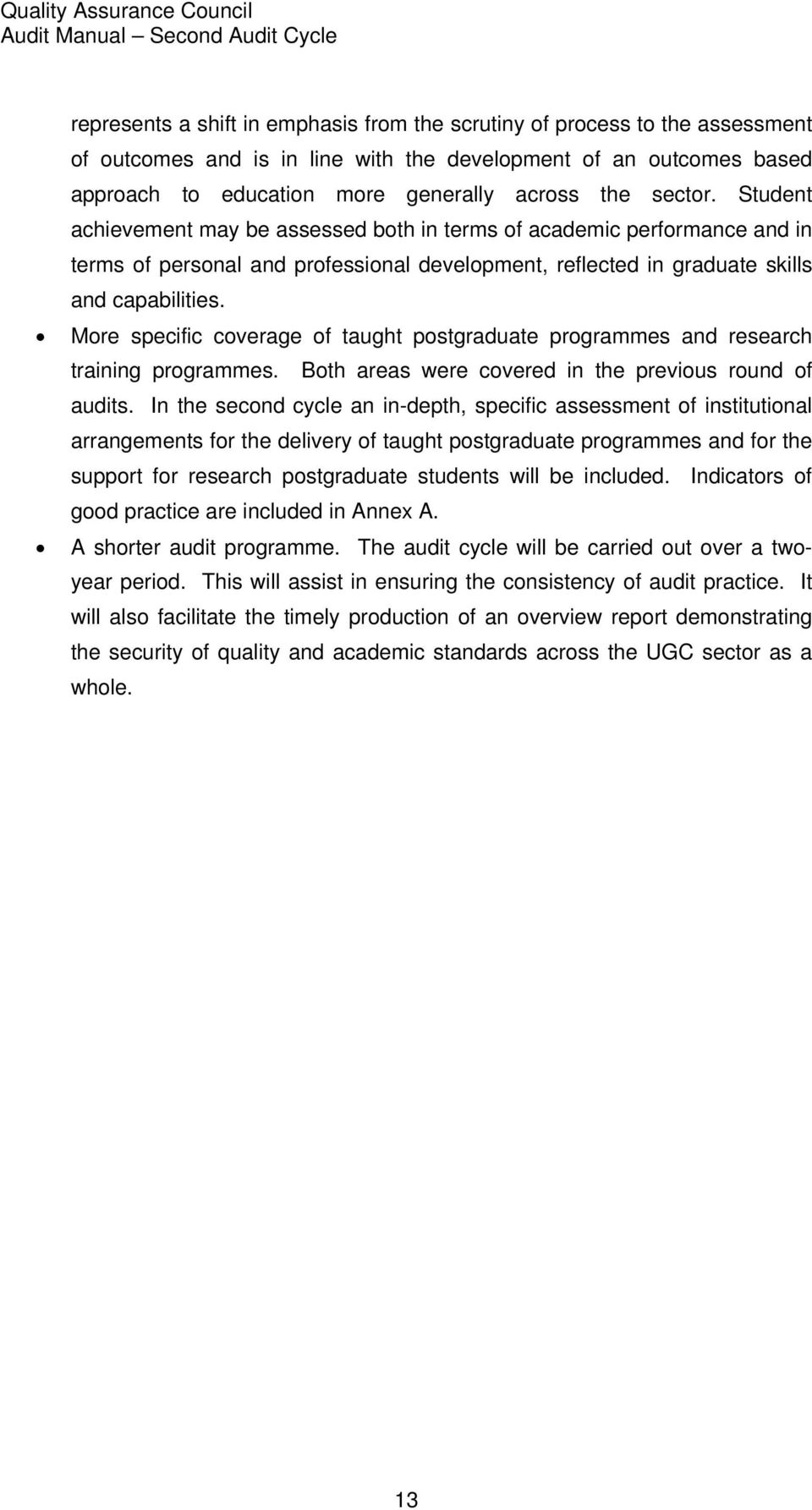
16 4. Process for the second round of QAC audits Preparation First contact by Audit Coordinator Agreement of dates Appointment of Audit Panel Institutional self-evaluation Preparation of Institutional Submission Audit programme Submission of Institutional Submission Initial meeting and institutional briefing Visits outside Hong Kong, if any Audit visit Outcomes Outcomes letter including findings Draft audit report Consideration by QAC/UGC Publication of audit report Institutional action plan Progress report 14
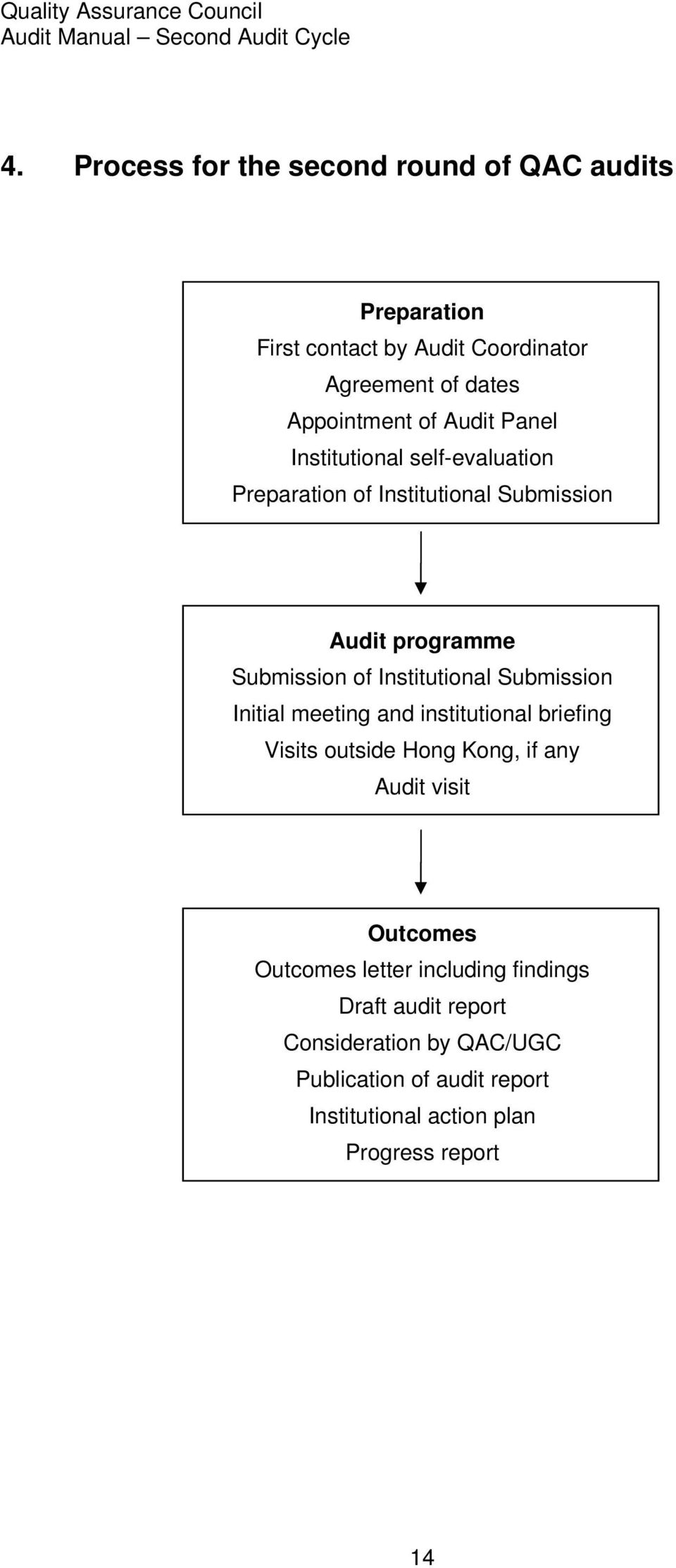
17 The Audit Programme An indicative timetable of the audit process is given below. The process is overseen by the Audit Coordinator. Date QAC Institution 12 months before the audit Confirm the dates for the Conduct self-evaluation. visit panel briefing and the audit visit. Prepare Institutional Submission. 9 months before the audit visit From 12 weeks before the audit visit Select Panel Chair and panel members check with institutions about possible conflicts of interest. Audit Coordinator to discuss arrangements for the audit with the institution. Determine the need for visits outside Hong Kong, if any, and relevant arrangements. Audit Panel reviews information and identifies issues for consideration during the audit visit, including, where appropriate, issues to be followed up using audit trails. Requests for further information if required (or guidance to where information can be located on an institution s intranet). Submission of information to QAC including: The Institutional Submission, with an account of the approach to the Audit Themes. The information set (Quality Manual, Prospectuses, Professional accreditation reports). Details of access to electronic information Guide to supplementary information. 15
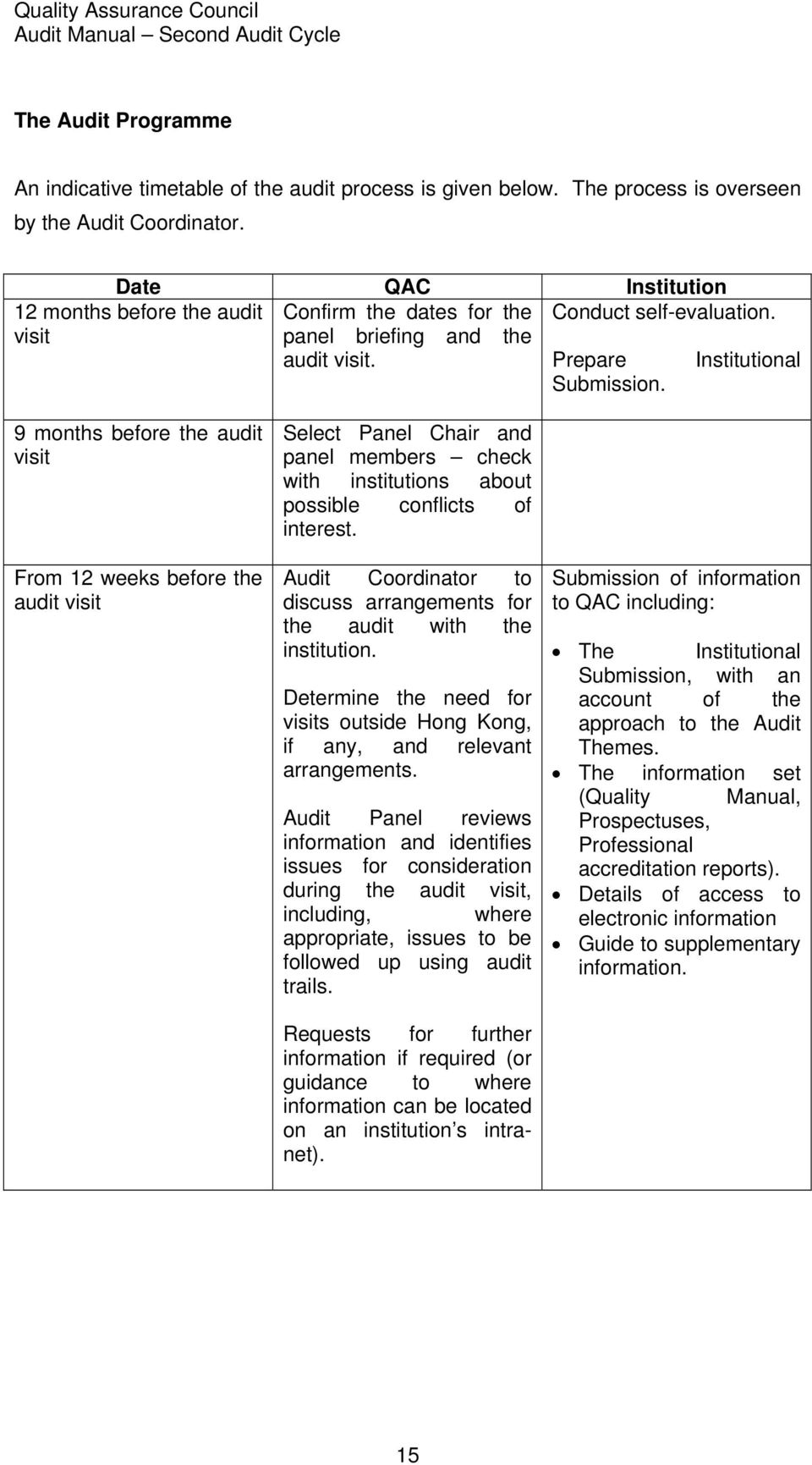
18 Date QAC Institution Audit Coordinator to confirm logistical arrangements for the audit visit and visits outside Hong Kong, if any. 6 weeks to 8 weeks before the audit visit The panel meets in private session (initial meeting) to agree an outline schedule for the audit visit and key issues to be addressed. Audit Coordinator to advise on audit trail specifics arising to date. Institutional briefing. Visit by Audit Panel to the institution. Institution to make a presentation to brief the panel about its strategic priorities and existing arrangements for quality assurance. 3 weeks before the audit visit 2 weeks before the audit visit Audit visit 1 day after the audit visit (or as soon after as is convenient) 2 weeks after the audit visit 2 weeks to 6 weeks after the audit visit Visits to selected campuses outside Hong Kong, if any, by the Audit Coordinator and the Chair or one member of the Audit Panel and an Institutional Representative. Audit Coordinator to confirm the audit programme and prepare outline agenda for meetings. Audit Panel meets with the Audit Coordinator to agree and confirm principal findings of the audit. Audit Coordinator writes to the institution giving the principal findings of the audit. Audit Coordinator drafts the report with inputs from Audit Panel members, and then sends drafts of audit report to panel members for comments. 16

19 Date QAC Institution Audit Coordinator sends the draft audit report to institution for corrections of factual errors. A meeting (or virtual meeting) between the institution and a member of the Audit Panel may be arranged to ensure the institutions understanding of the audit outcomes. 6 weeks after the audit visit Institutions to comment on any factual errors. A meeting (or virtual meeting) between the institution and a member of the Audit Panel may be arranged to ensure the institutions understanding of the audit outcomes. 12 weeks after the audit visit Final audit report sent to institution. 14 weeks after the audit visit Institution to provide response for inclusion in the published report. 15 weeks after the audit visit The next QAC and UGC meetings Audit report submitted to QAC for consideration. QAC and UGC review audit outcomes and may raise any matters of concern with the institution. A representative of the team writing the audit report (e.g. the Audit Coordinator or the Panel Chair) joins the QAC s discussion if required. Audit report published. 3 months after the publication of audit report Institution submits action plan to UGC. 18 months after the publication of audit report Institution progress report. submits The next QAC and UGC meetings QAC and UGC review the progress report and may raise any matters of concern with the institution s progress report. The Panel Chair and Audit Coordinator may be consulted. Progress report published. Institutional response to UGC, if necessary. 17

20 Preparation The initial contact about the arrangements for quality audits will come from the QAC. A letter will be sent by the Audit Coordinator outlining the proposed dates for the institutional briefing and audit visits, together with dates for the return of the Institutional Submission and the information set, and the timescale for the publication of the audit report. At this stage the Audit Coordinator may ask for information about the institutions recent developments and strategic priorities, and may ask for an update on off-campus activities. Institutions will also be asked to nominate an appropriate member of staff to act as the principal liaison for the audit programme (the Institutional Representative). There will be scope for negotiation about the specific dates for the audit, depending on existing institutional commitments. Self-evaluation The starting point for the audit is a critical self-review by the institution of its current arrangements for the management of quality assurance and an assessment of their effectiveness. The evaluation should be based on evidence from established quality systems such as annual course monitoring, periodic reviews, student evaluations and, where appropriate, external examiner reports. In the previous round of quality audits institutions were encouraged to use the Approach-Deployment-Results-Improvement (ADRI) method as a framework for assessment. It would be appropriate to build on this method to include a stronger focus on external reference points: - not just how well are we doing? but how well are we doing in relation to other institutions and sector-wide expectations? (see Annex A) The self-evaluation should be self-critical and comprehensive, identifying the areas where an institution does well and also those areas where there is scope for further development. It should be an inclusive process, involving the views of senior management, teaching staff, support staff and students, and it should be forward thinking identifying how the institution can promote improvements in quality and enhance the learning experience of students. The outcomes of the institutional self-evaluation will be the central component of the Institutional Submission to the QAC. This forms the principal source of information 18

21 for the conduct of the audit. Detailed guidance on the preparation of the Institutional Submission is included in Annex C. The submission should provide the Audit Panel with an overview of the institution s quality arrangements and should indicate how the policies, processes and structures relate to all types of provision: undergraduate, taught postgraduate and research postgraduate. It is intended that the outcomes of the institutional self-evaluation will also inform the Academic Development Proposals (ADP) exercise in the future. Until such time as the necessary synchronisation of these exercises is possible, it is expected that institution s ADP submission will form a central part of the audit documentation. It will not be necessary to cover issues in the Institutional Submission that are already covered in the ADP submission. However, it will be necessary to ensure that references to its content are included in the Institutional Submission. The Institutional Submission should not exceed 12,000 words (excluding supplementary information in Annex G) and may be accompanied by relevant statistical data. The submission should be sent to the QAC as an attachment to an either as a WORD document or as a PDF. The main topics to cover in the Institutional Submission include: Mission and strategic priorities. Organisational structure (principal governance arrangements and academic faculties and departments). Summary of how the affirmations and recommendations from the previous audit have been addressed since the progress report. How the institution sets and maintains its academic standards (see section 1). The quality of students learning opportunities (see section 1). Policies and procedures for quality enhancement (see section 1). Institutional arrangements for the delivery of taught postgraduate programmes and for the support for research postgraduate students. An account of the approach to the Audit Themes (see section 6). Arrangements for the management of off-campus provision (if applicable). A guide to the information set (see section 7). Background information about the institution and the relevant statistics will be provided to the Audit Panel by the Secretariat. 19
22 Initial meeting of the panel and institutional briefing of panel members Approximately six to eight weeks before the audit visit, the Audit Panel meets at the institution to prepare the audit programme. This visit provides an opportunity for the institution to meet the panel and brief them about the institution s systems and procedures and strategic priorities. The initial meeting may last a full day and includes: A presentation from the institution to the panel, giving an overview of the current situation, a review of issues identified in the Institutional Submission and an account of the institution s approach to the Audit Themes. A private meeting of the panel and the Audit Coordinator (the initial meeting of Audit Panel) to discuss the Institutional Submission and agree the main lines of enquiry for the audit visit, including the selection of audit trails (see below). A meeting between the Audit Panel and senior institutional staff to clarify any matters arising from the discussions. A meeting, which may take place over lunch or tea, with a representative group of students to gain an appreciation of the student experience. If appropriate, a meeting with key staff responsible for the management of higher education programmes offered outside of Hong Kong. A meeting between the Audit Coordinator and the Institutional Representative to discuss the likely programme for the audit visit and other logistical matters. An indicative programme for institutional briefing is provided in Annex D. Following the initial meeting the Audit Coordinator writes to the institution to provide the following information: The draft programme for the audit visit identifying the number of meetings and the topics to be covered in each meeting. A provisional list of the staff and students that the panel would like to meet at each meeting. Details of any further information requested by the Audit Panel. Confirmation of the location for the audit visit (normally the main campus of the institution). Details of planned visits to locations outside Hong Kong, if any. Specific details of audit trails identified, if any, and the reasons for their selection. 20
23 Information about the arrangements for the audit of programmes offered outside Hong Kong is provided in Annex I. Such visits to locations outside Hong Kong are to be conducted in the period between the initial meeting of the panel and the audit visit. They are conducted by the Chair or, if this is not feasible, a member of the Audit Panel and the Audit Coordinator, together with the Institutional Representative (or other representative of the institution). The Audit Coordinator agrees a programme for the visit with the Institutional Representative and provides advanced notice of the topics to be discussed and the staff and students that the group would wish to meet. The Institutional Representative has an important role in organising the visit but does not take part in the panel s discussions about the outcomes of the visit. The audit visit The purpose of the audit visit is to provide the Audit Panel with the opportunity to meet with staff, students and other stakeholders to discuss the issues identified in the Institutional Submission and explore any selected lines of enquiry. The panel may wish to clarify its understanding of institutional practices or seek varying perspectives on the operation of institutional policies from different levels within the institution. They also have a particular interest in the learning experience of students and how the institution responds to their needs and expectations. Where evidence is already available from the Institutional Submission or the supporting documentation, it may not be necessary for issues to be explored further in meetings. The visit normally lasts three days and involves a maximum of 12 meetings with various representative groups, and a concluding session with the Head of Institution. The panel expects to meet: The Head of institution and other senior staff. Staff with responsibility for the management of quality. Staff with involvement in the development and implementation of policies relating to the Audit Themes. Leaders of Faculties and/or Academic Departments with responsibility for the allocation of resources and the quality of teaching. A range of teaching staff from different academic disciplines and varying length of service. Academic support staff responsible for the management of learning resources. 21
24 Members of student representative bodies and student members of relevant committees. A representative range of students from different academic disciplines, including undergraduate and postgraduate taught programmes and students involved in research. Other interested parties including employers, recent graduates and representatives of professional associations. Meetings normally last for one hour, with sufficient time before the meeting for the panel to make preparation and time afterwards to reflect on the discussion and record key points. The Audit Panel prepares an agenda for each meeting and agrees the management of questions. The Panel Chair outlines the topics to be discussed at the beginning of each meeting. Where there are specific topics or lines of enquiry that the panel wishes to explore in a particular meeting, the Audit Coordinator alerts the Institutional Representative to ensure that the panel is provided with the information requested. A final meeting with relevant senior staff is to be conducted to ensure that the panel has gathered all the information needed and to test any emerging conclusions about key issues. No indication of the overall outcomes or likely findings is to be conveyed to the institution at this stage. These follow in a letter once the panel has had the opportunity to reflect on its conclusions and test the judgments against the evidence assessed. The Audit Panel meets with the Audit Coordinator on the day following the conclusion of the audit visit (or as soon after as is convenient) to agree and confirm the principal findings of the audit. The main issues to be covered in the audit report and the evidence base to support the judgments will be discussed at this meeting. An indicative audit visit programme is provided in Annex E. The use of audit trails Section 3 refers to the introduction of audit trails as part of the second round of QAC audits. The Audit Panel reserves the opportunity to look at aspects of an institution s quality assurance processes in depth, involving evidence from subject departments and academic support teams, or by reviewing particular issues of concern at individual programme or areas of academic support level in the light of the findings of 22
25 previous quality audits or if there are particular issues that require further investigation. The purpose of such investigations will be to illustrate the effectiveness of institutional policies and procedures. They will not take the form of a separate review of individual subject disciplines. They are not to be seen as programme reviews but as illustration of the effectiveness of a particular policy at say programme or course level. Notice of the issue to be so illustrated will be given in advance. The panel assesses the information it receives from the Institutional Submission and the briefing visit to identify potential lines of enquiry for the conduct of the audit. These enquiries may take the form of an audit trail where the panel considers evidence of selected quality processes in operation and seeks to review relevant documentation and discuss matters with appropriate staff and students. Audit trails should be kept to a minimum and be discussed with the Institutional Representative at the conclusion of the institutional briefing. Examples of audit trails could include the investigation of new course validation procedures, or periodic review, or arrangements for annual monitoring, where the panel would seek confirmation that defined policies and procedures were working effectively in practice. It may be appropriate for an individual member of the Audit Panel to take responsibility for following an identified audit trail, although any conclusions from these investigations will be shared and agreed by the panel as a whole. Reporting Within two weeks of the conclusion of the audit visit the Audit Coordinator writes to the Head of the Institution giving the principal findings of the audit. The letter includes the main issues to be covered in the audit report along with the agreed findings (see section 8). It also provides a provisional schedule for the publication of the audit report. The report will be drafted by the Audit Coordinator with contributions from the Audit Panel members. For example, members may be responsible for drafting individual sections of the report and the final editing is to be carried out by the Audit Coordinator. The judgments in the report remain the judgments of the panel (as peer reviewers), and the whole panel takes collective responsibility for the audit findings. The report itself is a QAC publication and the Council has ownership of the text. The 23
26 Audit Coordinator has a responsibility to ensure a degree of consistency between the reports of different institutions. Within six weeks the Audit Coordinator provides the institution with a copy of the draft audit report with a request for comment on any factual errors or errors of misinterpretation. It is important to ensure the accuracy of the information contained within the report, but the QAC does not, at this stage, invite detailed discussion of the issues that have been identified. A representative of the Audit Panel will attend a meeting (or a virtual meeting) to ensure the institution s understanding of the audit outcomes. The meeting is not intended to be an opportunity for the institution to negotiate on the content of the audit report or on the conclusions of the Audit Panel. Following consideration of any feedback provided by the institution and further discussions with the panel if necessary, the Audit Coordinator finalises the report and sends a copy to the institution and invites the institution to submit an institutional response (one to two pages) which will be appended to the report. After incorporation of the institution s response, the report is submitted for consideration at the next meeting of the QAC. The Council discusses the findings of the audit and submits the report together with its comments to the UGC for consideration. Upon approval of the audit report the UGC writes to the institution to confirm the conclusion of the audit process and to convey its comments on the audit outcomes. Reports are published in full in both English and Chinese. Institutions are also encouraged to make their reports available on their own websites. Follow-up Within three months of the publication of the report, the institution is requested to provide the UGC with an action plan to address the outcomes of the audit with specific reference to the recommendations. The action plan forms the basis of the institution s progress report which should be submitted for consideration by the QAC, within 18 months of the publication of the report. The report should include further details about the implementation of the action plan, including the groups or individuals responsible for taking forward key areas of development and the dates by which these actions will be completed. It should also include information about how the institution assesses the effectiveness of its actions. The progress report is evaluated by the QAC and, if appropriate, comments are sent to the institution. The Council may ask for further information from the institution and 24
27 may consult with the Audit Coordinator and Panel Chair. The progress report and the QAC s comments are forwarded to the UGC to consider if there are any outstanding issues that may result in further requirements for action by the institution. The progress reports are published on the QAC website. 25
28 5. Audit Panels An Audit Panel consists of four members drawn from the QAC s Register of Auditors, accompanied by the Audit Coordinator. The Register includes senior staff or recent retirees from the higher education institutions in Hong Kong who have experience of managing academic programmes and institutional level responsibilities for the quality of learning and teaching. They are generally peers who have the responsibility for overseeing the academic standards of awards and the quality of the learning opportunities in their own institution and hence are in a position to make judgments about arrangements in the institution being audited. Recent retirees retain currency for the conduct of audits for a period of up to five years after leaving their positions. The Register also includes international auditors with experience of quality and academic standards either from an institutional background or through working for a quality assurance agency or similar organisation. International auditors bring an additional dimension to the Audit Panel and allow for comparison of practice and academic standards in the UGC-funded institutions with comparable institutions in other jurisdictions. In preparation for the audit programme, all selected Audit Panel members will attend a preparation and briefing event in Hong Kong to ensure that they are fully familiar with the revised arrangements for QAC audit and appreciate the differences in the style of engagement with institutions, particularly the opportunities for greater dialogue and discussion with staff and students and the significance of the Audit Themes. The Audit Panel has two auditors with a background in the Hong Kong higher education system and two international auditors. One of the international auditors will be appointed as Panel Chair to preside over the panel s activities with a degree of detachment from the UGC-funded institutions. The QAC reserves the right to appoint lay members to Audit Panels where it is appropriate. The Audit Coordinator will act as secretary to the panel and will have responsibility for the management and organisation of the audit programme, for keeping a record of the discussions in meetings and liaising with the institution. The Audit Coordinator is not a member of the Audit Panel and will not contribute to the judgments of the panel. 26
29 The selection of Audit Panel members will be carried out by the QAC approximately nine months before the audit visit. The proposed panel membership will be shared with the institution and any concerns about conflicts of interest or problems of compatibility may be reported to the QAC. Although every effort will be made to try and ensure that the Audit Panel is appropriate for the institution being audited, the final decision about panel membership rests with the QAC. Audit meetings provide an opportunity for an informed dialogue between the Audit Panel and representatives from the institution. Each meeting will have an agenda and all panel members will be involved in asking relevant questions. The Audit Coordinator will ensure that institutions are aware of the topics for discussion in each meeting. The purpose of the meetings is to allow the panel to test the claims made in the Institutional Submission and explore in greater depth issues that emerge from their assessment of the evidence base. They should not be treated as interviews of staff or students to gather information. The relevant details should have been provided in the Institution s information set (see section 7). Meetings should normally involve no more than eight representatives from the institution. 27
30 6. Audit Themes and focused areas One of the key features of the second round of quality audits is the focus on quality enhancement and sector-wide improvement. The Audit Themes provide an opportunity for institutions to reflect on their current policies and strategies in selected areas of development and to consider plans for future activity. Institutions should include an account of their approach to both Audit Themes in their Institutional Submissions. It is also expected that these plans will form a significant element of the presentation offered to the Audit Panel at the institutional briefing. During the audit visit, panel members explore the extent to which the themes are embedded in institutional practices and comment on plans for further strategic developments. The purposes of the Audit Themes are: To support the strategic development of the UGC sector. To promote continuing improvement. To provide the opportunity for sharing between institutions in the strategic development of key areas for quality enhancement. To allow the dissemination of good practice. The selected Audit Themes for the second round of quality audits are: Enhancing the student learning experience. Global engagements: strategies and current developments. Enhancing the student learning experience The quality of learning opportunities is fundamental to any quality system for higher education and remains central to the audit enquiries. Audit Panels expect to know how an institution monitors the quality of its teaching and what steps it is taking to promote the professional development of its academic and support staff. The focus in this theme is on enhancement and particularly what approaches are being taken at institutional level to promote a systematic improvement in the learning experience of students. Audit Panels will be interested in how institutions are approaching the issue of enhancement and how they ensure that different academic subject areas are developing approaches which are relevant to their circumstances. 28
31 Enhancement involves more than a simple collection of examples of good practice or innovative developments in teaching and learning from across the institution. There should be policies, structures and processes in place to identify the need for improvement and mechanisms for ensuring that appropriate actions are taken. While Annex A provides an indication of the topics that will be covered in the general review of the quality of an institutions academic provision, the specific issues to be covered under this Audit Theme include: The student learning experience: including institutional strategies for engaging and supporting students, the development of graduate attributes and the management of the learning environment. Assessment of learning outcomes: ensuring that learning outcomes are linked to assessment methods and that students have appropriate opportunities to demonstrate their achievement of learning outcomes. Postgraduate teaching: confirming the link between learning outcomes and teaching and learning strategies and assessing the level of support and guidance available to postgraduate students. The recognition of teaching excellence: including institutional policies for reviewing the quality of teaching, the recognition and reward of staff achievements in performance review, promotion and reward, and the celebration of good teaching through teaching awards and other recognition schemes. Support for teaching: evaluating the provision of professional development opportunities for staff, the sharing of good practice between faculties and departments and the provision of appropriate learning resources to allow students to achieve learning outcomes. Monitoring institutional practice: including the use of external reference points, the development of enhancement plans and the use of performance indicators of good teaching. Scholarship research: support for staff investigating developments in pedagogy and learning support. Assessment of the extent to which teaching is informed by scholarship and a commitment to investigation and enquiry. Assessment of student satisfaction: confirming arrangements for the collection and evaluation/assessment of student feedback and procedures for responding to the issues raised. 29
32 Global engagements: strategies and current developments As a relatively small and externally focused economy, Hong Kong is particularly well positioned to respond to the challenges of globalisation. This has far-reaching implications not just for the future development of the UGC-funded institutions but also to the support and encouragement given to existing students. In considering this theme, the Audit Panel will focus on the impact of international developments on the students learning experience and the steps taken by institutions to ensure that students are prepared for participation in the international community. One aspect of this is the coverage of international themes in the design and delivery of programmes and the specification of learning outcomes. There may also be examples of extracurricular activities which help to promote greater awareness of international issues. The Audit Panel will also explore the extent to which institutions are outward facing, linked-in with global networks and engaged with developments in Mainland China. The established collaboration with international partners and arrangements for student placements will be of particular interest to the panel. The issues to be covered under this Audit Theme include: International strategies: assessing current policies and plans for developing global interaction and engagement with Mainland China. Curriculum development: including the steps taken by institutions to promote international themes in curriculum development and delivery, and opportunities for learning outside Hong Kong. International networks: considering institutional and departmental links with institutions in other jurisdictions to promote collaborative activities and the comparison of Asian and Western perspectives. Student recruitment and integration: looking at current policies for the recruitment and support of non-local students and the contribution they make to developing an international culture within the institution. International staff: examining the contribution of international staff and staff recruitment policies. Further information on the evidence for the Audit Themes is included in Annex F. 30
33 7. Information requirements Audit is an evidenced-based process and it is necessary to ensure that the Audit Panel has access to all the information that is required to fully assess the various issues under review. With the exception of the Institutional Submission (see section 4 and Annex C), the documents required for audit should already be available within the institution, or from the UGC. It should not be necessary for institutions to prepare documents specifically for the Audit Panel. It is important that panel members have access to information but it is not necessary for each panel member to have hard copies of all documents. The greater majority of documents should be available electronically. What panel members will require is a comprehensive guide to institutional documentation and easy access to the files. This would be best achieved through the creation of an Audit Folder containing the relevant information and provided for the panel either as a location on the institutions intra-net or on electronic devices such as a memory stick (six copies). It will not be necessary for institutions to submit any hard copy documents to the UGC. Further details about information requirements and supplementary materials are provided in Annexes F and G. The main categories of information are: The information set The information set in Annex G includes key information required from all institutions to support the audit programme. These documents should be made available to the Audit Panel at the same time as the Institutional Submission is sent to the UGC. Supplementary information The Institutional Submission should be fully referenced to institutional documentation to allow panel members to follow lines of enquiry and seek further details about key issues. All documents that are referenced in the Institutional Submission should also be made available to the Audit Panel. As with the information set the supplementary information should also be available at the time of the Institutional Submission. An indicative list of supplementary material is included in Annex G. 31
34 It is not necessary to make available information that has already been submitted to the UGC or published on the UGC website. Information held by the UGC will be made available to Audit Panels directly. Public information The Audit Panel will also have an interest in the information that institutions publish about themselves to ensure that it is accurate, current and of value to students and stakeholders. Institutions should provide Audit Panel with the websites for access to this information. 32
35 8. Audit reports The audit report provides a commentary on the institution s management of the quality and academic standards of its higher education awards, at first degree level and above, and presents the findings of the Audit Panel on the lines of enquiry and the discussion of the Audit Themes. It is intended to provide feedback to the institution to assist in the process of quality improvement as well as public information about the confidence that can be placed in the UGC sector. Audit reports include: An Executive Summary aimed primarily at the general reader. An explanation of the audit methodology. A summary of the principal findings of the Audit Panel. An introduction to the institution and its role and mission. An assessment of how academic standards are set and maintained with reference to external reference points. An evaluation of the quality of learning opportunities. An evaluation of how the achievements of students are assessed and demonstrated. An evaluation of institutional arrangements for the delivery of taught postgraduate programmes and for the support for research postgraduate students. A discussion on strategies for quality enhancement. A commentary on the Audit Themes. Conclusions about the overall outcomes of the audit. The Audit Coordinator is responsible for drafting the report, based on the contributions of the Audit Panel members. The report will draw on evidence provided by institutions in their Institutional Submissions, together with the other documentary sources (see section 7) and the outcomes of the discussions with staff and students. Any conclusions or judgments expressed in the report are the responsibility of the Audit Panel. The Audit Coordinator s responsibility is to bring together the various views expressed by the panel in a comprehensive and structured format. The Audit Panel will be asked to confirm the content of the report and its conclusions before publication. However, the ownership of the report rests with the QAC. Institutions 33
36 have the opportunity to offer a response to the report s findings which will be included in the published report. The panel has the discretion to identify its audit findings, including features of good practice, as well as recommendations for further consideration by the institution and confirmation of progress with actions already in place. However, they are not listed separately in the Executive Summary, which may give a narrative account of the audit outcomes. Instead such judgments will accompany the relevant sections of the report. They should be drafted to make clear to institutions both the significance of the points identified and, if appropriate, the speed with which institutions should respond to any recommendations. A draft report will be sent to the institution within six weeks of the conclusion of the audit and the institution will be asked to identify any errors of fact or misinterpretations by the Audit Panel. A representative of the Audit Panel may have a meeting (or a virtual meeting) with the institution to discuss the outcomes of the audit and the actions proposed by the institution. The purpose of the meeting is to ensure that the institution fully appreciates the issues raised by the Audit Panel and can frame appropriate responses to address any matters of concern. It is not intended to be an opportunity for the institution to negotiate on the content of the audit report or on the conclusions of the Audit Panel. The final version of the report will be sent to the institution 12 weeks after the audit and the institution will be invited to offer a brief response in two weeks. The report and the institution s response will be presented to the next meeting of the QAC. The QAC will assure itself that due process has been followed in the conduct of the audit and that the conclusions are fair, evidence-based and constructive. A member of the Audit Panel may be invited to attend the QAC meeting to discuss the outcomes of the audit. The Council gives approval for reports to be published and gives its recommendations and comments to the UGC. The UGC receives the reports and considers any issues identified either in the reports or from the discussion of the QAC. The audit is finally completed by the UGC writing to the institution to confirm that the outcomes of the audit have been fully considered and accepted. Generally, institutions follow-up actions will be monitored through action planning and progress monitoring (see section 9). However, if the UGC considers any of the issues require more immediate attention, the UGC can ask institutions to take action straight away, and expect evidence of early completion. 34
37 Reports are published on the QAC website. Institutions will also be expected to make their reports widely available to all staff, students and other stakeholders on their own websites. 35
38 9. Follow-up to audit Within three months of the publication of the report, the institution should send an action plan to the QAC giving details of how the recommendations will be addressed and any proposed developments with the dissemination of the features of good practice. The action plan should be specific and measurable and include information about those who will have responsibility for ensuring that actions are completed. It should also include a timescale for implementation. The action plan is a working document and it is recognised that it may be subject to changes and development over time. The institution should confirm in its action plan that it has given due consideration to the outcomes of the audit programme and has instigated all necessary changes. The action plan will be most effective if it can be built-in to the institution s established procedures for reviewing progress and implementing academic developments. The action plan also forms the basis of a progress report to the QAC 18 months after the publication of the audit report. The progress report should include evidence that the proposed actions have been implemented together with details of other developments that may have been progressed as a result of the institution s reflections on the outcomes of the audit. The Institution should also provide an explanation if no actions have been taken to address specific audit findings. The QAC considers the progress report and holds further discussions with the institution about specific aspects of the action plan if necessary. The QAC seeks to advise on measures for quality improvement and publicise examples of institutional good practice. The QAC may invite the Audit Panel Chair and the Audit Coordinator to comment on the progress report. The QAC then submits the progress report to the UGC for consideration and the UGC writes to the institution confirming that appropriate progress has been achieved. If this is not the case, the UGC will specify what additional measures need to be taken to ensure that the audit outcomes have been fully addressed. The progress report is published on the QAC website. Institution will also be requested to make the report available on its own website, and to any future Audit Panel that conducts a review of the institution in the next round of quality audits. 36
39 Annex A Factors for consideration in assessing academic standards and quality Qualifications Framework (QF) in Hong Kong The QF in Hong Kong is a seven-level hierarchy of qualifications covering the academic, vocational and continuing education in Hong Kong. The framework is broadly comparable to qualifications frameworks in other countries, with levels 5-7 covering first and higher degrees. The framework includes generic level descriptors to accommodate a wide range of qualifications and providers. Academic Standards The primary focus of QAC audit is on fitness for purpose, providing assurance that the UGC-funded institutions are fulfilling their stated roles and missions (see section 1). However, there is also an expectation that institutions should have policies and procedures in place for the definition and maintenance of the academic standards of their awards and that these standards are appropriate and comparable to provision in similar institutions in other jurisdictions. Academic standards are defined as the level of achievement that a student has to reach to gain an award. They reflect the acquisition of knowledge, the development of capability and the exercise of intellectual skills by students and derive from the level of academic challenge set for the achievement of learning outcomes. Selfaccrediting institutions have the responsibility for setting and maintaining the academic standards of their awards. Academic standards are dependent on the individual and collective professional standards of those who define, measure and verify programmes of study and who assess student performance. Institutions are encouraged to use external reference points in setting their own academic standards and assessing the achievements of students. External reference points include: Legislative and other regulatory requirements. Accreditation or registration requirements of professional associations. Requirements for graduate study in Hong Kong and elsewhere. 37
40 Publications from other countries. For example, The Standards and Guidelines for Quality Assurance in the European Higher Education Area. Benchmarking exercises with comparable institutions. Evidence from employers about the expectations for graduate employment. Academic Quality Academic quality is defined in terms of the learning experiences of students including all aspects of teaching and learning delivery, academic support and guidance, and the conduct of assessment. Quality is essentially to do with the processes that enable students to achieve the academic standards that have been set for their awards. Institutions have an obligation to ensure that students have the opportunity to achieve defined outcomes and the academic standards set for academic awards. Learning opportunities include the quality of teaching and academic instruction provided by staff, the learning resources required to complete defined tasks and to support individual study, the advice and guidance provided by staff to enable students to progress their studies and the opportunities more generally to participate in a vibrant, cohesive and self-critical academic community. Assessing quality and academic standards The objectives for QAC audit include expectations about the assurance of academic standards and the assessment of the quality of the learning opportunities provided by institutions. In making these assessments Audit Panels may refer to the following indicators: 1. Development and implementation of learning outcomes Arrangements for programme design and approval. The definition of learning outcomes for programmes and for individual modules. Procedures for linking course outcomes to defined academic standards and qualification descriptors. Principles and procedures for assessing the achievement of learning outcomes. Arrangements for programme monitoring and review. 38
41 2. Assessment of Students Arrangements for the design and approval of assessment strategies. Measures for linking assessment practices to learning outcomes and academic standards. Approaches to the development of assessment practices that promote effective learning. Arrangements for the conduct of examination and assessment boards. Schemes for marking and moderating student performance. Arrangements for providing feedback to students on assessment. 3. Managing placement learning and off-campus learning Defining learning outcomes for work-based and placement learning. Arrangements for the management and recording of student achievements. Support and guidance for students. The use of learning agreements to define outcomes and specify the process of learning. 4. Academic appeals and student complaints Arrangements for the handling of student s complaints and appeals. Availability of guidance and support for students. Procedures for progressing the outcomes of complaints and appeals. 5. Quality enhancement Institutional plans and procedures for promoting improvements in teaching and learning across the range of academic subject disciplines. Institutional support for initiatives to enhance learning activities and foster good practice. Strategies for improvements in course curricula and the enrichment of the students learning opportunities. Measures for identifying and assessing students academic progress. 6. Postgraduate research programmes Arrangements for the setting and maintaining of academic standards for postgraduate research programmes. Regulations and guidance for research degree programmes. 39
42 Systems and procedures for securing an appropriate research environment for supporting students and staff. Arrangements for the selection, admission and induction of research students. Management of research activity including research supervision. Monitoring and reviewing research progress. Development of research skills. Procedures for the assessment of postgraduate research degrees. Systems to collect, review and respond to feedbacks on postgraduate research programmes. 7. Benchmarking Comparison of arrangements for programme design; approval; monitoring and review against the practice in other institutions/ jurisdictions. Comparison of assessment practice against established procedures in other institutions/jurisdictions. 40
43 Annex B Quality manuals institutional management of quality assurance One of the expectations of QAC audit is that institutions have in place appropriate documentation to describe their systems and procedures for managing the quality and academic standards of their provision. Typically such documentation may take the form of a comprehensive quality manual that is available to all staff and students. Such documentation should include information about the following areas: Policies and procedures for quality assurance. Arrangements for the approval, monitoring and periodic review of academic programmes. Regulations for the assessment of students. Arrangements for assuring the quality of teaching. Procedures for assessing the availability and adequacy of learning resources. Regulations for academic appeals. The quality manual should be the standard source of reference for the management and delivery of academic programmes. It should be updated on a regular basis. 41
44 Annex C Preparation of self-evaluation document (Institutional Submission) Self-evaluation should be comprehensive and analytical, providing a self-critical view of the institution and a guide to current policies for quality assurance and enhancement. The institution may consider including an element of externality in its self-evaluation by inviting a senior member of staff from another UGC-funded institution, or from elsewhere, to help inform internal discussions. It is expected that the institution s self-evaluation and the Institutional Submission have been discussed at all relevant committees and agreed by the Head of Institution. An indicative structure for the Institutional Submission is included in section 4. This outlines the topics that will be relevant to most institutions. However, individual institutions may amend the structure of their submission to reflect the role and mission of the institution. It may be helpful to consider the structure of the audit report when compiling the Institutional Submission (see section 8). The submission should include references to key documents that should be available for the Audit Panel (note the additional information requirements in Annex G). The form of referencing (footnotes or Harvard system) may be chosen by the institution as long as it is clear to panel members where the information can be accessed. Together with the Institutional Submission, the QAC Secretariat will provide the Audit Panel with a statistical summary, giving basic information about the institutions. This should include: The number of undergraduate students by subject discipline and year of study (divided between 3-year students and 4-year students). The number of taught postgraduate students by subject discipline. The number of students registered for research degrees by subject discipline. The number of academic staff including qualifications (Masters, PhD). The number of support staff. Information on the performance of students by principal academic areas. Origins of students local/non-local. Staff : student ratios by subject discipline. 42
45 Annex D Indicative programme for institutional briefing Meeting Subject Duration 1 Presentation from the institution to the Audit Panel, with questions and discussion 1 hour 30 mins 2 Private meeting of the Audit Panel 30 mins 3 Meeting with senior staff 1 hour LUNCH 4 Meeting with a representative group of students* 45 mins 5 Meeting with key staff responsible for programmes 1 hour offered outside Hong Kong (if appropriate) 6 Meeting between the Audit Coordinator and the 30 mins Institutional Representative 7 Private meeting of the Audit Panel 1 hour * The meeting may take place over lunch or tea. 43
46 Annex E Indicative audit visit programme Day 1 Meeting Subject Duration 1 Private meeting of the Audit Panel 45 mins 2 Meeting with the head of the institution and senior 1 hour staff 3 Meeting with staff responsible for quality assurance 1 hour LUNCH 4 Meeting to discuss the Audit Themes (maybe two separate meetings) 1 hour 30 mins 5 Meeting with Deans and Heads of Department (or 1 hour equivalent) 6 Private meeting of the Audit Panel 30 mins Day 2 Meeting Subject Duration 1 Meeting with teaching staff 1 hour 2 Meeting with staff from academic support teams 1 hour 3 Meeting with members of student representative 1 hour bodies LUNCH 4 Meeting with a representative group of students 1 hour 5 Meeting with key institutional stakeholders 1 hour (employers, graduates and representatives of professional associations) 6 Private meeting of the Audit Panel 30 mins Day 3 Meeting Subject Duration 1 Meeting with a group of research students 1 hour 2 Meeting with staff involved in research supervision 1 hour 3 Private meeting of the Audit Panel 1 hour LUNCH 4 A final meeting with senior staff and staff with 1 hour responsibility for quality 5 Concluding session with the Head of the Institution 15 mins 6 Private meeting of the Audit Panel 30 mins The Audit Panel will meet with the Audit Coordinator on the day following the audit visit (or as soon after as is convenient) to agree and confirm the principal findings of the audit. This meeting may take place at the institution, but will require very little involvement of institutional representatives. 44
47 Annex F Evidence for Audit Themes Details of the topics covered in the two themes are provided in section 6. This Annex lists out the possible evidence (sources of information) to illustrate how institutions can demonstrate that they have addressed the themes, or are planning to address them in the future. Enhancing the student learning experience Details of institutional guidance on the specification of learning outcomes and the link to assessment. Information about recent investment in learning resources, including library provision and ICT infrastructure. Documentation about the identification and promotion of graduate skills and competencies. Summary details of programme evaluations and student satisfaction surveys, and the actions taken. External evidence of student experience (e.g. International Student Barometer). Information about institution s activities to enhance the learning experience of postgraduate students. Information about schemes for recognising and rewarding outstanding teaching (teaching awards, teaching fellowships). Details of the consideration of the quality of teaching in the appointment, reward and promotion of staff. Information about programmes for the preparation and development of staff new to teaching. Arrangements for the continuing professional development of staff and evidence of staff participation. Information about arrangements for sharing good practice between faculties and departments. Information about scholarship and research in pedagogy and learning support Details of activities outside the normal curriculum which contribute to student development. 45
48 Global engagements: strategies and current developments Strategies Institutional strategies, policies and implementation plans for the development of internationalisation and engagement with Mainland China. Institutional involvement in global organisations and participation in international activities and events. Strategies for the development of knowledge exchange and capacity building by engagement with staff and students in other jurisdictions. International benchmarking Information about the selection of institutions that are used for comparative purposes to establish academic standards and institutional credibility. Relationships should be evidenced and comparisons demonstrated through the analysis of relevant information. Curriculum development Examples of curriculum developments that enhance awareness of international activities and address the expectations of non-local students. Examples of learning outcomes which promote an international outlook and readiness to engage with Mainland China. Examples of the provision of learning opportunities for students to gain experience outside Hong Kong as part of their programme of study. Other activities Details of joint-ventures with institutions outside Hong Kong which inform the students learning experience. Information about research and postgraduate programmes that promote the study of global perspectives and enable comparison of different cultures and practices. 46
49 Student Recruitment and Integration Summary information about the student population including the numbers of non-local students and their place of origin. Institutional strategies for recruiting and supporting non-local students and the benefits of a more varied student population for promoting internationalisation. Details of plans for successfully integrating local and non-local students. Progress of non-local students and their destinations after graduation. Staffing arrangements Summary information about staff (including research staff) identifying the numbers of international staff and their countries of origin. Strategies for the internationalisation of staff including knowledge exchange and opportunities for staff development. 47
50 Annex G Information requirements The information set includes key information required from all institutions to support the audit programme. These documents are in addition to the Institutional Submission and should be made available to the Audit Panel at the same time as the Institutional Submission is sent to the UGC. This should include: The Institutional Quality Manual (or equivalent document). The most recent Student Exit Survey. Teaching and learning strategy (or equivalent document). Global engagement Strategy. Outcomes of accreditation activity conducted by professional associations. In addition to these key documents, institutions are also asked to make available supplementary information that will be useful to the Audit Panel. Details of the supplementary information requirements will be discussed between the Audit Coordinator and the Institutional Representative. The Audit Panel reserves the right to disregard material concerning areas not agreed between the Audit Coordinator and the institutions prior to submission. The type of information that may be useful to include in the supplementary information could comprise of: Governance and organisational structure. The most recent institutional annual report. Committee structure and reporting lines. Information about the admission of students, intake quality, entry qualifications. Graduate attributes/profile. Any recent information gathered from employers, graduates and other interested stakeholders. Brief details of income and expenditure. Details of self-financed programme. Details of institutional performance indicators. The number and location of campuses. 48
51 The Audit Panel will also have an interest in the information that institutions publish about themselves to ensure that it is accurate, current and of value to students and stakeholders. Information consulted by the Audit Panel will include: The institution s website. Undergraduate and postgraduate prospectuses. Information published about programmes offered outside Hong Kong. Any course specific publications. Institutions should provide Audit Panel with the websites for access to this information. It is not necessary to make available information that has already been submitted to the UGC or published on the UGC website. Information held by the UGC will be made available to Audit Panels directly, including: A brief introduction to the institution. The institution s role statement. The range of academic programmes at degree and postgraduate levels. A statistical summary providing details of the number of students by subject discipline and year of study and the number of academic and support staff. The most recent ADP submission. Report on language enhancement activities. 49
52 Annex H Roles and responsibilities of Audit Panel members and Audit Coordinator Audit Panel members Audit Panel members are selected on the basis of their experience in higher education and are expected to draw on this experience in arriving at judgments about the management of quality and academic standards by institutions. The QAC arranges preparation sessions for Audit Panel members to ensure that they are familiar with the expectations of the audit methodology and have a good understanding of the context of higher education developments in Hong Kong. The principal expectations of panel members include: Experience of the management of quality and academic standards in higher education. A clear understanding of the governance and management of higher education institutions. An ability to read, analyse and synthesise a substantial amount of documentary material. An ability to engage in discussion and debate with institutional representatives to identify and comment on key issues relating to quality. An ability to produce written commentary on the outcomes of audit activity and to assist in the drafting of the report. A willingness to work as a member of a team and share responsibility for collective judgments. The Audit Panel Chair The Panel Chair has additional responsibilities of coordinating the activities of the Audit Panel, managing the audit meetings with the institution and liaising with the Audit Coordinator. The Chair is the spokesperson of the Audit Panel and has the responsibility for ensuring consensus between panel members and articulating the panel s conclusions. 50
53 The Panel Chair is expected to: Take the lead role in the management of formal audit meetings. Introduce Panel Members and outline the agenda for each meeting. Conclude meetings with a summary of the issues discussed. Chair the private meetings of the Audit Panel. Arbitrate in situations where panel members do not agree and broker consensus on key decisions. Liaise with the Audit Coordinator about the drafting of the audit report. When required, contribute to the QAC discussions about institutions progress reports. The Audit Coordinator The role of the Audit Coordinator is to guide the panel and the institution through all stages of the audit, ensuring that approved procedures are followed. The Audit Coordinator is responsible for the logistics of the audit programme including liaising with the institution, confirming the programmes for the initial meeting and the audit visit, keeping a record of all discussions and drafting the audit report. The Audit Coordinator will accompany Audit Panels throughout the visits to institutions. The Audit Coordinator also has a role to advise and guide the Audit Panel in its deliberations to ensure that judgments are securely based on evidence available and that each audit is conducted in a consistent manner. However, the Audit Coordinator is not a member of the Audit Panel and does not share the panel s responsibility for the collective findings of the audit. It is expected that one single Audit Coordinator will manage all eight audits for the second round of QAC audits. The principal responsibilities of the Audit Coordinator include: Ensuring compliance with approved QAC procedures. Liaising with institutions about the schedule for the audit programme. Contributing to the selection and preparation of Audit Panel members. Confirming arrangements for the initial meeting of the panel and the audit visit. Keeping a record of discussions in meetings with the institution and the private meetings of the Audit Panel. 51
54 Compiling the audit report and managing its production. Overseeing the follow-up process following the publication of audit reports. Produce the overview report based on the outcomes of the eight audits. Advising QAC about any matters relating to the audit process and the principal findings of Audit Panels. 52
55 Annex I Auditing programmes offered outside Hong Kong The UGC-funded institutions have responsibility for the quality and academic standards of all academic programmes leading to their awards. Where institutions offer awards at first degree level or above in partnership with institutions outside Hong Kong, or have established campuses outside Hong Kong, the quality and academic standards of such provision falls within scope of QAC audit. The expectation is that programmes offered outside Hong Kong are delivered to the same academic standards, and carry the same credibility, as programmes offered on the home campus. The UGC-funded Institutions have ultimate responsibility for both the quality and academic standards of higher education programmes, but in reality the quality of the students learning experience may be delegated to the partner institution. Responsibility for academic standards cannot be delegated and institutions must have appropriate procedures in place to safeguard the academic standards of awards. The audit of overseas programmes, if any, is conducted as part of the audit programme. Audit visits to locations outside Hong Kong will be conducted in the period between the initial meeting of the panel and the audit visit. They will be conducted by the Chair or, if this is not feasible, a member of the Audit Panel and the Audit Coordinator, accompanied by representative of the UGC-funded institution. The Audit Panel will be particularly interested in how the UGC-funded institution manages its responsibilities for the programmes that lead to its awards. The visit will not be presented as an audit of the partner and the name of the partner will not be included in the audit report. Audit Panels will consider documentation relating to all programmes offered outside Hong Kong and decide whether to conduct any visits outside Hong Kong. The selection of locations to visit will depend on the size of the operation, the level of risk identified and other constraints related to the audit programme. Members of staff and students from partner organisations may be invited to meet the Audit Panel during their visit to the UGC-funded institution. 53
56 Audit Panels may also require to see information about any programmes that involve delivery via distance learning, blended learning or other forms of remote engagement. The issues to be considered will include: The nature of the relationship and the detail included in the partnership agreement. The legal status of the partner and whether it meets all expectations within the jurisdiction of its location. The qualifications and experience of staff and procedures for their selection and appointment. The arrangements for the admission of students. The equivalence of the programmes offered by the partner and provision in Hong Kong. The adequacy and quality of learning resources. Student feedback and participation. The QAC informs the relevant quality agency in each jurisdiction where audit visits will be taking place and provides the agency with a copy of the final audit report. 54
57 Annex J Audit of non-ugc funded institutions The QAC s terms of reference allow for the review of the quality of programmes (at first-degree level and above) of non-ugc funded institutions, if so requested by the Administration. Requests for review are transmitted via the UGC. For reasons of equity, the procedures followed in the audit of non-ugc funded institutions are, as far as possible, the same as those for the UGC-funded institutions. In practice the differences between audits of the two kinds of institution stem from the fact that audits of non-ugc funded institutions are requested by the Administration rather than occurring as part of a cycle determined by the QAC. Such differences are agreed by the Administration and the QAC when the audit is commissioned, and the institution is notified. 55
58 Annex K Institutional action plans and progress reports Following the completion of the audit, institutions are expected to reflect on the outcomes of the audit in order to identify areas for institutional improvement. They should also consider how the audit discussions will contribute to strategic priorities and plans for quality enhancement. Institutions are asked to submit these plans to the UGC in the form of an action plan. The action plan is an initial statement of proposed activities. It should be based on the audit findings and should outline what actions will be taken, by whom and when. The action plan should be monitored regularly within the institution. It is likely that much of the focus will be on the Audit Panel s recommendations. However, it is also important to reflect on the progress of activities that are already being taken forward and on existing good practice. Developments that have been identified by the Audit Panel as good practice in one area of the institution may be transferable to other areas, or may become incorporated into institutional plans and policies. Progress reports represent a more formal account of developments, since the audit visit, for consideration by the QAC. They should include a more detailed evaluation of the institution s response to the outcomes of the audit and should include information about any significant developments in organisational structure or future priorities. Reports may include: The most recent version of the action plan with an indication of progress to date. An evaluation of the impact of developments and the means by which the institution has assessed the effectiveness of the action taken. An indication of future plans for the further improvement of the quality of the institution s higher education provision. Details of the benchmarking of the institution s performance against similar institutions in other jurisdictions, together with an analysis of the information collected. 56
59 Progress reports may also feed-in to ADP submissions and discussions with the UGC about future developments. 57
60 Annex L Structure and content of the overview report of all eight quality audits On completion of the audit programme and the publication of the audit reports, the QAC will consider the outcomes of the review programme more generally to see if there is evidence of good practice that can be more widely disseminated, or lessons to be learnt which could be applied across the UGC sector. The Audit Coordinator will have been involved in all eight QAC audits and will be best placed to draft an overview report of the audit outcomes. The purpose of the report is to present an account of how the sector as a whole is performing and to meet public expectations for information about higher education provision. The report is to be submitted to QAC three months after the publication of the last audit report. The report will be structured around the different sections of the institutional reports with comments on: The setting and maintenance of academic standards. The quality of students learning opportunities. Developments in quality enhancement. An overview of the Audit Themes and assessment of progress made. An evaluation of programmes offered outside of Hong Kong. The report may also include discussion of the wider context of higher education development in Hong Kong and proposals for the future. It may also include some international comparisons to help to establish the general performance of Hong Kong institutions against similar institutions in other countries. The report may cite examples of good practice in individual institutions and will highlight the institutions concerned, possibly with case-studies. However, any points of concern or suggestions for improvement will not be linked to individual institutions. The report will be considered by QAC and UGC, and published on the QAC website. 58
61 Annex M Representations by institutions The QAC makes every effort to ensure that the audit procedures are conducted fairly and consistently and that all institutions are given the opportunity to demonstrate the effectiveness of their quality systems and procedures. If, however, there is reason to challenge the outcomes of the audit, institutions may make a representation to the QAC. Representations will be considered on two grounds only, viz: 1. the institution can present evidence that the audit procedures have not been properly followed. 2. the institution can demonstrate that the judgments of the Audit Panel were not based on existing evidence and were consequently unjustified. The QAC s policy on handling representations form institutions is as follows: 1. The QAC will investigate all representations made by institutions. 2. The QAC does not investigate representations or complaints from individuals. Such representations should be made to the relevant institution in the first instance. 3. Representations will be considered as quickly as possible following the receipt of information. 4. Representations will normally be made in writing and accompanied by the relevant evidence. 5. Representations should be sent to the QAC Audit Coordinator, who will carry out an initial review of the submission and supporting evidence. If possible, the Audit Coordinator will seek to resolve matters directly with the institution. 6. Representations that cannot be resolved by the Audit Coordinator will be passed to the Secretary of the QAC, and if still unresolved, to the Chair of the QAC. The Chair, in consultation with other members of the QAC if necessary, will determine what action, if any, should be taken. The Chair s decision is final. 7. The QAC will report the outcomes of representations to the UGC. 8. The QAC reserves the right to make public the outcomes of representations, if this is considered appropriate. 59
62 Annex N Conflict of interest To avoid perceptions of bias, and to ensure the integrity of the audit system, it is essential that conflicts of interest be avoided. The QAC requires auditors to declare any matters that could lead to a conflict of interest in being appointed to a particular Audit Panel, and institutions are given the opportunity to object to a particular appointee if they consider there may be a conflict of interest. Circumstances in which a conflict of interest may exist or be perceived include, but are not limited to, the following: The auditor is an employee of the institution to be audited, or has been an employee within the last three years. Any close relative of the auditor is an employee of the institution. The auditor is a failed applicant, a current applicant or a prospect for a position at the institution. The auditor is a senior advisor or consultant to the institution, or has been in the last three years. The auditor, or any close relative, is a student at the institution. The auditor is a graduate of the institution. There is kinship, close friendship or animosity between the auditor and any senior manager in the institution. The auditor is antipathetic to the mission, goals or ethos of the institution. Being an employee of another higher education institution in Hong Kong is not in itself regarded as a conflict of interest. Auditors are asked to declare before appointment to a particular panel whether there are any circumstances, including but not limited to those above, which could lead to a conflict of interest. Similarly, institutions are asked before a panel is finalised whether they object to any potential member on grounds of perceived conflict of interest or for any other material reason. The decision on appointment is made by the QAC after considering the information provided by auditors and any objections raised by the institution. 60
63 The Audit Coordinator is subject to the same policy and procedures on conflict of interest as members of the panel. However, as the QAC has a limited pool of staff from which to draw the Audit Coordinator the QAC may in some cases simply acknowledge that a potential conflict of interest exists and appoint the Audit Coordinator nevertheless. In such cases the Audit Coordinator is expected to act in a professional manner by not allowing the conflict to affect his or her actions or behaviour. 61
64 Annex O Privacy and disclosure of information An effective audit requires access to a considerable amount of information, some of which may be sensitive or confidential. The QAC has therefore developed policies and procedures to safeguard such information. Institutions and their staff can be assured that confidential information disclosed during an audit will not be publicly released or used in an inappropriate manner. The QAC s policy on privacy and disclosure of information is as follows: Information provided by an institution is used only for the purpose of audit. Information marked by an institution as confidential is not disclosed by the QAC or by individual auditors, though it may be used to inform audit findings. Staff, students or other stakeholders who are invited to provide information may elect to do so in confidence, in which case the information is treated in the same way as confidential information provided by the institution. Audit interviews are confidential in the sense the panel does not reveal outside a session what is said by any individual, nor are individuals identified in the audit report. The institution is encouraged to require the same degree of confidentiality from interviewees. The QAC and auditors must keep confidential information in a secure fashion. Auditors are required to destroy material relating to an audit, including the Institutional Submission and any notes or annotations they have made, once an audit is complete. Auditors make no media or other public comment on audits in which they participate. The only persons authorised to comment on an individual audit are the Secretary and Chair of the QAC. QAC members, staff and auditors (on appointment to a panel) sign a confidentiality agreement which binds them to follow QAC procedures. 62
65 Annex P Glossary of terminology Academic quality: Those factors which determine the learning experience of students including the quality of teaching and learning, the provision of learning resources, the planning and delivery of programmes of study and levels of academic support and guidance. Academic standards: Academic standards are defined in terms of the expected levels of achievement of students that reflect the acquisition of knowledge, the development of capability and the exercise of intellectual skills by students. ADP submissions: Academic Development Proposals submitted to the UGC outlining strategic development priorities. ADRI: A method for assessing fitness for purpose in audit. It is based on four questions: Approach What is the institution s purpose? Deployment How does the institution achieve its purpose? Results What evidence is there that the purpose is being achieved? Improvement What processes are in place for improvement? It may be used as a guide for framing evaluative comments in the Institutional Submission. 63
66 Annual Monitoring: Procedure for providing an annual account of the experience of delivering academic programmes or the provision of academic services. Annual reports normally include information about student achievements and may comment on the evaluation of courses and modules. Audit Coordinator: The coordinator is appointed by the QAC to manage the audit programme and to act as the liaison between the QAC, the Audit Panels and the institutions. The coordinator s role is to oversee the schedule for the audit programme, the selection and preparation of Audit Panel members, the composition of Audit Panels, the planning and implementation of the briefing visit and the audit visit, the arrangements, where appropriate, for visits outside Hong Kong, the editing and publication of reports and the oversight of follow-up activity. The coordinator is also responsible for preparing an overview report on all eight quality audits. Audit trails: A process that the Audit Panel may conduct to investigate aspects of an institution s quality assurance processes in depth, involving evidence from subject departments and academic support teams, or by reviewing particular issues of concern at individual programme or areas of academic support level in the light of the findings of previous quality audits or if there are particular issues that require further investigation. The purpose of such investigations is to illustrate the effectiveness of institutional policies and procedures. 64
67 Fitness for purpose: An approach to quality assurance that provides confirmation that institutions have appropriate procedures in place to meet their stated roles and missions and to secure the quality and academic standards of their academic programmes. Global engagements: The extent to which institutions are outward facing and engaged with developments in Mainland China and the rest of the world. Institutional Representative: The member of staff identified by the institution to act as facilitator for the audit. He/she will be the principal point of contact for the Audit Coordinator and the Audit Panel Chair and will be available during the briefing visit and audit visit, to assist with any questions or requests for additional documentation. Institutional Submission: A self-evaluation report by an institution. The submission should include information about the institution as well as an assessment of the effectiveness of its quality systems. Outcomes-based education: An approach to the design and delivery of academic programmes which focuses on what students will achieve and be able to do once they have completed their studies. It combines both the acquisition of knowledge with the application of skills and capabilities. 65
68 Periodic Review: A regular health-check on an academic programme or group of programmes. Periodic review normally occurs every five years and covers areas such as the continuing relevance of the programme, the currency of the curriculum and reference materials, the employability of graduates and the overall performance of students. Periodic review is one of the main processes whereby institutions can continue to assure themselves about the academic quality and standards of their awards. Quality enhancement: Policies and procedures adopted by institutions to bring about systematic improvements in the quality of the learning experience of students and to enrich course curricula. QAC: Quality Assurance Council UGC: University Grants Committee Validation: The process by which an institution ensures that its academic programmes meet expected academic standards and that students will be provided with appropriate learning opportunities. It may also be applied to circumstances where a degree-awarding institution gives approval for its awards to be offered by a partner institution or organisation. 66
69 7/F, Shui On Centre, 6-8 Harbour Road, Wanchai, Hong Kong, China Tel : (852) Fax : (852) [email protected] URL : Cover designed by the Information Services Department Hong Kong Special Administrative Region Government
Annex B: Second-round TLQPR review template
 Annex B: Second-round TLQPR review template 140 Education Quality Work: The Hong Kong Experience Goals 1. The UGC has established four goals for the second round of Teaching and Learning Quality Process
Australia-wide accreditation of programs for the professional preparation of teachers. A consultation paper
 Australia-wide accreditation of programs for the professional preparation of teachers A consultation paper was established as the national body for the teaching profession with funding provided by the
Review Process for University Departments and Academic Partnerships
 Procedure Review Process for University Departments and Academic Partnerships Contents Introduction... 3 Purpose of Review... 4 Stages of the Review Process... 5 Membership of the Review Panel... 5 Areas
Quality Assurance Manual
 Office of Quality, Standards and Partnerships Quality Assurance Manual Section 05 3 Periodic Academic Review Panel Member Guidance and Report Template This document sets out guidance for members of Periodic
London College of Business Management. Review for Educational Oversight by the Quality Assurance Agency for Higher Education
 London College of Business Management Review for Educational Oversight by the Quality Assurance Agency for Higher Education November 2012 Key findings about London College of Business Management As a result
RESTRICTED. Professional Accreditation Handbook For Computer Science Programmes
 Professional Accreditation Handbook For Computer Science Programmes Revised by authority of the Accreditation Committee for Computer Science Programmes as of August 2014 CONTENTS 1. FRAMEWORK FOR ACCREDITATION
The Structure of the Quality Assurance System
 CHAPTER 2 The Structure of the Quality Assurance System 1. Development of the Quality Assurance System To facilitate the smooth functioning of quality assurance activities, HKU SPACE has developed and
Procedures for Assessment and Accreditation of Medical Schools by the Australian Medical Council 2011
 Australian Medical Council Limited Procedures for Assessment and Accreditation of Medical Schools by the Australian Medical Council 2011 Medical School Accreditation Committee These procedures were approved
History of the HKIEd
 Annex B(1) History of the HKIEd The historical roots of HKIEd can be traced back to 1853 when the first formalised programme of in-service teacher training was introduced in St Paul s College and 1881
PROGRAMME SPECIFICATION
 MANCHESTER METROPOLITAN UNIVERSITY PS/1 PROGRAMME SPECIFICATION Basic Programme Details 1 Programme title Foundation Degrees in Business 2 Mode(s) and duration Full Time / Part Time - 2 years 3 Awarding
Programme Specification
 Programme Specification Title: Marketing Final Award: Master of Science (MSc) With Exit Awards at: Postgraduate Certificate (PG Cert) Postgraduate Diploma (PG Dip) Master of Science (MSc) To be delivered
Higher Education Review of Guildford College of Further and Higher Education
 Guildford College of Further and Higher Education September 2014 Contents About this review... 1 Key findings... 2 QAA's judgements about... 2 Good practice... 2 Recommendations... 2 Theme: Student Employability...
Responsibilities for quality assurance in teaching and learning
 Responsibilities for quality assurance in teaching and learning This section is intended to provide an overview of the responsibilities of both university staff and students for quality assurance in teaching
MSc Educational Leadership and Management
 MSc Educational Leadership and Management Programme Specification Primary Purpose: Course management, monitoring and quality assurance. Secondary Purpose: Detailed information for students, staff and employers.
Hong Kong Accreditation Of Accredited Acc programmes
 Paper No. CB(2)1664/00-01(01) Paper on the Accreditation of Associate Degree Programmes Submitted by Hong Kong Council for Academic Accreditation To the Legislative Council Panel on Education Subcommittee
UK collaboration in Malaysia: institutional case studies. University of Lancaster and Sunway University College, Malaysia
 UK collaboration in Malaysia: institutional case studies University of Lancaster and Sunway University College, Malaysia January 2010 The Quality Assurance Agency for Higher Education 2010 ISBN 978 1 84979
Chapter 11. Strategic Planning, Appraisal and Staff Development
 Chapter 11 Strategic Planning, Appraisal and Staff Development 11. STRATEGIC PLANNING, APPRAISAL AND STAFF DEVELOPMENT 11.1 Strategic Planning The University of Wales: Trinity Saint David focuses on its
Blackburn College Teaching, Learning and Assessment Strategy. 25 August 2015
 Blackburn College Teaching, Learning and Assessment Strategy 25 August 2015 1 Introduction This document provides a Teaching, Learning and Assessment Strategy covering all of the College s Further Education
London School of Theology. Review for Educational Oversight by the Quality Assurance Agency for Higher Education
 London School of Theology Review for Educational Oversight by the Quality Assurance Agency for Higher Education May 2012 Key findings about London School of Theology As a result of its Review for Educational
Introduction to the online training materials
 Introduction to the online training materials These materials are intended for college staff who have been designated the role of facilitator for the Summative review stage of QAA's Integrated quality
Higher Education Review. A handbook for QAA subscribers and providers with access to funding from HEFCE undergoing review in 2014-15
 Higher Education Review A handbook for QAA subscribers and providers with access to funding from HEFCE undergoing review in 2014-15 June 2014 Contents Higher Education Review: Summary... 1 Part 1: Introduction
Development of Higher Education in China Mainland and Hong Kong SAR
 Development of Higher Education in China Mainland and Hong Kong SAR Author : Professor T.P. Leung Vice President The Hong Kong Polytechnic University A. Overview of Higher Education in Hong Kong Emphasis
Rules for the PhD Programme at the Graduate School, Arts
 Rules for the PhD Programme at the Graduate School, Arts Table Of Contents 1. Purpose, structure, etc.... 1 1.1. Purpose... 1 1.2. Organisation... 1 2. Admission etc. to the PhD programme... 2 2.1. The
Dr K. P. Yuen BA, MBA, DBA, CPA, FCCA, ACS, ACIS. Position Associate Head (Teaching) and Senior Teaching Fellow
 Dr K. P. Yuen BA, MBA, DBA, CPA, FCCA, ACS, ACIS Position Associate Head (Teaching) and Senior Teaching Fellow Contact Office M609, Li Ka Shing Tower School of Accounting and Finance The Hong Kong Polytechnic
Responsibilities of Associate Deans and School Directors of Teaching and Learning
 Guide to policy and procedures for teaching and learning Section 2: Introduction to quality management process/structure in the University Responsibilities of Associate Deans and School Directors of Teaching
Quality Handbook. Part B: Assuring and Enhancing Quality. Section 11: Research degrees. Section11. Nottingham Trent University
 Nottingham Trent University Quality Handbook Part B: Assuring and Enhancing Quality Section : Research degrees Contents. The postgraduate research environment... 2 2. Course monitoring and reporting...
The University s responsibilities and its arrangements for internal audit Internal audit protocol 2014/15 to 2016/17
 The University s responsibilities and its arrangements for internal audit Internal audit protocol 2014/15 to 2016/17 Summary This paper sets out the University s current obligations and arrangements for
INFORMATION NOTE. Development of self-financing post-secondary sector
 INFORMATION NOTE Development of self-financing post-secondary sector 1. Background 1.1 At the meeting of the Panel on Education ("Panel") held on 13 October 2011, members agreed that the Panel should be
Accreditation of qualifications for registration as an oral health practitioner
 Accreditation of qualifications for registration as an oral health practitioner Purpose Approved by the Dental Council: August 2005 Updated: May 2008 Governance Structure Update: 8 August 2011 Updated:
Previous Approvals: April 5, 2005; May 6, 2008; November 2, 2010; May 3, 2011, May 3, 2011, May 7, 2013
 RYERSON UNIVERSITY POLICY OF SENATE PERIODIC PROGRAM REVIEW OF GRADUATE AND UNDERGRADUATE PROGRAMS Policy Number 126 Previous Approvals: April 5, 2005; May 6, 2008; November 2, 2010; May 3, 2011, May 3,
Quality Management Review
 Quality Management Review Introduction New this year In order to maintain the integrity and currency of our annual review visits to BTEC centres, this process has undergone revision for 2015/16. This revision
Statement on Quality Assurance Policies and Processes
 Statement on Quality Assurance Policies and Processes Contents Background... 2 Purpose Statement... 2 Applicability and Scope... 2 Responsibilities... 2 Quality assurance principles... 3 Student engagement
POSTGRADUATE CERTIFICATE IN PROFESSIONAL PRACTICE IN ARCHITECTURE
 University of Cambridge: Programme Specifications Every effort has been made to ensure the accuracy of the information in this programme specification. Programme specifications are produced and then reviewed
PGCert/PGDip/MA Education PGDip/Masters in Teaching and Learning (MTL) Programme Specifications
 PGCert/PGDip/MA Education PGDip/Masters in Teaching and Learning (MTL) Programme Specifications Faculty of Education, Law and Social Sciences School of Education December 2011 Programme Specification PG
Quality Assurance and Enhancement Documentation. 1.0 Introduction. 2.0 Standard Format. 3.0 Programme Approval Form. 4.0 Validation Documentation
 Quality Assurance and Enhancement Documentation 1.0 Introduction 2.0 Standard Format 3.0 Programme Approval Form 4.0 Validation Documentation 5.0 Response to Conditions 6.0 Definitive Document 7.0 Programme
QUALITY ASSURANCE IN INITIAL TEACHER EDUCATION
 QUALITY ASSURANCE IN INITIAL TEACHER EDUCATION BENCHMARK INFORMATION ON THE STANDARD for INITIAL TEACHER EDUCATION IN SCOTLAND CONSULTATION DOCUMENT April 2000 This document has been produced under the
National Commission for Academic Accreditation & Assessment. Standards for Quality Assurance and Accreditation of Higher Education Institutions
 National Commission for Academic Accreditation & Assessment Standards for Quality Assurance and Accreditation of Higher Education Institutions November 2009 Standards for Institutional Accreditation in
立 法 會 Legislative Council
 立 法 會 Legislative Council LC Paper No. CB(2)543/06-07(02) Ref : CB2/PL/ED Panel on Background brief prepared by the Legislative Council Secretariat for the meeting on 11 December 2006 Sub-degree education
Government response to the review of teacher education and school induction
 Government response to the review of teacher education and school induction Government response to the review of teacher education and school induction In February 2010, the Queensland Government released
INTERNATIONAL NETWORK FOR QUALITY ASSURANCE AGENCIES IN HIGHER EDUCATION
 INTERNATIONAL NETWORK FOR QUALITY ASSURANCE AGENCIES IN HIGHER EDUCATION INQAAHE IN QUALITY ASSURANCE Preface The Guidelines of Good Practice are the work of quality assurance agencies from over 65 countries
Guidance by the General Board on the arrangements for External Examiners
 Guidance by the General Board on the arrangements for External Examiners Contents 1. Purpose... 2 2. Roles and responsibilities... 2 Setting and reviewing question papers... 2 Moderating examination scripts:...
THE PSYCHOLOGICAL SOCIETY OF IRELAND CRITERIA FOR THE ACCREDITATION OF ACADEMIC POSTGRADUATE COURSES IN FORENSIC PSYCHOLOGY
 THE PSYCHOLOGICAL SOCIETY OF IRELAND CRITERIA FOR THE ACCREDITATION OF ACADEMIC POSTGRADUATE COURSES IN FORENSIC PSYCHOLOGY May 2007 1 PSI Accreditation Guidelines for Academic Postgraduate Courses in
The Midwives Council of Hong Kong. Handbook for Accreditation of Midwives Education Programs/ Training Institutes for Midwives Registration
 The Midwives Council of Hong Kong Handbook for Accreditation of Midwives Education Programs/ Training Institutes for Midwives Registration January 2012 Revised in November 2013 Contents Page I Preamble
JOB DESCRIPTION. 1. JOB TITLE: Senior Lecturer in Business and Management. 4. DEPARTMENT: Business Strategy, Finance and Entrepreneurship
 JOB DESCRIPTION 1. JOB TITLE: Senior Lecturer in Business and Management 2. HRMS REFERENCE: HR/15117 3. ROLE CODE: FINSLTSR5 4. DEPARTMENT: Business Strategy, Finance and Entrepreneurship 5. ORGANISATION
Professional Development for Engagement Partners Responsible for Audits of Financial Statements (Revised)
 IFAC Board Exposure Draft August 2012 Comments due: December 11, 2012 Proposed International Education Standard (IES) 8 Professional Development for Engagement Partners Responsible for Audits of Financial
UNIVERSITY OF WOLVERHAMPTON CONFIRMED
 UNIVERSITY OF WOLVERHAMPTON CONFIRMED UNIVERSITY QUALITY COMMITTEE AAR Ref 988 Report of the meeting held on 15 May 1997 in Room MN104, School of Legal Studies, Campus to approve the new Award of MA Legal
australian and new zealand architecture program accreditation procedure ANZ APAP
 australian and new zealand architecture program accreditation procedure ANZ APAP Published and jointly owned by the Architects Accreditation Council of Australia (AACA) and the Australian Institute of
How To Find Out What You Know About The College Of Accountancy
 London College of Accountancy Ltd t/a Review for Educational Oversight by the Quality Assurance Agency for Higher Education October 2012 Key findings about London College of Accountancy Ltd t/a As a result
Quality Assurance Council. Report of a Quality Audit of The Hong Kong Polytechnic University
 Quality Assurance Council Report of a Quality Audit of The Hong Kong Polytechnic University June 2011 QAC Audit Report Number 7 Quality Assurance Council 2011 7/F, Shui On Centre 6-8 Harbour Road Wanchai
Programme Specifications
 Programme Specifications ADVANCED DIPLOMA IN THE STUDY OF RELIGION 1 Awarding body University of Cambridge 2 Teaching institution University of Cambridge Institute of Continuing Education * 3 Accreditation
Introduction. Purpose
 Introduction The Learning and Teaching Strategy outlines Victoria University s commitment to high standards of learning and teaching. It outlines ways in which these standards are identified, maintained
The Ecumenical Board of Theological Studies - A Review
 Report of External Evaluation and Review Ecumenical Board of Theological Studies Confident in educational performance Confident in capability in self-assessment Date of report: 31 July 2013 Contents Purpose
QUALITY ASSURANCE OPERATIONAL FRAMEWORK. University of Liverpool. Liverpool, L69 7ZX. And. Laureate
 QUALITY ASSURANCE OPERATIONAL FRAMEWORK The University of Liverpool Liverpool, L69 7ZX And INTRODUCTION Laureate The Institutional Agreement is between (1) the University of Liverpool ( UoL ) whose registered
Rolls Royce s Corporate Governance ADOPTED BY RESOLUTION OF THE BOARD OF ROLLS ROYCE HOLDINGS PLC ON 16 JANUARY 2015
 Rolls Royce s Corporate Governance ADOPTED BY RESOLUTION OF THE BOARD OF ROLLS ROYCE HOLDINGS PLC ON 16 JANUARY 2015 Contents INTRODUCTION 2 THE BOARD 3 ROLE OF THE BOARD 5 TERMS OF REFERENCE OF THE NOMINATIONS
Guidelines for Providers of Teacher Education Courses and Qualifications that Lead to Teacher Registration
 Guidelines for Providers of Teacher Education Courses and Qualifications that Lead to Teacher Registration June 2004 CONTENTS Foreword 3 INTRODUCTION 4 OVERVIEW OF EVALUATION PROCESS 5 Application 6 Panel
Curriculum Manager Motor Vehicles Job Description
 Curriculum Manager Motor Vehicles Job Description Responsible To: Responsible For: Campus: Head of Department Curriculum Staff Southgate Campus Context The curriculum at Barnet and Southgate College is
How To Get A Social Work Degree In Hku.Hku.Hk
 FACULTY OF SOCIAL 93 SOCIAL DEGREES OFFERED Website: http://www.hku.hk/socsc/ Title Abbreviation to be used JUPAS Code in the application form Bachelor of Social Sciences BSS 6717 BSocSc Bachelor of Social
Eligibility Procedures and Accreditation Standards for Accounting Accreditation
 Adopted: April 19, 2004 Revised: July 1, 2009 Revised: January 31, 2012 Eligibility Procedures and Accreditation Standards for Accounting Accreditation AACSB International The Association to Advance Collegiate
S A COUNCIL FOR THE PROPERTY VALUERS PROFESSION
 Policy and Procedures Document : S A COUNCIL FOR THE PROPERTY VALUERS PROFESSION Accreditation of University and University of Technology Programmes, leading to registration as a candidate valuer. The
Guidelines for external reviews of quality assurance agencies in the European Higher Education Area
 Guidelines for external reviews of quality assurance agencies in the European Higher Education Area Guidelines for external reviews of quality assurance agencies in the European Higher Education Area 2
London College of International Business Studies. Review for Educational Oversight by the Quality Assurance Agency for Higher Education
 London College of International Business Studies Review for Educational Oversight by the Quality Assurance Agency for Higher Education November 2012 Key findings about London College of International Business
CHARTERED ACCOUNTANTS and ASSOCIATE CHARTERED ACCOUNTANTS TRAINING LOG
 CHARTERED ACCOUNTANTS and ASSOCIATE CHARTERED ACCOUNTANTS TRAINING LOG 2007 Institute of Chartered Accountants of New Zealand This book is copyright. Apart from any fair dealing for the purposes of private
UoD IT Job Description
 UoD IT Job Description Role: Projects Portfolio Manager HERA Grade: 8 Responsible to: Director of IT Accountable for: Day to day leadership of team members and assigned workload Key Relationships: Management
INTERNATIONAL ENGINEERING ALLIANCE: EDUCATIONAL ACCORDS
 INTERNATIONAL ENGINEERING ALLIANCE: EDUCATIONAL ACCORDS WASHINGTON ACCORD 1989 SYDNEY ACCORD 2001 DUBLIN ACCORD 2002 PREAMBLE The Washington Accord, Sydney Accord and Dublin Accord are three multi-lateral
The roles of Graduate Studies Committees and the operation of progress reviews for research students
 Approved by Academic Council 26th November 2010 The roles of Graduate Studies Committees and the operation of progress reviews for research students The roles of Graduate Studies Committees and the operation
Programme Specification. Course record information. Admissions requirements. Aims of the course
 Programme Specification Course record information Name and level of final award: Postgraduate Diploma in Professional Practice in Architecture Awarding body/institution: University of Westminster Status
Role Profile Part 1. Lecturer Hospitality and Tourism Management. Job Title: FBL137. Reference No: Team Leader Tourism, Hospitality and Events
 Role Profile Part 1 Job Title: Reference No: Reports to: Grade: Working Hours: Faculty: Location: Main Purpose of Role: Lecturer Hospitality and Tourism Management FBL137 Team Leader Tourism, Hospitality
How To Improve The Quality Of Education In The Uk
 IADT Institutional Review Response, Implementation Plan & Timeframe June 2011 Introduction IADT welcomes the report of the Expert Panel following the Institutional Review of Providers of Higher Education
Lee & Man Paper Manufacturing Limited (Incorporated in the Cayman Islands with limited liability) (Stock Code: 2314)
 Lee & Man Paper Manufacturing Limited (Incorporated in the Cayman Islands with limited liability) (Stock : 2314) AUDIT COMMITTEE Terms of Reference * Approved by the Board on 28 March 2012 and amended
Academic Staff Member Nursing
 Faculty of Health, Humanities and Science School of Nursing and Human Services Academic Staff Member Nursing Position: Permanent; full time commencing April 2009 Contract/Grade: Academic Staff Member Grade
The Development of Sub-degree Education in Hong Kong
 The Development of Sub-degree Education in Hong Kong The Federation for Continuing Education in Tertiary Institutions (FCE) Professor Reggie Kwan, College President Caritas Francis Hsu College & Caritas
Report of External Evaluation and Review
 Report of External Evaluation and Review The Salvation Army Booth College of Mission Confident in educational performance Confident in capability in self-assessment Date of report: 26 September 2012 Contents
DRIVING FORWARD PROFESSIONAL STANDARDS FOR TEACHERS. Policy Statement: Accreditation of Programmes of Initial Teacher Education in Scotland
 DRIVING FORWARD PROFESSIONAL STANDARDS FOR TEACHERS Policy Statement: Accreditation of Programmes of Initial Teacher Education in Scotland January 2006 Section 1: Introduction and Statutory Background
Appendix 14 CORPORATE GOVERNANCE CODE AND CORPORATE GOVERNANCE REPORT
 Appendix 14 CORPORATE GOVERNANCE CODE AND CORPORATE GOVERNANCE REPORT The Code This Code sets out the principles of good corporate governance, and two levels of recommendations: code provisions; and recommended
EUR-ACE. Framework Standards for the Accreditation of Engineering Programmes. Foreword... 2. 1. Programme Outcomes for Accreditation...
 As approved by the ENAEE Administrative Council on 5 November 2008 EUR-ACE Framework Standards for the Accreditation of Engineering Programmes Table of Contents Foreword... 2 1. Programme Outcomes for
University of Cambridge: Programme Specifications
 University of Cambridge: Programme Specifications Every effort has been made to ensure the accuracy of the information contained in this programme specification. At the time of publication, the programme
Programme Specification May 2012
 Faculty of Business Computing and Law Programme Specification May 2012 MSc Accounting and Finance Valid from September 2012 JACS code N400/N300 Programme code Valid for delivery at University of Derby
West London Business College. Review for Educational Oversight by the Quality Assurance Agency for Higher Education
 West London Business College Review for Educational Oversight by the Quality Assurance Agency for Higher Education March 2012 Key findings about West London Business College As a result of its Review for
Programme Specification for the MSc in Computing (<Specialism>)
 Programme Specification for the MSc in Computing () include: Artificial Intelligence; Computational Management Science; Distributed Systems; Software Engineering and Visual Information
STATUTE OF THE POLISH ACCREDITATION COMMITTEE
 Annex to Resolution No. 1/2015 of the Polish Accreditation Committee of 23 February 2015 STATUTE OF THE POLISH ACCREDITATION COMMITTEE 1. 1. The Polish Accreditation Committee, hereafter referred to as
MSc Construction Project Management
 MSc Construction Project Management Programme Specification Primary Purpose: Course management, monitoring and quality assurance. Secondary Purpose: Detailed information for students, staff and employers.
FACULTY OF EDUCATION AND SOCIAL WORK
 FACULTY OF EDUCATION AND SOCIAL WORK Strategic Plan for Teaching and Learning 2000-2004 (Revised February 2003) 1 Part 1. Faculty Strategic Plan for Teaching and Learning 2000-2004 (Revised February 2003)
- 1 - CATHAY PACIFIC AIRWAYS LIMITED. Corporate Governance Code. (Amended and restated with effect from 3rd March 2014)
 - 1 - CATHAY PACIFIC AIRWAYS LIMITED (Amended and restated with effect from 3rd March 2014) This Code sets out the corporate governance practices followed by the Company. The Board and its responsibilities
xxxxx Conformity assessment Requirements for third party certification auditing of environmental management systems - competence requirements
 NEW WORK ITEM PROPOSAL Date of presentation 2011-02-25 Reference number (to be given by the Secretariat) Proposer ISO/TC 207/SC 2 ISO/TC 207 / SC 2 N 251 Secretariat NEN A proposal for a new work item
Guidelines for Accreditation of Entry-Level Occupational Therapy Education Programs
 Guidelines for Accreditation of Entry-Level Occupational Therapy Education Programs January, 2013 Occupational Therapy Australia 6/340 Gore Street, Fitzroy, VIC, 3065 Ph: 03 9415 2900 Email: [email protected]
Quality Management Systems for ETQAs
 Quality Management Systems for ETQAs P0LICY DOCUMENT Please refer any queries in writing to: The Executive Officer SAQA Director: Quality Assurance and Development RE: Quality Management Systems for ETQAs
TERMS OF REFERENCE OF AUDIT COMMITTEE
 (Incorporated in Bermuda with limited liability) (Stock Code: 00618) TERMS OF REFERENCE OF AUDIT COMMITTEE (Amended and adopted by the Board on 5 February 2016) 1. Membership 1.1 The Audit Committee shall
National Occupational Standards. Compliance
 National Occupational Standards Compliance NOTES ABOUT NATIONAL OCCUPATIONAL STANDARDS What are National Occupational Standards, and why should you use them? National Occupational Standards (NOS) are statements