
THE BASE FORCE: FROM GLOBAL CONTAINMENT TO REGIONAL FORWARD PRESENCE
|
|
|
- Thomasina Wright
- 10 years ago
- Views:
Transcription
1 Chapter Two THE BASE FORCE: FROM GLOBAL CONTAINMENT TO REGIONAL FORWARD PRESENCE The changes to strategy and force structure that were developed under the Base Force were designed to meet the defense needs of the post Cold War era by replacing Cold War strategy, which had focused on deterrence of Soviet aggression and had relied on forward defense, with a new strategy focused on regional threats and forward presence. The Base Force called for substantial changes in U.S. military forces, including a 25 percent reduction in force structure, an approximately 10 percent reduction in budget authority, and more than a 20 percent reduction in manpower relative to FY This chapter provides a synopsis of the key components of the Base Force in terms of strategy, force structure, and resources, and it then assesses the planning and execution of some of the key elements of the Base Force through FY 1993, the final year in which the Base Force was actually implemented. 1 1 Descriptions of the Base Force at various levels of detail can be found in Colin L. Powell, Building the Base Force: National Security for the 1990s and Beyond, annotated briefing, September 1990; congressional testimony by Chairman Powell and Secretary Cheney in 1991 and 1992; Joint Chiefs of Staff, Joint Military Net Assessment, Washington, D.C., 1991 and 1992; and Joint Chiefs of Staff, 1992 National Military Strategy, Washington, D.C., January Detailed histories of the Base Force can be found in Don M. Snider, Strategy, Forces and Budgets: Dominant Influences in Executive Decision Making, Post Cold War, , Carlisle Barracks, PA: Strategic Studies Institute, Professional Readings in Military Strategy No. 8, February 1993; Lorna S. Jaffe, The Development of the Base Force, , Washington, D.C.: Joint History Office, Office of the Chairman of the Joint Chiefs of Staff, July 1993; and Leslie Lewis, C. Robert Roll, and John D. Mayer, Assessing the Structure and Mix of Future Active and Reserve Forces: Assessment of Policies and Practices for Implementing the Total Force Policy, Santa Monica: RAND, MR-133-OSD, An assessment of the Base Force can be found in U.S. General Accounting Office, Force Structure: Issues 5
2 6 Defense Planning in a Decade of Change BUILDING THE BASE FORCE Background The World Situation. The period in which the Base Force emerged from the Joint Staff s initial work in the summer of 1989 to the approval of the Base Force in the late fall of 1990 and its presentation in the spring of 1991 was clearly a tumultuous one. The changes in the Soviet Union that were initiated with General Secretary Mikhail Gorbachev s ascension led to a dizzying sequence of events that began with the fall of the Berlin Wall in November 1989 and the reunification of Germany in October Immediately following the presentation of the Base Force in the early spring of 1991, the Warsaw Pact military structure dissolved in April 1991, the START treaty was signed in July 1991, and the Soviet Union dissolved in December Even as traditional threats were evaporating, however, new ones were emerging outside the European theater. During the Base Force period, U.S. military forces were called on to intervene in Panama, respond to Iraq s invasion of Kuwait, and manage the consequences of refugees fleeing the instability in Haiti. In the same time frame, U.S. forces also participated in noncombatant evacuation operations in Liberia and Somalia, large-scale evacuation operations following the eruption of Mount Pinatubo in the Philippines, and large-scale humanitarian relief operations in northern Iraq and Somalia. U.S. military operations in the early 1990s required the deployment of an increasing number of USAF aircraft. Figure 2.1 shows the number of Air Force aircraft involved in contingency operations between January 1990 and January 1993, when the Bush administration left office. 2 Prior to the war (from January 1990 until the Iraqi invasion of Kuwait in August 1990), the typical pattern of deployment to contingency operations was nominal, usually involving fewer than Involving the Base Force, Washington, D.C., GAO/NSIAD-93-65, January The issue of the Base Force s treatment of Total Force policy can be found in Bernard Rostker et al., Assessing the Structure and Mix of Future Active and Reserve Forces: Final Report to the Secretary of Defense, Santa Monica: RAND, MR OSD, Data are from DFI International, Washington, D.C.
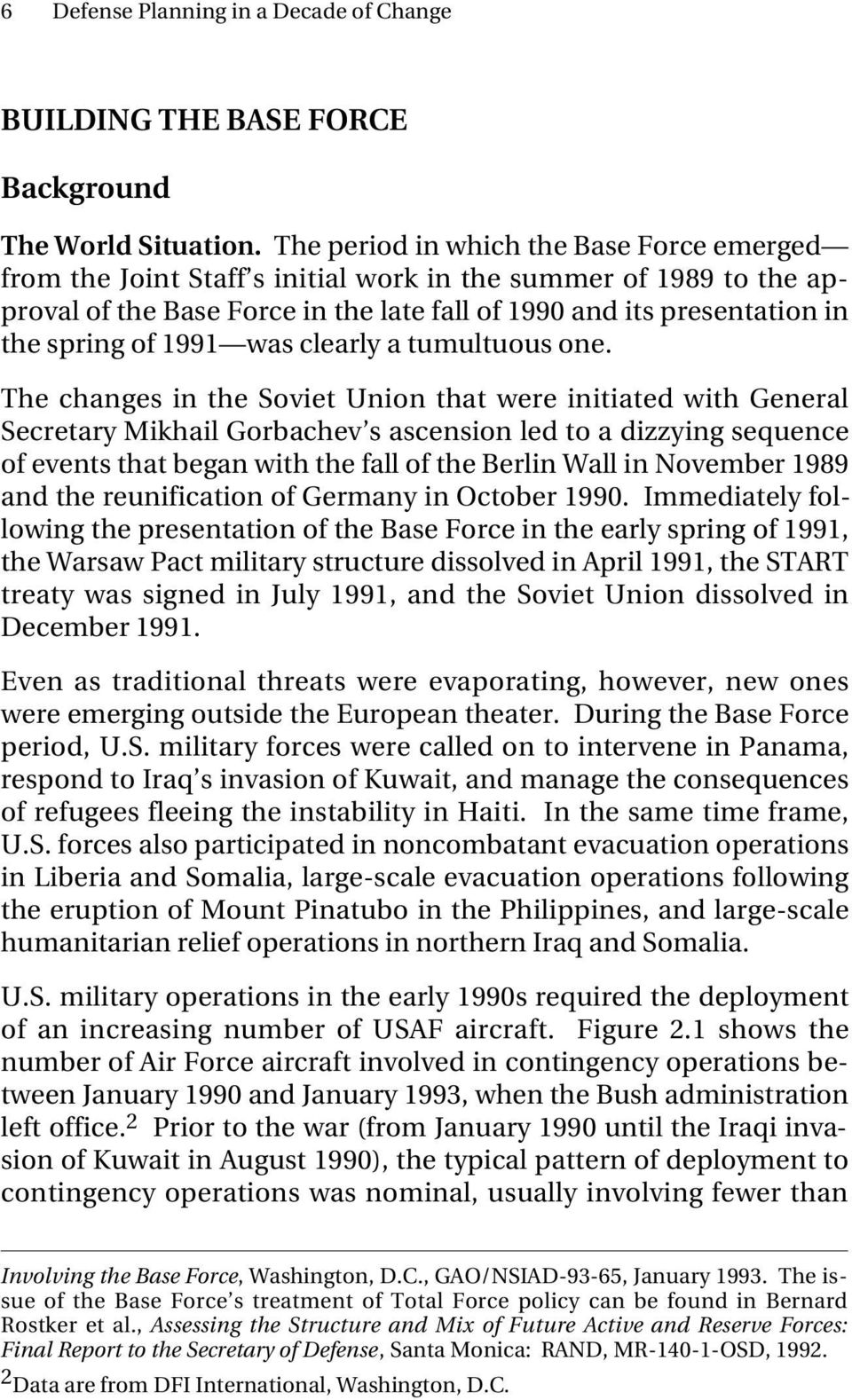
3 The Base Force: From Global Containment to Regional Forward Presence 7 1,400 RANDMR ,200 1,000 Number of aircraft Desert Storm 400 Counter narcotics 200 Humanitarian Bosnia Northern Watch Southern Watch 0 Jan 1990 Jul 1990 Jan 1991 Jul 1991 Jan 1992 Jul 1992 Jan 1993 SOURCE: DFI International, Washington, D.C. Figure 2.1 USAF Aircraft in Contingency Operations, 1/90 1/93
4 8 Defense Planning in a Decade of Change ten aircraft. 3 With the Iraqi invasion and the Gulf War, however, substantial numbers of USAF aircraft were deployed (and employed). Although these numbers declined after the Gulf War, they remained substantially higher than during the prewar period. Resource Constraints. As early as January 1989 before the construction of the Base Force an economic slowdown and the growing federal deficit had led Office of Management and Budget (OMB) Director Richard Darman to press for substantial defense cuts in the FY 1990 budget request. 4 At the same time, the Joint Chiefs of Staff (JCS) sought a real 2 percent increase in defense budgets. The White House chose a middle path and froze spending for one year but planned a real 1.2 percent increase over the Future Years Defense Program (FYDP), with the expectation that the threat environment and resulting defense needs would be clearer in a year s time. Although actual cuts were avoided, desires for reductions to defense spending as the Base Force was being developed drew additional impetus from another development: the possibility that crippling spending cuts would automatically be triggered under the Gramm- Rudman antideficit law. 5 Under Gramm-Rudman, the fiscal 1991 deficit could not exceed $74 billion ($64 billion plus a $10 billion margin of error). If the deficit passed the $74 billion threshold, automatic sequestration (spending cuts) of discretionary spending would occur, half from defense and half from domestic spending. The final budget reconciliation bill passed in 1990 and unanticipated by the Base Force plan included approximately $184 billion in cuts from appropriations bills, with defense taking the 3 These appear to have been related primarily to supporting the Pacific Command (PACOM) and exercises. 4 For a discussion of these early budget pressures, see Snider, Strategy, Forces and Budgets, pp See Table A.1 in the appendix for data on federal deficits or surpluses from FY The savings-and-loan crisis was one major cause of the increased deficit during this period. By early 1989, approximately one in six savings and loans was bankrupt. As a result, Congress in August 1989 passed a $50 billion bailout plan (P.L ), but those funds soon proved inadequate; by 1990, the administration was projecting that as much as $130 billion in taxpayer funds might be needed to cover thrift losses, and by January 1992, the Congressional Budget Office was estimating the budgetary cost at $200 billion. See Congressional Budget Office, The Economic Effects of the Savings and Loan Crisis, Washington, D.C., January The following discussion is based on Budget Adopted After Long Battle; Five-Year Plan Promises $496 Billion in Deficit Reduction, 1990 CQ Almanac, Washington, D.C.: Congressional Quarterly Press, 1991, pp

5 The Base Force: From Global Containment to Regional Forward Presence 9 largest cut. In fact, defense provided all of the cuts in discretionary spending in the first three years, totaling $67.2 billion. Strategy Under the Base Force Strategic Precepts. The Base Force was developed under Chairman of the Joint Chiefs of Staff (CJCS) Colin Powell in parallel with the Bush administration s large-scale review of national security and defense strategy under National Security Review 12 (NSR 12). 6 The aim of the Base Force was to develop a new military strategy and force structure for the post Cold War era while setting a floor for force reductions, in large part to hedge against the risks of a resurgent Soviet/Russian threat. The Base Force and the national security review were both predicated on the assumption of a 25 percent reduction in force structure and a 10 to 25 percent reduction in defense resources. 7 As described by Chairman Powell, the Base Force was to be the minimum force needed to execute the new strategy, preserve U.S. leadership, protect U.S. interests, and meet enduring defense needs. 8 The overall nature of the reductions and the shape of the resulting force would be constrained by Powell s desire to avoid breaking the force and to secure the backing of the service chiefs. This led to a 6 Under the Bush administration, a review of national defense strategy was conducted by the National Security Council (NSC) between January and June The defense review was conducted by two principal committees: one addressing future arms control negotiations, strategic forces, and targeting, chaired by Arnold Kanter of the NSC staff, and the other on defense policy, strategy, and nonstrategic forces, chaired by Under Secretary of Defense for Policy Paul Wolfowitz. See Snider, Strategy, Forces and Budgets, p In 1989, JCS planners anticipated a 25 percent reduction in defense budgets, while the office of the Secretary of Defense anticipated only a 10 percent decline. See Jaffe, The Development of the Base Force, , p. 9. The JCS planners were later proven correct. 8 See Colin L. Powell, The Base Force: A Total Force, presentation to the Senate Appropriations Committee, Subcommittee on Defense, September 25, According to press reports, in the spring of 1992 some consideration was given in the Defense Planning Guidance (DPG) to a strategy that would aim to block the emergence of new superpowers that might challenge the United States. As a result of the criticism that followed, the DPG was revised to remove this goal. See William Matthews, Soviet Demise Leaves Pentagon Wondering Who Is the Foe, Defense News, February 24, 1992, and Patrick E. Tyler, Pentagon Drops Goal of Blocking New Superpowers, New York Times, May 24, 1992, p. 1.
6 10 Defense Planning in a Decade of Change certain amount of fair sharing of budget and manpower reductions and mitigated against a more imaginative or revolutionary transformation of the force. Defense Secretary Richard Cheney s review of past drawdowns in late 1989 and early 1990 animated a concern about avoiding the cautionary lessons of history. Secretary Cheney sought a very different outcome for the post Cold War force than those that had characterized the years after World War II, Korea, and Vietnam, which had been handled in a rushed and somewhat haphazard fashion. These drawdowns had all adversely affected the force, most recently in the form of the so-called hollow forces of the post-vietnam era. To accomplish his post Cold War build-down in a manner that would ensure the health of the force, Secretary Cheney formed a strategic alliance with Chairman Powell that came at the price of recognizing the chairman s own constraints. The Bush administration s new defense strategy was first announced by President Bush in his address to the Aspen Institute on August 2, 1990, the day Iraq invaded Kuwait. 9 In this address, President Bush announced the replacement of the Cold War strategy deterrence of Soviet aggression and coercion against America and its allies across the conflict spectrum with a new strategy based on regional threats. The president also detailed the implications of this change for U.S. military forces: a 25 percent reduction in active forces and a need to reshape those forces for the post Cold War era. Although the Base Force was presented in detail in congressional hearings throughout 1991, it was not until the 1992 National Military Strategy (NMS) that the numerous and complex linkages between national security strategy, national military strategy, and the Base Force s force structure were described in full detail. 10 The 1992 NMS identified four foundations for national military strategy: 9 The ideas expressed in President Bush s August 2, 1990, speech at the Aspen Institute were given fuller exposition in the August 1991 and January 1993 releases of the National Security Strategy. The ramifications for military strategy also found expression in the other sources that were described earlier. 10 Most of the core elements of the 1992 NMS can be found in Powell s earlier briefings, or in Joint Chiefs of Staff, Joint Military Net Assessment (JMNA), 1991 and 1992.

7 The Base Force: From Global Containment to Regional Forward Presence 11 Strategic deterrence and defense. The NMS identified as an enduring defense need strategic forces that preserved stable deterrence through a modernized offensive force structure and continued research on defenses. 11 Of the four strategic concepts, only this one can truly be considered to be a carryover from the Cold War. Forward presence. The concept of forward presence in key areas was inherited from the 1989 NMS but was given additional emphasis in the Base Force. This concept, which in effect replaced the earlier Cold War concept of forward defense, called for smaller permanent forces, together with periodic deployments, to demonstrate U.S. commitment to protecting its interests overseas. 12 Crisis response. The reductions in forward-deployed forces necessitated improvements in the capability of U.S.-based forces to respond to crises. The NMS also introduced the need for sufficient forces to deter a second conflict when preoccupied by a major regional contingency. 13 Reconstitution. Reconstitution was the capacity to rebuild forces if needed 14 and to preserve a credible capability to forestall any potential adversary from competing militarily with the United States. 15 These foundations were tied both to policymakers assumptions about the sorts of military challenges that would need to be met in the future and to the force structure that would be necessary. Assumptions About Future Operations. The Base Force was predicated on the assumption that the United States would not have to undertake any significant commitments of forward-deployed 11 The Base Force study undertook a review of the strategic nuclear competition with the Soviet Union concurrently with its assessment of general-purpose forces. See Snider, Strategy, Forces and Budgets, p See Jaffe, The Development of the Base Force, , pp See Joint Chiefs of Staff, 1992 National Military Strategy, p See White House, National Security Strategy of the United States, Washington, D.C., August 1991, p Joint Chiefs of Staff, 1992 National Military Strategy, p. 7.

8 12 Defense Planning in a Decade of Change forces a belief suggesting that policymakers did not envision the sorts of long-duration contingency operations that would ultimately prevail during that decade. 16 Such an expectation would have been in keeping with the Cold War experience, in which crisis deployments and intervention operations were occasionally conducted, but in which large-scale, long-term commitments to contingency operations were generally avoided. 17 The Spectrum of Threat. There appears to have been general acceptance among policymakers that the so-called spectrum of threat was an accurate characterization of the likely future distribution of threats and military operations that the United States was likely to face. 18 In the spectrum-of-threat construct, the probability of occurrence and level of violence are inversely related, while the consequence of failure is positively related to the level of violence. The result is that humanitarian and disaster relief operations and other peacetime operations are more probable but generally less consequential than lesser regional conflicts (LRCs); high-intensity conventional major regional conflicts (MRCs) are less likely but more consequential than LRCs; and MRCs are more probable but far less consequential than global thermonuclear war. Closely related to the spectrum of threat are the assumptions the Base Force made regarding the need for forces prepared to meet demands across the entire spectrum of contingencies; in this, the Base Force generally took a fairly traditional approach. As Figure 2.2 shows, policymakers anticipated that during peacetime U.S. forces would be engaged in forward presence operations. In the event of a crisis, it was expected that forward presence forces would be drawn down and deployed to the crisis, and crisis response forces based in the United States would be moved forward. In the extreme case of global warfighting, not only would all available forces in the Base 16 See Richard Cheney, testimony before the Senate Armed Services Committee, January 31, 1992, and U.S. General Accounting Office, Force Structure: Issues Involving the Base Force, p Obvious exceptions were the major regional wars of the Cold War (Korea and Vietnam) and, to a lesser extent, U.S. involvement in the Chinese civil war in See, for example, the discussion of risk in Joint Chiefs of Staff, Joint Military Net Assessment, 1991, pp to 12-5.

9 The Base Force: From Global Containment to Regional Forward Presence 13 RANDMR Base force ~ Reconstitution ~ Global warfighting Crisis response forces in CONUS Combat power Forward presence Crisis response Base force plus reconstituted units Strategic deterrence Peacetime Crisis Regional contingencies/conflicts Global war Figure 2.2 The Base Force and the Spectrum of Conflict (1992 JMNA) Force be employed, but others would also be reconstituted to provide additional capability. It is important to note that the multiple concurrent major theater war (MTW) construct that was to dominate defense planning for the remainder of the decade was not believed to be an intrinsic capability of the Base Force but was instead an afterthought. As late as February 1992, Chairman Powell testified that the 1997 force would be able to accommodate one MRC with great difficulty but that two concurrent Desert Storm and Korean campaigns would put the force at the breaking point. 19 In fact, it appears that concurrent Persian Gulf and Korean contingencies were not included as illustrative planning scenarios (IPSs) until the FY Defense Planning Guidance (DPG). Although the origins of the two-mtw standard were inauspicious, they would, with the BUR and QDR, come to constitute high canon for defense planning. 19 See Colin Powell, testimony before the House Armed Services Committee, February 6, 1992.

10 14 Defense Planning in a Decade of Change The Role of Peacekeeping. With the reduction in tensions and ultimately the fall of the Soviet Union, it became much easier for the United Nations Security Council (UNSC) to authorize peacekeeping operations. One result was that the number of active U.N. operations greatly increased over their historical average of six or fewer operations per year, particularly after The record suggests that the Bush administration supported U.N. involvement in peacekeeping operations and was willing to increase nonmilitary (i.e., State Department) funding for these operations. 20 Nevertheless, the Bush administration appeared to take an interested but decidedly noncommittal view toward U.S. military participation in the sorts of peace enforcement operations implied by U.N. Secretary General Boutros Boutros-Ghali s agenda for peace. 21 In particular, the administration assiduously avoided making any broad commitments of U.S. forces to combat roles in future U.N. peace operations. The View from the Air Force. On the whole, the Air Force chose to adapt quickly to the tumultuous changes in the strategic and budgetary environments and to shape the debates of the period. 22 In June 1990, it released a white paper, Global Reach Global Power, that provided a review of more than 600 operations conducted by the Air Force since 1947 and that demonstrated the substantial contributions made by USAF combat, airlift, C 4 ISR, and other capabilities across the entire spectrum of threat. 20 The FY 1993 President s Budget request proposed an increase to the State Department s Conduct of Foreign Affairs account (153) funding for U.N. peacekeeping from $141 million in budget authority in 1989 to $438 million in FY Meanwhile support for peacekeeping under the International Security Assistance account (152) fell slightly, from $32 million in FY 1989 budget authority to $27 million in FY See Office of Management and Budget, Budget of the United States Government, Fiscal Year 1993, Washington, D.C., January 1992, p In 1993, $9 million was proposed for the U.N. force in Cyprus and $18 million for the Egypt/Israel/United States peacekeeping force in the Sinai Peninsula. Op. cit., p However, the administration was not entirely successful in ensuring that Congress actually funded the U.N. 21 See Boutros Boutros-Ghali, An Agenda for Peace: Preventive Diplomacy, Peacemaking and Peacekeeping, New York: United Nations, June 17, See the charts providing a chronology of key events and Air Force actions in Donald B. Rice s foreword to U.S. Air Force, Toward the Future: Global Reach Global Power: U.S. Air Force White Papers, , Washington, D.C., January 1993, pp. ii iii.

11 The Base Force: From Global Containment to Regional Forward Presence 15 The Air Force s role in U.S. national strategy was defined as sustaining deterrence; providing versatile combat forces; supplying rapid global mobility; controlling the high ground; and building U.S. influence through training, exercising, and participating in other activities with allied and other armed forces. 23 In the post Cold War era, the Air Force could be expected to emphasize global situational awareness; rapid, long-range power projection; the ability to deploy quickly and go the distance unconstrained by geography; and the range of lethal or peacetime actions to build U.S. influence abroad. 24 The Air Force sought to adapt itself to better support the new regional strategy, which was predicated on assumptions that played to Air Force strengths: a reduction in forward-deployed forces and heavier reliance on rapid power projection and long-range strike operations from the United States. Indeed, the Base Force strengthened air power s role in future force packages, apparently out of the belief that U.S. forces could favor air power and shift away somewhat from heavy ground forces, particularly tanks. 25 Building the Force The Base Force assessment process benefited significantly from being embedded in the machinery of the Planning, Programming, and Budgeting System (PPBS). 26 This process involved multiple actors (J-5 and J-8 in the Joint Staff and various offices of the Office of the Secretary of Defense [OSD]) taking independent yet complementary 23 See U.S. Air Force, 45 Years of Global Reach and Power: The United States Air Force and National Security: , A Historical Perspective, Washington, D.C., 1992, pp See U.S. Air Force, Toward the Future: Global Reach Global Power, p. i. 25 See U.S. General Accounting Office, Force Structure: Issues Involving the Base Force, p. 29. Nevertheless, the Base Force was also predicated in part on the assumption implied in the Army s review of its warfighting doctrine, Airland Battle, that future wars would involve significant clashes of armor against armor. Ibid. 26 For a detailed discussion of how the Base Force was evaluated through the PPBS process, see Lewis, Roll, and Mayer, Assessing the Structure and Mix of Future Active and Reserve Forces: Assessment of Policies and Practices for Implementing the Total Force Policy, and Rostker et al., Assessing the Structure and Mix of Future Active and Reserve Forces: Final Report to the Secretary of Defense.
12 16 Defense Planning in a Decade of Change cross-cuts at the problem of defining a force structure for the post Cold War world, with a focus on capabilities, risks, and costs. By all accounts, the PPBS process resulted in a thorough appraisal of the Base Force. 27 From Concept to Force Structure. The size of the Base Force was determined principally by the need to protect and promote U.S. interests in regions vital to the United States and not, as the BUR and QDR would be, on the basis of its capability to fight multiple MRCs. 28 The Base Force concept comprised four force packages one of which consisted of strategic forces and the other three of conventional forces and four supporting capabilities. Although the force structure details were to be worked out through arms reduction agreements, strategic forces were to continue underwriting nuclear deterrence through reliance on a smaller triad of land-based, sea-based, and air-breathing strategic nuclear offensive forces and strategic defenses. As a result of progress on strategic arms control with the Soviets and Russians, by August 1992 the shape of the planned force was as described in Table 2.1. The principal aims of the Base Force s conventional forces were to achieve conventional deterrence and to promote stability and otherwise shape the global environment while preventing the emergence of power vacuums that could lead to instability and militarization by hostile countries. 29 Conventional forces were essentially to be built from the bottom up, based on regional interests, according to a threat-based review of anticipated and potential threats and an appraisal of the self-defense capabilities of U.S. friends and allies The 1992 JMNA was to put the Base Force through a slightly different set of scenario-based assessments. 28 Although it was not designed on this basis, the Base Force would, however, be assessed by the Joint Chiefs of Staff in terms of its ability to fight one or more MRCs. 29 See U.S. General Accounting Office, Force Structure: Issues Involving the Base Force, p One conclusion of this review seems to be that the United States would by 1997 retain larger forces than any other country except China while continuing to spend substantially more on defense capabilities than any other nation. See U.S. General Accounting Office, Force Structure: Issues Involving the Base Force, p. 22, and U.S.
13 The Base Force: From Global Containment to Regional Forward Presence 17 Table 2.1 Proposed Strategic Forces Package as of August 1992 Force Number Offensive a SSBNs 18 ICBMs: 550 Minuteman III 500 Peacekeeper 50 Bombers 180 Defensive Theater ballistic missile defense Global Protection Against Limited Strikes (GPALS) Air defense squadrons 10 SOURCES: Department of Defense, 1992 Joint Military Net Assessment, Washington, D.C., August 1992, pp. 3-1 through 3-10, and Department of Defense, Annual Report to the President and Congress, Washington, D.C., Table C-1, 1991, 1992, and a SSBN = strategic ballistic missile submarine; ICBM = intercontinental ballistic missile. Three force packages comprised the core of the Base Force s conventional force structure: Atlantic forces. Atlantic forces were to meet threats and secure interests across the Atlantic, primarily in areas of vital interest to the United States: Europe, Southwest Asia, and the Middle East. 31 These forces were to be heavy, were to be oriented toward projection and reinforcement, and were to have a significant reserve component. Atlantic forces consisted of forces for forward presence and those for contingency response. Pacific forces. The objective of Pacific forces was to protect and promote U.S. interests in East Asia and the Pacific. Pacific forces were to be light and predominantly maritime and were to include some Army and Air Force forward-deployed presence, some ability to reinforce from the United States, and less of a reserve component than the Atlantic forces. General Accounting Office, National Security: Perspectives on Worldwide Threats and Implications for U.S. Forces, GAO/NSIAD , April 16, Along with the contingency forces, Atlantic forces would presumably be available for use in Africa and the Western hemisphere as well.

14 18 Defense Planning in a Decade of Change Contingency forces. Contingency forces were to consist of light, mobile forces that were to be CONUS-based and ready to go on a moment s notice. 32 These rapidly mobile, highly lethal forces were seen as likely to serve as the leading edge of forces being introduced for major regional contingencies and were to be less reliant on reserve components than the Atlantic and Pacific forces. When aggregated, the Atlantic, Pacific, and contingency force packages resulted in the core of the Base Force (see Table 2.2). This force Table 2.2 Proposed Base Force Conventional Force Packages as of August 1992 Force Package Army Divisions USAF TFWEs USMC MEFs Navy Carriers Atlantic Europe United States Active Reserve Cadre Subtotal Pacific Japan South Korea United States Subtotal Contingency United States Total SOURCES: Joint Chiefs of Staff, Joint Military Net Assessment, Washington, D.C., August 1992, pp. 3-1 through 3-10; U.S. General Accounting Office, Force Structure: Issues Involving the Base Force, Washington, D.C., GAO/NSIAD-93-65, January 1993, Table 2.1, p. 17; and John M. Collins, National Military Strategy, the DoD Base Force, and U.S. Unified Command Plan: An Assessment, Washington, D.C.: Congressional Research Service Report S, June 11, 1992, Figure 3, p See statement of General Colin Powell, Chairman, Joint Chiefs of Staff, in U.S. Senate, Committee on Armed Services, Department of Defense Authorization for Appropriations for Fiscal Years 1992 and 1993, February 21, 1991, p. 44.

15 The Base Force: From Global Containment to Regional Forward Presence 19 comprised 20 Army divisions (12 active, 6 reserve, and 2 reserve cadre divisions), 26.5 USAF tactical fighter wing equivalents (TFWEs) (15.25 active, reserve), four Marine Expeditionary Forces (MEFs), and 12 Navy carriers. These force packages entailed a reduction in major force elements and manpower ranging from 20 to 40 percent, depending on the service, component, and force element. Supporting forces included transportation capabilities and prepositioning designed to provide the capabilities necessary to rapidly project and sustain U.S. power projection; space capabilities to provide early warning, surveillance, navigation, C 3, and other services; reconstitution capabilities to provide a broad foundation of industrialization, mobilization, and sustainment that could be rapidly activated; and research and development (R&D) capabilities to provide an ongoing and vital foundation for the technologies, applications, and systems of the future that would ensure that the United States retained its technological superiority. USAF Force Structure Issues. The Air Force s principal aim throughout the Base Force was to preserve its modernization and acquisition programs. 33 Accordingly, early in the process of defining the Base Force, Air Force leaders accepted the fact that the Air Force s force structure would be reduced and therefore focused on shaping the ultimate force levels. 34 The Base Force also necessitated a reduction in active manpower for the Air Force to approximately 436,400 by FY 1997 (a 20.3 percent decline compared with FY 1990 levels) and a reduction in reserve end strength to some 200,500 (a 21.6 percent decline) For example, the 1991 JMNA (Joint Chiefs of Staff, 1992, pp. 3-4 to 3-5) notes: Generally, the Air Force continues to trade force structure for modernization, preserving a flexible and modern force capable of absorbing new systems in response to future needs. Lewis, Roll, and Mayer and Rostker et al. confirm the Air Force s willingness to trade force structure for modernization. 34 At the time, for example, the Air Force, which was planning to create composite wings that would include fighter/ground attack aircraft and intelligence, surveillance, and reconnaissance (ISR) capabilities, argued that the total number of such wings should be 26.5 rather than the 24 TFWEs then being discussed. 35 See Powell, The Base Force: A Total Force, slide 14.

16 20 Defense Planning in a Decade of Change Resources Base Force decisions on resources reflected a combination of constrained top lines and decisions to realign spending priorities. DoD Top Line. Pressures to reduce the defense top line came from two main sources: the OMB and negotiations with Congress on deficit and spending caps. OMB Director Darman s efforts to reduce defense spending began as early as late January 1989, well before fissures began to emerge in the Soviet empire. Darman s initial efforts were only partially rewarded in the FY 1990 President s Budget submitted in April 1989, which rejected a JCS request for real increases of 2 percent and instead froze spending levels for one year but planned a modest 1.2 percent annual real increase in defense spending over the course of the defense program. The FY 1991 President s Budget, however, planned real reductions in defense spending of 2 percent a year. By the time of the June 1990 budget summit, the Base Force was offered as an illustrative example of a 25 percent smaller force that could provide savings of about 10 percent. It was not until the October 1990 budget summit, however, that deficit and spending targets that necessitated deeper defense budget cuts were agreed to. The spending plan presented with the Base Force reflected this agreement. As described in the spending plan submitted with the Base Force, policymakers anticipated spending reductions that were generally in line with a 25 percent reduction in forces: a decline of about 22.4 percent in DoD budget authority by FY 1995, when Base Force force structure targets were to be achieved, and 25.3 percent by FY DoD Priorities. Over the FY period, while the specifics of the defense budget and program changed somewhat, its basic priorities remained the same: to retain high-quality, ready, and capable forces even as force levels were reduced and to continue to make robust investments in longer-term capabilities that could ensure a qualitative edge even as spending on weapon modernization de- 36 These spending plans will be discussed later under planning and execution of the Base Force.
17 The Base Force: From Global Containment to Regional Forward Presence 21 clined. 37 The result was an effort to maintain high levels of research, development, test, and evaluation (RDT&E) even as procurement spending plummeted. With regard to procurement, it is worth noting that the procurement spending cuts in the FY 1992 program that implemented the Base Force were in fact deeper than had originally been anticipated. As was described above, the Base Force was decided before the explicit discretionary budget limits were known; only after the October 1990 budget summit, when a defense top line was established, was it clearly understood that the Base Force plan and the budget did not match. Accordingly, procurement cuts were largely used to bring the budget back into line, since the force structure cuts and associated operating savings alone would have been inadequate to produce this result. Table 2.3 describes the notional allocation of resources that was to underwrite this dual focus on readiness and long-term modernization, as conceived by the FY 1992 budget submitted in February As this table shows, longer-term investment accounts (RDT&E) were to increase as procurement spending declined. Meanwhile, high readiness levels were to be funded by holding the line on military pay and operations and maintenance (O&M) funding. In the event of deeper spending reductions in the future, Base Force policymakers expressed a willingness to continue trading modernization and force structure. In September 1991, for example, Chairman Powell described the likely strategy that would be followed in the event that defense resources continued to decline beyond the levels necessary to sustain the Base Force: As the budget drops, operations and maintenance expenditures in combat units will be further reduced. Bases will close. Certain overseas commitments will be reduced. Procurement, research, 37 For example, in President Bush s 1992 State of the Union address, the president announced that spending for strategic nuclear forces and weapon modernization could be reduced $43.8 billion for FY compared to what the administration had proposed the preceding year.
18 22 Defense Planning in a Decade of Change Table 2.3 DoD Budget Authority by Title, FY 1990 and FY 1993 Account 1990 ($B) 1993 ($B) Percent 1990 Percent 1993 Investment RDT&E Procurement Military construction Operations and support Military pay O&M Family housing Total SOURCE: Colleen A. Nash, Snapshots of the New Budgets, Air Force Magazine, April 1991, p. 65. and development programs will be further curtailed. Operating stocks, the basis for combat sustainability, will be reduced. Next, elements of the base force will be reduced to cadre status. Finally, despite the risk to national security, components of the base force will be eliminated. But never, never, will a single combat unit be unable to perform its mission due to lack of personnel or equipment. 38 Air Force Priorities. As described above, the Air Force had assessed its core competencies early on and had aligned its priorities to meet the needs of the new environment and strategy as well as to meet the spending targets. Maintaining and enhancing the key contributions of the Air Force dictated a careful balancing act involving short-term considerations of readiness on the one hand and longer-term investments in next-generation air and space capabilities on the other, described later in this chapter. 38 See Powell, Building the Base Force: National Security for the 1990s and Beyond, slide 22.

19 The Base Force: From Global Containment to Regional Forward Presence 23 IMPLEMENTING THE BASE FORCE Although planning for the Base Force extended to FY (force structure targets were to be achieved by FY 1995, with some manpower and other targets achieved by FY 1997), the outcome of the presidential elections of 1992 meant that the Base Force was in fact implemented only over the course of two years FY 1992 and 1993 and in the latter year by the Clinton administration. This section discusses the planning and execution of some of the key Base Force concepts through FY Strategy In a sense, the first test and affirmation of the new regional strategy was the Iraqi invasion of Kuwait, which was precisely the sort of large-scale, mechanized cross-border regional aggression that the new strategy aimed to deter and defeat. Among the key lessons drawn from the Gulf War was that overwhelming force coupled with the qualitative edge afforded by high technology including stealthy F-117s, conventional cruise missiles, precision-guided munitions, the Airborne Warning and Control System (AWACS), and the Joint Surveillance Target Acquisition Radar System (JSTARS) could yield campaign outcomes that not only were quick and decisive but also could minimize U.S. casualties. U.S. aerospace power was overwhelming in the war, leading to the quick achievement of air supremacy, 39 the destruction and/or suppression of Iraqi integrated air defense systems (IADSs), and the dismantling of both Iraqi fielded forces and Iraqi command and control and other strategic capabilities. The post Gulf War experience also validated policymakers assumptions about one implication of the spectrum of threat : that U.S. forces might be kept exceedingly busy with a host of smaller and generally less consequential military operations. A large number of small operations were conducted in , including noncom- 39 U.S. air superiority capabilities led Iraqi aviators to decline to fly and to the defection of a number of Iraqi aircraft to Iran.

20 24 Defense Planning in a Decade of Change batant evacuation operations (NEOs) 40 and traditional humanitarian relief operations, generally in permissive environments. 41 However, several more complex operations were also undertaken in Southwest Asia, Bosnia, and Somalia that involved both humanitarian relief and the potential for combat. Although apparently not recognized at the time, the post Gulf War experience in Southwest Asia cast doubt on the premise that the United States had moved from a strategy of forward defense to one of forward presence: U.S. forces would continue to stand watch in the Gulf for the remainder of the decade, creating an unanticipated burden on the force to sustain that presence through rotational deployments. Force Structure and Manpower Force Structure. Table 2.4 describes the planned changes under the Base Force out to 1997, and Table 2.5 provides an overview of the force structure changes that were planned through 1993 at the time of the FY 1992 President s Budget request, submitted in the spring of Table 2.5 compares the initial plans with the actual changes that took place over the period. Table 2.5 shows that with few exceptions, the 1993 levels tracked closely with the plans released in spring 1991; 42 with these exceptions, implementation of the Base Force reductions to force structure appears to have gone more or less as planned through FY Manpower. The Base Force anticipated reductions of roughly 25 percent in active and reserve manpower by Unlike the major force elements just described, however, manpower reductions did 40 Between June 1991 and September 1992, NEOs were conducted in the Philippines, Zaire, Haiti, Sierra Leone, and Tajikistan. 41 For example, between April 1991 and December 1992, humanitarian assistance operations were conducted in Turkey, Bangladesh, the Philippines, Cuba, the Commonwealth of Independent States, Bosnia, Somalia, and Guam. Additionally, troops were sent to lend humanitarian assistance in the wake of the Los Angeles riots in May 1992, Hurricane Andrew in Florida in September 1992, and Typhoon Iniki in September The notable exceptions are substantial reductions in the Poseidon-Trident missiles and, more generally, more modest reductions in naval forces.
21 The Base Force: From Global Containment to Regional Forward Presence 25 Table 2.4 Planned Base Force Changes to Force Structure and Manpower, FY Service and Major Forces FY 1990 FY 1997 a Change Army Army divisions Active Reserve b Navy Aircraft carriers Active Reserve Battle force ships Air Force Tactical fighter wings Active Reserve Strategic bombers Manpower (thousands) Active military Reserve military c Civilian Total SOURCE: Congressional Budget Office (CBO). a The CBO assumed that planned forces for FY 1997 were the same as those for FY b The 1997 reserve Army divisions include two cadre divisions. c The 1990 reserve military number does not include some 26,000 members of the selected reserve activated for Operation Desert Storm. They are included in the 1990 active manpower total. not take place according to plan, with reductions to active forces exceeding those planned and reductions to reserve forces failing to reach planned levels. For example, whereas the FY 1992 budget request implementing the Base Force planned for a reduction of 13.2 percent in total active military personnel between FY 1990 and FY 1993, the actual reduction was 21.4 percent. Meanwhile, selected reserve personnel, which were anticipated to decline by 12.3 percent, fell only about 6.2 percent over the period.
22 26 Defense Planning in a Decade of Change Table 2.5 Base Force Planned vs. Actual Force Structure Changes, FY Service and Major Forces Actual 1990 Planned 1993 Actual 1993 Actual Percent Change Strategic forces ICBMs/fleet ballistic missiles Peacekeeper Minuteman Poseidon-Trident Strategic bombers (PAA) a General-purpose forces Land forces Active Army divisions Reserve Army divisions Active Marine divisions Reserve Marine divisions Naval forces (total) Total naval vessels Aircraft carriers (deployable) Battleships 4 Other major surface combatants Nuclear attack submarines Amphibious assault ships Sealift fleet (nucleus fleet) Air forces Active Air Force TFWEs Reserve Air Force TFWEs Active Navy carrier air wings Reserve Navy carrier air wings Active Marine air wings Reserve Marine air wings Air Force conventional B-52 squadrons Intertheater airlift (PAA) SOURCES: Office of Management and Budget, Budget of the United States Government, Fiscal Year 1992, Washington, D.C., February 4, 1991, Table A-3, p. 185, and Department of Defense, Annual Report to the President and Congress, Washington, D.C., January a PAA = Primary Aircraft Authorization. Defense Reform and Infrastructure To provide additional savings, the administration pursued defense reform and infrastructure reductions. The July 1989 Defense Management Review (DMR), for example, identified a large number of initiatives to reform the acquisition process, streamline and re-
23 The Base Force: From Global Containment to Regional Forward Presence 27 duce regulations, and remove unnecessary management layers. Similarly, the 1989 BRAC identified 40 bases for closure, and the 1991 BRAC proposed an additional 50 bases for closure. Nevertheless, by late concerns had arisen that not all of the anticipated $70 billion in savings from the DMR and BRAC rounds would be realized. As measured by the number of major and minor Air Force installations in the United States and abroad, 43 USAF infrastructure fell only slightly in comparison to force structure reductions. 44 Modernization As described above, much of the savings from the Base Force were to come from reductions to modernization and, more specifically, from reductions to procurement. Plans for FY 1992 included the cancellation of more than 100 weapon system programs, with total savings estimated at $81.6 billion over the FY defense program. Notwithstanding Air Force leaders hopes to trade force structure for modernization and acquisition, 45 a number of high-priority Air Force modernization programs were reduced or terminated during the course of or as a result of the Base Force, including the B-2 (reduced from 132 to 75 aircraft, and subsequently to 20 aircraft) and the C-17 (reduced from 210 to 120 aircraft). 43 Among the major Air Force base closures in the 1991 BRAC round, for example, were Bergstrom Air Force Base, TX (active component only); Carswell Air Force Base, TX; Castle Air Force Base, CA; Eaker Air Force Base, AR; England Air Force Base, LA; Grissom Air Force Base, IN; Loring Air Force Base, ME; Lowry Air Force Base, CO; Myrtle Beach Air Force Base, SC; Rickenbacker Air Force Base, OH; Williams Air Force Base, AZ; and Wurtsmith Air Force Base, MI. Data are from Assistant Secretary of the Air Force (Financial Management and Comptroller), United States Air Force Statistical Digest, Washington, D.C., various years. Although the number of installations is a crude measure, the lag in reductions to infrastructure is borne out by other data and analyses. 44 From 1990 to 1993, the Air Force s infrastructure spending fell from $40 billion to $33 billion in FY 1999 billions of dollars. Nevertheless, infrastructure spending as a percentage of total USAF total obligational authority (TOA) climbed, from 42 to 44 percent. See U.S. Air Force, Air Force Strategic Plan, Vol. 2: Performance Plan Annex; Performance Measure Details, Washington, D.C., February 1999, Table 2.B.3, Total Infrastructure Spending. 45 For example, the Air Force s planned investment program averaged 47.4 percent across the FY Defense Program.
24 28 Defense Planning in a Decade of Change Nevertheless, efforts to improve the conventional capabilities of long-range bombers and to expand the capabilities of precisionguided munitions were begun as a result of the 1992 Bomber Roadmap and other initiatives. In a similar fashion, the 1992 Mobility Requirements Study (MRS) identified serious deficiencies in strategic mobility capabilities and advocated enhancements to airlift, sealift, and prepositioning programs. 46 The View from the Air Force. For the Air Force, some of the key force structure reductions over the FY period (e.g., combat aircraft) appear to have been executed as planned, although infrastructure reductions lagged, providing no additional savings that could be used to preserve modernization. Reductions in the USAF s force structure during this period varied greatly by component and element of force structure (see Figure 2.3), with active-component TFWs falling by roughly one-third but reserve-component personnel falling by only about 4 percent. By contrast, the number of USAF installations fell by less than 8 percent. Resources The most significant change in defense resources during the Base Force period was the declining defense top line, which resulted from the administration s efforts to control the ballooning federal deficit by using defense as the principal bill payer. DoD Budgets: DoD-Wide Top Line. Although it was not until the October 1990 budget summit and the final negotiations on the Budget Enforcement Act that discretionary defense spending caps were finalized, Base Force policymakers anticipated reduced annual defense budgets. These reductions accelerated with each succeeding year s budget, however, subsequently forcing policymakers to make deeper cuts in modernization accounts than had originally been anticipated. As early as January 1989, OMB Director Darman had begun pressing for substantial reductions to defense spending. As shown in the 46 Put another way, many of the so-called force enhancements that would later be described in the BUR already appear to have been under way with the Base Force.
25 The Base Force: From Global Containment to Regional Forward Presence AC TFW RC TFW AC TAI RC TAI AC bombers (TAI) AC fighters (TAI) AC attack (TAI) AC strategic airlift (TAI) Infrastructure USAF AC military personnel AFRES military personnel ANG military personnel USAF civilians 0 Percent change from FY RANDMR Figure 2.3 USAF Force Structure and Manpower Reductions, FY pitchfork chart in Figure 2.4, 47 however, the FY 1990 President s Budget submitted in April 1989 envisioned a modest real annual increase of 1.2 percent. These planned increases were short-lived, and with the subsequent (FY ) budget plans, reductions were programmed: Whereas the April 1989 plan for defense spending in FY 1990 had anticipated a 1.2 percent real increase, in subsequent years real declines were planned in the amount of 2 percent (the FY 1991 plan), 3 percent (FY 1992), and 4 percent (FY 1993). By January 47 This chart, used often by the Bush defense department in early 1991, came to be called the pitchfork chart.
26 30 Defense Planning in a Decade of Change 350 RANDMR Actual April 1989 plan Average real increase = 1.2% per year Constant (billions of dollars) Real decline from FY 1992 enacted to FY 1993 = 7% Cumulative real decline = 29% = 37% FY 1991 DoD budget Average real decline = 2% per year FY 1993 DoD budget Average real decline = 4% per year FY 1992 DoD budget Average real decline = 3% per year Fiscal year SOURCE: Joint Chiefs of Staff, Joint Military Net Assessment, Washington, D.C., August Figure 2.4 Pitchfork Chart, Circa , the outgoing administration s budget anticipated a 21.4 percent decline from FY 1990 levels by the end of the fiscal year, compared with the 16.1 percent decline that had been anticipated in the initial (FY 1992) Base Force budget. Figure 2.5 presents FYDP tracks that compare successive DoD long-term spending plans (the solid lines) with actual spending. 48 As Figure 2.5 shows, the administration s spending plans continued to fall over these years. 49 In FY 1992 and FY 1993 (the years in which 48 The chart can thus be used to compare how well spending plans anticipated actual spending. In the chart, the solid lines reflect successive long-range DoD budget plans the lines fall over time, reflecting reductions in each year s long-range budget plan. The small circles represent actual budget authority in current (then-year) billions of dollars. 49 A total of $43.1 billion in budget authority and $27.1 billion in outlays were cut between the five-year plans submitted for FY 1992 and FY See Congressional
27 The Base Force: From Global Containment to Regional Forward Presence FY RANDMR Budget authority (billions of dollars) FY 1991 FY 1992 (base force) FY 1993 FY 1994 Actual/estimated ($B) Fiscal year Figure 2.5 Long-Term DoD Budget Plans, FY Through FY 1994 the Base Force was implemented), for example, actual spending closely approximated planned spending. In contrast, actual spending for fell well below that planned by the Bush administration a result of further defense budget reductions by the Clinton administration. 50 There were also shifts in the allocations of DoD long-term budget authority. Operations and support (O&S) accounts, for example, grew from 58.6 to 62.6 percent of planned budget authority, while investment accounts declined from 41.0 to 38.5 percent. In percentage terms, the biggest loser was procurement, which fell from 26.2 to 21.7 percent of total budget authority, while the biggest winners were O&M and RDT&E. The cumulative result of these shifts is shown in Table 2.6. Budget Office, An Analysis of the President s Budgetary Proposals for Fiscal Year 1993, Washington, D.C., March These will be discussed in the next chapter. The FYDP track for the FY 1994 plan is the outgoing Bush administration s long-range spending plan for FY , which would have been submitted had President Bush won the 1992 presidential election.
28 32 Defense Planning in a Decade of Change Table 2.6 Bush Administration Long-Term Defense Budget Plans, FY (percentage of total budget authority) Program Program Program Program Department of Defense Military (%) (%) (%) (%) Operations and support Military personnel Operations and maintenance Family housing Investment Procurement RDT&E Military construction SOURCES: Office of Management and Budget, Budget of the United States Government, Washington, D.C., various years, and Stephen Daggett, A Comparison of Clinton Administration and Bush Administration Long-Term Defense Budget Plans for FY , Washington, D.C.: Congressional Research Service Report 95-20F, December 20, NOTE: Major appropriation titles only. Percentages may not total 100 owing to rounding and to the exclusion of revolving and trust funds, offsetting receipts, and allowances. Over the FY period, the composition of the FYDP changed, with O&S s share rising and investment s share declining. By 1993, O&S spending had fallen 11 percent below the FY 1990 levels, while investment accounts had fallen nearly 28 percent over the same period. The View from the Air Force. As Tables 2.7 and 2.8 show, Air Force spending plans were also reduced over time (Table 2.7) 51 and despite its desire to preserve modernization, the Air Force also saw a modest shift in the composition of Air Force spending from investment to O&S accounts (Table 2.8). Within the investment accounts, procurement declined from 31 percent of total budget authority to 27 percent of USAF budget 51 As shown, the decline from FY seems largely to have been a postponement of reductions planned for FY 1991 an artifact of unexpectedly high spending in 1991 associated with the Gulf War.
29 The Base Force: From Global Containment to Regional Forward Presence 33 Table 2.7 Planned vs. Actual USAF Spending (BA in billions of dollars) Budget Request ($B) FY FY FY FY Actual Spending ($B) Difference (planned actual) SOURCE: DoD Comptroller, National Defense Budget Estimates, Washington, D.C., various years. Table 2.8 Air Force Investment and O&S Spending, FY Fiscal Year FY 2000 Investment ($B) FY 2000 O&S ($B) Percent Investment Percent O&S SOURCE: DoD Comptroller, National Defense Budget Estimates, FY 2000/2001, Washington, D.C., authority, while RDT&E increased slightly, from 14 to 16 percent. Meanwhile, military personnel increased from 26 to 27 percent and O&M from 27 to 28 percent over FY For a discussion of potential reductions to Air Force modernization accounts for the FY budgets, see U.S. General Accounting Office, 1992 Air Force Budget: Potential Reductions to Aircraft Procurement Programs, Washington, D.C., GAO/ NSIAD BR, September 1991; U.S. General Accounting Office, Air Force Budget: Potential Reductions to Fiscal Year 1993 Air Force Procurement Budget, Washington, D.C., GAO/NSIAD BR, September 1992; and U.S. General Accounting Office, 1993 Air Force Budget: Potential Reductions to Research, Development, Test, and Evaluation Programs, GAO/NSIAD BR, September 1992.
30 34 Defense Planning in a Decade of Change Challenges over the Horizon Base Force policymakers recognized the challenges of attempting to balance strategy, forces, and resources in planning and executing the Base Force program and budget. 53 In fact, they appear to have anticipated a number of important program execution risks in the out years. For example, a December 1991 study by the Congressional Budget Office concluded that the size of the Base Force could probably be maintained through 1997 with the funding that the administration was projecting at the time, although some delays in programs for research, modernization, or other activities were seen as likely. 54 After 1997, however, substantial increases in spending from $20 billion to as much as $65 billion by the middle of the next decade could be needed to carry out the planned Base Force modernization. According to the General Accounting Office, the principal challenges the Base Force faced were continued congressional pressure to further reduce defense budgets and the possibility that these cuts would bring defense resources below the levels that were necessary to sustain the force as planned. 55 By December 1992, the list of challenges facing DoD planners had grown. A significant mismatch between the $1.4 trillion FY defense spending plan and budget realities had emerged, possibly necessitating additional program reductions of more than $150 billion. 56 The Procurement Bow Wave. A review by a Defense Science Board Task Force of the FY FYDP suggested a number of potential funding shortfalls in the defense program. 57 The task force pro- 53 As the 1991 JMNA put it: Our assessment of the emerging world order suggests that meeting the demands of our global military objectives with fiscally constrained forces based largely within CONUS will continue to be an enormous challenge. See Joint Chiefs of Staff, Joint Military Net Assessment, 1991, pp See Congressional Budget Office, Fiscal Implications of the Administration s Proposed Base Force, Washington, D.C., December See U.S. General Accounting Office, Defense Planning and Budgeting: Effect of Rapid Changes in National Security Environment, Washington, D.C., GAO/NSIAD-91-56, February 1991, p See U.S. General Accounting Office, National Security Issues, Washington, D.C., GAO/OCG-93-9TR, December 1992, pp The task force was asked to assess (1) savings from the Defense Management Review Decisions (DMRDs); (2) development and acquisition costs for the weapons,
31 The Base Force: From Global Containment to Regional Forward Presence 35 jected a shortfall in acquisition costs of $3 billion to $5 billion, although it had received information suggesting that acquisition shortfalls in the FY Base Force program could be as high as $46.4 billion. Additionally, the task force predicted that the DoD faced a procurement bow wave of approximately $5 billion a year by the early 2000s that would in all likelihood make the planned theater air and Navy shipbuilding programs unaffordable after FY (See Figure 2.6 for a portrayal of the bow wave in the acquisition program as estimated in the BUR.) 20 RANDMR FY 1994 dollars (billions) Historical theater air percentage F-18E/F F-22 SSF MRF A/F-X V-22 EA-X Current inventory Fiscal year Figure 2.6 The Bow Wave in the Base Force Theater Air Program (BUR) 58 sensors, and other major systems then in development, including any potential procurement bow wave; (3) O&M funding levels to support the planned force structure and projected personnel levels; (4) environmental cleanup and compliance costs; and (5) defense health care costs. See Defense Science Board, Task Force on the Fiscal Years Future Years Defense Program (FYDP), reports of May 3, 1993, and June 29, Labeling in this figure is as it appeared in the BUR.
32 36 Defense Planning in a Decade of Change The issue was never resolved by the Bush administration, and the bow wave in the theater air program would later be a subject for assessment by the BUR. ASSESSMENT The Bush Defense Department continued to promote the Base Force until the end of the administration, and there are few indications that, once defined, any alternatives were seriously considered. There is evidence, however, that the JCS recognized that changes in regional threats and balances of forces not to mention defense budgets had continued apace since the Base Force study was completed and that these changes might enable or require a new, even smaller Base Force. 59 Indeed, public hints of a new, smaller Base Force can be found in The August 1992 Joint Military Net Assessment (JMNA), for example, suggested that the Base Force was designed to provide us with the capabilities needed to deal with an uncertain future; the Base Force is dynamic and can be reshaped in response to further changes in the strategic environment. Chairman Powell subsequently signaled further flexibility on the size of the Base Force: Our Base Force is dynamic. There is nothing sacrosanct about its number of tanks, ships or missiles, its structure or its manpower. 61 Capability to Execute the Strategy The 1992 JMNA reported that on balance, the Base Force of 1999 if funded and carried out in accordance with the defense program 59 Among the changes in threat that were described in 1992, for example, were continued declines in the Soviet/former Soviet Union nuclear and conventional threats to Europe and the dismantling of the Iraqi war machine in the Gulf War. 60 In testimony before the Senate Armed Services Committee on January 31, 1992, Chairman Powell said that when the U.S. military reached the Base Force targets in FY 1995, the country should debate whether it was the right force level. And in its comments on the U.S. General Accounting Office s report on the Base Force, the DoD characterized the Base Force as dynamic [and] able to be reshaped (either upward or downward) if strategic developments warrant it. See U.S. General Accounting Office, Force Structure: Issues Involving the Base Force, p See Colin L. Powell, U.S. Forces: Challenges Ahead, Foreign Affairs, Vol. 71, No. 5, Winter , pp
33 The Base Force: From Global Containment to Regional Forward Presence 37 would be better capable of dealing with the uncertain post Cold War era than the force in being at that time. The summary judgment of the 1992 JMNA was that the FY 1993 President s Budget request and defense program provided the U.S. Armed Forces with the minimum capability to accomplish national security objectives with low to moderate risk, which compared favorably with a higher level of risk during the Cold War. This capability was judged to be at increasing risk, however, as a result of key shortcomings stemming from declining investments in the industrial base, technology, and R&D and by prospects of even further cuts in force structure and capabilities. In terms of the force s capability to respond to one or more MRCs, the 1992 JMNA determined that the Base Force was capable of resolving only one MRC at a time both quickly and with low risk; the risk to U.S. objectives in either individual MRC was judged to be moderate, but there was little margin for unfavorable circumstances. 62 In the event of two crises occurring closely together, it was judged that policymakers and commanders would have to employ economy of force and sequential operations and would need to make strategic choices regarding the apportionment of forces. 63 The 1992 JMNA also rendered judgments on each of the Base Force s core capabilities: Strategic deterrence and defense. 64 U.S. offensive strategic forces were judged to provide sufficient capability for deterrence, but strategic defensive forces were seen to have only marginal capability, contributing primarily to early warning of strategic attack. Forward presence. 65 Reductions in basing and access rights were seen as a cause for concern in light of the judgment that 62 The reader will recall that in testimony, Chairman Powell had indicated that two concurrent MRCs in Korea and Southwest Asia would put the force at the breaking point. See Powell, testimony before the House Armed Services Committee, February 6, See Joint Chiefs of Staff, Joint Military Net Assessment, 1992, pp. 9-6 through 9-8 and 9-11 through Op. cit., pp through Op. cit., pp through 12-5.
34 38 Defense Planning in a Decade of Change forward presence and the ability to project power rapidly would become increasingly important. The capabilities for other operations, such as humanitarian, civic action, disaster relief, and counterdrug and counterterrorist operations, were judged to be less problematic. Crisis response. 66 Overall crisis response capabilities were deemed adequate throughout the assessment period and were expected to improve as specific deficiencies in mobility and force capabilities were eliminated. Reconstitution. 67 The capability for reconstitution was seen to require monitoring to ensure that key industrial base and other capabilities were not lost. Readiness In general, during the implementation of the Base Force, readiness indicators of all components seem to have improved. However, the ability to sustain high readiness rates was taxed by the increasing complexity of threats and missions and by the associated training requirements an outcome that would likely have been more apparent had the Base Force continued into the late 1990s. The impact on reserve-component readiness could have been especially significant because of limited training time. Modernization As noted above, the Defense Science Board Task Force identified the potential for a number of funding shortfalls in the defense program. Particularly troubling in terms of modernization was the task force s prediction that the DoD would face a procurement bow wave of approximately $5 billion a year by the early 2000s. 66 Op. cit., pp through Op. cit., p
35 The Base Force: From Global Containment to Regional Forward Presence 39 SECTION CONCLUSIONS Many of the strategic assumptions underlying the Base Force would, with only modest adjustment, remain salient through the rest of the decade. Among the most important of these were the need for forces tailored to a post-soviet, post Cold War world and the focus on a regionally based strategy that emphasized deterrence, forward presence, and crisis response. The Base Force also made significant progress toward its force structure goals. By FY 1993, the Air Force was less than one wing away from achieving the Base Force target of TFWs, for example, and had already achieved its wing target for reserve-component forces. That said, one of the Base Force s key premises that the post Cold War world would not be occasioned by large-scale, long-duration contingency operations was cast in doubt by the post Gulf War stationing of Air Force tactical fighter and other aircraft in Southwest Asia: a commitment that, despite predictions to the contrary, would remain through the end of the decade. In addition, defense resources continued to tumble even after the Base Force was defined, leading to a widening gap between strategy, forces, and resources and setting the stage for a number of hard choices that would need to be faced in the out years, with modernization and readiness of the force being the main ones. While it cannot be known how Base Force policymakers might have addressed these issues in FY , the fact that they were never satisfactorily addressed and resolved either by Bush administration or by Clinton administration policymakers meant that they not only would remain for much of the rest of the decade but would ultimately exacerbate an emerging gap between strategy, forces, and resources.
Foreign Affairs and National Security
 Foreign Affairs and National Security Objectives: TLW understand and explain the following questions as it relates to the Foreign affairs of the American Government What is foreign policy? What is the
FUNDING FOR DEFENSE, HOMELAND SECURITY AND COMBATING TERRORISM SINCE 9-11: WHERE HAS ALL THE MONEY GONE?
 FUNDING FOR DEFENSE, HOMELAND SECURITY AND COMBATING TERRORISM SINCE 9-11: WHERE HAS ALL THE MONEY GONE? By Steven M. Kosiak The tragic events of September 11, 2001 have had a significant impact on federal
FUNDING FOR DEFENSE, MILITARY OPERATIONS, HOMELAND SECURITY, AND RELATED ACTIVITIES SINCE
 FUNDING FOR DEFENSE, MILITARY OPERATIONS, HOMELAND SECURITY, AND RELATED ACTIVITIES SINCE 9/11 Steven Kosiak, Director of Budget Studies, Center for Strategic & Budgetary Assessments Since the terrorist
The Guidelines for U.S.-Japan Defense Cooperation April 27, 2015
 The Guidelines for U.S.-Japan Defense Cooperation April 27, 2015 I. Defense Cooperation and the Aim of the Guidelines In order to ensure Japan s peace and security under any circumstances, from peacetime
DEPARTMENT OF DEFENSE
 DEPARTMENT OF DEFENSE The Department of Defense (DoD) provides military forces and capabilities to project power in order to protect the security of the United States and its interests around the world
OPNAVINST 3000.15A USFF/CNO N3/N5 10 Nov 2014
 DEPARTMENT OF THE NAVY OFFICE OF THE CHIEF OF NAVAL OPERATIONS 2000 NAVY PENTAGON WASHINGTON, DC 20350-2000 OPNAVINST 3000.15A USFF/CNO N3/N5 OPNAV INSTRUCTION 3000.15A From: Chief of Naval Operations
Costs of Major U.S. Wars
 Stephen Daggett Specialist in Defense Policy and Budgets June 29, 2010 Congressional Research Service CRS Report for Congress Prepared for Members and Committees of Congress 7-5700 www.crs.gov RS22926
JOINT STATEMENT COMMISSION ON WARTIME CONTRACTING
 JOINT STATEMENT COMMISSION ON WARTIME CONTRACTING TOTAL FORCE POLICY, THE QDR, AND OTHER DEFENSE OPERATIONAL PLANNING: WHY DOES PLANNING FOR CONTRACTORS CONTINUE TO LAG? JULY 12, 2010 Chairman Thibault,
GAO. DEFENSE INFRASTRUCTURE Funding Risks in Services 1999 Central Training Programs
 GAO United States General Accounting Office Report to the Chairman, Committee on the Budget, House of Representatives February 1999 DEFENSE INFRASTRUCTURE Funding Risks in Services 1999 Central Training
ORIGINAL: ENGLISH 11th May, 1967 DOCUMENT DPC/D(67)23. DEFENCE PLANNING COMMITTEE Decisions of Defence Planning Committee in Ministerial Session
 ORIGINAL: ENGLISH 11th May, 1967 DOCUMENT DEFENCE PLANNING COMMITTEE Decisions of Defence Planning Committee in Ministerial Session Note by the Chairman I attach for your information a list of the decisions
JOINT STATEMENT OF THE SECURITY CONSULTATIVE COMMITTEE
 JOINT STATEMENT OF THE SECURITY CONSULTATIVE COMMITTEE A STRONGER ALLIANCE FOR A DYNAMIC SECURITY ENVIRONMENT The New Guidelines for Japan-U.S. Defense Cooperation April 27, 2015 By Minister for Foreign
Military Transactions
 8 Military Transactions In this section: Coverage and definitions Estimation methods overview U.S. receipts Transfers under U.S. military agency sales contracts U.S. payments Direct defense expenditures
The Development of the Base Force 1989 1992
 The Development of the Base Force 1989 1992 by Lorna S. Jaffe Joint History Office Office of the Chairman of the Joint Chiefs of Staff THE DEVELOPMENT OF THE BASE FORCE 1989-1992 Lorna S. Jaffe JOINT HISTORY
UNCLASSIFIED. UNCLASSIFIED Office of Secretary Of Defense Page 1 of 9 R-1 Line #139
 Exhibit R-2, RDT&E Budget Item Justification: PB 2015 Office of Secretary Of Defense Date: March 2014 0400: Research, Development, Test & Evaluation, Defense-Wide / BA 6: RDT&E Management Support COST
Chapter 2 Strengthening of the Japan-U.S. Alliance
 Chapter 2 Strengthening of the Japan-U.S. Alliance Based on the Japan U.S. Security Treaty, the Japan-U.S. Security Arrangements, together with Japan s own efforts, constitute the cornerstone for Japan
DoD Base Realignment and Closure
 DoD Base Realignment and Closure BRAC Rounds (BRAC 1988, 1991, 1993, 1995 & 2005) Executive Summary Fiscal Year (FY) 2015 Budget Estimates Program Year 2015 Justification Data Submitted to Congress March
https://usawc.blackboard.com/bbcswebdav/pid-82431-dt-content-rid-112988_1/institution/...
 Unit 6 - Homeland Security, Homeland Defense, and Defense Support of Civil Authorities Page 1 of 5 The defense of the homeland is a significant contemporary security issue. Defending the homeland is a
LESSON SEVEN CAMPAIGN PLANNING FOR MILITARY OPERATIONS OTHER THAN WAR MQS MANUAL TASKS: 01-9019.00-0001 OVERVIEW
 TASK DESCRIPTION: LESSON SEVEN CAMPAIGN PLANNING FOR MILITARY OPERATIONS OTHER THAN WAR MQS MANUAL TASKS: 01-9019.00-0001 OVERVIEW Learn the differences between planning for a campaign in war and planning
Prospects for the NATO Warsaw Summit Testimony before the U.S. Helsinki Commission By Hans Binnendijk June 23, 2016
 Prospects for the NATO Warsaw Summit Testimony before the U.S. Helsinki Commission By Hans Binnendijk June 23, 2016 NATO is anything but obsolete. It is needed more now than at any point since the end
IS COMMERCIAL AUGMENTATION TAKING A LARGER SHARE OF FLYING HOURS?
 Chapter Six IS COMMERCIAL AUGMENTATION TAKING A LARGER SHARE OF FLYING HOURS? As previously discussed, there are two sources of funds to support AMC pilots flying-hour requirements. The preferred source
GAO AIR FORCE WORKING CAPITAL FUND. Budgeting and Management of Carryover Work and Funding Could Be Improved
 GAO United States Government Accountability Office Report to the Subcommittee on Readiness and Management Support, Committee on Armed Services, U.S. Senate July 2011 AIR FORCE WORKING CAPITAL FUND Budgeting
SEC.. GRANTS OF NON-LETHAL EXCESS DEFENSE ARTICLES BY. " 166c. Geographic combatant commander's authority to transfer excess defense articles
 SEC.. GRANTS OF NON-LETHAL EXCESS DEFENSE ARTICLES BY GEOGRAPHIC COMBATANT COMMANDERS. 1 7 8 9 10 11 1 1 1 1 1 17 18 19 0 1 (a) IN GENERAL. Chapter of title 10, United States Code, is amended by inserting
OVERVIEW OF THE ADMINISTRATION S FY 2005 REQUEST FOR HOMELAND SECURITY By Steven M. Kosiak
 March 22, 2004 OVERVIEW OF THE ADMINISTRATION S FY 2005 REQUEST FOR HOMELAND SECURITY By Steven M. Kosiak The Bush Administration s fiscal year (FY) 2005 budget request includes $47.4 billion for homeland
Toward a Deeper and Broader U.S.-Japan Alliance: Building on 50 Years of Partnership
 Joint Statement of the Security Consultative Committee Toward a Deeper and Broader U.S.-Japan Alliance: Building on 50 Years of Partnership June 21, 2011 by Secretary of State Clinton Secretary of Defense
AIR FORCE WORKING CAPITAL FUND. Actions Needed to Manage Cash Balances to Required Levels
 United States Government Accountability Office Report to the Subcommittee on Readiness and Management Support, Committee on Armed Services, U.S. Senate July 2014 AIR FORCE WORKING CAPITAL FUND Actions
DEPARTMENT OF DEFENSE
 DEPARTMENT OF DEFENSE Funding Highlights: Provides $553 billion for the base budget, an increase of $22 billion above the 2010 appropriation. This reflects continued investment in national security priorities
Costs of Major U.S. Wars
 Order Code RS22926 July 24, 2008 Costs of Major U.S. Wars Stephen Daggett Specialist in Defense Policy and Budgets Foreign Affairs, Defense, and Trade Division Summary This CRS report provides estimates
The History of Tinker AFB
 The History of Tinker AFB 70+ Years in the Heartland of America Tinker AFB History In October 1940, as German troops rolled through Europe and Japan expanded its empire, a dozen Oklahoma City businessmen
Joint Publication 3-0. Doctrine for Joint Operations
 Joint Publication 3-0 Doctrine for Joint Operations 10 September 2001 This revised edition of JP 3-0, Doctrine for Joint Operations, represents the latest in a series of updates to joint doctrine. It reflects
Department of Defense
 Department of Defense Military Construction Program FY2015 BUDGET North Atlantic Treaty Organization Security Investment Program March 2014 Justification Data Submitted to Congress NATO SECURITY INVESTMENT
The Implication of TMD System in Japan to China s Security
 The Sixth ISODARCO Beijing Seminar on Arms Control October 29-Novermber 1, 1998 Shanghai, China The Implication of TMD System in Japan to China s Security Institute of World Economics & Politics Chinese
WikiLeaks Document Release
 WikiLeaks Document Release February 2, 2009 Congressional Research Service Report RS20506 International Military Education and Training Program Richard F. Grimmett, Foreign Affairs, Defense, and Trade
Virginia National Guard. The Commonwealth s Guardian
 Virginia National Guard The Commonwealth s Guardian Objective To understand the origins, constitutional and legal underpinnings of the National Guard To understand the roles, missions, and capabilities
An Interactive Planning Approach to Shaping U.S.-Russian Relations
 An Interactive Planning Approach to Shaping U.S.-Russian Relations PONARS Eurasia Policy Memo No. 172 September 2011 Dmitry Gorenburg Harvard University U.S. policy toward Russia, as toward the rest of
WHITE HOUSE OFFICE, OFFICE OF THE SPECIAL ASSISTANT FOR NATIONAL SECURITY AFFAIRS: Records, 1952-61 NSC Series, Briefing Notes Subseries
 WHITE HOUSE OFFICE, OFFICE OF THE SPECIAL ASSISTANT FOR NATIONAL SECURITY AFFAIRS: Records, 1952-61 NSC Series, Briefing Notes Subseries CONTAINER LIST Box No. Contents 1 AEC--Policy on Use of Atomic Weapons
Straw. Gold into. Turning. Reality Check. How Huge Federal Surpluses Quickly Became Equally Massive Deficits A CENTURY FOUNDATION GUIDE TO THE ISSUES
 Reality Check Turning Gold into Straw How Huge Federal Surpluses Quickly Became Equally Massive Deficits ^ iwww.tcf.org A CENTURY FOUNDATION GUIDE TO THE ISSUES 1 Turning Gold into Straw How Huge Federal
Issue Paper. Wargaming Homeland Security and Army Reserve Component Issues. By Professor Michael Pasquarett
 Issue Paper Center for Strategic Leadership, U.S. Army War College May 2003 Volume 04-03 Wargaming Homeland Security and Army Reserve Component Issues By Professor Michael Pasquarett Background The President
Information Technology
 September 11, 2002 Information Technology The Defense Advanced Research Projects Agency s Transition of Advanced Information Technology Programs (D-2002-146) Department of Defense Office of the Inspector
GAO DEFENSE INVENTORY. Defense Logistics Agency Needs to Expand on Efforts to More Effectively Manage Spare Parts. Report to Congressional Requesters
 GAO United States Government Accountability Office Report to Congressional Requesters May 2010 DEFENSE INVENTORY Defense Logistics Agency Needs to Expand on Efforts to More Effectively Manage Spare Parts
Composition of Federal Spending
 The Honorable David M. Walker Comptroller General of the United States U.S. Government Accountability Office February 10, 2005 2 Composition of Federal Spending 1964 1984 2004* Defense Net interest *Current
NATIONAL NUCLEAR SECURITY ADMINISTRATION
 NATIONAL NUCLEAR SECURITY ADMINISTRATION (Discretionary dollars in thousands) FY 2013 FY 2014 FY 2015 FY 2015 vs. FY 2014 Current Enacted Request $ % National Nuclear Security Administration Weapons Activities
FUTURE NAVY VISION. The Royal Navy Today, Tomorrow and Towards 2025. Projecting maritime power to protect and promote our nation s interests
 FUTURE NAVY VISION The Royal Navy Today, Tomorrow and Towards 2025 Projecting maritime power to protect and promote our nation s interests The Royal Marine Commandos - The UK s specialist amphibious force.
Active Engagement, Modern Defence
 Strategic Concept For the Defence and Security of The Members of the North Atlantic Treaty Organisation Adopted by Heads of State and Government in Lisbon Active Engagement, Modern Defence Preface We,
U.S. Forces in Iraq. JoAnne O Bryant and Michael Waterhouse Information Research Specialists Knowledge Services Group
 Order Code RS22449 Updated April 7, 28 U.S. Forces in Iraq JoAnne O Bryant and Michael Waterhouse Information Research Specialists Knowledge Services Group Summary Varying media estimates of military forces
THE U.S. COST OF THE AFGHAN WAR: FY2002-FY2013
 - THE U.S. COST OF THE AFGHAN WAR: FY2002-FY2013 COST IN MILITARY OPERATING EXPENDITURES AND AID AND PROSPECTS FOR TRANSITION Anthony H. Cordesman Arleigh A. Burke Chair in Strategy May 14, 2012 To comment,
Joint Publication 3-12. Doctrine for Joint Nuclear Operations
 Joint Publication - Doctrine for Joint Nuclear Operations Final Coordination () March 00 0 0 PREFACE. Scope This publication provides guidelines for the joint employment of forces in nuclear operations.
WEAPON SYSTEM ACQUISITIONS. Opportunities Exist to Improve the Department of Defense s Portfolio Management
 United States Government Accountability Office Report to Congressional Committees August 2015 WEAPON SYSTEM ACQUISITIONS Opportunities Exist to Improve the Department of Defense s Portfolio Management
NAVY WORKING CAPITAL FUND. Budgeting for Carryover at Fleet Readiness Centers Could Be Improved
 United States Government Accountability Office Report to Congressional Requesters June 2015 NAVY WORKING CAPITAL FUND Budgeting for Carryover at Fleet Readiness Centers Could Be Improved GAO-15-462 June
2014 Center for Strategic and Budgetary Assessments. All rights reserved.
 The Center for Strategic and Budgetary Assessments (CSBA) is an independent, nonpartisan policy research institute established to promote innovative thinking and debate about national security strategy
Department of Defense INSTRUCTION
 Department of Defense INSTRUCTION NUMBER 4140.25 June 25, 2015 USD(AT&L) SUBJECT: DoD Management Policy for Energy Commodities and Related Services References: See Enclosure 1 1. PURPOSE. This instruction:
WEAPONS ACQUISITION REFORM
 GAO United States Government Accountability Office Report to the Committee on Armed Services, U.S. Senate September 2011 WEAPONS ACQUISITION REFORM Actions Needed to Address Systems Engineering and Developmental
DEPARTMENT OF THE AIR FORCE PRESENTATION TO THE TACTICAL AIR AND LAND FORCES SUBCOMMITTEE COMMITTEE ON ARMED SERVICES
 DEPARTMENT OF THE AIR FORCE PRESENTATION TO THE TACTICAL AIR AND LAND FORCES SUBCOMMITTEE COMMITTEE ON ARMED SERVICES UNITED STATES HOUSE OF REPRESENTATIVES SUBJECT: FORCE PROTECTION ISSUES STATEMENT OF:
GAO NUCLEAR WEAPONS. DOD and NNSA Need to Better Manage Scope of Future Refurbishments and Risks to Maintaining U.S. Commitments to NATO
 GAO United States Government Accountability Office Report to Congressional Requesters May 2011 NUCLEAR WEAPONS DOD and NNSA Need to Better Manage Scope of Future Refurbishments and Risks to Maintaining
MEDICAL READINESS AND OPERATIONAL MEDICINE
 Chapter Four MEDICAL READINESS AND OPERATIONAL MEDICINE The readiness mission of the MHS makes the system unique among U.S. health-care organizations. Its stated mission to provide, and to maintain readiness
The Meaning of Russia s Campaign in Syria
 Defense and Intelligence The Meaning of Russia s Campaign in Syria By S.R. Covington Foreword by Kevin Ryan December 2015 Defense and Intelligence The Meaning of Russia s Campaign in Syria By S.R. Covington
Response to the Defence Issues Paper
 LIBERAL NATIONAL PARTY DEFENCE AND VETERANS AFFAIRS POLICY COMMITTEE Response to the Defence Issues Paper LNP Defence and Veterans Affairs Policy Committee submission 2 4 November, 2014 Defence White Paper
German initiated battle in western europe that attempted to push back the allied advance that was un. Sample letter requesting financial assistance
 German initiated battle in western europe that attempted to push back the allied advance that was un. Sample letter requesting financial assistance from employer. German initiated battle in western europe
GAO COMBATING TERRORISM. Observations on Options to Improve the Federal Response. Testimony
 GAO For Release on Delivery Expected at 3:00 p.m. Tuesday, April 24, 2001 United States General Accounting Office Testimony Before the Subcommittee on Economic Development, Public Buildings, and Emergency
GAO CONTRACT MANAGEMENT. Small Businesses Continue to Win Construction Contracts. Report to Congressional Committees
 GAO United States General Accounting Office Report to Congressional Committees June 2001 CONTRACT MANAGEMENT Small Businesses Continue to Win Construction Contracts GAO-01-746 Contents Letter 1 Results
CUSTOMER KEYNOTE Hal Buddenbohm
 CUSTOMER KEYNOTE Hal Buddenbohm Supply Chain Director ITT Force Protection Systems Hal Buddenbohm is the Supply Chain Director at ITT Force Protection Systems in Thousand Oaks, CA. Prior to joining ITT,
United States-Japan Security Consultative Committee Document. United States-Japan Roadmap for Realignment Implementation.
 United States-Japan Security Consultative Committee Document United States-Japan Roadmap for Realignment Implementation May 1, 2006 by Secretary of State Rice Secretary of Defense Rumsfeld Minister of
Joint Communiqué The 46 th ROK-U.S. Security Consultative Meeting October 23, 2014 Washington D.C.
 Joint Communiqué The 46 th ROK-U.S. Security Consultative Meeting October 23, 2014 Washington D.C. 1. The 46th United States-Republic of Korea (U.S.-ROK) Security Consultative Meeting (SCM) was held in
JOHN R. FOLKESON, JR.
 JOHN R. FOLKESON, JR. EDUCATION Ph.D., University of Houston, Houston, TX, 1982 M.B.A., University of Missouri, Columbia, MO, 1976 B.A., Pennsylvania State University, State College, PA, 1967 TEACHING
In June 1998 the Joint Military Intelligence. Intelligence Education for Joint Warfighting A. DENIS CLIFT
 Defense Intelligence Analysis Center, home of JMIC. Intelligence Education for Joint Warfighting Courtesy Joint Military Intelligence College By A. DENIS CLIFT In June 1998 the Joint Military Intelligence
Department of Defense DIRECTIVE
 Department of Defense DIRECTIVE NUMBER 5000.01 May 12, 2003 Certified Current as of November 20, 2007 SUBJECT: The Defense Acquisition System USD(AT&L) References: (a) DoD Directive 5000.1, The Defense
US Casualties: The Trends in Iraq and Afghanistan
 18 K Street, NW Suite 4 Washington, DC 26 Phone: 1.22.775.327 Fax: 1.22.775.3199 Web: www.csis.org/burke/reports US Casualties: The Trends in Iraq and Afghanistan Anthony H. Cordesman Arleigh A. Burke
America s Energy Exports: Opportunities for U.S. Allies and U.S. National Security Prepared Statement of David F. Gordon
 June 23, 2015 Testimony before the U.S. Senate Committee on Foreign Relations Subcommittee on Multilateral International Development, Multilateral Institutions, and International Economic, Energy and Environmental
"The European Union's Security Architecture and its role to strengthen Peace and Security"
 Chairman EU Military Committee General Patrick de Rousiers at the 29 th Asia Pacific Round Table in Kuala Lumpur 02 June 2015 "The European Union's Security Architecture and its role to strengthen Peace
U.S. Defense Priorities OSD PA&E
 1 U.S. Defense Priorities Deter potential adversaries and defend America and American interests Counter asymmetric threats including terrorism, cyber attacks and ballistic and cruise missiles Fight and
Although the dominant military confrontations of the 20 th century were centered on the
 To what extent were the policies of the United States responsible for the outbreak and development of the Cold War between 1945 and 1949? Although the dominant military confrontations of the 20 th century
INTERVIEW WITH ANDERS FOGH RASMUSSEN *
 INTERVIEW WITH ANDERS FOGH RASMUSSEN * In this exclusive interview with TPQ, the Honorable Secretary General provides an overview of the major developments of the past two years in Turkey s neighborhood,
Resources projected in the previous development plan and the reality
 NATIONAL DEFENCE DEVELOPMENT PLAN 2013-2022 Resources projected in the previous development plan and the reality 1. The previous 10-year development plan approved in 2009 (Military Defence Development
The Joint Staff Overseas Contingency Operations Overseas Contingency Operations (OCO), Defense-Wide Budget Activity 01: Operating Forces
 I. Description of Operations Financed: The Chairman of the Joint Chiefs of Staff (CJCS) is the principal military adviser to the President, National Security Council, and Secretary of Defense. The Chairman
GAO MILITARY AIRLIFT. DOD Should Take Steps to Strengthen Management of the Civil Reserve Air Fleet Program. Report to Congressional Committees
 GAO United States Government Accountability Office Report to Congressional Committees September 2009 MILITARY AIRLIFT DOD Should Take Steps to Strengthen Management of the Civil Reserve Air Fleet Program
Statement of. Vice Admiral William A. Brown, United States Navy. Deputy Commander, United States Transportation Command
 Statement of Vice Admiral William A. Brown, United States Navy Deputy Commander, United States Transportation Command Before the House Armed Services Committee Subcommittee on Seapower and Projection Forces
Why a Floating Exchange Rate Regime Makes Sense for Canada
 Remarks by Gordon Thiessen Governor of the Bank of Canada to the Chambre de commerce du Montréal métropolitain Montreal, Quebec 4 December 2000 Why a Floating Exchange Rate Regime Makes Sense for Canada
Part II: Agency R&D Budgets
 Part II: Agency R&D Budgets 5 Department of Defense Travis R. Doom Consortium for Science, Policy and Outcomes Highlights Department of Defense (DOD) R&D would continue its recent downward trend since
Encl: (1) Surface Warfare Tactical Requirement Group Membership
 DEPARTMENT OF THE NAVY OFFICE OF THE CHIEF OF NAVAL OPERATIONS 2000 NAVY PENTAGON WASHINGTON, DC 20350-2000 OPNAVINST 5420.113 N9 OPNAV INSTRUCTION 5420.113 From: Chief of Naval Operations Subj: SURFACE
Outline. Intro Navy at Large NUPOC Program. NUPOC Eligibility How to Apply. Job Options and Descriptions
 Outline Intro Navy at Large NUPOC Program Job Options and Descriptions NUPOC Eligibility How to Apply The Nuclear Navy Today 82 Nuclear Powered Ships: A total of 92 naval reactors 28% of Navy s Total Deployable
Espionage and Intelligence. Debra A. Miller, Book Editor
 Espionage and Intelligence Debra A. Miller, Book Editor Intelligence... has always been used by the United States to support U.S. military operations, but much of what forms today s intelligence system
Does NATO s Article V Genuinely Protect Its Members?
 Does NATO s Article V Genuinely Protect Its Members? NATO has been the most successful alliance of history. We repeat this truth quite frequently, especially now that we celebrate 60 years of its successful
DEPARTMENT OF THE AIR FORCE PRESENTATION TO THE COMMITTEE ON ARMED SERVICES PROJECTION FORCES SUBCOMMITTEE
 DEPARTMENT OF THE AIR FORCE PRESENTATION TO THE COMMITTEE ON ARMED SERVICES PROJECTION FORCES SUBCOMMITTEE UNITED STATES HOUSE OF REPRESENTATIVES SUBJECT: TANKER RECAPITALIZATION STATEMENT OF: LIEUTENANT
Remote Sensing Satellites and Presidential Decision Directive-23
 Remote Sensing Satellites and Presidential Decision Directive-23 The policy for remote sensing satellites exhibited a similar trajectory during the Clinton administration. The contribution of remote sensing
STATEMENT BY DAVID DEVRIES PRINCIPAL DEPUTY DEPARTMENT OF DEFENSE CHIEF INFORMATION OFFICER BEFORE THE
 STATEMENT BY DAVID DEVRIES PRINCIPAL DEPUTY DEPARTMENT OF DEFENSE CHIEF INFORMATION OFFICER BEFORE THE HOUSE OVERSIGHT AND GOVERNMENT REFORM COMMITTEE S INFORMATION TECHNOLOGY SUBCOMMITTEE AND THE VETERANS
To Defend a Nation: An Overview of Downsizing and the U.S. Military
 To Defend a Nation: An Overview of Downsizing and the U.S. Military John J. Gargan Kent State University Department of Political Science email: [email protected] Few institutions have had as much experience
TESTIMONY OF ZOË BAIRD, PRESIDENT, MARKLE FOUNDATION CHAIRMAN, TASK FORCE ON NATIONAL SECURITY IN THE INFORMATION AGE
 TESTIMONY OF ZOË BAIRD, PRESIDENT, MARKLE FOUNDATION CHAIRMAN, TASK FORCE ON NATIONAL SECURITY IN THE INFORMATION AGE Select Committee on Homeland Security U.S. House of Representatives "Information Sharing
Option 1: Use the Might of the U.S. Military to End the Assad Regime
 1 Option 1: Use the Might of the U.S. Military to End the Assad Regime The Syrian dictatorship s use of chemical weapons against its own people was terrible. But we must not let it overshadow the larger
Operation IMPACT (Injured Military Pursuing Assisted Career Transition)
 Operation IMPACT (Injured Military Pursuing Assisted Career Transition) January 2013 Operation IMPACT Program Management Office Northrop Grumman Today Leading global security company providing innovative
DEPARTMENT OF THE NAVY HEADQUARTERS UNITED STATES MARINE CORPS 3000 MARINE CORPS PENTAGON WASHINGTON, DC 20350 3000
 DEPARTMENT OF THE NAVY HEADQUARTERS UNITED STATES MARINE CORPS 3000 MARINE CORPS PENTAGON WASHINGTON, DC 20350 3000 MCO 3030.1 POC MARINE CORPS ORDER 3030.1 From : To: Commandant of the Marine Corps Distribution