
Maine Comprehensive School Counseling Program Model K-12
|
|
|
- Phillip Short
- 10 years ago
- Views:
Transcription
1 Maine Comprehensive School Counseling Program Model K-12 Developed by Maine School Counselors In Cooperation with the Maine State Department of Education

2 Dear Maine School Counselors, Creating a Maine State Model has been a labor of love from several K-12 school counselors from across the state. This work is their gift to you and the students you serve. It is hoped that you will find this a very useful tool that will actively guide your program from design to implementation to evaluation. The authority for undertaking this work comes from Chapter 125: Basic Approval Standards: Public Schools and School Administrative Units. This rule states that Each school administrative unit shall have a Comprehensive Guidance Program, including guidance and counseling services, available to all students in grades K-12. This program shall be a component of the Comprehensive Education Plan which is to be implemented by the end of the school year. (The full text of section 9.02 Comprehensive Guidance Resources of Chapter 125 is included in the appendix.) The school counseling program facilitates student development in three broad domains: academic, career and personal/social, to promote and enhance the learning process. Maine Learning Result Standards have been cross-walked with the ASCA National Model to bring a solid foundation to a counseling program. The ASCA National Model A Framework for School Counseling Programs (developed by the American School Counselor Association) is based on theory, practice and writings from leaders in the field of counseling. We encourage you to add to this work the needs of your local community to round out the local, state, and national perspective of what a comprehensive K-12 School Counseling Guidance Program needs to be. Thank you for the great work that you do every day for K-12 students in Maine. With your support EACH student will have the tools that they need to be a successful contributing member of the community they live and work in. Again, special thanks to those who worked so hard to bring this model to you: Kate Clough, Karin Congleton, Laurie Hall, David Hanc, Martin Lynch, Elena Perrello, Tanya Reed, and Tim Walker. Credit also is given to the work of school counselors from the states of Connecticut, Iowa, and Utah from whose models we borrowed ideas. Sincerely, Shelley Reed School Counselor Consultant Department of Education 2

3 Chapter 125 Comprehensive Counseling Plan Group Kate Clough Canton Elementary School Rte 140, PO Box 689 Canton, ME (W) David Hanc South School 100 Holmes Street Rockland, ME (W) (Fax) Laurie Hall Wiscasset High School 272 Gardiner Road Wiscasset, ME (W) (Fax) Tanya Reed Sabattus Elementary School 36 No Name Pond Road Sabattus, ME (W) (Fax) Laurie Johnson Skowhegan High School 61 Academy Circle Skowhegan, Maine x 366 (W) (Fax) [email protected] Elena Perrello Holden Elementary School 590 Main Road Holden, ME [email protected] Tim Walker Westbrook School Dept 125 Stroudwater Street Westbrook, ME [email protected] Martin Lynch Gray New Gloucester Middle School 31 Libby Road Gray, ME [email protected] Shelley Reed Maine Department of Education 23 State House Station Augusta, ME (W) (Fax) [email protected] Karin Congleton Montello School East Avenue Lewiston, ME [email protected] 3

4 Table of Contents Chapter 1. What is a Comprehensive School Counseling Program 5-10 Chapter 2. Components of a School Counseling Model Chapter 3. Philosophy and Mission Statement Chapter 4. Program Management Chapter 5. Accountability Chapter 6. Implementation Chapter 7. Benefits of a School Counseling Program Chapter 8. Comprehensive Guidance Program Framework Chapter 9. Evaluation and Assessment Chapter 10. Use of Data Chapter 11. Toolkit of Resources APPENDIX 112 A. Chapter B. Time Task Analysis C. Needs Assessment D. Essential Programs and Services E. Lesson Template 119 F. Confidentiality and Disclosure G. Certification for Counselors H. Counselor Roles I. Coordinated School Health 136 J. National Career Developmental Guidelines 137 K. Counselor Directory Information 138 L. Professional Associations M. Counselor Education Program N. Ethics O. Controversy Policy 4
5 Chapter 1 What is a Comprehensive School Counseling Program? Maine Comprehensive School Counseling Program Model K-12 5

6 What is a School Counseling Program? Components of a Program A. B. C. D. E. F. G. H. I. J. K. Reaches Every Student Comprehensive in Scope ASCA National Model Maine Learning Results Divided in 3 Domains: Academic, Career, Personal/Social Preventative in Design Integral Part of the Total Education Program Designs a Delivery System Guidance Curriculum Classroom Activities Interdisciplinary Curriculum Development Group Activities Parent Workshops Individual Student Planning Individual or Small Group Appraisal Individual or Small Group Advisement Responsive Service Consultation Individual and Small Group Counseling Crisis Counseling Referrals Peer Facilitation System Support Professional Development Consultation Collaboration and Teaming Program Management and Operation Implemented by a Credentialed School Counselor 6
7 L. M. N. O. P. Conducted in Collaboration Monitors Student Progress Driven by Data Seeks Improvement Shares Successes 7
8 What is a School Counseling Program? I. Developmental in Nature A. School Counselors design programs and services to meet the needs of students at various growth and developmental stages. The Maine Model based on the American School Counselor Association National Standards, defines what students should know and be able to do as a result of participating in a school counseling program. B. The standards for academic development guide the school counseling program to implement strategies and activities to support and maximize student learning. Academic development includes acquiring attitudes, knowledge and skills that contribute to effective learning in school and across the life span. C. The standards for career development guide the school counseling program to provide the foundation for the acquisition of skills, attitudes and knowledge enabling students to make a successful transition from school to the world of work and from job to job across the life span. Career development includes the employment of strategies to achieve future career success and job satisfaction as well as fostering understanding of the relationship between personal qualities, education and training and the world of work. D. The standards for personal/social development guide the school counseling program to provide the foundation for personal social growth as students progress through school and into adulthood. Personal/social development includes the acquisition of skills, attitudes and knowledge that help students understand and respect self and others, acquire effective interpersonal skills, understand safety and survival skills and develop into contributing members of our society. E. As specialists in child and adolescent development, school counselors coordinate the objectives, strategies and activities of a developmental school counseling program. II. Integral Part of the Total Educational Program A. The Maine Model for School Counseling Programs supports the school s academic mission by promoting and enhancing the learning process for all students through an integration of academic, career and personal/social development. B. School counselors are specially trained educators in a position to call attention to situations within the schools that defeat, frustrate and hinder students academic success. C. School counselors are aware of the data identifying patterns of achievement and behaviors affecting student success. They provide the leadership to assess school needs, to identify issues and to collaborate with others to develop solutions. 8

9 III. Designs a Delivery System The Maine Model uses four components in the systematic delivery of the program. A. The curriculum component provides a method by which every student receives school guidance curriculum content in a systematic way. B. The individual student-planning component provides all students as an opportunity to work closely with their parents or guardians to plan and monitor their growth and development and take action on their next steps personally, educationally and occupationally. C. The responsive services component responds to the direct, immediate concerns of students and includes, but is not limited to, individual counseling, crisis counseling, referrals and consultations with parents or guardian, teachers, or others specialists. D. The system support component enables the school counseling process to be effective through: leadership, advocacy, consultation, collaboration, program management and professional development. IV. Implemented by a State-Credentialed School Counselor A. School counselors in Maine are credentialed by the state, and possess a master s degree. B. School counselors need to receive training in student learning styles, classroom behavioral management, curriculum and instruction, student assessment and student achievement. V. Conducted in Collaboration A. Professional school counselors work collaboratively with parents or guardians, community members, school personnel, and other support services professionals as part of the support services team for students. B. This team identifies student needs and makes referrals to appropriate resources both within and outside of the school. VI. Monitors Student Progress A. Counselors are expected to consistently monitor academic progress and achievement. B. Monitoring is the process of reviewing data to determine if a student or group of students is demonstrating the desired results as delineated in the program goals and related student competencies. 9

10 VII. Driven by Data A. School counseling programs are data driven. B. Data create a picture of student needs and provide an accountable way to align the school counseling program. C. Process data tells what services are actually provided, and is accompanied by results data which answers the question, so what? D. It is important to disaggregate data by variables such as gender, ethnicity or socioeconomic status, to examine various student groups. VIII. Seeks Improvement A. The purpose of evaluation is to improve programs and services. B. School counselors measure results to determine what is working and what is not working to evaluate the program and make necessary adjustments. IX. Share Successes A. School counselors share their program successes. Informed stakeholders know and promote the value of school counselors in children s lives. B. School counselors market and share the results of successful programs. 10

11 Chapter 2 Components of a School Counseling Model Maine Comprehensive School Counseling Program Model K-12 11

12 Components of a School Counseling Program ASCA National Model 12
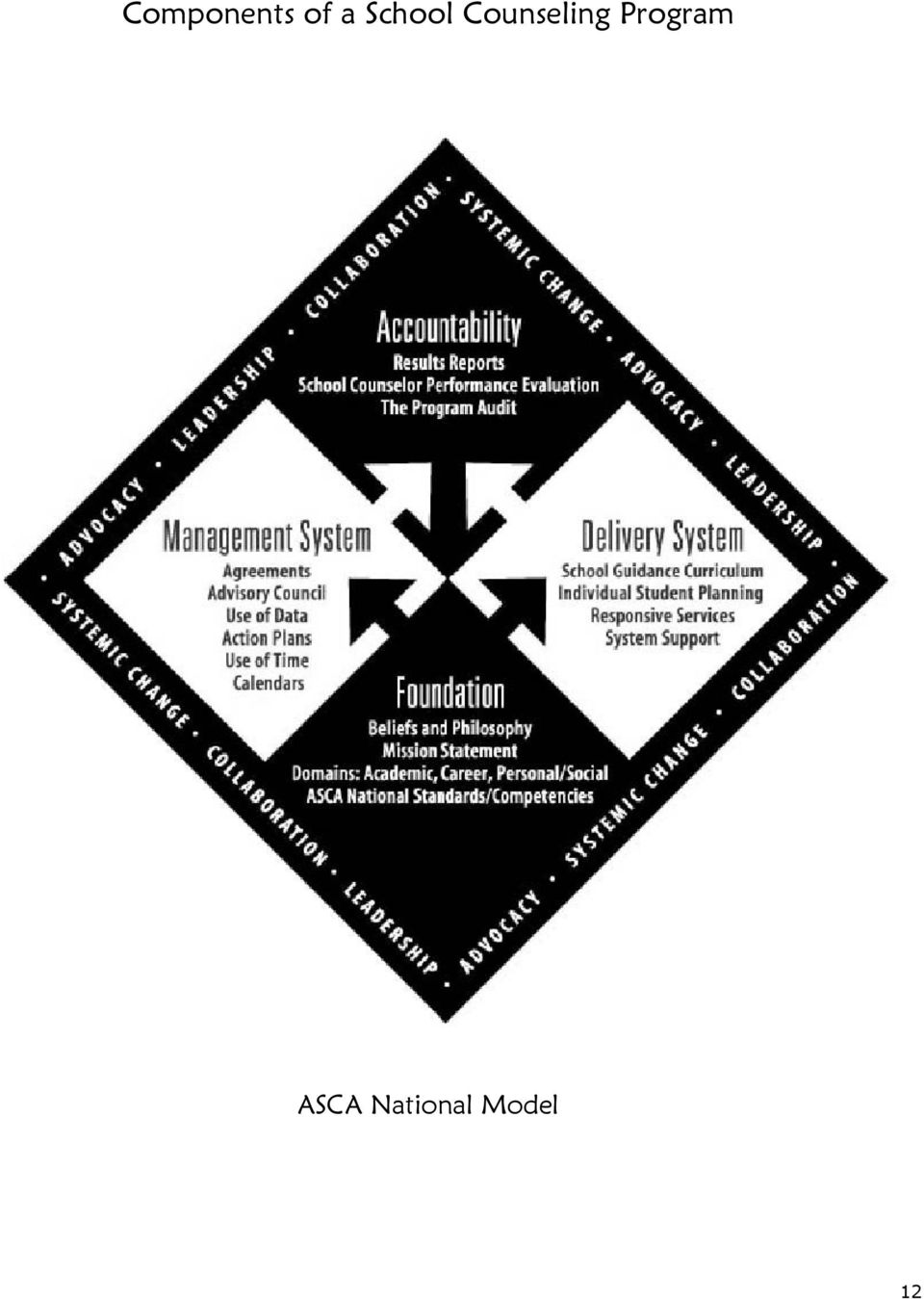
13 Components of the Maine School Counseling Model I. Foundation - The foundation of the program describes what every student will know and be able to do. A. Belief and Philosophy: The philosophy is a set of principles that guides the program development, implementation and evaluation. B. Mission: A mission statement describes the program s purpose and provides the vision of what is desired for every student. C. Domains: Domains are the extension of the mission and focus on the results students will achieve by the time the student graduates. The Maine Model combines domains of the American School Counselor Association and the Maine Learning Results facilitating development in the areas of academic, career and personal/social development. II. Delivery System- The delivery system states how the program will be implemented. A. Guidance Curriculum: This curriculum is a developmental structured lesson approach for all K-12 students to develop knowledge and skills appropriate to their age and grade level. B. Individual Student Planning: Individual planning is designed to help students establish personal goals and develop future plans through ongoing systemic planning. C. Responsive Services: Students immediate needs are met through responsive services such as counseling, consultation, referral, peer mediation, information gathering and coordination. D. Systems Support: The purpose of these activities is to establish, maintain and enhance the school counseling program. These activities include: consultation, collaboration and teaming, professional development and program management. III. Management Systems- The Management System tells when, why and on what authority the program will be implemented. A. Use of Time: A comprehensive school counseling program requires a counselor s time to be spent on direct service and eliminates non-school-counseling tasks. Establishing a calendar of activities and curriculum delivery will assist students, parents, staff and administrators in acknowledging the program. B. Management Agreements: Statements of agreement between the counselor and the administrator clearly outline areas of responsibility to which a counselor is responsible for the year. C. Advisory Council: The role of an advisory council is to review guidance program results and to make recommendations. This group is made up of students, school personnel, parents, and community members. 13

14 D. Use of Data: School counselors must show that each activity implemented is based on a careful analysis of students needs, achievement and related data. Data is necessary to determine where the school-counseling program is now, where it should be and where it is going. As pieces of data are analyzed gaps will be identified to adjust to the current population of students. E. Action Plans: Action plans that strategies are in place for programming to meet the needs of every student. Guidance curriculum action plans include: the domain, standard and competency addressed, description of guidance lesson activity, curriculum or materials to be used, time activity takes to complete, the person responsible for program delivery, and the means of evaluating student success. IV. Accountability - The accountability system answers the question, How are students different as a result of the school counseling program? A. Results Reports: Reports which include process, perception and results data ensure that the work has been done and evaluated for effectiveness and the counseling program has been adjusted as needed. B. School Counselor Performance Standards: The school counselor s performance evaluation should be based on standards of good practice. These performance standards serve as a basis for self-evaluation and counselor evaluation. C. Program Audit: The primary purpose of a program audit is to collect information to guide future action within the program to improve future results for students. 14

15 Chapter 3 Philosophy and Mission Statement Maine Comprehensive School Counseling Program Model K-12 15

16 Philosophy and Mission Statement I. Philosophy The Philosophy is an agreed upon set of beliefs and values the district follows when developing the mission statement and implementing the school counseling program. A philosophy answers the questions: 1. What do we believe about the purpose of school counseling? 2. How are counseling and guidance connected to the educational goals of the district/school? 3. Who benefits from school counseling programs? 4. What are the competencies that students will acquire as a result of their participation in the school-counseling program? Sample: Guidance services are predicated on the understanding that each student is a unique, developing, capable individual who will learn from experience and grow personally, socially and educationally throughout adolescence. Respectful of individual differences, the program assists and supports students as they begin to understand themselves, develop decision-making and problem solving skills, and plan for the future. In addition to disseminating necessary and important educational and career information, the program seeks to promote each student s desire to maximize his/her potential in preparation for success in further education or a career. Counseling promotes effective communication and life planning skills that help students grow into responsible adults. (Connecticut Comprehensive School Counseling Program) II. Mission Statement: One of the essential aspects of the foundation for a school counseling program is the mission statement. In the early development of the school counseling program, it is critical to determine a mission statement that gives overall direction and vision to the program. The statement should be specific, concise, and clear as to the intent of the school counseling program. A solid connection must be established with the educational mission statement. (Connecticut Comprehensive School Counseling Program) The mission statement content should: 1. Be written with students as the primary clients 2. Advocate for the equity, access and success of every student 3. Be written for every student 4. Indicate the content and competencies to be learned 16
17 5. Show linkages with the school, school district or state department of education mission statements 6. Indicate the long-range results desired for all students Sample: Our mission is to provide a comprehensive school counseling program that promotes the academic, career and personal/social development of all students and assists students in acquiring competencies for life-long learning and success. (Westbrook School Counseling Program) 17

18 Chapter 4 Program Management Maine Comprehensive School Counseling Program Model K-12 18

19 Program Management The management section describes organizational processes needed to manage a school counseling program effectively and efficiently. This section describes the following: First steps: Collecting local component information through a needs assessment helps to determine the needs of the school district through whose lens the program will be built. Managing the when: Use of Time and Calendars helps to define counseling tasks and identifies program priorities and how to coordinate counseling services with the school calendar. Managing the who and on what Authority: Management agreements and advisory councils advise and support the counseling program becoming effective tools for building excellent programs. 19

20 Comprehensive Counselor Guidance Plan Step One: Collecting Local Component Information Local needs assessment come in many forms, and when organized they can provide valuable information. Generally a needs assessment is a formal or informal survey in which respondents indicate their concerns, needs, and interests. (Schmidt 1993) Use data from surveys, parents or guardians and students to identify needs. Use school achievement and related data including attendance, dropout rates, graduation rates, college attendance rates. (ASCA National Model) The results may be used to establish priorities and to eliminate or create services as suggested by the needs analysis. (Connecticut Comprehensive School Counseling Program) From needs assessment results and other data counselors develop objectives, competencies, priorities, and desired outcomes. Needs assessment data guides counselors in formulating program goals, and assessment data provides a basis for evaluation of programs. (Cite Russo 1989, Gyseberg & Henderson 2000, Lamp et al 2001, VanZant & Hayslip) Conducting a needs assessment should be an ongoing process every 3 to 5 years. Ways to Gather Information Include: Survey Parents, Staff, Students & Community Focus Groups Interviews Town/Community Meetings On line Web Questionnaire/Survey Advisor/Advisee Groups Parent Organization Tips: Have a balanced questionnaire across domains of academic, career and personal/social Remember to collect information anonymously Make sure that it is easy to score Use a 4-point scale which allows no middle ground, some researchers prefer the 5 point scale Use age appropriate methods of choice Have a peer edit process for evaluating the questions asked on the survey Follow administrative guidelines for data/collection survey Consider random sampling such as selecting every 5 th name. Double check for factors like gender and economic status 20
21 Cautions in Developing the Needs Assessment: Include only items that you are willing and able to deliver Phrase items in terms of student competencies instead of counselor functions Use a statistically acceptable means of sampling Solicit help (if needed) to analyze results and draw statistically valid conclusions from data Keep surveys simple to understand and complete in order to promote a high return rate Design the needs assessment instrument to give you the types of information needed for change Pilot the instrument with a sample to test it for comprehension If the population is small, try to assess everyone. If under 500, try for at least a 20% return Consider the use of computer or scan scoring of data Make sure all communications are attractive and professional in appearance Areas to Include on Needs Assessment: A. Academic Ability to apply time-management and task-management skills Apply the study skills necessary for academic success at each level Understand the relationship between learning and work B. Career Develop skills to locate, evaluate and interpret career information Develop an awareness of personal abilities, skills, interests and motivations Learn how to write a resume C. Personal/Social Develop positive attitude towards self Use effective communication skills Develop coping skills for dealing with problems Sample Needs Assessment Local communities will want to design their own needs assessment to include additional items to adequately assess their particular situations. The Westbrook School Department K-5, 6-8, and 9-12 survey examples are one way of formatting a survey and addressing the ASCA and Maine Learning Results Standards. 21
22 Use of Time How much time should school counselors spend delivering services in each component area? New counselors are often unsure. Although some experts assert that it doesn t matter as long as you obtain results for students (Johnson & Johnson, 1997), others maintain that sticking to suggested allocated time distribution does produce the required results. In Developing and Managing Your School Guidance Program, by Norm Gysbers and Patricia Henderson (2000), the authors encourage school counselors to work with their departments to protect their time so that 80 percent of it is spent in direct service to students, staff and families and the remainder is spent in program management. The following percentages (See Figure 5.2) serve as a guide to school counselors and administrators when determining the time their program needs to spend in each of the four delivery system components. As a first step to understanding your site s use of time, all the school counselors could keep track of their time and document activities performed throughout their days. This allows school counselors and administrators to determine the amount of time being spent in each of the delivery system components and in non-school-counseling activities. This is especially helpful when first designing the program because it serves to answer the question of What is and then provides a forum for the discussion of What should be? In programs with more than one school counselor per site, there is often more flexibility between and among school counselors in determining how much time individual school counselors may spend in the delivery of system components. Keeping in mind that the program percentages are only suggested; the individual time a certain school counselor spends in the delivery of systemic services may vary depending on talents and expertise. School counselors with expertise in group counseling may focus delivering these services, while others may present more school guidance lessons. The time percentages are designed to be programmatic, not counselor specific. Counselors are encouraged to allot times based on program priorities and needs. A conclusion may also be drawn from use of time information regarding how much time is currently being spent on counseling activities versus non school counseling activities. For example, in one school, 35 percent of the high school counselors time was being spent on non-school-counseling 22
23 activities, which included master schedule building, clerical tasks and the counting and managing of the standardized tests. Following a presentation to district administrators on the results of a time analysis, the administrators decided, and the governing board supported, elimination of the non school counseling activities and hired school counseling assistants to help school counselors. Eliminating non school counseling activities and providing more clerical help freed school counselors to provide more direct services to students. Again, ASCA recommends school counselors spend a majority of their time in direct service to students. Calendars School counselors develop and publish a master calendar of school counseling events to ensure students, parents or guardians, teachers and administrators know what and when school counseling activities are scheduled and when and where activities will be held. Calendars also assist with planning, ensuring program participation. The use of a school counseling program calendar aligned with the school site calendar facilitates staff, parents or guardians, student and community involvement as partners in students education. The calendar establishes a site schedule for the school and counseling program activities. As the program grows and multiple activities are developed, a calendar validates the important support the school counselor program provides students, parents or guardians, teachers and administrators. A well developed calendar that is complete, timely and colorful can be a powerful public relations booster. Time and thought on how the calendar will be formatted, consistency in the timing and distribution methods, attractiveness of the design, color and detail produce a useful tool. An effective calendar invites others to acknowledge and participate in the school counseling program activities (Henderson & Gysbers, 1998; Johnson & Johnson, 2001; Myrick, 2003). A school counseling program is balanced in two ways: In the delivery system (i.e. school guidance curriculum, individual student planning, responsive services and system support) In the use of time spent delivering the components Calendars can: Identify grade levels, dates and activities Be published and distributed to appropriate persons: students, staff, parents or guardians and community Be posted on a weekly or monthly basis Be compared to locally established goals for time spent in the delivery of system components Be utilized to allocate time for data analysis and program evaluation Be used when designing and determining system priorities Be shared with the principal as an indicator of leadership, advocacy and foresight in the school counselor s professional approach 23
24 Annual Calendar The yearly calendar is a way for school counselors to identify the school counseling program priorities and their commitment to them. Ideally, the calendar is located in several prominent places such as the department bulletin board, school or student bulletin boards, classroom bulletin boards, administrative offices, parent or guardian center, career center, student store and other sites used to communicate school events. It may also be submitted to the local newspaper, the student newspaper and the school counseling department s website to increase the program s visibility. The student support calendar might include relevant school activities for families, such as back to school night, open house, parents or guardian-teacher meetings, standardized tests dates, parents or guardian, student and teacher conferences, planned school counseling classroom lessons, career or college nights, evening meetings for reviewing study skills or other opportunities provided through the school and the community, as well as the student support program. Many schools provide a yearly schedule of school activities that can be coordinated with other events with all relevant dates and times noted on the student support calendar. The school counseling program calendar: Increases visibility of the student support program and other related educational activities Provides focus on events or activities of value for the students, parents or guardians and staff Increases communication within the school and home about schedules and program activities Encourages the student, family, department and school to plan ahead for important student support functions Establishes an organizational pattern of highlighting and valuing student support opportunities Reserves the use of the facility hosting the events or activities Reinforces the importance of student participation in student support related activities Monthly Calendar The monthly calendar is maintained and circulated to highlight the specific activities and events for each month throughout the school year and into the summer. Print the monthly calendar in a distinctive color and distribute it to all teachers for their classroom bulletin boards. Be sure to remind teachers that they are invited to participate and to encourage student participation or observance of upcoming events. Mail the calendar to parents or guardians as well. Schedule classroom guidance lessons on a monthly basis, such as one grade level per month for four to six lessons. The Weekly Calendar The weekly calendar is not a master schedule but a fluid road map that is somewhat flexible due to crisis or immediate student needs. In addition to classroom lessons, group counseling and individual planning, build in data analysis, collaboration and advocacy into the schedule to allow for some flexibility. 24
25 Management Agreements Management agreements within the school counseling program ensure effective implementation of the delivery systems to meet students needs. The entire school counseling staff, including the administrator in charge of school counseling, must make management decisions based on site needs and data analysis. Site principals and administrators must be involved in this important process. When implementing a comprehensive school counseling program, management system decisions and agreements must be made regarding the organization and assignment of counselors (Johnson & Johnson, 2001). This should be accomplished in consultation with the principal or school counseling administrator prior to the next step in program implementation. It is recommended that: The school counseling team members and administrator review and discuss data-driven needs for the student population and school site based on data analysis. The school counseling team decides on a plan of action to meet student needs. The school counseling team and administrator agree on how students, guidance curriculum and services will be assigned to specific counselors. The school counseling team produces and presents yearly a draft of the management agreement. The administrator reviews the management agreement and arrives at consensus with the school counseling team. Program implementation is predicated on integrating all elements of the school counseling program. (See sample management agreements in the Appendix) Organizational plans should include consideration of the following: How will students be assigned to school counselors to ensure every student has access to the program and acquires the pre-determined competencies? By grade level, alpha breakdown, standards domain, academy or pathway, see any counselor or a combination? Will counselors chose to specialize in different areas? Who will provide responsive services while other counselors are delivering the scheduled school guidance curriculum? Will the school site implement a counselor of the day program so there is always one school counselor available for crisis when others are delivering guidance curriculum? What amount of time should be spent in delivering guidance lessons, providing individual student planning, delivering responsive services and managing system support? Who is responsible for implementation of the various services and specialty tasks? How will counselors be compensated for work beyond the regular work day? What budget is available to purchase the necessary materials and supplies to implement the program? What professional development is needed to support the school counselor or team s ability to provide a comprehensive school counseling program? How often should the school counseling department meet as a team, with administration, with school staff and with the advisory council? Who determines how support services for the counseling team will be provided and organized? What role do school counseling assistants, registrars, clerks and volunteers play on the counseling team? 25
26 When school counselors and administrators meet and agree on program priorities, implementation strategies and the organization of the counseling department, the entire program runs more smoothly and is more likely to produce the desired results for students. Advisory Council An advisory council is a representative group of persons appointed to both advise and assist the school counseling program within a school district. The advisory council reviews the program goals, competencies and results and participates in making recommendations to the school counseling department, principal and superintendent (Johnson & Johnson, 2001). Ideally, advisory council membership reflects the community s diversity. It should include representative stakeholders of the school counseling program: students, parents or guardians, teachers, counselors, administrators, school board members, business and community members. The council should meet twice a year at a minimum. Advisory council functions can vary. The area of specialization, number of years an educational program has been in existence, program size, community needs and other important items all affect the advisory council s functions. School counselors use data to analyze overall program effectiveness and to make decisions regarding changes in program content and delivery. The advisory council members, using their background and expertise, provide support, input and recommendations for program development and improvement throughout the process. The advisory council, therefore, can be an effective tool to help build an excellent school counseling program. Like any tool, it must be adequately maintained and used properly. Setting up an Advisory Council When creating an advisory council, the school counselor must consider two things: stakeholder representation and group size. The advisory council truly represents the school s stakeholders. The broader the representation on the advisory council, the more the group s work will accurately reflect the community s values, concerns, etc. Although broad representation is crucial, the council s size also is an issue. It is important to create an environment that is conducive to informed, constructive discussion. A council with too many members may be ineffective. Generally, a good rule of thumb is to establish a council with a minimum of eight members and a maximum of 20 members. The first step in forming a viable council is selecting good candidates for membership. The council must be able to function as a communications link between the school counseling program and the various groups to be served: students, parents or guardians, educators, business and the community. 26
27 Chapter 5 Accountability Maine Comprehensive School Counseling Program Model K-12 27
28 Accountability System I. Results Reports A. Results reports help answer the question, How are students different as a result of the program? B. Data is collected at three different intervals: 1. Short-term data: provide an immediate evaluation of the activity process on student behavior or student learning 2. Intermediate data: data collection occurs over a longer period of time as a benchmark or indication of the progress toward the goal 3. Long-term data: data collection occurs over an extended period of time and measures the activity s overall results for students C. Results reports serve as a tool for: 1. Ensuring the program was carried out as planned 2. Ensuring every student was served 3. Ensuring developmentally appropriate materials were used 4. Documenting the program s process, perception and results data 5. Documenting the program s immediate, intermediate and long-range impact 6. Analyzing the program s effectiveness 7. Sharing the program s success 8. Advocating for systematic change in the school system D. Results reports may include the following: 1. The grade level served 2. Lesson content areas 3. Curriculum or materials used 4. Process data such as the number of school counseling lessons delivered and in what subject area 5. Process data such as the number of students served 6. Short-term perception data such as pre-post tests of knowledge gained 7. Intermediate and long-term results data such as the impact on behavior, attendance or achievement 8. The implications of the results on the counseling program II. Impact Of The School Counseling Program Over Time A. Comparing data over time offers long-term information reflecting trends in student improvement or areas of concern, which become areas for improvement B. The impact-over-time form serves as a summary sheet listing baseline and change data over time and gives the counseling staff a tool to review overall student progress Documenting baseline data prior to programmatic restructuring provides ready, necessary information for data-based decision making 28
29 C. The impact-over-time-form minimally contains the following: 1. Student demographics: Enrollment data, gender, ethnicity, grade levels and languages 2. Academic achievement: Standardized test scores, grade-point averages, dropout rates, graduation rates 3. Career development: Students enrolled in work experience, job shadowing 4. Personal/social development: Climate survey results, substance abuse and abuse statistics attendance data and suspension and expulsion data 5. Parents or guardian involvement: Parent or guardian attendance at evening activities, parent workshops and conferences III. School Counselor Performance Standards A. School counselor performance standards align with the ASCA National Model and contain basic standards of practice expected from counselors Standard 1: The professional school counselor plans, organizes and delivers the school counseling program. Standard 2: The professional school counselor implements the school guidance curriculum through the use of effective instructional skills and careful planning of structured group sessions for all students. Standard 3: The professional school counselor implements the individual planning component by guiding individuals and groups of students and their parents or guardians through the development of educational and career plans. Standard 4: The professional school counselor provides responsive services through the effective use of individual and small-group counseling, consultation and referral skills. Standard 5: The professional school counselor provides system support through effective school counseling program management and support for other educational programs. Standard 6: The professional school counselor discusses the counseling department management system and the program action plans with the school administrator. Standard 7: The professional school counselor is responsible for establishing and convening an advisory council for the school counseling program. Standard 8: The professional school counselor collects and analyzes data to guide program direction and emphasis. Standard 9: The professional school counselor monitors the students on a regular basis as they progress in school. Standard 10: The professional school counselor uses time and calendars to implement an efficient program. Standard 11: The professional school counselor develops a results evaluation for the program. Standard 12: The professional school counselor conducts a yearly program audit. Standard 13: The professional school counselor is a student advocate, leader, collaborator, and a systems change agent. 29
30 IV. The Program Audit A. The audit is a tool aiding school counselors in the breakdown and analysis of each program component B. Once completed, the audit indicates implementation areas that will be improved or enhanced C. The audit provides evidence of the program s alignment with ASCA s National Model for School Counseling Programs D. After completing the audit, analyze responses to determine the following: 1. Major strengths of program 2. Items in greatest need of strengthening 3. Short-range goals for improvement 4. Long-range goals for improvement 30
31 Chapter 6 Implementation Maine Comprehensive School Counseling Program Model K-12 31
32 I. Critical Components to Getting Started A. Administration Support B. Staff Implementation 1. School counselors must hold valid Maine school counselor certification. 2. All staff members accept responsibility for the infusion of school counseling standards and competencies into the program. C. Budget D. Facilities 1. Private office with consideration of the student s right to privacy and confidentiality. 2. Adequate space accessible to all students for individuals and groups. E. Technology 1. Private access to technology for confidential record keeping purposes. 2. Counselors need technology for planning, implementation, and evaluation of programs and assessment. 3. Technology use to gather, analyze and present date to drive systematic change. II. Steps to Implementation A. Develop a team B. Gather Resources C. Plan to Plan; develop a timeline for program development. D. Assess your current program for strengths and gaps. E. Develop and Conduct needs assessment. 1. Analyze 2. Prioritize F. Develop a philosophy and mission statement. G. Determine the relationship between local needs and state and national standards and align them with the Maine State Model. H. Design the Delivery System 1. Develop action plan- who, what, when, where and how. 2. Identify curriculum. 3. Establish the program calendar. 4. Identify data that will be needed to validate program. I. Implement the Program 1. Obtain official adoption by the School Board 2. Introduce and promote the program to staff and students, and community. 3. Develop and conduct calendar and master schedule. J. Make the Program Accountable 1. Conduct a time task analysis. 2. Develop a job description. 3. Develop and use appropriate forms to supervise and evaluate counselors on job performance. 32
33 4. Review program data to analyze need for program adjustment and improvements. 5. Access student mastery of selected State Model standards. 6. Prepare and share results with the school community. 33
34 Chapter 7 Benefits of a School Counseling Program Maine Comprehensive School Counseling Program Model K-12 34
35 Benefits of a Comprehensive School Counseling Plan The following benefits have been reported by schools implementing a Comprehensive Counseling and Guidance. Benefits for Students Guarantees guidance services to all students. Promotes a developmental approach in sequencing guidance activities. Increases the opportunity for counselor-student interaction. Benefits for Local Boards of Education Presents the rationale for including guidance as a comprehensive program in the school system. Provides district patrons with current data regarding student competencies obtained through guidance program efforts. Establishes a basis for, determining guidance funding allocations. Benefits for Parents Provides support for parents regarding their child's development. Establishes a system for a student's long-range planning. Increases opportunities for parent-counselor interaction. Benefits for Teachers Encourages positive, calendared activities and supportive working relationships. Promotes a team effort to address developmental skills and core competencies. Increases teacher accessibility to the counselor as a classroom presenter and resource person. Benefits for Administrators Creates a structured program with specific guidance content. Provides a means for measuring effectiveness of guidance programs. Enhances community image of the guidance program. Benefits for the Business, Industry, and Labor Provides increased opportunity for collaboration and active participation among counselors and business. Industry and labor communities. Increases accessibility to the counselor. Prepares a potential work force with decision-making skills, pre-employment skills, and increased worker maturity. 35
36 Benefits for Guidance Personnel Defines a clear role and function that are educationally based. Eliminates non-guidance functions and revitalizes a professional identity. Provides a tool for program management and accountability. [The Utah Model for Comprehensive Guidance] 36
37 Chapter 8 Comprehensive Guidance Program Framework Maine Comprehensive School Counseling Program Model K-12 37
38 Coding Key for Student Competencies ASCA National Standards are in the shaded boxes ASCA competencies are bolded and underlined National Standard A: Students will acquire the attitudes, knowledge, and skills that contribute to effective learning in school and across the life span. Competency A1 Improve Academic Self-concept A:A1.5 identify attitudes and behaviors which lead to successful learning (GP II) CP:A1 Preparing for the Future Demonstrate how positive and negative attitudes affect one s ability to work with others The bold letter and number notations designate the ASCA standard including an alignment with the corresponding Maine Guiding Principle The next set of letter (CP, H or PE) and number notations designate the Maine Learning Results content standards and the performance indicators 38
39 ACADEMIC DEVELOPMENT DOMAIN ELEMENTARY GRADES K-2 National Standard A: Students will acquire the attitudes, knowledge, and skills that contribute to effective learning in school and across the life span. Competency A1 Improve Academic Self-concept A:A1.1 articulate feelings of competence and confidence as learners (GP I) H:E1 Communication Skills - Demonstrate healthy ways to express needs, wants, and feelings A:A1.2 display a positive interest in learning (GP II) A:A1.3 take pride in work and achievement (GP V) H:E1 Communication Skills - Demonstrate healthy ways to express needs, wants, and feelings A:A1.4 accept mistakes as essential to the learning process (GP II) H:C5 Health Promotion and Risk Reduction Apply coping strategies when they feel too excited, anxious, angry, or out of control H:E1 Communication Skills - Demonstrate healthy ways to express needs, wants, and feelings A:A1.5 identify attitudes and behaviors which lead to successful learning (GP II) H:C3 Health Promotion and Risk Reduction Choose healthful foods H:F2 Decision-Making and Goal Setting Set a short-term personal health goal PE:A5 Physical Fitness State reasons for safe and controlled movements PE:C2 Personal and Social Interactions Demonstrate cooperative skills (following rules, taking turns, sharing equipment, etc.) while participating in physical activities. PE:C4 Personal and Social Interactions Describe rules and behaviors that contribute to productive participation in physical activity Competency A2 Acquire Skills for Improving Learning A:A2.1 apply time management and task management skills (GP II) CP:A4 Preparing for The Future Demonstrate workplace behaviors such as punctuality, flexibility, teamwork, and perseverance H:C5 Health Promotion and Risk Reduction Apply coping strategies when they feel too excited, anxious, angry, or out of control A:A2.2 demonstrate how effort and persistence positively affect learning (GP II) PE:A3 Identify activities associated with each component of health-related fitness (e.g., cardiovascular endurance, muscular endurance, muscular strength, body composition) A:A2.3 use communications skills to know when and how to ask for help when needed (GP I) H:B1 Health Information, Services, and Products Identify which school and community health helpers are needed in given situations H:A3 Health Concepts Demonstrate an understanding of basic health terms H:C5 Health Promotion and Risk Reduction Apply coping strategies when they feel too excited, anxious, angry, or out of control 39
40 H:E1 Communication Skills Demonstrate healthy ways to express needs, wants, and feelings H:F1 Decision-Making and Goal Setting Explain when assistance is needed in making health-related decisions and setting health goals PE:C2 Personal and Social Interactions Demonstrate cooperative skills (following rules, taking turns, sharing equipment, etc.) while participating in physical activities A:A2.4 apply knowledge and learning styles to positively influence school performance (GP II) Competency A3 Achieve School Success A:A3.1 take responsibility for their actions (GP IV) H:C2 Health Promotion and Risk Reduction Demonstrate personal hygiene skills H:C5 Health Promotion and Risk Reduction Apply coping strategies when they feel too excited, anxious, angry, or out of control H:E1 Communication Skills Demonstrate healthy ways to express needs, wants, and feelings H:F2 Decision-Making and Goal Setting Set a short-term personal health goal PE:A5 Physical Fitness - State reasons for safe and controlled movements PE:C2 Personal and Social Interactions Demonstrate cooperative skills, (following rules, taking turns, sharing equipment, etc.) while participating in physical activities PE:C3 Personal and Social Interactions Use equipment appropriately and responsibly A:A3.2 demonstrate the ability to work independently, as well as the ability to work cooperatively with other students (GP V) CP:A4 Preparing for The Future Demonstrate workplace behaviors such as punctuality, flexibility, teamwork, and perseverance H:C5 Health Promotion and Risk Reduction Apply coping strategies when they feel too excited, anxious, angry, or out of control PE:A4 Physical Fitness - Move with an awareness of others PE:C2 Personal and Social Interactions Demonstrate cooperative skills, (following rules, taking turns, sharing equipment, etc.) while participating in physical activities A:A3.3 develop a broad range of interest and abilities (GP II) CP:B3 Education/Career Planning and Management - Identify personal strengths and interests A:A3.4 demonstrate dependability, productivity, and initiative (GP IV) CP:A4 Preparing for the Future Demonstrate workplace behaviors such as punctuality, flexibility, teamwork, and perseverance H:F1 Decision-Making and Goal Setting Explain when assistance is needed in making healthrelated decisions and setting health goals A:A3.5 share knowledge (GP V) H:D2 Influences on Health Explain how information from school and family influences health H:F1 Decision-Making and Goal Setting Explain when assistance is needed in making healthrelated decisions and setting health goals PE:C4 Personal and Social Interactions Describe rules and behaviors that contribute to productive participation in physical activity 40
41 National Standard B: Students will complete school with the academic preparation essential to choose from a wide range of substantial postsecondary options, including college. Competency B1 Improve Learning A:B1.1 demonstrate the motivation to achieve individual potential (GP II) A:B1.2 learn and apply critical thinking skills (GP III & IV) A:B1.3 apply the study skills necessary for academic success at each level (GP II) A:B1.4 seek information and support from faculty, staff, family and peers (GP III) A:B1.5 organize and apply academic information from a variety of sources (GP IV) A:B1.6 use knowledge of learning styles to positively influence school performance (GP II) A:B1.7 become a self-directed and independent learner (GP II) Competency B2 Plan to Achieve Goals A:B2.1 establish challenging academic goals in elementary, middle/junior high, and high school (GP II) A:B2.2 use assessment results in educational planning (GP II) A:B2.3 develop and implement an annual plan of study to maximize academic ability and achievement (GP II) A:B2.4 apply knowledge of aptitudes and interests to goal setting (GP II) CP:B2 Education/Career Planning and Management Identify preparation necessary for a career of interest A:B2.5 use problem-solving and decision-making skills to assess progress toward educational goals (GP III) A:B2.6 understand the relationship between classroom performance and success in school (GP II) A:B2.7 identify post-secondary options consistent with interests, achievement, aptitude, and abilities (GP II) 41
42 National Standard C: Students will understand the relationship of academics to the world of work, and to life at home and in the community. Competency C1 Relate School to Life Experience A:C1.1 demonstrate the ability to balance school, studies, extracurricular activities, leisure time, and family life (GP IV) CP:D1 Balancing Responsibilities Identify different roles they play A:C1.2 seek co-curricular and community experiences to enhance the school experience (GP IV) A:C1.3 understand the relationship between learning and work (GP III & V) CP:A2 Preparing For The Future Identify strengths and interests required in a job, at home, at school, or in the community CP:B2 Education/Career Planning and Management Identify preparation necessary for a career of interest CP:C1 Integrated and Applied Learning Identify examples of technology being applied to home, school, or work A:C1.4 demonstrate an understanding of the value of lifelong learning as essential to seeking, obtaining, and maintaining life goals (GP II) A:C1.5 understand that school success is the preparation to make the transition from student to community member (GP IV) CP:A2 Preparing for the Future Identify strengths and interests required in a job, at home, at school, or in the community CP:C3 Integrated and Applied Learning Use academic skills to solve real life problems A:C1.6 understand how school success and academic achievement enhance future career and vocational opportunities (GP II & V) CP:A2 Preparing for the Future Identify strengths and interests required in a job, at home, at school, or in the community CAREER DEVELOPMENT DOMAIN National Standard A: Students will acquire the skills to investigate the world of work in relation to knowledge of self and to make informed career decisions. Competency A:1 Develop Career Awareness C:A1.1 develop skills to locate, evaluate, and interpret career information (GP II) H:B1 Health Information, Services, and Products Identify which school and community health helpers are needed in given situations C:A1.2 learn about the variety of traditional and nontraditional occupations (GP II) H:B1 Health Information, Services, and Products Identify which school and community health helpers are needed in given situations 42
43 C:A1.3 develop an awareness of personal abilities, skills, interests, and motivations (GP II) C:A1.4 learn how to interact and work cooperatively in teams (GP IV) H:E1 Communication Skills Demonstrate healthy ways to express needs, wants, and feelings PE:A4 Physical Fitness Move with an awareness of others C:A1.5 learn to make decisions (GP III) C:A1.6 learn how to set goals (GP III) C:A1.7 understand the importance of planning (GP III) C:A1.8 pursue and develop competency in areas of interest (GP II) C:A1.9 develop hobbies and vocational interests (GP II) C:A1.10 balance between work and leisure time (GP IV) Competency A:2 Develop Employment Readiness C:A2.1 acquire employability skills such as working on a team, problem-solving and organizational skills (GP III & V) C:A2.2 apply job readiness skills to seek employment opportunities (GP II) C:A2.3 demonstrate knowledge about the changing workplace (GP II, III & VI) C:A2.4 learn about the rights and responsibilities of employers and employees (GP V & VI) C:A2.5 learn to respect individual uniqueness in the workplace (GP V & VI) C:A2.6 learn how to write a resume (GP II) C:A2.7 develop a positive attitude toward work and learning (GP II) C:A2.8 understand the importance of responsibility, dependability, punctuality, integrity, and effort in the workplace (GP V) H:E1 Communication Skills Demonstrate healthy ways to express needs, wants, and feelings PE:A4 Physical Fitness Move with an awareness of others C:A2.9 utilize time and task-management skills (GP III & V) 43
44 National Standard B: Students will employ strategies to achieve future career goals with success and satisfaction. Competency B:1 Acquire Career Information C:B1.1 apply decision making skills to career planning, course selection, and career transition (GP II & III) C:B1.2 identify personal skills, interests, and abilities and relate them to current career choice (GP II) CP:A2 Preparing For the Future Identify strengths and interests required in a job, at home, at school, or in the community CP:B3 Education/Career Planning and Management Identify personal strengths and interests C:B1.3 demonstrate knowledge of the career planning process (GP II & VI) C:B1.4 know the various ways in which occupations can be classified (GP V) C:B1.5 use research and information resources to obtain career information (GP II) C:B1.6 learn to use the internet to access career planning information (GP II) C:B1.7 describe traditional and non-traditional occupations and how these relate to career choice (GP V & VI) C:B1.8 understand how changing economic and societal needs influence employment trends and future training (GP V) Competency B:2 Identify Career Goals C:B2.1 demonstrate awareness of the education and training needed to achieve career goals (GP V) CP:B2 Education/Career Planning and Management Identify preparations necessary for a career of interest C:B2.2 assess and modify their educational plan to support career (GP II) C:B2.3 use employability and job readiness skills in internship, mentoring, shadowing, and/or other work experience (GP II & V) C:B2.4 select course work that is related to career interests (GP II & VI) C:B2.5 maintain a career planning portfolio (GP II) 44
45 CAREER DEVELOPMENT DOMAIN National Standard C: Students will understand the relationship between personal qualities, education, training, and the world of work. Competency C:1 Acquire Knowledge to Achieve Career Goals C:C1.1 understand the relationship between educational achievement and career success (GP V) CP:B1 Education/Career Planning and Management Explore reasons why people work C:C1.2 explain how work can help to achieve personal success and satisfaction (GP IV) C:C1.3 identify personal preferences and interests which influence career choice and success (GP II & IV) CP:A2 Preparing for the Future Identify strengths and interests required in a job, at home, at school, or in the community CP:B3 Education/Career Planning and Management Identify personal strengths and interests C:C1.4 understand that the changing workplace requires lifelong learning and acquiring new skills (GP II & IV) C:C1.5 describe the effect of work on lifestyle (GP IV) CP:B1 Education/Career Planning and Management Explore reasons why people work C:C1.6 understand the importance of equity and access in career choice (GP IV & V) C:C1.7 understand that work is an important and satisfying means of personal expression (GP IV) CP:B1 Education/Career Planning and Management Explore reasons why people work Competency C2 Apply Skills to Achieve Career Goals C:C2.1 demonstrate how interests, abilities and achievement relate to achieving personal, social, educational, and career goals (GP II & IV) C:C2.2 learn how to use conflict management skills with peers and adults (GP III & V) H:C5 Health Promotion and Risk Reduction Apply coping strategies when they feel too excited, anxious, angry, or out of control H:E1 Communication Skills Demonstrate healthy ways to express needs, wants, and feelings C:C2.3 learn to work cooperatively with others as a team member (GP IV & V) CP:A1 Preparing for the Future Develop effective ways to interact with others during school and after-school activities CP:A4 Preparing for the Future Demonstrate workplace behaviors such as punctuality, flexibility teamwork, and perseverance H:E1 Communication Skills Demonstrate healthy ways to express needs, wants, and feelings 45
46 C:C2.4 apply academic and employment readiness skills in work-based learning situations such as internships, shadowing, and/or mentoring experiences (GP II & V) CP:A1 Preparing for the Future Develop effective ways to interact with others during school and after-school activities CP:A4 Preparing for the Future Demonstrate workplace behaviors such as punctuality, flexibility teamwork, and perseverance PERSONAL/SOCIAL DOMAIN National Standard A: Students will acquire the knowledge, attitudes, and interpersonal skills to help them understand and respect self and others. Competency A1 Acquire Self-Knowledge PS:A1.1 develop positive attitudes toward self as a unique and worthy person (GP IV) PS:A1.2 identify values, attitudes and beliefs (GP IV) PS:A1.3 learn the goal-setting process (GP II) PS:A1.4 understand change is a part of growth (GP IV) PS:A1.5 identify and express feelings (GP I) H:C5 Health Promotion and Risk Reduction Apply coping strategies when they feel too excited, anxious, angry, or out of control H:E1 Communication Skills Demonstrate healthy ways to express needs, wants, and feelings PS:A1.6 distinguish between appropriate and inappropriate behavior (GP III & V) CP:A1 Preparing for the Future Develop effective ways to interact with others during school and after-school activities H:C5 Health Promotion and Risk Reduction Apply coping strategies when they feel too excited, anxious, angry, or out of control PE:C3 Personal and Social Interactions Use equipment appropriately and responsibly PE:C4 Personal and Social Interactions Describe rules and behaviors that contribute to productive participation in physical activity PS:A1.7 recognize personal boundaries, rights, and privacy needs (GP IV) CP:A1 Preparing for the Future Develop effective ways to interact with others during school and after-school activities PE:A4 Physical Fitness Move with an awareness of others PS:A1.8 understand the need for self-control and how to practice it (GP IV) CP:A1 Preparing for the Future Develop effective ways to interact with others during school and after-school activities H:C5 Health Promotion and Risk Reduction Apply coping strategies when they feel too excited, anxious, angry or out of control PE:C3 Personal and Social Interactions Use equipment appropriately and responsibly 46
47 PE:C4 Personal and Social Interactions Describe rules and behaviors that contribute to productive participation in physical activity PS:A1.9 demonstrate cooperative behavior in groups (GP IV & V) CP:A1 Preparing for the Future Develop effective ways to interact with others during school and after-school activities H:E1 Communication Skills Demonstrate healthy ways to express needs, wants, and feelings PE:A4 Physical Fitness Move with awareness of others PE:C2 Personal and Social Interactions Demonstrate cooperative skills (following rules, taking turns, sharing equipment, etc.) while participating in physical activities PS:A1.10 identify personal strengths and assets (GP II & V) CP:B3 Education/Career Planning and Management Identify job-hunting strategies and the skills necessary to hold a job PS:A1.11 identify and discuss changing personal and social roles (GP IV) PS:A1.12 identify and recognize changing family roles (GP IV) Competency A2 Acquire Interpersonal Skills PS:A2.1 recognize that everyone has rights and responsibilities (GP IV) CP:A1 Preparing for the Future Develop effective ways to interact with others during school and after-school activities PS:A2.2 respect alternative points of view (GP IV & VI) CP:A1 Preparing for the Future Develop effective ways to interact with others during school and after-school activities PS:A2.3 recognize, accept, respect and appreciate individual differences (GP IV & V) CP:A1 Preparing for the Future Develop effective ways to interact with others during school and after-school activities PS:A2.4 recognize, accept and appreciate ethnic and cultural diversity (GP IV) CP:A1 Preparing for the Future Develop effective ways to interact with others during school and after-school activities PS:A2.5 recognize and respect differences in various family configurations (GP IV) CP:A1 Preparing for the Future Develop effective ways to interact with others during school and after-school activities PS:A2.6 use effective communications skills (GP I) CP:A1 Preparing for the Future Develop effective ways to interact with others during school and after-school activities H:C5 Health Promotion and Risk Reductions Apply coping strategies when they feel too excited, anxious, angry, or out of control H:E1 Communication Skills Demonstrate healthy ways to express needs, wants, and feelings 47
48 P:C2 Personal and Social Interactions Demonstrate cooperative skills (following rules, taking turns, sharing equipment, etc.) while participating in physical activities PS:A2.7 know that communication involves speaking, listening, and nonverbal behavior (GP I) CP:A1 Preparing for the Future Develop effective ways to interact with others during school and after-school activities H:E1 Communication Skills Demonstrate healthy ways to express needs, wants, and feelings H:E2 Communication Skills Distinguish between verbal and nonverbal communication PE:C2 Personal and Social Interactions Demonstrate cooperative skills (following rules, taking turns, sharing equipment, etc) while participating in physical activities PS:A2.8 learn how to make and keep friends (GP IV) CP:A1 Preparing for the Future Develop effective ways to interact with others during school and after-school activities H:E1 Communication Skills Demonstrate healthy ways to express needs, wants, and feelings PE:C2 Personal and Social Interactions Demonstrate cooperative skills (following rules, taking turns, sharing equipment, etc) while participating in physical activities National Standard B: Students will make decisions set goals, and take necessary action to achieve goals. Competency B1 Self-Knowledge Application PS:B1.1 use a decision-making and problem-solving model (GP III) H:C5 Health Promotion and Risk Reduction Apply coping strategies when they feel too excited, anxious, angry or out of control PE:C2 Personal and Social Interactions Demonstrate cooperative skills (following rules, taking turns, sharing equipment, etc.) while participating in physical activities PS:B1.2 understand consequences of decisions and choices (GP III & IV) H:C5 Health Promotion and Risk Reduction Apply coping strategies when they feel too excited, anxious, angry, or out of control H:E1 Communication Skills Demonstrate healthy ways to express needs, wants, and feelings PE:C3 Personal and Social Interactions Use equipment appropriately and responsibly PS:B1.3 identify alternative solutions to a problem (GP III) H:C5 Health Promotion and Risk Reduction Apply coping strategies when they feel too excited, anxious, angry, or out of control PS:B1.4 develop effective coping skills for dealing with problems (GP III & IV) H:C5 Health Promotion and Risk Reduction Apply coping strategies when they feel too excited, anxious, angry, or out of control PS:B1.5 demonstrate when, where and how to seek help for solving problems and making decisions (GP III) H:C5 Health Promotion and Risk Reduction Apply coping strategies when they feel too excited, anxious, angry, or out of control 48
49 H:F1 Decision-Making and Goal Setting Explain when assistance is needed in making healthrelated decisions and setting health goals PS:B1.6 know how to apply conflict resolution skills (GP III) CP:A1 Preparing for the Future Develop effective ways to interact with others during school and after-school activities H:C5 Health Promotion and Risk Reduction Apply coping strategies when they feel too excited, anxious, angry, or out of control H:E1 Communication Skills Demonstrate healthy ways to express needs, wants, and feelings PE:C2 Personal and Social Interactions Demonstrate cooperative skills (following rules, taking turns, sharing equipment, etc.) while participating in physical activities PS:B1.7 demonstrate a respect and appreciation for individual and cultural differences (GP IV) CP:A1 Preparing for the Future Develop effective ways to interact with others during school and after-school activities PE:C2 Personal and Social Interactions Demonstrate cooperative skills (following rules, taking turns, sharing equipment, etc.) while participating in physical activities PS:B1.8 know when peer pressure is influencing a decision (GP III) CP:A1 Preparing for the Future Develop effective ways to interact with others during school and after-school activities H:D2 Influences on Health Explain how information from school and family influences health PS:B1.9 identify long- and short-term goals (GP I) H:F2 Decision-Making and Goal Setting Set a short-term personal health goal PS:B1.10 identify alternative ways of achieving goals (GP II & III) CP:A1 Preparing for the Future Develop effective ways to interact with others during school and after-school activities HC:5 Health Promotion and Risk Reduction Apply coping strategies when they feel too excited, anxious, angry, or out of control PE:C2 Personal and Social Interactions Demonstrate cooperative skills (following rules, taking turns, sharing equipment, etc.) while participating in physical activities PS:B1.11 use persistence and perseverance in acquiring knowledge and skills (GP II) CP:A4 Preparing for the Future Demonstrate workplace behaviors such as punctuality, flexibility, teamwork, and perseverance PE:C2 Personal and Social Interactions Demonstrate cooperative skills (following rules, taking turns, sharing equipment, etc.) while participating in physical activities PS:B1.12 develop an action plan to set and achieve realistic goals (GP II & III) H:F2 Decision-Making and Goal Setting Set a short-term personal health goal PE:C2 Personal and Social Interactions Demonstrate cooperative skills (following rules, taking turns, sharing equipment, etc.) while participating in physical activities PE:C4 Personal and Social Interactions Describe rules and behaviors that contribute to productive participation in physical activity 49
50 National Standard C: Students will understand safety and survival skills. Competency C1 Acquire Personal Safety Skills PS:C1.1 demonstrate knowledge of personal information (i.e. telephone number, home address, emergency contact) (GP IV) H:C4 Health Promotion and Risk Reduction Demonstrate a variety of safety skills for different situations (e.g., pedestrian, bus, fire, auto and bicycle safety) PS:C1.2 learn about the relationship between rules, laws, safety, and the protection of rights of the individual (GP IV) H:C4 Health Promotion and Risk Reduction Demonstrate a variety of safety skills for different situations (e.g., pedestrian, bus, fire, auto and bicycle safety) PE:C3 Personal and Social Interactions Use equipment appropriately and responsibly PS:C1.3 learn about the differences between appropriate and inappropriate physical contact (GP IV) CP:A1 Preparing for the Future Develop effective ways to interact with others during school and after-school activities H:A2 Health Concepts Describe the transmission and prevention of communicable diseases PE:A4 Physical Fitness Move with an awareness of others PS:C1.4 demonstrate the ability to set boundaries, rights and personal privacy (GP IV) CP:A1 Preparing for the Future Develop effective ways to interact with others during school and after-school activities H:E1 Communication Skills Demonstrate healthy ways to express needs, wants, and feelings PE:A4 Physical Fitness Move with the awareness of others PE:C2 Personal and Social Interactions Demonstrate cooperative skills (following rules, taking turns, sharing equipment, etc.) while participating in physical activities PS:C1.5 differentiate between situations requiring peer support and situations requiring adult professional help (GP III) H:F1 Decision-Making and Goal Setting Explain when assistance is needed in making healthrelated decisions and setting health goals PS:C1.6 identify resource people in the school and community, and know how to seek their help (GP III & IV) H:B1 Health Information, Services, and Products Identify which school and community health helpers are needed in given situations H:D2 Influences on Health Explain how information from school and family influences health H:F1 Decision-Making and Goal Setting Explain when assistance is needed in making healthrelated decisions and setting health goals PS:C1.7 apply effective problem-solving and decision-making skills to make safe and healthy choices (GP III & IV) H:C1 Health Promotion and Risk Reduction Differentiate between safe and harmful substances 50
51 found at home and school H:C5 Health Promotion and Risk Reduction Apply coping strategies when they feel too excited, anxious, angry, or out of control. H:E1 Communication Skills - Demonstrate healthy ways to express needs, wants, and feelings PS:C1.8 learn about the emotional and physical dangers of substance use and abuse (GP IV) H:C1 Health Promotion and Risk Reduction Differentiate between safe and harmful substances found at home and school PS:C1.9 learn how to cope with peer pressure (GP III) CP:A1 Preparing for the Future Develop effective ways to interact with others during school and after-school activities PE:C2 Personal and Social Interactions Demonstrate cooperative skills (following rules, taking turns, sharing equipment, etc.) while participating in physical activities PS:C1.10 learn techniques for managing stress and conflict (GP III & IV) H:C5 Health Promotion and Risk Reduction Apply coping strategies when they feel too excited, anxious, angry, or out of control PS:C1.11 learn coping skills for managing life events (GP III & IV) CP:A1 Preparing for the Future Develop effective ways to interact with others during school and after-school activities 51
52 Coding Key for Student Competencies ASCA National Standards are in the shaded boxes ASCA competencies are bolded and underlined National Standard A: Students will acquire the attitudes, knowledge, and skills that contribute to effective learning in school and across the life span. Competency A1 Improve Academic Self-concept A:A1.5 identify attitudes and behaviors which lead to successful learning (GP II) CP:A1 Preparing for the Future Demonstrate how positive and negative attitudes affect one s ability to work with others The bold letter and number notations designate the ASCA standard including an alignment with the corresponding Maine Guiding Principle The next set of letter (CP, H or PE) and number notations designate the Maine Learning Results content standards and the performance indicators 52
53 ACADEMIC DEVELOPMENT DOMAIN - ELEMENTARY GRADES 3-4 National Standard A: Students will acquire the attitudes, knowledge, and skills that contribute to effective learning in school and across the life span. Competency A1 Improve Academic Self-concept A:A1.1 articulate feelings of competence and confidence as learners (GP I) A:A1.2 display a positive interest in learning (GP II) A:A1.3 take pride in work and achievement (GP V) A:A1.4 accept mistakes as essential to the learning process (GP II) CP:D1 Balancing Responsibilities Exhibit, during the school day, the personal qualities that lead to responsible behavior A:A1.5 identify attitudes and behaviors which lead to successful learning (GP II) CP:A1 Preparing for the Future Demonstrate how positive and negative attitudes affect one s ability to work with others Competency A2 Acquire Skills for Improving Learning A:A2.1 apply time management and task management skills (GP II) CP:B3 Education/Career Planning and Management Identify job-hunting strategies and the skills necessary to hold a job H:A1 Health Concepts Describe the relationship between healthy practices and personal health (e.g., eating well and exercise) H:A7 Health Concepts Demonstrate essential understanding of basic health concepts A:A2.2 demonstrate how effort and persistence positively affect learning (GP II) CP:D1 Balancing Responsibilities Exhibit, during the school day, the personal qualities that lead to responsible behavior A:A2.3 use communications skills to know when and how to ask for help when needed (GP I) CP:A2 Preparing for the Future Use communication and listening skills that result in successful interactions with others H:C4 Health Promotion and Risk Reduction Demonstrate healthful and safe ways to deal with or avoid threatening and stressful situations A:A2.4 apply knowledge and learning styles to positively influence school performance (GP II) Competency A3 Achieve School Success A:A3.1 take responsibility for their actions (GP IV) CP:D1 Balancing Responsibilities Exhibit, during the school day, the personal qualities that lead to responsible behavior H:A1 Health Concepts Describe the relationship between healthy practices and personal 53
54 health (e.g., eating well and exercise) H:D4 Influences on Health Describe ways to be a responsible friend and family member A:A3.2 demonstrate the ability to work independently, as well as the ability to work cooperatively with other students (GP V) CP:D1 Balancing Responsibilities Exhibit, during the school day, the personal qualities that lead to responsible behavior A:A3.3 develop a broad range of interest and abilities (GP II) CP:A5 Education/Career Planning and Management Demonstrate awareness of their own interests, aptitudes, and abilities A:A3.4 demonstrate dependability, productivity, and initiative (GP IV) CP:D1 Balancing Responsibilities Exhibit, during the school day, the personal qualities that lead to responsible behavior A:A3.5 share knowledge (GP V) National Standard B: Students will complete school with the academic preparation essential to choose from a wide range of substantial postsecondary options, including college. Competency B1 Improve Learning A:B1.1 demonstrate the motivation to achieve individual potential (GP II) A:B1.2 learn and apply critical thinking skills (GP II) CP:D1 Balancing Responsibilities Exhibit, during the school day, the personal qualities that lead to responsible behavior H:A7 Health Concepts Demonstrate essential understanding of basic health concepts H:C4 Health Concepts Demonstrate healthful and safe ways to deal with or avoid threatening and stressful situations H:E1 Communication Skills Demonstrate effective verbal and non-verbal communication skills to enhance health and to build and maintain healthy relationships (e.g., positive peer pressure) A:B1.3 apply the study skills necessary for academic success at each level (GP III & IV) A:B1.4 seek information and support from faculty, staff, family and peers (GP III) A:B1.5 organize and apply academic information from a variety of sources (GP IV) A:B1.6 use knowledge of learning styles to positively influence school performance (GP II) CP:D1 Balancing Responsibilities Exhibit, during the school day, the personal qualities that lead to responsible behavior A:B1.7 become a self-directed and independent learner (GP II) H:F1 Decision-Making and Goal Setting Demonstrate the ability to apply a decision-making process to health issues and problems 54
55 Competency B2 Plan to Achieve Goals A:B2.1 establish challenging academic goals in elementary, middle/junior high, and high school (GP II) A:B2.2 use assessment results in educational planning (GP II) A:B2.3 develop and implement an annual plan of study to maximize academic ability and achievement (GP II) A:B2.4 apply knowledge of aptitudes and interests to goal setting (GP II) CP:B2 Education/Career Planning and Management Gather data and information about personal interests, abilities, and aptitudes and project likely career options A:B2.5 use problem-solving and decision-making skills to assess progress toward educational goals (GP III) A:B2.6 understand the relationship between classroom performance and success in school (GP II) A:B2.7 identify post-secondary options consistent with interests, achievement, aptitude, and abilities (GP II) National Standard C: Students will understand the relationship of academics to the world of work, and to life at home and in the community. Competency C1 Relate School to Life Experience A:C1.1 demonstrate the ability to balance school, studies, extracurricular activities, leisure time, and family life (GP IV) CP:D2 Balancing Responsibilities Develop time management strategies for school and afterschool activities H:A1 Health Concepts Describe the relationship between health practices and personal health (e.g., eating well and exercise) H:D4 Influences on Health Describe ways to be a responsible friend and family member A:C1.2 seek co-curricular and community experiences to enhance the school experience (GP IV) PE:A4 Physical Fitness Participate in physical activity for the purpose of improving healthrelated fitness A:C1.3 understand the relationship between learning and work (GP III & V) CP:C3 Integrated and Applied Learning Identify academic knowledge and skills required in specific careers A:C1.4 demonstrate an understanding of the value of lifelong learning as essential to seeking, obtaining, and maintaining life goals (GP II) CP:B4 Education/Career Planning and Management 55
56 A:C1.5 understand that school success is the preparation to make the transition from student to community member (GP IV) A:C1.6 understand how school success and academic achievement enhance future career and vocational opportunities (GP II & V) CP:B2 Education/Career Planning and Management Gather data and information about personal interests, abilities, and aptitudes and project likely career options CP:C3 Integrated and Applied Learning Identify academic knowledge and skills required in specific careers CAREER DEVELOPMENT DOMAIN National Standard A: Students will acquire the skills to investigate the world of work in relation to knowledge of self and to make informed career decisions. Competency A:1 Develop Career Awareness C:A1.1 develop skills to locate, evaluate, and interpret career information (GP II) CP:B1 Education/Career Planning and Management Use a variety of resources to learn about a personally interesting career topic C:A1.2 learn about the variety of traditional and nontraditional occupations (GP II) C:A1.3 develop an awareness of personal abilities, skills, interests, and motivations (GP II) CP:A5 Preparing for the Future Demonstrate awareness of their own interests, aptitudes, and abilities C:A1.4 learn how to interact and work cooperatively in teams (GP IV) CP:A2 Preparing for the Future Use communication and listening skills that result in successful interactions with others H:E2 Communication Skills Differentiate between negative and positive ways to deal with conflict H:E3 Communication Skills Demonstrate non-violent strategies to resolve conflicts C:A1.5 learn to make decisions (GP III) H:A1 Health Concepts Describe the relationship between healthy practices and personal health (e.g., eating well and exercise) C:A1.6 learn how to set goals (GP III) H:A1 Health Concepts Describe the relationship between healthy practices and personal health (e.g., eating well and exercise) C:A1.7 understand the importance of planning (GP III) H:A1 Health Concepts Describe the relationship between healthy practices and personal health (e.g., eating well and exercise) C:A1.8 pursue and develop competency in areas of interest (GP II) 56
57 C:A1.9 develop hobbies and vocational interests (GP II) CP:A5 Preparing for the Future Demonstrate awareness of their own interests, aptitudes, and abilities C:A1.10 balance between work and leisure time (GP IV) CP:D2 Balancing Responsibilities Develop time management strategies for school and afterschool activities H:A1 Health Concepts Describe the relationship between healthy practices and personal health (e.g., eating well and exercise) H:D4 Influences on Health Describe ways to be a responsible friend and family member Competency A:2 Develop Employment Readiness C:A2.1 acquire employability skills such as working on a team, problem-solving and organizational skills (GP III & IV) CP:B3 Education/Career Planning and Management Identify job-hunting strategies and the skills necessary to hold a job C:A2.2 apply job readiness skills to seek employment opportunities (GP II) C:A2.3 demonstrate knowledge about the changing workplace (GP II, III & VI) CP:C1 Integrated and Applied Learning Illustrate how products evolve as a result of technological systems C:A2.4 learn about the rights and responsibilities of employers and employees (GP V & VI) PE:B9 Motor Skills Identify and demonstrate appropriate safety practices and rules for activities C:A2.5 learn to respect individual uniqueness in the workplace (GP V & VI) C:A2.6 learn how to write a resume (GP II) C:A2.7 develop a positive attitude toward work and learning (GP II) C:A2.8 understand the importance of responsibility, dependability, punctuality, integrity, and effort in the workplace (GP V) PE:B9 Motor Skills Identify and demonstrate appropriate safety practices and rules for activities C:A2.9 utilize time and task-management skills (GP III & GP V) CP:D1 Balancing Responsibilities Exhibit during the school day, the personal qualities that lead to responsible behavior CP:D2 Balancing Responsibilities Develop time management strategies for school and afterschool activities 57
58 National Standard B: Students will employ strategies to achieve future career goals with success and satisfaction. Competency B:1 Acquire Career Information C:B1.1 apply decision making skills to career planning, course selection, and career transition (GP II & III) CP:B2 Education/Career Planning and Management Gather data and information about personal interests, abilities, and aptitudes and project likely career options C:B1.2 identify personal skills, interests, and abilities and relate them to current career choice (GP II) CP:B2 Education/Career Planning and Management Gather data and information about personal interests, abilities, and aptitudes and project likely career options C:B1.3 demonstrate knowledge of the career planning process (GP II & VI) CP:B2 Education/Career Planning and Management Gather data and information about personal interests, abilities, and aptitudes and project likely career options C:B1.4 know the various ways in which occupations can be classified (GP V) H:B3 Health Information, Services, and Products Identify community agencies that advocate healthy individuals, families, and communities C:B1.5 use research and information resources to obtain career information (GP II) CP:B2 Education/Career Planning and Management Gather data and information about personal interests, abilities, and aptitudes and project likely career options C:B1.6 learn to use the internet to access career planning information (GP II) CP:A1 Preparing for the Future Demonstrate how positive and negative attitudes affect one s ability to work with others CP:B2 Education/Career Planning and Management Gather data and information about personal interests, abilities, and aptitudes and project likely career options C:B1.7 describe traditional and non-traditional occupations and how these relate to career choice (GP V & VI) C:B1.8 understand how changing economic and societal needs influence employment trends and future training. (GP V) Competency B:2 Identify Career Goals C:B2.1 demonstrate awareness of the education and training needed to achieve career goals (GP V) CP:C3 Integrated and Applied Learning Identify academic knowledge and skills required in specific careers C:B2.2 assess and modify their educational plan to support career (GP II) 58
59 C:B2.3 use employability and job readiness skills in internship, mentoring, shadowing, and/or other work experience (GP II & V) C:B2.4 select course work that is related to career interests (GP II & VI) C:B2.5 maintain a career planning portfolio (GP II) CAREER DEVELOPMENT DOMAIN National Standard C: Students will understand the relationship between personal qualities, education, training, and the world of work. Competency C:1 Acquire Knowledge to Achieve Career Goals C:C1.1 understand the relationship between educational achievement and career success (GP V) CP:C3 Integrated and Applied Learning Identify academic knowledge and skills required in specific careers C:C1.2 explain how work can help to achieve personal success and satisfaction (GP V) CP:A4 Preparing for the Future Explain the value of work to the individual and to society in general C:C1.3 identify personal preferences and interests which influence career choice and success (GP II & IV) CP:B2 Education/Career Planning and Management Gather data and information about personal interests, abilities, and aptitudes and project likely career options C:C1.4 understand that the changing workplace requires lifelong learning and acquiring new skills (GP II & IV) C:C1.5 describe the effect of work on lifestyle (GP IV) C:C1.6 understand the importance of equity and access in career choice (GP IV & V) C:C1.7 understand that work is an important and satisfying means of personal expression (GP IV) CP:A4 Preparing for the Future Explain the value of work to the individual and to society in general Competency C2 Apply Skills to Achieve Career Goals C:C2.1 demonstrate how interests, abilities and achievement relate to achieving personal, social, educational, and career goals (GP II & IV) C:C2.2 learn how to use conflict management skills with peers and adults (GP III & V) CP:A3 Preparing for the Future Demonstrate an understanding of the connections between locally generated products and services and the efforts required to create those 59
60 products and services H:E2 Communication Skills Differentiate between negative and positive ways to deal with conflict H:E3 Communication Skills Demonstrate non-violent strategies to resolve conflicts C:C2.3 learn to work cooperatively with others as a team member (GP IV & V) CP:A1 Preparing for the Future Demonstrate how positive and negative attitudes affect one s ability to work with others CP:A4 Preparing for the Future Explain the value of work to the individual and to society in general H:E2 Communication Skills Differentiate between negative and positive ways to deal with conflict H:E3 Communication Skills Demonstrate non-violent strategies to resolve conflicts PE:C1 Personal and Social Interactions Demonstrate appropriate communication skills in a variety of physical activities and describe how these skills can enhance group/team cooperation and effort C:C2.4 apply academic and employment readiness skills in work-based learning situations such as internships, shadowing, and/or mentoring experiences (GP II & V) CP:A1 Preparing for the Future Demonstrate how positive and negative attitudes affect one s ability to work with others CP:A4 Preparing for the Future Explain the value of work to the individual and to society in general PERSONAL/SOCIAL DOMAIN National Standard A: Students will acquire the knowledge, attitudes, and interpersonal skills to help them understand and respect self and others. Competency A1 Acquire Self-Knowledge PS:A1.1 develop positive attitudes toward self as a unique and worthy person (GP IV) H:A7 Health Concepts Demonstrate essential understanding of basic health concepts PS:A1.2 identify values, attitudes and beliefs (GP IV) PS:A1.3 learn the goal-setting process (GP II) PS:A1.4 understand change is a part of growth (GP IV) H:D4 Influences on Health Describe ways to be a responsible friend and family member PS:A1.5 identify and express feelings (GP I) H:A7 Health Concepts Demonstrate essential understanding of basic health concepts PS:A1.6 distinguish between appropriate and inappropriate behavior (GP III & IV) CP:A1 Preparing for the Future Demonstrate how positive and negative attitudes affect one s ability to work with others H:C1 Health Promotion and Risk Reduction Compare behaviors that are safe to those that are 60
61 risky or harmful (e.g., bicycle safety, handling weapons, use of medicines) PE:B9 Motor Skills Identify and demonstrate appropriate safety practices and rules for activities PE:C3 Personal and Social Interactions Demonstrate safety principles in physical activity settings PS:A1.7 recognize personal boundaries, rights, and privacy needs (GP IV) CP:A1 Preparing for the Future Demonstrate how positive and negative attitudes affect one s ability to work with others PS:A1.8 understand the need for self-control and how to practice it (GP IV) CP:A1 Preparing for the Future Demonstrate how positive and negative attitudes affect one s ability to work with others H:A1 Health Concepts Describe the relationship between healthy practices and personal health (e.g., eating well and exercise) PE:B9 Motor Skills Identify and demonstrate appropriate safety practices and rules for activities PE:C3 Personal and Social Interactions Demonstrate safety principles in physical activity settings PS:A1.9 demonstrate cooperative behavior in groups (GP IV & V) CP:A1 Preparing for the Future Demonstrate how positive and negative attitudes affect one s ability to work with others P:B9 Motor Skills Identify and demonstrate appropriate safety practices and rules for activities P:C1 Personal and Social Interactions Demonstrate appropriate communication skills in a variety of physical activities and describe how these skills can enhance group/team cooperation and effort PE:C4 Personal and Social Interactions Participate cooperatively with partners to improve skill performance during practice PS:A1.10 identify personal strengths and assets (GP II & V) CP:B3 Education/Career Planning and Management Identify job-hunting strategies and the skills necessary to hold a job H:A7 Health Concepts Describe the relationship between healthy practices and personal health (e.g., eating well and exercise PE:C4 Personal and Social Interactions Participate cooperatively with partners to improve skill performance during practice PS:A1.11 identify and discuss changing personal and social roles (GP IV) H:D4 Influences on Health Describe ways to be a responsible friend and family member PS:A1.12 identify and recognize changing family roles (GP IV) H:D4 Influences on Health Describe ways to be a responsible friend and family member 61
62 Competency A2 Acquire Interpersonal Skills PS:A2.1 recognize that everyone has rights and responsibilities (GP IV) CP:A1 Preparing for the Future Demonstrate how positive and negative attitudes affect one s ability to work with others PS:A2.2 respect alternative points of view (GP IV & VI) CP:A1 Preparing for the Future Demonstrate how positive and negative attitudes affect one s ability to work with others H:D4 Influences on Health Describe ways to be a responsible friend and family member PS:A2.3 recognize, accept, respect and appreciate individual differences (GP IV & V) CP:A1 Preparing for the Future Demonstrate how positive and negative attitudes affect one s ability to work with others H:A7 Health Concepts Demonstrate essential understanding of basic health concepts PE:C5 Personal and Social Interactions Assess their own performance problems without blaming others PS:A2.4 recognize, accept and appreciate ethnic and cultural diversity (GP IV) CP:A1 Preparing for the Future Demonstrate how positive and negative attitudes affect one s ability to work with others H:D1 Influences on Health Evaluate the influences of culture on health PS:A2.5 recognize and respect differences in various family configurations (GP IV) CP:A1 Preparing for the Future Demonstrate how positive and negative attitudes affect one s ability to work with others H:D4 Influences on Health Describe ways to be a responsible friend and family member PS:A2.6 use effective communications skills (GP I) CP:A1 Preparing for the Future Demonstrate how positive and negative attitudes affect one s ability to work with others H:A7 Health Concepts Demonstrate essential understanding of basic health concepts H:C4 Health Promotion and Risk Reduction Demonstrate healthful and safe ways to deal with or avoid threatening and stressful situations H:E1 Communication Skills Use appropriate communication and listening skills to enhance health PE:C1 Personal and Social Interactions Demonstrate appropriate communication skills in a variety of physical activities and describe how these skills can enhance group/team cooperation and effort PE:C5 Personal and Social Interactions Assess their own performance problems without blaming others PS:A2.7 know that communication involves speaking, listening, and nonverbal behavior (GP I) CP:A1 Preparing for the Future Demonstrate how positive and negative attitudes affect one s ability to work with others H:E1 Communication Skills Use appropriate communication and listening skills to enhance health PE:C1 Personal and Social Interactions Demonstrate appropriate communication skills in a 62
63 variety of physical activities and describe how these skills can enhance group/team cooperation and effort PS:A2.8 learn how to make and keep friends (GP IV) CP:A1 Preparing for the Future Demonstrate how positive and negative attitudes affect one s ability to work with others H:A2 Health Concepts Identify indicators of physical, mental, emotional, and social health during childhood H:D4 Influences on Health Describe ways to be a responsible friend and family member PE:C5 Personal and Social Interactions Assess their own performance problems without blaming others National Standard B: Students will make decisions set goals, and take necessary action to achieve goals. Competency B1 Self-Knowledge Application PS:B1.1 use a decision-making and problem-solving model (GP III) H:F1 Decision-Making and Goal Setting Demonstrate the ability to apply a decision-making process to health issues and problems PS:B1.2 understand consequences of decisions and choices (GP III & IV) H:A1 Health Concepts Describe the relationship between healthy practices and personal health (e.g., eating well and exercise) H:F2 Decision-Making and Goal Setting Demonstrate the ability to apply a decision-making processes to resolve health problems PS:B1.3 identify alternative solutions to a problem (GP III) H:E4 Communication Skills Express opinions and give accurate information about health issues PS:B1.4 develop effective coping skills for dealing with problems (GP III & IV) H:C4 Health Promotion and Risk Reduction Demonstrate healthful and safe ways to deal with or avoid threatening and stressful situations PS:B1.5 demonstrate when, where and how to seek help for solving problems and making decisions (GP III) H:A2 Health Concepts Identify indicators of physical, mental, emotional, and social health during childhood H:C4 Health Promotion and Risk Reduction Demonstrate healthful and safe ways to deal with or avoid threatening and stressful situations PS:B1.6 know how to apply conflict resolution skills (GP III) CP:A1 Preparing for the Future Demonstrate how positive and negative attitudes affect one s ability to work with others H:C4 Health Promotion and Risk Reduction Demonstrate healthful and safe ways to deal with or avoid threatening and stressful situations H:E2 Communication Skills Differentiate between negative and positive ways to deal with 63
64 conflict H:E4 Communication Skills Express opinions and give accurate information about health issues PS:B1.7 demonstrate a respect and appreciation for individual and cultural differences (GP IV) CP:A1 Preparing for the Future Demonstrate how positive and negative attitudes affect one s ability to work with others H:D4 Influences on Health Describe ways to be a responsible friend and family member PS:B1.8 know when peer pressure is influencing a decision (GP III) CP:A1 Preparing for the Future Demonstrate how positive and negative attitudes affect one s ability to work with others PS:B1.9 identify long- and short-term goals (GP II) PE:B8 Motor Skills Recognize and apply concepts that have an impact on the quality of movement (e.g., appropriate practice improves performance) PS:B1.10 identify alternative ways of achieving goals (GP II & III) CP:A1 Preparing for the Future Demonstrate how positive and negative attitudes affect one s ability to work with others PS:B1.11 use persistence and perseverance in acquiring knowledge and skills (GP II) CP:A4 Preparing for the Future Explain the value of work to the individual and to society in general PE:B8 Motor Skills Recognize and apply concepts that have an impact on the quality of movement (e.g., appropriate practice improves performance) PS:B1.12 develop an action plan to set and achieve realistic goals (GP II & III) National Standard C: Students will understand safety and survival skills. Competency C1 Acquire Personal Safety Skills PS:C1.1 demonstrate knowledge of personal information (i.e. telephone number, home address, emergency contact) (GP IV) PS:C1.2 learn about the relationship between rules, laws, safety, and the protection of rights of the individual (GP IV) PS:C1.3 learn about the differences between appropriate and inappropriate physical contact (GP IV) CP:A1 Preparing for the Future Demonstrate how positive and negative attitudes affect one s ability to work with others HC:1 Health Promotion and Risk Reduction Compare behaviors that are safe to those that are risky or harmful (e.g., bicycle safety, handling weapons, use of medicines) 64
65 PS:C1.4 demonstrate the ability to set boundaries, rights and personal privacy (GP IV) CP:A1 Preparing for the Future Demonstrate how positive and negative attitudes affect one s ability to work with others PS:C1.5 differentiate between situations requiring peer support and situations requiring adult professional help (GP III) H:A5 Health Concepts Describe ways in which a healthful school and community environment influences personal health H:B2 Health Information, Services, and Products Demonstrate ways to locate school and community health helpers H:C4 Health Promotion and Risk Reduction Demonstrate healthful and safe ways to deal with or avoid threatening and stressful situations PS:C1.6 identify resource people in the school and community, and know how to seek their help (GP III & IV) H:A5 Health Concepts Describe ways in which a healthful school and community environment influences personal health H:B2 Health Information, Services, and Products Demonstrate ways to locate school and community health helpers H:B3 Health Information, Services, and Products Identify community agencies that advocate healthy individuals, families, and communities H:C4 Health Promotion and Risk Reduction Demonstrate healthful and safe ways to deal with or avoid threatening and stressful situations PS:C1.7 apply effective problem-solving and decision-making skills to make safe and healthy choices (GP III & IV) H:A1 Health Concepts Describe the relationship between healthy practices and personal health (e.g., eating well and exercise) H:A7 Health Concepts Demonstrate essential understanding of basic health concepts H:C4 Health Promotion and Risk Reduction Demonstrate healthful and safe ways to deal with or avoid threatening and stressful situations H:E3 Communication Skills Demonstrate non-violent strategies to resolve conflicts H:F1 Decision-Making and Goal Setting Demonstrate the ability to apply a decision-making process to health issues and problems PE:B9 Motor Skills Identify and demonstrate appropriate safety practices and rules for activities PS:C1.8 learn about the emotional and physical dangers of substance use and abuse (GP IV) PS:C1.9 learn how to cope with peer pressure (GP III & IV) CP:A1 Preparing for the Future Demonstrate how positive and negative attitudes affect one s ability to work with others H:C4 Health Promotion and Risk Reduction Demonstrate healthful and safe ways to deal with or avoid threatening and stressful situations PS:C1.10 learn techniques for managing stress and conflict (GP III & IV) 65
66 CP:A1 Preparing for the Future Demonstrate how positive and negative attitudes affect one s ability to work with others H:A5 Health Concepts Describe ways in which a healthful school and community environment influences personal health H:A6 Health Concepts Explain the difference between positive and negative responses to stress H:C4 Health Promotion and Risk Reduction Demonstrate healthful and safe ways to deal with or avoid threatening and stressful situations PS:C1.11 learn coping skills for managing life events (GP III & IV) CP:A1 Preparing for the Future Demonstrate how positive and negative attitudes affect one s ability to work with others H:A6 Health Concepts Explain the differences between positive and negative responses to stress 66
67 Coding Key for Student Competencies ASCA National Standards are in the shaded boxes ASCA competencies are bolded and underlined National Standard A: Students will acquire the attitudes, knowledge, and skills that contribute to effective learning in school and across the life span. Competency A1 Improve Academic Self-concept A:A1.5 identify attitudes and behaviors which lead to successful learning (GP II) CP:A1 Preparing for the Future Demonstrate how positive and negative attitudes affect one s ability to work with others The bold letter and number notations designate the ASCA standard including an alignment with the corresponding Maine Guiding Principle The next set of letter (CP, H or PE) and number notations designate the Maine Learning Results content standards and the performance indicators 67
68 ACADEMIC DEVELOPMENT DOMAIN MIDDLE GRADES 5-8 National Standard A: Students will acquire the attitudes, knowledge, and skills that contribute to effective learning in school and across the life span. Competency A1 Improve Academic Self-concept A:A1.1 articulate feelings of competence and confidence as learners (GP I) A:A1.2 display a positive interest in learning (GP II) A:A1.3 take pride in work and achievement (GP V) A:A1.4 accept mistakes as essential to the learning process (GP II) A:A1.5 identify attitudes and behaviors which lead to successful learning (GP II) Competency A2 Acquire Skills for Improving Learning A:A2.1 apply time management and task management skills (GP II) CP:A1 Preparing for the Future Determine effective workplace behaviors and skills H:C6 Health Promotion and Risk Reduction Distinguish between healthy and unhealthy stress management techniques A:A2.2 demonstrate how effort and persistence positively affect learning (GP II) A:A2.3 use communications skills to know when and how to ask for help when needed (GP I) CP:A2 Preparing for the Future Use teamwork strategies and apply communication and negotiation skills to decision making H:C5 Health Promotion and Risk Reduction Demonstrate ways to avoid or change situations that threaten personal safety A:A2.4 apply knowledge and learning styles to positively influence school performance (GP II) Competency A3 Achieve School Success A:A3.1 take responsibility for their actions (GP IV) CP:A1 Preparing for the Future Determine effective workplace behaviors and skills H:A1 Health Concepts Explain the relationship between healthy behaviors and the prevention of injury, illness, and disease H:C1 Health Promotion and Risk Reduction Explain the importance of assuming responsibility for personal health A:A3.2 demonstrate the ability to work independently, as well as the ability to work cooperatively with other students (GP V) CP:A1 Preparing for the Future Determine effective workplace behaviors and skills CP:A2 Preparing for the Future Use teamwork strategies and apply communication and negotiation skills in decision making 68
69 PE:C2 Personal and Social Interactions Participate safely and cooperatively with others to achieve group goals in competitive and cooperative physical activities A:A3.3 develop a broad range of interest and abilities (GP II) A:A3.4 demonstrate dependability, productivity, and initiative (GP IV) CP:A1 Preparing for the Future Determine effective workplace behaviors and skills A:A3.5 share knowledge (GP V) CP:A1 Preparing for the Future Determine effective workplace behaviors and skills National Standard B: Students will complete school with the academic preparation essential to choose from a wide range of substantial postsecondary options, including college. Competency B1 Improve Learning A:B1.1 demonstrate the motivation to achieve individual potential (GP II) A:B1.2 learn and apply critical thinking skills (GP III & IV) PE:C4 Personal and Social Interactions Solve problems which occur in physical activities by analyzing causes and potential solutions A:B1.3 apply the study skills necessary for academic success at each level (GP II) A:B1.4 seek information and support from faculty, staff, family and peers (GP III) A:B1.5 organize and apply academic information from a variety of sources (GP IV) A:B1.6 use knowledge of learning styles to positively influence school performance (GP II) A:B1.7 become a self-directed and independent learner (GP II) Competency B2 Plan to Achieve Goals A:B2.1 establish challenging academic goals in elementary, middle/junior high, and high school (GP II) National Standard C: Students will understand the relationship of academics to the world of work, and to life at home and in the community. Competency C1 Relate School to Life Experience A:C1.1 demonstrate the ability to balance school, studies, extracurricular activities, leisure time, and family life (GP IV) H:A1 Health Concepts Explain the relationship between healthy behaviors and the prevention of injury, illness, and disease H:A2 Health Concepts Describe the relationship among physical, mental, emotional, and social 69
70 health H:C1 Health Promotion and Risk Reduction Explain the importance of assuming responsibility for personal health H:C3 Health Promotion and Risk Reduction Develop strategies to improve or maintain personal and family health H:C6 Health Promotion and Risk Reduction Distinguish between healthy and unhealthy stress management techniques A:C1.2 seek co-curricular and community experiences to enhance the school experience (GP IV) A:C1.3 understand the relationship between learning and work (GP III & V) CP:A4 Preparing for the Future Demonstrate an understanding of the relationship among personal interests, skills and abilities, and career research A:C1.4 demonstrate an understanding of the value of lifelong learning as essential to seeking, obtaining, and maintaining life goals (GP II) CP:A4 Preparing for the Future Demonstrate an understanding of the relationship among personal interests, skills and abilities, and career research A:C1.5 understand that school success is the preparation to make the transition from student to community member (GP IV) CP:A4 Preparing for the Future Demonstrate an understanding of the relationship among personal interests, skills and abilities, and career research A:C1.6 understand how school success and academic achievement enhance future career and vocational opportunities (GP II & V) CP:A1 Preparing for the Future Determine effective workplace behaviors and skills CP:A4 Preparing for the Future Demonstrate an understanding of the relationship among personal interests, skills and abilities, and career research CAREER DEVELOPMENT DOMAIN National Standard A: Students will acquire the skills to investigate the world of work in relation to knowledge of self and to make informed career decisions. Competency A:1 Develop Career Awareness C:A1.1 develop skills to locate, evaluate, and interpret career information (GP II) C:A1.2 learn about the variety of traditional and nontraditional occupations (GP II) C:A1.3 develop an awareness of personal abilities, skills, interests, and motivations (GP II) C:A1.4 learn how to interact and work cooperatively in teams (GP IV) C:A1.5 learn to make decisions (GP III) C:A1.6 learn how to set goals (GP III) 70
71 C:A1.7 understand the importance of planning (GP III) CP:D4 Balancing Responsibilities Develop strategies to balance multiple responsibilities and conflicting priorities H:C6 Health Promotion and Risk Reduction Distinguish between healthy and unhealthy stress management techniques C:A1.8 pursue and develop competency in areas of interest (GP II) C:A1.9 develop hobbies and vocational interests (GP II) CP:A4 Preparing for the Future Demonstrate an understanding of the relationship among personal interests, skills and abilities, and career research H:C3 Health Promotion and Risk Reduction Develop strategies to improve or maintain personal and family health H:C6 Health Promotion and Risk Reduction Distinguish between healthy and unhealthy stress management techniques C:A1.10 balance between work and leisure time (GP IV) CP:D5 Balancing Responsibilities Assume personal responsibility during their time in school H:A1 Health Concepts Explain the relationship between healthy behaviors and the prevention of injury, illness, and disease H:C3 Health Promotion and Risk Reduction Develop strategies to improve or maintain personal and family health H:C6 Health Promotion and Risk Reduction Distinguish between healthy and unhealthy stress management techniques Competency A:2 Develop Employment Readiness C:A2.1 acquire employability skills such as working on a team, problem-solving and organizational skills (GP III & IV) C:A2.2 apply job readiness skills to seek employment opportunities (GP II) C:A2.3 demonstrate knowledge about the changing workplace (GP II, III & VI) C:A2.4 learn about the rights and responsibilities of employers and employees (GP V & VI) C:A2.5 learn to respect individual uniqueness in the workplace (GP V & VI) CP:A1 Preparing for the Future Determine effective workplace behaviors and skills C:A2.6 learn how to write a resume (GP II) C:A2.7 develop a positive attitude toward work and learning (GP II) C:A2.8 understand the importance of responsibility, dependability, punctuality, integrity, and effort in the workplace (GP V) CP:A1 Preparing for the Future Determine effective workplace behaviors and skills 71
72 C:A2.9 utilize time and task-management skills (GP III & V) CP:D4 Balancing Responsibilities Develop strategies to balance multiple responsibilities and conflicting priorities H:C6 Health Promotion and Risk Reduction Distinguish between healthy and unhealthy stress management techniques National Standard B: Students will employ strategies to achieve future career goals with success and satisfaction. Competency B:1 Acquire Career Information C:B1.1 apply decision making skills to career planning, course selection, and career transition (GP II & III) C:B1.2 identify personal skills, interests, and abilities and relate them to current career choice (GP II) C:B1.3 demonstrate knowledge of the career planning process (GP II & IV) C:B1.4 know the various ways in which occupations can be classified (GP V) CP:A4 Preparing for the Future Demonstrate and understanding of the relationship among personal interests, skills and abilities, and career research C:B1.5 use research and information resources to obtain career information (GP II) C:B1.6 learn to use the internet to access career planning information (GP II) C:B1.7 describe traditional and non-traditional occupations and how these relate to career choice (GP V & VI) C:B1.8 understand how changing economic and societal needs influence employment trends and future training (GP V) Competency B:2 Identify Career Goals C:B2.1 demonstrate awareness of the education and training needed to achieve career goals (GP V) CP:B2 Education/Career Planning and Management Compare workplace environments and the education required for different occupations C:B2.2 assess and modify their educational plan to support career (GP II) C:B2.3 use employability and job readiness skills in internship, mentoring, shadowing, and/or other work experience (GP II & V) CP:B3 Education/Career Planning and Management Integrate school-and work-based experience to identify possible initial career goals 72
73 C:B2.4 select course work that is related to career interests (GP II & VI) CP:B2 Education/Career Planning and Management Compare workplace environments and the education required for different occupations C:B2.5 maintain a career planning portfolio (GP II) CP:B1 Education/Career Planning and Management Develop a personal portfolio that contains critical personal, educational, and career information CAREER DEVELOPMENT DOMAIN National Standard C: Students will understand the relationship between personal qualities, education, training, and the world of work. Competency C:1 Acquire Knowledge to Achieve Career Goals C:C1.1 understand the relationship between educational achievement and career success (GP V) C:C1.2 explain how work can help to achieve personal success and satisfaction (GP IV) C:C1.3 identify personal preferences and interests which influence career choice and success (GP II & IV) C:C1.4 understand that the changing workplace requires lifelong learning and acquiring new skills (GP II & IV) CP:C2 Integrated and Applied Learning Research recent technological developments and predict their possible spin-offs C:C1.5 describe the effect of work on lifestyle (GP IV) C:C1.6 understand the importance of equity and access in career choice (GP IV & V) C:C1.7 understand that work is an important and satisfying means of personal expression (GP IV) Competency C2 Apply Skills to Achieve Career Goals C:C2.1 demonstrate how interests, abilities and achievement relate to achieving personal, social, educational, and career goals (GP II & IV) CP:A4 Preparing for the Future Demonstrate an understanding of the relationship among personal interests, skills and abilities, and career research CP:C3 Integrated and Applied Learning Use academic knowledge and skills to solve career related problems H:A2 Health Concepts Explain the relationship between healthy behaviors and the prevention of injury, illness, and disease H:C3 Health Promotion and Risk Reduction Develop strategies to improve or maintain personal and family health 73
74 C:C2.2 learn how to use conflict management skills with peers and adults (GP III & IV) CP:A1 Preparing for the Future Determine effective workplace behaviors and skills CP:A2 Preparing for the Future Use teamwork strategies and apply communication and negotiation skills to decision making C:C2.3 learn to work cooperatively with others as a team member (GP IV & V) CP:A1 Preparing for the Future Determine effective workplace behaviors and skills CP:A2 Preparing for the Future Use teamwork strategies and apply communication and negotiation skills t o decision making PE:C2 Personal and Social Interactions - Participate safely and cooperatively with others to achieve group goals in competitive and cooperative physical activities C:C2.4 apply academic and employment readiness skills in work-based learning situations such as internships, shadowing, and/or mentoring experiences (GP II & V) PERSONAL/SOCIAL DOMAIN National Standard A: Students will acquire the knowledge, attitudes, and interpersonal skills to help them understand and respect self and others. Competency A1 Acquire Self-Knowledge PS:A1.1 develop positive attitudes toward self as a unique and worthy person (GP IV) CP:A1 Preparing for the Future Determine effective workplace behaviors and skills CP:D5 Balancing Responsibilities Assume personal responsibility during their time in school H:C3 Health Promotion and Risk Reduction Develop strategies to improve or maintain personal and family health PS:A1.2 identify values, attitudes and beliefs (GP IV) CP:A1 Preparing for the Future Determine effective workplace behaviors and skills CP:D5 Balancing Responsibilities Assume personal responsibility during their time in school PS:A1.3 learn the goal-setting process (GP II) CP:A1 Preparing for the Future Determine effective workplace behaviors and skills CP:D5 Balancing Responsibilities Assume personal responsibility during their time in school PS:A1.4 understand change is a part of growth (GP IV) CP:A1 Preparing for the Future Determine effective workplace behaviors and skills CP:D5 Balancing Responsibilities Assume personal responsibility during their time in school H:F4 Decision-Making and Goal Setting Describe how personal health goals are influenced by changing information, abilities, priorities, and responsibilities PS:A1.5 identify and express feelings (GP I) CP:A1 Preparing for the Future Determine effective workplace behaviors and skills CP:D5 Balancing Responsibilities Assume personal responsibility during their time in school H:C3 Health Promotion and Risk Reduction Develop strategies to improve or maintain personal and family health H:C6 Health Promotion and Risk Reduction Distinguish between healthy and unhealthy 74
75 stress management techniques PS:A1.6 distinguish between appropriate and inappropriate behavior (GP III & IV) H:A1 Health Concepts Explain the relationship between healthy behaviors and the prevention of injury, illness, and disease H:A3 Health Concepts Analyze the effects that risky behaviors have on personal health (e.g., tobacco, drugs, poor nutrition, sexual activity, sedentary life-style, and behaviors resulting in injury) PE:A8 Physical Fitness Identify and apply rules and procedures designed for safe participation PS:A1.7 recognize personal boundaries, rights, and privacy needs (GP IV) CP:A1 Preparing for the Future Determine effective workplace behaviors and skills CP:D5 Balancing Responsibilities Assume personal responsibility during their time in school PE:A8 Physical Fitness Identify and apply rules and procedures designed for safe participation PS:A1.8 understand the need for self-control and how to practice it (GP IV) A Responsible and Involved Citizen CP:A1 Preparing for the Future Determine effective workplace behaviors and skills CP:D5 Balancing Responsibilities Assume personal responsibility during their time in school H:C3 Health Promotion and Risk Reduction Develop strategies to improve or maintain personal and family health PS:A1.9 demonstrate cooperative behavior in groups (GP IV & V) CP:A1 Preparing for the Future Determine effective workplace behaviors and skills CP:D5 Balancing Responsibilities Assume personal responsibility during their time in school H:F1 Decision-Making and Goal Setting Demonstrate individual and collaborative decisionmaking processes to resolve health problems PE:C2 Personal and Social Interactions Participate safely and cooperatively with others to achieve group goals in competitive and cooperative physical activities PS:A1.10 identify personal strengths and assets (GP II & V) CP:A1 Preparing for the Future Determine effective workplace behaviors and skills CP:D5 Balancing Responsibilities Assume personal responsibility during their time in school H:C3 Health Promotion and Risk Reduction Develop strategies to improve or maintain personal and family health PS:A1.11 identify and discuss changing personal and social roles (GP IV) CP:A1 Preparing for the Future Determine effective workplace behaviors and skills CP:D5 Balancing Responsibilities Assume personal responsibility during their time in school PS:A1.12 identify and recognize changing family roles (GP IV) CP:A1 Preparing for the Future Determine effective workplace behaviors and skills CP:D5 Balancing Responsibilities Assume personal responsibility during their time in school H:C3 Health Promotion and Risk Reduction Develop strategies to improve or maintain personal and family health 75
76 Competency A2 Acquire Interpersonal Skills PS:A2.1 recognize that everyone has rights and responsibilities (GP IV) CP:A1 Preparing for the Future Determine effective workplace behaviors and skills CP:D5 Balancing Responsibilities Assume personal responsibility during their time in school PS:A2.2 respect alternative points of view (GP IV & VI) CP:A1 Preparing for the Future Determine effective workplace behaviors and skills CP:D5 Balancing Responsibilities Assume personal responsibility during their time in school PS:A2.3 recognize, accept, respect and appreciate individual differences (GP IV & V) CP:A1 Preparing for the Future Determine effective workplace behaviors and skills CP:A2 Preparing for the Future Use teamwork strategies and apply communication and negotiation skills to decision making CP:D5 Balancing Responsibilities Assume personal responsibility during their time in school PE:C1 Personal and Social Interactions Describe ways in which respect for individual similarities and differences among people is demonstrated in physical activity settings PS:A2.4 recognize, accept and appreciate ethnic and cultural diversity (GP IV) CP:A1 Preparing for the Future Determine effective workplace behaviors and skills CP:D5 Balancing Responsibilities Assume personal responsibility during their time in school PS:A2.5 recognize and respect differences in various family configurations (GP IV) CP:A1 Preparing for the Future Determine effective workplace behaviors and skills CP:D5 Balancing Responsibilities Assume personal responsibility during their time in school PS:A2.6 use effective communications skills (GP I) CP:A1 Preparing for the Future Determine effective workplace behaviors and skills CP:A2 Preparing for the Future Use teamwork strategies and apply communication and negotiation skills to decision making CP:D5 Balancing Responsibilities Assume personal responsibility during their time in school H:E1 Communication Skills Demonstrate healthy ways to listen and communicate effectively with family, peers, and others H:E3 Communication Skills Analyze the possible causes of conflict in schools, families, and communities PS:A2.7 know that communication involves speaking, listening, and nonverbal behavior (GP I) CP:A1 Preparing for the Future Determine effective workplace behaviors and skills CP:A2 Preparing for the Future Use teamwork strategies and apply communication and negotiation skills to decision making CP:D5 Balancing Responsibilities Assume personal responsibility during their time in school PS:A2.8 learn how to make and keep friends (GP:IV) CP:A1 Preparing for the Future Determine effective workplace behaviors and skills CP:D5 Balancing Responsibilities Assume personal responsibility during their time in school 76
77 National Standard B: Students will make decisions set goals, and take necessary action to achieve goals. Competency B1 Self-Knowledge Application PS:B1.1 use a decision-making and problem-solving model (GP III) CP:A1 Preparing for the Future Determine effective workplace behaviors and skills CP:A2 Preparing for the Future Use teamwork strategies and apply communication and negotiation skills to decision making H:C3 Health Promotion and Risk Reduction Develop strategies to improve or maintain personal and family health H:E2 Communication Skills Demonstrate refusal and negotiation skills which can enhance health by enabling them to deal with negative peer pressure H:E3 Communication Skills Demonstrate conflict resolution strategies H:F1 Decision-Making and Goal Setting Demonstrate individual and collaborative decision-making processes to resolve health problems PE:C4 Personal and Social Interactions Solve problems which occur in physical activities by analyzing causes and potential solutions PS:B1.2 understand consequences of decisions and choices (GP III & IV) CP:A1 Preparing for the Future Determine effective workplace behaviors and skills CP:A2 Preparing for the Future Use teamwork strategies and apply communication and negotiation skills to decision making H:A1 Health Concepts Explain the relationship between healthy behaviors and the prevention of injury, illness, and disease H:A3 Health Concepts Analyze the effects that risky behaviors have on personal health (e.g., tobacco, drugs, poor nutrition, sexual activity, sedentary life-style, and behaviors resulting in injury) H:C1 Health Promotion and Risk Reduction Explain the importance of assuming responsibility for personal health H:C3 Health Promotion and Risk Reduction Develop strategies to improve or maintain personal and family health PS:B1.3 identify alternative solutions to a problem (GP III) CP:A1 Preparing for the Future Determine effective workplace behaviors and skills CP:A2 Preparing for the Future Use teamwork strategies and apply communication and negotiation skills to decision making H:C3 Health Promotion and Risk Reduction Develop strategies to improve or maintain personal and family health H:C5 Health Promotion and Risk Reduction Demonstrate ways to avoid or change situations that threaten personal safety PE:C4 Personal and Social Interactions Solve problems which occur in physical activities by analyzing causes and potential solutions PS:B1.4 develop effective coping skills for dealing with problems (GP III & IV) CP:A1 Preparing for the Future Determine effective workplace behaviors and skills CP:A2 Preparing for the Future Use teamwork strategies and apply communication and 77
78 negotiation skills to decision making H:C3 Health Promotion and Risk Reduction Develop strategies to improve or maintain personal and family health H:C5 Health Promotion and Risk Reduction Demonstrate ways to avoid or change situations that threaten personal safety PS:B1.5 demonstrate when, where and how to seek help for solving problems and making decisions (GP III) CP:A1 Preparing for the Future Determine effective workplace behaviors and skills CP:A2 Preparing for the Future Use teamwork strategies and apply communication and negotiation skills to decision making H:C3 Health Promotion and Risk Reduction Develop strategies to improve or maintain personal and family health H:C5 Health Promotion and Risk Reduction Demonstrate ways to avoid or change situations that threaten personal safety H:E2 Communication Skills Demonstrate strategies that can be used to prevent or solve conflicts without harm H:F1 Decision-Making and Goal Setting Demonstrate individual and collaborative decisionmaking processes to resolve health problems PS:B1.6 know how to apply conflict resolution skills (GP III & IV) CP:A1 Preparing for the Future Determine effective workplace behaviors and skills CP:A2 Preparing for the Future Use teamwork strategies and apply communication and negotiation skills to decision making H:C5 Health Promotion and Risk Reduction Demonstrate ways to avoid or change situations that threaten personal safety H:E3 Communication Skills Demonstrate conflict resolution strategies PS:B1.7 demonstrate a respect and appreciation for individual and cultural differences (GP IV) CP:A1 Preparing for the Future Determine effective workplace behaviors and skills CP:A2 Preparing for the Future Use teamwork strategies and apply communication and negotiation skills to decision making PE:C1 Motor Skills Demonstrate the correct use of skills in simplified versions of a variety of physical activities (e.g., a 3-on-3 basketball game, a simple folk or square dance) PS:B1.8 know when peer pressure is influencing a decision (GP III) CP:A1 Preparing for the Future Determine effective workplace behaviors and skills CP:A2 Preparing for the Future Use teamwork strategies and apply communication and negotiation skills to decision making H:C3 Health Promotion and Risk Reduction Develop strategies to improve or maintain personal and family health H:D4 Influences on Health Describe how school, family, and peers influence the health of adolescents PE:C3 Personal and Social Interactions Recognize the influence of peer pressure on individuals during physical activities 78
79 PS:B1.9 identify long- and short-term goals (GP II) CP:A1 Preparing for the Future Determine effective workplace behaviors and skills PS:B1.10 identify alternative ways of achieving goals (GP II & III) CP:A1 Preparing for the Future Determine effective workplace behaviors and skills CP:D4 Balancing Responsibilities Develop strategies to balance multiple responsibilities and conflicting priorities PS:B1.11 use persistence and perseverance in acquiring knowledge and skills (GP II) CP:A1 Preparing for the Future Determine effective workplace behaviors and skills PS:B1.12 develop an action plan to set and achieve realistic goals (GP II & III) CP:A1 Preparing for the Future Determine effective workplace behaviors and skills PE:C2 Personal and Social Interactions Participate safely and cooperatively with others to achieve group goals in competitive and cooperative physical activities National Standard C: Students will understand safety and survival skills. Competency C1 Acquire Personal Safety Skills PS:C1.1 demonstrate knowledge of personal information (i.e. telephone number, home address, emergency contact) (GP IV) CP:A1 Preparing for the Future Determine effective workplace behaviors and skills H:C5 Health Promotion and Risk Reduction Demonstrate ways to avoid or change situations that threaten personal safety PS:C1.2 learn about the relationship between rules, laws, safety, and the protection of rights of the individual (GP IV) CP:A1 Preparing for the Future Determine effective workplace behaviors and skills PE:A8 Physical Fitness Identify and apply rules and procedures designed for safe participation PS:C1.3 learn about the differences between appropriate and inappropriate physical contact (GP IV) CP:A1 Preparing for the Future Determine effective workplace behaviors and skills H:A1 Health Concepts Explain the relationship between healthy behaviors and the prevention of injury, illness, and disease H:C3 Health Promotion and Risk Reduction Develop strategies to improve or maintain personal and family health H:C4 Health Promotion and Risk Reduction Develop injury prevention and response strategies for personal safety, including first aid PE:B9 Motor Skills Create a safe environment for skill practice PE:C6 Personal and Social Interactions Demonstrate appropriate etiquette, ways of interacting, care of equipment, and safety in the setting of an activity PE:C7 Personal and Social Interactions Apply a decision-making process to the safety of themselves and others in activity settings 79
80 PS:C1.4 demonstrate the ability to set boundaries, rights and personal privacy (GP IV) CP:A1 Preparing for the Future Determine effective workplace behaviors and skills H:C3 Health Promotion and Risk Reduction Develop strategies to improve or maintain personal and family health H:C4 Health Promotion and Risk Reduction Develop injury prevention and response strategies for personal safety, including first aid H:C5 Health Promotion and Risk Reduction Demonstrate ways to avoid or change situations that threaten personal safety PS:C1.5 differentiate between situations requiring peer support and situations requiring adult professional help (GP III) CP:A1 Preparing for the Future Determine effective workplace behaviors and skills H:C3 Health Promotion and Risk Reduction Develop strategies to improve or maintain personal and family health PS:C1.6 identify resource people in the school and community, and know how to seek their help (GP III & IV) CP:A1 Preparing for the Future Determine effective workplace behaviors and skills H:B2 Health Information, Services, and Products Identify resources from home, school, and community that provide valid health information and services H:C3 Health Promotion and Risk Reduction Develop strategies to improve or maintain personal and family health H:C5 Health Promotion and Risk Reduction Demonstrate ways to avoid or change situations that threaten personal safety PS:C1.7 apply effective problem-solving and decision-making skills to make safe and healthy choices (GP III & IV) CP:A1 Preparing for the Future Determine effective workplace behaviors and skills H:A1 Health Concepts Explain the relationship between healthy behaviors and the prevention of injury, illness, and disease H:C3 Health Promotion and Risk Reduction Develop strategies to improve or maintain personal and family health H:E2 Communication Skills Demonstrate refusal and negotiation skills which can enhance health by enabling them to deal with negative peer pressure H:E3 Communication Skills Demonstrate conflict resolution strategies PE:C4 Personal and Social Interactions Solve problems which occur in physical activities by analyzing causes and potential solutions PS:C1.8 learn about the emotional and physical dangers of substance use and abuse (GP IV) CP:A1 Preparing for the Future Determine effective workplace behaviors and skills H:A1 Health Concepts Explain the relationship between healthy behaviors and the prevention of injury, illness, and disease H:A2 Health Concepts Describe the relationship among physical, mental, emotional, and social health 80
81 H:A3 Health Concepts Analyze the effects that risky behaviors have on personal health (e.g., tobacco, drugs, poor nutrition, sexual activity, sedentary life-style, and behaviors resulting in injury) H:C3 Health Promotion and Risk Reduction Develop strategies to improve or maintain personal and family health PS:C1.9 learn how to cope with peer pressure (GP III) CP:A1 Preparing for the Future Determine effective workplace behaviors and skills PE:C3 Personal and Social Interactions Recognize the influence of peer pressure on individuals during physical activities PS:C1.10 learn techniques for managing stress and conflict (GP III & IV) CP:A1 Preparing for the Future Determine effective workplace behaviors and skills CP:A2 Preparing for the Future Use teamwork strategies and apply communication and negotiation skills to decision making CP:D4 Balancing Responsibilities Develop strategies to balance multiple responsibilities and conflicting priorities H:C3 Health Promotion and Risk Reduction Develop strategies to improve or maintain personal and family health H:C6 Health Promotion and Risk Reduction Distinguish between healthy and unhealthy stress management techniques PS:C1.11 learn coping skills for managing life events (GP III & IV) CP:A1 Preparing for the Future Determine effective workplace behaviors and skills CP:D4 Balancing Responsibilities Develop strategies to balance multiple responsibilities and conflicting priorities H:C3 Health Promotion and Risk Reduction Develop strategies to improve or maintain personal and family health 81
82 Coding Key for Student Competencies ASCA National Standards are in the shaded boxes ASCA competencies are bolded and underlined National Standard A: Students will acquire the attitudes, knowledge, and skills that contribute to effective learning in school and across the life span. Competency A1 Improve Academic Self-concept A:A1.5 identify attitudes and behaviors which lead to successful learning (GP II) CP:A1 Preparing for the Future Demonstrate how positive and negative attitudes affect one s ability to work with others The bold letter and number notations designate the ASCA standard including an alignment with the corresponding Maine Guiding Principle The next set of letter (CP, H or PE) and number notations designate the Maine Learning Results content standards and the performance indicators 82
83 ACADEMIC DEVELOPMENT DOMAIN SECONDARY GRADES 9-12 National Standard A: Students will acquire the attitudes, knowledge, and skills that contribute to effective learning in school and across the life span. Competency A1 Improve Academic Self-concept A:A1.1 articulate feelings of competence and confidence as learners (GP I) A:A1.2 display a positive interest in learning (GP II) A:A1.3 take pride in work and achievement (GP V) A:A1.4 accept mistakes as essential to the learning process (GP II) A:A1.5 identify attitudes and behaviors which lead to successful learning (GP II) Competency A2 Acquire Skills for Improving Learning A:A2.1 apply time management and task management skills (GP II) A:A2.2 demonstrate how effort and persistence positively affect learning (GP II) A:A2.3 use communications skills to know when and how to ask for help when needed (GP I) H:E1 Communication Skills Demonstrate healthy ways to listen and communicate effectively with family, peers, and others A:A2.4 apply knowledge and learning styles to positively influence school performance (GP II) CP:C1 Integrated and Applied Learning Demonstrate an understanding of the integration and application of academic and occupational skills in school, learning, work, and personal lives Competency A3 Achieve School Success A:A3.1 take responsibility for their actions (GP IV) CP:A1 Preparing for the Future Demonstrate the leadership and membership skills necessary to succeed as a member of a team A:A3.2 demonstrate the ability to work independently, as well as the ability to work cooperatively with other students (GP V) CP:A1 Preparing for the Future Demonstrate the leadership and membership skills necessary to succeed as a member of a team A:A3.3 develop a broad range of interest and abilities (GP II) A:A3.4 demonstrate dependability, productivity, and initiative (GP IV) CP:C1 Integrated and Applied Learning Demonstrate an understanding of the integration and application of academic and occupational skills in school, learning, work, and personal lives 83
84 A:A3.5 share knowledge (GP V) National Standard B: Students will complete school with the academic preparation essential to choose from a wide range of substantial postsecondary options, including college. Competency B1 Improve Learning A:B1.1 demonstrate the motivation to achieve individual potential (GP II) A:B1.2 learn and apply critical thinking skills (GP III & IV) A:B1.3 apply the study skills necessary for academic success at each level (GP II) A:B1.4 seek information and support from faculty, staff, family and peers (GP III) CP:A1 Preparing for the Future Demonstrate the leadership and membership skills necessary to succeed as a member of a team A:B1.5 organize and apply academic information from a variety of sources (GP IV) A:B1.6 use knowledge of learning styles to positively influence school performance (GP II) CP:C1 Integrated and Applied Learning Demonstrate an understanding of the integration and application of academic and occupational skills in school, learning, work, and personal lives A:B1.7 become a self-directed and independent learner (GP II) National Standard C: Students will understand the relationship of academics to the world of work, and to life at home and in the community. Competency C1 Relate School to Life Experience A:C1.1 demonstrate the ability to balance school, studies, extracurricular activities, leisure time, and family life (GP IV) CP:D2 Balancing Responsibilities Use knowledge and theories of growth and development to help balance multiple responsibilities CP:D3 Balancing Responsibilities Demonstrate an understanding of the importance of community involvement to family and community life A:C1.2 seek co-curricular and community experiences to enhance the school experience (GP IV) A:C1.3 understand the relationship between learning and work (GP III & V) CP:A3 Preparing for the Future Demonstrate an understanding of the relationship between the changing nature of work and educational requirements CP:B3 Education/Career Planning and Management Assess personal, educational, and career skills that are transferable among various jobs CP:C1 Integrated and Applied Learning Demonstrate an understanding of the integrations and 84
85 application of academic and occupational skills in school learning, work, and personal lives A:C1.4 demonstrate an understanding of the value of lifelong learning as essential to seeking, obtaining, and maintaining life goals (GP II) CP:A3 Preparing for the Future Demonstrate an understanding of the relationship between the changing nature of work and educational requirements CP:C1 Integrated and Applied Learning Demonstrate an understanding of the integrations and application of academic and occupational skills in school learning, work, and personal lives A:C1.5 understand that school success is the preparation to make the transition from student to community member (GP IV) CP:C1 Integrated and Applied Learning Demonstrate an understanding of the integrations and application of academic and occupational skills in school learning, work, and personal lives A:C1.6 understand how school success and academic achievement enhance future career and vocational opportunities (GP II & V) CP:A3 Preparing for the Future Demonstrate an understanding of the relationship between the changing nature of work and educational requirements CP:B1 Education/Career Planning and Management Use a career planning process that includes self-assessment, personal development, and a career portfolio as a way to gain initial entry into the workplace CP:C1 Integrated and Applied Learning Demonstrate an understanding of the integrations and application of academic and occupational skills in school learning, work, and personal lives CAREER DEVELOPMENT DOMAIN National Standard A: Students will acquire the skills to investigate the world of work in relation to knowledge of self and to make informed career decisions. Competency A:1 Develop Career Awareness C:A1.1 develop skills to locate, evaluate, and interpret career information (GP II) CP:B1 Education/Career Planning and Management Use a career planning process that includes self-assessment, personal development, and a career portfolio as a way to gain initial entry into the workplace C:A1.2 learn about the variety of traditional and nontraditional occupations (GP II) CP:B3 Education/Career Planning and Management Assess personal, educational, and career skills that are transferable among various jobs C:A1.3 develop an awareness of personal abilities, skills, interests, and motivations (GP II) CP:A2 Preparing for the Future Analyze skills and abilities required in a variety of career options and relate them to their own skills and abilities C:A1.4 learn how to interact and work cooperatively in teams (GP IV) CP:A1 Preparing for the Future Demonstrate the leadership and membership skills necessary 85
86 to succeed as a member of a team C:A1.5 learn to make decisions (GP III) CP:A1 Preparing for the Future Demonstrate the leadership and membership skills necessary to succeed as a member of a team C:A1.6 learn how to set goals (GP III) CP:A1 Preparing for the Future Demonstrate the leadership and membership skills necessary to succeed as a member of a team C:A1.7 understand the importance of planning (GP III) CP:A1 Preparing for the Future Demonstrate the leadership and membership skills necessary to succeed as a member of a team C:A1.8 pursue and develop competency in areas of interest (GP II) C:A1.9 develop hobbies and vocational interests (GP II) C:A1.10 balance between work and leisure time (GP IV) Competency A:2 Develop Employment Readiness C:A2.1 acquire employability skills such as working on a team, problem-solving and organizational skills (GP III & V) CP:A1 Preparing for the Future Demonstrate the leadership and membership skills necessary to succeed as a member of a team C:A2.2 apply job readiness skills to seek employment opportunities (GP II) CP:B1 Education/Career Planning and Management Use a career planning process that includes self-assessment, personal development, and a career portfolio as a way to gain initial entry into the workplace CP:B2 Education/Career Planning and Management Demonstrate job seeking skills C:A2.3 demonstrate knowledge about the changing workplace (GP II, III & VI) CP:A3 Preparing for the Future Demonstrate an understanding of the relationship between the changing nature of work and educational requirements C:A2.4 learn about the rights and responsibilities of employers and employees (GP V & VI) CP:B4 Education/Career Planning and Management Explain the problems and possible benefits of involuntary changes in employment, including information on what actions the employee can take to make it easier to find a new position or to become self-employed C:A2.5 learn to respect individual uniqueness in the workplace (GP V & IV) CP:A1 Preparing for the Future Demonstrate the leadership and membership skills necessary to succeed as a member of a team 86
87 C:A2.6 learn how to write a resume (GP II) CP:B1 Education/Career Planning and Management Use a career planning process that includes self-assessment, personal development, and a career portfolio as a way to gain initial entry into the workplace CP:B2 Education/Career Planning and Management Demonstrate job seeking skills C:A2.7 develop a positive attitude toward work and learning (GP II) CP:A1 Preparing for the Future Demonstrate the leadership and membership skills necessary to succeed as a member of a team C:A2.8 understand the importance of responsibility, dependability, punctuality, integrity, and effort in the workplace (GP V) CP:A1 Preparing for the Future Demonstrate the leadership and membership skills necessary to succeed as a member of a team C:A2.9 utilize time and task-management skills (GP III & V) CP:A1 Preparing for the Future Demonstrate the leadership and membership skills necessary to succeed as a member of a team National Standard B: Students will employ strategies to achieve future career goals with success and satisfaction. Competency B:1 Acquire Career Information C:B1.1 apply decision making skills to career planning, course selection, and career transition (GP II & III) CP:A2 Preparing for the Future Analyze skills and abilities required in a variety of career options and relate them to their own skills and abilities C:B1.2 identify personal skills, interests, and abilities and relate them to current career choice (GP II) CP:A2 Preparing for the Future Analyze skills and abilities required in a variety of career options and relate them to their own skills and abilities C:B1.3 demonstrate knowledge of the career planning process (GP II & VI) CP:B1 Education/Career Planning and Management Use a career planning process that includes self-assessment, personal development, and a career portfolio as a way to gain initial entry into the workplace C:B1.4 know the various ways in which occupations can be classified (GP V) CP:A2 Preparing for the Future Analyze skills and abilities required in a variety of career options and relate them to their own skills and abilities C:B1.5 use research and information resources to obtain career information (GP II) CP:A2 Preparing for the Future Analyze skills and abilities required in a variety of career options and relate them to their own skills and abilities 87
88 C:B1.6 learn to use the internet to access career planning information (GP II) CP:A2 Preparing for the Future Analyze skills and abilities required in a variety of career options and relate them to their own skills and abilities C:B1.7 describe traditional and non-traditional occupations and how these relate to career choice (GP V & VI) CP:A2 Preparing for the Future Analyze skills and abilities required in a variety of career options and relate them to their own skills and abilities C:B1.8 understand how changing economic and societal needs influence employment trends and future training (GP V) CP:A3 Preparing for the Future Demonstrate an understanding of the relationship between the changing nature of work and educational requirements Competency B:2 Identify Career Goals C:B2.1 demonstrate awareness of the education and training needed to achieve career goals (GP V) CP:A2 Preparing for the Future Analyze skills and abilities required in a variety of career options and relate them to their own skills and abilities C:B2.2 assess and modify their educational plan to support career (GP II) CP:A2 Preparing for the Future Analyze skills and abilities required in a variety of career options and relate them to their own skills and abilities C:B2.3 use employability and job readiness skills in internship, mentoring, shadowing, and/or other work experience (GP II & V) CP:B2 Education/Career Planning and Management Demonstrate job seeking skills C:B2.4 select course work that is related to career interests (GP II & VI) CP:B1 Education/Career Planning and Management Use a career planning process that includes self-assessment, personal development, and a career portfolio as a way to gain initial entry into the workplace C:B2.5 maintain a career planning portfolio (GP II) CP:B1 Education/Career Planning and Management Use a career planning process that includes self-assessment, personal development, and a career portfolio as a way to gain initial entry into the workplace 88
89 CAREER DEVELOPMENT DOMAIN National Standard C: Students will understand the relationship between personal qualities, education, training, and the world of work. Competency C:1 Acquire Knowledge to Achieve Career Goals C:C1.1 understand the relationship between educational achievement and career success (GP V) CP:C1 Integrated and Applied Learning Demonstrate an understanding of the integration and application of academic and occupational skills in school learning, work and personal lives C:C1.2 explain how work can help to achieve personal success and satisfaction (GP IV) CP:A2 Preparing for the Future Analyze skills and abilities required in a variety of career options and relate them to their own skills and abilities C:C1.3 identify personal preferences and interests which influence career choice and success (GP II & IV) CP:A2 Preparing for the Future Analyze skills and abilities required in a variety of career options and relate them to their own skills and abilities C:C1.4 understand that the changing workplace requires lifelong learning and acquiring new skills (GP II & IV) CP:A3 Preparing for the Future Demonstrate an understanding of the relationship between the changing nature of work and educational requirements C:C1.5 describe the effect of work on lifestyle (GP IV) CP:D2 Balancing Responsibilities Use knowledge and theories of growth and development to help balance multiple responsibilities C:C1.6 understand the importance of equity and access in career choice (GP IV & V) CP:A2 Preparing for the Future Analyze skills and abilities required in a variety of career options and relate them to their own skills and abilities CP:B1 Education/Career Planning and Management Use a career planning process that includes self-assessment, personal development, and a career portfolio as a way to gain initial entry into the workplace C:C1.7 understand that work is an important and satisfying means of personal expression (GP IV) CP:B1 Education/Career Planning and Management Use a career planning process that includes self-assessment, personal development, and a career portfolio as a way to gain initial entry into the workplace Competency C2 Apply Skills to Achieve Career Goals C:C2.1 demonstrate how interests, abilities and achievement relate to achieving personal, social, educational, and career goals (GP II & IV) CP:A2 Preparing for the Future Analyze skill and abilities required in a variety of career options and relate them to their own skills and abilities 89
90 options and relate them to their own skills and abilities C:C2.2 learn how to use conflict management skills with peers and adults (GP III & V) CP:A1 Preparing for the Future Demonstrate the leadership and membership skills necessary to succeed as a member of a team C:C2.3 learn to work cooperatively with others as a team member (GP IV & V) CP:A1 Preparing for the Future Demonstrate the leadership and membership skills necessary to succeed as a member of a team C:C2.4 apply academic and employment readiness skills in work-based learning situations such as internships, shadowing, and/or mentoring experiences (GP II & V) CP:C1 Integrated and Applied Learning Demonstrate an understanding of the integration and application of academic and occupational skills in school learning, work, and personal lives PERSONAL/SOCIAL DOMAIN National Standard A: Students will acquire the knowledge, attitudes, and interpersonal skills to help them understand and respect self and others. Competency A1 Acquire Self-Knowledge PS:A1.1 develop positive attitudes toward self as a unique and worthy person (GP IV) PS:A1.2 identify values, attitudes and beliefs (GP IV) CP:B1 Education/Career Planning and Management Use a career planning process that includes self-assessment, personal development, and a career portfolio as a way to gain initial entry into the workplace PS:A1.3 learn the goal-setting process (GP II) CP:A1 Preparing for the Future Demonstrate the leadership and membership skills necessary to succeed as a member of a team CP:B1 Education/Career Planning and Management Use a career planning process that includes self-assessment, personal development, and a career portfolio as a way to gain initial entry into the workplace PS:A1.4 understand change is a part of growth (GP IV) CP:B1 Education/Career Planning and Management Use a career planning process that includes self-assessment, personal development, and a career portfolio as a way to gain initial entry into the workplace PS:A1.5 identify and express feelings (GP I) CP:A1 Preparing for the Future Demonstrate the leadership and membership skills necessary to succeed as a member of a team PS:A1.6 distinguish between appropriate and inappropriate behavior (GP III & IV) CP:A1 Preparing for the Future Demonstrate the leadership and membership skills necessary to succeed as a member of a team 90
91 PS:A1.7 recognize personal boundaries, rights, and privacy needs (GP IV) CP:A1 Preparing for the Future Demonstrate the leadership and membership skills necessary to succeed as a member of a team PS:A1.8 understand the need for self-control and how to practice it (GP IV) CP:A1 Preparing for the Future Demonstrate the leadership and membership skills necessary to succeed as a member of a team PS:A1.9 demonstrate cooperative behavior in groups (GP IV & V) CP:A1 Preparing for the Future Demonstrate the leadership and membership skills necessary to succeed as a member of a team PS:A1.10 identify personal strengths and assets (GP II & V) CP:A1 Preparing for the Future Demonstrate the leadership and membership skills necessary to succeed as a member of a team CP:A2 Preparing for the Future Analyze skills and abilities required in a variety of career options and relate them to their own skills and abilities CP:B1 Education/Career Planning and Management Use a career planning process that includes self-assessment, personal development, and a career portfolio as a way to gain initial entry into the workplace PS:A1.11 identify and discuss changing personal and social roles (GP IV) CP:B1 Education/Career Planning and Management Use a career planning process that includes self-assessment, personal development, and a career portfolio as a way to gain initial entry into the workplace PS:A1.12 identify and recognize changing family roles (GP IV) Competency A2 Acquire Interpersonal Skills PS:A2.1 recognize that everyone has rights and responsibilities (GP IV) CP:A1 Preparing for the Future Demonstrate the leadership and membership skills necessary to succeed as a member of a team PS:A2.2 respect alternative points of view (GP IV & VI) CP:A1 Preparing for the Future Demonstrate the leadership and membership skills necessary to succeed as a member of a team PS:A2.3 recognize, accept, respect and appreciate individual differences (GP IV & V) CP:A1 Preparing for the Future Demonstrate the leadership and membership skills necessary to succeed as a member of a team PS:A2.4 recognize, accept and appreciate ethnic and cultural diversity (GP IV) CP:A1 Preparing for the Future Demonstrate the leadership and membership skills necessary to succeed as a member of a team PS:A2.5 recognize and respect differences in various family configurations (GP IV) 91
92 PS:A2.6 use effective communications skills (GP I) CP:A1 Preparing for the Future Demonstrate the leadership and membership skills necessary to succeed as a member of a team PS:A2.7 know that communication involves speaking, listening, and nonverbal behavior (GP I) CP:A1 Preparing for the Future Demonstrate the leadership and membership skills necessary to succeed as a member of a team PS:A2.8 learn how to make and keep friends (GP IV) National Standard B: Students will make decisions set goals, and take necessary action to achieve goals. Competency B1 Self-Knowledge Application PS:B1.1 use a decision-making and problem-solving model (GP III) CP:B1 Education/Career Planning and Management Use a career planning process that includes self-assessment, personal development, and a career portfolio as a way to gain initial entry into the workplace H:E2 Communication Skills Demonstrate strategies that can be used to prevent or solve conflicts without harm H:F1 Decision-Making and Goal Setting Demonstrate various decision making strategies that can be used to address behaviors which lead to trouble PS:B1.2 understand consequences of decisions and choices (GP III & IV) CP:B1 Education/Career Planning and Management Use a career planning process that includes self-assessment, personal development, and a career portfolio as a way to gain initial entry into the workplace H:A1 Health Concepts Analyze the relationship between personal health practices and individual well-being H:E2 Communication Skills Demonstrate strategies that can be used to prevent or solve conflicts without harm H:F1 Decision-Making and Goal Setting Demonstrate various decision making strategies that can be used to address behaviors which lead to trouble PS:B1.3 identify alternative solutions to a problem (GP III) CP:B1 Education/Career Planning and Management Use a career planning process that includes self-assessment, personal development, and a career portfolio as a way to gain initial entry into the workplace H:E2 Communication Skills Demonstrate strategies that can be used to prevent or solve conflicts without harm PS:B1.4 develop effective coping skills for dealing with problems (GP III & IV) H:E2 Communication Skills Demonstrate strategies that can be used to prevent or solve conflicts without harm 92
93 PS:B1.5 demonstrate when, where and how to seek help for solving problems and making decisions (GP III) CP:D1 Balancing Responsibilities Illustrate how resources and support systems, available within a community, assist individuals in their roles as workers and family members H:E2 Communication Skills Demonstrate strategies that can be used to prevent or solve conflicts without harm PS:B1.6 know how to apply conflict resolution skills (GP III) H:E2 Communication Skills Demonstrate strategies that can be used to prevent or solve conflicts without harm PS:B1.7 demonstrate a respect and appreciation for individual and cultural differences (GP IV) CP:A1 Preparing for the Future Demonstrate the leadership and membership skills necessary to succeed as a member of a team PS:B1.8 know when peer pressure is influencing a decision (GP III) CP:A1 Preparing for the Future Demonstrate the leadership and membership skills necessary to succeed as a member of a team H:D4 Influences on Health Analyze how the family, peers, and community influence the health of individuals PS:B1.9 identify long- and short-term goals (GP II) CP:B1 Education/Career Planning and Management Use a career planning process that includes self-assessment, personal development, and a career portfolio as a way to gain initial entry into the workplace PS:B1.10 identify alternative ways of achieving goals (GP II & III) CP:A1 Preparing for the Future Demonstrate the leadership and membership skills necessary to succeed as a member of a team CP:B1 Education/Career Planning and Management Use a career planning process that includes self-assessment, personal development, and a career portfolio as a way to gain initial entry into the workplace PS:B1.11 use persistence and perseverance in acquiring knowledge and skills (GP II) PS:B1.12 develop an action plan to set and achieve realistic goals (GP II & III) CP:A1 Preparing for the Future Demonstrate the leadership and membership skills necessary to succeed as a member of a team CP:B1 Education/Career Planning and Management Use a career planning process that includes self-assessment, personal development, and a career portfolio as a way to gain initial entry into the workplace 93
94 National Standard C: Students will understand safety and survival skills. Competency C1 Acquire Personal Safety Skills PS:C1.1 demonstrate knowledge of personal information (i.e. telephone number, home address, emergency contact) (GP IV) PS:C1.2 learn about the relationship between rules, laws, safety, and the protection of rights of the individual (GP IV) H:C1 Health Promotion and Risk Reduction Analyze the extent to which individuals are responsible for enhancing health and safety in the community and the workplace PS:C1.3 learn about the differences between appropriate and inappropriate physical contact (GP IV) CP:A1 Preparing for the Future Demonstrate the leadership and membership skills necessary to succeed as a member of a team PS:C1.4 demonstrate the ability to set boundaries, rights and personal privacy (GP IV) CP:A1 Preparing for the Future Demonstrate the leadership and membership skills necessary to succeed as a member of a team PS:C1.5 differentiate between situations requiring peer support and situations requiring adult professional help (GP III) H:B4 Health Information, Services, and Products Analyze various health problems and identify those that require professional health care services (e.g., dental cavities, sports injuries) H:F2 Decision-Making and Goal Setting Analyze health concerns that require collaborative decision making PS:C1.6 identify resource people in the school and community, and know how to seek their help (GP III & IV) CP:D1 Balancing Responsibilities Illustrate how resources and support systems, available within a community, assist individuals in their roles as workers and family members H:B3 Health Information, Services, and Products Access school and community health services (e.g., school nurse, family physician, emergency care) PS:C1.7 apply effective problem-solving and decision-making skills to make safe and healthy choices (GP II & IV) CP:D2 Balancing Responsibilities Use knowledge and theories of growth and development to help balance multiple responsibilities H:A3 Health Concepts Evaluate the short-and long-term effects of risky behavior H:F1 Decision-Making and Goal Setting Demonstrate various decision making strategies that can be used to address behaviors which lead to trouble PS:C1.8 learn about the emotional and physical dangers of substance use and abuse (GP IV) H:A3 Health Concepts Evaluate the short-and long-term effects of risky behavior 94
95 PS:C1.9 learn how to cope with peer pressure (GP III) H:C2 Health Promotion and Risk Reduction Demonstrate strategies to avoid, change, and report unsafe situations H:D4 Influences on Health Analyze how the family, peers, and community influence the health of individuals PS:C1.10 learn techniques for managing stress and conflict (GP III & IV) CP:D2 Balancing Responsibilities Use knowledge and theories of growth and development to help balance multiple responsibilities H:A10 Health Concepts Describe how stress management relates to disease prevention H:C3 Health Promotion and Risk Reduction Design, implement, and evaluate a plan of stress management H:E2 Communication Skills Demonstrate strategies that can be used to prevent or solve conflicts without harm PS:C1.11 learn coping skills for managing life events (GP III & IV) CP:D2 Balancing Responsibilities Use knowledge and theories of growth and development to help balance multiple responsibilities H:A2 Health Concepts Describe the interrelationship of physical, mental, emotional, and social health throughout the stages of life 95
96 Chapter 9 Evaluation and Assessment Maine Comprehensive School Counseling Program Model K-12 96
97 Program Evaluation Program Evaluation It is important that school counselors use data to show program effectiveness. To evaluate the impact of the counseling program process, perception and results data should be collected to show immediate and long term effectiveness. Process Data Process data answers the question, What did you do for whom? Examples include: Held six five-session counseling groups with eight students each on anger management. 1,350 9th grade students attended a substance abuse prevention workshop day. Perception Data Perception data answers the question, What do people think they know, or believe or can do? These data measure knowledge gained attitudes and beliefs, competencies achieved. This is often collected through pre-post surveys, tests or skill demonstration, presentation, role play, data, evaluation forms. Examples include: Competency- 100 percent of students in grades 9-12 have completed an academic plan. Knowledge- 92 percent of students can identify the early warning signs of violence. Attitudes or beliefs-29 percent of students report feeling safe at school. Results Data Results data answers the So what? question. These data show that your program has had a positive effect on students ability to utilize their knowledge, attitudes and skills to effect behavior change. Data sources are attendance rates, number of discipline referrals, graduation and dropout rates, grade point averages. Examples include: Graduation rates improved by 14 percent. Discipline referrals decreased by 20 percent. 97
98 Data over Time To get a true picture of the impact of a school counselor program data needs to be collected for an immediate snapshot and then intermediate and long range time frames. Immediate data on pre-post tests show a change in knowledge, skills and attitudes. Intermediate data shows progress over a brief time period such as improved grades through use of study skills, improved class-room behavior after small group counseling. Long range data shows a year to year growth such as improved student attendance or graduation rates. XYZ Unified School District XYZ Middle School Results Report Year Counselor Target Group Curriculum and Materials Type of Service (Delivered in what manner?) Start Date/ End Date Process Data (Number of students affected) Perception Data* (Pre and post test competency attainment or student data) Results Data* (How did the student change as a result of the lesson?) Implications (So what do the data tell you) Berry 8th Grade 64 students in danger of being retained at the end of Trimester 1 Promotion retention guidance lessons XYZ Study Skills Video Series Academic Counseling Groups Peer Mentoring Sept 2002 June Immediate 99% correct on post-test knowledge of promotion information Intermediate 46 (72%) demonstrated improvement in GPA from Trimester 1 to Trimester 3 Long term 85% of at risk students showed improvement in GPA from Trimester 1 to Trimester 2 Excellent academic improvement Re-evaluate the curriculum used. Participants in the academic support groups may need further encouragement from other resources such as adult mentors Principal s Signature Date Prepared by *Attach data, examples and documentation Data Management Each school district should decide what is important to be monitored. Student database systems enhance a school counselor s ability to monitor every child s progress. Tools for this include student education records and career portfolios. 98
99 Closing the Gap Quality teachers know that not all students learn in the same way or at the same speed. Through the analysis of disaggregated data, they discover which groups of students need additional help and design innovations specifically geared towards those students needs. In the same way, school counselors know that not all students come to school with equal academic and person/social resources. Analyzing disaggregated data also uncovers equity and access issues. Once the problem areas are brought to light, it is important to thoughtfully consider those factors which are creating barriers in those areas. School counselors then strategically design programs or activities to help lessen the barriers and begin to close the gap. The results of these interventions can be documented with student-achievement and achievement related data. These types of program results move school counseling from the periphery of the school s mission to a position where the educational community views it as critical to student success. 99
100 Chapter 10 Use of Data Maine Comprehensive School Counseling Program Model K
101 Use of Data The use of data to effect change within the school system is integral to ensuring that every student receives the benefits of the school counseling program. School counselors must show that each activity implemented as part of the school counseling program was developed from a careful analysis of student needs, achievement and related data. I. Data provides useful information for many purposes A. Concretely demonstrates accountability and progress toward goals B. Monitors student progress C. Creates an urgency for change D. Serves as a catalyst for focused action E. Engages decision-makers, district leaders, and school teams in data driven F. Challenges existing policies, practices, and attitudes G. Exposes evidence of access and equity issues for focused advocacy and intervention H. Focuses resources, programs, interventions and strategies where they are needed most I. Supports grant proposals II. School counselors monitor student progress through three types of data: studentachievement data, achievement-related data, and standard-and competency-related data A. Student-achievement data measure student academic progress in several fields 1. Standardized test data 2. Grade point average 3. Graduation rate 4. Dropout rates B. Achievement-related data measure those fields research has shown to be correlated to academic achievement 1. Course enrollment patterns 2. Discipline referrals 3. Attendance rates C. Standards-and competency-related data measure mastery of ASCA National Standards, Maine s Learning Results and Guiding Principles 1. Percentage of students with four-year plans on file 2. Percentage of students who have set and attained academic goals 3. Percentage of students who apply conflict resolution skills III. Disaggregate data separates data by variables to ensure equity of performance A. Gender B. Ethnicity C. Socio-economic status D. Vocational Programming E. Language spoken at home 102
102 F. Special Education Programming G. Grade level H. Teacher(s) 103
103 Chapter 11 Toolkit of Resources Maine Comprehensive School Counseling Program Model K
104 Toolkit of Resources Websites Publishers Books Professional Journals Bibliotherapy People Peers Professional Contacts Videos Organizations Grants Associations State Agencies/Departments Commercial Catalogues Yellow Pages Programs Available to Schools Curriculum Toolkits 105
105 Academic: Elementary Charney, Clayton, & Wood. (1996). The Responsive Classroom. Northeast Foundation for Children. Jensen, Eric. (1998). Teaching With the Brain in Mind. Association for Supervision and Curriculum Development. Vanzandt, Zark, Bucan, Bette Ann. (2002). Lessons for Life: Elementary Grades, Vol. 1. Bosse-Bass. ISBN: National Center for Student Aspirations. Building Aspirations in the Classroom K-12. University of Maine College of Education and Human Development. ( Career: Book of Careers- Occupational Handbook K-12 Building Blocks (State Dept. Program) LeSeig, Theo. Maybe I Should Fly a Jet, Maybe You Should be a Vet. Ohio Career Development Program Real Game Series: Scholastic. Occupational Alphabet. (Educator s reference desk) Personal/Social: Beane, Allan. (1999). Bully Free Classroom. (Bullying) Bosch, Carl. (1988). Bully on the Bus. (Bullying) Buscaglia, Leo. (1982) Fall of Freddie the Leaf. (Loss & Grief) Cassini & Rogers. Death and the Classroom. (Loss & Grief) Charney, Ruth Sidney. (1992), Teaching Children to Care. (Social Skills) Community for Children. (2002). Second Step. (Bullying, Anger) DePaola, Tomie. Nana Upstairs, Nana Downstairs. (Loss & Grief) 106
106 Derosier, M. (2002). Group Interventions and Exercises. (Social Skills) Dinosaurs Divorce (Divorce) Dr.Seuss, Sneetches. (Multicultural) Froschl, Merle. (1998). Quit It. (Bullying) Garrity, Carla, et al. (1994). Bullyproofing Your School. (Bullying) Girard, Linda. (1984). Body Safety-My Body is Private. Guild, Kathie. (1996). Froggy and Friends. (Social Skills) Huggins & Shakarian. (1996). Helping Kids Handle Conflict. (Conflict Resolution) Katz, Karen. The Colors of Us. (Multicultural) Lifetimes (Loss & Grief) Love You Forever (Loss & Grief) Max (Teaching tolerance game) McGinnis & Goldstein. (1997). Skillstreaming. (Social Skills) Moser, Adolph. (1988). Don t Pop Your Cork on Mondays. (Anger) National Education Service. (1996). The Bullying Prevention Handbook. (Bullying) Porro, Barbara. (1996). Talk it Out. (Conflict Resolution) Rhode, Jenson, & Reavis. (1997). The Tough Kid. (Social Skills) Secret Doors. (Teaching cooperative game) Stein, Nan. (1996). Bully Proof. (Bullying) Super, Gretchen. (1990). What are Drugs? The Ungame (Teaching cooperative game) Viorst, Judith. The Tenth Good Thing About Barney. (Loss & Grief) Wilde, Jerry. (1997). Hot Stuff to Help Kids Chill Out. (Anger) 107
107 Multi- Content: (teacher section) (the Dr. Seuss page) Academic: Middle School Armstrong, Thomas, Ph.D. (2003). You re Smarter Than You Think: A Kids Guide to Multiple Intelligences. Free Spirit Publishing, Inc. Flick, Grad L., PhD. (1998). ADD/ADHD Behavior Change Resource Kit The Center for Applied Research in Education. Hallowell, Edward M., Ratey, John J. (1994). Driven to Distraction and Coping With Attention Deficit Disorder Through Adulthood. Simon & Schuster. Vanzandt, Zark, Bucan, Bette Ann. (2002). Lessons for Life: Elementary Grades, Vol. 1. Bosse-Bass. ISBN: Vanzandt, Zark, Bucan, Bette Ann. (2002). Lessons for Life: Secondary Grades, Vol. 2. Bosse-Bass. ISBN: Wittmer, Joe, Thompson, Diane W. (2001) Large Group Guidance Activities: A K-12 Sourcebook. ISBN: Career: Career Futures. (2004). Bridges.com Inc.: (Computer Software) Electronic Learning Marketplace (website) Real Game Series:
108 Personal/Social: Advocates for Children Sexual Assault Crisis Unit Voices Changing Choices, Abused Women Project Wittmer, Joe, Thompson, Diane W. (2001) Large Group Guidance Activities: A K-12 Sourcebook. ISBN: Academic: High School College Board. Official Guide to the SAT II Peterson s. (2003) SAT Basics. Thomas Learning Inc. Career: Asher, Donald.(2000). Cool Colleges. Ten Speed Press. College Board. Index of Majors and Graduate Degrees. (published annually) Kaplan How to Go For (Almost) Free. Peterson s. Colleges for Students with Learning Disabilities or Attention Deficit Disorders, 6 th Edition (published annually). Peterson s. Get A Jump. (published annually). Phifer. College Majors and Careers: A Resource Guide for Effective Life Planning. Ferguson Publ. Rugg s Recommendations on the Colleges Sherrill & Hardesty The Gay, Lesbian and Bisexual Student s Guide to Colleges, Universities, and Graduate Schools. New York University Press. US Department of Education. The High School Counselor s Handbook on Federal Student Aid. (published annually) (general college info, financial aid, & test preparation) (general college info.) 109
109 (financial aid) (applications online) (FAFSA-financial aid) (financial aid) (applications online) (scholarship search) (financial aid) (financial aid) (test preparation) (NCAA- student athletes) (general college info.) (career site) (test preparation) (financial aid) (test preparation) Yale University Press. The Insider s Guide to the Colleges. (published annually) Personal/Social: American Psychiatric Association. DSM-IV Hallowell&Ratey Driven to Distraction. Bantam Books. Hallowell&Ratey Answers to Distraction. Bantam Books. John Hopkin s University Press (2002). Adolescent Depression: A Guide for Parents. Maxmen & Ward Essential Psychopathology and It s Treatments. Norton Press. (alcohol and teens) 110
110 Multi- Content Area American Counselor s Association. Journal of Counseling and Development. American School Counselor Association. Professional School Counseling Journal. Malekoff. (1997). Group Work with Adolescents: Principles and Practice. The Guilford Press. (directory of services and programs) Multilevel Listserv: Althelp Listserv to foster communication, and to provide a forum for discussion and sharing ideas relevant to youth, staff, and work sites. To become a member of the althelp listserv: Send a message to [email protected] and leave the subject line blank. Text in the body should be subscribe end To post a message send the message to [email protected] 111
111 Appendices Maine Comprehensive School Counseling Program Model K
112 05 DEPARTMENT OF EDUCATION 071 STATE BOARD OF EDUCATION/COMMISSIONER OF EDUCATION Chapter 125: BASIC APPROVAL STANDARDS: PUBLIC SCHOOLS AND SCHOOL ADMINISTRATIVE UNITS SUMMARY: This rule establishes school approval standards governing the school administrative units and public schools of the state and adopts procedures for ascertaining compliance with all applicable legal requirements, as authorized by Title 20-A, Maine Revised Statutes, chapter Comprehensive Guidance Resources A) Each school administrative unit shall have a Comprehensive Guidance Program, including guidance and counseling services, available to all students in grades K-12. The development of the program and the delivery of the services it describes shall be a coordinated effort of the members of the unit's professional staff. The Comprehensive Guidance Program shall include services to be provided to students at each developmental stage and shall specify how the following services will be provided to all students: (1) A program of structured developmental experiences presented systematically through classroom and group activities to enhance the ability of students to meet the content standards of the system of Learning Results; (2) A program of activities and planned strategies to help individual students manage their career development, including present and future education consistent with the Career Preparation content standards and performance indicators identified in Me. Dept. of Ed. Reg. 131; and (3) Counseling and consultation services designed to respond to the immediate needs and concerns of students, parents, and staff. B) Comprehensive Guidance Program Goals The Comprehensive Guidance Program shall address the following goals: (1) Encourage parental involvement; (2) Raise student aspirations; (3) Provide information and appropriate referral sources to students, parents, staff; and (4) Provide management activities that establish, maintain, and enhance the program including research, evaluation, programming, supervision, staff training and development, and communications. 113
113 C) Implementation Timeline Each school administrative unit shall include the Comprehensive Guidance Program in the unit s Comprehensive Education Plan, with this component of the plan to be implemented by the end of the school year contingent upon funding of Essential Programs and Services or its equivalent. 114
114 TIME AND TASK ANALYSIS FORMS 30 MINUTE INTERVALS Time Curriculum Individual Planning Responsive Services System Support Non-Guidance Activities 7:00-7:30 7:30-8:00 8:00-8:30 8:30-9:00 9:00-9:30 9:30-10:00 10:00-10:30 10:30-11:00 11:00-11:30 ` 11:30-12:00 12:00-12:30 12:30-1:00 1:00-1:30 1:30-2:00 2:00-2:30 2: :00-3:30 3:30-4:00 4:00-4:30 4:30-5:00 5:00-5:30 5:30-6:00 115
115 Time Curriculum Individual Planning Responsive Services System Support Non-Guidance Activities 6:00-6:30 6:30-7:00 7:00-7:30 7:30-8:00 8:00-8:30 8:30-9:00 Daily Percentage: Grand Total Number of Blocks: Grand Total Percentage: Sample Distribution of Total School Counselor Time Delivery System Component Elementary School % of Time Middle School % of Time High School % of Time Guidance Curriculum 35% - 45% 25% - 35% 15% - 25% Individual Student Planning 5% - 10% 15% - 25% 25% - 35% Responsive Services 30% - 40% 30% - 40% 25% - 35% System Support 10% - 15% 10% - 15% 15% - 20% Adapted from Gysbers, N.C. & Henderson, P. (Eds.) (2000). Developing and managing your school guidance program, (3 rd ed.), Alexandria, VA: American Counseling Association 116
116 Essential Programs & Services Guiding Personnel Ratios Personnel Elementary Level Middle Level Secondary Level Classroom & Special Subject Teachers Education Technicians Guidance Staff Library Staff: Librarian Media Assistant Health Staff School Administrative Staff Clerical Staff
117 What Resources & Services are Included in Essential Programs & Services A. School Personnel 1. Regular classroom and special subject teachers 2. Education Technicians 3. Counseling/Guidance Staff 4. Library Staff 5. Health Staff 6. Administrative Staff 7. Support/Clerical Staff 8. Substitute Teachers D. Specialized Services 1. Professional Development 2. Instructional Leadership Support 3. Student Assessment 4. Technology 5. Co-Curricular and Extra Curricular Student Learning B. Supplies and Equipment E. District Services 1. System Administration 2. Maintenance of Operations C. Resources for Specialized Student Populations 1. Special Needs Pupils 2. Limited English Proficiency (LEP) Pupils 3. Disadvantaged Pupils 4. Primary (K-2) Grade Pupils F. School Level Adjustments 1. Vocational Education 2. Transportation 3. Small Schools 4. Debt Services 118
118 Lesson Template Maine Comprehensive School Counseling Program Goal: Time Allotment: Title: ASCA and Maine Learning Results Standard Student Competencies Addressed: Lesson Plans/Activities: Materials Needed: Evaluation Method: 119
119 Family Educational Rights and Privacy Act (FERPA) The Family Educational Rights and Privacy Act (FERPA) (20 U.S.C. 1232g; 34 CFR Part 99) is a Federal law that protects the privacy of student education records. The law applies to all schools that receive funds under an applicable program of the U.S. Department of Education. FERPA gives parents certain rights with respect to their children's education records. These rights transfer to the student when he or she reaches the age of 18 or attends a school beyond the high school level. Students to whom the rights have transferred are "eligible students." Parents or eligible students have the right to inspect and review the student's education records maintained by the school. Schools are not required to provide copies of records unless, for reasons such as great distance, it is impossible for parents or eligible students to review the records. Schools may charge a fee for copies. Parents or eligible students have the right to request that a school correct records which they believe to be inaccurate or misleading. If the school decides not to amend the record, the parent or eligible student then has the right to a formal hearing. After the hearing, if the school still decides not to amend the record, the parent or eligible student has the right to place a statement with the record setting forth his or her view about the contested information. Generally, schools must have written permission from the parent or eligible student in order to release any information from a student's education record. However, FERPA allows schools to disclose those records, without consent, to the following parties or under the following conditions (34 CFR 99.31): o School officials with legitimate educational interest; o Other schools to which a student is transferring; o Specified officials for audit or evaluation purposes; o Appropriate parties in connection with financial aid to a student; o Organizations conducting certain studies for or on behalf of the school; o Accrediting organizations; o To comply with a judicial order or lawfully issued subpoena; o Appropriate officials in cases of health and safety emergencies; and o State and local authorities, within a juvenile justice system, pursuant to specific State law. Schools may disclose, without consent, "directory" information such as a student's name, address, telephone number, date and place of birth, honors and awards, and dates of attendance. However, schools must tell parents and eligible students about directory information and allow parents and eligible students a reasonable amount of time to request that the school not disclose directory information about them. Schools must notify parents and eligible students annually of their rights under FERPA. The actual means of notification (special letter, inclusion in a PTA bulletin, student handbook, or newspaper article) is left to the discretion of each school. 120
120 For additional information or technical assistance, you may call (202) (voice). Individuals who use TDD may call the Federal Information Relay Service at Or you may contact us at the following address: Family Policy Compliance Office U.S. Department of Education 400 Maryland Avenue, SW Washington, D.C
121 Title 22: HEALTH AND WELFARE Subtitle 3: INCOME SUPPLEMENTATION Part 3: Children Chapter 1071: CHILD AND FAMILY SERVICES AND CHILD PROTECTION ACT Subchapter 2: REPORTING OF ABUSE OR NEGLECT Privileged or confidential communications The husband-wife and physician and psychotherapist-patient privileges under the Maine Rules of Evidence and the confidential quality of communication under Title 16, section 53- B; Title 20-A, sections 4008 and 6001, to the extent allowed by applicable federal law; Title 24-A, section 4224; Title 32, sections 1092-A and 7005; and Title 34-B, section 1207, are abrogated in relation to required reporting, cooperating with the department or a guardian ad litem in an investigation or other child protective activity or giving evidence in a child protection proceeding. Information released to the department pursuant to this section must be kept confidential and may not be disclosed by the department except as provided in section [2001, c. 696, 22 (amd).] Statements made to a licensed mental health professional in the course of counseling, therapy or evaluation where the privilege is abrogated under this section may not be used against the client in a criminal proceeding. Nothing in this section may limit any responsibilities of the professional pursuant to this Act. [2001, c. 696, 22 (amd).] 122
122 Title 20-A: EDUCATION Part 3: ELEMENTARY AND SECONDARY EDUCATION Chapter 201: GENERAL PROVISIONS Privileged communications 1. Definitions. As used in this section, unless the context indicates otherwise, the following terms have the following meanings. A. "Client" means a person who has actively sought or is in the process of seeking professional help from a school counselor or school social worker. [1989, c. 396, 1 (amd).] B. "School counselor" means a person who is employed as a school counselor in a school setting and who: (1) Is certified as a school counselor by the department; or (2) Possesses a minimum of a master's degree in an approved program in guidance and counseling. [1981, c. 693, 5, 8 (new).] C. "School social worker" means a person who is employed as a school social worker in a school setting and who: (1) Is licensed as a social worker by the State Board of Social Worker Licensure; or (2) Possesses a bachelor's degree and has been granted a conditional license from the State Board of Social Worker Licensure. [1989, c. 396, 2 (new).] [1989, c. 396, 1,2 (amd).] 2. Privileged communication. A school counselor or school social worker may not be required, except as provided by this section, to divulge or release information gathered during a counseling relation with a client or with the parent, guardian or a person or agency having legal custody of a minor client. A counseling relation and the information resulting from it shall be kept confidential consistent with the professional obligations of the counselor or social worker. [1989, c. 396, 3 (amd).] 3. Exceptions. This section shall not apply to the extent that disclosure of information is necessary: A. To comply with Title 22, chapter 1071; and [1983, c. 781, 1 (amd).] B. To report to an appropriate authority or to take appropriate emergency measure when: (1) The client's condition requires others to assume responsibility for the client; or (2) There is clear and imminent danger to the client or others. [1983, c. 806, 42 (amd).] [1983, c. 781, 1 (amd); c. 806, 42 (amd).] 123
123 Title 20-A: EDUCATION Part 3: ELEMENTARY AND SECONDARY EDUCATION Chapter 221: SCHOOL RECORDS, AUDITS AND REPORTS Subchapter 1: STUDENT RECORDS Dissemination of information 1. Federal and state law. The provisions of this section, the United States Family Educational Rights and Privacy Act of 1974, Public Law , as amended by Public Law , and the United States Education of All Handicapped Children Act, Public Law govern the dissemination of information about students, as well as written notices of intent to provide equivalent instruction through home instruction and all education records of students receiving equivalent instruction through home instruction. [2003, c. 181, 3 (amd).] 2. Internet restrictions. A public school may not publish on the Internet or provide for publication on the Internet any personal information about its students without first obtaining the written approval of those students' parents. For the purpose of this section, "personal information" means information that identifies a student, including, but not limited to, the student's full name, photograph, personal biography, address, home address, date of birth, social security number and parents' names. [1999, c. 595, 2 (new).] 3. Dissemination of education records to criminal justice agencies. A school may disseminate education records as defined in 20 United States Code, Section 1232 g(a)(4) regarding a juvenile if: A. The juvenile has not been adjudicated as having committed a juvenile crime; [1999, c. 595, 2 (new).] B. The education records are disseminated to: (1) Criminal justice agencies; or (2) Agencies that by court order or agreement of the juvenile are responsible for the health or welfare of the juvenile and that have provided the school with a statement describing the purpose of the dissemination; and [1999, c. 595, 2 (new).] C. The education records are relevant to and disseminated for the purpose of creating or maintaining an individualized plan for the juvenile's rehabilitation. [1999, c. 595, 2 (new).] Education records received under this subsection are confidential and may not be further disseminated, except to the court or as otherwise provided by law. The persons to whom the education records are disseminated shall certify in writing to the school that the records will not be disclosed to any other party, except the court or as otherwise provided by law, without the written consent of the juvenile or the juvenile's parent or guardian. [1999, c. 595, 2 (new).] 124
124 Title 20-A: EDUCATION Part 3: ELEMENTARY AND SECONDARY EDUCATION Chapter 221: SCHOOL RECORDS, AUDITS AND REPORTS Subchapter 1: STUDENT RECORDS 6001-A. Parental access to information on school activities 1. Parental notification. Upon written request by a parent, a school administrative unit may provide written notification of all school activities and programs for which parental participation, involvement, notification or awareness is in the best interest of the student. A noncustodial parent may have access to information on school activities and programs upon written request and with the mutual agreement of the custodial parent and the school administrative unit. [1997, c. 415, 4 (new).] 2. Exemption. This section does not apply to a parent denied parental rights and responsibilities in a court order. [1997, c. 415, 4 (new).] Title 20-A: EDUCATION Part 3: ELEMENTARY AND SECONDARY EDUCATION Chapter 221: SCHOOL RECORDS, AUDITS AND REPORTS Subchapter 1: STUDENT RECORDS 6001-B. Transfer of education records 1. Education records must follow students who transfer. Education records must follow students who transfer to a school in another school administrative unit in the State. The education records of students who transfer from educational programs or schools for juveniles located in or operated by correctional facilities or out-of-state schools are also subject to this requirement. [2001, c. 452, 14 (amd).] 2. Transfer of records. Upon application of a student to transfer to another school administrative unit in this State or to enroll at a school administrative unit in this State from an educational program or school for juveniles located in or operated by a correctional facility or a school outside of the State, and upon the written request of the superintendent of the school administrative unit into which the student seeks admission, school administrators at the school administrative unit from which the student is transferring shall provide all of the student's education records, including disciplinary records, attendance records, health records other than confidential health records for which consent for dissemination has not been obtained and special education records, to school administrators at the school administrative unit to which the student is seeking a transfer. Confidential health records may be provided under this subsection only if the school administrator at the school administrative unit from which the student is transferring receives the authorization or consent necessary for the dissemination of information contained in the following records: A. Records concerning information on a person's HIV infection status, including the results of an HIV test, as those records are described in Title 5, section D; [2003, c. 472, 1 (new).] B. Records concerning information on a person's alcohol and other drug abuse treatment as those records are described in Title 5, section 20047; [2003, c. 472, 1 (new). 125
125 C. Records concerning information on a person's health care and treatment as those records are described in Title 22, section 1711-C; and [2003, c. 472, 1 (new).] D. Records concerning information on a person's mental health treatment as those records are described in Title 34-B, section [2003, c. 472, 1 (new).] [2003, c. 472, 1 (amd).] 3. Determination of disciplinary status of student applying for transfer; discretion of school to accept student. At the request of the superintendent of the school administrative unit into which a student seeks admission, the student's current or former school administrators shall provide, in a timely fashion, an oral or written report to the receiving school administrative unit indicating whether the student has been expelled or suspended or is the subject of an expulsion or suspension proceeding. In the case of a student who has been expelled or suspended or is the subject of an expulsion or suspension proceeding, the receiving school administrative unit may deny admission or participation in public school programs, facilities or activities as part of an equivalent instruction program pursuant to section 5021 until the school administrative unit is satisfied that the conditions of the expulsion or suspension have been met. [1999, c. 351, 3 (new).] 3-A. Determination of status of juvenile applying for admission; discretion of school to accept juvenile. If the receiving school administrative unit receives information under Title 15, section 3308, subsection 7, paragraph B-1, subparagraph (3) and Title 34-A, section 1216, subsection 1, paragraph F that a student is not in compliance with a condition of an individualized plan for the juvenile's rehabilitation and that condition is relevant to the juvenile's reintegration into the school, the receiving school administrative unit may deny admission or participation in public school programs, facilities or activities as part of an equivalent instruction program pursuant to section 5021 until the school administrative unit is satisfied that the condition has been met. [2003, c. 205, 8 (amd).] 4. Notice to parents and guardians. Prior to the start of the school year and each school year thereafter, a school administrative unit shall send a written notice to parents or guardians of every student enrolled in the school administrative unit that education records must be sent to a school administrative unit to which a student applies for transfer. Beginning with the school year, an educational program or school for juveniles located in or operated by a correctional facility shall send a written notice to parents, guardians and custodians of every student enrolled in that educational program or school for juveniles located in or operated by the correctional facility that education records must be sent to a school administrative unit to which a student applies for transfer. The notice provided to parents, guardians and custodians must comply with the standards of the federal Family Education Rights and Privacy Act of 1974, Public Law , as amended by Public Law [2001, c. 452, 14 (amd).] 126
126 Title 22: HEALTH AND WELFARE Subtitle 3: INCOME SUPPLEMENTATION Part 3: Children Chapter 1071: CHILD AND FAMILY SERVICES AND CHILD PROTECTION ACT Subchapter 2: REPORTING OF ABUSE OR NEGLECT Mandatory reporting to medical examiner for postmortem investigation A person required to report cases of known or suspected abuse or neglect, who knows or has reasonable cause to suspect that a child has died as a result of abuse or neglect, shall report that fact to the appropriate authority as provided in section A child shall not be considered to be abused or neglected solely because he was provided with treatment by spiritual means by an accredited practitioner of a recognized religious organization. [1983, c. 343, 2 (amd).] Title 22: HEALTH AND WELFARE Subtitle 3: INCOME SUPPLEMENTATION Part 3: Children Chapter 1071: CHILD AND FAMILY SERVICES AND CHILD PROTECTION ACT Subchapter 2: REPORTING OF ABUSE OR NEGLECT Reporting procedures 1. Immediate report. Reports regarding abuse or neglect shall be made immediately by telephone to the department and shall be followed by a written report within 48 hours if requested by the department. [1979, c. 733, 18 (new).] 2. Information required. The reports shall include the following information if within the knowledge of the person reporting: A. The name and address of the child and the persons responsible for his care or custody; [1979, c. 733, 18 (new).] B. The child's age and sex; [1979, c. 733, 18 (new).] C. The nature and extent of abuse or neglect, including a description of injuries and any explanation given for them; [1979, c. 733, 18 (new).] D. A description of sexual abuse or exploitation; [1979, c. 733, 18 (new).] E. Family composition and evidence of prior abuse or neglect of the child or his siblings; [1979, c. 733, 18 (new).] F. The source of the report, the person making the report, his occupation and where he can be contacted; [1979, c. 733, 18 (new).] G. The actions taken by the reporting source, including a description of photographs or x rays taken; and [1979, c. 733, 18 (new).] H. Any other information that the person making the report believes may be helpful. [1979, c. 733, 18 (new).] [1979, c. 733, 18 (new).] 127
127 Title 22: HEALTH AND WELFARE Subtitle 3: INCOME SUPPLEMENTATION Part 3: Children Chapter 1071: CHILD AND FAMILY SERVICES AND CHILD PROTECTION ACT Subchapter 2: REPORTING OF ABUSE OR NEGLECT Immunity from liability 1. Reporting and proceedings. A person, including an agent of the department, participating in good faith in reporting under this subchapter or participating in a related child protection investigation or proceeding, including, but not limited to, a multidisciplinary team, out-of-home abuse investigating team or other investigating or treatment team, is immune from any criminal or civil liability for the act of reporting or participating in the investigation or proceeding. Good faith does not include instances when a false report is made and the person knows the report is false. Nothing in this section may be construed to bar criminal or civil action regarding perjury or regarding the abuse or neglect which led to a report, investigation or proceeding. [1987, c. 395, Pt. A, 89 (amd).] 2. Photographs and x rays. A person participating in good faith in taking photographs or x rays under this subchapter is immune from civil liability for invasion of privacy that might otherwise result from these actions. [1979, c. 733, 18 (new).] 3. Presumption of good faith. In a proceeding regarding immunity from liability, there shall be a rebuttable presumption of good faith. [1979, c. 733, 18 (new).] Chapter 115 PART II: REQUIREMENTS FOR SPECIFIC CERTIFICATES AND ENDORSEMENTS SUMMARY: This part of Chapter 115 provides the specific requirements for each certificate and endorsement for teachers, educational specialists, and administrators. For each certificate or endorsement in Part II, applicants shall meet the requirements of Part I Section 3.1, Section 3.2, and Section Certificate 075: School Counselor A. Function: This certificate allows the holder to serve as a school counselor to provide guidance services kindergarten through grade 12. B. Eligibility: Applicants shall meet eligibility requirements specified in Part I. In addition, eligibility for this certificate shall be established by one of two pathways. Individuals who are not eligible through either pathway may be eligible for a conditional certificate, in accordance with Section 1.11.B.3, below, and Part I Section 5.4 of this rule. 1. Certificate Eligibility Pathway 1 (a) Graduated from a Maine program approved to prepare school counselors, together with a formal recommendation of the preparing institution; (b) Earned a bachelor s degree from an accredited college or university, in accordance with Part I Section 4.4 of this rule; (c) Earned a master s or a doctorate degree from an accredited college or university, in accordance with Part I Section 4.4 of this rule; and 128
128 (d) Completed an approved course for Teaching Exceptional Students in the Regular Classroom ; (e) Passed content area assessment, in accordance with to Me. Dept. of Ed. Reg Certificate Eligibility Pathway 2 (a) Earned a bachelor s degree from an accredited college or university, in accordance with Part I Section 4.4 of this rule; (b) Earned a master s or a doctorate degree from an accredited college or university, in accordance with Part I Section 4.4 of this rule; (c) Provided a formal recommendation for a school counselor certificate from a college or university approved to prepare school counselors; (d) Completed an approved course for Teaching Exceptional Students in the Regular Classroom ; (e) Passed content area assessment, in accordance with Me. Dept. of Ed. Reg. 013; and (f) Passed pedagogical knowledge and skills assessment at the appropriate grade level, in accordance with Me. Dept. of Ed. Reg. 013, or successful completion of an approved alternative professional studies program for school counseling. 3. Conditional Certificate (a) Earned a bachelor s degree from an accredited college or university, in accordance with Part I Section 4.4 of this rule; (b) Matriculated into an approved program for school counselor education or current enrollment in graduate coursework for school counselor education; and (c) Completed a minimum of 24 semester hours of graduate study in school counselor education coursework. 129
129 MAINE STATE BOARD OF EDUCATION Chapter 115: CERTIFICATION, AUTHORIZATION, AND APPROVAL OF EDUCATION PERSONNEL SUMMARY: This rule contains the requirements for certification, authorization, and approval of educational personnel who serve in the public and in certain approved private schools of the State of Maine. Standards and procedures for certification, authorization, and approval are included and are intended to provide the highest quality of personnel to help students meet the standards of the system of Learning Results. NOTE: All sections relating to administrator certificates are effective September 1, All other sections are effective August 1, PART I: STANDARDS AND PROCEDURES FOR CERTIFICATION, AUTHORIZATION, AND APPROVAL SECTION 1. GENERAL PROVISIONS 1.1 Introduction The quality of education personnel is critically important to the successful implementation of the system of Learning Results for each Maine child. This rule governs the certification of teachers, educational specialists, and administrators; the authorization of educational technicians; and the approval of those serving in positions for which certification or authorization is not required. Pursuant to that end, this rule applies to Maine public schools and private schools that are approved in accordance with 20-A M.R.S.A. 2901(2)(B). Sections of the rule addressing approval of personnel also apply to private schools enrolling 60% or more students at public expense. This rule implements 20-A M.R.S.A. Chapter 502, and supersedes all previous rules on the same subject. Other rules relating to certification, authorization or approval include Me. Dept. of Ed. Reg. 013, Qualifying Examinations; Me. Dept. of Ed. Reg. 114, Purpose, Standards and Procedures for the Review and Approval of Educational Personnel Preparation Programs; Me. Dept. of Ed. Reg. 118, Support Systems: Standards and Procedures for Operation; and Me. Dept. of Ed. Reg. 119, Procedures for Denial, Nonrenewal, Suspension, or Revocation of a Certificate, Endorsement, Authorization or Approval. The establishment of certification, authorization, and approval standards and procedures for education personnel is the responsibility of the State Board of Education. The Commissioner of Education is responsible for implementing the certification, authorization, and approval process. Nothing in this rule shall preclude an employing school administrative unit or private school from establishing requirements in addition to those specified in this rule to meet local needs and expectations. 1.2 Scope of Requirements A. Certification 1. Individuals who serve as teachers, educational specialists, or administrators shall be certified on or before the first day of service in a school and throughout their period of service. 130
130 2. It is the responsibility of an applicant for a professional position in a school to obtain a certificate appropriate to the assignment, to seek timely renewal of the certificate, and to meet certification standards. 3. It is the responsibility of the superintendent of a school administrative unit or the headmaster of an approved private school to ensure that every teacher, educational specialist, and administrator has an appropriate certificate on the first day of service and that appropriate certification is maintained throughout the period of service. Any employment contract offered to or made with a teacher, educational specialist, or administrator shall be contingent upon that individual s timely receipt of appropriate certification and the maintenance of appropriate certification throughout the contract term. 4. Teachers of children in federally funded programs shall hold a valid teacher certificate for the grade level at which they teach, and secondary teachers shall hold a subject area endorsement in at least one area for which they are responsible and shall meet all other federal criteria in each area for which they are responsible. All teachers in schools with school-wide programs shall hold provisional or professional certification. 5. Teachers of children in alternative education programs shall hold a valid teacher certificate for the grade level at which they teach, and secondary teachers shall hold a subject area endorsement in at least one area for which they are responsible and shall meet all other federal criteria in each area for which they are responsible. B. Authorization Educational technicians are not required to be certified, but shall meet the requirements for authorization in accordance with Section 10 of this rule. C. Approval Approval by the Department is required in accordance with Section 11 of this rule for: 1. Personnel serving in positions where certification or authorization is not required, including substitutes; 2. Individuals who provide educational or support services in the public schools through a contracted services arrangement; and 3. Individuals employed in private schools that enroll more than 60% of students at public expense, unless the individual holds certification or authorization. 1.3 Effective Date The effective date of Part I and Part II of this rule for all sections regarding administrator certificates shall be September 1, The effective date of Part I and Part II of this rule for all sections other than administrator certificates shall be August 1,
131 Why Elementary School Counselors Today s young people are living in an exciting time, with an increasingly diverse society, new technologies and expanding opportunities. To help ensure that they are prepared to become the next generation of parents, workers, leaders and citizens, every student needs support, guidance and opportunities during childhood, a time of rapid growth and change. Children face unique and diverse challenges, both personally and developmentally, that have an impact on academic achievement. Toward a Blueprint for Youth: Making Positive Youth Development a National Priority, U.S. Department of Health and Human Services Elementary School Students Developmental Needs The elementary years are a time when students begin to develop their academic self-concept and their feelings of competence and confidence as learners. They are beginning to develop decision-making, communication and life skills, as well as and character values. It is also a time when students develop and acquire attitudes toward school self, peers, social groups and family. Comprehensive developmental school counseling programs provide education, prevention and intervention services, which are integrated into all aspects of children s lives. Early identification and intervention of children s academic and personal/social needs is essential in removing barriers to learning and in promoting academic achievement. The knowledge, attitudes and skills that students acquire in the areas of academic, career and personal/social development during these elementary years serve as the foundation for future success. Meeting the Challenge Elementary school counselors are professional educators with a mental health perspective who understand and respond to the challenges presented by today s diverse student population. Elementary school counselors don t work in isolation; rather they are integral to the total educational program. They provide proactive leadership that engages all stakeholders in the delivery of programs and services to help students achieve school success. Professional school counselors align with the school s mission to support the academic achievement of all students as they prepare for the ever-changing world of the 21st century. This mission is accomplished through the design, development, implementation and evaluation of a comprehensive, developmental and systematic school counseling program. ASCA s National Standards in the academic, career, and personal/social domains are the foundation for this work. The ASCA National Model: A Framework For School Counseling Programs (ASCA, 2002), with its data-driven and results-based focus, serves as a guide for today s school counselor who is uniquely trained to implement this program. Elementary School Counselors Implement the Counseling Program by Providing: School Guidance Curriculum Academic support, including organizational, study and test-taking skills Goal setting and decision-making Career awareness, exploration and planning Education on understanding self and others Peer relationships, coping strategies and effective social skills Communication, problem-solving and conflict resolution Substance abuse education Multicultural/diversity awareness Individual Student Planning Academic planning Goal setting/decision- making Education on understanding of self, including strengths and weaknesses Transition plans Responsive Services Individual and small-group counseling Individual/family/school crisis intervention Conflict resolution Consultation/collaboration Referrals System Support Professional development Consultation, collaboration and teaming Program management and operation 132
132 Elementary School Counselors Collaborate with: Parents Parent education Communication/networking Academic planning College/career awareness programs One-on-one parent conferencing Interpretation of assessment results Teachers Classroom guidance activities Academic support, including learning style assessment and education to help students succeed academically Classroom speakers At-risk student identification and implementation of interventions to enhance success Administrators School climate Behavioral management plans School-wide needs assessments Student data and results Student assistance team building Students Peer education Peer support Academic support School climate Leadership development Community Job shadowing, service learning Crisis interventions Referrals Parenting classes Support groups Career education **These examples are not intended to be all-inclusive Why Elementary School Counselors? Elementary school years set the tone for developing the knowledge, attitudes and skill necessary for children to become healthy, competent and confident learners. Through a comprehensive developmental school counseling program, counselors work as a team with the school staff, parents and the community to create a caring climate and atmosphere. By providing education, prevention, early identification and intervention, school counselors can help all children can achieve academic success. The professional elementary school counselor holds a master s degree and required state certification in school counseling. Maintaining certification includes on-going professional development to stay current with education reform and challenges facing today s students. Professional association membership enhances the school counselor s knowledge and effectiveness. Information Provided by ASCA 133
133 Why Middle School Counselors Today s young people are living in an exciting time, with an increasingly diverse society, new technologies, and expanding opportunities. To help ensure that they are prepared to become the next generation of parents, workers, leaders, and citizens, every student needs support, guidance, and opportunities during adolescence, a time of rapid growth and change. Early adolescents face unique and diverse challenges, both personally and developmentally, that have an impact on academic achievement. Middle School Students Developmental Needs Middle school is an exciting, yet challenging time for students, their parents and teachers. During this passage from childhood to adolescence, middle school students are characterized by a need to explore a variety of interests, connecting their learning in the classroom to its practical application in life and work; high levels of activity coupled with frequent fatigue due to rapid growth; a search for their own unique identity as they begin turning more frequently to peers rather than parents for ideas and affirmation; extreme sensitivity to the comments from others; and heavy reliance on friends to provide comfort, understanding and approval. Meeting the Challenge Middle school counselors are professional educators with a mental health perspective who understand and respond to the challenges presented by today s diverse student population. Middle school counselors do not work in isolation; rather they are integral to the total educational program. They provide proactive leadership that engages all stakeholders in the delivery of programs and services to help students achieve success in school. Professional school counselors align with the school s mission to support the academic achievement of all students as they prepare for the ever-changing world of the 21st century. This mission is accomplished through the design, development, implementation and evaluation of a comprehensive, developmental and systematic school counseling program. The ASCA National Standards in the academic, National Model: A Framework For School Counseling Programs, with it s data driven and results-based focus serves as a guide for today s school counselor who is uniquely trained to implement this program. Middle School Counselors Implement the Counseling Program by Providing: School Guidance Curriculum Academic skills support Organizational, study and test-taking skills Education in understanding self and others Coping strategies Peer relationships and effective social skills Communication, problem-solving, decision-making and conflict resolution Career awareness, exploration and planning Substance abuse education Multicultural/diversity awareness Individual Student Planning Goal-setting/decision- making Academic planning Career planning Education in understanding of self, including strengths and weaknesses Transition planning Responsive Services Individual and small group counseling Individual/family/school crisis intervention Peer facilitation Consultation/collaboration Referrals System Support Professional development Consultation, collaboration and teaming Program management and operation 134
134 Middle School Counselors Collaborate With: Parents Parent information night Communication/networking Academic planning programs Parent and family education One-on-one parent conferencing Assessment results interpretation Resource referrals College/career exploration Teachers Career portfolio development Assistance with students academic plans Classroom guidance activities on study skills, career development, etc. Academic support, learning style assessment and education to help students succeed academically Classroom career speakers At-risk student identification and implementation of interventions to enhance success Parent communication/education Administrators School climate Behavioral management plans School-wide needs assessment Student data and results Student assistance team building Leadership Students Peer education Peer support Academic support School climate Leadership development Community Job shadowing, service learning Crisis interventions Referrals Parenting classes Support groups Career education Why Middle School Counselors? Middle school students are characterized by rapid physical growth, curiosity about their world and an emerging self-identity. Through a comprehensive developmental school counseling program, counselors work as a team member with school staff, parents and the community to create a caring, supportive climate and atmosphere whereby young adolescents can achieve academic success. Middle school counselors enhance the learning process and promote academic achievement. School counseling programs are essential for students to achieve optimal personal growth, acquire positive social skills and values, set appropriate career goals and realize full academic potential to become productive, contributing members of the world community. The professional middle school counselor holds a master s degree and required state certification in school counseling. Maintaining certification includes on-going professional development to stay current with education reform and challenges facing today s students. Professional association membership is encouraged as it enhances the school counselor s knowledge and effectiveness. Information provided by ASCA 135
135 Introduction: Guidelines for Coordination Description of a Coordinated School Health Program A coordinated school health program is an effective system designed to connect health with education. This coordinated approach to school health improves students health and their capacity to learn through the support of families, communities and schools. Definition A model that is commonly used for organizing a quality school health program consists of eight interrelated components (Kolbe and Allensworth, 1987). The components have been adapted as follows for Maine: School Nutrition and Food Services: Food and snacks available at school and at school events that are balanced and nutritious. Physical Education and Physical Activity: Physical education classes that promote physical fitness, motor skills, social and personal interaction and life-long physical activity. Comprehensive School Health Education: Kindergarten through high school health education curriculum that is sequential and developmentally appropriate, and that includes instruction and assessment. School Climate: A school atmosphere supported by programs and policies that nurture positive behavior, assure safety, and promote a feeling of belonging and respect for all students, staff and families. Physical Environment: Safe and aesthetic physical structures, school grounds and transportation. Youth, Parent, Family and Community Involvement: Participation of these groups in policy and program development and integration of community providers with schools. School Counseling, Physical and Behavioral Health Services: Physical health and behavioral health services, including substance abuse services that meet the needs of all students. Health Promotion and Wellness: Work-site health promotion programs that encourage and support staff in pursuing healthy behaviors and lifestyles. 136
136 Linking the Common Domains of Student Development ASCA National Standards for School Counseling Programs and NOICC (National Occupational Information Coordinating Committee) Domain (Content Area) Academic. Career Personal/ Social ASCA Standards (Goals) Standard 1: Students will acquire the attitudes, knowledge and skills that contribute to effective learning in school and across the life span. Standard 2: Students will complete school with the academic preparation essential to choose from a wide range of substantial postsecondary options including college. Standard 3: Students will understand the relationship of academics to the world of work and to life at home and in the community. Standard 4: Students will acquire the skills to investigate the world of work in relation to knowledge of self and to make informed career decisions. Standard 5: Students will employ strategies to achieve future career success and satisfaction. Standard 6: Students will understand the relationship between personal qualities, education and training and the world of work. Standard 7: Students will acquire the attitudes, knowledge, and interpersonal skills to help them understand and respect self and others. Standard 8: Students will make decisions, set goals, and take necessary action to achieve goals. Standard 9: Students will understand safety and survival skills. NOICC (Competencies) Competency 4: Awareness of the benefits of educational achievement. Competency 5: Awareness of the relationship between work and learning. Competency 6: Skills to understand and use career information Competency 7: Awareness of the importance of personal responsibility and good work habits. Competency 8: Awareness of how work relates to the needs and functions of society. Competency 9: Understanding of how to make decisions. Competency 10: Awareness of the interrelationship of life roles Competency 11: Awareness of different occupations and changing male/female roles. Competency 12: Awareness of the career planning process Competency 1: Knowledge of the importance of self-concept. Competency 2: Skills to interact with others. Competency 3: Awareness of the importance of change and growth. 137
137 SCHOOL COUNSELOR PERSONNEL DIRECTORY UPDATE/CORRECTION FORM Contact Name Town/School District School Address Telephone# Fax# Address Return to: Shelley Reed Maine Department of Education 23 State House Station Augusta, ME or Fax
138 Maine Counseling Association Executive Board Directory Carlena Bean Admissions Representative Associate Director of Admissions Husson College One College Circle Bangor, ME (Fax) Wendy Burbank Public Relations High School Coordinator Andover College 901 Washington Ave Portland, ME / (Fax) Dean Collins Treasurer Director of Guidance Madison Area High School 486 Main St Madison, ME (Fax) Jim Peacock MCDA Representative Advising Services Coordinator Kennebec Valley Community College 92 Western Ave Fairfield, ME Dorothy Breen Post-Secondary Counselor Education Associate Professor University of Maine 5766 Shibles Hall Orono, ME (Fax) Sarah Aschauer Central MeCA President Lewiston High School 156 East Ave Lewiston, ME Ext (Fax) Karen Lechner Past President Orono High School 14 Goodridge Drive Orono, ME (Fax) Gene Brown Northern MeCA President Guidance Director Presque Isle High School 16 Fort Street Presque Isle, ME
139 Deborah Drew Co-Chair Professional Development Counselor Ed Lecturer University of Southern Maine 37 College Ave Gorham, ME Martin Gallant Historian Guidance Director Caribou High School 308 Sweden St Caribou, ME (Fax) Suzanne Hews Secretary Guidance Counselor Presque Isle High School 16 Fort St Presque Isle, ME (Fax) Charla Lowell Eastern MeCA President Guidance Director Schenk High School 45 North St, Suite 2 East Millinocket, ME [email protected] Tanya Reed MESCA President Sabattus Elementary School 36 No Name Pond Road Sabattus, ME (Fax) [email protected] Ben Milster President Elect Guidance Director Jay High School 4 School St Jay, ME (Fax) [email protected] Terry Mitchell President Guidance Counselor Central High School PO Box 370 Corinth, ME [email protected] Gene Oakes Membership Guidance Counselor Bangor High School 885 Broadway Bangor, ME [email protected] 140
140 John Parkman NAR/ACA/Rep/Legislative Director of Counseling Services K-12 Oxford Hills School District 256 Main Street South Paris, ME x (Fax) [email protected] David Steckino Southern MeCA President Guidance Director Biddeford High School 21 Maplewood Ave Biddeford, ME (Fax) [email protected] Thomas Robb DMeCA President Guidance Director Calais High School 34 Blue Devil Hill Suite 2 Calais, ME (Fax) [email protected] Jeri Stevens Co-Chair Professional Development Self-Employed Chandler Bay Resources 60 Front St Waterville, ME (Fax) [email protected] DeAnna Hartel Newsletter Director of Guidance Dexter Regional High School 12 Abbott Hill Road Dexter, ME Ext (Fax) [email protected] 141
141 ASCA Ethical Standards for School Counselors ASCA s Ethical Standards for School Counselors were adopted by the ASCA Delegate Assembly, March 19, 1984, revised March 27, 1992, June 25, 1998 and June 26, Preamble The American School Counselor Association (ASCA) is a professional organization whose members are certified/licensed in school counseling with unique qualifications and skills to address the academic, personal/social and career development needs of all students. Professional school counselors are advocates, leaders, collaborators and consultants who create opportunities for equity in access and success in educational opportunities by connecting their programs to the mission of schools and subscribing to the following tenets of professional responsibility: Each person has the right to be respected, be treated with dignity and have access to a comprehensive school counseling program that advocates for and affirms all students from diverse populations regardless of ethnic/racial status, age, economic status, special needs, English as a second language or other language group, immigration status, sexual orientation, gender, gender identity/expression, family type, religious/spiritual identity and appearance. Each person has the right to receive the information and support needed to move toward selfdirection and self-development and affirmation within one s group identities, with special care being given to students who have historically not received adequate educational services: students of color, low socio-economic students, students with disabilities and students with nondominant language backgrounds. Each person has the right to understand the full magnitude and meaning of his/her educational choices and how those choices will affect future opportunities. Each person has the right to privacy and thereby the right to expect the counselor-student relationship to comply with all laws, policies and ethical standards pertaining to confidentiality in the school setting. In this document, ASCA specifies the principles of ethical behavior necessary to maintain the high standards of integrity, leadership and professionalism among its members. The Ethical Standards for School Counselors were developed to clarify the nature of ethical responsibilities held in common by school counseling professionals. The purposes of this document are to: Serve as a guide for the ethical practices of all professional school counselors regardless of level, area, population served or membership in this professional association; Provide self-appraisal and peer evaluations regarding counselor responsibilities to students, parents/guardians, colleagues and professional associates, schools, communities and the counseling profession; and Inform those served by the school counselor of acceptable counselor practices and expected professional behavior. 142
142 A.1. Responsibilities to Students The professional school counselor: a. Has a primary obligation to the student, who is to be treated with respect as a unique individual. b. Is concerned with the educational, academic, career, personal and social needs and encourages the maximum development of every student. c. Respects the student s values and beliefs and does not impose the counselor s personal values. d. Is knowledgeable of laws, regulations and policies relating to students and strives to protect and inform students regarding their rights. A.2. Confidentiality The professional school counselor: a. Informs students of the purposes, goals, techniques and rules of procedure under which they may receive counseling at or before the time when the counseling relationship is entered. Disclosure notice includes the limits of confidentiality such as the possible necessity for consulting with other professionals, privileged communication, and legal or authoritative restraints. The meaning and limits of confidentiality are defined in developmentally appropriate terms to students. b. Keeps information confidential unless disclosure is required to prevent clear and imminent danger to the student or others or when legal requirements demand that confidential information be revealed. Counselors will consult with appropriate professionals when in doubt as to the validity of an exception. c. In absence of state legislation expressly forbidding disclosure, considers the ethical responsibility to provide information to an identified third party who, by his/her relationship with the student, is at a high risk of contracting a disease that is commonly known to be communicable and fatal. Disclosure requires satisfaction of all of the following conditions: Student identifies partner or the partner is highly identifiable Counselor recommends the student notify partner and refrain from further high-risk behavior Student refuses Counselor informs the student of the intent to notify the partner Counselor seeks legal consultation as to the legalities of informing the partner d. Requests of the court that disclosure not be required when the release of confidential information may potentially harm a student or the counseling relationship. 143
143 e. Protects the confidentiality of students records and releases personal data in accordance with prescribed laws and school policies. Student information stored and transmitted electronically is treated with the same care as traditional student records. f. Protects the confidentiality of information received in the counseling relationship as specified by federal and state laws, written policies and applicable ethical standards. Such information is only to be revealed to others with the informed consent of the student, consistent with the counselor s ethical obligation. g. Recognizes his/her primary obligation for confidentiality is to the student but balances that obligation with an understanding of the legal and inherent rights of parents/guardians to be the guiding voice in their children s lives. A.3. Counseling Plans The professional school counselor: a. Provides students with a comprehensive school counseling program that includes a strong emphasis on working jointly with all students to develop academic and career goals. b. Advocates for counseling plans supporting students right to choose from the wide array of options when they leave secondary education. Such plans will be regularly reviewed to update students regarding critical information they need to make informed decisions. A.4. Dual Relationships The professional school counselor: a. Avoids dual relationships that might impair his/her objectivity and increase the risk of harm to the student (e.g., counseling one s family members, close friends or associates). If a dual relationship is unavoidable, the counselor is responsible for taking action to eliminate or reduce the potential for harm. Such safeguards might include informed consent, consultation, supervision and documentation. b. Avoids dual relationships with school personnel that might infringe on the integrity of the counselor/student relationship A.5. Appropriate Referrals The professional school counselor: a. Makes referrals when necessary or appropriate to outside resources. Appropriate referrals may necessitate informing both parents/guardians and students of applicable resources and making proper plans for transitions with minimal interruption of services. Students retain the right to discontinue the counseling relationship at any time. 144
144 A.6. Group Work The professional school counselor: a. Screens prospective group members and maintains an awareness of participants needs and goals in relation to the goals of the group. The counselor takes reasonable precautions to protect members from physical and psychological harm resulting from interaction within the group. b. Notifies parents/guardians and staff of group participation if the counselor deems it appropriate and if consistent with school board policy or practice. c. Establishes clear expectations in the group setting and clearly states that confidentiality in group counseling cannot be guaranteed. Given the developmental and chronological ages of minors in schools, the counselor recognizes the tenuous nature of confidentiality for minors renders some topics inappropriate for group work in a school setting. d. Follows up with group members and documents proceedings as appropriate. A.7. Danger to Self or Others The professional school counselor: a. Informs parents/guardians or appropriate authorities when the student s condition indicates a clear and imminent danger to the student or others. This is to be done after careful deliberation and, where possible, after consultation with other counseling professionals. b. Will attempt to minimize threat to a student and may choose to 1) inform the student of actions to be taken, 2) involve the student in a three-way communication with parents/guardians when breaching confidentiality or 3) allow the student to have input as to how and to whom the breach will be made. A.8. Student Records The professional school counselor: a. Maintains and secures records necessary for rendering professional services to the student as required by laws, regulations, institutional procedures and confidentiality guidelines. b. Keeps sole-possession records separate from students educational records in keeping with state laws. c. Recognizes the limits of sole-possession records and understands these records are a memory aid for the creator and in absence of privilege communication may be subpoenaed and may become educational records when they 1) are shared with others in verbal or written form, 2) include information other than professional opinion or personal observations and/or 3) are made 145
145 accessible to others. d. Establishes a reasonable timeline for purging sole-possession records or case notes. Suggested guidelines include shredding sole possession records when the student transitions to the next level, transfers to another school or graduates. Careful discretion and deliberation should be applied before destroying sole-possession records that may be needed by a court of law such as notes on child abuse, suicide, sexual harassment or violence. A.9. Evaluation, Assessment and Interpretation The professional school counselor: a. Adheres to all professional standards regarding selecting, administering and interpreting assessment measures and only utilizes assessment measures that are within the scope of practice for school counselors. b. Seeks specialized training regarding the use of electronically based testing programs in administering, scoring and interpreting that may differ from that required in more traditional assessments. c. Considers confidentiality issues when utilizing evaluative or assessment instruments and electronically based programs. d. Provides interpretation of the nature, purposes, results and potential impact of assessment/evaluation measures in language the student(s) can understand. e. Monitors the use of assessment results and interpretations, and takes reasonable steps to prevent others from misusing the information. f. Uses caution when utilizing assessment techniques, making evaluations and interpreting the performance of populations not represented in the norm group on which an instrument is standardized. g. Assesses the effectiveness of his/her program in having an impact on students academic, career and personal/social development through accountability measures especially examining efforts to close achievement, opportunity and attainment gaps. A.10. Technology The professional school counselor: a. Promotes the benefits of and clarifies the limitations of various appropriate technological applications. The counselor promotes technological applications (1) that are appropriate for the student s individual needs, (2) that the student understands how to use and (3) for which follow-up counseling assistance is provided. 146
146 b. Advocates for equal access to technology for all students, especially those historically underserved. c. Takes appropriate and reasonable measures for maintaining confidentiality of student information and educational records stored or transmitted over electronic media including although not limited to fax, electronic mail and instant messaging. d. While working with students on a computer or similar technology, takes reasonable and appropriate measures to protect students from objectionable and/or harmful online material. e. Who is engaged in the delivery of services involving technologies such as the telephone, videoconferencing and the Internet takes responsible steps to protect students and others from harm. A.11. Student Peer Support Program The professional school counselor: Has unique responsibilities when working with student-assistance programs. The school counselor is responsible for the welfare of students participating in peer-to-peer programs under his/her direction. B. Responsibilities to Parents/Guardians B.1. Parent Rights and Responsibilities The professional school counselor: a. Respects the rights and responsibilities of parents/guardians for their children and endeavors to establish, as appropriate, a collaborative relationship with parents/guardians to facilitate the student s maximum development. b. Adheres to laws, local guidelines and ethical standards of practice when assisting parents/guardians experiencing family difficulties that interfere with the student s effectiveness and welfare. c. Respects the confidentiality of parents/guardians. d. Is sensitive to diversity among families and recognizes that all parents/guardians, custodial and noncustodial, are vested with certain rights and responsibilities for the welfare of their children by virtue of their role and according to law. 147
147 B.2. Parents/Guardians and Confidentiality The professional school counselor: a. Informs parents/guardians of the counselor s role with emphasis on the confidential nature of the counseling relationship between the counselor and student. b. Recognizes that working with minors in a school setting may require counselors to collaborate with students parents/guardians. c. Provides parents/guardians with accurate, comprehensive and relevant information in an objective and caring manner, as is appropriate and consistent with ethical responsibilities to the student. d. Makes reasonable efforts to honor the wishes of parents/guardians concerning information regarding the student and in cases of divorce or separation exercises a good-faith effort to keep both parents informed with regard to critical information with the exception of a court order. C. Responsibilities to Colleagues and Professional Associates C.1. Professional Relationships The professional school counselor: a. Establishes and maintains professional relationships with faculty, staff and administration to facilitate an optimum counseling program. b. Treats colleagues with professional respect, courtesy and fairness. The qualifications, views and findings of colleagues are represented to accurately reflect the image of competent professionals. c. Is aware of and utilizes related professionals, organizations and other resources to whom the student may be referred. C.2. Sharing Information with Other Professionals The professional school counselor: a. Promotes awareness and adherence to appropriate guidelines regarding confidentiality, the distinction between public and private information and staff consultation. b. Provides professional personnel with accurate, objective, concise and meaningful data necessary to adequately evaluate, counsel and assist the student. 148
148 c. If a student is receiving services from another counselor or other mental health professional, the counselor, with student and/or parent/guardian consent, will inform the other professional and develop clear agreements to avoid confusion and conflict for the student. d. Is knowledgeable about release of information and parental rights in sharing information. D. Responsibilities to the School and Community D.1. Responsibilities to the School The professional school counselor: a. Supports and protects the educational program against any infringement not in students best interest. b. Informs appropriate officials in accordance with school policy of conditions that may be potentially disruptive or damaging to the school s mission, personnel and property while honoring the confidentiality between the student and counselor. c. Is knowledgeable and supportive of the school s mission and connects his/her program to the school s mission. d. Delineates and promotes the counselor s role and function in meeting the needs of those served. Counselors will notify appropriate officials of conditions that may limit or curtail their effectiveness in providing programs and services. e. Accepts employment only for positions for which he/she is qualified by education, training, supervised experience, state and national professional credentials and appropriate professional experience. f. Advocates that administrators hire only qualified and competent individuals for professional counseling positions. g. Assists in developing: (1) curricular and environmental conditions appropriate for the school and community, (2) educational procedures and programs to meet students developmental needs and (3) a systematic evaluation process for comprehensive, developmental, standards-based school counseling programs, services and personnel. The counselor is guided by the findings of the evaluation data in planning programs and services. D.2. Responsibility to the Community The professional school counselor: a. Collaborates with agencies, organizations and individuals in the community in the best interest of students and without regard to personal reward or remuneration. 149
149 b. Extends his/her influence and opportunity to deliver a comprehensive school counseling program to all students by collaborating with community resources for student success. E. Responsibilities to Self E.1. Professional Competence The professional school counselor: a. Functions within the boundaries of individual professional competence and accepts responsibility for the consequences of his/her actions. b. Monitors personal well-being and effectiveness and does not participate in any activity that may lead to inadequate professional services or harm to a student. c. Strives through personal initiative to maintain professional competence including technological literacy and to keep abreast of professional information. Professional and personal growth are ongoing throughout the counselor s career. E.2. Diversity The professional school counselor: a. Affirms the diversity of students, staff and families. b. Expands and develops awareness of his/her own attitudes and beliefs affecting cultural values and biases and strives to attain cultural competence. c. Possesses knowledge and understanding about how oppression, racism, discrimination and stereotyping affects her/him personally and professionally. d. Acquires educational, consultation and training experiences to improve awareness, knowledge, skills and effectiveness in working with diverse populations: ethnic/racial status, age, economic status, special needs, ESL or ELL, immigration status, sexual orientation, gender, gender identity/expression, family type, religious/spiritual identity and appearance. F. Responsibilities to the Profession F.1. Professionalism The professional school counselor: a. Accepts the policies and procedures for handling ethical violations as a result of maintaining membership in the American School Counselor Association. 150
150 b. Conducts herself/himself in such a manner as to advance individual ethical practice and the profession. c. Conducts appropriate research and report findings in a manner consistent with acceptable educational and psychological research practices. The counselor advocates for the protection of the individual student s identity when using data for research or program planning. d. Adheres to ethical standards of the profession, other official policy statements, such as ASCA s position statements, role statement and the ASCA National Model, and relevant statutes established by federal, state and local governments, and when these are in conflict works responsibly for change. e. Clearly distinguishes between statements and actions made as a private individual and those made as a representative of the school counseling profession. f. Does not use his/her professional position to recruit or gain clients, consultees for his/her private practice or to seek and receive unjustified personal gains, unfair advantage, inappropriate relationships or unearned goods or services. F.2. Contribution to the Profession The professional school counselor: a. Actively participates in local, state and national associations fostering the development and improvement of school counseling. b. Contributes to the development of the profession through the sharing of skills, ideas and expertise with colleagues. c. Provides support and mentoring to novice professionals. G. Maintenance of Standards Ethical behavior among professional school counselors, association members and nonmembers, is expected at all times. When there exists serious doubt as to the ethical behavior of colleagues or if counselors are forced to work in situations or abide by policies that do not reflect the standards as outlined in these Ethical Standards for School Counselors, the counselor is obligated to take appropriate action to rectify the condition. The following procedure may serve as a guide: 1. The counselor should consult confidentially with a professional colleague to discuss the nature of a complaint to see if the professional colleague views the situation as an ethical violation. 2. When feasible, the counselor should directly approach the colleague whose behavior is in question to discuss the complaint and seek resolution. 151
151 3. If resolution is not forthcoming at the personal level, the counselor shall utilize the channels established within the school, school district, the state school counseling association and ASCA s Ethics Committee. 4. If the matter still remains unresolved, referral for review and appropriate action should be made to the Ethics Committees in the following sequence: - state school counselor association - American School Counselor Association 5. The ASCA Ethics Committee is responsible for: educating and consulting with the membership regarding ethical standards periodically reviewing and recommending changes in code receiving and processing questions to clarify the application of such standards; Questions must be submitted in writing to the ASCA Ethics chair. handling complaints of alleged violations of the ethical standards. At the national level, complaints should be submitted in writing to the ASCA Ethics Committee, c/o the Executive Director, American School Counselor Association, 1101 King St., Suite 625, Alexandria, VA
Appendix B: Part 100 and School Counseling Programs
 Appendix B: Part 100 and School Counseling Programs As per the New York State Education Department, listed in Part 100 of the Commissioner s Regulations, school counseling/guidance programs are defined
UNATEGO CENTRAL SCHOOL DISTRICT COMPREHENSIVE SCHOOL COUNSELING PROGRAM GRADES K-12
 UNATEGO CENTRAL SCHOOL DISTRICT COMPREHENSIVE SCHOOL COUNSELING PROGRAM GRADES K-12 1 FORWARD This Comprehensive School Counseling Program acts as a manual for counselors, administrators and school board
Montana School Counseling Program
 Montana School Counseling Program Montana School Counselor Association 2004 www.mtschoolcounselor.org Foreword In June 2001, The Montana Board of Public Education published a revision of the Accreditation
247 Main Street Newfield, NY 14867. District Comprehensive Counseling & Guidance Program
 247 Main Street Newfield, NY 14867 District Comprehensive Counseling & Guidance Program Dr. Cheryl Thomas, Superintendent Mrs. Vicki Volpicelli, Elementary Principal Mrs. Cathy Griggs, Middle School Principal
Tulsa Public Schools District Secondary School Counseling Program
 Tulsa Public Schools District Secondary School Counseling Program Excellence and High Expectations with a Commitment to All Tulsa School Counseling Program A school counseling program is comprehensive
Tulsa Public Schools District School Counseling Program Elementary
 Tulsa Public Schools District School Counseling Program Elementary Revised 2013 Excellence and High Expectations with a Commitment to All Tulsa School Counseling Program A school counseling program is
ASCA National Standards. Developed by: American School Counselor Association
 ASCA National Standards Developed by: American School Counselor Association Guidance and counseling program content standards and student competencies. 7.1. Academic development. The content standards
Glossary for the Arizona Professional School Counselor Evaluation
 Glossary for the Arizona Professional School Counselor Evaluation Accountability: Responsibility for one s actions, particularly for objectives, procedures and results of one s work and program; involves
The ASCA National Model: A Framework for School Counseling Programs. Program Audit
 The ASCA National Model: A Framework for School Counseling Programs Program Audit The program audit is used to assess the school counseling program in comparison with ASCA s National Model for School Counseling
ASCA National Standards for Students
 ASCA National Standards for Students ONE VISION ONE VOICE Citation Guide When citing from this publication, use the following reference: American School Counselor Association (2004). ASCA National Standards
ASCA Correlations for Roads to Success Grades 7-8
 ASCA Correlations for Roads to Success Grades 7-8 Roads to Success Curriculum Correlation with ASCA Career Development Standards Discover how the Roads to Success curriculum meets the career development
Appraisal: Evaluation instrument containing competencies, indicators, and descriptors.
 Academic Achievement: Attainment of educational goals as determined by data such as standardized achievement test scores, grades on tests, report cards, grade point averages, and state and local assessments
WV School Counseling Program Audit
 The program audit is used to assess the school counseling program in comparison with West Virginia s Model for School Counseling Programs. Audits serve to set the standard for the school counseling program.
THE MICHIGAN COMPREHENSIVE GUIDANCE AND COUNSELING PROGRAM
 THE MICHIGAN COMPREHENSIVE GUIDANCE AND COUNSELING PROGRAM Comprehensive school guidance and counseling programs are integral to the mission of the school. They are collaborative efforts benefiting students,
Reynolds School District K 12 GUIDANCE AND COUNSELING PROGRAM OVERVIEW
 Reynolds School District K 12 GUIDANCE AND COUNSELING PROGRAM OVERVIEW Developed 2006 MISSION STATEMENT The mission of the Reynolds School District School Counseling and Guidance Program is to provide
The Role of the Professional School Counselor
 The Role of the Professional School Counselor The professional school counselor is a certified/licensed educator trained in school counseling with unique qualifications and skills to address all students
GUIDANCE. Rocky River City School District. Globally Competitive Exceptional Opportunites Caring Environment Successful Students
 GUIDANCE K 12 Rocky River City School District Globally Competitive Exceptional Opportunites Caring Environment Successful Students DISTRICT GUIDANCE PROGRAM PHILOSOPHY Our philosophy is to be pro-active,
WV School Counseling Program Audit
 The program audit is used to assess the school counseling program in comparison with West Virginia s Model for School Counseling Programs. Audits serve to set the standard for the school counseling program.
DATA, DATA, DATA Steps and Tools for Planning and Using Your Data
 DATA, DATA, DATA Steps and Tools for Planning and Using Your Data It is no longer enough for Professional School Counselors to answer the question, What do school counselors do? Professional School Counselors
ROYALTON HARTLAND CENTRAL SCHOOL DISTRICT K 12 COMPREHENSIVE SCHOOL COUNSELING PROGRAM
 ROYALTON HARTLAND CENTRAL SCHOOL DISTRICT K 12 COMPREHENSIVE SCHOOL COUNSELING PROGRAM GUIDANCE PLAN ROYALTON HARTLAND CENTRAL SCHOOL DISTRICT MISSION STATEMENT The Mission of the Royalton Hartland Central
DoDEA Manual 2946.2, January 2006 SCHOOL COUNSELING SERVICES
 SCHOOL COUNSELING SERVICES 1 TABLE OF CONTENTS Page FOREWORD 2 TABLE OF CONTENTS 3 FIGURES 3 CHAPTER 1 OVERVIEW OF COMPETENCY BASED COUNSELING PROGRAM 4 C1.1. INTRODUCTION 4 C1.2. PROGRAM OVERVIEW 5 CHAPTER
The ASCA National Model A National Vision
 A National Vision The ASCA National Model establishes a vision of excellence for comprehensive school counseling that is aligned with high standards and high expectations, focused on success for all students
Hood River County School District K-12 Guidance and Counseling Program Overview
 Hood River County School District K-12 Guidance and Counseling Program Overview Serving the Students of Hood River County 1 June 2015 Comprehensive Guidance and Counseling Framework Mission The Guidance
GRESHAM-BARLOW SCHOOL DISTRICT K-12 GUIDANCE AND COUNSELING PROGRAM OVERVIEW
 GRESHAM-BARLOW SCHOOL DISTRICT K-12 GUIDANCE AND COUNSELING PROGRAM OVERVIEW Developed 2005 1 Comprehensive Guidance and Counseling Framework Mission The mission of the Comprehensive Guidance and Counseling
Standards for School Counseling
 Standards for School Counseling Page 1 Standards for School Counseling WAC Standards... 1 CACREP Standards... 7 Conceptual Framework Standards... 12 WAC Standards The items below indicate the candidate
ACKNOWLEDGEMENTS. Curriculum Department
 ACKNOWLEDGEMENTS This draft has been the merging of several programs and manuals developed over the last 10 years in the Fairbanks North Star Borough School District and draws heavily from the work that
Cobb Keys School Counselor Evaluation System Performance Rubric with Examples of School Counselor Evidence
 Foundation Standard (F): The professional school counselor plans and organizes the foundation of a standards-based, data-driven comprehensive school counseling program that is aligned with the school strategic
Rise Indiana School Counselor Rubric
 Rise Indiana School Counselor Rubric 1 Domain 1: Academic Achievement 1.1 The School Counselor Utilizes Data To Monitor Student Achievement And Works Collaboratively With Stakeholders To Enhance Student
Virginia Professional School Counseling Program. A Publication of the. Carol Kaffenberger, Tammy Davis, Sylinda Gilchrist-Banks, & Tim Grothaus
 Virginia Professional School Counseling Program A Publication of the Carol Kaffenberger, Tammy Davis, Sylinda Gilchrist-Banks, & Tim Grothaus Acknowledgements Virginia Professional School Counseling Program
The K 12 School Counseling Program
 The K 12 School Counseling Program 1 Section One The K 12 School Counseling Program The ASCA National Model COPYRIGHTED MATERIAL 2 The School Counselor s Book of Lists Foundation The foundation element
2015-16 Rubric for Evaluating Colorado s Specialized Service Professionals: School Counselors
 2015-16 Rubric for Evaluating Colorado s Specialized Service Professionals: School Counselors Definition of an Effective School Counselor Effective school counselors are vital members of the education
The residency school counselor program does not prepare candidates to design, deliver, and
 STANDARD V: KNOWLEDGE AND SKILLS SCHOOL COUNSELORS -Building on the mission to prepare educators who demonstrate a positive impact on student learning based on the Improvement of Student Achievement act
Counselor Keys Effectiveness System
 Counselor Keys Effectiveness System Georgia Department of Education & Georgia School Counselors Association REVISED February 2014 Introduction to the Counselor Keys Effectiveness System A comprehensive
School Counseling Resource Guide
 School Counseling Resource Guide For Parents, Staff, and Students Monica Jones School Counselor Burgin Elementary 1 INDEX Why elementary school counselors?.. 3 Counselors Referrals.... 4 About School Counselors..
SCHOOL COUNSELING MISSION STATEMENT
 SCHOOL COUNSELING MISSION STATEMENT The mission of the counselors at Dexter High School is to provide high quality, comprehensive school counseling services to all students. Our program, as guided by the
SECTION III. The Responsibilities of School Counselors And Other Staff Members
 SECTION III The Responsibilities of School Counselors And Other Staff Members Counselors Orientation Professional school counselors accept the responsibility to help all students through a systematically
The Pros and Cons of School Counseling Compartments
 Louisiana School Counseling Performance Evaluation Rubric The Louisiana School Counseling Performance Evaluation Rubric Guided by the input of practitioners from around the state and the framework provided
SECTION II MISSOURI COMPREHENSIVE GUIDANCE AND COUNSELING PROGRAM: AN OVERVIEW
 SECTION II MISSOURI COMPREHENSIVE GUIDANCE AND COUNSELING PROGRAM: AN OVERVIEW The Missouri Comprehensive Guidance and Counseling Program (MCGCP) consists of three major elements: content, an organizational
Jefferson Township Public Schools. School Counseling Curriculum. High School Grades 9-12. August 2015
 School Counseling Curriculum High School Grades 9-12 August 2015 Table of Contents Philosophy Statement page 2 Belief Statement page 2 Vision and Mission Statements page 3 Unit 1: Academic Development
The Wisconsin Comprehensive School Counseling Model Student Content Standards. Student Content Standards
 The Wisconsin Comprehensive School Counseling Model Student Content Standards The Wisconsin Comprehensive School Counseling Model builds the content of developmental school counseling programs around nine
LOUISIANA SCHOOL COUNSELING. Performance Evaluation Rubric
 LOUISIANA SCHOOL COUNSELING Performance Evaluation Rubric Reformatted for 2013-2014 The Louisiana School Counseling Performance Evaluation Rubric Guided by the input of practitioners from around the state
School Counselor (501)
 School Counselor (501) NES, the NES logo, Pearson, the Pearson logo, and National Evaluation Series are trademarks in the U.S. and/or other countries of Pearson Education, Inc. or its affiliate(s). NES
Professional School Counselor Effectiveness Rubric 2012
 Professional School Counselor Effectiveness Rubric 2012 I. Overview II. Effectiveness Rubric a. Domain 1: Academic Achievement b. Domain 2: Student Assistance Services c. Domain 3: Career Development d.
EAST IRONDEQUOIT CSD COMPREHENSIVE SCHOOL COUNSELING PLAN. Eastridge High School Career Fair
 EAST IRONDEQUOIT CSD COMPREHENSIVE SCHOOL COUNSELING PLAN Eastridge High School Career Fair June 20, 2011 MISSION The mission of the East Irondequoit Central School District Comprehensive School Counseling
1. PROFESSIONAL SCHOOL COUNSELOR IDENTITY:
 Utah State University Professional School Counselor Education Program Learning Objectives (Adapted from the Standards for Utah School Counselor Education Programs and the Council for Accreditation of Counseling
Judson ISD: Guidance and Counseling
 Judson ISD: Guidance and Counseling Annual Report 2013-2014 I am pleased to provide the annual report for 2013-2014. The Judson ISD Comprehensive and Developmental Guidance and Counseling Program is delivered
The Arkansas Model: A Framework for School Counseling Programs Adopted by
 The Arkansas Model: A Framework for School Counseling Programs Adopted by and the Arkansas Department of Education 1 Table of Contents Forward.....3 Acknowledgements...4 Introduction...5 History...6 Philosophical
Northeast K-12 Comprehensive Guidance and Counseling Program
 Northeast K-12 Comprehensive Guidance and Counseling Program Foundation Philosophy The foundation of the Northeast School counseling program is developmental and preventative in design for all students.
Allgood Elementary Guidance and Counseling Services Franchis Cook, School Counselor NCSC, NCC, LPC
 Allgood Elementary Guidance and Counseling Services Franchis Cook, School Counselor NCSC, NCC, LPC Why Elementary School Counselors? Elementary school years set the tone for developing the knowledge, attitudes
Use of Data MANAGEMENT SYSTEM
 members by letter to serve on the advisory council. Provide a brief explanation in the letter to indicate the amount of time that may be needed and some of the council s purposes. Also give potential members
C onnecticut. C areer, Academic, Comprehensive. School Counseling. A Guide to Comprehensive School Counseling Program Development.
 Comprehensive C onn School Counseling C areer, Academic, Personal/Social Connecticut C areer, Academic, Personal/Social C onnecticut A Guide to Comprehensive School Counseling Program Development C areer,
Counseling Plan of Services June, 2009
 CRCSD Professional School Counselors Counseling Plan of Services June, 2009 Based on Iowa School Counseling Program Framework and the ASCA National Model 1 2008-2009 Counselor Academy During the 2008-2009
Eugene School District 4J Professional School Counselor Rubric
 Eugene School District 4J Professional School Counselor Rubric Using leadership, collaboration and advocacy, the Professional School Counselor plans, delivers, manages and promotes a comprehensive guidance
Chariho Regional School District. Comprehensive School Counseling Program Grades K-12. October 27, 2015
 Chariho Regional School District Comprehensive School Counseling Program Grades K-12 October 27, 2015 Chariho Regional School District Comprehensive School Counseling Program Grades K-12 Table of Contents
School Guidance and Counseling Services, Elementary, Middle, and High School
 School Guidance and Counseling Services, Elementary, Middle, and High School This regulation implements School Board Policy 651, School Guidance and Counseling Services, Elementary, Middle, and High School,
Standards for the School Counselor [23.110]
![Standards for the School Counselor [23.110]](/thumbs/25/6617639.jpg "Standards for the School Counselor [23.110]") II. STANDARDS FOR THE SCHOOL SERVICE PERSONNEL CERTIFICATE Standards for the School Counselor [23.110] STANDARD 1 - Academic Development Domain The competent school counselor understands the learning process
II. STANDARDS FOR THE SCHOOL SERVICE PERSONNEL CERTIFICATE Standards for the School Counselor [23.110] STANDARD 1 - Academic Development Domain The competent school counselor understands the learning process
EVALUATION RUBRICS FOR COUNSELORS
 EVALUATION RUBRICS FOR COUNSELORS Standards & Elements The evaluation system for school counselors is based on 5 Standards and 13 Elements. These Elements describe important competencies of effective school
WINDHAM SCHOOL DISTRICT COMPREHENSIVE SCHOOL COUNSELING PROGRAM
 WINDHAM SCHOOL DISTRICT COMPREHENSIVE SCHOOL COUNSELING PROGRAM Approved by the Windham School Board on April 1, 2014 Contents What is a School Counseling Program...... 2 Benefits of a School Counseling
How To Help Your School Program Succeed
 Newberg Public Schools K-12 Guidance and Counseling Program Revised 11/30/11 NEWBERG PUBLIC SCHOOLS Comprehensive Guidance and Counseling Framework Comprehensive developmental school guidance and counseling
Charles A. Szuberla, Jr.
 THE STATE EDUCATION DEPARTMENT / THE UNIVERSITY OF THE STATE OF NEW YORK / ALBANY, NY 12234 TO: FROM: Higher Education Committee P-12 Education Committee John L. D Agati Charles A. Szuberla, Jr. SUBJECT:
UTAH STATE UNIVERSITY. Professional School Guidance Counselor Education Program Mapping
 UTAH STATE UNIVERSITY Professional School Guidance Counselor Education Program Mapping Course Key: PSY 6130 Evidence-Based Practice: School Intervention PSY 6240 Comprehensive School Counseling Programs
Ohio Standards for School Counselors
 Adopted by state board of education of ohio October, Ohio Standards for School Counselors Ohio Standards for School Counselors ii Contents Section I: Overview of the Ohio Standards for School Counselors...
Professional School Counselor Effectiveness Rubric 2011
 Professional School Counselor Effectiveness Rubric 2011 I. Overview II. Effectiveness Rubric a. Domain 1: Academic Achievement b. Domain 2: Student Assistance Services c. Domain 3: Career Development d.
COMPREHENSIVE GUIDANCE PROGRAM
 COMPREHENSIVE GUIDANCE PROGRAM Nevada R-5 s Comprehensive Guidance Program (CGP) is an integral part of our district s total educational program. It is developmental by design and includes sequential activities
ALIGNING DANIELSON FRAMEWORK WITH ASCA s SCHOOL COUNSELOR COMPETENCIES AND ETHICAL STANDARDS
 1a: Demonstrating knowledge of counseling theory and techniques 1b: Demonstrating knowledge of child and adolescent behavior 1c: Establishing goals for the counseling program appropriate to the setting
California Career Center Alignment with California and National Standards, Guidelines, and Frameworks
 California Career Center Alignment with California and National Standards, Guidelines, and Frameworks California Career Center is aligned with five California and national organizations standards, guidelines,
Tools for Developing a Comprehensive K-12 Guidance & Counseling Plan
 Tools for Developing a Comprehensive K-12 Guidance & Counseling Plan March 2011 COMMONWEALTH OF PENNSYLVANIA DEPARTMENT OF EDUCATION 333 Market Street Harrisburg, PA 17126-0333 www.education.state.pa.us
SECTION II. The Texas Comprehensive, Developmental Guidance and Counseling Program Model
 SECTION II The Texas Comprehensive, Developmental Guidance and Counseling Program Model Figure 2 Four Components of a Comprehensive, Developmental School Guidance and Counseling Program Guidance Curriculum
TOOL KIT for RESIDENT EDUCATOR and MENT OR MOVES
 Get to Know My RE Observe Collect Evidence Mentor Moments Reflect Review Respond Tailor Support Provide Provide specific feedback specific Feedback What does my RE need? Practice Habits Of Mind Share Data
Crosswalk of the New Colorado Principal Standards (proposed by State Council on Educator Effectiveness) with the
 Crosswalk of the New Colorado Principal Standards (proposed by State Council on Educator Effectiveness) with the Equivalent in the Performance Based Principal Licensure Standards (current principal standards)
North Dakota PROGRAM REVIEW FOR SCHOOL COUNSELING PROGRAMS
 North Dakota PROGRAM REVIEW FOR SCHOOL COUNSELING PROGRAMS District: Enrollment: Evaluator: School: Grades in School: Date of Evaluation: *Adapted from the American School Counseling Association National
COUNSELING COURSE OF STUDY 2012. CHAGRIN FALLS EXEMPTED VILLAGE SCHOOLS 400 East Washington Street Chagrin Falls, OH 44022
 COUNSELING COURSE OF STUDY 2012 CHAGRIN FALLS EEMPTED VILLAGE SCHOOLS 400 East Washington Street Chagrin Falls, OH 44022 THE COUNSELING COURSE OF STUDY has been approved by the Chagrin Falls Board of Education
School Counselor Performance Standards
 West Virginia School Counseling Programs Creating Pathways to Student Success West Virginia School Counselor Performance Standards West Virginia School Counseling Programs Creating Pathways to Student
PRINTED NAME WESTERN ILLINOIS UNIVERSITY - DEPARTMENT OF COUNSELOR EDUCATION - CN 597 INTERNSHIP SCHOOL COUNSELING STUDENTS ONLY TO STUDENTS:
 WESTERN ILLINOIS UNIVERSITY - DEPARTMENT OF COUNSELOR EDUCATION - CN 597 INTERNSHIP SCHOOL COUNSELING STUDENTS ONLY TO STUDENTS: Students are responsible for the completion of all activities on this form.
SCHOOL COUNSELING CURRICULUM STANDARDS & BENCHMARKS
 SCHOOL COUNSELING CURRICULUM STANDARDS & BENCHMARKS Created February 2009 Introduction Professional school counselors share the proud vision of preparing today s students to becoming tomorrow s adults.
Rubric for Evaluating North Carolina s School counselors
 Rubric for Evaluating North Carolina s School counselors Rubric for Evaluating North Carolina s School Counselors Standard 1: school counselors demonstrate leadership, advocacy, and collaboration. Professional
DRAFT For use in 2012-13 validation process only Rubric for Evaluating North Carolina s School counselors
 Rubric for Evaluating North Carolina s School counselors Rubric for Evaluating North Carolina s School Counselors Standard 1: school counselors demonstrate leadership, advocacy, and collaboration. Professional
SOUTH DAKOTA COMPREHENSIVE SCHOOL COUNSELING PROGRAM MODEL. Dr. Gerta Bardhoshi Dr. Kelly Duncan
 SOUTH DAKOTA COMPREHENSIVE SCHOOL COUNSELING PROGRAM MODEL Dr. Gerta Bardhoshi Dr. Kelly Duncan 2013 INTRODUCTION Recognizing the continued changes in the field of education, the SD Department of Education
Recruiting, Selecting and Hiring TAP Leaders
 Recruiting, Selecting and Hiring TAP Leaders Tap Recruitment Process Overview Sample Job Advertisement for Master/Mentor Teachers Sample Recruitment Flier for Master/Mentor Teachers Sample Meeting Agenda
T he ASCA School Counselor Competencies outline the knowledge, abilities,
 ASCA School Counselor Competencies T he ASCA School Counselor Competencies outline the knowledge, abilities, skills and attitudes that ensure school counselors are equipped to meet the rigorous demands
... and. Uses data to help schools identify needs for prevention and intervention programs.
 Rubric for Evaluating North Carolina s School Psychologists Standard 1: School psychologists demonstrate leadership. School psychologists demonstrate leadership by promoting and enhancing the overall academic
Standard I: School Counselors demonstrate mastery of and expertise in the domain for which they are responsible
 This past year, BVSD Counselors came together and identified effective practices that align with Boulder Valley Educator Effectiveness Standards 1 through 5. The identified connections are not evaluation
STATE STANDARDS FOR SCHOOL COUNSELING PROGRAMS IN VIRGINIA PUBLIC SCHOOLS K 12
 STATE STANDARDS FOR SCHOOL COUNSELING PROGRAMS IN VIRGINIA PUBLIC SCHOOLS K 12 A comprehensive school-counseling program is a shared and collaborative effort with other educators and parents that focuses
School Counseling Programs and Services
 REGULATION Related Entries: IJA Responsible Office: Special Education and Student Services MONTGOMERY COUNTY PUBLIC SCHOOLS IJA-RA School Counseling Programs and Services I. PURPOSE A. To ensure that a
INDIANA STUDENT STANDARDS FOR GUIDANCE. Indiana Department of Education September 2003
 INDIANA STUDENT STANDARDS FOR GUIDANCE Indiana Department of Education September 2003 Dear School Counselor, 2 Student guidance is an important aspect of the educational system and an important component
Cliffside Park School District
 Cliffside Park School District ELEMENTARY GUIDANCE PROGRAM GRADES PRE-KINDERGARTEN THROUGH SIX Revised 2012 COMPONENTS OF THE CLIFFSIDE PARK ELEMENTARY GUIDANCE PROGRAM I. Introduction II. Statement of
Model for Practitioner Evaluation Manual SCHOOL COUNSELOR. Approved by Board of Education August 28, 2002
 Model for Practitioner Evaluation Manual SCHOOL COUNSELOR Approved by Board of Education August 28, 2002 Revised August 2008 Model for Practitioner Evaluation Guidelines and Process for Traditional Evaluation
Rubric for Evaluating Colorado s Specialized Service Professionals: School Nurses
 Rubric for Evaluating Colorado s Specialized Service Professionals: School Nurses Definition of an Effective School Nurse Effective school nurses are vital members of the education team. They are properly
Oak Park School District. Counselor Evaluation Program
 Oak Park School District Counselor Evaluation Program Table of Contents Foreword... 1 Purpose of Evaluation... 3 Timelines for Implementation... 3 Overview of Counselor Evaluation... 4 Plan I Individual
Colorado Professional Teaching Standards
 Colorado Professional Teaching Standards Standard I: Teachers demonstrate knowledge of the content they teach a. Teachers provide instruction that is aligned with the Colorado Academic Standards and their
Effective after October 1, 2013
 MICHIGAN TEST FOR TEACHER CERTIFICATION (MTTC) TEST OBJECTIVES Subarea Range of Objectives Approximate Test Weighting I. Student Diversity and Assessment 001 002 29% II. Comprehensive School Counseling
Mississippi Counselor Appraisal Rubric M-CAR
 Mississippi Counselor Appraisal Rubric M-CAR 2014-15 Process Manual Last Modified 8/25/14 The Mississippi State Board of Education, the Mississippi Department of Education, the Mississippi School of the
Competencies. School Counselor
 School Counselor Competencies History and Purpose The American School Counselor Association (ASCA) supports school counselors efforts to help students focus on academic, personal/social and career development
School Counseling Frameworks
 Career- Postsecondary Personal- Social Academic School Counseling Frameworks New York City Department of Education Office of School & Youth Development (OSYD) The United Federation of Teachers Guidance
NORTH CAROLINA PROFESSIONAL SCHOOL SOCIAL WORK STANDARDS
 NORTH CAROLINA PROFESSIONAL SCHOOL SOCIAL WORK STANDARDS Every public school student will graduate from high school globally competitive for work and postsecondary education and prepared for life in the