
NOAA Manager s Hiring Guide
|
|
|
- Claude Evans
- 9 years ago
- Views:
Transcription
1 NOAA Manager s Hiring Guide This guide is intended to help NOAA managers understand the NOAA hiring process and the important role hiring officials have in every phase. The information below lays out the essential steps of the hiring process after the hiring official has identified a need to fill a vacant position and has contacted the budget office of the Line Office (LO) or the Corporate Office (CO) to confirm the availability of funds. Step 1: Strategic Conversation. The hiring official contacts the Page 3 servicing Workforce Management Office (WFMO) Human Resources Advisor (HRA or HR Advisor) to initiate a strategic conversation. Step 2: Submit Completed Recruitment Package. The hiring Page 3 official submits a complete recruitment package to the HRA. Step 3: Individual Hiring Service Plan. The HRA reviews the Page 4 completed recruitment package and establishes recruitment timelines and target dates with the hiring official. Step 4: Job Analysis and Technical Automated Hiring System Page 4 (ASH) Questions. The HRA and hiring official or the subject matter expert (SME) develop a job analysis, including an identification of knowledge, skills, and abilities (KSAs) and develop the AHS questions for the vacancy announcement. Step 5: Vacancy Announcement. The HRA drafts a vacancy Page 5 announcement and forwards the draft to the hiring official for review and approval. The approved vacancy announcement is posted on the Office of Personnel Management (OPM) USAJOBS website: Step 6: Qualification Determination and Referral List. The HRA Page 5 reviews applications for basic, minimum qualifications and issues a certificate to the hiring official. Step 7: Selection. The hiring official interviews candidates, checks Page 6 references, makes a selection, and returns the certificate to the HRA within 20 business days.

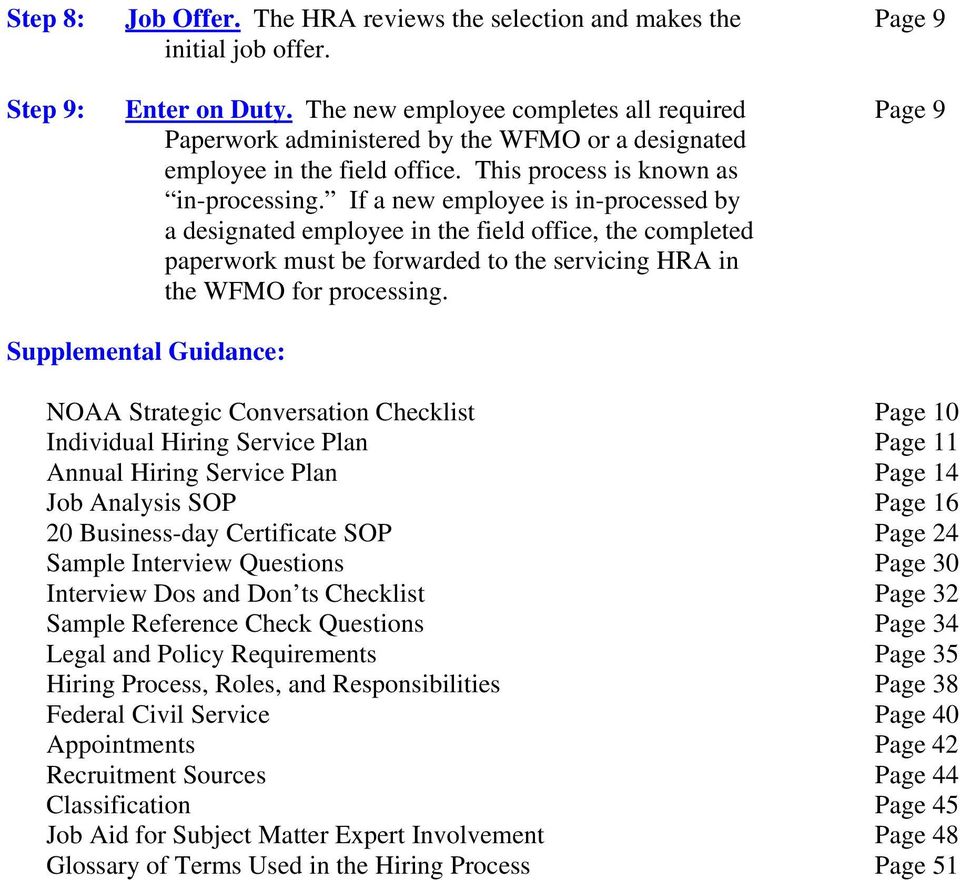
2 Step 8: Job Offer. The HRA reviews the selection and makes the Page 9 initial job offer. Step 9: Enter on Duty. The new employee completes all required Page 9 Paperwork administered by the WFMO or a designated employee in the field office. This process is known as in-processing. If a new employee is in-processed by a designated employee in the field office, the completed paperwork must be forwarded to the servicing HRA in the WFMO for processing. Supplemental Guidance: NOAA Strategic Conversation Checklist Page 10 Individual Hiring Service Plan Page 11 Annual Hiring Service Plan Page 14 Job Analysis SOP Page Business-day Certificate SOP Page 24 Sample Interview Questions Page 30 Interview Dos and Don ts Checklist Page 32 Sample Reference Check Questions Page 34 Legal and Policy Requirements Page 35 Hiring Process, Roles, and Responsibilities Page 38 Federal Civil Service Page 40 Appointments Page 42 Recruitment Sources Page 44 Classification Page 45 Job Aid for Subject Matter Expert Involvement Page 48 Glossary of Terms Used in the Hiring Process Page 51
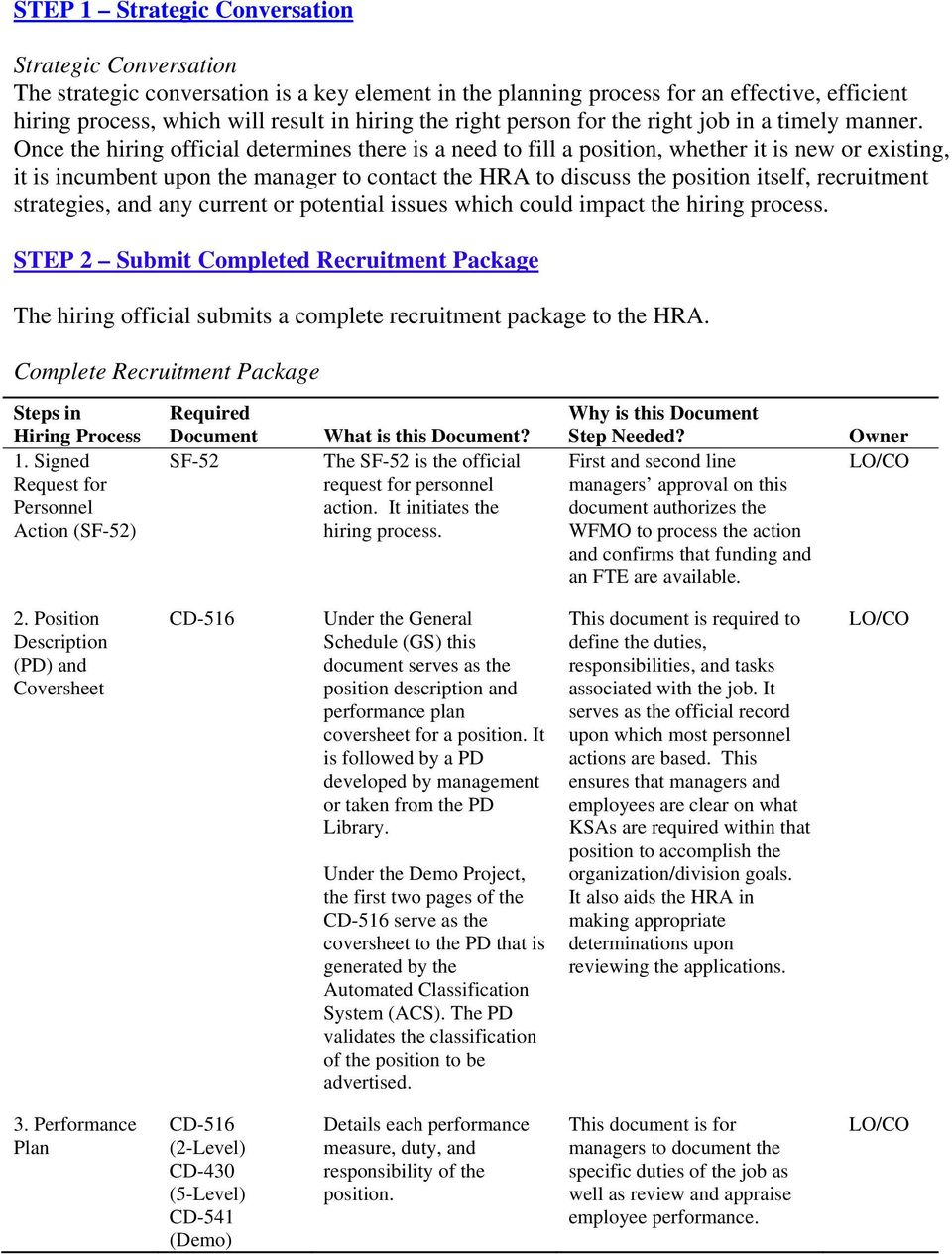
3 STEP 1 Strategic Conversation Strategic Conversation The strategic conversation is a key element in the planning process for an effective, efficient hiring process, which will result in hiring the right person for the right job in a timely manner. Once the hiring official determines there is a need to fill a position, whether it is new or existing, it is incumbent upon the manager to contact the HRA to discuss the position itself, recruitment strategies, and any current or potential issues which could impact the hiring process. STEP 2 Submit Completed Recruitment Package The hiring official submits a complete recruitment package to the HRA. Complete Recruitment Package Steps in Hiring Process 1. Signed Request for Personnel Action (SF-52) Required Document SF-52 What is this Document? The SF-52 is the official request for personnel action. It initiates the hiring process. Why is this Document Step Needed? First and second line managers approval on this document authorizes the WFMO to process the action and confirms that funding and an FTE are available. Owner LO/CO 2. Position Description (PD) and Coversheet CD-516 Under the General Schedule (GS) this document serves as the position description and performance plan coversheet for a position. It is followed by a PD developed by management or taken from the PD Library. Under the Demo Project, the first two pages of the CD-516 serve as the coversheet to the PD that is generated by the Automated Classification System (ACS). The PD validates the classification of the position to be advertised. This document is required to define the duties, responsibilities, and tasks associated with the job. It serves as the official record upon which most personnel actions are based. This ensures that managers and employees are clear on what KSAs are required within that position to accomplish the organization/division goals. It also aids the HRA in making appropriate determinations upon reviewing the applications. LO/CO 3. Performance Plan CD-516 (2-Level) CD-430 (5-Level) CD-541 (Demo) Details each performance measure, duty, and responsibility of the position. This document is for managers to document the specific duties of the job as well as review and appraise employee performance. LO/CO
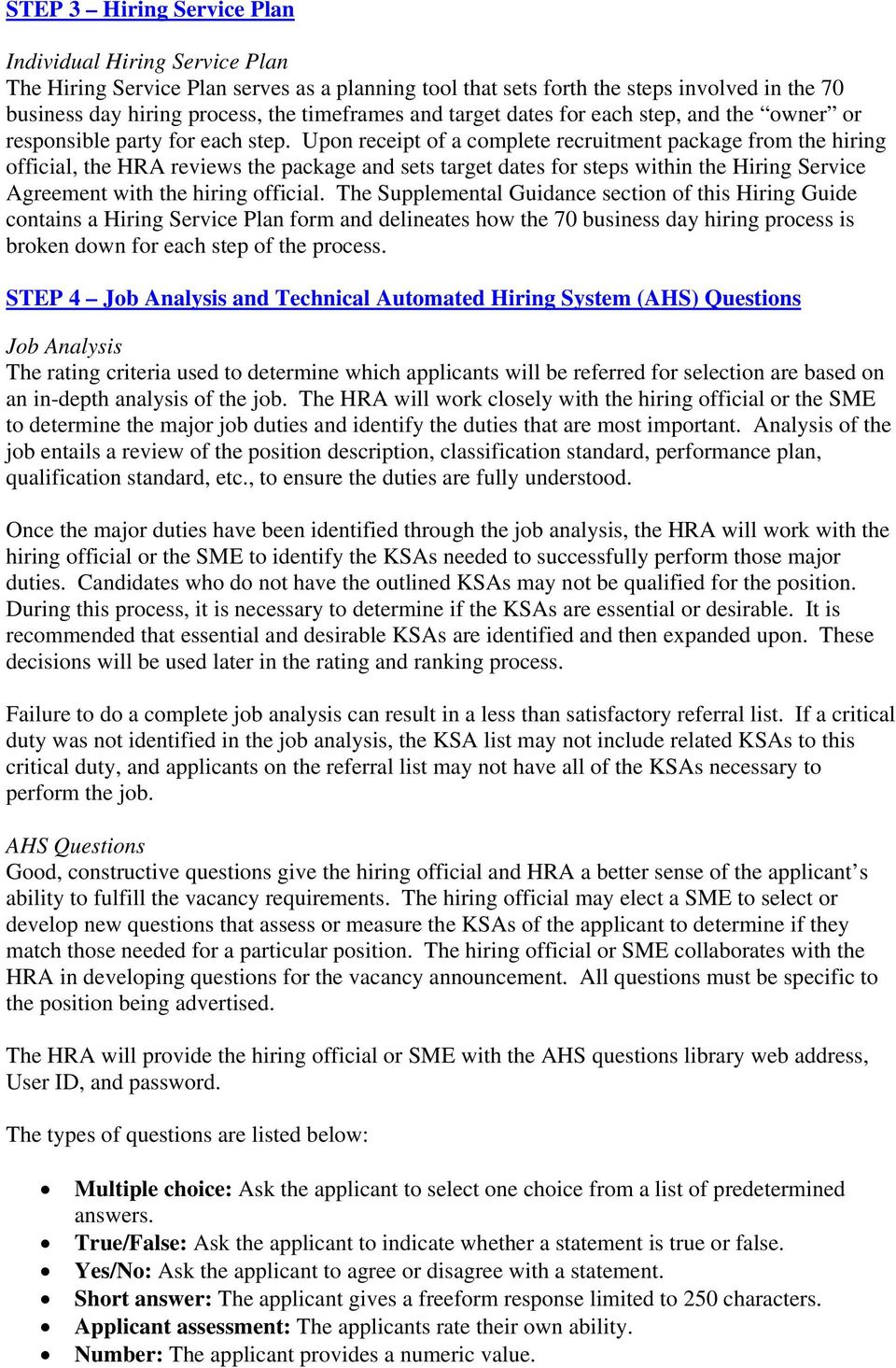
4 STEP 3 Hiring Service Plan Individual Hiring Service Plan The Hiring Service Plan serves as a planning tool that sets forth the steps involved in the 70 business day hiring process, the timeframes and target dates for each step, and the owner or responsible party for each step. Upon receipt of a complete recruitment package from the hiring official, the HRA reviews the package and sets target dates for steps within the Hiring Service Agreement with the hiring official. The Supplemental Guidance section of this Hiring Guide contains a Hiring Service Plan form and delineates how the 70 business day hiring process is broken down for each step of the process. STEP 4 Job Analysis and Technical Automated Hiring System (AHS) Questions Job Analysis The rating criteria used to determine which applicants will be referred for selection are based on an in-depth analysis of the job. The HRA will work closely with the hiring official or the SME to determine the major job duties and identify the duties that are most important. Analysis of the job entails a review of the position description, classification standard, performance plan, qualification standard, etc., to ensure the duties are fully understood. Once the major duties have been identified through the job analysis, the HRA will work with the hiring official or the SME to identify the KSAs needed to successfully perform those major duties. Candidates who do not have the outlined KSAs may not be qualified for the position. During this process, it is necessary to determine if the KSAs are essential or desirable. It is recommended that essential and desirable KSAs are identified and then expanded upon. These decisions will be used later in the rating and ranking process. Failure to do a complete job analysis can result in a less than satisfactory referral list. If a critical duty was not identified in the job analysis, the KSA list may not include related KSAs to this critical duty, and applicants on the referral list may not have all of the KSAs necessary to perform the job. AHS Questions Good, constructive questions give the hiring official and HRA a better sense of the applicant s ability to fulfill the vacancy requirements. The hiring official may elect a SME to select or develop new questions that assess or measure the KSAs of the applicant to determine if they match those needed for a particular position. The hiring official or SME collaborates with the HRA in developing questions for the vacancy announcement. All questions must be specific to the position being advertised. The HRA will provide the hiring official or SME with the AHS questions library web address, User ID, and password. The types of questions are listed below: Multiple choice: Ask the applicant to select one choice from a list of predetermined answers. True/False: Ask the applicant to indicate whether a statement is true or false. Yes/No: Ask the applicant to agree or disagree with a statement. Short answer: The applicant gives a freeform response limited to 250 characters. Applicant assessment: The applicants rate their own ability. Number: The applicant provides a numeric value.
5 Multiple answer/multiple choice: The applicant selects as many of the predetermined choices as apply. Long answer: The applicant gives a freeform response limited to 8,000 characters. STEP 5 Vacancy Announcement Department of Commerce (DOC) Human Resources (HR) Bulletin 20 requires all vacancies be advertised under Merit Assignment Plan (MAP) and Delegated Examining (DE) authority procedures. This requirement is necessary to yield the largest pool of qualified candidates and to ensure that all applicants receive fair treatment in the selection process. As mentioned later in the Legal and Policy Requirements section, MAP procedures set forth policies, procedures, and requirements which assure internal qualified candidates (often referred as status applicants) are considered for assignment to positions in the competitive service. However, the DE authority is an authority OPM grants to agencies to fill competitive civil service jobs with applicants from outside the Federal workforce, Federal employees who do not have competitive service status, and Federal employees with competitive service status. Appointments made by agencies through the DE authority are subject to civil service laws and regulations. This is to ensure fair and open competition, recruitment from all sectors of society, and selection on the basis of the applicants competencies or KSAs (see 5 U.S.C. 2301). The minimum open period for vacancy announcements, based on the DOC HR Bulletin 20, is 10 business days. The servicing WFMO will post vacancy announcements on the USAJOBS website ( STEP 6 Qualification Determination and Referral List Qualification Determination All applicants are assigned a preliminary rating score based on their responses to the experience, training, and awards questions included in the vacancy announcement. The HRA uses the OPM Operating Manual: Qualification Standards for General Schedule Positions and the Handbook X-118C Job Qualification System for Trades and Labor Occupations Systems as guides to determine the basic qualifications of each applicant. Qualification standards outline the necessary basic eligibility requirements for occupations and for each grade in the occupation. They specify the minimum quality level and amount of experience required and often allow education as a substitute for experience. Qualification requirements for basic eligibility may include, but are not limited to any or a combination of the following: General and/or specialized work experience High school education Vocational/technical training College or university education Specific major fields or courses of study Specific registrations, licensure, or certifications Other selective placement factors The standards are used by HRAs to evaluate internal and external candidates' qualifications for positions. The minimum qualification standards are used to determine those persons who are eligible for consideration because they meet the basic requirements for the occupation.

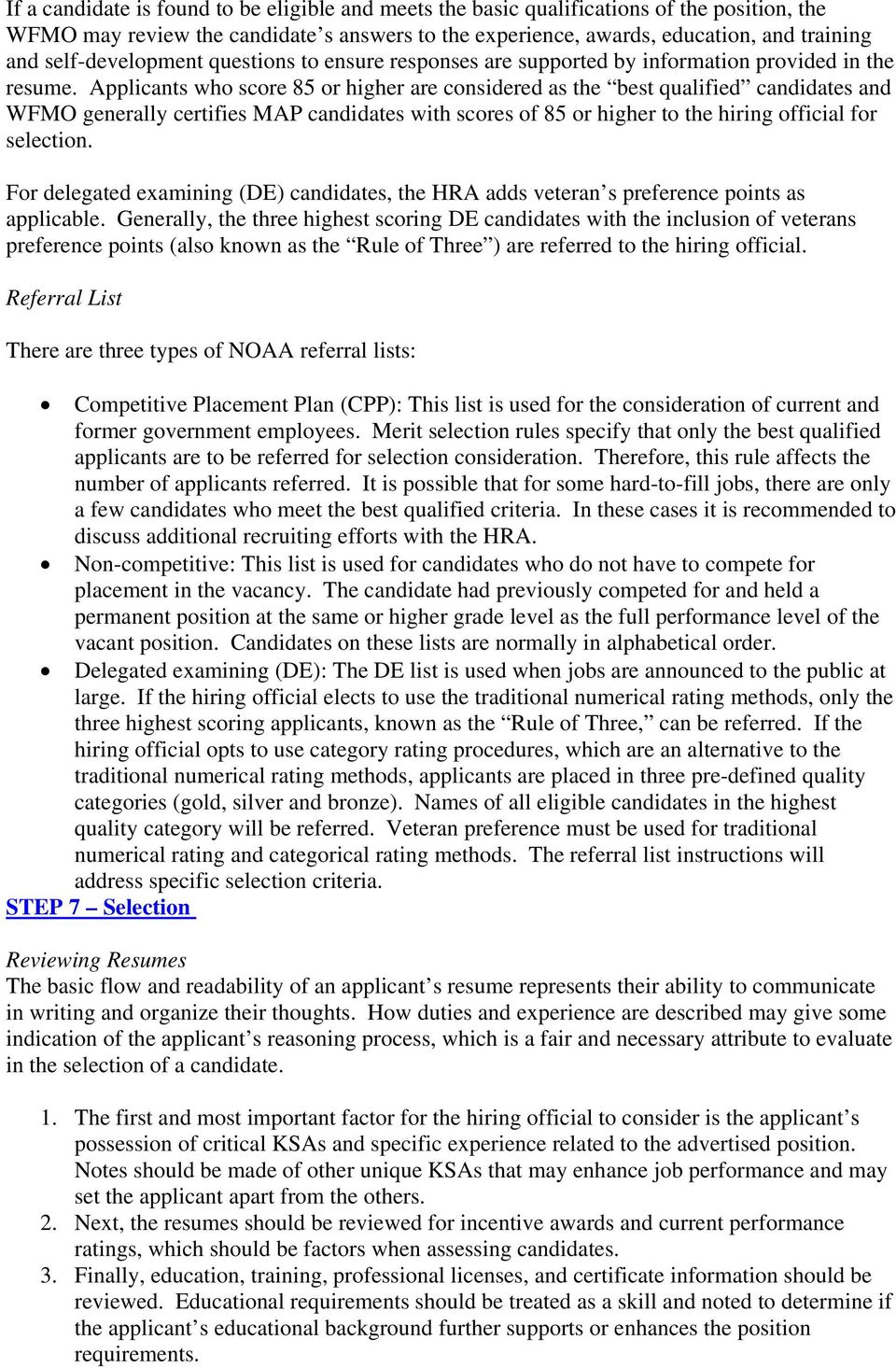
6 If a candidate is found to be eligible and meets the basic qualifications of the position, the WFMO may review the candidate s answers to the experience, awards, education, and training and self-development questions to ensure responses are supported by information provided in the resume. Applicants who score 85 or higher are considered as the best qualified candidates and WFMO generally certifies MAP candidates with scores of 85 or higher to the hiring official for selection. For delegated examining (DE) candidates, the HRA adds veteran s preference points as applicable. Generally, the three highest scoring DE candidates with the inclusion of veterans preference points (also known as the Rule of Three ) are referred to the hiring official. Referral List There are three types of NOAA referral lists: Competitive Placement Plan (CPP): This list is used for the consideration of current and former government employees. Merit selection rules specify that only the best qualified applicants are to be referred for selection consideration. Therefore, this rule affects the number of applicants referred. It is possible that for some hard-to-fill jobs, there are only a few candidates who meet the best qualified criteria. In these cases it is recommended to discuss additional recruiting efforts with the HRA. Non-competitive: This list is used for candidates who do not have to compete for placement in the vacancy. The candidate had previously competed for and held a permanent position at the same or higher grade level as the full performance level of the vacant position. Candidates on these lists are normally in alphabetical order. Delegated examining (DE): The DE list is used when jobs are announced to the public at large. If the hiring official elects to use the traditional numerical rating methods, only the three highest scoring applicants, known as the Rule of Three, can be referred. If the hiring official opts to use category rating procedures, which are an alternative to the traditional numerical rating methods, applicants are placed in three pre-defined quality categories (gold, silver and bronze). Names of all eligible candidates in the highest quality category will be referred. Veteran preference must be used for traditional numerical rating and categorical rating methods. The referral list instructions will address specific selection criteria. STEP 7 Selection Reviewing Resumes The basic flow and readability of an applicant s resume represents their ability to communicate in writing and organize their thoughts. How duties and experience are described may give some indication of the applicant s reasoning process, which is a fair and necessary attribute to evaluate in the selection of a candidate. 1. The first and most important factor for the hiring official to consider is the applicant s possession of critical KSAs and specific experience related to the advertised position. Notes should be made of other unique KSAs that may enhance job performance and may set the applicant apart from the others. 2. Next, the resumes should be reviewed for incentive awards and current performance ratings, which should be factors when assessing candidates. 3. Finally, education, training, professional licenses, and certificate information should be reviewed. Educational requirements should be treated as a skill and noted to determine if the applicant s educational background further supports or enhances the position requirements.
7 Interviewing Applicants Who Conducts the Interview? The hiring official usually conducts the interview. However, the hiring official may designate another person or a panel with knowledge of the position to be filled to conduct the interview. It is strongly recommended to incorporate diverse panel members when using interview panels. Importance of the Interview Interviews are strongly encouraged because this is an opportunity to gather additional information from the applicant. The resume is only a brief description of the individual s background. An interview may provide more information that can be used during the selection process. It can be especially useful in evaluating such skills as oral communication and interpersonal skills that are not otherwise easily measured in writing. The interview also provides an opportunity for a face-to-face information exchange. Interviewing Techniques Interview questions should always elicit job-related information relative to the KSAs of the position for which the candidate is applying. Questions should be prepared in advance to ensure that all candidates are treated in the same manner. Generally, the same questions should be asked of each candidate. However, follow-up questions may be used to obtain additional or clarifying information in order to access an individual s specific qualifications for the position. All applicants should be allotted the same amount of time for the interview, with time allowed for the applicant to ask questions of the interviewer(s). In all cases, it is a good idea to record notes to eliminate the need to recall key points from memory. It is also helpful to note the date, time, place, and length of the interview. A copy of the interview questions and the name of individual(s) who conducted the interview should be on file. This information is very critical in the event that an Equal Employment Opportunity complaint is filed and such information is requested. It is permissible to ask all candidates to bring writing samples, such as reports, publications, or technical articles to the interview. See Supplemental Guidance for additional interview guidance. Checking References After reviewing the resume and conducting an interview, the interviewer should have a clear indication of the top applicants for further selection consideration. The next step is to check references, which preferably should be verified using prior supervisors over personal references since these individuals have knowledge of the candidate s work performance. The current supervisors should only be contacted if the candidate has given permission, which should be indicated on the resume. It is also advisable to obtain more than one reference for each candidate. Performance and other pertinent aspects of the candidate s employment should be verified. The questions should focus on the candidate s overall qualifications for the position and how the reference assessed the candidate s fitness for the job. Be sure to ask follow-up questions or ask for additional information about something that is not clear. It is advisable to verify the candidate s current employment including position(s) held and dates employed. The hiring official may also ask the reference about the following:
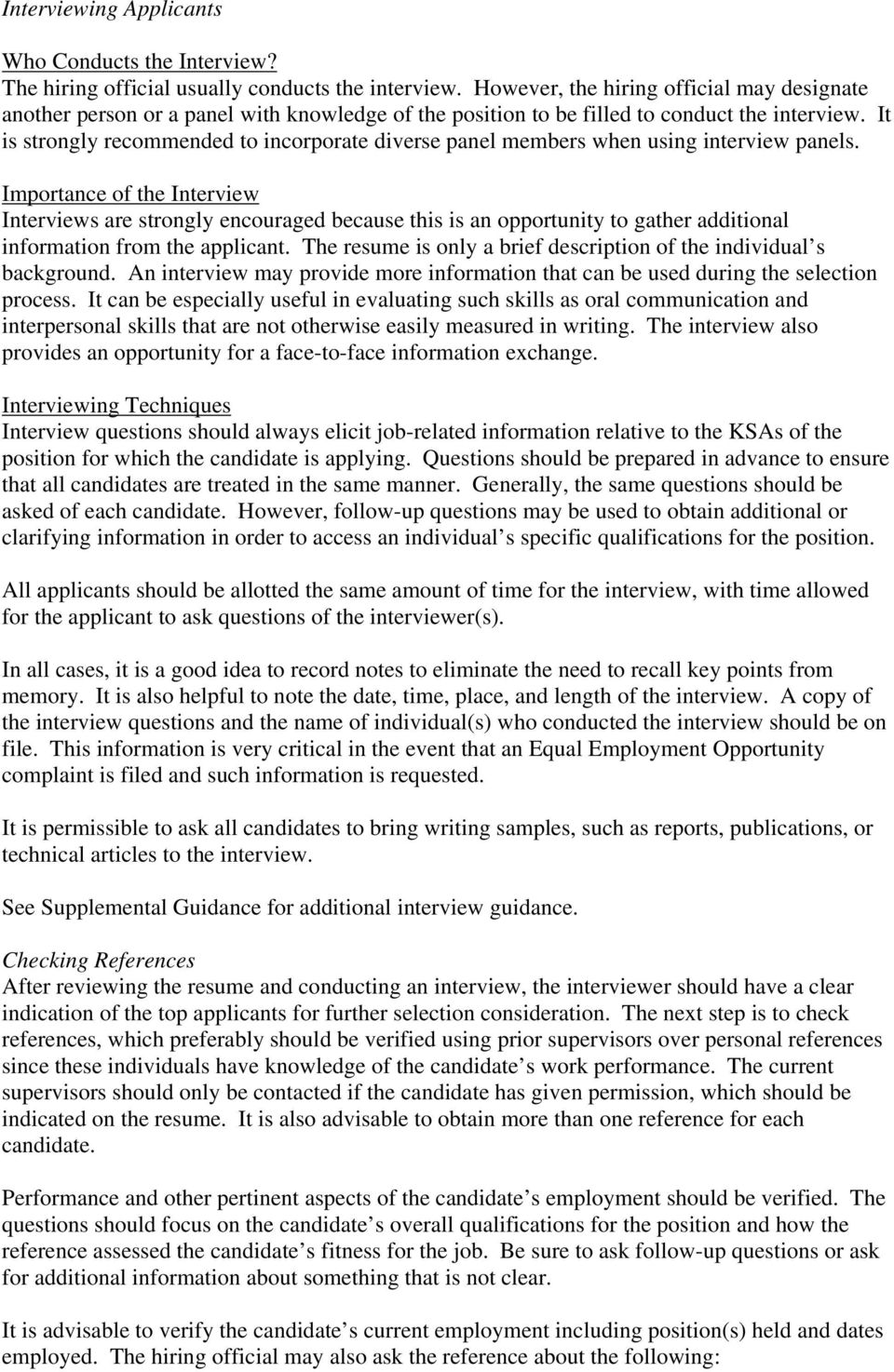
8 Applicant s work relationships Work attitude Quality of work product Applicant s strengths and weaknesses If the applicant should be recommend for the position If the applicant would be rehired It is a good idea to keep documentation of these questions and notes for future reference. Making a Selection There can be two approaches to making a selection. Some positions require that the selectee be fully qualified in all functional skills and take over a function with little assistance or training. Some positions may require experience in problem solving, management, or other less functional skills, with follow-up training in functional skills once on board. It is a good idea to ponder this concept and determine what is preferred before a selection is made. The HRA should be notified orally or in writing immediately after a selection is made.

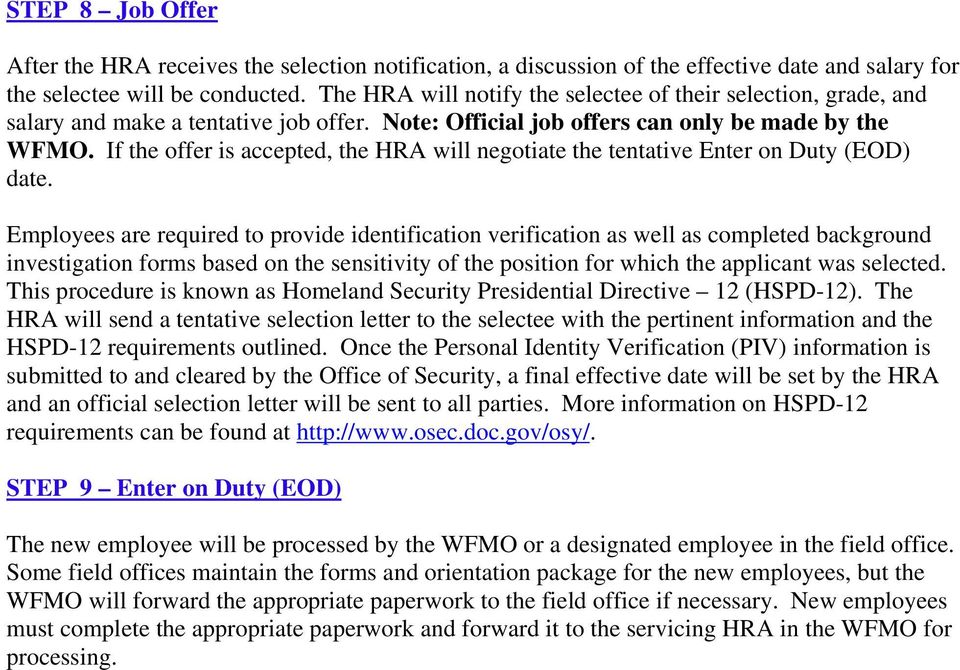
9 STEP 8 Job Offer After the HRA receives the selection notification, a discussion of the effective date and salary for the selectee will be conducted. The HRA will notify the selectee of their selection, grade, and salary and make a tentative job offer. Note: Official job offers can only be made by the WFMO. If the offer is accepted, the HRA will negotiate the tentative Enter on Duty (EOD) date. Employees are required to provide identification verification as well as completed background investigation forms based on the sensitivity of the position for which the applicant was selected. This procedure is known as Homeland Security Presidential Directive 12 (HSPD-12). The HRA will send a tentative selection letter to the selectee with the pertinent information and the HSPD-12 requirements outlined. Once the Personal Identity Verification (PIV) information is submitted to and cleared by the Office of Security, a final effective date will be set by the HRA and an official selection letter will be sent to all parties. More information on HSPD-12 requirements can be found at STEP 9 Enter on Duty (EOD) The new employee will be processed by the WFMO or a designated employee in the field office. Some field offices maintain the forms and orientation package for the new employees, but the WFMO will forward the appropriate paperwork to the field office if necessary. New employees must complete the appropriate paperwork and forward it to the servicing HRA in the WFMO for processing.
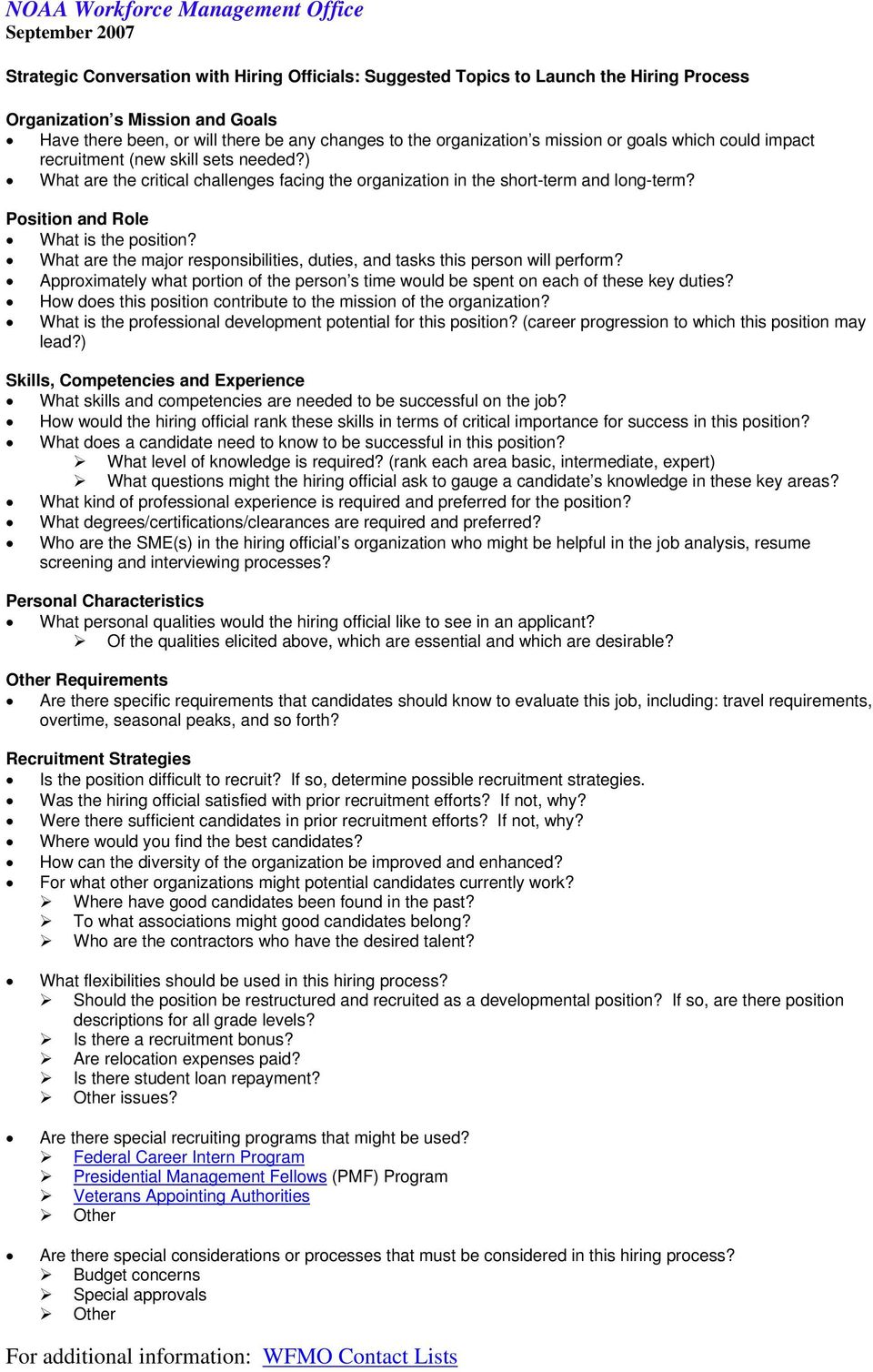
10 NOAA Workforce Management Office September 2007 Strategic Conversation with Hiring Officials: Suggested Topics to Launch the Hiring Process Organization s Mission and Goals Have there been, or will there be any changes to the organization s mission or goals which could impact recruitment (new skill sets needed?) What are the critical challenges facing the organization in the short-term and long-term? Position and Role What is the position? What are the major responsibilities, duties, and tasks this person will perform? Approximately what portion of the person s time would be spent on each of these key duties? How does this position contribute to the mission of the organization? What is the professional development potential for this position? (career progression to which this position may lead?) Skills, Competencies and Experience What skills and competencies are needed to be successful on the job? How would the hiring official rank these skills in terms of critical importance for success in this position? What does a candidate need to know to be successful in this position? What level of knowledge is required? (rank each area basic, intermediate, expert) What questions might the hiring official ask to gauge a candidate s knowledge in these key areas? What kind of professional experience is required and preferred for the position? What degrees/certifications/clearances are required and preferred? Who are the SME(s) in the hiring official s organization who might be helpful in the job analysis, resume screening and interviewing processes? Personal Characteristics What personal qualities would the hiring official like to see in an applicant? Of the qualities elicited above, which are essential and which are desirable? Other Requirements Are there specific requirements that candidates should know to evaluate this job, including: travel requirements, overtime, seasonal peaks, and so forth? Recruitment Strategies Is the position difficult to recruit? If so, determine possible recruitment strategies. Was the hiring official satisfied with prior recruitment efforts? If not, why? Were there sufficient candidates in prior recruitment efforts? If not, why? Where would you find the best candidates? How can the diversity of the organization be improved and enhanced? For what other organizations might potential candidates currently work? Where have good candidates been found in the past? To what associations might good candidates belong? Who are the contractors who have the desired talent? What flexibilities should be used in this hiring process? Should the position be restructured and recruited as a developmental position? If so, are there position descriptions for all grade levels? Is there a recruitment bonus? Are relocation expenses paid? Is there student loan repayment? Other issues? Are there special recruiting programs that might be used? Federal Career Intern Program Presidential Management Fellows (PMF) Program Veterans Appointing Authorities Other Are there special considerations or processes that must be considered in this hiring process? Budget concerns Special approvals Other For additional information: WFMO Contact Lists
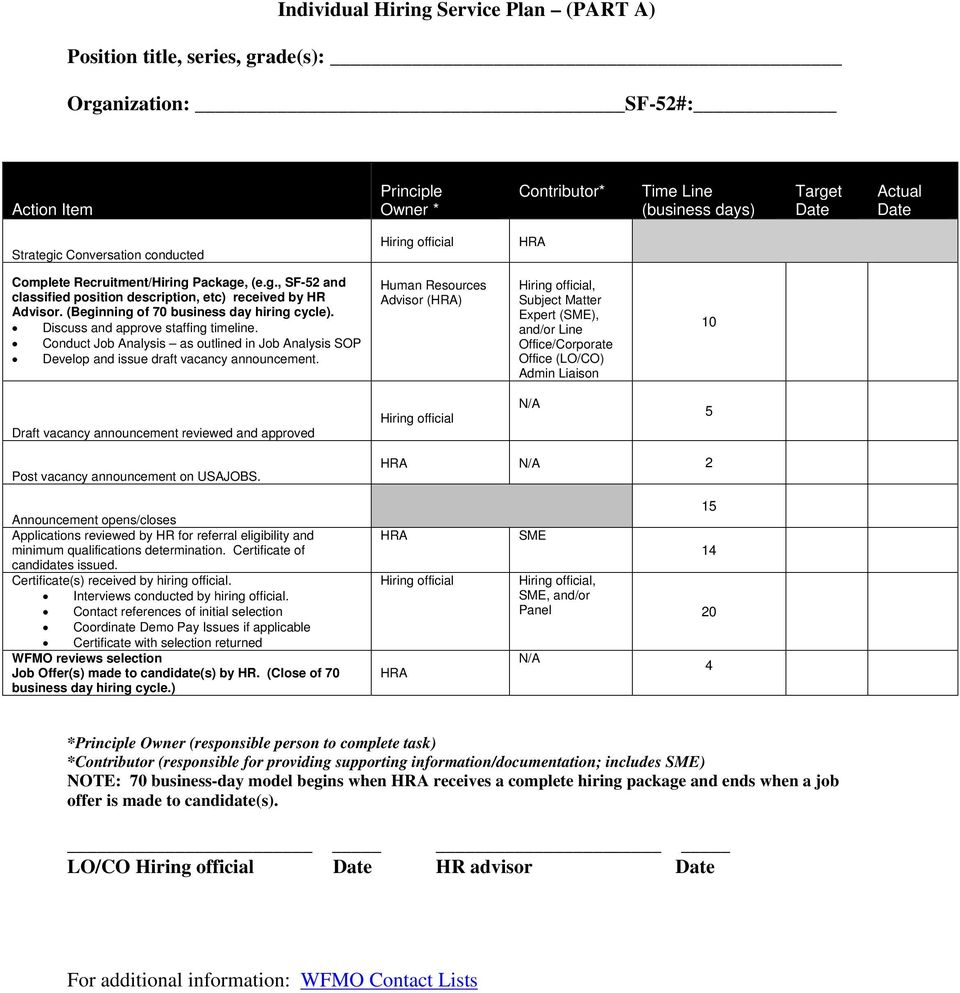
11 Individual Hiring Service Plan (PART A) Position title, series, grade(s): Organization: SF-52#: Action Item Principle Owner * Contributor* Time Line (business days) Target Date Actual Date Strategic Conversation conducted Hiring official HRA Complete Recruitment/Hiring Package, (e.g., SF-52 and classified position description, etc) received by HR Advisor. (Beginning of 70 business day hiring cycle). Discuss and approve staffing timeline. Conduct Job Analysis as outlined in Job Analysis SOP Develop and issue draft vacancy announcement. Human Resources Advisor (HRA) Hiring official, Subject Matter Expert (SME), and/or Line Office/Corporate Office (LO/CO) Admin Liaison 10 Draft vacancy announcement reviewed and approved Hiring official N/A 5 Post vacancy announcement on USAJOBS. HRA N/A 2 Announcement opens/closes Applications reviewed by HR for referral eligibility and minimum qualifications determination. Certificate of candidates issued. Certificate(s) received by hiring official. Interviews conducted by hiring official. Contact references of initial selection Coordinate Demo Pay Issues if applicable Certificate with selection returned WFMO reviews selection Job Offer(s) made to candidate(s) by HR. (Close of 70 business day hiring cycle.) HRA Hiring official HRA SME Hiring official, SME, and/or Panel 20 N/A 4 *Principle Owner (responsible person to complete task) *Contributor (responsible for providing supporting information/documentation; includes SME) NOTE: 70 business-day model begins when HRA receives a complete hiring package and ends when a job offer is made to candidate(s). LO/CO Hiring official Date HR advisor Date For additional information: WFMO Contact Lists
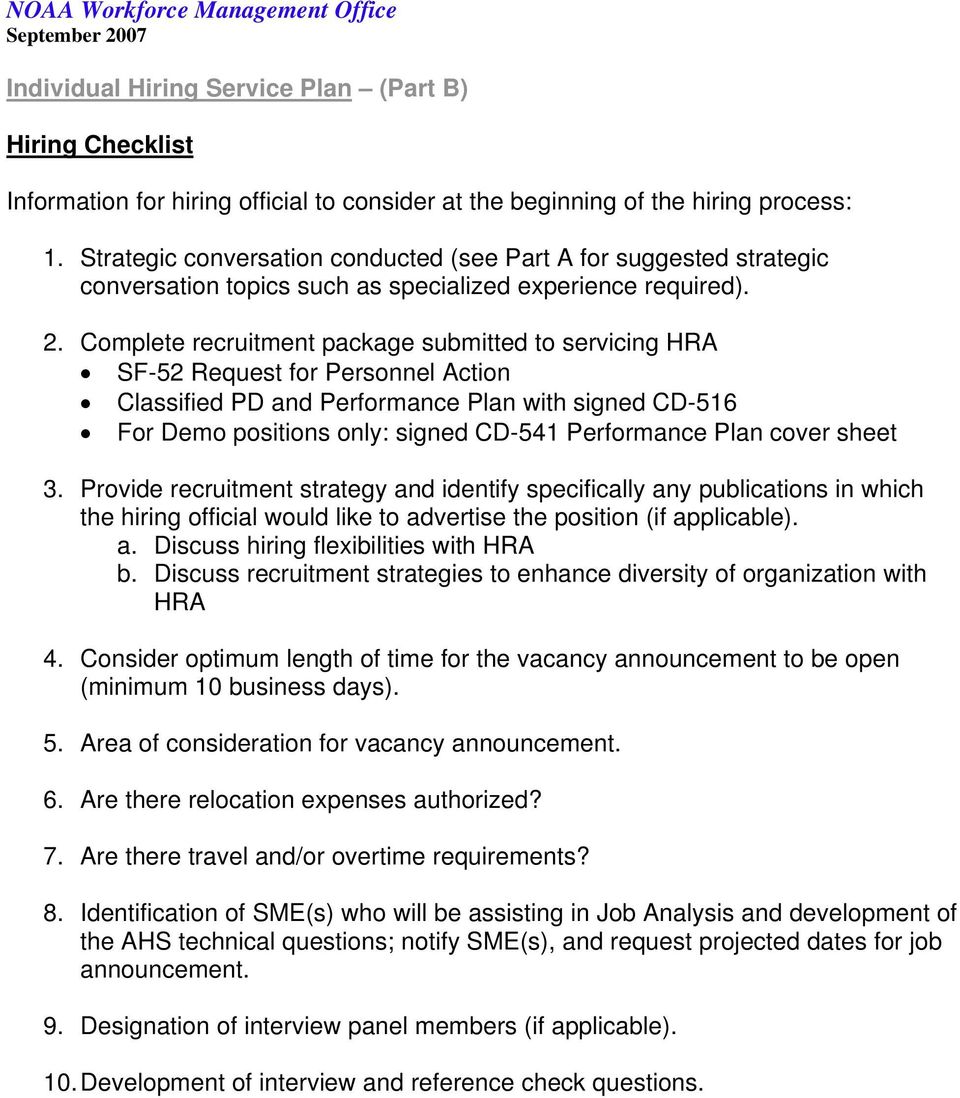
12 NOAA Workforce Management Office September 2007 Individual Hiring Service Plan (Part B) Hiring Checklist Information for hiring official to consider at the beginning of the hiring process: 1. Strategic conversation conducted (see Part A for suggested strategic conversation topics such as specialized experience required). 2. Complete recruitment package submitted to servicing HRA SF-52 Request for Personnel Action Classified PD and Performance Plan with signed CD-516 For Demo positions only: signed CD-541 Performance Plan cover sheet 3. Provide recruitment strategy and identify specifically any publications in which the hiring official would like to advertise the position (if applicable). a. Discuss hiring flexibilities with HRA b. Discuss recruitment strategies to enhance diversity of organization with HRA 4. Consider optimum length of time for the vacancy announcement to be open (minimum 10 business days). 5. Area of consideration for vacancy announcement. 6. Are there relocation expenses authorized? 7. Are there travel and/or overtime requirements? 8. Identification of SME(s) who will be assisting in Job Analysis and development of the AHS technical questions; notify SME(s), and request projected dates for job announcement. 9. Designation of interview panel members (if applicable). 10. Development of interview and reference check questions.
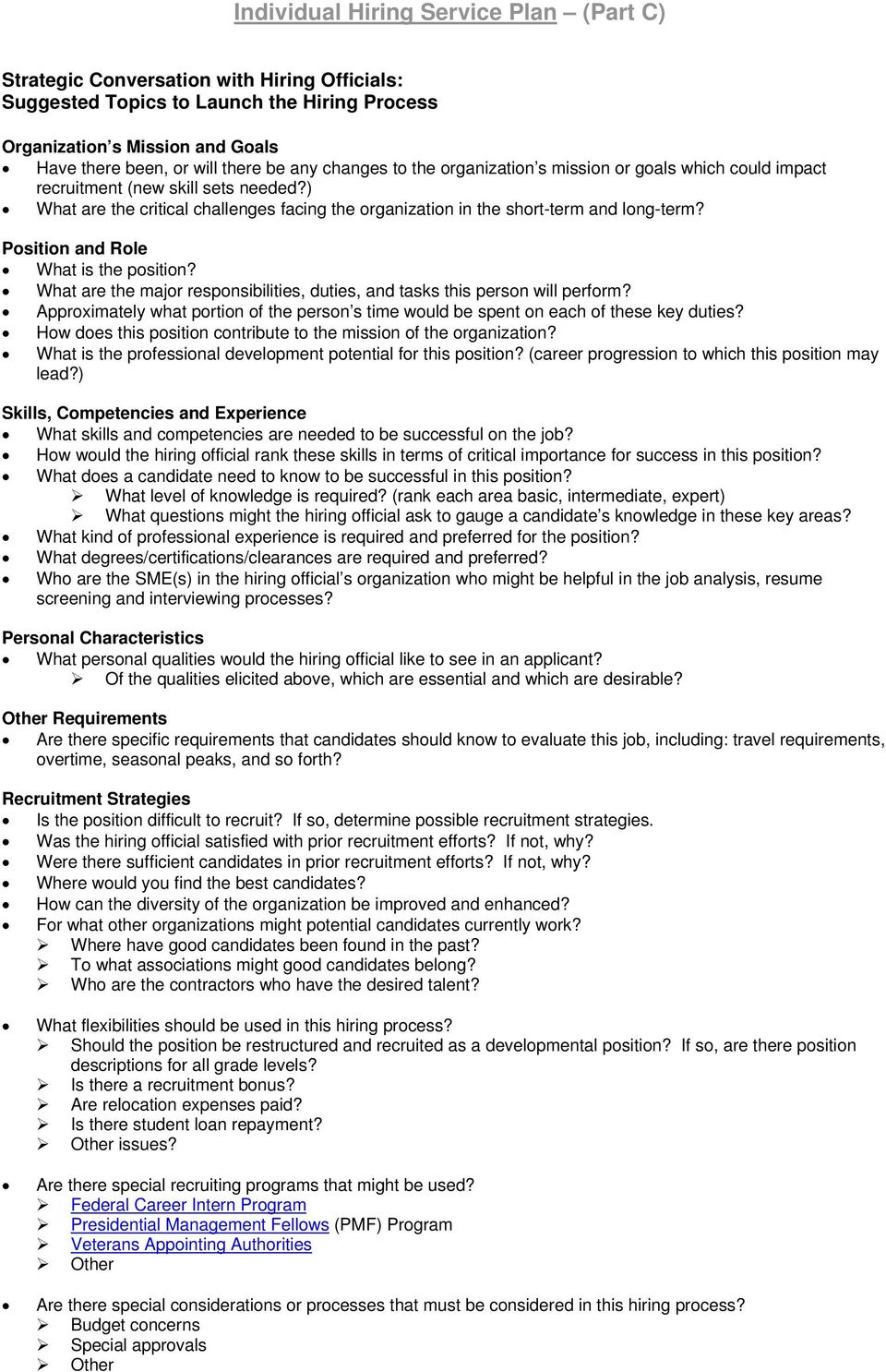
13 Individual Hiring Service Plan (Part C) Strategic Conversation with Hiring Officials: Suggested Topics to Launch the Hiring Process Organization s Mission and Goals Have there been, or will there be any changes to the organization s mission or goals which could impact recruitment (new skill sets needed?) What are the critical challenges facing the organization in the short-term and long-term? Position and Role What is the position? What are the major responsibilities, duties, and tasks this person will perform? Approximately what portion of the person s time would be spent on each of these key duties? How does this position contribute to the mission of the organization? What is the professional development potential for this position? (career progression to which this position may lead?) Skills, Competencies and Experience What skills and competencies are needed to be successful on the job? How would the hiring official rank these skills in terms of critical importance for success in this position? What does a candidate need to know to be successful in this position? What level of knowledge is required? (rank each area basic, intermediate, expert) What questions might the hiring official ask to gauge a candidate s knowledge in these key areas? What kind of professional experience is required and preferred for the position? What degrees/certifications/clearances are required and preferred? Who are the SME(s) in the hiring official s organization who might be helpful in the job analysis, resume screening and interviewing processes? Personal Characteristics What personal qualities would the hiring official like to see in an applicant? Of the qualities elicited above, which are essential and which are desirable? Other Requirements Are there specific requirements that candidates should know to evaluate this job, including: travel requirements, overtime, seasonal peaks, and so forth? Recruitment Strategies Is the position difficult to recruit? If so, determine possible recruitment strategies. Was the hiring official satisfied with prior recruitment efforts? If not, why? Were there sufficient candidates in prior recruitment efforts? If not, why? Where would you find the best candidates? How can the diversity of the organization be improved and enhanced? For what other organizations might potential candidates currently work? Where have good candidates been found in the past? To what associations might good candidates belong? Who are the contractors who have the desired talent? What flexibilities should be used in this hiring process? Should the position be restructured and recruited as a developmental position? If so, are there position descriptions for all grade levels? Is there a recruitment bonus? Are relocation expenses paid? Is there student loan repayment? Other issues? Are there special recruiting programs that might be used? Federal Career Intern Program Presidential Management Fellows (PMF) Program Veterans Appointing Authorities Other Are there special considerations or processes that must be considered in this hiring process? Budget concerns Special approvals Other
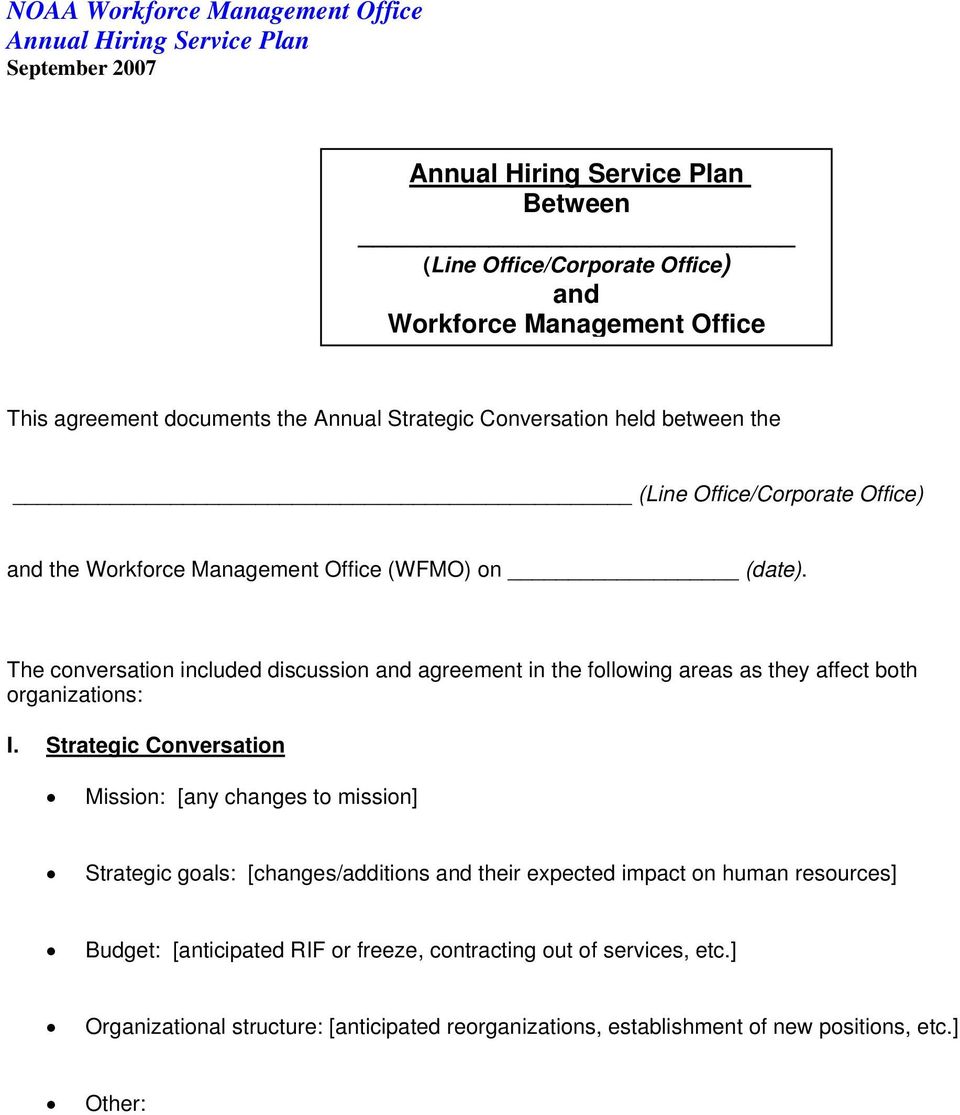
14 NOAA Workforce Management Office Annual Hiring Service Plan September 2007 Annual Hiring Service Plan Between (Line Office/Corporate Office) and Workforce Management Office This agreement documents the Annual Strategic Conversation held between the (Line Office/Corporate Office) and the Workforce Management Office (WFMO) on (date). The conversation included discussion and agreement in the following areas as they affect both organizations: I. Strategic Conversation Mission: [any changes to mission] Strategic goals: [changes/additions and their expected impact on human resources] Budget: [anticipated RIF or freeze, contracting out of services, etc.] Organizational structure: [anticipated reorganizations, establishment of new positions, etc.] Other:
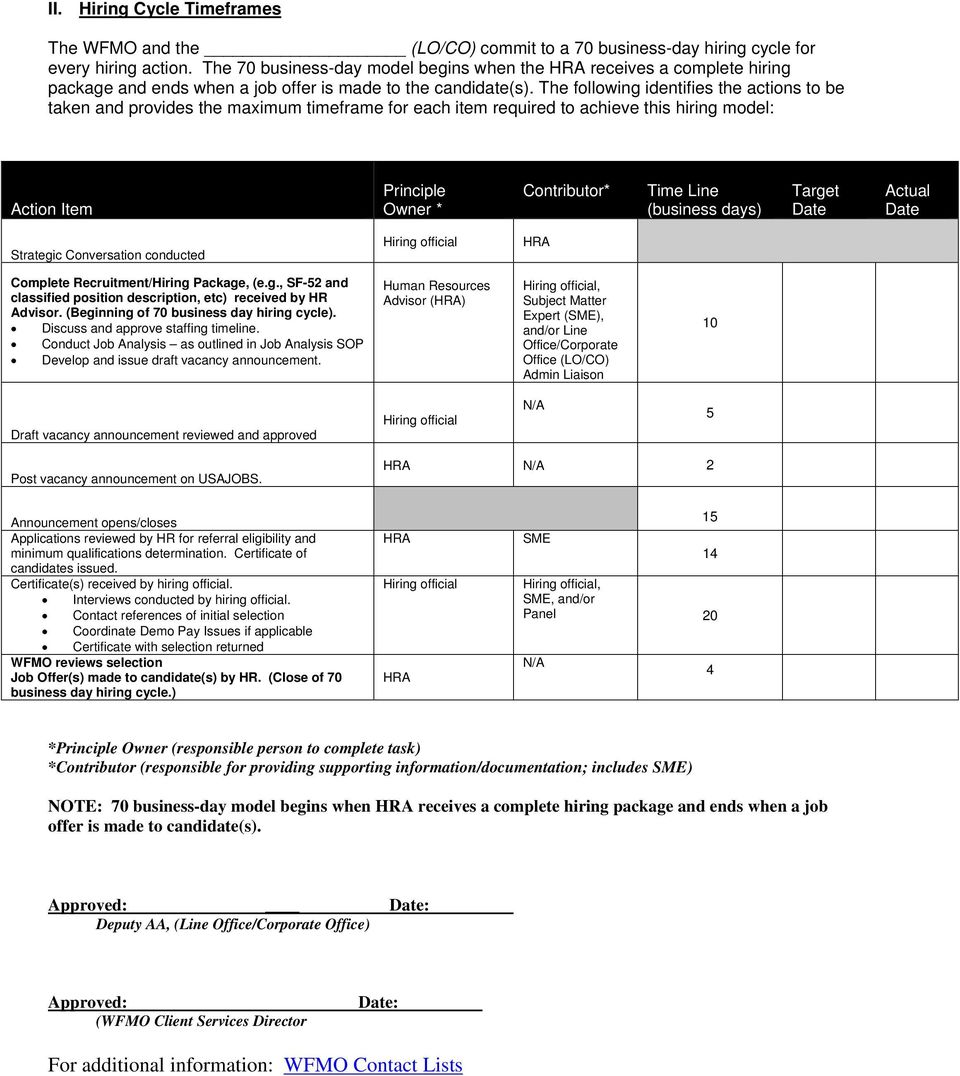
15 II. Hiring Cycle Timeframes The WFMO and the (LO/CO) commit to a 70 business-day hiring cycle for every hiring action. The 70 business-day model begins when the HRA receives a complete hiring package and ends when a job offer is made to the candidate(s). The following identifies the actions to be taken and provides the maximum timeframe for each item required to achieve this hiring model: Action Item Principle Owner * Contributor* Time Line (business days) Target Date Actual Date Strategic Conversation conducted Hiring official HRA Complete Recruitment/Hiring Package, (e.g., SF-52 and classified position description, etc) received by HR Advisor. (Beginning of 70 business day hiring cycle). Discuss and approve staffing timeline. Conduct Job Analysis as outlined in Job Analysis SOP Develop and issue draft vacancy announcement. Human Resources Advisor (HRA) Hiring official, Subject Matter Expert (SME), and/or Line Office/Corporate Office (LO/CO) Admin Liaison 10 Draft vacancy announcement reviewed and approved Hiring official N/A 5 Post vacancy announcement on USAJOBS. HRA N/A 2 Announcement opens/closes Applications reviewed by HR for referral eligibility and minimum qualifications determination. Certificate of candidates issued. Certificate(s) received by hiring official. Interviews conducted by hiring official. Contact references of initial selection Coordinate Demo Pay Issues if applicable Certificate with selection returned WFMO reviews selection Job Offer(s) made to candidate(s) by HR. (Close of 70 business day hiring cycle.) HRA Hiring official HRA SME Hiring official, SME, and/or Panel 20 N/A 4 *Principle Owner (responsible person to complete task) *Contributor (responsible for providing supporting information/documentation; includes SME) NOTE: 70 business-day model begins when HRA receives a complete hiring package and ends when a job offer is made to candidate(s). Approved: Date: Deputy AA, (Line Office/Corporate Office) Approved: (WFMO Client Services Director Date: For additional information: WFMO Contact Lists
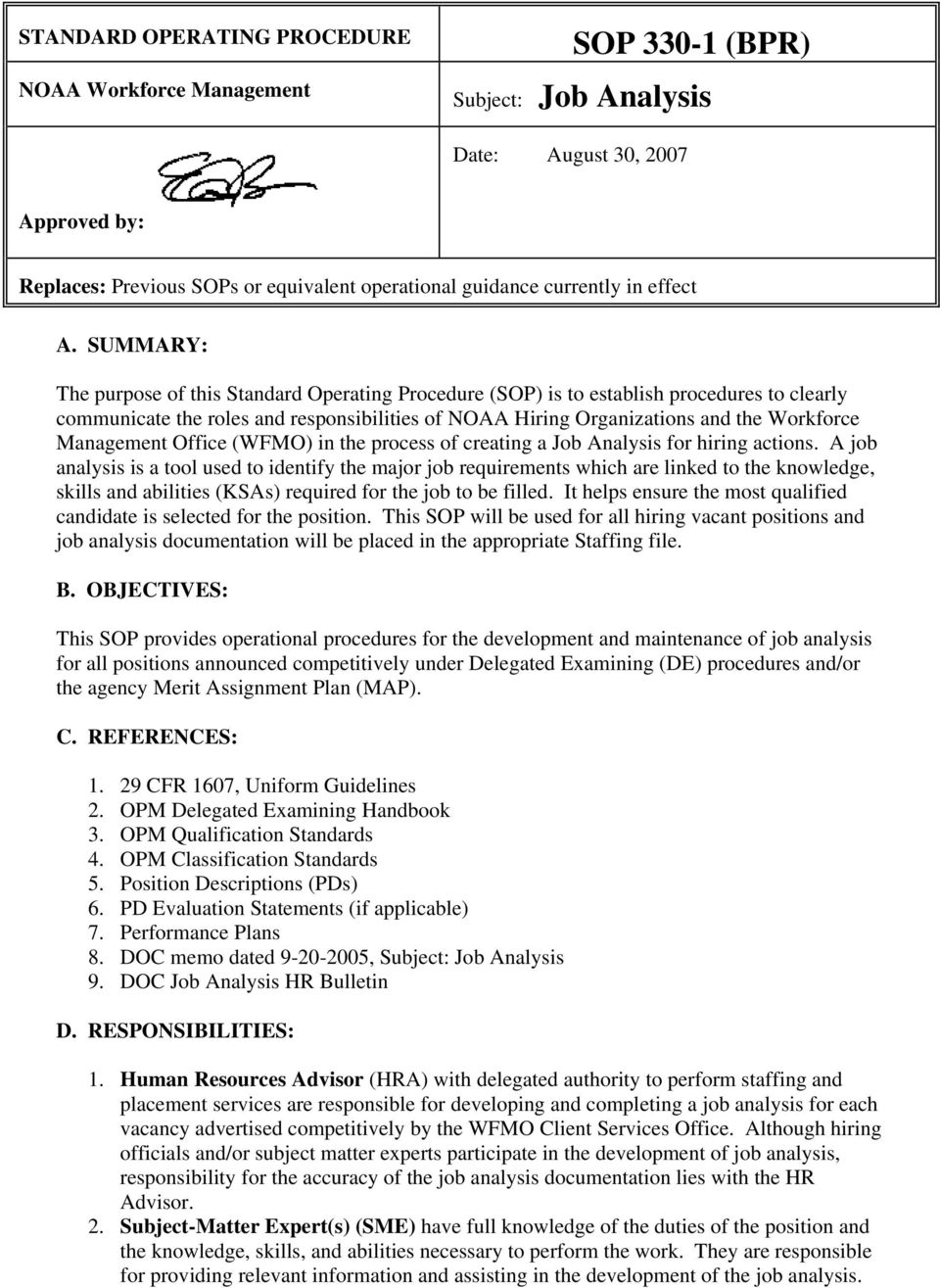
16 STANDARD OPERATING PROCEDURE NOAA Workforce Management SOP (BPR) Subject: Job Analysis Date: August 30, 2007 Approved by: Replaces: Previous SOPs or equivalent operational guidance currently in effect A. SUMMARY: The purpose of this Standard Operating Procedure (SOP) is to establish procedures to clearly communicate the roles and responsibilities of NOAA Hiring Organizations and the Workforce Management Office (WFMO) in the process of creating a Job Analysis for hiring actions. A job analysis is a tool used to identify the major job requirements which are linked to the knowledge, skills and abilities (KSAs) required for the job to be filled. It helps ensure the most qualified candidate is selected for the position. This SOP will be used for all hiring vacant positions and job analysis documentation will be placed in the appropriate Staffing file. B. OBJECTIVES: This SOP provides operational procedures for the development and maintenance of job analysis for all positions announced competitively under Delegated Examining (DE) procedures and/or the agency Merit Assignment Plan (MAP). C. REFERENCES: CFR 1607, Uniform Guidelines 2. OPM Delegated Examining Handbook 3. OPM Qualification Standards 4. OPM Classification Standards 5. Position Descriptions (PDs) 6. PD Evaluation Statements (if applicable) 7. Performance Plans 8. DOC memo dated , Subject: Job Analysis 9. DOC Job Analysis HR Bulletin D. RESPONSIBILITIES: 1. Human Resources Advisor (HRA) with delegated authority to perform staffing and placement services are responsible for developing and completing a job analysis for each vacancy advertised competitively by the WFMO Client Services Office. Although hiring officials and/or subject matter experts participate in the development of job analysis, responsibility for the accuracy of the job analysis documentation lies with the HR Advisor. 2. Subject-Matter Expert(s) (SME) have full knowledge of the duties of the position and the knowledge, skills, and abilities necessary to perform the work. They are responsible for providing relevant information and assisting in the development of the job analysis.
17 When SMEs are utilized, they are responsible for signing the job analysis, along with the Hiring Official, to indicate approval/agreement. 3. The Hiring Official and/or the first line supervisor of the position to be filled is responsible for assisting in the identification of an appropriate SME, providing all information as described in the recruitment checklist, and assisting in the development of the job analysis with or in the absence of a SME. The Hiring Official reviews and signs the job analysis to indicate approval/agreement. E. PROCEDURES Task Responsible Contributor Action Person 1 HRA N/A In preparation for meeting with Hiring Official and/or designated SME, gather and review available information regarding the job. This may include, but is not limited to, the position description, evaluation statement, classification standard, qualification standard, and performance plan, Uniform Guidelines developed by EEOC, DOL, DOJ and organizational templates and/or previously used questions from prior announcements of the same/similar positions. 2 HRA Hiring Official and/or SME Review job analysis and regulatory requirements. Summarize the major functions of the position, identify the KSAs necessary to perform these functions, and list the major duties and KSAs on the job analysis KSA development form (Exhibit 1). 3 HRA N/A Transfer resulting KSA listing to the KSA 4 Hiring Official and/or SME HR Advisor Evaluation Form (Exhibit 2). Validate each knowledge, skill, or ability by determining if the KSA is essential or desirable (see Section F below). Complete the Essential/Desirable column of the KSA Evaluation Form (see Exhibit 2) by designating each KSA as E for essential or D for desired. 5 Determine whether the desirable KSAs are ratable (see Section F below). Complete the Ratable column by placing Yes or No beside each desirable KSA. 6 Determine if possession of the desirable KSAs distinguish superior candidates from those who are minimally qualified (see Section F below). Complete the Distinguishes Superior from Barely Acceptable column of the KSA Evaluation Form (see Exhibit 2) by placing Yes or No beside the desirable KSAs. 7 Review for repetition or redundancy. Delete duplicates and/or combines similar KSAs. 8 Establish the importance of KSAs by assigning a weight to each. The sum of all KSA weights should equal HRA Hiring Official Develop questions (and/or select questions from the automated staffing system) that assess or

18 and/or SME measure each of the remaining KSAs. 10 List the question or question numbers adjacent to the appropriate KSA. If an appropriate question does not exist in the automated staffing system, annotate new in the final column and list the question at the end of the document. 11 Hiring Official and SME Review and sign the job analysis form to indicate agreement/approval, and submit to the HR Advisor. Not all JAs will have to have a SME, therefore a SME s signature is only required if a SME is used. Hiring officials must sign all JAs (whether a SME was or was not used). 12 HRA Develop crediting plan. (See Section F below.) 13 File a copy of the completed job analysis in the appropriate staffing file and fax a copy to the automated system for the vacancy announcement. F. OTHER INFORMATION 1. Determining if a KSA is essential or desirable: A KSA is essential if the knowledge, skill, or ability is critical for performance of the work of the position immediately upon entry into the position. If a person could obtain the knowledge, skill or ability in a reasonable period of time, i.e. approximately 90 days, after entry into the position, the KSA may be desirable, but is not essential. Essential KSAs are considered so critical that they must be present for a candidate to be considered minimally qualified for the position. If not already described in the basic OPM qualification requirements for the position, these KSAs may be considered as potential selective factors in the selection process. If the determination is that the KSA is a selective factor, this must be documented in writing. 2. Determining if a desirable KSA is ratable: For a KSA to be ratable, it must be possible for potential applicants to show they possess the particular knowledge, skill, or ability through descriptions of experience, training and education, awards, outside activities or hobbies, and/or performance appraisal. KSAs which are not ratable are eliminated from consideration in the job analysis process, but may be assessed in other processes such as job interviews or background checks. 3. Determining if a KSA distinguishes superior candidates from those minimally qualified: The best way to assist the SME is to ask him/her to think of those characteristics and qualities (KSAs) which an ideal candidate would possess, and which would serve as a means to distinguish between superior and minimally qualified candidates. An alternative is for the SME to think about persons who perform or have performed the job or similar jobs, and decide if possession of the KSA made their performance superior to others who did not. If not, or if employees performing at a minimally acceptable level possessed the KSA, then it is not appropriate to use the KSA in rating applicants. 4. Developing crediting plans (rating schedules): The format and structure of crediting plans (or rating schedules) are driven by the requirements of the automated staffing system. The weights established for KSAs during the job analysis process should be used in determining the maximum point values assigned to each assessment question. To create an effective automated tool for distinguishing between candidates, use of multiresponse questions is desirable. To assist in determining possible benchmark levels of these responses, consider the following. a. Superior: The superior credit level should generally reflect full demonstrated ability on all aspects of the KSA measured by the question. A person credited at
19 this level has the expertise to perform the task independently and/or has trained or supervised others. At this level, a person should need only a brief period of orientation to the minor particulars of the job in order to perform with full effectiveness the job functions which require this ability. b. Above acceptable: The above acceptable credit level should define a level of ability which, with reasonable certainty, would enable a person to satisfactorily carry out most of the normal functions of the position with no more than normal orientation or supervision. There should be evidence of above acceptable ability for most aspects of the KSA in order for a candidate to receive credit at this level. c. Acceptable: The acceptable credit level should define the minimum level of ability that is required to successfully perform the job functions that require this ability after a normal period of orientation. This level will normally reflect minimum qualifications for the position. A person presents evidence of the potential to do acceptable work on the job functions requiring this ability but who has not fully demonstrated the above acceptable level of ability would normally be credited at this level. d. Ability of some value: The ability credit level should contain examples of experience which, though relevant, do not indicate that the applicant has the level of ability required to perform those job functions requiring this element at an acceptable level of competence. This could be education or experience which is not sufficiently relevant to the job to be filled, the level of responsibility of the applicant s experience may be too low in relation to the requirements of the position, work may have been done poorly as reflected in performance evaluations, or similar reasons. 5. Job Analysis for multi-grade recruitments: KSAs in a multi-grade recruitment may be similar at each grade level because the grade level distinctions in level of supervision rather than differences in knowledge, skill, or ability. Job analysis must always be completed for the full performance level and/or the highest grade level advertised. For multi-grade recruitments that cover positions three or more grade levels below the fullperformance level or highest grade advertised, job analysis must also be completed on the lowest or entry-level grade. Job analysis must be completed on any grade level that requires a different knowledge, skill or ability than the full performance level and the entry level position. 6. Job Analysis for interdisciplinary recruitments: Job analysis conducted for interdisciplinary positions should contain identical KSAs regardless of occupational series. Although the qualification requirements are different, applicants must be rated against the same criteria. 7. Release of Information: In accordance with DEU Handbook, Chapter 7, Section B, rating information is not releasable through Privacy Act or FOIA regulations. EXHIBITS: Exhibit 1 KSA Development Form 1 Exhibit 2 KSA Evaluation Form 2 Exhibit 3 Sample Job Analysis
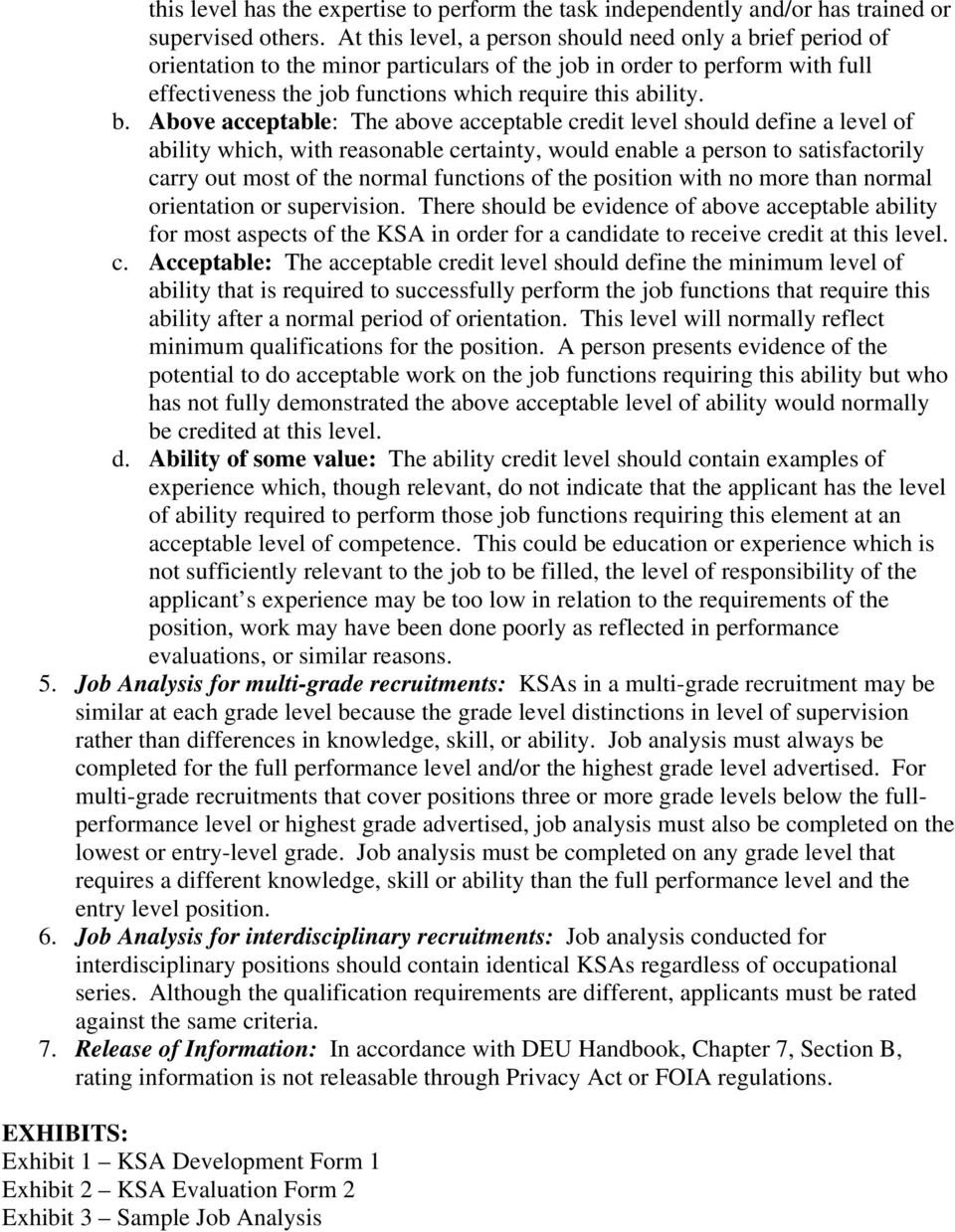
20 Exhibit 1 (KSA Form 1) KSA Development Form Position / Title: Series / Grade: Location: COLUMN 1 COLUMN 2 a. What are the major functions to be performed b. For each function, what KSAs are required? on this job?
21 Exhibit 2 (KSA Form 2) KSA Evaluation Form Position Title: Series / Grade: Location: KSAs E: Essential (Selective Factor) D: Desirable (Quality Ranking Factor) Ratable (Y/N) Distinguishes Superior from Minimally Qualified (Y/N) Weight (Should total 100) Automated System Question Number HR Advisor Signature/Date Hiring Official Signature/Date SME Signature/Date
22 Position / Title: Fishery Biologist Series / Grade: ZP Location: NWRO Exhibit 3 (Sample Job Analysis) KSA Development Form COLUMN 1 COLUMN 2 a. What are the major functions to be performed b. For each function, what KSAs are required? on this job? 1. Coordinates division environmental policy Knowledge of project management methods and techniques 2. Provides technical oversight and quality assurance for NEPA. Knowledge of NEPA Ability to develop, implement, and/or monitor fishery conservation and management programs under the National Environmental Policy Act, Magnuson-Stevens Fishery Conservation and Management Act and other applicable laws ( ESA, MMPA, etc.).. 3. Prepares NEPA documents Ability to interpret and communicate technical information orally and in writing
23 Position Title: Fishery Biologist Series / Grade: ZP Location: NWRO KSAs Exhibit 3 (Sample Job Analysis) KSA Evaluation Form E: Essential (Selective Factor) D: Desirable (Quality Ranking Factor) Ratable (Y/N) Distinguishes Superior from Minimally Qualified (Y/N) Weight (Should total 100) Automated System Question Number Knowledge of NEPA. D Y Y Ability to interpret and communicate technical information orally and in writing D Y Y 20 New Knowledge of project management methods and techniques Ability to develop, implement, and/or monitor fishery conservation and management programs under the National Environmental Policy Act, Magnuson-Stevens Fishery Conservation and Management Act and other applicable laws ( ESA, MMPA, etc.). Fishery Biologist ZP D Y Y 20 New D Y Y 35 New KSA: Knowledge of NEPA. Automated System Question #173: What type of experience do you have implementing the National Environmental Policy Act (NEPA)? Have you received training in preparing and/or reviewing analytical documents required by the National Environmental Policy Act, the Magnuson-Fishery Conservation and Management Act, or other Federal Legislation that require analyses of alternative management proposals? KSA: Ability to interpret and communicate technical information orally and in writing. Do you have experience communicating with federal, state and local agencies, commercial and recreational fisherman groups and general public on living marine resource management issues? Do you have experience writing and presenting technical or policy papers? KSA: Knowledge of project management methods and techniques. What is your experience with project management? Do you have project management experience developing work, plans, balancing workloads, meeting deadlines, producing products, briefing colleagues/supervisors to put project results into action? KSA: Ability to develop, implement, and/or monitor fishery conservation and management programs under the National Environmental Policy Act, Magnuson-Stevens Fishery Conservation and Management Act and other applicable laws ( ESA, MMPA, etc.). Do you have knowledge and experience of Endangered Species Act (ESA)? Do you have experience with the Federal Regulatory Process?
24 STANDARD OPERATING PROCEDURE NOAA, Workforce Management Office SOP # (BPR) Subject: 20 Business-day Certificate Approved by: Eduardo J. Ribas Director, Workforce Management Office Date: June 24, 2008 Replaces: Previous SOPs or equivalent operational guidance currently in effect. A. SUMMARY: The purpose of this SOP is to implement a hiring recommendation resulting from the NOAA Business Process Reengineering effort. SOP # establishes procedures for the 20 business-day Merit Assignment Plan (MAP) and Delegated Examining (DE) Certificate of Eligibles enabling Hiring Officials to better ensure availability of best qualified candidates, and to hire qualified candidates in a timelier manner. A certificate of eligibles is a list of applicants who have been deemed qualified for a position through the assessment process. From this list, a hiring manager (or selecting official) may select individuals to interview and hire. B. OBJECTIVES: The objective of this SOP is to set forth the procedure for implementation and maintenance of the 20 business-day MAP and DE certificates and extensions to ensure consistency throughout the NOAA Line and Corporate Offices. C. REFERENCES: 1. NOAA MAP, January 20, DAO , DOC Merit Assignment Program Policy, October DOC OHRM HR Bulletin # 004, FY 2005 D. RESPONSIBILITIES: 1. Human Resources Advisors (HRAs) are responsible for issuance of 20 business-day certificate and extension of certificate when applicable. 2. Hiring Officials are responsible for planning activities associated with receipt of the certificate to ensure their ability to make a selection within the 20 business-day timeframe; communicating the status of interviews, selection, etc. to the HRA and the Line/Corporate Office (LO/CO) Chief Financial Officer (CFO); requesting an extension in writing 1 with LO/CO CFO, if extenuating circumstances warrant; and providing the HRA written approval if the extension is granted. 3. Line Office Chief Financial Officers (LO CFO) and Corporate Office (CO) equivalent are responsible for monitoring certificates that are outstanding for more than 1 HRAs will only accept written approval of certificate extensions (may include ) and must be filed with the DE/Merit Assignment Plan file.
25 20 business-days, carefully considering extension requests, ensuring they meet established criteria, and providing a written decision regarding approval or disapproval of the 20 business-day extension to the Hiring Official LO Deputy Assistant Administrators (DAA)/Corporate Office Deputy Directors (CO DD) are responsible for ensuring any additional 20 business-day extension meets the critical extension criteria and providing written approval of the additional 20 businessday extension to the Hiring Official via the LO CFO (or equivalent). A second extension should only be granted in rare and unusual circumstances 2. E. PROCEDURES: Task Responsible Person Action 1 HRA Advises Hiring Official during the strategic conversation of the hiring timeline indicating when the certificates will be issued. 2 Hiring Official Puts in place processes in advance of the vacancy announcement closing to ensure time is blocked for interviews and panels have been established (if applicable). 3 Identifies an alternate person, with hiring authority, in the event the Hiring Official is unavailable, to take action on the certificate in their absence once it is issued. 4 HRA Issues MAP or DE certificate. 5a Hiring Official Returns certificate to HRA indicating selection(s) and/or nonselection within 20 business-days; or 5b Requests in writing 20 business-day extension from LO/CO CFO. Justification is required and should only be requested in rare circumstances; criteria are listed in Exhibit 1. Request should be made prior to the 20 business-day certificate expiration date. 6 LO/CO CFO Reviews request for extension to 20 business-day certificate 2. 6a If extension is granted, responds in writing to Hiring Official and 6b new certificate deadline is established. If extension is disapproved, responds in writing to Hiring Official and selection must be made by original expiration date of the certificate. 7a Hiring Official If extension is granted, forwards LO/CO CFO extension approval to HRA to extend certificate. 7b If extension is disapproved, returns certificate to HRA by the original certificate deadline indicating selection and/or nonselection. 8a HRA Takes appropriate action on returned certificate; or 8b Extends certificate for an additional 20 business-days. 9 LO/CO CFO Reviews certificates that are outstanding for more than 20 business-days 2. 2 This SOP does not and can not preclude the CFO and/or DAA from assigning the approval or disapproval of extensions of certificates within their line or corporate office to others. This internal line office/corporate office administrative approving process by the CFO and/or DAA should not be confused with the legal authorities vested in the Workforce Management staff. Should a CFO and/or a DAA wish to assign the administrative approval process for extension of certificates to others named in their office, it should be provided in writing to the Director of the Workforce Management Office and will be retained as part of the annual agreement with that Office. CFOs and DAAs remain accountable to the consequences of extending certificates in meeting the 70-day hiring cycle time performance metric. All other processes remain the same and the HR staff will process extensions accordingly.
26 10a Hiring Official Returns certificate to HRA indicating selection and/or nonselection; or 10b If necessary, due to extreme circumstances, requests from LO DAA/CO DD through the LO/CO CFO, a second 20 business-day certificate extension; provides original extension justification and CFO approval memorandum/ , and additional written justification for the delay in selection, with written concurrence from the LO CFO for second extension. Request should be made prior to the second 20 business-day certificate expiration date. This extension should only be used in extremely rare and unusual circumstances. 11 LO DAA/CO DD Reviews request for second extension to 20 business-day certificates that have been previously extended by LO/CO CFO and the request and justification for second extension 2. 11a If the second extension is granted, responds in writing to Hiring Official and LO/CO CFO and new deadline is established. 11b If second extension is disapproved, selection must be made by the expiration date of the initial extended certificate, or certificate expires and position is readvertised. 12a Hiring Official If second extension is granted, forwards LO DAA/CO DD approval to HRA to extend certificate. 12b If second extension is disapproved, returns certificate to HRA by the expiration date established by the first extension indicating selection and/or non-selection, or requests that position be readvertised. 13a HRA Takes appropriate action on returned certificate; or 13b Extends certificate for an additional 20 business-days; or 13c Cancels certificate if no selection is made by the final 20 business-day extension. F. EXHIBITS: Exhibit 1: Extension Justification Criteria Exhibit 2: Certificate Extension Request to LO/CO CFO Exhibit 3: Certificate Extension Request to LO DAA/CO DD
27 EXHIBIT 1 SOP EXTENSION JUSTIFICATION CRITERIA The normal life of a certificate of eligibles is 20 business-days. Hiring officials are expected to plan at the beginning of the hiring process to accommodate vacation schedules for themselves and Subject Matter Experts, work related travel, etc. In order for an extension to be granted at any stage of the recruitment process there must be extenuating circumstances. Therefore, the justification submitted to the LO CFO must be very specific regarding the reason for the extension. Justification criteria for requesting an extension for either of the 20 business-days extensions (first or second extension) would include: Emergency hospitalization of hiring official or hiring official s immediate family, unforeseen military duty; emergency travel with no back-up available; mission critical requirements had to be met; a disaster such as was experienced under 9/11, Hurricane Katrina, or a major weather event (blizzard, flood, etc), or other relevant extreme event. Note that a second extension of an additional 20 business-days (i.e., certificate could be valid for up to 60 business-days total) should be an exceedingly rare event, and should only be requested and granted under extenuating circumstances. If an extension is required from the LO DAA/CO DD, the Hiring Official, with concurrence from the LO CFO (or equivalent), will be required to submit the original justification, subsequent approval from the L/CO CFO, and additional justification for the extension. Exhibits 2 and 3 provide examples of justification memoranda.
28 EXHIBIT 2 SOP Certificate Extension Request to LO/CO CFO MEMORANDUM FOR: LO/CO CFO FROM: SUBJECT: Hiring Official Request for 20 Business-day Extension MAP and/or DE Certificate #XXXXXXX, Official Title, Pay Plan, Series and Grade In accordance with SOP 335-2, I hereby request approval for a 20 business-day extension to the subject certificate. Justification is as follows: The certificate was issued on XXXXXXX and the next day I had a personal emergency (e.g., unscheduled military leave, spouse was hospitalized) and I was on unscheduled leave until XXXXXXX. The selection had to wait until my return since there was not an appropriate backup to serve in this capacity while I was unavailable. I returned to work on XXXXXXXX and therefore have been unable to review the names or resumes on the certificate. It is anticipated that I will be able to review the names, resumes, schedule interviews and make the necessary selection within the next 20 business-days. I respectfully request approval for an extension in order for me to make these arrangements and complete the hiring process. Approve Date Disapprove Date
29 EXHIBIT 3 SOP Certificate Extension Request to LO DAA/CO DD MEMORANDUM FOR: LO DAA/CO DD FROM: SUBJECT: Hiring Official Through LO/CO CFO Request for 20 Business-Day Extension MAP and/or DE Certificate #XXXXXXX, Official Title, Pay Plan, Series and Grade This letter is in reference to subject certificate, which was previously extended until XXXXXXX by the LO/CO CFO. Due to the blizzard conditions experienced in the Boulder, CO area, local federal government facilities were closed from January 12 19, As a result, I was unable to complete the interview and selection process, and I am requesting an additional 20 business-day extension in order to interview the candidates. Since all of the interviews have been scheduled, it is anticipated that the final selection will be made within the requested extension time. I respectively request approval to extend subject certificate an additional 20-business days. Attachment Approve Date Disapprove Date
30 NOAA Workforce Management Office Sample Interview Questions September 2007 When the candidate arrives for the interview, immediately meet and greet him or her, thank the candidate for coming, and chat informally for a few minutes (try to keep your topics limited to commuting, weather or traffic). You can build rapport by giving the candidate an idea of how the interview process will unfold. As you begin the formal interview, provide the candidate with a brief overview of the job and the mission of the agency. Next, you can begin asking the candidate the questions you have prepared for the interview. You may want to begin the interview with a few warm-up questions to put the candidate at ease before working up to more substantial, behavioral questions. A few opening questions are: What interests you most about this position? Why do you want to work for this organization? The following are sample questions only and should be modified as they apply to the particular requirements of the position. You should not limit yourself to these questions or to these categories of questions. Attention to detail: Describe a project or task that required your exacting attention to small points and issues in order to keep the project on track and produce a quality project. How did these matters come to your attention? How did you handle them? Change management: We often face many changes in the workplace. Describe a specific situation in which you feel you were especially effective in adapting to an unanticipated change. Clerical skills: Describe the type of routine office procedures that you have had to follow. What volume of paperwork have you been responsible for? What experience have you had in handling confidential records? How do you ensure the confidentiality and security of information and records maintained in the office? Skill areas: Please describe the skills, abilities and experience you have that qualify you for this position. Customer service: In this job you will be interacting with a variety of individuals both within and outside the agency. Occasionally, you will interact with individuals who are dissatisfied with the service they received. Describe a difficult customer situation you have encountered and how you solved it. Decision-making: Describe some examples of decisions or recommendations you are called upon to make in your current or past position? What has been a stubborn or recurring problem area you would like to solve in your current job? How would you solve it? Interpersonal skills: How would you describe your relationship with your most recent supervisor and coworkers? If I were to contact them today, what would they say about you? Teamwork: Provide me with an example of when you worked very effectively as a member of a team. What was the task? How many people were involved? What was your role?
31 After you have finished asking the candidate questions, allow the candidate time to ask questions of you. This is an excellent opportunity for you to elaborate on the agency, your component, and details of the specific job. You should be prepared to answer a variety of questions from the candidate. Inform the candidate of your anticipated time frame for decision making. Remember, always ask questions that are: a. Related to the job. b. Designed to build rapport with the candidate: "So, how do you like living in Baltimore?" Avoid asking questions that are: a. A potential violation of the rights of a protected group: "What kinds of organizations do you belong to?" (The candidate's answer may lead to topics involving religious or ethnic background.) b. Never ask questions that are a clear violation of the rights of a protected group: "How old are you?" For additional information: WFMO Contact Lists
32 NOAA Workforce Management Office Interview Do s & Don t Checklist September 2007 Guidelines: Lawful and Unlawful Interview Questions Name Age Residence Subject of Question: It is ACCEPTABLE to inquire about: It is UNACCEPTABLE to inquire about: Whether applicant has ever worked under a different name If applicant is older than 18 If applicant is younger than 18 or 21 if job related Applicant's place of residence Alternate contact information The original name of an applicant whose name has been legally changed. The ethnic association of applicant's name Applicant's maiden name Date of birth Date of high school or college graduation Previous addresses Birthplace of applicant or applicant's parents Length of current and previous addresses Race or color - Applicant's race or color of skin National origin and ancestry - Gender and family composition - Creed or religion - Citizenship Language Arrest record and convictions Reference checking Relatives Organizations Whether the applicant is a U.S. citizen or has current permit/visa to work in U.S. What language applicant speaks and/or writes fluently, IF JOB RELATED If applicant has ever been convicted of a crime Previous work contacts Names of relatives already employed by employer Applicant's membership in any professional, service or trade organization that are relevant to his/her ability to perform the job Applicant's lineage, ancestry, national origin, parentage or nationality Nationality of applicant's parents or spouse Applicant's maiden name Sex of applicant Marital status Dependents of applicant or child-care arrangements Who to contact in case of emergency Applicant's religious affiliation What church, parish, mosque or synagogue applicant belongs What holidays applicant observes Whether applicant is a citizen of a country other than the United States Date of U.S. citizenship Applicant's native language Language commonly used at home Whether applicant has ever been arrested Name of applicant's religious leader Applicant's political affiliation and contacts Name and/or address of any relative of applicant Whom to contact in case of emergency List of all clubs or social organizations to which applicant belongs Photograph with application, with résumé, or Photographs - before hiring Physical characteristics - a. Any inquiry into height and weight of applicant Physical limitations or disabilities Whether applicant has the ability to perform the duties of the job for which he or she is applying The nature or severity of an illness or physical condition Whether applicant has ever filed workers' compensation claim
33 Education Financial status - Military Training applicant has received if related to the job Highest level of education attained, if certain background is necessary to perform the job What type of training, education, work experience did applicant receive in military Any recent or past operations or surgery and dates Whether applicant has ever had prior work-related injuries Date of high school or college graduation Applicant's debts or assets Garnishments Whether applicant owns home Whether applicant has ever declared bankruptcy Applicant's type of discharge For additional information: WFMO Contact Lists
34 NOAA Workforce Management Office Sample Reference Verification Questions September 2007 Basic Reference Check Sample Questions Below are types of basic questions that may be asked. The phrasing of each question is just an example, but the idea is typical. What were the beginning and ending employment dates for this individual? What was this individual's beginning and ending salary? What positions did the individual hold? Did this individual earn promotions? What were the individual's most-recent job duties? Why did the individual leave your company? Is there any reason why your company would not rehire this individual? Would you recommend this individual for a position at another company? Why or why not? How did this individual's performance compare to other employees with similar job duties? In your opinion, what are the individual's strengths? Weaknesses? Did this individual get along well with management and peers? Was this individual a team player? Was this individual a motivated self-starter? Did any personal problems affect this individual's work performance? Do you think this individual will perform well as a [job title]? What kind of job is best suited for this individual's abilities? How would you describe the individual's overall performance? Is there anything of significance you'd like to add? Additional Reference Check Sample Questions Below are samples of the types of questions that reference checkers might ask for professionals, managers and executives, in addition to the basic questions above. As with the basic questions, the phrasing is just an example, but the gist is typical. How would you describe the individual's leadership, managerial or supervisory skills? Does the individual communicate well orally and in writing? How do you rate the individual's ability to plan short-term? Long-term? Did the individual make sound and timely decisions? Did the individual get along well with management, subordinates and peers? Did the individual plan, administer and make budget well? How would you describe the individual's technical skills? Did the individual demonstrate honesty and integrity? How well did the individual manage crisis, pressure or stress? Describe the individual's ability to attract and counsel top talent. For additional information: WFMO Contact Lists
35 NOAA Workforce Management Office Legal and Policy Requirements September 2007 Elements used in a selection process must be job related and must use legal and consistent criteria to determine the best qualified candidates for referral and selection. Merit principles and job relatedness have been long-standing requirements in the Federal government. In 1978 the Civil Service Reform Act, Uniform Guidelines on Employee Selection Procedures (UGESP), was issued. The guidelines are intended to establish a uniform basis of selection procedure criteria in the Federal sector. This guide imposes on employers the criteria by which the Equal Employment Opportunity Commission evaluates hiring practices to ensure adherence to merit principles. The UGESP applies to both in-service placement actions and external hiring practices. A selection procedure is any measure, combination of measures, or procedures used as a basis for an employment decision. This applies, but is not be limited to, job analyses, crediting (ranking) plans, interviews, and the selection process itself. All documents and the processes that develop these documents, which support the referral and selection of candidates, must contain only job-related criteria. The documents become part of the overall record supporting selection procedures used. Merit System Principles Personnel management is based on and embodies the Merit System Principles. The Merit System Principles are the public s expectations of a system that is efficient, effective, fair, open to all, free from political interference, and staffed by honest, competent and dedicated employees. As NOAA experiences continued change in the management of human resources (centralization, deregulation, delegation, etc.), it becomes increasingly important that line supervisors and managers incorporate the Merit System Principles into every decision process they use. The Merit System Principles are: 1. Recruit qualified individuals from all segments of society and select and promote employees on the basis of merit after fair and open competition which assures that all receive equal opportunity. 2. Treat employees and applicants fairly and equitably, without regard to political affiliation, race, color, religion, national origin sex, marital status, age, or handicapping condition, and with proper regard for their privacy and constitutional rights. 3. Provide equal pay for equal work and recognize excellent performance. 4. Maintain high standards of integrity, conduct, and concern for the public interest. 5. Manage employees efficiently and effectively. 6. Retain and separate employees on the basis of their performance.
36 7. Educate and train employees when it will result in better organizational or individual performance. 8. Protect employees from arbitrary action, personal favoritism, or coercion for partisan political purposes. 9. Protect employees against reprisal for the lawful disclosure of information in "whistleblower" situations (i.e., protecting people who report things such as illegal and/or wasteful activities). Prohibited Personnel Practices Prohibited personnel practices are those things an employee with personnel authority may not do. An employee has personnel authority if he or she can take, direct others to take, recommend, or approve any personnel action. This includes appointments, promotions, discipline, details, transfers, reassignments, reinstatements, or any decisions concerning pay, benefits, training, and any decision to order psychiatric testing or examination. A personnel action now also includes any significant change in duties, responsibilities, or working conditions which is inconsistent with the employee s salary or grade. People with personnel authority are charged with avoiding prohibited personnel practices. Prohibited personnel practices are: Discriminating on the basis of race, color, religion, sex, national origin, age, handicapping condition, marital status, or political affiliation. Soliciting or Considering any personnel recommendation or statement not based on personal knowledge or records of performance, ability, aptitude, general qualifications, character, loyalty, or suitability. Coercing an employee s political activity. Deceiving or obstructing any person with respect to such person s right to compete for employment. Influencing a person to withdraw from competition for the purpose of improving or injuring the prospects of another person for employment. Granting any preference or advantage not authorized by law, regulation, or rule to any [employee or applicant for the purpose of improving or injuring the prospects of another person for employment]. Employing, promoting or advocating a relative. Retaliating against a Whistleblower, whether an employee or an applicant. Retaliating against employees or applicants who exercise their appeal rights, testify, or cooperate with an Inspector General or the Special Counsel, or refuse to break the law. Discriminating based on actions not adversely affecting performance. Violating any law, rule, or regulation implementing or directly concerning the Merit Principles. Violating Veteran's Preference by taking or failure to take a personnel action. (National Defense Authorization Act for FY97) Avoiding prohibited personnel practices will not guarantee that you will never have to defend a decision or action, but it will give you a firm basis from which to start.
37 NOAA Merit Assignment Plan The underlying principle of the NOAA Merit Assignment Plan (MAP) is to provide management with the greatest flexibility in filling vacancies. The MAP sets forth policies, procedures and requirements, which assure that qualified candidates are considered for assignment to positions in the competitive service, based solely on job-related evaluation procedures. Selections will be made free of discrimination on the basis of race, color, religion, sex, national origin, marital status, age, reprisal or disability. Selections shall be based solely on relative knowledge, skills, abilities, other job-related criteria and legitimate position requirements. The MAP provides guidance in obtaining qualified internal and external candidates to compete equitably for assignment opportunities either concurrently or separately in accordance with Federal merit promotion policy. In addition, the Department of Commerce (DOC) Human Resources Bulletin 20 requires that all vacancies be advertised under Merit Assignment Plan and Delegated Examining Authority procedures. Vacancy Announcements must be open at minimum, ten (10) business days. This provision was later required after the NOAA MAP was developed. This requirement is necessary to yield the largest pool of qualified candidates and to ensure that applicants receive fair treatment in the selection process. You should remain conscious of the merit system principles, prohibited personnel practices and the NOAA MAP to ensure legal requirements are met. For additional information: WFMO Contact Lists
38 NOAA Workforce Management Office Hiring Process, Roles and Responsibilities September 2007 The following is an overview of the steps involved in the hiring process and all the roles and responsibilities involved in hiring. Steps in the Hiring Process Hiring Roles and Responsibilities: Hiring official Assigns duties and responsibilities. If using Position Description (PD) Library or Demonstration Project Automated Classification System (ACS), determines appropriate classification and forwards for HRA certification. Makes selection from certificate of eligibles. Determines need to fill vacant position. Creates PD and performance plan. Becomes familiar with various recruiting options (e.g., student, term, temp, etc.). Contacts the HRA to initiate strategic conversation. Designates a SME to assist with hiring documentation. Completes the recruitment package including: o Request for Personnel Action - Standard Form SF-52 o Current Classified PD with signed CD-516. o Performance Plan. o Demo positions only: signed CD-541 Performance Plan cover sheet. o CD-79 (or equivalent), Request for Clearance - Position Sensitivity Designation (if applicable to position). Constructs the Job Analysis along with the SME and the HRA. Chooses or composes the AHS technical questions. Composes the duty statement and determines any specialized experience qualifications. Sets the salary (for demo positions).
39 Reviews full applications, resumes, and responses to questions. Conducts the interviews. Makes a selection and notifies the HRA. Human Resources Advisor (HRA) Drives the end-to-end hiring process. Conducts the strategic conversation with hiring officials. Provides guidance and implements staffing and recruitment strategies. Provides guidance on the development of position descriptions and performance plans. Provides guidance and advice on position classification (including PD Library; or ACS for demo positions). Provides guidance and advice on position management (e.g., organizational alignment). Drives completion of the job analysis; works with the hiring official and SME(s) on content. Provides guidance on pay setting, administration and demo operations. Serve as the primary point of contact for the Line Office (LO)/Corporate Office (CO) office on WFMO issues. Implements the MAP. Administers delegated examining authority. Reviews and determines basic qualifications. Prepares and authenticates the Certificate of Eligibles. Makes job offers to selected candidates. Updates the automated status reporting system on a daily basis to enable the hiring officials to check on the status. Line Office/Corporate Office (LO/CO) Staff Verifies full time equivalent (FTE) and funding availability. Verifies and requests billet, as necessary. Provides ad-hoc help to managers on hiring activities (e.g., use of automated status system, general guidance on vacancy announcements). Coordinates the receipt of hiring actions within the LO/CO. Subject Matter Expert (SME)* Assists the hiring official and the HRA in conducting the job analysis based on bona fide expert knowledge about what it takes to do the job. Assists hiring official in selecting or creating questions. Assists hiring official in validating and authenticating applicants technical answers to questions. Participates as a technical expert in determining the best qualified applicants (upon close of vacancy announcement) on an as-needed basis. *NOTE An SME is an employee with bona fide expert knowledge about the job s requirements. Superior incumbents (at or above the grade level of the position) in the same or in a very similar position and other individuals can also be used as SME(s) if they have current and thorough knowledge of the job s requirements. Individuals in grades or levels below the full performance level of the vacant position may not serve as an SME. For additional information: WFMO Contact Lists
40 NOAA Workforce Management Office Federal Civil Service September 2007 The Federal civil service includes all appointed positions in the executive, judicial, and legislative branches of the Federal Government, except military positions in the uniformed services. The civil service consists of: Competitive Service Excepted Service Senior Executive Service (SES) The primary differences between the three services are in appointment procedures and job protections. In the competitive service, appointment procedures, merit promotion requirements, and qualification requirements are prescribed by law or by the Office of Personnel Management (OPM) and apply to all agencies. In the excepted service, only basic requirements are prescribed by law or regulation and each agency generally develops specific requirements and procedures for its own jobs. Certain principles of the competitive service apply to the SES with some adaptations. However, SES provisions in some program areas differ significantly from those governing the other systems. Competitive Service The competitive service includes all civilian positions in the Federal government that are subject to Title 5, US Code and are not specifically excepted from the civil service laws by statute, by the President, or by the OPM, and are not in the SES. It includes most positions in the executive branch of the Government. The majority of positions in NOAA are competitive service positions. The most common method for entering the competitive service is to be selected for an appointment after competing in an examination with other non-status applicants. A non-status applicant is an individual who does not have basic eligibility for noncompetitive assignment to a competitive position in the competitive service and must compete with members of the general public in an open competitive examination. Career and career-conditional appointments are the most common competitive service appointments. Competitive service may also be granted by statute, Executive Order, or the civil service rules without competitive examination, for example, former overseas employees. Excepted Service Positions excepted from the competitive service by OPM or by law are placed into three categories, Schedule A, B or C. Schedule A positions are positions for which it is not practical to apply the qualification standards and requirements used in the competitive civil service system and that are not of a confidential or policy determining nature.
41 Schedule B positions are positions for which it is not practical to hold open competitive examinations, and the positions are not of a confidential or policy determining nature. The persons appointed to Schedule B positions must meet the OPM qualification standards for the position. Schedule C positions are either key policy determining positions or positions which involve a close personal relationship between the incumbent and key officials. No examinations are required and the agency appoints persons who they determine to be qualified. Senior Executive Service The SES was created by the Civil Service Reform Act of Congress designed the SES to be an elite corps of managers charged with running the Federal government. The SES was set up as a separate, grade-less personnel system - distinct from the competitive and excepted services - whose positions are classified above the GS-15 level of the General Schedule. For additional information: WFMO Contact Lists
42 NOAA Workforce Management Office Appointments November 2007 Career-Conditional Appointment is a status appointment in the competitive service. A careerconditional employee must serve a probationary period during the first year of initial permanent Federal service to determine fitness for continued employment. Management may terminate the services of an employee if the work performance or conduct fails to demonstrate fitness or qualifications for continued employment during the initial one-year probationary period. The process for termination of employees during the one-year probationary period requires advanced notification and coordination with the WFMO. In addition, a career-conditional employee must serve three years of continued service before becoming a full career employee. Career Appointment is a status appointment in the competitive service. A career employee has successfully served a one (1) year probationary period and has completed three (3) years of continuous service. Temporary Appointment is a non-status appointment to a competitive service position for a specific period of one (1) year or less. The appointment may be extended for up to one (1) additional year. A temporary appointment may be terminated at any time without use of adverse action or reduction-in-force procedures. The conditions of employment, though limiting for the employee, may provide cost savings to the organization. Term Appointment is a non-status appointment to a position in the competitive service for a specific period of more than one (1) year but not more than four (4) years. Term employees do not obtain competitive status on the basis of their term appointment. During the appointment, an employee may be promoted, demoted, or reassigned only to other positions appropriate for term employment. Schedule A Appointment is an appointment in the excepted service used for filling special jobs and situations for which it is impractical to use standard qualification requirements and to rate applicants using traditional competitive procedures. This type of appointment is also used for appointing persons with disabilities. In addition, employees under this appointment must serve a two (2) year trial period. After two (2) years of successful performance, an employee may be non-competitively converted to a permanent appointment in the competitive service. Schedule A exceptions will enable management officials to fill any job under special circumstances. Examples include: When a critical hiring need exists to fill a short-term job or to fill a continuing job pending completion of examining, clearances, or other procedures. When a temporary or part-time job exists in a remote or isolated location. When non-citizens must be hired because no qualified citizen is available. When a temporary board or commission established by law or Executive Order, must be quickly staffed.
43 Schedule B Appointment is an appointment in the excepted service used to fill jobs and situations for which it is impractical to rate applicants using competitive procedures. However, under Schedule B authorities applicants must meet the qualification standards for the job. Schedule B appointment includes the following: Student Educational Employment Programs (SEEP) are work study programs that allows students to receive monetary compensation while combining academic study with on-the-job experience. Student Temporary Employment Program (STEP) is a SEEP program which appoints students on a temporary basis to jobs that may or may not be related to their academic field of study. Student Career Experience Program (SCEP) is a SEEP program that allows students to attend an accredited school and work in a career-related position. Students who have met all the requirements of this program may be non-competitively converted to a career or career-conditional appointment in an occupation related to their academic training and work study experiences. Schedule C Appointment is a hiring authority appointment granted by OPM on a case-by-case basis in situations for which political appointments are appropriate. Schedule C appointees have a confidential or policy-determining relationship with their supervisor and agency head. Generally, the authority to fill a Schedule C job is revoked when the incumbent leaves and agencies need specific approval from OPM to establish or reestablish the position. Veterans' Recruitment Appointment (VRA) is a special authority by which agencies may, if they wish, appoint an eligible veteran without competition. The authority can be use to fill GS-11 or below positions. Veterans are hired under excepted appointments to positions that are otherwise in the competitive service. After satisfactorily completing a two (2) year trial period the veteran must be converted non-competitively to a career or career-conditional appointment. Thirty (30) Percent or More Disabled Veteran Appointment is an appointment enabling hiring officials to appoint an eligible candidate to any position for which he or she is qualified, without competition. Unlike the VRA, there is no grade-level limitation. Initial appointments are time-limited, lasting more than sixty (60) days; however, you can non-competitively convert the individual to permanent status at any time during the time-limited appointment. Veteran Employment Opportunity Act Appointment (VEOA) is a law that allows eligible veterans to compete under an agency's Merit Promotion procedures. A veteran selected from the best-qualified group will be given a career-conditional appointment in the competitive service. Intergovernmental Personnel Act (IPA) Assignment is an assignment which involves temporary assignment of employees between Federal agencies and state, local, or Indian tribal governments; institutions of higher education; and other eligible organizations. An assignment must be implemented by a written agreement and can be terminated at any time. For additional information: WFMO Contact Lists
44 NOAA Workforce Management Office Recruitment Sources September 2007 Focus should be placed on ready audiences that are likely to include talented individuals who possess the competencies, skills and experience required for the position being recruited. Below are a few recruiting sources that may help achieve a diverse workforce: Colleges and universities with strong undergraduate and/or graduate programs in relevant areas Job fairs Career development offices Academic departments Professional organizations Advertisements in professional association publications Professional gatherings (luncheons, conferences, etc.) Minority and women organizations Internet Management s Role in Recruiting Management may serve different roles in the recruitment process. As part of NOAA s effort to attract top talent in a competitive job market, management or an SME may be asked to participate in job fairs and college recruitment efforts. Professional and academic contacts can be used to locate qualified candidates and to encourage them to apply when positions are announced. The HRA should be notified if a leading candidate is detected. For additional information: WFMO Contact Lists
45 NOAA Workforce Management Office Classification September 2007 The first in ensuring the qualified person for your vacancy is to have an accurate position description. The position description is the official record of the duties and responsibilities assigned to a position or group of positions by a supervisor/manager in order to accomplish a specific job. It is the position that is classified, not the person assigned. It is the work assigned and performed that are evaluated. The special capabilities or qualifications of the employee generally are not factors that influence the position s classification. Understanding the position that is to be classified is fundamental to the process of assigning the correct title, series, and grade. It is imperative that the position description be carefully developed to capture the important or critical features of the job. The recruitment and performance evaluation process will have no value if the position description is based on inadequate or misunderstood information. Critical to fully understanding the position is consideration of such factors as the position s relationship to other positions, its primary purpose or reason for existence, the mission and responsibility of the organization in which it is located, and the qualifications required to do the work. The DOC developed a Position Description (PD) Library to provide managers a database of generic position descriptions, intended to speed up the classification process and facilitate timely recruitment. It is, however, a NOAA requirement to use PD Library descriptions when a new position description is created for a General Schedule (GS) or Wage Grade (WG) position in a series and grade covered by the PD Library (except under Demo). PD Library descriptions can be found at Determining the Series The series determination is normally not a difficult problem for most positions. The correct series is usually apparent from reviewing the duties and responsibilities assigned to the position. In most cases, the occupational series will represent the primary work of the position, the highest level of work performed, and the paramount qualifications required. The Federal General Schedule Occupational Series can be found at and the Federal Wage System Occupations Series can be found at General Schedule The General Schedule series can be divided into five categories of work; specifically, professional, e.g., attorney, medical officer, biologist; administrative, e.g., human resource specialist, budget analyst, general supply specialist; technical, e.g., forestry technician, accounting technician, pharmacy technician; clerical, e.g., secretary, office automation clerk, data transcriber, mail clerk; others are not so easy to determine, e.g., Electronics Mechanic, WG-2604 versus Information Technology (IT) Management Series, GS-2210.
46 Professional or Nonprofessional Series Work classified to a professional series requires academic education and training in the principles, concepts, and theories of the occupation. This requirement is called a positive education requirement and is common to nearly all professional occupational series. Professional work involves creativity, analysis, evaluation, and interpretation. Closely allied to professional work is work performed by nonprofessional support personnel. The duties and responsibilities, may appear very similar to those of professional employees in related kinds of work. Technical work, however, is normally planned and managed by professional employees. The technician carries out or implements plans or projects based on extensive experience and supplemental on-the-job training rather than on formal academic education in the discipline itself. Administrative or Support Series Support work usually involves proficiency in one or more functional areas or in certain limited phases of a specified program. Normally a support position can be identified with the mission of a particular organization or program. The work usually does not require knowledge of the interrelationships among functional areas or organizations. Employees who perform support work follow established methods and procedures. Support personnel typically learn to do the work on the job through what may sometime be many years of experience. They also may attend specific training courses related to their work. Administrative work, on the other hand, primarily requires a high order of analytical ability combined with a comprehensive knowledge of (1) the functions, processes, theories, and principles of management; and (2) the methods used to gather, analyze, and evaluate information. Administrative work also requires skill in applying problems solving techniques and skill in communicating effectively both orally and in writing. Administrative positions do not require specialized education, but they do involve the type of skills (analysis, research, writing, judgment) typically gained through college level education or through progressively responsible experience. Even though employees who perform administrative work may be assigned to one functional area of overall occupation or program, they are required to understand the interrelationships between their specific area of expertise and other functions and programs Mixed Series A mixed series position involves work covered by more than one occupational series. For most positions, the grade-controlling work determines the series. Sometimes, however, the lower grade duties are more closely related to the basic purpose of the position. Interdisciplinary Professional Series An alternate method of determining the series for some professional positions is the interdisciplinary approach. An interdisciplinary position involves duties and responsibilities that are closely related to more than one professional occupation. As a result, the knowledge and experience requirements can be met by persons qualified in either of the professional series involved. Interdisciplinary classification is used principally for positions in mathematical, scientific, or engineering disciplines.
47 Other combinations of work and qualification requirements logically would not meet the intent of interdisciplinary. The method of determining series is used for the sole purpose of adding flexibility to staffing professional positions. This flexibility allows the qualification requirements for the position to extend beyond those for a single series. More information can be found at Federal Wage System (FWS) The Federal Wage System (FWS) is the major pay system covering trade, craft, and labor occupations in the Federal Government. The categories of pay plans in the FWS are Wage Grade (WG), Wage Leader (WL), and Wage Supervisor (WS). The pay for these employees is set in accordance with local prevailing rates. Wage Marine The wage marine personnel include licensed masters, mates and engineers, and unlicensed members of the engine, steward, and deck departments. In addition, survey and electronic technicians operate and/or maintain the ship's mission, communication and navigation equipment. DOC Demonstration Project The DOC Demonstration Project is designed to provide a personnel management system that enhances mission accomplishment and organizational excellence by: recruiting, developing, rewarding and retaining high-performing employees; increasing manager s authority, responsibility and accountability over personnel decisions; and improving the effectiveness and efficiency of human resources management systems. The DOC Demonstration Project includes a simplified and improved position classification process through pay banding, generic classification standards, an automated classification system and the delegation of position classification authority to managers. Positions are classified according to career paths and pay bands within the career paths. Career paths are categories of occupations grouped by similarities in duties, qualification requirements, pay ranges and career progression. The four separate career paths are Scientific and Engineering (ZP), Scientific and Engineering Technician (ZT), Administrative (ZA), and Support (ZS). A single pay band within a career path normally covers a pay range of two (2) or more grades within the General Schedule (GS). The Automated Classification System (ACS) allows managers to create individualized position descriptions (PDs) by choosing from approved career paths, pay bands, titles, specialties, etc. In addition, ACS allows users to edit existing PDs, save an existing PD as a new PD, delete PDs, and Print PDs. The ACS system can be found at For additional information: WFMO Contact Lists
48 Job Aid for Subject Matter Expert Involvement in the Hiring Process Roles and Responsibilities A Subject Matter Expert (SME) is a person with comprehensive knowledge of the duties and responsibilities necessary to perform a specific job. The overall role and responsibility of the SME is to provide a recommendation based upon their subject matter expertise to the Human Resources Advisor (HRA) in regards to relevant information needed to fill a vacant position. The SME must be a neutral party and not planning on applying for consideration for the position being advertised. A SME may serve individually or with other experts on an ad-hoc basis. The Subject Matter Expert (SME) is involved in: Who are good SME candidates? Development of the Job Analysis A first-level supervisor of a like position. Development of the Hiring Management System (HMS) Technical Questions Superior incumbents at or above the grade level of the position in the same or very similar positions. Validating Applicants Responses to the HMS Technical Questions Individuals with current and thorough knowledge of the job s requirements. Below is a snapshot of the hiring process. The phases in which the SME is involved are highlighted: Dos and Don ts Checklist if a SME is used: If requested, Do Do Not Do make recommendations to the hiring official and the HRA concerning the job analysis based on expert knowledge Do not participate in both a pre-certificate review and post-certificate review. Do not act as a SME if you are considering Do recommend to the hiring official HMS technical competing for the position being advertised. questions based on expert knowledge. Do not act as a SME if you are a subordinate or Do participate in interview panels. direct report to the position in inquiry. Do recommend to the HRA by validating and authenticating applicants technical answers to HMS technical questions pre-certificate within 5 business days. Do not act as a SME in a pre-certificate review if you are the hiring official. Do treat certificates, resumes, and responses to questions as confidential, personally identifiable information. Note: An HRA who receives an application from a relative in response to one of their announcements should ask to be recused from further responsibility in handling that announcement. The SME should be instructed to do the same in the event that a relative is an applicant for a position for which the SME is involved. There may be other reasons supporting recusal beyond familial relationships. These should be addressed on a case by case basis.
49 Developing Hiring Management System (HMS) Technical Questions Good, constructive questions give the hiring official and Human Resources Advisor (HRA) a better sense of the applicant s ability to fulfill the vacancy requirements. The hiring official may elect a SME to recommend selection or develop new questions that assess or measure the knowledge, skills, and abilities (KSAs) of the applicant to determine if they match those needed for a particular position. The hiring official or SME collaborates with the HRA in developing questions for the vacancy announcement. All questions must be specific to the position being advertised. The HRA will provide the hiring official or SME with the Hiring Management System (HMS) technical questions library web address, user ID, and password. The types of questions are listed below: Multiple Choice: Ask the applicant to select one choice from a list of predetermined answers. True/False: Ask the applicant to indicate whether a statement is true or false. Yes/No: Ask the applicant to agree or disagree with a statement. Short Answer: The applicant gives a freeform response limited to 250 characters. Applicant Assessment: The applicants rate their own ability. Number: The applicant provides a numeric value. Multiple Answer/Multiple Choice: The applicant selects as many of the predetermined choices as apply. Long Answer: The applicant gives a freeform response limited to 8,000 characters. Reviewing Applicant Responses to HMS Technical Questions The hiring official may elect a SME to review the resumes and HMS technical question responses of the candidates under the Merit Assignment Plan (MAP) announcement prior to the HRA making a final determination and issuing a referral certificate, to ensure the applicant s answers to technical questions are accurately reflected in their work experience and qualifications. Such a request must be made during the strategic conversation to ensure appropriate timelines are incorporated in the Individual Hiring Service Plan. Note: The hiring official cannot be the SME during this process. The responses to the HMS technical questions are used to evaluate work experiences. The following is a full explanation of the process used to determine how candidates are ranked and referred. STEP 1: The HMS assigns a preliminary score to the applicant s responses to the experience, training, or awards questions included within the vacancy announcement. STEP 2: The HRA reviews applicant s basic eligibility (i.e., U.S. citizenship, meets the "Who May Apply" description, and basic OPM qualification requirements). STEP 3: If the hiring official elected not to assign a SME to validate HMS technical questions, proceed to STEP 5. If the hiring official elected to use a SME to validate HMS technical questions and review applicant resumes, the SME must be provided instructions and acknowledge receipt to the HRA before reviewing applications. The SME is responsible for reviewing all applicants answers to the experience questions to ensure that responses are supported by narrative in the resume. If any technical questions arise regarding applicants responses, proceed to STEP 4. STEP 4: If the SME questions an applicant s technical response, such a recommendation must be submitted in writing to the HRA within 5 business days from the date the SME received the application packages. The HRA will review the recommendation, and if they concur based on hiring laws, regulations and policy guidance, the written recommendation will be maintained in the MAP file for 3 years from the date of selection, or until an OPM audit is completed, whichever comes first. STEP 5: The HRA issues a referral certificate. STEP 6: The hiring official interviews candidates, checks candidate references, makes a selection and returns the certificate to the HRA. STEP 7: The HRA reviews the selection, clears the Reemployment Priority List, and makes a job offer.
50 MEMORANDUM FOR: [Name of SME] Date: [XX/XX/XXXX] FROM: [Name of HRA], Human Resources Advisor SUBJECT: Instructions Handling of Personal Information in the Hiring Process The purpose of this memorandum is to provide you with instructions regarding the role of the Subject Matter Expert (SME) in the hiring process and to acknowledge your receipt of these instructions. As a SME involved in the reviewing of applicant resumes and/or responses to announcement questions or rating and ranking applicants in the interview process, it is important that you understand the importance of the merit system principles. The duties of the SME are performed as an extension of your official duties and responsibilities; therefore, you are entrusted with assuring that there is adherence to the merit system principles and that you maintain the confidentiality of personal information you review. In performing your SME role in the recruitment process, you are reminded of the requirements/prohibitions described in Section 2301, Title 5, United States Code; specifically, Federal personnel management should be implemented consistent with the following merit system principles: 1. Recruitment should be from qualified individuals from appropriate sources in an endeavor to achieve a work force from all segments of society, and selection and advancement should be determined solely on the basis of relative ability, knowledge and skills, after fair and open competition which assures that all receive equal opportunity. 2. All employees and applicants for employment should receive fair and equitable treatment in all aspects of personnel management without regard to political affiliation, race, color, religion, national origin, sex, marital status, age, or handicapping condition, and with proper regard for their privacy and constitutional rights. 3. Equal pay should be provided for work of equal value, with appropriate consideration of both national and local rates paid by employers in the private sector, and appropriate incentives and recognition should be provided for excellence in performance. 4. All employees should maintain high standards of integrity, conduct, and concern for the public interest. 5. The Federal work force should be used efficiently and effectively. 6. Employees should be retained on the basis of adequacy of their performance, inadequate performance should be corrected, and employees should be separated who cannot or will not improve their performance to meet required standards. 7. Employees should be provided effective education and training in cases in which such education and training would result in better organizational and individual performance. 8. Employees should be: a. Protected against arbitrary action, personal favoritism, or coercion for partisan political purposes b. Prohibited from using their official authority or influence for the purpose of interfering with or affecting the result of an election or a nomination for election. 9. Employees should be protected against reprisal for the lawful disclosure of information which the employees reasonably believe evidences: a. A violation of any law, rule, or regulation. b. Mismanagement, a gross waste of funds, an absence of authority, or a substantial and specific danger to public health or safety. Further, the confidentiality of personal information reviewed by you is to be maintained. Individuals that participate in the pre and post certificate review of applicant information should not make prejudicial statements during or after activities. Individuals shall also be careful not to repeat any discussions which may have taken place during the evaluation process, nor reveal to anyone any personal information, individual qualifications, individual rankings or number of candidates who were certified. We suggest that you refer anyone with questions and/or if you have questions/concerns about the process, to the Workforce Management Office. I acknowledge receipt and understand my obligations and responsibilities: Printed Name Signature Date
51 NOAA Workforce Management Office Glossary of Terms Used in the Hiring Process November 2007 Automated Classification System (ACS) Student Educational Employment Program (SEEP) Career Appointment Career-Conditional Appointment Category Rating Competitive Placement Referral Delegated Examining (DE) Referral Excepted Appointment Federal Wage System (FWS) General Schedule (GS) Intergovernmental Personnel Act (IPA) Assignment Job Analysis Merit Assignment Plan (MAP) Non-competitive Referral Schedule A Appointment Schedule B Appointment Schedule C Appointment Selecting Official A system which allows management to create individualized position descriptions (PDs) by choosing from approved career paths, pay bands, titles, specialties, etc. A work study program that allows students to receive monetary compensation while combining academic study with on-the-job experience. A current or former employee in the competitive service who have completed three years of continuous service. A current of former employee in the competitive service who have completed less than three years of service and must serve a one year probationary period the first year of initial appointment. An alternative ranking and selection procedure for delegated examining. A list used for consideration of current and former government employees. A list used when jobs are announced to the public at large. Key policy determining positions or positions which involve a close personal relationship between the incumbent and key officials. No examinations are required and the agency appoints persons who they determine to be qualified. The common job grading system that covers most trades, crafts, and labor jobs outside of the postal field service. The classification system covered by Title 5 that includes a range of levels of difficulty and responsibility for professional, administrative, technical, clerical, or other positions in grades GS-1 to GS-15. An assignment which involves temporary assignment of employees between Federal agencies and State, local, or Indian tribal governments; institutions of higher education; and other eligible organizations. The process of assessing the duties and responsibilities of a position to determine the knowledge, skills and abilities that are essential to the position or to enhance performance in the position. A plan that sets forth policies, procedures and requirements, which assure that qualified candidates are considered for assignment to positions in the competitive service, based solely on job-related evaluation procedures. A list used for candidates who do not have to compete for placement in the vacancy. A position for which it is not practicable to apply the qualification standards and requirements used in the competitive civil service system and which are not of a confidential or policy determining nature. A position for which it is not practical to hold open competitive examinations, and the positions are not of a confidential or policy determining nature. The persons appointed to Schedule B positions do have to meet the OPM qualification standards for the position. An appointment for key policy determining positions or positions which involve a close personal relationship between the incumbent and key officials. No examinations are required and the agency appoints persons who they determine to be qualified. A management official who has authority to select a candidate for assignment to a position, subject to the final approval of a servicing workforce management office official with appointing authority.
52 Status Applicant An individual's basic eligibility for non-competitive assignment to a competitive position in the competitive service without having to compete with members of the general public in an open competitive examination. A person on a career or career-conditional appointment acquires competitive status upon satisfactory completion of a probationary period under a career-conditional or career appointment to a position in the competitive service. Status can also be granted by statute or Executive Order. Student Career Experience Program (SCEP) Student Temporary Employment Program (STEP) Subject Matter Expert (SME) Temporary Appointment Term Appointment Veterans Employment Opportunities Act (VEOA) Veterans' Recruitment Appointment (VRA) A SEEP program which allows students to attend an accredited school and work in a career-related position. Students who have met all the requirements of this Program may be non-competitively converted to a career or career-conditional appointment in an occupation related to their academic training and work study experiences. A SEEP program which appoints students on a temporary basis to jobs that may or may not be related to their academic field of study. An individual or group of individuals knowledgeable about the responsibilities of the position. A non-status appointment for a specific period of one year or less. The appointment can be extended for up to one additional year. A nonpermanent appointment for a specific period which lasts for more than one year but not more than four years. A law that allows eligible veterans who wish to take advantage of the increased access to jobs provided by the VEOA must compete under an agency's Merit Promotion procedures. The VRA is a special authority by which agencies may, if they wish, appoint an eligible veteran without competition. The authority can be use to fill GS-11 or below positions. For additional information: WFMO Contact Lists 2
National Institute of Health
 National Institute of Health Office of Acquisition and Logistics Management APRO Human Resource Actions Standard Operating Procedures Effective: November 9, 2009 1 Table of Contents OALM Human Resource
CHAPTER 3. FILLING A POSITION THROUGH MERIT STAFFING PROCEDURES
 Merit Staffing Policy 335.1 CHAPTER 3. FILLING A POSITION THROUGH MERIT STAFFING PROCEDURES 3-1 Position Management and Classification Considerations When a position is to be vacated, managers have the
DEPARTMENT OF MILITARY AFFAIRS *WING HRR No. 335-3 Joint Force Headquarters - Wisconsin Madison, Wisconsin 53708-811 1 July 2006
 DEPARTMENT OF MILITARY AFFAIRS *WING HRR No. 335-3 Joint Force Headquarters - Wisconsin Madison, Wisconsin 53708-811 1 July 2006 TECHNICIAN RECRUITMENT AND RETENTION INCENTIVES FOR THE ADJUTANT GENERAL:
PROCEDURES OFFICE OF NEW DRUGS. External Recruitment (Civil Service) Table of Contents
 PROCEDURES OFFICE OF NEW DRUGS External Recruitment (Civil Service) Table of Contents PURPOSE...1 BACKGROUND...1 RESPONSIBILITIES...2 PROCEDURES...3 REFERENCES...5 DEFINITIONS...6 EFFECTIVE DATE...7 ATTACHMENT
DON Pathways Programs Implementing Guide
 DON Pathways Programs Implementing Guide Department of the Navy Office of Civilian Human Resources September 2012 Table of Contents Table of Contents... 1 INTRODUCTION... 2 COVERAGE AND AUTHORITY... 2
PUBLIC RELEASE. United States Patent and Trademark Office
 U.S. DEPARTMENT OF COMMERCE Office of Inspector General United States Patent and Trademark Office USPTO Needs Strong Office of Human Resources Management Capable of Addressing Current and Future Challenges
DEPARTMENT OF DEFENSE IMPLEMENTING GUIDANCE FOR THE PATHWAYS PROGRAMS
 DEPARTMENT OF DEFENSE IMPLEMENTING GUIDANCE FOR THE PATHWAYS PROGRAMS 1. PURPOSE. This provides the Department of Defense (DoD) guidance on the implementation of the Pathways Programs (PP). 2. AUTHORITY.
Human Resources Manual Instruction 330-2: Career Transition Assistance Plan Issue Date: 01/29/2009
 1 Material Transmitted: Department of Health and Human Services (HHS) Instruction 330-2, Career Transition Assistance Plan, dated January 29, 2009. Material Superseded: This Instruction supersedes HHS
$38,790.00 to $74,628.00 / Per Year
 Hi Charlie! Your students interested working in the government accounting, budget or finance areas should be going on USAjobs.com regularly ( I have several positions that will be posted this coming month)
REE Position Management and Workforce/Succession Planning Checklist
 Appendix A REE Position Management and Workforce/Succession Planning Checklist Agency: Division /Office: Position Number: Date: Supervisor: Vacancy Announcement (if Recruit): Position Title/Series/Grade:
VACANCY ANNOUNCEMENT
 VACANCY ANNOUNCEMENT U. S. Occupational Safety and Health Review Commission Announcement No: OS-2007-06 Opening Date: June 18, 2007 Closing Date: June 25, 2007 Area of Consideration: Position Title, Series,
INTERIM EMPLOYEE DEVELOPMENT AND TRAINING POLICY
 INTERIM EMPLOYEE DEVELOPMENT AND TRAINING POLICY Corporate and Strategic Human Capital Initiatives NOAA - Workforce Management Office Issued June 2006 Revised March 2007 1 INTERIM EMPLOYEE DEVELOPMENT
C. HIRING PROCESS FOR FACULTY AND ACADEMIC PROFESSIONALS
 C. HIRING PROCESS FOR FACULTY AND ACADEMIC PROFESSIONALS This document details the process for hiring faculty and academic professionals. Under the process, deans have the discretion to delegate approval
To enhance mission performance, TSA is committed to promoting a culture founded on its values of Integrity, Innovation and Team Spirit.
 OFFICE OF HUMAN CAPITAL ` TSA MANAGEMENT DIRECTIVE No. 1100.30-26 To enhance mission performance, TSA is committed to promoting a culture founded on its values of Integrity, Innovation and Team Spirit.
IPS 5-10 Automated System for Human Resource Management
 IPS 5-10 Automated System for Human Resource Management Effective Date: January 7, 2013 Responsible Office: M/HRM Supersedes: 09/30/10 MS 620 Peace Corps Merit Selection and Promotion Issuance Memo (01/07/2013)
NASA OFFICE OF INSPECTOR GENERAL 300 E STREET, SW WASHINGTON, DC 20546 VACANCY ANNOUNCEMENT
 NASA OFFICE OF INSPECTOR GENERAL 300 E STREET, SW WASHINGTON, DC 20546 VACANCY ANNOUNCEMENT POSITION: Information Technology Evaluator ANNOUNCEMENT NO: DEU-IG-00-20 (Information Technology Auditor) GS-301-9/11/12/13
Workforce Management Office (WFMO) Functional Statements
 Workforce Management Office (WFMO) Functional Statements WORKFORCE MANAGEMENT OFFICE The Workforce Management Office (WFMO) is the servicing Human Resource Organization for NOAA and is the principal contact
MS 620 Direct Hire Merit Selection and Promotion
 MS 620 Direct Hire Merit Selection and Promotion Effective Date: January 7, 2013 Responsible Office: Human Resource Management Supersedes: 2/2/11; 07/05/95; MS 620-1/9/84, 11/22/76 MS261-8/4/87 Related
https://www.usajobs.gov/getjob/viewdetails/391530800
 Page 1 of 6 Home Search Jobs My Account Resource Center SIGN IN OR CREATE AN ACCOUNT Keyword: Keywords, Job Title, Control #, Agency Location: City, State, ZIP Code, or Country Search Advanced Search >
NASA OFFICE OF INSPECTOR GENERAL 300 E STREET, SW WASHINGTON, DC 20546 VACANCY ANNOUNCEMENT
 NASA OFFICE OF INSPECTOR GENERAL 300 E STREET, SW WASHINGTON, DC 20546 VACANCY ANNOUNCEMENT POSITION: (Investigative) Auditor ANNOUNCEMENT NO: HQ-IG-01-03 GS-511-13 LOCATION: Office of Inspector General
A Leon County Employment Application is required in all cases. A separate application must be made for each position applied for.
 SECTION III RECRUITMENT, SELECTION and APPOINTMENT 3.01 Recruitment A. The County is an Equal Employment Opportunity Employer. B. Applicants are recruited on the basis of job requirements. The County recognizes
Department of Defense INSTRUCTION
 Department of Defense INSTRUCTION NUMBER 1400.25, Volume 315 March 19, 2012 USD(P&R) SUBJECT: DoD Civilian Personnel Management System: Employment of Spouses of Active Duty Military References: See Enclosure
NON-DISCRIMINATION POLICY
 Fallbrook Public Utility District Personnel Regulations FALLBROOK PUBLIC UTILITY DISTRICT NON-DISCRIMINATION POLICY Board Approved Effective Date 2/95 Board Approved Revision Date 1/98 11/99 7/01 10/04
NASA OFFICE OF INSPECTOR GENERAL 300 E STREET, SW WASHINGTON, DC 20546 VACANCY ANNOUNCEMENT
 NASA OFFICE OF INSPECTOR GENERAL 300 E STREET, SW WASHINGTON, DC 20546 VACANCY ANNOUNCEMENT POSITION: Information Technology Auditor ANNOUNCEMENT NO: HQ-IG-01-07 GS-511-9/11/12/13 LOCATION: Office of Inspector
Human Resources Reform for the IHS
 Human Resources Reform for the IHS Michael Weahkee, Deputy Director for Personnel Functions, OMS, IHS Geri Fox, Director Northern Plains Regional HR Office/Acting Deputy Director, DHR, OMS, IHS Janelle
Defense Logistics Agency INSTRUCTION. SUBJECT: Department of Defense (DoD) Financial Management (FM) Certification Program
 Defense Logistics Agency INSTRUCTION DLAI 7045.01 Effective December 9, 2014 DLAHQ J8 SUBJECT: Department of Defense (DoD) Financial Management (FM) Certification Program References: (a) Title 10, United
STATE OF NEVADA Department of Administration Division of Human Resource Management CLASS SPECIFICATION
 STATE OF NEVADA Department of Administration Division of Human Resource Management CLASS SPECIFICATION TITLE GRADE EEO-4 CODE WORKFORCE SERVICES REPRESENTATIVE V 34 B 12.152 SERIES CONCEPT Workforce Services
OLD DOMINION UNIVERSITY PAY PRACTICES ADMINISTRATION FOR AP FACULTY
 OLD DOMINION UNIVERSITY PAY PRACTICES ADMINISTRATION FOR AP FACULTY INTRODUCTION The purpose of the pay practices for administrative and professional faculty (AP faculty) is to explain the criteria and
MS 601 Administration of the Peace Corps Direct Hire Personnel System
 MS 601 Administration of the Peace Corps Direct Hire Personnel System Effective Date: January 7, 2013 Responsible Office: Human Resource Management (M/HRM) Supersedes: 5/25/12; 2/2/11; 7/27/10; 07/15/98;
Classification Appeal Decision Under section 5112 of title 5, United States Code
 Classification Appeal Decision Under section 5112 of title 5, United States Code Appellant: Agency classification: Organization: OPM decision: OPM decision number: [appellants names] Medical Administrative
TRANSITION AND IMPLEMENTATION GUIDANCE
 TRANSITION AND IMPLEMENTATION GUIDANCE Table of Contents Introduction and Backgound Purpose TRANSITION GUIDANCE Preparing for the Transition Pending Job Offers and Recruitment Actions Transition Instructions
U.S. DEPARTMENT OF TRANSPORTATION
 U.S. DEPARTMENT OF TRANSPORTATION HISPANIC EMPLOYMENT INITIATIVES (HEIs) 5-POINT PLAN Departmental Office of Civil Rights Internal Policy, Program Development and Support Division, S-32 Washington, DC
2. SCOPE: This directive applies to employment of civilian annuitants who would be subject to salary offset under 5 U.S.C. 8344 or 5 U.S.C. 8468.
 OFFICE OF HUMAN CAPITAL TSA MANAGEMENT DIRECTIVE No. 1100.55-6 To enhance mission performance, TSA is committed to promoting a culture founded on its values of Integrity, Innovation and Team Spirit. Note:
Senior Executive Service (SES) Question Answer OPM URL 1 What is the basis for the Senior Executive Service?
 Senior Executive Service (SES) Question Answer OPM URL 1 What is the basis for the Senior Executive Service? 2 What are the different types of SES positions? 3 What are the different types of SES appointments?
DEPARTMENT OF THE TREASURY ACQUISITION CAREER MANAGEMENT PROGRAM HANDBOOK
 DEPARTMENT OF THE TREASURY ACQUISITION CAREER MANAGEMENT PROGRAM HANDBOOK August 2010 1 FOREWORD This Acquisition Career Management Program Handbook replaces and supersedes the Department of the Treasury
THE UNIVERSITY OF TEXAS AT AUSTIN ANNUAL PERFORMANCE EVALUATION FOR CLASSIFIED PERSONNEL AND NON-TEACHING PROFESSIONAL STAFF
 THE UNIVERSITY OF TEXAS AT AUSTIN ANNUAL PERFORMANCE EVALUATION FOR CLASSIFIED PERSONNEL AND NON-TEACHING PROFESSIONAL STAFF For Evaluation Period Ending: Employee Name: Department: Title: Manager KEY
THE STATE'S CIVIL SERVICE SELECTION PROCESS SECTION 1200 TABLE OF CONTENTS
 California State Personnel Board Merit Selection Manual: Policy and Practices THE STATE'S CIVIL SERVICE SELECTION PROCESS SECTION 1200 TABLE OF CONTENTS PURPOSE... 1200.1 AUTHORITY... 1200.1 POLICY SUMMARY...
CLASS TITLE: EQUAL EMPLOYMENT OPPORTUNITY SPECIALIST 1
 OCCUPATIONAL GROUP: Human Resources CLASS FAMILY: Agency Human Resources CLASS FAMILY DESCRIPTION: These positions are located in State Agencies and provide leadership roles in the management and implementation
Position Classification Flysheet for Grants Management Series, 1109
 Position Classification Flysheet for Grants Management Series, 1109 TABLE OF CONTENTS INTRODUCTION...2 COVERAGE...2 ESTABLISHING THE OCCUPATIONAL SERIES AND STANDARD...2 GENERAL SERIES DETERMINATION GUIDELINES...3
Excluded Support Position Description. Section I. Position Information Update Only Classification Review
 Excluded Support Position Description Section I Position Information Update Only Classification Review Position Title Employment Services Administrator Position # 999457, 999691, 999693 Department Human
STATE OF SOUTH DAKOTA CLASS SPECIFICATION. Class Title: Human Resource Specialist I Class Code: 11321 Pay Grade: GG
 STATE OF SOUTH DAKOTA CLASS SPECIFICATION Class Title: Human Resource Specialist I Class Code: 11321 Pay Grade: GG A. Purpose: Provides human resource services in one or more areas, which may include benefits,
U.S. DEPARTMENT OF COMMERCE U.S. CENSUS BUREAU FIELD RECRUITMENT BULLETIN. New York, NY 10005
 U.S. DEPARTMENT OF COMMERCE U.S. CENSUS BUREAU FIELD RECRUITMENT BULLETIN ISSUE DATE: April 21, 2016 CLOSING DATE: Open Until Filled RECRUITMENT BULLETIN NUMBER: NYRO 16 006 New York Regional Office New
Overview of the Executive Core Qualifications: Preparing for the Senior Executive Service (SES)
 Overview of the Executive Core Qualifications: Preparing for the Senior Executive Service (SES) Presenters: Cheryl Abram Senior Executive Resources and Performance Management UNITED STATES OFFICE OF PERSONNEL
WORKFORCE AND SUCCESSION PLANNING
 2012 WORKFORCE AND SUCCESSION PLANNING Toolkit to Identify and Address Strategic Talent Gaps Workforce Management Office NOAA 1/1/2012 Table of contents Introduction... 3 Workforce Planning... 3 Step 1:
DEPARTMENT OF COMMERCE OFFICE OF HUMAN RESOURCES MANAGEMENT
 Approved for Release Kevin E. Mahoney Director for Human Resources Management and Chief Human Capital Officer Date DEPARTMENT OF COMMERCE OFFICE OF HUMAN RESOURCES MANAGEMENT HUMAN RE~OURCES (HR) BULLETIN
Subj: MANAGEMENT OF SENIOR EXECUTIVE SERVICE (SES) AND OTHER SENIOR EXECUTIVE POSITIONS IN THE MARINE CORPS
 MPC-10 MARINE CORPS ORDER 12920.1B From: Commandant of the Marine Corps To: Distribution List Subj: MANAGEMENT OF SENIOR EXECUTIVE SERVICE (SES) AND OTHER SENIOR EXECUTIVE POSITIONS IN THE MARINE CORPS
COMMERCE ACQUISITION MANUAL 1301.6 DEPARTMENT OF COMMERCE ACQUISITION CAREER MANAGEMENT PROGRAM
 Revised May 2011 COMMERCE ACQUISITION MANUAL DEPARTMENT OF COMMERCE ACQUISITION CAREER MANAGEMENT PROGRAM Training, Certification and Contracting Officer Warrant Program COMMERCE ACQUISITION MANUAL Table
DMA POLICY: 3-05-01-2013 NAME: PAY PLAN POLICY
 DMA POLICY: 3-05-01-2013 NAME: PAY PLAN POLICY EFFECTIVE DATE: September 1.2013 I. PURPOSE The purpose of this document is to summarize the Department program for implementing compensation under the broadband
How To Get A Piv Credential
 Homeland Security Presidential Directive HSPD-12 PIV-1 Implementation And Suitability Processing POLICIES & PROCEDURES U.S. Department of Commerce National Oceanic and Atmospheric Administration (Revised
PORTFOLIO MANAGER, CALSTRS
 Open Spot Examination for the Following Location: SACRAMENTO (YOLO COUNTY) Final Filing Date: Salary: $13,667.00 - $20,500.00 EQUAL EMPLOYMENT & DRUG FREE STATEMENTS The State of California is an equal
Chapter 7, Human Resources
 The District shall recruit and hire highly qualified employees who are experts in their fields, who are skilled in serving the needs of a culturally and ethnically diverse student population, and who can
Compensation Flexibilities
 Compensation Flexibilities INTRODUCTION The Federal Government uses its competitive advantage to attract and keep candidates who will contribute to the success of the organization. The compensation flexibilities
Policies and Procedures Manual
 University of Cincinnati Division of Administration and Finance Policies and Procedures Manual Broadband Program For Project Management Architects Planners Engineers Project Managers Directors Contents
Department of State Hiring Reform Action Plan
 Department of State Hiring Reform Action Plan Hiring Reform Initiative: In an effort to improve the overall quality and speed of the hiring process, the Department of State (DOS) has developed a number
USGS Pathways Managers Sessions Questions and Answers March 10 and 11, 2015
 USGS Pathways Managers Sessions Questions and Answers March 10 and 11, 2015 Internship Program (Temporary Interns and Career Interns) Q: If you are recruiting graduate students, do they have to be enrolled
ACCOUNT CODE: 8000-000-6000 SUPERVISOR:
 Shoshone-Paiute Tribes, P.O. Box 219, Owyhee, Nevada 89832, PH: (208) 759-3100, Fax: (888) 476-7269 E-Mail Address: [email protected], Website: www.shopaitribes.org JOB ANNOUNCEMENT POSITION: Human Resources
NEOGOV OHC Users Guide City of Madison. A step-by-step manual for users of the On-Line Hiring Center
 NEOGOV OHC Users Guide City of Madison A step-by-step manual for users of the On-Line Hiring Center Human Resources 7/15/2015 Contents Introduction... 2 The On-Line Hiring Center (OHC)... 2 Setting up
Conducting Effective Interviews
 Conducting Effective Interviews The employment interview is an effective way of determining who possess characteristics required for the job and therefore, who is right for a job. The following guidelines
Delegated Examining Operations Handbook: A Guide for Federal Agency Examining Offices
 On June 26, 2013, the Supreme Court ruled that Section 3 of the Defense of Marriage Act (DOMA) is unconstitutional. As a result of the Supreme Court s decision, the United States Office of Personnel Management
Recruitment and Posting of Vacancies
 Section 2, Page 17 Contents: Policy Recruitment and Selection Plan Exempt Positions Vacancy Announcement Minimum Qualifications Posting Period Posting Requirements Not Applicable Priority Reemployment
How To Qualify For A Technical Qualification Program
 u.s. DEPART ENT of Office of ENERGY I Science Integrated Support Center Chicago Office Technical Qualification Program Description ~~~~~~'? H(.k:1/Zi.':"r'fl. ; ;!. /; h tj/ tl oxanne E. Purucker, M anager
ANNOUNCEMENT EDUCATOR CAREER PROGRAM (ECP) 2013
 ANNOUNCEMENT EDUCATOR CAREER PROGRAM (ECP) 2013 APPLICATIONS MUST BE SUBMITTED ONLINE NO LATER THAN 1700 (5:00 PM) Eastern Daylight Time (EDT) Friday, April 26, 2013. If you are unable to access the online
Hiring Information Tracking System (HITS)
 for the Hiring Information Tracking System (HITS) May 13, 2010 Contact Point Robert Parsons Director, Office of Human Capital U.S. Immigration and Customs Enforcement (202) 732-7770 Reviewing Official
Hiring Procedures and Guidelines
 Hiring Procedures and Guidelines 33.99.01.R0.01 Employment Practices Updated 10/06/2014 A Guide for Hiring This document is provided to be a guide for the hiring process. The document, tools referenced,
CIVILIAN PERSONNEL FLIGHT INFORMATION PAMPHLET MILITARY SPOUSE PROGRAM DYESS AFB, TEXAS
 CIVILIAN PERSONNEL FLIGHT INFORMATION PAMPHLET MILITARY SPOUSE PROGRAM DYESS AFB, TEXAS July 2007 INTRODUCTION This handout describes policies and procedures for the Department of Defense (DoD) Military
OPEN EXAMINATION DATA PROCESSING MANAGER I
 CALIFORNIA STATE GOVERNMENT SUPPORTS EQUAL OPPORTUNITY TO ALL REGARDLESS OF RACE, COLOR, CREED, NATIONAL ORIGIN, ANCESTRY, SEX, MARITAL STATUS, DISABILITY, RELIGIOUS OR POLITICAL AFFILIATION, AGE, OR SEXUAL
HIRING GUIDE FOR MANAGERS OF THE STATE OF COLORADO PERSONNEL SYSTEM
 HIRING GUIDE FOR MANAGERS OF THE STATE OF COLORADO PERSONNEL SYSTEM Prepared by the Division of Human Resources in the Department of Personnel & Administration. Revised May 2006. Last reviewed November
U.S. DEPARTMENT OF COMMERCE Bureau of the Census Recruiting Bulletin
 U.S. DEPARTMENT OF COMMERCE Bureau of the Census Recruiting Bulletin ISSUE DATE: 07/15/2015 CLOSING DATE: 07/22/2015 RECRUITING BULLETIN NO. LARCC-16-32-004 Los Angeles Regional Office 15350 Sherman Way,
This is a temporary excepted service position with a not-to-exceed (NTE) date of one day less than one year from date of appointment.
 U.S. DEPARTMENT OF COMMERCE U.S. CENSUS BUREAU RECRUITMENT BULLETIN RECRUITMENT BULLETIN NUMBER: 2016-22-001 New York Regional Office New York, NY 10005 Cutoff date for the first list of qualified candidates
Compensation Manual: Non-Represented Pay Practices
 SEATTLE PUBLIC SCHOOLS Table of Contents 1. Introduction 2. Compensation Philosophy 3. Roles and Responsibilities for Compensation The Classification and Compensation Work Group Executive Director of Talent
SAMPLE HR AUDIT CHECKLIST
 There is so much that can be done to create a dynamic and effective human resources function whether you have an in-house HR professional or not. Ideally, it would be best to gather all the information
NOAA PERFORMANCE MANAGEMENT PROGRAM
 NAO 202-430 NOAA PERFORMANCE MANAGEMENT PROGRAM Issued 2/13/98; Effective 2/6/98 (as amended: AM #1-9/25/98; AM #2-6/26/03 (also, certain pages were amended 6/10/98 - in truth, only a reissue in order
Health Program Specialist I
 Health Program Specialist I KH10-8338 EXAM ID: 5H503 Department: California Health Benefit Exchange/ Covered California Opening Date: June 11, 2015 Final Filing Date: Continuous Salary Range: $4,930.00
1 FAM 230 BUREAU OF HUMAN RESOURCES (HR)
 1 FAM 230 BUREAU OF HUMAN RESOURCES (HR) (CT:ORG-349; 10-10-2014) (Office of Origin: HR/EX) 1 FAM 231 DIRECTOR GENERAL OF THE FOREIGN SERVICE AND DIRECTOR OF HUMAN RESOURCES (DGHR) 1 FAM 231.1 Responsibilities
COMMERCE ACQUISITION MANUAL 1301.6
 COMMERCE ACQUISITION MANUAL DEPARTMENT OF COMMERCE ACQUISITION CAREER MANAGEMENT PROGRAM AND CONTRACTING OFFICER WARRANT PROGRAM COMMERCE ACQUISITION MANUAL Page Section 1 Overview 1 1.1 Introduction 1
https://www.usajobs.gov/getjob/printpreview/420289100
 Page 1 of 11 Job Title: Student Trainee(Legal) Department: Department of Defense Agency: Office of the Secretary of Defense Job Announcement Number: WHS-16-1539359-DE SALARY RANGE: $43,057.00 to $55,970.00
University of Cincinnati. Business/Fiscal Pay Program Policies and Procedures Manual
 University of Cincinnati Business/Fiscal Pay Program Policies and Procedures Manual Contents CONTENTS... 1 OVERVIEW... 2 BUSINESS/FISCAL SKILL LEVEL OVERVIEW... 2 WHAT ARE SKILL LEVELS?... 2 SKILL LEVEL
The Employee's Guide to Career Transition
 The Employee's Guide to Career Transition (CTAP, ICTAP, RPL) U. S. Office of Personnel Management Strategic Human Resources Policy Center for Talent and Capacity Policy July 2003 (Revised) (Note: This
James Madison University Salary Administration Plan
 James Madison University Salary Administration Plan Date of Current Revision: September 2014 Click the link below to be taken to a specific section. Overview Pay Practices Pay Practice Chart Reassignment
Competitive/Non-Competitive Recruitment
 D.C. GENERAL INFORMATION GUIDE Competitive/Non-Competitive Recruitment [Replacement to the Merit Staffing Plan ] April 2013 Government of the District of Columbia Vincent C, Gray, Mayor GENERAL INFORMATION
Staff Wage and Salary Guidelines
 Staff Wage and Salary Guidelines Preface These procedures apply to staff employed by the University of Southern California. In the event of a discrepancy between these procedures and guidelines and a collective
DISTINGUISHING CHARACTERISTICS SUPERVISION RECEIVED & EXERCISED
 EMPLOYMENT OPPORTUNITY Human Resources Analyst/Senior Human Resources Analyst An Equal Opportunity Employer SALARY: See Position Description OPENING DATE: 12/01/15 CLOSING DATE: 12/15/15 04:00 PM DESCRIPTION
Career Map for HR Specialist Position Classification
 Career Map for HR Specialist Position Classification General Information This document provides the recommendations within each of the career models for each of the identified HR functions. This includes
Staffing and Classification Procedures
 Staffing and Classification Procedures Preface These procedures apply to staff employed by the University of Southern California. In the event of a discrepancy between procedures, guidelines and a collective
Environmental Scientist 0762 4PB09
 Environmental Scientist 0762 4PB09 Department(s): California Governor s Office of Emergency Services California Coastal Commission California Energy Commission Delta Stewardship Council Department of Fish
HUMAN RESOURCES OFFICE (CAJQ)
 HUMAN RESOURCES OFFICE (CAJQ) (1) Provides leadership, policy formation, oversight, guidance, service, and advisory support and assistance to the Centers for Disease Control and Prevention (CDC) and the