
University of the Cumberlands
|
|
|
- Stephany Glenn
- 9 years ago
- Views:
Transcription
1 DOCTOR OF EDUCATION (EDD) IN EDUCATIONAL LEADERSHIP & PhD IN LEADERSHIP Program Handbook and Course Catalog

2 ACCREDITATION University of the Cumberlands is accredited by the Southern Association of Colleges and Schools Commission on Colleges to award associate, baccalaureate, masters, education specialist, and doctorate degrees. Contact the Commission on Colleges at 1866 Southern Lane, Decatur, Georgia or call for questions about the accreditation of University of the Cumberlands. NONDISCRIMINATION POLICY University of the Cumberlands does not illegally discriminate on the basis of race, color, national or ethnic origin, sex, disability, age, religion, genetic information, veteran or military status, or any other basis on which the University is prohibited from discrimination under local, state, or federal law, in its employment or in the provision of its services, including but not limited to its programs and activities, admissions, educational policies, scholarship and loan programs, and athletic and other University - administered programs. In order to fulfill its purpose, the University may legally discriminate on the basis of religion in employment, and the University has sought and been granted exemption from certain regulations promulgated under Title IX of the Education Amendments of 1972 which conflict with the University's religious tenets. The following person has been designated to handle inquiries or complaints regarding the disability nondiscrimination policy, including compliance with Section 504 of the Rehabilitation Act of 1973: Dr. Michelle Dykes-Anderson Student Success Coordinator Boswell Campus Center, Student Services Office Suite (606) , [email protected] The following person has been designated as the University s Title IX Coordinator to handle inquiries or complaints regarding the sex nondiscrimination policy and compliance with Title IX of the Education Amendments of 1972: Ms. Pearl Baker Human Resources Director and Title IX Coordinator Gatliff Administration Office 116 (606) , [email protected] Dr. Emily Coleman Vice President for Student Services and Deputy Title IX Coordinator Boswell Campus Center, Student Services Office Suite (606) , [email protected] The following person has been designated to handle inquiries or complaints regarding all other portions of the nondiscrimination policy:

3 Mr. Steve Morris Vice President for Business Services Gatliff Administration Office 001 (606) , PRIVACY RIGHTS OF STUDENTS The University is subject to the provisions of the Family Educational Rights and Privacy Act (FERPA). This federal law affords students certain rights with respect to the student s education records. These rights are: 1. The right to inspect and review the student s education records within 45 days of the day the University receives a request for access. Students should submit to the Office of the Registrar written requests that identify the record(s) they wish to inspect. The Registrar will make arrangements for access and notify the student of the time and place the records may be inspected. 2. The right to request the amendment of the student s education records that the student believes are inaccurate, misleading, or otherwise in violation of the student s privacy rights under FERPA. Students may ask the University to amend a record. They should write the Registrar, clearly identify the part of the record they want changed, and specify why it is inaccurate, misleading, or a violation of their privacy rights. If the Registrar decides not to amend as requested, the Registrar will notify the student of the decision and advise the student of his or her right to a hearing regarding the request and will provide the student with additional information regarding the request and will provide the student with additional information regarding the hearing procedures. 3. The right to consent to disclosures of personal identifiable information contained in the student s education records, except to the extent that FERPA authorized disclosure without consent. One exception which permits disclosure without consent is disclosure to school officials with legitimate educational interests. A school official is a person employed by the University in an administrative, supervisory, academic, research, or support staff position (including law enforcement unit personnel and health staff); a person or company with whom the University has contracted (such as an attorney, auditor, or collection agent) to perform a university function which would otherwise be accomplished by a university employee; a person serving on the Board of Trustees; or a student serving on an official committee, such as a disciplinary or grievance committee, or assisting another school official in performing his or her tasks. A school official has a legitimate educational interest if the official needs to review an education record in order to fulfill his or her professional responsibility. Upon request, the University discloses education records without consent to officials of another school in which a student seeks or intends to enroll.

4 The University may also disclose, without the student s consent, directory information, unless the student has advised the Registrar in writing at least five days following registration that the student does not wish part or all of the directory information to be made public. Once filed, this instruction becomes a permanent part of the student s record until the student instructs the University, in writing, to have the request removed. The primary purpose of directory information is to allow the University to include this type of information in certain University publications, the media, and outside organizations. The University has designated the following as examples of directory information: the student s name, addresses including electronic mail address, telephone numbers, date and place of birth, major field of study, degree sought, attained class level, expected date of completion of degree requirements and graduation, degrees and awards received, picture, dates of attendance, full or part-time enrollment status, the previous educational agency or institution attended, class rosters, participation in officially recognized activities and sports, weight and height of athletic team members and denominational preference. The University may disclose education records without the student s consent in certain other circumstances, but shall do so only upon the authorization of the Registrar. 4. The right to file a complaint with the U.S. Department of Education concerning alleged failures by the University to comply with the requirements FERPA. The name and address of the office which administers FERPA and to which complaints are to be sent is: Family Policy Compliance Office, U.S. Department of Education, 400 Maryland Avenue, SW, Washington, DC,

5 Table of Contents The Mission and Goals of the EdD/PhD Program 1 Program Structure 2 Program Policies.. 5 Degree Requirements. 15 Tentative Course Rotation. 18 Course Descriptions 19 Educational Support Resources..48 Program Faculty.52

6 THE UNIVERSITY S MISSION STATEMENT University of the Cumberlands has historically served students primarily, but not exclusively, from the beautiful mountain regions of Kentucky, Tennessee, West Virginia, Virginia, Georgia, North Carolina, South Carolina, Ohio and Alabama which have traditionally been described as Appalachia. The University's impact can be seen in the achievements of its graduates who have assumed roles of leadership in this region and throughout the nation. While located in the resort like area of Appalachia, with emphasis primarily on serving the beautiful mountain area, the university now reaches into every state and around the world through its student body and alumni. UC continues to offer promising students of all backgrounds a broad-based liberal arts program enriched with Christian values. The University strives for excellence in all of its endeavors and expects from students a similar dedication to this pursuit. Its commitment to a strong academic program is joined with a commitment to a strong work ethic. UC encourages students to think critically and creatively so that they may better prepare themselves for lives of responsible service and leadership. This focus of its undergraduate programs is extended and extrapolated into its graduate programs. These programs prepare professionals to be servant-leaders in their disciplines and communities, linking research with practice and knowledge with ethical decision-making in the pursuit of the life-more-abundant for both the individual and society.
7 THE DEPARTMENT OF EDUCATION OF UNIVERSITY OF THE CUMBERLANDS Doctor of Education (EdD) in Educational Leadership & PhD in Leadership The doctoral tracks in leadership extend the University s long-standing mission to prepare students for lives of responsible service and leadership. Curricular options in the doctoral program allow students to develop advanced practitioner skills applicable to community settings, K-12 schools, and higher education organizations; particular emphasis is on academic leadership in collegiate level business, education, and English, as well as history, math, psychology, and ministry and missions departments. The Mission and Goals of the EdD/PhD Program The mission of the doctoral program in Educational Leadership/ leadership is to prepare professional educators to make valuable, cutting-edge contributions in a variety of academic leadership roles and organizational settings. Through their own research, professional activities, and public service, and especially through their implementation of the EdD/PhD curriculum, faculty members are committed to providing degree candidates the opportunity to deepen their professional knowledge and their understanding of educational theory, to extend their mastery of research and its application to strategic problem-solving, and to strengthen their commitment to professional service and ethical decisionmaking. Thus, the EdD/PhD program seeks to produce graduates with the capacity for critical and creative thinking necessary to meet the complex demands placed on business and community organizations as well as academic units in K-12 and higher education environments. In pursuit of this mission, the EdD/PhD curricula serve the following program goals: Goal 1: To develop critical and reflective thinking to facilitate institutional problem-solving and school or college improvement. Goal 2: To nurture effective and ethical professional leadership at the college-, school-, district-, or unit-level. Goal 3. To strengthen the research, analytical and communication skills necessary for professional decision-making. Goal 4: To strengthen content knowledge in a specialty area. Goal 5: To promote public service and ethical leadership in professional and community settings. 1

8 Unifying these diverse curricular goals is the concept of authentic educational leadership. Such leadership is based on an understanding of educational research and sound theories of organizational management. However, these academic ideals must be tempered by the realities of experience and focused by a commitment to professional service to the community rooted in sound ethical principles. The EdD/PhD curricula are hence designed to mold general theory and knowledge into professional expertise and ethical practice. Program Structures The EdD track in Educational Leadership consists of sixty post-master s credit hours designed to be completed over three calendar years. The design of the program includes several features for practitioners that enable degree candidates to complete all coursework as well as the dissertation while continuing with their full-time responsibilities. The PhD track in leadership is generally seen as more theory and research intensive than a practitioner s degree such as an EdD; students pursuing the PhD in leadership must complete the curriculum established for the EdD in educational leadership plus six additional hours distributed as follows: one graduate course in which leadership theories and concepts in a non-academic environment is a central theme and one course in which non-academic statistics or research methods is the focus. The PhD in leadership, therefore, requires a minimum of 66 hours beyond the master s degree. Although a PhD student may pursue applied research as a dissertation topic, it is expected that an approved dissertation will be built upon a more thorough theoretical foundation than a similar project that culminates in an EdD dissertation. Continuous Enrollment Model. The program permits students to begin their studies in any term in which courses are offered. Classes are designed to facilitate the development of a community of learners that provide not only a sense of camaraderie but also a collegial academic support system. Online or Blended Program Delivery. Students may elect to take all or part of their program online. Of the sixty total hours in the program, up to thirty-six credit hours can be earned in a traditional classroom setting. Executive Format. While the program s schedule requires considerable independent learning and preparation on the part of the candidate prior to each session, the schedule nevertheless enables in-depth, active learning based on critical and reflective thinking. The executive format allows assignments to be handled comfortably, while candidates maintain their continuing professional responsibilities. 2

9 Course Scheduling. Courses are organized so that those taken in a given term complement one another. In addition, courses are arranged sequentially from term to term in order to prepare the candidate for the major research tasks and checkpoints of the dissertation. Thus, embedded in the coursework of a cohort s first and second years are activities intended to assist the degree candidate in exploring topics and research strategies for the dissertation. Students write drafts of the dissertation s first three chapters in courses prior to enrollment in ELROL/LEAR 930 Dissertation. Because writing and analytical skills are necessary in the ELROL/LEAR sequence of classes, they must be taken in the following order: ELROL/LEAR 736, ELROL/LEAR 839, and ELROL/LEAR 930, ELROL/LEAR 931, and, if needed, ELROL/LEAR It is required that students complete ELROL/LEAR 734 before enrolling in ELROL/LEAR 736. Second-and-Third Year Research. During the fall term of the second year, the student will formally identify a dissertation topic and write the review of the literature in fulfillment of the requirements for ELROL/LEAR 736-Dissertation Seminar. In the spring term of the second year, the student will write the remaining sections of the first three chapters of the dissertation while enrolled in ELROL/LEAR 839-Advanced Research Methods. Candidates for the EdD/PhD degree then will carry out their research during the third year. Comprehensive Examination. Candidates normally sit for the Comprehensive Examination at the end of their second full year in the program (i.e., at the end of their second fall semester). The specific content, structure, and scheduling of this examination is determined by the Program Director in consultation with the full-time program faculty. Tailored to each student s program of study, questions on the Comprehensive Examination are generated by the program s four content-related goals: Goal 1: To develop critical and reflective thinking to facilitate institutional problem-solving and school or college improvement. Goal 2: To nurture effective and ethical professional leadership at the college-, school-, district-, or unit-level. Goal 3. To strengthen the research, analytical and communication skills necessary for professional decision-making. Goal 4: To strengthen content knowledge in a specialty area. The Comprehensive Examination is normally completed in one four-hour session scheduled during the operating hours of the department. It is graded by contributing members of program faculty, with passing marks required on all sections of the examination before a candidate can graduate. A student failing any or all parts of the Comprehensive Examination has one opportunity to retake these sections within one month of the original testing date. A student who fails 3

10 the exam or a portion of it a second time must sit out for 16 weeks before taking it a third time. Students failing the exam a third time must retake relevant courses. Once the student has successfully retaken relevant courses, the cycle of testing begins anew. Under special circumstances, students can request to take their Composite and Comprehensive Exams under the supervision of qualified personnel employed by another accredited institution. Students seeking permission to take their exams at an accredited institution must complete the following steps: inform his or her advisor of the potential need to take the exams at an approved campus site. Notification should be made at least one full semester before the exams are scheduled. Failure to notify the advisor within the proper timeframe may result in a denial of the request. Upon informing the advisor, the student must contact, in writing, the Program Director to seek formal permission to have the exam taken at another institution. The student must provide the following information in their written request to the Director. A reasonable explanation as to why these special circumstances should be granted. The location where the student wishes to take the exams, and a contact person s name and work address (both physical and ) who would be willing to proctor the exam. All long- distance exams must be proctored by approved personnel. To be approved an off-campus testing site, the Department of Leadership Studies (Leadership) and the School of Education (Educational Leadership) recognizes the following personnel as official proctors of long distance exams: a college/university department chair who supervises an administrator/manager and other faculty, an academic dean, a registrar, or vice president of student personnel services. Upon completion of the exam, the proctor must include on official letterhead an acknowledgment of the time the exams began and when the student completed the exams. Both the student and the proctor must sign the letter. The Proctor must place the exams, exam responses, and letter in an official envelope (i.e. has the official seal of the institution where the exam was proctored). The envelope must be sealed with tape and the signature of the college official placed over the tape and seal. It is the responsibility of the proctor to mail the exam to the Department of Leadership Studies (Leadership) or the School of Education (Educational Leadership). Exams sent directly by students will not be accepted. The Dissertation. The dissertation is the capstone experience in the EdD program in Educational Leadership as it is in the PhD track in Leadership. A dissertation is a research-based project that may use a wide-range of statistical, quantitative, and qualitative methods. However, in the University s practitioner- 4

11 focused program, the dissertation is conceived as a reality-based, field project in which the candidate engages in authentic professional problem-solving and studies how best to improve educational practice. Ideally the dissertation becomes a venue in which the candidate s practical experiences as a school/college educator/administrator converge with the academic experiences of previous coursework. See the discussion on Dissertation Procedures below for more specific details on completing the dissertation. All of the program features highlighted above combine to make the EdD and PhD tracks at University of the Cumberlands a rigorous academic experience focused on strengthening the skills of administrators and hence on enhancing education in schools and colleges. Additional information on some of these features may be found in the following description of program policies and procedures. Program Policies Responsibility for the routine administration of the policies and procedures of the EdD/PhD resides with the EdD Program Director or the Chair of Leadership Studies under the oversight of the Vice President for Academic Affairs. Admission. To be considered for admission into the EdD/PhD program, prospective candidates must: hold a master s degree from an accredited college. have a 3.5 GPA (on a 4-point scale) on all graduate work as verified by official transcripts. have earned within the past 5 years a combined verbal and quantitative score of at least 300 (800 previous scale) on the Graduate Record Examination (GRE) or a score of at least 400 on the Miller Analogies Test (MAT). Test scores older than five years may be considered if they are above 300 (800 previous scale) on the GRE and 400 on the MAT. provide a letter of recommendation from a supervisor or professor. provide a writing sample describing the student s research interests. In evaluating the applicant s essay, scrutiny is placed on grammar, voice, and topic; please note that prospective research topics must fit within the range of expertise and interests that program faculty could reasonably supervise. achieve a satisfactory score of 76 (PhD) or 67 (EdD) (49 th and 55 th percentile, respectively) on the program s Foundational Skills Test. 5
12 If all of the above criteria are met, the prospective student must be interviewed by the Director of the doctoral program or authorized representatives. At the discretion of the Program Director, GRE or MAT test requirements may be waived for applicants with significant leadership experiences in professional settings (i.e., five or more years of experience supervising adult workers and managing budgets). In lieu of GRE or MAT test scores, professional applicants seeking a test score waiver must submit three letters of support from referees familiar with the applicant s capacity for advanced research in an area involving organizational leadership. Students receiving a waiver on the GRE or MAT requirement must satisfy score standards on the Foundational Skills Test. Conditional Admission. Admission into the PhD track is limited to those students who are fully admitted into or continuing in the program. An applicant who fails to meet one of the above criteria for regular admission may be admitted into the EdD track on a conditional or provisional basis. Students granted conditional admission will be required to satisfy specific conditions in order to continue enrollment in the program. These conditions include a minimum level of performance during a probationary period in which the student is allowed to earn 12 hours of program credit. Other conditions may include additional enrollment or re-enrollment in administrative courses deemed prerequisites to the program. Some students entering the program under provisional or conditional admissions status may be required to successfully participate in the program s tutoring program while concurrently enrolled in first year classes. Provisions for Reapplying to the Doctoral Program. A candidate whose initial application was denied admissions may reapply to the program after one full semester or 16 weeks. A person committed to being accepted into the program should work toward developing and strengthening writing, critical thinking, and computational skills. It is also essential to recognize that potential dissertation topics must be compatible with the academic interests and expertise of the program s full-time faculty. Based upon an assessment of all information provided by prospective candidates, admission will be granted to the limited number of places available in a given cohort. Doctoral-Level Course Work. All credits that are part of an EdD/PhD candidate s degree program must be doctoral-level course work. Program courses with an ELCC, ELCOL, LEAC, ELSA, ELSOL, LEAS, ELRE, or ELROL, LEAR prefix are by definition doctoral-level courses. Other courses 6

13 accepted as transfer credit for these program courses, as well as all courses accepted toward the eighteen (18) hours of Content Specialty courses, must be certified as doctoral-level courses by the Program Director with the assistance of the Registrar; transfer courses must also be transcripted with letter grades (A, B, C, D, or F). Transfer courses with P or S grades will not be accepted because those grades are not compatible with UC s grading policy. To be considered a doctoral-level course, the student must write a paper or produce a project that incorporates an analysis and synthesis of professional literature. Courses taken by a student while completing the master s degree that is used for admissions purposes at University of the Cumberlands will not be accepted as EdD credits. Content Specialty Credits. Content Specialty courses listed in the EdD/PhD Program Handbook and Course Catalog may not be populated exclusively by doctoral students. However, these courses have been certified as Content Specialty courses because doctoral students taking these courses will engage in learning activities beyond those expected of masters-level students. These doctoral learning experiences will include the following: an in-depth engagement with professional literature and/or theory related to the topic. multiple opportunities to offer a critical analysis or application of professional literature and/or theory to the primary content of the course. development of an independent research project related to the course content, typically resulting in a written presentation of approximately twenty pages. These learning activities for doctoral students are detailed and documented in syllabi on file in the Academic Affairs Office. Other courses, including courses offered for transfer credit, may be certified by the Program Director and the Registrar as doctoral-level Content Specialty courses if documentation of the learning experiences noted above can be offered through the syllabus, a portfolio of student work, or a detailed statement by the course professor. Transfer Credits. With the approval of the Director of the EdD/PhD program and the Registrar, some coursework from other regionally accredited colleges and universities may be accepted as transfer credit toward the EdD/PhD program at University of the Cumberlands. Coursework accepted as transfer credit can only be applied to the student s proposed specialty area and must be comparable to courses offered at University of the Cumberlands. Transfer Credit. A degree candidate may transfer up to eighteen (18) hours earned beyond the master s degree used for admissions purposes. These transfer credits may include graduate-level courses in education or in the 7

14 following content areas: business, counseling, criminal justice, education, English, history, information systems, math, psychology, religion/ministry, or student services. Coursework accepted as transfer credit for Content Specialty electives must include documentation of the doctoral-level learning experiences noted above in the description of Content Specialty courses. Transfer courses must also be transcripted with letter grades (A, B, C, D, or F). Transfer courses with P or S grades will not be accepted because those grades are not compatible with UC s grading policy. There are a number of graduate degree programs that serve professional student markets (i.e., MBA in business, MSSW in social work, and MA in community mental health counseling) in which course work and rigor exceeds a typical MA or MS program. While most master s programs require 30 to 36 semester hours of graduate credit, these professional programs often require 45 to 60 semester hours of graduate credit. Students may transfer in up to 18 graduate hours earned in these programs if they (1) were earned after completing 36 graduate hours and (2) the student can demonstrate that the rigor was commensurate with UC s doctoral level course requirements (i.e., a minimum research project of at least 20 pages). Grading Procedures. The EdD/PhD Program uses the following grades and corresponding quality points for a summative course evaluation of student performance: A B C F W I Superior performance: Four quality points are earned for each semester hour with a grade of A. Good performance: Three quality points are earned for each semester hour with a grade of B. Fair performance: Two quality points are earned for each semester hour with a grade of C. Failure, given for unsatisfactory work: No quality points are awarded. Withdrawn from class without punitive grade: No impact on GPA. Incomplete, assigned only in instances where a small unit of work is not complete because of verifiable, extenuating circumstances: An I contract is submitted by the instructor to the Academic Affairs Office for approval. IP Indicates satisfactory progress on the dissertation if enrolled in ELRE 930: No quality points are awarded. The IP will be replaced by the final grade upon completion of the dissertation. A student s grade point average (GPA) is computed on all graduate course work with the exception of W, I, or IP. A WF is the equivalent of an F for computation of the GPA. If a course is repeated in order to maintain satisfactory academic progress, the new grade only is used to compute the GPA. Any course can be repeated three times, but all grades will be reflected on the transcript. 8

15 The grade of Incomplete is awarded only when legitimate circumstances warrant. For an I grade to be issued, an I contract must be filed by the instructor and approved by Academic Affairs. The I contract indicates all work required to complete the course, as well as the deadline for completion. Once the contract is approved, the grade of I remains on the student s transcript until a Change of Grade request is filed by the faculty member and approved by Academic Affairs, or until the time specified on the I contract expires. The maximum length of time an I may remain on a transcript is one calendar year. If the incomplete is not cleared by the end of one year, the I will change to the grade of F. Satisfactory Progress. A student earning a C in a course must meet with the Program Director to determine whether satisfactory progress is being made or whether remediation or withdrawal from the program should be considered. Any student earning less than a C in a course will not be allowed to continue in the program. Writing and Analytical Skill Development. The doctoral program at University of the Cumberlands places a premium on helping students develop effective analytical and writing skills. As described earlier, Goals 1 and 3 speak directly to those important functions of the program. To help students succeed in developing those skill sets, a number of courses in the program have embedded assessments in them. The assessment process is designed to assist faculty in evaluating the program s success in helping students develop their writing and analysis skills. Any student who has demonstrated deficiencies in writing or analysis skills will be required to participate in tutoring services. Students assigned to a tutor will be evaluated and presented with a remediation plan that must be satisfied before they can register for any or subsequent ELROL/LEAR courses. Analysis skills refer to higher levels of learning as described by Benjamin Bloom in his cognitive domain. A basic restatement of one or even two perspectives on a topic is not considered sufficient analytical skills necessary to meet proficiency in regard to higher level analytical aptitude. Students must be able to identify distinct factors in complex issues, separate them, and then synthesize salient factors to arrive at a non-biased evaluation of numeric data and other forms of evidence. Remediation and Program Continuance. Critical thinking and writing skills are essential attributes of successful doctors of leadership. Any of the EdD/PhD faculty can refer a student to mentoring. Students referred to mentoring must coordinate their entrance into and out-of-mentoring with the Office Manager. Please note that placement in mentoring is not an optional assignment; it is mandatory. Only those mentored students who have successfully completed an individualized remediation plan will be allowed to continue beyond certain points in their respective programs. For instance, 9

16 provisionally admitted students who were referred to tutoring cannot register for more than 12 hours until they have met their individualized remediation requirements. Other students referred to remediation may not register for ELROL/LEAR 930 until they have satisfied their remediation plan. Academic Appeals. A student wishing to appeal a grade must appeal first to the professor of the course. If the situation remains unresolved, the student may then appeal to the Director of the EdD/PhD program. Following the ruling of the Director, either the professor or the student may file a complaint with the Academic Appeals Committee of the University, whose recommendation will be made to the Vice President for Academic Affairs for a final decision. An appeal of any application of program policy made by the Director of the program may also be filed with the Vice President for Academic Affairs, who will make the final determination in the matter. Plagiarism. Plagiarism is the use of another writer s words and/or ideas without providing correct citations. An example of this serious unethical practice is copying verbatim passages from another source and passing it off as one s own writing. Plagiarism will not be tolerated and will result in an F in the course in which the plagiarism occurred. The offending student will be dropped from the program. Exit and Re-Entry. A candidate exiting the cohort of the program because of exigent familial or professional circumstances must file notice of this and have an exit interview with the program Director. Likewise, an individual wishing to re-enter the program must apply to and be interviewed by the Director, at which time any conditions for re-entry will be determined. Dropping a Course A student may withdraw from a course with a W up until the last day to drop listed upon the Academic Calendar as long another grade (such as an F) has not been previously posted. A W has no impact upon a student s GPA. No student may drop a course after the deadline posted on the Academic Calendar for the appropriate semester or bi-term. Withdrawing from the University A student desiring to withdraw from University of the Cumberlands at any time must complete required paperwork and receive permission from the Vice President for Academic Affairs. The withdrawal process normally begins in the Office of Academic Affairs. The following policies and procedures govern withdrawal from the University for the current term. 1. The permanent record of a student who withdraws from University of the Cumberlands up until the last day to drop a class published on the Academic 10
17 Calendar for that semester or bi-term will list a mark of W for all courses for which another grade (such as an af ) has not been previously posted. A W carries no grade point penalty. 2. Students withdrawing after the last day to drop a course for the semester or biterm will receive a grade as determined by the professor. In many cases this may be an F. 3. A student who does not attend or ceases to attend a class but never officially drops or withdraws will receive an af for each class when appropriate. An administrative withdrawal will be posted when non-participation in classes results in an active schedule of less than 1 credit hour, with W s, F s or af s posted on all other courses. 4. No student who withdraws from University of the Cumberlands is entitled to a grade report or transcript of credits until the student s account is cleared by the Bursar s Office. 5. The final date of active enrollment (more information below) will be used by the Bursar s Office and the Office of Financial Planning to determine any adjustments involving financial aid and financial charges. Medical/Emergency Withdrawal. Students who must withdraw from classes for medical reasons or because of dire personal circumstances may submit a written request to the Academic Affairs Office as soon as the student intends to stop participating in classes. This request must be supported by a letter from a medical professional or other source supporting the student s request with specific information on the student s diagnosis, current condition and continuing treatment requirements, or on the student s personal emergency that necessitates the withdrawal request. If the medical/emergency withdrawal is granted, the student will receive a grade of W in all current classes. NOTE: Normally, partial medical/emergency withdrawals are not permitted (that is, withdrawal from one or two courses while the student continues in others). Administrative Withdrawal. A student may be withdrawn from all classes by administrative action based upon 1. Disciplinary action against a student confirmed by the Vice President for Academic Affairs, the Vice President for Student Services, or other university officer; 2. Failure of the student to confirm enrollment during the enrollment confirmation period at the beginning of a term. 3. Non-Participation in classes resulting in an active schedule of less than 1 credit hour and the posting of an F, W in other classes. Final Date of Active Enrollment. Whatever the circumstances, at the time of student withdrawal from the current term, the Registrar determines the final date of active enrollment (normally the last date of class attendance for in-seat classes or the withdrawal date for online courses). The final date of active enrollment is used by the Bursar s Office and the Financial Planning Office to determine any eligibility for tuition refund and any requirement for return of financial aid. Verification of Enrollment A student must confirm enrollment at the beginning of each term during the Confirmation of Enrollment period established by the Registrar and published on the 11

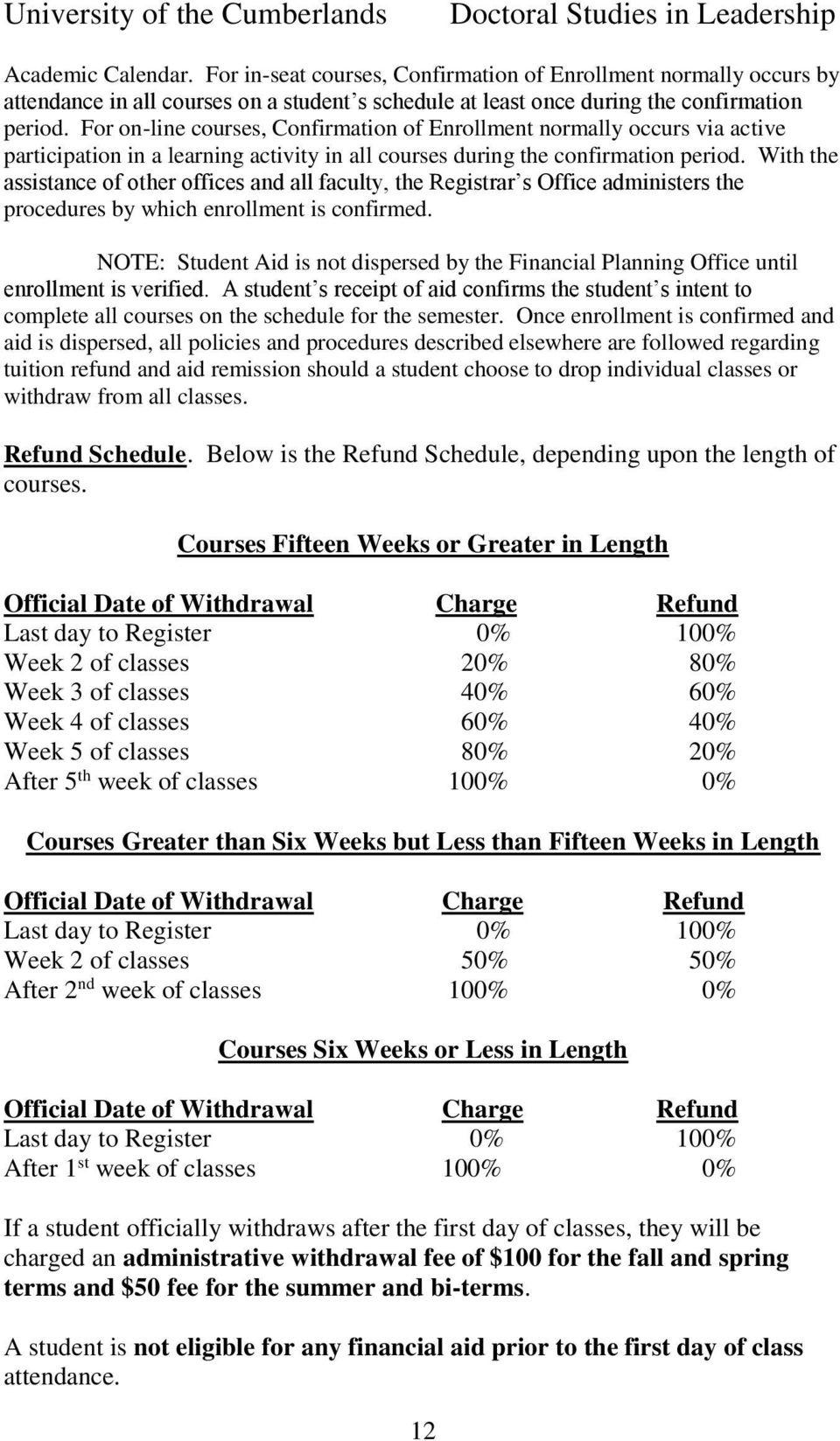
18 Academic Calendar. For in-seat courses, Confirmation of Enrollment normally occurs by attendance in all courses on a student s schedule at least once during the confirmation period. For on-line courses, Confirmation of Enrollment normally occurs via active participation in a learning activity in all courses during the confirmation period. With the assistance of other offices and all faculty, the Registrar s Office administers the procedures by which enrollment is confirmed. NOTE: Student Aid is not dispersed by the Financial Planning Office until enrollment is verified. A student s receipt of aid confirms the student s intent to complete all courses on the schedule for the semester. Once enrollment is confirmed and aid is dispersed, all policies and procedures described elsewhere are followed regarding tuition refund and aid remission should a student choose to drop individual classes or withdraw from all classes. Refund Schedule. Below is the Refund Schedule, depending upon the length of courses. Courses Fifteen Weeks or Greater in Length Official Date of Withdrawal Charge Refund Last day to Register 0% 100% Week 2 of classes 20% 80% Week 3 of classes 40% 60% Week 4 of classes 60% 40% Week 5 of classes 80% 20% After 5 th week of classes 100% 0% Courses Greater than Six Weeks but Less than Fifteen Weeks in Length Official Date of Withdrawal Charge Refund Last day to Register 0% 100% Week 2 of classes 50% 50% After 2 nd week of classes 100% 0% Courses Six Weeks or Less in Length Official Date of Withdrawal Charge Refund Last day to Register 0% 100% After 1 st week of classes 100% 0% If a student officially withdraws after the first day of classes, they will be charged an administrative withdrawal fee of $100 for the fall and spring terms and $50 fee for the summer and bi-terms. A student is not eligible for any financial aid prior to the first day of class attendance. 12
19 No Refund of Tuition or fees will be applied for dropping a course after the last day to add a course for the term has expired. Treatment of Title IV Aid. Below are the regulations concerning Title IV aid when a student withdraws. The law specifies how your school must determine the amount of Title IV program assistance that you earn if you withdraw from school. The title IV programs that are covered by this law are: Federal Pell Grants, Academic Competitiveness Grants, Nation al SMART grants, TEACH Grants, Stafford Loans, PLUS Loans, Federal Supplemental Educational Opportunity Grants (FSEOGs), and Federal Perkins Loans. When you withdraw during your payment period or period of enrollment (your school can define these for you and tell you which one applies) the amount of Title IV program assistance that you have earned up to that point is determined by a specific formula. If you received (or your school or parent received on your behalf) less assistance than the amount that you earned, you may be able to receive those additional funds. If you received more assistance than you earned, the excess funds must be returned by the school and/or you. The amount of assistance that you have earned is determined on a prorated basis. For example, if you completed 30% of your payment period or period of enrollment, you earn 30% of the assistance you are originally scheduled to receive. Once you have completed more than 60% of the payment period or period of enrollment, you earn all the assistance that you were scheduled to receive for that period. If you did not receive all of the funds that you earned, you may be due a postwithdrawal disbursement. If your post-withdrawal disbursement includes loan funds, your school must get your permission before it can disburse them. You may choose to decline some or all of the loan funds so that you don t incur additional debt. Your school may automatically use all or a portion of your post-withdrawal disbursement of grant funds for tuition, fees, and room and board charges (as contracted with the school). The school needs your permission to use the post-withdrawal grant disbursement for all other school charges. If you do not give your permission (some schools ask for this when you enroll), you will be offered the funds. However, it may be in your best interest to allow the school to keep the funds to reduce your debt at the school. There are some Title IV funds that you were scheduled to receive that cannot be disbursed to you once you withdraw because of other eligibility requirements. For example, if you are a first-time, first-year undergraduate student and you have not completed the first 30 days of your program before you withdraw, you 13

20 will not receive any FFEL or Direct loan funds that you would have received had you remained enrolled past the 30 th day. Disability Accommodations University of the Cumberlands accepts students with certified disabilities and provides reasonable accommodations for their certified needs in the classroom, in housing, in food service, or in other areas. Students with disabilities may incur additional costs for services not provided by the University. The University's obligation to reasonably accommodate any student's disability ends where the accommodation would pose an undue hardship on the University or where the accommodation in question would fundamentally alter the academic program. For accommodations to be awarded, a student must complete an Accommodations Application form and provide documentation of the disability to the Disability Services Coordinator. Documentation may include copies of accommodation records from a high school or previously attended educational institution, testing results and evaluation by a licensed psychometrician, and/or statements from a physician describing the disability and the necessary restrictions. When all paperwork is on file, a meeting between the student and the Coordinator will be arranged to discuss possible accommodations before accommodations are formally approved. Students must then meet with the Coordinator at the beginning of each semester before any academic accommodations can be certified for that term. Certifications for other accommodations are normally reviewed annually. All accommodations may be reviewed at any time at the request of the student or of the Disabilities Coordinator. Advising. When accepted into the program, a candidate is assigned an advisor by the Program Director. The candidate meets with this advisor at least once each term to assess progress in the program. The assignment of advisor may change after the student s dissertation topic has been approved. The dissertation director then serves as advisor for the remainder of the program. Degree Time Limit. A candidate should be able to complete the EdD/PhD in approximately three years. If after five years in the program, a candidate has not completed the degree, application must be made for additional time to complete the program. This application will be reviewed and acted upon by the Program Director with the assistance of the EdD/PhD faculty. Candidates may not remain in the program beyond five years unless an application for a time extension has been approved. Such an approval may include the need for additional course work to remain current in the field, as well as other conditions. 14

21 Dissertation Procedures. Possible topics for the dissertation are explored through coursework during the first year of the program. A formal proposal for the dissertation is developed and completed during ELRE/ELROL/LEAR 736, Dissertation Seminar, and ELRE/ELROL/LEAR 839, Advanced Research Methods, taken during the second year of the program. After this proposal is reviewed and approved by the Program Director in consultation with other program faculty who have expertise in the student s area of interest, a dissertation director is formally assigned. This individual henceforth serves as the candidate s advisor. During the coming year, the candidate begins working informally on the project with the aid of the dissertation director. As the student enters the third year, the Director of the program assigns an additional EdD/PhD faculty member and an external faculty member to serve as Dissertation evaluators. At this time the candidate must register for dissertation hours. A minimum of six dissertation hours must be earned, three hours per term. If the dissertation is not ready to be defended after the completion of six dissertation hours, the candidate continues to enroll in dissertation hours each term until the dissertation is completed three hours each term. Dissertation hours are marked IP (in-progress) until the dissertation is completed and defended. At that time, Dissertation evaluators may award the dissertation a passing mark (earning B credit for all dissertation hours) or an honors mark (earning A credit for all dissertation hours). If the Dissertation evaluators find the work unacceptable, the candidate and dissertation director must consult with the Program Director before working further or enrolling in additional hours. Degree Requirements An outline of the courses required to complete the 42-hour core and 18-hour specialty are presented below: Curriculum and Culture. Twelve hours in the degree are earned through four courses that explore various aspects of the academic leader s role in nurturing a sound curriculum and healthy educational culture in the institution. ELCC/ELCOL/LEAC 731 Learning in Adulthood. 3 credit Hours. ELCC/ELCOL/LEAC 835 Teaching and Learning Online. 3 Credit Hours. ELCC/ ELCOL/LEAC 836 Grant Writing and Proposal Development. 3 Credit Hours. ELCC/ELCOL/LEAC 834 Historical Development of Leadership Theories. 3 Credit Hours. Administration. An additional 15 hours are earned through seven courses emphasizing different areas of administrative management. 15
22 ELSA/ELSOL/LEAS 730 The Politics of Organizational Decision-Making. 3 Credit Hours. ELSA/ELSOL/LEAS 732 Program Planning and Assessment. 3 Credit Hours. ELSA/ELSOL/LEAS 830 Leadership in Theory and Practice. 3 Credit Hours. ELSA/ELSOL/LEAS 835 The Change Process. 3 Credit Hours. ELSA/ELSOL/LEAS 833 Higher Education in America. 3 Credit Hours. Research. The remaining 15 hours of the degree are earned through a series of courses focusing on research methods and research activities. The capstone of these courses and of the entire EdD program is ELRE 930, enrolled in for a minimum two semesters to contribute a total of at least six credit hours. ELRE/ELROL/LEAR 734 Inferential Statistics in Decision-making. 3 Credit Hours. ELRE/ELROL/LEAR 736 Dissertation Seminar. 3 Credit Hours. ELRE/ELROL/LEAR 839 Advanced Research Methods. 3 Credit Hours. ELRE/ELROL/LEAR 930, 931, Dissertation. 6 Credit Hours. Content Specialty Area. Eighteen hours are earned in courses in one of these disciplines: business, criminal justice, education, English, history, information systems, mathematics, religion (ministry), psychology or student personnel services. Classes available include but are not limited to those listed below. Some of these courses may be repeated if different topics are covered. Business BADM/BUOL 530 Specialized Studies in Accounting, Business Administration and Marketing Education BADM/BUOL 539 Research and Report Writing BMIS 630 Advanced Educational Applications Approved electives Criminal Justice CROL 531 Foundations in Justice Administration CROL 532 Criminological Theories in Justice Administration CROL 535 Legal and Ethical Issues in Justice Administration CROL 538 Administrative Law and Management CROL 631 Law Enforcement Administration CROL 633 Corrections Administration CROL 634 Critical Issues in Community-Based Corrections Approved electives Education ADOL 631 School Program Improvement ADOL 633 Applied Research ADOL 635 School and Community Relations 16
23 EDOL 533 Educational Technology Approved electives English ENGL/ENOL 534 Studies in British Literature, 3 hrs. ENGL/ENOL 535 Studies in Modern Literature, 3 hrs. ENGL/ENOL 550 Practice of Creative Writing, 3 hrs. Approved electives History HIST/HIOL 531 Selected Topics, 3 hrs. Approved electives Information Systems (IS) ISOL 531 Access Control, 3 hrs. ISOL 532 Telecommunications and Network Security, 3 hrs. ISOL 533 Information Security and Risk Management, 3 hrs. ISOL 534 Application Security, 3 hrs. ISOL 536 Security Architecture and Design, 3 hrs. ISOL 631 Operations Security, 3 hrs. ISOL 632 Business Continuity Planning and Disaster Recovery Planning, 3 hrs. ISOL 633 Legal Regulations, Compliance, and Investigation, 3 hrs. ISOL 634 Physical Security, 3 hrs. ISOL 690 Special Topics, with the approval of the Program Director, ISOL 690 Special Topics may substitute for one required course in the program. 3 hrs. Approved electives Mathematics MATH/MAOL 533 Topics in Math, 3 hrs. MATH/MAOL 534 Abstract Algebra, 3 hrs. MATH/MAOL 535 Real Analysis I, 3 hrs. Approved electives Psychology PSYC/PSYOL 530 Psychology of Religion, 3 hrs. PSYC/PSYOL 538 History and Systems in Psychology, 3 hrs. PSYC/PSYOL 590 Special Topics, 3 hrs. Approved electives Religion/Ministry MMOL 537 Christian Education, 3 hrs. MMOL 538 The Church and Contemporary Culture, 3 hrs. MMOL 639 Ministry Project, 3 hrs. Approved electives 17
24 MMOL 531 Old Testament Survey I, 3 hrs. OR MMOL 532 Old Testament Survey II, 3 hrs. MMOL 533 New Testament Survey I, 3 hrs. OR MMOL 534 New Testament Survey II, 3 hrs. One of the following 600-level courses: MMOL 631 Focused Study of the Old Testament, 3 hrs. MMOL 632 Focused Study of the New Testament, 3 hrs. MMOL 635 Church Administration, 3 hrs. MMOL 637 Planting High Impact Churches, 3 hrs. Student Personnel Services EDOL 631 Advanced Human Behavior LEAC 781 Higher Education and Student Personnel Services LEAC 782 Higher Education Enrollment Management LEAC 783 Higher Education Law and Policy in Student Services BUOL 533 Marketing Management COUN 539 Counseling Theories & Techniques I Fall Year 1 Spring Year 1 Tentative Course Rotation ELSA/ELSOL/LEAS 730 Politics of Organizational Decision- Making, 3 hrs. ELSA/ELSOL/.LEAS 833 Higher Education in America, 3 hrs. ELCC/ELCOL 731 Learning in Adulthood, 3 hrs. ELRE/ELROL/LEAR 734 Inferential Statistics in Decisionmaking, 3 hrs. ELSA/ELSOL/LEAR 732 Program Planning and Assessment, 3 hrs Specialty area elective, 3 hours Summer Year 1 ELSA/ELSOL/LEAS 835 The Change Process, 3 hrs ELCC/ELCOL/LEAS 835 Teaching and Learning Online, 3 hrs. Specialty area elective, 3 hours Fall Year 2 ELSA/ELSOL/LEAS 830 Leadership in Theory and Practice, 3 hrs. ELRE/ELROL/LEAR 736 Dissertation Seminar, 3 hrs. Specialty area elective, 3 hours (Submit dissertation topic by the end of the term; appointment of Dissertation Chair by Program Director; 18
25 file IRB forms with Dissertation Chair) Spring Year 2 ELCC/ELCOL/LEAC 834 Historical Development of Leadership Theories, 3 hrs ELRE/ELROL/LEAR 839 Advanced Research Methods, 3 hrs Specialty area elective, 3 hours Summer Year 2 ELCC/ELCOL/LEAC 836 Grant Writing and Proposal Development, 3 hrs Specialty area elective, 6 hours (Written Comprehensive Exam Completed by the End of the Term; Dissertation evaluators Appointed) Fall Year 3 Spring Year 3 ELRE/ELROL/LEAR 930 Dissertation, 3 hrs ELRE/ELROL/LEAR 931 Dissertation, 3 hrs (Candidates enroll in ELRE/ELROL/LEAR 932, 933, 934, and 935 each term until dissertation is defended. Note also that PhD students must take two additional courses: one in leadership, management, or organizational development and another in research methods or statistics.) NOTE ON DISSERTATION CREDITS AND PROCEDURES: ELRE/ELROL/LEAR 930 and 931 are taken consecutively for 3 credits each. If the dissertation is not completed at the end of ELRE/ELROL/LEAR 931, the candidate enrolls in ELRE/ELROL/LEAR 932 through ELRE/ELROL/LEAR 935 as needed, for 1 credit each term, until the dissertation is completed and defended. The candidate must file Intent to Graduate at beginning of term of intended completion; must schedule Oral Dissertation Defense at least six weeks prior to Intended Date; and must file approved dissertation with Program Director at least two weeks prior to graduation. An IP grade is posted initially for dissertation credits, denoting the dissertation is in-progress. When the dissertation is completed and defended, IP grades are changed to the appropriate letter grade in ELROL/LEAR 930 and ELROL/LEAR 931, while IP s in ELROL/LEAR are converted to S (satisfactory) credits. Core EdD/PhD Courses Course Descriptions ELCC/ELCOL/LEAC 731 Learning in Adulthood. 19
26 Course investigates the adult as learner with special attention given to the impact that aging has on cognition, visual acuity, auditory ability, social interactions, and self-perceptions. The course further explores the various settings and platforms in which learning takes place. Special attention is given to teaching and leading adults. Credit, 3 hours. Students will explain how the aging process impacts learning. Students will contrast pedagogical and andragogical assumptions. Students will demonstrate understanding of structuring learning experiences for adults. ELCC/OL/LEAC 834 Historical Development of Leadership Theories. This course traces the historical development of leadership theory from the classical age to modern times. It will explore the relationship between leaders, leadership theories, and the constraints of a contextual time period upon both the leader and the power structure. The course culminates in a written project that will explore a theme, idea, or historical leader and the events that shaped their leadership methods. The paper should be at least 20 pages in length. Credit, 3 hours. Students will evaluate the classical understanding of leadership, particularly from a Greco-Roman perspective Students will assess the traits, skills, and other characteristics the classical and medieval world considered necessary for strong leaders. Students will examine the changing understanding of leadership as it emerged during the Renaissance with special emphasis placed upon the theories of Machiavelli. Students will explore the early modern and modern concepts of leadership. Special focus will be devoted to the ideas commonly associated with republicanism. Special attention will be devoted throughout the course to the importance of historical context in shaping both the development of leaders and the understanding of leadership theories. ELCC/ELCOL/LEAR 835 Teaching and Learning Online. Course provides the knowledge and skills necessary to effectively develop curriculum and deliver it online. Instruction includes a survey of the history of the distance education movement; types of online learning environments, instructional design strategies, and methods and best practices of teaching and learning online. Discussion is also provided on learning management systems (LMS) and communication management software. Credit, 3 hours. Understand the history of distance education. Identify differences among the types of learning environment: web-enhanced, hybrid, synchronous, and asynchronous settings. 20
27 Compare/contrast the differences among learning management systems and communication management software. Implement instructional design strategies culminating in the design of online course. ELCC/ELCOL/LEAC 836 Grant Writing and Proposal Development. This course examines the variety of federal and private sources for additional funding for educational projects, as well as common strategies for writing grant proposals and managing grant projects. Course activities focus on refinement of writing skills, including development of organizational and goal-setting strategies. Emphasis is also given to developing public relations techniques to cope with the political realities of grant projects. Credit, 3 hours. Students will develop skills in grant and proposal writing, including an understanding of the common expectations by reviewers of vocabulary and organization. Students will become familiar with the types of financial assistance available to educational institutions. Students will understand common processes used by governmental and other agencies to review grant proposals and applications. Students will describe and assess various strategies for managing grant projects. ELSA/ELSOL/LEAS 730 The Politics of Organizational Decision- Making. This course provides an overview of how political activities at the federal, state, and local levels impact the administrative decision-making in an organizational setting. It explores strategies for managing institutional politics to make these activities a constructive component of administration. Credit, 3 hours. Students will trace the impact of politics on the development of specific educational policies and programs. Students will differentiate between constructive and destructive political forces. Students will explore strategies for responding to political opposition to educational proposals with clear and constructive explanation and argument. Students will develop strategies for nurturing collaboration and consensus in the development of institutional policies and programs. ELSA /ELSOL/LEAS 732 Program Planning and Assessment. The course examines the development, delivery, and assessment of academic programs. Emphasis is placed on identifying needs and developing courses 21
28 relevant to organizational and unit mission statements. Methods of assessing program effectiveness are also examined. Credit, 3 hours. Students will explore ways to assess both felt and assessed needs as prerequisite activities in program building. Students will investigate ways in which to develop program goals that support an organization s mission statement and strategic plan. Students will develop course objectives that fulfill program goals. Students will analyze ways to conduct program assessments. Students will examine program assessment data as part of an annual report. ELSA/ELSOL/LEAS 830 Leadership in Theory and Practice. In this home-based project, the candidate applies adult learning theories and leadership principals to an initiative within the home institution or in an educational setting approved by the instructor. The course culminates in a written project that assesses the types of learning and or leadership models used in the initiative as well as the outcome. The paper should be at least 20 pages in length. Credit, 3 hours. Students will collaborate effectively with others on an educational change initiative in an educational or human resource development unit or institution. Students will identify and assess the types of learning and leadership models used in the initiative. Students will write an analysis of the initiative. ELSA/ELSOL/LEAS 833 Higher Education in America. Course provides an overview of the missions of contemporary higher education institutions, including community colleges; private liberal arts colleges; church affiliated universities, public regional and land-grant universities, historically black colleges, as well as proprietary colleges and universities. Particular attention is given to the roles played by various administrative units operating on college campuses, including academic affairs, student-personnel services, and financial affairs and plant operations. Credit, 3 hours. The learner will contrast missions and clientele served by various kinds of institutions that make-up American higher education. The learner will examine diverse departmental cultures and missions of academic departments, fiscal affairs, student services, and physical plant operations operating on college campuses. The learner will analyze the forces affecting leadership directed toward institutional viability. ELSA/ELSOL/LEAS 835 The Change Process. 22
29 The course offers an interdisciplinary approach to the management of the change process with respect to individuals, groups, local community, and the American society. Drawing on concepts from the psychology of learning, human resource management, and sociology, the course looks at how educators and various social and political forces, including government policies and court decisions, interact with local culture to impact individual and corporate human behavior. Credit, 3 hours. Students will synthesize an interdisciplinary perspective on how individuals and groups respond to change initiatives. Students will contrast major learning theories. Students will contrast adult learning characteristics with children. Students will analyze major leadership models. Students will conduct an in-class change procedure. ELRE/ELROL/LEAR 734 Inferential Statistics in Decision-making. This course focuses on the descriptive and inferential statistics commonly used in organizational administration. Course activities include the application of statistical methods to research design, as well as an investigation of how these methods can contribute to school improvement. Specific concepts include measures of central tendency and variability, probability theory, estimation and significance, and correlation and regression. Credit, 3 hours. Students will define and describe the essential characteristics of quantitative research. Students will apply inferential statistical tests on problems requiring parametric and non-parametric analyses. Students will identify potential research designs for various problems. Students will analyze and critique statistical information in the professional literature on a topic related to their own research project. ELRE/ELROL/LEAR 736 Dissertation Seminar. This course provides guided instruction on the design and writing of a dissertation proposal focused on school-based research. Course activities are intended to strengthen skills in writing, project design, and research methods. Prerequisite: ELRE/OL 734. Credit, 3 hours. Students will recognize the components of a sound dissertation proposal. Students will articulate clearly the focus of their dissertation research. Students will identify and assess literature relevant to their dissertation project. Students will design a sound methodology for gathering/presenting data on their research. ELRE/ELROL/LEAR 839 Advanced Research Methods. 23
30 The course is designed to provide doctoral students with an in-depth analysis of the methods and procedures of research used in the various subfields of education. Topics include conceptualizing research designs, writing research proposals, constructing measurement instruments, collecting and analyzing qualitative and quantitative data, and drawing inferences. Special attention is given to making sound decisions regarding the selection of appropriate designs and methods for investigating research questions. The student will develop a proposal that will, upon approval of the student s advisor and program director, serve as the first three chapters of student s dissertation. Prerequisites: ELRE/ELROL/LEAR 734 and 736. Credit, 3 hours. Students will write a rationale and introduction for a dissertation proposal which must be based on a topic or problem related to administration in either K-12 or higher education settings. Students will construct a substantial literature review on a topic or problem related to administration in either K-12 or higher education settings. Students will design and write an appropriate methods chapter for a dissertation proposal. Students will successfully obtain approval from the course instructor and his/her advisor for a three-chapter dissertation proposal. ELRE/ELROL/LEAR 850 Qualitative Research Methods. The course is designed to provide doctoral students with an in-depth understanding of qualitative methods and procedures of research. Topics discussed will include epistemology, the use of logic and drawing conclusions, the role of deduction, detection of logical fallacies and false argumentation, and the forms of qualitative study: Narratives, phenomenologies, ethnographies, grounded theory, and case studies, conceptualizing research designs, the collection and analyzing data/research, and drawing inferences. Special attention is given to making sound decisions regarding the selection of appropriate designs and methods for investigating research questions. Prerequisites: ELRE/ELROL/LEAR 736 Dissertation Seminar; ELROL/LEAR 839 Advanced Research Methods. Students will select a topic suitable for qualitative research. Students will design and explain a proper qualitative method and theory to structure their research. Students will write an appropriate Introduction to their qualitative dissertation proposal; for students completing the course to satisfy the research requirements for the PhD, the work in ELROL/LEAR 850 must be applicable to a research project worthy of consideration for the introduction to a potentially publishable study. Students will review various forms of logic, and they will discuss how to avoid logical fallacies in their work. 24
31 Students will review secondary literature to discuss and detect methodological and logical approaches in the secondary literature; subject to approval of the instructor, students may rework material drafted for ELROL/LEAR 736 and ELROL/LEAR 839. ELRE/ELROL/LEAR 930, 931, Dissertation. These courses are an independent application of research, design, and methodology that leads to the completion of an original research study under the guidance of the student s Dissertation Director. Subject to the final approval of the Dissertation Director and evaluators, the degree candidate writes the dissertation and prepares for its oral defense. ELROL/LEAR 930 and 931 are taken consecutively for 3 credits each. Prerequisites: all coursework, including those in the content specialty area, needs to be completed; Comprehensive exams need to be successfully passed; and IRB approval must be secured. Advisor approval is also necessary to register for the 930 sequence; if the dissertation is not completed at the end of ELROL/LEAR 931, the candidate enrolls in ELROL/LEAR 932 through ELROL/LEAR 935 as needed, for 1 credit each term, until the dissertation is completed and defended. Prerequisites: all program course work. Credit, 1-3 hours. Students will organize and implement a practitioner-based educational research project. Students will gather, critique and synthesize professional literature related to their research topic. Students will manage and interpret data gathered in the course of their research. Students will communicate effectively the nature and results of their research. An IP grade is posted initially denoting the dissertation is in-progress. When the dissertation is completed, IP grades are changed to the appropriate letter grade in ELROL/LEAR 930 and ELROL/LEAR 931, while IP s in ELROL/LEAR are converted to S (satisfactory) credits. Additional Coursework for the PhD In addition to the courses listed for the EdD track, PhD candidates must also complete the following as part of their core hours: Three hours selected from ELROL/LEAR 850 Qualitative Research Methods; PSYOL 540 Biostatistics; CROL Research, Design and Analysis; or CROL Statistical Applications in Justice Administration. 25
32 Three hours selected from BUOL Organizational Behavior or CROL 537 Leadership Fundamentals. Business BAOL Managerial Accounting. This course focuses on managerial accounting concepts, including costing, budgeting, forecasting, planning and control. Emphasis is on preparing and using financial statements as well as various managerial reports for decision-making. Credit, 3 Hours. BUOL Current Issues in Business. This course investigates and evaluates current topics or specialized areas of business. The focus for each section will vary each term to complement the corresponding core business courses currently being taught. Emphasis is placed on exploration into areas pertinent to the current business environment such as customer service and leadership. Course topics are announced the semester preceding the offering. This 1-credit course must be repeated three times on different topics. Prerequisites are to be designated for each specific offering. BUOL Organizational Behavior. This course is the study of individual and group behavior within diverse organizations. Examination of organizational structure, processes, norms and values is included. Emphasis is given on the topics of leadership, management styles, organizational fit and change, motivation, group dynamics, and business process efficiency. Credit, 3 Hours. BUOL Marketing Management. This course acquaints the student with the seminal concepts and models appropriate for marketing management. Course content and experiences will allow students to develop the knowledge base and skills necessary for devising and implementing strategic marketing plans which complement organizational goals. Credit, 3 Hours. BUOL Managerial Finance. This course focuses on the advanced study of financial topics, including capital budgeting, risk and cost of capital, capital structure of the firm, financial analysis, and leverage and time value of money. It provides students practical decision-making and problem solving using real world examples. Credit, 3 Hours. BUOL Managerial Economics. This course focuses on case analysis using microeconomic theory and statistical techniques to aid in decision-making processes. Topics include demand and cost analysis, pricing in different market and risk conditions, forecasting methods and constrained optimality. Credit, 3 Hours. 26
33 BUOL Legal, Ethical, and Social Environment. This course is a study of the appropriate roles of business in society, the constraints placed on business by the legal system and government regulation, and the ethical responsibilities of managers. It provides students with an understanding of how the law and the political process affect business strategy and decision making, including the various means and procedures for resolving legal disputes in business matters. The course highlights ethical conflicts and dilemmas, and provides plausible frameworks for dealing with those conflicts. Credit, 3 Hours. BUOL Management of Investments. This course focuses on the study of the principles of investments, including the supply of and demand for investment funds; types of stocks, bonds, and other investments; the functions of securities markets; the analysis of different types of securities; and the government regulation of the securities market. The course focuses on investment management decisions and their impact on other functional business elements. Credit, 3 Hours. BUOL Research and Report Writing. This course focuses on developing skills to engage in research, write persuasive and informative business documents, and create and deliver effective presentations. Students will have opportunities to work individually and collaboratively. Credit, 3 Hours. BUOL Managing in a Global Environment. This course provides a study of the involvement of American firms in the international community with special emphasis on the impact of foreign competition on domestic markets, management of multinational enterprises and decision-making in the international environment. Credit, 3 Hours. BUOL Advanced Human Resource Management. Advanced Human Resource Management is the study of contemporary topics related to effective management of human resources. This course emphasizes in depth research and analysis of the interrelationship of the human resource function in a dynamic business environment. Credit, 3 Hours. BUOL Strategic Decision-Making. This capstone course integrates the knowledge learned from all functional areas in business into a strategic plan. In addition to reviewing key concepts of business and corporate strategy, the course addresses traditional approaches to industry and competitor analysis and competitive advantage, and contemporary extensions and refinements of these concepts. Analytical tools and techniques are demonstrated through case studies focusing on the relationship between an organization and its environment, competition, market entry, vertical integration, diversification, global competition, and strategic alliances. This capstone course must be completed at University of the Cumberlands. Prerequisites: BACC 531, BADM 532, BADM 533, BADM 534, and BADM 535. Credit, 3 Hours. 27
34 BUOL Advanced Management Information Systems. This course explores major components and architectural models of computer information systems, including information concepts; information flow; types of information systems; the role of information in planning operations, control, and decision making; and integrated information systems across a range of functional elements. Course work emphasizes various strategies and best practices for the management of data necessary for efficient and successful business operations. Credit, 3 Hours. BUOL Special Projects in Business and Related Subjects. Special Projects is designed to allow students to conduct in depth investigation, research, and analysis of current topics or specialized study in a specific area of business. The course may be retaken under different subtopics for a cumulative total of 6 hours. Criminal Justice CROL Foundations in Justice Administration. This course is an overview of all the knowledge and skills of an administrator in the justice system. These skills include the ability to budget an organization with monetary limitation, the aptitude to know what needs the public has at a given time, and the resources to form professional integration and evaluation plans for new policy. This course will also be an overview of professional administrative ethics and morals, and an analysis of effective managerial processes as it pertains to civil liability. (3 credit hours) CROL Criminological Theories in Justice Administration. This course provides an overview of the founding principles of the major criminological theories, including sociological, biological, economic, environmental, and psychological theories about the etiology of crime. Theories can be empirically validated and translate their principles into policy will be examined, also in terms of the context in which they were presented and their implications on the justice administrative system (3 credit hours) CROL Legal and Ethical Issues in Justice Administration. This course explores professional ethical and legal issues and boundaries. The discussion will weave through various points of interest such as corruption, codes of ethics, race/gender discrimination, ethical, moral and design flaws in research settings, and use of force. The course will stay to the point of ethical issues faced by all criminal justice professionals in today s society, and how to deal with the results of each predicament. (3 credit hours) CROL Administrative Law and Management. This course investigates the legal, binding principles that govern criminal justice agencies. The 28
35 conceptual ideas behind managing a criminal justice organization will be placed on the forefront of this course. Contemporary issues and policies that public administrators have to deal with on a daily basis will also be at the center of this course. (3 credit hours) CROL Law Enforcement Administration. This course examines the best way to enforce the law, policing administration, internal affairs as it relates specifically to policing institutions, and managing special units. Students will also learn about the trends in community policing, restorative justice programs and crime prevention, and contemporary issues in policing structure as it relates to administrative purposes. (3 credit hours) CROL Corrections Administration. This course provides an overview of the most significant issues to correctional facilities, officers and those within the criminal justice system. This course seeks to provide an examination of the harsh realities afforded by corrections systems, physical and mental health problems within the corrections system, gangs and their separate issues, and women in prison. The privatization of prisons is also a topic that will be discussed, along with the use of contemporary technology in the corrections system. (3 credit hours) CROL Critical Issues in Community-Based Corrections. This course provides an overview of the most significant issues to correctional facilities, administrators, officers and those within the criminal justice system. This course examines the harsh realities afforded by corrections systems, physical and mental health problems within the corrections system, gangs and their separate issues, and women in prison. The privatization of prisons is also a topic that will be discussed, along with the use of contemporary technology in the corrections system. (3 credit hours) Education (K-12) EDAD/ADOL Introduction to Educational Administration. This course reviews the theories of administration and practice at the district and community levels. This class is designed to introduce the student to the theories and concepts of administration including personnel, finance, law, school organization and curriculum. Research studies which have been completed by state and regional administrative groups and frequent seminars in administration are held. Credit, 3 Hours. EDAD School Program Improvement. This course identifies some of the innovative research and programs driving school improvement. Initiatives 29
36 currently in place in America s schools will be discussed and examined. Further, the course provides the student with ways to access current educational conditions at the school and district level as well as provide suggestions regarding instituting change. Credit, 3 Hours. EDAD/ADOL Human Resource Management and Supervision. This course is a study of the role of the school administrator in managing the human resource function. Included in this course is a study of the organizational dimensions of the personnel function, along with planning, recruitment, selection, placement, development, and appraisal of the individual. This course also deals with the school administrator in his/her capacity as supervisor of the human resources of the school. In addition, the legal aspects of Human Resource Administration are discussed. Credit, 3 Hours. EDAD/ADOL Business Management in Public Schools. This course analyzes the principles, practices, policies, revenues and expenditures of school funds and school resource allocation at the district and school level. Special attention is given to school budgeting. Other topics in this course may be discussed featuring but not limited to finance formulas, financial accounting, purchasing and supply problems, school construction, school equipment, and school insurance. Credit, 3 Hours. EDAD/ADOL The Politics of School and Community. The purpose of this course is to provide a critical understanding of the political and social forces shaping educational politics in the United States. During the course, students will analyze how policy is made for American schools, and its effect on all of our lives and thinking. Students will be able to demonstrate an understanding of the complex interrelationship between politicians, private foundations and think tanks, teachers, unions, special-interest groups, educational politicians, school administrators, boards of education, courts, and the knowledge industry. Credit, 3 Hours. EDAD/ADOL School Law I. A course that is designed to provide basic legal information to the educational professional. Students in this course examine court decisions at both the federal and state level. Topics examined in this class include teacher dismissal and non-renewal, the rights of students and teachers, religious expressions in the school, etc. Credit, 3 Hours. EDAD/ADOL School Law II. This course continues the goals of EDAD 636 and places additional emphasis in specific areas of school law including Special Education, government requirements such as the Americans with Disabilities Act (ADA), Occupational Safety Health Administration (OSHA), and other state and federal requirements. Students in this class will additionally conduct research on a legal issue of their choosing. Pre-requisite: EDAD/ADOL 636. Credit, 3 Hours. 30
37 EDAD/ADOL The Supervisor. This course examines the role of the school supervisor at the three levels of public schools. The course provides an analysis also of the duties and responsibilities of supervisors assigned to specific subjects and grade levels. Credit, 3 Hours. EDAD/ADOL School Superintendency. This course analyzes the role of the school superintendent in public education. Content knowledge, job expectations, and job descriptions are addressed. Also addressed are ways in which the superintendent s position can be used in order to generate educational improvement. Credit, 3 Hours. EDAD/ADOL School System Administration. This course examines and analyzes the daily job responsibilities of a public school superintendent including areas such as financial management, instructional support and improvement, the management of and planning for school facilities and federal program management. Credit, 3 Hours. EDAD/ADOL Strategic Management in Education. This course is designed to prepare the master teacher and practicing school administrator for developing, evaluating and managing curricula. It will also examine the national, state, district and school roles in curricular matters including data analysis based on schools' continuous improvement plan. Further, this course will address the importance of the school portfolio as an effective way to exhibit a school's goals, achievements, and vision for improvement. Credit, 3 Hours. EDAD/ADOL Special Education and School Leadership. The administration of the special education program in public and private schools is a significant component of an administrator s duties. This course seeks to familiarize prospective school administrators with the laws of special education and other laws related to handicapped children in schools. Three legislative enactments IDEA, Section 504, and the Americans with Disabilities Act (ADA) will be addressed. The course also focuses on related topics including; (1) due process hearings, (2) remedies available to parents and school districts, (3) school records, (4) the identification and evaluation of children with disabilities including the process for evaluations, individualized education plans, placement, notice and consent, (5) discipline and (6) best practices for establishing a working relationship with parents of special education students. Credit, 3 Hours. EDAD/ADOL Practicum: Principalship. A course designed to allow the student to gain practical experience in the everyday supervision management and leadership of a school. The student will work under the guidance of a public school principal or other administrator for seventy-five (75) or more clock hours. The hours must be divided into the different areas of the Principalship 31
38 including budget/finance, personnel, curriculum issues, community relations and transportation if possible. Formal documentation is required. The college professor will direct the practicum and provide in-class time for study, analysis, and reflection. This course has a $75 fee. This course should be taken at the end of the program. Permission of Department Chair required. Credit, 3 Hours. EDAD/ADOL Practicum: Supervisor of Instruction. Supervised practicum designed to provide experiences at the elementary, middle, and high school level. The student, acting under the supervision and direction of one or more supervisors for 100 hours, will perform all the normal functions of a Director Pupil Personnel including program evaluation and improvement. The 100 hours will be divided between two different schools. Formal documentation is required. The college professor will direct the practicum and provide in-class time for study, analysis, and reflection. This course has a $75 fee. This course should be taken at the end of the program. Permission of Department Chair required. Credit, 3 Hours. EDAD/ADOL Practicum: Director of Pupil Personnel. Supervised practicum designed to provide experiences at the elementary, middle, and high school level. The student, acting under the supervision and direction of one or more supervisors for 100 hours, will perform all the normal functions of a Director Pupil Personnel including program evaluation and improvement. The 100 hours will be divided between two different schools. Formal documentation is required. The college professor will direct the practicum and provide in-class time for study, analysis, and reflection. This course has a $75 fee. This course should be taken at the end of the program. Permission of Department Chair required. Credit, 3 Hours. EDAD/ADOL Practicum: Director of Special Education. Supervised practicum designed to provide experiences at the elementary, middle, and high school level. The student, acting under the supervision and direction of one or more supervisors for 100 hours, will perform all the normal functions of a Director of Special Education, including program evaluation and improvement. The 100 hours will be divided between two different schools. Formal documentation is required. The college professor will direct the practicum and provide in-class time for study, analysis, and reflection. This course has a $75 fee. This course should be taken at the end of the program. Permission of Department Chair required. Credit, 3 Hours. EDAD/ADOL Practicum: School Superintendent. Supervised practicum designed to provide experiences at the elementary, middle and high school level. The student, acting under the supervision and direction of one or more supervisors for 100 hours, will perform all the normal functions of a superintendent including program evaluation and improvement. The 100 hours will be divided between two different schools. Formal documentation is 32
39 required. The college professor will direct the practicum and provide in-class time for study, analysis and reflection. This course has a $75 fee. This course should be taken at the end of the program. Permission of Department Chair required. Credit, 3 Hours. EDUC Evaluation, Measurement, and Assessment. A survey of materials and procedures in the diagnosis of pupil needs and difficulties; the place and use of measurement in guidance, instruction, and evaluation; types of tests, test construction, rating techniques, and the measurement of aptitudes and abilities. Credit, 3 Hours. EDUC/EDOL Educational Technology. This class is a survey of the field of educational technology. It surveys the pedagogical applications of widely used media, materials and technology that form part of the knowledge and skills that modern teachers should possess to instruct students in the classroom. Reviewing websites, selecting software, surfing the internet, construction of classroom web pages and using other Internet protocols and software to supplement classroom instruction are all possess that modern teachers should be familiar with and be able to handle well to enhance their teaching skills. Credit, 3 Hours. EDUC/EDOL The Middle School. Provides students with a conceptual framework and a practical guide for teaching in the middle school. The objectives of this course are to understand the differences between middle school and junior high; to explore the history of the Middle School Movement; to become familiar with defining characteristics of middle schools; and to study the behaviors and learning of middle school students. This course includes a field experience component. Credit, 3 Hours. EDUC/EDOL The Modern Secondary School. This course provides students with a conceptual framework and a practical guide for teaching a variety of courses at the secondary school level. The course features a study of current methods and materials for approved subject areas in secondary school. Emphasis is placed on planning for instruction, the selection and implementation of appropriate teaching models, instructional materials, instructional delivery, and evaluation techniques. Field Hours Required. Credit, 3 Hours. EDUC/EDOL Modern Elementary School. This course seeks to explore and analyze contrasting strategies for the instruction and assessment of elementary school students as well as to examine the infusion of technology and software applications into student instruction and assessment. Students will research and compare and contrast curriculum standards for Kentucky and other states. New and innovative practices for effective and appropriate classroom, school-wide, and district policies will also be examined. Attention will focus on reducing the achievement gap between sub-populations. Credit, 3 Hours. 33
40 EDUC/EDOL Advanced Human Behavior. Study of the lifespan from conception to young adulthood is studied with emphasis upon biological, intellectual, and psychosocial development. Also included are units on exceptional pupils and understanding of multicultural education. Credit, 3 Hours. EDUC/EDOL Instructional Leadership in Technology. Technology is constantly expanding and changing the way we teach and learn. Instructional leaders are called upon everyday to make ethical and important decisions about what technology to use and how to use it in the classroom. Consequently, courses in educational technology are becoming critical part of teacher education programs across the curriculum. By completing this course, students will be equipped with skills that they need to meet the challenges posed by technology in a modern classroom. Credit, 3 Hours. EDOL Problems in Education. An examination of principles and practices, changing goals and processes in Education. Analysis of topical problems faced by society in shaping educational programs in the school. May be taken more than once. Credit, 3 Hours. EDUC/EDOL Supervision of Student Teachers. The nature and role of supervision, techniques of observation, constructive counseling, evaluation and aids to the teacher in the school. Credit, 3 Hours. EDAD/ADOL School Program Improvement. This course identifies some of the innovative research and programs driving school improvement. Initiatives currently in place in America s schools will be discussed and examined. Further, the course provides the student with ways to access current educational conditions at the school and district level as well as provide suggestions regarding instituting change. Credit, 3 Hours. EDUC/EDOL Change, Professional Development and Teacher Improvement. This course is intended to provide advanced candidates with an overview of various planning and decision-making models that are appropriate for district and campus planning. Focus will be placed on the complex roles and responsibilities of the teacher leader at the elementary, middle and secondary levels. The course provides a framework for new visions of learning and strategies for restructuring classrooms and schools whit professional development while remaining mindful of the need for stakeholder engagement. Instructional methodology will include site-based experiences, group discussions and simulations, electronic communications, research studies, identification of effective practices, interaction with practitioners in administration, and personal reflection. Credit, 3 Hours. 34
41 EDUC/EDOL Diversity in a Multicultural Society. This course is designed for classroom teachers and other school personnel to explore the role that culture plays and has played in our lives, classrooms, city and country. The impact of race, class, gender, sexual orientation, and other aspects of social group identities on teaching and learning as they relate to contexts both in and out of schools will be examined. Students will analyze the nature and manifestations of culture, the concepts of cultural contact, and the history of cultural diversity in the United States and particular in the classroom. Dynamics of prejudice and biases are studied, and emphasis is placed on delineating curriculum and practices that honor, motivate, and empower all students. Examination of personal biases and identification of areas of deficient knowledge is encouraged. Credit, 3 Hours. EDUC/EDOL Internet and Web Design for the Modern Teacher. This course will allow learners to develop, implement, and produce a plan to create a functional and informative website that they will publish on the Internet. Candidates will analyze ways web publishing can foster interaction among students and identify differences between administrative and instructional uses of a website. Students will also employ various strategies to design a website and use tools needed to publish on the Web. Credit, 3 Hours. EDUC/EDOL Curriculum Management and Assessment. This course is designed to prepare the master teacher and practicing school administrator for developing, evaluating and managing curricula. It will also examine the national, state, district and school roles in curricular matters including data analysis based on schools continuous improvement plan. Further, this course will address the importance of the school portfolio as an effective way to exhibit a school s goals, achievements, and vision for improvement. Credit, 3 Hours. EDUC/EDOL Best Practices for Coaching and Mentoring Teachers. The purpose of this class is to equip teacher leaders with the theoretical understanding, knowledge and skill necessary to coach and/or mentor first and second year teachers as well as other teachers wishing to examine their practice. This course will focus on the development of the knowledge and skills to assist teachers in developing a cycle of reflective practice and improving their pedagogy. Teacher leaders will also learn and apply key features of adult learning and development. Additional topics will include building rapport among colleagues, conducting classroom observations, developing effective listening and questioning skills, providing constructive feedback to colleagues, and fostering a collaborative working environment among all stakeholders. The course will seek further to engage and seek input from local school districts regarding specific areas of concern derived in part from formal and informal teacher observation. Credit, 3 Hours. 35
42 READ/REOL Reading and Writing Foundations. This course is designed as an introductory course in reading. Basic skills in readiness, word recognition, comprehension, study skills, and rate will be emphasized. Different approaches to the teaching of reading (basal, LEA, linguistics, and integrated literature content area reading). This course is a required prerequisite to ALL READING COURSES. (Exception: students who have satisfactorily completed ELEM 331 and ELEM 338 or their equivalents.) Credit, 3 Hours. Special Education SPED/SPOL Issues and Trends. This is a course of directed study designed to explore current trends and issues in the education of students with disabilities. Topics include most recent legislation that outlines the categories for eligibility, and issues affecting the identification of individuals with disabilities, and educational programming. This course is a prerequisite for students entering the special education program for certification (SPED 233 may also be a prerequisite option). This course may be taken as the special education requirement for students in the leadership program. Credit, 3 Hours. SPED/SPOL Middle and Secondary School: Transition. This is a course of directed study designed to explore the area of career education, transition, and practices at the middle and secondary school levels that support successful community integration of individuals with disabilities. Course topics include characteristics of adolescents, current outcomes for individuals with disabilities, learning strategies, and methods and materials appropriate for adolescents. Other topics include school drop-out prevention, family centered planning, self-determination training, and supported employment. Credit, 3 Hours. SPED/SPOL Special Education Evaluation. Principles of evaluation regarding the areas of academic, social, and personal characteristics of individuals with disabilities. Evaluation as a basis for program design and management is emphasized. Credit, 3 Hours. SPED/SPOL Consultation and Collaboration for Curriculum Design. This course is designed to assist teachers in collaborating and consulting with colleagues regarding specially designed instruction for individuals with disabilities. Knowledge and skills include designing, adapting, and evaluating materials, methods, and resources for individuals with a variety of characteristics. Teaching the core curriculum is included. Various models of instruction including strategic teaching are explored. Communications skills and barriers to professional relationships are discussed. Assistive technology, adaptive devices and equipment are discussed. Field experience is required. Credit, 3 Hours. 36
43 SPED/SPOL Working with Parents of Students with Disabilities. This course is designed to prepare teachers to interact appropriately with parents of students with disabilities. The course includes the development of competencies in conducting parent conferences, interviews, home-family assessments, and parent training programs. Credit, 3 Hours. SPED/SPOL Classroom and Behavior Management for Individuals with Disabilities. This course is designed to prepare teachers to perform functional assessments of behavior and social skills in educational settings. This course includes designing and implementing instruction using operant conditioning or behavior modification techniques as well as social skills instruction and personal adaptation instructional techniques. General principles of classroom management are included. Credit, 3 Hours. SPED/SPOL Characteristics of Autism Spectrum Disorders. This course is designed to provide the student with readings, discussions and related activities to the recognition of behaviors associated with autism spectrum disorders (ASD). Autism spectrum disorders diagnostic assessments and rating scales will be reviewed to identify those children with autism, and Asperger s syndrome, and to distinguish these disabilities from Rett s syndrome. The emphasis of this course will be on the identifying characteristics of ASD in students and the best practices of instructing those students. Credit, 3 Hours. ENGLISH ENGL/ENOL Writing Instruction for the Content Areas. This course teaches the methods of including writing exercises and projects into all curricular divisions. The intent is to show teachers in fields other than English that writing can become an integral academic component in their fields in grades K-12. Students will study research in the field of writing across the curriculum and develop a variety of daily and unit plans that incorporate writing experiences. Credit, 3 hours. ENGL/ENOL Methods and Materials for Teaching English This course is the study of methods and materials suitable for teaching English at various public school grade levels. The intent is to introduce teachers to the burgeoning theories of teaching the various elements of an English class. Students will research the field of English instruction; develop a variety of daily and unit plans that incorporate new techniques and theories, practice writing evaluation, and study strategies suitable to English instruction. ENGL/ENOL 534 Studies in British Literature. This course offers an indepth study of a specific period and/or genre of British literature. The particular focus of the course will change from year to year. Common topics will be romantic literature and Victorian fiction. Other potential topics could be non- 37
44 Shakespearean Renaissance drama, Restoration drama, the eighteenth-century novel, and Victorian poetry. Students will produce a research paper/project commensurate with the Department s standards for graduate level classes. Credit, 3 hours. Offered every spring semester. ENGL/ENOL 535 Studies in Modern Literature. This course examines a varied combination of English, American, and world literature of the twentieth century. The specific focus will change from year to year. A given course may be organized according to genre (fiction, poetry, or drama), topic (e.g., the Southern Renaissance, expatriate literature of the 1920's or the Irish Literary Revival), or representative and related authors (such as "Joyce, Yeats, Eliot" or "Williams, Miller, O'Neill"). Students will produce a research paper/project commensurate with the Department s standards for graduate level classes. Credit, 3 hours. Offered every fall semester. ENGL/ENOL 550 The Practice of Creative Writing. Students in this course will be introduced to the fundamentals of writing literary fiction, poetry, and creative nonfiction through the analysis of technique in published work and through the development and revision of original creative writing. This course is appropriate for absolute beginners and for writers who have worked well in one or more genres and want to expand their range. Students will produce a portfolio that includes a self-analysis and work in three genres: fiction, creative nonfiction, and poetry. HISTORY HIST/HIOL Methods and Materials for Teaching Social Studies. An analysis of content area, methodology, and instructional techniques; application of methods to the skill and content area of social studies. Credit, 3 Hours. HIST/HIOL 531 Selected Topics. The detailed study of a particular historical subject. This course may be taken in conjunction with an undergraduate course, depending upon the topic, with the approval of the student s advisor and the chairman of the Department. Topics such as Early America and Russia could be covered. This course may be repeated up to 18 hours with the approval of the chairman of the Department. Students will produce a research paper/project commensurate with the Department s standards for graduate level classes. Course credit, 3 hours. Offered as needed. HIST/HIOL Social Studies Subject Matter Resources. Provides a comprehensive study of the bibliographic and instructional resources available to secondary teachers. Credit, 3 Hours. 38
45 Information Systems (IS) ISOL 531 Access Control. The course provides an in depth study of the three main security principles: availability, integrity and confidentiality. The course examines mechanisms used to control what resources an entity can access, and the extent of the entity s capabilities to interact with the resource. The course also examines approaches to auditing how the entity interacts with the resource. 3 hours. ISOL 532 Telecommunications and Network Security. The course provides fundamental concepts of networking including: examination of public and private communication systems, networking topologies, devices, protocols, and remote access. It additionally explores strategies on identifying areas for security vulnerabilities on networks. 3 hours. ISOL 533 Information Security and Risk Management. The course provides a methodology to identify an institution s information technology assets, the proper way to determine the necessary level of protection required, and techniques for developing budgets for security implementations. 3 hours. ISOL 534 Application Security. This course discusses methods to increase the security of application development and thwart attacker attempts to manipulate code. It also explores the software lifecycle and change control to reduce the probability of poorly written applications that allows an attacker to exploit coding errors. Database development models will be introduced focusing on choosing the best model to increase security. 3 hours. ISOL 535 Cryptography. The course examines methods and techniques for concealing data for security purposes. Topics covered will include cryptographic techniques, approaches and technologies. 3 hours. ISOL 536 Security Architecture and Design. The course focuses on the concepts and standards for designing and implementing secure software systems. 3 hours. ISOL 631 Operations Security. The course examines controls over personnel, hardware, software, and systems. It also covers possible abuse channels and proper countermeasures. 3 hours. ISOL 632 Business Continuity Planning and Disaster Recovery Planning. The course examines the preservation of business activities when faced with disruptions or disasters. It involves the processes that are used to create a business continuity and disaster recovery plan and strategies for critical resource recovery. 3 hours. 39
46 ISOL 633 Legal Regulations, Compliance, and Investigation. The course examines computer crimes, laws and regulations. It includes techniques for investigating a crime, and gathering evidence. It also covers techniques for creating incident reports. 3 hours. ISOL 634 Physical Security. The course examines risks, threats, and countermeasures to secure data, personnel and hardware. This involves facility creation and selection concerns, facility access control methods, and safety issues. 3 hours. ISOL 690 Special Topics. The course presents special topics of interest in the domain of information security and information governance. Topic areas might include business continuity planning, legal and regulatory compliance issues and operations security. With the approval of the Program Director, ISOL 690 Special Topics may substitute for one required course in the program. 3 hours. ISOL 699 Information Security Project. All students are required to demonstrate the ability to clearly evaluate a particular information security need, identify potential solutions, evaluate the alternatives, and implement the best solution. This project will draw upon portfolio case assignments completed in previous courses to produce a complete solution for the assigned problem. It will be evaluated using the same rubric that was used to assess the individual course portfolio assignments. 3 hours. MATHEMATICS MATH/MAOL Methods and Material for Teaching Math. The study of the methods and materials suitable for teaching Mathematics at various public/private school grade levels. The intent is to introduce teachers to the everincreasing theories of teaching the elements of mathematics in the curriculum. Students will take an active approach to teaching mathematics to learners. All students will study current relevant research in the field of mathematics instruction, develop a variety of daily and unit plans that incorporate new and current techniques and theories, practice evaluation techniques and to be introduced to other aspects which classroom. Credit, 3 Hours. MATH/MAOL 533 Topics in Mathematics. Topics are generally selected from complex variables, number theory, numerical analysis, and problems research in mathematics or mathematics education. Students will produce a research paper/project commensurate with the Department s standards for graduate level classes. Prerequisite: MATH 241 or the equivalent. Credit 1 to 3 hours each topic. A topics course is offered on demand. MATH/MAOL 534 Abstract Algebra. Topics covered include structure of the number systems, groups, mappings, rings, fields, sets, and metrics. Students 40
47 will produce a research paper/project commensurate with the Department s standards for graduate level classes. Prerequisite: MATH 241 or the equivalent. Credit, 3 hours. Offered fall semesters. MATH/MAOL 535 Real Analysis I. This is the study of partial differentiation, application of partial differentiation, line and surface integrals, and Fourier series. Students will produce a research paper/project commensurate with the Department s standards for graduate level classes. Prerequisite: MATH 241 or the equivalent. Credit, 3 hours. Offered fall semesters. MATH Topics in Mathematics II - Topics are selected from statistics, calculus, and Mathematical structure and analysis. May be repeated. Credit, 3 Hours. MATH Topics in Geometry. Designed for both the student in the field of education and for the student pursuing further study in mathematics. The student is provided the opportunity to study Euclidean Geometry as an axiomatic system and the work completed in this course is intended to serve as resource material for teaching geometry in the public school, for teaching geometry in the junior college or college and in further mathematics study. Credit, 3 Hours. PSYCHOLOGY PSYC/ PSYOL Introduction to Mental Health Counseling. This course is an overview and examination of Mental Health Counseling as a helping profession. It is designed to assist the student in developing his/her professional identity as a counselor. The course will examine historical, philosophical, and social/political influences on contemporary mental health counseling practices, as well as equip the student with an introduction to the practical aspects of a counseling practice (treatment planning, developing the helping relationship, collaboration/referral, etc.). An in-depth examination will be made into the professional organizations of professional counselors as well as their credentialing and licensing. Credit, 3 Hours. PSYOL Ethical and Legal Issues in Counseling. Legal and ethical issues and practices are integral to the professional counseling career. This course will examine topics such as confidentiality, ethical competence, professional relationships, testing and malpractice. Emphasis will be placed upon critical thinking and the development of skill in evaluating and resolving ethical dilemmas encountered in a mental health counseling practice. Credit, 3 Hours. PSYOL Lifespan Development. Lifespan Development will focus on human development from conception through adulthood. This course will provide an overview of development in the following areas: physical, cognitive, 41
48 psychological, social-emotional, and moral. The five areas of development will be examined through various developmental theories with applications to therapeutic settings. Students will examine developmental crises that may be the source of problems that become the focus in a counseling setting. Credit, 3 Hours. PSYOL Personality Theories in Clinical Practice. This class will cover an in-depth examination into historical and current psychological theories of personality. These will include psychoanalytic, humanistic, behavioral, cognitive and trait theories. The student will be given the opportunity to interpret the strengths and weaknesses of each of these models, and integrate learning toward creating tools for effective counseling. Credit 3 Hours. PSYOL Lifestyle and Career Counseling. A thorough examination of major theories of career development and use of career assessment instruments will help equip students in evaluating and applying approaches to career counseling. This course will explore the relationship between career choice, individual skills, and lifestyle, and explore career/occupational resources available to a counselor. Credit, 3 Hours. PSYOL 535- Psychological Testing in Clinical Practice. This course will provide an exploration of the structure, administration, interpretation and uses of various psychological tests typically utilized in a counseling practice. Specific assessment procedures will include (but are not limited to) testing: cognitive ability, personality dynamics, achievement, aptitude, adaptive behavior, and emotional characteristics. Special attention will be paid to helping students develop awareness of the process of conducting a comprehensive assessment, interpreting assessment results and how to communicate those results to clients. Credit, 3 Hours. PSYOL Etiology and Diagnosis of Abnormal Behavior. One of the primary roles of counselors in community settings is to recognize the diagnostic criteria for abnormal behavior, understand its possible causes, and begin to develop appropriate treatment or referral plans for addressing the problems associated with psychopathology. This course is designed to provide students with a comprehensive study of the etiology of abnormal behavior. In addition, students will learn how to facilitate the diagnostic process. This will include intimate familiarity with the Diagnostic and Statistical Manual of Mental Disorders, and other tools for facilitating accurate mental health diagnoses. Credit, 3 Hours. PSYOL Etiology and Diagnosis of Abnormal Behavior. One of the primary roles of counselors in community settings is to recognize the diagnostic criteria for abnormal behavior, understand its possible causes, and begin to develop appropriate treatment or referral plans for addressing the problems 42
49 associated with psychopathology. This course is designed to provide students with a comprehensive study of the etiology of abnormal behavior. In addition, students will learn how to facilitate the diagnostic process. This will include intimate familiarity with the Diagnostic and Statistical Manual of Mental Disorders, and other tools for facilitating accurate mental health diagnoses. Credit, 3 Hours. PSYC/PSYOL 538 History and Systems in Psychology. A history of modern psychology focusing on the development and decline of different techniques and approaches in German, British, and American psychology. Exploration of the interrelationships among the historical facts and theories providing an integration and awareness of the discipline of psychology. Doctoral candidates will be expected to analyze a particular era/phenomenon in the history of psychology which had a profound effect on its development. Prerequisite: PSYC 131, 234, and 244. Credit, 3 hours. Offered Fall semesters. PSYC/PSYOL 590 Special Topics. The topic of this course will vary according to student and faculty interest and will explore contemporary issues in psychology. Doctoral candidates will be expected to conduct independent research that explores the topic in significant depth. Credit, 3 hours. Offered fall or spring semesters as needed. PSYOL/PSYC Counseling during Crisis and Grief. This course will provide a basic overview of theory and interventions used when working with clients who seek out counseling during times of crisis. Crisis interventions address urgent situations that are triggered by a specific life event. Course material will address social/emotional problems associated with mental illness (depression, OCD, suicide, etc.), bereavement, or other social losses (health/chronic illness, divorce, unemployment, etc.) and how the counselor can intervene to prevent ongoing impairment or distress for clients. Credit, 3 Hours. PSYOL/PSYC Counseling Theory and Practice. This course provides a comprehensive overview of the various theories of counseling. This course is designed to critically examine the historical/theoretical frameworks that the major forms of counseling utilize. Some of the theoretical perspectives will include: (but are not limited to) Psychodynamic, Person-Centered (Humanistic), Existential, Adlerian, Behavioral, Cognitive-Behavioral, Gestalt, Multimodal, and Systems theory. Credit, 3 Hours. PSYOL/PSYC Drug Abuse and Dependency. This course is designed to familiarize students with the major theories and strategies currently employed in the assessment and treatment of substance abuse and addiction. This includes an introduction to the knowledge, skills and personal characteristics necessary in performing the core functions of the substance abuse counselor. Since substance abuse problems are prevalent as either primary disorders or associated with 43
50 other social, behavior or emotional problems, being able to recognize, intervene in an effective manner is crucial for anyone in the counseling field. Credit, 3 Hours. PSYOL/PSYC Group Counseling. This course is designed to provide students with a comprehensive overview of the various group counseling theories. In addition, this course will help students link various theoretical perspectives in group dynamics to its practice in therapeutic settings. Students will learn how to assess interpersonal and group dynamics, identify and practice group facilitation skills, manage group process and recognize how and when group treatment may or may not be a beneficial treatment process for particular individuals or problems. Credit, 3 Hours. PSYOL/PSYC Marriage and Family Counseling. This course provides an overview of the field of marriage and family therapy. Students will be introduced to family systems theory, explore their own family dynamics and be exposed to a wide range of skills and techniques designed to help couples and families cope with or overcome emotional, relational or behavioral problems. Students will be given opportunities to practice facilitating mock-family sessions to sharpen their skills as a therapist. Credit, 3 Hours. PSYOL/PSYC Child and Adolescent Counseling. This course examines issues related to the counseling of children and adolescents. Focus is on the application of counseling principles and theories to this specific population. Techniques for interviewing children and their families, methods for designing and evaluating treatment plans, age-appropriate assessment procedures, and ethical standards and legal requirements will also be addressed. Credit, 3 Hours. Religion/Ministry MMOL Old Testament Survey I. The course provides an introduction to the Pentateuch and the former prophets (Joshua, Judges, Samuel, and Kings). The course provides an historical, literary, and theological examination of the books and sections. Students will learn about the various analytical methods used in studying these books and the major issues in the formation and interpretation of the books. Students will also examine the content and theology of the books. Credit, 3 Hours. MMOL Old Testament Survey II. The course provides an introduction to the latter prophets (Isaiah, Jeremiah, Ezekiel, and the Twelve) and the Writings of the Old Testament. The course provides an historical, literary, and theological examination of the books and sections. Students will learn about the various analytical methods used in studying these books and the major issues in the formation and interpretation of the books. Students will also examine the content and theology of the books. Credit, 3 Hours. 44
51 MMOL New Testament Survey I. The course provides an introduction to the Gospels of the New Testament. The course provides an historical, literary, and theological examination of the books. Students will learn about the various analytical methods used in studying these books and the major issues in the formation and interpretation of the books. Students will also examine the content and theology of the books. Credit, 3 Hours. MMOL New Testament Survey II. The course provides an introduction to the Book of Acts, the letters of Paul, the general letters, and the Book of Revelation in the New Testament. The course provides an historical, literary, and theological examination of the books and sections. Students will learn about the various analytical methods used in studying these books and the major issues in the formation and interpretation of the books. Students will also examine the content and theology of the books. Credit, 3 Hours. MMOL Christian Theology I. The course begins with an examination of the method and language of theology and a discussion of theology in the postmodern period. The course then focuses on the doctrines of God, creation, humanity, and sin. Credit, 3 Hours. MMOL Christian Theology II. The course focuses on the doctrines of Jesus Christ, the Holy Spirit, the Trinity, salvation, the Church, and eschatology. Credit, 3 Hours. MMOL 537- Christian Education. The course provides a study of the biblical, theological, and historical basis for the educational ministry of a church. The course also provides a study of the nature and functions of a New Testament church, especially as they relate to education and outreach. Students will learn about the church s educational programs, and become acquainted with principles for planning for and administering those programs. Students will explore means for selecting, training, and utilizing church staff and volunteer leaders for effective educational ministry through the church. Credit, 3 hours. MMOL 538 -The Church and Contemporary Culture. The course examines cultural trends, their impact upon the Church and evangelism, and various means of effectively interacting to promote church planting and growth. The course focuses on the challenges and processes of communication crossculturally, especially in encountering different worldviews and in meeting the challenges provided by language and actions. The course also provides the student with the necessary tools to understand and reach the people of various cultures and worldviews. Credit, 3 hours. 45
52 MMOL 639- Ministry Project. All students are required to demonstrate their expertise in the field of applying biblical knowledge, theology, and ministry skills in the local church or other ministry setting. Students may select their own project subject to the approval of the Program Director and faculty. Each student will work closely with a professor in the Master of Arts in Christian Studies program who specializes in the chosen area. Students need to think about their final project well before taking the course and need to secure approval for their project at least one full semester before taking the course. The final project will be reviewed by all program faculty and the grade will be assigned by the program faculty. The ministry project will serve as a graduate thesis and a copy will become a major part of the student's portfolio. Credit, 3 hours. MMOL 635-Church Administration. The course provides a study of the process of administration as applied to a church. The course also provides a biblical and theological basis for church administration and examines the basics of administration and how to organize a church. In addition, the course surveys and applies the administrative functions to the ministry of a church. Students will also examine several administrative styles as related to administration in a church. Credit, 3 hours. MMOL Christian Missions and Evangelism. The course is an introduction to Christian missions and evangelism that provides a Biblical basis and theological foundation for ministry. Students will understand contemporary strategies and trends with a focus on their practical application. Credit, 3 Hours. MMOL 637-Planting High Impact Churches. The course provides a comprehensive introduction to the principles and methods used in starting high impact churches. The course focuses on the biblical mandate for starting high impact churches, the process of determining need and location, the organization and financing of the new church, and the launch of the new church (Prerequisite: MMOL 538 The Church and Contemporary Culture or permission of instructor) Credit, 3 hours. MMOL Youth and Family Ministry. The course provides an overview of ministry to youth and their families. The course provides a synopsis of contemporary culture, especially as it affects youth and family ministry. Special attention will be given to calling and being a Christian leader, to the Biblical foundation for youth and family ministry, to special issues in regard to youth and their families, and to the recruiting and training of leaders. Credit, 3 Hours. Student Personnel Services EDOL Advanced Human Behavior. Study of the lifespan from conception to young adulthood is studied with emphasis upon biological, intellectual, and psychosocial development. Also included are units on 46
53 exceptional pupils and understanding of multicultural education. Required for all Master s Degree programs. LEAC Higher Education and Student Personnel Services. This course examines both theory and practice based development, implementation, and management approaches to student personnel services. The course reviews services and programs designed to support the ever-expanding student development needs. Course topics can vary by semester, but may include residence life, academic advising and support, student engagement, athletics, judicial affairs, and targeted student subpopulations. (3 hours) LEAC Higher Education Enrollment Management. This course will examine best practices and current trends as it relates to student recruitment and retention in higher education. The cycle of student enrollment will be analyzed reflecting upon the impact of technology, financial aid, marketing, and student engagement on college student enrollment behaviors. (3 hours) LEAC Higher Education Law and Policy in Student Services. This course will review state and federal law as it relates to institutional policy development and implementation. Special attention will be devoted to the impact of Title IX, the Family Educational Rights and Privacy Act (FERPA) and the American with Disabilities Act on Student Services. Discussions surrounding social media, student privacy, freedom of speech, and due process as it relates to judicial affairs and student services will also be reviewed. (3 hours) BUOL Marketing Management. This course acquaints the student with the seminal concepts and models appropriate for marketing management. Course content and experiences will allow students to develop the knowledge base and skills necessary for devising and implementing strategic marketing plans which complement organizational goals. (3 hours) COUN Counseling Theories & Techniques I. This course is an introduction to the theories and techniques supporting counseling. Theories of personality and the causes and severity of abnormal behavior will serve as frameworks for therapeutic intervention strategies. Particular emphasis will be placed on applying theory to professional practice in each of the three disciplines, as well as exploring the diverse responsibilities the counselor must demonstrate in each of these roles. COUN Counseling during Grief and Crisis. This course will address the relevant knowledge and skill base needed to provide the school counselor to work effectively with individuals and families coping with a range of experiences life transitions, divorce, physical health changes, foster placement, as well as death and bereavement experiences. Candidates will explore the 47
54 dynamics of attachment and loss, life cycle reactions and needs of the dying and bereaved. The grief process and factors to consider in work with grieving children, adolescents and adults will be introduced. The assessment of complicated grief reactions and social work roles and tasks in facilitating the grief process will also be presented. (3 hours) Educational Support Resources Hagan Memorial Library provides learning and information resources for the EdD/PhD program at University of the Cumberlands. It houses the book, periodical, music score, government documents, media, and microform collections. Additionally, the Library provides access to electronic databases, reference services, bibliographic instruction, and interlibrary loan services. Overview of the Collection. The Library currently houses over 201,000 volumes, including 140,000 titles in its print collections. These volumes are cataloged using the Library of Congress Classification System and are accessible through the Library=s online catalog, UC Cat. This catalog can be accessed directly from the library homepage at In addition to print titles, the Library provides access to more than 99,000 books in electronic format. These books are also cataloged and accessible through the UC Cat. In its various collections, there are over 8,200 volumes dedicated to the study of education, as well as some 8,600 volumes of children s books of relevance to elementary education. Overview of Periodical and Online Database Resources. In addition to its print and electronic book resources, the Library provides access to 805,000 microforms; to 2,500 media items; and to 24,000 periodical titles. Most of these periodical titles are accessible through a variety of online databases, but the Library does subscribe to over 350 periodicals in paper. These titles primarily support specific academic programs of the University. Currently the Library provides access to more than 75 journals related to one or more fields in education. Access to periodicals in any format is available from links on the Library s homepage at Library users may access online periodical databases resources on-campus or off-campus. To access these resources from off-campus, students simply need to provide their campus network username and password. Instruction for off-campus access are provided from a link on the Library s homepage. Learning Resources Supporting the EdD/PhD Program. Hagan Memorial Library provides a multitude of resources to support the doctoral program in 48
55 Educational Leadership. Several of these resources have recently been acquired or enhanced. Among these resources are the following databases of value to graduate students and graduate faculty in education: Dissertation Abstracts ProQuest Dissertations & Theses (PQDT) database is the most comprehensive index and abstracting service to dissertations and theses. ERIC The Educational Resource Information Center (ERIC) contains more than 2,200 digests along with references for additional information, citations, and abstracts from over 1,000 educational and education-related journals. JSTOR JSTOR provides access to an important and wide-ranging selection of academic journals from a variety of disciplines, including education. It specializes in preserving archives of older editions of journals rather than recent editions. LexisNexis Academic Universe This large-scale database provides reference information for news, business, legal, and medical research. It is particularly strong in legal studies, including education law. Middle Search Plus This resource provides full text for nearly 110 magazines covering general topics appropriate for middle and junior high school students. OmniFile Fulltext Mega (Wilson Web) OmniFile references over 4,000 periodicals in a variety of subjects. Notably, this resource includes Education Index Fulltext. Primary Search Plus This resource provides full-text documents from over 70 children s magazines appropriate for elementary schools and children s reading rooms. Professional Development Collection This database indexes full-text articles from some 550 professional journals and other publications in the field of education, making it the largest online compendium of education articles, indices, and abstracts in the world. Project MUSE This text-digitization project is similar to JSTOR. It provides digital reproductions of over 300 periodicals in the arts, humanities, natural sciences, and social sciences. Psychology and Behavioral Sciences Collection This collection references over 500 publications in full-text format, the vast majority of which are peer-reviewed journals. TOPICsearch This current events database allows users to explore social, political, and economic issues, and other popular topics, including controversial opinions and viewpoints. Mental Measurements Yearbook (MMY), produced by the Buros Institute at the University of Nebraska, provides users with a comprehensive guide to over 2,000 contemporary testing instruments. The MMY series contains information essential for a complete 49
56 evaluation of test products within such diverse areas as psychology, education, business, and leadership. Tests in Print (TIP), also produced by the Buros Institute, provides a comprehensive bibliography of all known commercially available tests that are currently in print in English. TIP provides vital information to users, including test purpose, test publisher, in-print status, price, test acronym, intended test population, administration times, publication date(s), and test author(s). Library Support and Training for the EdD/PhD Program. Hagan Memorial Library offers interlibrary loan services to faculty, students, and staff. Through membership in SOLINET, the Library has access to the Online Computer Library Center (OCLC) bibliographic network. OCLC enhances the Library s holdings by providing access to holdings of other libraries worldwide, thus making interlibrary loan a viable service. The Library has interlibrary loan agreements with other member libraries of the ACA and of the Federation of Kentucky Academic Libraries (FoKAL). These agreements provide free or low-cost interlibrary loan between member libraries. The Library also provides access to the catalogs of the member libraries of the Kentucky Virtual Library (KYVL). As a result, the Library s interlibrary loan policies and procedures enable students to obtain materials normally within five days. Currently, students seeking interlibrary loan materials may request them in person or by using the online library resource request form can be accessed and downloaded by a link on the Library s homepage. By spring 2009, an interlibrary loan request will be able to be submitted online. The Library employs a full-time, MLS-certified Reference and Instruction Librarian to work with faculty and students to ensure their access to the full array of library resources and services. This individual has been designated as primary liaison for all graduate students and faculty. The Reference and Instruction Librarian, as well as other librarians, are available to answer questions about resources or research at any time during open hours. Because the Library s hours of operation overlap with the weekend schedule of all in-seat EdD courses, EdD/PhD candidates have convenient personal access to library resources. Whether on-campus or at home, students will also be able to contact a librarian through the University s toll-free phone number ( ). In addition, the Reference and Instruction Librarian can assist students with research questions via when appropriate. The Library Director coordinates timely delivery of interlibrary loan materials requested by graduate students. Such delivery may be self-service pickup for materials at the Library by the student, delivery to the classroom, or express mail delivery to the student s home address if the candidate resides outside of Whitley County. 50
57 Access to tutorials on basic strategies for using the library resources is available from links on the Library homepage. In addition, the Reference and Instruction Librarian (as well as any of the other professional librarians) can provide individual and course instruction on library resources and research. 51
58 Program Faculty Below are listed the permanent university faculty who teach full-time in the EdD/PhD program. A number of other full-time university faculty members teach in the program on a part-time basis. In addition, several individuals with recognized leadership expertise serve as adjunct faculty in their fields. Dr. Barry Vann Program Director of PhD in Leadership/Chair of the Department of Leadership Studies Professor of Higher Education and Geography Barry Vann is a native of southern Appalachia. An accomplished author, professor, speaker, and administrator, Dr. Vann came to University of the Cumberlands in 2008 as Director of the Doctor of Education Program. Vann holds two doctorates: a Doctor of Education degree in Adult Education from the University of Arkansas, and a Doctor of Philosophy degree dually awarded by the Department of Geographical and Earth Sciences and the School of Divinity at the University of Glasgow in Scotland. In addition, he also possesses a Master of Science degree in Geosciences from Western Kentucky University and a BSE in social sciences from Tennessee Technological University. Vann has served for two decades as an academic administrator and the director of a dozen degree programs at Delta State University in Mississippi and Northeastern Oklahoma A&M College. Before coming to the University of the Cumberlands as the founding director of the Doctor of Education program and professor of geography, he served as the founding director of Lincoln Memorial University s Appalachian Development Studies and geography programs. As an author, Vann has published more than twenty articles and seven books. His writings have appeared or have been discussed in such publications as Annals of the Association of American Geographers; Journal of American History; Journal of Southern Religion; Journal of Transatlantic Studies; Nomocracy in Politics; Human Resource Development Quarterly; Nomocracy in Politics; Journal of Historical Sociology; Geography of Religions and Belief Systems, and SBS Journal of Applied Business. Puritan Islam: The Geoexpansion of the Muslim World, Dr. Vann s sixth book, was named a top 25 academic book for 2012 by Choice Magazine, an academic 52
59 publication of the American Library Association. The Forces of Nature: Our Quest to Conquer the Planet (2012), Vann s latest book, was endorsed by The World Future Society and National Science Teachers Association. Vann has appeared on a number of television and radio programs, including Fox News Channel s Spirited Debate with Lauren Green and Professor Michio Kaku s Science Fantastic. Some students say Dr. Vann has a sense of humor that is a blend of Robin Williams, Larry the Cable Guy, and Chevy Chase, without the vulgarities. Primary Course Responsibilities: GEOG 130 World Regional Geography GEOG 131 Human Geography GEOG 231 Environmental Geography ELROL/LEAR 734 Inferential Statistics in Decision-making ELROL/LEAR 736 Dissertation Seminar ELROL/LEAR 839 Advanced Research Methods ELROL/LEAR 930, 931, Dissertation ELSOL/LEAS 730 Politics of Decision-making ELSOL/LEAS 835 The Change Process Contact Information: 200C Luecker Building University of the Cumberlands 7985 College Station Drive Williamsburg, KY Phone: or Ext 4403 Fax: [email protected] Dr. Jennifer Simpson, Assistant Program Director and Assistant Professor of Higher Education 53
60 Jennifer Simpson, a native of southern Appalachia, completed her Bachelor of Science degree in psychology with minors in religion and social work from Cumberland College. She completed graduate studies earning a Master of Arts degree in Special Education and a Rank I Certificate in Education from Union College. Additionally, she participated in the two-year Adolescent Literacy Coaching Project at Eastern Kentucky University, and presented research on peer-administered reading programs for students with disabilities. She completed her Doctor of Education degree in 2012 from University of the Cumberlands. Her dissertation, The Effect of Superintendent Tenure on District Achievement in Rural Eastern Kentucky, examined the relationship between leadership in a school district and student performance. Dr. Simpson has been a Reading First state trainer, and presented at state education conferences including the Kentucky Association of School Councils and the Kentucky Council for Teachers of English and Language Arts. She has participated in the Kentucky Leadership Network for Language Arts endeavor to incorporate literacy in all content areas since the inception of Senate Bill 1. She has also been a contributor to the Kentucky Department of Education s monthly Literacy Link publication. Before coming to the University of the Cumberlands, Dr. Simpson spent over a decade teaching special education at the middle and high school levels in McCreary County, Kentucky. She also served as the Literacy Coach for McCreary Central High School, working with students, parents, and staff to further expand literacy in Appalachia. Her research interests include: literacy in the content areas; district leadership impact on student achievement; reading instruction for students with disabilities; and K-12 education in Appalachia. In her first year at the University of the Cumberlands, Dr. Simpson published three major articles on topics related to superintendent tenure and adopting the new common core curriculum. Contact Information: 200B Luecker Building University of the Cumberlands 7429 College Station Drive Williamsburg, KY Phone: or Ext 4567 Fax: [email protected] 54
61 Dr. Nathan Coleman Associate Professor of Higher Education and History Dr. Nathan Coleman hails from Inez, KY. In 2001, he graduated with a B.S. in history from Cumberland College. During his tenure at Cumberland Nathan was President of the Student Government Association from , the first student in Cumberlands history to serve four straight semesters as President. He continued his studies at the University of Louisville where he obtained his M.A. degree in history in While at both the Cumberlands and Louisville, he was active in Phi Alpha Theta, the national honor society in history, serving as president of both school s chapters. He obtained his Ph.D. in early American history from the University of Kentucky in His area of expertise is on early American political and constitutional thought. From 2008 to 2013 he was the Assistant Professor of History at Kentucky Christian University, where he taught a wide spectrum of American history courses. He is currently an Associate Professor of Education and History at the University of the Cumberlands. Dr. Coleman has published articles and numerous book reviews in leading journals in history and has presented papers at a number of conferences and symposiums, as well being the invited guest speaker at several speaking forums. His work has been cited by numerous scholars of the Early Republic including Pulitzer Prize winning historians. He is currently completing a manuscript on the American Revolution and the idea of a constitutional settlement. Nathan s publications include: 'A Second Bonaparte?' A Reexamination of Alexander Hamilton During the Franco-American Crisis, , JER, 28 (2008):
62 Debating the Nature of State Sovereignty: Nationalists, State Sovereigntists, and the Treaty of Paris (1783), Journal of the Historical Society 12 (Fall 2012): President James Madison s Domestic Policies, : Jeffersonian Factionalism and the Beginnings of American Nationalism in Stuart Leibiger, ed. A Companion to James Madison and James Monroe (Malden, MA: Wiley- Blackwell, 2012): Dr. Coleman brings a historical perspective to the study of leadership. In addition to directing research projects, Nathan will provide instruction on the history and philosophy of great leaders. Contact Information: Dr. Nathan Coleman 200A Luecker Building University of the Cumberlands 7429 College Station Drive Williamsburg, KY Phone: or Ext 4031 Fax: [email protected] Dr. David Hollingsworth Associate Professor of Education and History David Hollingsworth grew up in Hephzibah, Georgia. He earned his BA in history at Augusta College, his MA in Church History at Trinity Evangelical Divinity School, and his Ph.D in US history at the University of Kentucky. His primary research interests are southern history and early American history specializing in evangelicals and the American Revolution. Currently, he is 56
63 completing a manuscript on the role of evangelicals in the coming and prosecution of the American Revolution in Georgia and South Carolina. Dr. Hollingsworth s teaching career includes twelve years of teaching social studies and several years of coaching baseball in various public schools in the state of Georgia. Before joining the faculty at the University of the Cumberlands, he taught Georgia History and US history survey courses for four years at Georgia Regents University. His primary teaching responsibilities at UC include Historical Development of Leadership and the dissertation seminars. Contact Information: David Hollingsworth, Ph.D 200A John Luecker Building University of the Cumberlands Williamsburg, Kentucky Phone: or ext [email protected] Dr. Emily Coleman, VP for Student Services Dr. Emily Coleman, from New Castle, Kentucky, is the Vice President for Student Services and adjunct professor of higher education at UC. In 2001, she graduated with a B.S. in Education from Cumberland College. During her time at Cumberland, she served as a Resident Assistant, Residence Hall Director, and Student Orientation Leader. She continued her studies at the University of Louisville where she obtained a M.Ed. with an emphasis in College Student Personnel. While at Louisville she worked in Alumni and Parent Programs and interned with Judicial Affairs. She completed a Post Master s Certificate in Enrollment Management, and a PhD in Higher Education Administration and Leadership from Capella University. Her dissertation Money Matters: A study on the relationship between financial aid programs and policies on student persistence in higher education examined the implications of financial aid on private college persistence rates. Furthermore, Dr. Coleman has been credentialed as a Distance Career Counselor by Ready Minds and as an 57
64 Enrollment Management Specialist by Noel Levitz. She teaches courses in the student services track. Before coming to Cumberland as the Student Success Coordinator and adjunct professor, Dr. Coleman served twelve years as a higher education and enrollment management administrator. She has been active in the profession and has led over 20 professional presentations, served on accreditation review teams, maintained a long standing active role in professional organizations, and was recently named as a Salzburg Fellow. Contact Information: Dr. Emily Coleman, Student Services, Boswell Campus Center University of the Cumberlands 6097 College Station Drive Williamsburg, KY Phone: or Ext 4171 [email protected] Dr. Gary Goff, Professor of Higher Education Dr. Goff is currently a Professor of Education for the University of the Cumberlands teaching on-line doctorial level courses for the Doctorate of Education in Educational Leadership Degree Program. He has been an assistant professor at Missouri State University and taught undergraduate level physical education and military science courses. He has taught undergraduate level business classes for University of Maryland, Roane State Community College, and Tennessee Tech University. He has taught doctoral level courses for the University of the Cumberlands as an adjunct faculty member. He has also held the following higher education administration positions: Vice President for 58
65 Administration/Chief Financial Officer for Hillsborough Community College in Tampa, Florida and was responsible for managing a $160 million dollar annual budget and operations to support the academic enterprise. He also was the Dean of Business and Technologies at Hillsborough Community College that provided an academic curriculum in support of workforce and academic transfer requirements. As President Emeritus of Roane State Community College, Dr. Goff was responsibility for nine campuses in East Tennessee with over 12,000 credit students and over 11,500 non-credit students attending classes annually, provided leadership for over 800 employees, and managed a $61 million dollar annual budget during his 7 years as President. During his tenure, Roane State Community College was ranked #27 of America s Best Community Colleges by StateUniversity.com and was the top ranked community college in Tennessee. Roane State was also ranked #6 nationally for producing Technician or Technology Degrees by Community College Week, ranked #3 statewide for producing Registered Nurses needed in Tennessee by both public and private institutions, ranked #1 for Tennessee s public colleges/universities for performance funding, and ranked #2 in job placement for Tennessee s public colleges/universities. Roane State s junior year transfer Grade Point Average was 3.17 vice a national community college average of Roane state s first time pass rate on State and National licensure exams was 98%. Ranked #2 in graduation rate for Tennessee s community colleges. Roane State exceeded State and National Benchmarks on the Community College Survey of Student Engagement. Roane State is one of America s Top G.I. Friendly Colleges. Dr. Goff raised over $12.6 million in only seven years as the chief fund raiser for the College. He supervised the building of 2 campuses with private donations. During his presidency, Roane State was awarded 41 grants totaling over $26.4 million. As President of Roane State Community College, Dr. Goff was selected by Tennessee Governor Bill Haslim to join his cabinet as the Commissioner of Labor and Workforce Development. Do to his love of Roane State; he respectfully declined the Governor s invitation to serve in his cabinet. In his first career, Dr. Goff served on military active duty for 30 years as an Army Ranger. During his military career, he was the Dean of the Armed Forces Staff College in Norfolk, Virginia, where he directed an intensive professional educational program for over 1000 military professionals annually to meet higher educational and professional development needs for our nation s security. Education: Ed.D, Higher Education Leadership, University of South Florida, Tampa, FL MBA, Management, Missouri State University, Springfield, MO 59
66 BS, Political Science/History, Middle Tennessee State University, Murfreesboro, TN Contact Information: Dr. Gary Goff 200 Luecker Building University of the Cumberlands 7429 College Station Drive Williamsburg, KY Phone: Dr. Aaron Anderson, Associate Professor of Education Dr. Aaron Anderson is a native of Whitley County, Kentucky. He completed his Bachelor of Science, Master of Arts degree, and Rank I Certificate in education at Cumberland College. In addition, he completed endorsements for Instructional Supervisor, Principal, and Superintendent, at Eastern Kentucky University. Dr. Anderson has 19 years of public school and higher education teaching and administrative experiences; he has served as a high school teacher, middle school principal, adjunct undergraduate and graduate professor. He currently works as the Assistant Superintendent of the McCreary County School District, in Southeastern Kentucky. He completed his Doctor of Education degree in 2011 at the University of the Cumberlands. His dissertation, High School Course Taking Patterns and Achievements in Mathematics, examined the relationship between the math course taking patterns of high school students and their performance on the Kentucky state assessment. His teaching and 60
67 research interests center around leadership, grant writing, and program evaluation. A number of students who completed Dr. Anderson s grant writing class turned their course proposals into funded projects. Students have a high regard for Dr. Anderson and often remark that he is a caring, fair and challenging professor who knows his stuff. Contact Information: Dr. Aaron Anderson 200 Luecker Building University of the Cumberlands 7429 College Station Drive Williamsburg, KY Phone: or Ext 4122 [email protected] Dr. Deann Allen, Associate Professor of Higher Education Dr. Deann Stivers Allen received her PhD in Anthropology from the University of Tennessee. In addition to her work here at UC, Dr. Allen is an Instructional Supervisor with the Clay County Board of Education and serves as the District Assessment Coordinator, District Health Coordinator and works with College and Career Readiness. She is the President of the Kentucky Association of Assessment Coordinators, a graduate of Leadership Kentucky Class of Dr. Allen is married, has two adult daughters and is a member of the Greenbrier Presbyterian Church Contact Information: Dr. Deann Allen 200 Luecker Building 61
68 University of the Cumberlands 7429 College Station Drive Williamsburg, KY Phone: (606) Dr. John Mark Toby, Professor of Higher Education and Religion Dr. John Mark Toby has served as the Director of Missions for the Warren Association of Baptists since January He was a Pastor for twenty-seven years and currently serves as a Chaplain Colonel in the Army National Guard for the past thirty-two years. He is a graduate of the University of the Cumberlands - Doctor of Education in Educational Leadership Degree, Luther Rice Seminary - Doctor of Ministry Degree, The Southern Baptist Theological Seminary - Master of Divinity Degree, The United States Army Command and General Staff College, The United States Army Chaplain Center and School - Chaplain Officer Advanced Course & Colonel Course, Eastern Kentucky University - Bachelor of Science Degree, University of Kentucky - Certificate in Business Administration, and Somerset High School. He is a Board Certified Pastoral Counselor and a member of the American Association of Christian Counselors. He has served as the President of the Kentucky Baptist Convention, Pastor s Conference President of the Kentucky Baptist Convention and First Vice President of the Southern Baptist Convention, and has served as a Trustee and Adjunct Professor of Missions and Ministry at the University of the Cumberlands and Kenya Baptist Theological College. 62
69 Dr. Toby has taught at Campbellsville University, Somerset Community College and served as a Certified Field Supervisor for The Southern Baptist Theological Seminary. He has worked as a substitute teacher in Jefferson County Public School System, Principal of Ninth and O Christian Academy in Louisville and he was a founder and Pastors Counsel member of Somerset Christian School. He currently serves as the Director of the Seminary Extension Center in Bowling Green, Kentucky and Assistant Track and Field Coach for Allen County Scottsville High School. He, and his wife Cathy, have been married for twenty-nine years and they have a fifteen-year old son Daniel and a springer spaniel named Sparkey. Contact Information: Dr. John Mark Toby 200 Luecker Building University of the Cumberlands 7429 College Station Drive Williamsburg, KY Phone: or Ext 4122 [email protected] Dr. Jim Atkinson, Professor of Higher Education and History Dr. Jim Atkinson is a fifth generation native Oklahoman whose ancestors came through the Cumberland Gap and lived for decades in Adair County, Kentucky, before moving west in After graduating from a small rural High School north of Tulsa, he joined the United States Air Force at age 19 and served four years as an air traffic controller; his last year of service to the nation was as an air traffic control instructor. After receiving an honorable discharge, he attended St. Cloud State University in St. Cloud, Minnesota where he earned a Bachelor 63
70 of Arts in History and Cultural Anthropology. He then received a Master of Science in Higher Education and College Teaching with a focus on Tribes of the Great Plains and the American West from Northeastern State University in Tahlequah, Oklahoma, the capital of the Western Band of the Cherokee Nation. His thesis was titled A History of Native American Education. He earned an EdD in Adult Education from the University of Arkansas in Fayetteville, Arkansas; his dissertation was titled Faculty Perceptions of Teaching Styles at Three Selected Post Secondary Institutions in Northwest Arkansas Relating to the Andragogical Model. Dr. Atkinson has spent more than twenty-five years working in the field of higher education as a Consultant, Coordinator, Director, Instructor, Lecturer, Associate Professor, Professor, Dean and Vice President for Student Services. His lifelong passion is the plains tribes of North America, and he has spent many years researching and working on the Pine Ridge and Upper Brule Reservations in South Dakota. He currently lives in St. Petersburg, Florida. Coordinator of Instruction/Academic Development Office. University of Arkansas Student Development Center, Fayetteville, Arkansas Director of Retention Management/Dean of Developmental and Continuing Education. Ottawa University, Ottawa, Kansas Coordinator of Adult Learning Programs. Tulsa Public Schools, Tulsa, Oklahoma. Vice President for Student Services. Northeastern Oklahoma A&M College, Miami, Oklahoma Dean of Continuing Education and Community/College Relations. Rogers State University, Claremore, Oklahoma Educational Consultant with Oklahoma Workforce Development Corporation and Cherokee Nation Historical Preservation. Contact Information: 200 Luecker Building University of the Cumberlands 7429 College Station Drive Williamsburg, KY Phone: [email protected] 64
71 Dr. Doug Bennett, Professor of Education Dr. Doug Bennett has served in a multitude of capacities in the education profession. He has been a high school teacher, coach, and counselor. In addition, he has worked as an elementary principal and a director of instruction. As Director, he served in a variety of roles including: District Assessment Coordinator, Professional Development Coordinator, KTIP Coordinator, Textbook Coordinator, SBDM Coordinator, School Improvement and Comprehensive Planning for District Improvement Coordinator. He completed his BA at Cumberland College, MA and Rank I at Union College, MA in Counseling Psychology at Eastern Kentucky University, and his Doctorate of Educational Leadership at the University of the Cumberlands. Dr. Bennett currently serves as the Superintendent for a school district in Southeastern Kentucky. Dr. Bennett presently serves as the Vice Chairman for the Southeastern/South Central Educational Cooperative and serves as a Superintendent Representative on the Interagency Advisory Group for the Kentucky Educational Collaborative for State Agency Children (KECSAC). Contact Information: 200 Luecker Building University of the Cumberlands 7429 College Station Drive Williamsburg, KY Phone: or Ext 4122 [email protected] 65
72 Mrs. Debbie Wood, Office Manager and Assessment Coordinator Office Manager Debbie Wood is originally from Lexington, Kentucky. She earned her Bachelor of Science degree from Campbellsville College with a double major in Social Work and Psychology. Prior to working at University of the Cumberlands, she was the program manager for a community based mental health program and regional billing coordinator. Along with her husband, Debbie served as a home missionary in Virginia where she was the assistant director of Church and Community ministries. While her husband served as pastor of churches in Virginia and North Carolina, Debbie assumed the leadership role in several areas including ministries for women, middle school students, and younger children. Debbie wears a number of hats at University of the Cumberlands. Her most important roles are serving as a liaison between faculty and students and assisting with assessments and overseeing the management of student records. Contact Information: Debbie Wood 200 Luecker Building University of the Cumberlands 7429 College Station Drive Williamsburg, KY Phone: or Ext 4122 [email protected] 66
University of the Cumberlands
 DOCTOR OF EDUCATION IN EDUCATIONAL LEADERSHIP Program Handbook and Course Catalog 2012-13 ACCREDITATION University of the Cumberlands is accredited to award baccalaureate, master s, and doctoral degrees
Program Handbook. and Course Catalog 2014-15. Doctor of Education in Educational Leadership & Doctor of Philosophy in Leadership
 Doctor of Education in Educational Leadership & Doctor of Philosophy in Leadership Both with a specialization in Counselor Education and Supervision Program Handbook and Course Catalog 2014-15 Last Revised
University of the Cumberlands
 University of the Cumberlands Master of Science in Information Security Online Program Academic Handbook and Course Catalog 2014-2016 2 Accreditation University of the Cumberlands is accredited by the
STUDENT RECORDS POLICIES
 STUDENT RECORDS POLICIES ACADEMIC RECORDS The management of student records is under the supervision of the Director of Admissions and Records. The records are the property of the College; however, the
University of the Cumberlands
 DOCTOR OF EDUCATION IN EDUCATIONAL LEADERSHIP Program Handbook and Course Catalog 2011-12 ACCREDITATION University of the Cumberlands complies with all applicable federal and state non-discrimination statutes
DOCTOR OF PHILOSOPHY (Ph.D.) DEGREE PROGRAMS IN EDUCATIONAL ADMINISTRATION with an emphasis in HIGHER EDUCATION ADMINISTRATION
 DOCTOR OF PHILOSOPHY (Ph.D.) DEGREE PROGRAMS IN EDUCATIONAL ADMINISTRATION with an emphasis in HIGHER EDUCATION ADMINISTRATION Department of Educational Leadership & Policies College of Education University
Florida Gulf Coast University General Graduate Academic Policies
 I. Graduate Admission Policies Florida Gulf Coast University General Graduate Academic Policies A. Graduate Admission Requirements Applicants to graduate degree programs or post-baccalaureate professional
DOCTORAL PROGRAM HANDBOOK DELTA STATE UNIVERSITY CLEVELAND, MISSISSIPPI 38733
 DSU Doctoral Program Handbook 1 DOCTORAL PROGRAM HANDBOOK DELTA STATE UNIVERSITY CLEVELAND, MISSISSIPPI 38733 NONDISCRIMINATION Delta State University is committed to a policy of equal employment and educational
Spring 2016. 23 Invoices for Spring will be available 15 Installment Plan 3 of 5 due by 5 p.m.
 Spring 2016 Payment Deadlines Frequently Asked Questions Tuition and Fee Rates Payment Plans Refund Information December March 23 Invoices for Spring will be available 15 Installment Plan 3 of 5 due by
ACCREDITATION NON-DISCRIMINATION POLICY
 ACCREDITATION University of the Cumberlands is accredited to award baccalaureate, master s, and doctoral degrees by the Commission on Colleges of the Southern Association of Colleges and Schools (SACS),
DSU DOCTORAL PROGRAM HANDBOOK
 DSU DOCTORAL PROGRAM HANDBOOK DELTA STATE UNIVERSITY CLEVELAND, MISSISSIPPI 38733 NONDISCRIMINATION Delta State University is committed to a policy of equal employment and educational opportunity for all
ADMISSION REQUIREMENTS BY PROGRAM
 ADMISSION REQUIREMENTS BY PROGRAM MASTER OF ARTS IN COUNSELING Candidates for admission to the Master of Arts in Counseling program must meet the following criteria: 1. Have earned an undergraduate degree
How To Get A Masters Degree In Law Enforcement
 Course Catalog and Program Handbook 2015-2016 Table of Contents Accreditation...1 Non-Discrimination Policy...1 University Mission Statement..2.3 Program Purpose and Goals..4 Program Overview 4 Program
GRADUATE PROGRAM IN THEOLOGY MASTER OF ARTS IN CATHOLIC THEOLOGY
 GRADUATE PROGRAM IN THEOLOGY MASTER OF ARTS IN CATHOLIC THEOLOGY The Theology Program at Our Lady of Holy Cross College offers a Master of Arts in Catholic Theology (MACT). This degree is designed to be
Master of Science in Justice Administration University of the Cumberlands
 Course Catalog and Program Handbook 2013-2014 Table of Contents Accreditation... 1 Non-Discrimination Policy... 1 University Mission Statement... 2... 3 Program Purpose and Goals... 4 Program Overview...
Doctor of Education Higher Education with Concentration in Community College Administration Program Handbook
 Doctor of Education Higher Education with Concentration in Community College Administration Program Handbook College of Education Graduate Education and Research Texas Tech University Box 41071 Lubbock,
GRADUATE DEGREE REGULATIONS
 Graduate Regulations-Spring 2014 1 GRADUATE DEGREE REGULATIONS DEPARTMENT OF PSYCHOLOGY UNIVERSITY OF FLORIDA GRADUATE DEGREE REGULATIONS 1 I. GENERAL INFORMATION 2 A. Graduate Advisor/Supervisory Committee.
Southwest Baptist University
 Doctoral Program in Educational Leadership Application Packet Southwest Baptist University College of Education and Social Sciences Department of Graduate Studies in Education Page 1 Overview of Program
Academic Information. Academic Credit. Credit Earned at Carl Sandburg College. Credit for Courses Completed at Other Colleges and Universities
 Carl Sandburg College 1 Academic Information Academic Credit Credit Earned at Carl Sandburg College The unit of credit measure is the semester hour which approximates the effort expended in 50 minutes
Master of Arts in Higher Education (both concentrations)
 Higher Education Dickinson Hall, Room 419 (501) 569-3267 Master of Arts and Doctor of Education The Master of Arts in Higher Education is designed for those individuals who are interested in entering or
Policies and Procedures Manual
 Policies and Procedures Manual for Master of Arts in Health Promotion Candidates Office of Graduate Studies 104 Marsh Hall http://www/concord.edu/graduate [email protected] 304-384-6223 TABLE OF CONTENTS
Graduate Programs Manual Shawnee State University
 Graduate Programs Manual Shawnee State University INTRODUCTION The following is a guide to graduate programs at Shawnee State University (SSU). SSU retains the right to change its course offerings, academic
THE CITY UNIVERSITY OF NEW YORK FERPA RELEASE FORM PERMISSION FOR ACCESS TO EDUCATIONAL RECORDS
 THE CITY UNIVERSITY OF NEW YORK FERPA RELEASE FORM PERMISSION FOR ACCESS TO EDUCATIONAL RECORDS This form allows students to grant third parties, including parents, access to their educational records
University of the Cumberlands. University of the Cumberlands.
 The Board of Trustees is proud to announce that on January 7, 2005, Cumberland College became a part of the University of the Cumberlands. Cumberland College with its undergraduate liberal arts program,
Graduate Programs in Education and Human Development
 Graduate Programs in Education and Human Development Department of Curriculum and Instruction Two master s degree options and a doctorate degree are offered in Curriculum and Instruction. The Master of
Office of Graduate Studies College of Education and Health Professions
 Office of Graduate Studies College of Education and Health Professions Jordan Hall 103 4225 University Avenue Columbus, Georgia 31907-5645 706-568-2301 We are absolutely delighted at your interest in our
GRADUATE SCHOOL OF EDUCATION AND HUMAN DEVELOPMENT
 GRADUATE SCHOOL OF EDUCATION AND HUMAN DEVELOPMENT Dean M.J. Feuer Senior Associate Dean C.A. Kochhar-Bryant Associate Dean for Research and External Relations M.B. Freund Administrative Dean and Chief
Academic Policies and Procedures
 Academic Policies and Procedures Academic policies can be changed at any time by the University of North Texas Health Science Center School of Public Health (UNTHSC-SPH). Students should review the Student
Upper Iowa University. Self-Paced Degree Program Financial Aid Handbook
 Upper Iowa University Self-Paced Degree Program Financial Aid Handbook What is the Self-Paced Degree Program (SPDP)? Upper Iowa University (UIU) offers self-paced correspondence courses as an option for
Department of Computer Science Academic Policies
 Department of Computer Science Academic Policies January 2012 This manual describes the academic policies for the Master of Science Degree in Computer Science, Master of Science Degree in Computer Information
How To Become An Educational Specialist
 1 COLLEGE OF EDUCATION IDAHO STATE UNIVERSITY Education Specialist in Education Administration Policies & Procedures Handbook Revised & Approved: February 2015 2 Table of Contents PAGE Introduction 3 About
A Guide to Financing Your Education. How We Calculate Your Financial Need
 Pomona College Office of Financial Aid 333 College Way Claremont, CA 91711 (909) 621-8205 (909) 607-7941 fax [email protected] A Guide to Financing Your Education Pomona College welcomes you to
The Masters of Arts Program in Politics The Wilf Family Department of Politics Graduate School of Arts & Science New York University.
 The Masters of Arts Program in Politics The Wilf Family Department of Politics Graduate School of Arts & Science New York University Student Handbook Last Revised August 2014 Welcome to the Wilf Family
Department of Education School of Education & Human Services Master of Arts in Teaching Policy Manual
 Department of Education School of Education & Human Services Master of Arts in Teaching Policy Manual Prepared by: Dr. Stacey Brown Hobbs, PDS Liaison AY 2015-2016 TABLE OF CONTENTS Introduction... 2 Program
Student Manual. Ph.D. in International Business Administration. A. R. Sanchez, Jr. School of Business
 Student Manual Ph.D. in International Business Administration A. R. Sanchez, Jr. School of Business Texas A&M International University February 17, 2004 Table of contents 1. Vision 3 2. Mission.. 3 3.
PROGRAM HANDBOOK Doctor of Education Higher Education Community College Administration
 PROGRAM HANDBOOK Doctor of Education Higher Education Community College Administration College of Education Graduate Education and Research Texas Tech University Box 41071 Lubbock, TX 79409-1071 (806)
This program is offered entirely ONLINE throughout the United States and in approved international locations.
 West Virginia University 1 Special Education Degrees Offered Master of Arts in Special Education Doctor of Education with a major in Special Education MASTER OF ARTS IN SPECIAL EDUCATION OVERVIEW The graduate
Graduate Education Catalog. Serving the Heart of Appalachia since 1889
 Graduate Education Catalog Serving the Heart of Appalachia since 1889 2011-2012 The Board of Trustees is proud to announce that on January 7, 2005, Cumberland College became a part of the University of
General Information Academic Regulations 49
 General Information Academic Regulations 49 Academic Regulations Students are responsible for informing themselves of the academic regulations, requirements and policies set forth in this Bulletin and
Criminal Justice Graduate Program Handbook Department of Criminal Justice College of Arts and Sciences
 Criminal Justice Graduate Program Handbook Department of Criminal Justice College of Arts and Sciences Fayetteville State University 1200 Murchison Road Fayetteville, North Carolina 28301 Phone: 910-672-1478
Department of Computer Science Academic Policies
 Department of Computer Science Academic Policies Version 4 August 2008 This manual describes the academic policies for the Master of Science Degree in Computer Science, Master of Science Degree in Computer
Satisfactory Academic Progress Policy Providence University College and Seminary
 Satisfactory Academic Progress Policy Providence University College and Seminary The U.S. Department of Education requires institutions of higher education to establish minimum standards of satisfactory
Admissions. Campus Visits and Admission Application
 Admissions Campus Visits and Admission Application Several opportunities are available for prospective students to gain a personal view of life on the Hannibal-LaGrange University campus. Tours, entertainment,
DEPARTMENT OF POLITICAL SCIENCE MICHIGAN STATE UNIVERSITY
 DEPARTMENT OF POLITICAL SCIENCE MICHIGAN STATE UNIVERSITY PH.D. HANDBOOK Last Updated, September 2010 1 INTRODUCTION One of the main missions of the Department of Political Science at MSU is the education
Security of Student Information: Family Educational Rights and Privacy Act (FERPA)
 Security of Student Information: Family Educational Rights and Privacy Act (FERPA) FAMILY EDUCATIONAL RIGHTS AND PRIVACY ACT The Family Educational Rights and Privacy Act of 1974, as amended ("FERPA")
American International College PSYCHOLOGY. Doctor of Education in Educational
 American International College 1 PSYCHOLOGY Doctor of Education in Educational cognition Doctor of Education in Educational Psychology The Doctor of Education in Educational Psychology (EdD) program provides
graduate academic policies and procedures
 graduate academic policies and procedures These pages contain information on policies, procedures, and regulations that are specific to graduate study at Columbia College Chicago. Students should check
LSU SCHOOL OF EDUCATION
 LSU SCHOOL OF EDUCATION GRADUATE PROGRAMS IN GIFTED EDUCATION Thank you for your interest in LSU s graduate programs in Gifted Education. We are proud to offer mentorship and coursework that is based upon
Graduate Study in History
 Graduate Study in History Degrees and Options The History Program in the Department of History and Social Sciences at Pittsburg State University offers a graduate program leading to the MASTER OF ARTS
Instructional Technology Master of Education Program Handbook 2014-2015
 Instructional Technology Master of Education Program Handbook 2014-2015 College of Education Graduate Education and Research Texas Tech University Box 41071 Lubbock, TX 79409-1071 (806) 742-1997 Fax (806)
the polytechnic school
 the polytechnic school graduate student handbook make your ideas happen at the polytechnic school table of contents introduction about the polytechnic school graduate programs purpose of this handbook
COLLEGE OF WILLIAM AND MARY ANTHROPOLOGY GRADUATE PROGRAM PROCEDURES
 1 COLLEGE OF WILLIAM AND MARY ANTHROPOLOGY GRADUATE PROGRAM PROCEDURES TABLE OF CONTENTS PROGRAM OVERVIEW 2 ADMINISTRATIVE STRUCTURE. 2 ADMISSION TO THE PROGRAM 3 Page MASTER OF ARTS 1. Introduction. 4
Graduate School. Admission to Graduate School Doctoral Program. Arriving at the Admission Score. Steps for Admission
 Dr. Angela Spaulding, interim dean Killgore Research Center, Room 102 WTAMU Box 60215 (806)651-2730 Fax (806)651-2733 www.wtamu.edu/graduateschool [email protected] Admission to Graduate School
Masters Program Handbook
 Masters Program Handbook Last Edited: November, 2014 Table of Contents I. Overview and VCU Graduate Bulletin 1 II. Mandatory Orientation 2 III. Registration 2 A. VCU e-services 2 B. Advising Requirements
Sciences Center New Orleans
 Louisiana State University Health Catalog/Bulletin 2013 2014 Sciences Center New Orleans [ARCHIVED CATALOG] Nursing, MN Delete this section RN to MN and MSN Track 1. Submit a completed application. 2.
COLLEGE OF VISUAL ARTS AND DESIGN Department of Art Education and Art History DOCTORAL PROGRAM IN ART EDUCATION PROCEDURES MANUAL
 COLLEGE OF VISUAL ARTS AND DESIGN Department of Art Education and Art History DOCTORAL PROGRAM IN ART EDUCATION PROCEDURES MANUAL Revised 3/2008 HEJC MANUAL FOR DOCTORAL STUDENTS IN ART EDUCATION The information
Herkimer College. College Now Parent & Student Handbook. Table of Contents
 Herkimer College College Now Parent & Student Handbook Table of Contents About the College Introduction Welcome Mission and Core Values Page 2 What is College Now? Overview The National Alliance of Concurrent
LLED Doctoral Program Requirements
 LLED Doctoral Program Requirements Students are responsible for information on the Graduate School website. See, especially the Graduate Bulletin and the Graduate School s Academic Regulations & Procedures
GUIDE TO GRADUATE STUDIES DEPARTMENT OF SOCIOLOGY. Terminal (one-year) MA Program UNIVERSITY OF CINCINNATI 2014-2015
 GUIDE TO GRADUATE STUDIES DEPARTMENT OF SOCIOLOGY Terminal (one-year) MA Program UNIVERSITY OF CINCINNATI 2014-2015 GRADUATE STUDY IN THE DEPARTMENT OF SOCIOLOGY In addition to the PhD program, the department
political Science Degree Requirements and Requirements
 UWM Political Science Department Graduate Program Policies A. Political Science at UWM B. M.A. C. Ph.D. D. Transfer of Credits E. Incompletes F. Scheduling Completion of M.A. and Ph.D. Degrees G. Fellowship
Patterson School of Accountancy. PH.D. Program Guide. The University of Mississippi
 Patterson School of Accountancy PH.D. Program Guide The University of Mississippi Last Revised November 2013 PATTERSON SCHOOL OF ACCOUNTANCY THE UNIVERSITY OF MISSISSIPPI University, Mississippi 38677
Texas State University. Sociology Department. Handbook. MA with a Major in Sociology. MS with a Major in Applied Sociology. 7 th Edition (2015)
 Texas State University Sociology Department Handbook MA with a Major in Sociology MS with a Major in Applied Sociology 7 th Edition (2015) Chair: Dr. Susan Day Director of Graduate Programs: Dr. Patti
SURGICAL TECHNOLOGY PROGRAM
 SURGICAL TECHNOLOGY PROGRAM Admission Packet Criteria A GUIDED PATHWAY TO SUCCESS CENTRAL GEORGIA TECHNICAL COLLEGE Warner Robins Campus 80 Cohen Walker Drive, Warner Robins, GA 31088 (478)988-6850 Macon
Doctor of Philosophy Program Handbook
 Higher Education Doctor of Philosophy Program Handbook College of Education Graduate Education and Research Texas Tech University Box 41071 Lubbock, TX 79409-1071 (806) 742-1997 Fax (806) 742-2197 www.educ.ttu.edu
Ed.S. and Ed.D. Student Information Packet
 Ed.S. and Ed.D. Student Information Packet Thank you for your interest in Carson-Newman University s advanced degree programs. We are pleased to bring our postgraduate programs to your local area. An affordable
Undergraduate Programs. Graduate Programs 244 ANDREWS UNIVERSITY
 244 ANDREWS UNIVERSITY God calls students to live by principles of good health as stewards of His gift of life. God calls students to develop and maintain supportive personal and professional relationships
Financial Aid Guide For adult and graduate online students
 Financial Aid Guide For adult and graduate online students 2015-2016 Table of Contents 2015-2016 Costs... 2-3 Federal & State Grant Programs... 3 Student Loans and Supplemental Loans... 4 How to Obtain
How To Get A Ph.D. In Sport Management At Trotson University
 Addendum 2014-2015 Graduate Catalog DOCTOR OF PHILOSOPHY (PH.D.) IN SPORT MANAGEMENT NOTE: All applicants to the inaugural class of August 2015 must meet the program requirements listed in the Addendum
University of Delaware. Program Policy Document
 University of Delaware Ph.D. in Economic Education A Joint Program of the Department of Economics and the School of Education Program Policy Document Fall 2009 GRADUATE PROGRAM POLICY STATEMENT FOR PH.D
I. Master s Degree Requirements: A. Completion of appropriate course work as defined by the student s area (Behavioral Neuroscience, Clinical, or
 I. Master s Degree Requirements: A. Completion of appropriate course work as defined by the student s area (Behavioral Neuroscience, Clinical, or Cognitive). Students are to fill out the area course check-list
Doctoral Handbook. Department of Learning Technologies. Guidelines for Doctoral Students. College of Information University of North Texas
 Doctoral Handbook Department of Learning Technologies Guidelines for Doctoral Students College of Information University of North Texas (Updated Fall 2009) 1 The GRADUATE FACULTY Jeff Allen, Professor,
Masters Program in Political Science:
 Masters Program in Political Science: Frequently Asked Questions Division of Political Science Mark O. Hatfield School of Government www.pdx.edu/hatfieldschool/political- science (Updated, September 2011)
Will apply content knowledge, decision-making skills and sound judgments inherent in the learning and teaching process.
 TEACHER INTERN PROGRAM DESIGN The Teacher Intern Program focuses on a way of thinking about teaching that includes planning and preparation, classroom management, instruction and professional responsibilities.
Instructions for Completing Online Application DOCTOR OF PHYSICAL THERAPY CLASS ENTERING MAY 2015
 1 Instructions for Completing Online Application DOCTOR OF PHYSICAL THERAPY CLASS ENTERING MAY 2015 These instructions are posted on the Physical Therapy website at http://www.umc.edu/shrp/. Click on Physical
August 15 - December 15. Doctor of Philosophy (Ph.D.) in Counselor Education and Counseling Program Applicant:
 921 South 8 th Avenue, Stop 8120 Pocatello, Idaho 83209-8120 ISU-Meridian Health Science Center 1311 E Central Drive Meridian, Idaho 83642 August 15 - December 15 Doctor of Philosophy (Ph.D.) in Counselor
August 15, 2015 - December 15, 2015. Doctor of Philosophy (Ph.D.) in Counselor Education and Counseling Program Applicant:
 921 South 8 th Avenue, Stop 8120 Pocatello, Idaho 83209-8120 ISU-Meridian Health Science Center 1311 E Central Drive Meridian, Idaho 83642 August 15, 2015 - December 15, 2015 Doctor of Philosophy (Ph.D.)
I. PROGRAM PHILOSOPHY. The mission of the Clinical Psychology Doctoral Program at Jackson State University (JSU) is four-fold:
 NOTIFICATION OF APPLICANT AND INFORMED CONSENT TO PARTICIPATE IN THE ADMISSIONS SCREENING, EVALUATION AND INTERVIEW PROCESS CONDUCTED BY THE ADMISSIONS COMMITTEE I. PROGRAM PHILOSOPHY The mission of the
ACADEMIC REGULATIONS FOR MASTER'S DEGREE PROGRAMS
 Additional Requirements 1. At least six hours of electives must be completed to present a minimum total of 120 semester hours. 2. A cumulative grade point average of 2.0, including a minimum of 2.0 in
Financial Aid Guide. for adult and graduate online students 2014-2015. the catholic franciscan learning place
 Financial Aid Guide for adult and graduate online students 2014-2015 the catholic franciscan learning place 2014-2015 BCU Financial Aid Booklet 1 Table of Contents 2014-2015 Costs... 2-3 Federal & State
Interdisciplinary Studies Doctorate. Graduate Student Handbook
 Interdisciplinary Studies Doctorate Graduate Student Handbook Graduate College April 2015 Introduction The Interdisciplinary Studies Doctorate at Western Michigan University is a unique degree that offers
Graduate Handbook. Master of Science in Criminal Justice Degree Requirements: Policies and Procedures. Department of Criminal Justice
 Department of Criminal Justice Graduate Handbook Master of Science in Criminal Justice Degree Requirements: Policies and Procedures Department of Criminal Justice Wayne State University 3293 Faculty/Administration
SCHOOL PSYCHOLOGY PROGRAM
 SCHOOL PSYCHOLOGY PROGRAM THE UNIVERSITY OF ALABAMA Handbook of General Program Policies and Procedures ON-CAMPUS PROGRAM ONLY * For new students entering the on-campus program in 2015 School Psychology
Handbook of Policies, Procedures, and Requirements for the Masters Degree in Instructional Systems
 Masters (M.S.) in Instructional Systems Department of Educational Psychology & Learning Systems Florida State University Handbook of Policies, Procedures, and Requirements for the Masters Degree in Instructional
HANDBOOK. Educational Specialist Students. fv{ééä Éy Xwâvtà ÉÇ. for. TÇwÜxãá hç äxüá àç UxÜÜ xç fñü Çzá? ` v{ ztç
 HANDBOOK for Educational Specialist Students fv{ééä Éy Xwâvtà ÉÇ TÇwÜxãá hç äxüá àç UxÜÜ xç fñü Çzá? ` v{ ztç SPECIALIST CANDIDATE HANDBOOK INTRODUCTION This Handbook has been published to help students
COLLEGE OF HEALTH & HUMAN SERVICES
 COLLEGE OF HEALTH AND HUMAN SERVICES 195 COLLEGE OF HEALTH & HUMAN SERVICES The College of Health and Human Services provides quality education for professional practice in a variety of areas associated
KU School of Education Graduate Student Handbook
 KU School of Education Graduate Student Handbook 2011-2012 Graduate Student Responsibility All graduate students are responsible for informing themselves of requirements of the Graduate School as stated
Master of Criminal Justice Degree Program
 Master of Criminal Justice Degree Program Information Booklet/Student Policy Manual And APPLICATION PACKET Flexible Course Offerings Small Classes Experienced Faculty Department of Criminal Justice Washburn
Master of Arts in Psychology
 Master of Arts in Psychology Introduction This handbook describes the major milestones, program regulations and requirements that students will encounter as they complete the Master s program in Psychology
California State University Dominguez Hills. College of Business Administration & Public Policy 2014-2015. Program website: http://mpa.csudh.
 California State University Dominguez Hills College of Business Administration & Public Policy 2014-2015 Program website: http://mpa.csudh.edu Master of Public Administration Student Handbook Program policies
College of Engineering and Applied Science Department of Computer Science
 College of Engineering and Applied Science Department of Computer Science Guidelines for Doctor of Philosophy in Engineering Focus Area: Security Last Updated October 2012. I. INTRODUCTION The College
www.usc.edu/dept/ise Ph.D. Handbook 2013-2014
 www.usc.edu/dept/ise Ph.D. Handbook 2013-2014 DISCLAIMER This handbook is produced by the Daniel J. Epstein Department of Industrial and Systems Engineering as an unofficial guide to graduate studies in