
CONTEXT-ORIENTED PERSPECTIVES ON TALENT MANAGEMENT
|
|
|
- Arlene Garrison
- 10 years ago
- Views:
Transcription
1 CONTEXT-ORIENTED PERSPECTIVES ON TALENT MANAGEMENT Inaugural dissertation submitted to attain the academic degree doctor rerum politicarum (Doktor der Wirtschaftswissenschaften) at the ESCP Europe Wirtschaftshochschule Berlin by M.Sc., Lynn In Ok Schäfer born on August 24 th, 1981 in Seoul, South Korea Berlin 2014

2 Dissertation Lynn In Ok Schäfer DOCTORAL EXAMINATION COMMITTEE Head: Examiner: Examiner: Prof. Dr. Erk Piening, ESCP Europe Berlin Prof. Dr. Marion Festing, ESCP Europe Berlin Prof. David G. Collings, Professor of Human Resource Management, DCU Business School Dublin City University, Ireland Day of disputation: July 2 nd, 2014
3 Dissertation Lynn In Ok Schäfer ACKNOWLEDGEMENTS During my doctoral studies at ESCP Europe Berlin, I had the chance to meet a number of exceptional and dedicated people, such as professors, international fellow researchers, and especially the Berlin campus colleagues, who contributed significantly to making the years of doctoral study so enjoyable, enriching, and yet challenging. It would be impossible for me to thank everyone individually who encouraged and supported me on my way to producing this work, but I am truly grateful for their inspiration, input, encouragement, support, and friendship. However, I would like to take the opportunity to thank a few individuals personally: First and foremost, I would like to express my gratitude to Prof. Dr. Marion Festing for being my Doktormutter (supervisor) and co-author on all papers presented in this dissertation, as well as for her guidance and direction and at the same time challenging my intellectual capacity and giving me the chance to learn and to grow. These years were crucial in forming my academic profile, and one thing is for sure: It was never boring! I would also like to especially thank Prof. David Collings from the DCU Business School, Dublin City University, Ireland, for being the second examiner, for reviewing my dissertation, and for being an inspiration in the field of talent management based on his groundbreaking book Global Talent Management, I decided to focus my dissertation on this highly absorbing subject. Furthermore, I would like to express my thanks to Prof. Hugh Scullion (National University, Ireland) for his expertise and for being a wonderful coauthor on my first paper on talent management and medium-sized enterprises. I would also like to say thank you to the professors involved in teaching courses on my doctoral program at ESCP Europe, namely Prof. Dr. Bick, Prof. Dr. Brühl, Prof. Dr. Jakob, Prof. Dr. Pape, Prof. Dr. Schmid, and Prof. Dr. Wilken. I also had a wonderful time with my fellow doctoral students at ESCP Europe Berlin (inside the university facilities as well as outside!): Eva, Kathi, Erik, Florian, Kyung, Max, Michael H., and Sven it was a pleasure studying with you! I would also like to thank our HR Love Chair (including alumni) for being awesome colleagues: Annabelle, Anne, Angela, Lena, Julia, Kathi, Stephi, Igor, Steve, Michael T., and Micha. Last but by no means least, I would like to thank my wonderful family, for their infinite support, and my beloved Fabian, for patiently accompanying me not only throughout this dissertation journey but far more: For believing in me and accepting me for who I am.
4 Dissertation Lynn In Ok Schäfer I TABLE OF CONTENTS Page LIST OF FIGURES... II LIST OF TABLES... III LIST OF ABBREVIATIONS... IV 1 INTRODUCTION STATUS QUO OF THE TALENT MANAGEMENT FIELD DEFINING TALENT AND TALENT MANAGEMENT THE RISING CALL FOR MORE CONTEXTUALIZATION IN TM RESEARCH BACKGROUND TO THE STUDIES: THE GERMAN CONTEXT DISSERTATION STRUCTURE OVERVIEW OF THE MANUSCRIPTS RESEARCH OBJECTIVES AND QUESTIONS RESEARCH DESIGN AND METHODOLOGIES RESEARCH MANUSCRIPTS TALENT MANAGEMENT IN MEDIUM-SIZED GERMAN COMPANIES: AN EXPLORATIVE STUDY AND AGENDA FOR FUTURE RESEARCH VALUE CREATION THROUGH HUMAN RESOURCE MANAGEMENT NETWORKS AND TALENT MANAGEMENT IN CLUSTERS - A CASE STUDY FROM GERMANY THINK TALENT THINK MALE? A COMPARATIVE CASE STUDY ANALYSIS OF GENDER INCLUSION IN TALENT MANAGEMENT PRACTICES IN THE GERMAN MEDIA INDUSTRY GENERATIONAL CHALLENGES TO TALENT MANAGEMENT: A FRAMEWORK FOR TALENT RETENTION BASED ON THE PSYCHOLOGICAL CONTRACT PERSPECTIVE DISCUSSION AND CONCLUSION SUMMARY OF KEY FINDINGS AND MAIN CONTRIBUTIONS OVERALL LIMITATIONS OF THE MANUSCRIPTS FUTURE RESEARCH NEEDS PRACTICAL IMPLICATIONS REFERENCES... 38

5 Dissertation Lynn In Ok Schäfer II LIST OF FIGURES Figure 1. Framework for conceptualizing talent in organizations Figure 2. The TM wheel Figure 3. TM and leadership identified as the most important HR issues (EU) Figure 4. Framework for studying context-oriented TM...11

6 Dissertation Lynn In Ok Schäfer III LIST OF TABLES Table 1. Overview of the manuscripts included in this thesis Table 2. Overview of the research focus and context level in the four manuscripts.14 Table 3. Research objectives and questions in the four manuscripts Table 4. Overview of the research methods used in the four manuscripts

7 Dissertation Lynn In Ok Schäfer IV LIST OF ABBREVIATIONS CEO(s) Dr. ed(s). et al. etc. e.g. chief executive officer(s) doctor editor(s) et alii (and others) et cetera exempli gratia (for example) euro (currency) GFC (G)NBS GTM HR HRM Hrsg. i.e. MNE(s) p./pp. Prof./s SI SME(s) TM TRM VAW Vol. vs. global financial crisis (German) national business system global talent management human resources human resource management Herausgeber (Editor/s) id est (that means) multinational enterprise(s) page/s professor/s special issue small and medium enterprise(s) talent management talent relationship management value adding web volume versus

8 Dissertation Lynn In Ok Schäfer 1 1 INTRODUCTION Talent management (TM) has been consistently cited as being one of the most urgent priorities for executives around the globe over the last few years (BCG and WFPMA 2010; BCG and EAPM 2011; BCG and WFPMA 2012; BCG and EAPM 2013). Likewise, it has caught academic researchers attention, and the research field has rapidly developed in this respect in the last decade (Tansley et al. 2007; Scullion and Collings 2011; Gallardo- Gallardo, Gallo and Dries 2013b). The reasons behind this increased focus are rooted in demographic shifts and challenges, such as declining birth rates, an ageing workforce, shortages of skilled labor, and the war for talent, all of which make it an interesting topic of strategic importance for practitioners and academics alike (Chambers, Foulton, Handfield-Jones, Hankin and Michaels III 1998; Michaels, Handfield-Jones and Axelrod 2001; Strack, Baier and Fahlander 2008; European Commission 2011; World Economic Forum 2011). Acknowledging the various forms and definitions of TM, in this thesis it is understood as an organization s ability to attract, select, develop, and retain key employees (in a global context) (see Stahl et al. 2007). A large body of TM research in the early stages stemmed from the United States and focused on investigating organizational TM practices (Stahl et al. 2007; Stahl et al. 2012); however, academics called for TM insights beyond American soil (Collings, Scullion and Vaiman 2011; Scullion and Collings 2011; Thunnissen, Boselie and Fruytier 2013b), thereby emphasizing the need for more context-oriented TM research (Thunnissen, Boselie and Fruytier 2013a). Nevertheless, contributions on TM in different organizational and national settings are advancing slowly, but more research is needed in order to gain a better understanding of the drivers and challenges of TM in different contexts. Furthermore, diversity aspects in TM and the individual, the talent perspective, for the most part have been neglected (Tansley 2011; Dries 2013b; Thunnissen et al. 2013b), which is surprising, given the demographic shifts and talent shortages in some countries (European Commission 2011) and today s diverse workforces. Hence, research with respect to generational aspects and an ageing workforce, as well as the inclusion of diversity aspects and values, preferences, and the perspectives of talents themselves, seems crucial, in order to better attract and retain diverse talents (D Amato and Herzfeldt 2008; Tarique and Schuler 2010; Benson and Brown 2011; Schuler, Jackson and Tarique 2011; Al Ariss, Vassilopoulou, Özbilgin and Game 2013).

9 Dissertation Lynn In Ok Schäfer 2 Although one can no longer call the research field infant, it is still far from the adolescent stage: Different definitions of talent and TM foci coexist (Lewis and Heckman 2006; Collings and Mellahi 2009; Tansley 2011; Dries 2013b; Gallardo-Gallardo, Dries and González-Cruz 2013a; Thunnissen et al. 2013b), large-scale empirical investigations on TM are scarce, and more profound academic research into TM, the combination thereof with other research domains, and TM in various contexts is required to further advance and develop the field (Collings and Mellahi 2009; Al Ariss, Cascio and Paauwe 2014). In an attempt to address these research gaps, this dissertation and the four manuscripts which form the foundation of the dissertation seek to make a contribution to contextoriented TM by focusing on analyzing and investigating the subject at various levels, such as: National: Investigating TM in medium-sized enterprises in Germany and researching to what extent and how the national environment is impacting the design and applied practices of TM in these enterprises. Regional: Analyzing, on a regional level, how human resource management (HRM) and TM networks can contribute to a firm and a cluster s value creation. Industry and organizational level: Gaining insights into TM practices on the organizational and industry level of larger German enterprises in the media industry, and especially analyzing the question whether TM is inclusive with respect to gender in these companies. Individual: Conceptually analyzing the impact of TM on the psychological contract of talents and the moderating role of generational effects. Thus, the aim of this thesis is to enrich and advance knowledge on TM and to contribute to a better, more informed understanding of the growing research field in various contexts, by shedding light on this topic from different perspectives and by integrating insights from the literature, namely institutional theory (e.g. the national business systems approach, Whitley 1999), gendered HRM and gender studies (gender-inclusiveness of TM), psychological contract theory (Rousseau 1995), and generational studies. Furthermore, by using a variety of research methodologies, the four manuscripts also deliver initial empirical, exploratory, and conceptual contributions to the research topic that have not been investigated in this way before. In the following, starting with Chapter 2, an introduction to defining talent and TM, as well as a call for more context-oriented research, will be provided, supplemented by a descrip-

10 Dissertation Lynn In Ok Schäfer 3 tion of the background to this thesis, namely the German context. This is followed by Chapter 3, which outlines the structure of the thesis and summarizes the main research questions and methodologies used in the different manuscripts. The core of the thesis is the presentation of the four manuscripts in Chapter 4. Finally, in the concluding chapter, the dissertation finishes with a summary of its key findings and contributions, a discussion of its limitations and potential future research topics, and, lastly, some practical implications.

11 Dissertation Lynn In Ok Schäfer 4 2 STATUS QUO OF THE TALENT MANAGEMENT FIELD 2.1 Defining talent and talent management In the late 1990s, McKinsey consultants coined the term war for talent. Based on the findings of a consulting study, they pushed forward the idea of the differential treatment of high performers, based on the recognition that some employees contributed significantly more to the overall performance of the organization than others (Chambers et al. 1998; Michaels et al. 2001). They introduced the terminology of A (high performers, who should be developed and retained), B (average performers, who should be affirmed and developed), and C players (those with low performance, who should either be supported to perform better or be removed), based on individual employee performance (Chambers et al. 1998; Michaels et al. 2001). However, a decade later, Tansley (2011, p. 266) summarized the findings of a philological analysis (from a historical and linguistic-comparative perspective): There is no single or universal contemporary definition of talent in any one language; rather, there are different organisational perspectives of talent. Furthermore, scholarly debate has discussed whether talent is innate (giftedness, nature) or can be acquired (nurtured) (Lewis and Heckman 2006; Tansley 2011; Dries 2013a; Gallardo-Gallardo et al. 2013a; Meyers, van Woerkom and Dries 2013); however, the general consensus is that talent is highly organization-specific and influenced by the type of industry, context, and nature of work and mainly relates to the individual level, although this is difficult to measure (Tansley 2011; Dries 2013a; Nijs, Gallardo-Gallardo, Dries and Sels 2014). In a review on the meaning of talent in organizational contexts, Gallardo-Gallardo, Dries, and González-Cruz (2013a, p. 291) summarize the various debates on talent definitions and propose a framework, distinguishing between theoretical approaches to talent into object (i.e. talent as natural ability; talent as mastery; talent as commitment; talent as fit) versus subject approaches (i.e. talent as all people; talent as some people). Their model can be seen in Figure 1.

12 Dissertation Lynn In Ok Schäfer 5 Figure 1. Framework for conceptualizing talent in organizations. Source: Gallardo-Gallardo, Dries and González-Cruz (2013, p. 297). What differentiates talented individuals or talent from other human resources is the assumption that they are key strategic resources, because they contribute most to the organization s performance (Tansley et al. 2007; Collings and Mellahi 2009; Schuler and Tarique 2012), and to the competitive advantage of the firm (Barney 1991; Barney 1995; Vaiman and Vance 2008). Defining talent is crucial for every organization, as failing to do so would mean risking identifying key talents at all. Based on the subject approach to talent definition, and the varying degree of inclusiveness, two approaches currently prevail in the TM literature: The elite, or exclusive, approach, which focuses on a small group of high performers and high potentials (assuming some are more valuable than others), and the more universal and inclusive approach, which focuses on many target groups or even all employees (Lewis and Heckman 2006; Collings and Mellahi 2009; Iles, Chuai and Preece 2010; Schuler et al. 2011; Gallardo-Gallardo et al. 2013a; Thunnissen et al. 2013b). In organizations, however, these approaches seldom occur in a distinct form, and so a hybrid approach is most commonly used (Stahl et al. 2012, p. 26). Therefore, when talking about talent in this dissertation, it generally includes persons (subject approach) who are high performers with high potential and are pivotal to the organization (Tansley 2011; Thunnissen et al. 2013b). With respect to defining the term TM itself, several streams can be identified within the TM research field (Lewis and Heckman 2006). Some scholars see it as a substitute for

13 Dissertation Lynn In Ok Schäfer 6 HRM (focusing on certain HRM practices), a second stream emphasizes the development of talent pools, focusing on HR planning, staffing needs, and succession planning, and thirdly, another stream focuses on the management of talents in general (talent categorizations). Collings and Mellahi (2009) identified another perspective, suggesting focusing on the identification of key positions rather than on talented individuals. Consequently, as outlined above, there are various perspectives with regard to defining TM. In this dissertation, as previously mentioned, TM is defined as an organization s ability to attract, select, develop, and retain key employees (see Stahl et al. 2007). By doing so, TM is clearly differentiated from general human resource management (HRM) practices, which are defined as all policies, practices, and systems that influence employees behavior, attitudes, and performance (Noe, Hollenbeck, Gerhart and Wright 2010 p. 4). Therefore, TM and HRM differ significantly with respect to the scope of practices involved and target groups (talents vs. human resources), meaning that TM only involves a set of selected HRM practices (Lewis and Heckman 2006) for a smaller group of particularly talented individuals (as defined by the company), compared to HRM, which includes all policies and practices (e.g. labor relations, compensation and benefits, workplace safety) and involves various stakeholders such as the whole workforce, labor unions, customers, suppliers, and investors (Tarique and Schuler 2010). As a result, TM is part of HRM but covers a specific niche thereof (Meyers et al. 2013). Furthermore, when talking about TM, another differentiation which can be drawn sets apart talent definition (as discussed previously), TM practices (attract, develop, and retain key employees as shown in the outer ring), and the so-called guiding principles of TM (Stahl et al. 2012, p. 27), which apply equally to all TM practices and are critical for TM to be effective (CIPD 2006; Stahl et al. 2012). These points are summarized in the TM wheel (see Figure 2).
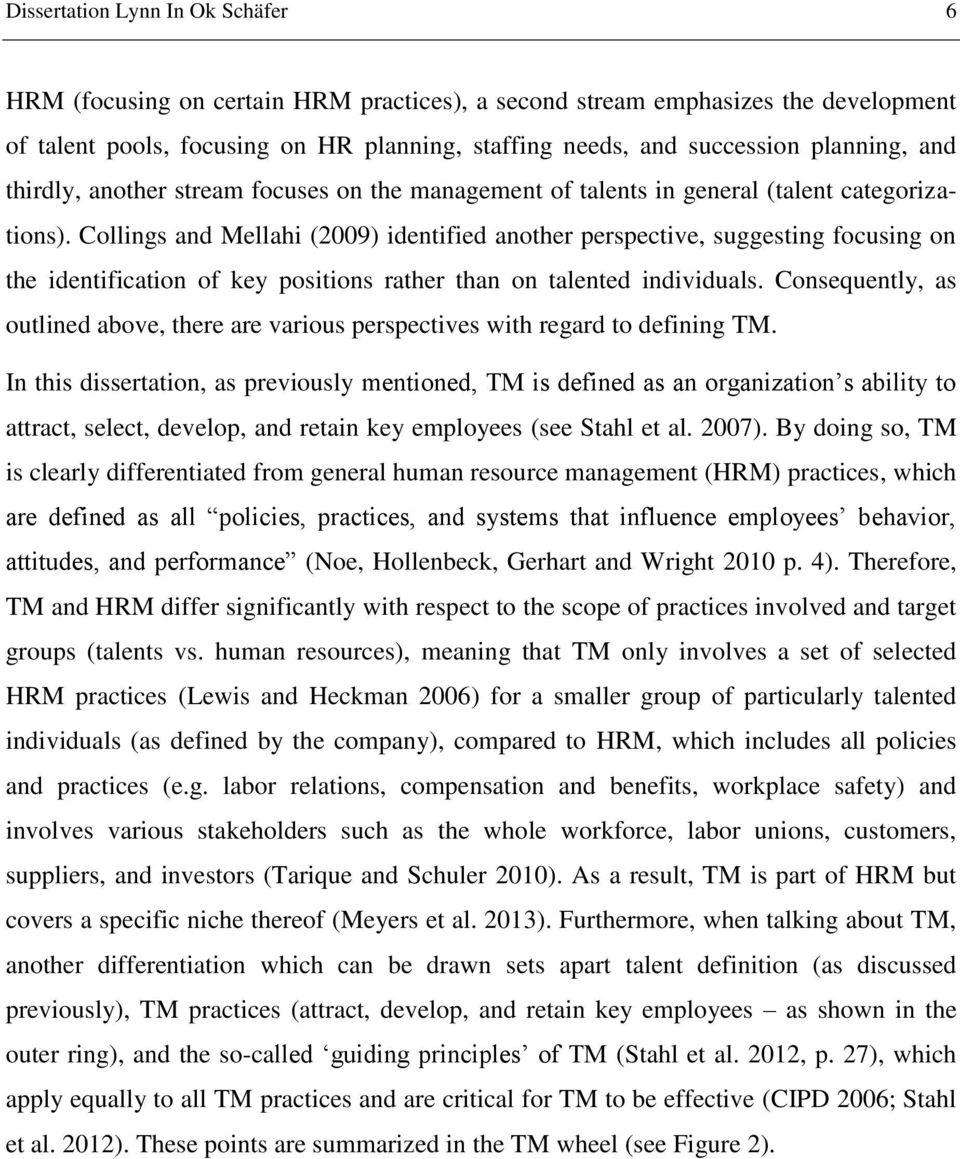
14 Dissertation Lynn In Ok Schäfer 7 Figure 2. The TM wheel. Source: Stahl et al. (2012, p. 27). 2.2 The rising call for more contextualization in TM research As mentioned earlier, in its initial stages the TM research field was dominated by publications originating from the United States, heading the geographic productivity rankings, similar to other aspects of HRM and management, which were originally developed and conceptualized in the United States; however, the majority of those insights stemmed from non-academic institutions, such as consulting companies and practitioners, promulgating TM best practices in large multinational companies, and there was a lack of academically and theoretically sound TM research (Chambers et al. 1998; Michaels et al. 2001; Brewster 2004; Gallardo-Gallardo et al. 2013b; Thunnissen et al. 2013b). In an attempt to shed light on TM beyond the United States, which acknowledges and values geographical and cultural differences and thus follows a call for more context-oriented research, more and more contributions from other regions, as well as special issues focusing on European (e.g. SI on TM in Europe, see Collings et al. 2011), Asian (SI on TM in the Asia Pacific, see e.g.mcdonnell, Collings and Burgess 2012; Cooke, Saini and Wang 2014), Middle Eastern (Afiouni, Ruël and Schuler 2014; Sidani and Al Ariss 2014), and global TM (GTM) perspectives (Scullion and Collings 2010; 2011) contributed greatly to enriching the research domain from the late 2000s onwards. As the subject area has expanded, growing opinion has emerged that there are differences in how TM is defined and implemented, depending on the national context (Collings et al. 2011; Scullion and Collings 2011; Thunnissen et al. 2013a) and different types of organi-
15 Dissertation Lynn In Ok Schäfer 8 zation. For instance, TM is not only relevant for MNEs (Stahl et al. 2007; Stahl et al. 2012) but is equally important to small- and medium-sized enterprises (SMEs); however, TM in the latter organizations is different, due to, for example, financial and human resources constraints and a lower degree of HRM professionalization (Iles et al. 2010; Festing, Schäfer and Scullion 2013; Valverde, Scullion and Ryan 2013). In a recent conceptual paper on the relevance of context to TM, Thunnissen, Boselie, and Fruytier (2013a, p. 330) also call for a more pluralistic view on the subject through broader and newer perspectives. A number of ways to achieve this aim include focusing on talents and their employment and work relationships, investigating value-creation processes in TM, and acknowledging that organizations exist in and interact with their environment and institutional context (Thunnissen et al. 2013a). In a similar vein, in a special issue exploring TM theories and future directions, Al Ariss, Cascio, and Paauwe (2014, p. 177) call for more research on various levels and within a number of contexts, citing the individual level, organizational level, institutional context, as well as national, international, and sectoral contexts as key elements that define TM research. Therefore, following calls for more context-oriented TM research implies acknowledging that contextual variables, such as historical, economic, social, and political factors, may have an impact on TM (Collings and Mellahi 2009; Iles et al. 2010; Tarique and Schuler 2010; Collings et al. 2011; Thunnissen et al. 2013a). This is especially true for Europe, which (compared to the United States, for example) is characterized by the significant control of governments and various regulations regarding the recruitment and dismissal of employees, and the high influence of trade unions and works councils in employee relations (Ronen and Shenkar 1985; Brewster 2004; Collings et al. 2011; Festing 2012). To conclude, the discussion about context-oriented perspectives on TM builds on the contextualist paradigm of research on HRM in general, compared to the universalist paradigm which focuses on identifying universal approaches and best practices, and thus moving towards convergence of HRM practices (Brewster 1999; Festing 2012). 2.3 Background to the studies: The German context The idea behind this thesis was to keep the national setting constant by focusing on the German context for all papers (except for the conceptual paper), and by doing so avoiding challenges and issues of carrying out research in different countries and cultures (e.g.

16 Dissertation Lynn In Ok Schäfer 9 language, metric equivalence, internal-consistency issues, see Cascio 2012), while at the same time filling a research gap on TM insights in Germany. Sticking to the German national context, various levels inside the country, such as regional, industry, and organizational differences, are taken into account in an attempt to better understand these peculiarities of the external environment to be able to predict how the external environment might influence HRM and TM practices in these specific environments. Interestingly, at the time of starting this dissertation, no academic paper had been written on TM in Germany, and even in practitioner-oriented literature, TM research in the German context was scarce (Festing, Schäfer, Massmann and Englisch 2011; Festing et al. 2013), although the country demonstrates an interesting setting for studying how TM and labor markets operate in a post-financial crisis setting whereby the effects of the global financial crisis (GFC) have been overcome quickly, and where moderate economic growth rates have been observed (The World Bank 2012; Destatis 2013). However, similar to other European countries, on the one hand, the German population is characterized by declining birth rates and an ageing population (Beechler and Woodward 2009; European Commission 2011), while on the other hand, employment rates are stable and even growing (European Commission 2011; Ward 2011; Bujard et al. 2012; Destatis 2013); in fact, Germany reported one of the lowest number of unemployed persons in 2012 (2.9 million) (Iwd 2013). These influential macroeconomic and demographic factors lead to intense competition for talents on an organizational level (Festing et al. 2011), and based on various forecasts, immigration and growth rates will not sufficiently cover this gap, so severe talent shortages will continue to be an issue for organizations in the future (Ward 2011; World Economic Forum 2011). This has led to a discussion on paying more attention to previously neglected groups, such as attracting international talent from abroad, older employees, and particularly women (Bundesministerium für Arbeit und Soziales 2011). In Germany, women only represent 3% of management boards and around 12% of the supervisory boards (Holst, Busch and Kröger 2012), and so in order to address this situation, in the recent coalition agreements between the CDU/CSU and SPD (2013), the German government discussed the introduction of legislative measures, such as a 30% female quota for supervisory boards, and regulations for companies to introduce measures that increase the percentage of women in top management positions (CDU/CSU and SPD 2013). As a result, attracting, retaining, and developing female talent, as well as talent stemming from different generations, is of high priority for German companies regardless of company size in order to cope with the challenging demographic situation. The


17 Dissertation Lynn In Ok Schäfer 10 strategic importance of TM, for Germany as well as other European countries, can be seen in Figure 3, which highlights that TM was cited as the most critical HR topic among a sample of 2,304 European executives (BCG and EAPM 2013). Figure 3. TM and leadership identified as the most important HR issues (EU). Source: BCG and EAPM (2013, p. 7). Furthermore, with respect to the German national context, some peculiarities of the German national business system (GNBS), such as long-term orientation and investment in human capital, a strong focus on training and development, and a high level of rigidity regarding regulations and policies governing cooperation between management and employees, make it an even more interesting arena for studying TM (Streeck 1995; Ferner and Varul 1999; Festing 2012). These characteristics of the German national environment pertain not only to large international companies which are involved in foreign operations (Kutschker and Schmid 2005), but also to regional clusters and networks of companies, as well as to small and medium-sized enterprises (SMEs), which compose the majority of German companies and are crucial for the economic situation of the country (Institut für Mittelstandsforschung 2011; Destatis 2012). Especially SMEs, which often do not have enough resources (financial and human) to set up complex, professional HRM and TM systems, and which are usually less well-known, have more challenges to overcome and face increasing difficulties in attracting employees (Cardon and Stevens 2004; Valverde et al. 2013). One way for SMEs to cope with these challenges is to join forces and create networks and regional clusters (Sydow 2006; Helbich 2007); however, research and insights into how SMEs cope with these challenges and (jointly) manage their talents is extremely scant (Festing et al. 2013).

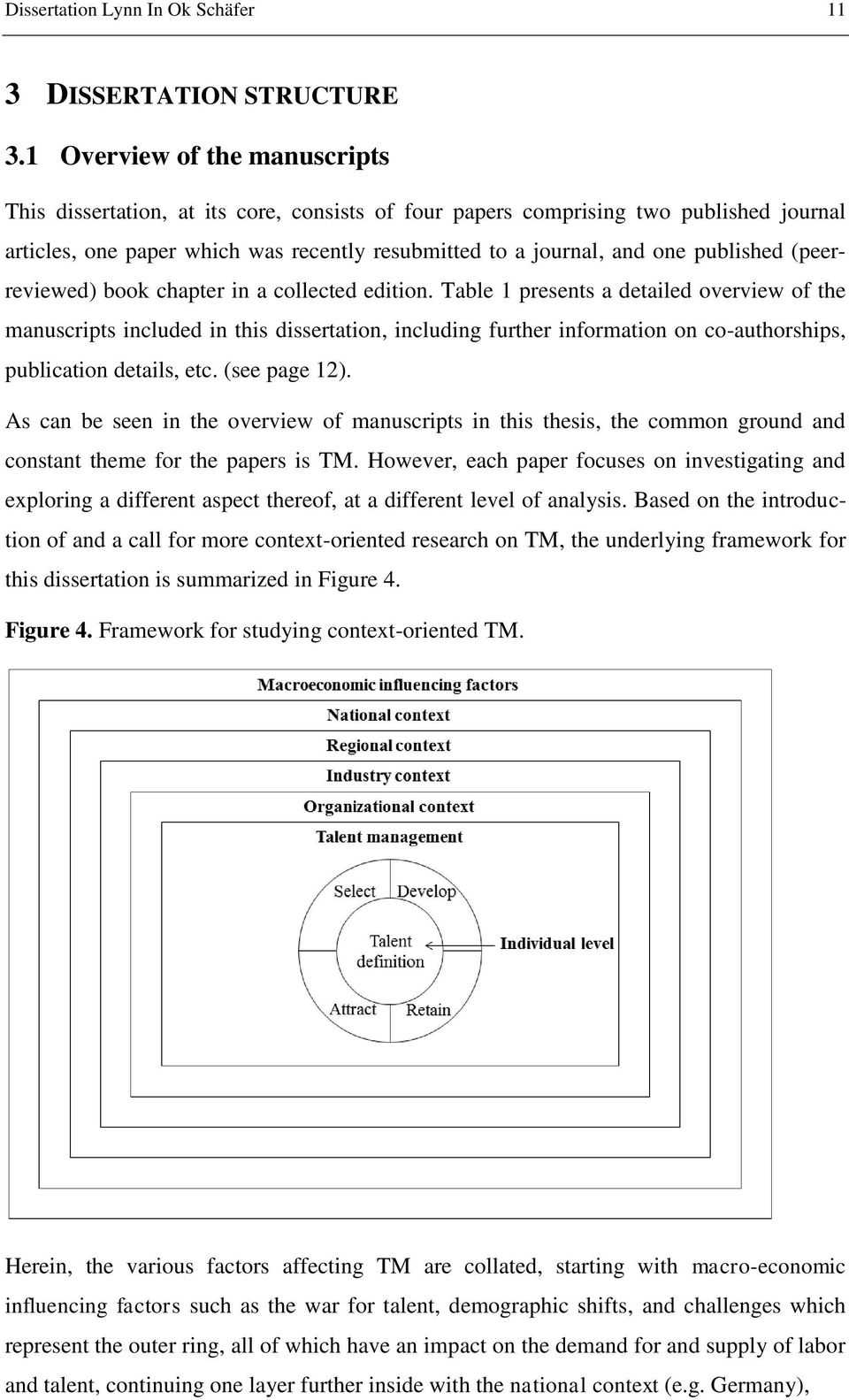
18 Dissertation Lynn In Ok Schäfer 11 3 DISSERTATION STRUCTURE 3.1 Overview of the manuscripts This dissertation, at its core, consists of four papers comprising two published journal articles, one paper which was recently resubmitted to a journal, and one published (peerreviewed) book chapter in a collected edition. Table 1 presents a detailed overview of the manuscripts included in this dissertation, including further information on co-authorships, publication details, etc. (see page 12). As can be seen in the overview of manuscripts in this thesis, the common ground and constant theme for the papers is TM. However, each paper focuses on investigating and exploring a different aspect thereof, at a different level of analysis. Based on the introduction of and a call for more context-oriented research on TM, the underlying framework for this dissertation is summarized in Figure 4. Figure 4. Framework for studying context-oriented TM. Herein, the various factors affecting TM are collated, starting with macro-economic influencing factors such as the war for talent, demographic shifts, and challenges which represent the outer ring, all of which have an impact on the demand for and supply of labor and talent, continuing one layer further inside with the national context (e.g. Germany),
19 Dissertation Lynn In Ok Schäfer 12 Table 1. Overview of the manuscripts included in this thesis. No Title Co-authors Journal/book Talent management in mediumsized German companies: an explorative study and agenda for future research 1) Marion Festing 2) Hugh Scullion (National University of Ireland, Galway) International Journal of Human Resource Management (IJHRM) Value creation through human resource management networks and talent management in clusters A case study from Germany Think talent think male? A comparative case study analysis of gender inclusion in talent management practices in the German media industry 1) Marion Festing 2) Marion Festing 3) Angela Kornau Peer-reviewed book chapter, Rainer Hampp Verlag International Journal of Human Resource Management (IJHRM) Generational challenges to talent management: A framework for talent retention based on the psychological contract perspective 1) Marion Festing Journal of World Business (JWB) Ranking position B [according to VHB-Jourqual] B [according to VHB-Jourqual] B [according to VHB-Jourqual] Publication status Published, April 2013 Published, winter 2013 Revised version submitted April 2014 Published, April 2014 Points 0,67 [according to VHB-Jourqual] 0,67 [according to VHB-Jourqual] 1,0 [according to VHB-Jourqual] Research method Questionnaire, quantitative Single case study, qualitative Multiple case studies, interviews, qualitative Conceptual Contributions Insights into TM in SMEs, analysis of the GNBS and its impact on TM, identification of three types of TM approaches applied in SMEs (based on a cluster analysis) Insights into cooperation and networks on HRM and TM among various cluster actors and their potential for value creation for the cluster Development of propositions for studying gender-inclusive TM and insights from a multiple-case study Literature review, framework and testable propositions for studying the impact of TM on the psychological contract and the moderating role of generations Others Paper presented at the 1 st workshop on talent management of the European Institute of Advanced Studies in Management (EIASM) in Brussels, Belgium, April 2012 Paper presented at the 11 th World Congress of the International Federation of Scholarly Associations of Management (IFSAM) in Limerick, Ireland, June 2012 Paper presented at the 29 th Colloquium of the European Group for Organizational Studies (EGOS) in Montréal, Canada, July 2013 Paper presented at the 2 nd workshop on talent management of the European Institute of Advanced Studies in Management (EIASM) in Brussels, Belgium, October 2013

20 Dissertation Lynn In Ok Schäfer 13 assuming that the peculiarities of this national environment, i.e. the national culture, legislation, governments and state involvement, works councils, and trade unions, provide the framework for managing human resources and talent. Moving on, the regional level encompasses, for instance, clusters of companies in one region which are characterized by a series of linkages between single firms in the region. Clusters in Germany contribute to economic success and include numerous companies, and so understanding how TM can contribute to value creation in these clusters, compared to single firms, is of interest in this respect. The industry context is included, in order to further analyze whether industry characteristics also impact the way TM in conducted. Integrating this level of analysis into the framework, we build on prior research and highlight the potential for industry context to moderate the relationship between HR systems and organizational effectiveness (Datta, Guthrie and Wright 2005, p. 142). In this thesis, the industry context of the media industry will be investigated partly as the frame for manuscript 3. Concerning the organizational context, namely the organizational unit level, differences between SMEs and MNEs will mainly be investigated. In this innermost ring, TM takes place and is defined (as previously) as organizational practices utilized to attract, select, develop, and retain talented individuals. Thus, the individual level and talent definition (see e.g. Stahl et al. 2012) build the core for TM. As outlined in the introduction, the aim of this thesis is to contribute to a more informed understanding of TM by shedding light on the subject through various context-oriented perspectives; therefore, each manuscript is dedicated to a different research level of the framework, as outlined in Table 2.

21 Dissertation Lynn In Ok Schäfer 14 Table 2. Overview of the research focus and context-level in the four manuscripts. No of manuscript Manuscript 1 Manuscript 2 Manuscript 3 Manuscript 4 Title Talent management in medium-sized German companies: an explorative study and agenda for future research Value creation through human resource management networks and talent management in clusters A case study from Germany Think talent think male? A comparative case study analysis of gender inclusion in talent management practices in the German media industry Generational challenges to talent management: A framework for talent retention based on the psychological contract perspective Research focus/context-level National context: Germany Organizational context: TM practices in SMEs National context: Germany Regional level: TM and HRM networks in a cluster National context: Germany Industry context: Media industry Organizational context: TM in two MNEs Individual level: Studying the impact of TM on the psychological contract of talents All papers expand on the extant literature on TM and further develop the research around managing talent in various contexts in a number of ways: First, they provide in-depth knowledge on TM in Germany (national level), TM in regional clusters in Germany (regional level), and TM practices in organizations in the media industry, as well as SMEs. Thus, the case studies represent a (small) snapshot of the latest TM practices applied in German companies. Second, conceptually, they deliver interesting theoretical insights regarding potential indicators for analyzing the degree of gender inclusion in TM (within an organization), as well as the impact thereof on the psychological contract of talents and the moderating role of generations (individual level). Third, methodology-wise, the four papers offer a variety of insights, including empirical, large-scale quantitative survey results and multiple-comparative and single-case studies in Germany, thereby providing firsthand consolidated findings on TM in Germany. In the subsequent chapters, in which the manuscripts are reproduced, the majority are written in American English; only the book chapter is written in British English, due to the formal requirements of the book s editors. Furthermore, all chapters cover different papers, each starting with an abstract and an introduction and then concluding with the respective bibliographical information and appendices relating to that particular manuscript; therefore, the sequences and numeration of footnotes, tables, and figures only refer to that particular paper. For the remaining figures, tables, and appendices referred to in this dissertation (introduction, conclusion), these can be found in the respective lists of tables, figures, and appendices at the beginning of the thesis. As can be seen, although the papers are self-contained with respect to research questions and methodologies, they sometimes
22 Dissertation Lynn In Ok Schäfer 15 make use of prior findings, e.g. the paper on TM and HRM in clusters investigates the aspect of co-operation, i.e. networks in SMEs, a finding which was revealed in the paper on TM in German medium-sized companies. In case cross-linkages between the papers are made, these are indicated by corresponding references and sources. 3.2 Research objectives and questions In Anne Huff s words, Academic work is interesting and involving, but also difficult to organize and bring to completion (Huff 2009, p. xiii) being distracted by the wealth of research topics, or becoming paralyzed by the numerous possibilities and responsibilities of scholarship are just a few of the many pitfalls encountered in academic work. In this respect, formulating specific research questions at the beginning may help authors to keep track and stay focused throughout the entire research project (Flick 2003a; Saunders, Lewis and Thornhill 2003). In this dissertation, I seek to provide answers not only to descriptive research questions on how TM is applied in practice, exemplified using SMEs, a regional cluster, and two MNEs in Germany, but also I aim at making an explanatory contribution to the research field, by drawing on theoretical insights from other domains, as well as putting forward new frameworks and conceptualizations (e.g. the moderating role of generations on the relationship of TM on the psychological contract of talents and the conceptualization of gender-inclusive TM). Thirdly, I would like to provide some normative suggestions for practitioners with respect to practical recommendations and lessons learned (indicated by subheadings such as practical implications and managerial relevance in the different manuscripts ). In detail, the underlying research questions for each of the four manuscripts are as follows (see Table 3).
23 Dissertation Lynn In Ok Schäfer 16 Table 3. Research objectives and questions in the four manuscripts. Manuscript 1 Manuscript 2 Manuscript 3 Manuscript 4 Objective: Investigating TM in a national context and researching to what extent and how the national environment affects the design and applied practices of TM in small and medium-sized enterprises in Germany. Questions: How do SMEs in Germany deal with a skills shortage? What are the special characteristics and challenges in TM for SMEs? Can the characteristics of the GNBS be used to explain features of TM in Germany? Objective: Analyzing, on a regional level, how active participation in a cluster environment can contribute to a firm and a cluster s value creation in the area of HRM and TM, by focusing especially on SMEs. Question: How can active participation in a cluster environment contribute to a firm and a cluster s value creation in the area of HRM and TM? Objective: Gaining insights into TM practices on the organizational and industry level of larger enterprises in the media industry in Germany, looking for variations (based on the comparative case study design) and especially analyzing the question whether TM is inclusive with respect to gender in these companies. Questions: Do firms pursue different TM approaches with respect to gender inclusiveness and, if so, are these linked to the number of women in management positions? How can gender-inclusive TM be conceptualized, and under what conditions may TM be considered inclusive with respect to gender? What are the possible indicators for gender-inclusive TM? Objective: Conceptually analyzing the impact of TM on the psychological contract of talents and the moderating role of generational effects. Questions: How does TM impact the psychological contract of talents? How do different generations and preferences affect this relationship? 3.3 Research design and methodologies This section summarizes the research design and methods used in the four manuscripts on an aggregated level; a detailed description of the respective methods, data collection, and analysis can be found in each manuscript. When considering the construction of a research design, research objectives and specific research questions (see Chapter 3.2) play a role, as well as the methodological approach, degree of standardization, and control over research events, as well as the availability of resources (e.g. material, time and human resources) to conduct the research (Flick 2003b). As already shown in Table 1, the four manuscripts all use different research methods, and, as outlined earlier in the chapter describing the need to contextualize TM, the thesis can be assigned to the contextualist paradigm of research on HRM (Brewster 1999). This means
24 Dissertation Lynn In Ok Schäfer 17 that research on TM is aimed at collecting evidence and understanding differences of TM in different contexts (e.g. by using the NBS approach), and it is less concerned with probing and testing hypotheses (Brewster 1999). This is mainly due to the fact that the research field of TM is not yet advanced; therefore, the research approaches used herein follow a rather inductive approach, by analyzing and trying to understand complex organizational phenomena and TM architectures and thus trying to contribute to theory enhancement and building, rather than theory testing (Gioia and Pitre 1990; Flick 2003a). Based on the scarcity of empirical investigations in TM in general, and the fact that TM in Germany has not been academically investigated before, many how and why questions have emerged. In order answer these, we used different research methods (e.g. a quantitative questionnaire) but focused particularly on qualitative research methods (multiple- and single-case studies, interviews, and secondary data analysis), in order to enable us to analyze companies in-depth (Yin 2009). Consequently, the majority of the papers can be ascribed furthermore to the frame of reference of the interpretive paradigm, in an attempt to generate descriptions, insights, and explanations of events so that the system of interpretations and meaning, and the structure and organizing processes, are revealed (Gioia and Pitre 1990, p. 588), and partly on the verge of the radical humanist paradigm, focusing on investigating why certain phenomena occur and looking for deeper structural-level answers (Gioia and Pitre 1990; Burrell and Morgan 2005; Lamnek 2005). Moreover, using a variety of research methods in different papers to approach one topic (TM) allows for a triangulated approach in a twofold way: The first is data triangulation (using multiple sources of evidence, e.g. HR/TM experts, male and female talents, documents, and publicly available sources) and the second is method triangulation, i.e. between-method triangulation through the combination of interviews, the analysis of secondary material, and questionnaires (Flick 2003b; Denzin 2009; Yin 2009; Farquhar 2012).
25 Dissertation Lynn In Ok Schäfer 18 Table 4. Overview of the research methods used in the four manuscripts. Manuscript 1 Research method: Quantitative study using a questionnaire, with 24 questions Sample size: 700 SMEs Sample description: SMEs (not publicly traded) with 30 and 2,000 employees and varying yearly sales volumes of < 30 million euros: 30%; million euros: 51%; and > 100 million euros: 19% Time of data collection: Summer 2011 Way of collecting data: Telephone interviews with chief executive officers (CEOs) and owner/founders to answer the questionnaire Data analysis: SPSS (Version 18.0), descriptive statistics, cluster analysis Manuscript 2 Research method: Qualitative study using a single-case study as the research object Sample size: One cluster with 173 actors Sample description: intelligent technical systems (ITS) cluster in Germany Time of data collection: Spring 2012 Way of collecting data: Collecting data based on publicly available sources, such as the internet, newspaper articles, industry reports, and statistical data issued by the Federal Statistical Office in Germany, and internal company documents, such as newsletters Data analysis: Data were analyzed according to the various levels and relationships in the firm, network, and context level of the clusters Manuscript 3 Research method: Qualitative study using a comparative case study design Sample size: Two media companies in Germany, 43 individual interviews Sample description: Both media companies headquartered in Germany, with several thousands of employees and similar product portfolios (print and digital online products) Time of data collection: Winter 2012 through summer 2013 Manuscript 4 Conceptual paper Way of collecting data: Primary data collection through semi-structured interviews with six HR and TM experts and another 37 employees (talented individuals who participate in talent development programs); secondary data collection using publicly available sources, such as industry reports and internal company documents Data analysis: Interviews were recorded and transcribed, and the content was analyzed using the qualitative data analysis software MAXQDA (Version 11) Research method: Literature analysis, development of a framework with testable propositions
26 Dissertation Lynn In Ok Schäfer 19 4 RESEARCH MANUSCRIPTS 4.1 Talent management in medium-sized German companies: an explorative study and agenda for future research Manuscript No. 1 This manuscript is published as: Festing, M., Schäfer, L., Scullion, H. (2013). Talent management in medium-sized German companies: an explorative study and agenda for future research. International Journal of Human Resource Management, Vol. 24 (09), DOI: /
27 Dissertation Lynn In Ok Schäfer Value creation through human resource management networks and talent management in clusters - A case study from Germany Manuscript No. 2 This manuscript is published as: Festing, M., Schäfer, L. (2013). Value Creation Through Human Resource Management and Talent Management in Clusters - A Case Study from Germany. In: K. Brown, J. Burgess, M. Festing & S. Royer (Eds.): Resources and Competitive Advantage in Clusters. Munich and Mehring. Rainer Hampp Verlag. DOI: /
28 Dissertation Lynn In Ok Schäfer Think talent think male? A comparative case study analysis of gender inclusion in talent management practices in the German media industry Manuscript No. 3 This manuscript was accepted for publication with the International Journal of Human Resource Management on June 7, 2014 for the special issue: A global perspective on diversity and inclusion in work organizations; guest editors Elaine Farndale, Michal Biron, Dennis R. Briscoe, and Sumita Raghuram. Festing, M., Kornau, A., & Schäfer, L. (In press). Think talent think male? A comparative case study analysis of gender inclusion in talent management practices in the German media industry. International Journal of Human Resource Management. Manuscript available from the author upon request.
29 Dissertation Lynn In Ok Schäfer Generational challenges to talent management: A framework for talent retention based on the psychological contract perspective Manuscript No. 4 This manuscript is published as: Festing, M., & Schäfer, L. (2014). Generational challenges to talent management: A framework for talent retention based on the psychologicalcontract perspective. Journal of World Business, Vol. 49 (2), DOI: /j.jwb
30 Dissertation Lynn In Ok Schäfer 23 5 DISCUSSION AND CONCLUSION 5.1 Summary of key findings and main contributions Having outlined in detail the four manuscripts in the previous chapters, this section now summarizes the key findings of the different research projects on the different levels of framework analysis (see Figure 4). Therefore, subheadings based on the different layers of the framework were chosen to discuss the respective results. Key findings regarding the national context With respect to particularities of the national context, the GNBS, which is characterized by a strong focus on long-termism and developmental orientation (heavy investments in training and development), and a high degree of co-determination (Hall and Soskice 2001; Festing 2012), not only impacts the way companies do business, but it also influences the way TM in German companies is conducted. This was apparent in MNE case companies, which used a rather hybrid approach to TM, by offering huge assortments of general training and development programs, seminars, workshops (publication of yearly company brochures), and especially apprenticeships traineeships to develop talent early on in addition to designated talent development for only small target groups. Furthermore, the strong focus on long-term orientation and heavy investment in training and development was also visible in SMEs, in the identified TM profiles (highly engaged talent managers, reactive talent managers, and retention-based talent managers); for instance, in the questionnaire, talent retention (long-term orientation) turned out to be number-one priority for the participating companies. And finally, the high degree of co-determination characterizing the GNBS (Hall and Soskice 2001; Festing 2012) was also reflected in the TM processes, when the works council and certain steering committees had the last say in the final selection decisions for the talent development programs. To conclude, it turned out that using the national business systems approach (Whitley 1999) can serve as a good indicator for studying possible influencing factors of the respective national context on TM practices at least in the case of Germany. It was also noted that government, as well as political entities such as trade unions and works councils, have significant control over the management of human resources and talents in organizations (Brewster 2004; Festing 2012), and thus they can also shape the strategic goal setting of TM; for example, the political discussion regarding introducing a gender quota resulted in a focus on female career advancement in TM (CDU/CSU and
31 Dissertation Lynn In Ok Schäfer 24 SPD 2013). However, the German government is also quite supportive with respect to the services and initiatives offered by institutions, agencies, and ministries to help companies retain workers (Bundesministerium für Arbeit und Soziales 2014), and it also contributes special funding (e.g. cluster competitions and funding) (BMBF 2012) for organizational/cluster development and thus indirectly influences the disposable resources available for managing talent. Key findings with respect to the regional and industry context In the regional context, in our case study on an IT cluster in Germany, we analyzed and identified interdependencies, cooperation, and networks in the areas of HRM and TM (OstWestfalenLippe Marketing GmbH 2012). It was interesting to note that relationships among horizontal, vertical, and lateral cluster actors went beyond knowledge sharing, included joint investments in skills, resources, and cross-sectoral projects, and created several types of interdependencies (Thompson 1967); consequently, overcoming barriers of knowledge and resource sharing in clusters generates relational rents (Dyer and Singh 1998). This strategy of resource sharing is especially attractive for SMEs as a way out of the resource dilemma and possibility as a way to better compete in the war for talent. Overall, TM and HRM networks in clusters contribute to value creation, and thus they have the potential for creating the competitive advantage of the cluster. With respect to findings on the industry context, our case study on the media industry offered interesting insights into the applied TM practices of media companies. The media industry, with an approximately equal 50% split of females and males at entry level, and relatively high numbers of women in management positions (as shown in the case study, examples of around 30% women with managerial responsibilities and in Company B even 33% at board level), resulted in the high priority of gender diversity measures and explicit TM activities to promote female career advancement. As mentioned in the description of the German context, only 3% of management board members in Germany are women (Holst et al. 2012); thus, the cases are not representative of all industry sectors. Consequently, the introduction of a gender quota for talent development programs has to be seen against this background and is rather unique. Another major influencing factor associated with the media industry in Germany at the moment is digitalization, and it became apparent that the topic of digitalization as a major challenge for the media industry was discussed and addressed in talent development programs (e.g. keynote sessions, roundtables) and incorporated in assessment processes (talents had to demonstrate
32 Dissertation Lynn In Ok Schäfer 25 creativity and entrepreneurship in assessment centers). As a result, there were small indicators showing that industry-relevant topics and themes were incorporated in TM. However, as the sample of only two companies was very small, one cannot generalize based on these findings but can only detect and identify common actions and potential trends. Key findings regarding the organizational context One major insight identified in the research projects on TM practices in SMEs and MNEs was that SMEs choose a different TM approach than MNEs, by applying a rather universal approach and focusing on larger, all-employee target groups, specific technical expert groups, and only seldom senior management/executives or high potentials. As mentioned earlier, as a finding of the cluster project, one way of coping with the war for talent for SMEs is to join forces with other companies/institutions and cooperate or form a network on HR and TM topics. However, only 25% of the SMEs in this instance used this option. A surprising result was that, for SMEs, diversity management, or topics such as the consideration of new target groups (especially women, older workers and migrants), was of least importance. In contrast, the two MNEs investigated took an extremely professional approach to managing diversity and gender inclusion in particular measures included mentoring programs for women, networking events, speaker series, part- and flexi-time, kindergarten and daycare offers for working mothers, and the implementation of a gender quota for talent development programs. The assigned importance of (gender) diversity topics in media companies can be attributed partly to the fact that the numbers of women in the workforce and in managerial positions (in Company B even at the board level) were relatively high. A closer look at the findings of the small- and medium-sized sample, however, illustrated that the larger the company, the more emphasis it places on TM, backing prior findings of studies which found that larger companies mostly have HR strategies and formalized HR systems, whereas small enterprises, due to resource constraints, only dedicate a few resources to HR (Kabst, Wehner, Meifert and Kötter 2009). Therefore, the degree of TM professionalism and the priority of diversity management can be determined by organization size as well as the number of women in management positions. However, our analysis of the TM practices in MNEs disclosed that, although TM was aimed at female career advancement, sex-related discriminatory risk and gender bias were prevalent in the talent definition, the approach, underlying career orientation, program
33 Dissertation Lynn In Ok Schäfer 26 content, and selection processes, thereby risking replicating the previously known think manager-think male phenomenon to talent (Schein 1973; 1993; 2007). As a result, we concluded that gender inclusion is high, but only if these identified TM elements address and support all talents irrespective of their sex and gender value orientation. Insights on the individual level Conceptually, the manuscripts proposed comprehensive literature reviews and a framework (manuscript 4) for analyzing the impact of TM on the psychological contract of talents. Organizations can use TM as a signaling device, in order to demonstrate the importance of talent and to fulfill their part of the psychological contract/obligations (Guzzo and Noonan 1994; Rousseau 1995; Sonnenberg, Koene and Paauwe 2011), which in turn should lead to a more fulfilled and relational psychological contract for the designated talent. Investing in fulfilled, relational psychological contracts can lead to desired outcomes such as job satisfaction, loyalty, and performance, and a reduction in the intention to resign (Rousseau 1995; Morrison and Robinson 1997; Conway and Briner 2005). However, as indicated in the framework, this relationship between TM and the psychological contract is moderated by generational effects. Accordingly, based on differences in work-related values and preferences, highly engaged and extensive TM activities are especially important for retaining Generations X and Y talents, who value but also demand training and development opportunities and continuous career advancement. Empirical and conceptual contributions Building on the key findings of the four manuscripts, as outlined in the introduction, the aim of the thesis is to enrich and advance the knowledge on TM and contribute to a more informed understanding of TM in various contexts. To outline the significance of the findings of this thesis to the research field on TM, empirical and theoretical contributions will now be outlined. Empirical contribution: The four research manuscripts provide the first results on TM in Germany a domain which, so far, has not been investigated in academic papers. The key results and insights presented cover findings on TM in company examples of SMEs, MNEs, and a regional cluster in Germany. They identify and highlight the variety of approaches taken to TM by different organizations, and thus they clearly argue for a context-oriented approach when studying TM (e.g. at the national, regional, industry, organizational, and individual levels). Although the findings are based on German company examples, some overall insights into TM differences between SMEs and MNEs
34 Dissertation Lynn In Ok Schäfer 27 are of higher importance to the research field of TM and provide new starting points for future research; for example, we determined that SMEs rather use a universal approach to TM, compared to MNEs, which mainly follow an elite (mixed) approach. In another study on TM in SMEs in Spain, the authors also found out that SMEs managed talent differently; many companies used a more universal approach (seeing all employees as talent), but some also used an exclusive approach, although the differentiation was not formalized in separate HR policies nor transparently communicated and treated much more informally, in order to try to avoid favoritism regarding non-talent employees (Valverde et al. 2013). Conceptual and theoretical contribution: The thesis contributed to theory development and the formulation of new theoretical insights for TM, by integrating, adapting, and combining it with existing theories and literature from other research areas, such as institutional theory, gendered HRM, gender studies, generational studies, and psychological contract theory. First, the thesis greatly contributed to a multi-level analysis of TM in different external contexts and demonstrated that using the NBS approach can help identify and better understand institutional considerations in the national environment which influence the design and implementation of TM practices, because they structure and shape the ways in which companies do business in certain environments (Whitley 1992). Second, the thesis made a contribution to the theoretical enrichment of studying TM in SMEs and providing insights into and new starting points for future research, especially given the identification of the three TM profiles (highly engaged talent managers, reactive talent managers, and retention-based talent managers), findings on HRM networks and TM indicating cooperation as a potential strategy to cope better with the war for talent, and possibilities of value creation in clusters. Third, it places the talent s perspective in the spotlight and focuses on the individual level of TM as seen in manuscript 3, a conceptualization of gender-inclusive TM is proposed, highlighting the need to support all talented employees equally, independent of their sex and/or gender-stereotypical orientation. And lastly, through manuscript 4, the thesis highlights the impact of TM on the psychological contract of talents and the role of different generations, resulting in a conceptual framework on which to study the impact of TM on the psychological contract of talents and testable propositions to investigate the mediating role of different generations.
35 Dissertation Lynn In Ok Schäfer Overall limitations of the manuscripts The research methods applied in the different manuscripts of this thesis also have some disadvantages and limitations. Whereas a detailed discussion of the limitations can be found in each of the four papers, at this point a general discussion on the limitations regarding research methods and the context level will be addressed. Methodological issues Due to the dearth of research on TM in Germany, especially of any qualitative nature, explorative research methods and case studies were conducted, to understand and investigate TM applied in German companies. As such, when selecting the research methods, the authors were aware of and accepted the general concerns and disadvantages with regard to measurement problems, small sample sizes, and problems generalizing the findings. Especially with respect to sample size, the choice to study a smaller number of specific companies in-depth in the case study designs, and thus be able to portray only an excerpt of common practices and companies, makes it difficult to generalize the findings; small sample sizes per definition do not allow for statistical analysis to verify the findings (Flick 2003a; Yin 2009; Farquhar 2012). Moreover, in the case of using a questionnaire, some limitations emerged. As indicated, data collection for manuscript 1 took place as part of a larger research project run by a large auditing company, which had an impact on the design of the questionnaire (lengths, scales, use of single items). Furthermore, due to the explorative stage of empirical studies on TM, one could not refer to validated scales to operationalize and measure TM, thereby contesting the robustness of scales and the items used. With respect to the timing of data collection, research took place between 2011 and 2013 as singular snapshots, and no longitudinal research design was carried out. This means that results have to be interpreted as portraying applied contemporary practices, and they do not provide additional insights into how practices have evolved or changed over time (Yin 2009). Lastly, with respect to the conceptual paper, there is the general limitation of relying solely on literature reviews and the analysis of secondary data without primary data collection. Context-related issues The national context chosen for the manuscripts was Germany. However, although it was intended to keep the national setting stable, in order to avoid cross-national variations, this context specificity can also be interpreted as a limitation. As one of the strongest econo-
36 Dissertation Lynn In Ok Schäfer 29 mies in the world (The World Bank 2012), Germany has managed to overcome the GFC quickly and instead, due to demographic shifts, suffers from a shortage of skilled labor. Therefore, data and findings collected in German organizations cannot be transferred easily to other contexts. Based on the fact that SMEs face similar problems with regard to resource constraints, the liability of smallness (Stinchcombe 1965), and a lack of brand awareness, as well as insights into value creation processes through relationships among cluster actors, one can assume the applicability and generalizability of some findings beyond the German context. Conversely, it must be acknowledged that some insights are linked closely to the specific company example, for example its scope, and the focus of talent development programs in the two media industry MNEs. Issues regarding the conceptualization of TM The third area of limitation focuses on the conceptualization of TM itself. In the manuscripts, TM was either seen as an entire, idiosyncratic system (manuscript 1, manuscript 4), without going into detail and tackling various practices, or, on the contrary, the research focus was on one particular aspect of TM only (manuscript 2 focused on HRM and TM networks; manuscript 3 on talent development programs). The attempt was made in each paper to point out that the terms talent and TM (and the focus of practices involved) are defined differently from company to company; however, the varying, heterogeneous conceptualizations of TM used in this thesis present a limitation that needs to be addressed. 5.3 Future research needs Based on the various limitations and findings of the different research projects, in this chapter a comprehensive overview of topics and questions for future research will be outlined. These are grouped into three subheadings: First, some more general aspects, specifically addressing the identified limitations and based on the selected research methods of this thesis, are presented; second, further research needs are structured according to the various levels included in the framework for studying context-oriented TM (see Figure 3); and lastly, ideas for incorporating other theoretical lenses to the field of TM are proposed. General considerations for future research As mentioned previously, the TM research field still lacks empirical, large-scale studies complementing the numerous qualitative research contributions and case studies on TM
37 Dissertation Lynn In Ok Schäfer 30 (Dries 2013a; Al Ariss et al. 2014). Furthermore, additional longitudinal insights, looking at how TM evolves in a certain context and possibly develops and changes over time, would be desirable. Furthermore, with respect to the immediate research needs based on the manuscripts included in this thesis, research projects replicating and transferring the design of the studies to other companies and contexts, and encompassing larger samples, are necessary in order to back up and confirm the validity of the results taken from the manuscripts in this thesis, especially with respect to the proposed indicators for studying gender-inclusive TM. Moreover, the inconsistent operationalization of the breadth and width of TM included in this thesis calls for more conceptual and theoretical work for developing allencompassing definitions of the practices and scales employed to conceptualize and measure TM. Lastly, with respect to the conceptual paper and literature-based development of a framework to study the impact of TM on the psychological contract and the moderating role of generations, the propositions suggested herein need to be tested empirically in the field in another research project. Future research needs concerning different context-levels As mentioned previously, the different papers in this dissertation focused on Germany as the national context, in order to keep one component of the context stable. However, and needless to say, TM also takes place beyond the German border. The internationalization of companies, the need for international managers, global competition, global mobility, and the challenges involved in attracting international talent, as well as the diversity of the workforce, have led collectively to the development of global talent management (GTM) (Tarique and Schuler 2010; Scullion and Collings 2011; Collings 2014). However, crosscountry and cross-cultural research projects are scarce, so systematic research on GTM practices, by comparing TM in different national settings, and making use of cultural dimensions (Hofstede 1980; Ronen and Shenkar 1985; House, Hanges, Javidan, Dorfman and Gupta 2004), or researching TM between headquarters and subsidiaries (Mäkelä, Björkman and Ehrnrooth 2010; Mellahi and Collings 2010), balancing the global standardization of TM decisions, and local variations and adaptations (Collings et al. 2011; Festing and Eidems 2011; Dowling, Festing and Engle 2013) or TM in emerging markets (CIPD 2010; McDonnell et al. 2012) are interesting fields. With an increasingly diverse workforce, and intense competition for international talents, differences in attracting, developing, and retaining talent from diverse backgrounds, as well as challenges in fully integrat-
38 Dissertation Lynn In Ok Schäfer 31 ing the talent of skilled ethnic minorities (Al Ariss et al. 2013), need to be investigated, in order to succeed in the global war for talent (Collings et al. 2011; Scullion and Collings 2011; Festing et al. 2013). In the national context, using Whitley s (1999) concept of national business systems for studying peculiarities of the national context that have an impact on the dominant approach to HRM in Germany turned out to be very fruitful in better understanding drivers and influencing factors behind the applied TM practices of German companies. Therefore, we recommend using the NBS approach, or the varieties of capitalism perspective (for overviews, see Hall and Soskice 2001; Brewster 2004), to investigate clearly distinctive, country-specific TM features. With respect to the regional context, a first example on value creation processes through HRM and TM networks among horizontal, vertical, and lateral cluster actors demonstrated that investments in relationships, joint projects, knowledge, and resource sharing among cluster actors which would usually compete against each other and fight for the same pool of talent, can generate competitive advantage through joining forces. Since to date only around one-quarter of the investigated German SME sample makes use of cooperation and networks, further studies and primary data (quantitative and qualitative) are needed to investigate the advantages and disadvantages of cooperating in the field of HRM and different rent generation processes at all cluster levels. However, if the findings from the case study, and the potential of HRM and TM networks to contribute to competitive advantage and thus to the economic success of clusters, can be confirmed, this has major implications for cluster management as well as governmental and political institutions investing in cluster development. In the industry context, our findings were based on two media industry MNEs in Germany, but further studies are necessary to verify the data gathered. For instance, the media industry in general is considered to provide modern workplaces, and the 50% share of female students and women in media companies is quite unique, compared to other, more conservative and male-dominated sectors (e.g. construction, engineering, technical industries). It can be assumed that the investigated TM practices and special gender diversity initiatives of the two MNEs in the media industry are rather well-advanced and professional examples, and it is therefore rather unlikely to find voluntarily installed gender quotas for talent development programs in other circumstances again. As a result, more cross-sector research on applied TM practices, gender inclusion, and general
39 Dissertation Lynn In Ok Schäfer 32 diversity management is needed. Furthermore, the impact of industry characteristics on the way human resources and talents are managed should be investigated in more detail (Datta et al. 2005; Stahl et al. 2012) one interesting observation cited by Stahl et al. (2012, p. 30) was that the degree of local adaptations of GTM practices varied across industries and that consumer products, for instance, needed to reflect local markets much more than, say, software or pharmaceutical companies. While there is a good deal of agreement on the need for integrated approaches to TM practices in large MNEs, there is little rigorous research on the subject in their SME counterparts (Stahl et al. 2007; Mellahi and Collings 2010; Festing et al. 2013; Valverde et al. 2013). In the organizational context, despite the findings of our study on TM in SMEs, more rigorous research is needed into how SMEs apply TM practices. Furthermore, research on TM in SMEs vs. MNEs, in both the private and the public sector, such as in not-for-profit, non-governmental organizations (NGOs), academic institutions, or ministries, could reveal interesting findings on managing talent in different types of organizations, which subsequently would also be particularly interesting for practitioners. Furthermore, there is not only a call for contextualizing TM, but also for contextualizing talent (Nijs et al. 2014, p. 187), assuming that talent is context-dependent (Dries 2013a) and that the organizational context will influence the kind of talent definition; in this case, research projects investigating how the different organizational variables (for instance company size, culture) impact the definition of talent would also be interesting. With respect to the individual level, aspects such as the impact of TM on the psychological contract of talents, the role of different generations (or generation-specific TM), and gender (gender inclusion) in TM have been mainly put forward conceptually, so further analyses and research projects are required to better understand the drivers, influencing factors, and preferences of the talents themselves. New research projects could investigate the impact of TM on the contents of the psychological contract, the process of contractmaking, the parties involved (contract makers), related generational differences, and whether TM has a positive impact on creating a relational psychological contract and thus has the potential to contribute to attracting and retaining talents. If so, and going even further, comparing those people who have been identified as talent to those who have not been selected could be compared with respect to differences in the psychological contracts of various generations and be the subject of future study (Björkman, Ehrnrooth, Mäkelä,
40 Dissertation Lynn In Ok Schäfer 33 Smale and Sumelius 2013). Similarly, instead of generational differences, gender issues could also be included in this research design (Tatli, Vassilopoulou and Özbilgin 2013). To sum up, regarding future research needs at the individual level, in the studies included in this thesis no deliberate distinction between permanent or contingent workers was made; however, future research could also investigate whether there are differences based on the duration of employment modes (temporary, part-time, contracted, outsourced, and consulting services) as a fast-growing group in the workplace (Vance and Vaiman 2008; Vaiman 2010). Future research needs incorporating other theoretical stances Finally, with respect to possible theoretical perspectives which could be adopted when studying TM, questions as to why and how TM has become so popular (in a certain context) could be investigated, using the new institutionalism perspective of (DiMaggio and Powell 1983), which could then serve as a reference and possible theoretical lens to investigate why firms apply TM practices. For instance, one reason for the popularity of TM could be mimetic isomorphism, which occurs when practices which have been proven successful in a given environment by important players are imitated by competitors (DiMaggio and Powell 1983). Furthermore, research endeavors analyzing TM more systematically through the lens of the situational approach (also referred to as contingency approach, see Kieser 2006) would also be interesting, as the approach states that in order to be effective, organizations have to change and adapt their organizational structures to specific situations and contexts, alter external circumstances and differentiate between internal (e.g. size, ownership structure, production technology) and external (context, competition, customers, technological advancement, societal and cultural aspects) influencing factors on the organizational structure. Thirdly, another germane theoretical perspective is the agency theory (Eisenhardt 1989), which describes tensions and conflicts between principals (e.g. CEOs, owners) and agents (e.g. line managers) and could be used to investigate this relationship with respect to TM. For instance, one example which came up in a discussion with an HR manager was that line managers were withholding information on their best employees and not nominating them for differentiated talent development programs, because they feared losing their best team members; therefore, they hid information on excellent working performance. Therefore, future research could investigate this principal-agent relationship with respect to TM, in order to better understand the
41 Dissertation Lynn In Ok Schäfer 34 dynamics of and possible risks associated with information asymmetries and hidden intentions. This comprehensive overview of research topics substantiates the need for more in-depth, empirical, and conceptual studies to advance and develop the TM research field and to allow for theory building in TM. The cited areas for future research are just a small example, as possibilities and prospects for integrating other theoretical frameworks and concepts into the TM research field are numerous and promising. 5.4 Practical implications Based on the many different research projects investigating TM in different companies in Germany, some implications for line managers, decision-makers, and HR and TM experts emerged. Whereas detailed recommendations are addressed in each manuscript, in this section some overriding recommendations with managerial relevance are outlined. Take TM seriously: Given the shortage of skilled labor and the demographic situation in many countries (European Commission 2011), attracting and retaining talent should be of the utmost strategic priority for companies of any size. Furthermore, as proposed in manuscript 4, TM also has the potential to serve as a signaling device, and thus it positively influences the psychological contract of talents (Guzzo and Noonan 1994; Rousseau 1995; Sonnenberg et al. 2011; Katou and Budhwar 2012). Projected outcomes of fulfilled, relational psychological contracts are job satisfaction, commitment, performance, and a lower intention to quit (Rousseau 1995; Morrison and Robinson 1997; Sonnenberg 2011). This pertains not only to large, international companies, but also especially to SMEs, which are struggling even more in the competition for talented individuals and often do not follow a strategic long-term strategy in managing their human resources; as a result, TM might be a way to increase their brand awareness, attract more talent, develop, and train talents, and thus increase retention rates. Join forces: Another interesting insight from the research project on TM in SMEs was that, so far, only 25% of the 700 SMEs in the sample indicated that they cooperate with other companies and institutions; however, as outlined above, building networks and cooperating with others can help companies to bundle their resources, generate economies of scale, gain access to other markets, and share knowledge and experiences (Sydow 2006; Helbich 2007). As demonstrated in the example of TM in clusters, networking and cooperating
42 Dissertation Lynn In Ok Schäfer 35 with other clusters in HRM and TM can contribute to value creation in clusters. Accordingly, companies should take a more strategic approach and consider joining forces with other companies, to form a cluster, or with public institutions or universities. For instance, taking the case of business schools, these can be a good partner for organizations with respect to talent attraction (access to relevant pools of talents) and talent retention (investing in the development of talents through higher education programs or customized/joint talent development programs). Start to attract talent early on: As demonstrated by the findings on SMEs in Germany, in order to cope with the challenges involved in attracting young talents, companies try to recruit them locally at an early career stage, for example by visiting schools. Due to the shortage of labor and shifts in demography, many MNEs are also looking for first contacts with young talents early on in the recruitment process, with the aim of creating a relationship with these talented students before they make a hiring decision something which is referred to in the German context as talent relationship management (TRM) (based on concepts of customer relationship management) (Trost 2012). Some companies offer complex software solutions for managing pools of talents, such as by recruiting contacts, internship alumni, and potential candidates, supporting organizations in their talentsourcing strategies, to fuel talent pipelines, and also allowing customized targeting (Intraworlds 2014). Although available TRM examples focus on Germany (Trost 2012), more academic research is needed to study and validate the drivers and challenges of TRM and its application in other circumstances. Ensure equal opportunities: When promoting a company as an attractive employer to male and female talent, the design and implementation of TM practices and talent development programs might play a critical role in the talents choice of a future employer. Especially in contexts such as that found in Germany, which serves as an example through its discussion on introducing a nationwide gender quota and the country s shortage of skilled labor, the focus is on female career advancement, and in this respect companies should be careful and self-critical when designing TM processes and practices, and make sure that these are not based upon a think talent-think male philosophy. In line with ensuring equal opportunities, the transparency of processes and information is also very important, and on a more standardized level, as shown in one case company, an effective measure to guarantee equal chances for and the participation of female talent in talent development programs is the introduction of a gender quota (50% for TM programs).
43 Dissertation Lynn In Ok Schäfer 36 Train the talent managers : With any organizational TM system, there are new tasks and responsibilities for those in charge of identifying, recruiting, reviewing, evaluating, and nominating employees for talent development programs or any kind of differentiated treatment. As outlined in the case studies on MNEs and SMEs, HR and TM departments are usually in charge of managing processes and systems, but owners, CEOs, and direct supervisors still have a huge impact on identifying and nominating talents, and therefore training for those managers and executives with managerial responsibility should be installed to guarantee consistency and fairness and to avoid selection errors in the identification and selection of talent (Mäkelä et al. 2010; Björkman et al. 2013; Gelens, Dries, Hofmans and Pepermans 2013). Focus on the individual: In many service-oriented business models, human resources are the key to success; therefore, companies should try to better understand the preferences, needs, values, and expectations of their employees. Individual variables discussed in the manuscripts include generational (older and younger workers) and gender aspects; however, looking beyond the German context, valuing and embracing the cultural diversity of talents (different nationalities) are also highly important (Crampton and Hodge 2007; McCartney and Worman 2010). Hence, considering that diversity elements such as age, gender, and culture are just a few means of interpretation, one could also extend the term to diverse employment conditions (contingent vs. full-time) (Vance and Vaiman 2008; Vaiman 2010) or the country of origin of employees (local employees, expatriates, and inpatriates) (Al Ariss et al. 2013). As a result, bearing in mind the diverse pool of employees available nowadays, a one-size-fits-all TM approach seems inappropriate. Summing up the concluding chapter of this dissertation, the varied avenues for future research, as well as important managerial implications, emphasize the potential of this research field for academics and practitioners alike. Accordingly, although TM research is still lacking a sound theoretical foundation, it is far from being just another management fashion and should be treated as an independent, growing research stream which can offer interesting insights into and added value for the management of people in organizations. Looking ahead, the research field of (global) TM will surely advance and mature. Some recent special issues on TM theories and future avenues (Dries 2013b; Al Ariss et al. 2014) have contributed significantly to the development of the field, and more calls for papers (call for papers on TM in emerging markets, Glaister, Ahammad, Sarala and Glaister 2014) and book publications are expected to follow (Sparrow, Scullion and Tarique forthcom-
44 Dissertation Lynn In Ok Schäfer 37 ing). In the future, the individual perspective of talents (and non-talents), as well as diversity aspects in managing talent, will most likely play a more dominant role in TM research, due to demographic developments, talent shortages in many countries, and the crucial need to attract and retain talent (Strack et al. 2008; European Commission 2011). Alongside the increasing number of publications on GTM and TM in emerging countries (CIPD 2010; Cooke et al. 2014; Sidani and Al Ariss 2014), the convergence vs. divergence debate on TM practices will increase in importance (Stahl et al. 2012). While there are some indicators of convergence, as MNEs compete for talent around the globe and want to ensure consistency of processes and practices (Stahl et al. 2012; Al Ariss et al. 2014), finding a balance between global standardization and local adaptations will be a challenge for any international organization, in which case calls for multi-level approaches and context-oriented research will surely persist in the future.
45 Dissertation Lynn In Ok Schäfer 38 6 REFERENCES Afiouni, F., Ruël, H. and Schuler, R. (2014), 'HRM in the Middle East: Toward a Greater Understanding', International Journal of Human Resource Management, 25, Al Ariss, A., Cascio, W., F. and Paauwe, J. (2014), 'Talent Management: Current Theories and Future Research Directions', Journal of World Business, 49, Al Ariss, A., Vassilopoulou, J., Özbilgin, M.F. and Game, A. (2013), 'Understanding Career Experiences of Skilled Minority Ethnic Workers in France and Germany', International Journal of Human Resource Management, 24, Barney, J.B. (1991), 'Firm Resources and Sustained Competitive Advantage', Journal of Management, 17, Barney, J.B. (1995), 'Looking Inside for Competitive Advantage', Academy of Management Executive, 9, BCG and EAPM. (2011), Creating People Advantage Time to Act: HR Certainties in Uncertain Times, BCG and EAPM. (2013), Creating People Advantage Lifting HR Practices to the next level., design_creating_people_advantage_2013/. BCG and WFPMA. (2010), Creating People Advantage How Companies Can Adapt Their HR Practices for Volatile Times, BCG and WFPMA (2012), 'Creating People Advantage in Mastering HR Challenges in a Two-Speed World', The Boston Consulting Group Inc. _People_Advantage_Oct_2012.pdf Beechler, S. and Woodward, I.C. (2009), 'The Global War for Talent ', Journal of International Management, 15, Benson, J. and Brown, M. (2011), 'Generations at Work: Are There Differences and do They Matter?', International Journal of Human Resource Management, 22, Björkman, I., Ehrnrooth, M., Mäkelä, K., Smale, A. and Sumelius, J. (2013), 'Talent or Not? Employee Reactions to Talent Identification', Human Resource Management, 52,
46 Dissertation Lynn In Ok Schäfer 39 BMBF. (2012), The Leading-Edge Cluster Competition, Brewster, C. (1999), 'Strategic Human Resource Management: The Value of Different Paradigms', in Management International Review, ed. M. Festing: Gabler Verlag, pp Brewster, C. (2004), 'European Perspectives on Human Resource Management', Human Resource Management Review, 14, Bujard, M., Dorbritz, J., Grünheid, E., Kühntopf, S., Lück, D., Naderi, R., Passet, J. and Ruckdeschel, K. (2012), '(Keine) Lust auf Kinder? Geburtenentwicklung in Deutschland', Bundesinstitut für Bevölkerungsforschung (BiB). uf_kinder_2012.pdf? blob=publicationfile. Bundesministerium für Arbeit und Soziales (2011). 'Fachkräftesicherung - Ziele und Maßnahmen der Bundesregierung', blob=publicationfile. Bundesministerium für Arbeit und Soziales (2014). 'Das Innovationsbüro Fachkräfte für die Region', Burrell, G. and Morgan, G. (2005), Sociological Paradigms and Organisational Analysis, Aldershot, Burlington: Ashgate. Cardon, M.S. and Stevens, C.E. (2004), 'Managing Human Resources in Small Organizations: What Do We Know?', Human Ressource Management Review, 14, Cascio, W.F. (2012), 'Methodological Issues in International HR Management Research', International Journal of Human Resource Management, 23, CDU/CSU and SPD. (2013), Deutschlands Zukunft gestalten: Koalitionsvertrag zwischen CDU, CSU und SPD (18. Legislaturperiode) Chambers, E.G., Foulton, M., Handfield-Jones, H., Hankin, S.M. and Michaels III, E.G. (1998), 'The War for Talent', McKinsey Quarterly, 3, CIPD (2006), Reflections on Talent Management: Change Agenda, London: Chartered Institute of Personnel and Development. CIPD (2010), Talent Development in the BRIC Countries, London: Chartered Institute of Personnel and Development. Collings, D.G. (2014), 'Integrating Global Mobility and Global Talent Management: Exploring the Challenges and Strategic Opportunities', Journal of World Business, 49,
47 Dissertation Lynn In Ok Schäfer 40 Collings, D.G. and Mellahi, K. (2009), 'Strategic Talent Management: A Review and Research Agenda', Human Resource Management Review, 19, Collings, D.G., Scullion, H. and Vaiman, V. (2011), 'European Perspectives on Talent Management', European Journal of International Management, 5, Conway, N. and Briner, R.B. (2005), Understanding Psychological Contracts at Work, New York: Oxford University Press. Cooke, F.L., Saini, D.S. and Wang, J. (2014), 'Talent Management in China and India: A Comparison of Management Perceptions and Human Resource Practices', Journal of World Business, 49, Crampton, S.M. and Hodge, J.W. (2007), 'Generations in the Workplace: Understanding Age Diversity', The Business Review, 9, D Amato, A. and Herzfeldt, R. (2008), 'Learning Orientation, Organizational Commitment and Talent Retention Across Generations. A Study of European Managers', Journal of Managerial Psychology, 23, Datta, D.K., Guthrie, J.P. and Wright, P.M. (2005), 'Human Resource and Labor Productivity: Does Industry Matter?', Academy of Management Journal, 48, Denzin, N.K. (2009), The Research Act: A Theoretical Introduction to Sociological Methods, New Jersey: AldineTransaction. Destatis (2012). 'Bruttoinlandsprodukt im 4. Quartal 2011 leicht zurückgegangen', 2_053_811.html. Destatis (2013), 'Volkswirtschaftliche Gesamtrechnungen. Wichtige Zusammenhänge im Überblick. 2012', Statistisches Bundesamt. rechnungen/zusammenhaengepdf_ pdf? blob=publicationfile. DiMaggio, P.J. and Powell, W.W. (1983), 'The Iron Cage Revisited: Institutional Isomorphism And Collective Rationality In Organizational Fields', American Sociological Review, 48, Dowling, P.J., Festing, M. and Engle, A.D. (2013), International Human Resource Management, London et al.: Cengage. Dries, N. (2013a), 'The Psychology of Talent Management: A Review and Research Agenda', Human Resource Management Review, 23, Dries, N. (2013b), 'Talent Management, from Phenomenon to Theory: Introduction to the Special Issue', Human Resource Management Review, 23,
48 Dissertation Lynn In Ok Schäfer 41 Dyer, J.H. and Singh, H. (1998), 'The Relational View: Cooperative Strategy and Sources of Interorganizational Competitive Advantage', Academy of Management Review, 23, Eisenhardt, K.M. (1989), 'Agency Theory: An Assessment and Review', Academy of Management Review, 14, European Commission (2011), 'Demography Report Older, More Numerous and Diverse Europeans', Publications Office of the European Union. Farquhar, J.D. (2012), Case Study Research for Business, London: Sage Publications. Ferner, A. and Varul, M.Z. (1999), The German Way: German Multinationals and Human Resource Management, London: Anglo-German Foundation for the Study of Industrial Society. Festing, M. (2012), 'Strategic Human Resource Management in Germany: Evidence of Convergence to the U.S. Model, the European Model, or a Distinctive National Model?', Academy of Management Perspectives, 26, Festing, M. and Eidems, J. (2011), 'A Process Perspective on Transnational HRM Systems A Dynamic Capability-Based Analysis', Human Resource Management Review, 21, Festing, M., Schäfer, L., Massmann, J. and Englisch, P. (2011), Talent Management im Mittelstand Mit innovativen Strategien gegen den Fachkräftemangel, Essen: Ernst & Young. Festing, M., Schäfer, L. and Scullion, H. (2013), 'Talent Management in Medium-Sized German Companies: An Explorative Study and Agenda for Future Research', The International Journal of Human Resource Management, 24, Flick, U. (2003a), 'Design und Prozess qualitativer Forschung', in Qualitative Forschung. Ein Handbuch, eds. U. Flick, E. von Kardoff and I. Steinke, Hamburg: rowohlts enzyklopädie, pp Flick, U. (2003b), 'Triangulation in der qualitativen Forschung', in Qualitative Forschung. Ein Handbuch, eds. U. Flick, E. von Kardoff and I. Steinke, Hamburg: rowohlts enzyklopädie, pp Gallardo-Gallardo, E., Dries, N. and González-Cruz, T.F. (2013a), 'What is the Meaning of Talent in the World of Work?', Human Resource Management Review, 23, Gallardo-Gallardo, E., Gallo, P. and Dries, N. (2013b), 'A Bibliometric Analysis of TM Research from : Productivity, Impact and Collaboration.,' in 2nd EIASM Workshop on Talent Management, Brussels, Belgium.
49 Dissertation Lynn In Ok Schäfer 42 Gelens, J., Dries, N., Hofmans, J. and Pepermans, R. (2013), 'The Role of Perceived Organizational Justice in Shaping the Outcomes of Talent Management: A Research Agenda', Human Resource Management Review, 23, Gioia, D.A. and Pitre, E. (1990), 'Multiparadigm Perspectives on Theory Building', Academy of Management Review, 15, Glaister, K.W., Ahammad, M.F., Sarala, R.M. and Glaister, A.J. (2014), Thunderbird International Business Review Call for Papers: Strategic Talent Management in Emerging Markets, Guzzo, R.A. and Noonan, K.A. (1994), 'Human Resource Practices as Communications and the Psychological Contract', Human Resource Management, 33, Hall, P.A. and Soskice, D. (2001), Varieties of Capitalism: The Institutional Foundations of Comparative Advantage, Oxford: Oxford University Press. Helbich, B. (2007), 'Personalentwicklung im Mittelstand Synergien im regionalen Verbund', in Netzwerkmanagement. Mit Kooperation zum Unternehmenserfolg, eds. T. Becker, I. Dammer, J. Howaldt, S. Killich and A. Loose, Berlin, Heidelberg, New York: Springer, pp Hofstede, G. (1980), Culture's Consequences: International Differences in Work related Values, Beverly Hills, CA: Sage. Holst, E., Busch, A. and Kröger, L. (2012), Führungskräftemonitor 2012, DIW, pdf. House, R.J., Hanges, P.J., Javidan, M., Dorfman, P.W. and Gupta, V. (2004), Culture, Leadership, and Organizations: the GLOBE Study of 62 Societies, Thousand Oaks, London, New Delhi: Sage Publications. Huff, A.S. (2009), Designing Research for Publication, Los Angeles, London, New Delhi, Singapore: Sage. Iles, P., Chuai, X. and Preece, D. (2010), 'Talent Management and HRM in Multinational companies in Beijing: Definitions, differences and drivers', Journal of World Business, 45, Institut für Mittelstandsforschung (2011). 'Kennzahlen zum Mittelstand 2009/2010 in Deutschland', Intraworlds. (2014), Talent Relationship Management, Iwd. (2013), 'Jeder Job zählt', iw-dienst Informationen aus dem Institut der deutschen Wirtschaft Köln, 39, 1-8. Kabst, R., Wehner, M.C., Meifert, M. and Kötter, P.M. (2009), 'Personalmanagement im internationalen Vergleich. The Cranfield Project on International Strategic Human
50 Dissertation Lynn In Ok Schäfer 43 Resource Management. Ergebnisbericht der siebten Erhebung', Justus-Liebig- Universität Giessen, Professur für Personalmanagement, Mittelstand und Entrepreneurship. Katou, A.A. and Budhwar, P.S. (2012), 'The Link Between HR Practices, Psychological Contract Fullfillment, and Organizational Performance: The Case of the Greek Service Sector', Thunderbird International Business Review, 54, Kieser, A. (2006), 'Der Situative Ansatz', in Organisationstheorie (6th ed.), eds. A. Kieser and M. Ebers, Stuttgart: Kohlhammer, pp Kutschker, M. and Schmid, S. (2005), Internationales Management, München: Oldenbourg. Lamnek, S. (2005), Qualitative Sozialforschung, Weinheim, Basel: Beltz Psychologie Verlags Union. Lewis, R.E. and Heckman, R.J. (2006), 'Talent Management: A Critical Review', Human Resource Management Review, 16, Mäkelä, K., Björkman, I. and Ehrnrooth, M. (2010), 'How Do MNCs Establish Their Talent Pools? Influences on Individuals Likelihood of Being Labeled as Talent', Journal of World Business, 45, McCartney, C. and Worman, D. (2010), 'Opening up Talent for Business Success. Integrating Talent Management and Diversity,' London: Chartered Institute of Personnel and Development. McDonnell, A., Collings, D.G. and Burgess, J. (2012), 'Guest Editors' Note: Talent Management in the Asia Pacific', Asia Pacific Journal of Human Resources, 50, Mellahi, K. and Collings, D.G. (2010), 'The Barriers to Effective Global Talent Management: The Example of Corporate Élites in MNEs', Journal of World Business, 45, Meyers, M.C., van Woerkom, M. and Dries, N. (2013), 'Talent Innate or Acquired? Theoretical Considerations and Their Implications for Talent Management', Human Resource Management Review, 23, Michaels, E., Handfield-Jones, H. and Axelrod, B. (2001), The War for Talent, Boston: Harvard Business School Press. Morrison, E.W. and Robinson, S.L. (1997), 'When Employees Feel Betrayed: A Model of How Psychological Contract Violation Develops', The Academy of Management Review, 22, Nijs, S., Gallardo-Gallardo, E., Dries, N. and Sels, L. (2014), 'A Multidisciplinary Review into the Definition, Operationalization, and Measurement of Talent', Journal of World Business, 49,
51 Dissertation Lynn In Ok Schäfer 44 Noe, R.A., Hollenbeck, J.R., Gerhart, B. and Wright, P.M. (2010), Human Resource Management: Gaining a Competitive Advantage, New York: McGraw-Hill. OstWestfalenLippe Marketing GmbH. (2012), Intelligente Technische Systeme OstWestfalenLippe, Ronen, S. and Shenkar, O. (1985), 'Clustering Countries on Attitudinal Dimensions: A Review and Synthesis', Academy of Management Review, 10, Rousseau, D., M. (1995), Psychological Contracts in Organizations: Understanding Written and Unwritten Agreements, Thousand Oaks, London, New Delhi: Sage Publications. Saunders, M., Lewis, P. and Thornhill, A. (2003), Research Methods for Business Students, Harlow: Pearson Education Limited. Schein, V.E. (1973), 'The Relationship between Sex Role Stereotypes and Requisite Management Characteristics', Journal of Applied Psychology, 57, Schein, V.E. (1993), ' Think Manager, Think Male ', Management Development Review, 6, Schein, V.E. (2007), 'Women in Management: Reflections and Projections', Women in Management Review, 2, Schuler, R.S., Jackson, S.E. and Tarique, I. (2011), 'Global Talent Management and Global Talent Challenges: Strategic Opportunities for IHRM', Journal of World Business, 46, Schuler, R.S. and Tarique, I. (2012), 'Global Talent Management: Theoretical Perspectives, Systems, and Challenges', in Handbook of Research in International Human Resource Management, eds. G.K. Stahl, I. Björkman and S. Morris, Cheltenham, UK & Northampton, MA: Edward Elgar, pp Scullion, H. and Collings, D.G. (2010), 'Global Talent Management', Journal of World Business, 45, Scullion, H. and Collings, D.G. (2011), Global Talent Management, London: Routledge. Sidani, Y. and Al Ariss, A. (2014), 'Institutional and Corporate Drivers of Global Talent Management: Evidence from the Arab Gulf Region', Journal of World Business, 49, Sonnenberg, M. (2011), 'Talent Key ingredients'. 0%20Key%20ingredients_Brochure_2011.pdf. Sonnenberg, M., Koene, B. and Paauwe, J. (2011), 'Balancing HRM: The Psychological Contract of Employees', Personnel Review, 40,
52 Dissertation Lynn In Ok Schäfer 45 Sparrow, P., Scullion, H. and Tarique, I. (forthcoming), Strategic Talent Management: Contemporary Issues in International Context, Cambridge: Cambridge University Press. Stahl, G.K., Bjorkman, I., Farndale, E., Morris, S.S., Paauwe, J., Stiles, P., Trevor, J. and Wright, P. (2012), 'Six Principles of Effective Global Talent Management', MIT Sloan Management Review, 53, Stahl, G.K., Björkman, I., Farndale, E., Morris, S.S., Paauwe, J., Stiles, P., Trevor, J. and Wright, P.M. (2007), 'Global Talent Management: How Leading Multinationals Build and Sustain Their Talent Pipeline,' in INSEAD Working Papers Collection: INSEAD, pp Stinchcombe, A.L. (1965), 'Social Structure and Organizations', in Handbook of Organizations, ed. J.G. March, Chicago: Rand McNally, pp Strack, R., Baier, J. and Fahlander, A. (2008), 'Managing Demographic Risk', Harvard Business Review, 86, Streeck, W. (1995), 'German Capitalism: Does It Exist? Can It Survive?,' in MPIFG Discussion Paper 95/5, Köln: Max-Planck-Institut für Gesellschaftsforschung. Sydow, J. (2006), 'Management von Netzwerkorganisationen Zum Stand der Forschung', in Management von Netzwerkorganisationen (4 ed.), ed. J. Sydow, Wiesbaden: Gabler, pp Tansley, C. (2011), 'What Do We Mean by the Term 'Talent' in Talent Management?', Industrial & Commercial Training, 43, Tansley, C., Turner, P.A., Foster, C., Harris, L.M., Stewart, J., Sempik, A. and Williams, H. (2007), Talent: Strategy, Management, Measurement, Plymouth, UK: Chartered Institute of Personal & Development. Tarique, I. and Schuler, R.S. (2010), 'Global Talent Management: Literature Review, Integrative Framework, and Suggestions for Further Research', Journal of World Business, 45, Tatli, A., Vassilopoulou, J. and Özbilgin, M. (2013), 'An Unrequited Affinity Between Talent Shortages and Untapped Female Potential: The Relevance of Gender Quotas for Talent Management in High Growth Potential Economies of the Asia Pacific Region', International Business Review, 22, The World Bank (2012), 'Gross Domestic Product 2011', World Development Indicators database, World Bank. Thompson, J.D. (1967), Organizations in Action, New York: Mc Graw-Hill. Thunnissen, M., Boselie, P. and Fruytier, B. (2013a), 'A Review of Talent Management: Infancy or Adolescence? ', International Journal of Human Resource Management, 24,
53 Dissertation Lynn In Ok Schäfer 46 Thunnissen, M., Boselie, P. and Fruytier, B. (2013b), 'Talent Management and the Relevance of Context: Towards a Pluralistic Approach', Human Resource Management Review, 23, Trost, A. (2012), Talent Relationship Management: Personalgewinnung in Zeiten des Fachkräftemangels, Berlin, Heidelberg, New York: Springer. Vaiman, V. (2010), Talent Management of Knowledge Workers: Embracing the Non- Traditional Workforce, Basingstoke, UK: Palgrave Macmillan. Vaiman, V. and Vance, C.M. (2008), Smart Talent Management: Building Knowledge Assets for Competitive Advantage, Cheltenham: Edward Elgar. Valverde, M., Scullion, H. and Ryan, G. (2013), 'Talent Management in Spanish Medium- Sized Organisations', The International Journal of Human Resource Management, 24, Vance, C.M. and Vaiman, V. (2008), 'Smart Talent Management: On the Powerful Amalgamation of Talent Management and Knowledge Management', in Smart talent management, eds. V. Vaiman and C.M. Vance, Cheltenham, UK & Northampton, MA: Edward Elgar, pp Ward, K. (2011), The World in 2050: Quantifying the Shift in the Global Economy, London: HSBC. Whitley, R. (1992), 'Societies and Markets: The Social Structuring of Business Systems', in European Business Systems: Firms and Markets in their Contexts, ed. R. Withley, London: Sage, pp Whitley, R. (1999), Divergent Capitalisms. The Social Structuring and Change of Business Systems, New York: Oxford University Press. World Economic Forum (2011), 'Global Talent Risk - Seven Responses', World Economic Forum. Yin, R.K. (2009), Case Study Research Design and Methods, Thousand Oaks: Sage Publications.
54 Dissertation Lynn In Ok Schäfer SWORN DECLARATION I hereby declare that I have written this thesis entirely independently (apart from manuscripts 1-4, which have been published together with co-authors) and have used no other sources and resources than those indicated herein. Furthermore, all the quotations and citations from foreign sources are clearly marked as such. The thesis has not been presented to any other examining body; however, parts of the thesis (manuscripts 1, 2, and 4) have already been published in journals or (manuscript 3) are accepted for publication in the near future. I am aware that a false declaration will have legal consequences. Place, Date Signature
Master Thesis. Talent Management: What is the value of Talent Management in Business Organizations? MSoc. Sc. in Service Management (SEM)
 Master Thesis Talent Management: What is the value of Talent Management in Business Organizations? MSoc. Sc. in Service Management (SEM) Copenhagen Business School, 2014 Supervisor: Dana Minbaeva Hand-in
08/06/2015. David Collings DCUBS. Objectives. Context of Talent Management. Talent Management and Human Resource Development
 Talent Management and Human Resource Development UFHRD, University College Cork, June 4th 2015 David Collings Ph.D. @collingsdg Objectives Ø Introduce talent mangement Ø Progress in research Ø Prospects
The Vienna PhD School of Informatics Design, Implementation and Experiences
 The Vienna PhD School of Informatics Design, Implementation and Experiences María del Carmen Calatrava Moreno, Hannes Werthner Vienna University of Technology Vienna, Austria [email protected]
Tunis, 5-6 June 2014
 Three decades of Strategic Human Resource Management: Complex research and ironic outcomes Dr. Nizar Mansour Assistant Professor of HRM Director of Institutional Research and QA Emirates College of Technology-
Center for International Human Resource Studies Office:
 Center for International Human Resource Studies NEWSLETTER Spring 2015 The Center for International Human Resource Studies (CIHRS) seeks to encourage IHRM scholarly research, and to develop a strong community
Course Description (Master of Human Resource Management) MHRM
 Course Description (Master of Human Resource Management) MHRM Programme Compulsory Courses: BA 601 - Scientific Research and Statistical Analysis Business research is crucial in building graduate capabilities
THE COSTS AND BENEFITS OF DIVERSITY
 Fundamental rights & anti-discrimination THE COSTS AND BENEFITS OF DIVERSITY European Commission Emplo 2 THE COSTS AND BENEFITS OF DIVERSITY A Study on Methods and Indicators to Measure the Cost-Effectiveness
Developing HR Strategies in Public Administration Institutions Recruitment and Retention Strategies and Workforce Plans
 Developing HR Strategies in Public Administration Institutions Recruitment and Retention Strategies and Workforce Plans 27th to 29th May 2014 and October 2014 Danilovgrad, Montenegro PROVISIONAL PROGRAMME
MANAGEMENT AND MARKETING
 MANAGEMENT AND MARKETING The Department of Management and Marketing comprises some 18 full-time members of staff, academic and administrative, and over 2,000 students are currently registered for modules
Curriculum Development for Doctoral Studies in Education
 Curriculum Development for Doctoral Studies in Education Irine BAKHTADZE * Abstract Profound changes in high education which started in 1996 in Georgia have to be continued. We have to explore potentially
PUBLIC SERVICE REGULATIONS REQUIREMENTS (CHAPTER I, PART III B) HUMAN RESOURCES PLAN AND ORGANISATIONAL STRUCTURE
 Part 5 HR Pages 72-82 5/7/03 8:38 AM Page 72 72 PART 5 PUBLIC SERVICE REGULATIONS REQUIREMENTS (CHAPTER I, PART III B) HUMAN RESOURCES PLAN AND ORGANISATIONAL STRUCTURE Part 5 HR Pages 72-82 5/7/03 8:38
Talent Management: Alternatives to the single-ladder approach. Marieke Born Marieke Heers. July 2009 Copenhagen, Denmark Faculty report
 Talent Management: Alternatives to the single-ladder approach Marieke Born Marieke Heers July 2009 Copenhagen, Denmark Faculty report Executive summary In the last two decades, the issue of talent management
MANAGEMENT AND MARKETING
 MANAGEMENT AND MARKETING 2013/2014 academic year Timetables can be accessed at http://timetable.ucc.ie/1314/department.asp Click on Management and Marketing For information on building codes click on:
Bachelor of Arts in Leadership
 Bachelor of Arts in Leadership LEAD ON A NEW LEVEL You work hard, but now you re ready for something more. A promotion, a new way to approach your work, or a new career altogether. You re ready to take
MANAGEMENT COURSES Student Learning Outcomes 1
 MANAGEMENT COURSES Student Learning Outcomes 1 MGT 202: Business Professions 1. Describe and use the elements of effective decision making research, assessment and consequence. 2. Apply elements of effective
The Glass Ceiling for Women in Logistics
 The Glass Ceiling for Women in Logistics A Survey Report on the Opportunities and Challenges Faced by Women in the Logistics Industry LOGISTICS AND SUPPLY CHAIN EXECUTIVE SEARCH TRAINING CONSULTANCY OUTPLACEMENT
PhD Quality Enhancement Project
 PhD Quality Enhancement Project Research Project Report Executive Summary (full text available only in Georgian) Ilia State University 2014 Ketevan Gurchiani - research group leader Group members: Tamar
Course Descriptions for the Business Management Program
 Course Descriptions for the Business Management Program Upon completion of two quarters, students will earn a Professional Certificate in Business Management with a specialization in a chosen area: HR,
School of Advanced Studies Doctor Of Management In Organizational Leadership/information Systems And Technology. DM/IST 004 Requirements
 School of Advanced Studies Doctor Of Management In Organizational Leadership/information Systems And Technology The mission of the Information Systems and Technology specialization of the Doctor of Management
Master of Arts in Higher Education (both concentrations)
 Higher Education Dickinson Hall, Room 419 (501) 569-3267 Master of Arts and Doctor of Education The Master of Arts in Higher Education is designed for those individuals who are interested in entering or
The Influence of Human Resource Management Practices on the Retention of Core Employees of Australian Organisations: An Empirical Study
 The Influence of Human Resource Management Practices on the Retention of Core Employees of Australian Organisations: An Empirical Study Janet Cheng Lian Chew B.Com. (Hons) (Murdoch University) Submitted
Call to Action to shatter glass ceiling Role of European business schools to reach equality in Europe s boardrooms
 Call to Action to shatter glass ceiling Role of European business schools to reach equality in Europe s boardrooms INTRODUCTION European Commission Vice-President Viviane Reding furthered her initiative
Guide on Developing a HRM Plan
 Guide on Developing a HRM Plan Civil Service Branch June 1996 Table of Contents Introduction What is a HRM Plan? Critical Success Factors for Developing the HRM Plan A Shift in Mindset The HRM Plan in
Overview MBA Programme Courses 2015-2016
 Overview MBA Programme Courses 2015-2016 copyright 2016 Stichting Hotelschool The Hague, The Netherlands All rights reserved. No part of this publication may be reproduced, stored in a retrieval system,
How To Study Political Science At Pcj.Edu
 Political Science Courses-1 American Politics POL 110/American Government Examines the strengths and weaknesses, problems and promise of representative democracy in the United States. Surveys the relationships
Objective and strategic talent management approaches to increasing human resources results
 Romanian Journal of Cognitive Behavioral Therapy and Hypnosis Volume 2, Issue 1, January March 2015 Theoretical Paper Objective and strategic talent management approaches to increasing human resources
Doctoral Programs. the globally networked management school
 Doctoral Programs the globally networked management school Accreditation Accreditation is the review of the quality of higher education institutions and programs. Why is accreditation important? It is
The Umbrella Concept. Results of the SME and Start-up Survey 2012. Prof. Dr. R.-Dieter Reineke Andrew Mpeqa, MSc, MA Michael Sitte, MSc, MA
 The Umbrella Concept Results of the SME and Start-up Survey 2012 Prof. Dr. R.-Dieter Reineke Andrew Mpeqa, MSc, MA Michael Sitte, MSc, MA Institut für Unternehmensführung Olten, November 2012 Agenda THE
International Business Programme, Bachelor Course Descriptions 2015-2016
 International Business Programme, Bachelor Course Descriptions 2015-2016 The following course descriptions briefly describe the course contents, how many credits the course is worth, if the course is given
The Future of HR in Europe Key Challenges Through 2015
 The Future of HR in Europe Key Challenges Through 2015 The Future of HR in Europe 1 Executive Summary Companies in Europe will face five particularly critical HR challenges in the near future: managing
Programme Curriculum for Master Programme in Managing People, Knowledge and Change
 Programme Curriculum for Master Programme in Managing People, Knowledge and Change 1. Identification Name of programme Scope of programme Level Programme code Master Programme in Managing People, Knowledge
School of Advanced Studies Doctor Of Education In Educational Leadership With A Specialization In Educational Technology. EDD/ET 003 Requirements
 School of Advanced Studies Doctor Of Education In Educational Leadership With A Specialization In Educational Technology The mission of the Doctor of Education in Educational Leadership degree program
ROMANIAN - AMERICAN UNIVERSITY School of Domestic and International Business, Banking and Finance
 Invest in People! Project co-financed by European Social Fund through the Sectoral Operational Programme Human Resource Development 2007 2013 Priority Axis: 1. Education and training in support for growth
MBA with specialisation in Human Resource Management - LM503
 MBA with specialisation in Human Resource Management - LM503 1. Objectives The objectives of this MBA Programme are as follows: (i) (ii) (iii) (iv) to impart professional education and training in Modern
Table of Contents. Excutive Summary
 Presented by: 1 Table of Contents Excutive Summary I. Introduction II. Methodology III. Results of the Graduate Impact Survey IV. Implications and Outlook V. Literature 2 Executive Summary The Graduate
Talent Management in academia
 Talent Management in academia Talent Management in academia An exploratory study in Dutch universities using a multi-dimensional approach Marian Thunnissen Marian Thunnissen Talent Management in academia
The encyclopedia of decision frameworks in talent management: supporting the development of a talent management strategy
 The encyclopedia of decision frameworks in talent management: supporting the development of a talent management strategy Maurits van der Kamp University of Twente P.O. Box 217, 7500AE Enschede The Netherlands
Emerging Modes of Cooperation between Private Enterprises and Universities
 Grant agreement no.: 2012-2948/001-001 Emerging Modes of Cooperation between Private Enterprises and Universities National Report of Bulgaria (draft version) This project has been funded with support from
Running Head: HUMAN RESOURCE PRACTICES AND ENTERPRISE PERFORMANCE. Pakistan. Muzaffar Asad. Syed Hussain Haider. Muhammad Bilal Akhtar
 Running Head: HUMAN RESOURCE PRACTICES AND ENTERPRISE PERFORMANCE Human Resource Practices and Enterprise Performance in Small and Medium Enterprises of Pakistan Muzaffar Asad Syed Hussain Haider Muhammad
nisa Centre for Human Resource Management Experience. The Difference.
 nisa Centre for Human Resource Management Experience. The Difference. Our vision. Improving organisational effectiveness through Human Resource Management practices, creating positive outcomes and enhancing
Characteristics of Effective and Sustainable Teaching Development Programs for Quality Teaching in Higher Education
 Characteristics of Effective and Sustainable Teaching Development Programs for Quality Teaching in Higher Education This presentation will address the following conference aim/question: What are the contextual
Course Author: Dr. Monica Belcourt, School of Human Resource Management, York University; Ron Alexandrowich and Mark Podolsky
 Strategic Human Resources Planning Course Author: Dr. Monica Belcourt, School of Human Resource Management, York University; Ron Alexandrowich and Mark Podolsky Description: The course provides students
Operations Excellence in Professional Services Firms
 Operations Excellence in Professional Services Firms Published by KENNEDY KENNEDY Consulting Research Consulting Research & Advisory & Advisory Sponsored by Table of Contents Introduction... 3 Market Challenges
A comparison of supply chain risk perceptions in Original Equipment Manufacturers and Tier One suppliers: A case-study in the aerospace industry.
 011-0290 A comparison of supply chain risk perceptions in Original Equipment Manufacturers and Tier One suppliers: A case-study in the aerospace industry. Naomi Brookes Amrik Singh Aston Business School
All available Global Online MBA routes have a set of core modules required to be completed in order to achieve an MBA.
 All available Global Online MBA routes have a set of core modules required to be completed in order to achieve an MBA. Those modules are: Building High Performance Organisations Management and Organisational
Doctoral Student Handbook EdD in Educational Leadership & Management
 Goodwin College of Professional Studies School of Education Doctoral Student Handbook EdD in Educational Leadership & Management Philadelphia Campus, Cohort 1 Spring 2011 Drexel University EdD in Educational
MSc Human Resource Studies - LM560
 MSc Human Resource Studies - LM560 1. Objectives This is an action-based and resolutely modern programme aimed at providing participants with the key skills essential for professionalism in the management
All available Global Online MBA routes have a set of core modules required to be completed in order to achieve an MBA. Those modules are:
 All available Global Online MBA routes have a set of core modules required to be completed in order to achieve an MBA. Those modules are: Management and Organizational Change (P.4) Leading Strategic Decision
School of Advanced Studies Doctor Of Management In Organizational Leadership. DM 004 Requirements
 School of Advanced Studies Doctor Of Management In Organizational Leadership The mission of the Doctor of Management in Organizational Leadership degree program is to develop the critical and creative
A new era for HR. Trinity College Dublin Human Resources Strategy 2014 to 2019
 A new era for HR Trinity College Dublin Human Resources Strategy 2014 to 2019 Introduction This revised HR strategy is a response from the HR function in College to the new College Strategy 2014-2019,
UFHRD 2013 CONFERENCE- HRD IN TURBULENT SEAS. Research Topic:
 UFHRD 2013 CONFERENCE- HRD IN TURBULENT SEAS Research Topic: A GENDERED APPROACH TO ORGANISATIONAL CHANGE MANAGEMENT: DIFFERENCES IN THE WAY MEN AND WOMEN MANAGE ORGANISATIONAL CHANGE IN NIGERIA. Author
School of Accountancy Promotion and Tenure Guidelines Adopted 05/05/11
 School of Accountancy Promotion and Tenure Guidelines Adopted 05/05/11 I. Overview This document describes expectations for all tenured and tenure track faculty in the School of Accountancy to supplement
When students complete the Master of Arts in Political Science program, they should have:
 Political Science (M.A.) Political Science Admission Criteria and Degree Requirements The JMU graduate school requires that prospective students submit official transcripts of all undergraduate and graduate
Research at Henley Business School
 The DBA at Henley We attract experienced and motivated individuals to undertake significant research that shapes organisational thinking and provides an increasingly complex business environment. We are
Organisational and Leadership Development at UWS
 Organisational and Leadership Development at UWS Context The University of Western Sydney s (UWS) leadership development framework is underpinned by the recognition that its managers and leaders have a
Relationship between talent management and organizational success
 International Research Journal of Applied and Basic Sciences 2012 Available online at www.irjabs.com ISSN 2251-838X / Vol, 3 (12): 2424-2430 Science Explorer Publications Relationship between talent management
34 Talent Management. Key concepts and terms. Learning outcomes. Talent management Talent relationship management. Talent pool War for talent
 579 34 Talent Management Key concepts and terms Talent management Talent relationship management Talent pool War for talent Learning outcomes On completing this chapter you should be able to define these
WARSAW SCHOOL OF ECONOMICS
 WARSAW SCHOOL OF ECONOMICS mgr Ewelina Florczak The summary of doctoral dissertation THE TITLE SOCIAL ENTERPRISE IN LOCAL ENVIRONMENT 1 Rationale topic A social enterprise as a business entity is subject
6. Chief human resources officer
 6. Chief human resources officer A Chief Human Resources Officer (CHRO) is a corporate officer who oversees all human resource management and industrial relations operations for an organization. Similar
Bachelor of International Sales and Marketing Management Professionsbachelor i international handel og markedsføring
 August 2009 Curriculum Bachelor of International Sales and Marketing Management Professionsbachelor i international handel og markedsføring Contents Contents... 1 Section 1: General... 3 1 The Course...
PhD School. Bocconi University Contact Center 02 5836.3434 (from Italy) +39 02 5836.3535 (from abroad) Skype: www.unibocconi.
 Bocconi University Contact Center 02 5836.3434 (from Italy) +39 02 5836.3535 (from abroad) Skype: www.unibocconi.eu/contactcenter PhD School Office via Röntgen 1 20136 Milan, Italy Administrative Assistant:
Gurhan Uysal. Ondokuz Mayıs University, Samsun, Turkey
 Journal of US-China Public Administration, ISSN 1548-6591 July 2013, Vol. 10, No. 7, 720-726 D DAVID PUBLISHING Dimensions of American SHRM: Human Capital, HR Systems and Firm Performance Gurhan Uysal
Workforce Diversity: The Fresh Face of Employment in Canada
 Workforce Diversity: The Fresh Face of Employment in Canada Workforce diversity and you Why a diverse workforce is important Canadian employers are making significant strides in inclusive hiring and improving
MBA students develop, or already possess,
 Master MBA Leadership of Business Specialisation Administration MBA students develop, or already possess, strong management skills; however the practice of effective leadership is essential for dedicated
POLICYBRIEF EUROPEAN. - EUROPEANPOLICYBRIEF - P a g e 1
 EUROPEAN POLICYBRIEF G. Hammerschmid, S. Van de Walle, A. Oprisor and V. Štimac Coordinating for cohesion in the public sector of the future (COCOPS) This policy brief summarizes the findings from a large-scale
Developing a new generation of business leaders
 Executive Route Developing a new generation of business leaders WORKING TOGETHER TO DRIVE SUSTAINABLE BUSINESS TRANSFORMATION The One Planet MBA 1 Working in partnership with WWF International and a range
PhD in Management. www.esade.edu
 PhD in Management www.esade.edu WELCOME PhD in Management Why do a PhD in management at esade? The increasing sophistication of the practice of management and the rising complexity of global business generates
Course Outline MSc International Management with Finance candidates are required to complete five primary core modules:
 ISA Master s Degree in Management & Marketing Degree Title Master of Science in International Management with Finance University University of Roehampton University Overview In recent i-graduate surveys,
TALENT MANAGEMENT AND SUCCESSION PLANNING
 White Paper TALENT MANAGEMENT AND SUCCESSION PLANNING The CEO s and Chairman s role in talent management and succession planning is huge it should never be just a function of HR, because this is a top-down
Introduction. Employment and occupational characteristics of retail commerce and working conditions in the sector INTERNATIONAL LABOUR ORGANIZATION
 INTERNATIONAL LABOUR ORGANIZATION Global Dialogue Forum on the Needs of Workers in relation to Changing Work Processes and the Working Environment in Retail Commerce GDFRC/2011/9 Geneva 21 22 September
College of Agriculture, School of Human Environmental Sciences
 251 PERSONAL AND ILY FINANCE. (3) Management of personal and family financial resources throughout the lifespan. A study of individual and family finances as related to planning, credit, savings, investment,
Educational Pathways of Leaders: an international comparison Findings of a 30 Country Study of Professional Leaders
 Educational Pathways of Leaders: an international comparison Findings of a 30 Country Study of Professional Leaders Creating effective solutions to global challenges will require a range of skills from
A NEEDS ASSESSMENT FOR GRADUATE PROGRAMS IN EDUCATION FACULTIES
 A NEEDS ASSESSMENT FOR GRADUATE PROGRAMS IN EDUCATION FACULTIES Assist. Prof. Dr. Mustafa Cansiz Artvin Çoruh University Education Faculty Artvin - TURKEY [email protected] Dr. Nurcan Cansiz Atatürk
as a key driver of their financial performance, can be influential in realizing on that objective. SMART HR Manager By : Irene
 SMART HR Manager By : Irene Dhanavathi Abstract: Human resource management (HRM), the management of work and people towards desired ends, is a fundamental activity in any organization in which human beings
Mastering Business Operations in the Global Economy. Executive MBA of the ETH Zurich
 E i d g e n ö s s i s c h e Te c h n i s c h e H o c h s c h u l e Z ü r i c h S w i s s F e d e r a l I n s t i t u t e o f Te c h n o l o g y Z u r i c h Mastering Business Operations in the Global Economy
Contents Page. Programme Specification... 2. Assessment Regulations: Individual Courses... 4
 School of Management MSc in International Human Resource Management Postgraduate Student Handbook Section 1 2014-2015 Contents Page MSc in International Human Resource Management... 1 Programme Director...
How To Train A Human Resource Manager
 Training Human Resource Champions for the Twenty-First Century 119 TRAINING HUMAN RESOURCE CHAMPIONS FOR THE TWENTY-FIRST CENTURY W. Gibb Dyer Jr. Although universities have been the primary source of
Executive Doctorate in Higher Education Management Curriculum Guide
 Executive Doctorate in Higher Education Management Curriculum Guide The Executive Doctorate in Higher Education Management Program consists of six consecutive terms, starting with a late summer term and
The Success Profile for Shared Services and Centres of Expertise
 1 The Success Profile for Shared Services and Centres of Expertise Contents Role and models 3 Great minds think alike 4 Five factors that make the difference 5 Five factors in action 7 What can we take
Odgers Berndtson Board Survey. Among CEOs in Denmark s largest corporations
 Boards and CEOs preparing for growth Almost half of the CEOs in Denmark s largest corporations consider the financial crisis to be over and expect positive growth in the near future. This calls for preparation
ACM Courses. Management and Organization Department. Ramon V. del Rosario College of Business. De La Salle University.
 ACM Courses Management and Organization Department Ramon V. del Rosario College of Business De La Salle University 2011 ACM-P003-4 Page 0 1.0 COURSE OVERVIEW 1.1 Human Resources Management. The heart of
Guidelines for Doctoral Programs in Business and Management
 Guidelines for Doctoral Programs in Business and Management Version EIASM EDAMBA, September 15 th, 2015 Background to this document The EIASM and EDAMBA have long standing traditions and experiences with
Full Time Master of Science in Management program. Core concepts and disciplinary foundations of the courses. Marketing Management Specialization
 Full Time Master of Science in program Core concepts and disciplinary foundations of the courses Specialization Courses during the adaptation phase (Pre-Master) Deep Dive Business Strategy Managerial Economics
Journal of Asian Business Strategy TALENT MANAGEMENT AS A SOURCE OF COMPETITIVE ADVANTAGE
 2015 Asian Economic and Social Society. All rights reserved ISSN (P): 2309-8295, ISSN (E): 2225-4226 Volume 5, Issue 9, 2015, pp. 208-214 Journal of Asian Business Strategy journal homepage: http://aessweb.com/journal-detail.php?id=5006
MASTER OF BUSINESS ADMINISTRATION (MBA) 800 Series
 MASTER OF BUSINESS ADMINISTRATION (MBA) 800 Series BBA 820: Managerial Functions Natural and scope of management of organizations operations. Systems approach to organizations. The management process planning,
Internationalization Strategy (2015-2020)
 Internationalization Strategy (2015-2020) Background The University of Mannheim attributes great importance to international exchange in teaching and research, and promotes the cooperation with universities
Introducing Talent Management
 Introducing Talent Management A Dale Carnegie White Paper By William J. Rothwell, Ph.D., SPHR The Pennsylvania State University University Park, PA How many times have we heard it said that people are
Strategic Human Resource Management Catherine Truss, David Mankin & Clare Kelliher
 Catherine Truss, David Mankin & Clare Kelliher Oxford University Press (2012) ISBN: 978-0199583065 Theme of the Book What makes a good HR strategy and how does one develop it? These are just two of the
Graduate Program Goals Statements School of Social Work College of Education and Human Development
 Graduate Program Goals Statements School of Social Work College of Education and Human Development December 12, 2014 Program Youth Development Leadership (MEd) Master of Social Work (MSW) Doctorate in