
Financial Services Authority. Business Continuity Management Practice Guide
|
|
|
- Linette Roberts
- 10 years ago
- Views:
Transcription
1 Financial Services Authority Business Continuity Management Practice Guide November 2006

2

3 Contents Business Continuity Management Practice Guide Introduction 1 How to use the Guide 2 How the FSA will use the Guide 4 Table of contents 5 A. Corporate Continuity 6 B. Corporate Crisis Management 13 C. Corporate Systems 18 D. Corporate Facilities 26 E. Corporate People 29 The Financial Services Authority 2006

4

5 Business Continuity Management Practice Guide Introduction Background During 2005, the Tripartite Authorities (FSA, Bank of England and HM Treasury) carried out the Resilience Benchmarking Project 1. The project was designed to assess the resilience and recovery capability of the UK financial services sector in the event of major operational disruption such as a terrorist attack or natural disaster. We define major operational disruption as an incident having widespeard impact on more than one organisation, that has a severe impact on firms, and that requires the implementation of special arrangements for continued operations of critical business functions. The project provided us with a valuable insight into the overall business continuity preparedness of more than 60 firms that took part in the Benchmarking exercise, answering more than 1,000 questions on their business continuity arrangements. With their agreement we have produced this Business Continuity Management Practice Guide in the spirit of sharing lessons learned from the project so that firms that did not participate can also benefit from it. The Guide is based on real examples of standard and leading practices we observed in the firms that participated. It reflects the collective business continuity planning and crisis management expertise of the UK s most significant firms and financial infrastructure providers. Purpose The Business Continuity Management Practice Guide is not general guidance from the Tripartite Authorities, nor is it guidance on FSA rules. Rather, it aims to help regulated firms in their business continuity planning by identifying and 1 For more information see 1

6 sharing examples of business continuity practice observed in firms that participated in the benchmarking exercise. We hope that these observations may be useful for firms when reviewing their own business continuity and crisis management arrangements. Firms should not view the Guide as a definitive checklist of steps to take, but rather as a flexible tool to stimulate their thinking and provide a framework for the development of their own plans. Above all else, firms should continue to be mindful of their individual circumstances and risk profiles when considering what may or may not be appropriate for their business. Examples of observed practice are grouped by topic and organised by theme into modules: Corporate Continuity Corporate Crisis Management Corporate Systems Corporate Facilities Corporate People The modules capture the various components of business continuity planning and testing and provide a framework for building resilience and recovery capability. By defining clearly elements of processes like risk identification or crisis team activation, the Guide may help firms improve their business continuity planning. How to use the Guide Observed standard practice observed leading practice Two levels of observed practice are identified within the Guide: Observed standard practice generally reflects the practices adopted by most of the 60 benchmarking participants. Observed leading practice generally reflects the practices adopted by the highest scoring 20% of the 60 benchmarking participants, and tends to denote more robust or sophisticated practices. In a handful of cases we exercised discretion and included examples of observed standard practice which did not meet the above criteria, but which we considered helpful or important to include nonetheless. These instances represent fewer than 7% of all of the examples of sound practice contained in this Guide. 2

7 Risk based approach This Guide is not intended to be a comprehensive list of all the business continuity practices relevant to a financial firm. Therefore, the FSA does not expect firms to take a tick-box approach to using the Guide. Instead, firms are encouraged to take a pragmatic and sensible view of which aspects of the Guide are most useful and relevant for them. For example, firms may wish to: Mix and match across observed standard and leading practices as they see fit, adapting their plans to reflect their individual risk profile and the complexity of their activities. Exercise common sense when deciding which aspects of the Guide are most relevant to them. For instance, various examples of observed leading practice may be more relevant to very large firms or firms with very large exposure to specific markets, whereas smaller or less complex firms may not necessarily need to have such sophisticated plans. Adopt more sophisticated arrangements than the examples provided as observed leading practice. Differentiating between observed standard practice and observed leading practice Observed standard practice sets out the general practice observed in each area. The corresponding observed leading practice either supplements or completely replaces the observed standard practice. For an example of where observed leading practice replaces observed standard practice, refer to Module A Section Where observed standard and leading practice appear to be very similar, the key differences are shown in italics. For an example of this, refer to Module A Section In some cases we have set out observed standard practice only. This is because we have either not observed a higher standard, or because only a very small number of benchmarking participants met a higher standard. For an example of this, refer to Module A Section In other cases, we have set out observed leading practice only. This is because there were insufficient responses to justify its inclusion as standard practice; however, we considered it 3

8 sufficiently important to merit inclusion as a positive example of good business continuity practice. Consequently, these examples have been included as observed leading practice, with no corresponding standard example. For an example of this, please refer to Module A Section How the FSA will use the Guide The Guide does not form part of the FSA s formal rules and guidance. So, just as we would expect firms to exercise their common sense and judgement regarding which aspects of the Guide are likely to be most relevant to them, supervisors will be similarly pragmatic. We anticipate that the Guide will provide a useful basis around which firms and their supervisors can structure their discussions on business continuity planning, while bearing in mind that individual firms arrangements should be proportionate to the nature and scale of their business and appropriate to their individual risk profile. 4

9 Table of contents A. Corporate Continuity A.1 Business continuity planning A.1.1 Risk assessment A.1.2 BCP strategy A.2 BCP design A.2.1 Critical suppliers A.2.2 Responding to requests for BCP information from third party organisations A.2.3 Outsourcing contract providers A.2.4 Critical paper assets A.3 Resources A.3.1 BCP team A.3.2 Staff and BCP A.3.3 Third parties and BCP A.4 Plan review A.4.1 BCP audit A.4.2 BCP changes A.4.3 Testing A.4.4 Documentation A.4.5 Recovery service providers A.5 Recovery times for critical functions A.5.1 Trade clearing A.5.2 Settlement A.5.3 Wholesale payments B. Corporate Crisis Management B.1 Culture B.1.1 Strategy B.1.2 Audit and review B.1.3 Accessibility B.1.4 Senior management B.2 Team B.2.1 Crisis management team B.2.2 Team activation B.2.3 Team attributes B.2.4 Team support B.2.5 Facilities B.3 Communications B.3.1 Communication strategy B.3.2 Internal and external communications Business Continuity Management Practice Guide C. Corporate Systems C.1 Information Technology (IT) C.1.1 Identification of risks C.1.2 Identification of critical IT C.1.3 Recovery C.1.4 Providers C.1.5 Network resilience C.1.6 IT resilience C.1.7 Data C.1.8 Security C.1.9 Site C.1.10 Alternate site C.1.11 Review, audit and changes C.1.12 Testing C.2 Telephony C.2.1 Recovery C.2.2 Site C.2.3 Testing D. Corporate Facilities D.1 Planning D.1.1 Planning D.1.2 Energy D.1.3 Water D.1.4 Security D.1.5 Evacuation D.1.6 Emergency services D.1.7 Testing E. Corporate People E.1 Staff E.1.1 BCP awareness E.1.2 Training E.1.3 Staff planning E.1.4 Key staff E.1.5 Checks E.1.6 Tests E.2 Crisis management E.2.1 Contacting staff E.2.2 Staff welfare 5

10 Business Continuity Management Practice Guide A. Corporate Continuity 6 Business Continuity Management Practice Guide

11 A.1 Business Continuity Planning (BCP) Observed standard practice Observed leading practice A.1.1 Risk assessment A A Detailed risk assessments are carried out annually or when there is a change in normal operations. All impact assessments are current and have been reviewed and updated in the past year. A.1.2 BCP strategy A A A A A A A A BCP reflecting identified risks exists for all departments. Plans consider time of the day, year and other business cycles. Plans have identified the impact to business in a disaster for all functions and they specify timescales and priorities for recovering these functions. Plans reflect the impact a major operational disruption would have on the business. Planning considers total destructive loss of the site and any operational disruption including some loss of staff. Plans are written and owned by decentralised plan owners. Alternatively, centralised plans are written by the Business Continuity function with departmental plans maintained by decentralised plan owners. Web-based plans are accessible anywhere but all key staff also carry quick reference cards. Alternatively, a mix of paper, reference cards and/or electronic and/or web-based is accessible at all times. Planning considers wide area destruction and any operational disruption involving significant loss of staff. Business Continuity Management Practice Guide 7

12 A.2 BCP design Observed standard practice Observed leading practice A.2.1 Critical suppliers A Firm has liaised with critical suppliers regarding their arrangements. Critical suppliers are involved in tests on an at least annual basis. A.2.2 Responding to requests for BCP information from third party organisations A Firm supplies evidence of its capability and testing. A.2.3 Outsourcing contract providers A.2.4 Critical paper assets A Requirements on providers are included in formal terms in the contract. A A A A A Critical paper assets are managed through systematic classification according to criticality. Critical paper assets are filed on a managed basis and put in fireproof cabinets to avoid destruction. Replicated paper records can be accessed within one working day of an incident. Scanned data for critical functions can be recovered and used at recovery site immediately. Requirements on providers, including participation or auditing of tests, are included in formal terms in the contract. Critical paper assets are managed with a classification scheme that includes impact or criticality. Critical paper documentation is replicated on a managed basis within one week of creation or change. Scanned data can be recovered and used at recovery site immediately for all data. 8 Business Continuity Management Practice Guide

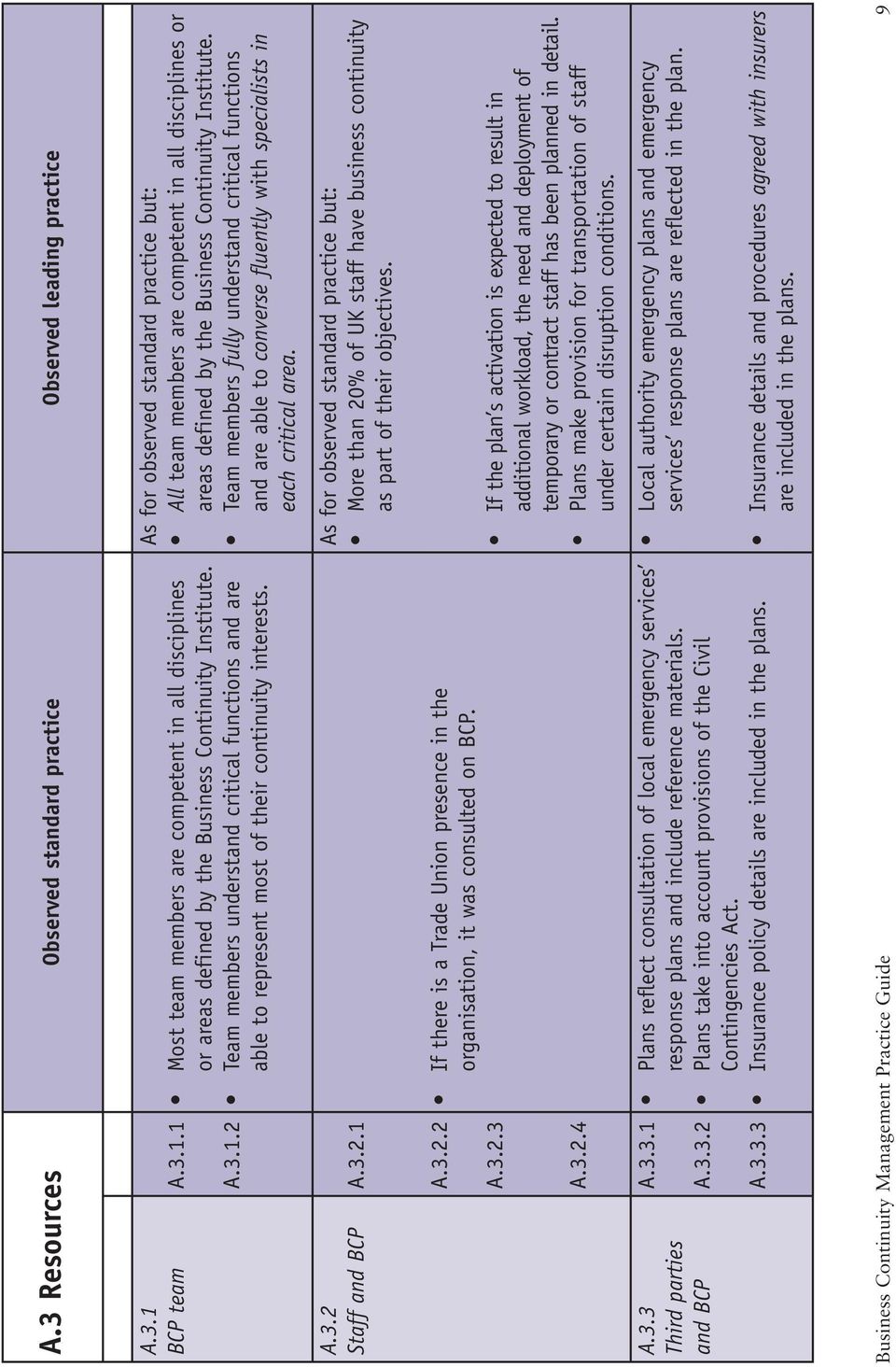
13 A.3 Resources Observed standard practice Observed leading practice A.3.1 BCP team A A Most team members are competent in all disciplines or areas defined by the Business Continuity Institute. Team members understand critical functions and are able to represent most of their continuity interests. All team members are competent in all disciplines or areas defined by the Business Continuity Institute. Team members fully understand critical functions and are able to converse fluently with specialists in each critical area. A.3.2 Staff and BCP A More than 20% of UK staff have business continuity as part of their objectives. A A A If there is a Trade Union presence in the organisation, it was consulted on BCP. If the plan s activation is expected to result in additional workload, the need and deployment of temporary or contract staff has been planned in detail. Plans make provision for transportation of staff under certain disruption conditions. A.3.3 Third parties and BCP A A A Plans reflect consultation of local emergency services response plans and include reference materials. Plans take into account provisions of the Civil Contingencies Act. Insurance policy details are included in the plans. Local authority emergency plans and emergency services response plans are reflected in the plan. Insurance details and procedures agreed with insurers are included in the plans. Business Continuity Management Practice Guide 9
14 A.4 Plan review Observed standard practice Observed leading practice A.4.1 BCP audit A A A Plans are subject to internal and external audit. Business continuity planning appears on Board s agenda at least twice each year. Business continuity planning appears on Risk and Audit committees agendas at least every quarter. There is a clear, documented and approved audit cycle covering all locations and functions. Business continuity planning appears on Board s agenda at least every quarter. A.4.2 BCP changes A A Business continuity is always considered as part of a formal change control process ensuring all relevant components are reviewed before change takes place. Business continuity documents are updated when a test is completed or when a major change occurs. Detailed risk and impact assessments and plan updates are carried out to build business continuity into a change in management processes. A.4.3 Testing A A A A A A At least 75% of all business functions have been tested in the last two years. Tests involve integrated simulation, involving IT, facility and critical staff recovery using alternate facilities. Out-of-hours telephone contact tests are conducted at least once per year. Representatives from all areas and at all levels, including senior management, are involved in tests. Neighbouring businesses and emergency services are consulted about testing. The testing schedule is current and published within the organisation. Out-of-hours telephone contact tests are conducted at least once every six months. All staff are involved in tests. Neighbouring businesses and emergency services are involved in some tests. 10 Business Continuity Management Practice Guide

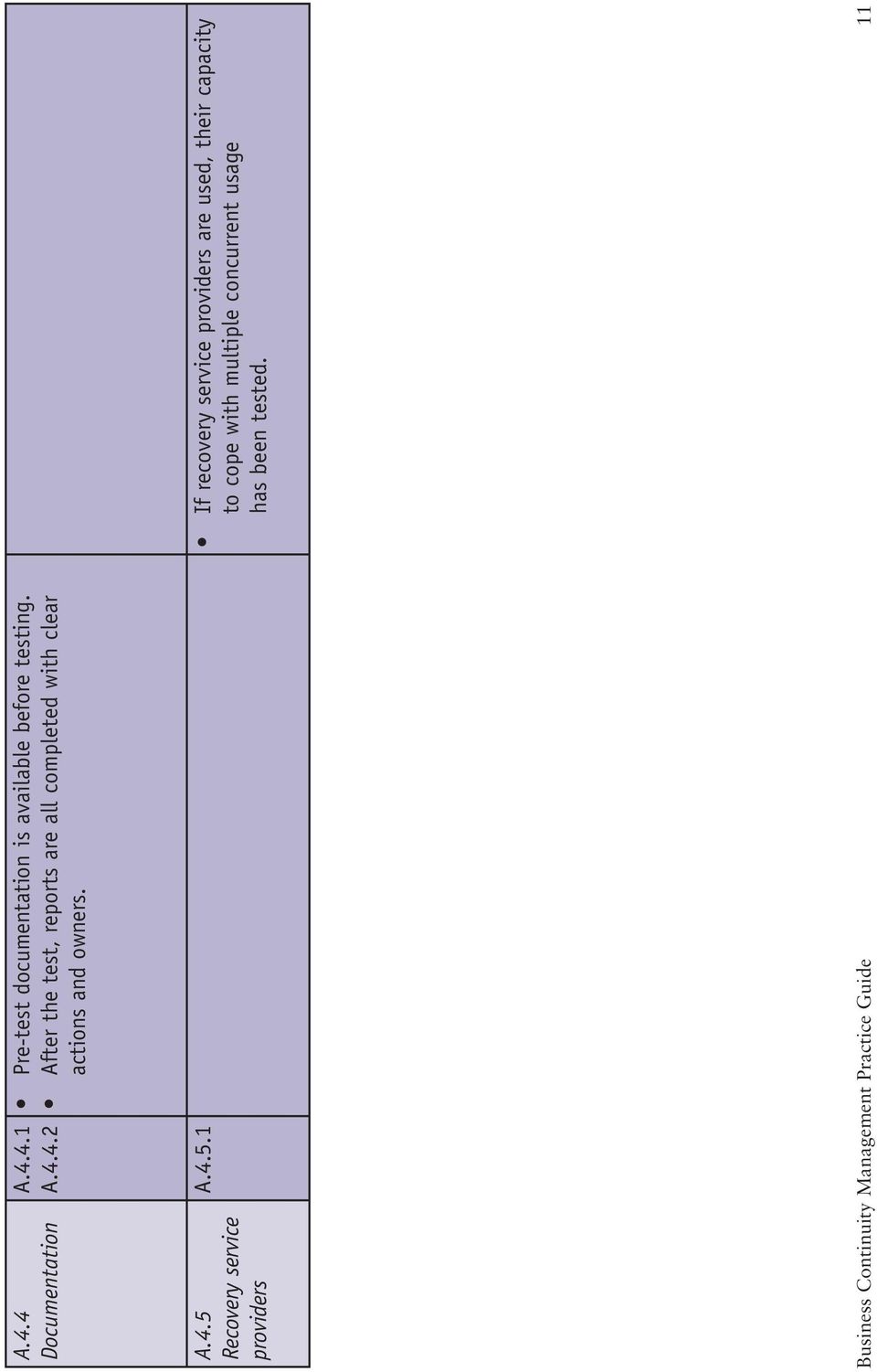
15 A.4.4 Documentation A A Pre-test documentation is available before testing. After the test, reports are all completed with clear actions and owners. A.4.5 Recovery service providers A If recovery service providers are used, their capacity to cope with multiple concurrent usage has been tested. Business Continuity Management Practice Guide 11
16 A.5 Recovery times for critical functions Observed standard practice Observed leading practice A.5.1 Wholesale payments The firm avoids entering into new business unless it is confident it can meet its obligations as they fall due. From the point of invocation all material pending transactions falling due that day are settled by close of business. A.5.2 Trade clearing The firm avoids entering into new business unless it is confident it can meet its obligations as they fall due. On the next working day the following transactions are settled by close of business: Any outstanding transactions falling due the previous day that have been rolled over; All transactions falling due that day. From the point of invocation all material pending transactions falling due that day are settled by close of business. A.5.3 Settlement The firm avoids entering into new business unless it is confident it can meet its obligations as they fall due. On the next working day the following transactions are settled by close of business: Any outstanding transactions falling due the previous day that have been rolled over; All transactions falling due that day. From the point of invocation all material pending transactions falling due that day are settled by close of business. On the next working day the following transactions are settled by close of business: Any outstanding transactions falling due the previous day that have been rolled over; All transactions falling due that day. 12 Business Continuity Management Practice Guide

17 Business Continuity Management Practice Guide B. Corporate Crisis Management Business Continuity Management Practice Guide 13

18 B.1 Culture Observed standard practice Observed leading practice B.1.1 Strategy B B B A detailed current crisis management plan is in place. The crisis management plan contains instructions on how to respond to the issue of casualties and fatalities. The crisis management strategy allows operations to continue indefinitely, allowing for some reduction of throughput. Instructions on responding on the issue of casualties and fatalities have been verified during tests. The crisis management strategy allows operations to continue indefinitely with no reduction of throughput. B.1.2 Audit and review B.1.3 Accessibility B.1.4 Senior management B Adjustments to the plan are made when threats change significantly. B The crisis management plan is accessible in a mix of media including: paper plans; electronic plans; web-based plans; and reference cards which are accessible at all times. B B B B The executive management team knows who is in the crisis management team and has approved their selection. The executive management team understands the crisis management team s remit. They have agreed to them running the crisis, approved their empowerment and signed off the plan. The agreed roles of the executive or senior management during an incident are contained in the crisis management plan and they have been signed off by the individuals concerned. If the senior management team is located overseas, UK offices are aware of its plan to manage a crisis. There is a regular formal review and update process, irrespective of changes of threats. 14 Business Continuity Management Practice Guide

19 B.2 Team Observed standard practice Observed leading practice B.2.1 Crisis management team B B B B B B B B.2.2 Team activation B B B The crisis management team is responsible for managing all critical internal and external issues to resolution. The crisis management team has a clear and formal structure. Responsibilities and alternates exist for all roles. At least 70% of crisis management team members and deputies have been involved in tests or incidents in the past 12 months. The core crisis management team may be supplemented by pre-selected and trained specialists according to incident type, scale and severity. The crisis management team has demonstrated capability in tests. The crisis management team s membership is stable, and any necessary changes kept to a minimum. The crisis management team is invoked following certain agreed disruptive circumstances. The crisis management team can be activated according to defined escalation mechanism. Following activation, the team is formed by one or more of these options according to circumstances: conference call with further assembly at an agreed location (primary or secondary); pre-defined standard meeting places and times; and assembly at a pre-defined location or secondary location. Business Continuity Management Practice Guide 15

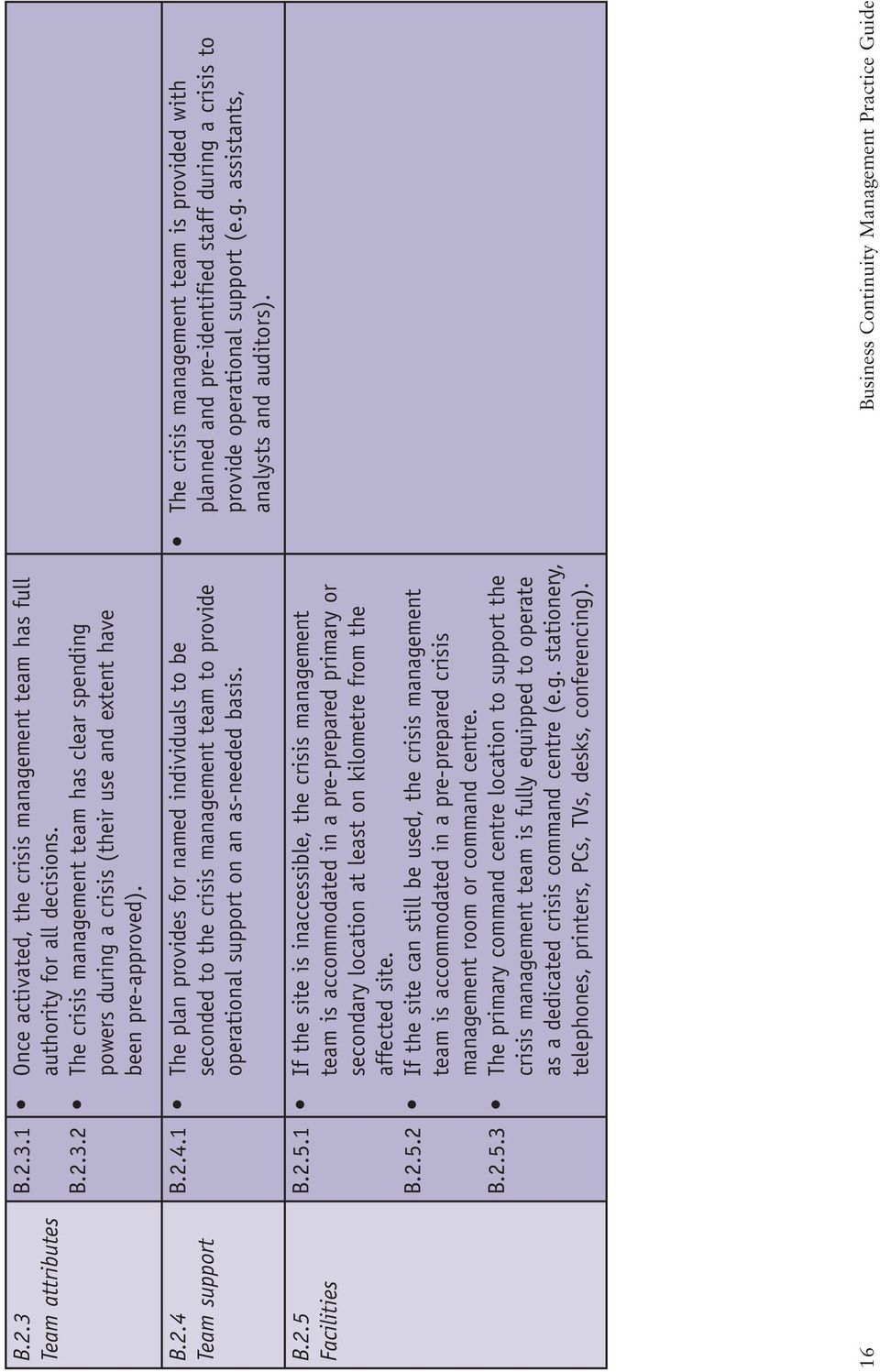
20 B.2.3 Team attributes B B Once activated, the crisis management team has full authority for all decisions. The crisis management team has clear spending powers during a crisis (their use and extent have been pre-approved). B.2.4 Team support B.2.5 Facilities B The plan provides for named individuals to be seconded to the crisis management team to provide operational support on an as-needed basis. B B B If the site is inaccessible, the crisis management team is accommodated in a pre-prepared primary or secondary location at least on kilometre from the affected site. If the site can still be used, the crisis management team is accommodated in a pre-prepared crisis management room or command centre. The primary command centre location to support the crisis management team is fully equipped to operate as a dedicated crisis command centre (e.g. stationery, telephones, printers, PCs, TVs, desks, conferencing). The crisis management team is provided with planned and pre-identified staff during a crisis to provide operational support (e.g. assistants, analysts and auditors). 16 Business Continuity Management Practice Guide
21 B.3 Communications Observed standard practice Observed leading practice B.3.1 Communications strategy B.3.2 Internal and external communications B B B B B B The crisis management communication plan covers internal and external communications with staff, peer organisations, the media and other stakeholders. There is a clearly defined process for dealing with the media and public relations during a crisis and it has been verified during tests. The crisis management team including key communications staff, and general management are familiar with the crisis management communications plan. The external communications or public relations plan has been tested responding to crises affecting the organisation. Telephone or mobile phone call cascade or automated calling systems are used for communicating instructions and status information to staff at the start of a crisis. During a crisis staff can contact the business through: a telephone number that they know they can call; and/or a widely publicised 24-hour manned emergency contact number. All staff with specific requirements placed on them by the plan are familiar with the crisis management communications plan. Dedicated web pages or recorded message or call centre contact are used for communicating instructions and status information to staff at the start of a crisis. Business Continuity Management Practice Guide 17
22 Business Continuity Management Practice Guide C. Corporate Systems 18 Business Continuity Management Practice Guide
23 C.1 IT Observed standard practice Observed leading practice C.1.1 Identification of risks C Plans identify: points of consistency of data for recovery; consequences of allowing non-affected systems to continue when others are non-operational; and any unique critical system (and its recovery is reflected in the plans). C.1.2 Identification of critical IT C C C A fully detailed impact analysis on loss of IT has been performed to identify which of the organisation s IT systems and infrastructure are the most business critical. There is an ongoing continuous process or cycle to analyse and document the criticality of the organisation s IT systems. A systematic dependency analysis has been performed covering most critical areas of IT to evaluate the impact of an individual IT system failure. A fully detailed and authorised IT dependency analysis has been performed to evaluate the impact of an individual IT system failure. Business Continuity Management Practice Guide 19
24 C.1.3 Recovery C.1.4 Providers C C C C C C C C C C C C C IT restoration plans address the following: restoration of all IT systems according to business conditions; the time needed to recover IT at all critical sites; all aspects of critical systems recovery is carried out by the firm s staff; restoration of connectivity to critical networks; restoration (including tests) of critical computer systems and associated hardware; where mirror systems are used, backup devices and software are in place to manage backups from a single replicated system when the primary has failed; permanent connections to recovery sites to recover wide area network communications for systems and users; eventual recovery of every system; and the return of IT operations to their original site. All critical sites use more than one telecoms provider for voice and data. The following interactions take place with providers: planned formal meetings take place to plan resilience of the communications network; planned verification takes place to check the resilience of telecoms providers network architecture and of the connectivity and routing within it; and verification of IT third party suppliers disaster recovery capability. Procedures as to how the disaster recovery providers will manage a multiple invocation of their sites is known, documented and agreed; Assurance has been given by providers that separacy/diversity services are in place in the wide area network. There are detailed procedures for prioritising IT recovery according to business conditions. There are plans to restore the development environment. Continuous interaction with planned formal meetings takes place to plan resilience into communications network. Detailed planned and formal reviews take place to verify the resilience of telecoms providers network architecture and of the connectivity and routing within it. 20 Business Continuity Management Practice Guide
25 C.1.5 Network resilience C C C C C C There is an up-to-date and detailed network diagram in IT plans. All aspects of network continuity are proactively and formally managed. Networks are designed to be fully redundant with no single points of failure. Network availability figures are monitored for trends as well as threshold exception basis and the information is used to identify points of weakness. The full control and visibility of wide area network assets needed to provide end-to-end separation can be demonstrated (e.g. through documentation) internally. Wide area network communications can be restored at work area recovery sites in less than one hour. C.1.6 IT resilience C C C C C No critical system depends on an individual person for restoration in a disaster. Critical IT systems are spread across diverse locations. If buildings and content and non-replicated data were destroyed, this would create backlogs smaller than one week. In an incident affecting the most critical IT site, all of the affected critical IT systems could be recovered within four hours from invocation. If replicated critical systems are used and both sites are lost, recovery can still take place. C.1.7 Data C C All critical data are copied or they are replicated at another site. It takes less than one hour to retrieve off-site copies of critical recovery data (where applicable). Business Continuity Management Practice Guide The full control and visibility of your wide area network assets needed to provide end-to-end separation can be demonstrated (e.g. through documentation) internally and externally. If buildings and content and non-replicated data were destroyed, this would create no noticeable backlogs or impact on operations. In an incident affecting the most critical IT site, all of the affected critical IT systems could be recovered within two hours from invocation. If replicated critical systems are used and both sites are lost, recovery can still take place within agreed business timeframes. 21
26 C.1.8 Security C.1.9 Site C C C C C C C C C C C C C C IT security elements include the following elements: Firewalls that are compliant with the organisation s current security policy and that have been compliance tested through regular penetration testing. Recognised standard of encryption for all critical communications is used internally and externally. The usage of removable storage devices on desktops is restricted and anti-virus deployed. Anti-virus products are deployed at external network entry points, on mail servers and on all desktops and laptops. Anti-virus products are automatically updated when released by vendor. Laptops are barred from connecting to the network unless they are authorised by IT security first. Vendor operating systems patches are reviewed for impact and relevance and tested before being applied. Escrow agreements are used to protect key software. Documented information security policy is current and formally refers to ISO The IT environment has separate physical access control. The IT environment power supply to critical systems is protected with UPS and generators. IT environment humidity, ventilation and airconditioning are controlled. IT environment is protected by fire detection and suppression. IT environment is protected by water detection. Recognised standard of encryption for all critical communications is used internally and externally and in storage. The usage of removable storage devices on desktops is permitted only to authorised devices. 22 Business Continuity Management Practice Guide
27 C.1.10 Alternate site C C C C C There is an alternate dedicated site where IT is restored following a disaster located at least ten kilometres away from the main site. There is an access to source code on core systems at the recovery site. The bandwidth from work area to recovery site is adequate to handle needs in a disaster scenario (100% of the bandwidth can be redirected to the recovery site in 24 hours). Detailed recovery plans exist for the redirection of all feeds from each primary site to respective recovery sites. C.1.11 Review, audit and changes C C C C C There is a mechanism for invoking the secondary site if the primary recovery site is not available. Continuity is always considered as part of a formal change control process ensuring all relevant components are reviewed before change takes place. The criticality of IT systems is reviewed at least every six months. Where outsourcing is used, critical IT outsourcing companies business continuity management capabilities are audited. All changes go through an agreed and signed-off procedure. C.1.12 Testing C C C C IT recovery tests are required to realistically reflect the worst case scenario where all critical systems must be restored concurrently. Critical systems recovery is tested every six months. Where a test environment is used, it is very similar to the live environment. Where some IT functions are outsourced, critical IT outsource companies participate individually in tests. Business Continuity Management Practice Guide There exists a secondary recovery site that can be used if the primary recovery site is unavailable. The criticality of IT systems is reviewed on a major change or at least every six months whichever is first. Where a test environment is used, it is identical to the live environment. Multiple critical IT outsource companies participate concurrently in tests for incidents affecting sites. 23
28 C C C If some IT aspects are outsourced, a policy to test outsourcers IT disaster recovery capability exists. The following elements are tested: Identified critical application or hardware and/or software keys. Market data feeds and systems at the disaster recovery site (tested to the best of ability due to external constraints). Operation of market data and other critical third party feeds are tested at each disaster recovery site where they will be used, as applicable. Rebuilding of client or desktop environment. Remote home working recovery capability to the disaster recovery site, and adequate capability is evidenced. Restoration of critical applications: live tests from mirrored systems or backups on an un-configured system are run. If mirrored systems are used, the operation of each secondary system with the primary switched off is tested. If critical backups are needed, they are restoretested every month. Unscheduled recall of offsite copies of critical recovery data. Individual restoration tests suggest that all critical applications can be recovered in the required timeframes. Tests have the following additional features: All market data feeds and systems at the disaster recovery site. Concurrent restoration tests suggest that all can be recovered in the required timeframes. 24 Business Continuity Management Practice Guide
29 C.2 Telephony Observed standard practice Observed leading practice C.2.1 Recovery C.2.2 Site C.2.3 Testing C C C C C C C C C C C C C C C Recovery plans include: Company telecommunications resilience and recovery strategy to divert calls. ACD, IVR and turrets in call centre restoration, where applicable. Telephone conferencing system capabilities are planned to be restored. Redirection of non-geographic incoming phone lines (0800, 0870 etc), if they are used. Adequate fax facility at the recovery site. Voice communications recovery strategy can be implemented within two hours of invocation. 100% of voice lines can be redirected to an appropriate alternative location (e.g. recovery site, call centre) within 24 hours of invocation. At least 80% of business as usual call throughput (including fax and modem) can be handled by the recovery site provisions. For all sites, where the option exists, there is a policy for two or more physical entry points or ducts for voice communications fibres and/or cables. There are connections to multiple external telephone exchanges at each critical site. Telephony recovery test takes place at least annually at each critical site. As part of this, the following elements are tested: mobile phone reception at recovery site; redirection of telephony to the recovery site; the programming of the telephone PABX used in recovery; and the restoration of critical telephony. The voice communications recovery strategy can be implemented in less than one hour from invocation. More than 100% (in case of an increase in call volume) of voice lines can be redirected to the recovery site within 24 hour from invocation. Normal call throughput (including fax and modem) can be handled by the recovery site provisions. Telephony recovery is tested every six months at each critical site. Voice communications can be redirected to the recovery site and have been tested in the past six months. Business Continuity Management Practice Guide 25
30 Business Continuity Management Practice Guide D. Corporate Facilities 26 Business Continuity Management Practice Guide
31 D.1 Planning Observed standard practice Observed leading practice D.1.1 Planning D D D D.1.2 Energy D D D D On-site non-company building managers are required to be involved in verifying site emergency plans. If occupancy of buildings is mixed, tenants plans are required to conform with the building manager s continuity plan. Plans include vacating recovery sites once recovery is complete. All critical business functions are protected by uninterruptible power supply (UPS) or similar battery backup. All areas and systems have their power supply backed up by generators. Power can be provided by generator(s) for at least three days using on-site stored fuel. If the gas supply to the area is discontinued, functions at the site can still operate indefinitely because alternative sources of energy are in place. All areas and systems are protected by uninterruptible power supply or similar battery backup. Power can be provided by generator(s) for at least one week using on-site stored fuel. D.1.3 Water D If the water supply to the area is discontinued or becomes contaminated, the site can remain open at least two days. If the water supply to the area is discontinued or becomes contaminated, the site can remain open at least one week. D.1.4 Security D D D All critical sites have security guards (24 hours a day, 7 days a week), internal and external CCTVs, access control systems and a standard security procedure for receiving couriers and visitors. Physical access to critical areas and floors is restricted by guards presence and individual swiped card or similar (e.g. biometrics). Permanent and temporary staff, contract staff and visitors required to wear visible id badges. Business Continuity Management Practice Guide 27
32 D D D D D D D D Sites use battle boxes. Alternatively, firms keep and maintain the materials they need to help them to recover their operations off-site, and in a secure location. Where battle boxes are used site occupants are able to retrieve battle boxes from the point of demand within two hours. A clear desk policy is in operation. A policy for controlling introduction of packages or items means that there is a dedicated post room which systematically scans for threatening objects. Advanced fire detection and early warning systems are installed. The air-conditioning system has auto-shut-off if there is a fire, smoke detection or CBRN alert. There are water detection systems in all vulnerable or high flood-risk areas. The site is protected against electrical spikes and surges (e.g. lightning strikes). Site occupants are able to retrieve battle boxes from the point of demand within one hour. D.1.5 Evacuation D.1.6 Emergency Services D D D D D.1.7 Testing D A designated trained senior manager or their deputy always takes responsibility for managing evacuation. Invacuation points have been identified and clearly marked for all staff. There is a clear demonstrable way of ensuring the building is clear (e.g. electronic records, roll call). A secondary evacuation point is located at least 500m away from primary evacuation points. D Emergency services are aware of all critical site emergency plans. D Full fire evacuation tests are required at each critical site annually. Both generators and UPS are full-load tested on an at least bi-annual basis. Both generators and UPS are full-load tested on an at least quarterly basis. 28 Business Continuity Management Practice Guide
33 Business Continuity Management Practice Guide E. Corporate People Business Continuity Management Practice Guide 29
34 E.1 Staff Observed standard practice Observed leading practice E.1.1 BCP awareness E E E E E E E E Business continuity is included in induction programmes for new employees. Most staff are aware of the organisation s business continuity strategy and of the roles, responsibilities and organisation of the business continuity team. Senior management and most staff are familiar with their role during a major operational disruption. Plans clearly state which staff are required at the recovery site and which can go home and this has been tested. Staff know whether they might be sent home in an incident. All HR staff have been trained and have been involved in business continuity tests. HR strategy supports business continuity. More than 90% of managers know their planned staffing levels in an incident. All staff are aware of the organisation business continuity strategy and of the roles, responsibilities and organisation of the business continuity team. All staff are familiar with their intended role during a major operational disruption. E.1.2 Training E E E Most staff at all grades and contractors have received business continuity training. Staff who might be called upon to deal with sensitive issues (such as working on a casualty helpline) have been trained. All executives, managers and designated critical staff have trained deputies who can fulfil their duties. All executives, managers and designated critical staff have first and second-level trained deputies who can fulfil their duties. 30 Business Continuity Management Practice Guide
35 E.1.3 Staff planning E E E.1.4 Key staff E E All staff contracts make provision for working from alternative or recovery sites. Working Time Directive requirements are considered in BCP. There is a policy preventing key staff from travelling together. E E.1.5 Checks E E E Risk mitigation means that the loss of critical staff in a disaster would have a limited impact on operations. At least two references are always requested and checked for new employees. New employees are also background security checked. References are always requested and checked for contractors, including agency temps. Contractors who will perform sensitive functions are security checked. E.1.6 Testing E Specialist HR support providers are involved in continuity-related tests and exercises. Business Continuity Management Practice Guide Uniquely skilled individuals are identified and crosstraining or other formal measures are provided to reduce the risk. Risk mitigation means that the loss of critical staff in a disaster would have a negligible impact on operations. As for observed standard practice but The checks are repeated periodically. At least two references are always requested and checked for contractors, including agency temps. Contractors who will perform sensitive functions are security checked and the checks are repeated. 31
36 E.2 Crisis Management Observed standard practice Observed leading practice E.2.1 Contacting staff E There is a detailed procedure to ensure that all staff staying at home during any recovery are kept informed. E.2.2 Staff welfare E E E E To provide for the assurance of staff welfare, plans have one or more of the following: procedures are in place for designated staff and managers to ensure staff welfare needs are met; contracts are in place to identify and provide all affected staff with liaison, support and counselling following a disruption; and there are procedures in place to enlist specialist care and welfare services and direct them to affected staff. Plans include provision for managing staff fatalities. Plans consider a level of staff fatalities. Next-of-kin information for staff is available on evacuation. 32 Business Continuity Management Practice Guide
37
38 The Financial Services Authority 25 The North Colonnade Canary Wharf London E14 5HS Telephone: +44 (0) Fax: +44 (0) Website: Registered as a Limited Company in England and Wales No Registered Office as above.
How To Manage A Business Continuity Strategy
 Business continuity strategy 2009 2012 Table of contents 1 Why this strategy is needed 3 2 Aim of the strategy 4 3 Our approach to business continuity 4 PROCESS 4 STRUCTURE 5 DOCUMENTATION 6 DISRUPTION
Supervisory Policy Manual
 This module should be read in conjunction with the Introduction and with the Glossary, which contains an explanation of abbreviations and other terms used in this Manual. If reading on-line, click on blue
Business Continuity Planning and Disaster Recovery Planning
 4 Business Continuity Planning and Disaster Recovery Planning Basic Concepts 1. Business Continuity Management: Business Continuity means maintaining the uninterrupted availability of all key business
Oracle Maps Cloud Service Enterprise Hosting and Delivery Policies Effective Date: October 1, 2015 Version 1.0
 Oracle Maps Cloud Service Enterprise Hosting and Delivery Policies Effective Date: October 1, 2015 Version 1.0 Unless otherwise stated, these Oracle Maps Cloud Service Enterprise Hosting and Delivery Policies
Business Continuity (Policy & Procedure)
 Business Continuity (Policy & Procedure) Publication Scheme Y/N Can be published on Force Website Department of Origin Force Operations Policy Holder Ch Supt Head of Force Ops Author Business Continuity
Introduction UNDERSTANDING BUSINESS CONTINUITY MANAGEMENT
 INFORMATION SECURITY: UNDERSTANDING BUSINESS CONTINUITY MANAGEMENT FACTSHEET This factsheet will introduce you to Business Continuity Management (BCM), which is a process developed to counteract systems
Overview of how to test a. Business Continuity Plan
 Overview of how to test a Business Continuity Plan Prepared by: Thomas Bronack Phone: (718) 591-5553 Email: [email protected] BRP/DRP Test Plan Creation and Exercise Page: 1 Table of Contents BCP/DRP Test
IT Disaster Recovery Plan Template
 HOPONE INTERNET CORP IT Disaster Recovery Plan Template Compliments of: Tim Sexton 1/1/2015 An information technology (IT) disaster recovery (DR) plan provides a structured approach for responding to unplanned
CENTRAL BANK OF KENYA (CBK) PRUDENTIAL GUIDELINE ON BUSINESS CONTINUITY MANAGEMENT (BCM) FOR INSTITUTIONS LICENSED UNDER THE BANKING ACT
 CENTRAL BANK OF KENYA (CBK) PRUDENTIAL GUIDELINE ON BUSINESS CONTINUITY MANAGEMENT (BCM) FOR INSTITUTIONS LICENSED UNDER THE BANKING ACT JANUARY 2008 GUIDELINE ON BUSINESS CONTINUITY GUIDELINE CBK/PG/14
BUSINESS CONTINUITY MANAGEMENT PLAN
 BUSINESS CONTINUITY MANAGEMENT PLAN For Thistley Hough Academy Detailing arrangements for Recovery and Resumption of Normal Academy Activity Table of Contents Section Content 1.0 About this Plan 1.1 Document
CISM Certified Information Security Manager
 CISM Certified Information Security Manager Firebrand Custom Designed Courseware Chapter 4 Information Security Incident Management Exam Relevance Ensure that the CISM candidate Establish an effective
Risk Management Guidelines
 Business Continuity Management Understanding Risk We live in an unpredictable world. No matter how effectively a business protects itself through insurance, there are some risks that cannot be anticipated,
<Client Name> IT Disaster Recovery Plan Template. By Paul Kirvan, CISA, CISSP, FBCI, CBCP
 IT Disaster Recovery Plan Template By Paul Kirvan, CISA, CISSP, FBCI, CBCP Revision History REVISION DATE NAME DESCRIPTION Original 1.0 2 Table of Contents Information Technology Statement
Business Continuity Management
 Business Continuity Management Standard Operating Procedure Notice: This document has been made available through the Police Service of Scotland Freedom of Information Publication Scheme. It should not
BUSINESS CONTINUITY MANAGEMENT GUIDELINES FOR BANKS AND FINANCIAL INSTITUTIONS
 BUSINESS CONTINUITY MANAGEMENT GUIDELINES FOR BANKS AND FINANCIAL INSTITUTIONS DIRECTORATE OF BANKING SUPERVISION AUGUST 2009 TABLE OF CONTENTS PAGE 1.0 INTRODUCTION..3 1.1 Background...3 1.2 Citation...3
Statement of Guidance
 Statement of Guidance Business Continuity Management All Licensees 1. Statement of Objectives 1.1. To enhance the resilience of the financial sector and to minimise the potential impact of a major operational
Willis Business Continuity Exercises. Phil Dibbin Business Continuity Manager - Willis
 Willis Business Continuity Exercises Phil Dibbin Business Continuity Manager - Willis Why Business Continuity Planning Regulatory requirements FSA/SEC Good Business Practice Client Expectations Tenders/proposals
Ohio Supercomputer Center
 Ohio Supercomputer Center IT Business Continuity Planning No: Effective: OSC-13 06/02/2009 Issued By: Kevin Wohlever Director of Supercomputer Operations Published By: Ohio Supercomputer Center Original
BUSINESS CONTINUITY PLAN
 Business Logo Here BUSINESS CONTINUITY PLAN FOR SMALL TO MEDIUM SIZED BUSINESSES DATE :??? VERSION:?? PRODUCED BY DURHAM CIVIL CONTINGENCIES UNIT BUSINESS CONTINUITY PLAN LIST OF CONTENTS 1. DISCLAIMER...4
Business Continuity Planning advice for Businesses with 50-250 employees
 Business Continuity Planning advice for Businesses with 50-250 employees Where to begin? A business continuity plan should consist of a business and contingencies analysis. It needs to be developed by
Information Security Policy September 2009 Newman University IT Services. Information Security Policy
 Contents 1. Statement 1.1 Introduction 1.2 Objectives 1.3 Scope and Policy Structure 1.4 Risk Assessment and Management 1.5 Responsibilities for Information Security 2. Compliance 3. HR Security 3.1 Terms
TalentLink Disaster Recovery & Service Continuity
 Technical Services Briefing Document TalentLink Disaster Recovery & Service Continuity Version 1.2 (January 2012) Contents Overview Planning for Service Continuity Disaster Recovery Process Business Continuity
PAPER-6 PART-3 OF 5 CA A.RAFEQ, FCA
 Chapter-4: Business Continuity Planning and Disaster Recovery Planning PAPER-6 PART-3 OF 5 CA A.RAFEQ, FCA Learning Objectives 2 To understand the concept of Business Continuity Management To understand
Service Children s Education
 Service Children s Education Data Handling and Security Information Security Audit Issued January 2009 2009 - An Agency of the Ministry of Defence Information Security Audit 2 Information handling and
Company Management System. Business Continuity in SIA
 Company Management System Business Continuity in SIA Document code: Classification: Company Project/Service Year Document No. Version Public INDEX 1. INTRODUCTION... 3 2. SIA S BUSINESS CONTINUITY MANAGEMENT
Offsite Disaster Recovery Plan
 1 Offsite Disaster Recovery Plan Offsite Disaster Recovery Plan Presented By: Natan Verkhovsky President Disty Portal Inc. 2 Offsite Disaster Recovery Plan Introduction This document is a comprehensive
OKHAHLAMBA LOCAL MUNICIPALITY
 OKHAHLAMBA LOCAL MUNICIPALITY I.T DISASTER RECOVERY PLAN 2012/2013 TABLE OF CONTENTS 1. INTRODUCTION 1 1.1 PURPOSE 2 1.2 OBJECTIVES 2 1.3 SCOPE 2 1.4 DISASTER RECOVERY STRATEGY 2 1.5 DISASTER DEFINITION
NOT PROTECTIVELY MARKED BUSINESS CONTINUITY. Specialist Operations Contingency Planning Business Continuity Manager 17.09.12
 POLICY BUSINESS CONTINUITY Policy owners Policy holder Author Head of Services Specialist Operations Contingency Planning Business Continuity Manager Policy No. 132 Approved by Legal Services 17.09.12
Business Continuity Business Continuity Management Policy
 Business Continuity Business Continuity Management Policy : Date of Issue: 28 January 2009 Version no: 1.1 Review Date: January 2010 Document Owner: Patricia Hughes Document Authoriser: Tony Curtis 1 Version
BUSINESS CONTINUITY PLAN
 BUSINESS CONTINUITY PLAN A GUIDE TO PREPARING A PLAN FOR SMALL TO MEDIUM SIZED BUSINESSES PREPARED BY DEVON COUNTY COUNCIL EMERGENCY PLANNING SERVICE CONTENTS 1. DISCLAIMER...3 2. BACKGROUND...3 3. METHODOLOGY...3
Prudential Practice Guide
 Prudential Practice Guide LPG 232 Business Continuity Management March 2007 www.apra.gov.au Australian Prudential Regulation Authority Disclaimer and copyright This prudential practice guide is not legal
Departmental Business Continuity Framework. Part 1 Policy and Standards
 Department for Work and Pensions Departmental Business Continuity Framework Part 1 Policy and Standards Page 1 of 34 CONTENTS Foreword... 3 Introduction... 4 British Standard BS25999... 4 Section 1 Policy...
Section A: Introduction, Definitions and Principles of Infrastructure Resilience
 Section A: Introduction, Definitions and Principles of Infrastructure Resilience A1. This section introduces infrastructure resilience, sets out the background and provides definitions. Introduction Purpose
Managed IT Services. Maintain, manage and report
 Managed IT Services Maintain, manage and report 1 2 Comunet was established in 1995 to provide professional Information Technology services to Australian businesses and organisations. Its vision now, as
Emergency Response and Business Continuity Management Policy
 Emergency Response and Business Continuity Management Policy Owner: John Duffy, Registrar & Secretary Last updated: September 2012 Version: 04 Document control Date Version Author Changes To be populated
BUSINESS CONTINUITY POLICY
 BUSINESS CONTINUITY POLICY Last Review Date Approving Body n/a Audit Committee Date of Approval 9 th January 2014 Date of Implementation 1 st February 2014 Next Review Date February 2017 Review Responsibility
Karen Winter Service Manager Schools and Traded Services 01823 355267 [email protected]
 Somerset Services to Education Providers 2014-2015 SOUTHWEST ONE TECHNOLOGY SERVICES Service Provider: Southwest One Service Category: Academy Schools - Chargeable Contact: Karen Winter Service Manager
BCP and DR. P K Patel AGM, MoF
 BCP and DR P K Patel AGM, MoF Key difference between BS 25999 and ISO 22301 ISO 22301 puts a much greater emphasis on setting the objectives, monitoring performance and metrics aligning BC to top management
Data Center Assistance Group, Inc. DCAG Contact: Tom Bronack Phone: (718) 591-5553 Email: [email protected] Fax: (718) 380-7322
 Business Continuity and Disaster Recovery Job Descriptions Table of Contents Business Continuity Services Organization Chart... 2 Director Business Continuity Services Group... 3 Manager of Business Recovery
Tips and techniques a typical audit programme
 Auditing Business Continuity Planning Tips and techniques a typical audit programme Karen Wills, Senior Internal Auditor St James s Place Wealth Management February 2014 Contents Background Roles and Responsibilities
Information security controls. Briefing for clients on Experian information security controls
 Information security controls Briefing for clients on Experian information security controls Introduction Security sits at the core of Experian s operations. The vast majority of modern organisations face
NEEDS BASED PLANNING FOR IT DISASTER RECOVERY
 The Define/Align/Approve Reference Series NEEDS BASED PLANNING FOR IT DISASTER RECOVERY Disaster recovery planning is essential it s also expensive. That s why every step taken and dollar spent must be
BUSINESS CONTINUITY PLAN
 BUSINESS CONTINUITY PLAN [Name of Team/Service/Organisation] [Insert Building Name and Address] [Insert date] Detailing arrangements for: Incident Management Business Continuity Recovery and Resumption
Clovis Municipal School District Information Technology (IT) Disaster Recovery Plan
 Clovis Municipal School District Information Technology (IT) Disaster Recovery Plan Revision History REVISION DATE NAME DESCRIPTION Draft 1.0 Eric Wimbish IT Backup Disaster Table of Contents Information
ICT Category Sub Category Description Architecture and Design
 A A01 Architecture and Design Architecture and Design Enterprise & Business Architecture A02 Architecture and Design Information Architecture A03 Architecture and Design Solution Architecture B Benchmarking
DESIGNATED CONTRACT MARKET OPERATIONAL CAPABILITY TECHNOLOGY QUESTIONNAIRE
 DESIGNATED CONTRACT MARKET OPERATIONAL CAPABILITY TECHNOLOGY QUESTIONNAIRE Please provide all relevant documents responsive to the information requests listed within each area below. In addition to the
DISASTER RECOVERY AND BUSINESS CONTINUITY
 DISASTER RECOVERY AND BUSINESS CONTINUITY ISO 9001/27001 PARTNER ONLY NODE4 LIMITED 03/01/2014 DISASTER RECOVERY PLAN This plan will be held at Node4 s premises located at Pride Park in Derby and also
OPERATIONAL CAPABILITY TECHNOLOGY QUESTIONNAIRE
 OPERATIONAL CAPABILITY TECHNOLOGY QUESTIONNAIRE Please provide all relevant documents responsive to the information requests listed within each area below. In addition to the specific documents requested,
Supplier Security Assessment Questionnaire
 HALKYN CONSULTING LTD Supplier Security Assessment Questionnaire Security Self-Assessment and Reporting This questionnaire is provided to assist organisations in conducting supplier security assessments.
Business Continuity and Disaster Recovery Plan
 Business Continuity and Disaster Recovery Plan 1.0 Introduction Our plan relies upon excellent communications and this is reviewed on a regular basis to identify any weakness and forms part of our board
NORTH HAMPSHIRE CLINICAL COMMISSIONING GROUP BUSINESS CONTINUITY MANAGEMENT POLICY AND PLAN (COR/017/V1.00)
 NORTH HAMPSHIRE CLINICAL COMMISSIONING GROUP BUSINESS CONTINUITY MANAGEMENT POLICY AND PLAN (COR/017/V1.00) Subject and version number of document: Serial Number: Business Continuity Management Policy
Business Continuity Policy
 Business Continuity Policy Page 1 of 15 Business Continuity Policy First published: Amendment record Version Date Reviewer Comment 1.0 07/01/2014 Debbie Campbell 2.0 11/07/14 Vicky Ryan Updated to include
DISASTER RECOVERY PLANNING FOR CITY COMPUTER FACILITIES
 APPENDIX 1 DISASTER RECOVERY PLANNING FOR CITY COMPUTER FACILITIES March 2008 Auditor General s Office Jeffrey Griffiths, C.A., C.F.E. Auditor General City of Toronto TABLE OF CONTENTS EXECUTIVE SUMMARY...1
Draft Information Technology Policy
 Draft Information Technology Policy Version 3.0 Draft Date June 2014 Status Draft Approved By: Table of Contents 1.0 Introduction... 6 Background... 6 Purpose... 6 Scope... 6 Legal Framework... 6 2.0 Software
Business Continuity Policy and Business Continuity Management System
 Business Continuity Policy and Business Continuity Management System Summary: This policy sets out the structure for ensuring that the PCT has effective Business Continuity Plans in place in order to maintain
Business Continuity Management & Disaster Recovery GETTING STARTED Checklist for Local Businesses & Organisations
 Business Continuity Management & Disaster Recovery GETTING STARTED Checklist for Local Businesses & Organisations Name of Organisation: Date: This Document has been designed to assist local businesses
Business Continuity Management Policy
 Business Continuity Management Policy Business Continuity Policy Version 1.0 1 Version control Version Date Changes Author 0.1 April 13 1 st draft PH 0.2 June 13 Amendments in line with guidance PH 0.3
Massachusetts Institute of Technology. Functional Area Recovery Management Team Plan Development Template
 Massachusetts Institute of Technology Functional Area Recovery Management Team Plan Development Template Public Distribution Version For further information, contact: Jerry Isaacson MIT Information Security
Creating a Business Continuity Plan. What We ll Cover... What is a BCP? Micky Hogue, CRM
 Creating a Business Continuity Plan Micky Hogue, CRM Sandia National Laboratories Albuquerque, NM 505-844-6640 [email protected] What We ll Cover... What is a Business Continuity Plan Why create a BCP?
business continuity plan for:
 business continuity plan for: Insert your company name here Our statement of Business Continuity is: > To ensure all employees are competent to do their tasks, and to provide adequate training > To review
Business Continuity Plan Toolkit
 Business Continuity Plan Toolkit March 2015 1 Contents The Template instructions for use... 2 Introduction... 3 What is the purpose of this toolkit?... 3 Why do you need a Business Continuity Plan?...
Information Security Management: Business Continuity Planning. Presentation by Stanislav Nurilov March 9th, 2005 CS 996: Info. Sec. Mgmt.
 Information Security Management: Business Continuity Planning Presentation by Stanislav Nurilov March 9th, 2005 CS 996: Info. Sec. Mgmt. Overview BCP: Definition BCP: Need for (Why?) BCP: When BCP: Who
BUSINESS CONTINUITY MANAGEMENT FRAMEWORK
 BUSINESS CONTINUITY MANAGEMENT FRAMEWORK Document Author: Civil Contingencies Service - Authorised by the CCS Joint Management Board - Version 1.0. Issued December 2012 Page 1 FRAMEWORK STATEMENT Business
STRATEGIC POLICY. Information Security Policy Documentation. Network Management Policy. 1. Introduction
 Policy: Title: Status: 1. Introduction ISP-S12 Network Management Policy Revised Information Security Policy Documentation STRATEGIC POLICY 1.1. This information security policy document covers management,
Version: 3.0. Effective From: 19/06/2014
 Policy No: RM66 Version: 3.0 Name of Policy: Business Continuity Planning Policy Effective From: 19/06/2014 Date Ratified 05/06/2014 Ratified Business Service Development Committee Review Date 01/06/2016
JOB DESCRIPTION CONTRACTUAL POSITION
 Ref #: IT/P /01 JOB DESCRIPTION CONTRACTUAL POSITION JOB TITLE: INFORMATION AND COMMUNICATIONS TECHNOLOGY (ICT) SECURITY SPECIALIST JOB SUMMARY: The incumbent is required to provide specialized technical
Update from the Business Continuity Working Group
 23 June 2014 Performance and Resources Board 19 To note Update from the Business Continuity Working Group Issue 1 The Business Continuity Working Group oversees the development, maintenance and improvement
Birkenhead Sixth Form College IT Disaster Recovery Plan
 Author: Role: Mal Blackburne College Learning Manager Page 1 of 14 Introduction...3 Objectives/Constraints...3 Assumptions...4 Incidents Requiring Action...4 Physical Safeguards...5 Types of Computer Service
SWAP EXECUTION FACILITY OPERATIONAL CAPABILITY TECHNOLOGY QUESTIONNAIRE
 SWAP EXECUTION FACILITY OPERATIONAL CAPABILITY TECHNOLOGY QUESTIONNAIRE Please provide all relevant documents responsive to the information requests listed within each area below. In addition to the specific
Staying In Business. A Business Continuity White Paper by. Paul O Brien and Gerard Joyce. LinkResQ Limited
 Staying In Business A Business Continuity White Paper by Paul O Brien and Gerard Joyce LinkResQ Limited Contents: Introduction. 2 What is Business Continuity? 2 Loss Events = Opportunities for Disaster..
Business Continuity Plan Guidance and Template to support Small Businesses
 Business Continuity Plan Guidance and Template to support Small Businesses Disclaimer This template and guidance is provided as general information about Business Continuity Planning. It is not intended
The University of Iowa. Enterprise Information Technology Disaster Plan. Version 3.1
 Version 3.1 November 22, 2004 TABLE OF CONTENTS PART 1: DISASTER RECOVERY EXPECTATIONS... 3 OVERVIEW...3 EXPECTATIONS PRIOR TO AN INCIDENT OCCURRENCE...3 EXPECTATIONS PRIOR TO A DISASTER OCCURRENCE...4
Business Continuity Policy
 Business Continuity Policy St Mary Magdalene Academy V1.0 / September 2014 Document Control Document Details Document Title Document Type Business Continuity Policy Policy Version 2.0 Effective From 1st
Business Continuity Management Policy and Plan
 Business Continuity Management Policy and Plan 1 Page No: Contents 1.0 Introduction 3 2.0 Purpose 3 3.0 Definitions 4 4.0 Roles, Duties & Responsibilities 4 4.1 Legal And Statutory Duties, Responsibilities
SUBJECT: REPLACEMENT OF CORPORATE ELECTRONIC DATA STORAGE, BACKUP AND DISASTER RECOVERY SOLUTIONS
 REPORT TO CABINET TO BE HELD ON 15 SEPTEMBER 2015 Key Decision No Forward Plan Ref No 23K Corporate Priority The proposals in this report contribute to the delivery of all the Council s priorities Cabinet
Business Continuity Management
 Business Continuity Management Policy Statement & Strategy July 2009 Basildon District Council Business Continuity Management Policy Statement The Council is committed to ensuring robust and effective
BUSINESS CONTINUITY PLAN OVERVIEW
 BUSINESS CONTINUITY PLAN OVERVIEW INTRODUCTION The purpose of this document is to provide Loomis customers with an overview of the company s Business Continuity Plan (BCP). Because of the specific and
Protecting Your Business
 Protecting Your Business Business Continuity/Disaster Recovery Planning Robert Haberman Senior Product Manager BCP/DRP TELUS BUSINESS SOLUTIONS Business Continuity/Disaster Recovery Planning 1 Agenda:
WEST LOTHIAN COUNCIL INFORMATION SECURITY POLICY
 WEST LOTHIAN COUNCIL INFORMATION SECURITY POLICY DATA LABEL: PUBLIC INFORMATION SECURITY POLICY CONTENTS 1. INTRODUCTION... 3 2. MAIN OBJECTIVES... 3 3. LEGISLATION... 4 4. SCOPE... 4 5. STANDARDS... 4
White Paper AN INTRODUCTION TO BUSINESS CONTINUITY PLANNING AND SOLUTIONS FOR IT AND TELECOM DECISION MAKERS. Executive Summary
 AN INTRODUCTION TO BUSINESS CONTINUITY PLANNING AND SOLUTIONS FOR IT AND TELECOM DECISION MAKERS Executive Summary Today s businesses rely heavily on voice communication systems and data networks to such
Business Continuity Management For Small to Medium-Sized Businesses
 Business Continuity Management For Small to Medium-Sized Businesses Produced by NORMIT and Norfolk County Council Resilience Team For an electronic copy of this document visit www.normit.org Telephone
Post-Class Quiz: Business Continuity & Disaster Recovery Planning Domain
 1. What is the most common planned performance duration for a continuity of operations plan (COOP)? A. 30 days B. 60 days C. 90 days D. It depends on the severity of a disaster. 2. What is the business
SCHEDULE 25. Business Continuity
 SCHEDULE 25 Business Continuity 1. Scope 1.1 This schedule covers TfL s requirements in respect of: any circumstance or event which renders, or which TfL considers likely to render, it necessary or desirable
IT - General Controls Questionnaire
 IT - General Controls Questionnaire Internal Control Questionnaire Question Yes No N/A Remarks G1. ACCESS CONTROLS Access controls are comprised of those policies and procedures that are designed to allow
Preparing for the Worst: Disaster Recovery and Business Continuity Planning for Investment Firms An Eze Castle Integration ebook
 Preparing for the Worst: Disaster Recovery and Business Continuity Planning for Investment Firms An Eze Castle Integration ebook Table of Contents 1. Introduction to Business Continuity Planning and Disaster
1.0 Policy Statement / Intentions (FOIA - Open)
 Force Policy & Procedure Reference Number Business Continuity Management D269 Policy Version Date 23 July 2015 Review Date 23 July 2016 Policy Ownership Portfolio Holder Links or overlaps with other policies
IT Checklist. for Small Business INFORMATION TECHNOLOGY & MANAGEMENT INTRODUCTION CHECKLIST
 INFORMATION TECHNOLOGY & MANAGEMENT IT Checklist INTRODUCTION A small business is unlikely to have a dedicated IT Department or Help Desk. But all the tasks that a large organization requires of its IT
<cloud> Secure Hosting Services
 Global Resources... Local Knowledge Figtree offers the functionality of Figtree Systems Software without the upfront infrastructure investment. It is the preferred deployment solution for organisations
FINRMFS9 Facilitate Business Continuity Planning and disaster recovery for a financial services organisation
 Facilitate Business Continuity Planning and disaster recovery for a Overview This unit is suitable for those working in risk management roles who have responsibility for facilitating business continuity
Business Continuity and Disaster Recovery Planning from an Information Technology Perspective
 Business Continuity and Disaster Recovery Planning from an Information Technology Perspective Presenter: David Bird, Director of Sales, Business Technology Consultant phone: 215-672-7100 email: [email protected]