
INSURANCE REGULATION AND SUPERVISION IN OECD COUNTRIES
|
|
|
- Lawrence Cook
- 9 years ago
- Views:
Transcription
1 Organisation for Economic Co-operation and Development Publication sponsored by the Japanese Government INSURANCE AND PRIVATE PENSIONS COMPENDIUM FOR EMERGING ECONOMIES Book 1 Part 2:1)a INSURANCE REGULATION AND SUPERVISION IN OECD COUNTRIES Jörg Vollbrecht 2000 Comparative tables on the insurance regulation and supervision in OECD countries may be downloaded from the OECD insurance and pensions website: This report is part of the OECD Insurance and Private Pensions Compendium, available on the OECD Web site at The Compendium brings together a wide range of policy issues, comparative surveys and reports on insurance and private pensions activities. Book 1 deals with insurance issues and Book 2 is devoted to Private Pensions. The Compendium seeks to facilitate an exchange of experience on market developments and promote "best practices" in the regulation and supervision of insurance and private pensions activities in emerging economies. The views expressed in these documents do not necessarily reflect those of the OECD, or the governments of its Members or non-member economies. Insurance and Private Pensions Unit Financial Affairs Division Directorate for Financial, Fiscal and Enterprise Affairs

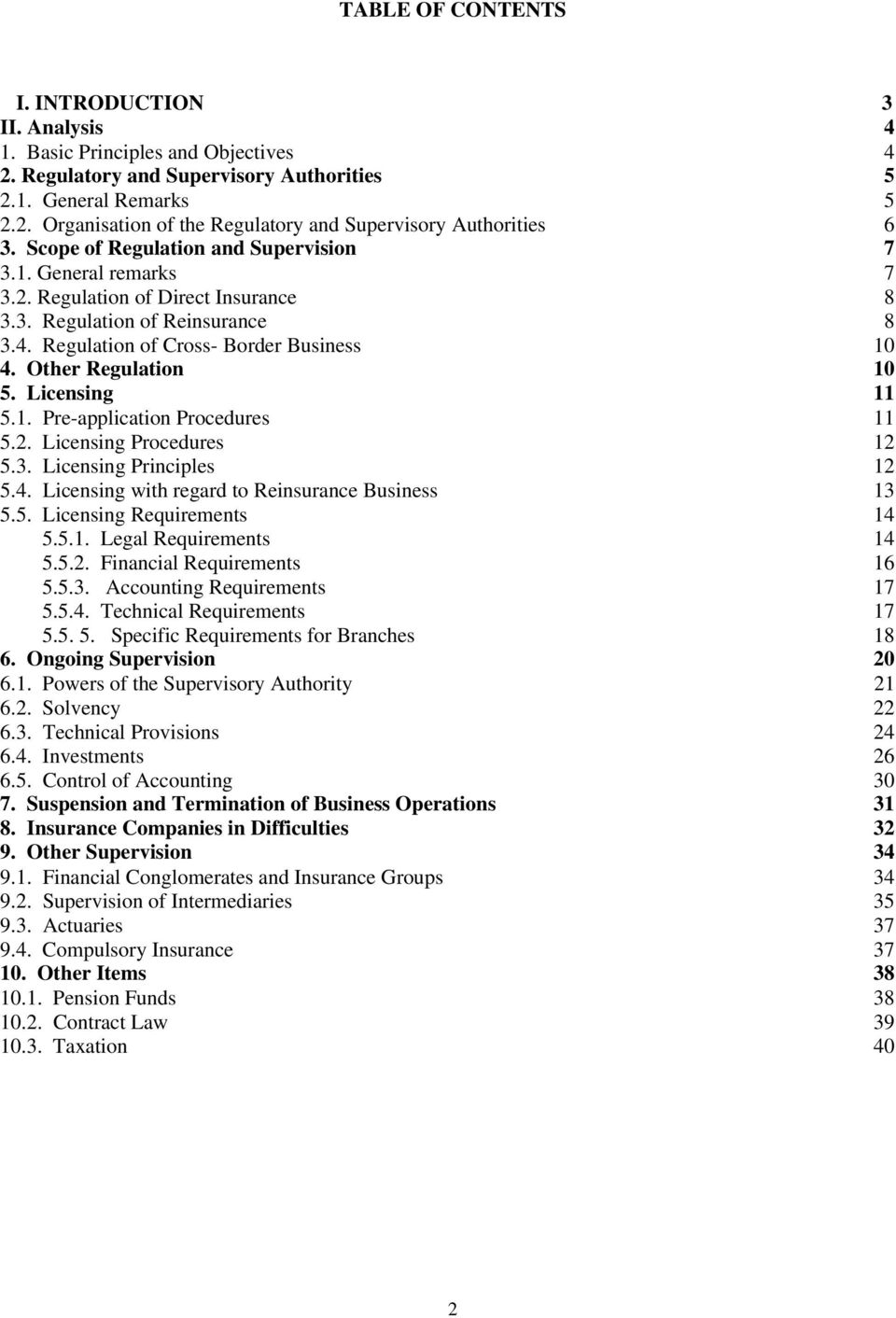
2 TABLE OF CONTENTS I. INTRODUCTION 3 II. Analysis 4 1. Basic Principles and Objectives 4 2. Regulatory and Supervisory Authorities General Remarks Organisation of the Regulatory and Supervisory Authorities 6 3. Scope of Regulation and Supervision General remarks Regulation of Direct Insurance Regulation of Reinsurance Regulation of Cross- Border Business Other Regulation Licensing Pre-application Procedures Licensing Procedures Licensing Principles Licensing with regard to Reinsurance Business Licensing Requirements Legal Requirements Financial Requirements Accounting Requirements Technical Requirements Specific Requirements for Branches Ongoing Supervision Powers of the Supervisory Authority Solvency Technical Provisions Investments Control of Accounting Suspension and Termination of Business Operations Insurance Companies in Difficulties Other Supervision Financial Conglomerates and Insurance Groups Supervision of Intermediaries Actuaries Compulsory Insurance Other Items Pension Funds Contract Law Taxation 40 2
3 I. INTRODUCTION In 1963, the OECD issued the first set of comparative tables on the Control of Private Insurance in Europe, known as the Paratte Report. The Paratte Report was created from a study dating from 1963; the study consisted of 33 tables classified into five parts summarising the information derived from the contributions of eighteen OECD Member countries geographically belonging to Europe. These tables may be downloaded from the internet website. The objective was to make available in summary form the basic information on the scope and modalities of the regulation and supervision of private insurance. This information would be available to ministries and the supervisory authorities, insurers and insurance associations, as well as to the public. The report covered general legal framework and scope of supervision, conditions for licensing, investment rules, information on suspension and cessation of business and specifics on compulsory insurance. Furthermore, the original report also provided information on the insurance contract law and taxation rules. With that report the foundation was laid for the OECD work directed at co-operation and liberalisation. In 1994, the Member countries decided to issue a new version of the report which was intended to be not only an update as the former one report but a reflection of the considerable changes that have occurred in the regulatory and supervisory framework since the launch of the report in the 1960 s. The Insurance Committee, in response to the creation of the new report, decided to send a questionnaire to all OECD Member countries consisting of two sets of tables, one set requiring only yes/no answers and the second set asking for further details on the main features of insurance regulation. A draft of the tables was approved in December 1996 by the Committee A task force, consisting of five delegates from OECD Member countries and the Secretariat, met several times to discuss the content of the new OECD Report on insurance regulation. In 1997, during the Second East-West Conference, the 17 participating economies in transition were invited to approve the proposal of such a collection of information on their insurance regulatory systems; the participating economies in transition agreed to join the project. Not only issues of regulation and supervision of insurance in a strict sense are covered by this report, but also the regulation and supervision of intermediaries and pension funds, issues relating to the insurance contract law and taxation rules. On the other hand, harmonisation within the European Union has removed many differences among its members. Moreover, the EU rules have become models for other countries as, e.g., for European economies in transition. The following analysis of the responses given to the above mentioned questionnaire, Part I of the OECD report on insurance regulation, includes not only the information given for this purpose by the Member countries but also still valid information from the introductory part of the former Paratte Report by Prof. Dr. Angerer (Germany) as well as information deriving from several other OECD publications (e.g. a document by Professor Dickinson on insurance company investments, see Policy issues in insurance, 1996) documents on insurance issues and a paper by Dr. Werner Pfennigstorf. The objective of this analysis is to provide an analytical background and source of information for countries interested in the lessons learned by the experiences of OECD Member countries within the scope of regulation and supervision of insurance. Where appropriate, recommendations accompany the presentation of regulations existing in OECD Member countries. 3

4 The analysis reflects the situation up to the end of This report is intended to provide a useful tool in understanding the insurance regulatory structures prevailing in OECD Member countries. This analytical part has been prepared by Jörg Vollbrecht, Consultant to the Insurance and Private Pensions Unit. The opinions expressed in this report do not necessarily represent the views of the Delegates to the Insurance Committee. The report will be published under the responsibility of the Secretary-General of the OECD. II. Analysis 1. Basic Principles and Objectives The insurance sector plays an essential role in a market economy. The insurance industry provides various kinds of coverage against almost every risk and unexpected loss incurred by individuals and entities. Insurance companies are steadily accumulating resources that account for a significant part of a country s structural investment. Life insurance is part of the social security system. Policyholders and insured are relying on the security of their insurance companies having to trust them to be in a position to meet their commitments over the considerable time lag between the payment of premiums and the receipt of benefits. Given this background, it is not surprising that state supervision of private insurance is existent in all OECD Member countries. The common objective of insurance supervision is to protect the policyholder, the insured,the beneficiary of an insurance contract as well as third parties who may have a right of direct claim against an insurer under certain insurance agreements by making sure that an insurance company is in the position to meet its obligations at any time. In former times, countries such as France, Germany, Iceland and Sweden considered it another task of insurance supervision to ensure the compliance of insurance contracts with provisions regarding the nature of the products (e.g. control of tariffs) and that there is an adequate relationship between premium rates and insurance benefits. Other countries (e.g. Australia, the Netherlands, and the United Kingdom) did not share this opinion. Finally, according to the Insurance Directives, the former position had to be given up by the European countries because the drafting of contracts and the fixing of premium rates were no longer subject to approval. At present, within the OECD, one may speak of a prevailing attitude favouring freedom of innovation and expansion for the insurers by defining the insured as mature market participants who will critically compare the products offered on the deregulated markets. Depending on the objectives, some member countries formerly focused more on the financial supervision while others were in favour of the so-called material supervision that covered the entire business of the insurance company, including the control of products and tariffs. These countries as members of the EU had to shift to a system where solvency control was considerably extended and material supervision reduced. However, even in times of deregulation, the interests of the insured are protected by way of insurance supervision as well as via general consumer protection regulations. 4

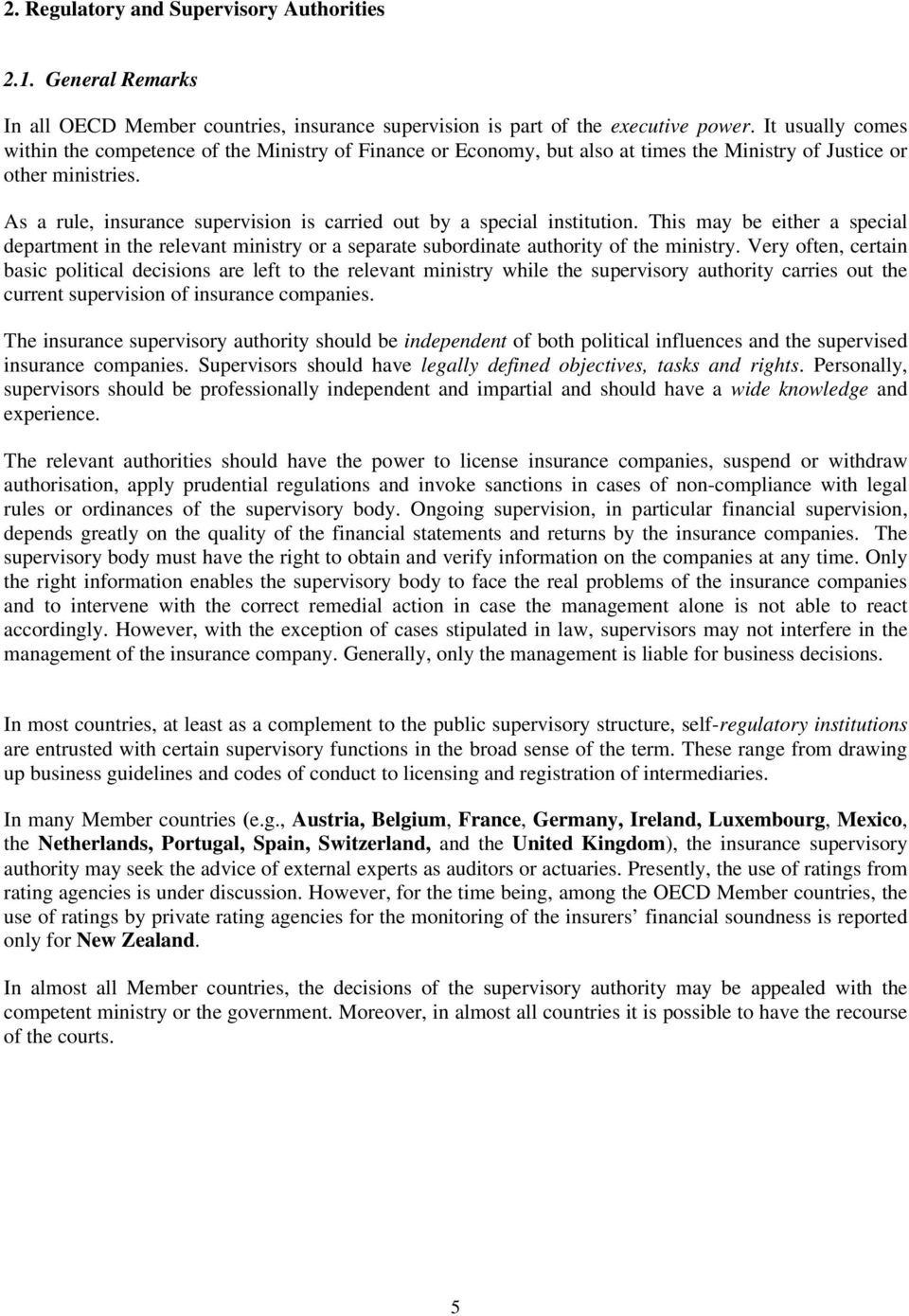
5 2. Regulatory and Supervisory Authorities 2.1. General Remarks In all OECD Member countries, insurance supervision is part of the executive power. It usually comes within the competence of the Ministry of Finance or Economy, but also at times the Ministry of Justice or other ministries. As a rule, insurance supervision is carried out by a special institution. This may be either a special department in the relevant ministry or a separate subordinate authority of the ministry. Very often, certain basic political decisions are left to the relevant ministry while the supervisory authority carries out the current supervision of insurance companies. The insurance supervisory authority should be independent of both political influences and the supervised insurance companies. Supervisors should have legally defined objectives, tasks and rights. Personally, supervisors should be professionally independent and impartial and should have a wide knowledge and experience. The relevant authorities should have the power to license insurance companies, suspend or withdraw authorisation, apply prudential regulations and invoke sanctions in cases of non-compliance with legal rules or ordinances of the supervisory body. Ongoing supervision, in particular financial supervision, depends greatly on the quality of the financial statements and returns by the insurance companies. The supervisory body must have the right to obtain and verify information on the companies at any time. Only the right information enables the supervisory body to face the real problems of the insurance companies and to intervene with the correct remedial action in case the management alone is not able to react accordingly. However, with the exception of cases stipulated in law, supervisors may not interfere in the management of the insurance company. Generally, only the management is liable for business decisions. In most countries, at least as a complement to the public supervisory structure, self-regulatory institutions are entrusted with certain supervisory functions in the broad sense of the term. These range from drawing up business guidelines and codes of conduct to licensing and registration of intermediaries. In many Member countries (e.g., Austria, Belgium, France, Germany, Ireland, Luxembourg, Mexico, the Netherlands, Portugal, Spain, Switzerland, and the United Kingdom), the insurance supervisory authority may seek the advice of external experts as auditors or actuaries. Presently, the use of ratings from rating agencies is under discussion. However, for the time being, among the OECD Member countries, the use of ratings by private rating agencies for the monitoring of the insurers financial soundness is reported only for New Zealand. In almost all Member countries, the decisions of the supervisory authority may be appealed with the competent ministry or the government. Moreover, in almost all countries it is possible to have the recourse of the courts. 5
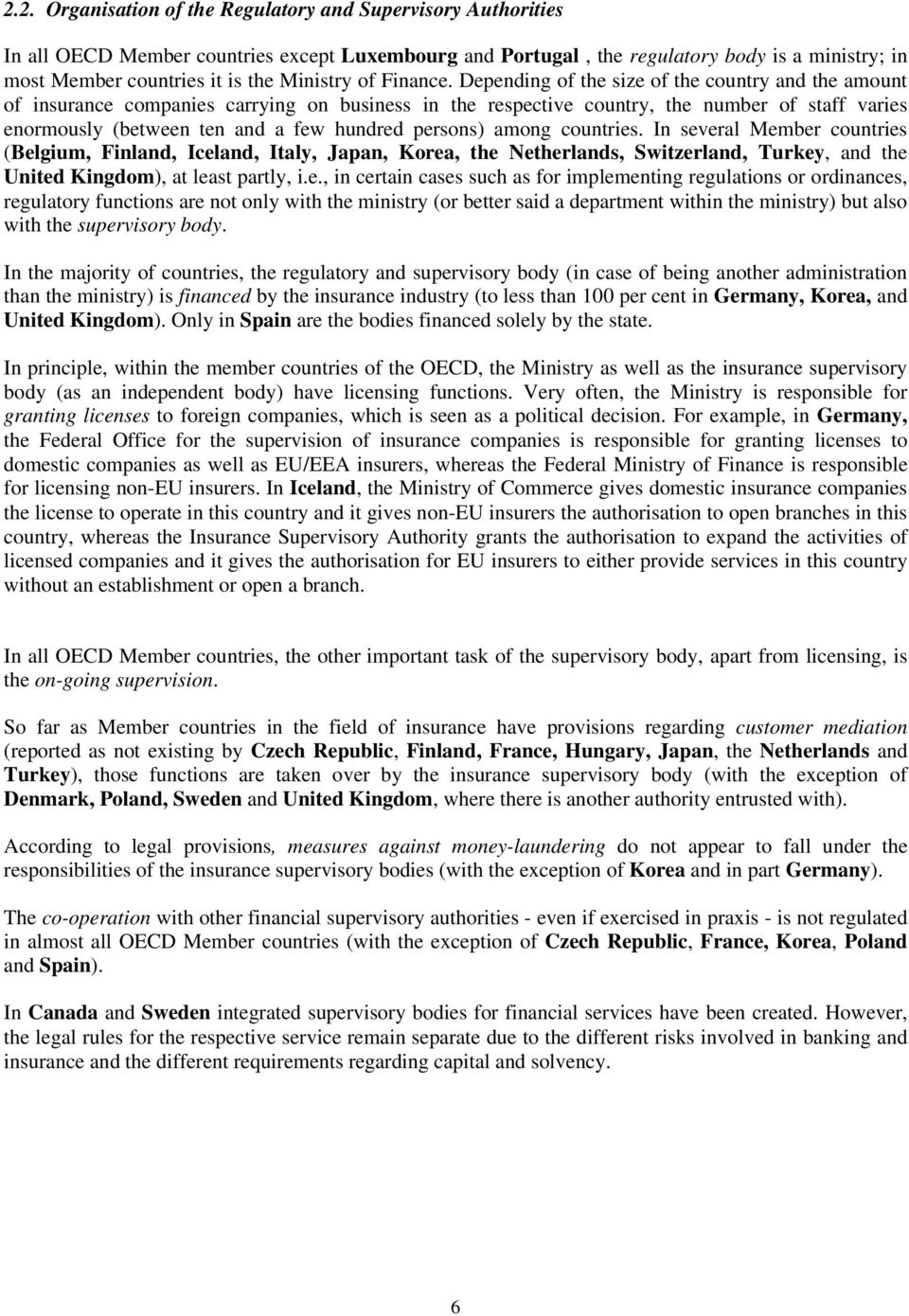
6 2.2. Organisation of the Regulatory and Supervisory Authorities In all OECD Member countries except Luxembourg and Portugal, the regulatory body is a ministry; in most Member countries it is the Ministry of Finance. Depending of the size of the country and the amount of insurance companies carrying on business in the respective country, the number of staff varies enormously (between ten and a few hundred persons) among countries. In several Member countries (Belgium, Finland, Iceland, Italy, Japan, Korea, the Netherlands, Switzerland, Turkey, and the United Kingdom), at least partly, i.e., in certain cases such as for implementing regulations or ordinances, regulatory functions are not only with the ministry (or better said a department within the ministry) but also with the supervisory body. In the majority of countries, the regulatory and supervisory body (in case of being another administration than the ministry) is financed by the insurance industry (to less than 100 per cent in Germany, Korea, and United Kingdom). Only in Spain are the bodies financed solely by the state. In principle, within the member countries of the OECD, the Ministry as well as the insurance supervisory body (as an independent body) have licensing functions. Very often, the Ministry is responsible for granting licenses to foreign companies, which is seen as a political decision. For example, in Germany, the Federal Office for the supervision of insurance companies is responsible for granting licenses to domestic companies as well as EU/EEA insurers, whereas the Federal Ministry of Finance is responsible for licensing non-eu insurers. In Iceland, the Ministry of Commerce gives domestic insurance companies the license to operate in this country and it gives non-eu insurers the authorisation to open branches in this country, whereas the Insurance Supervisory Authority grants the authorisation to expand the activities of licensed companies and it gives the authorisation for EU insurers to either provide services in this country without an establishment or open a branch. In all OECD Member countries, the other important task of the supervisory body, apart from licensing, is the on-going supervision. So far as Member countries in the field of insurance have provisions regarding customer mediation (reported as not existing by Czech Republic, Finland, France, Hungary, Japan, the Netherlands and Turkey), those functions are taken over by the insurance supervisory body (with the exception of Denmark, Poland, Sweden and United Kingdom, where there is another authority entrusted with). According to legal provisions, measures against money-laundering do not appear to fall under the responsibilities of the insurance supervisory bodies (with the exception of Korea and in part Germany). The co-operation with other financial supervisory authorities - even if exercised in praxis - is not regulated in almost all OECD Member countries (with the exception of Czech Republic, France, Korea, Poland and Spain). In Canada and Sweden integrated supervisory bodies for financial services have been created. However, the legal rules for the respective service remain separate due to the different risks involved in banking and insurance and the different requirements regarding capital and solvency. 6
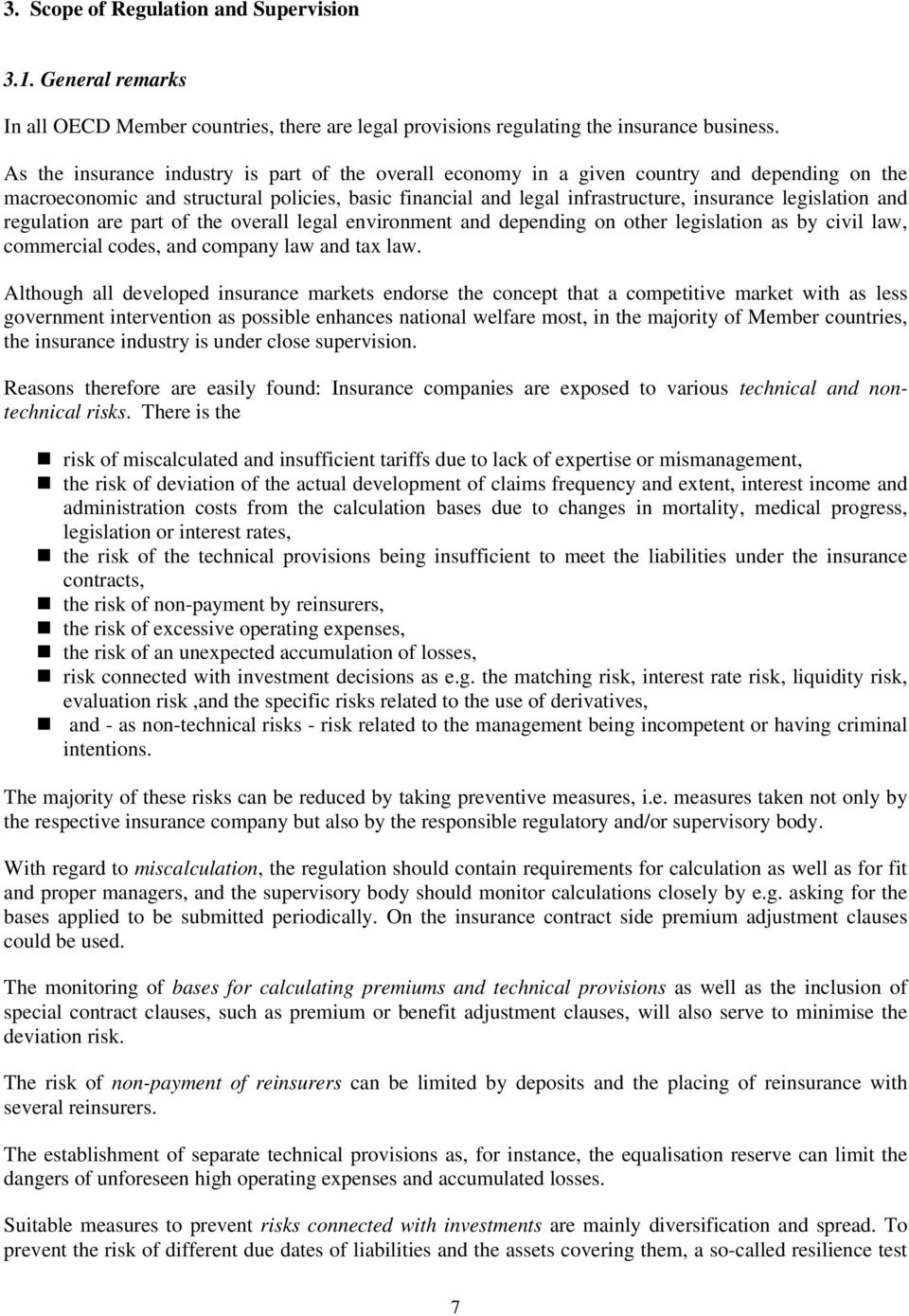
7 3. Scope of Regulation and Supervision 3.1. General remarks In all OECD Member countries, there are legal provisions regulating the insurance business. As the insurance industry is part of the overall economy in a given country and depending on the macroeconomic and structural policies, basic financial and legal infrastructure, insurance legislation and regulation are part of the overall legal environment and depending on other legislation as by civil law, commercial codes, and company law and tax law. Although all developed insurance markets endorse the concept that a competitive market with as less government intervention as possible enhances national welfare most, in the majority of Member countries, the insurance industry is under close supervision. Reasons therefore are easily found: Insurance companies are exposed to various technical and nontechnical risks. There is the n risk of miscalculated and insufficient tariffs due to lack of expertise or mismanagement, n the risk of deviation of the actual development of claims frequency and extent, interest income and administration costs from the calculation bases due to changes in mortality, medical progress, legislation or interest rates, n the risk of the technical provisions being insufficient to meet the liabilities under the insurance contracts, n the risk of non-payment by reinsurers, n the risk of excessive operating expenses, n the risk of an unexpected accumulation of losses, n risk connected with investment decisions as e.g. the matching risk, interest rate risk, liquidity risk, evaluation risk,and the specific risks related to the use of derivatives, n and - as non-technical risks - risk related to the management being incompetent or having criminal intentions. The majority of these risks can be reduced by taking preventive measures, i.e. measures taken not only by the respective insurance company but also by the responsible regulatory and/or supervisory body. With regard to miscalculation, the regulation should contain requirements for calculation as well as for fit and proper managers, and the supervisory body should monitor calculations closely by e.g. asking for the bases applied to be submitted periodically. On the insurance contract side premium adjustment clauses could be used. The monitoring of bases for calculating premiums and technical provisions as well as the inclusion of special contract clauses, such as premium or benefit adjustment clauses, will also serve to minimise the deviation risk. The risk of non-payment of reinsurers can be limited by deposits and the placing of reinsurance with several reinsurers. The establishment of separate technical provisions as, for instance, the equalisation reserve can limit the dangers of unforeseen high operating expenses and accumulated losses. Suitable measures to prevent risks connected with investments are mainly diversification and spread. To prevent the risk of different due dates of liabilities and the assets covering them, a so-called resilience test 7
8 or stress test can be applied as a means of control. It provides information as to whether there exist a certain balance of technical liabilities and adequate assets in a changed investment situation (e.g. in a worst case scenario of a crash in the stock market). In general, regulations should be adequate, objective, consistent, transparent and comprehensible for by those to whom they apply. Over-regulation should be avoided. In order to maintain enough flexibility to react to changes in the economic environment and the insurance market, regulators decided it would be more appropriate to incorporate certain provisions not in the law itself but rather in the implementation of regulations that are easier to amend Regulation of Direct Insurance Insurance companies carrying on direct insurance are subject to regulation and supervision in all OECD Member countries. As a rule, the supervisory authority decides whether the activities of a company may be classified as insurance business. Only in a few countries, the term insurance business is legally defined (e.g., in the Netherlands and the United States). The other countries use definitions provided by science, jurisdiction and general practice. For the Member countries of the EU, the term insurance business has been defined by a list of the classes whose operation is considered as operation of insurance business in an annex of the respective European Insurance Directives. There also is a classification by the OECD. With a few exceptions (Australia regarding friendly societies, Switzerland regarding provident funds providing unemployment and sickness insurance, Canada and the Netherlands with regard to certain specific sectors) the OECD Member countries supervise all classes of private direct insurance. If a direct insurance company also carries on reinsurance, in most cases, the latter will also be supervised. The regulation and supervision of insurance companies, which only carry on reinsurance, so-called professional or specialised reinsurers, differs among the countries. But, even if not under direct supervision, reinsurance companies are at least under indirect supervision through the rules relating to ceding direct insurers Regulation of Reinsurance The information collected on reinsurance reflects the increasing problems and increasing supervisory attention among the OECD Member countries. Several countries require reinsurers to be licensed and subject them to some extent of ongoing supervision, often limited to the submission of accounts. There are two aspects of regulation of reinsurance business: the supervision of the reinsurance arrangements of ceding companies and the supervision of reinsurance and direct insurance companies accepting reinsurance business. Accepted reinsurance business activities generally should be supervised but not necessarily in the same way as direct insurance business. However, there are OECD countries requiring specific authorisation, minimum capital, solvency and other conditions similar as for direct insurance companies. 8
9 Most OECD countries supervise accepted reinsurance business of domestic direct insurance companies. Accepted reinsurance activities are not at all supervised in Australia, Czech Republic, Greece, Hungary, Japan, New Zealand and Poland. In principle, reinsurance business accepted by foreign insurance companies is supervised if the direct insurance companies have an establishment in the respective country (e.g., in Portugal and Turkey). Reinsurance business accepted by foreign direct insurance companies is not supervised in Australia, Belgium, Czech Republic, Denmark, Finland, Hungary, Ireland, Japan, Sweden and Spain. Domestic professional reinsurers are not supervised in Belgium, Czech Republic, the Netherlands and Switzerland. In Germany, professional reinsurers in the legal form of a mutual are subject to full supervision while other reinsurers are subject only to restricted (financial) supervision. The United States has steadily expanded its control over reinsurers. Many states require reinsurers to be licensed, to deposit assets in a specific amount, and to submit accounts. Foreign professional reinsurers are not supervised in Belgium, Czech Republic, Denmark, Finland, France, Germany, the Netherlands, Poland, Sweden and Switzerland. Ceded reinsurance is, in general, supervised through the supervision of direct insurance business. The supervisory body will ask for reinsurance arrangements during the authorisation procedure. It will check the proposed reinsurance arrangements in relation to the company s capitalisation, proposed classes of business and retentions. Ceded reinsurance of domestic direct insurance companies is not regulated and supervised in Hungary. Ceded reinsurance of foreign direct insurance companies notably is not regulated and supervised in Denmark, Finland and Hungary. The supervision mainly focuses on financial supervision (e.g., examinations of accounts and submission of annual reports) and on-the-spot examinations (e.g. in Austria, Canada, Portugal, Sweden, United Kingdom). Only France, Italy and Switzerland appear to control technical provisions and investments. In some countries, the requirements regarding the qualification of managers are applicable as are the rules on shareholder control. As part of the ongoing supervision, very often there will be an annual review of existing reinsurance arrangements. Most often, the supervisory authority reviews the reinsurance treaties (e.g. Germany and Ireland) and examines the risk exposure. Special rules regarding financial reinsurance and other special forms of reinsurance as well as reinsurance offered by offshore companies are only exceptionally reported. The OECD has undertaken efforts to facilitate the control of reinsurers soundness by improving the flow of information. Even if all claims are met in full, a reinsurer in financial difficulties may unduly delay the payment. Therefore, it is an insurers responsibility to try to evaluate any prospective reinsurer. In this respect, a recommendation adopted in March 1998 suggests that Member countries invite direct insurers to take appropriate steps to determine the financial soundness of its reinsurers. Information on the reinsurers market reputation and history, including any recent change in its ownership, the qualification and reputation of its management, the composition of its underwriting and investment portfolio, its financial standing shown in the balance sheet and profit and loss accounts, its solvency margin and technical provisions as well as ratings by different rating agencies may help to assess the security of a reinsurer. Reinsurance companies in turn are to be encouraged to supply the required information. 9
10 3.4. Regulation of Cross- Border Business With respect to cross-border business, it can be stated that liberalisation has considerably progressed among the OECD Member countries. In principle, foreign insurance companies which, without having an establishment in the country concerned, are authorised in their home country to write certain direct international insurance classes (e.g. very often marine, aviation, or transport insurance), are not subject to supervision of the host country where they carry on their activities, as far as the authorised business is concerned. Within the EU, this is true for other classes, too. In the case of EU Member States, this liberalisation goes back to the implementation of the Third Insurance Directives. Under the provision of the freedom of establishment, according to the European Insurance Directives, the branch of an insurance company having its head office in another EU/EEA Member country is not licensed or supervised by the supervisory authority of the state where the branch is established. The companies are entitled to establish a branch after having informed the competent authority of their head office country of their intention. They have to submit documents indicating the Member country in which the branch is to be established, the name and address of the authorised agent of the branch, a scheme of operations, and a statement that the insurance company if it intends to transact motor third party liability insurance, has become a member of the national Bureau or guarantee fund of the Member country of the branch. Due to the provisions on the freedom of services, insurance companies having their head office in an EU/EEA Member country may carry on any class of insurance without having to establish a branch. The only requirement is that they inform the competent authority of their head office country of the Member country in which they intend to carry on business and of the risks they intend to cover. This insurance business is not supervised by the supervisory authority of the host country but by that of the home country. The supervisory authority of the host country only has the right to ensure that the national legal provisions are observed. Apart from the above EU regulation, in several Member countries, the cross-border trade is allowed provided the resident proposer initiates the transaction (Austria) or takes out the contract by correspondence (Denmark, Germany). In most Member countries (Australia for non-life), Germany, Greece, Korea, Luxembourg, the Netherlands, Poland, Sweden, Turkey, United Kingdom, United States; France, Italy, Japan, Mexico, Portugal and Spain (only with authorisation), resident proposers can enter into an insurance contract on their own initiative with an insurer neither established nor authorised in their respective countries, provided it is not possible to cover the risk in their countries. In other Member countries as in Australia for life insurance, in Ireland for non-eea insurers and in Switzerland (with exceptions), cross-border transactions are not allowed even under such circumstances. 4. Other Regulation In some OECD Member countries (Australia, Germany, Luxembourg, the Netherlands, Norway, Portugal, Sweden, Switzerland), certain entities are not subject to insurance supervision. Those are e.g.: n institutions granting assistance without legal entitlement, n societies granting mutual aid, n trade unions paying indemnities during a strike, n smaller societies which write agricultural insurance in a restricted geographical area, n societies writing export credit insurance for the account of the government or with a government guarantee. 10

11 Some OECD Member countries have introduced specific regulations regarding Financial Conglomerates and/or insurance groups (e.g., Australia, Denmark, Finland, Iceland, Italy, Mexico the Netherlands, Norway, Spain, Sweden, United Kingdom and the United States). Others have specific regulations concerning licensing and supervision of pension funds in a broader sense, i.e., including the so-called Pensionskassen in Germany and the caisses de retraite in France. So, for domestic pension funds, regulations are reported by all OECD Member countries but Poland and Turkey. For foreign pension funds, all countries but Belgium, France, Germany, Hungary, Iceland, Mexico, Norway, Poland, Sweden, Switzerland and Turkey appear to have specific regulations. 5. Licensing Licensing is the main means of preventing unsound insurance companies from entering the market. Thus, in all OECD Member countries, there are legal provisions regarding the licensing of insurance companies (domestic and branches of foreign companies). At least in some cases (e.g., the licensing of foreign companies) if not all cases, the competent authority is a ministry, respectively a part of the competent ministry which is called then supervisory body. In several countries, there is an independent administrative body in charge of licensing. It appears that only in Denmark, Hungary, Italy and the Netherlands, the ministries do not have licensing functions. The supervisory body is licensing domestic and foreign direct insurance companies as well as domestic (with the exception of France, Germany, Hungary, Iceland, the Netherlands, Poland and Turkey) and foreign (not in Finland, France, Germany, Hungary, Iceland, Luxembourg, the Netherlands, Poland, Sweden, Switzerland and Turkey) reinsurance companies. Companies being denied a license have a right to appeal. In most countries, the appellate authority is the competent court; only in Korea, Norway, Poland, Portugal, Spain and the United States, it also is the supervisory body Pre-application Procedures Pre-application procedures, whichever formal or informal, can be observed in many OECD Member countries (e.g. in Australia, Austria, Belgium, Canada, Finland, Hungary, Iceland, Japan, Luxembourg, Norway, Portugal, Switzerland, United Kingdom, Sweden, Turkey). In Korea, it appears that application documents for pre-approval as well as for the main approval have to be submitted. These procedures are applicable to domestic companies as well as branches and agencies of foreign insurers. In Member countries, where pre-application procedures exist, contacts with the insurance supervisory authority prior to the formal application are reported to have proved useful for potential applicants because they can be informed at an early stage of all information needed by the authority for the licensing procedure. 11

12 5.2. Licensing Procedures Usually, the authorisation is granted on application by way of an administrative act. In most OECD Member countries it is granted by the competent minister (Austria, Belgium, Canada,Finland, France, Iceland, Ireland, Japan, Luxembourg, Norway, Portugal, Spain, Switzerland, Turkey), in others by a special supervisory authority (Australia, Denmark, Germany, the Netherlands, United Kingdom). If the insurance company meets the requirements, it is, in most Member countries, legally entitled to authorisation. The decision must be taken within a certain time period (in almost all countries in a period of six months from the date of application). As a rule, a list of insurance companies that have been granted an authorisation is officially published. If the authorisation is denied, the insurance company may have recourse to the court that will decide whether the company has to be authorised or not Licensing Principles In all OECD Member countries, the underwriting of insurance risks is restricted to insurance companies which may only transact insurance business. In former times, insurance companies have been allowed only to do business other than insurance business if such business was closely related to insurance business. Such close relationship is considered to exist if an insurance company assists another insurance company in carrying on its insurance business by, e.g., making available technical equipment or staff. Nowadays, in many countries, this is not seen that strict anymore and insurance companies may distribute other financial products than insurance products, or may take over pension business. However, there are still good reasons speaking against a mixture with non-insurance activities: The funds to be set aside and to be preserved under strict supervision for paying insurance claims are not to be placed at risk by the unknown risks of uncontrolled unrelated business. In the United States, where specialisation has been traditionally very strict, insurers may now own at least ancillary subsidiaries. There are different opinions as to whether an insurance company may hold shares in another non-insurance company (limitations are reported by Czech Republic, Hungary, Japan, Korea and the United States). Inside the EU the shareholding is accepted. Holding of shares is not seen as carrying on the business of the respective company. This even applies in the case of majority holdings. OECD Member countries where the European Insurance Directives are not applied, permit insurance companies to hold a participation in a non-insurance company either to an unlimited (e.g. Canada) or only to a limited extent (e.g. Austria and Switzerland). Against the background of the increasing importance of co-operation between banks and insurance companies - the so-called bancassurance -, it is interesting to learn about the opinion of the Member countries in this respect. The creation of a banking subsidiary by an insurance company only is prohibited in Finland, Iceland, Japan and Mexico. It is limited in Canada, Germany, Korea, the Netherlands, Norway, Sweden, Switzerland and the United States. In many Member countries, the shareholding of an insurance company in a bank is allowed (with limitations in Australia, Canada, Germany, Greece, Hungary, Ireland, Iceland, Japan, Korea, the Netherlands, Norway, Portugal, Sweden, Switzerland and the United States and prohibited in Mexico). The shareholding of a bank in an insurance company is also often limited (in Australia, Canada, Iceland, Japan, the Netherlands, Norway, Sweden and the United States and prohibited in Mexico). The banks are more often free to distribute insurance products while insurance companies only in a limited way may sell bank products. In some OECD Member countries, limitations to take part in a Financial Conglomerate for insurance companies exist. There are exceptions provided in the regulations of Hungary, Iceland, Spain, Switzerland, Turkey and the United States. In accordance with the so-called BCCI-Directive, Member 12

13 States of the European Union can object to an insurance company being part of an intransparent financial conglomerate. In all OECD Member countries, life and non-life insurance business are to be separated, so that one activity can not be used to support the other. Especially reserves in life insurance have to be protected. But the authorisation to take up life insurance business includes the permission to write supplementary insurance to life insurance (e.g. in all EU Member countries and Switzerland). If a company wants to write accident and health insurance together with life insurance, it is required to establish a separate management for life insurance and the other classes. The simultaneous pursuit of life and non-life insurance is only permitted in a few countries (e.g. Mexico). As regards health insurance, there are different regulations among the OECD Member countries solely already because of the different structures of health service in the countries. While in some countries health insurance is written by life insurance companies, in others it is written by non-life insurance companies (e.g., in almost all EU Member countries) or by specialised insurance companies as in Germany. Regarding the treatment of composite insurers, in Switzerland, an insurer which writes both life and nonlife insurance in its home country is not authorised to write life insurance in Switzerland. In EU/EEA countries, a composite insurer with its head office outside the EU carrying on non-life insurance in these countries must establish a subsidiary if it wishes to carry on life insurance business, and vice versa. In Canada, composite insurers authorised in their home jurisdiction to write both life and non-life insurance may not write both in this country through the same entity. In most OECD Member countries, separate licenses are issued for each class of insurance or for several classes grouped under a common denomination. Usually the authorisation is granted for an unlimited period of time. However, in some Member countries it is possible to grant authorisation for particular classes of insurance for a limited period of time. After expiry of this time, the authorisation may be renewed. In many Member countries, the authorisation can be withdrawn if the insurance company did not take up business within a certain period of time (mostly one year), i.e. did not make use of the authorisation Licensing with regard to Reinsurance Business In all OECD Member countries, the authorisation to do direct insurance business includes reinsurance business in the same classes of insurance. Among OECD Member countries, practices on the control of reinsurance activity are widely divergent. However, the majority of Member countries require authorisation specific to reinsurance activities of domestic and foreign direct insurers (including Canada, Italy, Japan and the United Kingdom). In Germany, a separate authorisation is not necessary but direct insurance companies only may write reinsurance business if it is expressively mentioned in their operating plan. Several countries (Australia, Austria, Denmark, France, Iceland, Ireland, the Netherlands, Norway, Spain, Switzerland and the United States) require from domestic as well as foreign (with the exception of Denmark) direct insurers a single authorisation for both direct and reinsurance business. On the other hand, Belgium, Finland and Greece do not require any authorisation. 13
14 Domestic professional reinsurance companies being subject to authorisation requirements in almost all OECD Member countries (except in Belgium, France, Germany and the Netherlands) are granted the authorisation for all classes of insurance. Foreign professional reinsurers are licensed in Australia, Czech Republic, Italy, Japan, Korea, Norway, Spain (in case of branches), Turkey, United Kingdom and the United States. Mexico registrates professional reinsurers depending of the ratings they have. In those countries, the authorisation process mainly is the same for domestic and foreign direct insurers and professional reinsurers Licensing Requirements In all OECD Member countries, an insurance company does not obtain the authorisation unless it meets certain requirements. Besides to the financial requirements being of paramount importance, there are other criteria which concern legal requirements as, e.g., conformity of the legal form, filing of bylaws and general terms as well as conditions of policies, accounting requirements as filing of an opening balance sheet, proof of the required minimum capital, technical requirements as filing of premium rates and technical bases for information and/or approval, and managerial requirements (e.g., fit and proper requirement) Legal Requirements In all OECD Member countries, only certain legal forms are permitted for insurance companies. Generally, the insurer must be a legal person. All Member countries permit insurance companies in the form of companies limited by shares and mutual societies (with the exception of Luxembourg for companies limited by shares and Australia and the Czech Republic for mutual societies), but the structure of these company forms is not the same in all countries. In the United States, there are many town mutuals or county mutuals, covering agricultural property risks. Mutual or co-operative insurance companies are also common within the EU for livestock, for small vessels, and for providing burial benefits. Co-operative societies are admitted in Belgium, Czech Republic, Hungary, Iceland, Italy, Luxembourg, Spain, Switzerland, United Kingdom and the United States. Publicly owned companies are allowed in Australia, Belgium, Czech Republic, Finland, France, Germany, Hungary, Iceland, Mexico, Poland, Portugal, Spain, Turkey, United Kingdom and the United States. In almost all Member countries, insurance companies have to submit the articles of incorporation including information on the legal form, the head office of the company, the purpose of the business, the geographic area of business operations and the executive bodies of the company. In some Member countries (Australia, Canada, Denmark, France, the Netherlands, Spain) this information only has to be submitted for information. In other countries it must be approved. Most countries, are asking for submission of a so-called business plan or operating plan. This scheme of operations specifies, in particular, the risks which the insurance company intends to cover, the proposed reinsurance, information on expenses of the first years and the financial resources available. 14

15 Only a few Member countries require domestic as well as foreign direct insurance companies to submit for approval the general policy conditions (Czech Republic, Hungary (only domestic), Japan, Korea, Mexico, Poland, Switzerland, and the United States). In the EU Member countries, neither the approval nor the systematic submission of general policy conditions may be requested. Exceptions are the general policy conditions for compulsory insurance. Member countries may demand their submission prior to their application. But this does not imply any approval. The submission of the policy forms for approval of domestic and foreign direct insurance companies only is requested by Hungary, Iceland, Japan, Korea, Mexico and the United States. In the EU, the submission of those documents must not be required. In various Member countries, domestic and foreign direct insurance companies are required to submit information on the qualification of the management - the so-called fit & proper requirement. The managers must be reliable and must have sufficient professional knowledge and experience. In the EEC (with the exception of Denmark as regards domestic companies, and additionally with the exception of Belgium, Italy, the Netherlands and Sweden as regards foreign companies), insurance companies have to notify the competent authority of the identity of the direct and indirect shareholders - both legal and natural persons - and members holding qualified participations of the company as well as the amount of these participations. A qualified participation is given in the case at least 10 per cent of the insurance company s capital or voting rights are held or when there is another possibility of exerting a decisive influence on the management. The competent authority may object if it is of the opinion that the person concerned is not meeting the necessary requirements.the reason of the notification is to make sure, that shareholders and natural or legal persons holding participations meet the demand in the interest of a sound and prudent management of the insurance company. The shareholder identification is also asked for in other than EU Member countries (but not - as it appears - in Australia, Hungary, Switzerland and Turkey). Reinsurance arrangements have to be submitted in Australia, Belgium, the Czech Republic, Finland, France, Germany, Iceland, Italy, Japan, Luxembourg, Mexico, Norway, Poland, Portugal, Spain, Sweden, Switzerland, Turkey, the United Kingdom and the United States. The reasons therefore are that whichever method is used to place reinsurance, by way of treaty reinsurance contracts, facultative reinsurance, or pools, contract terms must be checked very carefully by the insurers. Financial or finite reinsurance, reinsurance futures and options as well as catastrophe bonds used by insurance companies in industrialised countries are risky and, e.g., seem not to be currently appropriate for insurance companies in economies in transition. They not only bear risks in itself but also cause difficulties in accounting and taxation as well as for the supervision. As regards branches of foreign companies, there are specific requirements concerning the proof of business in the country of the head office (in all OECD Member countries but Australia), the duration of the establishment of the registered office (only in France, Iceland, Japan, Norway, Poland, Portugal, Spain, Switzerland, United Kingdom and United States) and the establishment of a business address in the state of operations (all OECD Member countries). In Portugal, the opening of branches of companies whose head offices are outside the EU/EEA have been in existence for at least five years. In Spain, an applicant must have been authorised for at least five years in its home country to write the classes of insurance for which it seeks a licence in Spain. 15
16 Financial Requirements Financial licensing requirements have to be strong enough to make sure that the company has set up a sufficiently high minimum capital. Very often, capital shortage is a major problem in insurance markets in economies in transition. The main reasons for it are the unstable economic situation, limited savings and the underdeveloped state of capital markets. One of the important factors in expanding the capital base is to increase foreign investments, a measure that is not always supported by governments of the concerned countries. As another side-effect of capital shortage is companies with a low capital base that are forced to cede a large proportion of their risks to other, often to foreign companies. In all OECD Member countries but Japan, there are rules concerning paid-up share capital of companies limited by shares. In most countries, it is sufficient to pay in an amount between 20 per cent and 50 per cent. Almost all OECD Member countries (except Korea) require that insurance companies possess a certain minimum capital as a condition for authorisation. Besides equity capital or equivalent funds, in particular, many EU Member countries ask for an organisation fund. The equity or equivalent funds must be permanently at the disposal of the company while the organisation fund is used to set up the organisation and therefore will be kept only for the first few years. In most cases, no specific amount is fixed with regard to the organisation fund because the starting costs depend on the structure of the company and the classes written. The amount of the minimum capital varies among the Member countries. As in the EU, it usually depends on the insurance class. In life insurance, according to the First Life Insurance Directive of 1979, at least 800,000 ECU are required. In non-life insurance, the largest amount is required for credit insurance (1,400,000 ECU). The amounts are under consideration and will be substantially increased in the near future due to inflation and market developments. In other OECD Member countries, these amounts are already above those required within the EU. In some countries, a deposit, either of a fixed (for domestic companies: Czech Republic, Korea, Mexico; for foreign companies: Belgium, Czech Republic, Denmark, Finland, France, Germany, Iceland, Italy, Japan, Korea, Luxembourg, the Netherlands, Norway, Sweden and United Kingdom) or variable (for domestic companies: Turkey and some states of the United States; for foreign companies: Denmark, France, Germany, Luxembourg, Norway, Portugal, Spain, Sweden, Switzerland, Turkey and the United States) amount, is required in addition to the minimum capital requirement. The amounts largely depend on the type of the classes written. In the EU, the fixed amount equals 25 per cent of the minimum guarantee fund. The deposit must be made before the authorisation can be granted. In Czech Republic, Korea, Mexico and the United States, the deposits (by domestic companies) must be located in the country of the head office (same for foreign companies in Korea and the United States). Exemptions of the obligation to make a deposit are possible in Germany (for foreign companies), Japan (for foreign companies), Portugal (for foreign companies), United Kingdom and United States. 16
17 Mostly, the consequences in case of insufficient deposits are the denial of granting a licence or the withdrawal of the licence. Specific provisions for foreign companies only are known in Denmark, Finland, Italy, Japan, Norway, Portugal, Sweden, and United Kingdom) Accounting Requirements Traditionally, insurance supervisors have required insurers to submit accounts different from those Insurance supervisors, in particular, are interested in information on technical provisions, liabilities and assets. The reason is, that, e.g., the valuation of liabilities has been a popular field for creative accounting. An insurer can make large amounts of surplus disappear by strengthening reserves as he can create surplus out of reserves by adjusting estimates of future liabilities downward. Independent audits can help to minimise abuse. Such a requirement has been introduced in the United States, where it did not exist before. Together with the operation scheme, domestic direct insurers in most OECD Member countries have to submit for approval an initial balance sheet and a statement of prospective income. Foreign companies have to submit those documents in less Member countries (initial balance sheet: Belgium, Czech Republic, Italy, Japan, Korea, Poland, Spain, Sweden, Switzerland, United Kingdom, United States; statement of prospective income: Belgium, Czech Republic, Germany, Hungary, Italy, Japan, Korea, Poland, Spain, Switzerland, United Kingdom, United States). In view of the fact that premiums and liabilities are commonly reported net of reinsurance, insurers are asked to report on their reinsurance arrangements. In some countries, the company not only has to submit the balance sheets but the profit and loss accounts for the past three years as well. The harmonisation within the EU, so far, has not yet achieved more than a set of general guidelines. Each insurer reports to its home country as required there. The supervisors of the host countries may not require more than copies. In other countries as, for example, in Denmark and Norway, an applicant has to submit copies of the company s accounts and annual reports for the last three financial years. Insurance companies in EU Member countries also have to submit for the first three years information on the expected liquidity position and estimates on the financial means to cover the solvency margin and the technical provisions. In the United States, uniform reporting forms have existed for long time and still exist, but the states may, and frequently do, require additional information Technical Requirements In many OECD Member countries, premium rates have to be submitted for information or even for approval. The adequacy of premium rates is a fundamental issue. If they are not set at an appropriate level even adequately calculated technical provisions would not prevent the company from making losses. 17

18 But tariff calculation depends of the availability of reliable data. Insurance premiums are calculated on the basis of the law of large numbers. Data on loss frequency and loss severity are indispensable for calculation. In states with monopolistic structures, only the state monopoly possessed of e.g. historical insurance claims data. If the state monopoly had been replaced by a market-oriented system, these data were no longer reliable. The Insurance companies in those economies in transition for the purpose of setting technical provisions had to co-operate to establish new databases by first using probable assumptions. In this regard, the supervisory authorities in some countries (e.g., in Czech Republic and Hungary) have been well advised, to ask for submission of the premium rates and products for approval even if the prevailing trend goes away from such controls; tariffs and products have to be submitted in Japan. In this respect it has to be mentioned, that never, in any country, has tariff control been exercised universally in all classes of insurance. It has tended to be strictest in politically sensible classes as motor insurance. In the United States, it has also been strict for workers compensation insurance. In the EU, where in former times there were countries (United Kingdom and the Netherlands) with no or insignificant control in this field and countries with a strong control (Belgium, France, Germany, Italy), along with the single authorisation came the almost complete abolition of the prior approval of policy conditions, premiums and tariffs. That means, that under the third generation of the Insurance Directives, systems of prior approval and systematic communication of contractual conditions are prohibited with the only exemptions for compulsory insurance and supplementary health insurance (e.g., in Germany). In life insurance, some EU supervisory authorities made use of the provision in article 29, sub-section 2 of the Third Life Insurance Directive to ask for the bases for calculation to be submitted systematically to verify compliance with the actuarial principles. In the United States, besides the control of contract terms, tariff control presents a pattern of different rules, ranging from no control to a requirement of advanced approval. A move is under way to exempt commercial insurance generally from tariff controls. In the EU, the bases for the calculation of premiums and technical provisions have to be submitted but not for approval by domestic as well as foreign companies. In other Member countries (Australia, Belgium (for life assurance only), Denmark, Luxembourg, Mexico, Norway and Turkey) they have to be submitted for approval Specific Requirements for Branches In respect of licensing for branches or agencies of foreign insurers, no OECD Member country has reported the application of the Market Need Test to examine whether there is a need for any additional insurer in the national market. In Australia, new approvals of non-resident life insurers have been restricted to domestically incorporated entities. In the United States, 17 States have no mechanism for licensing initial entry of a non-us insurance company as a branch, unless that company is already licensed in some other US-State. In general, branches of foreign insurance companies have to submit the same documents as national insurance companies. 18
19 In all OECD Member countries, the foreign company has to submit a certificate specifying the classes of insurance it is authorised to transact in its home country. As regards authorisation to carry on business in another EU/EEA Member country, the situation for direct insurance companies with their head office in an EU/EEA Member country was the following. From 24 July 1973 with the adoption of the First Directive on non-life insurance (73/239/EEC) and from 9 March 1979 with the adoption of the First Directive on life insurance (79/267/EEC), the European insurance market started to take shape. These two Directives harmonised the conditions relating to the taking up and pursuit of insurance business of insurance companies of the Common market and of branches of third countries. Although insurance companies wishing to operate outside their home countries still had to obtain authorisation in each Member country, there were comparable legal and financial conditions (as the solvency margin and the minimum guarantee fund) and a uniform procedure. Branches continued to be subject to supervision of both their home country and the host country. With the second generation of Directives, the Second Directive on non-life insurance from 22 June 1988 (80/357/EEC) and the Second Directive on life insurance from 8 November 1990 (90/619/EEC), the freedom to provide services in relation to so-called large risks (e.g., aircraft, ships, and the liabilities for them) or industrial and commercial risks in non-life as well as for services provided on the initiative of the policyholder was introduced. The freedom to provide services in relation to mass risks in non-life as well as the active freedom to provide services on the initiative of the insurer in life still remained dependent of an authorisation by the country of risk. Moreover, certain classes of insurance (motor third party liability, builder s risk insurance, nuclear liability insurance, etc.) were excluded from the scope of the Directive on non-life insurance. The single market in insurance of today was achieved by implementation of the provisions of the third generation of Directives (92/49/EEC on non-life, 92/96/EEC on life insurance). The system of the single authorisation (European passport) permits any insurance company with its head office in one of the EEA member countries and authorised in that country to offer its products through agencies or branches or under the freedom of services provision without having to apply for an authorisation in the host country while being supervised only by its state of origin (home country control). The principle of the single license relies on co-ordination of essential rules concerning the prudential and financial supervision of insurance companies. As regards the procedure, the notification process, under the provision of the freedom to provide services, the insurer must inform the supervisory body of its home country of the commitments it wishes to cover. The following documents must be supplied: a scheme of operations describing the types of business envisaged, the structural organisation of the branch, the address of the branch, the name of the branch s authorised agent, and a solvency certificate. The home Member country communicates to the country in which the insurer wishes to carry on business the above documents. If the home supervisory bodies have doubts about the financial health of the company or the qualifications of the managers, they may decide not to notify the country concerned. The Member country of the branch must, in return, inform it of the conditions governing the pursuit of business deriving from the interest of the general good with which the branch will have to comply. 19

20 The concept of the interest of the general good is a product of case law which has not been specified in the Directives. According to a definition commonly accepted in Community law, the national measures may only be adopted in a field which has not been harmonised and may not lead to discrimination. The measures must be objectively necessary and relevant to the objective without being disproportionate and without duplicating a regulation which is already safeguarding the respective interest. Companies operating under either freedom to provide services or the freedom of establishment must supply the same information to the host country as that transmitted by its local competitors. The companies have to inform the country of the registered office of the amount of the premiums, claims and commissions obtained in each host country. A representative (also called authorised agent) has to be appointed who is entitled to represent the branch in the host country. In some Member countries, the supervisory body has to be asked for approval of the appointed representative (e.g., Austria, Germany, Iceland, Luxembourg, Spain, Sweden, and United Kingdom). It is generally required that the representative resides in the country where the activities are carried on. All Member countries require that the branch of a foreign company have its own capital resources. Most Member countries have provisions regarding deposits from foreign insurers. However, insurers from EU/EEA countries do no longer need to constitute and maintain deposits and solvency margins in their respective host countries. Insurers outside the EU/EEA (with the exception of Swiss non-life insurers because of the agreement between the EEC and Switzerland on direct insurance other than life insurance from 10 October 1989) must possess in a host country an amount equal to at least one half of the minimum guarantee fund imposed on EU/EEA insurers and deposit one fourth of the said fund as security. For these branches, the guarantee fund is defined as the highest of one third of the solvency margin or one half of the minimum guarantee fund imposed on EU/EEA insurers. The initial deposit lodged (one fourth of the minimum guarantee fund imposed on EU/EEA insurers) is considered as forming part of the guarantee fund. Assets representing the solvency margin must be kept within the host country where activities are carried on up to the amount of the guarantee fund and the excess within the EU/EEA. In France, companies from third countries (not being signatories of the GATS) can be required to provide deposits or guarantees if their home country imposes similar requirements on French companies. 6. Ongoing Supervision In all OECD Member countries, insurance companies are subject to current supervision. The conditions under which the license was granted must be observed the whole time the insurance company is carrying on business. It is one of the tasks of the insurance supervisory body to ensure that all requirements are met all the time. In this respect, even Member countries with supervisory authorities not having the right to ask for premium rates and tariffs for approval during the licensing procedures, allow their authorities to ask for information on the products, business transactions, the financial situation and mergers and acquisitions while performing the ongoing supervision. 20

21 The other side of supervision, its repressive nature, is the power of the supervisors to interfere with business management and to impose sanctions if the directors, managers, or other persons in charge violate legal requirements or endanger the interests of the insured Powers of the Supervisory Authority To be able to perform its tasks, the insurance supervisory authorities in all Member countries have the right to obtain detailed information about the insurance company and its business activities. One source of information are reports by the insurance companies. All Member countries ask for annual reports, the majority for quarterly reports (even of branches). For the examination of reports and other financial documents, in the majority of countries, the supervisory authorities co-operate more or less with the appointed actuaries and auditors (even if this is not legally regulated). As another source, ratings are used for supervisory purposes in Japan, Korea and Mexico. If the supervisory body detects any irregularity it is entitled to take the necessary remedy. For example, legal requirements having been a condition for licensing have to be met in any case of a change during the course of business operations. If necessary, documents have to be submitted anew. Usually, the supervisory body is free in the choice of its means, ranging from a simple reminder over the dismissal of managers or the demand to cancel a certain business operation to the withdrawal of the license. In some Member countries, the supervisory body may impose administrative fines to enforce compliance with its orders. In other Member countries, the supervisory body may send representatives to meetings of the executive bodies of the insurance companies (e.g., Canada, Finland, Germany, Iceland, Italy, Spain and Sweden) or appoint a special commissioner, who will assume special functions on behalf of individual executive bodies for a limited period of time. If foreign insurance companies having their head office in an EU Member country carry on business under the freedom of services provision and violate any legal rule, the applicable procedure inside the EU is as follows: First the supervisory body of the host country requests the insurance company to remedy the irregularity. If the insurance company does not comply, the supervisory body of the host country informs the supervisory body of the home country. The latter then takes the necessary measures in accordance with the national regulations. If these measures still do not show any result, the supervisory body of the host country may prohibit the foreign insurer from writing insurance under the freedom of services in its territory. All OECD Member countries provide their supervisory authorities with the right to periodically or on a case-by-case basis perform on-site inspections at the head office of domestic insurance companies; the majority of countries allow these inspections at establishments of branches of foreign companies - with regard to their domestic business - as well (with the exception of Australia). The insurance companies are obliged to give all the information available and to enable the inspectors to look into all business documents so long as justified by the purpose of insurance supervision. The inspectors are bound to secrecy. Some Member countries have very extensive on-site inspections covering all business activities (e.g., including the observation of the legal requirements and compliance with the business plan, the financial 21
22 standing, the allocations of the technical provisions, the investments, the calculation of tariffs, the internal and external organisation, the reinsurance relations, etc.), while others only inspect certain areas. But first of all, the financial soundness of an insurance company is of the main concern of the supervisors. In this respect, the supervisors have an close eye on the capital resources (solvency), the formation of technical provisions and the existence of assets (investments) necessary to meet the insured liabilities Solvency In all OECD Member countries, the minimum capital required as condition for licensing must also be available in the future. The EU Member countries require that capital of the insurance companies be adapted to the development of the business. Where OECD Member countries outside the EU require that the capital has to be permanently adapted to the development of the business, in most cases this adaptation is made by allocations to a statutory reserve or by increasing the non-imputable deposit. Part of the annual profit has to be allocated to these items until the required amount is reached. In some Member countries, the supervisory body may require to restore or make available an organisation fund if the insurance company writes losses (e.g., Germany, Switzerland). Solvency as referred to by the EU Insurance Directives means the financial resources of an insurance company, i.e. the difference between the assets and the liabilities. This kind of safety capital is necessary in order to absorb discrepancies between the anticipated and the actual expenses and profits. At the time of the first Paratte Report, 1963, the standards were generally simple and modest in relation to the amount of the risks carried on by the insurers. In most countries, all that was required was a fixed amount of capital, subscribed or paid in, with the amount depending on the class of insurance. Over the past several decades, there has been a trend toward expanding both the amounts and the variety of financial requirements. One reason for strengthening the solvency standards has been the move towards freer markets and - particularly in the European Member countries - the need to compensate for the loss in security that resulted from the elimination of the control of tariffs and contract terms. The solvency margin established in the European Insurance Directives is an important step in the direction of more risk-oriented financial resources. The current solvency regulations within the EU are mainly based on the provisions of the first Directives 73/239/EEC (non-life insurance) and 79/267/EEC (life insurance). The provisions regarding the required solvency in credit insurance and the actual solvency both in life and non-life insurance were amended by the Credit Insurance Directive 87/343/EEC and the Third Directives 92/49/EEC and 92/96/EEC. The directives provide that insurers must have sufficient safety capital in form of the so called minimum guarantee fund at the moment of taking up business activities as well as own funds for the ongoing business serving as a buffer to ensure that the obligations under the contract can be met at any time - the solvency margin. Hence, the purpose of establishing a solvency margin is only to absorb remaining risks which may occur even if concrete risk preventing measures by prudent management or specific supervisory provisions have been taken. Such a solvency margin is known in all other OECD Member countries outside the EU (except the United States). According to the Directives, the solvency margin of insurance companies with their head offices in an EU Member country consists of the companies assets free of any foreseeable liabilities and less any intangible items (i.e., uncommitted assets). There is an open-ended list of admitted assets. 22
23 The uncommitted assets may comprise of the following: the paid -up share capital, one half of the unpaid-up share capital once 25 per cent of such capital are paid in, the statutory and free reserves, any carry-.forward of profits, hidden reserves resulting from the under-estimation of assets, securities with a fixed maturity which are subject to special conditions up to 50 per cent, in non-life insurance additionally 50 per cent of the supplementary contributions which mutual societies may require their members to pay in a particular financial year, in life insurance additionally the part of the provisions for bonuses and rebates which has not yet been made available for distribution to policyholders, 50 per cent of the company s future profits, to a certain extent the acquisition coats included in the premiums as far as they have not been taken into account in the mathematical provision. By requiring insurers to maintain uncommitted funds in an amount equal to a set percentage, this not only creates a safety cushion to hold back insolvency but at the same time it serves as a warning signal to supervisors. If these funds fall below a required amount, i.e., are not sufficient to cover the guarantee fund defined as one third of the solvency margin, the supervisory body has the right to prescribe measures to restore a sound financial situation. Several other OECD Member countries than EU Member countries prescribe measures or ask for restoration plans if the share capital or equivalent fund has been considerably reduced by losses. Within the EU, in Non-life insurance, the amount of the solvency margin can be expressed as the higher of two results: 16 per cent of the annual premiums written by the insurance company or 23 per cent of the average annual claims costs incurred by the insurance company. The result then is multiplied by a factor equal to the ratio of claims costs remaining for the insurance company after taking account of reinsurance ceded to gross claims costs, as resulting from the last financial year up to 50 per cent. Reinsurance is not taken into account for the calculation of the solvency margin in Australia (in life) and the United States, while countries like Hungary, Korea, the Netherlands, Portugal, Spain and Sweden allow up to 100 per cent in non-life as well as in life insurance. In Life, in the EU, the solvency margin requirement may be summarised as the sum of two results: 4 per cent of the mathematical provisions of the insurance company plus 0.3 per cent of the capital at risk, i.e. an amount equal to the difference between the maximum payments under the policies underwritten and the mathematical provision. In respect of health insurance, the solvency margin is calculated in an equal way to non-life insurance. It is, however, reduced to one third. No OECD Member country has different rules regarding the solvency margin of branches and of domestic insurance companies. The EU claims-based solvency margin does not take the inflation rate into consideration. It is based on the average burden of claims for the past three financial years. Economies in transition should be aware of this. Some EU countries already use stricter criteria than prescribed in the EU directives. However, too high a margin might cause negative effects. It could create or reinforce a tendency to establish imprudent 23
24 premiums and technical provisions to compensate for the rise in the solvency margin requirement, given that these parameters are components of the basis on which the requirement is calculated. On the other hand, too low a solvency margin very often is the reason for the increasing volume of the purchase of reinsurance in economies of transition. The method of the risk-based capital (RBC), introduced in the United States quite recently, is one method to take account of the various risks in connection with the determination of the solvency margin. With respect to the main principle that the capital should be related to the risks inherent in the respective insurance operation, the concept seeks to evaluate a great number of different risks as underwriting risks, assets risks, and credit risks. Using data and procedures specified in voluminous instructions, insurers are required to calculate the amounts of assets that they must have to avoid special supervisory attention, stricter reporting, rehabilitation, or winding up. To determine an insurers RBC, its business data are compared to industry averages for the different classes of insurance. Under the RBC approach, thresholds above 100 per cent of the solvency margin are introduced to enable the supervisory body to intervene at an early stage. A point in favour of the RBC is that the assets are looked at considering the investments being actual risk carriers. Besides, under this approach, the experience of European supervisors is avoided that companies having calculated the mathematical provision in life insurance prudently have to present a higher solvency than a less prudent competitor. On the other hand, quantitative financial requirements as known in other OECD Member countries have the advantage of being expressed in simple figures and standardised. With RBC, the standards make complex calculations and evaluations on both the sides of the insurer and supervisor necessary; therefore, assuring correct and equal application of the rules requires special controls. Moreover, despite the fact that the existence of an universally true ratio is disputable, fulfilling a certain ratio can give the insurance management as well as the supervisors the wrong feeling about having done everything possible instead of allowing flexible reactions depending of the necessities of the single insurance product. In some OECD countries (Australia, Austria, Canada, Denmark, Finland, Iceland, Luxembourg, Mexico, Norway, Sweden, Turkey, United Kingdom, United States) requirements for minimum solvency for professional reinsurance companies are known. The requirements often are the same as for direct insurers Technical Provisions Technical provisions ensure that the company is in the position to meet at all times the commitments towards the insured. Insurance companies tend to adopt short-term assumptions that often result in under-priced products. Then in the way of cross-subsidisation over reserved products are used to offset the losses on those under-priced products. Economies in transition often made the experience of inadequate technical provisions. The reasons were the lack of historical data for calculation, economic conditions such as an unstable rate of inflation and the underdevelopment of actuarial systems. 24
25 What technical provisions have to be established and in what amounts depends on the national regulations in each Member country. Technical provisions which can be found in almost all OECD Member countries are the: mathematical provision in life insurance, provisions for claims outstanding (corresponding to the total estimated ultimate cost of settling all claims reported arising from events which have occurred up to the end of the financial year less amounts already paid in respect of such claims), provision for unearned premiums ( to defer to the next or to subsequent periods the proportions of gross premiums and risk premiums that are unearned at the end of the financial year), and the provision for claims incurred but not reported (IBNR) for liabilities estimated on the basis of loss experience over several years,including future claim-settlement expenses. An equalisation reserve as a valuation adjustment in non-life insurance as it is common among some of the EU Member countries is not prescribed in Australia, Mexico, Turkey and United States, because the volatile nature of certain risks. It is seen as an inherent risk of insurance that should be taken into account accordingly when fixing the price for the cover of such risks. A special provisions for the risk connected with the use of derivatives is only known in the United States. In all Member countries those provisions are calculated based on actuarial formulae on statistical bases (e.g. the mathematical provision in life insurance using mortality tables and the technical interest rate) as well as case by case. Within the EU, according to the Third Insurance Directives, only the home country is responsible for setting the rules and supervising the compliance with the rules concerning technical provisions and their investment in representative assets. The Directive on the Annual Accounts and Consolidated Accounts of Insurance Undertakings from 19 December 1991 (91/674/EEC) introduced a harmonised regulation in force since January 1, The Directive harmonises the layout of the balance sheet and thereby lists and defines the technical provisions and describes how they are to be evaluated. Thereafter, the amount of technical provisions must at all times be such that an insurance company is able to meet any liability arising out of insurance contracts as far as can reasonably be foreseen. As a rule, the technical provisions have to be established at the head office of the company. Some Member countries require special deposits to cover technical provisions. Such deposits have to be located in the country of the head office, too (in Czech Republic, Hungary, Mexico, Switzerland and the United States). In almost all OECD Member countries (with the exception of Iceland, Japan, Portugal and Switzerland), branches of foreign companies (in case of EU Member countries, such with their head office outside the EU) have to establish technical provisions in line with the same principles applying to national insurance companies. Within the EU, branches of foreign companies having their head office inside the EU do not have to establish separate technical provisions. The technical provisions required for the insurance business of the branch are only established at the head office of the insurance company in accordance with the regulations which apply in the Member country of the head office. 25
26 6.4. Investments Historically, the aims of investment regulation are first to protect policyholders, second to direct the flow of investable funds towards what governments perceive as desirable, and third to prevent insurance companies from exercising undue influence within the financial markets as a whole. In the interest of furthering the development of the national economy, some countries, in particular economies in transition, might think of encouraging insurers to give preference to investments in domestic companies. Thereby, the paramount principle of security should not be lost out of sight. Although transfers of capital to other countries are not generally in the interest of the national economy, it may be necessary sometimes, in particular with view to inflation risks, to permit insurers to conclude contracts in foreign (stable) currencies and to invest the funds covering future liabilities from such contracts in the respective currencies. In most OECD countries, the investment regulations do not extend to the investment of the capital base of insurance companies. They only relate to the investment of the funds that constitute the contractual liabilities to policyholders, and sometimes to equalisation or claim fluctuation reserves. The reason for this is that the capital base plays a longer-term risk absorption role, as well as allowing insurance companies to finance their future growth. Moreover, for an insurance company a major part of the capital base, excluding mutual companies, belongs to shareholders and they would not wish management to hold too much capital, it were not earning an acceptable rate of return on their invested capital. Therefore, if investment regulations restricts the investment of the capital base unduly, this prove to be a disincentive to hold a high level of capital within the insurance companies, i.e. well above the statutory minimum level. This would thus tend to weaken rather than strengthen the overall financial security of insurance companies. A distinction between the treatment of the assets representing the technical provisions which are the basis for satisfying the claims of the insured and the assets covering the other liabilities which serve to satisfy the other creditors is, e.g., reported by all EU Member countries, Japan, Mexico and Switzerland. It is recommended for other countries like economies in transition, as equally is a distinction within the owners equity itself between the minimum required capital and the free capital. In general, one can say that in order to ensure the safety, profitability and liquidity of its investments, in particular regarding the assets covering the technical provisions, the insurance company must ensure that its investments are sufficiently diversified and spread. Thus, in many OECD Member countries prudential investment rules with respect to diversification by type, limits or restrictions on the amount that may be held in certain assets, matching of assets and liability, and liquidity are known. At least for assets representing technical provisions, the majority of OECD Member countries has established certain rules. In the United States, compliance with investment rules for all assets is required. The principles of diversification (the proportion of the total investment in particular classes of investments) spread (the proportion of total investments in one particular class of investments) and liquidity (with the exception of Korea) are common in almost all OECD Member countries. 26
27 Ceilings may be set on admitted investments, by type of investment and in percentage terms rather than in absolute value, so as to reduce the risk of default or of liquidity shortage. Hence, it is common to find maxima on unquoted securities, on low quality corporate bonds and on certain classes of foreign investments. Maximum percentages on classes of investments have a double purpose in risk reduction: to restrict holdings in classes which are deemed to be risky, and to ensure adequate diversification of the investment portfolio as a whole. That is why, beyond the general principles of security, yield and liquidity, the EU Insurance Directives instead of harmonising investment rules, drew up a list of ceilings intended to ensure diversification and an adequate spread of the investments representing the technical provisions. The list is exhaustive in order to give maximum flexibility to the EU Member countries as well as to the insurance companies. Moreover, in certain countries, such as United Kingdom, Ireland and Australia, the insurance companies can invest above the maxima, but they cannot count these assets which are held above this level as admissible assets representing technical provisions. Although OECD countries today very seldom set floor limits (EU Member countries are prohibited from requiring insurance companies to invest a minimum amount in specific assets or categories of assets), such practices were possibly used in the past to encourage investments with a low risk of loss or lack of liquidity or in pursuit of macro-economic objectives. In recent years, there has been a general move away from detailed quantitative restrictions on investment choice towards more general guidelines known as prudent-man-rules. Two different approaches seem to confront each other: the so-called prudent man management and the quantitative requirements. Prudentman rules are more qualitative in nature. The principle of the prudent man management means that it is up to the manager and not to national or community statutory provisions to determine the investment policy for assets representing technical provisions. Thereby one is trusting in the manager s expertise in financial strategy and his prudence. This approach is in favour, e.g., in the United Kingdom and the United States. Prudent-man rules are less constraining on financial asset choice thus allowing investment policy to change with changing liabilities and changing market conditions, but on the other hand they are open to differences in interpretation making their enforceability more difficult. Moreover, prudent-man rules demand closer liaison between the supervisory body and the insurance company being regulated, including more detailed disclosure on investments. Investment regulations in OECD countries do not always neatly divide between prudent-man rules and quantitative restrictions. One finds both in operation in some countries. Prudent-man rules provide the general guidelines, but they are reinforced with quantitative restrictions as an additional safeguard. Such a mixed system can be found in life insurance directives within the EU. However, if used, prudent-man rules should be applied on both asset and liability elements. Countries following the approach of quantitative requirements and having fixed certain percentages (the above ceilings) for the individual types of investments, in general allow the same kind of investments but with different limits. Assets representing technical provisions may be invested in: bonds (in all Member countries; no minimum floors reported; maximum percentages between 2 per cent as in Turkey and 5 per cent ( Poland) up to 100 per cent); shares (all Member countries; no minimum floor reported; maximum percentages between 25 per cent and 100 per cent); mortgages (not allowed in Turkey), real estate (all Member countries; percentages of 10 per cent as in the Netherlands to 100 per cent); loans (all Member countries except Poland); advances against policies in life insurance (except for Japan and the United Kingdom);and 27
28 cash (all Member countries except Mexico). There are regulations on the use of financial derivatives in asset management. With the development of fixed interest, equity and currency derivatives, most regulatory systems have recently been adapted to accommodate their use, but under close guidelines. It is recognised that derivatives are a useful way of hedging investment risks, both in respect of hedging against a rising stock or bond market when investing new funds or by hedging against falling market prices for assets already held. Strict restrictions are placed on insurance companies in their use of derivatives for trading or more speculative purposes. The writing of options contracts is especially restricted because there is no limit on potential losses. There is also justified supervisory concern with the credit worthiness of suppliers of over-the-counter derivatives and to ensure that the sources of supply are also adequately diversified. Investments in derivatives are not permitted in France, Hungary, Luxembourg, Norway, Poland and Turkey, and for hedging purposes exclusively in Belgium, Denmark, Germany, Iceland, Korea, Mexico, the Netherlands, Norway and United Kingdom. Ceilings or restrictions for investments abroad (representing technical provisions) exist in Belgium, Germany, Iceland, Italy, Japan, Korea, Luxembourg, Norway, Poland, Portugal, Spain, Sweden and United Kingdom which range from 5 per cent (Poland) to 100 per cent (Germany, Italy, Luxembourg and Norway). Australia, Czech Republic, Hungary, Mexico and Turkey are not permitting investments abroad for cover of technical provisions. Investments in (strong) foreign currencies seem to be advisable especially in case of inflationary and weak economies. Strict restrictions on foreign investments may cause problems within the domestic capital markets which cannot take in all investments. In connection with investment decisions the risk of evaluating the investment at too high a value occurs. Therefore, standards for valuation of assets are set and the admissibility of the value placed on assets for the calculation of technical provisions or solvency margin requirements are specified. Those standards should be consistent, i.e. they should be the same for liabilities and assets. In all OECD Member countries, the valuation of assets is performed in accordance with provisions and principles of accounting applicable to all undertakings in the country concerned. Within the EU, detailed evaluation rules based on article 17 of the First Life Insurance Directive and article 15 of the First Non-Life Insurance Directive as well as articles 56 to 62 of the Accounting Directive (91/674/EEC) serve to prevent the evaluation risk in connection with the technical provisions. The investments may be valued at market value or historical costs. Furthermore, in some countries the prudent evaluation is supported by accounting the assets in the balance sheet at their acquisition costs in connection with the principle of lower-of-cost-or-market-value (e.g., Austria, Belgium, Denmark (life), Finland, Germany (life), Iceland, Italy (life), Norway). In countries, where investments are valued at cost or current market price, whichever is less, insurers tend to accumulate substantial amounts of undisclosed (embedded) reserves. In response to EU rules, which permit such reserves to be counted for the calculation of the solvency margin, insurers have begun to publish the amount and nature of their excess investments. Insurers valuing their assets on the basis of market costs have to show the historical value and vice versa. A majority of OECD countries have no specific rules regarding accepted reinsurance business. In some countries accepted reinsurance is taken into account for the calculation of assets corresponding to technical provisions and technical provisions may be represented in assets by debts on ceding companies (Denmark, 28
29 France, Italy, Spain, United Kingdom and United States). In other countries like Ireland, Switzerland and Portugal this is not allowed. In EU Member countries, if assets have to be available in the amount of gross provisions, as a rule, the share of reinsurance shall be considered as permissible asset. They may be openly disclosed on the liability side or shown on the asset side. The domestic localisation and/or physical custody of certificates of investments corresponding to technical reserves can be of considerable importance. It makes it possible to ward off difficulties in establishing proof of ownership and the possibility of deceptive practices by companies. The insurance company itself can undertake this custody role but it is more common for the securities and associated ownership documentation to be required and held in trust by an approved bank or other service providers. Traditionally, national insurance regulation has required that investment documentation is physically held in an approved institution within the country in which the business is transacted; however, with technological advances in computer and telecommunication technologies there is a trend towards less rigid local custody requirements. However, the wish to keep investments in the country because of a concern for the domestic economic growth should not constitute a barrier to entry to foreign insurance companies. With respect to localisation of assets, the EU Insurance Directives provide that the document of title, the debtor or the collateral of a loan and the real estate must be situated in a country within the EU/EEA in the case that these assets are employed for covering the solvency margin of the branch of a non-eea insurance company established in the EU area. In case of branches and agencies whose head office is outside the EU/EEA, the assets representing the solvency margin must be kept within the country where the business is carried on up to the amount of the guarantee fund, and the excess must be kept within the EU/EEA. In Canada, the foreign companies are required to maintain in this country assets vested in trust, which cover their policy and other liabilities in Canada plus a margin. In Korea, branches of foreign insurers are required to hold their assets in Korea, which are equivalent to the sum of technical reserves and contingency reserve. In some countries (Austria, Belgium, Finland, Germany, Iceland, Sweden, Switzerland), assets representing the mathematical provisions in life insurance have to be kept separately from the other assets. They have to be entered in a special list that is regularly updated. The assets secured in this way serve to satisfy the claims of the insured in life insurance ranking before those of other creditors. In Germany, assets that serve as a security for the mathematical provision in life insurance are monitored by a specially appointed person, called the Treuhänder. This person is authorised by the supervisory body to make sure that always-suitable assets are available in sufficient quantities; assets may only be sold with his approval. In most OECD Member countries (with the exception of Japan and Korea), the investment regulations stipulate that the assets must be denominated in the same currency as the liabilities. The principle of currency matching helps to protect against exchange rate risks. Investments ought to be in the same currency as commitments. The assets must with respect to their performance and due dates as well as their returns guarantee at any time that the technical liabilities are covered. External influences as changes in the capital market or exchange rates are constantly jeopardising the adequate cover. Companies with their head office in EU Member countries may hold non-matching assets denominated or payable in a currency other than that of the commitment due to cover an amount of up to 20 per cent of 29
30 their commitments in a particular currency. Moreover, with the introduction of the Euro, there is now even greater investment flexibility in respect of countries within the Euro-zone, whereby 100 per cent of investments, whether in the Euro or in other Euro-zone national currencies, can be held against liabilities in a national currency. One of the primary objectives of insurance companies in managing their assets is to ensure that the maturity (or duration) of those assets matches that of their commitments to reduce the risk of changes in interest rates. It is rare to find within insurance regulation any detailed requirements for such matching of assets and liabilities. This is because it is difficult to specify within legislation such a complex requirement. Nevertheless, even though it is not specified formally, it is a recognised duty of supervisors to monitor any significant mismatching of assets and liabilities, since these cross balance-sheet exposures are key aspects of the investment risks faced by life insurance companies. There is no regulation regarding the maturity matching in the EU Member countries, Switzerland, Japan, Korea and Turkey. In almost all OECD Member countries (with the exception of Iceland, Italy, Japan, Norway and Turkey), there is no regulation regarding free assets. The EU Member countries expressly committed themselves not to draw up any such regulation. In most Member countries, the companies must periodically inform the supervisory authorities about their newly acquired assets and about the composition of their total investment portfolio. In all OECD Member countries, the same investment rules apply to both national insurance companies and branches of foreign insurance companies Control of Accounting In all OECD Member countries, insurance companies have to submit annual accounts comprising the balance sheet, profit and loss accounts and additional notes. In principle, direct insurance companies have to report separately and in detail the amount of direct business as well as of reinsurance business accepted and ceded in both balance sheet and profit-and-loss accounts. The EU Member countries follow the Insurance Accounting Directive (91/674/EEC) from Insurance companies in EU Member countries have to establish their balance sheets and profit and loss accounts in the same form. An annex has to be attached to both documents listing the items that need not to be included in the accounts as well as items requiring special explanations. An annual report has to describe the development of the business and the present situation of the insurance company. With respect to reinsurance, the asset side of the balance sheet includes debtors arising out of reinsurance operations and deposits with ceding companies. The liability side shows the technical provisions (both gross amount and the amount of the reinsurance share), the deposits received from reinsurance and creditors arising out of reinsurance operations. The option to require or permit the reinsurance shares to be shown as assets is not taken by all countries. In the technical accounts of the profit-and-loss accounts, the earned premiums and the reinsurance amount have to be shown (likewise in Canada, Japan and the United States). In all OECD Member countries, branches of foreign companies have to submit accounts in respect of their business in the host country. Within the EU, this does not apply to branches of insurance companies having their head office in an EU Member country because they are not subject to the insurance supervision of the country of activity. Insurance companies having their head office within the EU have to submit to the supervisory body of their home country a report on their insurance business written in another EU Member country. They have to give separate information on business written through a branch establishment and on a basis by country and by class of insurance. In each case the written premium income and gross expenditure in respect to claims and amounts set aside for provisions have to be disclosed. 30
31 In all OECD countries, professional reinsurers have to record their activities in their balance sheets and profit-and-loss accounts in the same way as the direct insurers. There are no specific requirements. In most Member countries (e.g., all EU Member countries), the annual accounts have to be audited by an auditor. The profession of the auditor is recognised and regulated in all OECD Member countries. There is an obligation to appoint an auditor as well as legal provisions with respect to the professional education and qualification of auditors. The auditor has to be independent of insurance companies. He has to check whether both bookkeeping and annual accounts are in line with the provisions of the Member country concerned and has to give his view of the actual financial situation of the company. After the audit, the correctness of the documents has to be certified. Auditors are supervised by state only in Belgium, Germany, Iceland, Italy, Japan, Korea, Mexico, Norway, Spain, Turkey, and the United States. 7. Suspension and Termination of Business Operations Suspension or termination of business operations may affect all or only parts of the classes of insurance which insurance companies are authorised to transact. The suspension or termination may be voluntarily or compulsory by order of the supervisory authority. In all OECD Member countries, insurance companies may suspend business in one or several classes for any reason, but not in all countries the total or partial voluntary suspension is specially regulated (e.g., not in Canada, Germany, Finland, Iceland, Switzerland). In some Member countries, the supervisory body is entitled to order the compulsory suspension (e.g., Austria, Belgium, Finland, Italy, Japan, Spain and Switzerland). In these countries, the suspension is used as a means of restoration of a sound financial situation in case of business difficulties. In some countries without a special regulation concerning suspension (e.g., Austria, Germany, Switzerland) the supervisory body may by order temporarily suspend the effectiveness of the contracts by dispensing the policyholders from the payment of premiums and the insurers from the payment of benefits or indemnities. In life insurance, it is also possible to reduce benefits. A suspension does not necessarily result in a withdrawal of the license for the insurance class concerned. In many Member countries (e.g., Austria, France, Italy, Portugal, Spain), there are, however, provisions stipulating a maximum period (6 months to 3 years) after which the company should have resumed business not to loose authorisation. Usually, insurance policies written prior to the suspension will stay in force. If business operations are not terminated temporarily but definitive, one speaks of total or partial voluntary or compulsory termination. In all OECD Member countries, termination results in the expiry or withdrawal of the license. The existing insurance policies have to be wound up or transferred to another insurance company (portfolio transfer). In all Member countries, the termination is made public. Insurance policies written prior to termination stay valid. The withdrawal of a license is not only a consequence of termination but it can be the consequence in other cases as well. In all OECD Member countries, there is a regulation regarding the withdrawal of the license of direct insurance companies. On the other hand, in some countries such as France, Germany, and the Netherlands, there are no rules for the withdrawal of the license of a reinsurance company. 31
32 The license of a direct insurance company may be withdrawn in OECD Member countries except for Japan if the insurance company is not making any use of the license for a certain duration of time, if the company does no longer fulfil the conditions for licensing or fails to meet any obligation (all OECD Member countries except the United Kingdom). The validity of existing contracts is not affected. However, there might be a transfer of the contracts to another company (regulated in all Member countries but the United Kingdom). In some Member countries (Czech Republic, Denmark, Finland, Hungary, Iceland, Italy, Japan, Mexico, Norway, Switzerland, Turkey and the United States), the insured have an extraordinary right to terminate their insurance contracts. The expiration of the contracts or the reduction of benefits is other possible consequence for the insured (e.g., in Czech Republic, Denmark, Finland, France, Germany, Hungary, Iceland, Japan, Korea, Mexico, Norway, Portugal and the United States). In almost all Member countries, the decision of suspension, termination or withdrawal of the license may be appealed in the courts (appeal to supervisory body in Czech Republic, Korea and Portugal). The appeal has to be filed within a certain period of time (one day in Denmark, Iceland, Luxembourg and Portugal and 60 days in Italy). Almost all OECD Member countries grant the right of portfolio transfer, but only with the previous authorisation by the insurance supervisory body (except in Turkey and United Kingdom). The EU Member countries have to make sure that the accepting insurance company possesses the necessary solvency margin after having taken the transfer into account. In case of a voluntary transfer of insurance policies written abroad by a branch or under the freedom of service provision, this has to be certified by the supervisory body of the country of the accepting company. The certificate is the necessary condition for the supervisory body of the transferring company to approve of the transfer. As a rule, if total or partial voluntary transfers involve future policies corresponding assets and liabilities have to be transferred. Only in a few countries (e.g., Austria, Italy, Japan) are transfers without the assets and liabilities allowed. Because a portfolio transfer is touching the interests of the insured, they have to be informed and have the right to object to a portfolio transfer (in Denmark, France, Iceland, Japan, Mexico, the Netherlands, Norway, Portugal, Spain, Sweden, Switzerland, Turkey, United Kingdom and United States) or even the right to cancel the contract (all Member countries except for Denmark, Germany, Japan, Korea, Spain, Sweden, United Kingdom). 8. Insurance Companies in Difficulties A crisis in a key company of the local market could lead to instability for the entire insurance market. Therefore, in most OECD countries, it is generally accepted that supervisory authorities should do everything to prevent an insurance company from defaulting. Even the difficulties of a small insurer can affect many policyholders and insured. It is for this reason, that safety net systems are designed to protect policyholders against losses from insolvent insurers. Some countries have introduced guarantee funds or policyholder protection funds that are designed to pay the claims of insolvent companies up to a certain limit. It is general practice for general compensation funds to co-exist with compulsory third party liability insurance in motor insurance for the benefit of motor accident victims, either in case the responsible driver cannot be identified, or in the case, that the responsible driver is not insured or in the case of the insurer of the driver being insolvent (known in all EU Member countries). Under these funds, claims normally are paid in full without any reduction. 32
33 Those funds very often are established by the state with the exception of Belgium, Finland, Norway, Switzerland and United Kingdom where private associations are in charge) supervised by the insurance supervisory bodies in Belgium, Finland, Korea, Luxembourg, Norway, Poland, Portugal, Spain, Switzerland, Turkey, United States) and financed by the insurers operating the classes of business protected under the respective fund (all Member countries except for Hungary, Japan, Mexico, Portugal and Spain). In life insurance, policyholder protection funds can be found in Korea, United Kingdom and United States. All states of the United States have insolvency guarantee funds for property and casualty insurance. Usually, the insured (and the injured) have the right to directly claim payment from the fund (in all EU Member countries Switzerland and the United States). A disadvantage of such funds is that in covering insolvency losses it is often noted that costs can weaken participating companies. There is also the possible aggravation of moral hazard that the establishment of such a fund may cause. The day-to day management undertaken with less rigour and prudence could increase the risk of failure. As another safety net, other countries have introduced so-called early warning systems. But even if almost all OECD Member countries (with the exception of Japan, Luxembourg and Poland) have reported to have such a system, they only referred to warnings provided by their systems of on-going supervision, examinations of accounts, etc., but not, as it appears, specific early warning systems. Recovery plans, established either by the insurer or by the supervisory body (in all Member countries but Denmark, Poland, Portugal, Spain, United Kingdom), are used everywhere, besides being standard in the EU. Before it comes to liquidation, the supervisory authorities try every other measure to solve the financial problems of the company in difficulties. The authorities have the right to intervene by adjusting contracts (France, Germany, Iceland, Japan, Korea, the Netherlands, Spain, Switzerland, Turkey, United States) or policy conditions (Australia, Belgium, and the above countries), to replace the management (EU Member countries, Japan, Korea, Mexico, Poland, Turkey, United States), or to appoint a special auditor (all Member countries but Australia, Czech Republic, Poland, Sweden, Switzerland, United Kingdom). The authorities have the right to prohibit the conclusion of new contracts or the payment of benefits or the free disposal of assets (almost all Member countries). In respect of liquidation, the laws of the OECD Member countries differ in many ways. The conditions of rehabilitation and liquidation procedures are defined differently. There is also a difference in regard of the order of priorities among creditors (ranking). It is often difficult to reconcile the conflicting interests, specifically if a state where assets are located claims a priority right for its residents to be satisfied from such assets. In general, liquidation is the winding up of the entire business of a company. It may be carried out on a voluntary or compulsory basis. The insurance company remains under supervision until the liquidation is terminated. Entitled to file for liquidation are the insurance companies (all Member countries but Turkey) and the supervisory authorities (all Member countries but Switzerland). 33
34 In several countries (Australia, Belgium, Denmark, Finland, France, Hungary, Iceland, Italy, the Netherlands, Portugal, Spain, Sweden, Switzerland, Turkey, United Kingdom) even other creditors are allowed to do so. In most OECD Member countries, the decision to wind up the company is with the competent court and a liquidator is appointed (in some countries by the supervisory body). The liquidation is terminated when the company has met all claims, or if the existing means are not sufficient to satisfy all creditors claims. In this case, the company is declared insolvent. If bankruptcy is declared (in Austria, Germany and Switzerland, only the insurance supervisory body may file a petition in bankruptcy), the winding up is performed in accordance with the general regulations. The rules are usually the same for branches of foreign companies (special rules reported by Austria, France, Sweden). However, within the EU, the decisions on behalf of the insurance company are generally taken by the competent executive bodies at the head office of the company. In most Member countries, in particular in respect to assets representing technical provisions, there are privileges for the liquidator (in all Member countries but Czech Republic, Denmark, Finland, Iceland, Korea, Poland, Portugal, Spain, Sweden, Switzerland) and the policyholders (in all Member countries but Czech Republic, Denmark, Iceland, Sweden, United Kingdom where privileges on the assets in general may be provided). Insured holding claims under a life insurance are always given priority in the distribution of the assets representing the mathematical provision which have been specially secured for them. In all Member countries, the insured of a branch of a foreign company enjoy the same rights as the insured of a national insurance company. Within the EU, a new Directive on Winding-up is under way. The directive is based on a mutual recognition approach inspired by the principles of unity, publicity, co-ordination, and non-discrimination, ensuring a minimum harmonisation of the privileges for insurance claims. With respect to the privileges to be granted to insurance claims, the Member countries might choose between firstly either granting insurance claims absolute precedence over any other claim with respect to assets representing technical provisions or, secondly granting insurance claims a special rank (i.e., they only might be preceded by claims on salaries, social security, taxes and rights in rem) over the whole assets of the insurance company. 9. Other Supervision 9.1. Financial Conglomerates and Insurance Groups The ownership of insurance companies by non-insurers and insurers being part of a financial conglomerate is a known and accepted matter of fact in several OECD Member countries and a special challenge and subject of concern for all supervisory authorities. From the time when the first big conglomerates appeared, in the late 1960s, supervisors and regulators have sought to devise more effective methods for protecting the interests of the insured. One of the dangers is the raiding of the insurer s assets by an outside owner. In this respect, the laws of various states of the United States require supervisory approval before extraordinary dividends may be paid out. 34
35 But all in all, special rules concerning, e.g., adequate financial resources and a sufficiently knowledgeable and experienced management still appear to be the exception. The existence of specific requirements concerning capital are reported by Australia, Denmark, Luxembourg, Mexico, the Netherlands and Spain, those concerning the management by Finland, Mexico and Spain, and those concerning accounting by Australia, Finland, Iceland, Mexico, Norway and Spain. Supervisory authorities in Denmark, Germany, Iceland, the Netherlands, Spain and United Kingdom have the power to prohibit the participation of an insurer in a financial conglomerate. In the EU, a directive is drafted to expand supervisory powers and to authorise supervisory interventions against non-insurers. Already today, there is some kind of co-operation among at least the insurance and banking supervisory authorities in most OECD Member countries. As regards insurance groups, more countries have reported the existence of special rules: capital requirements are existing in Australia, Denmark, Germany, Iceland, Luxembourg, Spain and the United States, management requirements are existing in Finland, Germany, Iceland, Spain and the United States, and provisions regarding accounting are established in Australia, Belgium, Denmark, Finland, France, Germany, Iceland, Italy, Luxembourg, Norway, Spain, United Kingdom and United States. Where provisions specific for insurance groups exist, there often measures against double gearing (for the prevention of the multiple use of the same assets for satisfying solvency standards of parent company and subsidiary) and contagion are found, as well as rules ensuring a certain transparency of business operations (e.g., in Australia, Belgium, Denmark, the Netherlands, Norway, Spain, United Kingdom). Within the EU, in the Council, there was a new directive on insurance groups (98/78/EEC) adopted on 13 October Supervision of Intermediaries Regulation regarding the supervision of domestic insurance intermediaries can be found in almost all OECD Member countries but Czech Republic, Denmark (with a bill in Parliament), and Germany. Special legal provisions for foreign intermediaries are not existing in Denmark (but likely from 1999 on), Germany and Switzerland and neither in countries not yet allowing branches of foreign companies. Regulation regarding reinsurance intermediaries exist in France (but only concerning fit & proper testing), Italy, Mexico, Norway, Turkey and United States. Some countries have regulations regarding the licensing of intermediaries but not regarding the supervision of them (e.g., Norway and the Netherlands) and vice versa (e.g., France and Switzerland). In the United States, where insurance markets were long dominated by independent agents who worked for more than one insurance company, agents must obtain a licence. In some Member countries, the amount of the remunerations paid to insurance intermediaries is limited. These limits are partly fixed by law and partly by order of the supervisory body. These mainly apply to remunerations paid for the conclusion of life insurance contracts or motor third party liability insurance. They are thought to prevent an increase in insurance premiums. 35
36 In other countries (e.g., Finland, Germany, Japan, Sweden, Switzerland), it is forbidden by law to favour certain potential policyholders by granting them premium reductions. This prohibition is intended for both insurance companies and intermediaries. In most countries, in respect to regulation, a distinction is made between the supervision of agents and brokers. This due to the fact, that in most cases agents are directly employed by supervised insurers. The direct supervision of the insurers means an indirect supervision of the agents. Furthermore, almost as a rule, insurers are held legally responsible for the activities of their agents which means that the policyholders are fully protected. Regulation containing rules regarding the management of premiums exist in Australia, Germany (for agents), Iceland (for broker), Japan (for agents), Korea (for agents), the Netherlands, Norway (for brokers), Spain, Sweden (for brokers) and Turkey (for agents). Agents as well as brokers have the legal obligation to disclose certain information regarding the insurance company, the contract and the policy conditions in almost all OECD Member countries. Requirements concerning the professional qualification of agents exist in Belgium, France, Italy, Japan, Korea, Luxembourg, Mexico, and Turkey, and for brokers in almost all OECD Member countries. In most Member countries, especially broker and multi-company agents (if recognised) have to establish financial guarantees. For example, the guarantee in form of a liability insurance is required from agents being intermediaries for more than one company in Australia, Hungary, Korea, Mexico and Portugal, while broker have to contribute to a guarantee fund in Italy, Korea and United Kingdom. In countries where intermediaries are supervised, the supervision is carried on by the insurance supervisory body (e.g., in Australia, Belgium, Finland, France, Hungary, Iceland, Italy and Mexico). Otherwise, in a few countries, only the insurers themselves have been held responsible for controlling the qualification and conduct of their agents. In the EU, the status of insurance intermediaries has so far been subject of a Directive in 1976 (77/92/EEC) and a Recommendation in 1991 (92/48/EEC). The Directive is based on the principle of mutual recognition and has as an objective the liberalisation of cross-border activities for intermediaries. There is no system of a single license for intermediaries as for the insurance companies. The intermediary wishing to establish a branch in another Member country or to operate under the freedom to provide services must obtain certificates on his professional experience, good repute and absence of earlier bankruptcy from his home country to forward them to the host Member country authorities. The Recommendation only encourages to take account of certain points as the distinction between dependent and independent intermediaries, the determination of a minimum level of professional competence, good reputation, the fixing of cover for professional liability, and the creation of a registration system. However, in principle, still each EU Member country is free to regulate insurance intermediation. The registration of agents (in Belgium, Iceland, Italy, Japan, Korea, Luxembourg, Mexico, Portugal, Spain (by the insurers under supervision of a special body), Turkey, United Kingdom) is less common among the OECD Member countries than the registration of broker (all countries having legal requirements regarding broker) because of the fact that usually the insurer is legally responsible for the conduct of agents intermediating for him. The admissibility of insurance intermediaries in respect of cross-border transactions varies from one Member country to the other. In more than one third of OECD countries (Australia (for non-life), Greece, Finland (broker only), Japan (for reinsurance), Netherlands, United Kingdom, Switzerland), resident proposers can enter into an insurance contract with an insurer neither established nor authorised in the respective countries by using the service of an insurance intermediary which is resident in the country. 36
37 In other countries (Austria, Belgium, Denmark, Germany, France, Luxembourg, Portugal), this is allowed only for the intermediary acting on behalf of an EEA-insurer. In the Czech Republic and Turkey, it is generally not allowed. In the United States, 19 States have restrictions related to brokerage licenses. Higher license fees for nonresidents may be charged in 24 states. In all OECD Member countries but Japan and Korea, professional associations for intermediaries are existing Actuaries In almost all OECD countries but Czech Republic, France and Switzerland, life insurance companies are required by law to appoint actuaries. This precaution seems all the more relevant for economies in transition at an initial stage, in order for this profession to be recognised. Only a few countries have such a requirement for the appointment of actuaries in the non-life sector. Actuaries are supervised by state in Belgium, Denmark, Germany, Italy, Japan, Korea, Mexico, Norway, Poland and Turkey. In the majority of Member countries, they have to be professionally qualified. At least in Australia, Iceland, Italy, Mexico, Norway, Turkey and the United States, they appear to be legally obliged to be independent of an insurance company. The compatibility with a function as a manager of an insurance company is denied in Belgium, Czech Republic, Italy, Mexico, Portugal, Switzerland and the United States. No country requires third party liability insurance. The tasks of an actuary, as, e.g., to advise the management (not regulated in Czech Republic, Luxembourg, Poland, Spain, Switzerland), to attest and monitor the solvency, or to calculate the technical provisions (not regulated in Czech Republic, France, Germany, Switzerland) as well as to cooperate with the supervisory authorities (not regulated in Czech Republic, Luxembourg, Poland, Sweden, Switzerland), are the same in almost all OECD Member countries Compulsory Insurance Insurance is made compulsory out of a desire to protect all or part of the public. Compulsory insurance enables the state to cease being financially responsible for certain losses which they otherwise would have to compensate. With the exception of automobile liability, the need for certain types of compulsory insurance differs from country to country. Compulsory insurance seems advisable in branches which are more closely related to the social sector than to private insurance, in areas where the risk exposure is extremely high, and in areas where premium payments should be divided on an equitable basis among the public. 37
38 In the majority of OECD Member countries, there exist special regulations which restrict or exclude the possibility of concluding compulsory insurance contracts with non-established insurers (e.g., in Czech Republic, Finland, Iceland, Korea, Poland, Switzerland, United Kingdom; in Australia for compulsory third party motor vehicle insurance, workers compensation, etc.; in Austria, Belgium (workers compensation), Spain and Portugal only for non EU/EEA insurers; in Germany for liability insurance for hunters, owners of motor vehicles registered in that country, operators of nuclear plants, etc.; in Greece and Sweden for motor third party; in Japan for compulsory automobile liability; in the Netherlands for liability insurance for hunters).in the Czech Republic, foreign insurers cannot underwrite compulsory classes of insurance such as motor third party liability insurance and employers liability insurance. In Finland, only Finnish insurers may be granted a license to carry on statutory pension insurance being social insurance and constituting an integral part of the Finnish social security scheme. Only in a few Member countries, compulsory accident insurance is known (e.g. Australia, Belgium, Denmark, Finland, Norway, Switzerland and Turkey. For health insurance only Czech Republic and Switzerland seem to have compulsory insurance. All OECD Member countries have introduced compulsory motor insurance. Related to that insurance class, one also finds practically everywhere a direct action for third parties. Tariffs in compulsory insurance are controlled in about one half of the countries (e.g., Australia, Czech Republic, Japan, Switzerland, Turkey). 10. Other Items Pension Funds Pension funds or pension schemes in a broader sense are existing and regulated in the majority of OECD Member countries. In recent years, the sector has expanded considerably. Private pension schemes are more and more considered a potential answer to the problems of government pension systems. They will play a complementary role to governmental schemes if not partially substituting them. Thus, private systems will pay out benefits above and beyond basic assistance and their purpose will be to provide retirement income enabling recipients to maintain a minimum standard of living or one comparable to that which they enjoyed before retirement. In countries as, e.g., Portugal (100 per cent), Hungary (98 per cent), Norway (81 per cent) and France (71 per cent), the importance of pension funds for the first pillar, measured in percent of contribution to retirement schemes, is enormous. In half of the countries, an remarkable importance for the second pillar (between 30 per cent and 60 per cent) is reported, while for the third pillar the pension funds loose importance (only between 10 per cent and 30 per cent of contributions) against life insurance contracts or pure investment funds. Almost all OECD Member countries promote pension funds by having established tax incentives on contributions as well as on benefits (in some countries as, e.g., Australia, Belgium, Finland, Germany, Hungary, Italy, Korea, Portugal, Spain and United Kingdom). 38
39 The tax treatment of pensions generally allows the deduction of employer and employee contributions, while income from pension fund investments is exempted and taxes are only paid on benefits. This form of deferred taxation is considered an essential incentive for providing retirement income. Pension schemes come in various forms. As group insurance contracts, they play an very important role for retirement financing in Australia, Belgium, Denmark, Germany, Mexico, and Sweden, while in Hungary, Iceland, and Japan, such contracts are not relevant at all. More widespread among the OECD Member countries are self-managed pension funds (in Australia, Belgium, Czech Republic, Denmark, Finland, Iceland, Japan, the Netherlands, Norway, Sweden and United Kingdom) or pension funds managed by an external insurance company (Australia, Denmark, Germany, Japan, Norway, Portugal, Sweden, Spain, United Kingdom). The difference, whether a scheme is managed in-house or externally, has consequences in case of bankruptcy by the employer. In the event of bankruptcy by the sponsor, vested rights are protected if the fund is a separate legal entity and has sufficient assets. Rights can be fully protected, even in the case of insufficient funding, if the seniority of the fund s claims in event of liquidation of the company is high or if the fund is insured. If the fund is not separated from the employer, it should be backed by guarantees such as reinsurance or insolvency insurance. The growth of private pensions exposes individuals and institutions to a number of risks. Some of the risks, in particular those concerning eligibility, vesting and the adequacy of benefits, are common with government schemes. Others as financial risks, such as insolvency by the employer, underfunding, investment risks, inflation, changes in interest rates, or even fraud are typical for the private systems. Thus, all Member countries with regulation regarding pension funds have set prudential standards. However, pension funds are seldom subject to close supervision. Where pension funds are supervised, the authority therefore is different from the insurance supervisory authorities (e.g. in Czech Republic, Hungary, Iceland, Italy, Japan, Korea, Mexico, Sweden, Switzerland, United Kingdom and United States). In any event, supervision is essentially based on a review of accounting and financial statements. There can also be on-site inspections. The role of the supervisory body may focus on: ensuring compliance with legal obligations financial controls concerning equity, technical reserves, investments, etc. actuarial examination of premiums and contribution rates, and technical or mathematical provisions, and management qualifications and reputation - in short, almost the same points insurance supervisors have to be concerned of Contract Law Insurance contract law regulates legal relations between insured parties, policyholders and insurers. The purpose of insurance contract law is to establish a proportionate relationship between contracting parties, which in turn prevents insured and policyholders from being placed at a disadvantage. In most OECD countries, the parties who enter into insurance contracts covering risks situated in a Member country must comply with compulsory provisions such as those related to general good, public order, etc. stipulated by the contract law of that country, even if the parties are allowed to make their own choice of the applicable contract law. 39
40 If the parties have not chosen the domestic contract law, this in general does not mean that they are not entitled to bring dispute before the civil courts of this country. Within the EU, substantial differences in legal developments and court rulings obstructed a harmonisation in the field of insurance contract law. However, the EU adopted the Second Casualty Directive which has compensated for this lack of harmonisation by introducing regulations which govern conflicting legislation. Under these regulations, precedence is generally given to the law in the contracting state where the risk is located, such as in the country where the policyholder resides. In most OECD countries, with an exception of Poland and the United States, insurance contracts can be expressed in foreign currency. However, in several countries (e.g., in Portugal, Spain and Switzerland with respect to life insurance), there are certain restrictions. Without to present the contract law of the various kinds existing in the OECD Member countries in detail, it can be said, that in all Member countries, there are rules regarding the conclusion of insurance contracts, the policy conditions ( with the exception of Czech Republic and United Kingdom), the disclosure (except Czech Republic, France and Switzerland), the payment of premiums ( except Australia, Czech Republic, the Netherlands, Switzerland, United Kingdom), the claim settlement ( except Australia, Czech Republic, the Netherlands and Poland) and with respect to the rights and duties of the policyholders and the insurers as contracting parties. In general, additionally, the parties are subject to domestic regulations of a general nature such as those on consumer protection. For the protection of the consumer, in the near past, a popular demand aiming at more useful consumer information by insurers was heard. For example, the laws of several states of the United States today not only require that contract documents are printed legibly but also that they conform to a certain predefined standard. Requirements regarding the so-called fine print" are also known in European countries. Moreover, the European Insurance Directives prescribe the information that must be furnished by insurers prior to the conclusion of the contract and during the term of the contract. A special need for information has been recognised in life insurance which includes a saving element. In the United States, at a time when interest rates temporarily rose to unusually high levels, rules were introduced that required life insurers to supply detailed information on the composition of the premium. The objective was to enable policyholder to make an intelligent choice among the various forms of life insurance and alternative investments. Within the EU, similar ideas are thought over in the Member countries Taxation Taxation is to broad an issue to be presented in this report in an adequate way. The tables in part II containing some information on tax rules, however, have the purpose to show the very existence of special tax regulation in the field of insurance. Moreover, in some OECD Member countries (France, Germany, Hungary, Japan, Korea, Mexico, Norway, Poland, Switzerland, United Kingdom) the same tax rules are applicable for insurance companies as for other companies. This would make necessary to present the complete tax system of a country to achieve a certain comparability. This cannot be done by a report like this. 40
41 Even in the EU, despite the harmonisation of a certain kind by the Insurance Directives, insurance companies do not benefit equally throughout the EU from the harmonisation because of differences in taxation. The Third Directives provide that any insurance contract is subject to the indirect taxes on insurance premiums in the Member country in which the risk is situated. An insurer operating under the freedom to provide services is required to appoint a tax representative within the host country or to communicate an exhaustive list of contracts issued locally. In almost all OECD Member countries (with the exception of Czech Republic and Poland), there exist provisions for such a tax deductibility for the benefit of the policyholder. Tax deductibility for the benefit of insurers only is reported for a few Member countries (Australia, Belgium, Czech Republic, Denmark, France, Germany, Iceland, Japan, Turkey, United Kingdom and United States). 41
INSURANCE REGULATION AND SUPERVISION IN OECD COUNTRIES, ASIAN ECONOMIES AND CEEC AND NIS COUNTRIES
 INSURANCE REGULATION AND SUPERVISION IN OECD COUNTRIES, ASIAN ECONOMIES AND CEEC AND NIS COUNTRIES INSURANCE REGULATION AND SUPERVISION IN OECD COUNTRIES, ASIAN ECONOMIES AND CEEC AND NIS COUNTRIES...6
SURVEY OF INVESTMENT REGULATION OF PENSION FUNDS. OECD Secretariat
 SURVEY OF INVESTMENT REGULATION OF PENSION FUNDS OECD Secretariat Methodological issues The information collected concerns all forms of quantitative portfolio restrictions applied to pension funds in OECD
The Act imposes foreign exchange restrictions, i.e. performance of certain actions requires a relevant foreign exchange permit.
 RESPONSIBILITIES OF THE NATIONAL BANK OF POLAND RESULTING FROM THE FOREIGN EXCHANGE ACT 1. FOREIGN EXCHANGE PROVISIONS Foreign exchange regulations, which constitute part of the financial legislation,
THE LICENSING OF PENSION ENTITIES IN PRIVATE PENSION SYSTEMS
 THE LICENSING OF PENSION ENTITIES IN PRIVATE PENSION SYSTEMS July 2007 This comparative report provides background to the OECD-IOPS Guidelines on the Licensing of Pension Entities. For further on this
General Protocol relating to the collaboration of the insurance supervisory authorities of the Member States of the European Union March 2008
 CEIOPS-DOC-07/08 General Protocol relating to the collaboration of the insurance supervisory authorities of the Member States of the European Union March 2008 CEIOPS e.v. - Westhafenplatz 1 60327 Frankfurt
Information on insurance tax and fire protection tax for EU/EEA insurers
 Information on insurance tax and fire protection tax for EU/EEA insurers I. General This leaflet is intended for all insurers and authorised agents located in the EU/EEA area who are established outside
PROPERTY CASUALTY INSURANCE REGULATION IN THE UNITED KINGDOM. Richard Spiller, Esq. 011 44 171 556 4541. Introduction
 PROPERTY CASUALTY INSURANCE REGULATION IN THE UNITED KINGDOM This article considers: Richard Spiller, Esq. 011 44 171 556 4541 Introduction 1. What activities by an overseas insurer amount to the carrying
Insurance corporations and pension funds in OECD countries
 Insurance corporations and pension funds in OECD countries Massimo COLETTA (Bank of Italy) Belén ZINNI (OECD) UNECE, Expert Group on National Accounts, Geneva - 3 May 2012 Outline Motivations Insurance
ORGANISATION FOR ECONOMIC CO-OPERATION AND DEVELOPMENT
 2 OECD RECOMMENDATION OF THE COUNCIL ON THE PROTECTION OF CRITICAL INFORMATION INFRASTRUCTURES ORGANISATION FOR ECONOMIC CO-OPERATION AND DEVELOPMENT The OECD is a unique forum where the governments of
Definition of Public Interest Entities (PIEs) in Europe
 Definition of Public Interest Entities (PIEs) in Europe FEE Survey October 2014 This document has been prepared by FEE to the best of its knowledge and ability to ensure that it is accurate and complete.
Delegation in human resource management
 From: Government at a Glance 2009 Access the complete publication at: http://dx.doi.org/10.1787/9789264075061-en Delegation in human resource management Please cite this chapter as: OECD (2009), Delegation
SCOPE OF APPLICATION AND DEFINITIONS
 Unofficial translation No. 398/1995 Act on Foreign Insurance Companies Issued in Helsinki on 17 March 1995 PART I SCOPE OF APPLICATION AND DEFINITIONS Chapter 1. General Provisions Section 1. Scope of
Act on Insurance. The National Council of the Slovak Republic has adopted the following Act: SECTION I PART ONE GENERAL PROVISIONS
 Act on Insurance Full wording of Act No 8/2008 Coll. of 28 November 2007 on Insurance and on amendments and supplements to certain laws, as amended by Act No 270/2008 Coll., Act No 552/2008 Coll., Act
EU Data Protection Directive and U.S. Safe Harbor Framework: An Employer Update. By Stephen H. LaCount, Esq.
 EU Data Protection Directive and U.S. Safe Harbor Framework: An Employer Update By Stephen H. LaCount, Esq. Overview The European Union Data Protection Directive 95/46/EC ( Directive ) went effective in
The coordination of healthcare in Europe
 The coordination of healthcare in Europe Rights of insured persons and their family members under Regulations (EC) No 883/2004 and (EC) No 987/2009 Social Europe European Commission The coordination of
REPORT FROM THE COMMISSION TO THE EUROPEAN PARLIAMENT AND THE COUNCIL
 EUROPEAN COMMISSION Brussels, 25.9.2014 COM(2014) 592 final REPORT FROM THE COMMISSION TO THE EUROPEAN PARLIAMENT AND THE COUNCIL on the implementation in the period from 4 December 2011 until 31 December
Consolidated Insurance Mediation Act 1
 Consolidated Insurance Mediation Act 1 Act no. 930 of 18 September 2008 This is an Act to consolidate the Insurance Meditation Act, cf. Consolidated Act no. 401 of 25 April 2007, as amended by section
THE LOW INTEREST RATE ENVIRONMENT AND ITS IMPACT ON INSURANCE MARKETS. Mamiko Yokoi-Arai
 THE LOW INTEREST RATE ENVIRONMENT AND ITS IMPACT ON INSURANCE MARKETS Mamiko Yokoi-Arai Current macro economic environment is of Low interest rate Low inflation and nominal wage growth Slow growth Demographic
Preventing fraud and corruption in public procurement
 Preventing fraud and corruption in public procurement CRIM, European Parliament 24 September 2012 Brussels János Bertók Head of division Public Sector Integrity OECD Data on trends in procurement Size
INSURANCE REGULATION AND SUPERVISION IN OECD COUNTRIES, ASIAN ECONOMIES, LATIN-AMERICAN COUNTRIES AND CEEC AND NIS COUNTRIES
 Organisation for Economic Co-operation and Development Publication sponsored by the Japanese Government INSURANCE AND PRIVATE PENSIONS COMPENDIUM FOR EMERGING ECONOMIES Book 1 Part 2:1)b INSURANCE REGULATION
TOWARDS PUBLIC PROCUREMENT KEY PERFORMANCE INDICATORS. Paulo Magina Public Sector Integrity Division
 TOWARDS PUBLIC PROCUREMENT KEY PERFORMANCE INDICATORS Paulo Magina Public Sector Integrity Division 10 th Public Procurement Knowledge Exchange Platform Istanbul, May 2014 The Organization for Economic
INSURANCE CORE PRINCIPLES, STANDARDS, GUIDANCE AND ASSESSMENT METHODOLOGY
 INSURANCE CORE PRINCIPLES, STANDARDS, GUIDANCE AND ASSESSMENT METHODOLOGY ICP 4 Draft revisions for consultation June 2015 (Clean version) ICP 4 Licensing A legal entity which intends to engage in insurance
AGREEMENT ON AN INTERNATIONAL ENERGY PROGRAM. (As amended 30 November 2007)
 AGREEMENT ON AN INTERNATIONAL ENERGY PROGRAM (As amended 0 November 2007) AGREEMENT ON AN INTERNATIONAL ENERGY PROGRAM (As amended 0 November 2007) TABLE OF CONTENTS PREAMBLE Article 1... 6 Chapter I EMERGENCY
Review of R&D Tax Credit. Invitation for Submissions
 Review of R&D Credit invitation for submissions Review of R&D Credit Invitation for Submissions February 2013 Economic and Fiscal Divisions Department of Finance Government Buildings, Upper Merrion Street,
Life and Non-life Insurance Directives
 1 Life and Non-life Insurance Directives Michaela SUCHARDOVÁ Insurance and Pensions Unit Screening process Explanatory meeting with Croatia and Turkey 29 March 2006 2 Overview of the presentation 1. Internal
PRIORITY RULES ON COMPENSATION FOR NUCLEAR DAMAGE IN NATIONAL LEGISLATION
 PRIORITY RULES ON COMPENSATION FOR NUCLEAR DAMAGE IN NATIONAL LEGISLATION (As of December 2009) The OECD Nuclear Energy Agency attempts to maintain the information contained in the attached table in as
PERMANENT AND TEMPORARY WORKERS
 PERMANENT AND TEMPORARY WORKERS Australia Permanent worker: Permanent workers are employees with paid leave entitlements in jobs or work contracts of unlimited duration, including regular workers whose
CASH BENEFITS IN RESPECT OF SICKNESS AND MATERNITY SUBJECT TO EU COORDINATION
 CASH BENEFITS IN RESPECT OF SICKNESS AND MATERNITY SUBJECT TO EU COORDINATION Z a k ł a d U b e z p i e c z e ń S p o ł e c z n y c h The scope and purpose of benefits coordination The EU coordination
PROPOSAL GENERAL BUSINESS AND PRODUCTS LIABILITY INSURANCE
 PROPOSAL GENERAL BUSINESS AND PRODUCTS LIABILITY INSURANCE SECTION 1 DESCRIPTION OF TRADE 1. Proposer s name in full 2. Tel. No. Telex No. Fax No. 3. Postal Address 4. Country of Operations 5. Business
EIOPA Stress Test 2011. Press Briefing Frankfurt am Main, 4 July 2011
 EIOPA Stress Test 2011 Press Briefing Frankfurt am Main, 4 July 2011 Topics 1. Objectives 2. Initial remarks 3. Framework 4. Participation 5. Results 6. Summary 7. Follow up 2 Objectives Overall objective
REQUIREMENTS FOR OBTAINING A BANK OR FINANCIAL INSTITUTION LICENSE
 REQUIREMENTS FOR OBTAINING A BANK OR FINANCIAL INSTITUTION LICENSE The business of banks (or credit institutions ) and financial institutions is regulated by directive No. 2006/48 EC of 14 June 2006 ("the
MERCHANT NAVY OFFICERS PENSION FUND STATEMENT OF INVESTMENT PRINCIPLES
 MERCHANT NAVY OFFICERS PENSION FUND STATEMENT OF INVESTMENT PRINCIPLES Introduction The main purpose of the MNOPF is the provision of pensions for Officers in the British Merchant Navy on retirement at
Act no 41 on Insurance Mediation (2005-06-10)
 Translation Translated January 2006 This translation is for information purposes only. Legal authenticity remains with the official Norwegian version as published in Norsk Lovtidend. Act no 41 on Insurance
Higher education institutions as places to integrate individual lifelong learning strategies
 Higher education institutions as places to integrate individual lifelong learning strategies Andrzej Krasniewski Warsaw University of Technology Bologna Expert QUALIFICATIONS FRAMEWORKS AS INSTRUMENTS
Competition in the financial sector and its impact on financial intermediation. Dr Mamiko Yokoi-Arai
 International Conference on Asian Market Integration and Financial Innovation February 10, 2012 Competition in the financial sector and its impact on financial intermediation Dr Mamiko Yokoi-Arai Evolution
Towards a Single Market for Occupational Pensions Without Tax Obstacles
 Towards a Single Market for Occupational Pensions Without Tax Obstacles May 25 9:00 AM 9:45 AM Peter Schonewille, European Commission, DG TAXUD/E/3 Competence Centre for Pension Research, University of
Report on the Possibility for Insurance Companies to Use Hedge Funds 1
 CEIOPS-DOC-06/05 Rev.1 Report on the Possibility for Insurance Companies to Use Hedge Funds 1 December 2005 1. Introduction The purpose of this survey is to gather information at Community level on the
ORGANISATION FOR ECONOMIC CO-OPERATION AND DEVELOPMENT
 2 OECD RECOMMENDATION OF THE COUNCIL FOR ENHANCED ACCESS AND MORE EFFECTIVE USE OF PUBLIC SECTOR INFORMATION ORGANISATION FOR ECONOMIC CO-OPERATION AND DEVELOPMENT The OECD is a unique forum where the
Europe. NEW OPPORTUNITIES FOR DIVIDEND WITHHOLDING TAX REFUNDS EU / EEA Tax Exempt Entities Handbook
 Europe NEW OPPORTUNITIES FOR DIVIDEND WITHHOLDING TAX REFUNDS EU / EEA Tax Exempt Entities Handbook 3rd Edition April 2012 I n t r o d u c t i o n We are pleased to present the third edition of this handbook,
Ministry of Labour and Social Policy LAW ON VOLUNTARY FULLY FUNDED PENSION INSURANCE (189347.11)
 Ministry of Labour and Social Policy LAW ON VOLUNTARY FULLY FUNDED PENSION INSURANCE 1 Table of Contents CHAPTER 1 GENERAL PROVISIONS... 3 CHAPTER 2 VOLUNTARY PENSION FUNDS... 7 CHAPTER 3 PENSION COMPANIES
The investment fund statistics
 The investment fund statistics Narodowy Bank Polski (NBP) publishes data reported by investment funds which have been defined in Art. 3 section 1 of the Act of 27 May 2004 on investment funds (Journal
186 ACT. of 24 April 2009
 186 ACT of 24 April 2009 on Financial Intermediation and Financial Counselling and on amendments and supplements to certain laws The National Council of the Slovak Republic has adopted the following Act:
CABINET OFFICE THE CIVIL SERVICE NATIONALITY RULES
 ANNEX A CABINET OFFICE THE CIVIL SERVICE NATIONALITY RULES Introduction The Civil Service Nationality Rules concern eligibility for employment in the Civil Service on the grounds of nationality and must
UNCITRAL legislative standards on electronic communications and electronic signatures: an introduction
 legislative standards on electronic communications and electronic signatures: an introduction Luca Castellani Legal Officer secretariat International harmonization of e-commerce law Model Law on Electronic
Fourth study of the Solvency II standard approach
 Solvency Consulting Knowledge Series Your contacts Kathleen Ehrlich Tel.: +49 (89) 38 91-27 77 E-mail: [email protected] Dr. Rolf Stölting Tel.: +49 (89) 38 91-52 28 E-mail: [email protected]
Capital Markets, Savings Division Annual Report 2011. Insurance
 Capital Markets, Insurance and Savings Division Annual Report 2011 Insurance Table of Contents 4.1 Non-life Insurance 76 4.1.1 Introduction 76 4.1.2 Insurance Premiums 77 4.1.3 Concentration Indices and
Insurance/Reinsurance - Sweden
 Page 1 of 7 Newsletters Law Directory Deals News Conferences Appointments My ILO Home Insurance/Reinsurance - Sweden Overview (March 2006) Contributed by Advokatfirman Vinge March 14 2006 Introduction
THE OECD S PROJECT ON HARMFUL TAX PRACTICES: 2006 UPDATE ON PROGRESS IN MEMBER COUNTRIES
 THE OECD S PROJECT ON HARMFUL TAX PRACTICES: 2006 UPDATE ON PROGRESS IN MEMBER COUNTRIES PART I: INTRODUCTION 1. Today s more open, competitive commercial environment has benefited households and businesses
.ainsurance. Luxembourg Law
 .ainsurance Luxembourg Law May 2009 Table of contents 1. The insurance business in Luxembourg: the statutory framework...3 2. The Luxembourg Insurance Supervisory Authority (Commissariat aux Assurances)...3
Health Care Systems: Efficiency and Policy Settings
 Health Care Systems: Efficiency and Policy Settings Summary in English People in OECD countries are healthier than ever before, as shown by longer life expectancy and lower mortality for diseases such
INSURANCE INDUSTRY REGULATIONS
 I N S U R A N C E I N D U S T R Y R E G U L A T I O N S INSURANCE INDUSTRY REGULATIONS 1 TABLE OF CONTENTS Definitions...3 1. the competent authority...6 2. Insurance Supervisory powers of the MMA...7
Migration Policies and Recognition of Foreign Qualifications for Health Professionals: Recognition of Foreign Qualifications
 Austria No (5 years of practice in a German speaking country or a language ). Belgium No No, systematic exam. Doctors: Special rules apply notably to qualification from former Yugoslavian countries. Third
How To Tax On Pension Income For Older People In European Countries
 Austria Belgium Czech Republic Tax credit of EUR 400 for low pension income up to EUR 17,000; the tax credit is fully phased out once pension income equals EUR 25,000. pension income of maximum EUR 1,901.19.
CONSULTATION PAPER NO 2. 2004
 CONSULTATION PAPER NO 2. 2004 REGULATION OF GENERAL INSURANCE MEDIATION BUSINESS This consultation paper explains the need for the Island to regulate general insurance mediation business and examines the
PUBLIC VS. PRIVATE HEALTH CARE IN CANADA. Norma Kozhaya, Ph.D Economist, Montreal economic Institute CPBI, Winnipeg June 15, 2007
 PUBLIC VS. PRIVATE HEALTH CARE IN CANADA Norma Kozhaya, Ph.D Economist, Montreal economic Institute CPBI, Winnipeg June 15, 2007 Possible private contribution Possible private contribution in the health
MALTA TRADING COMPANIES IN MALTA
 MALTA TRADING COMPANIES IN MALTA Trading companies in Malta 1. An effective jurisdiction for international trading operations 410.000 MALTA GMT +1 Located in the heart of the Mediterranean, Malta has always
Expenditure and Outputs in the Irish Health System: A Cross Country Comparison
 Expenditure and Outputs in the Irish Health System: A Cross Country Comparison Paul Redmond Overview This document analyzes expenditure and outputs in the Irish health system and compares Ireland to other
Supplementary Information Document. The NFU Mutual Portfolio Investment Plan The NFU Mutual Stocks & Shares ISA
 Supplementary Information Document The NFU Mutual Portfolio Investment Plan The NFU Mutual Stocks & Shares ISA Supplementary Information Document The NFU Mutual Portfolio Investment Plan The NFU Mutual
GUIDANCE NOTES for Insurance Business
 GUIDANCE NOTES for Insurance Business INTRODUCTION 1. The Isle of Man Government is fully committed to encouraging the development of insurance business carried on from within the Island provided it is
Act on Insurance Mediation and Reinsurance Mediation
 Act on Insurance Mediation and Reinsurance Mediation The full wording of Act No. 340/2005 Coll. dated 23 June 2005 on insurance mediation and resinsurance mediation and on amendments to certain laws, as
PUBLIC & PRIVATE HEALTH CARE IN CANADA
 PUBLIC & PRIVATE HEALTH CARE IN CANADA by Norma Kozhaya, Ph.D. Economist, Montreal Economic Institute before the Canadian Pension & Benefits Institute Winnipeg - June 15, 2007 Possible private contribution
STATUTORY INSTRUMENTS. S.I. No. 485 of 2015 EUROPEAN UNION (INSURANCE AND REINSURANCE) REGULATIONS 2015
 STATUTORY INSTRUMENTS. S.I. No. 485 of 2015 EUROPEAN UNION (INSURANCE AND REINSURANCE) REGULATIONS 2015 2 [485] S.I. No. 485 of 2015 EUROPEAN UNION (INSURANCE AND REINSURANCE) REGULATIONS 2015 1. Citation
Mutual Insurance in Figures. Executive summary from the 2007 study produced by AMICE s predecessor association, AISAM
 Mutual Insurance in Figures Executive summary from the 2007 study produced by AMICE s predecessor association, AISAM Disclaimer AISAM 2007 all rights reserved The entire content of this AISAM-statistics
THE INVESTMENT FUNDS AND MANAGEMENT COMPANIES ACT - 1. Ljubljana, 2003
 THE INVESTMENT FUNDS AND MANAGEMENT COMPANIES ACT - 1 (published in the Official Gazette of the Republic of Slovenia - no. 110 on December 2002) Ljubljana, 2003 The original text of this act is written
PROPOSAL GENERAL BUSINESS AND PRODUCTS LIABILITY INSURANCE
 UNITED INDIA INSURANCE COMPANY LIMITED REGD & HEAD OFFICE: NO 24 WHITES ROAD CHENNAI 600 014 PROPOSAL GENERAL BUSINESS AND PRODUCTS LIABILITY INSURANCE AGENCY: SECTION 1 DESCRIPTION OF TRADE 1. Proposer
Health Systems: Type, Coverage and Financing Mechanisms
 Health Systems: Type, Coverage and Mechanisms Austria Belgium Bulgaria (2007) Czech Republic Denmark (2007) Estonia (2008). Supplementary private health Complementary voluntary and private health Public
Account Opening Checklist and Guide. 1 Documents provided by the Bank
 Hong Account Opening Checklist and Guide To serve you with maximum efficiency, please refer to the details of the checklist and requirements guide below to open an account. Standard Chartered is required
Social insurance, private insurance and social protection. The example of health care systems in some OECD countries
 Social insurance, private insurance and social protection. The example of health care systems in some OECD countries References OECD publications on Health care Swiss Re publications Sigma No 6/2007 on
How To Calculate Tertiary Type A Graduation Rate
 Indicator How Many Students Finish Tertiary Education? Based on current patterns of graduation, it is estimated that an average of 46% of today s women and 31% of today s men in OECD countries will complete
41 T Korea, Rep. 52.3. 42 T Netherlands 51.4. 43 T Japan 51.1. 44 E Bulgaria 51.1. 45 T Argentina 50.8. 46 T Czech Republic 50.4. 47 T Greece 50.
 Overall Results Climate Change Performance Index 2012 Table 1 Rank Country Score** Partial Score Tendency Trend Level Policy 1* Rank Country Score** Partial Score Tendency Trend Level Policy 21 - Egypt***
How the Foreign Financial Institutions Play a Role in China s Insurance QDII Business
 Llinks Asset Management Bulletin October 2012 How the Foreign Financial Institutions Play a Role in China s Insurance QDII Business By Sandra Lu and Lily Luo China Insurance Regulatory Commission ( CIRC
Polish insurance market: growth and potential
 Polish insurance market: growth and potential Polish Insurance Association June 2012 Table of contents 1. Polish insurance market general information 2. Non life insurance in Poland 3. Life insurance in
OECD review of the secondary school modernisation programme in Portugal
 ISSN 2072-7925 OECD review of the secondary school modernisation programme in Portugal CELE Exchange 2010/1 OECD 2010 OECD review of the secondary school modernisation programme in Portugal By Alastair
EXTERNAL DEBT AND LIABILITIES OF INDUSTRIAL COUNTRIES. Mark Rider. Research Discussion Paper 9405. November 1994. Economic Research Department
 EXTERNAL DEBT AND LIABILITIES OF INDUSTRIAL COUNTRIES Mark Rider Research Discussion Paper 9405 November 1994 Economic Research Department Reserve Bank of Australia I would like to thank Sally Banguis
Act on Investment Firms 26.7.1996/579
 Please note: This is an unofficial translation. Amendments up to 135/2007 included, May 2007. Act on Investment Firms 26.7.1996/579 CHAPTER 1 General provisions Section 1 Scope of application This Act
Malta Companies in International Tax Structuring February 2015
 INFORMATION SHEET No. 126 Malta in International Tax Structuring February 2015 Introduction Malta is a reputable EU business and financial centre with an attractive tax regime and sound legislative framework.
DEMOGRAPHICS AND MACROECONOMICS
 1 UNITED KINGDOM DEMOGRAPHICS AND MACROECONOMICS Data from 2008 or latest available year. 1. Ratio of over 65-year-olds the labour force. Source: OECD, various sources. COUNTRY PENSION DESIGN STRUCTURE
Hong Kong s Health Spending 1989 to 2033
 Hong Kong s Health Spending 1989 to 2033 Gabriel M Leung School of Public Health The University of Hong Kong What are Domestic Health Accounts? Methodology used to determine a territory s health expenditure
Improving the quality and flexibility of data collection from financial institutions
 Improving the quality and flexibility of data collection from financial institutions Milan Nejman 1, Otakar Cejnar 1, Patrick Slovik 2 Abstract: The recent financial crisis has revealed important limitations
THE CROATIAN PARLIAMENT DECISION PROMULGATING THE ACT ON INVESTMENT FUNDS WITH A PUBLIC OFFERING
 THE CROATIAN PARLIAMENT Pursuant to Article 89 of the Constitution of the Republic of Croatia, I hereby pass the DECISION PROMULGATING THE ACT ON INVESTMENT FUNDS WITH A PUBLIC OFFERING I hereby promulgate
How many students study abroad and where do they go?
 From: Education at a Glance 2012 Highlights Access the complete publication at: http://dx.doi.org/10.1787/eag_highlights-2012-en How many students study abroad and where do they go? Please cite this chapter
Contract Work in Switzerland. A Brief Guide
 Contract Work in Switzerland. A Brief Guide Introduction to Swissroll There are approximately 1,000,000 foreign employees in Switzerland, 25% of which commute from outside the country. Swissroll are registered
The Legal Protection Insurance Market in Europe. October 2013
 The Legal Protection Insurance Market in Europe October 2013 The Legal Protection Insurance Market in Europe October 2013 In its latest publication RIAD, the International Association of Legal Protection
ACT ON COLLECTIVE INVESTMENT
 ACT ON COLLECTIVE INVESTMENT The full wording of Act No. 594/2003 Coll. on collective investment, as amended by Act No. 635/2003 Coll., Act No. 747/2004 Coll., Act No. 213/2006 Coll., Act No. 209/2007
Greece Country Profile
 Greece Country Profile EU Tax Centre March 2013 Key factors for efficient cross-border tax planning involving Greece EU Member State Double Tax Treaties With: Albania Estonia Lithuania Serbia Armenia Finland
A BETTER RETIREMENT PORTFOLIO FOR MEMBERS IN DC INVESTMENT DEFAULTS
 A BETTER RETIREMENT PORTFOLIO FOR MEMBERS IN DC INVESTMENT DEFAULTS JUNE 2014 TALENT HEALTH RETIREMENT INVESTMENTS EXECUTIVE SUMMARY The majority of defined contribution (DC) plan members typically end
Non-Lloyd s Brokers. A guide for Managing agents
 Non-Lloyd s Brokers A guide for Managing agents April 2013 2 Contents PART 1 4 Introduction to this Guidance 4 Acceptance of business by Lloyd s syndicates 4 Purpose of this Guidance 4 Additional queries
PRINCIPLES FOR EVALUATION OF DEVELOPMENT ASSISTANCE
 PRINCIPLES FOR EVALUATION OF DEVELOPMENT ASSISTANCE DEVELOPMENT ASSISTANCE COMMITTEE PARIS, 1991 DAC Principles for Evaluation of Development Assistance Development Assistance Committee Abstract: The following
INTERNATIONAL COMPARISONS OF PART-TIME WORK
 OECD Economic Studies No. 29, 1997/II INTERNATIONAL COMPARISONS OF PART-TIME WORK Georges Lemaitre, Pascal Marianna and Alois van Bastelaer TABLE OF CONTENTS Introduction... 140 International definitions
Reporting practices for domestic and total debt securities
 Last updated: 4 September 2015 Reporting practices for domestic and total debt securities While the BIS debt securities statistics are in principle harmonised with the recommendations in the Handbook on
The Scottish Investment Trust PLC
 The Scottish Investment Trust PLC INVESTOR DISCLOSURE DOCUMENT This document is issued by SIT Savings Limited (the Manager ) as alternative investment fund manager for The Scottish Investment Trust PLC
Patents in Europe 2013/2014
 In association with Unitary patent and Unified Patent Court: the proposed framework Rainer K Kuhnen Patents in Europe 2013/2014 Helping business compete in the global economy Unitary patent and Unified
Guidelines. ADI Authorisation Guidelines. www.apra.gov.au Australian Prudential Regulation Authority. April 2008
 Guidelines ADI Authorisation Guidelines April 2008 www.apra.gov.au Australian Prudential Regulation Authority Disclaimer and copyright These guidelines are not legal advice and users are encouraged to
CUNA MUTUAL S LIFE SAVINGS GROUP LIFE INSURANCE SCHEME POLICY DOCUMENT
 CUNA MUTUAL S LIFE SAVINGS GROUP LIFE INSURANCE SCHEME POLICY DOCUMENT Underwritten By: 50 Kings Hill Avenue Kings Hill West Malling Kent ME19 4JX Sterling Life Limited is a private company limited by