
Accident Law and Ambiguity
|
|
|
- Jerome Norris
- 10 years ago
- Views:
Transcription
1 Accident Law and Ambiguity Surajeet Chakravarty and David Kelsey Department of Economics University of Exeter January 2012 (University of Exeter) Tort and Ambiguity January / 26

2 Introduction This paper is about accident law or tort. Accidents are the cause of many environmental problems, e.g. BP, Bhopal. In an accident there is an externality. One party takes actions which risk damaging the property or livelihood of another. Tort law aims to ensure that individuals take into account social welfare when taking decisions. Risks are ambiguous when it is impossible or di cult to assign subjective probabilities. We study how tort law is a ected by ambiguity. (University of Exeter) Tort and Ambiguity January / 26
3 Why are Accidents Ambiguous? Many accidents are rare events. Agents do not have time to make enough observations to get reliable relative frequencies on which to base subjective probabilities. Accidents can be very complex e.g. the recent BP oil spill. This also makes it hard to assign subjective probabilities. Accidents depend on the behaviour of others, which is inherently di cult to predict. Almost all the work done in tort considers objective probabilities or known subjective probabilities. Potential injurers and victims may be unsure about the probability of accident. May be ambiguity-averse or ambiguity-seeking. (University of Exeter) Tort and Ambiguity January / 26

4 Tort Model I In the basic model, there are two agents, an injurer and a victim, Shavell, (1987), Economic Analysis of Accident Law, Harvard. For instance the injurer could be a motorist and the victim a pedestrian. We assume that it is clear who is the injurer and who is the victim. We con ne attention to monetary losses. (University of Exeter) Tort and Ambiguity January / 26

5 Tort Model II There a chance that there will be an accident, which results in damage to the victim. Both the victim and the injurer have two choices; They can choose a level of care and a non-observable action. The chance of an accident can be reduced if the injurer takes care, e.g. drives more slowly. In addition the chance of an accident decreases if the non-observable action is reduced, e.g. drives down the road less frequently. (University of Exeter) Tort and Ambiguity January / 26

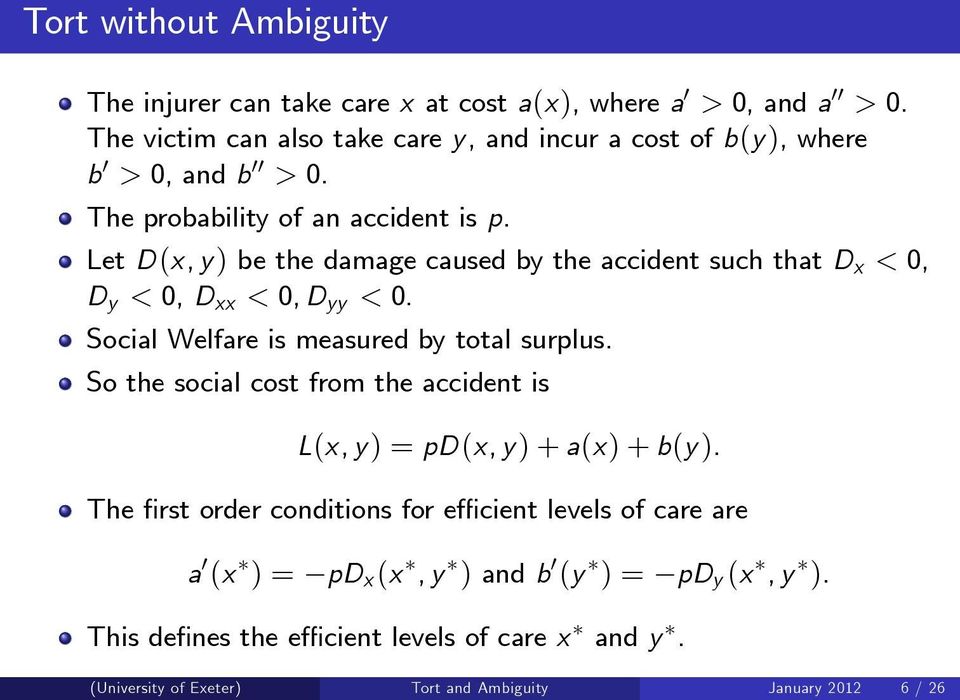
6 Tort without Ambiguity The injurer can take care x at cost a(x), where a 0 > 0, and a 00 > 0. The victim can also take care y, and incur a cost of b(y), where b 0 > 0, and b 00 > 0. The probability of an accident is p. Let D(x, y) be the damage caused by the accident such that D x < 0, D y < 0, D xx < 0, D yy < 0. Social Welfare is measured by total surplus. So the social cost from the accident is L(x, y) = pd(x, y) + a(x) + b(y). The rst order conditions for e cient levels of care are a 0 (x ) = pd x (x, y ) and b 0 (y ) = pd y (x, y ). This de nes the e cient levels of care x and y. (University of Exeter) Tort and Ambiguity January / 26
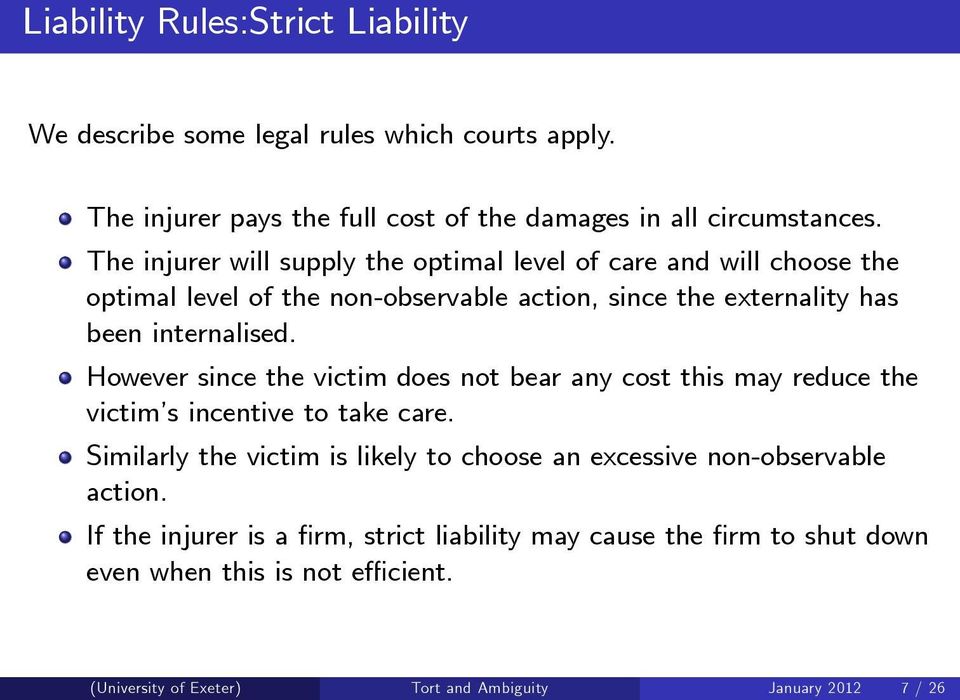
7 Liability Rules:Strict Liability We describe some legal rules which courts apply. The injurer pays the full cost of the damages in all circumstances. The injurer will supply the optimal level of care and will choose the optimal level of the non-observable action, since the externality has been internalised. However since the victim does not bear any cost this may reduce the victim s incentive to take care. Similarly the victim is likely to choose an excessive non-observable action. If the injurer is a rm, strict liability may cause the rm to shut down even when this is not e cient. (University of Exeter) Tort and Ambiguity January / 26
8 Negligence The injurer pays the full cost of the damages if the level of care is below a speci ed level x. Otherwise the victim bears the full cost. If x is set correctly the injurer will supply the optimal level of care. Given the injurer supplies care at the speci ed level, the victim bears the full cost of an accident. Since the externality is internalised, the victim will supply the e cient levels of care and non-observable actions. Assumes the court can determine the correct level of care. Provided (s)he chooses care level x, the injurer faces no cost of increasing the non-observable action. Thus the injurer is likely to choose a non-observable action which is too high. (University of Exeter) Tort and Ambiguity January / 26

9 Strict Liability Cost L(x) + c(x) c(x). x care x (University of Exeter) Tort and Ambiguity January / 26

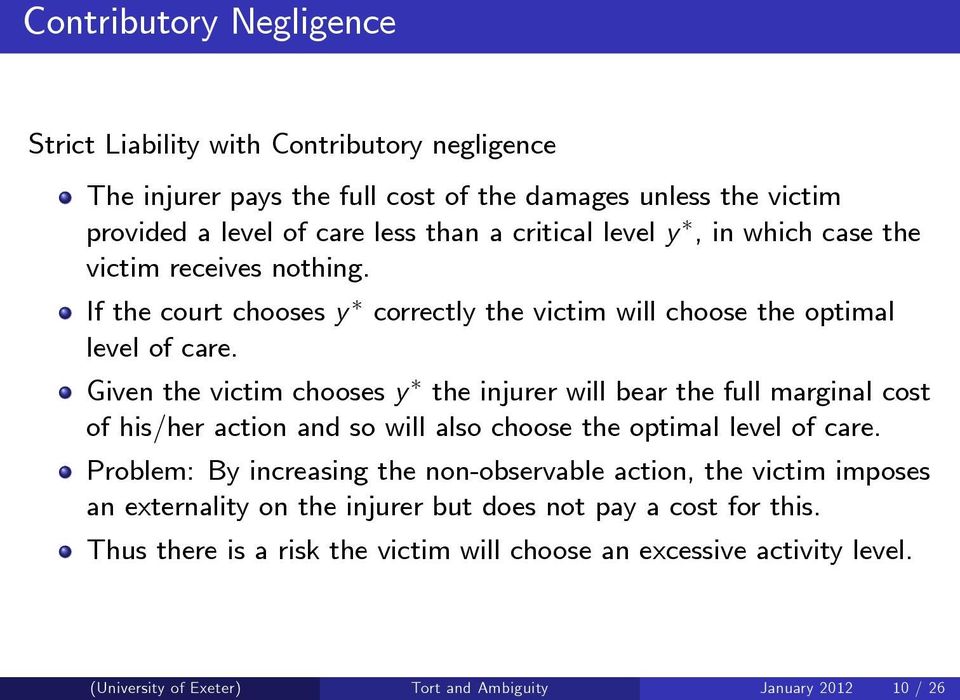
10 Contributory Negligence Strict Liability with Contributory negligence The injurer pays the full cost of the damages unless the victim provided a level of care less than a critical level y, in which case the victim receives nothing. If the court chooses y correctly the victim will choose the optimal level of care. Given the victim chooses y the injurer will bear the full marginal cost of his/her action and so will also choose the optimal level of care. Problem: By increasing the non-observable action, the victim imposes an externality on the injurer but does not pay a cost for this. Thus there is a risk the victim will choose an excessive activity level. (University of Exeter) Tort and Ambiguity January / 26
11 THE ELLSBERG PARADOX An urn contains 90 balls, 30 of which are red R. The remainder are either blue, B, or yellow, Y. Subjects are not told the proportion of blue and yellow balls. R B Y Data Choice 1 a X 71% b % Choice 2 c % d X 68% Most subjects prefer a to b and d to c. This is not compatible with maximising expected utility. Some subjects prefer b to a and c to d. Such subjects are said to be ambiguity seeking. (University of Exeter) Tort and Ambiguity January / 26

12 EXPERIMENTAL EVIDENCE Experimental Evidence on choice under uncertainty shows: Behaviour under ambiguity is di erent from behaviour under risk. e.g. in the Ellsberg Paradox; The dominant mode of behaviour is ambiguity-aversion, e.g. avoiding risks with unknown probabilities. Ambiguity-seeking is common for highly unlikely events. Ambiguity-seeking is common for choices involving losses. (University of Exeter) Tort and Ambiguity January / 26

13 DECISION WEIGHTS Weight 45 o 0 Likelilhood (University of Exeter) Tort and Ambiguity January / 26
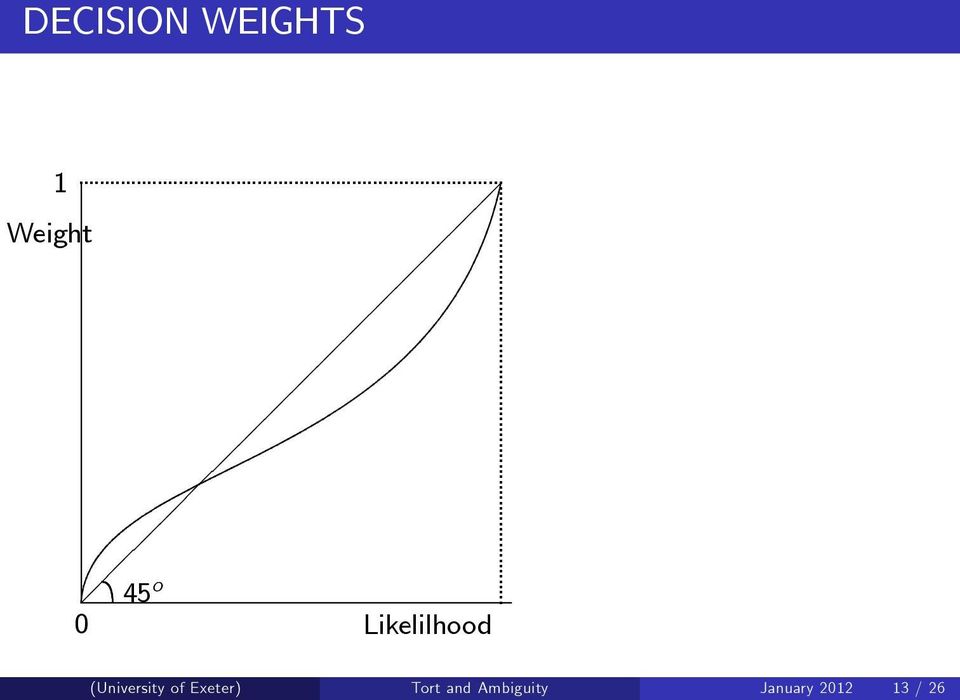
14 AMBIGUITY We use a model of ambiguity axiomatised by Chateauneuf, Eichberger and Grant, where preferences are represented by: αδm (a) + δ (1 α) m (a) + (1 δ)e π u (a), (1) M (a) denotes the maximum utility of act a, m (a) denotes the minimum utility of act a, E π u (a) denotes the expected utility of act a with respect to probability distribution π. δ is a measure of perceived ambiguity; α measures ambiguity-attitude, α = 1 (resp. α = 0) corresponding to pure optimism (resp. pessimism). Only 2 additional parameters needed compared to expected utility. This model is a special case of CEU Schmeidler (Econometrica 1989). (University of Exeter) Tort and Ambiguity January / 26

15 Tort with Ambiguity We assume that both the accident and the behaviour of the other individual are ambiguous. Assume rst that the court does not perceive ambiguity. We assume that agents do not know the true probability, p, of an accident. Instead they consider a set of probabilities q to be possible, (1 δ) p 6 q 6 δ + (1 δ) p. The set of probabilities contains the true probability p. Under strict liability, the (Choquet) expected utility for the injurer and the victim is respectively: L s ia(x, y) = δ i α i D(x, 0) + (1 δ i )pd(x, y) + a(x) L s va(x, y) = b(y). (University of Exeter) Tort and Ambiguity January / 26

16 Strict Liability with Ambiguity I Ambiguity-Aversion Ambiguity-aversion increases the marginal bene t of care for the injurer. Hence the injurer takes excessive care. The victim perceives the injurer s action to be ambiguous and hence unreliable. Thus the victim will also undertake positive care. Similar results apply to non-observable actions. Note strict liability does not distinguish between observable variables and non-observable variables. (University of Exeter) Tort and Ambiguity January / 26
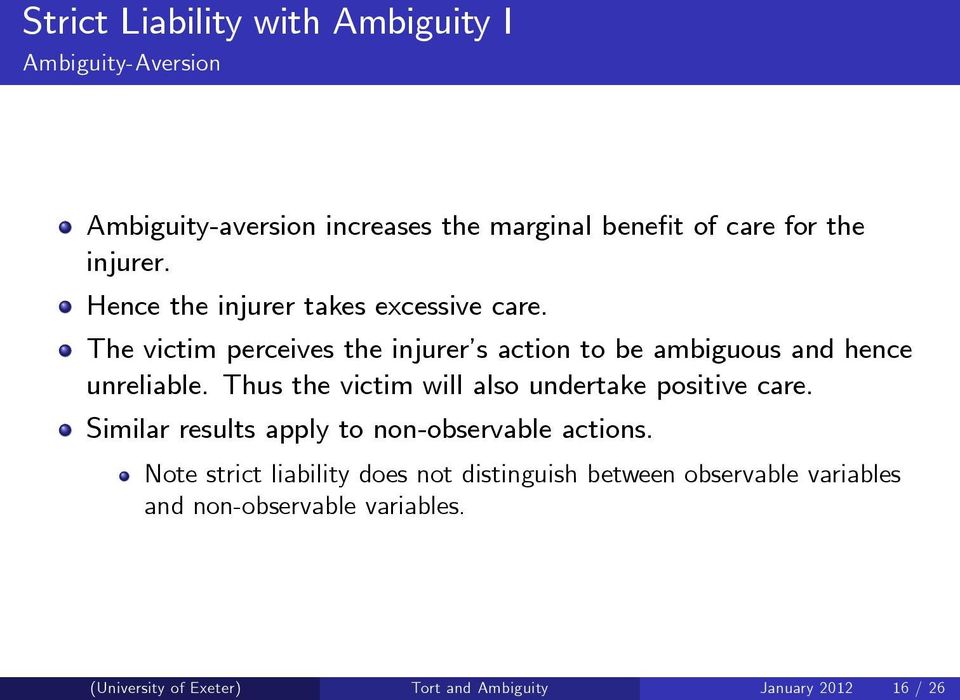
17 Strict Liability with Ambiguity II Ambiguity-Preference Under strict liability, the (Choquet) expected utility for the injurer and the victim is the respectively: L s ia(x, y) = δ i α i D(x, 0) + (1 δ i )pd(x, y) + a(x) L s va(x, y) = b(y). Ambiguity-seeking is likely as this is in the domain of losses and accidents are unlikely events. If the injurer is su ciently ambiguity-seeking, (s)he will take insu cient care. Don t worry she ll be right mate. (University of Exeter) Tort and Ambiguity January / 26
18 Negligence with Ambiguity-Aversion Under negligence the (Choquet) expected utility for the injurer is, L n ia(x, y) = δ i α i D(x, 0) + (1 δ i )pd(x, y) + a(x), if x < x ; = a(x), if x x. For the victim the (Choquet) expected utility is, L n va(x, y) = δ v α v D(0, y) + (1 δ v )pd(x, y) + b(y), if x x ; = δ v α v D(x, y) + b(y), if x < x. Ambiguity-aversion will increase the incentive for the injurer to choose the stipulated care level, x. Ambiguity-aversion may also increase the victim s care level. (University of Exeter) Tort and Ambiguity January / 26

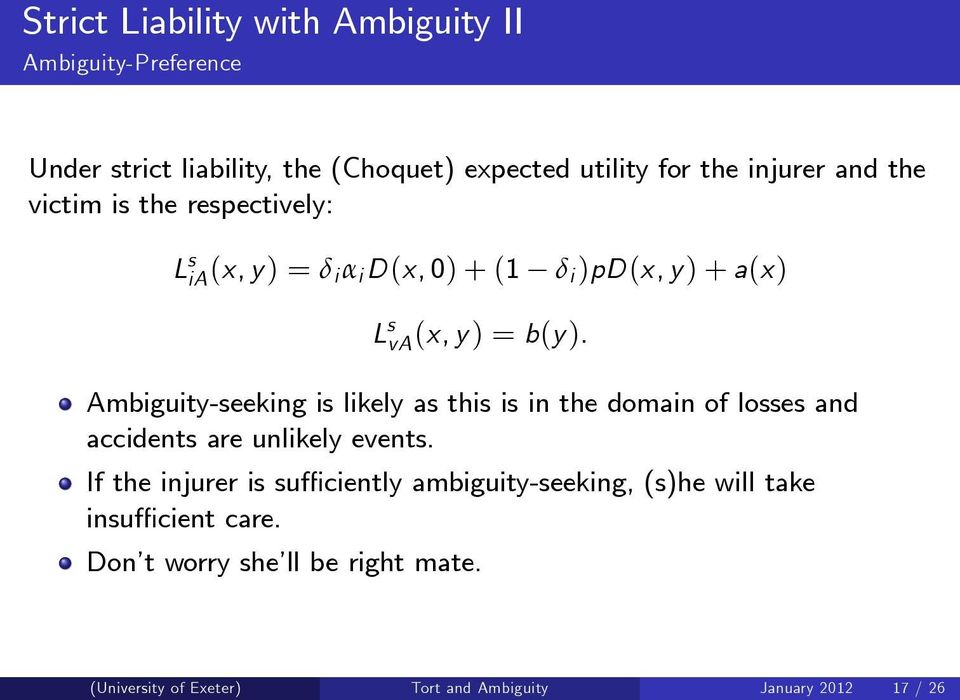
19 Negligence with Ambiguity-Preference The negligence rule creates a non-convexity of the injurer. There are thus two types of equilibria. For low ambiguity preference the injurer takes stipulated care. The victim supplies no care. Non-observable actions of both parties will be too high. For high ambiguity preference, the injurer takes a low level of care. The victim will make a positive investment in care but due to ambiguity-preference will under-invest. The non-observable action of the victim will be too high The e ect on the injurer s choice of non-observable action is ambiguous. Negligence is more robust to ambiguity preference. (University of Exeter) Tort and Ambiguity January / 26
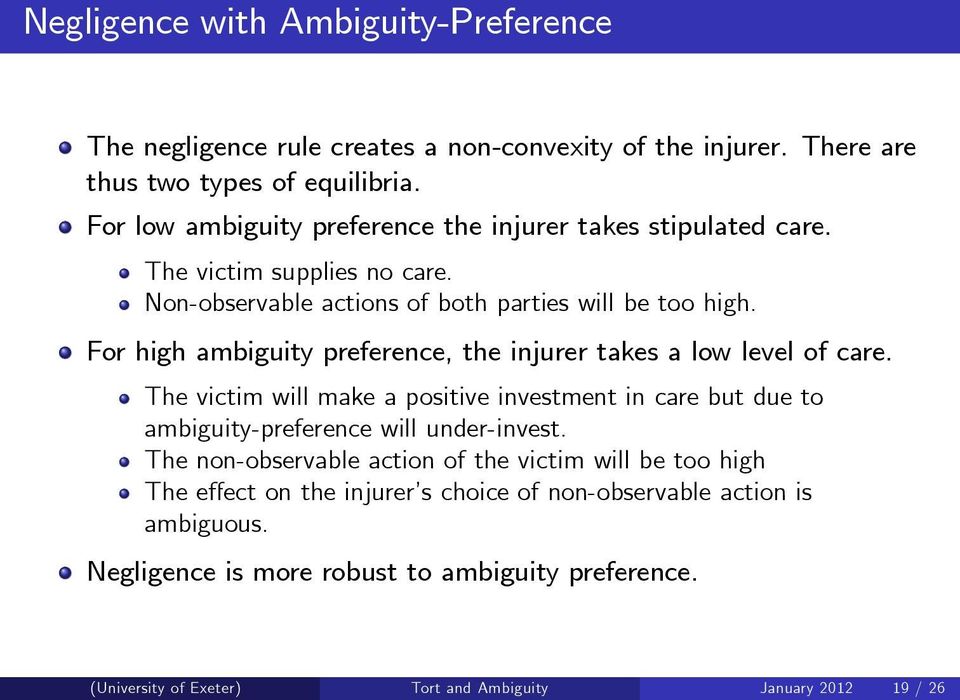
20 Strict Liability Cost L(x) + c(x) c(x). x care x (University of Exeter) Tort and Ambiguity January / 26

21 Contributory Negligence with Ambiguity Strict Liability with Contributory negligence Ambiguity-Aversion The victim chooses stipulated care. The injurer chooses excessive care. Ambiguity-Preference The victim either chooses stipulated care or very low care. The injurer under-invests in care. (University of Exeter) Tort and Ambiguity January / 26
22 Non-Observable Actions Assume, for simplicity, that the care level is xed. Shavell argues that no rule will give both agents an incentive to choose the correct non-observable action. If the injurer pays the damage, then (s)he will choose the optimal non-observable action but the victim will choose an action which is too high. If the injurer pays fraction α of the damage and the victim pays fraction 1 α then both have an incentive to choose excessive actions. Non-linear divisions of the loss do not help. Without ambiguity, there is no rule which implements the optimal actions and satis es budget balance. (University of Exeter) Tort and Ambiguity January / 26
23 Ambiguity and Non-Observable Actions With ambiguity-aversion it is possible to implement the optimal non-observable actions. The following rule will implement the optimal non-observable actions. The victim pays the full cost of the damage. Unless the damage is very high in which case the injurer pays a large ne (punitive damages) to the victim. The ne is only levied when the damage is so high that it is clear that both parties have used excessive actions. If the ne is su ciently high, ambiguity-aversion will cause the injurer to adopt the optimal action. This removes the risk of being ned. The victim will choose the optimal activity level since, in equilibrium, (s)he bears the full marginal cost of accidents. (University of Exeter) Tort and Ambiguity January / 26
24 CONCLUSION I Negligence is more robust to ambiguity than strict liability. Should the concept of e ciency be modi ed to take account of ambiguity? E.g. with ambiguity-aversion negligence is ex-post Pareto optimal. However this neglects the ex-ante loss in utility which individuals su er due to ambiguity. (University of Exeter) Tort and Ambiguity January / 26
25 CONCLUSION II The Court Perceives Ambiguity We have assumed that the injurer and victim perceive ambiguity but the court does not. The analysis of strict liability would not be a ected. Most results will still apply for any level of stipulated care the court enforces. If the court does not know p then it is likely that x and y will be ambiguous. This acts to reinforce other e ects. An ambiguity preferring decision-maker will provide too little care, since (s)he over-weights the possibility that the court sets stipulated care too low. Similarly an ambiguity-averse individual will choose a level of care which is too high. (University of Exeter) Tort and Ambiguity January / 26
26 CONCLUSION III Acts of God Tort Law says that the injurer is not liable if the damage was due to an unanticipated event. There are similar Act of God clauses in building and insurance contracts. This may also be explained by ambiguity. Related Literature Teitelbaum, Journal of Legal Studies, 2007, studies ambiguity and accident law. Only the injurer is a ected by ambiguity. The present paper combines Teitelbaum with models of ambiguity in games, such as Eichberger and Kelsey, GEB 2000, Kelsey and Spanjers, EJ (University of Exeter) Tort and Ambiguity January / 26
A Simpli ed Axiomatic Approach to Ambiguity Aversion
 A Simpli ed Axiomatic Approach to Ambiguity Aversion William S. Neilson Department of Economics University of Tennessee Knoxville, TN 37996-0550 [email protected] March 2009 Abstract This paper takes the
A Simpli ed Axiomatic Approach to Ambiguity Aversion
 A Simpli ed Axiomatic Approach to Ambiguity Aversion William S. Neilson Department of Economics University of Tennessee Knoxville, TN 37996-0550 [email protected] May 2010 Abstract This paper takes the
Voluntary Voting: Costs and Bene ts
 Voluntary Voting: Costs and Bene ts Vijay Krishna y and John Morgan z November 7, 2008 Abstract We study strategic voting in a Condorcet type model in which voters have identical preferences but di erential
Pricing Cloud Computing: Inelasticity and Demand Discovery
 Pricing Cloud Computing: Inelasticity and Demand Discovery June 7, 203 Abstract The recent growth of the cloud computing market has convinced many businesses and policy makers that cloud-based technologies
THE SWEDISH TRAFFIC DAMAGE ACT. A short introduction Warsaw 21 March 2011
 THE SWEDISH TRAFFIC DAMAGE ACT A short introduction Warsaw 21 March 2011 Some background facts Sweden's first motorist's liability act was introduced in 1906. In 1916 the law was made more stringent. It
Optimal insurance contracts with adverse selection and comonotonic background risk
 Optimal insurance contracts with adverse selection and comonotonic background risk Alary D. Bien F. TSE (LERNA) University Paris Dauphine Abstract In this note, we consider an adverse selection problem
Tiered and Value-based Health Care Networks
 Tiered and Value-based Health Care Networks Ching-to Albert Ma Henry Y. Mak Department of Economics Department of Economics Boston Univeristy Indiana University Purdue University Indianapolis 270 Bay State
On the Importance of Default Breach Remedies
 On the Importance of Default Breach Remedies by Randolph Sloof, Hessel Oosterbeek and Joep Sonnemans Theory predicts that default breach remedies are immaterial whenever contracting costs are negligible.
The Reasonable Person Negligence Standard and Liability Insurance. Vickie Bajtelsmit * Colorado State University
 \ins\liab\dlirpr.v3a 06-06-07 The Reasonable Person Negligence Standard and Liability Insurance Vickie Bajtelsmit * Colorado State University Paul Thistle University of Nevada Las Vegas Thistle s research
Adverse Selection. Chapter 3
 Chapter 3 Adverse Selection Adverse selection, sometimes known as The Winner s Curse or Buyer s Remorse, is based on the observation that it can be bad news when an o er is accepted. Suppose that a buyer
CHAPTER 2 THE RELATIONSHIP BETWEEN NO-FAULT INSURANCE AND DRIVER BEHAVIOR
 -5- CHAPTER 2 THE RELATIONSHIP BETWEEN NO-FAULT INSURANCE AND DRIVER BEHAVIOR Under a traditional tort system, at-fault drivers are liable for the economic and noneconomic damages they inflict on third
Midterm March 2015. (a) Consumer i s budget constraint is. c i 0 12 + b i c i H 12 (1 + r)b i c i L 12 (1 + r)b i ;
 Masters in Economics-UC3M Microeconomics II Midterm March 015 Exercise 1. In an economy that extends over two periods, today and tomorrow, there are two consumers, A and B; and a single perishable good,
Covert Networks and the Antitrust Policy
 Covert Networks and the Antitrust Policy Flavia Roldán Universidad ORT Uruguay and Public-Private Sector Research Center, IESE Business School June, 2011 Abstract This article studies the e ectiveness
Auditor liability rules under imperfect information and costly litigation: the welfare-increasing eœect of liability insurance
 The European Accounting Review 2000, 9:3, 371 385 Auditor liability rules under imperfect information and costly litigation: the welfare-increasing eœect of liability insurance Ralf Ewert, Eberhard Feess
Adverse selection and moral hazard in health insurance.
 Adverse selection and moral hazard in health insurance. Franck Bien David Alary University Paris Dauphine November 10, 2006 Abstract In this paper, we want to characterize the optimal health insurance
Central Bank Lending and Money Market Discipline
 Central Bank Lending and Money Market Discipline Marie Hoerova European Central Bank Cyril Monnet FRB Philadelphia November 2010 PRELIMINARY Abstract This paper provides a theory for the joint existence
Corporate Income Taxation
 Corporate Income Taxation We have stressed that tax incidence must be traced to people, since corporations cannot bear the burden of a tax. Why then tax corporations at all? There are several possible
IDENTIFICATION IN A CLASS OF NONPARAMETRIC SIMULTANEOUS EQUATIONS MODELS. Steven T. Berry and Philip A. Haile. March 2011 Revised April 2011
 IDENTIFICATION IN A CLASS OF NONPARAMETRIC SIMULTANEOUS EQUATIONS MODELS By Steven T. Berry and Philip A. Haile March 2011 Revised April 2011 COWLES FOUNDATION DISCUSSION PAPER NO. 1787R COWLES FOUNDATION
Online shopping and platform design with ex ante registration requirements
 Online shopping and platform design with ex ante registration requirements Florian Morath Johannes Münster y December 5, 2014 Abstract We study platform design in online markets in which buying involves
The Plan Sponsor's Guide to Delegating, Recordkeeping Made Simple
 THE EXCELLENT FIDUCIARY The Plan Sponsor's Guide to Delegating, Part II: Recordkeeping Made Simple Ronald E. Hagan * An ERISA recordkeeper is one of the most heavily reliedupon experts within a plan sponsor's
Paid Placement: Advertising and Search on the Internet
 Paid Placement: Advertising and Search on the Internet Yongmin Chen y Chuan He z August 2006 Abstract Paid placement, where advertisers bid payments to a search engine to have their products appear next
LIABILITY FOR ACCIDENTS
 Chapter 2 LIABILITY FOR ACCIDENTS STEVEN SHAVELL * School of Law, Harvard University, and National Bureau of Economic Research Contents 1. Introduction 142 Part A: Central theory of liability 142 2. Incentives
Exact Nonparametric Tests for Comparing Means - A Personal Summary
 Exact Nonparametric Tests for Comparing Means - A Personal Summary Karl H. Schlag European University Institute 1 December 14, 2006 1 Economics Department, European University Institute. Via della Piazzuola
Representation of functions as power series
 Representation of functions as power series Dr. Philippe B. Laval Kennesaw State University November 9, 008 Abstract This document is a summary of the theory and techniques used to represent functions
A Welfare Criterion for Models with Distorted Beliefs
 A Welfare Criterion for Models with Distorted Beliefs Markus Brunnermeier, Alp Simsek, Wei Xiong August 2012 Markus Brunnermeier, Alp Simsek, Wei Xiong () Welfare Criterion for Distorted Beliefs August
1 SHORT ANSWER QUESTIONS
 Tort Law Suggested Answers 1 SHORT ANSWER QUESTIONS Comment on the Following: 1. [2002, Midterm #2a] Suppose that all doctors were held strictly liable for injuries they cause to their patients. What are
FIRE ON THE ICE: RECENT DEVELOPMENTS IN THE LAW OF NEGLIGENCE REGARDING CAUSATION
 Aaron L. Sherriff FIRE ON THE ICE: RECENT DEVELOPMENTS IN THE LAW OF NEGLIGENCE REGARDING CAUSATION 2 Aaron L. Sherriff TABLE OF CONTENTS I. THE CGL POLICY... 3 II. NEGLIGENCE... 3 III. MR. HANKE... 4
Information Gatekeepers on the Internet and the Competitiveness of. Homogeneous Product Markets. By Michael R. Baye and John Morgan 1.
 Information Gatekeepers on the Internet and the Competitiveness of Homogeneous Product Markets By Michael R. Baye and John Morgan 1 Abstract We examine the equilibrium interaction between a market for
Class Notes, Econ 8801 Lump Sum Taxes are Awesome
 Class Notes, Econ 8801 Lump Sum Taxes are Awesome Larry E. Jones 1 Exchange Economies with Taxes and Spending 1.1 Basics 1) Assume that there are n goods which can be consumed in any non-negative amounts;
CHAPTER 30: EMPLOYEE INJURIES
 CHAPTER 30: EMPLOYEE INJURIES INTRODUCTION TO JOB SAFETY Our legal system has developed three ways of handling employee injuries: A. NEGLIGENCE SUITS Was developed under common-law where the injured employee
Moral Hazard. Itay Goldstein. Wharton School, University of Pennsylvania
 Moral Hazard Itay Goldstein Wharton School, University of Pennsylvania 1 Principal-Agent Problem Basic problem in corporate finance: separation of ownership and control: o The owners of the firm are typically
Problem Set #1 14.41 Public Economics
 Problem Set #1 14.41 Public Economics DUE: September 24, 2010 1 Question One For each of the examples below, please answer the following: 1. Does an externality exist? If so, classify the externality as
Liability Insurance as Protection Against Legal Error. Vickie Bajtelsmit Colorado State University. and
 lipale.v2a 07-17-08 Liability Insurance as Protection Against Legal Error Vickie Bajtelsmit Colorado State University and Paul D. Thistle * University of Nevada Las Vegas Thistle s research was supported
Costly Voting when both Information and Preferences Di er: Is Turnout Too High or Too Low?
 Costly Voting when both Information and Preferences Di er: Is Turnout Too High or Too Low? Sayantan Ghosal and Ben Lockwood University of Warwick October, 2008 Abstract We study a model of costly voting
Advanced Microeconomics
 Advanced Microeconomics Ordinal preference theory Harald Wiese University of Leipzig Harald Wiese (University of Leipzig) Advanced Microeconomics 1 / 68 Part A. Basic decision and preference theory 1 Decisions
Discussion of Self-ful lling Fire Sales: Fragility of Collateralised, Short-Term, Debt Markets, by J. C.-F. Kuong
 Discussion of Self-ful lling Fire Sales: Fragility of Collateralised, Short-Term, Debt Markets, by J. C.-F. Kuong 10 July 2015 Coordination games Schelling (1960). Bryant (1980), Diamond and Dybvig (1983)
The Credit Spread Cycle with Matching Friction
 The Credit Spread Cycle with Matching Friction Kevin E. Beaubrun-Diant and Fabien Tripier y June 8, 00 Abstract We herein advance a contribution to the theoretical literature on nancial frictions and show
Cooperation with Network Monitoring
 Cooperation with Network Monitoring Alexander Wolitzky Microsoft Research and Stanford University July 20 Abstract This paper studies the maximum level of cooperation that can be sustained in sequential
Declarations. INSU 2500 Chapter 9 CHAPTER 9. Common Elements of Insurance Contracts. Insuring Agreement Example
 Declarations INSU 2500 Chapter 9 October 10, 2006 Facts of Policy Usually first page of an insurance contract contains such things as: Identifies the insurance company Identifies the named insured Policy
Sharp and Diffuse Incentives in Contracting
 Risk & Sustainable Management Group Risk and Uncertainty Working Paper: R07#6 Research supported by an Australian Research Council Federation Fellowship http://www.arc.gov.au/grant_programs/discovery_federation.htm
Oligopoly Price Discrimination by Purchase History
 Oligopoly Price Discrimination by Purchase History Yongmin Chen y November 8, 2005 Abstract This article provides a review of the economics literature on oligopoly price discrimination by purchase history.
Can a Lump-Sum Transfer Make Everyone Enjoy the Gains. from Free Trade?
 Can a Lump-Sum Transfer Make Everyone Enjoy te Gains from Free Trade? Yasukazu Icino Department of Economics, Konan University June 30, 2010 Abstract I examine lump-sum transfer rules to redistribute te
Lecture 9: Keynesian Models
 Lecture 9: Keynesian Models Professor Eric Sims University of Notre Dame Fall 2009 Sims (Notre Dame) Keynesian Fall 2009 1 / 23 Keynesian Models The de ning features of RBC models are: Markets clear Money
Application of sensitivity analysis in investment project evaluation under uncertainty and risk
 International Journal of Project Management Vol. 17, No. 4, pp. 217±222, 1999 # 1999 Elsevier Science Ltd and IPMA. All rights reserved Printed in Great Britain 0263-7863/99 $ - see front matter PII: S0263-7863(98)00035-0
Participating insurance contracts and the Rothschild-Stiglitz equilibrium puzzle
 Participating insurance contracts and the Rothschild-Stiglitz equilibrium puzzle Pierre Picard 24 November 2009 Abstract We show that an equilibrium always exists in the Rothschild-Stiglitz insurance market
Participating insurance contracts and the Rothschild-Stiglitz equilibrium puzzle
 Participating insurance contracts and the Rothschild-Stiglitz equilibrium puzzle Pierre Picard y 22 August 2010 Abstract We show that an equilibrium always exists in the Rothschild-Stiglitz insurance market
Vicarious liability of a charity or its trustees
 1 of 7 Guidance Vicarious liability of a charity or its trustees Contents In general, for what are trustees liable? Liability for the actions or omissions of others What does the law cover in this area?
Vertical Integration and Investor Protection in Developing Countries
 NOTA DI LAVORO 86.2009 Vertical Integration and Investor Protection in Developing Countries By Rocco Macchiavello, Oxford (Nuffield College) and CEPR INSTITUTIONS AND MARKETS Series Editor: Fausto Panunzi
LEGAL ISSUES. Why should I learn about legal issues? How am I liable? What are my responsibilities as a teacher?
 LEGAL ISSUES Why should I learn about legal issues? School administrators are typically the only personnel to receive training in classroom liability issues, yet teachers have the most responsibility for
GOVERNMENT CONTRACT COSTS, PRICING & ACCOUNTING REPORT
 Reprinted with permission from Government Contract Costs, Pricing & Accounting Report, Volume 10, Issue 2, K2015 Thomson Reuters. Further reproduction without permission of the publisher is prohibited.
4. Only one asset that can be used for production, and is available in xed supply in the aggregate (call it land).
 Chapter 3 Credit and Business Cycles Here I present a model of the interaction between credit and business cycles. In representative agent models, remember, no lending takes place! The literature on the
the compensation myth
 the compensation myth The Compensation Myth It is common to hear stories of the Compensation Culture or claims that Britain is becoming Risk Averse as a result of people claiming compensation. The truth
Why Plaintiffs Attorneys Use Contingent and Defense Attorneys Fixed Fee Contracts
 Why Plaintiffs Attorneys Use Contingent and Defense Attorneys Fixed Fee Contracts Winand Emons 1 Claude Fluet 2 1 Department of Economics University of Bern, CEPR, CIRPEE 2 Université du Québec à Montréal,
Herding, Contrarianism and Delay in Financial Market Trading
 Herding, Contrarianism and Delay in Financial Market Trading A Lab Experiment Andreas Park & Daniel Sgroi University of Toronto & University of Warwick Two Restaurants E cient Prices Classic Herding Example:
Chapter 1 Insurance Concepts & Principles
 Chapter 1 Chapter Objectives Your learning objectives are as follows: Understand the mechanism of insurance. Understand the difference between property and casualty insurance. Learn the parts of the insurance
WARWICK ECONOMIC RESEARCH PAPERS
 Correlated Equilibria, Incomplete Information and Coalitional Deviations Francis Bloch, Bhaskar Dutta No 763 WARWICK ECONOMIC RESEARCH PAPERS DEPARTMENT OF ECONOMICS Correlated Equilibria, Incomplete Information