
LSU System Institution s Metric Data. March 18, 2013
|
|
|
- Shona Elliott
- 9 years ago
- Views:
Transcription
1 LSU System Institution s Metric Data March 18, 2013

2

3 Table of contents Page LSU System Performance Metrics Executive Summary 1 Louisiana State University and A&M College 3 Paul M. Hebert Law Center 24 Pennington Biomedical Research Center 38 Louisiana State University Agricultural Center 49 Louisiana State University Shreveport 60 Louisiana State University Alexandria 84 Louisiana State University Eunice 101 Health Sciences Center New Orleans 118 Health Sciences Center Shreveport 164

4

5 LSU System Performance Metrics Executive Summary The LSU System performance indicators are designed to provide campus leadership and the Board of Supervisors with a mechanism for evaluating annual institutional performance. This document includes a summary of the LSU System campuses performance metrics data. The metrics data provided allow institutions to discuss descriptive metrics and performance measures within the context of each campus mission. In complex university systems, the distinct and quite different institutions do not measure their performance against each other but against the larger marketplaces where they compete. Two elements are critical for the effectiveness of performance measurement. First is the constant tracking of improvement from year to year. Second is the periodic benchmarking of campus performance against appropriate national counterparts. Data provided in this document speak primarily to the first element of annual improvement. Subsequent work by the campuses in identifying appropriate measures of performance against national counterparts provide a context for the second, national benchmarking element, of effective performance measurement. The utility of these data points for evaluating institutional performance varies by campus and mission. Below is a general outline of metrics data captured in this document. Please note that for example, in some institutions, enrollment growth is critical to survival; for others, enrollment is stable and other indicators will be more important. Other institutions may pay particular attention to undergraduate education, others to research or technology transfer. Consequently, although this data describe the scale of operations, their utility as metrics for performance improvement measurement varies. Below is a general outline of metrics data captured in this document. These metrics represent a start to what is expected to become a significant analysis and measuring tool for the Louisiana State University System and its institutions. General Metrics Description Metric I: Degrees and Credentials (Including distribution by race, ethnicity, and other characteristics) Metric II: Enrollment data (Including distribution by race, ethnicity, and other characteristics such as full and part time) Metric III: Retention, Graduation, Licensure, and Pass Rate (Standardized State and National Exams) Metric IV: Research Expenditures Metric V: Technology Transfer Metric VI: Revenue Sources (Tuition and Fees, Other Revenue Resources) Metric VII: Teaching and Research Productivity Metric VII: Hospital Statistics (HSCs only) Benchmark: Campus Specific Benchmark Metrics 1 1

6 Blank Page 2 2

7 Louisiana State University and A&M College Louisiana State University and A&M College is known for its outstanding undergraduate and graduate academic programs, state of the art research, internationally acclaimed faculty, and strong academic student support programs. LSU, the state's Flagship University, is ranked as a top tier, research university very high research activity (Carnegie Classification) and is one of a few select universities to be designated as a land, sea, and space grant institution. The university attracts highly qualified undergraduate and graduate students. As stated in the institution's mission, LSU challenges its students to the highest levels of intellectual and personal development. Despite the continuing reduction in state funding for its educational programs, LSU continues to advance its programs of teaching, research and service. LSU's recent accomplishments are highlighted below. The total degrees awarded (6,251) in was the highest number awarded ever at LSU, and a 6.2% increase over the previous year (5,885). (Metric I) The number of degrees awarded at each level increased over the previous year (bachelors, 3.6%; masters, 12.8%; doctoral, 26.3%; and professional, 9.3%). (Metric I) Total undergraduate headcount as of the 14th class day (24,631) was the highest enrollment over the past 6 years and represented a 2.7% increase over last year's 14th day enrollment (23,980). (Metric II) The total headcount (5,725) for first time degree seeking students as of the 14th class day was the largest in LSU's history and an increase of 8.2% above last year. (Metric II) Total number of enrolled students who received Tops (12,655) increased from the previous year by 1.9%. (Metric II) Total number of students (9,162) enrolled in STEM programs increased 5.3% to its highest level in the past 6 years. (Metric II) Although both retention from first to second year (83.0%) and second to third year (75.1%) decreased slightly (1% or less), the six year bachelor's graduation rate (65%) was the highest ever. (Metric III) Louisiana Community College transfer student six year graduation rate (63.0 %) increased 3.1% over the previous year's rate (61.1%). (Metric III) Research expenditures in Engineering ($30,832,000) and Environmental Sciences ($31,805,000) both increased over the previous year (1.3% and 1.4% respectively), but total research expenditures ($145,625) decreased 0.8% from the previous year. (Metric IV) Total number of U.S. Patent Applications filed (30) and total number of licenses/options (19) increased from the previous year by 7.1% and 26.7%, respectively. (Metric V) Annual gifts ($71,944,778) increased 81.8% from the previous year. (Metric VI) Total net revenue from first time full time freshmen ($34,330,076) increased 36.8% from the previous year. (Metric VI) Total semester credit hours taught per tenured/tenure track faculty (210 SCHs) increased 2.4% to an all time high. (Metric VII) The overall positive accomplishments indicated above are significant, especially considering the continued reduction in state support for higher education. However, as a state supported institution, the university will be unable to sustain growth and quality in its teaching, research, and service programs without stable and reliable state funding. LSU is at a critical point in its ability to sustain its mission as the state's flagship, comprehensive, research institution. 3 3

8 LSU and A&M VISION and MISSION: As the flagship institution of the state, the vision of Louisiana State University is to be a leading research-extensive university, challenging undergraduate and graduate students to achieve the highest levels of intellectual and personal development. Designated as a land, sea, and space-grant institution, the mission of Louisiana State University is the generation, preservation, dissemination, and application of knowledge and cultivation of the arts. In implementing its mission, LSU is committed to: *offer a broad array of undergraduate degree programs and extensive graduate research opportunities designed to attract and educate highly qualified undergraduate and graduate students; *employ faculty who are excellent teacher-scholars, nationally competitive in research and creative activities, and who contribute to a world-class knowledge base that is transferable to educational, professional, cultural, and economic enterprises; and * use its extensive resources to solve economic, environmental, and social challenges. (Mission Statement approved December 2006 and reaffirmed October 2012) 4 4

9 Louisiana State University and A&M Metrics at a Glance Legend: Increase from Previous Year Statistic High X Y Current No change Low Z % % Change from Previous Period Decrease from Previous Year Metric I Metric II Metric III Metric IV Metric V Metric VI Metric VII Degrees Awarded Enrollment Student Success Research Expenditures Technology Transfer Revenues Faculty Productivity Bachelors 14th Day Enrollment for First Time Degree Seeking Freshmen Average ACT Score Engineering Total (in thousands) Number of Licensing FTEs employed Annual Gifts Enrollment in Fall Semester Lecture and Seminar Courses 4,734 4,600 5,725 5, ,258 30, ,944,778 71,944, , ,091 4, % 4, % % 28, % 3 0.0% 39,580, % 112, % 14th Day Degree Seeking New Transfer Student First to Second Year Physical Sciences Total (in Number of Material Transfer Agreements Market Value of Tenure/tenure track (T/TT) FTE faculty Masters Enrollment Retention thousands) (MTAs) Endowments assigned to classes 1,234 1, % 83.0% 22,324 22, ,845, ,557, % % 82.6% 1.0% 16, % % 264,041, % % Total Undergraduate Total number of Total Gross Revenue From Non tenure/tenure track Headcount as of 14th Second to Third Year Environmental Sciences Licenses/Options yielding First Time Full Time FTE faculty assigned to Doctoral Class Day Retention Total (in thousands) license income of any sort Freshmen classes ,631 24, % 75.1% 32,845 31, ,268,912 41,268, % 23, % 72.0% 0.4% 30, % % 20,722, % % Total Graduate Headcount as of 14th Life Sciences Total (in Total License Income Net Revenue From First Total sch's taught per Professional (Veterinary) Class Day Six Year Graduation Rate thousands) Received Time Full Time Freshmen T/TT FTE faculty ,085 4, % 65.0% 34,269 31, , ,892 34,330,076 34,330, % 4, % 58.7% 8.5% 28, % 111, % 15,595, % % Grand Total Number of Total number of students enrolled who received LA Community College Transfer Student Second Social Sciences Total (in Total $ Spent on Legal Fees for Patents and/or State Appropriation per Total sch's taught per non Degrees Awarded TOPS Year Retention thousands) Copyrights FTE T/TT FTE faculty 6,251 6,251 12,655 12, % 78.9% 5,139 5, , ,485 7,918 5, , % 11, % 75.2% 5.7% 3, % 268, % 5, % % Total degrees awarded in STEM Total number of student enrolled in STEM LA Community College Transfer Student 6 Year Grad Rate Total All Disciplines (in thousands) Total U.S Patent Applications Filed Net Revenue Generated from auxiliary enterprises Direct unrestricted instructional expenditures per FTE student 1,591 1,591 9,162 9, % 63.0% 147, , ,696,795 20,696,795 6,714 6,339 1, % 7, % 57.3% 3.1% 123, % % 12,509,351, 1.1% 5, % 5 5

10 Louisiana State University and A&M Metric I. Number of degrees conferred by level and professions most important to Louisiana Campus total number of degrees awarded/conferred Bachelors 4,617 4,600 4,734 4,388 4,440 4,600 Masters ,043 1,094 1,234 Post Masters Doctoral Specialist Professional (Veterinary) Grand Total Number of Degrees Awarded 5,975 5,917 6,044 5,830 5,885 6,251 Total number of degrees awarded by race/ethnicity... Hispanic American Indian or Alaska Native Asian Black or African American Native Hawaiian or Other Pacific Islander White 4,630 4,599 4,628 4,456 4,460 4,702 Two or More Races Nonresident Alien Race/Ethnicity Unknown Total degrees awarded Total degrees awarded in STEM 1,397 1,382 1,334 1,394 1,366 1,591 Total Teacher Education completions (Note BOR Teacher Education Initiatives) Total Completed (Regular Program ) Number Passed (Regular Program ) Percentage Passed (Regular Program ) 96% 99% 99% 99% 99% Total Completed (Alternate Program ) Number Passed (Alternate Program ) Percentage Passed (Alternate Program ) 100% 100% 100% 100% 100% Total number of degrees awarded in Allied Health List of STEM/SMART CIP code/s: The following list of CIP codes is to serve as a guide but it is not intended to be inclusive of all possibilities. We recognize that some campuses have degree programs centered in schools or colleges that might dictate a different CIP code. The campus should make the appropriate adjustment. In addition, the CIP codes used by the campus should correlate to the Board of Regents. If there is a discrepancy and the campus applies the IPEDS CIP code, then the campus should identify this with a footnote. 11 Computer and Information Sciences and Support Services 14 Engineering 15 Engineering Technologies/Technicians 26 Biological and Biomedical Sciences 27 Mathematics and Statistics 40 Physical Sciences 0109 Animal Sciences 6 6

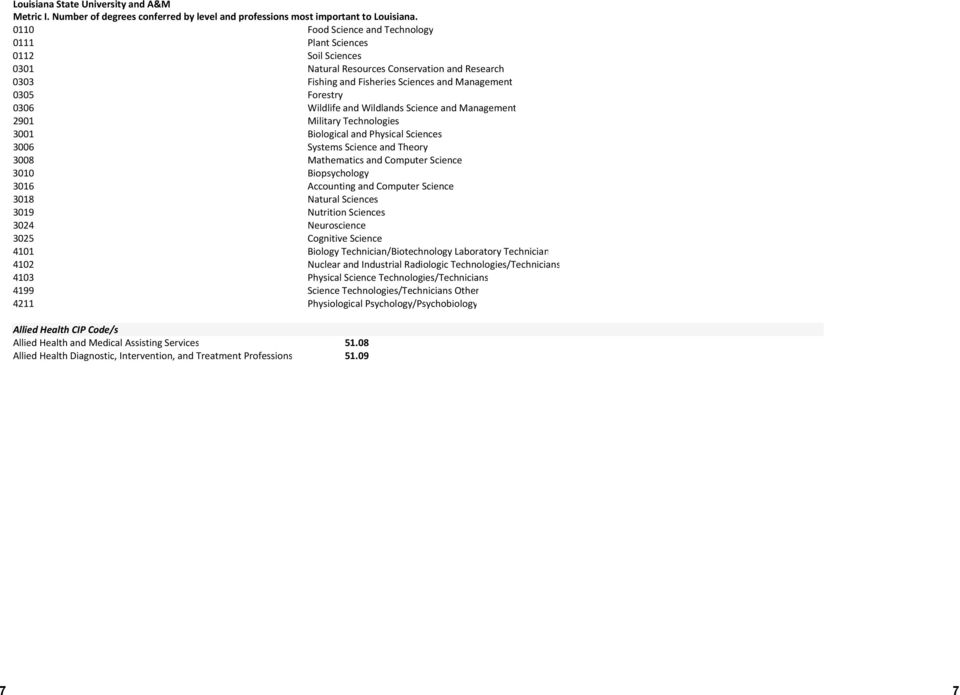
11 Louisiana State University and A&M Metric I. Number of degrees conferred by level and professions most important to Louisiana Food Science and Technology 0111 Plant Sciences 0112 Soil Sciences 0301 Natural Resources Conservation and Research 0303 Fishing and Fisheries Sciences and Management 0305 Forestry 0306 Wildlife and Wildlands Science and Management 2901 Military Technologies 3001 Biological and Physical Sciences 3006 Systems Science and Theory 3008 Mathematics and Computer Science 3010 Biopsychology 3016 Accounting and Computer Science 3018 Natural Sciences 3019 Nutrition Sciences 3024 Neuroscience 3025 Cognitive Science 4101 Biology Technician/Biotechnology Laboratory Technician 4102 Nuclear and Industrial Radiologic Technologies/Technicians 4103 Physical Science Technologies/Technicians 4199 Science Technologies/Technicians Other 4211 Physiological Psychology/Psychobiology Allied Health CIP Code/s Allied Health and Medical Assisting Services Allied Health Diagnostic, Intervention, and Treatment Professions
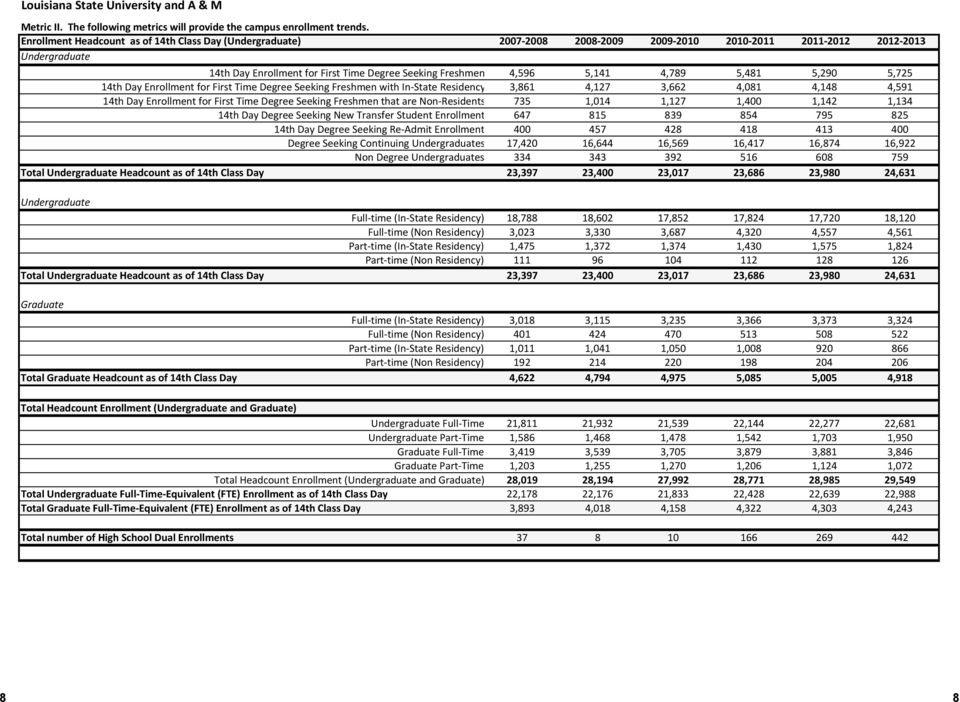
12 Louisiana State University and A & M 4918 Metric II. The following metrics will provide the campus enrollment trends. Enrollment Headcount as of 14th Class Day (Undergraduate) Undergraduate 14th Day Enrollment for First Time Degree Seeking Freshmen 4,596 5,141 4,789 5,481 5,290 5,725 14th Day Enrollment for First Time Degree Seeking Freshmen with In State Residency 3,861 4,127 3,662 4,081 4,148 4,591 14th Day Enrollment for First Time Degree Seeking Freshmen that are Non Residents 735 1,014 1,127 1,400 1,142 1,134 14th Day Degree Seeking New Transfer Student Enrollment th Day Degree Seeking Re Admit Enrollment Degree Seeking Continuing Undergraduates 17,420 16,644 16,569 16,417 16,874 16,922 Non Degree Undergraduates Total Undergraduate Headcount as of 14th Class Day 23,397 23,400 23,017 23,686 23,980 24,631 Undergraduate Full time (In State Residency) 18,788 18,602 17,852 17,824 17,720 18,120 Full time (Non Residency) 3,023 3,330 3,687 4,320 4,557 4,561 Part time (In State Residency) 1,475 1,372 1,374 1,430 1,575 1,824 Part time (Non Residency) Total Undergraduate Headcount as of 14th Class Day 23,397 23,400 23,017 23,686 23,980 24,631 Graduate Full time (In State Residency) 3,018 3,115 3,235 3,366 3,373 3,324 Full time (Non Residency) Part time (In State Residency) 1,011 1,041 1,050 1, Part time (Non Residency) Total Graduate Headcount as of 14th Class Day 4,622 4,794 4,975 5,085 5,005 4,918 Total Headcount Enrollment (Undergraduate and Graduate) Undergraduate Full Time 21,811 21,932 21,539 22,144 22,277 22,681 Undergraduate Part Time 1,586 1,468 1,478 1,542 1,703 1,950 Graduate Full Time 3,419 3,539 3,705 3,879 3,881 3,846 Graduate Part Time 1,203 1,255 1,270 1,206 1,124 1,072 Total Headcount Enrollment (Undergraduate and Graduate) 28,019 28,194 27,992 28,771 28,985 29,549 Total Undergraduate Full Time Equivalent (FTE) Enrollment as of 14th Class Day 22,178 22,176 21,833 22,428 22,639 22,988 Total Graduate Full Time Equivalent (FTE) Enrollment as of 14th Class Day 3,893 4,018 4,158 4,322 4,303 4,243 Total number of High School Dual Enrollments
13 Louisiana State University and A & M 4918 Metric II. The following metrics will provide the campus enrollment trends. First Time Degree Seeking Enrollment by Race and Ethnicity as of 14th Class Day Hispanic American Indian or Alaska Native Asian Black or African American Native Hawaiian or Other Pacific Islander White 3,749 4,093 3,795 4,258 4,074 4,193 Two or More Races Nonresident Alien Race/Ethnicity Unknown Total 4,596 5,141 4,789 5,481 5,290 5,725 Louisiana Transfer Enrollment Transfer from Louisiana Community Colleges XXXXXXX XXXXXXX Transfers from Louisiana Four Year Universities XXXXXXX XXXXXXX Student Credit Hours (SCH) Fall SCH 379, , , , , ,747 Spring SCH 345, , , , ,193 Total number of students enrolled who received TOPS Performance 2,394 2,926 2,867 3,068 3,249 Opportunity 7,130 6,212 5,541 5,638 5,500 Honors 2,877 3,227 3,401 3,713 3,906 Enrollment by specified discipline Total number of student enrolled in STEM 7,413 7,648 7,907 8,618 8,701 9,162 Total number of students enrolled in Teacher Education ( Note BOR Teacher Education Initiative) 1,155 1,116 1,238 1,345 1,389 1,243 Regular Program 1,144 1,099 1,164 1,257 1,247 1,146 Alternative Program Total number of students enrolled in Allied Health Note: In December 2012, Teacher Education Programs MATE & MATS enrollments moved from Regular to Alternative for , , and

14 Louisiana State University and A & M 4918 Metric II. The following metrics will provide the campus enrollment trends. List of STEM/SMART CIP code/s: The following list of CIP codes is to serve as a guide but it is not intended to be inclusive of all possibilities. We recognize that some campuses have degree programs centered in schools or colleges that might dictate a different CIP code. The campus should make the appropriate adjustment. In addition, the CIP codes used by the campus should correlate to the Board of Regents. If there is a discrepancy and the campus applies the IPEDS CIP code, then the campus should identify this with a footnote. 11 Computer and Information Sciences and Support Services 14 Engineering 15 Engineering Technologies/Technicians 26 Biological and Biomedical Sciences 27 Mathematics and Statistics 40 Physical Sciences 0109 Animal Sciences 0110 Food Science and Technology 0111 Plant Sciences 0112 Soil Sciences 0301 Natural Resources Conservation and Research 0303 Fishing and Fisheries Sciences and Management 0305 Forestry 0306 Wildlife and Wildlands Science and Management 2901 Military Technologies 3001 Biological and Physical Sciences 3006 Systems Science and Theory 3008 Mathematics and Computer Science 3010 Biopsychology 3016 Accounting and Computer Science 3018 Natural Sciences 3019 Nutrition Sciences 3024 Neuroscience 3025 Cognitive Science 4101 Biology Technician/Biotechnology Laboratory Technician 4102 Nuclear and Industrial Radiologic Technologies/Technicians 4103 Physical Science Technologies/Technicians 4199 Science Technologies/Technicians Other 4211 Physiological Psychology/Psychobiology 10 10

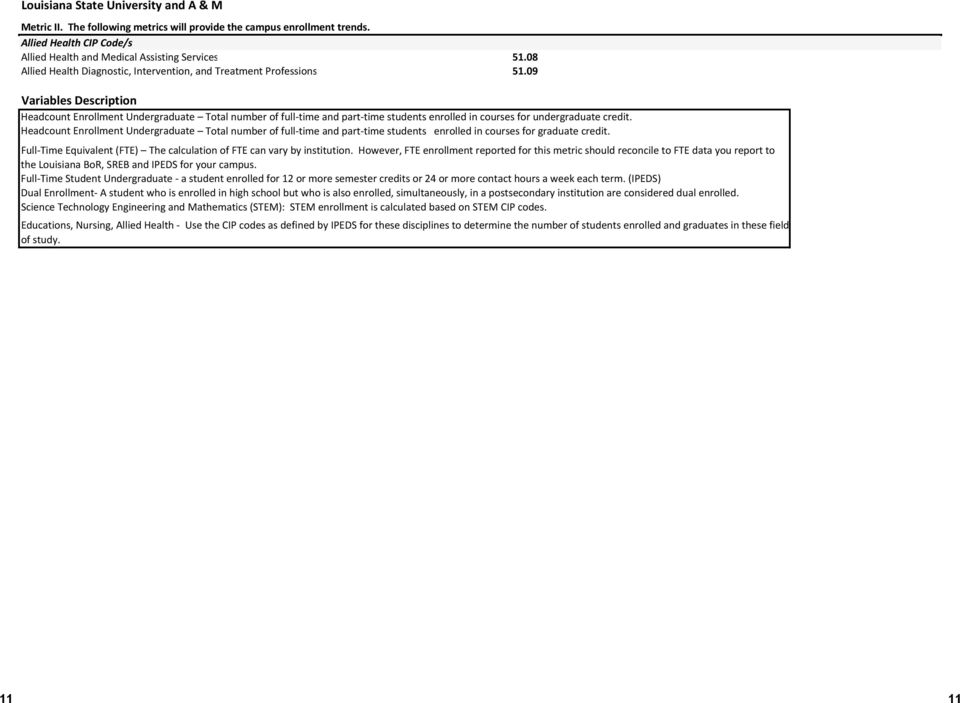
15 Louisiana State University and A & M 4918 Metric II. The following metrics will provide the campus enrollment trends. Allied Health CIP Code/s Allied Health and Medical Assisting Services Allied Health Diagnostic, Intervention, and Treatment Professions Variables Description Headcount Enrollment Undergraduate Total number of full time and part time students enrolled in courses for undergraduate credit. Headcount Enrollment Undergraduate Total number of full time and part time students enrolled in courses for graduate credit. Full Time Equivalent (FTE) The calculation of FTE can vary by institution. However, FTE enrollment reported for this metric should reconcile to FTE data you report to the Louisiana BoR, SREB and IPEDS for your campus. Full Time Student Undergraduate a student enrolled for 12 or more semester credits or 24 or more contact hours a week each term. (IPEDS) Dual Enrollment A student who is enrolled in high school but who is also enrolled, simultaneously, in a postsecondary institution are considered dual enrolled. Science Technology Engineering and Mathematics (STEM): STEM enrollment is calculated based on STEM CIP codes. Educations, Nursing, Allied Health Use the CIP codes as defined by IPEDS for these disciplines to determine the number of students enrolled and graduates in these field of study
16 Louisiana State University and A& M Metric III. The following metric will identify the campus trends for retention, graduation, licensure and pass rate. Analysis of First time, Full time, Baccalaureate Degree seeking Freshmen (fall and prior summer) Cohort Cohort Head Average % continuatio n % continuatio n Cumulative % Graduating Cumulative % Graduating Cumulative % Graduating Cumulative % Graduating Type Year Count ACT to_2nd_yr to_3rd_yr after 4 Yrs after 5 Yrs after 6 Yrs* after 7 Yrs Total , % 72.9% 26.2% 52.3% 58.9% 61.0% Total , % 73.3% 26.0% 52.0% 58.9% 61.1% Total , % 72.0% 26.2% 53.0% 58.7% 60.7% Total , % 72.0% 29.0% 54.0% 59.9% 61.5% Total , % 75.8% 33.9% 59.2% 65.0% Total , % 76.5% 37.9% 62.4% Total , % 74.2% 37.0% Total , % 75.4% Total , % 75.1% Total , % Total , First time, Full time, Degree seeking Louisiana Community College Transfers (fall and prior summer) LACCT % 61.10% 47.9% 54.2% 57.3% 57.3% LACCT % 61.10% 54.0% 61.1% 63.0% 63.5% LACCT % 63.10% 59.0% 65.6% 68.7% 70.3% LACCT % 55.20% 49.3% 57.1% 61.1% 63.1% LACCT % 65.50% 54.0% 61.0% 63.0% LACCT % 56.20% 53.3% 57.6% LACCT % 62.4% 56.6% LACCT % 61.5% LACCT % LACCT * Excludes pre nursing and pre allied health transfer prepatory programs that are included in IPEDS Grad Rate

17 Louisiana State University and A& M Metric III. The following metric will identify the campus trends for retention, graduation, licensure and pass rate Licensure exams data College of Business 1 36% 37% 36% 39% 34% College of Education SEE METRIC I SEE METRIC I SEE METRIC I SEE METRIC I SEE METRIC I SEE METRIC I College of Engineering 2 Biological 50% 88% 68% 61% 78% 44% Chemical 100% 100% 90% 93% 88% 96% Civil 69% 75% 64% 67% 62% 59% Electrical 71% 64% 56% 67% 71% 68% Computer 100% 100% 50% 67% 67% Environmental 100% 50% 60% 75% 69% 67% Industrial 67% 100% 67% 75% 67% 64% Mechanical 89% 100% 80% 80% 93% 93% Petroleum 60% 45% 75% 54% 56% 59% School of Social Work GSW 3 66% 58% 62% 61% 56% 72% LCSW 4 68% 63% 66% 64% 66% 69% School of Veterinary Medicine 5 99% 99% 96% 97% 96% 98% 1 CPA Exam (All Parts) Pass Rates. For & , all parts estimated by using average of individual sections and prior year all parts pass rates. 2 National Council of Examiners for Engineering Survey (NCEES) Fundamentals of Engineering (FEE) Passage Rates, by Major 3 Graduate Social Work (GSW) Exam Passage Rates for All Students (First time and Repeat) 4 Licensed Clinical Social Work Examination for All Students (First time and Repeat) 5 North American Veterinary Licensing Examination (NAVLE) Passage Rates 13 13

18 Louisiana State University and A & M IV. The following metrics will identify the effectiveness of campus research to benefit the state's economic development. Dollars shown in thousands Research Expenditures Field of Science & Engineering Total Federal Total Federal Total Federal Total Federal Total Federal Total Federal a. Engineering (Total) 28,895 4,059 30,874 7,118 31,440 7,010 33,258 6,371 30,438 8,520 30,832 9,284 (1) Aeronautical & astronautical (2) Bioengineering/biomedical engineering (3) Chemical 3,937 1,131 3, ,967 1,253 4,396 1,272 5,923 2,115 5,550 2,463 (4) Civil 9,005 2,059 7,838 1,312 7,988 1,481 8,721 1,405 8,811 1,888 9,919 2,039 (5) Electrical 1, ,298 1,140 1,934 1,080 1, , ,043 1,027 (6) Mechanical 4, ,640 1,757 4,947 1,750 4,987 1,722 4,931 2,220 5,456 2,246 (7) Metallurgical & materials 8, , , , , , (8) Other 1, ,159 1,360 2, , , , b. Physical Sciences (Total) 20,967 10,278 18,474 9,553 16,982 9,165 20,848 9,736 22,324 12,847 22,216 12,412 (1) Astronomy (2) Chemistry 12,865 5,878 10,390 4,710 8,655 4,236 9,099 4,276 10,560 6,165 10,524 6,053 (3) Physics 7,085 4,400 8,003 4,843 7,618 4,929 11,469 5,460 11,730 6,682 11,651 6,359 (4) Other 1, c. Environmental Sciences (Total) 31,695 7,388 30,962 10,795 32,845 11,175 32,068 11,239 31,364 10,442 31,805 9,950 (1) Atmospheric (2) Earth sciences 4, ,682 1,324 4,534 1,089 4, , , (3) Oceanography 19,089 5,882 20,805 8,272 23,166 8,855 22,725 8,773 22,564 7,994 21,825 6,913 (4) Other 7, ,475 1,199 5,145 1,231 5,324 1,558 5,068 1,582 6,087 2,039 d. Mathematical Sciences (Total) 1, ,241 1,356 2,383 1,268 1,893 1,505 1,852 1,526 2,210 1,507 e. Computer Sciences (Total) 2, ,178 1,140 2,464 1,390 3,177 1,664 3,527 1,635 3,265 1,518 f. Life Sciences (Total) 28,135 11,089 31,757 14,358 30,974 14,010 34,269 15,494 33,033 16,496 31,514 15,613 (1) Agricultural (2) Biological 24,384 10,995 27,767 14,310 26,790 13,759 29,084 15,281 28,357 15,776 26,561 15,022 (3) Medical 3, , , , , , (4) Other g. Psychology (Total) , , , h. Social Sciences (Total) 3, , , ,531 1,253 5,139 2,445 5,017 3,207 (1) Economics , ,750 1,348 (2) Political science , (3) Sociology , (4) Other 1, , , , , ,920 1,286 i. Other Sciences, not elsewhere classified (Total) 6, , ,080 1,502 17,444 2,543 17,529 3,124 17,185 3,769 j. Total (sum of a through i) 123,318 34, ,114 46, ,006 46, ,652 50, ,748 57, ,625 58,

19 Louisiana State University and A & M V. The following metrics will provide Technology Transfer data How many Licensing FTEs were employed In your Technology Transfer Office? How many Other FTEs were employed In your Technology Transfer Office? List all Companies who entered Into Licenses or Options, Indicate if Start Up, and identify Other LSU campuses Involved 1 How many Licenses did your Institution execute? How many Options did your Institution execute? How many different Disclosures are Included In the Licenses/Options Executed? How many of these Licenses Executed reported above were Exclusive? How many of these Licenses Executed reported above were Non Exclusive? How many Licenses/Options Executed Included Equity? How many Licenses/Options were Active as of the last day, (cumulative)? How many of the Licenses/Options Executed were Licensed to Start Up Companies? How many of the Licenses/Options Executed were Licensed to Small Companies? How many of the Licenses/Options Executed were Licensed to Large Companies? How much Research FundIng was committed to your Institution (Includes multi year commitments) $30,000 none $39,998 that was related to License or Option Agreements Executed or that was related to License or Option Agreements Executed In a prior year for which the Research FundIng committed was not previously reported, e.g., as a result of a Research agreement renewal? $0 $0.00 How many Material Transfer Agreements (MTAs) did your Office process? How many Research Agreements did your Office process? What is the Total number of Licenses/Options yielding License Income of any sort? How many Licenses/Options yielded RunnIng Royalties? How many Licenses/Options yielded more than $1 million In License Income Received? What was the Total amount of License Income Received at your Institution? $111,359 $123,003 $156,576 $121,511 $447,892 How much of the License Income Received can be attributed to RunnIng Royalties? $70,425 $76,305 $127,217 $107,036 $391,081 How much of the License Income Received can be attributed to Cashed In Equity? $0 $0 $0 $0 $0 How much of the License Income Received can be attributed to License Income of all Other types? $40,934 $28,522 $29,359 $14,475 $56,811 How much of the License Income was Paid to Other Institutions? $0 $0 $0 $0 $0 What was the Total amount spent on external legal fees for Patents and/or copyrights? $381,186 $314,796 $268,066 $297,598 $429,485 What was the Total amount Received In direct reimbursements from Licensees for legal fees? $25,672 $18,177 $24,936 $43,280 $33,642 How many Invention Disclosures were Received? Of the Invention Disclosures reported In 13A, how many were closed during FY2011? Of the Invention Disclosures In 13A, how many were Licensed during FY2011? How many Total U.S. Patent Applications were filed? How many New Patent Applications were filed? Of these, how many were filed as US Provisional Patent Applications? Of these, how many were filed as US Utility Patent Applications? Of these, how many were filed as Non US Patent Applications? How many U.S. Patents were issued? How many PVP certificates were filed? How many PVP certificates were issued?

20 Louisiana State University and A & M V. The following metrics will provide Technology Transfer data How many Start Up Companies formed during FY2011 that were dependent Upon the LicensIng of your Technology for Initiation? How many of these Start Up Companies formed have their primary place of business operating In your home state? How many Start Up Companies that were dependent Upon the LicensIng of your Institution's Technology for Initiation and were reported In the Survey In this year or In earlier fiscal years became Non Operational? How many Start Up Companies that were dependent Upon the LicensIng of your Institution's Technology for Initiation and were reported In the Survey In this year or In earlier fiscal years were Operational as of the last day? Of the Start Up Companies formed, In how many does your Institution hold Equity? Did one or more of your Licensed Technologies become Available for public/commercial use? If YES, how many? no no List of Companies IATRICa (l) start up; IDEXX (l); Esperance (l) with Ag and PBRC FY 2008 Tesa Medical, Inc.(L)(S), New Oil Resources, L.L.C. (O) and (L),(S), Mystic Tackleworks, Inc. (L) FY 2009 Brandon Walsh (license), Mystic Tackleworks, Inc (license) with Ag, Enervana Technologies LLC LREN (start up), Aquaculture System Technologies LLC (LREN) FY 2010 Storyhouse Productions (license); Mystic Tackleworks (novated license); Icon Films( license); Sims Brothers (license), Enervana Technologies (license)(start up) FY 2011 US Synthetic (1), Jobu Outdoors (1), Gedeon Programmes (1), Cayman Chemical (1), Microbial Insights (1) FY

21 Louisiana State University and A&M Metric VI. The following metrics will identify the tuition and fee revenues, and, other revenue resources Annual Gifts (FY includes gifts held at LSU of $17,538,918, LSU Foundation of $34,216,622, TAF of $17,858,891, and Alumni Association of $2,330,347) $43,523,299 $55,454,577 $44,302,581 $41,692,691 $39,580,166 $71,944,778 Total Endowment Value (includes $15,051,270 at Alumni, $297,448,417 at LSU Foundation, $16,057,622 at LSU) $324,827,698 $318,413,050 $264,041,317 $296,663,309 $343,845,949 $328,557,309 Earned Interest on Endowments $12,588,929 $13,670,872 $8,064,669 $10,964,211 $12,698,698 $11,759,696 Dollar amount of the endowment approved each fiscal year and made available for expenditures by the campus $12,711,234 $13,889,456 $8,283,996 $11,279,284 $12,997,149 $11,875,074 Total # of Foundations Foundations total Assets ($ Amount) $529,704,745 $544,075,217 $476,813,820 $508,082,263 $571,566,703 $566,678,502 Click here to go to the Foundations Supplemental Table List your Institution's Foundations Total # of Board of Regents Support Fund Total Value ($ Amount) of BoR Support Fund 1 $159,610,256 $151,438,237 $125,172,316 $139,221,475 $162,020,284 $157,018,445 Click here to go to the BoR Support Funds Supplemental Table List your Institution's BoR Support Funds Total number of affiliated off campus sites (For example, LSU South Campus) Total net revenue generated by affiliated off campus sites $73,528 $82,180 $129,698 $180,812 $185,214 $184,507 Total $ amount contributed back to campus by affiliated off campus sites $73,528 $82,180 $129,698 $180,812 $185,214 $184,507 Click here to go to the Affiliated Supplemental Table List each campus affiliate Total Gross Revenue Generated from tuition and fees Total Gross Revenue From First Time Full Time Freshmen $20,722,394 $22,520,900 $28,225,008 $29,410,882 $39,441,087 $41,268,912 Gross Revenue From First Time Full Time Freshmen (In State Only) $14,156,012 $13,874,641 $15,764,790 $14,880,861 $18,570,251 $21,153,361 Gross Revenue From First Time Full Time Freshmen (Out of State Only) $6,566,382 $8,646,259 $12,460,218 $14,530,021 $20,870,836 $20,115,551 Net Revenue From First Time Full Time Freshmen $15,876,380 $15,595,498 $19,101,816 $18,396,795 $25,103,307 $34,330,076 Net Revenue From First Time Full Time Freshmen (In State Only) $12,045,787 $10,791,681 $12,562,449 $10,882,749 $13,296,098 $17,206,310 Net Revenue From First Time Full Time Freshmen (Out of State Only) $3,830,593 $4,803,817 $6,539,367 $7,514,046 $11,807,209 $17,123,766 Financial Aid Total institutional dollars awarded need based aid for entering freshmen class XXXXXXXX XXXXXXXX XXXXXXXX XXXXXXXXX $2,280,335 $2,531,340 Total institutional dollars awarded non need aid for entering freshmen class XXXXXXXX XXXXXXXX XXXXXXXX XXXXXXXXX $14,782,771 $6,740,939 Total institutional dollars awarded need based aid for entering freshmen class LA residents XXXXXXXX XXXXXXXX XXXXXXXX XXXXXXXXX $2,055,651 $2,288,600 Total institutional dollars awarded non need based aid for entering freshmen class LA residents XXXXXXXX XXXXXXXX XXXXXXXX XXXXXXXXX $4,177,018 $2,480,313 Total institutional dollars awarded need based aid for entering freshmen class nonresidents XXXXXXXX XXXXXXXX XXXXXXXX XXXXXXXXX $224,684 $242,740 Total institutional dollars awarded non need based aid for entering freshmen class nonresidents XXXXXXXX XXXXXXXX XXXXXXXX XXXXXXXXX $10,605,753 $4,260,626 State Appropriation per FTE 2 $6,461 $7,918 $7,746 $6,595 $5,507 $5,340 Net Revenue Generated from auxiliary enterprises (i.e., bookstores, dinning services) $13,146,453 $12,509,351 $14,426,711 $16,519,891 $20,474,503 $20,696,
22 Louisiana State University and A&M Metric VI. The following metrics will identify the tuition and fee revenues, and, other revenue resources. 1 Total assets from LSU Foundation and Alumni Foundation audited consolidated financial statement. The only assets included in these statements that relate to the Tiger Athletic Foundation are the endowed funds the LSU Foundation manages for TAF. TAF's total assets are reported in its own financial statements. LSU Foundation total assets are included on LSU A&M, Law Center, and LSU Agricultural Center Metric reports. 2 Per LSU System: State Appropriation includes the Final Approved Budgeted General Fund, Statutory Dedication, and Federal Stimulus (ARRA) of each year. Student FTE is annual FTE reported to Board of Regents. Excludes the Vet School Definitions: Annual Giving data include all contributions actually received during the institution's fiscal year in the form of cash, securities company products, and other property from alumni, non-alumni individuals, corporations, foundations, religious organizations and other groups. Not included in the totals are public funds, earnings on investments held by the institution, and unfulfilled pledges. Endowment Value equals the market value of the endowment as of June 30 of the reporting year. FTE- Full time equivalent Payout from Endowment equal interest earned on endowment. Gross Revenue Generated from Student Enrollment FTE equals revenue gain from student tuitions and fees. Net Revenue Generated from Student Enrollment FTE equals gross revenue from enrollment headcount minus institutional supported financial aid. Net Revenue from Auxiliary equal gross revenue generated from auxiliary enterprises minus debt services and other financial obligations
23 Louisiana State University A&M 388,288 Metric VII. The following metric will identify teaching and research productivity 747,088 Fall 2006 Fall 2007 Fall 2008 Fall 2009 Fall 2010 Fall 2011 Enrollment in Fall Semester Lecture and Seminar Courses Lower Division Undergraduate Courses Total Enrollment 78,091 73,459 74,634 73,158 75,717 75,650 Number of Sections 1,493 1,462 1,466 1,449 1,428 1,423 Average section size Upper Division Undergraduate Courses Total Enrollment 31,740 31,383 30,818 30,398 30,492 31,150 Number of Sections 971 1,011 1,032 1,012 1,001 1,005 Average section size Graduate/Professional Courses Total Enrollment 8,779 8,889 9,031 9,035 9,606 9,291 Number of Sections Average section size All Lecture and Seminar Courses Total Enrollment 118, , , , , ,091 Number of Sections 2,989 2,989 3,036 2,997 2,998 2,980 Average section size Fall Teaching Activity Tenure/tenure track (T/TT) FTE faculty assigned to classes Non tenure/tenure track FTE faculty assigned to classes FTE graduate assistants assigned to classes Organized class sections including labs, fall only Sections taught by tenure/tenure track faculty 1,601 1,566 1,646 1,672 1,625 1,600 Sections taught by non tenure/tenure track faculty 1,149 1,205 1,142 1,064 1,071 1,086 Sections taught by graduate assistants Average # of class sections taught per FTE T/TT faculty Average # of class sections taught per FTE non T/TT faculty Average # of class sections taught per 0.5 FTE graduate assistants % class sections taught by T/TT faculty 49% 47% 50% 51% 50% 49% % class sections taught by non T/TT faculty 35% 36% 34% 32% 33% 33% % class sections taught by graduate assistants 16% 16% 16% 17% 18% 18% Student Credit Hours (SCH'S), fall only Undergraduate 336, , , , , ,019 Graduate 38,592 39,303 41,358 40,785 43,520 43,334 Total student credit hours 375, , , , , ,353 Undergraduate SCH'S taught by T/TT faculty 149, , , , , ,306 Graduate SCH's taught by T/TT faculty 32,749 34,004 36,141 37,390 38,065 36,421 Total SCH's taught by T/TT faculty 182, , , , , ,727 Total SCH's taught by non T/TT faculty 150, , , , , ,279 Total SCH's taught by graduate assistants 42,572 43,460 50,136 45,686 47,132 47,
24 Louisiana State University A&M 388,288 Metric VII. The following metric will identify teaching and research productivity 747,088 Fall 2006 Fall 2007 Fall 2008 Fall 2009 Fall 2010 Fall 2011 Undergraduate SCH's taught per T/TT FTE faculty Graduate sch's taught per T/TT FTE faculty Total sch's taught per T/TT FTE faculty Total sch's taught per non T/TT FTE faculty Total sch's taught per 0.5 FTE graduate assistants % sch's taught by T/TT faculty % sch's taught by non T/TT faculty % sch's taught by graduate assistants Annual Instruction and Research Ratios Annual student credit hours (sch's), fall & spring Undergraduate 664, , , , , ,900 Graduate 90,578 90,643 94,249 97, , ,509 Total 755, , , , , ,409 Annual FTE students 25,929 24,902 25,088 25,028 25,750 25,885 Direct unrestricted instructional expenditures 152,432, ,134, ,448, ,583, ,975, ,087,820 Direct unrestricted instructional expenditures per SCH Direct unrestricted instructional expenditures per FTE student 5,879 6,591 6,714 6,336 6,329 6,339 Personnel costs as % of direct unrestricted instructional expenditures Total FTE faculty (instruction, research, public service) Total T/TT FTE faculty (instruction, research, public service) Tenure/Tenure Track FTE faculty as % of total FTE faculty 70.5% 70.5% 71.0% 72.6% 72.3% 72.2% Research expenditures $139,773,000 $142,897, ,604, ,188, ,044,000 n/a Research expenditures per T/TT FTE faculty $140,772 $144,006 $152,591 $151,196 $153,255 n/a 20 20
25 Louisiana State University A&M 388,288 Metric VII. The following metric will identify teaching and research productivity 747,088 Fall 2006 Fall 2007 Fall 2008 Fall 2009 Fall 2010 Fall 2011 Definitions: Enrollment in Fall Semester Lecture and Seminar Courses Total enrollment, number of sections offered, and average section size are reported by course level for fall semester lecture and seminar classes. Courses offered through Academic Programs Abroad and Continuing Education are excluded. Source: fall semester 14 th class day course file. Lower Division Undergraduate Courses: Courses typically associated with the first and second years of college study; courses numbered 0001 through Upper Division Undergraduate Courses: Courses typically associated with the third and fourth years of college study; courses numbered 3000 through Graduate/Professional Courses: Courses typically associated with first professional or post-baccalaureate study; courses numbered 5000 through Fall Teaching Activity Full Time Equivalent (FTE) faculty: Faculty appointed at 100% effort are 1 FTE. Faculty appointed at 50% effort are 0.5 FTE. Full Time Equivalent (FTE) graduate assistants: Typical appointment for a graduate assistant is 50% effort or 0.5 FTE. Full Time Equivalent (FTE) faculty assigned to classes include (1) faculty who are tenured or on tenure track appointment, (2) faculty on annual appointment, and (3) graduate assistants. Only classes taught as part of the normal salary (on load) are included. Only unrestricted instruction, research, and public service funds are used in calculation of FTE. Source: fall semester faculty assignment file. Organized class sections: Regularly scheduled classes meeting in classroom or similar facilities at stated times; lecture, laboratory, and seminar instruction; excludes independent study classes. Source: fall semester faculty assignment file. Student credit hour (SCH): Course credit value multiplied by course enrollment. Annual Instruction and Research Ratios Annual student credit hours: Fall and spring student credit hours reported by level of student (undergraduate or graduate). Source: fall and spring 14 th class day course files. Annual full time equivalent (FTE) student is equivalent to the sum of undergraduate fall and spring student credit hours divided by 30 plus the sum of graduate fall and spring student credit hours divided by 24. Direct unrestricted instructional expenditures: Instructional funds expended by academic units (those offering degrees and/or courses.) Source: Analysis of Current Unrestricted Fund Expenditures (C-2A), Supplement to the Financial Report. Personnel costs: Salaries, wages, and related benefits reported on Analysis of Current Unrestricted Fund Expenditures (C-2A), Supplement to the Financial Report. Total FTE faculty: All faculty ranks charged to instruction, research, and public service funds regardless of source. Includes both faculty assigned to classes and those who are not. Source: October 31 census payroll file. Total FTE tenure/tenure track faculty: Faculty described above who are tenured or on tenure track appointments. Research expenditures: Grand total research and development expenditures from both science and engineering (S&E) and non-s&e fields. Source: National Science Foundation (NSF) Survey of Research and Development Expenditures at Universities and Colleges
26 Table I: Affiliated Off Campus Sites LSU System Campus LSU A&M LSU A&M Gross Revenue Generated by Affiliate Campus Net Revenue Generated by Affiliated Campus $ Amount Contributed Back to Campus by Affiliated Off Site Campus Name of Affiliated Off Campus Site EA Sports South Campus* $0 $0 $ $0 $0 $ $57,690 $57,690 $57, $113,000 $113,000 $113, $114,000 $114,000 $114, $114,000 $114,000 $114,000 Tsunami Sushi Shaw Center $81,697 $73,528 $73, $91,311 $82,180 $82, $80,009 $72,008 $72, $75,347 $67,812 $67, $79,127 $71,214 $71, $78,341 $70,507 $70,507 *Rental income per contract with Department of Economic Development. Table II: Board of Regent Support Funds LSU System Campus Name of Support Fund Year Market Value ($ Amount) LSU A&M Endowed Chairs/Professorship Programs* $159,610, $151,438, $125,172, $139,221, $162,020, $157,018,445 *Market value of combined private and state program assets managed by LSU Foundation for Endowed Chairs/Professorship Programs. Table III: Summary of Campus Foundations LSU System Campus Foundation Year Total Assets ($ Amount) LSU A&M Alumni Association $29,800, $32,700, $30,700, $32,900, $33,513, $33,694,184 LSU Foundation, including Tiger Athletic Found* $499,904, $511,375, $446,113, $475,181, $538,053, $532,984,318 *Total assets from LSU Foundation's audited consolidated financial statement. The only assets included in these statements that relate to the Tiger Athletic Foundation are the endowed funds the LSU Foundation manages for TAF. TAF's total assets are reported in its own financial statements. Total assets reported for LSU A&M are reported as well in Law Center and LSU Agricultural Center Metric V
27 LOUISIANA STATE UNIVERSITY NATIONAL BENCHMARK REPORT Graduation Rate Percent Graduate Cohort As a % of New Total Six Year Total Research Total Student Headcount Degree Seeking Graduation Rate Expenditures Degrees Awarded of Total Headcount Undergraduates Institution Name 2005 Cohort Fall 2011 Fall 2011 Louisiana State University 62% $262,677,656 6, % 80.3% Colorado State University Fort Collins 64% $211,681,349 6, % 68.5% Iowa State University 68% $201,189,489 6, % 70.0% Mississippi State University 60% $173,509,811 3, % 62.1% North Carolina State University at Raleigh 72% $253,620,692 7, % 69.1% Purdue University Main Campus 68% $265,554,644 10, % 80.9% Texas A & M University College Station 81% $502,438,272 11, % 75.2% The University of Tennessee 63% $280,311,733 7, % 75.0% University of Arkansas 59% $124,556,347 4, % 72.5% University of Georgia 84% $337,789,631 9, % 78.4% University of Illinois at Urbana Champaign 82% $464,938,269 11, % 81.5% University of Maryland College Park 82% $416,683,464 10, % 64.0% University of Nebraska Lincoln 67% $195,631,017 4, % 79.1% Virginia Polytechnic Institute and State University 82% $312,655,623 7, % 83.4% Average Excluding LSU 72% $287,735,411 7, % 73.8% Source: IPEDS Data Center Note: LSU values include LSU Ag. Center, Hebert Law Center, and Pennington Biomedical Research Center as published by IPEDS. Percent Graduate Enrolled Includes First Professional Degrees Awarded Include Certificates 23 23
28 LSU Paul M. Hebert Law Center Executive Summary Performance Metric (Metric VII) Metric VII sets forth the performance of the Law Center with respect to several measures of law school performance that are widely accepted in the American legal academy. Law schools generally track the academic qualifications of an entering class as compared with the 200 ABA approved law schools in the United States by measuring the 25 th percentile, median, and 75 th percentile of LSAT scores of the entering class. Like most law schools nationally, the law center admitted fewer students in due to a national decrease in student demand. However, although the Law Center enrolled a smaller class of 200 in , compared to the 238 entering class of , the Law Center managed to admit a class that was largely comparable to that of In the 25 th percentile of LSAT scores of students that enrolled in the Law Center for the academic year was 153 (the 56 th percentile of all LSAT test takers), a decrease from 155 for The median LSAT test score also decreased to a 157 (the 70 th percentile of all LSAT test takers) from a 158. The 75 th percentile scores remained at 160 (the 80 th percentile of all LSAT test takers). Also in response to diminished student demand, the diversity of the entering class decreased to 22% from 26% the previous year, a 4% decrease from the entering class of (Metric II). The Louisiana Bar instituted the new version of the Louisiana Bar for the July 2012 administration. Overall, bar passage rates for the state decreased under the new test format. However, the bar passage rate for the LSU Law Center compares favorably to the overall bar passage rate for all first time bar test takers (116%). For the July administration of the Louisiana Bar Exam, 78.2% of LSU Law first time test takers passed the bar examination, compared to an overall first time State bar passage rate of 69%. On the same test administration, 75% of all LSU Law test takers (first time and repeat) passed the exam. Despite the changes to the bar exam, and the resulting decrease in state wide passage rate, the bar passage rate for the LSU Law Center remains significantly higher than the overall state bar passage rate among all takers of 64%. The Law Center s employment rate for the graduating class of 2011 remained at the high level of 93% 1 (measured at the generally accepted date of 9 months following graduation). Despite the economic decline that began in the summer and fall of 2008, the employment rate remains high and increased from 89% for the graduating class of (Because of the nine month benchmark, the data for the graduating class of 2012 will not be available until late February of 2013.) The Law Center remains cautious about the legal employment market in light of the national economic conditions and remains concerned that legal employers, both in Louisiana and nationwide, are considering further reductions in summer clerkship positions as well as a reduction in the hiring of recent graduates. 1 This figure represents employment data for only those students for whom the Law Center has data. There were 176 JD graduates for the class. The placement rate includes only the responses for the 168 graduates that responded to the survey. We have no data on 8 graduates
29 LSU Paul M. Hebert Law Center Executive Summary Other Metrics (Metrics I, II, III, V, VI (Metric IV does not apply to the Law Center) The Law Center provides data responsive to these metrics for information purposes only. The LSU Law Center enrollment for the academic year is 200 first year law students, a decrease of 38 students from its entering class (Metric II). 2 As noted above, it is significant that the Law Center was able to maintain its national profile by sustaining its objective LSAT measurements; although, class size decreased and the number of law schools competing for students continued to increase. Because of the reductions in State appropriations (not including fees), the Law Center increased tuition for resident students from $15,822 to $18,617, an increase of $2,795, while non resident tuition (not including fees) increased from $32,148 to $36,006, an increase of $3,858. While the Law Center urges a performance based funding formula for law schools, the current, non performance based funding formula imposes a headcount cap of 600 FTE students imposed on LSU Law Center. Of the state law schools in Louisiana, this cap only applies to the LSU Law Center while our sister State law school receives funding per FTE based on its actual student headcount. Under this cap, the Law Center is unable to participate in state funding that could amount to approximately $700,000 per year. Additionally, the existing formula applied to the Law Center is based upon an outdated SREB target of $20,000 per student that was established in and that since has been reduced to $14,000 per student. The use of the change (reduction) in SREB 4 Year 1 average state funding per FTE has proven to be detrimental and does not recognize the realistic, differential program costs associated with institutions in an appropriately defined peer group. The financial crisis of had an effect on all law schools and their annual giving programs. Restricted giving decreased from $1,392,557 to $1,334,730, a of 4.2% decrease from However, total gifts increased from $1,803,006 to $1,857,193, an increase of $54,187 or an increase of 3% (Metric V). The value of our endowment, which is managed by the LSU Foundation, declined substantially in the economic downturn but recovered in and , from $14,200,223 in to $19,895,367 for As of the fall of the academic year, the endowment decreased from $19,895,367 to $19,011,824 a decrease of $883,543 or 4.4%. 2 Enrollment figures are as of the 14 th class day
30 PAUL M. HEBERT LAW CENTER MISSION: The mission of the Louisiana State University Paul M. Hebert Law Center is to prepare, through a demanding and comprehensive program of legal education, a well qualified and diverse group of men and women to be highly competent and ethical lawyers; to be leaders in private practice, public service, and commerce; and to be capable of serving the cause of justice and advancing the common good, consistent with the rule of law. As a law school that strives to embody excellence in legal education, the Law Center seeks to create a vibrant, stimulating, diverse, and challenging educational environment through the admission of an exceptionally well qualified and broadly diverse student body drawn from a rich cross section of backgrounds, talents, experiences, and perspectives from the State, the nation, and other jurisdictions, including those that share our Civilian heritage. The quality of the intellectual community and the experiences of the student body are enriched by the commitment of the Law Center to support and assist in the continuing professional endeavors of our alumni; to serve members of the legal profession of the State, the nation, and the global community; to provide scholarly support for the continued improvement of the law; to promote the use of Louisiana s legal contributions as reasoned models for consideration by other jurisdictions; to develop the Law Center as a bridge between the civil law and the common law; to facilitate the exchange of ideas among legal scholars; and to embrace the responsibilities of a public law school to the varied segments and regions of the State. The LSU Law Center is accredited by the American Bar Association and the Southeastern Association of Colleges and Schools and is classified as a SREB Specialized institution. Because of the civilian heritage of the State of Louisiana, graduates of the Law Center receive both the Juris Doctor degree and a Diploma in Comparative Law, recognizing the unique training of its student body in both the American common law and the civil law that governs the majority of jurisdictions in the global community
31 Legend: Paul M. Hebert Law Center Metrics at a Glance Increase from Previous Year Statistic High X Y Most Recent Available No change Low Z % % Change from Previous Year Decrease from Previous Year Metric I Metric II Metric III Metric V Metric VI Degrees Awarded Enrollment Student Success Revenues Faculty Productivity Metric VII Campus Specific Metric Masters (LL.M.) Total number of 1st year Law Students Total Number of Students Taking the Louisiana Bar Exam Total Gifts Total FTE T/TT Faculty % of students that enroll at Center that graduate from Center ,857,193 1,857, % 88.0% % % % 912, % % 81.0% 8.6% Professional (JD/DCL) Total number of 2L and 3L Law Students Number of Students Passing Licensure Exam (Louisiana) Total Gross Revenue (Tuition and Fees) from 1st Year Law students Total FTE Faculty (including part time) Law Center's Bar passage rate relative to LA passage rate ,160,054 5,160, % 116.0% % % % 2,552, % % 111.0% 1.7% Total degrees awarded Total Law School enrollment % Students passing Licensure Exam Total Net Revenue from 1st Year Law students T/TT as a Percent of Total FTE Faculty (including part time) % of students employed nine months after graduation % 80.2% 3,650,135 3,650, % 64.7% 98.0% 98.0% % % 72.0% 11.5% 1,937, % 61.8% 4.7% 89.0% 5.4% State Appropriation per FTE Personnel Cost as a percent of Direct Instructional Expense % of students retained from the first to second year 12,963 7, % 78.9% 97.0% 92.0% 7, % 78.9% 7.9% 87.0% 3.2% 27 27
32 Paul M. Hebert Law Center Metric I. The following metrics will identify the number of degrees conferred by level and professions most important to Louisiana Total number of degrees awarded/conferred (JD/DCL/LLM) Masters (LL.M.) Professional (JD/DCL) Total degrees awarded Total number of degrees awarded by race/ethnicity Hispanic American Indian or Alaska Native Asian Black or African American Native Hawaiian or Other Pacific Islander White Two or More Races Nonresident Alien Race/Ethnicity Unknown Total degrees awarded Source: Law School Degree Candidates File (LWS1006) 28 28
33 Paul M. Hebert Law Center Metric II. The following metrics will provide the campus enrollment trends. Law School Enrollment as of 14th day enrollment Total number of 1st year Law Students Total number of 2L and 3L Law Students Total Law School enrollment Enrollment by Race and Ethnicity as 14th Class Day (1st Year Law) Hispanic American Indian or Alaska Native Asian Black or African American Native Hawaiian or Other Pacific Islander White Two or More Races Nonresident Alien Race/Ethnicity Unknown Total number of 1st year Law Students Source: Fall 14th Class Day Enrollment figures above include JD enrollment only 29 29
34 Paul M. Hebert Law Metric III. The following metric will identify the campus trends for retention, graduation, licensure and pass rate * Total Number of Students Taking the Louisiana Bar Exam Number of Students Passing Licensure Exam (Louisiana) % Students passing Licensure Exam 88.3% 75.4% 79.0% 86.1% 72.0% 80.2% 75.4% * Each year includes the July exam and February exam for all test takers. For example, column contains all students who took the July 2006 bar exam and the February 2007 bar exam. Column has been updated to reflect the July 2011 and February 2012 bars exam. The reflects only the July 2012 bar results, since the February 2013 bar exam has not yet been administered
35 Paul M Hebert Law Center V. The following metrics will identify the tuition and fee revenues, and, other revenue resources Annual Gifts Gifts per Annun (Unrestricted) $313,287 $391,253 $410,240 $469,135 $410,449 $522,464 Gifts per Annun (Restricted) $1,197,021 $815,495 $502,143 $1,160,591 $1,392,557 $1,334,730 Ratio of Alumni Giving to Total Annual Giving % 38.2% 55.8% 29.5% 29.5% Total Gifts $1,510,308 $1,206,748 $912,383 $1,629,726 $1,803,006 $1,857,193 Total Endowment Value (includes $19,589,683 at LSU Foundation) $18,066,040 $17,421,058 $14,200,223 $16,274,071 $19,895,367 $19,011,824 Interest Earned on Endowments $690,446 $712,568 $406,343 $570,589 $695,253 $645,342 Dollar amount of the endowment approved each fiscal year and made available for expenditures by the campus $690,446 $712,568 $406,343 $570,589 $695,253 $345,342 Total Number of Foundations Foundation Total Assets ($ Amount) 2 $499,904,745 $511,375,217 $446,113,820 $475,181,704 $538,053,386 $532,984,318 Revenue Total Gross Revenue Generated from Tuition and Fees (Excluding CLE) $7,995,975 $8,076,669 $8,360,860 $9,567,492 $11,636,983 $15,135,954 Total Gross Revenue (Tuition and Fees) from 1st Year Law students $2,552,938 $2,635,562 $2,990,658 $3,783,722 $4,351,628 $5,160,054 Gross Revenue (Tuition and Fees) From 1st Year Law Students (In-State Only) $1,883,830 $1,682,590 $1,921,400 $2,318,310 $2,317,085 $2,630,815 Gross Revenue From 1st Year Law Students (Out-of-State Only) $669,108 $952,972 $1,069,258 $1,465,412 $2,034,543 $2,529,594 Total Net Revenue from 1st Year Law students $2,198,698 $1,937,235 $2,035,110 $2,781,654 $2,932,109 $3,650,135 Net Revenue From 1st Year Law Students (In-State Only) $1,629,408 $1,251,637 $1,411,739 $1,788,612 $1,809,114 $2,001,542 Net Revenue From 1st Year Law Students (Out-of-State Only) $569,290 $685,598 $623,371 $993,042 $1,122,995 $1,648,594 Financial Aid Total institutional dollars awarded need based aid for 1st year students XXXXXXX XXXXXXX XXXXXXX XXXXXXX $375 $0 Total institutional dollars awarded non-need based aid for 1st year students XXXXXXX XXXXXXX XXXXXXX XXXXXXX $1,470,942 $1,471,078 Total institutional dollars awarded need based aid for 1st year LA resident students XXXXXXX XXXXXXX XXXXXXX XXXXXXX $375 $0 Total institutional dollars awarded non-need based aid for 1st year LA resident students XXXXXXX XXXXXXX XXXXXXX XXXXXXX $559,394 $679,261 Total institutional dollars awarded need based aid for 1st year non-resident students XXXXXXX XXXXXXX XXXXXXX XXXXXXX $0 $0 Total institutional dollars awarded non-need based aid for 1st year non-resident students XXXXXXX XXXXXXX XXXXXXX XXXXXXX $911,548 $887,236 State Appropriation per FTE Student 3 $11,167 $12,759 $12,963 $10,750 $10,434 $7,145 1 This ratio reflects direct alumni giving only and does not include donations which have been indirectly identified with LSU Law School alumni such as gifts directed by alumni within law firms 2 Total assets from LSU Foundation's audited consolidated financial statement. The only assets included in these statements that relate to the Tiger Athletic Foundation are the endowed funds the LSU Foundation manages for TAF. TAF's total assets are reported in its own financial statements. LSU Foundation total assets are included on LSU A&M, Law Center, and LSU Agricultural Center Metric reports. 3 Based on annual FTE count as reported to the Board of Regents. Includes ARRA stimulus funds of $1,696,281 for FY10 and $2,455,272 for FY
36 Paul M Hebert Law Center V. The following metrics will identify the tuition and fee revenues, and, other revenue resources. Annual Giving data include all contributions actually received during the institution's fiscal year in the form of cash, securities company products, and other property from alumni, non-alumni individuals, corporations, foundations, religious organizations and other groups. Not included in the totals are public funds, earnings on investments held by the institution, and unfulfilled pledges. Endowment Value equals the market value of of the endowment as of June 30 of the reporting year. FTE - Full time equivalent Payout from Endowment equal interest earned on endowment. Gross Revenue Generated from Student Enrollment FTE equals revenue gain from student tuitions and fees. Net Revenue Generated from Student Enrollment FTE equals gross revenue from enrollment headcount minus institutional supported financial aid. Net Revenue from Auxiliary equal gross revenue generated from auxiliary enterprises minus debt services and other financial obligations
37 Paul M Hebert Law Center V. The following metrics will identify the tuition and fee revenues, and, other revenue resources. Annual Giving data include all contributions actually received during the institution's fiscal year in the form of cash, securities company products, and other property from alumni, non-alumni individuals, corporations, foundations, religious organizations and other groups. Not included in the totals are public funds, earnings on investments held by the institution, and unfulfilled pledges. Endowment Value equals the market value of of the endowment as of June 30 of the reporting year. FTE - Full time equivalent Payout from Endowment equal interest earned on endowment. Gross Revenue Generated from Student Enrollment FTE equals revenue gain from student tuitions and fees. Net Revenue Generated from Student Enrollment FTE equals gross revenue from enrollment headcount minus institutional supported financial aid. Net Revenue from Auxiliary equal gross revenue generated from auxiliary enterprises minus debt services and other financial obligations
38 Paul M. Hebert Law Center Metric VI. The following metrics will identify teaching and research productivity per FTE faculty Instructional Total FTE Tenured Faculty Total FTE Tenure Track Faculty Total FTE T/TT Faculty Total Non-Tenure/Tenure Track FTE Faculty Total Part Time FTE Total FTE Faculty (excluding part-time) Total FTE Faculty (including part-time) T/TT as a Percent of Total FTE Faculty (including parttime) 65.63% 68.75% 71.43% 68.33% 63.16% 61.82% 64.71% Cost Data: Direct Expenditures for Instruction (As defined by the Delaware Study) Salaries 5,920,438 6,541,252 6,429,441 6,482,854 6,848,028 6,510,714 5,790,486 Benefits 1,395,669 1,569,592 1,507,028 1,545,772 1,888,381 2,096,083 1,852,659 Expenditures other than personnel related to Instruction 1,231,381 1,221,630 1,456,577 1,100,410 1,433,247 1,435,009 2,041,422 Total Direct Instructional Expense 8,547,488 9,332,474 9,393,046 9,129,036 10,169,656 10,041,806 9,684,567 Personnel Cost as a percent of Direct Instructional Expense 85.6% 86.9% 84.5% 87.9% 85.9% 85.7% 78.9% Notes: Salary & benefit data was obtained from the budgeted expenditures for instructional salaries
39 Paul M. Hebert Law Center Metric VI. The following metrics will identify teaching and research productivity per FTE faculty. Definitions: Direct Expenditures for Instructions: Total Direct Instructional Expenditures include data in certain functional areas - instruction, research, and public service. Direct expenditure data reflect costs incurred for personnel compensation, supplies, and services used in the conduct of each of these functional areas. They include acquisition costs of capital assets such as equipment and library books to the extent that funds are budgeted for the use of departments for instruction, research, and public service. Similar to the Delaware Study, exclude centrally allocated computing costs and centrally supported computer labs, and graduate student tuition remission and fee waivers. Instruction: Instruction includes general academic instruction, occupational and vocational instruction, community education, preparatory and adult basic education, and remedial and tutorial instruction conducted by the teaching faculty for the institution's students. Departmental research and service which are not separately budgeted should be included under instruction. In other words, department research which is externally funded should be excluded from instructional expenditures, as should any departmental funds which were expended for the purpose of matching external research funds as part of a contractual or grant obligation. EXCLUDE expenditures for academic administration where the primary function is administration. For example, exclude deans, but include department chairs.) Disaggregate total direct instructional expenditures for the institution into the following categories: Salaries: Report all wages paid to support the instructional function in a given department or program during the fiscal year. While these will largely be faculty salaries, be sure to include clerical (e.g., department secretary), professionals (e.g., lab technicians), Graduate student stipends (but not tuition waivers), and any other personnel who support the teaching function and whose salaries and wages are paid from the institution's instructional budget. Benefits: Report expenditures for benefits associated with the personnel for whom salaries and wages were reported on the previous entry. If you cannot separate benefits from salaries, but benefits are included lddin the salary figure you have entered, didi indicate "Included lddin Salaries" Sl "in the data field. fild Some institutions i i book kbenefits centrally and do not disaggregate to the department level. If you can compute the appropriate benefit amount for the department/program, please do so and enter the data. If you cannot do so, leave the benefit amount as zero and we will impute a cost factor based upon the current benefit rate for your institution, as published in Academe. If no rate is available, we will use a default value of 28%. Other Than Personnel Costs: This category includes non-personnel items such as travel, supplies and expense, non-capital equipment purchases, etc., that are typically part of an instructional department or program's cost of doing business. Excluded from this category are items such as central computing costs, centrally allocated computing labs, graduate student tuition remission and fee waivers, etc
40 Paul M. Law Hebert Center Metric VII. Campus specific metrics Percentage of students that enroll in the Law Center that graduate from the Law Center* 81% 85% 85% 88% 81% 88% Bar passage rate of first time LSU Law Louisiana bar test takers relative to (divided by) the overall bar passage rate in Louisiana among first time test takers for the year (July exam) 114% 122% 114% 123% 111% 118% 116% Percentage of students employed nine months after graduation 95% 94% 92% 89% 92% 93% 98% Percentage of students retained from the first year of law school to the second year of law school** 88% 93% 90% 87% 97% 95% 92% 25th percentile of LSAT scores of students that enroll in the Law Center Median LSAT score of students that enroll in the Law Center th percentile scores of students that enroll in the Law Center * Each column is thus treated as a "cohort" group. For example, the percentage reported in column represents the percentage of those students who began law school in the fall 2004 semester and subsequently graduated within the prescribed 7 semesters (by May 2007). Source: 14th class day report and Law School Candidate file ** Each column is thus treated as a "cohort" group. For example, the percent reported in column represents the percentage of those students who began law school in the fall 2005 semester and were retained to the second year (fall 2006). Source: 14th class day report 36 36
41 Paul M. Hebert Law Center National Benchmark Bar passage rate of first time bar test takers relative to (divided by) the overall bar passage rate in jurisdiction among first time test takers for the year *# Percentage of students employed nine months after graduation** Arkansas, Fayetteville 102% 83.9% Cincinnati, University Of 116% 86.8% Connecticut, University Of 89% 81.1% Florida State University 111% 91.4% Georgia State University 120% 88.4% Hawaii, University Of 120% 80.5% Houston, University Of 116% 91.9% Indiana University Indianapolis 113% 91.4% Kansas, University Of 84% 78.0% Kentucky, University of 94% 94.2% Louisville, University Of 103% 91.8% LSU Paul M. Hebert Law Center 127% 90.4% Michigan State University 83% 87.6% Nebraska, University Of 89% 81.1% Nevada, University Of 123% 93.2% New Mexico, University Of 99% 91.3% Oklahoma, University Of 87% 83.6% Oregon, University Of 130% 78.0% Pennsylvania State University 120% 74.3% Pittsburgh, University Of 99% 84.1% Rutgers, the State U. of New Jersey Camden 108% 80.9% Rutgers, the State U. of New Jersey Newark 103% 85.3% State University of New York Buffalo 113% 86.8% Temple University 93% 92.2% Tennessee, University Of 95% 80.8% West Virginia University 104% 92.1% * Source: ABA 2011 Annual Report; 2010 Bar Administration (July & February Administration of Bar Exam # As part of the GRAD Act, the Law Center updated its peer institution comparison to a broader peer group that takes into account a variety of factors to provide a more accurate measurement baseline. This broader market compares public law schools ranked 50 to 100 by the annual U.S. News rankings and, includes, but is not limited to, SREB law schools. **Source: U.S. News and World Reports Annual Rankings, 2012 Edition, nine month graduation rates are for graduating class of 2010 *** LSU Law Center's nine month placements rate as reported in U.S. News and World Reports, 2011 edition (for graduating class of 2010 **** Data for individual schools not available. For all ABA approved law schools, first year attrition is 9% (91% retention). For all public ABA approved law schools, first year attrition is 6% (94% retention). Source: 2010 ABA Annual Report 37 37
42 Metric IV Research Expenditures Pennington Biomedical Research Center Executive Summary Researchers at the Pennington Biomedical Research Center continued in 2012 to perform well in recieving grants and contracts with a 7% increase in total gift, grant, and contract funding. Fewer proposals were submitted in 2012, but with a greater success rate in terms of the number of proposals funded (up 21.8%). As a result the total amount of faculty research was up by 3.8 % in Pennington's business model requires a stable base level of support to return grants and contracts on an order of 1:3. It will become increasingly difficult to sustain our excellent levels of grant and contract funding with an ever decreasing base funding. We are pleased with the 2012 success in funded proposals, but are uncertain how long this can be sustained with a continued decline in the base of state funding. Metric V Technology Transfer Licensing and Licensing Income, though relatively small, increased in Pennington has begun a re organization of our Technology Transfer Office. We beleive the prospects for technology transfer and income to be very positive for the long term future. Legal fees for technology transfer increased substantially, and as a result Pennington has begun a process of evaluating potential return on patents and licenses to curtail legal expenditures on technology that shows little promise for future return. We hope to create greater efficiency and prospect for success in the licenses executed and pattents applied for in future. Metric VI Revenues Due to a relatively flat return for the year on investments, and payout from Endowed Funds resulted in a net decrease in endowment value for the FY Low returns also contributed to the reduction in Total Foundation Assets after expenditures. State Appropriations per FTE decreased, a result of the the decrease in state appropriations, which have been in constant decline since FY Our Auxiliary enterprise (PBRC Stores) is designed to break even in order to cover the costs of the operation and gi ve our researchers best possible prices on research supplies and equipment. It has achieved this goal for every year in the reporting period. The unusually large percentage increase in revenue is the result of going from near to $0 profit to a small profit of $8,641 for
43 MISSION: Our mission is to discover the triggers of chronic diseases through innovative research that improves human health across the lifespan---helping people to live Well Beyond the Expected
44 Legend: Pennington Biomedical Research Center Metrics at a Glance Increase from Previous Year Statistic High X Y Most Recent Available No change Low Z % % Change from Previous Period Decrease from Previous Year Metric IV Metric V Research Expenditures Technology Transfer Revenues Total Amount of Faculty Research (in thousands) Number of Licensing FTEs employed Total Annual Giving (includes Foundation Gifts ) 43,477 45, ,670,866 2,680,576 38, % 1 0.0% 2,680, % Research dollars per FTE for T/TT (in thousands) Number of Material Transfer Agreements (MTAs) Total Endowment Value 1,327 1, ,661,339 16,161,886 1, % % 12,912, % Total number of Licenses/Options yielding Percent of T/TT faculty holding grants license income of any sort Total payout from endowment 91.0% 83.0% , , % 2.5% % 354, % Total number of clinical trials or proposal funded Total License Income Received Foundations total Assets ($ Amount) ,662 25, ,031,845 93,288, % 8, % 93,288, % Total gifts, grants and contract funding (for research only) Total $ Spent on Legal Fees for Patents and/or Copyrights State Appropriation per FTE employee 35,573 35, , ,767 34,608 28,680 32, % 40, % 28, % Number of Total Gifts, Grant, and Contract Proposals submitted to potential Net Revenue Generated from auxiliary sponsors. Total U.S Patent Applications Filed enterprises ,073 8, % 19% % 13, % 40 40
45 Pennington Biomedical Research Center IV. The following metrics will identify the effectiveness of campus research and technology transfer to benefit the state's economic development. Dollars shown in thousands FY 2006 FY 2007 FY 2008 FY 2009 FY 2010 FY 2011 Field of Science & Engineering Total Federal Total Federal Total Federal Total Federal Total Federal Total Federal a. Engineering (Total) (1) Aeronautical & astronautical (2) Bioengineering/biomedical engineering (3) Chemical (4) Civil (5) Electrical (6) Mechanical (7) Metallurgical & materials (8) Other b. Physical Sciences (Total) (1) Astronomy (2) Chemistry (3) Physics (4) Other c. Environmental Sciences (Total) (1) Atmospheric (2) Earth sciences (3) Oceanography (4) Other d. Mathematical Sciences (Total) e. Computer Sciences (Total) f. Life Sciences (Total) 38,398 21,725 38,192 21,663 40,512 20,503 42,369 23,510 43,477 24,463 45,134 24,279 (1) Agricultural (2) Biological 38,398 21,725 38,192 21,663 40,512 20,503 42,369 23,510 43,477 24,463 45,134 24,279 (3) Medical (4) Other g. Psychology (Total) h. Social Sciences (Total) (1) Economics (2) Political science (3) Sociology (4) Other i. Other Sciences, not elsewhere classified (Total) j. Total (sum of a through i) 38,398 21,725 38,192 21,663 40,512 20,503 42,369 23,510 43,477 24,463 45,134 24,279 Dollars shown in thousands 41 41
46 Pennington Biomedical Research Center IV. The following metrics will identify the effectiveness of campus research and technology transfer to benefit the state's economic development. Dollars shown in thousands Faculty Research: Total Amount of Faculty Research 38,192 40,512 42,369 43,477 45,134 Total number of T/TT faculty holding grants Percent of T/TT faculty holding grants 91% 91% 86% 81% 83% Research dollars per FTE for T/TT 1,317 1,266 1,324 1,242 1,327 Licenses/Patents: Number of inventions disclosures received Total license income Total number of new patents filed Total number of new licenses/options executed Total number of start up companies Total number of licenses generating revenue Legal Fees Expended Reimburse Pecent increase in nonstate funds (for research only) -2.40% 0.10% 1.15% 4.76% -2.70% 7.00% Total number of clinical trials or proposal funded Total gifts, grants and contract funding (for research only) 32,124 32,234 32,606 34,168 33,245 35,573 Number of Total Gifts, Grant, and Contract Proposals submitted to potential sponsors
47 Pennington Biomedical Research Center V. The following metrics will provide Technology Transfer data How many Licensing FTEs were employed In your Technology Transfer Office? How many Other FTEs were employed In your Technology Transfer Office? List all Companies who entered Into Licenses or Options, Indicate if Start-Up, and identify Other LSU campuses Involved 1 How many Licenses did your Institution execute? How many Options did your Institution execute? How many different Disclosures are Included In the Licenses/Options Executed? How many of these Licenses Executed reported above were Exclusive? How many of these Licenses Executed reported above were Non-Exclusive? How many Licenses/Options Executed Included Equity? How many Licenses/Options were Active as of the last day, (cumulative)? How many of the Licenses/Options Executed were Licensed to Start-Up Companies? How many of the Licenses/Options Executed were Licensed to Small Companies? How many of the Licenses/Options Executed were Licensed to Large Companies? How much Research Funding was committed to your Institution (Includes multi-year commitments) 0 0 $104,348 $ 2,930,964 that was related to License or Option Agreements Executed or that was 0 related to License or Option Agreements Executed In a prior year for which the Research FundIng committed 234,000 was not previously reported, e.g., as a result of a Research agreement renewal? 0 How many Material Transfer Agreements (MTAs) did your Office process? How many Research Agreements did your Office process? What is the Total number of Licenses/Options yielding License Income of any sort? How many Licenses/Options yielded RunnIng Royalties? How many Licenses/Options yielded more than $1 million In License Income Received? What was the Total amount of License Income Received at your Institution? $8,170 $24,737 $46,662 $12,169 $25,618 How much of the License Income Received can be attributed to RunnIng Royalties? $0 $0 $0 $0 $0 How much of the License Income Received can be attributed to Cashed-In Equity? $0 $0 $0 $0 $0 How much of the License Income Received can be attributed to License Income of all Other types? $8,170 $24,737 $46,662 $12,169 $25,618 How much of the License Income was Paid to Other Institutions? $0 $0 $2,233 $0 $0 What was the Total amount spent on external legal fees for Patents and/or copyrights? $44,759 $41,550 $60,392 $40,789 $113,767 What was the Total amount Received In direct reimbursements from Licensees for legal fees $0 $15,000 $37,507 $10,000 $14,918 How many Invention Disclosures were Received? Of the Invention Disclosures reported In 13A, how many were closed during FY2011? Of the Invention Disclosures In 13A, how many were Licensed during FY2011?
48 Pennington Biomedical Research Center V. The following metrics will provide Technology Transfer data How many Total U.S. Patent Applications were filed? How many New Patent Applications were filed? Of these, how many were filed as US Provisional Patent Applications? Of these, how many were filed as US Utility Patent Applications? Of these, how many were filed as Non-US Patent Applications? How many U.S. Patents were issued? How many PVP certificates were filed? How many PVP certificates were issued? How many Start-Up Companies formed during FY2012that were dependent Upon the LicensIng of your Technology for Initiation? How many of these Start-Up Companies formed have their primary place of business operating In your home state? N/A How many Start-Up Companies that were dependent Upon the LicensIng of your Institution's Technology for Initiation and were 0 0 reported In the Survey In this year or In earlier fiscal years became Non-Operational? How many Start-Up Companies that were dependent Upon the LicensIng of your Institution's Technology for Initiation and were reported In the Survey In this year or In earlier fiscal years were Operational as of the last day? 2 (BodyEvol & Esper) 6 Of the Start-Up Companies formed, In how many does your Institution hold Equity? n/a Did one or more of your Licensed Technologies become Available for public/commercial use? If YES, how many no 0 No no No 1 List of Companies FY 2008 Orexigen 2 & Kaiser Fdtn 1(non ex behavioral tools), Esperance (Ag, A&M) FY 2009 Body Evolution (start up) option Laurentian University non exclusive license Wayne State University non exclusive license Whitelands College Roehampton University non exclusive license UniversitAatsklinikum Ruhr Uni Bochum non exclusive license NIDDK NIH non exclusive license Southern University and A&M College non exclusive license (3) YourEncore, Inc., Eli Lily non exclusive license (4) University of Pennsylvania non exclusive license University of Ulster non exclusive license African Population and Health Research Center, Inc. non exclusive license University of Copenhagen non exclusive license Syracuse University non exclusive license (2) University of Cincinnati non exclusive license Brand You Image non exclusive license University of Liverpool non exclusive license Florida Southern College non exclusive license The Cooper Institute non exclusive license Drexel University non exclusive license Center for Health Services Research in Primary Care non exclusive license Springfield Australia Pty Ltd. non exclusive license Weight Control and Diabetes Research Center non exclusive license FY startup: Body Evolution Technologies FY 2011 VHI (option/start up), NeuroQuest (license), Unnamed companies for 3 behavioral/psychological tools licensed 10 times FY 2012 copyright tool 1 and copyright tool 2 (total 8 times) 44 44
49 Pennington Biomedical Research Center Click here to return to directions VI. The following metrics will identify the campus maximization of revenue streams to support teaching, research and outreach Total Annual Giving (includes Foundation Gifts ) $ 3,258,086 $ 3,612,516 $ 3,670,866 $ 3,213,101 $ 3,316,318 $ 2,680,576 Total Endowment Value $ 17,661,339 $ 16,511,012 $ 12,912,393 $ 14,525,800 $ 16,942,577 $ 16,161,886 Total payout from endowment $ 399,128 $ 531,788 $ 354,131 $ 365,207 $ 601,622 $ 657,642 Total # of Foundations Foundations total Assets ($ Amount) $ 171,031,845 $ 166,097,845 $ 96,423,971 $ 96,870,839 $ 97,579,016 $ 93,288,954 Click here to go to the Foundations Supplemental Tableur Institution's Foundations State Appropriation per FTE employee $28,983 $34,608 $34,506 $31,526 $34,373 $28,680 Net Revenue Generated from auxiliary enterprises N/A ($13,073) $13,073 $73 $353 $8,641 Annual Giving data include all contributions actually received during the institution's fiscal year in the form of cash, securities company products, and other property from alumni, non-alumni individuals, corporations, foundations, religious organizations and other groups. Not included in the totals are public funds, earnings on investments held by the institution, and unfulfilled pledges. Endowment Value equals the market value of of the endowment as of June 30 of the reporting year. FTE- Full time equivalent Payout from Endowment equal interest earned on endowment. Gross Revenue Generated from Student Enrollment FTE equals revenue gain from student tuitions and fees. Net Revenue Generated from Student Enrollment FTE equals gross revenue from enrollment headcount minus institutional supported finaicial aid. Net Revenue from Auxiliary equal gross revenue generated from auxiliary enterprises minus debt services and other financial obligations
50 Additional Footnotes from Foundations: Pennington Medical Foundation (PMF): 1. PMF is on a calendar year basis (not fiscal year basis). Therefore, data provided by PMF is for calendar year 2006, 2007, 2008, 2009, 2010, and Total Annual Giving (Foundation Gifts) represents gifts/payments from the PMF to the Pennington Biomedical Research Center (PBRC) - not gifts received by the PMF. In addition, the figures above are not all inclusive annual support from the PMF to the PBRC. The numbers above only represent direct support payments from the PMF to the PBRC. It does not include payments made to other third party entities, which support PBRC, and in comparison is a significant source of support to PBRC. The total program services support from PMF to PBRC, as verified on PMF's annual audit reports is as follows: $6,785, $7,974, $7,224, $4,804, $4,436, $3,283,536. Pennington Biomedical Research Foundation (PBRF): 1. PBRF is on a fiscal year basis. The data provided by PBRF is for fiscal year ending June 30, 2007, 2008, 2009, 2010, 2011, and Total Annual Giving (Foundation Gifts) represents gifts/payments from the PBRF to the PBRC - not gifts received by the PBRF. In addition, the figures above are not all inclusive annual support from the PBRF to the PBRC. The numbers above only represent direct support payments from the PBRF to the PBRC. It does not include payments made to other third party entities, which suppport PBRC, and in comparison is a significant source of support to PBRC. The total program services support from PBRF to PBRC, as verified on PBRF's annual audit reports is as follows: $1,390, $1,387, $1,740, $1,765, $2,114, $2,698, Total payout from endowment equals amount expended (private and state) by the Foundation for the endowed chair and professorship program. Note, this amount is also included in the total annual giving g number since the Foundation's endowment payout is paid directly to PBRC each year. "Total Endowment Value" above does not include investments of the Pennington Medical Foundation, since it does not technically have a donor restricted permanent endowment. If you would like to include its investments, they are as follows for the Pennington Medical Foundation: $98,645, $93,335, $34,403, $34,121, $33,661, $31,360,
51 Click here to return to directions Table I: Affiliated Off-Campus Sites LSU System Campus Name of Affiliated Off- Campus Site Gross Revenue Generated by Affiliate Campus Net Revenue Generated by Affiliated Campus $ Amount Contributed Back to Campus by Affiliated Off-Site Campus Table II: Board of Regent Support Funds LSU System Campus Name of Support Fund Endowment Market Value ($ Amount) PBRC Pennington Biomedical Research Foundation $ 17,661,339 6/30/2007 $ 16,511,012 6/30/2008 $ 12,911,811 6/30/2009 $ 14,525,800 6/30/2010 $ 16,789,443 6/30/2011 $ 15,945,024 6/30/2012 Table III: Summary of Campus Foundations LSU System Campus Foundation Total Assets ($ Amount) PBRC Pennington Medical Foundation $ 147,091,630 12/31/2006 (Audited Calendar Year End) $ 142,343,899 12/31/2007 $ 76,902,339 12/31/2008 $ 75,142,473 12/31/2009 $ 73,352,420 12/31/2010 $ 69,781,598 12/31/2011 PBRC Pennington Biomedical Research Foundation (Audited Fiscal Year End) $ 23,940,215 6/30/2007 $ 23,753,946 6/30/2008 $ 19,521,632 6/30/2009 $ 21,728,366 6/30/2010 $ 24,226,596 6/30/2011 $ 23,507,356 6/30/
52 Pennington Biomedical Research Center National Benchmark Report Total Number of NIH Awards 2012 Total Dollar Amount NIH Awards 2012 Number of peerreviewed publications by PBRC faculty Pennington Biomedical Research Center 49 $38,167, Wistar Institute (Pennsylvania) 52 $26,751,730 Lifetime 10,367 Oklahoma Medical Research Foundation 36 $25,784,554 J. David Gladstone Institutes (California) 55 $26,885,802 Buck Institute for Age Research (California) 32 $9,661,
53 Louisiana State University Agricultural Center Executive Summary Declining state appropriations and unfunded mandates are making it increasingly difficult to maintain vital LSU AgCenter programs, which target improved health and welfare, youth development, family success, community sustainability, conservation of soil and water resources, agriculture productivity and profitability, coastal restoration, biofuel development, and more. The AgCenter has taken a variety of measures to balance the budget. Some of these measures include: Consolidation, restructuring and closing of units. Retirement incentive programs in 2009 and Restructuring, downsizing, and elimination of programs. Cuts to all support categories. Deferral of critical equipment and maintenance needs. Increased emphasis on external grant funding. Sustained effort to increase the local support for parish Extension Service programs. Among the AgCenter's details in the attached are: External awards and funding continue to increase. Royalty income has increased markedly in recent years, and the rate of royalty income to research expenditures ranks the LSU AgCenter close to the top nationally. The Louisiana 4 H youth development program is one of the largest among our peers, and the success of that program is remaining steady despite budget cuts. The total number of research publications and refereed publications credited to the LSU AgCenter are climbing. Total gifts to the foundations are down because of the economic recession. Many factors threaten our ability to deliver the level and range of research and educational programs to which the public is accustomed. However, we intend to make every effort to maintain our most critical programs, to remain true to our core mission of improving the lives of Louisiana citizens, and to provide the most we can for every dollar invested in the LSU AgCenter
54 LSU AgCenter MISSION: The overall mission of the LSU Agricultural Center is to enhance the quality of life for people through research and educational programs, which help ensure a safe and secure food supply, the best use of natural resources, and job availability in existing and new agricultural and related enterprises. The LSU AgCenter provides educational services in every Louisiana parish and conducts research that contributes to the economic development of the state. The LSU AgCenter does not grant degrees nor benefit from tuition increases. The LSU AgCenter plays an integral role in supporting agricultural industries, protecting the environment, and improving the quality of life in Louisiana through its 4-H youth, family and community programs
55 Legend: LSU AgCenter Metrics at a Glance Increase from Previous Year Statistic High X Y Most Recent Available No change Low Z % % Change from Previous Period Decrease from Previous Year Metric IV Metric V Metric V Research Expenditures Technology Transfer Revenues Total Research (in thousands) Number of Licensing FTEs employed Annual Unrestricted Gifts 96,360 90, ,910 27,190 88, % 2 0.0% 18, % Number of all research publications Number of Material Transfer Agreements (MTAs) Annual Restricted Gifts 1,052 1, ,583,211 1,396, % % 822, % Dollar amount of grants and contracts awards received 34,941,749 34,941, ,668,121 1,423,491 23,765, % % 887, % Dollar amount of restricted expenditures 45,431,588 45,431,588 10,620,789 9,582,731 14,345,105 13,744,965 29,658, % 2,524, % 10,841, % Number of 4 H volunteer leaders Total $ Spent on Legal Fees for Patents and/or Copyrights 7,941 7, , , , ,992 7, % 199, % 344, % Number of 4 H participants in community service activities Total number of Licenses/Options yielding license income of any sort Total License Income Received Total U.S Patent Applications Filed Total Gifts (FY includes $306,173 from LA 4 H Foundation). Market Value of Endowment Earned Interest on Endowments Market Value ($ Amount) of BoR Support Fund (Chairs & Professorships) 47,846 47, ,526,550 7,819,627 38, % % 5,755, % 51 51
56 LSU AgCenter IV. The following metrics will identify the effectiveness of campus research and technology transfer to benefit the state's economic development. Dollars shown in thousands FY 2007 FY 2008 FY 2009 FY 2010 FY 2011 Field of Science & Engineering Total Federal Total Federal Total Federal Total Federal Total Federal a. Engineering (Total) 6,252 1,479 5, ,647 1,132 6,082 1,347 4, (1) Aeronautical & astronautical (2) Bioengineering/biomedical engineering (3) Chemical (4) Civil (5) Electrical (6) Mechanical (7) Metallurgical & materials (8) Other 6,252 1,479 5, ,647 1,132 6,082 1,347 4, b. Physical Sciences (Total) (1) Astronomy (2) Chemistry (3) Physics (4) Other c. Environmental Sciences (Total) (1) Atmospheric (2) Earth sciences (3) Oceanography (4) Other d. Mathematical Sciences (Total) e. Computer Sciences (Total) f. Life Sciences (Total) 78,931 9,291 86,559 9,570 85,868 10,555 80,029 9,921 81,755 11,874 (1) Agricultural 70,923 7,817 78,081 8,183 77,339 8,985 71,774 8,474 74,094 10,163 (2) Biological 8,008 1,474 8,478 1,387 8,529 1,570 8,255 1,447 7,661 1,711 (3) Medical (4) Other g. Psychology (Total) h. Social Sciences (Total) 3, , , ,678 1,064 3, (1) Economics 3, , , ,678 1,064 3, (2) Political science (3) Sociology (4) Other i. Other Sciences, not elsewhere classified (Total) j. Total (sum of a through i) 88,618 11,518 96,360 11,436 95,678 12,682 90,207 12,332 90,462 13,
57 LSU AgCenter IV. The following metrics will identify the effectiveness of campus research and technology transfer to benefit the state's economic development. Dollars shown in thousands Enhance the Competitiveness and Sustainability of Louisiana's Food, Fiber, and Average adoption rate of recommended best management practices Number of research projects Number of all research publications Number of refereed research publications only Number of new and revised numbered extension publications 76.6% % % 285 1, % % % 268 1, Support Increased Economic Opportunities and Improve Quality of Stakeholder's Life Dollar amount of grants and contracts awards received Dollar amount of restricted expenditures Number of educational programs - agriculture and natural resources programs - nutrition and health programs Number of educational contacts - agriculture and natural resources programs - nutrition and health programs Number of web-based contacts - number of web pages viewed 23,765,135 29,658,844 1,981 27,982,765 30,521,106 2,173 25,022,201 35,579,783 2,203 31,709,768 41,347,370 2,083 1,983 2,285 2,615 2, , ,679 18,618, , ,439 22,619, , ,626 62,859,373* 856, ,325 69,679,581 32,891,300 43,804,004 2,475 2,130 1,091, ,789 46,537,177 34,941,749 45,431,588 11,431** 13,628** 604,973** 530,946** 94,345,406 Build Leaders and Good Citizens through 4-H Youth Development Number of 4-H members and participants Number of 4-H volunteer leaders Number of 4-H participants in community service activities * Introduction of new web design. 218,094 7,419 42,720 **New data collection system implemented. Current reporting system allows a count of each individual educational program conducted whereas the previous system did not allow that count. The new system counts all activities with 2 or more participants as a group teaching method. We have also added nutrition educators to the reporting system. The frequency of reporting has been increased thus increasing accuracy. 215,954 7,941 38, ,483 7,229 43, ,493 7,577 43, ,750 7,278 45, ,568 7,255 47,
58 LSU AgCenter V. The following metrics will provide Technology Transfer data How many licensing FTEs were employed in your Technology Transfer Office? How many other FTEs were employed in your Technology Transfer Office? List all companies who entered into licenses or options, indicate if start-up, and identify other LSU campuses involved SEE BELOW How many licenses did your institution execute? How many options did your institution execute? How many different disclosures are included In the licenses/options executed? How many of these licenses executed reported above were exclusive? How many of these licenses executed reported above were non-exclusive? How many licenses/options executed included equity? How many licenses/options were active as of the last day, (cumulative)? How many of the licenses/options executed were licensed to start-up companies? How many of the licenses/options executed were licensed to small companies? How many of the licenses/options executed were licensed to large companies? How much research funding was committed to your institution (includes multi-year commitments) that was related to license or option agreements executed or that was related to license or option agreements executed in a prior year for which the research funding committed was not previously reported, e.g. as a result of a research agreement renewal? How many material transfer agreements (MTAs) did your office process? How many research agreements did your office process? N/A N/A N/A N/A 0 What is the total number of licenses/options yielding license income of any sort? How many licenses/options yielded running royalties? How many licenses/options yielded more than $1 million in license income received? What was the total amount of license income received at your institution? $2,524,643 $5,969,066 $9,068,981 $10,620,789 $9,582,731 How much of the license income received can be attributed to running royalties? $2,367,143 $5,906,096 $9,068,981 $10,620,789 $9,410,424 How much of the license income received can be attributed to cashed-in equity? $0 $0 $0 $0 $0 How much of the license income received can be attributed to license income of all other types? $0 $55,151 $0 $0 $146,250 How much of the license income was paid to other institutions? $17,997 $7,819 $9,927 $4,342 $26,057 What was the total amount spent on external legal fees for patents and/or copyrights? $262, $ 209, $ 257, $ 285, $199,868 What was the total amount received in direct reimbursements from licensees for legal fees $49, $ 13, $ 121, $ 139, $68,184 How many invention disclosures were received? Of the invention disclosures reported in 13A, how many were closed during FY 2011? Of the invention disclosures In 13A, how many were licensed during FY 2011? How many total U.S. patent applications were filed? How many new patent applications were filed? Of these, how many were filed as U.S. provisional patent applications? Of these, how many were filed as U.S. utility patent applications? Of these, how many were filed as non-u.s. patent applications? How many U.S. patents were issued? How many plant variety protection (PVP) certificates were filed? How many plant variety protection (PVP) certificates were issued?
59 LSU AgCenter V. The following metrics will provide Technology Transfer data How many start-up companies formed during FY 2011 that were dependent upon the licensing of your technology for initiation? How many of these start-up companies formed have their primary place of business operating in your home state? How many start-up companies that were dependent upon the licensing of your institution's technology for initiation and were reported in the survey in this year or in earlier fiscal years became non-operational? How many start-up companies that were dependent upon the Licensing of your institution's technology for initiation and were reported in the survey in this year or in earlier fiscal years were operational as of the last day? Of the start-up companies formed, In how many does your institution hold equity? Did one or more of your Licensed Technologies become Available for public/commercial use? If YES, how many List all Companies who entered Into Licenses or Options, Indicate if Start-Up, and identify Other LSU campuses Involved Key: (l) license, (s) Startup Company, (o) - Option FY 08 - Bayer CropScience, Ragan & Massey, Esperance (LSUAC/PBRC/LSU A&M), Citrazone, D&S Farms, Foundation Plant Services/Sweet Potato Council of California FY 09 - Auburn Univ (l), Arkansas County Seed (l), Hole Pluggers(l)(s), Ullman Medical(l)(HSC-NO), Terral Seed(l), Formulation Ventures(o)(s), D&S Electrostatic Samplers (l)(s) FY 10 Mystic Tackleworks, Mc He Farms II, Jones Farms, Burch Equipment, Unified Fuels(o), Nighana Rsearch and Consulting, Jessie R. Chrestman, Alexander Farms Produce Sales, Inc, Bailey Family Farms, Inc, Scott Lyles, Earp Farms, Matthews Ridgeview Farms, N&W Farms, Formulation Ventures(o), Cotton Inc FY 11 ERW Farms, Steele Plant, James B. Tuner II, Tiger Recovery Units (s), Terrell Williams/John Williams, Jones Farms, Omnisol (o), Mt Pelia Innovative Solutions, Delta Land Services, Omnisol (l) (s), Finch Blueberry Nursery, Colby Daniels, Leggett Family Partner FY 12 American Utility Metals (L), B&B Produce (L), CongAgra (L1, L2), Daniel Pierce (L), H&B Beverages (L)(S), Monsanto (L), Omnisol (L), Terral Williams (L) 55 55
60 LSU Agr Center VI. The following metrics will identify the tuition and fee revenues, and, other revenue resources Annual Unrestricted Gifts $64,560 $84,910 $64,396 $36,132 $18,330 $27,190 Annual Restricted Gifts $822,541 $1,583,211 $1,299,998 $1,170,506 $1,369,853 $1,396,300 Total Gifts (FY includes $306,173 from LA 4-H Foundation). $887,101 $1,668,121 $1,364,394 $1,206,638 $1,388,183 $1,423,491 Total Endowment Value (Total at LSU Foundation) $13,049,034 $12,777,124 $10,841,052 $12,280,737 $14,345,105 $13,744,965 Earned Interest on Endowments $501,293 $550,445 $344,837 $413,286 $538,561 $514,992 Total # of Foundations Foundations total Assets ($ Amount) 1 $500,130,215 $511,668,178 $446,314,323 $475,366,344 $538,251,242 $533,123,317 Click here to go to the Foundations Supplemental Table List your Institution's Foundations Total # of Board of Regents Support Funds Total Value ($ Amount) of BoR Support Fund $6,154,650 $6,173,597 $5,755,850 $6,935,805 $8,526,550 $7,819,627 Click here to go to the BoR Support Funds Supplemental Table List your Institution's BoR Support Funds 1 Total assets from LSU Foundation audited consolidated financial statement and Louisiana 4-H Foundation. The only assets included in these statements that relate to the Tiger Athletic Foundation are the endowed funds the LSU Foundation manages for TAF. TAF's total assets are reported in its own financial statements. LSU Foundation total assets are included on LSU A&M, Law Center, and LSU Agricultural Center Metric reports Annual Giving data include all contributions actually received during the institution's fiscal year in the form of cash, securities company products, and other property from alumni, non-alumni individuals, corporations, foundations, religious organizations and other groups. Not included in the totals are public funds, earnings on investments held by the institution, and unfulfilled pledges. Endowment Value equals the market value of the endowment as of June 30 of the reporting year. FTE- Full time equivalent Payout from Endowment equals interest earned on endowment. Gross Revenue Generated from Student Enrollment FTE equals revenue gain from student tuitions and fees. Net Revenue Generated from Student Enrollment FTE equals gross revenue from enrollment headcount minus institutional supported financial aid. Net Revenue from Auxiliary equal gross revenue generated from auxiliary enterprises minus debt services and other financial obligations
61 Table I: Affiliated Off-Campus Sites LSU System Campus Name of Affiliated Off- Campus Site Gross Revenue Generated by Affiliate Campus Net Revenue Generated by Affiliated Campus $ Amount Contributed Back to Campus by Affiliated Off-Site Campus Table II: Board of Regent Support Funds LSU System Campus Name of Support Fund Endowment AgCenter Matched Chairs (X) /Professorships (Y) 8,202,
62 Table III: Summary of Campus Foundations LSU System Campus Foundation Total Assets ($ Amount) AgCenter LSU Foundation 532,984,318 AgCenter Louisiana 4-H Foundation 138,
63 LSU AgCenter National Benchmark Report FY 2012 Number of 4 H ers Number of Clientele Contacts Louisiana State University Agricultural Center 245,297 3,978,769 Colorado State University 83,591 1,031,496 Iowa State University* 107,106 1,168,988 Kansas State University 61, ,750 North Carolina State University at Raleigh 235,025 4,586,751 Purdue University Main Campus* 192,982 1,628,171 Texas A & M University 662,027 10,440,423 The University of Tennessee 163,154 4,737,297 University of Georgia 172,366 1,724,370 University of Illinois at Urbana Champaign 175, ,432 University of Maryland College Park* 86, ,707 University of Nebraska Lincoln* 142,040 1,109,057 Virginia Polytechnic Institute and State University 184,711 2,386,369 * Most recent data available
64 LSU Shreveport Performance Metrics 12/12/12 Louisiana State University Shreveport Executive Summary Metric I Degrees Awarded LSU Shreveport once again graduated over 600 students. Although down in numbers slightly from last years' record breaking class, the 626 students reported for the year is above the previous 5 year average of 615. Metric II Enrollment There were several areas of success seen in enrollment for the fall 2012 semester. The number of incoming freshmen increased 17.1% over the previous year and the number of students on a TOPS scholarship also increased by 7.8 percent from last year. There was a decrease in the number of students enrolled in teacher education programs, but also an increase in the students enrolled in degrees classifed under STEM. The dual enrollment program continues to grow in popularity and success with LSUS increasing the number of participants by 17.3% over the previous year. Metric III Student Success As well as an increase in the number of first time freshmen enrolled in the fall, the quality of this group improved as seen by the number of students on a TOPS award and by the overall ACT score of this group. The graduation rate at LSUS continues to improve each year and has increased significantly in the previous 4 years. Metric IV Research Expenditures Total research dollars for all disciplines increased to a five year high for this reporting period with a large growth seen in the area of Physical Sciences. Metric V Technology Transfer LSU Shreveport did not seek any technology transfer during the reporting period. Metric VI Revenues LSU Shreveport saw a decrease in annual gifts and a slight decline in the market value of its endowments for the reporting year. State dollars per fte continued to decline and although gross revenue from first time full time freshmen increased, net revenue for this group decreased due to the number of institutional scholarships awarded. Metric VII Faculty Productivity SCH enrollment for the reporting period increased slightly over the previous year and the number of SCH's taught per FTE tenure and nontenure track faculty also increased. The total number of faculty both tenure and non tenure decreased due to ongoing budget concerns and the institutions' restrictions on hiring vacant positions
65 LSUS MISSION: The mission of Louisiana State University in Shreveport is to: 1. Provide a stimulating and supportive learning environment in which students, faculty, and staff participate freely in the creation, acquisition, and dissemination of knowledge; 2. Encourage an atmosphere of intellectual excitement; 3. Foster the academic and personal growth of students; 4. Produce graduates who possess the intellectual resources and professional and personal skills that will enable them to be effective and productive members of an ever changing global community; and 5. Enhance the cultural, technological, social, and economic development of the region through outstanding teaching, research, and public service
66 Louisiana State University Shreveport Metrics at a Glance Legend: Increase from Previous Year Statistic High X Y Most Recent Available No change Low Z % % Change from Previous Year Decrease from Previous Year Metric I Metric II Metric III Metric IV Metric V Metric VI Metric VII Degrees Awarded Enrollment Student Success Research Expenditures Technology Transfer Revenues Faculty Productivity Bachelors 14th Day Enrollment for First Time Full time Freshmen Average ACT Score Physical Sciences (shown in thousands) Number of Licensing FTEs employed Annual Gifts SCH Enrollment in Fall Semester Lecture and Seminar Courses ,276, ,575 16,153 15, % % % % 0 0.0% 990, % 15, % Masters Total Headcount Enrollment (Undergraduate and Graduate) Second Year Retention Mathematical Sciences (shown in thousands) Number of Material Transfer Agreements (MTAs) Market Value of Endowments Tenure/tenure track (T/TT) FTE faculty assigned to classes ,667 4, % 65.7% ,287,117 16,174, % 3, % 52.9% 1.1% % 0 0.0% 11,288, % % Specialist Total Number of High School Dual Enrollments Third Year Retention Computer Sciences (shown in thousands) Total number of Licenses/Options yielding license income of any sort Total Gross Revenue From First Time Full Time Freshmen Non tenure/tenure track FTE faculty assigned to classes 8 6 1,033 1, % 52.4% ,009,307 1,009, % % 38.9% 7.7% % 0 0.0% 722, % % Grand Total Number of Degrees Awarded Total number of students enrolled in Teacher Education programs Six Year Graduation Rate Total all Disciplines (shown in thousands) Total License Income Received Net Revenue From First Time Full Time Freshmen Total SCH's taught per FTE T/TT faculty % 30.0% 1,520 1, , , % % 20.0% 3.4% % 0 0.0% 423, % % Total degrees awarded in STEM Total number of student enrolled in STEM LA Community College Transfer Student Second Year Retention Total number of FTE T/TT faculty holding grants Total $ Spent on Legal Fees for Patents and/or Copyrights State Appropriation per FTE1 Total SCH's taught per FTE non T/TT faculty % 60.6% , ,884 3, % % 60.6% 17.2% % 0 0.0% 3, % % Total number of students enrolled who received TOPS LA Community College Transfer Student 6 Year Grad Rate Research dollars per FTE T/TT Total U.S Patent Applications Filed Net Revenue Generated from auxiliary enterprises Tenure/Tenure Track FTE faculty as % of total FTE faculty % 47.5% 11,217 9, , , % 65.0% % 34.7% 15.9% 6, % 0 0.0% 704, % 55.9% 6.0% 62 62
67 Louisiana State University Shreveport Metric I. The following metrics will identify the the number of degrees conferred by level and professions that are most important to Louisiana. Louisiana State University Shreveport Total number of degrees awarded/conferred Bachelors Masters Specialist Grand Total Number of Degrees Awarded Total number of degrees awarded by race/ethnicity Hispanic American Indian or Alaska Native Asian Black or African American Native Hawaiian or Other Pacific Islander White Two or More Races 0 0 Nonresident Alien Race/Ethnicity Unknown Total degrees awarded 626 Total degrees awarded in STEM Total Teacher Education completions (Note BOR Teacher Education Initiatives) Total number of degrees awarded in Allied Health Total Completed (Regular Program) Number Passed (Regular Program) Percentage Passed (Regular Program) 100% 100% 100% 100% 100% Total Completed (Alternate Program) Number Passed (Alternate Program) Percentage Passed (Alternate Program) 100% 100% 100% 100% 100% 63 63
68 List of STEM/SMART CIP code/s: The following list of CIP codes is to serve as a guide but it is not intended to be inclusive of all possibilities. We recognize that some campuses have degree programs centered in schools or colleges that might dictate a different CIP code. The campus should make the appropriate adjustment. In addition, the CIP codes used by the campus should correlate to the Board of Regents. If there is a discrepancy and the campus applies the IPEDS CIP code, then the campus should identify this with a footnote Education CIP Codes/ Education Nursing CIP Code/s Nursing Allied Health CIP Code/s Allied Health and Medical Assisting Services Allied Health Diagnostic, Intervention, and Treatment Professions 64 64
69 Louisiana State University Shreveport Metric II. The following metrics will provide the campus enrollment trends. Enrollment Headcount as of 14th Class Day (Undergraduate) Undergraduate 14th Day Enrollment for First Time Full time Freshmen th Day Enrollment for First Time Full Time Freshmen with In-State Residency th Day Enrollment for First Time Full Time freshmen that are Non-Residents th day FALL UG Headcount Full-Time Students (in-state) 2,261 2,240 2,242 2,301 2,100 2,132 2,077 14th day FALL UG Headcount Full-Time Students (Out-state) th day FALL UG Headcount Part-Time Students (in-state) 1,172 1,111 1,420 1,630 1,586 1,730 1,770 14th day FALL UG Headcount Part-Time Students (out-state) th Day Transfer Student Enrollment th Day Re-Admit Enrollment Total Undergraduate Headcount as of 14th Class Day 3,594 3,556 3,903 4,220 4,058 4,134 4,124 Graduate Full-time (In-State Residency) Full-time (Non Residency) Part-time (In-State Residency) Part-time (Non Residency) Total Graduate Headcount as of 14th Class Day Total Headcount Enrollment (Undergraduate and Graduate) 4,023 3,960 4,291 4,667 4,504 4,562 4,535 Total Number of High School Dual Enrollments ,033 Total Undergraduate Full-Time-Equivalent (FTE) Enrollment as of 14th Class Day 2,879 2,669 2,794 2,938 2,780 2,816 2,759 Total Graduate Full-Time-Equivalent (FTE) Enrollment as of 14th Class Day First Time, Full Time Freshmen Enrollment by Race and Ethnicity as of 14th Class Da Hispanic American Indian or Alaska Native Asian/Pacific Islander African American Non-Hispanic Native Hawaiian or Other Pacific Islander White Non-Hispanic Two or More Races 0 0 Nonresident Alien Race/Ethnicity Unknown Refuse to Report 0 Total Louisiana Transfer Enrollment Transfer from Louisiana Community Colleges XXXXXXX XXXXXXX XXXXXXXX Transfers from Louisiana Four-Year Universities XXXXXXX XXXXXXX XXXXXXXX
70 Louisiana State University Shreveport Metric II. The following metrics will provide the campus enrollment trends. Student Credit Hours (SCH) Fall SCH 42,987 42,378 44,299 46,954 44,487 44,990 44,085 Spring SCH 39,864 40,036 41,963 44,846 42,822 43,040 Total number of students enrolled who received TOPS Performance Opportunity Honors Enrollment by specified discipline (FALL ONLY) Total number of student enrolled in STEM Total number of students enrolled in Teacher Education programs Total number of students enrolled in regular teacher education program Total number of students enrolled in alternative certification program Total number of students enrolled in Pre-Nursing and Nursing programs Total number of students enrolled in Allied Health List of STEM/SMART CIP code/s 11 Computer and Information Sciences and Support Services 14 Engineering 15 Engineering Technologies/Technicians 26 Biological and Biomedical Sciences 27 Mathematics and Statistics 40 Physical Sciences 0109 Animal Sciences 0110 Food Science and Technology 0111 Plant Sciences 0112 Soil Sciences 0301 Natural Resources Conservation and Research 0303 Fishing and Fisheries Sciences and Management 0305 Forestry 0306 Wildlife and Wildlands Science and Management 2901 Military Technologies 3001 Biological and Physical Sciences 3006 Systems Science and Theory 3008 Mathematics and Computer Science 3010 Biopsychology 3016 Accounting and Computer Science 3018 Natural Sciences 3019 Nutrition Sciences 3024 Neuroscience 3025 Cognitive Science 4101 Biology Technician/Biotechnology Laboratory Technician 4102 Nuclear and Industrial Radiologic Technologies/Technicians 4103 Physical Science Technologies/Technicians 66 66
71 Louisiana State University Shreveport Metric II. The following metrics will provide the campus enrollment trends Science Technologies/Technicians Other 4211 Physiological Psychology/Psychobiology Education CIP Codes/ Education 13 Nursing CIP Code/s 4-Digit CIP Codes Nursing Allied Health CIP Code/s Allied Health and Medical Assisting Services Allied Health Diagnostic, Intervention, and Treatment Professions Variables Description Headcount Enrollment Undergraduate Total number of full-time and part-time students enrolled in courses for undergraduate credit. Headcount Enrollment Undergraduate Total number of full-time and part-time students enrolled in courses for graduate credit. Full-Time Equivalent (FTE) The calculation of FTE can vary by institution. However, FTE enrollment reported for this metric should reconcile to FTE data you report to the Louisiana BoR, SREB and IPEDS for your campus. Full-Time Student Undergraduate - a student enrolled for 12 or more semester credits or 24 or more contact hours a week each term. (IPEDS) Dual Enrollment- A student who is enrolled in high school but who is also enrolled, simultaneously, in a postsecondary institution are considered dual enrolled. Science Technology Engineering and Mathematics (STEM): STEM enrollment is calculated based on STEM CIP codes. Educations, Nursing, Allied Health - Use the CIP codes as defined by IPEDS for these disciplines to determine the number of students enrolled and graduates in these field of study
72 Louisiana State University Shreveport Metric III. The following metric will identify the campus trends for retention, graduation, licensure and pass rate. Analysis of First-time, Full-time, Baccalaureate Degree-Seeking Freshmen % % Cumulative% Cumulative % Cumulative % Cumulative% Cohort Cohort Head Average continuation continuation Graduating Graduating Graduating Graduating Type Year Count ACT to_2nd_yr to_3rd_yr after 4 Yrs after 5 Yrs after 6 Yrs after 7 Yrs Total % 38.9% 5.6% 13.4% 20.1% 21.6% Total % 38.9% 5.0% 11.9% 20.0% 22.6% Total % 43.2% 7.5% 20.0% 28.0% 29.3% Total % 48.8% 12.5% 23.2% 29.0% 33.6% Total % 49.1% 12.5% 24.6% 30.0% Total % 46.3% 14.7% 26.7% Total % 46.4% 12.3% Total % 56.8% Total % 52.4% Total % Total Louisiana Community College Transfers (LACCT) Includes Full-Time Degree-Seeking Students LACCT % 53.3% 38.5% 40.2% 43.4% LACCT % 43.5% 29.0% 33.1% 34.7% LACCT % 52.6% 31.0% 36.2% 41.8% LACCT % 44.4% 32.8% 36.8% 41.0% LACCT % 44.9% 38.1% 44.9% 47.5% LACCT % 52.5% 42.6% 51.6% LACCT % 50.0% 25.0% LACCT % 44.4% LACCT % 50.9% LACCT % LACCT
73 Louisiana State University Shreveport Metric III. The following metric will identify the campus trends for retention, graduation, licensure and pass rate Number of students passing licensure exams Undergraduate Teacher Education /40 Alternative Teacher Certification /49 Specialist in School Psychology Educational Leadership NA NA MED Administration
74 Louisiana State University Shreveport IV. The following metrics will identify the effectiveness of campus research and technology transfer to benefit the state's economic development. Dollars shown in thousands Research Expenditures FY 2007 FY 2008 FY 2009 FY 2010 FY 2011 Field of Science & Engineering Total Federal Total Federal Total Federal Total Federal Total Federal a. Engineering (Total) (1) Aeronautical & astronautical (2) Bioengineering/biomedical engineering (3) Chemical (4) Civil (5) Electrical (6) Mechanical (7) Metallurgical & materials (8) Other b. Physical Sciences (Total) (1) Astronomy (2) Chemistry (3) Physics (4) Other c. Environmental Sciences (Total) (1) Atmospheric (2) Earth sciences (3) Oceanography (4) Other d. Mathematical Sciences (Total) e. Computer Sciences (Total) f. Life Sciences (Total) (1) Agricultural (2) Biological (3) Medical (4) Other g. Psychology (Total) h. Social Sciences (Total) (1) Economics (2) Political science (3) Sociology (4) Other i. Other Sciences, not elsewhere classified (Total j. Total (sum of a through i) , ,
75 Louisiana State University Shreveport IV. The following metrics will identify the effectiveness of campus research and technology transfer to benefit the state's economic development. Dollars shown in thousands Research Expenditures FY 2007 FY 2008 FY 2009 FY 2010 FY 2011 Faculty Research: Total number of FTE T/TT faculty holding grants Percent of FTE T/TT faculty holding grants 11% 13% 18% 13% 22% 10% Research dollars per FTE T/TT 8,665 6,903 7,473 7,554 11,217 9,
76 Louisiana State University Shreveport V. The following metrics will provide Technology Transfer data How many Licensing FTEs were employed In your Technology Transfer Office? How many Other FTEs were employed In your Technology Transfer Office? List all Companies who entered Into Licenses or Options, Indicate if Start-Up, and identify Other LSU campuses Involved Intelek How many Licenses did your Institution execute? How many Options did your Institution execute? How many different Disclosures are Included In the Licenses/Options Executed? How many of these Licenses Executed reported above were Exclusive? How many of these Licenses Executed reported above were Non-Exclusive? How many Licenses/Options Executed Included Equity? How many Licenses/Options were Active as of the last day, (cumulative)? How many of the Licenses/Options Executed were Licensed to Start-Up Companies? How many of the Licenses/Options Executed were Licensed to Small Companies? How many of the Licenses/Options Executed were Licensed to Large Companies? How much Research Funding was committed to your Institution (Includes multi-year commitments) that was related to License or Option Agreements Executed or that was related to License or Option Agreements Executed In a prior year for which the Research FundIng committed was not previously reported, e.g., as a result of a Research agreement renewal? $3, How many Material Transfer Agreements (MTAs) did your Office process? How many Research Agreements did your Office process? What is the Total number of Licenses/Options yielding License Income of any sort?
77 Louisiana State University Shreveport V. The following metrics will provide Technology Transfer data How many Licenses/Options yielded RunnIng Royalties? How many Licenses/Options yielded more than $1 million In License Income Received? What was the Total amount of License Income Received at your Institution? How much of the License Income Received can be attributed to RunnIng Royalties? How much of the License Income Received can be attributed to Cashed-In Equity? How much of the License Income Received can be attributed to License Income of all Other types? How much of the License Income was Paid to Other Institutions? What was the Total amount spent on external legal fees for Patents and/or copyrights? $15,000 $34,072 $0 $0 $0 What was the Total amount Received In direct reimbursements from Licensees for legal fees? $0 $34,072 $0 $0 $0 How many Invention Disclosures were Received? Of the Invention Disclosures reported In 13A, how many were closed during FY2011? Of the Invention Disclosures In 13A, how many were Licensed during FY2011? How many Total U.S. Patent Applications were filed? How many New Patent Applications were filed? Of these, how many were filed as US Provisional Patent Applications? Of these, how many were filed as US Utility Patent Applications? Of these, how many were filed as Non-US Patent Applications? How many U.S. Patents were issued? How many PVP certificates were filed? How many PVP certificates were issued? How many Start-Up Companies formed during FY2011 that were dependent Upon the LicensIng of your Technology for Initiation?
78 Louisiana State University Shreveport V. The following metrics will provide Technology Transfer data How many of these Start-Up Companies formed have their primary place of business operating In your home state? How many Start-Up Companies that were dependent Upon the LicensIng of your Institution's Technology for Initiation and were reported In the Survey In this year or In earlier fiscal years became Non- Operational? How many Start-Up Companies that were dependent Upon the LicensIng of your Institution's Technology for Initiation and were reported In the Survey In this year or In earlier fiscal years were Operational as of the last day? Of the Start-Up Companies formed, In how many does your Institution hold Equity? Did one or more of your Licensed Technologies become Available for public/commercial use? If YES, how many? No
79 Louisiana State University Shreveport VI. The following metrics will identify the tuition and fee revenues, and, other revenue resources Annual Gifts 1,602,696 2,256,944 1,999,329 2,276,834 1,476, ,575 Gifts per Annun Total Endowment Value 11,658,411 12,178,029 11,288,825 14,222,206 16,287,117 16,174,997 Earned Interest on Endowments 557, , , , , ,084 Dollar amount of the endowment approved each fiscal year and made available for expenditures by the campus 340, , ,560 23, , ,587 Total # of Foundations Foundations total Assets ($ Amount) 12,734,264 13,406,341 12,739,178 15,893,829 18,190,452 17,892,621 Click here to go to the Foundations Supplemental Table List your Institution's Foundations Total # of Board of Regents Support Fund Total Value ($ Amount) of BoR Support Fund 8,182,895 9,179,421 8,669,902 10,885,993 11,882,103 12,402,400 Click here to go to the BoR Support Funds Supplemental Table List your Institution's BoR Support Funds Total Gross Revenue Generated from tuition and fees Total Gross Revenue From First-Time-Full-Time Freshmen 722, , , , ,509 1,009,307 Gross Revenue From First-Time-Full-Time Freshmen (In-State Only) 576, , , , , ,675 Gross Revenue From First-Time-Full-Time F Freshmen (Out-of-State t Only) 145, , , , , ,632 Net Revenue From First-Time-Full-Time Freshmen 660, , , , , ,907 Net Revenue From First-Time-Full-Time Freshmen (In-State Only) 519, , , , , ,431 Net Revenue From First-Time-Full-Time Freshmen (Out-of-State Only) 140, , , , ,182 53,476 Financial Aid Total institutional dollars awarded need based aid for entering freshmen class XXXXXXX XXXXXXX XXXXXXX XXXXXXX $0 Total institutional dollars awarded non-need aid for entering freshmen class XXXXXXX XXXXXXX XXXXXXX XXXXXXX $368,816 $585,400 Total institutional dollars awarded need based aid for entering freshmen class LA residents XXXXXXX XXXXXXX XXXXXXX XXXXXXX $0 Total institutional dollars awarded non-need based aid for entering freshmen class LA residents XXXXXXX XXXXXXX XXXXXXX XXXXXXX $358,464 $346,244 Total institutional dollars awarded need based aid for entering freshmen class non-residents XXXXXXX XXXXXXX XXXXXXX XXXXXXX $0 Total institutional dollars awarded non-need based aid for entering freshmen class non-residents XXXXXXX XXXXXXX XXXXXXX XXXXXXX $10,352 $239,156 State Appropriation per FTE 1 4,812 5,884 5,624 4,322 3,778 3,422 Net Revenue Generated from auxiliary enterprises (i.e., bookstores, dinning services) 908, , , , , ,281 1 Per LSU System: State Appropriation includes the Final Approved Budgeted General Fund, Statutory Dedication, and Federal Stimulus (ARRA) of each year. Student FTE is annual FTE reported to Board of Regents 75 75
80 Louisiana State University Shreveport VI. The following metrics will identify the tuition and fee revenues, and, other revenue resources. Annual Giving data include all contributions actually received during the institution's fiscal year in the form of cash, securities company products, and other property from alumni, nonalumni individuals, corporations, foundations, religious organizations and other groups. Not included in the totals are public funds, earnings on investments held by the institution, and unfulfilled pledges. Endowment Value equals the market value of the endowment as of June 30 of the reporting year. FTE Full time equivalent Payout from Endowment equal interest earned on endowment. Gross Revenue Generated from Student Enrollment FTE equals revenue gain from student tuitions and fees. Net Revenue Generated from Student Enrollment FTE equals gross revenue from enrollment headcount minus institutional supported financial aid. Net Revenue from Auxiliary equal gross revenue generated from auxiliary enterprises minus debt services and other financial obligations. Reporting Operating revenues = Gross revenues less Coast of goods sold for all auxiliaries (Athletics, University Center, Bookstore, Food Service). Not including Student Fees
81 Louisiana State University Shreveport Metric VII. The following metrics will identify teaching and research productivity per FTE faculty. Enrollment in Fall Semester Lecture and Seminar Courses Fall 2006 Fall 2007 Fall 2008 Fall 2009 Fall 2010 Fall 2011 Lower Division Undergraduate Courses Total Enrollment 10,222 10,127 10,886 10,730 10,069 10,571 Number of Sections Average section size Upper Division Undergraduate Courses Total Enrollment 4,114 4,296 4,234 4,476 4,570 4,319 Number of Sections Average section size Graduate/Professional Courses Total Enrollment Number of Sections Average section size All Lecture and Seminar Courses Total Enrollment 15,130 15,149 15,894 16,153 15,525 15,794 Number of Sections Average section size Fall Teaching Activity Tenure/tenure track (T/TT) FTE faculty assigned to classes Non tenure/tenure track kfte faculty assigned to classes FTE graduate assistants assigned to classes Organized class sections including labs, fall only Sections taught by tenure/tenure track faculty Sections taught by non tenure/tenure track faculty Sections taught by graduate assistants Average # of class sections taught per FTE T/TT faculty Average # of class sections taught per FTE non T/TT faculty Average # of class sections taught per 0.5 FTE graduate assistants % class sections taught by T/TT faculty 62.00% 59.68% 59.30% 62.55% 67.98% 66.76% % class sections taught by non T/TT faculty 38.00% 40.32% 40.70% 37.45% 32.02% 33.24% % class sections taught by graduate assistants
82 Louisiana State University Shreveport Metric VII. The following metrics will identify teaching and research productivity per FTE faculty. Student Credit Hours (SCH'S), fall only Undergraduate 40,394 40,039 41,914 44,064 41,704 42,238 Graduate 2,593 2,339 2,385 2,890 2,783 2,752 Total student credit hours 42,987 42,378 44,299 46,954 44,487 44,990 Undergraduate SCH's taught by T/TT faculty 21,272 22,559 24,822 26,674 27,401 27,738 Graduate SCH's taught by T/TT faculty 1,601 1,572 1,923 1,985 2,130 1,827 Total SCH's taught by T/TT faculty 22,873 24,131 26,745 28,659 29,531 29,565 Total SCH's taught by non T/TT faculty 20,114 18,247 17,554 18,295 14,956 15,425 Total SCH's taught by graduate assistants Undergraduate SCH's taught per FTE T/TT faculty Graduate SCH's taught per FTE T/TT faculty Total SCH's taught per FTE T/TT faculty Total SCH's taught per FTE non T/TT faculty Total SCH''s taught per 0.5 FTE graduate assistants % SCH's taught by T/TT faculty 53% 57% 60.37% 61.04% 66.38% 65.71% % SCH's taught by non T/TT faculty 47% 43% 39.63% 38.96% 33.62% 34.29% % SCH's taught by graduate assistants Annual Instruction and Research Ratios Annual student credit hours (SCH's), fall & spring Undergraduate 77,691 77,824 81,442 86,176 81,847 82,896 Graduate 5,160 4,590 4,820 5,624 5,462 5,134 Total 82,851 82,414 86,262 91,800 87,309 88,030 Annual FTE students 2,805 2,785 2,916 3,447 2,956 2,977 Direct unrestricted instructional expenditures $12,815,967 $12,634,014 $13,869,459 $13,277,307 $13,471,964 $13,190,587 Direct unrestricted instructional expenditures per SCH $ $ $ $ $ $ Direct unrestricted instructional expenditures per FTE student $4, $4, $4, $3, $4, $4, Personnel costs as % of direct unrestricted instructional expenditures 94% 93% 93% 96% 96% 96% Total FTE faculty Total FTE T/TT faculty (instruction, research, public service) Tenure/Tenure Track FTE faculty as % of total FTE faculty 57.91% 59.24% 55.86% 59.35% 61.33% 65.00% Restricted research expenditures 702,576 1,011, ,647 1,105,207 N/A Restricted research expenditures per FTE T/TT faculty 7,916 10,874 8,308 12,013 0 N/A 78 78
83 Louisiana State University Shreveport Metric VII. The following metrics will identify teaching and research productivity per FTE faculty. Definitions: Direct Expenditures for Instructions: Total Direct Instructional Expenditures include data in certain functional areas - instruction, research, and public service. Direct expenditure data reflect costs incurred for personnel compensation, supplies, and services used in the conduct of each of these functional areas. They include acquisition costs of capital assets such as equipment and library books to the extent that funds are budgeted for the use of departments for instruction, research, and public service. Similar to the Delaware Study, exclude centrally allocated computing costs and centrally supported computer labs, and graduate student tuition remission and fee waivers. Instruction: Instruction includes general academic instruction, occupational and vocational instruction, community education, preparatory and adult basic education, and remedial and tutorial instruction conducted by the teaching faculty for the institution's students. Departmental research and service which are not separately budgeted should be included under instruction. In other words, department research which is externally funded should be excluded from instructional expenditures, as should any departmental funds which were expended for the purpose of matching external research funds as part of a contractual or grant obligation. EXCLUDE expenditures for academic administration where the primary function is administration. For example, exclude deans, but include department chairs.) Disaggregate total direct instructional expenditures for the institution into the following categories: Salaries: Report all wages paid to support the instructional function in a given department or program during the fiscal year. While these will largely be faculty salaries, be sure to include clerical (e.g., department secretary), professionals (e.g., lab technicians), Graduate student stipends (but not tuition waivers), and any other personnel who support the teaching function and whose salaries and wages are paid from the institution's instructional budget. Benefits: Report expenditures for benefits associated with the personnel for whom salaries and wages were reported on the previous entry. If you cannot separate benefits from salaries, but benefits are included in the salary figure you have entered, indicate "Included in Salaries" in the data field. Some institutions book benefits centrally and do not disaggregate g to the department level. If you can compute the appropriate p benefit amount for the department/program, p please do so and enter the data. If you cannot do so, leave the benefit amount as zero and we will impute a cost factor based upon the current benefit rate for your institution, as published in Academe. If no rate is available, we will use a default value of 28%. Other Than Personnel Costs: This category includes non-personnel items such as travel, supplies and expense, non-capital equipment purchases, etc., that are typically part of an instructional department or program's cost of doing business. Excluded from this category are items such as central computing costs, centrally allocated computing labs, graduate student tuition remission and fee waivers, etc. Research: This category includes all funds expended for activities specifically organized to produce research outcomes and commissioned by an agency either external to the institution or separately budgeted by an organizational unit within the institution. Report total research expenditures only. It is not necessary to disaggregate costs for this category. Public Service: Report all funds separately budgeted specifically for public service and expended for activities established primarily to provide non-instructional services beneficial to groups external to the institution. Examples include cooperative extension and community outreach projects. Report total service expenditures only. It is not necessary to disaggregate costs for this category. Federally Funded Research: As defined by NSF Total Research and Expenditures: As defined by NSF 79 79
84 Table I: Affiliated Off-Campus Sites LSU System Campus Name of Affiliated Off- Campus Site Gross Revenue Generated by Affiliate Campus LSUS Does not apply Table II: Board of Regent Support Funds LSU System Campus Name of Support Fund Endowment Net Revenue Generated by Affiliated Campus Market Value ($ Amount) As of 10/31/12 $ Amount Contributed Back to Campus by Affiliated Off-Site Campus Total Market Value ($ Amount) As of 10/31/12 LSUS Private 71, Jerry D. Boughton Professorship in Business State 46, , Private 69, Joe and Abby Averett Professorship in Business State 46, , Private 70, Bell South Professorship in Business State 47, , Private 80, Pete & Linda Ballard Accounting Professorship State 51, , James & Ann Gardner Professorship in Civic Private 65, Engagement & Leadership State 42, , Private 465, Kilpatrick Life Insurance Chair State 677, ,142, Private 352, Oscar Cloyd Real Estate Super Professorship State 225, , Private 69, Wesson-Bridger Professorship in Teacher Ed State 47, , Capitol One Education & Human Development Private 69, Professorship State 41, , Private 73, V Stewart Student Teaching Professorship State 45, , Private 68, Dalton J. Woods Professorship in Teaching State 43, , Kelly Kemp Graves Professorship Private 61, Early Childhood State 41, , Reimer & Marcia Calhoun Early Childhood Private 74, Professorship State 42, , Private 69, Goodloe Stuck Professorship in Psychology State 41, , Elmer & Barbara Simon, Jr. Professorship for Private 92, Excellence in Teaching State 45, ,
85 LSU System Campus Name of Support Fund Endowment Market Value ($ Amount) As of 10/31/12 Total Market Value ($ Amount) As of 10/31/12 Private 69, Blue Cross & Blue Shield of La. Professorship State 43, , Private 78, Vincent J. Marsala Alumni Professorship State 45, , Private 73, Bruce & Steve Simon Professorship State 43, , James K. Elrod Super Professorship in Health Private 672, Care Administration State 186, , Fred & Sybil Patten Excellence in Teaching in LA Private 79, Professorship State 51, , Private 154, India Studies Super Professorship State 91, , Dr. Dalton & Peggy Cloud Professorship in Private 61, Communications State 43, , Bradley S Kemp Professorship in Forensics & Private 61, Debate State 43, , Private 76, Leonard & Mary Ann Selber Professorship State 45, , Norman A. Dolch Super Professorship in Private 152, American Humanics State 98, , Private 935, American Studies Chair State 571, ,506, Private 69, Hubert H. Humphreys History Professorship State 41, , O. Delton Harrison, Jr. Master of Liberal Arts Private 68, Professorship State 42, , Private 144, George & Regina Khoury Proffesorship in Science State 60, , Private 701, Abe Sadoff Chair State 414, ,115, Samuel & Mary Abramson Private 62, Professorship State 41, , Dr. Richard K. Speairs Professorship in Field Private 81, Biology State 56, , Don & Earlene Coleman Red River Watershed Private 77, Management Institute Professorship State 51, , George Khoury Super Professorship in Space Private 123, Science State 87, ,
86 LSU System Campus Name of Support Fund Endowment Market Value ($ Amount) As of 10/31/12 Total Market Value ($ Amount) As of 10/31/12 Private 677, AEP SWEPCO LaPrep Super Professorship State 157, , Miriam Sklar Professorship - Theoretical Math & Private 643, Physics State 48, , Bobbie Hicks Super Professoship - Authors in Private 128, April State 84, , Hubert & Pat Hervey Prof. Museum of Life Private 74, Sciences State 48, , William B. Wiener Professorship of Archives and Private 66, Historical Preservation State 40, , Private 427, Ruth H. Noel Chair State 759, ,186, John and Cheryl Good First Generation Private 61, Scholarship State 38, , Dalton J. & Sugar Woods First Generation Private 84, Scholarship State 48, , Phillip & Alma Rozeman First Generation Private 68, Scholarship State 43, , Salvadore & Kendra Miletelio First Private 63, Generation Scholarship State 41, , Private 68, Alta & John Franks First Generation Scholarship State 41, , Herman & Renae Chandler First Generation Private 71, Scholarship State 41, , Private 7,930, Totals (as of 10/31/12) State 4,938, ,869, Table III: Summary of Campus Foundations LSU System Campus Foundation Total Assets ($ Amount) as of 10/31/11 LSUS LSUS Foundation $17,892,
87 Louisiana State University Shreveport National Benchmark Report Endowment per FTE Student Tuition & Fees per FTE Student State Appropriations per FTE Student Tuition, Fees, and State Appropriations per FTE Student Gov Grants & Contracts per FTE Student Graduation Rate (Class of Fall 2005) Louisiana State University Shreveport 4,916 3,132 3,728 6,860 3, Southern Polytechnic State University 668 6,666 4,194 10,860 2, Austin Peay State University 2,151 4,916 4,251 9,167 5, Coppin State University 247 1,074 11,368 12,442 6, ** information obtained from IPEDS report run 11/21/12 Information is for the academic year
88 Louisiana State University Alexandria Executive Summary M 1: Completions The number of degrees awarded in declined slightly from However, the number of bachelor degrees awarded increased nearly 12 percent. Over the past few years, this steady increase in bachelor degree awards confirms the fact that Central Louisiana has embraced the baccalaureate standing of LSUA. M2: Enrollments Enrollment continues to be a challenge for LSUA. The combination of more selective admission standards, decreased financial aid support from the State of Louisiana, and continued declines in the number of graduates from Louisiana high schools has resulted in the headcount decline. LSUA is engaged in comprehensive enrollment planning and an assessment of the current financial aid resources in order to reverse these trends. M3: Baccalaureate Graduation Rates Bachelor degree graduation rates are improving significantly. This is a function of increased efforts at improving retention and convincing students (and parents) of the need for first time freshmen to enroll as fulltime students. Nevertheless, the bulk of the LSUA population continues to be non traditional students who have interrupted their college careers by several years or who have severe financial and social pressures/constraints. These latter factors jeopardize graduation rates. M5: Revenue LSUA Foundation endowment declined slightly due to the erosion in earnings in the equity and bond markets. Most of the change in gross and net tuition revenue is due to the change in enrollment. The decline in net revenue generated from auxiliary enterprises is due to the anticipated drawdown of accumulated reserves to complete parking and sidewalk improvements associated with the completion and occupancy of the Multipurpose Academic Center. M6: Faculty The annual change in enrollments, number of sections taught and the assignment of courses to fulltime and adjunct faculty are all directly attributable to the enrollment trends, the continued budget reductions, and the inability to fill positions with fulltime, tenured or tenure track faculty. As a result, the number of course sections taught by tenured or tenure track faculty has declined by 10 percent since 2009 and FTE faculty have declined by 22 percent since
89 LSUA MISSION: Louisiana State University at Alexandria offers Central Louisiana access to affordable baccalaureate and associate degrees in a caring environment that challenges students to seek excellence in and bring excellence to their studies and their lives. LSUA is committed to a reciprocal relationship of enrichment with the diverse community it serves
90 Louisiana State University Alexandria Metrics at a Glance Legend: Increase from Previous Year Statistic High X Y Current No Change Low Z % % Change from Previous Period Decrease from Previous Year Metric I Metric II Metric III Metric V Metric VI Degrees Awarded Enrollment Student Success Restricted Revenue Faculty Productivity Associates 14th Day Enrollment for First Time Full time Freshmen Average ACT Score Annual Gifts SCH Enrollment in Fall Semester Lecture and Seminar Courses ,432, ,622 8,903 8, % % % 693, % 8, % Bachelors 14th Day Transfer Student Enrollment Second Year Retention Market Value of Endowment % 42.5% 14,431,791 13,754, % % 40.3% 30.9% 10,077, % % Grand Total Number of Degrees Awarded Total lundergraduate d Headcount as of 14th Class Day Third Year Retention Total Gross Revenue From First Time Full Time Freshmen Tenure/tenure track (T/TT) FTE faculty assigned to classes Total SCH's taught per FTE T/TT faculty ,711 2, % 40.8% 921, , % 2, % 28.2% 14.6% 861, % % Total degrees awarded in STEM Total number of students enrolled in STEM Net Revenue From First Time Total SCH's taught per FTE non Six Year Graduation Rate Full Time Freshmen T/TT faculty % 13.5% 870, , % % 11.1% 5.5% 666, % % Total number of degrees awarded in Nursing Total number of High School Early Start Enrollments # of students passing licensure exams (Nurses) State Appropriation per FTE % SCH's taught by T/TT faculty ,529 4, % 58.8% % % % 4, % 58.8% 8.2% Total number of degrees Total number of students enrolled in Allied Health # of students passing licensure exams (BS in Elementary Net Revenue Generated from Direct unrestricted instructional expenditures per awarded in Allied Health (includes Nursing) Education) auxiliary enterprises FTE student ,409 1, , ,931 4,799 4, % 1, % % 427, % 4, % 86 86
91 Louisiana State University Alexandria Metric I. The following metrics will identify the the number of degrees conferred by level and professions most important to Campus total number of degrees awarded/conferred Associates Certificates Bachelors Grand Total Number of Degrees Awarded Total number of degrees awarded by race/ethnicity... Hispanic American Indian or Alaska Native Asian Black or African American Native Hawaiian or Other Pacific Islander White Two or More Races Nonresident Alien Race/Ethnicity Unknown Total degrees awarded Total degrees awarded in STEM Total number of degrees awarded in Allied Health Total number of degrees awarded in Nursing Total Teacher Education completions (Note BOR Teacher Education Initiatives) Total Completed (Regular Program) Number Passed (Regular Program) Percentage Passed (Regular Program) 100% 100% 100% 100% 100% 100% 4 3 elem + 1 sec 7 (5 elem + 2 sec) 8 (3 elem+2hpe+3 sec) 8(4elem+1HPE+3SEC ) Total Completed (AlternateProgram) 3 2 Number Passed (AlternateProgram) Percentage Passed (Alternate Program) 100% 100% 100% 100% 100% 100% Total Completed (Secondary Ed Minor) (ENGL, 6-12) 0 3 Number Passed (Secondary Ed Minor) Percentage Passed (Secondary Ed Minor) 100% 100% 0% 100% 87 87
92 Louisiana State University Alexandria Metric I. The following metrics will identify the the number of degrees conferred by level and professions most important to List of STEM/SMART CIP code/s: The following list of CIP codes is to serve as a guide but it is not intended to be inclusive of all possibilities. We recognize that some campuses have degree programs centered in schools or colleges that might dictate a different CIP code. The campus should make the appropriate adjustment. In addition, the CIP codes used by the campus should correlate to the Board of Regents. If there is a discrepancy and the campus applies the IPEDS CIP code, then the campus should identify this with a footnote Computer and Information Sciences and Support Services Engineering 15 Engineering Technologies/Technicians 26 Biological and Biomedical Sciences 27 Mathematics and Statistics 40 Physical Sciences 0109 Animal Sciences 0110 Food Science and Technology 0111 Plant Sciences 0112 Soil Sciences 0301 Natural Resources Conservation and Research 0303 Fishing and Fisheries Sciences and Management 0305 Forestry 0306 Wildlife and Wildlands Science and Management 2901 Military Technologies 3001 Biological and Physical Sciences 3006 Systems Science and Theory 3008 Mathematics and Computer Science 3010 Biopsychology 3016 Accounting and Computer Science 3018 Natural Sciences 3019 Nutrition Sciences 3024 Neuroscience 3025 Cognitive Science 4101 Biology Technician/Biotechnology Laboratory Technician 4102 Nuclear and Industrial Radiologic Technologies/Technicians 4103 Physical Science Technologies/Technicians 4199 Science Technologies/Technicians Other 4211 Physiological Psychology/Psychobiology Nursing CIP Code/s 4-Digit CIP Codes Nursing Allied Health CIP Code/s Allied Health and Medical Assisting Services Allied Health Diagnostic, Intervention, and Treatment Professions
93 Louisiana State University Alexandria 345 2,613 Metric II. The following metrics will provide the campus enrollment trends. Enrollment Headcount as of 14th Class Day (Undergraduate - No Preparatory) Fall 2006 Fall 2007 Fall 2008 Fall 2009 Fall 2010 Fall 2011 Fall th Day Enrollment for First Time Full time Freshmen th Day Enrollment for First Time Part- time Freshmen th Day Enrollment for First Time Full Time Freshmen with In-State Residency th Day Enrollment for First Time Full Time freshmen that are Non-Residents th Day Transfer Student Enrollment th Day re-admit Enrollment Total Number of Continuing Undergraduates 1,806 1,688 1,616 1,540 1,520 1,464 1,388 Total Undergraduate Headcount as of 14th Class Day 2,711 2,433 2,383 2,320 2,339 2,219 2,085 Undergraduate Full-time (In-State Residency) 1,383 1,287 1,262 1,264 1,270 1,236 1,155 Full-time (Non Resident) Part-time (In-State Residency) 1,298 1,114 1,085 1,018 1, Part-time (Non Resident) Total Undergraduate Headcount as of 14th Class Day 2,711 2,433 2,383 2,320 2,339 2,219 2,085 Total number of High School Early Start Enrollments NA Total number of Other High School Concurrent Enrollments Total Undergraduate Full-Time-Equivalent (FTE) Enrollment as of 14th Class Day 2,335 2,197 2,339 2,209 2,229 2,171 2,020 Total Undergraduate Full-Time-Equivalent (FTE) Enrollment as of 14th Class Day (Excluding Early Preparatory) 2,333 2,147 2,115 2,099 2,118 2, Total Undergraduate Full-Time-Equivalent (FTE) Enrollment as of 14th Class Day (Preparatory Only) First Time, Full Time Freshmen Enrollment by Race and Ethnicity as of 14th Fall 2006 Fall 2007 Fall 2008 Fall 2009 Fall 2010 Fall 2011 Fall 2012 Hispanic American Indian or Alaska Native Asian Black or African American Native Hawaiian or Other Pacific Islander NA NA NA NA White Two or More Races NA NA NA NA Nonresident Alien Race/Ethnicity Unknown
94 Louisiana State University Alexandria 345 2,613 Metric II. The following metrics will provide the campus enrollment trends. Louisiana Transfer Enrollment Transfer from Louisiana Community Colleges XXXXX XXXXX XXXXX Transfers from Louisiana Four-Year Universities XXXXX XXXXX XXXXX Student Credit Hours (SCH) (Includes Preparatory) Fall SCH 28,019 26,361 28,072 26,504 26,743 26,050 24,235 Spring SCH 26,789 25,512 25,707 24,734 24,775 23,127 Performance Opportunity Honors Tech Enrollment by specified discipline Total number of students enrolled in STEM Total number of students enrolled in Teacher Education ( Note BOR Teacher Education Initiative) Regular Program (Elementary) Alternative Program (Elementary) Regular Program (Secondary) NA NA NA NA NA NA Alternative Program (Secondary) Total number of students enrolled in Allied Health (includes Nursing) 1,409 1,153 1,077 1,221 1,113 1,018 1 These are unduplicated counts for a year 2 These include students pursing STEM degrees who will have to transfer to complete (e.g., pre-engineering) List of STEM/SMART CIP code/s 11 Computer and Information Sciences and Support Services 14 Engineering 15 Engineering Technologies/Technicians 26 Biological and Biomedical Sciences 27 Mathematics and Statistics 40 Physical Sciences 0109 Animal Sciences 0110 Food Science and Technology 0111 Plant Sciences 0112 Soil Sciences 0301 Natural Resources Conservation and Research 0303 Fishing and Fisheries Sciences and Management 0305 Forestry 0306 Wildlife and Wildlands Science and Management 2901 Military Technologies 3001 Biological and Physical Sciences 3006 Systems Science and Theory 3008 Mathematics and Computer Science 90 90
95 Louisiana State University Alexandria 345 2,613 Metric II. The following metrics will provide the campus enrollment trends Biopsychology 3016 Accounting and Computer Science 3018 Natural Sciences 3019 Nutrition Sciences 3024 Neuroscience 3025 Cognitive Science 4101 Biology Technician/Biotechnology Laboratory Technician 4102 Nuclear and Industrial Radiologic Technologies/Technicians 4103 Physical Science Technologies/Technicians 4199 Science Technologies/Technicians Other 4211 Physiological Psychology/Psychobiology Education CIP Codes/ Education 13 Nursing CIP Code/s 4-Digit CIP Codes Nursing Allied Health CIP Code/s Allied Health and Medical Assisting Services Allied Health Diagnostic, Intervention, and Treatment Professions Variables Description Headcount Enrollment Undergraduate Total number of full-time and part-time students enrolled in courses for undergraduate credit. Headcount Enrollment Graduate Total number of full-time and part-time students enrolled in courses for graduate credit. Full-Time Equivalent (FTE) The calculation of FTE can vary by institution. 14th day SCH's Divided by 12 Full-Time Student Undergraduate - a student enrolled for 12 or more semester credits or 24 or more contact hours a week each term. (IPEDS) Dual Enrollment- A student who is enrolled in high school but who is also enrolled, simultaneously, in a postsecondary institution are considered dual enrolled. Science Technology Engineering and Mathematics (STEM): STEM enrollment is calculated based on STEM CIP codes. Educations, Nursing, Allied Health - Use the CIP codes as defined by IPEDS for these disciplines to determine the number of students enrolled and graduates in these field of study
96 Louisiana State University Alexandria Metric III. The following metric will identify the campus trends for retention, graduation, licensure and pass rate. Analysis of First-time, Full-time, Baccalureate Degree-seeking Freshmen (Fall Cohorts) 1 % continuation % continuation Cumulative % Graduating Cumulative % Graduating Cumulative % Graduating Cumulative % Graduating Cohort Cohort Head Average Type Year Count ACT to_2nd_yr to_3rd_yr after 4 Yrs 1 after 5 Yrs after 6 Yrs after 7 Yrs Fall % 34.2% 1.7% 6.6% 11.6% 17.3% Fall % 37.3% 1.3% 7.8% 11.1% 14.4% Fall % 28.2% 4.5% 11.4% 12.8% 14.1% Fall % 34.2% 2.7% 10.8% 13.5% Fall % 33.1% 7.2% 17.3% Fall % 36.9% 10.0% Fall % 35.6% Fall % 40.80% Fall % Fall Louisiana Community College Transfers (LACCT) LACCT LACCT LACCT LACCT LACCT LACCT LACCT LACCT LACCT LACCT
97 Louisiana State University Alexandria Metric III. The following metric will identify the campus trends for retention, graduation, licensure and pass rate Number of students passing licensure exams 3 Nurses Clinical Laboratory Science Radiologic Technology Pharmacy Tech BS in Elementary Education Alternative Certificate in Elementary Education Alternative Certification in Secondary Education Alternative Certification in Health and Physical Education K Minor in Education Leading to Secondary Education (6-12) Certification Percentage of students passing licensure exams 3 Nurses 91% 86% 88% 94% 99% 96% Clinical Laboratory Science 100% 100% 100% 70% 100% 67% Radiologic Technology 93% 100% 100% Pharmacy Tech 86% 100% 100% BS in Elementary Education 100% 100% 100% Alternative Certificate in Elementary Education 100% 100% 100% Alternative Certification in Secondary Education 100% 100% 100% Alternative Certification in Health and Physical Education K % 100% 100% Minor in Education Leading to Secondary Education (6-12) Certification 100% 0% 100% 1 Numbers for each time period represent students graduating with bachelor degrees. There are several more who changed majors and received associate degrees. 2 Katrina displaced students removed from cohort. 3 All prospective completers in Education for have passed licensure exams
98 Louisiana State University Alexandria V. The following metrics will identify the tuition and fee revenues, and, other revenue resources Annual Gifts Gifts per Annun $693,350 $1,432,627 $735,936 $702,622 (FY includes gifts held at foundation of $477,304) Total Endowment Value (includes $10,829,946 at LSUA Foundation) $10,077,336 $11,549,485 $14,431,791 $13,754,475 Earned Interest on Endowments $179,527 $387,665 $566,973 $542,020 Dollar amount of the endowment approved each fiscal year and made available for expenditures by the campus $406,913 $553,774 $498,139 $478,204 Total # of Foundations Foundations total Assets ($ Amount) $27,998,230 $29,781,835 $31,461,149 $31,379,399 Click here to go to the Foundations Supplemental Table Total # of Board of Regents Support Fund Total Value ($ Amount) of BoR Support Fund $1,987,305 $3,174,410 $3,601,845 $3,610,325 Click here to go to the BoR Support Funds Supplemental Table Total Gross Revenue Generated from tuition and fees Total Gross Revenue From First-Time-Full-Time Freshmen $861,895 $880,450 $921,877 $914,650 Gross Revenue From First-Time-Full-Time Freshmen (In-State Only) $547,417 $836,215 $895,061 $868,825 Gross Revenue From First-Time-Full-Time Freshmen (Out-of-State Only) $14,478 $44,234 $26,816 $45,825 Net Revenue From First-Time-Full-Time Freshmen $666,588 $778,700 $858,683 $870,746 Net Revenue From First-Time-Full-Time Freshmen (In-State Only) $653,210 $741, $836,917 $827,121 Net Revenue From First-Time-Full-Time Freshmen (Out-of-State Only) $13,378 $36,934 $21,766 $43,625 Financial Aid Total institutional dollars awarded need based aid for entering freshmen class XXXXXXXXXX XXXXXXXXXX $7,500 $10,000 Total institutional dollars awarded non-need aid for entering freshmen class XXXXXXXXXX XXXXXXXXXX $76,910 $121,442 Total institutional dollars awarded need based aid for entering freshmen class LA residents XXXXXXXXXX XXXXXXXXXX $7,500 $10,000 Total institutional dollars awarded non-need based aid for entering freshmen class LA residents XXXXXXXXXX XXXXXXXXXX $72,110 $116,442 Total institutional dollars awarded need based aid for entering freshmen class non-residents XXXXXXXXXX XXXXXXXXXX $0 $0 Total institutional dollars awarded non-need based aid for entering freshmen class non-residents XXXXXXXXXX XXXXXXXXXX $4,800 $5,000 State Appropriation per FTE 1 $6,529 $5,854 $4,438 $4,400 Net Revenue Generated from auxiliary enterprises (i.e., bookstores, dining services) $161,877 $691,170 $45,995 ($427,931) 1 Per LSU System: State Appropriation includes the Final Approved Budgeted General Fund, Statutory Dedication, and Federal Stimulus (ARRA) of each year. Student FTE is annual FTE reported to Board of Regents 94 94
99 Louisiana State University Alexandria Metric VI. The following metrics will identify teaching and research productivity per FTE faculty. Enrollment in Fall Semester Lecture and Seminar Courses Fall 2008 Fall 2009 Fall 2010 Fall 2011 Lower Division Undergraduate Courses Total Enrollment 7,442 6,864 6,746 6,494 Number of Sections Average section size Upper Division Undergraduate Courses Total Enrollment 1,461 1,498 1,568 1,682 Number of Sections Average section size All Lecture and Seminar Courses Total Enrollment 8,903 8,362 8,334 8,176 Number of Sections Average section size Fall Teaching Activity Tenure/tenure track (T/TT) FTE faculty assigned to classes Non tenure/tenure track FTE faculty assigned to classes Organized class sections including labs, fall only Sections taught by tenure/tenure track faculty Sections taught by non tenure/tenure track faculty Average # of class sections taught per FTE T/TT faculty Average # of class sections taught per FTE non T/TT faculty % class sections taught by T/TT faculty % class sections taught by non T/TT faculty Student Credit Hours (SCH'S), fall only 3 Undergraduate 28,307 26,605 26,651 26,
100 Louisiana State University Alexandria Metric VI. The following metrics will identify teaching and research productivity per FTE faculty. Total SCH's taught by T/TT faculty 17,337 16,402 17,057 15,290 Total SCH's taught by non T/TT faculty 10,970 10,203 9,594 10,721 Total SCH's taught per FTE T/TT faculty Total SCH's taught per FTE non T/TT faculty % SCH's taught by T/TT faculty 61% 62% 64% 59% % SCH's taught by non T/TT faculty 39% 38% 36% 41% Annual Instruction and Research Ratios Annual student credit hours (SCH's), fall & spring Undergraduate 58,355 56,506 56,493 53,743 Annual FTE students 4 1,945 1,884 1,883 1,791 Direct unrestricted instructional expenditures 9,334,465, 8,414,445, 7,987,227, 8,125,130, Disaggregated Direct Instructional Expenditures Salaries 6,467,529 5,954,460 5,525,947 5,408,485 Benefits 2,164,047 2,149,146 2,194,837 2,446,591 Other 702, , , ,054 Direct unrestricted instructional expenditures per SCH Direct unrestricted instructional expenditures per FTE student 4 4,799 4,466 4,242 4,537 Personnel costs as % of direct unrestricted instructional expenditures 92.5% 96.3% 96.7% 96.7% Total FTE faculty Total FTE T/TT faculty (instruction, research, public service) Tenure/Tenure Track FTE faculty as % of total FTE faculty Restricted research expenditures Restricted research expenditures per FTE T/TT faculty
101 Louisiana State University Alexandria Metric VI. The following metrics will identify teaching and research productivity per FTE faculty. 1 FTE for tenured/tenure-track faculty based on 12 hr teaching load 2 FTE for non-tenured/tenure-track faculty based on 15 hr teaching load. This group includes full-time instructors and Early Start HS teachers. 3 All SCHs reported in this spreadsheet are from the production database (not census) so as to accurately reflect B-term class enrollments. 4 Data reflects IPEDS Fall survey. Definitions: Direct Expenditures for Instructions: Total Direct Instructional Expenditures include data in certain functional areas - instruction, research, and public service. Direct expenditure data reflect costs incurred for personnel compensation, supplies, and services used in the conduct of each of these functional areas. They include acquisition costs of capital assets such as equipment and library books to the extent that funds are budgeted for the use of departments for instruction, research, and public service. Similar to the Delaware Study, exclude centrally allocated computing costs and centrally supported computer labs, and graduate student tuition remission and fee waivers. Instruction: Instruction includes general academic instruction, occupational and vocational instruction, community education, preparatory and adult basic education, and remedial and tutorial instruction conducted by the teaching faculty for the institution's students. Departmental research and service which are not separately budgeted should be included under instruction. In other words, department research which is externally funded should be excluded from instructional expenditures, as should any departmental funds which were expended for the purpose of matching external research funds as part of a contractual or grant obligation. EXCLUDE expenditures for academic administration where the primary function is administration. For example, exclude deans, but include department chairs.) Disaggregate total direct instructional expenditures for the institution into the following categories: Salaries: Report all wages paid to support the instructional function in a given department or program during the fiscal year. While these will largely be faculty salaries, be sure to include clerical (e.g., department secretary), professionals (e.g., lab technicians), Graduate student stipends (but not tuition waivers), and any other personnel who support the teaching function and whose salaries and wages are paid from the institution's instructional budget. Benefits: Report expenditures for benefits associated with the personnel for whom salaries and wages were reported on the previous entry. If you cannot separate benefits from salaries, but benefits are included in the salary figure you have entered, indicate "Included in Salaries" in the data field. Some institutions book benefits centrally and do not disaggregate to the department level. If you can compute the appropriate benefit amount for the department/program, please do so and enter the data. If you cannot do so, leave the benefit amount as zero and we will impute a cost factor based upon the current benefit rate for your institution, as published in Academe. If no rate is available, we will use a default value of 28%
102 Louisiana State University Alexandria Metric VI. The following metrics will identify teaching and research productivity per FTE faculty. Other Than Personnel Costs: This category includes non-personnel items such as travel, supplies and expense, non-capital equipment purchases, etc., that are typically part of an instructional department or program's cost of doing business. Excluded from this category are items such as central computing costs, centrally allocated computing labs, graduate student tuition remission and fee waivers, etc. Research: This category includes all funds expended for activities specifically organized to produce research outcomes and commissioned by an agency either external to the institution or separately budgeted by an organizational unit within the institution. Report total research expenditures only. It is not necessary to disaggregate costs for this category. Public Service: Report all funds separately budgeted specifically for public service and expended for activities established primarily to provide non-instructional services beneficial to groups external to the institution. Examples include cooperative extension and community outreach projects. Report total service expenditures only. It is not necessary to disaggregate g costs for this category. g y Federally Funded Research: As defined by NSF Total Research and Expenditures: As defined by NSF 98 98
103 Table I: Affiliated Off-Campus Sites LSUA System Campus Name of Affiliated Off- Campus Site Gross Revenue Generated by Affiliate Campus Net Revenue Generated by Affiliated Campus $ Amount Contributed Back to Campus by Affiliated Off-Site Campus None Table II: Board of Regent Support Funds LSUA System Campus Name of Support Fund Endowment Market Value as of 6/30/10 Endowment Market Value as of 6/30/11 Endowment Market Value as of 6/30/12 LSUA F. Hugh Coughlin Endowed Professorship 106, , , LSUA Mark Eugene Howard Endowed Professorhip in Liberal Arts (English) 131, , , LSUA Huie Dellmon Trust Endowed Professorship in Science 141, , , LSUA Howard M. and Eloise Ferris Mulder Endowed Professorship 103, , , LSUA Jenkins Mulder Endowed Professorship in Business 92, , , LSUA Jack and Sue Ellen Jackson Endowed Professorship in Education 98, , , LSUA Roy O. Martin Lumber Company Endowed Professorship in Nursing 129, , , LSUA Frances Holt Freedman Endowed Professorship in History and Ethics of Nursing 107, , , LSUA Huie Dellmon Trust Endowed Professorship in Liberal Arts and Science 114, , , LSUA J.H. Johnson Endowed Professorship in Business 148, , , LSUA Cliff E LaBorde Sr. Endowed Professorship in Education 103, , , LSUA Barbara M. Martin Endowed Professorship in Nursing 142, , , LSUA Roy and Vinita Martin Endowed Professorship in Math & Sciences 108, , , LSUA Rapides Regional Medical Center Endowed Professorship in Radiologic Technology 106, , , LSUA Carolyn Cole Saunders Endowed Professorship 89, , , LSUA Robert Rife Saunders Endowed Professorship 89, , , LSUA Roy O. Martin Jr. Endowed Professorship in Business 89, , , LSUA Henry Dade Foote Family Endowed Professorship 85, , , LSUA Charles Adrian Vernon and William K. Child Jr. Endowed Professorship in Business 91, , , LSUA Vinita Johnson Martin Endowed Professorship (established 2010) 106, , , LSUA LSUA Alumni and Friends Endowed Chair 989, ,095, ,115, Table III: Summary of Campus Foundations LSUA System Campus Foundation Total Assets ($ Amount) LSUA LSUA Foundation 29,399, ,461, $ 31,379,
104 Louisiana State University Alexandria National Benchmark Report Retention rates Full Time Part Time Graduation rates (Class of Fall 2004) State appropriations as percent of core revenues Louisiana State University Alexandria 62% 27% 10% 26% University of Arkansas at Monticello 42% 41% 28% 38% Dalton State College 65% 41% 18% 29% Macon State College 74% 61% 13% 35% North Georgia College & State University 76% 43% 52% 36% Rogers State University 64% 26% 12% 34% Lander University 64% 0 37% 17% University of South Carolina Aiken 70% 42% 41% 16% Christopher Newport University 84% 63% 27% University of Mary Washington 85% 100% 71% 27% Concord University 61% 25% 34% 31% Shepherd University 68% 70% 46% 23% The University of Virginia's College at Wise 62% 25% 39% 22% University of Arkansas Fort Smith 62% 39% 19% 30%
105 Louisiana State University Eunice Executive Summary Introduction With the onset of 2013, LSU Eunice begins its 46 th year of service to the LSU System and to the greater Acadiana region of Southwest Louisiana; and, for the fifth year, the Central Louisiana (CenLA) region of Louisiana*. Over the more than four and a half decades of itsexistence, LSU Eunice has accrued a reputation for excellence in terms of its programs, its faculty, its students, its nationally-recognized community service programs (e.g., Bengal Book Buddies); and, its nationally-recognized, NJCAA, student athletic programs. Collectively, these achievements have all taken place over this time-frame while LSU Eunice has served as the only open-access institution of the LSU System, providing multiple opportunities for the campus to collaborate as a preparative and transfer campus for several of the other campuses of the LSUSystem. Therefore, it is within this context and role, scope, and mission that the system Metrics for should be both reviewed and considered. Narrative In AY (Fall 2011), LSU Eunice s enrollment dropped after a four-year increase from a record of 3,431 students in Fall 2010 to 2,982 due to increased student tuition costs and financial aid issues. For AY (Fall 2012) LSU Eunice s enrollment was up to 3,074, representing over a 3% increase in enrollment for this Metric (II). This increase was primarily due to increased student access to financialaid (FA) in a timely manner. In fact, by August 1, 2012, using improved FA computerization techniques worked out between our Information Technology (IT) and FA units, three times as many students had their awards processed (3,073) for 2012 than were processed in the prior year by August 1, 2011 (1,023 students). Moreover, due to improved student monitoring and intervention, this fall s enrollment increase was maintainedthrough the Fall 2012 semester and, in doing so, this improved retention enabled the campus to successfully achieve what will be recognized,in Year 3, as a passing GRAD Act retention rate from Fall 2011 to Fall 2012 of 47.21%. (NB. A retention rate of 45.29% was determined to be minimally needed in order to achieve passage for Year 3 as measured by the alternate method). It should also be noted that LSU Eunice s Second to Third Year Retention also increased by 19.9%. Hence, in addition to the 3.1% increase in LSU Eunice s total undergraduate 14 th day head count, other, Metric II, enrollment increases included: 14 th day Transfer Student Enrollment ( %); High School Dual Enrollments ( +19.1%); and, Total Number of Students Receiving TOPS Awards ( %) the highest number of TOPS awardees (per capita) among all other Louisiana two-year colleges both SREB Two-Year I and II campuses! Additionally, while Metric I data for identified essentially no change in the numbers of Diplomas awarded; or, the TotalNumber of Degrees Awarded to Louisiana Residents (essentially 100%), increases were, however, noted: in the number of associate degrees awarded ( + 2.2%); in the Total STEM degrees awarded ( +12.5%); and, in the number of Nursing degrees awarded ( +12.3%). The only drop in degrees awarded was in Allied Health due to student attrition in the clinical phase of the programs especially in the Respiratory Care program
106 Louisiana State University Eunice Executive Summary Of particular note in these data were the Metrics obtained for the campus developmental education Pathways Program for <15composite ACT students. In this latter regard, as a collective cohort, the Pathways students demonstrated consistent increases in both their Fall to Fall retention rates; their numbers of program students who ended the semester in Good Academic Standing ( +5.6%) and, in the mean Grade Point Average of the Program Students (GPA = 2.24), representing a 0.4% increase). Additionally, of special significance for the Pathways Program, as illustrated in this campus metric report, is the comparative National Benchmark Report data for LSU Eunice when compared to the campus national peer averages for student success rates in developmental English, Mathematics and reading courses; and, perhaps, more importantly, the success rates of these same students in their first, college-level, general education course following their developmental course. In this latter regard, while LSU Eunice students had success rates in developmental courses at or greater than the national average in both English and Reading (73% vs. 73% for English; and, 85% vs. 76% for Reading) with Math rates being less (i.e., 56% vs. 68%) of particular significance was the notable success rates of LSU Eunice students in their first, college-level, general education course in thesame subject areas (or, its equivalent) e.g., English 82% (LSUE) vs. 64% (national average); and, Reading/social sciences 78% (LSUE) vs. 69% (national average); with, the success rate difference between LSU Eunice students and their National peers in Mathematics being 67% (LSUE)vs. 58% (National peer average) nearly a 10% success rate differential in Mathematics as had also been demonstrated in the 2012 metrics report for this same programmatic group of LSU Eunice students! In respect to Enrollment by Specific Discipline, career interests in teacher education dropped from AY to AY by -22.4% total, for the Associate Degree Program and the Transfer Program combined. However, in this regard, the drop was particularly notable ( 25.4%) in the transfer program (primarily 2+2 Elementary Education and secondary education levels) as compared to the Associate Degree Program ( 2.2%),which primarily consists of pre-early Childhood education program students. Contrastingly, while there has been somewhat of a decline in interest in teacher education at LSU Eunice especially at the secondary education level there has been an increase ( %) in interest in the Nursing/Allied Health Professions at LSU Eunice from AY to AY For example, LSU Eunice students enrolled in the areas of Pre-Nursing, Nursing, and Nursing Transfer rose by 4.25% to 736; while Pre-Radiological Technology and Radiologic Technology programmatic areas fell 12.2%; and Pre-Respiratory Care and Respiratory Care increased by 9.5%; and, Diagnostic Medical Sonography dramatically increased by 97.22% from AY to AY Collectively, then, students pursuing the health sciences at LSU Eunice represent more than a third of the campus student population; and, collectively, represent a career-interest-area which continues to demonstrate growth having increased from 1,053 total students in to 1,096 student in a 4.08% increase! Most significantly, however, is the fact that each of the Nursing and Allied Health Program graduates are employed and have achieved a 100% Employer Satisfaction Rate for the last year recorded (i.e., )
107 Louisiana State University Eunice Executive Summary Finally, in respect to Metrics V and VI, while total gifts were up, total endowment interest was down, and total Foundation assets were up for 2012 over those reported in 2011; demonstrating a small improvement trend in the endowed and non-endowed fund portfolio as maintained for LSU Eunice s Foundation by the LSU Foundation. Moreover, while the state appropriation per FTE, fell slightly from $2,884/FTE student in to $2,875/FTE student in the Gross Revenue from FTFT Freshman (Total vs. In-state only) increased by 2.2% and 2%**, respectively, in over ; and, Direct Instructional Expenditure per FTE Student was up in over (reflecting the increase in student enrollments). Moreover, Faculty Productivity (Metric VI) measurements for: Total Class Sections Taught per FTE Faculty, FTE Part-time Faculty and Total SCH taught per FTE Part-time Faculty remained essentially the same for this report ( as compared to the report). And, the total SCH s taught by full-time faculty decreased by 3.48%, while part-time faculty SCH s increased by 6.3%, reflective of the campus lack of funds to hire full-time faculty to fill positions resulting from retirements and departures for better paying positions, usuallyat nearby four-year campuses. *(NB. This service, however, will be phased-out over the next two years as the LCTCS Technical College campus begins to emerge and develop in Alexandria). **NB. The limited ( 2%) increase in the revenue generated by Freshmen student tuition is because LSU Eunice was not provided with the approval to increase tuition by 10% in AY because of its failure to achieve student success targets in Year 2, thereby making LSU Eunice one of the least expensive college tuitions for a public college (2 or 4 year) in Louisiana!
108 LSUE MISSION: Louisiana State University at Eunice, a member of the Louisiana State University System, is a comprehensive, open admissions institution of higher education. The University is dedicated to high quality, low cost education and is committed to academic excellence and the dignity and worth of the individual. To this end, Louisiana State University at Eunice offers associate degrees, certificates and continuing education programs as well as transfer curricula. Its curricula span the liberal arts, sciences, business and technology, preprofessional and professional areas for the benefit of a diverse population. All who can benefit from its resources deserve the opportunity to pursue the goal of lifelong learning and to expand their knowledge and skills at LSUE. In fulfillment of this mission, Louisiana State University at Eunice strives to achieve the following: Encourage traditional and nontraditional populations to take advantage of educational opportunities. Create a learning environment which facilitates the integration of knowledge and the development of the whole person. Provideaa generaleducationwhichrequiresallstudents education requires all students to master theskillsandcompetenciesnecessary necessary for lifelong learning. Provide programs which parallel four year college and university courses, including special honors courses, which are directly transferable. Prepare students to meet employment opportunities as determined by regional needs. Prepare programs of developmental studies which will upgrade student skills to the levels necessary for successful college experience. Provide necessary support services to help students realize their maximum potential. Create and offer programs of Continuing/Adult Education and community service which respond to the needs of the area
109 Legend: Increase from Previous Year Statistic High X Y Most Recent Available No change Low Z % % Change from Previous Year Decrease from Previous Year Metric I Metric II Metric III Metric V Metric VI Degrees Awarded Enrollment Student Success Revenues Faculty Productivity Diploma Louisiana State University Eunice Metrics at a Glance th Day Enrollment for First Time Full Time Degree Seeking Freshmen First to Second Year Retention Gifts per Annun Total class sections taught per FTE full time faculty % 47.2% 288, , % % 42.0% 0.6% 119, % % Associates 14th Day Transfer Student Enrollment Second to Third Year Retention Market Value of Endowment Total class sections taught per FTE part time faculty % 22.4% 1,777,552 1,704, % % 18.7% 19.9% 1,338, % % Total Number of Degrees Total Undergraduate Headcount Total Gross Revenue From First Total SCH's taught per FTE fulltime Awarded to Louisiana Residents as of 14th Class Day Success of Academically "At Time Full Time Freshmen faculty ,431 3,074 Risk" Students (LSUE Pathways 1,873,977 1,873, % 2, % to Success Program ACT 1,554, % % Composite of less than 15) Total degrees awarded in STEM Total number of student enrolled in STEM Fall to Fall retention rate Net Revenue From First Time Full Time Freshmen Total SCH's taught per FTE parttime faculty % 47.0% 1,822,037 1,822, % % 30.0% 9.6% 1,513, % % Total number of degrees awarded in Allied Health Total number of High School Dual Enrollments (Distinct Headcount) Percentage of Program Students in Good Academic Standing State Appropriation per FTE % SCH's taught by full time faculty % 76.0% 4,496 2, % 75.9% % % 35.0% 5.6% 2, % % Total number of degrees awarded in Nursing Total Number of Student Receiving TOPS Awards Mean Grade Point Average of Program Students Net Revenue Generated from auxiliary enterprises Direct instructional expenditures per FTE student , ,619 2, , % % % 230, % 2, %
110 Louisiana State University Eunice Metric I. The following metrics will identify the number of degrees conferred by level and professions most important to Louisiana Campus total number of degrees awarded/conferred Diploma Certificates* Associates Total Number of Degrees Awarded to Louisiana Residents Total Number of Degrees Awarded to Out of State Residents *Includes Post Associate certificates Total number of degrees awarded by race/ethnicity... Hispanic American Indian or Alaska Native Asian Black or African American Native Hawaiian or Other Pacific Islander 0 0 White Two or More Races Nonresident Alien Race/Ethnicity Unknown Total degrees awarded Total degrees awarded in STEM Total number of degrees awarded in Nursing Total number of degrees awarded in Allied Health
111 Louisiana State University Eunice Metric I. The following metrics will identify the number of degrees conferred by level and professions most important to Louisiana. List of STEM/SMART CIP code/s: The following list of CIP codes is to serve as a guide but it is not intended to be inclusive of all possibilities. We recognize that some campuses have degree programs centered in schools or colleges that might dictate a different CIP code. The campus should make the appropriate adjustment. In addition, the CIP codes used by the campus should correlate to the Board of Regents. If there is a discrepancy and the campus applies the IPEDS CIP code, then the campus should identify this with a footnote. 11 Computer and Information Sciences and Support Services 14 Engineering 15 Engineering Technologies/Technicians 26 Biological and Biomedical Sciences 27 Mathematics and Statistics 40 Physical Sciences 0109 Animal Sciences 0110 Food Science and Technology 0111 Plant Sciences 0112 Soil Sciences 0301 Natural Resources Conservation and Research 0303 Fishing and Fisheries Sciences and Management 0305 Forestry 0306 Wildlife and Wildlands Science and Management 2901 Military Technologies 3001 Biological and Physical Sciences 3006 Systems Science and Theory 3008 Mathematics and Computer Science 3010 Biopsychology 3016 Accounting and Computer Science 3018 Natural Sciences 3019 Nutrition Sciences 3024 Neuroscience 3025 Cognitive Science 4101 Biology Technician/Biotechnology Laboratory Technician 4102 Nuclear and Industrial Radiologic Technologies/Technicians 4103 Physical Science Technologies/Technicians 4199 Science Technologies/Technicians Other 4211 Physiological Psychology/Psychobiology Nursing CIP Code/s 4 Digit CIP Codes Nursing Allied Health CIP Code/s Allied Health and Medical Assisting Services Allied Health Diagnostic, Intervention, and Treatment Professions
112 Louisiana State University Eunice Metric II. The following metrics will provide the campus enrollment trends Enrollment Headcount as of 14th Class Day (Undergraduate) Undergraduate 14th Day Enrollment for First Time Full Time Degree Seeking Freshmen th Day Enrollment for First Time Full Time Degree Seeking Freshmen with In State Residency th Day Enrollment for First Time Full Time Degree Seeking Freshmen that are Non Residents th Day Transfer Student Enrollment th Day Re Admit Enrollment Total Number of Continuing Undergraduates 1,528 1,387 1,401 1,512 1,571 1,514 1,525 14th Day Enrollment for First Time Full Time and Part Time Degree Seeking Freshmen Preparatory Total Undergraduate Headcount as of 14th Class Day 2,749 2,864 3,031 3,332 3,431 2,982 3,074 Undergraduate Full time (In State Residency) 1,579 1,564 1,598 1,675 1,631 1,452 1,375 Full time (Non Residency) Part time (In State Residency) 1,149 1,274 1,417 1,637 1,768 1,504 1,671 Part time (Non Residency) Total Undergraduate Headcount as of 14th Class Day 2,749 2,864 3,031 3,332 3,431 2,982 3,074 Total number of High School Dual Enrollments (Distinct Headcount) Total Undergraduate Full Time Equivalent (FTE) Enrollment as of 14th Class Day (SCH/12) 2,396 2,421 2,488 2,666 2,643 2,396 2,418 First Time Full Time Freshmen Enrollment by Race and Ethnicity as of 14th Class Day Hispanic American Indian or Alaska Native Asian Black or African American Native Hawaiian or Other Pacific Islander 2 White Two or More Races Nonresident Alien Race/Ethnicity Unknown Louisiana Transfer Enrollment Transfer from Louisiana Community Colleges Transfers from Louisiana Four Year Universities Student Credit Hours (SCH) Fall SCH 28,756 29,056 29,855 31,995 31,718 28,751 29,014 Spring SCH 26,113 26,706 28,323 30,491 29,837 27,995 Total number of students enrolled who received TOPS (Fall Semester) Performance Opportunity Honors Tech Total Number of Student Receiving TOPS Awards
113 Louisiana State University Eunice Metric II. The following metrics will provide the campus enrollment trends Enrollment by specified discipline Total number of student enrolled in STEM Total number of students enrolled in Teacher Education ( Note BOR Teacher Education Initiative) Associate Degree Program Transfer Program Total number of students enrolled in Pre Nursing Total number of students enrolled in Nursing Total number of students enrolled in Nursing Transfer Total number of students enrolled in Pre Radiologic Technology Total number of students enrolled in Radiologic Technology Total number of students enrolled in Pre Respiratory Care Total number of students enrolled in Respiraratory Care Total number of students enrolled in DMS List of STEM/SMART CIP code/s 11 Computer and Information Sciences and Support Services 14 Engineering 15 Engineering Technologies/Technicians 26 Biological and Biomedical Sciences 27 Mathematics and Statistics 40 Physical Sciences 0109 Animal Sciences 0110 Food Science and Technology 0111 Plant Sciences 0112 Soil Sciences 0301 Natural Resources Conservation and Research 0303 Fishing and Fisheries Sciences and Management 0305 Forestry 0306 Wildlife and Wildlands Science and Management 2901 Military Technologies 3001 Biological and Physical Sciences 3006 Systems Science and Theory 3008 Mathematics and Computer Science 3010 Biopsychology 3016 Accounting and Computer Science 3018 Natural Sciences 3019 Nutrition Sciences 3024 Neuroscience 3025 Cognitive Science 4101 Biology Technician/Biotechnology Laboratory Technician 4102 Nuclear and Industrial Radiologic Technologies/Technicians 4103 Physical Science Technologies/Technicians 4199 Science Technologies/Technicians Other 4211 Physiological Psychology/Psychobiology Nursing CIP Code/s 4 Digit CIP Codes Nursing Allied Health CIP Code/s Allied Health and Medical Assisting Services
114 Louisiana State University Eunice Metric II. The following metrics will provide the campus enrollment trends Allied Health Diagnostic, Intervention, and Treatment Professions Variables Description Headcount Enrollment Undergraduate Total number of full time and part time students enrolled in courses for undergraduate credit. Headcount Enrollment Undergraduate Total number of full time and part time students enrolled in courses for graduate credit. Full Time Equivalent (FTE) The calculation of FTE can vary by institution. However, FTE enrollment reported for this metric should reconcile to FTE data you report to the Louisiana BoR, SREB and IPEDS for your campus. Full Time Student Undergraduate a student enrolled for 12 or more semester credits or 24 or more contact hours a week each term. (IPEDS) Dual Enrollment A student who is enrolled in high school but who is also enrolled, simultaneously, in a postsecondary institution are considered dual enrolled. Science Technology Engineering and Mathematics (STEM): STEM enrollment is calculated based on STEM CIP codes. Educations, Nursing, Allied Health Use the CIP codes as defined by IPEDS for these disciplines to determine the number of students enrolled and graduates in these field of study
115 Louisiana State University Eunice Metric III. The following metric will identify the campus trends for retention, graduation, Analysis of First time, Full time, Associate Degree seeking Freshmen Cohort Cohort Head % continuation % continuation % Graduation % Graduation % Graduation % Graduation % Graduation % Graduation % Graduation Type Year Count to_2nd_yr to_3rd_yr in_1st_yr in_2nd_yr in_3rd_yr in_4th_yr in_5th_yr in_6th_yr Total Total % 23.6% 0.0% 0.6% 7.1% 4.9% 0.9% 0.3% 13.8% Total % 24.3% 0.0% 0.8% 5.7% 4.3% 1.6% 1.4% 13.8% Total % 21.2% 0.2% 0.2% 6.7% 4.2% 0.2% 1.0% 12.6% Total % 29.1% 0.0% 1.2% 7.5% 4.8% 3.3% 1.8% 18.6% Total % 27.8% 0.0% 1.6% 9.3% 5.8% 3.2% 1.0% 20.9% Total % 22.2% 0.0% 0.9% 4.6% 5.9% 2.2% 13.6% Total % 23.0% 0.0% 2.0% 5.1% 3.4% 10.5% Total % 18.7% 0.0% 1.9% 5.8% 7.7% Total % 22.4% 0.0% 3.8% 3.8% Total % Total Student Progression, Number of Full Time Student Completing Original Full Time Cohort FA02 1,711 FA03 1,871 FA04 1,818 FA05 1,726 FA FA FA Up to 24 hours after 4 semesters hours after 6 semesters hours after 8 semesters Success of Academically "At Risk" Students (LSUE Pathways to Success Program ACT Composite of less than 15) Baseline Year Fall to Fall retention rate 30% 52% 31% 52% 47.0% Percentage of Program Students in Good Academic Standing 35% 70% 63% 72% 76% Percentage of Students Dropped from the University for Poor Academic Performance 22% 3% 10% 5% 5% Mean Grade Point Average of Program Students Employer Satisfaction Rate with Nursing and Allied Health Field Graduates Nursing Radiologic Technology Respiratory Care Diagnostic Medical Sonography NA NA NA
116 Louisiana State University Eunice V. The following metrics will identify the tuition and fee revenues, and, other revenue resources. Annual Gifts Gifts per Annun 146, , , , , ,137 Total Endowment Value 1,639,396 1,505,325 1,338,203 1,545,061 1,777,552 1,704,880 Earned Interest on Endowments 63,106 67,751 54,470 67,472 67,846 65,918 Dollar amount of the endowment approved each fiscal year and made available for expenditures by the campus 63,106 67,751 54,470 67,472 67,846 65,918 Total # of Foundations Foundations total Assets ($ Amount) 1,281,023 1,392,405 1,532,253 1,510,380 1,540,998 1,645,960 Click here to go to the Foundations Supplemental Table List your Institution's Foundations Total # of Board of Regents Support Fund Total Value ($ Amount) of BoR Support Fund 764, , , , , ,231 Click here to go to the BoR Support Funds Supplemental Table List your Institution's BoR Support Funds Total Gross Revenue Generated from tuition and fees Total Gross Revenue From First Time Full Time Freshmen 1,554,016 1,646,259 1,769,784 1,581,257 1,834,073 1,873,977 Gross Revenue From First Time Full Time Freshmen (In State Only) 1,517,633 1,600,256 1,726,992 1,556,516 1,764,270 1,799,507 Gross Revenue From First Time Full Time Freshmen (Out of State Only) 36,383 46,113 42,792 24,741 69,803 74,470 Net Revenue From First Time Full Time Freshmen 1,513,707 1,557,013 1,641,755 1,533,804 1,797,587 1,822,037 Net Revenue From First Time Full Time Freshmen (In State Only) 1,492,903 1,527,162 1,618,043 1,512,243 1,749,096 1,774,352 Net Revenue From First Time Full Time Freshmen (Out of State Only) 20,804 29,851 23,712 21,561 48,491 47,686 Financial Aid Total institutional dollars awarded need based aid for entering freshmen class XXXXXXXXX XXXXXXXXX XXXXXXXXX XXXXXXXXX $0 $0 Total institutional dollars awarded non need aid for entering freshmen class XXXXXXXXX XXXXXXXXX XXXXXXXXX XXXXXXXXX $61,067 $88,890 Total institutional dollars awarded need based aid for entering freshmen class LA residents XXXXXXXXX XXXXXXXXX XXXXXXXXX XXXXXXXXX $0 $0 Total institutional dollars awarded non need based aid for entering freshmen class LA residents XXXXXXXX XXXXXXXX XXXXXXXX XXXXXXXX $44,113 $61,362 Total institutional dollars awarded need based aid for entering freshmen class non residents XXXXXXXXX XXXXXXXXX XXXXXXXXX XXXXXXXXX $0 $0 Total institutional dollars awarded non need based aid for entering freshmen class non residents XXXXXXXX XXXXXXXX XXXXXXXX XXXXXXXX $16,954 $27,528 State Appropriation per FTE $4,023 $4,496 $4,118 $3,346 $2,884 $2,875 Net Revenue Generated from auxiliary enterprises (i.e., bookstores, dinning services) 390, , , , , ,
117 Louisiana State University Eunice V. The following metrics will identify the tuition and fee revenues, and, other revenue resources. Annual Giving data include all contributions actually received during the institution's fiscal year in the form of cash, securities company products, and other property from alumni, non alumni individuals, corporations, foundations, religious organizations and other groups. Not included in the totals are public funds, earnings on investments held by the institution, and unfulfilled pledges. Endowment Value equals the market value of of the endowment as of June 30 of the reporting year. FTE Full time equivalent Payout from Endowment equal interest earned on endowment. GrossRevenue Generated from Student EnrollmentFTE equals revenue gain from student tuitions and fees. Net Revenue Generated from Student Enrollment FTE equals gross revenue from enrollment headcount minus institutional supported finaicial aid. Net Revenue from Auxiliary equal gross revenue generated from auxiliary enterprises minus debt services and other financial obligations
118 Louisiana State University Eunice Metric VI. The following metrics will identify teaching and research productivity per FTE faculty. Average Section Size in Lecture and Seminar courses Fall 2007 Fall 2008 Fall 2009 Fall 2010 Fall 2011 Fall 2012 Total Enrollment 9,172 9,360 10,027 9,927 8,889 9,132 Number of Sections Average section size Full Time Academic FTE faculty assigned to classes Part Time Academic FTE faculty assigned to classes Non Academic FTE assigned to classes Sections taught by full time faculty Sections taught by part time faculty Sections taught by non academic staff Total sections Total class sections taught per FTE full time faculty Total class sections taught per FTE part time faculty Total class sections taught per FTE non academic staff % class sections taught by full time faculty % class sections taught by part time faculty % class sections taught by non academic staff Total student credit hours 31,983 32,292 28,751 29,014 Total SCH's taught by full time faculty 23,340 25,174 22,382 22,028 Total SCH's taught by part time faculty 7,563 6,356 5,976 5,927 Total SCH's taught by non academic staff ,059 Total SCH's taught per FTE full time faculty Total SCH's taught per FTE part time faculty Total SCH's taught per FTE non academic staff % SCH's taught by full time faculty 73.0% 78.0% 77.8% 75.9% % SCH's taught by part time faculty 23.6% 19.7% 20.8% 20.4% % SCH's taught by non academic staff 3.1% 2.4% 1.4% 3.6%
119 Louisiana State University Eunice Metric VI. The following metrics will identify teaching and research productivity per FTE faculty. Annual Total Annual student credit hours, fall & spring 55,762 58,178 62,486 61,555 56,740 FTE students 2,323 2,424 2,604 2,565 2,364 Direct instructional expenditures 6,526, ,332 6,214,913 6,452,660 6,624,119 Direct instructional expenditures per SCH Direct instructional expenditures per FTE student 2, , ,387 2,516 2,802 Personnel cost as % of Direct Instructional Expenditures Total FTE faculty (instruction, research, public service) Full time FTE faculty as % of total FTE faculty 71.0% 74.3% 76.4% 75.9% Definitions: Direct Expenditures for Instructions: Total Direct Instructional Expenditures include data in certain functional areas instruction, research, and public service. Direct expenditure data reflect costs incurred for personnel compensation, supplies, and services used in the conduct of each of these functional areas. They include acquisition costs of capital assets such as equipment and library books to the extent that funds are budgeted for the use of departments for instruction, research, and public service. Similar to the Delaware Study, exclude centrally allocated computing costs and centrally supported computer labs, and graduate student tuition remission and fee waivers. Instruction: Instruction includes general academic instruction, occupational and vocational instruction, community education, preparatory and adult basic education, and remedial and tutorial instruction conducted by the teaching faculty for the institution's students. Departmental research and service which are not separately budgeted should be included under instruction. In other words, department research which is externally funded should be excluded from instructional expenditures, as should any departmental funds which were expended for the purpose of matching external research funds as part of a contractual or grant obligation. EXCLUDE expenditures for academic administration where the primary function is administration. For example, exclude deans, but include department chairs.) Disaggregate total direct instructional expenditures for the institution into the following categories: Salaries: Report all wages paid to support the instructional function in a given department or program during the fiscal year. While these will largely be faculty salaries, be sure to include clerical (e.g., department secretary), professionals (e.g., lab technicians), Graduate student stipends (but not tuition waivers), and any other personnel who support the teaching function and whose salaries and wages are paid from the institution's instructional budget. Benefits: Report expenditures for benefits associated with the personnel for whom salaries and wages were reported on the previous entry. If you cannot separate benefits from salaries, but benefits are included in the salary figure you have entered, indicate "Included in Salaries" in the data field. Some institutions book benefits centrally and do not disaggregate to the department level. If you can compute the appropriate benefit amount for the department/program, please do so and enter the data. If you cannot do so, leave the benefit amount as zero and we will impute a cost factor based upon the current benefit rate for your institution, as published in Academe. If no rate is available, we will use a default value of 28%
120 Louisiana State University Eunice Metric VI. The following metrics will identify teaching and research productivity per FTE faculty. Other Than Personnel Costs: This category includes non personnel items such as travel, supplies and expense, non capital equipment purchases, etc., that are typically part of an instructional department or program's cost of doing business. Excluded from this category are items such as central computing costs, centrally allocated computing labs, graduate student tuition remission and fee waivers, etc. Research: This category includes all funds expended for activities specifically organized to produce research outcomes and commissioned by an agency either external to the institution or separately budgeted by an organizational unit within the institution. Report total research expenditures only. It is not necessary to disaggregate costs for this category. Public Service: Report all funds separately budgeted specifically for public service and expended for activities established primarily to provide non instructional services beneficial to groups external to the institution. Examples include cooperative extension and community outreach projects. Report total service expenditures only. It is not necessary to disaggregate costs for this category. Federally Funded Research: As defined by NSF Total Research and Expenditures: As defined by NSF
121 Louisiana State University Eunice National Benchmark Report Success rates in developmental courses Success rates in the first general education course after developmental courses. The percentage of students who completed their developmental education sequence English Math Reading English Math Reading/Social Sciences Louisiana State University Eunice 73% 56% 85% 82% 67% 78% 30% National Average 73% 68% 76% 64% 58% 69% 35% * LSU Eunice Numbers are based upon participants in the Pathways to Success Program Gerlaugh, K., Thompson, L., Boylan, H., and Davis, H. (2007). National study of developmental education II: Baseline data for community colleges. Research in Developmental Education 20 (4) 1 4. Bailey, T., Jeong, D. W., & Cho, S. W. (2008). Referral, enrollment, and completion in developmental education sequences in community colleges. Retrieved on January 20, 2009 from
122 LSUHSC-NO Metric Executive Summary LSU Health Sciences Center at New Orleans welcomes the opportunity to provide information concerning our student enrollment, graduation rates, faculty teaching and research productivity, and revenue resources. The information below in grouped by Metric and identifies significant trends and swings in data. Metric 1 Degrees Awarded There have been considerable increases in the number of degrees awarded in Allied Health and Nursing. This is a positive impact from efforts to increase the healthcare workforce. Decreases in M.D. degrees appear to be out of the norm as enrollment remains strong in this area. Total degrees and certificates grew almost 23% from to The percentage of minority students receiving degrees increased as well. Metric II Enrollment Trends Total Undergraduate, Graduate, and First Professional Headcount enrollment show a steady increase from to When combined, LSUHSC-NO shows a 28.5% increase in total headcount enrollment as of the 14th class day during this period. Total FTE has increased 28.8% over the same time frame. A. Enrollment is at an all time high for our campus. There is slight increase in headcount between fall 2012 and fall Headcount and FTE s will grow further with the enrollment of the first Physician Assistant class in January. In the past six years, enrollment as of the 14th Class Day has increased 47% for the School of Nursing. Metric III Retention, Graduation, Licensure Undergraduate third to fourth year retention (as defined by continuous enrollment) is high; in particular, the Dental Hygiene program has an average retention rate of 98%. LSUHSC-NO maintains an excellent pass rates on licensure exams. The available data from the last six years represents one hundred and five different exams. Sixty (57%) of these exams had a perfect passage rate. Thirty-seven (35%) of the exams had passage rates between 90% and 99%, and seven (7%) of the exams had passage rates between 80% and 89% Metric IV Effectiveness of Campus Research and Technology Total number of PhDs and Postdoctoral Fellows awarded has increased over the six-year timeframe. The remaining data will be provided when we update the metrics report in February 2013 based on the FY 2012 NSF Survey. We continue to place an emphasis on faculty obtaining sponsored research funding
123 Metric VI Revenue Resources The LSU Health Foundation averaged approximately $5 million in annual gifts during this period. Fiscal year 2008 produced normal results with fiscal year 2007 above normal and fiscal years 2009 through 2012 have been below normal. Many of the 2007 funding opportunities were the results of national efforts in helping Katrina related recovery efforts. In addition, when a donor that has been stewarded by the Foundation staff for many years died in 2007, the foundation received the largest estate in its history. Economic conditions have depressed gift giving over the last four years. Revenues from tuition have grown as a result of increases in tuition rates and enrollment growth. These revenues are being used to offset declines in state general fund support. Our campus does not have any true freshmen. State Appropriations per FTE have declined 47% due to budget reductions. Metric VII Teaching and Research Productivity Duplicate Headcount per Organized Section has increased 30%. It should be noted that the low numbers in this area are caused by a number of factors. For example, medical student clerkship sections are extremely small and are often one student per section. Thesis and dissertation work is also one student per section. Under Cost Data, actual expenditures based on generally accepted accounting principles were used for FY 07 through FY 12 for Instruction and Public Service. Data from the NSF Survey of Research and Development Expenditures was used for FY 07 through FY 11. NSF survey expenditures for FY 12 and estimated FY 13 will not be available until we complete the NSF survey in February FY 13 amounts for Instruction and Public Service are all estimates derived from a budget schedule developed for the Board of Regents in July as part of our FY 13 operating budget presentation. Between FY 07 and FY 11, Instruction expenditures increased 18% and Public Service increased 28%. This reflects our recovery from the impact of Hurricane Katrina on our academic programs. Research and public service expenditures have increased at the same time as our tenured and tenure track faculty full time equivalent (FTE) numbers have declined. Public Service expenditures Per FTE T/TT Faculty have increased 60%; Research per FTE T/TT Faculty for Research and combined Research and Public Service expenditures per FTE T/TT Faculty will be available once the NSF Research Expenditures survey is completed. National Benchmarks Data is included comparing the performance of our medical students on the USMLE examinations to medical students nationally; our medical school s rank among medical schools nationally in NIH funding and benchmark data by discipline for faculty salaries
124 HSCNO MISSION: The mission of the Louisiana State University Health Sciences Center in New Orleans (LSUHSC- NO) is to provide education, research and public service through direct patient care and community outreach. LSUHSC-NO comprises the Schools of Allied Health Professions, Dentistry, Graduate Studies, Medicine, Nursing, and Public Health
125 Louisiana State University Health Sciences Center New Orleans Metrics at a Glance Legend: Increase from Previous Year Statistic High X Y Most Recent Available No change Low Z % % Change from Previous Year Decrease from Previous Year Metric I Metric II Metric III Metric IV Metric V Metric VI Metric VII Degrees Awarded Enrollment Student Success Research Expenditures Technology Transfer Revenues Faculty Productivity Total Undergraduate Total number of T/TT Number of Licensing FTEs Total Instructional T/TT Bachelors Headcount Fall Headcount faculty holding grants employed Annual Gifts Faculty , , ,858,325 2,417, % % 2, % % 1 0.0% 3,385, % % Masters Total Graduate Headcount Fall FTE % of T/TT faculty holding grants Number of Material Transfer Agreements (MTAs) Market Value of Endowments Total All FTE Instructional Faculty , , % 0.0% ,192,947 74,984, % % 2, % 38.3% 100.0% % 68,465, % % Professional Medicine (MD) Total Professional Headcount Fall Credit Hour per FTE Total number of Postdoctoral Fellows Total number of Licenses/Options yielding license income of any sort Total Gross Revenue Generated from tuition and fees T/TT FTE Faculty as a Percent of Total FTE Faculty ,025 1, ,742 29, % 26.5% % 33% % 0.3% % 66% 28 00% 0.0% % 17, % 26.5% 7.0% 70% Professional Dentistry (DDS) Total number of students enrolled who received TOPS 3rd to 4th Year Retention (Cardiopulmonary Science BS) Research per FTE T/TT faculty (in thousands) Total License Income Received Total Net Revenue Generated from tuition and fees Total SCH Per T/TT Faculty % 76.5% ,651 96,124 26,609 26, % % 50.0% 3.2% % 96, % 15, % % Total number of degrees awarded in Nursing Total number of students enrolled in Nursing programs 3rd to 4th Year Retention (Medical Technology BS) Total Federal Research Expenditures Total $ Spent on Legal Fees for Patents and/or Copyrights State Appropriation per FTE Estimated FTE Student Taught per T/TT FTE Faulty ,047 1, % 100.0% 46,142 45, , ,933 71,533 37, % % 82.0% 0.0% 0 1.2% 227, % 34, % % Total number of degrees awarded in Allied Health Total number of students enrolled in Allied Health Professions programs 3rd to 4th Year Retention (Dental Hygiene BS) Total NSF Research Expenditures Total U.S Patent Applications Filed Net Revenue Generated from auxiliary enterprises Personnel Cost as a percent of Direct Instructional Expense % 100.0% 62,167 57, ,267 6, % 93.5% % % 97.0% 3.1% 0 4.6% % 6, % 84.3% 1.3%
126 Louisiana State University Health Sciences Center New Orleans Metric I. The following metric will identify the the number of degrees conferred by level and professions most important to 284 Summary of Degrees Awarded Louisiana State University HSC NO Campus total number of degrees awarded/conferred Associates Bachelors Masters Doctoral Research/Scholarship (PhD, DNS) Professional Audiology (AuD) Professional Physical Therapy (DPT) Professional Medicine (MD) Professional Dentistry (DDS) Post Doctoral Certificate (Advanced Dental Ed.) Total degrees awarded Total number of degrees awarded in Nursing Total number of degrees awarded in Allied Health Total number of degrees awarded by race/ethnicity Hispanic American Indian or Alaska Native Asian/Pacific Islander African American Non-Hispanic Native Hawaiian or Other Pacific Islander White Non-Hispanic Two or More Races Nonresident Alien Race/Ethnicity Unknown Nursing CIP Code/s CIP Code CIP 2010 Code Degree Nursing BSN Nursing Administration MN Nursing-Adult Health & Illness MN Nurse Anesthesia MN Primary Care Family Nurse Practitioner MN Neonatal Nurse Practitioner MN Nursing Science DNS Psyc./Community Health Nursing cancelled MN Public & Community Health Nursing MN
127 Louisiana State University Health Sciences Center New Orleans Metric I. The following metric will identify the the number of degrees conferred by level and professions most important to Nursing, other-nurse Educator MN Nursing Practice DNP 284 Allied Health CIP Code/s Health Science cancelled MHS Audiology Au D Communications Disorders MCD Cardiopulmonary Science BS Occupational Therapy MOT Physical Therapy DPT Rehabilitation Services cancelled BS Rehabilitation Counseling MHS
128 HSC New Orleans Metric II. The following metrics will provide the campus enrollment trends. Headcount Enrollment as of 14th Class Day Undergraduate Full-time Part-time Total Undergraduate Headcount Graduate Full-time Part-time Total Graduate Headcount First Professional Full-time ,009 1,022 1,025 Part-time Total Professional Headcount ,009 1,022 1,025 Total Headcount Enrollment (Undergraduate, Graduate & Professional) 2,169 2,254 2,434 2,647 2,705 2,777 2,788 Total Full-Time-Equivalent (FTE) Enrollment 2,034 2,082 2,287 2,497 2,577 2,619 2,619 Total Enrollment by Race and Ethnicity as of the 14th Class Day Alllied Health Professions Hispanic American Indian or Alaska Native Asian/Pacific Islander African American Non-Hispanic Native Hawaiian or Other Pacific Islander White Non-Hispanic Two or More Races Nonresident Alien Race/Ethnicity Unknown Refuse to Report Dentistry Hispanic American Indian or Alaska Native Asian/Pacific Islander African American Non-Hispanic Native Hawaiian or Other Pacific Islander White Non-Hispanic Two or More Races Nonresident Alien Race/Ethnicity Unknown Refuse to Report Graduate Studies Hispanic American Indian or Alaska Native Asian/Pacific Islander African American Non-Hispanic
129 HSC New Orleans Metric II. The following metrics will provide the campus enrollment trends. Native Hawaiian or Other Pacific Islander White Non-Hispanic Two or More Races Nonresident Alien Race/Ethnicity Unknown Refuse to Report Nursing Hispanic American Indian or Alaska Native Asian/Pacific Islander African American Non-Hispanic Native Hawaiian or Other Pacific Islander White Non-Hispanic Two or More Races Nonresident Alien Race/Ethnicity Unknown Refuse to Report Medicine Hispanic American Indian or Alaska Native Asian/Pacific Islander African American Non-Hispanic Native Hawaiian or Other Pacific Islander White Non-Hispanic Two or More Races Nonresident Alien Race/Ethnicity Unknown Refuse to Report Public Health Hispanic American Indian or Alaska Native Asian/Pacific Islander African American Non-Hispanic Native Hawaiian or Other Pacific Islander White Non-Hispanic Two or More Races Nonresident Alien Race/Ethnicity Unknown Refuse to Report Student Credit Hours (SCH) Note: For MD and DDS Students 18 contact hours = 1 credit hour Fall SCH 42,217 43,248 47,746 49,025 48,068 53,500 49,964 Spring SCH 42,854 45,055 48,982 43,695 53,404 53,491 n/a
130 HSC New Orleans Metric II. The following metrics will provide the campus enrollment trends. Total number of students enrolled who received TOPS Performance Opportunity Honors Enrollment by specified discipline as of 14th class day Total number of students enrolled in Nursing programs Total number of students enrolled in Allied Health Professions programs Nursing CIP Code/s CIP Code CIP 2010 Degree Nursing BSN Nursing Administration MN Nursing-Adult Health & Illness MN Nurse Anesthesia MN Primary Care Family Nurse Practitioner MN Neonatal Nurse Practitioner MN Nursing Science DNS Psyc./Community Health Nursing cancelled MN Public & Community Health Nursing MN Nursing, other-nurse Educator MN Nursing Practice DNP Allied Health CIP Code/s Health Science cancelled MHS Audiology Au D Communications Disorders MCD Cardiopulmonary Science BS Occupational Therapy MOT Physical Therapy DPT Rehabilitation Services cancelled BS Rehabilitation Counseling MHS Variables Description Headcount Enrollment Undergraduate Total number of full-time and part-time students enrolled in courses for undergraduate credit. Headcount Enrollment Undergraduate Total number of full-time and part-time students enrolled in courses for graduate credit. Full-Time Equivalent (FTE) The calculation of FTE can vary by institution. However, FTE enrollment reported for this metric should reconcile to FTE data you report to the Louisiana BoR, SREB and IPEDS for your campus. Full-Time Student Undergraduate - a student enrolled for 12 or more semester credits or 24 or more contact hours a week each term. (IPEDS) Dual Enrollment- A student who is enrolled in high school but who is also enrolled, simultaneously, in a postsecondary institution are considered dual enrolled. Science Technology Engineering and Mathematics (STEM): STEM enrollment is calculated based on STEM CIP codes. Educations, Nursing, Allied Health - Use the CIP codes as defined by IPEDS for these disciplines to determine the number of students enrolled and graduates in these fields of study
131 HSC New Orleans Metric III. The following metric will identify the campus trends for retention, graduation, licensure and pass rate. 14th Day Headcount Enrollment Fall Headcount 2,170 2,254 2,434 2,647 2,705 2,777 2,788 Spring Headcount 2,185 2,319 2,523 2,713 2,794 2,789 Fall Credit Hours 42,217 43,248 47,746 49,025 48,068 53,500 49,964 Spring Credit Hours 42,854 45,055 48,982 43,695 53,404 53,491 Fall FTE 2,034 2,082 2,287 2,497 2,577 2,619 2,619 Spring FTE 2,057 2,179 2,373 2,557 2,622 2,625 Fall Credit Hour per FTE Spring Credit Hour per FTE Campus Undergraduate 3rd to 4th year retention rate by cohort year By School and Program (student must be continuously enrollment) Allied Health Professions (Class begins in the Summer ) Cardiopulmonary Science - BS 50% 75% 65% 79% 75% 76% n/a (Class begins in the Spring) Medical Technology - BS 83% 82% 82% 93% 100% 100% n/a Dentistry (Class begins in the Fall) Dental Hygiene - BS 100% 98% 98% 100% 97% 100% n/a Nursing (Spring numbers not yet available for cohort) Bachelor of Science - BSN 87% 85% 89% 79% 77% 80% n/a Number of students taking licensure exams Allied Health Cardiopulmonary Science (Cardiovascular Technology) 5 4 n/a n/a 5 6 n/a Cardiopulmonary Science (Respiratory Therapy) n/a Clinical Laboratory Sciences n/a Communications Disorders n/a Audiology n/a n/a Occupational Therapy n/a Physical Therapy n/a Rehabilitation Counseling n/a Dentistry DDS Clinical Licensure Exam (practical) n/a DDS National Board Dental Exam (written) n/a Dental Hygiene Clinical Licensure Exam (practical) n/a National Board Dental Hygiene Exam (written) n/a Dental Laboratory Technology-Recognized Graduate Examination (Written) n/a Medicine USMLE Step n/a USMLE Step 2 CS n/a USMLE Step 2 CK n/a Nursing Baccalaureate n/a Nurse Anesthesia n/a
132 HSC New Orleans Metric III. The following metric will identify the campus trends for retention, graduation, licensure and pass rate. Number of students passing licensure exams Allied Health Cardiopulmonary Science (Cardiovascular Technology) 4 3 n/a n/a 5 6 n/a Cardiopulmonary Science (Respiratory Therapy) n/a Clinical Laboratory Sciences n/a Communications Disorders n/a Audiology n/a Occupational Therapy n/a Physical Therapy n/a Rehabilitation Counseling n/a Dentistry DDS Clinical Licensure Exam (practical) n/a DDS National Board Dental Exam (written) n/a Dental Hygiene Clinical Licensure Exam (practical) n/a National Board Dental Hygiene Exam (written) n/a Dental Laboratory Technology-Recognized Graduate Examination (Written) n/a Medicine USMLE Step n/a USMLE Step 2 CS n/a USMLE Step 2 CK n/a Nursing Baccalaureate n/a Nurse Anesthesia n/a Campus pass rate on licensure exams Allied Health Cardiopulmonary Science (Cardiovascular Technology) 80% 75% n/a n/a 100% 100% n/a Cardiopulmonary Science (Respiratory Therapy) 100% 100% 100% 100% 100% 100% n/a Clinical Laboratory Sciences 100% 100% 100% 100% 100% 92% n/a Communications Disorders 88% 82% 100% 100% 100% 95% n/a Audiology n/a 100% 100% 100% 100% 100% n/a Occupational Therapy 100% 96% 100% 100% 97% 100% n/a Physical Therapy 100% 100% 100% 100% 100% 95% n/a Rehabilitation Counseling 100% 100% 100% 100% 100% 91% n/a Dentistry DDS Clinical Licensure Exam (practical) 98% 100% 100% 96% 98% 100% n/a DDS National Board Dental Exam (written) 98% 94% 98% 100% 100% 100% n/a Dental Hygiene Clinical Licensure Exam (practical) 100% 100% 100% 100% 100% 100% n/a National Board Dental Hygiene Exam (written) 100% 100% 100% 100% 100% 100% n/a Dental Laboratory Technology-Recognized Graduate Examination (Written) 100% 100% 100% 100% 80% 100% n/a Medicine USMLE Step 1 94% 92% 95% 90% 94% 95% n/a
133 HSC New Orleans Metric III. The following metric will identify the campus trends for retention, graduation, licensure and pass rate. USMLE Step 2 CS 96% 96% 96% 94% 94% 90% n/a USMLE Step 2 CK 97% 97% 96% 95% 95% 98% n/a Nursing Baccalaureate 95% 89% 87% 95% 97% 98% n/a Nurse Anesthesia 98% 100% 85% 100% 91% 93% n/a Notes: n/a = not available as of 12/12. Some licensure groups do not provide information in a timely manner. The 0 in Physical Therapy for reflects the transition from Masters to PhD Program
134 HSC New Orleans IV. The following metrics will identify the effectiveness of campus research and technology transfer to benefit the state's economic development. Academic Academic Academic Academic Academic Academic Academic Academic Faculty Research ($ in thousands) Total $ amount of faculty research 62,167 60,008 59,112 59,776 57,007 Total number of T/TT faculty holding grants % of T/TT faculty holding grants 38.33% 42.22% 44.15% 45.18% 42.44% Research $ per FTE T/TT Research per FTET/TTfT/TT faculty Total number of PhD's awarded Total number of Postdoctoral Fellows Total Number of Post Baccalaureate Certificates Total research by Major Discipline; Life Science; Physical Science; environmental Science; Engineering Science; Computer Science; Math; Psychology; Social Science; Other Science Research Expenditure by Major Discipline Data shown in Thousands Federal FY Ending 2006 Other Total Federal FY Ending 2007 Other Total Federal FY Ending 2008 Other Total Allied Health Dentistry 2, ,431 2, ,699 2, ,557 Medicine 31,055 10,665 41,720 32,559 17,802 50,361 34,319 15,348 49,667 Nursing Public Health 5,486 2,350 7,836 6,759 1,790 8,549 7, ,681 Total 39,059 13,349 52,408 41,507 20,660 62,167 43,865 16,143 60,008 Research Expenditure by Major Discipline FY Ending 2009 FY Ending 2010 FY Ending 2011 Data shown in Thousands Federal Other Total Federal Other Total Federal Other Total Allied Health ,132 1, ,440 1, ,375 Dentistry 2, ,146 3, ,437 1, , Medicine 32,617 14,615 47,232 34,581 12,270 46,851 35,526 10,410 45,936 Nursing Public Health 7, ,602 6, ,469 6, ,744 Total 43,397 15,715 59,112 46,142 13,634 59,776 45,581 11,426 57,
135 HSC New Orleans IV. The following metrics will identify the effectiveness of campus research and technology transfer to benefit the state's economic development. Research Expenditure by Major Discipline FY Ending 2012 FY Ending 2013 FY Ending 2014 Data shown in Thousands Federal Other Total Federal Other Total Federal Other Total Allied Health Dentistry Medicine Nursing Public Health Total Research Expenditures ($ in thousands) FY 2006 FY 2007 FY 2008 FY 2009 FY 2010 FY 2011 FY 2012 FY 2013 FY 2014 Federal 39,059 41,507 43,865 43,397 46,142 45, Total 52,408 62,167 60,008 59,112 59,776 57, Note that Research Expenditures data should match data your campus reported to NSF. Beginning in 2008, this data should follow the following guidelines. Track all expenditures back to the original source. For example, if funds come from the State DOTD, but originated with the federal government those expenditures should be reported as federal. There should be a CFDA number attached to these grants indicating that the original source was federal. Report all clinical trials as research. Please note that not all clinical trials are done by Tenured or Tenured Track (T/TT) faculty (see c). Compute under-and unreimbursed indirect costs according to the instructions. Report NIH k and other research training awards as federal. Note, Do Not report all training grants, only those that are for research training. 1 FY Research expenditure data will be provided once the NSF Survey is submitted in early February
136 HSC New Orleans V. The following metrics will provide Technology Transfer data How many Licensing FTEs were employed In your Technology Transfer Office? How many Other FTEs were employed In your Technology Transfer Office? Ullman Med. List all Companies who entered Into Licenses or Options, Indicate if Start-Up, and identify Other LSU campuses Involved Anterios (l) (l)(s); Neoclone (l), KeraMed(l) 0 Auditec(1) MiniVax-o How many Licenses did your Institution execute? How many Options did your Institution execute? How many different Disclosures are Included In the Licenses/Options Executed? How many of these Licenses Executed reported above were Exclusive? How many of these Licenses Executed reported above were Non-Exclusive? How many Licenses/Options Executed Included Equity? How many Licenses/Options were Active as of the last day, (cumulative)? How many of the Licenses/Options Executed were Licensed to Start-Up Companies? How many of the Licenses/Options Executed were Licensed to Small Companies? How many of the Licenses/Options Executed were Licensed to Large Companies? How much Research FundIng was committed to your Institution (Includes multi-year commitments) that was related to License or Option Agreements Executed or that was related to License or Option Agreements executed in a prior year for which the research funding committed was not previously reported, e.g., as a result of a research agreement renewal? How many Material Transfer Agreements (MTAs) did your Office process? How many Research Agreements did your Office process? What is the Total number of Licenses/Options yielding License Income of any sort? How many Licenses/Options yielded Running Royalties? How many Licenses/Options yielded more than $1 million In License Income Received? What was the Total amount of License Income Received at your Institution? $127,186 $111,778 $114,097 $159,651 $96,124 How much of the License Income Received can be attributed to Running Royalties? $119,686 $80,778 $73,765 $159,651 $68,124 How much of the License Income Received can be attributed to Cashed-In Equity? $0 $0 $0 $0 $0 How much of the License Income Received can be attributed to License Income of all Other types? $7,500 $31,000 $40,332 $0 $28,000 How much of the License Income was Paid to Other Institutions? $0 $0 $1,523 $1,536 $1,145 What was the Total amount spent on external legal fees for Patents and/or copyrights? $308,963 $369,701 $296,993 $332,451 $227,933 What was the Total amount Received In direct reimbursements from Licensees for legal fees? $43,634 $30,000 $46,080 $46,080 $80,779 How many Invention Disclosures were Received? Of the Invention Disclosures reported In 13A, how many were closed during FY2011? Of the Invention Disclosures In 13A, how many were Licensed during FY2011? How many Total U.S. Patent Applications were filed? How many New Patent Applications were filed? Of these, how many were filed as US Provisional Patent Applications? Of these, how many were filed as US Utility Patent Applications? Of these, how many were filed as Non-US Patent Applications?
137 HSC New Orleans V. The following metrics will provide Technology Transfer data How many U.S. Patents were issued? How many PVP certificates were filed? How many PVP certificates were issued? How many Start-Up Companies formed during FY2011 were dependent upon the licensing of your technology for initiation? How many of these Start-Up Companies formed have their primary place of business operating in your home state? How many Start-Up Companies that were dependent upon the licensing of your institution's technology for initiation and were reported in the reported in the survey in this year or earlier fiscal years became non-operational? How many Start-Up Companies that were dependent upon the licensing of your institution's technology for initiation and were reported in the reported in the survey in this year or earlier fiscal years were operational as of the last day? Of the Start-Up Companies formed, In how many does your Institution hold Equity? What is the total number of FTEs employed by all your start-up companies as of June 30? Did one or more of your Licensed Technologies become Available for public/commercial use? If YES, how many? NO NO NO NO NO 1 Data is not available for these items for FY
138 HSC New Orleans VI. The following metrics will identify the tuition and fee revenues, and, other revenue resources Annual Gifts $9,858,325 $6,262,065 $4,190,650 $4,370,954 $4,772,627 $3,385,266 $2,417,872 Gifts per Annun $7,958 $7,672 $7,215 $5,257 $4,184 $3,537 $1,253 Total Endowment Value $79,309,451 $84,192,947 $68,465,779 $73,981,372 $75,303,993 $74,984,802 Earned Interest on Endowments $9,346,567 $1,426,587 ($16,053,996) $11,014,470 $15,936,707 $1,450,141 Dollar amount of the endowment approved each fiscal year and made available for expenditures by the campus $4,379,741 $4,550,748 $181,151 $1,560,109 $1,689,109 $4,231,800 $3,889,575 Total # of Foundations Foundations total Assets ($ Amount) $99,640,998 $100,695,959 $80,357,115 $89,597,174 $108,227,489 $109,092,538 Click here to go to the Foundations Supplemental Table List your Institution's Foundations Total # of Board of Regents Support Fund Total lvalue ($A Amount) of fbor RSupport tfund $56,938, $59,860,158 $49,525, $59,795,331 $77,843,029 $ 76,975,023 Click here to go to the BoR Support Funds Supplemental Table List your Institution's BoR Support Funds Total Gross Revenue Generated from tuition and fees $17,966 $19,173 $20,312 $23,117 $25,570 $29,742 n/a Total Net Revenue Generated from tuition and fees $15,003 $16,172 $17,131 $19,351 $22,643 $26,609 n/a Financial Aid Total institutional dollars awarded need based aid for entering freshmen class XXXXXXX XXXXXXXX XXXXXXXX XXXXXXXX XXXXXXXX Total institutional dollars awarded non-need aid for entering freshmen class XXXXXXX XXXXXXXX XXXXXXXX XXXXXXXX XXXXXXXX Total institutional dollars awarded need based aid for entering freshmen class LA residents XXXXXXX XXXXXXXX XXXXXXXX XXXXXXXX XXXXXXXX Total institutional dollars awarded non-need based aid for entering freshmen class LA residents XXXXXXX XXXXXXXX XXXXXXXX XXXXXXXX XXXXXXXX Total institutional dollars awarded need based aid for entering freshmen class non-residents XXXXXXX XXXXXXXX XXXXXXXX XXXXXXXX XXXXXXXX Total institutional dollars awarded d non-need based aid for entering freshmen class non-residents XXXXXXX XXXXXXXX XXXXXXXX XXXXXXXX XXXXXXXX n/a n/a n/a n/a n/a n/a n/a n/a n/a n/a n/a n/a LSUHSC-NO does not enroll freshmen in any programs State Appropriation per FTE 1 $70,310 $71,533 $59,159 $46,932 $51,101 $34,865 $37,122 Net Revenue Generated from auxiliary enterprises $9,862 $9,498 $11,267 $8,850 $7,452 $6,890 n/a
139 HSC New Orleans VI. The following metrics will identify the tuition and fee revenues, and, other revenue resources. 1 Per LSU System: State Appropriation includes the Final Approved Budgeted General Fund, Statutory Dedication, and Federal Stimulus (ARRA) of each year. Student FTE is annual FTE reported to Board of Regents. Amount includes money for the Cancer Consortium and Smoking Cessation Programs * FY is as of 11/30/2012 Annual Giving data include all contributions actually received during the institution's fiscal year in the form of cash, securities company products, and other property from alumni, non-alumni individuals, corporations, foundations, religious organizations and other groups. Not included in the totals are public funds, earnings on investments held by the institution, and unfulfilled pledges. Endowment Value equals the market value of of the endowment as of June 30 of the reporting year. FTE Full time equivalent Payout from Endowment equal interest earned on endowment. Gross Revenue Generated from Student Enrollment FTE equals revenue gain from student tuitions and fees. Net Revenue Generated from Student Enrollment FTE equals gross revenue from enrollment headcount minus institutional supported finaicial aid. Net Revenue from Auxiliary equal gross revenue generated from auxiliary enterprises minus debt services and other financial obligations
140 HSC New Orleans Metric VII. The following metrics will identify teaching and research productivity per FTE faculty Instructional Total Instructional FTE Tenured Faculty Total Instructional FTE Tenure Track Faculty Total Instructional T/TT Faculty Total All FTE Instructional Faculty Total FTE Faculty (Non T/TT) Total Faculty including Part Time Total Part Time Faculty T/TT FTE Faculty as a Percent of Total FTE Faculty Organized Sections Undergraduate (Sections) * Graduate (Sections) * Professional (Sections) * Professional Certificates (Sections) * Total Number of Organized Sections 1,361 1,417 1,585 1,566 1,625 1,420 Duplicated Head Count Enrollment 4,050 4,156 4,822 5,124 5,285 5,502 * Duplicated Headcount per Organized Section * * * Medical student clerkship sections are extremely small and are often one student per section. Include Total SCH generated during the academic year supported by instructional budget (Note 18 contact hours = 1 credit hour for DDS and MD Undergraduate (SCH) 17,847 18,867 22,771 24,715 24,964 25,039 * Graduate (SCH) 16,563 16,599 20,513 22,316 23,187 22,671 * Professional (SCH) 54,010 55,996 58,110 60,722 62,159 64,396 * Professional Certificates (SCH) ,469 1,979 1,572 * Total (SCH) 89,281 92, , , , ,678 0 Total SCH Per T/TT Faculty Total FTE Student Taught (Fall Semester Only) 2,034 2,082 2,287 2,497 2,577 2,619 2,619 Estimated FTE Student Taught per T/TT FTE Faulty Cost Data: Direct Expenditures for Instruction (As defined by the Delaware Study) Total Direct Instructional Expenditures 144,293, ,523, ,940, ,158, ,980, ,538, ,820,610 Salaries 106,545, ,487, ,992, ,530, ,010, ,190, ,003,396 Benefits 18,855,483 22,674,127 25,434,666 25,658,679 25,500,682 29,138,874 29,457,474 Expenditures other than personnel related to Instructions 18,892,796 25,361,191 28,513,528 24,969,070 22,469,044 13,208,935 11,359,740 Salaries as a Percent of Direct Instructional Expense 73.8% 71.5% 70.3% 71.7% 72.3% 75.2% 76.5% Personnel Cost as a percent of Direct Instructional Expense 86.9% 85.0% 84.3% 86.1% 87.0% 92.3% 93.5% Research Expenditure $62,166,956 $60,007,721 $59,111,817 $59,776,839 $57,006,479 n/a n/a Public Service Expenditures $89,633,729 $104,985,827 $125,506,974 $123,069,554 $116,324,633 $114,554,676 $119,359,101 Total Research and Public Services $151,800,685 $164,993,548 $184,618,791 $182,846,393 $173,331,112 n/a n/a Research per FTE T/TT Faculty $216,610 $222,251 $223,063 $228,855 $239,523 n/a n/a Public Service Per FTE T/TT Faculty $312,313 $388,836 $473,611 $471,170 $488,759 $500,239 $560,371 Research and Public Service per FTE T/TT Faculty $528,922 $611,087 $696,675 $700,024 $728,282 n/a n/a * Will be reported in December
141 HSC New Orleans Metric VII. The following metrics will identify teaching and research productivity per FTE faculty. Definitions: Direct Expenditures for Instructions: Total Direct Instructional Expenditures include data in certain functional areas - instruction, research, and public service. Direct expenditure data reflect costs incurred for personnel compensation, supplies, and services used in the conduct of each of these functional areas. They include acquisition costs of capital assets such as equipment and library books to the extent that funds are budgeted for the use of departments for instruction, research, and public service. Similar to the Delaware Study, exclude centrally allocated computing costs and centrally supported computer labs, and graduate student tuition remission and fee waivers. Instruction: Instruction includes general academic instruction, occupational and vocational instruction, community education, preparatory and adult basic education, and remedial and tutorial instruction conducted by the teaching faculty for the institution's students. Departmental research and service which are not separately budgeted should be included under instruction. In other words, department research which is externally funded should be excluded from instructional expenditures, as should any departmental funds which were expended for the purpose p of matching external research funds as part of a contractual or grant obligation. EXCLUDE expenditures for academic administration where the primary function is administration. For example, exclude deans, but include department chairs.) Disaggregate total direct instructional expenditures for the institution into the following categories: Salaries: Report all wages paid to support the instructional function in a given department or program during the fiscal year. While these will largely be faculty salaries, be sure to include clerical (e.g., department secretary), professionals (e.g., lab technicians), Graduate student stipends (but not tuition waivers), and any other personnel who support the teaching function and whose salaries and wages are paid from the institution's instructional budget. Benefits: Report expenditures for benefits associated with the personnel for whom salaries and wages were reported on the previous entry. If you cannot separate benefits from salaries, but benefits are included in the salary figure you have entered, indicate "Included in Salaries" in the data field. Some institutions book benefits centrally and do not disaggregate to the department level. If you can compute the appropriate benefit amount for the department/program, please do so and enter the data. If you cannot do so, leave the benefit amount as zero and we will impute a cost factor based upon the current benefit rate for your institution, as published in Academe. If no rate is available, we will use a default value of 28%. Other Than Personnel Costs: This category includes non-personnel items such as travel, supplies and expense, non-capital equipment purchases, etc., that are typically part of an instructional department or program's cost of doing business. Excluded from this category are items such as central computing costs, centrally allocated computing labs, graduate student tuition remission and fee waivers, etc. Research: This category includes all funds expended for activities specifically organized to produce research outcomes and commissioned by an agency either external to the institution or separately budgeted by an organizational unit within the institution. Report total research expenditures only. It is not necessary to disaggregate costs for this category. Public Service: Report all funds separately budgeted specifically for public service and expended for activities established primarily to provide non-instructional services beneficial to groups external to the institution. Examples include cooperative extension and community outreach projects. Report total service expenditures only. It is not necessary to disaggregate costs for this category. Federally Funded Research: As defined by NSF Total Research and Expenditures: As defined by NSF
142 Table I: Affiliated Off-Campus Sites LSU System Campus Name of Affiliated Off- Campus Site Gross Revenue Generated by Affiliate Campus not applicable Table II: Board of Regent Support Funds LSU System Campus Name of Support Fund Endowment LSUHSC NO Carol Ashton D'Angelo Professorship of Alcohol and Drug Stud Total 119, LSUHSC NO Betty Lynne Theriot Distinguished Professorship of Clinical Total 115, LSUHSC NO Allen A. Copping Chair for Excellence in Teaching Total 1,255, LSUHSC NO Kenneth Ardoin/Pfizer Superchair of Basic CV Research Total 2,816, LSUHSC NO William & Sarah Jane Pelon Chair in the Dept. of Microbiolog Total 2,679, LSUHSC NO David R. Bethune Lederle Lab Professorship in Pharmacology Total 155, LSUHSC NO Kai and Earl Rozas Professorship of Physiology Total 153, LSUHSC NO Edmund E. Jeansonne, Sr., DDS Professorship of Continiuing E Total 196, LSUHSC NO Robert F. Eastman, Sr., DDS Professorship in Operative Denti Total 134, LSUHSC NO Victor Halperin, DDS Professorship of Dental Research Total 158, LSUHSC NO Marie Copping Professorship in General Dentistry Total 117, LSUHSC NO Carl Baldridge Endowed Chair in Dentistry Total 1,154, LSUHSC NO Hank Helmer Directional Drillling Professorship in Dentistry Total 122, LSUHSC NO Ralph and Lily Dauterive Professorship in Operative Dentistr Total 132, LSUHSC NO Raymond G. Leubke, DDS Professorship in Endodontics Total 140, LSUHSC NO Brasseler USA Professorship in Prosthodontics Total 127, LSUHSC NO Johnson Foundation Professorship in Endodontics Total 113, LSUHSC NO William Ben Johnson Professorship in Endodontics Total 120, LSUHSC NO Tulsa Dental Professorship in Endodontics Total 117, LSUHSC NO R. Jack and Mary Louise Cassingham DDS Chair in Periodontics Total 1,298, LSUHSC NO Blue Cross Blue Shield of Louisiana Professorship in Pediatr Total 120,
143 Table II: Board of Regent Support Funds LSU System Campus Name of Support Fund Endowment LSUHSC NO Jack Sheridan Professorship in Student Clinical Dental Resea Total 114, LSUHSC NO Shu Cheuk Professorship in Comprehensive Dentistry Total 102, LSUHSC NO Robert J. Musselman Professorship in Pediatric Dentistry Total 115, LSUHSC NO Marilyn L. Zimny Professorship in Graduate Studies Total 170, LSUHSC NO Frank Low, PhD Professorship in Graduate Studies Total 146, LSUHSC NO Robert F. Dyer Professorship of Graduate Studies Total 115, LSUHSC NO H. Adele Spence Professorship of Graduate Studies Total 111, LSUHSC NO L. Allen Barker Professorship in Graduate Studies Total 104, LSUHSC NO Herbert C. Dessauer Professorship in Graduate Studies Total 106, LSUHSC NO Pfizer/Salvatore Giorgianni Professorship of Health Systems Total 163, LSUHSC NO Jim Finks Chair for Sports Performance, Fitness and Wellness Total 1,299, LSUHSC NO Charles L. Brown, Jr., MD Professorship in Health Promotion Total 109, LSUHSC NO Sister Henrietta Guyot Professorship in Nursing Total 176, LSUHSC NO James and Helen Dunn Professorship in Nursing Total 135, LSUHSC NO St. Charles General Hospital Auxiliary Professorship in Nurs Total 171, LSUHSC NO P.K. Scheerle, RN Professorship In Nursing Total 140, LSUHSC NO Tenet Health System/Jo Ellen Smith, B.S.N., Chair of Nursing Total 1,436, LSUHSC NO Tucker H. Couvillon, III, Professorship of Nursing Research Total 134, LSUHSC NO Kelly R. Stewart, MD, Chair of Dermatology Total 1,367, LSUHSC NO John N. Bickers Professorship in Hematology/Oncology Total 191, LSUHSC NO Pfizer/Allen D. Meisel, MD Professorship of Gastroenterology Total 166, LSUHSC NO Pfizer/Kenneth A. Ardoin Professorship of Family Medicine Total 176, LSUHSC NO Ernest Morial Asthma, Allergy, Resp. Disease Ctr. Chair Total 1,630, LSUHSC NO Victor M.G. Chaltiel Professorship of Medicine Total 150, LSUHSC NO Women in Medicine Professorship Total 112, LSUHSC NO Gerald S. Berenson, M.D. Professorship in Preventive Cardiol Total 233, LSUHSC NO David Lucas (Luke) Glancy Professorship of Cardiology Total 177, LSUHSC NO Pfizer Professorship in Primary Care at Earl K. Long Total 136, LSUHSC NO Paula Garvey Manship Chair of Medicine Total 1,123, LSUHSC NO Carl Baldridge Endowed Chair in Neurology Total 1,772, LSUHSC NO Grace Benson Professorship of Neurology Total 155, LSUHSC NO Tom Benson Professorship of Neurology Total 155, LSUHSC NO David G. Kline, MD Professorship of Neurosurgery Total 169,
144 Table II: Board of Regent Support Funds LSU System Campus Name of Support Fund Endowment LSUHSC NO David G. Kline MD Endowed Chair in Peripheral Nerve Repair Total 1,219, LSUHSC NO Jack Andonie, MD Professorship In Gynecological Surgery Total 171, LSUHSC NO Jerome M. Maas Chair in Reproductive Endocrinology Total 1,218, LSUHSC NO Prince Abdulaziz Bin Ahmad Abdulaziz Al Saud Chair of Retina Total 1,673, LSUHSC NO Herbert E. Kaufman, M.D. Chair of Ophthalmology Total 1,129, LSUHSC NO G. Dean MacEwen Chair in Orthopaedics Total 1,727, LSUHSC NO Elaine A. Dore' Endowed Chair in Orthopaedics Total 1,448, LSUHSC NO Kenneth and Frances Barnes Bullington Professorship in Heari Total 174, LSUHSC NO Charles I. Berlin, Ph.D. Chair for the Genetic and Molecular Total 1,527, LSUHSC NO Mervin L. Trail, M.D., Chair in Head & Neck Oncology Total 1,246, LSUHSC NO Leslie Lewinter Suskind & Robert Suskind Professorship for I Total 224, LSUHSC NO Nelson K. Ordway, MD, Professorship of Pediatric Research Total 389, LSUHSC NO Children's Hospital Professorship of Pediatric Research Total 388, LSUHSC NO Michael Sly, MD Professorship of Allergy & Immunology Total 150, LSUHSC NO Nick Gagliano Professorship in Emergency Pediatrics Total 150, LSUHSC NO Nick Gagliano Professorship in Ambulatory Pediatrics Total 136, LSUHSC NO Bettina C. Hilman, MD, Professorship of Pediatric Allergy & Total 251, LSUHSC NO Eugenie & Joseph Jones Family Foundation Professorship in Pe Total 135, LSUHSC NO Alan Robson, MD, Professorship in Pediatric Nephrology Total 116, LSUHSC NO John Ey, MD Professorship in Hospitalist Pediatrics Total 120, LSUHSC NO Research Institute for Children Professorship Total 101, LSUHSC NO Emma Sadler Moss Professorship of Pathology Total 145, LSUHSC NO Carl Adatto Professorship In Psychoanalytic Psychiatry Total 154, LSUHSC NO Kathleen and John Bricker Chair of Psychiatry Total 1,194, LSUHSC NO Paul J. Ramsay Endowed Chair of Psychiatry Total 1,400, LSUHSC NO George C. Dunn Professorship in Psychiatry Total 132, LSUHSC NO Carl Adatto Professorship in Community Psychiatry Total 110, LSUHSC NO Max Sugar Professorship in Infant, Child, and Adolescent Psy Total 207, LSUHSC NO Fraternal Order of Eagles Ronald Reagan Professorship in Ger Total 163, LSUHSC NO Mollie Marcus Wallick Professorship in Psychaitry Total 116, LSUHSC NO Pfizer/ Hank McCrorie Trauma Surgery Professorship Total 148, LSUHSC NO William Boatner Reily Professorship in Urology Total 128, LSUHSC NO H. Eustis Reily Professorship in Urology Total 123,
145 Table II: Board of Regent Support Funds LSU System Campus Name of Support Fund Endowment LSUHSC NO Irvin Cahen, MD Chair in Orthopaedic Surgery Total 1,784, LSUHSC NO Isidore Cohn, Jr, MD, Chair in Surgery Total 1,606, LSUHSC NO Richard Fowler Professorship of Pediatrics Total 168, LSUHSC NO Harry E. Dascomb, MD Professorship of Medicine Total 738, LSUHSC NO Howard Buechner, MD Professorship of Medicine Total 396, LSUHSC NO Abe Mickal, MD Chair in Obstetrics & Gynecology Total 1,336, LSUHSC NO Edgar Hull Chair in Medicine Total 1,142, LSUHSC NO Jim Lowenstein Professorship in Medicine Total 964, LSUHSC NO Richard M. Paddison, MD Professorship of Neurology Total 1,917, LSUHSC NO John H. Seabury, MD Professorship in Medicine Total 199, LSUHSC NO James D. Rives Professorship of Cancer Surgery Total 238, LSUHSC NO Fred G. Brazda PhD Professorship of Biochemistry Total 227, LSUHSC NO Philip Cenac MD Professorship of Medical Ethics Total 189, LSUHSC NO Henry Jolly MD Professorship of Clinical Dermatology Total 1,484, LSUHSC NO James D. Rives Professorship of Surgery Total 779, LSUHSC NO Jack Perry Strong Chair in Pathology Total 1,836, LSUHSC NO Richard Ashman, PhD Professorship in Physiology Total 444, LSUHSC NO Marilyn L. Zimny Professorship in Anatomy Total 139, LSUHSC NO Claude C. Craighead, MD Chair in Vascular Surgery Total 1,914, LSUHSC NO George D. Lyons, Jr., MD Chair in Otolaryngology Head and Ne Total 1,212, LSUHSC NO Russell C. Klein, MD Alumni Professorship, School of Medici Total 144, LSUHSC NO Marie LaHasky Professorship of Family Medicine Total 233, LSUHSC NO Ronald Welsh, MD Professorship of Pathology Total 163, LSUHSC NO Warren C. Plauche, MD Professorship of Maternal Fetal Medici Total 146, LSUHSC NO Albert Lauro, MD Professorship of Emergency Medicine Total 173, LSUHSC NO Harvey A. Gabert, M.D. Chair in Obstetrics and Gynecology Total 1,403, LSUHSC NO Louis R. Cabiran, MD, Professorship of Medicine Total 110, LSUHSC NO Julius H. Mullins, Sr., MD Professorship of Anatomy Total 116, LSUHSC NO Robert S. Daniels Professorship of Medical Education Total 120, LSUHSC NO William H. Stewart, MD Chair in Pediatrics Total 1,132, LSUHSC NO Percy Rosenbaum, MD Professorship of Pediatrics Total 146, LSUHSC NO Robert D. D'Ambrosia Chair in Orthopaedic Surgery Total 1,404, LSUHSC NO Pelayo Correa, MD Professorship of Pathology Total 144,
146 Table II: Board of Regent Support Funds LSU System Campus Name of Support Fund Endowment LSUHSC NO Richard Vial, MD Professorship of Medical Education Total 124, LSUHSC NO Roland Coulson, PhD Professorship of Biochemistry Total 111, LSUHSC NO G. John Buddingh, MD Professorship in Microbiology Total 233, LSUHSC NO Warren R. Summer Professorship of Pulmonary Medicine Total 139, LSUHSC NO Louis Levy II MD Professorship of Research Cardiology Total 252, LSUHSC NO Nicolas G. Bazan, MD, PhD, Professorship in Emergency Medici Total 131, LSUHSC NO Eduardo Marvez Valls, MD, Professorship of Emergency Medicin Total 142, LSUHSC NO William A. Rock, Jr., MD Professorship in Clinical Pathology Total 108, LSUHSC NO Charles Hilton MD Professorship of Medical Education Total 108, LSUHSC NO Gerald and Gayle Foret Professorship of Family Medicine Total 220, LSUHSC NO Raja W. Dhurandhar, MD Professorship of Cardiology Total 105, LSUHSC NO Alice Baker Holoubek Professorship of Medicine Total 103, LSUHSC NO Sam McClugage Professorship of Cell Biology and Anatomy Total 144, LSUHSC NO Charles W. McMillin III and Richard P Grace Chair of Cancer Total 1,246, LSUHSC NO Patricia Powers Strong Professorship in Oncology Total 190, LSUHSC NO Amgen Oncology Professorship Total 139, LSUHSC NO Morey L. Sear/Dr. Oliver Sartor Professorship for Prostate C Total 187, LSUHSC NO Wendall H. Gauthier Chair of Cancer Research Total 1,160, LSUHSC NO Cancer Crusaders Professorship of Epidemiology Total 279, LSUHSC NO Cancer Crusaders Professorship of Research Total 277, LSUHSC NO Frances Zuppardo Professorship of Cancer Research Total 143, LSUHSC NO Cancer Crusaders Professorship of Basic Cancer Research Total 150, LSUHSC NO Al Copeland/Cancer Crusaders Chair in Neuroendocrine Cancer Total 1,051, LSUHSC NO Bollinger Family Professorship in Alzheimer's Disease Total 112, LSUHSC NO T.G. and Doris Solomon Family Chair for the Study of Crohn's Total 1,124, LSUHSC NO Ernest C. & Yvette C. Villere Chair for the Study of Retinal Degeneration 3,170, $ 76,975, LSU System Campus Foundation Total Assets ($ Amount) LSUHSC NO The Foundation for the LSU Health Sciences Center $ 109,092,
147 HSC New Orleans National Benchmark Report USMLE Step 1 LSU School of Medicine Mean Total Score National Mean Total Score * LSU and National Data for Step 1 in represents 95% of students taking Step 1, the full data set will be available in Feb. or March USMLE Step 2 CK LSU School of Medicine in New Orleans Mean Total Score National Mean Total Score Faculty Salaries Please see attached tab NIH Dollars Awarded by Funding Mechanisms Federal FY 06 Federal FY 07 Federal FY 08 Federal FY 09 Federal FY 10 Federal FY 11 LSU School of Medicine Rank Total Schools of Medicine with NIH Awards
148 Figure 2 Louisiana Board of Regents Louisiana State University Health Science Center - New Orleans Faculty Salary Database Benchmark Detail Department: Cardiopulmonary Science LSUHSC # of LSUHSC BenchMark* Average Salary Faculty Average Faculty Instructor $57,695 2 $63,538 Assistant Professor $71,455 1 $72,982 Associate Professor $85,305 1 $79,843 Professor n/a n/a n/a Department Head $96,000 1 $104,352 * Association of Schools of Allied Health Professions (ASAHP), Average Salary of All Faculty for Southern Dean's Academic Health Centers '11-'12 excluding those with Medical and Dental Degrees, updated to '12-'13. Figure 2 Louisiana Board of Regents Louisiana State University Health Science Center - New Orleans Faculty Salary Database Benchmark Detail Department: Communication Disorders LSUHSC # of LSUHSC BenchMark* Average Salary Faculty Average Faculty Instructor $63,000 1 $55,366 Assistant Professor $71,911 5 $72,313 Associate Professor $83,913 3 $82,151 Professor $99,136 2 $110,480 Department Head n/a n/a n/a * Association of Schools of Allied Health Professions (ASAHP), Average Salary of All Faculty for Southern Dean's Academic Health Centers '11-'12 excluding those with Medical and Dental Degrees, updated to '12-'
149 Figure 2 Louisiana Board of Regents Louisiana State University Health Science Center - New Orleans Faculty Salary Database Benchmark Detail Department: Medical Technology LSUHSC # of LSUHSC BenchMark* Average Salary Faculty Average Faculty Instructor n/a n/a n/a Assistant Professor $66,780 1 $70,819 Associate Professor $78,660 2 $77,797 Professor n/a n/a n/a Department Head $100,487 1 $100,351 * Association of Schools of Allied Health Professions (ASAHP), Average Salary of All Faculty for Southern Dean's Academic Health Centers '11-'12 excluding those with Medical and Dental Degrees, updated to '12-'13. Figure 2 Louisiana Board of Regents Louisiana State University Health Science Center - New Orleans Faculty Salary Database Benchmark Detail Department: Occupational Therapy LSUHSC # of LSUHSC BenchMark* Average Salary Faculty Average Faculty Instructor $73,100 1 $70,060 Assistant Professor $69,241 3 $77,326 Associate Professor n/a n/a n/a Professor n/a n/a n/a Department Head n/a n/a n/a * Association of Schools of Allied Health Professions (ASAHP), Average Salary of All Faculty for Southern Dean's Academic Health Centers '11-'12 excluding those with Medical and Dental Degrees, updated to '12-'
150 Figure 2 Louisiana Board of Regents Louisiana State University Health Science Center - New Orleans Faculty Salary Database Benchmark Detail Department: Physical Therapy LSUHSC # of LSUHSC BenchMark* Average Salary Faculty Average Faculty Instructor $94,145 2 $73,382 Assistant Professor $80,934 5 $83,168 Associate Professor n/a n/a n/a Professor n/a n/a n/a Department Head $115,000 1 $119,730 * Association of Schools of Allied Health Professions (ASAHP), Average Salary of All Faculty for Southern Dean's Academic Health Centers '11-'12 excluding those with Medical and Dental Degrees, updated to '12-'13. Figure 2 Louisiana Board of Regents Louisiana State University Health Science Center - New Orleans Faculty Salary Database Benchmark Detail Department: Rehabilitation Counselling LSUHSC # of LSUHSC BenchMark* Average Salary Faculty Average Faculty Instructor n/a n/a n/a Assistant Professor $76,267 1 $76,862 Associate Professor $85,815 1 $86,344 Professor $99,073 1 $94,923 Department Head n/a n/a n/a * Association of Schools of Allied Health Professions (ASAHP), Average Salary of All Faculty for Southern Dean's Academic Health Centers '11-'12 excluding those with Medical and Dental Degrees, updated to '12-'
151 Figure 2 Louisiana Board of Regents Louisiana State University Health Science Center - New Orleans Faculty Salary Database Benchmark Detail Department: Anatomy LSUHSC # of LSUHSC BenchMark* Average Salary Faculty Average Faculty Instructor $55,000 1 $59,744 Assistant Professor $70,400 3 $81,992 Associate Professor $104,724 5 $104,240 Professor $138,386 4 $151,555 Department Head $228,469 1 $230,518 * Association of American Medical Colleges (AAMC), Faculty Salary Survey, '10-'11, Doctoral Faculty, Public Institutions, Fixed/Contractual Salary, updated to '12-'13. Figure 2 Louisiana Board of Regents Louisiana State University Health Science Center - New Orleans Faculty Salary Database Benchmark Detail Department: Biochemistry LSUHSC # of LSUHSC BenchMark* Average Salary Faculty Average Faculty Instructor n/a n/a n/a Assistant Professor $85,000 1 $81,679 Associate Professor $105,256 4 $108,835 Professor $156,643 1 $163,462 Department Head $254,754 1 $242,425 * Association of American Medical Colleges (AAMC), Faculty Salary Survey, '10-'11, Doctoral Faculty, Public Institutions, Fixed/Contractual Salary, updated to '12-'
152 Figure 2 Louisiana Board of Regents Louisiana State University Health Science Center - New Orleans Faculty Salary Database Benchmark Detail Department: Genetics LSUHSC # of LSUHSC BenchMark* Average Salary Faculty Average Faculty Instructor n/a n/a n/a Assistant Professor $88,085 3 $90,452 Associate Professor $117,357 5 $121,787 Professor n/a n/a n/a Department Head n/a n/a n/a * Association of American Medical Colleges (AAMC), Faculty Salary Survey, '10-'11, Doctoral Faculty, Public Institutions, Fixed/Contractual Salary, updated to '12-'13. Figure 2 Louisiana Board of Regents Louisiana State University Health Science Center - New Orleans Faculty Salary Database Benchmark Detail Department: Microbiology LSUHSC # of LSUHSC BenchMark* Average Salary Faculty Average Faculty Instructor n/a n/a n/a Assistant Professor $84,863 6 $84,603 Associate Professor $109,889 6 $109,880 Professor $95,352 1 $163,253 Department Head $223,000 1 $255,063 * Association of American Medical Colleges (AAMC), Faculty Salary Survey, '10-'11, Doctoral Faculty, Public Institutions, Fixed/Contractual Salary, updated to '12-'
153 Figure 2 Louisiana Board of Regents Louisiana State University Health Science Center - New Orleans Faculty Salary Database Benchmark Detail Department: Pharmacology LSUHSC # of LSUHSC BenchMark* Average Salary Faculty Average Faculty Instructor $59,046 2 $57,656 Assistant Professor $79,500 2 $82,828 Associate Professor $107,940 4 $108,626 Professor $148,694 3 $166,804 Department Head $202,675 1 $251,512 * Association of American Medical Colleges (AAMC), Faculty Salary Survey, '10-'11, Doctoral Faculty, Public Institutions, Fixed/Contractual Salary, updated to '12-'13. Figure 2 Louisiana Board of Regents Louisiana State University Health Science Center - New Orleans Faculty Salary Database Benchmark Detail Department: Physiology LSUHSC # of LSUHSC BenchMark* Average Salary Faculty Average Faculty Instructor $65,333 3 $54,835 Assistant Professor $88,333 3 $83,454 Associate Professor $110,075 1 $109,044 Professor $137,980 4 $160,224 Department Head $245,000 1 $243,156 * Association of American Medical Colleges (AAMC), Faculty Salary Survey, '10-'11, Doctoral Faculty, Public Institutions, Fixed/Contractual Salary, updated to '12-'
154 Figure 2 Louisiana Board of Regents Louisiana State University Health Science Center - New Orleans Faculty Salary Database Benchmark Detail Department: Dentistry - Clinical Sciences LSUHSC # of LSUHSC BenchMark* Average Salary Faculty Average Faculty Instructor n/a n/a n/a Assistant Professor $92, $94,608 Associate Professor $107, $112,834 Professor $124,215 7 $144,004 Department Head $152,500 3 $165,853 * American Dental Education Association (ADEA), Faculty Salary Survey, '09-'10, Summary Report, Guaranteed Annual Salary, Public Dental Schools, updated to '12-'13. Figure 2 Louisiana Board of Regents Louisiana State University Health Science Center - New Orleans Faculty Salary Database Benchmark Detail Department: Dentistry - Dental Auxiliaries LSUHSC # of LSUHSC BenchMark* Average Salary Faculty Average Faculty Instructor n/a n/a n/a Assistant Professor $51,147 5 $56,759 Associate Professor $59,474 4 $70,786 Professor $82,354 1 $77,041 Department Head n/a n/a n/a * American Dental Education Association (ADEA), Faculty Salary Survey, '09-'10, Summary Report, Guaranteed Annual Salary, Public Dental Schools, updated to '12-'
155 Figure 2 Louisiana Board of Regents Louisiana State University Health Science Center - New Orleans Faculty Salary Database Benchmark Detail Department: Anesthesiology LSUHSC # of LSUHSC BenchMark* Average Salary Faculty Average Faculty Instructor n/a n/a n/a Assistant Professor $79, $184,351 Associate Professor n/a n/a n/a Professor $141,247 1 $242,216 Department Head $200,545 1 $337,891 * Association of American Medical Colleges (AAMC), Faculty Salary Survey, '10-'11, M.D. Faculty, Public Institutions, Fixed/Contractual Salary, updated to '12-'13. Figure 2 Louisiana Board of Regents Louisiana State University Health Science Center - New Orleans Faculty Salary Database Benchmark Detail Department: ENT LSUHSC # of LSUHSC BenchMark* Average Salary Faculty Average Faculty Instructor n/a n/a n/a Assistant Professor $91,667 6 $161,477 Associate Professor $102,341 2 $196,781 Professor $123,240 1 $253,078 Department Head $202,446 1 $362,540 * Association of American Medical Colleges (AAMC), Faculty Salary Survey, '10-'11, M.D. Faculty, Public Institutions, Fixed/Contractual Salary, updated to '12-'
156 Figure 2 Louisiana Board of Regents Louisiana State University Health Science Center - New Orleans Faculty Salary Database Benchmark Detail Department: Family Medicine LSUHSC # of LSUHSC BenchMark* Average Salary Faculty Average Faculty Instructor n/a n/a n/a Assistant Professor $79, $118,236 Associate Professor $104,418 3 $141,945 Professor n/a n/a n/a Department Head $195,151 1 $236,158 * Association of American Medical Colleges (AAMC), Faculty Salary Survey, '10-'11, M.D. Faculty, Public Institutions, Fixed/Contractual Salary, updated to '12-'13. Figure 2 Louisiana Board of Regents Louisiana State University Health Science Center - New Orleans Faculty Salary Database Benchmark Detail Department: Family Medicine (PhD) LSUHSC # of LSUHSC BenchMark* Average Salary Faculty Average Faculty Instructor n/a n/a n/a Assistant Professor n/a n/a n/a Associate Professor n/a n/a n/a Professor $88,000 1 $139,021 Department Head n/a n/a n/a * Association of American Medical Colleges (AAMC), Faculty Salary Survey, '10-'11, Doctoral Faculty, Public Institutions, Fixed/Contractual Salary, updated to '12-'
157 Figure 2 Louisiana Board of Regents Louisiana State University Health Science Center - New Orleans Faculty Salary Database Benchmark Detail Department: Medicine LSUHSC # of LSUHSC BenchMark* Average Salary Faculty Average Faculty Instructor $56,400 3 $116,878 Assistant Professor $75, $135,992 Associate Professor $100, $164,088 Professor $142, $220,386 Department Head $241,409 1 $337,368 * Association of American Medical Colleges (AAMC), Faculty Salary Survey, '10-'11, M.D. Faculty, Public Institutions, Fixed/Contractual Salary, updated to '12-'13. Figure 2 Louisiana Board of Regents Louisiana State University Health Science Center - New Orleans Faculty Salary Database Benchmark Detail Department: Medicine (PhD) LSUHSC # of LSUHSC BenchMark* Average Salary Faculty Average Faculty Instructor n/a n/a n/a Assistant Professor $78,869 8 $84,499 Associate Professor $119,641 4 $114,058 Professor $173,118 2 $167,640 Department Head n/a n/a n/a * Association of American Medical Colleges (AAMC), Faculty Salary Survey, '10-'11, Doctoral Faculty, Public Institutions, Fixed/Contractual Salary, updated to '12-'
158 Figure 2 Louisiana Board of Regents Louisiana State University Health Science Center - New Orleans Faculty Salary Database Benchmark Detail Department: Neurology LSUHSC # of LSUHSC BenchMark* Average Salary Faculty Average Faculty Instructor n/a n/a n/a Assistant Professor $81,527 8 $123,771 Associate Professor $105,601 4 $142,259 Professor $144,994 4 $193,021 Department Head $202,800 1 $300,916 * Association of American Medical Colleges (AAMC), Faculty Salary Survey, '10-'11, M.D. Faculty, Public Institutions, Fixed/Contractual Salary, updated to '12-'13. Figure 2 Louisiana Board of Regents Louisiana State University Health Science Center - New Orleans Faculty Salary Database Benchmark Detail Department: Neurology (PhD) LSUHSC # of LSUHSC BenchMark* Average Salary Faculty Average Faculty Instructor $55,746 1 $60,685 Assistant Professor $75,000 2 $95,779 Associate Professor n/a n/a n/a Professor n/a n/a n/a Department Head n/a n/a n/a * Association of American Medical Colleges (AAMC), Faculty Salary Survey, '10-'11, Doctoral Faculty, Public Institutions, Fixed/Contractual Salary, updated to '12-'
159 Figure 2 Louisiana Board of Regents Louisiana State University Health Science Center - New Orleans Faculty Salary Database Benchmark Detail Department: Neurosurgery LSUHSC # of LSUHSC BenchMark* Average Salary Faculty Average Faculty Instructor n/a n/a n/a Assistant Professor $90,000 1 $240,231 Associate Professor $99,255 2 $270,104 Professor n/a n/a n/a Department Head n/a n/a n/a * Association of American Medical Colleges (AAMC), Faculty Salary Survey, '10-'11, M.D. Faculty, Public Institutions, Fixed/Contractual Salary, updated to '12-'13. Figure 2 Louisiana Board of Regents Louisiana State University Health Science Center - New Orleans Faculty Salary Database Benchmark Detail Department: Ob/Gyn LSUHSC # of LSUHSC BenchMark* Average Salary Faculty Average Faculty Instructor $71,128 3 $113,327 Assistant Professor $84, $134,634 Associate Professor $101,460 4 $172,131 Professor $120,179 5 $221,744 Department Head $225,000 1 $262,165 * Association of American Medical Colleges (AAMC), Faculty Salary Survey, '10-'11, M.D. Faculty, Public Institutions, Fixed/Contractual Salary, updated to '12-'
160 Figure 2 Louisiana Board of Regents Louisiana State University Health Science Center - New Orleans Faculty Salary Database Benchmark Detail Department: Ophthalmology LSUHSC # of LSUHSC BenchMark* Average Salary Faculty Average Faculty Instructor n/a n/a n/a Assistant Professor $78,000 2 $140,170 Associate Professor n/a n/a n/a Professor $147,613 2 $222,893 Department Head $225,000 1 $354,393 * Association of American Medical Colleges (AAMC), Faculty Salary Survey, '10-'11, M.D. Faculty, Public Institutions, Fixed/Contractual Salary, updated to '12-'13. Figure 2 Louisiana Board of Regents Louisiana State University Health Science Center - New Orleans Faculty Salary Database Benchmark Detail Department: Ophthalmology (PhD) LSUHSC # of LSUHSC BenchMark* Average Salary Faculty Average Faculty Instructor n/a n/a n/a Assistant Professor $84,529 7 $82,305 Associate Professor $106,521 5 $113,431 Professor $152,643 6 $174,951 Department Head n/a n/a n/a * Association of American Medical Colleges (AAMC), Faculty Salary Survey, '10-'11, Doctoral Faculty, Public Institutions, Fixed/Contractual Salary, updated to '12-'
161 Figure 2 Louisiana Board of Regents Louisiana State University Health Science Center - New Orleans Faculty Salary Database Benchmark Detail Department: Orthopaedics LSUHSC # of LSUHSC BenchMark* Average Salary Faculty Average Faculty Instructor n/a n/a n/a Assistant Professor $76,500 8 $185,814 Associate Professor $97,385 3 $250,363 Professor n/a n/a n/a Department Head $200,000 1 $406,931 * Association of American Medical Colleges (AAMC), Faculty Salary Survey, '10-'11, M.D. Faculty, Public Institutions, Fixed/Contractual Salary, updated to '12-'13. Figure 2 Louisiana Board of Regents Louisiana State University Health Science Center - New Orleans Faculty Salary Database Benchmark Detail Department: Pathology LSUHSC # of LSUHSC BenchMark* Average Salary Faculty Average Faculty Instructor $62,221 1 n/a Assistant Professor $81,771 7 $118,549 Associate Professor $109,779 4 $158,344 Professor $137,121 5 $221,326 Department Head $200,000 1 $302,691 * Association of American Medical Colleges (AAMC), Faculty Salary Survey, '10-'11, M.D. Faculty, Public Institutions, Fixed/Contractual Salary, updated to '12-'
162 Figure 2 Louisiana Board of Regents Louisiana State University Health Science Center - New Orleans Faculty Salary Database Benchmark Detail Department: Pathology (PhD) LSUHSC # of LSUHSC BenchMark* Average Salary Faculty Average Faculty Instructor n/a n/a n/a Assistant Professor $53,296 1 $107,895 Associate Professor $82,977 1 $130,874 Professor n/a n/a n/a Department Head n/a n/a n/a * Association of American Medical Colleges (AAMC), Faculty Salary Survey, '10-'11, Doctoral Faculty, Public Institutions, Fixed/Contractual Salary, updated to '12-'13. Figure 2 Louisiana Board of Regents Louisiana State University Health Science Center - New Orleans Faculty Salary Database Benchmark Detail Department: Pediatrics LSUHSC # of LSUHSC BenchMark* Average Salary Faculty Average Faculty Instructor $70,000 1 $112,909 Assistant Professor $74, $123,458 Associate Professor $92, $153,957 Professor $121, $196,572 Department Head $204,668 1 $313,345 * Association of American Medical Colleges (AAMC), Faculty Salary Survey, '10-'11, M.D. Faculty, Public Institutions, Fixed/Contractual Salary, updated to '12-'
163 Figure 2 Louisiana Board of Regents Louisiana State University Health Science Center - New Orleans Faculty Salary Database Benchmark Detail Department: Pediatrics (PhD) LSUHSC # of LSUHSC BenchMark* Average Salary Faculty Average Faculty Instructor n/a n/a n/a Assistant Professor n/a n/a n/a Associate Professor $105,681 3 $116,669 Professor $138,375 3 $165,551 Department Head n/a n/a n/a * Association of American Medical Colleges (AAMC), Faculty Salary Survey, '10-'11, Doctoral Faculty, Public Institutions, Fixed/Contractual Salary, updated to '12-'13. Figure 2 Louisiana Board of Regents Louisiana State University Health Science Center - New Orleans Faculty Salary Database Benchmark Detail Department: Psychiatry LSUHSC # of LSUHSC BenchMark* Average Salary Faculty Average Faculty Instructor n/a n/a n/a Assistant Professor $80, $121,682 Associate Professor $100,000 1 $146,646 Professor $130,949 2 $198,556 Department Head $201,938 1 $280,548 * Association of American Medical Colleges (AAMC), Faculty Salary Survey, '10-'11, M.D. Faculty, Public Institutions, Fixed/Contractual Salary, updated to '12-'
164 Figure 2 Louisiana Board of Regents Louisiana State University Health Science Center - New Orleans Faculty Salary Database Benchmark Detail Department: Psychiatry (PhD) LSUHSC # of LSUHSC BenchMark* Average Salary Faculty Average Faculty Instructor n/a n/a n/a Assistant Professor $46,828 2 $85,752 Associate Professor n/a n/a n/a Professor $91,200 1 $169,729 Department Head n/a n/a n/a * Association of American Medical Colleges (AAMC), Faculty Salary Survey, '10-'11, Doctoral Faculty, Public Institutions, Fixed/Contractual Salary, updated to '12-'13. Figure 2 Louisiana Board of Regents Louisiana State University Health Science Center - New Orleans Faculty Salary Database Benchmark Detail Department: Radiology LSUHSC # of LSUHSC BenchMark* Average Salary Faculty Average Faculty Instructor n/a n/a n/a Assistant Professor $82, $216,626 Associate Professor $98,589 4 $236,471 Professor $113,753 2 $278,982 Department Head $220,500 1 $403,484 * Association of American Medical Colleges (AAMC), Faculty Salary Survey, '10-'11, M.D. Faculty, Public Institutions, Fixed/Contractual Salary, updated to '12-'
165 Figure 2 Louisiana Board of Regents Louisiana State University Health Science Center - New Orleans Faculty Salary Database Benchmark Detail Department: Surgery LSUHSC # of LSUHSC BenchMark* Average Salary Faculty Average Faculty Instructor n/a n/a n/a Assistant Professor $79, $183,202 Associate Professor $99,729 7 $240,127 Professor $121, $285,562 Department Head $225,000 1 $434,923 * Association of American Medical Colleges (AAMC), Faculty Salary Survey, '10-'11, M.D. Faculty, Public Institutions, Fixed/Contractual Salary, updated to '12-'13. Figure 2 Louisiana Board of Regents Louisiana State University Health Science Center - New Orleans Faculty Salary Database Benchmark Detail Department: Urology LSUHSC # of LSUHSC BenchMark* Average Salary Faculty Average Faculty Instructor n/a n/a n/a Assistant Professor $83,929 7 $179,233 Associate Professor n/a n/a n/a Professor $120,000 1 $311,047 Department Head $224,700 1 $363,480 * Association of American Medical Colleges (AAMC), Faculty Salary Survey, '10-'11, M.D. Faculty, Public Institutions, Fixed/Contractual Salary, updated to '12-'
166 Figure 2 Louisiana Board of Regents Louisiana State University Health Science Center - New Orleans Faculty Salary Database Benchmark Detail Department: Nursing - Doctoral LSUHSC # of LSUHSC BenchMark* Average Salary Faculty Average Faculty Instructor n/a n/a n/a Assistant Professor $83,726 2 $84,610 Associate Professor $90,988 2 $93,899 Professor $106,966 4 $117,731 Department Head n/a n/a n/a * American Association of Colleges of Nursing (AACN), Nursing Faculty Salaries, '11-'12, Calendar Year Salaries for Full-Time Instructional Nurse Faculty, South Region, Public Institutions, updated to '12-'13. Figure 2 Louisiana Board of Regents Louisiana State University Health Science Center - New Orleans Faculty Salary Database Benchmark Detail Department: Nursing - Non Doctoral LSUHSC # of LSUHSC BenchMark* Average Salary Faculty Average Faculty Instructor $69, $69,216 Assistant Professor $83,003 8 $73,376 Associate Professor n/a n/a n/a Professor n/a n/a n/a Department Head n/a n/a n/a * American Association of Colleges of Nursing (AACN), Nursing Faculty Salaries, '11-'12, Calendar Year Salaries for Full-Time Instructional Nurse Faculty, South Region, Public Institutions, updated to '12-'
167 Figure 2 Louisiana Board of Regents Louisiana State University Health Science Center - New Orleans Faculty Salary Database Benchmark Detail Department: Public Health LSUHSC # of LSUHSC BenchMark* Average Salary Faculty Average Faculty Instructor n/a n/a n/a Assistant Professor $125,000 1 n/a Associate Professor $168,023 2 $124,774 Professor $186,035 2 $190,992 Department Head n/a n/a n/a * Association of Schools of Public Health (ASPH), Faculty Salary Report, '11-'12, Salary Adjusted to 11 Months for Physician Faculty, Southern Public Institutions, updated to '12- '13. Figure 2 Louisiana Board of Regents Louisiana State University Health Science Center - New Orleans Faculty Salary Database Benchmark Detail Department: Public Health (PhD) LSUHSC # of LSUHSC BenchMark* Average Salary Faculty Average Faculty Instructor n/a n/a n/a Assistant Professor $85, $88,806 Associate Professor $110,881 9 $113,488 Professor $153,461 8 $167,743 Department Head n/a n/a n/a * Association of Schools of Public Health (ASPH), Faculty Salary Report, '11-'12, Salary
168 Louisiana State University Health Sciences Center at Shreveport Executive Summary Introduction Louisiana State University Health Sciences Center at Shreveport (LSUHSC-S) programmatic and degree range in the healthcare professions and biomedical sciences enable the state s most talented individuals to become outstanding practitioners, researchers, and educators. The institution s comprehensive primary, specialty, and sub-specialty clinical programs support the educational mission while improving the health and healthcare of Louisiana s population through the delivery of preventive, diagnostic, and treatment services from primary to quarternary levels. Augmenting the delivery of direct patient care is LSUHSC-S s research program, which is committed to biomedical and health-related discoveries and therapeutic innovations that contribute to the body of knowledge and practice in science and medicine. Metric I: Completions The number of program completers for the School of Medicine increased gradually from 2007 to 2010 as the entering class size expanded to 118; however, substantial further increase in class size is limited by financial and physical resource constraints as well as accreditation requirements. In keeping with national standards, the Physical Therapy program in the School of Allied Health Professions transitioned from masters to doctorate (DPT) in summer As part of this transition, the program offered a part-time, post-professional track to previous graduates, allowing them to obtain the higher-level DPT degree. As a result, the number of program completers transiently increased, peaking in Although the number of DPT graduates has gradually decreased since then, the number of full-time, entry-level DPT completers has remained stable and at capacity (approximately 30/year) from to Similarly, the Physician Assistant program transitioned from bachelor s to master s in summer 2010, and began offering a similar part-time track to previous graduates who desire to earn the higher degree. These program upgrades are expected to continue to produce an inflated number of degrees awarded, but at a diminishing rate, for several more years. As these transitions are accomplished, the part-time, post-professional tracks will be phased out, and the number of completers will stabilize at each program s full-time, entry-level capacity. In addition, as the degree level shifts from bachelor s to master s for Physician Assistant, the number of degrees awarded will decrease at the lower level and increase at the higher level. In the School of Graduate Studies, the number of graduates fluctuates annually because the number of students accepted changes from year to year in the five PhD programs. In addition, the length of time to degree completion varies among students and ranges from four to eight years with a school average of 5.6 years for the PhD degree. Because of limited physical and financial resources that are compounded in the current climate of budget reductions for higher education in Louisiana, increases in the number of completers are not projected for the School of Graduate Studies, which relies on competitive stipends to attract and recruit students, until funding recovers
169 Metric II: Enrollment Louisiana State University Health Sciences Center at Shreveport Executive Summary Fall enrollment continued to increase moderately in 2012, particularly in the School of Allied Health Professions. Financial and physical resources are major obstacles, which are compounded in the current climate of budget reductions for higher education in Louisiana, to increasing future enrollment. Thus, increases in university-wide student headcount are not projected and will likely decline in the School of Graduate Studies, which relies on competitive stipends, until funding recovers. Metric III: Student Success Acknowledging a special responsibility to Louisiana, the School of Medicine draws its applicants from in-state residents. Despite a smaller applicant pool, often with entry exam scores lower than the national median (school median MCAT: 28 vs. national median MCAT: 32), the institution s licensure pass rates are consistently competitive with national pass rates. Students are required to take and pass Step 1 of the United States Medical Licensing Examination (USMLE) prior to graduation from the School of Medicine. The proactive measures taken by the School of Medicine in an effort to increase passage rates of USMLE Step 1 include a plan for identifying and assisting at-risk students by directing them to enroll in an intensive study course designed to better prepare them for the Step 1 examination. Students must also take the two components of USMLE Step 2 prior to graduation. Although the School of Medicine does not require that a student pass USMLE Step 2 prior to graduation, it fully recognizes the importance that successful completion of this examination has in the future success of its students. Curricular revision aimed at increasing the quality and breadth of clinical experience provided to students has been made with the intent of further improving the quality of graduating physicians. The third and fourth year curricula have been reviewed and modified to provide students with increased patient contact and faculty interaction. In addition, the incorporation of clinical curricula from the institution s Clinical Skills Center (CSC) has provided an important way in which all medical students receive training in aspects of clinical medicine appropriate for their year and a means by which their performance of clinical skills can be evaluated. These efforts not only serve to improve the overall patient care performance of these future physicians but provide for them an enlarged foundation of clinical knowledge that directly impacts success with USMLE Step 2. The School of Allied Health Professions has instituted various methods across all programs to increase passage rates on licensure and certification exams and improve workforce foundational skills. These include early identification of students needing remediation, individual student counseling, study groups, practice examinations, clinical practice skill development, and interactive teaching by faculty on clinical rotations. In the School of Graduate Studies, some departments have developed academic support systems in which senior graduate students tutor first year graduate students who are at risk for academic probation. In addition, the Department of Pharmacology, Toxicology and Neuroscience has developed a review/refresher series of on-line tutorials and faculty generated quizzes in biochemistry targeted to students in the summer before their first year of graduate school. Students who completed this series have proven to be more successful in passing their first year biochemistry, which is essential in advancing to the second year of the program; thus, the review/refresher series is now required for incoming students to the program
170 Metric IV: Campus Research Louisiana State University Health Sciences Center at Shreveport Executive Summary All research and development activities at LSUHSC-S are related to Louisiana's key economic industry of health care. One of Louisiana s top economic development goals is expanding research, clinical trials, and treatment opportunities. The Center of Molecular and Tumor Virology at LSUHSC-S, funded through an NIH COBRE grant, is one major area of research, which includes both basic and clinical science investigations of molecular mechanisms involved in virally-induced pathogenesis. Another major research area at the university is an NIH funded program project grant on the Role of the Microcirculation in Intestinal Inflammation. Investigators working on this project are studying inflammatory bowel diseases, such as colitis and Crohn's Disease in order to develop better treatments for these debilitating conditions. Researchers at the LSUHSC-S Feist-Weiller Cancer Center perform investigations into molecular mechanisms of cancer initiation and metastases as well as conduct clinical trails on new cancer treatments. Other areas of basic and clinical research in the neurosciences include Parkinson's Disease, Alzheimer's Disease, other neurodegenerative diseases, Multiple Sclerosis, drug abuse and olfactory processing. Other investigators are studying diabetes, stroke, asthma, rheumatoid arthritis, kidney disease, pulmonary disease, hepatitis, sickle cell disease, preeclampsia, and cystic fibrosis. In addition, LSUHSC-S conducts numerous clinical trials in diabetes, cancer, heart disease, behavioral and cognitive disorders, and inflammatory diseases as well as other conditions, which are supported by the pharmaceutical industry, foundations, and the National Institutes of Health. Metric V: Technology Transfer As part of its mission, LSUHSC-S supports the region and the state in economic growth and prosperity by utilizing research and knowledge to engage in productive partnerships with the private sector. Ongoing partnerships between LSUHSC-S and several start-up companies are active. The intellectual property developed at LSUHSC-S was exclusively licensed to these companies, and the companies are working on commercializing these technologies. For example, Requisite Biomedical is developing a drug delivery device and if their commercialization efforts are successful, LSUHSC-S could potentially receive ownership in the company. Dr. Nicholas Goeders at LSUHSC-S was awarded an NIH grant that subcontracts to Embera Pharmaceuticals to develop new drug combination formulations for treatment of drug addiction. TheraVasc has been granted a license to commercial several patents that originated at LSUHSC-S for use of novel agents in treating ischemic diseases. In addition, established companies have licensed LSUHSC-S developed technologies. For example, Applied Biosystems, Fermentas, TriLink and New England BioLabs have licensed technology developed at LSUHSC-S for the synthesis and use of anti-reverse mrna cap analogs ARCA. A Shreveport company, Indigeaux, has licensed the LSUHSC-S patent for a gum that slowly releases curcumin to treat upper aerodigestive diseases and head and neck problems. Metric VI: Revenue Sources Both State General Fund appropriations and annual giving have decreased due to the state of the economy. Payout from endowment is generated from endowment earnings, which are tied to current interest rates, resulting in variations from year to year. Foundation total assets increased in because of unrealized gains from long-term investments. Revenue generated from tuition and fees increased modestly as a result of the higher enrollment and tuition increases
171 Metric VII: Teaching Productivity Louisiana State University Health Sciences Center at Shreveport Executive Summary Health science center faculty have equally important responsibilities in areas of patient care, research and scholarly contributions, and education. Because of the broad spectrum of teaching activities (e.g. didactic, clinical, laboratory, small groups, etc.) at academic medical centers and teaching hospitals, teaching productivity of faculty is not easily quantified, and often underestimated. In addition to quantifiable time spent teaching in the classroom, the duty of educators at an academic health science center is to train learners to attain skills identical to their own. Therefore, a significant amount of faculty teaching is done simultaneously with their other duties. Clinical faculty teach varied level of learners (e.g. students, residents, fellows) important aspects of clinical medicine and patient care in the hospital or clinic setting while performing their own clinical duties. Likewise, research scientists train graduate and postdoctoral students as well as some clinical trainees in the research laboratory while performing their own research activities. Metric VIII: Hospital Statistics The LSU Hospital-Shreveport demonstrated a 10% growth in admissions over the last 6 years while inpatient days have continued to decline. This phenomenon is reflective of a shorter length of stay and a more efficient coordinated health care delivery system. Mounting pressures from third party payer will continue to drive the hospital to continuously strive to deliver medicine not only in the appropriate setting but also in an efficient manner. The decline in patient days has allowed the hospital to commit to the renovation of four nursing units, converting semi-private rooms to single occupancy in response to patient feedback that received through the HCAP surveys. E. A. Conway Medical Center in Monroe experienced decreases in the inpatient and outpatient volumes for the fiscal year Admissions decreased 2.48% from the previous year along with an 8.18% decrease in inpatient days compared to the previous fiscal year. Length of patient stay decreased to 5.5 days. Outpatient clinic visits without including ER increased 1.10% compared to previous fiscal year. Emergency Room visits also increased 1.78% for the period while previous year was largest number since FY Surgeries performed for showed a slight decrease of 6.38%. E. A. Conway Medical Center continues to find ways to migrate true nonemergent patients out of the Emergency Department setting with use of Convenience Clinic and Urgent Care to free up resources and staff to care for critically ill patients. At Huey P. Long Medical Center in Pineville, the decrease in patient statistics in Outpatient Service areas (Outpatient Clinics and Emergency Department) for FY11-12 was due to a reduction of several medicine physicians, budget cuts that contributed to the closure of Obstetrical services in the very later part of FY11, and the continual opening of Private Urgent Care Centers throughout our patient catchment area. The decline in admissions was also attributable to the reduction of several medicine physicians, the closure of Obstetrical services in the later part of FY11 and the physical conditions of an aging facility
172 LSUHSC-S MISSION: The primary mission of Louisiana State University Health Sciences Center at Shreveport (LSUHSC-S) is to teach, heal, and discover in order to advance the well-being of the community. LSUHSC-S encompasses the School of Medicine in Shreveport, the School of Graduate Studies in Shreveport, the School of Allied Health Professions in Shreveport, the LSU Hospital, E. A. Conway Medical Center in Monroe, and Huey P. Long Medical Center in Pineville. In implementing its mission, LSUHSC-S is committed to: * Educating physicians, basic scientists, residents, fellows, and allied health professionals based on state-of-the-art curricula, methods, and facilities, preparing students for careers in health care service, teaching or research. * Providing state-of-the-art clinical care, including a range of tertiary special services, to an enlarging and diverse regional base of patients. * Achieving distinction and international recognition for basic science and clinical research programs that contribute to the body of knowledge and practice in science and medicine. * Supporting the region and the State in economic growth and prosperity by utilizing research and knowledge to engage in productive partnerships with the private sector
173 Louisiana State University Health Sciences Center at Shreveport Metrics at a Glance Legend: Increase from Previous Year Statistic Hi X Y Most Recent Available No Change Lo Z % % Change from Previous Year Decrease from Previous Year Metric I Metric II Metric III Metric IV Metric V Metric VI Metric VII Metric VIII Degrees Awarded Enrollment Student Success Research Expenditures Technology Transfer Revenues Faculty Productivity Hospital Statistics* Bachelors Undergraduate(School of Allied Health Professions) Total number of faculty Number of Active Fall Headcount holding grants Licenses/Options Total Annual Giving Faculty Full time Total Admits (including Nursery) , , ,093 30, % % % % 9 0.0% 260, % % 30, % Masters Total Graduate Headcount Fall Credit Hours Research $ per faculty holding grants Number of Material Transfer Agreements (MTAs) Total Market Value of Endowment Total Faculty Patient Days (including Nursery) , , , , ,135,582 54,135, , , % % 5, % 266, % % 46,486, % % 166, % Total number of PhD's Number of Doctoral Research/Scholarship School of Medicine Headcount Fall FTE awarded (School of Graduate Studies only) Licenses/Options yielding License Income Foundations total Assets ($ Amount) Number of Sections Outpatient ER ,077, ,077, , , % % % % 6 0.0% 75,396, % % 124, % Total Value ($ Amount) of Doctoral Professional Total number of Total License Income BoR Support Fund (Chair Practice (Medicine) Total Enrollment Fall Credit Hour per FTE Postdoctoral Fellows Received & Professorship) Duplicated Head Count Outpatient w/o ER , ,440 3,146,735 2,938,438 1,698 1, , , % % % % 78, % 2,583, % 1, % 500, % Doctoral Professional Practice (Physical Therapy) Total Full Time Equivalent (FTE) Enrollment 1st to Second Year Retention (Cardiopulmonary Science BS) Total Federal Research Expenditures (in thousands) Total $ Spent on Legal Fees for Patents and/or Copyrights Total Gross Revenue Generated from tuition and fees Total Student Credit Hours Surgeries/Operations performed % 82.0% 15,316 15,316 63,660 63,660 10,595,058 10,595,058 18,432 18,432 18,110 17, % % 70.0% 4.7% % 2, % 5,980, % 14, % 17, % TOTAL Total number of students enrolled who received TOPS 1st to Second Year Retention (Medical Technology BS) Total Research Expenditures (in thousands) Total U.S Patent Applications Filed Total Net Revenue Generated from tuition and fees Student Credit Hours/Duplicated Headcount % 100.0% 33,458 31, ,239,061 10,239, % % 71.0% 13.6% 0 0.7% % 5,352, % % *includes EA Conway and Huey P. Long Hospitals
174 Louisiana State University Health Sciences Center at Shreveport Metric I: Summary of Degrees Awarded Summary of Degrees Awarded Louisiana State University HSC Shreveport a) Campus Total number of degrees awarded/conferred Bachelors Masters Doctoral Research/Scholarship Doctoral Professional Practice (Medicine) Doctoral Professional Practice (Physical Therapy) N/A TOTAL b) Total number of degrees awarded by race/ethnicity Hispanic American Indian or Alaska Native Asian Black or African American Native Hawaiian or Other Pacific Islander White Two or More Races Nonresident Alien Race/Ethnicity Unknown TOTAL
175 Louisiana State University Health Sciences Center Shreveport Metric II: Enrollment (The following metrics will identify the campus contribution to Louisiana's academic credentialed workforce priorities) Undergraduate School of Allied Health Professions Full time Part time Total Undergraduate Headcount Graduate School of Allied Health Professions Full time Part time School of Graduate Studies Full time Part time Total Graduate Headcount First Professional School of Medicine Full time Part time Total Professional Headcount Total Headcount Enrollment (Undergraduate, Graduate & Professional) Total Full Time Equivalent (FTE) Enrollment* *Fall FTE based on SACS methodology b) Enrollment by Race and Ethnicity School of Allied Health Professions Hispanic American Indian or Alaska Native Asian/Pacific Islander Black or African American Native Hawaiian or Other Pacific Islander White Two or More Races Nonresident Alien Race/Ethnicity Unknown Refuse to Report School of Graduate Studies Hispanic American Indian or Alaska Native Asian/Pacific Islander Black or African American Native Hawaiian or Other Pacific Islander White Two or More Races Nonresident Alien Race/Ethnicity Unknown Refuse to Report
176 Louisiana State University Health Sciences Center Shreveport Metric II: Enrollment (The following metrics will identify the campus contribution to Louisiana's academic credentialed workforce priorities) School of Medicine Hispanic American Indian or Alaska Native Asian/Pacific Islander Black or African American Native Hawaiian or Other Pacific Islander White Two or More Races Nonresident Alien Race/Ethnicity Unknown Refuse to Report Total number of students enrolled who received TOPS Performance Opportunity Honors
177 Louisiana State University Health Sciences Center at Shreveport Metric III: Student Success III. The following metrics will identify the campus scholarship, teaching and instruction effectiveness a) 14th Day Headcount Enrollment Fall Headcount Spring Headcount Fall Credit Hours 5, , , , , , , ,760.1 Spring Credit Hours 5, , , , , , ,224.8 Fall FTE Spring FTE Fall Credit Hour per FTE Spring Credit Hour per FTE b) Campus Undergraduate 1st to 2nd year retention rate. By School and Program Allied Health Professions Cardiopulmonary Science BS 100% 70% 75% 100% 86% 82% Not available Medical Technology BS 71% 90% 100% 92% 88% 100% Not available Physician Assistant BS 2 87% 87% 89% 94% e) Number of students passing licensure exams See spreadsheet for more detail Allied Health Cardiopulmonary Science RRT (first attempt) Number tested Number passing Percent passing 80% 83% 83% 90% 100% 86% National First time Taker Average Pass Rate 60% 60% 61% 60% 68% 62% Communications Disorders PRAXIS (first attempt) Number tested Number passing Percent passing 100% 100% 100% 100% 100% 100% 100% Occupational Therapy NBCOT (first attempt) Number tested Number passing Percent passing 90% 88% 100% 100% 100% 100% 94% National First time Taker Average Pass Rate 87% 87% 85% 78% 82% 84% 88% (6 months) Physical Therapy NPTE (first attempt) Number tested No DPT grads Number passing Percent passing 87% 83% 90% 87% 89% 90% National First time Taker Average Pass Rate 87% 88% 85% 89% 87% 89% 89%
178 Louisiana State University Health Sciences Center at Shreveport Metric III: Student Success III. The following metrics will identify the campus scholarship, teaching and instruction effectiveness Physician Assistant PANCE (first attempt) Number tested Number passing Percent passing 96% 100% 88% 79% 97% 100% 100% National First time Taker Average Pass Rate 92% 93% 94% 92% 94% 91% not available Medical Technology BOC Exam (first attempt) 3 Number tested Number passing Percent passing 86% 83% 94% 100% 92% 100% National Average Pass Rate 85% 83% 82% 83% 82% 84% Medical Technology NCA Exam (first attempt) 3 Number tested Number passing Percent passing 83% 75% 100% 100% National Average Pass Rate 80% 78% 83% 87% Medicine USMLE Step 1 (first attempt) Number tested Number passing Percent passing 86% 92% 98% 95% 91% 93% National First time Taker Average Pass Rate 93% 94% 93% 93% 91% 94% USMLE Step 2 CS (first attempt) Number tested Number passing Percent passing 99% 99% 96% 99% 99% 97% 97% National First time Taker Average Pass Rate 98% 97% 97% 97% 97% 98% 97% USMLE Step 2 CK (first attempt) Number tested Number passing Percent passing 91% 95% 97% 98% 98% 95% 97% National First time Taker Average Pass Rate 94% 95% 96% 96% 97% 97% 98% 1 FTE based on SACS methodology 2 In , the Physician Assistant Program transitioned from bachelor's to master's beginning with in summer 2010; therefore, no new bachelor's students will be enrolled after In 2009, the NCA and BOR certifications merged and are now known as the Board of Certification (BOC)
179 a) Faculty Research Total $ amount of faculty research Total number of faculty holding grants Research $ per faculty holding grants b) Total number of PhD's awarded (School of Graduate Studies only) c) Total number of Postdoctoral Fellows Louisiana State University Health Sciences Center at Shreveport Metric IV: Campus Research (The following metrics will identify the effectiveness of campus research.) ,070,000 33,458,000 31,294,000 30,817, , , , , ,021, , d) Research $ per sq. ft. of funded faculty e) Sq. ft. per funded faculty $241 1,086 $ $ $ $ $ f) Total research by Major Discipline; Life Science; Physical Science; environmental Science; Engineering Science; Computer Science; Math; Psychology; Social Science; Other Science Research Expenditure by Major Discipline Data shown in Thousands Federal FY Ending 2006 Other Total Federal FY Ending 2007 Other Total Federal FY Ending 2008 Other Total Federal FY Ending 2009 Other Total Federal FY Ending 2010 Other Total Life Sciences (Total) (1) Agricultural (2) Biological 12,122 3,674 15,796 11,393 3,699 15,092 11,480 2,776 14,256 11,246 2,471 13,717 11,314 2,353 13,667 (3) Medical 1,256 9,802 11,058 1,529 11,745 13,274 2,529 14,723 17,252 2,860 13,829 16,689 2,576 13,748 16,324 (4) Other ,950 1, Total 13,378 14,141 27,519 12,922 16,148 29,070 14,009 19,449 33,458 14,106 17,188 31,294 13,890 16,927 30,817 Research Expenditure by Major Discipline Data shown in Thousands Federal FY Ending 2011 Other Total Federal FY Ending 2012 Other Total Federal FY Ending 2013 Other Total Federal FY Ending 2014 Other Total Federal FY Ending 2015 Other Total Life Sciences (Total) (1) Agricultural (2) Biological 12,920 1,835 14,755 (3) Medical 2,396 13,454 15,850 (4) Other Total 15,316 15,705 31, g) Research Expenditures FY 2006 FY 2007 FY 2008 FY 2009 FY 2010 FY 2011 FY 2012 FY 2013 Federal 13,378 12,922 14,009 14,106 13,890 15, Total 27,519 29,070 33,458 31,294 30,817 31, Note that Research Expenditures data should match data your campus reported to NSF. Beginning in 2008, this data should follow the following guidelines. Track all expenditures back to the original source. For example, if funds come from the State DOTD, but originated with the federal government those expenditures should be reported as federal. There should be a CFDA number attached to these grants indicating that the original source was federal. Report all clinical trials as research. Please note that not all clinical trials are done by Tenured or Tenured Track (T/TT) faculty (see c). Compute under-and unreimbursed indirect costs according to the instructions. Report NIH k and other research training awards as federal. Note, Do Not report all training grants, only those that are for research training
180 Louisiana State University Health Sciences Center at Shreveport Metric V: Technology Transfer (The following metric will provide technology transfer data.) How many Licensing FTEs were employed In your Technology Transfer Office? How many Other FTEs were employed In your Technology Transfer Office? List all Companies who entered in to Licenses or Options, Indicate if Start Up, and identify Other LSU campuses Involved SEE BELOW How many Licenses did your Institution execute? How many Options did your Institution execute? How many different Disclosures are Included In the Licenses/Options Executed? How many of these Licenses Executed reported above were Exclusive? How many of these Licenses Executed reported above were Non Exclusive? How many Licenses/Options Executed Included Equity? How many Licenses/Options were Active as of the last day, (cumulative)? How many of the Licenses/Options Executed were Licensed to Start Up Companies? How many of the Licenses/Options Executed were Licensed to Small Companies? How many of the Licenses/Options Executed were Licensed to Large Companies? How much Research FundIng was committed to your Institution (Includes multi year commitments) $37,500 $82,083 $23,750 $23,125 $ 102,500 that was related to License or Option Agreements Executed or that was related to License or Option Agreements Executed In a prior year for which the Research FundIng committed was not previously reported, e.g., as a result of a Research agreement renewal? How many Material Transfer Agreements (MTAs) did your Office process? How many Research Agreements did your Office process? What is the Total number of Licenses/Options yielding License Income of any sort? How many Licenses/Options yielded Running Royalties? How many Licenses/Options yielded more than $1 million In License Income Received? What was the Total amount of License Income Received at your Institution? $78,207 $89,017 $111,083 $647,478 $170,440 How much of the License Income Received can be attributed to Running Royalties? $46,750 $55,415 $49,083 $54,093 $59,265 How much of the License Income Received can be attributed to Cashed In Equity? $0 $0 $0 $0 $0 How much of the License Income Received can be attributed to License Income of all Other types? $31,457 $33,601 $62,000 $593,385 $111,175 How much of the License Income was Paid to Other Institutions? $0 $0 $9,500 $301,000 $1,500 What was the Total amount spent on external legal fees for Patents and/or copyrights? $2,735 $63,017 $56,313 $52,264 $63,660 What was the Total amount Received In direct reimbursements from Licensees for legal fees? $0 $0 $0 $947 $104,022 How many Invention Disclosures were Received? Of the Invention Disclosures reported In 13A, how many were closed during FY2011? Of the Invention Disclosures In 13A, how many were Licensed during FY2011? How many Total U.S. Patent Applications were filed? How many New Patent Applications were filed? Of these, how many were filed as US Provisional Patent Applications? Of these, how many were filed as US Utility Patent Applications? Of these, how many were filed as Non US Patent Applications? How many U.S. Patents were issued? How many PVP certificates were filed?
181 Louisiana State University Health Sciences Center at Shreveport Metric V: Technology Transfer (The following metric will provide technology transfer data.) How many PVP certificates were issued? How many Start Up Companies formed during FY2011 that were dependent Upon the LicensIng of your Technology for Initiation? How many of these Start Up Companies formed have their primary place of business operating In your home state? How many Start Up Companies that were dependent Upon the LicensIng of your Institution's Technology for Initiation and were reported In the Survey In this year or In earlier fiscal years became Non Operational? How many Start Up Companies that were dependent Upon the LicensIng of your Institution's Technology for Initiation and were reported In the Survey In this year or In earlier fiscal years were Operational as of the last day? Of the Start Up Companies formed, In how many does your Institution hold Equity? What is the total number of FTEs employed by all your start up companies as of June 30, 2012? 3 Did one or more of your Licensed Technologies become Available for public/commercial use? If YES, how many? No No No 0 0 Fiscal Year Calosyn Pharma (L) Hope Medical Enterprises (L) Aphios (l) Fermentas (l) TheraVasc (startup), Requisite (start up) BioNTech (l), Trilink (l) Indigeaux (l)(s) ; Glenveigh (l)
182 Total Annual Giving 537, , , , , ,031 Total Alumni Giving 1 n/a n/a n/a n/a n/a n/a % Alumni Giving n/a n/a n/a n/a n/a n/a Total Endowment Value 46,486,633 50,257,914 51,500,344 52,537,526 52,809,047 54,135,582 Total payout from endowment 1,821,170 2,351,089 2,142, ,405 1,485,050 3,264,442 Total # of Foundations Foundations total Assets ($ Amount) 75,396,282 88,016,284 86,012,382 95,620, ,245, ,077,114 Click here to go to the Foundations Supplemental Table List your Institution's Foundations Total # of Board of Regents Support Fund Total Value ($ Amount) of BoR Support Fund 2,632,272 2,804,729 3,146,735 2,733,193 2,583,571 2,938,438 Click here to go to the BoR Support Funds Supplemental Table List your Institution's BoR Support Funds Click here to go to the Affiliated Supplemental Table List each campus affiliate Total Gross Revenue Generated from tuition and fees 5,980,366 6,561,407 7,099,437 7,918,504 8,873,423 10,595,058 Total Net Revenue Generated from tuition and fees 5,352,229 5,848,208 6,929,281 7,611,288 8,546,352 10,239,061 Financial Aid Total institutional dollars awarded need based aid for entering Louisiana State University Health Sciences Center at Shreveport Metric VI: Revenue Sources freshmen class 2 XXXXXXXX XXXXXXXX XXXXXXXX XXXXXXXX XXXXXXXX XXXXXXXX Total institutional dollars awarded non need aid forentering freshmen class 2 XXXXXXXX XXXXXXXX XXXXXXXX XXXXXXXX XXXXXXXX XXXXXXXX Total institutional dollars awarded need based aid for entering freshmen class LA residents 2 XXXXXXXX XXXXXXXX XXXXXXXX XXXXXXXX XXXXXXXX XXXXXXXX Total institutional dollars awarded non need based aid for entering freshmen class LA residents 2 XXXXXXXX XXXXXXXX XXXXXXXX XXXXXXXX XXXXXXXX XXXXXXXX Total institutional dollars awarded need based aid for entering freshmen class non residents 2 XXXXXXXX XXXXXXXX XXXXXXXX XXXXXXXX XXXXXXXX XXXXXXXX Total institutional dollars awarded non need based aid for entering freshmen class non residents 2 XXXXXXXX XXXXXXXX XXXXXXXX XXXXXXXX XXXXXXXX XXXXXXXX State Appropriation per FTE 3 n/a n/a n/a n/a n/a n/a Net Revenue Generated from auxiliary enterprises 717,382 1,168, ,176 1,050,837 1,158, ,884 1 Alumni gifts are deposited with the LSUHSC S Foundation 2 LSUHSC S does not enroll first time freshmen 3 Due to the complexity and overlap of health science center functions including instruction, patient care, and research, state appropriation specific to student FTE is difficult to determine and provide an accurate value for comparison
183 Louisiana State University Health Sciences Center at Shreveport Metric VI: Revenue Sources Annual Giving data include all contributions actually received during the institution's fiscal year in the form of cash, securities company products, and other property from alumni, non-alumni individuals, corporations, foundations, religious organizations and other groups. Not included in the totals are public funds, earnings on investments held by the institution, and unfulfilled pledges. Endowment Value equals the market value of of the endowment as of June 30 of the reporting year. FTE Full time equivalent Payout from Endowment equal interest earned on endowment. Gross Revenue Generated from Student Enrollment FTE equals revenue gain from student tuitions and fees. Net Revenue Generated from Student Enrollment FTE equals gross revenue from enrollment headcount minus institutional supported finaicial aid. Net Revenue from Auxiliary equal gross revenue generated from auxiliary enterprises minus debt services and other financial obligations
184 Louisiana State University Health Sciences Center at Shreveport Metric VII: Teaching Productivity LSU Health Sciences Center Shreveport Faculty Full time Faculty Part time Total Faculty* Number of Sections Duplicated Head Count 1,502 1,561 1,548 1,579 1,625 1,698 Educational Degree Programs Student Credit Hours Undergraduates 3,956 3,932 3,521 3,157 2,377 2,005 Masters 3,469 1,937 2,032 2,683 4,684 6,631 Doctoral 2,782 4,278 4,801 4,745 4,629 4,776 Spec/Prf 4,743 4,913 5,053 5,151 5,142 5,020 Total Student Credit Hours 14,950 15,060 15,407 15,736 16,832 18,432 Student Credit Hours/Duplicated Headcount Graduate Medical Education (GME) Resident and Fellow Headcount** Graduate Medical Education (GME) Resident and Fellow Annual Hours** 1,209,814 1,237,181 1,214,973 GME Annual Hours/GME Headcount 2,671 2,661 2,676 Tuition & Fees 5,980,366 6,561,407 7,099,437 7,918,504 8,873,423 10,595,058 Fed Approp State Approp excluding hospital 51,783,585 67,951,859 67,608,870 47,028,881 49,576,739 45,439,966 Federal Grants & Contracts 16,013,725 15,607,449 14,915,055 13,644,510 17,507,869 15,324,072 State Grants & Contracts 6,276,741 9,903,184 9,774,915 8,968,762 8,489,314 3,539,378 Local Grants & Contracts 5,895,162 6,092,700 6,401,511 1,999,284 1,747,466 1,947,894 Total Govt Grants Contracts 28,185,628 31,603,333 31,091,481 24,612,556 27,744,649 20,811,344 Private Grants Contracts 11,927,813 13,838,951 11,584,388 16,747,898 16,739,803 17,993,891 Gifts 728, , , , , ,031 Endowment Income 2,021,697 4,411,715 3,595,383 2,230,905 2,372,800 5,029,442 Sales and Services of Edu Depts 98,607,520 88,962,910 99,663,410 91,762,869 85,742,276 87,354,703 Hospitals, Including State Approp 391,031, ,335, ,763, ,054, ,339, ,276,522 Auxiliary Enterprises 15,518,783 15,380,576 15,312,561 15,690,948 16,051,146 15,192,731 Other Income 12,981,050 10,414,602 7,267,127 5,073,431 4,422,884 2,992,981 Other Income excluding IDC 8,353,486 5,505,002 2,481, ,793 (809,663) (1,480,252) Indirect Cost (F & A) 4,627,564 4,909,600 4,785,195 4,849,638 5,232,247 4,473,233 Annual Giving 537, , , , , ,031 Note: FY07 includes LSUSH and EACMC; FY08 and FY09 includes LSUSH, EACMC and HPLMC *Faculty counts as of June of fiscal year ** For , figures for Gastroenterology were not finalized at time of submission and are not included in the GME data
185 Louisiana State University Health Sciences Center at Shreveport Metric VII: Teaching Productivity LSU Health Sciences Center Shreveport Definitions: Direct Expenditures for Instructions: Total Direct Instructional Expenditures include data in certain functional areas - instruction, research, and public service. Direct expenditure data reflect costs incurred for personnel compensation, supplies, and services used in the conduct of each of these functional areas. They include acquisition costs of capital assets such as equipment and library books to the extent that funds are budgeted for the use of departments for instruction, research, and public service. Similar to the Delaware Study, exclude centrally allocated computing costs and centrally supported computer labs, and graduate student tuition remission and fee waivers. Instruction: Instruction includes general academic instruction, occupational and vocational instruction, community education, preparatory and adult basic education, and remedial and tutorial instruction conducted by the teaching faculty for the institution's students. Departmental research and service which are not separately budgeted should be included under instruction. In other words, department research which is externally funded should be excluded from instructional expenditures, as should any departmental funds which were expended for the purpose of matching external research funds as part of a contractual or grant obligation. EXCLUDE expenditures for academic administration where the primary function is administration. For example, exclude deans, but include department chairs.) Disaggregate total direct instructional expenditures for the institution into the following categories: Salaries: Report all wages paid to support the instructional function in a given department or program during the fiscal year. While these will largely be faculty salaries, be sure to include clerical (e.g., department secretary), professionals (e.g., lab technicians), Graduate student stipends (but not tuition waivers), and any other personnel who support the teaching function and whose salaries and wages are paid from the institution's instructional ti budget. Benefits: Report expenditures for benefits associated with the personnel for whom salaries and wages were reported on the previous entry. If you cannot separate benefits from salaries, but benefits are included in the salary figure you have entered, indicate "Included in Salaries" in the data field. Some institutions book benefits centrally and do not disaggregate to the department level. If you can compute the appropriate benefit amount for the department/program, please do so and enter the data. If you cannot do so, leave the benefit amount as zero and we will impute a cost factor based upon the current benefit rate for your institution, as published in Academe. If no rate is available, we will use a default value of 28%. Other Than Personnel Costs: This category includes non-personnel items such as travel, supplies and expense, non-capital equipment purchases, etc., that are typically part of an instructional department or program's cost of doing business. Excluded from this category are items such as central computing costs, centrally allocated computing labs, graduate student tuition remission and fee waivers, etc. Research: This category includes all funds expended for activities specifically organized to produce research outcomes and commissioned by an agency either external to the institution or separately budgeted by an organizational unit within the institution. Report total research expenditures only. It is not necessary to disaggregate costs for this category. Public Service: Report all funds separately budgeted specifically for public service and expended for activities established primarily to provide non-instructional services beneficial to groups external to the institution. Examples include cooperative extension and community outreach projects. Report total service expenditures only. It is not necessary to disaggregate costs for this category. Federally Funded Research: As defined by NSF Total Research and Expenditures: As defined by NSF
186 Louisiana State University Health Sciences Center at Shreveport Metric VIII: Hospital Statistics LSU Hospital at Shreveport Total Admits (including Nursery) 19,638 20,280 20,990 21,389 21,736 21,657 Patient Days (including Nursery) 142, , , , , ,996 Outpatient w/o ER 403, , , , , ,986 Outpatient ER 55,104 56,156 57,493 58,388 59,236 59,141 Surgeries/Operations performed 11,870 11,912 11,577 12,195 12,658 12,607 E.A Conway Medical Center Total Admits (including Nursery) 7,860 7,362 7,336 7,068 6,648 6,483 Patient Days (including Nursery) 43,561 42,474 39,975 40,167 36,038 32,912 Outpatient w/o ER 108, , , , , ,838 Outpatient ER 34,169 32,165 32,668 37,805 35,618 36,253 Surgeries/Operations performed 3,617 3,603 3,261 3,212 3,262 3,054 Huey P. Long Medical Center Total Admits (including Nursery) 2,840 2,791 2,767 2,571 2,340 2,076 Patient Days (including Nursery) 15,890 17,807 17,522 16,584 14,683 14,035 Outpatient w/o ER 58,410 49,223 50,597 51,483 48,660 43,458 Outpatient ER 38,237 36,628 36,564 36,898 35,986 29,045 Surgeries/Operations performed 2,600 2,559 2,474 2,434 2,190 1,988 Total Total Admits (including Nursery) 30,338 30,433 31,093 31,028 30,724 30,216 Patient Days (including Nursery) 202, , , , , ,943 Outpatient w/o ER 570, , , , , ,282 Outpatient ER 127, , , , , ,439 Surgeries/Operations performed 18,087 18,074 17,312 17,841 18,110 17,
187 Table I: Affiliated Off Campus Sites LSU System Campus Name of Affiliated Off Campus Site Net Revenue Generated by Affiliated Campus $ Amount Contributed Back to Campus by Affiliated Off Site Campus n/a Table II: Board of Regent Support Funds LSU System Campus Name of Support Fund Market Value ($ Amount) Value at: LSHUSC Shreveport BOR: GENE DELIVERY 10, FY07 LSHUSC Shreveport BOR: YEAST YCK 2 66, FY07 LSHUSC Shreveport BOR: RETINOIC ACID 68, FY07 LSHUSC Shreveport BOR: NEUROPET DIAG 5, FY07 LSHUSC Shreveport BOR: CSPA PROTEASE 93, FY07 LSHUSC Shreveport BOR: CELL PROTEINS 9, FY07 LSHUSC Shreveport BOR: OXALATE CRYSTALS 10, FY07 LSHUSC Shreveport BOR: HPERGLYCEMIA 10, FY07 LSHUSC Shreveport Schumpert Chair Neurobiology 830, FY07 LSHUSC Shreveport WK Chair Molecular Biology 514, FY07 LSHUSC Shreveport MW Feist Chair Medicine 1,013, FY07 2,632, FY07 Total LSHUSC Shreveport BOR: RECRUIT CARDIO 42, FY08 LSHUSC Shreveport BOR: HI CONT SCREENING 7, FY08 LSHUSC Shreveport BOR: PRESCRIPTIVE OPIATES 106, FY08 LSHUSC Shreveport BOR: GENE THERAPY 75, FY08 LSHUSC Shreveport BOR: SIMULATION TECHNOLOGY 115, FY08 LSHUSC Shreveport Schumpert Chair Neurobiology 864, FY08 LSHUSC Shreveport WK Chair Molecular Biology 534, FY08 LSHUSC Shreveport MW Feist Chair Medicine 1,059, FY08 2,804, FY08 Total LSHUSC Shreveport BOR: TECHNOLOGY II 138, FY09 LSHUSC Shreveport BOR: ANTI TUMOR IMMU 114, FY09 LSHUSC Shreveport BOR: AAV9 MEDIATED 10, FY09 LSHUSC Shreveport BOR: MECH OF RAPAMYCI 54, FY09 LSHUSC Shreveport BOR: DOCTORAL TRAINING 160, FY09 LSHUSC Shreveport BOR: STUDY OF MECHANI 113, FY09 LSHUSC Shreveport BOR: CAMPUS POLICE 15, FY09 LSHUSC Shreveport Schumpert Chair Neurobiology 890, FY09 LSHUSC Shreveport WK Chair Molecular Biology 554, FY
188 Table II: Board of Regent Support Funds (cont.) LSU System Campus Name of Support Fund Market Value ($ Amount) Value at: LSHUSC Shreveport MW Feist Chair Medicine 1,094, FY09 3,146, FY09 Total LSHUSC Shreveport BOR: Stem Cell/Parkin 135, FY10 LSHUSC Shreveport BOR: Norovirus 29, FY10 LSHUSC Shreveport BOR: Doctoral Student 3, FY10 LSHUSC Shreveport Schumpert Chair Neurobiology 907, FY10 LSHUSC Shreveport WK Chair Molecular Biology 566, FY10 LSHUSC Shreveport MW Feist Chair Medicine 1,092, FY10 2,733, FY10 Total LSHUSC Shreveport BOR: Stem Cell/Parkin 64, FY11 LSHUSC Shreveport BOR: Doctoral Student 3, FY11 LSHUSC Shreveport BOR: Doctoral Student 4, FY11 LSHUSC Shreveport BOR: Campus Police FY11 LSHUSC Shreveport Schumpert Chair Neurobiology 915, FY11 LSHUSC Shreveport WK Chair Molecular Biology 571, FY11 LSHUSC Shreveport MW Feist Chair Medicine 1,023, FY11 2,583, FY11 Total LSHUSC Shreveport BOR: Stem Cell/Parkin 52, FY12 LSHUSC Shreveport BOR: Doctoral Student 30, FY12 LSHUSC Shreveport BOR: Doctoral Student 4, FY12 LSHUSC Shreveport BOR: Campus Police FY12 LSHUSC Shreveport BOR: Gene Therapy 2, FY12 LSHUSC Shreveport BOR: Anti Tumor Immun FY12 LSHUSC Shreveport BOR: Retinoic Acid 3, FY12 LSHUSC Shreveport BOR: "A La. Model" 175, FY12 LSHUSC Shreveport BOR: Cspa Protease 19, FY12 LSHUSC Shreveport BOR: Doctoral Trning 40, FY12 LSHUSC Shreveport BOR: Doctoral Trning 2, FY12 LSHUSC Shreveport BOR: Strep Arthritis 4, FY12 LSHUSC Shreveport BOR: Leukocyte Place FY12 LSHUSC Shreveport Schumpert Chair Neurobiology 946, FY12 LSHUSC Shreveport WK Chair Molecular Biology 596, FY12 LSHUSC Shreveport MW Feist Chair Medicine 1,059, FY12 2,938, FY12 Total
189 Table III: Summary of Campus Foundations LSU System Campus Foundation Total Assets ($ Amount) LSUHSC Shreveport LSUHSC SHV Foundation 75,396, FY07 LSUHSC Shreveport LSUHSC SHV Foundation 88,016, FY08 LSUHSC Shreveport LSUHSC SHV Foundation 86,012, FY09 LSUHSC Shreveport LSUHSC SHV Foundation 95,620, FY10 LSUHSC Shreveport LSUHSC SHV Foundation 110,361, FY11 LSUHSC Shreveport LSUHSC SHV Foundation 110,077, FY
190 Louisiana State University Health Sciences Center at Shreveport Benchmark Report United States Medical Licensing Examinations AY USMLE Step 1 USMLE Step 2 CK USMLE Step 2 CS LSUHSC S 93% 95% 97% National Average Pass Rate 94% 97% 98% Total Federal Research Grants and Contracts Year: 2011 Total SUNY Upstate $28,663,154 Mississippi $27,921,112 West Virginia $21,448,558 Texas A & M $20,972,374 LSUHSC S $14,664,346 South Alabama $11,089,927 South Carolina $9,490,510 Central Florida $9,355,927 East Carolina Brody $7,500,176 Texas Tech $6,108,262 Comparison Group Average $15,721,435 Source: AAMC Medical School Profile System (LCME Part I A Annual Financial Questionnaire (AFQ)) Note: This report shows federal research grants and contracts for each medical school
Higher Education State Fact Book Louisiana Board of Regents 2015 2016 NOTE: Data is subject to change Revised 05/13/2016
 Higher Education State Fact Book Louisiana Board of Regents 2015 2016 NOTE: Data is subject to change Revised 05/13/2016 Table of Contents Methodology... 3 State... 4 Four Year and Specialized Universities...
National Center for Education Statistics
 National Center for Education Statistics IPEDS Data Center Rensselaer Polytechnic Institute UnitID 194824 OPEID 00280300 Address 110 8th St, Troy, NY, 12180-3590 Web Address www.rpi.edu Institution Characteristics
Sul Ross State University Rio Grande College. Accountability Report
 Sul Ross State University Rio Grande College Accountability Report January 2013 Accountability System, January 2013 1 of 20 Participation - Key Measures Enrollment 1. Fall headcount (unduplicated) Fall
Table of Contents. Peer Comparisons: Introduction. Total Enrollment Undergraduate Enrollment by Gender by Race and Citizenship Graduate Enrollment
 Peer Comparisons Table of Contents Peer Comparisons Introduction Total Enrollment Undergraduate Enrollment by Gender by Race and Citizenship Graduate Enrollment by Gender by Race and Citizenship Total
Texas A&M University-Corpus Christi. Accountability Report
 Texas A&M University-Corpus Christi Accountability Report January 2015 Accountability System, January 2015 1 of 21 Participation - Key Measures Enrollment 1. Fall headcount (unduplicated) Fall 2000 Fall
National Center for Education Statistics
 National Center for Education Statistics IPEDS Data Center St Louis College of Pharmacy UnitID 179265 OPEID 00250400 Address 4588 Parkview Pl, Saint Louis, MO, 63110-1088 Web Address www.stlcop.edu General
2011 Dashboard Indicators
 211 Dashboard Indicators Rutgers The State University of New Jersey 211 Dashboard Indicators OVERVIEW OF THE 211 EDITION OF THE RUTGERS DASHBOARD INDICATORS Dashboard indicators for institutions of higher
Trends in Instructional Activity in STEM Disciplines at the University of Wisconsin Madison
 Trends in Instructional Activity in STEM Disciplines at the University of Wisconsin Madison Prepared June, 20 2014 Executive Summary This report reviews recent trends in instructional activity in STEM
National Center for Education Statistics
 National Center for Education Statistics IPEDS Data Center Northeast Technical Institute UnitID 461962 OPEID 04185100 Address 51 US RT 1, Suite K, Scarborough, ME, 04074-0000 Web Address www.ntinow.edu
Student Demographics Table P.10 Academic Year 2010-2015. Johnson County Community College Headcount and FTE 2010-2015
 With more than 44,000 students enrolled in credit and continuing education classes each year, Johnson County Community College is the state's largest institution of higher education. Nationally known for
UNM Fact Book 2002-2003
 Any questions concerning material contained in this book should be directed to: The University of New Mexico Office of Institutional Research Scholes Hall, Room 306 Albuquerque, NM 87131 UNM Fact Book
Doctoral Programs in Communication: Updated Report for 2010-2011 Graduates
 Doctoral Programs in Communication: Updated Report for 2010-2011 Graduates A Supplemental Report Annual Surveys of Journalism & Mass Communication Lee B. Becker Tudor Vlad Holly Simpson Konrad Kalpen James
Discussion of State Appropriation to Eastern Michigan University August 2013
 Discussion of State Appropriation to Eastern Michigan University August 2013 Starting in 2012-13, the Michigan Legislature decided to condition a portion of the state appropriation on how well the 15 public
COMPILED BY. Sarah Combs and Michelle Fugate Pederson
 United Methodist-related Two-Year Colleges 2009-2010 Fact Book 2009-2010 Fact Book United Methodist-Related Two-Year Colleges COMPILED BY Sarah Combs and Michelle Fugate Pederson General Board of Higher
Kirsten Volpi Senior Vice President for Finance and Administration
 TO: FROM: Board of Trustees Kirsten Volpi Senior Vice President for Finance and Administration DATE: May 23, 2011 SUBJECT: FY 2012 Budget I. BACKGROUND INFORMATION Fiscal Year 2012 Operating Budget Summary
Summary of the Funding Formula Recommended for Higher Education
 Summary of the Funding Formula Recommended for Higher Education The Nevada System of Higher Education (NSHE) appreciates the hard work of the members of the Legislative Committee to Study the Funding of
University of Illinois at Chicago
 University of Illinois at Chicago Dashboard Indicators Prepared By University Office for Planning and Budgeting UIC Office for Budget and Resource Planning January 24, 2013 Dashboard Indicator The Dashboard
Higher Education in Florida: Trends and Key Issues. 1990-2014 The LeRoy Collins Institute Dr. Carol Weissert, Director
 Higher Education in Florida: Trends and Key Issues 1990-2014 The LeRoy Collins Institute Dr. Carol Weissert, Director Key Observations Florida universities are more accessible than those in many other
Student Loan Game Plan Your Choices. Your Success.
 Student Loan Game Plan Your Choices. Your Success. All About Your Success Student s Guide to Borrowing Levels by Major When you re reviewing your financial aid award letter and applying for a loan, think
How To Know More About Walla Walla State College
 Wallace State Quick Facts and Data Wallace State Community College has long been recognized as the crown jewel of the Alabama Community College System, providing programs and services for a service area
Student Loan Game Plan Your Choices. Your Success.
 Student Loan Game Plan Your Choices. Your Success. Student s Guide to Borrowing Levels by Major When you re reviewing your financial aid award letter and applying for a loan, it s easy to focus only on
2014-2015 Program Director Survey: Traditional Program
 Semester Quarter Number 1 2 3 4 5 6 7 8 9 10 11 12 13 14 15 29 2014-2015 Program Director Survey: Traditional Program What type of calendar system is your program on? Sequences Sequential Terms Two 8-week
Student Profile -Statistics on enrollment at University of Florida
 Page 26 AGENDA ITEM: XI Florida Polytechnic University Board of Trustees December 2, 2015 Subject: 2015 Student, Faculty and Staff Profile Proposed Board Action No Action Required- Information Only Background
PUBLIC AFFAIRS RESEARCH COUNCIL OF ALABAMA A COMPARATIVE PERSPECTIVE ON PUBLIC HIGHER EDUCATION IN ALABAMA
 PUBLIC AFFAIRS RESEARCH COUNCIL OF ALABAMA A COMPARATIVE PERSPECTIVE ON PUBLIC HIGHER EDUCATION IN ALABAMA Executive Summary Report No. 28 Winter 1996-97 PARCA 402 Samford Hall Samford University Birmingham,
Dallas Nursing Institute. 12170 N. Abrams Rd, Suite 200, Dallas, TX 75243
 Dallas Nursing Institute 12170 N. Abrams Rd, Suite 200, Dallas, TX 75243 Disclosure of Retention, Graduation and Placement Rates July 1, 2012 Revised January 2012 to include the Accrediting Bureau of Health
New Model for Funding Higher Education in Nevada
 New Model for Funding Higher Education in Nevada The Nevada System of Higher Education (NSHE) appreciates the hard work of the members of the Legislative Committee to Study the Funding of Higher Education
Best Graduate Schools 2015 Statistical Survey of Graduate Programs of Education
 Page 1 of 21 GENERAL INSTRUCTIONS Western Carolina University (06633, 2) Best Graduate Schools 2015 Statistical Survey of Graduate Programs of Education 1. Please read each question and follow any specific
THE UNIVERSITY OF NORTH CAROLINA REPORT ON EXPANDING ACCESS TO HIGHER EDUCATION THROUGH STATE-FUNDED DISTANCE EDUCATION PROGRAMS
 THE UNIVERSITY OF NORTH CAROLINA REPORT ON EXPANDING ACCESS TO HIGHER EDUCATION THROUGH STATE-FUNDED DISTANCE EDUCATION PROGRAMS The University of North Carolina General Administration June 2012 Table
Psychology Faculty Salaries for the 2014-2015 Academic Year
 Psychology Faculty Salaries for the 2014-2015 Academic Year Results from the 2015 CUPA-HR Survey for Four- Year Colleges and Universities American Psychological Association Center for Workforce Studies
Michigan Technological University College Portrait. The Huskies Community. Carnegie Classification of Institutional Characteristics
 Page 1 of 11 College Portrait Michigan Tech was founded in 1885 and today is a leading public research university developing new technologies and preparing students to create the future for a prosperous
Findings from the 2014 CGS International Graduate Admissions Survey Phase III: Final Offers of Admission and Enrollment
 Findings from the 2014 CGS International Graduate Admissions Survey Phase III: Final and Enrollment Jeff Allum Director, Research and Policy Analysis Council of Graduate Schools November 2014 Overview
PURDUE UNIVERSITY - West Lafayette Campus
 Associate Awards School of Veterinary Medicine Associate in Applied Science 23 23 23 23 Total 23 23 23 23 Awards: Students fullfilling multiple Associate award requirement from different programs will
Best Graduate Schools 2014 Statistical Survey of Graduate Programs of Education
 Page 1 of 21 GENERAL INSTRUCTIONS Western Carolina University (06633, 2) Best Graduate Schools 2014 Statistical Survey of Graduate Programs of Education 1. Please read each question and follow any specific
The University of Texas at Austin. Accountability Report
 The University of Texas at Austin Accountability Report January 2016 Accountability System, January 2016 1 of 23 Participation - Key Measures Enrollment 1. Fall headcount (unduplicated) Fall 2000 Fall
National Center for Education Statistics
 National Center for Education Statistics IPEDS Data Center University of California-Merced UnitID 445188 OPEID 04127100 Address 5200 North Lake Road, Merced, CA, 95343-5603 Web Address www.ucmerced.edu
2008-09 Tuition and Mandatory Fee Recommendation University of Kentucky
 Council on Postsecondary Education May 9, 2008 2008-09 Tuition and Mandatory Fee Recommendation University of Kentucky On April 25, Kentucky s public postsecondary institutions submitted tuition and mandatory
12-month Enrollment 2014-15
 Overview screen 12-month Enrollment 2014-15 12-month Enrollment Overview The 12-Month Enrollment component collects unduplicated student enrollment counts and instructional activity data for an entire
Business Methodology Education Methodology
 Business Methodology All 365 accredited master's programs in business were surveyed (284 responded; 165 provided the data needed to calculate rankings based on a weighted average of the eight quality indicators
Living in the Red Hawks Community
 http://www.collegeportraits.org/nj/msu 1 of 1 7/23/2014 9:58 AM Founded in 1908, is New Jersey s second largest university. It offers all the advantages of a large university a comprehensive undergraduate
Delaware College of Art and Design
 Delaware College of Art and Design FACT BOOK 2013-2014 June 2014 Updated September2014 Prepared by Office of Institutional Research & Assessment and Office of the Registrar Contents INTRODUCTION... 4 DCAD
National Center for Education Statistics
 National Center for Education Statistics IPEDS Data Center University of Florida UnitID 134130 OPEID 00153500 Address, Gainesville, FL, 32611 Web Address www.ufl.edu/ Fall Enrollment 2013 Part C Selection
2015 REPORT Performance & Accountability
 ...... REPORT Performance & Accountability ... TABLE OF CONTENTS MISSIONS...>...>>...3 STRATEGIC PRIORITIES & GOALS...>...>>...4 ANGELO STATE UNIVERSITY.d...5 Executive Summary...6 Strategic Priority I...7
Rollins College. Fact Book 2005-2006 Contents. Degrees Awarded 2 Undergraduate Degrees Awarded by Major 3
 Rollins College Fact Book 2005-2006 Contents Mission Statement 1 Degrees Awarded 2 Undergraduate Degrees Awarded by Major 3 Enrollment Program Level and Campus 4-5 Gender 6 Racial/Ethnic Group 7-10 International
College of Education and Health Professions COEHP Assessment Council Departmental Fact Book. School of Nursing 2013 2014 Academic Year
 College of Education and Health Professions COEHP Assessment Council Departmental Fact Book School of Nursing 2013 2014 Academic Year Program Assessment Scheme Council Members Dr. Deirdre Greer, Interim
How To Know How Successful You Are
 Student Achievement Norfolk State University evaluates student achievement and the success of students in achieving those goals relative to its mission to transform lives and communities by empowering
Chamberlain College of Nursing Houston, TX
 C O L L E G E P R O F I L E - O V E R V I E W Chamberlain College of Nursing Houston, TX Web Site www.chamberlain.edu/ Institution Type Private for-profit Coeducational Yes Undergraduate Students 258 Women
Graduates of UTeach STEM Teacher Preparation Programs Nationwide
 Graduates of UTeach STEM Teacher Preparation Programs Nationwide OCTOBER MAY 2015 2014 Executive Summary Since 2008, 44 universities have followed The University of Texas at Austin and adopted the UTeach
BUDGET in BRIEF. University of Wisconsin Madison Budget Report 2014 2015
 BUDGET in BRIEF University of Wisconsin Madison Budget Report 2014 2015 This document is intended to provide an easy-to-understand glimpse of UW Madison s budget picture. Spending information included
Office of the President Phone: 774.455.7710 333 South Street, Suite 400 Fax: 774-455-7730
 Office of the President Phone: 774.455.7710 333 South Street, Suite 400 Fax: 774-455-7730 Shrewsbury, Massachusetts 01545 www.massachusetts.edu As part of the Commonwealth s budget process, the University