
INTEGRATED OPTIMIZATION OF SAFETY STOCK
|
|
|
- Buck Page
- 9 years ago
- Views:
Transcription
1 INTEGRATED OPTIMIZATION OF SAFETY STOCK AND TRANSPORTATION CAPACITY Horst Tempelmeier Department of Production Management University of Cologne Albertus-Magnus-Platz D Koeln, Germany Abstract: We consider a segment of a supply chain comprising an inventory system and a transportation system that cooperate in the fulfillment of stochastic customer orders. The inventory system is operated under a discrete time (s, q) policy with backorders. In a system of this kind accumulated backorders introduce lumpiness of transportation demand into the system. We study the connection between the safety stock and the number of available transportation resources, for example the vehicle fleet size. Keywords: Inventory; vehicle fleet size. Introduction We consider an inventory node in a supply chain facing stochastic demand for a single product. An (s, q) (reorder point, reorder quantity) inventory policy with review at the end of each period is applied. Customers arrive periodically on a discrete time axis. Period demands are stationary and i. i. d. and may follow any probability distribution. Each period demand is composed of a stochastic number of customer orders. Unfilled customer orders are backordered. In addition to the inventory process we consider the transportation process as a second time-consuming phase in the distribution of the product to its customers. Under these conditions, the waiting time that a customer order observes is composed of two parts with different reasons: waiting for inventory service in case of a stockout and waiting for transportation service in case of finite transportation capacity. The performance of the studied segment of a supply chain is measured in terms of the customer order waiting time, which is the sum of these two times. After a customer order has been processed in the inventory system, it is passed to the material handling and transportation system, which has a limited number of specialized vehicles (such as tankers or refrigerator trucks) operated by the company. Each vehicle k is able to deliver a random number V k of orders per period. The situation described has been observed in a large chemical company.

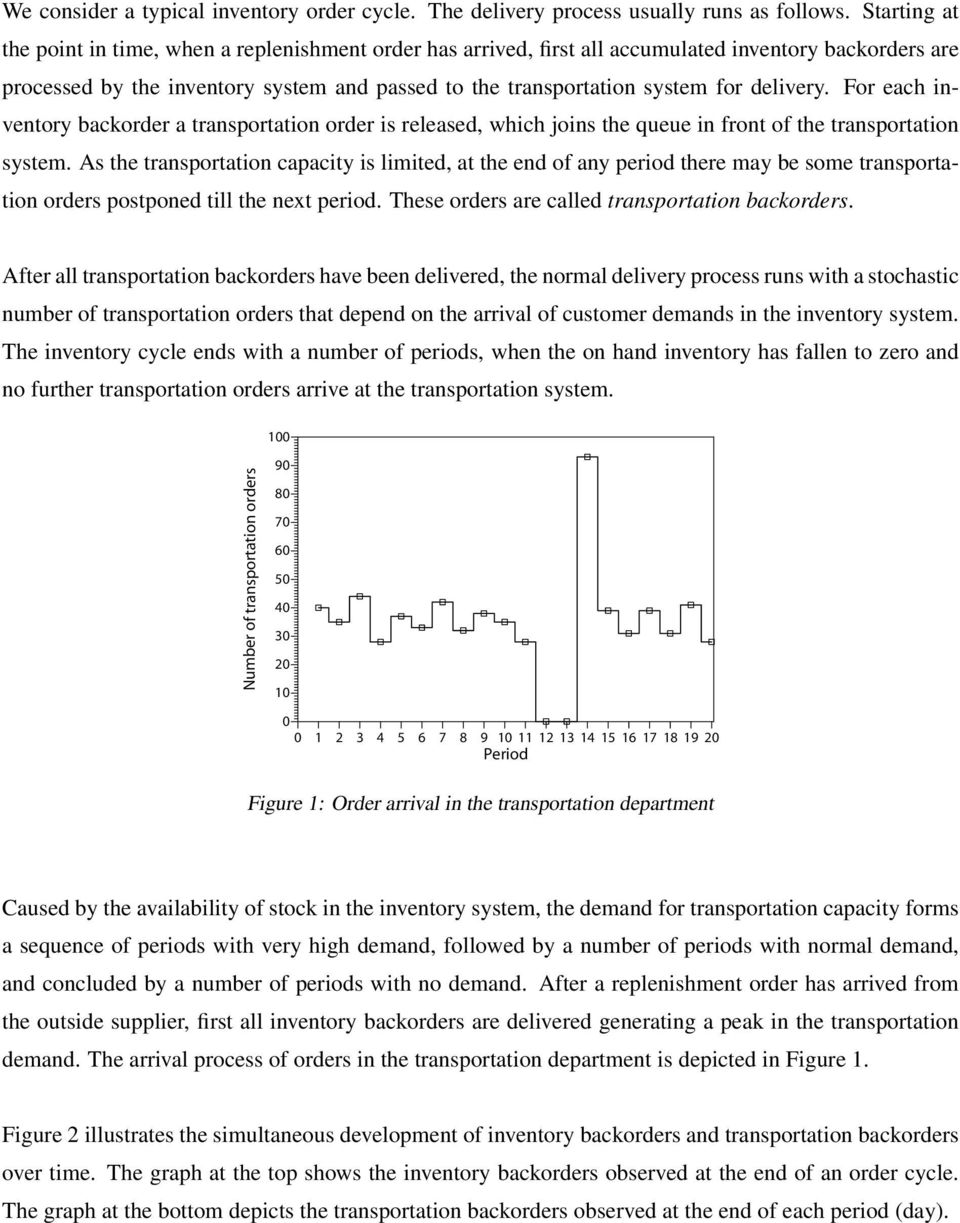
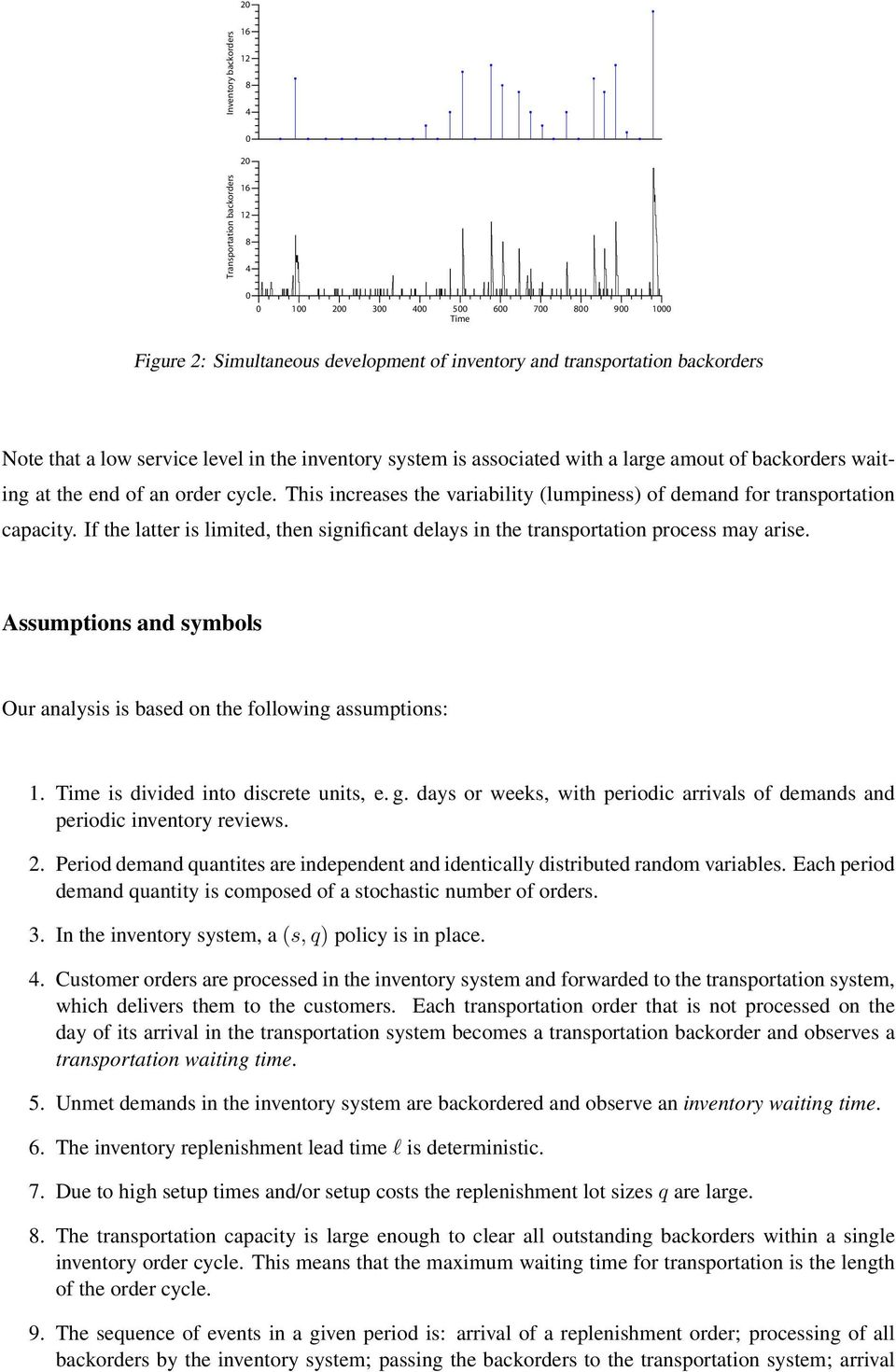
2 We consider a typical inventory order cycle. The delivery process usually runs as follows. Starting at the point in time, when a replenishment order has arrived, first all accumulated inventory backorders are processed by the inventory system and passed to the transportation system for delivery. For each inventory backorder a transportation order is released, which joins the queue in front of the transportation system. As the transportation capacity is limited, at the end of any period there may be some transportation orders postponed till the next period. These orders are called transportation backorders. After all transportation backorders have been delivered, the normal delivery process runs with a stochastic number of transportation orders that depend on the arrival of customer demands in the inventory system. The inventory cycle ends with a number of periods, when the on hand inventory has fallen to zero and no further transportation orders arrive at the transportation system. 100 Number of transportation orders Period Figure 1: Order arrival in the transportation department Caused by the availability of stock in the inventory system, the demand for transportation capacity forms a sequence of periods with very high demand, followed by a number of periods with normal demand, and concluded by a number of periods with no demand. After a replenishment order has arrived from the outside supplier, first all inventory backorders are delivered generating a peak in the transportation demand. The arrival process of orders in the transportation department is depicted in Figure 1. Figure 2 illustrates the simultaneous development of inventory backorders and transportation backorders over time. The graph at the top shows the inventory backorders observed at the end of an order cycle. The graph at the bottom depicts the transportation backorders observed at the end of each period (day).
3 20 Inventory backorders Transportation backorders Time Figure 2: Simultaneous development of inventory and transportation backorders Note that a low service level in the inventory system is associated with a large amout of backorders waiting at the end of an order cycle. This increases the variability (lumpiness) of demand for transportation capacity. If the latter is limited, then significant delays in the transportation process may arise. Assumptions and symbols Our analysis is based on the following assumptions: 1. Time is divided into discrete units, e. g. days or weeks, with periodic arrivals of demands and periodic inventory reviews. 2. Period demand quantites are independent and identically distributed random variables. Each period demand quantity is composed of a stochastic number of orders. 3. In the inventory system, a (s, q) policy is in place. 4. Customer orders are processed in the inventory system and forwarded to the transportation system, which delivers them to the customers. Each transportation order that is not processed on the day of its arrival in the transportation system becomes a transportation backorder and observes a transportation waiting time. 5. Unmet demands in the inventory system are backordered and observe an inventory waiting time. 6. The inventory replenishment lead time l is deterministic. 7. Due to high setup times and/or setup costs the replenishment lot sizes q are large. 8. The transportation capacity is large enough to clear all outstanding backorders within a single inventory order cycle. This means that the maximum waiting time for transportation is the length of the order cycle. 9. The sequence of events in a given period is: arrival of a replenishment order; processing of all backorders by the inventory system; passing the backorders to the transportation system; arrival
4 of period demand; processing of demand by the inventory system; passing the orders to the transportation system; delivery of all orders by the transportation system in the sequence of their arrival; review of the inventory position and triggering of a replenishment order, if required. 10. Decision variables are the reorder point s and the transportation capacity v. The order size q is assumed to be given. A t B I G t N V ŵ ŵ I W I ŵ T W T number of orders passed to the transportation system in period t number of backorders of the inventory system (in terms of customer orders) number of transportation backorders remaining at the end of period t coverage (number of periods) of the reorder point s transportation capacity per period average target total waiting time average target waiting time in the inventory system waiting time in the inventory system average target waiting time for transportation waiting time for transportation Table 1: Symbols used Related literature Only a limited number of papers are available that focus on the connection between inventory and transportation decisions in the context of inventory theory. The majority of these papers study the option of using faster transportation modes in order to shorten the replenishment lead time and to reduce the amount of safety stock required. For example, see Allen et al. (1985) and Tyworth (1992), who focus on the influence of the shipping time on the lead time demand. Geunes and Zeng (2001) consider backlogging of excess demand as an alternative to expediting in a two-stage a distribution system. Their decision variables are the safety stock and the in-house transportation capacity (expressed in product units shipped). In addition, they allow for unlimited external transportation capacity that is available at comparatively high costs. Henig et al. (1997) treat the joint optimization of a periodic inventory policy and a prepaid basic transportation capacity determined by a contract. In order to handle high transportation requirements an unlimited amount of transportation capacity is available at additional costs. Yano and Gerchak (1989) consider the simultaneous determination of safety stock and inbound transportation capacity for an assembly plant. As the customer is an assembly line with 100% service requirements, in case of over-utilization of the contracted transportation capacity costly emergency shipments are used. All these papers do not allow for the possibility of waiting for transportation, which is the focus of the current work.
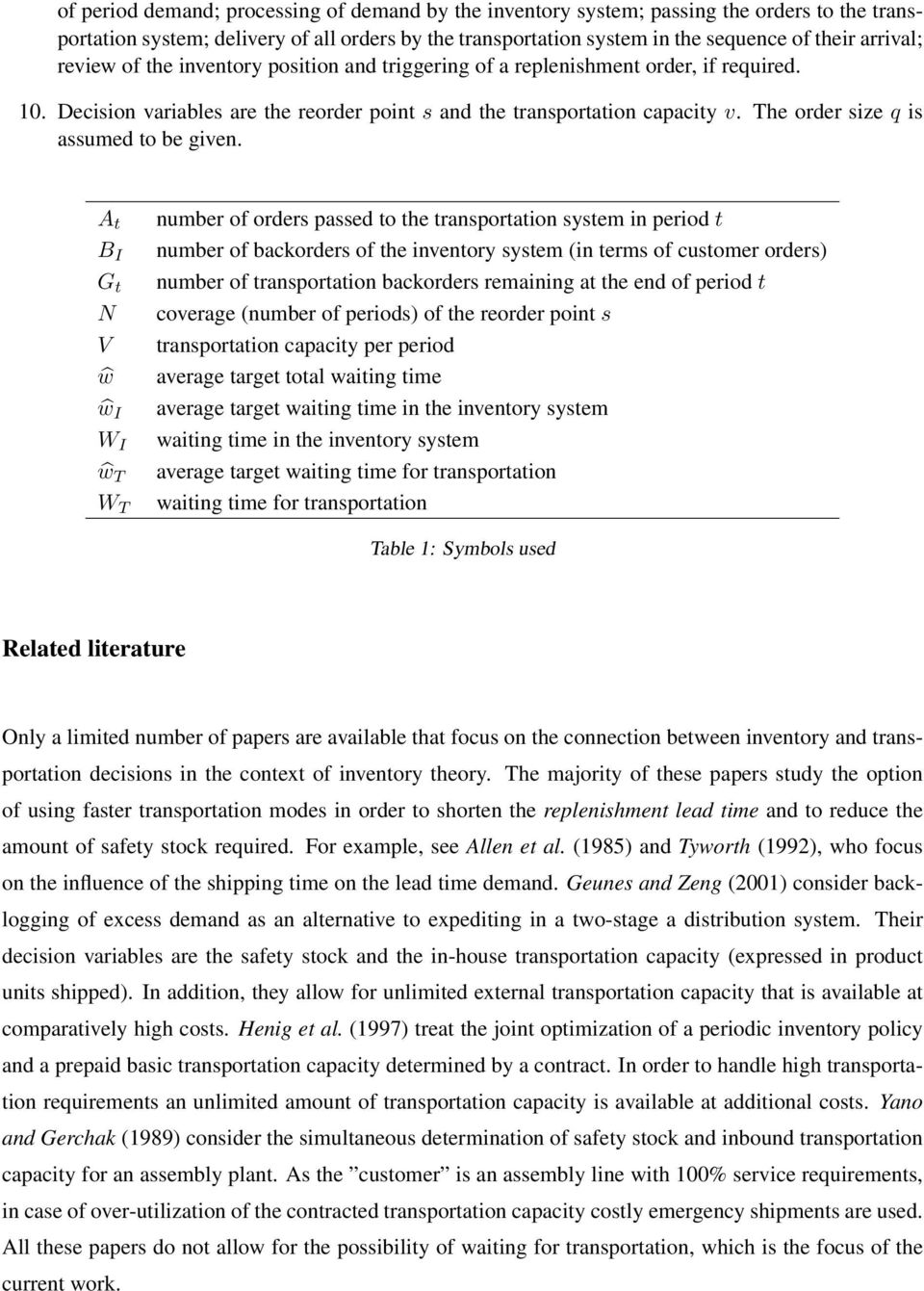
5 Analysis Denote with A t the number of transportation orders passed from the inventory system to the transportation system in period t as a result of the processing of normal orders delivered without delay (i. e. excluding backorders) by the inventory system. Then the sequence {A t, (t = 1, 2,...)} is a stochastic process that is active during the periods when the on hand inventory is greater than zero. As the transportation capacity per period is limited, a queue of transportation orders builds up and disappears over time. Let V denote the available transportation capacity in terms of the number of orders delivered per period (e. g. the number of vehicles, if each vehicle delivers one order per period). Note that V may be a random variable, which is the result of the operational routing decisions with respect to the locations of the customers. Assume first that the transportation capacity is deterministic V = v. Then the development of the queue length is the result of the arrivals and departures of transportation orders sent from the inventory system to the transportation system. The queue length G t of transportation backorders at the end of period t evolves over time as follows: G t = max[g t 1 + A t v,0] t > 0 (1) The sequence G t, (t = 1, 2,...) is a discrete parameter Markov chain. A typical delivery cycle starts at time t = 0 immediately after the arrival of a replenishment order in the inventory system. At this point in time the inventory backorders B I are processed and passed to the transportation system, where they become the transportation orders available for delivery in the same period. Therefore we have P {G 0 = i} = P {B I = i}, (i = 1, 2,...). Note that the initial conditions of the Markov chain representing the status of the transportation system depend on the delivery performance and the associated reorder point s of the inventory system. With a high safety stock level only a small number of inventory backorders will be passed to the transportation system after the inventory replenishment. If, by contrast, the safety stock level is low, then the number of inventory backorders requiring transportation to their destination is significantly greater. In fact, their number may be so high that it takes the transportation system several periods to deliver them all. Under the assumptions stated, the probability distribution P {B I = i} can be approximated as follows. See also (Tempelmeier, 1985). Let N be the coverage (i. e. the number of periods whose demands are completely filled from on hand inventory) of the reorder point s and let l be the replenishment lead time. If N = n, then the period demands of the periods n + 1, n + 2,...,l are backordered. The cumulated number of customer orders that are backordered is the total number of orders that arrived within the last (l n) periods before the inventory replenishment, B (l n). Given the probability distribution of the

6 number of orders per period, P {A = a}, we get l P {B I = i} = P {B (l n) = i N = n} P {N = n} i = 1, 2,... (2) and n=1 P {B I = 0} = P {N l} (3) where P {B (l n) = i N = n} can be computed as the (l n)-fold convolution of the probability distribution of the number of orders per period, P {A = a}. Now consider the process of order fulfillment in the transportation system. Let J be the maximum number of transportation backorders that will possibly occur. The conditional transition probabilities between the states of the transportation backorder queue in two consecutive periods t 1 and t (t = 1, 2,...) under the assumption of a given transportation capacity V = v are then P {G t = 0 G t 1 = i} = P {A t v i} i = 0, 1,...,J (4) P {G t = j G t 1 = i} = P {A t v + j i} i = 0, 1,...,J; 0 < j < J (5) P {G t J G t 1 = i} = P {A t v + J i} i = 0, 1,...,J (6) Now assume that the period transportation capacity V is a discrete random variable with minimum value v min and maximum value v max. Then considering all possible values of V we get v max u ij = (u ij V = v) P {V = v} i = 0, 1,...,J; j = 0, 1,...,J (7) v=v min where (u ij V = v) is the conditional transition probability defined by (4) (6). In order to characterize the waiting times of the transportation orders we study the development of the transportation backorder queue during the complete order cycle. Let U (t) be the t-step transition matrix. Then the probabilities for the number of transportation orders at the end of period t waiting for transportation in the next period are I P {G t = j} = P {G 0 = i} u (t) ij j = 0, 1, 2,...,J; t = 1, 2,... (8) i=0 Denote with c the length of a typical inventory cycle. The average waiting time for transportation is then E{W T } = 1 c c E{G t } (9) E{A} t=1 The waiting time for transportation depends primarily on the accumulated number B I of inventory backorders at the beginning of a new cycle, immediately after the arrival of a replenishment order at the inventory system, and on the transportation capacity v that is available to reduce this backlog over time. Therefore we have W T = f[v, B I (s)] (10) Note that B I (s) = G 0 is a random variable that is a function of the inventory policy. In the assumed case of an (s, q) policy with fixed order quantity q, the sole influence factor is the reorder point s.

7 For a given number of inventory backorders B I, there exists a stepwise inverse relationship between the transportation capacity and the average waiting time of a customer order for transportation, as shown in Figure Waiting time for transportation Transportation capacity Figure 3: Waiting time for transportation versus transportation capacity Numerical illustration Consider an (s, q)-inventory system where the period demand follows a gamma distribution of order n = and with scale parameter λ = , such that the expectation is n λ = and the standard deviation is n = Each period demand is considered as a single order (i. e. A = 1). λ 2 Given an order quantity q = 5000, a deterministic replenishment lead time l = 15 and a target average inventory-related waiting time ŵ I = 0.13, the reorder point is s = The computed probabilities of the number of inventory backorders and the values observed with an ARENA simulation model are put together in the Table 2. j computed simulated Table 2: Probability distribution of inventory backorders at the arrival of a replenishment order

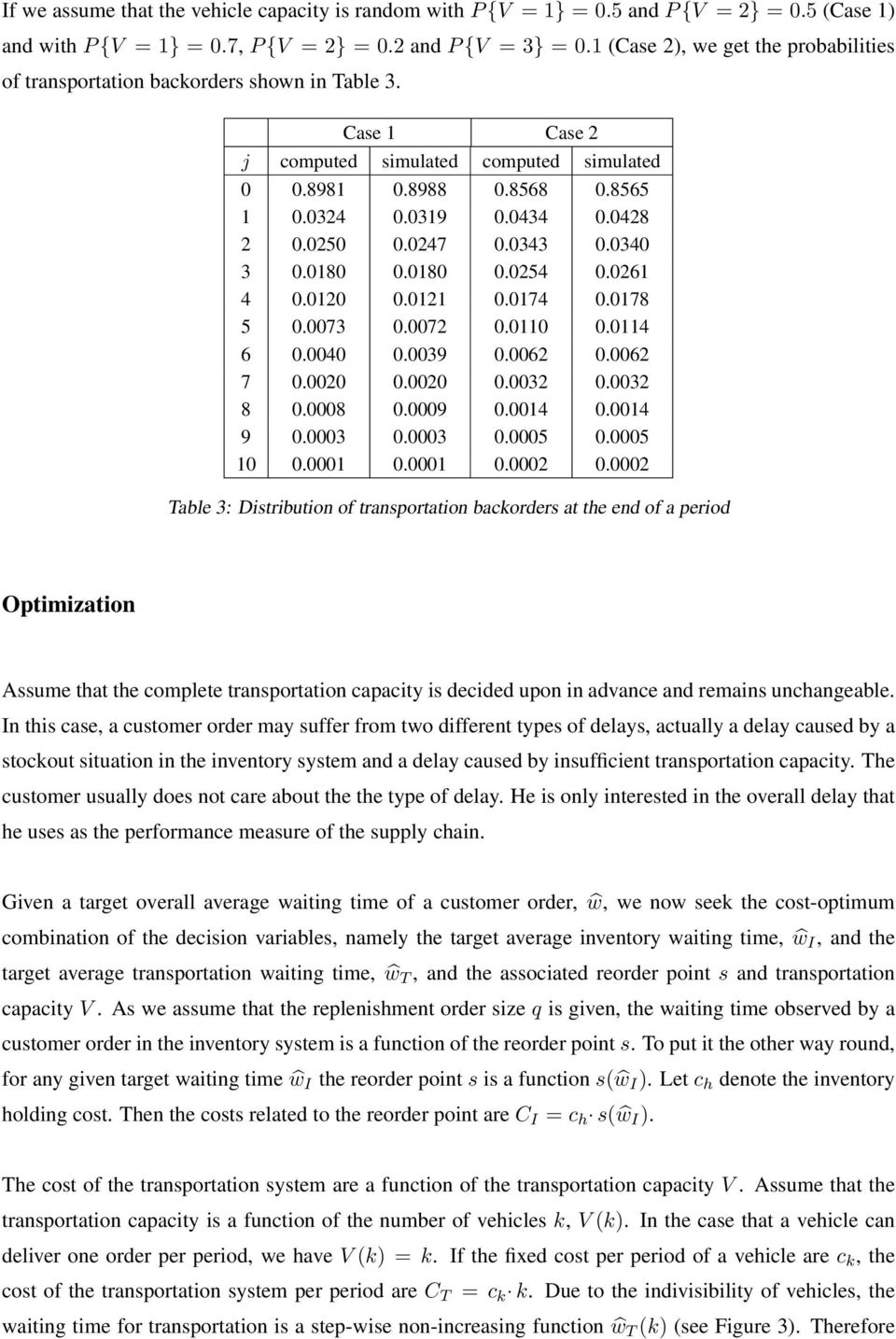
8 If we assume that the vehicle capacity is random with P {V = 1} = 0.5 and P {V = 2} = 0.5 (Case 1) and with P {V = 1} = 0.7, P {V = 2} = 0.2 and P {V = 3} = 0.1 (Case 2), we get the probabilities of transportation backorders shown in Table 3. Case 1 Case 2 j computed simulated computed simulated Table 3: Distribution of transportation backorders at the end of a period Optimization Assume that the complete transportation capacity is decided upon in advance and remains unchangeable. In this case, a customer order may suffer from two different types of delays, actually a delay caused by a stockout situation in the inventory system and a delay caused by insufficient transportation capacity. The customer usually does not care about the the type of delay. He is only interested in the overall delay that he uses as the performance measure of the supply chain. Given a target overall average waiting time of a customer order, ŵ, we now seek the cost-optimum combination of the decision variables, namely the target average inventory waiting time, ŵ I, and the target average transportation waiting time, ŵ T, and the associated reorder point s and transportation capacity V. As we assume that the replenishment order size q is given, the waiting time observed by a customer order in the inventory system is a function of the reorder point s. To put it the other way round, for any given target waiting time ŵ I the reorder point s is a function s(ŵ I ). Let c h denote the inventory holding cost. Then the costs related to the reorder point are C I = c h s(ŵ I ). The cost of the transportation system are a function of the transportation capacity V. Assume that the transportation capacity is a function of the number of vehicles k, V (k). In the case that a vehicle can deliver one order per period, we have V (k) = k. If the fixed cost per period of a vehicle are c k, the cost of the transportation system per period are C T = c k k. Due to the indivisibility of vehicles, the waiting time for transportation is a step-wise non-increasing function ŵ T (k) (see Figure 3). Therefore
9 the following optimization problem can be formulated: s. t. Minimize C(ŵ I, k) = c h s(ŵ I ) + c k k (11) ŵ I + ŵ T (k) = ŵ (12) k integer (13) This is a two-dimensional nonlinear optimization problem. Substituting ŵ I = ŵ ŵ T (k) we get Minimize C(ŵ I, k) = c h s[ŵ ŵ T (k)] + c k k (14) s. t. 0 ŵ T (k) ŵ (15) v integer (16) This is a nonlinear one-dimensional optimization problem in the variables k with an embedded optimization problem of finding the minimum reorder point s for any given waiting time [ŵ ŵ T (k)] in the inventory system. The optimum solution of the above problem can be found by enumeration of all numbers of vehicles k that are feasible. Conclusion Supply chain management in the narrow sense requires the consideration of all time-consuming subprocesses in the process of delivery of good to the customers. The overall perspective enables the planner, to shift performance from one subprocess to the other, based on the consideration where a specific degree of performance can be achieved at the lowest costs. References Allen, W., M. Mahmoud, and D. McNeil (1985). The importance of time in transit and reliability of transit time for shippers, receivers, and carriers. Transportation Research B 19B, Geunes, J. and A. Z. Zeng (2001). Impacts of inventory shortage policies on transportation requirements in twostage distribution systems. European Journal of Operational Research 129, Henig, M., Y. Gerchak, R. Ernst, and D. Pyke (1997). contract. Management Science 43, An inventory model embedded in designing a supply Tempelmeier, H. (1985). Inventory control using a service constraint on the expected customer order waiting time. European Journal of Operational Research 19, Tyworth, J. (1992). Modeling transportation-inventory trade-offs in a stochastic setting. Journal of Business Logistics 13, Yano, C. and Y. Gerchak (1989). Transportation contracts and safety stocks for Just-in-Time deliveries. Journal of Manufacturing and Operations Management 2,
![Substituting ŵ I = ŵ ŵ T (k) we get Minimize C(ŵ I, k) = c h s[ŵ ŵ T (k)] + c k k (14) s. t.](/docs-images/50/15898115/images/page_9.jpg "0 ŵ T (k) ŵ (15) v integer (16) This is a nonlinear one-dimensional optimization problem in the variables k with an embedded optimization problem of finding the minimum reorder point s for any given")
Single item inventory control under periodic review and a minimum order quantity
 Single item inventory control under periodic review and a minimum order quantity G. P. Kiesmüller, A.G. de Kok, S. Dabia Faculty of Technology Management, Technische Universiteit Eindhoven, P.O. Box 513,
Modeling Stochastic Inventory Policy with Simulation
 Modeling Stochastic Inventory Policy with Simulation 1 Modeling Stochastic Inventory Policy with Simulation János BENKŐ Department of Material Handling and Logistics, Institute of Engineering Management
A Programme Implementation of Several Inventory Control Algorithms
 BULGARIAN ACADEMY OF SCIENCES CYBERNETICS AND INFORMATION TECHNOLOGIES Volume, No Sofia 20 A Programme Implementation of Several Inventory Control Algorithms Vladimir Monov, Tasho Tashev Institute of Information
Analysis of a Production/Inventory System with Multiple Retailers
 Analysis of a Production/Inventory System with Multiple Retailers Ann M. Noblesse 1, Robert N. Boute 1,2, Marc R. Lambrecht 1, Benny Van Houdt 3 1 Research Center for Operations Management, University
Transportation. Transportation decisions. The role of transportation in the SC. A key decision area within the logistics mix
 Transportation A key decision area within the logistics mix Chapter 14 Transportation in the Supply Chain Inventory Strategy Forecasting Storage decisions Inventory decisions Purchasing & supply planning
SPARE PARTS INVENTORY SYSTEMS UNDER AN INCREASING FAILURE RATE DEMAND INTERVAL DISTRIBUTION
 SPARE PARS INVENORY SYSEMS UNDER AN INCREASING FAILURE RAE DEMAND INERVAL DISRIBUION Safa Saidane 1, M. Zied Babai 2, M. Salah Aguir 3, Ouajdi Korbaa 4 1 National School of Computer Sciences (unisia),
Course Supply Chain Management: Inventory Management. Inventories cost money: Reasons for inventory. Types of inventory
 Inventories cost money: Inventories are to be avoided at all cost? Course Supply Chain Management: Or Inventory Management Inventories can be useful? Chapter 10 Marjan van den Akker What are reasons for
A MANAGER S ROADMAP GUIDE FOR LATERAL TRANS-SHIPMENT IN SUPPLY CHAIN INVENTORY MANAGEMENT
 A MANAGER S ROADMAP GUIDE FOR LATERAL TRANS-SHIPMENT IN SUPPLY CHAIN INVENTORY MANAGEMENT By implementing the proposed five decision rules for lateral trans-shipment decision support, professional inventory
A QUEUEING-INVENTORY SYSTEM WITH DEFECTIVE ITEMS AND POISSON DEMAND. [email protected]
 A QUEUEING-INVENTORY SYSTEM WITH DEFECTIVE ITEMS AND POISSON DEMAND Rasoul Hai 1, Babak Hai 1 Industrial Engineering Department, Sharif University of Technology, +98-1-66165708, [email protected] Industrial
VENDOR MANAGED INVENTORY
 VENDOR MANAGED INVENTORY Martin Savelsbergh School of Industrial and Systems Engineering Georgia Institute of Technology Joint work with Ann Campbell, Anton Kleywegt, and Vijay Nori Distribution Systems:
SINGLE-STAGE MULTI-PRODUCT PRODUCTION AND INVENTORY SYSTEMS: AN ITERATIVE ALGORITHM BASED ON DYNAMIC SCHEDULING AND FIXED PITCH PRODUCTION
 SIGLE-STAGE MULTI-PRODUCT PRODUCTIO AD IVETORY SYSTEMS: A ITERATIVE ALGORITHM BASED O DYAMIC SCHEDULIG AD FIXED PITCH PRODUCTIO Euclydes da Cunha eto ational Institute of Technology Rio de Janeiro, RJ
Exact Fill Rates for the (R, S) Inventory Control with Discrete Distributed Demands for the Backordering Case
 Informatica Economică vol. 6, no. 3/22 9 Exact Fill ates for the (, S) Inventory Control with Discrete Distributed Demands for the Backordering Case Eugenia BABILONI, Ester GUIJAO, Manuel CADÓS, Sofía
The Trip Scheduling Problem
 The Trip Scheduling Problem Claudia Archetti Department of Quantitative Methods, University of Brescia Contrada Santa Chiara 50, 25122 Brescia, Italy Martin Savelsbergh School of Industrial and Systems
Operations and Supply Chain Management Prof. G. Srinivasan Department of Management Studies Indian Institute of Technology, Madras
 Operations and Supply Chain Management Prof. G. Srinivasan Department of Management Studies Indian Institute of Technology, Madras Lecture - 36 Location Problems In this lecture, we continue the discussion
Transportation Routing Guide https://mms.supplier.mckesson.com/transportation/
 Transportation Routing Guide https://mms.supplier.mckesson.com/transportation/ These instructions apply on all shipments directly to distribution centers for the following; McKesson Medical-Surgical Inc.
International Journal of Advances in Science and Technology (IJAST)
 Determination of Economic Production Quantity with Regard to Machine Failure Mohammadali Pirayesh 1, Mahsa Yavari 2 1,2 Department of Industrial Engineering, Faculty of Engineering, Ferdowsi University
Revenue Management for Transportation Problems
 Revenue Management for Transportation Problems Francesca Guerriero Giovanna Miglionico Filomena Olivito Department of Electronic Informatics and Systems, University of Calabria Via P. Bucci, 87036 Rende
STRATEGIC CAPACITY PLANNING USING STOCK CONTROL MODEL
 Session 6. Applications of Mathematical Methods to Logistics and Business Proceedings of the 9th International Conference Reliability and Statistics in Transportation and Communication (RelStat 09), 21
Supply planning for two-level assembly systems with stochastic component delivery times: trade-off between holding cost and service level
 Supply planning for two-level assembly systems with stochastic component delivery times: trade-off between holding cost and service level Faicel Hnaien, Xavier Delorme 2, and Alexandre Dolgui 2 LIMOS,
Supply Chain Analysis Tools
 Supply Chain Analysis Tools MS&E 262 Supply Chain Management April 14, 2004 Inventory/Service Trade-off Curve Motivation High Inventory Low Poor Service Good Analytical tools help lower the curve! 1 Outline
Optimal base-stock policy for the inventory system with periodic review, backorders and sequential lead times
 44 Int. J. Inventory Research, Vol. 1, No. 1, 2008 Optimal base-stock policy for the inventory system with periodic review, backorders and sequential lead times Søren Glud Johansen Department of Operations
EVERYTHING YOU NEED TO KNOW ABOUT INVENTORY
 EVERYTHING YOU NEED TO KNOW ABOUT INVENTORY Introduction Inventory is considered the necessary evil of the supply chain. In fact, there has been a whole movement; lean manufacturing that has tried to reduce
Agenda. Real System, Transactional IT, Analytic IT. What s the Supply Chain. Levels of Decision Making. Supply Chain Optimization
 Agenda Supply Chain Optimization KUBO Mikio Definition of the Supply Chain (SC) and Logistics Decision Levels of the SC Classification of Basic Models in the SC Logistics Network Design Production Planning
Mathematical Modeling of Inventory Control Systems with Lateral Transshipments
 Mathematical Modeling of Inventory Control Systems with Lateral Transshipments Lina Johansson Master Thesis Department of Industrial Management and Logistics Division of Production Management Lund university,
A Case Study of Joint Online Truck Scheduling and Inventory Management for Multiple Warehouses
 Technische Universität Chemnitz Fakultät für Mathematik D-09107 Chemnitz, Germany A Case Study of Joint Online Truck Scheduling and Inventory Management for Multiple Warehouses C. Helmberg, S. Röhl Preprint
PERFORMANCE ANALYSIS OF A CONTRACT MANUFACTURING SYSTEM
 PERFORMANCE ANALYSIS OF A CONTRACT MANUFACTURING SYSTEM Viswanadham.N 1, Vaidyanathan.G 2 The Logistics Institute- Asia Pacific National University of Singapore Singapore 11926 [email protected] 1 [email protected]
6.231 Dynamic Programming and Stochastic Control Fall 2008
 MIT OpenCourseWare http://ocw.mit.edu 6.231 Dynamic Programming and Stochastic Control Fall 2008 For information about citing these materials or our Terms of Use, visit: http://ocw.mit.edu/terms. 6.231
A Profit-Maximizing Production Lot sizing Decision Model with Stochastic Demand
 A Profit-Maximizing Production Lot sizing Decision Model with Stochastic Demand Kizito Paul Mubiru Department of Mechanical and Production Engineering Kyambogo University, Uganda Abstract - Demand uncertainty
PeopleSoft White Paper Series. Evolving from Distribution Requirements Planning to Collaborative Supply Chain Planning
 PeopleSoft White Paper Series Evolving from Distribution Requirements Planning to Collaborative Supply Chain Planning January 2004 Introduction Distribution and logistics managers are faced with managing
Best Practices for Transportation Management
 Best Practices for Transportation Management www.ohl.com or 877-401-6400 Introduction The mantra for all transportation professionals is simple: reduce costs and increase customer satisfaction levels.
The Next Generation of Inventory Optimization has Arrived
 The Next Generation of Inventory Optimization has Arrived Cutting-edge demand classification technology integrated with network optimization and simulation enables cost reduction and increased inventory
APPLICATION OF SIMULATION IN INVENTORY MANAGEMENT OF EOL PRODUCTS IN A DISASSEMBLY LINE
 APPLICATION OF SIMULATION IN INVENTORY MANAGEMENT OF EOL PRODUCTS IN A DISASSEMBLY LINE Badr O. Johar, Northeastern University, (617) 3737635, [email protected] Surendra M. Gupta, Northeastern University,
D Lab: Supply Chains
 D Lab: Supply Chains Inventory Management Class outline: Roles of inventory Inventory related costs Types of inventory models Focus on EOQ model today (Newsvender model next class) Stephen C. Graves 2013
Introduction. Chapter 1
 Chapter 1 Introduction The success of Japanese companies in the second half of the 20th century has lead to an increased interest in inventory management. Typically, these companies operated with far less
Modeling Multi-Echelon Multi-Supplier Repairable Inventory Systems with Backorders
 J. Service Science & Management, 2010, 3, 440-448 doi:10.4236/jssm.2010.34050 Published Online December 2010 (http://www.scirp.org/journal/jssm) Modeling Multi-Echelon Multi-Supplier Repairable Inventory
1 The EOQ and Extensions
 IEOR4000: Production Management Lecture 2 Professor Guillermo Gallego September 9, 2004 Lecture Plan 1. The EOQ and Extensions 2. Multi-Item EOQ Model 1 The EOQ and Extensions This section is devoted to
Strategic Framework to Analyze Supply Chains
 Strategic Framework to Analyze Supply Chains 1 Andy Guo A Strategic Framework for Supply Chain Design, Planning, and Operation Part I: Understand the supply chain Part II: Supply chain performance Part
Optimal Scheduling for Dependent Details Processing Using MS Excel Solver
 BULGARIAN ACADEMY OF SCIENCES CYBERNETICS AND INFORMATION TECHNOLOGIES Volume 8, No 2 Sofia 2008 Optimal Scheduling for Dependent Details Processing Using MS Excel Solver Daniela Borissova Institute of
Evaluating the Lead Time Demand Distribution for (r, Q) Policies Under Intermittent Demand
 Proceedings of the 2009 Industrial Engineering Research Conference Evaluating the Lead Time Demand Distribution for (r, Q) Policies Under Intermittent Demand Yasin Unlu, Manuel D. Rossetti Department of
Simulation-based Optimization Approach to Clinical Trial Supply Chain Management
 20 th European Symposium on Computer Aided Process Engineering ESCAPE20 S. Pierucci and G. Buzzi Ferraris (Editors) 2010 Elsevier B.V. All rights reserved. Simulation-based Optimization Approach to Clinical
Inventory Management
 Inventory Management Uninterrupted supply of drugs is the most important factor for success of many programmes. And to achieve uninterrupted supply there is need of proper inventory control system. The
An integrated Single Vendor-Single Buyer Production Inventory System Incorporating Warehouse Sizing Decisions 창고 크기의사결정을 포함한 단일 공급자구매자 생산재고 통합관리 시스템
 Journal of the Korean Institute of Industrial Engineers Vol. 40, No. 1, pp. 108-117, February 2014. ISSN 1225-0988 EISSN 2234-6457 http://dx.doi.org/10.7232/jkiie.2014.40.1.108 2014 KIIE
Inventory Management - A Teaching Note
 Inventory Management - A Teaching Note Sundaravalli Narayanaswami W.P. No.2014-09-01 September 2014 INDIAN INSTITUTE OF MANAGEMENT AHMEDABAD-380 015 INDIA Inventory Management - A Teaching Note Sundaravalli
MATERIALS MANAGEMENT. Module 9 July 22, 2014
 MATERIALS MANAGEMENT Module 9 July 22, 2014 Inventories and their Management Inventories =? New Car Inventory Sitting in Parking Lots Types of Inventory 1. Materials A. Raw material B. WIP C. Finished
Proceedings of the World Congress on Engineering and Computer Science 2009 Vol II WCECS 2009, October 20-22, 2009, San Francisco, USA
 Inventory and Production Planning in A Supply Chain System with Fixed-Interval Deliveries of Manufactured Products to Multiple Customers with Scenario Based Probabilistic Demand M. Abolhasanpour, A. Ardestani
A Synchronized Supply Chain for Reducing Decoupling Stock
 A Synchronized Supply Chain for Reducing Decoupling Stock Jian Wang Shanghai University, China, [email protected] Hiroaki Matsukawa Keio University, Japan, [email protected] Shane J. Schvaneveldt
Logistics Management Transportation Decisions. Özgür Kabak, Ph.D.
 Logistics Management Transportation Decisions Özgür Kabak, Ph.D. Typical Transport Decisions Mode/Service selection Freight consolidation Trade-off between transportation cost and customer responsiveness
Material Requirements Planning (MRP)
 Material Requirements Planning (MRP) Unlike many other approaches and techniques, material requirements planning works which is its best recommendation. Joseph Orlicky, 1974 1 History Begun around 1960
Name of the system: Accura Supply Chain Name of the company offering it: Accura Software Link to website: http://www.accurasoft.
 Seydi Abdishev, Activity #5, ID:100071130 1. Supply Chain Management Systems Name of the system: Accura Supply Chain Name of the company offering it: Accura Software Link to website: http://www.accurasoft.com/
Stochastic Models for Inventory Management at Service Facilities
 Stochastic Models for Inventory Management at Service Facilities O. Berman, E. Kim Presented by F. Zoghalchi University of Toronto Rotman School of Management Dec, 2012 Agenda 1 Problem description Deterministic
Lot size/reorder level (Q,R) Models
 Lot size/eorder level, Models Esma Gel, Pınar Keskinocak, 0 ISYE 0 Fall 0 ecap: Basic EO Inventory It -d =d T d T T T T Lead time time Place an order when the inventory level is. The order arrives after
Branch-and-Price Approach to the Vehicle Routing Problem with Time Windows
 TECHNISCHE UNIVERSITEIT EINDHOVEN Branch-and-Price Approach to the Vehicle Routing Problem with Time Windows Lloyd A. Fasting May 2014 Supervisors: dr. M. Firat dr.ir. M.A.A. Boon J. van Twist MSc. Contents
A Simple Inventory System
 A Simple Inventory System Section 1.3 Discrete-Event Simulation: A First Course Section 1.3: A Simple Inventory System customers. demand items.. facility. order items.. supplier Distributes items from
Supplement to Call Centers with Delay Information: Models and Insights
 Supplement to Call Centers with Delay Information: Models and Insights Oualid Jouini 1 Zeynep Akşin 2 Yves Dallery 1 1 Laboratoire Genie Industriel, Ecole Centrale Paris, Grande Voie des Vignes, 92290
CHAPTER 6 AGGREGATE PLANNING AND INVENTORY MANAGEMENT 명지대학교 산업시스템공학부
 CHAPTER 6 AGGREGATE PLANNING AND INVENTORY MANAGEMENT 명지대학교 산업시스템공학부 Learning Objectives You should be able to: Describe the hierarchical operations planning process in terms of materials planning & capacity
Spreadsheet Heuristic for Stochastic Demand Environments to Solve the Joint Replenishment Problem
 , July 3-5, 2013, London, U.K. Spreadsheet Heuristic for Stochastic Demand Environments to Solve the Joint Replenishment Problem Buket Türkay, S. Emre Alptekin Abstract In this paper, a new adaptation
Optimizing Replenishment Intervals for Two-Echelon Distribution Systems with Fixed Order Costs
 Optimizing Replenishment Intervals for Two-Echelon Distribution Systems with Fixed Order Costs Kevin H. Shang Sean X. Zhou Fuqua School of Business, Duke University, Durham, North Carolina 27708, USA Systems
Small Lot Production. Chapter 5
 Small Lot Production Chapter 5 1 Lot Size Basics Intuition leads many to believe we should manufacture products in large lots. - Save on setup time - Save on production costs Costs associated with Lots
Resource grouping selection to minimize the maximum over capacity planning
 2012 International Conference on Industrial and Intelligent Information (ICIII 2012) IPCSIT vol.31 (2012) (2012) IACSIT Press, Singapore Resource grouping selection to minimize the maximum over capacity
A discrete time Markov chain model for a periodic inventory system with one-way substitution
 Faculty of Business and Economics A discrete time Markov chain model for a periodic inventory system with one-way substitution Yannick Deflem and Inneke Van Nieuwenhuyse DEPARTMENT OF DECISION SCIENCES
TOOLS OF MONTE CARLO SIMULATION IN INVENTORY MANAGEMENT PROBLEMS
 TOOLS OF MONTE CARLO SIMULATION IN INVENTORY MANAGEMENT PROBLEMS Jacek Zabawa and Bożena Mielczarek Institute of Industrial Engineering and Management Wrocław University of Technology 50-370, Wrocław,
Nine Ways Food and Beverage Companies Can Use Supply Chain Design to Drive Competitive Advantage
 Nine Ways Food and Beverage Companies Can Use Supply Chain Design to Drive Competitive Advantage From long-term, strategic decision-making to tactical production planning, supply chain modeling technology
Optimizing Strategic Safety Stock Placement in Supply Chains. Stephen C. Graves Sean P. Willems
 Optimizing Strategic Safety Stock Placement in Supply Chains Stephen C. Graves Sean P. Willems Leaders for Manufacturing Program and A. P. Sloan School of Management Massachusetts Institute of Technology
Determining Inventory Levels in a CONWIP Controlled Job Shop
 Determining Inventory Levels in a CONWIP Controlled Job Shop Sarah M. Ryan* Senior Member, IIE Department of Industrial and Management Systems Engineering University of Nebraska-Lincoln Lincoln, NE 68588-0518
ISE 421 QUANTATIVE PRODUCTION PLANNING
 ISE 421 QUANTATIVE PRODUCTION PLANNING LECTURE III MRP, MRPII, ERP, APS Dr. Arslan ÖRNEK 2013 2014 Fall Term PRODUCTION PLANNING & SCHEDULING (PP&S) PP&S is one of the most critical activities in a manufacturing
Inventory Theory. 25.1 Inventory Models. Chapter 25 Page 1
 Chapter 25 Page 1 Inventory Theory Inventories are materials stored, waiting for processing, or experiencing processing. They are ubiquitous throughout all sectors of the economy. Observation of almost
Operations and Supply Chain Simulation with AnyLogic 7.2
 Operations and Supply Chain Simulation with AnyLogic 7.2 Decision-oriented introductory notes for management students in master programs Prof. Dr. Dmitry Ivanov Berlin School of Economics and Law Professor
A Quantitative Decision Support Framework for Optimal Railway Capacity Planning
 A Quantitative Decision Support Framework for Optimal Railway Capacity Planning Y.C. Lai, C.P.L. Barkan University of Illinois at Urbana-Champaign, Urbana, USA Abstract Railways around the world are facing
Issues in Information Systems Volume 14, Issue 2, pp.353-358, 2013
 A MODEL FOR SIMULTANEOUS DECISIONS ON MASTER PRODUCTION SCHEDULING, LOT SIZING, AND CAPACITY REQUIREMENTS PLANNING Harish C. Bahl, California State University-Chico, [email protected] Neelam Bahl, California
2.1 Model Development: Economic Order Quantity (EOQ) Model
 _ EOQ Model The first model we will present is called the economic order quantity (EOQ) model. This model is studied first owing to its simplicity. Simplicity and restrictive modeling assumptions usually
The Rolling Stock Recovery Problem. Literature review. Julie Jespersen Groth *α, Jesper Larsen β and Jens Clausen *γ
 The Rolling Stock Recovery Problem Julie Jespersen Groth *α, Jesper Larsen β and Jens Clausen *γ DTU Management Engineering, The Technical University of Denmark, Produktionstorvet, DTU Building 424, 2800
Optimal replenishment for a periodic review inventory system with two supply modes
 European Journal of Operational Research 149 (2003) 229 244 Production, Manufacturing and Logistics Optimal replenishment for a periodic review inventory system with two supply modes Chi Chiang * www.elsevier.com/locate/dsw
GESTION DE LA PRODUCTION ET DES OPERATIONS PICASSO EXERCICE INTEGRE
 ECAP 21 / PROD2100 GESTION DE LA PRODUCTION ET DES OPERATIONS PICASSO EXERCICE INTEGRE 2004-2005 Prof : Pierre Semal : [email protected] Assistants : Eléonore de le Court : [email protected]
A simulation study on supply chain performance with uncertainty using contract. Creative Commons: Attribution 3.0 Hong Kong License
 Title A simulation study on supply chain performance with uncertainty using contract Author(s) Chan, FTS; Chan, HK Citation IEEE International Symposium on Intelligent Control Proceedings, the 13th Mediterrean
Teaching Manual-Operation Management. Gunadarma University. Week : 9 Subject : INVENTORY MANAGEMENT Content :
 Week : 9 Subject : INVENTORY MANAGEMENT Content : WHY INVENTORY a. One of the most expensive assets of many companies representing as much as 50% of total invested capital b. Operations managers must balance
INDUSTRIAL STATISTICS AND OPERATIONAL MANAGEMENT. 7. Inventory Management
 INDUSTRIAL STATISTICS AND OPERATIONAL MANAGEMENT 7. Inventory Management Dr. Ravi Mahendra Gor Associate Dean ICFAI Business School ICFAI HOuse, Nr. GNFC INFO Tower S. G. Road Bodakdev Ahmedabad-380054
Economic Ordering Quantities: A Practical Cost Reduction Strategy for Inventory Management
 Economic Ordering Quantities: A Practical Cost Reduction Strategy for Inventory Management By Todd Duell Abstract Inventory management is an important concern for all managers in all types of businesses.
Performance Analysis of a Telephone System with both Patient and Impatient Customers
 Performance Analysis of a Telephone System with both Patient and Impatient Customers Yiqiang Quennel Zhao Department of Mathematics and Statistics University of Winnipeg Winnipeg, Manitoba Canada R3B 2E9
Batch Production Scheduling in the Process Industries. By Prashanthi Ravi
 Batch Production Scheduling in the Process Industries By Prashanthi Ravi INTRODUCTION Batch production - where a batch means a task together with the quantity produced. The processing of a batch is called
Equations for Inventory Management
 Equations for Inventory Management Chapter 1 Stocks and inventories Empirical observation for the amount of stock held in a number of locations: N 2 AS(N 2 ) = AS(N 1 ) N 1 where: N 2 = number of planned
Web-based Oil Supply Chain Game
 Web-based Oil Supply Chain Game Samik Raychaudhuri Dept. of Industrial Engineering, Univ. of Wisconsin, Madison, WI 53726 Abstract One of the major uses of management games is as a learning tool to improve
FIXED CHARGE UNBALANCED TRANSPORTATION PROBLEM IN INVENTORY POOLING WITH MULTIPLE RETAILERS
 FIXED CHARGE UNBALANCED TRANSPORTATION PROBLEM IN INVENTORY POOLING WITH MULTIPLE RETAILERS Ramidayu Yousuk Faculty of Engineering, Kasetsart University, Bangkok, Thailand [email protected] Huynh Trung
Inventory Theory 935
 19 Inventory Theory Sorry, we re out of that item. How often have you heard that during shopping trips? In many of these cases, what you have encountered are stores that aren t doing a very good job of
Case study of a batch-production/inventory system E.M.M. Winands 1, A.G. de Kok 2 and C. Timpe 3
 Case study of a batch-production/inventory system E.M.M. Winands 1, A.G. de Kok 2 and C. Timpe 3 The plant of BASF under consideration consists of multiple parallel production lines, which produce multiple
Meeting the Network Optimization Challenge Balancing Service, Contribution and Asset Return for the Global Business Unit
 A ChemLogix White Paper Meeting the Network Optimization Challenge Balancing Service, Contribution and Asset Return for the Global Business Unit By Ted Newton, President, ADC LLC To ensure the optimal
Glossary of Inventory Management Terms
 Glossary of Inventory Management Terms ABC analysis also called Pareto analysis or the rule of 80/20, is a way of categorizing inventory items into different types depending on value and use Aggregate
Formal Modeling Approach for Supply Chain Event Management
 Formal Modeling Approach for Supply Chain Event Management Rong Liu and Akhil Kumar Smeal College of Business Penn State University University Park, PA 16802, USA {rul110,akhilkumar}@psu.edu Wil van der
Inventory Management: Fundamental Concepts & EOQ. Chris Caplice ESD.260/15.770/1.260 Logistics Systems Oct 2006
 Inventory Management: Fundamental Concepts & EOQ Chris Caplice ESD.260/15.770/1.260 Logistics Systems Oct 2006 Agenda Wrap up of Demand Forecasting Fundamentals of Inventory Management Economic Order Quantity
ISyE 2030 Test 2 Solutions
 1 NAME ISyE 2030 Test 2 Solutions Fall 2004 This test is open notes, open books. Do precisely 5 of the following problems your choice. You have exactly 55 minutes. 1. Suppose that we are simulating the
LECTURE 4. Last time: Lecture outline
 LECTURE 4 Last time: Types of convergence Weak Law of Large Numbers Strong Law of Large Numbers Asymptotic Equipartition Property Lecture outline Stochastic processes Markov chains Entropy rate Random