
California Solar Initiative
|
|
|
- Joshua Hardy
- 9 years ago
- Views:
Transcription
1 California Solar Initiative Third Party Ownership Market Impact Study Prepared for: California Public Utilities Commission Prepared by: Karin Corfee Shannon Graham Beth Davis Jane Hummer Charlie Bloch Jack Cullen Nicole Reed Fry Amy Meyer Shalom Goffri Navigant Consulting, Inc. One Market Street Spear Street Tower, Suite 1200 San Francisco, CA May 28, Navigant Consulting, Inc.
2 Acknowledgements Navigant Consulting, Inc. (Navigant) would like to thank James Loewen of the California Public Utilities Commission for his guidance and leadership during the development of this report. We d also like to thank the California Solar Initiative Measurement and Evaluation Team for their contributions: Derek Jones, Pacific Gas and Electric Company Benjamin Airth, California Center for Sustainable Energy Chris Nanson, San Diego Gas and Electric Company Daniel Hopper, Southern California Edison Navigant s subcontractors on this project were instrumental in the timely and comprehensive completion of the data collection and analysis: Ewald and Wasserman Redhorse Corporation Finally, this study would not have been possible without the market actors and customers of the investor owned utilities who were willing to participate in interviews and respond to surveys. CSI Third-Party Market Impact Study Page i
3 Table of Contents List of Acronyms and Abbreviations... viii Executive Summary... x Methodology... x Background... xi Key Findings... xiv Recommendations... xxi 1. Introduction Methodology Organization of Report Market Context History of TPO Arrangements Policy and Regulatory Drivers for Customer Side PV and TPO in California Types of Third Party Ownership Arrangements Solar Lease Power Purchase Agreement Key Differences Between TPO and Self Financing TPO Market Share and Trends Residential Sector Market Share Income Analysis of Residential TPO Participants Non Residential Sector Market Share Market Penetration of TPO for Residential Customer Side Solar PV Outside CA Alternative Financing Mechanisms Property Assessed Clean Energy Overview of PACE California PACE Programs Third Party Ownership Business Model Key Market Actor Roles and Relationships Key Relationship: SFCs and Solar Installation Contractors Key Relationship: SFCs, Investors, and the Special Purpose Entity Trends and Market Share by SFC Third Party Owned System Contract Features Methodology Summary of Findings Findings from Interviews with Solar Financing Companies In Depth Findings on the Key Contract Terms System Maintenance, Monitoring, and Performance CSI Third-Party Market Impact Study Page ii

4 4.3.2 Re Roofing Related Provisions PV System Removal and Roof Repairs at the End of the Contract Term Default Provisions Sale of Property Early Termination End of Contract Term Economic Analysis of Third Party Contract Terms Methodology Summary of Findings Metric 1: Cost per Watt Metric 2: Premium Metric 3: Effective Interest Rate Metric 4: Effective Price per kwh Additional Findings Customer Experience with Third Party Ownership Participant Survey Methodology Summary of Findings Characteristics of TPO Participants Residential Sector Non Residential Sector Pre Installation Customer Decision Making Process for TPO Agreements Information Sources Benefits of Solar PV Considered Choice of TPO vs. Ownership Choice of Lease vs. PPA Customer Concerns Regarding TPO Arrangements Energy Efficiency System Sizing Strategies Post Installation Experience New or Ongoing Concerns with TPO Contract Terms Customer Satisfaction and Engagement Property Resale and End of Contract Concerns Public Utilities Code 2869 Compliance Methodology Summary of Findings Findings from Interviews with Loan Servicing Companies Findings and Recommendations Summary of Findings The TPO Market Benefited from a Favorable Policy Environment Third Party Ownership has Driven Recent Growth in the Residential PV Market Four TPO Business Models Have Developed Over the Course of the CSI Program CSI Third-Party Market Impact Study Page iii
5 8.1.4 Third Party Owned Business Models are Continuing to Evolve Third Party Owned System Customers are Generally Satisfied with the Products and Services Available The Distinction Between and Preference for PPAs and Leases is Blurred in the Marketplace Economic Analysis of the Financial Terms for a Sample of TPO Contracts Shows no Strong Evidence of Widespread Consumer Protection Issues Related to TPO System Pricing Third Party Owned Contracts Generally Address Most Significant Consumer Protection Issues, Though Some Inconsistencies Exist Third Party Ownership Contract Terms Regarding Bankruptcy of SFC Should be Improved Recommendations Appendix A. Methodology... A 1 A.1 Analysis of PowerClerk Database... A 1 A.2 Contract Review Methodology... A 2 A.4 Economic Analysis of TPO Systems... A 7 A.5 Solar TPO Host Customer Surveys... A 12 A.6 PUC 2869 Methodology... A 14 Appendix B. Residential TPO Participant Survey Instrument... B 1 Appendix C. Non Residential TPO Participant Survey Instrument... C 1 CSI Third-Party Market Impact Study Page iv
6 List of Figures and Tables Figures: Figure ES 1. Incremental Installed Capacity of CSI Systems by Financing Type for Residential Installations... xii Figure ES 2. Cumulative Installed Capacity of CSI Systems by Financing Type for Residential Installations... xiii Figure ES 3. Cumulative Installed Capacity of CSI Systems by Financing Type for Non Residential Installations... xiv Figure ES 4. Positioning Map for SFC Installer Relationships... xvii Figure ES 5. Key TPO System Financial Metrics over Time... xix Figure ES 6. Modeled Cost per Installed Capacity (2012$/W) for Sampled CSI Projects... xx Figure 2 1. TPO Market Share of Annual Incremental Capacity Additions for CSI Residential Installations Figure 2 2. Key Dates in California Solar Market History Figure 2 3. Cumulative Number of CSI Residential Systems Installed for Host Owned and TPO Financed Figure 2 4. Installed Capacity and Number of CSI Third Party Owned Systems by Sector and Year (Incremental) Figure 2 5. CSI Installed Capacity by Year, Sector, and Ownership Type (Incremental) Figure 2 6. CSI Residential Installed Capacity by Ownership Type (Incremental) Figure 2 7. Number of CSI Residential TPO Systems by Financing Type (Incremental) Figure 2 8. CSI Residential Systems Installed by Median Income Level of Host Customer ZIP Code (Cumulative) Figure 2 9. Share of CSI Residential Systems in each Income Level Quintile (based on Host Customer ZIP Code) that are TPO Financed (Incremental) Figure CSI Non Residential Installed Capacity by Year and by Ownership Type (Incremental) Figure Number of CSI TPO Commercial Systems by Financing Type (Incremental) Figure Number of CSI TPO Nontaxable Systems by Financing Type (Incremental) Figure National Trends in TPO for Customer Side Solar PV: Percentage of Residential Installations in Four Key States (Incremental) Figure Installed Capacity by State and Market Segment, Figure PACE Financing Authorized by State (as of April 2013) Figure Status of PACE Legislation and Residential and Commercial Programs Figure 3 1. Example Market Actors and their Roles in the TPO Value Chain Figure 3 2. Positioning Map for SFC Installer Relationships Figure 3 3. Sample Solar PVContractor Comparative Volume (# of Systems) of Residential CSI Installations by Ownership Type and SFC (Cumulative Through 2012) Figure 3 4. SFC Market Share of CSI Residential TPO Installed Capacity(Cumulative Through 2012) Figure 3 5. Installed CSI Residential TPO Capacity over Time by SFC (Incremental) Figure 3 6. Installed CSI Residential TPO Capacity over Time by Installer (Incremental) Figure 5 1. Key TPO System Financial Metrics over Time Figure 5 2. Modeled Cost per Installed Capacity (2012$/WAC) for Sampled CSI Projects Figure 5 3. Modeled Premium (% Change) for Sampled CSI Projects CSI Third-Party Market Impact Study Page v

7 Figure 5 4. Modeled Effective Interest Rate (%) for Sampled CSI Projects Figure 5 5. Modeled Effective Price per kwh (2012$/kWh) for Sampled CSI Projects with Contracts with a 20 Year Term Figure 5 6. Modeled Median Cost per WattAC for Sampled CSI Projects with Full Pre Payment Contracts Figure 5 7. Comparison of Costs between TPO Installation Structures for Sampled CSI Projects Figure 6 1. Typical Household Size for CSI Residential TPO Participants Figure 6 2. Household Income for CSI Residential TPO Participants Figure 6 3. Organization Type of CSI Non Residential TPO Participants (Percent of Systems) Figure 6 4. Building Size of CSI Non Residential TPO Participants Figure 6 5. Reasons for Selecting Solar PV Finance Company Figure 6 6. Participants Perceived Benefits of Installing Solar Figure 6 7. Reasons for Selecting TPO over Ownership Figure 6 8. Financial Criteria Considered in Selecting TPO over Ownership Figure 6 9. TPO Participants Recall of and Trust in Solar Finance Company Forecasted Utility Rate Increases Figure Residential Participants Reasons for Choosing Lease vs. PPA Figure Non Residential Participants Reasons for Choosing Lease vs. PPA Figure Median Capacity for CSI Residential TPO and Host Owned Systems Installed by Quarter Figure Median Capacity for CSI Non Residential TPO and Host Owned Systems Figure Residential Participants Expectations for System Size Compared to Their Installers Recommendations Figure Non Residential Participants Expectations for System Size Compared to Installer Recommendations Figure Participant Satisfaction Figure Residential Participants Plans for End of TPO Contract Figure Expected Impacts of TPO on Home Sale Figure Non Residential Participants Plans for End of TPO Contract Figure A 1. Calculation Methods for the Financial Metrics... A 9 Tables: Table 2 1. Key Features and Differences Between Solar Leases and PPAs Table 2 2. Summary of Trade offs Between Self Financing and TPO for PV Systems Table 2 3. Estimated Number of CSI Residential PV Systems Installed Through PACE Table 4 1. Re Roofing Provisions in Residential Contracts Table 4 2. System Removal and Roof Repair Provisions for Residential Contracts Table 4 3. TPO Residential Contract Options for Sale of Property Table 4 4. Early Buy Out Options in Residential Contracts Table 4 5. TPO Residential Contract Options for the End of the Contract Term Table 4 6. TPO Non Residential Contract Options for the End of the Contract Term Table 5 1. Traditional Self Financing Options and Interest Rates Table 5 2. Utilities Bundled Residential Rates Under Various Escalation Assumptions Table 6 1. Share of Participants Who Mentioned Various Initial Concerns Regarding TPO Contracts Table 6 2. Participants Energy Efficiency Actions and Recollections of SFC Recommendations CSI Third-Party Market Impact Study Page vi

8 Table 6 3. Share of Participants who Mentioned Various Concerns Regarding TPO Contracts After at Least One Year of Operations Table 6 4. Willingness to Recommend TPO Option to Friends/Family/Colleagues Table 7 1. PUC 2869 Compliance by County Table 7 2. PUC 2869 Compliance by Year Table 7 3. PUC 2869 Compliance by Solar PV Finance Company Table A 1. Median Household Income Quintiles for California... A 2 Table A 2. Top Ten Residential TPOs from 2007 to A 3 Table A 3. Residential TPO Contracts Reviewed... A 4 Table A 4. Top Ten Non Residential TPOs from 2007 to A 5 Table A 5. Market Actor In Depth Interview Sample Disposition... A 6 Table A 6. Reviewed Contracts by Contract Start Year and Program Administrator... A 9 Table A 7. Comparable Host owned System Costs (Nominal $/ CEC W) by System Size Range... A 10 Table A 8. Comparison of Effective Cost per kwh... A 11 Table A 9. Sample Disposition for Residential Participant Phone Surveys... A 13 Table A 10. Sample Disposition for Non Residential Participant Phone Surveys... A 14 Table A 11. County TPO Installation Review... A 15 CSI Third-Party Market Impact Study Page vii

9 List of Acronyms and Abbreviations Acronym or Abbreviation AB Assembly Bill Meaning ARRA American Recovery and Reinvestment Act of 2009 ASD CATI CCSE CEC CPUC CSI DSIRE E&W FHFA GSE GW IDI IOU ITC kw kwh M&E MACRS MASH MW NEM NREL O&M PACE PBI PG&E PPA PUC PV American Solar Direct Computer-Assisted Telephone Interview California Center for Sustainable Energy California Energy Commission California Public Utilities Commission California Solar Initiative Database of State Incentives for Renewables & Efficiency Ewald and Wasserman Federal Housing Finance Authority Government-Sponsored Enterprise Gigawatts In-Depth Interview Investor-Owned Utility Investment Tax Credit Kilowatts Kilowatt-hour Monitoring and Evaluation Modified Accelerated Cost Recovery System Multifamily Affordable Solar Housing Megawatts Net Energy Metering National Renewable Energy Laboratory Operations and Maintenance Property-Assessed Clean Energy Performance-Based Incentive Pacific Gas and Electric Company Power Purchase Agreement Public Utilities Code Photovoltaic R. Rulemaking CSI Third-Party Market Impact Study Page viii

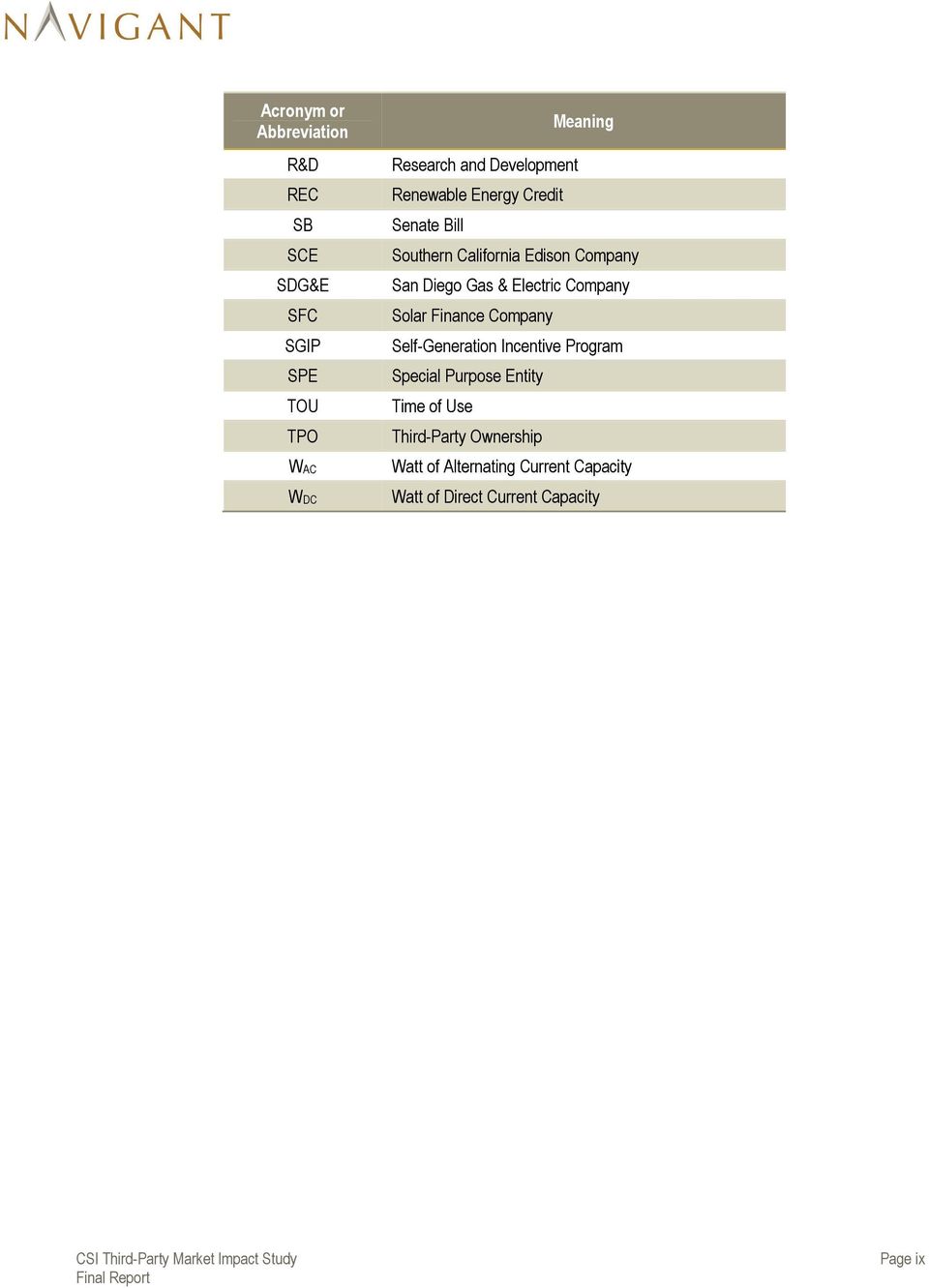
10 Acronym or Abbreviation R&D REC SB SCE SDG&E SFC SGIP SPE TOU TPO WAC WDC Meaning Research and Development Renewable Energy Credit Senate Bill Southern California Edison Company San Diego Gas & Electric Company Solar Finance Company Self-Generation Incentive Program Special Purpose Entity Time of Use Third-Party Ownership Watt of Alternating Current Capacity Watt of Direct Current Capacity CSI Third-Party Market Impact Study Page ix
11 Executive Summary Navigant Consulting, Inc. (Navigant) prepared this Third Party Ownership (TPO) Market Impact Study on behalf of the California Public Utilities Commission (CPUC). The purpose of this study is to explore how the advent and prevalence of third party ownership is affecting the development of a robust and sustainable rooftop solar industry in California. Specifically, this study focused on the California Solar Initiative (CSI) and seeks to do the following: Understand the market for third party owned systems in California Assess third party owner market share and trends Describe the current status of alternative financing mechanisms such as Property Assessed Clean Energy (PACE) programs in California Provide an overview of the third party owned business model, including the roles of solar finance companies, solar installation contractors, investors, and special purpose entities Review third party owned contract features, particularly with regard to potential issues of consumer protection Investigate certain economic aspects of third party ownership, such as the value over the life of the agreement and whether different solar finance companies are consistently reporting their costs to the CSI program Assess customer experiences with their third party owned systems and contracts Gauge compliance with certain provisions of Public Utilities Code (PUC) 2869, which requires that a third party provider file notice with the county recorder office when a photovoltaic (PV) system is installed using a third party ownership arrangement The ultimate objective is to use the investigations into the above areas to identify any necessary changes to the California Solar Initiative or state policies to promote the long term sustainability of the solar PV industry in regard to TPO arrangements. Methodology The Navigant team relied upon several research strategies to inform this study, including the following: Analysis of the CSI program database, also referred to as the PowerClerk database In depth interviews with market actors: o o o o Solar finance companies serving both the residential and non residential markets Solar installers serving both the residential and non residential markets Organizations implementing PACE programs Loan servicing companies providing PUC 2869 compliance services CSI Third-Party Market Impact Study Page x

12 Surveys of CSI host customers with a third party owned system (third party owned participants) from each of the three investor owned utility (IOU) service territories Review of a sample of TPO contracts Economic analysis of the key terms of a sample of TPO contracts Review of a sample of county recorder records for installed solar PV systems Secondary research, including industry reports and data Background The California Solar Initiative is a statewide program that provides financial incentives to customers of California s three major electric IOUs for the installation of customer side solar PV systems. The program is administered by Pacific Gas and Electric (PG&E), Southern California Edison (SCE), and the California Center for Sustainable Energy (CCSE) in San Diego Gas & Electric Company s (SDG&E s) service territory, and funded by the ratepayers of each of the respective service areas. The CSI program has a tenyear rebate budget of $1.9 billion and a target of 1,750 megawatts (MW) of installed PV capacity. Third party ownership proved to be a key component in the CSI program, both for the residential and non residential sectors. These financing arrangements effectively allow a customer to host a solar PV system on their property without having to purchase the system outright. In exchange for predictable monthly payments (either a flat lease rate or based on the power generated), customers with third partyowned systems can receive the benefits of solar generated power with no responsibility for the high upfront cost to purchase a system or for system maintenance and monitoring. CSI Third-Party Market Impact Study Page xi
13 Figure ES 1 illustrates the distribution of capacity installed in the residential sector for host owned and TPO systems on an annual incremental basis. The chart shows that in 2012, nearly three quarters of all residential PV capacity installed through CSI was third party owned. Figure ES 1. Incremental Installed Capacity of CSI Systems by Financing Type for Residential Installations 140 Installed Capacity (MW AC ) % 9% 91% 12% 88% 23% 77% 45% 55% 71% 29% Third Party Owned Host Customer Owned 0 89% Source: Navigant Team analysis of PowerClerk database extract from 2007 through December 31, 2012 CSI Third-Party Market Impact Study Page xii

14 Figure ES 2 illustrates the distribution of capacity installed in the residential sector for host owned and TPO systems on a cumulative basis. As shown, TPO systems are gaining an increasing share of the residential solar market, growing from 13 percent of the capacity installed in 2007 to 40 percent of cumulative installed capacity by Since 2010, host owned systems have declined each year in both market share and amount of new capacity installed. Figure ES 2. Cumulative Installed Capacity of CSI Systems by Financing Type for Residential Installations Cumulative Installed Capacity (MW AC ) % 13% 8% 92% 10% 90% 16% 84% Third Party Owned Host Customer Owned Source: Navigant team analysis of PowerClerk database extract from 2007 through December 31, 2012 The team found that residential customers do not exhibit a strong preference for solar PV leases or PPAs; since CSI started tracking the third party financing type in mid 2010, residential customers have entered into leases and PPAs at roughly the same rate. In 2012, 49 percent of TPO residential systems installed were PPA, 49 percent were leases, and the remainder are an unknown type. 1 Some SFCs offer only leases or only PPAs, or offer leases in some areas but PPAs in other areas, so residential customers may not have the opportunity to make an active choice between PPA and lease. 2 26% 74% 40% 60% 1 CSI did not require applicants to distinguish the type of TPO arrangement until mid As an example, SolarCity, one of the largest residential TPOs, offers PPAs in some zip codes and leases in other zip codes: ppa.aspx. CSI Third-Party Market Impact Study Page xiii

15 Figure ES 3 illustrates the cumulative distribution of capacity installed in the non residential sector for host owned systems and third party owned systems. In 2012, 47 percent of cumulative installed capacity in the non residential sector was third party owned. In contrast to the residential sector, there is no consistent trend toward third party ownership in the non residential sector. Figure ES 3. Cumulative Installed Capacity of CSI Systems by Financing Type for Non Residential Installations 700 Cumulative Installed Capacity (MW AC ) % 49% 47% 53% Third Party Owned Host Customer Owned Source: Navigant team analysis of PowerClerk database extract from 2007 through December 31, 2012 For commercial customers, PPAs account for 67 percent of systems installed in 2011 and 55 percent in 2012; leases account for 16 percent in 2011 and 18 percent in 2012, and the remainder are an unknown financing type. The nontaxable sector exhibits an even stronger preference for PPAs, which account for 83 percent and 84 percent of systems installed in 2011 and 2012, respectively. One possible explanation for this trend is that these entities are required to show a lease on their balance sheet, whereas PPA payments are reported as an operating expense. Key Findings % 28% 64% 59% 51% % 41% 47% Overall, the team s findings indicate that TPO arrangements for solar PV have not created any widespread consumer protection issues. The demand for residential solar PV systems involving thirdparty ownership is growing, and customers did not express any consistent concerns about entering into an agreement with third party providers. Customers with a TPO system are generally satisfied with their experiences, and our analysis of the financial terms in TPO contracts shows that most customers have likely benefited financially from their arrangement. On the other hand, the various analyses the team conducted indicated that some inconsistencies exist (i.e., in TPO contract terms) and that not all consumers may be equally protected. The team has included some initial recommendations to help improve consumer protection; however, additional, more granular analysis of a few topics could better illuminate the extent of the gaps that exist and whether additional improvements should be made. CSI Third-Party Market Impact Study Page xiv

16 Looking forward, in depth interview findings indicate that the phasing out of the California Solar Initiative rebates is not expected to harm the residential solar market, though it may create a modest slowdown for non residential projects. A greater, overarching concern for the market lies in potential changes to net energy metering and retail rate restructuring enabled by AB Those changes will likely impact the financial attractiveness of both new and existing customer side solar PV systems, including those with TPO arrangements. It will be important for the CPUC and other market actors (e.g., utilities and solar PV companies) to clearly communicate the impacts of those changes to consumers in order to allow them to continue making informed decisions about adopting solar PV. Third Party Ownership Market Benefited From a Favorable Policy Environment The TPO market has grown rapidly in California due to a favorable policy environment. The CSI program incentives, investment tax credit, accelerated depreciation, net energy metering, and tiered residential rates all combined to provide the ideal environment for TPO solar PV systems in California. In addition, the publicly available CSI participation data provided essential market intelligence to the burgeoning PV industry. Market actors are unconcerned about the end of CSI rebates because these changes have been expected and planned for since the program s inception. Increasingly, the dwindling value of the incentives no longer offsets the time and effort required of solar companies to apply for each residential PV system. For the non residential market, however, the incentives may still represent a meaningful piece of some project s finances, especially given those projects larger capacities and higher development and transaction costs. To this end, interviewed solar PV market actors suggested that the non residential market may be modestly affected by the end of California Solar Initiative rebates, as projects with only marginal financial returns may no longer meet solar company or host customer criteria. 4 In addition, market actors did mention that the availability of the CSI data is very valuable, and they would like to see similar data tracked after the CSI program sunsets. Finally, the uncertainty around the future of NEM and residential rate reforms enabled by AB 327 is a potential cause for concern, as the outcomes of those proceedings will impact the economics for both host owned and TPO customer side solar PV systems. Third Party Ownership has Driven Recent Growth in the Residential Market The increasing rate of residential PV system installations through CSI in the last three years (2010 to 2012) has largely been driven by the availability of TPO financing. The annual installation rate for host owned systems has remained relatively constant at about 10,000 new systems per year, showing a mostly linear trend over the five year period while the growth rate for third party owned system installations has increased dramatically since Since the primary data collection for this study was conducted prior to the passage of AB 327, future research will need to determine the actual effects of changes to NEM policy and rate reform. 4 For more on market actor perceptions about the end of the CSI Program, see Navigant s parallel CSI Market Transformation Study. CSI Third-Party Market Impact Study Page xv

17 Four Third Party Owned Business Models Have Developed Over the Course of the CSI Program Delivery of third party owned systems in the marketplace has evolved since the start of CSI, when only non residential TPO solutions existed. Over the course of the program, four main TPO business models have evolved for the residential market, each comprising different relationships between the solar finance company (SFC) and solar installer. The TPO business models the Navigant team identified are as follows: 1. Vertically Integrated SFC: Solar finance companies who self perform installations and most of the rest of TPO related services (e.g., marketing, sales, and post installation services such as billing and collections, monitoring, and operations and maintenance [O&M]) with inhouse staff. 2. Preferred/Partner Installer Network: These solar finance companies choose to leverage the services of independent solar installation contractors rather than employing their own installers or staff. 3. Certified Dealer Network: Similar to the Preferred/Partner Installer Network except that these solar finance companies are also equipment manufacturers and rely more heavily on installer partners to generate sales. 4. Broker Network: These solar finance companies serve as brokers between independent installation contractors and providers of capital, effectively providing a marketplace where those with project leads can do business with investors whose risk and return profiles align with each installer s potential projects. Third Party Owned Business Models are Continuing to Evolve The TPO market is continuing to evolve, offering expanded opportunities for independent installers and other third parties to leverage the various solar finance company business models and products. In combination with its capital provider relationships, each solar finance company s approach to installing the TPO systems it finances helps define its overall strategy for engaging with the market. Within this context, Navigant positioned the business model for each of the top five SFCs in the California market along each of two continuums, as illustrated in Figure ES 4. 5 The horizontal axis (red) represents the relative number of installation contractor firms with which a solar finance company works and the degree of formality or exclusivity that characterizes those relationships. The vertical (green) axis shows the degree to which the financing products offered through the solar finance company are branded or associated directly with the solar finance company versus financing products that can be customized or co branded to the needs of an individual, independent installer. 5 The top five SFCs were determined based on their relative shares of involvement in TPO contracts through the end of This relied on Navigant s assessment of apparent relationships between each SFC and the specialpurpose entities listed as the system owner for each project. (See Section 3.2 for more on market share.) CSI Third-Party Market Impact Study Page xvi

18 Figure ES 4. Positioning Map for SFC Installer Relationships Note: Size of circles represents relative share of installedd residential TPO capacity in California. Circle sizes and relative positioning are approximate. 6 Source: Navigant team analysis of PowerClerk data, August 2013 This evolution of different SFC business models provides independent solar installers with several options for offering third party financing to potential customers, allowing them to continue competing against the larger, vertically integrated firms. In addition, the Navigant team found thatt many solar PV finance companies screen their partner installers or have installation and equipment standards that should support higher quality installations. Finally, many of the larger solar finance companies employ third party servicing companies to facilitate much of the administrative work related to their TPO solar PV contracts, including filing Uniform Commercial Code (UCC) documents, liens, financing statements, and PUC 2869 compliant notices with county recorders. Third Party Owned System Customers are Generally Satisfied with the Products and Services Offered The Navigant team s surveys of solar host customers revealedd that the vastt majority of residential participants are very satisfied with their TPO arrangement (81%), their system s performance (70%), and the services they ve received through their solar finance company (84%). Non residential participants 6 While industry literature indicates that Vivint Solar has taken a sizeable share of the TPO market since 2012, the company was largely absent from the CSI PowerClerk data (implying that they have made only limited use of the incentives) ). As a result, the Navigant team could not accurately estimate their relative market share. Their business model, however, is similar to the vertically integrated model employed by SolarCity, and they would appear in the same place on the graphic. CSI Third-Party Market Impact Study Page xvii

19 show slightly lower satisfaction with their system performance and solar finance company services, but two thirds (67%) are very satisfied with their overall contract. Economic Analysis of the Financial Terms for a Sample of TPO Contracts Shows no Strong Evidence of Widespread Consumer Protection Issues Related to TPO System Pricing Most TPO system customers are paying lower prices for solar power than if they directly owned a comparable PV system, and are generally paying similar or slightly higher prices for their system s output as compared to their utility s bundled rates (under current rate structures). Figure ES 5 shows three metrics: median cost per watt, median effective cost per kilowatt hour (kwh) over time, and median annual effective interest rate, from (all costs in 2012$). These TPO financial metrics can be summarized as follows: The median installed cost per watt for a TPO system has decreased from $5.08/W in 2008 to $4.11 in The median effective interest rate has increased between 2008 (4.5%) and 2012 (7.0%), with a bump in contracts median effective interest rates beginning in 2010 (to 10%). The median effective price per kwh decreased from $0.34/kWh in 2008 to $0.21/kWh in CSI Third-Party Market Impact Study Page xviii

20 Figure ES 5. Key TPO System Financial Metrics over Time Median Effective Cost per kwh (2012$) Median Effective Interest Rate (%) Median Premium (% Change) Median Cost per Watt (2012$/W) Notes: (1)The effective interest rate is an annualized percentage rate (APR). (2) The team used a 6.96% discount rate for this analysis. This discount rate matched that used in the California Net Energy Metering Ratepayer Impacts Evaluation, October 2013 (page F 9). (3)The number of TPO contracts included in the median cost per watt and median cost per kwh is 212. (4) The number of TPO contracts included in the interest rate analysis is 142. This value is lower than the full sample of 212 contracts because 70 of the contracts are full pre payment contracts. Source: Navigant team analysis of CSI contracts CSI Third-Party Market Impact Study Page xix

21 The Navigant team compared these TPO financial metrics to those for host customer owned systems. Figure ES 6 shows this comparison over time. In 2012, the median cost per watt of a TPO system was very close to that of a host owned system, with a difference of only $0.01/W. However, when reviewing the median cost per watt data, it s important to note that the comparison isn t necessarily apples to apples. For instance, the benefits from the solar system are realized either for the length of the contract term for a TPO solar system or for the entire life of the solar system for a host owned system. In addition, system maintenance is included on third party owned systems but not for host owned systems. Figure ES 6. Modeled Cost per Installed Capacity (2012$/W) for Sampled CSI Projects Contract Start Year $6.00 $5.75 $5.00 $4.00 $5.08 $5.03 $4.46 $5.03 $4.80 $4.78 $4.38 $4.12 $4.11 $3.00 $2.00 $1.00 $0.00 Cash System TPO System Cash System TPO System Cash System TPO System Cash System TPO System Cash System TPO System Notes: (1) The TPO system costs in $/W are the present value of the full cost for the TPO system (in 2012$) divided by the installed capacity (Watt AC).(2) The team used a 6.96% discount rate for this analysis. This discount rate matched that used in the California Net Energy Metering Ratepayer Impacts Evaluation, October 2013 (page F 9). (3) The number of TPO contracts used to create this chart was 212. The number of contracts per year is available in Appendix A. (4) The comparable host owned system (cash system) cost is based on the average value from the CSI database, PowerClerk, for hostowned systems. The team calculated the cash system price using non TPO data and included the effect of the CSI program incentives and the 30% investment tax credit. Source: Navigant team analysis of CSI contracts Third Party Owned Contracts Generally Address Most Significant Consumer Protection Issues, Though Some Inconsistencies Exist Contracts for residential TPO arrangements, especially those from the largest solar finance companies, address the major areas of consumer protection. However, there are some gaps and inconsistencies in areas related to events such as a home sale, re roofing, or the end of the contract term. For example, almost all of the contracts allow the customer to transfer the responsibility for the TPO arrangement to the new property owner upon the sale of a home, provided the new owner CSI Third-Party Market Impact Study Page xx
22 meets the financial criteria of the solar finance company. However, not all contracts provide an alternative if the new homeowner does not meet the financial criteria. The Navigant team noted that some of the alternatives may be financially burdensome. In addition, while most contracts reviewed for this study address the responsibilities of the parties if the customer needs to re roof during the TPO term, some of them do not. All that did address this issue stipulate that the homeowner is responsible for the re roofing expenses, as well as the removal and reinstallation of the solar PV system. All contracts reviewed directly address the issue of system removal and roof repair at the end of the contract term, with the majority stating that the third party owner is responsible for removing the system after the contract term ends. Only one of the contracts reviewed (signed in 2010) indicates that the responsibility for removing the system lies with the customer. Solar Finance Companies Appear to be Complying with PUC 2869 Reporting Requirements for the Majority of TPO Systems Installed California PUC 2869 was established by the Legislature in 2009 in order to notify and protect prospective property buyers and interested parties of the establishment of an existing solar PV contract on the property or adjacent properties. The team s research showed that, in general, companies are complying with those requirements, and that compliance has improved over time since the requirements took effect. Recommendations Though the evolution of the TPO market has been robust with few pain points, the Navigant team identified the following recommendations as opportunities to better understand the characteristics and impacts of TPO arrangements and to improve protections for those consumers who use them. With the sunset of the California Solar Initiative program, it is not readily clear to whom the responsibility for the implementation of each recommendation should fall; however, the TPO industry should take an instrumental role in implementing those related to customer agreements. The recommendations from the Navigant team are as follows: 1. Continue to require and provide market defining data on solar PV installations in California. Market actors repeatedly emphasized the value of the data that California Solar Initiative collected through PowerClerk and made public through the California Solar Statistics website. The CPUC can help sustain the market by continuing to require the provision of the market defining data through continuation of the California Solar Statistics website. The CPUC has already initiated a process to collect such data through interconnection applications; completing approval of this requirement before significant gaps in the data occur will serve the market well Provide resources to customers about solar PV benefits, costs, and risks to facilitate educated adoption of third party owned arrangements. This information should help to fill gaps in 7 The CPUC should ensure that any such data collection and provision comply with all state and federal laws and regulations regarding consumer protection and customer privacy. CSI Third-Party Market Impact Study Page xxi
23 customer understanding of TPO and address concerns regarding potential ramifications of changes in net energy metering rules or retail rates. These resources might include the following: o Tool for potential third party owned PV customers: Online tool to help customers understand the economics of going solar versus staying with their utility under various rate structures. This tool might also serve to inform existing third party owned PV customers whether they have paid more or less with solar than they would have without it. 8 o Frequently asked questions (FAQs) on PV and TPO topics such as minimum contract provisions, taxability of incentives, and utility rate escalation assumptions. o Establish a mechanism for ensuring that customers are made aware of and understand what factors make their TPO arrangements financially attractive. Changes to net energy metering or residential rate schedules may have significant ramifications to the financial attractiveness of new TPO arrangements. However, many existing TPO arrangements were specifically sized to eliminate the customers most expensive rate tiers. A significant shift or flattening of residential rates could render these existing TPO arrangements less attractive compared to utility supplied electricity. Customers should enter future TPO arrangements with a full understanding of this dynamic. To this end, customers entering a new TPO arrangement or purchasing a PV installation should acknowledge that they understand that a change in factors like utility retail rates or net energy metering terms could change the financial attractiveness of the decision. Potential options for implementing this protection might include the following: o o PUC 2869 could be revised to require SFCs to include specific disclosures to each customer in their proposals and/or agreements Market actors, such as the California Solar Energy Industry Association (CALSEIA), could encourage solar companies to require that customers sign an affidavit acknowledging these issues prior to contract execution. 3. SFCs should include a standard, minimum set of financial terms in all third party owned agreements. The economic analysis uncovered that some contracts did not contain information such as length of term or system size. Other contracts were unclear because the terms were not clearly labeled as material or informational. All TPO agreements should include the following terms or provisions and clearly label each as to whether they are in effect in that agreement or provided for information only. The minimum financial terms should include the following: a. Monthly or annual production performance guarantee or range of performance b. System size c. Down payment and amount d. Monthly payments or cost per kwh produced e. Length of term f. Escalation rates or schedule of payment amounts g. Total expenditure or range of expenditures, over the term of the agreement 8 For comparison, consider the online tool introduced by National Grid to enable customers in New York to compare utility bills to what they would pay via service through an energy services company (ESCO). See: CSI Third-Party Market Impact Study Page xxii
24 4. SFCs should also continue to refine their standard residential contract terms and conditions to fully address consumer protection issues. These terms should give customers clear and reasonable options in the event of home sale, re roofing, SFC default, and contract termination. To ensure that these refinements are consistent across TPO providers, market actors could collaborate on standard agreements through a working group or other forum. The Solar Access to Public Capital (SAPC) working group recently released three standard contract templates for residential leases and commercial PPAs. 9 Standardized contracts would also facilitate the securitization and sale of TPO agreements in capital markets. 5. The CPUC should consider mandating that TPO contracts include covenants to protect the customer if the SFC goes out of business or the asset is sold. Such provisions could specify that a priority stream of payments is set aside to cover maintenance and warranty of the systems. Interviews with market actors indicate that the agreements between the solar PV finance companies and the special purpose entities used to finance third party owned systems address these issues; however, since these confidential contracts are not subject to CSI reporting requirements, the research team was not able to verify this independently. 6. The CPUC should conduct additional periodic and ongoing research to better understand the changing characteristics of the TPO market and improve the granularity of certain analyses conducted in this study. Such efforts can help to identify isolated or emerging gaps in consumer protections. Such efforts might include any or all of the following: Sensitivity and scenario analysis around the financial metrics produced for this study. This might include variations in discount rates or projections of the value of a TPO system to the host customer at the end of their contract term. Similarly, future analysis could seek to refine the cost estimates for a comparable host owned system for each sampled TPO system. Analysis to better understand the drivers behind the differences in average system size between TPO and host owned systems. Repeat host customer surveys every 2 3 years to track any changes in metrics that can help characterize how the TPO market is evolving. Use sample sizes large enough to allow statistically significant comparisons between customers with systems of various ages. In particular, determine whether TPO arrangements are expanding access to solar PV to customers with lower income levels by comparing respondents reported income levels in future studies to the baseline information collected for this study. Similarly, consider sampling approaches that allow statistical comparisons between customers with solar lease and solar PPA arrangements. For future surveys, match TPO contract reviews and TPO system financial analyses to the actual CSI participants who respond to surveys in order to compare customer specific data to each customer s perceptions of TPO arrangements and value. Use this analysis to further determine how well TPO contract terms and pricing align with customer expectations, 9 National Renewable Energy Laboratory, Renewable Energy Project Finance, Solar Access to Public Capital working group. CSI Third-Party Market Impact Study Page xxiii
25 including both the perceived financial (i.e., energy bill savings) and environmental (i.e., carbon footprint reduction and REC ownership) benefits of adopting solar. As time passes, include additional survey questions targeting TPO customers who have exercised buy out provisions or sold their homes to identify whether any consumer protection concerns have arisen. CSI Third-Party Market Impact Study Page xxiv
26 1. Introduction Navigant Consulting, Inc. (Navigant) is pleased to present this study to the California Public Utilities Commission (CPUC) on the market for third party ownership (TPO) of solar photovoltaic (PV) systems in California. This study is a component of a broader California Solar Initiative (CSI) market transformation research initiative and is more narrowly focused on the assessment of issues specific to TPO arrangements. The CSI is a statewide program that provides financial incentives to customers of California s three major electric investor owned utilities (IOUs) for the installation of customer side (<1 megawatt [MW]) solar PV systems. 10 The CSI program is administered by Pacific Gas and Electric (PG&E), Southern California Edison (SCE), and the California Center for Sustainable Energy (CCSE) in San Diego Gas and Electric Company s (SDG&E s) service territory, and funded by the ratepayers of each of the respective service areas. The CSI program has a ten year rebate budget of $1.9 billion and a target of 1,750 MW of installed PV capacity. Third party ownership proved to be a key component in the CSI program, both for the non residential and residential sectors. TPO addresses some of the key barriers to the widespread adoption of solar PV, including the high up front costs to purchase the systems and the hassles of system maintenance and monitoring. According to Jigar Shaw, modern solar power purchase agreements (PPAs) were pioneered in 2003 by SunEdison and others for commercial buildings. 11 Changes to the tax code in 2005, namely, increasing the commercial solar investment tax credit (ITC) from 10% to 30%, caused a market response that further increased TPO sales in the non residential sector and made similar products for the residential sector attractive. 12 Since the first residential TPO project was submitted in 2007, the popularity of TPO arrangements has quickly grown to become a significant share of the CSI in the residential sector. The purpose of this study is to explore how the advent and prevalence of third party ownership is affecting the development of a robust and sustainable rooftop solar industry in California. The primary focus of this report is on the residential sector, as TPO for residential systems emerged during the CSI program. While this report will also provide data on TPO in the non residential sector, this is largely to be able to compare against what has transpired in the residential sector. Specifically, the CPUC wants to better understand the third party ownership marketplace in order to determine whether there are potential customer protection issues that need to be addressed through changes in CPUC policies or other interventions. This study seeks to do the following: Understand the market for third party owned systems in California. This includes a description of the history of third party ownership in California, the different types of TPO arrangements, and their market share. 10 Project sizes can be up to 5 MW but the rebates are available only for the first MW. 11 Personal correspondence with Jigar Shah, founder of SunEdison. 12 The 2005 Energy Policy Act increased the commercial solar investment tax credit from 10% to 30% for two years (see CSI Third-Party Market Impact Study Page 1-1
27 Describe the current status of Property Assessed Clean Energy (PACE) programs in California in light of recent setbacks. Investigate certain economic aspects of TPO, such as the value over the life of the agreement and whether different solar finance companies are reporting their costs to the CSI consistently. Assess customer experiences with their TPO systems and contracts. This includes satisfaction with the PV systems and financial arrangements, how customers evaluate the TPO arrangements financially, and whether customers have concerns about moving after signing a TPO arrangement. Review the contract features of the TPO arrangements, especially the end of life provisions and options, responsibilities for restoring a roof when the system is removed, and the protections in place in the event of the solar finance company bankruptcy. Gauge compliance with certain provisions of Public Utilities Code (PUC) 2869, which requires that a TPO provider file notice with the county recorder office when a PV system is installed using a TPO arrangement. The ultimate objective is to use the investigations into the above areas to identify any necessary changes to the CSI program or to CPUC policies to promote the long term health of the solar PV industry with regard to the emergence of TPO arrangements. 1.1 Methodology The Navigant team relied upon several research strategies to inform this study: Analysis of the CSI participation data in the PowerClerk database In depth interviews with market actors: o o o o o Providers of capital Solar finance companies serving both the residential and non residential markets Solar installers serving both the residential and non residential markets Organizations implementing PACE Loan servicing companies providing PUC 2869 compliance services Surveys of CSI customers with a TPO Review of a sample of TPO contracts Economic analysis of the key terms of a sample of TPO projects Review of a sample of county recorder records A detailed methodology is provided in Appendix A, including a discussion on the limitations of this analysis and potential biases inherent in the primary data collection efforts. For example, the broad scope of this study and the inconsistent quality or availability of data needed for some analyses required the team to make several simplifying assumptions in order to complete its assessments. Similarly, for the participant surveys and contract review efforts, the team designed its sampling approaches to balance CSI Third-Party Market Impact Study Page 1-2
28 overall representativeness with a desire to compare various companies, customer sectors, or other population segments. However, sample size limitations meant that such comparisons could not always be made with sufficient statistical certainty. Readers should also note the potential biases inherent in the team s in depth interview process. Again, each of these methodological challenges, including the Navigant team s approach to mitigating or addressing them, is further detailed in Appendix A. 1.2 Organization of Report The remainder of the report is organized into the following sections: Section 2 provides a history of the evolution of TPO arrangements as well as the market share and trends, including an overview of the current status of PACE financing. Section 3 describes the market actors involved in the delivery of TPO arrangements and the various approaches that have evolved. Section 4 summarizes a review of the key contract features pertaining to consumer protections. Section 5 presents a review of the level of compliance with PUC Section 6 provides an economic analysis of the key terms from a sample of TPO contracts. Section 7 outlines the customer experience with their TPO agreements and TPO participant survey findings. Section 8 presents Navigant s key findings and recommendations. CSI Third-Party Market Impact Study Page 1-3
29 2. Market Context This section presents important background for understanding the history and key drivers of TPO arrangements for customer side solar PV. It provides context for how the market has developed and key trends related to its use in the California market. This section, similar to the entire report, has a heavy emphasis on the residential TPO model. While TPO was employed in both the non residential and residential markets during the CSI program, TPO in the residential market is newer and less has been reported on how this market functions in California. The TPO model for customer side solar PV was pioneered in the non residential sector in 2003, four years before the first residential TPO arrangements were offered to customers. 13 As will be shown, the TPO model for the non residential sector is considerably more mature than the residential sector. The CPUC has heightened concerns about the long term TPO arrangements into which residential customers are entering. This is not only because these arrangement are new, but because most residential customers are likely less familiar with contract evaluation than non residential or government customers and that most TPO arrangements provide residential customers little or no opportunity to negotiate their terms. Thus, much of this report is focused on TPO for residential applications. Many of the terms and conditions of TPO contracts, however, apply to both sectors and, unless specifically called out as residential, the discussion applies to both sectors. 2.1 History of TPO Arrangements Third party ownership arrangements allow homeowners, multifamily property owners, businesses, nonprofit entities, or government facilities (i.e., host customers) to install and receive power from an onsite solar PV system without having to own the physical system. TPO arrangements are usually offered directly through a solar finance company (SFC) or via a solar installation contractor. These firms handle all aspects of the project development process for the host customer, including system design, financing, permitting, installation, and sometimes operations, monitoring, and maintenance. The underlying contracts are long term agreements typically ranging from 15 to 20 years between the SFC and the host customer. Such arrangements can require little to no up front payment from the host customer, instead requiring a stream of recurring monthly payments to the solar finance company. In a TPO arrangement, project risks and benefits are spread across the participating entities so that the generated solar power can often be offered to host customers at rates at or below their current utility prices. The TPO model for residential customer side solar PV in California has steadily risen in popularity since CSI records began tracking its use in SunRun introduced options for PPAs and solar leases to 13 Jigar Shah, founder of Jigar Shah Consulting (present) and founder of SunEdison. CSI Third-Party Market Impact Study Page 2-1
30 California residents in December Soon after, in April 2008, SolarCity began offering zero down solar leasing to customers in most parts of the state. 14 The application to customer side solar PV arose largely as a solution to many host customers inability to take adequate advantage of non refundable federal tax credits available for the installation of solar PV systems. These tax credits, which include the federal ITC and accelerated and bonus depreciation, require the claimant (usually a large business) to have sufficient taxable income in order to monetize the credits. The SFC finances TPO arrangements by partnering with equity investors including those who can efficiently utilize these tax incentives who receive a financial return from the customers monthly payments. Figure 2 1 demonstrates the steady rise in popularity of third party ownership in the California residential market. Nearly three quarters (71%) of solar PV capacity installed in the residential sector in 2012 was third party owned. Figure 2 1. TPO Market Share of Annual Incremental Capacity Additions for CSI Residential Installations 100% 90% Share of Installed Capacity 80% 70% 60% 50% 40% 30% 20% 10% 0% 71% 45% 23% 11% 12% 7% Source: Navigant team analysis of PowerClerk data, February Policy and Regulatory Drivers for Customer Side PV and TPO in California This section discusses several key policy drivers that encouraged the growth of customer side PV in California and the development of the TPO industry in particular. Figure 2 2 illustrates a time line of several key policies and dates for the California market. It is the combination of key state and federal policies that together created an environment in which the TPO could take hold and flourish. 14 Solar City Press Release, April 22, 2008: Offer Zero Down Solar Financing to California Residents.aspx. CSI Third-Party Market Impact Study Page 2-2
31 At the state level, the CSI (enacted in 2006 and launched in 2007), created a ten year signal to the private sector, representing an environment of relative long term stability in which to build distributed solar businesses and in which to grow those businesses and innovate to drive down delivery costs and reduce market barriers. In 2008, Assembly Bill (AB) 2863 was passed in response to the growing number of TPO systems and imposed requirements on third party owners regarding customer disclosures and contracts. The passage of 1 gigawatt (GW) of installed distributed solar capacity in 2012 was a significant milestone for the success of the CSI program. At the federal level, the Energy Improvement and Extension Act of 2008 extended the 30% investment tax credit through 2016, eliminated the $2,000 cap for residential solar PV systems, and permitted companies paying the Alternative Minimum Tax to qualify for the credit. These changes helped expand the market for customer side solar and created an environment of long term stability for the private sector. 15 The 2008 bill also added a 50 percent bonus depreciation for the Modified Accelerated Cost Recovery System (MACRS); this provision was later extended as part of American Recovery and Reinvestment Act of 2009 (ARRA) and subsequent bills (DSIRE MACRS citation). ARRA also gave commercial solar PV system owners (including third party owners of residential systems) the ability to receive a direct Treasury grant in lieu of the ITC through the 1603 Treasury Program; this gave project developers access to capital that was difficult to obtain during the economic downturn. 16 All of this enhanced the attractiveness of the distributed generation space and helped SFCs and others attract much needed tax equity and other investments to fuel the TPO model. Within this context of long term incentive stability from the state and federal levels, residential TPO players began to emerge and grow in California. First movers in the residential sector were SunRun (2007) and SolarCity (2008), followed by Sungevity (2010) and SunPower (2011). Some of the final larger entrants shown in the PowerClerk data through the end of 2012 include Clean Power Finance (CPF) and NRG. Included below are descriptions of each of the key policies, programs, and regulations mentioned above, along with others that were key in the market growth, including NEM and residential rate structures. 15 Solar Energy Industries Association (SEIA) Website, September tax/solarinvestment tax credit. 16 SEIA Website, September tax/1603 treasury program. CSI Third-Party Market Impact Study Page 2-3
32 Figure 2 2. Key Dates in California Solar Market History Source: Navigant analysis of program and public records CSI Third-Party Market Impact Study Page 2-4
33 Pre CSI Solar Incentive Programs in California Solar incentive programs were active in California for nearly ten years before CSI was launched. The California Energy Commission (CEC) provided incentives for solar PV projects through the Emerging Renewables Program from 1998 through The CPUC provided incentives for larger scale solar PV projects through the Self Generation Incentive Program (SGIP) from 2001 to California Solar Initiative In 2006, the California legislature authorized the CPUC to create a solar rebate program through the passage of Senate Bill (SB) 1. The CPUC created the CSI to deliver rebates for distributed solar projects to customers of California s IOUs. The CPUC CSI program began in January 2007 with the dual goals of installing 1,940 MW of distributed solar capacity by the end of 2016 and transforming the state s solar market to be self sustaining. 19 CSI has several program components related to low income housing, research and development (R&D), and solar thermal projects; however, the focus of this report is on the largest component of CSI, the CSI General Market Solar Program. The CSI General Market Solar Program provides incentives for residential and non residential solar PV installations between 1 kilowatt (kw) and 1 MW in size. The program has a ten year rebate budget of $1.9 billion and a target of 1,750 MW of installed PV capacity. Net Energy Metering Net energy metering is a program that enables a customer with distributed renewable generation (including solar PV) to sell their system s excess electricity back to the utility at the same rate they purchase electricity when their solar PV system isn t producing enough electricity to meet their demand. Thus, a customer only pays the utility when their net electricity usage exceeds what is produced by their solar PV system, and if they use less electricity than their system produces, the utility pays them for that excess generation. Net energy metering has been in place in California since 1995 when PUC 2827 was enacted; the code has been amended through legislation and CPUC decisions several times since then. 20 SB 1 the legislation that established CSI raised the cap on net energy metering from 0.5 percent of a utility s aggregate customer peak demand to 2.5 percent. 21 California has required utilities to allow net metering since 1996; however, raising the cap in 2006 was necessary to prepare for the large increase in solar PV capacity expected from the CSI s statewide efforts. In 2010, the NEM cap was raised once again to 5 percent through the passage of AB 510. In addition, the method for calculating aggregate customer peak demand was changed in 2012 by the CPUC to be based on non coincident peak demand rather than coincident peak demand. 22 This landmark Commission Decision (D ) more than doubled the total capacity of distributed generation eligible for NEM, increasing the allowed capacity by more than 2 GW. Recent legislation (AB 327) signed into law on SB 1 also authorized funding and associated goals for publicly owned utilities. This study focuses only on the CSI program for the investor owned utilities for which the CPUC has regulatory oversight. 20 Database of State Incentives for Renewables and Energy Efficiency (DSIRE), September Ibid. 22 CPUC Decision , May 24, CSI Third-Party Market Impact Study Page 2-5
34 October 7, 2013, has several provisions related to net energy metering. The bill codifies recent changes to the net energy metering cap, provides a path toward removing the cap altogether, and enables utilities to possibly modify their residential electricity rate structures so that all customers pay a minimum monthly flat fee regardless of usage, if the CPUC allows them to do so. 23 The bill also requires the Commission to determine an appropriate transition period after which existing NEM customers will be switched over to the new NEM tariff. 24 The full impacts of AB 327 on net energy metering customers are still unknown pending the CPUC s decision on changes to the utility rate structure. During the in depth interviews conducted for this and the parallel CSI Market Transformation Study, however, solar PVmarket actors expressed concerns about what the pending bill and subsequent might mean for the viability of both customer side solar PV and TPO agreements. 25,26 Notably, the Commission s mid 2012 decision on NEM (D ) still requires that the program be temporarily suspended on January 1, 2015, unless the CPUC has issued its new policy rules for the program by that date. Investment Tax Credit and Treasury Grants The federal government established a tax credit for businesses that invest in solar and other renewable energy technologies, known as the investment tax credit. The original ITC was established in the Energy Policy Act of 2005, and renewed in subsequent pieces of legislation including the Energy Improvement and Extension Act of 2008, which extended the ITC for eight years until December 31, The 2008 act also eliminated the $2,000 cap for residential solar PV systems and permitted both individuals and companies paying the Alternative Minimum Tax to qualify for the credit. 28 For solar projects, the credit is equal to 30 percent of the system s installed costs; starting on January 1, 2017, it will be reduced to 10 percent. 29 Adding further flexibility for commercial solar PV project developers (including third party owners of residential systems), ARRA gave project developers the option of taking a direct Treasury grant up front in lieu of the ITC. 30 For residential systems, taxpayers may claim a credit of 30 percent of qualified expenditures for a system installed on site and used at the taxpayer s residence. If the tax credit exceeds their tax liability, taxpayers may carry the credit forward until The long term renewal of the ITC created favorable conditions for the emergence of the third party ownership model. The ITC enabled third party owners to receive tax credits (in addition to other incentives such as the CSI incentives) for systems located at host customer sites brown signs ab 327 bill/. 24 The CPUC issued its final decision on the NEM transition period on April 4, The decision allows for any existing NEM system to remain on the current NEM tariff for a period of 20 years from the date of interconnection. The decision can be accessed at: 25 Since the primary data collection for this study was conducted prior to the passage of AB 327, future research will need to determine the actual effects of changes to NEM policy and rate reform. 26 Given the timing and scope of this study, as well as the complexity of interrelated issues involved in the NEM and rate reform proceedings, this study did not attempt to model solar PV or TPO agreement economics under potential future rate or NEM scenarios. 27 SEIA Website, September tax/solar investment tax credit. 28 Ibid. 29 DSIRE, September SEIA Website, September tax/1603 treasury program. CSI Third-Party Market Impact Study Page 2-6
35 Modified Accelerated Cost Recovery System and Bonus Depreciation 31 The MACRS permits system owners to reduce their taxes because the value of tangible property is reduced at an accelerated pace; this enables system owners to achieve faster and ultimately higher overall rates of return on their investments. 32 A closely related tax benefit is the bonus depreciation. The Federal Economic Stimulus Act, enacted in February 2008, included a 50 percent first year bonus depreciation (26 USC 168(k)) provision for eligible renewable energy systems acquired and placed in service in Congress extended and modified the allowance for bonus depreciation several times since the original enactment, most recently through the American Taxpayer Relief Act of 2012, which passed in January The 50 percent bonus depreciation only applies to solar PV systems placed into service before December 31, Both of these federal tax policies further incentivize business owners (including thirdparty owners of residential systems) to invest in customer side solar PV; these are benefits that are unavailable to residential customers. Assembly Bill 2863 Creating Public Utility Code 2869 In August 2008, the California Legislature passed AB 2863 to govern the emerging third party ownership market. 34 AB 2863 created PUC 2869, which made a distinction between independent solar energy producers (which includes third party owners) and other regulated electric service providers in the state, and clarified regulatory requirements for independent solar energy producers. Through this legislation, third party owners are required to make all residential TPO contracts available to the CPUC upon request, notify the county recorder when a TPO contract is terminated or transferred, and disclose specific items to customers in plain language through the TPO contract. Residential Rates There are several characteristics of residential electricity rates in California that increase the attractiveness of solar PV such as tiered rates, time of use (TOU) rates, and minimal fixed charges. 35 With tiered rates, customers pay higher rates per unit of electricity (kilowatt hour [kwh]) for consumption that exceeds certain minimal thresholds. The California Legislature has sharply restricted the CPUC s ability to set cost based rates and has set rate caps on the lower tiers. Thus, recent rate increases have impacted the top tiers. Households that consume a large amount of electricity can install a solar PV system sized to reduce consumption to below the threshold that triggers the highest rate, thus providing a significant economic benefit to the household. Some California electric utilities have TOU rates in which electricity costs more at peak times, which are typically when solar PV systems are generating the most electricity. Finally, California electricity rates have historically had low fixed charges, with most or all of the costs of 31 Modified Accelerated Cost Recovery System (MACRS) + Bonus Depreciation ( ), Database of State Incentives for Renewables and Energy Efficiency: 32 IRS Accelerated Depreciation Tax Guidance: pdf/p946.pdf. 33 For eligible systems, bonus depreciation allows the system owner to deduct 50% of the adjusted basis of the property in the tax year in which the system was placed in service. The remaining 50% of the adjusted basis is then depreciated over the ordinary MACRS depreciation schedule. For more, see: 34 California Assembly Bill Other factors that may contribute to the attractiveness of solar in the residential sector include lack of demand charges and the requirement that customers do not have to pay departing load or standby charges. CSI Third-Party Market Impact Study Page 2-7
36 electricity generation, transmission, distribution, and all other utility functions (e.g., reliability, billing, customer service, and public purpose surcharges) rolled into the variable retail electricity rate. With net metering, customers pay the retail electricity rate only for annual electricity consumption in excess of their system s annual generation, although they still benefit from the utility s transmission and distribution (T&D) capacity, reliability services, and programs funded by public purpose charges throughout the year. 36 Thus, the current residential rate structures encourage adoption of solar PV by allowing households with solar PV to reduce or eliminate the use of utility generated electricity in the most expensive rate tiers or reduce or eliminate the use of utility generated electricity during the most expensive times of day. The current utility rate structures also do not necessarily allocate the full fixed costs for transmission, distribution, reliability, and other utility functions to solar customers. Notably, these residential rate characteristics may change in future rate cases pursuant to AB 327 (see above discussion on Net Energy Metering), which allows for a reduction in the number of residential rate tiers and for the CPUC to approve a fixed monthly charge of up to $ Types of Third Party Ownership Arrangements This section describes the key characteristics of and differences between the two main TPO financing mechanisms, solar leases and solar PPAs. In essence, a solar lease and a PPA primarily differ in what the host customer is purchasing from the TPO provider. A lease involves fixed monthly payments for the solar system, regardless of how much power it produces each month. 37 A PPA, on the other hand, involves payments for the solar electricity produced by the system, which varies from month to month. For many customers, the differences between the two types are academic from a practical standpoint. Both arrangements typically include provisions for system metering, maintenance, and performance guarantees, as well as the option for the host customer to buy the equipment, making the two contract types largely equal from the host customers standpoint. Table 2 1 provides a comparative overview of key features for the two contract types, indicating those areas where the mechanisms differ in their execution. The two sections following the table provide additional details. 36 Other utilities may charge for these non generation costs (e.g., T&D, reliability) through separate fixed costs on a bill, rather than linking them to the amount of utility electricity purchased, which would make net metering less financially beneficial to solar PV adopters. 37 While in the lease agreement there is a fixed payment, the customer generally has a performance guarantee that the PV systems will provide energy within a specified range. If the system underperforms, the customer is generally compensated. That is, a customer generally isn t paying a fixed fee for an underperforming system. CSI Third-Party Market Impact Study Page 2-8
37 Table 2 1. Key Features and Differences Between Solar Leases and PPAs Feature Solar Lease PPA Product Offering Escalation Factors Contract Duration System Monitoring Maintenance (including inverter replacement) Performance Guarantee System Buy out Customer leases the solar PV equipment from the TPO provider to produce on site electricity. Monthly payments are for the use of the system. Lease payment amount may escalate on an annual basis to account for inflation; others may incorporate expected inflation into base payment amount. Typically 20 years, with some as short as 10 years for residential. Non residential leases are more likely to be negotiated, and may be as short as 7 years. Customer purchases the power produced by the on site solar PV system, which is owned by the PPA provider, at a predetermined price ($/kwh). PPAs typically include an escalation factor that increases the PPA price each year. Escalation factors are based on expected increases in utility electricity rates. Typically 20 years, but as short as 10 years. Performed by TPO provider; many also offer monitoring capabilities or data reports to the host customer. Performed by TPO provider. Lease provider guarantees system s minimum monthly production levels and compensates host customer for any shortfalls. No guarantee, but host customer only pays for what the system produces. However, PPA provider s return on investment is based on those customer payments, so provider is incentivized to monitor and maintain system performance. Host customer typically has the option to buy out the PV system equipment from the TPO provider at any point during or at the end of the contract term. The buy out price or formula is defined in the contract. Source: Adapted from Data includes additional input from market actor interviews and Navigant analysis of CSI TPO contracts Solar Lease In a solar leasing model, the host customer makes a predetermined monthly payment in exchange for the installation and use of a solar energy system at their facility or residence over an extended period of time (10 20 years for residential and 7 15 years for non residential). Similar to other types of equipment leases, making a higher up front payment can lower the monthly payments over the life of the agreement. Some TPO providers may also offer a fully prepaid lease that enables the customer to retain more of the longterm financial benefits of the system, but still leaves the long term maintenance and repair responsibility CSI Third-Party Market Impact Study Page 2-9
38 with the SFC and TPO investors who own the system. Customer payments can be either fixed over the life of the contract or escalate annually at a predetermined rate. The TPO provider typically monitors the system s output, maintains the system as required (including inverter replacement), and offers some form of performance guarantee for the system s minimum monthly power output. This alleviates the host customer s need to monitor and maintain the equipment and protects them from system malfunctions. For non residential customers, particularly businesses, signing a solar lease may have implications for the host organizations balance sheet. Accounting rules require that certain long term equipment leases be classified as a capital lease, which appears as a liability on an organization s balance sheet. In an effort to minimize such liabilities, such customers may seek shorter contract terms that allow them to classify the system as an off balance sheet operating lease. 38 Others may simply opt for a PPA arrangement to avoid the issue altogether Power Purchase Agreement In the solar PPA model, the customer pays for the solar power produced by the system each month at a fixed per kwh rate that is usually structured to be equal to or less than their current electric utility rate. Like a solar lease, the PPA can last up to 20 years, and the price per kwh may escalate at a predetermined annual rate. In addition to the no money down option, PPAs can also be partially or entirely prepaid (based on anticipated power production) at the beginning of the contract, resulting in a lower per kwh rate for the solar PV power produced. 39 As with solar leases, PPA host customers are not usually responsible for monitoring and maintaining the system; they pay only for the electricity it produces. The PPA provider may not provide a specific performance guarantee; however, because the PPA provider s cash flows (and rate of return) are dependent on the system s continued performance, it is in the provider s best interest to make sure the equipment is maintained. As a result, both PPAs and solar leases usually include long term system monitoring, maintenance provisions, and a long term warranty that place the burden of ensuring system performance on the TPO provider. Notably, regulations in some states classify a TPO system as a utility or energy service provider. This may expose the TPO provider to additional risks or, in states with conventional (i.e., monopoly) regulatory structures, disallow the PPA mechanism altogether. As of 2013, only 22 states (plus the District of Columbia and Puerto Rico) had authorized solar PPAs in their jurisdictions. As a result, several SFCs offer both PPA and solar lease options, depending on the location The Federal Accounting Standards Board and International Accounting Standards Board are in the process of revising the requirements for reporting leased assets and their associated liabilities. These updates are likely to require a lessee to recognize assets and liabilities for leases with a maximum possible term of more than 12 months, effectively converting many currently operating leases to capital leases that will appear on balance sheet statements. For more, see 39 With a prepaid solar PPA, the rate the host customer pays for the solar power produced is fixed for the term of the contract (no escalation); however, there may be a need to periodically true up the actual power production against the modeled output used to determine the up front payment. 40 Database of State Incentives for Renewables and Efficiency, September 2013: CSI Third-Party Market Impact Study Page 2-10
39 2.2.3 Key Differences Between TPO and Self Financing A few key features characterize the major host customer trade offs between installing a solar PV system under a TPO mechanism and self financing the system (e.g., with cash or a conventional loan). In essence, this decision involves a balance between the amount of up front investment the host customer would like to make, the level of responsibility for the system s performance and maintenance they are willing to accept, and the overall timing and rate of financial return they wish to achieve. Table 2 2 summarizes these differences. Table 2 2. Summary of Trade offs Between Self Financing and TPO for PV Systems Feature Self Financed / Host Owned Third Party Owned Up front Cost Financial Return System Maintenance Responsibility and Performance Risk Ability to Monetize Tax Credits System Transfer upon Moving Host customer pays for the system up front with some combination of cash or loans (which include accrued interest). Savings over the host customer s utility bill from PV system production accrue directly to the host customer, less any loan interest and repayments. However, it may take several years before the host customer recoups their initial investment and begins to profit from the system. Host customer usually assumes most of the long term risk of equipment malfunctions or performance degradation and carries the responsibility for system maintenance, including filing any warranty claims with equipment manufacturers. 41 Host customer receives any available tax credits, but the ability to monetize those credits is typically limited to businesses and residential customers with sufficient tax liability. PV system is an asset that becomes part of the home or building, is easily transferred as part of a property sale (unless the customer wishes to remove and relocate the system) and adds to the value of the property. 42 Potential for little to no up front costs to host customer (though prepay options are available). Monthly payments are usually based on anticipated savings against the customer s utility bill. Host customer usually benefits from reduced utility bills at the end of the first month of service; however, their amount of monthly savings is generally less than if they purchase the system outright. SFC or TPO investors assume the risk of system malfunction via minimum performance guarantees or reduced customer payments (based on reduced system output). SFC also carries responsibility for equipment maintenance and warranty servicing. SFC claims any available tax credits and depreciation benefits which can be monetized through its tax equity and other investors. Most TPO contracts provide options for a host customer who wishes to move from their property, including 1) buying out the system, 2) paying to have the system removed early or 3) transferring the system to the new property owner (assuming the new host customer agrees and also meets SFC financial requirements). 41 The installation contractor may provide these services in the cost of installation for a defined duration. 42 Hoen, Klise, Graff Zivin. Lawrence Berkeley National Labs Exploring California PV Home Premiums, LBNL 6484E, December CSI Third-Party Market Impact Study Page 2-11
40 For entities able to take advantage of the ITC and MACRS, paying for the system with cash and owning the system outright generally offers the greatest potential return on investment to the host customer (i.e., they are not sharing the financial rewards with the TPO provider). However, many homeowners, businesses, and other organizations do not have sufficient tax liability to capture the full tax benefits of the ITC, the cash available to purchase the system outright, or may prefer to invest that money into other opportunities. Taking out a loan (e.g., personal, home equity, or business) to help pay for the system keeps the benefits with the host customers, but the subsequent interest payments may diminish the overall return on investment. In addition, by owning the system themselves, the host customer takes on more responsibility and risk associated with the long term performance and maintenance of the system (though most systems have some form of warranty coverage 43 ). TPO arrangements, on the other hand, enable residential and non residential customers to host a solar PV system that offsets a portion of their electricity usage with little to no initial cash outlay. Monthly payments to the TPO provider are usually less than what the host customer saves on their regular utility bill from the on site power the PV system generates. This means that a host customer can start to realize a financial benefit within the first month of hosting a TPO PV system, whereas a self financed system may require several years before utility bill savings surpass the owner s up front costs and start to provide a return on their investment. In addition to this financial trade off, the TPO arrangement also shifts the responsibility for ongoing monitoring, maintenance, and repair to the TPO provider. Some host customers may pursue a prepaid TPO agreement simply to avoid those maintenance responsibilities and shift technical risk to SFC and TPO. Another key difference between host owned and TPO systems is their potential implications for a customer s ability to sell their home. For a host owned system, the PV system simply becomes a part of the property and can be included as part of the home sale. For TPO systems, however, the process is more complicated. Generally speaking, when a residential customer sells their property, they can do some combination of the following: Transfer the TPO system contract to the new homeowner as long as the new owner is approved for credit (This is usually the preferred option.) Buy the system outright and include the system in the price of the home Pay for the PV system to be transferred to their new home if it is located in California If none of these options are exercised, then the original homeowner is obligated to continue the TPO payments. Some companies allow the homeowner to take the system off the roof, but this option may incur penalties due to tax credit and rebate requirements and may also require compensation for the system removal costs and remaining monthly payments. Homeowners who intend to move out of their home within a few years may perceive these potential complications as a disadvantage of entering into a TPO contract. 43 The CSI requires a 10 year warranty on all incentivized installations; however, non CSI incentives may have shorter warranty terms. CSI Third-Party Market Impact Study Page 2-12
41 2.3 TPO Market Share and Trends This section presents findings from analysis of the PowerClerk data related to installed capacity and number of TPO solar PV systems that received CSI incentives. The graphics present both snapshots of the current state of the market as well as trends in third party ownership over time. Note that some graphics focus on cumulative installations through 2012 and others present incremental installations on a yearly basis; also note that some graphics present the number of systems installed and others present the installed capacity in megawatts. When looking at the growth rates of TPO and host owned systems for the California market, the rapid increase in adoption of TPO becomes very evident. Figure 2 3 illustrates the cumulative number of CSI systems installed each year for residential TPO and host owned systems. Figure 2 3. Cumulative Number of CSI Residential Systems Installed for Host Owned and TPO Financed 60,000 Number of Systems Installed 50,000 40,000 30,000 20,000 10,000 Host owned TPO Source: Navigant team analysis of PowerClerk data, February 2013 The figure reveals that the annual installation rate for host owned systems has remained relatively constant at about 10,000 new systems per year, showing a mostly linear trend over the five year period. The growth rate for TPO system installations, however, has increased dramatically since This difference suggests that the increasing rate of residential PV system installations in the last three years has largely been driven by the availability of TPO financing. CSI Third-Party Market Impact Study Page 2-13
42 Figure 2 4 presents the installed capacity and number of third party owned systems by year and sector. Note that this graphic includes third party owned systems only. Figure 2 4. Installed Capacity and Number of CSI Third Party Owned Systems by Sector and Year (Incremental) , , ,000 Installed Capacity (MW AC ) Number of Systems 14,000 12,000 10,000 8,000 6,000 4, , Residential Non Residential Residential Non Residential Source: Navigant team analysis of PowerClerk data, February 2013 The TPO capacity in the non residential sector exceeded that of the residential sector every year except 2012; however, in terms of the number of systems installed, the residential sector has dominated with nearly 19,000 TPO systems installed in 2012 compared to 361 systems installed in the non residential sector. Notably, relatively few non residential systems provide a comparable level of capacity to several thousand residential systems. The residential sector shows a strong growth trend in TPO capacity and number of systems, whereas the non residential market has fluctuated more over the six year time frame. CSI Third-Party Market Impact Study Page 2-14
43 Figure 2 5 demonstrates how the increase in third party ownership has contributed to the overall expansion of the California solar market. The solid colored sections of the columns represent third partyowned capacity and the faded sections represent host owned capacity. Figure 2 5. CSI Installed Capacity by Year, Sector, and Ownership Type (Incremental) % TPO % TPO 118 Installed Capacity (MW AC ) % TPO 26 35% TPO 35 31% TPO Non Residential Host Owned Residential Host Owned Non Residential TPO Residential TPO % TPO Source: Navigant team analysis of PowerClerk data, February 2013 The TPO capacity installed in 2012 well exceeds the total capacity (host owned and TPO) installed just two years earlier in Residential Sector Market Share Figure 2 6. CSI Residential Installed Capacity by Ownership Type (Incremental) CSI Third-Party Market Impact Study Page 2-15
44 Installed Capacity (MW AC ) Third Party Owned Host Customer Owned presents the market share of residential third party ownership relative to host ownership as a percentage of all installed capacity. Figure 2 6. CSI Residential Installed Capacity by Ownership Type (Incremental) Installed Capacity (MW AC ) % 9% 91% 12% 88% 23% 77% 45% 55% 71% 29% Third Party Owned Host Customer Owned 0 89% Source: Navigant team analysis of PowerClerk data, February 2013 Although the majority (57%) of the installed capacity to date is host owned, that may soon change if recent trends continue. Third party ownership of residential solar PV systems has increased rapidly since 2008 when the first solar leasing programs were widely offered to California residents. In 2012, nearly CSI Third-Party Market Impact Study Page 2-16
45 three quarters (71%) of all residential PV capacity installed through the CSI program was third party owned. Since 2010, host owned systems have declined each year in both market share and installed capacity. Figure 2 7 presents the number of third party owned residential solar PV systems by financing type and year. Figure 2 7. Number of CSI Residential TPO Systems by Financing Type (Incremental) 20,000 18,000 16,000 Number of Systems 14,000 12,000 10,000 8,000 6,000 4,000 45% 49% 49% Unknown Lease PPA 2,000 53% Source: Navigant team analysis of PowerClerk data, February 2013 Residential customers do not exhibit a strong preference for solar leases or PPAs; since CSI started tracking the third party financing type in mid 2010, residential customers have entered into leases and PPAs at roughly the same rate. In 2012, 49 percent of TPO residential systems installed were PPA and 49 percent were leases. (The remainder are an unknown type.) 44 Some SFCs offer only leases or only PPAs, or offer leases in some areas but PPAs in other areas, so residential customers may not have the opportunity to make an active choice between PPA and lease Income Analysis of Residential TPO Participants Despite industry claims that TPO agreements have expanded consumer access to solar PV along the income spectrum, the Navigant team s analysis did not produce any substantive evidence that such a shift has occurred. According to some of the industry participants interviewed for this study, the 44 CSI did not require applicants to distinguish the type of TPO arrangement until mid As an example, SolarCity, one of the largest residential TPOs, offers PPAs in some zip codes and leases in other zip codes: ppa.aspx. CSI Third-Party Market Impact Study Page 2-17
46 availability of TPO agreements has broadened access to solar PV to a greater number and range of residential host customers, particularly those with lower income levels. This section offers additional insights on the impacts of the TPO model, including an examination of the relationship between estimated host customer income levels and installation rates for TPO systems. Navigant reviewed CSI participation data from PowerClerk to assess whether the availability of TPO contracts led to a differential increase in participation based on income level. The team estimated the annual income level for each installed system s host customer by matching the host customer s ZIP Code (as listed in PowerClerk) to the median annual income listed for that ZIP Code in the U.S. Census Bureau s 2011 American Community Survey. 46 The records were then grouped into each of five income level quintiles based on U.S. Census data. (The lowest quintile was excluded from graphics due to a lack of records in that category.) 47 Readers should note a key limitation of this approach. Specifically, any given ZIP Code can include people of fairly disparate incomes, and the distribution of actual annual incomes can vary widely around a reported median. 48 This approach, therefore, provides an imperfect proxy for the actual annual income of CSI system host customers. With this caveat in mind, the team conducted its analysis to assess whether it provided any indication that TPO arrangements have contributed to substantial diversification of host customer income levels over time. 46 U.S. Census Bureau, American Community Survey Table B19013: Median Household Income in the Past 12 Months (in 2011 Inflation Adjusted Dollars) Universe: Household, 5 year Estimate. Accessed October 17, table. 47 U.S. Census Bureau, American Community Survey Table B19080: Household Income Quintile Upper Limits Universe: Household, 5 year Estimate. Accessed October 17, table. 48 For example, an individual CSI host customer may have an annual income that falls in the fifth income quintile (>$123,556) but live in a ZIP Code where the median income only falls in the fourth quintile. Conversely, a host customer with an annual income in the third quintile may live in a ZIP Code with a higher median annual income (i.e., in the fourth or fifth quintile). CSI Third-Party Market Impact Study Page 2-18
47 Figure 2 8 displays the cumulative number of systems installed each year by estimated median income for residential host owned and TPO systems. Figure 2 8. CSI Residential Systems Installed by Median Income Levell of Host Customer ZIP Code (Cumulative) Source: Navigant team analysis of PowerClerk data, February Figure 2 8 shows that both types of financing have been used by host customers who live in ZIP Codes representing all income levels and that the proportional sharee of participation among customers who reside in ZIP Codes at each income level does not vary substantially between TPO and host owned systems. CSI Third-Party Market Impact Study Page 2-19
48 The study team also explored whether the rate at which TPO systems are being installed is increasing differentially by estimated income level. Figure 2 9 shows the annual share of new residential systems that used a TPO arrangement for each of the income quintiles (again, based on the estimated median income of each host customer s ZIP Code). Figure 2 9. Share of CSI Residential Systems in each Income Level Quintile (based on Host Customer ZIP Code) that are TPO Financed (Incremental) 80% Percent of Systems in Each Quintile Using TPO 70% 60% 50% 40% 30% 20% 10% Second Quintile ($25,191 $48,217) Third Quintile ($48,217 $77,358) Fourth Quintile ($77,358 $123,556) Fifth Quintile (>$123,556) 0% Source: Navigant team analysis of PowerClerk data, February 2013 The figure shows that the share of systems installed and financed through TPO arrangements is not increasing at any higher or lower of a rate in any one of the estimated income segments than another. At the level of granularity afforded by this study, this analysis suggests that, despite TPO arrangements potential contribution to an increased volume of annual installations for lower income segments, TPO financing appears to be used at a similar rate across each of the proxy income groups. With the above caveats and limitations in mind, the team sought to validate these results by also asking TPO participant survey respondents to report their annual household income. Those results (see Section ) suggested that the majority of CSI TPO participants (about 80%) have an annual income of at least $75,000, which is roughly in line with the fourth and fifth income quintiles. This finding further draws into question the accuracy of the ZIP Code median income as a proxy for actual customer income levels Non Residential Sector Market Share As discussed earlier, non residential TPO comprises a large share of the solar PV market that developed under CSI. While much of this report focuses on the emergence and growth of the residential TPO model, this section provides information on the non residential market share, as reported in PowerClerk. It is CSI Third-Party Market Impact Study Page 2-20
49 included to document the important role non residential solarr is playing in the CA solar PV market, to provide an increased understanding of the role TPO is playingg and identifying trends in the non residential segment, and to provide a comparison to what is occurring in the residential sector. The non residential market does not exhibit the same clear trend toward third party ownership that is evident in the residential market. Figure 2 10 shows the total installed capacity in the commercial and nontaxable subsectors, as well as the share of capacity that is third party owned versus host owned. Figure CSI Non Residential Installed Capacity by Year and by Ownership Type (Incremental) Source: Navigant team analysis of PowerClerk data, February 2013 In the commercial subsector, TPO market share has actually decreased each year since 2008, and there is not a strong growth trend in either host owned or TPO capacity. However, in the non taxable sectorss (i.e., government and nonprofit entities), the overall amount of installed capacity has grown substantially since 2010, with a similar share using TPO as in the commercial sector (around 44%). Non taxable entities may often prefer TPO because they do not have a tax burden; to benefit from the ITC and accelerated depreciation, the solar PV system owner must have a higher tax liability than the value of the credit to capture the credit s full value. The ITC has become increasingly important as CSI incentives have declined. CSI Third-Party Market Impact Study Page 2-21
50 Figure 2 11 presents the number of TPO systems installed by commercial host customers by financing type. Note that PowerClerk has incomplete data on financing type, particularly for systems installed between 2007 and Figure Number of CSI TPO Commercial Systems by Financing Type (Incremental) Number of Systems % 18% Unknown Lease PPA 40 67% 55% Source: Navigant team analysis of PowerClerk data, February 2013 For commercial customers, PPAs account for 67 percent of systems installed in 2011 and 55 percent in 2012; leases account for 16 percent in 2011 and 18 percent in 2012, and the remainder are an unknown financing type. 49 CSI did not request applicants to distinguish the type of TPO arrangement until mid Even then, not all applicants reported their financing type. CSI Third-Party Market Impact Study Page 2-22
51 Figure 2 12 presents the number of TPO systems installed by nontaxable host customers by financing type. Figure Number of CSI TPO Nontaxable Systems by Financing Type (Incremental) % Number of Systems % 84% Unknown Lease PPA 50 83% Source: Navigant team analysis of PowerClerk data, February 2013 The nontaxable sector exhibits an even stronger preference for PPAs, which account for 83 percent and 84 percent of systems installed in 2011 and 2012, respectively (Figure ). One possible explanation for this trend is that these entities are required to show a lease on their balance sheet, whereas PPA payments are reported as an operating expense. CSI Third-Party Market Impact Study Page 2-23
52 2.3.4 Market Penetration of TPO for Residential Customer Side Solar PV Outside CA Figure 2 13 demonstrates the rapid rise in popularity of the TPO model for residential solar in four major U.S. solar markets (California, Arizona, Colorado, and Massachusetts) from 2009 through mid While residential TPO use and expansion isn t confined to California, California is considered to be the leader nationally, in terms of TPO capacity installed. In addition, the residential market was heavily incubated in California. The top SFCs mentioned throughout this report were founded in California but have expanded their service into other states. These California founded firms include SolarCity, SunRun, Sungevity, Clean Power Finance, and SunPower. Figure National Trends in TPO for Customer Side Solar PV: Percentage of Residential Installations in Four Key States (Incremental) Source: Solar Energy Industries Association. Solar Market Insight Report 2012 Q2. 50 Note that later sections of the report will provide updated data for California TPO market share based on PowerClerk records through the end of CSI Third-Party Market Impact Study Page 2-24
53 TPO market share increased from less than 10% of residential installations in California and Arizona in early 2009 to 70 to 85 percent by mid In most major markets in 2012, over 50 percent of all residential solar installations were financed with TPO arrangements. Recent reports indicate that TPO market share has reached 90 percent in Arizona in first quarter While TPO market share is comparable in California, Arizona, and Colorado, the total volume of all solar PV installations in California exceeds all other states by a substantial margin. Figure 2 14 presents the capacity of solar PV installations by state and market segment through the end of Figure Installed Capacity by State and Market Segment, 2012 Source: SEIA. Solar Market Insight 2012 Year in Review. resources/us solar market insight 2012 yearreview installs 723 mw solar pv q according new us solar market insightreport. CSI Third-Party Market Impact Study Page 2-25
54 California s residential market installed more solar PV capacity in 2012 than Arizona s residential and commercial markets combined. 2.4 Alternative Financing Mechanisms Property Assessed Clean Energy As the CSI program phases out, the availability of PACE financing will be of increasing importance to facilitate the adoption of solar PV in California. This section describes the history and current state of PACE financing. Despite setbacks resulting from concerns raised by the Federal Housing Finance Agency (FHFA), some PACE programs continue to operate and are expanding regionally, especially in California. Uptake is slow, but PACE supporters are optimistic about the potential for PACE to advance solar PV in the future Overview of PACE Property Assessed Clean Energy financing allows energy efficiency and renewable energy improvements to be financed through a voluntary tax assessment on the property and repaid over a long time period, typically up to 20 years. PACE financing is unique in that it attaches the repayment obligation to the property, not to the property owner, allowing solar PV and energy efficiency to be repaid over the useful life of the improvement, even if the property is sold. CSI Third-Party Market Impact Study Page 2-26
55 PACE is voluntary and, in most states, requires enabling legislation before municipalities can sponsor their own PACE program. Following the passage of California AB 811 in 2008, the first statewide PACE program ( CaliforniaFIRST ) was established. In October 2009, the White House released its guiding principles for PACE and expressed support for the use of federal funds to deploy PACE pilot programs around the country. 52 Interest in PACE grew rapidly from and many states moved to pass legislation for PACE in their jurisdictions. As shown in Figure 2 15, 29 states plus Washington, DC have authorized PACE (Hawaii has existing authority 53 ) as of April Figure PACE Financing Authorized by State (as of April 2013) Source: Database of State Incentives for Renewables and Efficiency Policy Framework for PACE Financing Systems. The White House. October 19, Existing law (Hawaii Revised Statutes HRS 46 80) authorizes counties in Hawaii to create special improvement districts. Within these districts, counties can issue bonds and collect special taxes on property to finance projects that benefit the public. 54 PACE Financing Map. Database of State Incentives for Renewables and Efficiency (DSIRE). dsireusa.org/documents/summarymaps/pace_financing_map.pdf. CSI Third-Party Market Impact Study Page 2-27
56 Figure 2 16, illustrates the status of PACE legislation by state and identifies states where PACE programs are currently operating. Figure Status of PACE Legislation and Residential and Commercial Programs Source: Navigant team analysis of information from DSIREUSA 55 and PACENow 56 Although most residential PACE programs have been suspended due to issues related to the FHFA, commercial PACE is moving forward in several parts of the country. Commercial PACE is much less controversial than residential PACE because the FHFA does not have authority over commercial properties Residential Sector Issues with FHFA, Freddie Mac, and Fannie Mae Despite growing enthusiasm and support for emerging PACE programs, the FHFA, along with two government sponsored enterprises (GSEs), Fannie Mae and Freddie Mac, expressed concern with the senior lien status given PACE loans that, in the event of a default or foreclosure, allow PACE loans to be paid ahead of a property s mortgage. In 2010, the FHFA issued a statement expressing concern with the priority lien status given to most PACE loans ahead of the existing mortgage, and reinforced their disapproval in 2012 by issuing a directive preventing Freddie Mac and Fannie Mae from buying 55 Database of State Incentives for Renewables and Efficiency (DSIRE) PACENow.org. CSI Third-Party Market Impact Study Page 2-28
57 mortgages on properties encumbered by liens made under PACE programs. 57 Virtually all residential PACE programs came to a standstill as a result, putting applications on hold until further clarification from FHFA is provided. Although most residential PACE programs have been suspended, a number of legal and political activities have emerged that aim to take action against the FHFA. However, the effort that went farthest in court a case opened by the County of Sonoma to challenge the FHFA directive was dismissed in March 2013 by the 9th Circuit of the U.S. Court of Appeals for lack of jurisdiction to review actions that FHFA takes as a conservator Innovative Approaches to Residential PACE Although many residential programs remain on hold, a few have taken innovative, alternative approaches to continuing to offer PACE loans in their municipalities. These approaches include sharing disclaimers with homeowners and making the PACE loan subordinate to the mortgage loan. In the northeastern U.S., Maine, Vermont, and Rhode Island have taken unique approaches to structuring PACE financing to avoid risks with FHFA. The Efficiency Maine PACE program does not issue a lien on the property, but offers PACE loans that stay with the property if the home is sold before the PACE loan is paid off. Alternatively, Vermont s PACE loans are subordinate to existing liens and first mortgages but superior to any other liens on the property recorded after the PACE lien is recorded. 58 Rhode Island s program is modeled after Vermont s, offering loans that stay with the property, but will manage payments through a third party instead of receiving payments through property taxes. 59 Residential PACE loans are established as a senior lien on the property in California, but provide additional disclaimers to the homeowner as a way to address FHFA requirements. For example, the HERO program agreement advises homeowners to review their mortgage agreements for any risks (including risk of default and acceleration of repayment) that may ensue as a result of taking on the PACE loan). In addition, the agreement notifies homeowners that Fannie Mae and Freddie Mac may not purchase home loans with PACE assessment and that program participants may be required to pay the assessment in full when they refinance or sell their home County of Sonoma v. FHFA. Appeal from the United States District Court for the Northern District of California, Case No content/uploads/2013/03/pace Decision 9th Circuit.pdf. 58 Local Option Property Assessed Clean Energy, Vermont Incentives/Policies for Renewables & Efficiency. Database of State Incentives for Renewables and Efficiency (DSIRE) Kuffner, Alex. Providence Journal, July 7, new program designed to help r.i. homeowners invest in solar panels and other cleanenergy products.ece. 60 Western Riverside Council of Governments ( WRCOG ) Energy Efficiency and Water Conservation Program Financing Application. CSI Third-Party Market Impact Study Page 2-29
58 2.4.2 California PACE Programs Commercial PACE Programs in California In California, the CaliforniaFIRST program offers PACE financing for commercial, multifamily, industrial, and agricultural projects within participating service territories. To date, over 100 municipalities in 15 counties offer CaliforniaFIRST financing. A majority of the 22 active projects (as of December 2012) were solar PV installations. 61 Other commercial PACE programs in California include the Figtree PACE program, GreenFinanceSF, the LA County Commercial PACE Program, and mpower Placer County Residential PACE Programs in California Residential programs that are currently operating in California include: Sonoma County Energy Independence Program (SCEIP) Western Riverside Council of Governments (WRCOG) HERO Program MPOWER Placer County Program 62 Energy Independence Program run by the City of Palm Desert. 63 Table 2 3 displays estimates of the number of residential systems financed by PACE programs in California from The data was collected from the PowerClerk database as of February 2013 and from interviews with the PACE programs listed and their respective program websites. Table 2 3. Estimated Number of CSI Residential PV Systems Installed Through PACE Total PACE PowerClerk SCEIP 1,214 WRCOG ~90 Palm Desert ~200 PPA ,802 9,252 14,734 Lease 97 2,483 4,152 9,193 15,925 Unknown ,364 2, ,212 Source: Navigant analysis of PowerClerk data through February 2013 and interviews with PACE programs 61 PACE Programs. California Center for Sustainable Energy. assessed cleanenergy pace. 62 The MPOWER Placer Residential Program. owners/residential. 63 City of Palm Desert Energy Independence Program. CSI Third-Party Market Impact Study Page 2-30
59 Further information on two of the largest residential PACE programs is provided below. Western Riverside Council of Governments (WRCOG) HERO Program. The HERO Program originally launched in 17 cities within Riverside County in December As of September 2012, over 300 residential projects have been completed, totaling over $185 million in eligible project improvements. 65 Approximately 30 percent of WRCOG s PACE projects are solar PV. 66 The HERO Program has been made available to all cities and counties in California, so long as a local resolution is passed to join the program. As of August 2013, more than 75 communities have approved HERO financing. 67 Sonoma County Energy Independence Program. The SCEIP, sponsored by Sonoma County s Energy and Sustainability Division, includes information and resources on energy efficiency and water conservation in addition to solar PV and other forms of renewable energy generation. Over 1,885 residential applications and 60 commercial applications have been funded through the SGEIP program since its inception in March 2009, 1,214 of which are generation projects which include (but are not limited to) solar PV Findings from Interviews with California PACE Agencies Interviews with PACE program managers revealed a positive outlook for the future of PACE, owing to the number of dedicated people working on the issue and the competitive marketplace that has evolved for those who want to implement PACE in their communities. Municipalities are motivated to encourage PACE as a way to create jobs, help residents save money, and reduce their community s dependence on less environmentally friendly energy sources. In the residential sector, PACE program administrators believe that interest in PACE is rebounding, but that PACE is still at the fringes and faces skepticism from some industry groups, including real estate agents and home appraisers. Interviews with PACE program administrators suggest that homeowners who have taken on PACE financing have not had difficulty selling their homes. However, many sellers with PACE assessments on their properties will pay off their assessment or negotiate the absorption of the assessment between buyer and seller before the property is sold. To ensure that homeowners fully understand these issues before entering into a PACE financing agreement, program administrators disclose the possibility of needing to pay off a PACE assessment in full when the property is sold, and suggest some form of legal consultation. 64 HERO financing program approved. Needles Desert Star, June 18, PACE Programs. California Center for Sustainable Energy. assessed clean energy pace. 66 Navigant interview with WRCOG representative. 67 Solano County approves HERO Financing Program to Support Ongoing Growth of Local PACE Program. Solano County News. August 30, July 2013 Monthly Report, Sonoma County Energy Independence Program. drivecms.com/uploads/sonomacountyenergy.org/reports/monthly_reports/monthly%20report_external_july2013.pdf. CSI Third-Party Market Impact Study Page 2-31
60 3. Third Party Ownership Business Model Solar PV firms have developed numerous models to facilitate the delivery of third party owned solar PV to the market. Each company that sells, installs or arranges financing for TPO systems has a unique approach and network of value chain partners (formal or informal). This often makes it difficult to understand precisely which market actors are involved in the supply and long term service of a particular TPO system and which parties are responsible should any problems occur with that system. This section addresses these issues by describing the most common approaches to TPO delivery, including key relationships among major market actors, and describing the rate and share of market growth among companies using each approach. As in the previous sections, this section has a heavy focus on TPO in the residential market. As explained earlier in this report, this is for two main reasons. First, TPO for the residential market started in California in 2007 and grew rapidly year over year (in terms of market share, total capacity installed, and number of systems). Given its relatively recent emergence and now widespread application, it is a topic the CPUC would like to better understand. In comparison, by the time CSI began, the TPO model had already been in operation for non residential customers for approximately four years. And, in contrast to residential, its market share compared to host ownership has been relatively constant. Second, the CPUC considers that it may have heightened responsibility to understand the residential TPO market, as residential customers are entering into long term financial agreements. Compared to non residential customers, homeowners may be less familiar with the terms, conditions, and impacts of these long term electricity contracts, most of which provide residential customers little or no opportunity to negotiate. As a result, the description of the market actor roles and relationship in Section 3.1 is confined to the residential market. In the subsequent subsection 3.2 description of the trends and market share of SFCs is provided for both residential and non residential. This is because, as stated earlier in this report, the TPO in the non residential section represents a significant portion of the CSI program and it is useful to compare trends in TPO across the residential and non residential sectors. CSI Third-Party Market Impact Study Page 3-1
61 3.1 Key Market Actor Roles and Relationships This section introduces the primary types of market actors who participatee in the residential TPO solar PV market and provides an overview of the typical relationships between them. It serves as a framework for the market share and TPO project delivery discussion in subsequent sections. Figure 3 1 illustrates the potential roles each of the major types of market actors might play in the delivery of TPO systems, using examples of some of the most active players in the California market as determined by Navigant s analysis of the CSI PowerClerk data. Figure 3 1. Example Market Actors and their Roles in the TPO Value Chain Note: Because each solar PV finance company may have many different names for their SPEs, Figure 3 1 does not specify individual entities. Source: Navigant team analysis of PowerClerk database, August 2013 Note that the above illustration is not intended to portray every possible combination of roles and responsibilities for firms serving the market. It also does not depict other essential actors in the process, including local permitting agencies or the utilities that provide grid interconnection services, billing and collection, and financing (i.e., via rebate programs like CSI). Rather, the graphic provides a simplified framework for describing the key relationships and services that comprise the TPO value chain. For the purposes of this report, Navigant defines these market actors as follows: CSI Third-Party Market Impact Study Page 3-2
62 Manufacturers are those firms that produce modules, inverters, and other elements of the balance of system (BOS). Most module manufacturers are currently located outside of the U.S. Solar PV Dealers and Solar PV Installation Contractors (i.e., Solar PV Installers) are firms that offer some combination of selling, designing, and installing of PV systems for residential and non residential structures. The State of California requires that firms be licensed in order to sell and install systems. Installation contractors generally choose which manufacturers equipment will be used in accordance with specifications put in place by a system owner (either host customer or solar finance company), incentive program or a provider of capital (frequently via the solar finance company). Solar Finance Companies are for profit organizations that serve as the key link in the delivery of TPO systems. They serve as the conduit between host customers and the investors who provide the up front capital for the PV systems installed on their roofs. Depending on the firm s overall strategy, a solar finance company may act as a broker between installation contractors, capital providers, and providers of other services (e.g., monitoring and maintenance). In the figure, Clean Power Finance exemplifies this model. In other cases, the firm may provide a more integrated combination of equipment sourcing, marketing, sales, installation, and ongoing service (e.g., SolarCity and SunEdison). Such later stage services might include billing/collections, monitoring, or repair/maintenance. In many cases, the solar finance company may define the characteristics of equipment to be used on a given project. Providers of Capital (Investors) are typically banks or groups of investors that provide funding to solar finance companies with the expectation of a return on investment. They may provide funds either as operating capital (to support the SFC s daily business activities) or project capital (to be invested directly in TPO projects). Special Purpose Entities (SPEs) are independent, for profit organizations (often a limited liability corporation) that are established as a standalone fund through which SFCs and investors channel their ownership of TPO systems. These SPEs provide additional flexibility for structuring and financing TPO arrangements, such as involving multiple investors in a particular portfolio of TPO projects. As shown in the graphic, SFCs are often responsible for establishing and channeling projects to specific SPEs and their investors, but the SFC itself may not necessarily take an ownership share in systems through the fund. (See Section for more on SPEs.) Other Service Providers may specialize in a few specific types of services that can provide additional value for SFCs (or simply a more cost effective option than performing those services themselves). These service opportunities occur throughout the value chain, and new such offerings continue to evolve in the market. Some of the more common include the following: o o Lead Generation Firms provide targeted lists of potential eligible customers and solar adopters to installers and SFCs, potentially helping to lower customer acquisition costs. Loan Servicing Firms manage the monthly process of distributing customer bills and making sure that payments are received in a timely manner. In addition to billing and collections, these firms also offer complementary support services to the SFC. They may also assist the SFCs in transferring TPO contracts when a host customer sells their property or when customers exercise buy out provisions to purchase the system. Many CSI Third-Party Market Impact Study Page 3-3
63 also file notices with local county recorder offices, such as liens or PUC 2869 compliance documents. o Operations and Maintenance Firms may provide contract based services for field staff to assess and repair underperforming or malfunctioning systems for an SFC. The following two subsections describe the typical relationships between SFCs and each of their two primary TPO delivery partners installation contractors and providers of capital. These relationships form the basis of the TPO delivery framework, including key aspects of marketing and sales, financing and ownership, and system design and installation. The team was able to validate these relationships through both in depth interviews with market actors and by analyzing PowerClerk information that linked each SFC with various installation and investor partners. While each SFC may also take a unique approach to post installation services (e.g., O&M, billing and collections, or other administrative requirements), the team did not have access to (nor the bandwidth to accurately assess via interviews) data related to SFC s business relationships as they pertain to those other aspects of TPO delivery and administration. CSI Third-Party Market Impact Study Page 3-4
64 3.1.1 Key Relationship: SFCs and Solar Installation Contractors Each SFC takes a unique approach to selling, financing, and ultimately delivering TPO projects to host customers. In combination with its capital provider relationships, each SFC s approach to installing the TPO systems it finances helps define its overall strategy for engaging with the market. Within this context, Navigant positioned the business model for each of the top five SFCs in the California market along each of two continuums, as illustrated in Figure The horizontall axis (red) represents the relative number of installation contractor firms with which ann SFC works and the degree of formality or exclusivity that characterizes those relationships. The vertical (green) axis shows the degree to whichh the financing products offered through the SFC are branded or associated directly with the SFC versus financing products that can be customized or co branded to the needs of an individual, independent installer. Figure 3 2. Positioning Map for SFC Installer Relationships Note: Size of circles represents relative share of installedd residential TPO capacity in California. Circle sizes and relative positioning are approximate. Source: Navigant team analysis of PowerClerk data, August The top five SFCs were determined based on their relative shares of involvement in CSI TPO contracts through the end of This relied on Navigant s assessment of apparent relationships between each SFC and the special purpose entities listed as the system owner for each project. (See Section 3.2 for more on market share.) CSI Third-Party Market Impact Study Page 3-5
65 With some additional context, four main SFC Installer relationships become evident in the graphic. They are described below. Vertically Integrated SFC: Alone in the top left quadrant, SolarCity is the only large residential SFC firm that performs TPO installations using its own staff. In addition to installations, it conducts most of the rest of its TPO related services (e.g., marketing, sales, and post installation services such as billing and collections, monitoring, and operations and maintenance [O&M]) inhouse. When asked about the potential advantages of this model, market actors suggested that the approach would allow such a firm to optimize its operations and margins across the entire project delivery process, potentially leading to lower costs for the host customer. Some also espoused the likely benefits of controlling the entire customer interaction and providing a single point of contact for any potential questions or concerns that might arise. Preferred/Partner Installer Network: Other SFCs choose to leverage the services of independent solar installation contractors rather than employing their own installers or staff or as a strategy to minimize their number of field based employees. Two of these firms, SunRun and Sungevity, have relatively similar models in this regard. Both maintain a formal process for pre qualifying the installation contractors who they include in their network. While these firms have the capacity to handle post installation services in house, they may also contract with outside service providers to address ongoing system monitoring, O&M or billing. When asked about the potential benefits of this approach, market actors pointed to reduced overhead from employing fewer staff and reduced risk from seasonal fluctuations or unexpected downturns in the rate of installations. The pre qualification process can still provide the SFC a level of quality control over the installations performed on its behalf. Certified Dealer Network: SunPower s model is similar to the partner installer network model. While SunRun and Sungevity entered the market primarily as SFCs, however, SunPower expanded into the role as a well established manufacturer with a strong reputation and with a preexisting dealer network. Over time, the company had developed a broad network of installation contractors that it trains and certifies as SunPower approved installers. These dealers and installers can then leverage the strength of the SunPower brand (and the perceived increase in quality assurance from their certification) in their sales efforts. SunPower provides training to these contractors and maintains control of quality (i.e., O&M) through a host of monitoring services and products. SunPower has leveraged this pre existing dealer network to fuel its rapid increase in TPO market share in California since it began offering residential financing options in 2011 (see Figure 3 5). The likely benefits of this model are similar to those in the preferred installer model. Broker Network: The final of the four models represents the highest degree of disintegration of the TPO supply chain (as compared, for example, to SolarCity s vertically integrated model). Clean Power Finance has no direct involvement in either the host customer acquisition or system installation process. And similar to other SFCs, Clean Power Finance may not take a significant ownership position 70 in the projects for which it helps to arrange financing. Rather, the firm 70 Some SFCs may take an ownership position in projects or SPEs as a way to create immediate or long term cash flows. CSI Third-Party Market Impact Study Page 3-6
66 serves as a broker between independent installation contractors and providers of capital, effectively providing a marketplace where those with project leads can do business with investors whose risk and return profiles align with each installer s potential projects. Installers may also have the option to use CPF s white label approach to financing, wherein the contractor can add their own brand to the financing product. The SFC in this case earns its revenue off of transaction fees and value added services (i.e., analytical software platforms and long term service provisions including system monitoring and overseeing O&M service provisions). Like the preferred/partner installer network, market actors cited this business model for its likely lower overhead and reduced exposure to market downturns. As demonstrated by these diverse business models, TPO systems can be installed by the SFC s own staff, dedicated partner installation contractors, or independent solar PV contractors, with pros and cons to each approach. Among the market actors interviewed, however, most expressed that there is no substantial difference from the customers perspective in terms of cost, transparency, warranty coverage, or risk. Ultimately, several market actors claimed that it all comes down to the customer service experience. As summarized by one installation contractor, if a customer can call and find the right person to address his/her issues in a timely manner that is the best for the customer and the best for the industry. Like SFCs, solar PV installation contractors may also take different approaches to serving the TPO market. Some may primarily sell or install systems for a single SFC, while others may collaborate or partner with several firms. In addition, some may independently design and install host owned systems in addition to TPO system sales. Figure 3 3 provides four illustrative examples of the share of four installers by ownership type and major SFC. Figure 3 3. Sample Solar PVContractor Comparative Volume (# of Systems) of Residential CSI Installations by Ownership Type and SFC (Cumulative Through 2012) 100% 90% 80% 70% 60% 50% 40% 30% 20% 10% 0% Real Goods Solar West Sulliven Solar Power REC Solar Other SFC NRG Energy Clean Power Finance SunRun SunPower Host Owned Source: Navigant analysis of PowerClerk data, February CSI Third-Party Market Impact Study Page 3-7
67 Each of the four solar PV installation contractors shown in the figure can attribute more than half of their CSI installations to host owned systems. In terms of relationships with SFCs, however, differences arise. For example, REC Solar appears to work primarily with SunRun for CSI TPO projects, while Sullivan Solar Power has worked in varying capacities with SunPower, SunRun, and NRG Energy Key Relationship: SFCs, Investors, and the Special Purpose Entity At the heart of the TPO model is the special purpose entity (SPE). An SPE (often a limited liability corporation) is established as a fund from which the SFC draws the up front capital to finance a portfolio of residential projects (or one or more larger, non residential projects). Shares in the SPE are divided among one or more capital providers, usually including at least one tax equity investor who can monetize any available tax credits from the financed projects. These investors receive a return on their investment from the cash flows and benefits (e.g., incentives, tax credits, depreciation benefits, and monthly PPA or lease payments) tied to the individual TPO projects in the portfolio. The relationship between the SFC and the investor(s) can take various forms, but the three following models are most common: Sale Leaseback: In a sale leaseback arrangement, the project is financed, built, and initially owned by the SFC. However, at or immediately after operation it is sold to the SPE and the SPE in turn leases it back to the SFC under an operating lease. The tax equity investor accumulates all the associated tax benefits as owner. In some cases, the SPE can purchase the equipment from the investor after the lease from the bank to the SPE has ended. Inverted Lease (or Inverted Pass Through): In an inverted pass through arrangement, the SFC and its investors create and co own two separate SPEs an Owner/Lessor entity that owns and then leases the system to a Master Tenant entity. The Master Tenant entity then subleases the system to the host customer. This somewhat complex approach is designed to provide additional flexibility in the SFC s ability to parse the project s tax benefits between itself and the investor. It also uses an appraised value (rather than an actual system sale) for determining the system s fair market value for the purposes of calculating the federal ITC, which may provide advantages for an SFC with below market installation costs. 71 Partnership Flip: In a partnership flip arrangement, the SFC and the tax equity investor jointly establish the SPE that owns the project. The structure is set up so that the tax equity investor earns a majority (typically 95%) of the project benefits until a pre specified rate of return is achieved. After that point, the respective ownership shares of the SPE flips such that the SFC earns the majority of the benefits for the remaining life of the project. According to in depth interview respondents, the timing of the project flip depends on the investor s desired returns, actual project performance, duration of warranties, and any additional capital contributions that must be made over the life of the project. For example, one SFC interviewee expected the flip for their project to occur somewhere in year of a 20 year ownership period. 71 Adapted from Woodlawn Associates. See equity 101/ for additional detail. CSI Third-Party Market Impact Study Page 3-8
68 The different investors involved in a particular SPE or fund can tie their respective investments and expected returns to each of the various cash flows derived from a project portfolio (i.e., federal ITC, depreciation tax credits, or host customer payments). In addition, these capital providers have a strong influence on many of the terms and conditions that the SFC can offer in the TPO contracts that draw on the fund. These features allow each investor to determine the balance of risk and return they are willing to accept. The SFC will develop and sell projects against each SPE until the invested funds are fully allocated. 3.2 Trends and Market Share by SFC In California, the majority of residential CSI TPO systems installed through the end of 2012 can be linked to a handful of the SFCs discussed above. These companies are not necessarily the ultimate owner of the TPO systems with which they are involved in selling, installing or financing (see above discussion on SPEs). Again, each SFC has a different approach to how it arranges financing for installed systems and the degree to which it takes an ownership stake in those projects. However, by analyzing the relationships between the individuals and firms (many of which are SPEs) listed as the contacts for TPO systems in the CSI PowerClerk data, this study team was able to estimate the relative share of projects associated with each SFC. 72 Figure 3 4 provides a breakdown of the relative market share of residential TPO capacity that is associated with each of the major SFCs. Figure 3 4. SFC Market Share of CSI Residential TPO Installed Capacity(Cumulative Through 2012) Sungevity 4% All Others Clean 12% Power Finance 6% SunRun 36% SunPower 18% SolarCity 24% Source: Navigant team analysis of PowerClerk data, February See Appendix A for additional details on this methodology. CSI Third-Party Market Impact Study Page 3-9
69 As shown, more than 78 percent of residential TPO capacity installed through 2012 can be tied to financing arrangements offered by one of three firms: SunRun, SolarCity, and SunPower. Clean Power Finance and Sungevity are associated with an additional 10 percent of combined capacity. The remaining 12 percent of residential TPO capacity were connected to 259 other firms. Figure 3 5 provides additional insight into this trend over time, showing the incremental installed capacity for each of these five residential SFCs (and the combined capacity of other firms) by year. 100 Figure 3 5. Installed CSI Residential TPO Capacity over Time by SFC (Incremental) Cumulative Installed Capacity (MW AC ) Clean Power Finance SunPower SolarCity SunRun Other Top 20 Remaining Market Share Source: Navigant team analysis of PowerClerk data, February 2013 While SunRun and SolarCity have relatively longer histories and significant market shares of the TPO market, SunPower has rapidly gained market share through its network of solar installation contractors who serve as dealers for SunPower products. In less than two years, SunPower has offered financing for more than 30 MW of residential TPO capacity installed (18% of cumulative market share). CSI Third-Party Market Impact Study Page 3-10
70 Figure 3 6 shows the same TPO market share data for solar contractors. As shown, SolarCity has been a leading installer in the TPO solar market since it entered the market in 2008; however, the size of its relative share of installations has decreased as more SFCs have entered the market and provided additional installers the opportunity to complete TPO system installations. Figure 3 6. Installed CSI Residential TPO Capacity over Time by Installer (Incremental) 100 Cumulative Installed Capacity (MW AC ) Petersen Dean Real Goods Solar Verengo REC Solar, Inc. SolarCity Other Top 20 Remaining Market Share Source: Navigant team analysis of PowerClerk data, February 2013 Another interesting development shown in Figure 3 6 is the sharp growth in the remaining market share category. This expansion of market players has likely been enabled by firms such as CPF and SunPower, who provide partnership opportunities for installers through their dealer networks. A growing network of installers and other service providers is evidence of market maturation. However, it also shows that TPO offerings are becoming more democratized by allowing smaller, and perhaps less established installers to also offer TPO to their clients. This later point could be seen as a way to broaden the market and reach more people, but also presents a market risk as smaller players might introduce more installation and product quality risk. CSI Third-Party Market Impact Study Page 3-11
71 4. Third Party Owned System Contract Features This section summarizes the findings from a review of residential and non residential TPO contract terms from systems installed under the CSI program. This review was conducted to assess whether key consumer protections are adequately addressed by the terms found in TPO contracts. Navigant investigated the TPO contract terms that were identified by the CPUC as the most relevant to consumer protection. Specifically, Navigant reviewed the following TPO contract terms: System maintenance, monitoring, and performance Re roofing during contract term PV system removal and roof repair at the end of the contract term Default provisions Sale of property Early termination End of contract term When the CPUC commissioned this study, relatively little was known about how different TPO contracts treated these issues. As such, the team sought to provide a comparative assessment of the terms that are expressly addressed in TPO contracts. The team did not, however, try to assess every potential risk that might arise from a customer s entering into a TPO agreement. For example, the contract review did not explore regulatory risks that changes to policies, regulations or rates might impact the estimated or actual savings that a TPO customer receives from their solar PV system or TPO agreement. Such issues apply to all customer side solar PV systems, whether host owned or subject to a PPA or lease. The remainder of this section describes our research methodology, summary of findings, and a more indepth look at findings for each of the key contract terms identified as being relevant to consumer protection. 4.1 Methodology In order to investigate the terms in actual TPO contracts, Navigant selected a purposive sample of residential and non residential TPO participant contracts from the CSI program. 73 Several contracts from the largest SFCs were reviewed in order to assess changes in contract terms over time and to understand the findings that relate to the largest portion of the CSI TPO contracts. Additionally, the sample includes 73 A purposive sample is one that is not intended to be representative of the entire population, but rather focuses on a subset of the population with a particular characteristic. In this case, the Navigant team chose not to pursue a fully representative sample due to the extensive time that would be required to review a statistically significant number of contracts. Instead, the team s purposive sample focused primarily on those SFC s with the greatest market share, thereby providing a reasonable view of the standard contract terms and features for firms that represent the majority of CSI Program system installations. CSI Third-Party Market Impact Study Page 4-1
72 residential contracts from small TPOs in order to assess the quality of those contracts as compared to the larger SFCs. The residential sample included 28 contracts: three different vintages (2008, 2010, and 2012) for each of the top three SFCs, 11 contracts from 2010 and 2012 from the remaining top ten residential SFCs, and 8 contracts from small SFCs. The sample also covers contracts from smaller firms to understand their quality. In addition, in order to capture any changes in contract terms over time, the sample contains early TPO contracts, dating back to 2008, through late The non residential sample included six contracts: two contracts from each of the top three commercial SFCs SolarCity, SunEdison, and SunPower who together accounted for 37 percent of the nonresidential TPO contracts signed between 2007 and For each TPO, we reviewed contracts from projects of different sizes in order to identify any differences in contract terms for smaller versus larger projects. To fully understand contract terms and related industry practices, Navigant supplemented the review of the TPO contract terms with in depth interviews involving key players in the TPO market. Appendix A contains a detailed description of the methodology. 4.2 Summary of Findings In general, Navigant found the larger SFCs cover most of the contract terms that were identified as important to consumer protection, but the smaller SFCs are less likely to do so. Although the larger SFCs were found to cover most of the contract terms identified above, they are not doing so consistently for all terms. In this regard, the area of greatest concern is related to the terms covering the sale of a property with a TPO system (see Section for further details). For each of the key areas related to consumer protection, Navigant found the following related to whether the term was covered in the contract and findings related to how it was covered: System Maintenance, Monitoring, and Performance: Most residential and all non residential TPO contracts indicate that the SFC is responsible for system maintenance and monitoring. The majority of those contracts also include an explicit performance guarantee from the SFC that reimburses the host customer if the system fails to deliver an agreed upon monthly minimum production level. Re Roofing During the Contract Term: Most residential contracts address the possibility of reroofing during the contract term. In all cases, removal and re installation of the system is the financial responsibility of the homeowner. Four residential contracts indicate that re roofing provisions are located in a separate limited warranty document, and ten residential contracts do not address this issue. Only two of the six non residential contracts describe re roofing provisions, both of which require that the customer pay for the removal and re installation of the system. PV System Removal and Roof Repairs at the End of the Contract Term: All but one residential contract and all of the non residential contracts discuss the process for system removal and roof repairs at the end of the contract term. Generally, the SFC is responsible for removing the system CSI Third-Party Market Impact Study Page 4-2
73 at the end of the contract term and repairing any damages to the roof. The language describing the extent of the SFC s responsibility to restore the roof varies by contract. Only two contracts (one residential and one non residential) state that the customer is financially responsible for removing the system. Default Provisions: All residential and non residential contracts have strict provisions in the case of customer default. In contrast, only 10 of the 28 residential contracts offer additional provisions in the case of SFC default. All of the non residential contracts give the customer the option to terminate the agreement in the case of SFC default. Sale of Property: All but three small TPO residential contracts addressed provisions in the case of the homeowner selling their property. The two most common options in residential contracts are for the agreement to be transferred to the new property owner or the customer to purchase the system. Five of the six non residential contracts address the options available if the property is sold and/or vacated. The two most common options in non residential contracts are for the agreement to be transferred to the new property owner or the system to be moved to the customer s new property (at the customer s expense). Early Termination: The majority of residential contracts offer an early buy out option during the life of the contract. Only six residential contracts offer an early contract termination option, which usually requires that the customer pay their remaining monthly payments, as well as system removal costs and any penalties related to incentives. All six of the non residential contracts offer either an early buy out or early termination option. End of Contract Term: Most residential contracts offer three options at the end of the term: 1) purchase the system, 2) renew the contract, or 3) remove the system (typically at the SFC s expense). All of the non residential contracts offered multiple options at the end of the contract term. The non residential contracts offered similar options; however, half of them stipulate that the customer is financially responsible for system removal instead of the SFC. Navigant found that contract terms changed over time (2008 to 2012) to either add or clarify key provisions. The most significant changes noted by the Navigant team include: SunRun: SunRun s contract changed from 2008 to 2010 to include SFC default provisions and more options for the end of the contract term. SolarCity: SolarCity made changes in the roof related provisions from 2008 to 2010; these changes clarified that only the TPO or an approved contractor could perform any re roofing work and that the TPO must repair damages after the system is removed at the end of the contract. Furthermore, SolarCity s contract changed from 2010 to 2012 to include end of contract and sale of property options, as well as the addition of an early buy out option. SunPower: SunPower s contract changed from 2010 to 2012 to include provisions related to roof maintenance and the customer is no longer responsible for system removal at the end of the contract term. American Solar Direct: American Solar Direct s contract changed from 2010 to 2012 to add TPO default provisions. CSI Third-Party Market Impact Study Page 4-3
74 4.2.1 Findings from Interviews with Solar Financing Companies SFCs interviewed reported that they generally do not allow residential customers to negotiate the standard terms and general conditions in their TPO agreement, though many customers will try. In some instances, an SFC may allow semantic changes to the contract, but nothing that has any material impact from the SFC or its investors perspectives. SFCs prohibit negotiations on residential contracts in part because the language has been vetted extensively by their attorneys and approved by their funding agents. Also, small changes in language can add considerable time and transaction costs to the cost of a relatively small project. In addition, offering the same provisions and terms from one customer to the next also introduces an element of transparency and fairness to the process. In fact, in an effort to facilitate acceptance of this decision, at least two residential SFCs have published their standard contracts on their websites to make them more visible and accessible to homeowners and their industry partners. While they tend to avoid negotiating individual contracts, SFCs reported that they continuously reevaluate their standard terms and conditions in the context of customer feedback and changing market conditions. One residential SFC described a situation where they might revise certain contract terms after enough customers had complained about that term over time. Similarly, contracts may periodically undergo revisions based on changing requirements from the investors providing capital for the SFCs project funds (or when new funds are established). This highlights another reason that the TPO contracts need to be appropriately written and standardized in order to minimize risk and be financeable on a large scale. Any lack of consistency creates additional risks, increases transaction costs, and hinders the future potential for securitization of those contracts. 4.3 In Depth Findings on the Key Contract Terms System Maintenance, Monitoring, and Performance System maintenance and monitoring is generally provided by the SFC; 22 of the 28 residential contracts address maintenance and/or monitoring in their agreements. In two of the residential contracts (both small TPO contracts), system maintenance is provided by the SFC, but there is no mention of system monitoring. In the remaining four residential contracts (three top 10 contracts and one small TPO contract), system maintenance is provided by the TPO only if the issue is covered by the limited warranty. Nineteen of the 28 residential contracts reviewed also included a performance guarantee, generally in the form of a guaranteed minimum level of monthly production. Those contracts also included a true up mechanism by which the SFC would reimburse the host customer for the system s underperformance at an agreed upon per unit (e.g., kwh) basis. All six of the non residential contracts reviewed address maintenance and/or monitoring in their agreements Re Roofing Related Provisions Re Roofing During the Contract Term One potential issue with TPO solar systems is the possibility of needing to re roof during the contract term. Navigant found that most of the residential contracts address this issue. Of the contracts that address re roofing, all stipulate that the homeowner is responsible for the re roofing expenses, as well as CSI Third-Party Market Impact Study Page 4-4
75 the removal and reinstallation of the solar system. Table 4 1 summarizes the re roofing provisions included in the residential contracts. Table 4 1. Re Roofing Provisions in Residential Contracts Homeowner is Responsible for Re roofing and Work Must be Done by the TPO or Approved Contractor. Homeowner is Responsible for Re roofing, No Contractor Specification. Separate Limited Warranty Document (not included with the agreement reviewed) Not Addressed Source: Navigant team analysis of CSI TPO contracts SunRun (2010 and 2012) SolarCity (2010 and 2012) Clean Power Finance 2 small TPOs SunPower (2012 only) SunRun (2008 only) SolarCity (2008 only) American Solar Direct (2012 only) 1 small TPO SunPower (2010 only) NRG Energy Hot Solar 1 small TPO Sungevity Kilowatt White Star American Solar Direct (2010 only) 4 small TPOs The issue of re roofing was not addressed in four of the six non residential contracts. This may be because those provisions might be included in a separate limited warranty document. SunEdison s contract specifies that the TPO will remove and re install the system at the customer s expense. In addition, it requires that the customer make solar payments if the renovations take more than two months. SolarCity s contract requires that the customer must either hire the TPO to do the re roofing work or obtain the TPO s approval of a different contractor PV System Removal and Roof Repairs at the End of the Contract Term Another roof related issue relates to the responsibility of restoring and/or repairing the roof after the contract term has ended and the solar system is removed. All 28 of the residential contracts reviewed directly address this issue, except for NRG Energy s contract, which includes the provisions in a separate limited warranty document (not included with the TPO agreement reviewed). Of the remaining 27 contracts, all but one state that the TPO is responsible for removing the system after the contract term ends. The language describing the extent of the TPO s responsibility to restore the roof varies by contract. Table 4 2 illustrates the provisions for system removal and roof repair provisions at the end of the contract term. Table 4 2. System Removal and Roof Repair Provisions for Residential Contracts TPO will remove the system and will leave the roof in same general condition. SunRun (2010 and 2012) Clean Power Finance 4 small TPOs CSI Third-Party Market Impact Study Page 4-5
76 TPO will remove the system, and the roof will be returned to a functioning, waterproof condition; no obligation for cosmetic repairs. TPO will remove the system, and roof damages will be repaired but the extent to which is not specified. TPO will remove the system, but no mention of repairing the roof. Customer is responsible for expenses related to removing the system. Not addressed Source: Navigant team analysis of CSI TPO contracts SolarCity (2010 and 2012) SunPower (2012) American Solar Direct (2012) SunRun (2008) American Solar Direct (2010) Kilowatt Systems (June 2012) White Star 1 small TPO SolarCity (2008) Sungevity Hot Solar Kilowatt (September 2012) 3 small TPOs SunPower (2010) NRG Energy Five out of the six non residential contracts state that the TPO is responsible for removing the system and restoring the roof to the same general condition after the contract term ends. On the other hand, SunPower s contract specifies that system removal is at the expense of the customer Default Provisions Customer Default Provisions All residential contracts include strict provisions in the case of customer default. On average, TPOs define a default as a monthly payment that is 20 days late or another obligation that is not met within 30 days of written notice. Notably, SunRun s 2012 residential contract requires the customer to pay a lump sum for all future payments if they are in default for a missed payment or any other obligation for 120 days or more. One small TPO residential contract does not include specifics as to the number of days late that constitutes a default. All non residential contracts reviewed include provisions on customer default TPO Default Provisions Some residential TPO agreements address customer recourse in the event of SFC default (e.g., failure to reimburse for system underperformance or company bankruptcy), but many do not. SunRun (2010 and 2012), Kilowatt, and three small TPOs include the option to purchase the solar system if the TPO is in default. One small TPO s contract offers the option of having the solar system removed if the TPO is in default. American Solar Direct (2010) and White Star indicate that the TPO is liable for damages if it breaches the contract in any way. SolarCity s 2012 contract specifically states that the TPO will retain enough cash flow to pay for all obligations even if they cease to operate. SunPower (2010, June 2012), NRG Energy, American Solar Direct (2012), and one small TPO indicate that consumer protections are outlined in a separate limited warranty document. All of the non residential contracts give the customer the option to terminate the agreement if the TPO defaults in any way. CSI Third-Party Market Impact Study Page 4-6
77 Interviews with Key Stakeholders on TPO Default Provisions In general, the solar companies interviewed believe that the customer is protected in the event that the SFC goes bankrupt because the ownership of the system is typically a partnership with an SPE and, in the event of an SFC bankruptcy, the ownership would typically accrue to the other SPE partner. One SFC noted that although PPA contracts do not typically address insolvency, it is part of the agreement with investor partners; these agreements include provisions such as step in rights and negotiated terms to protect customers. There is also often a covenant that creates a priority stream of funding for repair and maintenance of the system and the warranty, even if the SFC ceases operations. In the event that the SFC goes out of business, that money would be allocated to another entity to honor system maintenance and the warranty provisions. SFCs agree that institutional investors want to make sure the system keeps operating so that lease and PPA payments continue. Despite these assurances, performance guarantees are relatively new and the industry does not have long term data; some companies in the industry feel that there is some risk to consider. In addition, some companies noted that these assurances and provisions are sometimes carried out by smaller, less reputable companies, putting the customer and the industry s reputation at risk. One SFC added that we are just now understanding the challenges of insolvency and noted that there may be uncertainty after the initial tax equity investors have realized the benefits of the project during the first five years. On the customer side, the company or homeowner has termination rights should the system not be properly maintained or underperform relative to the performance guarantee. Should the SFC go bankrupt, the customer has recourse through the SPE. Several other companies added that the risks regarding SFC insolvency are low and in a worst case scenario, a homeowner is left with a functioning system of their roof Sale of Property Of the 28 residential contracts reviewed, all but 3 small TPO contracts included provisions in the case of the homeowner selling their property. The remaining 25 contracts that addressed this issue offer the option of transferring the agreement to the new homeowner. This option assumes that the new homeowner has successfully passed a credit check and potentially other qualifications required by the SFC Most top 10 SFCs and 3 small SFCs also offer the option for the new homeowner to purchase the system. SolarCity (2010 and 2012), NRG Energy, Sungevity, Clean Power Finance, Hot Solar, and one small TPO give the option for the homeowner to prepay the remaining payments and transfer the contract to the new homeowner. This is a good option in the case that the new homeowner does not pass the credit check or other qualifications required by the TPO. SunRun, Sungevity, and SunPower (2010 only) give the option of removing the system and terminating the agreement; however, this requires that the homeowner compensate the TPO for system removal costs, remaining monthly payments, and any penalties related to tax credits and rebates. SolarCity and American Solar Direct allow homeowners to relocate the solar system to their new home at their own expense if it is also located in California. Table 4 3 provides a summary of the TPO residential contract options related to the sale of a property by SFC. CSI Third-Party Market Impact Study Page 4-7
78 Table 4 3. TPO Residential Contract Options for Sale of Property Sale of Property Options TPO Year Transfer Agreement to New Homeowner Purchase the System Prepay and Transfer Agreement Termination Payment Relocate System to New Home Not Included Sun Run SolarCity SunPower American Solar Direct Clean Power Finance Kilowatt Financial Sungevity 2008 X X 2010 X X X 2012 X X X 2008 X X X 2010 X X X 2012 X X X X 2010 X X X X X X X 2010 X X 2012 X X X X X X X X X X X X 2010 X X X X 2012 X X X X NRG Energy 2012 X X Hot Solar 2010 X X White Star 2010 X 8 Small TPOs 2010 & of 8 3 of 8 1 of 8 0 of 8 0 of 8 3 of 8 Total Two 2012 SunPower contracts were reviewed in order to assess any difference in contract terms between LLCs. This 2012 contract is for SunPower Solar Program I, LLC. SunPower did not have any 2008 contracts. 75 This 2012 SunPower contract is for SunPower Capital, LLC. 76 Two 2012 Clean Power Finance contracts were reviewed in order to assess any difference in contract terms between LLCs. This 2012 CPF contract is for PV Home PPA 1, LLC. 77 This 2012 CPF contract is for Greenday Finance I LLC. 78 Two 2012 Kilowatt Financial contracts were reviewed in order to assess any difference in contract terms between LLCs. This 2012 Kilowatt Financial contract is for Kilowatt Systems, LLC. 79 This 2012 Kilowatt Financial contract is for Kilowatt. CSI Third-Party Market Impact Study Page 4-8
79 Five of the six non residential contracts reviewed address the options available if the property is sold and/or vacated. Four of the contracts reviewed for SunEdison, SolarCity, and SunPower allow the customer to either move the system to a new property or transfer the agreement to the new owner of the property. The option of transferring the agreement assumes that the new property owner has successfully passed a credit check and potentially other qualifications required by the TPO. The fifth contract, a SunPower contract, offers the option of moving the system to the new property. However, this contract does not allow the customer to transfer the agreement to the new property owner; instead, the second option is to pay an early termination fee. The sixth contract reviewed, a SunEdison contract, does not address this issue Early Termination Seventeen of the 28 residential contracts reviewed offer an early buy out option during the life of the contract. The buy out option terms vary by contract. For example, some TPOs only offer a one time buyout option on a specified date, typically on the sixth or seventh anniversary of the contract date. Other TPOs allow customers to buy out the system at any time or after a certain number of years (typically, five or six years). Table 4 4 summarizes the early buy out options included in the residential contracts reviewed. Table 4 4. Early Buy Out Options in Residential Contracts Buy out option after certain number of years have passed SunRun, SolarCity (2012), SunPower (October 2012), Clean Power Finance, Kilowatt, and three small TPOs One time buy out option on specified date SunPower (2010 and June 2012) Buy out option available at any time SolarCity (2008), White Solar, and one small TPO Source: Navigant team analysis of CSI TPO contracts Only five residential contracts reviewed offer an early contract termination option: SunPower (2010), Sungevity, Hot Solar, White Star, and one small TPO. This option requires that the customer pay their remaining monthly payments, as well as system removal costs and any penalties related to incentives. Three of these contracts offer both the early termination and early buy out options: SunPower (2010), White Star, and the one small TPO. SolarCity (2010), American Solar Direct (2010), and three small TPOs specifically state that they do not offer any early buy out or termination options. NRG Energy and American Solar Direct (2012) do not address the issue. All six of the non residential contracts offer either an early buy out or early termination option. Five contracts from SolarCity and SunPower only offer the buy out option at a certain time (such as on the sixth anniversary), while two contracts from SunEdison and SunPower offer the buy out option at any time. Additionally, four of the contracts reviewed from SunEdison, SunPower, and SolarCity have an early termination option that requires a termination fee. CSI Third-Party Market Impact Study Page 4-9
80 4.3.7 End of Contract Term The end of contract provisions were discussed in all but one residential contract a smaller TPO called Helio Micro Utility that is affiliated with HelioPower. Most residential contracts offer three options at the end of the term: 1. The homeowner can purchase the system. 2. The homeowner can renew the contract with the TPO. 3. The solar system is removed at the TPO s expense. Table 4 5 summarizes the options available for the customer at the end of the contract term for each contract reviewed. Twenty out of the 28 residential contracts reviewed offer all three of these options. SolarCity s 2012 contract offers these three options, as well as a fourth option to upgrade to a newer solar system and sign a new contract. SolarCity s 2010 contract does not offer the option to purchase the system; instead, the only options are to renew the contract or have the system removed by the TPO. SolarCity s 2008 contract and three small TPO contracts only offer two options: purchase the system or have the TPO remove the system. SunPower s 2010 contract offers the options to purchase and renew, but if the customer would rather have the system removed, it would have to be at their own expense. CSI Third-Party Market Impact Study Page 4-10
81 TPO Sun Run SolarCity SunPower American Solar Direct Clean Power Finance Kilowatt Financial Sungevity NRG Energy Table 4 5. TPO Residential Contract Options for the End of the Contract Term Year Purchase the System TPO Removes the System End of Contract Options Renew the Contract 2008 X X X 2010 X X X 2012 X X X 2008 X X 2010 X X Upgrade and Renew 2012 X X X X Customer Removes the System 2010 X X X X X X X X X 2010 X X X 2012 X X X X X X X X X X X X X X X 2010 X X X 2012 X X X 2012 X X X Hot Solar 2010 X X X White Star 2010 X X X 8 Small TPOs Not Included 2010 & of 8 7 of 8 4 of 8 1 of 8 Total Two 2012 SunPower contracts were reviewed in order to assess any difference in contract terms between LLCs. This 2012 contract is for SunPower Solar Program I, LLC. SunPower did not have any 2008 contracts. 81 This 2012 SunPower contract is for SunPower Capital, LLC. 82 Two 2012 Clean Power Finance contracts were reviewed in order to assess any difference in contract terms between LLCs. This 2012 CPF contract is for PV Home PPA 1, LLC. 83 This 2012 CPF contract is for Greenday Finance I LLC. 84 Two 2012 Kilowatt Financial contracts were reviewed in order to assess any difference in contract terms between LLCs. This 2012 Kilowatt Financial contract is for Kilowatt Systems, LLC. 85 This 2012 Kilowatt Financial contract is for Kilowatt. CSI Third-Party Market Impact Study Page 4-11
82 The non residential contracts offered similar options at the end of the contract term. As seen in Table 4 6, all six contracts offered the option for the customer to purchase the system. All but one contract from SunPower included the option for the customer to renew the contract. The main difference between the non residential contracts is the party responsible for the removal of the system at the end of the contract if the customer does not want to purchase the system or renew the contract. Two SunEdison contracts and one SolarCity contract stipulate that the TPO is responsible for removing the system. Another SolarCity contract and two SunPower contracts state that the customer is responsible for the expenses related to removing the system. Table 4 6. TPO Non Residential Contract Options for the End of the Contract Term TPO SunEdison System Size (kwac) Purchase the System End of Contract Options TPO Removes the System Renew the Contract 115 kw X X X 1 MW X X X Customer Removes the System SolarCity 14 kw X X X 236 kw X X X 50 kw X X SunPower 670 kw X X X Total Source: Navigant team analysis of CSI TPO contracts CSI Third-Party Market Impact Study Page 4-12
83 5. Economic Analysis of Third Party Contract Terms The previous sections discussed the third party ownership busienss model and the third party owned system contract features. This section aims to provide insights into the financial value that TPO participants receive from the ownership structure. Specifically, how much are TPO participants paying for solar PV energy through a TPO contract? The team s underlying goal for this analysis was to inform regulator and policymaker insights on whether widespread consumer protection issues exist in the TPO market under current rate structures and assumptions. In general, the Navigant team s economic analysis of the financial terms for a sample of TPO contracts shows no strong evidence of widespread consumer protection issues related to TPO system pricing. It is likely, however, that the NEM and rate related reforms that will stem from AB 327 will require a revisiting of the assumptions and approach used in these analyses. 86 Several factors make this a complex and challenging issue to analyze. First, the characteristics of each individual host customer (e.g., electric rate structure and usage patterns), solar PV system (e.g., system size and performance), and contract (e.g., pricing and escalation rates) mean that any assumptions substituted for actual values will inevitably introduce some uncertainty to the results. On the other hand, an analysis of a large enough number of individual systems (including manual review and extraction of contract terms) to minimize that uncertainty would require a resource commitment that was simply beyond the scope of this study. To address these challenges, the Navigant team sought a balanced approach that would provide insights into the experience of a majority of customers. Specifically, the team used actual customer data where possible and substituted reasonable and defensible assumptions where system specific data was unavailable. The team also modeled each of four different metrics to assess how the economics of solar PV energy from a TPO system generally compare to either a host owned system or utility provided power from the perspective of the residential customer. This included the following four economic metrics: Metric 1: Cost per Watt: The customer s cost for the TPO system compared to the reported installed cost of a host owned system ($/W) Metric 2: Premium: The customer s premium paid for a TPO system compared to a host owned system (% above host owned system cost) Metric 3: Effective Interest Rate: The customer s effective interest rate for the TPO system (%) Metric 4: Effective Price per kwh: The customer s effective price per kwh from the TPO system ($/kwh) 86 Since the primary data collection for this study was conducted prior to the passage of AB 327, future research will need to determine the actual effects of changes to NEM policy and rate reform. CSI Third-Party Market Impact Study Page 5-1
84 The team s inclusion of four different metrics, along with the uncertainty around expected reforms, meant that we could conduct only limited sensitivity analysis within each model. As a result, these highlevel analyses should serve as a starting point for further investigation and industry discussion. The remainder of this section provides an overview of Navigant s methodology to perform the economic analysis of residential TPO systems, a high level summary of findings, and a more in depth examination of each of the four economic metrics outlined above. 5.1 Methodology While the Navigant team wanted to compare the economics of solar energy from a TPO system to a hostowned system from the perspective of the residential customer, TPO and host owned systems involve very different financial transactions and therefore are difficult to compare. 87 Thus, the team developed four metrics in order to compare the financial models from a variety of perspectives, including: Cost per Watt, Premium, Effective Interest Rate, and Effective Price per kwh. The team required detailed data from the TPO contracts (such as the down payment, costs per month, and cost per kwh, referred to as the contract terms) in order to calculate these metrics. However, while the contracts are attached as PDFs in the CSI database (PowerClerk), the database does not record the TPO contract terms as values. Therefore, the analysis required the Navigant team to manually search TPO contracts (in PDF format) for the contract terms. Because this process is labor intensive, the team was unable to include data from all TPO contracts in the CSI. Instead, the team reviewed a sample of the full population of CSI TPO contracts and included that sample of contracts in the analysis. The team designed the sample of TPO contracts to include a representative sample of contracts by TPO type (PPA, Lease), year (2008 through 2012), and program administrator (PG&E, SCE, and CCSE). The team targeted 200 contracts in the analysis. Anticipating the need to exclude some contracts that were reviewed due to insufficient data and not knowing the TPO type (PPA or Lease) prior to the review, the team requested more PDF contracts (680 total contracts) from the program administrators than the target (200 contracts). The team requested these contracts by program administrator and year (240 from PG&E, 240 from SCE, and 200 from CCSE). Based on the availability of data in the contracts and the TPO type, the final analysis was based on 212 TPO contracts. 88 Therefore, the team conducted the analysis with slightly more than the target number of contracts. In addition, the Navigant team needed estimates of host owned system costs in order to calculate the metrics. The Navigant team started with the host owned system price data from the CSI database (PowerClerk). The Navigant team then accounted for CSI program incentives and the 30% investment tax 87 While TPO contracts vary, the customer is required to make some form of payment, including but not limited to: a down payment, other up front costs, a cost per energy unit (kwh), and a cost per month. The customer then receives electricity from the system for a specific length of time. In addition, the third party owner maintains the system during the contract length, including taking responsibility for the inverter replacement. In contrast, for a host owned system the customer pays the full cost of the system at the time of purchase and owns the system for the life of the equipment. For a host owned system, the customer must maintain the system, including replacement of the inverter. 88 The team requested more PDF contracts than the target due to expectations of incomplete data. The team strived to include a representative sample of contracts (by type, year, PA) and to include a sample of contracts from varying third party owners. CSI Third-Party Market Impact Study Page 5-2
85 credit in the cost estimates. The team calculated the comparable host owned system cost by multiplying the system size by the cost estimate ($/W) by system size category, program administrator, and year. These metrics are a gauge of the financial value of TPO systems from multiple perspectives, but are imprecise due to the nature of comparing very different financial transactions. Therefore, the team reviewed patterns associated with the majority of the results, and discounted the value of outliers. Some of the complications involved in comparing the results include the following: The TPO system costs cover only a specific contract term (e.g., 20 years), after which the customer does not own the system. Therefore, it is understandable that the host owned system costs may be higher than the TPO system costs because the host customer is paying for the cost of the system for its lifetime, while the TPO customer is paying only for the system for the contract length. The option for many TPO host customers to either extend their contract or buy out the system after their term, however, further complicates the issue. The analysis does not include cash flows for host owned systems associated with equipment salvage value, inverter replacement costs, and maintenance costs, which may vary widely in their timing and magnitude. Therefore, the comparison between the present value of a TPO system and the present value of a comparable host owned system is not a completely equivalent comparison. The team used the financial data (contract terms) for each specific TPO contract and compared that information to an average host owned system cost. Therefore, the analysis may have applied the costs from an average host owned system to a TPO contract for a system with higher actual costs, i.e., due to increased site requirements, a more difficult installation or additional maintenance needs. The team recognizes the heterogeneity of system costs and prices in the marketplace, and therefore anticipates some relatively high or low numbers in the results. As noted elsewhere, however, these values should not be cause for alarm as they could easily represent market outliers. Appendix A.4 contains additional details on the methodology. 5.2 Summary of Findings In general, the findings show that customers are paying a fair value for solar energy through TPO contracts. TPO system costs were less than comparable host owned costs for the majority of TPO contracts in the sample; thus, the TPO system most often did not command a premium in the marketplace when compared to host owned systems. The majority of TPO contracts showed an effective interest rate between 4 and 11.9 percent, which are in line with interest rates for traditional financing options for solar energy systems. In addition, the effective price per kwh for the majority of reviewed contracts is within the range of bundled residential rates in California. CSI Third-Party Market Impact Study Page 5-3
86 Figure 5 1 provides a high level summary of key findings related to the economic analysis of residential TPO systems. The figure shows the median value for all four metrics from 2008 through Figure 5 1. Key TPO System Financial Metrics over Time Median Effective Cost per kwh (2012$) Median Effective Interest Rate (%) Median Premium (% Change) Median Cost per Watt (2012$/W) Notes: (1)The effective interest rate is an annualized percentage rate (APR). (2) The team used a 6.96 percent discount rate for this analysis. This discount rate matched that used in the California Net Energy Metering Ratepayer Impacts Evaluation, October 2013 (page F 9). (3)The number of TPO contracts included in the median cost per watt and median cost per kwh is 212. (4) The number of TPO contracts included in the interest rate analysis is 142. This value is lower than the full sample of 212 contracts because 70 of the contracts are full pre payment contracts. Source: Navigant team analysis of CSI contracts High level findings for each metric include the following: Metric 1: Cost per Watt: From 2008 through 2012, the median cost per watt decreased for TPO systems. In 2008, the median cost per watt of a TPO system was $5.08/WAC compared to $4.11/WAC in Metric 2: Premium above Host owned System Cost: The customer s median premium paid for a TPO system compared to a host owned system was negative in all years. The median TPO system was 11.5 percent cheaper than a comparable host owned system in 2008 and 4.9 percent cheaper in Metric 3: Effective Interest Rate: The median effective interest rate has increased between 2008 (4.5%) and 2012 (7.0%) with a bump in effective interest rates in contracts in 2010 (10%). CSI Third-Party Market Impact Study Page 5-4
87 Metric 4: Effective Price per kwh: The median effective price per kwh decreased for TPO systems from 2008 through For comparison purposes, this analysis focused on the effective price per kwh for 20 year contracts, and the contracts with 20 year terms in our sample began in In 2010, the median effective price per kwh for 20 year contract TPO systems was $0.30/kWh compared to $0.21/kWh in Metric 1: Cost per Watt As displayed in Figure 5 2, the Navigant team found that the median cost of a TPO system to a host customer is cheaper than the per capacity installed cost of a comparable host owned system. 89 This is based on the present value of host customers costs for TPO systems that were found to be less than a comparable host owned system (based on the average per watt installed cost by contract year, program administrator, and system size as reported in the CSI database). The team reduced the host owned system costs from PowerClerk by taking into account the CSI incentive and the 30% tax credit. The median cost per watt for a TPO system has decreased between 2008 and In 2008, the median cost was $5.08/WAC compared to $4.11/WAC in This decrease over time is consistent with the decrease in solar costs for the host owned systems. In addition, in 2012 the median cost per watt of a TPO system was very close to that of a host owned system when using a 6.96 percent discount rate; the difference was $0.01/WAC. Figure 5 2 also shows the sensitivity to discount rate for a TPO system with a contract start year of The cost ranges from $3.49/WAC for a 10 percent discount rate to $5.00/WAC for a 4 percent discount rate. When reviewing the median cost per watt data, it s important to note that the comparison isn t necessarily apples to apples. For instance, the benefits from the solar system are realized either for the length of the contract term for a TPO solar system or for the life of the solar system for a host owned system. In addition, system maintenance is included for TPO systems and not for host owned systems. 89 The estimated TPO system costs are based on a calculation that uses the terms and values from the sampled TPO contracts. The TPO system cost is not from PowerClerk. CSI Third-Party Market Impact Study Page 5-5
88 Figure 5 2. Modeled Cost per Installed Capacity (2012$/WAC) for Sampled CSI Projects Notes: (1) The TPO system costs in $/W are the present value of the full cost for the TPO system (in 2012$) divided by the installed capacity (Watt AC).(2) The team used a 6.96 percent discount rate for this analysis, except for contracts in 2012 where the team also used a 4 percent and 10 percent discount rate for a comparison analysis. The 6.96 percent discount rate matched that used in the California Net Energy Metering Ratepayer Impacts Evaluation, October 2013 (page F 9). (3) The number of TPO contracts used to create this chart was 212. The number of contracts per year is available in Appendix A. (4) The comparable host owned system (cash system) cost is based on the average value from the CSI database, PowerClerk, for host owned systems. The team calculated the cash system price using non TPO data and accounted for CSI program incentives and the 30 percent investment tax credit. Source: Navigant team analysis of CSI contracts 5.4 Metric 2: Premium Navigant found that the TPO system did not always command a premium in the marketplace when compared to host owned systems. In fact, Navigant found that the majority of TPO systems resulted in a lower amount paid when future TPO system payments were discounted back to present using a 6.96% discount rate. The team calculated the premium as a percent change from the host owned system; therefore, the premium (% change) was calculated as the full cost for the TPO system (in 2012$) minus the cost of a comparable host owned system (in 2012$) divided by a comparable host owned system (in 2012$). A CSI Third-Party Market Impact Study Page 5-6
89 positive premium means the TPO system costs more than a comparable sized host owned system, on average. A negative premium means the TPO system costs less than the host owned system. Figure 5 3 shows that 60 percent of the reviewed TPO contracts showed a negative premium and 40 percent showed a positive premium. In addition, 30 percent of reviewed contracts were between 0 percent and 20 percent cheaper than a comparable host owned system, while 22 percent of reviewed contracts were between 0 percent and 20 percent more expensive than a comparable host owned system. Figure 5 3. Modeled Premium (% Change) for Sampled CSI Projects Notes: (1) The premium (% change) was calculated as the present value of the full cost for the TPO system (in 2012$) minus the cost of a comparable host owned system (in 2012$) divided by the cost of a comparable host owned system (2012$). A positive premium means the TPO system costs more than the comparable host owned system. (2) Values may not add to 100 percent due to rounding. (3) The team used a 6.96 percent discount rate for this analysis. This discount rate matched that used in the California Net Energy Metering Ratepayer Impacts Evaluation, October 2013 (page F 9). (4) The number of TPO contracts leading to this analysis was 212. (5) Contracts with values that fall on the margin are accounted for in the bar to the right of the margin. For example, if a contract has a modeled premium of exactly 20%, it would be accounted for in the bar in between the 20% and 40% lines. Source: Navigant team analysis of CSI contracts CSI Third-Party Market Impact Study Page 5-7
90 5.5 Metric 3: Effective Interest Rate The Navigant team found that the majority of TPO contracts showed an effective interest rate between 4 and 11.9 percent. The effective interest rate is essentially the interest rate that the customer pays for loaning the solar system and paying monthly charges for the system. The customer does not have to pay for the system up front (unless the system is a full pre payment system), but pays a monthly charge with interest over time for the system. This structure is similar to leasing a car, where the customer uses the car for a specified amount of time and pays a monthly lease with some assumed interest rate. In financial terms, the effective interest rate is calculated as the internal rate of return on the difference in cash flows between a TPO system and a comparable host owned system, with the host owned system as the base case. CSI Third-Party Market Impact Study Page 5-8
91 As Figure 5 4 shows, the majority (82%) of TPO contracts showed an effective interest rate between 4 and 11.9 percent, while half (50%) of the TPO contracts showed an effective interest rate between 6 and 9.9 percent. Figure 5 4. Modeled Effective Interest Rate (%) for Sampled CSI Projects Notes: (1)The effective interest rate is an annualized percentage rate (APR). (2)A negative rate may indicate that the host owned price for a comparable system would have been lower than the average value from the PowerClerk database for host owned systems. (3) The number of TPO contracts included in the interest rate analysis is 142. This value is lower than the full sample of 212 contracts because 70 of the contracts are full pre payment contracts. Because 69 of the 70 full pre payment contracts had a negative premium (i.e., they were cheaper than a host owned system), and because one cannot calculate an effective interest rate for a full pre payment system, the above histogram is shifted to the right in comparison with Figure 5 3. If this were not the case, one would expect the above histogram to have the same percentage of effective interest rates greater than the assumed discount rate of 6.96 percent as the percentage of contracts with a positive premium (in Figure 5 3). (4) Contracts with values that fall on the margin are accounted for in the bar to the right of the margin. For example, if a contract has a modeled effective interest rate of exactly 2%, it would be accounted for in the bar in between the 2% and 4% lines. Source: Navigant team analysis of CSI contracts CSI Third-Party Market Impact Study Page 5-9
92 The team compared these findings to traditional self financing options and interest rates. Table 5 1 shows the traditional self financing options, the national average interest rate, and the interest rate in Sonoma County, CA. Table 5 1. Traditional Self Financing Options and Interest Rates Traditional Self Financing Option National Average Interest Rate Sonoma County, CA Interest Rate Home Equity Loan 6.78% 8.10% Home Equity Line of Credit 5.50% 6.24% Cash Out Mortgage Refinancing 4.23% 4.31% Notes: (1) Interest rates are based on many assumptions including: the loan term is assumed to be 20 years with 12 payments per year. The source document notes that interest payments are tax deductible for home equity loan, home equity line of credit, and cash out mortgage refinancing (Table 15). Additional details are located in the source document. (2)The source (NREL report) notes that the availability of self financing as well as the actual rates and fees depend on a homeowner s credit rating, amount of home equity, and other market factors. Source: Speer, B Residential Solar Photovoltaics: Comparison of Financing Benefits, Innovations, and Options. NREL Technical Report NREL/TP 6A (Values taken directly from Table 3.) The key findings from the comparison of the effective interest rates for TPO systems and the interest rates for traditional self financing options are below: Customers with an effective interest rate between 0 and 7.9 percent (49% of the sample) are not paying more than the range of interest rates offered for traditional self financing options, and they also have the benefit of a third party maintaining the system. Customers with an effective interest rate between 8 and 11.9 percent (39% of the sample) are paying a bit higher than the range of interest rates offered for traditional self financing options, but they have the benefit of a third party maintaining the system. Some customers (8% of the sample) have an effective interest rate of 12 to 16 percent. Four percent of TPO contracts had a negative effective interest rate. A result with a negative rate may indicate that the TPO contract s actual comparable host owned system cost would have been lower than the value that the team used in its calculation (i.e., the average cost for similarly sized systems in the CSI database). As previously noted, the team is using the financial data (contract terms) for each specific TPO contract and comparing that information to the average recorded cost for a similar host owned system based on PowerClerk data. In cases where a TPO contract had higher costs (i.e., due to site requirements), using the lower average cost for the comparable host owned system would lead one to expect a negative interest rate (all else held equal). CSI Third-Party Market Impact Study Page 5-10
93 5.6 Metric 4: Effective Price per kwh Navigant found that the majority of the TPO contracts with 20 year terms showed an effective price per kwh between $0.16/kWh and $0.27/kWh. 90 The effective price per kwh is a levelized cost of electricity value. The effective price per kwh is based on the cost of the system and the generation of the system for the duration of the contract. The range of effective prices per kwh is $0.04/kWh to $0.42/kWh, where 68 percent of contracts had an effective price per kwh between $0.16/kWh and $0.27/kWh (see Figure 5 5). Figure 5 5. Modeled Effective Price per kwh (2012$/kWh) for Sampled CSI Projects with Contracts with a 20 Year Term Notes: (1) The effective price per kwh is a levelized cost of electricity value. (2) Only contracts with a 20 year term are shown in this figure. Therefore, the number of TPO contracts used to create this figure was 188. (3) Levelized costs are nominal values. However, due to the fact that this analysis includes contracts starting in various years, the levelized cost in the first year was converted to 2012$ and shown on the chart so that contracts in different starting years can be compared. (4) Contracts with values that fall on the margin are accounted for in the bar to the right of the margin. For example, if a contract has a modeled effective price per kwh of exactly $0.16/kWh, it would be accounted for in the bar in between the 0.16 and 0.20 lines. Source: Navigant team analysis of CSI contracts 90 This metric is focused on the viewpoint of the TPO participants and is based on the details in the TPO contracts. CSI Third-Party Market Impact Study Page 5-11
94 The majority of the TPO contracts (89%) had a 20 year contract length. The remaining contracts had a length of 15, 17, 18, or 25 years. The Navigant team recognizes that the levelized costs from contracts with different lengths are not a direct comparison; therefore, Figure 5 5 only includes 20 year contracts. Navigant compared the cost per kwh to the bundled residential rate in California. 91,92 In order to complete the comparison, the team assumed various escalation rates (1%, 2.5%, and 5%) over a 20 year period to calculate a levelized cost of energy for the bundled residential rate. In addition, the levelized cost in the first year was converted to 2012$ for the comparison. Table 5 2 contains the levelized rates for comparison. Table 5 2. Utilities Bundled Residential Rates Under Various Escalation Assumptions Bundled Residential Rate (LCOE, 2012$/kWh) Utility 1% escalation rate 2.5% escalation rate 5% escalation rate PG&E SCE SDG&E Sources: (1) Navigant team analysis of CSI contracts (2) Energy Information Administration Utility Bundled Retail Sales Residential. Data from forms EIA 861 schedules 4A & 4D and EIA 861S. Data for the three electric investor owned utilities: PG&E, SCE, and SDG&E. Notes: (1) Rates are levelized over a 20 year period. (2) The team used a 6.96 percent discount rate for this analysis, to be consistent with the other analyses in this section. As shown in the table, the modeled range for the majority of 20 year TPO contracts, $0.16/kWh to $0.27/kWh, is slightly less on the low end and slightly higher on the high end than the bundled residential rate range. This finding suggests that, on the whole, most TPO customers are likely paying about the same or slightly more for power from their TPO system than for utility grid supplied electricity. Notably, residential solar PV systems offset each customer s marginal electricity usage. Under existing tiered rate structures, this means that the customer s most expensive (highest tier) electricity usage is offset first. The Navigant team ran its calculations assuming existing rate structures and tiers, which showed that solar PV systems were generally helping customers avoid costs above the bundeled rates (see Appendix A.4 ). However, AB 327 enabled various residential rate reforms (including changes to tier differntials) that will likely change these comparative economics over the coming years. 5.7 Additional Findings Navigant also looked into other aspects of TPO contracts that we related to customer economics. These two additional areas of investigation included the following: 91 The bundled residential rate is from the Energy Information Administration. 92 A comparison to a residential offset rate is located in Appendix A. CSI Third-Party Market Impact Study Page 5-12
95 The cost of pre payment contracts compared to TPO arrangements paid over time The cost of systems installed by vertically integrated companies (self performed installed) as compared to systems installed by solar contractors or dealer representatives (contracted installers) Navigant investigated these additional areas as they are important aspects of how the TPO market continues to innovate in terms of customer option (e.g., pre payment) and delivery structure (e.g., vertically integrated vs. active supply chain models). Key findings related to these two areas of investigation are summarized below. CSI Third-Party Market Impact Study Page 5-13
96 Figure 5 6 shows that the median cost per watt for full pre payment contracts was cheaper than contracts with payments over time (e.g., monthly payments) in 2010, 2011, and The full pre payment contract emerged in the team s sampled contracts in About 33% of the TPO contracts reviewed were full prepayment contracts. 93,94 The analysis indicates that the full pre payment contract appears to cost customers less overall during the contract term than those with monthly payments due to the fact that they are paying the full amount of the lease in a single up front payment. Figure 5 6. Modeled Median Cost per WattAC for Sampled CSI Projects with Full Pre Payment Contracts Contract Start Year $6.00 $5.00 $4.00 $3.00 $2.00 $1.00 $ Contract Type Contract with Payments Pre-Payment Contract Notes: (1) The team used a 6.96 percent discount rate for this analysis. (2) Number of TPO contracts used to create this chart = 212. Source: Navigant team analysis of CSI contracts 93 Note that this proportion is not statistically representative of all TPO contracts in the market given the team s purposive sampling approach. 94 The full pre payment contracts are very similar to other contracts except that the upfront payment is a large amount and the residential customer is not charged for electric energy during the term of the contract. The upfront fee seeks to monetize the future system generation the customer will receive over the term of the contract; however, as with other TPO contracts, the customer will not own the system once the term has ended. Generally, the contract outlines the customer s option to purchase the system s generation after the term has ended at a price per kwh to be defined at the end of the contract. CSI Third-Party Market Impact Study Page 5-14
97 In addition to the analysis describedd above, the team also reviewed the CSII database for comparisons between the cost of TPO systems installed by vertically integrated SFCs (self performed installed) as compared to systems installed by solar contractors, preferred contractors or dealer representatives (contracted installers). For this comparison, the team reviewedd the total reported cost per watt for each system. Figure 5 7 shows the comparison of costss between TPO installationn structures. Figure 5 7. Comparison of Costs between TPO Installation Structures for Sampled CSI Projects Notes: (1) A total of 32,916 systems were included in this analysis. The number of data points for each year/pa by self performed install (blue text)/contracted installed (gray text) is shown below the bar. (2) All reported CSI capacity data is in AC and was derived from the CEC PTC Watt field in the PowerClerk database. Source: Navigant team analysis of PowerClerk data For all years except 2012, the median reported cost per Watt before incentive was greater for the structuress where the third party owner completed the solar installation (self performed install) than for the structure where an independent contractor completed thee solar installation (contracted install). When looking at the data by program administrator, the median reported cost forr a self performed install was greater than the contracted install for all program administrators. CSI Third-Party Market Impact Study Page 5-15
98 6. Customer Experience with Third Party Ownership This section presents the results from telephone surveys conducted with a sample of residential and nonresidential CSI TPO host customer participants (TPO participants). The section also draws on some insights from in depth interviews conducted with SFCs related to the customer experience with thirdparty owned systems. It presents findings related to the following three categories: Characteristics of TPO participants Pre installation customer decision making experience Post installation experience with their solar PV systems and TPO contracts The remainder of this section provides an overview of Navigant s research methodology, a summary of findings, and more detailed findings on each of the three broad categories outlined above. 6.1 Participant Survey Methodology The primary sources for Navigant s research on customer experiences with TPO arrangements were telephone surveys conducted with residential and non residential CSI participants. The population for this survey is limited to CSI participants with installed projects financed through a TPO structure (lease or PPA). 95 Navigant also conducted concurrent surveys with CSI participants (including both TPO participants and host owners) as part of the CSI Market Transformation Study, the results of which were delivered in a separate report to the CPUC. Since this study and the Market Transformation Study shared some related research objectives, some survey questions for TPO participants appeared in both participant surveys; when possible, responses from both surveys are combined to increase the sample size and statistical robustness of the TPO participant data set. 96 See Appendix A.5 for more details on the TPO participant survey methodology, including sample sizes. The final survey instruments, which include specific question wording, appear in Appendix B (Residential Survey) and Appendix C (Non Residential Survey). 6.2 Summary of Findings Navigant s analysis reveals that TPO customers are generally satisfied with their systems, contracts, and the support provided by their SFCs. Important findings related to the customer experience with TPO are highlighted below: 95 This evaluation defines installed systems as those for which the applicant has submitted an incentive claim to the PA. The year of installation is based on the year in which the PA initiated a review of the project s incentive claim form. 96 Any findings in this section that drew from both studies survey efforts include an indicative note with their corresponding graphics. CSI Third-Party Market Impact Study Page 6-1
99 The majority of CSI customers who have TPO systems are very satisfied with their TPO arrangement. A strong indication of overall satisfaction with their TPO experiences is the high percentage of participants who would be willing to recommend the TPO option they chose (lease or PPA) to others. The survey found that 91 percent of both residential and non residential lease participants would recommend the lease option to peers; 84 percent and 95 percent of residential and non residential PPA participants, respectively, would recommend the PPA option. The majority (85%) of residential CSI TPO participants believes the solar PV system itself will increase the value of their home; however, they are less certain about the impacts of the lease or PPA contract on the home sale. The vast majority of residential TPO participants are very satisfied with their TPO arrangement (81%), their system s performance (70%), and the services they ve received through their SFC (84%). Non residential TPO participants show slightly lower satisfaction levels with their system performance and SFC services, but two thirds (67%) are very satisfied with their overall TPO contract. About half (56%) of the residential customers surveyed had no concerns when entering their TPO arrangements. Those that did express some initial concerns most often cited concerns regarding what would happen if/when their home is sold; the contract length, end of contract and buy out provisions; or that the TPO arrangement was too good to be true. For non residential customers, 44 percent had no initial concerns; among others, the most often cited considerations were the long term stability of the SFC and whether the solar PV company would properly maintain the system. Participants who have had TPO agreements in place for some time have relatively few lingering or new concerns about their contract terms. Among residential TPO participants, 17 percent have new or lingering concerns about the terms of their TPO contract. Of those, concerns about contract length and end of contract or buy out provisions were most prevalent (8% of respondents). For non residential customers, 24 percent expressed new or ongoing concerns; dissatisfaction with SFC subcontractors (12%) and worries about future changes to rates or net energy metering (4%) garnered the most mentions. 6.3 Characteristics of TPO Participants This section provides a brief overview of the characteristics of TPO participants, based on Navigant s survey of a statistically representative sample of TPO host customers. CSI Third-Party Market Impact Study Page 6-2
100 6.3.1 Residential Sector As shown in Figure 6 1 and Figure 6 2, the typical TPO residential participant lives in a 2 4 person household with an annual income of $100,000 or more. Just 14 percent of TPO participants have a household income of less than $75,000. There is some evidence in the survey data that participation is shifting toward lower income levels, but the sample sizes are not large enough for the differences to be statistically significant. Just 4 percent of TPO participants in had incomes of less than $75,000, compared to 18 percent in and 20 percent in However, those differences are not statistically significant. Figure 6 1. Typical Household Size for CSI Residential TPO Participants 45% 40% 35% 30% 25% 20% 15% 10% 5% 0% 3% 20% 40% 34% 22% 19% 16% 17% 16% 14% 1 person 2 people 3 people 4 people 5+ people Refused CSI TPO Participants CA Homeowners Source: Navigant survey of 113 residential CSI TPO participants and U.S. Census data. Includes responses from the parallel CSI Market Transformation Study. Numbers may not add up to 100 percent due to rounding errors. 1% Figure 6 2. Household Income for CSI Residential TPO Participants 70% 60% 50% 40% 30% 20% 10% 0% 4% Less than $50,000 9% $50,000 $74,999 14% $75,000 $99,999 65% $100,000 or more 6% Donʹt know/refused Source: Navigant survey of 113 residential CSI TPO participants. Includes responses from the parallel CSI Market Transformation Study. Numbers may not add up to 100 percent due to rounding errors. CSI Third-Party Market Impact Study Page 6-3
101 6.3.2 Non Residential Sector As shown in Figure 6 3, roughly two thirds of the non residential TPO participants are from schools, government agencies, or nonprofits. Another 38 percent of thee TPO participants in the non residential sector represent for profit, or taxable, business entities; retail stores and grocery stores represent the largest share of the TPO participants in the for profit market segment. Figure 6 3. Organization Type of CSI Non Residential TPO Participants (Percent of Systems) Source: Navigant survey of 64 non residential CSI TPO participants CSI Third-Party Market Impact Study Page 6-4
102 Figure 6 4 displays the size of the non residential building on which the TPO systems are mounted. Almost half (46%) of non residential TPO participants are located in 100,000 ft 2 or larger buildings. Figure 6 4. Building Size of CSI Non Residential TPO Participants Donʹt know/other metric provided 8% >100,000 sq.ft. 46% <10,000 sq.ft. 3% 10,000 25,000 sq.ft. 7% 25,000 50,000 sq.ft. 16% 50, ,000 sq.ft. 19% Source: Navigant survey of 64 non residential CSI TPO participants 6.4 Pre Installation Customer Decision Making Process for TPO Agreements This section focuses on the decision making process that customers undergo prior to entering into a TPO contract, including the information sources used, benefits of solar considered, reasons for choosing TPO, reasons for selecting lease vs. PPA, initial concerns about the TPO contracts, and decisions regarding energy efficiency upgrades and system sizing. Overall, the main motivation for installing solar PV is the opportunity to save money and control future energy costs. The reason most often cited by TPO participants for pursuing a lease or PPA rather than host ownership is that they could not afford to purchase the system Information Sources TPO participants rely on a variety of information sources to learn about solar PV system costs and about solar installers and SFCs. Thirty three percent of residential participants and 38 percent of non residential participants used the CSI/Go Solar California website to find information on typical solar PV system costs. Residential participants tend to rely on family and friends for information (21%), and when selecting an SFC they place value on reputation and word of mouth referrals. In contrast, non residential CSI Third-Party Market Impact Study Page 6-5
103 participants solicit bids from multiple contractors (28%), and they often look for the lowest price when selecting a solar finance company. Figure 6 5 summarizes participants reasons for selecting their SFC. Note that almost one quarter (24%) of residential participants stated that the SFC was offered by or associated with their chosen installer. Figure 6 5. Reasons for Selecting Solar PV Finance Company 35% 30% 25% 24% 29% Residential Non Residential 24% 20% 15% 10% 5% 0% 11% SFC associated with chosen installer 16% 9% Reputation 12% 12% 2% Liked salesperson 7% Sources: Navigant surveys of 113 residential CSI TPO participants and 93 non residential CSI TPO participants. Includes responses from the parallel CSI Market Transformation Study. 10% 13% Referral from Preferred friend, family, deal/no money colleague down 9% 8% Lowest price Limited choice at time 1% Past experience with company 7% Donʹt know CSI Third-Party Market Impact Study Page 6-6
104 6.4.2 Benefits of Solar PV Considered As displayed in Figure 6 6, TPO participants mainly considered the financial benefits when deciding to install solar PV. When asked what benefits of solar PV did you consider when deciding whether or not to install a system, roughly half of the residential and two thirds of the non residential TPO participants stated that they considered saving money or saving money in the long run. The top two benefits listed by residential participants are saving money and controlling the future energy costs, while non residential participants cited saving money and environmental benefits most often % 60% 50% 40% 30% 20% 10% 0% 47% Figure 6 6. Participants Perceived Benefits of Installing Solar 66% Save money/save money in long run 38% 24% Control over electric costs/ hedging against future electric rate increases Sources: Navigant surveys of 78 residential CSI TPO participants and 64 non residential CSI TPO participants 28% 43% 4% 24% Helping the Self sufficiency/ going environment/ reducing off the grid/ carbon footprint independence from utility Residential Non Residential 7% 5% Other benefits 97 The Navigant team did not specifically assess customer awareness of (or TPO contract terms related to) renewable energy credit (REC) ownership. In cases where TPO contracts specifically place REC ownership with the SFC, however, the host customer may not be able to claim the carbon footprint reductions of the solar power generated by their system. Notably, neither residential nor non residential survey respondents cited this as a signficiant concerns when discussing their decision to enter into a TPO arrangement. CSI Third-Party Market Impact Study Page 6-7
105 6.4.3 Choice of TPO vs. Ownership As shown in Figure 6 7, participants most often chose TPO over ownership because they could not afford to purchase the solar PV system. Non residential participants also commonly referenced the perception that a PPA or lease agreement would be a better deal or more affordable in the long run, with 36 percent of non residential respondents citing this as a reason. Nearly a fifth (18%) of the residential TPO participants stated that they didn t want to be responsible for the maintenance of the system. Figure 6 7. Reasons for Selecting TPO over Ownership Didnʹt know it was an option The installer/contractor convinced me that a PPA/lease would be a better deal Other priorities for capital Could not get good financing terms to purchase the system Not eligible for tax credits 1% 0.5% 1% 2% 1% 4% 6% Non Residential Residential Worried about hidden costs of owning the system 0.5% 7% PPA/lease was a better deal/more affordable in long run 12% 36% Able to get the system with no money down 14% 13% Didnʹt want to be responsible for maintenance of the system Could not afford to purchase the system 12% 18% 41% 43% 0% 5% 10% 15% 20% 25% 30% 35% 40% 45% 50% Sources: Navigant surveys of 113 residential CSI TPO participants and 93 non residential CSI TPO participants. Includes responses from the parallel CSI Market Transformation Study. CSI Third-Party Market Impact Study Page 6-8
106 Non residential participants are more likely than residential participants to conduct financial analysis to look at lifetime costs of installing a solar PV system. When asked whether they conducted their own financial analysis of the costs and benefits of installing a solar PV system or if they relied on the analysis provided by their SFC, 53 percent of residential participants and 74 percent of non residential participants indicated that they conducted their own benefit/cost analysis. Figure 6 8 shows the financial criteria commonly considered in the decision to pursue TPO over direct ownership. Residential participants were more likely to consider up front costs, while non residential participants more often considered lifetime costs of the system. Figure 6 8. Financial Criteria Considered in Selecting TPO over Ownership 80% 70% 60% 50% 40% 30% 20% 10% 0% 68% 44% Upfront cost 51% 26% 26% Lifetime costs of the system 22% Return on investment or payback period 22% 21% Monthly costs Residental Non Residential 3% Donʹt know Sources: Navigant surveys of 78 residential CSI TPO participants and 64 non residential CSI TPO participants CSI Third-Party Market Impact Study Page 6-9
107 When considering the lifetime costs of the system, an important variable is the expected cost of utility electricity over the lifetime of the system. As utility rates increase, the energy produced by solar PV systems becomes more valuable in comparison; this is part of the value proposition marketed by SFCs to customers. Understanding how utility electricity rates may increase is especially important for customers considering TPO arrangements if the lease or PPA agreement includes escalators that would increase customers monthly costs over time. As shown in Figure 6 9, the majority of TPO participants recall their SFC providing a forecast of expected increases in utility electricity rates; of those who recalled hearing those estimates, a majority (about 70%) said they thought that the forecasts were realistic. Figure 6 9. TPO Participants Recall of and Trust in Solar Finance Company Forecasted Utility Rate Increases Recall forecast was provided, think it was realistic 55% Residential Donʹt recall if forecast was provided 21% Recall forecast was provided, donʹt think it was realistic 10% Recall forecast was provided, donʹt know if it was realistic 14% Recall forecast was provided, think it was realistic 64% Non Residential Recall forecast was provided, donʹt think it was realistic 22% Recall forecast was provided, donʹt know if it was realistic 5% Donʹt recall if forecast was provided 9% Sources: Navigant surveys of 78 residential CSI TPO participants and 64 non residential CSI TPO participants Notably, about 10 percent of residential and 22 percent of non residential participants think that the SFCs forecasts of utility company rate increases were unrealistic; however, these customers still moved forward with their TPO contract. CSI Third-Party Market Impact Study Page 6-10
108 6.4.4 Choice of Lease vs. PPA Recall from Figure 2 7 that a similar proportion of CSI residential TPO customers opted for a PPA versus a lease in As displayed in Figure 6 10, residential participants most often chose their TPO type based on what they perceived to be the best deal or due to a no money down option. Given that both lease and PPA participants reported receiving no money down options and that almost one quarter (22% of lease participants and 21% of PPA participants) stated that they didn t have the option of the alternative, these results indicate that many residential TPO participants may not have shopped around for solar finance companies. PPA participants were more likely to say that the PPA option enabled them to pay a lower monthly payment. Figure Residential Participants Reasons for Choosing Lease vs. PPA 40% 38% 35% 30% 25% 20% 24% 18% 28% 22% 21% 21% Lease PPA 15% 10% 5% 10% 7% 4% 4% 4% 8% 6% 0% Thought it was a No money down better deal in the option long run Didnʹt have the option for the alternative Lower monthly payments Preferred the monthly billing structure Only wanted to pay for electricity used Wanted a fixed payment each month Installer/solar finance company recommendation Donʹt know Sources: Navigant surveys of 113 residential CSI TPO participants. Includes responses from the parallel CSI Market Transformation Study. CSI Third-Party Market Impact Study Page 6-11
109 Figure 6 11 presents non residential participants reasons for choosing a lease or a PPA. Lease participants most often chose a lease over a PPA because they thought it was a better deal than PPA (13%), their installer or SFC recommended it (9%), or the lease gave them the option to buy the system at the end of the contract (8%). 98 PPA participants most often chose a PPA over a lease because they thought it was a better deal (19%), the alternative did not exist at the time (10%), or the PPA allowed them to get a system with no money down (8%). Figure Non Residential Participants Reasons for Choosing Lease vs. PPA 40% 35% 30% 25% 20% 15% 10% 5% 0% 13% 19% Thought it was a better deal 10% 2% Alternative did not exist at the time 9% 1% Installer/finance No money down company option recommendation 8% 8% 8% 6% Option to buy system at end of contract Lease option required a loan 7% 4% 4% Company we wanted to work with didnʹt offer the alternative Lease PPA 14% Other 34% 9% Donʹt know Sources: Navigant surveys of 93 non residential CSI TPO participants. Includes responses from the parallel CSI Market Transformation Study Customer Concerns Regarding TPO Arrangements The prospect of signing a TPO agreement raises a number of concerns for both residential and nonresidential customers. For many potential TPO customers, these concerns are best summarized by the sense that a no money down solar PV system that saves money is simply too good to be true. For residential customers, these concerns manifest through questions about the length of the contract, the cost of payments when compared to expected utility costs, what happens should the customer move, and endof lease terms and obligations. 99 Concerns in the non residential sector are similar, but primarily involve risks around the SFC staying in business and meeting its maintenance obligations or the opportunity costs associated with long term TPO contracts versus expected utility costs. 98 Note that the high percentage for don t know is partially due to the weighting of the survey results; unweighted, 9% of lease participants and 13% of PPA participants answered don t know to this question. 99 The researchers note that there is likely a similarly long list of concerns from customers looking to self finance their PV systems, but investigating those issues was outside of the scope of this study. CSI Third-Party Market Impact Study Page 6-12
110 Table 6 1 shows the share of participant survey respondents who mentioned each of a wide range of initial concerns with entering a TPO agreement. As shown in the table, 56 percent of residential respondents (44% of non residential) did not recall having any initial concerns about signing a solar PV lease or PPA. Table 6 1. Share of Participants Who Mentioned Various Initial Concerns Regarding TPO Contracts Concern Residential Non Res No concerns mentioned 56% 44% Worried about what would happen if/when I sold my house/building 10% 1% Concerns about the contract length, end of contract or buy out options 6% 1% Thought TPO was too good to be true or doubted company projections on savings 5% 6% Worried about the SFC s stability of that they might go out of business 4% 22% Worried whether the company would properly maintain the system 4% 10% I didnʹt understand how third party ownership would work 4% 3% Thought ownership would be a better deal or more affordable in the long run 4% 3% Future changes to rates or net energy metering 2% N/A Worried that the SFC would try to change the contract terms 2% 3% Concerns about upfront cost or being able to qualify financially 2% 5% Worried about roof damage or needing to replace my roof after the system was installed 1% 2% System would become outdated 1% N/A Not being able to access solar power during a grid outage 1% N/A Concerns about construction or installation process N/A 5% Concerned system would not perform as designed N/A 5% Sources: Navigant surveys of 113 residential CSI TPO participants and 93 non residential CSI TPO participants. Includes responses from the parallel CSI Market Transformation Study. Note that each column may total more than 100 percent, as some respondents listed more than one concern. No concerns mentioned includes a few respondents who replied Don t know regarding whether they had concerns. Transparency in the process and dedicating sufficient time to customer education can help address most of these concerns. For example, the SFCs interviewed all have standard processes in place for addressing when homeowners wish to sell their home or move. One SFC described three options for the host customer: 1) transfer the contract to the new owner (most common); 2) pre pay (i.e., buy out) the system and incorporate it into the price of the home; or 3) uninstall and reinstall the system at the new home, provided the new home is within the same utility service area. Issues may arise, if the next homeowner doesn t qualify for solar PV, and these situations are addressed on a case by case basis. CSI Third-Party Market Impact Study Page 6-13
111 6.4.6 Energy Efficiency Interviewed SFCs and solar installers reported that they encourage, but generally do not require, customers to pursue energy efficiency upgrades prior to PV system installations. In general, contractors stated that customers who own their own systems are neither more nor less likely than those with TPO systems to pursue efficiency upgrades prior to their PV systemʹs design and installation. Several SFCs who work with customers in the non residential sector mentioned that many businesses have already considered and implemented energy efficiency measures before pursuing solar PV. One non residential SFC, however, explicitly reported not offering energy efficiency services in addition to solar because those energy efficiency upgrades would require up front capital from the consumer, whereas leases and PPAs do not. Even if they do not offer the service, interview respondents from some companies said they will discuss and encourage efficiency measures or will appropriately size the system with future reduced customer load in mind. Table 6 2 presents the participant perspective on this issue. As shown, the majority of participants indicated that they had made energy efficiency improvements to their properties prior to installing solar PV. Those improvements ranged widely, and included everything from more efficient lighting and appliances to new insulation and replacing windows. However, some respondents mentioned that those efficiency improvements had been made a year or more before they signed their TPO agreement. This finding suggests that many solar PV TPO customers have previously taken steps to reduce their energy usage before seriously considering signing a TPO agreement. Table 6 2. Participants Energy Efficiency Actions and Recollections of SFC Recommendations Residential Non Residential Made energy efficiency improvements prior to PV installation 76% 87% Solar finance company recommended EE improvements 6% 16% Solar finance company required EE improvements 3% 13% Sources: Navigant surveys of 78 residential CSI TPO participants and 64 non residential CSI TPO participants Table 6 2 also reveals that, although many SFCs and installers say they encourage energy efficiency, very few participants (particularly on the residential side) recalled their SFC recommending or requiring energy efficiency upgrades prior to installing solar PV. This finding supports the above hypothesis that many TPO customers have previously pursued efficiency upgrades on their own System Sizing Strategies During the sales process, solar firms must work with the host customer to determine the appropriate size for the PV system to be installed on their roof. In addition to the characteristics of the roof itself, the customer and TPO provider must consider the customer s current (and future) energy usage, utility rate structure, and desired level of utility bill savings. This section draws upon in depth interviews, PowerClerk data, and host customer surveys to describe these factors as well as key trends in PV system sizing under TPO arrangements. CSI Third-Party Market Impact Study Page 6-14
112 SFC Perspective Several interviewed SFCs suggested that many solar customers wish for their system to offset their entire electricity bill, thereby pushing system sizes up. The economics of a TPO arrangement, however, are not always optimized by installing the largest possible system. Residential electric rates for customers of California s investor owned utilities use a tier based approach to billing. Each month, usage above each pre determined threshold (tier) requires that a higher rate be applied to the consumption within that tier. The key driver lies in the difference between the PPA price (or lease payment) and the customer s retail price of electricity. Once the system size is adequate to eliminate ( clip ) a customer s more expensive tiers (i.e., Tiers 3 and above), the incremental cost of further increasing the system size may not be worth the remaining decrease in electric rates (i.e., from Tiers 1 and 2). Therefore, an SFC might recommend a smaller system size that optimizes the project s economics based on the customer s current utility rate tier structure. 100 According to one interviewed SFC, in some cases they will walk away from a potential sale if the customer insists on a larger system that hurts the projects overall economics from an SFC perspective. In other cases, an SFC may acquiesce in order to make the sale, particularly if the host customer is willing to pay their share of the larger system. In the case of a host owned system, the host customer may also size the system slightly smaller than the optimum simply to reduce the capital outlay or sticker shock of the total price. In theory, host customers may have reasons to push for either a larger or smaller system regardless of the financing approach. With respect to size limits imposed by net energy metering (NEM) and the CSI program itself, most SFCs reported that it is difficult (financially) to size systems larger than NEM and CSI allow, despite demand for systems larger than the 1 MW cap. One SFC reported foregoing the NEM tariff and sizing some systems larger than 1 MW for clients whose load far exceeds 1 MW, but not so large that they will ever export to the grid (i.e., not exceed minimum daytime load). Such exceptions, however, require ensuring investors that they have sized the system appropriately, since there is no NEM backstop to accept excess generated power System Size Trends as Evident in PowerClerk Data Interviewed market actors did not report any substantial differences when asked about differential system sizing approaches between host owned and TPO systems, even when considering the role of tax incentives. Rather, they reported that factors like roof size and customer demand play a greater role in the final system size. Despite these claims, a review of the CSI PowerClerk data reveals some clear differences between average system sizes for TPO and host owned systems. 100 Note that one of the reforms enabled under AB 327 would allow the CPUC to approve residential rates with a lesser number of tiers than in the current rate structure. Such changes could significantly impact the economics of customer side solar PV (whether owned by the host customer or a third party). CSI Third-Party Market Impact Study Page 6-15
113 Figure 6 12 shows the median capacity by quarter for residential TPO and host owned systems. Figure Median Capacity for CSI Residential TPO and Host Owned Systems Installed by Quarter 6.0 Median System Size (kw AC ) Q Q Q Q Q Q Q Q Q Q Q Q Q Q Q Q Q Q Q Q Q Q Q Q Q1 TPO Host Owned All Systems Source: Navigant team analysis of PowerClerk data, February 2013 This chart suggests that, on average, TPO systems have nearly consistently been sized slightly larger than host owned systems. The difference between median size for TPO and host owned systems is relatively constant from 2010 through Some hypotheses for this variation include the following: The up front cost of a larger than optimal system is of less concern to a host customer, whose payments will stretch out over the term of the TPO contract. TPO systems may be designed and installed by a solar installation contractor whose revenue is tied to total system capacity. While a larger system may provide a sub optimal investment for the SFC or its investors, the installers who bring them project leads or design their system may be motivated to oversize them. The variation may result, in part, due to simple differences in which types of homes or customers SFCs target for TPO contracts. The data compares capacities from each of several thousand individual systems; however, there is no accurate way to compare how an individual system s design would differ under host ownership versus a TPO agreement. In other words, the data is not normalized to account for the physical characteristics of each installation (i.e., annual electricity usage or building size), as PowerClerk does not consistently capture data for those fields. CSI Third-Party Market Impact Study Page 6-16
114 Figure 6 13 shows the same metric for non residential systems. Figure Median Capacity for CSI Non Residential TPO and Host Owned Systems Median System Size (kw AC ) Q Q Q Q Q Q Q Q Q Q Q Q Q Q Q Q Q Q Q Q Q Q Q Q Q1 TPO Host Owned All Systems Source: Navigant team analysis of PowerClerk data, February 2013 Similar to the trend in the residential sector, this chart shows that TPO systems have been sized larger than host owned systems on average; however, the difference for non residential systems is vastly more pronounced than in the residential sector. In addition to the above explanations, this trend may also reveal the greater degree to which SFCs are motivated to target non residential customers with larger facilities and higher energy usage. From a business standpoint, the significant transaction costs (i.e., sales and contract negotiation) for each completed non residential system are likely similar from one project to the next, regardless of system capacity. As a result, SFCs are motivated to target customers who will likely need a higher capacity system in order to reduce the per watt cost of those essential functions. Similarly, those customers who would require a larger system also face a much more substantial up front investment. While the long term return on investment for a host owned system would likely be attractive, many organizations may simply lack the available capital, debt capacity, or willingness to make so sizeable an investment. CSI Third-Party Market Impact Study Page 6-17
115 TPO Participant Perspective The surveyed participants were asked to recall their original expectation for system size as well as the size recommended by their installer or SFC. Participant expectations were generally in line with the recommendations from their installers or SFCs. As shown in Figure 6 14, residential participants most often wanted a system large enough to eliminate the most expensive electric rate tier(s) (38%) or their entire bill (36%), and they recalled their installer or SFC most often recommending a system size large enough to eliminate the most expensive tier(s) (38%) or reduce the utility electric bill by a specific amount (27%). When there was a discrepancy between the participant expectation and the installer recommendation, the system was sized according to the installer recommendation 72 percent of the time; 13 percent of the time the system was sized according to the participant s expectations, and 13 percent of the time the size was a compromise between the participant and the installer. Figure Residential Participants Expectations for System Size Compared to Their Installers Recommendations Participant Expectations Size based on some other factor, 8% Eliminate the most expensive electric rate tiers, 38% Offset all of my electric bill, 36% Reduce my electric bill by a certain dollar amount or percent, 18% Eliminate the most expensive tier or tiers of electric bill 38% Source: Navigant surveys of 78 residential CSI TPO participants Installer Recommendations Donʹt know 13% Offset all of my electric bill 22% Reduce my electric bill by a specific amount 27% CSI Third-Party Market Impact Study Page 6-18
116 Non residential participants expectations for system size were even more closely aligned with their recollection of the installer or SFC s recommendation. Almost half of non residential participants wanted a system that would reduce their electric bill by a certain amount; another 21 percent wanted a bill that would help reduce or eliminate electricity usage during high priced time periods. Other responses included factors such as as big as we could possibly get it and get full incentive, maximize return on investment, and combination of the above. When there was a discrepancy between the participant expectation and the installer recommendation, the system was sized according to the installer recommendation 89 percent of the time. Figure Non Residential Participants Expectations for System Size Compared to Installer Recommendations Participant Expectations Donʹt know, 2% Installer Recommendations Some other factor, 17% Reduce or eliminate electricity usage during the most expensive times of day, 21% Offset all of our electric bill, 12% Reduce our electric bill by a certain dollar value or percentage, 48% Reduce or eliminate electricity usage during the most expensive times of day, 23% Donʹt know, 12% Offset entire electric bill, 18% Reduce electric bill by a specific dollar value or percentage, 47% Source: Navigant survey of 64 non residential CSI TPO participants 6.5 Post Installation Experience This section discusses participant experiences after the installation of their solar PV system, focusing on concerns regarding the TPO contract terms, participant satisfaction, and plans for the end of the TPO contract. Most TPO participants are very satisfied with their PV systems and TPO arrangements and express few concerns about the end of their TPO contract or the impact of the TPO arrangement on the future sale of their property. CSI Third-Party Market Impact Study Page 6-19
117 6.5.1 New or Ongoing Concerns with TPO Contract Terms Participants who have had TPO agreements in place for some time have relatively few new or ongoing concerns about their contract terms. Table 6 3 shows the share of participant survey respondents who mentioned each new concern. As shown, a majority of both residential (83%) and non residential (76%) did not offer any new or lingering concerns about their TPO agreements. Table 6 3. Share of Participants who Mentioned Various Concerns Regarding TPO Contracts After at Least One Year of Operations Concern Residential Non Res No concerns mentioned 83% 76% Dissatisfied with SFC s subcontractors who are providing postinstallation services (e.g., billing and collections or maintenance) N/A 12% Concerns about the contract length, end of contract or buy out options 8% N/A Worried about costs/compatibility of system during roof replacement or remodel. 4% N/A Future changes to rates or net energy metering N/A 4% Prices have changed, could get a better deal now 1% 1% Thought TPO was too good to be true or doubted company projections on savings 1% 1% Worried about the SFC s stability of that they might go out of business N/A 1% System performance (under/overproducing) N/A 1% Worried about what would happen if/when I sold my house/building 1% N/A Had concerns, but could not describe them N/A 5% Sources: Navigant surveys of 78 residential CSI TPO participants and 64 non residential CSI TPO participants. Note that each column may total more than 100 percent, as some respondents listed more than one concern. No concerns mentioned includes a few respondents who replied Don t know regarding whether they had concerns. Among residential participants, only 12 percent of lease participants and 24 percent of PPA participants (17% of respondents overall) have new or ongoing concerns about the terms of their TPO contract. 101 Lease participants expressed concerns about the cost of buying out the lease, the length of the contract, and the volatility of pricing ( Could install a new system today with less money ). One lease participant expressed frustration about needing a roof repair after the system was installed, stating, This wasn t in 101 Residential participants with leases or PPAs that have been in place longer (since ) are more likely to respond that they have new or ongoing concerns (24% of participants vs. 13% for contracts starting in 2009 or later), but the difference is not statistically significant. If this trend is reflective of actual customer experience, it may indicate that SFCs have become more adept at structuring their contract terms to make customers more comfortable, or it may simply indicate that newer participants have not yet had time for additional concerns to materialize. CSI Third-Party Market Impact Study Page 6-20
118 the contract and cost $6,000 to address. Concerns mentioned by PPA participants included the impact of the contract on future buyers of the home ( Fear they would decline new owners of the house ), the length of the contract, and their increasing PPA cost ( Cost keeps going up, went from $72 to $88 a month ). Just 8 percent of non residential lease participants and 27 percent of PPA participants (24% of respondents overall) have new or lingering concerns about the terms of their TPO contract. 102 Concerns mostly relate to whether they ll see the energy cost savings and changes in the rate structure: Changing rate structure for long term agreement, don t want to get penalized and concerns about rate structure including PG&E. One lease participant expressed concern about the longevity of the SFC, saying they are bad at business. One PPA participant described frustration with the structure of the SFC and complained about having to deal with too many subcontractors that are several levels removed from the original company they dealt with Customer Satisfaction and Engagement In the relatively short time since TPO contracts rapid rise in popularity, SFCs and installers report seeing little to no significant differences in the level of concern or satisfaction between TPO customers and customers that own their systems. Although some installers believe they see a different mentality and perception of benefits around solar between customers who finance through a PPA or solar lease and those who own their systems, they also believe that both groups have similar levels of satisfaction. In contrast to their general level of satisfaction, some contractors indicated that TPO customers seem slightly less engaged than homeowners who have self financed and own their systems. Many contractors interviewed say there is little to no difference, but that slight differences may be attributed to the lower capital at risk compared to customer financed transactions, especially since no money is put down. In addition, some feel that direct owners are more engaged than TPO customers because owners are required to keep their systems clean and pay attention to them, whereas TPO customers can forget about it because their responsibilities are often limited to paying the monthly bill. 102 Note that the high percentage of PPA participants with new or ongoing concerns is partially but not entirely due to the weighting of the non residential participant results; unweighted, 18 percent of PPA participants have new or lingering concerns about their contract. Some of the PPA participants with concerns have multiple PV systems and therefore their responses are weighted more heavily. CSI Third-Party Market Impact Study Page 6-21
119 When asked directly via the TPO participant surveys, the majority of participants are very satisfied with their TPO arrangement as seen in Figure The vast majority of residential participants are very or moderately satisfied with their system s performance, the services they ve received through their SFC, and their overall TPO contract. Non residential participants show slightly lower satisfaction with their system performance and SFC services, but two thirds (67%) are very satisfied with their overall TPO contract. Several non residential participants explained their low level of satisfaction with variations on our system is performing as expected, but we re not seeing the cost savings. One participant said, I m generally happy with it, but the first year energy bill has not decreased. Figure Participant Satisfaction 100% 90% 80% 70% 60% 50% 40% 30% 20% 10% 0% Residential Participant Satisfaction 2% 2% 2% 2% 3% 1% 3% 1% 5% 4% 6% 10% 25% 70% System Performance 84% 81% Maintenance, Repair, and Metering Services Overall TPO Contract Donʹt Know/Not Applicable Very Dissatisfied (0 2) Somewhat Dissatisfied (3 4) Neither Satisfied nor Dissatisfied (5) Moderately Satisfied (6 7) Very Satisfied (8 10) 48% 46% Sources: Navigant surveys of 78 residential CSI TPO participants and 64 non residential CSI TPO participants 100% 90% 80% 70% 60% 50% 40% 30% 20% 10% 0% Non Residential Participant Satisfaction 3% 2% 5% 1% 1% 4% 6% 21% 5% 20% 3% 23% System Performance 38% Maintenance, Repair, and Metering Services 9% 67% Overall TPO Contract Among residential participants, overall satisfaction with their TPO contract does not appear to be increasing or decreasing over time; participants from are no more or less satisfied than participants from or However, it does appear that satisfaction with system performance is increasing over time, though sample sizes are too small to determine if the difference is statistically significant. Residential participants who installed their systems in 2009 or later are more likely to report being very satisfied with their system performance (77%) than participants from (53% were very satisfied). Residential participants who were less satisfied with their system performance generally stated that their system was not as efficient as they would like or was not achieving the level of cost savings they expected; this was true of participants from the early years as well as more recent participants. CSI Third-Party Market Impact Study Page 6-22
120 Another strong indication of overall satisfaction with their TPO experiences is the high percentage of participants who would be willing to recommend the TPO option they chose (lease or PPA) to friends and family (for residential participants) or similar organizations considering solar PV (for non residential participants). As shown in Table 6 4, 91 percent of both residential and non residential lease participants would recommend the lease option to peers, and 84 percent of residential PPA participants and 95 percent of non residential PPA participants would recommend the PPA option. 103 Table 6 4. Willingness to Recommend TPO Option to Friends/Family/Colleagues Lease participants who would recommend lease option to peers PPA participants who would recommend PPA option to peers Residential Non Residential 91% 91% 84% 95% Sources: Navigant surveys of 113 residential CSI TPO participants and 93 nonresidential CSI TPO participants. Includes responses from the parallel CSI Market Transformation Study. 103 Respondents were specifically asked if they would recommend their same TPO arrangement. For example, customers with a PPA were asked if they would also recommend a PPA, not a TPO agreement in general. CSI Third-Party Market Impact Study Page 6-23
121 6.5.3 Property Resale and End of Contract Concerns Most residential participants indicated in the survey that they plan to remain in their homes for the duration of their TPO contract. For those who are planning to move before their contract expires, Figure 6 16 indicates that most are unconcerned about the impact of the TPO contract on the sale of their home. Figure 6 17 presents residential participants plans for the end of their TPO contract. Just 3 percent of residential participants plan to renew their contract at the end of the term; more commonly they report planning to upgrade to a newer solar PV system (17%) or simply plan to make the decision later on (13%). Eleven percent plan to purchase the system from the SFC and 3 percent say they will own the system at the end of the contract. Figure Residential Participants Plans for End of TPO Contract Other 11% Donʹt know 14% May move before end of contract 27% Will own it 3% Renew contract 3% Purchase the solar PV system from the solar finance company 11% Upgrade to newer solar PV system 17% Will decide later 13% ʺOtherʺ includes: solar finance companyʹs decision, discard it, install a 2nd system, etc. Source: Navigant team survey of 78 residential CSI TPO participants CSI Third-Party Market Impact Study Page 6-24
122 The majority (85%) of residential participants believe the solarr PV system itself will increase the value of their home, 104 but they are less certain about the impacts of thee lease or PPA contract on the home sale. Figure 6 18 presents participants expectations of the impact of the TPO contract on their home sale. Most think it will increase their home s value, make it easier to sell,, or have no significant impact. Just 6 percent believe the TPO contract will make it harder to sell their home, and 28 percent don t know what impact the TPO contract will have on their home sale. Figure Expected Impacts of TPO on Home Sale Source: Navigant team survey of 78 residential CSI TPO participants 104 Navigant team survey of 113 residential CSI TPO participants. CSI Third-Party Market Impact Study Page 6-25
123 Among non residential participants, the vast majority (97%) intend to stay in their current location for the duration of their TPO contract. The remaining respondents are unsure if they will stay or not. Figure 6 19 provides a summary of non residential participants plans for the end of their contract, with a 38 percent of respondents 38 percent reporting that they either do not know what they will do or they will decide at a later time. One respondent indicated that they would Pray! when the TPO contract expires, indicating a significant amount of uncertainty around the future of their solar PV system. Figure Non Residential Participants Plans for End of TPO Contract Purchase the solar PV system, 13% ʺPray!ʺ, 2% Renew contract, 2% Continue using it, 5% May buy out the system before end of contract, 2% Have the system removed, 15% Donʹt know, 17% Will own the system at the end of the contract, 19% Upgrade to newer solar PV system, 1% Will decide later, 21% Hoping that solar finance company will let them continue using it for free, 1% Source: Navigant team survey of 64 non residential CSI TPO participants CSI Third-Party Market Impact Study Page 6-26
124 7. Public Utilities Code 2869 Compliance The purpose of this section is to review the findings of Navigant s research into PUC 2869 compliance. Navigant was asked to conduct a high level review of compliance with PUC 2869 so that the CPUC could understand whether these notices are generally being filed with the county recorder s office and whether the CPUC should consider further action to protect customers. California PUC 2869 was established by the Legislature in order to notify and protect prospective property buyers and interested parties of the establishment of an existing solar contract on the property or adjacent properties. The code was part of Senator Leno s 2008 CA Assembly Bill No. 2863, Chapter 535, which came into effect in PUC 2869 states that once a TPO solar contract is established between a solar developer and a resident, the solar developer is required to file a Notice of Independent Solar Energy Contract with the county recorder s office in the county in which the residence resides. 105,106 This notice informs potential homebuyers that there is a financial obligation tied to the property. The research indicates that SFCs are likely complying with PUC 2869 for the majority of TPO systems installed, and that compliance has improved over time since the requirements took effect in The remainder of this section provides a brief overview of Navigant s methodology and summarizes the findings from the PUC 2869 compliance review. 7.1 Methodology To determine compliance of PUC 2869 by SFC, Navigant reviewed TPO installations by county, ordered a sample of recorded documents from the five of seven counties with the most TPO installations and reviewed these documents for compliance. Interviews were also conducted with seven county recorder offices and two third party financing companies. During the interviews with the counties, Navigant determined that only five counties provided online databases for document review. As such, Navigant focused on these five counties for document review to determine compliance with PUC As with its contract review approach, the team chose this purposive sample in order to provide a reasonable assessment of whether SFCs were complying with the code s requirements. A fully representative sample (i.e., including filings from every county in the state) was beyond the scope of this study; therefore, readers should consider the results in this section as generally indicative of compliance activity levels in those counties sampled. Comparisons between counties, SFCs, and years may not be statistically significant. Appendix A contains more details on the research methodology. 105 The full language of PUC 2869 is available at: To be consistent with other sections of this report, Navigant refers to solar developers as solar finance companies (SFCs). 107 The five counties from which records were sampled comprise approximately 25% of the CSI residential TPO systems installed through the end of CSI Third-Party Market Impact Study Page 7-1
125 7.2 Summary of Findings The PUC 2869 compliance review showed that 82 percent of the sampled records (59 of 72) were compliant with the provisions of the code. Results were analyzed by county, year installed, and SFC. As displayed in Table 7 1, Fresno County had the highest compliance rate at 100 percent and Riverside has the lowest compliance at 64 percent. During our investigation, Orange County and Riverside County indicated that they were not aware of the notices required by PUC On average, the results from these two counties are lower than the other three counties, but not by a large margin. Additionally, as discussed later in this section, the Fresno County sample included solar developers from just two companies, SolarCity and SunRun, which likely contributes to the higher compliance rate. Table 7 1. PUC 2869 Compliance by County County Sample Size Notice Present % Compliant Fresno % Orange % Riverside % San Bernardino % Santa Clara % Total % Source: Navigant team review of requested county records for 72 CSI TPO participants. Comparisons between counties may not be statistically significant. Table 7 2 displays the sample size, number of notices present, and percent compliance rate by year. The year used in this analysis is the first incentive date provided in the database. As shown, compliance appears to have improved from about 75 percent in 2010 to greater than 85 percent for the past two years. PUC 2869 came into effect in 2009, which likely explains the low compliance in that year. Interestingly, two notices were found for installations that occurred in 2007, before the code was in effect. These notices were filed after 2008, showing that some SFCs have retroactively filed the notices. Table 7 2. PUC 2869 Compliance by Year Installation Year Sample Size Notice Present % Compliant % % % % % Total % Source: Navigant team review of requested county records for 72 CSI TPO participants. Comparisons between years may not be statistically significant. CSI Third-Party Market Impact Study Page 7-2
126 Table 7 3 shows compliance by SFC. Navigant s high level research indicates that the larger solar developers may be more compliant with PUC SunRun and SolarCity comprised 49 of the 72 records reviewed and 88 percent of those records had compliant notices filed. SunPower and Sungevity had a combined average compliance rate of 70 percent. The remaining 13 records were from smaller companies with a combined average compliance rate of 69 percent. Table 7 3. PUC 2869 Compliance by Solar PV Finance Company Solar Finance Company Sample Size Notice Present % Compliant SunRun % SolarCity % SunPower % Sungevity % All Others % Total % Source: Navigant team review of requested county records for 72 CSI TPO participants. Comparisons between companies may not be statistically significant Findings from Interviews with Loan Servicing Companies Many of the larger SFCs SunRun, SolarCity, SunPower, and Sungevity employ third party loan servicing companies to facilitate much of the administrative work related to their TPO solar contracts. While the SFC holds ultimate responsibility for complying with the filings, there is no guidance in PUC 2869 that prevents them from outsourcing that effort. The Navigant team conducted phone interviews with two loan servicing companies Lease Dimensions and First Associates Loan Servicing. Both of these companies are given responsibility for a set of services related to establishing a TPO solar contract between residents and SFCs. Their services include filing Uniform Commercial Code (UCC) documents and leans, financing statements, and PUC 2869 compliant notices with county recorders. Both of these companies stated that they have established systems that automate the filing process for the solar developers. Lease Dimensions stated that they developed PUC 2869 compliant notice filings for each county s specific filing requirements. Both companies file PUC compliant notices for 100% of new installations. Usually the notices are filed within 30 days but occasionally the information is not correct with the account booking and the notice takes longer to post or does not get filed correctly with the county. Additionally, each company stated that this is a developing industry and, as such, the early years may not be as compliant as later years. CSI Third-Party Market Impact Study Page 7-3
127 8. Findings and Recommendations Overall, the team s findings indicate that TPO arrangements for solar PV have not created any widespread consumer protection issues. The demand for TPO residential solar PV systems is growing, and customers did not express any consistent concerns about entering into a TPO agreement. Customers with a TPO system are generally satisfied with their experiences, and analysis of TPO financial terms shows that most customers have likely benefited financially from their TPO arrangement. On the other hand, the various analyses the team conducted indicated that some inconsistencies exist (i.e., in TPO contract terms) and that not all consumers may be equally protected. The team has included some initial recommendations to help improve consumer protection; however, additional, more granular analysis of a few topics could better illuminate the extent of those gaps and whether additional improvements should be made. Looking forward, in depth interview findings indicate that the phasing out of the CSI rebates is not expected to harm the residential solar PV market, though it may create a modest slowdown for nonresidential projects. A greater overarching concern for the market lies in potential changes to NEM and retail rates enabled by AB Those changes will likely impact the financial attractiveness of both new and existing customer side solar PV systems, whether they are host owned or subject to TPO arrangements. It will be important for the CPUC and other market actors (e.g., utilities and solar PV companies) to clearly communicate the impacts of those changes to consumers in order to allow them to continue making informed decisions about adopting solar PV. 8.1 Summary of Findings The TPO Market Benefited from a Favorable Policy Environment The TPO market has grown rapidly in California due to a favorable policy environment. CSI, ITC, accelerated depreciation, NEM, and tiered residential rates combined to provide the ideal environment for TPO solar PV systems. In addition, the publicly available CSI participation data was essential market intelligence to the burgeoning PV and TPO industry. Market actors are unconcerned about the end of CSI rebates because these changes have been expected and planned for since the CSI program s inception. Increasingly, the dwindling value of the incentives no longer offsets the time and effort required of solar companies to apply for each residential PV system. For the non residential market, however, the incentives may still represent a meaningful piece of some project s finances, especially given those projects larger capacities and higher development and transaction costs. To this end, interviewed solar PV market actors suggested that the non residential market may be modestly affected by the end of CSI rebates, as projects with only marginal financial 108 Since the primary data collection for this study was conducted prior to the passage of AB 327, future research will need to determine the actual effects of changes to NEM policy and rate reform. CSI Third-Party Market Impact Study Page 8-1
128 returns may no longer meet solar company or host customer criteria. 109 In addition, market actors did mention that the availability of the CSI data is very valuable, and they would like to see similar data tracked after the CSI program sunsets. Finally, the uncertainty around the future of NEM and residential rate reforms enabled by AB 327 is a potential cause for concern, as the outcomes of those proceedings will impact the economics for both host owned and TPO customer side solar PV systems Third Party Ownership has Driven Recent Growth in the Residential PV Market The increasing rate of residential PV system installations through the CSI in the last three years (2010 to 2012) has largely been driven by the availability of TPO financing. The annual installation rate for hostowned systems has remained relatively constant at about 10,000 new systems per year, showing a mostly linear trend over the five year period, while the growth rate for TPO system installations has increased dramatically since Four TPO Business Models Have Developed Over the Course of the CSI Program Delivery of TPO in the marketplace has evolved since the start of CSI, when only non residential TPO solutions existed. Over the course of CSI, four main TPO business models have evolved for the residential market, each comprising different relationships between the SFC and solar installer. The TPO models the Navigant team identified are as follows: 1. Vertically Integrated SFC: Solar finance companies who self perform installations and most of the rest of TPO related services (e.g., marketing, sales, and post installation services such as billing and collections, monitoring, and O&M) using in house staff. 2. Preferred/Partner Installer Network: These SFCs choose to leverage the services of independent solar installation contractors rather than employing their own installers or staff. 3. Certified Dealer Network: Similar to the Preferred/Partner Installer Network, except that these SFCs are also equipment manufacturers and rely more heavily on installer partners to generate sales. 4. Broker Network: These SFCs serve as brokers between independent installation contractors and providers of capital, effectively providing a marketplace where those with project leads can do business with investors whose risk and return profiles align with each installer s potential projects Third Party Owned Business Models are Continuing to Evolve The TPO market is continuing to evolve, offering expanded opportunities for independent installers and other third parties to leverage the various SFC business models and products. In particular, the Navigant team found that independent installers now have several options for offering third party financing to potential customers, allowing them to continue competing against the larger, more vertically integrated 109 For more on market actor perceptions about the end of the CSI Program, see Navigant s parallel CSI Market Transformation Study. CSI Third-Party Market Impact Study Page 8-2
129 firms. In addition, the Navigant team found that many SFCs screen their partner installers or have installation and equipment standards that should support higher quality installations. Finally, many of the larger SFCs employ third party servicing companies to facilitate much of the administrative work related to their TPO solar contracts, including filing UCC documents, liens, financing statements, and PUC 2869 compliant notices with county recorders Third Party Owned System Customers are Generally Satisfied with the Products and Services Available Customers are generally satisfied with their systems, contracts, and the support provided by their SFCs. The Navigant team s surveys of solar host customers found that the vast majority of residential participants are very satisfied with their TPO arrangement (81%), their system s performance (70%), and the services they ve received through their SFC (84%). Non residential participants show slightly lower satisfaction with their system performance and SFC services, but two thirds (67%) are very satisfied with their overall TPO contract. In addition, about half of the residential customers surveyed had no concerns when entering their TPO arrangements. Those that did express some initial concerns cited concerns regarding what would happen if/when their home is sold, not understanding how the TPO arrangement would work, and being worried whether the company would perform maintenance and repairs as promised. Finally, participants who have had TPO agreements in place for some time have relatively few new or ongoing concerns about their contract terms. Among TPO residential participants, only 12 percent of lease participants and 24 percent of PPA participants have new or ongoing concerns about the terms of their TPO contract The Distinction Between and Preference for PPAs and Leases is Blurred in the Marketplace The distinction between a PPA and a lease is often perceived as unclear or unimportant, both in practice and among customers. Many TPO agreements don t use these terms, and the characteristics typically associated with one type of agreement may appear in the other. In addition, residential customers do not show a strong preference for either a PPA or lease approach. TPO participant surveys indicate that residential customers decisions are driven by their chosen SFC s offerings. Also, while non residential customers do not show clear preference for host ownership or TPO, those who favor TPO (typically nontaxable entities) appear to favor PPAs. In light of these indications that no substantial differences exist between leases and PPAs from the customer perspective, and due to competing scope priorities, this study did not attempt to examine differential financial metrics between the two TPO agreement types Economic Analysis of the Financial Terms for a Sample of TPO Contracts Shows no Strong Evidence of Widespread Consumer Protection Issues Related to TPO System Pricing Most TPO system customers are paying lower prices for solar PV power than if they directly owned a comparable PV system, and are generally paying similar or slightly higher prices for their system s output as compared to their utility s bundled rates (under current rate structures). These TPO financial metrics can be summarized as follows: From 2008 through 2012, the median installed cost per watt and the median effective price per kwh decreased for TPO systems. o In 2008, the median cost per watt of a TPO system was $5.08/WAC compared to $4.11/WAC in 2012 (all costs in 2012$). CSI Third-Party Market Impact Study Page 8-3
130 o In 2008, the median effective price per kwh was $0.34/kWh compared to $0.21/kWh in Full pre payment contract structures, which appeared in Navigant s data set starting in 2010, show lower costs than contracts with payments over time. In addition, the majority of customers are paying effective interest rates between 4 percent and 11.9 percent, which compares favorably with the range of interest rates offered for traditional self financing options and they also have the benefit of a third party maintaining the system Finally, the majority of the TPO contracts showed an effective price per kwh between $0.16/kWh and $0.27/kWh Third Party Owned Contracts Generally Address Most Significant Consumer Protection Issues, Though Some Inconsistencies Exist Contracts for residential TPO arrangements, especially those from the largest SFCs, address the major areas of consumer protection. However, there are some gaps and inconsistencies in areas related to events such as a home sale, re roofing, or the end of the contract term. For example, almost all of the contracts allow the customer to transfer the responsibility for the TPO arrangement to the new property owner upon sale of the home, provided the new owner meets the SFC s financial criteria. However, not all contracts provide an alternative if the new homeowner does not meet the financial criteria. The Navigant team noted that some of the alternatives may be financially burdensome. In addition, while most contracts reviewed for this study address the responsibilities of the parties if the customer needs to re roof during the TPO term, some of them do not. All that did address this issue stipulate that the homeowner is responsible for the re roofing expenses, as well as the removal and reinstallation of the solar system. All contracts reviewed directly address the issue of system removal and roof repair at the end of the contract term, with the majority stating that the TPO is responsible for removing the system after the contract term ends. Only one of the contracts reviewed indicates that the responsibility for removing the system lies with the customer. The Navigant team s review of contract terms did not address any issues that may arise related to expected changes to NEM or retail rate structures. Such changes will affect both host owned and TPO solar PV system customers, and are currently the subject of open CPUC proceedings Third Party Ownership Contract Terms Regarding Bankruptcy of SFC Should be Improved Contract provisions specific to SFC bankruptcy or other default could be improved to give all customers clear and favorable recourse if the SFC is unable to fulfill their obligations under the TPO agreement. While Navigant found that all residential and non residential contracts have strict provisions in the case of customer default, those contracts were inconsistent regarding SFC default. All non residential contracts give the customer the option to terminate the agreement in the case of SFC default. However, only one third of the residential contracts reviewed offer provisions in the case of SFC default, and the nature of these provisions varies. CSI Third-Party Market Impact Study Page 8-4
131 While there are not always contractual terms protecting a residential customer against SFC default, interviews revealed that solar companies believe that the customer is nonetheless protected in the event that the SFC goes bankrupt. Interviewees explained that ownership of the solar system is typically through a partnership with investors (or other third party) through a special purpose entity (SPE). In the event of an SFC bankruptcy, that ownership would typically accrue to the SPE partner, as would the desire to maintain the terms of the contract, the performance of associated PV systems, and the continuity of customers payments. According to interviewed market actors, the agreements between the SFCs and SPEs establish priority funding streams for repair and maintenance step in rights that will protect customers in the event of SFC bankruptcy. 8.2 Recommendations Though the evolution of the TPO market has been robust with few pain points, the Navigant team identified the following recommendations as opportunities to better understand the characteristics and impacts of TPO arrangements and to improve protections for those consumers who use them. With the sunset of the CSI program, it is not readily clear to whom the responsibility for the implementation of each recommendation should fall; however, the TPO industry should take an instrumental role in implementing those recommendations related to customer agreements. The recommendations from the Navigant team are as follows: 1. Continue to require and provide market defining data on solar PV installations in California. Market actors repeatedly emphasized the value of the data that CSI collected through PowerClerk and made public through the California Solar Statistics website. The CPUC can help sustain the market by continuing to require the provision of the market defining data through continuation of the California Solar Statistics website. The CPUC has already initiated a process to collect such data through interconnection applications; completing approval of this requirement before significant gaps in the data occur will serve the market well Provide resources to customers about solar PV benefits, costs, and risks to facilitate educated adoption of TPO arrangements. This information should help to fill gaps in customer understanding of TPO and address concerns regarding potential ramifications of changes in NEM rules or retail rates. These resources might include the following: o Tool for potential TPO customers: Online tool to help customers understand the economics of going solar versus staying with their utility under various rate structures, possibly also telling existing TPO customers whether they have paid more or less with solar than they would have without it 111 o o Frequently Asked Questions (FAQs) on PV and TPO topics like minimum contract provisions, taxability of incentives, and utility rate escalation assumptions Establish a mechanism for ensuring that customers are made aware of and understand what factors make their TPO arrangements financially attractive. Changes to net 110 The CPUC should ensure that any such data collection and provision comply with all state and federal laws and regulations regarding consumer protection and customer privacy. 111 For comparison, consider the online tool introduced by National Grid to enable customers in New York to compare utility bills to what they would pay via service through an energy services company (ESCO). See: CSI Third-Party Market Impact Study Page 8-5
132 energy metering or residential rate schedules may have significant ramifications to the financial attractiveness of new TPO arrangements. However, many existing TPO arrangements were specifically sized to eliminate the customers most expensive rate tiers. A significant shift or flattening of residential rates could render these existing TPO arrangements less attractive compared to utility supplied electricity. Customers should enter future TPO arrangements with a full understanding of this dynamic. To this end, customers entering a new TPO arrangement or purchasing a PV installation should acknowledge that they understand that a change in factors like utility retail rates or net energy metering terms could change the financial attractiveness of the decision. Potential options for implementing this protection might include thefollowing: o o PUC 2869 could be revised to require SFCs to include specific disclosures to each customer in their proposals and/or agreements. Market actors, such as the California Solar Energy Industry Association (CALSEIA), could encourage solar companies to require that customers sign an affidavit acknowledging these issues prior to contract execution. 3. SFCs should include a standard, minimum set of financial terms in all TPO agreements. The economic analysis uncovered that some contracts did not contain information such as length of term or system size. Other contracts were unclear because the terms were not clearly labeled as material or informational. All TPO agreements should include the following terms or provisions and clearly label each as to whether they are in effect in that agreement or provided for information only. The minimum financial terms should include the following: Monthly or annual production performance guarantee or range of performance System size Down payment and amount Monthly payments or cost per kwh produced Length of term Escalation rates or schedule of payment amounts Total expenditure or range of expenditures, over the term of the agreement 4. SFCs should also continue to refine their standard residential contract terms and conditions to fully address consumer protection issues. These terms should give customers clear and reasonable options in the event of home sale, re roofing, SFC default, and contract termination. To ensure that these refinements are consistent across TPO providers, market actors could collaborate on standard agreements through a working group or other forum. The Solar Access to Public Capital (SAPC) working group recently released three standard contract templates for residential leases and commercial PPAs. 112 Standardized contracts would also facilitate the securitization and sale of TPO agreements in capital markets. 5. The CPUC should consider mandating that TPO contracts include covenants to protect the customer if the SFC goes out of business or the asset is sold. Such provisions could specify that 112 National Renewable Energy Laboratory, Renewable Energy Project Finance, Solar Access to Public Capital working group. CSI Third-Party Market Impact Study Page 8-6
133 a priority stream of payments is set aside to cover maintenance and warranty of the systems. Interviews with market actors indicate that the agreements between the SFC and SPE address these issues; however, since these confidential contracts are not subject to CSI reporting requirements, the research team was not able to verify this independently. 6. The CPUC should conduct additional periodic and ongoing research to better understand the changing characteristics of the TPO market and improve the granularity of certain analyses conducted in this study. Such efforts can help to identify isolated or emerging gaps in consumer protections. Such efforts might include any or all of the following: Sensitivity and scenario analysis around the financial metrics produced for this study. This might include variations in discount rates or projections of the value of a TPO system to the host customer at the end of their contract term. Similarly, future analysis could seek to refine the cost estimates for a comparable host owned system for each sampled TPO system. Analysis to better understand the drivers behind the differences in average system size between TPO and host owned systems. Repeat host customer surveys every 2 3 years to track any changes in metrics that can help characterize how the TPO market is evolving. Use sample sizes large enough to allow statistically significant comparisons between customers with systems of various ages. In particular, determine whether TPO arrangements are expanding access to solar PV to customers with lower income levels by comparing respondents reported income levels in future studies to the baseline information collected for this study. Similarly, consider sampling approaches that allow statistical comparisons between customers with each of solar lease and solar PPA arrangements. For future surveys, match TPO contract reviews and TPO system financial analyses to the actual CSI participants who respond to surveys in order to compare customer specific data to each customer s perceptions of TPO arrangements and value. Use this analysis to further determine how well TPO contract terms and pricing align with customer expectations, including both the perceived financial (i.e., energy bill savings) and environmental (i.e., carbon footprint reduction and REC ownership) benefits of adopting solar. As time passes, include additional survey questions targeting TPO customers who have exercised buy out provisions or sold their homes to identify whether any consumer protection concerns have arisen. CSI Third-Party Market Impact Study Page 8-7
134 Appendix A. Methodology A.1 Analysis of PowerClerk Database The Navigant team used the CSI PowerClerk database for a large portion of its market characterization analysis and sample frame development. The team was provided access to the full, non public version of the raw PowerClerk data so that it could analyze additional aspects of program participation (e.g., market share by different third party owner firms). The section highlights general assumptions and approaches the team used in its analysis, which it conducted using both Microsoft Excel and R. General Assumptions The data set Navigant used for its analysis was extracted from PowerClerk on March 19, 2013; however, Navigant considered only systems that had been installed by December 31, The team assumed a system had successfully been installed if its CSI application status had achieved at least the Incentive Claim Request Submitted stage. 113 As a proxy for the installation date, the team used the First Incentive Claim Request Review Date, which is the nearest date to the estimated installation. Most of the market characterization analysis considered median values for system sizes and costs in order to minimize the effect of any outlier data. The team also omitted Multifamily Affordable Solar Housing (MASH) applications from its analysis. Estimates of the share of the two third party owned financing approaches (i.e., leases and PPAs) were based on the provided Financing Type data field. For third party owned systems where no financing type was indicated, the team allocated those systems across the two contract types in proportion to their respective market shares in the year in which those blank systems were also installed. Assumptions for Income Analysis of Residential Customer Estimated Income Levels As discussed in Section TK, Navigant sought to analyze the rate of CSI participation among different income levels for each of host owned and TPO systems. Household income data is not a required reporting field in the CSI PowerClerk data; therefore, Navigant used the estimated annual income for each host customer s ZIP Code as a proxy for that customers estimated annual income. The team implemented the following steps in conducting this analysis: Used the U.S. Census Bureau s American Community Survey (ACS) results for to provide the estimated median household income (in 2011 inflation adjusted dollars) for each California ZIP Code for which an estimate was available. 114 Because the data is based on a survey 113 The seven application statuses Navigant included as Installed were: Incentive Claim Request Review, Suspended Incentive Claim Request Review, Payment Pending, PBI In Payment, Completed, Site Transferred, and System Removed. 114 U.S. Census Bureau, American Community Survey Table B19013: Median Household Income in the Past 12 Months (in 2011 Inflation Adjusted Dollars) Universe: Household, 5 year Estimate. Accessed October Confidential and Proprietary Page A-1 CSI Third-Party Market Impact Study
135 (not the actual Census), an estimate is not available for every ZIP Code in the state (i.e., those ZIP Codes with too few survey data points are excluded). Assigned each host customer record in the PowerClerk data to the median income that was listed in the ACS data for that customer s ZIP Code. Assigned each host customer to one of five income quintiles based on the assigned median income for their ZIP Code. The income level quintiles were also based on ACS data for the same time period. 115 The income level quintiles that Navigant used appear in Table A 1. Table A 1. Median Household Income Quintiles for California Quintile Estimate of Upper Bound ($) Lowest Quintile $25,190 Second Quintile $48,216 Third Quintile $77,357 Fourth Quintile $123,555 Lower Limit of Top 5 Percent $225,799 Source: American Community Survey, 5 year Estimate ( ) Finally, Navigant compared the number of CSI systems that were installed each year on homes with ZIP Codes that fell in each of the five income level quintiles. An important limitation of this approach is that the ACS data s estimated median income for each ZIP Code is an imperfect proxy for the actual annual income for CSI host customers. Within any given ZIP Code there is generally a wide range of actual incomes distributed around that median. While other, more granular approaches to this analysis exist, the Navigant team was limited by its study schedule and scope from pursuing those methods. A.2 Contract Review Methodology Residential As seen in Table A 2, the top three TPOs SunRun, SolarCity, and SunPower accounted for 77 percent of the residential TPO contracts signed between 2007 and The top ten TPOs accounted for 95 percent of the residential TPO contracts signed between 2007 and The remaining 254 residential TPOs only accounted for 5 percent of the residential TPO contracts signed between 2007 and , table. 115 U.S. Census Bureau, American Community Survey Table B19080: Household Income Quintile Upper Limits Universe: Household, 5 year Estimate. Accessed October 17, table. Confidential and Proprietary Page A-2 CSI Third-Party Market Impact Study
136 Third Party Owner Table A 2. Top Ten Residential TPOs from 2007 to 2012 Number of Contracts Signed Total Percent of Total SunRun ,386 4,270 5,955 13,346 39% SolarCity ,673 4,086 8,553 25% SunPower ,834 4,101 12% Clean Power Finance ,484 1,868 6% Sungevity ,787 5% American Solar Direct (ASD Solar) % NRG Energy % White Star Solar Leasing (Sun Manager) % Kilowatt Financial % A1 Solar Power Inc. (Hot Solar) % Source: Navigant team analysis of PowerClerk data, February 2013 The residential sample included contracts from two or three different vintages for the top three TPOs. The sample for SunRun included contracts from 2007, 2010, and The sample for SolarCity included contracts from 2008, 2010, and The sample for SunPower included contracts from 2010 and For SunPower, we also reviewed an additional 2012 contract from a different funding entity. In addition, we sampled 11 residential contracts from the remaining seven TPOs in the top ten. Lastly, in order to ensure coverage of smaller TPOs and assess the quality of their contracts, we sampled eight residential contracts from the remaining 254 residential TPOs. Confidential and Proprietary Page A-3 CSI Third-Party Market Impact Study
137 Table A 3 shows the summary of the 28 residential contracts reviewed. Table A 3. Residential TPO Contracts Reviewed Top 3 Third Party Owner SunRun SolarCity SunPower American Solar Direct NRG Energy Remaining Top 10 Clean Power Finance Sungevity 1 1 Hot Solar 1 White Star Solar 1 Kilowatt Financial Non Top 10 8 Small TPOs Total Source: Navigant Analysis of CSI Contracts contracts from two different LLCs were reviewed. Confidential and Proprietary Page A-4 CSI Third-Party Market Impact Study
138 Non Residential As seen in the table below, the top three TPOs SolarCity, SunEdison, and SunPower accounted for 37 percent of the non residential TPO contracts signed between 2007 and The top ten TPOs accounted for 54 percent of the non residential TPO contracts signed between 2007 and The remaining 217 non residential TPOs accounted for 46 percent of the non residential TPO contracts signed between 2007 and Third Party Owner Table A 4. Top Ten Non Residential TPOs from 2007 to 2012 Number of Contracts Signed Total Percent of Total SolarCity % SunEdison % SunPower % Solar Power Partners % Bank of America % Enfinity % Green Lake Capital % Tioga Energy % Belvedere Equipment Finance % Wells Fargo Bank % Source: Navigant team analysis of PowerClerk data, February 2013 The non residential sample included a total of six contracts from two different sized projects for the top three TPOs. The sample for SolarCity included 14 kw and 670 kw projects. The sample for SunEdison included 115 kw and 1 MW projects. The sample for SunPower included 50 kw and 236 kw projects. We assumed that contracts did not change amongst entities using the same TPO. In addition, we assumed that the contract terms used by each TPO did not differ by utility service territory. A.3 In Depth Interviews In depth interviews (IDIs) with market actors provide the opportunity to engage in dynamic conversation with organizations and individuals that possess an intimate knowledge of the California solar market. By building rapport with each interviewee, the research team was able to probe for details, glean information on sensitive issues, and obtain clarification as needed. Navigant completed a total of 32 IDIs for this research effort. Confidential and Proprietary Page A-5 CSI Third-Party Market Impact Study
139 Data Collection Approach Navigant conducted telephone interviews with senior level individuals at organizations in various market actor categories. Respondents were recruited via e mail and telephone, and the interviews generally lasted between 45 and 60 minutes. The questions were primarily open ended and qualitative in nature, allowing interviewers to ask probing or follow up questions as needed. Interview staff recorded each interview (with permission) to help ensure the accuracy of responses, with full transcriptions completed for each conversation. However, Navigant also assured anonymity to each respondent (and their organizations) to help encourage open and candid remarks about the market and the CSI program. Sample Design Approach Navigant focused its in depth interview sample approach to achieve two main goals: gaining a diversity of perspectives from market actors across the supply chain and including input from those firms that play leading roles in the California market. For solar finance companies and installers, this generally meant targeting those firms with the largest shares of installed capacity. Table A 5 shows the final sample disposition for each of the IDIs, including notes on the number of types of organizations targeted in each market actor category. Table A 5. Market Actor In Depth Interview Sample Disposition Market Actor Category Residential Solar Finance Companies Non Residential Solar Finance Companies Target Complete Notes 10 8 Targeted top 12 firms by 2012 capacity installed. 7 6 Targeted top 7 firms by 2012 capacity installed. Solar Installers 8 7 Providers of Capital 7 7 Organizations Pursuing or Involved in PACE 5 4 Total Source: Navigant team analysis Identified 36 target firms based on 2012 capacity installed. Prioritized those with larger market share or that work with leading SFCs. Identified 31 target firms via industry news coverage. Included venture capital, private equity, investment banks, and investment arms of major corporations. Targeted 5 municipalities with PACE programs cited as additional providers of funding in the CSI PowerClerk data. Addressing Respondent Bias Potential respondent bias is a common area of concern in many policy and energy program evaluation studies, particularly those that include a substantial qualitative data component. Given the incentivebased nature of the CSI Program, as well as the role of electric rates and regulations (e.g., tiered rates and Confidential and Proprietary Page A-6 CSI Third-Party Market Impact Study
140 net energy metering) in the economics of customer side solar PV, there is a risk that market actors inherent biases would influence their responses. Further, some market actors may specifically perceive the interview process as an opportunity to influence a study s conclusions, including any resulting recommendations related to policies, regulations or other factors that would work in their firms favor. The Navigant team regularly encounters this risk of potential bias in its market assessment and program evaluation research, and uses several industry best practices to mitigate its role in the team s analysis efforts. These include: 1) triangulating interview samples to include market actors that represent different points of view from different points in time; 2) using actual data, when available, to corroborate the responses we receive from market actors; and 3) obtaining responses from several parties within an organization. For this particular evaluation, the team also sought to gather input from a wide range of individuals and firms both within and across several different categories of actors in the customer side solar PV market. Where possible, the team compared the responses of individuals in those different market actor categories to identify discrepancies or inconsistencies that could indicate bias at play. For example, the team specifically sought to interview two sets of solar PV contractors those that primarily work with solar PV finance companies and those that largely function independently to gain differing perspectives on the role and practices of solar PV finance company (SFC) firms in the market A.4 Economic Analysis of TPO Systems The appendix contains detailed information on the methods used for the economic analysis of TPO systems. This appendix includes the assumptions used in the analysis, details on the data collection and sample design, the equations used for the financial metrics, the host owned system costs from PowerClerk, and residential electricity rates. Assumptions in the Analysis The approach included a number of assumptions: Unless otherwise noted, the figures in Section 5 show dollars in 2012$. The team used the U.S. Department of Labor, Consumer Price Index, Annual Average tables 117 to convert nominal dollars into 2012$. For the present value analysis, the team used a 6.96 percent discount rate. This discount rate matched that used in the California Net Energy Metering Ratepayer Impacts Evaluation, October 2013 (page F 9). The analysis assumed incentives are not taxable. The host owned system price was calculated using non TPO data and accounted for CSI program incentives and the 30 percent investment tax credit. All reported CSI capacity data is in AC and was derived from the CEC PTC Watt field in the PowerClerk database. 117 U.S. Department of Labor, Bureau of Labor Statistics, Consumer Price Index, All Urban Consumers, U.S. City Average, All Items, ftp://ftp.bls.gov/pub/special.requests/cpi/cpiai.txt, accessed on November 22, Confidential and Proprietary Page A-7 CSI Third-Party Market Impact Study
141 Energy generation was taken from the contracts on an annual basis, and the analysis did not include assumptions of hourly, daily or monthly load shapes. The internal rate of return analysis: o o Did not include cash flows such as salvage value, inverter replacement cost, and maintenance costs for comparable host owned systems. Assumed the power production and any associated cash flows were identical between the host owned system and the TPO system. The analysis covered residential TPO systems. It did not include non residential systems. Data Collection and Sample Design Economic metrics were collected from digital copies of the physical contract. The digital copies of contracts were not included in the PowerClerk data until 2010 so contract copies from 2007 through early 2010 were requested from the program administrators. Because the team did not know which contracts were lease or power purchase agreement contracts (these details were not populated in PowerClerk for most systems prior to 2010) and because the team found so many contracts without actual financial terms (just boilerplate terms), the team decided to let the program administrator pull a random sample of contracts that met our requirements instead of trying to dictate individual application numbers. The difficulties with contract data collection are listed below: Digital copies of contracts were in PDF format and each one had to be read, interpreted, and data extracted manually. Some contracts were handwritten and difficult to read, others were poorly copied so some of the numbers were faded and difficult to interpret. Some contracts only had boilerplate terms and did not include the economic terms or values needed to do the analysis. Some contract files were a scanned paper saying to refer to the physical contract. Contracts were non uniform. Metrics were presented in very different formats between companies and even within companies over time. Contracts included a variety of information including monthly payments, annual payments, the payments in the first year and an escalation rate, and the payments in the first and last year. The team designed the sample of contracts to correspond to the population distribution. The number of samples analyzed for each year was determined by the distribution of projects in the PowerClerk database for each year. Originally, contracts were selected randomly (randomly selected samples from each year using a random number generator). Because not all contracts were reliable, two to three times the final sample size was randomly selected and analyzed until the target number of samples for each year was reached. However, some system owners were more consistent in their submitted contracts, which resulted in a sample that was not representative of the population. Specifically, SolarCity was very consistent in filing complete contracts in PowerClerk and our initial sample was heavily weighted towards SolarCity. To correct this bias, the team added contracts to make the sample distribution more reflective of the overall population. Confidential and Proprietary Page A-8 CSI Third-Party Market Impact Study
142 Table A 6 shows the final disposition of contracts in the sample by contract start year and program administrator. Table A 6. Reviewed Contracts by Contract Start Year and Program Administrator Equations for Financial Metrics Program Administrator Contract Start Year CCSE PG&E SCE Total Total Source: Navigant Analysis of CSI Contracts Figure A 1 details the calculation methods used for the financial metrics in the economic analysis of TPO systems. The costs for each contract were converted to 2012$ for comparison throughout the analysis. The team assumed a 6.96 percent discount rate in the analysis. This discount rate matched that used in the California Net Energy Metering Ratepayer Impacts Evaluation, October 2013 (page F 9). Figure A 1. Calculation Methods for the Financial Metrics Financial Metrics Calculation Method The cost of the TPO system in $/W NPV of TPO Costs / System size kw Where: The effective premium paid for TPO systems versus system purchase outright The effective interest rate of the TPO system (compared to host customersecured financing) The effective price per kwh of the TPO contract NPV of TPO Costs System size kw x Cash system price $/kw IRRCash system price t TPO costs t E energy production Y number of years in contract y year d discount rate 6.96% t time period NPV of TPO Costs Source: Navigant analysis of CSI contracts Confidential and Proprietary Page A-9 CSI Third-Party Market Impact Study
143 Host Owned System Costs In order to compare the TPO costs to a host owned system, the team calculated the cost of a comparable host owned system based on the system size, the program administrator, and the contract start year. The team summarized the non TPO data from PowerClerk and accounted for CSI program incentives and the 30% investment tax credit. Table A 7 shows the $/WAC values used for the comparable host owned system cost. Table A 7. Comparable Host owned System Costs (Nominal $/ CEC W) by System Size Range Residential Electricity Rates $/W AC System Size (kw) PA and Year <=2 >2 4 >4 8 >8 15 >15 CCSE CCSE 2007 $ 5.40 $ 4.89 $ 4.63 $ 4.40 $ 4.34 CCSE 2008 $ 6.09 $ 5.44 $ 5.06 $ 4.65 $ 4.24 CCSE 2009 $ 8.32 $ 5.33 $ 4.63 $ 4.36 $ 4.66 CCSE 2010 $ 8.12 $ 5.28 $ 4.66 $ 4.41 $ 4.10 CCSE 2011 $ 6.41 $ 5.54 $ 4.72 $ 4.32 $ 4.99 CCSE 2012 $ 5.11 $ 4.46 $ 4.07 $ 3.90 $ 3.87 PG&E PGE 2007 $ 5.68 $ 5.33 $ 4.92 $ 4.83 $ 5.66 PGE 2008 $ 6.21 $ 5.69 $ 5.29 $ 5.25 $ 5.32 PGE 2009 $ 7.30 $ 5.30 $ 4.90 $ 4.69 $ 4.61 PGE 2010 $ 6.75 $ 5.13 $ 4.78 $ 4.62 $ 4.52 PGE 2011 $ 5.84 $ 4.90 $ 4.68 $ 4.46 $ 4.32 PGE 2012 $ 4.86 $ 4.29 $ 4.05 $ 3.92 $ 3.67 SCE SCE 2007 $ 5.61 $ 5.10 $ 4.83 $ 4.61 $ 4.79 SCE 2008 $ 6.45 $ 5.50 $ 5.11 $ 4.74 $ 4.74 SCE 2009 $ 8.04 $ 5.49 $ 4.70 $ 4.56 $ 4.33 SCE 2010 $ 7.92 $ 5.23 $ 4.43 $ 4.13 $ 3.95 SCE 2011 $ 6.81 $ 5.34 $ 4.56 $ 4.24 $ 4.11 SCE 2012 $ 5.00 $ 4.53 $ 4.12 $ 3.98 $ 4.01 Source: Navigant team analysis of PowerClerk data for non TPO systems Navigant compared the cost per kwh to the bundled residential rate and a residential offset rate in California. 118, 119 In order to complete the comparison, the team assumed various escalation rates (1%, 118 The bundled residential rate is from the Energy Information Administration. 119 The residential offset rate is derived from E283 4AB8 BCB2 87DF56D7443B/0/E3NEMSummaryTool.xlsm. The offset rate is, on average for a given customer class over the course of a year, the amount a PV customer s bill would be reduced for each kwh generated by their PV system. Confidential and Proprietary Page A-10 CSI Third-Party Market Impact Study
144 2.5%, and 5%) over a 20 year period to calculate a levelized cost of energy for the bundled residential rate and residential offset rate. In addition, the levelized cost in the first year was converted to 2012$ for the comparison. Table A 8 contains the levelized rates for comparison. The range for the majority of 20 year TPO contracts, $0.16/kWh to $0.27/kWh, is slightly lower at the low end and slightly higher at the high end than the bundled residential rate range and is lower than the residential offset range. Utility 1% escalation rate Table A 8. Comparison of Effective Cost per kwh Bundled Residential Rate (LCOE, 2012$/kWh) 2.5% escalation rate 5% escalation rate 1% escalation rate Residential Offset Rate (LCOE, 2012$/kWh) 2.5% escalation rate 5% escalation rate PG&E SCE SDG&E Sources: (1) Navigant team analysis of CSI contracts (2) Energy Information Administration Utility Bundled Retail Sales Residential. Data from forms EIA 861 schedules 4A & 4D and EIA 861S. Data for the three electric investor owned utilities: PG&E, SCE, and SDG&E. (3) E3 NEM Summary Tool. E283 4AB8 BCB2 87DF56D7443B/0/E3NEMSummaryTool.xlsm Notes: (1) Rates are levelized over a 20 year period. (2) The team used a 6.96 percent discount rate for this analysis, to be consistent with the other analyses in this section. Confidential and Proprietary Page A-11 CSI Third-Party Market Impact Study
145 A.5 Solar TPO Host Customer Surveys Surveys with TPO host customer participants (TPO participants) were instrumental in understanding the customer experience with the TPO agreements. Navigant s underlying goal for its survey effort was to strike an appropriate balance between the breadth of coverage across various customer segments (i.e., residential and non residential), and the statistical reliability of the data collected for each segment. Data Collection Approach Navigant employed a professional survey research firm, Ewald and Wasserman (E&W), to conduct telephone surveys with TPO participants in both the residential and non residential market sectors. E&W mailed advance letters to participants with a brief explanation of the purpose of the survey. Residential participant surveys averaged 17 minutes in length and non residential participant surveys averaged 18 minutes in length. The questions were a mix of open ended and multiple choice questions; open ended questions had pre coded answers. E&W conducts telephone research via a Computer Assisted Telephone Interview (CATI) system to ensure proper implementation of skip logics and accurate data collection. Interviewers are trained to strictly adhere to the script, which includes an assurance that responses are confidential and not linked to the individual respondent in any way. Sample Design Approach Navigant conducted surveys across two primary market segments: TPO participants in each of the residential and non residential sectors. The team relied on CSI PowerClerk data to identify solar participants. The team sought to achieve statistically significant results within each sector (nonresidential/residential) and ownership type (lease/ppa). Samples were designed to achieve 90/15 relative confidence/precision criteria at each of the ownership levels and 90/10 relative confidence/precision at the sector level. All estimates assumed a two sided confidence internal and a coefficient of variation of Additional details on the sampling strategy implemented for each segment appears below. Confidential and Proprietary Page A-12 CSI Third-Party Market Impact Study
146 Residential TPO Participants The PowerClerk data allowed the Navigant team to narrowly define the target sample size for its participant surveys based on most recent updated information through the end of calendar year Again, the team targeted 90/15 relative confidence and precision for customers with installed TPO systems at each of lease and PPA sub segments. Navigant distributed the 64 target completions required across three groups of system vintages (2007/2008, 2009/2010, and 2011/2012) and then divided these across the three utility territories in proportion to each utility s CSI program capacity goals. Table A 9. shows the final disposition of this sample, including confidence and precision targets. Table A 9. Sample Disposition for Residential Participant Phone Surveys Year of Participation Population Size Sample Size Estimated Relative Precision* Confidence % 90% , % 90% , % 90% Total Third party Owned Note: *Assumes a coefficient of variation of Source: Navigant Analysis of PowerClerk Data, February , % 90% Navigant pulled a random sample of records within each system ownership and utility sub segment using a random number generator in Excel. The surveys included screener questions to verify the ownership structure used for each respondent s PV system. For some questions, the team incorporated additional responses from TPO participants surveyed for the CSI Market Transformation Study. That study included an additional 35 completions, which would provide an estimated relative precision of 8 percent at a 90 percent confidence level for those responses drawing from both studies. Confidential and Proprietary Page A-13 CSI Third-Party Market Impact Study
147 Non Residential TPO Participants The team used a similar approach for the non residential participant sample. Given the relatively smaller number of individual system host customers and the need to share a sample frame with the parallel Market Transformation Indicators study, the team did not seek to achieve utility specific targets within each system ownership segment. Table A 10. shows the final disposition of this sample, including confidence and precision targets. Table A 10. Sample Disposition for Non Residential Participant Phone Surveys Year of Participation Population Size Sample Size Estimated Relative Precision* Confidence % 90% % 90% % 90% Total Third party Owned Note: *Assumes a coefficient of variation of 0.50 Source: Navigant team analysis of PowerClerk data, February , % 90% Again, Navigant selected its sample frame for each ownership segment using a random number generator and verified the ownership structure for each host customer system during the survey. For some questions, the team incorporated additional responses from TPO participants surveyed for the CSI Market Transformation Study. That study included an additional 29 completions, which would provide an estimated relative precision of 9 percent at a 90 percent confidence level for those responses drawing from both studies. Survey Data Analysis For the TPO participant surveys, Navigant used SPSS software to clean and perform detailed statistical analysis on the data to identify trends and differences between key market segments. Open ended responses were assigned to pre coded response categories to enable analysis; additional response categories were defined when respondents provided responses outside the pre coded categories. Residential survey findings were not weighted because the sample was designed to represent the population of participants proportionally based on their TPO type (lease vs. PPA) and utility. Nonresidential participant survey findings were weighted by the number of projects associated with the surveyed participants based on PowerClerk data. A.6 PUC 2869 Methodology To determine compliance of PUC 2869 by SFC, Navigant reviewed TPO installations by county, ordered a purposive sample of recorded documents from five of seven counties with the most TPO installations and reviewed these documents for compliance. Interviews were also conducted with seven county recorder offices and two third party financing companies. Confidential and Proprietary Page A-14 CSI Third-Party Market Impact Study
148 Navigant began with reviewing TPO installations by county. The top seven counties by installations made up over 50 percent of all CSI residential TPO installations in the state Los Angeles, San Diego, Riverside, Santa Clara, Orange, San Bernardino and Fresno and the review of the PUC 2869 compliance focused on these counties. Phone interviews were conducted with each of these county recorder offices to gauge the level of familiarity of these notices. Specifically, recorders were asked the following questions: Are you aware of PUC 2869? Have you recorded documents titled Notice of Independent Solar Energy Contract or documents similarly titled? If yes, how often do you record these documents? Los Angeles, San Diego, Santa Clara, Fresno and San Bernardino Counties confirmed that they were aware of PUC 2869 and had recorded these documents, but representatives at the county recorder offices of Riverside and Orange Counties were not aware of these documents. Table A 11. County TPO Installation Review County Count of TPO Installs % of TPO Installs Cumulative % Los Angeles % 9.5% San Diego % 18.3% Riverside % 26.3% Santa Clara % 34.2% Orange % 41.6% San Bernardino % 46.5% Fresno % 51.2% Source: CSI PowerClerk database and Navigant team interviews County Recorder Phone Interview Notes Aware of PUC 2869 compliant records. Must be in office to search and order Aware of PUC 2869 compliant records. Must be in office to search and order NOT aware of PUC 2869 or Notices Can search and order online Aware of PUC 2869 compliant records. Can search and order online NOT aware of PUC 2869 or Notices Can search and order online Aware of PUC 2869 compliant records. Can search and order online Aware of PUC 2869 compliant records. Can search and order online Sample Size NA NA Navigant next reviewed the websites of these county recorder offices to determine if recorded document searches were available online. Riverside, Santa Clara, Orange, San Bernardino, and Fresno allow for online document searches, while records in San Diego and Los Angeles Counties must be searched for and obtained in office. Confidential and Proprietary Page A-15 CSI Third-Party Market Impact Study
149 The initial phone interviews with representatives from county recorders and review of their websites were conducted to determine the sample of TPO installations to be reviewed. Only counties that had an online database to search for and order documents from were considered in the sampling, therefore Los Angeles and San Diego Counties were not included in the sample. A total of 80 TPO installation records were sampled. Counties that indicated they were aware of PUC 2869 and the notices Fresno, San Bernardino and Santa Clara had a sample of 10 records each. Samples of 25 TPO installation records were taken from Riverside and Orange Counties because their initial phone interview indicated that they were not aware of PUC 2869 or the notices. Note that eight of the sampled records were for systems installed prior to 2009 (when PUC 2869 took effect), and that these records were later excluded from the sample. Records were searched on each county s online database by name and by first incentive claim date. Any record around that date under the name looked up was documented if a solar producer was also listed on the document. The online database searches yielded only the document name (or type), date recorded and the grantor/grantees name. Since no details were listed, the contents of these documents were often unclear and the document names were often ambiguous. Eight different types of documents came up during this review: Notice, Notice Contract, Ntc Independent Solar Energy, Contract, Financing Statement UCC FS, Termination Agreement, and Unlisted. There were some instances where the name returned more than one recorded document associated with a solar producer and it was unclear which of these, if any, were the notice required by PUC Navigant created a list of unique document names (or types) for each county and at least one of each of these unique documents was ordered from each county and reviewed for PUC 2869 compliance. All of the documents labeled Notice (or NTC), Notice Contract, Contract, Ntc Independent Solar Energy, or Unlisted were confirmed to be Notices of Independent Solar Energy Contracts. All recorded documents that were labeled financial statements and UCC filings were determined to not be PUC 2869 documents. These were documents filed to show that the financing agreements between a property owner and a third party leasing company. Confidential and Proprietary Page A-16 CSI Third-Party Market Impact Study
150 Appendix B. Residential TPO Participant Survey Instrument Sample Variables: TPOType: 1 = Lease, 2 = PPA, 3 = Unknown Note to Interviewers: For open ended questions with pre coded response categories, the respondent does not need to provide the verbatim pre coded response to be coded as such. If the answer is in the ballpark, e.g., on Q12 the respondent says they installed PV because electric rates are going to keep going up, that can be coded as the closest possible answer, Hedging against future electric utility rate increases. Note that some respondents may have ground mounted systems and thus the terminology on your home may be confusing to them; we are still interested in any solar PV systems located at their residence whether it s on their home (i.e., roof mounted) or at their home (ground mounted). Note that the term power purchase agreement or PPA may be unfamiliar to some respondents who have heard the term solar services agreement instead; these terms can be used interchangeably. Screeners (5 questions) 1. May I please speak with [NAME]? 1. (Yes) [CONTINUE TO Q2] 2. (Not available now) [SET CALLBACK] 3. (Person no longer lives here) [CONTINUE TO Q2] 2. Our records indicate that there is a solar PV system installed on your home, for which you received an incentive from the California Solar Initiative or your electric utility. Is that correct? 1. (Yes) [CONTINUE TO Q3] 2. (Yes, there is a solar PV system, but I don t know if I received an incentive) [CONTINUE TO Q3] 3. (There was at my old house, but I ve moved) [CONTINUE TO Q3] 4. (No) [READ CLOSING STATEMENT] 88. (Don t know) [READ CLOSING STATEMENT] 99. (Refused) [READ CLOSING STATEMENT] 3. I m calling to do a follow up study about your experiences with installing a solar PV system on your home. Are you the person in your household that is most knowledgeable about the decision to have a solar PV system installed? 1. (Yes) [CONTINUE TO Q4] 2. (No) [ASK TO SPEAK WITH THE PRIMARY DECISION MAKER OR RECORD THAT PERSON S NAME AND TRY AGAIN LATER] 3. (No, the solar PV system was installed before I purchased/rented this house) [READ CLOSING STATEMENT] 88. (Don t know) [READ CLOSING STATEMENT] 99. (Refused) [READ CLOSING STATEMENT] Confidential and Proprietary Page B-1 CSI Third-Party Market Impact Study
151 3A. Callback Screen 4. Your participation in this survey is anonymous and voluntary. Your individual answers will remain confidential and reported only in the aggregate. In order to maintain quality, this call may be monitored. It will take about 10 to 15 minutes to complete the questions that I have for you. Is this a good time for you to answer some questions? 1. (Yes) [CONTINUE TO Q5] 2. (No, another time would be better) [SCHEDULE CALLBACK] 3. (No, I do not wish to participate) [REFUSAL CONVERSION CALLBACK] 4A. Callback Screen [INTERVIEWERS: If respondent has specific concerns or objections to participating in the survey, use any of these statements targeted to their specific concerns: Confidentiality. We are an independent consulting firm and will not report your individual identity with your responses. Your responses will be combined with other participants in the California Solar Initiative and presented in aggregate. Future Incentives. Your responses will not affect your ability to participate in any incentive programs in the future. Sales concern. I am not selling anything. On behalf of the California Public Utilities Commission and the California Solar Initiative, I simply want to understand your experience with the solar market to date. Legitimacy of Study/Contact. This study is sponsored by the California Public Utilities Commission. If you would like to talk with someone from our client, the contact is James Loewen and his contact information is or [email protected]. CLOSING STATEMENT: Thank for your time. Those are all the questions we have for you today. Confirmation of TPO Type [1 2 questions] [IF TPOType=1, continue to Q5, IF TPOType=2, skip to Q7, else skip to Q9] 5. [If Q2=2, read Our records show that you leased your solar PV system else read as follows.] Our records show that you lease your solar PV system from a third party owner, which typically would mean that you make fixed monthly payments to a company that owns the system for you. Is that correct? 1. (Yes) [SKIP TO LEASE COMPANY STATEMENT] 2. (No) [CONTINUE TO Q6] 3. (Don t know) [SKIP TO Q12] 4. (Refused) [SKIP TO Q12] Confidential and Proprietary Page B-2 CSI Third-Party Market Impact Study
152 6. What type of financing arrangement did you make for your solar PV system? Was it a power purchase agreement (PPA) or solar services agreement with varying monthly payments or did you purchase the system yourself? 1. (PPA/Solar Services Agreement) [NEWTPO=2, SKIP TO PPA COMPANY STATEMENT] 2. (Purchased/financed system myself) [SKIP TO CLOSING STATEMENT 2] 3. (Actually, it is a lease) [SKIP TO LEASE COMPANY STATEMENT] 4. (Don t know) [SKIP TO Q10] 5. (Refused) [SKIP TO Q10] 7. [If Q2=2, read Our records show that you had a power purchase agreement else read as follows.] Our records show that you have a power purchase agreement or PPA for your solar PV system, which typically would mean that you make variable monthly payments for the energy produced by the system to a third party company that owns the system for you. Is that correct? [If necessary, add Sometimes power purchase agreements are called solar services agreements. ] 1. (Yes) [SKIP TO PPA COMPANY STATEMENT] 2. (No) [CONTINUE TO Q8] 3. (Don t know) [SKIP TO Q10] 4. (Refused) [SKIP TO Q10] 8. What type of financing arrangement did you make for your solar PV system? Was it a lease with fixed monthly payments, or did you purchase the system yourself? 1. (Lease) [NEWTPO=1, SKIP TO LEASE COMPANY STATEMENT] 2. (Purchased/financed system myself) [SKIP TO CLOSING STATEMENT 2] 3. (Actually, it is a PPA) [SKIP TO PPA COMPANY STATEMENT] 4. (Don t know) [SKIP TO Q10] 5. (Refused) [SKIP TO Q10] Confidential and Proprietary Page B-3 CSI Third-Party Market Impact Study
153 9. What type of financing arrangement did you make for your solar PV system? Was it a solar lease with fixed monthly payments, a power purchase agreement (PPA) or solar services agreement with varying monthly payments, or did you purchase the system yourself? 1. (Lease) [NEWTPO=1, SKIP TO LEASE COMPANY STATEMENT] 2. (PPA/Solar Services Agreement) [NEWTPO=2, SKIP TO PPA COMPANY STATEMENT] 3. (Purchased/financed system myself) [SKIP TO CLOSING STATEMENT 2] 88. (Don t know) [SKIP TO Q10] 99. (Refused) [SKIP TO Q10] 10. Do you make monthly payments to a company that owns the system for you? 1. (Yes) 2. (No) [SKIP TO CLOSING STATEMENT 2] [TEMINATE] 88. (Don t know) [SKIP TO CLOSING STATEMENT 2] [TEMINATE] 99. (Refused) [SKIP TO CLOSING STATEMENT 2] [TEMINATE] 11. Are the payments the same amount each month or do they vary from month to month? 1. (Same amount) [NEWTPO=1, SKIP TO LEASE CONFIRMATION STATEMENT] 2. (Variable amount) [NEWTPO=2, SKIP TO PPA CONFIRMATION STATEMENT] 88. (Don t know) [SKIP TO CLOSING STATEMENT 2] [TEMINATE] 99. (Refused) [SKIP TO CLOSING STATEMENT 2] [TEMINATE] LEASE CONFIRMATION STATEMENT: I believe based on your responses that you have a lease for your solar PV system. From now on, I m going to refer to that financial arrangement in which you make fixed monthly payments as your lease, and I will refer to the company that owns the system and leases it to you as your solar finance company. [SKIP TO Q12] PPA CONFIRMATION STATEMENT: I believe based on your responses that you have a power purchase agreement or PPA for your solar PV system. From now on, I m going to refer to that financial arrangement in which you make variable monthly payments as your PPA, and I will refer to the company that owns the system for you as your solar finance company. [SKIP TO Q12] LEASE COMPANY STATEMENT: From now on, I m going to refer to the company that owns the solar PV system and leases it to you as your solar finance company. [SKIP TO Q12] PPA COMPANY STATEMENT: From now on, I m going to refer to the company that owns the solar PV system and sells you the electricity it generates as your solar finance company. [CONTINUE TO Q12] Confidential and Proprietary Page B-4 CSI Third-Party Market Impact Study
154 All TPO Participants: Benefits (2 questions) 12. What benefits of solar PV did you consider when deciding whether or not to install a system on your home? [DO NOT READ LIST, SELECT ALL THAT APPLY] 1. (Helping the environment/reducing personal carbon footprint/reducing pollution) 2. (Save money/save money in the long run) 3. (Control over electric costs/hedging against future electric utility rate increases) 4. (Self sufficiency/going off the grid /independence from electric utility) 5. (My friends/neighbors/people I admire are going solar) 6. (Social cache/public demonstration of commitment to the environmental causes) 7. (Available rebates) 8. (Tax credits/tax benefits) 9. (To improve the value of my home) 10. (Other: ) 11. (None/don t see any benefits) [SKIP TO Q14] 12. (Don t know) [SKIP TO Q14] 13. (Refused) [SKIP TO Q14] 13. Which benefit was the most motivational to you? [DO NOT READ LIST, SELECT ONE] 1. (Helping the environment/reducing personal carbon footprint/reducing pollution) 2. (Save money in the long run) 3. (Control over electric costs/hedging against future electric utility rate increases) 4. (Self sufficiency/going off the grid /independence from electric utility) 5. (My friends/neighbors/people I admire are going solar) 6. (Social cache/public demonstration of commitment to the environmental causes) 7. (Available rebates) 8. (Tax credits/tax benefits) 9. (To improve the value of my home) 10. (Other: ) 11. (None/don t see any benefits) 88. (Don t know) 99. (Refused) All TPO Participants: Initial Decision Making (2 5 questions) 14. Why did you select the solar finance company that you worked with? (DO NOT READ. SELECT ALL THAT APPLY) 1. (Lowest price) 2. (Reputation) 3. (Referral from trusted friend/family) 4. (Liked their sales person) 5. (Preferred the financing deal or contract terms they offered) 6. (Financing partner offered by chosen installer) 7. (Other: ) 88. (Don t know) 99. (Refused) Confidential and Proprietary Page B-5 CSI Third-Party Market Impact Study
155 15. When you first started looking into installing a solar PV system, what were your expectations for the size of the system in terms of the amount of electricity it would produce? Let me read you a series of statements and you tell me which one fits your expectations most closely. 1. I wanted to offset all of my electric bill. [SKIP TO Q17] 2. I wanted to reduce my electric bill by a certain dollar amount or percent. [CONTINUE TO Q16] 3. I wanted to eliminate the most expensive electric rate tiers. [SKIP TO Q17] 4. I wanted a size based on some other factor. (SPECIFY: ) [SKIP TO Q17] 5. (Don t know) [SKIP TO Q17] 6. (Refused) [SKIP TO Q17] 16. What was your target electric bill in dollars? A rough estimate is fine. [RECORD NUMERIC DOLLAR AMOUNT, DK, REF] 17. When you began working with your solar finance company or installer, do you recall their recommendations about the size of the system? Did they recommend 1. A system large enough to offset all of your electric bill, 2. A system large enough to reduce your electric bill by a specific amount, or 3. A system large enough to eliminate the most expensive tier or tiers of your electric bill? 4. (Don t know) [SKIP TO Q19] 5. (Refused) [SKIP TO Q19] 18. [If response to Q0 = response to Q17 or if respondent did not answer both Q0 and Q17, skip to Q19, else continue with Q18] Which size system did you ultimately install? The size recommended by the solar finance company or the size that you originally envisioned? 1. (The recommended size) 2. (The size I originally envisioned) 3. (Other: ) 88. (Don t know) 99. (Refused) All TPO Participants: Installation, Energy Efficiency (5 6 questions) 19. What efforts did you make if any to improve your home s energy efficiency before installing your solar PV system? [OPEN ENDED, None, DK, REF] 20. Did the solar installer or solar finance company require or recommend that you make any energy efficiency improvements to your home before installing your solar PV system? 1. (Yes, required) 2. (Yes, recommended) 3. (No) 88. (Don t know) 99. (Refused) Confidential and Proprietary Page B-6 CSI Third-Party Market Impact Study
156 21. [If Q2=2, skip to logic before QError! Reference source not found., else continue with Q0] On a scale of 0 to 10, where 0 is not at all satisfied and 10 is extremely satisfied, how satisfied are you with your solar PV system s performance so far? [RECORD 0 10 NUMBER, DK, REF] 22. Why did you give your solar PV system s performance that rating? [OPEN ENDED] 23. On a scale of 0 to 10, where 0 is not at all satisfied and 10 is extremely satisfied, how satisfied are you with the maintenance, repair, and metering services that you ve received from your solar finance company? [RECORD 0 10 NUMBER, Haven t needed any services yet, DK, REF] 24. [IF Q23>7, SKIP TO LOGIC BEFORE QError! Reference source not found., ELSE CONTINUE WITH Q24] What kind of problems have you had with the maintenance, repair, and metering services that you ve received from your solar finance company? [OPEN ENDED] Participants: TPO Lease (7 12 questions) [IF NEWTPO = 2, SKIP TO Q37. IF NEWTPO = 0, and TPOType=1, continue to QError! Reference source not found.; if TPOType=2, skip to Q37] 25. What initial concerns if any did you have about the solar leasing/third party ownership option? (DO NOT READ. SELECT ALL THAT APPLY) 1. (No concerns) 2. (Thought ownership would be a better deal/more affordable in the long run) 3. (Third party ownership deal seemed too good to be true) 4. (I didn t understand how third party ownership would work) 5. (I didn t believe that utility electricity rates would go up as much as they said they would) 6. (Worried that the company might go out of business) 7. (Worried about what would happen if/when I sold my house) 8. (Worried about roof damage or needing to replace my roof after the system was installed) 9. (Worried about voiding my roof warranty) 10. (Other: ) 88. (Don t know) 99. (Refused) Confidential and Proprietary Page B-7 CSI Third-Party Market Impact Study
157 26. Why did you choose a lease rather than a power purchase agreement or PPA? [If necessary, add A PPA is another form of third party ownership in which the customer pays variable monthly payments for the electricity used. ] (DO NOT READ. SELECT ALL THAT APPLY) 1. (I was able to get the system with no money down) 2. (Monthly payments were lower) 3. (Wanted a fixed payment each month, not variable) 4. (Thought it was a better deal in the long run) 5. (The installer/contractor/solar finance company convinced me that a lease would be a better deal) 6. (The company I trusted/wanted to work with didn t offer a PPA option) 7. OTHER (SPECIFY: ) 88. (Don t know) 99. (Refused) 27. Did you have any concerns specifically about the terms of your lease contract at the time of signing? 1. (Yes) [CONTINUE TO Q28] 2. (No) [SKIP TO Q29] 3. (Don t know) [SKIP TO Q29] 4. (Refused) [SKIP TO Q29] 28. What were your concerns? [OPEN ENDED] 29. Did the solar financing company clearly explain the terms to you? 1. (Yes) [SKIP TO Q0] 2. (No) [CONTINUE TO Q30] 3. (Don t know) [SKIP TO Q0] 4. (Refused) [SKIP TO Q0] 30. What was unclear about the terms of your lease? Was it [READ RESPONSES, CHECK ALL THAT APPLY] 1. Responsibilities for maintenance, 2. What happens at the end of the lease term, 3. What happens if I sell my home before the end of the lease term, 4. Or some other aspect of the lease? (SPECIFY: ) 88. (Don t know) 99. (Refused) 31. Was the solar finance company able to answer all your questions and concerns about the terms of the lease to your satisfaction? 1. (Yes) [SKIP TO QError! Reference source not found.] 2. (No) [CONTINUE TO Q32] 3. (Don t know) [SKIP TO QError! Reference source not found.] 4. (Refused) [SKIP TO QError! Reference source not found.] Confidential and Proprietary Page B-8 CSI Third-Party Market Impact Study
158 32. How did you resolve your concerns? [OPEN ENDED] 33. Now that your lease has been in place for some time, do you have any new or lingering concerns about the terms of the contract? 1. (Yes) [CONTINUE TO Q34] 2. (No) [SKIP TO Q35] 3. (Don t know) [SKIP TO Q35] 4. (Refused) [SKIP TO Q35] 34. What are your concerns about your lease terms now? [OPEN ENDED] 35. Would you recommend the solar lease option to your family and friends? 36. Why not? 1. (Yes) [SKIP TO Q49] 2. (No) [CONTINUE TO Q36] 3. (Don t know) [SKIP TO Q49] 4. (Refused) [SKIP TO Q49] [OPEN ENDED] [SKIP TO Q49] Participants: TPO PPA (7 12 questions) 37. What were your initial concerns if any about the PPA/third party ownership option? (DO NOT READ. SELECT ALL THAT APPLY) 1. (No concerns) 2. (Thought ownership would be a better deal/more affordable in the long run) 3. (Third party ownership deal seemed too good to be true) 4. (I didn t understand how third party ownership would work) 5. (I didn t believe that utility electricity rates would go up as much as they said they would) 6. (Worried that the company might go out of business) 7. (Worried about what would happen if/when I sold my house) 8. (Worried about roof damage or needing to replace my roof after the system was installed) 9. (Worried about voiding my roof warranty) 10. (Other: ) 88. (Don t know) 99. (Refused) Confidential and Proprietary Page B-9 CSI Third-Party Market Impact Study
159 38. Why did you choose a PPA rather than a solar lease? (DO NOT READ. SELECT ALL THAT APPLY) 1. (I was able to get the system with no money down) 2. (Monthly payments were lower) 3. (Only wanted to pay for electricity I actually used) 4. (Thought it was a better deal in the long run) 5. (The installer/contractor/solar finance company convinced me that a PPA would be a better deal) 6. (The company I trusted/wanted to work with didn t offer a lease option) 7. OTHER (SPECIFY:) 88. (Don t know) 99. (Refused) 39. Did you have any concerns specifically about the terms of your PPA contract at the time of signing? 1. (Yes) [CONTINUE TO Q40] 2. (No) [SKIP TO Q41] 3. (Don t know) [SKIP TO Q41] 4. (Refused) [SKIP TO Q41] 40. What were your concerns? [OPEN ENDED] 41. Did the solar financing company clearly explain the terms to you? 1. (Yes) [SKIP TO Q0] 2. (No) [CONTINUE TO Q42] 3. (Don t know) [SKIP TO Q0] 4. (Refused) [SKIP TO Q0] 42. What was unclear about the terms of your PPA contract? Was it [READ RESPONSES, CHECK ALL THAT APPLY] 1. Responsibilities for maintenance, 2. What happens at the end of the contract term, 3. What happens if I sell my home before the end of the contract term, 4. Or some other aspect of the lease? (SPECIFY: ) 88. (Don t know) 99. (Refused) 43. Was the solar finance company able to answer all your questions and concerns about the terms of the PPA contract to your satisfaction? 1. (Yes) [SKIP TO Q45] 2. (No) [CONTINUE TO Q44] 3. (Don t know) [SKIP TO Q45] 4. (Refused) [SKIP TO Q45] Confidential and Proprietary Page B-10 CSI Third-Party Market Impact Study
160 44. How did you resolve your concerns? [OPEN ENDED] 45. Now that your PPA contract has been in place for some time, do you have any new or lingering concerns about the terms of the contract? 1. (Yes) [CONTINUE TO Q46] 2. (No) [SKIP TO Q47] 3. (Don t know) [SKIP TO Q47] 4. (Refused) [SKIP TO Q47] 46. What are your concerns about your PPA contract terms now? [OPEN ENDED] 47. Would you recommend the solar PPA option to your family and friends? 48. Why not? 1. (Yes) [SKIP TO Q49] 2. (No) [CONTINUE TO Q48] 3. (Don t know) [SKIP TO Q49] 4. (Refused) [SKIP TO Q49] [OPEN ENDED] All TPO Participants: Consideration of Ownership (7 11 questions) 49. What financial criteria did you consider when comparing the costs of the third party ownership financing arrangement vs. owning the system yourself? [READ LIST, SELECT ALL THAT APPLY] 1. Upfront cost [SKIP TO Q51] 2. Monthly costs [SKIP TO Q51] 3. Lifetime costs of the system [SKIP TO Q51] 4. Return on investment or payback period [CONTINUE TO Q50] 5. (Other: ) [SKIP TO Q51] 6. (None considered) [SKIP TO Q51] 7. (Don t know) [SKIP TO Q51] 8. (Refused) [SKIP TO Q51] 50. Did you have a specific criteria for return on investment or payback period that you were trying to meet? What was it? [RECORD ROI (%) OR PAYBACK PERIOD (YEARS), No, DK, REF] Confidential and Proprietary Page B-11 CSI Third-Party Market Impact Study
161 51. Did you perform any analysis yourself to estimate the costs and benefits of installing a solar PV system, or did you rely on the analysis provided by the solar finance company you worked with? 1. (Conducted my own analysis) [CONTINUE TO Q52] 2. (Relied on solar finance company s analysis) [SKIP TO Q53] 3. (Other: SPECIFY: ) [SKIP TO Q53] 4. (Don t know) [SKIP TO Q53] 5. (Refused) [SKIP TO Q53] 52. What type of analysis did you do to aid in your decision making? [OPEN ENDED] 53. Do you recall if the solar finance company you worked with provided a forecast of expected utility electricity rate increases? 1. (Yes, they did provide such a forecast) [CONTINUE TO Q54] 2. (No, they didn t) [SKIP TO Q0] 3. (Don t know) [SKIP TO Q0] 4. (Refused) [SKIP TO Q0] 54. Do you think those forecasts of utility rate increases were realistic? 1. (Yes, realistic) 2. (No, not realistic) 88. (Don t know) 99. (Refused) 55. What information sources if any did you use to find information on the typical costs of solar PV systems in California? [READ LIST, SELECT ALL THAT APPLY] 1. (CSI/California Solar Initiative/Go Solar California/California Solar Statistics website) 2. (General web searches) 3. (Solicited multiple bids from installers/contractors) 4. (Word of mouth/friends and family) 5. OTHER (SPECIFY:) 6. (None) 88. (Don t know) 99. (Refused) 56. [IF Q0=1, SKIP TO Q0, ELSE CONTINUE WITH Q56] Did you go to any of the California Solar Initiative websites such as Go Solar California or California Solar Statistics to find information on solar PV system costs? 1. (Yes) 2. (No) 88. (Don t know) 99. (Refused) Confidential and Proprietary Page B-12 CSI Third-Party Market Impact Study
162 57. When your system was installed, did you make an upfront payment in addition to your monthly payments, or was it a no money down deal? 1. (Upfront payment) 2. (No money down) 88. (Don t know) 99. (Refused) 58. When you began researching options for installing your solar PV system, did you consider owning the system yourself? 1. (Yes) [CONTINUE TO Q59] 2. (No) [SKIP TO Q60] 3. (Don t know) [SKIP TO STATEMENT BEFORE Q61] 4. (Refused) [SKIP TO STATEMENT BEFORE Q61] 59. Why did you choose not to own the system yourself? [DO NOT READ, SELECT ALL THAT APPLY] 1. (I was able to get the system with no money down) 2. (PPA/lease was a better deal/more affordable in the long run) 3. (I could not afford to purchase the system myself) 4. (I could not get good financing terms to purchase the system myself) 5. (The company I trusted/wanted to work with didn t offer me an option to purchase it myself) 6. (The installer/contractor convinced me that a PPA/lease would be a better deal) 7. (My financial advisor/bank/loan officer convinced me that a PPA/lease would be a better deal) 8. (I didn t want to be responsible for the maintenance of the system) 9. (I was worried about hidden costs of owning the system myself) 10. (Other: ) 88. (Don t know) 99. (Refused) [SKIP TO STATEMENT BEFORE Q61] Confidential and Proprietary Page B-13 CSI Third-Party Market Impact Study
163 60. Why didn t you consider purchasing the system yourself? [DO NOT READ, SELECT ALL THAT APPLY] 1. (I didn t know it was an option) 2. (I was able to get my system with no money down through the PPA/lease) 3. (I was already too far into the process of PPA/lease when I learned about the alternatives) 4. (I didn t have time to research the loans I would need to buy it myself) 5. (I liked the installer/contractor/company I was working with) 6. (PPA/lease was a better deal/more affordable in the long run) 7. (I could not afford to purchase the system myself) 8. (I could not get good financing terms to purchase the system myself) 9. (The installer/contractor convinced me that a PPA/lease would be a better deal) 10. (My financial advisor/bank/loan officer convinced me that PPA/lease would be a better deal) 11. (I didn t want to be responsible for the maintenance of the system) 12. (I was worried about hidden costs of owning the system myself) 13. (Other: ) 88. (Don t know) 99. (Refused) All TPO Participants: Overall Satisfaction, Expectations for End of TPO Contract (3 5 questions) [IF NEWTPO = 1 read For the rest of my questions, I m going to refer to your solar lease as your third party financing contract. IF NEWTPO = 2, read For the rest of my questions, I m going to refer to your PPA as your third party financing contract. ] [IF NEWTPO = 0, and TPOType=1, read For the rest of my questions, I m going to refer to your solar lease as your third party financing contract. If TPOType=2, read For the rest of my questions, I m going to refer to your PPA as your third party financing contract. ] 61. Overall, how satisfied are you with the third party financing contract? Please rate your satisfaction on a scale of 0 to 10, with zero meaning not at all satisfied and 10 meaning extremely satisfied. [RECORD 0 10 NUMBER, DK, REF] 62. [IF Q2=2, SKIP TO Q64, else continue with Q62] Do you plan to remain in your current home for the duration of your third party financing contract? 1. (Yes) [CONTINUE TO Q63] 2. (No) [SKIP TO Q64] 88. (Don t know) [SKIP TO Q64] 99. (Refused) [SKIP TO Q64] Confidential and Proprietary Page B-14 CSI Third-Party Market Impact Study
164 63. What do you plan to do with the solar PV system at the end of the contract? 1. (Upgrade to a newer solar PV system) 2. (Purchase the solar PV system from the solar finance company) 3. (Have the solar finance company remove the solar PV system) 4. (Other: ) 88. (Don t know) 99. (Refused) [SKIP TO Q67] 64. [If Q2=2, read Do you believe that the solar PV system increased your home s resale value? else read as follows:] Do you believe that the solar PV system will increase your home s resale value? 1. (Yes) 2. (No) 88. (Don t know) 99. (Refused) 65. [IF Q2=2, read What impact do you think the third party financing contract had on your ability to sell your house? else read as follows:] What impact do you think the third party financing contract will have on your ability to sell your home? [DO NOT READ, SELECT UP TO 2 ANSWERS] 1. (Increase value of home) [SKIP TO Q67] 2. (Decrease value of home) [CONTINUE TO Q66] 3. (Make it easier to sell) [SKIP TO Q67] 4. (Make it harder to sell) [CONTINUE TO Q66] 5. OTHER (SPECIFY:) [CONTINUE TO Q66] 6. (No significant impact) [SKIP TO Q67] 88. (Don t know) [CONTINUE TO Q66] 99. (Refused) [CONTINUE TO Q66] 66. [IF Q2=2, SKIP TO Q67, ELSE CONTINUE WITH Q66] Are you concerned that potential home buyers may not want to take on the third party ownership arrangement? 1. (Yes) 2. (No) 88. (Don t know) 99. (Refused) Confidential and Proprietary Page B-15 CSI Third-Party Market Impact Study
165 Demographics (2 questions) We re almost done with the survey. I just have a few more questions about your household. I also want to take a moment to remind you that your responses are completely confidential and will not be linked to you personally in any way. 67. How many people live in your home year round, including yourself? 1. (1 person) 2. (2 people) 3. (3 people) 4. (4 people) 5. (5 or more people) 88. (Don t know) 99. (Refused) 68. Is your household s annual income before taxes 1. Less than $50,000, 2. $50,000 or more, but less than $75,000, 3. $75,000 or more, but less than $100,000, or 4. $100,000 or more? 88. (Don t know) 99. (Refused) CLOSE2 Thank for your time. Those are all the questions we have for you today. * for completes, no dispo here CLOSE1 Thank for your time. Those are all the questions we have for you today. * for incompletes, ineligibles CLOSE3 Thank for your time. Those are all the questions we have for you today. * for terminates, final dispo with no callback Confidential and Proprietary Page B-16 CSI Third-Party Market Impact Study
166 Appendix C. Non Residential TPO Participant Survey Instrument Sample Variables: TPOType: 1 = Lease, 2 = PPA, 3 = Unknown Note to Interviewers: For open ended questions with pre coded response categories, the respondent does not need to provide the verbatim pre coded response to be coded as such. If the answer is in the ballpark, e.g., on Q12 the respondent says they installed PV because electric rates are going to keep going up, that can be coded as the closest possible answer, Hedging against future electric utility rate increases. Note that some respondents may have ground mounted systems and thus the terminology on your building may be confusing to them; we are still interested in any solar PV systems located on their property whether it s on their building (i.e., roof mounted) or otherwise on their property (groundmounted). Note that the term power purchase agreement or PPA may be unfamiliar to some respondents who have heard the term solar services agreement instead; these terms can be used interchangeably. Screeners (4 questions) 69. May I please speak with [NAME]? 1. (Yes) [CONTINUE TO Q2] 2. (Not available now) [SET CALLBACK] 3. (Person no longer lives here) [CONTINUE TO Q2] 70. Our records indicate that there is a solar PV system installed on your building, for which your organization received an incentive from the California Solar Initiative or your electric utility. Is that correct? 1. (Yes) [CONTINUE TO Q3] 2. (Yes, there is a solar PV system, but I don t know if I received an incentive) [CONTINUE TO Q3] 3. (There was at our old building, but we ve moved) [CONTINUE TO Q3] 4. (No) [READ CLOSING STATEMENT] 5. (Don t know) [READ CLOSING STATEMENT] 6. (Refused) [READ CLOSING STATEMENT] 71. I m calling to do a follow up study about your experiences with installing a solar PV system on your building. Are you the person in your organization that is most knowledgeable about the decision to have a solar PV system installed? 1. (Yes) [CONTINUE TO Q4] 2. (No) [ASK TO SPEAK WITH THE PRIMARY DECISION MAKER OR RECORD THAT PERSON S NAME AND TRY AGAIN LATER] 3. (No, the solar PV system was installed before we purchased/leased this building) [READ CLOSING STATEMENT] 4. (Don t know) [READ CLOSING STATEMENT] 5. (Refused) [READ CLOSING STATEMENT] Confidential and Proprietary Page C-1 CSI Third-Party Market Impact Study
167 3A. CALLBACK SCREEN 72. Your participation in this survey is anonymous and voluntary. Your individual answers will remain confidential and reported only in the aggregate. In order to maintain quality, this call may be monitored. It will take about 10 to 15 minutes to complete the questions that I have for you. Is this a good time for you to answer some questions? 1. (Yes) [CONTINUE TO Q5] 2. (No, another time would be better) [SCHEDULE CALLBACK] 3. (No, I do not wish to participate) [REFUSAL CONVERSION CALLBACK] 4A. CALLBACK SCREEN [INTERVIEWERS: If respondent has specific concerns or objections to participating in the survey, use any of these statements targeted to their specific concerns: Confidentiality. We are an independent consulting firm and will not report your individual identity with your responses. Your responses will be combined with other participants in the California Solar Initiative and presented in aggregate. Future Incentives. Your responses will not affect your organization s ability to participate in any incentive programs in the future. Sales Concern. I am not selling anything. On behalf of the California Public Utilities Commission and the California Solar Initiative, I simply want to understand your experience with the solar market to date. Legitimacy of Study/Contact. This study is sponsored by the California Public Utilities Commission. If you would like to talk with someone from our client, the contact is James Loewen and his contact information is or [email protected]. CLOSING STATEMENT: Thank for your time. Those are all the questions we have for you today. Confirmation of TPO Type [1 2 questions] [IF TPOType=1, continue to Q5, IF TPOType=2, skip to Q7, else skip to Q9] 73. [If Q2=2, read Our records show that you leased your solar PV system else read as follows.] Our records show that your organization leases your solar PV system from a third party owner, which typically would mean that you make fixed monthly payments to a company that owns the system for you. Is that correct? 5. (Yes) [SKIP TO LEASE COMPANY STATEMENT] 6. (No) [CONTINUE TO Q6] 7. (Don t know) [SKIP TO Q10] 8. (Refused) [SKIP TO Q10] 74. What type of financing arrangement did your organization make for your solar PV system? Was it a power purchase agreement (PPA) or solar services agreement with varying monthly payments or did you purchase the system yourself? 6. (PPA/Solar Services Agreement) [NEWTPO=2, SKIP TO PPA COMPANY STATEMENT] 7. (Purchased/financed system ourselves) [SKIP TO CLOSING STATEMENT 2] 8. (Actually, it is a lease) [SKIP TO LEASE COMPANY STATEMENT] 9. (Don t know) [SKIP TO Q10] 10. (Refused) [SKIP TO Q10] Confidential and Proprietary Page C-2 CSI Third-Party Market Impact Study
168 75. [If Q2=2, read Our records show that your organization had a power purchase agreement else read as follows.] Our records show that your organization has a power purchase agreement or PPA for your solar PV system, which typically would mean that you make variable monthly payments for the energy produced by the system to a third party company that owns the system for you. Is that correct? [If necessary, add Sometimes power purchase agreements are called solar services agreements. ] 5. (Yes) [SKIP TO PPA COMPANY STATEMENT] 6. (No) [CONTINUE TO Q8] 7. (Don t know) [SKIP TO Q10] 8. (Refused) [SKIP TO Q10] 76. What type of financing arrangement did your organization make for your solar PV system? Was it a lease with fixed monthly payments, or did you purchase the system yourself? 6. (Lease) [NEWTPO=1, SKIP TO LEASE COMPANY STATEMENT] 7. (Purchased/financed system ourselves) [SKIP TO CLOSING STATEMENT 2] 8. (Actually, it is a PPA) [SKIP TO PPA COMPANY STATEMENT] 9. (Don t know) [SKIP TO Q10] 10. (Refused) [SKIP TO Q10] 77. What type of financing arrangement did your organization make for your solar PV system? Was it a solar lease with fixed monthly payments, a power purchase agreement (PPA) or solar services agreement with varying monthly payments, or did you purchase the system yourself? 4. (Lease) [NEWTPO=1, SKIP TO LEASE COMPANY STATEMENT] 5. (PPA/Solar Services Agreement) [NEWTPO=2, SKIP TO PPA COMPANY STATEMENT] 6. (Purchased/financed system ourselves) [SKIP TO CLOSING STATEMENT 2 TERMINATE, NO CALLBACK] 7. (Don t know) [SKIP TO Q10] 8. (Refused) [SKIP TO Q10] 78. Does your organization make monthly payments to a company that owns the system for you? 3. (Yes) 4. (No) [SKIP TO CLOSING STATEMENT 2 TERMINATE, NO CALLBACK] 5. (Don t know) [SKIP TO CLOSING STATEMENT 2 TERMINATE, NO CALLBACK] 6. (Refused) [SKIP TO CLOSING STATEMENT 2 TERMINATE, NO CALLBACK] 79. Are the payments the same amount each month or do they vary from month to month? 3. (Same amount) [NEWTPO=1, SKIP TO LEASE CONFIRMATION STATEMENT] 4. (Variable amount) [NEWTPO=2, SKIP TO PPA CONFIRMATION STATEMENT] 5. (Don t know) [SKIP TO CLOSING STATEMENT 2 TERMINATE, NO CALLBACK] 6. (Refused) [SKIP TO CLOSING STATEMENT 2 TERMINATE, NO CALLBACK] LEASE CONFIRMATION STATEMENT: I believe based on your responses that you have a lease for your solar PV system. From now on, I m going to refer to that financial arrangement in which you make fixed monthly payments as your lease, and I will refer to the company that owns the system and leases it to you as your solar finance company. [SKIP TO Q80] Confidential and Proprietary Page C-3 CSI Third-Party Market Impact Study
169 PPA CONFIRMATION STATEMENT: I believe based on your responses that you have a power purchase agreement or PPA for your solar PV system. From now on, I m going to refer to that financial arrangement in which you make variable monthly payments as your PPA, and I will refer to the company that owns the system for you as your solar finance company. [SKIP TO Q80] LEASE COMPANY STATEMENT: From now on, I m going to refer to the company that owns the solar PV system and leases it to you as your solar finance company. [SKIP TO Q80] PPA COMPANY STATEMENT: From now on, I m going to refer to the company that owns the solar PV system and sells you the electricity it generates as your solar finance company. [CONTINUE TO Q80] Firmographics (3 4 questions) 80. What type of organization do you work for? Is it a [READ LIST, SELECT ONE] 1. For profit business, [CONTINUE TO Q81] 2. Property management company, [SKIP TO Q82] 3. School, [SKIP TO Q82] Hospital, [SKIP TO Q82] 4. Government agency, [SKIP TO Q82] 5. Non profit or tax exempt community organization, or [SKIP TO Q82] 6. Some other type of organization (SPECIFY: ) [SKIP TO Q82] 7. (Don t know) [SKIP TO Q82] 8. (Refused) [SKIP TO Q82] 81. What sector is this business in? [READ LIST IF NECESSARY, SELECT ONE] 1. Office 2. Retail/Service 3. Grocery 4. Restaurant 5. Medical 6. Hotel/Motel 7. Light Industry 8. Heavy Industry 9. Warehouse 10. Another sector I haven t mentioned yet (SPECIFY: ) 11. (Don t know) 12. (Refused) 82. How large is your building in square feet? [RECORD NUMBER, DK, REF] 83. Does your organization pay the electric bill for [BuildingAddress]? 1. (Yes) 2. (No) 3. (Don t know) 4. (Refused) Confidential and Proprietary Page C-4 CSI Third-Party Market Impact Study
170 All TPO Participants: Benefits (2 questions) 84. What benefits of solar PV did your organization consider when deciding whether or not to install a system on your building? [DO NOT READ LIST, SELECT ALL THAT APPLY] 14. (Helping the environment/reducing personal carbon footprint/reducing pollution) 15. (Save money/save money in the long run) 16. (Control over electric costs/hedging against future electric utility rate increases) 17. (Self sufficiency/going off the grid /independence from electric utility) 18. (Our competitors are going solar) 19. (Provides a competitive advantage) 20. (Public image/customers want to work with/shop at green businesses) 21. (Available rebates) 22. (Tax credits/tax benefits) 23. (To improve the value of our building) 24. (To allow us to charge higher rents to tenants) 25. (To meet tenant demand for green buildings/renewable energy) 26. (Other: ) 27. (None/don t see any benefits) [SKIP TO Q18] 28. (Don t know) [SKIP TO Q18] 29. (Refused) [SKIP TO Q18] 85. Which benefit was the most motivational to your organization? [DO NOT READ LIST, SELECT ONE] 1. (Helping the environment/reducing carbon footprint/reducing pollution) 2. (Save money in the long run) 3. (Control over electric costs/hedging against future electric utility rate increases) 4. (Self sufficiency/going off the grid /independence from electric utility) 5. (Our competitors are going solar) 6. (Provides a competitive advantage) 7. (Public image/customers want to work with/shop at green businesses) 8. (Available rebates) 9. (Tax credits/tax benefits) 10. (To improve the value of our building) 11. (To allow us to charge higher rents to tenants) 12. (To meet tenant demand for green buildings/renewable energy) 12. (Other: ) 13. (None/don t see any benefits) 14. (Don t know) 15. (Refused) All TPO Participants: Initial Decision Making (3 5 questions) 86. Why did you select the solar finance company that you worked with? [DO NOT READ. SELECT ALL THAT APPLY] 8. (Lowest price) 9. (Reputation) Confidential and Proprietary Page C-5 CSI Third-Party Market Impact Study
171 10. (Referral from trusted colleague/friend/family) 11. (Liked their sales person) 12. (Preferred the financing deal or contract terms they offered) 13. (Financing partner offered by chosen installer) 14. (Other: ) 15. (Don t know) 16. (Refused) 87. When your organization first started looking into installing a solar PV system, what were your expectations for the size of the system in terms of the amount of electricity it would produce? Let me read you a series of statements and you tell me which one fits your expectations most closely. 7. We wanted to offset all of our electric bill. [SKIP TO Q17] 8. We wanted to reduce our electric bill by a certain dollar amount or percent. [CONTINUE TO Q16] 9. We wanted to reduce or eliminate electricity usage during the most expensive times of the day. [SKIP TO Q21] 10. We wanted a size based on some other factor. (SPECIFY: ) [SKIP TO Q17] 11. (Don t know) [SKIP TO Q17] 12. (Refused) [SKIP TO Q17] 88. What was your target electric bill in dollars? A rough estimate is fine. [RECORD NUMERIC DOLLAR AMOUNT, DK, REF] 89. When you began working with your solar finance company or installer, do you recall their recommendations about the size of the system? Did they recommend 6. A system large enough to offset all of your electric bill, 7. A system large enough to reduce your electric bill by a specific amount, 8. A system large enough to reduce or eliminate electricity usage during the most expensive times of the day, or 9. (Don t know) [SKIP TO Q19] 10. (Refused) [SKIP TO Q19] 90. [If response to Q0 = response to Q17 or if respondent did not answer both Q0 and Q17, skip to Q19, else continue with Q18] Which size system did you ultimately install? The size recommended by the solar finance company or the size that you originally envisioned? 4. (The recommended size) 5. (The size we originally envisioned) 6. (Other: ) 7. (Don t know) 8. (Refused) All TPO Participants: Installation, Energy Efficiency (5 6 questions) 91. What efforts did your organization make if any to improve your building s energy efficiency before installing your solar PV system? [OPEN ENDED, None, DK, REF] Confidential and Proprietary Page C-6 CSI Third-Party Market Impact Study
172 92. Did the solar installer or solar finance company require or recommend that you make any energy efficiency improvements to your building before installing your solar PV system? 4. (Yes, required) 5. (Yes, recommended) 6. (No) 7. (Don t know) 8. (Refused) 93. [If Q2=2, skip to logic before QError! Reference source not found., else continue with Q0] On a scale of 0 to 10, where 0 is not at all satisfied and 10 is extremely satisfied, how satisfied are you with your solar PV system s performance so far? [RECORD 0 10 NUMBER, DK, REF] 94. Why did you give your solar PV system s performance that rating? [OPEN ENDED] 95. On a scale of 0 to 10, where 0 is not at all satisfied and 10 is extremely satisfied, how satisfied are you with the maintenance, repair, and metering services that you ve received from your solar finance company? [RECORD 0 10 NUMBER, Haven t needed any services yet, DK, REF] 96. [IF Q23>7, SKIP TO LOGIC BEFORE QError! Reference source not found., ELSE CONTINUE WITH Q24] What kind of problems have you had with the maintenance, repair, and metering services that you ve received from your solar finance company? [OPEN ENDED] Participants: TPO Lease (7 12 questions) [IF NEWTPO = 1, CONTINUE TO Q29. IF NEWTPO = 2, SKIP TO Q41. IF NEWTPO = 0, and TPOType=1, continue to QError! Reference source not found.; if TPOType=2, skip to Q37] 97. What initial concerns if any did you have about the solar leasing/third party ownership option? [DO NOT READ. SELECT ALL THAT APPLY] 11. (No concerns) 12. (Thought ownership would be a better deal/more affordable in the long run) 13. (Third party ownership deal seemed too good to be true) 14. (I didn t understand how third party ownership would work) 15. (I didn t believe that utility electricity rates would go up as much as they said they would) 16. (Worried that the solar company might go out of business) 17. (Worried about what would happen if/when we sold our building) 18. (Worried about roof damage or needing to replace our roof after the system was installed) 19. (Worried about voiding our roof warranty) 20. (Other: ) 21. (Don t know) 22. (Refused) 98. Why did you choose a lease rather than a power purchase agreement or PPA? [If necessary, add A PPA is another form of third party ownership in which the customer pays variable monthly Confidential and Proprietary Page C-7 CSI Third-Party Market Impact Study
173 payments for the electricity used. ] [DO NOT READ. SELECT ALL THAT APPLY] 8. (We were able to get the system with no money down) 9. (Monthly payments were lower) 10. (Wanted a fixed payment each month, not variable) 11. (Thought it was a better deal in the long run) 12. (The installer/contractor/solar finance company convinced me that a lease would be a better deal) 13. (The company we trusted/wanted to work with didn t offer a PPA option) 14. OTHER (SPECIFY:) 15. (Don t know) 16. (Refused) 99. Did you have any concerns specifically about the terms of your lease contract at the time of signing? 5. (Yes) [CONTINUE TO Q28] 6. (No) [SKIP TO Q29] 7. (Don t know) [SKIP TO Q29] 8. (Refused) [SKIP TO Q29] 100. What were your concerns? [OPEN ENDED] 101. Did the solar financing company clearly explain the terms to you? 5. (Yes) [SKIP TO Q0] 6. (No) [CONTINUE TO Q30] 7. (Don t know) [SKIP TO Q0] 8. (Refused) [SKIP TO Q0] 102. What was unclear about the terms of your lease? Was it [READ RESPONSES, CHECK ALL THAT APPLY] 5. Responsibilities for maintenance, 6. What happens at the end of the lease term, 7. What happens if we sell our building before the end of the lease term, 8. Or some other aspect of the lease? (SPECIFY: ) 9. (Don t know) 10. (Refused) 103. Was the solar finance company able to answer all your questions and concerns about the terms of the lease to your satisfaction? 5. (Yes) [SKIP TO QError! Reference source not found.] 6. (No) [CONTINUE TO Q32] 7. (Don t know) [SKIP TO QError! Reference source not found.] 8. (Refused) [SKIP TO QError! Reference source not found.] 104. How did you resolve your concerns? [OPEN ENDED] 105. Now that your lease has been in place for some time, do you have any new or lingering concerns about the terms of the contract? Confidential and Proprietary Page C-8 CSI Third-Party Market Impact Study
174 5. (Yes) [CONTINUE TO Q34] 6. (No) [SKIP TO Q35] 7. (Don t know) [SKIP TO Q35] 8. (Refused) [SKIP TO Q35] 106. What are your concerns about your lease terms now? [OPEN ENDED] 107. Would you recommend the solar lease option to similar organizations considering solar PV? 5. (Yes) [SKIP TO Q49] 6. (No) [CONTINUE TO Q36] 7. (Don t know) [SKIP TO Q49] 8. (Refused) [SKIP TO Q49] 108. Why not? [OPEN ENDED] [SKIP TO Q49] Participants: TPO PPA (7 12 questions) 109. What were your initial concerns if any about the PPA/third party ownership option? [DO NOT READ. SELECT ALL THAT APPLY] 11. (No concerns) 12. (Thought ownership would be a better deal/more affordable in the long run) 13. (Third party ownership deal seemed too good to be true) 14. (I didn t understand how third party ownership would work) 15. (I didn t believe that utility electricity rates would go up as much as they said they would) 16. (Worried that the company might go out of business) 17. (Worried about what would happen if/when we sold our building) 18. (Worried about roof damage or needing to replace our roof after the system was installed) 19. (Worried about voiding our roof warranty) 20. (Other: ) 21. (Don t know) 22. (Refused) 110. Why did you choose a PPA rather than a solar lease? [DO NOT READ. SELECT ALL THAT APPLY] 8. (We were able to get the system with no money down) 9. (Monthly payments were lower) 10. (Only wanted to pay for electricity we actually used) 11. (Thought it was a better deal in the long run) 12. (The installer/contractor/solar finance company convinced me that a PPA would be a better deal) 13. (The company we trusted/wanted to work with didn t offer a lease option) 14. OTHER (SPECIFY:) 15. (Don t know) 16. (Refused) Confidential and Proprietary Page C-9 CSI Third-Party Market Impact Study
175 111. Did you have any concerns specifically about the terms of your PPA contract at the time of signing? 5. (Yes) [CONTINUE TO Q40] 6. (No) [SKIP TO Q41] 7. (Don t know) [SKIP TO Q41] 8. (Refused) [SKIP TO Q41] 112. What were your concerns? [OPEN ENDED] 113. Did the solar financing company clearly explain the terms to you? 5. (Yes) [SKIP TO Q0] 6. (No) [CONTINUE TO Q42] 7. (Don t know) [SKIP TO Q0] 8. (Refused) [SKIP TO Q0] 114. What was unclear about the terms of your PPA contract? Was it [READ RESPONSES, CHECK ALL THAT APPLY] 5. Responsibilities for maintenance, 6. What happens at the end of the contract term, 7. What happens if we sell our building before the end of the contract term, 8. Or some other aspect of the lease? (SPECIFY: ) 9. (Don t know) 10. (Refused) 115. Was the solar finance company able to answer all your questions and concerns about the terms of the PPA contract to your satisfaction? 5. (Yes) [SKIP TO Q45] 6. (No) [CONTINUE TO Q44] 7. (Don t know) [SKIP TO Q45] 8. (Refused) [SKIP TO Q45] 116. How did you resolve your concerns? [OPEN ENDED] 117. Now that your PPA contract has been in place for some time, do you have any new or lingering concerns about the terms of the contract? 5. (Yes) [CONTINUE TO Q46] 6. (No) [SKIP TO Q47] 7. (Don t know) [SKIP TO Q47] 8. (Refused) [SKIP TO Q47] 118. What are your concerns about your PPA contract terms now? [OPEN ENDED] 119. Would you recommend the solar PPA option to similar organizations considering solar PV? 5. (Yes) [SKIP TO Q49] 6. (No) [CONTINUE TO Q48] 7. (Don t know) [SKIP TO Q49] 8. (Refused) [SKIP TO Q49] Confidential and Proprietary Page C-10 CSI Third-Party Market Impact Study
176 120. Why not? [OPEN ENDED] All TPO Participants: Financial Analysis, Consideration of Ownership (7 11 questions) 121. What financial criteria did your organization consider when comparing the costs of the third party ownership financing arrangement vs. owning the system yourself? [READ LIST, SELECT ALL THAT APPLY] 9. Upfront cost [SKIP TO Q51] 10. Monthly costs [SKIP TO Q51] 11. Lifetime costs of the system [SKIP TO Q51] 12. Return on investment or payback period [CONTINUE TO Q50] 13. (Other: ) [SKIP TO Q51] 14. (Don t know) [SKIP TO Q51] 15. (Refused) [SKIP TO Q51] 122. Did you have a specific criteria for return on investment or payback period that you were trying to meet? What was it? [RECORD ROI (%) OR PAYBACK PERIOD (YEARS), No, DK, REF] 123. Did you perform any analysis yourself to estimate the costs and benefits of installing a solar PV system, or did you rely on the analysis provided by the solar finance company you worked with? 6. (Conducted our own analysis) [CONTINUE TO Q52] 7. (Relied on solar finance company s analysis) [SKIP TO Q125] 8. (Other: SPECIFY: ) [SKIP TO Q125] 9. (Don t know) [SKIP TO Q125] 10. (Refused) [SKIP TO Q125] 124. What type of analysis did you do to aid in your decision making? [OPEN ENDED] 125. Do you recall if the solar finance company you worked with provided a forecast of expected utility electricity rate increases? 5. (Yes, they did provide such a forecast) [CONTINUE TO Q54] 6. (No, they didn t) [SKIP TO Q0] 7. (Don t know) [SKIP TO Q0] 8. (Refused) [SKIP TO Q0] 126. Do you think those forecasts of utility rate increases were realistic? 3. (Yes, realistic) 4. (No, not realistic) 5. (Don t know) 6. (Refused) 127. What information sources if any did you use to find information on the typical costs of solar PV systems in California? [DO NOT READ. SELECT ALL THAT APPLY] 7. (CSI/California Solar Initiative/Go Solar California/California Solar Statistics website) 8. (General web searches) Confidential and Proprietary Page C-11 CSI Third-Party Market Impact Study
177 9. (Solicited multiple bids from installers/contractors) 10. (Word of mouth/friends and family) 11. OTHER (SPECIFY:) 12. (None) 13. (Don t know) 14. (Refused) 128. [IF Q0=1, SKIP TO Q0, ELSE CONTINUE WITH Q56] Did you go to any of the California Solar Initiative websites such as Go Solar California or California Solar Statistics to find information on solar PV system costs? 3. (Yes) 4. (No) 5. (Don t know) 6. (Refused) 129. When your system was installed, did you make an upfront payment in addition to your monthly payments, or was it a no money down deal? 3. (Upfront payment) 4. (No money down) 5. (Don t know) 6. (Refused) 130. When your organization began researching options for installing a solar PV system, did you consider owning the system yourself? 5. (Yes) [CONTINUE TO Q59] 6. (No) [SKIP TO Q60] 7. (Don t know) [SKIP TO STATEMENT BEFORE Q61] 8. (Refused) [SKIP TO STATEMENT BEFORE Q61] 131. Why did your organization choose not to own the system yourself? [DO NOT READ, SELECT ALL THAT APPLY] 11. (We were able to get the system with no money down) 12. (PPA/lease was a better deal/more affordable in the long run) 13. (We could not afford to purchase the system ourselves) 14. (We could not get good financing terms to purchase the system ourselves) 15. (The company we trusted/wanted to work with didn t offer me an option to purchase it ourselves) 16. (The installer/contractor convinced me that a PPA/lease would be a better deal) 17. (My financial advisor/bank/loan officer convinced me that a PPA/lease would be a better deal) 18. (We didn t want to be responsible for the maintenance of the system) 19. (We were worried about hidden costs of owning the system ourselves) 20. (Other: ) 21. (Don t know) 22. (Refused) Confidential and Proprietary Page C-12 CSI Third-Party Market Impact Study
178 [SKIP TO STATEMENT BEFORE Q61] 132. Why didn t your organization consider purchasing the system yourself? [DO NOT READ, SELECT ALL THAT APPLY] 14. (We didn t know it was an option) 15. (We were able to get our system with no money down through the PPA/lease) 16. (We were already too far into the process of PPA/lease when we learned about the alternatives) 17. (We didn t have time to research the loans we would need to buy it ourselves) 18. (We liked the installer/contractor/company we were working with) 19. (PPA/lease was a better deal/more affordable in the long run) 20. (We could not afford to purchase the system ourselves) 21. (We could not get good financing terms to purchase the system ourselves) 22. (The installer/contractor convinced me that a PPA/lease would be a better deal) 23. (My financial advisor/bank/loan officer convinced me that PPA/lease would be a better deal) 24. (We didn t want to be responsible for the maintenance of the system) 25. (We were worried about hidden costs of owning the system ourselves) 26. (Other: ) 27. (Don t know) 28. (Refused) All TPO Participants: Overall Satisfaction, Expectations for End of TPO Contract (3 5 questions) [IF NEWTPO = 0, and TPOType=1, For the rest of my questions, I m going to refer to your solar lease as your third party financing contract. I have just a few questions left. If TPOType=2, For the rest of my questions, I m going to refer to your PPA as your third party financing contract. I have just a few questions left. ] [IF NEWTPO = 1 For the rest of my questions, I m going to refer to your solar lease as your third party financing contract. I have just a few questions left. If NEWTPO=2, For the rest of my questions, I m going to refer to your PPA as your third party financing contract. I have just a few questions left. ] 133. Overall, how satisfied is your organization with the third party financing contract? Please rate your satisfaction on a scale of 0 to 10, with zero meaning not at all satisfied and 10 meaning extremely satisfied. [RECORD 0 10 NUMBER, DK, REF] 134. [IF Q2=2, SKIP TO Q64, else continue with Q62] Does your organization plan to remain in your current building for the duration of your third party financing contract? 3. (Yes) [CONTINUE TO Q63] 4. (No) [SKIP TO Q64] 5. (Don t know) [SKIP TO Q64] 6. (Refused) [SKIP TO Q64] 135. What do you plan to do with the solar PV system at the end of the contract? 5. (Upgrade to a newer solar PV system) Confidential and Proprietary Page C-13 CSI Third-Party Market Impact Study
179 6. (Purchase the solar PV system from the solar finance company) 7. (Have the solar finance company remove the solar PV system) 8. (Other: ) 9. (Don t know) 10. (Refused) [SKIP TO CLOSING STATEMENT 2] 136. [if Q2=2, read Do you believe that the solar PV system increased your building s resale value? else read as follows:] Do you believe that the solar PV system will increase your building s resale value? 3. (Yes) 4. (No) 5. (Don t know) 6. (Refused) 137. [IF Q2=2, read What impact do you think the third party financing contract had on your ability to sell your building? else read as follows:] What impact do you think the third party financing contract will have on your ability to sell your building? [DO NOT READ, SELECT UP TO 2 ANSWERS] 7. (Increase value of building) [SKIP TO CLOSING STATEMENT 2 COMPLETE] 8. (Decrease value of building) [CONTINUE TO Q66] 9. (Make it easier to sell) [SKIP TO CLOSING STATEMENT 2 COMPLETE] 10. (Make it harder to sell) [CONTINUE TO Q66] 11. (Other: ) [CONTINUE TO Q66] 12. (No significant impact) [SKIP TO CLOSING STATEMENT 2 COMPLETE] 13. (Don t know) [CONTINUE TO Q66] 14. (Refused) [CONTINUE TO Q66] 138. [IF Q2=2, SKIP TO CLOSING STATEMENT 2, ELSE CONTINUE WITH Q66] Are you concerned that potential building buyers may not want to take on the third party ownership arrangement? 3. (Yes) 4. (No) 5. (Don t know) 6. (Refused) CLOSE2 Thank for your time. Those are all the questions we have for you today. Completed Confidential and Proprietary Page C-14 CSI Third-Party Market Impact Study
PG&E and Renewables. Finding the ROI in Green Programs. Andrew Yip Manager Solar and Customer Generation Integrated Demand-Side Management
 1 PG&E and Renewables Finding the ROI in Green Programs Andrew Yip Manager Solar and Customer Generation Integrated Demand-Side Management Pacific Gas and Electric Company Energy services to 15 MM people:
Staff Draft Pilot Performance-Based Incentive Program Proposal
 Staff Draft Pilot Performance-Based Incentive Program Proposal This paper details a straw man proposal for a pilot performance based incentive (PBI) program to be implemented as part of the Emerging Renewables
FINANCING SCENARIOS FOR SOLAR
 FINANCING SCENARIOS FOR SOLAR Jaimes Valdez March 31, 2015 Comparative Financing Models of Solar Energy Systems in Washington State Introduction The solar energy marketplace is rapidly evolving, and a
The California Solar Initiative
 The California Solar Initiative The California Solar Initiative (CSI) has a goal to create 3,000 MW of distributed solar generation in California while creating a self-sustaining solar industry free from
Energy Action Plan II
 California Solar Initiative The CPUC Portion of a Robust State Incentive Program California Solar Initiative Go Solar California! Polly Shaw, Senior Regulatory Analyst California Public Utilities Commission
Solar Leasing for Residential Photovoltaic Systems
 Solar Leasing for Residential Photovoltaic Systems Introduction In the past year, the residential solar lease has received significant attention in the solar marketplace, primarily for its ability to leverage
Solar Project Financing Commercial Power Purchase Agreements (PPAs) & PPA Market Rates for SCE Territory
 Solar Energy in Inland Southern California: The Future is Now The University of California, Riverside Solar Project Financing Commercial Power Purchase Agreements (PPAs) & PPA Market Rates for SCE Territory
CPUC California Solar Initiative 2010 Impact Evaluation
 CPUC California Solar Initiative 2010 Impact Evaluation Final Report Executive Summary Submitted to: Southern California Edison and California Public Utilities Commission Energy Division Prepared by: Itron,
PG&E and Renewable Energy. Chuck Hornbrook Senior Manager Solar and Customer Generation
 PG&E and Renewable Energy Chuck Hornbrook Senior Manager Solar and Customer Generation PG&E and our Business What we do: Deliver safe, reliable, and environmentally responsible gas and electricity to approximately
PPA A Cost-effective Approach to Solar Energy. By Richard Beam, MBA Providence Health & Services March 11, 2010
 PPA A Cost-effective Approach to Solar Energy By Richard Beam, MBA Providence Health & Services March 11, 2010 PPA Basic Definitions PPA is a legal contract between an electricity generator (provider)
Overview of the CPUC s California Solar Initiative and DG Programs: James Loewen, Energy Division California Public Utilities Commission
 Overview of the CPUC s California Solar Initiative and DG Programs: James Loewen, Energy Division California Public Utilities Commission For NREL Incentive Program Webinar September 27, 2012 www.cpuc.ca.gov/puc/energy/distgen/
Prepared for: California Public Utilities Commission 505 Van Ness Avenue San Francisco, CA 94102
 California Solar Initiative Cost-Effectiveness Evaluation Prepared for: California Public Utilities Commission 505 Van Ness Avenue San Francisco, CA 94102 April, 2011 California Solar Initiative Cost-Effectiveness
California Public Utilities Commission. California Solar Initiative Annual Program Assessment June 2013
 California Public Utilities Commission California Solar Initiative Annual Program Assessment June 2013 California Solar Initiative Annual Program Assessment June 2013 Prepared by the California Public
California Solar Incentives. California Solar Incentives
 California Solar Incentives California Solar Incentives William W. Westerfield, III Stoel Rives LLP 770 L Street, Suite 800 Sacramento, CA 95814 (916) 319-4749 The Universe of of Solar Incentives Rebate
The Current and Future State of Solar. Walter Cuculic SolarCity - National Sales Manager Builder Program
 The Current and Future State of Solar Walter Cuculic SolarCity - National Sales Manager Builder Program Agenda Solar Trends and Market Overview and Trends Residential Markets 3 rd Party Ownership Which
 9325 Sky Park Court main 858.244.1177 Suite 100 fax 858.244.1178 San Diego, CA 92123 www.energycenter.org July 27, 2015 Advice No. 59 B (Center for Sustainable Energy ) Advice No. 4609 E B (Pacific Gas
FINANCING RESOURCES FOR SOLAR PV IN WASHINGTON STATE
 FINANCING RESOURCES FOR SOLAR PV IN WASHINGTON STATE Evergreen State Solar Partnership February 2013 Authors & Contributors: Northwest SEED, WA State Department of Commerce, City of Seattle, City of Bellevue,
Solar for Businesses. Getting Started with Solar. Laura Williams, Renewables Project Manager. June 10, 2015
 Solar for Businesses Getting Started with Solar June 10, 2015 Laura Williams, Renewables Project Manager Our Mission: Accelerate the transition to a sustainable world powered by clean energy What We Do
Selling Residential Solar A Market Based Approach
 http://dialogue.usaee.org/index.php/component/content/article/28 dialogue articles/v17 no3/104 selling residential solara market based approach United States Association for Energy Economics (USAEE) DIALOGUE,
Net Energy Metering and the Future of Distributed Generation
 Net Energy Metering and the Future of Distributed Generation Vishal C. Patel, P.E. Manager - Distribution Resource Interconnections April 28, 2015 What is Net Energy Metering (NEM)? NEM is a tariffed program
Corona Department of Water & Power (DWP) Solar Partnership Program Guidelines and Application
 Corona Department of Water & Power (DWP) Solar Partnership Program Guidelines and Application DWP s new Solar Partnership Program is available to help offset your investment in a PV system and get you
California Distributed Generation (DG)
 California Distributed Generation (DG) Timothy Alan Simon Commissioner, California Public Utilities Commission Chair, Gas Committee, National Association of Regulatory Utility Commissioners Harvard Electricity
Executive Summary: Distributed Solar Energy Generation
 RESEARCH REPORT Executive Summary: Distributed Solar Energy Generation Market Drivers and Barriers, Technology Trends, and Global Market Forecasts NOTE: This document is a free excerpt of a larger report.
Overview of Rooftop Solar PV Green Bank Financing Model
 Overview of Rooftop Solar PV Green Bank Financing Model Sponsored by The Connecticut Clean Energy Finance and Investment Authority and The Coalition for Green Capital Developed by Bob Mudge & Ann Murray,
Financing Non-Residential Photovoltaic (PV) Systems
 Financing Non-Residential Photovoltaic (PV) Systems LSU Center for Energy Studies Alternative Energy 2009 Jason Coughlin Baton Rouge, LA April 22, 2009 NREL Overview Located in Golden, Colorado Began in
NET ENERGY METERING: SUBSIDY ISSUES AND REGULATORY SOLUTIONS
 NET ENERGY METERING: SUBSIDY ISSUES AND REGULATORY SOLUTIONS Issue Brief September 2014 Net Energy Metering: Subsidy Issues and Regulatory Solutions Issue Brief September, 2014 Prepared by Robert Borlick
Leasing Residential PV Systems BY MICHAEL RUTBERG; ANTONIO BOUZA, ASSOCIATE MEMBER ASHRAE
 This article was published in ASHRAE Journal, December 2013. Copyright 2013 ASHRAE. Posted at www.ashrae.org. This article may not be copied and/or distributed electronically or in paper form without permission
Residential Consumer Guide to Solar Power June 2015
 Residential Consumer Guide to Solar Power 505 9 th Street NW Suite 800 Washington DC 20004 202.682.0556 www.seia.org SEIA RESIDENTIAL CONSUMER GUIDE TO SOLAR POWER Introduction How Solar Works Panels (or
2014 2024 FINAL FORECAST
 California Energy Commission COMMISSION FINAL REPORT CALIFORNIA ENERGY DEMAND 2014 2024 FINAL FORECAST Volume 1: Statewide Electricity Demand, End User Natural Gas Demand, and Energy Efficiency CALIFORNIA
State Solar Incentives News from DSIRE
 Excerpt from: IREC 2006: pdates & Trends, Interstate Renewable Energy Council, October 2006 State Solar Incentives News from DSIRE Report by Susan Gouchoe Over the past year, we ve seen a number of states
GRID Alternatives. Generating Renewable Ideas for Development Alternatives
 Why Solar for Low-Income Families Environment Reduction of green house gases Environmental Justice Power plants often sited in low-income communities High rates of asthma Economic High energy costs Significant
The Business Model of Leasing PV Solar Panels. Aidan Gilbert March 10 th, 2015
 The Business Model of Leasing PV Solar Panels Aidan Gilbert March 10 th, 2015 1 Background 1 n The Solar Boom Growth in Capacity for U.S. n 2.3 GW in 2010 n 12.1 GW in February 2014 n Grown more than 5x
Solar Provider Group LLC, 453 South Spring Street, Suite 804 Los Angeles, CA 90013 Phone: (805) 410-2571 Toll Free: 1 (888) 989-4677 Fax:
 OVERVIEW This document outlines a proposed 630 kw system on the Overland parking structure for Sony Pictures Entertainment ("SPE") as part of Southern California Edison's ("SCE") Solar Photovoltaic Program
THIRD PARTY OWNERSHIP OF PV SYSTEMS IN WASHINGTON STATE Evergreen State Solar Partnership. June 20, 2013
 THIRD PARTY OWNERSHIP OF PV SYSTEMS IN WASHINGTON STATE Evergreen State Solar Partnership June 20, 2013 Authors & Contributors: Linda Irvine, Northwest SEED; Mia Devine, Northwest SEED PURPOSE Rooftop
Residential Consumer Guide to Solar Power
 Residential Consumer Guide to Solar Power 505 9 th Street NW Suite 800 Washington DC 20004 202.682.0556 www.seia.org Table of Contents Residential Consumer Guide to Solar Power... 2 Introduction... 2 How
Solar barriers to entry for low and middle Income Marylanders: Identifying roadblocks and proposing solutions
 Solar barriers to entry for low and middle Income Marylanders: Identifying roadblocks and proposing solutions While Maryland ranks 14 th in the nation is solar capacity installed and the state has established
Power Purchase Agreements and Lease Arrangements: Tools to promote Distributed Renewable Energy
 Power Purchase Agreements and Lease Arrangements: Tools to promote Distributed Renewable Energy A discussion paper presented to the Center for Renewable Energy Research and Environmental Stewardship Board
Glossary PowerClerk Term Definition
 Glossary The following is a table that lists and defines terms that occur in PowerClerk. This table includes terms located both in the frontend (application processing) and backend (database and reporting)
 Page 1 of 7 Go Solar, California! Newsletter - December 2011 Solar Toolbox Recently, the Single-family Affordable Solar Homes (SASH) Program topped the 1,000th milestone installation of solar PV systems
NESEMC Top Solar Policies
 ABOUT THIS DOCUMENT NESEMC Top Solar Policies Connecticut This document was produced with the help of the Pace Energy and Climate Center s team of student researchers. The vast majority of the information
Financing Options for Commercial Solar Projects
 2010 Financing Options for Commercial Solar Projects EXECUTIVE SUMMARY Thanks to a range of innovative financing options, transitioning to solar energy has never been more affordable for businesses and
Solar Interconnections
 Solar Interconnections PG&E Generation Interconnection Services Courtesy of DOE/NREL 1 Contact Information Jack McDermott Senior Program Manager Solar/Wind NEM Generation Interconnection Services PG&E
Banking on Renewables
 RURAL INFRASTRUCTURE BRIEFINGS Banking on Renewables These Briefings showcase different facets of the rural infrastructure industries: power, energy, and utilities; water utilities; and communications.
Understanding California s Electricity Prices Updated April 2011
 White Paper Understanding California s Electricity Prices Updated April 2011 Executive Summary Most industry experts conclude that average electricity prices throughout the U.S. will increase significantly
How To Lower Premium Tax In Georgia
 OPPORTUNITIES TO REDUCE EFFECTIVE TAX RATE OF GEORGIA PREMIUM TAX (FORC Journal: Vol. 25 Edition 1 - Spring 2014) Tony Roehl, Esq. (404) 495-8477 The insurance industry views premium taxes as an inevitable
BEFORE THE PUBLIC UTILITIES COMMISSION OF THE STATE OF CALIFORNIA ) ) ) ) )
 BEFORE THE PUBLIC UTILITIES COMMISSION OF THE STATE OF CALIFORNIA Order Instituting Rulemaking to Develop a Successor to Existing Net Energy Metering Tariffs Pursuant to Public Utilities Code Section 2827.1,
Commercial & Industrial
 0 Commercial & Industrial 1 Cut the cord on rising energy costs Looking for a way to reduce your operating expenses and increase profits? Install a solar energy system and generate your own clean, renewable
2014 EIA Energy Conference. Edward Randolph Director, Energy Division California Public Utilities Commission
 2014 EIA Energy Conference Edward Randolph Director, Energy Division California Public Utilities Commission July 14, 2014 Clean Electricity Policy Initiatives In California (Partial) Wholesale Renewables
Pursuant to N.H. Code Admin. Rules Puc 203.20, which provides for the filing of stipulations
 BEFORE THE NEW HAMPSHIRE PUBLIC UTILITIES COMMISSION Docket No. 15-303 Vivint Solar, Inc. Petition for Declaratory Ruling Regarding RSA 362:2, 362-A:2-a and Rule Puc 2002.05 STIPULATION OF FACTS Pursuant
NESEMC Top Solar Policies
 ABOUT THIS DOCUMENT NESEMC Top Solar Policies Massachusetts This document was produced with the help of the Pace Energy and Climate Center s team of student researchers. The vast majority of the information
STATE ASSISTANCE FOR ENERGY EFFICIENCY FINANCING IN THE RESIDENTIAL SECTOR GREEN CALIFORNIA SUMMIT SACRAMENTO, CA FRIDAY, APRIL 27
 STATE ASSISTANCE FOR ENERGY EFFICIENCY FINANCING IN THE RESIDENTIAL SECTOR GREEN CALIFORNIA SUMMIT SACRAMENTO, CA FRIDAY, APRIL 27 2 Outline Outline Introductions Energy Efficiency Market in California
Structuring the Deal: Funding Options and Financial Incentives for On-site Renewable Energy Projects
 Structuring the Deal: Funding Options and Financial Incentives for On-site Renewable Energy Projects Derek Price Program Manager Renewable Energy Solutions Johnson Controls, Inc. Introduction More public
Plumas Sierra Solar Rebate Program Guidebook 2015
 Plumas Sierra Solar Rebate Program Guidebook 2015 Plumas Sierra Rural Electric Cooperative (PSREC) is offering rebates to encourage the installation of high quality solar photovoltaic (PV) systems in 2015.
Solar Purchase Power Agreements Brief Sheet
 Solar Purchase Power Agreements Brief Sheet The Essentials A Power Purchase Agreement is a contract between multiple parties, one who generates electricity for the purpose of sale (the seller) and one
Solar Photovoltaic System, Valuation and Leasing Overview
 ASA-LA and SCCAI Annual Joint Dinner Common Sense Solar Solar Photovoltaic System, Valuation and Leasing Overview James Finlay, MRICS May 12, 2015 RICS - Solar Leasing 10/16/2014 1 Presentation Overview
CALIFORNIA PERSPECTIVE ON HIGH PENETRATION PV
 CALIFORNIA PERSPECTIVE ON HIGH PENETRATION PV MELICIA CHARLES ENERGY DIVISION - CPUC Feb 13-14, San Diego, CA Overview of Customer-Side Solar Solar in California: 1,400+ MW installed PV at 130,000+ locations
Update on Austin Energy Solar and Leasing
 Update on Austin Energy Solar and Leasing Presentation to CCAE December 4, 2014 Filename, Version 1 Local Solar Growth 2004 2014 25,000 20,000 kw ac Customer Sited Solar Installed (does not include Webberville)
Third-Quarter Financial Release Discussion Material
 Third-Quarter Financial Release Discussion Material 22 October 2015 Certain statements in this presentation relate to future events and expectations and are forward-looking statements within the meaning
U.S. Solar MARKET TRENDS 2 013 JULY 2014. Larry Sherwood
 U.S. Solar MARKET TRENDS 2 013 JULY 2014 Larry Sherwood U.S. Solar MARKET TRENDS 2 013 EXECUTIVE SUMMARY Solar energy markets are booming in the United States due to falling photovoltaic (PV) prices, strong
PV Farms Solar Electric Power for Wholesale Distribution
 PV Farms Solar Electric Power for Wholesale Distribution UC ENERGY WEEK 2010 California Solar Energy Workshop UC Davis Energy Institute Davis, California Larry Asera Chairman/CEO Asera Group, Inc. May
Solar Project Pricing Index
 Solar Project Pricing Index May, 2012 www.dgenergypartners.com Disclaimer The provision of a report by DG Energy Partners (DGEP) does not obviate the need for potential investors to make further appropriate
Summary of Electric Power Research Institute (EPRI) Report on Residential Off-Grid System Economics
 Summary of Electric Power Research Institute (EPRI) Report on Residential Off-Grid System Economics September 11, 2014 0 Forward-Looking Statements Leading the Way in Electricity SM Statements contained