
GC-2010 Gas Chromatograph INSTRUCTION MANUAL
|
|
|
- Meghan Atkins
- 9 years ago
- Views:
Transcription
1 F Gas Chromatograph INSTRUCTION MANUAL Read this instruction manual thoroughly before using this instrument. Save the manual for future reference.

2 Copyright Shimadzu Corporation All rights are reserved, including those to reproduce this publication or parts there of in any form without permission in writing from Shimadzu Corporation. Information in this publication is subject to change without notice and does not represent a commitment on the part of the vendor. Any errors or omissions which may have occurred in this publication despite the utmost care taken in its production will be corrected as soon as possible, but not necessarily immediately upon detection. Note that Shimadzu does not have any obligation concerning the effects resulting from the application of the contents of this manual.

3 WARNING LABELS Label conventions for this manual are provided below. WARNING CAUTION NOTE Indicates a potentially hazardous situation which could result in death or serious injury. Indicates a potentially hazardous situation which could result in minor or moderate injury and property damage. Emphasizes essential information. Safety Precautions The Gas Chromatograph is a qualitative and quantitative analysis system. Review the following precautions for safe operation. 1. Use the system only for its intended purpose. 2. Follow the procedures described in this Instruction Manual. 3. Observe all warnings and precautions. 4. Never disassemble or modify the system without our permission. 5. Contact your Shimadzu representative for system repairs. I

4 System WARNING labels WARNING DO NOT TOUCH High temperature injection ports, detectors and top cover. Warning label WARNING WARNING WHEN USING HYDROGEN Shut off hydrogen and cap unused column fittings to prevent accumulation of hydrogen in oven and possible explosion. Warning label WARNING HOT AIR EXHAUST Keep temperature sensitive materials away from opening. Warning label II

5 WARNING HIGH VOLTAGE Disconnect power cable before removing cover. Refer servicing to qualified service personnel. Warning label WARNING WARNINGS WHEN USING HYDROGEN When hydrogen gas is in use, care should be exercised in order to prevent an accident. 1.Connect gas lines correctly. Do not connect the hydrogen line to the air inlet, or hydrogen will leak excessively. 2.When the device is not in use, the main valve of the hydrogen gas cylinder or generator must be closed. Also, make sure that there is no gas leakage from the main valve of the supply. 3.The flow line for hydrogen gas should be checked for leakage whenever it is used. 4.To prevent buildup of explosive concentrations in case the hydrogen gas leaks, the room in which the device is used should be well ventilated. 5.When analysis is complete, close the main valve of the hydrogen gas container immediately before performing other procedures. Warning label III

6 Emergency Procedures Follow these procedures in the event of an emergency (If an abnormality is detected in the gas chromatograph, for example). Before using the system again after an emergency, inspect the system. Contact your Shimadzu representative if necessary. 1.Turn off the power switch of the gas chromatograph. 2.Turn off all power switches of peripheral units. 3.Close the main valve of the carrier gas, hydrogen, air and makeup gas supply. 4.Shut down the power supply. If the power cable is tightened with screws to a power distribution board, turn off the switch provided on the power distribution board. If the power cable is connected through a plug, unplug it. Power cable Fig. Power switch and power cable Power switch IV

7 Contents Safety Precautions WARNING LABELS System WARNING labels Emergency Procedures 1 Overview 1.1 System Features Basic performance Operation High speed analysis enabled Specifications Column oven Temperature program Injection port Detector Auxiliary heated zone Carrier gas flow control unit Detector gas flow controller Display Dimensions, weight and power supply Installation 2.1 Shipment Verification Component description Installation site Ambient temperature and humidity Installation location Corrosive gas and dust Electro-magnetic fields and power supply noise Other precautions Rear clearance Left clearance Moving the GC Power supply and wiring Gas supply plumbing Connecting external device cables AFC, APC 3.1 AFC and APC Overview Definition of Terms Flow Line Diagram AFC and APC control AFC Control Split mode: SPLIT (AFC) i

8 Contents Split mode: SPLITLESS (AFC) Split mode: DIRECT Control by APC AFC and APC Control Ranges AFC and APC Offset Calibration Installing the column 4.1 Capillary Column Overview Location of Heated Zones Installing the column hanger Proper Placement of graphite Ferrules Placing graphite ferrules on the column Positioning the graphite ferrule Installing and removing the capillary column Installing the capillary column Removing the capillary column Basic Key Operation 5.1 Keypad Description and Operation Keypad operation Screen Status indicators Adjusting The Display Basic Key Operations Screen display Moving the cursor Entering numeric values Changing a selection Changing item names Getting Help Screen Help PF menu Analysis Flow Chart 6.1 Analysis Flow Chart Preparation Setting Parameters Analysis Starting and Stopping the GC [SYSTEM] 7.1 [SYSTEM] Key Main Screen Screen Description Parameter PF menu ii

9 Contents 7.2 Specifying Clean Up Parameters Screen Description Parameter list PF menu Specifying Start Procedures Screen description Parameter list Example: starting the system with carrier gas flow Specifying the Stop Procedures Screen Parameter list System shut down examples Setting the Analytical Parameters and File Management 8.1 [SET] Key Main Screen Main screen Parameter list PF menu File Management Screen description PF menu Copying a file Renaming a file Initializing a file Specifying the Analytical Flow Line Components ([Line Config]) Screen description Changing Items Displayed with [Customiz] Screen description Monitoring the GC 9.1 [MONIT] key Main Screen Screen description Parameter list PF menu Monitoring the Temperature with [Temp Mon] Screen description PF menu Monitoring the Flow Rate with [Flow Mon] Screen description PF menu Zero Point Adjustment Screen description Starting and Stopping Analysis 10.1 Making an Injecting and Starting an Analysis Verifying the gas chromatograph status Making manual injection iii

10 Contents Starting the analysis Terminating the Analysis Terminating the analysis External devices Creating an Oven Temperature Program 11.1 [COL] Key Main Screen Screen description Parameter list PF menu Temperature Programs Isothermal analysis Programmed analysis Creating a temperature program Injection Port 12.1 Introduction Glass Insert and Packing Requirements Removing and inserting the glass insert Removing and installing the septum Split/Splitless Injection System Setting the temperature with [INJ] key Setting the flow rate with [FLOW] key Setting column parameters Gas saver Pressure program Creating a Flow rate program Split ratio program Septum purge High pressure injection and splitter fix mode Direct Injection System Setting the temperature Setting the flow rate Setting the Flow Rate Parameters Detector 13.1 Introduction Hydrogen flame ionization detector (FID) Principle of FID operation Setting the detector Setting the detector gas flows Thermal conductivity detector (TCD) Principle of TCD operation Setting the detector Setting the detector gas flows Filter Signal Time Constant iv
![1 [COL] Key Main Screen.............................................. 107 11.1.1 Screen description........................................................... 107 11.1.2 Parameter list............................................................... 108 11.](/docs-images/50/15823586/images/page_10.jpg "1.3 PF menu................................................................... 108 11.2 Temperature Programs.............................................. 109 11.2.1 Isothermal analysis........................................................... 109 11.2.2 Programmed analysis.")
11 Contents 13.5 Setting the Output Signals Detector signal output Background compensation Detector signal subtraction Diagnosis 14.1 Standard Diagnosis Screen description PF menu Diagnosis Parameters Diagnosis parameter list Starting the diagnosis PF menu Stopping/exiting the diagnosis PF menu Diagnosis results PF menu list Log Reading Menu Screen description Parameter list GC Operation log Analysis log Parameter log Error log Diagnostic log Analysis Counter Screen description Parameter list PF menu Coolant Consumption Counter Screen description Parameter list PF menu Standard Installation Test Screen description PF menu Test procedure Peak Generator Screen description Parameter list PF menu Optional Devices 15.1 Auto Injector Parameters Screen description Parameter list PF menu AOC priority analysis Parameter list PF menu Other AOC parameters Other AOC Parameter v

12 Contents PF menu Auto-sampler carousel and other optional parameters Parameter list PF menu Setting the AUX APC Parameters Screen description Parameter list PF menu list Setting a program Using restrictor tubing Parameter list Setting the CRG Parameters Screen description Parameter list PF menu Special Functions 16.1 Time Scheduler description Screen Parameter list Setting the mode Editing a time schedule PF menu Creating a new time schedule PF menu Parameters available in the time scheduler Changing schedule parameters Time schedule example Starting/stopping a time schedule PF menu Copying and deleting a time schedule Batch Schedule Screen description Parameter list PF menu Creating a new batch schedule (for single injector) Parameter list PF menu list Creating a new batch schedule (for dual injectors) Editing a batch schedule Batch processing Setup example Time Program Screen description PF menu Creating a new time program PF menu Time Program parameters Editing a time program Time program setup example Pre-Run Program Screen description PF menu Creating a new Pre-Run program Editing a Pre-Run program After Pre-Run program is finished vi
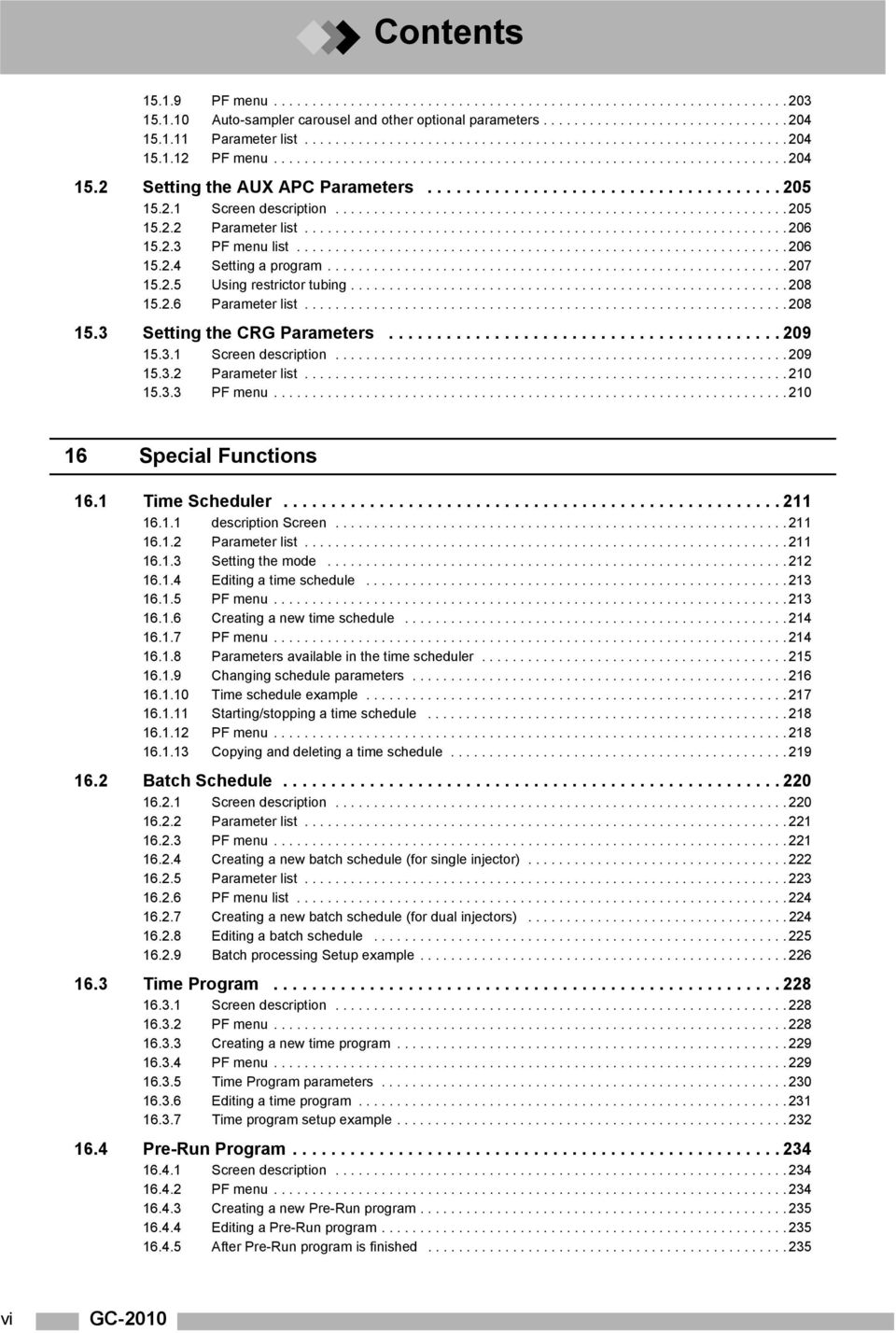
13 Contents Pre-Run Program set up example Direct Operation Screen description Parameter list PF menu GC Configuration Screen description Parameter list Setting the date and time Setting the maximum temperature limits Setting transmission parameters Setting the Ready Check Parameters Parameter Configuration Customizing Component Names Setting the link device code Temperature offset Other Settings Service and Maintenance Screen description Parameter list INSTALLATION (POSITION) INSTALLATION (PIPING) INITIALIZATION Power consumption Stopwatch Screen description PF menu Timing with inverse measurement Key Lock and Parameter Lock Screen description Key locking Parameter locking ROM Version No Screen description Parameter list Printing 17.1 Printing Connection to Chromatopac Parameters to be printed AOC commands Program Parameters Event No Maintenance and Inspection 18.1 Maintenance Parts Septum O-ring for glass insert Glass insert Graphite ferrule vii

14 Contents Capillary column Flow controller Hydrogen flame ionization detector (FID) Miscellaneous Inspection and Maintenance Intervals Glass insert Septum O-ring for glass insert Graphite ferrule Capillary column Flow controller Hydrogen flame ionization detector (FID) Cleaning the Unit Inspection and Maintenance: Septum Inspection/maintenance cycle Inspection/maintenance Inspection and Maintenance: O-ring for glass insert Inspection/maintenance cycle Inspection/maintenance Inspection and Maintenance: Glass Insert Inspection/maintenance cycle Inspection/maintenance Inspection and Maintenance: Graphite Ferrule Inspection/maintenance cycle Inspection/maintenance Inspection and Maintenance: Capillary Column Inspection/maintenance cycle Inspection/maintenance Inspection and Maintenance: Flow Controller Inspection/maintenance cycle Inspection/maintenance Inspection and Maintenance: FID Inspection/maintenance cycle Inspection/maintenance Troubleshooting 19.1 Troubleshooting Gas and pressure settings Temperature control Detector Chromatogram and data Error Messages System errors Operations errors Optional device error (AOC-20i/s) Communication errors Detector errors Other errors Warning messages viii

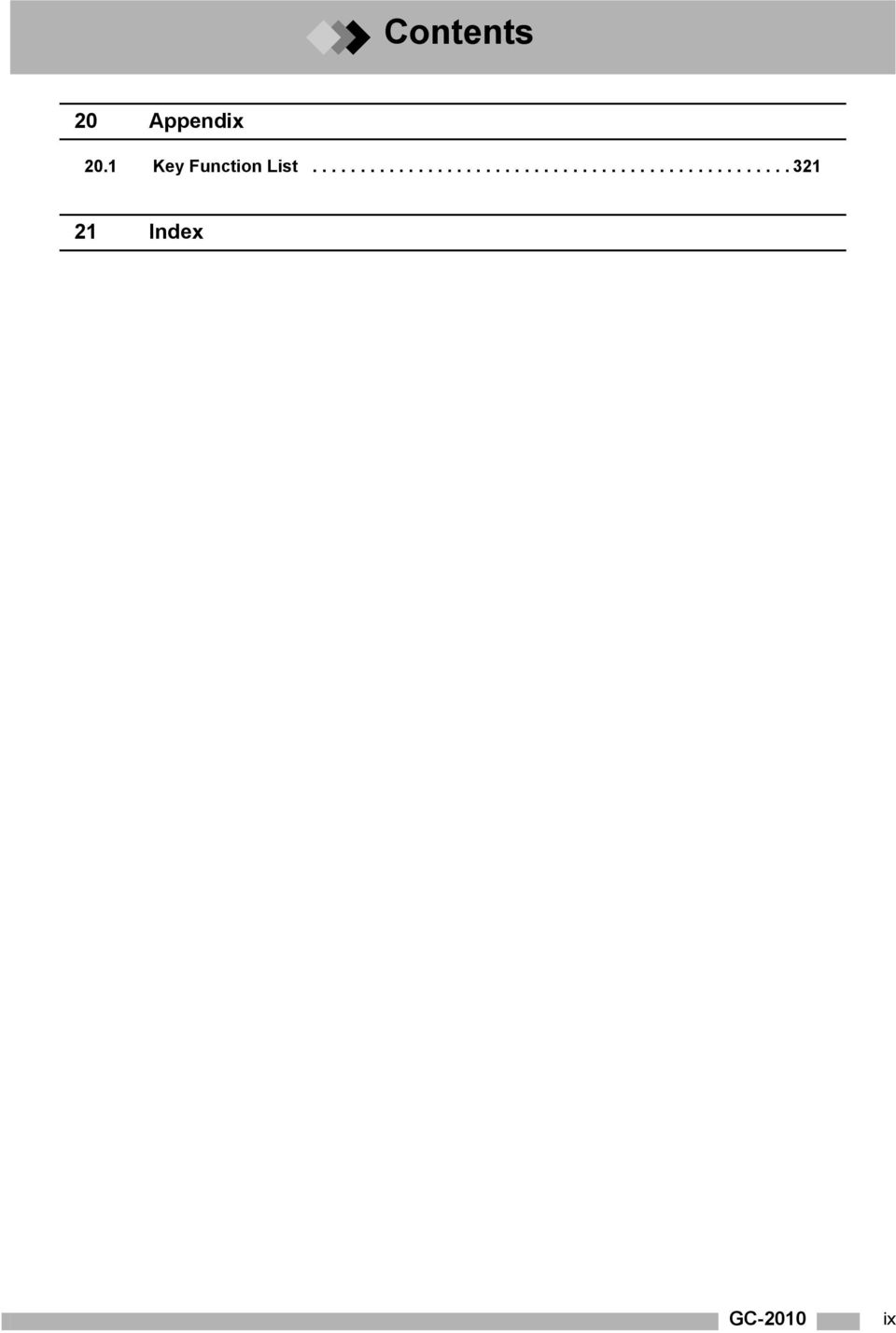
15 Contents 20 Appendix 20.1 Key Function List Index ix
16

17 Overview 1.1System Features The is a state-of-the-art, advanced gas chromatograph which embraces the concepts of flexibility, user-friendliness, and security. It meets and exceeds user demands for high performance, advanced (functionality), high reliability, and high productivity. These concepts are illustrated by the following features, which include high processing speed and digitized signals Basic performance (1) Improved reproducibility Good reproducibility is obtained even for solvents like acetone, which have large expansion volumes. (2) Reduced differences among units Sensitivity differences between detectors have been reduced. (3) Improved detector sensitivity The sensitivity of the FPD (flame photometric detector) is now five times better than previous models. (4) Increased oven cooling speed The oven cooling speed is now 1.6 times faster than previous models Operation (1) Intelligent diagnosis The diagnosis function has improved considerably, with an advanced alarm system. (2) Large LCD (liquid crystal display) An improved, much larger 16-line LCD ( dots), means that analysis parameters and programs can now be listed, improving operation. The display can switch between Japanese and English High speed analysis enabled (1) Digitized detector signals Detector signals are digitized to enable high speed analysis. (2) High pressure injection mode The high pressure injection mode (standard) enables high speed analysis. 1

18 Specifications 1 Overview Column oven Dimensions (mm) : 280(W) 280 (H) 175 (D) Volume (L) : 13.7 Range of temperature : Room temperature +4 C to 450 C -50 C to 450 C (When liquid carbon dioxide gas is used.) Accuracy of temperature : ±1% (K) (Calibrated at 0.01 C) Deviation of temperature : Within 2 C (on a 200mm diameter column holder) Stability of temperature : Within ±0.05 C Temperature coefficient : 0.01 C/ C Range of linear temperature increase: (in power voltage 100 VAC) 40 C/min up to 200 C 15 C/min up to 350 C 7 C/min up to 450 C (in power voltage 230 VAC) 70 C/min up to 200 C 50 C/min up to 350 C 35 C/min up to 450 C Cooling speed : Approximately 6 minutes cooling from 450 C to 50 C. Overheat protection : Programmable up to 470 C (A fixed circuit provides protection at 500 C) Temperature program Program ramps : 20 ramps in total (Heating and cooling available) Setting : 0.1 C increments Program setting : -250 to 250 C/min, 0.01 C/min increments Total time of total program : Up to minutes Injection port Range of temperature : Up to 450 C Temperature setting : 0.1 C increments Overheat protection : Programmable up to 470 C Injection unit : Split/Splitless injection, Direct injection Detector Hydrogen flame ionization detector (FID) Range of temperature : Up to 450 C, 0.1 C increments Overheat protection : Programmable up to 470 C Minimum detection : 3pg C/s Dynamic range : 10 7 Jet material : Fused quartz Time constant : 4 ms to 2 s selectable 2

19 1 Overview 1.2 Specifications Thermal conductivity detector (TCD) Amplifier : With differential type filament protective circuit, tungsten rhenium filament, dual-element configuration Power : Constant current Dynamic range : 10 5 Sensitivity : 20,000mV ml/mg Maximum temperature : 400 C Auxiliary heated zone AUX3 to AUX5 : Available (optional) Carrier gas flow control unit Split/splitless mode Range Program ramps Program rate Split rate setting Direct injection mode Pressure mode Range Program ramps Program rate Flow rate mode Range Program ramps Program rate : 0 to 970 kpa (The maximum pressure limit is the primary pressure minus 10 kpa.) 0.1 kpa increments : 7 ramps possible : -400 to 400 kpa/min, 0.01 kpa/min increments : 0 to , 0.1 increments : 0 to 970 kpa (The maximum pressure limit is the primary pressure minus 10 kpa.) 0.1 kpa increments : 7 ramps possible : -400 to 400 kpa/min : 0 to 1200 ml/min (When primary pressure is 980 kpa) : 7 ramps possible : -400 to 400 ml/min/min 0.1 ml/min/min increments Detector gas flow controller Range Program ramps Program rate : 0 ~ 1200 ml/min (Air), 0.1 ml/min increments 0 ~ 200 ml/min (H2) 0 ~ 100 ml/min (Makeup He) : 7 ramps possible : -400 to 400 ml/min/min, 0.01 ml/min/min increments Display Back-light LCD dot, 16 lines The display can be switched between Japanese and English. 3

20 1 Overview 1.2 Specifications Dimensions, weight and power supply Dimensions (mm) : 515 (W) 440 (H) 530 (D) mm Weight : 30 kg Power supply : 100 VAC (standard model and FID detector), 1800 VA, 50/60 Hz 230 VAC (standard model with FID detector), 2600 VA, 50/60 Hz 4

21 Installation 2.1Shipment Verification This unit consists of the following parts. Verify that all items are present. 1. main body 2. Quick reference (Part Number ) 3. Instruction manual CD-ROM (Part Number ) 4. Standard accessories Type Description Part No. Qty' Tools Parts Consumables Wrench Wrench Wrench for Glass insert nut Branch tube Injection port Column nut Column nut Ferrule adjuster (for SPL) (SPL Column insertion jig) Column hanger * Injection port cover ** G-type blank nut (with 2pcs) Silicon rubber septum (with 20pcs) Silica wool stuffing (with 2g) Graphite ferrule 0.5, for capillary (with 10pcs) Aluminum gaskets (with 100pcs) Glass insert, for split Glass insert, for splitless Fluoride rubber O-ring, for glass insert (with 5pcs) The column hanger is inserted into the support slots in the oven interior. Attach the injection port cover to INJ/DET cover in case of manual injection. (Refer to 2.2 Component description.) 5. FID accessories (only for models with FID) Description Part No. Qty' Chromatopac signal cable Ferrule adjuster (for FID) TCD accessories (only for models with TCD) Description Part No. Qty' Ferrule adjuster (for TCD) CAUTION label TCD Card case, A Chromatopac signal cable
22 2 Installation 2.1 Shipment Verification Fig Standard Accessories 6
23 2 Installation 2.1 Shipment Verification AOC-20i Parts list for AOC-20i for consists of the following parts. Please check them when unpacking the unit. Description Part No. Qty' Remarks 1 Auto injector User s manual Standard Auto injector accessories Description Part No. Qty' Remarks 1 AOC cable Rack (short) Short rack set 3 Large Vial Holder (for solvent/waste) Small Vial Holder Syringe (10µl) Cable clamp Needle guide Plunger holder Barrel holder Plunger Knob Large Vial (4ml) set (5pcs) 12 Large Cap (for 4ml) set (5pcs) 13 Large Septum (for 4ml) set (15pcs) 14 Small Vial (1.5ml) set (20pcs) 15 Small Cap (for 1.5ml) set (20pcs) 16 Large Septum (for 1.5ml) set (40pcs) AOC power supply For 115V model (P/N ) Description Part No. Qty' Remarks 1 AOC power supply READY/START cord Accessories for power supply 3 RS-232C cable for AOC (P/N ) For 230V model (P/N ) Description Part No. Qty' Remarks 1 AOC power supply READY/START cord Accessories for power supply 3 RS-232C cable for AOC (P/N ) 4 Ferrite core Installation parts (P/N ) Description Part No. Qty' Remarks 1 Spacer, back left Spacer, front left Spacer, for height adjustment Spacer, back right Spacer, front right Spacer, SBB Spring washer, for M Washer, for M Nut, for M Wrench, 7 x Wrench, 5.5 x Screw, M4 x
24 Installation 2.2Component description Front WARNING HIGH TEMPERATURE Danger of burns. Keep the column oven door closed when the oven is at high temperature. Keep the injection port cover on when making manual injections Door latch Fig No. Name Description 1 Column oven door Pull the latch on the lower right to open the door. Press the center of the door to close it. 2 Key/Display Used for various input and displaying component status. 3 Battery case for FPD fan Houses the battery for FPD cooling fan (option). 4 Power switch Turns the power of the unit on and off. 8
25 2 Installation 2.2 Component description Oven interior WARNING HIGH TEMPERATURE Danger of burns. When the injection port or detector temperature is high, never touch the connections or the internal surfaces of the oven Fig No. Name Description 1 Column connection (injection port side) Attaches the column to the injection port. (close-up 1 ). 2 Column connection (detector side) Attaches the column to the detector (close-up 2 ). 3 Column hanger Install the capillary column here. (Attaches to the top of the oven (close-up 3 ). 9
26 2 Installation 2.2 Component description Close-up 1 (injection port side) Close-up 2 (detector side) Capillary column Graphite ferrule Column nut Injection port column nut Column nut (with split) Close-up 3 (column hanger) 10
27 2 Installation 2.2 Component description Rear WARNING HIGH VOLTAGE Danger of electrical shock. Only qualified service personnel may remove the rear cover. Ensure that the power distribution board power is off before starting installation if the power cable will be connected directly to terminals on the power distribution board. Ensure that the power supply is properly grounded. Never put heavy objects on the power cable. HIGH TEMPERATURE Hot air is exhausted from the back of the unit. Do not place flammable items behind the unit. Do not touch the back of the GC near the exhaust. HIGH PRESSURE GAS Frequently check gas flow lines for leaks. In particular, accumulations of hydrogen gas can cause an explosion Fig
28 2 Installation 2.2 Component description CAUTION Do not touch the connections or terminals when the power is on. This could damage the circuits. No. Name Description 1 Power cable Supplies power to the unit. 2 Exhaust vent This vents the column oven during cooling. 3 Carrier gas inlet Supplies carrier gas. 4 Detector gas inlet Supplies detector gas. 5 START signal input terminal 6 READY signal terminal 7 START signal output terminal Only for units with AOC-20i. NOTE The symbol indicates the functional ground terminal. Connect an external device if any to this terminal to receive a start signal. Outputs the READY signal to any external device (Such as the auto injector). Connect an external device if any to this terminal to output the start signal. 8 RS-232C connector Connect the RS-232C cable (9 pin) to this connector. For I/O of digital signal. 9 Relay terminal Relay terminal to switch at EVENT91 and AOC communication connector 11 Detector signal output terminal (analog) Connect this connector to the RS-232C terminal in the power unit of AOC-20 i/s. Outputs the detector signal to analog input of a Chromatopac or other type of data processing unit. (ch1, ch2) 12 AOC power supply * Connects AOC-20i and AOC-20s (option) INJECTOR1 connector INJECTOR2 connector SAMPLER connector RS-232C connector Fiber optic cable connector Start out/ready in connector Connect the auto injector. (in single mode) Connect the main auto injector in dual mode. Connect the subordinate auto injector in dual mode. Connect the autosampler carousel. Connector for external control Do not connect RS-232C and fiber optic cables simultaneously. Inputs the Ready signal to the gas chromatograph and outputs the start signal from the gas chromatograph. 12
29 2 Installation 2.2 Component description Entire unit WARNING HIGH VOLTAGE Danger of electrical shock. Only qualified service personnel may remove the side covers. HIGH TEMPERATURE Danger of burns. Never touch the top cover, the injection ports and detectors - - while they are hot. CAUTION All the GC unit covers (including the INJ/DET covers, carrier and detector gas controller covers) are essential to the optimal performance of the. Ensure that these covers are in place when the GC is in use Fig No. Name Description 1 Injection port 2 Injection port cover 3 Detector 4 INJ/DET cover 5 Carrier and detector gas controller cover Samples are injected into this port, which can become extremely hot. This cover becomes extremely hot. It protects you from the heat of the injection port. The detector is located under the INJ/DET cover. The detector can become extremely hot. Lift up this cover to remove it. Keep the cover closed during operation. Houses AFC, APC and manual flow controller. Open and lift up this cover to remove it. 13
30 Installation site 2 Installation Installation location requirements Consider the following points to ensure safe and appropriate unit operation when selecting the installation site Ambient temperature and humidity For optimal performance, operate this unit within the following temperature and humidity specifications. Temperature range: 18 C to 28 C Relative humidity range: 50% to 60% (Avoid use under conditions where condensation forms) Operating temperature range: 5 C to 40 C Operating humidity range: 5% to 90% (Avoid use under conditions where condensation forms) Installation location Install the unit on a firm, stable and flat base Corrosive gas and dust Avoid exposure to corrosive gas and excessive dust to prolong the service life and maintain optimal unit performance Electro-magnetic fields and power supply noise This unit should not be used near strong electro-magnetic fields. The power supply must have little or no noise. These items can cause instrument problems Other precautions For optimal performance, avoid the following conditions during installation: (1) Fluctuating ambient temperature. (2) Temperature changes from heating or air conditioning. (3) Direct sunlight. (4) Vibrations. 14
31 2 Installation 2.3 Installation site Installation clearances WARNING Hot air is exhausted from the back vent. Do not place flammable matelials near the exhaust. Minimum 300mm Minimum 100mm Depth 530mm Hight 440mm Width 515mm Fig Rear clearance Hot air is vented at the back of the unit when the column oven cools. Consider the following during installation: Do not place any flammable materials behind the unit. Allow a clearance of 30cm or more between the back cover and the wall. Reserve extra space for maintenance and inspection behind the unit Left clearance Allow a clearance of 10cm or more on the left side. The vent on the left side is important for properly cooling down the outer wall of the column oven and improving the cooling efficiency of the column oven. 15
32 Moving the GC 2 Installation The weighs approximately 30kg (For a single FID model). Two people must carry the GC; one on the left, and one on the right. CAUTION Move the GC carefully so it does not get bumped or jarred. 16
33 2.5 2 Installation Power supply and wiring WARNING HIGH VOLTAGE 1.Before connecting the power cable to the distribution board, turn OFF the power to the distribution board. 2.The power supply must have a circuit breaker. 3.Do not place heavy items on the power cable. Before connecting the power supply, verify the following items. Power supply voltage Use a power source with the following specifications to maintain optimal unit performance. Commended power voltage: 115VAC ± 5% 230VAC ± 5% Frequency 50/60Hz Operating power voltage: 115VAC ± 10% 230VAC ± 10% Frequency 50/60Hz Power supply capacity Calculate the power supply capacity by considering the total power consumption of the individual components as shown below. Connect the power source to a terminal with sufficient capacity. Standard model with FID: 1,800VA (115V model)/2,600va (230V model) Optional temperature control block (INJ, etc.): 150VA/pc Maximum power is 2600VA (115V model), 3400VA (230V model) NOTE Performance of the unit may be affected if the power supply voltage fluctuates or the capacity is insufficient. Connecting the power cable NOTE The power cable of the 230V model uses a plug. Fig Plug CAUTION Be careful to wire the plug correctly, as outlined on the next page to avoid damage to the unit or supply fuse. 17
34 2 Installation 2.5 Power supply and wiring The power cable for 115V model is color-coded as follows. Black... Connected to HOT of AC line. White... Connected to NEUTRAL of AC line. Green... Grounding (GROUND) Black Power cable White Green Fig Power cable Symbol conventions ~ : AC : Off, Open : On, Close Power switch OFF status ON status Heating energy generation The following graph shows the heating values generated by the unit Heat generation ( 10 6 J/hour) Temperature ( C) Fig
35 2 Installation 2.5 Power supply and wiring Fuse The following fuses are used in the. Fuse, No. Rated current/voltage 115V model 230V model Type * F1, F2 15A/250V 10A/250V T F3, F4 5A/250V 3.15A/250V T F5, F6 5A/250V 5A/250V T Classification depending on IEC127. Allowing the GC to dry after transport. CAUTION may get wet from humidity in some transport conditions. In such case drying-out is necessary to avoid a short circuit at the heater in the injection port or the detector. Under some transport conditions, condensation may form inside the GC components. To avoid injection port or detector heater unit short-circuits, allow the unit sufficient time to dry after transport, and follow the procedure below after installation. (1) Seal the injection port and column connections. (2) Remove the injection ports and detectors from all configured analytical lines. (See 8.3 Specifying the Analytical Flow Line Components ([Line Config]).) (3) Set the column oven temperature to 300 C, and start the GC. (See 11 Creating an Oven Temperature Program and 7 Starting and Stopping the GC [SYSTEM].) (4) Keep the column temperature at 300 C for 2 hours. (See 9 Monitoring the GC.) Thermal insulation cup Graphite ferrule with a wire Column nut (or Column nut of injection port) 19
36 Installation 2.6Gas supply plumbing Gas type and supply purity The following gases and associated purity valves are required to maintain optimal performance of the unit. For detectors other than FID and TCD, refer to the instruction manual corresponding to each detector. Carrier gas Helium (optimal) purity: % or more Nitrogen (acceptable) purity: % or more Makeup gas FID Nitrogen (optimal) purity: % or more Helium (acceptable) purity: % or more TCD Nitrogen purity: % or more Helium puritiy: % or more Argon purity: or more Detector gas FID Hydrogen purity: % or more Air Compressed air can be supplied by an oil-free compressor. (must be dehumidified) Dry air (Oil and organic components eliminated) For high sensitivity analyses, use gases with a purity of % or more. Gas supply pressures Carrier gas: kPa Make-up gas: kPa Hydrogen: kPa Air: kPa The relationship of kpa and bar is as follows 100kPa = 1bar Convert units between kpa and kgf/cm 2 as follows. 1kPa = kgf/cm 2 1kgf/cm 2 = 98.1kPa Convert the units between kpa and psi as follows. 1kPa = psi 1psi = 6.89kPa 20
37 2 Installation 2.6 Gas supply plumbing High pressure gas cylinder precautions WARNING HIGH PRESSURE Gas cylinders are under high pressure. When handling gas cylinders, instruction and safety measures provided by the gas supplier must be strictly observed to prevent accidents. General precautions are provided below. Consult state and local regulations for specific precautions. Keep gas cylinders away from the lab, preferably outdoors, but not exposed to direct sunlight. The area must be well-ventilated. Use tubing to bring the gases to the lab. The temperature of gas cylinders must not exceed 40 C. Flammable items must be kept at least 2m from a gas cylinder. When using high pressure gases, pay strict attention to ventilation, and perform daily leak checks. In particular, when using flammable gases (such as hydrogen), never smoke or allow open flame within 5m of the equipment. Fire extinguishers must be present. Secure gas cylinders firmly with cylinder clamps so they cannot fall over. Use oil-free pressure valves only. Never use tubing which has contacted oil. When finished with the gas, tighten the main valve of the cylinder immediately. 21
38 2 Installation 2.6 Gas supply plumbing Precautions on handling hydrogen gas WARNING HYDROGEN GAS PRECAUTIONS Hydrogen can explode if it is allowed to accumulate in a poorly ventilated area. 1.Connect gas lines correctly. Hydrogen is released into the room if the tubing is accidentally connected to the air inlet. 2.When the unit is not in use, close the main valve of the hydrogen gas cylinder. Check for leaks at the main valve. 3.Every time the unit is used, check for leaks along the flow line from gas cylinder to the unit interior. 4.To prevent an explosion due to a hydrogen gas leak, the room in which the unit is used should be well ventilated. Prohibit the use of open flame in this room. 5.Close the main valve of the hydrogen cylinder immediately after completing the analyses. Then, turn OFF the unit and perform normal shut-down procedures. WARNING HYDROGEN GAS HANDLING PRECAUTIONS The accumulation of hydrogen gas inside the column oven can cause an explosion. Close all hydrogen pressure regulator valves when not in use, and seal the column connection. Detector Thermal insulation cup Graphite ferrule with a wire Column nut Capping the Detector Fitting. 22
39 2 Installation 2.6 Gas supply plumbing CAUTION GAS PLUMBING PRECAUTIONS The pressure regulator valve will be damaged if pressure above its specifications is applied. Set the gas inlet pressure within the allowable maximum pressure range. CAUTION Hydrogen gas supply precautions Make sure that the supply pressure to the flow controller does not exceed 500kPa. If the flow controller fails with a hydrogen gas supply pressure over 500 kpa, a dangerous situation exists. Lange amounts of leaking hydrogen could cause the FID flame to expand out of the detector. Hydrogen gas is lighter than air. If it leaks, it can accumulate near the ceiling. Pay strict attention to ventilation so that leaking hydrogen is vented out of the room and cannot accumulate. CAUTION Supply pressure When the GC shares gas supplies with other insturmentation, check all instrument specifications in order to provide adequate gas supply pressures for all the instruments. WARNING Hydrogen carrier gas precautions If much hydrogen gas is released into the poorly ventilated room, it may cause the explosion. 1.In order to prevent hydrogen gas accumulate in the room, attach tubes to split vent, purge vent, TCD vent and ECD vent. Discharge the gas to open air or a ventilation equipment (such as the draft chamber). 2.Install the GC in the well ventilated area. (Ex. in the draft chamber) 3.In order to measure hydrogen gas concentration, equip a hydrogen gas sensor in the room. Keep the hydrogen concentration low. 23
40 2 Installation 2.6 Gas supply plumbing Supply gas tubing There are two types connections in the Gas Chromatograph: Type M and Type G. Type M connections are located at the main tubing connections in the instrument interior and exterior. The metal fittings contact directly. Type G connectors, which are used in high temperature areas, are connected by tightening three to five aluminum gaskets between the fittings. MF fitting MM fitting Fig Joining Type M fittings GF fitting GM fitting Alminum gaskets (3-5pcs) Fig Joining Type G fittings Tightening the tubing connections Tools 2 wrenches (standard accessory) Use the 12mm wrench for Type M connections and the 10mm wrench for type G connections. Fig Tightening the joints 24
41 2 Installation 2.6 Gas supply plumbing Tubing between the gas cylinder and gas chromatograph Gas filter <option> Gas cylinder Fig Tubing between the gas cylinder and gas chromatograph Use tubing with a 3mm O.D. and 2mm I.D. between the gas cylinder and gas chromatograph. The use of a gas filter is highly recommended. Contaminated tubing or poor quality gases can interfere with baseline stability. <Option> Gas filter (P/N ) This absorbs organic compounds and moisture in the supply gas, improving its purity. The filter can be regenerated by baking in the GC oven at 250 C with 30mL/min carrier gas purging the filter. Capacity: Approx. 200mL Absorbent: Molecular sieve 5A Fig Gas filter 25
42 2 Installation 2.6 Gas supply plumbing Gas chromatograph tubing connections Connections are provided on the rear panel of the unit for connecting external tubing. They are labeled as follows. Carrier gas... CARRIER Makeup gas... MAKE UP Hydrogen... HYDROGEN Air... AIR <Ex 1> When Carrier gas and Makeup gas are identical Branch tube (standard accessory) Carrier gas Hydrogen Air Fig When Carrier gas and Makeup gas are identical <Ex 2> When Carrier gas and Makeup gas are different Carrier gas Hydrogen Make-up gas Air Fig When Carrier gas and Makeup gas are different 26
43 2 Installation 2.6 Gas supply plumbing Checking for gas leaks After plumbing the unit, check for gas leaks according to the following guidelines. (1) Open the main valve of the gas cylinder. (2) Adjust the gas supply to the specified pressures. (3) Check for leaks with leak detecting fluid (option) or soapy water on all connections. Bubbles can be observed if a leak exists. (4) If a leak is detected: Further tighten the connection, or retighten it. Replace the seal material. (5) Wipe off the leak detecting fluid or soapy water using a wet cloth. Electronic leak detectors can also be used for hydrogen and helium leaks. <Option> Snoop Gas leak detecting fluid (P/N ) LIQUID LEAK DE Fig Leak detecting fluid CAUTION Do not use the leak detecting fluid nor soapy water for gas leak check on the connections above the carrier and detector gas controllers (AFC/APC). The drips may damage the controller. 27
44 Installation 2.7Connecting external device cables Connecting the RS-232C cable Connect the RS-232C cable to its terminal on the rear panel. Fig Connecting the RS-232C cable Detector control signal I/O and digital signal output occur through the RS-232C cable. RS-232C cable connection parameters Connection to C-R8A Set data transmission parameters to equivalent values between the GC system and the C- R8A. Example of C-R8A settings: (For details, refer to the C-R8A instruction manual) Make the following settings on the transmission parameter setup screen for LEVEL 2 and 9,600bps. ( CONFIG T (T:TRS) ). PORT MODE #No. BPS STD Power cycle the C-R8A after changing transmission parameters. For data transmission parameters, refer to Setting transmission parameters. Input OPEN GCLC 8,1,1 on the C-R8A keyboard, and press the ENTER key to open the transmission port and start transmission of the detector signal. Channel No. of GC (Ch1 in this example) OPEN GCLC 8,1,1 Channel No. of C-R8A (CH1 in this example) Connection to the personal computer To use GC solution, get transmission parameters to LEVEL3, bps. 28
45 2 Installation 2.7 Connecting external device cables Connecting the Chromatopac signal cable Use the Chromatopac signal cable to send detector analog signals to the Chromatopac (C- R7A plus or earlier models). Connect the 4PIN signal cable to the connector (Ch1 or Ch2) on the rear panel. The START signal between the GC and Chromatopac is communicated through this signal cable. Therefore, there is no need to connect the START OUT terminals on the GC or the Chromatopac. ch1 ch2 Fig Connecting the Chromatopac signal cable 29
46 2 Installation 2.7 Connecting external device cables Calibration of analog wide range signal When the GC is connected to the Chromatopac C-R7A/C-R7A plus with a chromatopac signal cable (for analog signals), and the signal type is set to Wide on the [DET] key screen, perform a calibration for proper signal transmission. For details of the [DET] key, refer to 13 Detector. (1) Set the detector controller on the [DET] key screen to off. (Refer to ) (2) On the Chromatopac, press the [Win 3] key and type the following: LOAD ZCALIB (3) Press the [RUN] key of the Chromatopac. (4) When Channel No.(1:CH1, 2:CH2) is displayed, enter the Chromatopac Channel number (1 for Ch.1, 2 for Ch. 2). (5) When Save to disk? (Y: Yes, N: No) is displayed, enter Y. (6) Set the detector controller to on. Check whether the calibration has done correctly as the following procedure, while the GC status is System On and the detector is set to On. (Refer to 7 Starting and Stopping the GC [SYSTEM] and 13 Detector.) (1) Set Signal Attenuation to x1. (2) Press the [Win 1] key and press F to set Chromatopac zero level to FREE. (Refer to User s manual of Chromatopac.) (3) Press [Zero adj.] (PF menu) on the screen of [MONIT] key. The detector signal level moves to 0µV. (Refer to 9 Monitoring the GC.) (4) The signal level on the display of the Chromatopac is within ±50µVe, the calibration has done correctly. If the calibration was failed, permorm the above-mentioned calibration procedure again. The maximum difference between the signal level GC and Chromatopac is equal or less than ±5% (±50µV, in case signal level is form 1000 to 1000µV). In case of SYSTEM Off and/or Detector controller Off, the detector signal level on screen of the [MONIT] key is 0µV but Chromatopac shows 1000µVe when the signal type is Wide. NOTE For correct quantitation, perform this calibration when changing GC s or changing Chromatopac channels. When the GC and the chromatopac C-R6A or previous models are connected with chromatopac signal cable (for analog signal), the signal type is set to Linear on the screen of the [DET] key. The calibration is not necessary. 30
47 2 Installation 2.7 Connecting external device cables Connecting the GC and Auto injector NOTE This section describes the connection between the AOC-20i unit and, the AOC power cable connection, and the method of turning the AOC on and off. For details of AOC-20 operation, refer to the AOC-20 User s manual. Cable connections Connect the cables as follows. The AOC-20 power source is housed within the unit. READY/START cable RS-232C Label 1 Label 2 Label 3 Label 4 Press these buttons when inserting or removing cables. START OUT/READY IN terminal RS-232C cable for AOC Attach the D-sub connector to the RS-232C terminal of the AOC power source, and 6-PIN connector to the AOC terminal of the GC. AOC cable Connect the auto injector to INJECTOR 1 for single AOC Wrap the cable around Ferrite core near the connector (power source side) as shown below. 230V model Cable Ferrite core Fig NOTE If the AOC cable is connected to INJECTOR 2, follow the INJECTOR1 procedure. If the AOC-20s sample carousel cable is connected to SAMPLER, attach the ferrite cores on both side of the cable as for INJECTOR1. Turning the AOC power on and off When usin the AOC-20i with the, the AOC power is turned on and off along with the GC power. However, for units with the AOC-20 power supply installed in the, turn the AOC-20 on and off from the AOC parameter screen, accessed from the [OPTION] key. (Refer to 15.1 Auto Injector Parameters.) 31
48 2 Installation 2.7 Connecting external device cables Installing the AOC-20s (1) Installation the autosampler carousel bracket. Use four M4 screws to attach the carousel bracket to the top left of the. NOTE Eight holes are available. Use four holes which are marked as in Fig NOTE Fasten the screws tightly to ensure electrical contact. Poor contact may lead to auto sampler carousel operational problems. Fig (2) Installing the AOC-20s autosampler carousel. Place the autosampler carousel on the bracket and fasten it with one M4 screw. Fig
49 2 Installation 2.7 Connecting external device cables Connecting the relay terminals Connect the 8PIN relay cable (P/N ). The relay terminal can be opened and closed by EVENT91 and 92. (Refer to 16.3 Time Program.) Fig EVENT91 Pin No.1 red COM Pin No.2 white NC Pin No.3 black NO Conducted to Pin No. 1 COM at EVENT-91 Conducted to Pin No. 1 COM at EVENT91 EVENT92 Pin No.4 yellow COM Pin No.5 blue NC Pin No.6 black NO Conducted to Pin No. 4 COM at EVENT-92 Conducted to Pin No. 4 COM at EVENT92 OPTION Pin No.7 brown Pin No.8 gray (GROUND) (GROUND) 33
50 2 Installation 2.7 Connecting external device cables 34
51 AFC, APC 3.1AFC and APC Overview The AFC (Advanced Flow Controller) is an electronic flow controller which sets and controls carrier gas pressures and flow rates based on entered parameters. The APC (Advanced Pressure Controller) is an electronic flow controller for controlling detector gas pressures. The AUX APC can control the gas pressure of other optional devices. 35
52 AFC, APC 3.2Definition of Terms Column inlet pressure Column inlet pressure refers to the injection port pressure. When set to 0 kpa, the injection port pressure is equal to atmospheric pressure. Total flow rate Total flow rate is the flow rate controlled by the TFC (Total Flow Controller) located upstream of the injection port. (Refer to Fig ) Column flow rate The column flow rate in the gas chromatograph indicates the volume flow rate inside the column converted at the atmospheric pressure and the room temperature, which corresponds to the flow rate measured at room temperature by a flow meter connected to the column outlet. The column flow rate can be calculated with the following equation: where 60πd 4 (P + P 0) 2 - P 0 2 Fc = µL P 0 Fc : Column flow rate (ml/min) d : Column inner diameter (mm) L : Column length (m) P : Column inlet pressure (kpa) P0 : Column outlet pressure (= atmospheric pressure) (kpa) µ : Viscosity coefficient * (19.4µPa sec, helium at 20 C) The viscosity coefficient depends the column oven temperature. Linear velocity Linear velocity indicates how many cm the carrier gas moves inside the column. The terms VELOCITY, linear velocity in this instruction manual indicate the average linear velocity inside the column. The average linear velocity can be obtained with the following equation: K (P + 2P 0) 2 P V = µ {(P + P 0) (P + 2P 0) + P 0 2 } where D K = L Split ratio V : Average linear velocity split frow For the, split ratio refers to. column flow 36
53 3.3 3 AFC, APC Flow Line Diagram FC FC PC SC PC H2 (GC rear) C C S Molecular sieve filter P P MAKE UP (GC rear) AIR (GC rear) TFC (Flow rate sensor) CARRIER IN (GC rear) PURGE VENT SPLIT VENT APC H H Valve for H2 H2 restrictor Pressure sensor M M Valve for makeup gas Makeup gas restrictor Pressure sensor A A Valve for air Air restrictor Trap Note:This figure illustrates an FID or FTD detector example. For ECD or TCD detectors, the APC controls only the makeup gas. For FPD detector, the APC controls only hydrogen and air. Detector H Column oven Pressure sensor Flow rate sensor Column inlet pressure sensor SPC (Septum Purge Controller) ESC (Electronic Split Controller) Pressure sensor Trap Injection port Capillary column AFC TFC:TOTAL FLOW CONTROLLER SPC:SEPTUM PURGE CONTROLLER ESC:ELECTRONIC SPLIT CONTROLLER Fig
54 AFC, APC 3.4 AFC and APC control AFC Control AFC Control is illustrated in the following sections. Split mode Split Splitless DIRECT ( 1) Control mode Pressure Section Section Section Flow rate Section Linear velocity Section Section Section Split mode: SPLIT (AFC) The AFC controls the total flow rate to keep it at a constant value. The TFC (Total Flow Controller) inside the AFC feeds back output from the column inlet pressure sensor, which controls the ESC (Electronic Split Controller), which, in turn, controls the column inlet pressure. Fig shows the control status with a split ratio of 1 : 40, a velocity of 30 cm/sec, a purge flow rate of 3 ml/min, and a column oven temperature of 50 C. The column inlet pressure is calculated based on the linear velocity, the oven temperature, the column inner diameter, and the column length, and is automatically set to 49.6 kpa. In the same way, the column flow rate is automatically set to 1.67 ml/min, and the total flow rate is set to 69.8 ml/min (= 1.67 ml/min ml/min (= purge flow rate)). When the Control mode is set to PRESS, the column inlet pressure is controlled to remain at 49.6 kpa regardless of the column oven temperature. When the Control mode is set to VELOCITY, the column inlet pressure is set to a value which keeps the linear velocity constant despite changes in the column oven temperature. Even if the column oven temperature changes, as in programmed temperature analysis, the linear velocity is always kept constant. Generally, when the column oven temperature increases, the viscosity of the carrier gas also increases, and does not flow as easily. Regardless of the Control mode, the ESC controls the column inlet pressure and the TFC controls the total flow rate as shown in Fig When WBI Injection is used, do not select Split mode or Splitless mode. 38
55 3 AFC, APC 3.4 AFC and APC control 71.6ml/min TFC (Total Flow Controller) Flow rate CARRIER IN sensor (GC rear) 49.6kPa Pressure sensor Pressure sensor PURGE VENT 3ml/min P C 71.6ml/min 3ml/min 66.9ml/min P C SPC (Septum Purge Controller) S Detector Injection port SPLIT VENT 66.9ml/min ESC (Electronic Split Controller) Column oven (50 ) 1.67 ml/min Valve bsensor a Valve b is controlled so that the value of sensor a remains constant. Column inner diameter: 0.30 mm Column length : 25.0 m Film thickness : 0.50 m Carrier gas : He Split ratio : 40 = 66.9 ml/min / 1.67 ml/min (split flow rate)(column flow rate) Fig Split control 39
56 3 AFC, APC 3.4 AFC and APC control Split mode: SPLITLESS (AFC) The control method changes only during the sampling time. During sampling time, the AFC controls the TFC (Total Flow Controller) so that the output from the column inlet pressure sensor becomes constant, and then controls the column inlet pressure. After the sampling time, the AFC controls the total flow rate to keep it at a constant value using the TFC (Total Flow Controller) inside the AFC. As in split mode, the ESC (Electronic Split Controller) is controlled to maintain the column inlet pressure constant. Figure shows the control status during the sampling time with a split ratio of 1:40, a velocity of 30 cm/sec, a purge flow rate of 3 ml/min, and a column oven temperature of 50 C. The column inlet pressure is calculated based on the linear velocity, the oven temperature, the column inner diameter, and the column length, and is automatically set to 49.6 kpa. In the same way, the column flow rate is automatically set to 1.67 ml/min. When the sampling time expires, control is identical to the split mode, shown in Fig When the Control mode is set to PRESS, the column inlet pressure is controlled to remain at 49.6 kpa regardress of the column oven temperature. When the Control mode is set to VELOCITY, the column inlet pressure is set to a value which keeps the linear velocity constant despite changes in the column oven temperature. Even if the column oven temperature changes, as in programmed temperature analysis, the linear velocity is always kept constant. Generally, when the column oven temperature increases, the viscosity of the carrier gas also increases, and does not flow as easily. Regardless of the Control mode, the ESC controls the column inlet pressure and the TFC controls the total flow rate as shown in Fig (after the sampling time). 4.67ml/min TFC (Total Flow Controller) CARRIER IN (GC rear) Flow rate sensor C 4.67ml/min C Pressure sensor 3ml/min 3ml/min P P PURGE VENT Pressure sensor SPC 99.1kPa (Septum Purge Controller) S Detector 0ml/min Injection port SPLIT VENT 0ml/min ESC (Electronic Split Controller): Completely closed Column oven (50 ) 1.67 ml/min Valve bsensor a Valve b is controlled so that the value of sensor a remains constant. Column inner diameter: 0.32 mm Column length : 25.0 m Film thickness : 0.50 m Carrier gas : He Fig Splitless control (during sampling time) 40
57 3 AFC, APC 3.4 AFC and APC control Split mode: DIRECT The AFC offers three types of DIRECT mode, FLOW, PRESS and VELOCTY. When the Control mode is set to FLOW, the TFC controls the total flow rate as shown in Fig At that time, the column inlet pressure varies depending on the column type, the purge flow rate and the column oven temperature. When the Control mode is set to PRESS, the AFC controls the TFC (Total Flow Controller) to keep the column inlet pressure constant. The control method is equivalent to the sampling time in SPLITLESS mode. The control diagram is shown in Fig When the Control mode is set to VELOCITY, the column inlet pressure is set to a value which keeps the linear velocity constant despite changes in the column oven temperature. Even if the column oven temperature changes, as in programmed temperature analysis, the linear velocity is always kept constant. Generally, when the column oven temperature increases, the viscosity of the carrier gas also increases, and does not flow as easily. CARRIER IN (GC rear) PURGE VENT Pressure sensor 7ml/min Flow rate sensor 3ml/min Control mode FLOW TFC (Total Flow Controller) Control mode PRESS or VEROCITY SPC Pressure sensor (Septum Purge Controller) Detector P C 7ml/min 3ml/min Column oven (50 ) P C C 4ml/min Fig Direct Control 41
58 3 AFC, APC 3.4 AFC and APC control Control by APC The APC performs its control as illustrated in the figure below. Pressure sensor GAS IN Valve Resistance To detector Fig As shown in Fig.3.4.4, the APC controls the pressure. The flow rate is calculated based on resistance and pressure. For example, for a flow rate of 400 ml/min of air, the pressure is controlled and set to approximately 61 kpa based on the pressure-flow rate characteristics of air stored in the memory of the. (Refer to Fig ) The resistance depends on the detector type and the gas type (air, hydrogen or makeup gas). Fig show the pressure-flow rate characteristic curves of the standard restrictor. AUX APC offers PRESS and FLOW mode. When the Control mode is PRESS, AUX APC controls the pressure as shown in Fig When the Control mode is FLOW, the pressure is calculated based on the set flow rate, calculated from the restrictor inner diameter, and length. (Refer to column flow rate in 3.2 Definition of Terms.) The equation in 3.2 is accurate when the flow in the restrictor is layer. Therefore, the flow rate accuracy depends on the restrictor used. Air Flow rate (ml/min) Pressure (kpa) Fig
59 3 AFC, APC 3.4 AFC and APC control H Flow rate (ml/min) Pressure (kpa) Fig Makeup gas (FID) 200 Flow rate (ml/min) Pressure (kpa) Fig Makeup gas (TCD) 100 Flow rate (ml/min) Pressure (kpa) Fig
60 AFC, APC 3.5AFC and APC Control Ranges For the AFC, the column inlet pressure can be set from 0 to 970 kpa, and the total flow rate can be set to 0 to 1,200 ml. (Refer to Figs and ) However, these values are instrument specifications, valid when the primary pressure supplied to the is 980 kpa. The allowable pressure and flow rate settings are limited by the primary pressure, as shown in Fig.3.5.1, Fig In addition, the pressure settings are limited by the column type and the purge flow rate ml/min 150kPa Total flow rate 720 ml/min 360 ml/min Primary pressure 300kPa Primary pressure 600kPa Primary pressure 980kPa Total flow rate 600 ml/min 300 ml/min 150 ml/min Primary pressure 300kPa Primary pressure 600kPa Primary pressure 980kPa 290kPa 590kPa 970kPa Column inlet pressure Fig Available setting ranges (He, H2) 0-1ml/min, 0-1kPa is not a valid setting 290kPa 590kPa 970kPa Column inlet pressure Fig Available setting ranges (N2) 0-1ml/min, 0-1kPa is not a valid setting NOTE When options are added to the flow line, the range above becomes narrow. 44
61 3 AFC, APC 3.5 AFC and APC Control Ranges The allowable pure flow rate setting depends on the column inlet pressure. Figure shows the range of purge flow rates permitted. 300 Purge flow rate (ml/min) Setting range Column inlet pressure (kpa) Fig Allowable APC settings are shown below, for a supply pressure of 500 kpa. (When the supply pressure is less than 500 kpa, the available maximum flow rate decreases proportionally.) When the set value is more than the set range, displayed values may not be accurate, or APC cannot control the flow. Air (detector = FID) : 0 to 1,000 ml/min H2 (detector = FID) : 0 to 200ml/min Makeup gas (detector = FID) : 0 to 100ml/min Makeup gas (detector = TCD) : 0 to 20ml/min 45
62 AFC, APC 3.6AFC and APC Offset Calibration The AFC and APC pressure and flow rate sensors can be calibrated (zeroed). This calibration is required to correct minute deviations of the sensor values which may occur after long periods of use. If the sensor values deviate, 0.5 kpa or 0.5 ml/min could be displayed, for example, even through there is no actual pressure of flow. When data reproducibility is important, perform the offset calibration. For the AFC, perform the offset calibration using the following procedure. (In the case of WBI analysis, remove the WBI column from the injection port before the following procedure. After the proceduce attach the column to injection port as before.) (1) Press[SYSTEM]key, toggle key, PF1 key, and change Start GC to Manual Start (refer to Fig or 3.6.2). If Manual Start was already set, proceed to the next step. (2) Turn off the power. Wait until the column oven, the injection port and the detector have cooled down to 50 C or less. (3) Turn on the power. Wait for approximately 1 minute. (4) Press the [FLOW] key once and the toggle key twice, in that order. Then, the Fig opens. (5) Press the PF2 key. The message Zero Calibration Start appears at the bottom of the monitor. Approximately 10 seconds later, the message Zero calibration completed appears. Calibration of the AFC is complete. (6) Return the Start GC setting to its original status. NOTE Refer to 5 Basic Key Operation. Fig
63 3 AFC, APC 3.6 AFC and APC Offset Calibration Fig Perform the offset calibration of the APC using the following procedure. (1) Press[SYSTEM]key, toggle key, PF1 key, and change Start GC to Manual Start (refer to Fig or 3.6.2). If Manual Start was already set, proceed to the next step. (2) Turn off the power. Wait until the column oven has cooled down sufficiently. (3) Turn on the power. Wait for approximately 1 minute. (4) Press the [DET] key, the [PF2] key and the toggle key, in that order. The screen shown in Fig opens. (5) Make sure that flow monitors of each gases do not change. When they change, wait for a while. Press the PF2 key. The message Zero calibration Start appears at the bottom of the monitor. Approximately 10 seconds later, the message Zero calibration completeds appears. Calibration of the APC is complete. (6) Return the Start GC setting to its original status. 47
64 3 AFC, APC 3.6 AFC and APC Offset Calibration Fig
65 Installing the column 4.1Capillary Column Overview Two types of columns can be installed in a gas chromatograph. The first type, the capillary column, chemically fuses the liquid phase to the interior of the column wall. The other type, the packed column, fills the interior of the column with packing material, with the liquid phase coating the particles. This type of column is becoming obsolete. Fused silica, chemically bonded, capillary columns are in wide use today, this chapter describes capillary column installation in a split/splitless injection system. Analytical conditions, as well as the analytes, determine the column selection. Column vary in length, polarity, film thickness, and inner diameter. 49
66 Installing the column 4.2Location of Heated Zones The capillary column can be installed in the following heated zones. Injection port 6 8 (Normally installed in 7) If 8 is selected, an auto injector cannot be installed. Detector 1 4 (Normally installed in 4) Top view Fig Location of heated zones 50
67 4.3 4 Installing the column Installing the column hanger Insert the column hanger into hanger slots inside the column oven as shown. The hanger is a standard accessory. Squeeze the top of the hanger in order to insert in the slots. When one hanger is installed, insert it in the back slots. Install two hangers in both the front and back slots. Column hanger Fig
68 Installing the column 4.4Proper Placement of graphite Ferrules WARNING Wear safety glasses when handling the capillary column, to prevent eye injuries Placing graphite ferrules on the column Graphite ferrules are required for proper sealing. Follow these procedures to place one ferrule at each end of the capillary column. The graphite adjuster marked with an S or F to indicate whether it is for the injection port or detector side. S: For Split/spiltless injection port F: For FID (detector) (1) Remove the wire from a new graphite ferrule. Slide the graphite ferrule on the capillary column. Graphite ferrule Wire that comes with new ferrules Slide ferrule on to capillary column Fig Fig (2) Pull the capillary column through the column insertion jig so that 10 mm of column protrudes. Tighten the column nut to fasten the ferrule to the column at that position (tighten the column nut by hand, then 3/4 turn further with two wrenches in opposition). 10mm Column injection jig Fasten the ferrule at this position Column nut Fig (3) Because graphite may be present on the column end, the column must be clipped as shown below. (a) Clip the column so it is flush with the and of the jig. Clip the column here Fig (b) The edge of the cut must be completely straight. Fig
69 4 Installing the column 4.4 Proper Placement of graphite Ferrules NOTE Use only capillary column scoring tool to clip the column. (P/N ) (4) Remove the slipped graphite with tweezers, etc. At that time, be careful not to damage the capillary column. Remove this additional graphite. Fig NOTE Graphite which becomes lodged under the adjuster must be removed from the column. If alolowed to remain, the graphite could clog the capillary adapter. If this occurs, unclog the adapter with compressed air or a thin wire Positioning the graphite ferrule Position the ferrules as shown below (Fig ). If the adjusters were used to fasten the ferrules to the column as described in the previous section, the ferrules should already be in the proper location. In the split injection method using the wide bore column, fix the graphite ferrule at a place 15mm from the column end. The ferrule adjuster included in the accessories is not available for this case. FID Detector column insertion length TCD Detector column insertion length Split/Splitless WBI Injection port column insertion length 69mm When the splitless analysis is performed using the wide bore column 34mm 50mm 15mm Graphite ferrule Capillary column Fig Attaching position of graphite ferrule 53
70 Installing the column 4.5Installing and removing the capillary column WARNING Do not install or remove the capillary column until the temperature of the column oven, injection port and detector have dropped below 50 C. Danger of burns Installing the capillary column (1) Attach the capillary column to the column hanger. (2) Connect the capillary column to the injection port and the detector. Note the following items during column installation: (a) Do not force the column to bend too far. (If the column does not reach the injection port or the detector, unwind a loop of the column.) (b) Ensure that the capillary column does not touch the oven wall. NOTE Tighten the column nuts first by hand, then an additional half turn by wrench Removing the capillary column Remove the capillary column according to the following procedure. If the system is operating, press the [SYSTEM] key and select [Stop GC] (PF menu). The heated zones wil begin to cool down. Press the [MONIT] key, and ensure that the temperatures of the injection port, the detector and the column oven are 50 C or less. Press the [FLOW] key, and select [Off] (PF menu) to turn off carrier gas flow. It is now safe to remove the column. Remove the capillary column by reversing the procedures described in 1. Installing the capillary column. 54
71 Basic Key Operation 5.1Keypad Description and Operation The keypad functions control the unit, and displays the operational status. START key STOP key STATUS TEMP FLOW STATUS/ TEMP/ FLOW lamp Indicates the status of the entire GC, the heater and the flow controller, respectively. STATUS lamp TEMP lamp Flow lamp START/ STOP key Starts/stops analysis. START STOP DIAG SYSTEM SYSTEM key Starts/stops the GC. SYSTEM key DIAG key DIAG key Executes and allows diagnosis settings. SET Screen Displays 16 lines of information at a time on the large display area. PF key MONIT key FUNC key UNIT key HELP key SET key MONIT key FUNC key UNIT keys Displays the list of frequently accessed items. Monitors the GC status and the chromatogram. Displays items which are not frequenty used. Displays the setup screen for the zone indicated on the key. PF1 PF2 PF3 ON MONIT SET COL FUNC OFF FLOW INJ DET OPTION 0 PF key Selects PF (programmable functions) displayed at the bottom of the screen. Toggle key Toggles among PF items displayed. Toggle key + Cursor keys Cursor keys Numeric keys Sets On/Off of backlight and adjustment of contrast. Moves the cursor up, down, left and right respectively. Inputs numeric values. Toggle key Cursor keys Ten keys ENTER HELP key Explains currently displayed items. HELP CE ENTER ENTER key CE key Validates input or selection. Clears a numeric input or error. CE key 55
72 5 Basic Key Operation 5.1 Keypad Description and Operation Keypad operation The keypad is used to operate the system and make parameter settings. The table below shows the function of each key. Name START key STOP key DIAG key SYSTEM key PF key Toggle key MONIT key SET key FUNC key COL key FLOW key INJ key DET key OPTION key HELP key Cursor key [ ], [ ], [ ] and [ ] Numeric keys [0] ~ [9] Clear key [CE] key ENTER key Function Starts the temperature program, pressure/flow rate program and time program. If a Pre-Run program is set, the Pre-Run program starts. Stops the program. Performs unit self-diagnosis. Also, used for maintenance functions such as confirmation of various logs, part replacement status, and standard signal out put. Starts/stops GC. Manages the analytical condition file. Selects the PF menu displayed at bottom of the screen. (PF = programmable function) Toggles through the PF menu displayed at bottom of the screen. Monitors the GC status and analysis status. Displays the GC temperature, pressure and flow rate status for each heated zone, as well as chromatograms. Accesses commonly-used items, such as temperature, pressure and flow rate for each component on one screen. Manages the analytical condition file like the [SYSTEM] key. Accesses less frequently used items. Sets the oven temperature program. Sets the carrier gas flow rate parameters, such as pressure, flow rate and split ratio. Sets the temperature of injection port (or temperature program for an OCI/PTV). Sets the detector temperature, range and current or other detector-related parameters. Sets the parameters for optional units, such as an auto injector or CRG. Describes the procedure and sugggests valid parameter ranges. Jumps to a desired item using an index function. Moves cursor up, down, left and right. A blinking cursor indicates the location of parameter value entry. [ ] and [ ] keys may be used to change the selection. Enter numeric values. Clears the current numeric value. Clears display and alarm during an error. Validates parameter input or item selection. 56
73 5 Basic Key Operation 5.1 Keypad Description and Operation Screen The areas of the 16-line screen display a variety of items. These items are divided by lines on the screen. If all items cannot be displayed on one screen, and are displayed in the message line. Scroll through the screen by moving the cursors. Displays the screen title and the GC status ( READY, NOT READY or RUN etc.). Displays a message or error about the operating procedure. Fig Displays the menu selected by the [PF] key. [Return] (PF menu) [Return] (PF menu) displayed in the PF menu line returns the display to the previous screen. [Return] (PF menu) is displayed in PF1. Actual and set values Actual (current) values are highlighted, while set values are underlined. The actual value blinks when it is NOT READY (the actual value has not reached the set value). When the values are equal (READY status), the actual value stops blinking. Actual values Fig Set values 57
74 5 Basic Key Operation 5.1 Keypad Description and Operation Status indicators Three status lights indicate the GC status regardless of the screen display. The STATUS, TEMP and FLOW lights indicate the GC status, the temperature control status and the gas control status, respectively. Light color and illumination are also used to indicate instrument parameter status. STATUS indicator Color Status Meaning Off Power is OFF. Green On Blinking System is ready. Program, like the temperature program, are executing. On System is OFF. Alternatively, the system is ON, but is not ready. Yellow Blinking Diagnosis, baking or flow controller calibration is being executed. Red On An error has occurred in system. TEMP indicator Color Status Meaning Off Temperature control is not performed. Green On All temperature controlled zones are ready. Blinking Temperature program is running. Yellow On One of the temperature controlled zones is not ready. Blinking Temperature program is finished, and system is being cooled. Red On An error related to temperature control has occurred. FLOW indicator Color Status Meaning Off Gas control is not performed. Green On Blinking All gas control lines are ready. Pressure/flow rate program is running, it is sampling time, or high pressure injection is occurring. On One of the gas control lines is not ready. Yellow Pressure/flow rate program is finished, and default values are Blinking being set. Red On An error related to gas control has occurred. 58
75 5.2 5 Basic Key Operation Adjusting The Display NOTE In the following procedure, [Toggle] + [ ] key indicates that [ ] key is pressed while pressing and holding the [Toggle] key. Turn the backlit LCD display on and off by pressing [Toggle] + [ ] to turn it off and [Toggle] + [ ] to turn it on. When the keypad is not in use, turning the backlit LCD display off is recommended, to prolong the life of the display. The display turns off automatically with the backlit display saver (See Other Settings ). When the display turns itself off, turn it back on by pressing any key. To adjust the contrast the contrast, stand in front of the screen and press the [Toggle] + [ ] or [ ] keys. PF1 PF2 PF3 ON [Toggle] key MONIT SET COL FUNC OFF FLOW INJ DET Fig
76 Basic Key Operation 5.3Basic Key Operations Screen display Use the following 10 keys to display the parameter and status screens: [DIAG], [SYSTEM], [MONIT], [SET], [FUNC], [COL], [FLOW], [INJ], [DET] and [OPTION]. Access the main function screens by pressing one of these keys, then the secondary screens by selecting a PF menu item displayed at the bottom of the screen. (Because the PF menu includes direct operations, some PF menu items do not have secondary screens.) PF menu item selection Select a desired PF menu item by pressing the PF keys ([PF1], [PF2] and [PF3]) underneath the screen, which correspond to PF menu items. PF menu PF menu File LineConfg Customiz Toggle key PF key PF1 PF2 PF3 PF key ON [Toggle] key MONIT SET Fig If the PF menu continues over two or more pages, press the [Toggle] key to display the desired PF menu, then press the [PF] key. Example: 1st page of PF menu Indicates page 1. Press the [Toggle] key to display the 2nd page. Indicates page 2. 60
77 5 Basic Key Operation 5.3 Basic Key Operations Moving the cursor Use the four keys, [ ], [ ], [ ] and [ ] to move the cursor to an item to be set. However, for screens with listed items, only the [ ] and [ ] keys may be available to move the cursor. The [ ] and [ ] keys may perform a different function. Moving the cursor using the [ ], [ ], [ ] and [ ] keys Example: Main screen of the [COL] key Move the cursor using the [ ], [ ], [ ] and [ ] keys. Fig Moving the cursor using only the [ ] and [ ] keys Example: Main screen of the [FLOW] key Move the cursor to each parameter using the [ ] and [ ] keys. Items marked with and use the [ ] and [ ] keys to change the selection. For example, these keys change the Split mode setting in the following order: SPLIT SPLITLESS DIRECT SPLIT. Fig
78 5 Basic Key Operation 5.3 Basic Key Operations Entering numeric values Enter a numeric value using the following procedure: (1) Move the cursor to an item to be set. (2) Use the numeric keys to enter a number. (3) Press the [ENTER] key to validate the input. NOTE The value becomes valid when the [ENTER] key is pressed. If you move the cursor or display another screen before pressing the [ENTER] key, the value is deleted. To clear a value before pressing the [ENTER] key, press the [CE] key Changing a selection Parameters marked with and are changed by making another selection. Change the selection using the following procedure. (1) Move the cursor to the item. (2) Select a desired choice by pressing the [ ] and [ ] key. (3) Press the [ENTER] key to validate the selection. NOTE The selection change becomes valid when the [ENTER] key is pressed. If you move the cursor or display another screen before pressing the [ENTER] key, the change is not made. To clean the selection before pressing the [ENTER] key, press the [CE] key. Change the selection by pressing the [ ] and [ ] key. In this example, the selection changes in this order: On Off On... Press the [ENTER] key to validate the selection. Fig
79 5 Basic Key Operation 5.3 Basic Key Operations Changing item names Customize file names and other names with alphanumeric characters and symbols. Change the name using the following procedure: (1) Move the cursor to an item to be changed using the [ ] and [ ] keys. (2) Move the cursor to a character to be changed using the [ ] and [ ] keys. (3) Input a character as described in the following section on entering characters. The character input procedure described below. (4) Press the [ENTER] key to validate the input. (5) Repeat steps (2) to (4) to enter a name. (6) Press the [CE] key to delete one character at the cursor s current position. Fig
80 5 Basic Key Operation 5.3 Basic Key Operations Entering characters Initially, the character input screen is in upper case mode. Press [LowerChr] (PF menu) to select lower case mode. Press [NumerChr] (PF menu) to select numeric mode. Alphabetic mode (upper case/lower case) Key Toggled characters 1 A/a B/b C/c A/a 2 D/d E/e F/f F/f 3 G/g H/h I/i G/g 4 J/j K/k L/l J/j 5 M/m N/n O/o M/m 6 P/p Q/q R/r P/p 7 S/s T/t U/u S/s 8 V/v W/w X/x V/v 9 Y/y Z/z Y/y (blank)., + - * / # $ % & (blank) - & % $ # / * - +,. (blank) & Numeric mode Press the [0] to [9] keys to input numbers 0 to 9. Press the [-] and [ ] keys to toggle the symbols. 64
81 Getting Help 5 Basic Key Operation The Help function describes items on the setup screens. Understanding the items helps to quickly and efficienty set up analytical parameters and proceed to the analyses Screen Help If you do not know the meaning of an item on the screen, press the [HELP] key on the screen to display the item and its description. For example, Fig displays the Diagnosis Help text. Items which may be difficult to understand are linked to further descriptions, Access these underlined item descriptions by pressing [Display] (PF Menu) with the cursor on the item. Fig shows the pop-up screen linked to the word Log. [Display] [Back] Fig Help screen Fig Linked screen PF menu PF menu Return Display Back Description Returns to the screen displayed before [HELP] key was pressed. Displays the explanation on item at the cursor position. Returns to the previous screen. 65
82 5 Basic Key Operation 5.4 Getting Help 66
83 Analysis Flow Chart 6.1Analysis Flow Chart Preparation Glass insert preparation Septum preparation Confirm that the insert is appropriate for the injection mode, that the silica wool has not moved, and that the glass insert O-ring has not deteriorated. After approximately 100 injections, replace the septum. Column preparation Attach the column to the hanger, install the hanger, and verify the proper position of the graphite ferrules. Tighten the injection port and detector collumn nuts. When the above preparations are complete, turn on the GC Setting Parameters Set the column information and the flow rates From the [FLOW] key screen, set the column inlet pressure, the injection mode, the split ratio, the sampling time, etc. From the [Column] (PF menu), set the column inner diameter, the column length and the film thickness. From the [Purge] (PF menu), set the purge flow rate. Changing the column temperature after the flow rate has been set may change the flow rate. Set the temperature of the From the screens of the [INJ] and [DET] keys, set the temperatures. detector and the injection port If the detector is set to Off, turn it On. From [DET Gas] (PF menu), set hydrogen, air, makeup gas, etc. Set the COL temperature and the temperature program From the screen of the [COL] key, set the column initial temperature and the temperature program. Temperature settings must be within the allowable column and detector ranges. Start GC control Press the [SYSTEM] key to display the main screen. Press [Start GC] (PF menu) to start GC control. Press the [MONIT] key, and ensure that the temperature of each zone, the gas flow rate, the gas pressure, etc. are correct. Set the detector From the screen of the [DET] key, set the range and the time filter constant. Ensure that the temperature of the detector is rising, then ignite the FID or set the TCD current value. When all parameters reach their respective setup values, the STATUS indicator light becomes green and the system is ready for analysis. The default zero parameter, Zero at Ready zeroes the detector signal when the GC is ready. 67
84 6 Analysis Flow Chart 6.1 Analysis Flow Chart Analysis Set the data processing unit Check the baseline Inject the sample Perform the required settings for the data processing unit, such as specifying the processing parameters. Press the [MONIT] key, and ensure that the baseline is stable. Press [Zero Adj] (PF menu) to zero the detector output. When the baseline is stable, you can start analysis. Aspirate the sample in the syringe, inject it into the GC injection port, and press [START] to analyze it. For capillary column analysis, normally inject 1-2 µl. WARNING Wear protective goggles when using a syringe to inject samples. The syringe plunger could be expelled due to injection port back pressure. Sample could get into the eyes. By holding and supporting the plunger from the side with your middle finger, you can smoothly inject the sample and keep the plunger in the syringe. Do not bend the plunger when holding the syringe in this position. Hold here (Example) How to hold a syringe when injection 68
85 6 Analysis Flow Chart 6.1 Analysis Flow Chart Glass insert (liner) There are two types of glass inserts, one for split analysis and the other for splitless/wbi analysis. Select the correct type based on the sample injection method. A glass insert for split analysis can be used for splitless analysis. However, when injecting thermolabile samples, or samples that are highly absorptive or of low concentration, use the splitless insert. The position of the glass wool in the insert directly affects the reproducibility of results. For the AOC-20i auto injector, the glass wool is normally positioned 25 mm from the upper end of the glass insert. Samples come into direct contact with the inner surface of the glass insert and the silica wool. On these hot surfaces, unstable compounds may be decomposed or adsorbed. If this occurs, use deactivated lineas and glass wool. 25mm Silica wool For split analysis 25mm For splitless/ WBI analysis 5.5mm Fig. Correct placement of silica wool Analytical column Verify that carrier gas is flowing through the column before increasing the column oven temperature. Otherwise, the column liquid phase becomes oxidized, and cannot separate compounds properly. This is especially important for polar columns. Press the [SYSTEM] key, and set a start time. This ensures that carrier gas flows for the set time prior to temperature control of the heated zones. Selection of the analysis column is very important in GC analysis. In general, select a liquid phase whose polarity and chemical characteristics are similar to those of the analysis target compound to obtain good peak shape. However, highly polar columns require low temperatures and do not last long. Therfore, when analyzing an unknown sample, begin by analyzing it on a neutral column at higher temperatures. Switch to a more polar column if necessary. Installing the analysis column Install the column as described in sections 4.3, 4.4, and 4.5. Use a box nut on the injection port side. Use a column nut on the detector side. 69
86 6 Analysis Flow Chart 6.1 Analysis Flow Chart Ferrule adjuster Injection port column installation Detector column installation Injection port Detector Thermal insulation cup Ferrule adjuster Ferrule 34mm 15mm In the case of splitless analysis with wide bore column Ferrule FID: 69mm TCD: 50mm Column nut for injection port Column nut Sample injection modes [Split injection] In capillary columns, the inner diameter is small and the sample load capacity is low. Unlike packed columns, only a small (1-2 µl) amount of sample can be injected at onetime. The split injection mode only allows part of the injected sample to enter the column. This method is useful for samples of high consentration or about which nothing is known. Try to perform a split injection method first. Set the split ratio to approximately 1:50. If the target peak is too large, increase the split ratio. If the target peak is too small or cannot be detected, decrease the split ratio. Select a proper split ratio in this way. If the peak is still small with a split ratio set to 1:10 or less, try the splitless injection method. [Splitless injection] In the splitless injection method, almost all of the sample amount injected is introduced in the column by temporarily suspending the split flow. This method is effective for analyzing a low concentration sample which cannot be easily analyzed by the split injection method. To reduce band broadening and sharpen peaks, create a temperature ramp program. The column initial temperature is set to a temperature lower than the boiling point of the sample solvent. [Direct injection] In the direct injection method, almost the entire amount of injected sample is introduced into a wide bore column. Because the inner diameter of the wide bore column is 0.53 mm or more, separation is not as good as that of a column with smaller inner diameter. Because the peak shape is broad, sensitivity may not be good enough. For the direct injection method, the WBI (Wide Bore Injection) injection port is required. 70
87 6 Analysis Flow Chart 6.1 Analysis Flow Chart Setting the heated zone temperatures The temperature of the injection port, the column oven and the detector are set individually. Usually, the injection port and the detector are set to a temperature 20 C higher than the column. Never set the column temperature higher than the detector because the detector could become contaminated. When creating a temperature program, be careful not to set the final oven temperature higher than that of the detector. Column temperature program Use a temperature program mainly to analyze samples with a wide boiling point range. When developing analytical conditions for an unknown sample or a sample which will generate an unpredictable elution attend, use an initial program with a temperature increase rate of approximately 10 C/min. Based on the results, check the temperature range in which the peaks appear, then examine the analytical conditions. This procedure facilitates time program development. Injection counter The injection port septum and the glass insert are required to be inspected and replaced periodically. The probides a function which counts the number of injections. When the number of injections exceeds the limit, you are prompted to perform maintenance. (What is actually counted is the number of START times.) Select the analysis counter on the [DIAG] key screen to set and reset the counter limit. Set the limit to perform maintenance on a regular basis. The septum/glass insert replacement cycle varies, depending on the analytical conditions and samples. If the glass insert is easily contaminated (when analyzing non-volatile compunds for example), set a low counter limit. On the other hand, when analyzing cleaner samples, the limit can be increased. Starting up the GC Turn on the power and/or press the [SYSTEM] key to display the GC starup screen. On this screen, specify the files used for instrument startup and instrument cleaning (column bake - out). Press [Start GC] (PF menu) to start temperature control of each heated zone accoding to the parameters set in the file. A start up method should be used to initialize the system once it has been turned on. Set the start up method to auto to start the file as soon as the power is on; this helps with instrument recovery after a power failure. The initial step in the startup method should be turning on the carrier gas flow. After a set time, increase the injection port and detector temperatures. The column oven temperature can then be set to increase. The oven temperature increases last to protect the column from damate and the detctor from contamination. The controls the temperatrues so that the column tempertrure never increases above the detector temperature, even if all temperatures are set to increase at the same time. A clean up method uses higher oven temperatures than those used for the analysis. After set bake-out time, return the temperatures to their normal analytical parameter. 71
88 6 Analysis Flow Chart 6.1 Analysis Flow Chart Shutting down the GC To shut down the system, select [Stop GC] (PF menu) on the [SYSTEM] key screen. Then, the system stops temperature control after the period of time set as the stop time, flows the carrier gas for the period of time set as the flow-off time, then stops. When shutting down the GC, the temperature of each part should be decreased at first, then the carrier gas should be stopped so that the column can be protected. It is convenient to use the stop time and the flow-off time. Do not turn off the power, before select [Stop GC] (PF menu). When shutting down the GC, the heated zones are cooled, and then the carrier gas flow is turned off. To accomplish these in the correct sequence automatically, use a stop time (this stops temperature control at the set time) and flow off time (turns off carrier gas flow at the set time). Do not turn off the GC without first selecting [Stop GC] (PF menu). Obtaining reproducible analysis results Follow these suggestions to obtain reproducible results: Use an AOC-20i auto injector. If more than one heated zone is dedicated as an injection port, but only one injection port is in use, do not increase the temperatures of the unused zones. If dual injections are normally perfomed, but single injections are being done, set temperatures for both injection ports. The GC is designed to perform optimally at room temperatures of C. Room temperatures above 28 C will negatively inpact reproducibility. 72
89 Starting and Stopping the GC [SYSTEM] 7.1[SYSTEM] Key Main Screen Screen Description The [SYSTEM] key main screen contains parameters related to starting and stopping the GC. When you press the [SYSTEM] key while the GC is in the system Off status, the screen shown in Fig appears. (However, if automatic start was set, the GC starts as soon as the power is turned on, and the screen shown in Fig does not appear.) To set up parameters related to the GC start, such as start time and clean up method on or off, press [Start GC] (PF menu). The GC starts, then enters standby mode according to the main screen setting. However, if the GC is in system ON mode, pressing the [SYSTEM] key will access the screen shown in Fig Here, set up parameters relating to turning off the GC (such as stop time, flow off time, sleep time, etc.). Once the parameters have been specified, press [Stop GC] (PF menu) to begin the GC stop operations. If no program is running, the stop time countdown begins immediately. If a program is running, the countdown begins once the program is finished. When the countdown elapses, the GC stops and shuts down according to the GC stop parameters. Fig Main screen accessed in system Off status Fig Main screen accessed in system On status 73
90 7 Starting and Stopping the GC [SYSTEM] 7.1 [SYSTEM] Key Main Screen Parameter CURRENT FILE Selection: File No. 0 9, Default: File No. 0 Changes the currently loaded file. The GC will be controlled based on the parameters in the specified file. START TIME Range: min, Default: 0.0 min Sets the period of time after flow control starts until temperature/detector control starts. START TEMP/DET Selection: Yes/No, Default: Yes Select Yes to start temperature/detector control after the start time is finished. Select No to continuously flow the carrier gas and not to start temperature/detector control. DETECTOR Selection: On/Off, Default: On Prepaies the configured detector for analysis, but does not ignite the FID or FPD. AUTO IGNIT Selection: On/Off, Default: On Ignites the FID/FPD detector automatically. Select On for the FID/FPD detector to stand by in the ignited status. Select Off for it to standby without igniting. CLEAN UP Selection: Off/ Analysis Para/Clean Up Para, Default: Off Clean up indicates running a GC program without injecting sample. Select whether to run the clean up program after the GC enters Ready status. If the maximum temperature of the clean up oven temperature program is too close to maximum temperature of the column, select Analysis Para to perform clean up using a regular analysis program. STOP TIME Range: min, Default: 0.0 min Sets the period of time after [Stop GC] (PF menu) is pressed (or after a program finishes if the program was running) to stop temperature control and cool the heated zones. FLOW OFF TIME Range: min, Default: --- (because the gas control is set to Cont.) Sets the period of time after temperature/detector control ends until gas control ends. This item cannot be set if Flow Control is Cont (that is, if carrier gas is kept flowing). FLOW CONTROL Selection: End/Cont, Default: Cont Select [End] to stop gas control after the flow OFF time finishes. This stops the flow of carrier gas. Select [Cont] to continue the carrier gas flow. SLEEP TIME Range: min, Default: --- (because the RESTART GC is set to Off.) Sets the period of time after temperature/detector control ends until the GC restarts. This item cannot be set if the GC is set to not restart. RESTART GC Selection: On/Off, Default: Off Select [On] to restart the GC after the sleep time elapses. Select [Off] to disable automatic GC restart. 74
91 7 Starting and Stopping the GC [SYSTEM] 7.1 [SYSTEM] Key Main Screen PF menu PF menu item Description Reference section Start GC Starts GC according to the parameters on the [SYSTEM] key main screen. Stop GC File Clean Up Start Seq Stop Seq Maint INJ Anal. Starts GC according to the parameters on the [SYSTEM] key main screen. If no program is running,the stop time countdown begins immediately when [Stop GC] (PF menu) is selected. If [Stop GC] is selected while a program is running, the stop time countdown begins after the program finishes. Displays the file list to change to another method file. On this sub screen, select files to load, edit, copy, initialize and rename. Sets clean up parameters. In system ON status, select direct operation (PF menu) to run the clean up. Sets the parameters for the next GC start up. Start time, detector and clean up parameters on this sub screen are immediately reflected on the [SYSTEM] key main screen. Sets the stop procedures. This item is not displayed in system ON status. Prepares the GC for maintenance of the injection port (replacement of septum, glass insert, etc.). When GC is ready for maintenance, the message GC is ready for maintenance appears. Restores the GC for analysis after performing injection port maintenance. When pressed after maintenance of injection port is completed , 18.4,
92 Starting and Stopping the GC [SYSTEM] 7.2Specifying Clean Up Parameters Screen Description Select [Clean Up] (PF menu) from the [SYSTEM] key main screen to display the clean up parameter setup screen shown in Fig The parameters set for the clean up program are set by including Clean Up Para as part of the GC start procedure. Clean up should be performed to eliminate contamination before analysis. Reform the clean up when the gas chromatograph has not been used for a while or if a new column has been installed. Fig Setting the clean up parameters 76
93 7 Starting and Stopping the GC [SYSTEM] 7.2 Specifying Clean Up Parameters Parameter list Main screen of clean up COLUMN OVEN TEMP Range: C, Default: 25.0 C Sets the default value of the column oven temperature for the clean up method. The clean up oven temperature should be 20 to 30 C higher than the temperature program used for actual analysis. (Neither temperature should exceed the maximum temperature indicated on the column). If the clean up oven temperature exceeds the maximum column temperature, indicate that the regular analysis parameters should be used for clean up by setting Analysis Para for the start procedure. INLET PRESS Range: kpa (Refer to Fig ), Default: kpa Sets the default value of the column inlet pressure for the clean up method. PURGE FLOW RATE Range: Refer to Fig , Default: 3.0 ml/min Sets the septum purge flow rate for the clean up method. The septum purge removes contamination in the injection port near the septum. If the split ratio is set to -1.0, the total flow rate remains fixed regardless of to the oven temperature. SPLIT RATIO Range: -1.0/ , Default: -1.0 Sets the split ratio for the clean up method. Set the split ratio to -1.0 for the total flow rate to remain fixed regardless of the oven temperature. INJECTION PORT TEMP Range: C, Default: C Sets the injection port temperature for the clean up method. DETECTOR TEMP Range: C (in FID), Default: C Sets the detector temperature for the clean up method. For any detector other than an FID, its set temperature must be within the valid range of the detector. MAKE UP FLOW RATE The range and default value depends upon the kind of detector. Refer to the values given for each detector. Make up gas is inert gas which maximizes detector sensitivity. This sets its flow rate for the clean up method. Each type of detector requires different flow rates of make up gas. AUX APC PRESS Range: kpa, Default: kpa Sets the AUX APC pressure for the clean up method. This item is only valid when an AUX APC has been installed. 77
94 7 Starting and Stopping the GC [SYSTEM] 7.2 Specifying Clean Up Parameters Clean up column oven temperature program (The clean up temperature program consists of a single program ramp.) CLEAN UP RATE Range: END/ C/min, Default: END Sets the rate of column temperature increase for the clean up program. CLEAN UP TEMP Range: C, Default: 25.0 C Sets the final temperature for the column oven temperature clean up program. Do not exceed the maximum column temperature. CLEAN UP TIME Range: min, Default: 0.00 min Sets the final temperature hold time for the clean up program. Clean up column Inlet pressure program (The clean up pressure program consits of a single program ramp.) CLEAN UP RATE Range: END/ kpa, Default: END Sets the rate of column inlet pressure for the clean up program. CLEAN UP PRESS Range: kpa (Refer to Fig ), Default: 0.0 kpa Sets the final pressure for the column inlet pressure clean up program. CLEAN UP TIME Range: min, Default: 0.00 min Sets the final pressure hold time for the clean up program. Clean up total flow rate program (The clean up total flow rate program consists of a single program ramp.) CLEAN UP RATE Range: END/ ml/min 2, Default: END Sets the rate of total flow increase for the clean up program. CLEAN UP FLOW RATE Range: ml/min (Refer to Fig ), Default: 50.0 ml/min Set the final flow rate for the total flow rate clean up program. CLEAN UP TIME Range: min, Default: 0.00 min Sets the final flow rate hold time for the clean up program. 78
95 7 Starting and Stopping the GC [SYSTEM] 7.2 Specifying Clean Up Parameters PF menu PF menu Description Reference section Temp Prog Sets the column oven temperature for the clean up program Press Prog Sets the column inlet pressure for the clean up program Flow Prog Sets the total flow rate for the clean up program Run Displayed only while GC is in system ON status. Immediately runs the clean up program. Stops clean up. Stop This item is displayed only when the clean up program is in progress. Next Line Displays the clean up program set up screen for another analytical flow line. 79
96 Starting and Stopping the GC [SYSTEM] 7.3Specifying Start Procedures Screen description Select [Start Seq] (PF menu) from the [SYSTEM] key main screen to display the start procedure setup screen shown in Fig On this screen, set whether the system automatically starts (Auto Start) when the power is next turned on, or whether the system does not start until [Start GC] (PF menu) is pressed (Manual Start). Alternatively, only carrier gas flow is turned on the next time the power is turned on. To start the system, select [Start GC] (PF menu) as for a manual start. This is known as a semi-auto start. Finally, an analysis file can be set to begin the next time the power is turned on or the GC is restarted. Any settings changed on this screen are reflected in the [SYSTEM] key main screen. Fig Setting the start procedures for the next GC restart 80
97 7 Starting and Stopping the GC [SYSTEM] 7.3 Specifying Start Procedures Parameter list NOTE FILE LOAD Selection: File No. 0 9, Default: Current file Selects a file to be loaded the next time the power is turned on or the GC restarted. START GC Selection: Auto Start/ Manual Start/Semi-Auto, Default: Manual Start Sets the start method for the next time the power is turned on: Select Auto Start to automatically start the GC. Select Manual Start to start the GC by presssing [Start GC] (PF menu) from the [SYSTEM] key main screen. Select Semi-Auto to start carrier gas flow only. The GC must still be started by pressing [Start GC] (PF menu) from the the [SYSTEM] key main screen. START TIME Range: min, Default: 0.0 min Sets the period of time after gas control starts until temperature/detector control starts. The Start Time value on the [SYSTEM] key main screen is set here. The start time set here can be overridden by entering another start time in the [Start GC] (PF menu) screen. This function is useful if the preset start time is too long. START TEMP/DET Selection: Yes/No, Default: Yes Select Yes to start temperature/detector control after the start time is elapses. Select No to continue carrier gas flow only without starting temperature/detector control. DETECTOR Selection: On/Off, Default: On Prepares the configured detector for analysis, but does not ignite the FID or FPD. The DETECTOR setting on the [SYSTEM] key main screen is set here. AUTO IGNITE Selection: On/Off, Default: On Establishes FID/FPD ignition conditions. Select On for the FID/FPD detector to stand by in the ignited status. Select Off for it stand by without igniting. The AUTO IGNIT setting on the [SYSTEM] key main screen is set here. CLEAN UP Selection: Off/Analysis Para/Clean Up Para, Default: Off When performing clean up, select whether to use an analysis method or the program set in [Clean Up] (PF menu). The CLEAN UP setting on the [SYSTEM] key main screen is set here Example: starting the system with carrier gas flow In this example, carrier gas flows for a certain period of time before temperature control begins. The length of time the carrier gas should flow depends on how long the carrier gas flow was shut off. If the same column is used in the same analytical flow line as the day before: set a START TIME of approx. 10 minutes. If a different column is installed on the same flow line that has been in use: set a START TIME of approx.10 minutes. If the system has been out of use for a time with no column connected: set a START TIME of 1 to several hours. 81
98 Starting and Stopping the GC [SYSTEM] 7.4Specifying the Stop Procedures Screen Select [Stop Seq] (PF menu) from the [SYSTEM] key main screen to display the stop procedure setup screen shown in Fig Stop Seq is displayed only when the system is in OFF status. The stop procedure setup screen consists of parameters equivalent to those on the [SYSTEM] key main screen when the GC is in system ON status, except that the current file cannot be changed. Parameter changes on the stop procedure setup screen are reflected on the [SYSTEM] key main screen. Fig Setting the stop procedures Parameter list STOP TIME Range: min, Default: 0.0 min Sets the period of time after [Stop GC] (PF menu) is pressed (or after a program finishes if the program was running) to stop temperature/detector control. The STOP TIME value on the [SYSTEM] key main screen is set here. FLOW OFF TIME Range: min, Default: --- (because the gas control is set to Cont.) Sets the period of time between the end of temperature/detector control and the end of gas control. This item cannot be set if Flow Control is Cont (that is, if carrier gas is kept flowing). The [FLOW OFF TIME] setting on the [SYSTEM] key main screen is set here. 82
99 7 Starting and Stopping the GC [SYSTEM] 7.4 Specifying the Stop Procedures FLOW CONTROL Selection: End/Cont, Default: Cont Select End to end gas control after the flow off time elapses. Select Cont to continue the carrier gas flow. The GAS CONTROL setting on the [SYSTEM] key main screen is set here. SLEEP TIME Range: min, Default: --- (because the RESTART GC could be set to Off.) Sets the period of time after temperature/detector control ends until the GC restarts. This item cannot be set if the GC is not set to restart automatically. The SLEEP TIME setting on the [SYSTEM] key main screen is set here. RESTART GC Selection: On/Off, Default: Off Select On to restart the GC once the sleep time has elapsed. Select Off to not restart the GC automatically. The Restart GC setting on the [SYSTEM] key main screen is set here System shut down examples The following examples show various situations where STOP TIME and FLOW OFF TIME can be used effectively. After the end of an analysis, each heated zone is cooled. Once the column over is cool, carrier gas flow is shut off. STOP TIME = 0 minutes FLOW CONTROL = End FLOW OFF TIME = Approx. 20 minutes A column is conditioned, then the column over is cooled. Carrier gas flow is then shut down. STOP TIME = Column conditioning time FLOW CONTROL = End FLOW OFF TIME = Approx. 20 minutes At the end of an analysis, each heated zone is cooled, but carrier gas is kept flowing for rapid equilibration for the next day s analysis. The next day, the system is automatically restarted (15 hours = 900 minutes later), and temperature control resumes. START TIME = 0 minutes (because the carrier gas continued to flow) STOP TIME = 0 minutes FLOW CONTROL = Cont (to keep carrier gas flow on) RESTART GC = On SLEEP TIME = 900 minutes (at the end of the SLEEP TIME, the GC restarts) At the end of an analysis, each heated zone is cooled, and the carrier gas flow is stopped once the column oven is cool. The following day (15 hours = 900 minutes later), carrierr gas flow is turned back on and temperature control begins. START TIME = 10 minutes (because carrier gas flow was off) STOP TIME = 0 minute FLOW CONTROL = End FLOW OFF TIME = Approx. 20 minutes RESTART GC = On SLEEP TIME = 900 minutes (at the end of the SLEEP TIME, the GC restarts) 83
100 7 Starting and Stopping the GC [SYSTEM] 7.4 Specifying the Stop Procedures 84
101 Setting the Analytical Parameters and File Management 8.1[SET] Key Main Screen Main screen Press the [SET] key to display the main screen shown in Fig and to make frequently used parameter settings. To make changes to the [COL], [FLOW], [INJ], and [DET] parameters, the [customiz] (PF menu) key is pressed. Changes to these parameters are reflected in the [SET] key main screen. The screen shows parameters for the components which make up one analytical flow line (injection port, detectors, and options). Use the [Line Config] (PF menu) to change the components in the flow line. When the system is turned on, the temperatures are controlled for the components in the flow line. If the AFC is present, carrier gas is supplied to the injection port specified. If APC is present, detector gases are supplied to the detector specified. One injection port and up to two detectors can be included in an analytical flow line. Temperatures are not controlled, and gases are not supplied, to components which are not part of the analytical flow line. Fig [SET] key main screen 85
102 8 Setting the Analytical Parameters and File Management 8.1 [SET] Key Main Screen Parameter list COLUMN OVEN Range: C, Default: 25.0 C Sets the default temperature in the oven temperature program. INLET PRESS Range: kpa (Refer to Fig ), Default: kpa Sets the column inlet pressure. The initial pressure must be set in order to create a pressure program. When the control mode is set to pressure, the system keeps the column inlet pressure at a constant value while the oven temperature program is running. COLUMN FLOW RATE Default: ml/min Sets the carrier gas flow rate at the capillary column exit (atmospheric pressure at 25 C). When you set the carrier gas flow rate, the system calculates the column inlet pressure based on the inner diameter and the length of the column. The column flow rate is set separately so that the carrier gas flow rate desired occures at the initial temperature in the oven temperature program. LINEAR VELOCITY Default: cm/s Sets the average linear velocity of the carrier gas flowing in the capillary column. When you set the linear velocity, the system calculates the column inlet pressure based on the inner diameter and the length of the column. The linear velocity is set separately so that the linear velocity desired occures at the initial temperature in the oven temperature program. When the control mode is set to linear velocity, the column inlet pressure automatically changes so that the linear velocity remains constant even while the oven temperature program is running. TOTAL FLOW RATE Range: ml/min (Refer to Fig ), Default: ml/min The total flow rate varies depending on the injection mode as follows: In split or splitless mode, the total flow rate is equivalent to column flow rate + split flow rate + septum purge flow rate. In direct mode, the total flow rate is equivalent to column flow rate + septum purge flow rate. SPLIT RATIO Range: -1.0/ , Default: -1.0 The split ratio is split flow rate / column flow rate. When you set a split ratio, the system sets the total flow rate based on the calculated carrier gas flow rate and split flow rate, so that the desired split ratio occurs at the oven temperature. Set the split ratio to -1.0 to fix the total flow rate regardless of the oven temperature. PURGE FLOW RATE Default: ml/min Set the septum purge flow rate. SAMPLING TIME Range: min, Default: 1.00 min Sets the sampling time for splitless analysis. The sampling time indicates the period of time after analysis starts until the split flow line is opened. 86
103 8 Setting the Analytical Parameters and File Management 8.1 [SET] Key Main Screen SPLIT MODE Selection: SPLIT/SPLITLESS/DIRECT, Default: SPLIT SPLIT: Controls the column inlet pressure and the total flow rate so that the column inlet pressure and split ratio occur as specified. SPLITLESS: Closes the split flow line during the sampling time so that the set column inlet pressure is controlled by the Total Flow Controller. Opens the split flow line and controls the Electronid Split Controller so that the preset column inlet pressure occurs (Refer to Fig ) after the sampling time elapses. DIRECT: Closes the split flow line and the set column inlet pressure (in pressure mode) or the set total flow rate (in flow mode) occurs. When making direct injection analyses, select WBI in the setup screen so that SPLIT mode is not available. CONTROL MODE Selection: PRESS/VELOCITY/FLOW (for direct injection mode), Default: PRESS When the injection mode is set to SPLIT or SPLITLESS PRESS: Controls the system so that the column inlet pressure remains constant. VELOCITY: Controls the system so that the linear velocity remains constant. When the injection mode is set to DIRECT PRESS: Controls the system so that the column inlet pressure remains constant. VELOCITY: Controls the system so that the linear velocity remains constant. FLOW: Controls the system so that the flow rate remains constant. INJECTION PORT TEMP Range: C, Default: 25.0 C Set the injection port temperature (the default temperature for a programmable injection port). DETECTOR TEMP Range: C (in FID), Default: 25.0 C Set the detector temperature. Allowable temperature ranges vary for each detector. Refer to range specified for the detector(s) in use. 1 The column flow rate ranges from 0 to the value at which the calculated column inlet pressure is 970 kpa or less and the calculated total flow rate is 1,200 ml/min. 2 The linear velocity ranges from 0 to the value at which the calculated column inlet pressure is 970 kpa or less. 3 The purge flow rate ranges from 0 to the total flow rate subtracted by the column flow rate and the split flow rate. 87
104 8 Setting the Analytical Parameters and File Management 8.1 [SET] Key Main Screen PF menu PF menu File Description Displays file list to change the current file. On this sub screen, you can select files to load, copy, initialize and rename. Reference section Line Confg Specifies the injection port, detectors and options which make up the analytical flow line. 8.3 Units set on this sub screen are displayed on the [SET] key main screen. Customiz Set the parameters displayed on the [SET] key main screen. 8.4 Print Prints temperature, pressure and total flow rate on a Chromatopac. Next Line Switches through each of the parameter screens in turn. Press the [SET] key from the [SET] key main screen to switch to the next screen
105 8.2 8 Setting the Analytical Parameters and File Management File Management Screen description Select [File] (PF menu) from the [SYSTEM] key main screen to display the file list shown in Fig To change the current file, enter a file No. or move the cursor using the [ ] and [ ] key; then press the [Load] (PF menu) key. Fig File list screen PF menu PF menu Description Reference section Load Selects the current file. Copy Copies file name and file contents from the source file to a destination file File Init Initializes file name and file contents. The current file cannot be initialized Rename Changes the file name
106 8 Setting the Analytical Parameters and File Management 8.2 File Management Copying a file Select [Copy] (PF menu) on the file list screen to display the file copy screen shown in Fig Enter the source file number (Src. File) and the destination File number (Dst. File), then press [Copy] (PF menu). The name and contents of the source file are copied to the destination file. Fig Copying File Renaming a file Select [Rename] (PF menu) on the file list screen to display the file rename screen shown in Fig Move the cursor using the [ ] and [ ] keys to select the file to be renamed. Enter the new file name using the numeric keys and the [ ] and [ ] keys. Refer to Changing item names for more information.. Fig Renaming a file 90
107 8 Setting the Analytical Parameters and File Management 8.2 File Management Initializing a file Select [File Init] (PF menu) on the file list screen to display the file initialization screen shown in Fig Enter the file number or move the cursor to select the file. Then press [File Init] (PF menu). During File initialization, the file name and contents are deleted. The parameters return to their default settings. Once a file is initializen, the action cannot be undone. The current file cannot be initialized. Fig Initializing a file 91
108 Setting the Analytical Parameters and File Management 8.3Specifying the Analytical Flow Line Components ([Line Config]) Screen description Select [Line Confg] (PF menu) from the [SET] key main screen to display the Line Configuration screen shown in Fig The [SET] key main screen displays the parameters for one analytical flow line. The line configuration screen determines the components (injection port, detector (s), and options) of the analytical flow line. When the system is turned on, the temperatures are controlled for the components in the flow line. If the AFC is present, carrier gas is supplied to the specified injection port, If APC is present, detector gases are supplied to the detector (s) specified, One injection port and up to two detecotrs can be included in an analytical flow line, Temperatures are not controlled, and gases are not supplied, to conponents which are not part of the analytical flow line. The line configuration screen displays all the components installed. Move the cursor to the desired component using the [ ] and [ ] keys. Use the [ ] and [ ] to specify the analytical flow line (1-4) to which the component belongs. Press [Enter] to validate the selection. If more than one injection port is specified for an analytical flow line, the most recent selection applies. Fig Line configuration setup screen 92
109 8 Setting the Analytical Parameters and File Management 8.3 Specifying the Analytical Flow Line Components ([Line Config]) Line configuration examples Suppose that a SPL (split/splitless injection port), a WBI (direct injection port), a FID (hydrogen flame ionization detector) and a TCD (thermal conductivity detector) are installed. (1) When using only the SPL and the FID Select the SPL and the FID for line 1. In this case, only the temperature of the SPL and the FID will be controlled. Carrier gas and detector gas will be supplied. INJ DET COL Fig Line configuration (Example 1) 93
110 8 Setting the Analytical Parameters and File Management 8.3 Specifying the Analytical Flow Line Components ([Line Config]) (2) When using a SPL and FID for one line, and a WBI and TCD on an other line, select the SPL and the FID for line 1, and the WBI and TCD for line 2. INJ DET COL INJ DET COL Fig Line configuration (Example 2) (3) When using a single column connected to two detectors: INJ DET DET COL Fig Line configuration (Example 3) 94
111 8.4 8 Setting the Analytical Parameters and File Management Changing Items Displayed with [Customiz] Screen description Select [Customiz] (PF menu) from the [SET] key main screen to display the Display Customization screen shown in Fig On this screen, set the items which will be displayed on the [SET] key main screen. Set an item to On to display it on the main screen. Set the item to Off to wide its display. Even if the sampling time display is On the sampling time is only displayed in SPLITLESS mode. Move the cursor using the [ ] and [ ] keys to select an item to be changed; select On or Off using the [ ] and [ ] keys, then press the [ENTER] key to validate the selection. The default it setting displays the column inlet pressures, column flow rate, split ratio, sampling time and the split mode. Fig Customizing the [Set] key main screen 95
112 8 Setting the Analytical Parameters and File Management 8.4 Changing Items Displayed with [Customiz] 96
113 Monitoring the GC 9.1[MONIT] key Main Screen Screen description Press the [MONIT] key to display the main monitor screen shown in Fig In the upper portion of the main screen, monitor the status of the injection port, the column and the detectors configured in each line. In the lower portion of the screen, monitor the chromatogram, the temperature program, etc. Select [Temp Mon] and [Flow Mon] (PF menu) to monitor the temperature, the pressure and the flow rate of all injection ports, columns and detectors configured in all configured lines. The injection port temperature, inlet pressure and purge flow rate are displayed. The detector range (setup value), temperature and the voltage are displayed. This value, multiplied by the range (attenuation) coefficient, is output as the analog signal. The column oven temperature is displayed. The chromatogram is displayed. Detector status The ignition status of an FID or FPD detector can be confirmed on the Monitor Screen. For a FID: Fig [MONIT] key main screen Flame = On Flame = Off 97
114 9 Monitoring the GC 9.1 [MONIT] key Main Screen Changing the monitor magnification (zoom) The chromatogram and the temperature (or pressure, flow rate) program is displayed on the lower portion of the Monitor Screen. The signal axis and the time axis are displayed. If there is a temperature (or pressure, flow) program, the temperature axis (or pressure axis, flow axis) is also displayed. Use the [Chng Graph] (PF menu) key to switch the graph displayed. Use the numeric keys and cursor keys to change the magnification and the position of each axis on the screen. NOTE If the temperature (or pressure, flow) program is displayed, the time axis (x-axis) cannot be changed. Signal axis Temperature axis Time axis Fig Monitor screen (chromatogram and temperature program) PF1 PF2 PF3 ON NIT SET OL FUNC OFF OW NJ ET TION 0 ELP CE ENTER To magnify the time axis: 4 6 : Zooms the time axis scale. : Unzooms the time axis scale. To magnify the signal axis: 2 8 : Zooms the signal axis scale. : Unzooms the signal axis scale. To maximize the display: 5 : Automatically adjusts the signal axis so that the maximum value of the chromatogram signal is displayed on the screen. Keys to move along the time axis : Moves the chromatogram in the + direction. : Moves the chromatogram in the - direction. 98
115 9 Monitoring the GC 9.1 [MONIT] key Main Screen Parameter list RETENTION TIME (Rt) Retention time is the length of time from compound injectio to detection. The retention time is specific to each compound. Compounds are identified based on matching the retention time to a standard compound retention time. REMAIN TIME The longest program time subtracted by the current retention time is displayed. LONGEST PROGRAM TIME The longest program time indicates the total time of the longest program when comparing the temperature program, the pressure program, the flow rate program and the time program PF menu PF menu Temp Mon Description Displays the current and set temperatures of column, injection port and detector. Reference section Flow Mon Displays inlet pressure, total flow rate and purge flow rate for injection port, and hydrogen flow rate, air flow rate and makeup gas flow rate for detector. 9.3 The display format depends on the typeof flow controller installed. Zero Adj Automatically moves the baseline to zero point. 9.4 Zero Free Returns to the baseline level before zero point adjustment. 9.4 Up Moves the baseline up by 100 µv from current level. 9.4 Down Moves the baseline down by 100 µv from current level. 9.4 Chng Graph Chng Line Switches the graph display from chromatogram and column oven temperature program to chromatogram and pressure program. For direct injection mode with flow control, the flow rate program is displayed instead of the pressure program. Displays the monitor screen for another configured analytical line. Switch between monitored lines by pressing [MONIT] key from the monitor screen
116 Monitoring the GC 9.2Monitoring the Temperature with [Temp Mon] Screen description Press [Temp Mon] (PF menu) from the [MONIT] key main screen to display the Temp Monitor screen shown in Fig Monitor the temperature of all installed column ovens, injection ports and detectors from this screen. The components that are included in the current analytical line are underlined. Fig Temperature monitor NOTE Heated zones without installed components are not displayed on the screen PF menu PF menu Description Reference section Flow Mon Monitor pressure and flow rate for the injection ports and detectors
117 9.3 9 Monitoring the GC Monitoring the Flow Rate with [Flow Mon] Screen description Press [Flow Mon] (PF menu) from the [MONIT] key main screen to display the Flow Monitor screen shown in Fig Monitor the flow rate and the pressure of the injection ports, and the detector gas flow rates of the detectors. Displayed items depend on the type of injection ports, detectors and flow controllers. The name of injection port and detectors constructing the current line are under lined. Fig Flow rate monitor NOTE Flow controllers that have hot been installed are not displayed on the screen PF menu PF menu Description Reference section Temp Mon Monitor temperature of the column oven, injection ports and detectors
118 Monitoring the GC 9.4Zero Point Adjustment Zero point adjustment should be executed when the baseline is off-scale. If the baseline cannot be seen on the screen, execute zero point adjustment so that the baseline returns to the zero point. The baseline level can also be manually adjusted Screen description Press [Zero Adj] or [Zero Free] (PF menu) from the [Monit] key main screen, the chromatogram displayed on the monitor screen changes as shown in Fig or Fig Press [Up] or [Down] (PF menu) to adjust the baseline level manually. Zero point adjustments are effective not only for the GC monitor screen, but also a connected pc or Chromatopac. However, zero point adjustments made on the Chromatopac do not adjust the monitor screen baseline level. [Down] (Held down) [Zero Adj] [Up] (Held down) [Zero Adj] [Zero Free] Since the [Down] has been held down too long, the zero point has deviated into the negative zone. Fig Zero point adjustment Fig Zero free adjustment NOTE Zero point adjustments are only valid for the currently displayed detector. To adjusts the zero point for another detector, first switch to its display by pressing [Chng Line] (PF menu), then execute the adjustment. 102
119 Starting and Stopping Analysis 10.1Making an Injecting and Starting an Analysis Verifying the gas chromatograph status (1) Ensure that the STATUS indicator light is green. (2) When the STATUS light is green, perform a zero point adjustment (See 9.4 Zero Point Adjustment ). (For a description of the items which determine the Ready Status, refer to Setting the Ready Check Parameters.) Making manual injection Aspiration 1. Preparation 10 µl Syringe Sample Rinse solvent Liquid waste container 2. Syringe handling precautions Fig Typical syringe The plunger keeps the sample from becoming contaminated. Do not bend it or touch it. Keep it clean. Never bend the needle. 3. Solvent pre-wash Clean the syringe with solvent 3 to 5 times using the following procedure. (1) Place the syringe into the rinse solvent. Pull the plunger to aspirate approximately 10 µl of Solvent. (2) Expel the solvent into the liquid waste container. 4. Sample pre-wash Flush the syringe with sample 3 to 5 times using the following procedure. (1) Place the syringe into the sample. Pull the plunger to aspirate approsimately 10 µl of sample. (2) Expel the sample into the liquid waste container. 103
120 10 Starting and Stopping Analysis 10.1 Making an Injecting and Starting an Analysis 5. Preparing to inject (1) With the needle in the sample vial, pump the plunger to eliminate air bubbles inside the syringe. (2) When air bubbles are eliminated, aspirate exactly 1 µl of sample. (3) Gently wipe the syringe needle with a lint-free wipe. (4) Aspirate an additional 0.5 µl of air. Injection Fig Aspirate sample. Insert syringe until it touches needle guide. Push plunger to inject sample. At same time, press [START] key of gas chromatograph. Promptly pull out syringe. WARNING Wear protective goggles when handling samples Starting the analysis A green STATUS light indicates that the GC is ready for analysis. Press the [START] key to start the temperature program, the time program, the pressure program and the flow rate program. Any pre-set programs execute prior to the start of the analysis programs. 104
121 10 Starting and Stopping Analysis Terminating the Analysis Terminating the analysis When the various programs (temperature, time, pressure, and flow rate) are finished, the gas chromatograph automatically returns to the initial status and becomes ready. To stop the programs before their completion, press the [STOP] key. The chromatograph automatically returns to the ready status External devices When the gas chromatograph is connected to a Chromatopac Key operation of the gas chromatograph Press the [START] key of the gas chromatograph to start the Chromatopac automatically. Pressing the GC [STOP] key, however, does not stop the Chromatopac. NOTE To stop the Chromatopac from starting automatically, refer to Setting the link device code. Key operation from the chromatopac The gas chromatograph is not controlled by the Chromatopac. Pressing the Chromatopac [START] or [STOP] key does not start or stop a GC analysis. When the gas chromatograph is linked to a personal computer (pc). Press the GC [START] key or the PC [STOP] key to start both units. However, each unit must be stopped individually. Stopping one unit does not affect the other. However, the end of a batch sequence signals both units to stop. 105
122 10 Starting and Stopping Analysis 10.2 Terminating the Analysis 106
123 Creating an Oven Temperature Program 11.1[COL] Key Main Screen Screen description Press the [COL] key to display the column screen shown in Fig The oven temperature program is set from this screen. Enter a value other than 0 in the rate field displayed with END. Once a valid rate has been entered, set the temperature (final temp) and time (hold time) for the line. In addition to the oven temperature program, the equilibration time is set from this screen. Equilibration time is the length of time allowed for the oven temperature to properly equilibrate before the system is Ready. Up to 20 temperatue increase/ decrease ramps can be set. Fig [COL] key main screen NOTE Press the [COL] key, to move the cursor directly to the temperature portion of the ramp. This facilitates program edits when only the temperature needs to be changed. 107
124 11 Creating an Oven Temperature Program 11.1 [COL] Key Main Screen Parameter list TEMP Range: C, Default: 25.0 C Set the initial and the final temperature for each ramp of in the oven temperature program. The column oven temperature should never exceed the maximum operating temperature of the column. Keep the column temperature as low as possible to prolong the column life and reduce detector noise. To set the maximum over temperature, refer to Setting the maximum temperature limits CAUTION Never increase the column oven temperature while air (oxygen) is mixed with the carrier gas. This can damage the column (especially for polar columns). TIME Range: min, Default: 0.00 min Set the hold time for the initial temperature and the final temperature for each stage of the oven temperature program. RATE Range: END/ C/min, Default: END Set the program rate for the oven temperature program. Set the rate to 0 ; END appears and the program finishes at the previous ramp. Move the cursor to END and set any numeric value other than 0 to complete the temperature and the time for that ramp. EQUILIBRATION TIME Range: min, Default: 3.00 min After the programs finish and the oven temperature returns to the initial value, the equilibration time must elapse befor the system is considered Ready. This allows for even temperature distribution PF menu PF menu Description Reference section Del Line Deletes the current line. Ins Line Inserts a line in line at the current cursor position. Fan Off Stops the fan operation. Fan On Restarts the fan operation. Print Prints the column oven program from a Chromatopac. NOTE Fan Off can not be operated in the following case. Oven temperature setting value 50 deg Program running 108
125 Temperature Programs 11 Creating an Oven Temperature Program Isothermal analysis The isothermal analysis technique keeps the column oven temperature at a constant value. This method is useful for separating compounds within a narrow boiling point range Programmed analysis When the sample contains compounds over a wide boiling point range, isothermal analysis is irsufficient for separating all the compounds. At lower temperatures, the high boiling point compounds will co-elute with wide peaks. Low concentrations of high boiling point compounds may never be detected. On the other hand, at a higher temperatures, the compounds with a low boiling point will co-elute too rapidly. There is an optimal temperature for separating various compounds. Using an oven temperature that increases gradually controls the elution, and improves the separation, of all the compounds Creating a temperature program Screen terminology 1-ramp temperature program Column oven temperature T2 Initial setting (TEMP)...T1 a c Initial setting hold time Program rate Final temperature (TIME)... a T2-T1 (RATE)... b (TMP)... T2 T1 b d Final temperature hold time (TIM)... c Equilibration time (ETIM)... d Program starts. Program finishes. Time 109
126 11 Creating an Oven Temperature Program 11.2 Temperature Programs Program creation 1-ramp temperature program PLQ PLQ PLQ PLQ,QLWLDO WHPSHUDWXUH VWVWDJH Fig Temperature program (Example 1) 2-ramp temperature program PLQ PLQ PLQ PLQ PLQ PLQ,QLWLDO WHPSHUDWXUH VWVWDJH QGVWDJH Fig Temperature program (Example 2) 110
127 11 Creating an Oven Temperature Program 11.2 Temperature Programs Multiple-ramp temperature program (with temp increase /decrease) 200 C(5min) 10 C/min 5 C/min 120 C(0min) 70 C(3min) -5 C/min 70 C(1min) Initial temperature stage 1st 2nd stage 3rd stage Fig Temperature program (Example 3) Allowable temperature settings and ranges for temperature programs Program rate Item Set Range Control Range Heating Normal oven Heating High power oven Cooling Up to 200 C Up to 350 C Up to 450 C Up to200 C Up to 350 C Up to 450 C C/min C/min C/min 0 40 C/min 0 15 C/min 0 7 C/min 0 70 C/min 0 50 C/min 0 30 C/min Differ from the room temperature or the oven temperature. Default value 0 C/min 450 C 7 C/min 350 C 15 C/min 200 C 40 C/min 50 C Fig Example of column oven temperature increase/decrease curve 111
128 11 Creating an Oven Temperature Program 11.2 Temperature Programs 112
129 Introduction 12 Injection Port Types of injection ports described There are six types of injection system available for gas Chromatography. Split injection system Splitless injection system Direct injection system (option) Packed column injection system (option) On-column injection system (option) Programmed temperature vaporization injection system (option) In this manual, only the split, splitless and direct injection system are described. For other systems, refer to the User s manual for each optional unit. Injection system and injection port Injection system Injection port Type of insert Split injection system Glass insert for split Split/spitless injection port Splitless injection system Glass insert for splitless/wbi Direct injection system Glass insert for splitless/wbi Packed column injection Direct injection port system Glass insert for packed column On-column injection system Adapter for on-column Programmed temperature On-column injection port vaporization injection system Glass insert for PTV 113
130 Injection Port 12.2Glass Insert and Packing Requirements It is necessary to pack silica (glass) wool into the glass insert (liner) in order to sufficiently mix the vaporized sample and to prevent high-boiling point compounds from contaminating the capillary column. Quantity of silica wool Quantity of silica wool (standard) = Approx. 10 mg (for split) = Approx. 2 mg (for splitless/wbi) = Silica wool is not necessarily required when making direct injections. However, if the sample contains non-volatile compounds, less than 5 mg of silica wool can improve the chromatography. NOTE For special samples, better results may be obtained by varying the amount of silica wool in the insert. (1) Reduce the amount of silica wool for highly absorptive samples, such as agricultural samples. (2) Increase the amount of silica wool when injecting solvents with a high latent heat of vaporization, such as water. Position of silica wool Split and splitless glass insets are shaped differently, as shown below. Place the silica wool 1 2 mm below the lowest point of the needle at injection. If the wool is too close or too far away from the needle, good reproducibility of results may not be obtained. The recommended position of silica wool for each insert is shown below. 25mm 25mm 5.5mm Silica wool For split analysis For splitless/wbi analysis Fig Silica wool position for split and splitless inserts (AOC-20i) 114
131 12 Injection Port 12.2 Glass Insert and Packing Requirements NOTE The position of silica wool for being displayed fig is for injecting by Auto Injector for AOC-20i. During manual injections, the needle often goes further int the insert than for injection by an auto injector. However, ther is no need to change the silica wool position for manual injections. By plasing a septum on the needle, the length of the needle can be shortened to approximately 40 mm. (Alternatively, change the position of the silica wool for manual injections.) <Example> Needle length Septum Approx. 40mm (a) Manual injection performed with an AOC 17/20 needle (43 mm length) (b) Manual injection with a syringe with a 50 mm long needle Fig Proper needle length for manual injections Packing the silica wool Pack silica wool evenly without making it too densely pacleed or too fluffy. Applying and releasing pressure If the column inlet pressure is released abruptly, the silica wool could change position, In particular, do not remove the septum or loosen the column nut when the injection port is under pressure. 115
132 Injection Port 12.3Removing and inserting the glass insert WARNING Risk of burns. Do not perform injection port maintenance until the injection port temperature has dropped below 50 C. CAUTION Wait until the injection port has cooled to loosen screw and nuts to prevent them from binding. Tool requied Fig Wrench for Glass insert nut (P/N ) Removing the glass insert The glass insert should be removed carefully to avoid breakage. CAUTION It is important to hold the septum nut while removing the glass insert nut. Otherwise, the gas tubing can pull out the insert, and the septum nut can break the insert. (1) Hold the septum nut and remove the glass insert nut from the injection port. Lift the septum nut straight up and move it out of the way. Septum nut Glass insert nut Injection port Fig
133 12 Injection Port 12.3 Removing and inserting the glass insert (2) Use tweezers to remove the glass insert. Tweezers Glass insert Fig
134 12 Injection Port 12.3 Removing and inserting the glass insert Attaching a fluoride rubber O-ring Use a fluorid rubber O-ring when the temperature of the injection port is 350 C or less. Attach the fluoride rubber O-ring as shown below and inset the glass inset in the injection port. Fluoride rubber seals the injection port better than graphite, and is normally used. However, it tends to deteriorate and leak over prolonged periods at high (>350 C) temperatures. Check frequently for leaks. Ensure that the inset is touching the bottom of the injection port. This will place the O-ring 3 mm from the top of the insert. Attaching a graphite O-ring Use a graphite O-ring when the temperature of the injection port is 350 C or higher. Attach the graphite O-ring shown as below and insert the glass insert in the injection port. Although graphite O-rings are recommended for high temperatures, the sealing ability of graphite is inferior to that of rubber. Tighten the injection port nut securely. Ensure that the graphite O-ring is the correct size for the glass inset. 3mm O-ring For split analysis For splitless/wbi analysis Fig Attaching graphite and fluoride rubber O-ring 118
135 12 Injection Port 12.3 Removing and inserting the glass insert Inserting the glass insert Insert the glass insert according to the following procedure after attaching the fluoride rubber O-ring or graphite O-ring. (1) Insert the glass insert into the injection port. (2) Move the septum nut back over the glass insert and slowly tighten the glass insert nut by hand at first, then 1/3~1/2 turn with wrench. Septum nut Glass insert nut Injection port Fig NOTE The position of the injection port components is shown below. Injection port Stopper Carrier Split Right Purge Front Septum nut Fig
136 12 Injection Port 12.3 Removing and inserting the glass insert If the glass insert breaks in the injection port If the glass insert breaks in the injection port, take out the thermal insulation cup and the capillary adapter from within the oven and carefully remove the broken glass. Injection port Capillary adapter Oven interior Sealing surface Capillary adapter Thermal insulation cup Fig NOTE Re-install the capillary adapter without allowing leaks. If glass chips, etc. are present on the seal face, the seal may be damaged and leaks can occur. Checking for injection port leaks Leaks can negatively impact reproducibility of results, and can waste carreier gas. NOTE Septum purge leaks do not affect performance. These error messages canbe cleaned. (As for the following procedure, there could be cases in which the error message purge leaks etc. appears. However, it does not matter to the test. Then select Reset Error.) Check for leaks according to the following procedure. (1) Turn off the system, and then turn on the system pressing - key and 0 key. (2) Press [Start GC] (PF menu) from the [SYSTEM] key screen. (3) Set the Flow Control to Cont from the [SYSTEM] key screen. (4) Press [Stop GC] (PF menu) to stop the system temperature control. (5) User the [MONIT] key to veryfy that the oven, injection portk and detector temperatures have dropped below 40 C. (6) Press [Off] on the [FLOW] screen to stop AFC control. Carrier gas flow stops. Set the purge flow tate to 0 ml/min. (7) Remove the capillary column, and seal the connections with a new graphite ferrule (with wire) and column nut. (8) Install a blank nut (G-type) on both the split vent and purge vent. (9) Verify that the gas cylinder pressure is above 300 kpa. (10) Set the Split mode to Direct and Control mode to Press (from the [FLOW] key main screen). (11) Set the inlet pressure to 150 kpa and set the purge flow to 500 ml/min. Press [On/Off] (PF menu) to start AFC control. 120
137 12 Injection Port 12.3 Removing and inserting the glass insert (12) Wait five minutes. Confirm that the inlet pressure is 125 and 175 kpa. If the inlet pressure is above 175 kpa, loosen the column nut slightly to reduce the pressure. If the inlet pressure is below 125 kpa, increase the pressure from the gas cylinder slightly. (13) Verify that the total flow is less than 2 ml/min. If the flow is above 2 ml/min, a leak exists. (14) Press [On/Off] (PF menu) on the [FLOW] key screen to stop AFC control. (15) In case of fluoride rubber O-ring, verify that the pressures does not drop more than 215 kpa in one hour or 2.5 kpa in 10 minutes. In case of graphite O-ring, verify that the pressure does not drop more than 21 kpa in one hour or 3.5 kpa in 10 minutes. If it does, a leak exists. (16) If there are no leaks, restore the connections and operational status of the. Resolving leaks If the leak test procedure reveals the presence of an injection port leak, use the following procedure to resolve the problem. Use Snoop or a similar leak detection fluid to check the column connection for leaks. Tighten the connections at the septum nut, injection port nut, split and purge vents (if the blank nuts are inplace for the leak test), and gas supply tubing. NOTE Take precautions when using Snoop or similar soap solution not to drip onto electronic parts or wiring. This could cause an electric shock. In some sensitive analyses, Snoop can interfere with proper detection. In those situations, use an electronic leak detector. If a leak is found, replace the offending part. Leaking part Near septum nut Around injection port nut At column connection At split or purge vent (during leak test) Replacement Replace septum Replace glass insert O-ring Replace graphite ferrule and column nut Replace blank nut CAUTION Do not use the leak detecting fluid nor soapy water for gas leak check on the connections above the carrier and detector gas controllers (AFC/APC). The drips may damage the controller. 121
138 Injection Port 12.4Removing and installing the septum WARNING Danger of burns. Do not perform injection port maintenance until the temperature has dropped below 50 C. CAUTION Wait until the injection port has cooled to loosen screws and nuts to prevent them from binding. Type of septum The type of septum to install depends on the temperature of the injection port. (1) Silicon rubber septum When the temperature of the injection port is below 350 C. (2) Low bleed septum When the temperature of the injection port is above 350 C. Removing the septum Remove the septum according to the following procedure. (1) Check the following items before removing the septum. The temperature of the column oven and injection port should be below 50 C. (Check this before setting the column inlet pressure to 0 kpa.) The column inlet pressure should be 0 kpa. NOTE Removing the septum when the injection port is under pressure causes an abrupt pressure shift which can change the position of the glass wool in the insert. (2) Remove the septum nut, and take out the needle guide and septum. Septum nut Needle guide Septum Top of Injection port Fig
139 12 Injection Port 12.4 Removing and installing the septum Installing the new septum (1) Insert the septum into the injection port. NOTE Use tweezers to handle the septum. Touching the septum will contaminate it, causing ghost peaks. Tweezers Septum Injection port Do not touch the septum. Fig (2) Replace the needle guide, then the septum nut. Tighten the septum nut by hand as far as possible and return a semicircle. Septum nut Needle guide Septum Top of injection port Fig
140 Injection Port 12.5Split/Splitless Injection System Split injection system In a split injection system, only a portion of the sample injected into the injection port is introduced into the capillary column. The remaining sample is sent to the split line due to high sample volume or concentration. (Refer to 3.4 AFC and APC control.) TFC CARRIER PURGE Control Control PURGE VENT SPLIT ESC Control SPLIT VENT Capillary column Fig Splitless injection system The splitless injection system is used to analyze samples of low concentration. In a splitless injection system, the split vent is closed and the initial temperature of the column oven is low. Then, after injection, and once the vaporized sample has moved to the column, the split vent is open and the column temperature increased so that the condensed sample inside the column is vaporized again and separated. (Refer to 3.4 AFC and APC control.) TFC CARRIER PURGE Control Control PURGE VENT PURGE TFC CARRIER Control Control PURGE VENT SPLIT Close SPLIT VENT SPLIT ESC Control SPLIT VENT Capillary column Capillary column (a) During sampling time (b) After sampling time Fig
141 12 Injection Port 12.5 Split/Splitless Injection System Setting the temperature with [INJ] key Screen description Press the [INJ] key to display the main screen shown in Fig and to set the temperature of the injection port. Fig [INJ] key main screen 125
142 12 Injection Port 12.5 Split/Splitless Injection System Parameter list TEMP Range: C, Default: 25.0 C Set the temperature of the injection port. Keep the injection port temperature as low as is practical to increase the service life of the temperature sensor. In order to instantly vaporize samples inside the injection port, set the injection port temperature approximately 30 C above the column oven temperature (final temp). Due to the minute quantity of sample injected, the sample vaporizes at temperatures lower than the boiling point of sample elements. To set the injection port maximum temperature limit, refer to Setting the maximum temperature limits in 16.6 GC Configuration PF menu PF menu Description Reference section Print Prints the injection port temperature on Chromatopac. Next Inj Toggles among the setup screeens if two or more injection ports are installed in this system. The [INJ] key can also be used to switch screens. 126
143 12 Injection Port 12.5 Split/Splitless Injection System Setting the flow rate with [FLOW] key Screen description Press the [FLOW] key to display the screen shown in Fig and to set the AFC (advanced flow controller) parameters. The AFC controls the pressure and the flow rate of the carrier gas. Fig [FLOW] key main screen Parameter list INLET PRESS Range: kpa (Refer to Fig ), Default: 100 kpa Set the column inlet pressure. This sets the initial temperature of a pressure program. When the control mode is set to PRESS, the system controls the column inlet pressure so that it remains constant during an oven temperature program. COLUMN FLOW RATE Default: ml/min Sets the carrier gas flow rate at the capillary column outlet (atmospheric pressure at 25 C). When you set the carrier gas flow rate, the system calculates the column inlet pressure based on the inner diameter and the length of the column and the film thickness of the column. The column flow rate is set separately so that the carrier gas flow rate desired occures at the initial temperature in the oven temperature program. LINEAR VELOCITY Default: cm/s Sets the average linear velocity of the carrier gas flowing in the capillary column. When you set the linear velocity, the system calculates the column inlet pressure based on the inner diameter and the length of the column and the film thickness of the column. 127
144 12 Injection Port 12.5 Split/Splitless Injection System The linear velocity is set separately so that the linear velocity desired occures at the initial temperature in the oven temperature program. When the control mode is set to VELOCITY, the column inlet pressure automatically changes so that the linear velocity remains constant even while the oven temperature program is running. SPLIT RATIO Range: -1.0/ , Default: -1.0 The split ratio is split flow rate / column flow rate. When you set a split ratio, the system sets the total flow rate based on the calculated carrier gas flow rate and split flow rate, so that the desired split ratio occurs at the oven temperature. Set the split ratio to -1.0 to fix the total flow rate regardless of the oven temperature. TOTAL FLOW RATE Range: ml/min (Refer to Fig ), Default: ml/min In split or splitless mode, the total flow rate is equivalent to column flow rate + split flow rate + septum purge flow rate. SPLIT MODE Selection: SPLIT/SPLITLESS/DIRECT, Default: SPLIT SPLIT: Controls the column inlet pressure and the total flow rate so that the column inlet pressure and split ratio occur as specified. SPLITLESS: Closes the split flow line during the sampling time so that the set column inlet pressure is controlled by the Total Flow Controller. Opens the split flow line and controls the Electronid Split Controller so that the preset column inlet pressure occurs (Refer to Fig ) after the sampling time elapses. DIRECT: Closes the split flow line and the set column inlet pressure (in pressure mode) or the set total flow rate (in flow rate mode) occurs. When making direct injection analyses, select WBI in the setup screen so that SPLIT mode is not available. SAMPLING TIME Range: min, Default: 1.00 min Sets the sampling time for splitless analysis. The sampling time indicates the period of time after analysis starts until the split flow line is opened. NOTE When setting the sampling time, ensure that the program time is longer than the sampling time. Otherwise, the sampling time connot function correctly. CONTROL MODE Selection: PRESS/VELOCITY/FLOW (for direct injection mode), Default: PRESS When the injection mode is set to SPLIT or SPLITLESS PRESS: Controls the system so that the column inlet pressure remains constant. VELOCITY: Controls the system so that the linear velocity remains constant. When the injection mode is set to DIRECT PRESS: Controls the system so that the column inlet pressure remains constant. VELOCITY: Controls the system so that the linear velocity remains constant. FLOW: Controls the system so that the flow rate remains constant. 128
145 12 Injection Port 12.5 Split/Splitless Injection System CARRIER GAS TYPE Selection: He/N2/H2/Ar, Default: He Specify the carrier gas type supplied to the AFC. This parameter is used for the measurement/control of the flow rate. If this parameter is not set correctly, flow rate calculations may not be performed correctly. (Example: If this parameter is set to N2 when He is actually used, the displayed total flow rate, column flow rate and linear velocity are lower than the actual values.) 1 The column flow rate ranges from 0 to the value at which the calculated column inlet pressure is 970 kpa or less and the calculated total flow rate is 1,200 ml/min. 2 The linear velocity ranges from 0 to the value at which the calculated column inlet pressure is 970 kpa or less PF menu PF menu Column Description Sets inner diameter, length and film thickness of capillary column. Values set here are used in column inlet pressure caluculations from column flow rate or linear velocity (or vice versa). If these parameters are not set correctly, calculations are not performed correctly. Reference section Gas Saver The gas saver saves carrier gas by reducing the split flow rate On/Off Sets flow controller to be used to On. Default value is Off. When [Start GC] is pressed, the AFC in the current analytical line which is set to On starts. If AFC is set to Off during carrier gas control, the control stops. When it is set to On again, the carrier gas control restarts. Press Prog Sets the column inlet pressure program Flow Prog Sets the total flow rate program Split Prog Sets the split ratio program Purge Sets the septum purge flow rate and program for flow rate Advanced Offset Next Flow High Pressure Injection: Sets high pressure injection, where the column inlet pressure is kept at a high value for a certain period of time during injection. Splitter Fix: Keeps the split flow rate constant. Performs offset calibration of the AFC sensor. This calibration contributes to good reproducibility of results. Toggles among the AFC set up screens if two or more AFCs are installed in this system. The [FLOW] key can also be used to switch screens
146 12 Injection Port 12.5 Split/Splitless Injection System Setting column parameters For capillary columns, the column inner diameter, length, and film thickness are used to calculate the column flow rate and linear velocity. Enter the column inlet pressure, and the column flow rate and linear velocity are calculated based on the column parameters. Alternatively, by entering the column flow rate and linear velocity valves, the column parameters are used to calculate the corresponding column inlet pressure Screen description Select [Column] (PF menu) from the [FLOW] key main screen to display the Column Diam. screen shown in Fig Fig Column setup screen Parameter list COLUMN I.D. Range: mm, Default: 0.32 mm COLUMN LENGTH Range: m, Default: 25.0 m FILM THICKESS Range: µm, Default: 0.50 µm NOTE Set these parameter values carefully to avoid calculation errors. 130
147 12 Injection Port 12.5 Split/Splitless Injection System Gas saver The gas saver function reduces the split ratio during a split of splitless analysis. This reduces the amount of carrier gas flowing through the split flow line, conserving carrier gas. Even though this can change the split ratio, the column inlet pressure is kept at a constant value. In other words, changing the split ratio does not affect the carrier gas flow rate through in the column Screen description Select [Gas Saver] (PF menu) from the [FLOW] key to display the Gas Saver screen shown in Fig Fig Gas saver setup screen Parameter list GAS SAVER Selection: On/Off, Default: Off Select On to use the gas saver function. Select Off to disable the gas saver function. GAS SAVER SPLIT RATIO Range: , Default: 5.0 Set the split ratio which will reduce the split flow to conserve carrier gas. Setting 0 closes the split flow line. GAS SAVER START TIME Range: min, Default: 1.00 min Specify the period of time after analysis starts until the split ratio switches to gas saver mode. This period of time should be longer than the time required for the sample to move from the injection port to the column. Setting the gas saves start time too early can provide unpredictable quantitation results. 131
148 12 Injection Port 12.5 Split/Splitless Injection System Pressure program You can set a program to increase and decrease the column inlet pressure during analysis. If high-boiling point contaminants are clunting shorlty after the target compounds, a pressure program can be used so that the oven temperature does not need to be set higher than necessary. This prolongs column service life Screen description Select [Press Prog] (PF menu) from the [FLOW] key main screen when the control mode is set to PRESS, to display the carrier press screen shown in Fig appears. Up to 7 ramps of pressure increase or decrease can be set. Fig Pressure program setup screen Parameter list PRESS Range: kpa (Refer to Fig ), Default: 100 kpa Set the initial pressure and the final pressure for each stage of the pressure program. TIME Range: min, Default: 1.00 min Set the hold time for the initial pressure and the final pressure for each stage of the pressure program. RATE Range: END/ kpa/min, Default: END Set the pressure program rate. If you set the rate to 0, END appears and the program finishes at the previous ramp. If you move the cursor to END and set any numeric value other than 0, the pressure and the time for that ramp can be enterd. NOTE The pressure increase/decrease program rate control range may be limited depending on the total flow rate setup value, the column in use and the purge flow rate. 132
149 12 Injection Port 12.5 Split/Splitless Injection System PF menu PF menu Description Reference section Del Line Deletes a line at the current cursor position. Ins Line Inserts a line in line at the current cursor position. PRINT Prints the pressure program to a Chromatopac Setting a pressure program Screen terminology <1-ramp pressure program> Pressure P2 a Initial pressure (PRSS)... P1 Initial pressure hold time (TIME)... a P2-P1 Program rate (RATE)... b Final pressure (PRS)... P2 b c Final pressure hold time (TIM)... c Program starts. Program finishes. Time Program creation <1-ramp pressure program> N3DPLQ N3DPLQ N3DPLQ Fig Pressure program example 133
150 12 Injection Port 12.5 Split/Splitless Injection System Creating a Flow rate program If the control mode is set to FLOW, increase and decrease the total flow rate during analysis by making a flow rate program. When you set a flow rate program for the APC, a corresponding pressure program is actually calculated based on of the pressure-flow rate calibration curve saved by the GC Screen description Select [Flow Prog] (PF menu) from the [FLOW] key main screen while the control mode is set to FLOW to display the Carrier Flow screen shown in Fig Up to 7 ramps of flow rate increase/decrease can be set. Fig Flow rate program setup screen Parameter list FLOW RATE Range: ml/min (Refer to Fig ), Default: 50 ml/min Set the initial flow rate and the final flow rate for each stage of the total flow rate program. TIME Range: min, Default: 1.00 min Set the hold time for the initial flow rate and the final flow rate for each stage of the flow rate program. RATE Range: END/ ml/min 2, Default: END Set the flow rate program rate. If you set the rate to 0, END appears and the program finishes at the previous ramp. If you move the cursor to END and set any numeric value other than 0, the pressure and the time for that ramp can be entered. NOTE The control range of the flow rate program may be limited depending on the column in use, purge flow rate and gas restrictor. 134
151 12 Injection Port 12.5 Split/Splitless Injection System PF menu PF menu Description Reference section Del Line Deletes a line at the current cursor position. Ins Line Inserts a line in line at the current cursor position. Print Prints the flow rate program to a hromatopac Setting a flow rate program Screen terminology <1-ramp flow rate program> Flow rate F2 F1 a b c Initial flow rate (FLOW)... F1 Initial flow rate hold time (TIME)... a F2-F1 Program rate (RATE)... b Final flow rate (FLW)... F2 Final flow rate hold time (TIM)... c Program starts. Program finishes. Time Program creation <1-ramp flow rate program> POPLQPLQ POPLQ POPLQPLQ Fig Flow rate program example 135
152 12 Injection Port 12.5 Split/Splitless Injection System Split ratio program You can change the split ratio during a split analysis. In addition, you can set a split ratio program after the sampling time has elapsed during splitless analysis. The split ratio program and the gas saver perform basically the same operation. However, the split ratio program is used for more general purposes Screen description Select [Split Prog] (PF menu) from the [FLOW] key main screen when not in DIRECT mode to display the Split Ratio screen shown in Fig A program can contain up to 7 ramps. Fig Split ratio program setup screen Parameter list TIME Range: min, Default: 0.00 min Set this parameter to display the split ratio used previously in the Split Ratio column. SPLIT RATIO Range: -1.0/ , Default: -1.0 Set the split ratio. If the split ratio is set to -1.0, the total flow rate remains constant regardless of the oven temperature PF menu PF menu Description Reference section Del Line Deletes a line at the current cursor position. Ins Line Inserts a line in line at the current cursor position. Print Prints the split ratio through to a Chromatopac. 136
153 12 Injection Port 12.5 Split/Splitless Injection System Setting a split ratio program Screen terminology <1-ramp program> 6SOLWUDWLR 6 D,QLWLDOUDWLR 63/,7 6,QLWLDOSURJUDPUXQWLPH 7,0( D )LQDOUDWLR 63/ URJUDP VWDUWV 3URJUDP ILQLVKHV 7LPH Program creation <1-ramp program> 6SOLWUDWLR PLQ 6SOLWUDWLR Fig Example of split ratio program 137
154 12 Injection Port 12.5 Split/Splitless Injection System Septum purge Set the septum purge flow rate. The septum purge removes contamination from the injection port at the septum. The septum purge flow rate is set here. In addition, you can create a program to change the septum purge flow rate during analysis Screen description Select [Purge] (PF menu) from the [FLOW] key main screen to display the septum purge screen shown in Fig A program can contain up to 7 ramps. Fig Septum purge setup screen 138
155 12 Injection Port 12.5 Split/Splitless Injection System Parameter list FLOW RATE Refer to Fig , Default: ml/min Set the initial flow rate of the flow rate program and the final flow rate for each stage. Even if no program is set, specify septum purge flow rate in the initial flow rate column. TIME Range: min, Default: 0.00 min Set the initial flow rate for the flow rate program and the hold time of the final pressure at each stage. RATE Range: END/ kpa/min 2, Default: END Set the program rate for the flow rate program. If you set the rate to 0, END appears and the program finishes at the previous ramp. If you move the cursor to END and set any numeric value other than 0, the pressure and the time for that ramp can be entered. 1 The purge flow rate range is from 0 to the total flow rate subtracted by the column flow rate and the split flow rate PF menu PF menu Description Reference section Del Line Deletes a line at the current cursor position. Ins Line Inserts a line in line at the current cursor position. On/Off Set On for septum purge flow. 139
156 12 Injection Port 12.5 Split/Splitless Injection System High pressure injection and splitter fix mode High Pressure Injection High pressure injection is a split/splitless injection method which keeps the column inlet pressure at a value higher than the analysis pressure for a specified period of time while the sample is injected. Then, the column inlet pressure returns to the normal analysis value. High pressure injection is effective especially for the splitless injection system. High pressure injections, can reduce the total gas volume and improve percent recovery valves. Splitter Fix If the injected sample consists of a solvent with a high vaporization expansion coefficient, the pressure inside the injection port drastically increases when the solvent vaporizes. This can result in too much solvent being diverted from the column, reducing sensitivity. Sending power to the split flow valve at sample injection can keep the split ratio at its designated valve Screen description Select [Advanced] (PF menu) from the [FLOW] key main screen when not in DIRECT mode to open the advanced screen shown in Fig Fig Setup screen for high pressure injection and splitter fix mode 140
157 12 Injection Port 12.5 Split/Splitless Injection System Parameter list High Pressure Injection HIGH PRESS INJECTION MODE Select One of the following three modes. Off : Disables high pressure injection. On : Sets the column inlet pressure to high value immediately. Auto : Immediately sets the column inlet pressure to high pressure. When analysis is finished and the GC returns to the ready status, the column inlet pressure automatically increases. HIGH PRESS INJECTION MODE = On HIGH PRESS INJECTION MODE = Auto HIGH PRESS INJECTION PRESS Range: kpa (Refer to Fig ), Default: kpa Set the column inlet pressure for high pressure injection. HIGH PRESS INJECTION TIME Range: min, Default: 1.00 min Set the period of time after analysis starts until the column inlet pressure returns to the original value. Usually, set this equal to the sampling time. Splitter Fix SPLITTER FIX MODE Selection: Off/On/Auto, Default: Off Select one of the following three modes. Off : Disables splitter fix mode. On : Fixes the split flow line immediately. Auto : Automatically enters splitter fix mode after analysis finishes and the system returns to ready status. FIX TIME Range: min, Default: 0.10 min Set the period of time to be in splitter fix mode. When SPLITTER FIX MODE is set to On, indicate the period of time after SPLITTER FIX MODE is set to On to exit splitter fix mode. When SPLITTER FIX MODE is set to Auto, set the period of time after the analysis starts to exit splitter fix mode. NOTE Using splitter fix mode for long periods of time may interfere with constant pressure, negatively affecting reproducibility of results. 141
158 Injection Port 12.6Direct Injection System Direct injection system In a direct injection system, a wide-bore (0.53 mm or greater) column is used. Nearly the entire amount of sample injected is inrtoduced on the column. This usually results in better sensitivity than narrow-bore columns with split injections. However, peak shapes are broad, which decreases resolution and can lead to a higher S/N ratio. The direct injection system uses a WBI (wide-bore injection) injection port. When WBI is specified, DIRECT injection mode is automatically used and split mode is not available on the [INJ] key main screen. TFC CARRIER PURGE Control Control PURGE VENT Capillary column Fig
159 12 Injection Port 12.6 Direct Injection System Setting the temperature Screen description Press the [INJ] key to display the injection port main screen shown in Fig and to set the injection port temperature. Fig [INJ] key main screen Parameter list TEMP Range: C, Default: 25.0 C Set the injection port temperature. Keep the injection port at the lowest practical temperature for the analysis; this prolongs the service life of the temperature sensor. To instantly vaporize the injected sample, set the injection port temperature approximately 30 C higher than the final column oven temperature. Because the sample quantity is usually minute, the sample is vaporized at temperatures lower than the boiling point of sample compounds. To set the maximum temperature limit, refer to Setting the maximum temperature limits in 16.6 GC Configuration PF menu PF menu Description Reference section Print Prints the temperature program to a Chromatopac. Next Inj Toggles to the next setup screen when two or more injection ports are installed in this system. The [INJ] key can also be used to switch screens. 143
160 12 Injection Port 12.6 Direct Injection System Setting the flow rate Screen description Press the [FLOW] key to display the main Flow Screen shown in Fig Set the AFC parameters to control the carrier gas pressure and the flow rate. Fig [FLOW] key main screen Parameter list INLET PRESS Range: kpa (Refer to Fig ), Default: kpa Set the column inlet pressure. When creating a pressure program, this specifies the initial pressure. When the control mode is set to PRESS, the system controls the column inlet pressure so that it remains constant during a temperature program. Normally, when using a wide bore column, set the column inlet pressure to a low pressure (20 40 kpa). COLUMN FLOW RATE Default: ml/min Set the carrier gas flow rate at the capillary column exit (atmospheric pressure at 25 C). When you set the carrier gas flow rate, the system calculates the column inlet pressure based on the inner diameter, the length and the film thickness of the column. The column flow rate is set separately so that the carrier gas flow rate desired occurs at the initial temperature in the oven temperature program. LINEAR VELOCITY Default: cm/s Set the average linear velocity of the carrier gas flowing in the capillary column. 144
161 12 Injection Port 12.6 Direct Injection System When you set the linear velocity, the system calculates the column inlet pressure based on the inner diameter, the length and the film thickness of the column. The linear velosity is set separately so that the linear velocity desired occurs at the initial temperature in the oven temperature program. If you set the control mode to VELOCITY, the column inlet pressure automatically changes so that the linear velocity remains constant during the oven temperature program. TOTAL FLOW RATE Range: ml/min (Refer to Fig ), Default: 50.0 ml/min Set the total flow rate, which is the sum of column flow rate + split flow rate + septum purge flow rate. CONTROL MODE Selection: PRESS/VELOCITY/FLOW, Default: PRESS PRESS: Controls the system so that the column inlet pressure remains constant. VELOCITY: Controls the system so that the linear velocity remains constant. FLOW: Controls the system so that the set flow rate remains constant. CARRIER GAS TYPE Selection: He/N2/H2/Ar, Default: He Specify the carrier gas type supplied to the AFC. This parameter is used for the measurement/control of the flow rate. If this parameter is set incorrectly, flow rate calckulations may not be performed incorrectly. (Example: If this parameter is set to N2 when He is actually used, the displayed total flow rate, column flow rate and linear velocity are lower than the actual values.) 1 The column flow rate ranges is from 0 to the value at which the calculated column inlet pressure is 970 kpa or less and the calculated total flow rate is 1,200 ml/min or less. 2 The linear velocity ranges is from 0 to the value at which the calculated column inlet pressure is 970 kpa or less PF menu PF menu Column On/Off Description Sets inner diameter, length and film thickness of capillary column. Values set here are used in column inlet pressure caluculations from column flow rate or linear velocity (or vice versa). If these parameters are not set correctly, calculations are not performed correctly. Sets flow controller to be used to On. Default value is Off. When [Start GC] is pressed, the AFC in the current analytical line which is set to On starts. If AFC is set to Off during carrier gas control, the control stops. When it is set to On again, the carrier gas control restarts. Reference section Press Prog Sets the column inlet pressure program FLOW Prog Sets the total flow rate program Purge Sets the septum purge flow rate and the flow rate program Offset Next Flow Performs offset calibration of the AFC sensor. This calibration contributes to good reproducibility of results. Toggles among the AFC setup screens if two or more AFCs are installed in this system. The [FLOW] key can also be used to Switch screens
162 Injection Port 12.7Setting the Flow Rate Parameters Linear velocity and carrier gas selection In capillary analysis, the type and the flow rate of the carrier gas have a considerable effect on the column efficiency. The figure below shows changes in the HETP (Height Equivalent to Theoretical Plate) at different linear velocity valves for nitrogen, helium and hydrogen carrier gas. Fig Effect on linear velocity and HETP for various carrier gases (H-V curve) The graph above shows that the lowest HETP values are obtained when nitrogen is used as the carrier gas and the linear velocity is set to a value a little less than 10 cm/s. However, nitrogen is not a good carrier gas for capillary analysis for the following reasons. (1) If the linear velocity deviates only slighty from the optimum value, the HETP increases dramatically. (2) To obtain the optional linear velocity, the flow rate must be low, resulting in long analysis times. Helium is frequently used as the carrier gas because the HETP is low over a considerably wider linear velocity range starting at 20 cm/s. The column efficiency of hydrogen is good at higher linear velocities than for helium. For this reason, hydrogen can be used for rapid analyses. However, hydrogen is seldom used in reality because it is extremely flammable, and therfore too dangerous. Efficiency of an analysis Usually, analyses are performed with a flow rate that is higher than the optimal flow rate, as long as separation of conpounds is sufficient. This reduces the analysis time. For general analyses on this system, setting the linear velocity to 30 cm/s is recommended. The tables below show the column inlet pressure at which the linear velocity becomes approximately 30 cm/s. Use the tables as the guideline for setting the column inlet pressure. However, the inlet pressure also depends on the column type. 146
163 12 Injection Port 12.7 Setting the Flow Rate Parameters Example 1: Column oven temperature = 50 C(carrier gas = helium) Length 30m 60m I.D. of column Film thickness 0.25mm 0.25µm 100kPa 210kPa 0.32mm 0.25µm 60kPa 120kPa 0.53mm 1.5µm 20kPa 40kPa Example 2: Column oven temperature = 200 C (carrier gas = helium) Length 30m 60m I.D. of column Film thickness 0.25mm 0.25µm 130kPa 275kPa 0.32mm 0.25µm 80kPa 160kPa 0.53mm 1.5µm 30kPa 60kPa NOTE Fig shows the relationship between the column flow rate and the column inlet pressure. 60πd 4 (P + P0) 2 - P0 2 Fc = µL P0 Fc : Column flow rate [ml/min] d : Column I.D [mm] L : Column length [m] P : Column inlet pressure [kpa] P0 : Column outlet pressure = atmospheric pressure [kpa] µ : Viscosity coefficient (19.4µPa s (helium, 20 C)) Fig
164 12 Injection Port 12.7 Setting the Flow Rate Parameters 148
165 Introduction 13 Detector Detectors This manual describes the operating of an FID and TCD. Consult the Operation Manual for information on other types of detectors. Common GC detectors are listed below. Hydrogen flame ionization detector (FID) Thermal conductivity detector (TCD) Electron capture detector (ECD) (option) Flame thermionic detector (FTD) (option) Flame photometric detector (FPD) (option) 149
166 Detector 13.2Hydrogen flame ionization detector (FID) Principle of FID operation In the hydrogen flame ionization detector (FID), hydrogen gas is mixed with the column outlet gas at a certain ratio as shown in Fig The gas mixture combusts in the air atmosphere. An electrode exists at each end of the FID jet, and DC voltage is applied between the electrodes. If only pure carrier gas (nitrogen, helium or argon) and hydrogen gas are mixed, little current is produced between the electrodes. When an organic compound is mixed with the carrier gas, current is produced proportionally to the amount of organic compound present. This is because ions (mainly carbon ions) are generated when an organic compound combusts within the hydrogen flame, and the generated ions are captured by the collector. For isomers, the ion quantity generated is almost proportional to the number of carbons contained in the compound. However, carbon atoms in a C=O form do not create a signal. The presence o halogens in the compound decreases sensitivity. Because the ion current obtained by the FID is very low, it is amplified into a proper voltage, then output to a Chromatopac or personal computer. Fig
167 13 Detector 13.2 Hydrogen flame ionization detector (FID) Setting the detector Screen description Press the [DET] key to display the detector main screen shown in Fig Here, set the detector temperature, the detector gas flow rate, etc. When the detector is configured in the analytical line, the output signal settings appear in the lower portion of the screen. For the detector signal output, refer to 13.5 Setting the Output Signals. Fig [DET] key main screen Parameter list DETECTOR CONTROLLER Selection: On/Off, Default: On When a detector is set to On, its current and voltage are controlled. When a detector is configured in an analytical line and set to On here, the detector is controlled and its signal monitored. However, even if a detector is set to Off, the gas flow is controlled, and the temperature increases to the set value if the detector is configured in an analytical line. TEMP Range: C, Default: 25.0 C Set the detector temperature. Normally, set the detector temperature approximately 30 C higher than the final column oven temperature to prevent contamination by high boiling point compounds.to set the maximum temperature limit, refer to Setting the maximum temperature limits in 16.6 GC Configuration. FLAME Selection: On/Off, Default: Off (When the AUTO IGNIT is set to On, the FLAME is set to On.) Select On to ignite the flame. Select Off to extinguish the flame. FILTER TIME CONSTANT Selection: 4 ms/5 ms/10 ms/20 ms/50 ms/100 ms/200ms/500 ms/1 s/2 s, Default: 200 ms This constant affects the processing of the detector signal. As the time constant increases, noise as well as the peak height are reduced. 151
168 13 Detector 13.2 Hydrogen flame ionization detector (FID) Select the optimum value in accordance with the peak half width. (Refer to 13.4 Filter Signal Time Constant.) SIGNAL OUTPUT PORT Selection: Off/Ch1/Ch2/Ch3/Ch4, Default: (Channel is automatically assigned.) Select the digital and analog signals output channels. Four channels are available. However, for analog output, only Ch1 and Ch2 are available as standard. BACKGROUND SIG. SAVE Selection: Off/Buff 1/Buff 2, Default: Off Background baseline signals can be saved for the purpose of background subtraction. BACKGROUND SIG COMP. Selection: Off/Buff 1/Buff 2, Default: Off Subtracts the saved background signal baseline from the actual baseline. This produces a stable baseline despite considerable baseline fluctuations DET SIG SUBTRACTION Selection: Off/DET# 1/DET# 2/DET# 3/DET# 4, Default: Off Subtracts the detector signal of one detector from the signal of another detector. This function is mainly used in a dual column flow line to subtract the data acquired without an injection from the data acquired with an injection. The background signal is eliminated. For the details on SIGNAL OUTPUT PORT, BACKGROUND SIG. SAVE, BACKGROUND SIG COMP. and DET SIG SUBTRACTION, refer to 13.5 Setting the Output Signals. SIGNAL RANGE Selection: 1/ 10-1 / 10-2 / 10-3 / 10-4, Default: / 10-1 Multiplies the analog signal by the coefficient 10 -x for a linear analog signal type. If the data processing unit is saturated, for example, change the setting from 1 to 10-1, from 10-2 to In case of the digital signal, the signal is always output with 1. SIGNAL ATTENUATION Selection: 1/ 2-1 / 2-2 / 2-3 / 2-4, Default: / 2-1 Multiplies the analog signal by the coefficient 2 -x for a wide analog signal type. If the data processing unit is saturated, for example, change the setting from 1 to 2-1, from 2-2 to 2-3. In case of the digital signal, the signal is always output with 1. ANALOG SIGNAL TYPE Selection: Linear/Wide, Default: Linear Set this item when the GC is connected to a Chromatopac in analog format. When the GC is connected to a C-R8A, the value set here does not affect the signal because they are connected by a digital RS-232C cable. Wide... Select wide when connecting the GC to the C-R7A/CR-7A plus. The signal, multiplied by 1/2, is output from the GC; then, the signal received by the Chromatopac is multiplied by 2. When connecting the GC to a C-R7A/CR-7A plus for the first time, or replacing the Chromatopac, set the detector signal output to Off and perform calibration. (For the calibration procedure, refer to 2.7 Connecting external device cables.) Linear... Select linear when connecting the GC to any Chromatopac other than the C- R8A/C-R7A/CR-7A plus. When connecting the GC to a C-R7A/CR-7A plus and setting the ANALOG SIGNAL TYPE to Linear, the optional signal cable (linear, P/N ) is required. 152
169 13 Detector 13.2 Hydrogen flame ionization detector (FID) PF menu PF menu Ignite Det Gas Ign. Set Next Det Description Reduces the air flow rate, heats filament, and ignites detector when pressed when FLAME was set to Off. If AUTO IGNIT is set to On on the [SYSTEM] key screen, the detector is automatically ignited after each setting reached the setting value. Sets the flow rate of makeup gas, hydrogen and air if the advanced Pressure Control (APC) is installed. If the Advanced Pressure Control (APC) is installed, you can set automatic ignition and automatic re-ignition. Default value is On. Toggles to the setup screen of another installed detector. The [DET] key can also be used to switch screens. Reference section Igniting the FID Ignition procedure (1) When DETECTOR is set to On and AUTO IGNITE is set to On on the [SYSTEM] key main screen. On the [DET] key main screen, set the detector to On. Press [Start GC] (PF menu). ([SYSTEM] key main screen) GC control starts. The FID ignites once it has reached the set temperature. The baseline should indicate whether ignition was successful. The message Ignition finished. appears, and the ignition is completed. 153
170 13 Detector 13.2 Hydrogen flame ionization detector (FID) (2) When DETECTOR is set to On and IGNITE is set to Off on the [SYSTEM] key main screen. On the [DET] key main screen, set the detector to On. Press [Start GC] (PF menu). ([SYSTEM] key main screen) Wait until the detector temperature increases to the temperature set. Press [Ignit] (PF menu) to ignite the FID. The baseline should indicate whether ignition was successful. The message Ignition finished. appears, and the ignition is completed. (3) When DETECTOR is set to Off on the [SYSTEM] key main screen. Press [Start GC] (PF menu) on the [SYSTEM] key main screen. Set DETECTOR of the FID to On. Wait until the detector temperature increases to the temperature set. Press [Ignit] (PF menu) to ignite the FID. The baseline should indicate whether ignition was successful. The message Ignition finished. appears, and the ignition is completed. 154
171 13 Detector 13.2 Hydrogen flame ionization detector (FID) Ignition troubleshooting When ignition has failed and the message Ignition failed. appears, check the following items. Cause Column is not connected. Hydrogen is not supplied. Hydrogen flow rate is incorrect. Air is not supplied. Air flow rate is incorrect. Unused FID/FPD is set to On. FID jet is clogged. Igniter filament is broken. Solution Connect the column for FID to be ignited, and ensure that carrier gas is flowing. Supply hydrogen. Set the hydrogen flow rate to a proper value. Supply air. Set the air flow rate to a proper value. Set unused detectors to Off. Clean the FID jet. Replace the FID jet. Replace the igniter Extinguishing the FID This section describes how to extinguish the FID when the Advanced Pressure Control (APC) is installed. Auto extinguisher From the [SYSTEM] key main screen, press [STOP GC] (PF menu). The detector temperature gradually decreases, supply of hydrogen and air is stopped, and the flame is automatically extinguished. When a time program is running or a stop time has been set, the detector gas is shut off at the end of the program, extinguishing the FID fmame. Manual extinguishment To extinguish the detector flame without waiting automatic extinguishment, set the gas control of H2 and Air to Off on the [Det Gas] (PF menu) screen. The detector gas is shut off, extinguishing the FID flame. CAUTION The cover of FID detector should be raised and set up using tweezers for prevention of a scald in case of maintenance and inspection. Put down the cover on its side using tweezers in case of analysis. Cover 155
172 13 Detector 13.2 Hydrogen flame ionization detector (FID) Setting the detector gas flows The FID detector gas consists of makeup gas, hydrogen and air. The makeup gas is inert gas supplied to the detector to prevent peak tailing and optimize FID sensitivity. Usually, the carrier gas is used as the makeup gas. Hydrogen gas and air are supplied to be combusted inside the detector, creating the FID flame Screen description Select [Det Gas] (PF menu) from the [DET] key main screen to display the flow screen shown in Fig When the Start Flow status is selected on the [SYSTEM] key screen, the makeup gas flow starts. Just before the ignition procedure begins, hydrogen and air flow starts. Selecting Stop Temp/Det status from the [SYSTEM] key main screen, gas flow stop. Refer to OPTIMAL FLOW in Parameter list, and check whether the flow rate of each detector gas is set correctly. If not, set it to the correct value. Fig Setting the detector gas flows 156
173 13 Detector 13.2 Hydrogen flame ionization detector (FID) Parameter list H2 Range: ml/min, Default: 40.0 ml/min MAKE UP Range: ml/min, Default: 30.0 ml/min Make up gas is supplied to the detector to optimize its sensitivity. For the FID, both nitrogen and helium can be used. Selecting nitrogen is recommended because it offers higher sensitivity. GAS TYPE Selection: N2/He/Ar, Default: He Set the type of gas used as the makeup gas. Do not use hydrogen for make up gas. Air Range: ml/min, Default: ml/min OPTIMAL FLOW (Refer to Fig Fig ) Normally, set the flow rate of the makeup gas, hydrogen and air as follows to maximize the FID sensitivity. Makeup gas (N2) : Approx. 30 ml/min Makeup gas (He) : Approx. 30 ml/min Hydrogen : Approx. 40 ml/min Air : Approx. 400 ml/min PF menu PF menu Program On/Off Offset Description The flow rate of makeup gas, hydrogen and air supplied to detector can be controlled by a program. Select Off to stop gas flow. Select On to restart the gas flow. Default value is On. Performs offset calibration of APC sensor. This calibration improves the reproducibility of results. Reference section
174 13 Detector 13.2 Hydrogen flame ionization detector (FID) Flow rate program for detector gas Press [Program] (PF menu) from [Det Gas] (PF menu) to display the Detector gas screen shown in Fig Here, set a flow rate program for detector gas. The flow rate program procedure is the same for the makeup gas, hydrogen gas and air. For the flow rate program setting procedure, refer to Creating a Flow rate program. A 7 ramp program can be set. Set the program for hydrogen and air the same way. Press the appropriate PF menu to set the programs. Fig Detector gas program 158
175 13 Detector 13.2 Hydrogen flame ionization detector (FID) Detector gas program parameters FLOW RATE The range and the default valve differs for each gas. See Parameter list. Set the default flow rate and the final flow rate for each stage of the detector gas flow rate program. TIME Range: min, Default: 0.00 min Set the retention time for the initial flow rate and the final flow rate for each ramp of the detector gas flow rate program. RATE Range: END/ ml/min 2, Default: END Set the program rate of the detector gas flow rate program. If you set the rate to 0, END appears and the program ends at the previous ramp. Move the cursor to END and set any numeric value other than 0, to enter the pressure and the time for that ramp PF menu PF menu Description Reference section Make Up Prog Displays the setup screen of the flow rate program for makeup gas. H2 Prog Displays the setup screen of the flow rate program for hydrogen gas. Air Prog Displays the setup screen of the flow rate program for air. Del Line Deletes a line at the current cursor position. Ins Line Inserts a line in line at the current cursor position. 159
176 Detector 13.3Thermal conductivity detector (TCD) Principle of TCD operation The thermal conductivity detector (TCD) can detect all compounds except the carrier gas itself. The metallic TCD filament is heated by the application of current. The carrier gas used has a high thermal conductivity, such as helium. As sample compounds pass the filament, the filament temperature increases, because the thermal conductivity of the sample compounds is less than that of the carrier gas. The filament temperature changes affect its resistance; the resistance is measured and produces a chromatogram. A reference filament also exists, where only carrier gas flows, to eliminate background resistance fluctions. Fig
177 13 Detector 13.3 Thermal conductivity detector (TCD) Setting the detector Screen description Press the [DET] key to display the Detector main screen shown in Fig Here, set the detector temperature, the detector gas flow rate, etc. When the detector is configured in the analytical line, the output signal settings appear in the lower portion of the screen. For output of the detector signal, refer to 13.5 Setting the Output Signals. Fig [DET] key main screen Parameter list DETECTOR CONTROLLER Selection: On/Off, Default: On When a detector is set to On, its current and voltage are controlled. When a detector is configured in an analytical line and set to On, the detector is controlled and its signal monitored. However, even if a detector is set to Off, the gas flow is controlled, and the temperature increases to the set value if the detector is configured in an analytical line. TEMP Range: C, Default: 25.0 C Set the detector temperature. The TCD sensitivity is proportional to the difference in temperature between the detector and the filament. Accordingly, the sensitivity increases as the detector temperature decreases. However, the detector is normally set approximately 10 C higher than the final column oven temperature: this prevents contamination in the TCD cell. To set the maximum temperature limit, refer to Setting the maximum temperature limits. 161
178 13 Detector 13.3 Thermal conductivity detector (TCD) SIGNAL POLARITY Selection: +/-, Default: + When analyzing compounds with a thermal conductivity higher than the carrier gas, baseline peaks are inverted (negative). When this occurs, switch to a polarity of - to produce positeve peaks. CURRENT Range: ma, Default: 0 ma The TCD sensitivity is approximately proportional to the cube of the current. If the sensitivity is insufficient, increase the current within the range shown in the figure below. The maximum operating current is determined by the detector temperature and the carrier gas type. Keeping the current highre than necessary shortens the filaments life and can cause baseline drift. CAUTION If the current is turned on before the carriergas + make up gas has completely replaced the air, the filament can be blown. Ensure that the current is set to 0 at first. Press the [SYSTEM] key main screen, allow carrier gas to flow for approximately 10 minutes, then set the current. CAUTION To avoid broken filaments and poor performance, set the current below the valves indicated by the curves below. The current setted should be below the curve in the diagram for the selected gas type in order to prevent damage to the filament or deterioration of TCD performance. Fig Maximum operating current 162
179 13 Detector 13.3 Thermal conductivity detector (TCD) FILTER TIME CONSTANT Selection: 4 ms/5 ms/10 ms/20 ms/50 ms/100 ms/200ms/500 ms/1 s/2 s, Default: 200 ms This constant affects the processing of the detector signal. As the time constant increases, noise as well as the peak height are reduced. Select the optimum value in accordance with the peak half width. (Refer to 13.4 Filter Signal Time Constant.) SIGNAL OUTPUT PORT Selection: Off/Ch1/Ch2/Ch3/Ch4, Default: (Channel is automatically assigned.) Select the digital and analog signals output Channels. Four channels are available. However, for analog output, only Ch1 and Ch2 are available as standard. BACKGROUND SIG. SAVE Selection: Off/Buff 1/Buff 2, Default: Off Background baseline signals can be saved for the purpose of background subtraction. BACKGROUND SIG COMP. Selection: Off /Buff 1/Buff 2, Default: Off Subtracts the saved background signal baseline from the actual baseline. This produces a stable baseline despite considerable baseline fluctuations. DET SIG SUBTRACTION Selection: Off /DET#1/DET#2/DET#3/DET#4, Default: Off Subtracts the detector signal of one detector from the signal of another detector. This function is mainly used in a dual column flow line to subtract the data acquired without an injection from the data acquired with an injection. The background signal is eliminated. For the details on SIGNAL OUTPUT PORT, BACKGROUND SIG. SAVE, BACKGROUND SIG COMP. and DET SIG SUBTRACTION, refer to 13.5 Setting the Output Signals. SIGNAL RANGE Selection: 1/ 10-1 / 10-2 / 10-3 / 10-4 /, Default: 10-1 Multiplies the analog signal by the coefficient 10 -x for a linear analog signal type. If the data processing unit is saturated, for example, change the setting from 1 to 10-1, from 10-2 to In case of the digital signal, the signal is always output with 1. SIGNAL ATTENUATION Selection: 1/ 2-1 / 2-2 / 2-3 / 2-4 /, Default: 2-1 Multiplies the analog signal by the coefficient 2 -x for a wide analog signal type. If the data processing unit is saturated, for example, change the setting from 1 to 2-1, from 2-2 to 2-3. In case of the digital signal, the signal is always output with 1. ANALOG SIGNAL TYPE Selection: Linear/Wide, Default: Linear Set this item when the GC is connected to a Chromatopac in analog format. When the GC is connected to a C-R8A, the value set here does not affect the signal because they are connected by a digital RS-232C cable. Wide... Select wide when connecting the GC to the C-R7A/CR-7A plus. The signal, multiplied by 1/2, is output from the GC; then, the signal received by the Chromatopac is multiplied by 2. When connecting the GC to a C-R7A/CR-7A plus for the first time, or replacing the Chromatopac, set the detector signal output to Off and perform calibration. (For the calibration procedure, refer to 2.7 Connecting external device cables.) Linear... Select linear when connecting the GC to any Chromatopac other than the C- R7A/CR-7A plus. 163
180 13 Detector 13.3 Thermal conductivity detector (TCD) When connecting the GC to a C-R7A/CR-7A plus and setting the ANALOG SIGNAL TYPE to Linear, the optional signal cable (linear, P/N ) is required PF menu PF menu Det Gas Next Det Description Sets the makeup gas flow rate supplied from the reference cell to the sample cell if the Advanced Pressure Control (APC) is installed. Toggles to the setup screeen of another detector. The [DET] key can also be used to switch screens. Reference section
181 13 Detector 13.3 Thermal conductivity detector (TCD) Setting the detector gas flows The gas tubing is routed so that the reference gas effluent is used as the makeup gas of the TCD. Helium and nitrogen are available as the makeup gas. The TCD sensitivity is proportional to the difference in thermal conductivity between the sample and the carrier gas. Because the thermal conductivity of the sample is lower than that of the carrier gas, the TCD sensitivity increases as the thermal conductivity of the carrier gas increases. For high sensitivity analysis, use helium with a purity of % or more. Thermal conductivity k (x10-4 Wm -1 K -1 ) at room temperature, 300 K Simple compounds Gas Thermal conductivity Gas Thermal conductivity He 1499 Inorganic CO H compounds H2O 181 N Organic acetone 115 Ar compounds hexane Screen description Select [Det Gas] (PF menu) from the [DET] key main screen to display the flow screen shown in Fig When the Start Flow status is selected on the [SYSTEM] key screen, the makeup gas flow starts. When the stop time elapses and the detector temperature drops to the value set by [Stop Seq] (PF menu) on the [Det Gas] (PF menu), the makeup gas flow stops. Refer to OPTIMAL FLOW in Parameter list, and check whether the flow rate of each detector gas is set correctly. If not, set it to the correct value. Fig Setting the detector gas flows 165
182 13 Detector 13.3 Thermal conductivity detector (TCD) Parameter list Make Up Range: ml/min, Default: 8.0 ml/min Because the thermal conductivity of the sample is lower than that of the carrier gas, the sensitivity increases as the thermal conductivity of the carrier gas increases. For high sensitivity analysis, use helium with purity of % or more. GAS TYPE Selection: N2/He/Ar, Default: He OPTIMAL FLOW (Refer to Fig ) Normally, set the flow rate of the makeup gas to approx. 8ml/min (Helimu) to maximize the TCD sensitivity. NOTE If the makeup gas flow is set below the optimal rate (8ml/min for Helimu), sensitivity increases. However, the reference filament can break, and peak tailing may occur. The baseline may be come elevated after the solvent peak has eluted (depending on solvent type) PF menu PF menu Program On/Off Stop Seq Offset Description The flow rate of makeup gas supplied to detector can be controlled by a program. Select Off to stop the gas flow. Select On to restart the gas flow. Default value is On. For a TCD, the filament life can be shotened if the makeup gas flows stops as soon as the stop time has elapsed. Therfore, the stop sequence contains a step where the makeup gas continues to flow after the stop time, until the detector temperature drops to a specified valve. The default valve is 50 C Performs offset calibration of APC sensor. This calibration improves the reproducibility of results. Reference section
183 13 Detector 13.3 Thermal conductivity detector (TCD) Flow rate program for detector gas Press [Program] (PF menu) from [Det Gas] (PF menu) to display the Detector Make up screen shown in Fig Here, set a flow rate program for detector gas. A 7 ramp program can be set. Fig Detector gas program 167
184 13 Detector 13.3 Thermal conductivity detector (TCD) Detector gas program parameters FLOW RATE Range: ml/min, Default: 8.0 ml/min Set the default flow rate and the final flow rate for each stage of the detector gas flow rate program. TIME Range: min, Default: 0.00 min Set the retention time for the initial flow rate and the final flow rate for each ramp of the detector gas flow rate program. RATE Range: END/ ml/min 2, Default: END Set the program rate of the detector gas flow rate program. If you set the rate to 0, END appears and the program ends at the previous ramp. Move the cursor to END and set any numeric value other than 0 to enter the pressure and the time for that ramp PF menu PF menu Description Reference section Del Line Deletes a line at the current cursor position. Ins Line Inserts a line in line at the current cursor position. 168
185 13 Detector Filter Signal Time Constant Selecting the filter time constant Normally, analyes can be performed with the time constant set to the default value. However, in order to improve the S/N ratio, the time constant can be changed by measuring the half width of a test peak. Fig shows the relationship between the peak half width and the time constant where the S/N ratio is maximaized. For example, if the half width of a peak is 0.1 sec, the S/N ratio is maximaized when the time constant is set to 20 ms. 1.2 Normalized SN ratio Half width 10s Half width 1s Half width 0.1s 4ms 5ms 10ms 20ms 50ms 100ms 200ms 500ms 1s 2s Time constant Fig Relationship between time constant and S/N ratio 169
186 Detector 13.5Setting the Output Signals Detector signal output RS-232C ch1 ch2 Fig Location of connector Set the detector signal (digital and analog signals) output from the gas chromatograph. There are four signal output channels. Ch3 and Ch4 are available optionally. Both digital and analog signals can be output from one channel. Even if two or more channels are set, signals can be output from each channel at the same time. Detector signals are transferred through an RS-232C cable (for digital signals, only when the C-R8A or a personal computer are used) and the chromatopac signal cable (for analog signals). 170
187 13 Detector 13.5 Setting the Output Signals Background compensation If the baseline fluctuates considerably during programmed analysis, the baseline fluctuation can be saved as a background baseline by the GC. After wards, the background is subtracked from the baseline. (background compensation). This section describes how to save the background baseline and perform background compensation (1) Setting the signal output channel On the [DET] key main screen, set SIGNAL OUTPUT PORT from Off to Channel 1-4. ( Ch3 and Ch4 for analog signal are available optionally.) (2) Background storage setup On the [DET] key main screen, set BACKGROUND SIG. SAVE from Off to Buff 1 (or Buff 2 ) to save the background baseline. (3) Saving the background baseline Without making an injection, press the [START] key on the gas chromatograph to execute analysis. The background baseline is saved. (4) Background compensation settings On the [DET] key main screen, set BACKGROUND SIG. COMP. from No to Buff 1 (or Buff 2 ) the same selectio from in BACKGRND SAVE. (5) Analysis Make an injection, and press the [START] key to execute analysis. Because background compensation is in efffect, large baseline fluctuations are now eliminated. 171
188 13 Detector 13.5 Setting the Output Signals ColumnCBP1-S25-050Column flow rate4ml/min Initial temperature60 C (2min)Split ratio1 : 50 Program rate20 C/minCurrent52mA Final temperature220 CATTEN2 Injection port temperature250 CSPEED10mm/min TCD temperature250 C Fig Example of programmed analysis without compensation Fig Example of programmed analysis with compensation 172
189 13 Detector 13.5 Setting the Output Signals Detector signal subtraction When high sensitivity analysis or high temperature analysis is executed with a packed column, stationary liquid vapor released from the column packing is often contained in the carrier gas, making the background signal unstable. If this is the case, set up dual analytical flow lines with an injection port, column, and detector. One flow line should have carrier gas flowing but no injections are made. The other flow line recieves the sample injections. The difference in detector signal between the reference and sample signal is acquired. This eliminates background noise and provides a stable signal. 173
190 13 Detector 13.5 Setting the Output Signals 174
191 Diagnosis 14.1Standard Diagnosis Each part of the gas chromatograph is checked for problems with the self-diagnosis function. Perform the standard diagnosis periodicaslly to maintain optimal performance and prevent failures Screen description Select STANDARD DIAGNOSIS from the [DIAG] key main screen to display the Standard Diagnosis screen shown in Fig Fig Diagnosis main screen PF menu PF menu Description Reference section Start Diag Starts standard diagnosis program Details Diag Param Displays result of the most recent diagnosis. However, if standard diagnosis has not been executed since the power has been turned on, default values are displayed. [Print] (PF menu) prints out the displayed diagnosis results. Determines setup values used for diagnostic reference and selects diagnosis items
192 14 Diagnosis 14.1 Standard Diagnosis Diagnosis Parameters Press [Diag Param] (PF menu) from the Standard Diagnosis main screen to display the Diagnosis Parameters screen shown in Fig Select the items to be checked during the self-test. Fig Diagnosis setup screen 176
193 14 Diagnosis 14.1 Standard Diagnosis Diagnosis parameter list For each item, specify whether it is to be checked or tested. Test items are marked Yes. Items which are ignored are marked No. Each item is marked either Yes or No. For example, if the septum counter is marked Yes, both the INJ1 and INJ2 will be chacked. CAUTION At the time of Diagnosis, set the Split mode to SPLIT. When WBI column is used, set the split mode to DIRECT. COUNTER FOR SEPTUM COUNTER FOR INSERT Verifies whether the preset number of injections has been exceeded. The ANALYSIS COUNTER limit is displayed. CRG USE TIME Verifies whether the valve On time exceeds the preset operating time. The COOLANT CONSUMPTION limit is displayed. TEMP SENSOR USE TIME The operating time for the temperature sensor in use at 300 C or above is displayed. Refer to the guidelines for operating time. TEMP SENSOR DIAG Verifies whether spiking noise has been generated, to detect deterioration of the platinum sensor. LCD USE TIME Verifies whether the accumulated backlight ON time exceeds the preset operating time. The limit 15,000 hours. FAN USE TIME Verifies whether the accumulated fan operating time exceeds the preset operating time. The limit is 43,800 hours. DC VOLTAGE (5 VDC, 24 VDC, -15 VDC, FTD 24 VDC) Verifies whether each DC voltage has exeeded its limit. ROOM TEMPERATURE Verifies whether the current room temperature is within the optimal range. The range is 5 to 40 C. ATMOSPHERIC PRESS Verifies whether the atmospheric pressure is within the optimal range. PRIMARY PRESS Verifies whether the gas supply pressure is within the maximum set pressure. CPU REGISTER REAL TIME CLOCK REGISTER Verifies that each register is correctly written and read. DETECTOR ROM Verifies that the data saved in the detector ROM is read correctly. DETECTOR ADC REGISTER Verifies that the data saved in the detector A/D converter register is read correctly. DETECTOR HV SOURCE Verifies whether the detector high voltage power supply is within the threshold. 177
194 14 Diagnosis 14.1 Standard Diagnosis DETECTOR IGNITE Checks that the ignition pulse is normal. DETECTOR IGNITION Verifies whether the ignition operation is normally executed. ECD FREQUENCY Verifies whether the frequency of the pulse voltage applied to the ECD is below the limit. CARRIER GAS ROM, DETECTOR GAS ROM, APC ROM Verifies whether the data saved in the ROM on the flow controller PCB can be read correctly. CARRIER GAS AD CONVERTER, DETECTOR AD CONVERTER, APC AD CONVERTER Verifies whether the contents of the A/D converter on the flow controller PCB can be read correctly. GAS CONTROL Checks that the pressure flow rate is normally controlled. OVER TEMP PROTECTION Ensure that the overheat protection circuit is normal. CPU PERIPHERAL RESET IC Verifies that the reset circuit works normally. WATCH DOG TIMER Ensures that the IC which checks for software problems is functioning normally. ROM Checks that the ROM is intact. RAM Verifies whether the RAM can be correctly written and read. 178
195 14 Diagnosis 14.1 Standard Diagnosis Starting the diagnosis Press [Start Diag] (PF menu) from the standard diagnosis main screen shown in Fig to start diagnosis and to display the screen shown in Fig Fig Starting the Diagnosis PF menu PF menu Stop Diag Reset Description Stops the diagnosis. If the program is stopped, items not yet executed are canceled. Before stariting the IC diagnosis, the message Reset IC will be checked. Press PF2 key. appears. Press [Reset] (PF menu) to check whether reset IC is functioning normally. Reference section
196 14 Diagnosis 14.1 Standard Diagnosis Stopping/exiting the diagnosis Press [Stop Diag] (PF menu) during diagnosis to display the diagnosis stop screen shown in Fig When the diagnostics are allowed to complete, the total diagnosis results (Test Result) and the number of abnormalities (Number of NG) are displayed. Fig Diagnosis stops PF menu PF menu Details Description When the diagnosis is stopped, diagnosis results up to that time are displayed. When the diagnosis ends, the diagnosis results of all items are displayed. Press [Print] (PF menu) to print out the displayed diagnosis results. Reference section
197 14 Diagnosis 14.1 Standard Diagnosis Diagnosis results Press [Details] (PF menu) from the screen shown in Fig once the standard diagnosis is have stopped or ended; the Test Result screen shown in Fig appears. Press [Details] (PF menu) from the standard diagnosis screen shown in Fig to display the results of the last test since the power was turned on. Once the power is turned off, the diagnosis results are cleared. Fig Diagnosis results PF menu list PF menu Description Reference section Print Prints out the results of the diagnosis to a Chromatopac. 181
198 14 Diagnosis 14.1 Standard Diagnosis diagnosis results Good : Displayed when the diagnosis result satisfies the requirements. Not Good : Displayed when the diagnosis result does not satisfy the requirements. N/T (= Not Tested) : Displayed when the diagnostic test was stopped or when an item is excluded from the test. N/A (= Not Applicable) : Displayed when diagnostic test is disabled for the item (ignition test for a TCD, for example). N/S (= Not Selected) : Displayed when the diagnosis were not perfomed on an item because it has not been configured in an analytical line. Certain diagnosis items can be performed for components which have not been configured. For example, for a detector not configured in any line, Make Up Gas Control is not checked, but its detector ROM check can be executed. N/I (= Not Installed) : Displayed when the diagnosis item is not installed. Troubleshooting items which are Not Good Diagnosis item SEPTUM COUNTER INSERT COUNTER ROOM TEMPERATURE ATMOSPHERIC PRESS GAS PRIMARY PRESS DETECTOR IGNITION ANY OTHER ITEM Countermeasures Replace the septum. (Refer to 18.3 Inspection and Maintenance: Septum.) Replace the glass insert. (Refer to 18.5 Inspection and Maintenance: Glass Insert.) Check the operation range. Check the operation range. Increase supply pressure from the gas cylinder. For example, adjust the regulator. Refer to 19 Troubleshooting. Contact your Shimadzu representative. 182
199 Log 14 Diagnosis Reading Menu Screen description Select 2. LOG READING MENU from the [DIAG] key main screen to display the Log Reading Menu screen shown in Fig Fig Log reading menu main screen Parameter list GC OPERATION LOG Displays the power On/Off log and the system On/Off log. ANALYSIS LOG Displays the analysis log. This log records whether analyses were finished and whether controls deviated from their target valves. PARAMETER LOG Displays the key operation log and the parameter change log. ERROR LOG Displays the log of displayed error messages. DIAGNOSTIC LOG Displays the diagnosis log. 183
200 14 Diagnosis 14.2 Log Reading Menu GC Operation log Select 1. GC OPERATION LOG to display the system On/Off log and the heater On/Off log. (1) Screen description Select 2. LOG READING MENU from the [DIAG] key main screen, then select 1. GC OPERATION LOG. The screen shown in Fig appears. Up to 50 logs are stored. If the number of logs exceeds 50, existing logs are deleted starting with the oldest. Fig Operation log screen NOTE If there are more items than can be displayed on one screen, scroll through the screen using the left and right arrow keys. PF menu Clear Log (2) PF menu Description Deletes all displayed logs. When [Clear Log] (PF menu) is pressed, the screen changes and the message Clear log with PF2 appears. Press [Clear Log] (PF menu) to clear the log. Reference section Print Prints the the operation log to a Chromatopac. 184
201 14 Diagnosis 14.2 Log Reading Menu Analysis log When 2. ANALYSIS LOG is selected, the analysis log is displayed. This log records whether analyses were allowed to finish and whether monitored valves exceeded their set valves. (1) Screen description Select 2. LOG READING MENU from the [DIAG] key main screen, then select 2. ANALYSIS LOG to display the screen shown in Fig logs are saved. The number of saved logs depends on the size of each log. If the number of logs exceeds the capacity, existing logs are deleted starting from the oldest. Fig Analysis log screen NOTE NOTE During a temperature program, if the rate of temperature increase is too great, the GC may not be within the Ready range. When this occurs, the analysis log shows Fail. If there are more items than can be displayed on one screen, scroll through the screen using the left and right arrow keys. PF menu Clear Log (2) PF menu Description Deletes all displayed logs. When [Clear Log] (PF menu) is pressed, the screen changes and the message Clear log with PF2 appears. Press [Clear Log] (PF menu) to clear the log. Reference section Print Prints the analysis log to a Chromatopac. 185
202 14 Diagnosis 14.2 Log Reading Menu (3) Analysis log details On the analysis log main screen, use the cursor to select a log item with on the right and press the [ENTER] key to display the screen shown in Fig The screen provides details about each error when the monitored value deviated from the set value, and for which an alarm or warning was issued during the analysis. Fig Details screen 186
203 14 Diagnosis 14.2 Log Reading Menu Parameter log When 3. PARAMETER LOG is selected, parameter names and new values are displayed when parameters are changed. In addition, the direct operation of valves, etc. are also displayed. (1) Screen description Select 2. LOG READING MENU from the [DIAG] key main screen, then select 3. PARAMETER LOG. The screen shown in Fig appears. Up to 50 logs are saved. If the number of logs exceeds 50, existing logs are deleted starting from the oldest. Fig Parameter log screen NOTE If there are more items than can be displayed on one screen, scroll through the screen using the left and right arrow keys. PF menu Clear Log (2) PF menu Description Deletes all displayed logs. When [Clear Log] (PF menu) is pressed, the screen changes and the message Clear log with PF2 appears. Press [Clear Log] (PF menu) to clear the log. Reference section Print Prints the parameter log to a Chromatopac. 187
204 14 Diagnosis 14.2 Log Reading Menu Error log When 4. ERROR LOG is selected, the log of all errors which have been displayed is shown. (1) Screen description Select 2. LOG READING MENU from of the [DIAG] key main screen, then select 4. ERROR to display the screen shown in Fig Up to 100 logs are saved. If the number of logs exceeds 100, existing logs are deleted starting from the oldest. Fig Error log screen NOTE If there are more items than can be displayed on one screen, scroll through the screen using the left and right arrow keys. PF menu Clear Log (2) PF menut Description Deletes all displayed logs. When [Clear Log] (PF menu) is pressed, the screen changes and the message Clear log with PF2 appears. Press [Clear Log] (PF menu) to clear the log. Reference section Print Prints the error log to a Chromatopac. 188
205 14 Diagnosis 14.2 Log Reading Menu Diagnostic log When 5. DIAGNOSTIC LOG is selected, the resulst of the standard diagnosis are displayed. The results of the last diagnosis are shown in the [Details] (PF menu) screen described in 14.1 Standard Diagnosis. (1) Screen description Select 2. LOG READING MENU from of the [DIAG] key main screen, then select 5. DIAGNOSTIC LOG. The screen shown in Fig appears. Up to 50 logs are saved. If the number of logs exceeds 50, existing logs are deleted starting from the oldest. Fig Diagnosis log screen NOTE If there are more items than items than can be displayed on one screen, scroll through the screen using the left and right arrow keys. PF menu Clear Log (2) PF menu Description Deletes all displayed logs. When [Clear Log] (PF menu) is pressed, the screen changes and the message Clear log with PF2 appears. Press [Clear Log] (PF menu) to clear the log. Reference section Print Prints the diagnosis log to a Chromatopac. 189
206 Diagnosis 14.3Analysis Counter Use the analysis counter to set the replacement timing of the septum, and the glass insert, when the counter exeeds the limit, an error message is displayed Screen description Select 3. ANALYSIS COUNTER from the [DIAG] key main screen to display the screen shown in Fig Fig Analysis counter screen 190
207 14 Diagnosis 14.3 Analysis Counter Parameter list AOC WAIT Selection: Yes/No, Default: No When the threshold is exceeded during batch processing, select Yes to temporarily pause, the AOC operation when the analysis counter has exeed the limit. USE COUNTER Selection: Yes/No, Default: Yes ANALYSIS COUNTER Selection: 0 SETTING TO WARN Range: 0 999, Default: 100 NOTE The septum/glass insert replacement interval depends on the type of analysis. Periodically replace the septum and the glass insert even if the warning message is not displayed PF menu PF menu Description Reference section Reset Resets analysis number counter of the current item. Next Displays the setup screen of the analysis counter of another injection port. 191
208 Diagnosis 14.4Coolant Consumption Counter The coolant consumption display allows you to confirm the total time that the CRG has been On (The CRG is an optional accessory.) If the coolant consumption exceeds the time limit specified (setting to warn), a warning message is displayed. Replace the gas supply Screen description Select 4. COOLANT CONSUMPTION from the [DIAG] key main screen to display the Coolant consumption screen shown in Fig Fig Coolant consumption sets screen screen 192
209 14 Diagnosis 14.4 Coolant Consumption Counter Parameter list USE COUNTER Selection: Yes/No, Default : Yes CONSUMPTION Default: 0min The total time that the CRG is On is displayed. Refer to 15.3 Setting the CRG Parameters. SETTING TO WARN Range: min, Default : 100min NOTE The coolant consumption time depends on the gas cylinder volume and the number of analyses which requier CRG. Set the warning time according to the analysis conditions PF menu Reference PF menu Description section Reset Resets the Use counter. 193
210 Diagnosis 14.5Standard Installation Test After the system has been installed by your Shimadzu representative, the standard installation test is performed to check whether the system is functioning properly Screen description Select 5. STANDARD INSTALLATION from the [DIAG] key screen to display the Standard installation screen shown in Fig The installation test can be performed at any time to check for proper functioning. From this screen, load the analytical conditions of the standard installation test. Fig Standard installation test main screen PF menu PF menu Description Reference section Load Automatically sets the analytical conditions of the standard installation test. When [Load] (PF menu) is pressed, TEST is displayed for the used file name. Unload Returns analytical conditions to their former status. 194
211 14 Diagnosis 14.5 Standard Installation Test Test procedure (1) Specify the analytical conditions file of the standard installation test. Example: Load File 1 using [File] (PF menu) of the [SET] key. (2) Configure the injection port and the detector used to execute the standard installation test in an analytical here. However, if two or more analytical lines have been configured, the lowest No. analytical line is set with the test conditions. In the standard installation test, only one detector can be set per analytical line. If two or more detectors are set, an error message appears. (3) Set the dimensions of the column installed. Example: Set the dimensions of the column using [Column] of the [FLOW] key. (4) Press [Load] (PF menu) to load the analytical conditions of the standard installation test. (5) If the analytical condition need to be changed for the installation test, change the parameters. (6) Make an injection, then verify whether the data has been acquired correctly. (7) When analysis finishes, press [Unload] (PF menu) to return the analytical conditions to their former status. 195
212 Peak Generator 14 Diagnosis Select 6. PEAK GENERATOR to generate electronic peaks to confirm of the operation of the data processing unit Screen description Select 6. PEAK GENERATOR from the [DIAG] key screen to display the Peak generator screen shown in Fig Fig Peak generator setup screen Parameter list PEAK GENERATOR Range: On/Off, Default: Off MODE Range: Noise/No Noise/Trunc, Default: Noise Ch1 Ch4 STANDARD SIGNAL Range: On/Off, Default: Off PF menu PF menu Peak Info Description Specify the parameters (retention time, full width at half height and peak height) of the peaks to be generated. Reference section 196
213 Optional Devices 15.1Auto Injector Parameters From the gas chromatograph, specify the parameters of the Shimadzu AOC-20i Auto Injector and the AOC-20s Auto Sampler Carousel, which automatically inject liquid samples into the gas chromatograph. For detailed setting procedures, refer to the User's Manual for AOC-20 and the User s Manual for AOC-20 Dual Injection System Screen description After installing the auto injector on the gas chromatograph, access the line configuration screen from the [SET] key, and then select AOC1 for the analytical line (select AOC2 in addition, for the analytical line for dual injection systems.) Press the [OPTION] key again or press [Next] (PF menu) several times on the [OPTION] key screen to display the AOC parameter screen shown in Fig The screen toggles among the AOC parameters AUX APC CRG screens. The AOC status is displayed. AOC STATUS The AOC status can be monitored. Fig AOC setup screen Screen display Inactive Taking vial Preparation Rinse Putting vial Wait Description AOC is not operating. A vial is being picked up from the tray. AOC is operating (before injection). AOC is operating (after injection). A vial is being returned to the tray. AOC is waiting for analysis. 197
214 15 Optional Devices 15.1 Auto Injector Parameters Parameter list SAMPLE WASH Range: 0 99, Default: 2 Set the number of times to rinse the syringe with sample before injection. NUMBER OF INJECTION Range: 0 99, Default: 1 Set the number of times the sample should be injected. SAMPLE SIZE Range: µl, Default: 1.0 µl Set the sample injection amount. PRE SOLVENT WASH Range: 0 99, Default: 0 Set the number of times to rinse the syringe with solvent before injection. This item is valid only when the injection mode is set to 0 (normal). SOLVENT WASH Range: 0 99, Default: 1 Set the number of times to rinse the syringe with solvent after injection. PUMPING Range: 0 99, Default: 5 Set the number of times to raise and lower the plunger with the needle inside the sample to eleminate syringe air bubbles. VISCOSITY Range: sec, Default: 0.2 sec During rinsing with sample and pumping, the system waits for the specified period of time. When aspirating sample before injection, the system waits for either the valve set here or 4 seconds, which ever is longer. The wait time during rinsing with solvent is always 0.2 seconds. DWELL TIME Range: sec, Default: 0.0 sec Set the length of time for the syringe to remain in the injection port after injection. INJ. SPEED (PLUNGER) Selecton: Slow/Middle/Fast, Default: Fast Specifies the plunger speed during injection. USE THE SAME PARAM Selection: Yes/No, Default: No This item is displayed on the main parameter setup screen when a dual injector is used. Select Yes to operate the sub AOC with same parameters as those of the main AOC. AOC POWER Selection: On/Off, Default: On Turns the AOC power on and off (built-in power supply). 198
215 15 Optional Devices 15.1 Auto Injector Parameters PF menu PF menu Description Reference section Start Starts AOC and gas chromatograph. Stop Temporarily stops the AOC. If [Start] (PF menu) is pressed in stop status, the AOC resumes the operation before [Stop] (PF menu) was pressed. Priority Sets up a Priority analysis Other Para Sets AOC options and customization Sampler Sets the auto sampler, sub injector and bar code reader Reset Resets AOC to the status before control was started. Upload Main/Sub Loads parameters from the AOC to the AOC setup screen of the gas chromatograph. Toggles between the main AOC setup screen and the sub AOC setup screen. Available only when an AOC 1 and AOC 2 are configured in the analytical line and sub AOC is set to Use in [Sampler] (PF menu). Print Prints the parameters on the Chromatopac. Next Toggles amoung these screens, in order: AOC parameters AUX APC CRG. 199
216 15 Optional Devices 15.1 Auto Injector Parameters AOC priority analysis Select [Priority] (PF menu) from the AOC main screen to display the AOC priority sample screen shown in Fig The batch can only be interrupted when the AOC is operating. Enter the sample injection No., and press [Set] (PF menu). Fig Priority analysis setup screen Parameter list INJECTION SAMPLE INJECTION SAMPLE NUMBER NOTE Enter the sample vial No. designated for priority analysis. When an auto sampler carousel is not in use, Short rack No. 1 6 Long rack No When an auto sampler corousel is installed, No (maximum) When an auto sampler carousel, the allowable vial No. range depends on the vial rack type and the number of racks. A valve of 0 (default) indicates no priority sample. 200
217 15 Optional Devices 15.1 Auto Injector Parameters PF menu Set PF menu Description Analyzes the vial No. specified after the analysis of the current sample is finished. Reference section Other AOC parameters Select [OtherPara] (PF menu) from the AOC main screen to display the other parameters screen shown in Fig Specify options and AOC custom parameters. Fig Additional AOC parameter setup 201
218 15 Optional Devices 15.1 Auto Injector Parameters Other AOC Parameter INJ. SPEED (SYRINGE) Selection: Slow/Fast, Default: Fast Set the syringe injection speed. USING 3 SOLVENT VIALS Selection: Yes/No, Default: No Specifies whether three solvent vials are present and the autosampler carousel is not in use. This item is only available when USE OF THE SAMPLER in [Sampler] (PF menu) is set to Not Use. SOLVENT SELECT Selection: All/A only/b only/c only, Default: All This item is available when USING 3 SOLVENT VIALS is set to Yes or USE OF THE SAMPLER in [Sampler] (PF menu) is set to Use. All: Three solvent types are used. For the details, refer to Fig in 3.4 Auto Sampler in the AOC-20 User s Manual. AIR SUCTION Selection: Yes/No, Default: No Set whether or not 1 µl of air is aspirated into the siringe after aspirating sample. This type of injection is useful for samples with a wide boiling point range, when compound discrimination problems can occur. CAUTION When the column initial temperature is high or when a PEG-based, polar column is used, the column life may be shortened by injecting air. PLUNGER SUCTION SPEED Selection: Slow/Middle/Fast, Default: Fast Set the plunger speed during sample injection. SPEED OF PLUNGER Selection: Slow/Middle/Fast, Default: Fast Set the plunger speed during rinsing with sample or pumping. SYRINGE HEIGHT ( ) Range: 0 20 mm, Default: 0 mm Set the syringe height when it moves down to a sample vial (moves syringe up from default). SYRINGE HEIGHT ( ) Range: 0 2 mm (1.5 ml vial)/0 10 mm (4 ml vial), Default: 0 mm Set the syringe height when it moves down to a sample vial (moves syringe down from default). SYRINGE HEIGHT (INJ) Range: 0 22 mm, Default: 0 mm Set the syringe height when it moves down during sample injection (moves syringe up from default). MULTI-INJ Range: 1 99, Default: 1 Set the number of times to inject each sample. 202
219 15 Optional Devices 15.1 Auto Injector Parameters KINDS OF VIALS Selection: 1.5 ml/4 ml, Default: 1.5 ml Specyfy the vial type. RACK Selection: Short/Long, Default: Short Set the rack type. KINDS OF THE SYRINGE Selection: 10 µl/50 µl/250 µl, Default: 10 µl Set the syringe type. SUCTION VOLUME FOR WASHING Selection: 80%/60%, Default: 80% Set the aspiration volume during sample wash and pumping. RACK POSITION Range: 0 2, Default: 1 Set the rack position while sampler is used PF menu PF menu Description Reference section Inj Mode For details, refer to Injection mode in AOC-20 User s Manual. 203
220 15 Optional Devices 15.1 Auto Injector Parameters Auto-sampler carousel and other optional parameters Select [Sampler] (PF menu) from the AOC main screen to display the sampler screen shown in Fig Specify the options installed on the AOC, such as sampler carousel. When AOC1 and AOC2 are selected for the analytical line in Line configuration of the [SET] key, both USE OF THE SAMPLER and USE OF THE SUB AOC are automatically set to Use. Fig Sampler carousel and other options setup Parameter list USE OF THE SAMPLER Selection: Use/Not Use, Default: Not Use This item automatically set to Use when USE OF THE SUB AOC is set to Use. USE OF THE SUB AOC Selection: Use/Not Use, Default: Not Use BAR CODE READER Selection: Use/Not Use, Default: Not Use Select Use when the Bar Code reader is installed PF menu PF menu Alloc Description When Use of the Sub AOC is set Use, [Alloc](PF menu) is displayed. For details, refer to 3.4 Division of Sample in AOC-20 Dual Injection System User s Manual. Reference section 204
221 15 Optional Devices Setting the AUX APC Parameters The pressure, the flow rate and the gas type can be set for the AUX APC Screen description If an AUX APC is installed, press the [OPTION] key from the [OPTION] key main screen, or press [NEXT] (PF menu) until the AUX APC screen, show in fig , appears. The [NEXT] (PF menu) key toggles among the AOC parameters AUX APC CRG screens, in that order. Fig AUX APC main screen 205
222 15 Optional Devices 15.2 Setting the AUX APC Parameters Parameter list PRESS Range: kpa, Default: 100 kpa Set the pressure when the control mode is set to PRESS. FLOW RATE Range: ml/min, Default: 50 ml/min Set the flow rate when the control mode is set to FLOW. CONTROL MODE Selection: PRESS/FLOW, Default: PRESS PRESS: Controls the system to obtain the preset pressure. FLOW: Controls the system to obtaint the preset flow rate. NOTE When using the AUX APC in flow mode, a restrictor is used to ensure that the actual flow rate is equal to the set flow rate. Confirm the actual flow rate with a flow meter. GAS TYPE Selection: He/N2/H2/Ar, Default: He Set the type of gas supplied to the APC. If the gas type is set incorrectly, the flow rate can not be set as specified in FLOW mode. This is because a restrictor is used to calculate the flow rate PF menu list PF menu Description Reference section Program Displays the pressure or flow rate program setup screen for the AUX APC Resistor In flow mode, the difference between the set and actual value can be eliminated by installing a restrictor in the flow line. On the resistor screen, enter the i.d., length, and resitance of the restrictor tubing. On/Off Set APC to be used to On. Default value is On. Offset Next Performs offset calibration of APC sensor to improve the reproducibility of results. Toggles among AOC parameters AUX APC CRG screens, in that order
223 15 Optional Devices 15.2 Setting the AUX APC Parameters Setting a program A pressure of flow rate program can also be created for the AUX APC. Set the control mode to Pressure on the AUX APC main screen, select the desired APC, and then press [Program] (PF menu). The APC program screen, shown in Fig , opens. Similarly, a flow rate program can be creaded by selecting FLOW mode and pressing [Program] (PF menu). This opens the flow rate program screen. For the program setting procedure, refer to Pressure program and Creating a Flow rate program. A program can contain up to 7 ramps of pressure or flow rate increase/decrease. Fig APC pressure program setup 207
224 15 Optional Devices 15.2 Setting the AUX APC Parameters Using restrictor tubing Select the desired APC from the main APC screen. Then press [Resistor] (PF menu) from the AUX APC main screen to display the restrictor tube setup screen shown in Fig The difference between set and actual flow rates can be eliminated by installing a restrictor. Enter the restricto s inner diameter, length, and resistance. Fig Restrictor setup screen NOTE If the necessary pressure to flow rate conversion information is not saved in the GC, the actual and measured flow rate may still not be equivalent Parameter list INNER DIAMETER Range: mm, Default: 0.00 LENGTH Range: m, Default: 0.00 RESISTANCE Range: , Default: When the inner diameter and the length have been entered, the resistance is automatically calculated. Alternatively, enter only the resistance. (i.d. (mm)) NOTE The resistance is calculated according to this formula: length (m) Resistance valves greater than 10 5 can not be calculated. 208
225 15 Optional Devices Setting the CRG Parameters The CRG (option) allows temperatures below room temperature to be set. The CRG can be connected to the column oven or the INJ Screen description Press the [OPTION] key from the [OPTION] key main screen, or press [NEXT] (PF menu) until the CRG screen, shown in Fig , appears. The [NEXT] (PF menu) key toggles among the AOC parameters AUX APC CRG screens, in that order. Fig CRG main screen NOTE If the CRG is turned off after a negative temperature valve has been set, the temperature cannot be achieved, and the GC cannnot become ready. When turning off the CRG, ensure that the temperature valve is set properly. 209
226 15 Optional Devices 15.3 Setting the CRG Parameters Parameter list COLUMN OVEN VALVE Selection: On/Off, Default: Off CRG Selection: Use/Not Use, Default: Not Use When the CRG is connected to the column oven, the column oven temperature control range is extended to C. When using the CRG, set VALVE to On and CRG to Use. When using valve control only, set VALVE to On and set CRG to Not Use. INJ 2 VALVE Selection: On/Off, Default: Off CRG Selection: Use/ Not Use, Default: Not Use When the PTV is installed on INJ2 and the CRG is connected, the injection port temperature control range is extended to C. When using the CRG, set VALVE to On and CRG to Use. When using valve control only, set VALVE to On and set CRG to Not Use PF menu PF menu Next Description Toggles among the AOC parameters AUX APC CRG screens, inthat order. Reference section 210
227 Time Scheduler 16 Special Functions Use the Time scheduler to establish a weekly or daily schedule of automated GC operations description Screen Select 1. TIME SCHEDULER from the [FUNC] key main screen to display the Time scheduler menu shown in Fig Fig Time scheduler menu Parameter list MODE Select whether the same schedule will be executed every day or a different schedule will be executed on each day of the week. EDIT Edit the schedule. START/STOP Set the schedule start/stop procedure. COPY Copy the contents of a schedule to a specified schedule. DELETE Delete the contents of a specified schedule. 211
228 16 Special Functions 16.1 Time Scheduler Setting the mode Select 1. MODE from the time scheduler menu to display the mode setup screen shown in Fig Select whether to use the same schedule every day or to use a different schedule on each day of the week. Up to 8 schedules can be set with the time scheduler. The schedule number can be set only when in Number mode. Fig Mode setup screen NOTE When the time scheduler is operating, the mode cannot be changed. Schedule number and day of the week The table below shows the relationship between the schedule number and the day of the week. Mode 1 (schedule number) No. 0 No. 1 No. 2 No. 3 No. 4 No. 5 No. 6 No. 7 Mode 2 (day) Sun. Mon. Tue. Wed. Thu. Fri. Sat. 212
229 16 Special Functions 16.1 Time Scheduler Editing a time schedule Select 2. EDIT from the time scheduler menu to display the schedule number or the day of the week setup screen shown in Fig Before editing a schedule, select the schedule number or the day of the week, and press [Edit] (PF menu). Then, the schedule edit screen shown in Fig appears. You do not have to set schedules in the order of execution time. After editing time schedules, they are automatically sorted. More than one schedule can be set to the same time. These schedules will be executed at the same time. Fig Schedule number selection screen Fig Schedule edit screen PF menu PF menu Description Reference section New Creates a new time schedule Del Line Deletes a schedule line at the current cursor position. 213
230 16 Special Functions 16.1 Time Scheduler Creating a new time schedule Select [New] (PF menu) from the time schedule screen to display the Time Schedule screen shown in Fig Set an item using the [ ] and [ ] keys and [ENTER] key. When [Finish] (PF menu) appears after you have set items, press [Finish] to validate the schedule. In the upper half of the screen, the contents of the set schedule are displayed. In the lower half of the screen, the schedule edit screen is displayed. Up to 100 lines are available per schedule. The schedule execution time range is from 00:00 to 23:59. The unit is 1 minute. Fig Creating a new schedule PF menu PF menu Description Reference section Finish Validates the time schedule. Prev Page Returns to previous setup screen. Next Page Moves to next item. The cursor can also be moved to next item by pressing [ENTER] key. Cancel Cancels the time schedule currently being created. 214
231 16 Special Functions 16.1 Time Scheduler Parameters available in the time scheduler Relay 1 Detector Flow controller Temperature Stop File load Program start GC Start/Stop Other Parameter Zero Adj Flame FTD Detector controller Splitter Ctrl Air(value) Flow controller On/Off High press inj mode Gas saver NUMBER OF TIMES OF RUN Program Clean Up Pre-Run program Time scheduler stop Schedule 0-9 Load Description Turns zero adjustment for each detector on/off. Turns ignition on/off. Turns voltage feedback on/off to make current constant for each detector. Turns control of each detector on/off during analysis program. Opens/closes splitter. Opens/closes air solenoid valve. Turns control of flow controller on/off. Turns high pressure injection mode on/off. Turns gas saver split rate function on/off for each injection port. Turns all heated zones on/off. Specifies the number of times the program can execute before the schedule stops or switches to another file. If greater than 2, The choices are Continuous or Pause at each run. For an AOC, select Continuous. When Pause at each run is chosen,the program executes at set intervals continuously at set intervals. If another program (such as a temperature program) is running when time schedule execution time expires, priority is given to the running program. When the current program finishes, the time schedule stops or file is changed to another file. Selects the next file when switching to another file. Starts gas chromatograph after reaching ready status, or starts it immediately. Starts clean up program after reaching ready status, or starts it immediately. Starts Pre-Run program after reaching ready status, or starts it immediately. Sets start/stop of gas chromatograph. Set the parameter to input event No. (Refer to 17.4 Event No..) 215
232 16 Special Functions 16.1 Time Scheduler 1: Relay Description Relay Relay AC On/Off Switch point Event 91,92 V91 92 Point A or B PRG V93 94 Point A or B On/Off point Event1 16 On or Off Blower On or Off Cooling Fan On or Off CRG INJ On or Off CRG Colum On or Off AC On/Off: The power supplied to the AC connector on the power controller PCB is turned on/off. Event of On/Off point: The relay contact on the PRG PCB (option) is turned on/off. Event91 and Event92: Switches A-contact and B-contact for each relay on the CPU PCB (offered as standard). PRG Event: Switches A-contact and B-contact for each relay on the PRG PCB (option). Blower, Cooling Fan, CRG INJ and CRG Column: Turns the power of each option on/off Changing schedule parameters To change the contents of an existing time schedule, move the cursor using the [ ] and [ ] keys to select the schedule to be changed, and press the [ENTER] key. To change the time: When the Time Schedule select screen appears, enter new numeric values and press [Finish] (PF menu), if you would like to change only the time. To change the parameters: Move the cursor, change the parameter, and then press [Finish] (PF menu) to complete the change. To cancel any changes: If you have changed the schedule but would like to return to the former schedule, press [Cancel] (PF menu) before pressing [Finish] (PF menu). The schedule returns to its former status. 216
233 16 Special Functions 16.1 Time Scheduler Time schedule example Example:7:00 System starts. 19:00 System stops. First program Screen display 1. Time: 7:00 2. Start/stop 3. Start Second program 4. Time: 19:00 5. Start/stop 6. Stop 7. Setting is completed. 217
234 16 Special Functions 16.1 Time Scheduler Starting/stopping a time schedule Select 3. START/STOP from the time scheduler menu when no time schedule is executing to display the screen shown in Fig Select 3. START/STOP while a time schedule is executing to display the screen shown in Fig Fig Schedule start screen Fig Schedule stop screen PF menu PF menu Start Next Stop Description Starts a time schedule. This item is displayed when no time schedule is running. If mode is set to number, the same schedule will be executed on following day and beyond when schedule finishes. If mode is set to day, the schedule for the current day is executed, and the schedule for each day will be executed on the following day and beyond. Runs the selected schedule on the following day. If mode is set to day, the schedule for the next day is executed. Stops the current schedule. This item is displayed when a time schedule is running. Reference section 218
235 16 Special Functions 16.1 Time Scheduler Copying and deleting a time schedule Select 4. COPY or 5. DELETE from the time scheduler menu screen to display the time schedule copy screen or the time schedule delete screen shown in Fig or Fig To copy, specify the copy source schedule and the copy destination schedule, then press [Copy] (PF menu). To delete, specify a schedule number to be deleted, then press [Delete] (PF menu). NOTE A currently running schedule cannot be copied or deleted. Fig Schedule copy screen Fig Schedule delete screen 219
236 Batch Schedule 16 Special Functions Use the batch schedule to continuously and automatically perform analyses. A batch is useful for switching methods automatically during the analyses Screen description Select 2. BATCH from the [FUNC] key screen, the Batch screen shown in Fig appears. The AOC status is displayed. Fig Batch schedule screen AOC status The AOC status is displayed on the Batch screen.. Screen display Inactive Taking vial Preparation Rinse Putting vial Wait Description AOC is not operating. Auto sampler arm is picking up a vial. AOC is operating (before injection). AOC is operating (after injection). Auto sampler arm is returning a vial to the tray. AOC is waiting for analysis. 220
237 16 Special Functions 16.2 Batch Schedule Parameter list Vial GC DP #INJ Mk CMD Initial No. and final vial No. Example: 1-9 (Analysis starts from vial No. 1 and ends at vial No. 9.) GC method file for analyses Channel No. of chromatopac and file No. Example: 1-5 (Channel 1 and data processing file No. 5 are used.) This setting is ignored when using GC solution software. Number of times to inject U is displayed when SAMPLE TYPE is set to Unknown. S is displayed when SAMPLE TYPE is set to Standard. S is displayed when SLOPE TEST is set to On. C is displayed when CLEAN UP is set to On PF menu PF menu Description Reference section Start Starts the batch schedule. Stop Stops the batch schedule. New Creates a new batch schedule Del line Deletes the line at the current cursor position. Print Prints the schedule to a Chromatopac. 221
238 16 Special Functions 16.2 Batch Schedule Creating a new batch schedule (for single injector) Select [New] (PF menu) from the batch schedule screen to display the new batch schedule screen shown in Fig Set an item using the [ ] and [ ] keys and [ENTER] key. When [Finish] (PF menu) becomes available and the items have been set, press [Finish] to validate the schedule. At the top of the screen, the contents of the set schedule are displayed. At the bottom of the screen, the schedule can be edited. Up to 100 lines are available per schedule. Fig New batch schedule screen (for single injector) 222
239 16 Special Functions 16.2 Batch Schedule Parameter list START VIAL NO. Range: 1 Default: 0 FINAL VIAL NO. Range: 1 Default: 0 1: With no auto sampler Short rack Long rack With auto sampler (maximum) When the auto sampler is used, the possible depends on the vial rack type and the number of racks. The default, 0, indicates that the setting is not given. SAMPLE Inject sample The specified sample vial No. is analysed. Without sample Vials are not used for samples. Instead samples are introduced from a gas sampler with a valve. GC FILE NO. Range: FILE 0 9, Default: FILE0 Set the file No. of the GC method to be used. CHANNEL NO. Range: Ch1/Ch2, Default: Ch 1 Set the channel No. connecting the GC to the Chromatopac. This setting is ignored when using GC solution software. DATA PROCESSOR FILE NO. Range: FILE 0 9, Default: FILE0 Specify a date processor (Chromatopac) date integration file. This setting is ignored when using GC solution software. NUMBER OF INJECTION Range: 0 99, Default: 0 Set the number of times to inject each sample. SAMPLE TYPE Unknown Select this item to analyze a sample of unknown concentration. Analyze a standard and create a calibration curve before analyzing an unknown sample. Standard Select this item to analyze a standard of known concentration. SLOPE TEST Range: On/Off, Default: Off When On is selected, the slope test is performed before running the batch schedule. CLEAN UP Range: On/Off, Default: Off When On is selected, clean up is performed before running the batch schedule. 223
240 16 Special Functions 16.2 Batch Schedule PF menu list PF menu Description Reference section Finish Validates the schedule. Prev Page Returns to previous setup screen. Next Page Moves to setup screen for next item. Cancel Cancels the schedule being created Creating a new batch schedule (for dual injectors) Select [New] (PF menu) from the batch schedule screen to display the new batch schedule screen shown in Fig The vial set up screens are divided into main set up and sub set up screens. Once the main injector setup is complete, the sub injector setup screen appears. On the screen, two lines (one for the main and the other for the sub) make one schedule. Set an item using the [ ] and [ ] keys and [ENTER] key. When [Finish] (PF menu) becomes available and the items have been set, press [Finish] to validate the schedule. The dual injector parameters are the same as the single injector parameters. Fig New batch schedule screen (for dual injector) 224
241 16 Special Functions 16.2 Batch Schedule Editing a batch schedule To change an existing batch processing schedule, move the cursor using the [ ] and [ ] keys to the schedule to be edited and press the [ENTER] key. The schedule to be edited appears on the edit screen. To change the vial number, enter the new number from the edit screen and press [Finish] (PFmenu). To change the other parameters, move the cursor and make the change from the edit screen, and then press [Finish] (PFmenu). To cancel the edits and restore the original batch schedule, press [Cancel] (PFmenu) before pressing [Finish](PFmenu). 225
242 16 Special Functions 16.2 Batch Schedule Batch processing Setup example Example 1: For single AOC Sample vials No. 1 to 3 are analyzed. The GC method file No. 2 is used. The Chromatopac data processing file No. 0 is set to Ch 1. A standard of known concentration is injected once. Clean up is performed, but the slope test is not performed. 1. Start vial No.: 1 Final vial No.: 3 Screen display 2. GC file No.: FILE2 3. Data processing file No.: Ch 1, FILE0 4. Number of injections: 1 Sample type: Standard 5. Slope test: Off Clean up: On 6. The batch is set up. 226
243 16 Special Functions 16.2 Batch Schedule Example 2: For dual AOC The main tower set up is identical to Example 1. Sub injector settings are given below. Vials No. 76 to 78 are analyzed. Chromatopac data processing file No. 0 is set for the Ch 2. A standard of known concentration is injected once. Clean up is performed, but the slope test is not performed. Sub injector settings Screen display 1. Start vial No.: 76 End vial No.: GC file No.: FILE2 3. Data processing file No.: Ch 2, FILE0 4. Number of injections: 1 Sample type: Standard 5. Slope test: Off Clean up: On 6. The batch is set up. 227
244 Time Program 16 Special Functions Use a time program to execute zero point adjustment and relay control during analysis Screen description Select 3. TIME PROGRAM from the [FUNC] key screen to display the time program screen shown in Fig A time program starts as soon as analysis starts. Time programs do not need to be set up in order. After you finish editing time programs, they are automatically sorted. More than one step can be set for the same time. The specified actions are executed at the same time. Fig Time program main screen PF menu PF menu Description Reference section New Creates a new time program Del Line Deletes the time program line at the current cursor position. Chng Line Moves the cursor to the next line. Print Prints the program to the Chromatopac. 228
245 16 Special Functions 16.3 Time Program Creating a new time program Select [New] (PF menu) from the time program screen to display the time program edit screen shown in Fig Set an item using the [ ] and [ ] keys and the [ENTER] key. When [Finish] (PF menu) becomes available and the items have been set, press [Finish] to validate the program. At the top of the screen, the contents of the set program are displayed. At the bottom of the screen, the program edit screen is displayed. Up to 100 lines are available for one program. The possible program execution time ranges from 0.00 to minutes. Fig Time program edit screen PF menu PF menu Description Reference section Finish Validates the time program. Prev Page Returns to previous setup screen. Next Page Moves to next item. Cancel Cancels the time program being created. 229
246 16 Special Functions 16.3 Time Program Time Program parameters Relay 1 Detector Flow controller Temperature Stop Other Parameter Range Description Sets range or attenuation for the detector configured in the analytical line. Polarity Changes the polarity between + and - for TCD configured in the analytical line. Current Sets current for the detector configured in the analytical line. 2 Zero Adj Flame FTD Detector controller Splitter Ctrl Flow controller On/Off High press inj mode Gas saver DET1, DET2, AUX3, AUX4, AUX5 NUMBER OF TIMES OF RUN End of program 0: FILE 0 9 Load Turns on/off zero adjustment for the detector configured in the analytical line. Ignites / Extinguishes the flame. Turns on/off voltage feedback to make current constant for FTD configured in the analytical line. Turns on/off control of detector configured in the analytical line during analysis program. Opens/closes splitter. Turn carrier gas, septum purge, detector gas and APC on/off. Turns high pressure injection mode on/off. Turns gas saver function on/off. Use a time program to change temperature of heated zones, which cannot be programmed. Specify the number of times to execute the GC program. Then, either the program stops or the next file is executed. If greater than 2, the choices are continuous or pause at each run. For an AOC, select continuous. When pause at each run is selected, the program executes continuously at set intervals. If another program (such as a temperature program) is running when time program execution time expires, priority is given to running the program. When the current program finishes, the time program stops or file is changed to another file. Set the parameter to input event No..(Refer to 17.4 Event No..) 1: Relay description Relay Relay AC On/Off Switch point Event 91,92 V91 92 Point A or B PRG V93 94 Point A or B On/Off point Event 1 16 On or Off Oven Exhaust Fan On or Off Cooling Fan On or Off CRG INJ On or Off CRG Colum On or Off 230
247 16 Special Functions 16.3 Time Program AC On/Off: Turns the power supplied to the AC connector on the power controller PCB on/off. Event of On/Off point: Turns the relay contact on the PRG PCB (option) on/off. Event91 and Event92: Switches a-contact and b-contact of each relay on the CPU PCB (standard). Event of PRG: Switches a-contact and b-contact of each relay on the PRG PCB (option). Blower, Cooling Fan, CRG INJ and CRG Column: Turns the power of each option on/off. 2: Current range Detector type Current FTD (pa) ECD (na) TCD (ma) Editing a time program To change the contents of an existing time program, move the cursor using the [ ] and [ ] keys to the program line to be edited changed and press the [ENTER] key. To change only the time, enter the new time from the edit screen and press [Finish] (PF menu). To change the other parameters, move the cursor and make the changes from the edit screen, and then press [Finish] (PF menu). To cancel the edits and restore the original time program, press [Cancel] (PF menu) before pressing [Finish] (PF menu). 231
248 16 Special Functions 16.3 Time Program Time program setup example Example 1: When both positive and negative peaks appear on the chromatogram Four minutes after the program execution starts, the polarity of the detector DET 1 (TCD) is switched from plus to minus. Two minutes later (six minutes after the program execution starts), the polarity is switched back to plus. First program Screen display 1. Time: 4.0 min 2. Detector 3. Polarity 4. DET (minus) Second program 6. Time: 6.0 min Steps 2 4 are repeated (plus) 8. The time program is set up. 232
249 16 Special Functions 16.3 Time Program Example 2: Two AOC analyses use File No.0, then file No.1 is used. (The execution time is set to 30 min.) Screen display 1. Time: 30 min 2. Stop 3. Run: 2 times 4. File 1 is loaded. 5. Pause at each run(aoc) 6. The time program is set up. 233
250 Pre-Run Program 16 Special Functions The Pre-Run program controls flow controllers and relays before the analysis starts Screen description Select 4. PRE-RUN from the [FUNC] key screen to display the Pre-Run screen shown in Fig A Pre-Run program is executed after the [START] key is pressed, but before an analysis. While the Pre-Run program is running, the elapsed time is displayed in the Time field on the [MONIT] key screen. Program steps do not need to be entered in order. After you finish editing the Pre-Run program, programs are automatically sorted. More than one step can be set for the same time. The specified actions are executed at the same time. Fig Pre-Run program main screen PF menu PF menu Description Reference section New Creates a new Pre-Run program Del Line Deletes the program at the current cursor position. Chng Line Changes over the screen of Pre-Run program every line. Print Prints the program to the Chromatopac. 234
251 16 Special Functions 16.4 Pre-Run Program Creating a new Pre-Run program Create a Pre-Run program following the same procedure described in Creating a new time program in 16.3 Time Program. The parameters are equivalent to those shown in Time Program Parameters except for STOP. The STOP parameter is described below. Up to 100 lines are available for the Pre-Run program. The possible Pre-Run program execution time ranges from 0.00 to minutes. End of program Parameter Auto Manual (Stop program) GC starts AOC/HSS starts Clean up Description The AOC starts after the Pre-Run program is finished. If there is no AOC, the GC starts. After the Pre-Run program is finished, the system becomes ready. After the Pre-Run program is finished, the GC starts. For example, select this item to activate a gas sampler, switch the valve and introduce the gas sample in to the GC as soon as the program stops. After the Pre-Run program is finished, the AOC/HSS starts. After sample is injected, GC starts. After the Pre-Run program stops, clean up starts. After clean up finishes, the system becomes ready. NOTE In the following case, AUTO of the STOP parameter is carried out when the pre-run program is finished. There is no STOP parameter in the pre-run program. Running the Batch Schedule Editing a Pre-Run program To change the contents of the existing Pre-Run program, move the cursor using the [ ] and [ ] keys to the program line to be edited and press the [ENTER] key. To change only the time, enter the new time from the edit screen and press [Finish] (PF menu). To change the other parameters, move the cursor and make the changes from the edit screen, and then press [Finish] (PF menu). To cancel the edits and restore the original time program, press [Cancel] (PF menu) before pressing [Finish] (PF menu) After Pre-Run program is finished When the Pre-Run program is finished, certain events automatically return to their preprograms status. These events are listed below.. Event No. Description Turn detector controller on/off Turn carrier gas and septum purge on/off Turn detector gas on/off. 171 Turns high pressure injection on/off Turn AUX APC on/off. For details about the event No., refer to 17.4 Event No. 235
252 16 Special Functions 16.4 Pre-Run Program Pre-Run Program set up example Switches B-contact of Event 91 four minutes in to the program. Screen display 1. Time : 4.0min 2. Relay 3. Relay 4. Switch point 5. Event 91, Event Point B 8. Setting is completed 236
253 Direct Operation 16 Special Functions Screen description Select 5. DIRECT OPERATION from the [FUNC] key screen to display the screen shown in Fig Input the event No. and press the [Execute] key to execute the specified event. For a description of the event No., refer to 17.4 Event No. Fig Direct operation setup screen Parameter list EVENT Range: , Default: --- Runs the operation assigned to the event No. Refer to 17.4 Event No PF menu PF menu Execute Description Runs the specified operation. Input event No. to be run, and press [Execute] (PF menu). Reference section 237
254 GC Configuration 16 Special Functions Screen description Select 6. GC CONFIGURATION from the [FUNC] key screen to display the GC configuration screen shown in Fig Fig GC Configuration setup screen Parameter list DATE/TIME SETTING Set the date and the time. MAX. TEMPERATURE Set the maximum temperature limit for each headed zone. TRANSMISSION PARAMETER Set the parameters related to transmission. READY CHECK Indicate the conditions, which should be satisfied in order for the system to be ready and the STATUS light to illuminate. SIGNAL SETTING Set the signals which can be output from the gas chromatograph. PORT NAME CUSTOMIZATION Customize the names of various GC items. LINK DEVICE CODE Set the link device code the GC is linked to a Chromatopac. 238
255 16 Special Functions 16.6 GC Configuration TEMPERATURE OFFSET Set the temperature offset for each heated zone. OTHER CONFIGURATIONS Specify the configuration of miscellaneous setup items Setting the date and time Screen description Select 6. GC CONFIGURATION from the [FUNC] key screen, and then select 1. DATE/TIME SETTING,to display the Date/Time setting screen shown in Fig The date and the time can be set. This setting is automatically saved, even when the GC power is off. The current date and time are displayed. Fig Date/time setup screen Parameter list DATE Range: TIME Range: 00:00:00 23:59:59 239
256 16 Special Functions 16.6 GC Configuration Setting the maximum temperature limits Screen description Select 6. GC CONFIGURATION from the [FUNC] key screen, and then select 2. MAX TEMPERATURE to display the Max. Temperature screen shown in Fig Set the maximum temperature limits of 8 heated zones. Fig Maximum temperature setup screen Parameter list COLUMN Range: C, Default: C In order to protect the column, do not allow the maximum oven temperature to exceed the maximum column temperature. INJ1/DET1/DET2 Range: C, Default: C INJ2 Range: C, Default: C AUX3/AUX4/AUX5 Range: C, Default: C AUX3, AUX4 and AUX5 are available optionally. If the are installed, the AUX temperature control unit (P/N ) is required PF menu list PF menu Description Reference chapter Protect Protection against contamination Selection: Yes/No, Default: Yes When Yes is selected, the Detector temperature setting value must be bigger than the Oven temperature setting value. 240
257 16 Special Functions 16.6 GC Configuration Setting transmission parameters Screen description Select 6. GC CONFIGURATION from the [FUNC] key screen, and then select 3. TRANSMISSION PARAMETER, to display the Transmission Parameter screen shown in Fig Fig Transmission parameter setup screen Parameter list PROTOCOL Selection: None/LEVEL1/LEVEL2/LEVEL3, Default: LEVEL2 BAUD RATE Selection: 2400/4800/9600/19200/38400/57600/ bps, Default: 9600 bps Set the communication speed. STOP BIT Selection: 1 bit/ 2 bit, Default: 1 bit PARITY Selection: NONE/EVEN/ODD, Default: NONE STOP BIT and PARITY can be set when PROTOCOL is set to None or LEVEL1 or LEVEL2. Set to EVEN in case of connecting a Chromatopac. NOTE Refer to 2.7 Connecting external device cables PF menu PF menu Description Reference section Apply Down loads the parameters immediately. 241
258 16 Special Functions 16.6 GC Configuration Setting the Ready Check Parameters The Ready Check verifies whether the preset analytical conditions have been met. When the selected items reach the specified settings, the STATUS light illuminates Screen description Select 6. GC CONFIGURATION from the [FUNC] key screen, and then select 4. READY CHECK, to display the ready check screen shown in Fig Set each parameter to yes or no. All parameters with yes must reach their initial parameter starts in order for the GC to be ready and the STATUS light to turn green. Fig Ready Check setup screen Parameter list TEMP. PORT TEMP Selection: Yes/No, Default: Yes Indicate which headed zones should be included in the ready check. CARRIER GAS Selection: Yes/No, Default: Yes SEPTUM PURGE Selection: Yes/No, Default: Yes Indicate which injection port septum purge flow lines should included in the check. The displayed items depend on the injection port type. DET FLOW GAS MAKE UP Selection: Yes/No, Default: Yes HYDROGEN Selection: Yes/No, Default: Yes 242
259 16 Special Functions 16.6 GC Configuration AIR Selection: Yes/No, Default: Yes Indicate which detector APC zones should be included in the check. The displayed items depend on the detector type. AUX APC APC1 APC18 PRESS/FLOW Selection: Yes/No, Default: Yes This item is available only when optional APC units are installed. DETECTOR CONTROLLER Selection: Yes/No, Default: Yes This item is available only when the FID is installed. DRIFT Selection: Yes/No, Default: No This item compares the baseline drift to the drift limit for 10 minutes. Once the GC becomes ready, the GC re-evaluates of the ready status 10 minutes later. WAIT SIGNAL Selection: Yes/No, Default: Yes The wait signal applies to all detectors configured in analytical lines. NOTE User-specified names are used in this screen PF menu Reference PF menu Description section Drift Set the baseline drift limit. 243
260 16 Special Functions 16.6 GC Configuration Parameter Configuration Signals are output from four gas chromatograph channels. To assign detector channels, see 13 Detector. This section describes the detector signal configuration as well as the configuration of various other parameters which can be monitored on the screen Screen description Select 6. GC CONFIGURATION from the [FUNC] key screen, and then select 5. SIGNAL SETTING, to display the signal settings screen shown in Fig This screen allows you to adjust the GC signal parameters. Use the cursor to select the desired channel. Press [ENTER] to open that channel s setup screen. Fig Signal setup screen PF menu PF menu Description Reference section Gain etc. Sets the signal gain and offset for each detector Data File Det Sig Sets the format of digital signals. When GC is linked to a personal computer, this item is automatically set to PC. When link is ended, this item automatically reverts to Chromatopac. Sets signal output channels for all detectors. The signal out put channels can also be specified for installed detectors which have not been configured in an analytical line. If two or more detectors are set to one channel, data can be output to either channel without switching the output signal cable simply by changing the analytical line configuration. 244
261 16 Special Functions 16.6 GC Configuration Selecting the detector signals Select the signal type from the main screen, and then press DET SIG to display the screen shown in Fig Select the type of signal to output. For a description of the settings, refer to 13.5 Setting the Output Signals in 13. Detector. The currently set channel No. is displayed. For detector signal subtraction, also specify the channels (1-4) for the subtraction. For background signal compensation, also specify the background signal No.(1 or 2). When saving the background signal, specify which signal (1 or 2) should be saved. Fig Detector signal setup screen Selecting the temperature control signal Select the signal type from the main screen, and then press TEMP to display the screen shown in Fig Select the temperature control signal to be output. The currently set channel No. is displayed. Fig Temperature control signal setup screen 245
262 16 Special Functions 16.6 GC Configuration Selecting the flow signal Select the signal type from the main screen and then press FLOW to display the screen shown in Fig Select the flow signal to be output. Select the carrier gas, detector gas and APC gas items. The APC gas can be set when the APC is installed as an option in any location other than the flow controller or the detector gas. Carrier gas If you select the carrier gas for the flow signal selection, the screen shown in Fig appears. The currently set channel No. is displayed. Select an item to be output from each area. Fig Carrier gas signal setup screen Detector gas If you select the detector gas for the flow signal selection, the screen shown in Fig appears. The currently set channel No. is displayed. Select an item to be output from each area. Fig Detector gas signal setup screen 246
263 16 Special Functions 16.6 GC Configuration APC gas If you select the APC gas for the flow signal selection to display the screen shown in Fig The currently set channel No. is displayed. Select an item to be output from each area. Fig APC gas signal setup screen Signal offset When you select [Gain etc.] (PF menu) from the signal setup main screen, the Gain and offset screen shown in Fig appears. Set the offset and the the detector signal gain here. Select [Sig. Ch] (PF menu), to set the gain and the offset for any signal other than defector signals (such as temperature or pressure). In addition, you can set the time constant and the zero adjustment of the signal for each channel. Fig Detector signal gain and offset screen 247
264 16 Special Functions 16.6 GC Configuration Customizing Component Names Screen description Select 6. GC CONFIGURATION from the [FUNC] key screen, amd then select 6. PORT NAME CUSTOMIZATION, the Name customization screen shown in Fig appears. Specify the names of GC components (8 characters, alphanumeric and symbols). To customize the name, refer to Changing item names in 5.3 Basic Key Operations. Fig Name setup screen Customization example If the Heater Name and Carrier Name are customized, the Line Configuration screen changes as shown in Fig The INJ2 and DET1 names were changed from Heater Name Customiz. The port name was changed using Carrier Name Customiz. There is no injection port in INJ2, and there is only a carrier flow controller. Fig Name customization example 248
265 16 Special Functions 16.6 GC Configuration Heater Name Customization Select 6. GC CONFIGURATION from, the [FUNC] key screen, and then 6. PORT NAME CUSTOMIZATION, and finally, select 1. HEATER NAME CUSTOMIZ, to open the screen shown in Fig Only listed heated zone names can be changed. To change the names, refer to Changing item names in 5.3 Basic Key Operations. Fig Heater port name setup screen Carrier Name Customization Select 6. GC CONFIGURATION from the [FUNC] key screen, and then 6. PORT NAME CUSTOMIZATION, and finally select CARRIER NAME CUSTOMIZ, to open the screen shown in Fig To change the names, refer to Changing item names in 5.3 Basic Key Operations. Fig Carrier name setup screen 249
266 16 Special Functions 16.6 GC Configuration AUX APC Name Customization Select 6. GC CONFIGURATION from the [FUNC] key screen, and then 6. PORT NAME CUSTOMIZATION, and finally AUX APC NAME CUSTOMIZ, to open the screen shown in Fig Only listed APC options can be named. To change the names, refer to Changing item names in 5.3 Basic Key Operations. Fig AUX APC name setup screen Relay Name Customization Select 6. GC CONFIGURATION from the [FUNC] key screen, and then 6. PORT NAME CUSTOMIZATION, and finally RELAY NAME CUSTOMIZ, to open the screen shown in Fig Only listed relays can be named To change the names, refer to Changing item names in 5.3 Basic Key Operations. Fig Relay name setup screen 250
267 16 Special Functions 16.6 GC Configuration Setting the link device code When the gas chromatograph is linked to a Chromatopac, the link device code must be set. The link device code specifies which GC channel should start when the GC [START] key is pressed Screen description Select 6. GC CONFIGURATION from the [FUNC] key screen, and then select 7. LINK DEVICE CODE, to open the screen shown in Fig Fig Link device code setup screen Parameter list CHANNEL TO START Ch1 Ch4 Selection: On/Off, Default: On Set On or Off for the start signal of each channel. 251
268 16 Special Functions 16.6 GC Configuration Temperature offset If the actual temperature of the various heated zones (as measured by a thermocouple) differs flow the set temperature, set a temperature offset value to compensate Screen description Select 6. GC CONFIGURATION from the [FUNC] key and select 8. TEMPERATURE OFFSET to display the temperature offset screen shown in Fig Fig Offset set up screen Parameter list COLUMN/INJ1/INJ2/DET1/DET2/AUX3/AUX4/AUX5 Range: , Default: 0.00 The temperature of each heated zone can be offset, Uninstalled ports are not displayed. For example, when -1 C is obtained by subtracting the column oven temperature measured by thermocouple from the gas chromatograph value with an offset value of 0, input -1 as the offset value. 252
269 16 Special Functions 16.6 GC Configuration Other Settings Screen description Select 6. GC CONFIGURATION from the [FUNC] key screen, and then select 9. OTHER CONFIGURATIONS to open the configurations screen shown in Fig Fig Setup screen of other configuration 253
270 16 Special Functions 16.6 GC Configuration Parameter list LANGUAGE Selection: Alt./English, Default: English Switch between Japanese (Alt.) and English screen languages. BACK LIGHT AUTO OFF Range: (sec)., Default: 0 (sec) Set the period of time when the backlight LCD display automatically turns off. PRESSURE UNIT Selection: kpa/bar/psi., Default: kpa Set the pressure units for display. Range (kpa = 1) Increase quantity kpa bar 1/ psi 1/ NOTE In the case that the presssure unit of bar or psi are used, pay attention to the following. The range of the primary pressure is not displayed in the value of bar, psi. Set up it with the value that consults the following table and transformed into kpa. kpa bar psi The pressure axis on the screen after pressing [MONIT] key is displayed in the value of kpa regardless of the pressure unit sets. The setting value, measured value of the primary pressure of the diagnosis result of the standard diagnosis is displayed in the value of kpa regardless of the pressure unit sets. The display, printing of each log file is displayed in the value of kpa regardless of the pressure unit sets. BUZZER VOLUME Selection: Off/Low/Mid/Hig, Default: Low BUZZER TONE Selection: Lo/Hi, Default: Hi Use a different tone for different GCs to be able to discern which GC has a problem. ATMOSPHERIC COMPENSATION Selection: On/Off, Default: Off Select On to compensate for higher altitudes when in linear velocity mode. ZERO TO READY Selection: On/Off, Default: On Set On for, the gas chromatograph to automatically perform zero adjustment when the GC is ready. POLARITY IN READY Selection: Open/Close, Default: Open Set the polarity of GC ready signal. INJ1/INJ2 PRIMARY PRESS Selection: kpa/ kpa/ kpa, Default: kpa Select the pressure range of the carrier gas cylinder. If the wrong range is selected, error messages are not displayed correctly. Example: If the gas cylinder pressure supplied to the is 700 kpa, select kpa. 254
271 16 Special Functions Service and Maintenance Screen description Select 7. SERVICE/MAINTENANCE from the [FUNC] key screen to display the Service/ Maintenance screen shown in Fig Fig Service/maintenance menu screen Parameter list INSTALLATION (POSITION) Specify the heated zone locations for installed components. INSTALLATION (PIPING) Set the installation status of the carrier gas and the detector gas flow controllers. INITIALIZE Initialize the RAM, configuration, and installation settings. POWER CONSUMPTION Displays the power consumption of all heated zones. SERVICE Reserved for the use of shimadzu service personnel during maintenance or inspections. 255
272 16 Special Functions 16.7 Service and Maintenance INSTALLATION (POSITION) Screen Description Select 7. SERVICE/MAINTENANCE from the [FUNC] key screen, and then select 1. INSTALLATION (POSITION), to open the GC installation screen shown in Fig appears. After installing injection ports and detectors, specify the location of installed components by entering the headed zone number while. referring to Fig The component type of installed injectors and detectors is automatically determined. Enter the heated zone number to specify the unit installation position in a number. (Refer to Fig ) Fig GC installation setup screen 256
273 16 Special Functions 16.7 Service and Maintenance Parameter list INSTALLATION POSITION Range: 0 9, Default: 0 Specify the component installation location by entering a numeric value from 1 to 8 as shown in Fig Set 0 when a unit is not installed. Set 9 when a unit is installed in a position not shown in Fig Top view Fig Component installation location NOTE Changes are not in effect until the GC has been turned off and on. 257
274 16 Special Functions 16.7 Service and Maintenance INSTALLATION (PIPING) Screen description Select 7. SERVICE/MAINTENANCE from the [FUNC] key screen, and then select 2. INSTALLATION (PIPING), to open the Installation (Piping) Screen shown in Fig In the carrier gas, flow controller fields, specify where the flow controller injection port tubing is connected. In the detector gas flow controller fields, specify the detector configuration including detector type and flow control unit. Carrier gas flow controller settings Detector gas flow controller settings Fig Installation status setup screen Fig Installation status setup screen (continued) Parameter list Carrier gas flow controller settings The names CAR1, CAR2 and CAR3 are automatically assigned in ascending order of the slot No. for each installed AFC. Specify the flow controller carrier gas settings for each CAR. UNIT TYPE For, display only. When an AFC is installed, this is automatically displayed. If a manual flow controller is installed, specify the installation Slot No. (See below.) SPLITTER is automatically displayed for the Unit Type. SLOT NO. Selection: NON/SLOT1/ SLOT3/SLOT5/ SLOT6, Default: NON This item can be set only when a manual flow controller is installed. Select the Slot No. where the manual flow controller is installed. Slot No. which have already been set cannot be selected. The slot No. of an installed AFC is automatically recognized and displayed. 258
275 16 Special Functions 16.7 Service and Maintenance TEMP. PORT Selection: NON/INJ1/ INJ2/DET1/DET2/AUX3/AUX4/AUX5, Default: NON Specify the injection port heated zone where the flow controller tubing is connected. This assosiates the flow controller to an injection port. Detector gas flow controller settings When installing detector flow control units, the names DET#1 to DET#4 are automatically assigned starting with the one nearest to the GC. Specify the to flow controller detector gas settings for each detector No. (DET#1 to DET#4). CONT. TYPE For display only. The type of each installed detector control unit is automatically recognized and displayed. DET APC No. For display only. When the slot No. is selected for each installed detector gas flow controller, the name DET APC 1 to DET APC 4 is automatically assigned to each flow controller. UNIT TYPE When an APC is installed, the APC type is displayed for the Slot No. selected. APC (1ch) indicates an APC for ECD/TCD. APC (2ch) indicates an APC for FPD. APC (3ch) indicates an APC for FID/FTD. When manual flow controllers are selected, DET GAS is automatically displayed. SLOT NO. Selection: NON/SLOT1/ SLOT2/SLOT3/ SLOT4/SLOT5/ SLOT6/SLOT7/ SLOT8, Default: NON When a manual flow controller is installed, specify the installation location Slot No. (SLOT1, SLOT3, SLOT5 and SLOT7 are available). When a APC is installed, select an available Slot No.. Slot No. which have already been set cannot be selected. HEATER PORT Specify the detector heated zone where the flows controller tubing is connected. This assosiates the flow controller to a detector. NOTE Changes are not in effect until the GC has been turned off and on. 259
276 16 Special Functions 16.7 Service and Maintenance INITIALIZATION Screen description Select 7. SERVICE/MAINTENANCE from the [FUNC] key screen, and then select 3. INITIALIZE, to display the Initialization screen shown in Fig When you move the arrow cursor and press the [ENTER] key, the initialization confirmation screen (Fig ) appears. On this screen, press the [INIT] (PF menu) key to initialize the selected item. Fig Initialization menu screen Fig Initialization confirmation screen Parameter list INITIALIZE CONFIGURATION This item initializes configuration settings such as heated zone temperature limits and ready check parameters. However the column temperature limit is saved in the analysis file and is not reset. Analysis files 0 9 cannot be initializend. INITIALIZE INSTALLATION This item initializes the installation settings of injection ports, flow controllers, etc. INITIALIZE RAM This item initializes the RAM, erasing all data, including analysis files 0 9, configuration and installation settings. Initialize the RAM when there is a RAM problem. INITIALIZE ALL This item initializes all settings including. Analysis files
277 16 Special Functions 16.7 Service and Maintenance Power consumption Screen description Select 7. SERVICE/MAINTENANCE from the [FUNC] key screen, and then select 4. POWER CONSUMPTION, to open the Power consumption screen shown in Fig Fig Power consumption monitoring screen Parameter list APPROX. POWER CONSUMPTION The calculated total power consumption of all heated zones is displayed. 261
278 Stopwatch 16 Special Functions Screen description Select 8. STOP WATCH from the [FUNC] key screen to display the stopwatch screen shown in Fig The stopwatch can display elapsed time up to 99 : 99 : 99.9 in units of 0.1 second. When the counted time exceeds 99 : 99 : 99.9, the stopwatch is reset and the time restants at 0.0 seconds. The stopwatch can function even when other keys are pressed. However, once the stop key is pressed, the stopwatch is reset to 0.0 seconds if another key is pressed. Fig Stop watch screen PF menu PF menu Start Description Starts timing. If Start is pressed again when the timing has stopped, the stopwatch is reset to 0.0 seconds. Reference section Stop Stops counting Timing with inverse measurement When using a bubble film flow meter of V ml, obtain the flow rate using the inverse number. V x (Inverse number of measurement time) ml/min 262
279 Key 16 Special Functions Lock and Parameter Lock Screen description Select 9. LOCK from the [FUNC] key screen to display the Lock screen shown in Fig If either key lock or parameter lock has already been activated, the Unlock screen appeares instead. Fig Lock menu screen 263
280 16 Special Functions 16.9 Key Lock and Parameter Lock Key locking Select 9. LOCK from the [FUNC] key screen, and then select 1. KEY LOCKING to display the Key locking screen shown in Fig This screen indicates that the current status is not locked. When keys are locked, key operations are disabled. This function is useful to prevent analysis mistakes because no key operation is accepted. When the keys are locked, an icon indicating the lock status is displayed at the lower left corner of the screen. When the keys are locked, analyses can still be started and stopped, and parameters can be monitored. Fig Key Locking main screen Unlocking keys Press the [FUNC] key when the keys are locked, to open the screen shown in Fig Once the keys are unlocked, the screen shown in Fig appears. This screen is displayed when the current status is locked. Fig Key unlock screen 264
281 16 Special Functions 16.9 Key Lock and Parameter Lock Parameter locking Select 9. LOCK from the [FUNC] key screen, and then select 2. PARAMETER LOCKING to display the screen shown in Fig The parameter lock function prevents unauthorized parameter changes (for analytical conditions such as temperature, pressure and flow rate). Setup values can be monitored, but cannot be changed. When the password is to be required, set USE PASSWORD to USE, enter a password, then press [Lock] (PF menu). The parameter lock function is also available without password. Press [Password] (PF menu) to display the password setup screen. Fig Parameter locking main screen 265
282 16 Special Functions 16.9 Key Lock and Parameter Lock Setting a password Select [Password] (PF menu) from the screen shown in Fig to display the password screen shown in Fig The password is a number ranging from 1 to The factory set password is < Setting a password > Enter each requierd password, and press [Set] (PF menu). Enter the new password twice to confirm it. Fig Password setup screen NOTE NOTE If the Old Password or Confirm new password is incorrect, an error message appears. Confirm the password to be input, entering it correctly. Only the system supervisor should have password access. Change the factory-set password promptly. Do not forget your password, and keep it secure. 266
283 16 Special Functions 16.9 Key Lock and Parameter Lock Unlocking the parameters (without password) If parameters are locked and no password is required, when you select 9. LOCK from the [FUNC] key screen, the screen shown in Fig appears. When the parameter are unlocked, the screen shown in Fig appears. This screen is displayed when parameters are locked. Fig Parameter unlock screen (without password) Unlocking parameters (with password) If parameters are locked and a password is set, when you select 9. LOCK from the [FUNC] key screen, the screen shown in Fig appears. When you input the correct password and press the [Unlock] (PF menu) key, the parameters are unlocked and the screen shown in Fig appears. This screen is displayed when parameters are locked. Fig Parameter unlock screen (when a password is set) 267
284 Special Functions 16.10ROM Version No. The system ROM version No. can be displayed Screen description Press [Version] (PF menu) from the [FUNC] key screen to display the version screen shown in Fig Fig ROM version No. screen Parameter list VERSION BUILD NO. The ROM version may be required during system maintenance. 268
285 Printing 17 Printing Connection to Chromatopac Connect the gas chromatograph to the Chromatopac, then press [Print] (PF menu) from the GC screen to print to the Chromatopac. For the GC and Chromatopac connection, refer to 2.7 Connecting external device cables Parameters to be printed Program The current file program can be printed. This includes the following screens: temperature program (COL, INJ1, INJ2), pressure program (CAR1, CAR2, CAR3), flow rate program (CAR1, CAR2, CAR3) and split ratio program (CAR1, CAR2.) Press [Print] (PF menu) from any screen to print the same parameters for a saved program. - COLUMN OVEN TEMP PROGRAM - RATE TEMP TIME INJ1 TEMP PROGRAM - RATE TEMP TIME INJ1 PRESSURE PROGRAM - RATE TEMP TIME INJ1 SPRIT RATIO - TIME RATE END - Fig
286 17 Printing 17.1 Printing AOC parameters The current file s AOC parameters and the parameters of AOC settings can be printed. The AOC2 parameters can be printed when an AOC2 is configured in the analytical line. All printed items are listed by command name. To match command names to screen items, refer to 17.2 AOC commands. - AOC PARAMETER - AOC1 AOC2 WRPT 2 2 WMOD 1 1 REPT 1 1 IVOL WPRS 0 0 PUMP 5 5 WTPP WAIT ISPD 2 2 SSPD 1 1 SAND 0 0 SOLV 0 0 SINT 0 0 SSNO 0 0 SNO2 0 0 AAIR 0 0 USPD 2 2 DSPD 2 2 HIGH 0 0 LOWS 0 0 Fig Main parameters Press [Print] (PF menu) from the [SET] key to print the temperature valves for all heated zones, the CAR1/2 pressure value, and the total flow rate value from the current file. - GC PARAMETER 0:FILE0 - COLUMN OVEN TEMP 25.0 INJ1 TEMP 25.0 DET1 TEMP 25.0 INJ1 PRESS INJ1 FLOW END - Fig
287 17 Printing 17.1 Printing Time program and Pre-Run program The time programs and Pre-Run programs can be printed as Event No. or parameter names. To match Event No. and parameter names to screen items, refer to 17.3 Program Parameters and 17.4 Event No. NOTE For all functions treated as events in the printout, the line No. is displayed as 0 regardless of the line number. - GC TIME PROGRAM - TIME FUNC VALUE LINE 0.0 EVNT D1RG D1RG STOP END - Fig Batch schedule Press [Print] (PF menu) to print the bach schedule as shown below. - GC SAMPLE SCHEDULER - START FINAL GC-FILE DP-FILE #INJ MK COMNAD Ch STANDARD STEST Ch UNKNOWN - END - Fig
288 17 Printing 17.1 Printing Log From each screen of the GC operation log, the analysis log, the parameter log, the error log and the diagnostic log, press [Print] (PF menu) to print the parameters displayed on the screen. For the analysis log, only the list screen is printed. The contents of the detailed analysis screen are not printed. For example, press [Print] (PF menu) from the error log screen, to obtain the following printed results. NOTE The log items are printed in chronological order, starting from the oldest. - GC ERROT LOG - TIME OCCURED CODE ERROR MESSAGE (VALUE) :21 [E1020] DET1 sensor down error (530.00) :27 [E0031] INJ-DET2 A/D error :27 [E0032] AUX1-AUX3 A/D error :27 [E0011] CAR1 AFC PCB error (7.00) :27 [E0030] COL A/D error :27 [E0001] DC5V range error (8.43) :27 [E0002] DC24V range error (20.34) :27 [E0034] Battery voltage error (0.26) :27 [E0005] Room temp range error (84.27) :27 [E1019] INJ1 sensor down error (530.00) :27 [E1018] COL sensor down error (530.00) :27 [E1020] DET1 sensor down error (530.00) :28 [E0031] INJ1-DET2 A/D error :28 [E0032] AUX1-AUX3 A/D error :28 [E0011] CAR1 AFC PCB error (7.00) Fig Diagnosis results Press [Print] (PF menu) from the detailed results screen of the standard diagnosis to print a report similar to the ones shown below. The date, the version No. and the installation status, which are not displayed on the screen, are also printed. - GC DIAGNOSIS REPORT - DATE :35 GC SERIAL NUMBER C SM ROM VERSION DET#1 FID WIDE DET#2 NON DET#3 NON DET#4 NON CAR1 AFC+PU CAR2 NON CAR3 NON DET APC 1 APC(3Ch) DET APC 2 NON DET APC 3 NON DET APC 4 NON TEST RESULT Not Good - INJ1 Septum Counter - Threshold 100 Count value 0 Judgement Good Fig
289 AOC 17 Printing commands Command list When you press [Print] from the AOC, all items are printed as command names. The list below shows correspondence of command names to item names. The setup values, such as Fast and Yes/No are printed as numbers. Correspondence of setup values to numbers is shown in the range and default columns in the list below. Command name Item Range Default WRPT Sample Wash WMOD Solvent Wash REPT Number of Injection IVOL Sample Size WPRS Pre solvent Wash PUMP Pumping WTPP Viscosity WAIT Dwell Time ISPD Inj. Speed (Plunger) Slow: 0, Fast: 2 Fast: 2 SSPD Inj. Speed (Syringe) Slow: 0, Fast: 1 Fast: 1 SAND Inj. Mode SOLV Solvent selection All: 0, only A: 1, only B: 2, only C: 3 All: 0 SINT Priority Sample No. 1 0 *SSNO Injected sample No. (Only this sample is analyzed.) 1 0 *SNO2 Injected sample No. (for sub AOC) 1 0 AAIR Air Aspiration No: 0, Yes: 1 No: 0 USPD Plunger Aspiration Speed Slow: 0, Middle : 1, Fast: 2 Fast: 2 DSPD Speed of Plunger Slow: 0, Middle : 1, Fast: 2 Fast: 2 HIGH Syringe Height ( ) LOWS Syringe Height ( ) 1.5 ml vial: ml vial: INJH Syringe Height (Inj) STRI Multi - Inj *FSAM Final sample No. (Samples after that are not analyzed.) 1 0 *WKEY Washing with solvent before injection in solvent flush mode 0, 1 0 *UVOL Aspiration volume during pumping 8 µl: 0, 6 µl: 1 8 µl: 0 SLMD Using 3 Solvent Vials No: 0, Yes: 1 No: 0 VIAL Vial size 1.5 ml:0, 4ml:1 1.5 ml:0 *CKTR With/without tray check With: 0, Without: 1 Without: 0 *TANL Analysis time *TSTR Analysis start time LSYR Syringe Volume 10µl: 0, 50µl: 1, 250µl: 2 10µl: 0 273
290 17 Printing 17.2 AOC commands Command name Item Range Default SAMU Use of the sampler Not use: 0, Use: 1 Not use: 0 SUBU Use of the sub AOC Not use: 0, Use: 1 Not use: 0 BARC Bar Code Reader Not use: 0, Use: 1 Not use: 0 SPMD Distribution of sample for dual AOC PAR1 Use of Same Param No: 0, Yes: 1 No: 0 *GLPM Setting of validation mode 0, 1 0 *GRPT Number of times of GLP sample discharge *GVOL GLP sample discharge volume *GPMP Number of times of pumping after second GLP *ATSP Automatic stop function Off: 0, On: 1 On: 1 *ARSG Ready signal polarity Open: 0, Close: 1 Open: 0 TLET Rack Short: 0, Long: 1 Short: 0 TSEL Rack position while sampler is used : Without autosampler, short rack: 1 6 Without autosampler, long rack: 1 12 With autosampler: NOTE Command names marked with * cannot be set on the GC screen. 274
291 17 Printing Program Parameters Press [Print] from a time program or Pre-Run program to print the program as event No. or parameter names. This paragraph describes the parameter names and the display when a program stops. Event No. (EVNT) Refer to 17.4 Event No. Temperature Heated zone names from a temperature program are printed with the parameter names shown below. Column temperature INJ2 DET1 DET2 AUX3 AUX4 AUX5 : CITP : AITP (Pre-Run program only) : DETT : AUXT : TCDT : AX4T : AX5T Detector range, polarity and current value Detector range, polarity and the current value from a program are printed with the parameter names shown below. Range of DET #1 Range of DET #2 Range of DET #3 Range of DET #4 Polarity of DET #1 Polarity of DET #2 Polarity of DET #3 Polarity of DET #4 Current value of DET #1 Current value of DET #2 Current value of DET #3 Current value of DET #4 : D1RG : D2RG : D3RG : D4RG : D1PL : D2PL : D3PL : D4PL : D1CR : D2CR : D3CR : D4CR 275
292 17 Printing 17.3 Program Parameters Time program STOP and repetitions When a time program STOP value is specified, it is printed with the four digits described below Digit 1] value 0: Continuous When a program finishes, the next program automatically starts without waiting for the start command. 1: Pause at each run (AOC) When a program finishes, the GC waits for the start command. Digit 2] and 3] valves Number of times of run (00 99) 00 indicates 1 repetition. When both digits 2] and 3] are set to 0, nothing is printed but the number of repetition times is set to 1. Digit 4] value File No. to switch to after repetitious run is finished (0 9) In order to stop the program, input the current file No. Pre-Run program (STRT) Pre-Run program values are printed with numbers 0 4, described below. 0: Auto 1: Manual (Stop program) 2: GC start 3: AOC/HSS start 4: Clean up 276
293 Event No. 17 Printing Many parameters are printed with event No. The list below shows the correspondence of event No. to functions. Event No. list No. Meaning of Event xx (Example: Event 1) Meaning of Event-xx (Example: Event -1) Reverses contact status of Events 1 to 16 and Events 91 to 96. Turns on contact of one contact in one circuit (option PRG). Turns on contact of one contact in one circuit (option PRG). Turns on contact of one contact in one circuit (option PRG). Turns on contact of one contact in one circuit (option PRG). Turns on contact of one contact in one circuit (option PRG). Turns on contact of one contact in one circuit (option PRG). Turns on contact of one contact in one circuit (option PRG). Turns on contact of one contact in one circuit (option PRG). Turns on contact of one contact in one circuit (option PRG). Turns on contact of one contact in one circuit (option PRG). Turns on contact of one contact in one circuit (option PRG). Turns on contact of one contact in one circuit (option PRG). Turns on contact of one contact in one circuit (option PRG). Turns on contact of one contact in one circuit (option PRG). Turns on contact of one contact in one circuit (option PRG). Turns on contact of one contact in one circuit (option PRG). Opens contact of Events 1 to 16 and switches contact of events 91 to 96 to N/C type (normal). Turns off contact of one contact in one circuit (option PRG). Turns off contact of one contact in one circuit (option PRG). Turns off contact of one contact in one circuit (option PRG). Turns off contact of one contact in one circuit (option PRG). Turns off contact of one contact in one circuit (option PRG). Turns off contact of one contact in one circuit (option PRG). Turns off contact of one contact in one circuit (option PRG). Turns off contact of one contact in one circuit (option PRG). Turns off contact of one contact in one circuit (option PRG). Turns off contact of one contact in one circuit (option PRG). Turns off contact of one contact in one circuit (option PRG). Turns off contact of one contact in one circuit (option PRG). Turns off contact of one contact in one circuit (option PRG). Turns off contact of one contact in one circuit (option PRG). Turns off contact of one contact in one circuit (option PRG). Turns off contact of one contact in one circuit (option PRG). 51 Performs zero adjustment of DET #1. Frees zero adjustment of DET #1. 52 Performs zero adjustment of DET #2. Frees zero adjustment of DET #2. 53 Performs zero adjustment of DET #3. Frees zero adjustment of DET #3. 54 Performs zero adjustment of DET #4. Frees zero adjustment of DET #4. 61 Turns on CAR1 gas saver. Sets split ratio to value of CAR1 gas saver split ratio 1. Turns off CAR1 gas saver. Returns split ratio to value of analysis parameter. 277
294 17 Printing 17.4 Event No. No. Meaning of Event xx (Example: Event 1) Meaning of Event-xx (Example: Event -1) Turns on CAR1 gas saver. Sets split ratio to value of CAR1 gas saver split ratio 2. Turns on CAR2 gas saver. Sets split ratio to value of CAR2 gas saver split ratio 1. Turns on CAR2 gas saver. Sets split ratio to value of CAR2 gas saver split ratio 2. Turns off CAR1 gas saver. Returns split ratio to value of analysis parameter. Turns off CAR2 gas saver. Returns split ratio to value of analysis parameter. Turns off CAR2 gas saver. Returns split ratio to value of analysis parameter. 71 Ignites frame. Extinguishes frame. 81 Turns on feedback of FTD 1. Turns off feedback of FTD Turns on feedback of FTD 2. Turns off feedback of FTD Turns on feedback of FTD 3. Turns off feedback of FTD Turns on feedback of FTD 4. Turns off feedback of FTD N/O contact between two contacts in one circuit N/C contact between two contacts in one circuit 92 N/O contact between two contacts in one circuit N/C contact between two contacts in one circuit N/O contact between two contacts in one circuit (option PRG) N/O contact between two contacts in one circuit (option PRG) N/C contact between two contacts in one circuit (option PRG) N/C contact between two contacts in one circuit (option PRG) 103 Closes CAR1 splitter control. Opens CAR1 splitter control. 104 Closes CAR2 splitter control. Opens CAR2 splitter control. 105 Turns On AC blower. Turns Off AC blower. 106 Closes air (solenoid valve). Opens air (solenoid valve). 107 Closes air (solenoid valve). (only in 17A mode) Opens air (solenoid valve). (only in 17A mode) 109 Turns On AC CRG INJ. Turns Off AC CRG INJ. 110 Turns On AC CRG Column. Turns Off AC CRG Column. 111 Turns On AC Cooling fan. Turns Off AC Cooling fan. 131 Turns On DET #1 detector controller. Turns Off DET #1 detector controller. 132 Turns On DET #2 detector controller. Turns Off DET #2 detector controller. 133 Turns On DET #3 detector controller. Turns Off DET #3 detector controller. 134 Turns On DET #4 detector controller. Turns Off DET #4 detector controller. 141 Turns On CAR1 carrier gas. Turns Off CAR1 carrier gas. 142 Turns On CAR1 septum purge Turns Off CAR1 septum purge. 143 Turns On CAR2 carrier gas. Turns Off CAR2 carrier gas. 144 Turns On CAR2 septum purge. Turns Off CAR2 septum purge. 145 Turns On CAR3 carrier gas. Turns Off CAR3 carrier gas. 146 Turns On CAR3 septum purge. Turns Off CAR3 septum purge. 147 Turns On DET #1 makeup gas. Turns Off DET #1 makeup gas. 148 Turns On DET #1 H2. Turns Off DET #1 H Turns On DET #1 Air. Turns Off DET #1 Air. 150 Turns On DET #2 makeup gas. Turns Off DET #2 makeup gas. 151 Turns On DET #2 H2. Turns Off DET #2 H Turns On DET #2 Air. Turns Off DET #2 Air. 153 Turns On DET #3 makeup gas. Turns Off DET #3 makeup gas. 154 Turns On DET #3 H2. Turns Off DET #3 H Turns On DET #3 Air. Turns Off DET #3 Air. 278
295 17 Printing 17.4 Event No. No. Meaning of Event xx (Example: Event 1) Meaning of Event-xx (Example: Event -1) 156 Turns On DET #4 makeup gas. Turns Off DET #4 makeup gas. 157 Turns On DET #4 H2. Turns Off DET #4 H Turns On DET #4 Air. Turns Off DET #4 Air Turns On CAR1 gas saver. Sets split ratio to value of CAR1 gas saver split ratio 1. When GC becomes ready, split ratio returns to value of analysis parameter. Turns On CAR1 gas saver. Sets split ratio to value of CAR1 gas saver split ratio 2. When GC becomes ready, split ratio returns to value of analysis parameter. Turns On CAR2 gas saver. Sets split ratio to value of CAR2 gas saver split ratio 1. When GC becomes ready, split ratio returns to value of analysis parameter. Turns On CAR1 gas saver. Sets split ratio to value of CAR2 gas saver split ratio 2. When GC becomes ready, split ratio returns to value of analysis parameter. Turns On CAR1/CAR2/CAR3 high pressure injection mode. Turns Off CAR1 gas saver. Returns split ratio to value of analysis parameter. Turns Off CAR1 gas saver. Returns split ratio to value of analysis parameter. Turns Off CAR2 gas saver. Returns split ratio to value of analysis parameter. Turns Off CAR2 gas saver. Returns split ratio to value of analysis parameter. Turns Off CAR1/CAR2/CAR3 high pressure injection mode. Returns column input pressure to value of analysis parameter. 181 Turns On APC1 flow controller. Turns Off APC1 flow controller. 182 Turns On APC2 flow controller. Turns Off APC2 flow controller. 183 Turns On APC3 flow controller. Turns Off APC3 flow controller. 184 Turns On APC4 flow controller. Turns Off APC4 flow controller. 185 Turns On APC5 flow controller. Turns Off APC5 flow controller. 186 Turns On APC6 flow controller. Turns Off APC6 flow controller. 187 Turns On APC7 flow controller. Turns Off APC7 flow controller. 188 Turns On APC8 flow controller. Turns Off APC8 flow controller. 189 Turns On APC9 flow controller. Turns Off APC9 flow controller. 190 Turns On APC10 flow controller. Turns Off APC10 flow controller. 191 Turns On APC11 flow controller. Turns Off APC11 flow controller. 192 Turns On APC12 flow controller. Turns Off APC12 flow controller. 193 Turns On APC13 flow controller. Turns Off APC13 flow controller. 194 Turns On APC14 flow controller. Turns Off APC14 flow controller. 195 Turns On APC15 flow controller. Turns Off APC15 flow controller. 196 Turns On APC16 flow controller. Turns Off APC16 flow controller. 197 Turns On APC17 flow controller. Turns Off APC17 flow controller. 198 Turns On APC18 flow controller. Turns Off APC18 flow controller. 279
296 17 Printing 17.4 Event No. 280
297 Maintenance Parts 18 Maintenance and Inspection The following tables list maintenance parts and their part numbers (P/N). All parts are consumables. Miscellaneous maintenance part are listed in Miscellaneous Septum Parts name P/N Purpose Silicon rubber septa (with 20pcs) Injection port septa (Up to 350 C) Septa for high temperature (with 20pcs) Injection port septa (above 350 C) O-ring for glass insert Part name P/N Purpose Fluoride rubber O-ring (with 5pcs) standard (Up to 450 C) Graphite O-ring (for splitless/wbi) (with 4pcs) For high temperature (350 C to 450 C) Graphite O-ring (for split) (with 4pcs) For high temperature (350 C to 450 C) Glass insert Part name P/N Purpose Glass insert (For split) For split injection technique Glass insert (For splitless) For splitless injection technique Silica wool (with 2g) Packed in glass insert Graphite ferrule Part name P/N Purpose Graphite ferrule G0.5 (with 10pcs) Capillary column installation Graphite ferrule G0.8 (with 10pcs) Wide bore column installation Capillary column To select a capillary column, refer to a column manufactuer s catarog. 281
298 18 Maintenance and Inspection 18.1 Maintenance Parts Flow controller Part name P/N Purpose Molecular sieve filter For removing contamination in carrier gas Trap (SPLIT) Split flow line trap Trap (PURGE) Septum purge flow line trap Aluminum gaskets For tubing connections Hydrogen flame ionization detector (FID) Part name P/N Purpose Jet Jet for FID Igniter Igniter for FID Miscellaneous Part Name P/N Key operation section PCB Key operation section LCD ASSY Key operation section key rubber 1 (upper) Key operation section key rubber 2 (lower) Temperature sensor (for column) Thermocouple (for column) Filter (S) FPD detector Filter (P) Filter (Sn) Quartz cylinder FTD detector FTD collector ASSY
299 18 Maintenance and Inspection Inspection and Maintenance Intervals Periodical inspection and maintenance are required to maintain the gas chromatograph in the good condition. Perform the periodical inspection and maintenance described in this section to obtain optimal analysis results reproducibility. The recommended inspection interval for each part is described below Glass insert Inspect the glass insert before starting a series of analysis. Take care of dirt and silica wool position. An inser counter feature is available in the GC. Refer to the diagnosis item list in 14.1 Standard Diagnosis Septum Replace the septum periodically. The guideline for replacement is 100 injection. A septum counter feature is available in the GC. Refer to diagnosis item list in 14.1 Standard Diagnosis O-ring for glass insert Replace the O-ring when replacing the glass insert or if there is a carries gas leak Graphite ferrule Replace the graphite ferrule if a carries gas leak is not stopped by tightening. Replace the ferrule if it is completely compressed Capillary column Condition the column if it has not been used for a long time or if ghost peaks are present Flow controller Condition or replace the carrier gas molecular sieve filter if the baseline is unstable. Every 6 months, check the split flow line and the septum purge flow line traps and replace any saturated traps Hydrogen flame ionization detector (FID) Rinse or replace the igniter and the jet if ignition is not smooth or no peaks are obtained Cleaning the Unit If the exterior unit surfaces become dirty, clean using a neutral detergent. 283
300 Maintenance and Inspection 18.3Inspection and Maintenance: Septum WARNING Danger of burns. Do not perform injection port maintenance until the tempelature of the injection on port has dropped below 50 C. CAUTION Wait until the injection port has cooled to loosen screws and nuts to prevent them from binding. Repeated injections can deteriorate the septum, inerfering with its sealing ability and causing carrier gas leaks. This can cause retention time shifts and poor producibility. In addition, septum fragments can fall into the glass insert, causing ghost peakes. Periodically inspect and replace the septum as described in this section Inspection/maintenance cycle The guideline for inspection/maintenance is 100 injections. Septun replacement is recomended evely 100 injections. In addition, perform inspection and maintenance in the following cases. When the retention time/shifts/reproducibility is poor When ghost peaks are detected If ghost peaks are obtained although no septum fragments are found in the glass insert, ensure that new septa are conditioned properly Inspection/maintenance Preparing the gas chromatograph Select Maint INJ (PF menu) from the [SYSTEM] key main screen. If the system is operating, press the [SYSTEM] key and select [Maint INJ] (PF menu). The temperature of the injection port and the column oven automatically drops, and the carrier gas stops when the temperature drops below 51 C. When the message GC is ready for maintenance appears on the screen, injection port inspection/maintenance can begin. Lift up the entire INJ/DET cover, and remove it. Because the detector is hot, use tweezers or pliers to handle the detector cover. NOTE For Maint INJ, refer to 7 Starting and Stopping the GC [SYSTEM]. 284
301 18 Maintenance and Inspection 18.3 Inspection and Maintenance: Septum Conditioning the septum For high sensitivity analysis, impurities from the septum may be detected as ghost peaks. Condition the septum as described below. (1) Soak the septum in hexane for 10 to 15 hours. The septum will absorb hexane and swell into approximately twice its size. Therefore, use a container with a wide opening and a lid. (2) Take out the septum, and put it into a rinse container. Pay strict attention when handling a septum swollen with hexane because it can easily crumble. (3) Let the septum air dry in a clean area. (4) After drying, bake the septum at 130 to 150 C for approximately 2 hours. NOTE Store the septum in a clean, sealed containes to prevent contamination. Inspection When inspecting only the septum, remove the septum nut above the septum, take out the septum, then condition it or replace it with a new one. Septum nut Glass insert nut Fig Septum installation Install the conditioned septum or a new septum using the following procedure. When using an autosampler, tighten the septum nut by hand until it touches the nut below the screw, then loosen a half turn. When performing mamual injections, you can extend the life of the septum by tightening the septum nut by one thread after approximately 10 injections. When the injection port is hot, the septum nut is also hot. When tightening the septum nut, wear gloves to prevent burns. Restarting the gas chromatograph main body Using tweezers, replace the derector cover, then the INJ/DET cover. When starting up the GC again, select [Anal.] (PF menu). The GC automatically flows the carrier gas for 5 minutes, and then restores the temperatures set prior to maintenance. When the STATUS indicator light turns green and the baseline becomes stable, you can start analysis. 285
302 Maintenance and Inspection 18.4Inspection and Maintenance: O-ring for glass insert WARNING Danger of burns. Do not perform injection port maintenance until the tempelature of the injection on port has dropped below 50 C. CAUTION Wait until the injection port has cooled to loosen screws and nuts to prevent them from binding. NOTE For the details on handling the glass insert and O-ring, refer to 12 Injection Port Inspection/maintenance cycle Two types of O-rings are available for the glass insert and the fluoride rubber type is usually used. But when the fluoride rubber type is used for long hours at more than 350 C, the time duration being leaktight is rather short so check for leakage every week. When operating the system for long hours at more than 350 C, the graphite type is recommended. But the graphite type has a little less sealing effect than the fluoride rubher type. The fluoride rubber type can be used for sevaral glass insert replacements, but graphite type can be used only once. However, replacing the O-ring when replacing the glass insert is recommended. Normally, rubber O-ring is used. If the rubber O-ring is used above 350 C for an extended period, it deteriosates rapidly. Use a graphite ferrule on the glass insert in this case, although its sealing ability is inferior to the rubber type. Perform inspection and maintenance of the O- ring when the following problem occurs. When the carrier gas leaks To stop leaks, tighten the glass insert nut. If the leak contnues, inspect the O-ring and replace if necessary Inspection/maintenance Preparing the gas chromatograph Select Maint INJ (PF menu) from the [SYSTEM] key main screen. If the system is operating, press the [SYSTEM] key and select [Maint INJ] (PF menu). The temperature of the injection port and the column oven automatically drops, and the carrier gas stops when the temperature drops below 51 C. When the message GC is ready for maintenance appears on the screen, injection port inspection/maintenance can begin. Lift up the entire INJ/DET cover, and remove it. Because the detector is hot, use tweezers or pliers to handle the detector cover. NOTE For Maint INJ, refer to 7 Starting and Stopping the GC [SYSTEM]. 286
303 18 Maintenance and Inspection 18.4 Inspection and Maintenance: O-ring for glass insert CAUTION Handle graphite O-rings with care to prevent it from breaking. Replacing the O-ring Take out the glass insert, remove the O-ring, and install a new O-ring. NOTE NOTE Refer to 18.5 Inspection and Maintenance: Glass Insert to remove and install the glass insert. (1) Fluoride rubber O-ring Place the fluoride rubber O-ring approximately 4 mm from the top of the glass insert. When inserting the glass insert in the injection port, push the glass insert in until the glass insert touches the bottom of the injection port. This correctly places the O-ring 3mm from the top of the glass insert. (2) Graphite O-ring Insert the glass insert in the injection port, place a graphite O-ring on it, and then tighten the glass insert nut. Use the correct graphite O-ring for the glass insert type. Leak check A leak will affect reproduceability and carrier gas will be wasted. Confirm whether there is a leak or not according to the following procedure: (As for the following procedure, there could be cases in which the error message purge leaks etc. appears. However, it does not matter to the test. Then, select Reset Error.) (1) Set the Flow Control to Cont on the screen after pressing [SYSTEM] key. (2) Push the [Stop GC] (PF menu), and the system stops. (3) Wait that all oven temperature, injection port temperature and detector temperature is below 40degrees on the screen after pressing the [MONIT] key. (4) Push the [On/Off] (PF menu) on the screen after pressing the [FLOW] key, and the control of AFC stops. Set the purge flow rate to 0 ml/min". (5) Remove the capillary column, and blank off with the graphite ferrules and column nut. (6) Install the blind (G-type blank nut) to the split vent and purge vent port. (7) Make sure that the supply pressure to the carrier gas (the pressure from a gas cylinder) is above 300 kpa. (8) Set the Split mode to DIRECT and Control mode to PRESS on the screen of the after pressing the [FLOW] key. (9) Set the inlet pressure to 150 kpa. Push the [On/Off] (PF menu), and the control of AFC starts. (10) Wait for five minutes. Confirm that the inlet pressure is 125 ~ 175 kpa. If the inlet pressure is above 175 kpa, unfasten the column a little nut and set the pressure free. If the inlet pressure is below 125 kpa, raise the supply pressure a little. (11) Confirm that the total flow is below 2 ml/min. If the total flow is above 2 ml/min, then there is a leak somewhere. (12) Push the [On/Off] (PF menu) on the screen of the [FLOW] key, and the control of AFC starts. 287
304 18 Maintenance and Inspection 18.4 Inspection and Maintenance: O-ring for glass insert (13) In case of fluoride rubber O-ring, confirm that the pressure does not drop more than 15 kpa per hour or 2.5 kpa in 10 minutes. In case of graphite O-ring, confirm that the pressure does not drop more than 21 kpa per hour or 3.5 kpa in 10 minutes. If the pressure has dropped more than the above specified values, there is a leak somewhere. (14) When the leak check has passed set the system back into operating status. Possible leak positions In case the leak check conditions has failed check the following items on the GC for possible leaks: septum injection inlet, around the injection port, the connection of piping, split vent (around the blind plug), purge vent (around the blind plug) and the connection of column with a leak detector or snoop. In case you have localized a leak in one of the above positions do the following according to the leak localization: Septum injection inlet : replace septum. Around the injection port : replace O-ring of glass insert. Split vent : replace blind plug seal. Purge bent : replace blind plug seal. Connection of column : replace graphite ferrules and column nut. CAUTION Do not use the leak detecting fluid nor soapy water for gas leak check on the connections above the carrier and detector gas controllers (AFC/APC). The drips may damage the controller. NOTE When you use snoop liquid etc., take care that the liquid is not splashed to the electric wiring and detector. There is a risk to get an electrical shock. When using snoop liquid for detecting leaks there is always a possibility that a part of the liquid creeps into the pipings which in case of trace analysis can give ghost peaks which may interfere your peaks of interest. Then it is recommended to use a leak detector instead. 288
305 18 Maintenance and Inspection Inspection and Maintenance: Glass Insert WARNING Danger of burns. Do not perform injection port maintenance until the tempelature of the injection on port has dropped below 50 C. CAUTION Wait until the injection port has cooled to loosen screws and nuts to prevent them from binding. NOTE For the details of handling of the glass insert, refer to 12 Injection Port Inspection/maintenance cycle Inspect the glass insert before starting a series of analysis. In addition, inspect and maintain the glass insert if the following problems occur. If the retention time shifts or reproducibility is poor. If ghost peaks are detected. When the problems above occur, the silica wool may have moved, or become dirty, or the glass insert could be dirty Inspection/maintenance Preparing the gas chromatograph Select Maint INJ (PF menu) from the [SYSTEM] key main screen. If the system is operating, press the [SYSTEM] key and select [Maint INJ] (PF menu). The temperature of the injection port and the column oven automatically drops, and the carrier gas stops when the temperature drops below 51 C. When the message GC is ready for maintenance appears on the screen, injection port inspection/maintenance can begin. Lift up the entire INJ/DET cover, and remove it. Because the detector is hot, use tweezers or pliers to handle the detector cover. NOTE For Maint INJ, refer to 7 Starting and Stopping the GC [SYSTEM]. Removing the glass insert Remove the glass insert using the following procedure. Loosen and remove the glass insert nut while holding the septum nut. Remove the septum nut assenbly by lifting it straight up and moving it to the side. The glass insert could break if the septum nut assenbly is not lifted straight up. 289
306 18 Maintenance and Inspection 18.5 Inspection and Maintenance: Glass Insert Fig Tool: Glass insert wrench, standard accessory Part No Septum nut Glass insert nut Top of injection port Fig (2) Use tweezers to lift the glass insert out of the injection port. Glass insert Tweezers Cleaning the glass insert Fig NOTE Remove the O-ring before rising the glass insert with solvent. After cleaning, use a new O-ring. (1) Removing the silica wool. Septum fragments and other contaminants on the silica wool affect reproducibility. Ghost peaks may also be present. Push silica wool out using a thin, long wire. 290
307 18 Maintenance and Inspection 18.5 Inspection and Maintenance: Glass Insert WARNING Use a hood when cleaning the insert with reagents like organic solvent and acid. Wear protective clothing, such as goggles, gloves, and a lab coat. If reagents get on to the skin or in the eyes, flush with copious amounts of water and consult a medical professional. (2) Removing particles from the glass insert After removing the silica wool, rinse the interior of the insert by wiping with gauze soaked in solvent (such as acetone), etc. or soak the insert in organic solvent and clean with an ultrasonic cleaning unit. (3) If the the glass insert is extremely dirty If particles and stains cannot be removed, soak the glass insert in an aqueous solution of alkaline detergent for glass for approximately 1 day; rinse the insert with large amounts of water, then, rinse it with organic solvent such as acetone, and let it air dry. If the glass insert still cannot be cleaned, you can soak it in an aqueous solution of 1N nitric acid for 7 to 8 hours, then wash, rinse and air dry as described above. Silica wool packing To repack the silica wool in the glass insert, see 12.2 Glass Insert and Packing Requirements. 291
308 Maintenance and Inspection 18.6Inspection and Maintenance: Graphite Ferrule WARNING Risk of burns. Do not perform maintenance until the temperature of the injection port, detector, and oven have doopped below 50 C. CAUTION Wait until the heated zones have cooled to loosen screws and nuts to present them from binding. NOTE For the details on handling of the graphite ferrule, refer to 4 Installing the column Inspection/maintenance cycle A graphite ferrule is used at both ends of the capillary column. In the following situations, inspect or replace the graphite ferrule. When a new graphite ferrule is being installed. When ghost peaks are detected during temperature increase. When the baseline drifts significantly during temperature increase Inspection/maintenance Troubleshooting (1) Check for carrier gas leaks Deteriocating ferrules can cause carrier gas leaks and poor reproducibility. Check the condition of the graphite ferrule. If it is in poor condition, replace it with a new graphite ferrule. Indicates deterioration New graphite ferrule Graphite ferrule in poor condition Fig Graphite ferrule (2) Check for the source of contamination. Ghost peaks can be caused by a poorly made column inlet connection. Baseline drift can be caused by a poor connection at the column outlet (provided the column has been sufficiently conditioned). If a contaminated graphite ferrule is causing problems, condition the graphite ferrule using the procedure described below. 292
309 18 Maintenance and Inspection 18.6 Inspection and Maintenance: Graphite Ferrule Preparing the gas chromatograph If the system is operating, press the [SYSTEM] key and select [Stop GC] (PF menu). The temperature of the injection port, the column oven and detector automatically decrease. Press the [MONIT] key, and ensure that the temperature of the injection port, the detector and the column oven are 50 C or less. Press the [FLOW] key, and select [Off] (PF menu). The injection port/detector inspection/ maintenance can begin. Conditioning the graphite ferrule If a contaminated graphite ferrule is causing problems, condition the graphite ferrule using this procedure. Condition the graphite ferrule just before using the system if possible. Otherwise, the ferrule may become re-contaminated. Hold the graphite ferrule in the blue flame of a gas burner for 1 to 2 seconds until that it becomes red hot. CAUTION Do not get burned when holding the graphite ferrule. Graphite ferrule Fig Conditioning the graphite ferrule 293
310 Maintenance and Inspection 18.7Inspection and Maintenance: Capillary Column WARNING Risk of burns. Do not perform maintenance until the temperature of the injection port, detecor, and oven have dropped below 50 C NOTE For the details on removing the capillary column, refer to 4 Installing the column Inspection/maintenance cycle In the following situations, inspect and/or maintain the capillary column. When using a new column or a column which has not been used for a long time When ghost peaks are detected When the baseline is unstable Inspection/maintenance Troubleshooting Check whether the baseline is unstable or ghost peaks are present. A contaminated column can cause an unstable baseline or ghost peaks. If these problems occur, the column should be conditioned. Preparing the gas chromatograph main body If the system is operating, press the [SYSTEM] key and select [Stop GC] (PF menu). The temperature of the injection port, the column oven and detector automatically decrease. Press the [MONIT] key, and ensure that the temperature of the injection port, the detector and the column are below 50 C Press the [FLOW] key, and select [Off] (PF menu). The inspection/maintenance can then begin. NOTE For the details on handling the capillary column, refer to 4 Installing the column. Conditioning the capillary column Condition the capillary column using the following procedure. (1) Setting the carrier gas To condition the column, use the an aleysis flow rate. However, reduce the split ratio to conserve carrier gas. (2) Setting the column oven temperature Set the column oven to a temperature approximately 30 C higher than the column operating temperature during analyses. Do not exceed the maximum column temperature limit. (3) Setting the injection port temperature and the detector temperature Use the same temperatures normally set for analyses. Set the detector to a temperature approximately 30 C higher than the column operating temperature. 294
311 18 Maintenance and Inspection 18.7 Inspection and Maintenance: Capillary Column NOTE (4) Conditioning time Generally condition the column for 2 to 3 hours usually. If the column is considerably contaminated, increase the conditioning time. Centain column liquid phases can be easily damaged. Verify the maximum column temperatures limit before use and conditioning. High temperatures can damage the column, particularly if oxygen is present in the colums. Use of an oxygen trap is recommended. Avoid rapid temperature increases, especially for polar columns. 295
312 Maintenance and Inspection 18.8Inspection and Maintenance: Flow Controller Three areas in the flow controller should be inspected: the molecurar sieve filter and two traps (PURGE and SPLIT) in case of split/speitless. And two areas should be inspected in case of WBI. Part name Part No. Reference No. Molecular sieve filter Trap (PURGE) Trap (SPLIT) Carrier gas IN 1 CARRIER PURGE 2 C C P P S SPLIT 3 Injection port PURGE OUT SPLIT OUT Capillary column Column oven Fig Filter locations (split/splitless) Carrier gas IN C 1 CARRIER C PURGE 2 C P P PURGE OUT Injection port Capillary column Column oven Fig Filter locations (WBI) 296
313 18 Maintenance and Inspection 18.8 Inspection and Maintenance: Flow Controller Inspection/maintenance cycle Replace the purge and split vent traps periodically. The guideline for replacement is usually 6 months. However, when analyzing many samples whith high boiling point compounds, or compounds which are solid at room temperature, you should replace the traps more frequently. And in the following cases, you should inspect and maintain the filter and the traps. When the baseline is unstable or there is significant noise. These problems occur when the molecular sieve filter is saturated. Replace or regenerate it. The replacement cycle of each trap is 6 months. However, if the traps is clogged, replace it. The following section describes how to decide that a trap is clogged Inspection/maintenance Trap inspection The procedure below describes how to inspect the trap when capillary column is used. (The procedure for wide bore columns is described in parentheses.) (1) Set the purge flow rate to 0. For the procedure, refer to Septum purge. (2) Leave the column installed. (For wide bore columns, disconnect the column at the injection port only, and attach a sealing plug to the injection port.) (3) Set the Split mode to SPL. (4) Set the column inlet pressure and the total flow rate to the following values. Column inlet pressure (PRSS) = 0 (kpa) Total flow rate (FLOW) = 400 (ml/min) For details, refer to 8 Setting the Analytical Parameters and File Management. (5) Monitor the column inlet pressure. If the measured value is 50 kpa or more, replace the trap (SPLIT). (6) When replacing the split vent trap, replace the purge vent trap also. Trap replacement Perform the following procedure to replace the trap. (1) Stop the carrier gas flow. (2) Remove the panel from the INJ/DET unit. (3) To prevent confusion, replace one trap at a time. (4) Disconnect the blank nut from a new trap. This blank nut is no longer required. It sealed the trap. (5) Install the new trap. The tubing codes indicate they should be used to filter the following flow lines. S... Split flow line P... Septum purge flow line C... Carrier gas inlet flow line 297
314 18 Maintenance and Inspection 18.8 Inspection and Maintenance: Flow Controller Molecular sieve filter regeneration Regenerate the molecular sieve filter using the following procedure. (1) Stop the carrier gas flow. (2) Remove the panel from the INJ/DET unit. (3) Remove the molecular sieve filter. (4) Regenerate the molecular sieve filter under the following conditions. Nitrogen or Helium gas flow direction... Reverse of operation direction Gas flow rate to 20 ml/min Temperature C Time... 3 to 4 hours (5) After regeneration, immediately reinstall the molecular sieve filter into the gas chromatograph so that it does not become contaminated. 298
315 18 Maintenance and Inspection Inspection and Maintenance: FID WARNING Verify that the following items have been checked before starting FID inspection/maintenance. 1.Stop the supply of hydrogen gas, and extinguish the hydrogen flame. 2. Set the detector temperature to 50 C or less. 3. Turn off the power of the FID. 4. Remove the capillary column from the FID. Risk of burns. Do not perforem maintenance until the temperature has dropped below 50 C CAUTION When the FID is hot, do not loosen screws and nuts or move parts to prevent binding. NOTE For correct FID handling procedures, refer to 13 Detector Inspection/maintenance cycle When the following problems occur, inspect the FID and perform maintenance if necessary. When the FID cannot be ignited When peaks do not appear When noise is high When the peak shape is abnormal Inspection/maintenance a) Inspection and replacement of the igniter are described. Troubleshooting Check for blown filaments. Replace the igniter with a new one, if the filament is blown. Removing and installing the igniter Loosen the igniter mounting screw shown in Fig , and pull out the igniter in the direction indicated by arrow. When replacing the igniter, detach the cables at the connection. Install a new igniter by connecting the cable,inserting the igniter,and tightening the screw. 299
316 18 Maintenance and Inspection 18.9 Inspection and Maintenance: FID Igniter screw Igniter Collector Fig b) Replacement and inspection of the FID jet are described below. Troubleshooting (1) Checking whether the jet is clogged If the jet is clogged, ignition may be difficult or peaks may not appear. If the tip of the jet is clogged, clean the jet by inserting a slender, long rod into the tip. (2) Checking whether the jet is dirty If the jet is dirty, noise may be significant. If the jet is dirty, wipe off dirt with a cotton swab soaked in organic solvent (such as acetone), etc. (3) Checking whether the jet is damaged If the jet is damaged, the peak shape may be abnormal. Replace the jet. CAUTION The quartz FID jet can be broken easily. Treat it gently. Fig Jet (part No ) Preparing the gas chromatograph If the system is operating, press the [SYSTEM] key and select [Stop GC] (PF menu). The temperature of the injection port, the column oven and detector automatically decreases. Press the [MONIT] key, and ensure that the temperature of the injection port, the detector and the column oven has dropped below 50 C. Press the [FLOW] key, and select [Off] (PF menu). The inspection/maintenance can begin. 300
317 18 Maintenance and Inspection 18.9 Inspection and Maintenance: FID Removing the FID Remove the FID parts using the following procedure. (1) Removing the igniter and the FID collector The igniter is integrated into the FID collector. Remove them together. Loosen and remove the two collector screws. Lift the collector and its screws up at the same time. Collector Screws Up Support plate Fig Removing igniter and FID collector (2) Removing the FID high voltage unit 1 Lift the high voltage plate up. 2 Then pull the high voltage cable and its spring out horizontally as shown in Fig High-voltage plate 1 High-voltage cable 2 Fig Removing the FID high voltage unit Removing the FID jet Remove the FID jet using a hexnut screwdriver. Fig Hexnut screwdriver (option, part No ) 301
318 18 Maintenance and Inspection 18.9 Inspection and Maintenance: FID Fig Removing the FID jet Installing the FID jet Tighten the FID jet securely using a hexnut screwdriver Hexnut screwdriver Fix here Jet Reinstall other parts in reverse order. Fig Installing FID jet 302
319 Troubleshooting 19 Troubleshooting This section describes possible problems, causes and solutions. They are divided by analytical procedure. If the problem is not solved by following the recommended solutions, or if other problems occur, contact your shimadzu representative Gas and pressure settings When the pressure/flow rate cannot be set or does not reach the set value Continual gas leaks Temperature control When the temperature does not increase or reach the set value Detector FID 1. The FID flame does not ignite properly 2. The FID baseline is fluctuating 3. Baseline noise is high TCD 1. The detector can not be zeroed 2. Fluctuating baseline 3. Baseline noise is high Chromatogram and data No peaks or extremely small peaks Presence of ghost peaks Abonormal peak shape Poor retention time reproducibility Poor peak area reproducibility 303
320 19 Troubleshooting 19.1 Troubleshooting Gas and pressure settings When the pressure/flow rate cannot be set or does not attain the set value Possible Cause No gas is supplied. Supply pressure is low. Gas leaks AFC/APC: Incorrect valve set. Set value is outside controllable range. Carrier gas, column length and inner diameter are incorrect. Total flow rate is set too low, and pressure cannot increase. (In this case, measured flow rate of split vent is extremely low.) Split vent trap is clogged. (Even if total flow rate is set high, the measured flow rate from the split vent is low.) Solution Open gas cylinder main valve to supply gas. Set carrier gas supply pressure to 300 to 980 kpa. Hydrogen: 300 to 500 kpa Air: 300 to 500 kpa Makeup gas: 300 to 980 kpa Check for gas leaks, and tighten leaking connections. Replace gasket or septum. (Refer to 2.6 Gas supply plumbing in the Instruction Manual.) Set pressure to proper value. (Refer to 3 AFC, APC in the Instruction Manual.) Set carrier gas, column length and inner diameter. (Refer to and Setting the flow rate and Setting column parameters in the Instruction Manual.) Increase the total flow rate. (Refer to 3 AFC, APC in the Instruction Manual.) Replace trap. (Refer to 18.8 Inspection and Maintenance: Flow Controller ) Continual gas leaks Possible Cause Part is incorrectly installed. Graphite ferrule or other seal is damaged. Solution Install part correctly. (Refer to 2.6 Gas supply plumbing in the Instruction Manual.) Replace damaged gasket part with a new one. If tubing or connections are damaged, replace them. If the problem can not be solved, contact your shimadzu representative. 304
321 19 Troubleshooting 19.1 Troubleshooting Temperature control When the temperature does not increase or reach the set value Possible Cause GC has not started yet. (Press [SYSTEM] key to display GC startup procedure screen.) Heater control is set to Off Because start time is set to a high value (or 9999 ), heating has not started yet. Heat loss is being coused by an open oven door or insulation out of place. Because maximum temperature is set to a very low value, an overheat error has occured. Because DET actual temperature is lower than the set value of COL temperature. (According to keep the detector clean, column oven temperature can not exceed DET actual temperarture.) Solution Press [SYSTEM] key, and press [Start GC] (PF menu). Set control to On on COL/INJ/DET setup screen. Set start time to a lower value. (Note: Immediately after this setup value is changed, the new value is in effect.) Close the oven door. Replace the insulation. Increase the maximum temperature setting. Set DET temperature larger than COL temperature. Only an oven with the CRG option can attain a temperature below room temperature. The lower temperature setting may cause an error if the CRG option is removed or turned off. Change the temperature setting Detector FID 1. The FID flame does not ignite properly Possible Cause Column is not connected. Hydrogen gas is not supplied or its flow rate is incorrect. Air is not supplied or its flow rate is incorrect. Connect the column. Solution Supply hydrogen gas, or set its flow rate to a proper value. Supply air, or set its flow rate to a proper value. Refer to 18.9 Inspection and Maintenance: FID, and inspect the FID. If a jet is clogged, clean or replace it. A defective lgnitor filament must be replaced. Contact your Simadzu representative. WARNING If the FID ignition has failed, shut off the hydrogen gas supply immediately and inspect the FID. 305
322 19 Troubleshooting 19.1 Troubleshooting 2. The FID baseline is fluctuating Carrier gas leaks. Carrier gas quality is poor. Possible Cause Molecular sieve filter is saturated. Injection port is contaminated. Compressed air is contaminated (the baseline fluctuates according to the compressor pressure). Hydrogen gas has not been flowing long enough to replace the air in the tubing. Room temperature is not within the recommended range and/or is fluctuating considerably. Solution Tighten leaking connections. Replace tubing or septum. (Refer to 2.6 Gas supply plumbing in Instruction Manual.) Replace carrier gas with higher purity gas. Provide a molecular sieve filter in the carrier gas flow line. Recondition the molecular sieve filter. Clean or inspect the glass insert. (Refer to 18.5 Inspection and Maintenance: Glass Insert in Instruction Manual.) Install a silica gel trap on either end of the pressure regulator. Use air from a gas cylinder instead (with the FID on). Wait for 30 to 60 minutes to allow the air to be completely replaced with hydrogen. Keep the room temperature within the recommended range and move the system away from heat or A/C vents, etc. 3. Baseline noise is high Possible Cause Carrier gas quality is poor. Hydrogen gas quality is poor. The quartz jet is dirty. Solution Replace carrier gas with higher purity gas. Provide a molecular sieve filter in the carrier gas flow line. Replace hydrogen gas with higher purity gas. Inspect, clean, or replace the jet. If the jet is damaged, replace it. If the collector is coated with white powder, contact your shimadzu representative for replacement TCD 1. The detector cannot be zeroed Possible Cause Data processing unit is not connected properly. Current is Off Current value is too high. Solution Connect them properly. Turn the current on. Set current to a lower value. Turning on the TCD current when oxygen is present in the cell can oxidize or blow out the filament, making it impossible to zero the detestor. the cell must be replaced; contact your Shimadzu reprensentative. 306
323 19 Troubleshooting 19.1 Troubleshooting 2. Fluctuating baseline Possible Cause Carrier gas or makeup gas is contaminated. Current value is too high. Injection port (glass insert or silica wool) or column is dirty. Cell is dirty. Temperature in room where system is installed deviates from the commended range and/or considerably fluctuating. Solution Sufficiently purge air inside flow lines. Replace tubing. Use higher purity gas. Reduce the current. Clean or replace glass insert. Condition column. Condition cell.* Make several solvent injections. Keep the room temperature within the commended range and reduce fluctuation of the room temperature by making sure that system is not directly exposed to air conditioner wind etc. * Cell conditioning procedure Remove the column and seal the detector by installing a new graphite ferrule (with its wire) in the column nut. Set the current value to 0 ma. Begin makeup gas flow (at the flow rate used in analysis). Set the detector temperature 30 C higher than the analysis temperature. (However, the detector temperature cannot exceed 400 C, the maximum operating temperature.) Thermal insulation cup New graphite ferrule with a wire Column nut Detector The conditioning time varies depending on the degree of contamination, but is approximately 1 to 12 hours. The baseline may fluctuate because the temperature of a heated zone or the flow rate is not stable. Check the monitor display. If this problem occurs, contact your Shimadzu representative. 3. Baseline noise is high Possible Cause Carrier gas or makeup gas is contaminated. Gas leaks. Current value is too high. Makeup gas flow rate too low. Solution Sufficiently purge air inside flow lines. Replace tubing. Use higher purity gas. Check for leaks in injection port and column connection area. Reduce the current. Increase flow rate. Excessively high current can damage the filament and cause significant noise. Contact your Shimadzu representative for ceel replacement. 307
324 19 Troubleshooting 19.1 Troubleshooting Chromatogram and data No peaks or extremely small peaks Peaks may not be able to be detected because of high noise. Refer to and , baseline noise is high. FID detector Possible Cause Carrier gas is not flowing. Carrier gas leaks. Split ratio is large. Sample concentration is low. Or injection volume is too low. Wrong column is used. Column temperature is too low. Signal cable of detector is connected incorrectly. Detector is set to Off. Detector parameter have been is set incorrectly. Hydrogen flame is extinguished. Zero level far below 0. If the jet or the cable is damaged, contact your Simadzu repretetative for replacement. TCD detector Solution Start carrier gas flow. Tighten leaking connectors. Reduce split ratio. Increase sample concentration or injection volume. Replace existing column with one appropriate for the compounds analyzed (more polar, less polar, etc.) Increase column temperature. Connect signal cable correctly. Set detector to On. Possible Cause Range is not 1. Set range to 1. Current set value is too low. Makeup gas flow rate is too high. Split ratio is too high (for split analysis). Carrier gas leaks. Capillary column is installed incorrectly. Column is contaminated. Carrier gas or makeup gas is contaminated. Sample concentration is low. Or injection volulme is too low. Wrong column is used. Another analytical condition, such as temperature or column flow rate is incorrect. Increase range and attenuation sensitivity. Check hydrogen/air flow rate, then ignite. Press MONIT key then press ZERO Adj (PF menu) to execute zero point adjustment. Solution Increase current setting. (Decrease TCD thermostatic oven temperature, and increase maximum working current.) Set it to the proper value. He: Approx. 7.5 ml/min N2: Approx. 8.0 ml/min Decrease split ratio. Check for injection port and column connection leaks. Install column correctly. Condition column. Sufficiently purge air inside flow line. Replace tubing. Use higher purity gas. Increase sample concentration or injection volume. Replace existing column with one appropriate for the compounds analyzed (more polar, less polar, etc.) Change the analytical conditions. 308
325 19 Troubleshooting 19.1 Troubleshooting Presence of ghost peaks Possible Cause Septum purge is not flowing. Peaks of previous analysis is detected. Sample is contaminated. Micro syringe is dirty. Carrier gas purity is low. Substances of high boiling point accumulated at column inlet end are flowing out. Injection port is dirty. Tubing, pressure regulator, etc. are contaminated with oil, etc. Septum chips are present inside glass insert or column. Flow septum purge. Solution Increase column oven temperature to maximum temperature in analysis to eliminate sample remaining inside column. Prepare sample newly. Clean micro syringe. Or replace it with a new one. Replace carrier gas with one of higher purity. Provide molecular sieve filter in carrier gas flow line. Condition column. Clean or replace glass insert. (Refer to 18.5 Inspection and Maintenance: Glass Insert in Instruction Manual.) Replace tubing, pressure regulator, etc. with clean ones. Clean or replace glass insert.fold tip of capillary column, and take off folded portion Abnormal peak shape Fronting(leading) : The peak increases slowly. The first half peak area is higher. Tailing : Once the peak has eluted, the baseline does not immediately return to its zero level. The secoud half paek area is higher. Fronting Time Tailing Time Fronting: the column Column is overloaded. Peaks are co-eluting Possible Cause Tailing, fronting Injection port temperature is low. Tailing Column is contaminated. Tailing Glass insert is damaged. Tailing Septum purge is not flowing or is too low. Tailing Septum fragments are present inside glass insert or column. Solution Dilute sample. Decrease injection volume, or increase split ratio. Use a column with a greater film thickness. Decrease column oven temperature. Replace column to obtain better separation. Increase injection port temperature. Condition column. (Refer to 18.7 Inspection and Maintenance: Capillary Column in Instruction Manual.) Replace glass insert. (Refer to 18.5 Inspection and Maintenance: Glass Insert in Instruction Manual.) Verify septum purge flow. Increase septum purge flow rate. (Refer to 3 AFC, APC in Instruction Manual.) Clean or replace glass insert. Clip the injection port end of the column. 309
326 19 Troubleshooting 19.1 Troubleshooting Poor retention time reproducibility Possible Cause The carrier gas cylinder is almost empty. Carrier gas flow rate is fluctuating due to a gas leak. Column is overloaded. Room temperature is not within the recommended range or is considerably fluctuating. Syringe tip is clogged, and sample is not properly injected. Solution Replace the gas cylinder with one of at least 3 MPa pressure. Tighten leaking connections. Replace tubing or septum. Dilute sample. Increase split ratio. Use a column with a thicker film. Keep the room temperature within the recommended range or reduce temperature fluctuations. Clean or replace syringe. If the gas supply pressure is fluctuating due to failure of the gas cylinder pressure regulator, repair or replace it. Contact your Shimadzu representative Poor peek area reproducibility Possible Cause The carrier gas cylinder is almost empty. Carrier gas flow rate is fluctuating due to a gas leak. Sample is not injected completely. Column is overloaded. Room temperature is not within the recommanded range or is considerably fluctuating. Syringe tip is clogged, and sample cannot be aspicated well. Syringe tip is clogged, and sample is not property injected. Syringe plunger is stiff, and does not move smoothly. Silica wool inside glass insert is packed incorrectly. Solution Replace the gas cylinder with one of at least 3 MPa pressure. Tighten leaking connections. Replace tubing. Perform injections accurately. Replace the syringe with a new one. Dilute sample. Increase split ratio. Use a column with a thicker film. Keep the room temperature within the recommended range or reduce temperature fluctuations. Clean or replace syringe. Clean or replace syringe. Clean syringe barrel and plunger. Clean or replace syringe. Re-pack the silica wool. If the gas supply pressure is fluctuating due to failure of the gas sylinder pressure regulator, repair or replace it. Contact your Shimadzu representative. 310
327 Error Messages 19 Troubleshooting The system is programmed to diagnosis certain errors. When an error is detected, an alarm sounds and one of the error messages shown below is displayed. The detected errors are recorded in the Error Log. When confirmation screens are shown select one of the following actions: Reset Error Ignore Error Resets the system parameters, restoring the conditions prior to the error. System control resumes. Remove the cause of the error before selecting reset. Keep the system as it is. Check for the error to resolve it. The codes provided with the errors help the service representative identify the errors. Provide the code when calling about an error. These codes are also recorded in the error log System errors Power supply failure Code Message CS Note 1 DC 5V is out of range No 2 DC 24V is out of range No 3 DC -15V is out of range No 4 DC 24V (FTD) is out of range No PCB failure Code Message CS Note 7-10 DET#n PCB error No n= CARm AFC PCB error No m= Det APCn PCB error No n= CARx AMC PCB error No x= CARx WBI PCB error No x= APC a-b PCB error No A/D converter failure Feed back loop communication error a-b= 1-3, 4-6, 7-9, 10-12, 13-15, Code Message CS Note 30 COL A/D conv. error No 31 INJ1 - DET2 A/D error No 32 AUX1 - AUX3 A/D error No Code Message CS Note 33 Loop back test error No If the above error messages appear, the hardware has failed. The GC system cannot be used in the event of these total errors. Turn off the the system, and contact your Shimadzu representative. 311
328 19 Troubleshooting 19.2 Error Messages Room temperature sensor/atmospheric pressure sensor error. Code Message CS Note 5 Room temperature is out of range Yes 6 Atm. pressure is out of range Yes The room temperature or the atmospheric pressure is out of the AFC performance range. If this error occurs although the actual room temperature/atmospheric pressure is within the range, the AFC sensors may have faild. The system cannot be used. Turn off the system, and contact your Shimadzu representative. Low voltage of CPU board battery Code Message CS Note 34 Battery voltage error Yes The battery on CPU board is dead. it must be replaced. Turn off the system, and contact your Shimadzu representative. Cooling fan error Code Message CS Note 35 Cooling fan error No The GC cooling fan is out of order. Turn off the system, and contact your Shimadzu representative. Damaged in electronics Code Message CS Note 36 ROM error No 37 RAM error No 38 CPU register error No Clock reset Code Message CS Note 29 Clock is initialized No The built-in clock has reset. As a result, other saved parameters may have changed. Check the installation, temperature and flow rate settings. Initialize the parameters or reset them if necessary. if the same message is displayed repeatedly, the hardware has failed. The system cannot be used. Turn off the system, and contact your Shimadzu representative Operations errors Value outside of range was entered Code Message CS Note 5001 Input parameter out of range No The numeric value entered is out of the valid range. Enter a valid number. 312
329 19 Troubleshooting 19.2 Error Messages File operation errors Code Message CS Note 5002 Invalid file no. No 5003 This file is now used No 5004 File initialize failure No 5005 File can t be copied No These messages appear when an incorrect file operation was attempted. Press another key, and continue operation. Overflow of calculated pressure value Code Message CS Note CARx calc. prss out of range No x= The carrier gas pressure calculated from the linear velocity, the flow rate or the split ratio. You have input is outside the set range. Change the conditions so that the pressure is within the set range, and enter the new value. Overflow of calculated flow rate value Code Message CS Note CARx calc. flow out of range No x=1-3 The carrier gas total flow rate calculated from the split ratio or the pressure you have input is outside the set range. Change the conditions, and enter a new value. Overflow of calculated APC pressure value Code Message CS Note 5012, , , , , , MUPn calc. prss out of range HGNn calc. prss out of range AIRn calc. prss out of range APCy calc. prss out of range PURx calc. prss out of range The pressure calculated from the flow rate you have input is outside the set range. Change the conditions, and enter a new value. Overflow of calculated flow rate value in programs The carrier gas total flow rate calculated from the split ratio program you have input is outside the set range. No No No No No n=1-4 make up gas n=1-4 Hydrogen n=1-4 Air y=1-18 AUX APC x=1-3 septum purge Code Message CS Note 5073, , 5078 CAR m calc.flow out of range No m= , 5076 CAR m calc.ratio out of range No m=
330 19 Troubleshooting 19.2 Error Messages Optional device error (AOC-20i/s) Code Message CS Note 6001, 6023 AOCm rack error No 6002, 6024 AOCm syringe error No 6003, 6025 AOCm plunger error No 6004, 6026 AOCm can not start No 6005, 6027 AOCm RAM initialized No 6006, 6028 AOCm ROM error No 6007, 6029 AOCm CH2 command error No 6008, 6030 AOCm sample vial is not set No 6009, 6031 AOCm RAM error No 6010, 6032 AOCm installation error No 6011, 6033 AOCm CH1 error No 6012, 6034 AOCm CH2 error No 6013, 6035 AOCm waste vial is not set No 6014 AOC-20s rotating error No 6015 AOC-20s exp. and ctrl. Error No 6016 AOC-20s up/down error No 6017 AOC-20s can not start No 6018 AOC-20s vial setting error No 6019 AOC-20s vial returning error No 6020 AOC-20s holding error No 6021 AOC-20s sample vial removed No 6022 AOC-20s vial is not set No m=1-2 1: Main AOC, 2: SUB AOC One of the these messages appear when an error has occurred in the AOC-20i auto injector or the AOC-20s auto sampler. For details, refer to the AOC-20 User s Manual Communication errors External device communication error (i.e., Chromatopac) Code Message CS Note 4001 Time out No 4002 Parity error No 4003 Message is not accepted No 4004 Data is invalid No 4005 Command is invalid No 4006 Data is out of range No 4007 TRS port is shut down No 4008 TRS file error No One of these messages appear during a link failure or communication failure. (When a communication error occurs, the link is automatically disconnected.) When one of these messages appear, check the connection status, and reset the link. 314
331 19 Troubleshooting 19.2 Error Messages AOC communication errors Code Message CS Note 4009 AOC command is invalid No 4010 AOC data is out of range No 4011 AOC time out No 4012 AOC2 TRS error No 4013 AOC link error No One of these messages appear during a link failure or communication failure.(when a communication error occurs, the link is automatically disconnected.) When one of these messages appear, check the connection status, and reset the link Detector errors Over current Code Message CS Note DET#n TCD cell error Yes n= DET#n FTD current error Yes n=1-4 Abnormal detector current. If the resistance of the filament becomes abnormally high when the TCD or the FTD is in use, the protection circuit is actuated to prevent damage to the filament, and an alarm sounds. If either error has occurred, turn off the system. Possible reasons for the protection circuit to be activated are described below. The current value set exceeds the maximum operating current. The makeup gas is not flowing. A gas leak has occurred. A significant amount of air is present in the flow line (for TCD). Remove the cause of error, then turn on the system. If the system does not recover after several resets, or the reason for the error cannot be located, contact your Shimadzu representative. Detecher flame error Code Message CS Note DET#n flame is out No n=1-4 The detector flame (FID) has been extinguished. Check the gas supply, and ingnite the detector again. If the flame error occurs repeatedly, the hardware has failed. The system cannot be used. Turn off the system, and contact your Shimadzu representative. 315
332 19 Troubleshooting 19.2 Error Messages FPD errors Code Message CS Note DET#n FPD Battery error Yes DET#n FPD temperature error Yes DET#n FPD cooling fan error Yes DET#n FPD current error Yes FPD operation is abnormal. Refer to FPD User s Manual. If ERROR occures, turn off the system. Otherwise, the system status can not be restored. TCD errors The difference in filament resistance is high between the TCD cells, and the detector cannot be zeroed. The detector control unit may have failed. The system cannot be used. Turn off the system, and contact your Shimadzu representative. Detector ignition errors This message appears when the FID does not ignite within a certain time. When the message appears, hydorogen gas flow does not stop automatically for manual flow control. Shut off the hydrogen gas first for safety, then check the following items. (1) The column is connected (2) Hydrogen is supplied at proper flow rate (3) Air is supplied at proper flow rate (4) Filament in igniter is intact (5) The jet in the FID is not clogged (6) Unused FID is not set to On n=1-4 Code Message CS Note 4201 TCD signal is out of range No 4202 TCD signal zero error No Code Message CS Note DET#n ignition failed No n=1-4 Code Message CS Note 4207 H2, AIR APC are not ready No This message appears when the APC for hydrogen or air is not Ready at the time of ignition. Check whether the gas supply pressure is stable and whether gas does not leak. If there is not problem with the gas supply, the hardwere has failed. Turn off the system, and contact your Shimadzu representative Other errors Code Message CS Note 4301 Settings were changed No This message appears when a set value was changed while the program is running. If the paramenter or event has not yet been executed, the new value is used for the analysis. 316
333 19 Troubleshooting 19.2 Error Messages Code Message CS Note 4302 Program time is over No 4303 Clean up time is over No 4304 Pre-run prog. time is over No This message appears when the program execution time exceeds the maximum allowable value ( min). Change the program so that its total execution time does not exceed min. The program continues running after this error occurs, and stops at min. Temperature control errors Code Message CS Note 1001 Heat is escaping Yes This message appears when large heat loss is occurring. The oven door may be open, or the insulation may not be in place. If the column over door is open, close it and select Reset Error. If the insulation has been disturbed, replace the insulation, and then restart the system.. Code Message CS Note xxx temp exceed the limit Yes This message appears when the maximum temperature limit has been exceeded. Change the maximam limit temperature if necessary. Temperature sensor errors When one of these messages appear, the temperature sensor may have failed. The sensor cannot be used. Replace or repair it. Turn off the system, and contact your Shimadzu representative. Unstable temperature with CRG xxx=col, INJ1, DET1, INJ2, DET2, AUX3, AUX4, AUX5 Code Message CS Note xxx sensor is short circuit Yes xxx=col, INJ1, DET1, xxx sensor is down Yes INJ2, DET2, AUX3, xxx sensor is error Yes AUX4, AUX5 Code Message CS Note 1034 COL CRG cannot be controlled Yes 1035 INJ2 CRG cannot be controlled Yes This message appears when the column over or the INJ2 cannot be cooled down because the column oven door remains open or insufficient coolant (also for INJ2) is preventing the oven CRG from cooling. If the column oven door is open, close it and select Reset Error. Turn off the system, replace the coolant, and then restart the system. 317
334 19 Troubleshooting 19.2 Error Messages NOTE Overheat Code Message CS Note 1036 Overheat is sensed Yes xxx temp controller broken Yes An error may have occurred in the temperature control circuit. Turn off the system, and contact your Shimadzu representative. Relay/heater control errors An error may have occurred in the control circuit. Turn off the system, and contact your Shimadzu representative. This message appears when the Detector temperature setting value is smaller than that of the Oven. If this message appears, change the setting value of the Detector temperature. If set the setting of Protection against contamination to No, need not to change the setting value of the Detector temperature. (Refer to ) Pressure/flow rate control errors Overheat detected by thermocouple xxx=col, INJ1, DET1, INJ2, DET2, AUX3, AUX4, AUX5 Code Message CS Note 1045 COL relay error No 1046 INJ1-DET2 relay error No 1047 AUX3-AUX5 relay error No 1048 Heater controller error No Code Message CS Note DET#n set temp is low No n=1-4 Code Message CS Note CARx purge leaks Yes x= , , 2023 DetAPC n makeup gas leaks Yes 2015, , 2024 DetAPC n hydrogen leaks Yes n= , , 2025 DetAPC n air leaks Yes APC y leaks Yes y=1-18 The prressure cannot reach the set value. Check whether gas is supplied and whether gas is leaking from connections. Gas leaks may be occurring in several locations. (Example) If the purge flow rate is too low,the message Purge leaks may appear. If the carrier gas is also leaking, the ESC or TFC error message may not be displayed first. 318
335 19 Troubleshooting 19.2 Error Messages Pressure/flow rate control errors (valve leak error) Code Message CS Note CARx purge valve leaks Yes x= , , 2066 DetAPC n makeup valve leaks Yes 2058, , 2067 DetAPC n hydrogen valve leaks Yes n= , , 2068 DetAPC n air valve leaks Yes APC y valve leaks Yes y= , 2133 CAR m AFC valve leaks Yes m=1-2 Gas is flowing even though the set value is 0 kpa (or ml/min). If gases are supplied, an AFC/APC valve error may have occurred. Turn off the system, and contact your Shimadzu representative. Abnormal component operation Code Message CS Note CARx purge is out of control Yes x= , , 2109 DetAPCn makeup gas is out of control Yes 2101, , 2110 DetAPCn hydrogen is out of control Yes n= , , 2111 DetAPCn air is out of control Yes APCy is out of control Yes y= , 2131 CARm AFC leaks Yes CARm AFC is out of control Yes m= CARx prim is out of range No x=1-3 Verify whether a continuous supply of gas is available at the required pressure. If there is no problem in the gas supply, the control system, such as the APC, may have failed. Turn off the system, and contact your Shimadzu representative. Code Message CS Note 2141, 2142 CARm is not controlled No m=1-2 This message appears when the temperature control starts without carrier gas control. If this message appears, set the setting of the flow controller to On or remove the flow controller from the line configuration. 319
336 19 Troubleshooting 19.2 Error Messages Warning messages Code Message CS Note 9000 COL CRG use time is over No 9001 INJ2 CRG use time is over No 9002 Fan use time is over No 9003 LCD backlight use time is over No CARx septum counter is over No CARx insert counter is over No x= xxx sensor use time warning Yes xxx=col, INJ1, DET1, INJ2, DET2, AUX3, AUX4, AUX5 These message appear when the time or the count exceed the set value, but does not indicate any error. Refer to 14 Diagnosis, and clear the message. In case of xxx sensor use time warning,turn off the power, and contact your Shimadzu representative. Code Message CS Note 9010 System is not ready No This message appears when the system was started before it was ready. Normally, do not start the system until it is ready. If this message appears when all the parameters are ready, check the ready setting for unused components and check the equilibration time. Code Message CS Note 9011 Ignition finished(retried) No Ignition sequence was re-attempted, because the ignition failed initially. This does not affect the analysis. If this massage appears frequently, check DETECTOR IGNITE and DETECTOR IGNITION by the standard diagnosis procedure. Also check for gas leaks and verify the gas flow rates. If set values are correct, contact your Shimadzu representative. 320
337 20.1 SYSTEM 20 Appendix 20.1Key Function List The parameter related to start and stop of the GC can be set. And on the sub screen, the file management, the clean up and the maintenance of injection port can be set. SET The parameters which are frequentlyset can be set. And on the screen of [LineConfg], the combination of injection ports, detectors,etc. can be changed. MONIT The status of the injection port, the column, the detector configured and the chromatogram etc. in each line can be monitored. COL The oven temperature or the oven temperature program can be set. INJ The injection port temperature can be set. FLOW The parameters of the AFC which controls the pressure and the flow rate of the carrier gas can be set. DET The detector temperature, the deterctor gas flow rate, the detector signal output,etc. can be set. OPTION AOC parameters The Auto Injector AOC-20i and the Auto Sampler AOC-20s used to automaticallyinject liquid sample to the gas chromatograph can be set. AUX APC The AUX APC (option) can be set. CRG The CRG (option) can be set. DIAG 1. Standard Diagnosis Diagnose each part of the gas chromatograph to check for abnormality. Byexecuting standard diagnosis periodically, the system can be managed and the failures can be prevented. 2. Log Reading Menu 1. GC operation Log 2. Analysis Log Displaythe power On/Off log and the system On/Off log. Displaythe log on whether analysis was executed to the end and whether the control was not deviated from the target value. 3. Parameter Log Displaythe keyoperation log and the parameter change log. 4. Error Log Displaythe log of displayed error messages. 5. Diagnostic Log Displaythe diagnosis log. 3. Analysis Countur The replacement timing of the septum or the glass insert can be displayed as an warning message. 4. Coolant Consumption The total time that the CRG is "On" can be confirmed. If the consumption counter is larger than the time of setting to warm, the warning message is displayed. 321
338 20 Appendix 20.1 Key Function List FUNC 1.Time Scheduler The key operations of the gas chromatograph can be automated by setting the weekly or daily schedule using the timer. 2.Batch Use batch schedule when the analytical condition is changed on the midway (for example, when running continuous analysis in which used files are changed over). 3.Time Program Use time program when the parameter is changed during analysis. 4.Pre-Pun Use Pre-Run program when the parameter is changed before analysis is started. 5.Direct Operation 6.GC Configuration 1.Date/Time Setting 2.Max. Temperature 3.Transmission Parameter Input the event No. and run at once. Use to set tha date and the time. Use to set the maximum temperature of each heater ports. Use to set the parameter related to transmission. 4.Ready Check Use to set the items, which should be satisfied to light the STATUS indicator lamp and make the system ready. 5.Signal Setting Use to set the signals, which can be output from the gas chromatograph. 7.Service/ Maintenance 8.Stop Watch 6.Port Name Customization 7.Link Device Code 8.Temperature Offset 9.Other Configuration Use to change heater ports name, carrier ports name, AUX APC name, relay name displayed on the screen. Use to set the link device code when using it. Use to set the temperature offset for each heater port. Use to set the language and the beep etc. Use to set the flow controller or initialize etc. The stop watch can be used. 9.Lock The key locking and the parameter locking can be used. 322
339 21 Index A B C AFC 35, 37 Aluminum gaskets 282 ANALOG SIGNAL TYPE 152, 163 Analysis counter 190 Analysis flow 67 Analysis log 185 AOC 197 AOC commands 273 AOC status 197, 220 APC 35, 37, 42 ATMOSPHERIC COMPENSATION 254 ATMOSPHERIC PRESS 177 Auto extinguishment 155 Auto ignit 74 Auto Injector 197 automatic ignition 153 automatic re-ignition 153 AUX APC 35, 42, 205 BACK LIGHT AUTO OFF 254 BACKGROUND SIG COMP. 152, 163 BACKGROUND SIG. SAVE 152, 163 Batch Schedule 220 BAUD RATE 241 BUZZER 254 Capillary adapter 120 Capillary column 294 carrier gas flow control unit 3 CARRIER GAS TYPE 129 CE key 55, 56 Changing a name 63 Chng Graph 99 chromatogram 97 chromatopac signal cable 29 Clean up 74, 76 Clear key 56 COL key 56, 107 Column film thickness 130 Column flow rate 36, 86, 127 column hanger 51 Column inlet pressure 36 Column inner diameter (I.D.) 36, 130 Column length 36, 130 Column outlet pressure 36 Column oven 2, 86 Consumables 5 Control mode 40, 87, 128 Control of AFC 38 D E F Coolant Consumption Counter 192 COUNTER FOR INSERT 177 COUNTER FOR SEPTUM 177 CPU 178 CPU REGISTOR 177 CRG 209 CRG USE TIME 177 CURRENT 162 CURRENT FILE 74 cursor 61 Cursor key 55, 56 DATE 239 day 212 DC voltage 177 DET key 56, 151, 161 DET SIG SUBTRACTION 152, 163 Detector 2, 149 Detector ADC registor 177 DETECTOR CONTROLLER 151, 161 detector gas 156, 165 Detector gas flow controller 3 Detector HV source 177 DETECTOR IGNITE 178 DETECTOR IGNITION 178 Detector ROM 177 detector signals 245 DETECTOR TEMP 87 DIAG key 55, 56, 175 Diagnostic log 189 Dimension 4 Direct injection system 113 Direct Operation 237 Display 3 Drift 243 ECD 149 ECD frequency 178 ENTER key 55, 56 Environment condition for installation site 14 EQUILIBRATION TIME 108 Error log 188 Error Message 311 ESC 37, 38 Event No 277 Fan Off 108 Fan On 108 FAN USE TIME
340 Index F-O G H I FID 149, 150 File 89 file copy 90 file initialization 91 FILE LOAD 81 Filter time constant 151, 163, 169 FLAME 151 FLOW CONTROL 74 Flow Controller 296 FLOW key 56, 127 FLOW lamp 55, 58 FLOW OFF TIME 74 Flow rate program 134 flow signal 246 Fluoride rubber O-ring 118, 287 For Split/spiltless injection port 52 FPD 149 FTD 149 FUNC key 55, 56, 211 Fuse 19 GAS CONTROL 178 Gas saver 131 Gas trap 25 GC configuration 238 GC operation log 184 Glass insert 116, 281, 283, 289 Graphite ferrule 52, 281, 283, 292 Graphite O-ring 118, 287 Heating generation 18 Height equivalent to theoretical plate (HETP) 146 Help 65 HELP key 55, 56 High pressure injection 140 Hydrogen flame ionization detector 150 hydrogen gas 22 Igniter 282, 299 Ignition procedure 153 INITIALIZE 260 INJ key 56, 125 Injection port 2, 113 INJECTION PORT TEMP 87 Injection system 113 INLET PRESS 86, 127 J K L M N O INSTALLATION (PIPING) 258 INSTALLATION (POSITION) 256 Isothermal analysis 109 Jet 282, 300 Key function list 321 Key locking 264 LANGUAGE 254 LCD use time 177 Leak check 27, 120 Linear velocity 36, 86, 127 link device code 251 Load 89 LONGEST PROGRAM TIME 99 Maint INJ 75 Maintenance of FID 299 Maintenance Parts 281 Make up 157, 166 Manual extinguishment 155 Molecular sieve filter 282, 283 Molecular sieve filter regeneration 298 MONIT key 55, 56, 97 Monitoring the Flow Rate 101 Monitoring the Temperature 100 N/A 182 N/I 182 N/S 182 N/T 182 Offset 46, 129, 157, 166 On-column injection system 113 OPTIMAL FLOW 157, 166 OPTION key 56, 197 O-ring for glass insert 281, 283 Oven Temperature 107 OVER TEMP PROTECTION
341 Index P-U P R S Packed column injection system 113 Parameter locking 265 Parameter log 187 PARITY 241 Parts 5 password 266 Peak Genarator 196 PF key 55, 56, 60 PF menu 60 power cable 17 Power consumption 261 Power source 17 power supply 4 Pre-Run Program 234 Pressure program 132 PRESSURE UNIT 254 Primary press 177, 254 Printing 269 Programmed analysis 109 Programmed temperature vaporizer injection system 113 PROTOCOL 241 PURGE FLOW RATE 86 RAM 178 Ready Check 242 REAL TIME CLOCK REGISTOR 177 REMAIN TIME 99 Reset IC 178, 179 Restart GC 74 Retention time (Rt) 99 ROM 178 ROOM TEMPERATURE 177 RS-232C 28, 31 SAMPLING TIME 86, 128 Schedule number 212 Screen 57 Septum 122, 281, 283, 284 Septum purge flow rate 86, 138 SET key 55, 56, 85 Setting a numeric value 62 Setting the column 130 Setting the Output Signals 170 Setup value 57 SIGNAL ATTENUATION 152, 163 SIGNAL OUTPUT PORT 163 SIGNAL POLARITY 162 T U SIGNAL RANGE 152, 163 Silica wool 114, 115, 281, 291 SLEEP TIME 74 SPC 37 Split injection system 113, 124 Split mode 38, 40, 87, 128 Split ratio 36, 86, 128 Split ratio program 136 Splitless injection system 113, 124 Splitter fix 140 Standard Diagnosis 175 Standard Installation Test 194 START key 55, 56, 104, 105 Start Procedure 80 START TIME 74 Starting analysis 103 STATUS lamp 55, 58 STOP BIT 241 STOP key 55, 56, 105 Stop Procedure 82 STOP TIME 74 Stop Watch 262 Stopping analysis 105 SYSTEM key 55, 56 TCD 149 TEMP 108, 151, 161 TEMP lamp 55, 58 TEMP SENSOR DIAG 177 TEMP SENSOR USE TIME 177 temperature control signal 245 Temperature offset 252 Temperature Program 109 Ten keys 55, 56 TFC 36, 37, 38 Thermal conductivity detector 160 TIME 239 Time Program 228 Time Scheduler 211 Toggle key 56, 60 TOTAL FLOW RATE 86, 128 Total flow rate 36 Trap (Purge) 282, 296 Trap (s) 297 Trap (Split) 282, 296 Troubleshooting 303 UNIT key
342 Index V-Z V VALVE 210 Viscosity coefficient 36 W Warning messages 319 WATCH DOG TIMER 178 weight 4 Z Zero Adj 99, 102 Zero Free 99,
Gas Chromatograph GC Consumables. p/n: 220-94898-02
 Gas Chromatograph GC Consumables p/n: 220-94898-02 Diag. # 1) Septum Nut 2) Needle Guide 3) Septum 4) Injection Port A Assy 5) O-ring for Glass Insert 6) Glass Insert 7) Gold Gasket 8) Capillary Adaptor
23 The Thermal Conductivity Detector
 23 The Thermal Conductivity Detector General Information TCD pneumatics Conditions that prevent the detector from operating Filament passivation Carrier, reference, and makeup gas Negative polarity Analyzing
RI-215A Operator s Manual. Part Number: 71-0045RK Revision 0 Released: 10/3/05
 RI-215A Operator s Manual Part Number: 71-0045RK Revision 0 Released: 10/3/05 Warranty RKI Instruments, Inc., warrants gas alarm equipment sold by us to be free from defects in materials and workmanship,
MACBlower Model Number: MAC40R MAC60R MAC80R MAC100R. MAC120R MAC150R MAC 200R Serial # www.macblowers.com
 MACBlower Model Number: MAC40R MAC60R MAC80R MAC100R MAC120R MAC150R MAC 200R Serial # Fuji Clean USA 41-2 Greenwood Road Brunswick, Maine 04011 207-406-2729 www.macblowers.com MACBlowers The Intelligent
RIGOL. Quick Guide. DS1000CA Series Oscilloscope. Aug. 2011. RIGOL Technologies, Inc.
 Quick Guide DS1000CA Series Oscilloscope Aug. 2011 Technologies, Inc. Guaranty and Declaration Copyright 2011 Technologies, Inc. All Rights Reserved. Trademark Information is a registered trademark of
C184-E014D GC-2014. Shimadzu Gas Chromatograph System
 C184-E014D GC-2014 Shimadzu Gas Chromatograph System Big Performance & Small Space GC-2014 GC-2014 Shimadzu Gas Chromatograph System High Performance and Expandability Merged at a higher level High Performance
Daker DK 1, 2, 3 kva. Manuel d installation Installation manual. Part. LE05334AC-07/13-01 GF
 Daker DK 1, 2, 3 kva Manuel d installation Installation manual Part. LE05334AC-07/13-01 GF Daker DK 1, 2, 3 kva Index 1 Introduction 24 2 Conditions of use 24 3 LCD Panel 25 4 Installation 28 5 UPS communicator
Clarus 580 Gas Chromatograph
 S P E C I F I C A T I O N S Gas Chromatography Clarus 580 Gas Chromatograph The PerkinElmer Clarus 580 Gas Chromatograph (GC) is a fully automated gas chromatograph. The system offers the capabilities
Portable Air Conditioner
 Portable Air Conditioner Owner's Manual Model:3 in 1 12,000 Btu/h Series 3 Please read this owner s manual carefully before operation and retain it for future reference. CONTENTS 1. SUMMARY...1 2. PORTABLE
Bubble King. User Manual
 Bubble King User Manual TABLE OF CONTENTS 1. Before You Begin... 3 What Is Included... 3 Unpacking Instructions... 3 Claims... 3 Text Conventions... 3 Icons... 3 Document Information... 3 Product at a
SMD Rework Station TABLE OF CONTENTS
 SMD Rework Station Thank you for purchasing the Hakko 50B SMD Rework Station. The Hakko 50B is designed to solder and desolder surface mounted devices with hot air. Please read this manual before operating
Capillary and Packed Gas Chromatograph
 Capillary and Packed Gas Chromatograph C184-E014G High Performance and Expandability Merged at a higher level Capillary and Packed Gas Chromatograph High Performance Superior Performance Improved design
Waters Corporation. Waters 2690/5 USER & TROUBLESHOOTING GUIDE
 Waters Corporation Waters 2690/5 USER & TROUBLESHOOTING GUIDE Contents 2690/5 Theory Setup procedures. Troubleshooting the 2690/5 User maintenance of the 2690/5 Spare Parts 2 2690/5 Theory 2690/5 Solvent
Match. GE Digital Energy. Uninterruptible Power Supply 500-1500 VA. Technology for the Digital World. Match UPS. GE Digital Energy.
 Match Uninterruptible Power Supply 500-1500 VA Manufactured by: General Electric Company Telephone +41 (0)91 / 850 51 51 CH 6595 Riazzino (Locarno) Fax +41 (0)91 / 850 51 44 Switzerland Website www.gedigitalenergy.com
TECHNICAL DATA & SERVICE MANUAL SPLIT SYSTEM AIR CONDITIONER INDOOR UNIT: AW52AL AW64AL AW52AL 387030095 AW64AL 0.8180.463.0 07/05
 TECHNICAL DATA & SERVICE MANUAL INDOOR UNIT: AW52AL AW64AL SPLIT SYSTEM AIR CONDITIONER Model No. Product Code No. AW52AL 387030095 AW64AL 387030096 0.8180.463.0 07/05 IMPORTANT! Please read before installation
REGULINE 600VA / 1000VA REGULATOR USER MANUAL
 REGULINE 600VA / 1000VA REGULATOR USER MANUAL TUNÇMATİK REGULINE SERIES AUTOMATIC VOLTAGE REGULATOR Models: REGULINE 600VA / REGULINE 1000VA Principle of Operation Automatic Voltage Regulators regulate
ARCO Electric Products Installation and Maintenance Manual Low Voltage Automatic Power Factor Correction Capacitor Systems 2013
 ARCO Electric Products Installation and Maintenance Manual Low Voltage Automatic Power Factor Correction Capacitor Systems 2013 READ CAREFULLY These instructions are intended to cover good practices in
AIR-CONDITIONER SPLIT TYPE
 FILE NO. A08-016 SERVICE MANUAL AIR-CONDITIONER SPLIT TYPE RAS-M10PKVP-E, RAS-M13PKVP-E, RAS-M16PKVP-E, RAS-M18PKVP-E / RAS-M10PKVP-ND, RAS-M13PKVP-ND, RAS-M16PKVP-ND, RAS-M18PKVP-ND / RAS-3M26GAV-E1,
ETC TWO STAGE ELECTRONIC TEMPERATURE CONTROL
 RANCO INSTALLATION INSTRUCTIONS ETC TWO STAGE ELECTRONIC TEMPERATURE CONTROL Relay Electrical Ratings PRODUCT DESCRIPTION The Ranco ETC is a microprocessor-based family of electronic temperature controls,
PORTABLE AIR CONDITIONER
 VERY IMPORTANT! MODEL: GDC-AC9RW / GDC-AC9RCS GDC-AC9RCW / GDC-AC12RW GDC-AC12RB / GDC-AC12RCB GDC-AC12RCW INSTRUCTIONS FOR USE PORTABLE AIR CONDITIONER Do not install and use your portable air conditioner
Congratulations! Thank you!
 TM-47 ORDERCODE D1370 Congratulations! You have bought a great, innovative product from DAP Audio. The DAP Audio Microphone range brings excitement to any venue. Whether you want simple plug-&-play action
The Electron Capture Detector (ECD)
 Theory of operation The ECD is based on the phenomenon that electronegative species can react with thermal electrons present to form negatively charged ions. The loss of such electrons is related to the
USER MANUAL Stand Alone Power Supply PSQ 2909 / PSQ 3909 / PSQ 4909 PSQ 2920 / PSQ 3920 / PSQ 4920
 USER MANUAL Stand Alone Power Supply PSQ 2909 / PSQ 3909 / PSQ 4909 PSQ 2920 / PSQ 3920 / PSQ 4920 [This page intentionally left blank] Warning for Your Protection 1. Read these instructions. 2. Keep these
Tyan Computer. Transport PX22. Service Engineer s Manual
 Tyan Computer Transport PX22 Service Engineer s Manual 1 Precaution To read through the user manual, check all assembly and follow setup process before any operation on this server To keep paper clips,
HP ProDisplay P19A LED Backlit Monitor. User Guide
 HP ProDisplay P19A LED Backlit Monitor User Guide 2013 Hewlett-Packard Development Company, L.P. The only warranties for HP products and services are set forth in the express warranty statements accompanying
1.1 This test method covers the qualitative and quantitative determination of the content of benzene and toluene in hydrocarbon wax.
 Standard Method for Analysis of Benzene and Toluene Content in Hydrocarbon Waxes by Headspace Gas Chromatography EWF METHOD 002/03 (Version 1 Reviewed 2015) 1 Scope 1.1 This test method covers the qualitative
Economy Combo Heat Press Manual Model No.: ECH-800
 Economy Combo Heat Press Manual Model No.: ECH-800 CONTENTS I. Assembly Drawing -----------------------------------------------------------------------------------2 II. Technical Parameters ------------------------------------------------------------------------------2
OEM Manual MODEL 2350 ELECTRONIC DUAL CYLINDER SCALE
 OEM Manual MODEL 2350 ELECTRONIC DUAL CYLINDER SCALE Scaletron Industries, Ltd. Bedminster Industrial Park 53 Apple Tree Lane P.O. Box 365 Plumsteadville, PA 18949 USA Toll Free: 1-800-257-5911 (USA &
CEILING CASSETTE FAN COIL UNIT
 CEILING CASSETTE FAN COIL UNIT Operation and Installation Manual MHCFC4W-04, 08, 12, 16 Four way ceiling cassette fan coil unit Please read this manual before using the fan coil unit. Installation and
Technical Support Information No. 113 Revision 2.0 March 2005
 Process Instrumentation and Analytics - A&D PI 2 - Karlsruhe Page 1 of 16 Neues PECM ersetzt alle PECM s in Maxum und Maxum Edition II - New PECM replaces all PECMs in Maxum and Maxum Edition II General
VC Series Zone Valves BALANCED 2-WAY AND 3-WAY HYDRONIC VALVES
 VC Series Zone Valves BALANCED 2-WAY AND 3-WAY HYDRONIC VALVES PRODUCT DATA Design VC Series zone valves consist of: 2-way or 3-way valve housing available with various connection ends Spindle and cartridge
How To Use A Power Supply Unit (Upu)
 BRAVER UPS (Uninterruptible Power System) User s Manual Safety CAUTION! This UPS utilizes voltages that may be hazardous. Do not attempt to disassemble the unit. The unit contains no user replaceable parts.
Use and Care Manual. Model CPA12KH AIR CONDITIONER
 Use and Care Manual Model CPA12KH AIR CONDITIONER Introduction Thank you for choosing this air conditioner to provide you and your family with all of the "Home Comfort" requirements for your home, cottage
Material test chamber with mechanical convection
 FP series 400 Material test chambers Material test chamber with mechanical convection A BINDER material test chamber with mechanical convection of the FP series provides reliably short drying times and
HP ProDisplay P17A LED Backlit Monitor. User Guide
 HP ProDisplay P17A LED Backlit Monitor User Guide 2013 Hewlett-Packard Development Company, L.P. Microsoft, Windows, and Windows Vista are either trademarks or registered trademarks of Microsoft Corporation
Vertical Display and Storage B1350-2. SKOPE Gen2: Three Door Chiller
 Vertical Display and Storage User Manual MAN1227 Rev. 3.0 March 2008 edition CONTACT ADDRESSES Designed and Manufactured by New Zealand SKOPE INDUSTRIES LIMITED PO Box 1091, Christchurch New Zealand Freephone:
D I G I T A L C L A M
 T h e M A X X P r e s s D I G I T A L C L A M O P E R A T O R S M A N U A L 6 x0 x5 5 x5 Folie & Papper Sweden AB Box 90 00 9 Göteborg Telefon 03-9 00 80 Fax 03-9 00 89 www.foliepapper.se Safety Instructions
NewAir AC-10000E, AC-10000H Portable Air Conditioner Owner s Manual PLEASE READ AND SAVE THESE INSTRUCTIONS
 NewAir AC-10000E, AC-10000H Portable Air Conditioner Owner s Manual PLEASE READ AND SAVE THESE INSTRUCTIONS BEFORE USE GENERAL SAFETY INSTRUCTIONS: ALWAYS OPERATE THE UNIT IN AN UPRIGHT POSITION AND PLACE
FOR THE FOLLOWING MODELS: EE-8075W EE-8075O EE-8075R EE-8075BK
 FIREPLACE HEATER FOR THE FOLLOWING MODELS: EE-8075W EE-8075O EE-8075R EE-8075BK If you have any questions about the operation of your fireplace heater, please contact Crane Customer Care. Toll Free: 888-599-0992
IH 17025 E Sigma Island 90
 INSTRUCTIONS FOR USE Kitchen extractor hood Type: IH 17025 E Sigma Island 90 Dear Customer!! You are now a user of the newest generation kitchen extractor hood type IH 17025 E Sigma Island 90. This hood
MCR1900 Media Converter 19-Slot Chassis
 MCR1900 Media Converter 19-Slot Chassis Installation Guide Part #5500304-11 Copyright Statement This document must not be reproduced in any way whatsoever, either printed or electronically, without the
EnAlgae SOP: Biogas analysis
 Table of content 1. PURPOSE... 2 2. PRINCIPLE... 2 3. REQUIREMENTS... 3 3.1. EQUIPMENT AND MATERIALS... 3 3.2. REAGENTS... 3 3.3. PREPARATION OF MEASUREMENT... 3 4. PROCEDURE... 4 4.1. SAMPLE MEASUREMENT...
Incubator with mechanical convection
 BF series 400 Incubators and cooling incubators Incubator with mechanical convection The BINDER incubator of the BF series with mechanical convection is suitable for all gentle incubation applications,
Convection Ovens. BX Classic. Models BX4 / FG 189C, BX4-6040 / FG 158C, BX10 / FG 180C. Operator's Manual
 Convection Ovens BX Classic Models BX4 / FG 189C, BX4-6040 / FG 158C, BX10 / FG 180C Operator's Manual Belshaw Bros., Inc. 814 44 th Street NW, Suite 103 Auburn, WA 98001 USA Phone: 206-322-5474 Fax: 206-322-5425
CARING FOR YOUR WATER HEATER
 http://waterheatertimer.org/troubleshoot-rheem-tankless-water-heater.html Water Heater Inspections CARING FOR YOUR WATER HEATER Venting System (Direct Vent Only) The venting system should be inspected
Agilent 7697A Headspace Sampler Data Sheet
 Agilent 7697A Headspace Sampler Data Sheet Overview The Agilent 7697A Headspace Sampler is part of Agilent s line of gas chromtography products. The 7697A based on the architecture of the market-leading
ACETALDEHYDE and ISOVALERALDEHYDE (Gas Chromatography)
 ACETA.02-1 ACETALDEHYDE and ISOVALERALDEHYDE (Gas Chromatography) PRINCIPLE Isovaleraldehyde (IVA) and acetaldehyde are released from the syrup with the aid of dilute phosphoric acid and heat. The liberated
Single Day Alarm Clock with. Bluetooth and USB Play-through
 Single Day Alarm Clock with Bluetooth and USB Play-through MODEL : BSC 200 READ THIS INSTRUCTION MANUAL BEFORE OPERATING THE APPLIANCE. SAVE THIS MANUAL FOR FUTURE REFERENCE. TABLE OF CONTENTS IMPORTANT
ADM1TE 5/30A DIN rail single phase two wire energy meter
 ADMTE 5/30A DIN rail single phase two wire energy meter. Safety instruction.2 Foreword.3 Performance criteria.4 Specifications.5 Basic errors.6 Description.7 Dimensions.8 Installation.9 Operating.0 Troubleshooting.
OPL BASIC. Dosing System for Professional Laundry machines. Contents
 OPL BASIC Dosing System for Professional Laundry machines Contents 1 Getting Started. Page 2 2 Installation. Page 4 3 Set Up & Operation. Page 8 4 Maintenance & Accessories. Page 10 5 Troubleshooting Page
SUB Universal water baths SBB Boiling baths JB, PB Unstirred water baths
 SUB Universal water baths SBB Boiling baths JB, PB Unstirred water baths Operating instructions Universal water baths SUB6: 6 litres SUB14: 14 litres SUB28: 28 litres SUB36: 36 litres Boiling baths SBB6:
GenStore Archive Cabinet
 GenStore Archive Cabinet Setup and Maintenance Manual Version A April 2014 Two GenStore Archives shown mounted on optional table stand. 2 Contents Getting Started... 4 Using this Manual...4 Safety Precautions...4
NewAir AC-10100E / AC-10100H Portable Air Conditioner Owner s Manual PLEASE READ AND SAVE THESE INSTRUCTIONS
 NewAir AC-10100E / AC-10100H Portable Air Conditioner Owner s Manual PLEASE READ AND SAVE THESE INSTRUCTIONS ELECTRICAL SAFETY This appliance is for indoor use only. Always turn off the unit and unplug
Thermal Conductivity Detector
 Thermal Conductivity Detector Troubleshooting Tips The thermal conductivity detector (TCD) detects the difference in thermal conductivity between column effluent flow (carrier gas + sample components)
CHROMOCTANE O N LINE ANALYZER
 GECIL Process GT instruments CHROMOCTANE O N LINE ANALYZER ASTM D6733 DHA and RON and MON on line GC for Reformer unit Automatic Chromatographic system for analysis of naphta feeds and reforming gasolines
Express5800/120Ed. Rack Mount Kit Installation Procedures PN: 455-01607-001
 Express5800/120Ed Rack Mount Kit Installation Procedures PN: 455-01607-001 Proprietary Notice and Liability Disclaimer The information disclosed in this document, including all designs and related materials,
Keysight N4877A Clock Data Recovery and Demultiplexer 1:2
 Keysight N4877A Clock Data Recovery and Demultiplexer 1:2 Getting Started Getting Started with the Keysight N4877A Clock Data Recovery and Demultiplexer 1:2 You only need a few minutes to get started
USER S MANUAL. MaxPower 400-600 UPS. Uninterruptible Power System 28-2MAXPO0018
 USER S MANUAL MaxPower 400-600 UPS Uninterruptible Power System 28-2MAXPO0018 IMPORTANT SAFETY INSTRUCTIONS SAVE THESE INSTRUCTIONS This manual contains important instructions for models MaxPower 400 and
DRM75A 230V 20/100A DIN rail single phase two wire energy meter
 DRM75A 230V 20/100A DIN rail single phase two wire energy meter 1.1 Safety instruction 1.2 Foreword 1.3 Performance criteria 1.4 Specifications 1.5 Basic errors 1.6 Description 1.7 Dimensions 1.8 Installation
User Manual. Video Doorphone CDV-1020AQ
 User Manual Video Doorphone CDV-1020AQ 513-11, Sangdaewon-dong, Jungwon-gu, Seongnam-si, Gyeonggi-do, Korea Int l Business Dept. Tel. : +82-31-7393-540~550 Fax. : +82-31-745-2133 Web site : www.commax.com
BATHROOM HEATER. User's Manual. Page 2...A515 Page 9...A716
 BATHROOM HEATER User's Manual Page 2...A515 Page 9...A716 BATHROOM HEATER User's Manual A515 SAVE THESE INSTRUCTIONS AND READ ALL INSTRUCTIONS BEFORE USING THE HEATER. Dear customers, Thank you for selecting
Quick Start Guide See Inside for Use and Safety Information
 3 rd Generation Personal 3D Printer Quick Start Guide See Inside for Use and Safety Information The USB Mass Storage Device Contains the User Guide and Quick Start Guide in other Languages Congratulations
AU-110 racking guide NBXPN: 023
 AU-110 racking guide NBXPN: 023 1. Overview NIMBOXX AU-110 Rack Installation This guide provides setup instructions for installing your NIMBOXX AU-110 in a rack. Following these steps in the order given
Installation Guide Smart-UPS X Tower/Rack-Mount 2U 2000/2200/3000 VA
 Installation Guide Smart-UPS X Tower/Rack-Mount 2U 2000/2200/3000 VA Important Safety Messages Read the instructions carefully to become familiar with the equipment before trying to install, operate, service
Mercury Helios 2 ASSEMBLY MANUAL & USER GUIDE
 Mercury Helios 2 ASSEMBLY MANUAL & USER GUIDE TABLE OF CONTENTS INTRODUCTION...1 1.1 MINIMUM SYSTEM REQUIREMENTS 1.1.1 Apple Mac Requirements 1.1.2 PC Requirements 1.1.3 Supported PCIe Cards 1.2 PACKAGE
TS1200 Intelligent Lead Free Soldering Station. Operation Manual
 TS1200 Intelligent Lead Free Soldering Station Operation Manual Thank you for purchasing an Intelligent Lead Free Soldering Station. It is designed for lead free soldering. Please read this manual before
SWIMMING POOL HEAT PUMP
 SWIMMING POOL HEAT PUMP Installation & User Manual Model HP40B HP50B HP65B Hayward Pool Products Canada, Inc. T: 1-888-238-7665 www.haywardpool.ca CONTENT I. Application 4 II. Features 4 III. Technical
LS-1 Series Tungsten Halogen Light Sources Installation and Operation Instructions
 LS-1 Series Tungsten Halogen Light Sources Installation and Operation Instructions Description The LS-1 Series of tungsten halogen light sources are versatile, white-light lamps optimized for use in the
Install Guide CT100. Caution. Caution ENGLISH. disconnect the power supply before beginning work.
 Install Guide CT100 PG 1 Caution top cover Your thermostat is a precise instrument, handle it with care. Turn off electricity to the system before installing or servicing thermostat or any part of the
Uninterruptible Power Supply. 500 kva - 750 kva
 9 315 Uninterruptible Power Supply 500 kva - 750 kva T1 and T3 Installation Addendum 164201244-001 Rev. A ------------------------------------------------------------------------ ------------------------------------------------------------------------
Ground Resistance Clamp On Tester
 USER MANUAL Ground Resistance Clamp On Tester MODEL 382357 Introduction Congratulations on your purchase of Extech s 382357 Ground Resistance Tester. This Clamp on device allows the user to measure ground
Rack Installation. Unpacking the System. Choosing a Setup Location. General Server Precautions. Barracuda Appliances
 This set of instructions applies to racking and rail kit installation for 6XX and above. The Rack Mounting Instructions section below provides information on installing the SC825 chassis into a rack unit
Service manual. Website: www.andico.com.au CAUTION - BEFORE SERVICING THE UNIT, READ THE SAFETY - PRECAUTIONS IN THIS MANUAL.
 Website: www.andico.com.au Service manual CAUTION - BEFORE SERVICING THE UNIT, READ THE SAFETY - PRECAUTIONS IN THIS MANUAL. - ONLY FOR AUTHORISED SERVICE PERSONNEL. MODELS: MPK1-09CR-QB8 MPK1-12ER-QB6
Oil and Coolant Circulating Heating System. Model - OCSM
 Oil and Coolant Circulating Heating System Model - OCSM Installation & Operation Manual 216280-000 REV 2 Identifying Your System The HOTSTART heating system is designed to heat fluids for use in marine
IMPORTANT SAFETY INSTRUCTIONS WARNING READ AND SAVE THESE OPERATING AND SAFETY INSTRUCTIONS BEFORE USING THIS HEATER.
 THERMAWAVE CERAMIC HEATER Model HZ-850 Series Model HZ-860 Series IMPORTANT SAFETY INSTRUCTIONS WARNING READ AND SAVE THESE OPERATING AND SAFETY INSTRUCTIONS BEFORE USING THIS HEATER. Warning Failure to
USER INSTRUCTIONS FOR GET PORTABLE 12k BTU AIR CONDITIONER MODEL No. GPACU12HR
 USER INSTRUCTIONS FOR GET PORTABLE 12k BTU AIR CONDITIONER MODEL No. GPACU12HR CONTENTS Introduction Safety Notes Identification of parts Installation instructions Operation instructions Maintenance Troubleshooting
Installation and Operation Manual Back-UPS BX800CI-AS/BX1100CI-AS
 + Installation and Operation Manual Back-UPS BX800CI-AS/BX1100CI-AS Inventory Safety and General Information bu001c This unit is intended for indoor use only. Do not operate this unit in direct sunlight,
IMPORTANT INSTRUCTIONS & OPERATING MANUAL. Houston 50 Inch Electric Wall Mounted Fireplace Black / White
 IMPORTANT INSTRUCTIONS & OPERATING MANUAL Houston 50 Inch Electric Wall Mounted Fireplace Black / White Model Number:MFE5050BK Model Number:MFE5050WH Read these instructions carefully before attempting
DIGITAL WARMING CABINETS
 DIGITAL WARMING CABINETS INSTALLATION-OPERATION-MAINTENANCE USER MANUAL Mac Medical 820 S Mulberry St. Millstadt, IL 62260 California OSHPD Pre-approved (618) 476-3550 phone (618) 476-3337 fax December
User s Manual AURORA 1.2K/2.2K
 User s Manual AURORA 1.2K/2.2K Uninterruptible Power System Safety CAUTION This UPS utilizes voltages that may be hazardous. Do not attempt to disassemble the unit. The unit contains no user serviceable
NewAir AC-14100E / AC-14100H Portable Air Conditioner Owner s Manual PLEASE READ AND SAVE THESE INSTRUCTIONS
 NewAir AC-14100E / AC-14100H Portable Air Conditioner Owner s Manual PLEASE READ AND SAVE THESE INSTRUCTIONS PARTS LIST Front Back FIG.5 FIG.6 1. Control panel 2. Carrying handle 3. Water tank 4. Casters
Air Conditioner Water Heater - A Product of HotSpot Energy LLC
 Air Conditioner Water Heater - A Product of HotSpot Energy LLC PLEASE READ THIS BEFORE YOU INSTALL THE UNIT 1. This air conditioner must be installed and/or repaired by a qualified technician. If you perform
Installation and Operation Back-UPS 1250, 1300, 1500
 Installation and Operation Back-UPS 1250, 1300, 1500 Inventory bu001a Safety and General Information This unit is intended for indoor use only. Do not operate this unit in direct sunlight, in contact with
Micro Cryo-Trap Model 971
 Micro Cryo-Trap Model 971 for Liquid CO2 Cooling Scientific Instrument Services, Inc. 1027 Old York Road Ringoes, NJ 08551 Phone (908) 788-5550 Part #951001M revised 10/ /98 Notice The information in this
Installation Instructions for Alarm Module Kit A043F059
 Instruction Sheet 07-2013 Installation Instructions for Alarm Module Kit A043F059 1 Introduction The information contained within is based on information available at the time of going to print. In line
Model UT713 OPERATING MANUAL
 Model UT713 OPERATING MANUAL TABLE OF CONTENTS TITLE PAGE Introduction Unpacking Inspection Safety Information Turning the Calibrator On Simulating a Thermocouple Measuring a Thermocouple Simulating TC
User Manual. RK-2d / RK-2t. dedicated KVM switch and rackmount screen technology. Designed and manufactured by Austin Hughes
 dedicated KVM switch and rackmount screen technology User Manual RK-2d / RK-2t 1U Short Depth Keyboard Drawer Designed and manufactured by Austin Hughes 751 Legal Information First English printing, October
How To Use A Ds340 (Dsp)
 Ideal for monitoring dust levels in the exhaust gas of industrial combustion or air filtration processes. Innovative Dynamic Detection Principle (DDP) measurement technique Immune to gradual reductions
NEWTECH PRO 1-2-3 KVA ONLINE UNINTERRUPTIBLE POWER SUPPLY USER MANUAL
 NEWTECH PRO 1-2-3 KVA ONLINE UNINTERRUPTIBLE POWER SUPPLY USER MANUAL [email protected] / www.tuncmatik.com Table of Contents 1. Important Safety Warning 2 1-1. Transportation 2 1-2. Preparation 2 1-3.
SECTION G2: CABLE PROCESSOR MODULE MAINTENANCE
 SECTION G2: CABLE PROCESSOR MODULE MAINTENANCE Cable Processor Module overview WARNING! When tipping the Cable Processor Module back, (after removing the toggle arm pin), use extreme caution not to drop
Name of Equipment Silver King Model SKMCD1P/C1. This equipment chapter is to be inserted in the appropriate section of the Equipment Manual.
 Name of Equipment Silver King Model SKMCD1P/C1 This equipment chapter is to be inserted in the appropriate section of the Equipment Manual. Manufactured exclusively for McDonald s By Silver King Refrigeration,
ATS Overhead Table Shelf System INSTRUCTION MANUAL
 ATS Overhead Table Shelf System INSTRUCTION MANUAL ATS Overhead Table Shelf System Instruction Manual Warranty Newport Corporation warrants this product to be free of defects in material and workmanship
FLUORESCENT UV- RING LIGHT OPERATING INSTRUCTION
 FLUORESCENT UV- RING LIGHT OPERATING INSTRUCTION Caution! UV-radiation of this device is in the range of UV-A (320-400 nm). Direct exposure to eyes shall therefore be avoided. UV protection glasses shall
SERVICE MANUAL. Room Air Conditioner Multi Split Wall-Mounted Type Indoor. FSAI-Pro-91AE2 FSAI-Pro-121AE2 FSAIF-Pro-181AE2
 SERVICE MANUAL Room Air Conditioner Multi Split Wall-Mounted Type Indoor FSAI-Pro-91AE2 FSAI-Pro-121AE2 FSAIF-Pro-181AE2 NOTE: Before servicing the unit, please read this at first. Always contact with
PT201 Series LCD Monitor. Setup Manual
 PT201 Series LCD Monitor Setup Manual E9529 June 2014 First Edition Information on the Disposal of this Equipment Do not throw your this product in municipal waste. This product has been designed to enable
R&S ZVA-Z75, -Z110, -Z140, -Z170, -Z220, -Z325, -Z500 Converters Quick Start Guide
 R&S ZVA-Z75, -Z110, -Z140, -Z170, -Z220, -Z325, -Z500 Converters Quick Start Guide (=7ÔWÌ) 1307.7039.62 06 Test & Measurement Quick Start Guide This Quick Start Guide describes the following converter
REMOVAL AND INSTALLATION
 303-01C-1 REMOVAL AND INSTALLATION Engine Body On Special Tool(s) Adapter For 303-D043 303-D043-02 or equivalent Special Tool(s) 303-01C-1 Turbocharger Lifting Bracket 303-1266 Wrench, Fan Clutch Nut 303-214
SERVICE MANUAL SPLIT SYSTEM ROOM AIR CONDITIONER SHARP CORPORATION SHARP CORPORATION CONTENTS
 SERVICE MANUAL SPLIT SYSTEM ROOM AIR CONDITIONER INDOOR UNIT AH-129 AH-MP14 OUTDOOR UNIT AU-129 AU-MP14 CONTENTS SPECIFICATIONS...2 EXTERNAL DIMENSIONS...4 WIRING DIAGRAMS...5 ELECTRICAL PARTS...6 MICROCOMPUTER
Back-UPS Pro 1300/1500 Installation and Operation
 Back-UPS Pro 1300/1500 Installation and Operation Inventory Safety Do not install the Back-UPS in direct sunlight, in excessive heat, humidity, or in contact with fluids. Connect the battery bu059a bu058a