
Information Sharing to Reduce Fluctuations in Supply Chains: A Dynamic Feedback Approach
|
|
|
- Justina Webb
- 9 years ago
- Views:
Transcription
1 Information Sharing to Reduce Fluctuations in Supply Chains: A Dynamic Feedback Approach Baris Gunduz Yaman Barlas Ford Otosan Bogazici University Ankara Asf. 4.Km Department of Industrial Engineering Uskudar, Istanbul, Turkey 885, Bebek, Istanbul, Turkey , x , x7 [email protected] [email protected] Supply chain inventories are prone to fluctuations and instability. Small variations in end item demand create oscillations that amplify throughout the chain, also known as bullwhip effect. In this research we try to understand the underlying structure that generates bullwhip effect, and try to explore the effect information sharing on this behavior by using dynamic system simulation. Analysis shows that (i) one of the root causes of bullwhip effect is independent demand forecasting performed at each stage of the supply chain and (ii) demand sharing can reduce but not eliminate the bullwhip effect. Keywords: System dynamics, bullwhip effect, supply chain, information sharing Introduction Supply chain inventories are prone to fluctuations and instability: Even small variations in end item demand create oscillations that amplify throughout the chain, also known as the bullwhip effect (Lee et al. 997, Sterman ). It is shown that order batching, demand signal processing and lead times cause bullwhip effect even if each agent applies locally optimal ordering policies (Lee et al. 997). Supply chain management literature focuses on coordination policies that employ information sharing in order to reduce the bullwhip effect. Chen et al. (998) argues that centralizing demand information could significantly reduce bullwhip effect. Information sharing can be in the form of end item demand sharing, inventory information sharing, and forecast sharing. Xu et al. () reports that demand and forecast sharing is effective in reducing order fluctuations and safety stocks. The purpose of this research is twofold: () to understand the underlying structure that generates inventory fluctuations and bullwhip effect; and () to explore the effects of the key information sharing mechanisms suggested by the supply chain management literature on this behavior. Dynamic feedback modeling is used for this purpose. Model Structure We have considered three-stage supply chain system consisting of identical agents where each agent orders only from its upper stage. An agent ships goods immediately upon receiving the order if there is sufficient on-hand inventory. Orders may be partially fulfilled, and unfulfilled orders are backlogged. Shipped goods arrive with a transit lead-time. Last stage gives orders to an infinite source. This model can represent an uncapacitated producer-wholesaler-retailer.
2 Each stage continuously observes its inventory position and gives orders according to a specific ordering policy. Inventory Position of a stage is sum of Local Inventory, In Transit goods from upper stage, Backlog at upper stage minus Backlog at that stage (IP i = LI i + IT i + BL i+ BL i ). Each stage estimates its demand based on orders received from lower stage by using simple exponential smoothing. The stock-flow diagram of the model is shown in Figure. The uppermost stage in the figure represents stage three the producer. In Transit Local Inventory supplier dispatch arrival shipment net inventory Order Backlog ship req Transit Lead backlog change supp order decision inventory position demand Expected Demand inventory adjustment time order upto level expectation change supp order decision expectation adjustment time shipment In Transit Local Inventory supplier dispatch arrival shipment Order Backlog net inventory Order Backlog ship req Transit Lead backlog change inventory position demand Expected Demand supp order decision order upto level expectation change supp order decision inventory adjustment time expectation adjustment time

3 shipment In Transit Local Inventory supplier dispatch arrival shipment Order Backlog Transit Lead net inventory Order Backlog ship req backlog change inventory position Expected Demand supp order decision order upto level expectation change demand inventory adjustment time expectation adjustment time Figure "Stock-Flow Diagram of Three Stage Supply Chain" Demand Pattern Random and autocorrelated demand patterns are used in simulation runs. For random demand pattern iid Normal (,) is employed (Figure ). Exponential smoothing of iid normal is used to obtain demand with various autocorrelations (e.g. AC=5, AC=). demand Page :48 PM Fri, Mar 8, Figure "End Item Demand"

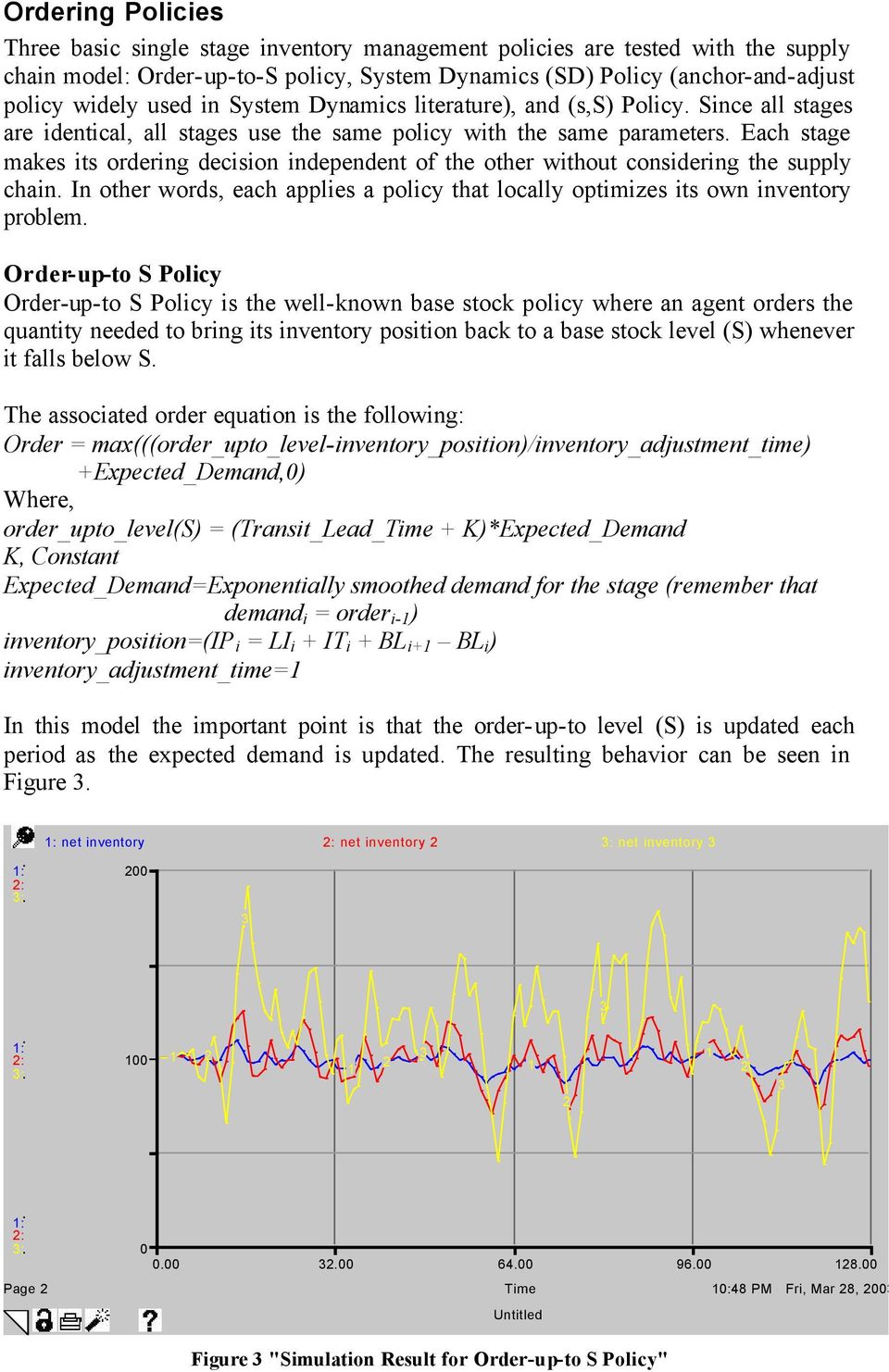
4 Ordering Policies Three basic single stage inventory management policies are tested with the supply chain model: Order-up-to-S policy, System Dynamics (SD) Policy (anchor-and-adjust policy widely used in System Dynamics literature), and (s,s) Policy. Since all stages are identical, all stages use the same policy with the same parameters. Each stage makes its ordering decision independent of the other without considering the supply chain. In other words, each applies a policy that locally optimizes its own inventory problem. Order-up-to S Policy Order-up-to S Policy is the well-known base stock policy where an agent orders the quantity needed to bring its inventory position back to a base stock level (S) whenever it falls below S. The associated order equation is the following: Order = max(((order_upto_level-inventory_position)/inventory_adjustment_time) +Expected_Demand,) Where, order_upto_level(s) = (Transit_Lead_ + K)*Expected_Demand K, Constant Expected_Demand=Exponentially smoothed demand for the stage (remember that demand i = order i- ) inventory_position=(ip i = LI i + IT i + BL i+ BL i ) inventory_adjustment_time= In this model the important point is that the order-up-to level (S) is updated each period as the expected demand is updated. The resulting behavior can be seen in Figure. net inventory : net inventory : net inventory : : : : : : Page :48 PM Fri, Mar 8, Figure "Simulation Result for Order-up-to S Policy"
5 SD Policy System Dynamics (SD) Policy is the anchor-and-adjust policy widely used in System Dynamics literature in which local inventory is tried to be kept constant at a desired level. The associated order equation is the following: Order = max(((desired_inventory-inventory)/inventory_adjustment_time) + ((desired_supply_line-supply_line)/supply_line_adjustment_time) +Expected_Demand,) Where, desired_inventory, Constant inventory = Local Inventory Backlog = LI i - BL i desired_supply_line = Lead_ * Expected_Demand supply_line = In_Transit + Backlog (at upper stage) = IT i + BL i+ inventory_adjustment_time = supply_line_adjustment_time = Expected_Demand=Exponentially smoothed demand for the stage Note that, in this model, although desired supply line is adjusted according to expected demand, desired inventory is kept constant. The behavior of the supply chain can be seen in Figure 4. net inventory : net inventory : net inventory : : : : : : Page :5 PM Fri, Mar 8, Figure 4 " Simulation Result for SD Policy (s,s) Policy (s,s) Policy is the single stage continuous review policy where an order is placed to raise the inventory position to order-up-to level S whenever the inventory position drops to the reorder point s or lower. The order equation is the following: if inventory_position <= min_inventory then Order = (order_upto_level-inventory_position)/inventory_adjustment_time

6 else Order = Where, min_inventory (s)= std deviation of forecast errors of lead time demand, Constant for the purpose of simulation order_upto_level (S)= min_inventory+(expected_demand*q) q, Constant inventory_adjustment_time= The behavior of the model is given in Figure 5 " Simulation Result for (s,s) Policy. net inventory : net inventory : net inventory : : : : 5 : : Page PM Fri, Mar 8, Information Sharing Strategies Figure 5 " Simulation Result for (s,s) Policy In order to explore the effect of information sharing on the behavior of the inventories, the supply chain model is modified to include end item demand sharing: Each stage uses end item demand to forecast the future demand rather than using orders of the lower stage. Hence, demand forecast obtained directly from end item demand is used in ordering decisions by all stages. Forecast sharing means that all stages in the supply chain use the same "shared" demand forecast. Since agents in our model are identical, they all use the same forecasting mechanism with the same parameters. Thus, although demand forecasts are not explicitly shared, given that the end item demand is shared, all stages effectively use the same end item demand forecasts. Forecast sharing means that all stages in the supply chain use the same demand forecast. Since agents in our model are identical, they all use the same forecasting mechanism with the same parameters. Given that the end item demand is shared, all stages result with same demand forecast. Thus, although demand forecast is not shared, all stages use the same end item demand forecasts.

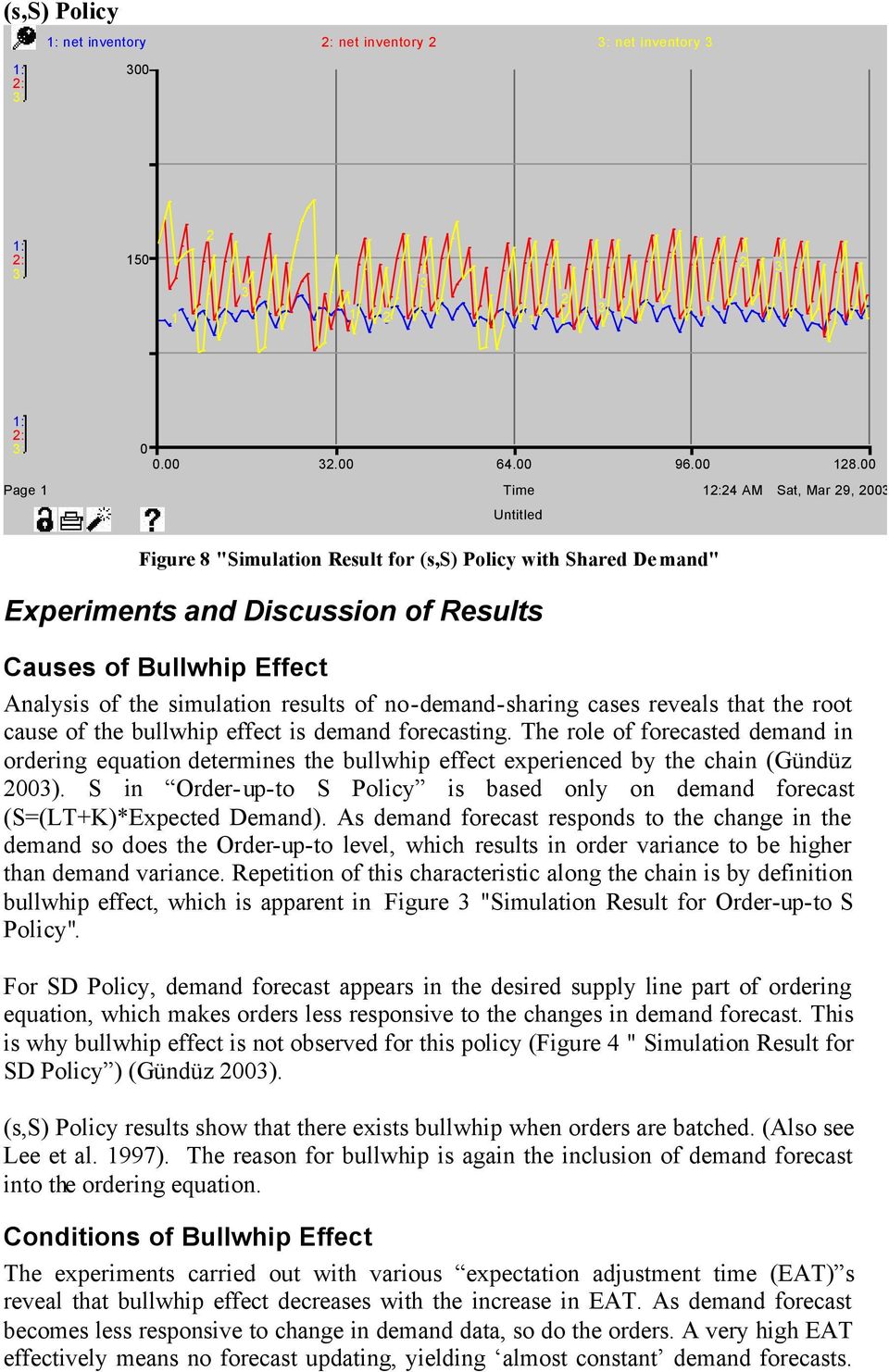
7 The resulting behavior for the policies is given in Figure 6 "Simulation Result for Order-up-to S Policy with Shared Demand", Figure 7 "Simulation Result for SD Policy with Shared Demand", and Figure 8 "Simulation Result for (s,s) Policy with Shared Demand". Order-up-to S Policy : : net inventory : net inventory : net inventory : : : : Page :5 AM Sat, Mar 9, Figure 6 "Simulation Result for Order-up-to S Policy with Shared Demand" SD Policy net inventory : net inventory : net inventory : : : : : : Page :7 AM Sat, Mar 9, Figure 7 "Simulation Result for SD Policy with Shared Demand"

8 (s,s) Policy net inventory : net inventory : net inventory : : : : 5 : : Page :4 AM Sat, Mar 9, Figure 8 "Simulation Result for (s,s) Policy with Shared De mand" Experiments and Discussion of Results Causes of Bullwhip Effect Analysis of the simulation results of no-demand-sharing cases reveals that the root cause of the bullwhip effect is demand forecasting. The role of forecasted demand in ordering equation determines the bullwhip effect experienced by the chain (Gündüz ). S in Order-up-to S Policy is based only on demand forecast (S=(LT+K)*Expected Demand). As demand forecast responds to the change in the demand so does the Order-up-to level, which results in order variance to be higher than demand variance. Repetition of this characteristic along the chain is by definition bullwhip effect, which is apparent in Figure "Simulation Result for Order-up-to S Policy". For SD Policy, demand forecast appears in the desired supply line part of ordering equation, which makes orders less responsive to the changes in demand forecast. This is why bullwhip effect is not observed for this policy (Figure 4 " Simulation Result for SD Policy ) (Gündüz ). (s,s) Policy results show that there exists bullwhip when orders are batched. (Also see Lee et al. 997). The reason for bullwhip is again the inclusion of demand forecast into the ordering equation. Conditions of Bullwhip Effect The experiments carried out with various expectation adjustment time (EAT) s reveal that bullwhip effect decreases with the increase in EAT. As demand forecast becomes less responsive to change in demand data, so do the orders. A very high EAT effectively means no forecast updating, yielding almost constant demand forecasts.
9 Constant demand forecast means constant order-up-to levels, hence no bullwhip (Gündüz ). Another interesting result is observed for (s,s) policy: Bullwhip effect disappears for EAT values higher than some specific value depending on other parameters of the system. This is worth mentioning since for higher values of EAT bullwhip exits but in smaller magnitude in order-up-to S policy. Reason for this behavior of (s,s) is that the batching of orders takes care of the small variations in demand. Parametric Analysis Experiments has been carried out with different settings of parameters EAT, LT, order-up-to level multiplier (K or q), and demand autocorrelation. Some important results are the followings: - Bullwhip effect increases with the increase in Lead - Bullwhip effect increases with the increase in Order-up-to Level (multiplier) - Even if end item demand is totally random, upper stage inventories show cyclic pattern. Demand Sharing and Elimination of Bullwhip Effect Demand and forecast sharing removes independent forecasting mechanisms along the chain so that a stage no longer bases its orders on demand forecast obtained by lower stage s orders. Instead each stage directly uses end item forecast obtained by end item data. Thus consequent increase in orders is eliminated (as can be clearly seen from Figure 6,Figure 7, and Figure 8). Another way to eliminate bullwhip is to use less responsive forecasting tools. Exponential smoothing with a high value of EAT is an example. A very high EAT effectively means no forecast updating, yielding almost constant demand forecasts. When there is no forecasting, there is no bullwhip effect (Gündüz ). Conclusions and Future Work One main conclusion of this study is that one of the root causes of bullwhip effect is independent demand forecasting at every stage of the supply chain. More importantly, we show that demand and/or forecast sharing on supply chain reduce the bullwhip effect. Note that we implemented instant demand sharing, which is very idealistic. In real world, although information technology infrastructure is highly developed, instant access to end item demand may be impossible for all the agents in the supply chain. Therefore non-ideal cases of demand and forecast sharing (e.g. time delay in shared information propagation) must also be modeled and inspected. A corollary result is that using less-responsive forecasting tools or not to use forecasting can eliminate bullwhip effect. However, without forecasting, a manager would risk ignoring a trend in demand or some other demand pattern. Results of this could incur more cost to the overall supply chain system as compared to the cost of bullwhip effect. Therefore the non-responsive forecasting option must be analyzed carefully with different patterns of end item demand.

10 References Chen, F., Z. Drezner, J.K. Ryan, and D. Simchi-Levi The Bullwhip Effect: Managerial Insights on the Impact of Forecasting and Information on Variability in a Supply Chain. Appears in the book Quantitative Models for Supply Chain Management. Boston: Kluwer Academic Publishers. Gündüz, A.B.,. Information Sharing to Reduce Fluctuations in Supply Chains: A Dynamic Modeling Approach. MS Thesis, Department of Industrial Engineering, Bogazici University Lee, H.L., P. Padmanabhan, and S. Whang Information Distortion in a Supply Chain: The Bullwhip Effect. Management Science 4: Silver, E.A., D.F. Pyke, R. Peterson Inventory Management and Production Planning and Scheduling rd Ed. New York: John Wiley & Sons. Sterman, J.D.. Business Dynamics. Boston: McGraw-Hill. Xu, K., Y. Dong, P.T. Evers.. Towards better coordination of the Supply Chain. Transportation Research Part E 7:5-54 Zipkin, P.H.. Foundations of Inventory Management. Irwin/McGraw-Hill.

Analysis of Various Forecasting Approaches for Linear Supply Chains based on Different Demand Data Transformations
 Institute of Information Systems University of Bern Working Paper No 196 source: https://doi.org/10.7892/boris.58047 downloaded: 16.11.2015 Analysis of Various Forecasting Approaches for Linear Supply
REDUCING THE IMPACT OF DEMAND PROCESS VARIABILITY WITHIN A MULTI-ECHELON SUPPLY CHAIN
 REDUCING THE IMPACT OF DEMAND PROCESS VARIABILITY WITHIN A MULTI-ECHELON SUPPLY CHAIN Abstract Francisco Campuzano Bolarín 1,Lorenzo Ros Mcdonnell 1, Juan Martín García 1 Department of Business Economy.
Effect of Forecasting on Bullwhip Effect in Supply Chain Management
 Effect of Forecasting on Bullwhip Effect in Supply Chain Management Saroj Kumar Patel and Priyanka Jena Mechanical Engineering Department, National Institute of Technology, Rourkela, Odisha-769008, India
Single item inventory control under periodic review and a minimum order quantity
 Single item inventory control under periodic review and a minimum order quantity G. P. Kiesmüller, A.G. de Kok, S. Dabia Faculty of Technology Management, Technische Universiteit Eindhoven, P.O. Box 513,
Effect of Lead Time on Anchor-and-Adjust Ordering Policy in Continuous Time Stock Control Systems 1
 Effect of Lead Time on Anchor-and-Adjust Ordering Policy in Continuous Time Stock Control Systems 1 Ahmet Mutallip and Hakan Yasarcan Industrial Engineering Department Bogazici University Bebek Istanbul
Case Study on Forecasting, Bull-Whip Effect in A Supply Chain
 International Journal of ISSN 0974-2107 Systems and Technologies Vol.4, No.1, pp 83-93 IJST KLEF 2010 Case Study on Forecasting, Bull-Whip Effect in A Supply Chain T.V.S. Raghavendra 1, Prof. A. Rama Krishna
PERFORMANCE ANALYSIS OF A CONTRACT MANUFACTURING SYSTEM
 PERFORMANCE ANALYSIS OF A CONTRACT MANUFACTURING SYSTEM Viswanadham.N 1, Vaidyanathan.G 2 The Logistics Institute- Asia Pacific National University of Singapore Singapore 11926 [email protected] 1 [email protected]
14 THE BULLWHIP EFFECT: MANAGERIAL INSIGHTS ON THE IMPACT OF FORECASTING AND INFORMATION ON VARIABILITY IN A SUPPLY CHAIN
 14 THE BULLWHIP EFFECT: MANAGERIAL INSIGHTS ON THE IMPACT OF FORECASTING AND INFORMATION ON VARIABILITY IN A SUPPLY CHAIN Frank Chent, Zvi Drezner2, Jennifer K. Ryan 3 and David Simchi-Levi 4 1 Department
One of the main supply chain deficiencies is the bullwhip effect: Demand fluctuations increase as one moves
 Vol. 10, No. 1, September 2009, pp. 1 9 issn 1532-0545 09 1001 0001 informs I N F O R M S Transactions on Education Exploring the Bullwhip Effect by Means of Spreadsheet Simulation doi 10.1287/ited.1090.0038
Evaluating the Lead Time Demand Distribution for (r, Q) Policies Under Intermittent Demand
 Proceedings of the 2009 Industrial Engineering Research Conference Evaluating the Lead Time Demand Distribution for (r, Q) Policies Under Intermittent Demand Yasin Unlu, Manuel D. Rossetti Department of
A Synchronized Supply Chain for Reducing Decoupling Stock
 A Synchronized Supply Chain for Reducing Decoupling Stock Jian Wang Shanghai University, China, [email protected] Hiroaki Matsukawa Keio University, Japan, [email protected] Shane J. Schvaneveldt
Cost performance of traditional and vendor managed inventory approaches in hospital pharmaceutical supply chains
 Cost performance of traditional and vendor managed inventory approaches in hospital pharmaceutical supply chains Sineenart Krichanchai* and Bart L. MacCarthy Operations Management and Information Systems
Exact Fill Rates for the (R, S) Inventory Control with Discrete Distributed Demands for the Backordering Case
 Informatica Economică vol. 6, no. 3/22 9 Exact Fill ates for the (, S) Inventory Control with Discrete Distributed Demands for the Backordering Case Eugenia BABILONI, Ester GUIJAO, Manuel CADÓS, Sofía
SIMULATION-BASED ANALYSIS OF THE BULLWHIP EFFECT UNDER DIFFERENT INFORMATION SHARING STRATEGIES
 SIMULATION-BASED ANALYSIS OF THE BULLWHIP EFFECT UNDER DIFFERENT INFORMATION SHARING STRATEGIES Yuri A. Merkuryev and Julija J. Petuhova Rik Van Landeghem and Steven Vansteenkiste Department of Modelling
Statistical Inventory Management in Two-Echelon, Multiple-Retailer Supply Chain Systems
 Statistical Management in Two-Echelon, Multiple-Retailer Supply Chain Systems H. T. Lee, Department of Business Administration, National Taipei University, Taiwan Z. M. Liu, Department of Business Administration,
How human behaviour amplifies the bullwhip effect a study based on the beer distribution game online
 How human behaviour amplifies the bullwhip effect a study based on the beer distribution game online Joerg Nienhaus *, Arne Ziegenbein *, Christoph Duijts + * Centre for Enterprise Sciences (BWI), Swiss
Information Sharing in Supply Chain Management: A Literature Review on Analytical Research
 Information Sharing in Supply Chain Management: A Literature Review on Analytical Research Hyun-cheol Paul Choi California State University, Fullerton, CA In this paper, we reviewed the area of upstream
SPARE PARTS INVENTORY SYSTEMS UNDER AN INCREASING FAILURE RATE DEMAND INTERVAL DISTRIBUTION
 SPARE PARS INVENORY SYSEMS UNDER AN INCREASING FAILURE RAE DEMAND INERVAL DISRIBUION Safa Saidane 1, M. Zied Babai 2, M. Salah Aguir 3, Ouajdi Korbaa 4 1 National School of Computer Sciences (unisia),
Inventory Management and Risk Pooling. Xiaohong Pang Automation Department Shanghai Jiaotong University
 Inventory Management and Risk Pooling Xiaohong Pang Automation Department Shanghai Jiaotong University Key Insights from this Model The optimal order quantity is not necessarily equal to average forecast
The information to share in upstream supply chains dedicated to mass production of customized products for allowing a decentralized management
 The information to share in upstream supply chains dedicated to mass production of customized products for allowing a decentralized management Carole Camisullis, Vincent Giard, Gisele Mendy-Bilek To cite
EVERYTHING YOU NEED TO KNOW ABOUT INVENTORY
 EVERYTHING YOU NEED TO KNOW ABOUT INVENTORY Introduction Inventory is considered the necessary evil of the supply chain. In fact, there has been a whole movement; lean manufacturing that has tried to reduce
Supply Chain Bullwhip Effect Simulation Under Different Inventory Strategy
 Supply Chain Bullwhip Effect Simulation Under Different Inventory Stgy WANG Xiaoyan, HUANG Xiaobo Department of foundation, Xuzhou Air Force College, Xuzhou, Jiangsu, China [email protected] Abstract:
A simulation study on supply chain performance with uncertainty using contract. Creative Commons: Attribution 3.0 Hong Kong License
 Title A simulation study on supply chain performance with uncertainty using contract Author(s) Chan, FTS; Chan, HK Citation IEEE International Symposium on Intelligent Control Proceedings, the 13th Mediterrean
The impact of lead time forecasting on the bullwhip effect
 The impact of lead time forecasting on the bullwhip effect arxiv:1309.7374v3 [math.pr] 29 Jul 2015 ZbigniewMichna 1 andpeternielsen 2 1 DepartmentofMathematicsandCybernetics Wrocław University of Economics
Package SCperf. February 19, 2015
 Package SCperf February 19, 2015 Type Package Title Supply Chain Perform Version 1.0 Date 2012-01-22 Author Marlene Silva Marchena Maintainer The package implements different inventory models, the bullwhip
A System Dynamics Approach to Reduce Total Inventory Cost in an Airline Fueling System
 , June 30 - July 2, 2010, London, U.K. A System Dynamics Approach to Reduce Total Inventory Cost in an Airline Fueling System A. Al-Refaie, M. Al-Tahat, and I. Jalham Abstract An airline fueling system
Chapter 12 Inventory Control and Management
 Chapter 12 Inventory Control and Management Learning Outcomes Describe the functions and costs of an inventory system. Determine the order quantity and Economic Order Quantity. Determine the reorder point
Inventory management in distribution systems case of an Indian FMCG company
 Asia Pacific Management Review (2004) 9(1), 1-22 Inventory management in distribution systems case of an Indian FMCG company Subrata Mitra and A. K. Chatterjee (received April 2003; revision received October
FIXED CHARGE UNBALANCED TRANSPORTATION PROBLEM IN INVENTORY POOLING WITH MULTIPLE RETAILERS
 FIXED CHARGE UNBALANCED TRANSPORTATION PROBLEM IN INVENTORY POOLING WITH MULTIPLE RETAILERS Ramidayu Yousuk Faculty of Engineering, Kasetsart University, Bangkok, Thailand [email protected] Huynh Trung
An important observation in supply chain management, known as the bullwhip effect,
 Quantifying the Bullwhi Effect in a Simle Suly Chain: The Imact of Forecasting, Lead Times, and Information Frank Chen Zvi Drezner Jennifer K. Ryan David Simchi-Levi Decision Sciences Deartment, National
A Simulation to Illustrate Periodic-Review Inventory Control Policies
 Spreadsheets in Education (ejsie) Volume 4 Issue 2 Article 4 12-21-2010 A Simulation to Illustrate Periodic-Review Inventory Control Policies Matthew J. Drake Duquesne University, [email protected] Kathryn
Information Sharing in Supply Chains: a Literature Review and Research Agenda
 Information Sharing in Supply Chains: a Literature Review and Research Agenda Imam Baihaqi Department of Management Monash University, Victoria, Australia Email: [email protected] Dr. Nicholas
Service levels, system cost and stability of production inventory control systems
 Service levels, system cost and stability of production inventory control systems Author:D.Bijulal,Jayendran Venkateswar and N.Hemachandra Reporter:Zhang Yiqing Outline 2 1 Introduction uthe classical
THE INTEGRATION OF SUPPLY CHAIN MANAGEMENT AND SIMULATION SYSTEM WITH APPLICATION TO RETAILING MODEL. Pei-Chann Chang, Chen-Hao Liu and Chih-Yuan Wang
 THE INTEGRATION OF SUPPLY CHAIN MANAGEMENT AND SIMULATION SYSTEM WITH APPLICATION TO RETAILING MODEL Pei-Chann Chang, Chen-Hao Liu and Chih-Yuan Wang Institute of Industrial Engineering and Management,
SUPPLY CHAIN MODELING USING SIMULATION
 SUPPLY CHAIN MODELING USING SIMULATION 1 YOON CHANG AND 2 HARRIS MAKATSORIS 1 Institute for Manufacturing, University of Cambridge, Cambridge, CB2 1RX, UK 1 To whom correspondence should be addressed.
Applying System Dynamics to Business: An Expense Management Example
 Applying System Dynamics to Business: An Expense Management Example Bill Harris Facilitated Systems http://facilitatedsystems.com/ May 17, 2000 Abstract If you re new to system dynamics, it may be hard
System-Dynamics modelling to improve complex inventory management in a batch-wise plant
 European Symposium on Computer Arded Aided Process Engineering 15 L. Puigjaner and A. Espuña (Editors) 2005 Elsevier Science B.V. All rights reserved. System-Dynamics modelling to improve complex inventory
THE SYSTEM FRAMEWORK FOR EVALUATING THE EFFECT OF COLLABORATIVE TRANSPORTATION MANAGEMENT ON SUPPLY CHAIN
 THE SYSTEM FRAMEWORK FOR EVALUATING THE EFFECT OF COLLABORATIVE TRANSPORTATION MANAGEMENT ON SUPPLY CHAIN Cheng-Min FENG Chien-Yun YUAN Professor Ph.D. Student Institute of Traffic and Transportation Institute
Journal of Emerging Trends in Engineering and Applied Sciences (JETEAS) 4(1):115-120 (ISSN: 2141-7016)
 Journal of Emerging Trends in Engineering and Applied Sciences (JETEAS) 4(1):115-120 Scholarlink Research Institute Journals, 2013 (ISSN: 2141-7016) jeteas.scholarlinkresearch.org Journal of Emerging Trends
ANALYSIS of STOCK MANAGEMENT GAMING EXPERIMENTS and ALTERNATIVE ORDERING FORMULATIONS 1
 ANALYSIS of STOCK MANAGEMENT GAMING EXPERIMENTS and ALTERNATIVE ORDERING FORMULATIONS Yaman Barlas Mehmet Günhan Özevin Department of Industrial Engineering Ford Otomotiv Sanayi A.Ş. Boğaziçi University
Information Flow Management of Vendor- Managed Inventory System in Automobile Parts Inbound Logistics Based on Internet of Things
 1374 JOURNAL OF SOFTWARE, VOL. 6, NO. 7, JULY 2011 Information Flow Management of Vendor- Managed Inventory System in Automobile Parts Inbound Logistics Based on Internet of Things Xiaohui Liu 1,2, Youwang
ALS THE BULLWHIP EFFECT IN SUPPLY CHAIN. Janusz K. Grabara, Marta Starostka-Patyk. Czestochowa University of Technology, Poland
 ALS Advanced Logistic Systems THE BULLWHIP EFFECT IN SUPPLY CHAIN Janusz K. Grabara, Marta Starostka-Patyk Czestochowa University of Technology, Poland Abstract: In a supply chain the variability of the
Forecasting method selection in a global supply chain
 Forecasting method selection in a global supply chain Everette S. Gardner, Jr. * Department of Decision and Information Sciences C.T. Bauer College of Business 334 Melcher Hall, Houston, Texas USA 77204-6021
Modeling Stochastic Inventory Policy with Simulation
 Modeling Stochastic Inventory Policy with Simulation 1 Modeling Stochastic Inventory Policy with Simulation János BENKŐ Department of Material Handling and Logistics, Institute of Engineering Management
A CONCEPTUAL DESIGN INITIATION FOR PRODUCTION-INVENTORY SYSTEM BASED ON MACROECONOMICS
 A CONCEPTUAL DESIGN INITIATION FOR PRODUCTION-INVENTORY SYSTEM BASED ON MACROECONOMICS Marzieh Akhondi a and S. Nurmaya Musa b Department of Mechanical Engineering, Faculty of Engineering, University of
Inventory Models for Special Cases: A & C Items and Challenges
 CTL.SC1x -Supply Chain & Logistics Fundamentals Inventory Models for Special Cases: A & C Items and Challenges MIT Center for Transportation & Logistics Inventory Management by Segment A Items B Items
Optimal base-stock policy for the inventory system with periodic review, backorders and sequential lead times
 44 Int. J. Inventory Research, Vol. 1, No. 1, 2008 Optimal base-stock policy for the inventory system with periodic review, backorders and sequential lead times Søren Glud Johansen Department of Operations
The Bullwhip Effect is problematic: order variability increases as orders propagate along the supply
 PRODUCTION AND OPERATIONS MANAGEMENT Vol. 13, No. 2, Summer 2004, pp. 150 160 issn 1059-1478 04 1302 150$1.25 POMS 2004 Production and Operations Management Society An Analytical Investigation of the Bullwhip
In this paper we study how the time-series structure of the demand process affects the value of information
 MANAGEMENT SCIENCE Vol. 51, No. 6, June 25, pp. 961 969 issn 25-199 eissn 1526-551 5 516 961 informs doi 1.1287/mnsc.15.385 25 INFORMS Information Sharing in a Supply Chain Under ARMA Demand Vishal Gaur
THINK DEVISE CALCULATE ENVISION INVENT INSPIRE THINK DEVISE CALCULATE ENVISION INV
 Issue 4 June 2006 FORESIGHT The International Journal of Applied Forecasting THINK DEVISE CALCULATE ENVISION INVENT INSPIRE THINK DEVISE CALCULATE ENVISION INV SPECIAL FEATURES Forecasting for Call Centers
Supply Chain Management: Risk pooling
 Supply Chain Management: Risk pooling Donglei Du ([email protected]) Faculty of Business Administration, University of New Brunswick, NB Canada Fredericton E3B 9Y2 Donglei Du (UNB) SCM 1 / 24 Table of contents
Genetic Algorithms for Multi-Objective Optimization in Dynamic Systems
 Genetic Algorithms for Multi-Objective Optimization in Dynamic Systems Ceyhun Eksin Boaziçi University Department of Industrial Engineering Boaziçi University, Bebek 34342, stanbul, Turkey [email protected]
INTEGRATED OPTIMIZATION OF SAFETY STOCK
 INTEGRATED OPTIMIZATION OF SAFETY STOCK AND TRANSPORTATION CAPACITY Horst Tempelmeier Department of Production Management University of Cologne Albertus-Magnus-Platz D-50932 Koeln, Germany http://www.spw.uni-koeln.de/
Ch.3 Demand Forecasting.
 Part 3 : Acquisition & Production Support. Ch.3 Demand Forecasting. Edited by Dr. Seung Hyun Lee (Ph.D., CPL) IEMS Research Center, E-mail : [email protected] Demand Forecasting. Definition. An estimate
Web-based Oil Supply Chain Game
 Web-based Oil Supply Chain Game Samik Raychaudhuri Dept. of Industrial Engineering, Univ. of Wisconsin, Madison, WI 53726 Abstract One of the major uses of management games is as a learning tool to improve
Agenda. Real System, Transactional IT, Analytic IT. What s the Supply Chain. Levels of Decision Making. Supply Chain Optimization
 Agenda Supply Chain Optimization KUBO Mikio Definition of the Supply Chain (SC) and Logistics Decision Levels of the SC Classification of Basic Models in the SC Logistics Network Design Production Planning
Applying Actual Usage Inventory Management Best Practice in a Health Care Supply Chain
 Applying Actual Usage Inventory Management Best Practice in a Health Care Supply Chain Vijith Varghese #1, Manuel Rossetti #2, Edward Pohl #3, Server Apras *4, Douglas Marek #5 # Department of Industrial
IDENTIFICATION OF DEMAND FORECASTING MODEL CONSIDERING KEY FACTORS IN THE CONTEXT OF HEALTHCARE PRODUCTS
 IDENTIFICATION OF DEMAND FORECASTING MODEL CONSIDERING KEY FACTORS IN THE CONTEXT OF HEALTHCARE PRODUCTS Sushanta Sengupta 1, Ruma Datta 2 1 Tata Consultancy Services Limited, Kolkata 2 Netaji Subhash
Information Distortion Influencing the Supply Chain
 Information Distortion Influencing the Supply Chain Tilburg University 2009-2010 Faculty: Economics and Business Administration Name: Student number: S705520 Supervisor: Drs. Onno Cleeren Topic: Organization
CHAPTER 6 AGGREGATE PLANNING AND INVENTORY MANAGEMENT 명지대학교 산업시스템공학부
 CHAPTER 6 AGGREGATE PLANNING AND INVENTORY MANAGEMENT 명지대학교 산업시스템공학부 Learning Objectives You should be able to: Describe the hierarchical operations planning process in terms of materials planning & capacity
THE IMPLEMENTATION OF VENDOR MANAGED INVENTORY IN THE SUPPLY CHAIN WITH SIMPLE PROBABILISTIC INVENTORY MODEL
 THE IMPLEMENTATION OF VENDOR MANAGED INVENTORY IN THE SUPPLY CHAIN WITH SIMPLE PROBABILISTIC INVENTORY MODEL Ika Deefi Anna Departement of Industrial Engineering, Faculty of Engineering, University of
Collaborative Supply Chain Management Learning Using Web-Hosted Spreadsheet Models ABSTRACT
 Collaborative Supply Chain Management Learning Using Web-Hosted Spreadsheet Models Don N. Pope Abilene Christian University, ACU Box 29309, Abilene, Texas 79699-9309 Phone: 325-674-2786 Fax: 325-674-2507
Coordinated Pricing and Inventory in A System with Minimum and Maximum Production Constraints
 The 7th International Symposium on Operations Research and Its Applications (ISORA 08) Lijiang, China, October 31 Novemver 3, 2008 Copyright 2008 ORSC & APORC, pp. 160 165 Coordinated Pricing and Inventory
Agenda. Managing Uncertainty in the Supply Chain. The Economic Order Quantity. Classic inventory theory
 Agenda Managing Uncertainty in the Supply Chain TIØ485 Produkjons- og nettverksøkonomi Lecture 3 Classic Inventory models Economic Order Quantity (aka Economic Lot Size) The (s,s) Inventory Policy Managing
INVENTORY CONTROL BY TOYOTA PRODUCTION SYSTEM KANBAN METHODOLOGY A CASE STUDY
 Int. J. Mech. Eng. & Rob. Res. 2013 V M Nistane and Srinivas Viswanath V, 2013 Research Paper ISSN 2278 0149 www.ijmerr.com Vol. 2, No. 1, January 2013 2013 IJMERR. All Rights Reserved INVENTORY CONTROL
Production Planning. Chapter 4 Forecasting. Overview. Overview. Chapter 04 Forecasting 1. 7 Steps to a Forecast. What is forecasting?
 Chapter 4 Forecasting Production Planning MRP Purchasing Sales Forecast Aggregate Planning Master Production Schedule Production Scheduling Production What is forecasting? Types of forecasts 7 steps of
Inventory Decision-Making
 Management Accounting 195 Inventory Decision-Making To be successful, most businesses other than service businesses are required to carry inventory. In these businesses, good management of inventory is
On the effect of non-optimal forecasting methods on supply chain downstream demand
 IMA Journal of Management Mathematics Advance Access published March 25, 2011 IMA Journal of Management Mathematics Page 1 of 18 doi:10.1093/imaman/dpr005 On the effect of non-optimal forecasting methods
THE CONTROL OF AN INTEGRATED PRODUCTION-INVENTORY SYSTEM WITH JOB SHOP ROUTINGS AND STOCHASTIC ARRIVAL AND PROCESSING TIMES
 THE ONTROL OF AN INTEGRATED RODUTION-INVENTORY SYSTEM WITH JOB SHO ROUTINGS AND STOHASTI ARRIVAL AND ROESSING TIMES LM Van Nyen 1 * JWM Bertrand 1 HG Van Ooijen 1 NJ Vandaele 2 1 2 Technische Universiteit
Equations for Inventory Management
 Equations for Inventory Management Chapter 1 Stocks and inventories Empirical observation for the amount of stock held in a number of locations: N 2 AS(N 2 ) = AS(N 1 ) N 1 where: N 2 = number of planned
Comparison of periodic-review inventory control policies. in a serial supply chain
 025-0998 Comparison of periodic-review inventory control policies in a serial supply chain Nihan Kabadayi, İstanbul University, Faculty of Business Administration, Production Management Department, Avcılar,
16 : Demand Forecasting
 16 : Demand Forecasting 1 Session Outline Demand Forecasting Subjective methods can be used only when past data is not available. When past data is available, it is advisable that firms should use statistical
Supplier Scorecard Handbook
 Supplier Scorecard Handbook Revision Date 07-22-05 SUPPLIER PERFORMANCE EVALUATION ABG holds suppliers accountable to maintain or exceed performance requirements that have significant impact on our supply
Arena 9.0 Basic Modules based on Arena Online Help
 Arena 9.0 Basic Modules based on Arena Online Help Create This module is intended as the starting point for entities in a simulation model. Entities are created using a schedule or based on a time between
Tema 4: Supply Chain Management
 Tema 4: Supply Chain Management Logistics 1 Supplier Manufacturer Warehouse Retailer Customer Tema basado en: Supply Chain Management: Strategy, Planning, and Operations, Sunil Copra and Peter Meindl (Editors).
INVENTORY MANAGEMENT. 1. Raw Materials (including component parts) 2. Work-In-Process 3. Maintenance/Repair/Operating Supply (MRO) 4.
 INVENTORY MANAGEMENT Inventory is a stock of materials and products used to facilitate production or to satisfy customer demand. Types of inventory include: 1. Raw Materials (including component parts)
Inventory Management and Risk Pooling
 CHAPTER 3 Inventory Management and Risk Pooling CASE JAM Electronics: Service Level Crisis JAM Electronics is a Korean manufacturer of products such as industrial relays. The company has five Far Eastern
Retail Inventory Management with Stock-Out Based Dynamic Demand Substitution
 Retail Inventory Management with Stock-Out Based Dynamic Demand Substitution Barış Tan a, Selçuk Karabatı a a College of Administrative Sciences and Economics, Koç University, Rumeli Feneri Yolu, Sariyer,
Supply Chain Management: Inventory Management
 Supply Chain Management: Inventory Management Donglei Du Faculty of Business Administration, University of New Brunswick, NB Canada Fredericton E3B 9Y2 ([email protected]) Du (UNB) SCM 1 / 83 Table of contents
An Analysis of Inventory Management of T-Shirt at Mahanagari Bandung Pisan
 www.sbm.itb.ac.id/ajtm The Asian Journal of Technology Management Vol. 3 No. 2 (2010) 92-109 An Analysis of Inventory Management of T-Shirt at Mahanagari Bandung Pisan Togar M. Simatupang 1 *, Nidia Jernih
What is the Bullwhip Effect caused by?
 Supply Chain World Europe 2002, 28-30 October, 2002, Amsterdam What is the Bullwhip Effect caused by? Study based on the Beer Distribution Game online Jörg Nienhaus (email: [email protected]) Swiss
ISE 421 QUANTATIVE PRODUCTION PLANNING
 ISE 421 QUANTATIVE PRODUCTION PLANNING LECTURE III MRP, MRPII, ERP, APS Dr. Arslan ÖRNEK 2013 2014 Fall Term PRODUCTION PLANNING & SCHEDULING (PP&S) PP&S is one of the most critical activities in a manufacturing
OPTIMAL CONTROL OF A PRODUCTION INVENTORY SYSTEM WITH GENERALIZED EXPONENTIAL DISTRIBUTED DETERIORATION
 Journal of Mathematical Sciences: Advances and Applications Volume 4, Number 2, 2010, Pages 395-411 OPTIMAL CONTROL OF A PRODUCTION INVENTORY SYSTEM WITH GENERALIZED EXPONENTIAL DISTRIBUTED DETERIORATION
Demand forecasting & Aggregate planning in a Supply chain. Session Speaker Prof.P.S.Satish
 Demand forecasting & Aggregate planning in a Supply chain Session Speaker Prof.P.S.Satish 1 Introduction PEMP-EMM2506 Forecasting provides an estimate of future demand Factors that influence demand and
A System Dynamics Approach to Study the Sales Forecasting of Perishable Products in a Retail Supply Chain
 A System Dynamics Approach to Study the Sales Forecasting of Perishable Products in a Retail Supply Chain Lewlyn L.R. Rodrigues 1, Tanuj Gupta 2, Zameel Akhtar K. 3, Sunith Hebbar 4 1,4 Department of Humanities
Dynamic Simulation and Supply Chain Management
 Dynamic Simulation and Supply Chain Management White Paper Abstract This paper briefly discusses how dynamic computer simulation can be applied within the field of supply chain management to diagnose problems