
Hong Kong Aviation Requirements
|
|
|
- Poppy Patrick
- 10 years ago
- Views:
Transcription
1 Hong Kong Aviation Requirements HKAR66 Licensing of Maintenance Personnel (Certifying Staff Maintenance) Issue 2 Revision 4 30 January 2014 CAD 66 Civil Aviation Department HONG KONG, CHINA

2 HKAR66 Applications for further copies of the Hong Kong Aviation Requirements should be addressed to: Civil Aviation Department Headquarters Flight Standards and Airworthiness Division 1 Tung Fai Road Hong Kong International Airport Lantau Hong Kong. Fax : (852) Tel : (852) [email protected] 30 January 2014 ii ISSUE 2 Revision 4
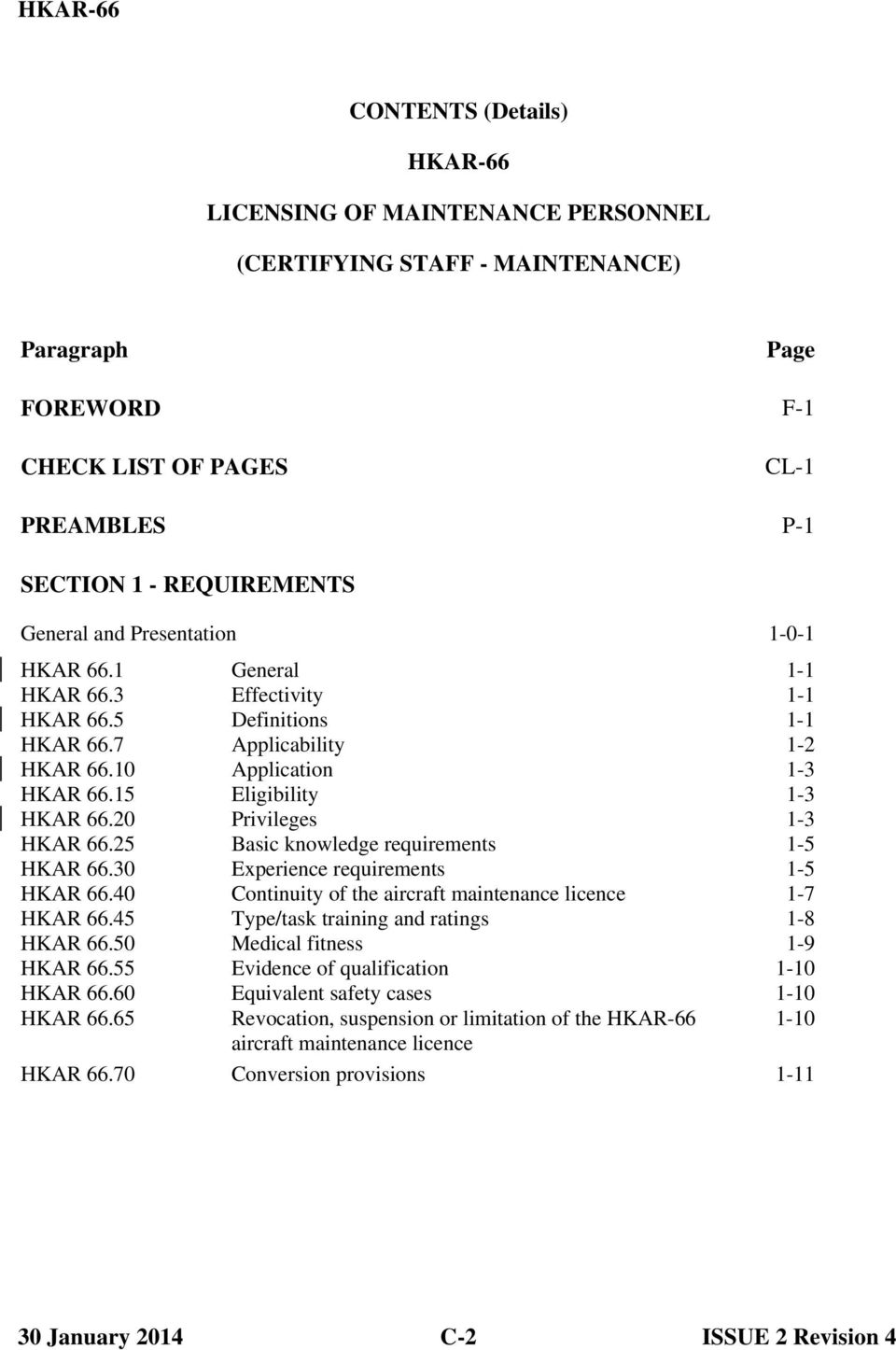
3 HKAR66 CONTENTS (Layout) HKAR66 LICENSING OF MAINTENANCE PERSONNEL (CERTIFYING STAFF MAINTENANCE) FOREWORD CHECK LIST OF PAGES PREAMBLES SECTION 1 REQUIREMENTS SECTION 2 ACCEPTABLE MEANS OF COMPLIANCE (AMC) SECTION 3 GUIDANCE MATERIAL (GM) SECTION 4 APPENDICES ISSUE 2 Revision 4 C1 30 January 2014

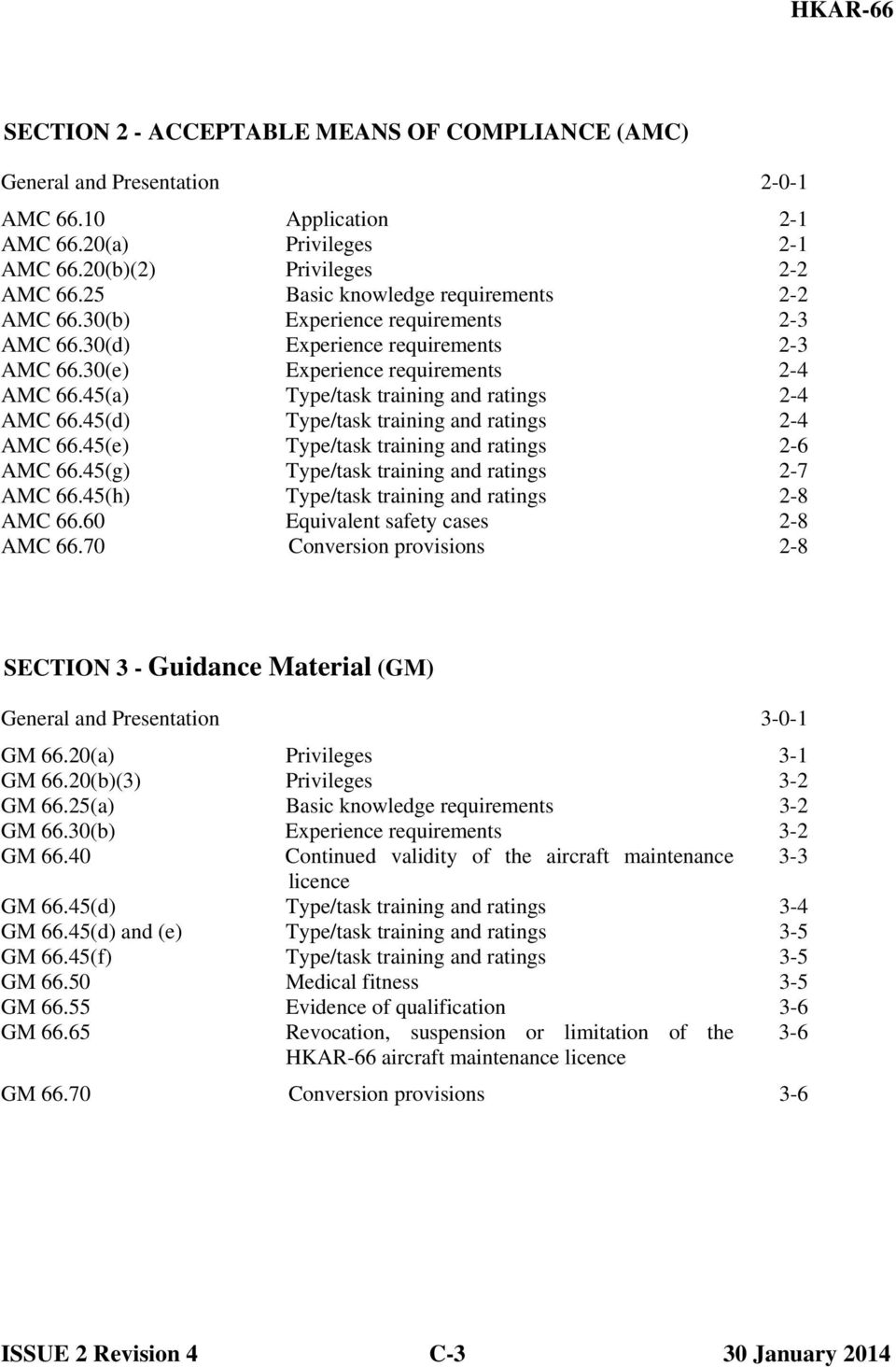
4 HKAR66 CONTENTS (Details) HKAR66 LICENSING OF MAINTENANCE PERSONNEL (CERTIFYING STAFF MAINTENANCE) Paragraph FOREWORD CHECK LIST OF PAGES PREAMBLES Page F1 CL1 P1 SECTION 1 REQUIREMENTS General and Presentation 101 HKAR 66.1 General 11 HKAR 66.3 Effectivity 11 HKAR 66.5 Definitions 11 HKAR 66.7 Applicability 12 HKAR Application 13 HKAR Eligibility 13 HKAR Privileges 13 HKAR Basic knowledge requirements 15 HKAR Experience requirements 15 HKAR Continuity of the aircraft maintenance licence 17 HKAR Type/task training and ratings 18 HKAR Medical fitness 19 HKAR Evidence of qualification 110 HKAR Equivalent safety cases 110 HKAR Revocation, suspension or limitation of the HKAR aircraft maintenance licence HKAR Conversion provisions January 2014 C2 ISSUE 2 Revision 4
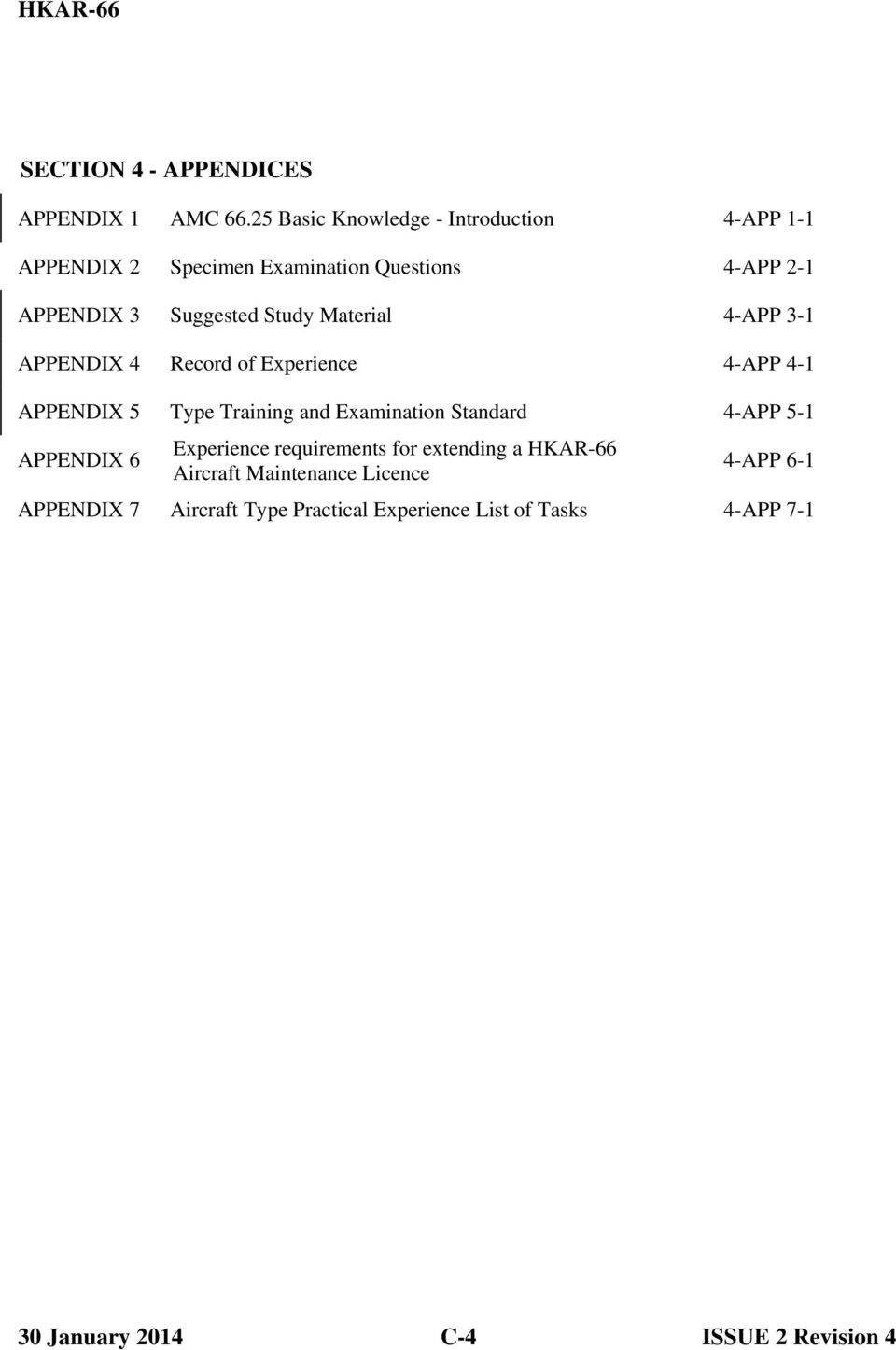
5 HKAR66 SECTION 2 ACCEPTABLE MEANS OF COMPLIANCE (AMC) General and Presentation 201 AMC Application 21 AMC 66.20(a) Privileges 21 AMC 66.20(b)(2) Privileges 22 AMC Basic knowledge requirements 22 AMC 66.30(b) Experience requirements 23 AMC 66.30(d) Experience requirements 23 AMC 66.30(e) Experience requirements 24 AMC 66.45(a) Type/task training and ratings 24 AMC 66.45(d) Type/task training and ratings 24 AMC 66.45(e) Type/task training and ratings 26 AMC 66.45(g) Type/task training and ratings 27 AMC 66.45(h) Type/task training and ratings 28 AMC Equivalent safety cases 28 AMC Conversion provisions 28 SECTION 3 Guidance Material (GM) General and Presentation 301 GM 66.20(a) Privileges 31 GM 66.20(b)(3) Privileges 32 GM 66.25(a) Basic knowledge requirements 32 GM 66.30(b) Experience requirements 32 GM Continued validity of the aircraft maintenance 33 licence GM 66.45(d) Type/task training and ratings 34 GM 66.45(d) and (e) Type/task training and ratings 35 GM 66.45(f) Type/task training and ratings 35 GM Medical fitness 35 GM Evidence of qualification 36 GM Revocation, suspension or limitation of the 36 HKAR66 aircraft maintenance licence GM Conversion provisions 36 ISSUE 2 Revision 4 C3 30 January 2014
6 HKAR66 SECTION 4 APPENDICES APPENDIX 1 AMC Basic Knowledge Introduction 4APP 11 APPENDIX 2 Specimen Examination Questions 4APP 21 APPENDIX 3 Suggested Study Material 4APP 31 APPENDIX 4 Record of Experience 4APP 41 APPENDIX 5 Type Training and Examination Standard 4APP 51 Experience requirements for extending a HKAR66 APPENDIX 6 4APP 61 Aircraft Maintenance Licence APPENDIX 7 Aircraft Type Practical Experience List of Tasks 4APP January 2014 C4 ISSUE 2 Revision 4
7 HKAR66 FOREWORD 1 Hong Kong Civil Aviation Department has published comprehensive and detailed aviation requirements, referred to as the Hong Kong Aviation Requirements (HKARs) with a view to setting up standards and minimising type certification problems, to facilitate the export and import of aviation products, to make it easier for maintenance carried out in Hong Kong. In addition, maintenance personnel should be trained and qualified to an international standard to assist Industry in obtaining suitable staff. 2 Article 12 of the Air Navigation (Hong Kong) Order 1995 as amended gives the Chief Executive of the Hong Kong Special Administrative Region authority of granting aircraft maintenance licences, subject to such conditions as he thinks fit, upon his being satisfied that the applicant is a fit person to hold the licence and furnished such evidence and passed such examinations and test as the Chief Executive may require of him for the purpose of establishing that he has sufficient knowledge, experience, competence and skill in aeronautical engineering. 3 The requirements of this HKAR66 recognise the Standards prescribed by the International Civil Aviation Organisation Annex 1 for the grant and extension of licences. 4 HKAR66 became effective on 1 January 2002 and was fully implemented by 1 January Amendments are incorporated into the text by means of a 'Revision' or a complete 'Reissue'. ISSUE 2 F1 20 February 2009

8 INTENTIONALLY LEFT BLANK

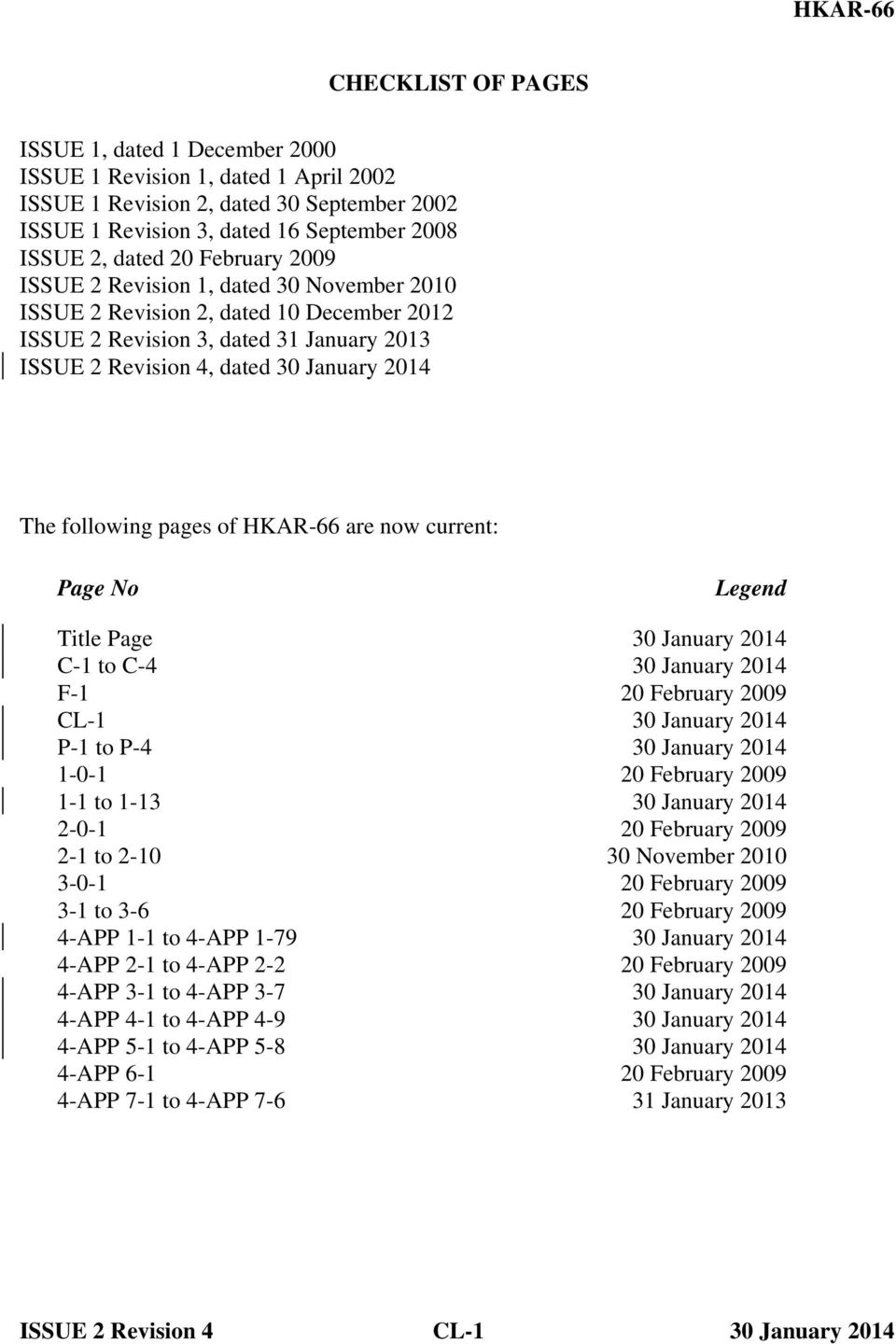
9 HKAR66 CHECKLIST OF PAGES ISSUE 1, dated 1 December 2000 ISSUE 1 Revision 1, dated 1 April 2002 ISSUE 1 Revision 2, dated 30 September 2002 ISSUE 1 Revision 3, dated 16 September 2008 ISSUE 2, dated 20 February 2009 ISSUE 2 Revision 1, dated 30 November 2010 ISSUE 2 Revision 2, dated 10 December 2012 ISSUE 2 Revision 3, dated 31 January 2013 ISSUE 2 Revision 4, dated 30 January 2014 The following pages of HKAR66 are now current: Page No Legend Title Page 30 January 2014 C1 to C4 30 January 2014 F1 20 February 2009 CL1 30 January 2014 P1 to P4 30 January February to January February to November February to February APP 11 to 4APP January APP 21 to 4APP February APP 31 to 4APP January APP 41 to 4APP January APP 51 to 4APP January APP February APP 71 to 4APP January 2013 ISSUE 2 Revision 4 CL1 30 January 2014
10 INTENTIONALLY LEFT BLANK

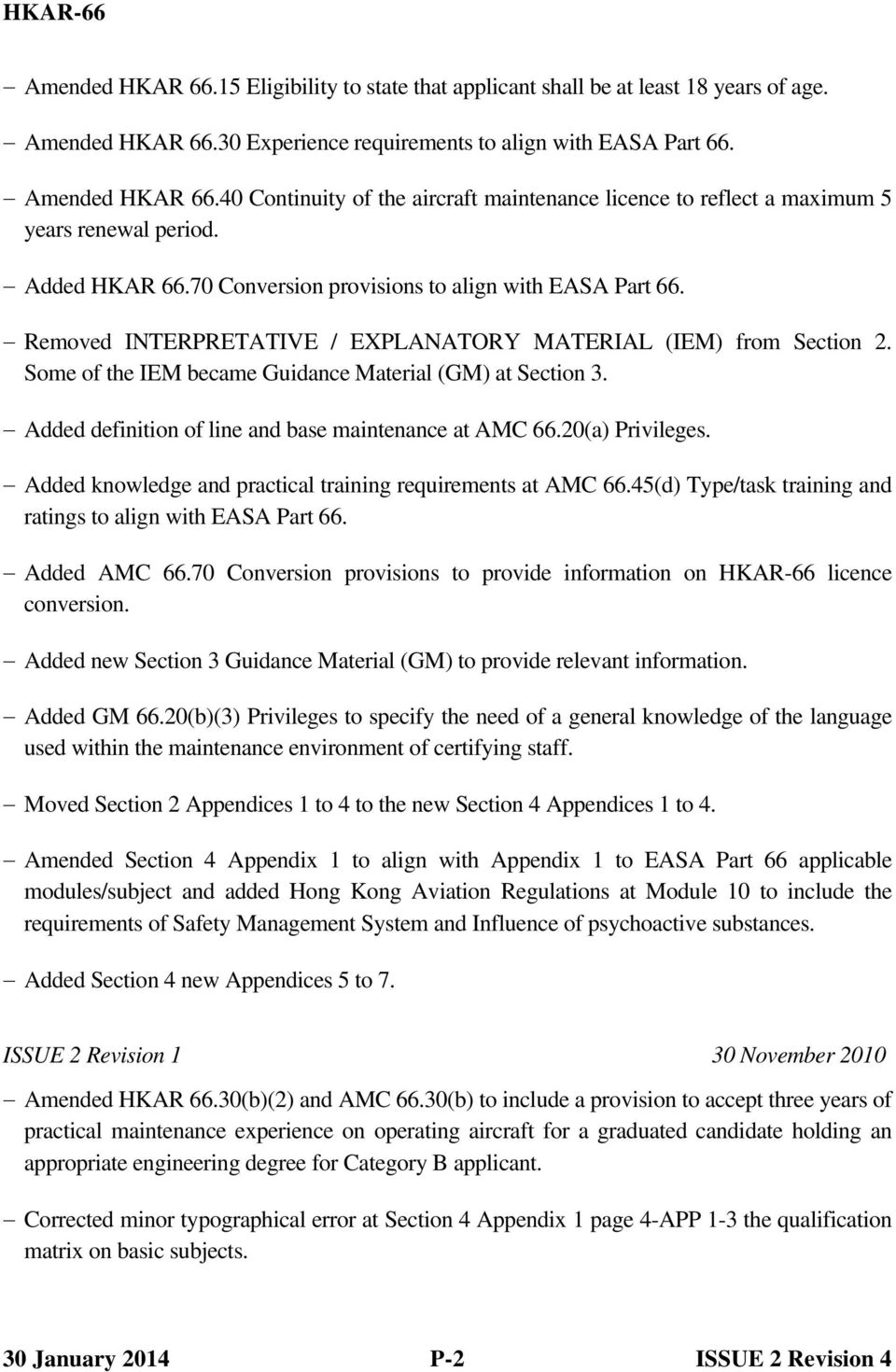
11 HKAR66 PREAMBLES The preambles are intended to be a summarised record of the main changes introduced by each amendment of HKAR66. ISSUE 1 1 December 2000 New requirement for the maintenance certifying staff to qualify for the issuing of certificates of release to service. It should be noted that HKAR66 is applicable to the release to service of aeroplanes and helicopters. ISSUE 1 Revision 1 1 April 2002 Amend the effective and compliance dates stated in HKAR 66.3 from 1 January 2002 and 1 January 2004 to 1 April 2002 and 1 April 2004 respectively. ISSUE 1 Revision 2 30 September 2002 Added a new Appendix 4 to Section 2 to provide guidance to complete the Record of Experience. ISSUE 1 Revision 3 16 September 2008 Revised the suggested study material in Appendix 3 to Section 2. Issue 2 20 February 2009 Changed the structure of the HKAR66 publication. There are four sections where Section 1 contains the requirements and Sections 2, 3 and 4 contain the Acceptable Means of Compliance (AMC), the Guidance Material (GM) and the Appendices respectively. Aligned, as applicable, the paragraph contents and numbering of the HKAR66 to those of EASA Part 66. Transferred applicable paragraphs from HKAR 66.1 General to HKAR Conversion provisions. Amended definitions of CAD and DirectorGeneral in HKAR 66.5 ISSUE 2 Revision 4 P1 30 January 2014

12 HKAR66 Amended HKAR Eligibility to state that applicant shall be at least 18 years of age. Amended HKAR Experience requirements to align with EASA Part 66. Amended HKAR Continuity of the aircraft maintenance licence to reflect a maximum 5 years renewal period. Added HKAR Conversion provisions to align with EASA Part 66. Removed INTERPRETATIVE / EXPLANATORY MATERIAL (IEM) from Section 2. Some of the IEM became Guidance Material (GM) at Section 3. Added definition of line and base maintenance at AMC 66.20(a) Privileges. Added knowledge and practical training requirements at AMC 66.45(d) Type/task training and ratings to align with EASA Part 66. Added AMC Conversion provisions to provide information on HKAR66 licence conversion. Added new Section 3 Guidance Material (GM) to provide relevant information. Added GM 66.20(b)(3) Privileges to specify the need of a general knowledge of the language used within the maintenance environment of certifying staff. Moved Section 2 Appendices 1 to 4 to the new Section 4 Appendices 1 to 4. Amended Section 4 Appendix 1 to align with Appendix 1 to EASA Part 66 applicable modules/subject and added Hong Kong Aviation Regulations at Module 10 to include the requirements of Safety Management System and Influence of psychoactive substances. Added Section 4 new Appendices 5 to 7. ISSUE 2 Revision 1 30 November 2010 Amended HKAR 66.30(b)(2) and AMC 66.30(b) to include a provision to accept three years of practical maintenance experience on operating aircraft for a graduated candidate holding an appropriate engineering degree for Category B applicant. Corrected minor typographical error at Section 4 Appendix 1 page 4APP 13 the qualification matrix on basic subjects. 30 January 2014 P2 ISSUE 2 Revision 4
13 HKAR66 ISSUE 2 Revision 2 10 December 2012 Amended address and telephone number of CAD in page ii and Appendix 3 of Section 4. ISSUE 2 Revision 3 31 January 2013 Amended HKAR 66.20(a)(3) Privileges to change the term electrical power systems to electrical systems. Amended Section 4 Appendix 1 Basic Knowledge Requirements on Module 13 and 14 to align with EASA Part 66. Amended Section 4 Appendix 4 Table 1 and Table 2. Amended Section 4 Appendix 5 paragraph 2 Type Training Standard for Category B2 certifying staff. Amended Section 4 Appendix 7 Aircraft Type Practical Experience List of Tasks to add tasks on Integrated Modular Avionics (ATA 42), Cabin Systems (ATA 44) and Information Systems (ATA 46). ISSUE 2 Revision 4 30 January 2014 Amended HKAR 66.1 General to include Category B2*. Note was changed to Note 1 and added Note 2. Amended HKAR 66.5 Added definitions of Electrical system, Avionics system and Simple test. Amended HKAR to reflect application form required to be submitted to the Director General. Amended HKAR Privileges to define the certification privileges of Category B2*. Note was changed to Note 1 and added Note 2. Amended Section 4 Appendix 1 Basic Knowledge Requirements in Module 13 and 14 to reflect the requirements for Category B2 and B2*. Amended Section 4 Appendix 3 Suggested Study Material to add reference materials for Module 13. ISSUE 2 Revision 4 P3 30 January 2014

14 HKAR66 Amended Section 4 Appendix 4 Record of Experience Table 1 to reflect the requirements for Category B2 and B2*. Amended Section 4 Appendix 5 Type Training and Examination Standard paragraph 2 to reflect the requirements of type training standards for Category B2 and B2*. 30 January 2014 P4 ISSUE 2 Revision 4

15 SECTION 1 HKAR66 SECTION 1 REQUIREMENTS 1 GENERAL This Section 1 contains the Requirements for Licensing of Maintenance Personnel (Certifying Staff Maintenance). 2 PRESENTATION 2.1 The requirements of HKAR66 are presented in full page width on loose pages, each page being identified by the date of issue or issue/revision number under which it is reissued or amended. 2.2 Subheadings are in bold typeface. 2.3 Explanatory Notes not forming part of the requirements appear in smaller typeface. 2.4 New, amended and corrected text is indicated by a marginal line. ISSUE February 2009

16 SECTION 1 HKAR66 HKAR 66.1 General (a) (b) HKAR145 requires appropriately authorised certifying staff to issue a certificate of release to service on behalf of the HKAR145 approved maintenance organisation when they satisfy that all required maintenance tasks have been completed. Certifying staff responsible for issuing the certificate of release to service must be qualified in accordance with the appropriate requirements of this HKAR66 for aeroplanes and helicopters of the following categories: Category A Category B1 Category B2/B2* Category B3 Category C Categories A and B1 are subdivided into subcategories relative to combinations of aeroplanes, helicopters, turbine and piston engines. The subcategories are: A1 and B1.1 Aeroplanes Turbine A2 and B1.2 Aeroplanes Piston A3 and B1.3 Helicopters Turbine A4 and B1.4 Helicopters Piston Note 1: The application of HKAR66 to airships and aircraft components will be considered in a future issue. Aircraft components include engines, auxiliary power units and propellers. Note 2: All descriptions and requirements applicable to Category B2 are also applicable to Category B2*. Also, additional descriptions and requirements are included for Category B2*. HKAR 66.3 Effectively This HKAR66 was first issued on 1 December 2000 and becomes effective on 1 April ISSUE 2 Revision January 2014

17 HKAR66 SECTION 1 HKAR 66.5 Definitions For the purpose of this HKAR66, the following definitions shall apply: 'CAD' means Civil Aviation Department of the Hong Kong Special Administrative Region of the People's Republic of China. 'DirectorGeneral' means the DirectorGeneral of Civil Aviation who is authorised for the purpose under the Air Navigation (Hong Kong) Order 1995 by the Chief Executive of the Hong Kong Special Administrative Region of the People's Republic of China and includes any person who is delegated for that purpose. 'Aircraft maintenance licence' means a document issued as evidence of qualification confirming that the person to whom it refers has met the HKAR66 knowledge and experience requirements for any aircraft basic category and aircraft type rating specified in the document. 'Certification' means the issuance of a certificate of release to service. 'Organisation procedures' means the procedures applied by the HKAR145 approved maintenance organisation in accordance with the maintenance organisation exposition within the scope of the approval. 'Simple light aeroplane' means an unpressurised pistonengine aeroplane with a maximum take off mass less than 5700 kg and not fitted with a full authority coupled autopilot/flight director. 'Wooden aeroplane' means an aeroplane fitted with wooden wing spars. Electrical system means the aircraft electrical power supply source, plus the distribution system to the different components contained in the aircraft and relevant connectors. Lighting systems are also included in this definition. When working on cables and connectors which are part of these electrical systems, the following typical practices are included in the privileges: Continuity, insulation and bonding techniques and testing; Crimping and testing of crimped joints; Connector pin removal and insertion; Wiring protection techniques. Avionics system means an aircraft system that transfers, processes, displays or stores analogue or digital data using data lines, data buses, coaxial cables, wireless or other data transmission medium, and includes the system s components and connectors. Examples of avionics systems include the following: ISSUE 2 Revision January 2014

18 SECTION 1 HKAR66 Autoflight; Communication, Radar and Navigation; Instruments (see NOTE below); InFlight Entertainment Systems; Integrated Modular Avionics (IMA); OnBoard Maintenance Systems; Information Systems; FlybyWire Systems (related to ATA27 Flight Controls ); Fibre Optic Control Systems. Note: Instruments are formally included in the privileges of the B2 licence holders. However, maintenance on electromechanical and pitotstatic components may also be released by a B1 license holder. Simple test means a test described in approved maintenance data and meeting all the following criteria: The serviceability of the system can be verified using aircraft controls, switches, Builtin Test Equipment (BITE), Central Maintenance Computer (CMC) or external test equipment not involving special training. The outcome of the test is a unique go no go indication or parameter, which can be a single value or a value within an interval tolerance. No interpretation of the test result or interdependence of different values is allowed. The test does not involve more than 10 actions as described in the approved maintenance data (not including those required to configure the aircraft prior to the test, i.e. jacking, flaps down, etc., or to return the aircraft to its initial configuration). Pushing a control, switch or button, and reading the corresponding outcome may be considered as a single step even if the maintenance data shows them separated. HKAR 66.7 Applicability (a) This HKAR66 prescribes the requirements for the qualification of those personnel authorised by a HKAR145 approved maintenance organisation to issue certificates of release to service. Such personnel are required to hold a valid type rated HKAR66 aircraft maintenance licence, which attests to their knowledge and experience and in the case of HKAR145 a valid HKAR145 certification authorisation which grants certification privileges to the individual. Note: A type rated HKAR66 aircraft maintenance licence normally does not confer any ISSUE 2 Revision January 2014

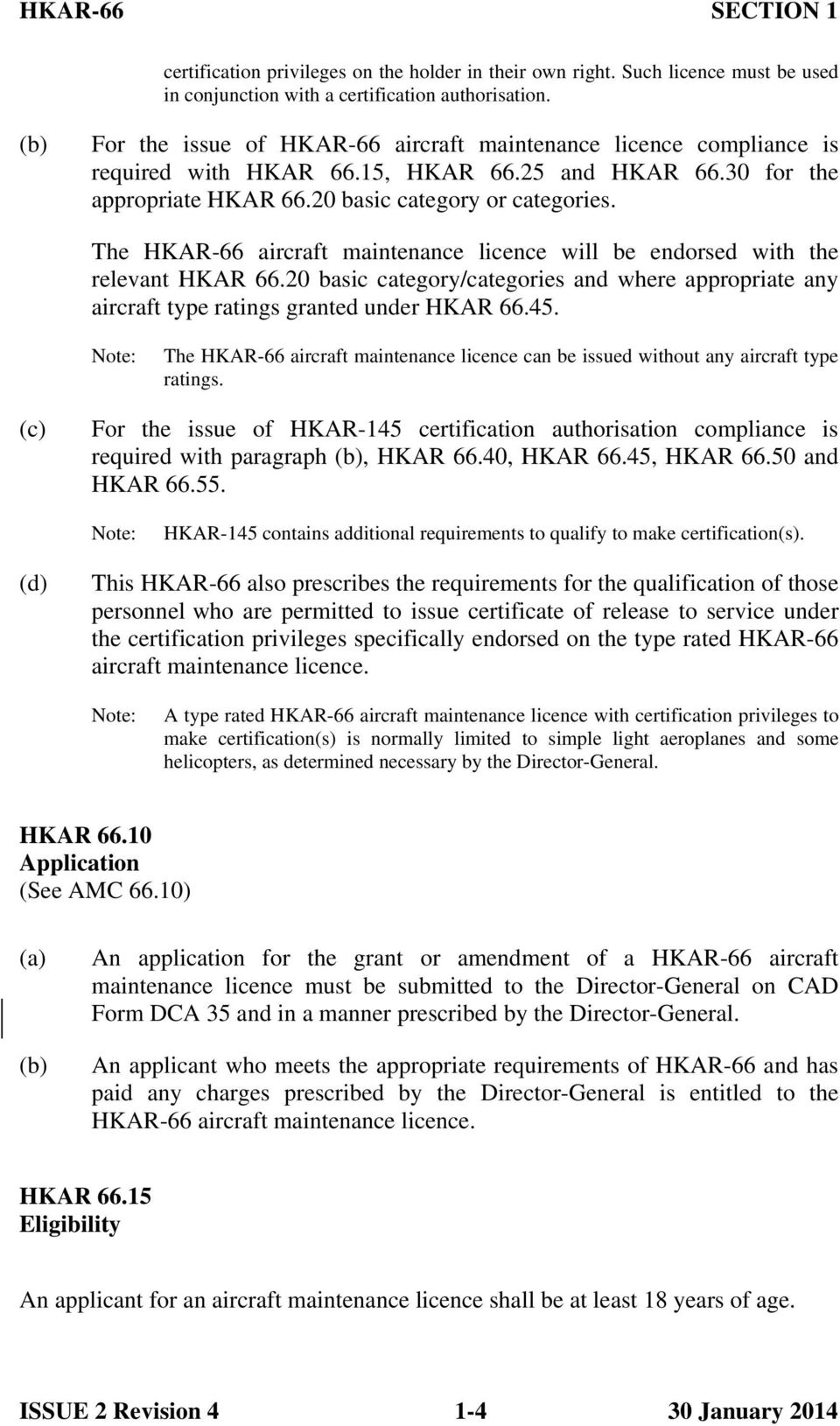
19 HKAR66 SECTION 1 certification privileges on the holder in their own right. Such licence must be used in conjunction with a certification authorisation. (b) For the issue of HKAR66 aircraft maintenance licence compliance is required with HKAR 66.15, HKAR and HKAR for the appropriate HKAR basic category or categories. The HKAR66 aircraft maintenance licence will be endorsed with the relevant HKAR basic category/categories and where appropriate any aircraft type ratings granted under HKAR Note: The HKAR66 aircraft maintenance licence can be issued without any aircraft type ratings. (c) For the issue of HKAR145 certification authorisation compliance is required with paragraph (b), HKAR 66.40, HKAR 66.45, HKAR and HKAR Note: HKAR145 contains additional requirements to qualify to make certification(s). (d) This HKAR66 also prescribes the requirements for the qualification of those personnel who are permitted to issue certificate of release to service under the certification privileges specifically endorsed on the type rated HKAR66 aircraft maintenance licence. Note: A type rated HKAR66 aircraft maintenance licence with certification privileges to make certification(s) is normally limited to simple light aeroplanes and some helicopters, as determined necessary by the DirectorGeneral. HKAR Application (See AMC 66.10) (a) (b) An application for the grant or amendment of a HKAR66 aircraft maintenance licence must be submitted to the DirectorGeneral on CAD Form DCA 35 and in a manner prescribed by the DirectorGeneral. An applicant who meets the appropriate requirements of HKAR66 and has paid any charges prescribed by the DirectorGeneral is entitled to the HKAR66 aircraft maintenance licence. HKAR Eligibility An applicant for an aircraft maintenance licence shall be at least 18 years of age. ISSUE 2 Revision January 2014
20 SECTION 1 HKAR66 HKAR Privileges (See AMC and GM 66.20) (a) Subject to compliance with paragraph (b), the following privileges shall apply: (1) A category A aircraft maintenance licence permits the holder to issue certificates of release to service following minor scheduled line maintenance and simple defect rectification within the limits of tasks specifically endorsed on the authorisation. The certification privileges shall be restricted to work that the licence holder has personally performed in a HKAR145 organisation. Category A is subdivided into subcategories relative to combinations of aeroplanes, helicopters, turbine and piston engines. (2) A category B1 aircraft maintenance licence shall permit the holder to issue certificates of release to service following maintenance, including aircraft structure, powerplant and mechanical and electrical systems. Replacement of avionic line replaceable units, requiring simple tests to prove their serviceability, shall also be included in the privileges. Category B1 shall automatically include the appropriate A subcategory. In addition, a category B1.2 aircraft maintenance licence permits the holder to exercise the privileges of the category B3 subject to the conditions and limitations specified in subparagraph (4). Category B1 is subdivided into subcategories relative to combinations of aeroplanes, helicopters, turbine and piston engines. (3) A category B2 aircraft maintenance licence shall permit the holder to issue certificates of release to service following maintenance on avionic and electrical power system. A category B2* aircraft maintenance licence shall permit the holder to issue certificates of release to service following: maintenance performed on avionic and electrical systems, and electrical and avionics tasks within powerplant and mechanical systems, requiring only simple tests to prove their serviceability. Note 1: Category B2 aircraft maintenance licence holder can qualify for any A subcategory subject to compliance with the appropriate A subcategory requirements. Note 2: New syllabi in Modules 13 and 14 are effective from 1 August To differentiate the privileges of Category B2, licence granted on the basis of the new syllabi will be annotated as Category B2*. (4) A category B3 certifying staff authorisation permits the holder to issue certificates of release to service following maintenance of ISSUE 2 Revision January 2014

21 HKAR66 SECTION 1 simple light aeroplanes, including aircraft structure, powerplants, mechanical and electrical systems plus replacement of avionic units, requiring simple tests to prove serviceability. Notwithstanding the foregoing, the issue of certificates of release to service for wooden aeroplanes is only permitted when the category B3 holder has a rating for wooden aeroplanes. (5) A category C certifying staff authorisation permits the holder to issue certificates of release to service following base maintenance. The authorisation is valid for the aircraft in its entirety in a HKAR145 organisation. Note 1: Note 2: HKAR145 specifies the personnel required to support category C certifying staff in base maintenance, including in particular the requirement for qualified category B1 and B2 staff. HKAR145 does not require a category C certifying staff for the certification of simple light aeroplanes as category B3 or B1.2 or B1.4 covers all maintenance. (b) The holder of an aircraft maintenance licence may not exercise certification privileges unless: (1) in compliance with the applicable requirements of HKAR145. (2) in the preceding twoyear period he/she has, either had six months of maintenance experience in accordance with the privileges granted by the aircraft maintenance licence or, met the provision for the issue of the appropriate privileges. (3) he/she is able to read, write and communicate to an understandable level in the language(s) in which the technical documentation and procedures necessary to support the issue of the certificate of release to service are written. HKAR Basic knowledge requirements (See AMC and GM 66.25) (a) An applicant for an aircraft maintenance licence or the addition of a category or subcategory to such an aircraft maintenance licence shall demonstrate, by examination, a level of knowledge acceptable to the DirectorGeneral, in subject modules appropriate to the HKAR category. Note: HKAR66 Section 4 Appendix 1 contains detailed information on levels of knowledge for categories A, B1, B2, B3 and C. (b) Full or partial credit against the basic knowledge requirements and associated examination will be given for any other technical qualification ISSUE 2 Revision January 2014
22 SECTION 1 HKAR66 considered by the DirectorGeneral to be equivalent to the HKAR66 knowledge standard. HKAR Experience requirements (See AMC and GM 66.30) (a) (b) An applicant must meet a minimum civil aircraft maintenance experience requirement appropriate to the HKAR66 aircraft maintenance licence sought, which will be reduced by the DirectorGeneral when satisfied that either HKAR147 approved training or other appropriate technical training has been received. For category A, Bl, B2 or B3 the practical maintenance experience means being involved with a representative cross section of maintenance tasks on aircraft. An applicant for an aircraft maintenance licence shall have acquired: (1) for categories A and B3 and subcategories B1.2 and B1.4: (i) three years of practical maintenance experience on operating aircraft, if the applicant has no previous relevant technical training; or (ii) two years of practical maintenance experience on operating aircraft and completion of training considered relevant as a skilled worker, in a technical trade; or (iii) one year of practical maintenance experience on operating aircraft and completion of a HKAR147 approved basic training course. (2) for category B2 and subcategories B1.1 and B1.3: (i) five years of practical maintenance experience on operating aircraft if the applicant has no previous relevant technical training; or (ii) three years of practical maintenance experience on operating aircraft and completion of training considered relevant as a skilled worker, in a technical trade; or (iii) three years of practical maintenance experience on operating aircraft and completion of training acceptable to CAD for a graduated candidate holding an appropriate engineering degree; or ISSUE 2 Revision January 2014
23 HKAR66 SECTION 1 (iv) two years of practical maintenance experience on operating aircraft and completion of a HKAR147 approved basic training course. (3) for category C with respect to large aircraft: (i) three years of experience exercising category B1.1, B1.3 or B2 privileges on large aircraft or as HKAR145 B1.1, B1.3 or B2 support staff, or, a combination of both; or (ii) five years of experience exercising category B1.2 or B1.4 privileges on large aircraft or as HKAR145 B1.2 or B1.4 support staff, or a combination of both; or (4) for category C with respect to non large aircraft: three years of experience exercising category B1 or B2 privileges on non large aircraft or as HKAR145 B1 or B2 support staff, or a combination of both; or (5) for category C obtained through the academic route: an applicant holding an academic degree in a technical discipline, from a university or other higher educational institution recognised by the DirectorGeneral, three years of experience working in a civil aircraft maintenance environment on a representative selection of tasks directly associated with aircraft maintenance including six months of observation of base maintenance tasks. (c) (d) (e) An applicant for an extension to an aircraft maintenance licence shall have a minimum civil aircraft maintenance experience requirement appropriate to the additional category or subcategory of licence applied for as defined in Section 4 Appendix 6. For all applicants, at least one year of the required experience must be recent maintenance experience on aircraft typical of the category/subcategory for which the initial HKAR66 aircraft maintenance licence is sought. For subsequent category/subcategory additions to an existing HKAR66 aircraft maintenance licence, the additional recent maintenance experience required may be less than one year, but at least three months and will be dependent upon the significance of the difference between the licence category/subcategory held and the category/subcategory addition. Such experience should be typical of the additional licence category/subcategory sought. Aircraft maintenance experience gained outside a civil aircraft maintenance environment will be accepted by the DirectorGeneral when satisfied that such maintenance is equivalent to that required by HKAR66 but additional experience of civil aircraft maintenance will be required to ensure ISSUE 2 Revision January 2014
24 SECTION 1 HKAR66 understanding of the civil aircraft maintenance environment. HKAR Continuity of the aircraft maintenance licence (See GM 66.40) (a) (b) (c) An aircraft maintenance licence shall remain valid for the period as specified in it, but not exceeding five years. The DirectorGeneral may renew the licence from time to time upon the DirectorGeneral satisfies that the applicant is a fit person and is qualified in accordance with HKAR66. Any certification privileges based upon an aircraft maintenance licence becomes invalid as soon as the aircraft maintenance licence is invalid. The aircraft maintenance licence is only valid when issued, renewed and/or amended by the DirectorGeneral and when the holder has signed the document. HKAR Type/task training and ratings (See GM 66.45) (a) Category A certifying staff may only exercise certification privileges on a specific aircraft type following the satisfactory completion of the relevant category A aircraft task training carried out by an appropriately approved HKAR145 or HKAR147 organisation. The training shall include practical hands on training and theoretical training as appropriate for each task authorised. Satisfactory completion of training shall be demonstrated by an examination and/or by workplace assessment carried out by an appropriately approved HKAR145 or HKAR147 organisation. (b) Except as otherwise specified in paragraph (g), the holder of a category B1, B2, B3 or C aircraft maintenance licence shall only exercise certification privileges on a specific aircraft type when the aircraft maintenance licence is endorsed with the appropriate aircraft type rating. (c) (d) Except as otherwise specified in paragraph (h), ratings shall be granted following satisfactory completion of the relevant category B1, B2, B3 or C aircraft type training approved by the DirectorGeneral or conducted by an appropriately approved HKAR147 maintenance training organisation. Category B1, B2 and B3 approved type training shall include theoretical and practical elements and consist of the appropriate course in relation to the HKAR (a) privileges. Theoretical and practical training shall comply with Section 4 Appendix 5 to this HKAR 66. (e) Category C approved type training shall comply with Section 4 Appendix 5 ISSUE 2 Revision January 2014
25 HKAR66 SECTION 1 to this HKAR 66. In the case of a category C person qualified by holding an academic degree as specified in HKAR (b)(5), the first relevant aircraft type theoretical training shall be at the category B1 or B2 level. Practical training is not required. (f) (g) Completion of approved aircraft type training, as required by paragraphs (b) to (e), shall be demonstrated by an examination. The examination shall comply with Section 4 Appendix 5 to this Part. The examinations in respect of category B1 or B2 or B3 or C aircraft type ratings shall be conducted by training organisations appropriately approved under HKAR147, the DirectorGeneral, or the training organisation conducting the approved type training course. Notwithstanding paragraph (b), for aeroplanes less than 5700 Kg maximum take off mass and helicopters less than 2730 Kg maximum take off mass, a category B1 or B2 or B3 aircraft maintenance licence may be endorsed with the appropriate aircraft manufacturer group type ratings or aircraft group type ratings unless the DirectorGeneral has determined that the complexity of the aircraft in question requires a type rating. (1) Manufacturer group ratings may be granted after complying with the type rating requirements of two aircraft types representative of the group from the same manufacturer. (2) Full group ratings may be granted after complying with the type rating requirements of three aircraft types representative of the group from different manufacturers. However, no full group rating may be granted to B1 multiple turbine engine aeroplanes, where only manufacturer group rating applies. (3) The groups shall consist of the following: (i) for category B1, B3 or C: helicopter piston engine helicopter turbine engine aeroplane single piston engine metal structure aeroplane multiple piston engines metal structure aeroplane single piston engine wooden structure aeroplane multiple piston engines wooden structure aeroplane single piston engine composite structure aeroplane multiple piston engines composite structure aeroplane turbine single engine aeroplane turbine multiple engine (ii) for category B2 or C: aeroplane ISSUE 2 Revision January 2014
26 SECTION 1 HKAR66 (h) helicopter Notwithstanding paragraph (c), ratings on aeroplanes less than 5700 Kg maximum take off mass and helicopters less than 2730 Kg maximum take off mass may also be granted, subject to satisfactory completion of the relevant category B1, B2, B3 or C aircraft type examination and demonstration of practical experience on the aircraft type, unless the DirectorGeneral has determined that the aircraft is complex, where paragraph (c) approved type training is required. Aircraft type practical experience shall include a representative cross section of maintenance activities relevant to the category. HKAR Medical fitness (See GM 66.50) Certifying staff must not exercise the privileges of their certification authorisation if they know or suspect that their physical or mental condition renders them unfit to exercise such privileges. HKAR Evidence of qualification (See GM 66.55) Certifying staff qualified in accordance with this HKAR66 will be issued with an aircraft maintenance licence by the DirectorGeneral as evidence of qualification in accordance with HKAR66. Certifying staff must be able to produce their licence if requested by an authorised person within a reasonable time. HKAR Equivalent safety cases (See AMC 66.60) The DirectorGeneral may exempt any person, required to be qualified in accordance with HKAR66, from any requirement in HKAR66 when satisfied that a situation exists not covered by HKAR66 and subject to compliance with any supplementary condition(s) the DirectorGeneral considers necessary to ensure equivalent safety. Such exemption and supplementary condition(s) must be agreed by the DirectorGeneral to ensure continued recognition of the person. ISSUE 2 Revision January 2014
27 HKAR66 SECTION 1 HKAR Revocation, suspension or limitation of the HKAR66 aircraft maintenance licence (See GM 66.65) (a) The DirectorGeneral may, on reasonable grounds after due enquiry, revoke, suspend or limit the HKAR66 aircraft maintenance licence or direct the HKAR145 approved maintenance organisation to revoke, suspend or limit the HKAR145 certification authorisation if the DirectorGeneral is not satisfied that the holder of the licence and authorisation is a fit and proper person to hold such licence and authorisation subject to the conditions of paragraph (a)(1) or (a)(2) as appropriate. (1) Before revoking or limiting the HKAR66 aircraft maintenance licence or directing the HKAR145 approved maintenance organisation the DirectorGeneral must first give at least 28 days notice to the affected party or parties in writing of his/her intention so to do and the reasons for its proposal and must offer the affected party or parties an opportunity to make representations and the DirectorGeneral will consider those representations. (2) In the case where the DirectorGeneral has determined that the safe operation of the aircraft is adversely affected the DirectorGeneral may in addition to subparagraph (a)(1) provisionally suspend the HKAR66 aircraft maintenance licence without prior notice until the subparagraph (a)(1) procedure is complete. (b) For the DirectorGeneral to consider a person to be not a fit and proper person means that there is clear evidence that the person has knowingly carried out or been involved in one or more of the following activities: (1) Obtained the HKAR66 aircraft maintenance licence and/or the HKAR145 certification authorisation by falsification of submitted evidence. (2) Failed to carry out requested maintenance combined with failure to report such fact to the organisation that requested the maintenance. (3) Failed to carry out required maintenance resulting from own inspection combined with failure to report such fact to the organisation for whom the maintenance was intended to be carried out. (4) Negligent maintenance. (5) Falsification of the maintenance record. (6) The issue of a certificate of release to service knowing that the ISSUE 2 Revision January 2014
28 SECTION 1 HKAR66 maintenance specified on the certificate of release to service has not been carried out or without verifying that such maintenance has been carried out. (7) Carrying out maintenance or issuing a certificate of release to service when adversely affected by alcohol or drugs. HKAR Conversion provisions (See AMC and GM 66.70) (a) (b) (c) (d) Personnel qualified to exercise certification privileges in accordance with Hong Kong aviation regulations valid before the effective date of HKAR66, remain eligible to exercise those privileges. Personnel undergoing a qualification process equivalent to the appropriate HKAR66 requirements before 1 April 2004, may complete such qualification process in accordance with the Hong Kong aviation regulations. The qualifications gained will be recognised as preexisting certification privileges in accordance with paragraph (a). Personnel qualified in accordance with paragraph (a) or (b) must be issued a HKAR66 aircraft maintenance licence. Limitations will be applied where appropriate to the basic licence and to aircraft types or group ratings reflecting the scope of the certification privileges previous held prior to conversion. To remove limitations, the relevant conversion examinations must be passed and any appropriate experience requirements met. Personnel qualified in accordance with paragraph (a) or (b) remain eligible to exercise the certification privileges except in the case of adding other basic categories/subcategories. Appropriate additional requirements of HKAR66 will apply to such extension. Personnel qualified in accordance with paragraph (a) or (b) may extend the scope of their qualification to include new aircraft types subject to compliance with Hong Kong aviation regulations valid before the effective date of HKAR66. ISSUE 2 Revision January 2014
29 INTENTIONALLY LEFT BLANK
30 SECTION 2 HKAR66 SECTION 2 Acceptable Means of Compliance (AMC) 1 GENERAL 1.1 This Section contains Acceptable Means of Compliance that has been agreed for inclusion in HKAR66. Acceptable Means of Compliance (AMC) illustrate a means, or several alternative means, but not necessarily the only possible means by which a requirement can be met. 1.2 Where a particular HKAR paragraph does not have an Acceptable Means of Compliance or any Guidance Material, it is considered that no supplementary material is required. 2 PRESENTATION 2.1 The Acceptable Means of Compliance is presented in full page width on loose pages, each page being identified by the date of issue or the issue/revision number under which it is reissued or amended. 2.2 A numbering system has been used in which the Acceptable Means of Compliance uses the same number as the HKAR paragraph to which it refers. The number is introduced by the letters AMC to distinguish the material from the HKAR itself. 2.3 Explanatory Notes not forming part of the AMC text appear in a smaller typeface. 2.4 New, amended or corrected text is indicated by a marginal line. ISSUE February 2009
31 SECTION 2 HKAR66 AMC Application 1. Maintenance experience should be written up in a manner that the reader has a reasonable understanding of where, when and what maintenance constitutes the experience. A task by task account is not necessary but at the same time a blank statement X years maintenance experience completed is not acceptable. A log book of maintenance experience is desirable. It is acceptable to cross refer in the application form to other documents containing information on maintenance. 2. Applicants claiming the maximum reduction in HKAR 66.30(b) total experience based upon having successfully completed HKAR approved basic training should include the HKAR147 certificate of recognition for approved basic training. 3. Applicants claiming reduction in HKAR 66.30(b) total experience based upon having successfully completed technical training in an organisation or institute recognised by the DirectorGeneral as a competent organisation or institute, should include the relevant certificate of successful completion of training. AMC 66.20(a) Privileges The following definition of line and base maintenance should apply: Line maintenance is any maintenance that is carried out before flight to ensure that the aircraft is fit for the intended flight. It may include: trouble shooting; defect rectification; component replacement with use of external test equipment if required. Component replacement may include components such as engines and propellers; scheduled maintenance and/or checks including visual inspections that will detect obvious unsatisfactory conditions/discrepancies but do not require extensive in depth inspection. It may also include internal structure, systems and powerplant items which are visible through quick opening access panels/doors; ISSUE 2 Revision November 2010
32 HKAR66 SECTION 2 minor repairs and modifications which do not require extensive disassembly and can be accomplished by simple means; for temporary or occasional cases (airworthiness directives, hereinafter AD; service bulletins, hereinafter SB) the quality manager may accept base maintenance tasks to be performed by a line maintenance organisation provided all requirements as defined by the DirectorGeneral are fulfilled. Maintenance tasks falling outside these criteria are considered to be base maintenance. Note: Aircraft maintained in accordance with "progressive" type programmes need to be individually assessed in relation to this paragraph. In principle, the decision to allow some "progressive" checks to be carried out is determined by the assessment that all tasks within the particular check can be carried out safely to the required standards at the designated line maintenance station. AMC (b)(2) Privileges The required 6month experience should be on aircraft structure, powerplant and systems as appropriate to the category or subcategory and relevant to the type or group rating held. Experience should be supported by documentary evidence. AMC Basic knowledge requirements 1. The basic knowledge examinations may be conducted by an appropriately approved HKAR147 training organisation or by the DirectorGeneral. 2. For an applicant being a person qualified by holding an academic degree in a aeronautical, mechanical or electronic discipline from a recognised university or other higher educational institute the need for any examination will depend upon the course taken in relation to Section 4 Appendix 1 to HKAR66. Note: Any university or other higher educational institute accredited by the Hong Kong Council for Academic Accreditation is recognised by the DirectorGeneral. 3. Knowledge gained and examinations passed during previous experiences, for ISSUE 2 Revision November 2010
33 SECTION 2 HKAR66 example, in military aviation and civilian apprenticeships will be credited where the DirectorGeneral is satisfied that such knowledge and examinations are equivalent to that required by Section 4 Appendix 1 to HKAR66. AMC (b) Experience requirements 1 While an applicant to a category C licence may be qualified by having 3 years experience as category B1 or B2 certifying staff only in line maintenance, it is however recommended that any applicant to a category C holding a B1 or B2 licence demonstrate at least 12 months experience as a B1 or B2 base maintenance support staff. 2 For a category C applicant through the academic route the representative selection of tasks should include the observation of hangar maintenance, maintenance planning, quality assurance, recordkeeping, approved spare parts control and engineering development. 3 For a graduated candidate category B applicant holding an appropriate engineering degree means an applicant holding an academic degree in a technical discipline from a university or other higher educational institution and has successfully completed a structured training programme, acceptable to the DirectorGeneral. The 3 years experience means working in a civil aircraft maintenance environment on a selection of tasks including the maintenance planning, quality assurance, and at least 24 months practical experience in line and/or base maintenance. 4 A skilled worker is a person who has successfully completed a course of training, acceptable to the DirectorGeneral, involving the manufacture, repair, overhaul or inspection of mechanical, electrical or electronic equipment. The training would include the use of tools and measuring devices. 5 Practical experience means maintenance experience on operating aircraft which is intended to be the experience of being involved in relevant maintenance tasks on aircraft which are being operated by airlines, air taxi organisations, general aviation, etc. AMC 66.30(d) Experience requirements 1 To be considered as recent experience, at least 50% of the required recent ISSUE 2 Revision November 2010
34 HKAR66 SECTION 2 experience should be gained within the 12month period prior to the date of application for the HKAR66 aircraft maintenance licence. The remainder of the recent experience should have been gained within the 7year period prior to application. 2 Different aircraft types may be considered to be typical when the construction and operation of the airframe, powerplant, systems including avionic systems are of similar technology. AMC 66.30(e) Experience requirements 1 For category A certifying staff the additional experience of civil aircraft maintenance will be a minimum of 6 months. For category B1 or B2 certifying staff the additional experience of civil aircraft maintenance will be a minimum of 12 months. 2 Aircraft maintenance experience gained outside a civil aircraft maintenance environment can include aircraft maintenance experience gained in armed forces, police, etc., or in aircraft manufacturing. AMC 66.45(a) Type/task training and ratings 1 For category A certifying staff specific training on each aircraft type will be required reflecting the authorised task(s) as indicated under HKAR (a) (1). 2 The training shall include practical hands on training and theoretical training as appropriate for each task authorised. Satisfactory completion of training may be demonstrated by an examination and/or by workplace assessment carried out by an appropriately approved HKAR145 or HKAR147 organisation. AMC 66.45(d) Type/task training and ratings 1 The training should give adequate detailed theoretical knowledge of the aircraft, its main parts, systems, equipment, interior and applicable components, including training in the systems in use for technical manuals and maintenance procedures. The course should also take into account the following: (a) In service experience on the aircraft type; ISSUE 2 Revision November 2010
35 SECTION 2 HKAR66 (b) Feedback from inservice difficulties/occurrence reporting etc; (c) Significant airworthiness directives and/or service bulletins; (d) Known human factors issues associated with the particular aircraft type. 2 Theoretical training should be supported by training aids such as aircraft system components. Ground simulator time, engine ground running and computer based training (CBT) etc may also be utilised. 3 Knowledge is also recommended of relevant inspections and limitations as applicable to the effects of environmental factors such as cold and hot climates, wind, moisture, etc. 4 The practical training must comprise a period of 4 months for applicants with no recent recorded previous practical experience of aircraft of comparable construction and systems, including the engines, but this can be reduced to a minimum of two weeks for applicant with such previous experience. 5 A programme of structured onjobtraining (OJT) may be prepared to satisfy the practical training requirement. Where the practical training element is conducted by or under the responsibility of the training organisation under a HKAR147 approval or a direct type course approval, it should be considered as part of the approved course and as such, its acceptance by the DirectorGeneral should be supported by a detailed syllabus showing its content and duration. The individual practical training records should be designed in a manner that they demonstrate compliance with the detailed practical training syllabus. Such records may take the form of an individual training logbook. The logbook should be designed such that tasks may be countersigned by the HKAR147 school or other course provider. Where the practical training element is conducted by a maintenance organisation approved under HKAR145, under its own responsibility, its acceptance by the DirectorGeneral should be supported by a detailed syllabus showing its content and duration. The individual practical training records should be designed in a manner that they demonstrate compliance with the detailed practical training syllabus. Alternatively, the practical training element may consist of a structured OJT programme. In this case the maintenance organisation approved under HKAR145 should provide applicants for a type rating a logbook indicating a list of tasks to be performed under supervision. The logbook should be designed such that tasks may be countersigned by the supervisor. The list of tasks should be accepted either directly for each individual depending on the individuals previous experience, or indirectly through the acceptance of a ISSUE 2 Revision November 2010
36 HKAR66 SECTION 2 procedure giving delegation to the maintenance organisation. In all cases the practical element should include an acceptable cross section of maintenance tasks, which, in the case of a structured OJT, can be tailored to accommodate the operating profile of the HKAR145 organisation whilst also supplementing the theoretical course elements. The means by which the practical element is supervised and the control of the standard should be acceptable to the DirectorGeneral. The duration of the practical type training element should take into account significant differences between types and be acceptable to the DirectorGeneral. These differences will require considerably more practical training for certifying staff who are not familiar with the new techniques and technologies. Some examples of differences may include, but are not limited to, the following elements: Fly by wire, glass cockpit avionics, significant structural differences, etc. 6 Before grant of the aircraft type, the applicant should be able to: (a) (b) (c) (d) demonstrate by knowledge examination a detailed understanding of applicable systems, their operation and maintenance; ensure safe performance of maintenance, inspections and routine work according to the maintenance manual and other relevant instructions and tasks, as appropriate, for the type of aircraft, for example trouble shooting, repairs, adjustments, replacements, rigging and functional checks such as engine run, etc, if required; correctly use all technical literature and documentation for the aircraft; correctly use specialist/special tooling and test equipment, perform removal and replacement of components and modules unique to type, including any onwing maintenance activity. 7 The practical assessment should also ensure safe performance of maintenance, inspections and routine work according to the maintenance manual and other relevant instructions and tasks as appropriate for the type of aircraft, for example trouble shooting, repairs, adjustments (rigging), replacements and functional/operational checks etc including engine operation (ground running) if required. AMC 66.45(e) Type/task training and ratings 1 Category C certifying staff may not carry out the duties of category B1 or B2, or equivalent within base maintenance, unless they hold the relevant B1 or B2 category and have passed type training corresponding to the relevant B1 or B2 category. ISSUE 2 Revision November 2010
37 SECTION 2 HKAR66 2 Type training for category C certifying staff may be at a general level, corresponding to at least level I of ATA specification 104, where applicable providing the applicant has previously attended and passed at least one full training course corresponding to the relevant B1 or B2 category. Practical training is not normally required. AMC 66.45(g) Type/task training and ratings 1 Aircraft types representative of a group means that: for the B1 category the aircraft type should include typical systems and engines relevant to the group (e.g. retractable undercarriage, pressurisation, variable pitch propeller, etc. for the single piston engine metal subgroup) and, for the B2 category the aircraft type should include complex avionics systems such as radio coupled autopilot, EFIS (Electronic flight instrument system), flight guidance systems, etc. 2 A multiple engines group automatically includes the corresponding single engine group. 3 For piston helicopters less than 2730 Kg maximum take off mass, the following category B1.4 helicopter group ratings are possible: Manufacturers single piston helicopters All single piston helicopters. 4 For turbine helicopters less than 2730 Kg maximum take off mass, the following category B1.3 helicopter group ratings are possible: Manufacturers single turbine helicopters Manufacturers twin turbine helicopters All single turbine helicopters All twin turbine helicopters. Note: Specific manufacturer such as Beech, Bell, Cessna, Agusta, etc., will be quoted. 5 Category B3 type ratings are granted as individual aeroplane types until sufficient experience and appropriate aeroplane types meeting the requirement of HKAR 66.30(b) and HKAR 66.45(d) have been obtained when group type ratings will, on application to the DirectorGeneral, be granted. ISSUE 2 Revision November 2010
38 HKAR66 SECTION 2 The following category B1.2/B3 aeroplane group ratings are possible: Manufacturers single piston engine aeroplanes Manufacturers twin piston engine aeroplanes All single piston engine aeroplanes All twin piston engine aeroplanes All wooden aeroplanes Note: Specific manufacturer such as Beech, Bell, Cessna, Agusta, etc., will be quoted. AMC 66.45(h) Type/task training and ratings 1 Type experience should cover an acceptable cross section of tasks from Section 4 Appendix 7. For the first aircraft type of each manufacturer group, at least 50% of the Appendix 7 tasks, as applicable to the concerned aircraft type and licence category, should be performed. For the second aircraft type of each manufacturer group, this should be reduced to 30%. For subsequent aircraft types of each manufacturer group, this should be reduced to 20%. 2 Type experience should be demonstrated by the submission of records or logbook showing the Appendix 7 tasks performed by the applicant as specified by the DirectorGeneral. AMC Equivalent safety cases All proposed equivalent safety cases should be agreed in principle with the DirectorGeneral before they are submitted to the DirectorGeneral for consideration as an acceptable case. AMC Conversion provisions 1 HKAR 66.70(a) 'personnel qualified to exercise certification privileges' means: a. Personnel holding a pre HKAR66 licence with or without certification privileges, or, ISSUE 2 Revision November 2010
39 SECTION 2 HKAR66 b. Personnel holding a pre HKAR66 licence with or without certification privileges and a current HKAR145 certification authorisation, or, c. Personnel do not hold any Hong Kong licence, but, hold a current HKAR145 certification authorisation in accordance with that HKAR145 approved maintenance organisation s approved procedures. 2 HKAR 66.70(b) 'personnel undergoing a qualification process' means: a. Personnel who have passed some of the examinations leading to a Hong Kong licence, or, b. Personnel undergoing a course of approved basic or type training. 3 Personnel holding pre HKAR66 qualifications in accordance with paragraphs HKAR 66.70(a) or (b) will be granted a HKAR66 aircraft maintenance licence per HKAR 66.70(c) in the appropriate category or subcategory without further examination except that such licence will contain limitations in relation to the certification privileges previous held prior to conversion. 4 Personnel who wish to remove limitations from their HKAR66 licence as specified in HKAR 66.70(c) or to add other basic category/subcategory to their HKAR66 licence as specified in HKAR 66.70(d) have to sit and pass the appropriate conversion examinations. Modules/submodules, listed in Section 4 Appendix 1 with the exception of human factors, that are required for conversion examinations should limit to those technical subjects that have not previously been examined and/or not covered by relevant experience by the personnel. 5 The policies with regard to conversion examinations are as follows. a. With regard to those subjects not previously examined, this means those subjects that are contained in each relevant subject module of Section 4 Appendix 1 but were not, or are not, specified in the relevant Hong Kong licence standard. Where if the total number of multichoice questions required for the conversion examination is less than 15, then such conversion examination is not required. This is based on the consideration that the difference in technical knowledge is so minimal that such examination is deemed not necessary. ISSUE 2 Revision November 2010
40 HKAR66 SECTION 2 b. With regard to those subjects covered by relevant experience, this means the knowledge requirement for those subjects that are contained in each relevant subject module of Section 4 Appendix 1 has been assessed and considered to be satisfied by the applicant s past and current experience. A good example is module M7 'Maintenance Practices'. c. With regard to subparagraphs a and b, it should generally be acceptable to partially exempt personnel from conversion examinations on subject modules in relation to Section 4 Appendix 1, dependant upon their existing qualification, expertise and experience as specified in subparagraphs d and e. d. 'Mechanical' personnel do not need to be examined in modules M1, M2, M6, M7, M8 or M10 except that to support conversion to module M11 or M12 personnel will need to be examined in module M8 and to support conversion to module M16 or M17 personnel will need to be examined in module M2 subject 2.3. 'Mechanical' personnel will need to be examined in modules M3, M4 M5 and as applicable in whole or in part in modules M11, M12, M15, M16 or M17 unless previously examined under the Hong Kong aviation regulations prior to HKAR66. Modules M13 and M14 are not relevant to the mechanical discipline. e. 'Avionic' personnel do not need to be examined in modules M1, M2, M4, M6, M7, or M10. 'Avionic' personnel will need to be examined in modules M3, M5, M8, M14 and the applicable parts of module M13 unless previously examined under the Hong Kong aviation regulations prior to HKAR66. Modules M11, M12, M15, M16 and M17 are not relevant to the avionic discipline. f. The exemption for human factors (HF), module M9, is only applicable to those personnel who have attended a CAD approved HF training course before the conversion. 6 Personnel undertaking conversion to the full HKAR66 licence will still need to show that they meet the experience requirement of HKAR ISSUE 2 Revision November 2010
41 INTENTIONALLY LEFT BLANK
42 SECTION 3 HKAR66 SECTION 3 Guidance Material (GM) 1 GENERAL 1.1 This Section contains Guidance Material that has been agreed for inclusion in HKAR Where a particular HKAR paragraph does not have an Acceptable Means of Compliance or any Guidance Material, it is considered that no supplementary material is required. 2 PRESENTATION 2.1 The Guidance Material is presented in full page width on loose pages, each page being identified by the date of issue or the issue/revision number under which it is reissued or amended. 2.2 A numbering system has been used in which the Guidance Material uses the same number as the HKAR paragraph to which it refers. The number is introduced by the letters GM to distinguish the material from the HKAR itself. 2.3 Guidance Material (GM) helps to illustrate the meaning of a requirement. 2.4 Explanatory Notes not forming part of the GM text appear in a smaller typeface. 2.5 New, amended or corrected text is indicated by a marginal line. ISSUE February 2009
43 SECTION 3 HKAR66 GM 66.20(a) Privileges 1. The following titles shown against each category designator below are intended to provide a readily understandable indication of the job function : Category A: Category B1: Category B2: Category B3: Category C: Line maintenance certifying mechanic. Maintenance certifying technician mechanical. Maintenance certifying technician avionic. Simple light aeroplane maintenance certifying technician. Base maintenance certifying engineer. 2. Individual aircraft maintenance licence holders need not be restricted to a single category. Provided that each qualification requirement is satisfied, any combination of categories may be granted. 3. Tasks permitted by (a) (1) to be certified under the category A certification authorisation as part of minor scheduled maintenance or simple defect rectification are as specified in HKAR145 and agreed by the DirectorGeneral. HKAR145 contains a typical example list of such task. 4. For the purposes of category A minor scheduled line maintenance means any minor check up to but not including the A check where functional tests can be carried out by the aircrew to ensure system serviceability. In the case of an aircraft type not controlled by a maintenance programme based upon the A/B/C/D check principle, minor scheduled line maintenance means any minor check up to and including the weekly check or equivalent. 5. The category B1 and B3 licence also permits the certification of work involving avionic systems, providing the serviceability of the system can be established by a simple selftest facility, other onboard test systems/equipment or by simple ramp test equipment. Defect rectification involving test equipment which requires an element of decision making in its application other than a simple go/nogo decision cannot be certified. 6. The category B2 will need to be qualified as category A in order to carry out simple mechanical tasks and be able to make certifications for such work. 7. The category C certification authorisation permits certification of scheduled base maintenance by the issue of a single certificate of release to service for the complete aircraft after the completion of all such maintenance. The basis for this certification is that the maintenance has been carried out by competent mechanics and both category B1 and B2 staff have signed for the maintenance under their respective specialization. The principal function of the category C certifying staff is to ensure that all required maintenance has been called up and ISSUE February 2009
44 SECTION 3 HKAR66 signed off by the category B1 and B2 staff before issue of the certificate of release to service. Category C personnel who also hold category B1 to B2 qualifications may perform both roles in base maintenance. GM 66.20(b)(3) Privileges 1. Holders of an HKAR66 aircraft maintenance licence may not exercise certification privileges unless they have a general knowledge of the language used within the maintenance environment including knowledge of common aeronautical terms in the language. The level of knowledge should be such that the licence holder is able to: read and understand the instructions and technical manuals in use within the organisation ; make written technical entries and any maintenance documentation entries, which can be understood by those with whom they are normally required to communicate ; read and understand the maintenance organisation procedures; communicate at such a level as to prevent any misunderstanding when exercising certification privileges. 2. In all cases, the level of understanding should be compatible with the level of certification privileges exercised. GM 66.25(a) Basic knowledge requirements The levels of knowledge are directly related to the complexity of certifications appropriate to the particular HKAR 66.1 category, which means that category A must demonstrate a limited but adequate level of knowledge, whereas category B1, B2 and B3 must demonstrate a complete level of knowledge in the appropriate subject modules. Category C certifying staff must meet the relevant level of knowledge for B1 or B2. GM 66.30(b) Experience requirements Maintenance experience on operating aircraft means the experience of being involved in maintenance tasks on aircraft which are being operated by airlines, air taxi organisations, etc. The point being to gain sufficient experience in the environment of commercial maintenance as opposed to only the training school environment. Such experience may be combined with approved training so that periods of training ISSUE February 2009
45 SECTION 3 HKAR66 can be intermixed with periods of experience rather like the apprenticeship. GM Continued validity of the aircraft maintenance licence 1 The DirectorGeneral will issue the HKAR66 aircraft maintenance licence with a period of five years and the licence holder remains responsible for making application for renewal to the DirectorGeneral by completing the relevant sections of CAD Form DCA 35A. 2 Licence will normally be renewed provided that during the 24 months preceding the date of expiry of the licence the holder has been engaged for periods totalling at least six months on the maintenance of operating aircraft. Note: Relevant aircraft maintenance activities such as quality auditing or surveillance, teaching in aeronautical engineering subjects or performing duties as a flight engineer are considered as maintenance of operating aircraft. 3 Application for renewal will not be accepted if there are more than 60 days before expiry of the licence. 4 Where the DirectorGeneral permits the use of a particular HKAR66 type rated aircraft maintenance licence for the release of aircraft that is not required to be maintained by a HKAR145 approved maintenance organisation, the licence holder has to demonstrate six months of maintenance experience in each 12month period to ensure continuity of such licence. In the case where it is not possible to demonstrate such maintenance experience, the DirectorGeneral will specify the conditions to reestablish continuity of the licence. 5 It is the responsibility of the licence holder to ensure that his licence remains valid. Any certifications, issued by the licence holder after the licence has expired, will be invalidated and the Certificate of Airworthiness of the aircraft being certified will also be affected. In addition, any HKAR145 certification authorisation granted on the basis of a current licence will be invalidated should that licence expires. ISSUE February 2009
46 SECTION 3 HKAR66 GM 66.45(d) Type/task training and ratings 1. The required duration of practical training must be accepted on a case by case basis by the DirectorGeneral prior to the type rating endorsement. It is strongly recommended that the agreement on the practical training duration be reached before the training starts. For applicants from an HKAR145 organisation, the required duration may be approved through the organisation s MOE procedures. 2. While it is not feasible to establish a formula giving the required training duration in all cases, the following may be used as a guideline: (a) For a first type training course with no recent recorded maintenance experience four months practical training is required. (b) Some factors that may lead to a reduction in the maximum duration of 4 months practical training required are as follows: experience on aircraft type of a similar technology, construction and systems including engines ; recency on type ; the quantity of the practical experience. For example experience gained will depend upon the environment e.g. line maintenance environment with one aircraft per week would permit limited experience compared with the constant base maintenance check environment; the quality of the practical experience. The type of tasks carried out. These tasks should reflect, at a minimum, those tasks specified by the practical training needs matrix developed by the organisation approved under HKAR The minimum two weeks practical training is normally required for all type training courses. This includes the addition of similar type ratings on an HKAR66 licence (differences courses). There may be cases where the practical differences training required is less than two weeks for example an engineer with an HKAR66 type license in category B2 on an Airbus A330 with PW 4000 engines who takes a differences course to an Airbus A330 with Rolls Royce Trent engines. It should be noted however that while AMC 66.45(d) specifies a practical training duration between 2 weeks and 4 months, in the case of a structured OJT performed at line stations, due to the availability of aircraft its duration may need to be subsequently extended in order to fulfil the required list of supervised tasks. ISSUE February 2009
47 SECTION 3 HKAR66 4. Except in those cases where the HKAR147 organisation determines the practical training required it is the responsibility of the maintenance organisation to determine that the duration of practical training is commensurate with the candidates recency and experience. However, in either case the DirectorGeneral must satisfy that the practical training is of sufficient duration before adding a type rating. Limited avionics system training should be included in the category B1 type training as the B1 privileges include the replacement of avionic line replaceable units. Electrical systems should be included in both B1 and B2 categories type training. GM 66.45(d) and (e) Type/task training and ratings HKAR66 Section 4 Appendix 5 type training levels are based upon ATA 104 (Air Transport Association) corresponding type training levels. GM 66.45(f) Type/task training and ratings The examinations in respect of category B1 or B2 or B3 or C aircraft type ratings may be conducted by training organisations appropriately approved under HKAR147, the DirectorGeneral or an organisation authorised by the DirectorGeneral to conduct such examination. GM Medical fitness 1 Medical opinion considers that alcohol present in the blood stream in any quantity affects the ability to make decisions. It is the responsibility of all certifying staff to ensure that they are not adversely affected. 2 The use of any legally administered drug, or medicines, including those used for the treatment of a disease or disorder, which has been shown to exhibit adverse side effects, which affect the decision making ability of the user, should be administered according to medical advice. No other drugs should be used. 3 Certifying staff are responsible for ensuring that their physical condition does not adversely affect their ability to satisfactorily certify the work for which they are responsible. Eyesight, including, where applicable, colour vision, is particularly important in this respect. ISSUE February 2009
48 SECTION 3 HKAR66 4 In the context of this HKAR, mental condition means psychological integrity, particularly in operational attitudes or any relevant personality factor. GM Evidence of qualification Authorised person means any person who is required to establish that the holder has a valid HKAR66 aircraft maintenance licence including the scope of such licence. Authorised persons include the HKAR145 approved maintenance organisation for the purpose of qualifying the holder for issue/renew/amendment of the HKAR145 certification authorisation and any officer from the CAD. Reasonable time means within 5 working days. GM Revocation, suspension or limitation of the HKAR66 aircraft maintenance licence The procedures for handling representation regarding revocation, suspension or limitation of the HKAR66 aircraft maintenance licence are contained in HKAR2 Administrative & Guidance Material Chapter 24. GM Conversion provisions For example a technical limitation could be where a person holds a pre HKAR66 licence limited to the release of the airframe and engine but not the electrical power system. This person would be issued with an HKAR66 aircraft maintenance licence in the B1 category with a limitation excluding electrical power generation and distribution systems. ISSUE February 2009
49 INTENTIONALLY LEFT BLANK
50 SECTION 4 HKAR66 APPENDIX 1 Basic Knowledge Requirements 1. Knowledge Levels Category A, B1, B2, B3 and C Certifying Staff Basic knowledge for category A, B1, B2 and B3 certifying staff are indicated by the allocation of knowledge levels indicators (1, 2 or 3) against each applicable subject area in this Appendix 1. Category C certifying staff with a mechanical background should meet the category B1 basic knowledge levels. Category C certifying staff with an avionic background should meet the category B2 basic knowledge levels. The knowledge level indicators are defined as follows: LEVEL 1 Objectives: A familiarisation with the principal elements of the subject. The student should be familiar with the basic elements of the subject. The student should be able to give a simple description of the whole subject, using common words and examples. The student should be able to use typical terms. LEVEL 2 A general knowledge of the theoretical and practical aspects of the subject An ability to apply that knowledge. Objectives: The student should be able to understand the theoretical fundamentals of the subject. The student should be able to give a general description of the subject using, as appropriate, typical examples. The student should be able to use mathematical formulae in conjunction with physical laws describing the subject. The student should be able to read and understand sketches, drawings and schematics describing the subject. The student should be able to apply his knowledge in a practical manner using detailed procedures. ISSUE 2 Revision 4 4APP January 2014
51 HKAR66 SECTION 4 LEVEL 3 A detailed knowledge of the theoretical and practical aspects of the subject. A capacity to combine and apply the separate elements of knowledge in a logical and comprehensive manner. Objectives: The student should know the theory of the subject and interrelationships with other subjects. The student should be able to give a detailed description of the subject using theoretical fundamentals and specific examples. The student should understand and be able to use mathematical formulae related to the subject. The student should be able to read, understand and prepare sketches, simple drawings and schematics describing the subject. The student should be able to apply his knowledge in a practical manner using manufacturer's instructions. The student should be able to interpret results from various sources and measurements and apply corrective action where appropriate. Note: The HKAR2 Administrative & Guidance Material Chapter 23 contains an explanation of the basic knowledge objective relative to each subject. 30 January APP 12 ISSUE 2 Revision 4
52 SECTION 4 HKAR66 2. Modularisation Qualification on basic subjects for each HKAR66 aircraft maintenance licence category or subcategory should be in accordance with the following matrix. Applicable subjects are indicated by an "X": A or B1 AEROPLANE A or B1 HELICOPTER SUBJECT/ WITH: WITH: B2 B3 MOUDULES TURBINE PISTION TURBINE PISTON SIMPLE ENGINE(S) ENGINE(S) ENGINE(S) ENGINE(S) AVIONICS LIGHT A1 / B1.1 A2 / B1.2 A3 / B1.3 A4 / B1.4 AEROPLANE 1 X X X X X X 2 X X X X X X 3 X X X X X X 4 / X / X / X / X X 5 X X X X X 6 X X X X X X 7 X X X X X X 8 X X X X X X 9 X X X X X X 10 X X X X X X 11 X X X 12 X X 13 X 14 X 15 X X 16 X X X 17 X X X 18 Reserved Reserved Reserved Reserved Reserved Reserved 19 Optional Optional ISSUE 2 Revision 4 4APP January 2014
53 HKAR66 SECTION 4 SUBJECT/MODULES 1. Mathematics 2. Physics 3. Electrical Fundamentals 4. Electronic Fundamentals 5. Digital Techniques / Electronic Instrument Systems 6. Materials and Hardware 7. Maintenance Practices 8. Basic Aerodynamics 9. Human Factors 10. Aviation Legislation 11. Aeroplane Aerodynamics, Structures and Systems 12. Helicopter Aerodynamics, Structures and Systems 13. Aircraft Aerodynamics, Structures and Systems 14. Propulsion 15. Gas Turbine Engine 16. Piston Engine 17. Propeller 18. Reserved 19. Wooden Aeroplanes Note 1: Note 2: The subject modules may be subdivided into submodules for the purpose of training and/or examination. The levels specified in this Appendix will be subjected to regular review in the light of experience. 30 January APP 14 ISSUE 2 Revision 4
54 SECTION 4 HKAR66 MODULE 1. MATHEMATICS Level A B1/3 B2 1.1 Arithmetic 1 2/2 2 Arithmetical terms and signs, methods of multiplication and division, fractions and decimals, factors and multiples, weights, measures and conversion factors, ratio and proportion, averages and percentages, areas and volumes, squares, cubes, square and cube roots. 1.2 Algebra a) Evaluating simple algebraic expressions, 1 2/2 2 addition, subtraction, multiplication and division, use of brackets, simple algebraic fractions; b) Linear equations and their solutions; 1/ 1 Indices and powers, negative and fractional indices; Binary and other applicable numbering systems; Simultaneous equations and second degree equations with one unknown; Logarithms. 1.3 Geometry a) Simple geometrical constructions; 1/1 1 b) Graphical representation; nature and uses 2 2/2 2 of graphs, graphs of equations/functions; c) Simple trigonometry; trigonometrical 2/2 2 relationships, use of tables and rectangular and polar coordinates. ISSUE 2 Revision 4 4APP January 2014
55 HKAR66 SECTION 4 MODULE 2. PHYSICS Students should become conversant with Metric, Imperial (British) and US units and measurements. Level A B1/3 B2 2.1 Matter 1 1/1 1 Nature of matter : the chemical elements, structure of atoms, molecules; Chemical compounds; States: solid, liquid and gaseous; Changes between states. 2.2 Mechanics Statics 1 2/2 1 Forces, moments and couples, representation as vectors; Centre of gravity; Elements of theory of stress, strain and elasticity: tension, compression, shear and torsion; Nature and properties of solid, fluid and gas; Pressure and buoyancy in liquids (barometers) Kinetics 1 2/2 1 Linear movement: uniform motion in a straight line, motion under constant acceleration (motion under gravity); Rotational movement: uniform circular motion (centrifugal/centripetal forces); Periodic motion: pendular movement; Simple theory of vibration, harmonics and resonance; Velocity ratio, mechanical advantage and efficiency. 30 January APP 16 ISSUE 2 Revision 4
56 SECTION 4 HKAR66 Level A B1/3 B Dynamics a) Mass; 1 2/2 1 Force, inertia, work, power, energy (potential, kinetic and total energy), heat, efficiency; b) Momentum, conservation of momentum; 1 2/2 2 Impulse; Gyroscopic principles; Friction: nature and effects, coefficient of friction (rolling resistance) Fluid dynamic a) Specific gravity and density; 2 2/2 2 b) Viscosity, fluid resistance, effects of 1 2/2 1 streamlining; effects of compressibility on fluids; Static, dynamic and total pressure: Bernoulli's Theorem, venturi. 2.3 Thermodynamics a) Temperature: thermometers and temperature 2 2/2 2 scales: Celsius, Fahrenheit and Kelvin; Heat definition; b) Heat capacity, specific heat; 2/1 2 Heat transfer: convection, radiation and conduction; Volumetric expansion; First and second law of thermodynamics; Gases: ideal gases laws; specific heat at constant volume and constant pressure, work done by expanding gas; Isothermal, adiabatic expansion and ISSUE 2 Revision 4 4APP January 2014
57 HKAR66 SECTION 4 compression, engine cycles, constant volume and constant pressure, refrigerators and heat pumps; Latent heats of fusion and evaporation, thermal energy, heat of combustion. Level A B1/3 B2 2.4 Optics (Light) 2/ 2 Nature of light; speed of light; Laws of reflection and refraction: reflection at plane surfaces, reflection by spherical mirrors, refraction, lenses; Fibre optics. 2.5 Wave Motion and Sound 2/ 2 Wave motion: mechanical waves, sinusoidal wave motion, interference phenomena, standing waves; Sound: speed of sound, production of sound, intensity, pitch and quality, Doppler effect. 30 January APP 18 ISSUE 2 Revision 4
58 SECTION 4 HKAR66 MODULE 3. ELECTRICAL FUNDAMENTALS A Level B1/3 B2 3.1 Electron Theory 1 1/1 1 Structure and distribution of electrical charges within: atoms, molecules, ions, compounds; Molecular structure of conductors, semiconductors and insulators. 3.2 Static Electricity and Conduction 1 2/1 2 Static electricity and distribution of electrostatic charges; Electrostatic laws of attraction and repulsion; Units of charge, Coulomb's Law; Conduction of electricity in solids, liquids, gases and a vacuum. 3.3 Electrical Terminology 1 2/2 2 The following terms, their units and factors affecting them: potential difference, electromotive force, voltage, current, resistance, conductance, charge, conventional current flow, electron flow. 3.4 Generation of Electricity 1 1/1 1 Production of electricity by the following methods: light, heat, friction, pressure, chemical action, magnetism and motion. 3.5 DC Sources of Electricity 1 2/2 2 Construction and basic chemical action of: primary cells, secondary cells, lead acid cells, nickel cadmium cells, other alkaline cells; ISSUE 2 Revision 4 4APP January 2014
59 HKAR66 SECTION 4 A Level B1/3 B2 Cells connected in series and parallel; Internal resistance and its effect on a battery; Construction, materials and operation thermocouples; Operation of photocells. of 3.6 DC Circuits 2/2 2 Ohms Law, Kirchoff s Voltage and Current Laws; Calculations using the above laws to find resistance, voltage and current; Significance of the internal resistance of a supply. 3.7 Resistance / Resistor a) Resistance and affecting factors; Specific resistance; Resistor colour code, values and tolerances, preferred values, wattage ratings; Resistors in series and parallel; Calculation of total resistance using series, parallel and series parallel combinations; Operation and use of potentiometers and rheostats; Operation of Wheatstone Bridge. 2/1 2 b) Positive and negative temperature coefficient conductance; Fixed resistors, stability, tolerance and limitations, methods of construction; Variable resistors, thermistors, voltage dependent resistors; Construction of potentiometers and rheostats; Construction of Wheatstone Bridge. 1/ January APP 110 ISSUE 2 Revision 4
60 SECTION 4 HKAR66 Level A B1/3 B2 3.8 Power 2/1 2 Power, work and energy (kinetic and potential); Dissipation of power by a resistor; Power formula; Calculations involving power, work and energy. 3.9 Capacitance / Capacitor 2/1 2 Operation and function of a capacitor; Factors affecting capacitance area of plates, distance between plates, number of plates, dielectric and dielectric constant, working voltage, voltage rating; Capacitor types, construction and function; Capacitor colour coding; Calculations of capacitance and voltage in series and parallel circuits; Exponential charge and discharge of a capacitor, time constants; Testing of capacitors Magnetism 2/2 2 a) Theory of magnetism; Properties of a magnet; Action of a magnet suspended in the Earth's Magnetic field; Magnetisation and demagnetisation; Magnetic shielding; Various types of magnetic material; Electromagnets construction and principles of operation; Hand clasp rules to determine: magnetic field around current carrying conductor. 2/2 2 ISSUE 2 Revision 4 4APP January 2014
61 HKAR66 SECTION 4 Level A B1/3 B2 b) Magnetomotive force, field strength, magnetic 2/2 2 flux density, permeability, hysteresis loop, retentivity, coercive force reluctance, saturation point, eddy currents; Precautions for care and storage of magnets Inductance / Inductor 2/1 2 Faraday's Law; Action of inducing a voltage in a conductor moving in a magnetic field; Induction principles; Effects of the following on the magnitude of an induced voltage: magnetic field strength, rate of change of flux, number of conductor turns; Mutual induction; The effect the rate of change of primary current and mutual inductance has on induced voltage; Factors affecting mutual inductance: number of turns in coil, physical size of coil, permeability of coil, position of coils with respect to each other; Lenz's Law and polarity determining rules; Back emf, self induction; Saturation point; Principle uses of inductors. 30 January APP 112 ISSUE 2 Revision 4
62 SECTION 4 HKAR66 A Level B1/3 B DC Motor / Generator Theory 2/2 2 Basic motor and generator theory; Construction and purpose of components in DC generator; Operation of, and factors affecting output and direction of current flow in DC generators; Operation of, and factors affecting output power, torque, speed and direction of rotation of DC motors; Series wound, shunt wound and compound motors; Starter Generator construction AC Theory 1 2/2 2 Sinusoidal waveform: phase, period, frequency, cycle; Instantaneous, average, root mean square, peak, peak to peak current values and calculations of these values, in relation to voltage, current and power; Triangular/Square waves; Single / 3 phase principles Resistive (R), Capacitive (C) and Inductive (L) Circuits 2/1 2 Phase relationship of voltage and current in L, C and R circuits, parallel, series and series parallel; Power dissipation in L, C and R circuits; Impedance, phase angle, power factor and current calculations; True power, apparent power and reactive power calculations. ISSUE 2 Revision 4 4APP January 2014
63 HKAR66 SECTION 4 Level A B1/3 B Transformers 2/1 2 Transformer construction principles and operation; Transformer losses and methods for overcoming them; Transformer action under load and noload conditions; Power transfer, efficiency, polarity markings; Primary and Secondary current, voltage, turns ratio, power, efficiency; Auto transformers Filters 1/1 1 Operation, application and uses of the following filters: low pass, high pass, band pass, band stop AC Generators 2/2 2 Rotation of loop in a magnetic field and waveform produced; Operation and construction of revolving armature and revolving field type AC generators; Single phase, two phase and three phase alternators; Three phase star and delta connections advantages and uses; Calculation of line and phase voltages and currents; Calculation of power in a three phase system; Permanent Magnet Generators AC Motors 2/1 2 Construction, principles of operation and characteristics of: AC synchronous and induction motors both single and polyphase; Methods of speed control and direction of rotation; Methods of producing a rotating field: capacitor, inductor, shaded or split pole. 30 January APP 114 ISSUE 2 Revision 4
64 SECTION 4 HKAR66 MODULE 4. ELECTRONIC FUNDAMENTALS 4.1 Semiconductors Level A B1 B Diode a) Diode symbols; 2 2 Diode characteristics and properties; Diodes in series and parallel; Main characteristics and use of silicon controlled rectifiers (thyristors), light emitting diode, photo conductive diode, varistor, rectifier diodes; Functional testing of diodes. b) Materials, electron configuration, electrical 2 properties; P and N type materials: effects of impurities on conduction, majority and minority carriers; PN junction in a semiconductor, development of a potential across a PN junction in unbiased, forward biased and reverse biased conditions; Diode parameters: peak inverse voltage, maximum forward current, temperature, frequency, leakage current, power dissipation; Operation and function of diodes in the following circuits: clippers, clampers, full and half wave rectifiers, bridge rectifiers, voltage doublers and triplers; Detailed operation and characteristics of the following devices: silicon controlled rectifier (thyristor), light emitting diode, Shottky diode, photo conductive diode, varactor diode, varistor, rectifier diodes, Zener diode. ISSUE 2 Revision 4 4APP January 2014
65 HKAR66 SECTION 4 A Level B1 B Transistors a) Transistor symbols; Component description and orientation; Transistor characteristics and properties. b) Construction and operation of PNP and NPN transistors; Base, collector and emitter configurations; Testing of transistors; Basic appreciation of other transistor types and their uses; Application of transistors: classes of amplifier (A, B, C); Simple circuits including: bias, decoupling, feedback and stabilisation; Multistage circuit principles: cascades, pushpull, oscillators, multivibrators, flipflop circuits Integrated Circuits a) Description and operation of logic circuits and linear circuits / operational amplifiers. b) Description and operation of logic circuits and linear circuits; Introduction to operation and function of an operational amplifier used as: integrator, differentiator, voltage follower, comparator; Operation and amplifier stages connecting methods: resistive capacitive, inductive (transformer), inductive resistive (IR), direct; Advantages and disadvantages of positive and negative feedback January APP 116 ISSUE 2 Revision 4
66 SECTION 4 HKAR66 A Level B1 B2 4.2 Printed Circuit Boards 1 2 Description and use of printed circuit boards. 4.3 Servomechanisms a) Understanding of the following items: Open and closed loop systems, feedback, follow up, analogue transducers; Principles of operation and use of the following synchro system components/ features: resolvers, differential, control and torque, transformers, inductance and capacitance transmitters. 1 b) Understanding of the following terms: Open and closed loop, follow up, servomechanism, analogue transducer, null, damping, feedback, deadband; Construction, operation and use of the following synchro system components: resolvers, differential, control and torque, E and I transformers, inductance transmitters, capacitance transmitters, synchronous transmitters; Servomechanism defects, reversal of synchro leads, hunting. 2 ISSUE 2 Revision 4 4APP January 2014
67 HKAR66 SECTION 4 MODULE 5. DIGITAL TECHNIQUES ELECTRONIC INSTRUMENT SYSTEMS Level A B1 B2 5.1 Electronic Instrument Systems Typical systems arrangements and cockpit layout of electronic instrument systems. 5.2 Numbering Systems Numbering systems: binary, octal and hexadecimal; Demonstration of conversions between the decimal and binary, octal and hexadecimal systems and vice versa. 5.3 Data Conversion 1 2 Analogue Data, Digital Data; Operation and application of analogue to digital, and digital to analogue converters, inputs and outputs, limitations of various types. 5.4 Data Buses Operation of data buses in aircraft systems, including knowledge of ARINC and other specifications. 5.5 Logic Circuits a) Identification of common logic gate 2 2 symbols, tables and equivalent circuits; Applications used for aircraft systems, schematic diagrams. b) Interpretation of logic diagrams January APP 118 ISSUE 2 Revision 4
68 SECTION 4 HKAR Basic Computer Structure A Level B1 B2 a) Computer terminology (including bit, byte, software, hardware, CPU, IC, and various memory devices such as RAM, ROM, PROM); Computer technology (as applied in aircraft systems) b) Computer related terminology; 2 Operation, layout and interface of the major components in a micro computer including their associated bus systems; Information contained in multiaddress instruction words; single Memory associated terms; Operation of typical memory devices; and Operation, advantages and disadvantages of the various data storage systems. 5.7 Microprocessors 2 Functions performed and overall operation of a microprocessor; Basic operation of each of the following microprocessor elements: control and processing unit, clock, register, arithmetic logic unit. 5.8 Integrated Circuits 2 Operation and use of encoders and decoders; Function of encoder types; Uses of medium, large and very large scale integration. ISSUE 2 Revision 4 4APP January 2014
69 HKAR66 SECTION 4 A Level B1 5.9 Multiplexing 2 Operation, application and identification in logic diagrams of multiplexers and demultiplexers. B Fibre Optics 1 2 Advantages and disadvantages of fibre optic data transmission over electrical wire propagation; Fibre optic data bus; Fibre optic related terms; Terminations; Couplers, control terminals, remote terminals; Application of fibre optics in aircraft systems Electronic Displays 2 2 Principles of operation of common types of displays used in modern aircraft, including Cathode Ray Tubes, Light Emitting Diodes and Liquid Crystal Display Electrostatic Sensitive Devices Special handling of components sensitive to electrostatic discharges; Awareness of risks and possible damage, component and personnel antistatic protection devices Software Management Control 2 2 Awareness of restrictions, airworthiness requirements and possible catastrophic effects of unapproved changes to software programmes. 30 January APP 120 ISSUE 2 Revision 4
70 SECTION 4 HKAR66 Level A B1 B Electromagnetic Environment 2 2 Influence of the following phenomena on maintenance practices for electronic system: EMC Electromagnetic Compatibility EMI Electromagnetic Interference HIRF High Intensity Radiated Field Lightning / lightning protection 5.15 Typical Electronic / Digital Aircraft Systems 2 2 General arrangement of typical electronic/digital aircraft systems and associated BITE (Built In Test Equipment) testing such as: ACARS ARINC Communication Addressing and Reporting System ECAM Electronic Centralised Aircraft Monitoring EFIS Electronic Flight Instrument System EICAS Engine Indication and Crew Alerting System FBW Fly by Wire FMS Flight Management System GPS Global Positioning System IRS Inertial Reference System TCAS Traffic Alert Collision Avoidance System Note: Different manufacturers may use different terminology for similar systems. ISSUE 2 Revision 4 4APP January 2014
71 HKAR66 SECTION 4 MODULE 6. MATERIALS AND HARDWARE 6.1 Aircraft Materials Ferrous A Level B1/3 B2 a) Characteristics, properties and identification of common alloy steels used in aircraft; Heat treatment and application of alloys steels. b) Testing of ferrous materials for hardness, tensile strength, fatigue strength and impact resistance. 1 2/2 1 1/ Aircraft Materials NonFerrous a) Characteristics, properties and identification of common nonferrous materials used in aircraft; Heat treatment and application of nonferrous materials. b) Testing of nonferrous material for hardness, tensile strength, fatigue strength and impact resistance. 1 2/2 1 1/ Aircraft Materials NonMetallic Composite and a) Characteristics, properties and identification of common composite and nonmetallic materials, other than wood, used in aircraft; Sealants and bonding agents. b) The detection of defects in composite material. Repair of composite material. 1 2/ /2 30 January APP 122 ISSUE 2 Revision 4
72 SECTION 4 HKAR Corrosion A Level B1/3 B2 a) Chemical fundamentals; 1 1/1 1 b) Formation by: galvanic action process, microbiological, stress; Types of corrosion and their identification; Causes of corrosion; Material types, susceptibility to corrosion. 2 3/ Fasteners Screw threads 2 2/2 2 Screw nomenclature; Thread forms, dimensions and tolerances for standard threads used in aircraft; Measuring screw threads Bolts, studs and screws 2 2/2 2 Bolt types: specification, identification and marking of aircraft bolts, international standards; Nuts: self locking, anchor, standard types; Machine screws: aircraft specifications; Studs: types and uses, insertion and removal; Self tapping screws, dowels Locking devices 2 2/2 2 Tab and spring washers, locking plates, split pins, palnuts, wire locking, quick release fasteners, keys, circlips, cotter pins. ISSUE 2 Revision 4 4APP January 2014
73 HKAR66 SECTION 4 A Level B1/3 B Aircraft rivets 1 2/2 1 Types of solid and blind rivets: specifications and identification, heat treatment. 6.6 Pipes and Unions a) Identification of, and types of rigid and flexible pipes and their connectors used in aircraft. b) Standard unions for aircraft hydraulic, fuel, oil, pneumatic and air system pipes. 6.7 Springs Types of springs, materials, characteristics and applications. 2 2/ / / Bearings 1 2/2 2 Purpose of bearings, loads, material, construction; Types of bearings and their application. 6.9 Transmissions 1 2/2 2 Gear types and their application; Gear ratios, reduction and multiplication gear systems, driven and driving gears, idler gears, mesh patterns; Belts and pulleys, chains and sprockets. 30 January APP 124 ISSUE 2 Revision 4
74 SECTION 4 HKAR66 A Level B1/3 B Control Cables 1 2/2 1 Types of cables; End fittings, turnbuckles and compensation devices; Pulleys and cable system components; Bowden cables; Aircraft flexible control systems Electrical Cables and Connectors 1 2/2 2 Cable types, construction and characteristics; High tension and coaxial cables; Crimping; Connector types, pins, plugs, sockets, insulators, current and voltage rating, coupling, identification codes. ISSUE 2 Revision 4 4APP January 2014
75 HKAR66 SECTION 4 MODULE 7. MAINTENANCE PRACTICES A Level B1/3 B2 7.1 Safety PrecautionsAircraft and Workshop 3 3/3 3 Aspects of safe working practices including precautions to take when working with electricity, gases especially oxygen, oils and chemicals. Also, instruction in the remedial action to be taken in the event of a fire or another accident with one or more of these hazards. 7.2 Workshop Practices 3 3/3 3 Care of tools, control of tools, use of workshop materials; Dimensions, allowances and tolerances, standards of workmanship; Calibration of tools and equipment, calibration standards. 7.3 Tools 3 3/3 3 Common hand tool types; Common power tool types; Operation and use of precision measuring tools; Lubrication equipment and methods; Operation, function and use of electrical general test equipment. 7.4 Avionic General Test Equipment 2/2 3 Operation, function and use of avionic general test equipment. 30 January APP 126 ISSUE 2 Revision 4
76 SECTION 4 HKAR66 Level A B1/3 B2 7.5 Engineering Drawings, Diagrams and 1 2/2 2 Standards Drawing types and diagrams, their symbols, dimensions, tolerances and projections; Identifying title block information; Microfilm, microfiche and computerised presentations; Specification 100 of the Air Transport Association (ATA) of America; Aeronautical and other applicable standards including ISO, AN, MS, NAS and MIL; Wiring diagrams and schematic diagrams. 7.6 Fits and Clearances 1 2/2 1 Drill sizes for bolt holes, classes of fits; Common system of fits and clearances; Schedule of fits and clearances for aircraft and engines; Limits for bow, twist and wear; Standard methods for checking shafts, bearings and other parts. 7.7 Electrical Cables and Connectors 1 2/2 2 Continuity, insulation and bonding techniques and testing; Use of crimp tools: hand and hydraulic operated; Testing of crimp joints; Connector pin removal and insertion; Coaxial cables: testing and installation precautions; Wiring protection techniques: Cable looming and loom support, cable clamps, protective sleeving techniques including heat shrink wrapping, shielding. ISSUE 2 Revision 4 4APP January 2014
77 HKAR66 SECTION 4 A Level B1/3 B2 7.8 Riveting 1 2/2 Riveted joints, rivet spacing and pitch; Tools used for riveting and dimpling; Inspection of riveted joints. 7.9 Pipes and Hoses 1 2/2 Bending and belling/flaring aircraft pipes; Inspection and testing of aircraft pipes and hoses; Installation and clamping of pipes Springs 1 2/2 Inspection and testing of springs Bearings 1 2/2 Testing, cleaning and inspection of bearings; Lubrication requirements of bearings; Defects in bearings and their causes Transmissions 1 2/2 Inspection of gears, backlash; Inspection of belts and pulleys, chains and sprockets; Inspection of screw jacks, lever devices, pushpull rod systems Control Cables 1 2/2 Swaging of end fittings; Inspection and testing of control cables; Bowden cables; aircraft flexible control systems. 30 January APP 128 ISSUE 2 Revision 4
78 SECTION Material handling HKAR66 Level A B1/3 B Sheet Metal 2/2 Marking out and calculation of bend allowance; Sheet metal working, including bending and forming; Inspection of sheet metal work Composite and nonmetallic 2/2 Bonding practices; Environmental conditions Inspection methods 7.15 Welding, Brazing, Soldering and Bonding a) Soldering methods; inspection of soldered 2/2 2 joints. b) Welding and brazing methods; 2/2 Inspection of welded and brazed joints; Bonding methods and inspection of bonded joints Aircraft Weight and Balance a) Centre of Gravity / Balance limits 2/2 2 calculation: use of relevant documents; b) Preparation of aircraft for weighing; 2/2 Aircraft weighing Aircraft Handling and Storage 2 2/2 2 ISSUE 2 Revision 4 4APP January 2014
79 HKAR66 SECTION 4 A Level B1/3 B2 Aircraft taxiing / towing and associated safety precautions; Aircraft jacking, chocking, securing and associated safety precautions; Aircraft storage methods; Refuelling / defuelling procedures; Deicing/antiicing procedures; Electrical, hydraulic and pneumatic ground supplies; Effects of environmental conditions on aircraft handling and operation Disassembly, Inspection, Assembly Techniques Repair and a) Types of defects and visual inspection techniques; Corrosion removal, assessment and reprotection. 2 3/3 2 b) General repair methods, Structural Repair Manual; Ageing, fatigue and corrosion control programmes. c) Nondestructive inspection techniques including: penetrant, radiographic, eddy current, ultrasonic and boroscope methods. 2/2 2/2 1 d) Disassembly and reassembly techniques. 2 2/2 2 e) Trouble shooting techniques. 2/ Abnormal Events a) Inspections following lightning strikes and HIRF penetration. 2 2/ January APP 130 ISSUE 2 Revision 4
80 SECTION 4 HKAR66 A Level B1/3 B2 b) Inspections following abnormal events such as heavy landings and flight through turbulence. 2 2/ Maintenance Procedures 1 2/2 2 Maintenance planning; Modification procedures; Stores procedures; Certification / release procedures; Interface with aircraft operation; Maintenance Inspection / Quality Control / Quality Assurance; Additional maintenance procedures; Control of life limited components. ISSUE 2 Revision 4 4APP January 2014
81 HKAR66 SECTION 4 MODULE 8. BASIC AERODYNAMICS Level A B1/3 B2 8.1 Physics of the Atmosphere 1 2/2 2 International Standard Atmosphere (ISA), application to aerodynamics. 8.2 Aerodynamics 1 2/2 2 Airflow around a body; Boundary layer, laminar and turbulent flow, free stream flow, relative airflow, upwash and downwash; vortices, stagnation; The terms: camber, chord, mean aerodynamic chord, profile (parasite) drag, induced drag, centre of pressure, angle of attack, wash in and wash out, fineness ratio, wing shape and aspect ratio; Thrust, Weight, Aerodynamic Resultant; Generation of Lift and Drag: Angle of Attack, Lift coefficient, Drag coefficient, polar curve, stall; Aerofoil contamination including ice, snow, frost. 8.3 Theory of Flight 1 2/2 2 Relationship between lift, weight, thrust and drag; Glide ratio; Steady state flights, performance; Theory of the turn; Influence of load factor : stall, flight envelope and structural limitations; Lift augmentation. 8.4 Flight Stability and Dynamics Longitudinal, lateral and directional stability (active and passive). 1 2/ January APP 132 ISSUE 2 Revision 4
82 SECTION 4 HKAR66 MODULE 9. HUMAN FACTORS A Level B1/3 B2 9.1 General 1 2/2 2 The need to take human factors into account; Incidents attributable to human factors / human error; Murphy s law. 9.2 Human Performance and Limitations 1 2/2 2 Vision; Hearing; Information processing; Attention and perception; Memory; Claustrophobia and physical access. 9.3 Social Psychology 1 1/1 1 Responsibility: individual and group; Motivation and demotivation; Peer pressure; Culture issues; Team working; Management, supervision and leadership. 9.4 Factors Affecting Performance 2 2/2 2 Fitness / health; Stress: domestic and work related; Time pressure and deadlines; Workload: overload and underload; Sleep and fatigue, shiftwork; Alcohol, medication, drug abuse. 9.5 Physical Environment 1 1/1 1 ISSUE 2 Revision 4 4APP January 2014
83 HKAR66 SECTION 4 A Level B1/3 B2 Noise and fumes; Illumination; Climate and temperature; Motion and vibration; Working environment. 9.6 Tasks 1 1/1 1 Physical work; Repetitive tasks; Visual inspection; Complex systems. 9.7 Communication 2 2/2 2 Within and between teams; Work logging and recording; Keeping up to date, currency; Dissemination of information. 9.8 Human Error 1 2/2 2 Error models and theories; Types of error in maintenance tasks; Implications of errors (i.e. accidents); Avoiding and managing errors. 9.9 Hazards in the Workplace 1 2/2 2 Recognising and avoiding hazards; Dealing with emergencies. 30 January APP 134 ISSUE 2 Revision 4
84 SECTION 4 HKAR66 MODULE 10. AVIATION LEGISLATION A Level B1/3 B Aircraft Maintenance Licences 2 2/2 2 Air Navigation (Hong Kong) Order 1995 requirements; Responsibilities: by statutory law and by the need to fly aircraft in a satisfactory condition, i.e. common / civil / constitutional law; Penalties under statutory law and resulting from civil law suits; HKAR66: Licensing of Maintenance Personnel (Certifying Staff Maintenance); Categories applicability; Area and extent of limitations and privileges within Categories; Overlap of Category applicability; Relevant Airworthiness Notices Certifications 1 2/2 2 Air Navigation (Hong Kong) Order 1995 requirements; HKAR1 Airworthiness Procedures; Certificates of : Release to Service; Maintenance Review; Fitness for Flight; Duplicate inspections; Contributory certifications and reliance on other documentation and persons; Certification acceptance investigation and judgment procedures Aircraft, Engine and VP Propeller Log Books 1 2/2 2 Air Navigation (Hong Kong) Order 1995 requirements; HKAR1 Airworthiness Procedures; CAD Approval: light aircraft, large aircraft; ISSUE 2 Revision 4 4APP January 2014
85 HKAR66 SECTION 4 A Level B1/3 B2 Worksheets; Data to be entered in log books; Condition reports e.g. heavy landing checks, defect investigations, NDT and other inspections, mandatory and nonmandatory; Maintenance records; Crossreference to other files / records; Preservation of documents: AN(HK)O Technical Log 2 2/2 2 Air Navigation (Hong Kong) Order 1995 requirements; HKAR1 Airworthiness Procedures; Technical Log Air Operator s Certificates Requirements Document Aircraft Documentation and Requirements 1 2/2 2 Type Certification; Supplementary Type Certification; Weight schedule; External, and internal markings and signs, e.g. nationality and registration, no smoking and fasten seat belt, placards and requirements, doors and exits; Certificate of Airworthiness Categories, purposes of flight; Certificate of Registration; Noise Certificate; Air Operator s Certificate; Schedule 5 requirements for equipment; Radio station licence and approval; Change of ownership; Maintenance checks and inspections; 30 January APP 136 ISSUE 2 Revision 4
86 SECTION 4 HKAR66 A Level B1/3 B2 Maintenance records; Maintenance documentation; Continuing airworthiness; Master Minimum Equipment Lists, Minimum Equipment Lists, Dispatch Deviation Lists; Service Bulletins, manufacturers service information; Modifications and repairs; Test flights; ETOPS: maintenance and dispatch requirements; All Weather Operation (AWO): CAT 2/3 operations and minimum equipment requirements; Reduced Vertical Separation Minima (RVSM) requirements; 10.6 Approvals 1 2/2 2 Design/Production Organisations; Maintenance Organisations; AOC interface; Maintenance Schedules and Programmes; Stores: systems; release of parts Defect Reporting 2 2/2 2 Air Navigation (Hong Kong) Order 1995 requirements; CAD382 The Mandatory Occurrence Reporting Scheme; Defects which are to be reported; Reportable accidents Hong Kong Aviation Requirements 1 2/2 2 HKAR1: Airworthiness Procedures; Airworthiness Notices; Airworthiness Directives; ISSUE 2 Revision 4 4APP January 2014
87 HKAR66 SECTION 4 A Level B1/3 B2 Mandatory Modifications and Inspections: HK CAD UK CAA FAA Authorities other than above: aircraft, engines, equipment; HKAR21: Certification of Aircraft and Related Products, Parts and Appliances, and of Design and Production Organisations HKAR145: Approved Maintenance Organisations. HKAR147: Approved Maintenance Training/ Examinations Air Operator s Certificates (AOC) Requirements Document EASA Requirements 1 1/1 1 Certification rules: such as EASA CS 23/25/27/ Hong Kong Aviation Legislations 1 2/2 2 Influence of psychoactive substances on physical or mental condition of the holder of the AML; Safety management system. 30 January APP 138 ISSUE 2 Revision 4
88 SECTION 4 HKAR66 MODULE 11. AEROPLANE AERODYNAMICS, STRUCTURES AND SYSTEMS *Note: Subjects in italics NOT applicable to B3 A Level B1/3 B Theory of Flight Aeroplane Aerodynamics and Flight Controls 1 2/1* Operation and effect of: roll control: ailerons and spoilers; pitch control: elevators, stabilators, variable incidence stabilisers and canards; yaw control, rudder limiters; Control using elevons, ruddervators; High lift devices, slots, slats, flaps, flaperons; Drag inducing devices, spoilers, lift dumpers, speed brakes; Effects of wing fences, saw tooth leading edges; Boundary layer control using, vortex generators, stall wedges or leading edge devices; Operation and effect of trim tabs, balance and antibalance (leading) tabs, servo tabs, spring tabs, mass balance, control surface bias, aerodynamic balance panels; High Speed Flight 1 2/ Speed of sound, subsonic flight, transonic flight, supersonic flight, Mach number, critical Mach number, compressibility buffet, shock wave, aerodynamic heating, area rule; Factors affecting airflow in engine intakes of high speed aircraft; Effects of sweepback on critical Mach number. ISSUE 2 Revision 4 4APP January 2014
89 HKAR66 SECTION 4 A Level B1/3 B Airframe Structures General Concepts a) Airworthiness requirements for structural strength; Structural classification, primary, secondary and tertiary; Fail safe, safe life, damage tolerance concepts; Zonal and station identification systems; Stress, strain, bending, compression, shear, torsion, tension, hoop stress, fatigue; Drains and ventilation provisions; System installation provisions; Lightning strike protection provision; 2 2/2 Aircraft bonding. b) Construction methods of: stressed skin fuselage, formers, stringers, longerons, bulkheads, frames, doublers, struts, ties, beams, floor structures, reinforcement, methods of skinning, anticorrosive protection, wing, empennage and engine attachments; Structure assembly techniques: riveting, bolting, bonding; Methods of surface protection, such as chromating, anodising, painting; Surface cleaning; Airframe symmetry: methods of alignment and symmetry checks. 1 2/ Airframe Structures Aeroplanes Fuselage (ATA 52/53/56) 1 2/2* Construction and pressurisation sealing; Wing, stabiliser, pylon and undercarriage 30 January APP 140 ISSUE 2 Revision 4
90 SECTION 4 HKAR66 A Level B1/3 B2 attachments; Seat installation and cargo loading system; Doors: construction, mechanisms, operation and safety devices; Windows and windscreen construction and mechanisms Wings (ATA 57) 1 2/2 Construction; Fuel storage; Landing gear, pylon, control surface and high lift/drag attachments Stabilisers (ATA 55) 1 2/2 Construction; Control surface attachment Flight Control Surfaces (ATA 55/57) 1 2/2 Construction and attachment; Balancing mass and aerodynamic Nacelles/Pylons (ATA 54) 1 2/2 Construction; Firewalls; Engine mounts Air Conditioning and Cabin Pressurisation (ATA 21) Air supply 1 2/ Sources of air supply including engine bleed, ISSUE 2 Revision 4 4APP January 2014
91 HKAR66 SECTION 4 A Level B1/3 B2 APU and ground cart Air Conditioning 1 3/ Air conditioning systems; Air cycle and vapour cycle machines; Distribution systems; Flow, temperature and humidity control system Pressurisation 1 3/ Pressurisation systems; Control and indication including control and safety valves; Cabin pressure controllers Safety and warning devices 1 3/ Protection and warning devices Instruments/Avionic Systems Instrument Systems (ATA 31) 1 2/2 Pitot static: altimeter, air speed indicator, vertical speed indicator; Gyroscopic: artificial horizon, attitude director, direction indicator, horizontal situation indicator, turn and slip indicator, turn coordinator; Compasses: direct reading, remote reading; Compass compensation and adjustment; Angle of attack indication, stall warning systems; Other aircraft system indication. 30 January APP 142 ISSUE 2 Revision 4
92 SECTION 4 HKAR66 A Level B1/3 B Avionic Systems 1 1/1* Fundamentals of system layouts and operation of: Auto Flight (ATA 22); Communications (ATA 23); Navigation Systems (ATA 34) Electrical Power (ATA 24) 1 3/2* Batteries Installation and Operation; DC power generation; AC power generation; Emergency power generation; Voltage regulation; Power distribution; Inverters, transformers, rectifiers; Circuit protection; External / Ground power Equipment and Furnishings (ATA 25) a) Emergency equipment requirements; Seats, harnesses and belts. b) Cabin layout; Equipment layout; Cabin Furnishing Installation; Cabin entertainment equipment; Galley installation; Cargo handling and retention equipment; Airstairs. 2 2/2 1 2/ ISSUE 2 Revision 4 4APP January 2014
93 HKAR66 SECTION 4 A Level B1/3 B Fire Protection (ATA 26) 1 3/2* Fire and smoke detection and warning systems; Fire extinguishing systems; System tests Flight Controls (ATA 27) 1 3/3* Primary controls: aileron, elevator, rudder, spoiler; Trim control; Active load control; High lift devices; Lift dump, speed brakes; System operation: manual, hydraulic, pneumatic, electrical, flybywire; Artificial feel, Yaw damper, Mach trim, rudder limiter, gust locks; Balancing and rigging; Stall protection system Fuel Systems (ATA 28) 1 3/3* System layout; Fuel tanks; Supply systems; Dumping, venting and draining; Crossfeed and transfer, Indications and warnings; Refuelling and defuelling; Longitudinal balance fuel systems. 30 January APP 144 ISSUE 2 Revision 4
94 SECTION 4 HKAR66 A Level B1/3 B Hydraulic Power (ATA 29) 1 3/3 System layout; Hydraulic fluids; Hydraulic reservoirs and accumulators; Pressure generation: electric, mechanical, pneumatic; Emergency pressure generation; Pressure Control; Power distribution; Indication and warning systems; Interface with other systems Ice and Rain Protection (ATA 30) 1 3/3 Ice formation, classification and detection; Antiicing systems: electrical, hot air and chemical; Deicing systems: electrical, pneumatic and chemical; Rain repellent and removal; Probe and drain heating; Wiper systems Landing Gear (ATA 32) 2 3/3* Construction, shock absorbing; Extension and retraction systems: normal and emergency; Indications and warning; Wheels, brakes, antiskid and autobraking; Tyres; ISSUE 2 Revision 4 4APP January 2014
95 HKAR66 SECTION 4 A Level B1/3 B2 Steering Lights (ATA 33) 2 3/3* External: navigation, anticollision, taxiing, ice; Internal: cabin, cockpit, cargo; Emergency. landing, Oxygen (ATA 35) 1 3/ System layout: cockpit, cabin; Sources, storage, charging and distribution; Supply regulation; Indications and warnings Pneumatic/Vacuum (ATA 36) 1 3/ System layout; Sources: engine / APU, compressors, reservoirs, ground supply; Pressure control; Distribution; Indications and warnings; Interfaces with other systems Water/Waste (ATA 38) 2 3/ Water system layout, supply, distribution, servicing and draining; Toilet system layout, flushing and servicing; Corrosion aspects. 30 January APP 146 ISSUE 2 Revision 4
96 SECTION 4 HKAR66 Level A B1/3 B On Board Maintenance Systems (ATA 45) 1 2/ Central maintenance computers; Data loading system; Electronic library system; Printing; Structure monitoring (damage tolerance monitoring). ISSUE 2 Revision 4 4APP January 2014
97 HKAR66 SECTION 4 MODULE 12. HELICOPTER AERODYNAMICS, STRUCTURES AND SYSTEMS A Level B1 B Theory of Flight Rotary Wing Aerodynamics 1 2 Terminology; Effects of gyroscopic precession; Torque reaction and directional control; Dissymmetry of lift, Blade tip stall; Translating tendency and its correction; Coriolis effect and compensation; Vortex ring state, power setting, overpitching; Autorotation; Ground effect Flight Control System 2 3 Cyclic control; Collective control; Swashplate; Yaw control: AntiTorque Control, Tail rotor, bleed air; Main Rotor Head: Design and Operation features; Blade Dampers: Function and construction; Rotor Blades: Main and tail rotor blade construction and attachment; Trim control, fixed and adjustable stabilisers; System operation: manual, hydraulic, electrical and flybywire; Artificial feel; Balancing and Rigging. 30 January APP 148 ISSUE 2 Revision 4
98 SECTION 4 HKAR66 A Level B1 B Blade Tracking and Vibration Analysis 1 3 Rotor alignment; Main and tail rotor tracking; Static and dynamic balancing; Vibration types, vibration reduction methods; Ground resonance Transmissions 1 3 Gear boxes, main and tail rotors; Clutches, free wheel units and rotor brake Airframe Structures a) Airworthiness requirements for structural strength; 2 2 Structural classification: primary, secondary and tertiary; Fail safe, safe life, damage tolerance concepts; Zonal and station identification systems; Stress, strain, bending, compression, shear, torsion, tension, hoop stress, fatigue; Drains and ventilation provisions; System installation provisions; Lightning strike protection provision. b) Construction methods of: stressed skin fuselage, formers, stringers, longerons, bulkheads, frames, doublers, struts, ties, beams, floor structures, reinforcement, methods of skinning and anticorrosive protection; 1 2 Pylon, stabiliser and undercarriage attachments; ISSUE 2 Revision 4 4APP January 2014
99 HKAR66 SECTION 4 A Level B1 B2 Seat installation; Doors: construction, mechanisms, operation and safety devices; Windows and windscreen construction; Fuel storage; Firewalls; Engine mounts; Structure assembly techniques: riveting, bolting, bonding; Methods of surface protection, such as chromating, anodising, painting; Surface cleaning; Airframe symmetry: methods of alignment and symmetry checks Air Conditioning (ATA 21) Air supply 1 2 Sources of air supply including engine bleed and ground cart Air Conditioning 1 3 Air conditioning systems; Distribution systems; Flow and temperature control systems; Protection and warning devices. 30 January APP 150 ISSUE 2 Revision 4
100 SECTION 4 HKAR66 A Level B1 B Instruments / Avionic Systems Instrument Systems (ATA 31) 1 2 Pitot static: altimeter, air speed indicator, vertical speed indicator; Gyroscopic: artificial horizon, attitude director, direction indicator, horizontal situation indicator, turn and slip indicator, turn coordinator; Compasses: direct reading, remote reading; Compass compensation and adjustment; Vibration indicating systems HUMS; Other aircraft system indication Avionic Systems 1 1 Fundamentals of system layouts and operation of: Auto Flight (ATA 22); Communications (ATA 23); Navigation Systems (ATA 34) Electrical Power (ATA 24) 1 3 Batteries Installation and Operation; DC power generation, AC power generation; Emergency power generation; Voltage regulation, Circuit protection; Power distribution; Inverters, transformers, rectifiers; External/Ground power Equipment and Furnishings (ATA 25) ISSUE 2 Revision 4 4APP January 2014
101 HKAR66 SECTION 4 A Level B1 B2 a) Emergency equipment requirements; 2 2 Seats, harnesses and belts; b) Lifting systems. Emergency flotation systems; Cabin layout, cargo retention; 1 1 Equipment layout; Cabin Furnishing Installation Fire Protection (ATA 26) 1 3 Fire and smoke detection and warning systems; Fire extinguishing systems; System tests Fuel Systems (ATA 28) 1 3 System layout; Fuel tanks; Supply systems; Dumping, venting and draining; Crossfeed and transfer; Indications and warnings; Refuelling and defuelling Hydraulic Power (ATA 29) 1 3 System layout; Hydraulic fluids; Hydraulic reservoirs and accumulators; Pressure generation: electric, mechanical, pneumatic; Emergency pressure generation; Pressure Control; Power distribution; 30 January APP 152 ISSUE 2 Revision 4
102 SECTION 4 HKAR66 A Level B1 B2 Indication and warning systems; Interface with other systems Ice and Rain Protection (ATA 30) 1 3 Ice formation, classification and detection; Antiicing and Deicing systems: electrical, hot air and chemical; Rain repellant and removal; Probe and drain heating Landing Gear (ATA 32) 2 3 Construction, shock absorbing; Extension and retraction systems: normal and emergency; Indications and warning; Wheels, Tyres, brakes; Steering; Skids, floats Lights (ATA 33) 2 3 External: navigation, anticollision, taxiing, ice; Internal: cabin, cockpit, cargo; Emergency. landing, Pneumatic/Vacuum (ATA 36) 1 3 System layout; Sources: engine, compressors, reservoirs, ground supply; ISSUE 2 Revision 4 4APP January 2014
103 HKAR66 SECTION 4 A Level B1 B2 Pressure control; Distribution; Indications and warnings; Interfaces with other systems. 30 January APP 154 ISSUE 2 Revision 4
104 SECTION 4 HKAR66 MOEULE 13. AIRCRAFT AERODYNAMICS, STRUCTURES AND SYSTEMS *Note: Subjects from Module to Module are effective from 1 August Theory of Flight Level A B1 B2 B2* Aeroplane Aerodynamics and Flight 1 1 Controls Operation and effect of: roll control: ailerons and spoilers; pitch control: elevators, stabilators, variable incidence stabilisers an canards; yaw control, rudder limiters; Control using elevons, ruddervators; High lift devices: slots, slats, flaps; Drag inducing devices: spoilers, lift dumpers, speed brakes; Operation and effect of trim tabs, servo tabs, control surface bias High Speed Flight 1 1 Speed of sound, subsonic flight, transonic flight, supersonic flight, Mach number, critical Mach number Rotary Wing Aerodynamics 1 1 Terminology; Operation and effect of cyclic, collective and antitorque controls. ISSUE 2 Revision 4 4APP January 2014
105 HKAR66 SECTION Structures General Concepts Level A B1 B2 B2* a) Fundamentals of structural systems. 1 1 b) Zonal and station identification systems; 2 2 Electrical bonding; Lightning strike protection provision Autoflight (ATA 22) 3 3 Fundamentals of automatic flight control including working principles and current terminology; Command signal processing; Modes of operation: roll, pitch and yaw channels; Yaw dampers; Stability Augmentation System in helicopters; Automatic trim control; Autopilot navigation aids interface; Flight Management System (FMS); navigation database; Autothrottle systems; Automatic Landing Systems: principles and categories, modes of operation, approach, glideslope, land, goaround, system monitors and failure conditions, downgrade and upgrade procedures Communication / Navigation (ATA 23 / 34) 3 3 Fundamentals of radio wave propagation, antennas, transmission lines, communication, receiver and transmitter; Principles and methods used to minimise the effects of interference; 30 January APP 156 ISSUE 2 Revision 4
106 SECTION 4 HKAR66 Level A B1 B2 B2* Standing wave ratio and its calculation; Working principles of following systems: Very High Frequency (VHF) communication; High Frequency (HF) communication; Audio Systems; Emergency Locator Transmitters; Cockpit Voice Recorder; Very High Frequency Omnidirectional Range (VOR); Automatic Direction Finding (ADF); Instrument Landing System (ILS); Microwave Landing System (MLS); Flight Director systems; Distance Measuring Equipment (DME); Very Low Frequency and hyperbolic navigation (VLF/Omega); Satellite Communication (SATCOM); Doppler navigation; Area navigation, RNAV systems; Flight Management Systems; Global Positioning System (GPS), Global Navigation Satellite Systems (GNSS); Inertial Navigation/Reference System; Air Traffic Control (ATC) transponder, secondary surveillance radar; Traffic Alert and Collision Avoidance System (TCAS); Weather avoidance radar; Radio altimeter; ARINC Communication Addressing and Reporting System (ACARS). ISSUE 2 Revision 4 4APP January 2014
107 HKAR66 SECTION 4 A Level B1 B2 B2* 13.5 Electrical Power (ATA 24) 3 3 Batteries Installation and Operation; DC power generation; AC power generation; Emergency power generation; Voltage regulation; Power distribution; Inverters, transformers, rectifiers; Circuit protection; External / Ground power Equipment and Furnishings (ATA 25) 3 3 Electronic emergency equipment requirements; Cabin entertainment equipment Flight Controls (ATA 27) a) Primary controls: aileron, elevator, rudder, spoiler, 1 2 Trim control; Active load control; High lift devices; Lift dump, speed brakes; System operation: manual, hydraulic, pneumatic; Artificial feel, Yaw damper, Mach trim, rudder limiter, gust locks; Stall protection systems; b) System operation: electrical, fly by wire January APP 158 ISSUE 2 Revision 4
108 SECTION 4 HKAR66 Level A B1 B2 B2* 13.8 Instrument Systems (ATA 31) 3 3 Classification; Atmosphere; Terminology; Pressure measuring devices and systems; Pitot static systems; Altimeters; Vertical speed indicators; Airspeed indicators; Machmeters; Altitude reporting / alerting systems; Air data computers; Instrument pneumatic systems; Direct reading pressure and temperature gauges; Temperature indicating systems; Fuel quantity indicating systems; Gyroscopic principles; Artificial horizons; Slip indicators; Directional gyros; Ground Proximity Warning Systems; Compass systems Flight Data Recording systems;. Electronic Flight Instrument Systems; Instrument warning systems including master warning systems and centralised warning panels; Stall warning systems and angle of attack indicating systems; Windshear Detection and Warning System; Vibration measurement and indication; ISSUE 2 Revision 4 4APP January 2014
109 HKAR66 SECTION 4 A Level B1 B2 B2* Glass cockpit Lights (ATA 33) 3 3 External: navigation, anticollision, landing, taxiing, ice; Internal: cabin, cockpit, cargo; Emergency On board Maintenance Systems (ATA 45) 2 3 Central maintenance computers; Data loading system; Electronic library system; Printing; Structure monitoring (damage monitoring). tolerance Air Conditioning and Cabin Pressurisation (ATA21) Air supply 2 Sources of air supply including engine bleed, APU and ground cart; Air Conditioning Air conditioning systems; 2 Air cycle and vapour cycle machines; 3 Distribution systems; 1 30 January APP 160 ISSUE 2 Revision 4
110 SECTION 4 HKAR66 A Level B1 B2 B2* Flow, temperature and humidity control system Pressurisation 3 Pressurisation systems; Control and indication including control and safety valves; Cabin pressure controllers Safety and warning devices 3 Protection and warning devices Fire Protection (ATA 26) (a) Fire and smoke detection and warning 3 systems; Fire extinguishing systems; System tests; (b) Portable fire extinguisher Fuel Systems (ATA 28) System layout 1 Fuel tanks; 1 Supply systems; 1 Dumping, venting and draining; 1 Crossfeed and transfer; 2 Indications and warnings; 3 ISSUE 2 Revision 4 4APP January 2014
111 HKAR66 SECTION 4 Level A B1 B2 B2* Refuelling and defuelling; 2 Longitudinal balance fuel systems Hydraulic Power (ATA 29) System layout; 1 Hydraulic fluids; 1 Hydraulic reservoirs and accumulators; 1 Pressure generation: electrical, mechanical, pneumatic; 3 Emergency pressure generation; Filters; Pressure control; Power distribution; Indication and warning systems; Interface with other systems Ice and Rain Protection (ATA 30) Ice formation, classification and detection; Antiicing systems: electrical, hot air and chemical; Deicing systems: electrical, hot air pneumatic and chemical; Rain repellent; Probe and drain heating; Wiper systems January APP 162 ISSUE 2 Revision 4
112 SECTION 4 HKAR66 A Level B1 B2 B2* Landing Gear (ATA 32) Construction, shock absorbing; 1 Extension and retraction systems: normal and emergency; 3 Indications and warning; 3 Wheels, brakes, antiskid and autobraking; 3 Tyres; 1 Steering; 3 Airground sensing Oxygen (ATA 35) System layout: cockpit, cabin; 3 Sources, storage, charging and distribution; 3 Supply regulation; 3 Indications and warnings Pneumatic/Vacuum (ATA 36) System layout; 2 Sources: engine / APU, reservoirs, ground supply; compressors, 2 Pressure control; 3 Distribution; 1 Indications and warnings; 3 Interfaces with other systems Water/Waste (ATA 38) 2 Water system layout, supply, distribution, servicing and draining; Toilet system layout, flushing and servicing; ISSUE 2 Revision 4 4APP January 2014
113 HKAR66 SECTION 4 A Level B1 B2 B2* Integrated Modular Avionics (ATA42) 3 Functions that may be typically integrated in the Integrated Modular Avionics (IMA) modules are, among others: Bleed Management, Air Pressure Control, Air Ventilation and Control, Avionics and Cockpit Ventilation Control, Temperature Control, Air Traffic Communication, Avionics Communication Router, Electrical Load Management, Circuit Breaker Monitoring, Electrical System BITE, Fuel Management, Braking Control, Steering Control, Landing Gear Extension and Retraction, Tyre Pressure Indication, Oleo Pressure Indication, & Brake Temperature Monitoring, etc.; Core System; Network Components. 30 January APP 164 ISSUE 2 Revision 4
114 SECTION 4 HKAR66 A Level B1 B2 B2* Cabin Systems (ATA44) 3 The units and components which furnish a means of entertaining the passengers and providing communication within the aircraft (Cabin Intercommunication Data System) and between the aircraft cabin and ground stations (Cabin Network Service) including voice, data, music and video transmissions. The Cabin Intercommunication Data System provides an interface between cockpit/cabin crew and cabin systems. These systems support data exchange of the different related LRU s and they are typically operated via Flight Attendant Panels. The Cabin Network Service typically consists of a server, typically interfacing with, among others, the following systems: Data/Radio Communication, InFlight Entertainment System. The Cabin Network Service may host functions such as: Access to predeparture/departure reports, /intranet/Internet access, Passenger database; Cabin Core System; Inflight Entertainment System; External Communication System; Cabin Mass Memory System; Cabin Monitoring System; Miscellaneous Cabin System ISSUE 2 Revision 4 4APP January 2014
115 HKAR66 SECTION 4 A Level B1 B2 B2* Information Systems (ATA46) 3 The units and components that furnish a means of storing, updating and retrieving digital information traditionally provided on paper, microfilm or microfiche. This includes units that are dedicated to the information storage and retrieval function such as the electronic library mass storage and controller, but does not include units or components installed for other uses and shared with other systems, such as flight deck printer or general use display. Typical examples include: Air Traffic and Information Management Systems and Network Server Systems. Aircraft General Information System; Flight Deck Information System; Maintenance Information System; Passenger Cabin Information System; Miscellaneous Information System. 30 January APP 166 ISSUE 2 Revision 4
116 SECTION 4 HKAR66 MODULE 14. PROPULSION *Note: Module 14.3 is effective from 1 August 2013 Level A B1 B2 B2* 14.1 Turbine Engines a) Constructional arrangement and operation 1 1 of turbojet, turbofan, turboshaft and turbopropeller engines; b) Electronic Engine control and fuel metering 2 2 systems (FADEC) Engine Indicating Systems 2 2 Exhaust gas temperature / Interstage turbine temperature systems; Engine speed; Engine Thrust Indication: Engine Pressure Ratio, engine turbine discharge pressure or jet pipe pressure systems; Oil pressure and temperature; Fuel pressure, temperature and flow; Manifold pressure; Engine torque; 14.3 Starting and Ignition Systems 2 Operation of engine start systems and components; Ignition systems and components; Maintenance safety requirements. ISSUE 2 Revision 4 4APP January 2014
117 HKAR66 SECTION 4 MODULE 15. GAS TURBINE ENGINE 15.1 Fundamentals A 1 Level B1 2 B2 Potential energy, kinetic energy, Newton's laws of motion, Brayton cycle; The relationship between force, work, power, energy, velocity, acceleration; Constructional arrangement and operation of turbojet, turbofan, turboshaft, turboprop Engine Performance 2 Gross thrust, net thrust, choked nozzle thrust, thrust distribution, resultant thrust, thrust horsepower, equivalent shaft horsepower, specific fuel consumption; Engine efficiencies; Bypass ratio and engine pressure ratio; Pressure, temperature and velocity of the gas flow; Engine ratings, static thrust, influence of speed, altitude and hot climate, flat rating, limitations Inlet 2 2 Compressor inlet ducts; Effects of various inlet configurations; Ice protection Compressors 1 2 Axial and centrifugal types; Constructional features and operating principles and applications; Fan balancing; 30 January APP 168 ISSUE 2 Revision 4
118 SECTION 4 HKAR66 Operation; A Level B1 B2 Causes and effects of compressor stall and surge; Methods of air flow control: bleed valves, variable inlet guide vanes, variable stator vanes, rotating stator blades; Compressor ratio Combustion Section 1 2 Constructional operation. features and principles of 15.6 Turbine Section 2 2 Operation and characteristics of different turbine blade types; Blade to disk attachment; Nozzle guide vanes; Causes and effects of turbine blade stress and creep Exhaust 1 2 Constructional features and principles of operation; Convergent, divergent and variable area nozzles; Engine noise reduction; Thrust reversers Bearings and Seals 2 Constructional operation. features and principles of ISSUE 2 Revision 4 4APP January 2014
119 HKAR66 SECTION Lubricants and Fuels A 1 Level B1 2 B2 Properties and specifications; Fuel additives; Safety precautions Lubrication Systems 1 2 System operation/layout and components Fuel Systems 1 2 Operation of engine control and fuel metering systems including electronic engine control (FADEC); Systems layout and components Air Systems 1 2 Operation of engine air distribution and antiice control systems, including internal cooling, sealing and external air services Starting and Ignition Systems 1 2 Operation of engine start components; Ignition systems and components; Maintenance safety requirements. systems and Engine Indication Systems 1 2 Exhaust Gas Temperature/Interstage Turbine Temperature; Engine Thrust indication: Engine Pressure Ratio, engine turbine discharge pressure or jet pipe 30 January APP 170 ISSUE 2 Revision 4
120 SECTION 4 HKAR66 pressure systems; A Level B1 B2 Oil pressure and temperature; Fuel pressure and flow; Engine speed; Vibration measurement and indication; Torque; Power Power Augmentation Systems 1 Operation and applications; Water injection, water methanol; Afterburner systems Turboprop Engines 1 2 Gas coupled/free turbine and gear turbines; Reduction gears; Integrated engine and propeller controls; Overspeed safety devices. coupled Turboshaft engines 1 2 Arrangements, drive systems, reduction gearing, couplings, control systems Auxiliary Power Units (APUs) 1 2 Purpose, operation, protective systems. ISSUE 2 Revision 4 4APP January 2014
121 HKAR66 SECTION 4 A Level B1 B Powerplant Installation 1 2 Configuration of firewalls, cowlings, acoustic panels, engine mounts, antivibration mounts, hoses, pipes, feeders, connectors, wiring looms, control cables and rods, lifting points and drains Fire Protection Systems 1 2 Operation of detection and extinguishing system Engine Monitoring and Ground Operation 1 3 Procedures for starting and ground runup; Interpretation of engine power output and parameters; Trend (including oil analysis, vibration and boroscope) monitoring; Inspection of engine and components to criteria, tolerances and data specified by engine manufacturer; Compressor washing / cleaning; Foreign Object Damage Engine Storage and Preservation 2 Preservation and depreservation for the engine and accessories / systems. 30 January APP 172 ISSUE 2 Revision 4
122 SECTION 4 HKAR66 MODULE 16. PISTON ENGINE A Level B1/3 B Fundamentals 1 2/2 Mechanical, thermal and volumetric efficiencies; Operating cycles; Piston displacement and compression ratio; Engine configuration and firing order Engine Performance 1 2/2 Power calculation and measurement; Factors affecting engine power; Mixtures / leaning, preignition Engine Construction 1 2/2 Crank case, crank shaft, cam shaft, sumps; Accessory gearbox; Cylinder and piston assemblies; Connecting rods, inlet and exhaust manifolds; Valve mechanisms; Propeller reduction gearboxes Engine Fuel Systems Carburettors 1 2/2 Types, construction and principles of operation; Icing and heating; ISSUE 2 Revision 4 4APP January 2014
123 HKAR66 SECTION 4 A Level B1/3 B Fuel injection systems 1 2/2 Types, construction and principles of operation Electronic engine control 1 2/2 Operation of engine control and fuel metering systems including electronic engine control (FADEC); Systems layout and components Starting and Ignition Systems 1 2/2 Starting systems, preheat systems; Magneto types, construction and principles of operation; Ignition harnesses, spark plugs; Low and high tension systems Induction, Exhaust and Cooling Systems 1 2/2 Construction and operation of: induction systems including alternate air systems; Exhaust systems and engine cooling systems Supercharging / Turbocharging 1 2/2 Principles and purpose of supercharging and its effects on engine parameters; Construction and operation of supercharging / turbocharging system; System terminology; Control systems; System protection. 30 January APP 174 ISSUE 2 Revision 4
124 SECTION 4 HKAR66 A Level B1/3 B Lubricants and Fuels 1 2/2 Properties and specifications; Fuel additives; Safety precautions Lubrication Systems 1 2/2 System operation / layout and components Engine Indication Systems 1 2/2 Engine speed; Cylinder head temperature; Oil pressure and temperature; Exhaust Gas Temperature; Fuel pressure and flow; Manifold pressure Powerplant Installation 1 2/2 Configuration of firewalls, cowlings, acoustic panels, engine mounts, antivibration mounts, hoses, pipes, feeders, connectors, wiring looms, control cables and rods, lifting points and drains Engine Monitoring and Ground Operation 1 3/3 Procedures for starting and ground runup; Interpretation of engine power output and parameters; Inspection of engine and components: criteria, tolerances, and data specified by engine ISSUE 2 Revision 4 4APP January 2014
125 HKAR66 SECTION 4 A Level B1/3 B2 manufacturer Engine Storage and Preservation 2/2 Preservation and depreservation for the engine and accessories / systems. 30 January APP 176 ISSUE 2 Revision 4
126 SECTION 4 HKAR66 MODULE 17. PROPELLER A Level B1/3 B Fundamentals 1 2/2 Blade element theory; High / low blade angle, reverse angle, angle of attack, rotational speed; Propeller slip; Aerodynamic, centrifugal, and thrust forces; Torque; Relative airflow on blade angle of attack; Vibration and resonance Propeller Construction 1 2/2 Construction methods and materials used in composite and metal propellers; Blade station, blade face, blade shank, blade back and hub assembly; Fixed pitch, controllable pitch, constant speeding propeller; Propeller / spinner installation Propeller Pitch Control 1 2/2 Speed control and pitch change methods; Feathering and reverse pitch; Overspeed protection Propeller Synchronising 2/2 Synchronising and synchrophasing equipment. ISSUE 2 Revision 4 4APP January 2014
127 HKAR66 SECTION 4 A Level B1/3 B Propeller Ice Protection 1 2/2 Fluid and electrical deicing equipment Propeller Maintenance 1 3/3 Static and dynamic balancing; Blade tracking; Assessment of blade damage, erosion, corrosion. impact damage, delamination; Propeller treatment / repair schemes; Propeller engine running. 30 January APP 178 ISSUE 2 Revision 4
128 SECTION 4 HKAR66 MODULE 19. WOODEN AEROPLANES A Level B1/3 B Wooden Structures 2/2 Construction methods of wooden airframe structures; Characteristics, properties and types of wood and glue used in aeroplanes; Preservation and maintenance of wooden structure; Types of defects in wood material and wooden structures; The detection of defects in wooden structure; Repair of wooden structure Aeroplane Covering 2/2 Characteristics, properties and types of fabrics and fibreglass used in aeroplanes; Types of defects in fabric and fibreglass; Repair of fabric and fibreglass covering. Note: This module only required if the wooden aeroplane rating is to be endorsed in the HKAR66 licence. ISSUE 2 Revision 4 4APP January 2014
129 INTENTIONALLY LEFT BLANK
130 SECTION 4 HKAR66 APPENDIX 2 1. Multiple Choice Questions 1.1 Level 1 questions Specimen Examination Questions A hydraulic regulator (cut out): A) will control the maximum pressure automatically. B) will reduce the working pressure as selected. C) will regulate the amount of fluid in the reservoir The turbine in an air cycle machine/cold air unit: A) increases the air pressure above that of the cabin. B) drives the compressor which provides pressurisation. C) drive the compressor in the unit and creates a temperature drop in the pressurising air Balance marks on an aircraft tyre and tube are normally: A) a coloured line on tyre and tube. B) two parallel coloured lines 1 inch apart on the tyre, and two coloured dots on the tube. C) a coloured line on the tube and a coloured dot on the tyre. 1.2 Level 2 questions Centrifugal turning (or twisting) moment (C.T.M.) assists the propeller pitch change mechanism when: A) turning the blades to fine pitch. B) turning the blades to coarse pitch. C) unfeathering the blades Vibration from a propeller defect will generally be: A) of a higher frequency than vibration from a turbine defect. B) of higher frequency than vibration from an auxiliary gearbox defect. C) of lower frequency than vibration from a turbine defect. ISSUE 2 4APP February 2009
131 HKAR66 SECTION When a propeller is windmilling : A) energy is extracted from the airflow to turn the propeller resulting in a large increase in drag. B) the propeller is caused to turn by the airflow thus giving a small residual thrust and little drag. C) the propeller normal direction of rotation is reversed giving rise to a large increase in drag. 1.3 Level 3 questions The intent of a oneway restrictor valve in a hydraulic landing gear system is to restrict the flow of hydraulic fluid: A) to the brakes when the gear is retracting. B) during gear extension. C) during gear retraction When fuel tanks are inhibited with Biobor JF biocide against the attack from biological growth it is: A) applied to the tank dry and left. B) applied to tank wet and flushed out. C) poured into the tank, allowed to stand and burnt with fuel If the pressure in an oxygen system is allowed to drop lower than normal (500 lb/in 2 ) and remain with a low supply of oxygen: A) the diluter regulator will stick and require serving. B) the oxygen will degenerate, allowing bacterial to grow and produce smell. C) condensation may occur which can cause corrosion. 20 February APP 22 ISSUE 2
132 SECTION 4 HKAR66 APPENDIX 3 Suggested Study Material A study of the following official publications relevant to the subject of Regulations and Airworthiness Requirements is essential in respect of examinations associated with the various categories of licence. The publications may be purchased from Government Publication Centre and/or the Civil Aviation Department. The Air Navigation (Hong Kong) Order 1995* Government Publication Centre * The above publication can be accessed on Internet at (Please note that the Internet version is not to be relied on as an authentic version of the law.) Hong Kong Aviation Requirements: HKAR1 Airworthiness Procedures HKAR2 Administrative & Guidance Material HKAR21 Certification of Aircraft and Related Products, Parts and Appliances, and of Design and Production Organisations HKAR66 Licensing of Maintenance Personnel (Certifying Staff Maintenance) HKAR145 Approved Maintenance Organisations CAD 455 Airworthiness Notices CAD 712 Safety Management systems (SMS) For Air Operators and Maintenance Organisations Civil Aviation Department 1 Tung Fai Road Hong Kong Int l Airport Lantau Hong Kong The above publications are available on the CAD website. ISSUE 2 Revision 4 4APP January 2014
133 HKAR66 SECTION 4 The following publications provide useful information for study in connection with the Licence, and may be obtained direct from the publisher, or through bookshops. Books may also be available in libraries. Basic Knowledge Book Title Open Tech Study Plans Learning Packages CAP 562 Civil Aircraft Airworthiness Information and Procedures Aviation Dictionary Mechanical Testing of Materials Physics for Today and Tomorrow Electronics for Today and Tomorrow Mechanics of Flight Advanced Mathematics for the Aircraft Technician Into Thin Air Author A J Fenner T Duncan T Duncan A C Kermode EAMAT E W Still Publisher Aviation Training Association U.K. Civil Aviation Authority Jeppesen Newnes John Murray Hodder Murray Longman Group Publications Aviation Maintenance Foundation Inc (USA) NormalairGarrett Airframe and Mechanical Understanding Aircraft Structures The Aeroplane Structure Light Aircraft Inspection Light Aircraft Maintenance Aircraft Maintenance and Repair Maintenance of Aeroplane Vehicles A & P Mechanics General Handbook J Cutler A C Kermode J E Heywood J E Heywood Bent & McKinley Northrop Institute of Technology EAAC659A Blackwell Scientific Publications Longman Group Publications T & A D Poyser Blackwell Scientific Publications McGrawHill McGrawHill Aviation Maintenance Foundation Inc (USA) 30 January APP 32 ISSUE 2 Revision 4
134 SECTION 4 HKAR66 Book Title Author Publisher A & P Mechanics Airframe Handbook EAAC6515A Aviation Maintenance Foundation Inc (USA) Aviation Maintenance Handbook and EAAHS1 Aviation Maintenance Standard Hardware Digest Foundation Inc (USA) Transport Category Aircraft Systems EA363 Aviation Maintenance Foundation Inc (USA) Aircraft Weight and Balance EABAL Aviation Maintenance Foundation Inc (USA) Aircraft Corrosion Control EACC1 Aviation Maintenance Foundation Inc (USA) Aircraft Air Conditioning Systems EAAAC1 Aviation Maintenance Foundation Inc (USA) Aircraft Fabric Covering EAADF Aviation Maintenance Foundation Inc (USA) Aircraft Hydraulic Systems EAAH1 Aviation Maintenance Foundation Inc (USA) Aircraft Oxygen Systems EAAOS Aviation Maintenance Foundation Inc (USA) Aircraft Painting and Finishing EAAP2 Aviation Maintenance Foundation Inc (USA) Aircraft Tires and Tubes EAATT Aviation Maintenance Foundation Inc (USA) Aircraft Wheels, Brakes and Antiskid EAAWB Aviation Maintenance Systems Foundation Inc (USA) Aircraft Bonded Structure EANMR Aviation Maintenance Foundation Inc (USA) ISSUE 2 Revision 4 4APP January 2014
135 HKAR66 SECTION 4 Book Title Author Publisher Aircraft Sheet Metal Construction and EASMF Aviation Maintenance Repair Foundation Inc (USA) The Anatomy of the Aeroplane Darrol Stinton Blackwell Scientific Publications The Helicopter Its History and How J Fay David and Charles it Flies Helicopter Flight Theory for Pilots and J R Montgomery Sikorsky Mechanics Dynamics of Helicopter Flight Saunders John Wiley & Sons Fundamentals of Helicopter EAHF1 Aviation Maintenance Maintenance Foundation Inc (USA) Powerplants The Jet Engine RollsRoyce RollsRoyce Aircraft Powerplants Bent & McKinley McGrawHill Powerplants for Aerospace Vehicles Northrop Institute of McGrawHill Technology The Aircraft Gas Turbine Engine Pratt & Whitney Pratt & Whitney Aircraft Propellers and Controls EAAPC Aviation Maintenance Foundation Inc (USA) Aircraft Reciprocating Engines EAARE Aviation Maintenance Foundation Inc (USA) Aircraft Fuel and Metering Systems EAFMS Aviation Maintenance Foundation Inc (USA) Aircraft Ignition and Electrical Power EAIGS Aviation Maintenance Systems Foundation Inc (USA) Aircraft Gas Turbine Powerplants EATEP1 Aviation Maintenance Foundation Inc (USA) Jet Aircraft Power Systems Cassamassa & Bert McGrawHill 30 January APP 34 ISSUE 2 Revision 4
136 SECTION 4 HKAR66 Book Title Author Publisher Aircraft Gas Turbine engine Irwin E Tregar McGrawHill Technology Electrical / Electronic and Avionics Aircraft Flight Instruments and E Pallett Longman Group Integrated Systems Publications Aircraft Electrical Systems E Pallett Longman Group Publications Aircraft Radio Systems J Powell Longman Group Publications Automatic Flight Control E Pallett Blackwell Scientific Publications Electrical Technology E Hughes Longmans Electronics II, III D C Green Longman Group Publications Microprocessors/Microcomputers: Givens/Roesser McGrawHill An Introduction Elements of Electronics Hickey/Villines McGrawHill Handbook for Electronic Engineering Kaufman/Siedman McGrawHill Technicians Aircraft Electricity and Electronics Eisman/Bent/McKinle McGrawHill y Electronic Computers Made Simple Jacobweitz W H Allen Aircraft Batteries EAAB1 Aviation Maintenance Foundation Inc (USA) Basic Electricity for A & P Mechanics EABE1 Aviation Maintenance Foundation Inc (USA) Basic Electronics and Radio EABEM Aviation Maintenance Installation Foundation Inc (USA) Aviation Electronics EAAEG1 Aviation Maintenance Foundation Inc (USA) D C Circuits EADCC Aviation Maintenance Foundation Inc ISSUE 2 Revision 4 4APP January 2014
137 HKAR66 SECTION 4 Book Title Author Publisher (USA) Manual of Avionics Brian Kendal PSP Professional Books Digital Avionic Systems GRS Spitzer Prentice Hall Modern Aviation Electronics Avionic Fundamentals A Helfrich Avionics: Systems & Troubleshooting T K Eismin Avotek IAP Inc TrainingManual Digital Techniques & Systems D C Green Longman Principle of Avionics A Hefrick Airlines Avionics Fibre Optics Communication and Other H Zanger Prentice Hall Applications Design and Maintenance of Aircraft T K Eismin Electrical Systems Principles of Avionics Systems T K Eismin Module 13 Aircraft Aerodynamics, TTS Integrated Structures and Systems for EASA Training Systems Part66 Volume 1 to Volume 5 Human Factors ATA Specification 113 for Air Transport Maintenance Human Factors Program Association of Guidelines America ICAO Doc 9683 Human Factors ICAO Training Manual ICAO Circular 216 Human Factors ICAO Digest No.1 Fundamental Human Factors Concepts ICAO Circular 253 Human Factors ICAO Digest No. 12 Human Factors in Aircraft Maintenance and Inspection CAP 715 An Introduction to Aircraft U.K. Civil Aviation Maintenance Engineering Human Authority Factors for JAR 66 CAP 716 Aviation Maintenance U.K. Civil Aviation Human Factors (EASA /JAR145 Authority Approved Organisations) Guidance 30 January APP 36 ISSUE 2 Revision 4
138 SECTION 4 HKAR66 Book Title Material on the UK CAA Interpretation of Part145 Human Factors and Error Management Requirements Author Publisher ISSUE 2 Revision 4 4APP January 2014
139 SECTION 4 HKAR66 APPENDIX 4 Record of Experience 1 GENERAL HKAR states that the licence applicant must fulfill the experience requirement. To fulfill this requirement, applicants should record their practical experience on form DCA 35B or CAD approved log book and submit to Personal Licensing Office as part of an application for an HKAR66 licence. This appendix gives guidance to the completion of Record of Experience. 2 ITEMS TO BE RECORDED 2.1 The Record of Experience must be practical and involved with a representative cross section of maintenance tasks on aircraft appropriate to the licence category being applied. They should be grouped under suitable ATA chapters in order that the distribution and depth of coverage can be assessed. Table 1 of this Appendix provided guidance to the systems relevant for each licence category. 2.2 The amount of detail should be related to the construction and complexity of the category of aircraft concerned. Account should also be taken of maintenance procedures, defect rectification and the duties and responsibilities which devolve on the licence holder. 2.3 It is not sufficient to make simple statements such as, for example, "No.1 inverter replaced", "Hydraulic pump replaced", or "50hour check carried out". The replacement of items requires subsequent specific functional checks to be carried out, and therefore evidence of such checks must also be given in the Record of Experience. In the case of timecycled check, reference should also be made to the extent of work involved relevant to the systems and/or equipment covered by the check. Checking/inspection items are of limited worth, but the work items which follow from such check/inspection can provide greater experience. 2.4 A sample of form DCA 35B, Record of Experience, is given in Table 2 of this Appendix. ISSUE 2 Revision 4 4APP January 2014
140 HKAR66 SECTION 4 3 CONFIRMATION SIGNATORY Items and dates entered in the Record of Experience should be countersigned by a person of supervisory status to whom the applicant is responsible in relation to the work experience recorded and who should confirm that the experience is reflected accurately in the document. 4 ASSESSMENT BY THE DIRECTORGENERAL 4.1 It should be assumed that the person assessing the Record of Experience is not acquainted either with the applicant or the company by whom he/she is employed. For this reason, emphasis is placed on the way in which work is recorded against specific registration and type of aircraft, on overall practical experience and on countersigned certifications. 4.2 The DirectorGeneral may request the applicant to produce copy of maintenance record to support the claimed experience for verification purpose. Failure to comply with the request would render the submitted Record of Experience invalid. For falsification of Record of Experience, DirectorGeneral may ban the applicant from future application of an HKAR66 licence for a period deemed appropriate by the DirectorGeneral. 5 RETENTION OF RECORD OF EXPERIENCE After assessment by the DirectorGeneral, the Record of Experience will be returned to the applicant for continuous recording of his/her maintenance experience that may be required for future licence application. 30 January APP 42 ISSUE 2 Revision 4
141 SECTION 4 HKAR66 TABLE 1 (APPENDIX 4) RELEVANT SYSTEMS FOR DIFFERENT LICENCE CATEGORIES Applying for Category: A1/ A2/ A3/ A4/ B2 Topics ATA* B1.1 B1.2/ B1.3 B1.4 B3 Air Conditioning and Pressurization, Safety & 21 X X X X Warning Devices Avionics Systems Autoflight, 22 /23 X X X X Communication, and Navigation: /34 Fundamentals of system layouts and operation Avionics Systems Autoflight: 22 X Yaw Damper, Stability Augmentation, Auto trim, Autopilot, FMS, Autothrottle, Autoland. Avionics Systems Communication: 23 X VHF, HF, Audio, CVR, SATCOM, ACARS. Electrical Power: 24 X X X X X Battery, AC/DC Power Generation, Emergency Power generation, Power distribution, Voltage regulation, Circuit protection, External / Ground Power Supply. Equipment & Furnishing: 25 X X X X X Cabin Equipment and Layout, Galley, Cargo, Emergency Equipment, Entertainment Equipment Fire Protection Systems 26 X X X X Flight Control Systems: 27 X X X Primary flying control (aileron, elevator, rudder, spoiler), Trim control, High lift devices, Electrical/ FlybyWire Fuel Systems 28 X X X X Hydraulic Power 29 X X X X Ice & Rain Protection 30 X X X X B2* X X X X X X X X X X ISSUE 2 Revision 4 4APP January 2014
142 HKAR66 SECTION 4 Applying for Category: A1/ A2/ A3/ A4/ B2 B2* Topics ATA* B1.1 B1.2/ B1.3 B1.4 B3 Propeller Ice Protection 30 X X Instrument Systems: 31 X X X X Pitot static, Gyroscopic, Compass, AOA, other aircraft systems. Instrument Systems: 31 X X Pressure measuring, Pitot static, Altitude reporting / alerting, ADC, Temperature and quantity indication, Gyroscopic instrument, GPWS, Compass and compass compensation, FDR, EFIS, Instrument warning, Stall warning, AOA, Windshear, Vibration measurement and indication. Landing Gear 32 X X X X X L ights 33 X X X X X X Avionics Systems Navigation: 34 X X VOR, ADF, ILS/MLS, Flight Director, DME, Doppler navigation, Area navigation, RNAV, GPS, GNSS, INS/IRS, ATC, TCAS, Weather avoidance radar, Radio altimeter. Oxygen 35 X X X X Pneumatic/Vacuum 36 X X X X X Water/Waste 38 X X X Integrated Modular Avionics 42 X Cabin Systems 44 X On Board Maintenance. Systems 45 X X X X Information Systems 46 X Auxiliary Power Units (APUs) 49 X Airframe Structure 51 X X 30 January APP 44 ISSUE 2 Revision 4
143 SECTION 4 HKAR66 Applying for Category: A1/ A2/ A3/ A4/ B2 B2* Topics ATA* B1.1 B1.2/ B1.3 B1.4 B3 Fuselage: 52 / 53 / X X Doors, Fuselage, Windows 56 Nacelles/Pylons 54 X X Wings, Flight Control Surfaces, Stabilizers 55 / 57 X X Propeller: 61 X X Construction, Pitch Control, Synchronizing, Maintenance Blade tracking and vibration analysis, 62 /64/ X X Transmissions, Airframe structure, Main rotor, 65/67 Tail rotor/rotor drive, Rotor flight control Piston Engines: 71 X X Engine Performance, Powerplant Installation, Engine Monitoring and Ground Operation, Engine Storage and Preservation Piston Engines: 73 X X Engine Fuel Systems, Carburetors, Fuel injection systems Piston Engines: 74 X X Ignition Systems Piston Engines: 77 X X Engine Indication Systems Piston Engines: 80 X X Starting Piston Engines: 81 X X Supercharging/Turbocharging Piston Engines: 85 X X Engine Construction, Lubricants and Fuels, Lubricants Systems, Induction, Exhaust and Cooling ISSUE 2 Revision 4 4APP January 2014
144 HKAR66 SECTION 4 Applying for Category: A1/ A2/ A3/ A4/ B2 B2* Topics ATA* B1.1 B1.2/ B1.3 B1.4 B3 Turbine Engines: 71 X X Constructional arrangement and operation, FADEC Turbine Engines: 71 X X Engine Performance, Inlet, Powerplant Installation, Engine Monitoring and Ground Operation, Engine Storage and Preservation. Turbine Engines: 72 X X Compressors, Combustion Section, Turbine Section Turbine Engines: 72 X Turboprop Engines Turbine Engines: 72 X X Turboshaft Engines Turbine Engines: 73 X X X Fuel Systems Turbine Engines: 74 X X X Ignition Systems Turbine Engines: 75 X X Air System Engine Control 76 X X X X Turbine Engines: 77 X X X X Engine Indicating Systems Turbine Engines: 78 X X Exhaust Turbine Engines: 79 X X Bearings and Seals, Lubricants, Lubrication Systems 30 January APP 46 ISSUE 2 Revision 4
145 SECTION 4 HKAR66 A pplying for Category: A1/ A2/ A3/ A4/ B2 B2* Topics ATA* B1.1 B1.2/ B1.3 B1.4 B3 Turbine Engines: 80 X X X Starting Systems Turbine Engines: 82 X Power Augmentation Systems Zonal & Station Identification Systems X X X X X X Defect Diagnosis and Rectification X X X X X X Mandatory Inspection and Modification X X X X X X * The ATA chapter number is for reference only. Please refer to manufacturer s publications for the exact classification of ATA chapter numbers. ISSUE 2 Revision 4 4APP January 2014
146 HKAR66 SECTION 4 TABLE 2 (APPENDIX 4) SAMPLE OF DCA 35B 30 January APP 48 ISSUE 2 Revision 4
147 SECTION 4 HKAR66 ISSUE 2 Revision 4 4APP January 2014
148 INTENTIONALLY LEFT BLANK
149 SECTION 4 HKAR66 1. Type training levels APPENDIX 5 Type Training and Examination Standard The three levels listed below define the objectives that a particular level of training is intended to achieve. Level 1 General familiarisation A brief overview of the airframe, systems and powerplants as outlined in the Systems Description Section of the Aircraft Maintenance Manual. 1. Course objectives: Upon completion of the course, the student will be able to identify safety precautions related to the airframe, its systems and powerplant. 2. Identify maintenance practices important to the airframe, its systems and powerplant. 3. Define the general layout of the aircraft s major systems. 4. Define the general layout and characteristics of the powerplant. 5. Identify special tooling and test equipment used with the aircraft. Level 2 Ramp and transit Basic system overview of controls, indicators, principal components including their location and purpose, servicing and minor troubleshooting. Course objectives: In addition to the information contained in the Level 1 General Familiarisation course, at the completion of this Level 2 Ramp and Transit training, the student will be able to : 1. Recall the safety precautions to be observed when working on or near the aircraft, powerplant and systems. 2. Demonstrate knowledge of the main ramp and transit (throughflight) activities of the following : (a) Doors, windows and hatches. (b) Electrical power supplies. (c) Fuel. (d) Auxiliary power unit. (e) Powerplant. (f) Fire protection. ISSUE 2 Revision 4 4APP January 2014
150 SECTION 4 HKAR66 (g) Environmental Control Systems. (h) Hydraulic power. (i) Landing gear. (j) Flight controls. (k) Water/waste. (l) Oxygen. (m) Flight and service interphone. (n) Avionics. (o) Cabin equipment/furnishings. 3. Describe systems and aircraft handling particularly access, power availability and sources. 4. Identify the locations of the principal components. 5. Explain the normal functioning of each major system, including terminology and nomenclature. 6. Perform the procedures for ramp and transit servicing associated with the aircraft for the following systems: Fuel, Power Plants, Hydraulics, Landing Gear, Water/Waste, and Oxygen. 7. Demonstrate proficiency in use of crew reports and onboard reporting systems (minor troubleshooting) and determine aircraft airworthiness per the MEL/CDL. 8. Identify and use appropriate documentation. 9. Locate those procedures for replacement of components for ramp and transit activities identified in objective 2. Level 3 Line and base maintenance training Detailed description, operation, component location, removal/installation and bite and troubleshooting procedures to maintenance manual level. Course objectives: In addition to the information contained in Level 1 and Level 2 training, at the completion of Level III Line and Base Maintenance training, the student will be able to: (a) Perform system, engine, component and functional checks as specified in the maintenance manual. (b) Correlate information for the purpose of making decisions in respect of fault diagnosis and rectification to maintenance manual level. (c) Describe procedures for replacement of components unique to aircraft type. ISSUE 2 Revision 4 4APP January 2014
151 SECTION 4 HKAR66 2. Type training standard Type training must include a theoretical and practical element. 2.1 Theoretical element As a minimum the elements in the Syllabus below that are specific to the aircraft type must be covered. Additional elements introduced due to technological changes shall also be included. Training levels are those levels defined in paragraph 1 above. After the first type course for category C certifying staff all subsequent courses need only be to level 1. Note: The training elements for B2* on ATA 21, 26, 28, 29, 30, 32, 35, 36, 38, 42, 44, 46, 74 and 80 are effective from 1 August 2013 Introduction Module Title General Aircraft(dimensions/weights MTOW etc) Time limits/maintenance checks Levelling and weighing Towing and taxiing Parking/mooring Servicing Standard practicesonly type particular B2 modulesafety items/mechanical interface B1/B3 modulesafety items/avionics interface Aeroplanes Aeroplanes Helicopters Helicopters Avionics turbine piston turbine piston B1 C B1/B3 C B1 C B1 C B2 B2* Blade tracking and vibration analysis Transmissions A irframe structure Main rotor Tail rotor/rotor drive Rotor flight control A irframe Structure Fuselage Doors Fuselage Fuselage Windows Wings Stabilisers Flight Control Surfaces ISSUE 2 Revision 4 4APP January 2014
152 SECTION 4 HKAR66 Aeroplanes Aeroplanes Helicopters Helicopters Avionics turbine piston turbine piston B1 C B1/B3 C B1 C B1 C B2 B2* Nacelles/Pylons Zonal & Station Identification Systems Air Supply Air Conditioning Pressurisation Safety & Warning Devices Instrument Systems Avionics Systems Electrical Power Equipment & Furnishings Electronic Emergency Equip. Repair & Cabin Entertainment Equipment Fire Protection Flight Controls System Operation: Electrical/FlybyWire Fuel Systems Hydraulic Power Ice & Rain Protection Landing Gear Lights Oxygen Pneumatic/Vacuum Water/Waste Integrated Modular 3 Avionics Cabin Systems 3 Onboard Maintenance Systems Information Systems 3 Turbine Engines: Constructional 1 1 arrangement & operation Engine Performance Inlet Compressors Combustion Section Turbine Section ISSUE 2 Revision 4 4APP January 2014
153 SECTION 4 HKAR66 Aeroplanes Aeroplanes Helicopters Helicopters Avionics turbine piston turbine piston B1 C B1/B3 C B1 C B1 C B2 B2* Exhaust Bearings and Seals Lubricants and Fuels Lubrication Systems Fuel Systems Engine controls FADEC Air Systems Starting & Ignition Systems Engine Indicating Systems Power Augmentation 3 1 Systems Turboprop Engines 3 1 Turboshaft Engines 3 1 Auxiliary Power Units (APUs) Powerplant Installation Fire Protection Systems Engine Monitoring and Ground Operation Engine Storage and Preservation Piston Engines: Engine Performance Engine Construction Engine Fuel Systems Carburetors Fuel injection systems Engine controls FADEC Starting and Ignition Systems Induction, Exhaust and Cooling Systems Supercharging / Turbocharging Lubricants and Fuels Lubrication Systems Engine Indication Systems Powerplant Installation ISSUE 2 Revision 4 4APP January 2014
154 SECTION 4 HKAR66 Aeroplanes Aeroplanes Helicopters Helicopters Avionics turbine piston turbine piston B1 C B1/B3 C B1 C B1 C B2 B2* Engine Monitoring and Ground Operation Engine Storage and Preservation Propellers: Propeller General Propeller Construction Propeller Pitch Control Propeller Synchronising Propeller Electronic Control Propeller Ice Protection Propeller Maintenance Practical element The practical training element must consist of the performance of representative maintenance tasks and their assessment, in order to meet the following objectives: (a) Ensure safe performance of maintenance, inspections and routine work according to the maintenance manual and other relevant instructions and tasks as appropriate for the type of aircraft, for example troubleshooting, repairs, adjustments, replacements, rigging and functional checks such as engine run, etc, if required. (b) Correctly use all technical literature and documentation for the aircraft. (c) Correctly use specialist/special tooling and test equipment, perform removal and replacement of components and modules unique to type, including any onwing maintenance activity. ISSUE 2 Revision 4 4APP January 2014
155 SECTION 4 HKAR66 3. Type training examination standard Where aircraft type training is required, the examination must be written and comply with the following: 1. Format of the examination is of the multiplechoice type. Each multiplechoice question must have three alternative answers of which only one must be the correct answer. The time for answering is based upon a nominal average of 120 seconds per level 3 question and 75 seconds per level 1 or 2 question. 2. The examination must be of the closed book type. No reference material is permitted. An exception will be made for the case of examining a B1, B2 or B3 candidate s ability to interpret technical documents. 3. The number of questions must be at least one question per hour of instruction subject to a minimum of two questions per Syllabus subject. The DirectorGeneral will assess number and level of questions on a sampling basis when approving the course. 4. The examination pass mark is 75% 5. Penalty marking is not to be used to determine whether a candidate has passed. 6. End of module phase examinations cannot be used as par of the final examination unless they contain the correct number and level of questions required. 4. Type examination standard Where type training is not required, the examination must be oral, written or practical assessment based, or a combination thereof. Oral examination questions must be open. Written examination questions must be essay type or multiplechoice questions. Practical assessment must determine a person s competence to perform a task. Examination subjects must be on a sample of subjects drawn from paragraph 2 type training/examination syllabus, at the indicated level. The examination must ensure that the following objectives are met: (a) Properly discuss with confidence the aircraft and its systems. (b) Ensure safe performance of maintenance, inspections and routine work according to the maintenance manual and other relevant instructions and tasks as appropriate for the type of aircraft, for example troubleshooting, repairs, adjustments, ISSUE 2 Revision 4 4APP January 2014
156 SECTION 4 HKAR66 replacements, rigging and functional checks such as engine run, etc, if required. (c) Correctly use all technical literature and documentation for the aircraft. (d) Correctly use specialist/special tooling and test equipment, perform removal and replacement of components and modules unique to type, including any onwing maintenance activity. A written report must be made by the examiner to explain why the candidate has passed or failed. ISSUE 2 Revision 4 4APP January 2014
157 SECTION 4 HKAR66 APPENDIX 6 Experience requirements for extending a HKAR66 Aircraft Maintenance Licence The table below shows the experience requirements for adding a new category or subcategory to an existing HKAR66 licence. The experience must be practical maintenance experience on operating aircraft in the subcategory relevant to the application. The experience requirement will be reduced by 50% if the applicant has completed an approved HKAR147 course relevant to the subcategory. To: A1 A2 A3 A4 B1.1 B1.2 / B1.3 B1.4 B2 From: B3 A1 6 months 6 months 6 months 2 years 6 months 2 years 1 year 2 years A2 6 months 6 months 6 months 2 years 6 months 2 years 1 year 2 years A3 6 months 6 months 6 months 2 years 1 year 2 years 6 months 2 years A4 6 months 6 months 6 months 2 years 1 year 2 years 6 months 2 years B1.1 None 6 months 6 months 6 months 6 months 6 months 6 months 1 year B1.2/B3 6 months None 6 months 6 months 2 years 2 years 6 months 2 years B1.3 6 months 6 months None 6 months 6 months 6 months 6 months 1 year B1.4 6 months 6 months 6 months None 2 years 6 months 2 years 2 years B2 6 months 6 months 6 months 6 months 1 year 1 year 1 year 1 year ISSUE 2 4APP February 2009
158 INTENTIONALLY LEFT BLANK
159 SECTION 4 HKAR66 Appendix 7 Aircraft Type Practical Experience List of Tasks Time limits / Maintenance checks 100 hour check (general aviation aircraft). B or C check (transport category aircraft). Review records for compliance with aircraft directives. Review records for compliance with component life limits. Procedure for Inspection following heavy landing. Procedure for Inspection following lightning strike. Dimensions/Areas Locate component(s) by station number. Perform symmetry check. Lifting and Shoring Assist in : Jack aircraft nose or tail wheel. Jack complete aircraft. Sling or trestle major component. Levelling/Weighing Level aircraft. Weigh aircraft. Prepare weight and balance amendment. Check aircraft against equipment list. Towing and Taxiing Tow aircraft. Be part of aircraft towing team. Parking and mooring Tie down aircraft. Park, secure and cover aircraft. Position aircraft in dock. Secure rotor blades. Placards and Markings Check aircraft for correct placards. Check aircraft for correct markings. Servicing Refuel aircraft. Defuel aircraft. Check tire pressures. Check oil level. Check hydraulic fluid level. Check accumulator pressure. Charge pneumatic system. Grease aircraft. Connect ground power. Service toilet/water system. Perform preflight/daily check. Vibration and Noise Analysis Analyse helicopter vibration problem. Analyse noise spectrum. ISSUE 2 Revision 3 4APP January 2013
160 SECTION 4 HKAR66 Air Conditioning Replace combustion heater. Replace vapour cycle unit. Replace cabin blower. Replace pressurization controller. Check operation of air conditioning/heating system Troubleshoot faulty system Auto flight Install servos. Replace controller. Check operation of autopilot. Check operation of yaw damper. Perform autopilot gain adjustments. Troubleshoot faulty system. Check flight management systems Communications Replace VHF com unit. Replace existing antenna. Check operation of radios. Perform Selcal operational check. Functionally check audio integrating system. Troubleshoot faulty system. Electrical Power Charge lead/acid battery. Check battery capacity Replace generator/alternator. Replace circuit breakers. Amend electrical load analysis report. Troubleshoot faulty system Equipment/Furnishings Replace carpets. Replace passenger seats. Check seats/belts for security. Check ELT for compliance with regulations. Repair upholstery. Fire protection Check fire bottle contents. Check cabin fire extinguisher contents. Install new fire bottle. Troubleshoot faulty system. Flight Controls Replace horizontal stabiliser. Replace aileron. Replace trim tabs. Replace flaps. Replace flap actuator. Adjust control cable tension. Check for correct assembly and locking. Fuel Replace booster pump. Replace fuel tank cells. Flow check system. Check operation feed/selectors. Replace outflow valve. Replace air cycle unit. Replace heat exchanger. Clean outflow valves. Check operation of pressurization system. Rig bridle cables. Replace amplifier. Check operation of autothrottle. Check and adjust servo clutch. Perform mach trim functional check. Check autoland system. Check stability augmentation system Replace HF com unit. Replace static discharge wicks. Perform antenna VSWR check. Perform operational check of passenger address system. Repair coaxial cable. Charge nicad battery. Deepcycle nicad battery. Replace switches. Adjust voltage regulator. Repair/replace electrical feeder cable. Replace crew seats. Check inertia reels. Check emergency equipment. Repair toilet waste container. Change cabin configuration. Check operation of warning system. Check lavatory smoke detector system. Replace fire bottle squib. Inspect engine fire wire detection systems. Replace elevator. Replace rudder. Install control cable and fittings. Replace powered flying control unit Adjust trim tab. Check control range and sense of movement. Troubleshoot faulty system. Replace fuel selector. Check filters. Check calibration of fuel quantity gauges. Troubleshoot faulty system. ISSUE 2 Revision 3 4APP January 2013
161 SECTION 4 HKAR66 Hydraulics Replace engine driven pump. Replace accumulator. Check filters. Perform functional checks. Ice and rain protection Replace pump. Install wiper motor. Troubleshoot faulty system. Indicating/recording systems Replace flight data recorder. Replace clock. Replace FDR. Troubleshoot faulty system. Inspect for HIRF requirements. Landing Gear Build up wheel. Replace nose wheel. Rig nose wheel steering. Replace brake unit. Bleed brakes. Test gear retraction. Adjust micro switches. Troubleshoot faulty system. Lights Repair/replace rotating beacon. Repair/replace navigation lights. Repair/replace emergency lighting system. Troubleshoot faulty system Navigation Calibrate magnetic direction indicator. Replace altimeter. Replace VOR unit. Replace HSI. Check operation of directional gyro. Functional check doppler. Functional check DME. Functional check flight director system. Complete quadrantal error correction of ADF system. Check calibration of pitot static instruments. Troubleshoot faulty system. Compass replacement direct/indirect. Check GPS Oxygen Inspect on board oxygen equipment. Replace regulator. Test crew oxygen system. Troubleshoot faulty system. Pneumatic systems Replace filter. Recharge dessicator. Check for leaks. Vacuum systems Replace vacuum pump. Replace standby pump. Check operation of shut off valve. Check indicating systems. Troubleshoot faulty system. Replace timer. Check operation of systems. Replace cockpit voice recorder. Replace master caution unit. Perform FDR data retrieval. Implement ESDS procedures. Replace main wheel. Replace shimmy damper. Replace shock strut seals. Replace brake control valve. Test anti skid unit. Change bungees. Charge struts. Test outbrake system Repair/replace landing lights. Repair/replace interior lights. Perform emergency lighting system checks. Replace airspeed indicator. Replace air data computer. Replace ADI. Check pitot static system for leaks. Functional check weather radar. Functional check TCAS. Functional check ATC Transponder Functional check inertial nav system. Update flight management system database. Check calibration of pressure altitude reporting system. Check marker systems. Check Satcom Test AVM Purge and recharge oxygen system. Replace oxygen generator. Perform auto oxygen system deployment check. Replace compressor. Adjust regulator. Troubleshoot faulty system. Check/replace filters. ISSUE 2 Revision 3 4APP January 2013
162 SECTION 4 HKAR66 Adjust regulator. Water/Waste Replace water pump. Replace toilet pump. Integrated Modular Avionics Replace flight management control box Replace flight control avionic box Replace brake and steering control box Functional check avionic modules Cabin Systems Replace IFE control box Replace Flight Attendant Panel Troubleshoot faulty IFE system Functional check cabin system Central Maintenance System Retrieve data from CMU. Perform Bite check. Information Systems Replace ATSU Troubleshoot faulty system Functional check information system Airborne Auxiliary power Install APU. Troubleshoot faulty system. Structures Sheet metal repair. Wooden repair. Recover fabric control surface. Apply protective treatment. Doors Rig/adjust locking mechanism. Check operation of emergency exits. Troubleshoot faulty system. Windows Replace windshield. Repair transparency. Wings Skin repair. Replace tip. Check incidence/rig. Propeller Assemble prop after transportation. Replace governor. Perform static functional checks. Check track. Dress out blade damage. Troubleshoot faulty system. Main Rotors Install rotor assembly. Replace damper assembly. Check static balance. Troubleshoot. Rotor Drive Replace mast. Troubleshoot faulty system. Replace tap. Troubleshoot faulty system. Replace air data / navigation control box Replace landing gear control box Replace air bleed system control box Troubleshoot faulty modules Replace CIDS Troubleshoot faulty cabin intercommunication system Replace CMU. Troubleshoot faulty system. Replace DCDU Check ACMS Inspect hot section. Fibre glass repair. Fabric repair. Treat corrosion. Adjust air stair system. Test door warning system. Replace window. Recover fabric wing. Replace rib. Replace propeller. Adjust governor. Check operation during ground run. Check setting of micro switches. Dynamically balance prop. Replace blades. Check track. Check dynamic balance. Replace drive coupling. ISSUE 2 Revision 3 4APP January 2013
163 SECTION 4 HKAR66 Replace clutch/freewheel unit Install main gearbox. Check gearbox chip detectors. Tail Rotors Install rotor assembly. Troubleshoot. Tail Rotor Drive Replace bevel gearbox. Overhaul bevel gearbox. Check chip detectors. Rotorcraft flight controls Install swash plate. Adjust pitch links. Rig cyclic system. Check controls for assembly and locking. Troubleshoot faulty system. Power Plant Build up ECU. Repair cooling baffles. Adjust cowl flaps. Troubleshoot. Piston Engines Remove/install reduction gear. Check tappet clearance. Extract broken stud. Perform ground run. Troubleshoot. Turbine Engines Replace module. Engine ground run. Trend monitoring/gas path analysis. Fuel and control, piston Replace engine driven pump. Adjust ABC. Adjust carburetor/injector. Replace primer line. Troubleshoot faulty system. Fuel and control, turbine Replace FCU. Clean/test fuel nozzles. Adjust FCU. Ignition systems, piston Change magneto. Change plugs. Check H.T. leads. Check timing. Troubleshoot faulty system. Ignition systems, turbine Check glow plugs/igniters. Check ignition unit. Troubleshoot faulty system. Engine Controls Rig thrust lever. Rig mixture HP cock lever. Replace drive belt. Overhaul main gearbox. Replace blades. Replace universal joints. Install drive assembly. Install mixing box. Rig collective system. Rig antitorque system. Check controls for operation and sense. Replace engine. Repair cowling. Repair faulty wiring. Check crankshaft runout. Check compression. Install helicoil. Establish/check reference RPM. Hot section inspection. Establish reference power. Troubleshoot. Adjust AMC. Install carburetor/injector. Clean injector nozzles. Check carburetor float setting. Replace engine driven pump. Clean/replace filters. Troubleshoot faulty system. Change ignition vibrator. Test plugs. Install new leads. Check system bonding. Check H.T. leads. Replace ignition unit. Rig RPM control. Rig power lever. ISSUE 2 Revision 3 4APP January 2013
164 SECTION 4 HKAR66 Check control sync (multieng). Check controls for range and sense of operation. Troubleshoot faulty system. Engine Indicating Replace engine instruments(s) Replace thermocouples. Troubleshoot faulty system. Exhaust, piston Replace exhaust gasket. Pressure check cabin heater muff. Exhaust, turbine Change jet pipe. Install trimmers. Oil Change oil. Adjust pressure relief valve. Replace oil pump. Replace firewall shut off valve. Troubleshoot faulty system. Starting Replace starter. Replace start control valve. Troubleshoot faulty system. Turbines, piston engines Replace PRT. Replace heat shields. Adjust density controller. Engine water injection Replace water/methanol pump. Adjust water/methanol control unit. Troubleshoot faulty system. Accessory gear boxes Replace gearbox. Check chip detector. Check controls for correct assembly and locking. Adjust pedestal microswitches. Replace oil temperature bulb. Check calibration. Inspect welded repair. Troubleshoot faulty system. Change shroud assembly. Check filter(s) Replace oil tank. Replace oil cooler. Perform oil dilution. Replace start relay. Check cranking speed. Replace turboblower. Replace waste gate. Flow check water/methanol system. Check fluid for quality. Replace drive shaft. ISSUE 2 Revision 3 4APP January 2013
 Part-66 and AMC/GM rev. May 2012 GM 66.A.20(a) Privileges GM 66.A.20(a) Privileges 1. The following definitions apply: Electrical system means the aircraft electrical power supply source, plus the distribution
CAR PART II CHAPTER 7 - CAR 66 AIRCRAFT MAINTENANCE ENGINEER LICENSING
 CAR PART II CHAPTER 7 CAR 66 AIRCRAFT MAINTENANCE ENGINEER LICENSING UNCONTROLLED COPY WHEN DOWNLOADED Check with GCAA Website to verify current version before using FORWORD For the purpose of this regulation,
Hong Kong Aviation Requirements
 Hong Kong Aviation Requirements HKAR-145 Approved Maintenance Organisations 29 May 2015 Issue 4 Revision 7 CAD 145 Civil Aviation Department Hong Kong, CHINA HKAR-145 Applications for further copies of
Part-66: Licensed Maintenance Personnel (Annex III (EC) 2042/2003)
 Part-66: Licensed Maintenance Personnel (Annex III (EC) 2042/2003) Juan Anton Maintenance Regulations Manager Flight Standards Directorate EASA Continuing Airworthiness Workshop Kuwait 20-23 October 2014
Highlights from EC2042/2003 and 2003/19/RM regarding Aircraft Type Practical Experience and On-the-Job Training- Rev. EU1149//2011 / ED2012/004/R
 Aircraft Type Practical Experience and On-the-Job Training requirements for: Group 1 Aircraft Part-66 Type rating endorsement. SECTION A TECHNICAL REQUIREMENTS SUBPART A SECTION A TECHNICAL REQUIREMENTS
Course Syllabus Revision 28.10.2008. Aircraft Maintenance License - AML. Part-66. Detailed Course
 Course Syllabus Revision 28.10.2008 Aircraft Maintenance License - AML Part-66 Detailed Course Contents: A. The EU legal framework - Principles B. Structure of the EU regulatory system C. Regulation (EC)
Annex to Decision 2012/004/R
 Annex to Decision 2012/004/R Annexes I, II, IV, V, VI, VII and VIII to ED Decision 2003/19/RM of the Executive Director of the Agency of 28 November 2003, on Acceptable means of compliance and guidance
AC No. : AC/AW/006R02 Date : 15 Nov 13
 AERONAUTICAL CIRCULAR CIVIL AVIATION AUTHORITY MACAO, CHINA SUBJECT: Macao Aviation Requirements MAR-66 Licensing of Aircraft Maintenance Engineer EFFECTIVE DATE: 01 Jan 2014 CANCELLATION: This AC supersedes
CT-120125-EN. Certifying Staff. What does "Certifying Staff" mean? QCM/250112 1/36
 What does "" mean? QCM/250112 1/36 personnel responsible for the release of an aircraft or a component after maintenancepersonnel responsible for the release of an aircraft or a component after maintenance.
EASA Part 66. Information and Requirements
 EASA Part 66 Information and Requirements Agenda How have the rules changed recently? Commission Regulation No 2042/2003 Annex III & IV Compliance with Annex III (Part-66) Training Requirements Fulfilment
Part-145: Approved Maintenance Organisations (Annex II (EC) 2042/2003)
 Part-145: Approved Maintenance Organisations (Annex II (EC) 2042/2003) Juan Anton Maintenance Regulations Manager Flight Standards Directorate EASA Continuing Airworthiness Workshop Kuwait 20-23 October
Basic Training. Modern training concepts in accordance with the EASA requirements
 Basic Training Modern training concepts in accordance with the EASA requirements Member of the Lufthansa Technik Group Quality based on experience Foreword Lufthansa Technical Training (LTT) can look back
Singapore Airworthiness Requirements
 Singapore Airworthiness Requirements Issue 2, Revision 22 3 May 2016 Publication of the Civil Aviation Authority of Singapore Singapore Changi Airport P.O.Box 1, Singapore 918141 Copies of this document
Singapore Airworthiness Requirements
 Singapore Airworthiness Requirements Revision 17 18 November 2010 Publication of the Civil Aviation Authority of Singapore Singapore Changi Airport P.O.Box 1, Singapore 918141 Copies of this document may
Change Notice Revision 2 updates section 115.62 Drug and alcohol programme to align with CAA current practice.
 Advisory Circular AC115-1 Adventure Aviation Operator Certification Revision 2 1 May 2015 General Civil Aviation Authority advisory circulars contain information about standards, practices, and procedures
REGULATION ON REQUIREMENTS FOR CLASS 3 MEDICAL CERTIFICATION OF AIR TRAFFIC CONTROLLERS. Article 1
 On the basis of the Article 123(2), Article 125(1) of the Air Transport Law ( Official Gazette of SRY, No 12/98,5/99-corrigendum, 38/99, 44/99, 73/00, 70/01 and Official Gazette of the Republic of Serbia,
FLIGHT TRAINING DEVICES
 Advisory Circular AC 60-4(0) APRIL 2003 FLIGHT TRAINING DEVICES CONTENTS References 2. Purpose 3 Status of this AC 4. Introduction 2 5. Initial Evaluations 2 6. Recurrent Evaluations 4 7. Evaluation Team
EASA Regulation Amendment of Implementing Rule 2042/2003
 EASA Regulation Amendment of Implementing Rule 2042/2003 Dated : 13/01/2012 Version : Version 1 Written by : Approved by : Antoine BLIN & Christophe CUBIERES Consultants Jean-Pierre BATIGNE Technical Director
AMC Part-M Revised AMC to Annex I (Part-M) of Regulation (EC) No 2042/2003 as last amended by Regulation (EC) No 1056/2008
 AMC Part-M Revised AMC to Annex I (Part-M) of Regulation (EC) No 2042/2003 as last amended by Regulation (EC) No 1056/2008 AMC M.1 A competent authority may be a ministry, a national aviation authority
Part 61 CAA Consolidation 10 November 2011 Pilot Licences and Ratings
 Part 61 CAA Consolidation 10 November 2011 Pilot Licences and Ratings Published by the Civil Aviation Authority of New Zealand DESCRIPTION Part 61 prescribes rules relating to the requirements for the
IMPORTANT INFORMATION FOR APPLICATION FOR CONVERSION OF A FOREIGN PROFESSIONAL PILOT LICENCE
 IMPORTANT INFORMATION FOR APPLICATION FOR CONVERSION OF A FOREIGN PROFESSIONAL PILOT LICENCE Please ensure the following steps are complied with in your application to convert your professional pilot licence
CIVIL AVIATION REQUIREMENTS SECTION 7 FLIGHT CREW STANDARDS TRAINING & LICENCING SERIES D PART III
 GOVERNMENT OF INDIA OFFICE OF THE DIRECTOR GENERAL OF CIVIL AVIATION TECHNICAL CENTRE, OPP SAFDURJUNG AIRPORT, NEW DELHI. CIVIL AVIATION REQUIREMENTS SECTION 7 FLIGHT CREW STANDARDS TRAINING & LICENCING
18.0 Flying Training Authorisation on an AOC
 18.1 Introduction Flying training, is a commercial purpose as defined by CAR 206(1)(a)(vi), and it is required by s27(9) of the Act to be conducted under the authorisation of an AOC. CAR 206(1)(a)(vi)
CIVIL AVIATION REQUIREMENTS SECTION 2 AIRWORTHINESS SERIES F PART VIII 5 TH MARCH 1998 EFFECTIVE: 26 TH JANUARY 2007
 GOVERNMENT OF INDIA OFFICE OF THE DIRECTOR GENERAL OF CIVIL AVIATION TECHNICAL CENTER, OPPOSITE SAFDARJUNG AIRPORT, NEW DELHI CIVIL AVIATION REQUIREMENTS SECTION 2 AIRWORTHINESS SERIES F PART VIII 5 TH
Bermuda Advisory Circular BAC-AW-03 INSTALLED AIRCRAFT COMPONENTS REMOVED TO SERVICE ANOTHER AIRCRAFT (ROBBERY)
 BAC-AW-03 INSTALLED AIRCRAFT COMPONENTS REMOVED TO SERVICE ANOTHER AIRCRAFT (ROBBERY) Issue: 1 Effective: 23-Mar-2016 GENERAL Bermuda Advisory Circulars are issued to provide advice, guidance and information
TRAINING PROGRAM APPROVAL PROCESS FOR APPROVED MAINTENANCE ORGANISATIONS (AMOs)
 AIRWORTHINESS CIVIL AVIATION AUTHORITY OF BOTSWANA ADVISORY CIRCULAR CAAB Document AAC-020 TRAINING PROGRAM APPROVAL PROCESS FOR APPROVED MAINTENANCE ORGANISATIONS (AMOs) AAC-020 Revision: Original 07
Diploma of Aeroskills (Mechanical) MEA50215 CASR Part 66 B1 licence
 Diploma of Aeroskills (Mechanical) MEA50215 CASR Part 66 B1 licence The largest CASR and EASA Part 147 approved Maintenance Training Organisation in Australia. RTO Aviation Australia Name Aviation Australia
CIVIL AVIATION AUTHORITY OF BANGLADESH AIR NAVIGATION ORDER
 CIVIL AVIATION AUTHORITY OF BANGLADESH AIR NAVIGATION ORDER (FLIGHT OPERATIONS REQUIREMENTS) PART A: PERSONNEL LICENCING, TRAINING AND AUTHORIZATION ANO (OPS) A-5: FLIGHT CREW LICENCING. SECTIONS 1 GENERAL
Medical Certificates Issued under the Air Navigation (Hong Kong) Order 1995
 HONG KONG SPECIAL ADMINISTRATIVE REGION PEOPLE'S REPUBLIC OF CHINA AERONAUTICAL INFORMATION SERVICE PHONE +852 2910 6174 (ISO 9001 CERTIFIED) FAX +852 2910 1180 AIR TRAFFIC MANAGEMENT DIVISION AFS VHHHYOYX
AMDT No. 4.0 Page No. 1 of 6 Issue Date: 14/06/2016. Please complete the form in BLOCK CAPITALS having read the guidance notes attached to this form.
 Form. No. Page No. 1 of 6 RPPL.F.054 Please complete the form in BLOCK CAPITALS having read the guidance notes attached to this form. 1. APPLICANTS DETAILS Surname:...First Name(s) :... Title (Mr. / Mrs.
REPUBLIC OF INDONESIA MINISTRY OF TRANSPORTATION
 REPUBLIC OF INDONESIA MINISTRY OF TRANSPORTATION CASR Part 143 CERTIFICATION AND OPERATING REQUIREMENTS FOR ATS TRAINING PROVIDER CASR PART 143/ EDITION 2008 1 LAMPIRAN KEPUTUSAN MENTERI PERHUBUNGAN NOMOR
Ministry of Civil Aviation ECAR Part 147 Egyptian Civil Aviation Authority. Part 147. Aviation Maintenance Engineers schools
 Part 147 Aviation Maintenance Engineers schools Issue 5, Rev.8 Dated Jan., 2016 Page 1 ECAR Part 147 Ministry of Civil Aviation TABLE OF CONTENTS ITEM SUBPART A: 147.1 147.3 147.5 147.7 147.9 SUBPART B:
COALITION OF VOCATIONAL AND REGULAR AVIATION MAINTENANCE TECHNICIAN EDUCATION
 COALITION OF VOCATIONAL AND REGULAR AVIATION MAINTENANCE TECHNICIAN EDUCATION Ting Hsien Lan 1 Abstract - The Aviation Maintenance Technician training programs are divided into, vocational and regular,
CREDIT REPORT FOR PILOT LICENCES OBTAINED DURING MILITARY SERVICE. (according to Article 10 of Commission Regulation (EU) No 1178/2011)
 CREDIT REPORT FOR PILOT LICENCES OBTAINED DURING MILITARY SERVICE (according to Article 10 of Commission Regulation (EU) No 1178/2011) 3 Contents Introduction... 6 1 National requirements for military
CIVIL AVIATION REQUIREMENTS SECTION 2 AIRWORTHINESS SERIES F PART VIII 5 TH MARCH 1998 EFFECTIVE: 1 st SEPTEMBER 2010
 GOVERNMENT OF INDIA OFFICE OF THE DIRECTOR GENERAL OF CIVIL AVIATION TECHNICAL CENTER, OPPOSITE SAFDARJUNG AIRPORT, NEW DELHI CIVIL AVIATION REQUIREMENTS SECTION 2 AIRWORTHINESS SERIES F PART VIII 5 TH
Terms of Reference for a rulemaking task. Miscellaneous in Part-66
 Rulemaking Directorate Terms of Reference for a rulemaking task Miscellaneous in Part-66 ISSUE 1 14.7.2014 Applicability Process map Affected regulations and decisions: Affected stakeholders: Driver/origin:
NZQA registered unit standard 26968 version 1 Page 1 of 8. Apply knowledge of aircraft radio systems to the certification of aeronautical maintenance
 Page 1 of 8 Title Apply knowledge of aircraft radio systems to the certification of aeronautical maintenance Level 6 Credits 30 Purpose This knowledge-based unit standard is one of a series intended for
Quality training to suit your needs
 Quality training to suit your needs Please contact us at: [email protected] Air France Industries CONTENTS: AIRBUS COURSES: Airbus Type Courses A318/319/320/321 (CFM56) B1 Theoretical + P1...
EN 4179/NAS 410 Interpretation
 EN 4179/NAS 410 Interpretation The NANDTB has adopted NAS 410 / EN 4179 in lieu of AS 3669 as the standard for the qualification and approval of NDT technicians. Employers applying these standards sometimes
Advisory Circular AC 66-3(1) MAY 2013 ENGINE GROUND RUN TRAINING AND ASSESSMENT
 Advisory Circular AC 66-3(1) MAY 2013 ENGINE GROUND RUN TRAINING AND ASSESSMENT CONTENTS Page 1. References 1 2. Purpose 1 3. Status of this advisory circular 1 4. Acronyms 2 5. Engine ground run training
Mechanic Questions and Answers
 Mechanic Questions and Answers 1. Q. What aviation mechanic certificates and ratings are issued by FAA? A. FAA issues a single mechanic certificate with an Airframe (A) rating, or a Powerplant (P) rating
Certificate IV Aeroskills (Mechanical) MEA40711. The largest CASR and EASA Part 147 approved Maintenance Training Organisation in Australia.
 Certificate IV Aeroskills (Mechanical) MEA40711 The largest CASR and EASA Part 147 approved Maintenance Training Organisation in Australia. Course Details Purpose of Course Name Aviation Australia Pty
2009 No. 3015 CIVIL AVIATION. The Air Navigation Order 2009
 STATUTORY INSTRUMENTS 2009 No. 3015 CIVIL AVIATION The Air Navigation Order 2009 Made - - - - 17th November 2009 Laid before Parliament 24th November 2009 Coming into force in accordance with article 1
ESTADOS UNIDOS MEXICANOS (MEXICO) -- SPECIAL REQUIREMENTS. (Revised October 5, 2007)
 ESTADOS UNIDOS MEXICANOS (MEXICO) -- SPECIAL REQUIREMENTS 1. GENERAL. (Revised October 5, 2007) 1.1 Any aircraft to be eligible for issue of a certificate of airworthiness and registration issued by the
PART 2- PERSONNEL LICENSING
 PART 2- PERSONNEL LICENSING CONTENTS PART II. PERSONNEL LICENSING 2.1 GENERAL LICENSING REQUIREMENTS... 1 2.1.1 General... 1 2.1.1.1 Applicability... 1 2.1.1.2 Definitions... 1 2.1.1.3 Acronyms... 2 2.1.2
DRAFT. Advisory Circular. AC 121A-09(0) December 2003 HUMAN FACTORS AND CREW RESOURCE MANAGEMENT TRAINING
 Advisory Circular AC 121A-09(0) December 2003 HUMAN FACTORS AND CREW RESOURCE MANAGEMENT TRAINING CONTENTS 1. References 2. Purpose 3. Status of this AC 4. Introduction 5. Definitions 6. CRM Training Course
Position Classification Standard for Aviation Safety Series, GS-1825. Table of Contents
 Position Classification Standard for Aviation Safety Series, GS-1825 Table of Contents SERIES DEFINITION... 2 OCCUPATIONAL INFORMATION... 2 EXCLUSIONS... 3 TITLES AND SPECIALIZATIONS... 4 CLASSIFICATION
ESTABLISHMENT AND OVERSIGHT OF A RELIABILITY PROGRAM AND MAINTENANCE PROGRAM ESCALATION
 GENERAL CIVIL AVIATION AUTHORITY OF BOTSWANA ADVISORY CIRCULAR CAAB Document GAC-011 ESTABLISHMENT AND OVERSIGHT OF A RELIABILITY PROGRAM AND MAINTENANCE PROGRAM ESCALATION GAC-011 Revision: Original November
Recognition of overseas flight crew licences and ratings
 Recognition of overseas flight crew licences and ratings Introduction Introduction... 1 Background information... 1 Short term validation of overseas flight crew licences... 2 Flight crew licence issue
APPLICATION FOR CAR 145/CAR M SUBPART F APPROVAL Form No.: AWF-AMO-001
 Please refer to Appendix 1 for Instructions to fill this form and Appendix 2 for GCAA application requirements: 1. Name of Organization : 2. Address(es) for which approval is sought/held: (a) Physical
 Description Course Structure Course/Module Qualification/ Statements of Attainments Awarded Course Duration Funding Assistance The Aerospace WSQ is a holistic framework for training aerospace technicians.
Apprenticeship in Aircraft Maintenance Engineering
 Apprenticeship in Aircraft Maintenance Engineering Questions and Answers to help you decide! What is the training that Monarch offers? The training that we are offering is an Aircraft Engineering Apprenticeship
DEVELOPMENT OF AIRCRAFT MAINTENANCE PROGRAMS
 AIRWORTHINESS CIVIL AVIATION AUTHORITY OF BOTSWANA ADVISORY CIRCULAR CAAB Document AAC-009 DEVELOPMENT OF AIRCRAFT MAINTENANCE PROGRAMS AAC-009 Revision: Original January 2013 Page 1 of 14 Intentionally
Part-145 Organisation
 Part-145 Organisation Part-M and Part-145 of the Commission Regulation EC No. 04/003 Learning outcomes On completion of their training trainees should be able to do: Lead Component Content Level the definitions:
Draft CAR 145. Issue 02, R-2 dated------ 1
 Draft CAR 145 CAR 145 Issue II is proposed to be amended to include CAR 66 requirements and to harmonise with latest EASA amendments to Part 145. The propose amendments are shown in subsequent affect paragraphs.
Part 66 Aircraft Maintenance Personnel Licensing Improving aircraft maintenance engineer licensing
 Part 66 Aircraft Maintenance Personnel Licensing Improving aircraft maintenance engineer licensing Consultation Document 15 August 2014 Table of Contents Table of Contents... 1 Summary... 2 Providing Your
Purpose This Advisory Circular provides methods acceptable to the Director for showing compliance with Part 43 and Part 91.
 Advisory Circular AC 43-11 Revision 2 Emergency Locator Transmitters 12 June 2008 General Civil Aviation Authority Advisory Circulars contain information about standards, practices, and procedures that
Training Catalogue. Training Catalog WE QUALIFY! PART-147 APPROVED TRAINING CENTER
 Training Catalogue Sabena technics Email training : [email protected] reserves the right to modify this document at its sole discretion. 1 / 58 Table of Contents Welcome... 3 Introduction...
DEPARTMENT OF DEFENSE COMMERCIAL AIR TRANSPORTATION QUALITY AND SAFETY REQUIREMENTS INTRODUCTION
 DEPARTMENT OF DEFENSE COMMERCIAL AIR TRANSPORTATION QUALITY AND SAFETY REQUIREMENTS INTRODUCTION The Department of Defense (DOD), as a customer of airlift services, expects an air carrier or operator soliciting
Part 102 CAA Consolidation 24 September 2015 Unmanned Aircraft Operator Certification
 Part 102 CAA Consolidation 24 September 2015 Unmanned Aircraft Operator Certification Published by the Civil Aviation Authority of New Zealand DESCRIPTION The objective of Part 102 is to prescribe the
Airworthiness and Maintenance Requirements for U.S. Registered Aircraft
 Airworthiness and Maintenance Requirements for U.S. Registered Aircraft State of Registry Requirements Designee Limits and Requirements Maintenance Requirements Presented to: LACAC Members By: Jaime Insurriaga
AIRWORTHINESS REGULATIONS. Chapter 3 CAR 145 APPROVED MAINTENANCE ORGANIZATIONS. Including AMC/GM CAR 145
 AIRWORTHINESS REGULATIONS Chapter 3 CAR 145 APPROVED MAINTENANCE ORGANIZATIONS Including AMC/GM CAR 145 Issue: September 2011 (Based on EASA Part 145 Issue: November 2010) Issue: September 2011 Page 1
Safety Regulation Group SAFETY MANAGEMENT SYSTEMS GUIDANCE TO ORGANISATIONS. April 2008 1
 Safety Regulation Group SAFETY MANAGEMENT SYSTEMS GUIDANCE TO ORGANISATIONS April 2008 1 Contents 1 Introduction 3 2 Management Systems 2.1 Management Systems Introduction 3 2.2 Quality Management System
COUNCIL OF THE EUROPEAN UNION. Brussels, 16 October 2013 (OR. en) 14827/13 AVIATION 181
 COUNCIL OF THE EUROPEAN UNION Brussels, 16 October 2013 (OR. en) 14827/13 AVIATION 181 COVER NOTE From: European Commission date of receipt: 19 September 2013 To: No. Cion doc.: D028114/01 Subject: General
Foreign Part 145 approvals. Aircraft Line Maintenance UG.CAO.00134-001
 Aircraft Line Maintenance Name Validation Date Prepared by: Marc GRAGNOLI Validated 11/11/2013 Verified by: Karl SPECHT Validated 11/11/2013 Reviewed by: Dominique PERRON Validated 12/11/2013 Approved
APPROVED TRAINING ORGANISATION (ATO) PROCEDURES MANUAL PART -II (FLIGHT CREW)
 APPROVED TRAINING ORGANISATION (ATO) PROCEDURES MANUAL PART -II (FLIGHT CREW) FIRST EDITION SEPTEMBER 2014 First Edition Page 1 Foreword Procedure Manual for Approved Training Organization This Procedure
VOCATIONAL QUALIFICATION IN AIRCRAFT MAINTENANCE 2010
 Requirements for Vocational Qualifications VOCATIONAL QUALIFICATION IN AIRCRAFT MAINTENANCE 2010 Study Programme/Specialization in Aircraft Maintenance Study Programme/Specialization in Avionics Regulation
COMMISSION OF THE EUROPEAN COMMUNITIES. Draft. COMMISSION REGULATION (EC) No /.. on personnel requirements. (Text with EEA relevance)
 EN EN EN COMMISSION OF THE EUROPEAN COMMUNITIES Brussels, C Draft COMMISSION REGULATION (EC) No /.. of [ ] on personnel requirements (Text with EEA relevance) EN EN Draft COMMISSION REGULATION (EC) No
Summary of Changes to Part 65 (proposed Part 66)
 Summary of Changes to Part 65 (proposed Part 66) Key: Reference numbers in proposed rule (66.1.a) Reference numbers for rationale (Item 1) Part 65, currently titled Certification: Airmen Other Than Flight
CAD509 (MPL) Civil Aviation Department REQUIREMENTS FOR APPROVAL OF FLYING TRAINING ORGANISATIONS OFFERING AN INTEGRATED COURSE OF TRAINING FOR
 Civil Aviation Department CAD509 (MPL) REQUIREMENTS FOR APPROVAL OF FLYING TRAINING ORGANISATIONS OFFERING AN INTEGRATED COURSE OF TRAINING FOR HONG KONG MULTI-CREW PILOT S LICENCE WITH INSTRUMENT RATING
Subject: Air Carrier Maintenance Programs Date: 11/15/12 AC No: 120-16F Initiated by: AFS-300
 U.S. Department of Transportation Federal Aviation Administration Advisory Circular Subject: Air Carrier Maintenance Programs Date: 11/15/12 AC No: 120-16F Initiated by: AFS-300 Change: This advisory circular
Law of Georgia on the Education and Certification of Seafarers
 Law of Georgia on the Education and Certification of Seafarers Article 1. The scope of regulation of the Law Chapter I General Provisions 1. This law defines unified standards and rules for education,
Canadore School of Aviation
 Canadore School of Aviation INTERNATIONAL STUDENT INFORMATION NORTH BAY, ONTARIO, CANADA 1 Train to work in the Aviation Industry in Canada! The College Canadore College is ideally situated in North Bay,
1 Aircraft Purchase Checklist BUYING YOUR FIRST AIRCRAFT : A STEP BY STEP GUIDE
 1 Aircraft Purchase Checklist BUYING YOUR FIRST AIRCRAFT : A STEP BY STEP GUIDE 2 Aircraft Purchase Checklist STEP 1 Determine the Make & Model which meets your travel requirements. Carefully examine your
DRAFT Advisory Circular
 DRAFT Advisory Circular AC 11-3(0) OCTOBER 2012 ELECTRONICALLY FORMATTED CERTIFICATIONS, RECORDS AND MANAGEMENT SYSTEMS CONTENTS 1. References 1 2. Purpose 1 3. Status of this AC 2 4. Acronyms 2 5. Definitions
Section 1. The title of Section 101-07 of Subchapter A of Chapter 100 of Title 1 of the Rules of the City of New York is amended to read as follows:
 Section 1. The title of Section 101-07 of Subchapter A of Chapter 100 of Title 1 of the Rules of the City of New York is amended to read as follows: 101-07 [Inspections and] [a] Approved [a] Agencies.
Part 175. Aeronautical Information Service Organisations Certification. CAA Consolidation. 1 February 2016
 Part 175 CAA Consolidation 1 February 2016 Aeronautical Information Service Organisations Certification Published by the Civil Aviation Authority of New Zealand DESCRIPTION Part 175 prescribes rules governing
Registered and Accredited Individual Non-government Schools (NSW) Manual
 Registered and Accredited Individual Non-government Schools (NSW) Manual October 2014 (incorporating changes from 2004 to 2014) Please note: Amendments to the Manual are noted, as they take effect, in
AFI KLM E&M 2015 COURSE CATALOG. afiklmem.com @afiklmem
 AFI KLM E&M 2015 COURSE CATALOG afiklmem.com @afiklmem TYPE TRAINING (PART 66 AND PART 145): A330 (GE CF6/PW4000/RR TRENT 700) CAT A (10 day course)... 5 A330 (GE CF6/PW4000/RR TRENT 700) CAT A (5 day
UÇAK PARÇA İMALAT SERTİFİKASYON YÖNETİMİ. Bölüm 2. EASA Part 21 İmalat Kuralları
 UÇAK PARÇA İMALAT SERTİFİKASYON YÖNETİMİ Bölüm 2 EASA Part 21 İmalat Kuralları TURKISH AIRLINES INC. AVIATION ACADEMY EASA APPROVAL: EASA.147.0015 JAA & TURKISH DGCA APPROVAL: TR.147.001 EASA Parça İmalatı
Aviation Act. [Enforcement Date, Sep. 10, 2009] Amended by Act No. 9780, Jun. 9, 2009
![Aviation Act. [Enforcement Date, Sep. 10, 2009] Amended by Act No. 9780, Jun. 9, 2009](/thumbs/24/2900890.jpg "Aviation Act. [Enforcement Date, Sep. 10, 2009] Amended by Act No. 9780, Jun. 9, 2009") The English version is translated and uploaded only for the purpose of no other than PR, and thereby, Aviation Act in the Korean language will prevail regarding authorization and permission Aviation Act
The English version is translated and uploaded only for the purpose of no other than PR, and thereby, Aviation Act in the Korean language will prevail regarding authorization and permission Aviation Act
SUMMARY AUDIT REPORT DIRECTORATE OF CIVIL AVIATION OF MOROCCO
 ICAO Universal Safety Oversight Audit Programme SUMMARY AUDIT REPORT DIRECTORATE OF CIVIL AVIATION OF MOROCCO (Rabat, 26 October to 3 November 1999) INTERNATIONAL CIVIL AVIATION ORGANIZATION ICAO UNIVERSAL
AOC Air Operator Certificate First Certification
 Federal Department of the Environment, Transport, Energy and Communication DETEC Federal Office of Civil Aviation FOCA Safety Division Flight Operations Document Reference 5811.06 MS Process Reference
The Regulations on Certification of Civil Aircraft Maintenance Personnel Training Organizations
 The Civil Aviation Administration of China CAAC Decree No. 154 The Regulations on Certification of Civil Aircraft Maintenance Personnel Training Organizations (Formulated on August 26, 2005) CCAR-147 The
MODEL REGULATION SAFETY MANAGEMENT SYSTEM REGULATION. International Civil Aviation Organisation
 MODEL REGULATION SAFETY MANAGEMENT SYSTEM REGULATION 1 SAFETY MANAGEMENT SYSTEM REGULATION TABLE OF CONTENTS 1. INTRODUCATION... 3 2. SCOPE... 3 3. DEFINITIONS... 3 4. GENERAL... 4 5. APPLICABILITY...
Section A: Relevant underpinning skills check conducted by CASA: CASA use only: verified IMPORTANT INFORMATION
 Form 61-FEA Application for CASR 61.040 Approval Refer to: CASR 61 Division 61.U.1 and CASR 61.245 IMPORTANT INFORMATION 1: This form is used to make application for a CASR 61.040 approval which authorises
Flight Operations Information Leaflet
 State of Qatar Civil Aviation Authority Air Safety Department Flight Operations Information Leaflet FOIL No. 06/03 Issue No. 1 22 May 2003 CREW RESOURCE MANAGEMENT CABIN CREW 1 Introduction 1.1 In order
MAINTENANCE ORGANISATION EXPOSITION
 MOE.SUP 02 Issue 2 Date: 16/05/2011 Page 1/11 8. TCCA SUPPLEMENT PART 145 approval certificate n FR.145.107 TCCA approval certificate N 800-07 Canadian Supplement N 2 Date of supplement 16/05/2011 DERICHEBOURG
Subject: Repair Station Training Program Date: 7/5/12 AC No: 145-10 Initiated by: AFS-300 Change: 1
 U.S. Department of Transportation Federal Aviation Administration Advisory Circular Subject: Repair Station Training Program Date: 7/5/12 AC No: 145-10 Initiated by: AFS-300 Change: 1 1. PURPOSE. This
COSCAP-GULF STATES DRAFT OF CAA TRAINING PROGRAM MANUAL
 COSCAP-GULF STATES DRAFT OF CAA TRAINING PROGRAM MANUAL July 2012 Draft_CAATraining Program Manual 1 DOCUMENT REVIEW Drafted by: Verified by: Authorised by: Bruno De Wouters COSCAP-GS Ops/PEL expert Nadia
GACA REGULATION. Section 1 Personnel Licensing
 Kingdom of Saudi Arabia General Authority of Civil Aviation GACA REGULATION Section 1 Personnel Licensing Edition 4.0 GACA REGULATIONS - SECTION 1 PERSONNEL LICENSING FOREWORD FOREWORD The following Regulations
and Implementing Rules for Air Operations of Community Operators F. Cross Reference Tables
 European Aviation Safety Agency 30 Jan 2009 NOTICE OF PROPOSED AMENDMENT (NPA) NO 2009 02F DRAFT OPINIONS OF THE EUROPEAN AVIATION SAFETY AGENCY, FOR A COMMISSION REGULATION establishing the implementing
Repair Station Training Program
 AC 145 RSTP DATE: Repair Station Training Program Initiated by: AFS-300 TABLE OF CONTENTS CHAPTER 1. INTRODUCTION... 1 100. Purpose of this advisory circular (AC).... 1 101. Who should use this AC....
DANGEROUS GOODS TRAINING FOR EMPLOYEES
 Advisory Circular AC 92-01(1) AUGUST 2009 DANGEROUS GOODS TRAINING FOR EMPLOYEES CONTENTS 1. References 1 2. Purpose 1 3. Status of this AC 2 4. Accronyms 2 5. Who is Required to Undertake Dangerous Goods
EASA LICENCES FOR GLIDING (Summary of the proposal of the CRD on FCL)
 OVERVIEW LICENCES FOR GLIDING (Summary of the proposal of the CRD on FCL) Licence Minimum age 2.9.1.1 Age 16 Applicants for the LAPL shall be at least 16 Before his or her first solo flight a student pilot
Architects Accreditation Council of Australia. Regulation of the Architect Profession within Australia An Overview
 Architects Accreditation Council of Australia Regulation of the Architect Profession within Australia An Overview February 2015 Table of Contents 1. Introduction... 3 2. Registration Requirements for Individuals...
BGA Training Organisation October 2012 v5 THE BGA TRAINING ORGANISATION
 THE BGA TRAINING ORGANISATION 1 INTRODUCTION Gliding training in the UK is currently unregulated. The BGA and its clubs agree to and take responsibility for the development and maintenance of appropriate
21ST CENTURY AVIATION MAINTENANCE TRAINING
 Paper ID #9351 21ST CENTURY AVIATION MAINTENANCE TRAINING Mr. Terry Allen Michmerhuizen, College of Aviation, Western Michigan University Terry Michmerhuizen is currently an Assistant Professor in the