
On the move. worldwide
|
|
|
- Dylan Dennis
- 10 years ago
- Views:
Transcription
1 On the move worldwide Group Annual Report 2012

2 Key figures of the Group segments Industrial Lines Gross written premium 3,572 3,138 3,076 Net premium earned 1,608 1,375 1,413 Underwriting result Net investment income Operating result (EBIT) Group net income Retail Germany Gross written premium 6,829 6,710 6,823 Net premium earned 5,501 5,461 5,502 Underwriting result 1,423 1,258 1,631 Net investment income 1,621 1,530 1,577 Operating result (EBIT) Group net income Retail International ) 2010 Gross written premium 3,261 2,482 2,233 Net premium earned 2,621 1,862 1,738 Underwriting result Net investment income Operating result (EBIT) Group net income Non-Life Reinsurance ) 2010 Gross written premium 7,717 6,826 6,340 Net premium earned 6,854 5,961 5,395 Underwriting result Net investment income Operating result (EBIT) 1, Group net income Life/Health Reinsurance ) 2010 Gross written premium 6,058 5,270 5,090 Net premium earned 5,426 4,789 4,654 Underwriting result Net investment income Operating result (EBIT) Group net income ) Adjusted on the basis of IAS 8, see section Accounting policies of the Notes
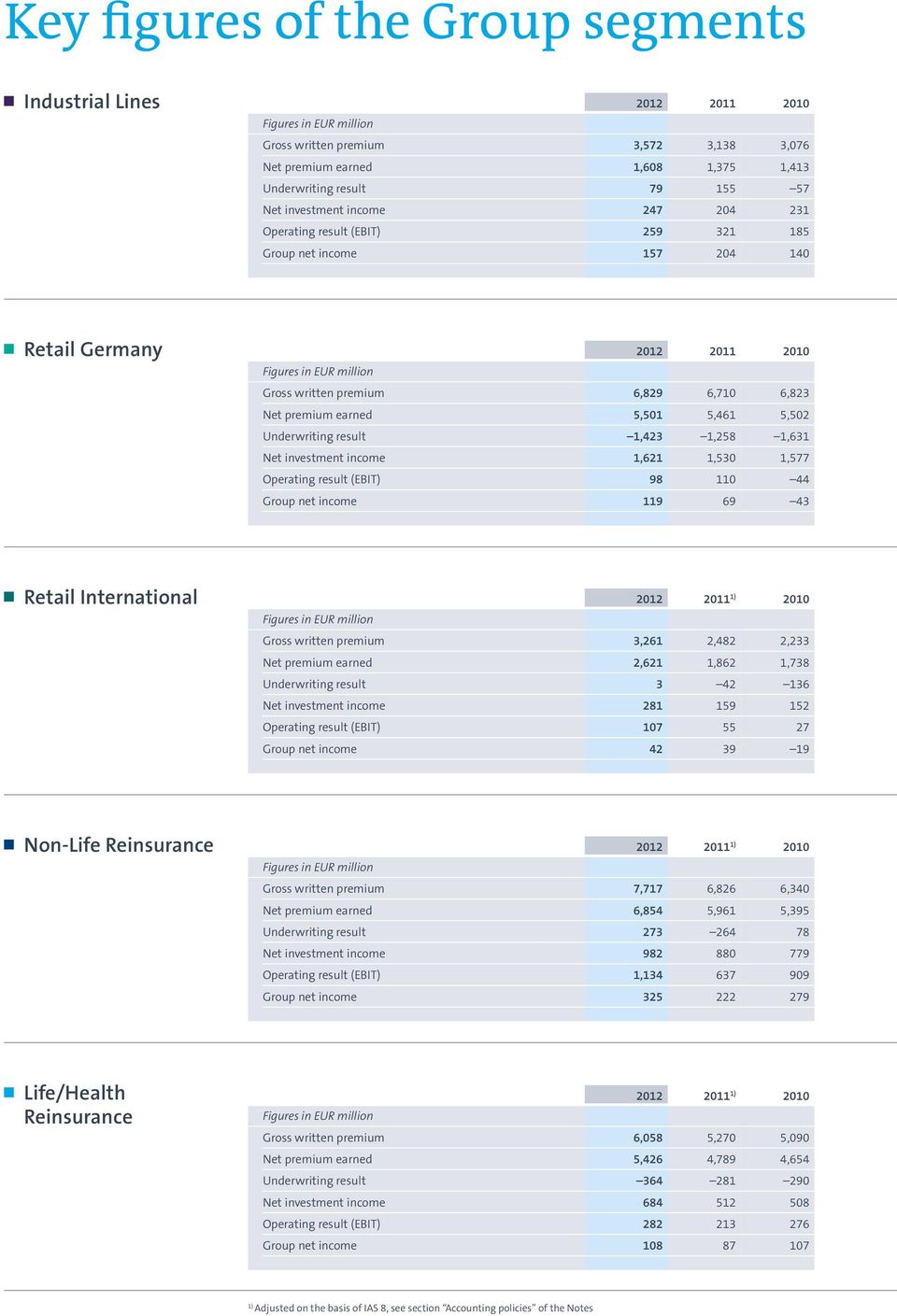
3 Operating profit (EBIT)/Group net income EBIT Group net income The division s drive towards greater internationalisation continues with new branches in Canada, Singapore and Bahrain and a cooperative joint venture in India. High premium growth achieved, especially outside Germany; higher net investment income compensates for a lower technical result following several major losses in the property sector. Key figures of the Group segments Operating profit (EBIT)/Group net income Merger of HDI Direkt Versicherung AG and HDI-Gerling Firmen und Privat Ver siche rung forms HDI Versicherung AG; former HDI-Gerling life insurance now also trading under the name of HDI. EBIT Group net income Significant investment in the segment through restructuring and measures to improve profitability. Group net income after taxes considerably higher than the previous year Operating profit (EBIT)/Group net income Year under review greatly influenced by acquisition and integration of new companies acquired in target markets of Central and Eastern Europe and Latin America. EBIT Group net income Resulting improved turnover and earnings performance reflected in EBIT increasing by 1.2 percentage points to 4.1%; a significant driver for this is higher net investment income ) 2012 Operating profit (EBIT)/Group net income 909 1,134 Increase achieved in gross premium through adjusting rates and expanding attractive business opportunities and with the benefit of favourable currency rates. Growth driven particularly strongly by Asia and Australia. EBIT Group net income Catastrophe losses that were significantly lower than the previous year resulted in a much lower combined ratio of 95.8 (104.3)% and led to a greatly improved tech nical result ) 2012 Operating profit (EBIT)/Group net income The new Asia and Longevity business centres allow greater concentration on markets offering most potential for new business. EBIT Group net income ) 2012 Premium growth of 10% adjusted for exchange rate effects significantly exceeded target; above average growth was achieved, notably in the USA. 1) Adjusted on the basis of IAS 8, see section Accounting policies of the Notes

4 The Talanx Group at a glance Gross written premium in EUR million 26,659 23,682 22,869 by regions Germany in % UK in % Central and Eastern Europe including Turkey (CEE) in % Rest of Europe in % USA in % Rest of North America in % Latin America in % Asia and Australia in % Africa in % Net premium earned in EUR million 21,999 19,456 18,675 Underwriting result in EUR million 1,433 1,690 2,036 Net investment income in EUR million 3,795 3,262 3,224 Net return on investment 1) in % Operating profit (EBIT) in EUR million 1,760 1,238 4) 1,032 Net income (after financing costs and taxes) in EUR million 1, ) 667 of which attributable to shareholders of Talanx AG in EUR million ) 216 Return on equity 2) in % Earnings per share Basic earnings per share in EUR ) 1.07 Diluted earnings per share in EUR ) 1.07 Carrying amount per share in EUR Share price at year end in EUR Market capitalisation of Talanx AG at year end in EUR million 5,426 Combined ratio in property/casualty primary insurance and non-life reinsurance 3) in % Combined ratio of property/casualty primary insurers in % Combined ratio for non-life reinsurance in % Policyholders surplus in EUR million 14,750 11,306 4) 10,771 Equity attributable to shareholders of Talanx AG in EUR million 7,472 5,407 4) 4,945 Non-controlling interests in EUR million 4,171 3,284 4) 3,035 Hybrid capital in EUR million 3,107 2,615 2,791 Investments under own management in EUR million 84,052 75,750 72,461 Total investments in EUR million 98,948 87,467 83,422 Total assets in EUR million 130, ,277 4) 111,100 Staff full-time equivalents 20,887 17,061 16,874 1) Net investment income excluding interest income on funds withheld and contract deposits and income from investment contracts relative to average investments under own management 2) Net profit/loss for the year without non-controlling interests relative to average equity without non-controlling interests 3) Combined ratio adjusted for interest income on funds withheld and contract deposits, before elimination of intra-group cross-segment transactions 4) Adjusted on the basis of IAS 8, see section Accounting policies of the Notes Gross written premium Figures in EUR billion Operating profit (EBIT) Figures in EUR billion Segmental breakdown of gross premium In % Life/Health Reinsurance 22 Industrial Lines ) 2012 Non-Life Reinsurance 27 Retail Germany 26 Retail International 12 1) Adjusted on the basis of IAS 8, see section Accounting policies of the Notes

5 Staying on the move Talanx operates as an insurance group in around 150 countries. The various brands are tailored towards the widely varying requirements of global markets. The Group is not standing still: The most recent take overs in Poland, which make the Polish market Talanx s second- largest in Europe, and the success ful IPO testify to the Group s dynamism, which is underpinned by solid financial foundations. Group key figures Segment key figures Talanx Group Our brands 2 Letter from the Chairman 4 Boards and Officers 6 Report of the Supervisory Board 10 Talanx a global player Starting point: Hannover 14 1 st destination: Warsaw 16 2 nd destination: Tokyo 22 3 rd destination: São Paulo 28 Highlights of The Talanx share 36 Consolidated financial statements Detailed index 131 Consolidated financial statements 132 Notes 139 Auditor s report 315 Other information Addresses 316 Glossary and definition of key figures 320 Index of key terms Worldwide network Contact information Group Management Report Detailed index 39

6 Our brands Talanx operates in a variety of markets all around the world, with highly diverse customer groups. The best way to reach these is through strong brands offering products that are specially tailored to their respective target groups. Our major brand names in primary insurance, reinsurance and financial services are shown on the opposite page.

7 3 The Talanx brand stands for the Group as a whole, as well as for some companies foremost among them Talanx AG, which performs the functions of a management and financial holding company within the Group but does not itself conduct any insurance business. Various in-house service companies also include Talanx in their name, as do Talanx Deutschland AG and Talanx Inter national AG, which bring together companies operating under various brands in Germany and abroad. The HDI-Gerling has stood exclusively for industrial insurance business in Germany and worldwide since Under this brand we offer a complete range of products to protect against entrepreneurial risks, including property, liability and accident insurance and motor insurance. neue leben insurers operate in the bancassurance sales channel as provision specialists for the Sparkasse savings institutions. They offer their clients and sales partners innovative insurance products at attractive terms. Posta Biztosító is the high-growth cooperation partner of the Hungarian postal service for bancassurance. Its readily comprehensible and transparent range of products offering outstanding value for money spans the life and property/ casualty lines. HDI Versicherungen operates under this brand in Germany, offering property/ casualty and life insurance products. Compa nies that conduct retail business outside Germany also trade under the HDI brand. The PB insurers operate in the banc - assurance sales channel in exclusive cooperation with their partner Postbank. They are embedded in Postbank s market profile and geared to the needs of its clients, offering attractive insurance products at reasonable prices. The Hannover Re Group, one of the largest reinsurers in the world, transacts all lines of non-life and life/health reinsurance across all continents. Its subsidiary E+S Rück is a specialist reinsurer serving the German market. The WARTA Group has been part of the Talanx Group since July It offers property/casualty, liability and life insurance in Poland. The TU Europa Group is the market leader for bancassurance in Poland. Its product range includes credit insurance, unit-linked life insurance and investment products. The TARGO insurers operate in the bancassurance sales channel exclusively for their partner TARGOBANK, offering its clients a service based on quick and convenient handling of all banking, financial and insurance transactions. The Russian company OOO Strakhovaya Kompaniya CiV Life and the Turkish company CiV Hayat Sigorta A. Ş trade under the CiV brand. Both cooperate with Citibank in bancassurance. They prove that Talanx s bancassurance concept can be successfully applied to other countries. One of the major non-bank asset managers in Germany, AmpegaGerling covers the complete value-added chain in asset management, from funds business to asset management for private and institutional investors. Left Atrium of the new building at our Hannover site

8 4 Dear Shareholders, Ladies and Gentlemen, 2012 was a historic year for the Talanx Group. We listed the Talanx share on the Frankfurt Stock Exchange on 2 October despite a difficult market environment, thereby achieving a strategic goal that we had been pursuing for some time. With a volume of EUR 817 million, the IPO was at the time the largest since March The placement price was EUR per share and the first traded price was around 4% higher, at EUR The share price had risen around 17% above the allocation price by the end of 2012, and this pleasing development continued in the new year. The IPO was an important and carefully considered step in the planned development of the Talanx Group for us and our main shareholder, mutual insurance company HDI V. a. G., which still holds a significant stake of 82.3% in the company. We now have the financial flexibility to maintain a successful long-term position on the global insurance market in future. We are satisfied overall with our business development in Like the entire sector, Talanx was largely spared major losses from natural disasters. One exception was hurricane Sandy, which ravaged the east coast of the USA at the end of October, causing substantial damage. As losses incurred up to that point were moderate, the Group as a whole was able to absorb the burden from Sandy within the planned major loss budget was influenced to a much greater extent by developments on the capital markets. The sovereign debt crisis kept us all in suspense during the first half of the year and was only banished from the headlines, at least for the time being, by ECB President Mario Draghi s unambiguous commitment to the stability of the euro. However, investors are continuing to focus on the stability of the banking system, which is of immense importance to a major asset manager such as Talanx. Low interest rates, fostered by the support measures provided by central banks

9 5 and governments, mean that it is still difficult to generate an adequate return on investment. Although the decline in interest rates enabled us to achieve some gains on government bonds with a good rating, the outlook remains extremely challenging with ongoing low interest rates on the capital market. Realistically, therefore, we must expect net returns on investment to decrease further. We will need to compensate for a decline in investment income with an improvement in the underwriting result. Our divisions have taken this into account in their plans for In economic terms, we improved main key figures at Group level in the 2012 financial year. Operating profit (EBIT) grew by 42% year-on-year to EUR 1.8 billion, while Group net income was up 22% at EUR 630 million. The accumulation of major and very severe losses in 2011, however, must be taken into account. At 9.8%, the return on equity for 2012 almost reached our target return of 10.0%, although shareholders equity rose by EUR 2.1 billion, mainly due to net proceeds from the IPO and volatile valuation reserves in investments. The pleasing Group net income is mainly attributable to our two reinsurance segments, both of which significantly increased their operating results. Industrial Lines increased its gross premium by 14% and achieved a positive combined ratio of 95.1%. Retail Germany made good progress with ongoing measures to increase profitability, which was reflected in an improved combined ratio of 100.6%. Finally, Retail International benefited from the first-time consolidation of the two newly acquired Polish companies TU Europa and WARTA, which made a substantial contribution to the 31% increase in gross premium and the striking improvement of 96% in the operating result. see, Talanx systematically strengthened its presence in its strategic target regions, remaining true to its strategy of focused expansion in However, there is one entirely new aspect to the last financial year for the first time, our shareholders will receive their share in Group earnings. The Board of Management and the Supervisory Board are to propose a dividend of EUR 1.05 per share to the Annual General Meeting. All shares will be entitled to dividends for the full 2012 financial year, irrespective of the fact that the IPO did not take place until October. This represents a dividend yield of 4.9% based on the year-end price and of 5.7% for our initial subscribers, based on the issue price. We will continue to strive in the coming years to pay you an attractive dividend based on the performance of your company. I would like to extend heartfelt thanks to you, our new shareholders, for the confidence you have shown in Talanx with your investment. We my colleagues on the Board of Management and I as well as all employees of the Talanx Group will do our utmost to justify your confidence placed in Talanx. We look forward to meeting many of you in Hannover at our first Annual General Meeting since the IPO on 6 May We also hope you will continue to remain favourably disposed to us in our first full year as a listed company. Yours sincerely Herbert K. Haas We consistently pressed ahead with our international growth strategy in Industrial Lines opened new branches in Canada, Singapore and Bahrain. A joint venture with a local partner began operating in India. Retail International concluded its acquisitions in Mexico and Poland after obtaining approval from all the regulators concerned, and immediately began to integrate these entities into the Group. As you can

10 6 Board of Management Herbert K. Haas Chairman Burgwedel Chairman of the Board of Management HDI Haftpflicht verband der Deutschen Industrie V. a. G., Hannover Responsible on the Talanx Board of Management for: Corporate Development Group Project Management Investor Relations Public Relations Legal Affairs Internal Auditing Executive Staff Functions/Compliance Dr. Christian Hinsch Deputy Chairman Burgwedel Deputy Chairman of the Board of Management HDI Haftpflichtverband der Deutschen Industrie V. a. G., Chairman of the Management Board HDI-Gerling Industrie Versicherung AG, Hannover Responsible on the Talanx Board of Management for: Division: Industrial Lines Human Resources Facility Management Procurement Reinsurance Purchasing Torsten Leue Hannover Chairman of the Management Board Talanx International AG, Hannover Responsible on the Talanx Board of Management for: Division: Retail International Dr. Thomas Noth Hannover Chairman of the Management Board Talanx Systeme AG, Hannover Responsible on the Talanx Board of Management for: Information Services Dr. Immo Querner Celle Member of the Board of Management HDI Haftpflichtverband der Deutschen Industrie V. a. G., Hannover Responsible on the Talanx Board of Management for: Finance/Participating Interests/ Real Estate Investments Controlling Collections Risk Management Accounting/Taxes Dr. Heinz-Peter Roß Gräfelfing Chairman of the Management Board Talanx Deutschland AG, Hannover Responsible on the Talanx Board of Management for: Division: Retail Germany Business Organisation Ulrich Wallin Hannover Chairman of the Executive Board Hannover Rückversicherung AG, Hannover Responsible on the Talanx Board of Management for: Division: Reinsurance
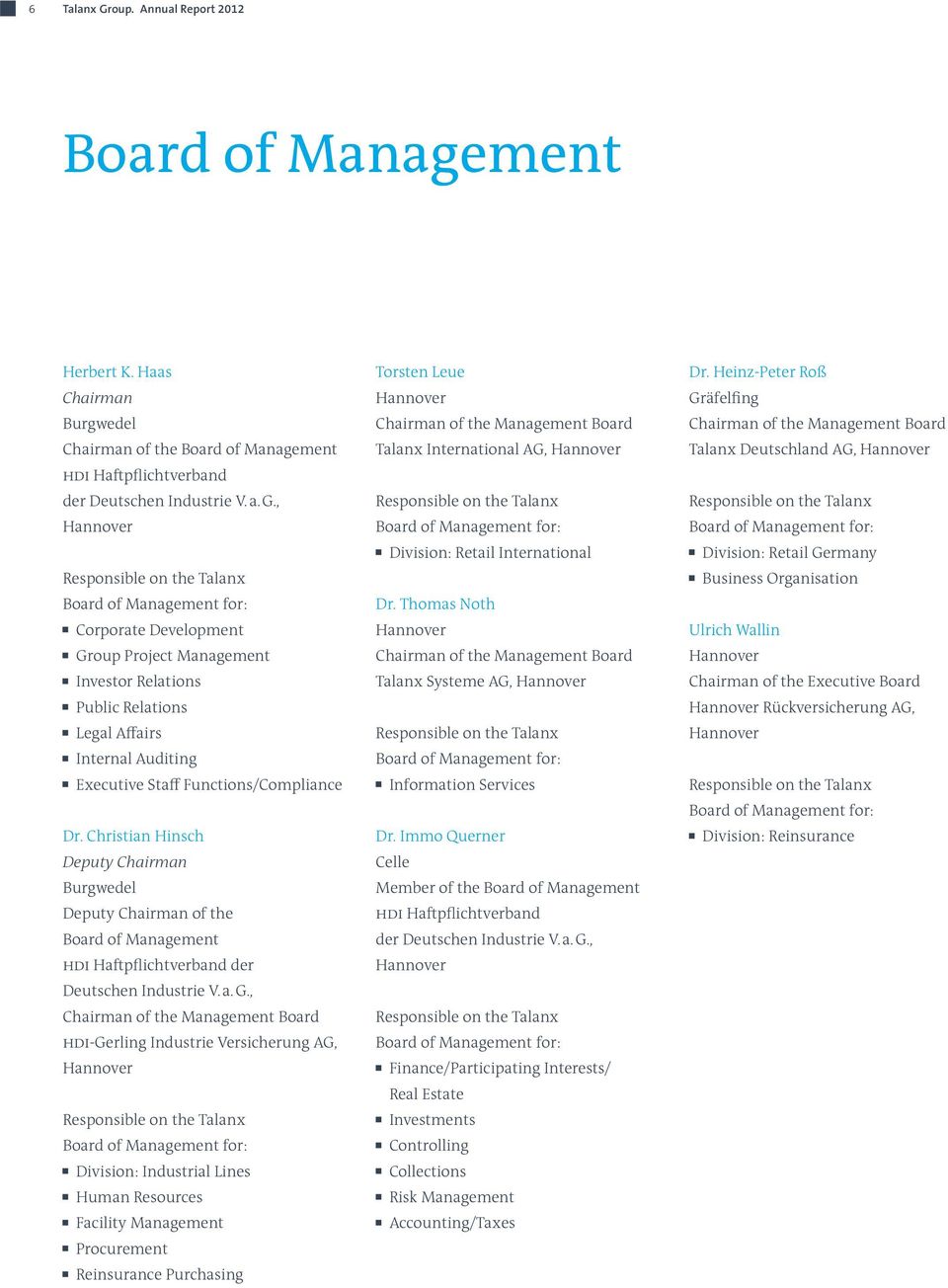
11 7 Dr. Thomas Noth Dr. Immo Querner Ulrich Wallin Herbert K. Haas Chairman Dr. Heinz-Peter Roß Torsten Leue Dr. Christian Hinsch Deputy Chairman

12 8 Supervisory Board Composition as at 31 December 2012 Wolf-Dieter Baumgartl Chairman Berg Former Chairman of the Board of Management of Talanx AG Ralf Rieger * Deputy Chairman Raesfeld Employee HDI Vertriebs AG Prof. Dr. Eckhard Rohkamm Deputy Chairman Hamburg Former Chairman of the Board of Management of ThyssenKrupp Technologies AG Antonia Aschendorf Hamburg Lawyer Member of the Board of Management of APRAXA eg Jutta Hammer * Bergisch Gladbach Employee HDI Kundenservice AG Gerald Herrmann * Norderstedt Trade union secretary Dr. Thomas Lindner Albstadt Chairman of the Board of Management of Groz-Beckert KG Jutta Mück * Oberhausen Employee HDI-Gerling Industrie Versicherung AG Otto Müller * Hannover Employee Hannover Rückversicherung AG Dr. Michael Rogowski Heidenheim Chairman of the Foundation Council of Hanns-Voith-Stiftung Katja Sachtleben-Reimann * Hannover Employee Talanx Service AG Dr. Erhard Schipporeit Hannover Former Member of the Board of Management of E.ON AG Prof. Dr. Ulrike Wendeling-Schröder * Hannover Professor at Leibniz University Werner Wenning Leverkusen Chairman of the Supervisory Board of Bayer AG Karsten Faber * Hannover Managing Director Hannover Rückversicherung AG, E+S Rückversicherung AG Dr. Hans-Dieter Petram Inning Former Member of the Board of Management of Deutsche Post AG * Staff representative Details of memberships of legally required supervisory boards and comparable control boards at other domestic and foreign business enterprises are contained in the individual report of Talanx AG.

13 9 Supervisory Board Committees Composition as at 31 December 2012 The Supervisory Board has formed four committees from among its ranks. They support the full Supervisory Board in the performance of its tasks. Tasks of the committees Finance and Audit Committee Wolf-Dieter Baumgartl, Chairman Dr. Thomas Lindner Ralf Rieger Prof. Dr. Eckhard Rohkamm Dr. Erhard Schipporeit Finance and Audit Committee Preparation of financial decisions for the full Supervisory Board Decisions in lieu of the full Supervisory Board on certain financial matters, including the establishment of companies, acquisition of participations and capital increases at subsidiaries within defined value limits Personnel Committee Wolf-Dieter Baumgartl, Chairman Dr. Michael Rogowski Prof. Dr. Eckhard Rohkamm Prof. Dr. Ulrike Wendeling-Schröder Personnel Committee Preparation of personnel matters for the full Supervisory Board Decisions in lieu of the full Supervisory Board on certain personnel matters for which the full Supervisory Board is not required to assume responsibility Standing Committee Wolf-Dieter Baumgartl, Chairman Ralf Rieger Prof. Dr. Eckhard Rohkamm Katja Sachtleben-Reimann Standing Committee Proposal for the appointment of a Board member if the necessary two-thirds majority is not achieved in the first ballot ( 31 Para. 3 Co-Determination Act) Nomination Committee Wolf-Dieter Baumgartl, Chairman Dr. Thomas Lindner Dr. Michael Rogowski Nomination Committee Proposal of suitable candidates for the Supervisory Board s nominations to the General Meeting

14 10 Report of the Supervisory Board The Supervisory Board performed its functions and duties in the 2012 financial year at all times in accordance with statutory requirements, the Articles of Association and the Rules of Procedure. We considered at length the economic situation, risk position and strategic development of Talanx AG and its major subsidiaries. We advised the Board of Management on the company s direction, monitored the management of business and were directly involved in decisions of fundamental importance. A particular focus of the Supervisory Board s work in the year under review was to support the company in its stock market flotation. This required us to discuss various issues as reported to us by the Board of Management and to pass requisite resolutions at Supervisory Board level prior to the IPO. In the year under review we assembled for four ordinary meetings of the Supervisory Board, held on 20 March, 15 May, 13 August and 13 November As in the previous year, the Federal Financial Supervisory Authority (BaFin) exercised its legal powers to send two representatives to attend one of these meetings. The Finance and Audit Committee of the Supervisory Board held four ordinary meetings and in view of the IPO five extraordinary meetings. The Personnel Committee held three meetings. Neither the Standing Committee, formed in accordance with the requirements of the German Co-Determination Act (MitbestG), nor the Nomination Committee had any reason to meet in The full Supervisory Board was briefed on the work of the various committees. In addition, we received written and oral reports from the Board of Management, based on the quarterly financial statements, on business operations and the position of the company and Group. At no point in the year under review did we consider it necessary to conduct audit measures pursuant to 111 Para. 2 Sentence 1 of the German Stock Corporation Act (AktG). Where transactions requiring approval arose between meetings, the Board of Management submitted these to us for a written resolution. The Chairmen of the Supervisory Board and Board of Management regularly exchanged views on all important developments and business transactions within the company and the Talanx Group. All in all, within the scope of our statutory responsibilities and those prescribed by the Articles of Association, we assured ourselves of the lawfulness, expediency, regularity and efficiency of the actions of the Board of Management. The Board of Management provided us with regular, timely and comprehensive information regarding the business and financial situation including the risk situation and risk management, major capital expenditure projects and fundamental issues of corporate policy, and transactions that although not subject to the approval of the Supervisory Board nevertheless need to be reported in accordance with the requirements of the Rules of Procedure. At our meetings we considered at length the reports provided by the Board of Management and put forward suggestions and proposed improvements. All Supervisory Board meetings were attended by every member, with the exception of the March meeting from which one shareholder representative was excused as they were unable to attend. There were no conflicts of interest requiring disclosure to the Supervisory Board and reporting at the Annual General Meeting in the year under review. Key areas of discussion for the full Supervisory Board The following issues formed the primary focus of reporting and were discussed in detail at our meetings: consideration of the company s IPO insofar as this had not been devolved by full Supervisory Board resolution to the Finance and Audit Committee, business development of the company and individual Group segments, implementa tion of the Retail Germany divi-

15 11 sion s restructuring, pooling of IT services in an in-house service company, integration and consolidation of newly acquired foreign companies, and planning for We were informed of the reasons why business development for the preceding financial year had diverged from relevant plans and targets, and were able to satisfy ourselves accordingly with the explanations provided. Risk management within the Group was again a further focus of our deliberations. Risk reporting by the Board of Management was discussed at each meeting of the Supervisory Board. In addition, we considered a number of refinancing measures and gave our agreement prior to the IPO to the basis for future capital measures (conditional and authorised capital). The Supervisory Board also discussed the strategic realignment of the Turkish property/casualty insurance company in the Group. In view of 87 Para. 1 of the German Stock Corporation Act as amended by the German Act on the Appropriateness of Management Board Remuneration (VorstAG), the full Supervisory Board considered bonus setting for members of the Board of Management, including consulting external sources as part of its remuneration assessment process. In addition, at its meeting on 13 November 2012, the Supervisory Board was informed about the structure of remuneration systems within the Group as required by 3 Para. 5 of the German Regulation on Remuneration in the Insurance Sector (Versicherungs- Ver gütungsverordnung). There was also a scheduled review of the fixed remuneration of five Members of the Board of Management as at 1 January The issue of the appropriateness of the remuneration system for Group managers was discussed at Supervisory Board meetings on 20 March 2012 and 15 May Work of the committees Following appropriate delegation by the full Supervisory Board and within the framework specified by the full Board, the Finance and Audit Committee of the Supervisory Board considered issues requiring discussion and decisions prior to the IPO and passed necessary resolutions. Along with preparations for discussion and adoption of resolutions by the full Supervisory Board, it also carried out in-depth reviews of the company s quarterly financial statements. Furthermore, the Finance and Audit Committee discussed the findings of an actuarial audit of the net claims reserves for non-life insurance business within the Talanx Group together with profitability trends at indivi d- ual Group companies as at 31 December 2011, and considered the internal control system, risk reports, risk management and internal audit activities, and the annual report submitted by the Chief Compliance Officer. The Personnel Committee along with preparations for discussion and adoption of resolutions by the full Supervisory Board set targets for individual members of the Board of Management for the 2013 financial year. Recommendations were also made to the full Supervisory Board with regard to setting bonuses and reviewing fixed remuneration for members of the Board of Management. The Nomination Committee met on 15 January 2013 and made recommendations regarding nominations for re-election of the shareholder representatives on the Supervisory Board at the General Meeting on 6 May 2013; the recommendations aim to ensure that composition of the Supervisory Board is both balanced and diverse. Transactions and measures subject to approval in accordance with legal requirements, the company s Articles of Association and its Rules of Procedure were agreed with the Board of Management following examination and discussion. The Board of Management s information and reporting obligations towards the Supervisory Board were summarised in an information policy and adopted on 15 May 2012.

16 12 Corporate Governance The Supervisory Board again devoted special attention to the issue of Corporate Governance. Talanx s main Corporate Governance principles were summarised in a paper adopted by the Supervisory Board on 13 August In its meeting on 20 March 2013 the Supervisory Board considered various amendments to the German Corporate Governance Code (DCGK) as reflected in the version of 15 May 2012, and determined the appropriate number of independent members of the Super visory Board pursuant to Item of the Code. This also resulted in an amendment to the Supervisory Board s Rules of Procedure. Despite the great importance which the Supervisory Board attaches to high standards of responsible enterprise management as formulated in the German Corporate Governance Code, it has decided against complying with the recommendations of Item Para. 4 of the Code relating to a severance payment cap in Management Board employment contracts and Item 5.2 Para. 2 regarding the Audit Committee chairman. The reason for this relates to the declaration of conformity pursuant to 161 of the German Stock Corporation Act concerning compliance with the German Corporate Governance Code that appears in the Group Annual Report as part of the declaration on Corporate Governance. Further information on Corporate Governance is available on the Talanx AG website. Audit of the annual and consolidated financial statements KPMG AG, Wirtschaftsprüfungsgesellschaft, Hannover, audited Talanx AG s annual financial statements submitted by the Board of Management, the Talanx Group s financial statements drawn up in accordance with International Financial Reporting Standards (IFRS), together with corresponding Management Reports and accounting records. The auditors were appointed by the General Meeting. The Finance and Audit Committee awarded the specific audit mandate, and determined that in addition to the usual audit tasks special attention should be given in the 2012 financial statements to reviewing the forecast report and implementation of new requirements resulting from the IPO. The focus points in the consolidated financial statements were examining the application of IFRS 3 due to the first-time consolidation of three foreign companies, reviewing IAS 33 (earnings per share), the forecast report, and implementation of new IFRS improvements. The audit focus points of the German Financial Reporting Enforcement Panel (DPR) also formed the basis for various year-end procedures carried out by the auditors. The audits conducted by the auditors provided no grounds for objection. The audit reports issued were unqualified, and state that the accounting records, annual financial statements and consolidated financial statements give a true and fair view of the net assets, financial position and net income, and that the Management Reports suitably reflect the annual and consolidated financial statements.

17 13 The financial statements and the KPMG audit reports were distributed to all the members of the Supervisory Board in good time. They were examined in detail at a Finance and Audit Committee meeting on 19 March 2013 and at a Supervisory Board meeting on 20 March The auditor took part in the Finance and Audit Committee s deliberations and those of the full Super visory Board regarding the annual and consolidated financial statements, reported on the conduct of the audits, and was available to provide the Supervisory Board with additional information. In accordance with the final outcome of our own examination of the annual financial statements, the consolidated financial statements, corresponding Management Reports and the audit reports, we concurred with the opinion of the auditors and approved the annual and consolidated financial statements drawn up by the Board of Management. We have examined the report on relations with affiliated companies. We reached the same conclusion as the auditors and have no objections to the statement reproduced in this report. An expression of thanks to the Board of Management and staff The Board of Management and staff worked and acted with con siderable personal dedication in the past financial year, particularly with regard to the Company s IPO. The Supervisory Board would like to express its special appreciation of their efforts. Hannover, 20 March 2013 The annual financial statements are thereby adopted. We approve the statements made in the Management Reports regarding further development of the company. After exami nation of all relevant considerations we agree with the Board of Management s proposal for the appropriation of disposable profit. For the Supervisory Board Wolf-Dieter Baumgartl (Chairman) The report on the company s relations with affiliated com panies drawn up by the Board of Management in accordance with 312 of the German Stock Corporation Act has likewise been examined by KPMG Aktiengesellschaft, Wirtschafts prüfungsgesellschaft, Hannover, and given the following unqualified audit certificate: Having audited the report in accordance with our professional duties, we confirm that 1. its factual details are correct, 2. in the case of the transactions detailed in the report, the company s expenditure was not unreasonably high.

18 14 Talanx a global player As a global player with its roots in Germany, the Talanx Group is one of the leading insurers in Germany and Europe, with sites in over 40 countries. We visited three of them and talked to our local colleagues about their business. São Paulo The Talanx Group actively responds to the challenges of a globalised world. It aims at successfully generating aboveaverage business, particularly abroad. Strategic cooperations and acquisitions of companies that are well-positioned in terms of sales in the defined regions of Central and Eastern Europe, Latin America and Asia will help extend the Group s ability to act internationally. Industrial Lines offers worldwide service to industrial groups and mid-size companies and at the same time is gaining new customers on the local markets. Foreign companies consolidated under Talanx International conduct local busi ness with retail and commercial customers. Reinsurance per se is an international business: One of the basic instruments used in reinsurance is to diversify large and complex risks globally in order to make them manageable.

19 15 Starting point Hannover Hannover is our largest location in Germany, with 3,700 employees. The management teams of Talanx s important core divisions are based at HDI-Platz 1. Hannover is thus the starting point for a central Group strategy that we then follow locally and implement on an ongoing basis at indi - vi dual Group companies. This allows costefficient bundling of standardised business processes while simultaneously lea ving scope for us to use regional expertise to serve individual customers. Hannover Warsaw Tokyo 1st destination Warsaw Poland is now the Talanx Group s second-largest European market following the latest takeovers. WARTA S. A., Poland s second-biggest insurance company, is based in the centre of Warsaw and is well established on the rapidly growing Polish insurance market. 2nd destination Tokyo The Talanx Group operates in the areas of industrial insurance and reinsurance in the Japanese capital. Trusted brands such as HDI-Gerling and Hannover Re, combined with a local presence, are the key to deve l- oping long-term customer relationships on Japan s complex insurance market. 3rd destination São Paulo Brazil has one of the world s fastestgrowing economies. For its population the need for security rises as prosperity increases. HDI Seguros, based in São Paulo, provides customer-specific solutions with its core business areas of property, casualty and motor in surance.

20 Poland Country facts Annual growth in GDP over the last three years: 3.5% GDP per head: USD 12,307 Price per litre of petrol: USD 1.84 Cars per thousand inhabitants: 451 Insurance policies per head: 2.5 policies Interesting facts about Talanx We will report on our biggest company in Poland, TUiR WARTA S. A., on the following pages. TU Europa Group, Wrocław Talanx acquired the TU Europa Group in June The company, which is based in Wrocław, is the Polish market leader for bancassurance. Its product range encompasses credit insurance, unit-linked life insu rance and investment products. Its most important sales partners are banks belonging to Getin Holding. HDI-Gerling Życie, Warsaw This company has represented Talanx on the Polish market since the early 2000s. HDI-Gerling Życie combines life insurance for retail customers with professional asset management, particularly with a view to financial provisions. Main areas of business: Life and property/casualty insurance, industrial insurance and bancassurance You can see more of our Warsaw site with a QR code, using an appropriate app.
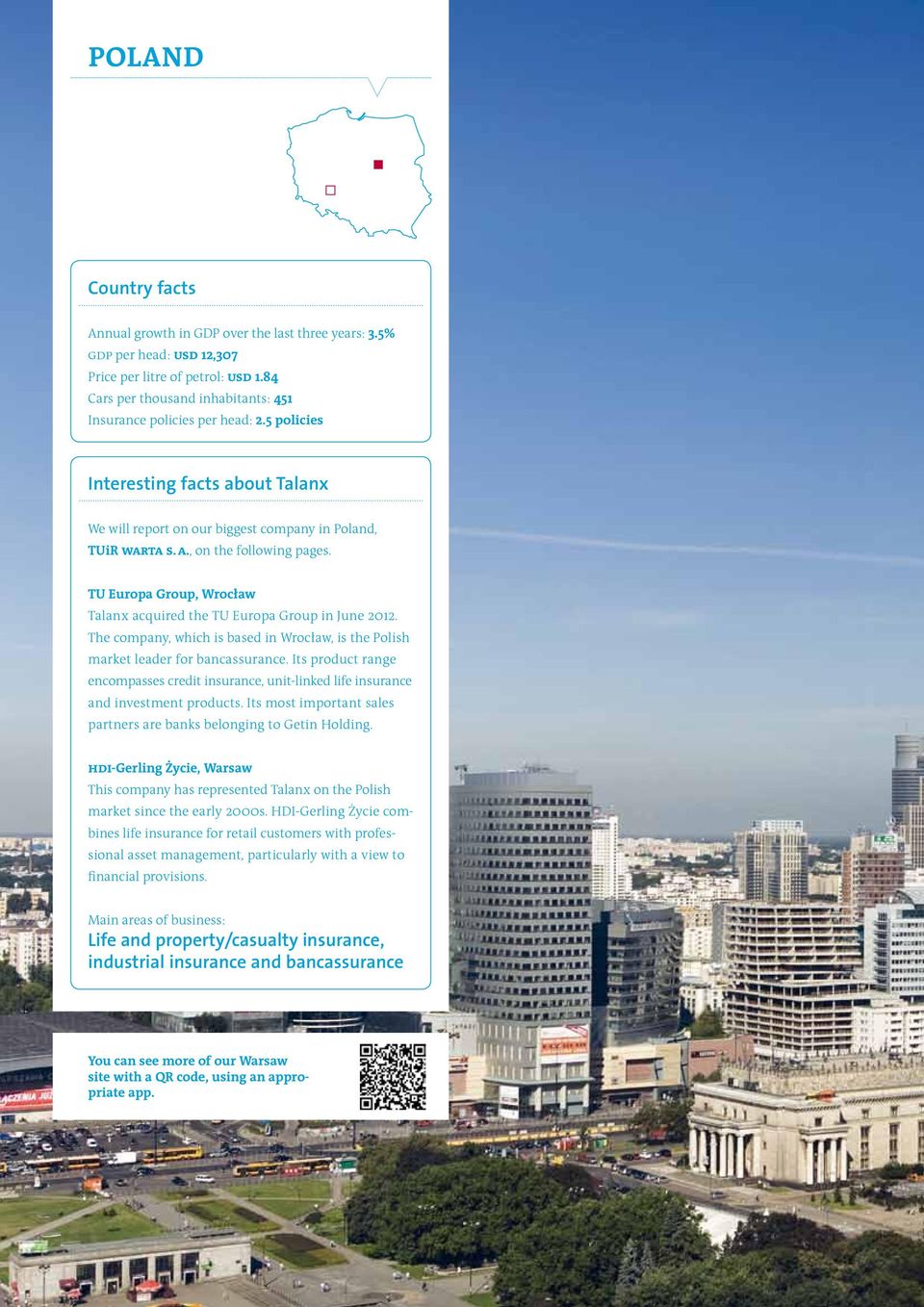
21 17 Warsaw Our eastern neighbour is changing. Poland is one of the fastest-growing economies in Europe and has now become the Talanx Group s second-biggest market in Europe. The Palace of Culture and Science is the highest building in Poland, at 231 metres. Its facilities include several cinemas, theatres and museums, and it is regarded as a Warsaw landmark.
22 POLAND/WARSAW Shaping change The acquisition of two groups of companies has made Poland Talanx s secondbiggest market worldwide. Although at first glance little will change for customers of the established Polish brands, a new era is beginning behind the scenes. The wind whistles over the roof terrace of the twenty-storey head office of WARTA, one of Poland s longest-established insurers. The glass façade shimmers ocean blue. The view from here extends far beyond the classical building opposite and the office buildings in the centre of Warsaw. The three green letters on the HDI building glow only 500 metres away as the crow flies. There is no better site to see at a glance the extent of last year s restructuring on the Polish insurance market. At the beginning of 2012, Talanx s operations in Poland comprised two companies, HDI Asekuracja and HDI-Gerling Życie, whose market positions were not fully aligned with Talanx s goals. The TU Europa Group and TUiR WARTA were then added a few months later. The product range of these brands now comprehensively covers demand for risk provisioning. As planned, the takeovers have had little impact on customers. The most noticeable external sign of the new era is the new WARTA logo that is now displayed on the roof of the head office in Warsaw: clear letters, without a graphic element
23 19 like before, but with a red square at the end of the logo, indicating that the company belongs to the Talanx Group. Surveys show that the new logo is perceived as modern and fresh whilst remaining as familiar as ever to a lot of people. TUiR WARTA has left an impression on the cityscape of Warsaw since 1920, with its company nameplates on branches and agencies. The company is also present throughout the rest of the country, from the Baltic Sea to the High Tatras. On the surface, therefore, most things have remained the same. However, if you want to understand what is changing behind the scenes, you need to go to Maciej Friedel s office on the 20th floor of WARTA s headquarters. The 38-year-old has a winning smile and a candid expression. He is a Member of the Board of Management (responsible for corporate development) and the leader of the integration team. Maciej Friedel speaks fluent German, having worked at the Talanx Group for 14 years, including as Regional Manager for Europe at HDI- Gerling in Hannover. His remit is now to implement synergies from the takeover by merging back office functions such as IT, marketing, risk management,»we ve got our employees behind us. That s a success.«finan cial management, reinsurance and claims management. Maciej Friedel rushes back and forth between the two buildings and all departments. The Steering Committee meets once a month with participants from Hannover also attending the meeting, while the Board of Management s Integration Committee meets on a weekly basis and the project teams for various areas meet at least once a week. He has held countless discussions with employees since the takeover. Departments of HDI and TUiR WARTA are being merged and given new structures, and employees are being transferred between offices in the two buildings. They are to benefit from their respective experiences and to follow more efficient procedures. Maciej Friedel s maxim is: We make our decisions quickly and with determination. Employees receive clear messages. A monthly newsletter keeps them in formed of the merger s progress. A team has even been created for managing integration and change. Przemysław Romaniuk, Change Manager on Maciej Friedel s team, is systematically investigating staff attitudes. He regularly asks employees questions such as: Are you satisfied with your work?, Do you feel well informed? and Is your opinion valued at the company? The result of the analysis is: Despite constant changes in the workplace, employees are just as positive about the process as before. In other words: We ve got our employees behind us. That s a success. Maciej Friedel doesn t just notice flexibility and drive among his own staff, but throughout the country. Poland is changing rapidly. People are looking to the future with optimism. New cars are on the roads and direct foreign investment is pouring into the country. While the rest of Europe is groaning Left Night view of Warsaw downtown. Top Tried and tested, now repackaged: the WARTA logo. Right Integration through communication. Maciej Friedel considers it important to involve employees.
24 POLAND/WARSAW POLEN/WARSCHAU under the weight of the euro crisis, Poland is cheerfully pushing forward. Even in 2009, the worst year of the global financial crisis, Poland was the only country in Europe in which the economy actually grew. Economic growth in 2011 was twice as high as elsewhere in the EU, at over 4%. While an increase in gross domestic product is not necessarily associated with the conclusion of more insurance business in Western Europe, premium income in Poland is growing in line with the economy. The backlog of demand in the country is immense. For a long time there were insufficient funds for risk provisioning in Poland. However, rising living standards mean that money is now also available for insurance. Premium income has risen by almost 30% in the last five years, making Poland the most im portant Eastern European insurance market. While the average German has six or seven policies, an Eastern European has only two to three. Left Employees evaluate claims reports. Top The red square is creating a new focus at WARTA s modern head office. Talanx entered the Polish market through The largest operator in Poland is still the last year s acquisitions with corresponding former state monopolist. The market is commitment. The purchase of TUiR otherwise dominated by foreign compa- WARTA and the TU Euro pa Group, together nies. Talanx s long-term goal in Poland is with the two insurance companies that clear. We want to remain the leader for were already part of the Group, makes quality in the insurance sector, Maciej Poland the Talanx Group s second- biggest Friedel says. TUiR WARTA has already market, with premium income of earned this reputation in Poland. As just EUR 956 million for TUiR WARTA is one example, the company introduced the second-largest provider on the market. the first smartphone app for reporting claims.
25 21 Top A city in motion. A scene of Warsaw city life. Below Employees are kept informed regularly.»poland is changing rapidly. People are looking to the future with optimism.«the legal merger leaves the integration process within the company itself far from complete (TUiR WARTA and HDI Asekuracja have already merged and the life insurance companies are to follow in mid-2013). Maciej Friedel estimates that the final steps to the new structure will have been completed within two to three years. By then, employees will have become used to being part of the Talanx Group. At the end of the day, Hannover is only 350 kilometres from the Polish border, and Poles and Germans are very similar anyway, says Maciej Friedel, hurrying off to his next meeting.
26 Japan Country facts Annual growth in GDP over the last three years: 2% GDP per head: USD 46,895 Price per litre of petrol: USD 1.77 Cars per thousand inhabitants: 589 Proportion of renewable energies in the overall energy mix in 2012: around 1% Interesting facts about Talanx We provide information on HDI-Gerling Industrie Versicherung AG on the following pages. Hannover Re Services Japan K. K. Hannover Re Services has been present on the Japanese market since 2000 and is one of the five largest re insurers there. Regular visits to customers and high-quality advice are part of the company s professional services. Meiji Yasuda Life Insurance Co. Meiji Yasuda Life has been our strategic partner in Japan since June The company holds a stake in our most important acquisitions of last year and is one of the two anchor shareholders in Talanx AG. Main areas of business: Industrial insurance, non-life reinsu rance and life/health reinsurance The QR code was developed in Japan in This code will take you to further scenes from the Japanese capital.
27 23 The Eiffel Tower in red and white: the Tokyo Tower, at a height of 333 metres, is a faithful replica of the original in Paris and a city land mark. The tower required 28,000 litres of paint for aviation safety reasons. At night, the tower is lit up in orange. Tokyo The world s largest metropolitan area is located in an active earthquake zone a challenge for insurers.
28 JAPAN/TOKYO When global experience convinces local customers Global expertise in insurance and roots in local markets complement each other, as the experience of HDI-Gerling Industrie Versicherung in Japan shows. Eight o clock in the morning, not far from the Imperial Palace. A street with the regular, dense rows of buildings typical of Tokyo. The Sanbancho area is made up of embassies, offices of international companies and apartments; a good place to do business. Uwe Sievers, Managing Director of the Japanese branch of HDI- Gerling Industrie Versicherung, enters the 300 square feet big office on the eight floor of a typical office building and says good morning to his colleagues in Japanese: Ohayo Gozaimasu. He is one of the first to arrive. While his computer is starting up, Swiss-born Sievers muses again over the question of How close can I get to this country, its people and its insurance market? He has lived here for 16 years now and sees and understands things that will forever remain hidden to tourists. But even he needs the right keys for understanding, the right translators at the right time. Japan is regarded as one of the most difficult insurance markets in the world. If you still manage to succeed here, you must have done something right. Sievers colleagues are his most important key for accessing Japan. They include Tomoyoshi Ito, a slender man just now concentrating on his computer while he analyses endless rows of figures. Uwe Sievers never stops marvelling at Ito s expert knowledge, for example about turbines. Above all, he values Ito s pas sion for going out to visit customers involved in manufacturing. Last year alone, HDI- Gerling increased its workforce in Japan from 12 to 16 staff, a growth spurt after years of building up the business. The company obtained a licence in Its
29 25 Left HDI-Gerling is also present under its trusted brand in Tokyo. Centre Exchanging information with experienced colleagues is an important key to success on the complex Japanese market. Top Proximity to customers: Employees of HDI-Gerling Industrie visit their customers workshops frequently. remit from the head office was initially to act as a service office for western companies operating on the Japanese market. This was expanded to include local contracts with Japanese companies just a year after the company was founded. These cover liability, marine and industrial fire insurance, as well as niche products such as insurance for people taking part in clinical trials, an area in which HDI-Gerling is the worldwide market leader. Contracts with Japanese companies now account for two thirds of HDI-Gerling Japan s business, with foreign companies responsible for the remaining third. The total portfolio amounts to EUR 35 million. Although this is a modest share of HDI-Gerling s international business, it provides a sound basis for further expansion given the difficult market conditions in Japan. The Japanese insurance market is dominated by three giants, currently leaving only 10% of the market for their competitors. Insurance is sold differently in Japan from the way it is sold in Germany, where brokers are free in their choice of insurance and go by the best quotes. The Japanese market is structured through agencies, which have fixed contracts with insurance companies, which in turn are often linked to the client company through cross-shareholding. Business relationships are built up over many years in Japan. If you want to gain a foothold in this market, you need a specific, forward-looking strategy. We enter into an intensive dialogue with our customers, says Sievers. We want to understand their business and to be able to quantify the risks as far as possible. This is an approach that is particularly appreciated in the event of a mega-catastrophe, such as that faced by Japanese companies following the earthquake, then tsunami and nuclear meltdown in Fukushima, or the flooding in Thailand. There were massive periods of production downtime in the automobile industry, for example. Established Japanese insurers raised premiums and in many cases excluded the risk of natural disasters completely. However, employees of HDI-Gerling asked questions. Some customers initially found all the questions annoying, Sievers remembers. But they soon recognised the advantages. Talks with major players from the automobile industry, for example, indicated that production losses were often caused by suppliers transferring production to places such as Thailand following the earthquake in Japan. Experts at HDI- Gerling, both in Japan and in Hannover, can provide recommendations on how to minimise earthquake damage and production losses. This makes risks quantifiable and limits them geographically, which allows insurance contracts to be graduated accordingly.
30 JAPAN/TOKYO This means we can continue to offer customers comprehensive insurance cover. This loyalty is worth a lot to Japanese companies. Sievers is certain that news of this underwriting philosophy will get around the market in the long term, raise awareness of the HDI-Gerling brand and enable the company to position itself as an alternative in the mesh of relationships between agencies and Japanese insurance groups. The Japanese have a very positive perception of Germany, which helps us, Sievers says. The Germans are regarded as reliable and enthusiastic about technology and detail. Kaori Inoue, left, can confirm her positive im pressions of Germany during her year in Hannover. That was the image that Sievers colleague Kaori Inoue had before she spent a year in Germany, and which she now regards as confirmed. She works 9,099 kilometres from Tokyo as the crow flies, at HDI- Gerling in Hannover, as an underwriter i.e. expert in liability insurance. Together with German colleagues, she is responsible for South-East Asia. My German and Japanese colleagues have a similar attitude to work, she says, sett ling down to a coffee break under the olive trees in the bright entrance hall of the German head office. What matters is not to conclude business quickly, Kaori Inoue says, but reliability and sustainability. In Hannover, she is becoming aware of HDI-Gerling s international reach. Complicated insurance claims from the 13 foreign branches, concluded and managed by a total of 6,400 employees worldwide, come together here and are assessed by experts. Their expertise can be made available to customers of HDI-Gerling all over the world including Japanese customers that operate globally. In the pharmaceutical sector, for example, HDI-Gerling insures product liability risks in 60 countries, making it the market leader. This includes special offerings that have been developed for the complicated US market with its strict liability regulations, as well as doctors employed on a permanent basis in Hannover, who can assess the risks of new medicines from an expert viewpoint.»the Germans are regarded as reliable and enthusiastic about technology and detail.«when Kaori Inoue returns to the Tokyo branch after her time in Germany, she will be able to explain the perspective of Japanese customers to the head office in Hannover at the same time as communicating the advantages of an international insurance partner to customers. She will be another of HDI-Gerling s keys for accessing the Japanese market. Traditional Japanese culture often plays a part in everyday life. HDI-Gerling Japan has in the meantime identified ten top customers in the most important branches of industry, and has developed a separate strategy for each customer. By way of example, the largest trading houses operating in Japan generate annual sales of over EUR 700 billion, almost twice the gross domestic product of Belgium. These trading houses purchase raw materials from all over the world for domestic industry and finance or operate power stations in South-East Asia, oil platforms in the Gulf of Mexico or mines in Chile and Australia. The Japanese market s traditional relationships with agents do not work for this international business. Experience and expert knowledge are needed in order to be able to estimate accurately the risk of interruptions to production or transportation. HDI-Gerling can also offer its services as a local underwriting partner on the Japanese market. Uwe Sievers is cautious when forecasting HDI-Gerling Industrie s growth potential in Japan. He says, however, that We will increase awareness of our brand, gain new sales partners and expand our market share.
31 27 The energy transition in Japan Renewable energy sources are on the rise in Japan, following the tragic nuclear reactor accident in Fukushima. The govern - ment at the time decided to reverse its national energy policy and to phase out nuclear power, based on the German model. However, the new government has performed a U-turn and even refuses to rule out the construction of further nuclear reactors. A nationwide supply from alternative energy sources does not appear to be feasible in Japan. The new government has nevertheless announced plans to promote the expansion of renewable energy in the long term, as part of which wind and photovoltaic power plants are to be extended. There is a severe shortage of land available for building development in Japan. Nearshore and offshore sites, i.e. those near the coast or even on the open sea, will therefore provide the necessary space. Sites like this involve risks. Japanese insurers have no experience in this area, says Uwe Sievers, Managing Director of the Japanese branch of HDI- Gerling Industrie Versicherung. In Germany, we already have the necessary expertise to deal with these risks. HDI-Gerling is one of the world s leading insurers for offshore wind power plants and the solar power industry. Naturally our reputation also helps us in Japan, Uwe Sievers says. Moreover, Germany serves as a model in Japan when it comes to the energy transition. Wind and solar power plants are already expected to account for 10% of premium income at HDI-Gerling in Japan in 2013, the equivalent of over EUR 4 million.
32 Brazil Country facts Annual growth in GDP over the last three years: 4% GDP per head: USD 12,339 Price per litre of petrol: USD 1.38 Cars per thousand inhabitants: 178 Road network in kilometres: 885,157 Number of newly registered vehicles in 2012: around 3.6 million Interesting facts about Talanx The following report looks at our colleagues at HDI Seguros S. A.. Hannover Rückversicherung AG Escritorio de Represençáo no Brasil Ltda., Rio de Janeiro Brazil is one of Hannover Re s most important markets in Latin America. The company opened a representative office in Rio de Janeiro as soon as the reinsurance monopoly was abolished in 2008, and is represented there as an authorised reinsurer. Main areas of business: Motor insurance, property/casualty insurance, non-life reinsurance This QR code will reveal pictures of the Talanx Group s Brazilian site.
33 29 São Paulo The largest city in Brazil and a symbol of the economic boom. The record world champion Brazil will next year host the football World Cup for the second time since Despite its extraordinary architecture, however, the Estádio Pacaembu will not be used as a venue.
34 BRAZIL/SÃO PAULO On the up Brazil s economy has been booming for a long time. Increasing demand for insurance has allowed Talanx to gain a good position in the market through proximity to customers and efficient processes. Murilo Riedel is lucky, as he only needs 30 minutes to get to work in the mornings. That s very little for São Paulo, where most people s journeys take three times as long. However, even Murilo Riedel often ends up in traffic jams on his sevenkilometre journey. São Paulo is not the Amazon region and going at a crawl is there fore normal a Brazilian news paper has calculated that the seven million cars, motorcycles, buses and trucks on São Paulo s streets would reach as far as Kabul if placed bumper to bumper. Riedel, a Member of the Board of Management of HDI Seguros, Talanx s Brazilian subsidiary, sees something positive in this hypothetical calculation despite the traffic problems: Brazil s economy is continuing to grow, even if the rate of growth slowed somewhat in More and more people are escaping relative poverty and can afford a certain standard of living. Brazil overtook the UK as the world s sixth-largest economy in 2011, and is now the world s fourth-biggest market for car sales according to the Brazilian National Association of Vehicle Manufacturers (Anfavea). 40 million people have joined Brazil s middle class in the last decade. Once they have covered their basic needs, the next thing many people want to buy is their first car, Murilo Riedel says, and naturally they need suitable insurance. This new Bra- zilian middle class, with its small and medium-sized cars, makes up HDI Seguros clientele. 87% of the premium volume of USD 1 billion comes from private motor insurance, while the rest comes from homeowners insurance and industrial insurance, among other sources. HDI Seguros acts as a front office for the head office in Hannover in the field of industrial insurance, i.e. it underwrites insurance business and cedes it to the Group s reinsurance subsidiary HDI-Gerling Welt Service AG in Germany wherever possible. Until 2008, state regulation had meant that a Brazilian company virtually had a monopoly on the reinsurance market. However, the market has been liberalised.
35 31 Left View of HDI Seguros office building in São Paulo. Centre Colleagues are welcomed by the HDI logo. Right Around 400 employees work at the São Paulo site. Below Fabio Leme, left, and Murilo Riedel, right, have their eye on the markets Brazil s insurance market is growing steadily.»once they have covered their basic needs, the next thing many people want to buy is their first car.«a new ring road is being built in São Paulo, for example. If Brazil maintains an economic growth rate of 3% in the coming years, it could overtake France in 2014, the year of the football World Cup. Experts have long since stopped calling Brazil an emerging country, and instead describe the country as a high-growth market. According to figures from Lloyd s for 2011, Brazil s non-life insurance market accounts for around 2% of gross domestic product and is thus on a par with other countries. This figure is about 4% in Germany and the USA and approximately 2% in Japan. Domestic operators are the market leaders in the sector. However, HDI Seguros is already the country s seventh-largest provider of motor insurance. We have very efficient processes and a set-up that ensures proximity to customers, says Murilo Riedel, explaining the company s prominent place in the rankings. He believes the secret lies in the combination of a physical presence throughout the country and digital processing. All insurance policies are concluded online, but are managed locally via 13,900 independent brokers, supported by 65 branches throughout Brazil. Claims are processed by 40 claims centres Brazil is so important to us because it has one of the fastest-growing economies, the Group has had a local presence there for years and operates in a wide variety of lines of business, says Matthias Maak, a Member of the Board of Management of Talanx International AG, justifying the Group s commitment to the South American country. Its potential seems to be far from exhausted. Interest rates are falling, new oil fields have been discovered, the population will soon reach the 200-million mark and the government is investing heavily in expanding infrastructure
36 BRAZIL/SÃO PAULO The 138-metre high Estaiada Bridge attests to the high level of investment in infrastructure. Bate Pronto in HDI terminology which are located in cities where HDI has a high concentration of insured vehicles. If a customer has a problem, he can call the regional claims centre or submit a claim report using HDI Seguros specially developed app for smart phones. HDI Seguros will let the customer know within 30 minutes whether it can accept the claim, and will give the customer details of the most conveniently located garage. The claims centres then take over further processing. Three quarters of all claims are settled within 15 days, says Murilo Riedel. The head office can check the conclusion of policies online, down to the last click. If»We have very efficient processes and a set-up that ensures proximity to customers.«a broker s performance is significantly be - low average, the head office can look into the reasons. It may be that a diffe rent pri cing policy is needed for the specific re - gion in which that broker operates, for example, says Murilo Riedel. We then need to take action together with the broker. There are huge regional differences in Brazil. HDI Seguros provides over 900,000 quotes every month through its brokers. The closing ratio ranges from 15% to 30%, depending on the region. While HDI has been established in southern Brazil for over 30 years and its brand is in a strong
37 33 Long tailbacks continue to dominate the cityscape. São Paulo is the country s economic powerhouse. Large insurance companies, as well as large car manufacturers, have their head offices here. Volkswagen and Mercedes have plants in São Paulo, as do Fiat and Toyota. Delivery times can be up to three months for sought-after models, and there is still a gap between demand and investment by major manufacturers. of infrastructure progresses and traffic in São Paulo starts to flow more smoothly in the future, perhaps even his modest 30-minute journey to the office will be - come quicker.»three quarters of all claims are settled within 15 days.«position there, it has been operating in the north e. g. the Amazon region only since The 400 employees at the head office in São Paulo pull all the strings, setting the course for further ex - pansion in the country and communicating with brokers, for example via Facebook and Twitter. Besides up-to-date information on premium rates, tweets provide tips on car maintenance such as Poorly adjusted injection can damage your catalytic converter or Have your wheels balanced regularly. Brazil is a young country with a young population, and the popularity of new techno logies is correspondingly high. This helps to prevent claims, and customers feel that they are well looked after. New manufacturers are forcing their way into the Brazilian market, and growing numbers of Asian cars are appearing in all major cities. The increasing density of traffic is leading to more accidents, al - though they tend to be less serious. There has therefore been no rise in average claims loss. Murilo Riedel is confident that HDI Seguros will be able to expand its market position further. The company currently has a share of around 7% in the motor insurance market. And if the expansion Top An employee documents an accident claim. Below This will be processed further at the claims centre.
38 34 Highlights of 2012 The Talanx Group changed in many areas last year. We are now a listed company and a member of the MDAX, and we have gained a second core market, Poland, in our retail business. Industrial Lines has expanded its network, and we have focused our Group s brands our image and face on the market and positioned them more clearly. 01/2012 Hannover Re enables capital market to participate in insurance risks Hannover Re successfully boosts its pro tection against peak exposures by allowing the capital market to participate in ( natural) catastrophe risks again. It increases its cover ( K Cession ) by around USD 20 million to USD 350 million. Standard & Poor s upgrades TARGO The rating agency Standard & Poor s upgrades its insurer financial strength rating for TARGO Lebensversicherung AG from A to A+ with a stable outlook. The upgrade rewards the company s strong operating profitability and good capitalisation. 03/2012 neue leben receives excellent rating from ASSEKURATA neue leben Lebensversicherung AG receives an excellent rating from specialised rating agency ASSEKURATA for the sixth consecutive time, maintaining the previous year s scores in all categories. The company is classed as excellent with regard to its level of security, per formance and profit-sharing. The overall rating also takes into account the company s good focus on customers and very good focus on growth. 04/2012 First issue on the bond market for seven years Talanx AG issued an EUR 500 million hybrid bond via Talanx Finanz (Luxemburg) S. A. in April. A significant proportion of the proceeds was used to repurchase outstanding bonds with low liquidity. 05/2012 HDI occupational disability cover on the winners podium again HDI s EGO occupational disability insurance receives the maximum five-star rating from analysis firm Morgen & Morgen once again. It achieves top marks in all categories, making EGO one of the best occupational disability policies in Germany. EGO also received the Assekuranz Award Austria. Good rating for HDI life insurer confirmed Rating agency Standard & Poor s has confirmed its insurer financial strength rating of A+ for HDI Lebensversicherung AG (formerly HDI-Gerling). The outlook is stable. The agency s assessment reflects the company s strengthened capitalisation and its importance within the Retail Germany Division. HDI-Gerling opens new branch in Singapore By founding a branch in Singapore, HDI-Gerling Industrie Versicherung AG is expanding its global network and continuing its international expansion strategy. As well as primary insurance business in Singapore, the new licence allows facultative reinsurance business in the neighbouring countries of Laos, Thailand, Cambodia, Indonesia and Malaysia.
39 35 HDI-Gerling launches industrial business in India The joint venture between HDI-Gerling Industrie Versicherung AG and Indian company Magma Fincorp begins underwriting property/casualty insurance in India. HDI-Gerling has acquired a 26% stake in the company, while Magma Fin corp and its partners own a holding of 74%. 06/2012 Talanx and Meiji Yasuda acquire Polish TU Europa Group Talanx International AG and the Japanese group Meiji Yasuda Life Insurance Company have acquired the Polish TU Europa Group. All requirements have thus been fulfilled for the start of a long-term cooperation agreement in bancassurance in Poland between Talanx, Meiji Yasuda and the Polish Getin Holding Group. Talanx plans to use this long-term cooperation with Getin Holding to secure the TU Europa Group s good position on the bancassurance market on a lasting basis and to expand it further. 07/2012 Talanx takes over WARTA Talanx once again makes an important acquisition on its strategic target market of Poland when Talanx International AG and Meiji Yasuda Life Insurance Company take over TUiR WARTA S.A. together. The deal makes Talanx the second-largest insurance group represented in Poland. WARTA merges with the Polish company HDI Asekuracja at the end of the year. HDI-Gerling opens branch in Bahrain HDI-Gerling Industrie Versicherung AG has strengthened its position by opening a branch in Bahrain. In future, HDI- Gerling will use the new site as a hub for industrial insurance in the Gulf region. 09/2012 Hannover Re is Reinsurer of the Year Reinsurance Company of the Year was the title awarded to Hannover Re by Insurance Day, the UK daily newspaper for the global insurance sector. 10/2012 Talanx shares listed successfully Talanx AG has concluded its IPO successfully. Talanx shares began trading at EUR on the prime standard section of the Frankfurt Stock Exchange on 2 October. The initial price was thus around 4% higher than the placement price of EUR per share. The shares have been included in mid-cap index MDAX since 12 December. Above Sounding the bell for Talanx s IPO. Below Al Zamil Tower in Bahrain, where HDI-Gerling and Hannover Re are based. Left HDI-Gerling s office in Singapore the Prudential Tower. HDI is now more Property/casualty and life insurance (other than bancassurance products) in the Talanx Group s German retail business will be provided by HDI Versicherung AG and HDI Lebensversiche rung AG from now on. The former risk carriers HDI Direkt Versicherung AG and HDI-Gerling Firmen und Privat Versicherung AG were merged for this purpose and re branded, as was HDI-Gerling Lebensversiche rung AG. The HDI-Gerling brand remains in use in industrial insurance. Hannover Re strengthens Hannover Re brand Hannover Re, the umbrella brand of the Hannover Re Group, will henceforth be used for both non-life reinsurance and life and health reinsurance, as well as for structured products. It will thus replace the Hannover Life Re and Hannover Re Advanced Solutions brands. 11/2012 Hurricane Sandy is the Group s largest single loss Hurricane Sandy, which caused havoc along the east coast of the USA in the fourth quarter, was the single most damaging event for the Group in However, the resulting loss expenditure remained within the expected range.
40 36 The Talanx share The IPO After a long period of preparation, trading in Talanx shares began on the Frankfurt Stock Exchange on 2 October Talanx and its lead banks had set the issuance price at EUR Shares began trading well above this price at EUR The Board of Management of Talanx AG and its sole shareholder at the time, HDI V. a. G., had for years regarded Talanx s IPO as an important strategic step in securing financing for the Group s growth. The Group therefore appointed an issuing consortium in spring of the year under review, to drive forward plans for a flotation. Talanx finally announced its IPO officially on 3 September. Analysts from the consortium banks visited investors all over the world to present Talanx and discuss a possible valuation of the Group. During this process, material discrepancies were identified between price indications of the lead banks and those of potential investors. As a result, the IPO was temporarily called off. However, the marketing process was resumed on 20 September 2012 and was successfully concluded, with the book having been several times oversubscribed. A total of 44.6 million shares were placed including the green shoe option, corresponding to around EUR 817 million. EUR 300 million of this sum related to a subordinated bond held by our strategic partner Meiji Yasuda Life Insurance Co., Tokyo, which was fully converted into shares at the issuing price. Our anchor shareholders HDI V. a. G. and Meiji Yasuda thus hold stakes following the IPO of 82.3% and 6.5%, respectively. The free float, made up of private and institutional investors from Germany and abroad, accounts for the remaining 11.2%. Shareholding structure In % Free float 11.2 Meiji Yasuda 6.5 HDI V.a.G IPO information Structure of the offer Initial public offerings in the Federal Republic of Germany and the Grand Duchy of Luxembourg, private placements in selected other jurisdictions Issue size EUR 817 million total transaction size, including greenshoe and including the EUR 300 million subordinated bond held by Meiji Yasuda Life Insurance, which was converted into shares of Talanx AG at the IPO price Consortium of banks Joint Global Coordinators and Joint Bookrunners: Deutsche Bank/Berenberg Bank Joint Bookrunners: Citigroup/J.P. Morgan Co-Bookrunner: Barclays Co-Lead Managers: HSBC/Keefe, Bruyette & Woods Co-Manager: M.M. Warburg & Co. Placement price EUR per share Admission to trading 2 October 2012 Talanx shares are listed on the prime standard of the Frankfurt Stock Exchange and on the Hannover Stock Exchange. After Deutsche Börse had initially announced that Talanx shares would be admitted to the SDAX, the shares were already on 12 December 2012 included in the MDAX, Germany s secondbiggest benchmark index, using a fast entry option. This early distinction makes Talanx shares interesting to further, indexoriented investors. Share price performance Talanx shares have traded for almost a full quarter in the year under review. During initial trading following the IPO, there was heavy demand from investors adding to their allocated shares and from investors who had not previously received shares as their subscription limits were too low. The share price conse-
41 37 quently rose to well above the subscription price, outperforming competitors and benchmark indices. We were thus able to relatively quickly offset most of the valuation discount that is normally applied for an IPO in order to encourage investors to subscribe. Talanx shares were up 17.4% on the subscription price by the end of 2012, while the STOXX Europe Insurance sector index had gained 8.1% and the MDAX 7.1%. This pleasing performance for initial subscribers and early buyers of the shares continued at the beginning of the new year. Performance of the Talanx share in relation to indices = Private investors can contact us on a daily basis by telephone or in writing. We have also set up an informative Investor Relations section on our website at which we are constantly extending and updating. Financial analysts at banks and brokerages constitute a valuable source of information for investors and financial media through their research reports and ongoing recommendations. We therefore devote special attention to this important financial market group and are available to provide it with information at all times. Twelve analysts had already begun reporting regularly by the end of 2012, and a further four were added during the first few weeks of this year Talanx MDAX STOXX Europe Insurance Dividend policy Talanx has undertaken in its Group strategy to pay an attractive and competitive dividend. The Group is aiming for a payout ratio of 35% to 45% of Group net income after taxes and minority interests. Capital market communications Immediately after publication of the financial results for the first nine months, Talanx s management embarked on roadshows in Frankfurt, London, Zurich, Paris and Milan, to commence and continue the dialogue with the Group s new shareholders. Demand for information was clearly high, as many investors simply missed the IPO. We therefore attended major German corporate conferences in New York and Frankfurt with our Chairman of the Board of Management at the beginning of the new year, to introduce our company to a wider audience of investors. Talanx s Investor Relations department will intensify talks with new shareholders and expand the Group s shareholder base continuously through targeted contact with potential investors. This includes visits to international investor conferences, roadshows in the most important financial centres in Europe and the USA and the organisation of a Capital Markets Day for institutional investors and analysts for the first time in Hannover in April, at which we will present the Group, its strategic direction and its potential for creating value. The Board of Management and Supervisory Board will therefore propose a dividend of EUR 1.05 per share at the forthcoming Annual General Meeting of Talanx AG. This results in a dividend yield of 5.7% based on the subscription price of EUR 18.30, or 4.9% in relation to the year-end price. The first Annual General Meeting is to be held on Monday, 6 May 2013 in the Hannover Congress Centrum (HCC). General information on the Talanx share German securities identification number (WKN) TLX100 ISIN DE000TLX1005 Trading symbol TLX Class of shares Ordinary registered shares with no par value (Stückaktien) Number of shares 252,625,682 Year-end price EUR Annual high EUR Annual low EUR Full dividend rights As from 1 January 2012 Stock exchanges XETRA, Frankfurt, Hannover Trading segment Prime standard of the Frankfurt Stock Exchange Index MDAX
42 38 The eventful 2012 financial year for the Talanx Group was a pleasing one. The IPO on 2 October was successful, with a first traded price of EUR 19.05, well above the placement price of EUR By the end of the year, the share price had gained 17%. Gross premium income was up almost 13% year-on-year at EUR 26.7 billion. Although the capital market en vironment remained difficult overall, the Group s net investment income increased to EUR 3.8 (3.3) billion. As the burden of major losses for the Group was moderate in the year under review, the combined ratio de creased to 96.4%. Operating profit (EBIT) grew by more than 42% to EUR 1.8 (1.2) billion, while Group net income improved by around 22% to EUR 630 (515) million. Acquisitions played a particularly important part in the Group s per formance in the year under review. The companies acquired in the target markets of Latin America and Eastern Europe had a noticeable impact on premium income for the first time. Internal restructuring at the Group started to take effect on our domestic market and results improved yearon-year. Gross written premium Figures in EUR billion Operating result (EBIT) Figures in EUR billion Assets under own management Figures in EUR billion ) ) Adjusted on the basis of IAS 8, see section Accounting policies of the Notes
43 39 Group Management Report. Detailed index Business activities 40 Group structure 42 Strategy 42 Strategic objectives of Talanx The Talanx Group Enterprise management 43 Performance management 45 Management indicators Research and development Markets, business climate and legal environment 47 Overall economic development 48 Capital markets 49 International insurance markets 50 German insurance industry 51 Legal and regulatory environment Business development 53 Talanx AG acts as an issuer 53 New IT structure helps to cut costs 53 Progress in German business 53 Significant expansion of international business 54 Business experience of the Group 54 Development of the divisions within the Group Assets and financial position 72 Assets 78 Financial position 86 Rating of the Group and its major subsidiaries Overall assessment of the economic situation Risk report Non-financial performance indicators 88 Staff 90 Corporate social responsibility 91 Marketing and advertising, sales Corporate Governance 91 Declaration on Corporate Governance and Corporate Governance report 95 Information of relevance to acquisitions and explanations 97 Remuneration report 109 Loans to members of Boards and contingent liabilities 109 Remuneration of directors and managers below the Group Board of Management 109 Events of special significance after the balance sheet date 110 Risk strategy 110 Functions within the risk management system 110 Risk management process 112 Internal control and risk management system in the context of financial reporting 112 Risks of future development 122 Forecast and opportunities report 122 Economic environment 122 Capital markets 122 Future state of the industry 124 Orientation of the Talanx Group over the next two financial years 125 Future Group development 128 Opportunities management 128 Assessment of future opportunities and challenges
44 40 The Talanx Group Strategy Enterprise management Research and development Markets and general conditions Business development Assets and financial position The Talanx Group Group structure Business activities The Talanx Group operates as a multi-brand provider in the in surance and financial services sector. We employed 22,180 staff worldwide at the end of The Group is headed by the Hannover-based financial and management holding company Talanx AG, which has been listed since 2 October HDI V. a. G., a mutual insurance company that can look back on more than a hundred years of history, is still the majority shareholder in Talanx AG, with a stake of 82.3%. The largest minority shareholder is its strategic partner from Japan, Meiji Yasuda Life Insurance Company, with a holding of 6.5%. The free float accounts for a further 11.2% of shares. Group companies transact the insurance lines and classes specified in the Ordinance Concerning the Reporting by Insurance Undertakings to the Federal Insurance Supervisory Office (BerVersV), in some cases in direct written insurance business and in some cases in reinsurance business, focusing on various areas: life insurance, accident insurance, liability insurance, motor insurance, aviation insurance (including space insurance), legal protection insurance, fire insurance, burglary insurance, water damage insurance, plate glass insurance, windstorm insurance, comprehensive householders insurance, comprehensive homeowners insurance, hail insurance, livestock insurance, engineering insurance, omnium insurance, marine insurance, credit and surety business (reinsurance only), extended coverage for fire and fire loss of profits insurance, business interruption insurance, travel assistance insurance, aviation and space liability insurance, other property insurance, other indemnity insurance. Talanx is represented by its own companies or branches on all continents. Germany is one area of concentration in retail business, while the principal markets that we focus on internationally are the growth regions of Central and Eastern Europe, including Turkey, and Latin America. The Group has business relations with primary insurance and reinsurance customers in around 150 countries in total. We streamlined our Group structure and made it more transparent for our customers in the year under review. By merging the German retail risk carriers HDI Direkt Versicherung AG and HDI-Gerling Firmen- und Privat Versicherung AG to form the new company HDI Versiche rung AG, we hope to consolidate tasks that until now have been performed in parallel in different parts of the Group. In primary insurance, we operate with three divisions that each span the various lines of business: Industrial Lines, Retail Germany and Retail International. One member of the Talanx Board of Management takes responsibility for each of these divisions. Industrial Lines operates worldwide. It is largely independent of third parties and has the resources to lead international consortia. The Retail Germany segment interlinks German companies conducting retail business, across the traditional dividing lines between life and property/casualty insurance. The Retail International segment operates mainly in our strategic target markets of Central and Eastern Europe, including Turkey, and Latin America. Bancassurance cooperation alliances outside Germany are also assigned to this segment. The Reinsurance segments are led by Hannover Re, with one segment for Non-Life Reinsurance and one for Life and Health Reinsurance. Corporate Operations comprise as a financial and management holding without any business activities of its own Talanx AG, which performs primarily strategic duties, plus the two service companies Talanx Service AG and Talanx Systeme AG, Talanx Reinsurance Broker, Talanx Reinsurance (Ireland) Limited and the Financial Services sector, which is primarily concerned with managing the Group s investments.
45 Overall assessment of the economic situation Non-financial performance indicators Corporate Governance Events of special significance Risk report Forecast and opportunities report 41 Konzernstruktur Group Structure Talanx AG Geschäftsbereich Industrieversicherung Industrial Lines Division Geschäftsbereich Privatund Firmenversicherung Deutschland Retail Germany Division Geschäftsbereich Privatund Firmenversicherung International Retail International Division Geschäftsbereich Rückversicherung Reinsurance Division Schaden- Rückversicherung Non-Life Reinsurance Personen- Rückversicherung Life and Health Reinsurance Konzernfunktionen Corporate Operations HDI-Gerling Industrie Versicherung AG Talanx Deutschland AG Talanx International AG Hannover Rückversicherung AG Talanx Asset Management GmbH HDI Versicherung AG (Austria) HDI Versicherung AG HDI Seguros S. A. (Argentina) Hannover ReTakaful B.S.C. (c) (Bahrain) AmpegaGerling Investment GmbH HDI-Gerling Assurances (Belgique) S. A. HDI Lebensversicherung AG HDI Seguros S. A. (Brazil) Hannover Re (Bermuda) Ltd. Talanx Immobilien Management GmbH HDI-Gerling Welt Service AG Talanx Pensionsmanagement AG HDI Zastrahovane AD (Bulgaria) E+S Rück versicherung AG Talanx Service AG HDI-Gerling de México Seguros S. A. HDI Pensionskasse AG HDI Seguros S. A. (Chile) Hannover Re (Ireland) Plc Talanx Systeme AG HDI-Gerling Verzekeringen N.V. (Netherlands) neue leben Lebensversicherung AG Magyar Posta Biztosító Zrt. (Hungary) Hannover Reinsurance Africa Limited Talanx Reinsurance Broker AG HDI-Gerling Insurance of South Africa Ltd. neue leben Unfallversicherung AG Magyar Posta Életbiztosító Zrt. (Hungary) International Insurance Company of Hannover Ltd. (UK) Talanx Reinsurance (Ireland) Ltd. HDI Seguros S. A. (Spain) PB Lebensversicherung AG HDI Assicurazioni S.p.A. (Italy) Hannover Life Re of Australasia Ltd HDI-Gerling America Insurance Company PB Versicherung AG HDI Seguros S. A. (Mexico) Hannover Life Reassurance Bermuda Ltd. PB Pensionsfonds AG Metropolitana Cía. de Seguros S. A. (Mexico) Hannover Life Reassurance Africa Limited TARGO Lebensversicherung AG HDI-Gerling Zycie TU S. A. (Poland) Hannover Life Reassurance (UK) Ltd. TARGO Versicherung AG TUiR WARTA S. A. (Poland) Hannover Life Reassurance Company of America TU Europa S. A. (Poland) TU na Zycie Europa S. A. (Poland) OOO Strakhovaya Kompaniya CiV Life (Russia) OOO Strakhovaya Kompaniya HDI Strakhovanie (Russia) CiV Hayat Sigorta A.Ş. (Turkey) HDI Sigorta A.Ş. (Turkey) HDI STRAKHUVANNYA (Ukraine) HDI Seguros S. A. (Uruguay) Nur die wesentlichen Beteiligungen Main participations only Stand / As at:
46 42 The Talanx Group Strategy Enterprise management Research and development Markets and general conditions Business development Assets and financial position Strategy Lean, efficient and standardised business processes combined with a state-of-the-art and uniform IT structure are further key success factors in the context of Group strategy. The Talanx Group is internationally active in primary insurance and reinsurance and in both property/casualty and life business. In the more than 100 years of our history we have evolved from a singleline liability insurer for industry into a global insurance group with a focus on industrial and retail lines and reinsurance business. We attach particular importance to successful cooperation with professional partners. In the Talanx Group, we optimise the interplay of insurance and reinsurance as an integral component of our business model with the aim of consistently enhancing our opportunity/risk profile and improving capital efficiency. The composition of the Group s portfolio ensures that, even in difficult market phases, Talanx has sufficient independent risk capacities at its disposal to support its clients reliably and over the long term and to tap into promising markets. Through this approach we safeguard our independence and can sustainably enhance the success of the Group to the benefit of our investors, clients, staff and other stakeholders. The Group is headed by Talanx AG as a financial and management holding company. Its remit is to make sure that we achieve our pri mary objective: sustainable, profitable growth. This is also the guiding principle for all divisional strategies deriving from the Group strategy. The Talanx Group s organisation is geared towards centralising Group steering and service functions while delegating responsibility for profit to the divisions. This organisational structure, which accords the individual divisions a high level of entre preneurial freedom and responsibility, is key to the success enjoyed by the Talanx Group, as it enables the various units to take maximum advantage of their growth and profit opportunities. While the Talanx brand is oriented primarily towards the capital market, on the operating side our sound international product expertise, our forward-looking underwriting policy and our strong distribution resources are reflected in a multi-brand strategy. This enables us to align ourselves optimally to the needs of different client groups, regions and cooperation partners. Moreover, it facilitates the efficient integration of new companies and/or business sectors into the Group. This structure also promotes highly developed cooperation skills, which can be harmonised with a diverse range of partners and business models. Strategic objectives of Talanx The Group s policies and primary strategic objectives are focused on reliable continuity, financial strength and sustainable profitable growth and are thus geared towards long-term value creation. This guiding principle is the basis for all other corporate goals. An essential prerequisite for achieving these aims is a soundly capitalised Talanx Group which provides its clients with effective cover for their risks. By giving that assurance we serve the interests of our shareholders, clients, staff and other stakeholders and create the greatest possible benefit for all concerned. Our strategy for human resources management is described at length in the section Non-financial performance indicators, pages 88 et seqq., while our risk management approach is described in the Risk report, pages 110 et seqq. These two aspects are therefore not discussed further at this point. Profit target The Talanx Group strives for long-term, above-average profitability, measured in terms of our return on equity under IFRS and in a comparison with Europe s 20 largest insurance groups. Our minimum target for Group net profit after tax and minorities is an IFRS return on equity 750 basis points in excess of the average risk-free interest rate. This is defined as the average market rate over the past five years for 10-year German government bonds. From this profit target we derive the benchmarks we use to steer the operative divisions. Talanx AG makes sure that the sum of the profit targets of the individual divisions is at least equal to the Group s defined target return on equity. We aim to pay an attractive and competitive dividend to our shareholders. Capital management Capital management at the Talanx Group aims to ensure an optimised risk-commensurate capital structure in order to reinforce the Group s financial strength.
47 Overall assessment of the economic situation Non-financial performance indicators Corporate Governance Events of special significance Risk report Forecast and opportunities report 43 This is achieved in two ways. Firstly, we optimise our capital structure by using appropriate equity substitutes and financing instruments; secondly, we align our equity resources such that they meet at least the requirements of Standard & Poor s capital model for an AA rating. Equity resources in excess of this requirement are established only if they enable us to boost our earnings potential above and beyond the return we would gain from reinvested funds, e. g. through providing additional risk capacity and cover or through achieving greater independence from the reinsurance and retrocession markets. Capital resources are, as a general principle, allocated to those areas that promise the highest risk-adjusted after-tax profit over the medium term. In this context we pay attention to maintaining the desired portfolio diversification and the required risk capital and take the general regulatory framework into account. Allocation is based on the expected intrinsic value creation (IVC), arrived at from coordinated business plans. Growth target Within the Talanx Group, we strive for sustainable profitable growth while keeping a close eye on our opportunity/risk profile and maintaining an adequately diversified portfolio. We achieve this organically, by way of strategic and complementary acquisitions, and through cooperation arrangements. We are aiming for above-average growth, especially in Industrial Lines and Retail International. In the longer term, our intention is for gross premium income from primary insurance (industrial and retail) generated outside Germany to account for half of the total gross premium volume in primary insurance. We are already recognised as a leading industrial insurer in Europe, and are expanding our global presence. We are concentrating our efforts to build up activities in international retail insurance on markets in Central and Eastern Europe, including Turkey, and Latin America. In German retail insurance business we are aiming to improve our profitability and achieve focused growth. As a long-term majority shareholder in Hannover Re, we are pursuing the goal of consolidating and selectively expanding the company s standing as a global player. This strategic framework is fleshed out in terms of products, client groups, sales channels and countries by our individual divisions. Enterprise management Within the Talanx Group we have set ourselves a number of core tasks, which we want to achieve on a sustained basis: providing reliable support for our clients, maintaining sufficient independent capacities in all market phases, cultivating new markets, and safeguarding and increasing the intrinsic value of the Group for shareholders in the long term. At the same time, more and more demanding requirements are being made of insurance groups by the regulatory environment and by capital markets and rating agencies. We have responded to the background situation determined by these internal and external influences by defining the following goals: increase profitability and create value make optimal use of capital optimise the cost of capital invest in areas where we generate the highest risk-adjusted return over the long term seize strategic opportunities and at the same time remain aware of and manage the immanent risks We pursue these goals with the aid of our holistic, integrated management system, in which we devote special attention to the four fundamental management processes that govern the interplay between the holding company Talanx AG and the various divisions: capital management, performance management, risk management and mergers & acquisitions (M&A). Performance management Performance management is the centrepiece of our array of steering tools. In our systematic approach, a clear strategy geared to ensuring the Group s long-term viability and consistent enforcement of that strategy are fundamental to efficient enterprise and group management. Since instances of mismanagement are very often due to inadequate implementation of the defined strategy, we devote particularly close attention to the process steps that serve to ensure that our entrepreneurial actions are in line with our strategic objectives.
48 44 The Talanx Group Strategy Enterprise management Research and development Markets and general conditions Business development Assets and financial position In the year under review, our performance management cycle, which is closely linked with our Group strategy, was as follows: Performance management cycle Strategic review Group strategy Implementation/ achievement Performance reviews Definition of objectives Performance management cycle Planning for a strategic programme Operative planning process Decision on strategic master programme The major stages in strategy implementation at the Talanx Group are drawing up a strategic programme, i.e. breaking down the strategic objectives into specific goals, and then breaking these goals down into operational targets that are underpinned by concrete measures. Performance management and the steering of the divisions are guided by the following basic principles: The Board of Management of Talanx AG (the holding company) defines strategic objectives as a framework for planning and aligning business activities. The focus is on the Group s core management ratios and on Group-wide strategic initiatives. The objectives formulated by the holding company thus define the Group s aspirations in terms of economic value creation, profitability, level of security and growth initiatives. The holding company and the Group s divisions use a consistent performance metric to manage their business. This performance metric encompasses not only financial core management ratios but also other relevant operational management ratios from four different perspectives: the financial perspective, the market/client perspective, the process perspective and the staff perspective. The Boards of Management of the holding company and the divisions meet regularly to discuss and assess performance on the basis of this performance metric. The performance metric enables us to link up our strategic and operational planning by setting out our strategy in measurable terms in structured overviews and monitoring its execution.
49 Overall assessment of the economic situation Non-financial performance indicators Corporate Governance Events of special significance Risk report Forecast and opportunities report 45 Core management ratios From Group parameters and strategic programme planning of the divisions: Operational management ratios Operational requirements from the divisions: IVC, xrocc Dividend Risk budget, capital adequacy ratio (CAR) Financial perspective Finance Internal perspective Processes Market and customer perspective Market/customers Learning and development perspective Staff Our five core management ratios IVC intrinsic value creation Value creation of the division in accordance with value-based management (as an absolute amount) xrocc Excess Return on Company s Capital Value creation of the division in accordance with value-based management (relative to the company s capital) Dividend/profit transfer of the division Risk budget Definition of available risk capital per division Capital adequacy ratio (CAR) Minimum solvency level of the division (ratio of company s capital to risk-based capital) Group holding company and Group divisions use a consistent performance metric to manage business. Management indicators As part of our performance management, we measure economic value creation from strategic planning through to operational management using our central management indicator, namely intrinsic value creation (IVC). The IVC enables us to identify and consistently allocate the value contributions of the Group at different hierarchical levels Group, divisions and operating companies. The IVC and its methodological determination form the basis on which the value contributions of the divisions and of the individual operational units can be measured and compared making allowance for their specific characteristics in order to reliably identify value-creating areas. The core mana gement ratios, the operational management ratios and their respective degrees of goal accomplishment create the transparency needed to optimise the allocation of capital and resources, to pinpoint risks and opportunities and to initiate further measures. The IVC is calculated on the basis of different specific ratios for life and non-life. Calculation of IVC for non-life NOPAT Cost of risk-based capital Cost of excess capital IVC non-life In non-life business (i.e. property/casualty insurance and non-life reinsurance), the IVC measures the difference between the NOPAT (net operating profit after adjustments and tax) and the cost of riskbased capital and excess capital. The methodological determination of the IVC and hence of the economic value creation is carried out unchanged according to the uniform scheme for our life and non-life companies. Under this approach, the intrinsic value creation represents the economic net income in each period less the cost of capital. The NOPAT is an economically informative performance and management ratio for the reporting period in question, which is derived from the net income for the year as recognised under IFRS after tax. Fair value adjustments that arise out of the change in differences between present values and carrying amounts on both the assets and liabilities side of the balance sheet, e.g. under investments and loss reserves (loss reserve discount, excess loss reserves), are taken into account.
50 46 The Talanx Group Strategy Enterprise management Research and develpoment Markets and general conditions Business development Assets and financial position The cost of capital reflects the expectations of lenders/investors as regards interest on the capital they have provided; this must be deducted from the NOPAT to arrive at the IVC and hence at the true value created in the context of value-based management. It consists of the costs associated with the allocated risk-based capital and the cost of excess capital. The risk-based capital is the capital a company or unit needs to adequately cover its risks with a defined level of security. It thus reflects the amount of capital required to protect the entity against financial insolvency. While the risk-based capital is divided between the profit centres in accordance with their actual risks on the basis of a percent value at risk, the excess capital is obtained as the difference between the company s capital and the risk-based capital. The cost of riskbased capital is calculated from a risk-free basic interest rate, a risk premium reflecting the current market situation and friction costs. By contrast, calculation of the cost of excess capital takes only the risk-free interest rate and friction costs into account, since the capital itself is not at risk. An overview of our capital cost rates The risk-free basic interest is an interest rate that is calcu - lated on the basis of the three-year average for 10-year swap rates. The swap rate from the beginning of the financial year and the two previous years is used to calculate the average. The margin of risk is the consideration an investor ex pects for investing in a vehicle that involves some kind of risk (e.g. a company ). As the margin of risk cannot be defined individually for each investor, it is derived from the excess return on a share index compared with a risk-free investment. Cost of equity for non-life business Capital cost rates in % Risk-free interest 1) 3.1 Margin of risk 4.0 Friction cost 2.0 1) Basis: three-year average of ten-year swap rates for the Eurozone at 31 December 2009, 2010, 2011 On this basis, the cost of risk-based capital offers the investor a return that is 600 basis points above the risk-free interest rate. Above this rate of return, value is created. The return on equity of at least 750 basis points above risk-free targeted for the Group as a whole in our strategy thus already includes an aspiration to intrinsic value creation. Value creation in life business (i.e. life/health insurance and reinsurance) is measured in terms of the change in the Market Consistent Embedded Value (MCEV), which is expressed in the MCEV earnings. The MCEV is defined as the going-concern value, which consists of two components: the discounted present value of future earnings until final run-off of the in-force portfolio plus the fair value of equity with allowance made for capital commitment costs. In other words, the MCEV is the sum of the earning capacity value of the in-force portfolio and the net asset value or company s capital. We chose the MCEV as the basis for value-based management of our life insurance business because it represents the going-concern value inherent in the insurance portfolio already in force from the standpoint of the shareholder. It thus lends itself ideally to determining the intrinsic value creation within life insurance companies with their typically long-running products. Calculation of IVC for life NOPAT Roll forward Friction costs are opportunity costs incurred by a shareholder through investing his capital not directly in the capital market but rather indirectly via a company in which the capital is tied down and no longer freely fungible. This generic term encompasses elements such as double taxation, the risk of insolvency and agency costs. IVC life The following table shows the capital cost rates underlying the value-based management of our non-life business at a security level with a one-year ruin probability of 0.5%, corresponding to the regulatory confidence level, whereby in line with our target AA capitalisation in accordance with Standard & Poor s the Group s own benchmark for a ruin probability is below the minimum regulatory requirements at 0.03% (cf. capital management in section assets and financial position). The life IVC is thus determined as the difference between the MCEV earnings, corresponding to NOPAT, and the roll forward, the latter corresponding to the expected cost of capital after allowance for exposure to capital market risks. In order to measure and compare the returns delivered by business units or divisions of different sizes, the IVC is taken in relation to the capital available to each. In this way we arrive at the ratio known as the xrocc (Excess Return on Company s Capital), which indicates the return for the shareholder in excess of the cost of capital.
51 Overall assessment of the economic situation Non-financial performance indicators Corporate Governance Events of special significance Risk report Forecast and opportunities report 47 Research and development Markets, business climate and legal environment As a holding company, Talanx AG does not conduct any productrelated research and development of its own. However, we continuously work to refine the methods and processes that are necessary in order to fulfil our business purpose, especially in the area of risk management. In the various divisions we analyse trends such as demographics and climate change and develop products tailored to specific markets and clients. In 2013, we plan to develop our IVC concept further as part of the preliminary application phase of our Solvency II project (TERM) and to improve the consistency of our management concepts. As part of these plans, the risk-free interest rate will in future be determined within the context of the calculation of cost of capital on the basis of the five-year average rate for ten-year German government bonds, in line with the calculation of our target return on equity. Overall economic development The European sovereign debt crisis was again the dominant issue affecting worldwide economic development in the year under review. At a global level the 2012 economic environment proved to be fragile overall, although the outlook improved slightly at the end of the year, albeit only in certain areas. Recovery in the USA gained momentum in the second half of the year, allowing emerging countries, particularly China, to reap the benefits. In contrast, the economic situation in the Eurozone remained challenging and the difficult conditions experienced there were reflected in the numerous, sometimes drastic, measures taken over the course of the year. In spring 2012 the ECB placed its second three-year tender and Greece s private creditors wrote off part of what they were owed. The EU summit at the end of June, in response to the crisis in the Spanish banking sector, decided that the European Stability Mechanism (ESM) should in future support banks directly. In September, the ECB announced details of its new bond purchase programme. This will allow it to make unlimited purchases of government bonds from crisis-hit countries as and when required. In November, the Eurozone and the International Monetary Fund (IMF) jointly approved a further rescue package for Greece, and the EU finance ministers agreed that in future the ECB should bear ultimate responsibility for bank supervision in the Eurozone. Change in real gross domestic product ) 2011 % change relative to the previous year USA Eurozone Germany United Kingdom Japan ) Bloomberg consensus forecasts, valid 14 January 2013; 2012: provisional figures In 2012 the Eurozone economy slid de facto into recession. In the first quarter it was stagnant when compared to the previous quarter, but then declined slightly. Growth in the German economy of 0.5% in the first quarter of 2012 was unexpectedly strong compared to the previous quarter, but was only moderate in following quarters. After falling six times (and, in October 2012, reaching its lowest level since February 2010), the respected business climate indicator the ifo index was surprisingly positive in December at Unemployment in the Eurozone reached a record high in November of 11.8%, while Spain struggles on with an unemployment rate of over 25%.
52 48 The Talanx Group Strategy Enterprise management Research and development Markets and general conditions Business development Assets and financial position The United States were again the global economy s driving force. Although US growth declined at first from an annualised rate of 2.0% in the first quarter to 1.3% in the second quarter, the economy grew again in the third quarter to 3.1%. Unemployment fell to a four-year low of 7.8%, and housing market data indicated a steady recovery throughout the year. The UK experienced a recession similar to that of the Eurozone, with the economy shrinking by 0.2% in the first quarter of 2012 compared to the previous quarter, and by even more in the second quarter. The third quarter benefited from a one-off effect of the summer Olympic Games in London, with recorded growth of 0.9%. However, it is likely that over the year as a whole the UK economy will have slightly contracted. Monetary policy pursued by the major central banks remained highly expansionary over the year. In the Eurozone, the ECB cut its base rate in July from 1.0% to 0.75% and announced that it would support the euro come what may. In the USA, the Fed expanded its quantitative easing programme and unexpectedly indicated that it intended to adhere to its zero interest rate policy until the unemployment rate drops to 6.5%. In the UK, the Bank of England further expanded its securities purchase programme in the third quarter to GBP 375 billion. Inflation rates in the Eurozone were consistently higher than the ECB s target range during the year, but dropped back down to 2.2% in November. In the USA, inflation rates were still running at just under 3% in the first quarter of 2012, but by the fourth quarter were down to 1.8%. In the UK, inflation also fell in the course of the year, from around 3.5% down to 2.7%. Movement of other currencies relative to the euro = 100 Capital markets The European debt crisis and the liquidity and refinancing situation in the banking sector also dominated developments on the bond markets in the year under review. At the start of the year market participants displayed an appetite for risk, despite there being no visible signs of a sustainable solution to the crisis. Debate over debt write-downs in Greece was a constant negative factor until these were implemented at the beginning of March. Nevertheless, both of the ECB s three-year tenders managed to calm the markets, at least with regard to liquidity considerations. Yields on 10-year government bonds in 2012 In % Jan Feb Mar Apr May Jun Jul Aug Sep Oct Nov Dec United Kingdom USA Germany There was a very high level of new issue activity in various asset classes at the start of the year. Unsurprisingly the proportion of financial bonds being issued was significantly lower than in previous years as a result of alternative funding opportunities available through the ECB. Government bonds accounted for the lion s share overall, mainly from Spain and Italy in the first quarter (particularly in January) Brazilian real US dollar Swiss franc British pound Polish zloty Investors focused on the Eurozone s unresolved problems and the weak macroeconomic environment in the second quarter, becoming again considerably more risk averse. There was very little activity in new issues across much of the market, and bond markets were again much more volatile. Risk premiums increased and returns on German government bonds fell. Ten-year German government bonds reached an historic low of around 1.13% at the end of May. Jan Feb Mar Apr May Jun Jul Aug Sep Oct Nov Dec Although the euro fell sharply in the first half of 2012 from around 1.35 USD/EUR to 1.21 USD/EUR, against the backdrop of the ongoing euro debt crisis, it subsequently recovered, particularly as a result of the ECB s promise of support for the euro. In the final quarter it reached 1.32 USD/EUR. The euro s relationship to sterling was similar. Having fallen to a low of 0.78 GBP/EUR, it recovered to 0.82 GBP/EUR. The Swiss central bank s declaration that it would no longer tolerate an exchange rate below 1.20 CHF/EUR had an impact; in September, the euro moved from 1.20 CHF/EUR and by the turn of the year had reached around 1.21 CHF/EUR. Over the year, the euro lost just under 9% against the Polish zloty, and gained nearly 12% against the Brazilian real. Despite fears of the crisis worsening again, spreads were favourable on the whole in the third quarter. While hesitant and volatile in July, a relatively stable trend was established from August onwards in narrowing spreads on the credit markets, due principally to the ECB s clear position on further bond purchases. In this climate issuers of corporate financial and covered bonds showed a keen interest in refinancing, which attracted considerable interest from investors. In terms of issuing business, an above-average level of activity in August was followed by even greater activity in September. Interest in funding was particularly high in Spain and Italy. Ratings on the whole remained under pressure. In the third quarter there was a succession of downgrades of various banks and countries in the Eurozone (Spain, Italy, Slovenia, Cyprus).
53 Overall assessment of the economic situation Non-financial performance indicators Corporate Governance Events of special significance Risk report Forecast and opportunities report 49 The positive trend continued in the fourth quarter. Despite many unresolved problems, such as bank rescue operations in Spain, Greek bond repurchase, slowing reform in France, debate over the fiscal cliff in the USA, forthcoming political decisions such as the Italian election in February 2013 and further negative news (the downgrade of France to AA+ and the EFSF to Aa1), bond markets in general were very stable. Returns for three-year German government bonds were slightly negative at the end of the year. At the end of December, two-year German government bonds stood at 0.02% and five-year bonds at 0.29%, while the yield on ten-year German government bonds was 1.29%. Movements on equity markets in = DAX 120 EURO STOXX 50 S&P Dow Jones Jan Feb Mar Apr May Jun Jul Aug Sep Oct Nov Dec After significant investment gains in the first quarter which were essentially driven by liquidity stock markets came under considerable pressure in the second quarter. However, political measures such as base rate cuts in the Eurozone and China, the ECB s plans to buy up more government bonds and further quantitative easing by the Fed boosted share prices again in the third quarter. Robust US economic data and a recovery in early German and Chinese indicators helped provide further gains on European markets in the fourth quarter. The impending US fiscal cliff, involving automatic cuts in expenditure and increases in taxes, dampened activity on the American stock market in the final quarter. The Dax registered substantial growth of +29% on the previous year, while the performance of the EURO STOXX 50 at +14% was also remarkable. The Dow Jones increased by just over 7% on the beginning of the year. International insurance markets The notes on the insurance industry are based for the most part on Swiss Re s sigma studies and information provided by the German Insurance Association (GDV). In comparative terms, 2012 was a year with few major natural catastrophes. Insurance companies around the world faced challenges principally from the Eurozone debt crisis, which worsened again, and from the subdued overall development of the world economy. Alongside the weak economy in developed insurance markets, momentum in emerging countries also slowed, although it is still significantly greater than in the industrialised countries. The Talanx Group has defined the growth regions of Latin America and Central and Eastern Europe as targets in expanding its international business. We will therefore focus on discussing development in those regions here, and will comment on our German market targets later in the section. Property and casualty insurance Premium growth in international property/casualty insurance slightly accelerated in 2012, but remained at a low level when compared with long-term trends. The improvement in growth rates in mature insurance markets is mainly attributable to moderate increases in premiums. Premium growth in the emerging countries continued to be significantly greater than in developed markets but has again levelled off slightly overall. Central and Eastern Europe was the only region to register further robust premium growth; the growth rate more than doubled in comparison to Russia and Poland, the two largest markets in this region, were the primary contributors to this. Motor insurance, which benefited from regulatory changes in various countries, was a significant driver of premium growth in international property and casualty insurance in the year under review. In Brazil, for example, growth in motor insurance was stimulated by tax incentives for new car purchases. There were comparatively few major natural catastrophes in the year under review, favourably affecting the profitability of international property and casualty insurance. Average overall profitability, measured by return on equity (RoE), is expected to improve slightly when compared with 2011, albeit remaining at a low level. Operating results recovered compared to the previous year, in which there had been many catastrophes and which was extremely costly. Nevertheless, a downwards trend in the operating result is apparent if major losses and a favourable development in provisions for losses from previous years are excluded, due to increasing claims together with comparatively soft market conditions that have been ongoing for several years. Soft markets make it impossible to adjust premiums to stabilise results of the interaction of specific market conditions. In some areas premium adjustments that should usher in the transition to a harder market have already
54 50 The Talanx Group Strategy Enterprise management Research and development Markets and general conditions Business development Assets and financial position been made. In the UK and Italy, for example, it was possible to carry through higher premiums in the crucial and largest motor insurance segment. A few European market leaders have also used renewals with small and mid-sized commercial customers to implement moderate price increases. However, these adjustments have not yet had a tangible effect on all market areas or regions. Further attempts in this direction are anticipated for 2013 so as to achieve an improvement in the operating result. The contribution of net investment income to overall profitability remained limited as a consequence of the prevailing low-interest environment. The sector is expecting the rate of return for 2013 to be below the historical comparative figures for the period Operating results in reinsurance are shaped to a considerable extent by natural catastrophes. The absence of these in the first three quarters of 2012 contributed to a good business result. However, this was dampened by the effects of the financial and debt crisis and by the soft market that was still perceptible in some reinsurance segments. The single most damaging event of 2012 hurricane Sandy on the US east coast occurred in the fourth quarter. Losses arising for global reinsurers largely remained within catastrophe budgets, however, and therefore barely affected the result. Overall, in comparison to 2011, sector estimates for reinsurance assume a slightly improved combined ratio and a small increase in the return on equity. Life insurance Globally, life insurance premium volume stagnated on the whole in Growth in developed insurance markets, with the exception of the Asian markets, declined slightly. Emerging countries achieved some premium growth, driven by development in Latin America and Central and Eastern Europe. These two regions produced the highest growth rates in the year under review, while Asian emerging countries overall recorded a slight decrease in premium income. In Latin America, premium growth dropped back slightly in comparison to the previous year, but recorded the absolute highest growth rates in a comparison of the global growth regions. Brazil and Mexico, the two biggest markets of the region, achieved particularly solid growth rates, as did Colombia and Chile. Premium growth recovered again in Central and Eastern Europe, after stagnating in the previous year. After profits appeared to stabilise after the financial crisis in the part of life insurers business that grants guarantees, a further deterioration is anticipated for the year under review. This trend applies equally to all insurers from all regions. The main reason for this lies in the low level of interest rates continually reduces the gap between earned interest and guaranteed interest. Premium income in traditional life reinsurance fell slightly in This is due to the development of mature markets, which, in turn, was influenced principally by the two big reinsurance markets, the USA and the UK. Emerging countries, however, which only make up a small proportion of premiums, recorded significant growth. If just the eight largest global reinsurers are considered, growth rates were robust in These were achieved partly through consolidation. In addition, block assumption transactions, the reinsurance of longevity risks, and enhanced annuities with immediate payment all contributed to growth. German insurance industry Development of gross premium income in the individual insurance lines in Germany ) 2011 % change compared to the previous year Property and casualty insurance Life insurance Private health insurance Total ) Provisional figures Source: GDV The German insurance industry faced a challenging economic environment in For the fifth year running the financial and debt crisis left its mark and had a debilitating effect on the European economic climate. Continued low interest rates also posed a tough test for the industry particularly for life insurers. Negative effects on our business and our clients were minimised thanks to a long term investment strategy, a broadly diversified range of investments with low exposure to crisis countries and sophisticated risk management. Business development in the German insurance industry has on the whole been stable in the year under review considering the difficult overall conditions. Premium income increased slightly, spanning various lines of business, reaching its highest level since Property and casualty insurance have not experienced such vigorous growth since 1994, and life insurance business with regular premium payments grew moderately for the second time in a row since the crisis began.
55 Overall assessment of the economic situation Non-financial performance indicators Corporate Governance Events of special significance Risk report Forecast and opportunities report 51 Property and casualty insurance Property and casualty insurance were characterised in the financial year 2012 by healthy sales revenue and the highest premium growth since deregulation of the insurance industry in All branches of property and casualty insurance benefited from this development. The increase in premium income in motor insurance was particularly strong, driven by hikes in premiums in both existing and new business. The trend towards a hardening market, already apparent in the previous year, therefore continues but remains confined to motor insurance. The second highest growth rate, which was also the largest increase in ten years, was in property insurance. This trend can be attributed mainly to a rise in insured real estate values. High growth rates were also recorded in the smaller (based on premium volume) marine and aviation lines, and in credit insurance. Growth rates were slower in general liability insurance, private accident insurance and legal protection insurance. Premium income growth was equalled in 2012 however by growth in benefits payable. Property and casualty insurers had to absorb a level of claims that was higher than in any previous year. Expenditure increased in almost all classes of insurance, the highest occurring in property insurance and credit insurance. In property insurance, heavy frosts at the beginning of the year and more domestic burglaries made their presence felt. In industrial property insurance, Germany s greatest single loss in the fire line at EUR 335 million also took its toll. The jump in benefits payable in credit insurance was due mainly to number of insolvencies. In contrast, there was only a slight increase in claims expenditure in motor insurance. Across all lines of property and casualty insurance, the GDV expects the combined ratio to remain similar to that of the previous year, and anticipates a slight increase in under writing profit. Life insurance In respect of premium income development in life assurance, single-premium business continued its return to normality in 2012, and there was moderate growth in business with regular premium payments. Premium income was slightly down overall. The industry had been expecting a drop in single premiums and in the event it was smaller than anticipated compared to the previous year, meaning that single premiums also remained at a high level in The structure of new business continued the trend evident since the start of the financial crisis, i.e. a noticeable shift towards traditional life insurance with guaranteed benefits at the expense of unitlinked policies. Whereas in 2008 the proportion of traditional policies for endowment contracts still constituted just under 60% of new business, this had risen by 2012 to just over three quarters. The figures for new business continue to reflect the great importance of annuity insurance. Based on the number of policies this accounts for almost half of new business, and on the basis of premiums payable, over two thirds. The life insurance and pension funds portfolio in the year under review was slightly below its 2011 level. Lapse rates remained at the comparatively low level of previous years. A major challenge for life insurance remains the prolonged low level of interest rates, which shows no sign of ending in the short term. In this climate German life insurers have succeeded, even in the year under review, in achieving net returns that exceed guaranteed interest. Legal and regulatory environment The global insurance sector is subject to regulatory rules and requirements that are both numerous and detailed. The supervisory authorities of the countries in which our own Group operates enjoy far-reaching competencies and powers of intervention. Observing these regulations and requirements, and continually adjusting business and products to conform to new laws, entails a considerable financial outlay on the part of the Group. Currently, we face particularly far-reaching changes in the regulatory environment in which we operate, notably as a result of national and international efforts aimed at avoiding another financial crisis. A global trend is now discernible towards tightening the regulatory and supervisory framework governing banks and insurance companies including stress tests, and towards increased requirements in terms of capital adequacy. A particular focus is a financial institution s relevance to the system. Companies whose collapse would have unforeseeable consequences for the entire financial and insurance industry, and which in this sense are too big to fail, will in future face much more stringent regulatory requirements, especially with regard to their capital base. This is in line with a resolution related to banks, passed on 4 November 2011 in Cannes by the G20 group of key industrialised and emerging nations, that specifically mentioned 29 banks by name. The International Association of Insurance Supervisors (IAIS) has been charged with checking whether (conventional) insurance companies contrary to industry assessments could also be considered as too big to fail, and asked to develop test criteria if appropriate and, where necessary, to identify any such global insurance companies in this category. The Talanx Group is also involved in this assessment process, although, in the opinion of the administrative court in Frankfurt, the Group is definitely not classifiable as relevant to the system within the above meaning of the term. The results are expected in the current year. Other proposed reforms currently under debate relate, for example, to the introduction of a financial transaction tax in the European Union.
56 52 The Talanx Group Strategy Enterprise management Research and development Markets and general conditions Business development Assets and financial position Recently there have also been fundamental changes in the structure of supervisory bodies, particularly at EU level. On 1 January 2011, the new Frankfurt-based European Insurance and Occupational Pensions Authority (EIOPA) replaced the former Committee of European Insurance and Occupational Pensions Supervisors (CEIOPS). EIOPA s main task is to draw up technical standards, recommendations and guidelines for coordinating the national supervisory authorities. Although EIOPA has no authority per se over German insurance companies, it can, nevertheless, publish guidelines to aid uniform interpretation and application of the regulatory European Solvency ll provisions. These guidelines, which actually only document the authoritative body s opinion, have considerable importance for national official administrative practice through a so-called comply or explain mechanism ; this is also the case for guidance issued by the Federal Financial Supervisory Authority (BaFin). Within two months of publication of such EIOPA guidance, national European regulatory authorities have to confirm, with regard to EIOPA, that they are adopting EIOPA s opinion in their own administrative practice, or they must justify their differing course of action. In exceptional cases, EIOPA can also issue instructions to national authorities and, in the case of non-compliance, take direct action in the form of binding decisions applicable to the insurance companies concerned. Furthermore, in accordance with the Treaty on the Functioning of the European Union, EIOPA is set to play a key role in the rule-making process for substantiating the Solvency II Directive that has yet to come into force. There is no doubt that EIOPA s work will in any event have significant practical implications for Germany s insurers: even in the current preparatory stage, it has resulted in a barely manageable proliferation of supervisory rules and regulations across the whole sector. EIOPA s draft texts alone already run to more than 1,000 pages. In future, the provisions they contain will have to be observed for all practical purposes over and above the actual legal framework. Furthermore, the Solvency II Directive has been undergoing revision for some time now through the so-called Omnibus Directive. Although precise details of the Directive s content and how it is to be implemented and transposed into the national laws of EU member states are not yet known, it is certain to result in the wholesale harmonisation of supervisory legislation across the EU. The quantitative and qualitative tightening of supervision already incorporated in the Directive, together with requirements for greater transparency in particular through more stringent capital adequacy requirements and the requirement for in-house risk control systems, as well as reporting and documentation processes is being addressed by German legislators in the form of a current draft bill to amend the country s Insurance Supervisory Act (VAG). The framework of Solvency ll broadly comprises three pillars: pillar 1 deals with quantitative risk management, pillar 2 with qualitative risk management and legal provisions relating to the company organisational structure required in this respect, pillar 3 with reporting requirements. As far as pillar 1 is concerned, Talanx intends to submit an application for approval for an in-house Group risk model. The risk model has been developed (and is still undergoing further development) by Talanx on a proprietary basis. It intends to use this model instead of the alternative so-called standard formula in the Solvency II Directive in order to calculate solvency capital requirements for the Talanx Group with greater precision and to reflect as accurately as possible economic and legal realities. Our in-house model, developed as part of the so-called pre-application process and involving regular dialogue with the supervisory body, aims to take maximum possible account of the Group s individual business model, its legal structure and, above all, its risk structure. European and national supervisory bodies alike have expressed the wish that the major insurance groups develop in-house models as early as possible. The legislative process for finalising the Omnibus Directive has stalled in the year under review at EU level; the so-called European trilogue process for finally adopting the guideline was not able to be successfully concluded in 2012 as had been planned. As a result, at least with regard to quantitative risk management, there is considerable uncertainty both as to when the guideline will come into effect and as to the detail of key matters of content. Nevertheless, despite the uncertainties described, we are persisting in further systematic development of the in-house Group model. This is due, firstly, to the fact that implementation of Solvency ll as such is not in question and that as far as content is concerned it is only (significant) details that are not yet determined. Secondly, it is because the Talanx Group deems it important when recognising and managing its material risks to take account of realities to the greatest extent possible, irrespective of regulatory postulates. In any case, with regard to the provisions on qualitative risk management and an appropriate organisational structure in pillar 2 of the guideline, it is conceivable, and is also already being discussed, that there will be partial implementation by means of technical administrative provisions. This would be separate from the adoption of the Omnibus Directive and would be in accordance with the original timetable.
57 Overall assessment of the economic situation Non-financial performance indicators Corporate Governance Events of special significance Risk report Forecast and opportunities report 53 Business development New IT structure helps to cut costs The Talanx Group improved further on the previous year s good results in the year under review. Gross premium, Group net income and EBIT all grew by a double-digit percentage. EBIT was up by more than 42% thanks to a strong underwriting result, the moderate level of major losses and high net investment income. Our new IT optimisation programme that was launched in the year under review will help the Group to cut operating costs for IT significantly. The programme allows the Talanx Group to improve the quality of IT products provided and to reduce software licence costs. Progress in German business Gross written premium Figures in EUR billion Restructuring in the Retail Germany Division has begun to pay off. Loss expenditure has already fallen in property/casualty insurance, partly owing to measures to improve profitability. One example of a measure that we have taken is to reduce our branches in Germany to a few main locations Our bancassurance companies performed well on the German market, gaining new business despite the market trend. HDI Lebensversicherung was unable to escape this trend, however, and recorded a decline in new business following two successful years. Restructuring measures under company law on our domestic market also led to a high reduction in the tax burden Operating result (EBIT) Figures in EUR billion Significant expansion of international business We strengthened our Industrial Lines Division through a cooperation agreement with an Indian company and new branches in Canada, Singapore and Bahrain We are satisfied with premium development in our international retail business: The takeovers of TU Europa and WARTA, which we carried out together with our Japanese cooperation partner Meiji Yasuda, significantly increased gross premium volume in Eastern Europe ) ) Adjusted on the basis of IAS 8, see section Accounting policies of the Notes We strengthened our reinsurance business with Talanx Reinsurance (Ireland) Ltd. This company underwrites internal Group reinsurance business. Talanx AG acts as an issuer Talanx AG was listed on the stock exchange in the third quarter of the year under review, implementing a project that had been planned for a long time. Talanx plans to use some of the proceeds from the IPO to secure financing for the Group s future growth. Shareholders equity has also risen by almost EUR 800 million as a result. Another financing measure involved the placement of a EUR 500 million hybrid bond in April of the year under review. We used some of the proceeds from this to repurchase bonds that had matured or become illiquid.
58 54 The Talanx Group Strategy Enterprise management Research and development Markets and general conditions Business development Assets and financial position Performance of the Group Moderate major loss experience takes pressure off the underwriting result Better ordinary income and extraordinary investment income lead to higher net investment income EBIT exceeds previous record from 2009 The Group s gross written premium grew by almost 13% year-onyear (10% with adjustments for exchange rate effects) to EUR 26.7 (23.7) billion. Premium growth in the Retail International Division was particularly strong at over 31%, mainly due to acquisitions in the year under review. However, all the other Group segments with the exception of Retail Germany also grew by a double-digit percentage compared with the previous year. Development of the divisions within the Group Segmental breakdown of gross premium In % Life/Health Reinsurance 22 Non-Life Reinsurance 27 Industrial Lines 13 Retail Germany 26 Retail International 12 The retention ratio fell slightly to 87.2 (87.9)%, while net premium earned rose by 13% to EUR 22.0 (19.5) billion. Industrial Lines The underwriting result improved by 15% to EUR 1.4 ( 1.7) billion, largely owing to a significant recovery in Non-Life Reinsurance. The Group s combined ratio decreased to 96.4 (101.0)%, due to both a slight improvement in the expense ratio and a drop of 4.1 percentage points in the loss ratio as a result of a reduction in major losses, particularly in Non-Life Reinsurance was a difficult year on the international capital markets, and we are therefore particularly satisfied with the good result of EUR 3.5 (3.0) billion for the Group s assets under own management. An increase in ordinary income, growth in the overall investment portfolio and an improvement in extraordinary investment income played a crucial part in this. Among other points, there was an in crease in gains realised and a significant improvement in the unrealised net gain. Other income fell sharply to EUR 602 ( 334) million. This was largely due to integration costs for our new companies in the Retail International segment and to the fact that a ruling by the Federal Fiscal Court had previously boosted profits in the Non-Life Reinsurance segment, an effect that was no longer felt in the year under review. An improvement in the underwriting result owing to lower major losses and an increase in net investment income led to yearon-year growth of over 42% in EBIT, to EUR 1,760 (1,238) million. Group net income was up 22% at EUR 630 (515) million. The return on equity was 9.8%, almost reaching the previous year s level of 10.0%, although shareholders equity increased by EUR 2.1 billion. Underwriting result stays positive High level of growth in premium, particularly abroad New locations make the Group more international Gross written premium 3,572 3,138 3,076 Net premium earned 1,608 1,375 1,413 Underwriting result Net investment income Operating result (EBIT) Combined ratio (net) 1) in % ) Including interest income on funds withheld and contract deposits The Industrial Lines Division is led by HDI-Gerling Industrie Versicherung AG (HDI-Gerling Industrie), also by far the largest company in this Group segment. In addition to 11 locations throughout Germany, it operates in over 130 countries through branches, subsi diaries and network partners. It extended its global network in the year under review by setting up and commencing operations at new branches in Canada, Singapore and Bahrain. Furthermore, companies in the division acquired the Luxembourg-based company Les Assurances Mutuelles d Europe Lux S. A. in the year under review and renamed it HDI-Gerling Assurances SA Luxembourg. Magma HDI General Insurance Co. also began operating in India as part of a joint venture. As an internationally operating industrial insurer, HDI-Gerling Industrie supports its clients in Germany and around the world with comprehensive insurance solutions optimally tailored to their individual needs. The product range encompasses liability, motor, accident, fire and property insurance as well as marine, special lines and engineering insurance.
59 Overall assessment of the economic situation Non-financial performance indicators Corporate Governance Events of special significance Risk report Forecast and opportunities report 55 Premium volume The segment s gross written premium amounted to EUR 3.6 (3.1) billion as at 31 December 2012, an increase of around 14%. HDI-Gerling Industrie made a particularly large contribution to this increase, with growth of 12% to EUR 3.1 (2.7) billion at its branches in Germany and abroad. The continuing upward trend in premium at HDI-Gerling Industrie, already apparent in the first nine months of the year, was driven by the fire, liability and motor insurance lines. However, the marine, accident and aviation insurance lines also performed well. On the German motor insurance market in particular, ongoing market hardening had a positive impact on premium volumes and the portfolio. The marine insurance line s overall performance was posi tive, owing to expansion of international programmes, while the accident insurance line was boosted mainly by new business from major alliances. The liability insurance business also performed well. Despite a competitive market, we managed to maintain profitable customer accounts as well as gaining new customers. major loss experience and run-off profits from claims in previous years. The Belgian company recorded an increase to EUR 7 (5) million, while the net underwriting result in Austria decreased to EUR 2 (4) million. The division s administrative expenses increased by a disproportionately small amount, which, together with growth in the net premium, led to a net expense ratio of 19.9 (21.9)%. Net investment income Net investment income grew by 21% to EUR 247 (204) million. This change was mainly due to an improvement in the extraordinary profit of HDI-Gerling Industrie, which had been affected in the previous year by write-downs on securities and, to a lesser extent, write-downs on Greek government bonds. In contrast, the sale of about 75% of the equity portfolio generated income in the year under review. On the whole, there were no significant differences in net investment income for the other companies compared with the previous year. Overall premium development at foreign companies in the segment was positive. The Dutch, Belgian and Spanish subsidiaries are worth special mention. As the Dutch insurance market generally offers little opportunity for organic growth, premium growth at the Dutch company HDI-Gerling Verzekeringen (+21%) was largely due to the acquisition of Nassau Verzekering Maatschappij N. V. in 2011 and its inclusion in the figures on a pro-rata basis. The Belgian subsidiary (+31%) gained a major frontingaccount. Gross premium at the Spanish company (+15%) was boosted by new business in Latin America and local participation business, despite the difficult overall economic situation. Despite the addition of major fronting accounts at HDI-Gerling Industrie and the Belgian subsidiary, reinsurance premium written rose by only around 11% year-on-year to EUR 1.9 (1.8) billion, a smaller increase than in gross written premium. Operating result The division s operating result, amounting to EUR 259 (321) million, returned to normal compared with the previous year, which had been influenced by one-off effects. The improvement in net investment income in 2012 was unable to offset the decline in the underwriting result and in other income to EUR 67 ( 38) million. Group net income i.e. income attributable to shareholders of Talanx AG was EUR 157 (204) million, returning to normal following a significant increase in the previous year. The division s return on equity dropped to 8.5 (12.4)%. HDI-Gerling Industrie s operating result rose to EUR 274 (257) million, due mainly to an increase in net investment income to EUR 269 (192) million and an improvement in other income to EUR 32 ( 70) million, which more than offset the decline in the net underwriting result. Net premium earned in the segment rose by 17% to EUR 1.6 (1.4) billion. Underwriting result The moderate development of claims during the first nine months continued in the fourth quarter. Despite Hurricane Sandy and several major losses in the property/casualty lines, a pleasing combined ratio of 95.1 (88.6)% was achieved, the previous year having been influenced by one-off effects. The Division s net underwriting result therefore declined year-on-year to EUR 79 (155) million. HDI-Gerling Industrie Versicherung AG achieved a positive net underwriting result of EUR 37 (136) million. In particular, the moderate loss experience in the liability insurance line more than offset major losses in the property/casualty lines. The increase at our Dutch subsidiary to EUR 15 (7) million was due to the integration of Nassau Verzekering Maatschappij N. V. There was an improvement at the Spanish company to EUR 11 (3) million, owing to a more favourable There was a noticeable change at the Dutch subsidiary, whose result decreased to EUR 8 (12) million compared with the corresponding period of the previous year. This development was influenced to a large extent by the integration of Nassau Verzekering Maatschappij N. V. however, which means that a comparison with the previous year is difficult. Due to a significant improvement in its net underwriting result, the Spanish company increased its operating result to EUR 15 (7) million. The operating result of the Austrian subsidiary fell to EUR 7 (9) million, while that of the Belgian company declined to EUR 6 (7) million.
60 56 The Talanx Group Strategy Enterprise management Research and development Markets and general conditions Business development Assets and financial position Property/casualty insurance products HDI-Gerling Industrie Versicherung AG HDI Versicherung AG, Austria The major companies in Industrial Lines and their key figures 1) Gross written premium including premiums under unit-linked life and annuity insurance 3,057 2,721 2, Savings elements of premiums under unit-linked life and annuity insurance 3. Ceded written premium 1,727 1,563 1, Change in gross unearned premium Reinsurers share in change in gross unearned premium Net premium earned 1,338 1,121 1, Claims expenditure (gross) 2,255 2,043 1, Reinsurers share 1,234 1, Claims expenditure (net) 1, , Acquisition costs and administrative expenses (gross) Reinsurers share Acquisition costs and administrative expenses (net) Other underwriting income Other technical expenses thereof: amortisation of PVFP Other technical result Net underwriting result a. Investment income b. Investment expenses c. Interest income on funds withheld and contract deposits 1 2 Net investment income Other income/expenses Result before goodwill impairments Investments 6,285 6,229 5, Reinsurance recoverables on technical provisions 4,181 3,884 3, Deferred acquisition costs Technical provisions 7,989 7,779 7, In % Administrative expense ratio (gross) Administrative expense ratio (net) Acquisition cost ratio (gross) Acquisition cost ratio (net) Claims ratio for property/casualty insurance products (gross) Claims ratio for property/casualty insurance products (net) Combined ratio of the property/casualty insurers (net) Net earnings ) Before consolidation 2) Other companies as well as consolidation within the segment if applicable
61 Overall assessment of the economic situation Non-financial performance indicators Corporate Governance Events of special significance Risk report Forecast and opportunities report 57 HDI-Gerling Verzekeringen N. V., Netherlands Property/casualty insurance products HDI HANNOVER International España Cía de Seguros y Reaseguros S. A., Spain HDI-Gerling Assurances S. A., Belgium Other 2) Industrial Lines ,572 3,138 3, ,942 1,755 1, ,608 1,375 1, ,610 2,323 2, ,401 1, ,209 1,007 1, ,759 6,612 6, ,687 4,332 3, ,098 8,776 8,
62 58 The Talanx Group Strategy Enterprise management Research and development Markets and general conditions Business development Assets and financial position Retail Germany Market share in life and property/casualty insurance increased Combined ratio improved by measures to increase profitability Higher net investment income despite low interest rates Gross written premium 6,829 6,710 6,822 Net premium earned 5,501 5,461 5,502 Underwriting result 1,423 1,258 1,631 Net investment income 1,621 1,530 1,577 Operating result (EBIT) Combined ratio (net) 1) in % ) Including interest income on funds withheld and contract deposits Premium volume and new business Gross written premium in the Retail Germany segment including savings elements under unit-linked life insurance amounted to EUR 6.8 (6.7) billion in the year under review. The previous year s figures included EUR 48 million for the legal protection insurance business, which was sold in Property/casualty insurers increased their premium income by 1% to EUR 1.5 (1.5) billion, giving them a share of 22 (23)% in the entire segment. Our most important property/casualty line motor benefited both from premium adjustments in existing business and the introduction of new profitable rates. Premium income was also boosted in the liability insurance line through the takeover of independent portfolios from competitors. In particular, premium income from a new product for bundling risks in commercial insurance performed well. The Retail Germany Division bundles German retail clients served by HDI and the Talanx Group s German bancassurance activities and offers them insurance cover tailored to their needs. In the field of life insurance, the division also operates in Austria. Its range of services extends from property/casualty and life insurance through all lines to complete solutions for small and medium-sized companies and freelance professionals. Various distribution channels are available, from our own tied agents organisation to sales through independent intermediaries and multiple agents and through various cooperation partners such as banks. The functional organisation ensures clear responsibilities and establishes the foundations for operating across the previous linebased boundaries separating property/casualty and life insurance. This multi-line perspective is a vital prerequisite for improving processes and services to the benefit of clients. HDI Direkt Versicherung AG and HDI-Gerling Firmen und Privat Versicherung AG merged at the end of the third quarter of the year under review and were subsequently renamed HDI Versicherung AG. HDI-Gerling Lebensversicherung AG was rebranded HDI Lebensversicherung AG. Gross written premium for our life insurers including savings elements under unit-linked life insurance rose by 2% to EUR 5.3 (5.2) billion, owing to higher single premiums. Developments at individual companies varied. While premiums for HDI Lebensversicherung AG declined in line with the market in the year under review, having outperformed the market for two years, the bancassurance companies increased their premiums both in business with regular premiums and in single-premium business, defying the market trend. The division s retention ratio increased slightly to 94.5 (93.4)% owing to lower reinsurance cessions in both life and property/casualty insurance. Allowing for higher savings elements under our unit-linked products and the change in unearned premium, the segment s net premium earned thus rose by 1% to EUR 5.5 (5.5) billion. New business measured by the international standard of the Annual Premium Equivalent (APE) amounted to EUR 692 (734) million. HDI Versicherung AG recorded a decline to EUR 178 (191) million as a result of measures to improve profitability, although average premiums per policy increased at the same time. New business with life insurance products was down year-on-year, as expected, at EUR 500 (528) million. While new business declined at HDI Lebensversicherung AG, which continues to account for by far the largest proportion of new business, bancassurance life insurers surpassed the previous year s very good result in total. In terms of the composition of new business, the proportion of biometric products i.e. those without a savings component increased at both, as did the proportion of single-premium business (excluding capitalisation products). In particular, growth was achieved in profitable residual debt business at all three bancassurance life insurers.
63 Overall assessment of the economic situation Non-financial performance indicators Corporate Governance Events of special significance Risk report Forecast and opportunities report 59 Underwriting result The underwriting result was EUR 1.4 ( 1.3) billion. This is usually dominated by life insurance companies, partly owing to the compounding of technical provisions and participation of our policyholders in net investment income. These expenses are offset by income from net investment income, which is recognised in the non-underwriting result. The change in the underwriting result from our property/casualty insurance products was primarily influenced by measures initiated to increase profitability at HDI Versicherung AG. Positive development of premium income, together with an improved loss ratio for the financial year and higher run-off profits, led to an improvement in the result. The total underwriting result for this segment increased by 73% to EUR 6 ( 22) million. Net investment income The division s net investment income rose by 6% to EUR 1.6 (1.5) billion. This was mainly influenced by the life insurance companies, which accounted for 94% of this figure. Strong single-premium business in both the previous year and the year under review led to an increase in interest-bearing assets and thus to higher ordinary investment income. Extraordinary investment income increased to EUR 105 (17) million, driven by higher unrealised gains of EUR 64 (7) million and lower unscheduled write-downs of EUR 63 (102) million as a result of stabilisation on the bond markets. Operating result and net income The financial year was influenced in particular by low interest rates on the capital market, which led to the above burdens on our life insurers. Efforts to make the property business more profitable and successful cost-cutting measures enabled an operating result of EUR 98 (110) million to be achieved, despite the restructuring of the division and one-off effects with a negative impact on EBIT (e.g. sale of a company within the segment). After taking into account taxes on income and financing costs, Group net income attributable to shareholders of Talanx AG rose significantly to EUR 119 (69) million. The Retail Germany segment at a glance further key figures Gross written premium 6,829 6,710 6,823 Property/casualty 1,530 1,515 1,466 Life 5,299 5,195 5,357 Net premium earned 5,501 5,461 5,502 Property/casualty 1,437 1,409 1,352 Life 4,064 4,052 4,150 Underwriting result 1,423 1,258 1,631 Property/casualty Life 1,417 1,239 1,577 Other 3 2 Net investment income 1,621 1,530 1,577 Property/casualty Life 1,525 1,422 1,451 Other 6 New business measured in Annual Premium Equivalent Single premiums (life) 1,391 1,278 1,372 Regular premiums (life and non-life) New business by products in Annual Premium Equivalent Motor Property insurance Liability insurance Accident insurance Other property/casualty insurance Unit-linked life and annuity insurance Classical life and annuity insurance Term life products Other life products 5 8 2
64 60 The Talanx Group Strategy Enterprise management Research and development Markets and general conditions Business development Assets and financial position Property/casualty insurance products HDI-Gerling Firmen und Privat Versicherung AG 2) The major companies in Retail Germany and their key figures 1) Gross written premium including premiums under unit-linked life and annuity insurance Savings elements of premiums under unit-linked life and annuity insurance 3. Ceded written premium Change in gross unearned premium Reinsurers share in change in gross unearned premium Net premium earned Claims expenditure (gross) Reinsurers share Claims expenditure (net) Acquisition costs and administrative expenses (gross) Reinsurers share 8 12 Acquisition costs and administrative expenses (net) Other underwriting income 3 1 Other technical expenses 1 5 thereof: amortisation of PVFP Other technical result 2 3 Net underwriting result a. Investment income b. Investment expenses c. Interest income on funds withheld and contract deposits 1 Net investment income Other income/expenses Result before goodwill impairments 82 9 Investments 1,663 1,691 Reinsurance recoverables on technical provisions Deferred acquisition costs Technical provisions 1,338 1,248 In % Administrative expense ratio (gross) Administrative expense ratio (net) Acquisition cost ratio (gross) Acquisition cost ratio (net) Claims ratio for property/casualty insurance products (gross) Claims ratio for property/casualty insurance products (net) Combined ratio of the property/casualty insurers (net) Net earnings ) Before consolidation 2) In 2012 merger with HDI Versicherung AG
65 Overall assessment of the economic situation Non-financial performance indicators Corporate Governance Events of special significance Risk report Forecast and opportunities report 61 Property/casualty insurance products HDI Versicherung AG TARGO Versicherung AG , , ,290 1,348 1, ,
66 62 The Talanx Group Strategy Enterprise management Research and development Markets and general conditions Business development Assets and financial position HDI Lebensversicherung AG Life insurance products neue leben Lebensversicherung AG The major companies in Retail Germany and their key figures 1) Gross written premium including premiums under unit-linked life and annuity insurance 2,364 2,405 2,486 1,088 1,065 1, Savings elements of premiums under unit-linked life and annuity insurance Ceded written premium Change in gross unearned premium 7 5. Reinsurers share in change in gross unearned premium 12 Net premium earned 1,513 1,595 1, Claims expenditure (gross) 2,211 2,190 2,442 1,237 1,215 1,140 Reinsurers share Claims expenditure (net) 2,156 2,146 2,366 1,231 1,209 1, Acquisition costs and administrative expenses (gross) Reinsurers share Acquisition costs and administrative expenses (net) Other underwriting income Other technical expenses thereof: amortisation of PVFP Other technical result Net underwriting result , a. Investment income 978 1,088 1, b. Investment expenses c. Interest income on funds withheld and contract deposits Net investment income Other income/expenses Result before goodwill impairments Investments 20,201 19,432 19,617 8,801 8,075 7,974 Investments for the account and risk of holders of life insurance policies 4,503 3,727 3, Reinsurance recoverables on technical provisions 2,153 2,069 2, Deferred acquisition costs 1,251 1, Technical provisions 21,547 20,661 20,862 8,753 7,963 7,720 In % Administrative expense ratio (gross) Administrative expense ratio (net) Acquisition cost ratio (gross) Acquisition cost ratio (net) Claims ratio for property/casualty insurance products (gross) Claims ratio for property/casualty insurance products (net) Combined ratio of the property/casualty insurers (net) Net earnings Lapse rate of life insurance products Acquisition costs (life) in % of premium income from new business ) Before consolidation 2) Previous year s figures adjusted owing to the merger with PBV Leben on 1 January ) Merger of PBV Lebensversicherung AG and PB Lebensversicherung AG on 1 January ) Other companies (property/casualty and life insurance products) and consolidation within the segment
67 Overall assessment of the economic situation Non-financial performance indicators Corporate Governance Events of special significance Risk report Forecast and opportunities report 63 TARGO Lebensversicherung AG Life insurance products PB Lebensversicherung AG 2) PBV Lebensversicherung AG 3) Other 4) Retail Germany ,829 6,710 6, ,501 5,461 5, ,949 5,816 6, ,814 5,676 5, ,075 1,128 1, , ,423 1,258 1, ,852 1,921 1, ,621 1,530 1, ,943 2,585 2,520 4,276 3, ,433 1, ,766 38,082 37, ,354 5,283 5, ,495 2,454 2, ,977 1,739 1,498 2,961 2,643 2,531 4,570 4, ,590 1, ,161 38,473 37,
68 64 The Talanx Group Strategy Enterprise management Research and development Markets and general conditions Business development Assets and financial position Retail International Second-biggest provider on the Polish property and life insurance market following takeovers Acquired companies play a significant part in boosting sales and profitability Substantial increase in net investment income ) 2010 Gross written premium 3,261 2,482 2,233 Net premium earned 2,621 1,862 1,738 Underwriting result Net investment income Operating result (EBIT) Combined ratio (net, property and casualty only) 2) in % ) Adjusted on the basis of IAS 8, see section Accounting policies of the Notes 2) Including interest income on funds withheld and contract deposits The Retail International Division brings together the activities of the companies serving retail clients in property/casualty insurance, life insurance and bancassurance outside Germany, and now operates in 14 countries through 27 companies. Its local, industry-specific know-how and presence via an extensive distribution network enable the division to identify its clients particular requirements and provide customised solutions in all markets in which it operates. The product range encompasses motor insurance, property/casualty insurance, marine and fire insurance as well as life insurance. was concluded on 1 July, and our property insurance company HDI Asekuracja TU S. A. was merged with TUiR WARTA S. A. in December There are also plans to merge the Polish life insurers WARTA TU na Życie and HDI-Gerling Życie in The takeovers have made the Talanx Group the second-largest participant on the Polish in surance market. Our strategic partner Meiji Yasuda owns 25% of shares in WARTA and a significant minority holding in the TU Europa Group. The life insurer ASPECTA Assurance International AG, Liechtenstein, was sold in October 2012 in connection with the restructuring of the Talanx Group. Comparability of the reporting periods is limited. Figures for the 2012 financial year include the WARTA companies for six months and the TU Europa companies for seven months, but these companies were not taken into account in the 2011 financial year. Market development Poland, Brazil and Italy are among the countries which in this segment achieve the highest sales. Premium growth on the property/casualty insurance market in 2012 was 9% in Latin America and 7% in Central and Eastern Europe. This development was driven principally by the general positive trend in core markets such as Brazil, Mexico and Poland and, in particular, growth in the motor insurance market. Motor insurance has generally become more attractive for the insurance sector in the division s strategic target regions. On the one hand, the negative impact of the global economic slowdown on demand for motor vehicles has been offset by fresh impetus from regulatory measures such as tax relief for purchases of new vehicles in Brazil. On the other hand, we increased premiums in our motor insu rance portfolio on many markets. The division is present in the two largest and fast-growing core markets within each of our strategic target regions, Brazil and Mexico in Latin America and Poland and Turkey in Central and Eastern Europe. International business is conducted to a large extent through agents and brokers. In addition, many of our companies are increasingly making use of postal service partners and banks as a sales channel. The main developments of the year under review were the acquisition and integration of companies in our target markets in Cen tral and Eastern Europe and Latin America. The acquisition of the property/casualty and life insurer Metropolitana Compañía de Seguros S. A. de CV in Mexico had already been completed at the beginning of the year. The merger of the two Mexican companies Metropolitana Compañía de Seguros S. A. and HDI Seguros S. A. is scheduled for the first quarter of The acquisition of 50% plus one share in the TU Europa Group, which also offers life and property/casualty insurance products, was completed on 1 June. The takeover of the TUiR WARTA Group from the Belgian KBC Group Even during the debt crisis in the Eurozone, Poland was able to avoid sliding into a recession and consistently reported robust growth. Year-on-year growth of 2.0% was achieved in The Retail International Division operates other lines of business in Poland in addition to motor insurance, such as liability insurance, property/casualty insurance and life insurance. The takeover of the TUiR WARTA Group and the TU Europa Group significantly improved the Talanx Group s position on the Polish insurance market. Apart from the positive economic development, the excellent position of the WARTA and TU Europa brands in the Polish insurance sector leads us to expect further growth. In the Brazilian market, continued positive economic development means we can in future anticipate a further increase in premiums in motor insurance, the line that generates the highest sales. In Italy, the division is represented both in life insurance and in property/casualty insurance predominantly motor insurance in a market environment that overall is declining as a result of the financial crisis. Both the Brazilian and the Italian company managed to raise premiums in motor insurance following several years of considerable competitive and pricing pressure. A project was initiated in Turkey in response to ongoing difficulties on the market and to ensure long-term stabilisation. The aim is to bring the product portfolio into line with the market and to achieve a profitable sales structure, efficient cost and claims management, appropriate pricing and improved risk selection.
69 Overall assessment of the economic situation Non-financial performance indicators Corporate Governance Events of special significance Risk report Forecast and opportunities report 65 Premium volume The segment s gross written premium (including premiums from unit-linked life and annuity insurance) rose by around 31% year-onyear to EUR 3.3 (2.5) billion. Most of this premium growth was attributable to inorganic growth (acquisitions in Poland and Mexico). Gross written premium growth was primarily influenced by positive developments in property/casualty business, where premium rose by 30% to EUR 2.3 billion, including a significant contribution from the new Polish companies. The life insurance business grew by 35% to EUR 953 million, solely owing to the first-time inclusion of the new Polish life insurers. Around three quarters of our total premium income in Latin America comes from the Brazilian market, where we operate mainly in motor insurance. The Brazilian company HDI Seguros written premium increased by 2.2% year-on-year to EUR 827 million, taking into account exchange rate effects. With adjustments for exchange rate effects, the company s premium income rose by 11%, largely owing to higher premiums in motor insurance business. The Polish companies accounted for 29% of Retail International s total written premium, compared with 16% in the previous year. Following the merger with HDI Asekuracja S. A., TUiR WARTA S. A. recorded premium volume in property/casualty insurance of EUR 523 million. While HDI Asekuracja S. A. was included in this figure for 12 months, TUiR WARTA S. A. was taken into account for only six months. Premium income for the TU Europa Group amounted to EUR 204 million for seven months. Gross written premium of the life insurer HDI-Gerling Życie dropped by 46% to EUR 86 million, owing to a one-off effect caused by a higher level of single-premium business in the previous year. The life insurer WARTA TU na Życie S. A. was included in the figures for two quarters, with written premium of EUR 143 million. The Italian company HDI Assicurazioni held its ground well in an insurance market that was in decline overall. Life insurance premium rose by 22% year-on-year, largely owing to higher income from a banking sales channel. Growth of around 8% was achieved in property/casualty insurance, most of which came from motor third-party liability insurance. This was due to higher average premiums and the conclusion of a large number of new contracts. Underwriting result The combined ratio in international property/casualty insurance was 96.2 (99.3)%, 3.1 percentage points better than in the corresponding period. The newly acquired companies with favourable combined ratios contributed to this, as did the widespread improvement in loss ratios in motor insurance resulting from increases in premium. This applies in particular to the Brazilian company HDI Seguros. The burden placed on the Polish company TUiR WARTA by the consequences of various major loss events, i.e. in the agri cultural sector, and by a tornado, was more than offset by positive development of claims, particularly in motor insurance, at the end of the financial year. However, the Italian company HDI Assicurazioni recorded an increase in loss expenditure as the cal culation of the loss reserve was adjusted to higher average costs. The division s underwriting result amounted to EUR 3 ( 42) million. In life insurance business, amortisation of intangible assets (EUR 18 million) at the new Polish life insurers had a negative impact on the underwriting result. Net investment income Net investment income in the segment grew by 77% year-on-year to EUR 281 million for 2012, despite the decline in interest rates. This increase was partly due to the inclusion of the new companies, which accounted for EUR 57 million or 20% of net investment in come for the financial year. On the one hand the improvement in ordinary investment income was a result of higher investment portfolios across the board. On the other hand, parts of the liquid investment portfolio were shifted into bonds yielding a higher rate of interest, in response to the decline in interest rates. In contrast, the extraordinary investment income benefited from the im proved capital market environment, which resulted in an increase in realised gains from the sale of Italian government bonds. The Italian company HDI Assicurazioni particularly contributed to this posi tive development with extraordinary investment income of EUR 18 million. Net investment income also includes income of EUR 8 million from investment contracts. These are policies that, in accordance with IFRS, provide too little risk cover to be classified as insurance contracts. Operating result Operating profit (EBIT) of the Retail International Division increased by EUR 52 million and thus doubled year-on-year, thanks to an improvement in the underwriting result combined with higher net investment income. This resulted in an increase of 1.2 percentage points in the EBIT margin to 4.1%. Income apportionable to shareholders of Talanx AG (Group net income) rose again slightly by 8% to EUR 42 (39) million. However, the return on equity decreased from 6.5% to 3.5%.
70 66 The Talanx Group Strategy Enterprise management Research and development Markets and general conditions Business development Assets and financial position Property/casualty insurance products HDI Seguros S. A., Brazil TUiR WARTA S. A., Poland 2) The major companies in Retail International and their key figures 1) ) Gross written premium including premiums under unit-linked life and annuity insurance Savings elements of premiums under unit-linked life and annuity insurance 3. Ceded written premium Change in gross unearned premium Reinsurers share in change in gross unearned premium Net premium earned Claims expenditure (gross) Reinsurers share Claims expenditure (net) Acquisition costs and administrative expenses (gross) Reinsurers share Acquisition costs and administrative expenses (net) Other underwriting income Other technical expenses thereof: amortisation of PVFP Other technical result Net underwriting result a. Investment income b. Investment expenses c. Interest income on funds withheld and contract deposits d. Income from investment contracts Net investment income Other income/expenses Result before goodwill impairments Investments , Investments for the account and risk of holders of life insurance policies Reinsurance recoverables on technical provisions Deferred acquisition costs Technical provisions , In % Administrative expense ratio (gross) Administrative expense ratio (net) Acquisition cost ratio (gross) Acquisition cost ratio (net) Claims ratio for property/casualty insurance products (gross) Claims ratio for property/casualty insurance products (net) Combined ratio of the property/casualty insurers (net) Net earnings ) Before consolidation 2) In 2012 including HDI Asekuracja TU S. A., Poland; in 2011 and 2010: only HDI Asekuracja TU S. A., Poland 3) Adjusted on the basis of IAS 8, see section Accounting policies of the Notes 4) Other companies (property/casualty and life insurance products) and consolidation within the segment
71 Overall assessment of the economic situation Non-financial performance indicators Corporate Governance Events of special significance Risk report Forecast and opportunities report 67 Property/casualty insurance products HDI Assicurazioni S. p. A., Italy HDI Assicurazioni S. p. A., Italy Life insurance products TUiR WARTA S. A. life, Poland Other 4) Retail International ) , ,261 2,482 2, ,621 1,862 1, ,002 1,554 1, ,862 1,382 1, ,417 1,391 1, , ,525 3,484 3, , ,403 1,414 1, ,522 1, ,757 4,108 3,
72 68 The Talanx Group Strategy Enterprise management Research and development Markets and general conditions Business development Assets and financial position The Retail International segment at a glance further key figures ) 2010 Gross written premium 3,261 2,482 2,233 Property/casualty 2,308 1,775 1,435 Life Net premium earned 2,621 1,862 1,738 Property/casualty 1,967 1,476 1,235 Life Underwriting result Property/casualty Life Other Net investment income Property/casualty Life Other 1 New business measured in Annual Premium Equivalent 1, Single premiums (life) Regular premiums (life and non-life) New business by products in Annual Premium Equivalent 1, Motor Property insurance Liability insurance Accident insurance Other property/casualty insurance Unit-linked life and annuity insurance Classical life and annuity insurance Term life products Other life products ) Adjusted on the basis of IAS 8, see section Accounting policies of the Notes Non-Life Reinsurance Larger than expected increase in gross premium volume Hurricane Sandy is largest single loss Improvement in underwriting result due to moderate burden of major losses ) 2010 Gross written premium 7,717 6,826 6,340 Net premium earned 6,854 5,961 5,395 Underwriting result Net investment income Operating result (EBIT) 1, Combined ratio (net) 2) in % ) Adjusted on the basis of IAS 8, see section Accounting policies of the Notes 2) Including interest income on funds withheld and contract deposits Business model Non-Life Reinsurance is the larger of our two reinsurance segments, accounting for 56% of premium volume; Hannover Re operates both reinsurance segments. The Group hopes to achieve further profitable growth in this segment. Our strategy is aimed at active cycle management. We expand our business based on the different lines if the rate situation is favourable and scale it back if prices do not appear commensurate with the risk. Business development We achieved better average conditions and rates than in the previous year in the renewals for non-life reinsurance on 1 January 2012, when almost two-thirds of our treaties in traditional reinsurance were renegotiated. Overall growth in renewed premiums was 6%, compared with 2% in the previous year. As expected, the largest price increases were recorded in property catastrophe business. Given the previous year s substantial losses due to natural disasters, prices for reinsurance cover improved significantly. Further positive adjustments were made in renewals during the year. Our business in Germany performed better than expected, with ongoing price erosion in motor insurance coming to an end. Treaty renewals were also satisfactory overall in our second target market, North America. We were able to halt the erosion of rates in our US liability insurance business. We are also satisfied with treaty renewals for our specialty lines. Rates essentially remained stable in marine insurance, but increased in the field of offshore energy. There was a decline in rates in aviation reinsurance, owing to good underwriting results. This business is nevertheless still attractive. Rates also fell slightly in credit and surety business as a result of favourable loss ratios in previous years. We recorded substantial growth in our global reinsurance business, particularly in Asian and Middle Eastern markets. As planned, we expanded our facultative reinsurance business and our business
73 Overall assessment of the economic situation Non-financial performance indicators Corporate Governance Events of special significance Risk report Forecast and opportunities report 69 with agricultural cover. Market opportunities in non-life reinsurance were pleasing on the whole; we achieved profitable growth and expanded our market share. Hannover Re once again allowed the capital market to participate in (natural) catastrophe risks. The cover ( K quota ), a proportional retrocession programme, was renewed in an amount of approximately USD 350 million. This transaction has supplemented our traditional cover programme for protecting ourselves against peaks in risk. Premium development Gross premium volume in our Non-Life Reinsurance segment rose by 13% in the year under review to EUR 7.7 (6.8) billion. At constant exchange rates, especially against the US dollar, growth would have been 9%. The retention ratio declined slightly to 90.2 (91.3)%. Net premium earned grew by 15% to EUR 6.9 (6.0) billion. At constant exchange rates, growth would have come in at 11%. The increase in premium volume (at constant exchange rates) was therefore larger than expected. We had assumed growth of 5% to 7% in our 2012 forecast, which was revised upwards to between 8% and 9% towards the end of the year. Development of results Unlike in the previous year, major losses were comparatively moderate in the year under review. The biggest loss in the international insurance sector was hurricane Sandy, which caused widespread devastation and many fatalities on the Eastern Coast of the USA, costing over USD 20 billion. Our resulting net burden totalled around EUR 257 million. Two earthquakes in Italy also caused serious damage, leading to a total net burden of EUR 66 million. The accident involving the Costa Concordia cruise ship resulted in a net burden of EUR 53 million for our marine insurance business. Our business with agricultural insurance also suffered heavy losses, with the USA s worst drought for decades leading to a net burden of EUR 43 million. Together with other smaller major losses, this resulted in a net burden of EUR 478 million for the year under review, compared with EUR 981 million in the previous year. This was well below the expected figure of around EUR 560 million for As a result, the combined ratio improved from 104.2% in the previous year to 95.8%. There was a significant improvement in the underwriting result from EUR 264 million to EUR 273 million. Net investment income grew by a very pleasing 12% to EUR 982 (880) million. The operating result (EBIT) for non-life reinsurance grew year-on-year from EUR 637 million to EUR 1,134 million as at 31 December 2012, while Group net income increased to EUR 325 (222) million. The return on equity for the entire Reinsurance Division (Non-Life Reinsurance and Life/Health Reinsurance) was 16.6 (14.1)%. Life/Health Reinsurance Stronger than expected growth in gross premium New reporting structure differentiates between Financial Solutions and Risk Solutions Mortality business makes highest contribution to results ) 2010 Gross written premium 6,058 5,270 5,090 Net premium earned 5,426 4,789 4,654 Underwriting result Net investment income Operating result (EBIT) ) Adjusted on the basis of IAS 8, see section Accounting policies of the Notes The business model As one of the five largest established and internationally operating life and health reinsurers, we offer worldwide reinsurance cover to customers in all lines of life and health insurance. With 23 units in 19 countries, we have an excellent international network and a presence on all continents. We organise our operating business in seven regional and three global business centres. Hannover, Ireland and Bermuda are the main risk carriers in the field of life and health reinsurance. We pay particular attention to our expertise in the field of longevity, and for this reason have set up an independent business centre in Hannover for longevity with worldwide responsibility, to pool our decades of solid global experience. To better fulfil our considerable potential in Asia, we have also created an Asia business centre, which is supported to a large extent by our local offices. Our business model is geared towards current market conditions and customer requirements and is thus subject to change over time. We have therefore refined our reporting structure as a first step and will in future subdivide our business into financial solutions and risk solutions, with a further distinction being made within risk solutions between the individual risk types of mortality, longevity and morbidity. Financial solutions will include all contracts in which the focus is on financing or capital management elements. Our customers value us as a financially strong partner, appreciating our client focus and our flexible service. Their needs are many and varied, ranging in addition to conventional business from financing-oriented solutions to advice on optimising risk management, a wide range of different types of reinsurance services, such as innovative product concepts, underwriting systems, actuarial research studies and seminars.
74 70 The Talanx Group Strategy Enterprise management Research and development Markets and general conditions Business development Assets and financial position Thanks to our decentralised organisation our employees are avai lable directly on the spot and have an excellent knowledge of the local (re)insurance market. This combination of local market knowl edge and global expertise allows us to provide individual and comprehensive customer service. Business development The economic environment and legal framework are also having an increasingly strong influence on life primary insurers. Investors have mainly had to contend with continuing low interest rates on international financial markets. The debt crisis and new equity regulations for insurers that will be introduced with Solvency II remained the crucial issues in Europe. We have also looked in detail at the new requirements of Solvency II in our reinsurance business and believe that we and our reinsurance customers are well prepared for their introduction. We will remain a competent partner to our customers in future and will continue to support them with individual reinsurance solutions. The US, UK, German, French and Australian markets continue to play a key role for us. In the USA, the focus of our activities remains on the areas of mortality solutions and senior markets, along with the financial solutions business, which grew particularly rapidly in the year under review. We have become increasingly focused in Europe with longevity, retirement provision and long-term care insurance, areas where demand is growing. We continued to expand our involvement in emerging markets successfully. This primarily included the intensification of our activities in Central and Eastern Europe, Asia and Latin America. We were also pleased with the enlargement of our portfolio. Premium development Gross premium amounted to EUR 6.1 (5.3) billion in the year under review, which represents satisfactory growth of almost 15%. With adjustments for fluctuations in exchange rates, growth would have been just under 10%, showing that we significantly exceeded our target of premium growth of 5% to 7%. Our retention ratio retreated slightly to 89.3 (91.0)%, with a net premium of EUR 5.4 (4.8) billion. Our risk solutions business accounted for the lion s share of gross premium income, at EUR 4.5 (4.1) billion. Our financial solutions business is of considerable strategic importance, which is reflected in a premium volume of EUR 1.5 (1.1) billion. Development of results Owing to the complexity and broad diversification of our portfolio, our results are subject to a variety of influences. The development of biometric risks such as mortality, longevity and morbidity represents one of the key influencing factors. As in 2011, our claims experience was shaped by contrasting effects in the 2012 financial year. Our US portfolio failed to live up to our expectations, owing to increased claims payments for large-scale risks. Business is also suffering as a result of higher suicide rates, which peaked during the financial crisis between 2008 and 2009 and have since fallen again. The worldwide claims experience was in line with our expectations, with biometric risks actually developing better than predicted in some markets, mainly in Europe. Customer-related counterparty risk is a major factor in reinsurance contracts geared towards prefinancing arrangements. A solid financial position and a consistently good credit status, which are also reflected in the ratings of our cedants, are therefore particularly important to us. This allows us to minimise the probability of default by a business partner. Accordingly, no negative effects were reported in the year under review. To keep exchange rate fluctuation as low as possible, we draw up reinsurance contracts with our cedants mainly in local currencies and also create the necessary reserves in those specific currencies. Exchange rate fluctuations had a significant impact on growth in Life and Health Reinsurance in the year under review, however, initially giving the impression of extraordinarily strong growth in premium and results. This is partially normalised by comparing the figures with adjustments for exchange rate effects. We achieved net investment income of EUR 684 (512) million in Life and Health Reinsurance in 2012, of which EUR 342 (188) million was attributable to assets under own management and a further EUR 342 (324) million to funds withheld by ceding companies. Our operating result (EBIT) amounted to EUR 282 (213) million, which led to an improvement in the EBIT margin to 5.2 (4.5)%. Group net income totalled EUR 108 (87) million. The overall return on equity for the Reinsurance Division (i.e. Non-Life Reinsurance and Life/Health Reinsurance) was 16.6 (14.1)%.
75 Overall assessment of the economic situation Non-financial performance indicators Corporate Governance Events of special significance Risk report Forecast and opportunities report 71 Corporate Operations Successful IPO for the Group holding company Talanx AG Assets under own management up by 11% Talanx reinsurance location in Ireland The most important companies in the Corporate Operations segment are the Group holding company Talanx AG, the in-house service providers Talanx Service AG and Talanx Systeme AG, the asset management companies, Talanx Reinsurance Broker AG and Talanx Reinsurance (Ireland) Limited in Dublin. Reinsurance specialists at the Group Talanx Reinsurance Broker AG is wholly owned by Talanx AG and handles the complete spectrum of the reinsurance business process for Group cedants. In 2013, it once again managed to obtain the necessary reinsurance capacity for all of the Group cedants that it manages on the global market. The company s operating profit rose to EUR 16 (13) million in the year under review, of which a significant portion will be reallocated to the ceding business segments. EUR 2 (2) million of this company s earnings therefore remained in the Corporate Operations segment. Talanx AG s invitation during the third quarter to repurchase selected bonds met with a very positive response. In total, investors offered the company bonds with a nominal value of around EUR 204 million for repurchase, which Talanx redeemed in full on 11 July The most important event for the company was the IPO on 2 October, which is described in the section The Talanx share. Talanx is now represented through its own reinsurance location abroad with the Irish company Talanx Reinsurance (Ireland) Ltd. The company underwrites only internal Group business, some of which is then reallocated to the ceding divisions. Talanx Reinsurance (Ireland) Ltd. reported an operating profit of EUR 2 (2) million for the Corporate Operations Division in 2012, which was mainly generated from investment income. Investment specialists at the Talanx Group Talanx Asset Management GmbH in cooperation with its subsidiary AmpegaGerling Investment GmbH is chiefly responsible for handling the management and administration of the Group companies securities portfolios and provides related services such as investment accounting and reporting. The total contribution of the two companies and of Talanx Immobilien Management GmbH to the segment s operating result grew to EUR 39 (33) million in Operating result The operating result of the Corporate Operations segment improved to EUR 36 ( 63) million in the year under review, largely owing to lower expenses at Talanx AG. While the majority of costs incurred under IFRS in connection with the IPO directly reduce the additional equity, expenses for pensions and consulting fees fell. The contribution of Talanx AG to the segment result thus improved to EUR 91 ( 114) million. As an investment company, AmpegaGerling Investment GmbH administers public and special funds and performs financial portfolio management tasks for institutional clients. It focuses on portfolio management and the administration of investments for clients outside the Group. The total volume of assets managed by AmpegaGerling rose by 10% to EUR 14.0 billion, compared with EUR 12.7 billion at the beginning of the year. Over half of this sum, EUR 7.9 (7.1) billion, was administered on behalf of Group companies through special funds and direct investment mandates. Of the remaining portion, EUR 2.8 (2.5) billion was attributable to institutional third-party clients and EUR 3.3 (3.1) billion to retail business. The latter is offered both through the Group s own sales channels and products such as unit-linked life insurance as well as through external asset managers and banks. The service companies Talanx Service AG and Talanx Systeme AG essentially do not contribute to earnings as they operate on a cost reimbursement basis by agreement. Notwithstanding this, Talanx Service AG reported an operating result of EUR 4 (12) million in the year under review owing to write-downs on intangible assets, while provisions had been released in the previous year. The other companies contributed a total of EUR 15 (4) million to the segment s operating result. In particular, Talanx Beteiligungs- GmbH & Co. KG, which acquires, holds and manages participations and long-term investments, improved its result by EUR 10 million owing to write-downs on investments in the previous year. At the end of 2012, total assets under own management at the Talanx Group amounted to EUR 84.1 (75.8) billion, an increase of 11% compared with the end of 2011.
76 72 The Talanx Group Strategy Enterprise management Research and development Markets and general conditions Business development Assets and financial position Assets and financial position Assets The balance sheet structure of the Talanx Group is shaped by its character as a diversified financial services group and its activities as a large globally operating insurance group. The predominant asset item is investments which excluding funds held by ceding companies and investments under investment contracts (EUR 84.1 billion) accounted for 65% of total assets. These investments serve first and foremost as cover for insurance business provisions (69% of balance sheet total), which excluding respective life insurance provisions insofar as the investment risk is borne by policyholders totalled EUR 89.5 billion. The most important sources of funding are shareholders equity (9% of balance sheet total) and issued subordinated debt (2% of balance sheet total). Capital structure over a multi-year period ) 2010 In EUR million In % In EUR million In % In EUR million In % Intangible assets 2, , ,172 2 Investments 98, , , Investments for the account and risk of holders of life insurance policies 7, , ,414 6 Reinsurance recoverables on technical provisions 6, , ,523 5 Accounts receivable on insurance business 5, , ,011 5 Deferred acquisition costs 4, , ,715 3 Cash 2, , ,265 1 Deferred tax assets 433 < < < 1 Other assets 2, , ,781 2 Non-current assets and assets of disposal groups classified as held for sale 56 < ,529 1 Total assets 130, , , ) Adjusted on the basis of IAS 8, see the Accounting policies section in the Notes Amount and composition of assets The significant rise in total assets of EUR 15.0 billion to EUR billion is principally attributable to a EUR 11.5 billion increase in investments. This growth is driven by the two reinsurance segments (+EUR 5.0 billion), and by the Retail International (+EUR 3.7 billion) and Retail Germany (+EUR 2.7 billion) segments. Growth in the Retail International segment is primarily the result of integrating the Europa insurance group (TU Europa Group, +EUR 1.8 billion) and the WARTA Group (+EUR 1.5 billion) into the Talanx Group. The increase in investments managed for own account (+EUR 8.3 billion) is discussed in the next section Movements in investments. In addition, the portfolio of investments for the account and risk of holders of life insurance policies showed a substantial increase of EUR 1.4 billion. The intangible assets reported on the balance sheet of EUR 2.8 (2.2) billion are partly attributable to insurance-related intangible assets (PVFP) arising out of the acquisition of past insurance portfolios (unchanged from the previous year at EUR 1.3 billion). In addition, capitalised goodwill arising from the current year s corporate acquisitions increased significantly by 67% to EUR 1.2 billion. Further information on intangible assets can be found in the Notes under balance sheet. Amortisation to be taken on acquired insurance portfolios results in a charge to net income before tax, to the extent that it is attributable to the shareholders portion, of EUR 144 (58) million. Recognised insurance-related assets relating to the policyholders share are matched with corresponding provisions for premium refunds. The other balance sheet items also reflect the Group s business expansion. The only slight exception in the reporting period was Non-current assets and assets of disposal groups classified as held for sale. Further information on investments can be found in the Notes under Nature of risks associated with insurance contracts and financial instruments, and balance sheet.
77 Overall assessment of the economic situation Non-financial performance indicators Corporate Governance Events of special significance Risk report Forecast and opportunities report 73 The balance sheet item Technical provisions for life insurance insofar as the investment risk is borne by policyholders increased by EUR 1.4 billion in line with the increase in Investments for the account and risk of holders of life insurance policies, which is comprised of investments relating to unit-linked insurance products. In the case of these life insurance products, where policyholders themselves bear the investment risk, technical liabilities reflect the market values of the corresponding assets. The item Non-current assets and assets of disposal groups classified as held for sale comprises individual properties and the planned sale of a life insurance portfolio in Retail International. The amounts reported in the previous year included the 2012 disposal of ASPECTA Assurance International AG, Vaduz, Liechtenstein (Retail International segment), and the completed insurance portfolio transfers of PB Pensionskasse AG, Cologne (Retail Germany segment) and HDI Seguros S. A. de C. V., León, Mexico (Retail International segment). Further details of all transactions can be found in the Notes under Non-current assets held for sale and disposal groups. Asset management and objectives The financial year just ended was again shaped by the euro sovereign debt crisis and fears of a global recession. These market trends were a challenge for investment management, and against this background risk measurement and control for Group investments assumed ever greater importance. A robust and highly efficient interface between these core functions and portfolio management allowed regular monitoring of portfolios to form an integral part of our asset management activities. We continued to adapt various existing risk measurement instruments to suit these market conditions. Although there were again numerous rating downgrades in 2012, 83% of instruments in the fixed-income securities asset category are rated A or better. A broad-based system designed to limit accumulation risks resulted in a balanced mix of assets, whose risk-reducing qualities have also proved their worth in the Eurozone crisis. Our investment portfolio does not include any vulnerable counterparties due to high-quality investment procedures. Manageable commitments in the GIIPS countries were subject to increased monitoring in Fixed-income investments continued to be the most important asset class. Movements in investments Breakdown of the investment portfolio 83,422 87,467 98,948 10,961 72,461 Investments under investment contracts Funds withheld by ceding companies Assets under own management 11,717 75, ,698 13,198 84,052 The total investment portfolio increased by 13% over the financial year to EUR 98.9 billion. This development was the result of an increase in funds withheld by ceding companies to EUR 13.2 billion (+12.6%), together with a rise in assets under own management to EUR 84.1 billion. The expansion of the portfolio of assets under own management was largely due to cash inflows from underwriting business which were reinvested in accordance with respective corporate guidelines, as well as to company acquisitions in the reporting period. The total also includes investments from investment contracts that were taken over as new business in the financial year just ended along with the companies acquired. At the year end these totalled EUR 1.7 billion. The scope of our investment activities is defined by the Group s internal risk model and the risk budgets of individual companies. We continued to optimise portfolios whilst paying due attention to asset/liability management guidelines and the risk-bearing capacity of each company. A further element that we take into consideration is the investment guidelines at Group, segment and company level, which are subject to annual review and, if necessary, amendment with regard to their appropriateness in relation to regulatory and market-induced restrictions. Market developments also resulted in changes in the portfolio. Interest rates fell significantly in 2012 across all maturities and this was reflected in a corresponding increase in the fair values of fixed-income investments. With interest rates already low, twoyear German government bonds lost around eight basis points, closing the year at 0.02%. The cut in rates for ten-year maturities amounted to around 50 basis points, giving an interest rate of 1.3% at the turn of the year. In addition to interest rate factors, movements in the USD exchange rate had a direct effect on our USD-denominated investments. At 31 December 2011 the USD stood at 1.29 to the euro. After rates fell towards the end of the first half of the year they rose again in the third quarter and the US dollar depreciated against the euro. At the
78 74 The Talanx Group Strategy Enterprise management Research and development Markets and general conditions Business development Assets and financial position end of the year the USD stood at 1.32 against the euro. Exchange rate fluctuations alone resulted in a fall in value of almost 2% in our USD holdings after translation into the Group reporting currency (euros). At the end of the year the USD investment portfolio amounted to EUR 12.6 billion and accounted for 15% of total assets under own management. Fixed-income investments were again the most significant asset class in Most reinvestments occurred in this class, with due consideration being given to the existing investment structure. Fixed-income securities accounted for 77% of the total investment portfolio, and the contribution to earnings of this asset class amounted to EUR 2.9 billion. As far as possible this was reinvested in the year under review. In compliance with all legal requirements and internal Group guidelines, the investment portfolio as at 31 December 2012 was made up as follows: Breakdown of the investment portfolio In % Equity exposure remained low over the 2012 financial year. The equity allocation after taking account of derivatives (equity ratio) was 1.0% at the end of the year. Although alternative investments and real estate asset classes still only constituted a small proportion of the total investment portfolio, they nevertheless diversified and thus added stability to the various portfolios Other Investments under investment contracts Real estate Funds withheld by ceding companies Equities and other variable-yield securities Fixed-income securities Breakdown of assets under own management by asset class In EUR million In % In EUR million In % In EUR million In % Investment property 1, , ,095 2 Investments in affiliated companies and participations 80 < 1 78 < 1 74 < 1 Investments in associated companies and joint ventures 237 < < < 1 Loans and receivables Loans incl. mortgage loans 1, , ,439 2 Loans and receivables due from governmental or quasi-governmental entities together with fixed-income securities 30, , , Financial assets held to maturity 3, , ,999 4 Financial assets available for sale Fixed-income securities 40, , , Variable-yield securities 1, , ,070 3 Financial assets at fair value through profit or loss Financial assets classified at fair value through profit or loss Fixed-income securities 1, Variable-yield securities 83 < 1 16 < 1 15 < 1 Financial assets held for trading Fixed-income securities 16 < 1 5 < 1 69 < 1 Variable-yield securities 123 < 1 70 < 1 83 < 1 Derivatives 1) 74 < 1 53 < 1 80 < 1 Other invested assets 3, , ,185 6 Total investments under own management 84, , , ) Derivatives only with positive fair values
79 Overall assessment of the economic situation Non-financial performance indicators Corporate Governance Events of special significance Risk report Forecast and opportunities report 75 Fixed-income securities Low interest rate levels continued in Central banks provided significant funds and thus alleviated uncertainty regarding refinancing and liquidity, leading to lower spreads for financial bonds in both the first and third quarters of This trend continued in the last quarter. Despite considerable narrowing, financial bond spreads are considered more attractive than those for industrial bonds, and compensate for the high volatility and credit risks involved. Securities are selected according to country risk, capitalisation and the refinancing situation. At the end of the year, the market value of investment exposure to these countries was EUR 1.0 billion, corresponding to 1.2% of total assets under own management. Our exposure to Italian government bonds (market value EUR 647 million) is due to the Group s presence in this country. Our Group company HDI Assicurazioni S. p. A. accounts for EUR 431 million of this. In view of the inherent risk factors, we adhered in the past year to a cautious strategy with regard to investment exposure in the GIIPS countries. In this context please see our remarks in the risk report and in the Notes under Nature of risks associated with insurance contracts and financial instruments. The portfolio of fixed-income investments (excluding mortgage and policy loans) rose by EUR 8.4 billion in 2012, totalling EUR 76.2 billion at the end of the year. At 77% of total investments, this asset class continues to represent the most significant share of our investments in terms of volume. Fixed-income investments were primarily divided into the investment categories of Loans and receivables and Financial assets available for sale. Fixed-income securities available for sale, which have a volatile impact on shareholders equity, increased significantly to reach EUR 40.1 billion, or 53% of total investments in this asset class. This represented an increase of EUR 9.0 billion, with German covered bonds (Pfandbriefe) accounting for the majority of the investments. We avoided countries at risk of default and increased our investment in corporate securities. Valuation reserves i.e. the balance of unrealised gains and losses have risen from EUR 0.5 billion to EUR 2.6 billion since the end of 2011 as a result of low interest rates. Alongside the Financial assets available for sale category, the Group is adhering strictly to its strategy of making new investments in the Loans and receivables category in order to reduce balance sheet volatility. These holdings fell by EUR 0.9 billion to EUR 32.1 billion at the end of the year (42% of total holdings in this asset class). Investment in government bonds was fairly limited due to further rating downgrades or extremely low yields. Thus our portfolio of government securities or securities with a similar level of security in this holdings category amounted to EUR 9.7 billion. German covered bonds (Pfandbriefe) still represent the major item in the portfolio. Off-balance sheet valuation reserves rose significantly from EUR 2.3 billion to EUR 4.3 billion. By the end of the year, the Group had only minor exposure to government bonds from the so-called GIIPS countries. In the light of risk considerations, we sold the Greek government bonds in our portfolio as early as 2011, with the exception of a small residual holding. As a result, accumulated write-downs in the year under review only amounted to EUR 81 thousand for the whole Group. Spanish government bond holdings were also cut back in 2012 so to further reduce risk. Group holdings in the Financial assets held to maturity category in 2012 totalled EUR 3.9 billion. Having increased our holdings in this category in 2011 through restructuring, particularly in the reinsurance segment, we undertook no further expansion in the financial year just ended. The option and intention of holding these investments to maturity enables companies to reduce the volatility in their balance sheets that is caused by movements in interest rates. When investing in fixed-income securities we continue to focus on Government bonds with good ratings or securities from similarly sound issuers. In the last financial year, rating downgrades led to a reduction in AAA-rated holdings, and this trend has continued in the current financial year. Various banks and countries in the Eurozone were downgraded in the third quarter. At the balance sheet date holdings of AAA-rated bonds stood at EUR 24.7 billion. This represents 32% of the total portfolio of fixed-income securities and loans. Rating of fixed-income securities In % BBB or less A AA AAA The Group continues to pursue a conservative investment policy. For further information on the credit quality of our investments please refer to the Notes under Nature of risks associated with insurance contracts and financial instruments
80 76 The Talanx Group Strategy Enterprise management Research and development Markets and general conditions Business development Assets and financial position Funds withheld by ceding companies in respect of collateral provided for cedants technical provisions in the reinsurance segment rose from EUR 11.7 billion at the end of 2011 to EUR 13.2 billion. Allowing for increased total investment portfolios, this corresponds to a ratio of 13%, as in the previous year. Equities and equity funds After an easing of the euro debt crisis ensured a strong start to stock market performance in the first quarter of 2012, fears of a Greek exit from the Eurozone, problems in the Spanish banking sector and concerns about a global recession led to a significant correction in May. Markets rose strongly again from the third quarter through to the end of the year, despite the global economic slowdown continuing to impact negatively. The EURO STOXX 50 closed at 2,636 points, an increase of 14% compared with the beginning of the year. The DAX rose by 29%, closing at 7,212 points. Fundamental valuations that have remained favourable in the long term provide support. The Talanx Group did not carry out any significant transactions on the stock market in the period under review. Net investment income Development of net investment income Ordinary investment income 3,165 2,938 2,782 thereof current income from interest 2,927 2,734 2,616 thereof profit/loss from shares in associated companies 7 2 Realised net gains on investments Write-ups/write-downs on investments Unrealised net gains/losses on investments Other investment expenses Income from investments under own management 3,464 2,956 2,944 Interest income on funds withheld and contract deposits Income from investment contracts 8 Total 3,795 3,262 3,224 The net balance of unrealised gains and losses on holdings within the Group (excluding Other Investments ) rose by EUR 108 million to reach EUR 237 (129) million. Real estate including shares in real estate funds Investment property totalled EUR 1.3 billion as at the balance sheet date. An additional EUR 381 million is held in real estate funds, which are recognised under Financial assets available for sale. The real estate portfolio grew by EUR 197 million compared to the previous year, principally as a result of increased investing activities in the Non-Life Reinsurance segment. Depreciation of EUR 23 million was taken on investment property in the period under review, along with impairments of EUR 9 million. Write-ups in the period of almost EUR 6 million offset these write-downs. The real estate allocation, which also includes investments in real estate funds, was unchanged at 2%. Alternative investments In the alternative investments asset class there was a small amount of investment in the areas of infrastructure and renewable energy. Holdings are still at a low level and serve to diversify the portfolio. Net investment income for the year under review was EUR 3.8 billion, representing an increase of 16% over the previous year. Current interest income rose by a smaller percentage, but at EUR 2.9 billion still formed the major part of investment income received. The positive unrealised result for this year contributed in particular to the encouraging trend shown overall. Ordinary investment income at the year end totalled EUR 3,165 million (+227 million or +8%). Falling interest rates on the capital markets led to an average coupon in the fixed-income securities portfolio of 3.9%, which was slightly less than the previous year s average of 4.2%. However, it was possible to cushion the impact of downward trends in interest rates by increasing reinvestment in industrial bonds. Derivative financial instruments (including forward purchases) were used to hedge risks associated with future reinvestments, notably in the case of life insurers operating in our Retail Germany segment. Further information on the associated financial implications can be found in the Notes under Notes on the consolidated balance sheet, item 13 Derivative financial instruments and hedge accounting. Overall, total realised net gains on investments in the financial year were well above the previous year s level, amounting to EUR 372 (309) million. Although realised gains were lower in 2012 than in the previous year, much smaller losses, particularly in equities (EUR 56 million) and derivatives (EUR 43 million), led to a positive balance compared with the previous year. In addition realised gains, primarily in the two reinsurance segments, increased both as a
81 Overall assessment of the economic situation Non-financial performance indicators Corporate Governance Events of special significance Risk report Forecast and opportunities report 77 result of portfolio adjustments initiated in 2010 whereby investments in government bonds were shifted to corporate securities in the interests of diversification and yield enhancement and as a result of exploiting market opportunities in US real estate. On a net basis, write-downs required in the past year were lower than in Across the Group as a whole, it was only necessary to add a further EUR 10 million to the previous year s total of write-downs on equities of EUR 91 million. Impairments of EUR 25 (30) million were required in respect of fixed-income securities, including EUR 19 million for Germany s regional banks (Landesbanken) and EUR 2 million for the Dutch SNS Reaal Bank. Across all asset categories as a whole, write-downs were offset by write-ups of EUR 19 (74) million. The net unrealised result improved significantly from EUR 30 million to +EUR 182 million. As part of this, the unrealised result in the Retail Germany segment rose from +EUR 7 million to +EUR 64 million, due to both changes in interest rates and performance of derivatives (swaptions used to hedge interest rates). The net unrealised result in the two reinsurance segments rose from EUR 40 million to +EUR 89 million. This was largely due to the market value of the ModCo derivative increasing to EUR 52 million, and inflation swaps taken out by Hannover Re increasing to EUR 28 million. The net result from interest income and expenses on funds withheld and contract deposits totalled EUR 323 (306) million. The breakdown of net investment income in 2012 by Group segment is shown below. Improved results were achieved across all segments. The Retail International segment (+EUR 122 million) and the reinsurance segments (+EUR 283 million) were particularly strong contributors. Further information can be found in the Notes under balance sheet, item 30 Net investment income. Breakdown of net investment income by Group segment 1) ,610 1,555 1, Industrial Lines Retail Germany Retail International Non-Life Reinsurance Life/Health Reinsurance Corporate Operations 1) After elimination of intra-group cross-segment transactions Investment income reported by the Corporate Operations segment consists principally of costs of managing all assets. Off-balance sheet financing instruments The Talanx Group has entered into various commitments. Of material significance to the assessment of its assets are letters of credit and trust accounts put up as security for technical liabilities (EUR 6,824 million), blocked custody accounts and other trust accounts (EUR 2,392 million), guarantee payments under issued subordinated bonds (EUR 2,862 million), outstanding commitments under existing capital participations (EUR 1,010 million), commitments arising out of rental/lease agreements (EUR 488 million), and obligations under 124 et seqq. of the Insurance Supervision Act (VAG) as a member of the Security Fund for Life Insurers (EUR 409 million). In addition, there were Other liabilities of EUR 702 million as at 31 December Furthermore, the Talanx Group is subject to contingent liabilities due to involvement in court proceedings and arbitration procedures. Further information can be found in the Notes under Other information Contingent liabilities and other financial commitments and Other information Rents and leases.
82 78 The Talanx Group Strategy Enterprise management Research and development Markets and general conditions Business development Assets and financial position Financial position The Group s capital structure and the composition of its liabilities are shaped by its primary insurance and reinsurance business. Technical provisions, which, in accordance with the requirements of regulators, must be covered by assets, account for the largest share. In addition, the Group finances itself above all through shareholders equity and through subordinated debt and liabilities, which also represent our most important sources of funds. Analysis of capital structure Capital structure over a multi-year period ) 2010 In EUR million In % In EUR million In % In EUR million In % Shareholders equity 11, , ,980 7 Subordinated liabilities 3, , ,791 3 Technical provisions 89, , , Technical provisions for life insurance insofar as the investment risk is borne by policyholders 7, , ,414 6 Other provisions 2, , ,751 2 Liabilities 13, , , Provisions for deferred taxes 2, , ,444 1 Liabilities of disposal groups classified as held for sale 20 < ,381 1 Total liabilities 130, , , ) Adjusted on the basis of IAS 8, see section Accounting policies of the Notes Currency effects In view of the international nature of the various insurers involved in the Group, currency-related interdependencies between assets and financial position are inevitable. Development of major items In the financial year just ended, shareholders equity increased by EUR 2,952 million or 34% to EUR 11,643 (8,691) million. The Group s share amounted to EUR 7,472 (5,407) million. In principle, however, insurers who operate internationally receive payments and pay claims in their respective national currencies. This means that assets held to cover liabilities are also held in foreign currencies (matching currency coverage). In this context please see our remarks in the risk report. For the purposes of the consolidated financial statements, respective national currencies are presented as explained in the Notes under Summary of major accounting policies Currency translation. The significant increase in shareholders equity is attributable to several factors. In particular, the company s IPO was issued on 2 October 2012, unrealised gains rose steeply and the Group s overall result in the year just ended was considerably improved. Following the IPO and the capital measures implemented as a result, subscribed capital increased by EUR 56 million to EUR 316 million. Additional paid-in capital increased on balance by EUR 739 million to EUR 1,369 (630) million, taking into account expenses and taxes associated with the flotation ( EUR 22 million). Further information can be found in the Notes under Consolidated statement of changes in equity, item 17 Shareholders equity.
83 Overall assessment of the economic situation Non-financial performance indicators Corporate Governance Events of special significance Risk report Forecast and opportunities report 79 The net amount of subordinated liabilities rose by EUR 492 million as a result of repurchases of EUR 205 million, conversion of the Talanx AG subordinated bond with obligation to convert in the sum of EUR 300 million, and the issue of two subordinated liabilities by Talanx Finanz (Luxembourg) S. A. and Hannover Finance (Luxembourg) S. A., each in the amount of EUR 500 million. For a detailed breakdown please see item 18 of the Notes, Subordinated liabilities. The existing line of credit available to Talanx AG, with a nominal volume of EUR 1.5 billion and total utilisation of EUR 700 million, was completely rescheduled with effect from 31 July In accordance with contracts concluded by Talanx AG, two syndicated variable-interest credit lines with a total nominal volume of EUR 1.2 billion and five year terms are available to the company for short- to medium-term financing. Total utilisation as at 31 December 2012 was EUR 500 million. The existing syndicated credit lines can be terminated by the lender if there is a change of control, i.e. if a person or persons acting jointly, other than the HDI Haft pflichtverband der Deutschen Industrie V. a. G., gains direct or indirect control over more than 50% of the voting rights or share capital of Talanx AG. With respect to further loan agreements and letters of credit, please refer to information given on off-balance sheet financial instruments and the explanatory remarks in the Notes under Nature of risks associated with insurance contracts and financial instruments and Other Information. Composition of insurance business provisions (after consolidation) ) 2010 Figures in EUR billion Unearned premium reserve Benefit reserve Loss and loss adjustment expense reserve Provision for premium refunds Other technical provisions Total After allowance for reinsurers shares, the breakdown is as follows: ) 2010 Figures in EUR billion Unearned premium reserve Benefit reserve Loss and loss adjustment expense reserve Provision for premium refunds Other technical provisions Total ) Adjusted on the basis of IAS 8, see section Accounting policies of the Notes Liabilities to policyholders must be covered by assets in at least the same amount. At the balance sheet date the proportion of net provisions relating to insurance business relative to total assets including funds withheld by ceding companies but excluding investments under investment contracts stood at 85 (88)%; provisions thus include surplus coverage in the amount of EUR 14.5 (10.7) billion. Provisions remain at the Group s disposal for the respective remaining periods to maturity. Further information can be found in the Notes under balance sheet, item 20 Benefit reserve and item 21 Loss and loss adjustment expense reserve. Gross technical liabilities after consolidation are dominated largely by the benefit reserve and the loss and loss adjustment expense reserve. At the balance sheet date, 54 (55)% of total provisions were attributable to the benefit reserves. 1) Adjusted on the basis of IAS 8, see section Accounting policies of the Notes
84 80 The Talanx Group Strategy Enterprise management Research and development Markets and general conditions Business development Assets and financial position Gross provisions by segment (after consolidation) Benefit reserve Loss and loss adjustment expense reserve Gross provisions by segment (after consolidation) ) 2010 Industrial Lines 1 1 8,149 7,883 7,746 Retail Germany 35,548 34,099 33,338 2,573 2,579 2,695 Retail International 2,073 1,811 1,869 2,040 1,303 1,130 Non-Life Reinsurance 17,511 16,979 14,577 Life/Health Reinsurance 10,626 9,828 8,403 2,970 2,694 2,390 Corporate Operations Total 48,248 45,739 43,610 33,243 31,438 28,538 1) Adjusted on the basis of IAS 8, see section Accounting policies of the Notes The benefit reserve is a mathematically calculated value for future liabilities (present value of future liabilities less present value of future incoming premiums), and is particularly relevant for life insurance. Overall, gross provisions rose by 8% or EUR 6.4 billion relative to the previous year. This increase was largely attributable to the rise in the benefit reserve (+5% or EUR 2.5 billion) and the loss and loss adjustment expense reserve (+6% or EUR 1.8 billion). The reserve for premium refunds grew considerably in 2012, increasing by EUR 1.3 billion to EUR 2.3 billion. The increase in gross benefit reserves was driven above all by the Retail Germany (+EUR 1,449 million) and Life/Health Reinsurance (+EUR 798 million) segments. Specifically, Hannover Re (+EUR 575 million), PB Lebensversicherung AG (+EUR 410 million), and neue leben Lebensversicherung AG (+EUR 491 million) showed particularly strong growth. The increase in the loss and loss adjustment expense reserve (gross) of 6% corresponding to EUR 1,805 million related mainly to the Non-Life Reinsurance (EUR 532 million) and Retail International (EUR 737 million) segments. The Industrial Lines and Life/ Health Reinsurance segments contributed +EUR 266 million and +EUR 276 million respectively to this increase. While growth in the Non-Life Reinsurance segment essentially derived from Hannover Re (+EUR 307 million), growth in Life/Health Reinsurance was driven chiefly by Hannover Re (+EUR 68 million), Hannover Life Reassurance Company of America, Orlando, USA (+EUR 67 million), and Hannover Life Re of Australasia Ltd., Sydney, Australia (+EUR 121 million). The substantial increase of +EUR 737 million in the Retail International segment was mainly attributable to new acquisitions in the year under review, of which the WARTA Group accounted for 90% (EUR 665 million) (after the merger with HDI Asekuracja Towarzystwo Ubezpieczeń S. A.). Of the increase in the reserve for premium refunds, that basically represents policyholders participation in net investment income, EUR 1.2 billion was attributable to the Retail Germany segment. The HDI Lebensversicherung AG and neue leben Lebensversicherung AG operating units accounted for +EUR 665 million and +EUR 291 million of this respectively. Disposal groups In the previous year, in accordance with IFRS 5, Non-current assets held for sale and discontinued operations we posted certain items separately as disposal groups. These were the technical provisions for planned transfers of the insurance portfolios of HDI Seguros S. A. de C. V., León (Mexico) and PB Pensionskasse AG, Hilden, and the assets and liabilities of PARTNER OFFICE AG and ASPECTA Assurance International AG, Vaduz (Liechtenstein). The respective transactions were concluded in the year under review. As at the balance sheet date we report the planned partial transfer of the insurance portfolio of Metropolitana Compañía de Seguros, Mexiko-Stadt, Mexiko (Retail International segment). The assets and liabilities attributable to this disposal group are presented gross and have not been offset. Further details of disposal groups can be found in the Notes under Non-current assets held for sale and disposal groups. Off-balance-sheet transactions Information on existing contingent liabilities can be found in the Notes under Other information Contingent liabilities and other financial commitments. Asset/liability management The structure of our technical provisions and other liabilities essentially determines the basis for the Talanx Group s investment strategy. Our focus is on asset/liability management: investment performance should as far as possible cover changes in technical liabilities and meet requirements on the liabilities side. This stabilises our positions in fluctuating capital markets.
85 Overall assessment of the economic situation Non-financial performance indicators Corporate Governance Events of special significance Risk report Forecast and opportunities report 81 To this end we mirror the major characteristics of our liabilities such as maturity and currency structure and also susceptibility to inflation by aiming to purchase investments that respond in a similar manner. In this context please see our remarks in the risk report from page 110 onwards. As far as matching currency cover is concerned, USD-denominated investments continue to account for the largest share (15%) of the foreign currency portfolio within the Talanx Group. Sizeable positions are also held in GBP and AUD, although in total they do not account for more than 5% of all assets. The so-called Macaulay duration of the total fixed-interest securities investment portfolio of the Group stood at 6.8 (6.4) for the year under review, and has therefore increased slightly compared to the previous year. Duration management within individual segments is guided by the requirements of the respective underwriting business, as described above. For example, the modified asset duration of 8.7 years in the Retail Germany Division is relatively long compared to that of the Industrial Lines Division (3.5 years), reflecting the length of the capital commitment period, especially as regards life insurance products. Assets-side duration and liabilities-side requirements are reconciled between insurance providers and Talanx Asset Management at regular intervals. We also use derivative financial instruments to make our asset management as effective as possible. Further information can be found in the Notes under balance sheet, item 13 Derivative financial instruments and hedge accounting. The Hannover Re subgroup has also taken out an inflation swap with the aim of hedging its loss reserves against inflation risks. In addition, in the fourth quarter of 2012, Hannover Re took out an inflation-protected USD and EUR government bond with a nominal value of EUR 605 million to protect its net investment income from the effects of inflation. Capital management Capital management process Bringing transparency to the actual capitalisation Determining the required capital Optimising the required capital Optimising the capital structure Implementing capital measures Capital management is based on a process geared to optimising the steering and use of capital within the Group that is structured according to clear guidelines and workflows. Effective and efficient capital management is a vital component of the Group s integrated set of management tools. We differentiate between three fundamental capital concepts: Company s Capital, Risk-Based Capital and Excess Capital. We define the company s capital as the economic capital available in a business unit that is attributable to the shareholder. It is composed of the IFRS shareholders equity and what is known as soft capital. We include unrealised gains and losses on assets or liabilities after taxes in soft capital, and also, for example, the loss reserve discount, an amount of loss reserve in property/casualty insurance that goes beyond best-estimate reserves, the non-capitalised value of in-force business in life and health insurance, and unrealised gains and losses in the loans and receivables asset category. In the context of our value-based management, the company s capital serves as a basis for establishing the cost of capital and shareholders expectations of returns above and beyond the cost of capital (see also information on xrocc on pages 45 et seqq.). Risk-based capital is the amount of capital required to operate the insurance business that ensures that the probability of capital erosion is less than 0.03% (see also the risk report). This confidence level corresponds to a 99.97% value at risk. The capital required for this purpose is calculated for the primary insurance companies on the basis of the Talanx risk capital model. Excess capital is the remainder of the company s capital minus the risk-based capital; it thus consists of capital that is not at risk. Since it is not required for covering business risks and insofar as it also cannot be used to take on additional risk, it can be withdrawn without overstretching risk-bearing capacity. The ratio of company s
86 82 The Talanx Group Strategy Enterprise management Research and development Markets and general conditions Business development Assets and financial position capital to risk-based capital also indicates capital adequacy. Given that excess capital is a component of company s capital, it does not contain any borrowed funds whatsoever but is instead directly attributable to the shareholder. However, there are restrictions on the repatriation of excess capital associated with both regulatory/legal considerations and rating requirements. The general goal of capital management within the Talanx Group an optimised risk-appropriate capital structure for the Group is explicitly anchored in our strategy (pages 42 et seqq.). In addition to satisfying legal requirements and rating agencies capital requirements, therefore, a collateral condition for capital allocation within the Group is a systematic orientation towards risk/return aspects and achieving Talanx s desired target portfolio. To this end, and in the interests of diversification, investments are channelled into preferred growth markets and business segments. A central task of capital management therefore lies in identifying capital that exceeds or, alternatively, falls short of required riskbased capital at the defined confidence level. Value at risk defines the estimated maximum loss that with a specified probability will not be exceeded within a specified holding period. In the event of overor undercapitalisation, the next step is to take appropriate corrective action to rectify or at least alleviate it. In the case of significant overcapitalisation at company level, for example, capital management measures may be geared to systematically reducing free excess capital in order to reinvest it more efficiently elsewhere within the Group. Our stated aim is to use our capital as efficiently as possible while at the same time ensuring appropriate capital adequacy and considering the effects of diversification. A further major objective is to substitute equity surrogates such as hybrid capital for shareholders equity, which impacts positively on the Group s capital structure and Talanx AG s ability to make own funds available to operational units. The Group capital management steering function thus enables us to create transparency as to the capital actually available specify the amount of risk-based capital required and coordinate its calculation optimise capital structure, implement financing measures, and support all structural changes that have implications for capital required We currently allocate capital across the Group on the basis of Talanx s in-house risk model. Equity Profit target The Talanx Group strives for long-term, above-average profitability, measured in terms of return on equity under IFRS and in a comparison with Europe s 20 largest insurance groups. Our minimum target for Group net profit after tax and minorities is an IFRS return on equity 750 basis points in excess of the average risk-free interest rate, which is defined as the average market rate over the past five years for 10-year German government bonds. In 2012 this was 2.5 (3.1)%. The equity ratio, defined as the total of all equity components relative to total assets, has performed as follows: Equity ratio ) 2010 Total equity In EUR million 11,643 8,691 7,980 thereof non-controlling interests in shareholders equity In EUR million 4,171 3,284 3,035 Total assets In EUR million 130, , ,100 Equity ratio In % ) Adjusted on the basis of IAS 8, see section Accounting policies of the Notes By optimising the Group s capital structure, our capital management safeguards the adequacy of our capital resources, both from a rating standpoint and with regard to solvency and economic considerations. At the same time, it ensures that returns on invested capital are generated for shareholders on a sustainable basis in accordance with the Talanx strategy. Our capital structure must continue to make it possible to respond to organic and inorganic growth opportunities at both Group and company level, and it must provide certainty that volatility on capital markets and in insurance business can be absorbed without falling below the desired confidence level. The fact that Talanx handles its capital resources effectively is a crucial indicator for existing and potential investors that it utilises available capital responsibly and efficiently. Allowing for other equity components recognised by regulators, such as subordinated liabilities, the modified equity ratio was as follows: Other equity components and modified equity ratio ) 2010 Other equity components In EUR million 1,289 1,508 1,469 Modified equity ratio In % ) Adjusted on the basis of IAS 8, see section Accounting policies of the Notes
87 Overall assessment of the economic situation Non-financial performance indicators Corporate Governance Events of special significance Risk report Forecast and opportunities report 83 Return on equity over last three years 1) ) 2010 Group net income 3) In EUR million Return on equity 1) In % Risk-free interest rate 4) In % Target In % Performance In % ) The return on equity represents net profit for the year relative to average equity (both after non-controlling interests) 2) Adjusted on the basis of IAS 8, see section Accounting policies of the Notes 3) Net profit for the year after non-controlling interests 4) Average market rate over the past five years for 10-year German goverment bonds In this context, performance indicates to what degree the annual target has been exceeded or not met. The earnings situation in the 2012 financial year was mainly driven by a moderate level of major losses together with the associated improved underwriting result and a significant increase in net investment income. We just fell short of the target set for 2012, mainly due to one-off factors such as the cost of integrating our new acquisitions in the Polish insurance market (Retail International segment) and costs incurred in 2012 for restructuring the Retail Germany Division. Information on developments in the current financial year can be found in the section of the Management Report entitled Business development. Movements in shareholders equity The major movements in shareholders equity were driven by the following factors. Group net income attributable to our shareholders increased significantly by 22% to EUR 630 (515) million and was allocated in full to retained earnings. Cumulative other comprehensive income and other reserves recorded a substantial increase of 176% compared with the previous year to reach EUR 958 million. The main reason for this increase lay in significantly higher non-realised gains/losses on investments, which increased from EUR 416 million to EUR 1,949 million as a result of lower interest rates. This growth was balanced by a decline in the other changes in shareholders equity, essentially comprising policyholder participations/shadow accounting, that fell by EUR 1,068 million to EUR 1,126 ( 58) million. The cash flow hedge reserve increased to EUR 87 ( 60) million. In addition, the capital increase resulting from the IPO had a positive effect on equity attributable to Talanx AG s shareholders (+EUR 795 million). Changes in shareholders equity 7,980 8,691 11,643 3,668 3,035 4,170 3,284 4,829 4,171 1, ) 2012 Common shares Additional paid-in capital Retained earnings Cumulative other comprehensive income and other reserves Non-controlling interests in shareholders equity 2) Adjusted on the basis of IAS 8, see section Accounting policies of the Notes Shareholders equity by segment 1) including non-controlling interests ) 2010 Segment Industrial Lines 2,006 1,680 1,612 thereof non-controlling interests Retail Germany 2,680 2,417 2,635 thereof non-controlling interests Retail International 1, thereof non-controlling interests Reinsurance 6,731 5,591 5,073 thereof non-controlling interests 3,863 3,294 3,040 Corporate Operations 1,745 1,699 1,912 thereof non-controlling interests Consolidation thereof non-controlling interests Total shareholders equity 11,643 8,691 7,980 Group shareholders equity 7,472 5,407 4,945 Non-controlling interest in shareholders equity 4,171 3,284 3,035 1) The shareholders equity per segment is defined as the difference between the assets and liabilities of each segment 2) Adjusted on the basis of IAS 8, see section Accounting policies of the Notes Note: In the interests of simplicity the non-controlling interests in equity for the reinsurance business sector are derived from the Group non-controlling interests in Hannover Re; for this purpose the two reinsurance segments are combined. Non-controlling interests in shareholders equity increased by EUR 887 million or 27% to EUR 4.2 billion. The non-controlling interest share in net income for the year amounted to EUR 522 (377) million. The slightly higher dividend payment to non-group shareholders totalling EUR 202 (183) million stemmed mainly from the Hannover Re Group.
88 84 The Talanx Group Strategy Enterprise management Research and development Markets and general conditions Business development Assets and financial position The increase in non-controlling interests in shareholders equity in the Retail International segment is mainly due to the acquisition of the TU Europa Group (EUR 124 million) and the WARTA Group (EUR 149 million). The increase of EUR 569 million in non-controlling interests in the two reinsurance segments is due to their positive business development. In particular, the part of the result attributable to non-controlling interests grew by EUR 778 million, although the increase is reduced by paid dividends of EUR 192 million. The Corporate Operations segment posted a negative value that reflects Talanx AG s debt leverage. As the Group s holding company, Talanx AG performs a financing function for the Group in the primary insurance sector and for the companies in Corporate Opera tions. The liabilities concerned are mainly retirement pension provisions amounting to EUR 753 (753) million, subordinated liabilities of EUR 0 (300) million, loans of EUR 509 (559) million, and provisions for taxes totalling EUR 129 (122) million. These liabilities are offset on Talanx AG s balance sheet by liquid assets and, above all, by the value of its participations in subsidiaries, which are consolidated against the pro-rata equity of the subsidiaries in the consolidated financial statements. Valuation reserves not recognised in the balance sheet The unrecognised valuation reserves shown in the following table do not take technical liabilities into account. Valuation reserves are attributable principally in an amount of EUR 4,275 (2,263) million to loans and receivables. Further information can be found in the Notes in the section balance sheet under Investment property, Loans and receivables, Financial assets held to maturity, Other assets and Subordinated liabilities. Shareholders equity and valuation reserves not recognised in the balance sheet ) 2010 Figures in EUR billion Group shareholders equity Valuation reserves before taxes not recognised in the balance sheet, including shares of policyholders and non-controlling interests Liquidity and financing We generate liquidity primarily from our operational primary in surance and reinsurance business, from current income on our investments and from financing measures. Regular liquidity planning and an investment strategy aligned with liquidity requirements ensure that the Group is able to meet its payment obligations at all times. Accordingly, no liquidity shortages have occurred. Analysis of the consolidated cash flow statement The consolidated cash flow statement has minimal informational value for the Group. Its cash flow is primarily governed by the business model typical of primary insurance and reinsurance, i.e. we normally receive premiums up front for risks we have taken on, but only make payments at a later date in the event of a claim. Funds are invested until required in interest-bearing investments so as to earn regular income. We therefore neither regard the cash flow statement as a substitute for liquidity planning or financial planning, nor use it as a management tool. Summary of cash flows ) 2010 Cash flow from operating activities 5,669 3,835 4,650 Cash flow from investing activities 5,980 2,976 5,652 Cash flow from financing activities Change in cash and cash equivalents ) Adjusted on the basis of IAS 8, see section Accounting policies of the Notes Cash inflows from operating activities, which also includes inflows from investment income generated, increased significantly year-onyear to EUR 5,669 (3,835) million. The calculation adjusts net income of EUR 1,152 (892) million in the consolidated cash flow statement to take account of the increase in technical provisions (net) of EUR 3.7 (4.2) billion. In addition, other non-cash expenses and income, resulting essentially from changes in technical provisions in life insurance insofar as the investment risk is borne by policyholders, had a positive effect on cash flow from operating activities. The reported increase in this item is EUR 1.4 billion (see the corresponding development in cash flows from investing activities). 1) Adjusted on the basis of IAS 8, see section Accounting policies of the Notes Changes in funds withheld and in accounts receivable and payable changed by EUR 851 million in 2012 to EUR 159 million. Development of funds withheld is the result of provision of collateral by reinsurers. Please see the comments on movements in investments.
89 Overall assessment of the economic situation Non-financial performance indicators Corporate Governance Events of special significance Risk report Forecast and opportunities report 85 Cash outflows from investing activities are determined by payments made for investment purchases. After taking account of cash and cash equivalents acquired, the cash outflow resulting from the purchase of consolidated companies was EUR 801 million. In real estate, cash inflows from sales are more than offset by cash outflows. Net cash outflow from sales and new investments was EUR 72 ( 62) million. As in the previous year, the outflows associated with the purchase of investments, amounting to EUR 4.5 (3.1) billion, exceeded the inflows from sales and maturities. In addition, investments for the account and risk of holders of life insurance policies changed by EUR 1,117 (+63) million. Cash outflows in the financial year of EUR 1.1 billion were the result of increased investment in these assets by the Retail Germany segment, and in particular by HDI Lebensversicherung AG, which accounted for EUR 776 million of the total. A further EUR 51 million was attributable to the Retail International segment. In addition, the investment portfolio was positively affected by changes in market values. Cash outflows from investing activities totalled EUR 5,980 million in 2012, well above the level for the previous year. Cash flow from financing activities in the year under review was affected by Talanx AG s IPO and by the issuing of subordinated bonds. The IPO resulted in an increase of company liquidity of EUR 517 million. Expenses associated with issuing shares totalled EUR 31 million. This capital measure is reflected in the cash inflow from increases in capital of EUR 498 (1) million. Changes in other financing activities of EUR 523 ( 328) million are the result of issuing and repaying subordinated loans. Further information can be found in the Notes under balance sheet, item 18 Subordinated liabilities. The corresponding period of the previous year included repayment of the subordinated debt (nominal value: EUR 138 million) called in by Hannover Finance (Luxembourg) S. A. This item also included interest payments totalling EUR 185 million. Cash inflows in the year under review were reduced by dividend payments of EUR 202 (183) million. On balance, capital inflow from financing activities was EUR 1.3 billion higher than in the previous year. In the year under review, cash and cash equivalents increased in total by EUR 502 million to EUR 2.1 billion. A total of EUR 52 million was added to cash and cash equivalents in 2012 for disposal groups pursuant to IFRS 5 (previous year: EUR 42 million deducted). Further information on our liquidity management can be found in the risk report under Liquidity risks. Various financial institutions have given us guarantees in the form of letters of credit as surety for our technical liabilities. Further information can be found in the Notes under Other information Contingent liabilities and other financial commitments. Analysis of debt Our subordinated bonds and debentures (abbreviated here to subordinated bonds ) complement shareholders equity. Their purpose is to optimise the cost of capital and help ensure liquidity at all times. We refer to these subordinated bonds and other bank borrowings that serve to finance corporate acquisitions as strategic debt. In the year under review bank loans fell to EUR 500 (550) million. The Group also has long-term loans, principally mortgage loans, amounting to EUR 168 (203) million. Two of our subsidiaries, Talanx Finanz (Luxemburg) S. A. and Hannover Finance (Luxembourg) S. A., each issued a subordinated registered bond in the financial year with a nominal value of EUR 500 million. As a result of Talanx AG s IPO its subordinated debt was converted into Talanx AG shares. In addition, Talanx AG redeemed bonds with a nominal value of EUR 204 million through the capital market; these comprised a HDI-Gerling Industrie Versicherung AG bond (EUR 108 million) and a Talanx Finanz ( Luxemburg) S. A. bond (EUR 96 million.) Further information can be found in the Notes under balance sheet, item 18 Subordinated liabilities. Changes in strategic debt Subordinated bonds of Hannover Finance (Luxembourg) S. A. 2,233 1,732 1,869 Subordinated bonds of HDI-Gerling Industrie Versicherung AG Subordinated bonds of HDI-Gerling Lebensversicherung AG Subordinated bonds of Talanx Finanz (Luxemburg) S. A Subordinated bonds of Talanx AG Bank borrowings of Talanx AG Mortgage loans of Hannover Re Real Estate Holdings, Inc., Orlando Other bank borrowings of Talanx AG Other Total 3,784 3,377 3,538 Financing In addition to the funds from changes in shareholders equity as described above and assets covering provisions and liabilities, the Group also has lines of credit at its disposal that can be drawn upon as required. Please see the subsection entitled Financial position Development of major items in this section.
90 86 The Talanx Group Strategy Enterprise management Research and development Markets and general conditions Business development Assets and financial position Further information can be found in the Notes under Notes on the consolidated balance sheet, item 17 Shareholders equity, item 18 Subordinated liabilities, item 26 Notes payable and loans, item 27 Other liabilities, and under Other information Contingent liabilities and other financial commitments. Group solvency As an insurance holding company, Talanx AG is subject to regulatory provisions pursuant to 1b Insurance Supervision Act (VAG). Super vision relating to the Talanx Group is carried out at Group level by the Federal Financial Supervisory Authority (BaFin). The parent company HDI V. a. G. supplies supplementary information to BaFin for this purpose, in accordance with the adjusted solvency rules. Solvency refers to the ability of an insurer to meet obligations assumed under its contracts on an ongoing basis. In particular, this entails fulfilling defined minimum capital requirements. The aim of the adjusted solvency rules is to prevent multiple use of equity to cover risks from underwriting business at different levels in the Group hierarchy. Adjusted solvency is calculated on the basis of the IFRS consolidated financial statements by comparing minimum equity required for volume of business transacted (required solvency margin) with eligible equity actually available (actual solvency margin). In order to determine eligible capital, adjustments are made to IFRS equity; in particular, eligible elements of subordinated liabilities and the valuation reserves not included in equity are added in, and intangible assets are deducted. The Talanx Group s eligible capital is more than double the legal requirement. Adjusted solvency 1) Rating of the Group and its major subsidiaries In the year under review the Talanx Group and its companies again received very good ratings from the international rating agencies Standard & Poor s (S&P) and A. M. Best. Two different ratings are given, namely, the insurer financial strength rating, which primarily assesses the ability to meet obligations to policyholders, and the issuer credit rating or counterparty credit rating, which provides investors with an assessment of a company s credit quality in general. Financial strength ratings of the Talanx Group and its subgroups Standard & Poor s A. M. Best Rating Outlook Rating Outlook Talanx Group 1) A Stable Talanx Primary Group 2) A+ Stable Hannover Re subgroup 3) AA Stable A+ Stable 1) The designation used by A. M. Best is HDI V. a. G. and Talanx AG s leading non-life direct insurance operation and leading life insurance operation 2) Applies to the subgroup of primary insurers (Industrial Lines, Retail Germany and Retail International Divisions) and to the major core companies 3) Applies to Hannover Re and its major core companies; corresponds to the Talanx Group Reinsurance Division A. M. Best again rated the financial stability of the Talanx Group primary insurance companies as A (Excellent). It raised Hannover Re s financial strength rating to A+ (Superior), and at the same time revised its outlook to stable. The agency based its decision on the company s consistently good earnings situation despite the heavy burden of losses due to natural catastrophes, its excellent capitalisation and its outstanding risk management. This positive assessment applies to all Hannover Re subsidiaries with A. M. Best ratings. Eligible Group capital In EUR million 8,358 6,843 6,363 Solvency ratio In % ) Calculated pro rata for Talanx from HDI Group s adjusted solvency The increase in the adjusted solvency ratio from 201.8% to 225.1% is mainly due to the rise in shareholders equity of EUR 2.1 billion. In turn, conversion of Talanx AG s subordinated debt into shares contributed in particular to eligible loans falling by EUR 263 million. Deductions increased by EUR 568 million as a consequence of intangible assets recognised in 2012 as part of various company acquisitions. S&P maintained its rating for the Hannover Re subgroup and primary insurance companies, and continued to assess the outlook as stable. It noted that both subgroups demonstrate strong competitiveness and very good capitalisation. Talanx Primary Group s conservative investment strategy and Hannover Re s management are both assessed positively by S&P as a result of successful implementation of the company s strategic targets. S&P rates risk management in both subgroups now as very good, thereby recognising the Group s progress in improving risk management and further developing its internal risk model.
91 Overall assessment of the economic situation Non-financial performance indicators Corporate Governance Events of special significance Risk report Forecast and opportunities report 87 Financial strength ratings of companies in the primary insurance sector Companies in Talanx Primary Group Standard & Poor s A. M. Best Rating Outlook Rating Outlook HDI Versicherung AG, Germany A+ Stable HDI-Gerling America Insurance Company, USA A+ Stable A Stable HDI-Gerling Industrie Versicherung AG, Germany A+ Stable A Stable HDI-Gerling Welt Service AG, Germany A+ Stable A Stable HDI Lebensversicherung AG, Germany A+ Stable A Stable neue leben Lebensversicherung AG, Germany A+ Stable TARGO Lebensversicherung AG, Germany A+ Stable HDI-Gerling Verzekeringen N. V. (Nederland), Netherlands A Stable HDI-Gerling Verzekeringen N. V./HDI-Gerling Assurances S. A. (Belgie/Belgique), Belgium A Stable HDI Versicherung AG, Austria A Stable PB Lebensversicherung AG, Germany A Stable TUiR WARTA S. A., Poland A Stable Talanx Reinsurance (Ireland) Ltd., Ireland A Stable The ratings of the first four companies in the table that were assessed by A. M. Best were confirmed in the year under review. New with an A. M. Best rating is Talanx Reinsurance (Ireland) Ltd. which was also awarded the same rating. S&P defines the first seven com panies in the table as core companies of the Talanx Primary Group, and thus confirms the same rating for them all in the year under review. The German company HDI Versicherung AG was formed in the year under review as the result of a merger, and therefore received a rating as a core company for the first time. The five companies that follow are classified by S&P as strategically important subsidiaries and they have therefore been awarded ratings that are one notch* lower. The successful acquisition of TUiR WARTA allowed a further company to receive an S&P rating. The company s high strategic importance for Talanx caused S&P to raise its financial strength rating to A with a stable outlook. Ratings of individual subsidiaries are available on the Hannover Re website ( A significant change in the year under review was that following S&P s downgrade of South Africa s rating due to the precarious economic development, the agency subsequently also cut the ratings of our local units, Hannover Reinsurance Africa Ltd. and Hannover Life Reassurance Africa Ltd., to A and negative outlook. Issuer credit ratings Standard & Poor s A. M. Best Rating Outlook Rating 1) Outlook S&P rates Talanx AG s ability to pay as A (Strong with stable outlook), corresponding to the third-best rating category on the issuer credit rating scale. A. M. Best rates Talanx AG s ability to pay as bbb+ (Good), and has changed the outlook from stable to positive. The outlook for the issuer credit rating of HDI V. a. G and several other operative companies has also been raised to positive by A. M. Best, thereby acknowledging Talanx AG s successful IPO which, in the agency s opinion, has improved the Group s financial flexibility. In comparison to the financial strength ratings awarded to the subsidiaries, Talanx AG s performance is somewhat inferior; this is due to the customary rating markdown that is applied to holding companies. As a result, in accordance with the general analytical criteria used by rating agencies, companies that exercise a purely holding function with no operational activities of their own receive a lower credit rating than the comparable financial strength rating of an insurance undertaking. Hannover Re s improved financial strength rating with A. M. Best also led to the company s issuer credit rating being raised from a+ to aa with a stable outlook. S&P s rating remained unchanged. Various ratings also exist for the subordinated liabilities issued by Group companies (issue ratings). These ratings are set out in the Notes under balance sheet, item 18 Subordinated liabilities. Talanx AG A Stable bbb+ Positive Hannover Re AA Stable aa Stable 1) In order to distinguish its financial strength ratings from its issuer credit ratings A. M. Best uses lower-case letters for the latter * A notch is an increment within a single rating category
92 88 The Talanx Group Strategy Enterprise management Research and development Markets and general conditions Business development Assets and financial position Overall assessment of the economic situation Non-financial performance indicators Against the background of the overall economic environment and the specific conditions prevailing in the industry, Talanx AG s Management assesses business performance in the year under review as good. In particular, Group net income and operating profit (EBIT) grew in line with expectations, above all as a result of improvements in net investment income and the underwriting result. It was beneficial that repercussions from natural catastrophes in the year under review were minimal in comparison to the previous year. Return on equity only just fell short of target. In view of the protracted turbulence on the international capital markets Group net investment income was gratifying. From a structural perspective the result remained satisfactory: the Group s financial strength is robust and its solvency ratio is significantly higher than required by law. As at the date of drawing up the Management Report the Group s economic situation continued to be good. Staff The Talanx Group employed 22,180 (18,314) staff at year-end, equivalent to 20,887 (17,061) full-time positions. The number of staff out side Germany rose again as a result of acquisitions to 10,989 (7,251). The headcount within Germany remained more or less stable at 11,191 (11,063). Our Group has employees in 40 countries on five continents around the world. Roughly three-quarters of staff in Germany are employed in the federal states of North-Rhine Westphalia and Lower Saxony. Headcount by regions In % Rest of Western Europe 9 Other 2 South and North America 13 Eastern Europe including Turkey 25 Germany 51 In Germany, the proportion of female staff was 48%, while 17% of employees were part-time. Both these figures were thus on a par with previous years. Of employees not subject to collective bargaining agreements, 28% were women. At senior executive level, women accounted for 19% of positions. Headcount by part-time/full-time status in Germany In % Part-time 17 Full-time 83
93 Overall assessment of the economic situation Non-financial performance indicators Corporate Governance Events of special significance Risk report Forecast and opportunities report 89 It is a fundamental principle at Talanx that employee development takes place without regard to ethnic origin, gender or religion. The participation of women in most of our development programmes for management trainees and newly appointed managers has avera ged around 30% in recent years. This means that we are able to increase further the proportion of women in management positions. Working-time models geared to the various phases of life and support for families searching for suitable day-care facilities also help to advance and retain women with management potential. Headcount by gender in Germany In % Female 48 Male 52 Our goal is to retain qualified and motivated employees within the Group and to recruit new staff. We therefore regularly visit various careers fairs, including the annual graduate conference in Cologne, Germany s biggest jobs fair. In addition, our company again held events for candidates for our intern programme Talanx talent network and for the beneficiaries of our scholarships. Strategic staff development continued successfully at the Group. Employees and managers are systematically prepared for current and future challenging tasks through various training courses and staff development programmes. These measures include, for example, training for project managers and personal development activities. We give preference to our own employees when filling management positions, assuming that candidates are equally well qualified. Further training for employees for current or future tasks is essential to ensure that staff remain employable in times of change. We are constantly adapting our entire range of training courses to current and future requirements, and also organise a variety of insurance and specialist seminars, training sessions in practices and conduct, management training and IT and language courses. Preparation for the realignment of the Retail Germany Division was a key focal point of human resources management in Communicating and supervising the initiated alterations were the central activities for personnel and organisational development. We have provided information on current issues, decisions and next steps at events for managers and employees. We use tried and tested analysis instruments, such as feedback discussions to ascertain support requirements and monitoring calls, as an early warning system to determine the mood of employees. Talanx Service AG has handled most of the Group s human re sources management in Germany since The bundling of interdi vi sional functions as part of our multi-site concept, which we com pleted in the previous year, was consolidated in the year under review. Besides efficient organisational structures, qualified and motivated employees with a sense of personal responsibility and creative drive are crucial to the success of the Talanx Group. Our human resources management can succeed only by ensuring that the right employees are in the right place to meet current and future challenges. Human resources marketing, development and professional training are therefore fundamental components of our Group-wide human resources work. The Talanx Corporate Academy, which targets senior management around the world, maintained its support and promotion of joint learning, exchange and cooperation between divisions and Corporate Operations in the year under review. The Corporate Academy has achieved important milestones within the Group as a catalyst for change and a forum for exchanging knowledge. Our Industrial Lines Division continued the trainee programmes set up as part of systematic fostering of young talent. These courses, which usually last one year, convey a solid grasp of the various fields of work involved in industrial insurance. We hope that this will ensure that our Industrial Lines Division continues its success in future, despite the departure of experienced specialists due to age. Management development in the Retail Germany Division also focuses on systematic advancement of high-potentials, specialists and managers. Managers made active use of our series of events entitled Management workshop for exchange and networking among all managers. As feedback was positive, this will be continued in 2013.
94 90 The Talanx Group Strategy Enterprise management Research and development Markets and general conditions Business development Assets and financial position The Reinsurance Division expanded its staff development activities in 2012 by, among other things, looking at the issue of diversity management in more detail. This means ensuring that people of different genders, ethnic backgrounds, ages, disabilities etc. value each other, and using diversity constructively to help the com pany to be successful. Main activities in this area focused on advancement of women. Existing staff development schemes were supplemented by a concept for a mentoring programme that allows female employees to meet experienced managers for regular targeted discussions for a defined period. Basic professional training is particularly important for securing new talent. Courses that lead to commercial qualifications in insurance and finance are particularly respected at the Talanx Group. Practical orientation and self-reliant working as part of a team are very important. Training spans all companies in the Group. Trainees thus have a wide range of career options after completing their cour ses. As well as the number of trainees, the number of employees taken on permanently after completing their courses has remained consistently high for years. Talanx s training courses have won German insurance industry training awards four times since To raise awareness among pupils of the attractive training opportunities at Talanx, we launched a human resources marketing campaign in the year under review, featuring our own trainees. As at 31 December 2012, there were 404 (415) trainees at the Talanx Group in Germany. Furthermore, the dual-track Bachelor of Arts (business studies, insurance, sales) and Bachelor of Science (business computing) programmes were expanded further. To this end, we extended our cooperation agreements with business colleges in Hannover and Bergisch Gladbach. To support the Group s internationalisation, study courses are increasingly incorporating periods of practical work experience for students at foreign subsidiaries or branches. Acknowledgements to staff and bodies The Board of Management would like to express its appreciation to all of the Group s staff for their high level of personal dedication and their valuable contribution to the Group s good business results. It thanks the Group Employee Council and all the other employee council bodies for their cooperation, which was trusting and constructive at all times. Corporate social responsibility Within the terms of our responsible enterprise management gear ed towards sustainable value creation, we attach particular importance to the prudent use of all resources and to our commitment to societal and social projects. Sustainability In pursuing our aim of keeping our environmental footprint as small as possible, we at Talanx Group essentially concentrate on three courses of action: sustainable enterprise management; developing products that preserve the environment, save energy and encourage social responsibility; and an investment policy that takes sustainability into account in making investment decisions. We aim to minimise consumption of energy and resources in our own construction projects, such as the new corporate premises in Hannover that were inaugurated at the end of 2011, which feature a heat-insulated building envelope and use renewable energy. We began an extensive renovation project in our old head office in Hannover in the year under review, including the use of energy. The renovation work, which will cover a surface area of 20,000 m² over eight floors, includes a new air conditioning and ventilation concept that will lead to energy savings of around 35% in maintenance costs. In all its current fund policies, the Retail Germany Division offers an actively managed portfolio dedicated to the theme of sustainability. Its Future Plus investment strategy contains sustainable and ecological investments that do not simply focus on generating the highest possible yield, but also take into account ethical, social and ecological aspects when selecting securities. The basic principle is that sustainable development can be achieved only if environmental, economic and social objectives are accorded equal importance and implemented simultaneously. The classification is specified by the independent research agencies Feri EuroRating Service AG, Morningstar Deutschland GmbH and oekom research AG. AmpegaGerling, our investment company for third-party clients, also offers public funds for which sustainability is an important investment criterion. It offers several sustainable investments, including not only the Gerling Responsibility Fund but also the funds terrassisi Renten I AMI and terrassisi Aktien I AMI. These funds invest in entities and issuers that incorporate not only economic but also environmental and social criteria into their long-term company strategy and that are considered trailblazers in assuming responsibility for a sustainable future. Social responsibility Our commitment to society, also known as good corporate citizenship, is many-faceted. On one hand, some divisions sponsor their own projects, while individual employees are also involved in numerous voluntary activities. We have mainly devoted our efforts at Group level to the area of education and training. As a central step, the Talanx Foundation, set up in 2009, has, since the 2012/13 winter semester, been awarding up to 15 scholarships (previously ten) per semester to talented students in insurance-related disciplines. A total of 22 students benefited from our foundation for the first time in the year under review. In addition, our Germany scholarships are once again providing support for ten students at the Leibniz
95 Overall assessment of the economic situation Non-financial performance indicators Corporate Governance Events of special significance Risk report Forecast and opportunities report 91 Uni versity of Hannover. As well as financial support, we organise regular events and workshops at our company for scholarship students. Topics covered range from technical lectures to training courses in key skills. Talanx has also been supporting the international student organisation SIFE Germany e. V. in various ways since spring SIFE stands for Students In Free Enterprises and is a non-profit organisation, founded in the USA in 1975, that today has activities at over 1,800 universities in 47 countries worldwide. In practical projects of their own choosing, students help disadvantaged persons and organisations to improve their situation and to stabilise themselves sustainably by their own efforts. The students prepare their social, ecological, charitable and cultural projects themselves and carry them out entirely on their own. Target orientation, budget planning and measuring success are integral components of all SIFE projects. The highlight of this sponsorship during the year under review was the regional SIFE competition at the end of May, at which 250 students from universities all over northern Germany presented their project ideas to jurors from well-known companies on our premises. Marketing and advertising, sales The multi-brand principle pursued within the Talanx Group is reflected in the diverse forms of communication with which the subsidiaries with their different brand names seek to address their specific customer segments through tailored marketing and advertising. The Group s primary insurers, such as HDI Versicherung, engage directly with the general public by means of e.g. TV commercials, publicity campaigns and sponsorship activities. Our Reinsurance Division (Hannover Re brand) and asset management operations (AmpegaGerling brand) focus on their particular target groups. Talanx AG s communication activities, in turn, are addressed first and foremost to the broader financial community and business journalists. The sales channels employed by the Group s companies are extremely diverse, ranging from our own tied agents organisations and local representation by branch offices and sales outlets through the use of brokers and independent agents to highly specialised bancassurance cooperations. Please see the sections on the various Group segments for further information. Corporate Governance Declaration on Corporate Governance and Corporate Governance report Declaration on Corporate Governance pursuant to 289a of the German Commercial Code (HGB) Declaration of conformity pursuant to 161 of the German Stock Corporation Act (AktG) The Board of Management and Supervisory Board submitted the following declaration of conformity with the German Corporate Governance Code for Talanx AG prior to approval of the annual financial statements: The German Corporate Governance Code (DCGK) sets out major statutory requirements governing the management and supervision of German listed companies and contains both internationally and nationally recognised standards for good and responsible enterprise management. The purpose of the Code is to foster the trust of investors, customers, employees and the general public in German enterprise management. Under 161 AktG it is incumbent on the boards of management and supervisory boards of German listed companies to provide an annual declaration of conformity with the recommendations of the German Corporate Governance Code Government Commission published by the Federal Ministry of Justice, or to explain which recommendations of the Code were/ are not being applied and for which reasons ( comply or explain ). The Board of Management and Supervisory Board declare pursuant to 161 AktG that Talanx AG, which has been a listed company since 2 October 2012, in its implementation of the German Corporate Gover nance Code has diverged in two respects from the recommendations of the Code contained in the version of the DCGK dated 15 May 2012: Item Para. 4 DCGK (caps on severance payments in Management Board contracts) Premature termination of a Management Board contract without serious cause may only take the form of cancellation by mutual consent. Even if the Supervisory Board insists upon setting a severance cap when concluding or renewing a Board of Management contract, this does not preclude the possibility of negotiations also extending to the severance cap in the event of a member leaving the Board of Mana gement. Whilst it is true that the legal literature discusses structuring options that would permit the legally secure implementation of the recommendation contained in Item Para. 4 DCGK, it is, however, open to question whether qualified candidates for a posi tion on the company s Board of Management would accept appropriate clauses. In addition, the scope for negotiation over a member leaving the Board of Management would be restricted, which could be particularly disadvantageous in cases where there is ambiguity surrounding the existence of serious cause for termi nation. In the opinion of Talanx AG, it is therefore in the interest of the company to diverge from the recommendation contained in Item Para. 4 DCGK.
96 92 The Talanx Group Strategy Enterprise management Research and development Markets and general conditions Business development Assets and financial position Item 5.2 Para. 2 DCGK (Chairmanship of the Audit Committee) The current Chairman of the Finance and Audit Committee is also the Chairman of the full Supervisory Board. Although other members of the Finance and Audit Committee also have special knowledge and experience of the application of accounting principles and internal control procedures, the current Chairman of the Committee is the only member to have spent his whole career in the insurance sector. He can look back on 29 years on the boards of management of insurance companies and insurance holding companies, of which 20 years were spent as Chairman of the Board of Management, sharing direct responsibility for the income situa tion of the company concerned and the presentation of this income on the balance sheet. In his double role as Chairman of the Finance and Audit Committee and of the full Supervisory Board, he coordinates the work of both committees single-handedly and can thus optimise the efficiency of their activities. His position does not lead to a concentration of power on either the Finance and Audit Committee or the full Supervisory Board, as he has only one vote on each committee, like the other members. The company therefore believes that the current Chairman of the Supervisory Board is the most suitable person to act as Chairman of the Finance and Audit Committee. It is thus in the company s interest to deviate from the recommendation in Item 5.2 Para. 2 DCGK. We are in compliance with all other recommendations. Hannover, 20 March 2013 Corporate constitution Good corporate governance is indispensable if Talanx AG is to achieve its goal of sustainably enhancing the value of the company. The company is therefore guided by the principles of the DCGK, and this year submitted a declaration of conformity pursuant to 161 of the German Stock Corporation Act (AktG) for the first time following its flotation on 2 October This forms part of the declaration on enterprise management in the Corporate Governance report. Talanx AG is a stock corporation under German stock corporation law. It has three corporate bodies, the Board of Management, the Supervisory Board and the General Meeting. The tasks and powers of these bodies are defined by law, the company s Articles of Association, and the Rules of Procedure for the Board of Management and the Supervisory Board. Board of Management The Board of Management leads the company on its own responsibility and defines goals and corporate strategy. In accordance with 8 Para. 1 of the Articles of Association, the Board of Management is comprised of at least two persons. Beyond that, the Supervisory Board determines the number of members. The Board of Management currently consists of seven members. The Supervisory Board s Rules of Procedure state that it should appoint only persons who are not yet 65 years old to the Board of Management. The term of their appointment should be chosen to end not later than in the month in which the Board member turns 65. On behalf of the Board of Management On behalf of the Supervisory Board The current composition of the Board of Management and the areas of responsibility of individual members are set out on page 6 of this Annual Report. The declaration of conformity and other information on corporate governance at Talanx is also available on the website at www. talanx.com/investor-relations/corporate-governance. Corporate Governance report pursuant to Item 3.10 of the German Corporate Governance Code (DCGK) Our understanding of corporate governance The Board of Management and Supervisory Board take good corporate governance to mean responsible enterprise management and supervision geared to sustainable value creation. In particular, we strive to further foster the trust placed in us by investors, our business partners and employees, and the public at large. We also attach great importance to the efficient conduct of their work by the Board of Management and Supervisory Board, good cooperation between these bodies and with the company s staff, and to open and transparent corporate communications. Our understanding of good corporate governance is summarised in Talanx AG s Corporate Governance Principles, which were agreed by the Board of Management and Supervisory Board in August 2012 ( com/investor-relations/corporate-governance). The working practice of the Board of Management is governed by Rules of Procedure for the Board of Management of Talanx AG adopted by the Supervisory Board. These define the areas of responsibility of the individual members of the Board of Management. Notwithstanding his overall responsibility, each member of the Board heads up the area(s) assigned to him on his own responsibility within the scope of the resolutions of the full Board of Management. However, each member of the Board of Management has a duty in accordance with the Rules of Procedure to inform the other members of the Board of Management of important plans, transactions and developments in his division. In addition, the Rules of Procedure set out the matters reserved for the full Board of Management and the required voting majorities. The full Board of Management decides in all cases where adoption of a resolution by the full Board of Management is stipulated by law, the Articles of Association or the Rules of Procedure. The Board of Management meets at least once a month. It reports regularly, promptly and comprehensively to the Supervisory Board on the development of business, the company s financial position and results of operations, planning and goal accomplishment and current opportunities and risks. The Supervisory Board has stipulated the Board of Management s information and reporting obligations in more detail. Documents on which a decision must be
97 Overall assessment of the economic situation Non-financial performance indicators Corporate Governance Events of special significance Risk report Forecast and opportunities report 93 made, particularly the individual financial statements, consolidated financial statements and auditor s reports, are forwarded to members of the Supervisory Board immediately. The Board of Management may carry out certain transactions that are of special importance or strategic significance only with the approval of the Supervisory Board. Some of these reservations of approval are prescribed by law, while others are governed by the Rules of Procedure of the Board of Management. For instance, the following actions and transactions require the Supervisory Board s prior approval: adoption of strategic principles and objectives for the company and the Group adoption of the annual planning for the company and the Group conclusion, amendment and termination of affiliation agreements acquisition and disposal of parts of undertakings in excess of a certain size Members of the Board of Management may take on other activities, in particular posts on supervisory boards outside the Group, only with the consent of the Chairman of the Supervisory Board. Supervisory Board The Supervisory Board advises and monitors the Board of Management s activities. It is also responsible, in particular, for the appointment and the contracts of members of the Board of Management and for examining and approving the individual company and consolidated financial statements. The Chairman of the Supervisory Board is in constant contact with the Chairman of the Board of Management to discuss the company s strategy, business development and important transactions. The Supervisory Board has introduced Rules of Procedure for its work, which govern membership of the Supervisory Board and its internal organisation and contain general and specific rules for the committees to be formed by the Supervisory Board in accordance with the Rules of Procedure. The Supervisory Board consists of 16 members. Half of these are chosen by the shareholders and the other half are elected by the company s staff. The composition of the Supervisory Board and its committees is set out on page 8 et seq. of this Annual Report. The Supervisory Board holds ordinary meetings regularly, at least twice every six months. Extraordinary meetings are also convened as required, and the committees hold regular meetings. A quorum exists when all members of the Supervisory Board have been invited or asked to vote and at least half of all Supervisory Board members are involved in adopting the resolution. All decisions shall be passed with a simple majority, unless another majority is prescribed by law. If voting results in a tie, a further vote shall be held on the same subject; if this also results in a tie, the Chairman shall have two votes. To assist the Supervisory Board in performing its tasks effectively, it has formed the following committees: Personnel Committee Finance and Audit Committee Nomination Committee Standing Committee The committees of the Supervisory Board prepare the decisions of the Supervisory Board that lie within their remit and decide in lieu of the Supervisory Board on the matters assigned to the remit of the committee by the Rules of Procedure. The chairman of each committee reports to the Supervisory Board regularly on the work of the respective committee. The Finance and Audit Committee (FAC) monitors the financial reporting process, including the effectiveness of the internal control system and of the risk management and internal audit systems. It discusses quarterly reports and deals with issues relating to compliance and reporting to the Supervisory Board. Moreover, it prepares for the Supervisory Board s review of the annual financial statements, the Management Report, the Board of Management s proposal for the appropriation of disposable profit, and the consolidated financial statements and Group Management Report. In this context, the FAC informs itself in detail of the Auditor s opinion as to the net assets, financial position and results of operations and has the effects of any changes in accounting and recognition methods on the net assets, results of operations and financial position, and possible alternatives, explained to it. It deals with issues concerning the requisite independence of the Auditor, the awarding of the audit mandate, focal points to be addressed in the audit and the Auditor s fees. Not only the Board of Management, but also the Head of Internal Auditing, the Chief Risk Officer and the Chief Compliance Officer report directly to the FAC. The Personnel Committee prepares decisions of the Supervisory Board relating to members of the Board of Management and decides in lieu of the Supervisory Board on the content and conclusion of, amendments to and termination of service contracts with members of the Board of Management, with the exception of remuneration issues and their implementation. It is responsible for granting loans to the persons referred to in 89 Para. 1, 115 AktG and persons assigned similar status in 89 Para. 3 AktG, and for approving contracts with Supervisory Board members pursuant to 114 AktG. It exercises the powers deriving from 112 AktG on behalf of the Supervisory Board and attends to long-term Board membership planning together with the Board of Management. The Nomination Committee advises the Supervisory Board on suitable candidates to be proposed to the General Meeting for election to the Supervisory Board. To ensure that candidates fulfil the relevant selection criteria, the Nomination Committee has drawn up a statement of requirements for Supervisory Board members, one of the aims of which is to make sure that the Supervisory Board has the necessary expertise to cover all areas of business at the Group. The Supervisory Board s Rules
98 94 The Talanx Group Strategy Enterprise management Research and development Markets and general conditions Business development Assets and financial position of Procedure state that it may not include more than two former members of the company s Board of Management, to guarantee the independence of Supervisory Board members. Furthermore, members of the Supervisory Board may not hold positions on bodies of, or provide individual advisory services to, any significant competitors of the company, of a Group company or of the Talanx Group. Shareholdings of the Board of Management and Supervisory Board The total holdings of shares in Talanx AG or related financial instruments of all members of the Board of Management and Supervisory Board came to under 1% of all shares issued by the company as at 31 December Further details on the activities of the Supervisory Board committees are given in the Supervisory Board s report beginning on page 10 of this Annual Report. When candidates are chosen to be proposed to the General Meeting for election to the Supervisory Board, it is ensured that they have the necessary knowledge, skills and professional experience. The principle of diversity is also taken into account in the selection. The Supervisory Board currently includes five women, which means that the company is meeting its target of at least four women in accordance with the Supervisory Board s Rules of Procedure. Supervisory Board members ensure that they have sufficient time available for their activities and avoid potential conflicts of interest. The Supervisory Board s Rules of Procedure state that Super visory Board members should be under 72 years of age at the time they are elected. With regard to the number of independent Supervisory Board members that the Supervisory Board considers appropriate, the Board has decided that it should include two independent members as defined by Item DCGK. The Supervisory Board currently meets this target. This does not take into account employee representatives on the Supervisory Board. Remuneration of the Board of Management and Supervisory Board The remuneration report on page 97 et seqq. contains a detailed description of the structure of remuneration for the Board of Management and Supervisory Board, as well as for directors and managers, and of the payment of part of the variable remuneration as Talanx share awards. Directors dealings Members of the Board of Management and Supervisory Board, authorised representatives of Talanx AG and related parties are legally obliged to disclose the acquisition or disposal of shares in Talanx AG or financial instruments relating to these if the value of transactions in one calendar year reaches or exceeds EUR 5, Talanx AG not only ensures that it complies with the publications and announcements required pursuant to 15a Para. 4 of the Securities Trading Act in connection with this, but also publishes directors dealings on its website. Compliance Compliance with the law and internal company guidelines and ensuring that Group companies observe these is an essential part of management and monitoring at Talanx. We have had a separate compliance department since the beginning of 2011, which is structuring and expanding the existing Group-wide compliance organisation as part of an ongoing compliance project. In terms of staff, Talanx s compliance organisation consists of the Chief Compliance Officer and other compliance officers who are responsible for individual divisions (with the exception of the Hannover Re subgroup, which has its own compliance organisation). The number of staff involved in compliance is to be increased in connection with the abovementioned compliance project, to ensure that the future requirements of Solvency II are fulfilled. Internal Group compliance regulations are governed by a code of conduct, in which the Talanx Group commits to strict ethical and legal requirements. The code was updated in the last financial year, to reflect developments in legislation and legal practice that had occurred in the meantime. It is available on the website. The code of conduct sets standards to ensure that employees act with integrity at all levels of the Group. Each employee at the Group must ensure that he acts in accordance with the code of conduct and the laws, guidelines and instructions governing his area of work. Another element in ensuring Group-wide compliance is a whistleblower system that can be contacted from anywhere in the world, which employees and third parties can use to report significant breaches of the law and the rules of conduct. This can be done anonymously if they wish. This enables Compliance to take action, contain the damage and avoid further harm. The Board of Management submitted the compliance report for the 2012 calendar year, which sets out Talanx s structure and its various activities in connection with this, to the Finance and Audit Committee before the annual financial statements were approved. Risk monitoring and steering The Group-wide risk management system of Talanx AG is based on our risk strategy, which in turn is derived from our corporate strategy. A core component is systematic and comprehensive tracking of all risks that from today s perspective could conceivably jeopardise the company s profitability and continued existence. Further details of this are given in the risk report on page 110 et seqq. of this Annual Report.
99 Overall assessment of the economic situation Non-financial performance indicators Corporate Governance Events of special significance Risk report Forecast and opportunities report 95 Information of relevance to acquisitions and explanations Breakdown of common shares The breakdown of common shares is explained in the Group Notes under Notes to the consolidated balance sheet, Note 17 Shareholders equity. Restrictions on voting rights and transfer In connection with its IPO, the company has promised the consortium banks that it will not, either directly or indirectly, offer, pledge, assign, issue, sell or promise to sell any shares in its capital stock or securities that can be converted into or exchanged for shares in its capital stock or that entitle the holder to purchase the latter, or sell a corresponding call option or purchase agreement, purchase a corresponding call option or contract aimed at sale, grant or otherwise transfer or sell any call option, right of purchase or promise to buy, or conclude any swap or other agreement that transfers the economic risk associated with ownership of a share in the capital stock in whole or in part to another party, within a period of six months after the date on which shares in the company are admitted to trading on the stock exchange, without the prior approval of the joint global coordinators. HDI V. a. G. has promised the consortium banks in the takeover agreement that it will not, without the prior approval of the joint global coordinators, within 24 months of the date on which shares in the company are admitted to trading on the stock exchange: (a) either directly or indirectly, offer, pledge, assign, issue, sell or promise to sell any shares in its capital stock or securities that can be converted into or exchanged for shares in its capital stock or that entitle the holder to purchase the latter, or sell a corresponding call option or purchase agreement, purchase a corresponding call option or contract aimed at sale, or grant or otherwise transfer or sell any call option, right of purchase or promise to buy, (b) conclude any swap or other agreement that transfers the economic risk associated with ownership of a share in the capital stock in whole or in part to another party, irrespective of whether a transaction referred to in (a) or (b) is to be fulfilled through the provision of shares in the company or other such securities, in cash or otherwise, (c) demand the registration of shares in the company or securities that can be converted into or exchanged for shares in the company or that entitle the holder to purchase the latter, in accordance with the securities legislation of the USA, or exercise any right relating to this. The above restrictions on sale (lock-up) do not apply to transfers of shares between HDI V. a. G. and one of its subsidiaries, provided that the subsidiary concerned assumes the obligations towards the joint global coordinators for the remaining portion of the lock-up period, or to transactions and participations of HDI V. a. G. in relation to or in connection with the issuing of convertible bonds, warrant bonds, participating bonds and profit-sharing rights in accordance with the authorisation granted by the company s Annual General Meeting and their conversion into newly issued shares in the company in accordance with the corresponding contingent capital II or III, provided that this transaction or participation takes place after a period of six months from the date on which the new shares are admitted to trading on the stock exchange. In an agreement with the joint global coordinators, Meiji Yasuda Life has promised the joint global coordinators that it will not, without the prior written approval of the joint global coordinators (which is not to be unreasonably refused or delayed), within 24 months of the date on which shares in the company are admitted to trading on the stock exchange: (a) either directly or indirectly, offer, pledge, assign, issue, sell or promise to sell any shares in its capital stock or securities that can be converted into or exchanged for shares in its capital stock or that entitle the holder to purchase the latter, or sell a corresponding call option or purchase agreement, purchase a corresponding call option or contract aimed at sale, or grant or otherwise transfer or sell any call option, right of purchase or promise to buy, (b) conclude any swap or other agreement that transfers the economic risk associated with ownership of a share in the capital stock in whole or in part to another party, irrespective of whether a transaction referred to in (a) or (b) is to be fulfilled through the provision of shares in the company or other such securities, in cash or otherwise, (c) demand the registration of shares in the company or securities that can be converted into or exchanged for shares in the company or that entitle the holder to purchase the latter, in accordance with the securities legislation of the USA, or exercise any right relating to this. The above restrictions on sale (lock-up) do not apply to transfers of shares between Meiji Yasuda Life and an affiliate of Meiji Yasuda Life, provided that the purchaser concerned assumes the obligations towards the joint global coordinators for the remaining portion of the lock-up period, or to the sale of shares in connection with a public takeover bid or if and to the extent that the existing shareholder is released from its lock-up obligations by the joint global coordinators.
100 96 The Talanx Group Strategy Enterprise management Research and development Markets and general conditions Business development Assets and financial position Participating interests in capital that exceed 10% of the voting rights Please refer to the list of shareholdings in the Notes, pages 309 et seqq., for details of direct and indirect participating interests in capital that exceed 10% of the voting rights. Shares with special rights that grant authority to control There are no shares with special rights that grant authority to control. Type of voting control in the event of employee participation in capital No employees hold participations in capital as defined by 315 Para. 4 No. 5 of the German Commercial Code (HGB). Legal regulations and statutory provisions regarding the appointment and removal of members of the Board of Management and amendments to the Articles of Association The appointment and removal of members of the Board of Management of Talanx AG are regulated in 84 and 85 AktG, 31 MitbestG and 5 of the Supervisory Board s Rules of Procedure. Pursuant to 8 of the Articles of Association of Talanx AG, the Board of Management must consist of at least two persons; the Supervisory Board shall otherwise determine the number of members on the Board of Management. The Supervisory Board appoints members of the Board of Management for a period of up to five years. Reappointments for a maximum period of five years in each case are permitted. A simple majority of votes cast by the Supervisory Board is required for the appointment of members of the Board of Management. If a ballot results in a voting tie, and a further ballot also results in a tie, the Chairman shall have two votes in the second ballot ( 7 of the Supervisory Board s Rules of Procedure). In accordance with German regulatory law, members of the Board of Management must be trustworthy and professionally qualified to run an insurance holding company ( 13e VAG). Anyone who is already a director at two insurance companies, pension funds, insurance holding companies or special purpose entities for insurance cannot be appointed as a member of the Board of Management. However, the supervisory authorities can permit more posts to be held if companies belonging to the same insurance group or group of companies are involved ( 7a VAG). The Federal Financial Supervisory Authority must be notified of plans to appoint a member of the Board of Management ( 13e VAG). Articles of Association). A larger majority is required by law in the case of a change to the corporate purpose, for example ( 202 Para. 2 AktG). Pursuant to 179 Para. 1 Sentence 2 AktG in conjunction with 11 of the Articles of Association of Talanx AG, the Supervisory Board can amend the wording of the Articles of Association. Authority of the Board of Management to issue or buy back shares The authority of the Board of Management to issue and buy back shares is regulated by the company s Articles of Association and in 71 et seqq. AktG. The Annual General Meeting of the company on 29 September 2012 authorised the Board of Management in connection with this, pursuant to 71 Para. 1 No. 8 AktG, to acquire treasury shares under certain conditions for a period of five years, i.e. up to 28 September Material agreements of Talanx AG with change-of-control clauses In accordance with Talanx AG s contracts relating to syndicated credit facilities, lenders may terminate the credit line if there is a change of control, i.e. if a person or group of persons acting in concert other than HDI Haftpflichtverband der Deutschen Industrie V. a. G. acquires direct or indirect control over more than 50% of the voting rights or share capital of Talanx AG. The cooperation agreements with Deutsche Postbank AG dated 18 July 2007 each contain a clause that, in the event of the direct or indirect acquisition of control of one of the parties to the contract by a third company not affiliated with the parties, grants the other contractual party an extraordinary right of termination. The cooperation agreements for Turkey and Russia concluded on the basis of the general agreement with Citibank dated December 2006 each contain a clause that, in the event that the controlling majority of shares or the business operations of one of the parties to the contract are acquired by a company not affiliated with the parties, grants the other contractual party an extraordinary right of termination. Compensation arrangements in the event of a takeover bid No compensation arrangements are in place at the company for members of the Board of Management or employees in the event of a takeover bid. The Annual General Meeting resolves on amendments to the Articles of Association ( 179 AktG). Unless otherwise stipulated by binding legal regulations, resolutions of the Annual General Meeting shall be passed with a simple majority of votes cast and, if a majority of the capital is required, the majority of the capital stock represented at the meeting at which the resolution is passed ( 16 Para. 2 of the
101 Overall assessment of the economic situation Non-financial performance indicators Corporate Governance Events of special significance Risk report Forecast and opportunities report 97 Remuneration report The remuneration report describes and explains the basic features of the remuneration structure for the Board of Management of Talanx AG, the amount of the remuneration of the Board of Management and the criteria for its calculation. The description covers payments made to the Board of Management in the 2012 financial year in respect of activities of members of the Board of Management on behalf of Talanx AG and its consolidated companies. It also explains the structure and amount of remuneration paid to the Supervisory Board of Talanx AG and the basic principles for remuneration of directors and managers below the level of the Group Board of Management. The remuneration report follows the recommendations of the German Corporate Governance Code and contains information that is required pursuant to IAS 24 Related Party Disclosures as part of the Notes on the 2012 Group financial statements. Pursuant to German commercial law, the information also contains mandatory items of the Group Notes ( 314 HGB) and the Group Management Report ( 315 HGB), all of which are discussed in this remuneration report and are also summarised in the Notes in accordance with the applicable statutory provisions. The remuneration scheme complies with the provisions of the German Act on the Appropriateness of Executive Remuneration (VorstAG) and of the Insurance Supervision Act (VAG) in conjunction with the regulation on the supervisory law requirements for remuneration schemes in the insurance sector (VersVergV). We have also taken the more specific rules of German Accounting Standard DRS 17 (as amended in 2010) Reporting on the Remuneration of Members of Governing Bodies into account in this report. Remuneration of the Board of Management The Supervisory Board decides on the amount of remuneration for the Board of Management and reviews and discusses the remuneration structure and the appropriateness of remuneration at regular intervals. The Supervisory Board has fundamentally realigned the remuneration system for the Board of Management on the basis of current statutory and regulatory provisions for executive remuneration with effect from the 2011 financial year. Structure of remuneration for the Board of Management The aim of the remuneration system for the Board of Management is to pay Board members a reasonable fee. The remuneration of the Board of Management takes into account the size and activity of the company, its economic and financial situation, its success and future outlook, and the comparability of remuneration in the light of the peer environment (horizontal) and remuneration levels for the rest of the company s staff (vertical). It also takes into consideration the tasks and duties of individual members of the Board of Management, their personal performance and the performance of the Board of Management as a whole. Overall, remuneration is such that it makes allowance for both positive and negative developments, is in line with the market and competitive, and promotes the sustainable, long-term development of the company. The remuneration of the Board of Management comprises an annual fixed component and a variable component based on a multiyear assessment. The proportion of variable remuneration within the overall remuneration package differs in each individual case and ranges from 35% to 60% for 100% achievement of the Board members personal targets. Fixed remuneration Fixed remuneration is paid out in cash in twelve equal monthly instalments. It is tailored especially to the range of duties and functions and the professional experience of the individual Board member. The Supervisory Board reviews the amount of fixed remuneration regularly, but at least every two years. Non-cash/fringe benefits Members of the Board of Management also receive certain nonperformance-related fringe benefits in line with common market practice, which are reviewed at regular intervals. They are given a car for business and private use for the duration of their membership of the Board. The individual Board member is responsible for paying tax on the monetary value of the private use of the company car. The company also grants its Board members insurance cover on a reasonable scale (liability, accident and luggage insurance). Noncash and fringe benefits are reported at cost value in the financial statements. Travel and other expenses incurred in the company s interest are refunded to Board members within reasonable limits. Assessment of variable remuneration The amount of variable remuneration depends on certain defined results and on the achievement of certain targets, which vary according to the function of the Board member concerned. Variable remuneration consists of a Group bonus, a personal bonus and in the case of Board members responsible for a certain division a divisional bonus. The weighting of the various components within the variable remuneration is determined individually for each member of the Board of Management in the light of the function that he or she performs.
102 98 The Talanx Group Strategy Enterprise management Research and development Markets and general conditions Business development Assets and financial position Board remuneration model from 1 January 2011 ASSUMING 100% ACHIEVEMENT OF TARGETS Fixed remuneration Variable remuneration Assessment of variable remuneration Targets according to area of responsibility 1) Group net income (40 70%) Divisional net income (0 40%) Individual performance (20 60%) Indicator for measuring performance Group RoE of last 3 financial years Divisional IVC of last 3 financial years Individual objectives in the financial year Variable remuneration pursuant to regulatory requirements Payment mode 2) Cash Bonus bank Talanx share awards Time of pay-out annual (60%) after 3 years (20%) after 4 years (20%) Pay-out of variable remuneration 1) Chairman/Chief Financial Officer: 70% Group net income, 30% individual performance (achievement of individual objectives) Deputy Chairman: 50% Group net income, 30% divisional net income, 20% individual performance Managers responsible for divisions: 40% Group net income, 40% divisional net income, 20% individual performance Chief Information Officer: 40% Group net income, 60% individual performance 2) Split dictated by statutory minimum requirements Group bonus The Group bonus is paid as an individually determined amount for each 0.1 percentage point by which the average return on equity (RoE) for the last three financial years exceeds a risk-free interest rate. If the average return on equity is below the risk-free interest rate or turns negative, this results in a corresponding penalty amount for each 0.1 percentage point of undershoot. The maximum amount of the Group bonus and the maximum penalty are agreed individually. The arrangements governing the Group bonus may be adjusted if the risk-free interest rate changes to such an extent that an (absolute) deviation of at least 1 percentage point arises. The risk-free interest rate is the average market rate for 10-year German government bonds over the last five years, the average being calculated annually at year-end on the basis of the interest rate prevailing in that year. Divisional bonus The divisional bonus is to be geared towards the average intrinsic value creation (IVC) of the division for which the Board member is responsible over the previous three-year period. Work is currently still in progress to fine-tune a universally applicable concept for measuring the IVC. The new procedure for calculating the performance of divisions is to be applied for the first time to the 2013 financial year. Arrangements up until 31 December 2012 The divisional bonus for the 2012 financial year will be determined by the Supervisory Board at its prudent discretion. In this context, the Supervisory Board will take into account the following criteria: relative change in the IVC in the remuneration year, absolute amount of the IVC in the remuneration year, IVC in the remuneration year relative to the target value, distribution ratio or profit transfer ratio of the division relative to the target value, general market environment. The individually defined amount for 100% criteria fulfilment is payable if the criteria are achieved in full. Additions or deductions will be made if criteria are exceeded or not met. The minimum divisional bonus amounts to EUR 0, while the maximum is double the bonus payable on complete fulfilment of the criteria. Arrangements from 1 January 2013 From the 2013 financial year onwards, the divisional bonus will be calculated on the basis of the following criteria in relation to target values for the respective divisions: gross written premium, development of net combined ratio in property/casualty insurance and development of the value of new business in life insurance, EBIT margin, return on equity and profit transfer/dividend. The Supervisory Board will calculate the divisional bonus at its prudent discretion based on the extent to which these criteria have been fulfilled. Only the 2013 financial year will be used as the assessment period for the achievement of targets for For 2014, the average
103 Overall assessment of the economic situation Non-financial performance indicators Corporate Governance Events of special significance Risk report Forecast and opportunities report 99 Assessment basis/preconditions for payment of variable remuneration Remuneration component Assessment basis/parameters Preconditions for payment Group bonus Percentage of variable remuneration Chief Executive Officer and Chief Financial Officer: 70% Deputy Chief Executive Officer: 50% Chief Information Officer: 40% Division Managers: 40% Group return on equity (RoE); individual basic amount (staggered depending on area of responsibility and professional experience) per 0.1 percentage point by which the average return on equity (RoE) of the last three financial years (FY) exceeds the risk-free interest rate (for the first time in 2013; for 2011 only RoE for FY 2011 as assessment period, for 2012 average RoE for FY 2011 and 2012) Basis of calculation: 12.8% RoE (= 100%) Cap max.: 200% Cap min.: 100% (penalty) Calculation of the bonus will be amended if the risk-free interest rate changes by one percentage point or more Calculation of RoE: Group profit for the year calculated according to IFRS (without noncontrolling interests) arithmetic mean of the Group equity according to IFRS (without noncontrolling interests) at the start and end of the financial year Average RoE > risk-free interest rate Divisional bonus Percentage of variable remuneration Chief Executive Officer, Chief Financial Officer and Chief Information Officer: 0% Deputy Chief Executive Officer: 30% Division Managers: 40% Individual bonus Percentage of variable remuneration Chief Executive Officer and Chief Financial Officer: 30% Chief Information Officer: 60% Deputy Chief Executive Officer and Division Managers: 20% Evaluation of intrinsic value creation (IVC) of the business areas within the individual s area of responsibility Criteria: relative change in IVC versus previous year, absolute amount of IVC, comparison of IVC with target, distribution or profit transfer ratio, general market environment From 2013: criteria: gross written premium, net combined ratio in property/casualty insurance and value of new business in life insurance, EBIT margin, return on equity, profit transfer/dividend; each compared against target (for 2013, only FY 2013 as assessment period, for 2014 average for FY 2013 and 2014, from 2015 three-year average) 100% = targets achieved in full Cap max.: 200% Cap min.: EUR 0; from 2013: Cap min.: 100% (penalty) Individual qualitative and quantitative targets; personal contribution to overall result, leadership skills, innovation, entrepreneurial skills, specific remit factors 100% = targets achieved in full Cap max.: 200% Cap min.: EUR 0 Achievement of targets for the year/three-year targets Supervisory Board determines the degree of target achievement at its prudent discretion Achievement of targets for the year Supervisory Board determines the degree of target achievement at its prudent discretion Breakdown of pay-out of variable remuneration Short term Medium term Long term 60% of variable remuneration with the next monthly salary payment following the resolution by the Supervisory Board 20% of variable remuneration allocated to the bonus bank Pay-out of the positive amount allocated three years prior to the pay-out, provided that this does not exceed the balance in the bonus bank after all credits/debits up to and including those for the most recent financial year Any amounts due for disbursement that are not covered by the balance in the bonus bank are forfeited Claims on the bonus bank forfeited in special cases: termination of office without material grounds; extension of contract at same terms rejected No interest payable on positive balance Automatic allocation of virtual Talanx share awards to a value equivalent to 20% of variable remuneration On expiry of the four-year retention period, payout of the current value at the time of pay-out Valuation of shares for allocation/pay-out: unweighted arithmetic mean of Xetra closing prices over a period of five trading days before to five trading days after the meeting of the Supervisory Board that approves the consolidated financial statements Pay-out of the total amount of all dividends accumulated during the retention period Changes in the value of share awards by on aggregate 10% or more due to structural measures trigger adjustment Negative total of variable bonuses = pay-out of EUR 0 of variable remuneration. A negative value for the total variable bonuses in any financial year is transferred in full to the bonus bank (see Medium term column).
104 100 The Talanx Group Strategy Enterprise management Research and development Markets and general conditions Business development Assets and financial position achievement of targets in 2013 and 2014 will be used, and from 2015 onwards the bonus will be based on average achievement of targets for the last three financial years. The individually defined amount for 100% achievement of targets is payable if the targets are met in full. Additions or deductions will be made if the defined targets are exceeded or not met. The maximum divisional bonus is twice the bonus payable if the targets are met in full, while the minimum bonus is a penalty corresponding to 100% achievement of targets. Individual bonus In addition, individual qualitative and, as appropriate, quantitative personal goals are defined annually for each Board member to meet in the next year. The criteria applied may be the individual Board member s personal contribution to achieving the overall business result, their leadership skills, power of innovation and entrepreneurial abilities, and other quantitative or qualitative personal goals, making special allowance for the particular features associated with their area of responsibility within the Board. The degree to which goals have been attained is determined by the Supervisory Board at its prudent discretion at the Supervisory Board meeting at which the consolidated financial statements for the financial year are approved. The amount payable for 100% goal attainment is established on a personal basis. Additions or deductions will be made if goals are exceeded or not met. The minimum individual bonus amounts to EUR 0, while the maximum is double the bonus payable on complete attainment of the defined goals. Total amount of variable remuneration The total amount of variable remuneration is arrived at by adding the amounts for the individual remuneration components. If this sum is negative, variable remuneration amounts to zero (in other words, there can be no negative variable remuneration). However, negative amounts are taken into account in the calculation of the bonus bank (see next section on Payment of variable remuneration ). The amount of variable remuneration is set at the Supervisory Board meeting at which the consolidated financial statements are approved. The Supervisory Board decides regularly, and in exceptional circumstances at its prudent discretion, whether variable remuneration needs to be adapted or payouts restricted. Payment of variable remuneration 60% of the total amount of variable remuneration is paid out in cash in the month following the Supervisory Board meeting that approves the consolidated financial statements. The remaining 40% of the total variable remuneration is initially withheld and is paid out only after a reasonable retention period. Of the withheld portion, half (i.e. 20% of the total variable remuneration) is allocated to a bonus bank, while the other half is granted in the form of share awards to take account of the longer-term development of the value of the company in accordance with the procedure described below. Bonus bank Each year, 20% of the defined variable remuneration is allocated to the bonus bank, where it is held interest-free for a period of three years. If the calculated amount of variable remuneration in any year is negative, 100% of this negative amount is allocated to the bonus bank, reducing the balance in the bonus bank accordingly. A positive balance in the bonus bank after deduction of any amounts paid out is carried forward to the next year, but a negative balance is not carried forward. The amount allocated to the bonus bank in each year is paid out after three years, provided and to the extent that it is covered by the balance present at that time after all credits/debits up to and including those for the most recent financial year. Any portion of variable remuneration due for disbursement that is not covered by the balance in the bonus bank is forfeited. Share awards The other 20% of the total defined variable remuneration is granted as a share-based entitlement in the form of virtual share awards. The total number of share awards allocated depends upon the value per share of Talanx AG at the time of allocation. The value per Talanx AG share is established as the unweighted arithmetic mean of the Xetra closing prices of Talanx shares over a period of five trading days before to five trading days after the meeting of the Supervisory Board of Talanx AG that approves the consolidated financial statements. Share awards are allocated automatically, without the need for a declaration by Talanx AG or the Board member. Before Talanx went public, the value per share of Talanx AG was taken as the book value of shareholders equity per share obtained from the consolidated financial statements for the financial year just ended, drawn up in accordance with international financial reporting standards as defined by 315a of the Commercial Code (HGB). The total number of share awards to be allocated is arrived at by dividing the amount to be credited by the value per share, rounded up to the nearest full share. For each share award, the value of one Talanx share calculated (using the same procedure as for allocation) on the disbursement date, plus an amount equal to the dividend if dividends are paid out to shareholders, is paid out after expiry of a vesting period of four years. The Board member is not entitled to demand crediting of actual shares. One member of the Board of Management is also allocated virtual share awards of which the total number depends on the value per share of Hannover Re at the time of allocation. The value per share of Hannover Re is established as the unweighted arithmetic mean of the Xetra closing prices of Hannover Re shares over a period of five trading days before to five trading days after the meeting of the Supervisory Board that approves the consolidated financial statements of Hannover Rückversicherung AG for the financial year just ended. In this case, the value of one Hannover Re share calculated (using the same procedure as for allocation) on the disbursement date, plus an amount equal to the dividend if dividends are paid out to shareholders, is paid out for each share award after expiry of a vesting period of four years. The Board member is not entitled to demand crediting of actual shares.
105 Overall assessment of the economic situation Non-financial performance indicators Corporate Governance Events of special significance Risk report Forecast and opportunities report 101 Under the remuneration model applicable until 31 December 2010, the Board member in question was allocated stock appreciation rights of Hannover Rückversicherung AG. Stock appreciation rights were awarded for the last time in 2011 for the 2010 financial year. The virtual stock option plan with stock appreciation rights will remain in force until all awarded stock appreciation rights have been exercised or have lapsed. The detailed conditions are explained in the section of the Notes to this Group Annual Report entitled Share-based remuneration. Protection against dilution In the event of a change in the share capital of Talanx AG or of restructuring measures during the term of the share award programme that have a direct impact on the company s share capital or the total number of shares issued by Talanx AG, resulting in a cumulative change of 10% or more in the value of the share awards, the Supervisory Board will adjust the number of share awards or the method used to calculate the value of individual share awards, to offset the change in value of the share awards caused by structural measures. Such a case occurred during the year under review, due to the share split carried out at Talanx AG and the capital increase implemented in connection with the company s IPO. To offset the resulting change in value of Talanx share awards held by members of the Board of Management, the number of existing Talanx share awards was adjusted accordingly during the year. Payment in the case of incapacitation If any member of the Board of Management is temporarily unable to attend to his or her duties, the fixed portion of the annual salary will continue to be paid unchanged for the duration of the incapacitation, but not beyond termination of their contract. If the Board member becomes permanently incapacitated during the term of their contract, the contract will be terminated at the end of the sixth month after permanent incapacitation was ascertained, but no later than upon expiry of the contract term. A Board member shall be deemed to be permanently incapacitated if he or she will presumably be unable to attend to his or her duties without restriction within the foreseeable future. Early termination of membership of the Board of Management If a member of the Board of Management terminates their membership of their own accord, if their contract is terminated/revoked by the company on material grounds or if the Board member rejects an offer to extend their contract on the same or better terms (except if the Board member is at least 60 years old and has served two terms of office on the Board of Management), all rights to payment from holdings in the bonus bank and share awards are forfeited. If the member s contract ends normally before expiry of the vesting period for the bonus bank or share awards without the member being offered a contract extension, the Board member retains his or her entitlement to payment from the bonus bank and to any share awards already allocated. Entitlement to payment of amounts into the bonus bank or to allocation of share awards after the Board member has left the company is ruled out, except if the Board member has left the company due to non-reappointment, retirement or death, and then only in respect of entitlements to variable remuneration earned by the Board member in the last year or part thereof of their activity on behalf of the company. The contracts of members of the Board of Management contain no provisions in respect of benefits in the event of early termination of their membership of the Board of Management as a result of change of control over the company or on other grounds. The contracts of members of the company s Board of Management do not include caps on severance payments as recommended by Item Para. 4 of the German Corporate Governance Code. Please see our remarks in the declaration of conformity in the section Corporate Governance on pages 91 et seqq. of this Group Annual Report. Other activities of members of the Board of Management Members of the Board of Management require the approval of the Supervisory Board if they wish to commence any additional work. This ensures that neither the payment provided for this nor the time required leads to conflict with their duties as a member of the Board of Management. If additional work involves posts on supervisory boards or on similar bodies, these are listed in Talanx AG s Annual Report. Remuneration for posts at Group companies and other offices linked to the company is counted towards variable remuneration. Special payment in connection with the IPO Members of the Board of Management of Talanx AG have been granted an additional special payment for their commitment in connection with the preparation for and implementation of the company s IPO. This special remuneration, which totalled 2.2 of the placement proceeds (after deduction of placement costs), was distributed to members of the Board of Management in accordance with their respective involvement in the preparation for and implementation of the flotation. 30% of the special payment totalling EUR 1,720 thousand was paid out in cash to members of the Board of Management in the year under review. The remaining 70% was paid as share-based remuneration in the form of Talanx share awards. Amount of remuneration for the Board of Management The total remuneration of all active members of the Board of Management in respect of their activities on behalf of Talanx AG and its affiliated companies was EUR 12,425 (9,939) thousand. The table below shows a breakdown into the components according to DRS 17.
106 102 The Talanx Group Strategy Enterprise management Research and development Markets and general conditions Business development Assets and financial position Total remuneration received by active members of the Board of Management pursuant to DRS 17 (amended in 2010) Name Non-performance-based remuneration Performance-based remuneration 1) Short-term Medium-term I II III IV V Fixed remuneration Non-cash compensation/ fringe benefits Variable remuneration payable Thereof remuneration from seats with Group bodies 2) Allocation to bonus bank 3) Figures in EUR thousand Herbert K. Haas Dr. Christian Hinsch Torsten Leue 11) Dr. Thomas Noth Dr. Immo Querner Dr. Heinz-Peter Roß 11) Ulrich Wallin Total 12) , , , , , ,140 1) As at the 2012 balance sheet date, no Board resolution was available regarding the amount of performance-based remuneration for The amounts are recognised on the basis of estimates and the provisions constituted accordingly 2) Remuneration from supervisory board seats at affiliated companies netted with the variable remuneration payable for ) The nominal amount is stated; full or partial payment is made in 2016, depending on the development until such time of the balance in the bonus bank 4) The nominal amount of the share awards to be granted for work in the year under review is stated; the equivalent amount of the share awards will be paid out in 2017 at the relevant value prevailing at that time 5) For 2011 including stock appreciation rights of Hannover Rückversicherung AG allocated in 2011 for the 2010 financial year worth a total of EUR 297 thousand. These will no longer be allocated from the 2012 financial year onwards. As Hannover Rückversicherung AG switched from the stock appreciation rights programme to the share award programme in 2011 and as these programmes are governed by different accounting regulations, both share-based remuneration programmes are to be reported for 2011 pursuant to DRS 17, although they relate to different years 6) Valued at the Xetra closing price for Talanx shares as at the balance sheet date (EUR per share); when Talanx share awards were granted, the issuing price of Talanx shares on 2 October 2012 (EUR per share) was taken as the basis 7) Total of I, II, III, V, VI, VII, VIII, IX 8) Estimate of number of Talanx share awards to be granted for 2012; the Xetra closing price of Talanx shares as at the balance sheet date (EUR per share) was used as the basis. The actual number of Talanx share awards will be calculated on the basis of the arithmetic mean of Xetra closing prices for Talanx shares over a period of five trading days before to five trading days after the Supervisory Board meeting that approves the consolidated financial statements of Talanx AG in March ) For actual 2011 figures. Shares of Talanx AG were not yet listed in the 2011 financial year. The presentation in the 2011 Annual Report was based on the book value of shareholders equity per share obtained from the consolidated financial statements for 2011, drawn up in accordance with international financial reporting standards as defined by 315a of the Commercial Code (HGB). The number of existing Talanx share awards has been adjusted due to the share split in the year under review and the capital increase in connection with Talanx AG s IPO, based on the issuing price of Talanx shares (EUR per share) (protection against dilution). The figures shown for 2011 are therefore different from the figures in the 2011 Annual Report 10) Estimate of the number of Hannover Re share awards to be granted for 2012; the Xetra closing price for Hannover Re shares as at the balance sheet date (EUR per share) was used as the basis. The actual number of Hannover Re share awards will be calculated from the arithmetic mean of Xetra closing prices for Hannover Re shares over a period of five trading days before to five trading days after the Supervisory Board meeting that approves the consolidated financial statements of Hannover Rückversicherung AG in March For actual 2011 figures. The figures shown for 2011 are therefore different from the figures in the 2011 Annual Report 11) The non-cash compensation and fringe benefits of Mr. Leue and Dr. Roß include the non-performance-based additional payments granted with the fixed remuneration for the month of December 12) A total of EUR 202 ( 336) thousand more was paid out than reserved for performance-based remuneration in The total amount for performance-based remuneration in 2012 was increased accordingly (variable remuneration payable: +EUR 120 thousand, allocation to bonus bank and allocation of Talanx share awards: +EUR 41 thousand each)
107 Overall assessment of the economic situation Non-financial performance indicators Corporate Governance Events of special significance Risk report Forecast and opportunities report 103 Performance-based remuneration 1) Special payment for IPO Long-term Short-term Long-term VI VII VIII IX Talanx share awards granted 4) Hannover Re share 4), 5) awards granted Cash payment Talanx share awards granted 6) Total remuneration 7) Number of Talanx share 8), 9) awards Number of Hannover Re share awards 10) Number of Talanx share awards as special payment for IPO ,329 10,773 14, ,915 13, ,623 7,844 8, ,234 8, ,683 7,349 7, ,364 7, ,177 3,769 7, , ,627 6,637 11, ,279 7, ,735 7,349 7, ,416 7, ,049 2,508 3,474 7, ,224 2,576 5,535 1, ,415 12,425 46,229 3,474 65, ,939 51,833 5,535
108 104 The Talanx Group Strategy Enterprise management Research and development Markets and general conditions Business development Assets and financial position Cash remuneration actually accruing to active members of the Board of Management in the year under review Non- Name performance- based remuneration Performancebased remuneration 1) Special cash payment for IPO Exercised stock appreciation rights Total Figures in EUR thousand Herbert K. Haas , ,263 1,977 Dr. Christian Hinsch , ,151 Torsten Leue , Dr. Thomas Noth Dr. Immo Querner , ,167 Dr. Heinz-Peter Roß , ,289 Ulrich Wallin , ,204 Total ,202 3, , ,167 4, ,401 1) Performance-based remuneration paid out in the year under review for the previous year The following table shows expenses for share-based remuneration for members of the Board of Management. This table should be viewed separately from the presentation of total remuneration received by active members of the Board of Management pursuant to DRS 17.
109 Overall assessment of the economic situation Non-financial performance indicators Corporate Governance Events of special significance Risk report Forecast and opportunities report 105 Total expenses for share-based remuneration for members of the Board of Management Expenses Expenses Allocations to provisions Allocations to provisions Expenses for new for Talanx for for Hannover Allocations for new Hannover share awards Talanx share Re share to provisions Talanx share awards Re share awards as special payment awards 2) from the awards 3) from the for existing stock appreciation Exercised stock appre- Name granted 1) granted 1) for IPO 1) previous year previous year rights ciation rights Total Figures in EUR thousand Herbert K. Haas Dr. Christian Hinsch Torsten Leue Dr. Thomas Noth Dr. Immo Querner Dr. Heinz-Peter Roß Ulrich Wallin Total , ) The expense for share awards is recognised pro rata in the year under review depending upon the remaining term of the respective contract of employment 2) The allocation to provisions for Talanx share awards from the previous year is calculated based on the share split carried out in the year under review and the capital increase at Talanx AG in connection with the company s IPO (protection against dilution) and the distribution of expenses for share awards to the remaining terms of individual contracts 3) The allocation to provisions for Hannover Re share awards from the previous year is calculated based on the increased price of Hannover Re shares, the dividend agreed on for Hannover Rückversicherung AG for 2011 and the distribution of expenses for share awards to the remaining terms of individual contracts Retirement provisions Contracts between members of the Board of Management and Talanx AG with one exception granting an annual pension fund contribution based on the member s fixed remuneration provide for an annual retirement pension calculated as a percentage of fixed annual remuneration ( defined benefit ). The amount of the agreed maximum pension varies according to the particular contract and is between 35% and 65% of the Board member s monthly fixed salary at the time of scheduled retirement at or after the age of 65. A non-pensionable component of fixed remuneration was introduced in connection with the new remuneration structure as of the 2011 financial year. In one instance, a contract provides for a pension on a defined-contribution basis. In this case, the company pays an annual contribution amounting to 20% of the Board member s pensionable income (fixed annual remuneration as at 1 July of each year) into a pension fund. In both types of contract ( defined benefit and defined contribution ), income from other sources during the pension payment period may under certain circumstances (e.g. in the event of incapacity or termination of the contract before the age of 65) be counted towards the pension in full or in part. Survivor pensions If a member of the Board of Management dies during the term of his or her contract, the surviving spouse, and in the absence thereof any eligible children, is entitled to continued payment of the monthly fixed salary for the month in which the Board member died and the following six months, but not beyond the expiry date of the contract. If a Board member dies after the onset of pension payments, the pension for the month in which the Board member dies and the following six months will be paid to the surviving spouse and in the absence thereof to dependent children. The widow s pension is 60% of the retirement pension the deceased member of the Board of Management was drawing or would have drawn if he or she had become incapacitated before the time of death. If the widow re-marries, the widow s pension is forfeited. If that marriage is dissolved by death or divorce, the pension entitlement is revived, but all pensions, annuities and other insurance benefits accruing by virtue of the new marriage will be counted against the widow s pension. An orphan s pension will be granted in the amount of 15%, or if the widow s pension is forfeited 25%, of the retirement pension the deceased member of the Board of Management was drawing at the time of death or would have drawn if he or she had retired early
110 106 The Talanx Group Strategy Enterprise management Research and development Markets and general conditions Business development Assets and financial position due to permanent incapacity. The maximum period for which the orphan s pension will be paid is until the child turns 27 years of age. Any income earned from employment or an apprenticeship will be counted in part against the orphan s pension. Adjustments Retirement, widow s and orphan s pensions are linked to the consumer price index for Germany (overall index). Amount of pensions paid Pension commitments for active members of the Board of Management totalled EUR 1,450 (1,509) thousand. Expenditure in respect of pensions (service cost) for active members of the Board of Management amounted to EUR 952 (1,060) thousand. Total payments made to former members of the Board of Management and their surviving dependants, for which there were 6 (6) commitments in force in the year under review, amounted to EUR 839 (1,493) thousand. Provisions set up in respect of pension obligations towards this group of persons totalled EUR 14,197 (10,736) thousand. Pension entitlements of active members of the Board of Management Name Pension commitment 1) as at ) Present value of DBO Expenses for retirement provision 3) Figures in EUR thousand Herbert K. Haas , , Dr. Christian Hinsch , , Torsten Leue Dr. Thomas Noth 4) Dr. Immo Querner , , Dr. Heinz-Peter Roß Ulrich Wallin , , Total ,450 19, ,509 13,799 1,060 1) Value of the agreed annual maximum pension on leaving the company as contractually agreed after reaching the age of 65 2) DBO = defined benefit obligation 3) The service cost recognised in the year under review for pensions and other post-retirement benefits is stated 4) In the case of Dr. Noth, a defined contribution commitment exists with an annual funding contribution of 20% of the annual fixed remuneration. The funding contribution of EUR 112 (100) thousand is stated here Remuneration of the Supervisory Board The remuneration of the Supervisory Board is governed by 13 of the Articles of Association of Talanx AG. It is set by the General Meeting of Talanx AG. By resolution of the General Meeting of Talanx AG on 4 June 2010, members of the Supervisory Board receive, in addition to reimbursement of their expenses, an annual fixed remuneration (basic remuneration) and a performance-based variable remuneration, which is also linked to the company s long-term success. To make allowance for their considerable extra workload, the Chairman receives 2.5 times and his deputies 1.5 times these emoluments. In the year under review, the annual basic remuneration is EUR 50,000 per Supervisory Board member. The basic remuneration of the Chairman is EUR 125,000, that of the deputy chairpersons EUR 75,000 each. In addition, starting with the 2010 financial year, each member of the Supervisory Board receives annual variable remuneration of EUR 55 for each full EUR million by which the average Group net income of the last three financial years, after non-controlling interests, exceeds the minimum return pursuant to 113 Para. 3 Stock Corporation Act (AktG) (4% of contributions paid on the lowest issue price of the shares) (benchmark). The factor for the Chairman amounts to EUR 138, and for each of his deputies EUR 83. The variable remuneration of members of the Supervisory Board is capped at a maximum of EUR 50,000, for the Chairman at EUR 125,000 and for his deputies at EUR 75,000. If average Group net income of the last three financial years, after non-controlling interests, falls short of the minimum return pursuant to 113 Para. 3 Stock Corporation Act (AktG), variable remuneration is forfeited. By calculating this performance-related payment component based on average Group net income for the last three financial years, we ensure that variable remuneration is geared towards the sustainable development of the company.
111 Overall assessment of the economic situation Non-financial performance indicators Corporate Governance Events of special significance Risk report Forecast and opportunities report 107 Further fixed remuneration of EUR 25,000 per member has been set for members of the Finance and Audit Committee and the Personnel Committee within the Supervisory Board. The chairman of each of these committees receives twice this amount. for each meeting of the Supervisory Board or of Supervisory Board committees in which they take part. If two or more meetings of the Supervisory Board or its committees are held on the same day, only one attendance allowance is payable for that day. The total annual remuneration payable to any Supervisory Board member (including remuneration for membership of Supervisory Board committees) is limited to a maximum of three times the basic remuneration for each member. In addition to reimbursement of their expenses, members of the Supervisory Board receive an attendance allowance of EUR 1,000 The value added tax payable on remuneration for the Supervisory Board is reimbursed by the company. The total remuneration for all active members of the Supervisory Board amounted to EUR 2,064 (2,135) thousand. The details are given in the table below. Individual remuneration of members of the Supervisory Board Name Function Type of remuneration ), 2) 1), 2) 2011 Figures in EUR thousand Wolf-Dieter Baumgartl 3) Chairman of the Basic remuneration Supervisory Board Personnel Committee Variable remuneration Finance and Audit Committee Remuneration for committee activities Nomination Committee Attendance allowances Standing Committee Ralf Rieger 3) Deputy Chairman of the Basic remuneration Supervisory Board Member of the Variable remuneration Finance and Audit Committee Remuneration for committee activities Standing Committee Attendance allowances Prof. Dr. Eckhard Rohkamm Deputy Chairman of the Basic remuneration Supervisory Board Member of the Variable remuneration Personnel Committee Remuneration for committee activities Finance and Audit Committee Attendance allowances Standing Committee Antonia Aschendorf Member of the Supervisory Board Basic remuneration Variable remuneration 24 7 Attendance allowances Karsten Faber Member of the Supervisory Board Basic remuneration Variable remuneration Attendance allowances Jutta Hammer 3) Member of the Supervisory Board Basic remuneration Variable remuneration Attendance allowances Hans-Ulrich Hanke 3) Member of the Supervisory Board Basic remuneration 24 (until 31 January 2011) Variable remuneration 2 Attendance allowances 26 Gerald Herrmann Member of the Supervisory Board Basic remuneration Variable remuneration Attendance allowances
112 108 The Talanx Group Strategy Enterprise management Research and development Markets and general conditions Business development Assets and financial position Individual remuneration of members of the Supervisory Board Name Function Type of remuneration ), 2) 1), 2) 2011 Figures in EUR thousand Dr. Thomas Lindner Member of the Basic remuneration Supervisory Board Finance and Audit Committee Variable remuneration Nomination Committee Remuneration for committee activities Attendance allowances Jutta Mück 3) Member of the Supervisory Board Basic remuneration Variable remuneration Attendance allowances Otto Müller 3) Member of the Supervisory Board Basic remuneration Variable remuneration Attendance allowances Dr. Hans-Dieter Petram Member of the Supervisory Board Basic remuneration Variable remuneration Attendance allowances Dr. Michael Rogowski Member of the Basic remuneration Supervisory Board Personnel Committee Variable remuneration Nomination Committee Remuneration for committee activities Attendance allowances Katja Sachtleben-Reimann 3) Member of the Basic remuneration Supervisory Board Standing Committee Variable remuneration Attendance allowances Dr. Erhard Schipporeit 3) Member of the Basic remuneration Supervisory Board Finance and Audit Committee Variable remuneration Remuneration for committee activities Attendance allowances Bodo Uebber Member of the Supervisory Board Basic remuneration 33 (until 31 August 2011) Variable remuneration 14 Attendance allowances 1 48 Prof. Dr. Ulrike Wendeling-Schröder Member of the Basic remuneration Supervisory Board Personnel Committee Variable remuneration Remuneration for committee activities Attendance allowances Werner Wenning Member of the Supervisory Board Basic remuneration Variable remuneration Attendance allowances Total 4) 2,064 2,135 1) Remuneration for the financial year is payable at the end of the General Meeting that ratifies the acts of management of the Supervisory Board for the financial year in question. The provisions constituted on the basis of estimates are stated for variable remuneration 2) Plus the value-added tax payable on remuneration and attendance allowances that is reimbursed by the company 3) Including supervisory board remuneration received from consolidated companies 4) The total values reflect remuneration for all active members of the Supervisory Board during the period under review. In total, EUR 48 (126) thousand (plus VAT) more was paid out than reserved for 2011 remuneration. The total amount for 2012 remuneration was increased accordingly
113 Overall assessment of the economic situation Non-financial performance indicators Corporate Governance Events of special significance Risk report Forecast and opportunities report 109 Loans to members of Boards and contingent liabilities In order to avoid potential conflicts of interest, Talanx AG or its affiliated companies may only grant loans to members of the Board of Management or Supervisory Board or their dependants with the approval of the Supervisory Board. As at the balance sheet date, a mortgage loan for a member of the Supervisory Board existed with HDI Lebensversicherung AG (formerly HDI-Gerling Lebensversicherung AG) in an amount of EUR 49 (64) thousand. EUR 15 (15) thousand was repaid in the year under review; the remaining term of the loan is three years and three months, the agreed interest rate is nominally 4.2% (effective rate of 4.3%). No other loans or advances were granted to members of the Board of Management or Supervisory Board or their dependants in the year under review. No contingent liabilities existed in favour of this group of persons. There were no other reportable transactions with related parties pursuant to IAS 24 in the year under review. Remuneration for those directors and managers below the Group Board of Management who are not among the risk carriers consists of a fixed and a variable component in all divisions. Variable remuneration in 2012 accounted on average for 30% of total remuneration. However, different remuneration systems applied to individual divisions in primary insurance. The standardisation of these systems was a key focal point of the Group s human resources work in As a result, a consistent remuneration system is now in place for risk carriers and managers at the first reporting level in primary insurance with effect from 1 January Remuneration for this group of persons comprises a fixed component and a performancerelated component. It is in line with the market and competitive, and promotes the sustainable development of the company. Target salary forms the basis of the performance-related remuneration system. This means the total gross salary for the year that can be achieved with good performance. The target salary is composed of a fixed component and a variable remuneration component that depends on responsibility and the function level of the individual position. Variable remuneration accounts on average for a share of 30% to 35% of the target salary. IAS 24 provides for separate presentation of remuneration components of key management personnel. Specifically, this group of persons encompasses the members of the Board of Management and Supervisory Board of Talanx AG. The remuneration of the aforementioned group of persons breaks down as follows: It is calculated based on the extent to which certain targets in the categories of Group net income, divisional result and personal accomplishment have been achieved. These three target categories for variable remuneration are weighted differently for managers in the primary insurance divisions and in Corporate Operations. Management remuneration pursuant to IAS Figures in EUR thousand Salaries and other short-term remuneration payable 10,596 9,497 Other long-term benefits payable 1) 1,239 1,140 Granting of shares and other equity-based remuneration 2) 2,654 1,437 Expenses for retirement provision 3) 952 1,060 Total 15,441 13,134 1) The value of the portion of performance-based remuneration for members of the Board of Management to be allocated to the bonus bank for the year under review is stated 2) The value of share awards to be granted to members of the Board of Management for the year under review is stated (for 2012 incl. special payment of share awards for IPO) and for 2011 the value of allocated stock appreciation rights of Hannover Rückversicherung AG 3) The service cost recognised in the year under review for pensions and other postretirement benefits is stated In reinsurance, a harmonised remuneration system has been in place for all Group managers worldwide since 1 January Remuneration for managers below the level of the Board of Management consists of a fixed annual salary and a variable component, which in turn comprises a short-term variable component, the annual cash bonus, and a long-term share-based payment, the share award programme. Here, too, the assessment of variable remuneration is based on the elements of Group net income, divisional targets and personal objectives. The elements are weighted depending on whether responsibility is borne in the market or in the service sector. The divisional targets and personal objectives, and the extent to which they have been accomplished, are agreed upon as part of the management-by-objectives process. Remuneration of directors and managers below the Group Board of Management The Talanx Group s remuneration strategy is geared towards the goal of sustainably enhancing the value of the Group. The remuneration structure described above for members of the Group Board of Management therefore also applies in principle to directors and managers below the Group Board of Management who are able to exert a material influence on the overall risk profile (risk carriers). Events of special significance after the balance sheet date Events that could have an influence on our financial position, net income or assets are described in the following forecast and opportunities report and in the subsection of the Notes entitled Events after the balance sheet date, pages 308 et seqq.
114 110 The Talanx Group Strategy Enterprise management Research and development Markets and general conditions Business development Assets and financial position Risk report Risk strategy Derived from our corporate strategy, our risk strategy formulates the objectives and structure of our risk management. Our acceptance of risks is governed by the guidelines and decisions of the Board of Management concerning the Group s risk budget. Our risk strategy is a stand-alone set of rules that provides the foundation for Group-wide risk management. It is, in conjunction with valueoriented steering, an integral component of our entrepreneurial activities and is reflected in the detailed strategies of the various divisions. As an internationally operating insurance and financial services group, we consciously enter into a wide range of risks that are indivisibly bound up with our business activities. Both our corporate strategy and our risk strategy are subject to an established review process. Through this regular scrutiny and, if necessary, adjustment of the underlying assumptions, we seek to ensure that our strategic guidelines are appropriate at all times and hence that actions are based on adequate information. The Talanx Group satisfies all currently applicable solvency requirements. Functions within the risk management system The interplay of the individual functions and bodies within the overall system is vital to an efficient risk management system. Talanx has defined the roles and responsibilities as follows: Controlling elements Key risk management tasks Supervisory Board Advising and monitoring the Board of Management in its management of the company, inter alia with respect to risk strategy and risk management Board of Management Overall responsibility for risk management Defining the risk strategy Responsibility for proper functioning of risk management Risk Committee Risk-monitoring and coordinating body, charged especially with the following tasks: critical observation and analysis of the risk position of the Group as a whole, with particular attention paid to the risk budget approved by the Board of Management and the risk strategy monitoring of steering measures within the Group with a focus on risks that could threaten the Group s continued existence Chief Risk Officer Responsible for holistic risk monitoring across divisions (systematic identification and assessment, control/monitoring and reporting) of all risks that are material from the Group perspective Chairman of the Risk Committee Right to participate in meetings of the Board of Management Central Risk Management Group-wide, independent risk monitoring function Methodological competence, inter alia for development of processes/methods for risk assessment, management and analysis risk limitation and reporting risk monitoring and quantifying the risk capital needed across the Group Local Risk Management Risk monitoring function in the divisions Observance of the centrally defined guidelines, methods and processes and systems of limits and thresholds that serve as a framework for local implementation, monitoring and reporting Internal Auditing Process-independent review of the functional areas of the Group In addition to these (risk) functions and bodies, organisational structures have been set up to deal with special issues, e.g. task forces for managing contingencies and crises. Risk management process The Talanx Group and its divisions cover an extensive range of products, from insurance to financial and other services. Accordingly, Talanx AG and its subsidiaries use a diverse range of methods and tools to monitor and manage their risks. The Talanx Group follows a central/local approach. Within the framework of the internal model (for Solvency II), the Group is responsible for risk categories that are of Group-wide relevance, and to a large extent for the operative running of models for these risk categories. By contrast, the divisions operate those models that map risks relating to specific risk carriers. These models are developed jointly by both levels, ownership of the models being vested with the Group holding company. The Group auditing department and Group Risk Management carry out dedicated audits to verify the adequacy of the models used and their compliance with Group guidelines. The risk management process encompasses the identification, measurement, analysis, evaluation, limitation, monitoring and management of risks and also risk reporting.
115 Overall assessment of the economic situation Non-financial performance indicators Corporate Governance Events of special significance Risk report Forecast and opportunities report 111 We identify risks throughout the Group using appropriate indicators and various risk surveys. The introduction of a standardised software tool for identification of risks in the year under review allows qualitative risks to be identified systematically Group-wide. Risks spanning several divisions, such as compliance risks, are addressed by involving the segments or experts concerned. A comprehensive risk categorisation system that is specific to Talanx is in place, to en sure that all risks are identified. This categorisation forms the basis of risk identification and ensures that risks are classified systematically at the Group. The applicable methods and procedures are documented and are subject to in-house adequacy checks and reviews by Internal Auditing. In addition to this software-based risk identification procedure, Group Risk Management holds quarterly meetings with local risk management experts in the divisions and the Group s internal service companies. These risk meetings support the analysis and evaluation of risks at the level of Talanx AG and the divisions. An upward referral procedure has been arranged for bringing significant changes in the risk position to the attention of Group Risk Management, ensuring ad-hoc risk management at the level of Talanx AG. In order to measure, analyse and evaluate risks, Group Risk Management derives the risk situation of the Talanx Group from central and local risks that have been identified with the aid of an internal risk capital model, which enables us to assess the risks. Since 2012, risk measurement has also been based on the internal TERM model (Talanx Enterprise Risk Model), whereby measurement in 2013 is to be based on both TERM and the old risk capital model a refined version of the standard GDV (German Insurance Association) model. The Talanx Group has been in the preliminary application phase for approval of its internal model in accordance with Solvency II since The Federal Financial Supervisory Authority (BaFin) has been conducting extensive audits at Talanx AG and in various divisions as part of this preliminary application phase, a process that is still ongoing. Risks that are not considered material from the Group s perspective are in some cases modelled in TERM on a simplified basis, using standard methods in accordance with Solvency II. The internal risk model covers a time horizon of one calendar year and makes allowance for the effects of correlations between Group companies and risk categories. With respect to risk limitation within our central (currently not yet TERM-based) system of limits and thresholds, key indicators have been specified for managing and monitoring risks that could threaten the survival of the Group. In this context, limits and thres holds for quantitatively measurable risks are designed to operationalise risk steering and monitoring. Material risks that are impossible or difficult to quantify (such as operational risks) are primarily steered and monitored using appropriate processes and practices. The switch to a TERM-based limit and threshold system is to take place in In the area of risk monitoring, we make a distinction between pro cess-integrated independent monitoring and process-independent monitoring. Process-integrated independent monitoring is pri mar ily the responsibility of the Risk Committee, the Chief Risk Officer and the organisational units supporting the CRO. Processindependent monitoring is carried out by Internal Auditing and the Supervisory Board. The purpose of our risk reporting is to provide systematic and timely information about risks and their potential implications and to ensure adequate in-house communication about all material risks as a basis for decision-making. Regular reporting on risk management issues is intended to ensure that the Board of Management of Talanx AG is kept continuously informed of risks and can intervene as necessary to take controlling action; the Supervisory Board is also regularly advised of the risk situation. Material changes in the risk position are to be reported to the Board of Management of Talanx AG immediately. The potential implications of risks are not only to be documented but must also be incorporated into the annual planning of Group companies, thereby making it possible to allow for the risks of fu ture development and to take appropriate countermeasures in a timely manner. Plans drawn up by all Group segments and the Group as a whole are discussed and approved by the Board of Mana gement and Supervisory Board of Talanx AG, which draws up its own results planning on this basis. The purpose of this planning process is to make allowance not only for future developments but also for the interdependencies between the planning of each subsidiary and that of Talanx AG. Both operational and strategic considerations are factored into planning in the context of the performance management cycle. Our decision-making and monitoring processes serve not only to satisfy the extensive requirements placed on reporting and information systems by the Insurance Supervision Act, but also extend to the preparation and examination of annual and consolidated financial statements, the internal control system and the use of planning and controlling tools. Standard & Poor s upgraded our risk management activities in the area of primary insurance from adequate with positive trend to strong in the year under review, and once again assessed Hannover Re s risk management as strong. Talanx Asset Management GmbH and AmpegaGerling Investment GmbH were certified to US standard SAS No. 70 ( Statement on Auditing Standards No. 70 ) in 2009 and Certification attests to an adequately configured control system and effective implementation of controls. The SAS 70 audit was replaced by an audit pursuant to international standard ISAE 3402 in 2011, which was carried out again in 2012.
116 112 The Talanx Group Strategy Enterprise management Research and development Markets and general conditions Business development Assets and financial position Internal control and risk management system in the context of financial reporting Risk management within the Talanx Group has a central/local orga nisational structure. Responsibilities are split between local risk management at the level of the divisions and central risk management at Group level. The salient features of the internal control system (ICS) and risk management system implemented at Talanx AG with regard to the Group financial reporting process can be described as follows: There is a clear management and corporate structure. Key functions that span multiple areas are managed centrally. The functions of the main areas involved in the financial reporting process, Finance and Accounting and Controlling, are clearly separated. Areas of responsibility are unambiguously assigned (separation of functions). The financial systems used are protected against unauthorised access by appropriate IT measures. Where possible, the systems concerned run on standard software. An adequate system of guidelines (e. g. on recognition and measurement of assets and liabilities, work procedures) has been set up and is constantly updated. The departments and units involved in the financial reporting process have appropriate quantitative and qualitative resources at their disposal. Controls have been implemented in the financial reporting processes and workflows. Bookkeeping data that are received or forwarded are checked for completeness and correctness by the members of staff responsible. The peer-review principle is consistently applied. In addition, programmed plausibility checks are run using database-supported software. With regard to the Group financial reporting process, integrated controls ensure that the consolidated financial statements are cor rect and complete. Processes relating to the organisation and execution of consolidation tasks and the preparation of the consolidated financial statements of Talanx AG, together with associated checks, are presented in comprehensive ICS documentation, which is regularly reviewed and optimised in the light of compliance considerations. The Group s in-house IFRS recognition and measurement rules are compiled in an accounting manual, which is available to all Group companies in computerised form and provided to all employees directly or indirectly involved in the preparation of the consolidated financial statements. The aim of this manual is to ensure consistent and correct application of International Accounting Standards on a Group-wide basis. It is regularly updated and modified as standards evolve. Supervision of local accounting units at subsidiaries by staff in Group Accounting ensures compliance with the rules contained in the manual. Talanx AG s consolidated financial statements is drawn up at the parent company s headquarters in Hannover on the basis of IFRS packages requested and received from the contributing subsidiaries. The subsidiaries themselves are responsible for compliance with Groupwide financial accounting regulations and for the proper and timely running of their financial reporting processes and systems; investments of German and the majority of non-german subsidiaries are for the most part managed centrally by Talanx Asset Management GmbH. To this extent, risk management measures at the level of the subsidiaries also have implications for Talanx AG. The companies included in the consolidated financial statements use an internet-based IT application for reporting. The items of the balance sheet, statement of income, statement of comprehensive income, cash flow statement, statement of changes in equity and Notes and other data with a bearing on consolidation that are stored in databases are uploaded to the consolidation system via interfaces and processed in this system. Internal transactions within the Group are verified through prior reconciliation processes and consolidated where necessary. Written instructions exist in this regard to ensure that an appropriate procedure is followed. Furthermore, the consolidation system incorporates an approval process for manual bookings that ensures compliance with the peer-review principle while taking certain value limits into account. The independent auditor examines Talanx AG s consolidated financial statements as at the balance sheet date, and also reviews the Group s quarterly interim financial statements and the IFRS packages from consolidated companies. Risks of future development There is considerable uncertainty as to whether risks associated with the economic and partial sovereign debt crisis could take an even more concrete form in future and have a lasting impact on the assets, financial position or net income of the Talanx Group. In particular, the further development of the crisis may also have lasting implications for the behaviour of policyholders. Ongoing developments in the legal framework governing our entrepreneurial activities are also highly uncertain. The Talanx Group s risk situation can be broken down into the risk categories described below. They are based on German Accounting Standard DRS 5-20: underwriting risks default risks in insurance business risks associated with financial instruments operating risks other risks
117 Overall assessment of the economic situation Non-financial performance indicators Corporate Governance Events of special significance Risk report Forecast and opportunities report 113 Effects of the economic and partial sovereign debt crisis The sovereign debt crisis in parts of the Eurozone, fears of a global decline in economic growth, the stability of the banking sector and the low interest rate policy associated with the cause of all these concerns are continuing to shape the market environment. The German economy was very stable as at the end of 2012, despite high levels of sovereign debt and the difficulties encountered in efforts to reschedule or write off debts in the Eurozone. A slowdown is nevertheless now noticeable in Germany, due to the global economy s weaker growth and doubts as to the long-term financial viability of some countries. Problems resulting from the Eurozone s sovereign debt crisis remain largely unresolved. The deep and persistent recession, combined with further increases in public spending, is impeding the urgently necessary consolidation of state-sector budgets in Greece in particular. The market value of the Talanx Group s holdings of Greek government bonds on the balance sheet date of 31 December 2012 was EUR 4 million. The debt write-down legislation approved by the Greek Parliament in February 2012 gave rise to the risk of further write-downs on this issuer exposure for the Talanx Group. Given our very modest holding, however, the write-downs required in 2012 had only a minimal influence on the Group s net investment income. As at 31 December 2012, the Talanx Group held government bonds with a market value of EUR 1.0 billion from the GIIPS countries (including Greece at EUR 4 million, Italy at EUR 647 million, Spain at EUR 88 million, Ireland at EUR 235 million and Portugal at EUR 26 million, excluding unit-linked investments for the account and risk of holders of life insurance policies), which may lead to rating-related impairments. Thanks to support measures at European level (the European rescue package ), however, there is currently no elevated risk of default on bonds from the GIIPS coun tries, with the exception of Greece. With its system of limits and thresholds, together with investment guidelines, Talanx is subject to precisely defined limits that aim to prevent risks relating to individual debtors that could jeopardise the company s survival. In the light of the banking and economic crisis on capital markets, the risk limits that previously applied at the Talanx Group have been tightened up in key respects. The crisis and the prospect of regulatory innovations are increasingly driving a tendency on international markets towards more exacting capital requirements on the part of supervisory authorities. This trend could also affect some individual foreign Group sub sidiaries and make it necessary to boost their capital. Moreover, companies whose collapse would have unforeseeable consequences for the entire financial and insurance sector, and which in this respect are therefore relevant to the system, will face considerably tighter regulatory requirements in future, particularly with regard to their capitalisation. This is in line with a resolution passed on 4 November 2011 in Cannes by the G20 group of key industrialised and emerging countries with respect to 29 banks mentioned by name. The International Association of Insurance Supervisors (IAIS) has been given the task of verifying whether specific conventional insurance companies should also be given the globally system-relevant stamp. It has been asked to develop appropriate test criteria, and, where necessary, identify these top global insurance players. The results of this investigation are expected in the second quarter of According to press reports, it is also possible that regulations may be introduced that would prevent an insurer from becoming relevant to the system. However, no decision has been made as yet on specific measures. If the general thrust of plans for the banking sector is carried over to the insurance industry, large insurance undertakings and hence potentially also the Talanx Group could find themselves facing additional capital requirements. The Group s growth could also be restricted by regulators under some circumstances. However, press reports suggest that the IAIS does not currently expect classic insurance business to cause the same kind of risks to the system as banking business. Should the current low interest rate level be sustained or indeed should further interest rate cuts ensue, this would give rise to a considerable reinvestment risk (mapped in MCEV calculations according to structure) for life insurance companies offering traditional guarantee products, since it would become increasingly difficult to generate the guaranteed return even if the Group reduces this interest guarantee risk primarily by means of interest rate hedges (see Material underwriting risks ). Moreover, decreases may be seen in the Market Consistent Embedded Value (MCEV) of primary life insurers, especially in the context of further declines in interest rates and higher volatilities. The MCEV for 2012 will be calculated in the first half of The financial crisis has led to a contraction in bank lending and possible associated problems with raising cash. Further concerns have arisen in the banking sector, not only with regard to potential losses on bonds and loans to European peripheral countries (GIIPS), but also owing to much stricter regulatory requirements for risk capital, which are forcing banks to seek substantial amounts of fresh capital and/or to contract their balance sheets. A cut-back in lending by banks could also affect Talanx AG and constitute a liquidity risk. However, for reasons associated with the business model, the liquidity risk is of less significance to the Talanx Group (compared with the banking industry), because regular premium payments and interest income from investments, together with its liquidity-conscious investment policy, provide Talanx with an adequate supply of liquid funds. Extensive unused lines of credit are also available.
118 114 The Talanx Group Strategy Enterprise management Research and development Markets and general conditions Business development Assets and financial position Liquidity risks may arise, however, particularly as a consequence of illiquid capital markets and in the life insurance sector due to a run of cancellations by policyholders, if this makes it necessary to liquidate a large volume of additional investments at short notice. Material underwriting risks In addition to the information provided below, the Notes contain a detailed and quantified description of risks associated with insurance contracts and financial instruments. Underwriting risks in property and casualty insurance are considered separately from those in life insurance, because of the considerable differences between the two sectors. Underwriting risks in property/casualty business (primary insurance and reinsurance) derive principally from premium/loss risk and reserving risk. Premium/loss risk arises because insurance premiums fixed in advance are used to pay indemnifications at some stage in the future, although the amount of such payments is initially unknown. Actual claims experience may therefore diverge from the expected claims experience. This may be attributable to two reasons, the risk of random fluctuation and the risk of error. The risk of random fluctuation refers to the fact that both the number and the size of claims are subject to random factors, and expected claims payments may therefore be exceeded. This risk cannot be ruled out even if the claims spread is known. The risk of error describes the risk of the actual claims spread diverging from the assumed claims spread. A distinction is made here between diagnostic risk and forecasting risk. The diagnostic risk refers to the possibility that the current situation may be misinterpreted on the basis of the available data. This is particularly likely to occur if only incomplete data are available regarding claims from previous insurance periods. The forecasting risk refers to the risk that the probability distribution of total claims may change after the estimate is made, for example due to higher inflation. The Talanx Group manages and reduces all components of the premium/loss risk first and foremost through claims analyses, actuarial modelling, selective underwriting, specialist audits and regular review of the claims experience and by taking recourse to appropriate reinsurance cover. The second underwriting risk in property/casualty business, namely reserving risk, refers to the possibility that underwriting reserves may not suffice to pay in full claims that have not yet been settled or reported. This may then give rise to a need to establish additional reserves. In order to manage this risk, companies belonging to the Talanx Group measure their reserves prudently. They take into account not only the claims information provided by their clients but also insights from their own claims investigations and experience. Furthermore, an IBN(E)R (incurred but not (enough) reported) reserve is constituted for claims that have probably already occurred but have not yet been reported (in their full amount). The level of reserves is regularly reviewed not only internally but also by external actuaries and external expert assessments of the reserves are commissioned, to minimise the reserving risk. With regard to the run-off results of loss reserves, please refer to our comments in the Notes under balance sheet, Note 21. The following paragraphs describe risks associated with individual lines of property and casualty insurance and then discuss risks in life primary insurance and life/health reinsurance. Under liability insurance policies, we grant the policyholder and any other persons included in the coverage protection against claims for damages asserted by third parties. Indemnification is normally provided for bodily injuries and property damage, although purely financial losses are also insurable. This line also includes motor third party liability insurance. The agreed sums insured constitute the policy limits. The frequency and amount of claims can be influenced by a number of factors. For instance, new precedents set by court rulings may increase the number of cases in which claims are brought before the courts, with corresponding implications for indemnity payments. Risks may also ensue from inflation, since some claims are settled over a very long period of time. Reserves that have been constituted may therefore not suffice to meet future claims payments as a result of inflation. Under liability insurance policies, the (re)insurer is liable for all insured events that occur during the policy period, even if the harm caused is not discovered until after the policy period has ended. We therefore establish loss reserves not only for claims of which we have already been notified, but also for those that have been incurred but not yet reported (IBNR). The actuarial methods used to calculate these reserves may involve a risk of error in the underlying assumptions. External actuaries regularly analyse the effects of possible stress scenarios on the Talanx Primary Group, so that the impact of an unexpected change in inflation rates on the Group s loss reserves can be assessed in more detail. Hannover Re has taken out inflation swaps (zero coupon swaps in USD and EUR) to hedge some inflation risks. These derivative financial instruments hedge some of the loss reserves against inflation risks. Accident insurance policies provide cover against the economic repercussions of accidents. Depending on the consequences of the accident and the policy concerned, Group companies typically pay a daily allowance, a lump-sum disability benefit or a disability pension, or a death benefit. Reserves are calculated on the basis of life actuarial models.
119 Overall assessment of the economic situation Non-financial performance indicators Corporate Governance Events of special significance Risk report Forecast and opportunities report 115 Group (re)insurance companies calculate their premiums for liability and personal accident policies using empirical values and actuarial calculations. They also manage these risks through their underwriting policy. Underwriting guidelines, which set out inter alia underwriting exclusions and limits, define criteria for risk selection. These underwriting guidelines are binding on underwriters; they are reviewed annually and modified as necessary. The risk of peak exposures is also reduced by taking out reinsurance cover. Furthermore, the adequacy of reserves is regularly reviewed. Property insurance policies provide indemnity for damaged or destroyed property in the event of a claim. The amount and extent of losses covered by such policies are determined in particular by the cost of rebuilding and restoration or the compensation payable for building contents; in industrial and commercial in surance, losses resulting from business interruption are also covered. Benefits are, however, limited by the sum insured. Benefits under motor insurance policies may be paid for replacement or repair of a destroyed or damaged vehicle. Underwriting risks are of special importance under these policies. Incorrect assumptions used in calculations, inadequate accumulation control or errors of judgement in estimating future claims may result in key cash flows diverging from the expectations on which the calculation of the premium was based. Climate change in particular can lead to frequent and severe weather events (e. g. floods or storms) and correspondingly heavy losses. Under industrial pro perty insurance policies, major one-off loss events can trigger huge claims. To limit these risks, we continually monitor the claims experience to identify any departures from expectations and, if necessary, we revise our pricing calculations. For example, Group companies have an opportunity to adjust prices to the actual risk situation each time policies are renewed. They also manage these risks through their underwriting policy. Here, too, there are underwriting exclusions and limits that serve as criteria for risk selection. Retentions also apply in some lines. Carefully selected reinsurance cover minimises peak exposures caused by substantial individual and accumulation risks. Comprehensive scenario calculations are performed for the Hannover Re Group in particular, to identify natural hazards accumulation risks particularly for net account at an early stage. Simulation models are used to analyse the worldwide implications of natural disasters due to climate change, for example. These analyses determine the maximum exposure that Hannover Re should run for such risks and the retrocession cover needed. Retrocession i. e. passing on risks to other carefully selected reinsurers of long-standing financial quality is another vital tool for limiting underwriting risks. In life primary insurance, the insurance policy commits the insurer to pay either a lump sum or a regularly recurring benefit. The premium is calculated on the basis of an actuarial interest rate and a number of biometric factors such as the age of the insured at policy inception, the policy period and the amount of the sum insured. The main insured events are the death of the insured person or maturity of the policy (survival). Typical risks in life insurance are associated with the fact that policies grant guaranteed long-term benefits. While the premium for a given benefit is fixed at the inception of the policy for the entire policy period, the underlying parameters (interest rate level, biometric assumptions) may change. This is also true to an increasing extent of the general legal framework underlying the contractual relationship. Changes that can aggravate the risk in this regard are discussed under Material operating risks. Biometric actuarial criteria such as mortality, longevity and morbidity are established at the inception of a contract for calculating premiums and reserves. Over time, however, these assumptions may prove to be no longer accurate, and additional expenditures may be needed to boost the benefit reserve. The adequacy of the under lying biometric actuarial data is therefore regularly reviewed. Epidemics, a pandemic or a worldwide shift in lifestyle habits may pose special risks to contracts under which death is the insured risk. Under an nuity policies, the risk derives first and foremost from steadily improving medical care and social conditions, which increase longevity with the result that insureds draw benefits for a longer time than calculated. Reserves calculated on the basis of assumptions regarding the future development of biometric data such as mortality or disability are set up to ensure that commitments under these policies can always be met. Specially trained life actuaries use safety loadings to make sure that the actuarial bases also make sufficient allowance for risks of change. In addition, life insurance policies entail lapse risks. In the event of an unusual accumulation of cancellations, for example, the available liquid assets may not be sufficient to cover the benefits payable. This may lead to losses being realised on the unplanned disposal of assets. For this reason, the Group s life insurers invest a sufficiently large asset portfolio in short-term holdings and regularly analyse the situation with regard to cancellations. They also regularly match and control the duration of their assets and liabilities. Furthermore, receivables due from insurance agents in the event of cancellation may be lost if the refunds receivable from intermediaries cannot be collected. Insurance intermediaries are therefore carefully selected. Cancellation may also create a cost risk if new business drops off significantly and fixed costs unlike variable costs cannot be reduced in the short term. Cost controlling and a focus on variable sales costs through distribution channels such as brokers limit this risk.
120 116 The Talanx Group Strategy Enterprise management Research and development Markets and general conditions Business development Assets and financial position In the case of life insurance policies with guaranteed interest payments, an interest guarantee risk arises if a guaranteed rate of interest on the savings element of the premium is agreed when the policy is taken out. The recent reform of the Insurance Contract Act (VVG) in Germany exacerbated the interest guarantee risk by entitling policyholders to a share in the valuation reserves upon termination of the policy. To generate this guaranteed return, insurance premiums must be invested at appropriate terms on the capital market. However, the capital market fluctuates over time, which means that future investments are subject to the risk of poorer terms. Moreover, the duration of the investments is generally shorter than the term of the insurance contracts, giving rise to a reinvestment risk. There is also an interest rate risk in connection with guaranteed surrender values. A rapidly rising interest rate level, for example, may lead to unrealised losses. If contracts were terminated prematurely, policyholders would be entitled to the guaranteed surrender values but would not share in any unrealised losses incurred. Upon disposal of the corresponding investments, the unrealised losses would have to be borne by the life insurers, and in theory it is possible that the fair value of the investments may not suffice to cover the guaranteed surrender values. In addition, the change in the distribution of acquisition costs in compliance with the amended Insurance Contract Act leads to higher surrender values in the initial phase. The Group reduces the interest guarantee risk primarily through regular reviews of its assets and liabilities and by constantly monitoring the investment portfolios and capital markets and taking appropriate countermeasures. Interest rate hedging instruments such as receiver swaptions, book yield notes and forward purchases are also used to a degree. For a large part of our life insurance portfolio, the interest guarantee risk is reduced through contractual provisions that enable the surplus participations paid in addition to the guaranteed interest rate to be adjusted to the situation on the capital market. Under unit-linked life insurance policies, investment risks are borne by policyholders, who also profit from the associated opportunities. However, investment risks could be shifted back onto life insurers as a consequence of adverse legal developments. A protracted low level of interest rates poses a risk to life insurers within the Group that draw up financial statements according to German HGB, in that they may need to boost provisions for interest payments. The Federal Ministry of Finance (BMF) has amended the Mathematical Provisions Ordinance (Deckungsrückstellungsverordnung) to change the reporting and regulatory requirements for allocations to provisions. The amendment came into effect in March As of that date, provisions must be set up for an insurance portfolio with an actuarial interest rate of 4% as soon as the longterm average market interest rate drops beneath 4%. On the basis of planning assumptions and further interest rate analyses, this leads to a need to allocate additional provisions in the 2012 financial year and in subsequent years. To broaden safety margins in the regulatory legacy portfolio, some allocations had already been made in the 2011 financial year. The biometric risks described above are especially important in life and health reinsurance, particularly in the context of catastrophic events such as pandemics. Reserves in life and health reinsurance are based mainly on the information provided by our ceding companies. Reliable biometric actuarial bases are used to check the plausibility of these figures. Further quality assurance measures ensure that reserves calculated by ceding companies in accordance with local financial reporting principles satisfy all requirements with respect to the calculation methods used and assumptions made (e. g. use of mortality and morbidity tables, assumptions regarding the lapse rate). The Group writes new business in all regions in compliance with globally applicable underwriting guidelines, which set out detailed rules governing the type, quality, level and origin of risks and are revised annually. Specific underwriting guidelines give due consideration to the particular features of individual markets. By monitoring compliance with these underwriting guidelines, the Group minimises the credit risk associated with the potential insolvency or deterioration in the financial status of cedants. Regular reviews and holistic analyses are performed whenever new business activities are launched or international portfolios taken over (e. g. with a focus on lapse risks). The interest guarantee risk that is so important in life primary insurance is of little relevance in life and health reinsurance, owing to the structure of the contracts. A key risk management tool in the areas of life insurance and life/ health reinsurance is systematic monitoring of the Market Consistent Embedded Value (MCEV). Sensitivity analyses highlight areas where the Group is exposed and provide pointers as to which areas to focus on from a risk management perspective. Default risks in insurance business Receivables due under insurance business always entail a risk of de fault. This applies in particular to receivables due from reinsurers, retrocessionaires, policyholders and insurance agents. Value adjustments or write-downs on receivables would be the result.
121 Overall assessment of the economic situation Non-financial performance indicators Corporate Governance Events of special significance Risk report Forecast and opportunities report 117 The Group counteracts the risk of default by reinsurers and retrocessionaires by carefully selecting them with the aid of expertly staffed Credit Committees, constantly monitoring their credit status and where necessary taking appropriate measures to secure receivables. Depending upon the nature and expected run-off period of the reinsured business and subject to a required minimum capital adequacy, reinsurers and retrocessionaires are selected on the basis of our own credit assessments and the minimum ratings assigned by the rating agencies Standard & Poor s and A. M. Best. A rating information system has been set up for inclusion of rating data. Detailed investment guidelines are in force for individual companies, compliance with which is constantly monitored. These investment guidelines define the framework for the investment strategy and are guided by the principles set out in 54 of the Insurance Super vision Act (VAG), with the aim of achieving the greatest possible level of security and profitability while ensuring liquidity at all times and preserving an appropriate mix and spread within the portfolio. The risk controlling department of Talanx Asset Management GmbH and the Chief Financial Officer of each company monitor the quotas and limits set out in these guidelines. Any significant modification of the investment guidelines and/or investment policy requires the approval of the Board of Management of the company concerned and must be brought to the attention of its Supervisory Board. Risks associated with financial instruments consist most notably of market price, creditworthiness and liquidity risks. With regard to the scope and extent of these risks, please see our comments in the Notes under Nature of risks associated with insurance contracts and financial instruments, pages 194 et seqq. The default risk for policyholders is countered first and foremost by means of an effective dunning process and the reduction of outstandings. Agents are subject to credit checks. General bad debt provisions are also established to allow for the default risk. Material risks associated with financial instruments Risks associated with financial instruments must be seen in the context of investment policy. This is governed within the Talanx Group by investment guidelines and the regulatory framework that applies to each individual company. In the interests of policyholders and with a view to accommodating future capital market requirements, our investment policy is essentially guided by the following goals: optimising the return on investments while at the same time preserving a high level of security ensuring liquidity requirements are satisfied at all times (solvency) risk diversification (mix and spread) An essential component of risk management is the principle of separation of functions i. e. maintaining a distinction between Portfolio Management, Settlement and Risk Controlling. Risk Controlling is organisationally and functionally separate from Portfolio Management and is responsible primarily for monitoring all risk limits and evaluating financial products. Management and control mechanisms are geared closely to the standards adopted by the Federal Financial Supervisory Authority (BaFin) and the respective local regulators. Market price risks Market price risks derive from potential losses due to adverse changes in market prices and may be attributable to changes in interest rates, equity prices and currency exchange rates. These can lead to impairments or result in losses being realised upon disposal of financial assets. Our portfolio of fixed-income securities is exposed to the interest rate risk. Declining market yields lead to increases and rising market yields to decreases in the market value of the fixed-income securities portfolio. The credit spread risk should also be mentioned. The credit spread refers to the interest rate differential between a bond entailing a risk and a risk-free bond of the same quality. As with changes in pure market yields, changes in these risk premiums, which are observable on the market, result in changes in the market values of the corresponding securities. A drop in interest rates can also lead to lower investment income. The Group reduces the resulting interest guarantee risk in life insurance primarily by means of interest rate hedges (see Material underwriting risks ). (Unsecured) equity price risks derive from unfavourable changes in the value of equities, equity derivatives or equity index derivatives held in the portfolio. Currency risks result from exchange rate fluctuations especially if there is a currency imbalance between the technical liabilities and the assets. When it comes to managing the currency risk, we check that matching currency cover is maintained at all times. Risk is limited by investing capital wherever possible in those currencies in which obligations under our insurance contracts are to be fulfilled. Investments in alternative asset classes such as private equity and hedge funds are limited and regularly monitored using a conservative control mechanism. The hedge funds are entirely transparent for individual companies and are reviewed daily with an eye to liquidity, leverage and exposure.
122 118 The Talanx Group Strategy Enterprise management Research and development Markets and general conditions Business development Assets and financial position Real estate risks may result from unfavourable changes in the value of real estate held either directly or through fund units. They may be caused by a deterioration in the qualities of a particular property or by a general downslide in market values (such as a real estate crash). In the case of direct investments in real estate, the yield and other key performance indicators (e. g. vacancies and arrears) are measured regularly at the level of individual properties and the portfolio as a whole. Risk controlling for indirect real estate investments, as with private equity funds, is based on regular monitoring of the development and performance of funds. We reduce potential market price risks through a variety of riskcontrolling mechanisms. One important measure for monitoring and steering market price risks is constant analysis of the value at risk (VaR), which is evolving more and more from an assets-side measurement approach into an asset/liability concept. The VaR is determined on the basis of historical data, e.g. the volatility of market values and the correlation between risks. As part of these calculations, the potential decline in the market value of our portfolio is simulated with a given probability and within a certain period. Stress tests are further vital risk controlling tools. Experts at Talanx Asset Management GmbH simulate possible market changes that can result in significant price and interest rate losses for the bulk of our securities. In addition, market price risks are identified using enterprise-specific stress tests and those required by regulators with the corresponding prescribed stress test parameters. Risks associated with derivative financial instruments The Talanx Group enters into derivative transactions, in particular to hedge against price risks or interest rate risks affecting existing assets, to prepare for the subsequent purchase of securities or to generate additional earnings on existing securities. The Group also uses OTC derivatives on a minor scale, which may involve a counterparty risk. In addition, Hannover Re has used inflation swaps to hedge some inflation risks arising from technical loss reserves. The Group companies full Boards of Management decide on the nature and scope of investments in derivative financial instruments. Credit risks Default or credit risks refer to a potential deterioration in the financial situation of debtors, resulting in the risk of their becoming unable to make contractually agreed payments in full as they fall due, or to declines in the value of financial instruments due to impaired creditworthiness of the issuer. Credit ratings assigned by agencies such as S&P and Moody s are a key pointer for investment decisions taken by Portfolio Management. If a rating cannot be obtained in this way, an in-house rating is determined. This is done by applying mark-ups and mark-downs to the issuer s rating or to the ratings for other instruments from the same issuer. In addition to the default probabilities associated with the respective rating class, further criteria for risk measurement and management are the type of product, the expected recovery ratio and the remaining term to maturity. The credit value at risk is determined as a further risk indicator, defined as the unanticipated loss given a holding period of one year and a target confidence level of 99.97%. Counterparty default risks are controlled by applying various limits at the portfolio, rating class, issuer and issue levels. Any violation of these limits triggers defined referral measures. Liquidity risks We understand liquidity risks as the risk of being unable to convert investments and other assets into cash when they are needed to meet our financial obligations as they fall due. For example, it may not be possible to sell holdings (at least not without delay) or to close open positions (without accepting price mark-downs) due to the illiquidity of the markets. As a rule, the Group continuously generates significant liquidity positions because premium income normally accrues well before claims payments and other benefits need to be rendered. We counteract liquidity risks through regular liquidity planning and by continuously matching the maturities of our investments to our financial obligations. A liquid asset structure ensures that the Group is able to make the necessary pay ments at all times. Planning for insurance-related payment obligations is based, for example, on the expected due dates, making allowance for the run-off pattern of reserves. Selection of counterparties with a good credit rating prevents a sig nificant credit risk. Internal guidelines also regulate the use of derivative products, to ensure the most efficient and risk-free use of forward purchases, derivative financial instruments and structured products and to satisfy regulatory requirements. The use of such instruments is thus subject to very strict limits. We constantly mo ni tor the parameters of investment guidelines and statutory pro visions governing the use of derivative financial instruments and structured products. Derivative positions and transactions are specified in detail in reporting. The risk of financial default by the counterparties concerned arising from the use of OTC derivatives is reduced by netting and by means of collateral security agreements. As an aid to monitoring liquidity risks, each type of security is assigned a liquidity code that indicates how easily the security can be converted into cash at market prices. Risk Controlling at Talanx Asset Management GmbH reviews these codes regularly. Plausibility checks are carried out, taking into account market data and an assessment by Portfolio Management, and the codes are modified where necessary. The data are then included in the standardised portfolio reporting provided to Chief Financial Officers. Specific minimum limits are in place at individual Group companies for holdings of highly liquid securities, as well as maximum limits for holdings of securities that are not very liquid. Minimum limits in particular are based on the timeframe of insurance-related payment obligations. Owing to the shorter terms of their insurance-related payment obligations, the Group s property/casualty insu rers generally have higher minimum limits for holdings of highly liquid se-
123 Overall assessment of the economic situation Non-financial performance indicators Corporate Governance Events of special significance Risk report Forecast and opportunities report 119 curities than life insurers, for which the terms of in surance-related payment obligations are usually longer. Overstepping of any risk limits is immediately reported to the Chief Financial Officers and Portfolio Management. The Group also optimises the availability of liquid funds using cash pools within the various Group companies, which facilitate management of their cash inflows and outflows. Material operating risks In our understanding, this category encompasses the risk of losses occurring due to the inadequacy or failure of internal processes or as a result of events triggered by employee-related, system-induced or external factors. Operating risk also includes risks relating to data protection and antitrust law and other legal risks. Multifaceted, cause-targeted risk management and an efficient internal control system minimise risks associated with business activities in general, members of staff or technical systems. In addition to Internal Auditing, the Compliance function also bears responsibility for overseeing compliance with applicable laws and with external and in-house guidelines. Legal risks may arise in connection with contractual agreements and the broader legal environment, especially with respect to business-specific imponderables of commercial and tax law as they relate to an internationally operating life/health and property/ casualty insurer/reinsurer. Insurers and reinsurers are also dependent on general political and economic conditions prevailing on their respective markets. Talanx s Board of Management monitors these external risks continuously as part of an ongoing exchange of information with local management. Various countries are planning or have already introduced a tax on the financial sector (transaction tax and/or financial activity tax) as a means of recovering at least part of the cost of the banking crisis. There is a risk of such a tax also affecting our Group. High-level court rulings may also have far-reaching implications for the core business of some Talanx subsidiaries. For instance, a landmark ruling handed down by the European Court of Justice (ECJ) on 1 March 2011 will prohibit insurance companies with effect from 21 December 2012 from using gender as one of several risk factors in calculating premiums and benefits. As of 21 December 2012, Talanx subsidiaries will therefore offer only rates that take this change into account in new business. The impact on company pension schemes is still being discussed. To avoid liability risks, however, only corresponding rates will be offered in new business with company pension schemes as of 21 December The granting of an option for the entire 2012 rate generation to switch to the new 2013 generation of rates means that there is a risk that some Talanx subsidiaries may need to establish additional reserves. This could also be the case for the new business tranche in 2013 if the actual proportion of women is higher than the proportion that has been allowed for. It remains to be seen whether this court ruling will in future carry over to other differentiating criteria commonly used by the insurance industry for calculating premiums. There are also proceedings pending before the courts that could have implications for the entire German insurance industry and hence also for the Talanx Group once their outcome is legally final. This applies in particular to the area of life insurance. Such issues that are to be decided before the courts include, for example, the question of how to deal with a monthly, quarterly or half-yearly method of payment in insurance contracts. Higher court decisions handed down with regard to the treatment of surcharges for instalment payments vary widely. There is (as yet) no ruling from the Federal Court of Justice. Aspects that have so far been challenged in court have been adjusted in new business out of caution and for reasons of consumer-friendliness. This is not possible for in-force business on practical grounds. The Federal Court of Justice ruled in 2012 that the general conditions of insurance for the rate generations from 2001 to 2007 are invalid with regard to the calculation of surrender values and noncontributory benefits if the process that is intended to be used for offsetting acquisition costs (zillmerisation) leads to disproportionately low values. In addition, the Federal Court of Justice has drawn up new guidelines for the effective agreement of lapse discounts. This new court ruling means that subsequent settlement will regularly be necessary for contracts in this generation of rates that have already been repurchased and made non-contributory. The ruling has thus been taken into account with a reserve in the financial statement as at 30 September 2012 (IFRS). We believe there is still a slight residual risk that the reserves that have been built up may not be adequate, and are therefore continuing to monitor this risk. In accordance with 153 III 3 of the Insurance Contract Act (VVG), policyholders are entitled to a share in valuation reserves as well as the surplus paid on an ongoing/annual basis and the surplus paid upon termination of the policy, provided that no exclusion applies. The majority of life insurers grant a minimum share in valuation reserves, which becomes due upon termination of the policy irrespective of the actual amount of the valuation reserves. If the valuation reserves are relatively high, the customer will receive a share in valuation reserves in addition to the minimum share upon termination of the policy. If the valuation reserves are low, it is possible that only the minimum share will be paid. This practice is coming under increasing criticism from consumer protection groups and customers. Proceedings are also already underway against an insurance company, and the outcome could have far-reaching conse-
124 120 The Talanx Group Strategy Enterprise management Research and development Markets and general conditions Business development Assets and financial position quences. If the outcome of the lawsuit is negative, (subsequent) settlement in favour of the policyholder may lead to losses. Valuation reserves would have to be paid in the event of occurrence, despite the presence of a notional minimum share (possibly estimating an amount for valuation reserves for the following month). to a limited extent ( haircuts ). This risk may increase as a result of further foreign acquisitions with the involvement of our partner Meiji Yasuda as the minority shareholder. Discussions about this are still ongoing in connection with the finalisation of Solvency II, and the outcome is uncertain. Legislation in other countries can also give rise to new risks. The Foreign Account Tax Compliance Act (FATCA) was passed in the USA in March 2010 and takes effect on 1 January The new FATCA provisions tighten US tax reporting by non-us financial institutions (including insurance companies) and are intended to combat evasion of US taxes via investments abroad. It is not yet fully clear which insurance products will be covered by the intended reporting requirements. As things stand, term life insurance, property insurance and reinsurance are to be exempt from the new requirements, whereas all so-called cash-value products and insurance agreements with investment components are to be included. The issue remains under observation. Talanx is also obtaining external advice in connection with this, particularly with regard to the question of whether foreign jurisdictions will be able to lay the foundations in time at national level to enable the information that must be provided in accordance with FATCA to be supplied legally. FATCA requirements are currently still coming into conflict with national regulatory standards (such as data protection laws) in some countries. We are closely monitoring further potential developments in rulings of the Federal Court of Justice and changes in the law that could affect Group companies. Irrespective of the question of whether they are legally binding, individual court rulings can lead to reputational risks. Like the entire insurance industry, the Talanx Group is also facing far-reaching changes against the backdrop of reforms of regulatory standards, especially in the context of IFRS and Solvency II. We are tracking the accounting and regulatory changes closely, and have identified the associated more exacting requirements and refined our risk management accordingly, enabling us to satisfy more complex and extensive guidelines in future. Solvency II may lead to regulatory risks, particularly in connection with subsidiaries in which Talanx or HDI V. a. G., which is crucial to the supervision of the group, own a stake of less than 100%. In line with the draft requirements, risks arising from such participating interests are in future to be allowed for in full when calculating the required Group solvency capital, while own funds are subject to restrictions on transferability and are eligible at Group level only Differences of opinion may naturally arise in our joint activities with Meiji Yasuda. These may lead to deadlock situations, which are typical of joint ventures, owing to the minority shareholder s legal and contractual rights of protection. Share transfers to the Talanx Group carried out to overcome this problem in extreme cases would then of course put a strain on liquidity. Along with legal risks, other operating risks include failure of data processing systems and data security. Ensuring the availability of computer-based applications and protecting the confidentiality and integrity of data are of vital importance to the Talanx Group. Since information is increasingly shared worldwide via electronic data transfer, data exchange is also vulnerable to computer viruses. Dedicated investment in the security and availability of information technology preserves and enhances the existing high level of security. Operating risks may also arise in the area of human resources, for example due to a shortage of the skilled experts and managers needed for running an increasingly complex business with a strong client focus and for implementing important projects. The Group therefore attaches great importance to further and advanced training activities. Personalised development plans and targeted skills enhancement opportunities enable staff to keep abreast of the latest market requirements. In addition, state-of-the-art management tools and where permissible under collective wage agreements appropriate incentive schemes (both monetary and non-monetary) foster strong employee motivation. At Talanx, in-house guidelines governing areas of competence and workflows and regular checks and audits by experts counter the risk of staff committing fraudulent acts to the detriment of the company. We reduce risks arising from problems with buildings infrastructure that may cause interruptions to operations by complying with safety/maintenance standards and by implementing fire safety measures. In addition, emergency plans enable us to return to normal operations as quickly as possible in the event of a disruption. We have set up task forces both at the level of Talanx and at individual Group companies, to manage and coordinate measures to restore normal operations.
125 Overall assessment of the economic situation Non-financial performance indicators Corporate Governance Events of special significance Risk report Forecast and opportunities report 121 Risks arising from outsourced functions or services are in principle incorporated into the risk management process. These are identified, assessed, managed and monitored and included in risk reporting. We also conduct initial risk analyses before outsourcing activities/areas. On the marketing side, the Talanx Group works together not only with its own field service but also with external agents, brokers and a number of cooperation partners. In this respect there is, of course, always a risk that marketing agreements may be impacted by external influences, with corresponding potential for the loss of new business and erosion of in-force portfolios. Other material risks Other risks of material importance to our company primarily include emerging risks, strategic risks and reputational risks, as well as risks associated with Talanx AG s participations in other enterprises. The defining trait of emerging risks (such as those in the field of nanotechnology or in connection with climate change) is that their risk content cannot yet be reliably assessed especially as regards their impact on our in-force portfolio. Such risks evolve gradually from weak signals to unmistakable trends. It is therefore vital to recognise these risks at an early stage and then assess their relevance. For the purpose of early detection, we have developed an efficient process that spans our divisions and ensures link-up to risk management, thereby making it possible to pinpoint any measures required (e.g. ongoing observation and evaluation, exclusions in insurance contracts, or designing new [re]insurance products). Strategic risks derive from the risk of an imbalance between corpo rate strategy and the constantly changing general business environment. Such an imbalance might be caused, for example, by inappropriate strategic policy decisions or failure to consistently implement strategies once defined. We therefore review our corporate strategy and risk strategy annually and adjust our processes and structures as required. Reputational risk is the risk associated with possible damage to the company s name as a consequence of an unfavourable public perception (e. g. among clients, business partners, government agencies). Our well-established communication channels, a professional approach to corporate communications, tried and tested processes for defined crisis scenarios and our firm Code of Conduct help us to manage this risk. The Talanx Group s other risks also implicitly include Talanx AG s participation risks, especially those associated with the performance of subsidiaries, the stability of results in our portfolio of participating interests and a potentially inadequate balance in the business. Talanx AG participates directly in the business development and risks of its subsidiaries through profit transfer agreements and dividend payments. The Group uses appropriate tools in the areas of controlling, internal auditing and risk management to counter risks arising from the development of results at subsidiaries. A standardised reporting system regularly provides decision-makers with up-to-date information about the Group and business trends at all major subsidiaries, enabling them to intervene at any time to control risks. The Group reduces risks associated with a lack of stability in the results of the portfolio of participating interests or with an inadequate business balance for the various risk sources primarily by means of segmental and regional diversification, appropriate strategies for risk minimisation and risk shifting, and by investing systematically in growth markets and in product and portfolio segments that stabilise results. The risk of asset erosion or inadequate profitability of acquisitions is kept as low as reasonably possible through intensive due diligence checks, conducted in cooperation with risk management and independent professional consultants and auditors, and by closely monitoring their business development. An M&A guideline sets out the process for Mergers & Acquisitions (M&A), along with interfaces and responsibilities. Furthermore, Talanx pays close attention to risks deriving from the financing of acquisitions and those associated with the capital requirements of subsidiaries, and keeps track of their anticipated profitability and ability to pay dividends. It monitors the financing risk by regularly updating liquidity calculations and forecasts and by defining priorities for the allocation of funds. The pension obligations taken over by Talanx AG may result in the need to establish additional reserves if interest rates fall or if ongoing lawsuits relating to the fact that pensions have not been adjusted make further allocations necessary. Rising inflation may also lead to additional expenses if it means that larger adjustments to pensions are necessary than those for which allowances have been made. Talanx regularly reviews the adequacy of its actuarial bases, to counteract the risk of possible inadequate allocations to pension provisions (e.g. due to changes in mortality, inflation and interest rate changes).
126 122 The Talanx Group Strategy Enterprise management Research and development Markets and general conditions Business development Assets and financial position Forecast and opportunities report Economic environment The Eurozone economy is still being driven by the sovereign debt crisis. The ECB s intervention, albeit only verbal, has had a positive effect on the capital markets and also managed to improve public perception. The critical factor in determining the course of the crisis will be the extent to which initial reports of successful restructuring in crisis-stricken Eurozone countries are able to support this more optimistic view. Currently, we detect only a cautious trend towards European stabilisation that may possibly harden in the current year. The latest improved US figures are without doubt good news for the global economy. Nevertheless, the case for US budget consolidation is becoming increasingly urgent, as was demonstrated by the tough fiscal cliff negotiations at the turn of the year. The USA could return in 2013 to being the main driver of the global economy following signs of an upwards trend. The economies of emerging countries, particularly China, are likely to regain momentum, which may well shore up global economic conditions. In our opinion, the current highly expansionary monetary policy is unlikely to lead to a significant rise in inflation in the current year, since liquidity created by the central banks has not yet filtered into the real economy. The risk of inflation will only become critical if the economy then also picks up speed. low level. There has been more discussion recently as to whether measures introduced by the Fed should be withdrawn prematurely, and new initiatives are increasingly being linked with labour market growth. We anticipate that the European debt crisis will continue to exert a negative influence on the equity markets. Nevertheless, our current expectations are that liquidity-driven trends in the year under review will continue in 2013, as long as ECB loans remain freely available and the Fed maintains its expansionary policy. In our opinion this will be the case for some time. This view is supported by the fact that markets particularly the European market are still not fundamentally overpriced from a historical perspective, and that dividend yields remain attractive relative to bond markets. There are also the first indications that profit expectations are stabilising, particularly in the Eurozone, after months of significant downward revisions. We assume at present that these trends will be further confirmed in the coming months and that profits will begin to grow again. Overall, our assessment is that the signs are increasingly and predominantly positive, particularly in the European equity market. Nevertheless, sudden declines will still follow short-term liquidity spikes unless price gains are underpinned by a more stable global macroeconomic situation. Future state of the industry The following comments on the future state of the insurance industry are based primarily on publications by the German Insurance association (GDV), the ifo Institut, and Swiss Re. Capital markets It is still uncertain whether sustained stability in the general risk situation is achievable, even though market sentiment at the end of the year could be described as healthy scepticism. The diluted Basel 3 liquidity provisions do ease pressure on the banks, and the reduced refinancing needs of banks and companies do coincide with continuing high investor demand for investments and returns. Nevertheless, the structural problems of the euro debt crisis are still very much in existence. All sorts of disruption are possible including, for example, unexpected political or rating agency decisions. We anticipate, therefore, that yields and risk premiums will remain volatile, and that for the time being interest rates will continue to be low. The ECB is adopting a wait and see position for now with regard to forthcoming decisions on interest rates. Our expectation is that we are unlikely to see a cut in the prime rate to 0.5% before the second quarter of The USA has more or less committed itself to leaving the prime rate over the next two years at its current The insurance industry in Germany Our forecasts are generally subject to revision, in view of longstan ding economic risk factors that persist in However, the German insurance industry has remained stable in the current environment, and there is no reason why this should fundamentally change over the next two years. Assuming that the macroeconomic situation does not significantly deteriorate, the insurance industry should achieve premium growth in 2013 of around the same level as the year under review. The GDV reports that demand for insurance services is basically stable, although a few factors are having a negative impact. Basic challenges facing the insurance sector overall include greater competition, changes to regulatory frameworks, increasingly differentiated client groupings, and demographic change. The sector is meeting these challenges, and will continue to do so in future, through strategies such as reallocating the market positioning of individual providers, changing product ranges and further diversifying sales structures.
127 Overall assessment of the economic situation Non-financial performance indicators Corporate Governance Events of special significance Risk report Forecast and opportunities report 123 We expect property and casualty business development to remain stable in the coming year, although it might lose momentum in comparison to the year under review. Due to the high level of market penetration already achieved in many lines of property and casualty insurance there are only limited opportunities for further growth. Motor insurance, where price increases have been possible, is likely to continue the positive trend already apparent over the last two years albeit more slowly. Business development is also influenced by general economic growth: current expert opinion is that the situation will stabilise in It is anticipated that life insurance business development will continue to be influenced by difficult conditions. Based on labour market and disposable income growth, the current assumption is that the economic situation for private households in 2013 will continue to improve. However, various factors in the coming year will have a negative impact on demand. An example is general public uncertainty and reluctance to invest long term, a factor which has been apparent for some time now. This caution has been further exaggerated by the financial and economic crisis and debate over the future of the euro, and runs contrary to the need to build up capital-funded private provision for old age. A further serious challenge for life insurers are prolonged low interest rates which impact negatively on total returns and to which there is still no end in sight. The German life insurance industry is soundly capitalised and has built up considerable reserves. In addition, it has now prematurely extended the residual term of its investments to over ten years. As a result, it should be in a position to cope with low interest rates, if necessary, for a few more years. International markets If current forecasts for world economy are correct, business development in property and casualty insurance should improve again in the next two years. In its Global Insurance Review (GIR) for 2013, Swiss Re assumes that premium growth will be slightly stronger in developed insurance markets but will slow down in emerging countries, remaining nevertheless at a significantly higher level than in the industrial nations. Market development in most emerging countries will probably continue to be dominated by motor insurance business, which particularly benefits from increased prosperity. The special lines segment, which includes for example surety and engineering insurance, should in our view benefit from planned infrastructure investments. Current market conditions in international property and casualty insurance are fairly typical of a mature soft market. Premiums are increasing in many insurance classes, a development that is likely to continue in 2013 and thus pave the way towards improved operating results. Moderate increases in premiums have been noted in commercial insurance in the United States and Europe, for example, and in motor insurance, even in difficult markets such as the UK and Italy. Premium growth in global Non-Life Reinsurance should largely follow the trend in primary insurance and improve accordingly. Increases in premiums will probably remain restricted to those segments where there have been recent high claims, therefore particularly premiums for hurricane risk. Material factors influencing international life insurance and causing business to stagnate recently include the adverse macroeconomic climate, historically low interest rates, increased volatility on the financial markets, and stricter capital requirements. These challenges will also significantly influence development over the next few years, with only the economic climate likely to recover slightly. GIR analyses predict a slow improvement in global life insurance premium income over the next two years. Recovery should be faster and stronger in emerging countries than in developed insurance markets but even then will not reach the average growth rate of the last twenty years. After stagnating in the year under review, premium growth in emerging countries overall should gain momentum in the next two years, driven by increased employment and higher household income. Robust premium growth in insurance markets in Latin America and Central and Eastern Europe the regions with the highest growth rates in 2012 is expected to continue in We also anticipate Asian emerging countries, which are significantly influenced by development in China and India, getting back on the road to growth. Increased prosperity and growing awareness of the need for private cover is boosting demand for life insurance products in emerging countries. A major opportunity for future growth may exist in the form of life insurance used solely to transfer risk (life insurance without a savings component). In many emerging countries there is still a considerable backlog of demand for cover against financial loss resulting from illness or death. Appropriate products could benefit from expected market conditions, as history shows that numbers of traditional term life insurance policies increase in times of high economic and financial risk.
128 124 The Talanx Group Strategy Enterprise management Research and development Markets and general conditions Business development Assets and financial position Insufficient cover against financial loss resulting from illness or death is also apparent in the developed insurance markets of Europe and North America. It is possible, therefore, that these markets will offer similar growth opportunities for risk transfer products without savings components, particularly as such policies represent key life insurance products for which there are no alternatives in other sectors. We are currently unable to identify any definite prospects of shortterm improvement in life insurance profitability over and above the present level, particularly if interest rates remain low and thus negatively impact on investment returns. Stricter capital requirements to cover investment risk are putting a further strain on life insurance profitability, as are long-term guarantees despite temporary relief seen recently in some European countries. In reaction to these pressures it is quite possible that life insurance products and product mix will change in the next few years, and that there will be a shift away from traditional life insurance products with interest guarantees towards term life insurance and unit-linked contracts. With the interest environment conceivably remaining unattractive in the longer term, economic development of traditional life reinsurance may well stagnate over the next few years, with industrialised markets slowing down slightly while achieving some growth in emerging countries. Reinsurance potentially offers growth markets considerable value in terms of support for primary insurers in product development, underwriting and claims management. It may also be possible to develop new growth areas outside traditional life reinsurance, such as targeting acquisitions of in-force business portfolios from primary insurers and pension funds. Buying op portunities may exist here in the form of portfolios of direct insurance companies having to abandon unprofitable or marginal business due to increased pressure on capital. We also see potential with regard to transfer of longevity risks in selected countries. Orientation of the Talanx Group over the next two financial years Earnings outlook and forecasting certainty for 2013 and 2014 remain negatively affected by the continuing simmering sovereign debt crisis and the crisis in the financial markets. Nevertheless, we still strive towards further improvement in the Group results for these years. We expect a particularly significant contribution to be made by the Retail International division, which is driving integration of newly acquired companies. The Talanx Group intends to optimise its financing structure using all suitable means, for example, by issuing corporate securities. An important focus in the next two years will be the elimination of cost disadvantages, particularly in German retail business. To enable this segment to meet future requirements, we need to make its processes more efficient and implement shared solutions across the company. Restructuring of the division should be complete by 2015 and potential savings fully realised from 2016 onwards. In international retail business we are aiming for profitable growth in our strategic target markets of Latin America and Central and Eastern Europe. Market orientation taking a holistic approach to the client strengthening retail business in Germany and internationally Increased efficiency within the organisation reducing complexity in Group structure exploiting potential synergies
129 Overall assessment of the economic situation Non-financial performance indicators Corporate Governance Events of special significance Risk report Forecast and opportunities report 125 Overview of the strategic orientation of our Group segments Group segment Our mission and strategic tasks Industrial Lines Growth on international markets Becoming a global player Retail Germany Expansion of market share with a view to improving profitability Elimination of cost disadvantages Establishing clear and simple organisational structures Closer client focus Retail International Growth in strategic target markets Optimising business in existing markets Non-Life Reinsurance Profitable selective growth Flexible and rapid response to client needs Life/Health Reinsurance Improving global market position Sophisticated solutions based on long-term partnerships Future Group development Assumptions When considering future development of the Talanx Group we have made the following assumptions: moderate global economic growth steady inflation rates continuing low interest rates no sudden upheavals on the capital markets no significant fiscal or regulatory changes catastrophe losses in line with expectations Talanx Group Based on steady exchange rates, the Talanx Group is aiming for gross premium growth in 2013 of at least 4%. We expect a further increase in The new acquisitions in Poland, recognised for an entire financial year for the first-time in 2013, bring us significantly closer to achieving our strategic long-term target of generating half of our total gross premium in primary insurance outside Germany. The consolidated net return on investment is expected to be around 3.5% in 2013 and to be similar for the following year, with by far the largest contribution coming from ordinary income. We are aiming for Group net income after taxes of over EUR 650 million in 2013, and expect this to increase further in We therefore anticipate a return on equity in 2013 of over 9% despite the inflow of equity from the IPO and ongoing low interest rates. This profit target is subject to any major losses incurred and to the impact on profit of movements in exchange rates and capital markets. Our express aim is to pay out 35% to 45% of IFRS Group net income as dividends. Industrial Lines HDI-Gerling Industrie Versicherung AG is one of the biggest industrial insurers in Europe and, in terms of premium volume, one of the market leaders in Germany. Its strong position in global competition is underpinned by rising premium income and expanding international business. We are aiming for growth in premium income in Industrial Lines of around 4% to 6% in 2013, and are anticipating continued positive premium growth in We expect operating profit (EBIT) for 2013 to grow at a similar rate to the increase in premiums. The German market overall is still experiencing pressure on premiums, as demand for cover remains stagnant whilst insurance capacity is growing. The market is hardening, however, particularly in motor insurance, and it is proving possible to push through some rate increases. One of our strategic aims is to use the strong capital base of our Industrial Lines segment to gradually increase our retention over the next few years and thereby profit from premium growth disproportionately. We believe that the best opportunities for growth are still to be found outside Germany particularly as our domestic market penetration is already high. Our foreign business units will therefore continue to play a major role in 2013 in our drive to become a global player. Europe-wide, we aim to expand our industrial insurance business in the fields of local business, small and medium enterprises and international insurance programmes. Our target regions outside Europe continue to be Latin America, (South-) East Asia and the Arabian Peninsula. The expansion of HDI Seguros Madrid (Spain) into a hub for industrial insurance solutions in Latin America, our strategic partnership with PVI Holdings, the leading Vietnamese industrial insurer, and the joint venture initiated in 2012 with Indian company NBFC Magma Fincorp are further steps towards internationalisation of the division.
130 126 The Talanx Group Strategy Enterprise management Research and development Markets and general conditions Business development Assets and financial position Retail Germany In the Retail Germany Division we anticipate gross premium income for 2013 to continue at the level of the previous year. A mode rate increase in gross premium income is expected for Operating profit (EBIT) is likely to exceed premium growth in 2013, particularly as the one-off factors that impacted negatively in 2012 no longer apply. A particular focus in life insurance in 2013 will be establishing an even closer working relationship with our business partners in bancassurance. There is likely to be a further increase in prices in motor insurance, which accounts for a high proportion of total premium income in property and casualty insurance. We also expect future growth to be boosted by expansion of our partnerships with Mercedes-Benz Bank and Daimler Insurance Services. We are continuing our restructuring of the Division, reaching the first milestone in 2012 when we began the move to the two big sites in Essen and Hannover. This should be completed in Our aim is to align our business procedures and organisation with the requirements of our clients and sales partners so well, that we are regarded in Germany as particularly efficient and client-focused insurers. Cost disadvantages vis-à-vis our competitors should continue to be eliminated by this realignment. Non-Life Reinsurance Market performance to date in non-life reinsurance has mainly been satisfactory, although competition has become noticeably stronger in the current financial year. The increase in competition is due principally to the fact that market capacity in reinsurance coverage is already adequate on the whole, and therefore supply exceeds demand, particularly in the developed markets. A further contributing factor is that cedants have retained more business for themselves. In many emerging countries the situation is very different, in that increased business in primary insurance results in the need for reinsurance cover increasing as well. We are satisfied with the level of renewals at 1 January 2013 just under two thirds of our non-life reinsurance policies (excluding facultative business and structured reinsurance) are renegotiated at this point. Although the environment was significantly more competitive than in the previous year, we were able use a selective underwriting approach to negotiate prices that are at least equivalent to the very pleasing levels achieved in In the high-yielding area of non-proportional contracts we were able to achieve gratifying growth of 6%. In contrast, proportional business registered a slight decline. Retail International We are following a clear expansionary strategy in our international retail business, with an emphasis on premium growth and appropriate profitability. We are concentrating on continuing to build up business in our target regions of Latin America and Central and Eastern Europe through both organic and inorganic growth. A further focus is on optimising our activities in existing markets. We are aiming for gross premium growth in the foreign markets where our retail business operates of 17% to 20% in 2013, and expect this to increase further in Operating profit (EBIT) is likely to exceed premium growth in 2013, particularly as the one-off factors that impacted negatively in 2012 no longer apply. The acquisitions of the Polish insurers TU Europa Group and WARTA, concluded on 1 June 2012 and 1 July 2012 respectively, will be recognised for the entire financial year for the first time in We are continuing to make progress in integrating the companies acquired recently. The merger of Polish property and casualty companies Towarzystwo Ubezpieczeń i Reasekuracji WARTA S. A. and HDI Asekuracja Towarzystwo Ubezpieczeń S. A. at the end of 2012 is to be followed in 2013 by the merger of Polish life companies Towarzystwo Ubezpieczeń na Życie WARTA S. A. and HDI-Gerling Życie Towarzystwo Ubezpieczeń S. A. The Mexican companies HDI Seguros S. A. de C. V. and Metropolitana Compañía de Seguros S. A. are also due to merge in In markets and segments that registered a low number of claims in 2012 aviation business for example prices fell back, but business nevertheless remains profitable. In regions and business lines that recorded a significant level of claims it has been possible, to a degree, to achieve a considerable increase in prices. The most substantial increases have occurred in marine insurance. As a result of exposure to losses from the Costa Concordia accident and hurricane Sandy, marine business rates have risen significantly, both for programmes that have been subject to recent claims and for programmes that are claim-free. We were again able to achieve appreciable increases in motor premiums for non-proportional third party liability cover in the UK. Results for our North American portfolio were very pleasing, although cedants are passing on ever less business in US third-party liability to reinsurers. We see growth potential in Latin America and the Central and Eastern European countries, and in agricultural risk business. If exchange rates remain unchanged, we expect gross premium income in the Non-Life Reinsurance Division to increase in the current year from 3% to 5%; for the following years 2014/2015 we likewise anticipate growth in premium volume of around 3% to 5%. The EBIT margin should reach at least 10%.
131 Overall assessment of the economic situation Non-financial performance indicators Corporate Governance Events of special significance Risk report Forecast and opportunities report 127 Life/Health Reinsurance Hannover Re has been an internationally established and esteemed business partner in life and health reinsurance for many years. We will continue to attach great importance in future to maintaining long-term partnership relationships with our customers, who benefit from individually tailored reinsurance solutions. Around the world we offer our customers reinsurance coverage in all lines of life and health reinsurance. This extends from traditional term life products and pension and retirement provision solutions through to optimisation of asset management activities and solvency positions. Throughout we always aim for balanced global diversification of our life and health reinsurance portfolio and also for in-house diversification with the Non-Life Reinsurance Division. We anticipate particularly strong and ongoing growth potential in emerging countries in Asia and Central and Eastern Europe. These dynamic markets offer very promising prospects: vigorous economic growth and an accompanying improvement in living standards have created a middle class with purchasing power and an increased interest in providing protection for life and family and making provision for old age. In the Islamic world, which often presents an attractive economic environment, Sharia compliant insurance concepts the so-called retakaful business are becoming increasingly important. For many years we have been successful in meeting the challenge of offering Sharia compliant reinsurance concepts, and are confident that we will be able to continue growing this segment. In developed industrial nations demographic change is impacting particularly strongly on demand for longevity insurance. Pension products and nursing care insurance, together with occupational disability protection, are increasingly sought after by the ageing population. Longevity continues to be an important market for us therefore, and is likely to offer considerable business potential in the future. In contrast, market penetration in the developed reinsurance markets in other business lines is high, and as a result these are extremely competitive. The crucial factor here is to respond to the needs of our customers with insurance concepts that are both individual and innovative. Corporate Operations Underwriting business written through our Irish subsidiary Talanx Reinsurance (Ireland) Ltd. will be reported in the Corporate Operations Division in 2013 for the first time. The aim of this inhouse reinsurance is to increase retentions and optimise capital utilisation by making better use of the advantages afforded by diversification. In-house business written by Talanx Reinsurance (Ireland) Ltd. will be partly reallocated to the ceding divisions, to enable the respective divisions to exploit the benefits of diversification. Furthermore, any business that includes additional crossdivisional diversification benefits will be reported in the Corporate Operations Division. For 2013 we expect gross premium income in the Corporate Operations Division to be in the mid double-digit million euro range. We anticipate a further increase in Talanx Reinsurance Broker AG serves as a professional reinsurance consultant and intermediary for the non-life primary insurance companies of the Talanx Group in Germany and abroad. The primary objective is to secure long-term reinsurance capacities for Group companies, on the best possible terms, and with reinsurance partners of the highest possible financial standing. There is not expected to be any shortage of capacity in 2013 for reinsurance cessions of Group cedants serviced by Talanx Reinsurance Broker AG. Talanx Asset Management GmbH manages the Group s own investments, including accounting, reporting and risk management. In line with our efforts to grow our insurance business, we also aim to increase investments managed for own account. However, investment performance is precisely the area that is currently subject to great uncertainty as a result of the sovereign debt and financial market crises and low interest rates. Our plans for the Life and Health Reinsurance Division are that it should continue to grow organically. In 2013 we expect a gross premium increase of 5% to 7%; in the next two years, 2014/2015, growth on a similar scale should also be feasible. For mortality and health business we anticipate an EBIT margin of at least 6%, while for financing and longevity we are assuming an EBIT margin of at least 2%.
132 128 The Talanx Group Strategy Enterprise management Research and development Markets and general conditions Business development Assets and financial position Opportunities management Identifying, steering and taking advantage of opportunities is an integral part of our performance management process and has been firmly anchored in the Talanx Group s corporate culture and holistic management philosophy for years. We see consistent exploitation of available opportunities as a basic entrepreneurial challenge that is crucial to achieving our corporate objectives. The core element of our opportunities management process is an integrated performance metric constructed along the lines of a balanced scorecard. This is applied across all levels of hierarchy from senior Group management down to individual functions at Group companies. It also forms the link between our strategic and operative opportunities management. In strategic opportunities management, the annual performance management process begins by Group management evaluating strategic targets and specific strategic core issues identified on the basis of our umbrella strategy and breaking them down into targets for the divisions. The divisions then use these as a basis to develop specific targets and strategic action programmes as part of their own strategic programme planning. Following a strategy dialogue between Group management and the respective divisional Boards of Management, individual strategic programmes are put together to form a strategic programme for the entire Group that forms the starting point and framework for the operative part of opportunities management. In operative opportunities management, strategic inputs are translated into operative targets and a detailed activities schedule, and put into place as mandatory agreed targets, at all levels up to and including division level. The integrated performance metric again comes into play here. Whether and to what extent opportunities and possibilities actually result in operative success is reviewed and followed up in mid-year and end-of-year performance reviews. In turn, these reviews generate feed-forward inputs to the next opportunities management cycle. Two essential aspects of opportunities management at the Talanx Group, therefore, are shifting the focus away from short-term performance and purely financial results towards the success factors and actions required for long-term excellence, and monitoring the successful implementation of these value-drivers in a regular integrated control and verification process. Assessment of future opportunities and challenges Opportunities associated with developments in the business environment Demographic change in Germany: Triggered by demographic change, the emergence of two markets offering considerable growth potential can currently be observed: firstly, a market for senior-citizen products and, secondly, a market for young customers needing to make additional personal provision in response to the diminishing benefits afforded by social welfare systems. It is evident that today s senior citizens can no longer be equated with the traditional pensioners of the past. Not only are these customers making more use of services, for which they are very willing and able to pay, but, even more significantly, this customer group is increasingly active and therefore devoting more attention than previous generations to finding the necessary financial cover for various risks. This means that it is not enough for providers simply to add assistance benefits onto existing products; instead, they have to offer innovatively designed products to cater for these newly emerging needs. Examples might include products for second homes and extensive foreign travel, for sporting pursuits conducted well into advancing years, and passing on assets to heirs. At the same time, younger customers are also becoming increasingly aware of the issue of fi nancial security in old age. It is possible to tap into this potential via a range of (state-subsidised) private retirement products and attractive company pension schemes. We currently expect to see a trend in this client group towards increased demand for retirement provision products with flexible saving and dissaving phases. Thanks to their comprehensive range of products with innovative solutions and sales positioning, the Group s life insurance companies may be able to profit disproportionately strongly from the senior citizen and young customer markets. Turnaround in energy policy: Germany has decided in principle to meet its future energy demand primarily from renewable sources. The German Government s decision to abandon nuclear power by 2022 has set the course for this objective. This reversal of energy policy is a major societal challenge: it means making renewable energy resources available nationwide, while at the same time finding new ways to save energy and use it more efficiently. We see the new energy system as an important opportunity to strengthen Germany as a business location by stimulating innovation and technological progress. As an insurance group, we actively support this change. We offer our industrial clients tailor-made solutions for developing,
133 Overall assessment of the economic situation Non-financial performance indicators Corporate Governance Events of special significance Risk report Forecast and opportunities report 129 marketing and using renewable energy resources. Expanding the electric power grid is of crucial importance, alongside subsidies for wind farms, photovoltaic installations, biomass and hydro-electric power plants. We have continued our investing activities relating to the energy policy turnaround. In summer 2012, together with other institutional investors, the Group made an indirect investment in the Luxembourg electricity and gas network operator Enovos. Since 2011, as part of an insurance consortium, we have had an investment in the former RWE network operator Amprion. We see these investments as sustainable commitments, and intend to make more such investments in future. Financial market stability: Turbulence on the financial markets has severely shaken clients trust in banks. Policyholders are also experiencing great uncertainty as a result of today s low interest levels and volatility on the stock markets. However, this macro-economic environment also offers opportunities for insurance companies to develop innovative products designed specifically to address these new concerns. In Europe, the USA and Asia, life insurers had been concentrating increasingly on selling modern, versatile and stockmarket-indexed products. Traditional German life insurance, which gives guarantees for the entire term of the policy, has been put to the test. Given the high equity requirements for this business, it is conceivable in principle that guarantees could be limited in future to a certain period of time. Regulatory and financial reporting changes: Against a backdrop of impending and in some cases already effective regulatory amendments, the entire insurance industry is faced with extensive changes, especially in the context of IFRS, Solvency II and a deluge of associated European and German implementation provisions. We are following the financial reporting and regulatory changes closely, have identified the associated stricter requirements, and taken action accordingly. At the same time, this situation offers us an opportunity to develop our risk management appropriately to meet the more complex and extensive future requirements. We are currently implementing and refining an in-house, Solvency II-compliant stochastic risk capital model. Already at the pre-application stage with BaFin, its purpose is to evaluate risk categories and the Group s overall risk position, and thus enable the use of in-house models across the Talanx Group. Opportunities created by the company We are currently in the process of realigning the Retail Germany segment in order to improve the Group s future viability and competitiveness, and to eliminate cost disadvantages in the German retail business. Our ultimate aim is to reduce complexity and make our procedures more efficient. Action is based on four areas: benefit for the client, profitable growth, efficiency, and performance culture. We will only be successful if our clients are fully satisfied, and we are therefore working on making it as simple as possible for end clients and sales partners alike to make their decisions our aims are clear language, speedy solutions and convincing products. As a result, a new modular structure has been introduced for some products, and there are plans for rolling out other products. The modular product structure enables clients to put together individual insurance cover while strictly defined components enable us to reduce administrative costs. In addition, we are improving in-house cooperation. If we wish to achieve positive development in premiums and results, we need to align our business with clear-cut risk and profit targets, and fully exploit opportunities in the market. For that reason it is important for us to review each individual product for sustainable profitability. Again with regard to profitability, we are working on ways to make more systematic cross-divisional use of existing client contacts. We consider ourselves to be operating efficiently if resources in use are reasonably proportionate to results achieved. In this context we have already launched a number of initiatives to simplify complex processes and reduce cost disadvantages. Thus, in the Operations and Claims Division we are in the process of introducing a new SAP portfolio management system and digital case processing. This realignment requires the firm belief that the way we think and act must be consistently geared towards a performance benchmark. We actively wish to encourage this culture, and have therefore developed a Group-wide variable remuneration system for first-level managers that is due to be launched in In addition, annual appraisal reviews with all employees should contribute to achieving a structured discussion of mutual expectations. In Europe, reinsurance companies may benefit from increased demand by cedants for reinsurance solutions as a result of higher capital requirements under Solvency II; this is because the transfer of risk to reinsurers with good ratings offers an economically attractive alternative.
134 130 The Talanx Group Strategy Enterprise management Research and development Markets and general conditions Business development Assets and financial position Promising sales channels Bancassurance: Selling insurance products over the bank counter, under the name of bancassurance, has become an established practice in recent years. Bancassurance has been a great success in the Talanx Group, and shows encouraging prospects for the future. The basis of this success is a special business model, whereby the insurance business is fully integrated into the banking partner s business structures. The insurance companies design and develop the insurance products in return, banks, savings banks and post offices provide a variety of sales outlets. The Talanx Group bancassurance sales channel is not only established in Germany, but is especially strong in Hungary, Turkey and Russia. Further bancassurance sales channels were gained in Poland as a result of purchasing TU Europa and the WARTA Group. We see the use of this model outside Germany basically as a means of promoting profitable growth, oriented towards the European markets. The success of Talanx s bancassurance model with regard to the current Group companies stems essentially from three core factors. Firstly, exclusive long-term partnership cooperation agreements with terms of up to 30 years are drawn up, enabling the insurance products to be sold via the co-operating partner s sales outlets. Secondly, the highest possible degree of integration is required, together with excellent products and services: cooperation is part and parcel of the partner s strategic focus. The insurance companies design exclusive tailor-made products for the bank s client segments, and thus form an integral part of the respective market presence. Integration into the partner s IT systems also makes it easier to provide all-round advice when selling banking and insurance products. Thirdly, success depends on providing customised sales support to the partner. The bank s sales staff are given personal training and exclusive guidance by sales coaches from the insurance companies. In this way they obtain product expertise and advice on sales approaches. The insurance companies also supply readily understandable and supporting sales materials. The companies acquired in Poland in the year under review also market their established products via sales cooperation agreements, but via different banks and without full integration into their partner s market presence. Internet: Increasing digitalisation and associated easy access to information have led to a situation in which by far the majority of consumers consult the internet for information before taking out an insurance policy. The internet offers particularly good opportunities for reaching younger target groups, and has become an important medium for clients and insurance companies alike. With this in mind, HDI Versicherung AG has joined together with other insurers to set up a consumer portal, Transparo, that allows potential customers to compare insurance, financial and energy services. The core constituents of Transparo are several web-based calculators that compare prices and services of all available tariffs. We hope to be able to generate further growth via this sales channel in the future. Brokers: Despite the increasing importance of internet sales, personal contact with the client will also continue to remain a major factor for success. Sales via brokers have a particularly high potential for future growth. Talanx AG has developed a close partnership with Swiss Life and, as part of the cooperation, will become a key partner in supplying products to the financial service provider AWD, that will be trading in future under the name of Swiss Life Select. The Talanx Group also has a participating interest in the financial services provider MLP. Both MLP and the AWD group, which belongs to Swiss Life, are important partners in brokered marketing. These participating interests give us the opportunity to strengthen and further expand existing business links with the brokers concerned.
135 131 Consolidated financial statements. Index Notes 221 Consolidated financial statements 132 Consolidated balance sheet 134 Consolidated statement of income 135 Consolidated statement of comprehensive income 136 Consolidated statement of changes in shareholders equity 137 Consolidated cash flow statement 138 cash flow statement 139 General information 140 General accounting principles and application of IFRS 144 Accounting policies 166 Segment reporting 176 Consolidation 186 Business combinations 192 Non-current assets held for sale and disposal groups 194 Nature of risks associated with insurance contracts and financial instruments balance sheet assets 221 (1) Goodwill 226 (2) Other intangible assets 229 (3) Investment property 230 (4) Investments in affiliated companies and participating interests 231 (5) Investments in associated companies and joint ventures 232 (6) Loans and receivables 233 (7) Financial assets held to maturity 234 (8) Financial assets available for sale 236 (9) Financial assets at fair value through profit or loss 238 (10) Other invested assets 239 (11) Investments under investment contracts 241 (12) Fair value hierarchy 246 (13) Derivative financial instruments and hedge accounting 251 (14) Accounts receivable on insurance business 251 (15) Deferred acquisition costs 252 (16) Other assets balance sheet liabilities 254 (17) Shareholders equity 260 (18) Subordinated liabilities 262 (19) Unearned premium reserve 263 (20) Benefit reserve 264 (21) Loss and loss adjustment expense reserve 269 (22) Provision for premium refunds 270 (23) Provisions for pensions and similar obligations 274 (24) Provisions for taxes 274 (25) Sundry provisions 276 (26) Notes payable and loans 277 (27) Other liabilities 279 (28) Deferred taxes statement of income 280 (29) Net premium earned 281 (30) Net investment income 286 (31) Claims and claims expenses 288 (32) Acquisition costs and administrative expenses 290 (33) Other income/expenses 291 (34) Financing costs 291 (35) Taxes on income Other information 294 Staff and expenditures on personnel 295 Related-party disclosures 296 Share-based remuneration 302 Lawsuits 303 Earnings per share 304 Contingent liabilities and other financial commitments 306 Rents and leasing 307 Remuneration of the Management Boards of the parent company 307 Fee paid to the auditor 308 Declaration of conformity 308 Events after the balance sheet date List of shareholdings Responsibility statement
136 132 Consolidated financial statements Notes General information Accounting principles and policies Segment reporting Consolidation, business combinations Assets and disposal groups Consolidated balance sheet of Talanx AG as at 31 December 2012 Assets Notes ) A. Intangible assets a. Goodwill 1 1, b. Other intangible assets 2 1,641 1,520 2,793 2,210 B. Investments a. Investment property 3 1,297 1,100 b. Investments in affiliated companies and participating interests c. Investments in associated companies and joint ventures d. Loans and receivables 6 32,101 32,961 e. Other financial instruments i. Held to maturity 7 3,857 4,294 ii. Available for sale 8/12 41,337 32,141 iii. At fair value through profit or loss 9/12/13 1,642 1,000 f. Other invested assets 10/12 3,501 3,967 Investments under own management 84,052 75,750 g. Investments under investment contracts 11/12/13 1,698 h. Funds withheld by ceding companies 13,198 11,717 Investments 98,948 87,467 C. Investments for the account and risk of holders of life insurance policies 7,451 6,067 D. Reinsurance recoverables on technical provisions 6,989 6,467 E. Accounts receivable on insurance business 14 5,081 4,729 F. Deferred acquisition costs 15 4,378 4,012 G. Cash 2,119 1,570 H. Deferred tax assets I. Other assets 16 2,006 1,865 J. Non-current assets and assets of disposal groups classified as held for sale 2) Total assets 130, ,277 1) Adjusted on the basis of IAS 8, see section Accounting policies, subsection Changes in accounting policies and accounting errors in the Notes 2) For further remarks, cf. section Assets held for sale and disposal groups in the Notes
137 Nature of risks balance sheet assets balance sheet liabilities statement of income Other information List of shareholdings 133 Liabilities Notes ) A. Shareholders equity 17 a. Common shares Nominal value: 316 (previous year: 260) Contingent capital: 78 (previous year: 130) b. Reserves 7,156 5,147 Shareholders equity excluding non-controlling interests 7,472 5,407 d. Non-controlling interests in shareholders equity 4,171 3,284 Total shareholders equity 11,643 8,691 B. Subordinated liabilities 18 3,107 2,615 C. Technical provisions a. Unearned premium reserve 19 5,440 4,677 b. Benefit reserve 20 48,248 45,739 c. Loss and loss adjustment expense reserve 21 33,243 31,438 d. Provision for premium refunds 22 2,297 1,008 e. Other technical provisions ,502 83,118 D. Technical provisions in the area of life insurance insofar as the investment risk is borne by policyholders 7,451 6,067 E. Other provisions a. Provisions for pensions and similar obligations 23 1,347 1,343 b. Provisions for taxes c. Sundry provisions ,755 2,589 F. Liabilities a. Notes payable and loans b. Funds withheld under reinsurance treaties 5,975 5,039 c. Other liabilities 12/13/27 7,080 4,411 13,732 10,212 G. Deferred tax liabilities 28 2,044 1,494 H. Liabilities of disposal groups classified as held for sale 2) Total liabilities/provisions 118, ,586 Total liabilities 130, ,277 1) Adjusted on the basis of IAS 8, see section Accounting policies, subsection Changes in accounting policies and accounting errors in the Notes 2) For further remarks, cf. section Assets held for sale and disposal groups in the Notes The following Notes form an integral part of the consolidated financial statements.
138 134 Consolidated financial statements Notes General information Accounting principles and policies Segment reporting Consolidation, business combinations Assets and disposal groups Consolidated statement of income of Talanx AG for the period from 1 January to 31 December 2012 Notes ) 1. Gross written premium including premium from unit-linked life and annuity insurance 26,659 23, Savings elements of premiums from unit-linked life and annuity insurance 1,200 1, Ceded written premium 3,253 2, Change in gross unearned premium Change in ceded unearned premium Net premium earned 29 21,999 19, Claims and claims expenses (gross) 31 20,537 19,125 Reinsurers share 2,195 2,379 Claims and claims expenses (net) 18,342 16, Acquisition costs and administrative expenses (gross) 32 5,314 4,716 Reinsurers share Acquisition costs and administrative expenses (net) 4,838 4, Other technical income Other technical expenses Other technical result Net technical result 1,433 1, a. Income from investments 30 3,882 3,691 b. Expenses for investments Net income from investments under own management 3,464 2,956 Income/expense from investment contracts 30 8 Net interest income from funds withheld and contract deposits Net investment income 3,795 3,262 Income/expense from associated companies and joint ventures recognised using the equity method a. Other income b. Other expenses 33 1,197 1,045 Other income/expenses Profit before goodwill impairments 1,760 1, Goodwill impairments Operating profit/loss (EBIT) 1,760 1, Financing costs Taxes on income Net income 1, thereof attributable to non-controlling interests thereof attributable to Talanx AG shareholders Earnings per share Basic earnings per share (figures in EUR) Diluted earnings per share (figures in EUR) ) Adjusted on the basis of IAS 8, see section Accounting policies, subsection Changes in accounting policies and accounting errors in the Notes The following Notes form an integral part of the consolidated financial statements.
139 Nature of risks balance sheet assets balance sheet liabilities statement of income Other information List of shareholdings 135 Consolidated statement of comprehensive income of Talanx AG for the period from 1 January to 31 December ) Net income 1, Currency translation Gains (losses) recognised directly in other income/expenses during the period 1 64 Reclassification of net realised gain (loss) 25 Tax income (expense) Unrealised gains and losses from investments Gains (losses) recognised directly in other income/expenses during the period 2, Reclassification of net realised gain (loss) Tax income (expense) , Changes in policyholder participation/shadow accounting Gains (losses) recognised directly in other income/expenses during the period 1, Reclassification of net realised gain (loss) Tax income (expense) , Changes from cash flow hedges Gains (losses) recognised directly in other income/expenses during the period Reclassification of net realised gain (loss) 9 Tax income (expense) Changes from the equity measurement of associated companies and joint ventures Gains (losses) recognised directly in other income/expenses during the period 4 4 Reclassification of net realised gain (loss) Tax income (expense) Other changes Gains (losses) recognised directly in other income/expenses during the period Reclassification of net realised gain (loss) Tax income (expense) Income and expense after taxes recognised in other income/expenses during the period Total recognised income and expense during the period 2, thereof attributable to non-controlling interests thereof attributable to shareholders of Talanx AG 1, ) Adjusted on the basis of IAS 8, see section Accounting policies, subsection Changes in accounting policies and accounting errors in the Notes The following Notes form an integral part of the consolidated financial statements.
140 136 Consolidated financial statements Notes General information Accounting principles and policies Segment reporting Consolidation, business combinations Assets and disposal groups Consolidated statement of changes in shareholders equity Common shares Additional paid-in Retained capital earnings Unrealised gains/ losses on investments Other reserves Gains/ losses from currency translation Other changes in shareholders equity Measurement gains and losses from cash flow hedges Equity attributable to shareholders of Talanx AG Non-controlling interests Total shareholders equity As at , ,945 3,035 7,980 Adjusted on the basis of IAS 8 1) As at adjusted , ,930 3,033 7,963 Changes in ownership interest 2) 7 7 Net income thereof attributable to IAS Income and expenses recognised in other income/expenses thereof currency translation thereof attributable to IAS thereof unrealised gains and losses on investments thereof change from cash flow hedges thereof change from equity measurement thereof sundry changes 3) Investments including income and expenses Other capital increase 1 1 Dividends paid to shareholders As at , ,407 3,284 8,691 As at , ,407 3,284 8,691 Changes in ownership interest 2) Acquisition of subsidiaries with non-controlling interests Other changes in scope of consolidation Net income ,152 Income and expenses recognised in other income/expenses 1,536 1, thereof currency translation 3 3 thereof unrealised gains and losses on investments 1,536 1, ,936 thereof change from cash flow hedges thereof change from equity measurement thereof sundry changes 3) 1,034 1, ,129 Investments including income and expenses 630 1,536 1, , ,116 Dividends paid to shareholders Capital increase from IPO Cost of IPO for new issue Other capital increase Capital reduction 6 6 Other changes not impacting on income 4) As at ,369 4,829 1, , ,472 4,171 11,643 1) Adjusted on the basis of IAS 8, see section Accounting policies, subsection Changes in accounting policies and accounting errors in the Notes 2) Changes in ownership interest with no change of control status 3) Sundry changes consist of the policyholder participation/shadow accounting as well as other changes 4) Adjusted, cf. section Accounting policies, subsection Changes in accounting policies and accounting errors in the Notes The following Notes form an integral part of the consolidated financial statements.
141 Nature of risks balance sheet assets balance sheet liabilities statement of income Other information List of shareholdings 137 Consolidated cash flow statement of Talanx AG for the period from 1 January to 31 December ) I. 1. Net income 1, I. 2. Changes in technical provisions 3,675 4,249 I. 3. Changes in deferred acquisition costs I. 4. Changes in funds withheld and in accounts receivable and payable 159 1,010 I. 5. Changes in other receivables and liabilities as well as investments and liabilities from investment contracts I. 6. Changes in financial assets held for trading I. 7. Net gains and losses on investments I. 8. Other non-cash expenses and income 1, I. 9. Other changes 2) 5 2 I. Cash flows from operating activities 5,669 3,835 II. 1. Cash inflow from the sale of consolidated companies II. 2. Cash outflow from the purchase of consolidated companies II. 3. Cash inflow from the sale of real estate II. 4. Cash outflow from the purchase of real estate II. 5. Cash inflow from the sale and maturity of financial instruments 18,466 18,644 II. 6. Cash outflow from the purchase of financial instruments 22,955 21,793 II. 7. Changes in investments for the account and risk of holders of life insurance policies 1, II. 8. Changes in other invested assets II. 9. Cash outflows from the acquisition of tangible and intangible assets II. 10. Cash inflows from the sale of tangible and intangible assets II. Cash flows from investing activities 5,980 2,976 III. 1. Cash inflow from capital increases 3) III. 2. Cash outflow from capital reductions 6 III. 3. Dividends paid III. 4. Net changes from other financing activities III. Cash flows from financing activities Change in cash and cash equivalents (I. + II. + III.) Cash and cash equivalents at the beginning of the reporting period, without disposal groups 1,570 1,265 Cash and cash equivalents exchange-rate differences on cash 5 2 Cash and cash equivalents at the end of the reporting period 2,067 1,612 Cash and cash equivalents of disposal groups in the reporting period Cash and cash equivalents at the end of the reporting period, excluding disposal groups 2,119 1,570 Additional information Taxes paid Interest paid Dividends received Interest received 3,211 3,085 1) Adjusted on the basis of IAS 8, see section Accounting policies, subsection Changes in accounting policies and accounting errors in the Notes 2) This item essentially includes changes in the scope of consolidation excluding disposals and acquisitions 3) A sum of EUR 495 million of the cash inflows from capital increases pertained to the initial public offering of Talanx AG. The costs of the IPO are included in this amount. No cash payment was made for the conversion of the subordinated bond of Talanx AG amounting to EUR 300 million The following Notes form an integral part of the consolidated financial statements.
142 138 Consolidated financial statements Notes General information Accounting principles and policies Segment reporting Consolidation, business combinations Assets and disposal groups cash flow statement The cash flow statement shows how the cash and cash equivalents of the Group changed in the course of the reporting year due to inflows and outflows. In this context a distinction is made between cash flow movements from operating activities and those from investing and financing activities. The cash flows are presented in accordance with IAS 7 Statement of Cash Flows. The cash flow statement is presented using the indirect method for the cash flows from operating activities. Liquid funds are limited to cash and cash equivalents and correspond to the balance sheet item Cash. The cash flow movements of the Group are influenced principally by the business model of an insurance and reinsurance enterprise. Normally, we first receive premiums for risk assumption and subsequently make payments for claims. The effects of exchange rate differences on cash and cash equivalents and the influences of changes in the scope of consolidation are reported separately in the cash flow statement. The acquisition of new subsidiaries is shown in the line Cash outflow from the purchase of consolidated companies ; The sum total of purchase prices paid less acquired cash and cash equivalents is recognised here. Income taxes as well as dividends and interest received paid are allocated to the cash flows from operating activities. Dividends received also comprise dividend-like participations from investment funds and private equity companies, which results in deviations from our figures in Note 30 Net investment income. EUR 164 (159) million of the interest paid pertains to cash flows from financing activities, and EUR 38 (71) million to cash flows from operating activities. Cash outflows for the acquisition of companies totalled EUR 897 million. As part of these purchases, cash and cash equivalents totalling EUR 96 million were acquired. Making allowance for these, net cash outflows amounted to EUR 801 million. Cash outflows from the purchase of real estate in Non-Life Reinsurance are shown under cash outflows from the purchase of property. In the context of disposals, an outflow of EUR 46 million resulted after allowance for the purchase price paid of EUR 2.7 million; alongside assets and liabilities, the purchasers also acquired the cash and cash equivalents. There was also EUR 55 million in cash outflows from the acquisition of and participation in capital increases at companies consolidated at equity (cash outflow from the purchase of financial instruments). The informational value of the cash flow statement for the Group is to be considered minimal. For us, it is not a substitute for liquidity and financial planning, nor is it used as a management tool.
143 Nature of risks balance sheet assets balance sheet liabilities statement of income Other information List of shareholdings 139 Notes General information Based in Hannover/Germany, Talanx AG heads Germany s third-largest and Europe s eleventh- largest insurance group (based on gross premium income 2011) as a financial and management holding company. It does not, however, itself transact insurance business. The Group, which is active in more than 150 countries worldwide through cooperation arrangements, offers high-quality insurance services in non-life and life insurance as well as reinsurance, and also conducts business in the asset management sector. The Group operates as a multi-brand provider in the divisions of Industrial Lines, Retail Germany, Retail International, Non-Life Reinsurance and Life/Health Reinsurance as well as Corporate Operations. Its brands include HDI and HDI-Gerling, offering insurance solutions for retail and commercial customers as well as industrial clients, Hannover Re one of the world s leading reinsurers by premium volume, the bancassurance specialists neue leben, PB and TARGO Versicherungen as well as the investment fund provider and asset manager AmpegaGerling. Well-known foreign insurance brands include, for example, WARTA and TU Europa in Poland, Magyar Posta insurers in Hungary, CiV Life in Russia and Metropolitana in Mexico. At the end of 2012 the companies belonging to the Talanx Group employed a total global workforce* of 20,887 (17,061). Talanx AG, whose majority shareholder is HDI Haftpflichtverband der Deutschen Industrie V. a. G., Hannover/Germany (HDI V. a. G.), is the parent company for all Group companies belonging to HDI V. a. G. 11.2% of the shares are in free float with private and institutional investors, 6.5% is held by the Japanese partner of Talanx AG (insurance company Meiji Yasuda) while the remaining 82.3% is held by HDI V. a. G. Talanx AG is entered in the commercial register of the Hannover County Court under the number HR Hannover B with an address of Riethorst 2, Hannover. In accordance with 341i et seq. of the German Commercial Code (HGB), HDI V. a. G. is obliged to prepare consolidated annual accounts that include the annual financial statements of Talanx AG and its subsidiaries. The consolidated financial statements are published in the Federal Gazette. * Personnel capacity as of
144 140 Consolidated financial statements Notes General information Accounting principles and policies Segment reporting Consolidation, business combinations Assets and disposal groups General accounting principles and application of International Financial Reporting Standards (IFRS) As the parent company of the Talanx Group, Talanx AG has drawn up consolidated financial statements pursuant to 290 of the German Commercial Code (HGB). The consolidated financial statements were prepared on the basis of 315a Para. 1 of the German Commercial Code (HGB) pursuant to Article 4 of Regulation (EC) No. 1606/2002 in accordance with International Financial Reporting Standards (IFRS) in the form adopted for use in the European Union. The standards and rules specified in 315a Para. 1 of the German Commercial Code (HGB) were observed in full. The consolidated financial statements are published in the Federal Gazette. Since 2002 the standards adopted by the International Accounting Standards Board (IASB) have been referred to as IFRS (International Financial Reporting Standards). The standards approved in earlier years still bear the name IAS (International Accounting Standards). Standards are cited in our Notes accordingly; in cases where the Notes do not make explicit reference to a particular standard, the term IFRS is used. Insurance-specific transactions for which IFRSs do not contain any separate standards are recognised in compliance with IFRS 4 Insurance Contracts according to the pertinent provisions of United States Generally Accepted Accounting Principles (US GAAP). The consolidated financial statements reflect all IFRS in force as at 31 December 2012 as well as all interpretations issued by the IFRS Interpretations Committee (IFRSIC, formerly known as the International Financial Reporting Interpretations Committee [IFRIC]) and the previous Standing Interpretations Committee (SIC), application of which was mandatory for the 2012 financial year and which were adopted by the EU. In addition, the German Accounting Standards (DRS) adopted by the German Accounting Standards Committee (DRSC) have been observed insofar as they do not conflict with currently applicable IFRS standards. The consolidated financial statements were drawn up in euros (EUR). The amounts shown have been rounded to EUR millions (EUR million), unless figures are required in EUR thousands (EUR thousand) for reasons of transparency. This may give rise to rounding differences in the tables presented in this report. Figures in brackets refer to the previous year. Newly applicable standards/interpretations and changes in standards In the current financial year, application of the following IFRS regulations became binding for the first time or were observed for the first time: In October 2010, the IASB published amendments to IFRS 7 Financial Instruments: Disclosures, which are applicable to financial years beginning on or after 1 July The amendments relate to expanded disclosure obligations in connection with the transfer of financial assets. For transferred financial assets that are not derecognised in their entirety (e.g. with typical repo transactions), the entity must describe, inter alia, the nature of the relationship between the transferred assets and the associated liabilities, as well as the nature of the risks and rewards of ownership to which the entity is exposed. For certain transferred financial assets that are derecognised in their entirety (e.g. with the sale of receivables), the entity must disclose the nature and risk of any continuing involvement in the derecognised financial assets. These amendments prescribed for the first time in the 2012 financial year had no impact for the Group as of the balance sheet date. In December 2010 the IASB published amendments to IAS 12 Income Taxes ; this was ratified by the EU in December These new rules include clarification of the treatment of temporary tax differences in connection with measurement using the fair value model of IAS 40 Investment Property. With the amendment to IAS 12 it is now clear that the measurement of deferred taxes is based on the refutable assumption that the carrying amount will be recovered by way of disposal. In accordance with the transitional provisions we observed these amendments from 1 January Since the Group recognises its investment property according to the amortised cost model, this amendment is not relevant.
145 Nature of risks balance sheet assets balance sheet liabilities statement of income Other information List of shareholdings 141 In December 2010 the IASB published amendments to IFRS 1 First-time Adoption of International Financial Reporting Standards concerning the abolition of fixed transition dates and the effects of severe hyperinflation. Reference to 1 January 2004 as the fixed date of transition was replaced by more general wording. In addition, this standard for the first time provides guidance for cases in which an entity was unable to comply with IFRSs for a period prior to the date of transition because its functional currency was subject to severe hyperinflation. The amendment is basically applicable from the 2012 financial year. These changes ratified by the EU on 11 December 2012 had no influence on the consolidated financial statements. In addition, with the start of the 2012 financial year, the Group applied the rules of IAS 33 Earnings per Share. With respect to the required information, please see the section on Other information, subsection Earnings per share. Standards, interpretations and changes to published standards, application of which was not yet mandatory in 2012 and which were not applied early by the Group On 12 May 2011 the IASB published three new and two revised standards governing consolidation, the accounting of interests in associated companies and joint ventures, and the related disclosures in the Notes: IFRS 10 Consolidated Financial Statements replaces the regulations previously contained in IAS 27 Consolidated and Separate Financial Statements and SIC-12 Consolidation Special-purpose Entities. It defines the principle of control as the universal basis for establishing the existence of a parent-subsidiary relationship. The standard also contains additional guidelines demonstrating when control exists. We are currently examining the implications of the new IFRS 10 for the consolidated financial statements. In the future, the revised IAS 27 will only contain provisions on the accounting requirements for interests in subsidiaries, associated entities and joint ventures disclosed in the parent company s individual financial statement. Apart from several minor changes, the wording of the previous standard was retained. IFRS 11 Joint Arrangements addresses the accounting requirements in cases where an entity shares management control over a joint venture or joint operation. The new standard replaces the pertinent regulations in IAS 31 Interests in Joint Ventures and SIC-13 Jointly Controlled Entities Non-Monetary Contributions by Venturers. According to IFRS 11, proportionate consolidation of the assets of a joint venture is no longer admissible, and the equity method must be applied in the future in the event of classification as a joint venture. The Group does not expect any significant impact from this new rule as the joint ventures in the financial statement are already consolidated using the equity method. The revised IAS 28 Investments in Associates is being expanded to include rules governing accounting for interests in joint ventures. The equity method must be applied as standard in the future. IFRS 12 Disclosure of Interests in Other Entities. To some extent, the duties of disclosure under the new standard for subsidiaries, associated companies, joint arrangements and all other participating interests extend far beyond what was previously the case, the aim being to provide users of financial statements with a clearer picture of the nature of the company s interests in other entities and the effects on assets, financial position and net income. We are currently reviewing the implications of these expanded disclosure requirements for the Group.
146 142 Consolidated financial statements Notes General information Accounting principles and policies Segment reporting Consolidation, business combinations Assets and disposal groups The provisions of IFRS 10, 11 and 12 and the amended IAS 27 and 28 ratified by the EU on 11 December are applicable to financial years beginning on or after 1 January Early application of these rules is permitted as of 1 January 2013, but the Talanx Group does not intend to do so. In June 2012, the IASB published transitional provisions (Amendments to IFRS 10, IFRS 11 and IFRS 12). The amendments clarify the transition guidance and also provide additional relief, limiting the requirement to provide comparative information. The effective date of the amendments is aligned with the effective date of IFRS 10, 11 and 12. In October 2012 the IASB announced further amendments to IFRS 10, 12 and IAS 27, which contain an exception to the full consolidation of controlled subsidiaries. Parent companies that meet the definition of an investment entity must measure their investments in subsidiaries at fair value through profit or loss. Since Talanx AG will not be affected by this exception as a non-investment entity, this amendment has no practical relevance for the consolidated financial statements. Both amendments have yet to be ratified by the EU. Also on 12 May 2011, the IASB published its new IFRS 13 Fair Value Measurement, which standardises the definition of fair value and sets down a framework of applicable methods for measuring fair value. Fair value is defined as the price that would be received to sell an asset, the measurement of this price being based as far as possible on observable market parameters. In addition, the quality of the fair-value measurement is to be described by way of comprehensive explanatory and quantitative disclosures. The scope of IFRS 13 is more extensive and comprises non-financial items alongside financial items. The amendments will essentially be applied if another standard calls for fair-value measurement or information on the fair value is prescribed. We are currently examining the implications of the new IFRS 13, but we do not expect application to result in significant changes to figures in the consolidated financial statements. Nevertheless, new disclosure obligations must be implemented. For example, the quantitative and qualitative information based on the fair value hierarchy was expanded to include all assets and liabilities in the scope. IFRS 13 is applicable to financial years beginning on or after 1 January 2013 and was ratified by the EU on 11 December In June 2011 the IASB published amendments to IAS 1 Presentation of Financial Statements and to IAS 19 Employee Benefits. Both amendments were ratified by the EU on 5 June IAS 1 stipulates that in the future, items in the Statement of Other Comprehensive Income must be disclosed sep arately according to whether they can be carried in the income statement through profit and loss or kept under Other Comprehensive Income. Sub-totals must be calculated as required in both cases. According to this logic, taxes on income attributable to items in the Statement of Other Comprehensive Income are also to be allocated. The amendments to IAS 1 are applicable to financial years beginning on or after 1 July The presentation of items in the Statement of Other Comprehensive Income will be modified accordingly in 2013 in implementing these new rules. The key amendment to IAS 19 is the abolishment of the option available to companies to recognise future actuarial gains and losses either immediately (with no impact on profit and loss) under Other Comprehensive Income in shareholders equity or on a deferred basis using the corridor method. Future actuarial gains and losses must now be accounted for fully under Other Comprehensive Income in shareholders equity, the corridor method no longer being admissible. Moreover, calculation of the net interest income from so-called plan assets will be determined based on the discount rate rather than on the expected rate of return. Past service cost is recognised immediately. In terms of partial retirement benefit obligations the so-called block model additions are no longer to be accumulated in full upon the completion of the contract, but proportionately over the working period of the recipient. The stated objective of the amended standard is also to introduce far-reaching disclosure obligations. Since the Group currently uses the corridor method, these new rules will lead to an adjustment of defined-benefit pension plans. Taking the discontinuation of the corridor method into account, and with actuarial gains and losses thus being recognised directly in equity, equity is reduced by an estimated EUR 333 million after deduction of deferred taxes and deferred premium refunds, on the date of initial application (1 January 2013). By contrast,
147 Nature of risks balance sheet assets balance sheet liabilities statement of income Other information List of shareholdings 143 pension liabilities would correspondingly increase. The changes regarding the partial retirement benefit obligations led as of the date of initial application (1 January 2013) to an estimated increase in equity of EUR 9 million (after the deduction of deferred taxes and deferred premium refunds). The revised IAS 19 prescribes application on a retrospective basis (apart from certain exceptions) and the presentation of impacts from the first-time application as of 1 January The IASB adapted the provisions governing the presentation of financial assets and liabilities and published changes on 16 December 2011 in the form of amendments to IAS 32 Financial Instruments: Presentation and IFRS 7. The presentation requirements set down in IAS 32 were retained more or less in their entirety and were merely clarified by additional guidelines on application. The amendment is applicable retrospectively to financial years beginning on or after 1 January IFRS 7 contains new disclosure requirements with regard to specific netting arrangements. These requirements must be observed regardless of whether the netting arrangement actually resulted in offsetting of the relevant financial assets and liabilities. The amendment is applicable retrospectively to financial years beginning on or after 1 January We are currently reviewing the implications of these two amendments, ratified by the EU on 13 December 2012, for the consolidated financial statements. The IASB published amendments to IFRS 1 on 13 March The amendments stipulate how firsttime adopters of IFRSs are, on transition, to account for loans received from governments at a belowmarket rate of interest. The EU has yet to ratify them. The amendments are mandatory for financial years beginning on or after 1 January This amendment has no practical relevance for the Group. The Annual Improvements Cycle, a collection of amendments to IFRSs issued by IASB on 17 May 2012 forms part of the annual improvement process of the standards issued by IASB; it contains a multitude of minor amendments to IFRS. The amendments take effect for financial years beginning on or after 1 January The EU has yet to ratify them. The amendments will probably have no significant impact on the consolidated financial statements. In November 2009 the IASB published a new standard on the classification and measurement of financial instruments. IFRS 9 Financial Instruments is the first step in a three-phase project intended to replace IAS 39 Financial Instruments: Recognition and Measurement. Amongst other things, IFRS 9 introduces new provisions for classifying and measuring financial assets. In this context, financial assets must be classified into two measurement categories (at fair value or amortised cost). Crucial for this categorisation are the contractually agreed cash flows associated with the financial instrument as well as the type of financial instrument management employed by the Group (business model). This standard was expanded in October 2010 to include rules governing the accounting of financial liabilities and the derecognition of financial instruments, the latter having been imported 1:1 from IAS 39. Furthermore, the IASB published a draft amendment on IFRS 9 in November 2012, which provides for a third measurement model for financial assets. Under certain conditions, debt instruments can therefore be measured at fair value, recognising any changes in value under Other Comprehensive Income. In relation to first-time application, on 16 December 2011 the IASB published further amendments to IFRS 9 and IFRS 7 under the heading Mandatory effective date and transition disclosures. Accordingly, the mandatory effective date of IFRS 9 has been deferred to financial years beginning on or after 1 January Also in this context, the IASB incorporated in IFRS 7 detailed disclosures related to transition to IFRS 9. The standard and its amendments have yet to be ratified by the EU. The Group has still to analyse the full implications of IFRS 9; including the two additional phases (rules on recording impairment and on recognising hedging relationships). It is already becoming clear, however, that the revised rules will have an influence, inter alia, on the accounting of financial assets within the Group.
148 144 Consolidated financial statements Notes General information Accounting principles and policies Segment reporting Consolidation, business combinations Assets and disposal groups Accounting policies The annual financial statements of subsidiaries and special purpose entities included in the Group are governed by uniform accounting policies, the application of which is based on the principle of consistency. In the following we will describe the accounting policies applied, any amendments made to accounting policies in 2012, as well as major discretionary decisions and estimates. Newly applicable accounting standards in the 2012 financial year are described in the section General accounting principles and application of International Financial Reporting Standards (IFRS), while consolidation principles are discussed in the section Consolidation (pages 140 et seqq.). Changes in accounting policies and accounting errors Retroactive application In accordance with the requirements of IAS 8 Accounting Policies, Changes in Accounting Estimates and Errors, we retroactively adjusted prior-year figures in the following cases during the year under review. a) With effect from 30 September 2012, the Group changed and harmonised the accounting methods for pension benefit reserves that form part of the technical provisions (item: Loss and loss adjustment expense reserve ) for its Polish property/casualty insurance companies (Retail International segment). Because of this change of method, which was undertaken retroactively and thus had no effect on income, pension benefit reserves at our Polish companies are uniformly discounted. As a result, in the opening balance sheet as at 1 January 2011, the Loss and loss adjustment expense reserve rose by EUR 22 million and Reinsurance recoverables on technical provisions rose by EUR 7 million, while Deferred acquisition costs declined by EUR 1 million. Taking into account deferred taxes (item: Deferred tax assets, EUR 3 million), retained earnings were reduced by EUR 13 million. As a consequence of this adjustment and taking into account currency translation (EUR 1 million), the reserves attributable to shareholders of Talanx AG as at 31 December 2011 were reduced by a total of EUR 11 million compared to the amount recognised in the previous year. b) Group net income in the previous year was reduced by EUR 5 million due to discovery in the fourth quarter of 2012 of the need to make a correction to debt consolidation. The error had to do with recognition of differences in connection with debt consolidation, whose calculation system was unified in The adjustment had an effect in 2011 on the Non-Life Reinsurance segment (+EUR 6 million), the Life/Health Reinsurance segment ( EUR 8 million), and the consolidation column ( EUR 3 million). Shareholders equity attributable to the shareholders of Talanx AG as at 1 January 2011 declined by EUR 4 million. In addition, an error was corrected that involved allocation of controlling and non-controlling interests within Group shareholders equity. Because the consolidation system did not uniformly allocate exchange rate parameterisation within Group shareholders equity, the presentation of non-controlling interests in shareholders equity for the 2011 financial year was too high by EUR 2 million, while that for shareholders equity attributable to the shareholders of Talanx AG was too low by the same amount. The consolidation system was adjusted with respect to processing logic in both debt and capital consolidation. The error was corrected as at 1 January 2011.
149 Nature of risks balance sheet assets balance sheet liabilities statement of income Other information List of shareholdings 145 Since the described adjustments had only minor implications for the Group s assets, financial position and net income, we decided against presenting a complete opening balance sheet (start of the earliest comparable period) within the consolidated balance sheet. Instead, the adjustments to the respective balance sheet items in the statement of income are depicted below in tabular form. The corrections undertaken had implications for the following items in the consolidated balance sheet as at 1 January 2011 and 31 December 2011: Changes due to Consolidated balance sheet as at 1 January 2011 As reported at adjustments in accordance with IAS Re a) Re b) Assets D. Reinsurance recoverables on technical provisions 5, ,530 F. Deferred acquisition costs 3, ,714 H. Deferred tax assets Liabilities A. b. Reserves 4, ,670 A. c. Non-controlling interests in shareholders equity 3, ,033 C. c. Loss and loss adjustment expense reserve 28, ,560 G. Deferred tax liabilities 1, ,448 Changes due to adjustments in accordance with IAS 8 Consolidated balance sheet as at 31 December 2011 As reported at (including adjustments as at ) Re a) Re b) Assets D. Reinsurance recoverables on technical provisions 6, ,467 F. Deferred acquisition costs 4, ,012 H. Deferred tax assets Liabilities A. b. Reserves 5, ,147 A. c. Non-controlling interests in shareholders equity 3, ,284 C. c. Loss and loss adjustment expense reserve 31, ,438 G. Deferred tax liabilities 1, ,494 The effects on the consolidated statement of income for the 2011 financial year were as follows: Changes due to Consolidated statement of income 2011 As reported at adjustments in accordance with IAS Re a) Re b) 6. Claims and claims expenses (gross) 19, ,125 Reinsurers share 2, , Acquisition costs and administrative expenses (gross) 4,716 4,716 Reinsurers share a. Other income b. Other expenses 1, , Taxes on income
150 146 Consolidated financial statements Notes General information Accounting principles and policies Segment reporting Consolidation, business combinations Assets and disposal groups The adjustment amounts resulting from the changes in accounting policies (letter a)) are depicted in the following table for the current reporting period: Changes due to adjustments in Consolidated balance sheet as at 31 December 2012 accordance with IAS 8 Re a) D. Reinsurance recoverables on technical provisions A. b. Reserves 1 C. c. Loss and loss adjustment expense reserve 3 Changes due to adjustments in Consolidated statement of income 2012 accordance with IAS 8 Re a) 6. Claims and claims expenses (gross) 1 Reinsurers share Taxes on income Other changes in shareholders equity In the 2012 financial year, we adjusted the following insignificant errors. The Group has decided against making a voluntary retrospective correction. The treatment of tax expenditures in connection with unrealised income and expenses from investments, which were already to be taxed under local tax law, has been corrected for previous financial years. In the 2012 financial year, this led to an increase in retained earnings by EUR 3 million and to a reduction in unrealised gains/losses on investments by the same amount (after allowing for non-controlling interests in shareholders equity). Retroactive adjustment of the presentation for the previous year would have led to a reduction in tax expenditures by EUR 0.3 million. In addition, inaccuracies in the calculation of non-controlling interests were ascertained in connection with certain consolidation adjustments undertaken in previous years. Corrections were made in the current period to the relevant items in shareholders equity. As a result, Non-controlling interests in shareholders equity was increased by EUR 14 million. At no time did this change in presentation within shareholders equity affect net income. Changes in estimates during the reporting period Due to significant market volatilities in yields for highly rated corporate bonds, the Group refined its procedure for calculating interest rates pursuant to IAS 19, effective as at 31 December 2012: Calculations are based on a selection of corporate bonds rated AA or better by Bloomberg. Maturities for which bonds are no longer available on the market are extrapolated using the longest available spreads on the euro swap curve. If pension commitments had been measured as at the balance sheet date using a discount rate calculated in accordance with the procedure employed in the previous year, the benefit obligation for pension commitments would have been higher by EUR 55 million. As a result of the changed calculation logic, the net interest component for the coming financial year is higher by EUR 1 million.
151 Nature of risks balance sheet assets balance sheet liabilities statement of income Other information List of shareholdings 147 Innovations in the presentation of the consolidated balance sheet and consolidated statement of income As part of its acquisitions in Poland (cf. our explanatory remark in the section Business combinations ), the Group has been recognising investment contracts that do not provide for discretionary participation of surplus since the second quarter of Investment contracts are characterised by lack of significant insurance risk and are recognised in accordance with the provisions of IAS 39 Financial Instruments: Recognition and Measurement. For the first time, we are reporting financial assets and the impact on earnings resulting from these contracts as a separate item ( Investments under investment contracts ), as well as in Net investment income (under Income/expense from investment contracts ). In this regard, cf. our remarks on investment contracts in the subsection Summary of major accounting policies. Major discretionary decisions and estimates Preparation of the consolidated financial statements to a certain extent entails taking discretionary decisions and making estimates and assumptions that have implications for the assets and liabilities recognised, the consolidated statement of income, as well as contingent claims and liabilities. As a rule, these decisions and assumptions are subject to ongoing review and are based in part on historical experiences, as well as on other factors, including expectations in respect of future events that currently appear reasonable. The processes in place both at the Group level and at the level of the subsidiaries are geared toward calculating the values in question as reliably as possible, taking all relevant information into account. It is further ensured inter alia, through uniform Group accounting guidelines that the standards laid down by the Group are applied in a consistent and appropriate manner. Estimates and assumptions that entail a significant risk in the form of a material adjustment within the next financial year to the carrying amounts of recognised assets and liabilities are discussed below. In addition, further details can be found in the subsection Summary of major accounting policies, the section Nature of risks associated with insurance contracts and financial instruments, and directly in the remarks on individual items. Technical provisions: As at 31 December 2012, the Group recognised loss and loss adjustment expense reserves in the amount of EUR 33,243 million and benefit reserves in the amount of EUR 48,248 million. Loss and loss adjustment expense reserves are created for claims that are uncertain in terms of their amount or when they will become due. In general, these reserves are recognised in the amount that is likely to be claimed, using best-estimate principles that are based on actuarial methods, such as the chain ladder method. The development of a claim until expected completion of the run-off is projected on the basis of statistical triangles. The actual amounts payable may prove to be higher or lower. Any resulting run-off profits or losses are recognised as income or expenses. The level of reserves is regularly reviewed not only internally but also by external actuaries and an external expert assessment of the reserves is commissioned in order to minimise the reserving risk. In the area of life primary insurance and Life/Health Reinsurance, the determination of provisions and assets is crucially dependent on actuarial projections of the business. Key differentiating criteria include age, smoking status of the insured individual, metrics of the insurance plan, policy duration, policy amount, and duration of premium payment. In this context key input parameters are either predetermined by the metrics of the insurance plan (e.g. costs included in the calculation, amount of premium, actuarial interest rate) or estimated (e.g. mortality, morbidity, and lapse rates). These assumptions are heavily dependent, for instance, on country-specific parameters, sales channel, quality of underwriting, and type of reinsurance. For the purposes of US GAAP accounting, these assumptions are reviewed as at each balance sheet date by specialised life insurance actuaries and subsequently adjusted in line with the actual projection. The resulting effects are reflected, for instance, in true-up adjustments in Other intangible assets, Insurance-related intangible assets (PVFP), Deferred acquisition costs, Provision for premium refunds (provision for deferred premium refunds), and, where applicable, Benefit reserve (funding of terminal bonuses).
152 148 Consolidated financial statements Notes General information Accounting principles and policies Segment reporting Consolidation, business combinations Assets and disposal groups Fair value and impairments of financial instruments: Financial instruments with a fair value of EUR 47,888 million were recognised as at the balance sheet date, including financial assets of EUR 47,012 million and financial liabilities of EUR 876 million. Fair value and impairments of financial instruments, especially for those not traded on an active market, are determined using appropriate measurement methods. In this regard, cf. our remarks on the determination of fair values, as well as the applicability criteria for determination of the need to take impairments on certain financial instruments set forth in the subsection Investments including income and expenses. The allocation of financial instruments to various levels of the fair-value hierarchy is described under item 12 of the Notes, Fair value hierarchy. To the extent that significant measurement parameters are not based on observable market data (level 3), estimates and assumptions play a major role in determining the fair value of these instruments. Impairment testing of goodwill (carrying amount as at 31 December 2012: EUR 1,152 million): The Group tests for impairment of goodwill. Insofar as the recoverable amount is based on calculations of the value in use, appropriate assumptions such as sustainably achievable results and growth rates are used as a basis (cf. item 1 of the Notes, Goodwill, pages 221 et seqq.). Deferred acquisition costs: As at the balance sheet date, the Group recognised acquisition costs in the amount of EUR 4,378 million. The actuarial bases for amortisation of deferred acquisition costs are continuously reviewed and adjusted where necessary. Impairment tests are carried out by means of regular checks on, for example, profit developments, lapse assumptions, and default probabilities. Present value of future profits (PVFP) on acquired insurance portfolios: The PVFP (EUR 1,328 million as at 31 December 2012) is the present value of anticipated future net cash flows from existing life insurance contracts, life reinsurance contracts and investment contracts at the time of acquisition, and is determined using actuarial methods. Uncertainties may arise with regard to the expected amount of these net cash flows. Realisability of deferred tax assets: Estimates are made in particular with respect to the utilisation of tax loss carry-forwards, first and foremost in connection with deferred tax liabilities recognised in the balance sheet and anticipated future earnings. The Group s tax department tests for impairment of key deferred tax assets. The Group s deferred tax assets amounted to EUR 433 million as at the balance sheet date. Provisions for pensions and similar obligations: As at the balance sheet date, pension liabilities under defined-benefit plans net of plan assets amounted to EUR 1,347 million. The present value of pension liabilities is influenced by numerous factors based on actuarial assumptions. The assumptions used to calculate net expenses (and income) for pensions include discount rates, inflation rates, and anticipated returns on plan assets. These parameters take into account the individual circumstances of the units concerned and are determined with the aid of actuaries. Further key assumptions used to establish pension liabilities are described in item 23 of the Notes, Provisions for pensions and other post-employment benefit obligations. Provisions for restructuring (31 December 2012: EUR 71 million): Provisions for restructuring recognised by the Group are based on official restructuring measures of which the affected employees have been informed, and they include assumptions in respect of the number of employees affected by the redundancies, the amount of the severance payments due and costs in connection with terminating contracts. The Group s accounting guidelines establish the requirements for creating a restructuring provision, as well as for the cost components for which provisions may be created.
153 Nature of risks balance sheet assets balance sheet liabilities statement of income Other information List of shareholdings 149 Summary of major accounting policies Recognition of insurance contracts In March 2004 the IASB published IFRS 4 Insurance Contracts, the first standard governing the accounting of insurance contracts, dividing the Insurance Contracts project into two phases. IFRS 4 represents the outcome of Phase 1 and serves as a transitional arrangement until the IASB redefines the measurement of insurance contracts after completion of Phase 2. Following publication of the exposure draft (ED/2010/8) Insurance Contracts in 2010, the IASB decided in 2012 to re-expose its proposals, with feedback being sought on only a limited range of questions. A revised exposure draft is scheduled for publication in the first half of On the basis of information currently available, initial application of the new accounting rules will not be mandatory prior to 2017, with the more likely date being IFRS 4 (Phase 1) which also applies to reinsurance contracts requires that all contracts written by insurance companies be classified either as insurance contracts or investment contracts. An insurance contract exists if one party (the insurer) assumes a significant insurance risk from the other party (the policyholder) by agreeing to pay compensation to the policyholder if a defined uncertain future event detrimentally impacts the policyholder. For the purposes of recognising insurance contracts within the meaning of IFRS 4, insurance companies are permitted to retain their previously used accounting practice for insurance contracts for the duration of the currently applicable project stage (Phase 1). In line with this, technical items are shown in the consolidated financial statements in accordance with US GAAP (essentially dealt with by FASB ASC standard 944 et seqq.). Contracts with no insurance risk are treated as investment contracts in accordance with IFRS 4. If investment contracts provide for a discretionary participation of surplus, they are also recognised in accordance with US GAAP provided IFRS 4 contains no special provisions to the contrary. Investment contracts that do not provide for a discretionary participation of surplus are treated as financial instruments pursuant to IAS 39. Assets Intangible assets The item Intangible assets is broken down into Goodwill and Other intangible assets. The latter consist of, in particular, acquired and self-developed software, insurance-related intangible assets, acquired brand names, and acquired sales networks and customer relationships. Goodwill is the positive difference between the cost of acquiring a company and the fair value of the Group s interests in that company s net assets. In accordance with IFRS 3 Business Combinations, negative differences from initial consolidation are to be recognised immediately as expenses after renewed testing. Recognised goodwill is tested for impairment at least once a year, and it is measured at initial cost less cumulative impairments. Neither scheduled amortisation nor reversals of impairment are permitted. For the purposes of impairment testing in accordance with IAS et seqq. Impairment of Assets, goodwill must be allocated to cash-generating units (CGUs) (cf. item 1 of the Notes, Goodwill, pages 221 et seqq.). Goodwill is allocated to the CGU that is expected to derive benefit from the acquisition that gave rise to such goodwill. A CGU cannot be larger than a business segment. In order to determine possible impairment, the recoverable amount of a CGU defined as the higher of the value in use or the fair value less costs to sell is established and compared with the carrying amounts of such CGU in the Group, including goodwill. If the carrying amounts exceed the recoverable amount, a goodwill impairment is recognised in the statement of income (under Goodwill impairments ).
154 150 Consolidated financial statements Notes General information Accounting principles and policies Segment reporting Consolidation, business combinations Assets and disposal groups Insurance-related intangible assets: The present value of future profits (PVFP) on acquired insurance portfolios refers to the present value of the anticipated future net cash flows from life insurance contracts, life reinsurance contracts, and investment contracts existing at the time of acquisition. It consists of a shareholders and tax portion, for which deferred taxes are established, and a policyholders portion (only for life insurance contracts). Insurance portfolios are amortised in line with the realisation of the surpluses on which the calculation is based and in observance of the remaining duration of the acquired contracts. Item 2 of the Notes, Other intangible assets, pages 226 et seqq., shows a breakdown by remaining duration of the underlying insurance contracts acquired. Impairment and the measurement parameters used are tested at least once a year. Where necessary, amortisation patterns are adjusted, otherwise an impairment loss is recognised. Only amortisation of the shareholders portion results in a charge to future earnings. The PVFP in favour of policyholders is recognised by life insurance companies that are obliged to enable their policyholders to participate in all results through establishment of a provision for deferred premium refunds. We recognise amortisation of PVFP from investment contracts in Net investment income (under Income/expense from investment contracts ). Intangible assets acquired in exchange for consideration that have a limited useful life are recognised at cost less accumulated amortisation and accumulated amortisation expenses. Self-developed software is recognised at production cost less straight-line amortisation. Software is amortised over its estimated useful life, generally three to ten years. We recognise intangible assets acquired in connection with business combinations in the amount of their fair value at the time of acquisition, provided such assets are separated or arise from contractual or other legal rights and can be measured reliably. For the most part, we amortise acquired sales networks and customer relationships by applying an estimated useful life of four to 16 years. All other intangible assets are tested for impairment as at the balance sheet date and written down if necessary. Intangible assets with an unlimited useful life (e.g. acquired brand names) are tested for impairment annually, as well as where there is evidence of impairment. These amortisation and impairment expenses are allocated to functional units. Insofar as an allocation to functional units is not possible, they are recognised in Other income/expenses under Other expenses. Write-ups on these assets are recognised under Other income. Investments including income and expenses With respect to real estate, a distinction is made between investment property and own-use real estate based on the following criteria: investment property and own-use real estate involving mixed-use buildings are classified separately if the portions used by third parties and for own use could be sold separately. If this is not the case, properties are classified as investment property only if less than 10% is used by Group companies. Investment property is recognised at acquisition or production cost less scheduled depreciation and impairment. Scheduled depreciation is taken on a straight-line basis over the expected useful life, at most 50 years. An impairment expense is taken if the market value (recoverable amount) determined using recognised valuation methods is less than the carrying amount by more than scheduled depreciation during a calendar year. In the case of the directly held portfolio, a qualified external opinion is drawn up for each property every five years as at the balance sheet date based on the discounted cash-flow method (calculation of discounted cash flows from rents, etc. that can be generated by each property). Internal assessments, which are also based on the discounted cash-flow method, are drawn up for each property on the intervening balance sheet dates in order to review their value. Opinions are obtained at shorter intervals if special facts or circumstances arise that may affect value. An external opinion on market value is obtained for real estate in special funds every 12 months starting from the date of first appraisal. For properties that are not rented out, market value is established using the discounted cash-flow method, taking into account projected vacancy rates.
155 Nature of risks balance sheet assets balance sheet liabilities statement of income Other information List of shareholdings 151 Maintenance costs and repairs are recognised in Net investment income. Value-enhancing expenditures that constitute subsequent acquisition or production costs are capitalised and can extend the useful life in certain cases. The item Investments in associated companies and joint ventures encompasses solely those associated companies and joint ventures valued using the equity method on the basis of the proportionate shareholders equity attributable to the Group. The share of these companies net income that is attributable to the Group is included in Net investment income. Shareholders equity and net income are taken from the latest available annual financial statements of the associated company recognised using the equity method. In this context, allowance is made for special extraordinary circumstances in the relevant reporting period if they are material to the company s assets, financial position, or net income. As at each balance sheet date, the Group tests for impairment. In such case, the difference between the carrying amount and the recoverable amount is recognised as an impairment under Income/expense from associated companies and joint ventures. In accordance with IAS 39 Financial Instruments: Recognition and Measurement, financial assets and liabilities, including derivative financial instruments, are recognised/derecognised in the directly held portfolio upon acquisition or sale as at the settlement date. When added to the portfolio, financial assets are recognised under one of four items, depending on the respective purpose: Loans and receivables, Financial assets held to maturity, Financial assets available for sale, or Financial assets at fair value through profit or loss. Financial liabilities are classified either as financial assets at fair value through profit or loss or at amortised cost. Depending on categorisation, transaction costs directly connected with acquisition may be recognised. Subsequent measurement of financial instruments is determined by the above categorisation and is carried out either at amortised cost or at fair value. Amortised cost is calculated at historical cost, after allowance for amounts repayable, premiums or discounts amortised using the effective interest rate method and recognised in income, and any impairments or write-ups. Fair value is the amount for which a financial asset could be exchanged between knowledgeable, willing parties in an arm s-length transaction or for which a financial liability could be settled. The item Investments in affiliated companies and participating interests includes investments in subsidiaries that are not consolidated because of their subordinate importance to the presentation of the Group s assets, financial position and net income, as well as other participating interests. Associated companies and joint ventures not measured at equity on account of their subordinate importance are also recognised here. Investments in listed companies are recognised at market values prevailing on the balance sheet date. Other investments are measured at cost, less impairments where applicable. The item Loans and receivables consists of non-derivative financial instruments with fixed or determinable cash flows that are not listed on an active market and are not intended to be sold at short notice. They consist primarily of fixed-income securities in the form of Schuldschein (i.e. debtcertificate) loans, registered bonds, and mortgage loans. They are measured at amortised cost using the effective interest rate method. Individual receivables are tested for impairment as at the balance sheet date. An impairment is recognised if the loan or receivable is no longer expected to be repaid in full or at all (cf. also our remarks in the subsection Impairment in this section). Reversals are recognised as income in the statement of income. The upper limit of the write-up is the amortised cost that would have resulted on measurement date absent impairments.
156 152 Consolidated financial statements Notes General information Accounting principles and policies Segment reporting Consolidation, business combinations Assets and disposal groups The item Financial assets held to maturity comprises financial instruments with fixed or determinable cash flows that have a defined due date but are not loans or receivables. The Group has the intention and the ability to hold the securities recognised here until maturity. The procedures for measuring and for testing for impairment are the same as for loans and receivables. The item Financial assets available for sale includes fixed-income and variable-yield financial instruments that the Group does not immediately intend to sell and that cannot be allocated to any other item. These securities are recognised at fair value. Premiums and discounts are spread over the maturity period so as to achieve a constant effective interest rate. Unrealised gains and losses arising out of changes in fair value are recognised in shareholders equity ( Other reserves ) via Other income/expenses after allowance for accrued interest, deferred taxes, and amounts that life insurers owe policyholders upon realisation (provision for deferred premium refunds). The item Financial assets at fair value through profit or loss consists of the trading portfolio and those financial instruments that upon acquisition are categorised as being recognised at fair value through profit or loss. The trading portfolios ( Financial assets held for trading ) contain all fixed-income and variableyield securities that the Group has acquired for trading purposes with the aim of generating shortterm gains. Also recognised under this item are all derivative financial instruments with positive market values, including derivatives embedded in hybrid financial instruments that have to be separated out and derivatives related to insurance contracts, unless they qualify as hedges (hedge accounting under IAS 39). Derivatives with negative market values are recognised under Other liabilities (trading liabilities). We use derivative financial instruments prudently in order to hedge parts of our portfolio against interest-rate and market-price risks, to optimise returns, and to realise our intentions to buy or sell. The item Financial assets classified at fair value through profit or loss mainly consists of unsecured debt instruments of corporate issuers. It also includes structured products recognised by applying the fair value option of IAS 39. This involves structured financial instruments whose fair value can be reliably established that would need to be broken down into their constituent parts (underlying plus one or more embedded derivatives) when being recognised under Loans and receivables, Financial assets held to maturity, or Financial assets available for sale. The Group utilises the fair value option only for select parts of the investment portfolio. All securities recognised at fair value through profit or loss are carried at the fair value as at the balance sheet date. If exchange prices are unavailable for determining market value, it is established using recognised measurement methods. Like realised gains and losses, all unrealised gains and losses from this valuation are recognised in Net investment income. Derivative financial instruments that are designated as hedging instruments in the form of valuation units pursuant to IAS 39 (hedge accounting) are recognised at fair value in connection with initial or subsequent measurement. The method used to recognise gains and losses upon subsequent measurement depends on the type of hedged risk. The Group designates some derivatives as hedges on the fair value of particular assets (fair value hedges) and others as hedges against specific risks of fluctuating cash flows associated with a recognised liability or asset or with an anticipated transaction that is highly likely to materialise in the future (cash flow hedges). Further information is provided in item 13 of the Notes, Derivative financial instruments and hedge accounting. These hedging instruments are recognised under Other assets or Other liabilities.
157 Nature of risks balance sheet assets balance sheet liabilities statement of income Other information List of shareholdings 153 Determination of fair value: The fair value of a financial instrument essentially corresponds to the amount that the Group would receive or pay if it were to sell or settle such financial instrument on the balance sheet date. The fair value of securities is thus generally determined on the basis of current, publicly available, unadjusted market prices. Where prices are quoted on markets for financial instruments, the bid price is used. Financial liabilities are measured at the asking price. In the case of securities for which no current market price is available, a valuation price is determined on the basis of current and observable market data using established models of financial mathematics. Such models are used principally for the measurement of unlisted securities. The Group uses various measurement models for this purpose: Financial instrument Pricing method Parameter Pricing model Fixed-income securities Unlisted plain vanilla bonds Theoretical price Interest rate curve Present-value method Unlisted structured bonds Theoretical price Interest rate curve, volatility surfaces, correlations Hull-White, Black-Karasinski, Libor market model, etc. Unlisted bond funds Theoretical price Audited NAV 1) Audited NAV 1) ABS/MBS for which no market prices are available Theoretical price Prepayment speed, incurred losses, default probabilities, recovery rates Future cash-flow method, liquidation method CDOs/CLOs, profit-participation certificates Theoretical price Risk premiums, default rates, recovery rates, redemptions Present value method Equities Unlisted equities Theoretical price Acquisition cost, cash flows, EBIT multiples, carrying amount where applicable NAV method 1) Other investments Private equity Theoretical price Acquisition cost, cash flows, EBIT multiples, market prices NAV method 1) Derivative financial instruments Plain vanilla interest rate swaps Theoretical price Interest rate curve Present value method Currency forwards Theoretical price Interest rate curve, spot and forward rates Interest parity model OTC stock options, OTC stock index options Theoretical price Listing of the underlying share, implicit volatilities, money-market interest rate, dividend yield Black-Scholes FX options Theoretical price Spot rates, exchange rates, implicit volatilities Garman/Kohlhagen Interest rate futures (forward purchases) Theoretical price Interest rate curve Present value method Inflation swaps Theoretical price Inflation swap rates (Consumer Price Index), historical index fixings, interest rate curve Present value method with seasonality adjustment Swaption Theoretical price Interest rate curve, implicit volatilities Black76 Insurance derivatives Theoretical price Market values of CAT bonds, interest rate curve Present value method 1) NAV: net asset value The above measurement models are also used to determine the fair value of financial assets recognised at amortised cost under Loans and receivables and Financial assets held to maturity, essentially for the purposes of depicting unrealised gains and losses. We have allocated all financial instruments measured at fair value to a fair value hierarchy level in accordance with IFRS 7. For further explanation, please see our remarks in item 12 of the Notes, Fair value hierarchy.
158 154 Consolidated financial statements Notes General information Accounting principles and policies Segment reporting Consolidation, business combinations Assets and disposal groups The value determined at the time of acquisition on the basis of measurement models can, however, diverge from the actual cost of acquisition. The resulting measurement difference constitutes a theoretical day-one profit/loss. This had no material effect on net income as at the balance sheet date. Impairment: As at each balance sheet date, we test our financial instruments with the exception of financial assets recognised at fair value through profit or loss (since impairments are implicitly included in fair value) for whether there is objective, substantial evidence of impairment. IAS contains a list of objective evidence indicating that a financial asset is impaired. In addition, IAS provides that a significant or prolonged decline in the fair value of an investment in an equity instrument below its cost is also objective evidence of impairment. For the Group, a decline in the fair value of an equity instrument is significant if such value falls by more than 20% below the instrument s cost. A decline is prolonged if the fair value is below cost for a period of at least nine months. In the case of securities denominated in foreign currencies, the assessment is made in the functional currency of the company that holds the equity instrument. We apply these rules in a similar manner for participating interests in funds that invest in private equity. In order to account for the specific character of these funds (in this case, initially negative trends in yield and liquidity as a result of the so-called J curve effect during the investment period of the funds), we take an impairment to net asset value as an approximation of market value only after a two-year waiting period where there has been a significant or prolonged decline in value. We take the same indicators as a basis for fixed-income securities as we do for equity instruments. Qualitative case-by-case analysis is also carried out. In making the determination, we factor in first and foremost the rating of the security, the rating of the issuer or borrower, and a specific market assessment. Moreover, with securities measured at amortised cost, we test whether material items looked at on their own are impaired. In the event of a prolonged decline in value, impairments are taken on the fair value as at the balance sheet date if available, on the published exchange price and expensed. In this context, we generally deduct impairments on investments from the relevant items on the assets side without using an impairment account. Reversals on debt instruments are recognised as income up to the amount of amortised cost. In the case of financial assets available for sale, any excess amount is recognised directly in shareholders equity. Reversals on equity instruments, on the other hand, are recognised in shareholders equity via Other income/expenses. Financial assets and liabilities are netted out and recognised in the net amount only if a corresponding legal claim exists (reciprocity, similarity, and the liability being due) or has been expressly agreed to by contract, i.e. if we intend to offset such items on a net basis or simultaneously bring about such offset. Securities loaned as part of securities lending continue to be carried in the balance sheet, since the material opportunities and risks resulting from such securities still remain within the Group. In connection with genuine securities repurchase transactions (repo transactions), the Group sells securities with a simultaneous obligation to redeem them at a later date and at a fixed price. Since the material risks and opportunities associated with the financial assets remain within the Group, we continue to recognise these investments. We recognise the redemption obligation under Other liabilities in the amount of the payment received. The difference between the amount received for the transfer and that agreed to for retransfer is allocated in accordance with the effective interest rate method for the term of the repurchase transaction and recognised under Net investment income.
159 Nature of risks balance sheet assets balance sheet liabilities statement of income Other information List of shareholdings 155 Other financial instruments are recognised, primarily at fair value. Where these are not listed on public markets (e.g. participating interests in private equity firms), they are recognised at the latest available net asset value as an approximation of market value. Loans included in this item are recognised at amortised cost. Investments under investment contracts Investment contracts that do not provide for discretionary participation of surplus are recognised as financial instruments pursuant to IAS 39. In this connection, deposit liabilities in the amount of the relevant financial instruments are reported instead of premiums. Financial assets arising from investment contracts are reported in Investments under a separate item, Investments under investment contracts, while financial liabilities (i.e. investment contracts with policyholders) are recognised under the liability item Other liabilities. Our remarks on the recognition of financial assets and liabilities (cf. above) apply correspondingly. The impact on earnings resulting from these contracts (e.g. fluctuations in the value of financial assets or liabilities) and the fees collected from asset management activities less the relevant administrative expenses are presented as a separate item in Net investment income under Income/expense from investment contracts. The resulting cash flow movements are reported in the cash flow statement under Cash flows from operating activities. Funds withheld by ceding companies, funds withheld under reinsurance treaties, and contracts without sufficient technical risk The item Funds withheld by ceding companies consists of receivables due under reinsurance provided to our clients in the amount of the cash deposits contractually withheld by such clients. The item Funds withheld under reinsurance treaties (shown under liabilities) represents cash deposits furnished to us by our retrocessionaires. Neither of these types of deposit triggers any cash flow movements, and the funds cannot be used without the consent of the other party. Their maturities are essentially matched to the provisions to be allocated to them. Funds withheld by ceding companies and funds withheld under reinsurance treaties are recognised at cost (nominal amount). Appropriate allowance is made for credit risks. Insurance contracts that satisfy the test of a significant risk transfer to the reinsurer as required by IFRS 4 but fail to meet the test of risk transfer required by US GAAP are recognised using the deposit accounting method and eliminated from the technical account. The compensation paid for risk assumption under these contracts is booked to income and recognised under Other income/ expenses. Investments for the account and risk of holders of life insurance policies This item consists of policyholders investments under unit-linked life insurance contracts. The insurance benefits under these policies are linked to the unit prices of investment funds or to a portfolio of separate financial instruments. The assets are kept and invested separately from other invested assets. They are recognised at market value. Unrealised gains or losses are offset by changes in technical provisions. Policyholders are entitled to generated profits and are likewise liable for incurred losses. Reinsurance recoverables on technical provisions Under this item, reinsurance recoverables on technical provisions are calculated according to the contractual conditions of the underlying technical provisions using a simplified method. Please see the remarks on the corresponding liability items. Appropriate allowance is made for credit risks.
160 156 Consolidated financial statements Notes General information Accounting principles and policies Segment reporting Consolidation, business combinations Assets and disposal groups Accounts receivable Receivables are recognised under Accounts receivable on insurance business and Other receivables at nominal value. Where necessary, impairments are taken on an individual basis. We use impairment accounts for impairments on accounts receivable from insurance business. In all other cases, the underlying assets are written down directly. Deferred acquisition costs Commissions and other costs that are closely connected with the renewal or conclusion of contracts and thus are variable in relation to the acquired new business are recognised under Deferred acquisition costs (in accordance with FASB ASC 944). Deferred acquisition costs are regularly tested for impairment using an adequacy test. The actuarial bases are also subject to ongoing review and, where necessary, adjustment. In the case of primary property/casualty insurance companies and Non-Life Reinsurance, acquisition costs are normally deferred pro rata for the unearned portion of the premium. They are amortised at a constant rate over the average contract period. With short-duration contracts, premiums are amortised as they are collected, in accordance with time-based amortisation of unearned premium. In the area of primary life insurance, including Life/Health Reinsurance, deferred acquisition costs are determined in light of contract durations, anticipated surrenders, lapse expectations, and anticipated interest income. The amount of amortisation generally depends on the gross margins for the respective contracts that were calculated for the corre sponding year of the contract duration. Depending on the type of contract, amortisation is taken in proportion either to premium income or to anticipated profit margins. In the case of life/health reinsurance contracts classified as universal life-type contracts, deferred acquisition costs are amortised on the basis of the anticipated profit margins for the reinsurance contracts, making allowance for the duration of the insurance contracts. A discount rate based on the interest rate for medium-term government bonds is applied to such contracts. In the case of annuity contracts with a single premium payment, these values refer to the anticipated contract period or period of annuity payment. Deferred tax assets IAS 12 Income Taxes requires that deferred tax assets be recognised if, in the consolidated balance sheet, asset items are to be recognised in a lower amount or liability items in a higher amount than in the tax balance sheet of the relevant Group company, where these temporary differences lead to reduced tax burdens in the future. Such valuation differences may in principle arise between tax balance sheets drawn up in accordance with national standards and the IFRS balance sheets of the companies included in the consolidated financial statements drawn up in accordance with uniform Group standards, as well as a result of consolidation processes. Also recognised under this item are deferred tax assets for tax credits and on tax loss carry-forwards. The assessment as to whether deferred tax claims from tax loss carry-forwards can be used, i.e. are not impaired, is guided by the company s earnings forecast and tax strategies that can realistically be achieved. Impairments are taken for impaired deferred tax assets. Insofar as they relate to items recognised in shareholders equity via Other income/expenses, the resulting deferred taxes are also recognised in shareholders equity. Deferred taxes are based on current country-specific tax rates. In the event of a change in the tax rates on which the calculation of deferred taxes is based, appropriate allowance is made in the year in which such change comes into law. Deferred taxes at the Group level are booked using the Group tax rate of 31.6%, unless they can be allocated to specific companies.
161 Nature of risks balance sheet assets balance sheet liabilities statement of income Other information List of shareholdings 157 Taxes on income: Tax expenditures consist of the actual taxes imposed on the results of Group companies, to which local tax rates are applied, as well as changes in deferred tax assets and deferred tax liabilities. Expenses and income from interest and penalties payable to the tax authorities are shown under Other income/expenses. Other assets Receivables included under Other assets are generally recognised at nominal value, less impairments where required. Derivatives used as hedging instruments in connection with valuation units (hedge accounting) are recognised at fair value, provided they have a positive market value. Property, plant and equipment are recognised at acquisition or production cost less straight-line depreciation. The useful life for own-use real estate is at most 50 years. The useful life for operating and office equipment is normally between two and ten years. The same statements made about the presentation of investment property apply to the measurement and testing of impairment for ownuse real estate. Impairments are spread across the technical functional areas or recognised under Other income/expenses. Cash Cash is recognised at its nominal value. Disposal groups pursuant to IFRS 5 Non-current assets held for sale (or groups of assets and liabilities held for sale) are classified as held for sale pursuant to IFRS 5 if their carrying amount is realised largely through sale rather than through continued operational use. Sale must be highly probable. These assets are measured at the lower of carrying amount and fair value less cost to sell and are recognised separately in the balance sheet as assets or liabilities. Scheduled depreciation is recognised until the date of classification as held for sale. Impairments on fair value less cost to sell are to be recognised as an expense. Any subsequent increase in fair value less cost to sell leads to the realisation of gains up to the amount of the cumulative impairment expense. If the impairment for a disposal group exceeds the carrying amount of the corresponding non-current assets, the need to establish a provision within the meaning of IAS 37 Provisions, Contingent Liabilities and Contingent Assets is examined. For more detailed information, cf. the section Non-current assets held for sale and disposal groups. Liabilities Shareholders equity Shareholders equity consists of common shares, additional paid-in capital, retained earnings, and other reserves. Common shares and additional paid-in capital are made up of the amounts paid in for shares by shareholders of Talanx AG. Costs directly associated with the issuance of new shares are recognised in additional paid-in capital, net of taxes, as a deduction from issue proceeds. In addition to allocations from net income, retained earnings consist of reinvested profits that Group companies, consolidated special purpose entities, and consolidated special funds have generated while belonging to the Group. In addition, in the event of a retrospective change in accounting policies, an adjustment for previous periods is made to the opening balance sheet value for retained earnings and comparable items of the earliest reported period.
162 158 Consolidated financial statements Notes General information Accounting principles and policies Segment reporting Consolidation, business combinations Assets and disposal groups Other reserves: Unrealised gains and losses from changes in the fair value of financial assets available for sale are recognised under Unrealised gains/losses on investments. Differences resulting from the currency translation of foreign subsidiaries, as well as unrealised gains and losses from the valuation of associated companies at equity are also recognised in Other reserves. In addition, write-ups on variable-yield securities available for sale are recognised under this item in shareholders equity. In the year under review, various derivatives were used as hedging instruments in connection with cash flow hedges. Fluctuations in the value of these derivatives are recognised in a separate reserve item in shareholders equity. The share of net income attributable to non-controlling interests is shown in the consolidated statement of income. Based on this, the share of non-controlling interests in shareholders equity is recognised as a separate component of shareholders equity. This refers to interests in the shareholders equity of subsidiaries that are held by parties outside the Group. Subordinated liabilities The item Subordinated liabilities consists of financial obligations that in the event of liquidation or bankruptcy are satisfied only after the claims of other creditors. These financial obligations are recognised at amortised cost using the effective interest rate method. Technical provisions (gross) Technical provisions are shown in the balance sheet in their gross amount, i.e. before deduction of the portion attributable to reinsurers. The reinsurers portion of technical provisions is calculated and recognised on the basis of the individual reinsurance contracts. Measurement of technical provisions is based on FASB Accounting Standards Codification (FASB ASC 944 et seqq.; formerly FAS 60, FAS 97, and FAS 120). In the case of short-duration insurance contracts, those portions of premiums already collected that are apportionable to future risk periods are deferred on an accrual basis and recognised under Unearned premium reserves. These premiums are recognised as earned and thus as income over the duration of the insurance contracts in proportion to the amount of insurance cover provided or as they fall due. With insurance contracts, this premium income is deferred to a specific date (predominantly in primary insurance). In reinsurance business, assumptions are made if the data required for an accrual calculation is unavailable. Unearned premiums also include amounts charged when certain long-duration contracts are concluded (e.g. payment protection insurance). Unearned premiums correspond to the insurance cover to be granted in future periods. Short-duration insurance business consists primarily of Non-Life Reinsurance and primary property/casualty insurance. The benefit reserve, which covers commitments arising out of guaranteed claims of policyholders under life primary insurance policies and of cedants in Life/Health Reinsurance, is calculated and recognised in life insurance business using actuarial methods. It is calculated as the difference between the present value of future expected payments to policyholders and cedants and the present value of future expected net premiums still to be collected from policyholders and cedants. The calculation includes assumptions relating to mortality and morbidity, but also to lapse rates and interest rate trends. The actuarial bases used in this context allow for an adequate safety margin for the risks of change, error and random fluctuation.
163 Nature of risks balance sheet assets balance sheet liabilities statement of income Other information List of shareholdings 159 In the case of life insurance contracts that do not provide for a participation of surplus, the method draws on assumptions as to the best estimate of investment income, life expectancy, and morbidity risk, allowing for a risk margin. These assumptions are based on customer and industry data. In the case of life insurance contracts that provide for a participation of surplus, assumptions are used that are contractually guaranteed or based on the determination of the surplus participation. The measurement of the benefit reserve depends on the respective product category. Accordingly, life insurance products must be divided into the following categories: In the case of life insurance contracts with natural surplus participation (previously included in FAS 120 in conjunction with SOP 95-1 [Statement of Principles]), the benefit reserve is composed of the net level premium reserve and a reserve for terminal bonuses. The net level premium reserve is calculated as the present value of future insurance benefits (including earned bonuses, but excluding loss adjustment expenses) less the present value of the future net level premium. The net level premium is calculated as net premium less the portion of premium earmarked to cover loss adjustment expenses. The reserve for terminal bonuses is generally created from a fixed portion of the gross profit generated in the financial year from the insurance portfolio. In the case of life insurance contracts that do not provide for participation of surplus (previously included in FAS 60), the benefit reserve is calculated as the difference between the present value of future benefits and the present value of the future net level premium. The net level premium corresponds to the portion of gross premium used to fund future insurance benefits. In the case of primary life insurance contracts classified according to the universal-life model, unit-linked life insurance contracts, or similar life reinsurance contracts (previously included in FAS 97), a separate account is kept to which premium payments are credited less costs and plus interest. In the life insurance field, we recognise benefit reserves separately in item D of Liabilities, insofar as the investment risk is borne by policyholders. The loss and loss adjustment expense reserve is created for payment obligations relating to insurance claims that have occurred but have not yet been settled. It relates to payment obligations under primary insurance and reinsurance contracts in respect of which the amount of the insurance benefit or the payment due date is still uncertain. To this extent, it is based on estimates that may deviate from the actual payments. The loss and loss adjustment expense reserve is subdivided into reserves for claims that have been reported by the balance sheet date and reserves for claims that have been incurred but not yet reported (IBNR) by the balance sheet date. The loss and loss adjustment expense reserve is generally calculated on the basis of recognised actuarial methods. These are used to estimate future claims expenditures, including expenses associated with loss adjustment, provided no estimates for individual cases need to be taken into account (as regards estimates for individual cases, cf. our remarks in the subsection Catastrophe losses and major claims ). The reserve is recognised according to best-estimate principles in the amount likely to be utilised. Receivables arising from recourse actions, claims to insured objects, or loss allocation agreements are taken into account when making the best estimate. In order to assess ultimate liability, anticipated ultimate loss ratios are calculated for all lines of non-life reinsurance, as well as primary casualty insurance, with the aid of actuarial methods, such as the chain ladder method. In making the calculation, the development of a claim until completion of the run-off is projected on the basis of statistical triangles. It is generally assumed that the future rate of inflation of the loss run-off will
164 160 Consolidated financial statements Notes General information Accounting principles and policies Segment reporting Consolidation, business combinations Assets and disposal groups be analogous to the average rate of past inflation contained in the data. More recent underwriting years and occurrence years are subject to greater uncertainty in actuarial projections, although this is reduced with the aid of a variety of additional information. Particularly in reinsurance business, but also in liability lines, a considerable period of time may elapse between the occurrence of an insured loss, notification by the primary insurer, and pro-rata payment of the loss by the reinsurer. Therefore, the realistically estimated future settlement amount (best estimate) is recognised, which is generally calculated on the basis of information provided by cedants. This estimate draws on past experience and assumptions as to future developments, taking account of market information. The amount of provisions and their allocation to occurrence years are determined using recognised forecasting methods of non-life actuarial science. In this regard, provisions for insurance business assumed are generally created in accordance with the data provided by prior insurers (in the case of Group business) or on the basis of actuarial analyses (in the case of non-group business). In addition, provisions are established for claims that have been incurred but not reported (IBNR reserves). Because settlement of major losses depends on the given case, there is often insufficient statistical data available here. In these instances, appropriate reserves are created after analysing the portfolio exposed to such risks and, where appropriate, after individual scrutiny. These reserves represent the Group s best estimates. In addition, an individually determined reserve is created for a portion of known insurance claims. These estimates, which are based on facts that were known at the time the reserve was created, are made on a case-by-case basis by employees entrusted with loss adjustment, taking into account general principles of insurance practice, the loss situation, and the agreed scope of coverage. Reserves are regularly remeasured when warranted by new findings. With the exception of a few partial reserves, such as pension benefit reserves, the loss and loss adjustment expense reserve is generally not discounted. With regard to life insurance, the provision for premium refunds is created for obligations that relate to the participation to policyholders of surplus that has not yet been definitively allocated to individual insurance contracts as at the balance sheet date. It consists of amounts allocated to policyholders in accordance with national regulations or contractual provisions and amounts resulting from temporary differences between the consolidated financial statements under IFRS and local annual financial statements (provision for deferred premium refunds, shadow provision for premium refunds) that will have a bearing on future calculations of surplus participation. For German life insurers in particular, the applicable regulatory requirements of the German Insurance Supervision Act (VAG) and the German Regulation on the Minimum Refund in Life Insurance (Minimum Allocation Regulation) need to be observed.
165 Nature of risks balance sheet assets balance sheet liabilities statement of income Other information List of shareholdings 161 At least once a year, we subject all technical provisions to an adequacy test in accordance with IFRS 4. If current experience indicates that future income will not cover anticipated expenses, technical provisions are adjusted as an expense or an additional provision is established for anticipated losses after writing off deferred acquisition costs. We test the adequacy of the benefit reserve on the basis of current assumptions as to the actuarial bases. Shadow accounting IFRS 4.30 allows recognised but unrealised gains and losses (deriving predominantly from changes in the fair value of financial assets in the category available for sale ) that are recognised under Other income/expenses (in Other reserves ) to be included in the measurement of technical items. This approach is applied so that unrealised gains and losses are treated the same way as realised gains and losses. This may affect Deferred acquisition costs and Insurance-related intangible assets (PVFP), as well as provisions for terminal bonuses for policyholders, provisions for deferred costs, and the provision for premium refunds. The aforementioned asset and liability items and their corresponding amortisation patterns are determined on the basis of estimated gross margins (EGMs), which are modified accordingly following subsequent recognition of unrealised gains and losses. The resulting adjustments are recognised as so-called shadow adjustments of the affected items. The counterpart is shown under Other income/ expenses analogously to the underlying changes in value. In its broadest sense, shadow accounting is also used for measurement differences between the contractual basis on which the surplus participation to policyholders is calculated and recognition in accordance with IFRS or US GAAP. These differences are recognised as a provision for deferred premium refunds. Technical provisions in the area of life insurance insofar as the investment risk is borne by policyholders In the case of life insurance products under which policyholders bear the investment risk themselves (e.g. in unit-linked life insurance contracts), the benefit reserve and other technical provisions reflect the market value of the corresponding investments. These provisions are shown separately. Cf. our remarks on the asset item Investments for the account and risk of holders of life insurance policies, page 155. Other provisions This item includes provisions for pensions and other post-employment benefit obligations. In general, Group companies make pension commitments to their employees based on defined contributions or defined benefits. The type and amount of pension commitments depend on the pension plan in effect at the time the commitment was made. They are based principally on length of service and salary level. In addition to these pension plans, executive staff and members of the Board of Management in particular enjoy individual commitments as well as commitments provided for under the benefits plan of the Bochumer Verband. In addition, various German companies have long offered the opportunity to obtain pension commitments through deferred compensation. The employee-funded commitments included in the provisions for accrued pension rights are reinsured under insurance contracts with various insurance companies, mainly within the Group. Furthermore, Group employees have the opportunity to make additional provision for retirement through direct life insurance policies, variously structured pension funds, or payment of deferred compensation to reinsured provident funds. Also, some Group companies offer pension-like commitments based upon length of service.
166 162 Consolidated financial statements Notes General information Accounting principles and policies Segment reporting Consolidation, business combinations Assets and disposal groups In the case of pension commitments based on defined contributions, the companies pay a fixed amount to an external pension fund. The company s liability is fully discharged upon payment of the contribution. In the case of pension commitments based on defined benefits, the employee receives a specific pension commitment from the company or a pension fund. The contributions payable by the company to fund the commitment are not fixed in advance. In addition to the company under an obligation to make the contribution, the PENSIONS-SICHERUNGS-VEREIN Versicherungsverein auf Gegenseitigkeit a. G. is liable for fulfilling pension commitments in accordance with its articles of association. If pension liabilities are balanced against assets of a legally independent entity (e.g. a fund or benefit commitments covered by external assets) that may be used solely to cover the pension assurances given and cannot be seized by any creditors, such pension liabilities are to be recognised less such assets. If the fair value of such assets exceeds the associated pension liabilities, the net amount is recognised in Other accounts receivable, as adjusted for effects from the asset ceiling. Pension liabilities under defined benefit plans are measured in accordance with IAS 19 Employee Benefits using the projected unit credit method. Benefit entitlements and current pension payments existing as at the balance sheet date are measured, with allowance being made for their future development. The interest rate used for discounting pension liabilities is based on the rates applicable to first-rate fixed-income corporate bonds in accordance with the currency and duration of the pension liabilities. The amounts payable under defined contribution plans are expensed when they become due. Actuarial gains or losses from pension liabilities and plan assets derive from deviations between estimated claims experience and actual claims experience (irregularities in claims experience, effects of changes in the calculation parameters, and unexpected gains or losses on plan assets). With respect to the actuarial recognition of gains and losses, a company may choose one of three methods (corridor approach with amortising recognition, corridor approach with immediate recognition, equity approach). The Group uses the corridor method defined in IAS 19 to recognise its actuarial gains and losses. Under the corridor method, a portion of actuarial gains and losses is recognised as income or expense to the extent that at the beginning of the financial year, previously unrecognised actuarial gains or losses exceed the higher of the following amounts: 10% of the present value of the earned pension entitlements or 10% of the fair value of any plan assets. The amount outside the corridor divided by the expected average remaining working lives of the beneficiaries is included as income or expense in the statement of income. Sundry provisions, including tax provisions, are established in the amount that is likely to be used, based on best estimates. This presupposes that the Group currently has a de jure or de facto obligation arising out of a past event, that a claim is likely with respect to such obligation, and that the amount of such obligation can be reliably determined.
167 Nature of risks balance sheet assets balance sheet liabilities statement of income Other information List of shareholdings 163 Restructuring provisions are recognised where a detailed, formal restructuring plan is in place and has begun to be implemented or where key restructuring details have been published. These provisions mainly comprise payments for the premature termination of leases, severance payments for employees, and consulting services related directly to the dismantling of obsolete structures. Expenses related to future business activities (e.g. relocation costs) are not taken into account in the creation of restructuring reserves. Sundry provisions are discounted if the interest rate effect is of material significance. The carrying amount of the provisions is reviewed as at each balance sheet date. Calculation of restructuring provisions involves uncertainty mainly in terms of the timing and type of restructuring measures. Liabilities Financial liabilities, including notes payable and loans, are recognised at amortised cost, provided they do not involve liabilities from derivatives or liabilities under investment contracts at fair value through profit or loss. Liabilities from derivatives are measured at fair value (for information about the valuation models used within the Group to establish fair values, cf. the subsection Investments including income and expenses ). In addition, derivatives used as hedging instruments in connection with hedge accounting are recognised under Other liabilities. For further information in this regard, cf. our remarks in item 13 of the Notes, Derivative financial instruments and hedge accounting. With regard to written put options for non-controlling interests, the Group recognises a liability at the present value of the repurchase amount for the interests. It is booked against the interest of non-controlling shareholders in shareholders equity. Effects from subsequent measurement are recognised as income or expenses under Other income/expenses. The compounding of these financial liabilities is recognised under Financing costs. The fair value of investment contracts is generally calculated using repurchase values for policyholders and their account balances. In addition, the Group uses the fair value option for a select portion of the portfolio in order to eliminate or significantly reduce accounting mismatches relating to assets from investment contracts that cover liabilities. The impact on earnings resulting from the measurement of these liabilities is recognised under Income/expense from investment contracts (in Net investment income ). Share-based remuneration Share-based remuneration is settled in the Group exclusively in cash. Liabilities for compensation plans to be settled in cash are determined at fair value as at every balance sheet date and as at the settlement date. The fair value of each of these plans is recognised as an expense and distributed over the vesting period. Thereafter, any change in the fair value of plans that have not yet been exercised is recognised in the statement of income. Deferred tax liabilities IAS 12 Income Taxes requires that deferred tax liabilities be recognised if, in the consolidated balance sheet, asset items are to be recognised in a higher amount or liability items in a lower amount than in the tax balance sheet of the relevant Group company, where these temporary differences lead to increased tax burdens in the future. Cf. our remarks on Deferred tax assets. Deferred tax liabilities may not be recognised when goodwill is first recognised.
168 164 Consolidated financial statements Notes General information Accounting principles and policies Segment reporting Consolidation, business combinations Assets and disposal groups Technical performance data The Talanx Group considers premiums, claims and claims expenses, and acquisition costs and administrative expenses to be relevant both gross and net, i.e. after taking into account reinsurance items. Premiums can be subdivided into written premium and premium earned. Premiums: Recognised under written premium is the amount that the insurer declared due during the financial year, either once or on a continual basis, in exchange for providing insurance coverage. Premium also includes instalment payment surcharges, ancillary payments, and cash payments for assumed portions of technical provisions (portfolio accessions). With regard to life insurance contracts that are recognised in accordance with the principles of FASB Accounting Codification Subtopic (previously contained in FAS 97), only premiums paid by customers for risk assumption and ongoing costs are recognised. Also recognised under this item are payments received for premium receivables that lapsed or were written down in prior years, as well as income resulting from the release or reduction of one-time or general impairments on accounts receivables from policyholders. Increases in one-time or general impairments are deducted from written premium. Deduction of ceded written premium results in net written premium. Premiums for insurance contracts are recognised as earned and thus as income over the duration of the contracts in proportion to the amount of insurance cover provided or as they fall due. Premium earned consists of the portion of written premium that is to be deferred in accordance with the terms of the insurance contracts. Savings elements under life insurance contracts are deducted from premium earned. In this respect, cf. our remarks under Unearned premium reserve. The item Claims and claims expenses includes claims paid during the financial year, as well as claims paid during prior years (including terminal bonuses in life insurance). It also includes changes in the loss and loss adjustment expense reserve and changes in the benefit reserve. Also recognised under this item are expenses for premium refunds. These consist of direct credits from the allocation to the provision for premium refunds in accordance with the German Commercial Code (HGB), as well as changes to the provision for deferred premium refunds that are recognised as an expense, including amortisation of PVFP in favour of policyholders. Cf. our remarks on the corresponding technical liability items. The item Acquisition costs essentially consists of commissions to individuals and organisations entrusted with the sale of insurance products, reinsurance commissions, and changes in deferred acquisition costs and in reserves for commissions. Also recognised here are other cost elements that are closely related to the acquisition of new insurance contracts and to the extension of existing insurance contracts, such as costs for health examinations. The item Administrative expenses primarily consists of expenses for contract management, such as collection of premiums when due. Recognised here are all costs directly attributable to this functional area, including personnel costs, write-offs, and rents. Currency translation Items in the financial statements of Group companies are measured on the basis of the currency corresponding to that of the primary economic environment in which the company operates ( functional currency). The reporting currency in which the consolidated financial statements are prepared is the euro.
169 Nature of risks balance sheet assets balance sheet liabilities statement of income Other information List of shareholdings 165 Transactions in foreign currencies are generally converted into the functional currency using exchange rates prevailing on the transaction date. In accordance with IAS 21 The Effects of Changes in Foreign Exchange Rates, the recognition of exchange rate gains and losses on translation depends on the nature of the underlying balance sheet item. Gains and losses from the translation of monetary assets and liabilities existing in foreign currencies are recognised in the statement of income under Other income/expenses. Currency translation differences relating to non-monetary assets, changes of the fair values of which are carried in income, are recognised with the latter in income as profit or loss from fair value measurement changes. Exchange rate gains or losses from non-monetary items, such as equities classified as available for sale, are initially recognised under a separate item in shareholders equity and subsequently booked as income or expense when such instrument is sold or in the event of impairment. The Group companies statements of income prepared in national currencies are converted into euro at the average rates of exchange and transferred to the consolidated financial statements. The conversion of foreign currency items in the balance sheets of the individual companies and the transfer of these items to the consolidated financial statements are effected at the mean rates of exchange as at the balance sheet date. All resulting currency translation differences including those arising out of capital consolidation are recognised as a separate item under Other reserves in shareholders equity. Currency translation differences resulting from long-term loans or open- ended loans between Group companies whose repayment is neither planned nor likely are recognised in a separate component of shareholders equity. Goodwill is treated as an asset of the foreign entity and translated accordingly. The exchange rates for the Talanx Group s key foreign currencies are as follows: Balance sheet (balance sheet date) Statement of income (average) Currency/country EUR corresponds to ARS Argentina AUD Australia BHD Bahrain BRL Brazil CAD Canada CHF Switzerland CLP Chile CNY China GBP United Kingdom HKD Hong Kong HUF Hungary JPY Japan KRW South Korea 1, , , , MXN Mexico MYR Malaysia PLN Poland SEK Sweden TRY Turkey UAH Ukraine UYU Uruguay USD USA ZAR South Africa
170 166 Consolidated financial statements Notes General information Accounting principles and policies Segment reporting Consolidation, business combinations Assets and disposal groups Segment reporting Identification of reportable segments In conformance with IFRS 8 Operating Segments, the reportable segments were determined in accordance with the internal reporting and management structure of the Group, on the basis of which the Group Board of Management regularly assesses the performance of the segments and decides on the allocation of resources to the segments. The Group splits its business activities into the areas of insurance and corporate operations. The insurance activities are further subdivided into five reportable segments. In view of the different product types, risks and capital allocations, a differentiation is initially made between primary insurance and reinsurance. Since they are managed according to customer groups and geographical regions (domestic versus international) and therefore span various lines of business insurance activities in the primary sector are organised into three reportable segments: Industrial Lines, Retail Germany and Retail International. This segmentation also corresponds to the responsibilities of the members of the Board of Management. Reinsurance business is handled solely by the Hannover Re Group and is divided into the two segments Non-Life Reinsurance and Life/Health Reinsurance in accordance with that group s internal reporting system. In a departure from the segmentation used in the consolidated financial statements of Hannover Re, however, we allocate that group s holding functions to its Non-Life Reinsurance segment. By contrast, cross-segment loans within the Hannover Re Group are allocated to the two reinsurance segments in the consolidated financial statements of the Talanx Group (in the consolidated financial statements of Hannover Re, these loans are shown in the consolidation column). Deviations between the segment results for reinsurance business as presented in the consolidated financial statements of Talanx AG and those reported in the financial statement of Hannover Re are thus unavoidable. The major products and services with which these reportable segments generate income are set out below. Industrial Lines: In the Industrial Lines segment we report worldwide industrial business as an independent segment. The scope of business operations encompasses a wide selection of insur ance products, such as liability, motor, accident, fire, property, legal protection, marine, special lines and engineering insurance for large and mid-sized enterprises in Germany and abroad. In addition, reinsurance is provided in various classes of insurance. Retail Germany: Insurance activities serving German retail and commercial customers that span the various lines of business, including bancassurance business transacted across Germany i.e. the sale of insurance policies at partner banks are managed in this reportable segment. In the area of life insurance, this segment provides insurance services across the border in Austria too. The products range from property/casualty insurance through all segments of life insurance and occupational pension insurance to all-round solutions for small and medium-sized companies and freelancers. The Group employs a wide range of sales channels, including its own exclusivity organisation as well as sales through independent brokers and multiple agents, direct sales and bank cooperations.
171 Nature of risks balance sheet assets balance sheet liabilities statement of income Other information List of shareholdings 167 Retail International: The scope of operations in this segment encompasses insurance business transacted across the various lines of insurance with retail and commercial customers, including bancassurance activities in foreign markets. The range of insurance products includes car insurance, property and casualty insurance, marine and fire insurance as well as many products in the field of life insurance. A large part of the international business is transacted by brokers and agents. Additionally, many companies in this segment use post offices and banks as sales channels. Non-Life Reinsurance*: The most important activities concentrate on property and liability business with retail, commercial and industrial customers (first and foremost in the US and German markets), marine and aviation business, credit/surety business. Life and Health Reinsurance*: The segment comprises the international activities of the Hannover Re Group in the life, health, annuity and accident lines provided such are conducted by life insurers. The Group also has speciality line products, such as sharia reinsurance. Corporate Operations: In contrast to the five operating segments, the Corporate Operations segment encompasses management and other functional activities that support the business operations conducted by the Group, primarily relating to asset management and, in the primary insurance sector, the run-off and placement of portions of reinsurance cessions, as well as Group financing. Asset management for private and institutional investors outside the Group by AmpegaGerling Investment GmbH, Cologne, is shown in this segment too. This segment also encompasses centralised service companies that provide select billable services such as IT, collection, personnel and accounting services mainly to the Group s primary insurers based in Germany. Measurement bases for the performance of the reportable segments All transactions between reportable segments are measured on the basis of standard market transfer prices that would also be applicable to transactions at arm s length. Cross-segment transactions within the Group are consolidated in the consolidation column, whereas income from dividend payments and profit/loss transfer agreements accruing to the Group holding company are eliminated in the respective segment. For reasons of consistency and comparability, we have adjusted the consolidated statement of income in line with the segment statement of income. The same applies to the consolidated balance sheet and the segment balance sheet. Non-current assets amounting to EUR 4,704 (4,008) million are considered largely to consist of intangible assets (including goodwill) and own-use real estate/investment property. For cost-benefit considerations, no breakdown was calculated by country of origin. Depending upon the nature and time frame of the commercial activities, various management ratios and performance indicators are used to assess the financial success of the reportable segments within the Group. However, the operating profit (EBIT) determined from IFRS profit contributions is used as a consistent measurement basis. The net profit or loss for the period before income taxes is highlighted as a means of capturing true operating profitability and for the sake of better comparability. In addition, the result is adjusted for interest charges incurred for borrowing (financing costs). * Please refer to our notes at the start of the section regarding the differences in segment results between the Talanx Group and the Hannover Re Group
172 168 Consolidated financial statements Notes General information Accounting principles and policies Segment reporting Consolidation, business combinations Assets and disposal groups Segment reporting. Balance sheet as at 31 December 2012 Industrial Lines Retail Germany Retail International Assets ) A. Intangible assets a. Goodwill b. Other intangible assets ,104 1, ,507 1, B. Investments a. Investment property b. Investments in affiliated companies and participating interests c. Investments in associated companies and joint ventures d. Loans and receivables 2,383 2,606 26,210 26, e. Other financial instruments i. Held to maturity ii. Available for sale 3,427 2,984 12,338 9,122 3,221 2,274 iii. At fair value through profit or loss , f. Other invested assets Investments under own management 6,759 6,612 40,766 38,082 5,525 3,484 g. Investments under investment contracts 1,698 h. Funds withheld by ceding companies Investments 6,783 6,641 40,789 38,084 7,224 3,484 C. Investments for the account and risk of holders of life insurance policies 6,354 5,283 1, D. Reinsurance recoverables on technical provisions 4,687 4,332 2,495 2, E. Accounts receivable on insurance business 1,177 1, F. Deferred acquisition costs ,977 1, G. Cash H. Deferred tax assets I. Other assets ,074 1, J. Non-current assets and assets of disposal groups classified as held for sale Total assets 13,558 12,875 55,542 51,481 11,710 6,676 1) Adjusted on the basis of IAS 8, see section Accounting policies, subsection Changes in accounting policies and accounting errors in the Notes
173 Nature of risks balance sheet assets balance sheet liabilities statement of income Other information List of shareholdings 169 Non-Life Reinsurance Life/Health Reinsurance Corporate Operations Consolidation Total ) , ,641 1, ,793 2, ,297 1, ,340 3, ,101 32,961 3,407 3, ,857 4,294 16,162 12,142 5,806 5, ,337 32, ,642 1,000 1,598 1, ,501 3,967 25,258 22,226 6,421 5, ,412 1,440 84,052 75,750 1, ,800 12,506 1,601 1,656 13,198 11,717 26,209 23,062 20,221 18, ,013 3,096 98,948 87,467 7,451 6,067 1,426 1, ,085 2,939 6,989 6,467 1,691 1,977 1,376 1, ,081 4, ,365 1, ,378 4, ,119 1, , ,370 1,470 2,006 1, ,209 28,482 24,113 22,011 1,628 1,533 7,506 7, , ,277
174 170 Consolidated financial statements Notes General information Accounting principles and policies Segment reporting Consolidation, business combinations Assets and disposal groups Segment reporting. Balance sheet as at 31 December 2012 Industrial Lines Retail Germany Retail International Liabilities ) B. Subordinated liabilities C. Technical provisions a. Unearned premium reserve , b. Benefit reserve ,579 34,114 2,073 1,811 c. Loss and loss adjustment expense reserve 8,196 7,960 2,574 2,580 2,040 1,303 d. Provision for premium refunds , e. Other technical provisions ,098 8,776 41,161 38,473 5,757 4,108 D. Technical provisions in the area of life insurance insofar as the investment risk is borne by policyholders 6,354 5,283 1, E. Other provisions a. Provisions for pensions b. Provisions for taxes c. Sundry provisions F. Liabilities a. Notes payable and loans b. Funds withheld under reinsurance treaties ,074 2, c. Other liabilities 1,553 1,456 2,255 2,242 2, ,566 1,470 4,329 4,264 2, G. Deferred tax liabilities H. Liabilities of disposal groups classified as held for sale Total liabilities/provisions 11,552 11,195 52,862 49,064 9,711 5,978
175 Nature of risks balance sheet assets balance sheet liabilities statement of income Other information List of shareholdings 171 Non-Life Reinsurance Life/Health Reinsurance Corporate Operations Consolidation Total ) 2,233 1, ,107 2,615 2,254 2, ,440 4,677 10,975 10, ,248 45,739 18,595 18,030 3,017 2,739 1,179 1,174 33,243 31,438 2,297 1, ,990 20,286 14,151 13,215 1,655 1,740 89,502 83,118 7,451 6, ,347 1, ,077 1, ,755 2, ,352 1,421 1,118 1, ,101 5,242 2,909 2,805 5,975 5, ,315 1, ,620 1,741 7,080 4,411 1,578 1,243 7,691 6,834 1,681 1,688 5,647 5,691 13,732 10,212 1, ,044 1, ,193 24,322 22,398 20,580 3,373 3,232 7,478 7, , ,586 Shareholders equity 2) 11,643 8,691 Total liabilities 130, ,277 1) Adjusted on the basis of IAS 8, see section Accounting policies, subsection Changes in accounting policies and accounting errors in the Notes 2) Group shareholders equity incl. non-controlling interests
176 172 Consolidated financial statements Notes General information Accounting principles and policies Segment reporting Consolidation, business combinations Assets and disposal groups Segment reporting. Statement of income for the period from 1 January to 31 December 2012 Industrial Lines Retail Germany Retail International ) 1. Gross written premium including premium from unit-linked life and annuity insurance 3,572 3,138 6,829 6,710 3,261 2,482 thereof attributable to other segments with third parties 3,512 3,109 6,766 6,649 3,261 2, Savings elements of premiums from unit-linked life and annuity insurance Ceded written premium 1,942 1, Change in gross unearned premium Change in ceded unearned premium Net premium earned 1,608 1,375 5,501 5,461 2,621 1, Claims and claims expenses (gross) 2,610 2,323 5,949 5,816 2,002 1,554 Reinsurers share 1,401 1, Claims and claims expenses (net) 1,209 1,007 5,814 5,676 1,862 1, Acquisition costs and administrative expenses (gross) ,075 1, Reinsurers share Acquisition costs and administrative expenses (net) Other technical income Other technical expenses thereof attributable to amortisation PVFP Other technical result Net technical result ,423 1, a. Income from investments ,852 1, b. Expenses for investments Net income from investments under own management ,653 1, Income/expense from investment contracts 8 Net interest income from funds withheld and contract deposits Net investment income ,621 1, thereof attributable to interest and similar income ,552 1, attributable to interest and similar expenses impairments/depreciation on investments write-ups on investments Income/expense from associated companies and joint ventures recognised using the equity method a. Other income b. Other expenses Other income/expenses thereof attributable to interest and similar income write-ups on accounts receivable and other assets attributable to interest and similar expenses write-downs on accounts receivable and other assets Profit before goodwill impairments Goodwill impairments Operating profit/loss (EBIT) Financing costs Taxes on income Net income thereof attributable to non-controlling interests thereof attributable to shareholders of Talanx AG ) Adjusted on the basis of IAS 8, see section Accounting policies, subsection Changes in accounting policies and accounting errors in the Notes
177 Nature of risks balance sheet assets balance sheet liabilities statement of income Other information List of shareholdings 173 Non-Life Reinsurance Life/Health Reinsurance Corporate Operations Consolidation Total ) ) ) ) 7,717 6,826 6,058 5, ,659 23, ,273 6,418 5,847 5,024 26,659 23,682 1,200 1, ,253 2, ,854 5,961 5,426 4, ,999 19,456 5,230 5,525 5,074 4, ,537 19, ,195 2,379 4,843 4,702 4,540 3, ,342 16,746 1,827 1,591 1,305 1, ,314 4, ,736 1,525 1,242 1, ,838 4, ,433 1,690 1,116 1, ,882 3, ,464 2, ,795 3, ,422 3, ,197 1, , ,760 1,238 1, ,760 1, ,
178 174 Consolidated financial statements Notes General information Accounting principles and policies Segment reporting Consolidation, business combinations Assets and disposal groups Geographical breakdown of investments and written premium The geographical breakdown shown below is based on the regional origin of the investments and the gross written premium with respect to external clients. During the reporting period, there were no transactions with any one external client that amounted to 10% or more of total gross premium. Segmentation has been simplified to show only Primary Insurance, Reinsurance and Corporate Operations. Above and beyond this, we show the gross written premium for each type or line of insurance at Group level. Investments (without funds withheld by ceding companies) by geographical origin 1) Corporate Operations Total Primary Insurance Reinsurance Germany 25,591 6, ,193 United Kingdom 3,389 2, ,487 Central and Eastern Europe (CEE), including Turkey 4, ,382 Rest of Europe 17,808 7, ,025 USA 998 7, ,946 Rest of North America 86 1, ,226 Latin America ,651 Asia and Australia 1,038 3, ,429 Africa Total 53,950 31, ,750 Corporate Operations Total Primary Insurance Reinsurance Germany 27,374 5, ,571 United Kingdom 2,691 2, ,137 Central and Eastern Europe (CEE), including Turkey Rest of Europe 14,899 7, ,408 USA 853 6, ,484 Rest of North America 97 1, ,513 Latin America ,405 Asia and Australia 448 3, ,549 Africa Total 47,414 27, ,750 1) After elimination of internal transactions within the Group across segments. This can lead to deviations from the figures quoted in the Management Report
179 Nature of risks balance sheet assets balance sheet liabilities statement of income Other information List of shareholdings 175 Gross written premium by geographical origin (by domicile of customer) 1) Primary Insurance Reinsurance 2012 Total Germany 8, ,185 United Kingdom 131 2,765 2,896 Central and Eastern Europe (CEE), including Turkey 1, ,588 Rest of Europe 2,048 2,013 4,061 USA 226 3,158 3,384 Rest of North America Latin America 1, ,910 Asia and Australia 122 2,337 2,459 Africa Total 13,539 13,120 26,659 Primary Insurance Reinsurance 2011 Total Germany 8, ,930 United Kingdom 118 2,416 2,534 Central and Eastern Europe (CEE), including Turkey Rest of Europe 1,911 1,846 3,757 USA 157 2,719 2,876 Rest of North America Latin America ,771 Asia and Australia 82 1,948 2,030 Africa Total 12,240 11,442 23,682 1) After elimination of internal transactions within the Group across segments. This can lead to deviations from the figures shown in the Management Report Gross written premium by type and line of insurance at Group level 1) Property/casualty primary insurance 7,349 6,398 Life primary insurance 6,190 5,842 Non-Life Reinsurance 7,273 6,418 Life/Health Reinsurance 5,847 5,024 Total 26,659 23,682 1) After elimination of internal transactions within the Group across segments. This can lead to deviations from the figures shown in the Management Report
180 176 Consolidated financial statements Notes General information Accounting principles and policies Segment reporting Consolidation, business combinations Assets and disposal groups Consolidation Consolidation principles The consolidated financial statements were drawn up based on uniform Group accounting policies in accordance with IFRS. The annual financial statements included in the consolidated financial statements were for the most part prepared as at 31 December. Group companies with diverging financial years do not have to compile interim financial statements pursuant to IAS 27 Consolidated and Separate Financial Statements because their closing dates are no more than three months prior to the Group closing date. The effects of significant transactions between diverging financial years and the Group closing date were taken into account. The capital consolidation is compiled in accordance with the requirements of IAS 27. Subsidiaries are all companies (including special purpose entities) in respect of which the Group exercises control over financial and business policy or, in the case of special purpose entities, where the majority of economic risks and benefits remain within the Group. Subsidiaries are included in the consolidated financial statements (full consolidation) from the point when control passed to the Group. They are deconsolidated at the point when this control ends. Investments in subsidiaries not included in the consolidated financial statements because of their minor importance relative to the assets, financial position and net income of the Group are recognised at fair value or, if this cannot be reliably determined, at amortised cost in the balance sheet item Investments in affiliated companies and participating interest. Acquired subsidiaries are accounted using the purchase method. The acquisition costs associated with purchases correspond to the fair value of the assets offered and liabilities arising/assumed at the time of the transaction. Acquisition-related costs are recognised as expense when they are incurred. Assets, liabilities and contingent liabilities that can be identified in the context of a corporate acquisition are measured upon initial consolidation at their fair values at the time of acquisition. Non-controlling interests in acquired companies are generally recorded at the given proportion of the net assets in the acquired company. A difference arising out of the netting of the acquisition costs with the fair value of the assets and liabilities is recognised as goodwill under intangible assets. In accordance with IFRS 3 Business combinations, goodwill is not subject to scheduled amortisation; instead, it is written down as necessary on the basis of annual impairment tests. Immaterial and negative goodwill is recognised in the statement of income in the year it occurs. Non-controlling interests in shareholders equity or in the net income of majority-owned subsidiaries are shown separately in equity in the item Non-controlling interests in equity and in the statement of income in the item Non-controlling interests. All intra-group receivables and liabilities as well as income, expenses and interim results resulting from intra-group transactions were eliminated as part of the consolidation of debt, earnings and interim results.
181 Nature of risks balance sheet assets balance sheet liabilities statement of income Other information List of shareholdings 177 Companies over which the Group is able to exercise a significant influence are normally consolidated using the equity method in accordance with IAS 28 Investments in Associates as associated companies and initially carried at the cost of acquisition. A significant influence is presumed to exist if a company belonging to the Group directly or indirectly holds at least 20% but no more than 50% of the voting rights. The Group s investment in associated companies includes the goodwill arising upon acquisition. The accounting policies used by associated companies were modified if necessary in order to ensure consistent Group-wide accounting. Joint ventures, i.e. if two or more partner companies conduct a commercial activity under joint management, are included in the consolidated financial statements based on a proportionate consolidation procedure or using the equity method, a choice provided by IAS 31 Interests in Joint Ventures. Until 31 March 2012, Talanx AG used proportionate consolidation for a joint venture (Credit Life International Services GmbH, Neuss). Since this company was removed from the scope of consolidation (see details in section entitled Joint ventures measured using the equity method on page 185), Talanx AG revised its decision and since 30 June 2012 has consolidated its joint ventures using the equity method. Interests in associated companies and joint ventures consolidated using the equity method are recognised in the balance sheet item Interests in associated companies and joint ventures in the area of Assets under own management. The share of the Group in the profits and losses of these companies is recognised separately in the Group s statement of income under net investment income in accordance with IAS 1 Presentation of Financial Statements. For further details please refer to the Accounting policies section and the information in note 5 Investments in associated companies and joint ventures as contained in the section Notes on individual items of the consolidated balance sheet. Scope of consolidation Talanx AG is the ultimate parent company of the Group. In accordance with IAS 27 the consolidated financial statements include Talanx AG (as the parent company) and all major domestic and foreign Group companies/special purpose entities in which Talanx AG indirectly or directly holds the majority of the voting rights or where it exercises a de facto power of control. Only subsidiaries that are of minor importance both individually and in their entirety for the assets, financial position and net income of the Group and that do not transact insurance business are exempted from consolidation. The Group assesses whether a subsidiary is of minor importance on the basis of the company s total assets and net income relative to the corresponding average values for the Group as a whole over the last three years. For this reason 40 (39) subsidiaries, whose business purpose is primarily the rendering of services for insurance companies within the Group, were not consolidated in the reporting year. Altogether, the balance sheet total of these subsidiaries amounts to less than 0.1% of the average balance sheet total of the Group over the last three years; the result of these companies amounts to altogether less than 1% of the average result of the Group over the last three years. In subsequent periods the subsidiaries not included in the scope of consolidation on grounds of materiality are examined on each closing date to verify whether consolidation is required in light of a reassessment of materiality.
182 178 Consolidated financial statements Notes General information Accounting principles and policies Segment reporting Consolidation, business combinations Assets and disposal groups The scope of consolidation as at the balance sheet date encompasses the following companies: Scope of consolidation Domestic Foreign Total Number of fully consolidated subsidiaries ) 152 Additions Disposals ) 165 Number of fully consolidated special purpose entities thereof special funds/public funds Additions thereof special funds/public funds Disposals thereof special funds/public funds Total of fully consolidated subsidiaries/special purpose entities Number of associated companies and joint ventures consolidated using equity method ) 13 Additions 3 3 Disposals ) 13 3) 1) Consists of: 58 (50) individual companies and 38 (36) companies fully consolidated into three (three) subgroups 2) Consists of: five (four) individual companies, and four (five) companies which are included using the equity method in one subgroup 3) Includes a foreign joint venture With regard to the major acquisitions and disposals in the reporting year please see our explanatory remarks in the following subsections of this section. All affiliates, joint ventures, associated companies as well as special purpose entities including special funds are specified individually in the list of shareholdings (see separate section of these Notes, pages 309 et seqq.). Additions and disposals of fully consolidated subsidiaries as well as other corporate changes In the 2012 reporting year, 22 subsidiaries were added to the Group. The nine disposals of fully consolidated subsidiaries derive from the sale of individual companies, intra-group mergers and deconsolidation due to the insignificance of these entities in relation to the assets, financial position and net income of the Group. Specifically, the scope of consolidation of the Group changed as follows compared to the end of 2011: Acquisitions and establishments By way of an agreement dated 24 June 2011, Talanx International AG, Hannover, and HDI Seguros S. A. de C. V., León, Mexico (both Retail International segment), acquired all of the shares of the Mexican insurance company Metropolitana Compañía de Seguros, Mexico City, Mexico, for the purchase price of USD 100 million. Closing took place on 1 January Further information on the initial consolidation of this acquisition can be found in the Notes in the section Business combinations.
183 Nature of risks balance sheet assets balance sheet liabilities statement of income Other information List of shareholdings 179 Svedea AB, Stockholm, was consolidated for the first time as of the second quarter of In March 2010, Funis GmbH & Co. KG, a wholly-owned subsidiary of Hannover Re, made an investment (EUR 8 thousand) in Svedea AB, which corresponded to a shareholding of 75.2%. The company s business purpose essentially consists of brokering liability insurance policies for vehicles and yachts. For reasons of materiality, Svedea had been booked as a participating interest until the first quarter of Due to its increasing business volume, the company was consolidated for the first time with effect from 30 June As at the date of initial consolidation, Funis had a shareholding of 69.2%, and as at the balance sheet date, the ownership interest was 53.0%. The asset-side difference of EUR 13 million arising in the context of initial consolidation was netted with cumulative retained earnings; of this, EUR 6 million was attributable to non-controlling interests in share holders equity. Accordingly, no goodwill was recognised. On 1 June 2012, Talanx International AG closed on the purchase of 50% plus one share of the insurance company Towarzystwo Ubezpieczeń Europa S. A., Wrocław, Poland, from the Getin Holding Group. The purchase included the subsidiaries Towarzystwo Ubezpieczeń na Życie Europa S. A., Wrocław, and Open Life Towarzystwo Ubezpieczeń Życie S. A., Warsaw (both in Poland), as well as the joint stock companies Towarzystwo Ubezpieczeń Europa.UA and Towarzystwo Ubezpieczeń Europa.UA Życie (both in Lviv, Ukraine). All of the acquired insurance companies have been allocated to the Retail International segment. Please see our remarks in the Business combinations section in the Notes. Effective 1 July 2012, Talanx International AG acquired the property insurance company Towarzystwo Ubezpieczeń i Reasekuracji WARTA S. A. (WARTA), Warsaw, Poland, from the Belgian KBC Group. As at the closing date (1 July 2012), and on the basis of the agreements made, the Group has acquired 70% of the shares in WARTA. Towarzystwo Ubezpieczeń na Życie WARTA S. A. (WARTA life), which is wholly owned by WARTA, and the special fund KBC ALFA Specjalistyczny Fundusz Inwestycyjny Otwarty (ALFA Fonds) were likewise included in the scope of consolidation starting in the third quarter of 2012 (all companies have been allocated to the Retail International segment). For more extensive information about this transaction, please see the Business combinations section in the Notes. In July 2012, HR GLL Central Europe GmbH & Co. KG was established, with its registered office located in Munich. The purpose of the company is the acquisition, management, leasing and sale of commercial real estate and land rights in Europe, with the focus on EU member states in Central Europe. The company was included in the consolidated financial statements for the first time with effect from the third quarter of As at the date of initial consolidation and as at the balance sheet date, Hannover Re held 74.4% of the interests in the company. TAM AI Komplementär GmbH, Cologne, was established in August 2012 (Corporate Operations segment). The sole member of the company is Talanx Asset Management GmbH (TAM), Cologne. This company acts as the general partner for TD-Sach Private Equity GmbH & Co. KG (TDSPE), Cologne, which was likewise newly established in August 2012 (Retail Germany segment). TAM is the managing limited partner, with HDI Versicherung AG participating as the investor limited partner. The purpose of TDSPE consists of the development, holding and management of a portfolio of equity, equity-like, and debt-capital participations, predominantly in Europe and the United States. Both companies were consolidated for the first time in the third quarter of 2012.
184 180 Consolidated financial statements Notes General information Accounting principles and policies Segment reporting Consolidation, business combinations Assets and disposal groups In September 2012, Leine Investment General Partner S. à r. l. and Leine Investment SICAV-SIF were established, both with their registered office located in Luxembourg. The companies, all of whose interests are held by Hannover Re, were consolidated for the first time with effect from the third quarter of Leine Investment General Partner S. à r. l. is the managing partner of the asset management company Leine Investment SICAV-SIF, whose purpose is the development, holding and management of a portfolio of insurance-linked securities (CAT bonds), also for investors outside the Group. As at the balance sheet date, the company has yet to make any investments. Gente Compañía de Soluciones Profesionales de México, S. A. de C. V., León, Mexico (previously of minor importance to the assets, financial position and net income of the Group), exceeds the thresholds set for individual companies based on total assets and net income, and was consolidated for the first time from the fourth quarter of This company is a service enterprise for our Mexican insurers in the Retail International segment. The difference on the liabilities side (EUR 0.5 million) derived from netting the acquisition costs and the equity of the company, was recognised against retained earnings in equity. TD-BA Private Equity GmbH & Co. KG (TDBAPE), Cologne (Retail Germany segment), was established in October TAM AI Komplementär GmbH (TAMAIK), Cologne, is the general partner; TAM is the managing limited partner. The purpose of TDBAPE consists of the development, holding and management of a portfolio of equity, equity-like, and debt-capital participations, predominantly in Europe and the United States. The company was first consolidated in the fourth quarter of TD Real Assets GmbH & Co. KG, Cologne (Retail Germany segment), was established in November TAMAIK is the general partner; TAM is the managing limited partner. The purpose of the company is the development, holding and management of a portfolio of investments, predominantly in real estate and infrastructure assets in Europe and the United States. The company was included in the consolidated financial statements for the first time with effect from the fourth quarter of TD-BA Private Equity Sub GmbH (TDBAES), Cologne (Retail Germany segment), was established in December 2012 as a wholly-owned subsidiary of TDBAPE. The purpose of this company consolidated for the first time in the fourth quarter of 2012 is the acquisition, holding, management and utilisation of all kinds of participations and assets as well as the provision of related services. As of 30 November 2012 our Group companies of HDI-Gerling Assurances S. A., Brussels, Belgium, and HDI-Gerling Verzekeringen N. V., Rotterdam, Netherlands, together acquired a 100% stake in Les Assurances Mutuelles d Europe Lux S. A. (now renamed as HDI-Gerling Assurances SA Luxembourg), Luxembourg. All companies have been allocated to the Industrial Lines segment and the acquired entity was first consolidated in the fourth quarter of Detailed remarks on this acquisition can be found in the Business combinations section. In US subgroup Hannover Re Real Estate Holdings, Inc., where 95.1% of the shares are held, all of the shares in Nashville (Tennessee) West, LLC, Wilmington, 975 Carroll Square LLC, Washington D. C., und 1225 West Washington, LLC, Tempe, were acquired via subsidiary company GLL HRE Core Properties, LP, Wilmington. The business purpose of each of the companies included in the consolidated financial statements is holding and managing a property. More information on this can be found in the Business combinations section.
185 Nature of risks balance sheet assets balance sheet liabilities statement of income Other information List of shareholdings 181 Disposals By way of an agreement dated 29 December 2011, HDI-Gerling Vertrieb Firmen und Privat AG, Hannover, sold all its shares in its subsidiary PARTNER OFFICE AG (PO), Cologne (both Retail Germany segment), to Kapitalwerk Beteiligungsgesellschaft mbh, Bonn, for the purchase price of EUR 1. The transaction closed in the first quarter of The deconsolidation gave rise to income of EUR 2 million, which was recognised in Other Income and Expenses (see our remarks in the section Noncurrent assets held for sale and disposal groups ). With effect from 31 October 2012, 70% of the shares previously held by Talanx Inter national AG (100%) in ASPECTA Assurance International AG, Vaduz, Liechtenstein (Retail International segment), were sold to a company outside the group; the remaining 30% were acquired at the same time by Funis GmbH & Co. KG, Hannover, a wholly-owned subsidiary of Hannover Rückversicherung AG, Hannover. The deconsolidation, during which the shares remaining in the Group were used to determine the deconsolidation gain, generated a loss of EUR 11 million (after taxes), recognised under Other Income and Expenses. As regards the recognition of shares remaining in the Group, please refer to our remarks in the section Associated companies valued using equity method and to the section Non-current assets held for sale and disposal groups. Mergers and deletions In the third quarter of 2012, Hannover Reinsurance (Ireland) Public Limited Company (formerly Hannover Reinsurance (Ireland) Limited), a wholly-owned subsidiary of Hannover Rück Beteiligung Verwaltungs GmbH (HRBV), was merged by absorption into Hannover Life Reassurance (Ireland) Public Limited Company (formerly Hannover Life Reassurance (Ireland) Limited), a wholly owned subsidiary of Hannover Life Re AG. In implementing the merger, HRBV brought Hannover Reinsurance (Ireland) into Hannover Life Reassurance (Ireland) through various intermediate steps by means of a capital increase in exchange for contributions in kind. On 19 July 2012, the Irish High Court (Commercial Division) definitively sanctioned the merger. The merger became legally effective on 3 September The new name of the absorbing company is Hannover Re (Ireland) Plc. Since this internal Group restructuring involves a transaction between companies under common control, the transaction neither generated goodwill nor had an impact on Group net income. Upon entry in the commercial register on 28 September 2012, the merger of HDI-Gerling Firmen und Privat Versicherung AG, Hannover, into HDI Versicherung AG (formerly HDI Direkt Versicherung AG), Hannover, became legally effective (retroactive to 1 January 2012). With effect from 28 December 2012 our Polish property insurer HDI Asekuracja Towarzystwo Ubezpieczeń S. A. was merged into Warta non-life (Towarzystwo Ubezpieczeń i Reasekuracji WARTA S. A.), both located in Warsaw, Poland (Retail International segment). The merger maintained all the book values. The change in the ownership interest of Talanx International AG in Warta non-life from 70% to 75% after the merger was recognised by the Group as an equity capital transaction, i.e. as a transaction with owners in their capacity as owners. Here, the book values of the controlling and non-controlling interests were adjusted to reflect the changes in the shareholding ratios. Differences to the amount used to adjust the non-controlling interests ( EUR 11 million) are recorded directly in equity and allocated to the shareholders of the parent company (+EUR 11 million) (please see the Statement of changes in shareholders equity on page 136).
186 182 Consolidated financial statements Notes General information Accounting principles and policies Segment reporting Consolidation, business combinations Assets and disposal groups Hannover Re Advanced Solutions Ltd., Dublin, a subsidiary inactive since 2004 of Hannover Reinsurance (Ireland) Public Limited Company merged in the third quarter of 2012, was liquidated in the reporting year. In the South African subgroup Hannover Reinsurance Group Africa (Pty) Ltd., Johannesburg, which is part of Hannover Rückversicherung AG, Indoc Holdings S. A., Luxembourg was liquidated. Both processes were of subordinate importance overall to the consolidated financial statements. Other changes to the scope of consolidation and key name changes HDI-GERLING Financial Service GmbH, Vienna, Austria (Retail Germany segment), which until now had been fully consolidated, is no longer included in the consolidated financial statements with effect from the first quarter of 2012, since based on its total assets and net income it is immaterial to the assessment of the Group s assets, financial position and net income. The deconsolidation gave rise to a loss of EUR 0.2 million, which was recognised in Other Income and Expenses. HEPEP III Komplementär GmbH, Cologne (Corporate Operations segment), which until now had been fully consolidated, is no longer included in the consolidated financial statements with effect from the second quarter of 2012, since it is immaterial to the assets, financial position and net income of the Group. The deconsolidation gave rise to a gain of EUR 7 thousand, which was recognised under Other income/expenses. Upon entry on 28 September 2012 in the respective commercial registers, the renaming of the follo wing companies became legally effective: HDI Direkt Versicherung AG became HDI Versicherung AG, HDI-Gerling Lebensversicherung AG became HDI Lebensversicherung AG, HDI-Gerling Pensions kasse AG became HDI Pensionskasse AG, HDI-Gerling Pensionsfonds AG became HDI Pensionsfonds AG, HDI-Gerling Vertrieb Firmen und Privat AG became HDI Vertriebs AG and HDI- Gerling Pensionsmanagement AG became Talanx Pensionsmanagement AG. Following several capital increases during 2012 in Secquaero ILS Fund Ltd., with the involvement of external investors, in which Hannover Rück AG did not participate, the investment of Hannover Rückversicherung AG in the company fell gradually to 74.09% as at the balance sheet date, without any change in the control status. Consolidation of special purpose entities With regard to the consolidation of special purpose entities, in the following the Group makes a distinction between special funds, investments, securitisation of reinsurance risks, assumed life and health reinsurance business as well as retrocessions and insurance-linked securities (ILS). Relations with such special purpose entities are to be examined, inter alia, in accordance with SIC 12 Consolidation Special Purpose Entities with a view to their consolidation requirement. In cases where IFRSs do not currently contain any specific standards, our analysis also falls back applying IAS 8 on the relevant standards of US GAAP. Special funds The scope of SIC 12 includes, among other things, special investment funds that are chiefly created to serve a narrowly defined purpose. As such the Group must assess whether economic control according to IAS in conjunction with SIC 12 exists for its special investment funds. Economic control exists, for example, when the majority of the economic benefits or risks arising out of the activities of the special fund is attributable to a Group company. In this context, 28 special funds and one public fund were included as at the balance sheet date in the consolidated financial statements due to the existence of a controlling relationship or economic control with respect to the special fund. Of these, 19 were domestic funds. Two special funds (HG-I Aktien VC Strategie and TAL-Corp Rentenspezial) were set up in the first quarter of 2012 and recognised in the Industrial Lines and Retail Germany segments, respectively. One special fund (Ampega-TAL-A-Fonds) in the Retail Germany segment was liquidated in the second quarter of 2012.
187 Nature of risks balance sheet assets balance sheet liabilities statement of income Other information List of shareholdings 183 In the third quarter of 2012, the Group consolidated, for the first time, the special fund KBC ALFA Specjalistyczny Fundusz Inwestycyjny Otwarty (ALFA Fonds) in the Retail International segment (see also our remarks in the subsection Scope of consolidation in this section). The special fund HG-I Commodity Strategie was set up and consolidated in the Industrial Lines segment. Two special funds (Ampega-nl-Balanced-Fonds and CSHG Hannover FI Multimercado Credito Privado) were liquidated during the reporting period (Retail Germany and Retail International segments, respectively). In the fourth quarter of 2012 the special fund Talanx Deutschland Real Estate Value (Retail Germany segment), Ampega Real Estate Value 1, Ampega Real Estate Value 2 and Ampega Real Estate Value 3 (all three in the Corporate Operations segment), HG-I Real Estate EURO und HG-I Real Estate USD (both in the Industrial Lines segment) and Fundo Invest Cotas Fundos Invest Multimercado Cred Priv HDI Estrategia and Fundo Invest Renda Fixa Credito Privado JPM HDI BRASIL (both in the Retail International segment) were set up. Investments Within the scope of its asset management activities, the Group participates in numerous special purpose entities predominantly funds which for their part transact certain types of equity and debt capital investments. On the basis of our analysis of the relations with these entities, we concluded that the Group does not exercise a controlling influence in any of these transactions and that a consolidation requirement therefore does not exist. Hannover Re participates primarily through the companies Secquaero ILS Fund Ltd. (Secquaero) and Hannover Insurance-Linked Securities GmbH & Co. KG (HILS) by investing in catastrophe bonds (or CAT bonds) in a number of special purpose entities for the securitisation of catastrophe risks. While HILS continues to manage its portfolio, future new business in this field will be subscribed by the Leine Investment companies. In this context, please note our remarks on Leine Investment General Partner S. à r. l. and Leine Investment SICAV-SIF under Acquisitions and establishments. Since Hannover Re does not exercise a controlling influence in any of these transactions either, there is no consolidation requirement for the special purpose vehicles in question. Secquaero established a special purpose entity supporting the transformation of technical risks on the capital market; it holds all of the voting rights. Since the business relations with the special purpose entity are of subordinate importance to the consolidated financial statements, the company was not consolidated. Securitisation of reinsurance risks The securitisation of reinsurance risks is largely structured through the use of special purpose entities. In September 2012, Hannover Re once again issued a CAT bond with the aim of transferring to the capital market peak natural disaster exposures deriving from European storm events. The term of the CAT bond, which has a volume of nominally EUR 100 million, runs until 31 March 2016 and was placed with institutional investors from Europe, North America and Asia by Eurus III Ltd., a special purpose entity domiciled in Hamilton, Bermuda, that was registered in August 2012 as a Special Purpose Insurer under the Bermuda Insurance Act The retrocessions concluded in connection with the transaction with the special purpose entity provide Hannover Re, E+S Rück versicherung AG and Hannover Re (Bermuda) Ltd. with protection against the aforementioned catastrophe risks. Since Hannover Re does not exercise any controlling influence over Eurus III Ltd., there is no consolidation requirement for the special purpose entity.
188 184 Consolidated financial statements Notes General information Accounting principles and policies Segment reporting Consolidation, business combinations Assets and disposal groups Within the scope of its K transactions, Hannover Re raised further underwriting capacity for catastrophe risks on the capital market. K-cession (formerly K6 ), which was placed with institutional investors in North America, Europe and Asia, involves a quota share cession on worldwide natural catastrophe business as well as aviation and marine risks. The volume of K-cession was increased several times and was equivalent to EUR 268 (259) million as at the balance sheet date. The transaction has an indefinite term and can be cancelled annually by the investors. Kaith Re Ltd., a special purpose entity domiciled in Bermuda, is being used for the transaction. Hannover Re also uses the special purpose entity for various retrocessions of its traditional covers to institutional investors. In accordance with SIC 12, Kaith Re Ltd. is included in the consolidated financial statements. In July 2009 Hannover Re issued a catastrophe (CAT) bond with the aim of transferring to the capital market peak natural catastrophe exposures derived from European winter storm events. The term of the now matured CAT bond, which had a volume of nominally EUR 150 million, ran until 31 March 2012, and it had been placed with institutional investors from Europe and North America by Eurus II Ltd., a special purpose entity domiciled in the Cayman Islands. Hannover Re did not exercise a controlling influence over this special purpose entity. Under IFRS this transaction is to be recognised as a financial instrument. Assumed life/health reinsurance business Some transactions in the Life/Health Reinsurance segment require the involvement of cedant special purpose entities as contractual partners established by parties outside the Group and from whom companies of the Hannover Re Group assume certain technical and/or financial risks; the probability of any loss arising from these risks for Hannover Rückversicherung AG is low. The transactions primarily serve the purpose of financing statutory reserves (so-called Triple-X or AXXX reserves) and transferring extreme mortality risks above a contractually defined retention ratio. Since Hannover Re does not bear the majority of the economic risks or benefits arising out of its business relations with these special purpose entities, nor can it exercise a controlling influence, there is no consolidation requirement for Hannover Re. Depending on the classification of the contracts in accordance with IFRS 4 or IAS 39 the transactions are either recognised under reinsurance, or as a derivative financial instrument or as a financial guarantee. Please also note our comments in Note 13 Derivative financial instruments and hedge accounting in the section Notes on individual items of the consolidated balance sheet. Retrocessions and insurance-linked securities (ILS) Since 2010 and as part of its extended insurance-linked securities (ILS) activities, Hannover Re has written so-called collateralised fronting arrangements, under which risks assumed from ceding companies are passed on to institutional investors outside the Group using special purpose entities. The purpose of such transactions is the direct transfer of client business. Due to the lack of a controlling influence over the special purpose entities involved, there is no consolidation requirement for Hannover Re with respect to these structures. In the course of selling the operational companies of the subgroup Clarendon Insurance Group, Inc. (CIGI), Wilmington, to Enstar Group Ltd., Hamilton, Bermuda, a partial portfolio of CIGI was retroceded to a special purpose entity. The term of the retrocession runs until the final settlement of the underlying obligations. Since Hannover Re is not the major beneficiary of the special purpose entity and exercises neither indirect nor direct control over it, there is no consolidation requirement for this special purpose entity.
189 Nature of risks balance sheet assets balance sheet liabilities statement of income Other information List of shareholdings 185 Associated companies valued using the equity method Associated companies are those over which the Group exercises a significant but not controlling influence. As of the balance sheet date, 12 (13) were valued using the equity method in accordance with IAS 28 Investments in Associates. A further nine (nine) associated companies are not recognised using the equity method owing to their minor importance for the presentation of the assets, financial position and net income (please refer here to our remarks in the section Accounting policies from page 144 onwards). In the South African subgroup Hannover Reinsurance Group Africa (Pty) Ltd., Johannesburg, which is part of Hannover Rückversicherung AG, two companies consolidated using the equity method were sold. These processes were of subordinate importance overall to the consolidated financial statements. Additionally, business and assets of subsidiary company Construction Guarantee (Pty) Ltd, Parktown (Construction Guarantee), were transferred in the second quarter of 2012 to Firedart & Construction Guarantee Underwriting Managers (Pty) Ltd., Johannesburg (Firedart). Firedart, in which Lireas Holding (Pty) Ltd., Johannesburg, acquired 49.9% of the shares in January of the reporting year, has been consolidated in the subgroup accounts since its acquisition using the equity method. Construction Guarantee was in liquidation as at the balance sheet date. In July 2012, HDI-Gerling Industrie Versicherung AG increased its holding in Petro Vietnam Insurance Holdings, Hanoi, Vietnam, from 25% to 31.82% in connection with a capital increase. On 31 October 2012, Funis GmbH & Co. KG (Funis), wholly-owned by Hannover Rückversicherung AG, acquired 30% of the shares in life insurer ASPECTA Assurance International AG based in Liechtenstein for a purchase price of EUR 1 from Talanx International AG (Non-Life Reinsurance segment). Due to the voting ratios, Funis is able to exercise a significant influence on the company. Accordingly, the shareholdings were included using the equity method at the equity ratio pertaining to the Group. The negative goodwill amounting to EUR 0.7 million derived from netting the purchase price with the prorated shareholders equity was carried through profit or loss. It was recognised in Net investment income (under Investments in associated companies ). In December 2012, HDI Assicurazioni S. p. A., Rome, Italy, sold all its shares (13.08%) in Apulia Prontoprestito S. p. A., San Severo, Italy, a company outside the Group. The deconsolidation gave rise to a profit/loss of EUR 2 million, which was recognised in Net investment income (Retail International segment). Joint ventures valued using the equity method Credit Life International Services GmbH, Neuss, which formerly had been consolidated proportionately, began being recognised as a participating interest starting in the second quarter of 2012, since based on its total assets and net income it is immaterial to the assessment of the Group s assets, fi nancial position and net income. The deconsolidation gave rise to a gain of EUR 28 thousand, which was recognised in Other Income and Expenses. On 15 May 2012, HDI-Gerling Industrie Versicherung AG (HG-I) closed on the formation of a joint venture with NBFC Magma Fincorp. In connection with this transaction, HG-I directly acquired 25.5% of the shares of the Indian insurance company Magma HDI General Insurance Company Limited, Calcutta, for a purchase price equivalent to EUR 24 million. Together with NBFC Magma Fincorp, this company handled property and liability insurance business during the third quarter of Based on contractual agreements between the partner companies with respect to the exercise of joint control, Magma HDI General Insurance Company Limited constitutes a joint venture, which is to be recognised in accordance with the provisions of IAS 31 Interests in Joint Ventures. Exercising its right of choice under this accounting standard, the Group consolidated the company using the equity method.
190 186 Consolidated financial statements Notes General information Accounting principles and policies Segment reporting Consolidation, business combinations Assets and disposal groups Business combinations Business combinations during the first quarter of 2012 Metropolitana Compañía de Seguros By way of an agreement dated 24 June 2011, Talanx International AG and HDI Seguros Mexico (both Retail International segment) acquired all of the shares of the Mexican insurance company Metropolitana Compañía de Seguros for the purchase price of USD 100 million (equivalent to EUR 77 million), which was paid in cash. The acquired shares correspond to the voting rights. Closing took place on 1 January The Mexican company primarily transacts motor business. Business is also conducted in the life and property lines. Premium volume amounted to EUR 75 million in The sales organisation concentrates on Mexico City and the centre of the country. The purpose of this acquisition is to move forward with further internationalisation in the Retail International segment. The Group has enhanced its presence in Latin America through the acquisition and is thus able to make the most of the available opportunities in local markets. Goodwill from the acquisition amounts to EUR 43 million and reflects the growth expected mainly in the motor business, as well as considerable synergistic and cross-selling effects. Goodwill is not taxdeductible. Acquisition-related costs (EUR 0.5 million) are contained under Other income and expenses. The amounts recognised under IFRS as at the acquisition date for each main group of acquired assets and assumed liabilities are as follows: Fair value as at acquisition Intangible assets 5 Investments 77 Reinsurance recoverables on technical provisions 2 Accounts receivable on insurance business 34 Cash and cash equivalents 5 Deferred tax assets 9 Other assets 16 Total assets 148 Technical provisions 84 Other provisions 12 Funds withheld under reinsurance treaties 2 Other liabilities 6 Deferred tax liabilities 10 Total liabilities 114 Acquired net assets 34 The assets include intangible and tangible assets of EUR 17 million. The amount recognised for accounts receivable corresponds to fair value. No further payment defaults are anticipated. Moreover, pursuant to IFRS 3.23, contingent liabilities of EUR 2 million were recognised, which are primarily attributable to contingent tax liabilities. The obligation depends on a pending decision by the local authorities, which is expected in the short to medium term. An indemnification claim exists for these contingent liabilities, for which a corresponding indemnification asset of the same amount was recognised. In addition, contingent liabilities of approximately EUR 1.7 million were identified, recognition of which was omitted due to lack of reliable measurement of fair value. There were no significant changes in this respect as at 31 December Other conditional payments, indemnification assets and separate transactions as defined by IFRS 3 were not recognised.
191 Nature of risks balance sheet assets balance sheet liabilities statement of income Other information List of shareholdings 187 There have been no significant changes to contingent liabilities as at the balance sheet date. Premium volume ( Net premium earned ) amounted to EUR 68 million as at 31 December The profit generated by the company stood at EUR 8 million as at 31 December Business combinations during the second quarter of 2012 Europa insurance group (TU Europa) In its press statement of 14 December 2011, Talanx International AG (TINT) announced that it was launching a long-term strategic bancassurance partnership in Poland jointly with our Japanese strategic partner, Meiji Yasuda Life Insurance Company, and the Polish Getin Holding Group (Getin). To this end TINT and Meiji Yasuda Life Insurance Company, together with Getin, acquired the Europa insurance group (TU Europa Group). In connection with this transaction, on 1 June 2012 (the closing date) TINT acquired 50% plus one share of the parent company of TU Europa Non-Life (Towarzystwo Ubezpieczeń Europa S. A.) at a price of PLZ 912 million (equivalent to EUR 211 million). The acquired shares correspond to the voting rights. The purchase price was paid in cash. TU Europa Non-Life holds participating interests in the Poland-based enterprises TU Europa Life (Towarzystwo Ubezpieczeń na Życie Europa S. A.) (100%) and Open Life (Open Life Towarzystwo Ubezpieczeń Życie S. A.) (51%). The group also includes the Ukraine-based insurance companies Europa UA Non- Life ( Towarzystwo Ubezpieczeń Europa.UA) (90%) and Europa UA Life (Towarzystwo Ubezpieczeń Europa.UA Życie) (92%). The ownership interests have been calculated by adding all directly and indirectly held interests. In addition, a public tender offer was made to all shareholders of the TU Europa Group, which is publicly traded on the Warsaw stock exchange. For further details, please see our explanatory remarks in the Other information section, Contingent liabilities and other financial commitments subsection. The purpose of this acquisition is to move forward with further internationalisation in the Retail International segment. Moreover, the Group has enhanced its presence in Central and Eastern Europe and is thus able to make the most of the available opportunities in local markets. The Polish companies within the TU Europa Group focus on three business areas: life insurance (providing cover for mortgage loans), property and casualty insurance (providing cover for consumer loans) and investment products (fund-linked policies as savings products). The insurance group is by its own account one of the leading Polish providers of insurance via the banking channel. We believe it to be an innovative and profitable market participant with a strong, entrepreneurial management team. Goodwill from the acquisition amounted to EUR 134 million and primarily reflects the expected profitable growth in the Polish market, particularly in the bancassurance segment. Goodwill is not tax deductible. In connection with a written put option as part of the acquisition, TINT undertook in principle to acquire interests in the TU Europa Group that are held by Getin, in exchange for financial assets. In this regard, TINT recognised a financial obligation in the amount of the present value of the repurchase price of these interests (EUR 42 million), which is to be measured and recognised in subsequent periods through profit and loss in compliance with IAS 39. The Group booked the obligation against the minority interest in shareholders equity (the anticipated acquisition method ). The acquisition of a total of 66.54% plus one share was therefore recorded, and as a result, goodwill was also shown at this (higher) proportion. Minority interests amounting to EUR 105 million were valued at the pro-rata fair value of the identified net assets and pro-rata recognition of goodwill, less the obligation under the put option. The transaction costs for the acquisition amounted to EUR 3 million, and were included under Other income and expenses.
192 188 Consolidated financial statements Notes General information Accounting principles and policies Segment reporting Consolidation, business combinations Assets and disposal groups The amounts recognised under IFRS as at the acquisition date for each main group of acquired assets and assumed liabilities are as follows: Fair value as at acquisition Intangible assets 201 Investments 1,233 Investments for the account and risk of holders of life insurance policies 28 Reinsurance recoverables on technical provisions 4 Accounts receivable on insurance business 38 Cash and cash equivalents 80 Deferred tax assets 15 Other assets 7 Total assets 1,606 Technical provisions 164 Technical provisions in the area of life insurance insofar as the investment risk is borne by policyholders 28 Other provisions 6 Other liabilities (mainly from investment contracts) 1,177 Deferred tax liabilities 7 Total liabilities 1,382 Acquired net assets (including non-controlling interests of EUR 6 million) 224 The assets include intangible and tangible assets of EUR 203 million. The acquired intangible assets consist primarily of insurance-related intangible assets (= PVFP), sales networks and customer relationships. The amount recognised for accounts receivable corresponds to fair value. No further payment defaults are anticipated. No contingent liabilities pursuant to IFRS 3.23 were identified. Other conditional payments, indemnification assets and separate transactions as defined by IFRS 3 were not recognised. In the period from 1 June 2012 to 31 December 2012, premium volume ( Net premium earned ) amounted to EUR 174 million. In the event of acquisition on 1 January 2012, it would have amounted to EUR 249 million (calculation simplified on the basis of local IFRS data for January to May 2012). As at 31 December 2012, the result generated by the company amounted to EUR 13 million. In the event of acquisition on 1 January 2012, it would have amounted to EUR 26 million (calculation simplified on the basis of local IFRS data for January to May 2012). Business combinations during the third quarter of 2012 insurance group WARTA Effective 1 July 2012, Talanx International AG (TINT) acquired 100% in WARTA non-life (Towarzystwo Ubezpieczeń i Reasekuracji WARTA S. A., WARTA), Warsaw, Poland, from the Belgian KBC group. Effective 3 July 2012, Talanx s Japanese partner, Meiji Yasuda Life Insurance Company, acquired 30% of the shares of WARTA from TINT, which had held them in trust since the acquisition. As at the closing date (1 July 2012), and on the basis of the agreements made, the Group has acquired only 70% of the shares in WARTA. The other 30% are reported as non-controlling interests. These shares correspond to the voting rights. The total purchase price for the WARTA Group, as adjusted, amounted to EUR 842 million, of which EUR 602 million is attributable to TINT, and was paid in cash.
193 Nature of risks balance sheet assets balance sheet liabilities statement of income Other information List of shareholdings 189 WARTA non-life holds interests in the following subsidiaries: WARTA life (Towarzystwo Ubezpieczeń na Życie WARTA S. A.) (100%), ALFA Fund (KBC ALFA Specjalistyczny Fundusz Inwestycyjny Otwarty) (100%) which exclusively holds investments of TUiR WARTA S. A. WARTA Real Estate (WARTA Nieruchomości Sp. z o.o. w likwidacji) (100%), WARTA 24 (WARTA 24 plus Sp. z o.o. w likwidacji) (100%), WARTA Finance (WARTA Finance S. A. w likwidacji) (100%) and Gdynia Shipping (Gdynia America Shipping Lines (London) Limited) (73.68%). WARTA Real Estate, WARTA 24 and WARTA Finance are in liquidation. From the Group s perspective, these enterprises and Gdynia Shipping are insignificant in terms of the Group s assets, financial position and net income and were therefore not included in the scope of consolidation on initial consolidation. The purpose of this acquisition is to move forward with further expansion in the Retail International segment. The WARTA insurance group is a full-range insurance provider that has its own nationwide sales network for property and life business. The Talanx Group has enhanced its presence in Eastern Europe through the acquisition and is thus able to make the most of the available opportunities in the Polish market. Goodwill from the acquisition amounted to EUR 271 million and reflects the expected profitable growth, as well as considerable synergistic effects. Goodwill is not tax deductible. To date, the transaction costs for the acquisition have amounted to EUR 5 million, which were recognised under Other income and expenses. The amounts recognised under IFRS as at the acquisition date for each main group of acquired assets and assumed liabilities are as follows: Fair value as at acquisition Intangible assets 148 Investments 1,277 Investments for the account and risk of holders of life insurance policies 226 Reinsurance recoverables on technical provisions 96 Accounts receivable on insurance business 167 Cash and cash equivalents 10 Deferred tax assets 4 Other assets 34 Total assets 1,962 Technical provisions 949 Technical provisions in the area of life insurance insofar as the investment risk is borne by policyholders 225 Other provisions 17 Other liabilities (mainly from investment contracts) 237 Deferred tax liabilities 61 Total liabilities 1,489 Acquired net assets 473 The assets include intangible and tangible assets of EUR 176 million. The acquired intangible assets consist primarily of insurance-related intangible assets (= PVFP), sales networks, customer relationships and brand names. Minority interests amounting to EUR 142 million were measured at the pro-rata fair value of the identified net assets.
194 190 Consolidated financial statements Notes General information Accounting principles and policies Segment reporting Consolidation, business combinations Assets and disposal groups The amount recognised for accounts receivable (EUR 167 million) corresponds to fair value. Accounts receivable include impairments totalling EUR 23 million. No further payment defaults are currently anticipated. Of the impairments, EUR 18 million is attributable to accounts receivable from policyholders (fair value of EUR 138 million, gross amount of EUR 156 million), EUR 2 million to accounts receivable from insurance intermediaries (fair value of EUR 14 million, gross amount of EUR 16 million) and EUR 1 million to accounts receivable from reinsurance business (fair value of EUR 15 million, gross amount of EUR 16 million). Other impairments essentially relate to other accounts receivable amounting to EUR 2 million. Pursuant to IFRS 3.23, contingent liabilities of EUR 3 million were recognised. There were no changes in this respect as of 31 December They were created for potential contingent tax liabilities. There is estimated to be a 40 to 50% likelihood of an outflow of resources. The obligation depends on decisions by local authorities expected in the short to medium term. There is no claim to indemnification. Other conditional payments, indemnification assets and separate transactions as defined by IFRS 3 were not recognised. In the period from 1 July to 31 December 2012, premium volume ( Net premium earned ) amounted to EUR 338 million. In the event of acquisition on 1 January 2012, it would have amounted to EUR 757 million (calculation simplified on the basis of data in accordance with local IFRS accounting policies for January to June 2012). As at 31 December 2012, the result generated by the companies amounted to EUR 26 million. In the event of acquisition on 1 January 2012, it would have amounted to EUR 76 million (calculation simplified on the basis of data in accordance with local IFRS accounting policies for January to June 2012). Business combination during the fourth quarter of 2012 AME Lux Effective 30 November 2012 (acquisition date) our subsidiary companies HDI-Gerling Assurances S. A., Belgium (HG-A-BE) (takeover of 95% of the shares), and HDI-Gerling Verzekeringen N. V., Nether lands (HG/NL) (takeover of 5% of the shares), acquired property insurer Les Assurances Mutuelles d Europe Lux S. A. (AME Lux) in Luxembourg from Assurances Mutuelles d Europa S. A., Brussels, Belgium. Also effective 30 November 2012, HG/NL transferred its shares within the Group to HG-A-BE and HDI-Gerling Industrie Versicherung AG (HG-I). Therefore HG-A-BE holds 100% of the shares minus one share in AME Lux, which is now called HDI-Gerling Assurances S. A. Luxembourg; HG-I holds one share. All of the companies are allocated to the Industrial Lines segment. The acquired shares correspond to the voting rights. The acquired property insurer is predominantly active in the motor, liability and property segments in Luxembourg. After agreed adjustments, the purchase price amounted to EUR 6.8 million, and apart from the sum of EUR 0.6 million was paid in full in the reporting year. The remainder is due by 31 March 2013 and was recognised under Other liabilities. This acquisition is principally designed to safeguard expansion in the insurance business with midsized enterprises (SME/small and medium-sized enterprises market) in Luxembourg. Alongside the need for a local presence on the market for intermediaries and customers, this acquisition also gives access to local reinsurers. Goodwill from the acquisition amounted to EUR 0.5 million and primarily reflects the expected profitable growth in the Luxembourg market. The goodwill also reflects the expected synergistic effects as the same products will be sold for the SME market as are sold in Belgium by our local subsidiary. Goodwill is not tax deductible.
195 Nature of risks balance sheet assets balance sheet liabilities statement of income Other information List of shareholdings 191 The transaction costs for the acquisition amounted to EUR 30 thousand and were recognised under Other income and expenses. The amounts recognised under IFRS as at the acquisition date for each main group of acquired assets and assumed liabilities are as follows: Fair value as at acquisition Investments 13 Reinsurance recoverables on technical provisions 2 Accounts receivable on insurance business 1 Deferred tax assets 1 Non-current assets classified as held for sale 5 Total assets 22 Technical provisions 13 Other provisions 1 Other liabilities 2 Total liabilities 16 Acquired net assets 6 The assets comprise real estate (EUR 5 million) which was intended to be sold prior to the acquisition and therefore was recognised in the opening balance sheet as held for sale in accordance with IFRS 5. This transaction was executed in December No contingent liabilities were identified, and the acquired intangible assets are not significant. The amount recognised for accounts receivable corresponds to fair value and only contains insignificant impairments (EUR 28 thousand). No further payment defaults are currently anticipated. In the period from 1 December 2012 to 31 December 2012, premium volume ( Net premium earned ) amounted to EUR 0.3 million. In the event of acquisition on 1 January 2012, it would have amounted to EUR 5 million. The profit of the company as of 31 December 2012 totalled EUR 0.3 million. In the event of acquisition on 1 January 2012 it would have amounted to EUR 0.8 million (assessment simplified using data according to local accounting standards from January to November 2012). Business combinations in the Non-Life Reinsurance segment In US subgroup Hannover Re Real Estate Holdings, Inc., where 95.1% of the shares are held, all of the shares in Nashville (Tennessee) West, LLC, Wilmington, 975 Carroll Square LLC, Washington D. C., and 1225 West Washington, LLC, Tempe, were acquired in 2012 for a total purchase price of EUR 168 million via subsidiary company GLL HRE Core Properties, LP, Wilmington. The business purpose of each of the companies is holding and managing a property. In connection with the acquisition, neither intangible assets nor goodwill were capitalised. No contingent liabilities, conditional payments or separate transactions as defined by IFRS 3 were identified.
196 192 Consolidated financial statements Notes General information Accounting principles and policies Segment reporting Consolidation, business combinations Assets and disposal groups Non-current assets held for sale and disposal groups Development of the figures recognised in the previous consolidated financial statements PARTNER OFFICE AG (PO), Cologne, which was sold by HDI Vertriebs AG, Hannover (formerly HDI- Gerling Vertrieb Firmen und Privat AG) to Kapitalwerk Beteiligungs gesellschaft mbh, Bonn (both Retail Germany segment) for the price of EUR 1 under a contract dated 29 December 2011, was sold during the first quarter of 2012 and thus deconsolidated. Contracts dated April 2012 and May 2012 resulted in the execution of an agreement for the sale of the holdings of Talanx International AG, Hannover, in ASPECTA Assurance International AG (A-Lie), Vaduz, Liechtenstein for the agreed purchase price of EUR 2.7 million. The transaction closed on 31 October The holding in A-Lie remaining within the Group (30%) is recognised using the equity method (cf. our remarks in the subsection Associated companies valued at equity in the section Consolidation ). Pursuant to IFRS 5, PO and A-Lie each constitutes a disposal group, which is to be measured at the lower of the carrying amount and fair value less cost to sell. Transactions between the disposal group and the Group s continuing operations continued to be entirely eliminated in conformity with IAS 27. Deconsolidation of PO resulted in income of EUR 2 million, which was recognised in Other income/expenses. In the current 2012 reporting period, measurement of A-Lie led to an expense of EUR 1.6 million, with downward consolidation resulting in a loss of EUR 11 million (after taxes) (both recognised in Other income/expenses ). As at 31 December 2011, the assets of PO amounted to EUR 8 million. Of these, EUR 7 million constituted cash and EUR 1 million was recognised under Other assets. These assets were offset by liabilities totalling EUR 8 million, all of which were recognised under Sundry provisions. In connection with settlement of the transaction, cash and sundry provisions of EUR 4 million each were transferred to the purchaser. The assets and liabilities of the disposal group A-Lie were as follows: Assets Investments 1 1 Investments for the account and risk of holders of life insurance policies Reinsurance recoverables on technical provisions Accounts receivable on insurance business 3 3 Deferred acquisition costs Cash Deferred tax assets 1 1 Other assets 5 5 Assets held for sale Liabilities Technical provisions Technical provisions in the area of life insurance insofar as the investment risk is borne by policyholders Sundry provisions 5 4 Funds withheld under reinsurance treaties Other liabilities Liabilities related to assets held for sale
197 Nature of risks balance sheet assets balance sheet liabilities statement of income Other information List of shareholdings 193 Cumulative other comprehensive income amounted to EUR 0 ( 1) million as at the balance sheet date. In the fourth quarter of 2012, the Group sold the life insurance portfolios of PB Pensionskasse AG, Cologne (PB PK) (Retail Germany segment) and HDI Seguros S. A. de C. V., León, Mexico (HDI/MX, Retail International segment). As at the settlement date (21 December 2012), PB PK reported EUR 86 (86) million in technical provisions, EUR 3 (3) million in technical provisions in the area of life insurance insofar as the investment risk is borne by policyholders, and EUR 2 (2) million in provisions for deferred taxes. These were offset by assets of EUR 96 (96) million, consisting of EUR 6 (6) million in intangible assets, EUR 85 (85) million in investments, EUR 3 (3) million in investments for the account and risk of holders of life insurance policies, and EUR 2 (2) million in other assets. The purchase price for the portfolio was EUR 5 million. As at the settlement date (1 October 2012), HDI/MX reported EUR 6 (6) million in technical provisions, EUR 6 (5) million in investments, and EUR 1 (1) million in intangible assets. The agreed purchase price was EUR 2 million. The cumulative income and expenses recognised directly in shareholders equity for both companies amounted to EUR 3 (1) million. As was the case in financial year 2011, we are continuing to classify as held for sale real estate portfolios in the amount of EUR 11 million that are held by HDI-Gerling Industrie Versicherung AG (HG-I) (Industrial Lines segment), HDI Lebensversicherung AG (HLV), neue leben Lebensversicherung AG (NL LV) (both Retail Germany segment), and E+S Rückversicherung AG (Non-Life Reinsurance segment). The Group remains committed to selling these portfolios, and we therefore expect to dispose of them in 2013 at a price of EUR 13 million. By virtue of a current sales plan, HLV classified one property with original book values totalling EUR 10 million as held for sale in each of the first and second quarters of Following measurement of this real estate, impairments of EUR 1 million were taken on the market value estimated at that time. The sales plan was abandoned in the fourth quarter of 2012 due to general market developments, and as a result, we reclassified this real estate as investment property. This reclassification had no impact on earnings. Non-current assets held for sale and disposal groups to be recognised as at the balance sheet date Metropolitana Compañía de Seguros, Mexico City, Mexico (Metro MX) (Retail International segment), intends to sell a life insurance portfolio, including investments for covering liabilities, at a prospective price of EUR 2 million. We expect the transfer to take place within 12 months. The transaction is part of the corporate focusing strategy and will lead to cost optimisation in the area of IT and personnel expenses. Metro MX separately reported EUR 18 million in technical provisions and EUR 2 million in other liabilities, which were offset by EUR 15 million in investments, and EUR 2 million in current accounts. As at the balance sheet date, the company s cumulative income and expenses recognised directly in shareholders equity amounted to EUR 2 million. In addition, HG-I, HLV, and NL LV intend to sell real estate portfolios with book values amounting to a total of EUR 23 million and have classified these as held for sale. The purchase prices of the various properties amount to EUR 31 million. The reasons for the intention to sell are, in addition to the poor rental situation, high administrative costs. Based on current developments, we anticipate that the transfers will take place in In addition, in the Non-Life Reinsurance segment, real estate intended for sale (EUR 5 million) is shown separately. The measurement of this real estate resulted in an impairment of EUR 1 million, which was recognised in net investment income.
198 194 Consolidated financial statements Notes General information Accounting principles and policies Segment reporting Consolidation, business combinations Assets and disposal groups Nature of risks associated with insurance contracts and financial instruments The disclosures provided below complement the risk reporting in the Management Report pursuant to 315 in conjunction with 315a, para. 1, of the German Commercial Code (HGB) and reflect the requirements of 315, para. 2, no. 2 HGB, as well as those of IFRS 4 (with respect to disclosure of the nature and extent of risks arising from insurance contracts) and IFRS 7 (nature and extent of risks arising from financial instruments). The disclosures mandated by 315, para. 2, no. 2 HGB regarding the Group s risk management objectives and methods, including its hedging transactions, with respect to the use of financial instruments are contained in the risk report and are supplemented in the following subsection, essentially in qualitative terms. This section describes the disclosures required by IFRS 4 and IFRS 7, namely those dealing with description of risk management; information about concentrations of risk; information about credit risk, liquidity risk, and market risk associated with insurance contracts and financial instruments; and information about sensitivity analyses for our investments and in parts about our underwriting risk. Additional remarks about our financial instruments, such as maturities, ratings, and market risk, can be found in the descriptions of the individual items in the section Notes on the Consolidated Balance Sheet. For fundamental qualitative statements, e.g. regarding the organisation of our risk management or the assessment of the risk situation, cf. the risk report contained in the Management Report. Therefore, in order to obtain a complete overview of the risks to which the Group is exposed, both the risk report and the corresponding disclosures in the Notes need to be taken into account. Classes of financial instruments IFRS 7 Financial Instruments: Disclosures sets out all the disclosures required for financial instruments. Some disclosure duties are to be met by establishing classes of financial instruments. The grouping made in this context must at a minimum enable a distinction to be made between financial instruments measured at fair value and those measured at amortised cost. The classes need not necessarily be identical to the categorisation of financial instruments pursuant to IAS 39.9 or IAS for the purpose of subsequent measurement. The classes established for our financial instruments were guided by the needs of our portfolio and our balance sheet structure. The degree of detail of the stated classes may permissibly vary depending on the required disclosure.
199 Nature of risks balance sheet assets balance sheet liabilities statement of income Other information List of shareholdings 195 The following table connects the classes of financial instruments established by the Group with the associated items in the balance sheet and provides information about the corresponding measurement basis. In general, the following classes of financial instruments have been established: Financial instruments associated with insurance contracts Financial instruments associated with investments Other financial assets Classes of financial instruments Accounts receivable on insurance business Reinsurance recoverables on technical provisions Funds withheld by ceding companies Funds withheld under reinsurance treaties Measurement basis Nominal value According to the contractual conditions of the underlying technical provisions Nominal value Nominal value Investments in affiliated companies and participating interests Fair value, amortised cost 1) Loans and receivables Financial assets held to maturity Financial assets available for sale: Fixed-income securities Variable-yield securities Financial assets at fair value through profit or loss: Financial assets classified at fair value through profit or loss Financial assets held for trading Amortised cost Amortised cost Fair value Fair value Other investments Fair value, in some cases amortised cost 1) Investment contract loans and receivables Investment contracts: Financial assets classified at fair value through profit or loss Financial assets held for trading (derivatives) Other assets derivative financial instruments (hedging instruments with positive market value) Subordinated liabilities Notes payable and loans Other liabilities derivative financial instruments (trading portfolios with negative market value) Other liabilities derivative financial instruments (hedging instruments with negative market value) Other liabilities investment contracts (other commitments) Other liabilities investment contracts: Financial assets classified at fair value through profit or loss 2) Derivatives Amortised cost Fair value Fair value Amortised cost Amortised cost Fair value Fair value Amortised cost Fair value 1) For an itemised breakdown of financial assets measured at amortised cost or fair value, see the subsection Default risks on page 205 2) Reinsurance contracts that are measured like financial assets are recognised under Funds withheld under reinsurance treaties Risks associated with insurance contracts The Group s business activities focus on the sale and administration of insurance products in all standard lines of property/casualty and life insurance in both primary and reinsurance business. Risks associated with insurance contracts consist principally of underwriting risk, default risk, liquidity risk, and market risk. Underwriting risk in non-life insurance is considered separately from that in life/health insurance because of the significant differences between the two.
200 196 Consolidated financial statements Notes General information Accounting principles and policies Segment reporting Consolidation, business combinations Assets and disposal groups Management of underwriting risk in property/casualty insurance With regard to non-life insurance (primary insurance and reinsurance), the principal risks are those involving premium/loss, reserving, and concentration. Insurance business is based upon taking on individual risks from policyholders (in primary insurance) and cedants (in reinsurance) and spreading these risks over the community of (re)insureds and over time. For the insurer, the fundamental risk (premium/loss risk) lies in providing insurance benefits, the amount and timing of which are unknown, from premiums that are calculated in advance and cannot be changed. Reserving risk means that loss reserves created on the balance sheet may be prove to be insufficient, which can have a negative impact on the technical result. Concentration risk results from significant geographical concentration of the insured risks, as well as from concentration on certain business areas or insurance lines. Premium/loss risk We counter premium/loss risk, inter alia, by obtaining appropriate reinsurance. The volume of reinsurance cover relative to gross written premium is determined by the retention ratio, depicted below by segment. It shows the proportion of the underwritten risks that we bear: Retention ratio by segment ) ) ) 2), 3) 2003 In % Industrial Lines n. a. n. a. n. a. n. a. n. a. n. a. Retail Germany n. a. n. a. n. a. n. a. n. a. n. a. Retail International n. a. n. a. n. a. n. a. n. a. n. a. Non-Life Primary Insurance 1) n. a. n. a. n. a. n. a Non-Life Reinsurance Total property/casualty insurance ) In 2010 the Group brought its segment reporting into line with IFRS 8 Operating Segments after having implemented a corporate reorganisation by customer group in its primary insurance business. Because of cost/benefit considerations, however, reporting for periods prior to 2009 was not retroactively adjusted 2) Due to changes in segment allocation, the years 2007, 2005, 2004, and 2003 are comparable to only a limited extent 3) According to US GAAP The retention ratios in non-life insurance at Group level remained constant with the previous year, at 79.8%. The net loss ratio in the segments developed as follows: Loss ratio by segment ) ) ) ) 2), 3) 2003 In % Industrial Lines n. a. n. a. n. a. n. a. n. a. n. a. Retail Germany n. a. n. a. n. a. n. a. n. a. n. a. Retail International n. a. n. a. n. a. n. a. n. a. n. a. Non-Life Primary Insurance 1) n. a. n. a. n. a. n. a Non-Life Reinsurance Total property/casualty insurance ) In 2010 the Group brought its segment reporting into line with IFRS 8 Operating Segments after having implemented a corporate reorganisation by customer group in its primary insurance business. Because of cost/benefit considerations, however, reporting for periods prior to 2009 was not retroactively adjusted 2) Due to changes in segment allocation, the years 2007, 2005, 2004, and 2003 are comparable to only a limited extent 3) According to US GAAP 4) Adjusted on the basis of IAS 8. Cf. section Accounting policies, subsection Changes in accounting policies and accounting errors in the Notes
201 Nature of risks balance sheet assets balance sheet liabilities statement of income Other information List of shareholdings 197 The clear decline in the loss ratio in Non-Life Reinsurance ( 8.1 percentage points as a result of the significantly lower large-claims burden) contrasts with a notable increase in the ratios in the Industrial Lines segment. Overall, the loss ratio at the Group level dropped modestly by 4.1 percentage points. The moderate loss ratios in recent years reflect our cautious underwriting policy and our success in active claims management. In the Industrial Lines segment, the moderate loss trends of recent quarters continued through the balance sheet date: As a consequence of Hurricane Sandy and several other large claims in the property lines, the loss ratio rose markedly by 8.4 percentage points. In the Retail Germany segment, the ratio fell by 2.3 percentage points. In this area, premium increases and improved financial year loss ratios had a positive effect. Particularly with motor insurance, premium increases led to a decline in loss ratios in the Retail International segment by 1.5 percentage points. In addition, the acquisitions in Poland (TU Europa Group and the insurance group WARTA) likewise had a positive impact on the loss ratio. Loss ratios in the Non-Life Reinsurance segment were very negatively influenced in 2011 by natural catastrophes. Overall, the net burden for these events fell clearly to EUR 478 (981) million. Major losses are losses that are defined as such pursuant to a stipulated loss amount and other criteria, and they have particular significance for property/casualty insurance. The following table shows the major losses (net) during the financial year, as well as their share of the Group s combined ratio for the current financial year and previous years, divided into natural catastrophes and other major losses: Talanx Group major losses (net) during the financial year ) ) ) Major losses (net) 600 1, thereof natural catastrophes thereof other In % Combined loss/cost ratio for non-life primary and reinsurance thereof major losses (net) ) Natural catastrophes and other major losses over EUR 10 million, gross, for the share of the Group 2) Natural catastrophes and other major losses over EUR 5 million, gross (reinsurance, industrial liability insurance, industrial fire insurance), over EUR 2.5 million, gross (industrial marine insurance, industrial engineering insurance), and over EUR 1 million, gross (all other lines), for the share of the Group Reserving risk To ensure that we will be able to meet our benefit commitments at all times, we establish provisions and continuously analyse their adequacy using actuarial methods. These also provide insights into the quality of the underwritten risks, their distribution across individual lines with differing risk exposures, and anticipated claims and claims expenses. In addition, our portfolios are subject to active claims management. Analyses of the distribution of claim amount and claim frequency facilitate targeted management of risks. Loss reserves, which are calculated using actuarial methods, are supplemented where necessary by additional reserves based on our own actuarial claims estimates and by IBNR (losses incurred but not reported) reserves. In view of the long run-off of such claims, especially liability claims, INBR reserves are calculated differently depending on risk class and region.
202 198 Consolidated financial statements Notes General information Accounting principles and policies Segment reporting Consolidation, business combinations Assets and disposal groups Adequately calculating reserves for asbestos-related claims and pollution damage is a highly complex matter, since in many cases several years or even decades may elapse between the harm being caused and a claim being reported. The Group s exposure to asbestos-related claims and pollution damage is, however, relatively slight. The adequacy of these reserves is normally estimated on the basis of the survival ratio. This ratio expresses how long the reserves would last if the average amount of claims and claims expenses paid over the past three years were to continue. At the end of the year under review, our survival ratio in Non-Life Reinsurance was 29.1 (25.9) years, and reserves for asbestos-related claims and pollution damage amounted to EUR 210 (222) million. Licensed scientific simulation models, supplemented by the expertise of the relevant specialist departments, are used to estimate the major catastrophe risks associated with natural hazards (earthquake, storms) for the Non-Life Reinsurance segment. Furthermore, we quantify the risk to our portfolio under various scenarios in the form of probability distributions. Monitoring of the portfolio s exposure to natural hazards (accumulation control) is rounded out by the progressive inclusion of realistic extreme loss scenarios. We analyse extreme scenarios and accumulations that could lead to large losses. Based on the most recently calculated figures, the estimates for the Group s net loss burdens under the following accumulation scenarios for natural hazards are as follows: Accumulation scenarios 1) year loss US storm year loss California earthquake year loss Europe storm year loss Tokyo earthquake year loss Japan storm year loss Sydney earthquake ) Actual trends in natural hazards may diverge from the model assumptions In addition, other accumulation scenarios are regularly tested. We protect ourselves against peak exposures from accumulation risks by using carefully and individually selected reinsurance coverage. This enables us to effectively limit large individual losses and the impact of accumulation events and thereby to make them plannable. Run-off triangles are another tool used to test our assumptions within the Group. These triangles show how reserves change over time as claims are paid and as reserves to be established as at each balance sheet date are recalculated. Adequacy is monitored using actuarial methods (cf. item 21 of the Notes, Loss and loss adjustment expense reserve ). In addition, the quality of our own actuarial calculations of the adequacy of reserves is verified annually by external actuaries and auditors.
203 Nature of risks balance sheet assets balance sheet liabilities statement of income Other information List of shareholdings 199 To hedge against inflation risk at least in part, our subsidiary Hannover Rückversicherung AG has obtained inflation swaps (USD and EUR zero-coupon swaps). These derivatives serve to hedge parts of the claims reserves against inflation risks. Inflation risk means the possibility of inflation causing our obligations (e.g. claims reserves) to develop differently than was assumed at the time when the reserves were established. We purchased inflation cover for the first time in the second quarter of 2010, with terms of four and five years. This cover was increased in the first quarter of 2011 (eightyear term). In order to cover the net investment income of Hannover Rück AG against the effects of inflation, we augmented this inflation swap by purchasing inflation-protected USD and EUR government bonds with a nominal value of EUR 605 million. Moreover, in order to be able to evaluate with greater precision the impact that an unexpected change in inflation would have on the Group s loss reserves, stress scenarios are run for the Talanx primary insurance group, and the resulting effects are regularly analysed by external actuaries. Risk modelling shows that a five-percent increase in the net loss ratio for the property/casualty primary and reinsurance segment would reduce after-tax net income by EUR 406 (350) million. Interest rate risk In the case of the reserve for pension benefits, which forms part of the loss and loss adjustment expense reserve, we also monitor interest rate trends, which can embody interest rate risk. A fall in actuarial interest rates would result in a charge to income owing to the need to establish a reserve. Concentration risk In non-life insurance, concentration risk results, in particular, from geographical concentration and from insured natural-catastrophe risks. These are detailed in the preceding subsection. Relevant select accumulation scenarios for natural hazards are used to estimate net loss burdens. In addition, the following table depicts the distribution of loss provisions by region on both a gross and a net basis (after allowing for the reinsurers share of these provisions). Loss and loss adjustment expense reserve 1) Gross Re Net Gross Re Net ) Germany 7,675 1,336 6,339 7,846 1,323 6,523 United Kingdom 3, ,063 3, ,807 Central and Eastern Europe (CEE), including Turkey 1, , Rest of Europe 7,169 1,362 5,807 6,557 1,166 5,391 USA 5, ,759 5, ,466 Rest of North America Latin America Asia and Australia 2, ,087 2, ,349 Africa Total 29,479 4,968 24,511 28,015 4,696 23,319 1) After elimination of internal transactions within the Group across segments 2) Adjusted on the basis of IAS 8, see section Accounting policies, subsection Changes in accounting policies and accounting errors in the Notes
204 200 Consolidated financial statements Notes General information Accounting principles and policies Segment reporting Consolidation, business combinations Assets and disposal groups The following table shows the focus of the insurance business that we conduct in property/casualty primary insurance, broken down by key insurance types and segments. and segment 1) Gross written premium Net premium earned Gross written premium Net premium earned Depiction of premium by insurance type Property/casualty primary insurance Motor insurance 2,815 2,680 2,456 2,310 Property insurance 2, , Liability insurance 1, , Accident insurance Other property/casualty insurance Non-Life Reinsurance 7,717 6,959 6,826 6,230 Total 15,127 12,077 13,253 10,595 1) Prior to elimination of internal transactions within the Group across segments. This leads to deviations from the depiction in the section Segment reporting in the Notes Management of underwriting risk in life/health insurance Typical risks in life/health primary and reinsurance stem from policies containing long-term benefit guarantees. Along with interest rate risk, biometric and lapse risks are particularly relevant here. Biometric risk Biometric actuarial bases such as mortality, longevity and morbidity, which are established when the policy is taken out, are used to calculate premiums and reserves and to assess deferred acquisition costs. Over time, however, these assumptions may no longer prove to be accurate, in which case additional expenditures may be required. The adequacy of biometric actuarial bases is therefore reviewed regularly. Due to this risk, the calculation bases and our expectations may prove inadequate. Our life insurers use a variety of tools to counter this possibility: In calculating premiums and technical provisions, Group companies use prudently quantified biometric actuarial parameters, the adequacy of which is regularly assured by continuously comparing claims expected according to mortality and morbidity tables against claims actually incurred. In addition, the actuarial bases make appropriate allowance for risks of error, random fluctuation, and change by applying commensurate safety margins. Life insurance policies are typically long-term contracts with a discretionary surplus participation. Minor changes in assumptions with respect to biometric factors, interest rates and costs on which calculations are based are absorbed by the safety margins built into the actuarial bases. If such safety margins are not required, they generate surpluses, which are largely passed on to policyholders in accordance with statutory requirements. The impact on profitability in the event of a change in risk, cost or interest-rate expectations can thus be limited by adjusting the policyholders future surplus participation. We regularly review the lapse patterns of our policyholders and the lapse trends of our insurance portfolio. Additional protection is obtained against certain primarily biometric risks through reinsurance.
205 Nature of risks balance sheet assets balance sheet liabilities statement of income Other information List of shareholdings 201 The described biometric risk is also of special importance in life/health reinsurance. Reserves are mainly calculated using information provided by our cedants. The plausibility of this information is checked against reliable biometric actuarial bases. Furthermore, local regulatory authorities ensure that cedant-calculated reserves satisfy all requirements in terms of the actuarial methods and assumptions adopted (e.g. use of mortality and morbidity tables, assumptions regarding lapse rates). Lapse risk and credit risk are also of importance when prefinancing out cedants acquisition costs. Interest guarantee risk, on the other hand, has only minimal relevance in most instances due to the structure of the contracts. The volume of reinsurance cover relative to gross written premium is determined by the retention ratio, presented below broken down by segment. It shows the proportion of underwritten risks that we bear: Retention ratio by segment In % Retail Germany n. a. n. a. n. a. n. a. n. a. n. a. Retail International n. a. n. a. n. a. n. a. n. a. n. a. Life/Health Primary Insurance 1) n. a. n. a. n. a. n. a Life/Health Reinsurance Total life/health insurance ) In 2010 the Group brought its segment reporting into line with IFRS 8 Operating Segments after having implemented a corporate reorganisation by customer group in its primary insurance business. Because of cost/benefit considerations, however, reporting for periods prior to 2009 was not retroactively adjusted Sensitivity analysis We measure sensitivity to these risks using an embedded value analysis. The Market Consistent Embedded Value (MCEV) is a key risk management tool. It describes the present value of future shareholders earnings plus shareholders equity less the cost of capital for life/health primary and reinsurance business after appropriate allowance for all risks underlying this business. The embedded value is market consistent inasmuch as it is arrived at using a capital market valuation that meets certain requirements: free of arbitrage and risk neutral, with the modelling of financial instruments providing current market prices. The New Business Value (NBV) is also taken into consideration. The MCEV and the NBV describe the present value of future shareholders earnings from life primary insurance and life/health reinsurance business after appropriate allowance for all risks underlying the business in question. The MCEV is calculated for our major life insurers and for life/health reinsurance business written by Hannover Rückversicherung AG. Sensitivity analyses highlight the areas of life/health insurance in which the Group s life insurers and hence the Group as a whole are exposed, and they offer indications of the areas that should be emphasised from a risk management standpoint. The analyses take into account sensitivity to mortalities, lapse rates, administrative expenses, interest rates, and equity prices.
206 202 Consolidated financial statements Notes General information Accounting principles and policies Segment reporting Consolidation, business combinations Assets and disposal groups In reinsurance business, MCEV sensitivity is determined by the underwriting risk. Whereas changes in assumptions regarding mortality/morbidity, lapse, and costs have a significant influence on the MCEV, the impact from changes in basic economic conditions is minor. By contrast, the MCEV in primary insurance business is chiefly influenced by basic economic conditions. The main driving force is change in interest rates, whereas underwriting risk has less of an influence on the MCEV. In conformity with IFRS 4, we describe below the relevant sensitivities and their effects on the MCEV in exclusively qualitative terms. Sensitivity to mortalities The exposure of the Group s life insurers varies according to the type of insurance products they offer. Thus, lower-than-expected mortality has a positive effect on products primarily involving a death or morbidity risk and a negative impact on products with a longevity risk with corresponding implications for the MCEV. Sensitivity to lapse rates Under contracts with a surrender option, the recognised benefit reserve is at least as high as the corresponding surrender value, and hence the economic impact of the lapse pattern tends to be influenced more by the amount of cancellation charges and other product characteristics. A higher-then-expected lapse rate would to some extent negatively affect the MCEV. Sensitivity to administrative expenses Higher-than-expected administrative expenses would result in a reduction of the MCEV. Sensitivity to interest rates and equity prices In life primary insurance, the obligation to generate minimum returns to cover contractually guaranteed benefits gives rise to considerable interest guarantee risk. Fixed-income investments normally have a duration shorter than that for obligations under insurance contracts (duration mismatch). Technical provisions are arranged according to the expected maturity, and investments, according to the remaining contract duration. Contained in this is a duration (Macaulay Duration) of 9.6 (9.7) for recognised obligations and of 6.8 (6.4) for fixed-income securities (including interest rate derivatives). This leads to a risk in terms of re-investing accumulated credit balances, as well as to a first-time investment risk for premiums received in the future. If the investment income generated over the remaining duration of the obligations falls short of the interest payable under the guarantees, this leads to a reduction in income and a decrease in the MCEV. Because of the way life insurance contracts are structured, German life insurers in particular are affected by interest guarantee risk. For German life insurance companies in the Talanx Group, the average guaranteed interest rate weighted according to the companies gross provisions is 3.13%, after making allowance for a supplemental interest reserve of EUR 396 million in A decline in equity prices would also negatively impact the MCEV, although this impact would be very minor due to currently low share of equities.
207 Nature of risks balance sheet assets balance sheet liabilities statement of income Other information List of shareholdings 203 Derivatives embedded in life insurance contracts and not recognised separately Insurance products may include the following major options on the part of policyholders, if agreed upon when the contract was taken out: Minimum returns/guaranteed interest: This entails a risk that current interest rates might be significantly lower than the discount rate used to calculate the insurance benefits. In this case, generated interest earnings may not suffice to cover compounding amounts. This option is taken into account with respect to adequacy testing pursuant to IFRS 4. Surrender of policy and premium waiver: There is a risk that, on the one hand, surrender may result in the obligation to pay the corresponding insurance benefit in cash to policyholders and, on the other, premium waiver may result in cessation of further liquidity flows on account of the lack of premium payments by policyholders. Allowance is made for this risk through suitable liquidity planning. Increase in insured benefit without subsequent medical examination usually with the actuarial bases with respect to the biometric factors and the guaranteed return applicable at that time (index-linked adjustment, supplementary insurance guarantees in the event of certain changes in living conditions): Here there is a risk that policyholders may be able to obtain insurance at a premium lower than that corresponding to their health risk, since possible surcharges may not have been imposed. Possibility under deferred annuity policies to take a one-time payment of the insured benefit (lump-sum option) instead of drawing a pension. This entails a risk that an unexpectedly large number of policyholders might exercise their lump-sum option at an interest rate significantly higher than the discount rate used to calculate the annuities. However, there is no direct interest rate or market sensitivity to exercise of the lump-sum option, since personal factors of policyholders have a material influence on existing insurance components. This option is taken into account with respect to adequacy testing pursuant to IFRS 4. With unit-linked products, policyholders may opt to take ownership of the accumulated units upon maturity of the contract (benefit in kind) instead of accepting payment of their equivalent value at that time. In this regard, there is no direct market risk. Other embedded derivatives are economically insignificant. With life/health insurance, a number of contracts have features that require embedded derivatives to be split from the underlying insurance contract and, pursuant to IAS 39, recognised separately at market value. In this regard, cf. our remarks in item 13 of the Notes, Derivative financial instruments and hedge accounting. Concentration risk With life insurance, concentration risk is not as significant as interest guarantee risk. In this regard, cf. the subsection Sensitivity analysis and the remarks on Sensitivity to interest rates and equity prices. With respect to geographical concentration, cf. the following tables, which depict the distribution of the benefit reserve and the loss and loss adjustment expense reserve by region on both a gross and a net basis (after allowing for the reinsurers share of these provisions) for life/health insurance.
208 204 Consolidated financial statements Notes General information Accounting principles and policies Segment reporting Consolidation, business combinations Assets and disposal groups Benefit reserve 1) Gross Re Net Gross Re Net Germany 36, ,232 35, ,788 United Kingdom 4, ,752 4, ,189 Central and Eastern Europe (CEE), including Turkey Rest of Europe 2, ,214 2, ,190 USA 2, ,766 2, ,864 Rest of North America Latin America Asia and Australia Africa Total 48,161 1,017 47,144 45, ,670 Loss and loss adjustment expense reserve 1) Gross Re Net Gross Re Net Germany United Kingdom Central and Eastern Europe (CEE), including Turkey Rest of Europe USA Rest of North America Latin America Asia and Australia 1, , Africa Total 3, ,484 3, ,199 1) After elimination of internal transactions within the Group across segments Management of credit risk associated with insurance contracts Accounts receivable on insurance business are subject to credit risk. In order to limit this risk, we always take care to ensure that debtors are creditworthy, measuring this, for instance, in terms of rating categories that are standard on the market. We choose our reinsurers carefully from the standpoint of creditworthiness and constantly monitor these selections. Accounts receivable from policyholders and insurance intermediaries are generally unsecured. The default risk on these receivables is subject to constant monitoring in connection with our risk management. This has to do with a large number of receivables in relatively modest amounts due from a diverse array of debtors. Most of these receivables are due from policyholders who do not have a rating. Only commercial clients in excess of a certain magnitude can provide independent assessments of their creditworthiness. Insurance intermediaries are either individual brokers or broker organisations, which likewise do not normally have a rating. Each of the Group companies operates its own effective collections procedure designed to reduce outstandings that result from delays in or defaults on premium payments from policyholders directly or via intermediaries. Intermediaries are also subject to creditworthiness reviews.
209 Nature of risks balance sheet assets balance sheet liabilities statement of income Other information List of shareholdings 205 Credit risk also arises in primary insurance business in connection with accounts receivable from reinsurers and in reinsurance business in connection with receivables from retrocessionaires, since gross written business is not always fully retained but instead (retro)ceded as necessary. In outward reinsurance we pay close attention to ensuring that our reinsurers are very sound financially, especially in the case of long-tail accounts. The Group counters the default risk associated with accounts receivable from reinsurers and retrocessionaires by having security committees carefully select reinsurance partners. These committees constantly monitor creditworthiness, and where necessary, take appropriate measures to secure receivables. Uniformly applicable security standards are applied when selecting reinsurance partners. In the area of primary insurance, our wholly owned reinsurance broker Talanx Reinsurance Broker AG manages reinsurance cessions in accordance with security and placement guidelines by setting cession amounts and by regularly calculating absolute and relative cession limits, taking into account various default probabilities, such as by duration of the reinsurance contract, rating, and the reinsurer s capital. In order to limit concentration, an upper limit is set for each reinsurance group s share of total loss provisions. Default risk associated with reinsurance business is essentially managed on the basis of systemsupported cession control: Cession limits are set for individual retrocessionaires, and free capacities are ascertained for short-, medium-, and long-term business. Depending on the type of reinsured business and the anticipated run-off duration, the selection of reinsurers takes into consideration not just minimum ratings issued by the rating agencies Standard and Poor s and A.M. Best but also internal and external expert assessments (e.g. market information on brokers). In addition to classic retrocessions in Non-Life Reinsurance, Hannover Rückversicherungs AG also transfers risks to the capital market. In the three primary insurance segments, claims arising out of outward reinsurance, i.e. the cession of risks that we have assumed the reinsurer s share amounted to EUR 4.8 (4.5) billion. The resulting reinsurer s share of the loss and loss adjustment expense reserve amounted to EUR 3.7 (3.4) billion. The ratings of counterparties to the reinsurer s share of the loss and loss adjustment expense reserves at the Group level were as follows: AAA AA A BBB < BBB without In % Reinsurance recoverables on technical provisions 1 ( ) 43 (53) 39 (31) 2 (1) 1 ( ) 14 (15) Accordingly, 83 (84)% of our reinsurers are rated A or better. In determining the ratings, allowance has already been made for any collateral received such as deposits or letters of credit.
210 206 Consolidated financial statements Notes General information Accounting principles and policies Segment reporting Consolidation, business combinations Assets and disposal groups Serving as the equivalent of the maximum exposure to default risk on the balance sheet date, the book value of financial assets deriving from insurance business irrespective of collateral or other agreements that serve to minimise default risk was as follows (excluding funds withheld by ceding companies): Summary of book values of financial instruments resulting from insurance contracts Receivables Industrial Lines Retail Germany ) Retail International Non-Life Reinsurance Life/Health Reinsurance Policy loans Accounts receivable from policyholders Accounts receivable from insurance intermediaries Accounts receivable from reinsurance business ,151 1,348 Other assets Reinsurance recoverables on technical provisions 3, , Total 4,826 1,207 1,182 2,936 2,111 1) Presentation after elimination of intra-group relations between segments Summary of book values of financial instruments resulting from insurance contracts Receivables Industrial Lines Retail Germany ) Retail International 2) Non-Life Reinsurance Life/Health Reinsurance Policy loans Accounts receivable from policyholders Accounts receivable from insurance intermediaries Accounts receivable from reinsurance business ,395 1,114 Other assets Reinsurance recoverables on technical provisions 3, , Total 4,350 1, ,219 1,717 1) Presentation after elimination of intra-group relations between segments 2) Adjusted on the basis of IAS 8, see section Accounting policies, subsection Changes in accounting policies and accounting errors in the Notes Funds withheld by ceding companies represent the cash and securities deposits furnished by Group companies to cedants. These funds do not trigger any cash flow movements and cannot be disposed of by cedants without the consent of our companies. The durations of these deposits are matched to the corresponding provisions. In the event that a ceding company were to default on funds it has withheld, technical provisions would be reduced by the same amount. Credit risk is therefore limited and accordingly not shown in the above table.
211 Nature of risks balance sheet assets balance sheet liabilities statement of income Other information List of shareholdings 207 Accounts receivable from outward reinsurance business in the three primary insurance segments (after deduction of impairments) amounted to EUR 464 (407) million. As at the balance sheet date, more than 57 (51)% of these accounts receivable were rated A or better. In the two reinsurance segments, claims due from retrocessionaires amounted to EUR 2.2 (2.0) billion as at the balance sheet date. Altogether, 90 (91)% of retrocessionaires have an investment-grade rating. Of these, almost 87 (90)% are rated A or better. The large proportion of reinsurers with top ratings reflects our policy of avoiding default risk in this area wherever possible. The accounting balance, defined as the reinsurers share of earned premiums less the reinsurers share of gross expenses for insurance benefits and insurance operations, was EUR 458 (49) million for the year under review (income/loss for the primary insurer). Accounts receivable on insurance business that were overdue but not impaired as at the balance sheet date can be broken down as follows: > 1 day < 3 months > 3 months < 1 year > 1 year > 1 day < 3 months > 3 months < 1 year > 1 year Accounts receivable from policyholders Accounts receivable from insurance intermediaries Accounts receivable from reinsurance business Total 1, , Overdue accounts receivable on insurance business are composed of receivables that had not been paid by the due date and were still outstanding as at the balance sheet date. As at the balance sheet date, accounts receivable from insurance business by primary insurers with policyholders and insurance intermediaries that were in arrears by more than 90 days amounted to EUR 112 (61) and 50 (42) million, respectively. This is equivalent to a rate of 10 (6)% and 5 (5)%, respectively. The combined average default rate over the past three years was 1.5 (1.5)%. The annual default rate is 1.2 (1.6)%. Accounts receivable from outward reinsurance business that were in arrears by more than 90 days amounted to EUR 207 (178) million, corresponding to a rate of 42 (41)%. As regards the major companies in the Non-Life Reinsurance and Life/Health Reinsurance segments (the Hannover Re Group), reinsurance business totalled EUR 3.1 (3.1) billion. As at the balance sheet date, accounts receivable that were in arrears by more than 90 days, and in some cases impaired, amounted to EUR 175 (277) million. This represents a rate of 5.7 (8.8)%. The average default rate over the past three years is 0.1 (0.1)%. Some 42.0% of receivables from ceded reinsurance business (Non-Life Reinsurance segment) were secured by deposits or letters of credit virtually unchanged from the previous year. We also act as reinsurer for most of our retrocessionaires, so we would normally be able to offset any defaults against our own liabilities. No impairments were taken for accounts receivable from insurance business where the default risk associated with the assets is reduced by collateral (such as letters of credit, cash deposits, securities deposits).
212 208 Consolidated financial statements Notes General information Accounting principles and policies Segment reporting Consolidation, business combinations Assets and disposal groups Impaired receivables can be broken down as follows: Analysis of individually impaired assets associated with insurance contracts Risk provision thereof attributable to 2012 Book value after risk provision Risk provision thereof attributable to 2011 Book value after risk provision Accounts receivable from policyholders , Accounts receivable from insurance intermediaries Accounts receivable from reinsurance business , ,942 Total , ,729 Impairments on accounts receivable from insurance business, which we recognise in separate impairment accounts, developed as follows in the year under review: Development of impairments on accounts receivable from insurance business Cumulative impairments as at of the previous year Change in scope of consolidation Impairments during the financial year Write-ups 9 Exchange rate fluctuations 1 1 Other changes Cumulative impairments as at of the financial year Default risk associated with accounts receivable from insurance business was generally determined on the basis of individual analyses. Any existing collateral was taken into account. The proportion of impaired receivables stood at 3 (2)%. Specifically, the annual impairment rates were as follows: Impairment rates In % Accounts receivable from policyholders Accounts receivable from insurance intermediaries Accounts receivable from reinsurance business The annual default rates were as follows: Default rates In % Accounts receivable from policyholders Accounts receivable from insurance intermediaries Accounts receivable from reinsurance business
213 Nature of risks balance sheet assets balance sheet liabilities statement of income Other information List of shareholdings 209 Net gains/losses on financial instruments associated with insurance contracts were: 2012 Interest income Interest expenses Impairments Write-ups Total Funds withheld by ceding companies Funds withheld under reinsurance treaties Reinsurance recoverables on technical provisions Total Interest income Interest expenses Impairments Write-ups Total Funds withheld by ceding companies Funds withheld under reinsurance treaties Reinsurance recoverables on technical provisions 2 2 Total Risks associated with investments Risks associated with investments principally consist of market risk (which includes foreign currency risk, risk associated with changes in fair value due to interest rate movements, cash flow risk due to interest rate movements, and market price risk), default risk, and liquidity risk. Management of risks associated with investments The structure of assets under own management (excluding funds withheld by ceding companies) is regularly examined in order to monitor strategic asset allocation. The breakdown for the Group as at 31 December 2012 was as follows: Weighting of major asset classes Parameter as per investment guidelines Position as at Position as at In % Bonds (direct holdings and investment funds) at least Listed equities (direct holdings and investment funds) at most Real estate (direct holdings and investment funds) at most This shows that bonds, equities, and real estate are within defined Group limits. Our unified asset/ liability management systems endeavour to balance the investment goals of security, profitability, liquidity, mix and spread, subject to compliance with the company s risk-carrying capacity and regulatory requirements. The main challenges to achieving these goals are market risk, default risk, and liquidity risk. The benchmark values for the weighting of investment classes under the Talanx limit and threshold system did not change versus the previous year. However, there continue to be small differences between property/casualty insurers, life primary insurance, and the reinsurance segments.
214 210 Consolidated financial statements Notes General information Accounting principles and policies Segment reporting Consolidation, business combinations Assets and disposal groups Market risk Market risk consists primarily of the risk that the market prices of fixed-income assets and equities may change and the risk that exchange rates may fluctuate where there is no matching cover. This may lead to a need to take impairments or to losses being realised when financial assets are sold. A decline in interest rates may also reduce investment income. One important means of monitoring and controlling market price risk is constant analysis of value at risk (VaR), which is increasingly evolving from an assets-side measurement approach to an asset/ liability concept. The VaR defines the estimated maximum loss during a given holding period (e.g. ten days) and with a given probability (e.g. 95%). The VaR is ascertained on the basis of historical data. In connection with these calculations, loss potentials for both the portfolio as a whole and individual sub-portfolios are monitored and limited. The maximum loss potential is calculated based on a confidence level of 95% and a holding period of ten days. This means that there is a 5% probability of this estimated loss potential being exceeded within ten days. The input data for the calculation are portfolio values, which are updated daily. Market data used for this risk analysis cover the past 181 weeks. On this basis, 180 weekly changes are calculated for relevant market parameters, such as equity prices, exchange rates, commodities prices, and interest rates, and then used to ascertain the VaR. Through the use of exponential weighting, market observations from the recent past have a stronger influence on risk figures in order to increase the sensitivity of the VaR model to current volatility changes and hence improve the quality of forecasts. The time series used as the basis for calculating the risk parameters are updated weekly, with the market parameters of the oldest week being removed and replaced by those of the past week. The risk model is thus recalibrated weekly on the basis of the updated market data. The risk model used is a multi-factor model based on a multitude of representative time series, e.g. interest rates, exchange rates, and stock indexes, from which all risk-relevant factors can be ascertained by principal component analysis. Correlations between the time series are taken into account in the weighting of risk factors. In this way risk assessment makes allowance for cumulative and diversification effects. The individual elements of the portfolio are analysed through regression towards these factors. The factor weightings ascertained thereby establish a correlation between movements in the factors, which in turn were extrapolated from movements in the representative time series and movements in the securities. Risks associated with securities are extrapolated by simulating trends in the factors. The risk associated with derivatives, such as options, is extrapolated through comprehensive remeasurement during risk simulation, which also takes into account non-linear correlations between option prices and price movements in the underlying instruments. The VaR is ascertained using normal market scenarios extrapolated from the past. In addition, stress tests are conducted in order to map extreme scenarios. Stress tests estimate loss potentials on the basis of extreme events that have already occurred or are purely notional. Actual market trends may diverge from the model assumptions. The VaR (confidence level of 95%, holding period of ten days) as at 31 December 2012 amounted to EUR 1.1 billion, which corresponds to 1.3% of the investments looked at.
215 Nature of risks balance sheet assets balance sheet liabilities statement of income Other information List of shareholdings 211 These stress tests and scenario analyses complement the range of our management tools. In the case of interest-rate-sensitive products and equities, we calculate a possible change in fair value on a daily basis using an historical worst-case scenario, estimating the potential loss under extreme market conditions. In connection with the scenarios, we simulate changes in equity prices, exchange rates, and yields on the basis of historical data. Interest rate risk means that the value of financial assets held in the portfolio may change unfavourably due to changes in market interest rates. The fair value of the fixed-income securities portfolio increases with declining market yields and decreases with rising market yields. Equity price risk means that the value of equities and equity- or index-linked derivatives may change unfavourably due to, for example, downward movements on particular stock indexes. Currency risk is of considerable importance to an internationally operating insurance group that writes a significant amount of its business in foreign currencies. The following table shows scenarios depicting trends in investments held by the Group as at the balance sheet date. The amounts shown are gross amounts. In particular, the depicted effects make no allowance for taxes or the provision for premium refunds. Effects in connection with surplus participations to policyholders in life/health primary insurance are thus not part of the analysis. If allowance were made for these effects, the depicted impact on earnings and shareholders equity would be much milder. Scenarios depicting changes in the fair value of assets held by the Group as at the balance sheet date: Portfolio change based on market value 2) Portfolio change based on market value 2) Portfolio Scenario Recognised in the statement of income 1) Recognised in shareholders equity 1) Equities 3) Share prices +20% Share prices +10% Share prices 10% Share prices 20% Fixed-income securities Yield increase +200 bps 387 3,993 9,283 7,781 Yield increase +100 bps 218 2,122 4,972 4,142 Yield decrease 100 bps ,341 +5,372 +4,382 Yield decrease 200 bps , ,489 +9,212 Exchange-rate-sensitive investments Change in exchange rate 4) +10% 2, ,374 2,048 thereof USD 1, ,263 1,163 thereof GBP thereof AUD thereof other Change in exchange rate 4) 10% +2, ,374 +2,048 thereof USD +1, ,263 +1,163 thereof GBP thereof AUD thereof other ) Gross (before taxes and surplus participation) 2) Including financial assets in the categories Loans and receivables and Financial assets held to maturity 3) Including derivatives 4) Exchange rate fluctuations of +/ 10% versus the euro, on the basis of the balance sheet values
216 212 Consolidated financial statements Notes General information Accounting principles and policies Segment reporting Consolidation, business combinations Assets and disposal groups The breakdown of our investments (including cash) by currency was as follows: Currency In % EUR USD GBP 3 3 AUD 2 2 Other 10 6 Total We use short-call and long-put options and swaps to partially hedge portfolios, especially against price, currency, and interest rate risks. In the year under review, we also used derivative financial instruments to optimise our portfolio in light of risk/return considerations. Contracts are concluded solely with first-class counterparties and in compliance with the standards defined in the investment guidelines in order to avoid risks especially credit risk associated with the use of such transactions. By systematically adhering to the principle of matching currency coverage, we are also able to significantly reduce foreign currency risk within the Group. For more information on the use of derivative financial instruments, cf. Item 13 of the Notes, Derivative financial instruments and hedge accounting in the section balance sheet. Default risk The risk of counterparty default requiring monitoring consists of counterparty credit risk and issuer risk. In addition to lists of approved counterparties and issuers specified by the Board of Management, monitoring of the limits defined per rating category constitutes a vital precondition for investment decisions. We pay close attention to the good creditworthiness of counterparties and debtors in order to mitigate default risk. Key indicators here are the ratings assigned by external agencies, such as Standard & Poor s and Moody s. New investments are restricted to investmentgrade securities in order to limit credit risk. Credit VaR: In the Group, counterparty default risk is characterised at the level of the individual counterparty using the following principal risk components: Probability of default (PD) is based on an internal rating and describes the probability that a debtor will default within a defined period. Loss given default (LGD) shows the anticipated loss in the event of default on the investment. It relates to the specific issue and is influenced by the nature and degree of security and the seniority of claims. Exposure at default (EAD) shows the anticipated amount of the receivable at the time of default. Change in credit spreads with constant, objective credit condition. An expected loss is calculated for the investment, which takes into account the expected loss rate and also includes the rating and the probability of default assigned to that investment. In addition, at the portfolio level, an unexpected loss (i.e. possible deviation from expected loss) and a credit VaR are calculated. The credit VaR takes into account specific features for individual credit risk assessment, as well as portfolio concentrations (sectors, countries, debtor groups) and correlations between individual levels. The credit VaR shows the impairment to the observed portfolio of investments occasioned by credit risk, and this may not be exceeded at a stipulated probability for a period of one year.
217 Nature of risks balance sheet assets balance sheet liabilities statement of income Other information List of shareholdings 213 The procedure for risk calculation defined in this way ensures that, taking into account clustering effects, higher-risk investments are assigned significantly higher risk than lower-risk investments. The risk parameters ascertained in this way are grouped together at various control levels and aid in the monitoring and control of credit risk. As at 31 December 2012, the credit VaR for the entire Group amounted to EUR 2,918 million, or 3.4% of assets under own management. In comparison to the previous year, the credit VaR ratio of 3.2% thus rose by 0.2 percentage points. In internal risk quantification, all investments exposed to credit risk, with the exception of country exposure, have a rating better than AA, which is significantly more conservative than the EIOPA recommendations for the standard model in connection with Solvency II. The slight increase is attributable not to the investments themselves but instead to the fact that additional foreign companies were taken into account and that issuers on the financial markets were structurally re-evaluated by the rating agencies Credit VaR Rating downgraded by one level 3,509 Rating downgraded by two levels 4,317 Increase in LGD by 10 percentage points 3,597 The table shows the sensitivity of the credit portfolio to certain credit scenarios, measured as credit VaR. It depicts both the impact of a downgrade in issuer ratings by one or two levels and the reduction of the expected recovery rates in the event of payment default. Sensitivities are ascertained by keeping all other parameters constant. Since scenarios were calculated for the first time for the 2012 financial year and the database for the previous year is comparable to only a limited extent, we have elected to dispense with presenting figures for the previous year. The maximum default risk exposure (of our investments, excluding funds withheld by ceding companies) as at the balance sheet date, irrespective of collateral or other agreements that serve to minimise default risk, was as follows:* Measured at amortised cost Measured at fair value Investments in affiliated companies and participating interests Loans and receivables 32,101 32,101 Financial assets held to maturity 3,857 3,857 Financial assets available for sale 41,337 41,337 Financial assets at fair value through profit or loss Financial assets classified at fair value through profit or loss 1,429 1,429 Financial assets held for trading Other investments 132 3,369 3,501 Investment contracts loans and receivables 1,183 1,183 Investment contracts: Financial assets classified at fair value through profit or loss Financial assets held for trading Total * Financial instruments are moreover subdivided by measurement basis (measured at amortised cost and measured at fair value)
218 214 Consolidated financial statements Notes General information Accounting principles and policies Segment reporting Consolidation, business combinations Assets and disposal groups Measured at amortised cost Measured at fair value Investments in affiliated companies and participating interests Loans and receivables 32,961 32,961 Financial assets held to maturity 4,294 4,294 Financial assets available for sale 32,141 32,141 At fair value through profit or loss Financial assets classified at fair value through profit or loss Financial assets held for trading Other investments 118 3,849 3,967 Investment contracts loans and receivables Investment contracts: Financial assets classified at fair value through profit or loss Financial assets held for trading Total Collateral: Investments are serviced regularly by the debtors. Collateral is in place particularly for covered bonds/asset-backed securities and for mortgage loans secured by a charge on property. In the Group, a total of EUR 372 (354) million in financial assets serves to secure liabilities and contingent liabilities. Of this, carrying amounts of EUR 84 (39) million secure existing derivative transactions for which separate assets are maintained in blocked custody accounts. We have received collateral with a fair value of EUR 9 (5) million for existing derivative transactions. In addition, Hannover Re Real Estate Holdings granted customary collateral to various credit institutions for liabilities in connection with real estate investments and transactions. As at the balance sheet date, this collateral amounted to EUR 288 (309) million. Furthermore, rent security deposits in the amount of EUR 6 million were provided in the previous year. For further information about collateral granted by the Group or received in connection with business, cf. Contingent liabilities and other financial commitments in the section Other information. With the exception of mortgage loans, the portfolio did not contain any overdue, unadjusted assets as at the balance sheet date, because overdue securities are written down immediately. Mortgage loans show arrearages totalling EUR 17 (17) million. This figure includes accounts receivable of EUR 4 (3) million in arrears by more than 12 months. Since these receivables are adequately secured by charges on property, no impairment was taken. Pursuant to contractual provisions, realisation is possible only in the event of failure to perform. With regard to impairments taken on investments during the year under review, cf. item 30 of the Notes, page 281.
219 Nature of risks balance sheet assets balance sheet liabilities statement of income Other information List of shareholdings 215 Fixed-income investments and loans (excluding other invested assets and investment contracts) are divided into the following debtor groups with the corresponding ratings: Measured at amortised cost Measured at fair value Total EU member states 1,320 5,982 7,302 Foreign governments 882 3,314 4,196 Semi-governmental entities 1) 9,623 7,682 17,305 Corporations 7,018 15,067 22,085 Covered bonds/asset-backed securities 15,915 7,875 23,790 Mortgage loans Investment fund units Other 1,392 1,055 2,447 1) In the year under review, this includes securities in the amounts of EUR 2,752 million (measured at amortised cost) and EUR 3,165 million (measured at fair value) that are guaranteed by the Federal Republic of Germany, other EU countries, or German federal states Measured at amortised cost Measured at fair value Total EU member states 1,240 4,217 5,457 Foreign governments 1,010 2,772 3,782 Semi-governmental entities 1) 10,252 5,383 15,635 Corporations 7,248 12,651 19,899 Covered bonds/asset-backed securities 15,888 5,807 21,695 Mortgage loans 1,100 1,100 Investment fund units Other ) In the year under review, this includes securities in the amounts of EUR 2,619 million (measured at amortised cost) and EUR 2,488 million (measured at fair value) that are guaranteed by the Federal Republic of Germany, other EU countries, or German federal states As at the balance sheet date, more than 96 (96)% of covered bonds/asset-backed securities were German covered bonds (Pfandbriefe).
220 216 Consolidated financial statements Notes General information Accounting principles and policies Segment reporting Consolidation, business combinations Assets and disposal groups The rating structure of fixed-income investments (excluding other invested assets, policy loans, and mortgage loans) was as follows: Government bonds Bonds issued by semi-governmental entities 1) Corporate bonds Covered bonds/ asset-backed securities In % In EUR million In % In EUR million In % In EUR million In % In EUR million In % In EUR million AAA 20 2, , , AA 46 5, , , , A 17 1, , BBB 11 1, , , <BBB , No rating Total , , , , ,540 Other Government bonds Bonds issued by semi-governmental entities 1) Corporate bonds Covered bonds/ asset-backed securities In % In EUR million In % In EUR million In % In EUR million In % In EUR million In % In EUR million AAA 41 3, , , AA 29 2, , , , A 17 1, , BBB , <BBB No rating Total 100 9, , , , ,366 Other 1) Bonds issued by semi-governmental entities include securities in the amount of EUR 5,917 (5,107) that are guaranteed by the Federal Republic of Germany, other EU countries, or German federal states As at the end of the reporting period, 95 (96)% of our investments in fixed-income securities were issued by debtors with an investment-grade rating (AAA to BBB), with 83 (86)% being rated A or better. Debenture bonds and registered debt securities are assigned an internal rating upon acquisition that is derived where possible from the issuer s rating. Approximately 61 (73)% of short-term investments, mainly in overnight money, time deposits, and money-market securities with a maturity of up to one year (balance sheet item: Other investments ), are rated A or better. Other assets-side financial instruments (balance sheet item: Other assets ) primarily include accounts receivable unrelated to investments or the insurance business, most of these having short terms. Receivables consist of claims against a relatively large number of debtors, and as such we consider the default risk associated with these financial instruments to be low.
221 Nature of risks balance sheet assets balance sheet liabilities statement of income Other information List of shareholdings 217 Management of concentration risk A broad mix and spread of asset classes is maintained in order to minimise portfolio risk. Concentration risk is limited by the Talanx limit and threshold system and by our investment guidelines and is constantly monitored. It is comparatively slight overall, even where bank mergers may significantly increase concentrations. Investments may be made in higher-risk assets only to a limited extent. Overall, the measurement and monitoring mechanisms described here result in a prudent, broadly diversified investment strategy. This is reflected in the fact that, within its portfolio of assets under own management, the Group s exposure to government bonds issued by so-called GIIPS countries totals no more than EUR 1.0 (1.3) billion on a market-value basis, which corresponds to a proportion of 1.2 (1.7)%. Italy accounts for EUR 647 (634) of this; Spain, EUR 88 (406) million; Ireland, EUR 235 (220) million; Portugal, EUR 26 (33) million; and Greece, EUR 4 (3) million. The following table shows the exposure to GIIPS countries, including corporate bonds we hold on a market-value basis. GIIPS exposure in fixed-income investments as at ) Government bonds Semigovernment bonds Corporate bonds Financial bonds Industrial bonds Covered bonds/ asset-backed securities Other Total Greece 4 4 Ireland Italy ,307 Portugal Spain ,185 Total 1, , ,159 1) With regard to the allocation of countries, the country of the banking group s parent company, rather than that of the issuer, is decisive GIIPS exposure in fixed-income investments as at ) Government bonds Semigovernment bonds Corporate bonds Financial bonds Industrial bonds Covered bonds/ asset-backed securities Other Total Greece Ireland Italy ,278 Portugal Spain ,908 Total 1, , ,763 1) With regard to the allocation of countries, the country of the banking group s parent company, rather than that of the issuer, is decisive In the year under review, only insignificant impairments were taken on Greek government bonds (cf. our explanatory remarks in item 30 of the Notes). As a result of precautions taken at the European level (the European Financial Stability Facility), there is currently no risk of default on other government bonds of GIIPS countries.
222 218 Consolidated financial statements Notes General information Accounting principles and policies Segment reporting Consolidation, business combinations Assets and disposal groups In addition, with respect to its assets under own management, the Group maintains investments in the bonds of the following countries: thereof issuer country = investor country Issuer Amortised costs Market values Amortised costs Market values Belgium Hungary Slovenia Slovakia Total thereof issuer country = investor country Issuer Amortised costs Market values Amortised costs Market values Belgium Hungary Slovenia Slovakia Total The breakdown of exposures in which a Spanish bank was the risk carrier was as follows for all asset classes as at the balance sheet date. Exposure to Spanish banks 1) Covered bonds and asset-backed securities/cédulas Financial bonds Banks with a public guarantee Time deposits 2 23 Equities 2 6 Derivatives 6 Total ) With regard to the allocation of countries, the country of the banking group, rather than that of the issuer, is decisive At EUR 522 million, the largest asset class involving Spanish banks is comprised of covered bonds, asset-backed securities, and multi-cédulas The portfolio decline is essentially attributable to repayments. In this asset class, only EUR 140 million has been invested with counterparties that are generally to be viewed as critical. Moreover, covered bonds contain EUR 122 million with non-spanish subsidiaries of Spanish parent companies. These bonds were issued under British law and generally contain exclusively British mortgage cover. The remainder of the investment volume (EUR 14 million) consists exclusively of unsecured senior bonds and subordinated loans of the largest, globally operating Spanish commercial banks.
223 Nature of risks balance sheet assets balance sheet liabilities statement of income Other information List of shareholdings 219 Management of liquidity risk Liquidity risk means that investments and other assets may be unable to be converted into cash in a timely manner in order to meet our financial obligations when they fall due. For example, due to illiquidity on the markets, it may not be possible to sell holdings (or least without some delay) or to close open positions (or at least without price markdowns). Generally speaking, the Group continually generates significant liquidity positions due to the fact that premium revenues are normally taken in well in advance of claims, claims expenses, and other benefits being paid out. We counter liquidity risk through regular liquidity planning and by continuously matching the maturities of investments to our financial obligations. A liquid asset structure ensures that the Group is in a position to make necessary payments at all times. With regard to payment obligations in connection with underwriting business, our planning is based on expected maturities, which reflect the run-off patterns of the reserves. In order to monitor liquidity risk, each security type is assigned a liquidity code that indicates its degree of liquidity at fair market prices. These codes are regularly reviewed by Risk Controlling at Talanx Asset Management GmbH, checked for plausibility by taking into account market data and the assessment by Portfolio Management, and then modified as appropriate. The data are then included in standardised portfolio reporting to the Chief Financial Officers of the decentralised units. Each Group company has individual minimum limits for holding securities with high liquidity and maximum limits for holding securities with low liquidity. Minimum limits in particular are derived from the timing component of technical payment obligations. For instance, because the Group s property/casualty insurers have shorter durations for technical payment obligations, they are generally subject to higher minimum limits for holding securities with high liquidity than are life insurers, which normally have longer durations for technical payment obligations. When risk limits are exceeded, this is brought to the attention of the Chief Financial Officers and Portfolio Management without delay. The Group also optimises the availability of liquid funds by using cash pools maintained by various Group companies to facilitate management of their cash inflows and outflows. For a depiction of investments, key gross provisions (benefit reserve, loss and loss adjustment expense reserve), and reinsurers shares (broken down by their expected or contractual maturities), cf. the remarks on the corresponding balance sheet items in the Notes. Property/casualty insurance: The following table shows cash inflow from premium payments, cash outflows from claims and claims expenses paid, acquisition costs, and reinsurance commissions, including incurred administrative costs, as at the respective balance sheet date. Liquidity inflows, which we depict below for non-life insurance, are positive in all respects. Cash flows and liquid funds from insurance business 1) Gross written premium, including premiums from unit-linked life and annuity insurance 14,623 12,816 Claims and claims expenses paid (gross) 8,857 7,505 Acquisition costs, reinsurance commissions, and administrative expenses 3,580 3,108 Liquid funds 2,186 2,203 1) Presentation after elimination of intra-group relations between segments
224 220 Consolidated financial statements Notes General information Accounting principles and policies Segment reporting Consolidation, business combinations Assets and disposal groups Life/health insurance: In order to monitor liquidity risk, the Group s life insurers regularly compare net claims and claims expenses paid during the financial year against existing assets (during the year, plan figures are used for net claims and claims expenses paid during the financial year). In so doing, they account for possible unforeseen increases in net claims and claims expenses through suitable supplements and monitor the liquidity of assets. Other basic financial conditions: In addition to assets available to cover provisions and liabilities, the Group continues to maintain the following credit lines, which can be drawn down as needed: Talanx AG fully repaid the floating-rate line of credit available until 31 July 2012 with a broad consortium of banks (nominal amount: EUR 1.5 billion; draw-downs: EUR 700 million). In 2011, and by way of an addendum in 2012, Talanx AG concluded agreements on two syndicated floating-rate lines of credit in a total nominal amount of EUR 1.2 billion, with a term of five years. This is a followon arrangement that, under the terms of the agreements, comes into effect if the line of credit in place until 31 July 2012 has run out or been cancelled or runs out at the time of pay-out of the new credit line. As at the balance sheet date, draw-downs amounted to EUR 500 million. The existing syndicated lines of credit may be terminated by the lenders in the event of a change of control, i.e. if a person or a jointly acting group of persons other than HDI Haftpflichtverband der Deutschen Industrie V. a. G. acquires direct or indirect control over more than 50% of the voting rights or share capital of Talanx AG. Facilities for letters of credit (LoC) are in place with various credit institutions. For the syndicated facility in the amount equivalent to EUR 759 (773) million concluded in 2011, the first extension option was used to extend the term from early 2017 to early In addition, several other bilateral credit agreements have been concluded, and existing ones have been augmented. Letter of credit facilities on a bilateral basis are also in place with a number of credit institutions. These have various terms, running to 2022 at the latest, and a total volume equivalent to EUR 2.6 (2.4) billion. For further information on letters of credit, cf. our remarks in the section Other information, subsection Contingent liabilities and other financial commitments, page 304. A longterm unsecured line of credit with a total volume equivalent to at most EUR 379 (386) million was concluded in December This is intended specifically for US life reinsurance business. A number of the LoC facilities include standard market clauses that give the credit institutions the right to terminate in the event of material changes in the shareholding structure of our Group company Hannover Rück AG or that trigger a requirement to furnish collateral upon the occurrence of material events, e.g. a significant rating downgrade.
225 Nature of risks balance sheet assets balance sheet liabilities statement of income Other information List of shareholdings 221 balance sheet assets (1) Goodwill Gross book value as at of the previous year Currency translation as at 1.1. of the financial year 6 11 Gross book value after currency translation as at 1.1. of the financial year Change in scope of consolidation (additions) Business combinations Other Disposals 5 Exchange rate fluctuations 19 1 Gross book value as at of the financial year 1, Accumulated depreciation and accumulated impairment losses as at of the previous year Currency translation as at 1.1. of the financial year Accumulated depreciation and accumulated impairment losses after currency translation as at 1.1. of the financial year Impairments Accumulated depreciation and accumulated impairment losses as at of the financial year Book value as at of the previous year Book value as at of the financial year 1, Additions of EUR 449 million (EUR 116 million) relate primarily to goodwill from the holdings acquired during the year under review in the Mexican insurance company Metropolitana Compañía de Seguros (Metropolitana) (EUR 43 million), the Polish TU Europa Group (EUR 134 million), and the Polish insurance group WARTA (EUR 271 million). For further remarks on company acquisitions, cf. the section Business combinations of the Group Notes. Impairment test Goodwill is allocated to cash-generating units (CGUS) pursuant to IFRS 3 in conjunction with IAS 36. It is allocated to those CGUS which are expected to generate a value in use (in the form of cash flows) as a result of the business combination that gave rise to the goodwill. Each CGU to which goodwill is allocated represents the lowest entity level on which goodwill is monitored for internal management purposes. The Group has therefore allocated all goodwill to CGUS. With regard to the Industrial Lines and Retail Germany segments, the CGUS in primary insurance satisfy the definition of an operating segment pursuant to IFRS 8. In the Retail International segment, each foreign market generally constitutes a separate CGU. Cross-company synergistic potentials (in relation to cash flows) can be realised only in those countries in which the Group is represented by several companies. In this case, we have allocated goodwill to individual companies or groups of companies. In terms of their products and sales structures, the individual foreign units otherwise operate largely self-sufficiently. By contrast, the insurance companies in Argentina and Uruguay constitute one CGU due to, inter alia, existing joint management structures.
226 222 Financial statements Notes General information Accounting principles and policies Segment reporting Consolidation, business combinations Non-current assets held for sale and disposal groups Goodwill from the acquisition of Metropolitana was allocated to the Mexico CGU. The TU Europa Group constitutes a separate CGU in Poland, for which allocated goodwill is monitored. The recently acquired insurance group WARTA (taking into consideration the merger of HDI Asekuracja Towarzystwo Ubezpieczeń S. A. into WARTA non-life) and our Polish subsidiary HDI-Gerling Zycie Towarzystwo Ubezpieczeń S. A. (HG-PLZ) constitute an additional independent CGU in Poland. The goodwill allocated to that CGU amounts to EUR 307 million. The goodwill from the acquisition of Les Assurances Mutuelles d Europe Lux S. A. (EUR 0.5 million) was allocated to the Industrial Lines CGU. The Group s CGUS carrying goodwill are thus: (measured at the rate prevailing on the balance sheet date) Industrial Lines operating segment Retail Germany operating segment Retail International operating segment Argentina/Uruguay 5 5 Brazil Chile 6 6 Mexico 46 Poland TU Europa Group 141 Poland HG-PLZ and the WARTA Group Non-Life Reinsurance segment Goodwill has been allocated as follows to the segments subject to mandatory reporting. Retail International Non-Life Reinsurance Corporate Operations Industrial Lines Retail Germany Total Gross book value as at of the previous year Currency translation as at 1.1. of the financial year 6 6 Gross book value after currency translation as at 1.1. of the financial year Change in scope of consolidation (additions) Business combinations Exchange rate fluctuations Gross book value as at of the financial year ,317 Accumulated depreciation and accumulated impairment losses as at of the previous year Currency translation as at 1.1. of the financial year Accumulated depreciation and accumulated impairment losses after currency translation as at 1.1. of the financial year Impairments Accumulated depreciation and accumulated impairment losses as at of the financial year Book value as at of the previous year Book value as at of the financial year ,152
227 Nature of risks balance sheet assets balance sheet liabilities statement of income Other information List of shareholdings 223 The Group tests goodwill for impairment in the fourth quarter of each year based on data as at 30 September of that year. In order to establish whether an impairment needs to be taken, the carrying value of the CGU, including its allocated goodwill, is compared with its recoverable amount. The recoverable amount is the higher of the fair value less costs of disposal and the value in use. For all CGUS with the exception of the two reinsurance segments, the recoverable amount is established on the basis of the value in use, which is calculated by the Group using a recognised measurement method, namely the discounted cash flow method or, for life insurance companies, MCEV. Insofar as CGUS are composed of more than one Group company, a sum-of-the-parts approach is used. When it comes to measuring the value of the property/casualty insurers in the Industrial Lines, Retail Germany, and Retail International CGUS, the present value of future cash flows is calculated based on plan income statements approved by the management of the companies concerned. The planning calculations are drawn up on a stand-alone basis under the assumption that the entity will continue with a generally unchanged concept. They forecast post-tax net income for the subsequent five years and, starting in the sixth year, make an extrapolation into perpetuity. Five-year planning which generates detailed data for the statement of income in local currency for each company, taking into account a variety of factors looks at, inter alia, the following aspects: estimation of the company in light of current market trends; planning of liquidity volume for the purposes of approximating investment portfolios; uniform Group indication of interest income from investments, by investment class; planning of solvency requirements for each company; and validation of plan underwriting data, including on the basis of indicators (e.g. loss ratio, cost ratio, combined ratio). Entity-specific approximations are made in the detailed planning (at the time of the planning). In particular, estimates are made as to the possibilities for growth in the market environment, as well as profitability according to trends in claims and costs, in the context of planned measures at the company level. Investment income is projected in relation to each asset portfolio. In addition, planning calculations are tested for plausibility by the respective controlling department or, at the Group level, by the Group controlling department. The discount factor (capitalisation rate) for the Group companies consists of a risk-free, countryspecific base interest rate, a market risk premium, and a company-specific beta factor (calculated on the basis of the capital asset pricing model). In addition, we also use constant growth rates based on conservative assumptions in order to extrapolate cash flows beyond the period of the detailed planning. The figures are arrived at from past experience and future expectations, and they do not exceed long-term average growth rates for the respective markets in which the companies operate. Present values calculated in local currency are translated at the exchange rate prevailing on the balance sheet date. Where possible, corresponding long-term data on yield curves in the respective countries is used to determine risk-free base interest rates. If these rates cannot be determined, or only with an unreasonable amount of effort, the yields used are those for the respective government bonds with a maturity of 30 years or the longest available maturity. With respect to the market risk premium, the current recommendations of the Institute of Public Auditors in Germany (IDW) are followed. The beta factor is ascertained on the basis of publicly available capital-market data.
228 224 Financial statements Notes General information Accounting principles and policies Segment reporting Consolidation, business combinations Non-current assets held for sale and disposal groups The current capitalisation rate and the long-term growth rate are listed below for the property/ casualty insurers of the CGUS: Capitalisation rate Long-term growth rate CGU In % In % Industrial Lines German-speaking countries Other countries (EU only) Retail Germany ) Retail International Argentina/Uruguay 26.0 (ARG); 10.0 (UYU) 2.0 (ARG); 1.0 (UYU) Brazil Chile Mexico Poland ) Capitalisation rate 11% (increase of 3%) for the period after the end of the current bancassurance cooperation The latest forecast for the Market Consistent Embedded Values (MCEVS) for 2012 plus the present value of anticipated new business (new business value, NBV) form the basis for the valuation of life insurers. The MCEV is a sector-specific valuation method used to determine the present value of portfolios of in-force insurance business. The value of the portfolio (thus) results from the differ ence from the present value of future profits, as well as the sum total of capital costs, options and guarantees, and remaining risks that are not able to be hedged. Estimation of the present value of profits from the portfolio and valuation of options and guarantees are undertaken in a marketconsistent manner, i.e. analogous to the way in which the value of financial derivatives is calculated. To this end, underwriting liabilities are measured with the aid of replication portfolios (i.e. replicating a portfolio s disbursement structure based on another portfolio). Like the NBV, the MCEV is calculated from the perspective of the shareholder, i.e. it generally includes a limited liability put option (LLPO). The NBV is extrapolated for future years from estimated MCEV earnings for the current year, relative to APE (annual premium equivalent) trends. In simple terms, the valuation method assumes a constant relationship between the APE and the NBV. APE values for the period are based on the forecast and on medium-term planning. Extrapolation beyond 2017 (in perpetuity after the fi fth year) assumes growth of between 0% and 1% p.a., depending on the local market. The figures are arrived at from past experience and future expectations, and they do not exceed long-term average growth rates for the respective markets in which the companies operate. A modified variant of this method, which is generally applicable to all life insurers, is used for companies with long-term, exclusive cooperation agreements and the associated stability in their new business. Because these cooperation agreements have a limited term, a risk premium of three percentage points on the discount rate is assessed to cover the period beyond the end of the current agreement. For German companies, we also calculated a growth value in short-term planning that exceeds the decline in gross written premium generally assumed for life insurance contracts and takes into account existing bancassurance cooperations. This approach (premium on discount rate) is also used with the discounted cash flow method for property companies with bancassurance cooperation. Small insurers and non-insurance companies are measured either at the present value of future cash flows or at their shareholders equity.
229 Nature of risks balance sheet assets balance sheet liabilities statement of income Other information List of shareholdings 225 The current capitalisation rate and the long-term growth rate are listed below for the life insurers of the CGUS. Capitalisation rate Long-term growth rate CGU In % In % Retail Germany Retail International Argentina/Uruguay (ARG); 10.0 (UYU) 2.0 (ARG); 1.0 (UYU) Mexico Poland In connection with the forecasting of future company-specific cash flows for individual CGUS, macroeconomic assumption were made with respect to economic growth, inflation, interest rate trends, and market environment that correspond to the economic forecasts for the respective countries of the units to be measured and conform to market expectations and sector forecasts. For the Non-Life Reinsurance and Life/Health Reinsurance CGUS, which together correspond to the Hannover Re Group, reference is first made to the Hannover Re share price for the purposes of impairment testing. The stock market value of Hannover Rück AG is divided between the two CGUS on the basis of the average operating margin over the past three years. The recoverable amount determined in this way is compared with the carrying value, including the goodwill allocated to the CGU in question. Alternatively, should the Hannover Re share price be adversely affected to a significant extent on a balance sheet date by factors that do not reflect the sustainable profit potential of the Hannover Re Group, a discounted cash flow method may be used instead. No impairments to goodwill needed to be taken as at the balance sheet date. In order to validate that goodwill is not impaired, the Group also carries out a sensitivity analysis that assumes that recoverable amounts are reduced by 1%, 2.5%, and 5% for each CGU at constant carry ing values. Assuming a 5% reduction in the value in use, these scenarios would result in the need to take an impairment to goodwill in the Poland CGU TU Europa Group in the amount of EUR 9 million. No other potential impairments to goodwill were identified under this analysis.
230 226 Financial statements Notes General information Accounting principles and policies Segment reporting Consolidation, business combinations Non-current assets held for sale and disposal groups (2) Other intangible assets Limited useful life Unlimited useful life Insurancerelated intangible assets Acquired sales networks and customer relationships Software Acquired Acquired Created Other brand names Gross book value as at of the previous year 2, ,905 2,872 Change in scope of consolidation (additions) Business combinations Other Disposals Reclassifications Disposal groups pursuant to IFRS 5 15 Other changes Exchange rate fluctuations Gross book value as at of the financial year 2, ,305 2,905 Accumulated depreciation and accumulated impairment losses as at of the previous year 1, ,385 1,289 Change in scope of consolidation (additions) Business combinations Other Disposals Depreciation/amortisation scheduled unscheduled 3 3 Reclassifications 3 Disposal groups pursuant to IFRS 5 8 Other changes 1 1 Exchange rate fluctuations Accumulated depreciation and accumulated impairment losses as at of the financial year 1, ,664 1,385 Book value as at of the previous year 1, ,520 1,583 Book value as at of the financial year 1, ,641 1,520 As at the balance sheet date, Insurance-related intangible assets (= PVFP) principally consist of the insurance portfolios of the former Gerling Group acquired in 2006 (EUR 723 million), from the portfolios of the former BHW Lebensversicherung AG (formerly PB Lebensversicherung, now PB Lebensversicherung AG) (EUR 287 million) acquired in 2007, and from neue leben Lebensversicherung AG (EUR 63 million). In addition, EUR 92 million is attributable to Hannover Re (Ireland) Ltd. (Life/Health Reinsurance segment). Business combinations in the year under review resulted in a PVFP of EUR 142 million for the Polish TU Europa Group and in a PVFP of EUR 16 million for the Polish life insurance company WARTA Life (Retail International segment).
231 Nature of risks balance sheet assets balance sheet liabilities statement of income Other information List of shareholdings 227 The gross PVFP recognised is composed of a shareholders portion on which deferred taxes are established and a policyholders portion. It is capitalised in order to spread the charge to Group shareholders equity under IFRS upon acquisition of an insurance portfolio equally across future periods in step with amortisation. Only amortisation of the shareholders portion results in a charge to future earnings. The PVFP in favour of policyholders is recognised by life insurance companies that are obliged to enable their policyholders to participate in all results through establishment of a provision for deferred premium refunds. Allocation of the PVFP for life primary insurance companies is shown in the table below: PVFP for life primary insurance companies Shareholders portion Policyholders portion Book value 1,173 1,233 The table below shows a breakdown of the shareholders portion and the policyholders portion of the PVFP over various policy terms: Up to 10 years Up to 20 years Up to 30 years Over 30 years Total Shareholders portion thereof investment contracts Policyholders portion Book value as at ,328 Of the depreciation/amortisation on insurance-related intangible assets totalling EUR 189 (67) million, an amount of EUR 144 (58) million was attributable to the shareholders portion thereof to investment contracts EUR 8 (0) million and EUR 45 (9) million to the policyholders portion. This relates primarily to the Retail Germany and Retail International segments. We recognise amortisation of the PVFP associated with investment contracts in Net investment income under Income/ expense from investment contracts. Amortisation of the shareholders portion (less investment contracts) is recognised in the statement of income under Other technical expenses. The increase in acquired sales networks and customer relationships (EUR 93 million) and in acquired brand names (EUR 34 million) mainly has to do with the acquisition of a majority interest in the WARTA insurance group and the TU Europa Group. For more extensive information, cf. our remarks in the sections Business combinations and Accounting policies. The acquired brands names WARTA (EUR 33 million) and Europa (EUR 1 million) are intangible assets with unlimited useful life, since, based on an analysis of all relevant factors (including anticipated use, control, dependence on other assets), there is no foreseeable limitation on the period during which the asset will presumably generate net cash flow. Both were tested for impairment in the CGU (for the brand name WARTA: Poland CGU WARTA Group and HG-PLZ; for the brand name Europa: Poland CGU TU Europa Group) (cf. the remarks in the subsection Goodwill ). In addition, the brand name WARTA was subjected to further detailed testing for possible need to take an impairment. The result showed no need to take an impairment.
232 228 Financial statements Notes General information Accounting principles and policies Segment reporting Consolidation, business combinations Non-current assets held for sale and disposal groups Apart from certain amounts of goodwill, intangible assets are recognised in their entirety in the Group. Excluding non-controlling interests and the policyholders portion, intangible assets attributable to the Group, separated into Goodwill and Other intangible assets, are as follows: Intangible assets before deduction of non-controlling interests and the policyholders portion and including deferred taxes a. Goodwill 1, b. Other intangible assets 1,641 1,520 Total 2,793 2,210 thereof attributable to: non-controlling interests a. Goodwill 35 b. Other intangible assets Total thereof attributable to: policyholders portion a. Goodwill b. Other intangible assets Total thereof attributable to: deferred taxes a. Goodwill b. Other intangible assets Total Intangible assets after deduction of non-controlling interests and the policyholders portion and excluding deferred taxes a. Goodwill 1, b. Other intangible assets Total 1,879 1,344
233 Nature of risks balance sheet assets balance sheet liabilities statement of income Other information List of shareholdings 229 (3) Investment property Gross book value as at of the previous year 1,293 1,296 Change in scope of consolidation (additions) Business combinations 7 6 Other Additions Disposals Disposal groups pursuant to IFRS Reclassification Exchange rate fluctuations 6 9 Gross book value as at of the financial year 1,488 1,293 Accumulated depreciation and accumulated impairment losses as at of the previous year Disposals Reversal after impairment 6 19 Depreciation scheduled unscheduled 9 19 Disposal groups pursuant to IFRS Reclassification 20 Exchange rate fluctuations 1 Accumulated depreciation and accumulated impairment losses as at of the financial year Book value as at of the previous year 1,100 1,095 Book value as at of the financial year 1,297 1,100 In the year under review, additions from changes in the scope of consolidation relate to our company acquisitions in Poland (EUR 5 million) and Mexico (EUR 2 million). In the previous year, these related to acquisitions in Argentina (EUR 4 million) and the Netherlands (EUR 2 million). Cf. the section Business combinations. The additions of EUR 249 million relate principally to the Non-Life Reinsurance segment (EUR 245 million) and are attributable inter alia to the sharply increased investment activities of Hannover Re Real Estate Holdings, Inc. and Hannover Re Euro RE Holdings GmbH.
234 230 Financial statements Notes General information Accounting principles and policies Segment reporting Consolidation, business combinations Non-current assets held for sale and disposal groups Of the disposals, EUR 137 million relate to Hannover Re Real Estate Holdings, Inc., which sold the properties held by the property companies 465 Broadway, LLC and GLL Terry Francois Blvd. LLC, both Wilmington, via GLL HRE Core Properties, LP. The depreciation attributable thereto amounted to EUR 13 million. Reclassifications relate primarily to own-use real estate/investment property in the Retail Germany segment (EUR 128 million). This development was partially offset by matching reclassifications in the Non-Life Reinsurance segment. The fair value of investment property amounted to EUR 1,417 (1,173) million as at the balance sheet date. Fair values were determined largely internally within the Group using discounted cash flow methods and, in individual cases, on the basis of external expert opinions. The directly allocable operating expenses (including repairs and maintenance) totalled EUR 33 (36) million with respect to properties rented out. Operating expenses of EUR 6 (3) million were incurred on properties with which no rental income was generated. Of the total investment property, EUR 371 (309) million was allocated to guarantee assets. (4) Investments in affiliated companies and participating interests Affiliated companies Participating interests Book value as at of the financial year Associated companies that are not valued at equity due to their lack of material significance for the presentation of assets, financial position and net income are recognised under participating interests (cf. our remarks in the section Accounting policies, subsection Summary of major accounting policies, pages 144 et seqq.). For these associated companies not valued using the equity method, we recognised assets of EUR 45 (48) million, debts of EUR 7 (7) million, net income of EUR 3 (3) million, and revenues of EUR 10 (14) million.
235 Nature of risks balance sheet assets balance sheet liabilities statement of income Other information List of shareholdings 231 (5) Investments in associated companies and joint ventures Book value as at of the previous year Change in scope of consolidation Additions 31 2 Disposals 22 Depreciation 1 Adjustment recognised in income 9 4 Adjustment recognised directly in equity 4 3 Exchange rate fluctuations 1 Book value as at of the financial year This balance sheet item covers the investments in associated companies and joint ventures that are valued using the equity method on the basis of the share of equity attributable to the Group. The change in the scope of consolidation (EUR 25 million) was largely attributable to the acquisition of a stake in the joint venture Magma HDI General Insurance Company Limited, Kolkata, India (Magma), in the Industrial Lines segment. Additions (EUR 31 million) relate primarily to the capital increase for Petro Vietnam Insurance Holdings, Hanoi, Vietnam (PVI), in which HDI-Gerling Industrie Versicherung AG (Industrial Lines segment) took part in July 2012 (EUR 22 million). The goodwill of all companies valued using the equity method amounted to EUR 83 (60) million as at year-end, of which EUR 42 million was attributable to PVI and EUR 15 million to Magma. Of the associated companies, PVI and C-QUADRAT Investment AG, Vienna, are publically listed. The market value of our interests was EUR 67 million as at the balance sheet date. Of this, EUR 41 million was attributable to PVI and EUR 26 million to C-QUADRAT. For all associated companies, we recognised assets of EUR 2.3 (2.7) billion, debts of EUR 1.8 (2.1) billion, net income of EUR 21 (9) million, and revenues of EUR 521 (610) million. Current and non-current assets and debts of joint ventures amount to EUR 35 million and to EUR 6 million as at the balance sheet date. Income and expenses attributable to the Group amount to EUR 0.2 mil lion. There are no contingent liabilities or other capital obligations. For further information on our associated companies, cf. the section Consolidation on pages 176 et seq., as well as the list of shareholdings on pages 309 et seqq.
236 232 Financial statements Notes General information Accounting principles and policies Segment reporting Consolidation, business combinations Non-current assets held for sale and disposal groups (6) Loans and receivables Amortised cost Unrealised gains/losses Fair value Mortgage loans 990 1, ,130 1,232 Loans and prepayments on insurance policies Loans and receivables due from governmental or semi-governmental entities 1) 9,687 10,216 1, ,013 11,092 Corporate bonds 6,516 6, ,044 6,836 Covered bonds, asset-backed securities 14,700 14,453 2,278 1,112 16,978 15,565 Participation rights Total 32,101 32,961 4,275 2,263 36,376 35,224 1) Loans and receivables due from governmental or semi-governmental entities include securities of EUR 2,585 (2,389) million that are guaranteed by the Federal Republic of Germany, other EU states or German federal states The book value of loans and receivables is based on amortised cost. The item Covered bonds, asset-backed securities includes German covered bonds (Pfandbriefe) with a carrying amount of EUR 14,676 (14,428) million, which corresponds to 99 (99)%. Amortised cost Fair value Contractual maturities Due one year or sooner 2,801 2,810 3,151 3,033 Later than one year, up to two years 2,806 1,486 2,918 1,505 Later than two years, up to three years 2,826 2,905 3,025 3,034 Later than three years, up to four years 2,374 2,927 2,580 3,085 Later than four years, up to five years 2,140 2,316 2,353 2,449 Later than five years, up to ten years 6,659 8,035 7,544 8,520 Later than ten years 12,495 12,482 14,805 13,598 Total 32,101 32,961 36,376 35,224 Amortised cost Rating structure of loans and receivables AAA 11,204 12,928 AA 11,848 11,028 A 4,647 4,880 BBB or lower 2,983 2,543 unrated 1,419 1,582 Total 32,101 32,961 The rating categories are based on the classifications of leading international rating agencies. Unrated loans and receivables consist principally of mortgage loans and policy loans.
237 Nature of risks balance sheet assets balance sheet liabilities statement of income Other information List of shareholdings 233 (7) Financial assets held to maturity Amortised cost Unrealised gains/losses Fair value Government debt securities of EU member states US treasury notes Other foreign government debt securities Debt securities issued by semi-governmental entities 1) Corporate securities Covered bonds, asset-backed securities 1,217 1, ,308 1,471 Total 3,857 4, ,081 4,441 1) Debt securities issued by semi-governmental entities include securities of EUR 167 (230) million that are guaranteed by the Federal Republic of Germany, other EU states or German federal states The book value of financial assets held to maturity is based on amortised cost. The item Covered bonds, asset-backed securities includes German covered bonds (Pfandbriefe) with a carrying amount of EUR 1,213 (1,424) million, which corresponds to 99 (99)%. Amortised cost Fair value Contractual maturities Due one year or sooner Later than one year, up to two years Later than two year, up to three years 1, , Later than three years, up to four years 545 1, ,189 Later than four years, up to five years Later than five years, up to ten years Later than ten years Total 3,857 4,294 4,081 4,441 Amortised cost Rating structure of financial assets held to maturity AAA 1,178 1,786 AA 1,648 1,787 A BBB or lower unrated 2 13 Total 3,857 4,294 The rating categories are based on the classifications of leading international rating agencies.
238 234 Financial statements Notes General information Accounting principles and policies Segment reporting Consolidation, business combinations Non-current assets held for sale and disposal groups (8) Financial assets available for sale Amortised cost Unrealised gains/losses Fair value Fixed-income securities Government debt securities of EU member states 5,256 4, ,619 4,208 US treasury notes 1,294 1, ,334 1,280 Other foreign government debt securities 1,758 1, ,784 1,355 Debt securities issued by semi-governmental entities 1) 7,121 5, ,644 5,334 Corporate securities 13,675 12, ,587 12,239 Investment funds Covered bonds, asset-backed securities 7,104 5, ,784 5,729 Participation rights Total fixed-income securities 37,461 30,548 2, ,080 31,009 Variable-yield securities Equities Investment funds Participation rights Total variable-yield securities 1,020 1, ,257 1,132 Total securities 38,481 31,551 2, ,337 32,141 1) Debt securities issued by semi-governmental entities include securities of EUR 3,147 (2,484) million that are guaranteed by the Federal Republic of Germany, other EU states or German federal states The book value of financial assets available for sale is based on fair value. Unrealised gains/losses are recognised in shareholders equity under Other reserves.
239 Nature of risks balance sheet assets balance sheet liabilities statement of income Other information List of shareholdings 235 The item Covered bonds, asset-backed securities includes German covered bonds (Pfandbriefe) with a carrying amount of EUR 6,827 (5,052) million, which corresponds to 88 (88)%. Contractual maturities Fair value Amortised cost of fixed-income securities Due one year or sooner 2,519 2,760 2,497 2,755 Later than one year, up to two years 4,007 3,107 3,931 3,078 Later than two years, up to three years 4,177 3,569 4,022 3,525 Later than three years, up to four years 3,491 3,712 3,308 3,685 Later than four years, up to five years 4,100 3,187 3,891 3,145 Later than five years, up to ten years 13,685 9,497 12,610 9,437 Later than ten years 8,101 5,177 7,202 4,923 Total 40,080 31,009 37,461 30,548 Fair value Rating structure of fixed-income securities AAA 12,301 10,932 AA 9,621 5,944 A 9,331 8,379 BBB or lower 8,303 5,353 unrated Total 40,080 31,009 The rating categories are based on the classifications of leading international rating agencies.
240 236 Financial statements Notes General information Accounting principles and policies Segment reporting Consolidation, business combinations Non-current assets held for sale and disposal groups (9) Financial assets at fair value through profit or loss Fair value Fixed-income securities Government debt securities of EU member states Other foreign government debt securities Debt securities issued by semi-governmental entities 1) Corporate securities Investment funds Covered bonds, asset-backed securities Participation rights Total fixed-income securities 1, Investment funds (variable-yield securities) Other variable-yield securities 28 Financial assets classified at fair value through profit or loss 1, Fixed-income securities Government debt securities of EU member states 15 4 Other foreign government debt securities Debt securities issued by semi-governmental entities Corporate securities Other securities 1 1 Total fixed-income securities 16 5 Investment funds (variable-yield securities) Derivatives Total financial assets held for trading Total 1,642 1,000 1) Debt securities issued by semi-governmental entities include securities of EUR 8 (4) million that are guaranteed by the Federal Republic of Germany, other EU states or German federal states The book value of financial assets at fair value through profit or loss is based on fair value.
241 Nature of risks balance sheet assets balance sheet liabilities statement of income Other information List of shareholdings 237 The item Covered bonds, asset-backed securities includes German covered bonds (Pfandbriefe) with a carrying amount of EUR 11 (11) million, which corresponds to 12 (14)%. Fair value Contractual maturities of fixed-income securities Due one year or sooner Later than one year, up to two years Later than two years, up to three years Later than three years, up to four years Later than four years, up to five years Later than five years, up to ten years Later than ten years Total 1, Fair value Rating structure of fixed-income securities AAA AA A BBB or lower unrated Total 1, The rating categories are based on the classifications of leading international rating agencies. Financial assets classified at fair value through profit or loss (with no trading intention) include, inter alia, structured products, in respect of which the fair value option afforded by IAS 39 was exercised. The carrying amount of these financial assets constitutes contrary to the purely economic perspective the maximum credit exposure. The amount with respect to the change in fair value that is attributable to changes in the credit risk of financial assets was EUR 2 ( 30) million in the reporting period and EUR 3 ( 20) million on an accumulated basis. There are no credit derivatives or similar hedging instruments for these securities.
242 238 Financial statements Notes General information Accounting principles and policies Segment reporting Consolidation, business combinations Non-current assets held for sale and disposal groups (10) Other invested assets Other invested assets of altogether EUR 3.5 (4.0) billion are composed principally of the following items: participating interests in partnerships loans to affiliated companies short-term investments Participating interests in partnerships relate principally to participating interests in private equity firms and are allocated to the category Financial assets available for sale. The fair value (carrying amount) of these participating interests was EUR 1,082 (1,057) million as at the balance sheet date. The amortised cost of the participating interests amounted to EUR 775 (798) million. In addition, unrealised gains of EUR 315 (263) million and unrealised losses of EUR 8 (4) million from these investments were recognised directly in equity via other income/expenses (item: Other reserves ). This item also includes alternative investments with a total market value of EUR 149 (102) million (amortised cost: EUR 142 [102] million), changes in the value of which are recognised directly in equity. Loans to affiliated (non-consolidated) companies are measured at amortised cost (category Loans and receivables ). The carrying amount as at the balance sheet date was EUR 113 (118) million. Short-term investments in the amount of EUR 2,153 (2,690) million consist predominantly of overnight money, time deposits, and money market securities with a maturity of up to one year, and they are generally measured directly in equity at fair value. The amortised cost of these financial assets was EUR 2,152 (2,686) million. Unrealised gains of EUR 1 (4) million were recognised directly in equity. Short-term investments are categorised within the Group as Financial assets available for sale. Fair value Rating structure of short-term investments AAA AA A 965 1,284 BBB or lower unrated Total 2,153 2,690 The rating categories are based on the classifications of leading international rating agencies.
243 Nature of risks balance sheet assets balance sheet liabilities statement of income Other information List of shareholdings 239 (11) Investments under investment contracts Carrying amounts Loans and receivables 1,183 Financial assets classified at fair value through profit or loss 462 Derivatives 53 Total 1,698 Loans and receivables mainly consist of overnight money and time deposits. The book value of loans and receivables is based on amortised cost. There are no material differences between carrying amounts and fair value. Loans and receivables Amortised Cost Contractual maturities Due one year or sooner 504 Later than one year, up to two years 95 Later than two years, up to three years 119 Later than three years, up to four years 15 Later than four years, up to five years 7 Later than five years, up to ten years 443 Later than ten years Total 1,183 Amortised Cost Rating structure AAA AA A 43 BBB or lower 902 unrated 238 Total 1,183
244 240 Financial statements Notes General information Accounting principles and policies Segment reporting Consolidation, business combinations Non-current assets held for sale and disposal groups Financial assets at fair value through profit or loss and derivatives Fair value Contractual maturities Due one year or sooner 215 Later than one year, up to two years 31 Later than two years, up to three years 45 Later than three years, up to four years 1 Later than four years, up to five years 4 Later than five years, up to ten years 75 Later than ten years 144 Total 515 Fair value Rating structure AAA AA A 181 BBB or lower 226 unrated 108 Total 515 The carrying amount of financial assets classified at fair value through profit or loss constitutes contrary to the purely economic perspective the maximum credit exposure. The amount with respect to the change in fair value occasioned by the change in the credit risk was not significant. There are no credit derivatives or similar hedging instruments for these securities.
245 Nature of risks balance sheet assets balance sheet liabilities statement of income Other information List of shareholdings 241 (12) Fair value hierarchy Fair value hierarchy For the purposes of the disclosure requirements pursuant to IFRS 7 Financial Instruments: Disclosures, financial instruments that are to be recognised at fair value must be assigned to a three-level fair-value hierarchy. The purpose of this new requirement is, inter alia, to depict how closely the data included in the determination of fair values relates to market inputs. The following classes of financial instruments are affected: financial assets available for sale; financial assets at fair value through profit or loss; other financial assets, insofar as they are recognised at fair value; investment contracts (financial assets and financial liabilities); negative market values under derivative financial instruments; and hedging instruments (derivatives in connection with hedge accounting). Breakdown of financial assets measured at fair value As at the balance sheet date, financial assets measured at fair value were assigned to one of the three following levels of fair-value hierarchy: Level 1: Unadjusted quoted prices for identical assets and liabilities in active markets. This includes, first and foremost, listed equity shares, futures and options, investment funds, and highly liquid bonds traded on regulated markets. As at the balance sheet date, the share of Level 1 financial instruments in the total portfolio of financial assets measured at fair value was 37 (36)%. Level 2: Measurement using inputs that are based on observable market data and are not allocated to Level 1. This level includes, for example, assets measured on the basis of yield curves, such as debenture bonds and registered debt securities. Also allocated to Level 2 are market prices for bonds with limited liquidity, such as corporate bonds. Altogether, 59 (61)% of financial instruments measured at fair value were allocated to this level as at the balance sheet date. Level 3: Measurement using inputs that are not based on observable market data (unobservable inputs). This level primarily includes unlisted equity instruments. As at the balance sheet date, the Group allocated 4 (3)% of financial assets measured at fair value to this category.
246 242 Financial statements Notes General information Accounting principles and policies Segment reporting Consolidation, business combinations Non-current assets held for sale and disposal groups The following table shows the carrying amounts of financial assets measured at fair value, broken down according to the three levels of the fair-value hierarchy. Book value of financial assets measured at fair value Level 1 Level 2 Level 3 1) Book value Financial assets measured at fair value Financial assets available for sale Fixed-income securities 13,791 26,289 40,080 Variable-yield securities ,257 Financial assets at fair value through profit or loss Financial assets classified at fair value through profit or loss ,429 Financial assets held for trading Other invested assets 2, ,179 3,369 Other assets, derivative financial instruments Investment contracts Financial assets classified at fair value through profit or loss Derivatives Total amount of financial assets measured at fair value 17,634 27,664 1,714 47,012 Financial liabilities measured at fair value Other liabilities (negative market values under derivative financial instruments) Negative market values under derivative financial instruments Negative market values under hedging instruments Other liabilities (investment contracts) Financial assets classified at fair value through profit or loss 2) Derivatives Total amount of financial liabilities measured at fair value ) Categorisation in Level 3 is not associated with any statements as to quality. No conclusions may be drawn as to the creditworthiness of the issuers 2) Level 2 includes reinsurance contracts measured like financial assets (EUR 28 million) that do not meet the risk-transfer test required under US GAAP. We recognise these financial assets under Funds withheld under reinsurance treaties
247 Nature of risks balance sheet assets balance sheet liabilities statement of income Other information List of shareholdings 243 Book value of financial assets measured at fair value Level 1 Level 2 Level 3 1) Book value Financial assets measured at fair value Financial assets available for sale Fixed-income securities 9,616 21, ,009 Variable-yield securities ,132 Financial assets at fair value through profit or loss Financial assets classified at fair value through profit or loss Financial assets held for trading Other invested assets 2, ,005 3,849 Other assets, derivative financial instruments Investment contracts Financial assets classified at fair value through profit or loss Derivatives Total amount of financial assets measured at fair value 13,265 22,408 1,338 37,011 Financial liabilities measured at fair value Other liabilities (negative market values under derivative financial instruments) Negative market values under derivative financial instruments Negative market values under hedging instruments Other liabilities (investment contracts) Financial assets classified at fair value through profit or loss 2) Derivatives Total amount of financial liabilities measured at fair value ) Categorisation in Level 3 is not associated with any statements as to quality. No conclusions may be drawn as to the creditworthiness of the issuers 2) Reinsurance contracts measured like financial assets that do not meet the risk-transfer test required under US GAAP. We recognise these financial assets under Funds withheld under reinsurance treaties In the financial year just ended, securities with a fair value of EUR 326 million that had been classified as Level 1 financial assets in the previous year were instead allocated to Level 2. The reclassification had to be carried out primarily as a consequence of the reduced liquidity of the instruments. In 2012 we reclassified securities with a fair value of EUR 516 million from Level 2 financial assets to Level 1. All reclassifications exclusively affect fixed-income securities allocated to the category Financial assets available for sale.
248 244 Financial statements Notes General information Accounting principles and policies Segment reporting Consolidation, business combinations Non-current assets held for sale and disposal groups Analysis of financial assets for which significant inputs are not based on observable market data (Level 3) The following table shows a reconciliation of the financial assets included in Level 3 at the beginning of the reporting period with the values as at 31 December of the financial year. Book value of financial assets measured at fair value 1) FA available for sale/ fixedincome securities FA available for sale/ variable yield securities FA classified at fair value through profit or loss FA held for trading Other invested assets Investment contracts/ FA classified at fair value through profit or loss Investment contracts/ derivatives Total amount of financial assets measured at fair value Book value as at ,265 Income and expenses recognised in the statement of income recognised directly in equity Transfers to Level Transfers from Level Additions Disposals Exchange rate fluctuations Book value as at ,005 1,338 Income and expenses recognised in the statement of income recognised directly in equity Transfers to Level 3 Transfers from Level 3 Additions Disposals Exchange rate fluctuations Book value as at , ,714 1) In the following, financial assets are abbreviated as FA Book value of financial assets measured at fair value 1) Other liabilities/negative market values under derivatives Investment contracts/ FA classified at fair value through profit or loss Investment contracts/ derivatives Total amount of financial assets measured at fair value Book value as at Income and expenses recognised in the statement of income recognised directly in equity Transfers to Level 3 Transfers from Level 3 Additions Disposals Exchange rate fluctuations Book value as at Income and expenses recognised in the statement of income recognised directly in equity Transfers to Level 3 Transfers from Level 3 Additions Disposals Exchange rate fluctuations Book value as at ) In the following, financial assets are abbreviated as FA
249 Nature of risks balance sheet assets balance sheet liabilities statement of income Other information List of shareholdings 245 Income and expenses for the period that were recognised in the consolidated statement of income, including gains and losses on Level 3 assets and liabilities held in the portfolio at the end of the reporting period, are shown in the following table. Effect on results of Level 3 financial assets 1) measured at fair value Gains and losses in the 2011 financial year FA available for sale/variable yield securities FA classified at fair value through profit or loss Other invested assets Investment contracts/fa classified at fair value through profit or loss Investment contracts/ derivatives Total amount of financial assets measured at fair value Income from investments Expenses for investments thereof attributable to financial assets included in the portfolio at Income from investments Expenses for investments Gains and losses in the 2012 financial year Income from investments Expenses for investments thereof attributable to financial assets included in the portfolio at Income from investments Expenses for investments ) In the following, financial assets are abbreviated as FA If Level 3 financial assets are measured using models where the adoption of reasonable alternative inputs leads to a material change in fair value, IFRS 7 requires disclosure of the effects of these alternative assumptions. Of the Level 3 financial assets with fair values of altogether EUR 1.9 (1.3) billion as at the balance sheet date, the Group generally measures financial assets with a volume of EUR 1.5 (1.2) billion using the net asset value method, whereby alternative inputs within the meaning of the standard cannot reasonably be established. In addition, assets under investments contracts in the amount of EUR 132 million are offset by liabilities under investment contracts in the same amount. Since assets and debts completely offset each other and trend similarly in value, we have elected to dispense with a scenario analysis. For the remaining Level 3 financial assets with a volume of EUR 114 (55) million, the effects of alternative inputs and assumptions are immaterial.
250 246 Financial statements Notes General information Accounting principles and policies Segment reporting Consolidation, business combinations Non-current assets held for sale and disposal groups (13) Derivative financial instruments and hedge accounting Derivatives We use derivative financial instruments to hedge against interest rate, currency, and other market price risks and to a limited extent also to optimise income and realise intentions to buy and sell. In this context, the applicable regulatory requirements and the standards set out in the Group s internal investment guidelines are strictly observed, and first-class counterparties are always selected. In addition, embedded derivatives in structured products and insurance contracts are where required under the rules in IAS 39 Financial Instruments: Recognition and Measurement and IFRS 4 Insurance Contracts separated from the underlying contracts and recognised separately at fair value. Derivative financial instruments are initially measured at the fair value attributable to them on the date of contract conclusion. Thereafter, they are measured at the fair value applicable as at each balance sheet date. Regarding the measurement techniques used, cf. the subsection Determination of fair value in the section Accounting policies, pages 148 et seqq. The method for recognising gains and losses depends on whether the derivative financial instrument is used as a hedging instrument within the meaning of hedge accounting pursuant to IAS 39 and, if it is, on the type of hedged position/risk. In the case of derivatives that are not hedging instruments, fluctuations in value are recognised as income or expenses under Net investment income. This approach also applies to separated embedded derivatives associated with structured financial instruments and insurance contracts. With respect to hedging instruments, the Group distinguishes between derivatives according to their intended use as fair value hedges or cash flow hedges (see separate subsection of this item of the Notes). The following table depicts the recognition of derivative financial instruments by balance sheet item. Balance sheet recognition of derivative financial instruments Balance sheet item (positive market values) Hedging instrument under IAS Financial assets at fair value through profit or loss, financial assets held for trading (derivatives) No Investment contracts, financial assets held for trading (derivatives) No 53 Other assets, derivative financial instruments Yes Balance sheet item (negative market values) Other liabilities Liabilities from derivatives No Liabilities from derivatives Yes 69 Investment contracts, derivatives No 53 Total (net) 81 89
251 Nature of risks balance sheet assets balance sheet liabilities statement of income Other information List of shareholdings 247 Derivative financial instruments excluding hedging instruments produced an unrealised gain of EUR 107 ( 13) million in the financial year. The result realised on positions closed in 2012 amounted to EUR 9 (3) million. The fair values of our open derivative positions, including their associated nominal values, as at the balance sheet date are shown below, differentiated according to risk type and maturity. Positive and negative market values are netted in the table. Accordingly, open positions from derivatives amounted to EUR 81 ( 89) million as at the balance sheet date, corresponding to 0.06 (0.08)% of the balance sheet total. Maturities of derivative financial instruments Interest rate hedges One year or sooner Later than one year, up to five years Later than five years, up to ten years Later than ten years Other Fair value Nominal value 360 1, ,233 2,993 Currency hedges Fair value Nominal value Equity and index hedges Fair value Nominal value Inflation hedges Fair value Nominal value 2, ,849 3,177 Derivatives associated with insurance contracts 1) Fair value Other risks Fair value Nominal value Total hedges Fair value Nominal value 662 4, ,641 6,637 1) Financial instruments relate exclusively to embedded derivatives in connection with reinsurance business, which are required by IFRS 4 to be separated from the underlying insurance contract and recognised separately. Due to the characteristics of these derivatives, it is not reasonably possible to indicate maturities or depict nominal values, and this information has therefore been omitted. These derivatives were recognised at fair value In the year under review, the Group held derivative financial instruments in connection with reinsurance business for the purposes of hedging inflation risks within loss reserves. These transactions resulted in recognition of EUR 13 (12) million under Financial assets at fair value through profit or loss and of 5 (33) under Other liabilities. Hedge accounting In connection with hedge accounting, the Group seeks to compensate for the changes in an underlying s value or cash flow that are caused by changes in market price by obtaining a hedging instrument (derivative), the changes in value or cash flow of which trend in approximately the opposite direction. Hedging is carried out for individual transactions (micro hedge). When a hedge is obtained, we document the hedge relationship between the underlying and the hedging instrument, the risk management aim, and the underlying hedging strategy. In addition, at the outset of the hedge relationship, we document our assessment of the extent to which the hedging instruments are effective in offsetting the corresponding changes in the underlying. Proof was furnished that the hedge relationships are effective.
252 248 Financial statements Notes General information Accounting principles and policies Segment reporting Consolidation, business combinations Non-current assets held for sale and disposal groups Fair value hedges In order to hedge changes in the fair value of equities (underlyings), the Group designated equity swaps as hedging derivatives. With this hedging of general price risk, which qualifies as a fair value hedge, changes in the fair value of the derivatives are recognised under Net investment income along with the changes in the fair value of the underlying allocable to the hedged risk. In the year under review, losses of EUR 23 million from hedging instruments and gains of EUR 23 million from underlyings were recognised in income for fair value hedges. There was no ineffectiveness in the case of these hedges. Cash flow hedges The Group hedged future transactions that are very likely to occur against interest rate risk. In this connection, valuation units are established, which consist of forward securities transactions (forward purchases) and planned securities purchases. Forward purchases are used to hedge the risk that future returns on firmly committed reinvestments may be low due to falling interest rates. The underlying for the hedging instruments is the future investment at the returns/rates applicable at the time. In accordance with IAS 39, the hedging of forecast transactions is depicted as a cash flow hedge. In the year under review, the Group stopped using the cash flow hedges that were in place during the previous year to hedge interest rate risk associated with floating-rate commitments by means of plain vanilla interest rate swaps. Upon disposing of the underlying, we liquidated the amount of EUR 9 million that was contained in the reserve for cash flow hedges and recognised it as income under Net investment income. The hedging instruments have expired. The change in the reserve for cash flow hedges of EUR 10 million (after tax), which had no impact on income, resulted exclusively from forward foreign exchange contracts held during the year to hedge currency risks associated with long-term investments in foreign business operations. Ineffective hedging components of EUR 6 million were recognised as expenses in Other expenses. The effective portion of hedging instruments measured at fair value is recognised in equity in the reserve for cash flow hedges, after allowance for deferred taxes and any policyholder participation. The ineffective portion of such changes in value, on the other hand, is recognised directly in the statement of income under Net investment income and, in the event of further hedging relationships, under Other income/expenses. The underlying continues to be measured at amortised cost corresponding to the category allocation under IAS If hedged transactions result in the recognition of financial assets, the amounts recognised in equity are amortised over the duration of the acquired asset. The following table shows the reconciliation of the reserve for cash flow hedges (before taxes and policyholder participation): Changes in the reserve for cash flow hedges Balance as at of the previous year (before taxes) Disposals in the statement of income (hedging of cash flows from floating interest rates) 9 17 Allocations (hedging of forecast transactions) Reductions (hedging of currency risks associated with long-term investments) 14 Balance as at of the year under review (before taxes) 87 63
253 Nature of risks balance sheet assets balance sheet liabilities statement of income Other information List of shareholdings 249 In the year under review, the reserve for cash flow hedges increased significantly by EUR 160 (73) million before taxes and by EUR 150 (63) after taxes. In 2012 the Group recognised income of EUR 9 (0) million under Net Investment Income on account of the ending of hedging relationships. The amount of EUR 0 ( 6) million was recognised in income in the year under review owing to the ineffectiveness of cash flow hedges. The expected cash flows from cash flow hedges and their respective contribution to profit or loss were as follows: Cash flows of forecast hedged transactions One year or sooner Later than one year, up to five years Later than five years, up to ten years Cash flow from underlyings 201 1, ,645 1,888 Cash flow from hedging instruments 18 Profit/loss 27 In 2012 there were no forecast transactions previously recognised as a hedging relationship that would no longer be likely to occur in the future. Fair values of hedging instruments As at the balance sheet date, the fair values of derivative financial instruments designated in connection with hedge accounting were as follows: Hedging instruments Fair value hedges Equity swaps 2 6 Cash flow hedges Interest rate swaps 17 Forward securities transactions (net) Total In the year under review, the net loss on hedging derivatives recognised in the statement of income amounted to EUR 36 ( 23) million and relates chiefly to current interest payments ( EUR 12 [ 18] million), changes in value recognised in income as a result of ineffectiveness (EUR 0 [ 6] million), EUR 23 (5) million from hedging derivatives in connection with fair value hedges, and EUR 1 ( 4) million from other payments. Derivatives associated with insurance contracts A number of contracts in the Life/Health Reinsurance segment show characteristics requiring application of IFRS 4 rules on embedded derivatives. According to the rules, certain derivatives embedded in reinsurance contracts are to be separated from the underlying insurance contract, or host contract, and recognised separately pursuant to IAS 39 under Net investment income. In connection with the recognition of reinsurance contracts involving modified coinsurance and coinsurance funds withheld ( ModCo ), where securities deposits are held by cedants and payments are made on the basis of the income from certain securities, elements of interest rate risk are clearly and closely linked with the underlying reinsurance contracts. Consequently, embedded derivatives result exclusively from the credit risk of the underlying securities portfolio. Hannover Rück AG uses information available on the valuation date to ascertain the market values of derivative embedded
254 250 Financial statements Notes General information Accounting principles and policies Segment reporting Consolidation, business combinations Non-current assets held for sale and disposal groups in ModCo contracts based on a credit spread method, pursuant to which the derivative has a value of zero on the date of contract conclusion and then fluctuates over time depending on how the credit spread changes for the securities. As at the balance sheet date, the derivative had a positive value of EUR 40 ( 13) million. Over the course of the year, the derivative s market value changed by EUR 52 ( 55) million before taxes, resulting in a positive contribution to income. A number of transactions underwritten in 2012 for the Life/Health Reinsurance business group involved Hannover Rück AG companies offering their contract partners coverage for risks associated with possible future payment obligations under hedging instruments. These transactions are likewise to be classified as derivative financial instruments. The payment obligations result from contractually defined events and relate to changes in an underlying group of primary insurance contracts with statutory reserving requirements. Pursuant to IAS 39, the contracts are to be classified and recognised as free-standing credit derivatives. The initial recognition of these derivative financial instruments had no impact on income, since receivables were recognised in the same amount. As at the balance sheet date, the fair value of these instruments amounted to EUR 55 million, which was recognised under Other liabilities. The change in value in subsequent periods depends on risk trends. For another group of contracts in the Life/Health Reinsurance segment, derivative components are measured on the basis of stochastic considerations. As at the balance sheet date, measurement led to a positive derivative value of EUR 8 (8) million. As at 31 December 2012, measurement resulted in a charge to income of EUR 1 (1) million. Overall, as at the balance sheet date, application of the rules on recognition of insurance derivatives led to recognition of assets in the amount of EUR 48 (8) million and to recognition of liabilities associated with derivatives resulting from technical items in the amount of EUR 61 (13) million. In the year under review, income improvements of EUR 52 (9) million and income charges of EUR 7 (56) million were recorded from all insurance derivatives required to be measured separately. Financial guarantees In the Life/Health Reinsurance segment, structured transactions were entered into in order to finance the statutory reserves (so-called triple-x or AXXX reserves) of US cedants. Each of the structures necessitated the involvement of a special purpose entity. The special purpose entities carry extreme mortality risks securitised by cedants above a contractually defined retention and transfer these risks by way of a fixed/floating swap to a Group company of Hannover Rück AG. The maximum capacity of the transactions is equivalent to EUR 1,138 million, of which the equivalent of EUR 848 million has been underwritten as at the balance sheet date. The variable payments to the special purpose entities guaranteed by Hannover Rück AG cover their payment obligations. By way of compensation agreements, payments resulting from swaps in the event of a claim are reimbursed by the cedants parent companies. Under IAS 39 these transactions are to be recognised at fair value as a financial guarantee. To this end the Group uses the net method, according to which the present value of the agreed fixed swap premiums is netted with the present value of the guarantee commitment. The fair value on initial recognition therefore amounted to zero. The higher of the fair value and the amount carried as a provision on the liabilities side pursuant to IAS 37 is recognised at the point in time at which utilisation is considered probable. This was not the case as at the balance sheet date. In this case reimbursement claims under the compensation agreements are to be capitalised separately from and up to the amount of the provision.
255 Nature of risks balance sheet assets balance sheet liabilities statement of income Other information List of shareholdings 251 (14) Accounts receivable on insurance business Accounts receivable on direct written insurance business 2,056 1,787 thereof: from policyholders 1, from insurance intermediaries Accounts receivable on reinsurance business 3,025 2,942 Book value as of the financial year 5,081 4,729 (15) Deferred acquisition costs Gross business ) Reinsurers share Net business Gross business Reinsurers share Net business Book value as at of the previous year 4, ,012 4, ,714 Change in the scope of consolidation Portfolio entries/withdrawals Additions Amortised acquisition costs Currency adjustments Reclassification pursuant to IFRS Other changes 1 1 Book value as of the financial year 4, ,378 4, ,012 1) Adjusted on the basis of IAS 8. Cf. section Accounting policies, subsection Changes in accounting policies and accounting errors The value shown under Reclassification pursuant to IFRS 5 for 2011 is mainly attributable to A-Lie (EUR 106 million). Cf. our remarks in the section Non-current assets held for sale and disposal groups.
256 252 Financial statements Notes General information Accounting principles and policies Segment reporting Consolidation, business combinations Non-current assets held for sale and disposal groups (16) Other assets Own-use real estate Tax refund claims Plant and equipment Interest and rent due 8 11 Derivative financial instruments hedging instruments, hedge accounting Sundry assets Book value as of the financial year 2,006 1,865 Changes in own-use real estate Gross book value as at of the previous year Change in scope of consolidation (additions) Business combinations 30 Other 5 Additions Disposals 11 5 Reclassifications Reclassification pursuant to IFRS 5 3 Other changes 135 Exchange rate fluctuations 2 2 Gross book value as at of the financial year Accumulated depreciation and accumulated impairment losses as at of the previous year Change in scope of consolidation 1 Depreciation scheduled unscheduled Reversal after impairment 7 3 Other changes 135 Reclassifications 27 1 Accumulated depreciation and accumulated impairment losses as at of the financial year Book value as at of the previous year Book value as of the financial year The fair value of own-use real estate amounted to EUR 685 (756) million as at the balance sheet date. These fair values were mainly calculated using the discounted cash flow method. The methods used to determine book values are set out in the section Accounting policies, subsection Summary of major accounting policies, starting on page 149.
257 Nature of risks balance sheet assets balance sheet liabilities statement of income Other information List of shareholdings 253 Of the own-use real estate, EUR 435 (235) million was allocated to guarantee assets. The expenditures capitalised for buildings under construction amounted to EUR 1 (17) million as at the balance sheet date. Contractual commitments for the acquisition of property, plant and equipment totalled EUR 3 (0) million as at the balance sheet date. Changes in plant and equipment Gross book value as at of the previous year Change in scope of consolidation (additions) Business combinations 8 5 Other Additions Disposals Reclassifications 4 Reclassification pursuant to IFRS 5 5 Other changes 1 Exchange rate fluctuations 2 Gross book value as at of the financial year Accumulated depreciation and accumulated impairment losses as at of the previous year Change in scope of consolidation 1 Disposals 9 11 Depreciation scheduled unscheduled 1 Reclassifications 1 Other changes Exchange rate fluctuations 2 Accumulated depreciation and accumulated impairment losses as at of the financial year Book value as at of the previous year Book value as of the financial year Sundry assets Trade accounts receivable Receivables relating to investments Receivables from non-group-led business Other tangible assets 10 9 Claims under insurance for pension commitments/surrender values Prepaid insurance benefits Prepaid expenses Other sundry assets Total
258 254 Financial statements Notes General information Accounting principles and policies Segment reporting Consolidation, business combinations Non-current assets held for sale and disposal groups balance sheet liabilities (17) Shareholders equity Changes in shareholders equity and non-controlling interests Composition of shareholders equity ) Common shares Additional paid-in capital 1, Retained earnings 4,199 3,655 Other reserves Group net income Non-controlling interests in shareholders equity 4,171 3,284 Total 11,643 8,691 1) Adjusted on the basis of IAS 8. Cf. section Accounting policies, subsection Changes in accounting policies and accounting errors in the Notes Changes in subscribed capital are described in the following subsections. In the course of the initial public offering, additional paid-in capital changed as follows: Balance as at of the previous year Deposits relating to the initial public offering on Addition relating to the exercise of bonds subject to a conversion obligation (no effect on liquidity) 280 Deposits relating to exercise of the Greenshoe option on Disbursements in connection with the initial public offering (deduction of directly attributable equity costs) 31 Tax relief on directly attributable equity costs (no effect on liquidity) 9 Balance as at of the financial year 1, Expenses in connection with the initial public offering amounted to EUR 31 million before taxes. We believe that the expenses are to be booked in full for tax purposes and will thus lower the expense by EUR 9 million (Talanx AG tax rate: 31.79%). This amount will be netted against equity in accordance with the provisions of IAS 32 Financial Instruments: Presentation. Retained earnings include equalisation reserves of EUR 1,609 (1,419) million.
259 Nature of risks balance sheet assets balance sheet liabilities statement of income Other information List of shareholdings 255 Other reserves include gains and losses from currency translation amounting to EUR 48 (49) million. Other reserves also include unrealised gains and losses, as shown in the following table: Unrealised gains and losses 1) ) Associated companies valued using the equity method 2 From invested assets, available for sale 2, From cash flow hedges Other changes less/plus Policyholder participation/shadow accounting 1) 1, Deferred taxes recognised directly in equity Non-controlling interests in shareholders equity Total 1, ) Includes provisions recognised directly in equity for deferred premium refunds 2) Adjusted on the basis of IAS 8, see section Accounting policies, subsection Changes in accounting policies and accounting errors in the Notes Non-controlling interests in shareholders equity mainly have to do with shares held by companies outside the Group in the shareholders equity of the Hannover Re subgroup. Reconciliation items for non-controlling interests in shareholders equity ) Unrealised gains and losses from investments Share of net income Other shareholders equity 2,982 2,637 Total 4,171 3,284 1) Adjusted on the basis of IAS 8, see section Accounting policies, subsection Changes in accounting policies and accounting errors in the Notes The changes in financial instruments that affected shareholders equity with such instruments being allocated to the category of Financial assets available for sale within the Group before allowance for policyholders, non-controlling interests, and deferred taxes were as follows: Allocation of gains/losses from the fair value measurement of Financial assets available for sale (unrealised gains and losses) 2, Transfers of gains/losses from the fair value measurement of Financial assets available for sale to net income Common shares The stock split (amendment to the Articles of Association) resolved by the Annual General Meeting of Talanx AG on 30 March 2012 became effective upon its entry in the commercial register on 2 May The share capital of Talanx AG remained unchanged thereafter at EUR 260 million and is divided into 208,000,000 (previously 260,000) registered no-par value shares. The share capital is fully paid up.
260 256 Financial statements Notes General information Accounting principles and policies Segment reporting Consolidation, business combinations Non-current assets held for sale and disposal groups As a result of the increase in the number of common shares made necessary by the initial public offering on 2 October 2012, and as a result of the use of authorised capital (cf. our remarks below under Capital increases ), the subscribed capital now amounts to EUR 315,782 million divided into 252,625,682 registered no-par value shares. The subscribed capital is fully paid up. With regard to the composition of shareholders equity, cf. the Consolidated statement of changes in shareholders equity. Contingent capital On 15 November 2010, the General Meeting resolved to contingently increase share capital by up to EUR 26 million through the issuance of up to 20,800,000 new no-par value shares (contingent capital). The contingent capital increase is designed to grant no-par value shares to bondholders, which, on the basis of the aforementioned authorisation, Talanx AG or a subordinate Group company will issue in exchange for cash in satisfaction of the contingent conversion obligation. The amendment to the Talanx AG Articles of Association became effective upon its entry in the commercial register on 6 April 2011 and 2 May 2012, respectively. In connection with the initial public offering and the associated conversion of Talanx AG subordinated convertible bonds, contingent capital was used as intended. On 15 May 2012, the General Meeting resolved to contingently increase share capital by up to EUR 78 million through the issuance of up to 62,400,000 new no-par value shares (contingent capital II). The contingent capital increase is designed to grant no-par value shares to bondholders, which, on the basis of the authorisation conferred on the Board of Management by virtue of a resolution adopted by the General Meeting on the same date, Talanx AG or a subordinate Group company will issue by 14 May 2017 in exchange for cash in satisfaction of the contingent conversion obligation. The amendment to the Talanx AG Articles of Association became effective upon its entry in the commercial register on 4 June On 28 August 2012, the Extraordinary General Meeting resolved to contingently increase share capital by up to EUR 26 million through the issuance of up to 20,800,000 new no-par value shares with a pro-rata amount of share capital of EUR 1.25 each (contingent capital III). The contingent capital increase is designed to grant no-par value shares to holders of convertible bonds, warrant bonds and participating bonds with conversion or warrant rights, and profit-sharing rights with conversion or warrant rights, which, on the basis of the aforementioned authorisation, Talanx AG or a subordinate Group company will issue by 27 August 2017 in exchange for cash in satisfaction of the contingent conversion obligation. In addition, 8 of the Articles of Association (Transfer of Shares) was deleted, thus eliminating the restricted transferability of shares. The amendment to the Talanx AG Articles of Association became effective upon its entry in the commercial register on 5 September Authorised capital By virtue of a resolution adopted by the General Meeting on 21 November 2011, the Board of Management was authorised, subject to the approval of the Supervisory Board, to increase share capital by 18 November 2016 in one or more tranches, but up to a total amount of EUR 130 million, through the issuance of new registered no-par values shares in exchange for cash or contribution in kind. Subject to the approval of the Supervisory Board, shareholders were able to be precluded from exercising subscription rights for certain enumerated purposes connected with cash capital increases, provided the pro-rata amount of share capital attributable to the new shares does not exceed 10% of share capital. Subject to the approval of the Supervisory Board, EUR 1 million of this was able be used to issue employee shares. Subject to the approval of the Supervisory Board, the exercise of subscription rights was able to be precluded for contribution-in-kind capital increases if such exclusion is in the Company s predominant interest.
261 Nature of risks balance sheet assets balance sheet liabilities statement of income Other information List of shareholdings 257 On 29 September 2012, the Extraordinary General Meeting resolved to rescind the authorised capital under 7 Para. 1 of the Talanx AG Articles of Association as amended by the General Meeting on 21 November 2011, and to replace it with a new 7 Para. 1 which authorises the Board of Management, subject to the approval of the Supervisory Board, to increase share capital by 28 September 2017 in one or more tranches, but up to a total amount of EUR 146 million, through the issuance of new registered no-par values shares in exchange for cash or contribution in kind. Subject to the approval of the Supervisory Board, shareholders may be precluded from exercising subscription rights for certain enumerated purposes connected with cash capital increases, provided the pro-rata amount of share capital attributable to the new shares does not exceed 10% of share capital. Subject to the approval of the Supervisory Board, EUR 1 million of this may be used to issue employee shares. Subject to the approval of the Supervisory Board, the exercise of subscription rights may be precluded for contribution-in-kind capital increases if such exclusion is in the Company s predominant interest. The amendment became effective upon its entry in the commercial register on 1 October When the Greenshoe option was exercised on 8 October 2012, it was reduced to EUR 143 million in accordance with the Articles of Association. Capital increases in connection with the initial public offering At the Extraordinary General Meeting on 29 September 2012, it was resolved to increase the subscribed capital of Talanx AG by EUR million to EUR 291,875 million through the issuance of 25.5 million no-par value shares of EUR 1.25 each, with total capital as increased being divided into 233,500,000 registered no-par value shares. The cash contributions were immediately paid in full. The amendment to the Talanx AG Articles of Association became effective upon its entry in the commercial register on 1 October On 2 October 2012, Talanx AG launched its initial public offering (ISIN: DE000TLX1005). In connection with this IPO, the General Meeting resolved to increase capital by issuing shares to satisfy the conversion right of subordinated bonds of Talanx AG (ISIN: DE000A1E83Z3) and to further increase capital by using authorised capital to satisfy the Greenshoe option held by banks engaged to handle the initial public offering. On the basis of authorisation by the General Meeting on 15 November 2010, the company issued mandatorily convertible perpetual subordinated bonds in the amount of EUR 300 million to Meiji Yasuda Life Insurance Company on 18 November All conditions for the mandatory conversion of these bonds were fulfilled with the initial listing on the regulated market of the Frankfurt Stock Exchange on 2 October According to Section 3(2) of the controlling Subscription and Conversion Agreement and Section 11(1)(b) of the terms and conditions for the bonds, the date following the day on which the conversion conditions have been fulfilled is the Conversion Closing Date. The number of shares to be delivered is determined by dividing the nominal value of the bonds by the final IPO offer price, with fractions to be paid in cash. The company has the right to choose whether to satisfy the conversion obligation using the contingent capital resolved on 15 November 2010 ( 6 Para. 1 of the Articles of Association) or instead using existing shares. The delivered shares must have the same features and be furnished with the same rights as the shares offered in connection with the initial public offering. With occurrence of the conversion condition on 2 October 2012, the Talanx bonds (ISIN: DE000A1E83Z3) were converted into 16,393,442 new shares with a pro-rata amount of share capital of EUR 1.25 per no-par value share using the contingent capital under 6 Para. 1 of the Articles of Association, and the shares were then issued. This resulted in share capital being increased by EUR 20,492 million. By way of the conversion, the contingent capital under 6 Para. 1 of the Articles of Association was eliminated without replacement.
262 258 Financial statements Notes General information Accounting principles and policies Segment reporting Consolidation, business combinations Non-current assets held for sale and disposal groups On 8 October 2012, Deutsche Bank AG and Joh. Berenberg Gossler & Co. KG exercised the Greenshoe option (one half each) in connection with the initial public offering of Talanx AG. The option consisted of 2,732,240 new shares with a pro-rata amount of share capital of EUR 1.25 per no-par value share, which corresponds to an amount of EUR 3,415 million. This capital increase was made out of authorised capital under 7 Para. 1 in the amount of EUR 146 million. The resolutions necessary for this were adopted on 29 September This capital increase was recorded on 22 October 2012 and thus became effective. Taking into account the final IPO offer price, the total equivalent value of the Greenshoe option amounts to EUR 50 million. In connection with the initial public offering, the equity of Talanx AG increased by a total of EUR 817 million, prior to booking directly attributable equity costs. Of this amount, the company received EUR 517 million in cash. After allowing for directly attributable equity costs paid out in cash, the inflow amounted to EUR 486 million. After conclusion of the capital measures, HDI V. a. G. held 82.3% of the share capital of Talanx AG, and Meiji Yasuda 6.5%, with 11.2% of the shares being in free float. Capital management IAS 1 Presentation of Financial Statements requires detailed disclosures in the Notes that enable readers of financial statements to understand the objectives, methods, and processes of capital management and that provide supplementary information on changes in Group shareholders equity. In this context, please see the following remarks as well as the information contained in the Management Report regarding capital management and performance management, as well as value-based management. Preserving and continually strengthening its equity base is a key strategic objective for the Talanx Group. As part of its approach to capital management, the Talanx Group considers the policyholders surplus over and above the shareholders equity reported in the balance sheet. The policyholders surplus is defined as the sum total of shareholders equity excluding non-controlling interests, composed of common shares, additional paid-in capital, other reserves, and retained earnings non-controlling interests in shareholders equity hybrid capital used as debt supplementing shareholders equity, which encompasses our subordinated liabilities As at the balance sheet date, the policyholders surplus totalled EUR 14.8 (11.3) billion.
263 Nature of risks balance sheet assets balance sheet liabilities statement of income Other information List of shareholdings 259 The chart below illustrates the growth in policyholders surplus over the last three reporting years. Growth in policyholders surplus over the last three reporting years 14,750 Hybrid capital Shares of non-controlling interests in the shareholders equity Shareholders equity not incl. shares of non-controlling interests 10,771 11,306 2,791 2,615 3,035 3,284 4,945 5, ) 3,107 4,171 7, ) Adjusted on the basis of IAS 8, see section Accounting policies, subsection Changes in accounting policies and accounting errors in the Notes The Group uses intrinsic value creation (IVC) as its central value-based management indicator for measuring the value created by our Group companies and divisions. This concept, as well as the objectives and principles in accordance with which we conduct our enterprise governance and capital management, is described in our remarks on capital management and performance management in the relevant subsections of the Management Report. In terms of its capital resources, the Group satisfies the expectations of the agencies rating it. Some Group companies are subject to additional capital and solvency requirements. All Group companies met the applicable local minimum capital requirements in the year under review. In connection with Group-wide capital management, Talanx AG monitors the capital resources of its subsidiaries with the utmost diligence.
264 260 Financial statements Notes General information Accounting principles and policies Segment reporting Consolidation, business combinations Non-current assets held for sale and disposal groups (18) Subordinated liabilities In order to optimise the Group s capital structure and to ensure the liquidity (solvency) required by regulators, various Group companies have in the past issued long-term subordinated debt instruments that in some cases are listed on exchanges. Specifically, long-term subordinated debt consists of the following financial instruments: Hannover Finance (Luxembourg) S. A. Hannover Finance (Luxembourg) S. A. Hannover Finance (Luxembourg) S. A. Hannover Finance (Luxembourg) S. A. Nominal amount Coupon Maturity Rating 4) Issue Figures in EUR million 500 Fixed (5%), then floating rate 500 Fixed (5.75%), then floating rate 750 Fixed (5.75%), then floating rate 500 Fixed (5.0%), then floating rate HDI-Gerling Industrie 142 Fixed (7%), Versicherung AG 1) then floating rate 2005/no final maturity HDI-Gerling 110 Fixed (6.75%) 2005/no final Lebensversicherung AG 2) maturity Talanx AG Fixed, then floating rate (a+; A) Figures in EUR million Figures in EUR million These guaranteed subordinated bonds were offered to the holders of debt issued in 2001 in partial exchange thereof. They may be called first on and at each coupon payment date thereafter /2040 (a+; A) These guaranteed subordinated bonds were issued in 2010 on the European capital market. They cannot be called for ten years /2024 (a+; A) These guaranteed subordinated bonds were issued on the European capital market. They may be called first in 2014 and at each coupon payment date thereafter /2043 (a+; A) These guaranteed subordinated bonds in the amount of EUR 500 million were issued in 2012 on the European capital market. They cannot be called for ten years /2024 (bbb+; A ) These subordinated bonds are listed on the Euro MTF Market of the Luxembourg Stock Exchange and cannot be called until /no final maturity ( ; A ) These subordinated bonds are listed on the Euro MTF Market of the Luxembourg Stock Exchange and cannot be called until ( ; BBB) In 2010 Talanx AG issued these subordinated registered bonds with a contractual obligation to convert them into Talanx shares in the event of an initial public offering. They were converted on Talanx Finanz 3) 113 Fixed (4.5%) 2005/2025 (bbb; BBB) These guaranteed subordinated bonds were originally issued in an amount of EUR 350 million. They are listed on the Luxembourg Stock Exchange Talanx Finanz 500 Fixed (8.37%), then floating rate 2012/2042 (bbb; BBB) These guaranteed subordinated bonds in the amount of EUR 500 million were issued in 2012 on the European capital market. They cannot be called for ten years. 500 Total 3,107 2,615 1) As at the balance sheet date, Group companies in addition held bonds with a nominal value of EUR 108 million (consolidated in the consolidated financial statements) 2) As at the balance sheet date, Group companies in addition held bonds with a nominal value of EUR 50 million (of these EUR 10 million are consolidated in the consolidated financial statements, with the remaining EUR 40 million being blocked) 3) As at the balance sheet date, Group companies in addition held bonds with a nominal value of EUR 96 million (consolidated in the consolidated financial statements) These include bonds with a nominal value of EUR 1 million acquired by a Group company in the first quarter of The remaining volume was reduced accordingly. In addition, in the third quarter of 2012, the company acquired bonds with a nominal value of EUR 56 million from a Group company at market value. Following the sale, these were definitively cancelled 4) (Debt rating A. M. Best; debt rating S&P)
265 Nature of risks balance sheet assets balance sheet liabilities statement of income Other information List of shareholdings 261 On 28 March 2012 with admission to the regulated market on 4 April 2012 Talanx AG issued new bonds through its subsidiary Talanx Finanz (Luxemburg) S. A., Luxembourg, primarily to European investors. These subordinated fixed to floating rate notes with a nominal value of EUR 500 million have a 30-year term and cannot be called for ten years. The bonds, which have been guaranteed by Talanx AG, bear fixed interest for the first ten years at the rate of % p.a. and thereafter at a rate equal to the 3-month Euribor rate plus 7,056%. In connection with the ongoing long-term optimisation of its capital structure, Talanx AG granted investors the opportunity to redeem select bonds. In all, debt securities with a nominal value of approximately EUR 204 million were presented by investors to the company for repurchase, and Talanx AG redeemed them in full. By way of settlement on 11 July 2012, Talanx redeemed nominal amounts of EUR 108 million in bonds of HDI-Gerling Industrie Versicherung AG that mature in 2024 (ISIN: XS ) and EUR 96 million in bonds of Talanx Finanz (Luxemburg) S. A. that mature in 2025 (ISIN: XS ). In the course of the Talanx AG initial public offering on 2 October 2012, perpetual subordinated convertible bonds of Talanx AG in the amount of EUR 300 million (ISIN: DE000A1E83Z3) were converted into 16,393,442 new shares of Talanx AG and then issued. On 20 November 2012, Hannover Rück AG issued subordinated bonds in the amount of EUR 500 million on the European capital market through its subsidiary Hannover Finance (Luxembourg) S. A. The bonds have a 30-year term and cannot be called until 30 June Until such date, they bear a fixed coupon rate of 5.0% p.a. Thereafter, they have a rate equal to the 3-month Euribor rate plus 4.3% Amortised cost Unrealised gains/losses Accrued interest Fair value Debts measured at amortised cost 3, , Amortised cost Unrealised gains/losses Accrued interest Fair value Debts measured at amortised cost 2, ,466 The fair value of the debt is generally based on quoted, active market prices. If such price information is not available, fair value is determined on the basis of the recognised effective interest rate method or estimated using e.g. other financial assets with similar rating, duration and yield characteristics. The effective interest rate method is always based on current market interest rates in the relevant fixed interest-rate duration periods.
266 262 Financial statements Notes General information Accounting principles and policies Segment reporting Consolidation, business combinations Non-current assets held for sale and disposal groups The net result of EUR 177 (152) million from subordinated liabilities in the year under review consisted of interest expenses in the amount of EUR 177 (156) million and income from amortisation (EUR 0 [4] million). Subordinated liabilities: maturities One year or sooner Later than one year, up to five years Later than five years, up to ten years Later than ten years, up to 20 years 1,010 1,218 Later than 20 years 1, No fixed maturity Total 3,107 2,615 (19) Unearned premium reserve Gross Re Net Gross Re Net Balance as at of the previous year 4, ,288 4, ,919 Change in scope of consolidation Portfolio entries/withdrawals Allocations 1, ,216 1, ,259 Releases 1, , Reclassification pursuant to IFRS Other changes Exchange rate fluctuations Balance as at of the financial year 5, ,919 4, ,288 The unearned premium reserve covers that portion of gross written premium that is to be attributed as income to the following financial year(s) for a certain period after the balance sheet date. Since the unearned premium reserve essentially does not involve future cash flows with effect on liquidity, we have elected to dispense with information about maturities.
267 Nature of risks balance sheet assets balance sheet liabilities statement of income Other information List of shareholdings 263 (20) Benefit reserve Gross Re Net Gross Re Net Balance as at of the previous year 45, ,751 43,610 1,035 42,575 Change in scope of consolidation Portfolio entries/withdrawals Allocations 5, ,918 3, ,231 Releases 2, ,715 1, ,614 Reclassification pursuant to IFRS Other changes 2 2 Exchange rate fluctuations Balance as at of the financial year 48,248 1,017 47,231 45, ,751 IFRS 4 requires disclosure that helps explain the amount and timing of future cash flows from insurance contracts. The following table shows the benefit reserve according to expected maturities. In connection with the analysis of maturities, we directly deducted deposits provided for the purpose of hedging this reserve, since cash inflows and outflows from these deposits are to be attributed directly to cedants Gross Re Net Gross Re Net One year or shorter 3, ,994 2, ,138 Longer than one year, up to five years 8, ,310 8, ,008 Longer than five years, up to ten years 8, ,798 8, ,569 Longer than ten years, up to 20 years 11, ,168 10, ,489 Longer than 20 years 8, ,840 9, ,956 Deposits 7, ,121 6, ,591 Total 48,248 1,017 47,231 45, ,751 In the previous year, reclassifications required by IFRS 5 related to PB Pensionskasse AG, Cologne (EUR 82 million), and ASPECTA Assurance International AG, Vaduz, Liechtenstein (EUR 69 million), both of which were classified as disposal groups. In the year under review, the figure relates to our Mexican subsidiary Metropolitana Compañía de Seguros. Cf. our remarks in the section Noncurrent assets held for sale and disposal groups. Of the changes in the scope of consolidation, EUR 130 million was attributable to the Polish companies acquired during the year under review and EUR 14 million to Metropolitana Compañía de Seguros. Cf. our remarks in the section Business combinations.
268 264 Financial statements Notes General information Accounting principles and policies Segment reporting Consolidation, business combinations Non-current assets held for sale and disposal groups (21) Loss and loss adjustment expense reserve ) Gross Re Net Gross Re Net Balance as at of the previous year 31,438 4,920 26,518 28,561 4,080 24,481 Change in scope of consolidation Portfolio entries/withdrawals Plus claims and claims expenses incurred (net) Financial year 12,654 1,951 10,703 12,069 2,152 9,917 Previous years 2, ,027 2, ,889 Total 14,824 2,094 12,730 14,168 2,362 11,806 Less claims and claims expenses paid (net) Financial year 5, ,523 4, ,982 Previous years 8,300 1,177 7,123 7,208 1,095 6,113 Total 13,445 1,799 11,646 11,753 1,658 10,095 Other changes Exchange rate fluctuations Balance as at of the financial year 33,243 5,248 27,995 31,438 4,920 26,518 1) Adjusted on the basis of IAS 8. Cf. section Accounting policies, subsection Changes in accounting policies and accounting errors Run-off of the net loss reserve As loss reserves are inevitably based to some degree on estimates, they will always feature some residual uncertainty. The difference between last year s estimate and the current appraisal of the reserve is expressed in terms of a net run-off result. In addition, in the case of reinsurance contracts whose terms do not correspond to a calendar year or that were concluded on an underwriting-year basis, it is often impossible to allocate claims expenses precisely to the financial year or the previous year. In the current financial year, the loss run-off triangles returned by the reporting units were for the first time also presented as adjusted for currency effects resulting from translation of the respective transaction currency into the local currency. The foreign currency run-off triangles returned by the reporting units are translated into euros at the exchange rates prevailing on the balance sheet date, so as to allow run-off results to be presented on a currency-adjusted basis. In cases where the original loss estimate corresponds to the actual final loss in the local currency, efforts are taken to avoid a purely indexed run-off result being returned even after the figure has been translated into the Group reporting currency (EUR).
269 Nature of risks balance sheet assets balance sheet liabilities statement of income Other information List of shareholdings 265 The following tables depict the net loss reserves for the years 2002 to 2012 for our main property/ casualty insurance companies in the primary insurance segments and in the Group s Non-Life Reinsurance segment (so-called run-off triangle). The charts show the run-off of the net loss reserves established as at each balance sheet date for the current and preceding occurrence years. Depicted in this regard is not the run-off of the reserve for individual occurrence years but rather the run-off of the reserve recognised annually at the balance sheet date. The net loss reserve and its run-off are depicted for primary insurance segments and the Non-Life Reinsurance segment, after allowance for consolidation effects for each area depicted but before elimination of intra-group relations between primary insurance segments and reinsurance. The values reported for the 2002 financial year also include previous-year values no longer shown separately in the run-off triangle. The published runoff results reflect the changes in the final losses for the individual run-off years that materialised in the 2012 financial year. Net loss reserves in the Group amount to a total of EUR 28.0 billion. Of these, EUR 7.2 billion is attributable to our property/casualty insurance companies in the primary insurance area and EUR 17.3 billion to the Non-Life Reinsurance segment. The remaining EUR 3.5 billion is attributable to the Life/Health Reinsurance segment (EUR 2.8 billion) and life primary insurance business (EUR 0.7 billion). They may include loss reserves established in connection with portfolio entries/withdrawals or changes in the scope of consolidation. For this reason, in 2011 we had presented the run-off results in the Non-Life Reinsurance segment for the 2011 financial year as adjusted for the net loss reserves of the operating companies of Clarendon Insurance Group, Inc. that were sold in July In addition, there were changes in the scope of consolidation on account of the acquisition and sale of companies in the primary insurance segments during In the year under review, we changed this method of depiction in such a way that companies acquired or sold in 2012 are taken directly into account in the run-off triangles. In so doing, the original reserves and the net reserves for the year in question and previous years, plus payments made to date toward the original reserve as result for the following nine years, were adjusted by the reserve for the company acquisition or sale that is added or deducted for the year in question and previous years.
270 266 Financial statements Notes General information Accounting principles and policies Segment reporting Consolidation, business combinations Non-current assets held for sale and disposal groups Net loss reserve and its run-off in the primary insurance segments 1) Loss and loss adjustment expense reserve 3,971 4,297 4,989 5,941 6,051 6,417 6,325 6,418 6,957 7,027 7,191 Cumulative payments for the year in question and previous years One year later , , ,194 1,366 1,563 Two years later 1,237 1,027 1,288 1,710 1,685 1,724 1,576 1,810 2,178 Three years later 1,530 1,404 1,692 2,173 1,841 2,135 2,025 2,431 Four years later 1,806 1,732 2,057 2,253 2,146 2,513 2,955 Five years later 2,069 2,033 2,115 2,513 2,471 2,955 Six years later 2,309 2,033 2,332 2,762 2,867 Seven years later 2,258 2,218 2,558 2,829 Eight years later 2,374 2,411 2,829 Nine years later 2,537 2,666 Ten years later 2,760 Loss and loss adjustment expense reserve (net) for the year in question and previous years, plus payments made to date toward the original reserve At the end of the year 3,971 4,297 4,989 5,941 6,051 6,417 6,325 6,418 6,957 7,027 7,191 One year later 4,022 4,032 4,666 5,303 5,594 6,090 5,830 6,285 6,610 6,649 Two years later 3,780 3,907 4,534 5,354 5,345 5,336 5,248 6,060 6,378 Three years later 3,760 3,986 4,665 5,240 4,979 5,416 5,530 5,863 Four years later 3,862 4,161 4,630 4,952 4,980 5,531 5,409 Five years later 4,046 4,147 4,475 4,924 5,084 5,428 Six years later 3,982 4,053 4,452 5,055 5,024 Seven years later 3,935 4,063 4,606 5,038 Eight years later 3,931 4,181 4,594 Nine years later 3,981 4,173 Ten years later 3,962 Change over the previous year of the final loss reserve 2) = run-off result In % ) Adjusted on the basis of IAS 8. Cf. section Accounting policies, subsection Changes in accounting policies and accounting errors 2) Example: The difference in 2002 is to be calculated (EUR 3,981 million minus EUR 3,962 million = EUR 19 million). This figure is recorded and then updated in each subsequent period, e.g. in 2003, with the change from, e.g to 2003 being carried forward. Thus, in 2003, the first step involves calculating the difference between the two amounts for 2003 and then subtracting the result from the value for 2002 (calculation for 2003: EUR 4,181 million less EUR 4,173 million = EUR 8 million, from which the amount of EUR 19 million is subtracted, resulting in an amount of EUR 11 million for 2003). The process is then repeated for each subsequent year In the current year, the Group posted a positive run-off result in its primary insurance segments of EUR 378 million, of which EUR 249 million is attributable to Industrial Lines business, particularly in the liability and motor areas.
271 Nature of risks balance sheet assets balance sheet liabilities statement of income Other information List of shareholdings 267 Net loss reserve and its run-off in the Non-Life Reinsurance segment Loss and loss adjustment expense reserve 12,523 13,187 12,659 13,325 16,574 12,814 13,674 14,013 15,257 16,699 17,308 Cumulative payments for the year in question and previous years One year later 2,351 3,379 4,189 1,569 2,567 2,511 2,985 2,812 2,490 3,173 Two years later 5,185 6,909 5,335 3,583 4,316 4,319 4,638 4,060 4,152 Three years later 7,845 7,629 6,315 4,734 5,648 5,446 5,407 4,895 Four years later 8,479 8,369 7,096 5,856 6,456 6,005 6,004 Five years later 9,039 8,963 7,891 6,488 6,858 6,447 Six years later 9,478 9,608 8,353 6,809 7,203 Seven years later 10,048 9,957 8,627 7,082 Eight years later 10,317 10,179 8,836 Nine years later 10,474 10,358 Ten years later 10,614 Loss and loss adjustment expense reserve (net) for the year in question and previous years, plus payments made to date toward the original reserve At the end of the year 12,523 13,187 12,659 13,325 16,574 12,814 13,674 14,013 15,257 16,699 17,308 One year later 10,831 12,810 13,379 14,350 12,363 12,479 13,485 13,919 14,563 16,377 Two years later 10,630 13,291 14,428 10,996 11,951 12,101 12,703 12,826 14,079 Three years later 10,966 14,241 11,847 10,567 11,706 11,917 12,690 12,228 Four years later 11,643 12,219 11,466 10,455 11,519 11,718 12,182 Five years later 10,219 12, ,285 10,961 11,359 Six years later 10,307 12,076 11,288 9,746 10,683 Seven years later 10,395 11,932 11,790 9,543 Eight years later 10,283 12,439 11,657 Nine years later 11,290 12,347 Ten years later 11,208 Change over the previous year of the final loss reserve 1) = run-off result In % ) Example: The difference in 2002 is to be calculated (EUR 11,290 million minus EUR 11,208 million = EUR 82 million). This figure is recorded and then updated in each subsequent period, e.g. in 2003, with the change from, e.g to 2003 being carried forward. Thus, in 2003, the first step involves calculating the difference between the two amounts for 2003 and then subtracting the result from the value for 2002 (calculation for 2003: EUR 12,439 million less EUR 12,347 million = EUR 92 million, from which the amount of EUR 82 million is subtracted, resulting in an amount of EUR 10 million for 2003). The process is then repeated for each subsequent year As was the case in the previous year, the positive run-off result of EUR 322 million in the 2012 financial year was largely attributable to the positive run-off of reserves in the credit/surety and marine/aviation segments, as well as in short-tail property business.
272 268 Financial statements Notes General information Accounting principles and policies Segment reporting Consolidation, business combinations Non-current assets held for sale and disposal groups The carrying amount of the reinsurers share of loss reserves amounts to EUR 5.2 (4.9) billion and includes cumulative individual impairments of EUR 1 (4) million. The total amount of the net reserves was EUR 28.0 (26.5) billion. IFRS 4 requires disclosure that helps explain the amount and timing of future cash flows from insurance contracts. The following table shows the loss reserve according to expected maturities. In connection with the analysis of maturities, we directly deducted deposits provided for the purpose of hedging this reserve, since cash inflows and outflows from these deposits are to be attributed directly to cedants ) Reserve durations Gross Re Net Gross Re Net One year or shorter 9,829 1,632 8,197 9,307 1,461 7,846 Longer than one year, up to five years 12,602 2,000 10,602 12,064 1,821 10,243 Longer than five years, up to ten years 4, ,186 4, ,085 Longer than ten years, up to 20 years 3, ,831 3, ,526 Longer than 20 years 1, ,560 1, ,310 Deposits Total 33,243 5,248 27,995 31,438 4,920 26,518 1) Adjusted on the basis of IAS 8. Cf. section Accounting policies, subsection Changes in accounting policies and accounting errors
273 Nature of risks balance sheet assets balance sheet liabilities statement of income Other information List of shareholdings 269 (22) Provision for premium refunds Gross Re Net Gross Re Net Balance at of the previous year 1, , Change in scope of consolidation Portfolio entries/withdrawals Allocations/releases ( ) 1, , Disposals Life insurance policies Liability/accident policies with a premium refund Other changes Exchange rate fluctuations 1 1 Balance at of the financial year 2, ,295 1, ,007 The provision for premium refunds covers the statutory and contractual claims of policyholders to surplus participation that has not yet been definitively allocated to individual insurance contracts and paid out as at the balance sheet date, as well as the provision for deferred premium refunds. The latter provision the shadow provision for premium refunds relates to portions attributable to policyholders from valuation differences between national rules and IFRS that are allocated either to the statement of income as income or expenses or, after allowing for deferred taxes, to shareholders equity with no effect on income (e.g. unrealised investment income under Financial instruments available for sale ). Therefore, it is generally not possible to make a clear allocation to the individual insurance contracts and to the remaining maturities. Of the gross provision for premium refunds, EUR 1,024 (1,090) million is attributable to obligations for participation of surplus and EUR 1,273 ( 82) million to deferred premium refunds, including the shadow provision for premium refunds. The change in the scope of consolidation of EUR 13 million is attributable exclusively to TU Europa. Of the other changes during the year under review, EUR 1 ( 3) million is attributable to reclassifications pursuant to IFRS 5 (cf. our remarks in the section Non-current assets held for sale and disposal groups ).
274 270 Financial statements Notes General information Accounting principles and policies Segment reporting Consolidation, business combinations Non-current assets held for sale and disposal groups (23) Provisions for pensions and similar obligations In general, Group companies make pension commitments to their employees based on defined contributions or defined benefits. The type of pension commitment depends on the relevant pension plan and encompasses retirement, disability, and survivor benefits. Pension entitlement depends on length of service and salary. In terms of amounts paid, the majority of commitments are based on defined-benefit pension plans. Under defined-benefit plans, the employee is promised a specific benefit. In contrast to definedcontribution plans, the contributions to be made by the company under the benefit commitments are not fixed from the outset. Commitments to employees in Germany are predominantly funded directly by the company or via HDI Unterstützungskasse e. V. More than half of projected benefit obligations are attributable to due and owing benefit payments. In addition, employees have the opportunity to accumulate further retirement assets by way of deferred compensation. They can make use of such pension funds as HDI-Gerling Lebensversicherung AG, neue leben Lebensversicherung AG, HDI-Gerling Pensionskasse AG, and PB Pensionsfonds AG, as well as a reinsured provident fund. Employees of the former Gerling Group also have the option of obtaining pension commitments through deferred compensation with Gerling Versorgungskasse VVaG. These are usually defined-contribution benefit plans for which provisions for pensions are not recognised. Provisions for pensions are established in accordance with IAS 19 Employee Benefits using the projected unit credit method. They are calculated in accordance with actuarial principles and take into consideration length of service and the estimated rate at which employee salaries will increase. Benefit entitlements are discounted using interest rates established according to the sub-portfolios of current and former employees and of beneficiaries, differentiated by respective duration. The blended rate shown below is a weighted average of the respective present values. Due to currently high volatilities in the yields of top-rated corporate bonds, Talanx refined its technique for ascertaining interest rates, effective 31 December 2012 (cf. our remarks in the section Accounting policies, subsection Changes in estimates during the reporting period ). Pension commitments were measured on the basis of the following assumptions: Measurement parameters/assumptions weighted in % Discount rate Expected long-term yield on plan assets Measurement parameters/assumptions Germany USA UK Other Germany USA UK Other In % Expected rate of salary increase Pension increase
275 Nature of risks balance sheet assets balance sheet liabilities statement of income Other information List of shareholdings 271 The projected benefit obligation of the pension commitments for the Group s various definedbenefit plans changed as follows: Change in the projected benefit obligation ) 2011 Projected benefit obligation at 1.1. of the financial year 1,551 1,579 Current service cost Interest cost Deferred employee compensation Actuarial gains/losses Currency translation Benefits paid during the year Past service cost 6 22 Business combinations and disposals Plan curtailments 5 2 Projected benefit obligation at of the financial year 2,036 1,551 1) Adjusted on the basis of IAS 8. Cf. section Accounting policies, subsection Changes in estimates during the reporting period The funded status of defined-benefit obligations changed as follows: Change in the projected benefit obligation ) 2011 Projected benefit obligation for unfunded plans 1,837 1,449 Projected benefit obligation for wholly or partially funded plans Projected benefit obligation at of the financial year 2,036 1,551 Fair value of plan assets Funded status 1,864 1,422 1) Adjusted on the basis of IAS 8. Cf. section Accounting policies, subsection Changes in estimates during the reporting period The fair value of the plan assets changed as follows: Change in plan assets Fair value at 1.1. of the financial year Expected income from plan assets 6 5 Actuarial gains/losses 21 6 Currency translation 1 1 Employer contributions Benefits paid during the year 2 2 Effect of plan settlements 5 Business combinations and disposals 8 15 Fair value at of the financial year The rise in plan assets is mainly attributable to actuarial gains in the plan assets of our Dutch insurance company HDI-Gerling Verzekeringen N. V. (HDI/NL), as well as to the increase in employer contributions resulting from the recognition of indirect pension commitments from provident funds.
276 272 Financial statements Notes General information Accounting principles and policies Segment reporting Consolidation, business combinations Non-current assets held for sale and disposal groups The structure of the investment portfolio underlying the plan assets was as follows: Portfolio structure of plan assets In % Fixed-income securities Equities 3 17 Other Total The expected long-term return on plan assets per asset class is based on studies of historical and estimated future yields. As at the balance sheet date, the fair value of plan assets included amounts totalling EUR 35 (35) million for own financial instruments. Actual income from plan assets amounted to EUR 4 (0) million in the year under review. The following table shows a reconciliation of the project benefit obligation with the provision for pensions as at the balance sheet date: Funded status of the defined-benefit obligation ) 2011 Projected benefit obligation at of the financial year 2,036 1,551 Fair value of plan assets at of the financial year Funded status at of the financial year 1,864 1,422 Unrealised actuarial gains/losses Unrecognised past service cost 1 2 Unrecognised assets due to the restriction contained in IAS (b) 9 7 Net provision for pensions at of the financial year 1,347 1,343 1) Adjusted on the basis of IAS 8. Cf. section Accounting policies, subsection Changes in estimates during the reporting period The recognised provision for pensions changed as follows: Change in the provision for pensions Balance at 1.1. of the financial year 1,343 1,316 Currency translation 1 Change in scope of consolidation 1 1 Net periodic pension costs Deferred employee compensation Contributions paid during the year 11 9 Benefits paid during the year Reclassifications and other movements 1 11 Disposal groups pursuant to IFRS 5 Balance at of the financial year 1,347 1,343
277 Nature of risks balance sheet assets balance sheet liabilities statement of income Other information List of shareholdings 273 The components of the net periodic pension cost recognised in the statement of income for defined-benefit plans were as follows: Components of the net periodic pension cost Current service cost Interest cost Expected income from plan assets 6 5 Actuarial gains/losses 2 9 Past service cost 7 Effects from unrecognised assets due to the restriction contained in IAS (b) 3 Effects of plan curtailments 2 Net periodic pension cost for the financial year The most important amounts in connection with accounting for defined-benefit plans were as follows: ) Projected benefit obligation 2,036 1,551 1,579 1,424 1,246 Fair value of plan assets Plan surplus (+)/deficit ( ) 1,864 1,422 1,497 1,354 1,190 Actuarial gains ( )/losses (+) based on experience adjustments for: Scale of obligation Plan assets ) Adjusted on the basis of IAS 8. Cf. section Accounting policies, subsection Changes in estimates during the reporting period For the 2013 financial year the Group anticipates employer contributions of EUR 3 (3) million, which are to be paid into the defined-benefit plans shown here. The net periodic pension cost was recognised in the consolidated statement of income in the amounts of EUR 8 (19) million under Acquisition costs and administrative expenses, EUR 72 (74) million under Other expenses, and EUR 1 (2) million under Other investment expenses. The defined-contribution plans are funded via external pension funds or similar institutions. In this case, fixed contributions (e.g. based on the relevant income) are paid to these institutions, such that the beneficiary s claim is against such institutions. In effect, the employer has no further obligation beyond payment of contributions. The expense recognised in the financial year for these commitments amounted to EUR 14 (7) million, of which EUR 1 million was attributable to commitments to employees in key positions. In addition, contributions in the amount of EUR 74 million were paid to state pension plans.
278 274 Financial statements Notes General information Accounting principles and policies Segment reporting Consolidation, business combinations Non-current assets held for sale and disposal groups (24) Provisions for taxes Provisions for taxes can be broken down as follows: Provisions for income tax Other tax provisions Total (25) Sundry provisions Sundry provisions, which are measured by the amounts likely to be utilised, changed as follows: Assumption of thirdparty pension commitments in Restructuring/ return for integration payment Bonuses and incentives Anniversary bonuses Other personnel expenses Early retirement/ phased-in early retirement Outstanding invoices Other Total Book value as at Change in scope of consolidation Allocations Compounding Utilisations Releases Change in fair value of plan assets 1 1 Other changes Exchange rate fluctuations Book value as at Change in scope of consolidation Allocations Compounding Utilisations Releases Change in fair value of plan assets 1 1 Other changes Exchange rate fluctuations Book value as at Provisions for restructuring and integration relate mainly to four items: Restructuring measures to implement our strategic direction Project Focus : This project focused on profitable growth with the objective of aligning the Group with its customers, further developing its strengths, and pressing ahead with the pooling of central responsibilities within the Group. The Group had completed key portions of the project by the end The provision from the previous year (EUR 6 million) was completely released, with the income being recognised under Other income.
279 Nature of risks balance sheet assets balance sheet liabilities statement of income Other information List of shareholdings 275 Restructuring measures to implement our strategic direction Project WIR (Growth, Innovation, and Results): Started in 2011, the project was largely completed in Implementation is expected to be finalised by The amount shown in 2011 essentially covers personnel expenses for severance pay and costs in connection with the termination of contracts. The WIR project brings together the conceptual work carried out by the Retail Germany division, which incorporates German retail private and corporate customer business. In the year under review, only insignificant amounts were allocated to this provision. Compounding amounted to EUR 4 million, with EUR 3 million being utilised and EUR 3 million being released. As at the balance sheet date, the provision amounted to EUR 60 (80) million. The released amounts were recognised under Other income. Restructuring measures in connection with the integration of the Polish companies: In connection with the merging of WARTA non-life with HDI Asekuracja TU S. A., Poland, and HDI Gerling Zycie TU S. A., Poland, processes and IT are to be centralised and made uniform. Restructuring measures were started in 2012 and are expected to be largely completed in The provision established in the year under review essentially covers personnel expenses for severance pay from the discharge of employees. In the reporting period, EUR 11 million was allocated to this provision, and it amounted to EUR 10 million as at the balance sheet date. Payments of EUR 1 million were made through the balance sheet date. Various restructuring measures in connection with integration projects: The provisions for this amounted to a total of EUR 1 (1) million. In year under review, EUR 1 million was allocated to these provisions and EUR 1 million was released. The released amounts were recognised under Other income. Sundry provisions cover a variety of items that are unable to be assigned to the aforementioned categories. They relate to, inter alia, outstanding contributions to the employers liability insurance association, surcharges for non-employment of disabled persons, impending losses, and interest components. Generally, provisions can be distinguished in terms of their maturity. In this regard, the provisions for early retirement and anniversary bonuses, as well as those for assumption of third-party pension commitments in return for payment, are predominantly of a long-term nature. The average duration is three years for provisions for phased-in early retirement. The provisions for restructuring are of a short-term nature (normally with a duration of up to one year). We subdivide durations for select provisions for the reporting period as shown in the following table: Durations One year or shorter Longer than one year, up to five years Longer than five years No duration Total Restructuring/integration Assumption of third-party pension commitments in return for payment Bonuses and incentives Other personnel expenses Outstanding invoices Other Total
280 276 Financial statements Notes General information Accounting principles and policies Segment reporting Consolidation, business combinations Non-current assets held for sale and disposal groups (26) Notes payable and loans Under this item the Group reported loan liabilities of EUR 677 (762) million, chiefly in connection with the financing of share purchases and other investment activities. The decrease in liabilities by EUR 85 million to EUR 677 million in the year under review is in an amount of EUR 35 million related to the Non-Life Reinsurance segment. Refinancing needs declined despite an increase in investment volume in real estate at Hannover Re Real Estate Holdings, Inc., Orlando. In addition, loans of EUR 509 million are attributable to the Corporate Operations segment. This mainly has to do with follow-on funding to the credit line that was retired in July It is intended to be used for short- and medium-term company financing and relates to the financing of share purchases in 2007 (purchase of 100% of the shares of Lebensversicherung, formerly Lebens versicherung AG, and of PB Pensionskasse, formerly Pensionskasse AG, as well as increase in shareholding in the PB insurers to 100%) and to the financing of the Polish companies acquired in 2012 (cf. section Business combinations ). In order to finance these acquisitions, Talanx AG made use of two syndicated, floating-rate credit lines in an amount of EUR 500 million (nominal value: EUR 500 million and EUR 700 million, respectively). A further EUR 9 million is attributable to bearer debentures issued in 2003 that mature in July Interest expenses of EUR 6 (9) million resulting from these liabilities are recognised under the item Financing costs. Net expenses from notes payable and loans are EUR 16 (22) million and consist solely of interest expenses, including amortisation of EUR 3 (2) million. Notes payable and loans: maturities One year or sooner Later than one year, up to five years Later than five years, up to ten years 33 Later than ten years, up to 20 years Later than 20 years Total The book value of these items corresponds to amortised cost. In general, liquidity outflows take place annually in the amount of the interest payments until final maturity. Fair value corresponds to the carrying amount. On 13 February 2013, Talanx AG issued first-rate, unsecured bonds with a volume of EUR 750 million and a term of ten years. For further details, cf. the section Other information, subsection Events after the balance sheet date.
281 Nature of risks balance sheet assets balance sheet liabilities statement of income Other information List of shareholdings 277 (27) Other liabilities Liabilities under direct written insurance business 2,337 2,192 thereof to policyholders 1,535 1,529 thereof to insurance intermediaries Reinsurance payable 1,960 1,346 Trade accounts payable Liabilities relating to investments Liabilities relating to non-group lead business Liabilities from derivatives thereof negative market values under derivative hedging instruments 69 Deferred income Interest Liabilities to social insurance institutions Sundry liabilities Total other liabilities (not including liabilities relating to investment contracts) 5,367 4,411 Other liabilities relating to investment contracts Other obligations measured at amortised cost 1,007 Financial assets classified at fair value through profit or loss 653 Derivatives 53 Total other liabilities relating to investment contracts 1,713 Book value as at of the financial year 7,080 4,411 Other liabilities (not including liabilities relating to investment contracts) Liabilities relating to investments include interim distributions of EUR 63 (65) million relating to units in private equity funds that could not be recognised in income as at the balance sheet date. Liabilities from derivatives in the amount of EUR 142 (163) million mainly consist of instruments to hedge interest rate, currency, equity, and inflation risks, as well as embedded derivatives separated from the underlying insurance contract and recognised at market value. Cf. our remarks in item 13 of the Notes, Derivative financial instruments and hedge accounting. In the following table, we depict the maturities of other liabilities, not including liabilities under direct written insurance business and reinsurance payables, since the latter two liabilities are directly related to insurance contracts and thus are unable to be considered separately from them. Maturities relating to financial obligations under investment contracts are shown separately.
282 278 Financial statements Notes General information Accounting principles and policies Segment reporting Consolidation, business combinations Non-current assets held for sale and disposal groups Other liabilities (not including liabilities relating to investment contracts) 1) : maturities One year or sooner Later than one year, up to five years Later than five years, up to ten years Later than ten years, up to 20 years 1 3 Later than 20 years 17 No fixed maturity Total 1, ) For reasons of materiality, undiscounted cash flow was not depicted for corresponding derivatives. Instead, fair values (negative market values) of derivative financial instruments were taken into account (maturity one year or sooner, EUR 14 (26) million; 1 5 years, EUR 75 (103) million; 5 10 years, EUR 52 (14) million; years, EUR 1 (3) million, later than 20 years, 0 (17) million) Other liabilities relating to investment contracts Other liabilities relating to investment contracts are recognised upon addition at amortised cost or at the policyholder s balance, less acquisition costs that can be directly attributed to the conclusion of the contract. In subsequent periods, these contracts are measured at amortised cost. The following tables show maturities for obligations relating to investment contracts, broken down by category. Liabilities relating to investment contracts (other obligations measured at amortised cost): maturities One year or sooner 351 Later than one year, up to five years 206 Later than five years, up to ten years 450 Later than ten years, up to 20 years Later than 20 years No fixed maturity Total 1,007 The fair value of investment contracts is generally calculated using repurchase values for policyholders and their account balances. Cf. our remarks in the section Accounting policies. Liabilities relating to investment contracts (financial assets classified at fair value through profit or loss and derivatives) 1) : maturities One year or sooner 347 Later than one year, up to five years 130 Later than five years, up to ten years 48 Later than ten years, up to 20 years 144 Later than 20 years No fixed maturity 37 Total 706 1) For reasons of materiality, undiscounted cash flow was not depicted for corresponding derivatives. Instead, fair values (negative market values) of derivative financial instruments were taken into account (maturity one year or sooner, EUR 3 (0) million; 1 5 years, EUR 15 (0) million; 5 10 years, EUR 35 (0) million) The change in fair value occasioned by the change in the credit risk of financial assets classified at fair value through profit or loss was insignificant. With respect to assigning other liabilities measured at fair value (including financial obligations under investment contracts) to a level of the fair-value hierarchy, cf. our remarks in item 12 of the Notes, Fair-value hierarchy ).
283 Nature of risks balance sheet assets balance sheet liabilities statement of income Other information List of shareholdings 279 (28) Deferred taxes The following table presents a breakdown of deferred tax assets and liabilities according to the balance sheet item from which they derive ) Deferred tax assets Loss and loss adjustment expense reserve Other technical provisions Loss carry-forwards Benefit reserve Sundry provisions Accounts receivable on insurance business Investments Funds withheld by ceding companies Premium refunds 1 1 Other invested assets 65 2 Impairments Present value of future profits (PVFP) on acquired insurance portfolios 7 3 Deferred acquisition costs Other Total 2,081 1,688 Deferred tax liabilities Equalisation reserve 1,321 1,180 Deferred acquisition costs 2) Funds withheld by ceding companies Accounts receivable on insurance business Present value of future profits (PVFP) on acquired insurance portfolios Benefit reserve Technical provisions Investments Loss and loss adjustment expense reserve Other invested assets Debt consolidation Provisions 6 2 Premium refunds 41 3 Other Total 3,692 2,857 Deferred tax liabilities (net) 1,611 1,169 1) Adjusted on the basis of IAS 8. Cf. section Accounting policies, subsection Changes in accounting policies and accounting errors of the Notes 2) Deferred taxes on deferred acquisition costs relate to the net amount, i.e. the amount after allowance for reinsurers shares Deferred tax assets and deferred tax liabilities were recognised as follows: ) Deferred tax assets Deferred tax liabilities 2,044 1,494 Deferred tax liabilities (net) 1,611 1,169 1) Adjusted on the basis of IAS 8. Cf. section Accounting policies, subsection Changes in accounting policies and accounting errors of the Notes
284 280 Financial statements Notes General information Accounting principles and policies Segment reporting Consolidation, business combinations Non-current assets held for sale and disposal groups statement of income (29) Net premium earned Gross written premium includes the savings elements of premiums under unit-linked life and annuity policies. These savings elements were eliminated from net premium earned. Industrial ) Lines Retail Germany Retail International Non-Life Reinsurance Life/Health Reinsurance Gross written premium, including premiums from unit-linked life and annuity insurance 3,512 6,766 3,261 7,273 5,847 26,659 Savings elements of premiums from unit-linked life and annuity insurance ,200 Ceded written premium 1, ,253 Change in gross unearned premium Change in ceded unearned premium Net premium earned 1,915 5,631 2,747 6,438 5,268 21,999 Total Industrial ) Lines Retail Germany Retail International Non-Life Reinsurance Life/Health Reinsurance Gross written premium, including premiums from unit-linked life and annuity insurance 3,109 6,649 2,482 6,418 5,024 23,682 Savings elements of premiums from unit-linked life and annuity insurance ,112 Ceded written premium 1, ,732 Change in gross unearned premium Change in ceded unearned premium Net premium earned 1,676 5,626 1,972 5,591 4,591 19,456 Total 1) After elimination of internal transactions within the Group across segments
285 Nature of risks balance sheet assets balance sheet liabilities statement of income Other information List of shareholdings 281 (30) Net investment income Industrial ) Lines Retail Germany Retail International Non-Life Reinsurance Life/Health Reinsurance Corporate Operations Income from real estate Dividends 2) Current interest income 201 1, ,927 Other income Ordinary investment income 224 1, ,165 Total Appreciation Realised gains on investments Unrealised gains on investments Investment income 260 1, , ,882 Realised losses on investments Unrealised losses on investments Total Impairments/depreciation on investment property scheduled unscheduled Impairments on equity securities Impairments on fixed-income securities Impairments on other investments 2 2 Impairments on other investments Expenses for the administration of investments Other expenses Other investment expenses/impairments Investment expenses Net income from investments under own management 239 1, ,464 Income/expense from investment contracts 8 8 Interest income from funds withheld and contract deposits Interest expense from funds withheld and contract deposits Net interest income from funds withheld and contract deposits Net investment income 239 1, ,795 1) After elimination of internal transactions within the Group across segments 2) Income from investments in associated companies and joint ventures amounts to EUR 7 (0) million and is recognised under Dividends
286 282 Financial statements Notes General information Accounting principles and policies Segment reporting Consolidation, business combinations Non-current assets held for sale and disposal groups Industrial ) Lines Retail Germany Retail International Non-Life Reinsurance Life/Health Reinsurance Corporate Operations Income from real estate Dividends 2) Current interest income 200 1, ,734 Other income Ordinary investment income 215 1, ,938 Total Appreciation Realised gains on investments Unrealised gains on investments Investment income 269 1, , ,691 Realised losses on investments Unrealised losses on investments Total Impairments/depreciation on investment property scheduled unscheduled Impairments on equity securities Impairments on fixed-income securities Impairments on other investments Expenses for the administration of investments Other expenses Other investment expenses/impairments Investment expenses Net income from investments under own management 196 1, ,956 Income/expense from investment contracts Interest income from funds withheld and contract deposits Interest expense from funds withheld and contract deposits Net interest income from funds withheld and contract deposits Net investment income 197 1, ,262 1) After elimination of internal transactions within the Group across segments 2) Income from investments in associated companies and joint ventures amounts to EUR 7 (0) million and is recognised under Dividends
287 Nature of risks balance sheet assets balance sheet liabilities statement of income Other information List of shareholdings 283 Of the impairments totalling EUR 71 (166) million, an amount of EUR 25 (26) million was attributable to other investments, including EUR 6 (14) million on alternative investments from the Non-Life Reinsurance segment. The impairments on fixed-income securities of EUR 25 (30) million were taken predominantly on named participation rights and silent participations (EUR 19 million) in banks. In the previous year, most of the impairments were on structured assets. A further EUR 10 (91) million in impairment losses were recognised on equity holdings, the fair value of which fell significantly (i.e. by more than 20%) or on a prolonged basis (i.e. for more than nine months) below acquisition cost. This contrasted with appreciation totalling EUR 19 (74) million on investments that had been written down in previous periods. This was attributable principally to EUR 1 (30) million on alternative investments and EUR 11 (20) million on fixed-income securities. In addition there was appreciation amounting to EUR 6 (19) million on investment property. The Group had only insignificant investments in Greek sovereign bonds as at the balance sheet. Nominal values totalling EUR 13 (15) million (0.02% of the portfolio of investments) contrast with market values amounting to EUR 4 million. As a result of the discussion surrounding the European rescue package and the resolutions of the European summit in July 2011 we have taken impairments to fair value totalling EUR 12 million on the securities. Impairments in the reporting year were insignificant. We recognised a value of on average 22% for the securities as at the balance sheet date. In addition, as at the balance sheet date, the portfolio did not contain any other overdue, unadjusted securities because overdue securities are written down immediately. Net gains and losses on investments The net gains and losses on investments shown in the following table are based largely on the classes established by the Group (see here Classes of financial instruments in the section Nature of risks associated with insurance contracts and financial instruments, pages 194 et seqq.).
288 284 Financial statements Notes General information Accounting principles and policies Segment reporting Consolidation, business combinations Non-current assets held for sale and disposal groups Making allowance for Expenses for investments under own management amounting to EUR 104 (71) million and for Other expenses amounting to EUR 76 (78) million, Net investment income as at the balance sheet date amounted to EUR 3,795 (3,262) million ) Ordinary investment income Gains on disposal Losses on disposal Amortisation Impairments Appreciation Unrealised gains Unrealised losses Total 3) Investments in affiliated companies and participating interests Loans and receivables 1, ,383 Held to maturity Available for sale Fixed-income securities 1, ,506 Variable-yield securities At fair value through profit or loss Financial assets classified at fair value through profit or loss Fixed-income securities Variable-yield securities Financial assets held for trading Fixed-income securities 1 1 Variable-yield securities Derivatives Other invested assets, insofar as they are financial assets Other 2) Investments under own management 3, ,644 Loans and receivables (assets) Financial assets classified at fair value through profit or loss (assets) Financial assets held for trading (assets) (derivatives) Other liabilities classified at amortised cost (liabilities) Financial assets classified at fair value through profit or loss (liabilities) Liabilities held for trading (derivatives) Other 4) Income/expense from investment contracts Funds withheld by ceding companies/ Funds withheld under reinsurance treaties Total 3, ,975 1) After elimination of internal transactions within the Group across segments 2) For the purposes of reconciliation with the consolidated statement of income, the Other item combines the gains on investment property, associated companies and derivative financial instruments insofar as the fair values are negative. Derivatives held for hedging purposes within the scope of hedge accounting (see item 12) are not included in the list if they do not relate to hedges in the area of investments 3) Without expenses for the administration of investments and other expenses 4) Other includes income (EUR 41 million) and expenses (EUR 12 million) from the management of investment contracts. The amortisation of the PVFP amounted to EUR 8 million
289 Nature of risks balance sheet assets balance sheet liabilities statement of income Other information List of shareholdings ) Ordinary investment income Gains on disposal Losses on disposal Amortisation Impairments Appreciation Unrealised gains Unrealised losses Total 3) Investments in affiliated companies and participating interests Loans and receivables 1, ,366 Held to maturity Available for sale Fixed-income securities 1, ,319 Variable-yield securities At fair value through profit or loss Financial assets classified at fair value through profit or loss Fixed-income securities Variable-yield securities Financial assets held for trading Fixed-income securities Variable-yield securities Derivatives Other invested assets, insofar as they are financial assets Other 2) Investments under own management 2, ,105 Loans and receivables (assets) Financial assets classified at fair value through profit or loss (assets) Financial assets held for trading (assets) (derivatives) Financial assets classified at fair value through profit or loss (liabilities) Liabilities held for trading (derivatives) Other 2) Income/expense from investment contracts Funds withheld by ceding companies/ Funds withheld under reinsurance treaties Total 3, ,411 1) After elimination of internal transactions within the Group across segments 2) For the purposes of reconciliation with the consolidated statement of income, the Other item combines the gains on investment property, associated companies and derivative financial instruments insofar as the fair values are negative. Derivatives held for hedging purposes within the scope of hedge accounting (see item 12) are not included in the list if they do not relate to hedges in the area of investments 3) Without expenses for the administration of investments and other expenses Interest income was as follows in the reporting year. Interest income from investments Loans and receivables 1,355 1,329 Financial assets held to maturity Available for sale 1,291 1,136 At fair value through profit or loss Financial assets classified at fair value through profit or loss Financial assets held for trading 1 1 Other Loans and receivables investment contracts 17 Financial assets classified at fair value through profit or loss investment contracts 17 Total 2,945 2,734
290 286 Financial statements Notes General information Accounting principles and policies Segment reporting Consolidation, business combinations Non-current assets held for sale and disposal groups (31) Claims and claims expenses Industrial ) Lines Gross Retail Germany Retail International Non-Life Reinsurance Life/Health Reinsurance Claims and claims expenses paid 2,306 3,779 1,741 4,265 4,197 16,288 Change in loss and loss adjustment expense reserve ,366 Change in benefit reserve 1 1, ,045 Expenses for premium refunds Total 2,592 5,904 2,002 4,946 5,093 20,537 Total Reinsurers share Claims and claims expenses paid ,927 Change in loss and loss adjustment expense reserve Change in benefit reserve Expenses for premium refunds Total 1, ,195 Net Claims and claims expenses paid 1,403 3,663 1,657 3,875 3,763 14,361 Change in loss and loss adjustment expense reserve ,072 Change in benefit reserve 1 1, ,081 Expenses for premium refunds Total 1,421 5,840 1,916 4,568 4,597 18,342 1) Presentation after elimination of cross-segment transactions
291 Nature of risks balance sheet assets balance sheet liabilities statement of income Other information List of shareholdings 287 Industrial ) Lines Gross Retail Germany Retail International 2) Non-Life Reinsurance Life/Health Reinsurance Claims and claims expenses paid 2,180 4,304 1,392 3,285 3,381 14,542 Change in loss and loss adjustment expense reserve , ,357 Change in benefit reserve ,560 Expenses for premium refunds Total 2,262 5,773 1,553 5,284 4,253 19,125 Total Reinsurers share Claims and claims expenses paid ,802 Change in loss and loss adjustment expense reserve Change in benefit reserve Expenses for premium refunds Total 1, ,379 Net Claims and claims expenses paid 1,348 4,065 1,334 2,910 3,083 12,740 Change in loss and loss adjustment expense reserve , ,725 Change in benefit reserve ,623 Expenses for premium refunds Total 1,129 5,693 1,482 4,513 3,929 16,746 1) Presentation after elimination of cross-segment transactions 2) Adjusted on the basis of IAS 8. Cf. section Accounting policies, subsection Changes in accounting policies and accounting errors in the Notes
292 288 Financial statements Notes General information Accounting principles and policies Segment reporting Consolidation, business combinations Non-current assets held for sale and disposal groups (32) Acquisition costs and administrative expenses Industrial ) Lines Gross Retail Germany Retail International Non-Life Reinsurance Life/Health Reinsurance Acquisition costs and reinsurance commissions 434 1, ,582 1,018 4,710 Change in deferred acquisition costs and change in reserves for commissions Total acquisition costs , ,284 Administrative expenses ,030 Total acquisition costs and administrative expenses 651 1, ,718 1,091 5,314 Total Reinsurers share Acquisition costs and reinsurance commissions Change in deferred acquisition costs and change in reserves for commissions Total acquisition costs Net Acquisition costs and reinsurance commissions , ,236 Change in deferred acquisition costs and change in reserves for commissions Total acquisition costs , ,808 Administrative expenses ,030 Total acquisition costs and administrative expenses 395 1, ,631 1,034 4,838 1) Presentation after elimination of cross-segment transactions
293 Nature of risks balance sheet assets balance sheet liabilities statement of income Other information List of shareholdings 289 Industrial ) Lines Gross Retail Germany Retail International 2) Non-Life Reinsurance Life/Health Reinsurance Acquisition costs and reinsurance commissions 366 1, , ,143 Change in deferred acquisition costs and change in reserves for commissions Total acquisition costs , ,792 Administrative expenses Total acquisition costs and administrative expenses 570 1, ,480 1,009 4,716 Total Reinsurers share Acquisition costs and reinsurance commissions Change in deferred acquisition costs and change in reserves for commissions Total acquisition costs Net Acquisition costs and reinsurance commissions 152 1, , ,777 Change in deferred acquisition costs and change in reserves for commissions Total acquisition costs , ,393 Administrative expenses Total acquisition costs and administrative expenses 362 1, , ,317 1) Presentation after elimination of cross-segment transactions 2) Adjusted on the basis of IAS 8. Cf. section Accounting policies, subsection Changes in accounting policies and accounting errors in the Notes
294 290 Financial statements Notes General information Accounting principles and policies Segment reporting Consolidation, business combinations Non-current assets held for sale and disposal groups (33) Other income/expenses ) Other income Foreign exchange gains Income from services, rents and commissions Reversals of impairments on receivables Income from contracts recognised in accordance with the deposit accounting method Profits from the disposal of property, plant and equipment 1 1 Income from the release of other non-technical provisions Interest income Income from the repurchase of own securities 9 3 Miscellaneous income Total Other expenses Foreign exchange losses Other interest expenses Depreciation and impairments Expenses for the company as a whole Expenses for personnel Expenses for services and commissions Other taxes Expenses from the measurement of disposal groups 2 4 Allocation for restructuring provisions Miscellaneous expenses Total 1,197 1,045 Other income/expenses ) Adjusted on the basis of IAS 8, see section Accounting policies, subsection Changes in accounting policies and accounting errors in the Notes Other income/expenses does not in general include personnel expenses of our insurance companies, insofar as these expenses are attributed according to function units by means of cost object accounting and allocated to expenses for investments, claims and claims expenses as well as acquisition costs and administrative expenses. In the same way, this also applies to depreciation and impairments of intangible and other assets of our insurance companies. The high amount of interest income in 2011 stems primarily from the interest portion of the tax refund resulting from the fiscal court (BFH) ruling in connection with the additional taxation of investment income generated by the Group s reinsurance subsidiaries domiciled in the Republic of Ireland pursuant to the German Foreign Transactions Tax Act. Please refer to our explanatory remarks in the Notes, item 35 Taxes on income. The increase in depreciation and impairments stems primarily from the scheduled amortisation of acquired sales networks and customer relationships in the Retail International segment. Please refer to our explanatory remarks in the Notes, item 25 Sundry provisions regarding the Allocation for restructuring provisions.
295 Nature of risks balance sheet assets balance sheet liabilities statement of income Other information List of shareholdings 291 (34) Financing costs The financing costs of EUR 185 (161) million consist exclusively of interest expenses from the raising of borrowed capital not directly connected with the operational insurance business. These interest expenses are attributable in an amount of EUR 177 (152) million to our issued subordinated lia bilities, in an amount of EUR 2 (0) million to other interest expenses and in an amount of EUR 6 (9) million to bank liabilities of Talanx AG (see Notes, item 26 Notes payable and loans ). (35) Taxes on income This item includes both domestic income tax and comparable taxes on income incurred by foreign subsidiaries. The determination of the income tax includes the calculation of deferred taxes. The principles used to recognise deferred taxes are set out in the section entitled Summary of major accounting policies. Deferred taxes are established on retained earnings of major affiliated companies in cases where a distribution is specifically planned. The actual and deferred taxes on income can be broken down as follows. Taxes on income ) Actual tax for the reporting year Actual tax for other periods Deferred taxes due to temporary differences Deferred taxes from loss carry forwards Change in deferred taxes due to changes in tax rates 3 4 Recognised tax expenditure ) Adjusted on the basis of IAS 8, see section Accounting policies, subsection Changes in accounting policies and accounting errors in the Notes Domestic/foreign breakdown of recognised tax expenditure/income ) Current taxes Domestic Foreign Deferred taxes Domestic 20 3 Foreign Total ) Adjusted on the basis of IAS 8, see section Accounting policies, subsection Changes in accounting policies and accounting errors in the Notes On the basis of a decision of the German Federal Fiscal Court (BFH) in October 2010 regarding the additional taxation of investment income generated by the Group s reinsurance subsidiaries domiciled in Ireland pursuant to the German Foreign Transactions Tax Act (AStG) from the refunding of taxes and interest, Group net income rose by EUR 64 million after taking non-controlling interests into account.
296 292 Financial statements Notes General information Accounting principles and policies Segment reporting Consolidation, business combinations Non-current assets held for sale and disposal groups The actual and deferred taxes recognised directly in equity in the financial year resulting from items charged or credited directly to equity amounted to EUR 353 ( 33) million. The following table presents a reconciliation of the expected expense for income taxes that would be incurred upon applying the German income tax rate to the pre-tax profit with the actual expense for taxes: Reconciliation of expected and recognised income tax expenses ) Profit before income taxes 1,575 1,077 Expected tax rate 31.6% 31.6% Expected expense for income taxes Change in deferred rates of taxation 3 4 Taxation differences affecting foreign subsidiaries Non-deductible expenses Tax-exempt income Value adjustment 85 6 Tax expense not attributable to the reporting period Other 1 37 Recognised tax expenditure ) Adjusted on the basis of IAS 8, see section Accounting policies, subsection Changes in accounting policies and accounting errors in the Notes The calculation of the expected expense for income taxes is based on the German income tax rate of 31.6 (31.6)%. This tax rate is made up of corporate income tax including the German reunification charge and a mixed trade tax rate. The tax ratio, i.e. the ratio of recognised tax expense to pre-tax profit, stood at 26.9 (17.3)% in the reporting year. The tax rate corresponds to the average income tax load borne by all Group companies. No deferred taxes were established on taxable temporary differences under assets amounting to EUR 112 (39) million and under liabilities amounting to EUR 130 (170) million in connection with shares in Group companies as the Group is able to direct their reversal and they will not reverse in the foreseeable future. Deferred taxes from loss carry-forwards are capitalised as long as it is highly likely that sufficient future taxable income will be available for realisation. Companies that have incurred tax losses in the current fiscal year or in the previous year have carried an excess of deferred tax assets or liabilities of EUR 90 (100) million. The unadjusted deferred tax assets on loss carry-forwards in an amount totalling EUR 250 (167) million are likely to be realised in the amount of EUR 17 (44) million within a year and in the amount of EUR 233 (123) million after one year.
297 Nature of risks balance sheet assets balance sheet liabilities statement of income Other information List of shareholdings 293 Availability of capitalised loss carry forwards An impairment of deferred taxes was recorded on loss carry forwards of EUR 376 (944) million and deductible temporary differences of EUR 54 (23) million gross in Turkey and Germany because their realisation is not sufficiently certain. In addition, last year there were impaired tax credits in South Africa of EUR 4 million gross. The impaired deferred tax assets for these items total EUR 110 (194) million. Impaired loss carry forwards and temporary differences are as follows: 1 year to 5 years 6 years to 10 years > 10 years Unlimited Total 1 year to 5 years 6 years to 10 years > 10 years Unlimited Total Loss carry forwards thereof domestic loss carry forwards Corporate tax Trade tax thereof foreign loss carry forwards Luxembourg Turkey Austria Other Total Temporary differences Tax credits 4 4 Total In the reporting year the corporate and trade tax loss carry forwards at the German companies were recognised separately; the previous year was adjusted accordingly. The impaired loss carry forwards in Germany fell significantly compared to the previous year because corporate and trade tax loss carry forwards of roughly EUR 280 million became sustainable, particularly due to restructuring within the group (in the Retail Germany segment). Loss carry forwards not recognised in previous years reduced the deferred tax expense in the reporting year by EUR 92 (17) million. The devaluation of deferred tax claims recognised in previous years led to a deferred tax expense of EUR 4 (13) million in the 2012 financial year.
298 294 Financial statements Notes General information Accounting principles and policies Segment reporting Consolidation, business combinations Non-current assets held for sale and disposal groups Other information Staff and expenditures on personnel Staff The average number of staff employed throughout the reporting period can be broken down as follows Industrial Lines 2,770 2,610 Retail Germany 5,335 5,810 Retail International 8,598 5,013 Reinsurance companies 2,263 2,210 Corporate Operations 2,588 2,176 Total excluding apprentices and student trainees 21,554 17,819 Apprentices and student trainees Total 22,047 18,294 As at the balance sheet date, a total workforce of 22,180 (18,314) was employed by the Group. The marked increase in the Retail International segment is due mainly to the acquisition of Metropolitana Compañía de Seguros (Mexico), the TU Europa Group (Poland) and TUiR WARTA S. A. (Poland) during the year under review. Expenses for personnel Expenses for personnel mainly comprise expenditure on insurance operations, claims management expenditure and expenditure on the management of investments. Breakdown of expenditures on personnel Wages and salaries 1, Social security contributions and expenditure on provisions and assistance Social security contributions Expenditures for pension scheme Expenditures for assistance Total 1,223 1,163
299 Nature of risks balance sheet assets balance sheet liabilities statement of income Other information List of shareholdings 295 Related-party disclosures IAS 24 Related Party Disclosures defines related parties as, for example, parent companies and subsidiaries, subsidiaries of a common parent company, associated companies, legal entities under the influence of management and the management of the company itself. Related entities within the Talanx Group consist of HDI Haftpflichtverband der Deutschen Industrie Versicherungsverein auf Gegenseitigkeit (HDI V. a. G.), which directly holds the majority of the shares of Talanx AG, all subsidiaries that are not consolidated due to their immaterial contributions, and associated companies and joint ventures. In addition, there are the provident funds that pay benefits in favour of employees of Talanx AG or one of its related entities after termination of their employment. Related individuals comprise members of the Board of Management and the Supervisory Board of Talanx AG and of HDI V. a. G. Transactions between Talanx and its subsidiaries are eliminated through consolidation and hence not discussed in the Notes. During the reporting period, there were outstanding loans to HDI V. a. G. in the amount of EUR 110 million, due for repayment in October In addition, HDI V. a. G. conducts primary insurance business in the form of co-insurance, with the lead insurance companies being HDI-Gerling Industrie Versicherung AG (HG-I) and HDI Versicherung AG (HV). Pursuant to the Articles of Association of HDI V. a. G., insurance business is split in the ratio 0.1% (HDI V. a. G.) to 99.9% (HG-I/HV). Various business relations with HDI V. a. G. also produced liabilities of EUR 13 million. In connection with operating activity, a contractual relationship exists between AmpegaGerling Investment GmbH, Cologne, and C-QUADRAT Investment AG, Vienna (an associated company measured using the equity method in the consolidated financial statements), for the outsourcing of the portfolio management of special investment funds. As at the balance sheet date, the transactions gave rise to expenses for portfolio management services provided in the amount EUR 10 million. Furthermore, transactions with subsidiaries HDI Direkt Service GmbH, Hannover, and HDI-Gerling Financial Service GmbH, Vienna, not consolidated on grounds of materiality, generated expenses of EUR 19 million, which were not consolidated. HDI-Gerling Financial Service GmbH, Vienna, provided services in this context for HDI Lebensversicherung AG, Cologne, amounting to EUR 12 million based on a services contract in the fields of product management, accounting and controlling, marketing, application and contract management as well as sales. Liabilities to the company amount to EUR 3 million. The services of HDI Direkt Service GmbH, Hannover, were largely provided to Talanx Service AG, Hannover (EUR 6 million), based on a services contract, also in connection with HR management. Receivables from the company amount to EUR 2 million. Business relations with unconsolidated companies and with associated companies and joint ventures are of minor importance overall. For details on the remuneration received by the members of the Board of Management and Supervisory Board of Talanx AG, please see the remarks in the remuneration report on pages 97 et seqq.
300 296 Financial statements Notes General information Accounting principles and policies Segment reporting Consolidation, business combinations Non-current assets held for sale and disposal groups Share-based remuneration The following share-based remuneration schemes were operating within the Group in the 2012 financial year: stock appreciation rights scheme (SAR) of Hannover Rückversicherung AG (operating since 2000) share award scheme (share-based remuneration in the form of virtual shares, operating since 2011) These schemes and their impact on the profit for the year and the Group s assets, financial position and net income are described below. Stock appreciation rights scheme of Hannover Rückversicherung AG With the approval of the Supervisory Board, the Board of Management of Hannover Rückversicherung AG introduced a virtual stock option scheme with effect from 1 January 2000 that grants stock appreciation rights to certain managerial staff. The content of the stock option scheme is based solely on the Conditions for the Granting of Stock Appreciation Rights. All members of the Group s senior management are eligible for the award of stock appreciation rights. Exercising the stock appreciation rights does not entitle the holder to demand delivery of Hannover Re shares, but only to be paid a cash amount linked to the performance of Hannover Re s shares. The recognition of transactions involving stock appreciation rights with cash settlement is governed by the requirements of IFRS 2 Share-based Payment. A resolution passed by the Supervisory Board on 8 November 2010 revoked the Conditions for the Granting of Stock Appreciation Rights for 2011 in respect of any stock appreciation rights that could have been granted to the Board of Management members on the basis of those Conditions (partial termination). For the reporting year, the resolution passed by the Board of Management on 14 March 2011 also revoked the Conditions for the Granting of Stock Appreciation Rights for other eligible managerial staff. Stock appreciation rights that have already been assigned may be exercised up to the time of their expiry. Stock appreciation rights were first granted for the 2000 financial year and are awarded separately for each subsequent financial year (allocation year), provided that the performance criteria defined in the Conditions for the Granting of Stock Appreciation Rights are satisfied. The internal performance criterion is the achievement of the target performance defined by the Supervisory Board, which is expressed in terms of the diluted earnings per share (EPS) calculated in accordance with IAS 33 Earnings per Share. If the target EPS is surpassed or undershot, the provisional basic number of stock appreciation rights initially granted is increased or reduced accordingly to produce the EPS basic number. The external performance criterion is the development of the share price in the allocation year. The benchmark used in this regard is the (weighted) Global Reinsurance Index. This index maps the performance of listed reinsurers worldwide. Depending upon the extent to which this index is out- or underperformed, the EPS basic number is increased subject to a cap at 400% of the EPS basic number or reduced but by no more than 50% of the EPS basic number.
301 Nature of risks balance sheet assets balance sheet liabilities statement of income Other information List of shareholdings 297 The term of the stock appreciation rights is ten years, commencing at the end of the year in which they are awarded. Stock appreciation rights which are not exercised by the end of the 10-year period lapse. Stock appreciation rights may only be exercised after a waiting period and then only within four exercise periods each year. For 40% of the stock appreciation rights (first tranche of each allocation year) the waiting period is two years, for each further 20% (tranches two to four of each allocation year) of the stock appreciation rights the waiting period is extended by one further year. Each exercise period lasts for ten trading days, commencing on the sixth trading day after the date of publication of each quarterly report of Hannover Rückversicherung AG. On 4 November 2009, the Supervisory Board of Hannover Re resolved to extend the waiting period applicable to members of the Board of Management from two to four years for stock appreciation rights granted from the 2010 allocation onwards; on 23 November 2009 the Executive Board of Hannover Re decided to extend the waiting period accordingly for the other members of the Group s senior management. Upon expiry of this waiting period a maximum 60% of the stock appreciation rights awarded for any allocation year may be exercised. The waiting period for each further 20% of the stock appreciation rights awarded to a member of managerial staff for that allocation year is one year. The amount paid out to the party exercising a stock appreciation right is the difference between the baseline price and the current market price of the Hannover Re share at the time when exercised. In this context, the baseline price corresponds to the arithmetic mean of the closing prices of Hannover Re shares on all trading days of the first full calendar month of the allocation year in question. The current market price of the Hannover Re share at the time when stock appreciation rights are exercised is the arithmetic mean of the closing prices of the Hannover Re share on the last 20 trading days prior to the first day of the exercise period. The amount paid out is limited to a maximum calculated as the quotient of the total volume of remuneration to be granted in the allocation year and the total number of stock appreciation rights awarded in that year. If the holder s contract with the company is terminated by either party or by mutual agreement or ends upon expiry of a fixed term, a holder of stock appreciation rights is entitled to exercise all such rights in the first exercise period thereafter. Any stock appreciation rights not exercised within this period and any in respect of which the waiting period has not yet expired will lapse. Retirement, incapacity or death of the member of management does not constitute termination for the purpose of the exercise of stock appreciation rights.
302 298 Financial statements Notes General information Accounting principles and policies Segment reporting Consolidation, business combinations Non-current assets held for sale and disposal groups The allocations for the years 2003, 2004 as well as 2006, 2007 and 2009 to 2011 gave rise to the following commitments in the 2012 financial year. No allocations were made for the years 2005 and Hannover Rückversicherung AG stock appreciation rights Allocation year Award date Term 10 years 10 years 10 years 10 years 10 years 10 years 10 years Waiting period 4 years 4 years 2 years 2 years 2 years 2 years 2 years Baseline price (in EUR) Participants in year of issue Number of rights granted 263,515 1,681,205 1,569, , , , ,234 Fair value as at (in EUR) Maximum value (in EUR) Weighted exercise price Number of rights as at ,789 1,661, , ,852 26,491 3,354 Provisions as at (in EUR million) Amounts paid out in the 2011 financial year (in EUR million) Expense in the 2011 financial year (in EUR million) The accumulated stock appreciation rights are valued on the basis of the Black/Scholes option pricing model. The calculations were based on the year-end closing price of Hannover Re shares of EUR as at 14 December 2012, an expected volatility of 41.16% (historical volatility on a five-year basis), a dividend yield of 4.60% and a risk-free interest rate of 0.07% for the 2004 allocation year, 0.19% for the 2006 allocation year, 0.39% for the 2007 allocation year, 0.84% for the 2009 allocation year, 1.06% for the 2010 allocation year and 1.26% for the 2011 allocation year. In the 2012 financial year, the waiting period expired for 100% of the stock appreciation rights granted for the years 2003, 2004 and 2006, 80% of those for 2007 and 40% of those for 2009.
303 Nature of risks balance sheet assets balance sheet liabilities statement of income Other information List of shareholdings 299 The history of the stock appreciation rights granted by Hannover Rückversicherung AG to date is as follows: History of the Hannover Rückversicherung AG stock option scheme/number of rights Allocation year Issued ,234 Exercised 2004 Lapsed ,961 Outstanding at ,273 Issued ,171 Exercised 2005 Lapsed ,397 59,834 Outstanding at , ,439 Issued 2006 Exercised ,257 Lapsed ,511 53,578 Outstanding at , ,604 Issued ,788 Exercised , ,840 Lapsed ,754 13,019 38,326 Outstanding at , , ,438 Issued ,565 Exercised , ,117 Lapsed ,103 1,443 2,162 Outstanding at , , , ,159 Issued 2009 Exercised ,500 79,262 Lapsed ,928 16,158 3,192 Outstanding at , , ,454 55,897 Issued ,569,855 Exercised ,399 95,380 29,832 52,581 Lapsed ,255 8,380 2,642 Outstanding at ,535, , , ,622 3,316 Issued ,681,205 Exercised , ,491 7, Lapsed ,245 39,710 4,044 1,817 Outstanding at ,665,960 1,495, , , ,439 2,714 Issued ,515 Exercised , , , ,085 2,714 Lapsed ,070 Outstanding at ,789 1,661, , ,852 26,491 3,354 2,714 stock appreciation rights from the 2003 allocation year, 116,085 stock appreciation rights from the 2004 allocation year, 225,952 stock appreciation rights from the 2006 allocation year, 603,379 stock appreciation rights from the 2007 allocation year and 563,518 stock appreciation rights from the 2009 allocation year were exercised. The total amount paid out was EUR 15.7 million. On this basis the aggregate provisions, which are recognised in the sundry non-technical provisions, amounted to EUR 15.2 (19.1) million for the 2012 financial year. Total expenditure amounted to EUR 11.8 (5.2) million.
304 300 Financial statements Notes General information Accounting principles and policies Segment reporting Consolidation, business combinations Non-current assets held for sale and disposal groups Share award scheme The Supervisory Boards of Talanx and the major Group companies including Hannover Rückversicherung AG resolved to introduce a share award scheme for the members of their Boards of Management with effect from the 2011 financial year that grants stock appreciation rights in the form of virtual shares, known as share awards, and makes up 20% of each member s variable remuneration. This share award scheme comes in two versions: Talanx share awards (for members of the Talanx Board of Management and the major Group companies other than Hannover Rückversicherung AG) Hannover Re share awards (for members of the Board of Management of Hannover Rückversicherung AG); this replaces the stock appreciation rights scheme withdrawn in 2011 and will also be available to certain managerial staff of Hannover Rückversicherung AG in 2012 The share awards do not entitle participants to demand actual shares, only the payment of a cash amount, subject to the following conditions. The share award scheme is open to all persons whose employment contract entitles them to share awards and is still in force at the time of allocation of the share awards and will not end due to termination by either party or by mutual agreement before expiry of the waiting period. Share awards will first be issued for the 2011 financial year and thereafter separately for each subsequent financial year (allocation year). The total number of share awards granted depends on the value per share. The value per share is calculated as the unweighted arithmetic mean of the Xetra closing prices over a period of five trading days before to five trading days after the meeting of the Supervisory Board that approves the consolidated financial statements for the previous financial year. The Talanx share awards are based on the value per share of Talanx AG, while the Hannover Re share awards are based on the value per share of Hannover Rückversicherung AG. For the managerial staff of Hannover Rückversicherung AG the period is 20 trading days before to ten trading days after the meeting of the Supervisory Board that approves the consolidated financial statements for the previous financial year. The total number of share awards to be allocated is arrived at by dividing the amount available for allocation of share awards to each entitled participant by the value per share, rounded up to the next full share. For the Board of Management members of Talanx and the major Group companies as well as Hannover Re 20% of the individual s defined variable remuneration is allocated in share awards, while for the managerial staff of Hannover Rückversicherung AG the figure is 40% or 35% according to the management levels. The share awards are allocated automatically, without the need for a declaration by either party. For each share award, the value of one share determined according to the above definition on the disbursement date is paid out after a waiting period of four years. The value per share is calculated using the procedure described in the previous paragraph. The amount payable to each entitled participant is the total value calculated at the time of disbursement of the share awards for which the four-year waiting period has expired. This amount is paid by bank transfer in the month following the end of the period designated for calculating the value per share as described in the previous paragraphs. Any withholding taxes and social security contributions will be deducted.
305 Nature of risks balance sheet assets balance sheet liabilities statement of income Other information List of shareholdings 301 Together with payment of the value of the share awards, an amount equal to the dividend if dividends were distributed to shareholders is paid. The amount of the dividend is the sum of all dividends paid per share during the term of the share awards multiplied by the number of share awards paid out to each entitled participant at the time of disbursement. If the share awards are paid out ahead of time, only the value of the dividends for the period up to the occurrence of the event triggering the early pay-out will be paid. Proportionate shares in dividends not yet distributed are not taken into account. If the entitled participant s period of office as member of the Board or employment contract ends, the participant remains entitled to payment of the value of any share awards already granted at the time of expiry of the respective waiting period, unless membership of the Board or the employment contract is terminated (i) by resignation of the participant with the exception of resignation of the Board member for good cause, (ii) by the participant declining to except an offer of extension on the same or better terms (except if the Board member is at least 60 years old and has served two terms of office on the Board of the company concerned), (iii) by extraordinary termination of the participant s contract for good cause without notice, or (iv) by dismissal for good cause within the meaning of Art. 84 Para. 3 AktG (German Stock Corporation Act) (exception: withdrawal of confidence). In the event of death of the participant, entitlement to share awards already allocated or still to be allocated passes to the heirs, and they are paid at the next disbursement date irrespective of any waiting period still in force. No share awards may be allocated after the participant has left the company, except if the participant has left the company due to non-reappointment, retirement or death, and then only in respect of entitlements to variable remuneration earned by the participant in the last year or part thereof of activity on behalf of the company. If during the validity of the share award scheme the share capital changes or any corporate restructuring directly affects the share capital or (e.g. via a stock split or consolidation) the total number of shares issued ( structural measures ) such as to bring about a (positive or negative) change in the value of the share awards by 10% or more on aggregate, the method for calculating the value of the individual share awards or the number of share awards will be adapted accordingly to balance out any change in the value of the share awards due to the structural measure. This adjustment will be applied by the Supervisory Board of Talanx AG for the Talanx share awards and by the Supervisory Board of Hannover Rückversicherung AG for the Hannover Re share awards such that the overall value of the allocated share awards immediately after the structural measure corresponds as closely as possible to the overall value of the share awards immediately prior to the structural measure. In the reporting year, the stock split by Talanx AG and the capital increase brought about by the initial public offering of the company created such an event. To compensate for the change in value of the Talanx share awards of the Board members derived from these structural measures, the number of existing Talanx share awards for the Board of Management members at Talanx AG were adjusted accordingly during the year. For the Board of Management members at Group companies apart from Hannover Re, these adjustments were not made until the 2013 financial year. The share award scheme is accounted for within the Group as share-based remuneration with a cash settlement governed by the requirements of IFRS 2. Due to the different calculation bases used for the Talanx share awards and the Hannover Re share awards, the further characteristics of the two versions are described separately on the following page:
306 302 Financial statements Notes General information Accounting principles and policies Segment reporting Consolidation, business combinations Non-current assets held for sale and disposal groups Talanx share awards The provisional fair value for the 2012 allocation year is measured based on the stock market price of the share on 28 December 2012 and totals EUR per share award. The anticipated allocation for the Board of Management of Talanx AG totals 112,033 share awards, and a further 54,360 for the Board members of the other Group companies, plus the total cash value of the dividend rights acquired up to the end of the term. Expected dividend payments are not taken into account. No entitlements due to dividends arose in the reporting year. For the 2011 allocation year the members of the Talanx AG Board of Management were allocated a total of 51,833 share awards, and the Board members of the other Group companies a total of 40,473 share awards. The allocation was made based on the fair value used for the stock split by Talanx AG during the reporting year of EUR per share award. For the Management Board members of Talanx AG the number of existing Talanx share awards was adjusted in the reporting year due to the capital increase associated with the initial public offering of the company (dilution protection) based on a fair value of EUR per share award (issue price of Talanx shares). The personnel expenditure in respect of the share award scheme is distributed over the term of the employment contracts. In the context of the pro-rata write-up of the time values, personnel expenditure amounting to EUR 1.5 (0.5) million was added to the provision for share awards in the reporting year. The entire amount totalling EUR 2 (0.5) million is recognised under other provisions. Hannover Re share awards The provisional fair value for the 2012 allocation year is measured based on the stock market price of the share on 28 December 2012 and totals EUR (38.325) per share award. The anticipated allocation for the Board of Management members totals 16,053 (24,390) share awards, and a further 12,329 (0) for the managerial staff, plus the total cash value of the dividend rights acquired up to the end of the term. Expected dividend payments are not taken into account. For the 2011 allocation year the members of the Board of Management were allocated a total of 22,232 share awards after adjustments to the recognised fair value of EUR on the unweighted mean of EUR Entitlements to dividends only arose in the reporting year on the balance sheet date for share awards granted to the Board members amounting to EUR 45.5 thousand. Personnel expenditure in respect of the share awards of the Board members is distributed over the term of the contracts, while that of the share awards of the managerial staff is distributed over the four-year term of the share awards. In the context of the pro-rata write-up of the time values, personnel expenditure amounting to EUR 0.8 (0.2) million was added to the provision for share awards in the reporting year for the Board of Management, and EUR 1.4 (0) million for the managerial staff. The entire amount totalling EUR 2.4 (0.2) million is recognised under other provisions. Lawsuits In September 2011, the Italian antitrust authority imposed a fine of EUR 6 million on HDI-Gerling Industrie Versicherung AG on the grounds of alleged cartel agreements in the Campania region. The company appealed this ruling to the competent administrative court, which held in favour of the company in part. The fine was reduced to EUR 5 million. The company has since lodged another appeal against the decision of the administrative court. Apart from the aforesaid proceedings, there were no significant court cases pending during the reporting period or as at the balance sheet date, with the exception of proceedings in connection with ordinary insurance and reinsurance business.
307 Nature of risks balance sheet assets balance sheet liabilities statement of income Other information List of shareholdings 303 Earnings per share The calculation of the earnings per share is based on Group profit attributable to the shareholders of Talanx AG. This is taken in relation to the average number of shares in circulation. Dilutive effects, which have to be recognised separately when calculating earnings per share, were not present either as at the balance sheet date or in the previous year. In the future, earning per share may be diluted as a result ) Net income attributable to shareholders of Talanx AG for calculating earnings per share (figures in EUR million) Weighted average number of ordinary shares outstanding (in units) 219,156, ,000,000 Basic earnings per share (figures in EUR) Diluted earnings per share (figures in EUR) ) Adjusted on the basis of IAS 8. Cf. section Accounting policies, subsection Changes in accounting policies and accounting errors in the Notes During the initial public offering on 2 October 2012 the number of ordinary shares issued rose from 208,000,000 to a total of 252,625,682 registered no-par value shares. This means the new number of shares is included in the calculation for the weighted average at a ratio of 1/4 (90/360 days). Please refer to our remarks under Note 17 Shareholders equity for further details. We depict changes to accounting policies for the current financial year in the section Accounting policies, subsection Changes in accounting policies and accounting errors (letter a). We depict the effects on earnings per share in the following table: Basic earnings per share Diluted earnings per share Basic earnings per share Diluted earnings per share Figures in EUR Effect due to change in accounting policies Dividend per share No dividends were distributed for the 2011 financial year in the reporting year. A recommendation will be made to the Annual General Meeting on 6 May 2013 to pay a dividend for the 2012 financial year amounting to EUR 1.05 per share. This corresponds to EUR 265 million in total. The distribution recommendation is not part of the consolidated financial statements.
308 304 Financial statements Notes General information Accounting principles and policies Segment reporting Consolidation, business combinations Non-current assets held for sale and disposal groups Contingent liabilities and other financial commitments As at the balance sheet date there were the following contingent liabilities and other financial commitments derived from contracts and memberships that had been entered into as well as from taxes: Trust accounts in the United States (master trust funds, supplement trust funds and single trust funds) as security for technical liabilities to US cedants 1) 3,417 3,136 Sureties in the form of letters of credit furnished by various financial institutions as security for technical liabilities 3,407 3,164 Guarantees for subordinated debts issued: the guarantees cover the relevant bond volumes as well as interest due 2,862 1,959 Blocked custody accounts and other trust accounts as collateral in favour of reinsurers and cedants; generally outside the US 1) 2,392 2,071 Outstanding capital commitments with respect to existing investment exposures: the commitments primarily involve private equity funds and venture capital firms in the form of partnerships 1, Commitments arising out of rental/lease agreements 2) Funding commitments and contribution payments pursuant to 124 et seqq. Insurance Supervision Act (VAG) as a member of the Security Fund for Life Insurers Collateral for liabilities to various banks in connection with participating interests in real estate companies and real estate transactions Commitments based on service agreements primarily in connection with IT outsourcing contracts Assets in blocked custody accounts as collateral for existing derivative transactions: we have received collateral with a fair value of EUR 9 (5) million for existing derivative transactions 3) Other financial commitments in connection with envisaged acquisitions 277 Obligations in connection with structured securities through issuers rights to take delivery: the potential amounts that could be drawn upon totalled EUR 0 million for 2012 (31 December 2011: EUR 10 million for 2012) 10 Other commitments Total 14,687 12,728 1) Securities held in the trust accounts are predominantly recognised as Financial assets available for sale in the portfolio of investments. The amount stated refers primarily to fair value/carrying amount 2) Fresh data is collected only at year-end 3) The amount stated refers primarily to fair value/carrying amount The amounts stated in the table are nominal amounts. As guarantor institutions for Gerling Versorgungskasse VVaG, various Group companies are liable pro rata for any deficits that may be incurred by Gerling Versorgungskasse.
309 Nature of risks balance sheet assets balance sheet liabilities statement of income Other information List of shareholdings 305 Several Group companies are members of the association for the reinsurance of pharmaceutical risks, the association for the insurance of German nuclear reactors and the traffic accident pool Verkehrsopferhilfe e. V. In the event of one of the other pool members failing to meet its liabilities, an obligation exists to take over such other member s share within the framework of the quota participation. Within the scope of its regular activities, our subsidiary Hannover Re enters into contingent commitments. A number of reinsurance contracts between Group companies and external third parties contain letters of comfort, guarantees or novation agreements under which, if certain sets of circumstances occur, Hannover Re will guarantee the liabilities of the relevant subsidiary or assume its rights and obligations under the contracts. On 29 June 2012, Talanx International AG entered into a concert party agreement with Meiji Yasuda Life Insurance Company and Getin Holding S. A., which forms the legal basis for excluding the minority shareholders of TU Europa and assigning their 5.48% shareholding in TU Europa to Meiji Yasuda in exchange for a settlement payment of PLN 193 per share. Under this concert party agreement, Talanx International AG undertook to assume joint and several liability with Meiji Yasuda for Getin Holding s liability for losses, obligations, costs and expenses arising from the conclusion or implementation of the concert party agreement and to indemnify Getin Holding in the event of claims by third parties. Claims against Getin Holding S. A. would be conceivable in particular if minority shareholders were to take legal action regarding the adequacy of the cash settlement. The statutory prescription period for asserting any such claim is up to ten years after payment of the cash settlement. There is in principle no limitation on the amount that could be claimed against Getin Holding S. A. As a result of firm rules under Polish securities law regarding the calculation of a cash settlement for a listed stock corporation which require that a cash settlement must generally correspond to the average market price over the last three or six months, as the case may be the Board of Management at present believes that there is little likelihood of a claim being made against Getin Holding S. A. by minority shareholders of TU Europa and, consequently, of Talanx International AG having to assume liability or provide indemnification under the terms of the concert party agreement. The exclusion of the minority shareholders through assignment of their shares to Meiji Yasuda and the payment of the cash settlement were effected on 25 July In accordance with a resolution adopted by the general meeting of TU Europa, TU Europa was delisted effective 23 October The application of tax regulations may be unresolved when the tax items are recognised. In calculating tax refund claims and tax liabilities, we have adopted the application that we believe to be most probable. However, the revenue authorities may come to different views, which could in future give rise to additional tax liabilities. In connection with the initial public offering, Talanx AG committed under the underwriting agreement dated 19 September 2012 to indemnify all banks involved in the IPO against any liability arising from it. In this regard, Talanx AG provided customary guarantees and assurances. As things currently stand, Talanx AG does not believe that any claims will be made under this agreement.
310 306 Financial statements Notes General information Accounting principles and policies Segment reporting Consolidation, business combinations Non-current assets held for sale and disposal groups Rents and leasing Leases under which Group companies are the lessee Outstanding commitments from non-cancellable contractual relationships existed amounting to EUR 488 (477) million as at the balance sheet date. Future leasing commitments Subsequent years Payments Operating leasing contracts produced expenditures of EUR 46 (39) million in the reporting year. Expenditures from financing leases as at the balance sheet date were minimal at EUR 0.2 (0.1) million. Leases under which Group companies are the lessor The total amount of rental income due under non-cancellable contracts in subsequent years is EUR 492 (492) million. Future rental income Subsequent years Payments to be received Rental income in the reporting year totalled EUR 88 (74) million. This resulted principally from the renting out of properties in the Non-Life Reinsurance segment as well as from the renting out of properties in Germany by primary insurance companies (mainly in the Retail Germany segment).
311 Nature of risks balance sheet assets balance sheet liabilities statement of income Other information List of shareholdings 307 Remuneration of the management boards of the parent company The Board of Management comprised 7 (7) active members as at the balance sheet date. The total remuneration of the Board of Management amounted to EUR 12,425 (9,939) thousand. In the context of the share-based remuneration system newly implemented in 2011 the Board of Management has entitlements to virtual shares with a fair value of EUR 2,406 (907) thousand, which corresponds to 112,033 (51,833) shares*, under the Talanx Share Award Plan and a fair value of EUR 205 (233) thousand, which corresponds to 3,474 (5,535) shares*, under the Hannover Re Share Award Plan. Former members of the Board of Management and their surviving dependants received total remuneration of EUR 839 (1,493) thousand. An amount of EUR 14,197 (10,736) thousand was set aside to cover projected benefit obligations due to former members of the Board of Management and their surviving dependants. The total remuneration paid to the Supervisory Board amounted to EUR 2,064 (2,135) thousand. There are no pension commitments to former members of the Supervisory Board or their surviving dependants. No advances were extended to members of the management boards in the reporting year. As at the balance sheet date, there was one mortgage loan to a member of the Supervisory Board amounting to EUR 49 (64) thousand with a remaining term of three years and three months. An amount of EUR 15 (15) thousand was repaid in the reporting year, and the agreed interest rate is nominally 4.2% (effective rate of 4.3%). All other information on the remuneration of the Board of Management and Supervisory Board as well as the structure of the remuneration system is contained in the remuneration report from page 97 onwards. The information provided there also includes the individualised disclosure of the remuneration of the Board of Management and Supervisory Board and forms an integral part of the consolidated financial statements. Fee paid to the auditor The appointed auditor of the Talanx Group s consolidated financial statements is KPMG AG Wirtschaftsprüfungsgesellschaft (KPMG AG). The fees expensed by KPMG AG in the financial year within the meaning of 318 German Commercial Code (HGB) amounted to EUR 11.7 (8.7) million. The amount includes a fee of EUR 6.0 (6.3) million for the auditing of the financial statement, EUR 0.5 (0.8) million for other appraisals and valuations, EUR 0.2 (0.2) million for tax consultancy services and EUR 5.0 (1.4) million for other services. The audit fee only comprises the legal independent entity of the appointed auditor; the previous year was adjusted accordingly. * The amounts for the share-based remuneration and the numbers allocated are only finalised after the meeting of the Supervisory Board that approves the consolidated financial statements. The figures stated are based on best estimates. The allocated share awards for the previous year are actual figures, not estimates, and so they differ from the numbers specified in the 2011 annual report
312 308 Financial statements Notes General information Accounting principles and policies Segment reporting Consolidation, business combinations Non-current assets held for sale and disposal groups Declaration of conformity pursuant to 161 German Stock Corporation Act (AktG) The declaration of conformity with the German Corporate Governance Code pursuant to 161 of the German Stock Corporation Act has been submitted and is permanently available to investors on the website of Talanx AG, as described in the Board of Managements declaration on enterprise management in the Group Management Report (Chapter: Corporate Governance ). On 5 November 2012 the Board of Management and Supervisory Board of our listed subsidiary Hannover Rückversicherung AG (Hannover Re) submitted the declaration of conformity regarding the recommendations made by the Government Commission on the German Corporate Governance Code that is required pursuant to 161 German Stock Corporation Act (AktG) and made this declaration available to the shareholders by publishing it in its annual report. The present and all previous Declarations of Conformity of the company are published on Hannover Re s website ( Events after the balance sheet date Major loss events In the field of Non-Life Reinsurance, major loss events at the beginning of 2013 included, in particular, the flooding caused by cyclone Oswald on the east coast of Australia and the unsuccessful launch of communications satellite Intelsat 27. Hannover Re expects claims expenditure from these two events in the low two-digit million euros. Other events At the Annual General Meeting of Hannover Rückversicherung AG on 3 May 2012 it was decided to reorganise the company into a European limited company (SE). The SE is created upon entry into the Commercial Register, which is likely to take place during the first quarter of the 2013 financial year. Talanx AG placed a senior bond on 13 February 2013 with a volume of EUR 750 million. The eurodenominated bond has a fixed coupon of 3,125% and is due on 13 February The issue price is %. The cash inflow will be used principally to replace existing financing arrangements. The bond is rated A by rating agency Standard & Poor s and is listed on the Luxembourg Stock Exchange. During the issue of the bond, Talanx AG provided customary guarantees and assurances based on the Subscription Agreement dated 11 February 2013 vis-à-vis all of the banks associated with the issue. As things currently stand, Talanx AG does not believe that any claims will be made under this agreement. In a press release dated 21 February 2013 Hannover Re provided information on the conclusion of another block transaction for longevity risks in the field of Life/Health Reinsurance. This transaction involved pension obligations assumed by a British insurer amounting to GBP 3.2 billion being transferred mostly to Hannover Re as of 31 January Under this transaction Hannover Re assumes only the biometric risk, not the investment risk. Hannover Re will generate total premium income of roughly GBP 2.2 billion from this longevity transaction, with gross premium of around GBP 100 million attributable to the 2013 financial year.
313 Nature of risks balance sheet assets balance sheet liabilities statement of income Other information List of shareholdings 309 List of shareholdings for the consolidated financial statements of Talanx AG pursuant to 313 Para. 2 German Commercial Code (HGB) 1. Subsidiaries Companies included in the consolidated financial statements Share of capital 1) in % 1. Subsidiaries Companies included in the consolidated financial statements Share of capital 1) in % Industrial Lines HDI Gerling Insurance of South Africa Ltd., Johannesburg, South Africa HDI HANNOVER International España, Cía de Seguros y Reaseguros S. A., Madrid, Spain HDI Versicherung AG, Vienna, Austria 8) HDI-Gerling America Insurance Company, Chicago, USA HDI-Gerling Assurances S. A., Brussels, Belgium HDI-Gerling Assurances SA Luxembourg, Luxembourg, Luxembourg HDI-Gerling de Mexico Seguros S. A., Mexico City, Mexico HDI-Gerling Industrie Versicherung AG, Hannover, Germany HDI-Gerling Verzekeringen N. V., Rotterdam, Netherlands HDI-Gerling Welt Service AG, Hannover, Germany HG Sach AltInvest GmbH & Co. KG, Cologne, Germany 7) HG-I Alternative Investments Beteiligungs- GmbH & Co. KG, Cologne, Germany IVEC Institutional Venture and Equity Capital AG, Cologne, Germany 7) Riethorst Grundstückgesellschaft AG & Co. KG, Hannover, Germany 5), 7) Retail Germany Alstertor Zweite Beteiligungs- und Investitionssteuerungs- GmbH & Co. KG, Hamburg CiV Grundstücksgesellschaft mbh & Co. KG, Hilden 5) Credit Life International Lebensversicherung AG, Hilden Credit Life International Versicherung AG, Hilden GERLING Pensionsenthaftungsund Rentenmanagement GmbH, Cologne HDI Kundenservice AG (formerly: HDI-Gerling Leben Betriebsservice GmbH), Cologne 4) HDI Lebensversicherung AG (formerly: HDI-Gerling Lebensversicherung AG), Cologne HDI Pensionsfonds AG (formerly: HDI-Gerling Pensionsfonds AG), Cologne HDI Pensionskasse AG (formerly: HDI-Gerling Pensionskasse AG), Cologne HDI Versicherung AG (formerly: HDI Direkt Versicherung AG), Hannover HDI Vertriebs AG (formerly: HDI-Gerling Vertrieb Firmen und Privat AG), Hannover 4) HDI-Gerling Friedrich Wilhelm Rückversicherung AG, Cologne HNG Hannover National Grundstücksverwaltung GmbH & Co KG, Hannover 5) neue leben Holding AG, Hamburg neue leben Lebensversicherung AG, Hamburg neue leben Unfallversicherung AG, Hamburg PB Lebensversicherung AG, Hilden PB Pensionsfonds AG, Hilden PB Pensionskasse AG, Hilden PB Versicherung AG, Hilden Talanx Deutschland AG, Hannover 4) Talanx Deutschland Bancassurance Communication Center GmbH, Hilden 4) Talanx Deutschland Bancassurance GmbH, Hilden 4) Talanx Deutschland Bancassurance Kundenservice GmbH, Hilden 4) Talanx Pensionsmanagement AG (formerly: HDI-Gerling Pensionsmanagement AG), Cologne 4) TARGO Lebensversicherung AG, Hilden TARGO Versicherung AG, Hilden TD Real Assets GmbH & Co. KG, Cologne TD-BA Private Equity GmbH & Co. KG, Cologne TD-BA Private Equity Sub GmbH, Cologne TD-Sach Private Equity GmbH & Co. KG, Cologne Retail International ASPECTA Assurance International Luxembourg S. A., Luxembourg, Luxembourg CiV Hayat Sigorta A. Ş., Istanbul, Turkey Gente Compañia de Soluciones Profesionales de México, S. A. de C. V., León, Mexico HDI Assicurazioni S. p. A., Rome, Italy HDI Immobiliare S. r. L., Rome, Italy HDI Seguros S. A. de C. V., León, Mexico HDI Seguros S. A., Montevideo, Uruguay HDI Seguros S. A., Santiago, Chile HDI Seguros S. A. (formerly: L UNION de Paris Compañía Argentina de Seguros S. A.), Buenos Aires, Argentina HDI Seguros S. A., São Paulo, Brazil HDI Sigorta A. Ş., Istanbul, Turkey HDI STRAKHUVANNYA (Ukraine), Kiev, Ukraine HDI Zastrahovane AD, Sofia, Bulgaria HDI-Gerling Życie Towarzystwo Ubezpieczeń S. A., Warsaw, Poland InChiaro Assicurazioni S. p. A., Rome, Italy InLinea S. p. A., Rome, Italy Inversiones HDI Limitada, Santiago, Chile Joint-stock Company Towarzystwo Ubezpieczeń EUROPA.UA, Lviv, Ukraine Joint-stock Company Towarzystwo Ubezpieczeń EUROPA.UA Życie, Lviv, Ukraine 92.00
314 310 Financial statements Notes General information Accounting principles and policies Segment reporting Consolidation, business combinations Non-current assets held for sale and disposal groups 1. Subsidiaries Companies included in the consolidated financial statements Share of capital 1) in % 1. Subsidiaries Companies included in the consolidated financial statements Share of capital 1) in % Magyar Posta Biztosító Részvénytársaság, Budapest, Hungary Magyar Posta Életbiztosító Részvénytársaság, Budapest, Hungary Metropolitana Compania de Seguros S. A., Mexico, Mexico OOO Strakhovaya Kompaniya HDI Strakhovanie, Moscow, Russia OOO Strakhovaya Kompaniya CiV Life, Moscow, Russia Open Life Towarzystwo Ubezpieczeń Życie S. A., Warsaw, Poland Protecciones Esenciales S. A., Buenos Aires, Argentina Saint Honoré Iberia S. L., Madrid, Spain Talanx International AG, Hannover, Germany 4) Towarzystwo Ubezpieczeń i Reasekuracji WARTA S. A., Warsaw, Poland Towarzystwo Ubezpieczeń na Życie WARTA S. A., Warsaw, Poland Towarzystwo Ubezpieczeń Europa S. A., Wrocław, Poland Towarzystwo Ubezpieczeń na Życie Europa S. A., Wrocław, Poland Non-Life Reinsurance 11 Stanwix LLC, Wilmington, USA 14) West Washington LLC, Washington, USA 14) South Orange Avenue LLC, Wilmington, USA 14) Santa Monica Blvd. LLC, Wilmington, USA 14) Broadway LLC, Wilmington, USA 10), 14) Sedge Boulevard LP, Chicago, USA 14) Sedge Corporation, Chicago, USA 14) Carroll Square LLC, Washington, USA 14) Atlantic Capital Corporation, Wilmington, USA 10), 13) Cargo Transit Insurance (Pty) Ltd., Helderkruin, South Africa 15) Clarendon Insurance Group Inc., Wilmington, USA 13) Compass Insurance Company Ltd., Johannesburg, South Africa 15) Construction Guarantee (Pty.) Ltd., Parktown, South Africa 10), 15) E+S Rückversicherung AG, Hannover, Germany Envirosure Underwriting Managers (Pty.) Ltd., Durban, South Africa 15) Film & Entertainment Underwriters SA (Pty). Ltd., Northcliff, South Africa 15) Funis GmbH & Co. KG, Hannover, Germany Garagesure Consultants and Acceptances (Pty) Ltd., Johannesburg, South Africa 15) Gem & Jewel Acceptances (Pty) Ltd., Johannesburg, South Africa 15) GLL HRE Core Properties LP, Wilmington, USA 14) GLL Terry Francois Blvd. LLC, Wilmington, USA 10), 14) Hannover America Private Equity Partners II GmbH & Co. KG, Hannover, Germany Hannover Euro Private Equity Partners II GmbH & Co. KG, Cologne, Germany 7) Hannover Euro Private Equity Partners III GmbH & Co. KG, Cologne, Germany 6), 7) Hannover Euro Private Equity Partners IV GmbH & Co. KG, Cologne, Germany 6), 7) Hannover Finance (Luxembourg) S. A., Luxembourg, Luxembourg Hannover Finance (UK) Limited, Virginia Water, United Kingdom Hannover Finance Inc., Wilmington, USA 12) Hannover Insurance-Linked Securities GmbH & Co. KG, Hannover, Germany Hannover Life Reassurance Africa Ltd., Johannesburg, South Africa 15) Hannover Re (Bermuda) Ltd., Hamilton, Bermuda Hannover Re Euro PE Holdings GmbH & Co. KG, Hannover, Germany Hannover Re Euro RE Holdings GmbH, Hannover, Germany Hannover Re Real Estate Holdings, Inc., Orlando, USA 12) Hannover Reinsurance Africa Ltd., Johannesburg, South Africa 15) Hannover Reinsurance Group Africa (Pty) Ltd., Johannesburg, South Africa 12) Hannover Reinsurance Mauritius Ltd., Port Louis, Mauritius 15) Hannover ReTakaful B.S.C. (c), Manama, Bahrain Hannover Rück Beteiligung Verwaltungs-GmbH, Hannover, Germany Hannover Rückversicherung AG, Hannover, Germany Hannover Services (UK) Ltd., Virginia Water, United Kingdom HAPEP II Holding GmbH, Hannover, Germany HAPEP II Komplementär GmbH, Hannover, Germany HEPEP II Holding GmbH, Cologne, Germany HEPEP III Holding GmbH, Cologne, Germany HILSP Komplementär GmbH, Hannover, Germany Hospitality Industrial and Commercial Underwriting Managers (Pty) Ltd., Johannesburg, South Africa 15) HR GLL Central Europe GmbH & Co. KG, Munich, Germany Integra Insurance Solutions Limited, Bradford, United Kingdom Inter Hannover (No. 1) Ltd., London, United Kingdom International Insurance Company of Hannover Ltd., Bracknell, United Kingdom Landmark Underwriting Agency (Pty) Ltd., Bloemfontein, South Africa 15) Leine Investment General Partner S. à r. l., Luxembourg, Luxembourg Leine Investment SICAV-SIF, Luxembourg, Luxembourg Lireas Holdings (Pty) Ltd., Johannesburg, South Africa 15) Micawber 185 (Pty) Ltd., Johannesburg, South Africa 15) MUA Insurance Acceptances (Pty) Ltd., Cape Town, South Africa 15) MUA Insurance Company Ltd., Cape Town, South Africa 15) Nashville (Tennessee) West LLC, Wilmington, USA 14)
315 Nature of risks balance sheet assets balance sheet liabilities statement of income Other information List of shareholdings Subsidiaries Companies included in the consolidated financial statements Share of capital 1) in % 2. Special purpose entities and special funds a) Special funds/public funds included in the consolidated financial statements pursuant to IAS 27/SIC 12 Share of fund assets 1) in % One Winthrop Square LLC, Wilmington, USA 14) Oval Office Grundstücks GmbH, Hannover, Germany 7) Peachtree (Pty) Ltd., Parktown, South Africa 10), 15) Secquaero ILS Fund Ltd., Georgetown, Cayman Islands SUM Holdings (Pty) Ltd., Johannesburg, South Africa 15) Svedea AB, Stockholm, Sweden Thatch Risk Acceptances (Pty) Ltd., Cape Town, South Africa 15) Transit Underwriting Managers (Pty) Ltd., Cape Town, South Africa 15) Woodworking Risk Acceptances (Pty) Ltd., Pietermaritzburg, South Africa 15) Life/Health Reinsurance Hannover Life Re AG, Hannover, Germany Hannover Life Re of Australasia Ltd., Sydney, Australia Hannover Life Reassurance (UK) Ltd., Virginia Water, United Kingdom Hannover Life Reassurance Bermuda Ltd., Hamilton, Bermuda Hannover Life Reassurance Company of America, Orlando, USA Hannover Re (Ireland) Public Limited Company, Dublin, Ireland Corporate Operations Alstertor Erste Beteiligungs- und Investitionssteuerungs- GmbH & Co. KG, Hamburg, Germany AmpegaGerling Investment GmbH, Cologne, Germany Hannover Beteiligungsgesellschaft mbh, Hannover, Germany HEPEP II Komplementär GmbH, Cologne, Germany HEPEP IV Komplementär GmbH, Cologne, Germany Talanx Asset Management GmbH, Cologne, Germany 4) Talanx Beteiligungs-GmbH & Co. KG, Hannover, Germany 5) Talanx Finanz (Luxemburg) S. A., Luxembourg, Luxembourg Talanx Immobilien Management GmbH, Cologne, Germany 4) Talanx Reinsurance (Ireland) Ltd. (formerly: HDI Reinsurance (Ireland) Ltd.), Dublin, Ireland 6), 7), 8) Talanx Reinsurance Broker AG, Hannover, Germany 4), 6), 7), 8) Talanx Service AG, Hannover, Germany 4) Talanx Systeme AG, Hannover, Germany 4) TAM AI Komplementär GmbH, Cologne, Germany Industrial Lines Ampega-Vienna-Bonds-Fonds, Vienna, Austria GERLING EURO-RENT 3, Cologne, Germany HG-I Aktien VC Strategie, Cologne, Germany HG-I Commodity Strategie, Cologne, Germany HG-I Real Estate EURO, Cologne, Germany HG-I Real Estate USD, Cologne, Germany Retail Germany Ampega-nl-Euro-DIM-Fonds, Cologne, Germany Ampega-nl-Global-Fonds, Cologne, Germany Ampega-nl-Rent-Fonds, Cologne, Germany Gerling Immo Spezial 1, Cologne, Germany GKL SPEZIAL RENTEN, Cologne, Germany HDI-Gerling Sach Industrials, Cologne, Germany HGLV-Financial, Cologne, Germany PBVL-Corporate, Cologne, Germany Talanx Deutschland Real Estate Value, Cologne, Germany TAL-Corp Rentenspezial, Cologne, Germany terrassisi Aktien I AMI, Cologne, Germany Retail International BNP-HDI Credit FI Renda Fixa Crédito Privado, São Paulo, Brazil Credit Suisse HDI RF Crédito, São Paulo, Brazil Fundo Invest Cotas Fundos Invest Multimercado Cred Priv HDI Estrategia, São Paulo, Brazil Fundo Invest Renda Fixa Crédito Privado JPM HDI BRASIL, São Paulo, Brazil HSBC FI Renda Fixa Hannover, São Paulo, Brazil HSBC Performance HDI RF Crédito, São Paulo, Brazil KBC ALFA Specjalistyczny Fundusz Inwestycyjny Otwarty, Warsaw, Poland UBS Pactual HDI RF Crédito, São Paulo, Brazil Non-Life Reinsurance FRACOM FCP, Paris, France Corporate Operations Ampega Real Estate Value 1, Cologne, Germany Ampega Real Estate Value 2, Cologne, Germany Ampega Real Estate Value 3, Cologne, Germany Special purpose entities and special funds b) Special purpose entities included in the consolidated financial statements pursuant to IAS 27/SIC 12 Share of capital 1) in % Non-Life Reinsurance Hannover Re (Guernsey) PCC Ltd., St. Peter Port, United Kingdom Kaith Re Ltd., Hamilton, Bermuda 88.00
316 312 Financial statements Notes General information Accounting principles and policies Segment reporting Consolidation, business combinations Non-current assets held for sale and disposal groups 3. Associated companies recognised using equity method in the consolidated financial statements Share of capital 1) in % ASPECTA Assurance International AG, Vaduz, Liechtenstein Camargue Underwriting Managers (Pty) Ltd., Parktown, South Africa 15) Clarendon Transport Underwriting Managers (Pty) Ltd., Johannesburg, South Africa 15) Commercial & Industrial Acceptances (Pty) Ltd., Johannesburg, South Africa 15) C-QUADRAT Investment AG, Vienna, Austria Firedart & Construction Guarantee Underwriting Managers (Pty) Ltd., Johannesburg, South Africa 15) HANNOVER Finanz GmbH, Hannover, Germany ITAS Vita S. p. A., Trient, Italy neue leben Pensionsverwaltung AG, Hamburg, Germany Petro Vietnam Insurance Holdings, Hanoi, Vietnam transparo AG (formerly: aspect online AG), Augsburg, Germany WeHaCo Unternehmensbeteiligungs-GmbH, Hannover, Germany Associated companies not recognised using equity method in the consolidated financial statements owing to subordinate importance Capital System GmbH, Hannover, Germany Energi, Inc., Peabody, USA Hannover Care AB, Stockholm, Sweden Hannoversch-Kölnische Handels-Beteiligungsgesellschaft mbh & Co. KG, Hannover, Germany Iconica Business Services Limited, Bradford, United Kingdom PlaNet Guarantee (SAS), Saint-Ouen, France Sciemus Power MGA Limited, London, United Kingdom VOV Verwaltungsorganisation für Vermögensschadenhaftpflicht-Versicherungen für Mitglieder von Organen juristischer Personen GmbH, Cologne, Germany XS Direct Holding Ltd., Dublin, Ireland Joint venture included in the consolidated financial statements using equity method Magma HDI General Insurance Company Limited, Kolkata, India Joint ventures not included in the consolidated financial statements owing to subordinate importance Ampega C-QUADRAT Fondsmarketing GmbH, Frankfurt, Germany Credit Life International Services GmbH, Neuss, Germany nl-ps Betriebliche Vorsorge GmbH, Erlangen, Germany Affiliated companies not included in the consolidated financial statements pursuant to IFRS owing to subordinate importance Share of capital 1) in % Bureau für Versicherungswesen Robert Gerling & Co. GmbH, Cologne, Germany CiV Immobilien GmbH, Hilden, Germany Desarollo de Consultores Profesionales en Seguros S. A. de CV, León, Mexico Gerling Insurance Agency, Inc., Chicago, USA Gerling Norge A/S, Oslo, Norway GERLING Sustainable Development Project-GmbH, Cologne, Germany 10) Glencar Underwriting Managers, Inc., Itasca, USA H. J. Roelofs Assuradeuren B. V., Rotterdam, Netherlands Hannover Life Re Consultants, Inc., Orlando, USA Hannover Re Consulting Services India Private Limited, Mumbai, India Hannover Re Services Italy S. r. L., Milan, Italy Hannover Re Services Japan K. K., Tokyo, Japan Hannover Re Services USA, Inc., Itasca, USA Hannover Risk Consultants B. V., Rotterdam, Netherlands Hannover Rückversicherung AG Escritório de Representação no Brasil Ltda., Rio de Janeiro, Brazil Hannover Services (Mexico) S. A. de C. V., Mexico City, Mexico Hannoversch-Kölnische Beteiligungsgesellschaft mbh, Hannover, Germany HDI Direkt Service GmbH, Hannover, Germany HDI-GERLING Financial Services GmbH, Vienna, Austria HDI-Gerling Schadenregulierung GmbH, Hannover, Germany HDI-Gerling Services S. A., Brussels, Belgium HDI-Gerling Sicherheitstechnik GmbH, Hannover, Germany HDI-Gerling Welt Service AG Escritório de Representação no Brasil Ltda. (formerly: Gerling-Konzern Panamericana Ltda.), São Paulo, Brazil HEPEP III Komplementär GmbH, Cologne, Germany HR Hannover Re Correduria de Reaseguros S. A., Madrid, Spain International Hannover Holding AG, Hannover, Germany 9) International Mining Industry Underwriters Ltd., London, United Kingdom L&E Holdings Limited, London, United Kingdom London & European Title Insurance Services Limited, London, United Kingdom LRA Superannuation Plan Pty Ltd., Sydney, Australia 11) Mediterranean Reinsurance Services Ltd., Hong Kong, China 10) Nassau Assekuranzkontor GmbH, Cologne, Germany Open Finance Absolute Return Fundusz Inwestycyjny Zamknięty, Warsaw, Poland Scandinavian Marine Agency A/S, Oslo, Norway Secquaero Re Vinyard IC Limited, St. Peter Ports, Guernsey Shamrock Marine-Insurance Agency GmbH, Hamburg, Germany SSV Schadenschutzverband GmbH, Hannover, Germany VES Gesellschaft f. Mathematik, Verwaltung und EDV mbh, Gevelsberg, Germany Warta 24 plus Sp. z o.o. w likwidacji, Warsaw, Poland Warta Nieruchomości Sp. z o.o. w likwidacji, Warsaw, Poland
317 Nature of risks balance sheet assets balance sheet liabilities statement of income Other information List of shareholdings Participating interests Share of capital 1) in % 2), 3) DFA Capital Management, Inc., Wilmington, USA (shareholders equity in USD thousand: 477; result before profit/loss transfer in USD thousand: 1,073) IGEPA Gewerbepark GmbH & Co. Vermietungs KG, 2), 3) Munich, Germany (shareholder s equity in EUR thousand: 12,134; result before profit/loss transfer in EUR thousand: 7,790) Participating interests in large public limited companies in respect of which the participation exceeds 5% of the voting rights Acte Vie S. A. Compagnie d Assurances sur la Vie et de 2), 3) Capitalisation, Strasbourg, France (shareholders equity in EUR thousand: 8,404; result before profit/loss transfer in EUR thousand: 140) ), 3) Extremus Versicherungs-AG, Cologne, Germany (shareholders equity in EUR thousand: 66,540; result before profit/loss transfer in EUR thousand: 2,400) ), 3) MLP AG, Wiesloch, Germany (shareholders equity in EUR thousand: 416,051; result before profit/loss transfer in EUR thousand: 28,755) ), 3) Swiss Life Holding AG, Zurich, Switzerland (shareholders equity in CHF thousand: 4,750,000; result before profit/loss transfer in CHF thousand: 237,857) ) The share of capital is determined by adding up all directly and indirectly held interests pursuant to 16 Para. 2 and 4 Stock Corporation Act (AktG) 2) The figures correspond to the annual financial statements of the companies according to applicable local law or international accounting; diverging currencies are indicated 3) Figures at financial year-end ) The relief afforded by 264 Para. 3 German Commercial Code (HGB) was utilised 5) The exemption afforded by 264b German Commercial Code (HGB) was utilised 6) Also allocated to the Industrial Lines segment 7) Also allocated to the Retail Germany segment 8) Also allocated to the Retail International segment 9) Company is inactive 10) Company is in liquidation 11) Company is inactive and does not compile an annual report 12) Company prepares its own subgroup accounts 13) Included in the subgroup accounts of Hannover Finance, Inc. 14) Included in the subgroup accounts of Hannover Re Real Estate Holdings Inc. 15) Included in the subgroup accounts of Hannover Reinsurance Group Africa (Pty.) Ltd. Drawn up and released for publication in Hannover, 26 February 2013 Hannover, 26 February 2013 Board of Management Herbert K. Haas, Chairman Dr. Christian Hinsch, Deputy Chairman Torsten Leue Dr. Thomas Noth Dr. Immo Querner Dr. Heinz-Peter Roß Ulrich Wallin
318 314 Responsibility statement To the best of our knowledge, and in accordance with the applicable accounting principles, the consolidated financial statements present a true and accurate view of the assets, financial position and net income of the Group, and the Group Management Report presents a true and accurate view of the Group s performance, results and position, together with a description of the material opportunities and risks associated with the future development of the Group. Hannover, 26 February 2013 Board of Management Herbert K. Haas, Chairman Dr. Christian Hinsch, Deputy Chairman Torsten Leue Dr. Thomas Noth Dr. Immo Querner Dr. Heinz-Peter Roß Ulrich Wallin
319 315 Auditors report We have audited the consolidated financial statements prepared by Talanx Aktiengesellschaft, Hannover, comprising the consolidated balance sheet, the consolidated statement of income, the consolidated statement of comprehensive income, the consolidated statement of changes in shareholders equity, the cash flow statement, and the notes to the consolidated financial statements, together with the Group Management Report for the financial year 1 January to 31 December The preparation of the consolidated financial statements and the Group Management Report in accordance with IFRS, as adopted by the EU, and the additional requirements of German commercial law pursuant to 315a, para. 1 of the German Commercial Code (HGB) are the responsibility of the company s Board of Management. Our responsibility is to express an opinion on the consolidated financial statements and on the Group Management Report based on our audit. We conducted our audit of the consolidated financial statements in accordance with 317 HGB and generally accepted German standards for the audit of financial statements promulgated by the Institute of Public Auditors in Germany (IDW). Those standards require that we plan and perform the audit such that any misstatements materially affecting the presentation of the assets, financial position and net income in the consolidated financial statements in accordance with the applicable accounting rules and in the Group Management Report are detected with reasonable assurance. Knowledge of the business activities and the economic and legal environment of the Group and ex pectations as to possible misstatements are taken into account in the determination of audit procedures. The effectiveness of the accounting-related internal control system and the evidence supporting the disclosures in the consolidated financial statements and the Group Management Report are examined primarily on a test basis within the framework of the audit. The audit includes assessing the annual financial statements of those entities included in consolidation, the delineation of the scope of consolidation, the accounting and consolidation principles used, and the material estimates made by the Board of Management, as well as evaluating the overall presentation of the consolidated financial statements and Group Management Report. We believe that our audit provides a reasonable basis for our opinion. Our audit has not led to any reservations. In our opinion, based on the findings of our audit, the consolidated financial statements comply with IFRS, as adopted by the EU, and the additional requirements of German commercial law pursuant to 315a, para. 1 HGB and present a true and accurate view of the assets, financial position and net income of the Group in accordance with those requirements. The Group Management Report is consistent with the consolidated financial statements and as a whole presents a true and accurate view of the Group s position and the opportunities and risks of future development. Hannover, 20 March 2013 KPMG AG Wirtschaftsprüfungsgesellschaft Dr. Ellenbürger Wirtschaftsprüfer (German Public Auditor) Husch Wirtschaftsprüfer (German Public Auditor)
320 316 Our worldwide network Argentina HDI Seguros S. A. Tte. Gral. D. Perón 650 5P (1038) Buenos Aires Telephone Fax Australia Hannover Life Re of Australasia Ltd Level 7 70 Phillip Street Sydney NSW 2000 Telephone Fax Hannover Rückversicherung AG Australian Branch Chief Agency The Re Centre, Level 21 Australia Square 264 George Street Sydney NSW 2000 Telephone Fax Hannover Rückversicherung AG Australian Branch Non-Life Office Level Bond Street Sydney NSW 2000 Telephone Fax HDI-Gerling Industrie Versicherung AG Australian Branch Exchange House, Level 12, 10 Bridge Street Sydney NSW 2000 Telephone Fax Austria HDI-Gerling Lebensversicherung AG Galaxy 21 Praterstraße Vienna Telephone Fax HDI Versicherung AG Edelsinnstraße Vienna Telephone Fax Bahrain Hannover ReTakaful B.S.C. (c) Hannover Rückversicherung AG Bahrain Branch Al Zamil Tower 17 th Floor Government Avenue Manama Center 305 Manama Telephone Fax HDI-Gerling Industrie Versicherung AG Bahrain Branch Building 31, 161, Al Zamil Tower Government Avenue Manama Telephone Fax Belgium HDI-Gerling Assurances S. A. Avenue de Tervuren 273 B Brussels Telephone Fax Bermuda Hannover Life Reassurance Bermuda Ltd. Victoria Place, 2 nd Floor 31 Victoria Street Hamilton, HM 10 Telephone Fax Hannover Re (Bermuda) Ltd. Victoria Place, 2 nd Floor 31 Victoria Street Hamilton, HM 10 Telephone Fax Brazil Hannover Rückversicherung AG Escritório de Representação no Brasil Ltda. Praça Floriano, 19/1701 CEP Rio de Janeiro Telephone Fax HDI Seguros S. A. Avenida Eng. Luís Carlos Berrini andar São Paulo-SP Telephone Fax Bulgaria HDI Zastrahovane AD G.S. Rakovski No Sofia Telephone Fax Canada Hannover Rückversicherung AG Canadian Branch Chief Agency 3650 Victoria Park Avenue, Suite 201 Toronto, Ontario M2H 3P7 Telephone Fax Hannover Rückversicherung AG Canadian Branch Facultative Office 130 King Street West, Suite 2125 Toronto, Ontario M5X 1A4 Telephone Fax HDI-Gerling Industrie Versicherung AG Canadian Branch 181 University Avenue, Suite 1900 Toronto, Ontario M5H 3M7 Telephone Fax Chile HDI Seguros S. A. Encomenderos 113 Piso 10 Las Condes/Santiago Telephone Fax China Hannover Rückversicherung AG Hong Kong Branch 2008 Sun Hung Kai Centre 30 Harbour Road Wan Chai, Hong Kong Telephone Fax Hannover Rückversicherung AG Shanghai Branch Suite 3307, China Fortune Tower 1568 Century Boulevard Pudong Shanghai Telephone Fax HDI-Gerling Industrie Versicherung AG Hong Kong Branch Room 5202, Central Plaza 18, Harbour Road, Wan Chai, Hong Kong Telephone Fax
321 317 Colombia Hannover Rückversicherung AG Bogotá Representative Office Carrera 9 No Floor 5 Bogotá Telephone Fax Czech Republic HDI Versicherung AG Czech Republic Branch Jugoslávská Prague 2 Telephone Fax Denmark HDI-Gerling Verzekeringen N. V. Denmark Branch Indiakaj 6, 1. Sal 2100 Copenhagen Telephone Fax France Hannover Rückversicherung AG Succursale Française 109 rue de la Boetie (Eingang: 52 avenue de Champs Elysées) Paris Telephone (life) Telephone (non-life) Fax HDI-Gerling Industrie Versicherung AG France Branch Tour Opus 12 La Défense 9 77 Esplanade du Général de Gaulle Paris La Défense Cedex Telephone Fax Germany AmpegaGerling Investment GmbH Talanx Asset Management GmbH Talanx Immobilien Management GmbH Charles-de-Gaulle-Platz Cologne Telephone Fax E+S Rückversicherung AG Hannover Rückversicherung AG Karl-Wiechert-Allee Hannover Telephone Fax HDI Versicherung AG HDI Vertriebs AG HDI-Gerling Industrie Versicherung AG HDI-Platz Hannover Telephone Fax HDI Lebensversicherung AG HDI Pensionsfonds AG HDI Pensionskasse AG Charles-de-Gaulle-Platz Cologne Telephone Fax HDI-Gerling Sicherheitstechnik GmbH HDI-Platz Hannover Telephone Fax neue leben Holding AG neue leben Lebensversicherung AG neue leben Pensionskasse AG neue leben Pensionsverwaltung AG neue leben Unfallversicherung AG Sachsenstraße Hamburg Telephone Fax PB Versicherungen Proactiv-Platz Hilden Telephone Fax Talanx AG Riethorst Hannover Telephone Fax Talanx Deutschland AG Talanx International AG Talanx Service AG Talanx Systeme AG HDI-Platz Hannover Telephone Fax Talanx Pensionsmanagement AG Christophstraße Cologne Telephone Fax Talanx Reinsurance Broker AG Karl-Wiechert-Allee Hannover Telephone Fax TARGO Versicherungen Proactiv-Platz Hilden Telephone Fax Greece HDI-Gerling Industrie Versicherung AG Niederlassung Griechenland 11 Omirou & 1 Vissarionos Street Athens Telephone Fax Hungary HDI Versicherung AG Hungary Branch Dohány u Budapest Telephone Fax Magyar Posta Életbiztosító Zrt. Magyar Posta Biztosító Zrt. Bégutca Budapest Telephone Fax India Hannover Re Consulting Services India Private Limited C & B Square, Sangam Complex Unit 502, 5 th Floor Andheri-Kurla Rd. Andheri (East) Mumbai Telephone Fax Magma HDI General Insurance Company Limited 24, Park Street Park Centre Building, 4 th Floor Kolkata Telephone Fax Ireland Hannover Re (Ireland) Public Limited Company No. 4 Custom House Plaza, IFSC Dublin 1 Telephone Fax HDI-Gerling Industrie Versicherung AG Ireland Branch Merrion Hall Strand Road Sandymount Dublin 4 Telephone Talanx Reinsurance (Ireland) Limited 28/32 Pembroke Street Upper Dublin 2 Telephone Fax
322 318 Italia Hannover Re Services Italy Srl Via Dogana, Milan Telephone Fax HDI Assicurazioni S. p. A. Via Abruzzi Rome Telephone Fax HDI-Gerling Industrie Versicherung AG Italy Branch Via Franco Russoli, Milan Telephone Fax Japan Hannover Re Services Japan K. K. 7 th Floor, Hakuyo Building 3 10 Nibancho Chiyoda-ku Tokyo Telephone Fax HDI-Gerling Industrie Versicherung AG Japan Branch Sanbancho KS Building 7F 2 Banchi, Sanbancho, Chiyoda-ku Tokyo Telephone Fax Korea Hannover Rückversicherung AG Korea Branch Room 414, 4 th Floor Gwanghwamoon Officia B/D 163, Shinmunro-1ga, Jongro-gu Seoul Telephone Fax Luxembourg HDI-Gerling Assurances S. A. Luxembourg Rue du Château d Eau, Luxembourg Telephone Fax Talanx Finanz (Luxembourg) S. A. 5, Rue Eugène Ruppert 2453 Luxembourg Telephone Fax Malaysia Hannover Rückversicherung AG Malaysian Branch Suite 31-1, 31 st Floor Wisma UOA II No. 21 Jalan Pinang Kuala Lumpur Telephone Fax Mexico Hannover Services (México) S. A. de C. V. German Centre, Oficina Av. Santa Fé No. 170 Col. Lomas de Santa Fé C.P México, D.F. Telephone Fax HDI-Gerling de México Seguros S. A. Av. Paseo de las Palmas N Col. Lomas de Chapultepec México, D.F. Telephone Fax HDI Seguros S. A. de C. V. Paseo de los Insurgentes 1701 Infonavit CP Col. Granada León, Guanajuato Telephone Fax Metropolitana Compañía de Seguros S. A. Blvd. Manuel Avila Camacho No. 261 Col. Los Morales C. P México, D. F. Telephone Fax Netherlands HDI-Gerling Verzekeringen N. V. Westblaak KL Rotterdam Telephone Fax Norway HDI-Gerling Industrie Versicherung AG Norway Branch C. J. Hambros plass 2D 0164 Oslo Telephone Fax Poland HDI-Gerling Życie TU S. A. Al. Jerozolimskie 133A Warsaw Telephone Fax Towarzystwo Ubezpieczeń na Życie WARTA S. A. ul. Chmielna 85/ Warsaw Telephone Fax Towarzystwo Ubezpieczeń i Reasekuracji WARTA S. A. ul. Chmielna 85/ Warsaw Telephone Fax TU Europa S. A. Ul.Powstańców Slaskich Wrocław Telephone /800 Fax /808 Russia OOO Strakhovaya Kompaniya CiV Life Obrucheva street 30/1, bld. 1 Moscow, Telephone Fax OOO Strakhovaya Kompaniya HDI Strakhovanie Obrucheva street 30/1, bld. 2 Moscow, Telephone Fax Singapore HDI-Gerling Industrie Versicherung AG Singapore Branch 30 Cecil Street # 11-01/02 Prudential Tower Singapore Telephone Fax Slovak Republic HDI Versicherung AG Slovak Republic Branch Obchodná Bratislava Telephone Fax South Africa Compass Insurance Company Limited P. O. Box Birnam Park 2015 Johannesburg Telephone Fax
323 319 Hannover Life Reassurance Africa Limited Hannover Reinsurance Africa Limited Hannover Reinsurance Group Africa (Pty) Ltd. P. O. Box Emmarentia 2029 Johannesburg Telephone Fax /32 HDI-Gerling Insurance of South Africa Ltd. P. O. Box 66 Saxonwold 2132 South Africa Telephone Fax Spain HDI HANNOVER INTERNATIONAL (España) Cía de Seguros y Reaseguros S. A. c/luchana, Madrid Telephone Fax HDI HANNOVER International (España) Cía de Seguros y Reaseguros S. A. Avda. Diagonal n a Barcelona Telephone Fax HR Hannover Re, Correduría de Reaseguros, S. A. Paseo del General Martínez Campos Madrid Telephone Fax Sweden Hannover Rückversicherung AG, Tyskland filial Hantverkargatan 25 P. O. Box Stockholm Telephone Fax (life) Fax (non-life) Switzerland HDI-Gerling Industrie Versicherung AG Switzerland Branch Dufourstrasse Zurich Telephone Fax Taiwan Hannover Rückversicherung AG Taipei Representative Office Rm. 902, 9F, No. 129, Sec. 3 Misheng E. Road Taipeh Telephone Fax Turkey CiV Hayat Sigorta A. Ş. Saray Mah. Ö. Faik Atakan Caddesi Yılmaz Plaza No: Ümraniye, Istanbul Telephone Fax HDI Sigorta A. Ş. Büyükdere Caddesi Tatlısu Mahallesi Arif Ay Sokak HDI Sigorta Binası No: Ümraniye/Istanbul Telephone Fax Ukraine HDI Strakhuvannya 102, Chervonoarmiyska Str Kiev Telephone Fax United Kingdom Hannover Life Reassurance (UK) Limited Hannover Services (UK) Limited Hannover House, Station Parade Virginia Water Surrey GU25 4AA Telephone Fax HDI-Gerling Industrie Versicherung AG United Kingdom Branch 10 Fenchurch Street London EC3M 3BE Telephone Fax (from 2 April 2013) International Insurance Company of Hannover Limited 1 Arlington Square Bracknell RG12 1WA Telephone Fax London Office (from 2 April 2013): 10 Fenchurch Street London EC3M 3BE Telephone Fax Uruguay HDI Seguros S. A. Misiones 1549 CP Montevideo Telephone Fax USA Hannover Life Reassurance Company of America 200 South Orange Avenue Suite 1900 Orlando, FL Telephone Fax Charlotte Office Ballantyne Corporate Place, Suite 400 Charlotte, North Carolina Telephone Fax Denver Office 1290 Broadway, Suite 1600 Denver, Colorado Telephone Fax New York Office 112 Main Street East Rockaway, New York Telephone Fax Hannover Re Services USA, Inc. 500 Park Blvd., Suite 1360 Itasca, IL Telephone Fax HDI-Gerling America Insurance Company 161 North Clark Street, 48 th Floor Chicago, IL Telephone Fax Vietnam PVI Insurance Corporation 154 Nguyen Thai Hoc Street Ba Dinh District Hanoi Telephone Fax
324 320 Glossary and definition of key figures. A C Accumulation risk Underwriting risk that a single trigger event (e.g. an earthquake or hurricane) can lead to an accumulation of claims within a > portfolio. Acquisition cost ratio a) gross: cost (gross) of acquiring new business in proportion to the premium earned, including savings elements under unit-linked life/annuity insurance. b) net: cost (net) of acquiring new business in proportion to the premium earned, not including savings elements under unit-linked life/annuity insurance. Acquisition costs, deferred (also: acquisition expenses) Costs/expenses incurred by an insurance company when insurance policies are taken out or renewed (e.g. new business commission, costs of proposal assessment or underwriting). The capitalisation of acquisition costs causes costs to be distributed over the policy period. Acquisition costs (life) as a percentage of premium income from new business (Net) cost of acquiring new business in proportion to the premium income obtained from that business. Acquisition expenses > Acquisition costs, deferred Administrative expense ratio a) gross: cost (gross) of running in-force business in proportion to the premium earned, including savings elements under unit-linked life/annuity insurance. b) net: cost (net) of running in-force business in proportion to the premium earned, not including savings elements under unit-linked life/annuity insurance. Administrative expenses Costs of current administration connected with the production of insurance coverage. Annual Premium Equivalent APE Industry standard for measuring new business income in life insurance. Asset class The capital market is divided into different classes of financial instruments, which are subject to similar risk factors. These include, for example, shares, bonds, real estate, energy and commodities. Asset management Supervision and management of investments according to risk and return considerations. Assets under own management Investments that do not come from either investment contracts or funds withheld by ceding companies in insurance business. They are generally acquired or sold independently by Group companies at their own risk and are managed either by the company or by an investment company on the company s behalf. Associated company Company included in the consolidated financial statements not through full or proportionate consolidation but normally using the > equity method and over whose business or company policy a company included in the consolidated financial statements exerts a significant influence. B2B Exchange of goods, services and information between companies. Bancassurance Partnership between a bank/postal service partner and an insurance company for the purpose of selling insurance products through the banking/postal service partner s branches. The linkage between insurer and bank often takes the form of a capital participation or a long-term strategic cooperation between the two partners. Benefit reserve Value arrived at using mathematical methods for future liabilities (present value of future liabilities minus present value of future incoming premiums), especially in life and health insurance. Carrying amount per share This key figure states the amount of equity per share attributable to shareholders. Cash flow Surplus of cash and cash equivalents generated by a company in a certain period, contrasting income and expenses and used to assess the company s financial structure. Cash flow statement Statement on the origin and utilisation of cash and cash equivalents during the accounting period. It shows the changes in assets and capital. > Cash flow Cedant (also: ceding company) Primary insurer or reinsurer that passes on (cedes) shares of its insured risks to a reinsurer in exchange for a premium. Cessionary Reinsurer of the primary insurer. Credit status Also creditworthiness. Ability of a debtor to meet its payment commitments. Coinsurance funds withheld treaty Type of coinsurance contract where the ceding company retains a portion of the original premium at least equal to the ceded reserves. As with a > modified coinsurance (ModCo) treaty, interest payments to the reinsurer represent the amount invested in the underlying securities portfolio. Combined ratio Sum of the > loss ratio and > expense ratio (net) after allowance for interest income on funds withheld and contract deposits, as a proportion of net premium earned. In the calculation of the adjusted combined ratio, the interest income on funds withheld and contract deposits is offset against the losses and loss adjustment expenses. This ratio is used by both property/casualty insurers and nonlife reinsurers. Commission Remuneration paid by a primary insurer to agents, brokers and other professional intermediaries. Compliance Statutory regulations and undertaking-specific rules governing the responsible and lawful actions of an undertaking and its employees. Consolidation In accounting practice: combining of the individual financial statements of several companies belonging to one group into a consolidated financial statements. In so doing, internal transactions within the group are eliminated. Corporate Governance System that serves to ensure responsible management and supervision of enterprises and is intended to foster the trust of investors, clients, employees and the general public in companies. Catastrophe bond (also: cat bond) Instrument used to transfer catastrophe risks of a (re)insurer to the capital market.
325 321 D I Deferred taxes Term denoting the difference between the taxes calculated on the profit reported according to the commercial balance sheet/ifrs reporting standards and those carried in the tax balance sheet, which then evens out subsequently. Deferred taxes are recognised in order to offset this difference in those cases where it is evident that it will be eliminated over time. Deposit accounting An accounting method for the recognition of shortterm and multi-year insurance and reinsurance contracts with no significant underwriting risk transfer. Derivative Financial products derived from underlying primary instruments such as equities, fixed-income securities and foreign exchange instruments, the fair value of which is determined inter alia on the basis of the underlying security or reference asset. Derivatives include > swaps, options and futures. Dividend yield Percentage of interest payable on the capital bound up in a share. This yield indicator is calculated by dividing the dividend by the current share price and multiplying the result by 100. Due diligence audit Auditing of a participating interest in the run-up to an acquisition or merger. It encompasses, in particular, a systematic analysis of the strengths and weaknesses of the proposition, analysis of the risks associated with the acquisition and a well-founded valuation of the item in question. Duration Ratio in investment mathematics that shows the average capital commitment period of an investment in bonds respectively its interest rate sensitivity. The Macaulay duration is the capital-weighted average number of years in which a bond will provide payments. The modified duration, on the other hand, shows the change in present value of a bond in the event of a change in interest rates and is thus a measure of the interest rate risk associated with a financial instrument. Earned premium Proportion of written premium attributable to the insurance protection in the financial year. Earnings per share, diluted Ratio calculated by dividing the Group net income attributable to shareholders of Talanx AG by the average weighted number of shares in circulation. Diluted earnings per share take into account subscription rights that have been exercised or that have not yet been exercised when calculating the number of shares. EBIT Earnings before interest and tax; at the Talanx Group, identical to > operating profit. Embedded value Refers to the value of an insurance portfolio. The term comprises the present value of future net income for shareholders from the insurance portfolio including capital gains and the value of shareholders equity after deduction of cost of capital. Equalisation reserve Provision constituted to offset significant fluctuations in the loss experience of individual lines over a number of years. Under IFRS, this is recognised within equity. Equity method Method of accounting used to measure a participating interest (> associated company) in the consolidated financial statements, in which the carrying amount of the participating interest is carried on the consolidated balance sheet in line with the development of the pro rata amount of equity in the participation. Expenditures on insurance business (acquisition costs and administrative expenses) Sum total of commissions, sales, personnel and material costs as well as regular administrative expenses. Expense ratio Ratio of acquisition costs and administrative expenses (net) to net premium earned. Exposure Level of danger inherent in a risk or portfolio of risks. Extraordinary investment income Income from realised and unrealised gains and losses including write-ups and impairment/writedowns. Facultative reinsurance Participation on the part of the reinsurer in a particular individual risk assumed by the primary insurer. Fair value Fair value is the amount for which an asset could be exchanged, or a liability settled, between knowledgeable, willing parties in an arm s length transaction. For own account In insurance: after deduction of passive reinsurance. Free float Shareholdings distributed among several, usually smaller, investors. Funds held by ceding companies/funds held under reinsurance treaties Collateral provided to cover insurance liabilities which an insurer retains from the liquid funds which it is to pay to a reinsurer under a reinsurance treaty. In this case, the insurer shows funds held under a reinsurance treaty, while the reinsurer shows funds held by a ceding company. Interest is payable on such funds held. GIIPS countries Acronym that refers to the five Euro countries Greece, Italy, Ireland, Portugal and Spain. Goodwill The amount that a purchaser is prepared to pay in light of future profit expectations above and beyond the value of all tangible and intangible assets after deduction of liabilities. Gross In insurance: before deduction of > passive reinsurance. Hybrid capital Capital in the form of subordinated debt and surplus debenture that exhibits a hybrid character of equity and debt. Impairment Unscheduled write-down taken if the present value of the estimated future cash flows of an asset falls below the carrying amount. Incurred but not reported (IBNR) Provisions for losses that have already occurred but have not yet been reported. Insurance-linked securities ILS Financial instruments used to securitise risks under which the payment of interest and/or nominal value is dependent upon the occurrence and magnitude of an insured event. International Financial Reporting Standards IFRS International accounting standards formerly known as IAS (International Accounting Standards), applied at Talanx since Investment grade Rating of BBB or better awarded to an entity on account of its low risk of default. > Credit status Investments under investment contracts These are investment contracts with no discretionary surplus participation that do not involve any significant underwriting risk and are recognised in accordance with the provisions of IAS 39 Financial Instruments: Recognition and Measurement. Issuer Public entity or private enterprise that issues securities, e.g. the federal government in the case of German government bonds or a stock corporation in the case of shares.
326 322 L P Lapse rate for life insurance products Sum of cancelled policies and other premature withdrawals in relation to the average business in force (GDV index). Letter of credit LoC Bank guarantee. In the USA, for example, a common way of furnishing collateral in reinsurance business. Life insurance Collective term covering those types of insurance which are concerned in a broader sense with risks associated with the uncertainties of life expectancy and life planning. These include death and disability, retirement provision as well as marriage and education. Life/health insurance Lines of business concerned with the insurance of persons, i.e. life, annuity, health and personal accident. Loss ratio Net loss ratio shown in the balance sheet: percentage ratio of claims expenditure (net) including other technical income (net), but excluding any consolidation differences for technical items including amortisation of the shareholders portion of the PVFP to net premium earned. > PVFP Loss ratio for property/casualty insurance products a) gross: sum of the (gross) losses and loss adjustment expenses and the (gross) other technical result as a proportion of gross premium earned. b) net: sum of the (net) losses and loss adjustment expenses and the (net) other technical result as a proportion of net premium earned. Major claim (also: major loss) Claim that reaches an exceptional amount compared with the average claim for the risk group in question and exceeds a defined claims amount. Until 2011, this was defined as natural catastrophes and other major losses over EUR 5 million gross (reinsurance, industrial liability insurance, industrial fire insurance), over EUR 2.5 million gross (industrial marine insurance, industrial engineering insurance) and over EUR 1 million gross (all other lines) for the portion of the Talanx Group. Since 2012, a major claim has been defined as natural catastrophes and other major losses over EUR 10 million gross for the portion of the Talanx Group. Market Consistent Embedded Value MCEV A special method of valuing life insurance companies or life/health insurance portfolios, which can be used to show the long-term nature of life insurance business and the associated risks. In particular, the use of calculation methods that are consistent with the market aims to ensure better comparability. A valuation that is consistent with the market is obtained by using risk-neutral assumptions with regard to expected capital gains and the discounting method. The swap curve is also introduced as a risk-neutral interest structure. Matching currency coverage Coverage of technical liabilities in foreign currencies by means of corresponding investments in the same currency in order to avoid exchange-rate risks. Modified coinsurance (ModCo) treaty Type of reinsurance treaty where the ceding company retains the assets supporting the reinsured reserves by withholding a fund, thereby creating an obligation to render payments to the reinsurer at a later date. The payments include a proportionate share of the gross premium and income from securities. Morbidity Incidence rate of disease relative to a given population group. Mortality Proportion of the total population dying within a given time interval. Net In insurance: after deduction of > passive reinsurance. Net expenditure on insurance claims Total of claims paid and provisions for loss events that have occurred during the financial year, plus the result from processing provisions for loss events from previous years, in each case after deduction of own reinsurance figures. Net return on investments Net investment income, not including interest income on funds withheld and contract deposits and not including income from > investments under investment contracts, in relation to the average investments under own management. Net technical expenses Claims and claims expenses, acquisition costs and administrative expenses and other technical expenses, each after taking into account reinsurance recoverables. Non-proportional reinsurance Reinsurance treaty under which the reinsurer assumes the loss expenditure or sum insured in excess of a defined amount. Operating profit (EBIT) Sum of the net investment income, underwriting result and other income and expenses before interest for other debt capital borrowed for financing purposes (financing costs) and before tax (taxes on income). OTC Over the counter. In the case of securities: not traded on a stock exchange. Passive reinsurance Existing reinsurance programmes of > primary insurers for their own protection against underwriting risks. Payout rate This ratio shows the percentage of net income for the year paid out by stock corporations to their shareholders in the form of dividends. Policyholders surplus Total amount of shareholders equity excluding non-controlling interests, which is comprised of the common shares, additional paid-in capital, retained earnings and cumulative other comprehensive income, the non-controlling interests in shareholders equity and so-called hybrid capital, as equity-replacing debt capital that encompasses the subordinated liabilities. Portfolio a) All risks assumed by a primary insurer or reinsurer as a totality or in a defined segment. b) Group of investments categorised according to specific criteria. Premium Agreed compensation for the risks accepted by the insurer. Present value of future profits PVFP Intangible asset primarily arising from the purchase of life and health insurance companies or individual portfolios. The present value of expected future profits from the portfolio assumed is capitalised and amortised according to schedule. Impairments are taken on the basis of annual impairment tests.
327 323 P V Primary (also: direct) insurer Company which accepts risks in exchange for an insurance premium and which has a direct contractual relationship with the policyholder (private individual, company, organisation). Private equity Investment capital raised by private investors. Projected benefit obligation The present value of the earned portion of commitments from a defined benefit pension obligation. Property/casualty insurance All insurance lines with the exception of life insurance and health insurance: all lines in which the insured event does not trigger payment of an agreed fixed amount, but rather the incurred loss is reimbursed. Provision Liability item as at the balance sheet date to discharge obligations which exist but whose extent and/or due date is/are not known. Technical provisions, for example, are for claims which have already occurred but which have not yet been settled, or have only been partially settled (= provision for outstanding claims, abbreviated to: loss reserve). Purchase cost, amortised Cost of acquiring an asset item including all ancillary and incidental purchasing costs; in the case of wasting assets less scheduled and/or unscheduled amortisation. Quota share reinsurance Form of reinsurance under which the percentage share of the written risk and the premium are contractually agreed. Rate Percentage (normally applied to the subject premium) of a reinsured portfolio which under a > non-proportional reinsurance treaty produces the reinsurance premium payable to the reinsurer. Rating Systematic evaluation of securities issuers by an independent specialist agency with respect to their > credit status. Reinsurer Company that accepts risks or portfolio segments from a > primary insurer or another reinsurer in exchange for an agreed premium. Renewal Contractual relationships with insurers are maintained over long periods of time. The treaty terms and conditions are normally modified annually in so-called renewal negotiations, and the treaties are renewed accordingly. Retail business a) In general: business with private customers. b) AmpegaGerling: business involving investment funds that are designed essentially for private, non-institutional investors, although such funds are also open for investments of Group companies. Retention The part of the accepted risks which an insurer/ reinsurer does not reinsure, i.e. carries > net. Net written premium in relation to gross written premium (excluding savings elements of premiums under unit-linked life and annuity insurance policies). Retrocession Ceding by a reinsurer of its risks or shares in its risks to other reinsurers. Risk management system The complete set of rules and measures used to monitor and protect against risks. Shareholders equity Funds provided by the owners of an enterprise for its internal financing or left within the company as earned profit (realised/unrealised). The capital providers are entitled to a share of the profit, e.g. in the form of a dividend, in return for making the shareholders equity available. Shareholders equity is liable for debts at a corporation. Soft market Market phase with oversupply of insurance, resulting in premiums that are not commensurate with the risk. Solvency Level of available unencumbered capital and reserves required to ensure that contracts can be fulfilled at all times. Solvency II Project of the European Commission to reform and harmonise European insurance regulations, particularly solvency regulations for equity resources of insurance companies. Specialty lines Specialty insurance for niche business such as nonstandard motor covers, fine arts insurance etc. Stress test Form of scenario analysis used to be able to make quantitative statements about the loss potential of > portfolios in the event of extreme market fluctuations. Surplus participation Legally required, annually determined participation of policyholders in the surpluses generated by life insurers. Survival ratio Reflects the ratio of loss reserves to claims paid under a policy or several policies in a financial year. Swap Agreement between two counterparties to swap payments at contractually defined conditions and times. Virtually any type of cash flow can be exchanged. This makes it possible to systematically hedge financial risks associated with a portfolio or to add new risks to a portfolio in order to optimise returns. Underlying Underlying instrument of a forward transaction, futures contract or option contract that serves as the basis for settlement and measurement of the contract. Underwriting Process of examining and assessing (re)insurance risks in order to determine a commensurate premium for the risk in question. The purpose of underwriting is to diversify the underwriting risk in such a way that it is fair and equitable for the (re)insured and at the same time profitable for the (re)insurer. Underwriting (also: technical) result Balance of income and expenditure allocated to the insurance business: balance of > net premium earned and claims and claims expenses (net), acquisition costs and administrative expenses (net) and other technical result (net), including amortisation of the shareholders portion of the PVFP but excluding consolidation differences from debt consolidation (technical). > PVFP Unearned premium reserve Premium written in a financial year which is to be allocated to the following period on an accrual basis. Unit-linked life insurance Life insurance under which the level of benefits depends on the performance of an investment fund allocated to the policy in question. Value at risk Potential losses that with a certain probability will not be exceeded in a given period. Volatility Measure of variability with respect to stock/bond prices, exchange rates and interest rates, and also insurance lines that can have a sharply fluctuating claims experience.
328 324 Index of key terms Acquisitions Central and Eastern Europe 5, 14, 38, 64 65, 87, 125, 146 Latin America 5, 14, 38, Affiliated companies 230, 238 Agents, independent 58, 166 AmpegaGerling 3, 41, 71, 90 91, 111, 139, 167, 295 Annual Premium Equivalent (APE) 58, 59, 68, 224 Asset management 3, 16, 41, 81, 91, 139 Asset/liability management (ALM) 73, 80 Bancassurance 3, 16, 35, 40, 53, 58, 64, 126, 130, 166, 187, 224 Brokers 25, 33, 40, 64, 91, 116, 130 Cash flow hedges 83, 136, 152, 158, , 255 Combined ratio 54 55, 58, 64, 65, Cooperations 3, 14, 40, 43, 90 91, 130, 139, 166, 224 Corporate Operations 40, 41, 71, 77, 84, 89, 127, 167 Derivatives 74 77, , , 277, Directors dealings 94 Disposal groups 72 73, 78, 80, 85, 192 Appropriation of disposable profits 13, 93 Diversification 14, 43, 70, 74, 76 77, 82, 117, 121, 127, 210 Diversity Dividend yield 5, 37, 122, 153, 298 Dividend proposal 37 E+S Rück 3, 8, 41, 183, 193, 310 EBIT (Group) 5, 38, 53 54, 88 Financial/economic crisis 20, 50 51, 64, 70, 113, 123 Free float 36, 40, 139, 258 Group structure (chart) 41 Hannover Re Group 3, 34 35, 41, 83 87, Germany > E+S Rück HDI V. a. G. 36, 40, 86 87, 95, 120, 139, 258, 295 IFRS 42, 45, 65, 71, 80 82, 85 86, , 129, Impairment test 148, 176, 221, 225, 229 Industrial Lines 3, 5, 14, 16, 22, 30, 34 35, 40 43, 53, 54 57, 77, 80 83, 89, , 139, Insurance-Linked Securities (ILS) 184 Investment income (Group) 38, 53 55, 76 77, 113, 134, Investor Relations 37, 92 Investments 5, 38, 40, 45, 71 85, 238 Initial Public Offering (IPO) 4 5, 10 13, 36 38, 53, 71, 78, 87, 95, 101, 125, 136, 254, Life insurance 3, 16, 21, 34 35, 40 42, 46, 50 53, 56 58, 64, 71 73, 81, , Life/Health Reinsurance 3, 22, 35, 40, 41, 69 70, 80, 114, 116, 127, 167 List of shareholdings 94 96, Loss ratio 54, 59 62, 65 66, 196 Loss reserve 60 62, 72, 76, 78 79, 114, 147, 158, 199, Major claims 4, 49, 55, 65, 68 69, 125, 159, 197, 267, 308 Market Consistent Embedded Value (MCEV) 46, 113, 116, , Natural catastrophes 4, 49 50, 68, 86 88, 115, , 197 Net income (Group) 5, 37 38, 53 55, 59, 65, 69 70, 83, 88, , 303 New business 51, 53, 58, 98, 116, Non-Life Reinsurance 28, 41, 54, 68 69, 123, Operating profit/loss > EBIT (Group) Provision for pensions 84, 121, 270 Provisions for premium refunds 72, 79 80, 269 Rating of Group companies 34, 43, 82, of investments 49, 73, 75, 118, 122 Reinsurance 3, 5, 14 15, 22, 34 35, 40 43, 46, 50, 53 55, 58, 68, 71, 90 91, 139 Restructuring of the Group 101, 126, 181, 283 Retail Germany 5, 40, 53 54, 58 60, 76 77, 80 83, 89, 126, 129, 166 Retail International 5, 40, 54, 64 65, 73, 77, , 139, 167 Retention 54, 58, 69 70, , 196 Retirement provision, individual 123, 127, 129 Retirement provision, occupational 71, , 119, 129 Return on equity 5, 42, 46 50, 54 55, 65, 69 70, 82 83, 88, 98 99, 125 Risk capital 43, 81 82, , 129 Sales channels 43, 71, 91, 116, 130 Securitisation Shareholders equity 5, 42, 53 55, 65, 69 72, 75, 78, 81 88, 113, 125, 133, 136, 158, , 315 Share price performance 4, 36 37, 296 Shareholding structure 36, 220 Stock option plan 101, 296 Solvency II 47, 42, 52, 70, 94, , 120, 129, 213 Talanx International 3, 14, 35, 41 Central and Eastern Europe 14, 40, 43, 50, 64, Polen (TU Europa, WARTA) 3, 5, 16 21, 53, 64 65, 126, 187 Latin America 14, 28, 38, 40, 55, 64, 70, , 186 Taxes on income 59, 134, 140, 142, 145, 172, Technical provisions 60 62, 72, 76, 78 79, 114, 147, 158, 199, Training 89 90, 105 Underwriting 42, 115, 197 Underwriting result 5, 54, 58, 59, 64, 65, 68, 69 Unit-linked products 3, 16, 58, 65, 71 72, 113, 116, 124, 155, , 280 Value-based management 45 46, 81,
329 Contact information Financial calendar 2013 Talanx AG Riethorst Hannover Telephone Fax [email protected] Corporate Communications Dietlinde Bamberger Telephone Fax [email protected] 17 April Capital Market Day 6 May Annual General Meeting 15 May Interim Report as at 31 March August Interim Report as at 30 June November Interim Report as at 30 September 2013 Investor Relations Dr. Wolfram Schmitt Telephone Fax [email protected] Published on 21 March 2013 This is a translation of the original German text; the German version shall be authoritative in case of any discrepancies in the translation. Annual Report online: Financial reports on the Talanx website: carbon neutral natureoffice.com DE print production
330 Our worldwide network America Afrika Africa ZA Südafrika. South Africa. Compass Insurance Company, Johannesburg Hannover Life Re Africa, Johannesburg Hannover Re Africa, Johannesburg HDI-Gerling Insurance South Africa, Johannesburg AR Argentinia. HDI Seguros, Buenos Aires BM Bermuda. Hannover Life Re Bermuda, Hamilton Hannover Re Bermuda, Hamilton BR Brazil. Hannover Re (Representative Office), Rio de Janeiro HDI Seguros, São Paulo CA Canada. Hannover Re (Branch), Toronto HDI-Gerling Industrie (Branch), Toronto CL Chile. HDI Seguros, Santiago CO Colombia. Hannover Re (Representative Office), Bogotá MX Mexico. Hannover Services (México), Mexiko-Stadt HDI-Gerling de México Seguros, Mexiko-Stadt HDI Seguros, León Metropolitana, Mexiko-Stadt US USA. Hannover Life Re America, Orlando Hannover Re Services USA, Itasca/Chicago HDI-Gerling America Insurance Company, Chicago UY Uruguay. HDI Seguros, Montevideo Europe AT Austria. HDI-Gerling Lebensversicherung, Vienna HDI Versicherung, Vienna BE Belgium. HDI-Gerling Assurances/Verzekeringen, Brussels BG Bulgaria. HDI Zastrahovane, Sofia CH Switzerland. HDI-Gerling Industrie (Branch), Zurich CZ Czech Republic. HDI Versicherung (Branch), Prague DE Germany. AmpegaGerling, Cologne E+S Rück, Hannover Hannover Re, Hannover HDI Versicherungen, Hannover HDI-Gerling, Hannover/Cologne neue leben, Hamburg PB Versicherungen, Hilden Talanx, Hannover/Cologne TARGO Versicherungen, Hilden DK Denmark. HDI-Gerling Verzekeringen, Copenhagen ES Spain. HDI HANNOVER INTERNATIONAL, Madrid/Barcelona HR Hannover Re, Madrid
331 Asia/Pacific BH Bahrain. Hannover ReTakaful, Manama Hannover Re (Branch), Manama HDI-Gerling Industrie (Branch), Manama CN China. Hannover Re (Branch), Hong Kong Hannover Re (Branch), Shanghai HDI-Gerling Industrie (Branch), Hong Kong IN India. Hannover Re Consulting Services, Mumbai Magma HDI General Insurance, Kolkata JP Japan. Hannover Re Services Japan, Tokyo HDI-Gerling Industrie (Branch), Tokyo KR Korea. Hannover Re (Branch), Seoul MY Malaysia. Hannover Re (Branch), Kuala Lumpur Australia AU Australia. Hannover Life Re Australasia, Sydney Hannover Re (Branch), Sydney HDI-Gerling Industrie (Branch), Sydney RU Russia. CiV Life, Moscow HDI Strakhovanie, Moscow SG Singapore. HDI-Gerling Industrie (Branch), Singapore TW Taiwan. Hannover Re (Representative Office), Taipei FR France. Hannover Re (Branch), Paris HDI-Gerling Industrie (Branch), Paris GR Greece. HDI-Gerling Industrie (Branch), Athens HU Hungary. HDI Versicherung (Branch), Budapest Magyar Posta Biztosító, Budapest Magyar Posta Életbiztosító, Budapest IE Ireland. Hannover Re (Ireland), Dublin HDI-Gerling Industrie (Branch), Dublin Talanx Reinsurance, Dublin IT Italy. Hannover Re Services Italy, Milan HDI Assicurazioni, Rome HDI-Gerling Industrie (Branch), Milan LU Luxembourg. Hannover Finance, Luxembourg HDI-Gerling Assurance, Luxembourg Talanx Finanz, Luxembourg NL Niederlande. HDI-Gerling Verzekeringen, Rotterdam/Amsterdam NO Norway. HDI-Gerling Industrie (Branch), Oslo PL Poland. HDI-Gerling Życie, Warsaw TU Europa-Gruppe, Wrocław WARTA, Warschau SE Sweden. Hannover Re (Branch), Stockholm SK Slovak Republic. HDI Versicherung (Branch), Bratislava TR Turkey. CiV Hayat Sigorta, Istanbul HDI Sigorta, Istanbul UA Ukraine. HDI Strakhuvannya, Kiev UK United Kingdom. Hannover Services UK, Virginia Water HDI-Gerling Industrie (Branch), London International Insurance Company of Hannover, Bracknell/London As at March 2013
332 400-GB072 Talanx AG Riethorst Hannover Germany Telephone Fax [email protected]
Talanx generates solid growth in 2014
 Talanx generates solid growth in 2014 Gross written premiums up 3.0 percent at EUR 29.0 billion EBIT rises to EUR 1.9 billion (+7.1 percent) Group net income improves by 5.0 percent to EUR 769 million
Talanx posts a pleasing first quarter
 Talanx posts a pleasing first quarter Gross written premiums up 12.2 percent in first quarter at EUR 9.4 (8.4) billion EBIT improves by 16.1 percent to EUR 643 (554) million Group net income rises 16.2
CORPORATE GOVERNANCE PRINCIPLES ZEAL NETWORK SE. (as adopted by the Supervisory Board and Executive Board on 19 November 2014)
 CORPORATE GOVERNANCE PRINCIPLES OF ZEAL NETWORK SE (as adopted by the Supervisory Board and Executive Board on 19 November 2014) FOREWORD ZEAL Network SE ("Company") transferred its registered office from
German Corporate Governance Code
 (as amended on May 26, 2010) Government Commission German Corporate Governance Code 1. Foreword 1 This German Corporate Governance Code (the "Code") presents essential statutory regulations for the management
Consolidated Financial Results for the First Two Quarters of the Fiscal Year Ending March 31, 2016 (Japan GAAP)
 Consolidated Financial Results for the First Two Quarters of the Fiscal Year Ending March 31, 2016 (Japan GAAP) Name of Listed Company: Yokogawa Electric Corporation (the Company herein) Stock Exchanges
Travel24.com AG. Quarterly Report Q1 2015
 Travel24.com AG Quarterly Report Q1 2015 2 Selected Key Group Data January 1 - March 31 Change In thousands of euro 2015 2014 % Revenue 4,494 7,810-42 % EBIT 806 1,231-35 % Net profit 66 518-87 % Earnings
Overview of the key figures for the first half of the year
 Half-Year Report 2015 Q2 Revenues increase in the first half of the year by 23% EBIT increased by 1.5 million euros compared to the previous year Order book is growing Overall annual forecast remains unchanged
Commerzbank: Strategy successful net profit of over 1 billion euros and dividend
 IR release 12 February 2016 Commerzbank: Strategy successful net profit of over 1 billion euros and dividend Operating profit in 2015 more than doubled to EUR 1,909 m (2014: EUR 689 m) Operating profit
Consolidated Financial Results for the First Three Quarters of the Fiscal Year Ending March 31, 2016 (Japan GAAP)
 Consolidated Financial Results for the First Three Quarters of the Fiscal Year Ending March 31, 2016 (Japan GAAP) Name of Listed Company: Yokogawa Electric Corporation (the Company herein) Stock Exchanges
German Corporate Governance Code. (as amended on June 24, 2014 with decisions from the plenary meeting of June 24, 2014)
 (as amended on June 24, 2014 with decisions from the plenary meeting of June 24, 2014) 1 Foreword 1 The German Corporate Governance Code (the "Code") presents essential statutory regulations for the management
TO OUR SHAREHOLDERS PROFITABLE GROWTH COURSE INTERNATIONALIZATION FURTHER EXTENDED US MARKET IN FOCUS
 QUARTERLY STATEMENT AS OF MARCH 31, 2015 TO OUR SHAREHOLDERS Patrik Heider, Spokesman of the Executive Board and CFOO The Nemetschek Group has made a dynamic start in the 2015 financial year and continues
Consolidated Settlement of Accounts for the First 3 Quarters Ended December 31, 2011 [Japanese Standards]
![Consolidated Settlement of Accounts for the First 3 Quarters Ended December 31, 2011 [Japanese Standards]](/thumbs/37/17704792.jpg "Consolidated Settlement of Accounts for the First 3 Quarters Ended December 31, 2011 [Japanese Standards]") The figures for these Financial Statements are prepared in accordance with the accounting principles based on Japanese law. Accordingly, they do not necessarily match the figures in the Annual Report issued
The figures for these Financial Statements are prepared in accordance with the accounting principles based on Japanese law. Accordingly, they do not necessarily match the figures in the Annual Report issued
HALF YEAR REPORT AS OF JUNE 30
 2 0 1 4 HALF YEAR REPORT AS OF JUNE 30 T O O U R S H A R E H O L D E R S Dear shareholders, ladies and gentlemen, The Nemetschek Group continued its successful development in the second quarter of 2014
Ahlers AG, Herford. ISIN DE0005009708 and DE0005009732 INTERIM REPORT
 Ahlers AG, Herford ISIN DE0005009708 and DE0005009732 I N T E R I M R E P O R T for the first six months of the 2006/07 financial year (December 1, 2006 to May 31, 2007) BUSINESS DEVELOPMENT IN THE FIRST
Consolidated Financial Results for the First Quarter of the Fiscal Year Ending March 31, 2016 (Japan GAAP)
 Consolidated Financial Results for the First Quarter of the Fiscal Year Ending March 31, 2016 (Japan GAAP) Name of Listed Company: Yokogawa Electric Corporation (the Company herein) Stock Exchanges Where
QUARTERLY FINANCIAL STATEMENTS AS AT 30 SEPTEMBER 2011
 QUARTERLY FINANCIAL STATEMENTS AS AT 30 SEPTEMBER Media telephone conference 8 November Agenda Overview Financial highlights Jörg Schneider 2 Munich Re (Group) Jörg Schneider 4 Torsten Oletzky 13 Torsten
Interim report as at 31 March 2015
 Interim report as at 31 March 2015 Increase of unit sales, revenue and profit Dividend raises to 1.60 per share Fielmann expects continuation of positive business performance Fielmann Aktiengesellschaft
Good start to 2015 Quarterly financial statements as at 31 March 2015
 plainpicture/fstop/ralf Hiemisch Good start to 205 7 May 205 Jörg Schneider Torsten Oletzky Torsten Jeworrek Agenda Munich Re (Group) 2 Munich Health 9 Business field ERGO 3 Reinsurance 9 Outlook 28 2
MS&AD Insurance Group Holdings 2 nd Information Meeting of FY 2015 (Held on November 25, 2015) Q&A Session Summery
 MS&AD Insurance Group Holdings 2 nd Information Meeting of FY 2015 (Held on November 25, 2015) Q&A Session Summery Below is a summery of Q&A session from the Information Meeting held on November 25, 2015
FOR IMMEDIATE RELEASE
 FOR IMMEDIATE RELEASE O-I REPORTS FULL YEAR AND FOURTH QUARTER 2014 RESULTS O-I generates second highest free cash flow in the Company s history PERRYSBURG, Ohio (February 2, 2015) Owens-Illinois, Inc.
Consolidated Interim Report
 Consolidated Interim Report as of 31 March 2015 UNIWHEELS AG CONTENTS 1. Key performance data 2. Condensed group management report as of 31 March 2015 3. Condensed consolidated financial statements as
Interim report as at 30 September 2014
 Interim report as at 30 September 2014 Fielmann increases unit sales, revenue and profit Result registers significant growth in the 3 rd quarter of 2014 Fielmann trains more than 2,900 opticians Fielmann
Annual General Meeting of Beiersdorf AG, Hamburg March 31, 2015
 Annual General Meeting of Beiersdorf AG, Hamburg March 31, 2015 Speech by Stefan F. Heidenreich Chairman of the Executive Board Check against delivery Page 1 / 9 Dear shareholders, ladies and gentlemen,
TO OUR SHAREHOLDERS DYNAMIC FIRST HALF YEAR
 HALF YEAR REPORT AS OF JUNE 30, 2015 TO OUR SHAREHOLDERS Patrik Heider, Spokesman of the Executive Board and CFOO The Nemetschek Group maintained its dynamic development from the first quarter of 2015
Check against delivery. Hans Dieter Pötsch Speech at the Annual Media Conference and Investor Conference on March 13, 2014.
 Check against delivery Hans Dieter Pötsch Speech at the Annual Media Conference and Investor Conference on March 13, 2014 Part II Good morning, Ladies and Gentlemen, I, too, would like to wish you a very
SWAZILAND ROYAL INSURANCE CORPORATION
 SWAZILAND ROYAL INSURANCE CORPORATION Financial Highlights for the Year Ended 31 December 2010 Short-Term Insurance Business Movements Gross Written Premium (GWP) 1.11% Investment Income short-term funds
Bank of America Merrill Lynch Banking & Insurance CEO Conference Bob Diamond
 4 October 2011 Bank of America Merrill Lynch Banking & Insurance CEO Conference Bob Diamond Thank you and good morning. It s a pleasure to be here and I d like to thank our hosts for the opportunity to
Makita Corporation. Consolidated Financial Results for the nine months ended December 31, 2007 (U.S. GAAP Financial Information)
 Makita Corporation Consolidated Financial Results for the nine months ended (U.S. GAAP Financial Information) (English translation of "ZAIMU/GYOSEKI NO GAIKYO" originally issued in Japanese language) CONSOLIDATED
Agreement to Acquire 100% Ownership of Protective Life Corporation
 [Unofficial Translation] June 4, 2014 Koichiro Watanabe President and Representative Director The Dai-ichi Life Insurance Company, Limited Code: 8750 (TSE First section) Agreement to Acquire 100% Ownership
Q1 / 2015: INTERIM REPORT WITHIN THE FIRST HALF-YEAR OF 2015. Berentzen-Gruppe Aktiengesellschaft Haselünne / Germany
 Q1 / 2015: INTERIM REPORT WITHIN THE FIRST HALF-YEAR OF 2015 Berentzen-Gruppe Aktiengesellschaft Haselünne / Germany Securities Identification Number 520 163 International Securities Identification Numbers
IDENTIFY THE CHANCES SHAPE THE FUTURE
 Status: june 2015 Complete text of Memorandum and Articles of Association of DMG MORI Aktiengesellschaft Bielefeld IDENTIFY THE CHANCES SHAPE THE FUTURE 1 (1) The Company exists under the name DMG MORI
BMW Group. Corporate Governance Code. Principles of Corporate Governance.
 BMW Group Corporate Governance Code. Principles of Corporate Governance. - 2 - Contents Page Introduction 3 1. Shareholders and Annual General Meeting of BMW AG 5 1.1 Shareholders of BMW AG 5 1.2 The Annual
January 27, 2016 Consolidated Financial Results for the First Nine Months of the Fiscal Year Ending March 31, 2016 <under Japanese GAAP>
 Translation January 27, 2016 Consolidated Financial Results for the First Nine Months of the Fiscal Year Ending March 31, 2016 Company name: Alpine Electronics, Inc. Listing: First
Unaudited Financial Report
 RECRUITING SERVICES Amadeus FiRe AG Unaudited Financial Report Quarter I - 2015 Temporary Staffing. Permanent Placement Interim Management. Training www.amadeus-fire.de Unaudited Amadeus FiRe Group Financial
News from The Chubb Corporation
 News from The Chubb Corporation The Chubb Corporation 15 Mountain View Road P.O. Box 1615 Warren, New Jersey 07061-1615 Telephone: 908-903-2000 Chubb Reports Fourth Quarter Net Income per Share of $2.35;
Semi-annual Report 01/2000
 Semi-annual Content Page 1. At a Glance 1 2. The Company 2 3. Business Trends 2 4. Group Profit and Loss 4 5. Group Balance Sheet 5 6. Group Cash Flow Statement 6 7. Development of Shareholders' Equity
Highlights of 1H FY2015 Results. November 18, 2015
 Highlights of 1H FY2015 Results November 18, 2015 Table of Contents 1. Trend of business results 3. Domestic life insurance Summary of 1H FY2015 results 3 Overview of 1H FY2015 results Himawari Life 27
Preliminary Consolidated Financial Results for the Six Months Ended September 30, 2012 (Prepared in Accordance with Japanese GAAP)
 November 1, 2012 Sony Financial Holdings Inc. Preliminary Consolidated Financial Results for the Six Months Ended September 30, 2012 (Prepared in Accordance with Japanese GAAP) Tokyo, November 1, 2012
Annual General Meeting of Fresenius SE on May 12, 2010. Speech of Dr. Ulf M. Schneider, Chairman of the Management Board
 Annual General Meeting of Fresenius SE on May 12, 2010 Speech of Dr. Ulf M. Schneider, Chairman of the Management Board The spoken word has precedence. Chart: Welcome Good morning, ladies and gentlemen.
PRESS RELEASE. Ana Botín: Santander is well positioned to face the challenges. We will lead change GENERAL SHAREHOLDERS MEETING
 PRESS RELEASE GENERAL SHAREHOLDERS MEETING Ana Botín: Santander is well positioned to face the challenges. We will lead change Banco Santander has room for growth within our customer base and in our ten
Consolidated Earnings Report for the Second Quarter of Fiscal 2011 [Japanese GAAP]
![Consolidated Earnings Report for the Second Quarter of Fiscal 2011 [Japanese GAAP]](/thumbs/39/20260573.jpg "Consolidated Earnings Report for the Second Quarter of Fiscal 2011 [Japanese GAAP]") Consolidated Earnings Report for the Second Quarter of Fiscal 2011 [Japanese GAAP] October 27, 2010 Company Name: KOITO MANUFACTURING CO., LTD. Stock Listing: First Section, Tokyo Stock Exchange Code Number:
Consolidated Earnings Report for the Second Quarter of Fiscal 2011 [Japanese GAAP] October 27, 2010 Company Name: KOITO MANUFACTURING CO., LTD. Stock Listing: First Section, Tokyo Stock Exchange Code Number:
Press Release Corporate News Vienna, 18 March 2015
 Press Release Corporate News Vienna, 18 March 2015 IMMOFINANZ with stable operating performance in the first three quarters, Net profit reduced New share buyback program resolved KEY FIGURES (in MEUR)
Summary of Consolidated Financial Statements for the Second Quarter of Fiscal Year Ending March 31, 2012 (Japanese GAAP)
 This document is a translation of the Japanese financial statements and is not in conformity with accounting principles of the United States. Summary of Consolidated Financial Statements for the Second
Net sales Operating income Ordinary income Net income
 MORITO CO., LTD. Financial Statement (Unaudited) For the Third Quarters of the Fiscal Year ended November 30, 2015 (Translated from the Japanese original) October 9, 2015 Corporate Information Code: 9837
Consolidated Results for the First Quarter of the Fiscal Year Ending March 20, 2016
 Consolidated Results for the First Quarter of the Fiscal Year Ending March 20, 2016 [Japan GAAP] July 21, 2015 Listed company name: YASKAWA Electric Corporation http://www.yaskawa.co.jp/en/ Representative:
NIPPON PAINT HOLDINGS CORPORATE GOVERNANCE POLICY
 Note: This document has been translated from the Japanese original for reference purposes only. In the event of any discrepancy between this translated document and the Japanese original, the original
Interim consolidated financial statements as of September 30, 2007
 1 Interim consolidated financial statements as of September 30, 2007 January 1 through September 30, 2007 MeVis Medical Solutions AG laying the foundation for further dynamic growth: Sales plus other operating
Interim Report. January - September
 Interim Report January - September LETTER TO THE SHAREHOLDERS RIB SOFTWARE AG LETTER TO THE SHAREHOLDERS Dear Shareholders, With two strategic acquisitions in the third quarter of, we have taken a further
Half Year 2015 Results
 Half Year 2015 Results Letter to shareholders LifeWatch First Half Highlights Revenue growth of 9.1% to USD 52.5 million Above-market growth of over 12% in core monitoring services resulting in market
Charlene Hamrah (Investment Community) (212) 770-7074 Joe Norton (News Media) (212) 770-3144
 Contact: Charlene Hamrah (Investment Community) (212) 770-7074 Joe Norton (News Media) (212) 770-3144 AIG REPORTS FIRST QUARTER 2006 NET INCOME OF $3.20 BILLION NEW YORK, NY, May 10, 2006 American International
CENIT AG Systemhaus. Industriestraße 52-54 D-70565 Stuttgart Tel: + 49 711 7825-30 Fax: + 49 711 7825-4000 Internet: http://www.cenit.
 9 Months Report 2007 CENIT AG Systemhaus Industriestraße 52-54 D-70565 Stuttgart Tel: + 49 711 7825-30 Fax: + 49 711 7825-4000 Internet: http://www.cenit.de Investor Relations: ISIN:DE0005407100 Fabian
METRO GROUP increases sales 2012 in a challenging consumer environment
 METRO GROUP increases sales in a challenging consumer environment Sales rose by 1.2% to 66.7 billion (adjusted for portfolio measures: +2.3%); EBIT before special items reached around 2.0 billion Operating
The ReThink Group plc ( ReThink Group or the Group ) Unaudited Interim Results. Profits double as strategy delivers continued improved performance
 The ReThink Group plc ( ReThink Group or the Group ) Unaudited Interim Results Profits double as strategy delivers continued improved performance The Group (AIM: RTG), one of the UK s leading recruitment
for Analysing Listed Private Equity Companies
 8 Steps for Analysing Listed Private Equity Companies Important Notice This document is for information only and does not constitute a recommendation or solicitation to subscribe or purchase any products.
SWAZILAND ROYAL INSURANCE CORPORATION
 SWAZILAND ROYAL INSURANCE CORPORATION Financial Highlights for the Year Ended 31 December 2014 Short-Term Insurance Business Movements Gross Written Premium (GWP) 6.83% Investment Income short-term funds
Financial Services AKBANK
 sabanc hold ng 2007 annual report 32 Financial Services AKBANK As of the end of 2007, Akbank was Turkey's most valuable bank having the most profitable banking operations among privately owned banks in
Ahlers AG, Herford. ISIN DE0005009708 and DE0005009732 INTERIM REPORT
 Ahlers AG, Herford ISIN DE0005009708 and DE0005009732 on the first nine months of fiscal 2005/06 (December 1, 2005, to August 31, 2006) BUSINESS DEVELOPMENT IN THE FIRST NINE MONTHS OF FISCAL 2005/06 According
NN Group N.V. 30 June 2015 Condensed consolidated interim financial information
 Interim financial information 5 August NN Group N.V. Condensed consolidated interim financial information Condensed consolidated interim financial information contents Condensed consolidated interim
The Scottish Investment Trust PLC
 The Scottish Investment Trust PLC INVESTOR DISCLOSURE DOCUMENT This document is issued by SIT Savings Limited (the Manager ) as alternative investment fund manager for The Scottish Investment Trust PLC
Interim Report 201. Celesio AG. report as of 30 September 2015
 Interim Report 201 Celesio AG H1 Half-year financial report as of 30 September 2015 The Celesio Group Celesio is a leading international wholesale and retail company and provider of logistics and services
30 January 1998 FOR IMMEDIATE RELEASE
 Proposed acquisition of LGT Asset Management Division and Preliminary Results for the year ended ember 1997 30 January 1998 FOR IMMEDIATE RELEASE The Board of AMVESCAP PLC has entered into an agreement
Key figures as of June 30, 2013 1st half
 Never standing still. Interim Report as of June 30, 2013 Contents 2 Key figures as of June 30, 2013 1st half 3 Key figures as of June 30, 2013 2nd quarter 6 Strong revenue growth 12 Consolidated interim
Annual Report 2007 COMMERCIAL FINANCE WWW.INGCOMFIN.PL
 2007 Annual Report 2007 COMMERCIAL FINANCE WWW.INGCOMFIN.PL It is with pleasure that I present to you the Annual Report of 2007 which describes the activity of ING Commercial Finance Polska S.A. Last year
Announcement of Completion of Heraeus Holding GmbH s Dental Materials Business Share Purchase
 July 1, 2013 Mitsui Chemicals, Inc. Announcement of Completion of Heraeus Holding GmbH s Dental Materials Business Share Purchase Mitsui Chemicals, Inc. (Toshikazu Tanaka, President & CEO) announced in
Munich Re Group Merrill Lynch CEO Banking & Insurance Conference
 Merrill Lynch CEO Banking & Insurance Conference Growth Opportunities Post Crisis? i Nikolaus von Bomhard Chairman of the Board of Management 8 October 2008 Agenda Munich Re well positioned during capital
per share diluted 44.40 Equity ratio millions of yen 188,789 Total
 Consolidated Financial Results for the First Half of the Fiscal Year Ending March h 31, 2016 (April 1, 2015 through September 30, 2015) ( Prepared pursuant to Japanese GAAP) All financial information has
Letter to the Shareholders 1st Half of 2001
 Letter to the Shareholders 1st Half of 2001 ALLGEMEINE VERSICHERUNG AKTIENGESELLSCHAFT S Dear shareholder, as you certainly already know, the company has changed its top management. The Supervisory Board
Mergers and Acquisitions Trends in the Global Property and Casualty Insurance Industry
 Mergers and Acquisitions Trends in the Global Property and Casualty Insurance Industry Improving Industry Health to Bolster Global Merger Activity in 2014 NC3B-F1 January 2013 Contents Section Slide Number
AMENDMENT OF SUMMARY OF FINANCIAL STATEMENTS FOR THE YEAR ENDED MARCH 31, 2003 (Consolidated)
 To whom it may concern: May 1, 2003 Name of the Company: Mitsui Sumitomo Insurance Company, Limited (the Company ) Name of Representative: Hiroyuki Uemura, President and Director (Securities Code No.8752,
CONFERENCE CALL PRELIMINARY FIGURES FISCAL YEAR 2013
 WELCOME DÜRR AKTIENGESELLSCHAFT CONFERENCE CALL PRELIMINARY FIGURES FISCAL YEAR 2013 Ralf W. Dieter, CEO Ralph Heuwing, CFO Bietigheim-Bissingen, February 25, 2014 www.durr.com DISCLAIMER This presentation
SAGICOR FINANCIAL CORPORATION
 Interim Financial Statements Nine-months ended September 30, 2015 FINANCIAL RESULTS FOR THE CHAIRMAN S REVIEW The Sagicor Group recorded net income from continuing operations of US $60.4 million for the
Earnings Release. Investor Relations HIGHLIGHTS. Brasil Insurance discloses its 4Q10 results
 Investor Relations Bruno Padilha de Lima Costa Investor Relations Officer (55 21) 3433-5060 [email protected] 4Q10 Earnings Conference Call Thursday, March 31, 2010 Portuguese 10:00 a.m. (BR);
RNS Number : 4336R 3Legs Resources plc 29 June 2015
 RNS Number : 4336R 3Legs Resources plc 29 June 2015 3Legs Resources plc ("3Legs" or "the Company") Final Results The Board of 3Legs is pleased to announce the Company's final audited results for the year
2015 Quarterly Report II
 2015 Quarterly Report II 2 Key data Eckert & Ziegler 01 06/2015 01 06/2014 Change Sales million 69.0 61.9 + 11 % Return on revenue before tax % 16 % 9 % + 87 % EBITDA million 15.6 9.7 + 61 % EBIT million
News from The Chubb Corporation
 News from The Chubb Corporation The Chubb Corporation 15 Mountain View Road P.O. Box 1615 Warren, New Jersey 07061-1615 Telephone: 908-903-2000 FOR IMMEDIATE RELEASE Chubb Reports Second Quarter Net Income
Interim report as at 30 September 2015
 Interim report as at 30 September 2015 Fielmann improves unit sales, revenue and profit Specialists of tomorrow: 3,000 apprentices Fielmann creates 500 new jobs Fielmann Aktiengesellschaft Group interim
Key performance indicators
 The information included in the following sheets of this Excel file forms an integral part of the Aegon press release on the Q2 results 2013 as published on August 8, 2013. Cautionary note regarding non-ifrs
Total Assets 603,905 521,125. Subscribed Capital 47,599 47,599. Reserves 18,003 18,003. Capital (tier 1) before deductions 65,602 65,602
 2003 Annual Report Key Figures 2003 2003 2002 BALANCE SHEET (in TEUR) Total Assets 603,905 521,125 Subscribed Capital 47,599 47,599 Reserves 18,003 18,003 Capital (tier 1) before deductions 65,602 65,602
Consolidated Half-Year Report of Baader Bank AG as at 30.06.2014
 Consolidated Half-Year Report of Baader Bank AG as at 30.06.2014 OVERVIEW OF KEY FIGURES RESULTS OF OPERATIONS 01.01-30.06.2014 01.01-30.06.2013 Change in % Net interest income thousand 1,017 1,991-48.9
Insurance and Social Protection Area
 Insurance and Social Protection Area July 2015 1. Presentation This is the eleventh edition of the Ranking of the largest European Non-Life insurance groups published by FUNDACIÓN MAPFRE, for 2014 on this
Brenntag AG Annual General Shareholders' Meeting on June 17, 2014. Speech of the Board of Management. Check against delivery
 Annual General Shareholders' Meeting on June 17, 2014 Steven Holland (CEO) Georg Müller (CFO) Check against delivery Dear Shareholders, Members of the Supervisory Board, Representatives of the Media, Ladies
Real Estate Clients. For more information on HSH Nordbank Hypo s business, please refer to pages 58 and 59.
 31 Real Estate Clients HSH Nordbank is one of the most sought-after providers of finance on the German real estate market. Backed by our extensive specialist skills in financial services for all aspects
The financial activities of insurance companies
 The financial activities of insurance companies Photo credit: Scott Olson/Reportage In line with stock market appreciation and further cuts in interest rates, unrealized capital gains on insurance company