
Some Recent Advances on Spectral Methods for Unbounded Domains
|
|
|
- Ashley Glenn
- 10 years ago
- Views:
Transcription
1 COMMUICATIOS I COMPUTATIOAL PHYSICS Vol. 5, o. 2-4, pp Commun. Comput. Phy. February 29 REVIEW ARTICLE Some Recent Advance on Spectral Method for Unbounded Domain Jie Shen 1, and Li-Lian Wang 2 1 Department of Mathematic, Purdue Univerity, Wet Lafayette, I, 4797, USA. 2 Diviion of Mathematical Science, School of Phyical and Mathematical Science, anyang Technological Univerity, , Singapore. Received 13 January 28; Accepted (in revied verion) 8 June 28 Available online 1 Augut 28 Abtract. We preent in thi paper a unified framework for analyzing the pectral method in unbounded domain uing mapped Jacobi, Laguerre and Hermite function. A detailed comparion of the convergence rate of thee pectral method for olution with typical decay behavior i carried out, both theoretically and computationally. A brief review on ome of the recent advance in the pectral method for unbounded domain i alo preented. AMS ubect claification: 6535, 6522,65F5, 35J5 Key word: Spectral method, unbounded domain, orthogonal polynomial, rational function, Hermite function, Laguerre function. Content 1 Introduction Mapped Jacobi method Laguerre pectral method 21 4 Hermite pectral method Implementation, numerical reult and dicuion 23 6 Micellaneou iue and extenion Concluding remark 237 Correponding author. addree: [email protected] (J. Shen), [email protected] (L. Wang) c 29 Global-Science Pre

2 196 J. Shen and L. Wang / Commun. Comput. Phy., 5 (29), pp Introduction Spectral method for olving PDE on unbounded domain can be eentially claified into four approache: (i) Domain truncation: truncate unbounded domain to bounded domain and olve the PDE on bounded domain upplemented with artificial or tranparent boundary condition (ee, e.g., [17, 21, 22, 25, 44, 51]); (ii) Approximation by claical orthogonal ytem on unbounded domain, e.g., Laguerre or Hermite polynomial/function (ee, e.g., [7, 14, 2, 3, 31, 36, 43, 47]); (iii) Approximation by other, non-claical orthogonal ytem (ee, e.g., [14]), or by mapped orthogonal ytem, e.g., image of claical Jacobi polynomial though a uitable mapping (ee, e.g. [32, 34, 35, 54]); (iv) Mapping: map unbounded domain to bounded domain and ue tandard pectral method to olve the mapped PDE in the bounded domain (ee, e.g., [9 12, 15, 24, 26]). Boyd provided in [11] an excellent review on general propertie and practical implementation for many of thee approache. In general, the domain truncation approach i only a viable option for problem with rapidly (exponentially) decaying olution or when accurate non-reflecting or exact boundary condition are available at the truncated boundary. On the other hand, with proper choice of mapping and/or caling parameter, the other three approache can all be effectively applied to a variety of problem with rapid or low decaying (or even growing) olution. Since there i a vat literature on domain truncation, particularly for Helmholtz equation and Maxwell equation for cattering problem and the analyi involved i very different from the other three approache, the domain truncation approach will not be addreed in thi paper. We note that the lat two approache are mathematically equivalent (ee Section for more detail) but their computational implementation are different. More preciely, the lat approach involve olving the mapped PDE (which are often cumberome to deal with) uing claical Jacobi polynomial while the third approach olve the original PDE uing the mapped Jacobi polynomial. The main advantage of the lat approach i that it can be implemented and analyzed uing tandard procedure and approximation reult, but it main diadvantage i that the tranformed equation i uually very complicated which, in many cae, make it implementation and analyi unuually cumberome. On the other hand, we work on the original PDE in the third approach and approximate it olution by uing a new family of orthogonal function which are image of claical Jacobi polynomial under a uitable mapping. The analyi of thi approach will require approximation reult by the new family of orthogonal function. The main advantage i that once thee approximation reult are etablihed, they can be directly applied to a large cla of problem. Thu, we hall mainly concentrate on the econd and third approache, and provide a general framework for the analyi of thee pectral method. While pectral method have been ued for olving PDE on unbounded domain
![the PDE on bounded domain upplemented with artificial or tranparent boundary condition (ee, e.g., [17, 21, 22, 25, 44, 51]); (ii) Approximation by claical orthogonal ytem on unbounded domain, e.g., Laguerre or Hermite polynomial/function (ee, e.](/docs-images/42/154253/images/page_2.jpg "g., [7, 14, 2, 3, 31, 36, 43, 47]); (iii) Approximation by other, non-claical orthogonal ytem (ee, e.g., [14]), or by mapped orthogonal ytem, e.g., image of claical Jacobi polynomial though a uitable mapping (ee, e.")
3 J. Shen and L. Wang / Commun. Comput. Phy., 5 (29), pp for over thirty year, and there have been everal iolated effort in the early year on the error analyi of thee method (ee, e.g. [6, 7, 15, 2, 23, 42]), it i only in the lat ten year or o that the baic approximation propertie of thee orthogonal ytem, and their application to PDE, were ytematically tudied (cf. [13] for a brief account). However, many of thee analye ue different approache and involve complicated Sobolev pace, making it hard for non-expert to extract ueful information from thee error etimate and to carry out error analyi for their application. The main purpoe of thi paper are three fold: (i) to preent a unified framework, for the analyi of mapped Jacobi, Laguerre and Hermite pectral method, which lead to more concie reult (than thoe appeared in the literature) and optimal approximation reult in mot ituation; (ii) to make a detailed comparion on the convergence rate of different method for everal typical olution; and (iii) to provide a brief (by no mean complete) review on ome of the recent work for the analyi and application of pectral method in unbounded domain. Thi paper i organized a follow. In the next ection, we conider the mapped pectral method and preent a unified framework to tudy their convergence propertie. In Section 3, we conider the approximation by the (generalized) Laguerre polynomial/function, and Section 4 i devoted to the approximation by the Hermite polynomial/function. Thee three ection are preented with a unified tyle and encompa mot of the important approximation reult on thee orthogonal ytem developed in the lat few year. In Section 5, we provide ome implementation detail and compare the performance of different method with two typical example. In Section 6, we dicu variou extenion and other iue related to the application of thee pectral method. We end thi paper with a few concluding remark. We now introduce ome notation. Let ω(x) be a certain weight function in Ω:=(a,b), where a or b could be infinite. We hall ue the weighted Sobolev pace H r ω(ω) (r =,1,2, ), whoe inner product, norm and emi-norm are denoted by (, ) r,ω, r,ω and r,ω, repectively. For real r>, we define the pace H r ω(ω) by pace interpolation. In particular, the norm and inner product of L 2 ω(ω) = H ω(ω) are denoted by ω and (, ) ω, repectively. The ubcript ω will be omitted from the notation in cae of ω 1. For notational convenience, we denote k x=d k /dx k, k 1, and for any nonnegative integer, let P be the et of all algebraic polynomial of degree. We denote by c a generic poitive contant independent of any function and, and ue the expreion A B to mean that there exit a generic poitive contant c uch that A cb. 2 Mapped Jacobi method A common and effective trategy in dealing with an unbounded domain i to ue a uitable mapping that tranform an infinite domain to a finite domain. Then, image of claical orthogonal polynomial under the invere mapping will form a et of orthogonal bai function which can be ued to approximate olution of PDE in the infinite domain.
![[6, 7, 15, 2, 23, 42]), it i only in the lat ten year or o that the baic approximation propertie of thee orthogonal ytem, and their application to PDE, were ytematically tudied (cf.](/docs-images/42/154253/images/page_3.jpg "[13] for a brief account).")
4 198 J. Shen and L. Wang / Commun. Comput. Phy., 5 (29), pp Early practitioner of thi approach include Groch & Orzag [24] and Boyd [8]. The book by Boyd [11] contain an extenive review on many practical apect of the mapped pectral method. In the lat couple of year, a erie of paper have been devoted to the convergence analyi of the mapped pectral method (ee, e.g., [34, 35, 39, 54]). We preent below a general framework for the analyi and implementation of the mapped pectral method. To tudy the propertie of the mapped Jacobi approximation, we recall ome baic propertie and reult for the claical Jacobi polynomial J α,β n (y), y I :=( 1,1), n. 2.1 Some reult on Jacobi approximation Let ω α,β (y)=(1 y) α (1+y) β be the Jacobi weight function. For α,β> 1, the Jacobi polynomial are mutually orthogonal in L 2 ω α,β (I), i.e., I J α,β n where δ n,m i the Kronecker function, and (y)jm α,β (y)ω α,β (y)dy=γn α,β δ n,m, (2.1) γn α,β 2 = α+β+1 Γ(n+α+1)Γ(n+β+1) (2n+α+β+1)Γ(n+1)Γ(n+α+β+1). (2.2) They are eigenfunction of the Sturm-Liouville problem: with the eigenvalue: y ((1 y) α+1 (1+y) β+1 y J α,β n (y))+λn α,β (1 y) α (1+y) β Jn α,β (y)=, (2.3) λ α,β n = n(n+α+β+1), n, α,β> 1. (2.4) ow, we define the L 2 (I) orthogonal proection: ˆπ α,β ω α,β : L2 (I) P ω α,β, uch that Define the weighted pace ( ˆπ α,β v v,v ) ω α,β =, v P. (2.5) ˆB m α,β (I) := {v L2 ω α,β (I) : k y v L2 ω α+k,β+k (I), k m}. (2.6) The following reult wa proved in [19] (ee alo [3, 38]): Lemma 2.1. l y( ˆπ α,β v v) ω α+l,β+l l m m y v ω α+m,β+m, l m, v ˆB α,β m (I). (2.7) Let I α,β be the Jacobi-Gau or Jacobi-Gau-Radau interpolation operator. The following interpolation approximation reult can be found in [38]. Lemma 2.2. For any v ˆB α,β m (I) with m 1, y (I α,β v v) α,β ωα+1,β+1+ I v v ω α,β 1 m m y v ω α+m,β+m. (2.8)
![In the lat couple of year, a erie of paper have been devoted to the convergence analyi of the mapped pectral method (ee, e.g., [34, 35, 39, 54]).](/docs-images/42/154253/images/page_4.jpg "We preent below a general framework for the analyi and implementation of the mapped pectral method.")
5 J. Shen and L. Wang / Commun. Comput. Phy., 5 (29), pp Mapping Let u conider a family of mapping of the form: x= g(y;), >, y I :=( 1,1), x Λ :=(,+ )or(,+ ), (2.9) uch that dx dy = g (y;)>, >, y I, g( 1;)=, g(1;)=+, g(±1;)=±, if Λ=(,+ ). if Λ=(,+ ), (2.1) In thi one-to-one tranform, the parameter i a poitive caling factor. Without lo of generality, we further aume that the mapping i explicitly invertible, and denote it invere mapping by y= g 1 (x;) := h(x;), x Λ, y I, >. (2.11) Several typical mapping that have been propoed and ued in practice are of the above type (ee, e.g., [11] and the reference therein): Mapping between x Λ=(,+ ) and y I =( 1,1) with >: Algebraic mapping: x= y 1 y 2, y= x x (2.12) Logarithmic mapping: Exponential mapping: x=arctanh(y)= 1+y ln 2 1 y, y=tanh( 1 x). (2.13) x=inh(y), y= 1 ln( x+ x 2 +1 ), y ( 1,1), x ( L,L ), (2.14) where L =inh(). Mapping between x Λ=(,+ ) and y I =( 1,1) with >: Algebraic mapping: x= (1+y) x, y= 1 y x+. (2.15)

6 2 J. Shen and L. Wang / Commun. Comput. Phy., 5 (29), pp Logarithmic mapping: ( y+1 ) x=arctanh = 3+y ln y, y=1 2tanh( 1 x). (2.16) Exponential mapping: ( ) x=inh 2 (1+y), y= 2 ln( x+ x 2 +1 ) 1, (2.17) where y ( 1,1) and x (,L ) with L =inh(). The pecial feature which ditinguihe thee mapping i that, a y ±1, x varie algebraically, logarithmically or exponentially for algebraic, logarithmic or exponential mapping, repectively. The parameter i a caling/tretching factor which can be ued to fine tune the pacing of collocation point. We alo notice that the image of the exponential mapping (2.14) and (2.17) i a finite interval, o they combine both mapping and domain truncation. 2.3 Mapped Jacobi approximation Given a mapping x=g(y;) atifying (2.9) (2.11) and a family of orthogonal polynomial {p k (y)} with y I = ( 1,1), { p k (h(x;)) } form a new family of orthogonal function in Λ = (, ) or (, ). For example, the algebraic mapping (2.12) or (2.15) with the Chebyhev or Legendre polynomial lead to orthogonal rational bai function which have been tudied in [8, 9, 14, 34, 35, 4]. For the ake of generality, we conider the mapped Jacobi approximation. Let J α,β k (y) (α, β > 1) be the k-th degree claical Jacobi polynomial whoe propertie are ummarized in the Appendix. We define the mapped Jacobi polynomial a,n α,β (x) := Jn α,β (y)= Jn α,β (h(x;)), x Λ, y I. (2.18) We infer from (2.1) that (2.18) define a new family of orthogonal function {,n α,β } in L 2 (Λ), i.e., ω α,β,n α,β (x),m(x)ω α,β α,β (x)dx=γn α,β δ m,n, (2.19) where the contant γ α,β n Λ i given in (2.2), and the weight function ω α,β (x)=ω α,β (y) dy dx = ωα,β (y)(g (y;)) 1 >, (2.2) with y=h(x;) and ω α,β (y)=(1 y) α (1+y) β. We now preent ome approximation propertie of thee mapped Jacobi polynomial. Let u define the finite dimenional approximation pace V α,β, =pan{α,β,n (x) : n=,1,,}, (2.21)

7 J. Shen and L. Wang / Commun. Comput. Phy., 5 (29), pp and conider the orthogonal proection π α,β ( α,β π, u u,v ) Thank to the orthogonality, we can write where, : L2 ω α,β ω α,β ( α,β π, u) (x)= (Λ) V α,β, uch that =, v V α,β,. (2.22) n= û α,β,n = 1 γn α,β u(x) α,β Λ û α,β,n α,β,n (x), (2.23),n (x)ω α,β (x)dx. We now introduce a weighted pace which i particularly uitable to decribe the L 2 proection error. Given a mapping atifying (2.9) (2.11), we et a (x) := dx dy (>), U (y) := u(x)=u(g(y;)). (2.24) The key to expre the error etimate in a concie form i to introduce an operator One verifie readily that du dy = a du dx = D xu, and an induction argument lead to d k U dy k D x u := a du dx. d 2 U dy 2 = a d ( dx a du dx = a d ( d ( ( a } dx dx {{ } k 1 parenthee ) = D 2 xu, du ) ) a := D k dx xu. (2.25) Let u define B α,β m (Λ)={ u : u i meaurable in Λ and u B < α,β m } equipped with the norm and emi-norm ( m u B = α,β m k= D k xu 2 ω α+k,β+k ) 1 2, u B m α,β = Dx m u α+m,β+m ω, where the weight function ω α+k,β+k i defined in (2.2). We have the following fundamental reult for the mapped Jacobi approximation.

8 22 J. Shen and L. Wang / Commun. Comput. Phy., 5 (29), pp Theorem 2.1. If u B α,β m (Λ), we have that for m, π α,β, u u ω α,β m Dx m u α+m,β+m ω, (2.26) and for m 1, where x (π α,β, u u) ω α,β 1 m Dx m u α+m,β+m ω, (2.27) ω α,β (x)=ω α+1,β+1 (y)g (y;), y=h(x;). Proof. Let U (y) = u(x) = u(h(y;)) whoe Jacobi expanion i U (y) = n=ûα,β n (y). Then, by the definition (2.18), we have the relation between the coefficient of the Jacobi and mapped Jacobi expanion: û α,β,n = 1 γn α,β (u, α,β,n ) α,β ω = 1 γ α,β n,n J α,β (U,Jn α,β ) ω α,β =Û,n α,β. (2.28) Let ˆπ α,β be the L2 orthogonal proection operator aociated with the Jacobi polynomial (cf. (2.5)). By (2.1), (2.19) and Lemma ω α,β 2.1, π α,β, u u 2 ω α,β = (û,n) α,β 2 γ α,β n = (Û α,β n=+1 n=+1,n ) 2 γn α,β = ˆπ α,β U U 2 2m m ω α,β y U 2 ω α+m,β+m 2m Dx m u 2. (2.29) ω α+m,β+m ext, we deduce from (2.18) and the orthogonality of { y Jn α,β } that { x,n α,β } i L orthogonal, and x α,β,n α,β 2 ω = y J α,β n 2 = λ α,β ω α+1,β+1 n γn α,β, where λ α,β n i the eigenvalue of the Jacobi Sturm-Liouville problem (cf. (2.4)). Therefore, by (2.28) and Lemma 2.1, x (π α,β, Thi end the proof. u u) 2 ω α,β = n=+1 λ α,β n γn α,β (û α,β,n) 2 = n=+1 λ α,β n γn α,β (Û,n α,β ) 2 = y (π α,β U U ) 2 ω α+1,β+1 2(1 m) m y U 2 ω α+m,β+m α,β 2 ω 2(1 m) Dx m u 2. (2.3) ω α+m,β+m

9 J. Shen and L. Wang / Commun. Comput. Phy., 5 (29), pp Remark 2.1. It hould be pointed out that under the above general etting, the approximation reult on the higher-order proection, uch a the H 1 (Λ) orthogonal proec- ω α,β tion π 1,α,β, : H1 ω α,β (Λ) V α,β,, can be etablihed by uing the exiting Jacobi approximation reult (ee, e.g., [38]) and a imilar argument a above. In particular, applying the above reult with α=β=, 1/2 to the algebraic mapping (2.12) and (2.15) lead to more concie and in ome cae improved, Chebyhev and Legendre rational approximation reult which were developed eparately in [34, 35, 39, 54]. The error etimate in the above theorem look very imilar to the uual pectral error etimate in a finite interval (cf. Lemma 2.1). Firt of all, it i clear from the above theorem that the proection error converge fater than any algebraic rate if a function decay exponentially fat at infinity. For a function with ingularitie inide the domain, the above theorem and Lemma 2.1 lead to the ame order of convergence, auming that the function decay ufficiently fat at infinity. However, for a given mooth function, they may lead to very different convergence rate due to the difference in the norm ued to meaure the regularity. We now determine the convergence rate for three et of function with typical decay propertie: Set 1. Exponential decay with ocillation at infinity u(x)=inkxe x for x (, ) or u(x)=inkxe x2 for x (, ). (2.31) Set 2. Algebraic decay without ocillation at infinity u(x)=(1+x) h for x (, ) or u(x)=(1+x 2 ) h for x (, ). (2.32) Set 3. Algebraic decay with ocillation at infinity u(x)= inkx inkx for x (, ) or u(x)= (1+x) h (1+x 2 for x (, ). (2.33) ) h Conider firt the mapping (2.15). Then, D x = ( dy ) 1 d dx dx = (x+)2 d 2 dx, ( 2 ) k ( 2x ) l 2 ωk,l (x)= x+ x+ (x+) 2. Hence, for u(x)=(1+x) h, it can be eaily checked that Dx mu ω α+m,β+m < if m<2h+α+1, which implie that u π α,β u ω α,β (2h+α+1) (u(x)=(1+x) h ). (2.34)

10 24 J. Shen and L. Wang / Commun. Comput. Phy., 5 (29), pp On the other hand, for u(x) = inkx (1+x) h, it can alo be eaily checked that Dx mu < ω α+m,β+m if m< 2h+α+1 3, which implie that ( u π α,β u ω α,β (2h+α+1)/3 u(x)= inkx ) (1+x) h. (2.35) ext, we conider the mapping (2.12) which lead to ( dy ) 1 d D x = dx dx = (x2 + 2 ) 3/2 2 ω k,l (x)= d dx, ( x x x2 + 2 ) k ( x x x2 + 2 ) l 2 (x ) 3/2. Hence, for u(x)=(1+x 2 ) h, we have Dx m u α+m,β+m ω < if m<2h+α+1, which implie that u π α,β u ω α,β (2h+α+1) (u(x)=(1+x 2 ) h ). (2.36) On the other hand, for u(x)=inkx (1+x 2 ) h, we have Dx m u α+m,β+m ω < if m< 2h+α+1 2, which implie that u π α,β u ω α,β (2h+α+1)/2 ( u(x)= inkx (1+x 2 ) h ). (2.37) A few remark are in order: (i) If h i a poitive integer, then u(x) = (1+x) h and u(x)=(1+x 2 ) h are rational function and they can be expreed exactly by a finite um of mapped rational function; (ii) For other cae, only algebraic convergence rate are achievable even though the function are mooth; (iii) the convergence rate for olution with ocillation at infinitie i much lower than that for olution without ocillation at infinitie; and (iv) For olution with exponential decay at infinity, the convergence rate will be fater than any algebraic rate; numerical reult in [34, 35, 54] (ee alo [11]) indicate that the convergence rate i ub-geometrical a e c ; and (v) numerical reult performed in [34, 35, 39, 54] are conitent with the etimate in (2.34)-(2.37). 2.4 Mapped Jacobi interpolation approximation We now conider the Gau and Gau-Radau quadrature formula on unbounded domain baed on the mapped Jacobi polynomial. To fix the idea, we only conider the Gau quadrature, ince the Gau-Radau quadrature (which i ueful in the emi-infinite interval) can be treated in exactly the ame fahion. Let { ξ α,β,,},ωα,β be the Jacobi= Gau node and weight, and there hold 1 1 φ(y)ω α,β (y)dy= = φ(ξ α,β, )ωα,β,, φ P 2+1. (2.38)

11 J. Shen and L. Wang / Commun. Comput. Phy., 5 (29), pp Applying a mapping (2.9) to the above lead to the mapped Jacobi-Gau quadrature: Λ u(x)ω α,β (x)dx = = u(ζ α,β,, )ρα,β,,, u Vα,β,2+1, (2.39) where ζ α,β,, := g(ξα,β, ;), ρα,β,, := ωα,β,, (2.4) are the mapped Jacobi-Gau node and weight. Accordingly, we can define the dicrete inner product and dicrete norm: (u,v) α,β = ω, u(ζ α,β,, )v(ζα,β,, )ρα,β,,, = u ω α,β =(u,u) 1 2, ω α,β,, u,v C(Λ). The mapped Jacobi-Gau interpolation operator I α,β, : C(Λ) Vα,β,, i defined by I α,β, u Vα,β, α,β uch that (I, u)(ζα,β,, )=u(ζα,β,, ), =,1,,. (2.41) be the Jacobi-Gau (or Jacobi-Gau-Radau) interpolation operator. By defini- Let I α,β tion, we have I α,β α,β,u(x)=(i U )(y)=(i α,β U )(h(x;)). (2.42) Then, we can eaily derive the following reult by combining Lemma 2.2 and Theorem 2.1. Theorem 2.2. If u B α,β m (Λ) with m 1, then x (I α,β, u u) ω α,β + I α,β, u u ω α,β 1 m Dx m u α+m,β+m ω. (2.43) We now examine how the mapping parameter affect the ditribution of the node. Aume that the node { ζ,,} α,β are arranged in acending order. We firt oberve that = by the mean value theorem, ζ α,β,,+1 ζα,β,, = g (ξ;)(ξ α,β,,+1 ξα,β,, ), (2.44) for certain ξ (ξ α,β,,,ξα,β,,+1 ). Hence, the intenity of tretching eentially depend on the derivative value of the mapping. For the mapping (2.13), (2.12), (2.16) and (2.15), we have dx dy = g (y;)= 1 y 2, (1 y 2 ) 3/2, 2 (3+y)(1 y), repectively. Therefore, the grid i tretched more and more a increae. 2 (1 y) 2, (2.45)
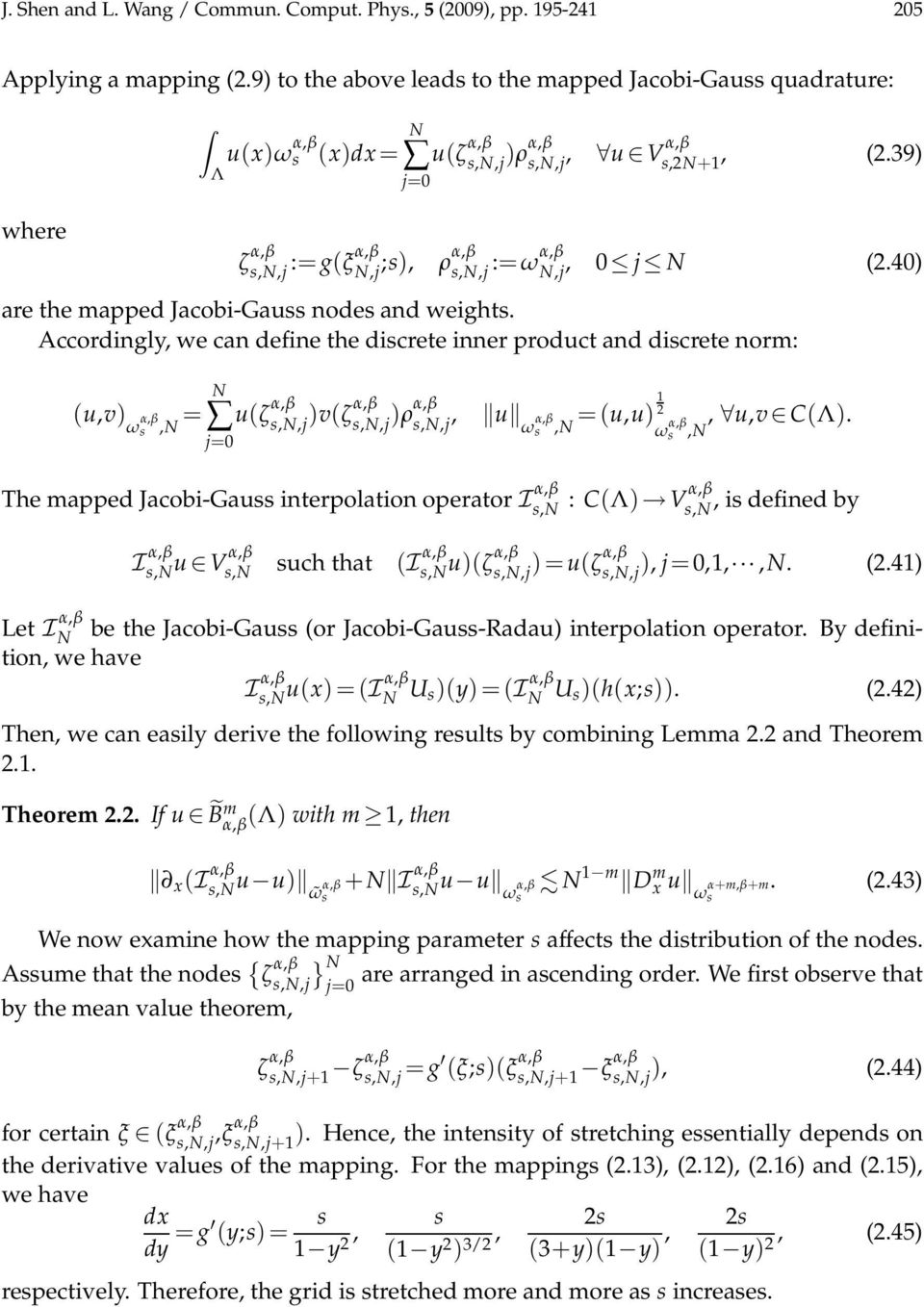
12 26 J. Shen and L. Wang / Commun. Comput. Phy., 5 (29), pp (a) Ditribution of x (, ) n=2 n=16 n=8 n= x (c) Ditribution of x (, ) n=8 n=12 n=16 n=2 (b) Effect of caling factor =2. =.5 =.1 =1. = x (d) Effect of caling factor =2., m=13 =1.5, m=15 =1., m=17 =.5, m=2 =.1, m= x x Figure 1: (a) Hermite-Gau point ( ) v. mapped Legendre-Gau point uing the algebraic map (2.12) with =1 ( ) for variou n; (b) Mapped Legendre-Gau point with n=16 and variou caling factor ; (c) Laguerre-Gau-Radau point ( ) v. mapped Legendre-Gau-Radau point uing the algebraic map (2.15) with =1 ( ) for variou n; (d) Mapped Legendre-Gau-Radau point with n =32 and variou caling factor (m i the number of point in the ubinterval [,1)). In Fig. 1, we plot ample grid ditribution for different caling factor with variou number of node for the mapped Legendre Gau (or Gau-Radau) point (ee the caption for detail). A comparion with Hermite-Gau point i alo preented in Fig. 1(a). We notice that the mapped Legendre-Gau point are more clutered near the origin and pread further, while the Hermite-Gau point are more evenly ditributed. It hould be oberved that the ditribution of mapped Legendre-Gau point i more favorable ince a much larger effective interval i covered. However, it can be hown that in both cae,

13 J. Shen and L. Wang / Commun. Comput. Phy., 5 (29), pp the mallet ditance between neighboring point i O( 1 ), a oppoed to O( 2 ) for Jacobi-Gau type node in a finite interval. A comparion of mapped Legendre and Laguerre Gau-Radau node i hown in Fig. 1(c). The mapped Legendre-Gau-Radau point are much more clutered near the origin, and one can check that the mallet ditance between neighboring point i O( 2 ), a oppoed to O( 1 ) for the Laguerre Gau-Radau node. Hence, the ditribution of mapped Legendre-Gau-Radau point i more favorable a far a reolution/accuracy i concerned but it will lead to a more retrictive CFL condition if explicit cheme are ued for time-dependent problem. 2.5 umerical method uing mapped Jacobi polynomial A generic example Conider the model equation γu x (a(x) x u)= f, x Λ=(,+ ), γ, (2.46) with uitable decay condition at ± which will depend on the weight function in the weighted variational formulation. For a given mapping x=g(y;) with x Λ and y ( 1,1), we recall that the mapped Jacobi polynomial are mutually orthogonal in L 2 ω α,β for (2.46) i to find u V α,β, uch that γ(u,v ) ω α,β + ( a(x) x u, x (v ω α,β ) ) =(I α,β (Λ). Hence, the mapped Jacobi method, f,v ) ω α,β, v V α,β,. (2.47) Let u now conider the econd approach decribed in the introduction. Here, Eq. (2.46) i firt tranformed into γu 1 ( a(g(y;)) ) g (y;) y g (y;) yu = F, (2.48) where U (y)=u(g(y;)) and F (y)= f(g(y;)). Then, let ˆω α,β (y)=ω α,β (y)g (y;), the Jacobi pectral method for (2.48) i to find ũ P uch that ( a(g(y;)) ) γ(ũ,ṽ ) ω α,β+ g (y;) yũ, y (ṽ ˆω α,β ) =(I α,β F,ṽ ) ω α,β, ṽ P. (2.49) One can verify eaily that ũ (y)=u (g(y;)). Hence, the two approache are mathematically equivalent. We remark that the formulation (2.49) i in general more difficult to analyze due to the ingular nature of g (y;), while the analyi for the formulation (2.47) become tandard once we etablih the baic approximation propertie of the mapped Jacobi polynomial.

14 28 J. Shen and L. Wang / Commun. Comput. Phy., 5 (29), pp On the other hand, Eq. (2.48) can be eaily implemented uing the tandard Jacobi-collocation (or more pecifically Chebyhev-collocation) method. Indeed, let {h, (y)} 1 be the Lagrange polynomial aociated with the Jacobi-Gau point {y } 1, the Jacobi-collocation approximation to (2.48) i to find U, (y) = =1 u h, (y) uch that Let u denote ( 1 ( a(g(y;)) )) γu, (y ) g (y;) y g (y;) yu, (y )= F (y ), 1. (2.5) u=(u 1,,u ) t, f=(f (y 1 ),,F (y )) t, D i = h (y i), D=(D i ), Λ i = a(g(y i;)) g (y i ;), Λ=diag(Λ i), Σ i = 1 g (y i ;), Then, (2.5) lead to the matrix ytem (γi ΣDΛD)u=f, Σ=diag(Σ i). which can be eaily olved by uing a tandard linear algebra routine. ote that in the above procedure, we only need to compute the Jacobi-Gau point {y } 1 and the aociated differentiation matrix D whoe entrie can be found for intance in [19] Error etimate for a model problem We conider the Jacobi rational approximation to the model problem γu(x) 2 xu(x)= f(x), x Λ=(, ), u()=, (2.51) with a uitable decay condition at infinity which i to be determined by the weak formulation of (2.51). For a given mapping, let ω=ω α,β be the weight function aociated with the mapped Jacobi polynomial, and denote We define a bilinear form H 1,ω(Λ)={u H 1 ω(λ) : u()=}. a ω (v,φ)=γ(v,φ) ω +( x v, x (φω)), u,v H 1,ω(Λ). Then, a weak formulation for (2.51) i to find u H,ω 1 (Λ) uch that a ω (u,v)=( f,v) ω, v H 1,ω(Λ), (2.52) for f ( H 1,ω (Λ)). ote that u H 1,ω (Λ) implie a decay condition for u at infinity.

15 J. Shen and L. Wang / Commun. Comput. Phy., 5 (29), pp Let u denote X ={u V α,β, :u()=}. We can then define the Galerkin approximation of (2.52) by the mapped Jacobi polynomial a follow: For f L 2 ω(λ) C( Λ), find u X uch that a ω (u,v )=(I α,β, f,v ) ω, v X. (2.53) Unlike the tandard pectral method in a finite domain, the well-poedne of (2.52) and of (2.53) i not guaranteed for all cae with γ. A general reult for the wellpoedne of an abtract equation of the form (2.52) i etablihed in [49]. For the reader convenience, we recall thi reult below (cf. Lemma 2.3 in [49]): Lemma 2.3. We aume that d 1 =max x Λ ω 1 (x) x ω(x), d 2 =max ω 1 (x) 2 x ω(x) x Λ are finite and that u 2 (x)ω (x) x Λ = for u H 1,ω (Λ). Then, for any u,v H1 ω(λ), we have that a ω (u,v) (d 1 +1) u 1,ω v 1,ω +γ u ω v ω, (2.54) and for any v H 1,ω (Λ), a (ν) ω (v,v) v 2 1,ω +(γ d 2/2) v 2 ω. (2.55) Remark 2.2. The inequality (2.55) i derived under a general framework. For a pecific problem, the contant γ d 2 /2 can often be replaced by a larger contant. Thank to the above lemma, it i then traightforward to prove the following general reult: Theorem 2.3. Aume that the condition of Lemma (2.3) are atified and γ d 2 /2>. Then the problem (2.52) (rep. (2.53)) admit a unique olution. Furthermore, we have the error etimate: u u 1,ω inf v X u v 1,ω + f I α,β, f ω. (2.56) Remark 2.3. With a change of variable x to x/c (c>) for Eq. (2.46), the retriction on γ can be relaxed to γ>. Hence, given a mapping and a pair of Jacobi parameter (α,β), we ut need to compute upper bound for d 1 and d 2, verify that the condition of Theorem 2.3 are atified, and apply the approximation reult in Theorem 2.1 and 2.2 to (2.56) to get the deired error etimate. Conider for example the mapped Legendre method for (2.52) with the mapping (2.15). It can be hown that for thi mapping, we have d 1 2 and d 2 6. Applying Theorem 2.1 and 2.2 to (2.56) with (α,β)=(,) lead to the following reult:

16 21 J. Shen and L. Wang / Commun. Comput. Phy., 5 (29), pp Corollary 2.1. Let u and u be the olution of (2.52) and (2.53) with (α,β) = (,) and the mapping (2.15) with =1. Aume that u B, m (Λ), f B, k (Λ) and γ>3. We have u u 1,ω, 1 1 m D m x u ω m,m 1 + k Dx k f ω k,k. (2.57) 1 We note that a lightly improved condition on γ wa derived in [35] uing a refined etimate for (2.55). A imilar procedure can be applied to the mapped Chebyhev method for (2.52) with the mapping (2.15). ote however that in thi cae we have d 1,d 2 =. everthele, one can till how that a ω (, ) i continuou and coercive (cf. [34]). Applying Theorem 2.1 and 2.2 to (2.56) with (α,β)=( 1 2, 1 2 ) lead to the following reult (cf. [34]): Corollary 2.2. Let u and u be the olution of (2.52) and (2.53) with (α,β)=( 1 2, 1 2 ) and the mapping (2.15) with =1. Auming that u B 1/2, 1/2 m (Λ) and f B 1/2, 1/2 k (Λ) and that γ> We have u u 1,ω 1/2, 1/2 1 1 m D m x u ω m 1/2,m 1/2 1 + k Dx k f ω k 1/2,k 1/2. (2.58) 1 Remark 2.4. Error etimate which are eentially equivalent to (2.57) and (2.58) but in different form were derived in [34, 35]. The ame procedure can be ued to derive error etimate on mapped Jacobi method for problem in the whole line (cf. [39, 54]). 3 Laguerre pectral method For problem in a emi-infinite interval, it i natural to ue (generalized) Laguerre polynomial/function which form orthonormal bai in (weighted) Sobolev pace. 3.1 Generalized Laguerre approximation We firt recall ome baic propertie of generalized Laguerre polynomial/function Generalized Laguerre polynomial Let Λ := (, ). The generalized Laguerre polynomial (GLP), denoted by L (α) n (x)(α > 1), are the eigenfunction of the Sturm-Liouville problem x α e x ( x x α+1 e x x L (α) n (x) ) +λ n L (α) n (x)=, x Λ, (3.1) with the eigenvalue λ n = n. Compared with the Jacobi polynomial in a finite interval, the linear growth of λ n for the Laguerre polynomial indicate, on the one hand, a lower convergence rate of the Laguerre expanion, but on the other hand, lead to better invere inequalitie and conequently milder CFL condition for time dependent problem.
![57) 1 We note that a lightly improved condition on γ wa derived in [35] uing a refined etimate for (2.55). A imilar procedure can be applied to the mapped Chebyhev method for (2.](/docs-images/42/154253/images/page_16.jpg "52) with the mapping (2.15). ote however that in thi cae we have d 1,d 2 =. everthele, one can till how that a ω (, ) i continuou and coercive (cf. [34]). Applying Theorem 2.1 and 2.2 to (2.")
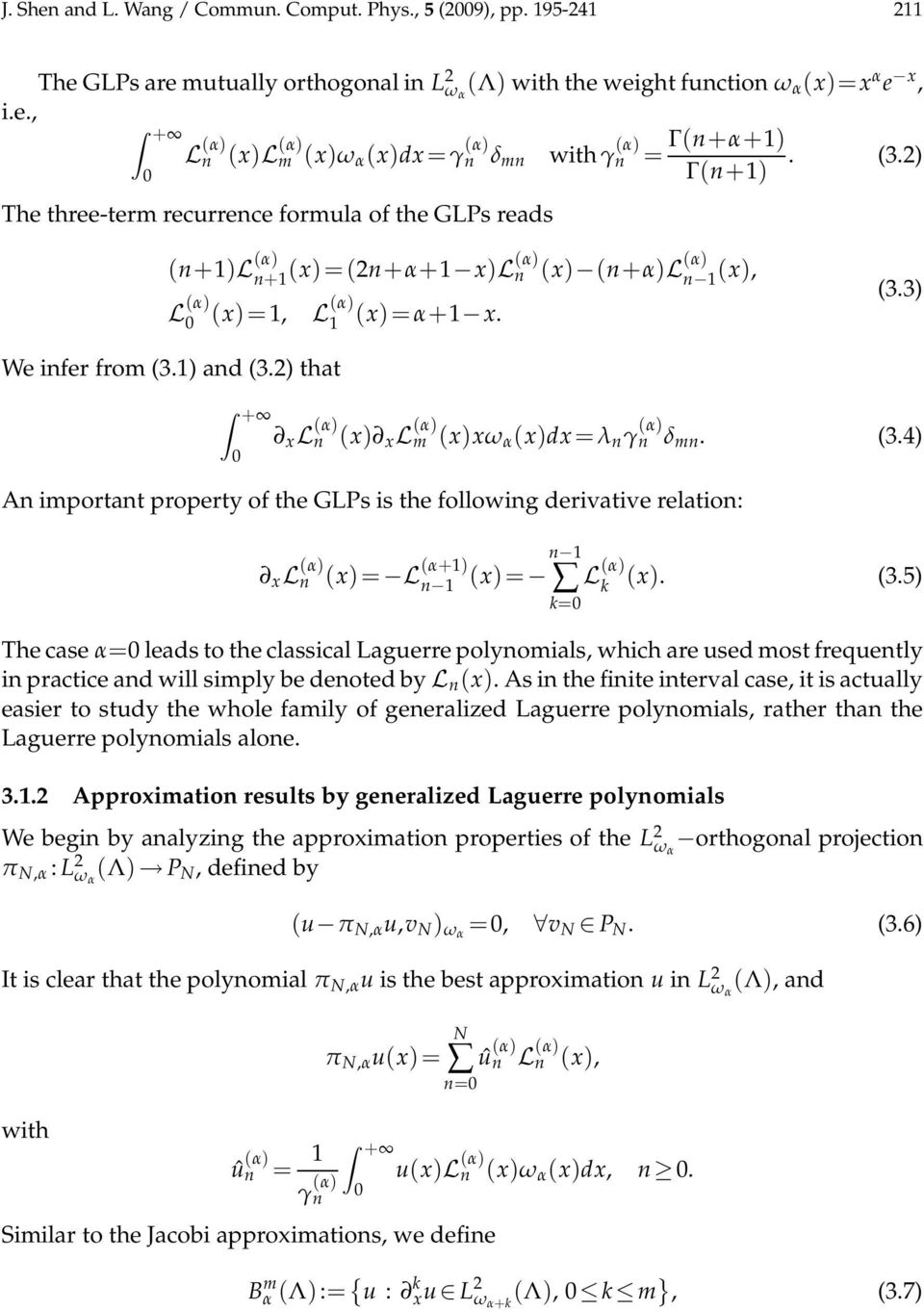
17 J. Shen and L. Wang / Commun. Comput. Phy., 5 (29), pp The GLP are mutually orthogonal in L 2 ω α (Λ) with the weight function ω α (x)=x α e x, i.e., + L (α) n (x)l (α) m (x)ω α (x)dx=γ (α) n δ mn withγ (α) n = Γ(n+α+1). (3.2) Γ(n+1) The three-term recurrence formula of the GLP read (n+1)l (α) n+1 (x)=(2n+α+1 x)l(α) n (x) (n+α)l (α) n 1 (x), L (α) (x)=1, L (α) 1 (x) = α+1 x. (3.3) We infer from (3.1) and (3.2) that + x L (α) n (x) x L (α) m (x)xω α (x)dx=λ n γ (α) n δ mn. (3.4) An important property of the GLP i the following derivative relation: x L (α) n (x)= L (α+1) n 1 n 1 (x)= L (α) k (x). (3.5) k= The cae α= lead to the claical Laguerre polynomial, which are ued mot frequently in practice and will imply be denoted by L n (x). A in the finite interval cae, it i actually eaier to tudy the whole family of generalized Laguerre polynomial, rather than the Laguerre polynomial alone Approximation reult by generalized Laguerre polynomial We begin by analyzing the approximation propertie of the L 2 ω α orthogonal proection π,α : L 2 ω α (Λ) P, defined by (u π,α u,v ) ωα =, v P. (3.6) It i clear that the polynomial π,α u i the bet approximation u in L 2 ω α (Λ), and with π,α u(x)= n= û (α) n L (α) n (x), û (α) n = 1 + γ (α) u(x)l (α) n (x)ω α (x)dx, n. n Similar to the Jacobi approximation, we define B m α (Λ) := { u : k xu L 2 ω α+k (Λ), k m }, (3.7)
18 212 J. Shen and L. Wang / Commun. Comput. Phy., 5 (29), pp equipped with the norm and emi-norm ( m ) 1/2, u B m α = k x u 2 ω u B m α+k α = m x u 2 ω α+m. k= In particular, we omit the ubcript α, when α =. In contrat to the uual weighted Sobolev pace H m ω α (Λ), the weight function correponding to derivative of different order i different in B m α (Λ). We oberve from (3.5) that k xl (α) n (x)=( 1) k L (α+k) n k (x), n k, (3.8) and o { k xl (α) } n are orthogonal with repect to the weight ωα+k, i.e., + k xl (α) l By (3.2) and the Stirling formula, we have Summing (3.9) over k m lead to (x) k xl (α) n (x)ω α+k (x)dx=γ (α+k) n k δ ln. (3.9) Γ(x+1) 2πx x+1/2 e x, x 1, (3.1) γ (α+k) n k = Γ(n+α+1) Γ(n k+1) nα+k, for n 1. m k= ( k x L (α) l, k xl (α) ) n =, ω α+k if l = n and k>min{l,n} which implie that { L (α) } n are orthogonal in the pace B m α (Λ). The fundamental generalized Laguerre approximation reult i tated below (ee, e.g., [19]). Theorem 3.1. For any u B m α (Λ) and m, Proof. Obviouly, we have that l x(π,α u u) ωα+l (l m)/2 m x u ωα+m, l m. (3.11) l x(π,α u u)= û (α) n n=+1 l xl (α) (x). n

19 J. Shen and L. Wang / Commun. Comput. Phy., 5 (29), pp Hence, by the orthogonality and the Stirling formula (3.1), l x(π,α u u) 2 ω α+l = Thi complete the proof. n=+1 max n> { γ (α+l) n l û (α) n 2 γ (α+l) n l /γ (α+m) n m l m m x u 2 ω α+m. } γ (α+m) n m û(α) n 2 n=+1 ext, we conider the approximation reult for the H 1 type orthogonal proection. For implicity, we conider only the uual Laguerre cae, i.e., α=. Hereafter, let ω(x)= e x be the uual Laguerre weight function, and denote H 1,ω(Λ)= { u H 1 ω(λ) : u()= }, P ={ φ P : φ()= }. (3.12) Conider the orthogonal proection π 1, : H1,ω (Λ) P, defined by ( (u π 1, u),v ) ω =, v P. (3.13) Theorem 3.2. If u H 1,ω (Λ) and xu B m 1 (Λ), then for m 1, Proof. Let π 1, u u 1,ω 1 2 m 2 m x u ωm 1. (3.14) x φ(x)= π 1, u (y)dy. Then u φ H,ω 1 (Λ). Thank to the imbedding inequality (ee, e.g., [31]) and Theorem 3.1 with α=, we find that Thi end the proof. u ω x u ω, π 1, u u 1,ω φ u 1,ω x (φ u) ω 1 2 m 2 m x u ωm 1. We note that in general Laguerre polynomial are not good candidate for approximation in infinite domain due to their wild behavior at infinity. Thi fact i alo reflected in the error etimate in Theorem 3.1 and 3.2. Although thee error etimate are alo of pectral type, but due to the exponential decay weight in the norm, they only imply meaningful pointwie approximation for a hort interval. Hence, the GLP are only uitable for the approximation of function with fat algebraic (or exponential) growth at infinity. For problem with ome decay propertie at infinity, it i more appropriate to ue the o called generalized Laguerre function (GLF) which we hall conider below.

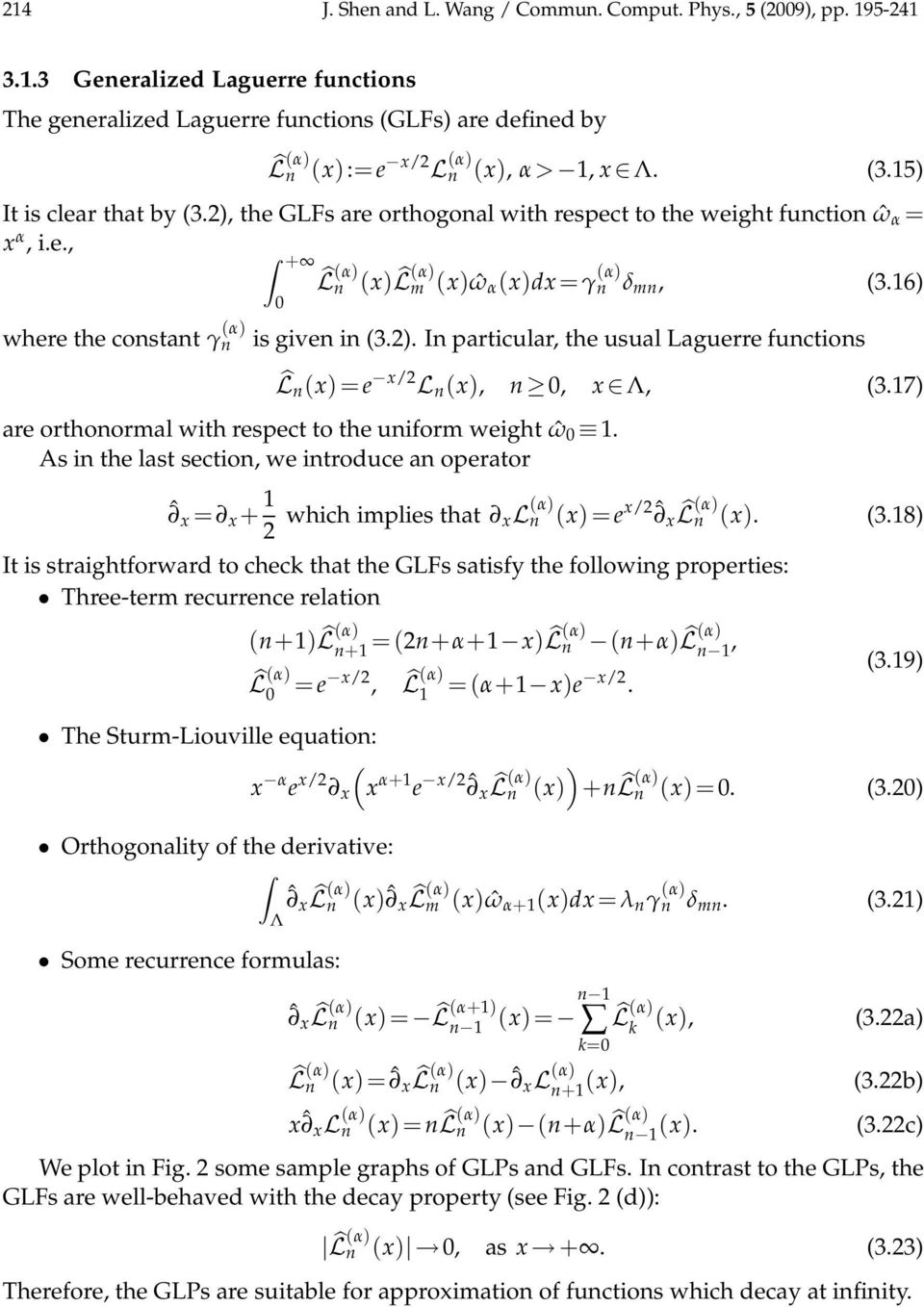
20 214 J. Shen and L. Wang / Commun. Comput. Phy., 5 (29), pp Generalized Laguerre function The generalized Laguerre function (GLF) are defined by L (α) n (x) := e x/2 L (α) n (x), α> 1, x Λ. (3.15) It i clear that by (3.2), the GLF are orthogonal with repect to the weight function ˆω α = x α, i.e., + L (α) n (x) L (α) m (x) ˆω α (x)dx=γ (α) n δ mn, (3.16) where the contant γ (α) n i given in (3.2). In particular, the uual Laguerre function L n (x)=e x/2 L n (x), n, x Λ, (3.17) are orthonormal with repect to the uniform weight ˆω 1. A in the lat ection, we introduce an operator ˆ x = x which implie that xl (α) n (x)=e x/2 ˆ x L (α) n (x). (3.18) It i traightforward to check that the GLF atify the following propertie: Three-term recurrence relation (n+1) L (α) n+1 =(2n+α+1 x) L (α) n (n+α) L (α) n 1, L (α) = e x/2, L (α) 1 =(α+1 x)e x/2. The Sturm-Liouville equation: ( x α e x/2 x x α+1 e x/2 ˆ x L (α) n (x) ) (3.19) +n L (α) n (x)=. (3.2) Orthogonality of the derivative: ˆ x L (α) n (x)ˆ x L (α) m (x) ˆω α+1 (x)dx=λ n γ (α) n δ mn. (3.21) Some recurrence formula: Λ ˆ x L (α) n L (α) n xˆ x L (α) n (x)= L (α+1) n 1 n 1 (x)= L (α) k (x), (3.22a) k= (x)= ˆ x L (α) n (x) ˆ x L (α) n+1 (x), (3.22b) (x)=n L (α) n (x) (n+α) L (α) n 1 (x). (3.22c) We plot in Fig. 2 ome ample graph of GLP and GLF. In contrat to the GLP, the GLF are well-behaved with the decay property (ee Fig. 2 (d)): L (α) n (x), a x +. (3.23) Therefore, the GLP are uitable for approximation of function which decay at infinity.
21 J. Shen and L. Wang / Commun. Comput. Phy., 5 (29), pp (a) Laguerre polynomial 1 5 (b) Graph of L 8 (x) 5 L 2 L L 3 L L L (3) x (c) Laguerre polynomial x L 5 L () 4 L (1) 4 L (2) n= x (d) Laguerre function n=1 n=2 n=3 1 2 Figure 2: (a) Graph of the firt ix Laguerre polynomial L n (x) with n=,1,,5 and x [,6]; (b) Growth of L 8 (x) againt the upper bound x 1/4 e x/2 (dahed line); (c) Graph of the generalized Laguerre polynomial L (α) 4 (x) with α=,1,2,3 and x [,1]; (d) Graph of the firt ix Laguerre function L n (x) with n=,1,,5 and x [,2]. x n=4 n= Approximation reult by generalized Laguerre function It i traightforward to extend the Laguerre polynomial approximation to the Laguerre function approximation. Indeed, for any u L 2ˆω α (Λ), we have ue x/2 L 2 ω α (Λ). Let u denote P := {v : v=e x/2 w with w P }, (3.24) and define the operator Clearly, by (3.6), ˆπ,α u=e x/2 π,α (ue x/2 ) P. (3.25) ( ˆπ,α u u,v ) ˆωα = ( π,α (ue x/2 ) (ue x/2 ),(v e x/2 ) ) ω α =, v P. (3.26)
22 216 J. Shen and L. Wang / Commun. Comput. Phy., 5 (29), pp Hence, ˆπ,α i the orthogonal proector from L 2ˆω α (Λ) to P, and therefore it approximation propertie can be derived from that of π,α. Let ˆ x = x +1/2. We define equipped with the norm and emi-norm B m α (Λ) := { u : ˆ k xu L 2ˆω α+k (Λ), k m }, (3.27) u B m α = ( m k= ˆ k xu 2ˆω α+k ) 1/2, u B m α = ˆ m x u 2ˆω α+m. Then, we have the following reult for ˆπ,α. Theorem 3.3. For any α> 1 and u B m α (Λ), ˆ l x( ˆπ,α u u) ˆωα+l (l m)/2 ˆ m x u ˆωα+m. (3.28) Proof. Let v=ue x/2. One verifie eaily from (3.18) that l x(π,α v v)= l x(e x/2 ( ˆπ,α u u))=e x/2 ˆ l x ( ˆπ,α u u), and likewie, m x v=e x/2 ˆ m x u. Hence, the deired reult i a direct conequence of (3.11). Remark 3.1. When comparing the error etimate in the above theorem with the correponding reult for claical Jacobi approximation (ee Lemma 2.1), we notice that the convergence rate of the Laguerre approximation i only half of the claical Jacobi approximation. Thi i a direct conequence of the linear growth of the eigenvalue in the Laguerre Sturm-Liouville problem, a oppoed to the quadratic growth in the Jacobi Sturm-Liouville problem. The comparion with the mapped Jacobi approximation (cf. Theorem 2.1) i more delicate. Conider u(x)=(1+x) h and u(x)=inkx (1+x) h. It can be eaily checked that for both function ˆ m x u ˆω α+m < if m<2h α 1 which implie that u ˆπ,α u ˆωα (2h α 1)/2. (3.29) Comparing with the error etimate by mapped Jacobi polynomial in (2.34) and (2.35), we oberve that the mapped Jacobi approximation lead to better convergence rate for function without ocillation at infinity uch a u(x)=(1+x) h, but the Laguerre approximation i better for function with ocillation at infinity uch a u(x)=inkx (1+x) h. ext, we define an orthogonal proector in H 1 (Λ) through the operator π1,. Since for any u H 1(Λ), we have uex/2 H,ω 1 (Λ). Let u denote P := {v P : u()=}, (3.3) and define the operator ˆπ 1, u=e x/2 π 1, (uex/2 ) P. The following reult characterize the propertie of π 1, (cf. [48]).
23 J. Shen and L. Wang / Commun. Comput. Phy., 5 (29), pp Theorem 3.4. and for m 1, ((u ˆπ 1, u),v )+ 1 (u ˆπ1, 4 u,v )=, u H(Λ), 1 v P ; (3.31) ˆπ 1, u u m 2 ˆ m x u ˆωm 1, u H 1 (Λ) with ˆ x u B m 1 (Λ). (3.32) Proof. Uing the definition of π 1,, and integration by part, we find that for any v = w e x/2 with w P, ((u ˆπ 1, u),v ) ( = [(ue x/2 ) π 1, (uex/2 )] 1 2 [(uex/2 ) π 1, (uex/2 )],w 1 ) 2 w = 1 2 [(ue x/2 ) π 1, (uex/2 )w ] e x dx+ 1 4 ((uex/2 ) π 1, (uex/2 ),w ) ω = 1 4 ((uex/2 ) π 1, (uex/2 ),v ) ω = 1 (u ˆπ1, 4 u,v ), which implie the identity (3.31). ow let v=ue x/2. It i clear that x ( ˆπ 1, u u)= 1 2 e x/2 (π 1, v v)+e x/2 x (π 1, v v). Hence, uing Lemma 3.2 and the fact that m x v=e x/2 ˆ m x u, lead to x ( ˆπ 1, u u) π1, v v ω+ x (π 1, v v) ω 1 2 m m 1 2 x 2 m x v ω 1 2 m m 1 2 x 2 ˆ m x u. ω Similarly, we have Thi complete the proof. ˆπ 1, u u 1 2 m 2 ˆ m x u ˆωm Laguerre-Gau type quadrature and interpolation by Laguerre polynomial/function We recall firt the (generalized) Laguerre-Gau type quadrature (cf. [19, 52]).
24 218 J. Shen and L. Wang / Commun. Comput. Phy., 5 (29), pp Theorem 3.5. Let {x (α),ω (α) } = be the node and weight aociated with the Laguerre-Gau or Laguerre-Gau-Radau quadrature. Then, + p(x)x α e x dx= = p(x (α) )ω (α), p P 2+δ, (3.33) where δ = 1, for Laguerre-Gau and Laguerre-Gau-Radau quadrature, repectively. For the Laguerre-Gau quadrature: {x (α) } = are the zero of L(α) +1 (x); ω (α) = Γ(+α+1) (+1)! = L (α) (x(α) Γ( +α+1) (+α+1)(+1)! 1 ) x L (α) +1 (x(α) ) x (α) [ (α) L (x(α) ) ] 2,. (3.34) For the Laguerre-Gau-Radau quadrature: x (α) =, {x (α) } =1 are the zero of xl (α) +1 (x); ω (α) = (α+1)γ2 (α+1)γ(+1), Γ( +α+2) ω (α) = Γ(+α+1) 1!(+α+1) [ x L (α) (x(α) )] 2 = Γ(+α+1)!(+α+1) 1 [L (α) (x(α) )] 2, 1. (3.35) In practice, the above quadrature i rarely ued due to the exponential weight. Intead, the following quadrature with repect to the weight function ˆω α hould be ued. Theorem 3.6. Let { x (α),ω (α) } be the et of Laguerre-Gau or Laguerre-Gau-Radau quadrature node and weight given in Theorem 3.5. Denote Then we have + ˆω (α) p(x)q(x)x α dx= = e x(α) ω (α),. (3.36) = p(x (α) )q(x (α) ) ˆω (α), p q P 2+δ, where δ=1, for the Laguerre-Gau cae and Laguerre-Gau-Radau cae, repectively.
25 J. Shen and L. Wang / Commun. Comput. Phy., 5 (29), pp Remark 3.2. Thank to the three-term recurive relation atified by the GLP, the node for the Laguerre-Gau and Laguerre-Gau-Radau quadrature can be eaily computed a eigenvalue of the ymmetric tridiagonal matrix a b 1 b 1 a 1 b 2 A +1 = , (3.37) b 1 a 1 b b a whoe entrie are determined by (3.3): a =2+α+1,, b = (+α), 1. (3.38) However, care hould be taken when computing the weight { ˆω (α) }. The proce of computing firt {ω (α) } and then uing (3.36) i highly ill-conditioned and hould be avoided. Intead, thank to (3.15) and (3.36), we derive eaily that for the Laguerre-Gau cae, we have ˆω (α) = Γ( +α+1) (+α+1)(+1)! x (α) and for the Laguerre-Gau-Radau cae (with x (α) =), we have ˆω (α) = ω (α) ; ˆω(α) = Γ(+α+1)!(+α+1) [ ˆL (α) (x(α) ) ] 2 ; (3.39) 1 [ ˆL (α), 1. (3.4) (x(α) )] 2 We now examine the ditribution of the quadrature node with repect to and the parameter α. We firt recall two formula in Szego [52]. Auming that the zero {x (α) } = of L (α) +1 (x) are arranged in acending order, we have the following propertie x (α) > c +1, x(α) =4(+1)+2α+2 c(4+4)1/3, (3.41a) x (α) (+1)2,, (3.41b) +1 where c i a poitive contant independent of. Hence, the larget zero grow like 4, while the mallet zero behave like O( 1 ). Such propertie can be viualized from Fig. 3(a)-(c). Indeed, we oberve from Fig. 3(a) and (b) that the node are clutered near the endpoint x=, with a denity min x +1 x 1
26 22 J. Shen and L. Wang / Commun. Comput. Phy., 5 (29), pp (a) ode ditribution =32 15 (b) Growth of x +1 x =16 = = x (c) Growth of the larget node (d) Zero of L 8 (α) (x) α x Figure 3: (a) Ditribution of Laguerre-Gau-Radau node { } x with =8,16,24,32 with α=; (b) Growth of = { x+1 x } 4 = ; (c) Growth of the larget node x againt the aymptotic etimate: 4(+1)+2 (4(+1)) 1/3 (cf. (3.41a)) with variou ; (d) Ditribution of zero of L (α) 8 (x) with variou α. a oppoed to the O( 2 ) behavior in the mapped Jacobi cae. Fig. 3(c) how that the larget node x grow at the rate 4(+1)+2 (4(+1)) 1/3 a increae. Another intereting property which can be viualized from Fig. 3(d) i that for fixed and, x (α) increae a α increae, i.e., we have x (α) >, for. (3.42) α Let { x (α) } be the Laguerre-Gau or Gau-Radau interpolation node defined in = Theorem 3.5, and denote by I (α) the interpolation operator from C( Λ) onto P baed on the et { x (α). We have the following reult (cf. [27]): } = Theorem 3.7. Auming u C( Λ), u Bα m (Λ) and x u Bα m 1 (Λ) with m 1, then I (α) u u ω α (1 m)/2( m x u ωα+m 1 +(ln) 1/2 m x u ωα+m ).
27 J. Shen and L. Wang / Commun. Comput. Phy., 5 (29), pp Remark 3.3. Compared with Theorem 3.1 (with l = ), the etimate for the interpolation i uboptimal (with order O( (1 m)/2 ln)). The above reult i proved in [27] and improve previou reult in [42, 43, 58]. In [42] (ee alo [6]), the following etimate wa derived for the cae α=, I () u u ω (1 m)/2 u m,ωτ, (3.43) where the weight function ω τ (x) = e (1 τ)x with < τ < 1. Matroianni and Occorio [43] tudied the generalized Laguerre-Gau interpolation (ee Formula (3.8) of [43]) and howed that x γ e x/2 (I (α) u u) L m/2 ln x m/2+γ e x/2 m x u L, (3.44) for m 1, α> 1 and ome γ atifying 2γ 5 2 α 2γ 1 2. In [58], the uual Laguerre interpolation wa analyzed in the weighted Sobolev pace, and the main reult i I () u u ω (1 m)/2+ε u m,ωm, m 1, < ε 1 2. (3.45) Thi reult wa improved in [27] with ln in place of ε. We now define the interpolation operator Î (α) from C( Λ) onto P baed on the et of point { x (α) } =, i.e., ( Î (α) u)(x(α) )=u(x (α) ),. By oberving that (Î(α) u)(x)=e x/2 I (α) (uex/2 ) P, we derive immediately from Theorem 3.7 the following reult. Theorem 3.8. Let ˆ x = x Auming u C( Λ), u B α m (Λ) and ˆ x u B α m 1 (Λ) with m 1, we have Î (α) u u ˆω α (1 m)/2( ˆ m x u ˆωα+m 1 +(ln) 1/2 ˆ m ) x u ˆωα+m. 3.3 umerical method uing Laguerre function We conider again the model problem (2.51). An advantage of uing Laguerre function i that they are mutually orthogonal in the uual (non-weighted) L 2 pace o we can work with the uual (i.e., non-weighted) variational formulation. Let u denote H 1 (Λ)= { u H 1 (Λ) : u()= }. (3.46)
28 222 J. Shen and L. Wang / Commun. Comput. Phy., 5 (29), pp Then, a weak formulation for (2.51) i to find u H 1 (Λ) uch that a(u,v) := γ(u,v)+(u,v )=( f,v), v H 1 (Λ), (3.47) for f ( H 1(Λ)). We note that u H 1 (Λ) indicate a decay condition: lim x + u(x)=. The Laguerre-pectral approximation to (3.47) i to find u P uch that a(u,v )=(Î f,v ), v P, (3.48) where P i defined in (3.3) and Î = Î (α) with α=. It i clear that for γ>, the problem admit a unique olution, ince a(u,u)= u 2 1 +γ u 2 min(1,γ) u 2 1, for all u H1 (Λ). Theorem 3.9. Let γ >, u H 1(Λ), ˆ x u B m 1 (Λ), f C( Λ) B k(λ) and ˆ x f B k 1 (Λ) with k,m 1. Then, u u m 2 ˆ m x u ˆωm 1 + (1 k)/2( ˆ k x f ˆωk 1 +(ln) 1/2 ˆ k x f ˆωk ). (3.49) Proof. Let e = u ˆπ 1, u and ẽ = u ˆπ 1, u. Hence, by (3.47) (3.48), which implie that Taking v = e in the above, we find a(u u,v )=(Î f f,v ), v P, a(e,v )=a(ẽ,v )+(Î f f,v ), v P. e 1 ẽ 1 + Î f f. We can then conclude by uing Theorem 3.4 and 3.7 and the triangular inequality. Remark 3.4. In [47], numerical reult are reported for the cheme (3.48) uing the function in (2.31)-(2.33) a exact olution. Geometric convergence rate (i.e., exp( c)) for (2.31) and ub-geometric convergence of order exp( c ) for (2.32) are oberved (cf. Fig. 3.2 in [47]), while a convergence rate conitent with the etimate in (3.49) and (3.29) i oberved for (2.33). The ub-geometric convergence for (2.32) wa puzzling ince the error etimate in (3.29) only predict a rate of order about h. In order to explain thi urpriing diagreement, we performed additional tet with different h and with much larger than what wa ued in [47]. The numerical reult are reported in Fig. 4. On the left, we plot the reult with h=3 and 4.5 for up to 128, and we oberve again the ub-geometric convergence rate a reported in [47]. However, when we increaed further, the convergence rate eventually became algebraic. Thi indicate that the ubgeometric convergence reported in [47] wa till in the pre-aymptotic range. To illutrate thi behavior, we plot the reult with h=1.5 and 2 (o the aymptotic range can be reached fater) for up to 256 on the right of Fig. 4. It i clear that after a pre-aymptotic range, the convergence rate ettle down to the algebraic rate conitent with (3.49) and (3.29).
29 J. Shen and L. Wang / Commun. Comput. Phy., 5 (29), pp log 1 (Error) u(x)=1/ (1+x) h * : max. error with h=3 o : L 2 error with h=3 + : max. error with h=4.5 quare : L 2 error with h= qrt() 4 Hermite pectral method log 1 (Error) Figure 4: Convergence rate of the cheme (3.48) u(x)=1/ (1+x) h * : max. error with h=1.5 o : L 2 error with h=1.5 + : max. error with h=2. quare : L 2 error with h= log 1 () For problem in the whole line, a natural choice i to ue Hermite polynomial/function. 4.1 Approximation by Hermite polynomial/function We firt recall ome baic propertie of Hermite polynomial/function Hermite polynomial The Hermite polynomial, denoted by H n (x), are the eigenfunction of the Sturm- Liouville problem: e x2 ( e x 2 H n(x) ) +λn H n (x)=, x R :=(, ), (4.1) with the eigenvalue λ n =2n grow linearly with repect to n. The Hermite polynomial are orthogonal with repect to the weight ω(x)=e x2, i.e., + H m (x)h n (x)e x2 dx=γ n δ mn, γ n = π2 n n!. (4.2) ote that the contant γ n grow exponentially a n increae, o it i neceary to normalize thi factor in actual computation. The three-term recurrence formula read H n+1 (x)=2xh n (x) 2nH n 1 (x), n 1. (4.3) A a direct conequence of (4.1) and (4.2), we have the orthogonality: H n(x)h m(x)e x2 dx=λ n γ n δ mn. (4.4)
30 224 J. Shen and L. Wang / Commun. Comput. Phy., 5 (29), pp The Hermite polynomial atify the recurrence relation: H n(x)=2nh n 1 (x), n 1, H n(x)=2xh n (x) H n+1 (x), n. (4.5a) (4.5b) Approximation by Hermite polynomial Conider the L 2 ω orthogonal proection π : L 2 ω(r) P, defined by (u π u,v ) ω =, v P. Similar to Theorem 3.1, we have the following reult. Theorem 4.1. For any u H m ω(r) with m, k x(π u u) ω (k m)/2 m x u ω, l m. (4.6) Proof. For any u L 2 ω(r), we write the Hermite expanion u(x)= n= We derive from (4.5a) that Therefore, for k m, ũ n H n (x) with ũ n = 1 π2 n u(x)h n (x)e x2 dx. n! k x H n(x)=2 k n(n 1) (n k+1)h n k (x) := σ k n H n k(x), n k. (4.7) k x(π u u) 2 ω = Thi complete the proof Hermite function = n=+1 n=+1 n=+1 k m ũ n k xh n (x) 2 ω ũ 2 n(σ k n) 2 γ n k = ũ 2 n n=+1 (σn) k 2 γ n k (σn m ) 2 (σn m ) 2 γ n m γ n m ũ 2 n(σ m n ) 2 γ n m = k m m x u 2 ω. A the (generalized) Laguerre polynomial, the Hermite polynomial are generally not uitable in practice due to their wild aymptotic behavior at infinitie (cf. [52]): H n (x) Γ(n+1) ( /2 nπ ) Γ(n/2+1) ex2 co 2n+1x 2 ( n n/2 e x2 /2 nπ ) co 2n+1x. 2 (4.8)
31 J. Shen and L. Wang / Commun. Comput. Phy., 5 (29), pp (a) Hermite polynomial (b) Hermite function 3 H 4 1 n=4 n=2 n= 15 H 2.5 H 1 H H x 1 n=3 n= Figure 5: (a) The firt five Hermite polynomial H n (x) with n =,,4; (b) The firt five Hermite function H n (x) with n=,,4. x Hence, we hall conider the o called Hermite function. The normalized Hermite function of degree n i defined by H n (x)= 1 2 n n! e x2 /2 H n (x), n, x R. (4.9) Clearly, { H n } i an orthogonal ytem in L 2 (R), i.e., + H n (x) H m (x)dx= πδ mn. (4.1) In contrat to the Hermite polynomial, the Hermite function are well behaved with the decay property: H n (x), a x, and the aymptotic formula with large n i ( H n (x) n 1 nπ ) 4 co 2n+1x. (4.11) 2 Some ample graph of the Hermite polynomial and the normalized Hermite function are preented in Fig. 5. The three-term recurrence relation (4.3) implie 2 H n+1 (x)= x n+1 H n n (x) n+1 H n 1 (x), n 1, H (x)=e x2 /2, H 1 (x)= 2xe x2 /2. (4.12)
32 226 J. Shen and L. Wang / Commun. Comput. Phy., 5 (29), pp Uing (4.5a) and the above formula lead to H n(x)= 2n H n 1 (x) x H n (x) n = 2 H n+1 n 1 (x) H n+1 (x) Approximation by Hermite function (4.13) Let u define P = {v : v=e x2 /2 w, w P }. Since ue x2 /2 L 2 ω(r) for any u L 2 (R), we define π : L 2 (R) P by Therefore, π u := e x2 /2 π (ue x2 /2 ) P. (4.14) (u π u,v )= ( ue x2 /2 π (ue x2 /2 ),v e x2 /2 ) ω =, v P, (4.15) which implie that π i in fact the orthogonal proection in L 2 (R). We introduce the derivative operator x = x +x o that x H n (x)=e x2 /2 x H n (x). (4.16) Then, it i traightforward to derive the following reult from Theorem 4.1. Theorem 4.2. For any m x u L2 (R) with m, l x( π u u) (l m)/2 m x u, l m. (4.17) A particularly intereting reult for the Hermite cae i the following theorem which how that π i imultaneouly the optimal proector from H l (R) P for l=,1,2. Theorem 4.3. For any m x u L2 (R) with m, l x( π u u) (l m)/2 m x u, l=,1,2, l m. (4.18) Proof. The cae l = come directly from Corollary 4.2 with l =. In cae of l=1, note that ) x ( π u u)=e x2 /2 x (π (e x2 /2 u) (e x2 /2 u) ( ) xe x2 /2 π (e x2 /2 u) (e x2 /2 u). Hence, by uing the inequality (cf. [3]) and Theorem 4.1, xv ω v 1,ω, (4.19) x ( π u u) π (e x2 /2 u) (e x2 /2 u) 1,ω + x(π (e x2 /2 u) (e x2 /2 u)) ω π (e x2 /2 u) (e x2 /2 u) 1,ω 1/2 m/2 m x (e x2 /2 u) ω. The cae l=2 can be proved in the ame fahion.
33 J. Shen and L. Wang / Commun. Comput. Phy., 5 (29), pp Remark 4.1. A in the Laguerre cae, the eigenvalue of the Sturm-Liouville problem aociated with the Hermite polynomial alo grow linearly, o the convergence rate of the Hermite approximation i imilar to that of the Laguerre approximation. To compare with the mapped Jacobi approximation (cf. Theorem 2.1), we conider u(x) = (1+x 2 ) h and u(x) = inkx (1+x 2 ) h. It can be checked that for both function m 4h 1 x u < if m< 2 which implie that u π u (h 1/4). (4.2) Comparing with the error etimate by mapped Jacobi polynomial in (2.36) and (2.37), we oberve that the mapped Jacobi approximation lead to better convergence rate for both function. 4.2 Hermit Gau quadrature and interpolation by Hermite polynomial/ function We tart with the claical Hermite-Gau quadrature with repect to the meaure e x2 dx (cf. [16]). Theorem 4.4. Let { } x,ω = be the Hermite-Gau node and weight. Then, { } x are the = zero of the Hermite polynomial H +1 (x), ω = π2! (+1)H 2 (x,, (4.21) ) and we have p(x)e x2 dx= = p(x )ω, p P 2+1. (4.22) In practice, it i more convenient to ue a quadrature rule relative to the meaure dx and Hermite function. Theorem 4.5. Let {x,ω } = be the Hermite-Gau node and weight (cf. Theorem 4.4). We et ω = e x2 π ω = (+1) H 2 (x,. (4.23) ) Then, we have p(x)q(x)dx = = p(x )q(x ) ω, p q P 2+1. (4.24)
34 228 J. Shen and L. Wang / Commun. Comput. Phy., 5 (29), pp (a) ode ditribution =32 =24 = (b) Growth of the larget node = x Figure 6: (a) Ditribution of the Hermite-Gau node { } x with = 8,16,24,32; (b) Growth of the larget = node againt the aymptotic etimate: 2(+1) (2(+1)) 1/3 (dahed line) with variou. Remark 4.2. A in the Laguerre cae, the Hermite-Gau node can be eaily computed from the eigenvalue of a ymmetric tridiagonal matrix whoe entrie are determined by (4.3): a b1 b1 a 1 b2 A +1 = , (4.25) b 1 a 1 b b a =, ; b =, 1. (4.26) 2 The weight { ω } = can alo be computed in a table fahion by uing (4.12) and (4.23). In Fig. 6, we plot ample Hermite-Gau node and the growth of the larget node with repect to. We now examine the interpolation error. We tart with the interpolation operator aociated with the Hermite polynomial I : C(R) P uch that (I u)(x ) = u(x ),. By combing Theorem 4.1 and the reult in [1, 29], we can prove the following reult which i ut a more concie form of Theorem 2.1 in [1, 29]. Theorem 4.6. For u H m ω(r) with m 1, we have a l x(i u u) ω l m 2 m x u ω, l m.
35 J. Shen and L. Wang / Commun. Comput. Phy., 5 (29), pp We point out that [29] derived an order l m 2, which wa improved to l m 2 by [1]. ext we define the interpolation operator aociated with the Hermite function: Ĩ : C(R) P uch that (Ĩ u)(x )=u(x ),. By uing the fact that (Ĩ u)=e x2 /2 I (ue x2 /2 ), we derive immediately from Theorem 4.6 the following reult which i ut a more concie form of Theorem 3.1 in [1, 36]. Theorem 4.7. For u C(R) with m x u L 2 (R) (m 1), we have l x(ĩ u u) l m 2 m x u, l m. Remark 4.3. The above interpolation reult are not optimal in the ene that a factor of 1/6 i lot when compared with the bet approximation error. It i an open quetion whether the factor 1/6 can be removed from thee etimate. 4.3 umerical method uing Hermite function A an example of application, we conider the following model problem: u xx +γu= f, u(x), a x. (4.27) A weak formulation for (4.27) i to find u H 1 (R) uch that ( x u, x v)+γ(u,v)=( f,v), v H 1 (R), (4.28) for given f ( H 1 (R) ), and the Hermite-Galerkin method for (4.28) i to find u P uch that ( x u, x v )+γ(u,v )=(Ĩ f,v ), v P. (4.29) The following error etimate i a traightforward conequence of Theorem 4.3 and 4.7. Theorem 4.8. If u H 1 (R) with m x u L2 (R), and f C(R) with k x f L2 (R) (k,m 1), we have u u 1 1 m 2 m x u k 2 k x f. (4.3) We now preent numerical reult uing the cheme (4.29) with the exact olution in (2.31)-(2.33) a exact olution. On the left of Fig. 7, we oberve a geometric convergence for (2.31). For (2.32), we oberve eentially the ame behavior a in the Laguerre cae (cf. the right of Fig. 4), i.e., there i a pre-aymptotic range where one oberve a ubgeometric convergence, but after the pre-aymptotic range, the convergence rate become algebraic a predicted in (4.2) and (4.3) (cf. the right of Fig. 7).
36 23 J. Shen and L. Wang / Commun. Comput. Phy., 5 (29), pp u(x)=in(kx) exp( x 2 ) u(x)=1/ (1+x 2 ) h log 1 (Error) o : L 2 error with k=2 * : L 2 error with k=4 log 1 (Error) * : max. error with h=2 o : L 2 error with h=2 + : max. error with h=3.5 quare : L 2 error with h= qrt() Figure 7: Convergence rate of the cheme (4.29). 5 Implementation, numerical reult and dicuion 5.1 Some implementation detail We tart by aying that, given an approximation pace X and a et of collocation point {x } =, a collocation approach can be eaily implemented. Indeed, let {h (x)} = X be the Lagrange function baed on {x } =, i.e., h (x i ) = δ i. Then, a demontrated in Section 2.5, we only need to know the derivative matrix D=(D i ) where D i = h (x i). Explicit formula for claical orthogonal polynomial (Jacobi, Laguerre and Hermite) can be found in [19], and MATLAB code for generating the derivative matrix i alo available (cf. [56]). From thee formula, one can eaily derive the correponding formula for mapped Jacobi polynomial, Laguerre and Hermite function. However, it i often more efficient and table to ue a Galerkin approach, particularly for problem with contant or polynomial coefficient and with large number of unknown (cf. [46, 47]). We now briefly dicu how the Galerkin method preented in previou ection can be efficiently implemented. Let X be the approximation pace and ω be the weight function. The pectral- Galerkin method for the econd-order model problem (2.51) or (4.27) can all be cated in the following form: Find u X uch that γ(u,v ) ω +( x u, x (v ω))=(i f,v ) ω, v X, (5.1) where I i the correponding interpolation operator.
37 J. Shen and L. Wang / Commun. Comput. Phy., 5 (29), pp Let {φ } 1 = be a et of bai function for X. We denote 1 u = k= û k φ k (x), u= ( û,û 1,,û 1 ) T, f i =(I f,φ i ) ω, f= ( f, f 1,, f 1 ) T, ik =(φ k, (φ iω) ), S= ( ik ) i,k 1, m ik =(φ k, φ i ) ω, M= ( m ik ) i,k 1. Thu, the ytem (5.1) i reduced to the following matrix form ( ) γm+s u=f. (5.2) We now preent uitable bai function and compute the aociated tiffne and ma matrice S and M for everal typical cae. Mapped Legendre approximation for (2.51): We conider the mapping (2.15) with =1. Thi i a pecial cae of the general etting analyzed in Section 2.5. A uggeted in [46], it i advantageou to contruct bai function uing compact combination of orthogonal function. In thi cae, we et φ k (x)=,,k (x)+,,k+1 (x) with =1, which atifie φ k ()=. Then, we have ω(x)=2(x+1) 2, and 1 m ik = φ k (x)φ i (x)ωdx= (L k (y)+l k+1 (y))(l i (y)+l i+1 (y))dy, 1 1 ik = φ k (x)(φ i(x)ω) dx= φ k (x)φ i(x)ωdx = 1 1 ) (1 y) 2 y ((1 y) 2 y (L 4 k (y)+l k+1 (y)) (L i (y)+l i+1 (y))dy, where {L k } are Legendre polynomial of degree k. By uing the propertie of Legendre polynomial, it i then eay to ee that M i a ymmetric tridiagonal matrix and S i a non-ymmetric even diagonal matrix. Hence, the ytem (5.2) can be efficiently olved. We note however that a diadvantage of the mapped Legendre method i that it lead to a non-ymmetric ytem even though the original problem (2.51) i ymmetric. Laguerre approximation (2.51): We conider the approximation of (2.51) by uing Laguerre function (with the index α=). The error analyi for thi method i performed in Section 3.3. We et φ k (x)= L () k (x)+ L () k+1 (x) which atifie φ k ()=. By uing the propertie of Laguerre function, it i eay to check that both the tiffne and ma matrice are ymmetric and tridiagonal (cf. [47]).
38 232 J. Shen and L. Wang / Commun. Comput. Phy., 5 (29), pp Max ML L 2 ML Max Lag L 2 Lag 3 Max ML L 2 ML Max Lag L 2 Lag log 1 (Error) log 1 (Error) log 1 Figure 8: Convergence rate with exact olution: u(x)=in2x exp( x) (left) and u(x)=1/(1+x) 5/2 (right). Hermite approximation for (4.27): We conider the approximation of (4.27) by uing the Hermite function. The error analyi for thi method i performed in Section 4.3. Since no boundary condition i involved, we can imply et φ k (x)= H k (x). Then by uing the propertie of Hermite function (4.1) and (4.13), we ee that the ma matrix M i diagonal and the tiffne matrix i ymmetric tridiagonal. 5.2 umerical reult and dicuion The convergence behavior of the mapped Jacobi, Laguerre and Hermite pectral method have been dicued in detail uing the three et of function (2.31)-(2.33) a example. In order to provide a quantitative aement, we now preent ome direct comparion of mapped Legendre method (uing mapping (2.15) or (2.12) with = 1) againt Laguerre or Hermite method. In the following computation, we fix γ = 2 in Eq. (2.51) or (4.27). The parameter in the three et of exact olution are et a follow: k=2 in (2.31), h=2.5 in (2.32) and k=2, h=3.5 in (2.33). The numerical reult are plotted in Fig. 8-1 in which Max-ML, Max-Lag and Max-Hmt denote repectively error in maximum norm for mapped Legendre, Laguerre and Hermite method (imilar for the L 2 notation). Several remark are in order: (i) For exact olution in (2.31), Laguerre and Hermite method converge fater; (ii) for exact olution in (2.32), the mapped Legendre method perform much better; (iii) for exact olution in (2.33), the Laguerre method i lightly better than the mapped Legendre method, while the Hermite method i till wore than the mapped Legendre method. We note however that the performance of Laguerre and Hermite method can be ignificantly improved uing a proper caling (cf. [47, 53] and the dicuion below).
39 J. Shen and L. Wang / Commun. Comput. Phy., 5 (29), pp Max ML Max ML L 2 ML Max Lag L 2 Lag 3 L 2 ML Max Hmt L 2 Hmt log 1 (Error) 4 log 1 (Error) log Figure 9: Convergence rate with exact olution: u(x) = in2x/(1+x) 7/2 (left) and u(x) = in2xexp( x 2 ) (right). 1 Max ML L 2 ML Max Hmt Max ML L 2 ML Max Hmt log 1 (Error) 4 7 L 2 Hmt log 1 (Error) 2 4 L 2 Hmt log log 1 Figure 1: Convergence rate with exact olution: u(x) = 1/(1+x 2 ) 5/2 (left) and u(x) = in2x/(1+x 2 ) 7/2 (right). 6 Micellaneou iue and extenion We dicu in thi ection ome micellaneou iue and extenion related to he pectral method in unbounded domain. 6.1 Modified Legendre-rational approximation We notice that the mapped Jacobi polynomial, including the mapped Legendre polynomial, are mutually orthogonal in a weighted Sobolev pace. Thu, their application involve weighted formulation which are, on the one hand, difficult to analyze and implement, and on the other hand, not uitable for certain problem which are only wellpoed in non-weighted Sobolev pace. Therefore, it i ometime ueful to contruct
40 234 J. Shen and L. Wang / Commun. Comput. Phy., 5 (29), pp (non-weighted) orthogonal ytem from mapped Jacobi polynomial. Let u conider one uch example now. We define the modified Legendre rational function of degree l by R l (x)= 2 x+1 L l ( ) x 1, l=,1,2,. x+1 By (2.1), R l (x) are the eigenfunction of the ingular Sturm-Liouville problem (x+1) x (x( x ((x+1)v(x)))+λv(x)=, x Λ, (6.1) with the correponding eigenvalue λ l = l(l+1), l=,1,2,. Due to (2.2) and (2.3), they atify the recurrence relation Furthermore, R l+1 (x)= 2l+1 x 1 l+1 x+1 R l(x) l l+1 R l 1(x), l 1, (6.2) 2(2l+1)R l (x)=(x+1) 2 ( x R l+1 (x) x R l 1 (x)) lim (x+1)r l(x)= 2, x By the orthogonality of the Legendre polynomial, Λ +(x+1)(r l+1 (x) R l 1 (x)). (6.3) lim x x ((x+1)r l (x))=. (6.4) x ( R l (x)r m (x)dx= l+ 1 1 δ l,m. (6.5) 2) We refer to [32] and to [45] for the analyi and application of the modified Legendrerational pectral approximation on the half line and on the whole line, repectively. We alo note that baed on the ame motivation and uing a imilar approach, a modified Chebyhev rational method, for which fat tranform are poible thank to FFT, i developed in [28]. 6.2 Irrational mapping For many application, e.g., in fluid dynamic and in financial mathematic, the olution may tend to a contant or even grow with a pecified rate at infinity. For uch problem, variational formulation in Sobolev pace with uniform weight or a given non-matching weight are uually not well poed. Therefore, it become neceary to contruct orthogonal ytem which match the aymptotic behavior of the underlying problem. Firt effort of uch kind i carried out in [11] where a rational Chebyhev method with polynomial growth bai function i developed. A more general approach i preented in [33] where they conidered the following orthogonal ytem: I (γ,δ) l (r) := 1 r γ J(α,) l (1 2 ). (6.6) rδ
41 J. Shen and L. Wang / Commun. Comput. Phy., 5 (29), pp In the above, J (α,) l (r) i the Jacobi polynomial of degree l with index (α,). The parameter γ i choen to match, a cloely a poible, the aymptotic behavior of the function to be approximated; the parameter δ> i a mapping parameter which will affect the accuracy of the approximation in a way which will be made clear in Section 5; α i determined in uch a way that {I (γ,δ) k (r)} form an orthogonal ytem in L 2 ω σ (Λ), where σ i another parameter, Λ=(1, ) and ω σ =r σ. Thi latter condition require that α= 1 δ (2γ δ σ 1). Hence, α i not a free parameter. Therefore, the propoed family of orthogonal ytem {I (γ,δ) k (r)} i very general and include in particular many pecial cae already tudied in the literature. The great flexibility afforded by the free parameter γ,δ (and σ) allow u to deign uitable approximation for a large cla of partial differential equation. 6.3 Scaling For a problem whoe olution decay at infinity, there i an effective interval outide of which the olution i negligible, and collocation point which fall outide of thi interval are eentially wated. On the other hand, if the olution i till far from negligible at the collocation point() with larget magnitude, one can not expect a very good approximation. Hence, the performance of pectral method in unbounded domain can be ignificantly enhanced by chooing a proper caling parameter uch that the extreme collocation point are at or cloe to the endpoint of the effective interval. For mapped Jacobi method, thi parameter i the mapping parameter, ee Section 2.1 and in particular Fig. 1. For Laguerre and Hermite pectral method, one uually need to determine a uitable caling parameter β and then make a coordinate tranform y= βx (cf. [47, 53]). To illutrate the idea, let u conider (2.51) and an accuracy threhold ε. We etimate a M uch that u(x) ε for x> M. Then, we et the caling factor β = x () /M where x() i the larget Laguerre Gau-Lobatto point. ow intead of olving Eq. (2.51), we olve the following caled equation with the new variable y= β x: β 2 v yy+γv= g(y); v()=, lim v(y)=, (6.7) y + where v(y)=u(β x) and g(y)= f(β x). Thu, the effective collocation point x =y /β ( with {y } = being the Laguerre Gau-Lobatto point) are all located in [,M]. An an illutrative example, we conider (2.51) with the exact olution u(x) = in(1x)/(1+x) 5. In Fig. 11, we plot the exact olution and the approximation without caling uing 128 point and with a caling factor=15 uing 32 point. otice from Fig. 11 that if no caling i ued, the approximation with = 128 till exhibit an obervable error, while the approximation with a caling factor of 15 uing
42 236 J. Shen and L. Wang / Commun. Comput. Phy., 5 (29), pp o : =128 without caling.3 + : =32 with caling.2 : Exact olution Figure 11: Exact olution againt numerical olution by (3.48) with = 128 (without caling), and by olving (6.7) with = 32 and the caling factor β = 15. only 32 mode i virtually inditinguihable with the exact olution. Thi imple example demontrate that a proper caling will greatly enhance the reolution capabilitie of the Laguerre function. In [41], a Hermite pectral method with time-dependent caling i propoed for parabolic problem. 6.4 Other one-dimenional application While we have only preented analyi and implementation detail for econd-order model equation, the baic approximation reult preented here can be ued for many other application. We refer to Boyd [11] for a review on the work before year 2 which include in particular many application in oceanography. We now lit ome of the more recent work. In [18], a combined Hermite-finite difference method i propoed for a Fokker-Planck equation with one patial and one phae dimenion; in [36], the author applied the Hermite pectral method for olving the Dirac equation on the whole line; in [32], a modified Legendre rational method i preented for the KdV equation in a emi-infinite interval; the ame problem i alo tudied in [5] where a ingle domain Laguerre and two-domain Legendre-Laguerre method are introduced and analyzed. 6.5 Multidimenional problem Although only one-dimenional problem are dicued in the previou ection, thee one-dimenional orthogonal ytem can be eaily ued for multidimenional problem through the uual tenor product approach. Although it i poible to ue mapped Legendre method for multidimenional problem, the analyi and implementation become complicated due the non-uniform weight involved in the variational formulation. A a
43 J. Shen and L. Wang / Commun. Comput. Phy., 5 (29), pp conequence, mot of the work for multidimenional problem ue either Laguerre or Hermite function combined with Legendre polynomial or Fourier erie Channel geometrie For problem which are et in an infinite (rep. emi-infinite) channel, it i natural to conider uing Hermite (rep. Laguerre) function in the infinite direction and Jacobi polynomial in the finite direction. For example, in [58], the author tudied a Laguerre- Legendre approximation to the 2-D avier-stoke equation in the treamline diffuionvorticity formulation in a emi-infinite channel, while in [2] the author tudied approximation of the 2-D Stoke equation in primitive variable by a Laguerre-Legendre method. More preciely, a complete numerical analyi with an explicit etimate on infup condition, and a detailed numerical algorithm a well a numerical reult are preented in [2] Exterior domain For problem which are et in exterior domain, it i convenient, for a 2-D domain exterior to a circle, to ue polar coordinate and a Laguerre-Fourier approximation (cf. [37]); and for a 3-D domain exterior to a phere, to ue pherical coordinate and a Laguerrepherical harmonic approximation (cf. [57]). In thee cae, the analyi i a bit more complicated due to the coordinate tranform but can till be carried out uing eentially the approximation reult preented in thi paper Special application of Laguerre and Hermite function Since Laguerre and Hermite function are repectively eigenfunction of Laguerre and Hermite Sturm-Liouville problem which play important role in phyic and mechanic, they can be epecially ueful for problem which involve the Sturm-Liouville operator aociated with the Laguerre or Hermite function. For example, the Laguerre and Hermite function are particularly effective for olving Schrödinger type equation, in particular Gro-Pitaevkii equation for Boe-Eintein condenate, ince the properly caled Laguerre (or generalized-laguerre) and Hermite function are eigenfunction of it linear operator with pecial potential function (cf. [4, 5], ee alo [55]). 7 Concluding remark In thi paper we preented a unified framework for analyzing the pectral method in unbounded domain uing mapped Jacobi, Laguerre and Hermite function. Uing thee error etimate, we made a detailed comparion of the convergence rate of thee pectral method for olution with typical decay behavior. The following general obervation can be made related to the convergence rate: For mooth function which decay exponentially fat at infinity, all method converge exponentially.
44 238 J. Shen and L. Wang / Commun. Comput. Phy., 5 (29), pp For function with ingularitie inide the domain, e.g., u () L 2 loc (Λ) for =,1,,k but u (k+1) / L 2 loc (Λ), the mapped Jacobi method lead to an optimal convergence rate of k (auming u decay ufficiently fat at infinity) while Laguerre and Hermite method only converge with a rate of k 2. The mapped Jacobi method are much more effective for function without ocillation at infinity. More preciely, the mapped Jacobi method converge fater (rep. lower) than the Laguerre method for function without (rep. with) ocillation at infinity; the mapped Jacobi method converge fater than the Hermite pectral method for function with or without ocillation at infinity. Some obervation related to implementation are: The ue of Laguerre and Hermite polynomial are not adviable due to their wild behavior at infinity. Intead, Laguerre and Hermite function hould be ued. The mapped Jacobi rational function are orthogonal in weighted Sobolev pace o they lead to non-ymmetric ytem even for elf-adoint problem. The mapped Jacobi method can be eaily implemented in a collocation form although it lead to full matrice. The Laguerre (with α = ) and Hermite function are orthogonal in the uual (nonweighted) Sobolev pace and lead to ymmetric ytem for elf-adoint problem and with eaily computable pare ytem for problem with contant or polynomial coefficient. A uitable choice of the mapping parameter for the mapped Jacobi method and the caling parameter for the Laguerre or Hermite method can greatly enhance the numerical reult. The choice of the caling parameter i particularly important for Laguerre and Hermite method. In ummary, orthogonal ytem coniting of mapped Jacobi, Laguerre and Hermite function are all uitable tool for olving problem in unbounded domain and their approximation propertie are now well undertood. Mapped Jacobi method are uually more effective, in particular for problem without ocillation at infinity, but Laguerre and Hermite method can be made competitive with a proper choice of caling parameter, and can be particularly effective for many pecial problem where Laguerre and Hermite function are the eigenfunction of the principle linear operator. Application of thee method to challenging phyical problem are till carce and motly welcome. Acknowledgment The work of J.S. i partially upported by the FS grant DMS The work of L.W. i partially upported by a Start-Up grant from TU and by Singapore MOE Grant T27B222 and Singapore grant RF 27IDM-IDM2-1.
45 J. Shen and L. Wang / Commun. Comput. Phy., 5 (29), pp Reference [1] J. Aguirre and J. Riva. Hermite peudopectral approximation. An error etimate. J. Math. Anal. Appl., 34(1): , 25. [2] M. Azaiez, J. Shen, C.-J. Xu, and Q. Zhuang. A Laguerre-Legendre pectral method for the Stoke problem in a emi-infinite channel. SIAM J. umer. Anal., accpeted. [3] I. Babuška and B.-Q. Guo. Optimal etimate for lower and upper bound of approximation error in the p-verion of the finite element method in two dimenion. umer. Math., 85(2): , 2. [4] W. Bao and J. Shen. A generalized-laguerre-hermite peudopectral method for computing ymmetric and central vortex tate in Boe-Eintein condenate. J. Comput. Phy. ubmitted. [5] W. Bao and J. Shen. A fourth-order time-plitting Laguerre-Hermite peudo-pectral method for Boe-Eintein condenate. SIAM J. Scient. Comput., 26: , 25. [6] C. Bernardi and Y. Maday. Spectral method. In P. G. Ciarlet and L. L. Lion, editor, Handbook of umerical Analyi, V. 5 (Part 2). orth-holland, [7] J. P. Boyd. The rate of convergence of Hermite function erie. Math. Comp., 35(152): , 198. [8] J. P. Boyd. The optimization of convergence for Chebyhev polynomial method in an unbounded domain. J. Comput. Phy., 45(1):43 79, [9] J. P. Boyd. Orthogonal rational function on a emi-infinite interval. J. Comput. Phy., 7:63 88, [1] J. P. Boyd. Spectral method uing rational bai function on an infinite interval. J. Comput. Phy., 69: , [11] J. P. Boyd. Chebyhev and Fourier Spectral Method. Dover Publication Inc., Mineola, Y, 2nd edition, 21. [12] J. P. Boyd, C. Rangan, and P.H. Buckbaum. Peudopectral method on a emi-infinite interval with application to the hydrogen atom: a comparion of the mapped fourier-ine method with Laguerre erie and rational Chebyhev expanion. J. Comp. Phy., 188:56 74, 23. [13] C. Canuto, M. Y. Huaini, A. Quarteroni, and T. A. Zang. Spectral Method, Fundamental in Single Domain. Springer-Verlag, Berlin, 26. [14] C. I. Chritov. A complete orthonormal ytem of function in L 2 (, ) pace. SIAM J. Appl. Math., 42(6): , [15] A. Cloot and J. A. C. Weideman. An adaptive algorithm for pectral computation on unbounded domain. J. Comput. Phy., 12(2):398 46, [16] P. J. Davi and P. Rabinowitz. Method of umerical Integration. Computer Science and Applied Mathematic. Academic Pre Inc., Orlando, FL, econd edition, [17] B. Engquit and A. Mada. Aborbing boundary condition for numerical imulation of wave. Proc. at. Acad. Sci. U.S.A., 74(5): , [18] J. C. M. Fok, B.-Y. Guo, and T. Tang. Combined Hermite pectral-finite difference method for the Fokker-Planck equation. Math. Comp., 71(24): , 22. [19] D. Funaro. Polynomial Approxiamtion of Differential Equation. Springer-Verlag, [2] D. Funaro and O. Kavian. Approximation of ome diffuion evolution equation in unbounded domain by Hermite function. Math. Comp., 57: , 199. [21] D. Givoli. umerical Method for Problem in Infinite Domain. Elevier, Amterdam, [22] D. Givoli and J. B. Keller. A finite element method for large domain. Comput. Method Appl.
46 24 J. Shen and L. Wang / Commun. Comput. Phy., 5 (29), pp Mech. Engrg., 76(1):41 66, [23] D. Gottlieb and S. A. Orzag. umerical Analyi of Spectral Method: Theory and Application. SIAM-CBMS, Philadelphia, [24] C. E. Groch and S. A. Orzag. umerical olution of problem in unbounded region: coordinate tranform. J. Comput. Phy., 25: , [25] M. J. Grote and J. B. Keller. On nonreflecting boundary condition. J. Comput. Phy., 122(2): , [26] B.-Y. Guo. Spectral Method and Their Application. World Scientific, River Edge, J, [27] B.-Y. Guo, L.-L. Wang, and Z.-Q. Wang. Generalized Laguerre interpolation and peudopectral method for unbounded domain. SIAM J. umer. Anal., 43(6): (electronic), 26. [28] B.-Y. Guo and Z.-Q. Wang. Modified Chebyhev rational pectral method for the whole line. Dicrete Contin. Dyn. Syt., page , 23. Dynamical ytem and differential equation (Wilmington, C, 22). [29] B.-Y. Guo and C.-L. Xu. Hermite peudopectral method for nonlinear partial differential equation. M2A Math. Model. umer. Anal., 34(4): , 2. [3] B.-Y. Guo. Error etimation of Hermite pectral method for nonlinear partial differential equation. Math. Comp., 68(227): , [31] B.-Y. Guo and J. Shen. Laguerre-Galerkin method for nonlinear partial differential equation on a emi-infinite interval. umer. Math., 86: , 2. [32] B.-Y. Guo and J. Shen. On pectral approximation uing modified Legendre rational function: Application to Korteweg-de Vrie equation on the half line. Indina Math. J., 5:181 24, 21. [33] B.-Y. Guo and J. Shen. Irrational approximation and their application to partial differential equation in exterior domain. Adv. Comput. Math., page DOI 1.17/ , 27. [34] B.-Y. Guo, J. Shen, and Z.-Q. Wang. Chebyhev rational pectral and peudopectral method on a emi-infinite interval. Internat. J. umer. Method Engrg., 53(1):65 84, 22. [35] B.-Y. Guo, J. Shen, and Z.-Q. Wang. A rational approximation and it application to differential equation on the half line. J. Sci. Comp., 15: , 2. [36] B.-Y. Guo, J. Shen, and C.-L. Xu. Spectral and peudopectral approximation uing Hermite function: Application to the Dirac equation. Adv. Comput. Math., 19:35 55, 23. [37] B.-Y. Guo, J. Shen, and C.-L. Xu. Generalized Laguerre approximation and it application to exterior problem. J. Comput. Math., 23(2):113 13, 25. [38] B.-Y. Guo and L.-L. Wang. Jacobi approximation in non-uniformly Jacobi-weighted Sobolev pace. J. Approx. Theory, 128(1):1 41, 24. [39] B.-Y. Guo and Z.-Q. Wang. Legendre rational approximation on the whole line. Sci. China Ser. A, 47(uppl.): , 24. [4] Y. Liu, L. Liu, and T. Tang. The numerical computation of connecting orbit in dynamical ytem: a rational pectral approach. J. Comput. Phy., 111(2):373 38, [41] H.-P. Ma, W. Sun, and T. Tang. Hermite pectral method with a time-dependent caling for parabolic equation in unbounded domain. SIAM J. umer. Anal., 43(1):58 75, 25. [42] Y. Maday, B. Pernaud-Thoma, and H. Vandeven. Reappraial of Laguerre type pectral method. La Recherche Aeropatiale, 6:13 35, [43] G. Matroianni and D. Occorio. Lagrange interpolation at Laguerre zero in ome weighted uniform pace. Acta Math. Hungar., 91(1-2):27 52, 21. [44] D. icholl and J. Shen. A table, high order method for two dimenional bounded
47 J. Shen and L. Wang / Commun. Comput. Phy., 5 (29), pp obtacle cattering. SIAM J. Sci. Comput., to appear. [45] Z.-Q. Wang and B.-Y. Guo. Modified Legendre rational pectral method for the whole line. J. Comput. Math., 22(3): , 24. [46] J. Shen. Efficient pectral-galerkin method I. direct olver for econd- and fourth-order equation by uing Legendre polynomial. SIAM J. Sci. Comput., 15: , [47] J. Shen. A new fat Chebyhev-Fourier algorithm for the Poion-type equation in polar geometrie. Appl. umer. Math., 33:183 19, 2. [48] J. Shen. Stable and efficient pectral method in unbounded domain uing Laguerre function. SIAM J. umer. Anal., 38: , 2. [49] J. Shen and L.-L. Wang. Error analyi for mapped Legendre pectral and peudopectral method. SIAM J. umer. Anal, 42: , 24. [5] J. Shen and L.-L. Wang. Laguerre and compoite Legendre-Laguerre dual-petrov-galerkin method for third-order equation. Dicrete Contin. Dyn. Syt. Ser. B, 6(6): , 26. [51] J. Shen and L.-L. Wang. Analyi of a pectral-galerkin approximation to the Helmholtz equation in exterior domain. SIAM J. umer. Anal., 45: , 27. [52] G. Szegö. Orthogonal Polynomial, 4th edition, volume 23. AMS Coll. Publ., [53] T. Tang. The Hermite pectral method for Gauian-type function. SIAM J. Sci. Comput., 14:594 66, [54] Z.-Q. Wang and B.-Y. Guo. A rational approximation and it application to nonlinear partial differential equation on the whole line. J. Math. Anal. Appl., 274(1):374 43, 22. [55] J. A. C. Weideman. Spectral differentiation matrice for the numerical olution of Schrödinger equation. J. Phy. A, 39(32): , 26. [56] J. A. C. Weideman and S. C. Reddy. A MATLAB differentiation matrix uite. ACM Tran. Math. Software, 26(4): , 2. [57] X.-Y. Zhang and B.-Y. Guo. Spherical harmonic-generalized Laguerre pectral method for exterior problem. J. Sci. Comput., 27(1-3): , 26. [58] C.-L. Xu and B.-Y. Guo. Mixed Laguerre-Legendre pectral method for incompreible flow in an infinite trip. Adv. Comput. Math., 16(1):77 96, 22.
Assessing the Discriminatory Power of Credit Scores
 Aeing the Dicriminatory Power of Credit Score Holger Kraft 1, Gerald Kroiandt 1, Marlene Müller 1,2 1 Fraunhofer Intitut für Techno- und Wirtchaftmathematik (ITWM) Gottlieb-Daimler-Str. 49, 67663 Kaierlautern,
Optical Illusion. Sara Bolouki, Roger Grosse, Honglak Lee, Andrew Ng
 Optical Illuion Sara Bolouki, Roger Groe, Honglak Lee, Andrew Ng. Introduction The goal of thi proect i to explain ome of the illuory phenomena uing pare coding and whitening model. Intead of the pare
Redesigning Ratings: Assessing the Discriminatory Power of Credit Scores under Censoring
 Redeigning Rating: Aeing the Dicriminatory Power of Credit Score under Cenoring Holger Kraft, Gerald Kroiandt, Marlene Müller Fraunhofer Intitut für Techno- und Wirtchaftmathematik (ITWM) Thi verion: June
Queueing systems with scheduled arrivals, i.e., appointment systems, are typical for frontal service systems,
 MANAGEMENT SCIENCE Vol. 54, No. 3, March 28, pp. 565 572 in 25-199 ein 1526-551 8 543 565 inform doi 1.1287/mnc.17.82 28 INFORMS Scheduling Arrival to Queue: A Single-Server Model with No-Show INFORMS
Unit 11 Using Linear Regression to Describe Relationships
 Unit 11 Uing Linear Regreion to Decribe Relationhip Objective: To obtain and interpret the lope and intercept of the leat quare line for predicting a quantitative repone variable from a quantitative explanatory
Two Dimensional FEM Simulation of Ultrasonic Wave Propagation in Isotropic Solid Media using COMSOL
 Excerpt from the Proceeding of the COMSO Conference 0 India Two Dimenional FEM Simulation of Ultraonic Wave Propagation in Iotropic Solid Media uing COMSO Bikah Ghoe *, Krihnan Balaubramaniam *, C V Krihnamurthy
Control of Wireless Networks with Flow Level Dynamics under Constant Time Scheduling
 Control of Wirele Network with Flow Level Dynamic under Contant Time Scheduling Long Le and Ravi R. Mazumdar Department of Electrical and Computer Engineering Univerity of Waterloo,Waterloo, ON, Canada
MECH 2110 - Statics & Dynamics
 Chapter D Problem 3 Solution 1/7/8 1:8 PM MECH 11 - Static & Dynamic Chapter D Problem 3 Solution Page 7, Engineering Mechanic - Dynamic, 4th Edition, Meriam and Kraige Given: Particle moving along a traight
A technical guide to 2014 key stage 2 to key stage 4 value added measures
 A technical guide to 2014 key tage 2 to key tage 4 value added meaure CONTENTS Introduction: PAGE NO. What i value added? 2 Change to value added methodology in 2014 4 Interpretation: Interpreting chool
Mixed Method of Model Reduction for Uncertain Systems
 SERBIAN JOURNAL OF ELECTRICAL ENGINEERING Vol 4 No June Mixed Method of Model Reduction for Uncertain Sytem N Selvaganean Abtract: A mixed method for reducing a higher order uncertain ytem to a table reduced
Solution of the Heat Equation for transient conduction by LaPlace Transform
 Solution of the Heat Equation for tranient conduction by LaPlace Tranform Thi notebook ha been written in Mathematica by Mark J. McCready Profeor and Chair of Chemical Engineering Univerity of Notre Dame
A note on profit maximization and monotonicity for inbound call centers
 A note on profit maximization and monotonicity for inbound call center Ger Koole & Aue Pot Department of Mathematic, Vrije Univeriteit Amterdam, The Netherland 23rd December 2005 Abtract We conider an
1 Introduction. Reza Shokri* Privacy Games: Optimal User-Centric Data Obfuscation
 Proceeding on Privacy Enhancing Technologie 2015; 2015 (2):1 17 Reza Shokri* Privacy Game: Optimal Uer-Centric Data Obfucation Abtract: Conider uer who hare their data (e.g., location) with an untruted
HOMOTOPY PERTURBATION METHOD FOR SOLVING A MODEL FOR HIV INFECTION OF CD4 + T CELLS
 İtanbul icaret Üniveritei Fen Bilimleri Dergii Yıl: 6 Sayı: Güz 7/. 9-5 HOMOOPY PERURBAION MEHOD FOR SOLVING A MODEL FOR HIV INFECION OF CD4 + CELLS Mehmet MERDAN ABSRAC In thi article, homotopy perturbation
Linear energy-preserving integrators for Poisson systems
 BIT manucript No. (will be inerted by the editor Linear energy-preerving integrator for Poion ytem David Cohen Ernt Hairer Received: date / Accepted: date Abtract For Hamiltonian ytem with non-canonical
A Resolution Approach to a Hierarchical Multiobjective Routing Model for MPLS Networks
 A Reolution Approach to a Hierarchical Multiobjective Routing Model for MPLS Networ Joé Craveirinha a,c, Rita Girão-Silva a,c, João Clímaco b,c, Lúcia Martin a,c a b c DEEC-FCTUC FEUC INESC-Coimbra International
v = x t = x 2 x 1 t 2 t 1 The average speed of the particle is absolute value of the average velocity and is given Distance travelled t
 Chapter 2 Motion in One Dimenion 2.1 The Important Stuff 2.1.1 Poition, Time and Diplacement We begin our tudy of motion by conidering object which are very mall in comparion to the ize of their movement
DISTRIBUTED DATA PARALLEL TECHNIQUES FOR CONTENT-MATCHING INTRUSION DETECTION SYSTEMS. G. Chapman J. Cleese E. Idle
 DISTRIBUTED DATA PARALLEL TECHNIQUES FOR CONTENT-MATCHING INTRUSION DETECTION SYSTEMS G. Chapman J. Cleee E. Idle ABSTRACT Content matching i a neceary component of any ignature-baed network Intruion Detection
DISTRIBUTED DATA PARALLEL TECHNIQUES FOR CONTENT-MATCHING INTRUSION DETECTION SYSTEMS
 DISTRIBUTED DATA PARALLEL TECHNIQUES FOR CONTENT-MATCHING INTRUSION DETECTION SYSTEMS Chritopher V. Kopek Department of Computer Science Wake Foret Univerity Winton-Salem, NC, 2709 Email: [email protected]
A Note on Profit Maximization and Monotonicity for Inbound Call Centers
 OPERATIONS RESEARCH Vol. 59, No. 5, September October 2011, pp. 1304 1308 in 0030-364X ein 1526-5463 11 5905 1304 http://dx.doi.org/10.1287/opre.1110.0990 2011 INFORMS TECHNICAL NOTE INFORMS hold copyright
Solutions to Sample Problems for Test 3
 22 Differential Equation Intructor: Petronela Radu November 8 25 Solution to Sample Problem for Tet 3 For each of the linear ytem below find an interval in which the general olution i defined (a) x = x
Design of Compound Hyperchaotic System with Application in Secure Data Transmission Systems
 Deign of Compound Hyperchaotic Sytem with Application in Secure Data Tranmiion Sytem D. Chantov Key Word. Lyapunov exponent; hyperchaotic ytem; chaotic ynchronization; chaotic witching. Abtract. In thi
Risk Management for a Global Supply Chain Planning under Uncertainty: Models and Algorithms
 Rik Management for a Global Supply Chain Planning under Uncertainty: Model and Algorithm Fengqi You 1, John M. Waick 2, Ignacio E. Gromann 1* 1 Dept. of Chemical Engineering, Carnegie Mellon Univerity,
Turbulent Mixing and Chemical Reaction in Stirred Tanks
 Turbulent Mixing and Chemical Reaction in Stirred Tank André Bakker Julian B. Faano Blend time and chemical product ditribution in turbulent agitated veel can be predicted with the aid of Computational
Linear Momentum and Collisions
 Chapter 7 Linear Momentum and Colliion 7.1 The Important Stuff 7.1.1 Linear Momentum The linear momentum of a particle with ma m moving with velocity v i defined a p = mv (7.1) Linear momentum i a vector.
Cluster-Aware Cache for Network Attached Storage *
 Cluter-Aware Cache for Network Attached Storage * Bin Cai, Changheng Xie, and Qiang Cao National Storage Sytem Laboratory, Department of Computer Science, Huazhong Univerity of Science and Technology,
Project Management Basics
 Project Management Baic A Guide to undertanding the baic component of effective project management and the key to ucce 1 Content 1.0 Who hould read thi Guide... 3 1.1 Overview... 3 1.2 Project Management
Heat transfer to or from a fluid flowing through a tube
 Heat tranfer to or from a fluid flowing through a tube R. Shankar Subramanian A common ituation encountered by the chemical engineer i heat tranfer to fluid flowing through a tube. Thi can occur in heat
Introduction to the article Degrees of Freedom.
 Introduction to the article Degree of Freedom. The article by Walker, H. W. Degree of Freedom. Journal of Educational Pychology. 3(4) (940) 53-69, wa trancribed from the original by Chri Olen, George Wahington
CASE STUDY ALLOCATE SOFTWARE
 CASE STUDY ALLOCATE SOFTWARE allocate caetud y TABLE OF CONTENTS #1 ABOUT THE CLIENT #2 OUR ROLE #3 EFFECTS OF OUR COOPERATION #4 BUSINESS PROBLEM THAT WE SOLVED #5 CHALLENGES #6 WORKING IN SCRUM #7 WHAT
Simulation of Power Systems Dynamics using Dynamic Phasor Models. Power Systems Laboratory. ETH Zürich Switzerland
 X SEPOPE 2 a 25 de maio de 26 May 2 rt to 25 th 26 FLORIANÓPOLIS (SC) BRASIL X SIMPÓSIO DE ESPECIALISTAS EM PLANEJAMENTO DA OPERAÇÃO E EXPANSÃO ELÉTRICA X SYMPOSIUM OF SPECIALISTS IN ELECTRIC OPERATIONAL
DUE to the small size and low cost of a sensor node, a
 1992 IEEE TRANSACTIONS ON MOBILE COMPUTING, VOL. 14, NO. 10, OCTOBER 2015 A Networ Coding Baed Energy Efficient Data Bacup in Survivability-Heterogeneou Senor Networ Jie Tian, Tan Yan, and Guiling Wang
Chapter 10 Stocks and Their Valuation ANSWERS TO END-OF-CHAPTER QUESTIONS
 Chapter Stoc and Their Valuation ANSWERS TO EN-OF-CHAPTER QUESTIONS - a. A proxy i a document giving one peron the authority to act for another, typically the power to vote hare of common toc. If earning
A model for the relationship between tropical precipitation and column water vapor
 Click Here for Full Article GEOPHYSICAL RESEARCH LETTERS, VOL. 36, L16804, doi:10.1029/2009gl039667, 2009 A model for the relationhip between tropical precipitation and column water vapor Caroline J. Muller,
REDUCTION OF TOTAL SUPPLY CHAIN CYCLE TIME IN INTERNAL BUSINESS PROCESS OF REAMER USING DOE AND TAGUCHI METHODOLOGY. Abstract. 1.
 International Journal of Advanced Technology & Engineering Reearch (IJATER) REDUCTION OF TOTAL SUPPLY CHAIN CYCLE TIME IN INTERNAL BUSINESS PROCESS OF REAMER USING DOE AND Abtract TAGUCHI METHODOLOGY Mr.
You may use a scientific calculator (non-graphing, non-programmable) during testing.
 TECEP Tet Decription College Algebra MAT--TE Thi TECEP tet algebraic concept, procee, and practical application. Topic include: linear equation and inequalitie; quadratic equation; ytem of equation and
Exposure Metering Relating Subject Lighting to Film Exposure
 Expoure Metering Relating Subject Lighting to Film Expoure By Jeff Conrad A photographic expoure meter meaure ubject lighting and indicate camera etting that nominally reult in the bet expoure of the film.
BUILT-IN DUAL FREQUENCY ANTENNA WITH AN EMBEDDED CAMERA AND A VERTICAL GROUND PLANE
 Progre In Electromagnetic Reearch Letter, Vol. 3, 51, 08 BUILT-IN DUAL FREQUENCY ANTENNA WITH AN EMBEDDED CAMERA AND A VERTICAL GROUND PLANE S. H. Zainud-Deen Faculty of Electronic Engineering Menoufia
TRADING rules are widely used in financial market as
 Complex Stock Trading Strategy Baed on Particle Swarm Optimization Fei Wang, Philip L.H. Yu and David W. Cheung Abtract Trading rule have been utilized in the tock market to make profit for more than a
Review of Multiple Regression Richard Williams, University of Notre Dame, http://www3.nd.edu/~rwilliam/ Last revised January 13, 2015
 Review of Multiple Regreion Richard William, Univerity of Notre Dame, http://www3.nd.edu/~rwilliam/ Lat revied January 13, 015 Aumption about prior nowledge. Thi handout attempt to ummarize and yntheize
MSc Financial Economics: International Finance. Bubbles in the Foreign Exchange Market. Anne Sibert. Revised Spring 2013. Contents
 MSc Financial Economic: International Finance Bubble in the Foreign Exchange Market Anne Sibert Revied Spring 203 Content Introduction................................................. 2 The Mone Market.............................................
Bidding for Representative Allocations for Display Advertising
 Bidding for Repreentative Allocation for Diplay Advertiing Arpita Ghoh, Preton McAfee, Kihore Papineni, and Sergei Vailvitkii Yahoo! Reearch. {arpita, mcafee, kpapi, ergei}@yahoo-inc.com Abtract. Diplay
Profitability of Loyalty Programs in the Presence of Uncertainty in Customers Valuations
 Proceeding of the 0 Indutrial Engineering Reearch Conference T. Doolen and E. Van Aken, ed. Profitability of Loyalty Program in the Preence of Uncertainty in Cutomer Valuation Amir Gandomi and Saeed Zolfaghari
Scheduling of Jobs and Maintenance Activities on Parallel Machines
 Scheduling of Job and Maintenance Activitie on Parallel Machine Chung-Yee Lee* Department of Indutrial Engineering Texa A&M Univerity College Station, TX 77843-3131 [email protected] Zhi-Long Chen** Department
SENSING IMAGES. School of Remote Sensing and Information Engineering, Wuhan University, 129# Luoyu Road, Wuhan, China,[email protected].
 International Archive of the Photogrammetry, Remote Sening and Spatial Information Science, Volume X-/W, 3 8th International Sympoium on Spatial Data Quality, 3 May - June 3, Hong Kong COUD DETECTION METHOD
CASE STUDY BRIDGE. www.future-processing.com
 CASE STUDY BRIDGE TABLE OF CONTENTS #1 ABOUT THE CLIENT 3 #2 ABOUT THE PROJECT 4 #3 OUR ROLE 5 #4 RESULT OF OUR COLLABORATION 6-7 #5 THE BUSINESS PROBLEM THAT WE SOLVED 8 #6 CHALLENGES 9 #7 VISUAL IDENTIFICATION
Availability of WDM Multi Ring Networks
 Paper Availability of WDM Multi Ring Network Ivan Rado and Katarina Rado H d.o.o. Motar, Motar, Bonia and Herzegovina Faculty of Electrical Engineering, Mechanical Engineering and Naval Architecture, Univerity
TIME SERIES ANALYSIS AND TRENDS BY USING SPSS PROGRAMME
 TIME SERIES ANALYSIS AND TRENDS BY USING SPSS PROGRAMME RADMILA KOCURKOVÁ Sileian Univerity in Opava School of Buine Adminitration in Karviná Department of Mathematical Method in Economic Czech Republic
Socially Optimal Pricing of Cloud Computing Resources
 Socially Optimal Pricing of Cloud Computing Reource Ihai Menache Microoft Reearch New England Cambridge, MA 02142 [email protected] Auman Ozdaglar Laboratory for Information and Deciion Sytem Maachuett
Transient turbulent flow in a pipe
 Tranient turbulent flow in a pipe M. S. Ghidaoui A. A. Kolyhkin Rémi Vaillancourt CRM-3176 January 25 Thi work wa upported in part by the Latvian Council of Science, project 4.1239, the Natural Science
EXISTENCE AND NON-EXISTENCE OF SOLUTIONS TO ELLIPTIC EQUATIONS WITH A GENERAL CONVECTION TERM
 EXISTENCE AND NON-EXISTENCE OF SOLUTIONS TO ELLIPTIC EQUATIONS WITH A GENERAL CONVECTION TERM SALOMÓN ALARCÓN, JORGE GARCÍA-MELIÁN AND ALEXANDER QUAAS Abtract. In thi paper we conider the nonlinear elliptic
Stochasticity in Transcriptional Regulation: Origins, Consequences, and Mathematical Representations
 36 Biophyical Journal Volume 8 December 200 36 336 Stochaticity in Trancriptional Regulation: Origin, Conequence, and Mathematical Repreentation Thoma B. Kepler* and Timothy C. Elton *Santa Fe Intitute,
A Spam Message Filtering Method: focus on run time
 , pp.29-33 http://dx.doi.org/10.14257/atl.2014.76.08 A Spam Meage Filtering Method: focu on run time Sin-Eon Kim 1, Jung-Tae Jo 2, Sang-Hyun Choi 3 1 Department of Information Security Management 2 Department
Research Article An (s, S) Production Inventory Controlled Self-Service Queuing System
 Probability and Statitic Volume 5, Article ID 558, 8 page http://dxdoiorg/55/5/558 Reearch Article An (, S) Production Inventory Controlled Self-Service Queuing Sytem Anoop N Nair and M J Jacob Department
Inner Product Spaces
 Math 571 Inner Product Spaces 1. Preliminaries An inner product space is a vector space V along with a function, called an inner product which associates each pair of vectors u, v with a scalar u, v, and
Simulation of Sensorless Speed Control of Induction Motor Using APFO Technique
 International Journal of Computer and Electrical Engineering, Vol. 4, No. 4, Augut 2012 Simulation of Senorle Speed Control of Induction Motor Uing APFO Technique T. Raghu, J. Sriniva Rao, and S. Chandra
Growing Self-Organizing Maps for Surface Reconstruction from Unstructured Point Clouds
 Growing Self-Organizing Map for Surface Recontruction from Untructured Point Cloud Renata L. M. E. do Rêgo, Aluizio F. R. Araújo, and Fernando B.de Lima Neto Abtract Thi work introduce a new method for
CHAPTER 5 BROADBAND CLASS-E AMPLIFIER
 CHAPTER 5 BROADBAND CLASS-E AMPLIFIER 5.0 Introduction Cla-E amplifier wa firt preented by Sokal in 1975. The application of cla- E amplifier were limited to the VHF band. At thi range of frequency, cla-e
Support Vector Machine Based Electricity Price Forecasting For Electricity Markets utilising Projected Assessment of System Adequacy Data.
 The Sixth International Power Engineering Conference (IPEC23, 27-29 November 23, Singapore Support Vector Machine Baed Electricity Price Forecating For Electricity Maret utiliing Projected Aement of Sytem
G*Power 3: A flexible statistical power analysis program for the social, behavioral, and biomedical sciences
 Behavior Reearch Method 007, 39 (), 75-9 G*Power 3: A flexible tatitical power analyi program for the ocial, behavioral, and biomedical cience FRAZ FAUL Chritian-Albrecht-Univerität Kiel, Kiel, Germany
Bi-Objective Optimization for the Clinical Trial Supply Chain Management
 Ian David Lockhart Bogle and Michael Fairweather (Editor), Proceeding of the 22nd European Sympoium on Computer Aided Proce Engineering, 17-20 June 2012, London. 2012 Elevier B.V. All right reerved. Bi-Objective
Analysis of Mesostructure Unit Cells Comprised of Octet-truss Structures
 Analyi of Meotructure Unit Cell Compried of Octet-tru Structure Scott R. Johnton *, Marque Reed *, Hongqing V. Wang, and David W. Roen * * The George W. Woodruff School of Mechanical Engineering, Georgia
Acceleration-Displacement Crash Pulse Optimisation A New Methodology to Optimise Vehicle Response for Multiple Impact Speeds
 Acceleration-Diplacement Crah Pule Optimiation A New Methodology to Optimie Vehicle Repone for Multiple Impact Speed D. Gildfind 1 and D. Ree 2 1 RMIT Univerity, Department of Aeropace Engineering 2 Holden
RISK MANAGEMENT POLICY
 RISK MANAGEMENT POLICY The practice of foreign exchange (FX) rik management i an area thrut into the potlight due to the market volatility that ha prevailed for ome time. A a conequence, many corporation
A family of chaotic pure analog coding schemes based on baker s map function
 Liu et al. EURASIP Journal on Advance in Signal Proceing 5 5:58 DOI.86/3634-5-43-9 RESEARCH Open Acce A family of chaotic pure analog coding cheme baed on baker map function Yang Liu * JingLi Xuanxuan
A COMPARATIVE STUDY OF THREE-PHASE AND SINGLE-PHASE PLL ALGORITHMS FOR GRID-CONNECTED SYSTEMS
 A COMPARATIE STUDY OF THREEPHASE AND SINGLEPHASE PLL ALGORITHMS FOR GRIDCONNECTED SYSTEMS Ruben Marco do Santo Filho Centro Federal de Educação Tecnológica CEFETMG Coord. Eletrônica Av. Amazona 553 Belo
 SCM- integration: organiational, managerial and technological iue M. Caridi 1 and A. Sianei 2 Dipartimento di Economia e Produzione, Politecnico di Milano, Italy E-mail: [email protected] Itituto
HUMAN CAPITAL AND THE FUTURE OF TRANSITION ECONOMIES * Michael Spagat Royal Holloway, University of London, CEPR and Davidson Institute.
 HUMAN CAPITAL AND THE FUTURE OF TRANSITION ECONOMIES * By Michael Spagat Royal Holloway, Univerity of London, CEPR and Davidon Intitute Abtract Tranition economie have an initial condition of high human
CHARACTERISTICS OF WAITING LINE MODELS THE INDICATORS OF THE CUSTOMER FLOW MANAGEMENT SYSTEMS EFFICIENCY
 Annale Univeritati Apuleni Serie Oeconomica, 2(2), 200 CHARACTERISTICS OF WAITING LINE MODELS THE INDICATORS OF THE CUSTOMER FLOW MANAGEMENT SYSTEMS EFFICIENCY Sidonia Otilia Cernea Mihaela Jaradat 2 Mohammad
Senior Thesis. Horse Play. Optimal Wagers and the Kelly Criterion. Author: Courtney Kempton. Supervisor: Professor Jim Morrow
 Senior Thei Hore Play Optimal Wager and the Kelly Criterion Author: Courtney Kempton Supervior: Profeor Jim Morrow June 7, 20 Introduction The fundamental problem in gambling i to find betting opportunitie
Report 4668-1b 30.10.2010. Measurement report. Sylomer - field test
 Report 4668-1b Meaurement report Sylomer - field tet Report 4668-1b 2(16) Contet 1 Introduction... 3 1.1 Cutomer... 3 1.2 The ite and purpoe of the meaurement... 3 2 Meaurement... 6 2.1 Attenuation of
A New Optimum Jitter Protection for Conversational VoIP
 Proc. Int. Conf. Wirele Commun., Signal Proceing (Nanjing, China), 5 pp., Nov. 2009 A New Optimum Jitter Protection for Converational VoIP Qipeng Gong, Peter Kabal Electrical & Computer Engineering, McGill
Ohm s Law. Ohmic relationship V=IR. Electric Power. Non Ohmic devises. Schematic representation. Electric Power
 Ohm Law Ohmic relationhip V=IR Ohm law tate that current through the conductor i directly proportional to the voltage acro it if temperature and other phyical condition do not change. In many material,
Mathematical Modeling of Molten Slag Granulation Using a Spinning Disk Atomizer (SDA)
 Mathematical Modeling of Molten Slag Granulation Uing a Spinning Dik Atomizer (SDA) Hadi Purwanto and Tomohiro Akiyama Center for Advanced Reearch of Energy Converion Material, Hokkaido Univerity Kita
SELF-MANAGING PERFORMANCE IN APPLICATION SERVERS MODELLING AND DATA ARCHITECTURE
 SELF-MANAGING PERFORMANCE IN APPLICATION SERVERS MODELLING AND DATA ARCHITECTURE RAVI KUMAR G 1, C.MUTHUSAMY 2 & A.VINAYA BABU 3 1 HP Bangalore, Reearch Scholar JNTUH, Hyderabad, India, 2 Yahoo, Bangalore,
Distributed Monitoring and Aggregation in Wireless Sensor Networks
 Ditributed Monitoring and Aggregation in Wirele Senor Network Changlei Liu and Guohong Cao Department of Computer Science & Engineering The Pennylvania State Univerity E-mail: {chaliu, gcao}@ce.pu.edu
3.5 Practical measurement of ph in nonaqueous and mixed solvents
 3.5 Practical meaurement of ph in nonaqueou and mixed olvent 3.5.1 Introduction Procedure analogou to thoe on which a practical ph cale for aqueou olution have been baed can be ued to etablih operational
Unobserved Heterogeneity and Risk in Wage Variance: Does Schooling Provide Earnings Insurance?
 TI 011-045/3 Tinbergen Intitute Dicuion Paper Unoberved Heterogeneity and Rik in Wage Variance: Doe Schooling Provide Earning Inurance? Jacopo Mazza Han van Ophem Joop Hartog * Univerity of Amterdam; *
FEDERATION OF ARAB SCIENTIFIC RESEARCH COUNCILS
 Aignment Report RP/98-983/5/0./03 Etablihment of cientific and technological information ervice for economic and ocial development FOR INTERNAL UE NOT FOR GENERAL DITRIBUTION FEDERATION OF ARAB CIENTIFIC
Chapter 10 Velocity, Acceleration, and Calculus
 Chapter 10 Velocity, Acceleration, and Calculu The firt derivative of poition i velocity, and the econd derivative i acceleration. Thee derivative can be viewed in four way: phyically, numerically, ymbolically,
Graph Analyi I Network Meaure of the Networked Adaptive Agents
 Uing Graph Analyi to Study Network of Adaptive Agent Sherief Abdallah Britih Univerity in Dubai, United Arab Emirate Univerity of Edinburgh, United Kingdom [email protected] ABSTRACT Experimental analyi of
Auction-Based Resource Allocation for Sharing Cloudlets in Mobile Cloud Computing
 1 Auction-Baed Reource Allocation for Sharing Cloudlet in Mobile Cloud Computing A-Long Jin, Wei Song, Senior Member, IEEE, and Weihua Zhuang, Fellow, IEEE Abtract Driven by pervaive mobile device and
Massachusetts Institute of Technology Department of Electrical Engineering and Computer Science
 aachuett Intitute of Technology Department of Electrical Engineering and Computer Science 6.685 Electric achinery Cla Note 10: Induction achine Control and Simulation c 2003 Jame L. Kirtley Jr. 1 Introduction
Morningstar Fixed Income Style Box TM Methodology
 Morningtar Fixed Income Style Box TM Methodology Morningtar Methodology Paper Augut 3, 00 00 Morningtar, Inc. All right reerved. The information in thi document i the property of Morningtar, Inc. Reproduction
Health Insurance and Social Welfare. Run Liang. China Center for Economic Research, Peking University, Beijing 100871, China,
 Health Inurance and Social Welfare Run Liang China Center for Economic Reearch, Peking Univerity, Beijing 100871, China, Email: [email protected] and Hao Wang China Center for Economic Reearch, Peking
Module 8. Three-phase Induction Motor. Version 2 EE IIT, Kharagpur
 Module 8 Three-phae Induction Motor Verion EE IIT, Kharagpur Leon 33 Different Type of Starter for Induction Motor (IM Verion EE IIT, Kharagpur Inructional Objective Need of uing arter for Induction motor