
FINAL REPORT OPEGA PERFORMANCE AUDIT. Report No. SR-GAL-05
|
|
|
- Julie Hensley
- 10 years ago
- Views:
Transcription
1 OPEGA PERFORMANCE AUDIT FINAL REPORT Performance Audit of Guardians ad litem for Children in Child Protection Cases Program Management Controls Needed to Improve Quality of Guardian Services, and Assure Effective Advocacy of Children s Best Interests Report No. SR-GAL-05 a report to the Government Oversight Committee from the Office of Program Evaluation & Government Accountability of the Maine State Legislature July 2006

2 GOVERNMENT OVERSIGHT COMMITTEE Sen. Elizabeth H. Mitchell, Chair Sen. Kevin L. Raye Sen. Philip L. Bartlett II Sen. Jonathan T. E. Courtney Sen. Joseph C. Perry Sen. Dana L. Dow Rep. Edward R. DuGay, Chair Rep. A. David Trahan Rep. Marilyn E. Canavan Rep. Ronald F. Collins Rep. Lillian LaFontaine O Brien Rep. Robert H. Crosthwaite OFFICE OF PROGRAM EVALUATION & GOVERNMENT ACCOUNTABILITY Director Beth Ashcroft, MBA, CIA Mailing Address: 82 State House Station Augusta, ME Phone: (207) Fax: (207) Web: [email protected] ABOUT OPEGA & THE GOVERNMENT OVERSIGHT COMMITTEE The Office of Program Evaluation and Government Accountability (OPEGA) was created in 2003 to assist the Legislature in its oversight role by providing independent reviews of the agencies and programs of State Government. Oversight is an essential function because legislators need to know if current laws and appropriations are achieving intended results. Although the Maine Legislature has always conducted budget reviews and legislative studies, until OPEGA, the Legislature had no independent staff unit with sufficient resources and authority to evaluate the efficiency and effectiveness of Maine government. The joint legislative Government Oversight Committee (GOC) was established as a bipartisan committee to oversee OPEGA s activities. OPEGA s reviews are performed at the direction of the Government Oversight Committee. Legislators, committees, or members of the public should make their requests for reviews to the Chairpersons or any other member of the Committee. Copies of OPEGA s reports are free. Reports are available in electronic format at: Hard copies of reports may be obtained by contacting OPEGA at: (207) Office of Program Evaluation & Government Accountability 82 State House Station Augusta, ME Office of Program Evaluation & Government Accountability page 2
3 Terminology Used in this Report advocacy active support; especially the act of pleading or arguing for something; the act of pleading or arguing a case or a position; forceful persuasion. anecdotal evidence evidence for which there is an absence of documentation, which leaves verification dependent on the credibility of the party presenting the evidence. Court Appointed Special Advocate a trained citizen volunteer who is appointed by a judge to represent the best interests of a child in court. controls mechanisms to increase certainty that a function s goals will be reached. guardian ad litem a person appointed by the court to protect the interests of a minor or legally incompetent person in a lawsuit. ad litem is Latin for to the lawsuit. human services programs that address human needs ranging from basic living needs to life enhancement programs such as cultural programs. internal control a process, effected by an entity s leadership, designed to provide reasonable assurance regarding the achievement of objectives in the following categories: effectiveness and efficiency of operations; reliability of financial reporting; and compliance with applicable laws and regulations interoperable the ability of two or more systems or products (usually hardware or software) to work together without special effort on the part of the end-user. jurisprudence the science or philosophy of law; a system or body of law; the course of court decisions. Likert scale a rating scale designed to measure user attitudes or reactions by quantifying subjective information. Participants indicate where along a continuum their attitude or reaction resides. performance audit an objective and systematic examination of a program s economy, efficiency and effectiveness to: improve operations; facilitate decision making by parties with responsibility to oversee or initiate corrective action; and, improve public accountability. professional boundaries rules and limits to interactions that are necessary to maintain independence and prevent abuse of power. social service an organized activity to improve the condition of disadvantaged people in society. social work the professional work of helping to advance the social conditions of a community, and especially of the disadvantaged, by providing psychological counseling, guidance, and assistance, especially in the form of social services. testimony a common form of evidence derived from reported information (from inquiries, interviews and questionnaires) that is tested and assessed for reliability using corroboration or substantiation. Office of Program Evaluation & Government Accountability page 3

4 Acronyms Used in This Report AAG Assistant Attorney General Maine ABA American Bar Association ACF Administration for Children and Families US AG Attorney General Maine AOC Administrative Office of the Courts Maine ASFA Adoption and Safe Families Act US CANEP Child Abuse and Neglect Evaluators Project CAPTA Child Abuse Prevention and Treatment Act US CASA Court Appointed Special Advocate CCI Center for Court Innovation CEU Continuing Education Unit CFS Keeping Children and Families Safe Act CIP Court Improvement Program US and Maine CMC Case Management Conference CP Child Protection CSAC Court Services Advisory Committee Maine s District Court DHHS Department of Health and Human Services -- Maine GAL Guardian ad litem GOC Government Oversight Committee Maine Legislature GAO Government Accountability Office US HHS Health and Human Services Department US ICWA Indian Child Welfare Act JB Judicial Branch Maine MRSA Maine Revised Statutes Annotated NACC National Association of Counsel for Children NASC National Association of State Courts NCASAA National Court Appointed Special Advocates Association NCCAN National Center for Child Abuse and Neglect NCJFCJ National Council of Juvenile and Family Court Judges NCSC National Center for State Courts OCFS Office of Child and Family Services Maine s DHHS OIT Office of Information Technology Maine OPEGA Office of Program Evaluation and Government Accountability Maine Legislature OPLA Office of Policy and Legal Analysis Maine Legislature PET Pupil Evaluation Team PIP Program Improvement Plan US ACF and Maine OCFS PPO Preliminary Protective Order SJC Supreme Judicial Court Maine TPR Termination of Parental Rights YLAT Youth Leadership Advisory Team Muskie Institute Office of Program Evaluation & Government Accountability page 4
5 Table of Contents EXECUTIVE SUMMARY Purpose Conclusions Findings and Action Plans FULL REPORT Purpose Methods Background Guardians ad litem for Children in Child Protective Cases: Definition and Statute What is the Child Protection Process? What is the Purpose of Guardians ad litem? What Activities Do Guardians ad litem Perform? How has the Guardian ad litem Role Evolved? How have Innovations in Jurisprudence Affected Guardian ad litem Services? How has Maine Reformed Its Child Protection Court? What are the Qualifications of Guardians ad litem? How are Guardians ad litem Appointed? How are Guardians ad litem Paid? How is the Court Organized to Administer and Manage Guardian ad litem Services? How Does the Court Ensure Guardian ad litem Services are Performed and Delivered Effectively and Efficiently? How are Guardians ad litem Supervised? How Does the Court Handle Guardian ad litem Performance Issues? Office of Program Evaluation & Government Accountability page 5
6 What has Maine Done to Evaluate and Improve Guardian ad litem Services? How are Guardian ad litem Services Funded? How Do Other States Provide Guardian ad litem Services? Conclusions Findings and Action Plans Acknowledgements Response Letter from the Chief Judge of the District Court APPENDICES 1. Excerpts from Maine s Title 22, Chapter 1071: Child and Family Services and Child Protection Act, MRSA 4001, 4002 and Detailed Methodology Used in this Audit, Including Description of the NCSC GAL Evaluation Tool Tool for Guardians ad litem Assessing Risks to Children Verbatim Comments about Guardians ad litem by Children in Protective Custody Chronology of Milestones in Public Policy and Jurisprudence Innovation Affecting Guardians ad litem Other States: Reimbursement Rates for GAL Services Court Information Technology Systems Development Guidance Selected Bibliography Office of Program Evaluation & Government Accountability page 6

7 EXECUTIVE SUMMARY Performance Audit of Guardians ad litem for Children in Child Protection Cases Program Management Controls Needed to Improve Quality of Guardian Services, and Assure Effective Advocacy of Children s Best Interests Purpose The Court appoints GALs to independently represent the best interests of children in child protection proceedings. OPEGA evaluated whether GAL services are: in compliance with statute; effective in promoting the best interests of children; and supported by adequate resources. The Maine State Legislature s Office of Program Evaluation and Government Accountability (OPEGA) has completed a review of Guardians ad litem (GAL) for children in child protection (CP) cases at the direction of the joint legislative Government Oversight Committee (GOC). In accordance with federal and state law, the Court must appoint GALs for children in CP proceedings. GALs are appointed to independently represent the best interests of children pursuant to 19-A MRSA 1507 Family Law, or 22 MRSA 4005 Child Protection Law. This review is specific to Title 22, CP GAL activity. The Judicial Branch (JB) of the State of Maine estimates spending over $3 million dollars to pay independent guardians ad litem for services in state fiscal year This figure does not include any administrative costs. Reimbursements for GAL services have increased by more than 585% over the past decade, significantly impacting the Court s finances. This trend does not appear to be diminishing in the near future. The Government Oversight Committee asked OPEGA to conduct a performance audit of Guardian ad litem services to determine if: guardian ad litem-related activities are in compliance with the relevant statutes and rules; the guardian ad litem program is effective in promoting the best interests of children; and 1 Administrative Office of the Court (AOC). Office of Program Evaluation & Government Accountability page 7

8 the resources for monitoring GAL activities and reimbursing GALs reasonable costs and expenses are adequate. In conducting this performance audit, OPEGA focused on the adequacy and effectiveness of the Court s internal controls for assuring the quality of GAL services. OPEGA also focused on the activities and performance of the GALs themselves. Conclusions The Court does not have sufficient tools in place to know whether GALs are complying with statutory mandates. Nor can judges be confident that they are receiving complete and accurate information and wisely considered recommendations from GALs. A. Much has changed since Maine s GAL legislation was first enacted three decades ago. The volume of child abuse and neglect cases and related court events has escalated across the country. The Court s role, and subsequently the GAL role, in achieving stable, permanent homes for abused and neglected children have also expanded. With increased social awareness of child abuse and neglect, and deepened understanding of children s needs for timely permanent placement, have come: intensified societal expectations of GALs; and, confusion about the role of GALs in the child welfare system. The JB has responded to the unique supports GALs require by creating: Maine Rules for Guardians ad litem and Standards of Practice for Guardians ad litem in Maine, core training, and a GAL Handbook. The GAL community has responded by independently establishing the GAL Institute of Maine, participating as part of the Court Services Advisory Committee (CSAC) and assisting with training. Unfortunately, OPEGA has concluded that this set of activities is not enough to assure that all children receive GALs who are effective in representing their best interests. The Court does not have sufficient tools in place to know whether GALs are complying with statutory mandates. Nor can judges be confident that they are receiving complete and accurate information and wisely considered recommendations from GALs. Under these circumstances, judicial decisions in child protection cases may not be optimal. In executing this audit, OPEGA gathered information from multiple, independent sources confirming wide variation in GAL compliance with mandated activities and performance quality. These inconsistencies were apparent between GALs and between activities. Because of the way the Court administers GAL services, there is little documented, standardized and accessible data to analyze. Therefore, while OPEGA can confidently state that compliance and performance inconsistencies are readily Office of Program Evaluation & Government Accountability page 8
9 Judicial oversight within the adversarial process does not provide the level of support, supervision and performance monitoring necessary to ensure compliant, effective and efficient GAL performance. Maine has reached a tipping point of sorts, where the complexity of CP cases and volume of court events have made exclusively contracting GAL services too costly, especially if there is to be control of service quality. detectable, we cannot quantify the extent of compliance with mandated activities, or the effectiveness of GALs themselves. Clearly, there are high-performing, dedicated and effective GALs. There are also too many reports of GALs with questionable performance, particularly regarding contacts with children and interactions with other key individuals in children s lives (see Appendix 4). B. Judicial oversight within the adversarial process, the current method used to monitor GAL activities, does not provide the level of support, supervision and performance monitoring necessary. This mode of supervision does not include the kinds of supports GALs need to consistently establish and maintain successful relationships with children. Consequently, the quality of services provided by GALs is highly dependent on the skills, experience and character of individual GALs themselves. The JB administers GAL services using the same model as appointed indigent legal representation, and treats GALs as independent experts in court. However, GALs do not simply provide the court with independent, expert opinions, or render legal services that judges can adequately supervise through the adversarial process. Instead, GALs provide highly specialized child advocacy, analogous to social services. A human services program management model would be more appropriate for administering and supervising GAL services. C. When surveyed, GALs and judges reported that GALs are underpaid, though court-established fees and reimbursement rates for Maine s paid GALs are in accordance with national trends (see Appendix 6). Paid GALs currently receive the same hourly rate as court-appointed attorneys representing indigent clients. Importantly, the cost of providing GAL services is rising faster than costs of other types of indigent representation due to changes in federal requirements for adjudicating CP cases. Though the JB receives a limited amount of federal grant funds for CP case processing improvements, this funding has only been enough to cover costs for developing and providing required GAL training, and producing the GAL Handbook. To handle federally-mandated obligations, the Court has been sacrificing portions of its appropriation originally budgeted for other necessary, but discretionary, spending (court security systems, for example). Under these circumstances, the Court has not dedicated resources to GAL accountability structures. OPEGA s analysis indicates that Maine has reached a tipping point, where the volume of court events and complexity of CP cases have rendered exclusively contracting GAL services too costly, especially if service quality is to be controlled. We believe Office of Program Evaluation & Government Accountability page 9
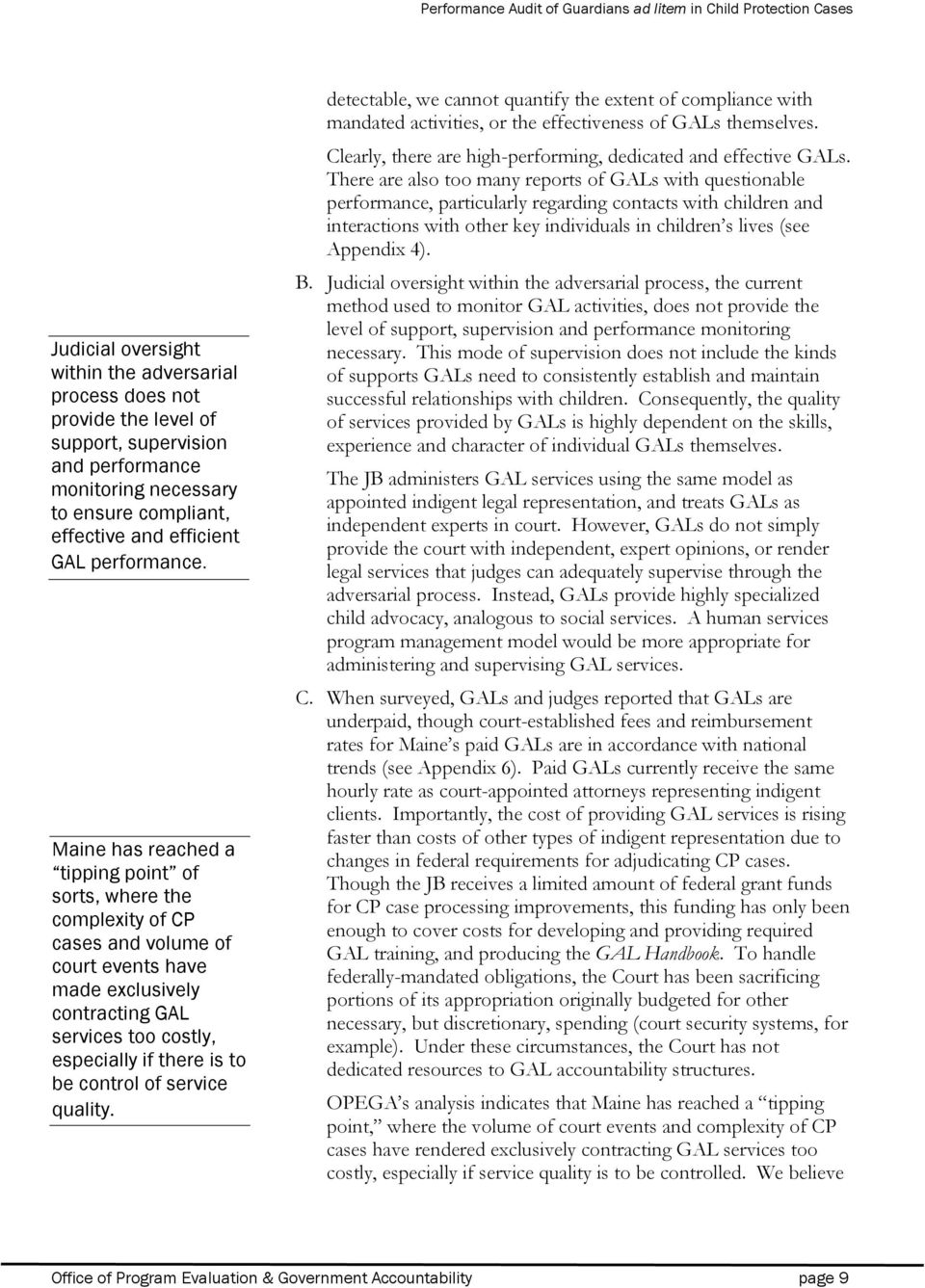
10 Findings and Action Plans some resources could become available if the Court Appointed Special Advocate (CASA) program expanded, paid GALs were not limited to attorneys, and teams delivered GAL services. 2 OPEGA does not consider it reasonable or appropriate to expect judges to add comprehensive GAL supervision and program monitoring to their workloads. Instead, a program with dedicated administrative management staff, high-performing attorney GALs, CASAs, and other professionals could better serve children and judges. OPEGA believes that a GAL program could be developed with the more than $3 million dollars annually spent on GAL services. An organizational and economic assessment is necessary to determine the most cost effective way to deliver high quality GAL services, and the most reliable way to ensure the best interests of children are represented. OPEGA considers Maine to be at a critical juncture, where changing from the current arrangement to a staffed GAL program would improve services and be more cost effective. Finding 1: Lack of a Program Yellow shading means the action is part of the response to Finding 1. Guardian ad litem services are not being managed as a program with adequate focus on the quality and effectiveness of service delivery. OPEGA Recommendations Reconfigure GAL services as a program with appropriate management components and controls. Judiciary Actions The Supreme Judicial Court (SJC) will convene a task force to evaluate alternative organizational structures for providing GAL services. By October 2007, the task force will propose a GAL program with key management components that address weaknesses and realize efficiencies described in this report s additional Findings. The proposal will include a recommendation regarding organizational location of the GAL program; a proposed budget that shows how existing resources may be re-allocated; and identification of any additional resources needed. The SJC will present this proposal to the Joint Standing Committee on Judiciary during the second regular session of the 123 rd Legislature. 2 Maine s CASA operation would need to implement the national model comprehensively for this to be advisable. Office of Program Evaluation & Government Accountability page 10
11 Finding 2: Role Confusion Individuals involved in child protection cases do not clearly understand the GAL role. OPEGA Recommendations The Judiciary and the Department of Health and Human Services (DHHS) Office of Child and Family Services (OCFS) should immediately take steps to reduce confusion about the role of the GAL in child protection cases for internal and external parties, and especially for the children. Judiciary Actions 1. By January 2007, the Chief Judge of the District Court will conduct an education program for judges on GAL activities in Title 22 cases, the Court s oversight responsibilities, and the importance of clarifying the GAL role. Judges will be encouraged to communicate their expectations of GALs throughout cases at court events where all parties are present. 2. The Family Division will develop educational materials, appropriate for different ages, explaining what to expect from GALs. The Family Division will also establish a plan for assuring the timely distribution of these materials to all individuals involved with each CP case, especially those who are not typically present at court events. Distribution of these educational materials will begin by January If it is determined additional resources are needed, Court leadership will make an appropriations request of the Legislature. Executive Action OCFS Acting Director of the Division of Policy and Practice will update the caseworker Policy Manual so it clearly and accurately explains the GAL role. Policy Manual updates and descriptions of the GAL role will be reviewed with all current OCFS supervisors and caseworkers working on Title 22 cases, with all new caseworkers prior to being assigned a Title 22 case, and with all relevant staff periodically thereafter. Office of Program Evaluation & Government Accountability page 11

12 Finding 3: Lack of Compliance and Performance Controls, and Evaluation Systems OPEGA found that there is no basic compliance monitoring system, much less a centralized and on-going performance monitoring and evaluation system for GALs. OPEGA found that judicial oversight alone has not been an adequate compliance and performance monitoring control. OPEGA Recommendations A. The Court should implement a compliance and performance monitoring and evaluation system for GALs that will identify GALs who are: not complying with mandated requirements; not sufficiently involved in the lives of the children to effectively represent their best interests; or, behaving in a manner that negatively affects children and others involved with their cases. The system should specify a range of sanctions for GALs who are not in compliance or meeting performance standards. B. The Court should establish an independent oversight board to solicit feedback on GAL performance from people who do not have access to judges. C. The SJC should develop, as part of its Rules and Standards for GALs, a Code of Conduct, expressly for GALs, specifying acceptable behavior and behavioral prohibitions. The Code should include a feasible and timely set of sanctions for violations. Judiciary Actions 1. The Court will establish a standardized form for GAL reports by January This form will document compliance. The task force convened by the SJC will make recommendations about how to use this information, including methods to sanction noncompliant GALs. Court leadership will give consideration to handling instances of non-compliance in the interim. 2. The Court will address the need for performance monitoring as part of its overall proposal in response to Finding The Court will address the need for a Code of Conduct and how best to implement it in conjunction with the assessment and proposal that is planned in response to Finding 1. Office of Program Evaluation & Government Accountability page 12

13 Finding 4: Lack of Child-Oriented System Supports There are no resources in the GAL system dedicated to supporting GAL efforts to build relationships with children. OPEGA Recommendations The Court should intensify its focus on the relationship between GALs and children by: working with the Youth Leadership Advisory Team (YLAT), and other youth, to develop materials to support GALs in building rapport and trust with children; assuring that older children have every reasonable opportunity to attend hearings, or at least fully understand cases as they unfold in court; incorporating interpersonal skill development into the training for paid GALs; and, devising and implementing mechanisms to facilitate judges receiving feedback about relationships between children and their GALs. Judiciary Actions 1. The Court Services Advisory Committee (CSAC) and Manager of the Family Division will review the CASA training segments on interpersonal skills and incorporate them as appropriate into the training for paid GALs. This will be accomplished by January The Manager of the Family Division will determine whether the materials suggested by OPEGA can be developed using existing resources or with assistance from other interested and involved organizations. This determination will be made by January If it is determined additional resources are needed, Court leadership will make an appropriations request of the Legislature. 3. The task force described in response to Finding 1 will research ways to assess, and provide judges with feedback about GALs interactions with children. The Court will address the need for these mechanisms as part of performance monitoring. Finding 5: Inadequate Supervision Paid GALs are not supervised in a manner consistent with providing human services. OPEGA Recommendations A. The Court should use supervision methods consistent with best practices in human services. B. The Court should assure that ME CASA adheres as closely as possible to National CASA program requirements including, but not limited to, supervisor to volunteer ratios, annual performance evaluations and meeting continuing education requirements. Judiciary Actions In response to Finding 1, the Court will assess and propose modifications to GAL service delivery. This will include researching and making recommendations about the level of supervision required and how best to provide it. Office of Program Evaluation & Government Accountability page 13
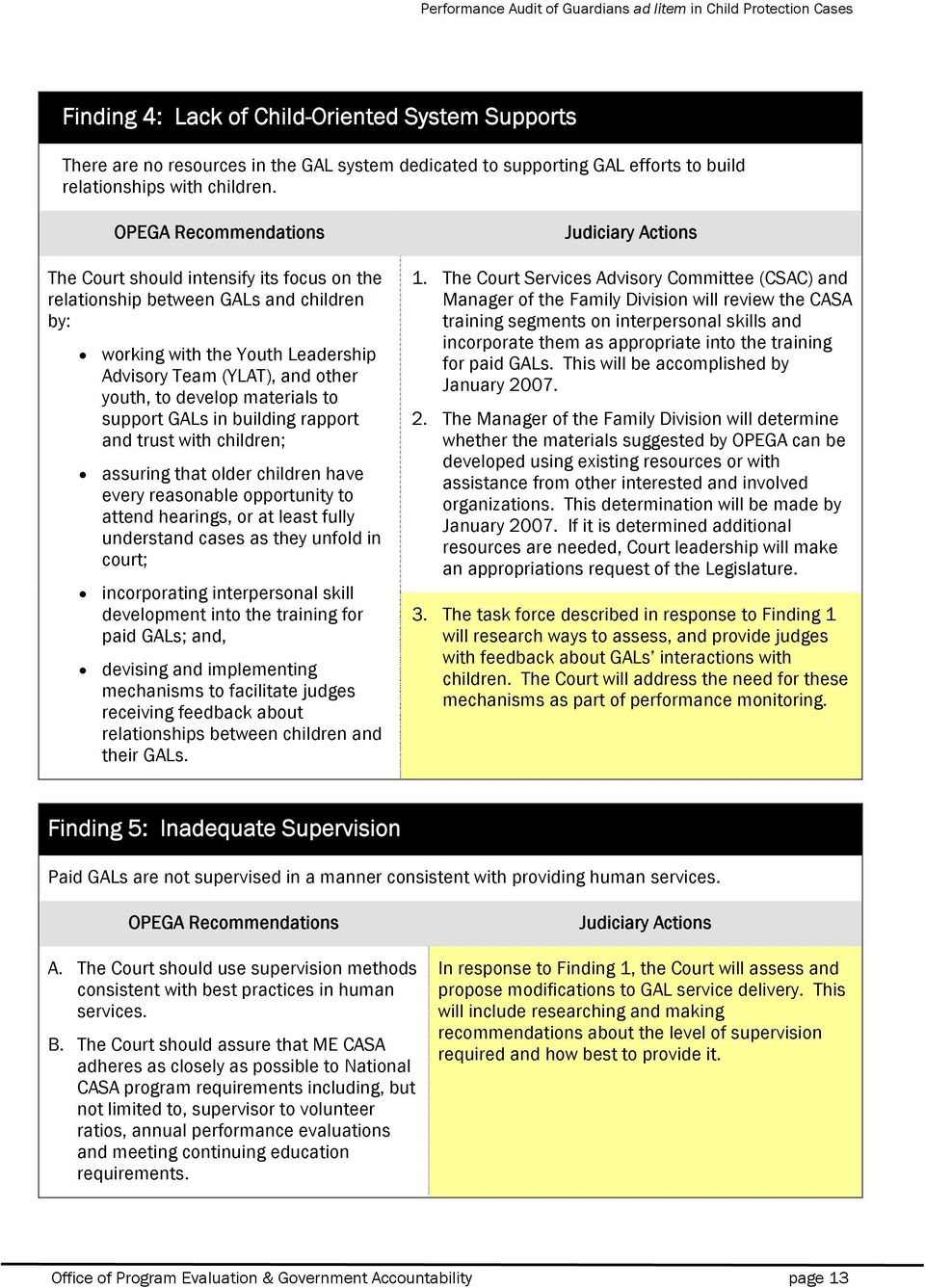
14 Finding 6: Weak Complaint Process The existing complaint process is not effective in assuring that poor performing GALs are: dismissed from on-going cases in a timely manner; not appointed to new cases they may not be suited for; or, when appropriate, removed from the roster altogether. OPEGA Recommendations A. The Court should enhance the current Rules related to complaints to include: clear criteria to serve as the basis for legitimate complaints; transparent policies and procedures for handling complaints so that those complaining will know what to expect; and clear processes, policies, and procedures for using complaints to dismiss GALs from cases, to require GALs to take specific actions to improve performance, or to remove them from the roster. The Court should communicate the complaint process and attendant criteria, policies and procedures to all stakeholders involved in child protection cases. B. The Court should create a central file to log complaints and track their status. Information about substantiated complaints could then be reviewed by judges before appointing particular GALs to cases. C. The Court should consider establishing an independent oversight board with authority to investigate GAL complaints, recommend dismissal of GALs from specific cases, and remove GALs from the roster. D. The Court and OCFS should open an avenue to allow OCFS caseworkers and supervisors to communicate their concerns about GAL performance to judges. Judiciary Actions 1. The task force will make recommendations about changes to the Court Rules regarding the complaint process. These changes will set appropriate criteria, policies, and procedures for filing and taking action on complaints. By October 2007, the task force will present the proposed Rule changes to the SJC for approval. 2. By October 2007, the task force will make recommendations on how to communicate the GAL complaint process to all stakeholders in CP cases at the time GALs are appointed. 3. The task force will determine by October 2007 whether a complaint database and the accompanying processes, procedures and reports can be developed and maintained with existing resources. If so, the Court will proceed to do so. If not, Court leadership will make an appropriations request of the Legislature. 4. The Court will consider the possibility of establishing an independent oversight board and other mechanisms for receiving feedback on GAL performance as part of the overall proposal it plans to develop in response to Finding 1. Office of Program Evaluation & Government Accountability page 14
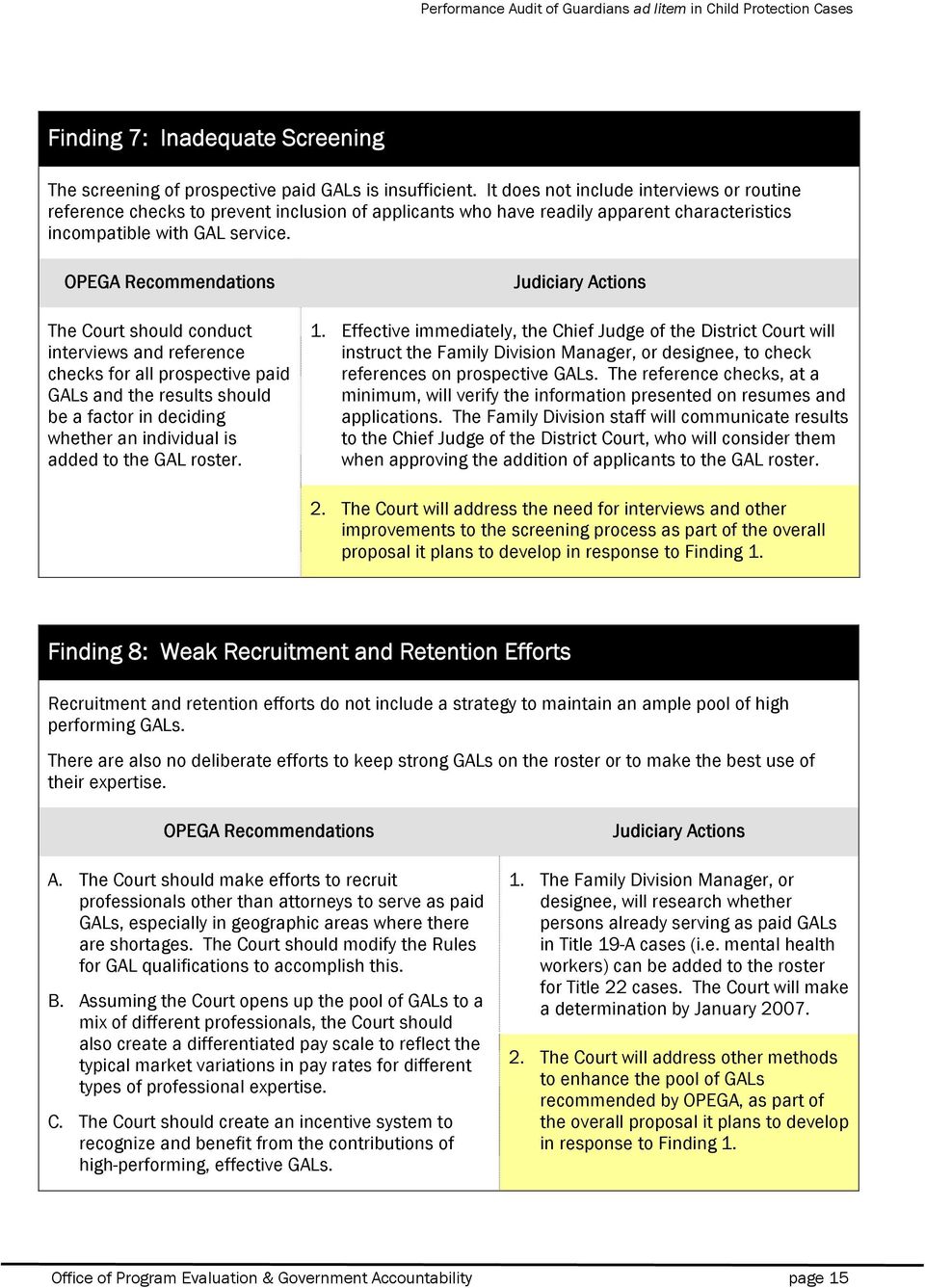
15 Finding 7: Inadequate Screening The screening of prospective paid GALs is insufficient. It does not include interviews or routine reference checks to prevent inclusion of applicants who have readily apparent characteristics incompatible with GAL service. OPEGA Recommendations The Court should conduct interviews and reference checks for all prospective paid GALs and the results should be a factor in deciding whether an individual is added to the GAL roster. Judiciary Actions 1. Effective immediately, the Chief Judge of the District Court will instruct the Family Division Manager, or designee, to check references on prospective GALs. The reference checks, at a minimum, will verify the information presented on resumes and applications. The Family Division staff will communicate results to the Chief Judge of the District Court, who will consider them when approving the addition of applicants to the GAL roster. 2. The Court will address the need for interviews and other improvements to the screening process as part of the overall proposal it plans to develop in response to Finding 1. Finding 8: Weak Recruitment and Retention Efforts Recruitment and retention efforts do not include a strategy to maintain an ample pool of high performing GALs. There are also no deliberate efforts to keep strong GALs on the roster or to make the best use of their expertise. OPEGA Recommendations A. The Court should make efforts to recruit professionals other than attorneys to serve as paid GALs, especially in geographic areas where there are shortages. The Court should modify the Rules for GAL qualifications to accomplish this. B. Assuming the Court opens up the pool of GALs to a mix of different professionals, the Court should also create a differentiated pay scale to reflect the typical market variations in pay rates for different types of professional expertise. C. The Court should create an incentive system to recognize and benefit from the contributions of high-performing, effective GALs. Judiciary Actions 1. The Family Division Manager, or designee, will research whether persons already serving as paid GALs in Title 19-A cases (i.e. mental health workers) can be added to the roster for Title 22 cases. The Court will make a determination by January The Court will address other methods to enhance the pool of GALs recommended by OPEGA, as part of the overall proposal it plans to develop in response to Finding 1. Office of Program Evaluation & Government Accountability page 15
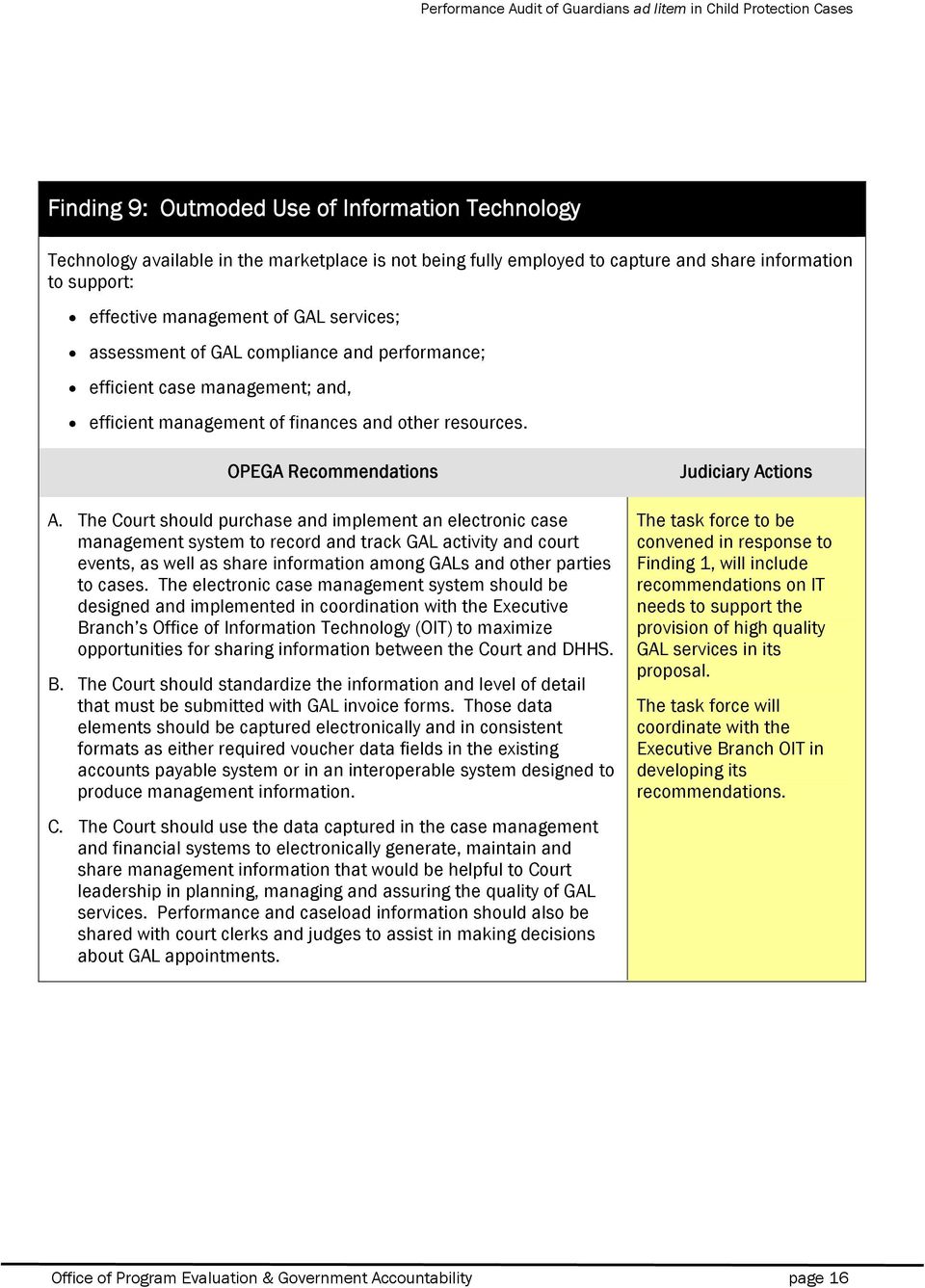
16 Finding 9: Outmoded Use of Information Technology Technology available in the marketplace is not being fully employed to capture and share information to support: effective management of GAL services; assessment of GAL compliance and performance; efficient case management; and, efficient management of finances and other resources. OPEGA Recommendations A. The Court should purchase and implement an electronic case management system to record and track GAL activity and court events, as well as share information among GALs and other parties to cases. The electronic case management system should be designed and implemented in coordination with the Executive Branch s Office of Information Technology (OIT) to maximize opportunities for sharing information between the Court and DHHS. B. The Court should standardize the information and level of detail that must be submitted with GAL invoice forms. Those data elements should be captured electronically and in consistent formats as either required voucher data fields in the existing accounts payable system or in an interoperable system designed to produce management information. C. The Court should use the data captured in the case management and financial systems to electronically generate, maintain and share management information that would be helpful to Court leadership in planning, managing and assuring the quality of GAL services. Performance and caseload information should also be shared with court clerks and judges to assist in making decisions about GAL appointments. Judiciary Actions The task force to be convened in response to Finding 1, will include recommendations on IT needs to support the provision of high quality GAL services in its proposal. The task force will coordinate with the Executive Branch OIT in developing its recommendations. Office of Program Evaluation & Government Accountability page 16
17 Finding 10: Insufficient Tracking of Expenses and Costs Many of the costs associated with providing mandatory GAL services to children in CP cases are not captured and identified as such. OPEGA Recommendations The Court should update its accounting codes and time reporting processes so they can accurately capture and classify all costs associated with providing GAL services. Court leadership should perform financial analysis of these costs and communicate the results in a way that shows the impact of providing GAL services on the Court s budget. Judiciary Actions By July 2007, the State Court Administrator or designee will develop and implement the accounting and time reporting changes necessary to capture all costs associated with providing GAL services in CP cases. Alternatively, the AOC will develop an assessment of complete costs using estimates based on retrospective data. Court leadership will use this cost information to develop budgets, make appropriation requests, and determine resource allocations. If the Court needs additional resources, leadership will make requests to the Legislature s Judiciary and Appropriations Committees. Finding 11: Need to Set Legislative Direction Existing legislation is inadequate for defining the GAL role, supporting GAL compliance and performance, and assuring GAL accountability. OPEGA Recommendations A. The Legislature should update Title 22 to clarify the role of the GAL and to assign specific responsibility for GAL accountability. B. Revisions to Title 22 should incorporate any language necessary to implement changes that ensue from the anticipated assessment of GAL service delivery approach and methods. The Legislature may instruct the Court to provide recommendations for statutory revisions in conjunction with the actions the Court has agreed to take in response to Finding 1. C. The Legislature should consider whether the 3-month visitation requirement that exists in Title 22 is still adequate for effective GAL representation. The Legislature may seek perspective and recommendations on this matter from the Court and OCFS. Judiciary Actions The task force performing the assessment of GAL service delivery will also make recommendations to the Judiciary Committee on statutory revisions that are necessary to better support the provision of effective GAL services. Office of Program Evaluation & Government Accountability page 17

18 Office of Program Evaluation & Government Accountability page 18

19 FULL REPORT Performance Audit of Guardians ad litem for Children in Child Protection Cases Program Management Controls Needed to Improve Quality of Guardian Services, and Assure Effective Advocacy of Children s Best Interests Purpose The Court appoints GALs to independently represent the best interests of children in child protection proceedings. OPEGA evaluated whether GAL services are: in compliance with statute; effective in promoting the best interests of children; and supported by adequate resources. The Maine State Legislature s Office of Program Evaluation and Government Accountability (OPEGA) has completed a review of Guardians ad litem (GAL) for children in child protection (CP) cases at the direction of the joint legislative Government Oversight Committee (GOC). In accordance with federal and state law, the Court must appoint GALs for children in CP proceedings. GALs are appointed to independently represent the best interests of children pursuant to 19-A MRSA 1507 Family Law, or 22 MRSA 4005 Child Protection Law. This review is specific to Title 22, CP GAL activity. The Judicial Branch (JB) of the State of Maine estimates spending over $3 million dollars to pay independent guardians ad litem for services in state fiscal year This figure does not include any administrative costs. Reimbursements for GAL services have increased by more than 585% over the past decade, significantly impacting the Court s finances. This trend does not appear to be diminishing in the near future. The Government Oversight Committee asked OPEGA to conduct a performance audit of Guardian ad litem services to determine if: guardian ad litem-related activities are in compliance with the relevant statutes and rules; the guardian ad litem program is effective in promoting the best interests of the children; and the resources for monitoring GAL activities and reimbursing GALs reasonable costs and expenses are adequate. In conducting this performance audit, OPEGA focused on the adequacy and effectiveness of the Court s internal controls for assuring the quality of GAL services. OPEGA also focused on the activities and performance of the GALs themselves. Office of Program Evaluation & Government Accountability page 19

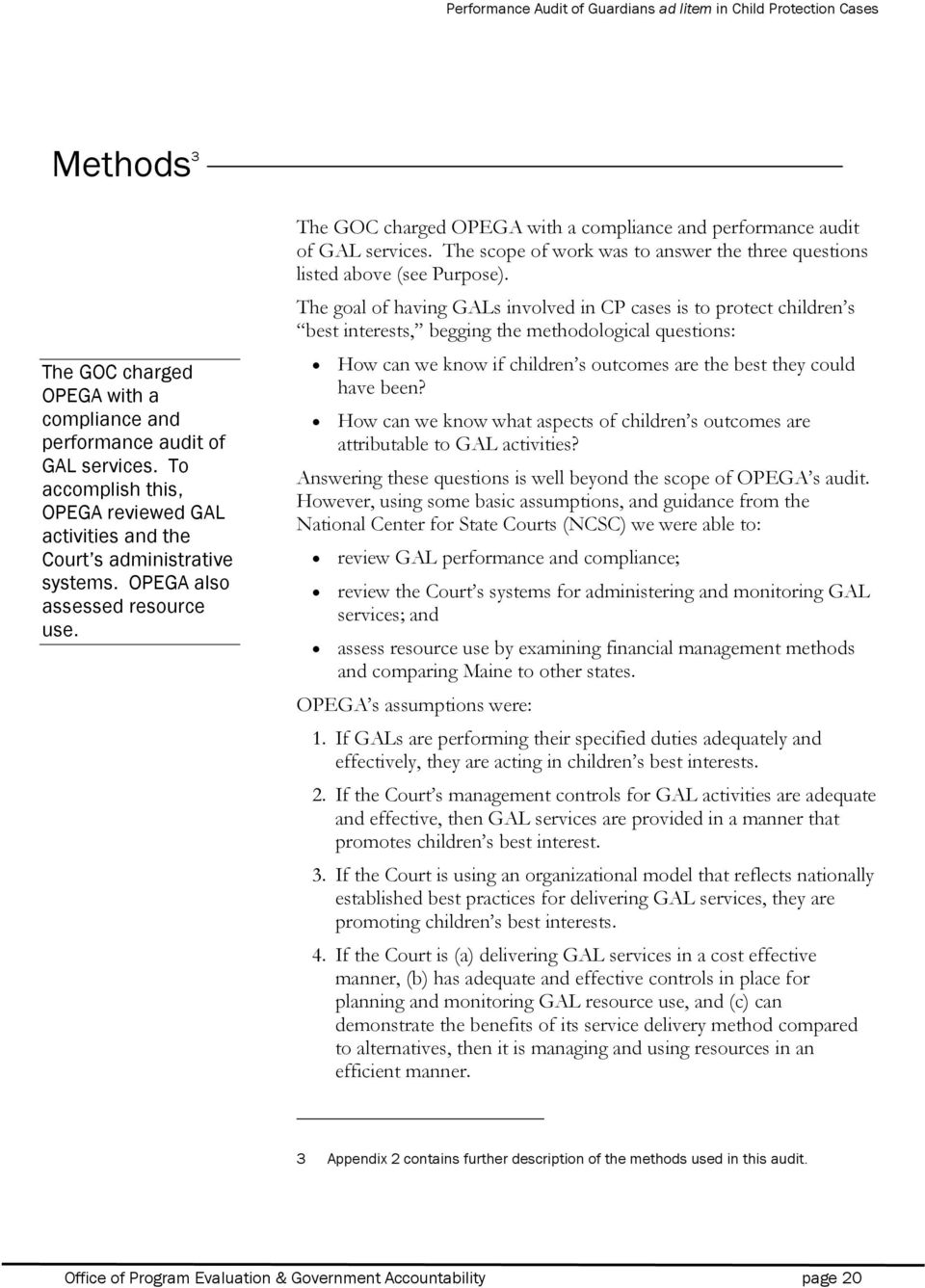
20 Methods 3 The GOC charged OPEGA with a compliance and performance audit of GAL services. To accomplish this, OPEGA reviewed GAL activities and the Court s administrative systems. OPEGA also assessed resource use. The GOC charged OPEGA with a compliance and performance audit of GAL services. The scope of work was to answer the three questions listed above (see Purpose). The goal of having GALs involved in CP cases is to protect children s best interests, begging the methodological questions: How can we know if children s outcomes are the best they could have been? How can we know what aspects of children s outcomes are attributable to GAL activities? Answering these questions is well beyond the scope of OPEGA s audit. However, using some basic assumptions, and guidance from the National Center for State Courts (NCSC) we were able to: review GAL performance and compliance; review the Court s systems for administering and monitoring GAL services; and assess resource use by examining financial management methods and comparing Maine to other states. OPEGA s assumptions were: 1. If GALs are performing their specified duties adequately and effectively, they are acting in children s best interests. 2. If the Court s management controls for GAL activities are adequate and effective, then GAL services are provided in a manner that promotes children s best interest. 3. If the Court is using an organizational model that reflects nationally established best practices for delivering GAL services, they are promoting children s best interests. 4. If the Court is (a) delivering GAL services in a cost effective manner, (b) has adequate and effective controls in place for planning and monitoring GAL resource use, and (c) can demonstrate the benefits of its service delivery method compared to alternatives, then it is managing and using resources in an efficient manner. 3 Appendix 2 contains further description of the methods used in this audit. Office of Program Evaluation & Government Accountability page 20
21 OPEGA developed a logic model to identify key activities and controls affecting GAL services and then used multiple testing methods to evaluate them. Figure 1 is a logic model presenting the internal controls related to GAL services that OPEGA sought to identify and test. The model is bottom up, meaning that each layer, or set of activities and controls, is supported by the layer beneath it. OPEGA s approach to this evaluation entailed working with the Court and stakeholder groups to develop indicators to test each of the internal controls in the logic model. 4 We first sought objective data that we could quantify from the Court s records. Next, we used the evaluation tool recommended by the NCSC (see Appendix 2). Finally, we used a combination of additional surveys, group interviews, case studies, observations, and individual interviews to clarify information and elaborate on findings. Input from the following stakeholder groups, by data collection method, are reflected in this study as presented in Table 1 below. Table 1. Stakeholder Input Methods Used in this Audit to Compliment Record, File, and Literature Reviews Primary Data Collection individual interview NCSC survey OPEGA survey group interview observation at training case study court leadership, judges court clerks, administrators GALs AAGs parents attorneys OCFS caseworkers and supervisors foster parents children s service providers children in foster care and ones who had been in the past 4 OPEGA performed an internal controls audit using the GAO standards: Standards for Internal Control in the Federal Government (GAO/AIMD , November 1999). Office of Program Evaluation & Government Accountability page 21
22 Figure 1. Logic Model Presenting GAL Service Delivery Activities OPEGA Audited for Internal Controls Children In State Custody Whose Interests Have High Quality Specialized Advocacy Layer 5 Service Delivery: Guardians ad litem COMPLIANCE INVESTIGATION REPRESENTATION QUALITY TRAINING EXPERTISE COMMITMENT PERFORMANCE Program: District Court Judges: SUPERVISE INDIVIDUAL GALs APPOINT COMPENSATE OVERSEE EVALUATE DISMISS Layer 4 TRAINING Family Division: ESTABLISH & MAINTAIN POOL OF GALs RECRUIT SELECT TRAIN RETAIN / REMOVE Layer 3 JB: MANAGE COLLECTIVE GAL RESOURCES & COMPLIANCE WITH RULES HUMAN FINANCIAL DEFINE ORGANIZATIONAL STRUCTURE, ROLES AND RESPONSIBILITIES BUDGET SUPPORT AND SUPERVISE STAFF ANALYZE EXPENDITURES MONITOR AND EVALUATE PROGRAM EMPLOY FINANCIAL CONTROLS Layer 2 Foundation LEGISLATURE CREATES STATUTE SJC ESTABLISHES RULES & STANDARDS DISTRICT COURT IMPLEMENTS POLICIES & PROCEDURES Layer 1 Office of Program Evaluation & Government Accountability page 22
23 Layer 1 Foundation: State Statute, Court Rules, and GAL Policy and Procedures Delivery of any service, especially governmental, needs to rest on a solid foundation of policy; in this case: statute produced by the Legislature, Rules promulgated by the Court, and policies and procedures set forth by the Family Division of the District Court. To evaluate the foundation upon which GAL service delivery rests, OPEGA reviewed: Federal Law, State Statute, Court Rules, and GAL Policy and Procedures. Where informative, OPEGA also compared Maine s policies to those in other states. Layer 2 Managing Collective Resources (Human and Financial) and Compliance with Rules In order to deliver services, the Court needs to design a model for organizing human and financial resources that can efficiently supervise the work, control risks to success, and manage ongoing changes in demand for services, resource availability and policy. The organizational model needs built-in monitoring and evaluation for management to know whether it is meeting its goals. To review the organizational structure and definition of roles and responsibilities, OPEGA worked with the State Court Administrator at the Administrative Office of the Courts (AOC) and the Chief Judge of the District Court to develop a diagram detailing the organizational structure supporting GALs (see Figure 5). OPEGA analyzed this structure for internal control gaps in terms of roles, responsibilities, and lines of communication and authority, noting personnel qualifications. To test the effectiveness and efficiency of the Court's practices for managing GAL financial resources, OPEGA reviewed: records and systems in place to create a budget for GAL activities and monitor associated expenditures; funding streams Court Improvement Plan (CIP), Child Abuse and Neglect Evaluators Project (CANEP), general fund, budget requests, budget allocations and expenditures; and, GAL invoicing and reimbursement processes to identify overages; waivers and controls (how approval is determined and how the process is audited). Office of Program Evaluation & Government Accountability page 23
24 To review efficient use of human resources, OPEGA: interviewed Court leadership and reviewed literature regarding the use of GAL contracting models versus other potential configurations and possible savings based on experience in other states; reviewed records and interviewed Court leadership about the use of pro bono attorney GALs and reduced fee services, use of CASAs, and overall GAL workload and its distribution; and, attempted to analyze GAL caseload distribution, but this data was not available. We also sought program monitoring (compliance and performance) and evaluation data as well as documentation of actions ensuing from these efforts, but it was not available. The NCSC survey provided some information about program components, and during interviews we solicited stakeholder suggestions for program improvements. Layer 3 Establishing and Maintaining a Pool of GALs In Maine, the Court s responsibility for providing GAL services in CP cases calls for JB staff to create and maintain a pool of GAL professionals. This entails recruiting, screening, training, retaining and removing GALs from the potential service provider roster. The training itself is a large part of this subcomponent. OPEGA tested the Court s performance in establishing and maintaining a pool of GALs to appoint by: comparing recruitment procedures to qualities important to GAL performance as identified in interviews and surveys; attempting to review GAL files and analyze the longevity and experience level of GALs on the roster, but this data is not maintained by the Court; interviewing Court leadership and others involved in CP cases to evaluate clarity of roster removal criteria, conformity of removals to criteria, and the extent to which these criteria are transparent to other parties; observing training for paid GALs with focus on: the most frequently asked questions by GALs, clarity with which the GAL role is presented, and correspondence between identified qualities of effective GALs and training content; interviewing stakeholders and analyzing the relevant segment of the NCSC survey that solicited opinions about how program evaluations and the complaint process are used to inform and improve training; and reviewing the CASA training curriculum. Office of Program Evaluation & Government Accountability page 24
25 Layer 4 GAL Supervision The Court is responsible for appointing, overseeing, compensating, evaluating and dismissing GALs. If supervision is adequate and effective, GALs should be compliant with requirements and perform effectively, thereby providing high quality services. Monitoring and evaluation systems should help the Court ensure that GALs meet compliance and performance standards. To assess the effectiveness and efficiency of the Court in providing GAL supervision, OPEGA: reviewed the appointment process in terms of timeliness and GAL selection by attempting to determine, via file review -- (a) the percentage of times GALs were appointed within the time limit set by statute, and (b) the number of days between protection order filing and GAL appointment. While standardized file data was not available, we reviewed a convenience sample of files from Maine s Office of Child and Family Services (OCFS) and Court files; evaluated the adequacy of compensation by comparing Maine s rate with other states (see Appendix 6); assessed satisfaction with compensation by analyzing the NCSC survey question addressing perceptions of compensation adequacy (see Figure 10 in Appendix 2); attempted to review the Court s system for monitoring and evaluating GALs by -- (a) comparing collected performance data to compliance and performance criteria, (b) observing how the Court uses evaluation feedback with GALs, and (c) observing how the data is fed back to overall training and program improvement; (Unfortunately, the Court does not maintain records in a manner that allows this information to be accessed for evaluation purposes.) assessed the Court s use of the mandatory complaint file as a possible feedback tool and control, allowing them to receive feedback from multiple perspectives on GAL performance; and reviewed the effectiveness of the Court's procedures for dismissing GALs from cases, as a control on poor GAL performance, by identifying clarity of roster dismissal criteria, conformity of dismissals to criteria, and the extent to which these criteria are transparent to other parties. Office of Program Evaluation & Government Accountability page 25
26 Layer 5 GAL Performance Service provider performance typically is evaluated by: A. reviewing records that demonstrate required activities have been completed and components of high quality service delivery are present (commitment, expertise, training); and B. analyzing independent qualitative evaluations of performance by stakeholder groups. To gauge the quality of GAL performance, OPEGA: attempted to quantify the amount of experience represented by GALs on the roster (average number of cases), but this data was not available; assessed the availability of mentoring and professional support for GALs; 5 attempted to find indicators of commitment by reviewing files to quantify (a) the percentage of court events attended by GALs, and (b) the average number of days between court event and end of 3 month period that GALs visited children. Unfortunately, the Court does not maintain records in a manner that allows this information to be accessed for evaluation purposes; executed the NCSC measurement system to evaluate GAL compliance and performance, with only partial success because it called for a review of records that the Court is not keeping; the survey portion was helpful in identifying compliance and performance weaknesses, but not in quantifying them; and, probed identified weaknesses in performance using interviews, case studies, and additional surveys. Background Guardians ad litem for Children in Child Protection Cases Definition and Statute States define guardians ad litem for children in a variety of ways. In some states, GALs are attorneys who provide legal representation; in other states, a GAL is anyone representing children's best interests. 5 OPEGA found that the Maine GAL Institute is offering some such opportunities. Office of Program Evaluation & Government Accountability page 26
27 GALs perform a specialized child advocacy role within the State s child protection process. MRSA Title mandates their specific activities. The child protection process begins when a report of child abuse and neglect is made to DHHS Office of Child and Family Services. OCFS screens the reports and performs safety assessments on those that meet specific criteria. Many states, like Maine, define the GAL in terms of specified duties found in statutes, court rules, or state policy. There are other states with either very general guidance or none at all. Guardians ad litem for children in child protection cases in Maine perform a specialized child advocacy role. Legislation mandating their specific activities is found in Title 22 of Maine s Revised Statutes Annotated (MRSA) 4005 (Appendix 1 contains excerpts from this legislation). Title 22 is the general legislation enabling the State s Department of Health and Human Services (DHHS) and the Judicial Branch (JB) to protect children from abuse and neglect. Court Appointed Special Advocates (CASAs) are volunteer GALs. Title 4 of MRSA 1501 is the legislation authorizing CASAs to act as GALs under Title In this report, the term GAL includes CASAs. When distinguishing between paid GALs and CASAs, OPEGA will use these specific terms. To understand GALs in this context requires some familiarity with the CP process. What is the Child Protection Process? The CP process begins with reports of child abuse or neglect to a central intake line at OCFS. In 2005, OCFS received more than 17,500 reports. Four out of five reports were made by professionals, 6 relatives, friends and neighbors. 7 Upon receiving a report, OCFS initiates a process to: Definition ad litem is Latin for to the lawsuit A Guardian ad litem (GAL) is a guardian (one who has or is entitled or legally appointed to the care and management of the person or property of another) appointed by a court to represent, in a particular lawsuit, the interests of a minor or a person judged to be incompetent. determine if the call is appropriate for them to act on; perform child safety assessments and make substantiation decisions; and select a course of action if they substantiate abuse or neglect. Upon substantiation, OCFS has to choose one of the five options below. Only the last two trigger GAL services because they involve 6 Education, legal, law enforcement, criminal justice, social services, medical and mental health. 7 Maine Department of Health and Human Services (DHHS). Office of Program Evaluation & Government Accountability page 27
28 OCFS has five options for action if it substantiates a report of child abuse and neglect. Only 2 of the 5 courses of action involve the Court and require the appointment of a GAL. An estimated children became involved in CP court proceedings in In the majority of substantiated cases, however, children and families received services to alleviate risks to children without involving the justice system. the Court and include the possibility of taking children away from parents and putting them in OCFS care (protective custody). Children in protective custody usually live with foster families though some live in group residences. 1. Close the cases. 2. Make safety plans with families. 3. Provide voluntary care for children. 4. Request that the court allow OCFS to take children into protective custody OCFS staff select this option when they believe children are in jeopardy (see Appendix 1 for legal definition of jeopardy) and should be removed from their homes. In order to do this, Maine s Office of the Attorney General (AG), on behalf of the State, file petitions for child protection orders with the Court. Children remain with parents or caregivers until judges make determinations about whether children should be put in protective custody. 5. Obtain permission from the Court to immediately take children into protective custody -- If there is imminent threat of serious harm to children, and there are no methods to change or manage the situation right away, OCFS or law enforcement request Preliminary Protection Orders (PPOs) from the Court. In 2005, OCFS substantiated 2,052 of its completed child safety assessments as cases of child abuse and neglect. As a result, an estimated children became involved in court proceedings. The majority of the children and families in substantiated cases, however, received services to alleviate risks to children (accepted community services and OCFS supervision, for instance) without involving the justice system. Since 2002, the number of children in state custody has dropped from around 3,000 to approximately 2,200. This 26% reduction is due to policy changes that have refocused OCFS work. OCFS is now working intensively with families to alleviate jeopardy while keeping children at home. There is a common misperception that DHHS OCFS makes determinations about children entering protective custody. In reality, judges make these decisions. OCFS does not have the authority to take children into protective custody nor to insist that families accept services to reduce risks to children. A series of hearings and case management conferences begins when cases enter the court system (see Figure 2). Court events structure the CP process and are designed for judges to hear the facts and determine whether: Office of Program Evaluation & Government Accountability page 28
29 CP cases entering the court system proceed through a series of hearings and conferences. Judges hear the facts and make specific determinations about the children s situations. Judges appoint GALs as soon as the Court receives petitions for protection orders or issues preliminary protection orders. children are in jeopardy and should be removed from their homes; jeopardy conditions could be alleviated and families reunited; out of home/foster care (protective custody) arrangements are satisfactory; parents are cooperating and OCFS is fulfilling its responsibilities; reuniting families or terminating parental rights would be in children s best interests; and, alternative permanent homes are suitable for the children. Judges appoint GALs and parents attorneys as soon as the Court receives petitions for protection orders, or issues PPOs. Title directs GALs to have face-to-face contact with the children, in their homes or foster homes, within 7 days of appointment. Following is a brief description of court events depicted in Figure 2. The diagram illustrates the court s CP process with its mandated structure and timeframes. It also highlights the role of GALs, which the next section of this report will address in detail. Summary Preliminary Hearings In cases where judges grant PPOs, the Court must hold summary preliminary hearings within ten days. At these hearings, it is up to judges to decide if there is immediate risk of serious harm to children. When judges decide there is no imminent danger, parents take their children home and OCFS may close their cases or file petitions for protection orders. When judges decide that children are in imminent danger, children remain in protective custody while their cases proceed through the rest of the CP process. If judges find aggravating factors (see Appendix 1 for list of aggravating factors), they may order OCFS not to attempt reunification efforts and instead schedule permanency hearings within 30 days. Sometimes parents waive their rights to summary preliminary hearings. Case Management Conferences (CMCs) These are informal pre-hearing events where all parties to cases (GALs included) meet with judges to review case statuses, try to reach agreements, and identify the next steps to take. Judges must hold initial CMCs within 30 to 40 days of receiving petitions for child protection orders or granting PPOs. After that, judges may hold these conferences prior to any contested hearings throughout the process. Judges actively direct the courses of CP litigation through CMCs, pretrial conferences, and conferences of counsel. At each step in the process, judges encourage the parties to reach mutually satisfactory arrangements or, if parties require contested hearings, clearly define the issues. Planning for permanency begins at the first CMC. To meet timelines for children to reach Office of Program Evaluation & Government Accountability page 29
30 permanent solutions as mandated by the Federal Adoption and Safe Families Act (ASFA), the Court concurrently plans for family reunification and alternative permanent placement. Jeopardy Hearings These are hearings where judges make determinations about whether children are in jeopardy. Judges must base their jeopardy findings on a preponderance of evidence demonstrating serious abuse or neglect. Jeopardy hearings are held within 120 days of receiving petitions for child protection orders and may result in the following: aggravating factors finding and judges order OCFS to cease reunification efforts; no jeopardy finding and cases close; or jeopardy finding and judges set forth a course of action to alleviate it. If judges find jeopardy, Maine law allows a number of possible dispositions. Judges may order: children remain in their homes and perpetrators of harm to them be removed from homes; children remain in their homes and families accept social services with OCFS supervision; or children enter protective custody and OCFS supervises a series of steps to alleviate conditions producing jeopardy and reunite children with their families. Case (or Judicial) Review Hearings Judges review children s circumstances and progress of all parties toward jeopardy alleviation and family reunification during these hearings. In tandem with CMCs, case review hearings create multiple opportunities for parties to reflect on case progress, demonstrate and acknowledge change, make significant or subtle course corrections, and prevent extended foster care stays for children. Judges must hold case review hearings at least every 6 months once they have issued jeopardy orders. 8 This requirement continues until the Court orders children to be reunified with their families, adopted, or emancipated. Permanency Planning Hearings At these hearings, judges decide on permanent plans for children. Permanency may mean reunification with parents, placement with relatives, legal guardianship, adoption, or other permanent living arrangements. Foster care is not a permanent placement. Unless judges find aggravating factors, the Court must hold initial permanency 8 Judges flexibly use these hearings on a more frequent basis as needed. Office of Program Evaluation & Government Accountability page 30
31 planning hearings within 12 months of children entering foster care. In the case of aggravating factors, the Court has 30 days to hold the hearing. After that, judges must hold permanency planning hearings every 12 months until children are reunified with their families, adopted or emancipated. Termination of Parental Rights (TPR) Hearings If family reunification is not possible, judges must make two specific determinations at TPR hearings: that parents are unfit, and subsequently, that TPR is in the best interest of children. OCFS must prove both unfitness and best interest by clear and convincing evidence at these hearings. Before these hearings, the Court schedules conferences to address pre-trial issues and set hearing dates. Federal legislation requires OCFS to file termination petitions after children have been in foster care for 15 of the most recent 22 months. Exceptions to this rule include failure of OCFS to provide services necessary for family reunification, relatives caring for children, or compelling reasons why TPR is not in children s best interests as documented by OCFS. Also, termination hearings precede all adoptions regardless of timeframes. Post TPR Review Hearings After judges issue termination orders, they must continue to review cases every 6 months, until children are emancipated or adopted. The judges review OCFS progress toward permanent placements for children at these hearings. Voluntary Extended Care Agreement (commonly referred to as a V-9 ) Childhood legally ends at the age of eighteen, which means that youth age out of the CP system on their eighteenth birthday. Though not executed through hearings, youth can get support as they work toward independent living goals by extending their status as children in state custody past the age of eighteen. What is the Purpose of Guardians ad litem? In order to receive certain federal funds for child abuse and neglect services, the Federal Child Abuse Prevention and Treatment Act (CAPTA) requires all states to appoint GALs to independently represent children s best interests in CP cases. States differ in how they configure GAL services and their uses of GALs, children s attorneys, CASAs, and combinations of these entities to fulfill this requirement. Office of Program Evaluation & Government Accountability page 31
32 Figure 2. The Child Protection Process in Court and the Role of GALs GAL is Appointed Immediately within 7-14 days of granted PPO Summary Preliminary Hearing judge determines if child should be returned to parents within days of filing the CP petition (also may be held prior to any contested hearing) Case Management Conference meeting of all involved parties and judge to review case status, next steps and likelihood of agreement within 120 days of filing CP petition Jeopardy Hearing/Order judge determines whether child s health or welfare are in jeopardy or if there are aggravating factors if no, case dismissed if yes, OCFS provides reunification services, or cease reunification efforts within 60 days of removal or 6 months of jeopardy order (whichever comes first), then every 6 months Case (or Judicial) Review Hearing court reviews case and reunification progress within 30 days of judge ordering DHHS to cease reunification services and/or within 12 months of time child enters foster care and then every 12 months Permanency Planning Hearing judge determines permanent plan for the child (long term foster care is not a permanent plan) GAL visits child within first 7 days and then at least every 3 months GAL independently investigates and submits a report to the court every 6 months GAL participates as a member of the planning team GAL attends all court events and makes recommendations AAG files a child protection (CP) petition Aggravating Factor & Cease Reunification Case Management Conference (CMC) Jeopardy Hearing & Order CMCs 1st Case Review CMCs Permanency Hearing CMCs Permanency and Judicial Review Hearings OR waived AAG files a request for a preliminary protection order (PPO) denied Summary Preliminary Hearing Jeopardy & Permanency Hearings granted Aggravating Factor & Cease Reunification reunification child in foster care 15 of the most recent 22 months and/or order to cease reunification Termination of Parental Rights (TPR) state must prove by clear and convincing evidence that parents are unfit and termination of parental rights is in child s best interest every 6 months after TPR order until child is emancipated or adopted Post TRP Judicial Reviews judge reviews OCFS progress toward permanent placement for the child GAL mediates between parties and advocates for the child throughout the case TPR, CMCs and Judicial Review Hearings permanent placement with relative or legal guardian, or adoption Office of Program Evaluation & Government Accountability page 32
33 In Maine, GALs are mandated to act in pursuit of the best interests of children but they are not the children s attorneys. Rather, the GALs serve as the judges eyes and ears and as voices for children in Court. GALs help assure that children s best interests are not obscured in the adversarial process between parents and child protection agencies. Administratively, Maine treats GALs like indigent legal representatives (they are handled as independent contractors). Managerially, Maine treats them like independent experts who testify in court hearings. Maine s GAL statutory mandate is to act "in pursuit of the best interests of the child." To understand how Maine, via the Court, fulfills this mandate, it is important to consider the adversarial process in the court system. By design, the adversarial arrangement centers on opposing parties, each of whom must advocate for their own positions. In contested court hearings, opposing sides present their cases for judges to hear. The opposing sides in CP proceedings are OCFS (represented by the AG s office on behalf of the State) and parents (represented by attorneys). Through the presentation of testimonial and forensic evidence, and the process of questioning and cross-examining, judges learn the important facts of cases and make decisions. Society, as demonstrated through public policy, recognizes that children s best interests should be the focus of the CP process, and modified the traditional adversarial arrangement by adding GALs. GALs can be understood as controls to manage the risk that children s best interests may be obscured in the adversarial process between parents and child protection agencies in CP cases. 9 Literature from professional organizations discusses the GAL as a form of Child Representative. 10 The child and the child s best interests are not distinguished in these discussions, which can create confusion. There is a distinction between being a child s attorney (or legal representative), and being a GAL. First, attorneys are obligated to follow their clients directives and wishes regardless of their own opinions about the clients best interests. 11 If GALs perceive children s best interests and wishes to be incompatible, GALs are not obligated to advocate for children s wishes (though they must report them to judges). Second, much of the time GALs perform duties that are not legal in nature, such as: advocating for children outside of court, making recommendations about treatment options for children and their families of origin, monitoring the activities of OCFS, and participating on children s OCFS case management teams. Though CP GALs are usually attorneys in Maine, they are not children s lawyers nor are they hired by the Court to act as lawyers. 9 If the case is under Title 19A, Family Law, then GALs manage the risk that children s best interests may be obscured in the adversarial process between parents in family cases. 10 American Bar Association, National Center for State Courts, and National Association of Counsel for Children 11 They are not required to follow their client s wishes if doing so would mean acting outside of their professional, ethical boundaries. Office of Program Evaluation & Government Accountability page 33
34 In fact, one of their responsibilities is to request legal representation for children when appropriate. 12 In CP cases, GALs fill the roles of: investigator, child advocate, and mediator. Certain GAL activities are mandated by statute. These include: performing investigations; visiting children; submitting reports; attending court events; making recommendations; making children s wishes known. What Activities Do Guardians ad litem Perform? GAL duties can be categorized into basic roles. Maine s GAL Handbook calls these roles investigator, advocate and mediator. 13 In contrast, statute presents GAL duties as a discrete set of activities (visit the child and write reports, for example). Whether conceived broadly as performing multiple roles, or narrowly as executing a minimal set of activity requirements, GALs have specific functions in the CP court process, which are listed below. 1. GALs function to ensure that judges receive complete and accurate facts and status updates on children by performing ongoing independent investigations throughout the court process. Appendix 3 lists questions that GALs use to assess risks to children. 2. GALs function to ensure that judges know what children wish. 3. GALs function to promote children s best interest by advocating for them to receive entitlements and human services, mediating between parties, and representing their interests while negotiating agreements between parties. 4. GALs function as CP case experts by proffering their recommendations to judges about children s best interests based on their investigations. To ensure that GALs serve in these capacities, Maine statute, the Court-promulgated Maine Rules for Guardians ad litem, and Standards of Practice for Guardians ad litem in Maine Courts, provide a foundation of policy that: grants broad investigatory powers to GALs, including the right to access all relevant reports and records, stating, when possible and appropriate, GAL investigations must include: interviews with the children (with or without other persons present), review of pertinent medical, mental health and school records and other materials, and 12 For instance, if a teenager in foster care wants to be emancipated and the GAL feels it would be better for her/him to remain in foster care, the child may need a lawyer (in addition to the GAL). 13 In contrast, the National Center for State Courts (NCSC) calls GAL roles: investigator, hearing representative, negotiation representative, and monitor. Office of Program Evaluation & Government Accountability page 34
35 Other GAL duties and responsibilities are described in the Court s Rules and Standards for GALs. Judges direct what activities GALs perform. interviews with parents, foster parents, teachers, caseworkers and other persons who have been involved with the children s care and treatment; specifies the minimal level of contact GALs must maintain with children visit them in their homes or foster homes within seven days of being appointed, and subsequently visit at least once every three months (judges may order additional visits); stipulates basic reporting requirements submit written reports to the Court and all parties every six months on investigations, findings and recommendations (GALs must provide their reports to the Court and each party reasonably in advance of court hearings); requires GALs to attend summary preliminary hearings, and all subsequent court events and hearings, making recommendations to the Court regarding children s needs at all phases of the case, up to and including permanent adoption, should that become necessary; tasks GALs to explain the court process and their role to children, and to assure that the children are informed of the purpose of court proceedings; directs GALs to participate in the development and negotiation, including mediation, of plans or orders that affect children s best interests; calls on GALs to monitor OCFS implementation of service plans and court orders to ensure that services ordered by the Court are being provided in a timely manner; and instructs GALs to advise youth of the Voluntary Extended Care Agreement opportunity as early as age 16 and assist them in entering this agreement. Acknowledging the uniqueness of each CP case, the Court states that the GAL is afforded substantial latitude and deference in tailoring her or his role to the particular circumstances of a case and needs of a child. 14 Also, judges direct GALs to perform certain activities. The roles and activities of GALs are dynamic and complex. Figure 3 depicts the structural relationships between GALs and other primary participants in CP cases as they perform their duties and deliver their services. This figure underscores the shifting positions GALs must assume as a) participants/observers in the OCFS organizational 14 Maine Rules for Guardians ad litem Office of Program Evaluation & Government Accountability page 35
36 environment and b) highly specialized child advocates in the Court s organizational environment. Figure 3. GALs in Child Protection Cases Operate in Contrasting Organizational Environments between OCFS and the Court Judge OCFS GAL G A L Child Child Parents OCFS GAL Parents OCFS OCFS provides protective services to children and jeopardy alleviation services to families at the Court s order. GALs both participate in and monitor these activities. They are the judges eyes and ears. Court When parents and OCFS cannot agree on steps to keep children at home and out of jeopardy, the Court makes decisions at contested hearings. The Court relies on GALs to assure that the adversarial process does not lose sight of children s best interests. They are the children s voices. The GAL role has evolved as a result of changing federal policies and societal expectations. How has the Guardian ad litem Role Evolved? For more than 30 years, federal legislation has explicitly required states to provide guardians ad litem in all CP cases in order to be eligible for certain federal CP funds. The GAL role initially lacked definition in policy and there was no expert guidance available. Over time, both federal and state legislation have become increasingly specific about the GAL role. Basic guidance on serving as a GAL is now available and there is a developing body of literature on best practices. Importantly, implicit expectations of GALs have also been growing as a result of evolving social responses to child abuse and neglect. The GAL role today comprises statutory requirements and a broad set of unlegislated expectations. In Maine, as elsewhere, changing federal policies (and dramatic child abuse tragedies) have led to reforms in the CP system and expanding expectations of GALs. Three major federal policies provide states with child protection direction: the Child Abuse Prevention and Treatment Act (CAPTA), the Adoption Assistance and Child Welfare Act, and the Adoption and Safe Families Act (ASFA). CAPTA, passed in 1974, was the first major legislation addressing child maltreatment. It included a requirement that states appoint GALs in order to qualify for grants from the National Center on Office of Program Evaluation & Government Accountability page 36
37 Child Abuse and Neglect (NCCAN), which the act created. CAPTA has been amended several times since its inception. The first federal legislation requiring state courts to hear child dependency cases on a periodic basis was the Adoption Assistance and Child Welfare Act of This Act required courts to assess the reasonableness" of efforts to: (a) prevent placement in state custody from occurring; and (b) reunify children with their parent(s) once placement had occurred. It also established an 18-month deadline for permanent plans to be developed for each child in state care. GALs became increasingly involved in monitoring child welfare services and family responses to these services because of this legislation. ASFA, passed in 1997, reauthorized CAPTA and stipulated two key provisions: 15 fast track -- identifying conditions so egregious that states could bypass family reunification efforts, and 15 of allowing states to petition for termination of parental rights when a child has spent 15 of the most recent 22 months in foster care. This accelerated timeframe resulted in more frequent court events, expedited treatment plans for children and families, and the need for GALs to intensify their advocacy to meet the new requirements. AFSA also stated that that a GAL may be an attorney or a court appointed special advocate (or both). 16 And, for the first time, this federal legislation specified some GAL duties (a) obtaining a firsthand" understanding of the situation and the needs of the child and (b) making recommendations to the court concerning the best interests of the child. In 2003, CAPTA was amended by the Keeping Children and Families Safe Act, directly influencing GALs by requiring states to certify that each court-appointed GAL is a person who has received training appropriate to the role. Figure 4 presents a chronology of key events that have affected evolving expectations of GALs (see Appendix 5 for an expanded description of this chronology). Clinical services for children and families in CP cases also have become more specialized and complex. Today, to meet their 15 It also extended the Court Improvement Program (CIP) for three more years, and revised Social Security Act Titles IV-B and IV-E to help states move children out of foster care to permanent homes more quickly. 16 OPEGA verified with the US Administration on Children and Families (ACF) that there is no federal requirement for GALs to be attorneys or CASAs. Office of Program Evaluation & Government Accountability page 37
38 GALs are expected to fulfill multiple roles and manage complex relationships with people who are experiencing emotional crises. responsibilities GALs may be keeping abreast of mental health services, learning disability supports, physical and developmental assessments, substance abuse and other therapeutic treatments, educational supports, and other social services relevant to their cases. Many stakeholders in the CP process expect GALs to have a breadth of knowledge in these areas. The GAL role has evolved in breadth and complexity since its origin. Maine s GAL Handbook, developed in 2003, describes GALs as voices of children in the courtroom. It also describes them as judges eyes and ears, referring to most of their work, which they conduct outside of the courtroom. Beyond the courtroom, in the emotional environment of the CP process, GALs must build rapport with children, OCFS case workers, contracted service providers, as well as birth families. They are to manage and maintain these relationships while fulfilling their responsibilities within and between contrasting organizational environments (see Figure 3). In the OCFS serviceprovider environment, GALs act as investigators and, at times, as family case management team members. In the adversarial environment of the court, GALs report on their investigations and mediate between parties. Implicitly, GALs are expected to be masterful at managing complex relationships with people who are experiencing emotional crises, while shifting between incongruous organizational arrangements. Maine s District Court now operates a hybrid adversarial/problemsolving system in the CP arena. As a result, GALs have become major facilitators for the problem-solving components of CP cases. How have Innovations in Jurisprudence Affected Guardian ad litem Services? Courts are not traditionally structured to centrally manage, monitor, or evaluate activities carried out in individual courtrooms. Instead, they are structured to deliver justice by coordinating events in the adversarial process. However, as courts have become increasingly involved in chronic Definition jurisprudence - the science or philosophy of law; a system or body of law; the course of court decisions social problems and family law over the past three decades, problemsolving courts have emerged across the country (Figure 4 and the chronology in Appendix 5 incorporate important milestones related to changing court practices). Problem-solving courts try to address underlying causes of illegal behavior. In a problem-solving court, for instance, the judge may order a parent with a drug-addiction to participate in a long-term, drug treatment program. The judge may monitor the parent by requiring the parent to come back to court weekly to report on compliance. In problem-solving courts, judges strive to solve problems that drive their caseloads rather than process people Office of Program Evaluation & Government Accountability page 38
39 through the justice system. These innovative court practices have emerged from an ongoing, reflective national dialog about ways for judges to: deliver justice, not just punishment; manage cases, rather than strictly adjudicate after lawyers represent the parties; and uphold judicial independence while being involved in the lives of the people before them. In the 1990s, Maine s Judicial Branch expanded its special problemsolving court practices by creating the District Court s Family Division, the Juvenile Drug Treatment Court Program, and the Adult Drug Court Program. Maine s District Court operates a hybrid adversarial / problemsolving system in the CP arena. Table 2 shows the adversarial and problem-solving components in Maine s CP Court. Earlier, this report described the CP court process and how judges use case management conferences and judicial review hearings to problemsolve and manage the CP process. Originally fashioned after legal representation in the adversarial system, GALs are now major facilitators for the problemsolving components of CP cases. Quote The model of judging in child protection cases is not the regular model. It has evolved to the case management model which changes the judge s role. As discussed earlier, judges in CP cases employ problemsolving court methods. Their role has expanded to include, in addition to traditional judicial oversight, authority over the state s fulfillment of its responsibilities and parents cooperation with the state. Supporting this expanded and intensified judicial role are GALs. ~ Honorable John Nivison, Chief Judge of the District Court Maine has participated in the federal Court Improvement Program (CIP) since 1994, receiving targeted funds for reforming child welfare practices in the court system. Maine has continued to receive these grant funds through their latest reauthorization in At the outset, the CIP program required assessment of judicial processes and development and implementation of a plan for system improvement. Most recent uses of CIP funds tie court improvements to Program Improvement Plans (PIPs) developed by the Federal Administration for Children and Families and State child welfare agencies OCFS in Maine. Office of Program Evaluation & Government Accountability page 39
40 Figure 4. Chronology of National and Maine State Child Protection Policy Development: National Events Maine State Events 2003 Keeping Children and Families Safe Act enacted establishing that GALs are required to have training appropriate to the role." 2001 The Safe and Stable Families Act extends CIP funding through federal fiscal year Adoption & Safe Families Act enacted in response to growing concern that children were languishing in foster care. GAL requirements amended to read "may be an attorney or a court appointed special advocate"; and have duties that include obtaining a "first-hand" clear understanding of "the situation" and "the needs of the child," and making recommendations to the court concerning "the best interests of the child". Timeline to permanency is expedited in legislation and GALs are expected to actively mediate between parties. New timeline to permanency impacts children s case plans causing more changes in their lives in less time Federal funding for states via the Court Improvement Program (CIP) is established as a response to the dramatic increase in child abuse and neglect cases and the expanded role of courts in achieving stable, permanent homes for children in foster care OPEGA assigned to audit Maine s GAL system performance; final report submitted July Legislature establishes a committee to study state compliance with ICWA; final report submitted January Maine District Court develops GAL Handbook using CIP funds Legislature convenes a committee to review Maine s Child Protection System. The Final Report recommends Judiciary Committee examine expectations of GALs and their availability. Report notes that judges need to remind GALs of responsibilities Maine Courts promulgate Rules for Guardians ad litem. Maine Courts establish core training for Guardians ad litem Maine District Court establishes the Family Division with the mission to "provide a system of justice that is responsive to the needs of families and the support of their children." 1995 Legislature requests that Supreme Judicial Court by 9/97, later extended to 1999, develop a program to provide training, certification, supervision and assignment of guardians ad litem. Maine s Child Abuse & Neglect Council is established. Social awareness of child abuse and neglect grows Problem Solving Court movement begins with Drug Court in Miami and spreads to other areas of the justice system. Societal expectations of GALs as members of therapeutic jurisprudence systems emerge Maine s Court Appointed Special Advocates (CASA) Program established Adoption Assistance and Child Welfare Act enacted - Courts and GALs need to focus on adoption and reducing time in foster care Legislature enacted chapter 1071 of Title 22, which incorporates PL 175 Ch. 167, requiring appointment of GALs in CP cases and specifying their activities ICWA enacted, establishing specific rules for Native American children regarding CP cases; GALs must be versed in these specifics. Court Appointed Special Advocate pilot started in Seattle Child Abuse Prevention & Treatment Act (CAPTA) enacted; federal grant funds require GALs in CP cases. CAPTA reauthorized and amended: 1978, 1984, 1988, 1992, 1996, Maine passes provision in Public Law 1975 chapter 167, which requires appointment of GALs in CP cases in response to CAPTA Kempe Report Issued and Battered Child Syndrome is recognized Office of Program Evaluation & Government Accountability page 40
41 Table 2. Maine s Hybrid Adversarial / Problem-Solving Court System in Child Protection Cases Adversarial components Judges adjudicate disputes placed before the court. Judges use court events to reveal facts and make decisions based on them. Problem-solving components Judges oversee case progress, including OCFS fulfillment of its responsibilities and parental cooperation with the state. They set and repeatedly adjust the direction for state intervention on behalf of abused and neglected children. Judges: use a series of court events to manage an ongoing and changing situation; focus on agency casework and parental behavior over an extended period of time; and, make decisions taking into account OCFS plan to help the family, anticipated changes in parental behavior, and evolving circumstances and needs of children. Assistant Attorney Generals (AAG) represent the State opposing parents attorneys in court. Judges make litigation management decisions. Judges act as neutral, impartial decision makers. GALs support judges by independently investigating, mediating between parties, making recommendations, sharing children s wishes and representing children s best interests in court. Judges make case management decisions that are interrelated and govern the lives and futures of the parties. Via the length, scope, and continuous nature of judicial determinations, judges become involved in the lives of the parties and the operations of OCFS. 17 How has Maine Reformed its Child Protection Court? Maine s Court, using federal CIP funds, has initiated the following reforms: A Judicial Resource Team generated a new model for scheduling cases and allocating judicial resources. The model emphasizes event certainty, single judge assignments, scheduling improvement, a tightened continuance policy and the use of judicial settlement conferences. District Court initiated the CANEP to improve the quality and timeliness of court-ordered parental capacity evaluations in child protection cases. Members of the CIP Committee serve as members of the CANEP Advisory Board. The project is a collaborative effort with OCFS, which helped identify federal funding for the project. The goals of the project are to improve procedures for obtaining court-ordered evaluations and to provide the parties and the Court with timely, impartial, and thorough evaluation reports. This program is aligned with the federal and state Program Improvement Plan. 17 For a glimpse into the philosophical discussion about the affects of problemsolving courts on judicial independence see: Burke, Kevin S., 2004; Farole, Donald, N. Puffett, M. Rempel, F. Bryne, 2004; Casey, Pamela and David Rottman, 2003; and Rottman, David and Pamela Casey, Office of Program Evaluation & Government Accountability page 41
42 Maine s Court has used federal funds to initiate a number of reforms in the child protection arena. The JB developed and implemented a comprehensive case management procedure with Rules to apply ASFA and related state law. These Rules include a protocol for ordering an evaluation under CANEP. The Court funded a Child Protection Coordinator position within the Family Division, to help organize trainings, assist with CANEP, and staff the continuing education program for Guardians ad litem. Ultimately, the Court combined the Child Protection Coordinator and the part-time CANEP Coordinator into a single position. The Court created the Family Treatment Drug Court (FTDC) in 2003, providing support for parents and children involved in CP proceedings where the primary caregiver suffers from substance abuse. The Court recommended case completion standards for TPRs, and developed baseline child protection management reports. Maine's SJC moved forward with a goal to have management reports automated before the end of The initial phase of implementation was scheduled to be complete by February 2006 and included electronic sharing of the Child Support Worksheet and the Scheduling Notice. The Court began conducting the annual core training for GALs and delivered a supplemental training to update the qualifications of GALs already on the roster. They also supported judges who attended training on Promoting Permanency Planning for Children. This training was also included as part of Maine's PIP action steps. In addition, CIP paid for a two-day court clerks conference to update skills important in the CP area. Maine s Court Improvement Project has also produced the following publications: Handbook for Parents and Legal Guardians in Child Abuse and Neglect Cases; Handbook for Guardians Ad Litem Representing the Best Interests of Children in Child Protection Cases; Representing Parents in Child Protection Cases: A Basic Handbook for Lawyers; Permanency Hearing Questions; and Training and Resource Manual for Guardians ad litem. Office of Program Evaluation & Government Accountability page 42
43 GAL qualifications are established in Maine s Rules for Guardians ad litem. They include: holding certain credentials; attending required training; passing background checks; and meeting continuing education requirements. What are the Qualifications of Guardians ad litem? Maine statute (Title 22) specifies that GALs meet qualifications established by the SJC. These qualifications are contained in Maine s Rules for Guardians ad litem. Although not federally mandated, Maine requires GALs in CP cases to be attorneys or CASAs, although judges can waive this requirement. The Rules set forth the following steps applicants must take to meet qualifying criteria. Note: The Chief Judge may waive one or more of the particular criteria for a specific applicant, who is otherwise deemed qualified. ~ Maine s Rules for Guardians ad litem 1. All GAL applicants must submit materials demonstrating qualifying credentials: current valid license to practice law in the State of Maine; current valid license to practice as a LSW, LCSW, LPC LCPC, LMSW, LMFT, LPC, psychologist or psychiatrist in the State of Maine; or certification of qualification by the Director of the CASA program. 2. Applicants must demonstrate attendance at a GAL training with a curriculum of at least 16 hours that has been approved by the Chief Judge (Maine s District Court offers a four-day GAL core training program). For CASAs, completion of the CASA training satisfies this criterion. 3. Applicants must receive satisfactory results on their background checks, comprised of criminal histories and screening for child abuse cases in DHHS records. Once applicants meet these qualifying criteria, or have criteria waived by the Chief Judge, the District Court s Family Division staff lists their names and district availability on the paid GAL roster. The roster specifies whether a GAL can take Title 19-A (divorce) cases, Title 22 (CP) cases, or both. To remain on the roster, GALs must participate in ongoing continuing professional education. Annually, paid GALs must complete 6 hours and CASAs 12 hours. The District Court s Family Division staff processes GAL applications and maintains the roster. This staff receives verification that GALs have fulfilled their continuing education requirements or else removes them from the roster. GALs may request to be removed from the roster at any time. Family Division staff electronically sends roster updates to all District Court clerks. In accordance with the National CASA Association, ME CASA has its own application form and process along with a separate training Office of Program Evaluation & Government Accountability page 43
44 program and roster. 18 In addition to background checks, CASA staff conduct reference checks and interview applicants. CASA staff also use training to screen out applicants who do not meet standards. How are Guardians ad litem Appointed? District Court judges appoint GALs using information provided by court clerks. To select a GAL for appointment, court clerks check with the ME CASA office first. If no CASA is available, the clerks refer to the Note: a judge may, for good cause shown and recited in findings in the order of appointment, appoint any person who, after consideration of all of the circumstances of the particular case, in the opinion of the appointing judge has the necessary skills and experience to serve as a Guardian and represent the best interests of the child or children in that matter. ~ Maine s Rules for Guardians ad litem GAL roster to see who is currently eligible and available to take cases. Clerks provide names to judges who actually make the appointments. The Rules state that a CP GAL shall be either a CASA or an attorney unless neither are available, in which case the court may appoint another individual rostered in accordance with the Rules. The Rules further state that judges may appoint any person they deem appropriate. Paid GALs receive an hourly fee with maximums set for specific court events. Mileage is also reimbursed. CASAs are volunteers and receive only expense reimbursements. How are Guardians ad litem Paid? Maine statute directs the District Court to pay reasonable costs and expenses for GAL services. The Supreme Judicial Court (SJC) sets the fees. GALs, like other court-appointed counsel, receive an hourly rate of $50 with maximum fees for specific types of court events (up to $750 per court event or $1,050 for TPR hearings). This is in line with rates paid in other states (see Appendix 6). Paid GALs submit voucher forms, with invoices detailing hours worked and mileage for travel, to presiding judges or their clerks. They have 90 days from the completion of a stage in a CP case to submit the vouchers or forfeit payment. GALs can submit vouchers for each court event or combinations of court events. They also can combine invoices for multiple cases in single vouchers. Court clerks may approve vouchers for $500 or less, but larger vouchers require judges signatures. Some judges prefer to approve all vouchers. GALs may submit vouchers for amounts higher than maximum fees with written explanations to judges, who decide whether to approve waivers. Judges also may approve vouchers for less than the amounts requested. ME CASA staff approve vouchers for CASA expenses (no fees). Once approved, judges, their clerks, or 18 Maine CASA (ME CASA) is a member of the National CASA Association (NCASAA). Office of Program Evaluation & Government Accountability page 44
45 CASA staff forward vouchers to the Administrative Office of the Courts (AOC). The AOC reviews vouchers and pays GALs. Each of Maine s District Courts operate autonomously with regard to individual GAL appointments and activities. The JB also has a Family Division that provides some administrative support for GAL services. How is the Court Organized to Administer and Manage Guardian ad litem Services? Maine s District Court is divided into 13 districts operating in 31 locations throughout Maine. There are 33 District Court Judges, including the Chief Judge. District Court does not use juries. The Family Division supports the District Court but organizationally reports to the Administrative Office of the Courts. Among other duties, the Family Division coordinates the GAL roster, organizes GAL training including continuing education sessions for paid GALs, and compiles a comprehensive GAL training and reference manual. The Court Services Advisory Committee (CSAC), convened by the District Court, oversees the training program. The Family Division also houses the ME CASA program, with its director reporting to the Family Division manager. Despite this structural relationship, the ME CASA program operates independently. The CASA Family Division Mission To "provide a system of justice that is responsive to the needs of families and the support of their children." 4 M.R.S.A director decides whom to place on the CASA roster or remove from it. Pursuant to Maine statute, a CASA Advisory Panel has been created to assist with program oversight, and NCASAA certifies the program. Figure 5 depicts Maine District Court s organizational structure with respect to administering GALs in CP cases. The four green boxes in the diagram represent individual judges courtrooms. The method for acquiring GAL services is similar to judges hiring independent contractors. Each judge operates autonomously with regard to information on individual GAL activities and performance. Judges appoint GALs to cases and approve vouchers for reimbursing them. With the exception of payment processing, information in this organizational framework does not flow among or between the various components. Individual judges do not provide feedback about GALs to a central organization. In the diagram, Xs indicate points where information stops within the structure. Office of Program Evaluation & Government Accountability page 45
46 Figure 5. The Organizational Structure for Managing Guardians ad litem in Maine Courts Children in Title 22 Cases GAL GAL GAL GAL District Court Judge Appoints GAL to case Monitors GAL performance Receives complaints about GALs in open cases Dismisses GALs from cases $ Approves paid GAL vouchers for reimbursement District Court Judge Appoints GAL to case Monitors GAL performance Receives complaints about GALs in open cases Dismisses GALs from cases $ Approves paid GAL vouchers for reimbursement District Court Judge Appoints GAL to case Monitors GAL performance Receives complaints about GALs in open cases Dismisses GALs from cases $ Approves paid GAL vouchers for reimbursement District Court Judge Appoints GAL to case Monitors GAL performance Receives complaints about GALs in open cases Dismisses GALs from cases $ Approves paid GAL vouchers for reimbursement Nat l CASA Accredits ME CASA ME CASA Operations Family Division Recruit/Select for Roster Complaints Reference Checks / Interviews Evaluation Dismissal Oversee/Monitor/Support Training & Continuing Ed $ Approves CASA vouchers for reimbursement Paid GAL Operations Application Roster Training & Continuing Ed District Court Chief Judge Receives paid GAL complaints on closed cases Court Services Advisory Committee Oversees paid GAL training Administrative Office of the Courts Court budget Manages paid GAL & CASA fees & expenses Chief Justice Х Judicial Branch - jurisprudence Judicial Branch - administrative External Bodies GAL functions termination Office of Program Evaluation & Government Accountability page 46
47 Maine s Courts rely on the traditional adversarial process to monitor GAL performance. This is not the same as the monitoring that is typically done for social service programs. How Does the Court Ensure Guardian ad litem Services are Performed and Delivered Effectively and Efficiently? While GAL services have become similar to social services, Maine Courts rely, for the most part, on the adversarial process to monitor GAL performance and system effectiveness. Typical accountability mechanisms found in human service delivery models are not incorporated in the Court s oversight of GALs. Members of legal professions describe the adversarial process itself as a set of controls to ensure that judges obtain the information they need to make just decisions. The judge s role also includes internal control functions. During hearings, judges ensure fairness and due process, hear the facts, and then make impartial decisions. Courts create and maintain a verbatim record of proceedings to ensure that facts are reliable. In comparison, systems for delivering human services are designed as programs, with management practices that are clearly understood to be controls to ensure services are effective and delivered efficiently. These controls include: statements of goals, objectives and measurable outcomes; supervision, monitoring and evaluation for compliance, performance and efficiency; policies and procedures for addressing change and emergent issues; These Rules and the incorporated Standards are designed to improve the services provided by Guardians ad litem to the Court and to ensure that Guardians diligently work to protect and promote the best interests of the children they are appointed to represent. Interpretation of these Rules and the accompanying Standards are to be governed and interpreted by application of the principles that a Guardian is a quasi-judicial officer of the Court, and that a Guardian does not act as a member of the Guardian's underlying profession, but rather as a judicial officer, primarily subject to and governed by the Court. ~ Maine Rules for Guardians ad litem networked information systems to manage knowledge, compile reports and control financial activity; and internal and external communication protocols to ensure dissemination of accurate information and education. How are Guardians ad litem Supervised? Maine GALs work for and report to presiding judges. As agents of the Court, they have quasi-judicial immunity from liability for actions undertaken while performing their duties. The judges, in addition to the activities discussed above, are responsible for providing oversight to GALs. Judicial oversight differs from supervision in the human services sector. Judicial oversight focuses on: Office of Program Evaluation & Government Accountability page 47
48 GALs are overseen by judges. Judicial oversight differs from the type of supervision usually provided in human services programs. ensuring that all participants comply with the rules of court procedure and presentation of evidence; assuring that legal representatives are competent on substantive laws and evidence; and maintaining a court whereby participants act in accordance with applicable ethical standards. Supervision in human services has three purposes (see Table 3): administrative, educational and supportive. The administrative purpose ensures adherence to policy and procedure. The educational purpose is to develop and upgrade skills and knowledge required to perform the job. Supportive supervision aims to improve morale and job satisfaction and address job related stresses and burnout which, if not dealt with, could affect work. Table 3. The Primary Foci of Supervision 1. provide a regular space for service providers to reflect upon the content and process of their work Educational 2. develop understanding and skills within the work Educational 3. receive information and another perspective concerning one's work Educational/Supportive 4. receive both content and process feedback Educational/Supportive 5. be validated and supported both as a person and as a worker 6. ensure that as a person and as a worker one is not left to carry unnecessarily difficulties, problems and projections alone 7. have space to explore and express personal distress, acquire restimulation, and reflect on transference or counter-transference that may be brought up by the work 8. plan and utilize their personal and professional resources better Supportive Supportive Supportive Administrative/Supportive 9. be pro-active rather than re-active Administrative/Supportive 10. ensure quality of work Administrative ~ after Hawkins and Shohet, 1989 (Smith, M.K., 1996) The CASA model for providing GAL services does incorporate comprehensive human service supervision but the CASA model is not used for paid GALs. The CASA model for providing GAL services incorporates comprehensive human service supervision. The NCASAA standard ratio of supervisors to volunteers is 1 to 30, and recommends volunteers limit themselves to between 1 and 3 cases at any one time (ME CASA has a waiver allowing them slightly higher caseloads and more volunteers per supervisor). CASA staff reminds volunteers of upcoming court events and visit requirements. CASA staff may review written reports before they are submitted to the court for supportive, educational, and administrative supervision. Office of Program Evaluation & Government Accountability page 48
49 Also integrating the three purposes of supervision, CASA staff encourages all volunteers to call the office as cases progress. During these conversations, supervisors assure compliance and offer support by discussing how things are going and trouble-shooting any issues that arise. This real-time support is meant to ensure individual CASAs are not left alone to carry burdens caused by forming critical recommendations in isolation. Supervisors are able to gather important performance-related information through these exchanges. Additionally, CASA supervisors use these regular discussions as educational opportunities to teach new or upgrade existing skills. Continuing education and annual performance reviews are also part of the CASA model. The ME CASA director is responsible for supporting and evaluating CASAs and may receive complaints about them (however, the director does not receive formal performance information from judges or other parties to cases). The merits of this type of supervision for GALs are apparent; however, this human services model represents a significant departure from traditional court practices. The Court has an established complaint process that allows parties to raise GAL performance issues. How Does the Court Handle Guardian ad litem Performance Issues? In addition to providing judicial oversight as discussed above, Maine Rules for Guardians ad litem establishes a complaint process meant to detect poor performing GALs. The two most significant consequences of using poor performing GALs are: 1. Judges may make decisions about children based on incomplete or inaccurate information. 2. GALs behavior may be inappropriate, interfering with how well children s case management teams function, consequently deterring or delaying the best possible outcomes for children. Any party to CP cases can file motions to dismiss GALs. Other people involved in children s cases may send letters of complaint to presiding judges. There is an exception to this policy in that the OCFS policy manual states that staff cannot complain directly to judges. Instead, they are to bring their complaints to the AAGs assigned to the cases. If the Chief Judge receives complaints in pending cases, s/he forwards them to presiding judges. It is up to the discretion of the presiding judges to determine what action, if any, to take after receiving complaints. When cases are closed, the Chief Judge of the District Court receives letters of complaint and determines what action should be taken. Office of Program Evaluation & Government Accountability page 49
50 What has Maine Done to Evaluate and Improve Guardian ad litem Services? Previous studies identified concerns related to GALs. Limited actions were taken by the Legislature and the Courts to address these concerns. Until OPEGA s performance audit, there had not been an evaluation specifically focused on GAL services in child protection cases in Maine Courts. A special committee was formed in 1994 to study domestic violence cases after two separate child fatalities. The committee included the following concerns about GALs in their report. 1. Selection/Training The screening process for GALs was insufficient and no uniform training existed; CASA training was considered inadequate. 2. Standards The role of GALs lacked clarity regarding status (party or witness), authority, level of involvement, right of a child to have legal representation, independence of GALs, boundaries vis-à-vis other parties, and concerns about the quality of visits with children and whether visits were occurring. 3. Supervision/Quality Assurance No GAL performance assessment was taking place (quality relied on the opinions of individual judges), and authority for CASAs was concentrated in one person. The Legislature, acting on the report s recommendations, revised Titles 19 and 22. The JB developed a GAL training program, roster, Rules (including the complaint process), and Standards. By 1999, the Court had established the Family Division to handle family proceedings. However, no additional resources were appropriated and the Court was unable to incorporate supervision, certification of GALs or other programmatic recommendations into the existing structure as requested by the Legislature. The Maine State Legislature formed another committee to review the child protection system in 2001 after another child abuse fatality. Regarding GALs, the Committee s report noted: shortages of GALs in sparsely populated areas of the state; insufficient supervision of GALs -- no more than limited interaction with presiding judges and a complaint process; compliance inconsistencies in terms of GALs meeting their visitation and investigation requirements; and, confusion regarding role expectations of GALs. The JB responded by advising judges to ask GALs in their courtrooms about compliance with activity requirements, and asking the Judiciary Committee to examine ways to clarify role expectations of GALs. Using CIP funds, in 2003 the Maine District Court Office of Program Evaluation & Government Accountability page 50
51 produced extensive educational materials for stakeholders in CP cases. They produced a Handbook for Parents and Legal Guardians, a comprehensive binder of information and resources distributed during the GAL Core Training, and a GAL Handbook. The 122 nd Maine Legislature s Government Oversight Committee directed OPEGA to perform this audit of GAL system performance in Payments to GALs are in the JB s indigent representation budget and paid for by Maine s General Fund. The Court receives some federal monies, which partially offset administrative and training costs. Rising GAL costs are seriously affecting the Judicial Branch s ability to meet its other obligations. How are Guardian ad litem Services Funded? Since CAPTA mandated GALs in 1974, there has been dispute over who should fund them. Funding remains a persistent problem. All payments to GALs, including expense reimbursements for CASAs, are included in the JB s indigent representation budget and paid for by the State of Maine s General Fund. Federal CIP and CAPTA grants partially offset GAL administrative and training costs. Other administrative costs, including the ME CASA budget, are embedded in the Court s general budget. 19 Judiciary spending on indigent legal representation, including GALs, is not discretionary; it is mandated by federal and state law. If these expenses exceed budgeted amounts, the JB first looks to reallocate funds from other accounts. If a shortfall remains, the JB requests additional funding from the Legislature. Rising GAL costs are seriously affecting the JB s ability to meet its obligations. As discussed earlier, reforms in the Court s processing of CP cases have resulted in judges scheduling more frequent court events to assess progress and meet Quote In her 2005 State of the Judiciary Report, Chief Justice Saufley observed: [d]espite our frugality and innovations in efficiency, we remain on the very lowest rung in the nation in the funding we receive to provide Access to Justice in Maine. We have the fewest employees per capita in our Judicial Branch and other judicial offices that serve Maine's people. National evaluations rank our system as 50 th out of 50. We are ranked below all other states in the number of people available to provide justice to our citizens. federal timelines to permanency. Increased activities and court events consequently increase the number of hours GALs spend on cases. As Figures 6, 7 & 8 illustrate, the costs of payments to attorneys and GALs for indigent representation overall have been increasing for several years, but most significantly in CP cases. These charts show voucher costs only; associated administrative costs are not included. Expenditures for GALs have risen even more dramatically and now 19 ME CASA does receive some funding for administrative costs from NCASAA. Office of Program Evaluation & Government Accountability page 51
52 surpass expenditures on other indigent representation, including parent attorneys in CP cases. While these increases in payments to GALs are dramatic, they provide an incomplete picture of the true cost to the Court of supporting and administering GAL activities. Paying fees to GAL appointees is only part of the cost of providing GAL services. To date, indirect costs have not been included in the calculation. Indirect costs include: Family Division staff time spent administering the roster, coordinating training, and processing GAL applications; and, AOC staff time spent manually processing voucher payments. Figure 6. Maine Judicial Branch: Court-Appointed Counsel Direct Costs $6,000,000 $5,000,000 $4,000,000 $3,000,000 $2,000,000 $1,000,000 $0 FY'95 FY'98 FY'00 FY'02 FY'04 Child Protective $1,245,431 $1,991,238 $3,719,066 $4,673,719 $5,497,307 District Court Criminal & $1,298,411 $1,467,323 $1,806,569 $2,381,757 $2,407,915 Other Superior Court: Criminal $1,635,714 $1,595,503 $2,037,200 $2,519,021 $3,089,724 Law Court: Criminal $66,609 $56,304 $51,441 $50,834 $42,532 Cost of indigent representation overall has been increasing for the past decade, most significantly in Child Protection cases. ~AOC data Office of Program Evaluation & Government Accountability page 52
53 Figure 7. Direct Costs for Required Legal Counsel: FY % Superior & Law Court: Criminal $3,132,256 50% Child Protection $5,497,307 22% District Court: Criminal & Other $2,407,915 In fiscal year 2004, Maine spent $11,037,478 providing required legal counsel. Half of that, $5,497,307, was for child protection cases. ~AOC data Figure 8. Direct Costs for Court Appointed Counsel in CP Cases: Maine Judicial Branch, FY 95 FY 04 $3,500,000 $3,000,000 $2,500,000 $2,000,000 $1,500,000 $1,000,000 $500,000 $0 FY'95 FY'96 FY'98 FY'00 FY'02 FY'04 Guardians Ad Litem $456,775 $494,008 $873,346 $1,691,222 $2,515,468 $3,141,483 Represent Parents $753,039 $730,202 $1,117,892 $1,970,163 $2,070,942 $2,315,534 Costs for providing GAL services have increased by more than 585% over the past decade. The total cost for providing federally mandated legal advocacy in child protection cases has increased by 350% during this period. ~AOC data Office of Program Evaluation & Government Accountability page 53
54 States use differing models for delivering GAL services. How Do Other States Provide Guardian ad litem Services? There are a number of models for providing GAL services across the country. Ongoing philosophical dialogues about which models constitute best practices, ask: Should children be provided with legal representation, GALs or some hybrid of the two? Under what conditions should children be actively involved in their legal cases -- encouraged to attend court, or at least follow along as their cases progress? Are CASAs or paid, attorney GALs better at representing children s best interests? Can GALs truly provide independent perspectives when working for the court? Where are GAL programs best located organizationally in the JB, independent public defender s offices, offices specifically created for child advocacy, the Attorney General s office, child welfare agencies, or nonprofit organizations? Most states (about 60%) provide children with hybrid GALs / attorneys. These legal representatives are instructed to act as attorneys but use children s best interests (not their wishes) to form their positions. Maine, however, does not use this model. In Maine, judges appoint GALs who are instructed not to act as a member of the Guardian s underlying profession. Maine GALs are instructed to request a children s attorney when appropriate. 14 Maine s CASA program is also unlike volunteer GAL programs in most states. Unlike Maine, most CASA programs pair volunteer, lay GALs, with paid attorney GALs. Increasingly, states using partnerships between non-attorney GALs and attorneys are seeing overall improvements in effectiveness and efficiency. Conclusions A. Much has changed since Maine s GAL legislation was first enacted three decades ago. The volume of child abuse and neglect cases and related court events has escalated across the country. The Court s role, and subsequently the GAL role, in achieving stable, permanent homes for abused and neglected children have also expanded. With increased social awareness of child abuse and neglect, and deepened understanding of children s needs for timely permanent placement, have come: intensified societal expectations of GALs; and, Office of Program Evaluation & Government Accountability page 54
55 The Court does not have sufficient tools in place to know whether GALs are complying with statutory mandates. Nor can judges be confident that they are receiving complete and accurate information and wisely considered recommendations from GALs. Judicial oversight within the adversarial process does not provide the level of support, supervision and performance monitoring necessary to ensure compliant, effective and efficient GAL performance. confusion about the role of GALs in the child welfare system. The JB has responded to the unique supports GALs require by creating: Maine Rules for Guardians ad litem and Standards of Practice for Guardians ad litem in Maine, core training, and a GAL Handbook. The GAL community has responded by independently establishing the GAL Institute of Maine, participating as part of the Court Services Advisory Committee (CSAC) and assisting with training. Unfortunately, OPEGA has concluded that this set of activities is not enough to assure that all children receive GALs who are effective in representing their best interests. The Court does not have sufficient tools in place to know whether GALs are complying with statutory mandates. Nor can judges be confident that they are receiving complete and accurate information and wisely considered recommendations from GALs. Under these circumstances, judicial decisions in child protection cases may not be optimal. In executing this audit, OPEGA gathered information from multiple, independent sources confirming wide variation in GAL compliance with mandated activities and performance quality. These inconsistencies were apparent between GALs and between activities. Because of the way the Court administers GAL services, there is little documented, standardized and accessible data to analyze. Therefore, while OPEGA can confidently state that compliance and performance inconsistencies are readily detectable, we cannot quantify the extent of compliance with mandated activities, or the effectiveness of GALs themselves. Clearly, there are high-performing, dedicated and effective GALs. There are also too many reports of GALs with questionable performance, particularly regarding contacts with children and interactions with other key individuals in children s lives (see Appendix 4). B. Judicial oversight within the adversarial process, the current method used to monitor GAL activities, does not provide the level of support, supervision and performance monitoring necessary. This mode of supervision does not include the kinds of supports GALs need to consistently establish and maintain successful relationships with children. Consequently, the quality of services provided by GALs is highly dependent on the skills, experience and character of individual GALs themselves. The JB administers GAL services using the same model as appointed indigent legal representation, and treats GALs as independent experts in court. However, GALs do not simply provide the court with independent, expert opinions, or render legal services that judges can adequately supervise through the Office of Program Evaluation & Government Accountability page 55
56 Maine has reached a tipping point of sorts, where the complexity of CP cases and volume of court events have made exclusively contracting GAL services too costly, especially if there is to be control of service quality. adversarial process. Instead, GALs provide highly specialized child advocacy, analogous to social services. A human services program management model would be more appropriate for administering and supervising GAL services. C. When surveyed, GALs and judges reported that GALs are underpaid, though court-established fees and reimbursement rates for Maine s paid GALs are in accordance with national trends (see Appendix 6). Paid GALs currently receive the same hourly rate as court-appointed attorneys representing indigent clients. Importantly, the cost of providing GAL services is rising faster than costs of other types of indigent representation due to changes in federal requirements for adjudicating CP cases. Though the JB receives a limited amount of federal grant funds for CP case processing improvements, this funding has only been enough to cover costs for developing and providing required GAL training, and producing the GAL Handbook. To handle federally-mandated obligations, the Court has been sacrificing portions of its appropriation originally budgeted for other necessary, but discretionary, spending (court security systems, for example). Under these circumstances, the Court has not dedicated resources to GAL accountability structures. OPEGA s analysis indicates that Maine has reached a tipping point, where the volume of court events and complexity of CP cases have rendered exclusively contracting GAL services too costly, especially if service quality is to be controlled. We believe some resources could become available if the Court Appointed Special Advocate (CASA) program expanded, paid GALs were not limited to attorneys, and teams delivered GAL services. 2 OPEGA does not consider it reasonable or appropriate to expect judges to add comprehensive GAL supervision and program monitoring to their workloads. Instead, a program with dedicated administrative management staff, high-performing attorney GALs, CASAs, and other professionals could better serve children and judges. OPEGA believes that a GAL program could be developed with the more than $3 million dollars annually spent on GAL services. An organizational and economic assessment is necessary to determine the most cost effective way to deliver high quality GAL services, and the most reliable way to ensure the best interests of children are represented. OPEGA considers Maine to be at a critical juncture, where changing from the current arrangement to a staffed GAL program would improve services and be more cost effective. Office of Program Evaluation & Government Accountability page 56
57 Findings and Action Plans Finding 1: Lack of a Program Guardian ad litem services are not being managed as a program with focus on the quality and effectiveness of service delivery. The lack of a program management approach is the underlying cause of Findings 2 through 10. Although studies identified the need for a program structure more than a decade ago, the Court did not receive additional dedicated resources nor fully implement necessary changes. OPEGA s surveys, interviews, best practice analysis and communications with children in protective custody raised many of the same complaints and concerns regarding GAL performance that were contained in these earlier reports. The Court does not currently have an appropriate organizational structure or sufficient human resources, procedures, processes and information systems to manage GAL services effectively. Court systems are not designed to manage programs and, as noted in Finding 11, existing legislation has not required Maine s Court to do so. The consequences of continuing to have GALs deliver services outside of a management structure designed for service delivery are serious and include the list below. 1. Without program monitoring capacity: judges cannot be sure that accurate and complete information is available to them in every case; children s best interests may be obscured in the adversarial process between parents and OCFS; and, compliance and performance weakness in the GAL system cannot be identified, quantified, prioritized and addressed. 2. Without clearly articulated roles and responsibilities, GALs may overlook aspects of their duties or take on inappropriate ones. Children, and participants in their cases, may not trust GALs when unclear about what to expect from them. Erroneous expectations of GALs can lead other participants in children s cases to believe that GALs are performing poorly, diminishing the capacity of children s case management teams to function. 3. Without access to child-oriented tools and materials, and exposure to ongoing child-related training, GALs capacity to establish essential relationships with children and keep them abreast of their cases may be overly dependent on individual, personal characteristics. Office of Program Evaluation & Government Accountability page 57
58 4. Without thorough supervision, unsupported GALs develop recommendations in isolation. Also, GALs may be unaware of personal biases affecting their work that could become known through exchanges with colleagues and mentors. 5. Without effective methods to detect, and procedures to remove, GALs who are ineffective or have problematic behavior, these individuals can continue serving indefinitely. 6. Without careful recruitment, screening and retention efforts, individuals who are observably unsuited to GAL service may be placed on the roster, and the talents of high-performing GALs may not be maximized. 7. Without adequate use of information technology, the Court cannot easily track performance and compliance information; conveniently analyze financial changes; optimally distribute cases between GALs and geographic areas; or effectively communicate with the Legislature. At the root of the Court s dilemma are escalating costs associated with changing child protective policy and associated court case management practices. Federal policy expediting the timeline to place children in permanent custody has increased the number of court events per case. As the number of court events has increased, GAL expenses have escalated (even though the number of CP cases has decreased). The cost of providing GAL services will rise even more steeply if program management components are added onto the current organizational framework (relying on outside appointed attorney GALs and CASAs). Though some immediate steps should be taken to strengthen existing weaknesses in the management of GAL services (discussed in Findings 2 10), these can only temporarily serve to patch a piece of the child welfare safety net that is fundamentally in need of new fabric. Recommendations GAL services in Maine should be reconfigured as a program with appropriate management components and controls. Options for accomplishing this include: spending additional dollars to add controls to the existing system -- a system that may not be well suited to program management; or, reorganizing to correct GAL system weaknesses and control costs. There are a number of alternative organizational models for providing GAL services that may be more cost-effective than adding critical program components to the existing system. For example, Office of Program Evaluation & Government Accountability page 58
59 resources for a performance-based program could become available if Title 22 GAL services were provided by combining an expanded CASA program with a blend of professionals working with attorney GALs. Importantly, the ME CASA program would need to be brought into full conformity with NCASAA standards for this to be advisable. Nationally recognized best practices promote teams that include consulting attorneys working with CASAs and other non-attorney GALs team composition and member roles being case-dependent. An expanded cadre of CASAs with teams of staff attorneys and social workers could afford Maine an opportunity to develop a strong GAL program without increasing associated costs. Court leadership needs to keep these fundamental considerations in mind when assessing alternatives to the status quo: What would be the most cost effective organizational configuration for providing GAL services with the necessary program management components? How can resources that are currently supporting GAL services (federal grants, state allocations, and state-funded voucher payments) be reallocated to improve services and reduce costs? Are there opportunities to find further efficiencies by combining a reorganization of Title 22 GAL service delivery with Title 19-A GAL services (an office of child advocacy) or general indigent representation (a public defender s office)? Where would a GAL program best be located in the JB, the Attorney General s Office, DHHS, an independent public defender s office, or another arrangement involving Kids Legal Aid, the GAL Institute or some other nonprofit? Implementing a GAL program, at minimum, should include collecting and using program data to manage and assess services over time. It should also include input from children in protective custody. Evidence-based program information promises to result in improved GAL service delivery and long-term cost control. Judiciary Action The SJC will convene a task force to evaluate alternative, cost effective arrangements and organizational structures for providing GAL services. The task force will seek a mechanism to include input from children in protective custody. By October 2007, the task force will conclude its work and propose a GAL program with key management components that address weaknesses and realize efficiencies described in this report s additional findings. The SJC will present this proposal to the Joint Office of Program Evaluation & Government Accountability page 59
60 Standing Committee on Judiciary during the second regular session of the 123 rd Legislature. It will include a recommendation regarding organizational location of the GAL program; a proposed budget that shows how existing resources may be re-allocated; and identification of any additional resources needed. Finding 2: Role Confusion Through surveys, interviews, observations and literature review, OPEGA obtained descriptions of the GAL role from: caseworkers, parents attorneys, judges, foster parents, OCFS leadership, experts in the AG s Office, leaders of relevant professional associations, and children in protective custody. These descriptions demonstrate that individuals involved in child protection cases do not clearly understand the GAL role. They also demonstrate that the GAL role is complex and necessarily flexible. OPEGA provided a compilation of these descriptions to the Chief Justice of the SJC. OPEGA found confusion about the relationship between GALs and OCFS caseworkers. Several sources expressed erroneous notions regarding who GALs work for OCFS or the AG s office for example. We noted that even the OCFS caseworker Policy Manual inaccurately describes the GAL as the child s representative. 20 To compound the problem, the GAL role varies from courtroom to courtroom or at different points in a case depending on judges and what type of information judges need as cases progress. Other parties to cases are not always aware of judges expectations. This role confusion ultimately leaves children unsure of what they should expect from GALs, affects everyone s perception of GAL performance, undermines the ability of GALs to work effectively as members of case management teams, and limits the quality control effect of team members knowing what GALs should be doing. Recommendations Quote While the GAL system is uniform by statute, there are some differences from court to court and different interpretations. ~ Honorable John Nivison, Chief Judge of the District Court The Judiciary and DHHS OCFS should immediately take steps to reduce confusion about the role of the GAL in child protection cases for internal and external parties, and especially for children. 20 In general the guardian ad litem shall represent the child, DHHS Policy manual XI, M 1.b. There is no statement in Title 22 that the GAL represents the child and the GAL Handbook explicitly states that the GAL is not the child s lawyer. Office of Program Evaluation & Government Accountability page 60
61 Judiciary Action 1. By January 2007, the Chief Judge of the District Court will conduct an education program for judges on GAL activities in Title 22 cases, the Court s oversight responsibilities, and the importance of clarifying the GAL role. Judges will be encouraged to communicate their expectations of GALs throughout cases at court events where all parties are present. 2. The Family Division will develop educational materials, appropriate for different ages, explaining what to expect from GALs. The Family Division will also establish a plan for assuring the timely distribution of these materials to all appropriate individuals involved in each CP case, especially those who are not typically present at court events. Distribution of these educational materials will begin by January 2007, unless it is determined that additional resources are needed. If additional resources are needed, Court leadership will make an appropriations request of the Legislature. Executive Action OCFS Acting Director of the Division of Policy and Practice will update the caseworker Policy Manual so it clearly and accurately explains the GAL role. Policy Manual updates and descriptions of the GAL role will be reviewed with all current OCFS supervisors and caseworkers working on Title 22 cases, with all new caseworkers prior to being assigned a Title 22 case, and with all relevant staff periodically thereafter. Finding 3: Lack of Compliance and Performance Controls, and Evaluation Systems Based on interviews with court leadership and results from the NCSC survey, OPEGA found that there is no basic compliance monitoring system, much less a centralized and on-going performance monitoring and evaluation system for GALs. Reviewing court files showed that standardized controls are not in place to document whether GALs are complying with mandated activities, or to capture data on GAL performance. OPEGA observed that the Court relies on judicial oversight within the adversarial process to reveal lapses or errors in GAL compliance and effective performance in each individual case. Ideally, judges perform this monitoring function using written information presented in GAL reports and verbal responses to questions at court events. However, we had no way to verify this control Office of Program Evaluation & Government Accountability page 61
62 independently. We reviewed a sample of GAL reports in court files and found that they do not systematically record GALs required activities. The Court maintains a verbatim record (audio recordings) of court events, but it is not practical to glean monitoring information from this source. The following describes information, which OPEGA gathered, that strongly suggests judicial oversight within the adversarial process alone has not been an adequate compliance and performance monitoring control. OPEGA noted that there are no real avenues within the adversarial process for judges to maintain judicial independence and assess what kinds of relationships exist between GALs and children. The adversarial process protects judicial independence by segregating judges from the day-to-day events in cases. Advocates bring the facts to court where unbiased judges hear them. Judges also hear crossexaminations and view material evidence. If judges were to take reports on interactions between children and GALs, their independence could be compromised. In addition, OPEGA received corroborating reports of GAL compliance and performance issues. The three most prevalent concerns were: 1. Some GALs miss, and even falsely report, their 3-month required visits with children. 2. The quality of visits some GALs have with children are poor. 3. Some GALs behave inappropriately and are disruptive to children s case management teams. Interviews and surveys with foster parents and caseworkers too frequently reported that GALs were not showing up for their visits. Confirming the issue, children in protective custody reported this problem without prompting (see Appendix 4). OPEGA was unable to quantify the degree to which GALs are not complying or how often they are not meeting requirements. However, review of a limited number of randomly selected active case files in one District Court location showed that documented visitation dates often exceeded 3 months. OPEGA also found the quality of visits with children to be inconsistent. Foster parents, OCFS case workers, service providers, and children in foster care cited last minute or cursory visits. Regarding visits with GALs, children in foster care reported wanting more time and time alone with them. Several children pointed out feeling that last minute and infrequent visits by their GALs indicated a lack of genuine concern, and this inhibited an open and honest relationship from forming. Building rapport and trust with children is critical to being able to accurately report to the court on: their Office of Program Evaluation & Government Accountability page 62
63 wishes, how they are faring, what services they need, and their best interests. Lastly, OCFS supervisors and caseworkers, foster parents, children s service providers, and children in foster care cited instances of inappropriate behavior by GALs. Neither Title 22 nor the established Rules and Standards specify behavioral expectations and prohibitions for GALs in carrying out their assignments. Court Rules do require GALs to adhere to the Code of Conduct for Court employees but this Code is not entirely relevant to GALs. A Code of Conduct specific to GALs appears to be necessary, as many complaints about GALs have to do with what is perceived to be generally inappropriate behavior violations of professional boundaries and inappropriate authoritative posturing, in particular. A GAL that is behaving inappropriately could have serious negative repercussions on children directly or indirectly by disrupting the team of service professionals, parents and foster parents working on their cases. Recommendations A. The Court should implement a compliance and performance monitoring and evaluation system for GALs that will identify, in a timely manner, GALs who are: not complying with mandated requirements; not sufficiently involved in the lives of the children to effectively represent their best interests; or, behaving in a manner that is negatively affecting the children and/or others involved in their lives. The system should specify a range of sanctions for GALs who are not in compliance or meeting performance standards. Sanctions should include mandated additional training, probationary periods, dismissal from pending cases, and removal from the GAL roster. A compliance monitoring and performance evaluation system should: electronically capture data to track compliance with mandated activity requirements and measure performance; make GAL activities transparent to all parties; Definition professional boundaries - rules and limits to interactions that are necessary to maintain independence and prevent abuse of power. Office of Program Evaluation & Government Accountability page 63
64 include a post-case evaluation policy and process to gather performance data from GALs themselves, judges and parties to cases; and incorporate input from children. Responsibility for reviewing performance information gathered through these mechanisms, should be clearly assigned to an individual or body (perhaps an independent oversight board) with the responsibility and authority to take action against ineffective GALs. Performance information should also be used to enhance training. B. The Court should immediately begin tracking GAL compliance with basic activity requirements. In the event judges detect noncompliance, they should notify Family Division staff who should put notes of non-compliance in the GALs files. C. The Court should establish an independent oversight board (perhaps expanding the role of the Court Services Advisory Committee) to solicit feedback on GAL performance from people involved in CP cases who do not have access to judges. Children, foster parents, service providers, and OCFS caseworkers potentially have performance experiences to share, or should at least have an avenue to communicate problematic situations to authorities. Below is just one example of how this could be accomplished. Example technique for soliciting feedback: During the course of a case, the Family Division/CSAC could send out a card to people involved with children asking about GAL performance. We at the CSAC are interested in your experience with the GAL appointed to Case #. Please return this card or contact us at ###-#### satisfied not satisfied would like to talk to someone Comments: Note: Children in foster care could receive an appropriate GAL feedback card from their OCFS caseworkers, either to complete and mail themselves (older kids) or to complete with their caseworkers (younger kids) This particular suggestion came from a child in foster care. Office of Program Evaluation & Government Accountability page 64
65 This oversight board should have the authority to follow up by investigating GALs, should the need arise, unless this authority has been delegated to someone else, per recommendation A. D. The SJC should develop, as part of its Rules and Standards for GALs, a Code of Conduct expressly for GALs that specifies acceptable behavior and behavioral prohibitions. The Code should include a feasible and timely set of sanctions for violations. An independent board (mentioned above), may participate in establishing and implementing this Code. Judiciary Action 1. The Court will establish a standardized form for GAL reports by January This form will require reporting on all mandated activities, assist judges in tracking their execution, remind GALs of their duties, and provide documentation of compliance. The task force convened by the SJC in response to Finding 1 will make recommendations about how to use this information, including methods to sanction non-compliant GALs. Court leadership will give consideration to handling any instances of noncompliance in the interim. 2. The Court agrees that performance evaluations for GALs would enhance the GAL system and increase judges confidence that they are being well served. Establishing performance evaluations would require program management of GAL services as described by OPEGA in Finding 1. The Court will address the need for performance monitoring as part of its overall proposal in response to that Finding. 3. The Court agrees that a Code of Conduct specific to GALs would be advantageous. The Court believes, however, that the code should correspond with the way GAL services are administered. Therefore, the Court will address the need for a Code and how best to implement it in conjunction with the assessment and proposal that is planned in response to Finding 1. Finding 4: Lack of Child-Oriented System Supports OPEGA asked all categories of stakeholders participating in this audit, through surveys and interviews, to identify the most important qualities of effective GALs. The answer was singular: GALs need to be able to develop trusting relationships with the children whose interests they advocate for and represent. Although GALs relationships with children are pivotal to their performance, there are no resources in the GAL system specifically Office of Program Evaluation & Government Accountability page 65
66 designed to help GALs build these relationships. This may, in part, explain why GAL performance is highly dependent on individual, personal characteristics. Between a survey and interviews with youth in foster care, OPEGA learned that it is important to many of them to feel involved in their own cases. Therefore, they want their GALs to: teach them about the court process; offer to bring them to each court event; discuss court events with them just before and immediately after they occur; and facilitate meetings between themselves and judges. Especially concerning were negative opinions of GALs that some children had formed based on their perceptions that GALs were not doing enough to include them in this critical component of their lives and futures. There is a large body of literature discussing when, if, and how children should be included in the court process (see bibliography). This audit did not review children s involvement in the court process specifically; however, OPEGA did note a lack of tools and materials to support GALs in this aspect of their work. A GAL uses a model courtroom to explain the upcoming court event and her role to a child. ~ South Carolina Court OPEGA also observed that the GAL training did not include practical exercises in communicating with children about court or any other subject matter. The CASA program recognizes the importance of relationship skills, in terms of relating to children and other Office of Program Evaluation & Government Accountability page 66
67 members of children s teams. Their training includes interpersonal skill development. Recommendations The Court should intensify its focus on the relationship between GALs and children by: working with YLAT, and other youth, to develop materials to support GALs in establishing rapport and trust with children (for example, court tour plans, informative videos to watch with kids, coloring books, computer games, etc.); 22 assuring that older children have every reasonable opportunity to attend hearings, or at least fully understand cases as they unfold in court; incorporating interpersonal skill development into the training for paid GALs; and devising and implementing mechanisms to facilitate judges receiving feedback about relationships between children and their GALs. Judiciary Action 1. The CSAC and Manager of the Family Division will review the CASA training segments on interpersonal skills and incorporate them as appropriate into the training for paid GALs. This will be accomplished by January The Manager of the Family Division will determine whether the materials suggested by OPEGA can be developed using existing resources or with assistance from other interested and involved organizations. This determination will be made by January If additional resources are needed, Court leadership will make an appropriations request to the Legislature. 2. The task force described in response to Finding 1 will research ways to assess and provide judges with feedback about GALs interactions with children. The Court will address the need for these mechanisms as part of performance monitoring (see Finding 3). 22 This link is to a webpage for younger children involved with the abuse/neglect/foster care system: Office of Program Evaluation & Government Accountability page 67
68 Finding 5: Inadequate Supervision OPEGA used the NCSC survey, interviews with stakeholders, and comparison with best practices to evaluate GAL supervision. We found that paid GALs are not supervised in a manner consistent with providing human services, mainly because the Court s adversarial system is not designed to provide this type of supervision. As discussed in the Background section of this report, supervision in human services serves three purposes: ensuring adherence to policy and procedure, enhancing skills and knowledge, and addressing psychological needs that come with socially complex and stressful work. Paid GALs work in professional isolation. They are not positioned to confer with experienced colleagues as they develop recommendations for judges. Nor are they organized to benefit from sharing experiences with professional peers as they: contend with difficult interactions; manage complex relationships; and strive to maintain consciousness of their own biases, reactions, and projections. The National CASA program recognizes the human services nature of GAL work and is designed to provide this type of supervision for CASA volunteers. Maine s CASA program, however, has more volunteers per supervisor than the standard ratio for the National CASA model. In addition, the results of OPEGA s review suggest that there are weaknesses in the supervision of Maine CASAs. For example, Maine CASAs are not being required to obtain 12 hours of CEUs per year, and written annual performance evaluations are not completed on all CASAs. While GALs are only one of several information sources judges take into consideration when making case decisions, GALs are the Court s only providers of independent information exclusively concerned with the children. It is imperative, therefore, that the information and recommendations presented by GALs are of the highest quality. Without proper supervision, GALs are not supported in continuously improving the services they provide. They also do not have sources of guidance that can assist in problem solving, maintaining professional boundaries, and making the best possible recommendations on behalf of children s best interests. Recommendations A. The Court should provide supervision consistent with best practices for providing human services. These should include mechanisms allowing paid GALs to benefit from high performing GALs. For instance, newly trained GALs could be Office of Program Evaluation & Government Accountability page 68
69 required to shadow a case before taking on one of their own. Another mechanism may be to require that junior GALs discuss their recommendations with expert GALs who maintain mentor status on their cases. All paid GALs could be required to participate in case review meetings with peers before making recommendations in court. The GAL Institute is making efforts to provide peer support to the GAL community. Those efforts could be reinforced by the requirements mentioned above. The GAL Institute would likely be a valuable resource or partner in providing the type of supervision and support recommended here. B. The Court should assure that ME CASA adheres as closely as possible to National CASA program requirements including, but not limited to, supervisor to volunteer ratios, annual performance evaluations and meeting continuing education requirements. OPEGA recognizes that under the current structure, implementing those recommendations would require reasonable compensation for mentors and experts, as well as additional funding for ME CASA. As discussed in Finding 1, there may be more cost-effective models for providing the needed supervision within a service-delivery program model. Judiciary Action The Court agrees that the human services nature of GAL work requires a type of supervision that courts are not designed to provide. Affording opportunities for GALs to confer and consult with peers may be a way to accomplish this. In response to Finding 1, the Court will be assessing and proposing modification in GAL service delivery. This will include researching and making recommendations about the level of supervision required and how best to provide it. Finding 6: Weak Complaint Process OPEGA used the NCSC survey combined with interviews and two in depth case studies (all testimony corroborated through independent interviews and fact checks) to assess the effectiveness of the complaint process. We found the existing complaint process ineffective in assuring that poor performing GALs are: dismissed from on-going cases in a timely manner; not appointed to new cases they may not be suited for; or when appropriate, removed from the roster altogether. Office of Program Evaluation & Government Accountability page 69
70 The Court s Rules for GALs documents the complaint process, which is described in the Background section of this report. While the complaint process may seem adequate, in practice several factors diminish its effectiveness. 1. The complaint process is not well known or understood by all parties involved in CP cases, many of whom are interacting with children and GALs on a regular and intimate basis. These individuals are in positions to observe first hand the effect GAL performance has on children and their service provider teams. 2. OCFS policy does not allow caseworkers to voice complaints about GALs without going through the Assistant Attorney Generals (AAGs) representing their cases. Caseworkers reported not bothering to inform AAGs of poor performing GALs since they won t do anything about it. The AG s office explained to OPEGA that it is rare for AAGs to file complaints against GALs because, as lawyers, they are accustomed to using the adversarial process to expose any relevant issues. Through examination and cross-examination before judges, GAL performance problems should become apparent to the judges who are responsible for taking action. One AAG expressed that it would be unprofessional to complain, under most circumstances, since judicial independence could be compromised. 3. Parties to cases (formal or interested) may be reluctant to file complaints for fear of retribution from GALs. Foster parents, therapists, caseworkers, and OCFS supervisors all expressed their sense that GAL recommendations carry a great deal of weight with judges. They further explained that exposing or opposing problematic GALs (for instance, informing judges that they are dishonestly reporting visits) may cause GALs, in retribution, to recommend that children be removed from their care. Given that stability is important to the children, these parties are unwilling to express themselves. Whether this fear is well founded or unrealistic is immaterial it still weakens the complaint process. 4. Even when they receive complaints, presiding judges are limited in their ability to investigate without compromising their independence. They also have to make difficult decisions about whether removing GALs would be more disruptive to children s timely progress toward permanency than continuing with GALs who are not performing as desired. Additionally, since only a limited number of GALs are available in some geographic areas, judges may have no choice other than to use GALs with poor reputations in order to meet legislated mandates. Office of Program Evaluation & Government Accountability page 70
71 5. Judges do not have access to information about substantiated GAL complaints across (or even within) districts. This information would be valuable to judges when making appointment decisions. Recommendations Current barriers that inhibit the filing of legitimate complaints and limit the options for taking effective action on those complaints need to be removed. The complaint process needs to be a strong control for detecting poor performing GALs (though they may be few), and assuring that their performance either improves or they are removed from the roster (see Finding 3). OPEGA suggests the following. A. The Court should enhance the current Rules related to complaints to include: clear criteria to serve as the basis for legitimate complaints (a complaint based merely on a GAL making recommendations that differ from other stakeholders would not be appropriate); transparent policies and procedures for handling complaints so that those complaining will know what to expect; and clear processes, policies, and procedures for using complaints to dismiss GALs from cases, to require GALs to take specific actions to improve performance, or to remove them from the roster. The complaint process and attendant criteria, policies and procedures should be communicated to all stakeholders involved in CP cases. This should increase the chance that legitimate complaints will be filed and consistent and effective action will be taken as a result. A transparent complaint process should also enhance GALs sense of accountability. B. The Court should create a central file to log complaints and track their status. Information about substantiated complaints should then be reviewed by judges before appointing particular GALs to cases. The Chief Judge and Family Division Manager would also be able to use the compiled information to identify trends, perhaps leading to: improvements in training for all GALs; mentoring and support for particular GALs; or investigations into whether a GAL should be removed from the roster. The most efficient way to accomplish this would be to develop an electronic application or database to which standard Office of Program Evaluation & Government Accountability page 71
72 information about complaints could be input and viewed (with restricted access). C. The Court should consider establishing an independent oversight board with authority to investigate GAL complaints, recommend dismissal of GALs from specific cases, and remove GALs from the roster (see Finding 3). D. An avenue should be opened to allow OCFS caseworkers and supervisors to communicate their concerns about GAL performance to the Family Division or presiding judges. These individuals are likely to have knowledge of GAL performance and compliance with statutorily mandated activities. Since OCFS policy understandably prohibits caseworkers from submitting complaint letters to judges without going through AAGs, the Court should make efforts to obtain this feedback in other ways. In Finding 3, OPEGA recommends implementation of a performance evaluation process that includes obtaining such feedback and makes suggestions on how this could be accomplished. Judiciary Action 1. The task force convened to address Finding 1, will make recommendations about changes to the Court Rules regarding the complaint process. These changes will set appropriate criteria, policies, and procedures for filing and taking action on complaints. By October 2007, the task force will propose Rule changes and present them to the SJC for approval. 2. By October 2007, the task force also will make recommendations on how to communicate the GAL complaint process to all stakeholders in CP cases at the time GALs are appointed. 3. The Court agrees that sharing information through a centralized complaint file would be helpful and that an electronic database would likely be the most efficient way to create such a file. The task force will determine by October 2007 whether a complaint database and the accompanying processes, procedures and reports can be developed and maintained with existing resources. If so, the Court will proceed to do so. If not, the Court will inform OPEGA of this and develop a plan for obtaining additional resources or research an alternate means to create and use centralized complaint information. 4. The Court will consider the possibility of establishing an independent oversight board and other mechanisms for receiving feedback on GAL performance as part of the overall proposal it plans to develop in response to Finding 1. Office of Program Evaluation & Government Accountability page 72
73 Finding 7: Inadequate Screening Comparing the Court s GAL screening process to best practices in the human services, OPEGA found that the screening of prospective paid GALs is insufficient. It does not include interviews or routine reference checks to prevent inclusion of applicants who have readily apparent characteristics incompatible with GAL service. Interpersonal skills, experience in dealing with children, personality type, communication style, organizational skills, and prejudices are all factors impacting GAL effectiveness that could be gauged through interviews, reference checks, and by using other human resource assessment tools. The ME CASA program does conduct interviews with volunteer candidates before deciding to invite them to training. In fact, CASA program staff may reject prospective CASAs if it is evident during training that individuals have not obtained requisite interpersonal skills. In contrast, attorneys licenses with the American and Maine Bar Associations, combined with attendance at GAL training (and a background check), satisfy the Court s qualifications for paid GAL service. The Court has been reluctant to limit the pool of paid GALs based on subjective criteria, and does not have experience with human resource tools that can help indicate whether an individual should be added to or excluded from the roster. The Court recognizes that not all attorneys may be optimally suited for GAL service. It expects, however, that the adversarial exchanges among parties in the courtroom, the complaint process, and judges abilities to discern effective GALs will serve to identify and remove poor performers. This trial-and-error strategy with rostered GALs is unnecessarily risky for children and has proven to be ineffective. As noted in Finding 6, the complaint process is weak. OPEGA reviewed two cases where the GALs involved had long-term, poor reputations among OCFS supervisors, caseworkers, foster parents, service providers, and children. However, until recently, complaints had not been filed on these GALs and judges have continued appointing them. Recommendations The Court should conduct interviews and reference checks for all prospective paid GALs, and the results should be a factor in deciding whether an individual is added to the roster. For these screening activities to be valuable, the Court should consult with a human resources specialist to learn how to use them as a basis for excluding prospective GALs from the roster. The ME CASA program may offer a helpful model. Office of Program Evaluation & Government Accountability page 73
74 Judiciary Action 1. Effective immediately, the Chief Judge of the District Court will instruct the Family Division Manager or designee to check references on prospective GALs. The reference checks, at a minimum, will verify the information presented on resumes and applications. The results will be communicated to the Chief Judge of the District Court to consider when approving addition of an applicant to the GAL roster. 2. The Court agrees that interviews with prospective GALs would enhance the screening process but currently has insufficient resources to take on this activity. The Court will address the need for interviews and other improvements to the screening process as part of the overall proposal it plans to develop in response to Finding 1. Finding 8: Weak Recruitment and Retention Efforts OPEGA compared the Court s GAL recruitment and retention efforts to best practices in the human services. We found that the Court does not have an adequate strategy to maintain an ample pool of high performing GALs. Court Rules require that prospective GALs in Title 22 cases be attorneys or CASAs (with some exceptions). Part of the reasoning behind limiting GALs is based on the fact that these two groups are governed by professional organizations (the Bar Association and National CASA). The Court believes that these self-governing professional groups provide some assurance that their members will have a certain level of integrity, knowledge, and professionalism. Unfortunately, this requirement limits the pool of prospective GALs such that: there is a shortage of GALs in some geographic areas; and other individuals with backgrounds suitable for GAL work (social workers, teachers), and whose fees may be less, are unable to serve as paid GALs. There are also no deliberate efforts to keep strong GALs on the roster or to make the best use of their expertise. Experienced GALs are at higher risk for burnout. Without support and incentives, they may decide to stop providing GAL services. Recommendations A. The Court should make efforts to recruit professionals other than attorneys to serve as paid GALs, especially in geographic areas where there are shortages. The Court should modify the Rules on GAL criteria, as necessary, to accomplish this. OPEGA recognizes that opening up the pool of prospective GALs Office of Program Evaluation & Government Accountability page 74
75 without having a strong screening process or performance monitoring controls in place may increase the risk that unsuitable individuals would be added to the GAL roster. The Court will need to take actions to address Findings 3-7 in order to manage this risk effectively. B. Assuming the Court opens up the pool of GALs to a mix of different professionals, the Court should also create a differentiated pay scale to reflect the typical market variations in pay rates for different types of professionals and different types of expertise. For example, certain cases may have a great deal of legal complexity and an attorney would be the best choice for a GAL. Other cases may involve a disabled child and a professional who understands the child s special needs may be a better choice. In the marketplace, these professionals command different rates of pay for their services. Having a pay scale for GALs that proportionately mirrors the market scale, could allow the Court to reduce GAL expenses while still hiring GALs (or teams of GALs) most suited for particular cases. C. The Court should create an incentive system to recognize and benefit from the contributions of high-performing and effective GALs. This would require, of course, being able to identify these GALs through a performance evaluation process as described in Finding 3. Judiciary Action 1. The Family Division Manager, or designee, will research whether persons already serving as paid GALs in Title 19-A cases (i.e. mental health workers) can be added to the roster for Title 22 cases. The Court will make a determination by January The Court will address other methods to enhance the pool of GALs recommended by OPEGA as part of the overall proposal it plans to develop in response to Finding 1. Finding 9: Outmoded Use of Information Technology OPEGA compared the Court s use of information technology to national best practices for courts. We found that information technology is not being fully employed to capture and share information to support: effective management of GAL services; assessment of GAL compliance and performance; Office of Program Evaluation & Government Accountability page 75
76 efficient case management; and, efficient management of finances and other resources. Much of the information surrounding GAL services is in paper form, processed and maintained manually. The data contained in these paper documents cannot be easily converted into information and shared with others. For example, GAL reports to judges include detail about specific GAL activities undertaken. During cases, many GAL reports are submitted and must be distributed to all parties prior to court events. Reports received by the Courts are kept in physical case files at the individual District Courts where cases are heard. If the data in these reports were captured electronically in a standardized format (specific fields for dates of visitation with children, files and reports reviewed, interviews conducted, and meetings attended) it could be used to: monitor GAL compliance and performance over the course of a case or multiple cases; validate the accuracy of invoices submitted by GALs; and develop meaningful management information that could be used for program decision-making (distribution of caseload among GALs or geographic region, average number of GAL reports filed in CP cases, average number of meetings attended by GAL, by case type, etc.). In addition, distributing GAL reports to parties electronically would be more efficient and may result in parties receiving reports in a more timely manner. OCFS caseworkers made a number of references to the last-minute nature of GAL reports. Currently, even data that is electronically stored cannot be analyzed in a meaningful way due to data collection inconsistencies. For example, GALs attach activity detail to paper invoice forms and submit them to judges (or court clerks) who manually approve them. Ultimately, these invoices are forwarded to the AOC where selected data is manually entered into the accounts payable system as vouchers. The data provided with each invoice and entered to the system, however, varies between GALs and is often not partitioned into standardized levels of detail (time period and number of children served, total mileage, distribution of hours spent on various activities, etc.). Specific key data elements, like docket numbers, also are recorded electronically in inconsistent formats, which prohibits querying and analyzing the data. If GAL invoices were standardized, and the data captured electronically, the Court would be able to develop meaningful statistics for planning, budgeting, and analyzing resource use. At a minimum, the Court should easily be able to track trends in: cost per case by type of case; Office of Program Evaluation & Government Accountability page 76
77 cost per child; GAL caseloads; mileage expenses per case and geographic area; and number of hours GALs spend reviewing reports or writing reports versus attending Court events or meeting with children. Years of constrained resources have put the JB significantly behind in the development and use of information technology. The JB has given priority to processing high case volume in a timely manner, thus devoting available information technology resources to scheduling and processing court cases and supporting the work of court clerks. Consequently, the Court is missing opportunities that information technology affords to save money, create efficiencies and improve management decision-making. Recommendations A. The Court should purchase and implement an electronic case management system to record and track GAL activity and court events, as well as share information among GALs and other parties to cases. The electronic case management system should be designed and implemented in coordination with the Executive Branch s OIT to maximize opportunities for sharing information between the Court and DHHS. There are a number of states already realizing, or working toward achieving, the benefits of electronically sharing information between their courts and child welfare agencies. 23 Appendix 7 provides guidance from national organizations implementing such systems. B. The Court should standardize the information and level of detail that must be submitted with GAL invoice forms. Those data elements should be captured electronically and in consistent formats as either required Definition interoperable: the ability of two or more systems to work together without special effort on the part of the end-user. voucher data fields in the existing accounts payable system or in an interoperable system designed to produce management information. A web-based application (with the option to use standardized paper invoice forms) for GALs to bill for services may be the most efficient method. C. The Court should use the data captured in the case management and financial systems to electronically generate, maintain and share management information that would be helpful to Court leadership in planning, managing and assuring the quality of GAL 23 For instance: Utah, Missouri, Louisiana, Kentucky, Virginia, Vermont, Oregon, Ohio, Michigan and New York. Office of Program Evaluation & Government Accountability page 77
78 services. Performance and caseload information should also be shared with court clerks and judges to assist in making decisions about GAL appointments. Judiciary Action The Court agrees that the systems recommended by OPEGA, and the management information available as a result, would help improve efficiencies and management of GAL services. Such systems need to be developed in conjunction with the overall GAL program design and will have start-up costs (that should be offset by long-term efficiencies). The task force identified in response to Finding 1, will include recommendations on information technology needs to support the provision of high quality GAL services in its proposal. The task force will consider whether currently existing information systems can be used effectively to capture and produce the management information desired, and will propose additional resources as necessary. The task force will coordinate with the Executive Branch OIT in developing its recommendations. Finding 10: Insufficient Tracking of Expenses and Costs Many of the costs associated with providing mandatory GAL services to children in CP cases are not captured and identified as such. Various administrative tasks supporting GAL services (and indigent services as a whole) are performed in the AOC, the Family Division of the District Court, and the CASA office. Time spent by staff in these departments, however, is not being allocated to specific programs or activities in a way that allows the State Court Administrator to compile total court costs for GAL services. The Court spends over $3 million dollars annually in direct compensation to GALs, but the true cost of providing GAL services is substantially more. Neither the Courts nor the Legislature are in a position to make sound decisions about resource needs to support these services unless actual costs are known. The task force, referred to in Finding 1, will need actual cost information to perform the assessment and develop recommendations. Recommendations The Court should update its accounting codes and time reporting processes so that all costs associated with providing GAL services can be accurately captured and attributed. A financial analysis of these costs should be performed and communicated in a way that shows the impact of providing GAL services on the Court s budget. Making the true cost of providing GAL services more transparent Office of Program Evaluation & Government Accountability page 78
79 should enhance decisions about legislative appropriations to the Courts. Such information is also necessary to make informed decisions about the most cost-effective ways to provide GAL services. Judiciary Action By July 2007, as existing resources allow, the State Court Administrator, or designee, will develop and implement the accounting and time reporting changes necessary to capture all costs associated with providing GAL services in CP cases (as far as possible with existing resources). Alternatively, the AOC will develop an assessment of complete costs using estimates based on retrospective data. Court leadership will use this cost information to develop budgets, make appropriations requests, and determine resource allocations. If the Court needs additional resources, leadership will make requests to the Legislature s Judiciary and Appropriations Committees. Finding 11: Need to Set Legislative Direction Existing legislation is inadequate for defining the GAL role, supporting GAL compliance and performance, and assuring GAL accountability. OPEGA noted the following weaknesses: 1. The legislative mandate for GALs does not accurately reflect the expanded advocacy role that GALs are performing, that judges need them to perform, and that society expects them to perform. Title 22 does list a few GAL activity requirements, but some of the most important ones are preceded by the caveat when possible and appropriate, with no further guidance. 2. Existing legislation does not clearly stipulate accountability mechanisms for GAL services. Ten years ago, the Legislature requested that the SJC develop a GAL program, but did not allocate resources to the Court, or pass legislation designating them as the entity responsible for monitoring GAL compliance and performance, and maintaining accountability. 3. The 3-month child visitation requirement in Title 22 may not be sufficient given that the move to permanency is now supposed to occur within 15 months. This timeline means that services provided to children and families have been accelerated, changing how they are delivered and when their progress is assessed. Visiting children every 3 months may be too infrequent for GALs to stay abreast of how children are faring in many cases. Office of Program Evaluation & Government Accountability page 79
80 Recommendation A. The Legislature should update Title 22 to clarify the role of the GAL and to assign specific responsibility for GAL accountability. Because judges and GALs need a great deal of flexibility to tailor their work to the particulars of each case, updating legislation may be a complex matter. Nevertheless, legislating that children in Title 22 cases will be appointed GALs, at a minimum, calls for program management and accountability assignment. B. Revisions to Title 22 should also incorporate any language necessary to implement changes that ensue from the anticipated assessment of GAL service delivery approaches. The Legislature may instruct the Court to provide recommendations for statutory revisions in conjunction with the actions the Court has agreed to take in response to Finding 1. C. The Legislature should consider whether the 3-month visitation requirement that exists in Title 22 is still adequate for effective GAL representation. The Legislature may seek perspective and recommendations on this matter from the Courts and OCFS. Judiciary Action 1. The task force convened to address Finding 1, will also make recommendations to the Judiciary Committee on statutory revisions that are necessary to better support the provision of effective GAL services. Office of Program Evaluation & Government Accountability page 80
81 Acknowledgements OPEGA would like to thank the Chief Justice of the Maine Supreme Judicial Court, the Chief Judge of the District Court and District Court Judges, individuals in the Administrative Office of the Courts and The District Court s Family Division, numerous individuals from the Department of Health and Human Services, Guardians ad litem, and Foster parents who worked diligently to provide the vast amount of written documentation requested during this review. We would also like to thank YLAT staff and the youth in care who spent time with OPEGA analysts. Everyone s cooperation and willingness to share their time and knowledge provided for more valuable results. Office of Program Evaluation & Government Accountability page 81
82 Office of Program Evaluation & Government Accountability page 82
83 MAINE DISTRICT COURT Office of the Chief Judge John C. Nivison 163 State House Station Chief Judge Augusta, ME Telephone: (207) Fax: (207) July 12, 2006 Government Oversight Committee Maine Legislature 82 State House Station Augusta, Maine Re: The Performance Audit of Guardians Ad Litem for Children in Child Protection Cases Dear Committee Members: On behalf of the Family Division of the Maine Judicial Branch, I am pleased to provide this response to the Performance Audit of Guardians Ad Litem for Children in Child Protection Cases, performed by the Office of Program Evaluation and Government Accountability of the Maine State Legislature. First and foremost, I wish to convey to you our appreciation for the thoughtful approach taken by OPEGA in this unusual situation where it has been asked to undertake a review of the Judicial Branch of government. Although caution is appropriate whenever one branch of government attempts to undertake a review of another, we did not invoke a separation of powers challenge with the understanding that the OPEGA review would not involve itself with the separate adjudicatory functions of the Judicial Branch. As with all branches of state government, the Judicial Branch is committed to the delivery of quality services to children and families who find themselves caught Office of Program Evaluation & Government Accountability page 83
84 up in the child protection system. Therefore, to the extent that it was possible for us to do so given the separate role of judges in these matters, we have participated and cooperated with OPEGA as it has prepared its report. Although we may not agree with every aspect of OPEGA s findings, we are in full agreement with the primary conclusions as laid out below: Guardians ad litem currently providing services to children in the State of Maine are, for the most part, dedicated, creative, and committed to the best results for Maine s children. The role of the guardian ad litem has expanded substantially through the last several years. The Judicial Branch has created a comprehensive training and rostering program for guardians ad litem. The Judicial Branch has, within existing resources, created and maintained a system for the provision of court-appointed special advocates (CASA) wherever possible. The Judicial Branch has had insufficient resources to create a separate and more comprehensive system of support, evaluation, and complaint resolution when there are disputes over the services of a guardian ad litem. Children and families could benefit from the creation of a comprehensive program for the delivery of guardian ad litem services, inclusive of the aspects of support, retention, oversight and complaint resolution. The Judicial Branch does not currently have the resources necessary to track the varying aspects of guardian ad litem services in a detailed and comprehensive fashion. A study to propose the creation of a program that fits Maine s unique needs, and that assures a program that can be sustained within reasonable resource boundaries, could benefit the families and children of the State of Maine. We understand that the OPEGA report contains certain recommendations regarding the actions of the Judicial Branch in moving forward to assure best outcomes for children. Again, with caution for issues related to the separation of powers, we are in agreement with most, if not all, of those recommendations. Office of Program Evaluation & Government Accountability page 84
85 The Judicial Branch stands ready to do whatever is necessary to improve the State s efforts to meet the needs of Maine s children and families. We look forward to working with the Legislative and Executive Branches of Maine s government in a cooperative effort to improve the delivery of justice to Maine s children and families. Sincerely, JCN:ajm John C. Nivison Chief Judge, Maine District Court cc: The Honorable John E. Baldacci Chief Justice Leigh I. Saufley James T. Glessner, State Court Administrator Honorable Barry J. Hobbins, Co-Chair, Joint Standing Committee on the Judiciary Honorable Deborah L. Simpson, Co-Chair, Joint Standing Committee on the Judiciary Office of Program Evaluation & Government Accountability page 85
86 Office of Program Evaluation & Government Accountability page 86
87 Appendix 1. Excerpts from Maine s Title 22, Chapter 1071: Child and Family Services and Child Protection Act, MRSA 4002 and Abuse or neglect. "Abuse or neglect" means a threat to a child's health or welfare by physical, mental or emotional injury or impairment, sexual abuse or exploitation, deprivation of essential needs or lack of protection from these, by a person responsible for the child. "Abandonment" means any conduct on the part of the parent showing an intent to forego parental duties or relinquish parental claims. The intent may be evidenced by: A. Failure, for a period of at least 6 months, to communicate meaningfully with the child; B. Failure, for a period of at least 6 months, to maintain regular visitation with the child; C. Failure to participate in any plan or program designed to reunite the parent with the child; D. Deserting the child without affording means of identifying the child and his parent or custodian; E. Failure to respond to notice of child protective proceedings; or F. Any other conduct indicating an intent to forego parental duties or relinquish parental claims. 1-B. Aggravating factor. "Aggravating factor" means any of the following circumstances with regard to the parent. The parent has subjected any child for whom the parent was responsible to aggravated circumstances, including, but not limited to, the following: (1) Rape, gross sexual misconduct, gross sexual assault, sexual abuse, incest, aggravated assault, kidnapping, promotion of prostitution, abandonment, torture, chronic abuse or any other treatment that is heinous or abhorrent to society. A-1 The parent refused for 6 months to comply with treatment required in a reunification plan with regard to the child. B. The parent has been convicted of any of the following crimes and the victim of the crime was a child for whom the parent was responsible or the victim was a child who was a member of a household lived in or frequented by the parent: MRSA Definitions (1) Murder; (2) Felony murder; (3) Manslaughter; (4) Aiding, conspiring or soliciting murder or manslaughter; (5) Felony assault that results in serious bodily injury; or (6) Any comparable crime in another jurisdiction. C. The parental rights of the parent to a sibling have been terminated involuntarily. D. The parent has abandoned the child. 6. Jeopardy to health or welfare or jeopardy. "Jeopardy to health or welfare" or "jeopardy" means serious abuse or neglect, as evidenced by: A. Serious harm or threat of serious harm; B. Deprivation of adequate food, clothing, shelter, supervision or care; B-1. Deprivation of necessary health care when the deprivation places the child in danger of serious harm; C. Abandonment of the child or absence of any person responsible for the child, which creates a threat of serious harm; or D. The end of voluntary placement, when the imminent return of the child to his custodian causes a threat of serious harm. 10. Serious harm. "Serious harm" means: A. Serious injury; B. Serious mental or emotional injury or impairment which now or in the future is likely to be evidenced by serious mental, behavioral or personality disorder, including severe anxiety, depression or withdrawal, untoward aggressive behavior, seriously delayed development or similar serious dysfunctional behavior; or C. Sexual abuse or exploitation. 11. Serious injury. "Serious injury" means serious physical injury or impairment. Office of Program Evaluation & Government Accountability page 87
88 Appendix 1 continued MSRA 4005: Parties' rights to representation; legal counsel 1. Child; guardian ad litem. The following provisions shall govern guardians ad litem. The term guardian ad litem is inclusive of lay court appointed special advocates under Title 4, chapter 31. A. The court, in every child protection proceeding except a request for a preliminary protection order under section 4034 or a petition for a medical treatment order under section 4071, but including hearings on those orders, shall appoint a guardian ad litem for the child. The guardian ad litem's reasonable costs and expenses must be paid by the District Court. The appointment must be made as soon as possible after the proceeding is initiated. Guardians ad litem appointed on or after March 1, 2000 must meet the qualifications established by the Supreme Judicial Court. B. The guardian ad litem shall act in pursuit of the best interests of the child. The guardian ad litem must be given access to all reports and records relevant to the case and investigate to ascertain the facts. The investigation must include, when possible and appropriate, the following: (1) Review of relevant mental health records and materials; (2) Review of relevant medical records; (3) Review of relevant school records and other pertinent materials; (4) Interviews with the child with or without other persons present; and (5) Interviews with parents, foster parents, teachers, caseworkers and other persons who have been involved in caring for or treating the child. The guardian ad litem shall have face-to-face contact with the child in the child's home or foster home within 7 days of appointment by the court and at least once every 3 months thereafter or on a schedule established by the court for reasons specific to the child and family. The guardian ad litem shall report to the court and all parties in writing at 6-month intervals, or as is otherwise ordered by the court, regarding the guardian ad litem's activities on behalf of the child and recommendations concerning the manner in which the court should proceed in the best interest of the child. The court may provide an opportunity for the child to address the court personally if the child requests to do so or if the guardian ad litem believes it is in the child's best interest. C. The guardian ad litem may subpoena, examine and cross-examine witnesses and shall make a recommendation to the court. D. The guardian ad litem shall make a written report of the investigation, findings and recommendations and shall provide a copy of the report to each of the parties reasonably in advance of the hearing and to the court, except that the guardian ad litem need not provide a written report prior to a hearing on a preliminary protection order. The court may admit the written report into evidence. E. The guardian ad litem shall make the wishes of the child known to the court if the child has expressed his wishes, regardless of the recommendation of the guardian ad litem. F. The guardian ad litem or the child may request the court to appoint legal counsel for the child. The District Court shall pay reasonable costs and expenses of the child's legal counsel. G. A person serving as a guardian ad litem under this section acts as the court's agent and is entitled to quasi-judicial immunity for acts performed within the scope of the duties of the guardian ad litem. Office of Program Evaluation & Government Accountability page 88
89 Appendix 2. Methodology OPEGA Review Standards OPEGA generally follows the Government Auditing Standards issued by the United States Comptroller and the Government Accountability Office (GAO). A large part of OPEGA s work concerns obtaining and evaluating evidence that supports findings and conclusions related to audit objectives. The standard of evidence for performance audits is: sufficient, competent, and relevant evidence is to be obtained to provide a reasonable basis for the auditors findings and conclusions. 24 Audit evidence is described in the following table. type physical documentary testimonial analytical description observed information based on direct inspection of people, property or events (may be found in: memoranda, photographs, drawings, charts, maps or physical samples) created information such as: letters, contracts, accounting records, invoices and management information on performance reported information from: inquiries, interviews and questionnaires (see gray box) derived information from: computations, comparisons, separation of information into components, and rational argument Evidence is sufficient if enough of it exists to demonstrate its validity. In some cases, this is a statistical determination. Relevant evidence has importance and a logical relationship to the audit objective it addresses. Evidence is competent if it is valid, reliable, and consistent with fact, which also may be a statistical determination. Evaluation of competence takes into consideration factors such as: accuracy, authority, timeliness and authenticity of the evidence. Definitions Testimony is a common form of evidence (in audit and law) that is tested and assessed for reliability. Examples of approaches to testing and assessment include the use of questioning, evidence of corroborating witnesses, documents, and physical evidence. If an auditor lacks suitable means to test and assess testimonial evidence (such as the absence of forms of corroboration or substantiation) that testimony will not be considered competent as a basis for findings or conclusions. Anecdotal evidence is an informal account of evidence in the form of an anecdote, or hearsay. In all forms of anecdotal evidence, testing its reliability by objective independent assessment may be in doubt. This is a consequence of the informal way the information is gathered, documented, presented, or any combination of the three. The term is often used to describe evidence for which there is an absence of documentation, which leaves verification dependent on the credibility of the party presenting the evidence. 24 Government Auditing Standards (2003 Revision), GAO G, June Office of Program Evaluation & Government Accountability page 89
90 Appendix 2 continued Risks Involved with the Guardian ad litem System The main focus of any performance audit is evaluating whether an organization is in the best position to achieve its goals and objectives. After establishing a clear understanding of the goals of the function being audited, OPEGA seeks to identify risks that could impede their achievement. The need to control risks depends upon (a) how likely the undesirable events are to occur and (b) the potential severity of their outcomes, and they are prioritized accordingly. Finally, OPEGA examines the controls that are in place to mitigate priority risks, looking for control adequacy (appropriateness with respect to the risk level) and effectiveness (how well it is being implemented). The more complicated a function, the greater the likelihood of undesirable events taking place. In CP cases, for instance, judges need complete and accurate information to make the best decisions for children and families. The fact that multiple organizations and people are involved in caring for children in state custody (OCFS, birth parents, grandparents, foster parents, counselors, doctors, social workers, teachers, etc.), increases the risk that judges will be not be able to obtain complete and accurate information through the litigation process. 25 Judicial decisions in CP cases are life altering for children. The impact severity of wrongly terminating parental rights, or returning children to unfit parents is both immense and immeasurable. All CP matters have inherent heightened risk because of this. The NCSC Evaluation Tool 26 Definitions risk - the potential of some undesirable occurrence or outcome transpiring. When quantified, risk is expressed as probability the degree of uncertainty, or the likelihood of the undesired occurring. controls - mechanisms designed to increase certainty that a function s goals will be reached (usually by removing threats to success and preventing undesirable occurrences). The National Center for State Courts Trial Courts Performance Standards and Measurement System contains a comprehensive set of standards, measures and evaluation methodology for court functions. The manual includes tools with procedures for systematically gathering and analyzing quantitative and qualitative data and for drawing conclusions from the data to identify areas in need of attention or improvement. It contains model file review, survey and interview tools developed for data collection, with direction on adapting the tools to the needs of individual states. Measure in this manual is: Effective Legal Representation of Children in Child Abuse and Neglect Proceedings. The NCSC method includes reviewing GAL statutes and court rules, and comparing them to actual GAL practice. It recommends a sample of 20 cases (OPEGA used a sample of 30 with a response rate of over 93%). The measures require a sample be drawn from current cases to ensure that the judges, GALs, and caseworkers have fresh memories of their experiences. For each case, the GAL, judge and OCFS caseworker are surveyed, a file review performed, and the results of the two 25 Sometimes multiple parties want custody of the children involved. 26 Trial Court Performance Standards Project, was initiated in 1987 by the National Center for State Courts and the Bureau of Justice Assistance (BJA). The Trial Courts Performance Standards and Measurement System is the result of that effort. Last revision Office of Program Evaluation & Government Accountability page 90
91 Appendix 2 continued analyzed and interpreted. Items for assessing both compliance and performance are contained in the NCSC file review framework (see Table 4, below). OPEGA anticipated quantifying compliance levels using the file review. Unfortunately, we discovered that there is no standardized electronic or even paper-based system to collect compliance data. In fact, the format for required GAL reports is not standardized and does not specify that compliance data be submitted. OPEGA ultimately relied on survey data to evaluate whether there were compliance issues, but could not confidently use this data to quantify compliance levels. The survey is divided into 3 parts and solicits information relevant to compliance and performance. The first part of the survey tool asked for judges, GALs and OCFS caseworkers to indicate whether the GAL performed certain activities in the areas of: fact finding and investigation, court hearings, negotiations, and monitoring. 27 We used this triangulated data to gauge GAL successful performance of the activities by calculating, for each GAL activity, the percentage of judges, GALs and caseworkers who reported that the activity was undertaken. In this way, specific activities that were not being successfully performed (overall low marks) and/or their performance was not communicated to the others (overall high variance between respondent groups), were identified. The second and third parts of the survey used Likert scales. Part two captured peer-evaluation and self-evaluation of performance in each case for the same areas as part one: investigation, representation, negotiation, and monitoring. The third part captured survey participants general perceptions of the Court s training for and management of GAL services. The questions included in this section ask about internal controls incorporated in the logic model, as follows (see Figure 1): definition and appropriateness of GAL roles, responsibilities and expectations; quality of required GAL training; adequacy of judges training for GAL oversight and evaluation; aptness of the manner in which Courts assign GALs to cases; effectiveness of the Court s use of dismissals from cases and removals from the GAL roster to ensure GAL quality; and, adequacy of GAL compensation to promote effective GAL representation. OPEGA, using the NCSC guidance, analyzed parts two and three by calculating the mean rating of each group surveyed (judges, GALs, and caseworkers calculated separately) for all cases for each of the items under overall GAL performance and court training and management (see Figures 9 and 10). 28 Reasons for variations in ratings were identified by looking at activity patterns in part one of the survey and also in the open ended questions. OPEGA s open-ended questions solicited additional information. All respondents were asked to identify specific qualities of effective GALs. We used answers to this question, combined with answers to the same question asked during interviews, to assess whether the Court s management activities provide training and support for these specific attributes. 27 If the item was not relevant, that fact is noted and dropped from the denominator during analysis. 28 Average ratings above 3 (scale is 1-4) indicate the quality is generally good. Office of Program Evaluation & Government Accountability page 91
92 Appendix 2 continued Table 4. NCSC File Review Indicators to Calculate and Assess for Each Sample Case Compliance & Performance Indicators Interpretation of Information Timeliness of appointment percentage of cases documenting that GAL visited child within 7 days CP order mean days across all cases between the appointment of the GAL and the filing of the CP petition The quality of representation is likely to be higher when appointments are made within the time limit and in cases in which appointments are made shortly after the first court action taken because the GAL will have greater opportunity to assess the child s environment and the need for placement outside the home. Level of GAL preparation (investigation) percentage of cases documenting that the GAL visited every 3 months mean number of required reports submitted by the GAL percentage of cases documenting that GAL interviewed at least 3 people in child s social universe The higher the number of reports, visits and interviews, the higher the effectiveness of representation is likely to be. GAL participation in hearings (representation) number and percentage of hearings in which the GAL participated The higher the rate of GAL participation in hearings, the higher the effectiveness of representation is likely to be. Extent to which GAL performance creates delays case (representation) number of continuances of hearings because the GAL was not prepared percentage of GAL reports filed on time number of days past the deadlines reports were filed The higher the percentage of reports filed on time, and the lower the number of days past deadlines, the higher the effectiveness of representation is likely to be. How aggressively GALs are representing children s best interests (representation) number of times, in both new and review cases, in which the GAL made recommendations regarding the placement of the child percentage of cases documenting that GAL made child s wishes known to court The higher the percentage of cases in which the GAL offers the court recommendations and makes the child s wishes known, the greater the likelihood that GALs are aggressively representing the child s interests. The other open-ended question solicited suggestions for improving the way GAL services are provided. OPEGA used answers to this question, again combined with the same question asked during interviews, to identify areas to research in greater depth, and to develop recommendations. An example of this comes from interviews and file review of the complaint process. Observing weakness in this process, OPEGA followed up with specific case studies to obtain detailed descriptions of identified weaknesses in order to report back with helpful recommendations. Office of Program Evaluation & Government Accountability page 92
93 Appendix 2 continued Figure 9. Average Ratings of GAL Performance Case Workers GALs Judges Very Effective Effective Somewhat Effective Ineffective investigating hearing representation negotiation representation monitoring On average, GALs and judges rate GAL performance to be effective or very effective. However, caseworkers rate GALs effective or better only in their performance of hearing representation. Caseworkers evaluated GALs to be less than effective as investigators, monitors and representatives at negotiations. All three groups rate GAL performance as hearing representatives highly and gave their lowest rates to GAL performance as negotiation representatives. The differences between caseworkers and judges average ratings of GAL investigating and monitoring activities is noteworthy. (Other parts of our research suggest that the differences may be due to differences in their expectations of GAL roles and/or greater knowledge of GAL involvement with the case by caseworkers). Office of Program Evaluation & Government Accountability page 93
94 Appendix 2 continued Performance Audit of Guardians ad litem in Child Protection Cases Figure 10. Average Ratings of Court s Training for and Management of GAL Services Case Workers GALs Judges roles and expectations of GALs are clear judge training in GAL oversight is adequate GAL required training is adequate GALs: my training in child development and welfare is adequate 3.7 GAL appointments are based on expected GAL performance GALs are dismissed from cases and removed from roster to ensure a pool of effective GALs GAL compensation is adequate strongly disagree disagree agree strongly agree GALs and judges indicate that roles, expectations and training for GALs are sufficient, though caseworkers disagree. Neither judges nor caseworkers rated judge training for GAL oversight to be adequate, though GALs did. Interestingly, surveyed GALs ranked their training in child development and child welfare high, even though when other GALs were interviewed, most expressed a desire for more training in this area. All agreed that appointments were not based on expected GAL performance and that dismissal from cases and removal from the roster are not used to ensure GAL quality. On average, neither judges, caseworkers nor GALs expressed that GAL compensation is adequate, though more caseworkers than judges and GALs thought so. Office of Program Evaluation & Government Accountability page 94
95 Appendix 3. Tool for Guardians ad litem Assessing Risks to Children 29 SHELTER CARE/ DETENTION HEARING: Assessment of Risk What harm has the child suffered? Classify the degree of harm, i.e. severe, moderate, mild. With what frequency and over what period of time has harm occurred? Are the consequences, physical and emotional, likely to be short-term, long-term or permanent? What is the likelihood of recurrence and why? What kind of long-term or permanent damage could result if the situation goes unchecked? Was removal of the child necessary for his or her protection? Assessment of Primary Caregiver What is the caregiver's understanding of the situation? Is the caregiver motivated to make necessary changes? Is there substance abuse on the part of the caregiver? If there has been substance abuse, what is the duration, severity and recovery history? If there has been substance abuse, what is the impact on care giving ability? What is the health status of caregiver? What is the caregiver's intellectual level? Assessment of child Are basic food and clothing provided for the child when s/he is in the caregiver's home? Does the home contain serious hazards to the child's health and safety? Is the caregiver's current home adequate according to OCFS standards? Is the caregiver's current home adequate? How does the caregiver meet the child's health and medical needs? What level of supervision does the caregiver provide? What services, short of removal, are necessary to adequately reduce risk? Which of these services are available in this area? Are there waiting lists for any needed services? How would the family access these services? Which services were made available to this family prior to removal (or prior to this hearing)? What outcome was observed for each service? Are professional assessments necessary to fully answer any of these questions? List any additional factors which increase the level of risk, i.e. substance abuse, domestic violence, caregiver abused as a child, history of court involvement with other children, etc. What is the caregiver's level of parenting skills? Describe the caregiver's current emotional state. What kind of support is available from spouse, significant other, extended family and/or friends? If one of the child's parents has not been involved, what efforts at contact have been made? How has the caregiver demonstrated cooperation with service providers or lack of it? Does the caregiver have the ability to protect the child or remedy the situation? Are professional assessments necessary to fully answer any of these questions? In what ways are emotional nurture and intellectual stimulation provided by the caregiver? How does the child perform in school academically and behaviorally? Have there been any significant changes recently? Is the child seen as a cause of problems in the home, school or community? Describe any history of delinquent behavior. Is family income sufficient to meet the child's basic needs? 29 Decision Inventory Questionnaires from: A Question of Balance, by Janet L. Ward, Published by The National CASA Association, Reprinted with permission on Maine s GAL website. Book available at Office of Program Evaluation & Government Accountability page 95
96 Appendix 3 continued Performance Audit of Guardians ad litem in Child Protection Cases What indications of caregiver-child attachment have been observed? What is the child's understanding of the situation? What is the child's relationship with his/her siblings? What is the child's experience with discipline, limit setting and consequences in the home? Does the caregiver have realistic expectations of the child? Assessment of Out of Home Placement List all the losses that the child would suffer by being removed from the home. Would siblings be placed together? What is the most appropriate type of placement for this child? Is such a placement available, and if so, how soon? What efforts have been made to locate possible relative placements? ADJUDICATORY/DISPOSITIONAL HEARING: Assessment of Risk What is the harm or act which brought the case before the court? Where is the child placed at this time? If in the home, has the risk of harm been sufficiently reduced to allow the child to remain? If outside the home, has the risk of harm been sufficiently reduced to allow the child to return at this time? If outside the home, is this the least restrictive type of placement that meets the child's needs? The closest to home? How often does the social worker see the child? Assessment of Primary Caregiver What progress has been made by the caregiver in eliminating the need for placement? What barriers still exist? What level of motivation and cooperation has been shown by the caregiver? What level of support has been provided to the caregiver by spouse, significant other, extended family or friends? Assessment of Child Are the child's basic physical needs for food, clothing, shelter, protection and supervision being met? How are the child's emotional needs being met? What is the child's relationship with his/her siblings? Is the child requesting out of home placement? Does the child have significant other family members? What kind of relationship have they had with the child? Are professional assessments necessary to fully answer any of these questions? How has the appropriateness of any relative placement been assessed? What will out of home placement provide for the child? For the parent? What visitation arrangements would be made, i.e. location, frequency, length, transportation, supervision? What is the expected duration of placement? How often does the social worker see the family? What services are being provided to the family and how do they address the risk of harm? Is the agency making unreasonable demands upon the family? Are additional services needed, and if so, which ones? Are such services available and accessible? If one of the child's parents has not been involved, what efforts at contact have been made? What is the visitation schedule? When did it begin? Is it adequate and realistically scheduled? Has the caregiver adhered to it? What happens during visits? Are educational needs being met? If not, why not? What is being done about any health problems the child has? What is being done about any special needs the child has? Office of Program Evaluation & Government Accountability page 96
97 Appendix 3 continued Performance Audit of Guardians ad litem in Child Protection Cases How has the child reacted emotionally/behaviorally to out of home care, if applicable? List current school and grade and describe academic functioning. Assessment of Out of Home Placement If the child remains in care, will replacement be necessary, and if so, why? What type of facility would the child be moved to and what is the availability of such placements at this time? What will this facility provide for the child? For the parent? What are the child's wishes regarding placement at this time? Would siblings be placed (or remain) together? What visitation arrangements would be made, i.e. location, frequency, length, transportation, supervision? What is the expected duration of the placement? SUBSEQUENT REVIEW HEARINGS (To be used in conjunction with Adjudicatory/Dispositional Hearing Questionnaire) How long has this child been in care? What percentage of his or her life has been spent in care? How long has the child been with the current caretakers? What is the quality of the relationship between the child and the current caretakers? What is the best estimate of how soon the child can return home? If the plan is not to return home, what is it? What level of permanency would this plan provide? If the child is unable to return home, what level of involvement would the current caretakers have in his or her future? What progress has been made toward the alternative plan? What are the barriers? TERMINATION PARENTAL RIGHTS HEARING: Assessment of Reasonable Efforts Is there any service that the court, social service agency or the CASA/GAL volunteer deems necessary, which has not been provided? Is there any service, which the caregiver feels should have been offered that has not been? Have there been any changes in services provided and if so why? Are there any other services, which could be provided that would materially affect the ability of the caregiver to parent the child in the next six months? Assessment of Gains and Losses How old is the child and at what age did he/she come into care? Can the child's placement history be reconstructed from the case record? Make a time line indicating each placement, and its duration, including any returns to the home. Note reasons for moves. Describe the current parent-child relationship. How does it differ from the time at which the child was removed? Has favoritism been observed? Has role reversal been observed? In what way(s) does the child grieve the loss of the parent(s) i.e. acting out, withdrawn behavior, sadness, verbal cues, etc.? What is the child's desire regarding placement at this time? What is the length of time anticipated to achieve it? Has measurable improvement occurred in the condition(s) that brought the child into care? If some improvement occurred, what is the estimated length of time before the child could be returned home? If the child were to return home, what services would have to be in place to assure a minimum sufficient level of care? For how long? Is there any ambivalence about returning home, i.e. fear of previously existing conditions? Is there any ambivalence about leaving the current caretaker? If the child is unable to return home, what level of involvement would the current caretakers have in his or her future? If the current caretakers are not an option, what exploration has been done of other possibilities i.e. relatives, previous caretakers, others known to the child? Has a professional evaluation of this child's attachment to parent figures been done? With what results? Office of Program Evaluation & Government Accountability page 97
98 Appendix 4. YLAT 30 Survey of Maine Youth in Foster Care Verbatim Answers Survey Goals To solicit top-of-mind responses from youth in foster care indicating specific GAL performance areas of strength and weakness. To provide consumers of OPEGA s GAL Performance Audit with verbatim commentary from youth in foster care about GAL performance. To provide children in foster care with the opportunity to have their voices heard in the context of this OPEGA audit that is directly relevant to their lives. Data Collection Site The 16 th Annual Teen Conference for Maine s Youth in Foster Care, 2006 (sponsored by Maine s DHHS and the Muskie School) at Colby College. Survey Respondents Fifty eight (58) youth currently in foster care, ages Data Collection Procedure At the end of the conference, YLAT staff handed out index cards and asked conference participants to answer 2 questions, one answer per card. Survey Questions 1) What has your GAL done for you that you appreciate? 2) What would you like your GAL to do that s/he hasn t done? Data Analysis YLAT staff collated and categorized the responses, presented categorized data in descending order of frequency, and provided OPEGA with consultation to ensure interpretation accuracy. Survey Interpretation OPEGA designed this survey to independently confirm or deny specific issues about GAL performance identified in this audit s interviews and surveys with other stakeholder groups. We used open-ended questions and did not supply information to lead responses. A member of YLAT, a youth recently out of foster care, delivered the questions and analyze the results. We delivered the survey in an environment and manner that solicited top-of-mind responses. To the extent that results of this survey show bias toward certain experiences, bias is due to respondent self-selection in two ways. First, respondents were youth who chose to attend the conference. Second, respondents were conference participants who chose to answer the questions (58 out of 120). For the purpose of this survey, self-selection bias is not relevant The Youth Leadership Advisory Team (YLAT) is a team of Maine youth in care (in state custody), ages 14-21, engaged in the education of the government, general public, caregivers, and peers regarding the needs of children and young adults in the child welfare system OPEGA makes no attempt to use the data to represent the population quantitatively. Office of Program Evaluation & Government Accountability page 98
99 Appendix 4 continued Performance Audit of Guardians ad litem in Child Protection Cases What has my GAL done for me? Support She stays out of my way and doesn t question me ever (helpful)! She calls me once in a while (helpful). She gets me what I want from home. She is on my side and she is the bomb diggity! I love her! She rocks my socks! She did all kinds of things for me. She has vouched for me and helped me with hard times. Gone through a whole lot that has helped me succeed in programs. Support (2 responses). Helpful. She s always had a way to try to help me. My guardian was very helpful by keeping me safe and teaching me how to work on going to a group home. Being there during my crises, he s a lot of support. Stuck with me and gave me confidence. Helped me learn to advocate for myself. GAL has helped me get what I need. They help me get by with stuff. My guardian ad litem has made me realize that I am loved. Personal/Going out-of-the-way Brings me presents every visit. My guardian has helped me in whatever I needed her for. Gets me clothes for school. She s sweet. Puts a smile on my face. Took me to lunch and my old guardian took a walk with me. Visited and took me places. Came on my birthday. Shared a passion with me; we both love music, being able to share our thoughts and love for music! He drove from Portland to Mexico, ME, to see me. Family Allowed hunting and got more family contact. Helped me through my parents abusiveness. Be more lenient with me. Supported home visits. Helped me to get a family. Help me to go home for Christmas and she got people on my phone list that my DHHS worker did not want on it. My guardian allowed me to go visit my birth mom this summer. Helped me get a restraining order on my parents. Took me away from abusive parents. Office of Program Evaluation & Government Accountability page 99
100 Appendix 4 continued Performance Audit of Guardians ad litem in Child Protection Cases Help me with my family issues. Helped me after my mom s rights were terminated to go home. Listening/Court/Advocacy Brought things to court for me when I needed him to. Shows up at my court dates and visits me once a week. Listens when they actually are around, and proper advocating. He calls me every time before a court date and lets me know things that are going to happen in court. They listen when I speak, she s pretty cool to be around. My GAL tried to tell the court what I wanted. He is very nice and listens to what I have to say. Listens well and likes to have input from kids. Is willing to advocate for whatever the kids needs may be. She listened to what I had to say. My guardian listens to what I have to say. Nothing They haven t done anything. Nothing. Nothing, she saw me twice in three years. She only used the case worker s review. Not even a phone call to see how things were going or what I would like to have said. She also never let me know that I could go to court. My guardian has not done anything for me! She sucks! She never has called or talked to me in about a year and a half! My guardian doesn t do anything. She barely ever calls, she never goes on my side about things that I believe in. Not a thing. School/ Meetings My guardian has worked with my school to get my needs met on what I needed to get through school. Also he made sure that I had my own schoolbook at my house so I wouldn t get behind in my classes. He has gone to all of my school related stuff like that. Attending my meetings and advocate for me! She is very helpful because I know she cares. Prevention Kept me safe! The only thing I can say about my guardian ad litem is that she kept me out of jail. Has talked with me about how much trouble I m in. Has told me how to get out of trouble. Contact He has always called me back when I leave messages. Has gone to court with me every three months for the past two years. Always got back to me when I called. Office of Program Evaluation & Government Accountability page 100
101 Appendix 4 continued Performance Audit of Guardians ad litem in Child Protection Cases What would I like my GAL to do for me? Contact/Visits My guardian has never seen me. Show up. Call. Take me out so we could talk alone. Let me know the court process. Let me be involved in the court process. Help around the school process. Be helpful and there for me to ask questions. I wish she would see and talk to me. And help me by talking to me and have consecutive contact. He would have more time, and take me out more. Come visit me; buy me a laptop for schoolwork. Find time to spend with his own kids and caseload kids and for himself. You need to show up!!! I wish that he would come and see me more and talk. To come see me more often. See me more. Come see me more than every three months or so. I wish mine would come and see me. What I wish that mine would do is to visit me more. She should have been more visible or available. I never felt comfortable with her, and I could never actually let her know how I was feeling. I only spoke to her (on the phone or in person) the day before court. She never spoke to us about what our current case status was or what they were working towards. When she would speak to us our foster parents were in the room how could I say what I really felt? Be around me more so that they don t come around once or twice a year asking what has changed. Knowing that the person who speaks for you in court would be nice. I don t see her a lot and I would like to see them a little more often. I wish my guardian ad litem would visit with me more often and would talk to me more so I could get to know her better. I wish I had gotten to meet my GAL because I was in foster care from when I was 8 months to 11 years old and I never met him or her. Schedule checks in advance because I have a life, a family and a schedule to maintain. Be informed about opportunities in the system. Something. They never talk to me unless its close to a court date. Visit me more and not wait until the last minute. My guardian should call me more. She should understand where I m coming from. She should try to pretend that she s in my position. My guardian needs to call me! And do what I think is right and not just say what she thinks is right. Family/Permanency Give me a home not a group home. Let me out of programs. Office of Program Evaluation & Government Accountability page 101
102 Appendix 4 continued Performance Audit of Guardians ad litem in Child Protection Cases Other Help get me a home. Get me a good home. I would like my guardian to get me a foster home. Help get me into a foster home. Hurry up and find me a foster home. Send me back home where I belong and to buy me something. Help me get home faster. I wish she would let me go home someday to my dad s home. Try to find my mom. Help my mother. Adopt me! Know how to get across what kids needs are in a way that the kid wants (they understand each other). Lies about me to people that are really important to me so I would like her to be more truthful to people. Don t know. Nothing I don t know, I don t get into trouble. Sorry. My GAL is awesome she doesn t need to change! Nothing, she is fine the way she is! Basically nothing because they already do stuff for me. Positive Engagement Always seems to be in a negative mood, so I wish he would be happy and upbeat when I accomplish hard tasks. Stop being an asshole. Get out of my life. My guardian has done everything for me. Be my GAL again because I miss him. Court Process I wish she would have involved me in the court process she didn t listen and I wish she would have heard my voice. I wish she would have given me more guidance. I just wanted her to be there just to talk to me. I wish that he would speak for me as far as what I need. Also allow you to speak for what you want. I think that my guardian would advocate for me to the best of his abilities. Invite us to court. Rights/Problem Solving Get me a new caseworker. Help me learn about my rights. Help me with things that are bugging me. School Continue to work with schools on their child s behalf. Attend my ISP s and PET s. Call me and be available when I called. Office of Program Evaluation & Government Accountability page 102
103 Appendix 5. Chronology of Policy and Jurisprudence Changes that Affect Guardians ad litem The following chronology illustrates how expectations of GALs have grown with incrementally increasing recognition of the contributions they can make to vulnerable children and families. See Figure s Until the 1960 s there was little awareness of child abuse as a clinical condition and widespread issue. It was assumed that parents were acting in the best interest of their children and it was not the State s role to interfere in the private lives of families. This changed in 1962 with a report entitled The Battered Child Syndrome, by Dr. Henry C. Kempe. After the Kempe report came out, the federal Children s Bureau held a symposium on child abuse which was followed by a recommendation to enact child abuse reporting laws. States began adopting their own reporting laws to meet the recognized need. 1970s In response to a lack of uniformity in state child abuse laws, Congress enacted the Child Abuse Prevention and Treatment Act (CAPTA) in CAPTA provided funding to states for the investigation and prevention of child maltreatment if states adopted particular policies, including appointing GALs in all child abuse and neglect proceedings. CAPTA broadly defined the GAL s role and left interpretation up to local jurisdictions. In 1975, the Maine State Legislature passed a provision in Public Law 1975, chapter 167 requiring the appointment of GALs in all child abuse and neglect cases. In 1977, concerned that he was not getting all the facts in CP cases, Superior Court Judge David Soukup of Seattle began a pilot program using trained volunteers as GALs. His idea was to use (as representatives) people with similar demographic characteristics to the families whose cases he was adjudicating. He believed that community volunteers would have less social bias than attorneys. The volunteers were called Court Appointed Special Advocates (CASA). The CASA program quickly spread to other states and later formed into a national organization. Today, the National CASA Association represents 930 CASA programs across the states. The Indian Child Welfare Act (ICWA) was enacted in 1978 to address the removal of Native-American children from their homes and subsequent placement in Euro-American homes. ICWA established specific rules for Native-American children in CP cases such as: notification of Tribe or Band; determining who has jurisdiction over the case; different standards of evidence; and, placement preferences. Maine, home to a large Native-American population, introduces GALs to ICWA in their training course s In the early days of addressing child abuse and neglect, children were frequently placed in foster care for years without periodic review of their situations. Repeated unpredictable moves to different foster homes and growing less adoptable with age are just two of the harmful effects of extended foster care. While children struggle to resolve emotional issues originating with their birth families, they can develop new problems related to the failure to be in permanent homes. During the 1980s, policy makers became increasingly concerned with keeping track of children s foster care experiences. 32 For detailed information on ICWA in Maine see Final Report of the Committee to Study State Compliance with the Federal Indian Child Welfare act of 1978, January 2006, Office of Policy and Legal Analysis (OPLA), Maine State Legislature. Office of Program Evaluation & Government Accountability page 103
104 Appendix 5 continued Performance Audit of Guardians ad litem in Child Protection Cases The Adoption Assistance and Child Welfare Act of 1980 (P.L ) was passed by Congress in response to discontent with the public child welfare system including lengthy foster care stays. It was one of the first federal laws to focus extensively on adoption and permanency planning for children. The Act established deadlines for developing a permanent plan for each child, and directed states to hold dispositional hearings 18 months following placement of a child in foster care. The Act also required that state courts convene hearings on CP cases on a periodic basis. It required them to assess the reasonableness of efforts to: 1) prevent foster care placement from occurring; and, if placement had occurred, (2) reunify children with their parents. With these changes, GAL investigations expanded to include monitoring the activities of child welfare service providers. Maine moved GAL legislation under Title 22, Chapter 1071 in In 1983, the GAL provision was amended to require them to make recommendations to the court, and make the wishes of children known to the judge regardless of their own recommendations. Also, Maine established a CASA program within the Judicial Branch in Nationally, courts were becoming more involved with chronic social problems including child abuse and neglect, family violence, and substance abuse. Judges responded with innovative jurisprudence. A century before, juvenile court was created with the goal of preventing youth from becoming adult criminals -- judges were familiar with this special court. Building on this experience, the judiciary adopted problem-solving methods in their courts, and in 1989 the first specialized, problem-solving court was initiated a drug court in Miami. 33 Specialized problem-solving courts and courts that were not specialized, but incorporated problem-solving methods (hybrids), began spreading across the country. 1990s In 1993, Congress passed the Family Preservation and Family Support provisions within the Omnibus Reconciliation Act, creating new federal funding for child abuse and neglect prevention services. This Act also created the Court Improvement Program (CIP). The CIP provided funding for state courts to: assess their processes for hearing and reviewing dependency cases, undertake strategic planning to develop recommendations for reforming these processes, and implement those recommendations. With the help of CIP funds, states began reforming their CP court processes to reduce the length of time children were spending in foster care. In the 1990s, Maine s Judicial Branch expanded its special problem-solving court practices by creating the Family Division of the District Court, the Juvenile Drug Treatment Court Program, and the Adult Drug Court Program. The Family Division s mission is to provide a system of justice that is responsive to the needs of families and the support of their children. In addition to overseeing Family Court, the Family Division is responsible for GAL training, developing and maintaining the GAL roster and managing the Maine CASA program. On Maine s legislative front, child protection was receiving considerable attention after two separate cases where children were shot to death by their fathers. In 1995, a special committee reported to the Legislature on improvements needed in domestic abuse cases. This report identified several issues regarding GALs. As a result of the report, legislation was proposed that directed the Judicial Branch to design and implement a GAL program with training, certification and supervision. For reasons of comity, the directive became a request and the Court was asked to report back to the Legislature on its 33 A common problem-solving method seen in drug court is to use the judge s authority to require frequent (weekly or biweekly) court appearances. Offenders are required at these appearances to report on progress and receive consequent sanctions or rewards. Office of Program Evaluation & Government Accountability page 104
105 Appendix 5 continued Performance Audit of Guardians ad litem in Child Protection Cases progress in two years time. The Court twice postponed this report and in 1999 reported back on the design and implementation of a GAL training program. The full GAL program with certification and supervision was not mentioned in the Court s report to the Legislature, in part because there were no resources dedicated to such a program. Federal policy refocused again with the Adoption and Safe Families Act (ASFA) of 1997 (P.L ). It reauthorized CAPTA, extended CIP for three more years; and revised Social Security Act Titles IV-B and IV-E to help states move children out of foster care to permanent homes more quickly. ASFA was passed in part to reduce the national backlog of over 100,000 children who were in foster care waiting for adoptive families. The Adoption and Safe Families Act significantly increased the pressure on courts to ensure that children were moving without delays to permanent families. Importantly, the time frame for permanency hearings was reduced from 18 to 15 months. ASFA contained two key provisions. The first, known as fast track, identified conditions so egregious that states are allowed to bypass family reunification efforts. The second, known as 15 of 22, allows states to petition for termination of parental rights when a child has been in foster care for 15 of the most recent 22 months. This second provision was specifically responding to the many children who were waiting in foster care while prolonged attempts were made to reunify them with their families. This accelerated timeframe to permanency affected how GALs performed their duties. With less time for the courts to make decisions about terminating parental rights while simultaneously developing permanency plans, GALs had to investigate and come to recommendations far more quickly. Two years after ASFA, Congress directed the Government Accountability Office (GAO) to review changes in laws, policies, procedures, and practices made by states to comply with the Act. The GAO review identified several key problems that were hindering the capacity of courts to produce decisions within timeframes that met both the needs of children as well as the requirements of ASFA: 34 The lack of cooperative working relationships between the courts and other participants involved in the child welfare system, including conflicts over how courts and child welfare agencies resolve issues. The number of difficult resource issues, such as: inadequate numbers and high turnover of judges and attorneys; large caseloads; and, a lack of efficient, automated information systems for tracking case data. Limited child welfare-related training opportunities that affect the level of skill and experience participants bring to the courtroom. Expectations that GALs, outside of the court environment, act as liaisons between the courts and CP agencies, and mediators and negotiators between parties to children s cases intensified at this time as part of the solution to improve the courts capacity to meet ASFA-required timeframes. The GAO also identified three ingredients that are key to successful reform efforts: 1. judicial leadership and collaboration among child welfare system participants; 2. timely information about how the court is currently operating and processing cases; and, 3. financial resources to initiate and sustain reform. CAPTA was also amended in 1997 to read that a Guardian ad litem "may be an attorney or a court appointed special advocate," and for the first time specified GAL duties, stating that GALs shall be 34 Foster Care: States Early Experiences Implementing the Adoption and Safe Families Act, GAO/HEHS-00-1, December Office of Program Evaluation & Government Accountability page 105
106 Appendix 5 continued Performance Audit of Guardians ad litem in Child Protection Cases appointed (I) to obtain first-hand, a clear understanding of the needs of the child; and (II) to make recommendations to the court concerning the best interests of the child. Taken together, these changes indicate a heightened awareness by Congress of the importance of GALs and the need to provide definition to their role. Maine Courts began providing Core Training for GALs in Core training has grown from an initial 16 hour course to a comprehensive, 4-day event with one day dedicated solely to Title 22 Child Protection issues. The training and materials cover: law, child development, substance abuse, mental health, domestic violence, investigation, making recommendations, and report writing. The range and depth of subject matter attest to the expanded role and expectations of GALs that have evolved since they were first required in Also in 1999, Maine Courts promulgated Rules and Standards for GALs that go beyond simply complying with Federal and State statutory requirements. They include a wide variety of activities GALs should undertake depending on the circumstances specific to each child and each case. As such, they represent a compilation of best practices for GALs. Some of the activities include: investigation, attempting to reduce case delays, identifying resources for children, requesting educational testing, attending and participating in school conferences and treatment hearings, and advocating for appropriate services including those needed to address any disabilities children may have. The Rules and Standards underscore the courts and society s expanded expectations of what GALs should be doing s During the early part of this decade, federal legislative focus remained on supporting family preservation, making expedient decisions about reunification and adoption, and promoting adoption of older children with extra support for adoptive parents of children with special needs. CAPTA was amended in 2003 with regard to GALs stating that they must receive training appropriate to the role. States were given two years to come into compliance or risk losing federal grant funding. Maine was already in compliance having provided core training since Maine had also already amended Title 22 to require GALs appointed on or after March 1, 2000 to meet the qualifications established by the SJC, which include training requirements. CASA core training, which pre-dates the Court s, is also required. Using CIP funds, in 2003 the Maine District Court produced extensive educational materials for stakeholders in CP cases. They produced a Handbook for Parents and Legal Guardians, a comprehensive binder of information and resources distributed during the GAL Core Training, and a GAL Handbook. The Handbook describes GAL roles as investigator, advocate, mediator, and hearing representative. It also includes questions for GALs to use as they assess risk to children during different phases of the CP process (see Appendix 3). The Court also developed materials for GALs and judges addressing the impact of federal policy changes such as shortened timeframes for permanency planning. These are used during continuing education sessions. The Maine State Legislature formed another committee to review the child protection system in The Committee s final report noted the need for more GALs in the state s less populated areas, and that GALs were not being supervised beyond limited interaction with presiding judges or through the complaint process. The Committee raised concerns about GALs not fulfilling their responsibilities with the Chief Judge of the District Court, who agreed to follow up on them. The committee also recommended that the Joint Standing Committee on the Judiciary initiate a discussion about appropriate expectations of the GAL role. In 2005, Maine s 122 nd Legislature established a committee to study State compliance with ICWA. The study committee submitted its report to the Joint Standing Committee on Judiciary and the Legislative Council in January of Also in 2005, Maine s 122 nd Legislature s Government Oversight Committee directed OPEGA to perform this audit of GAL Performance. Office of Program Evaluation & Government Accountability page 106
107 Appendix 6. GAL Compensation Rates for Various States Child Representation Compensation: 20 states plus D.C State Compensation Rate Caps Alabama $60/hour in-court; $40/hour out of court $2,000/case Connecticut $350/first 30 hours of work D.C. $65/hour $1,600 to disposition and $1,600/year after that Florida $50-70/hour (varies by circuit) $500/child maximum Georgia $45/hour ($60/in & $40/out-of-court; varies by county) Iowa $55/hour $1,000/dependency case; $1,500/TPR; $500/appeal Kansas $800/case average Maine $50/hour $750 case maximum; $1,050/TPR Massachusetts Michigan Nebraska New Hampshire $50/hour $35-$65/hour (varies by county) $45-60/hour plus mileage $60/hour limits on paid waiting time: 1 hour/case, 2 hours/day; 1,800 hours max $ /case ($500/tried & $350/ settled --Wayne County) up to $400/day; $1,000/to disposition; $180/review hearing; $1,000/TPR (Fuel costs are reimbursed but not time on the road OPEGA). New Jersey $60/hour in court; $50/hour out of court New York $75/hour (New York City) $4,400/case (New York City) North Carolina $50/hour Oregon $40/hour Tennessee $50/hour in court; $40/hour out of court $750/case through disposition; $1,000/postdisposition Texas $40-125/hour (from many counties) $75-250/case (a few counties) Virginia $75/hour in-court; $55/hour out of court Wisconsin $40-70/hour (from 3 counties) Wyoming $60/hour (plus county rates from $15-65/hour) $120,000/year per attorney ~ Compiled by Howard Davidson, Director, ABA Center on Children and the Law from an ABA / NACC Listserve survey (responses are all prior to April 2006). Office of Program Evaluation & Government Accountability page 107
108 Appendix 7. Court Information Technology Systems Guidance Why We Should Develop Automated Judicial Performance Measurement in Child Abuse and Neglect Cases 35 Copyright MMII by the American Bar Association Automated judicial performance measurement means using computer-generated data to help courts understand how well they are performing. While automated performance measurement is not a substitute for other forms of evaluation, it is an invaluable addition. Automated performance measurement gives courts objective data about how well they are carrying out the purposes of child abuse and neglect laws. US Department of Justice - Strengthening Abuse and Neglect Courts in America: Management Information Systems (SANCA MIS) Project The Strengthening Abuse and Neglect Courts in America: Management Information Systems (SANCA MIS) project will help abuse and neglect courts develop, implement, and maintain automated information systems that enhance court compliance with the Adoption and Safe Families Act of 1997, by automating national functional data standards and tracking national performance measures. This project is funded by the Office of Juvenile Justice and Delinquency Prevention (OJJDP). The purpose of the Strengthening Abuse and Neglect Courts in America: Management Information Systems (SANCA MIS) project is to develop, implement, and maintain automated information systems that enable the Nation's abuse and neglect courts to effectively and efficiently meet the intended goals of the Adoption and Safe Families Act (ASFA) of 1997 (Pub. L ), which seeks to protect children's safety, permanency, and well-being. The goal of the SANCA MIS project is to improve the efficiency and effectiveness of abuse and neglect courts nationwide and to increase their ability to meet ASFA requirements. 35 For further information contact: Mark Hardin or Mimi Laver, National Child Welfare Resource Center for Legal and Judicial Issues, ABA Center on Children and the Law, th Street, Washington, DC Telephone: (202) , Fax: (202) , [email protected]. Office of Program Evaluation & Government Accountability page 108
109 Selected Bibliography Maine Reports 2006 Committee to Study State Compliance with the Federal Indian Child Welfare Act of 1978 Final Report, State of Maine Legislature 2 nd Regular Session Maine Judicial Branch The State of the Judiciary: Finding a Balance Assuring Access while Sustaining Efficiencies, A Report to the Joint Convention of the Second Regular Session of the 122nd Legislature, Presented by Chief Justice Leigh I. Saufley American Bar Association National Court Improvement Progress Report and Catalog - Maine State Summary, ABA Center on Children and the Law, National Child Welfare Resource Center on Legal and Judicial Issues. child/cipcatalog/cipinstructions.html Maine Judicial Branch The State of the Judiciary: The Promise of Justice, Maine Judicial Branch, A Report to the Joint Convention of the First Regular Session of the 122nd Legislature, Presented by Chief Justice Leigh I. Saufley US HHS Maine s Children: Annual Progress and Services Report State of Maine US HHS State of Maine Program Improvement Plan, Office of Child and Family Services US HHS Maine Child and Family Services Review, Administration for Children and Families Alison A. Beyea, Esq, Frank D Alessandro, Esq Evaluating Guardians ad litem in Divorce and Parental Rights and Responsibilities Cases, The Edmund S. Muskie Fellowship for Legal Services Guardian ad litem Project Andrew Ketterer Symposium -- Improving Maine s Justice System: A Significant Effort in Progress, Introduction, Maine Policy Review National Coalition for Child Protection Reform Safe at Home: An Action Agenda for Child Welfare in Maine Committee to Review the Child Protective System Final Report, State of Maine 120th Legislature First Regular Session Youth Leadership Advisory Team Answers: A Handbook for Youth in Foster Care, Muskie Institute Maine State Legislature Study Concerning Parental Rights and Responsibilities in Cases of Domestic Abuse. Children and the Courts 2005 US HHS Long-term consequences of Child Abuse and Neglect, National Clearinghouse on Child Abuse and Neglect Information, ACF Barbara A. Atwood The Child s Voice in Custody Litigation: An Empirical Survey and Suggestions for Reform, Arizona Law Review Paul Bennett Secret Reflections: Some Thoughts about Secrets and Court Processes in Child Protection Matters, Arizona Law Review Harry Brighouse How Should Children Be Heard? Arizona Law Review Judge Hector E. Campoy Symposium Introductory Speech: Youth, Voice And Power: A Multidisciplinary Perspective, Arizona Law Review Robert E. Emery Children s Voices: Listening and Deciding as an Adult Responsibility, Arizona Law Review Tamar Schapiro Childhood and Personhood, Arizona Law Review Barbara Bennett Woodhouse Enhancing Children s Participation in Policy Formation, Arizona Law Review A.J. Stephan Symposium: Therapeutic Jurisprudence and Children, University Of Cincinnati Law Review. Office of Program Evaluation & Government Accountability page 109
110 1999 Richard Chisholm Children s Participation in Family Court Litigation, Australian Journal Of Family Law Jennifer Walter Representation of Children: Averting Revictimization of Children: State Funding Needed for Independent Counsel Representing Children in Juvenile Court, Journal of the Center for Children and the Courts Bruce A. Boyer Ethical Issues in the Representation of Parents in Child Welfare Cases, Fordham L. Rev. General Reports on Guardians ad litem 2006 Astra Outley Representation for Children and Parents in Dependency Proceedings, The Pew Commission on Children in Foster Care, docs/index.php?docid= Donald N. Duquette Legal Representation for Children in Protection Proceedings: Two Distinct Lawyer Roles are Required, Family Law Quarterly National Center for State Courts and National Association of Counsel for Children Recommendations for Representation of Children in Abuse and Neglect Cases Michael S. Piraino Representation of Children: Lay Representation of Abused and Neglected Children: Variations on Court Appointed Special Advocate Programs and Their Relationship to Quality Advocacy, Journal of the Center for Children and the Courts National Council of Juvenile and Family Court Judges Child Abuse and Neglect Cases: Representation as a Critical Component of Effective Practice, available online at American Bar Association Standards of Practice for Lawyers Who Represent Children in Abuse and Neglect Cases Heartz, Rebecca A. Guardians Ad Litem in Child Abuse and Neglect Proceedings: Clarifying the Roles to Improve Effectiveness, Family Law Quarterly. State Reports on Guardians ad litem (alphabetical by state) 2006 State-by-State, University of Pennsylvania Law School Representation of Children in Court: a State-by-State table of case types in which an attorney and/or GAL must be appointed; statute(s); title of appointed person; and whether appointment is mandatory or discretionary. y.htm State-by-State, University of Pennsylvania Law School Helpful Regulations: State-by-State information about GAL definitions, duties, fees, immunity, qualifications, etc.: ations.htm NCSC and National Conference of Commissioners on Uniform State Laws (NCCUSL) Uniform Representation of Children in Abuse, Neglect, and Custody Proceedings Act (Draft for Commentary), ng.htm 2005 California, Administrative Office of the Courts and Center for Court Innovation Collaborative Justice in Conventional Courts: Stakeholder Perspectives in California, Research Report Colorado, State of 5 th Annual Report, Office of the Child s Representative. Report.doc Florida, State of Guardian Ad Litem Annual Report, Hawaii, Legislative Reference Bureau Issues Relating To Guardians Ad Litem, Report No. 2, Kentucky, Administrative Office of the Courts Recommendations of the Commission on Guardians ad litem Michigan, Governor's Task Force on Children's Justice and American Bar Association Center on Children and the Law A Challenge for Change: Implementation of the Michigan Lawyer Guardian Ad Litem Statute: Final Report 2005 Minnesota, Judicial Branch Minnesota Judicial Branch Policy, Guardian Ad Litem System Program Standards, Conference of Chief Judges, gram_standards_dec._6_2004.doc. Office of Program Evaluation & Government Accountability page 110
111 2004 Minnesota, Supreme Court Progress Report on Minnesota s Guardian Ad Litem System: In Response to the 1995 Minnesota Legislative Auditor s Report Minnesota, State Legislative Auditor Evaluation Report: Guardians Ad Litem, Report No New Hampshire, Judicial Branch Justice Moving Forward New Mexico, Supreme Court Court-Appointed Attorney Fee Fund Report, Quality of Advocacy Committee, Court Improvement Project Ohio, Supreme Court of Report of the Guardian ad litem Standards Task Force Utah, State Legislative Auditor General A Performance Audit of the Office of the Guardian ad Litem, Office of the Utah Legislative Auditor General. audit/05/ 05_01rpt.pdf 2004 Washington, D.C., GAO D.C. Family Court Operations and Case Management Have Improved, but Critical Issues Remain, GAO T Washington State, Office of the Family and Children s Ombudsman Report on Guardian Ad Litem Representation of Children in Child Abuse and Neglect Proceedings. Child Welfare Policy and the Courts 2006 ABA Center on Children and the Law Summary of Some Key Changes to the Federal Child Abuse and Prevention and Treatment Act (CAPTA) Enacted through the Child Abuse Prevention and Treatment Act Amendments of 1996 (P.L ) National Clearinghouse on Child Abuse and Neglect Information CAPTA: A Legislative History, US HHS and the Urban Institute The National Evaluation of the Court Improvement Program The Pew Commission on Children in Foster Care Child Welfare and the Courts, docs/index.php?docid= The Pew Commission on Children in Foster Care A Brief Legislative History of the Child Welfare System, The Pew Commission on Children in Foster Care The Federal Legal Framework for Child Welfare, The Pew Commission on Children in Foster Care The Child Welfare Financing Structure, index.php?docid= GAO Foster Care: States Focus on Finding Permanent Homes for Children, but Long-Standing Barriers Remain, GAO T GAO Foster Care: Recent Legislation Helps States Focus on Finding Permanent Homes for Children, but Long- Standing Barriers Remain, GAO Problem-Solving Courts and Lawyers 2005 Thomas D. Barton A Framework for Understanding the Psychological and Cultural Assumptions in Procedures for Solving Problems, XXIX International Congress on Law & Mental Health, Paris, France Thomas D. Barton Earthquakes: Shaking Up Your Students Thinking, Colloquium of the Lawyer as Problem Solver, ABA/ADR Section Meeting, Los Angeles, California Thomas D. Barton and James M. Cooper Preventive Law And Creative Problem Solving: Multi- Dimensional Lawyering, California Western School of Law, /content/ pdfs/ Multi_Dimensional_Lawyer.pdf Farole, Donald, N. Puffett, M. Rempel, F. Bryne Applying the Problem-Solving Model Outside of Problem- Solving Courts, Judicature Burke, Kevin S. The Tyranny of the Or Is the Threat to Judicial Independence, Not Problem-Solving Courts, Court Review Center for Court Innovation Collaborative Justice in Conventional Courts Opportunities and Barriers, California Administrative Office of the Courts Freeman-Wilson, Karen, Judge and Donna L. Boone, Ph.D. Painting the Current Picture: A National Report Card on Drug Courts and Other Problem Solving Court Programs in the United States. Office of Program Evaluation & Government Accountability page 111
112 2004 National Council of Juvenile and Family Court Judges Model Courts: Improving Outcomes for Abused and Neglected Children and Their Families The Pew Commission on Children in Foster Care Strengthening the Courts, Fostering the Future: Safety, Permanence and Well-Being for Children in Foster Care, research/ docs/ FinalReport.pdf U.S. Department of Justice Family Dependency Treatment Courts: Addressing Child Abuse and Neglect Cases Using the Drug Court Model, Bureau of Justice Assistance, Office of Justice Programs, Monograph National Center for State Courts Problem-Solving Courts: Models and Trends,. WC/Publications/ COMM_ProSolProbSolvCtsPub.pdf Phyllis C. Marion Problem Solving: An Annotated Bibliography, California Western School of Law, library.asp&body=library/problem_solving.asp Thomas D. Barton "Therapeutic Jurisprudence, Preventive Law, and Creative Problem Solving: An Essay on Harnessing Emotion and Human Connection," Psychology, Public Policy and Law, National Center for Preventive Law David Rottman and Pamela Casey Therapeutic Jurisprudence and the Emergence of Problem-Solving Courts, National Institute of Justice Journal. Court Organizational Management 2005 NCJFCJ, Judge Leonard Edwards, Judge Ernestine Gray, Judge J. Dean Lewis The Judicial Role in Creating and Supporting CASA/GAL Programs NNCSC Examining Court Culture, Caseload Highlights: Examining the Work of State Courts NCSC Future Trends in State Courts Trends05.pdf 2002 US Dept of Justice Strategies for Court Collaboration with Service Communities, Bureau of Justice Assistance, Program Brief GAO Internal Control Management and Evaluation Tool, GAO G National Association for Court Management Core Competency Curriculum Guidelines, _leadership.html 2001 Muskie School of Public Service Implementing Concurrent Planning: A Handbook for Child Welfare Administrators, National Child Welfare Resource Center for Organizational Improvement, Institute for Child and Family Policy U.S. Department of Justice Keeping Defender Workloads Manageable, Office of Justice Programs, Bureau of Justice Assistance National CASA Association The Judges Guide to CASA/GAL Program Development: U.S. Department of Justice Contracting For Indigent Defense Services - A Special Report, Office of Justice Programs, Bureau of Justice Assistance Children s Law Office, USC School of Law Effectiveness of Volunteer Guardians ad Litem,: What the research says, Children s Law Report pdf 1996 Smith, M.K. The Functions of Supervision, the Encyclopedia of Informal Education GAO Major Differences in Procedures and Practices between the Judicial and Executive Branches in Administering Financial Disclosure Requirements, GAO/GGD US HHS Manual on Working with Courts in Child Protection, US Department of Health and Human Services, ACF. Office of Program Evaluation & Government Accountability page 112
STATE OF MAINE SUPREME JUDICIAL COURT ADMINISTRATIVE ORDER JB-05-5 (A. 9-11)
 STATE OF MAINE SUPREME JUDICIAL COURT ADMINISTRATIVE ORDER JB-05-5 (A. 9-11) REVISED FEE SCHEDULE FOR GUARDIANS AD LITEM AND COURT APPOINTED WORKERS COMPENSATION ATTORNEYS IN ALL COURTS Effective: September
Senator Meyer, Representative McMahon, and the distinguished Members of the Select Committee on Children:
 33 Whitney Ave Voice: 203-498-4240 New Haven, CT 06510 Fax: 203-498-4242 www.ctkidslink.org Testimony Regarding: Proposed Bill No. 854, An Act Concerning Compensation and Training for Attorneys Representing
STATE OF NEVADA Department of Administration Division of Human Resource Management CLASS SPECIFICATION
 STATE OF NEVADA Department of Administration Division of Human Resource Management CLASS SPECIFICATION TITLE GRADE EEO-4 CODE YOUTH PAROLE COUNSELOR III 40* B 13.265 YOUTH PAROLE COUNSELOR II 39* B 13.266
SENATE BILL No. 625 AMENDED IN SENATE APRIL 4, 2013. Introduced by Senator Beall. February 22, 2013
 AMENDED IN SENATE APRIL 4, 2013 SENATE BILL No. 625 Introduced by Senator Beall February 22, 2013 An act to amend Section 10601.2 of of, and to add Section 16521.6 to, the Welfare and Institutions Code,
A Review of Guardian ad Litem Activity at the Bristol Division of the Juvenile Court Department For the period July 1, 2013 through December 31, 2014
 Official Audit Report Issued May 2, 2016 A Review of Guardian ad Litem Activity at the Bristol Division of the Juvenile Court Department For the period July 1, 2013 through December 31, 2014 State House
GUIDELINES FOR ATTORNEYS FOR CHILDREN IN THE FOURTH DEPARTMENT
 NEW YORK STATE SUPREME COURT APPELLATE DIVISION, FOURTH DEPARTMENT HONORABLE HENRY J. SCUDDER PRESIDING JUSTICE GUIDELINES FOR ATTORNEYS FOR CHILDREN IN THE FOURTH DEPARTMENT PREFACE The Departmental Advisory
EXECUTIVE ORDER (Language Services in the Courts)
 SUPREME COURT No. 2012-05 EXECUTIVE ORDER (Language Services in the Courts) Pursuant to the authority granted to the Chief Justice of the Rhode Island Supreme Court by 8-15-2 of the Rhode Island General
EXECUTIVE DIRECTOR Job Description. About CASA. Position Summary
 About CASA CASA is a Community Benefit Organization, tax-exempt 501(c) 3 corporation established to advocate for abused and neglected children in the Juvenile Court process. CASA provides abused and neglected
BOARD OF PROFESSIONAL RESPONSIBILITY OF THE SUPREME COURT OF TENNESSEE FORMAL ETHICS OPINION 2013-F-157 QUESTION
 BOARD OF PROFESSIONAL RESPONSIBILITY OF THE SUPREME COURT OF TENNESSEE FORMAL ETHICS OPINION 2013-F-157 Is it a conflict of interest for a lawyer who was appointed guardian ad litem to subsequently represent
INTERNATIONAL PARALEGAL MANAGEMENT ASSOCIATION POSITION PAPER ON U.S. PARALEGAL REGULATION
 IPMA POSITION PAPER INTERNATIONAL PARALEGAL MANAGEMENT ASSOCIATION POSITION PAPER ON U.S. PARALEGAL REGULATION Paralegal regulation has been widely debated over the last two decades. The purpose of this
EDUCATIONAL DECISION MAKERS AND SURROGATE PARENTS IN PENNSYLVANIA:
 EDUCATIONAL DECISION MAKERS AND SURROGATE PARENTS IN PENNSYLVANIA: How to Ensure that Every Child in the Dependency and Delinquency Systems Has an Active, Involved Adult to Make Education Decisions IMPORTANT:
INTERNATIONAL STANDARDS FOR THE PROFESSIONAL PRACTICE OF INTERNAL AUDITING (STANDARDS)
 INTERNATIONAL STANDARDS FOR THE PROFESSIONAL PRACTICE OF INTERNAL AUDITING (STANDARDS) Introduction to the International Standards Internal auditing is conducted in diverse legal and cultural environments;
OFFICE OF FINANCIAL REGULATION COLLECTION AGENCY REGISTRATIONS MORTGAGE-RELATED AND CONSUMER COLLECTION AGENCY COMPLAINTS PRIOR AUDIT FOLLOW-UP
 REPORT NO. 2013-031 OCTOBER 2012 OFFICE OF FINANCIAL REGULATION COLLECTION AGENCY REGISTRATIONS MORTGAGE-RELATED AND CONSUMER COLLECTION AGENCY COMPLAINTS PRIOR AUDIT FOLLOW-UP Operational Audit COMMISSIONER
Cuyahoga County Common Pleas Court Local Rules 33.0 ASSIGNMENT AND COMPENSATION OF COUNSEL TO DEFEND
 33.0 ASSIGNMENT AND OF COUNSEL TO DEFEND PART I. (A) No attorney will be assigned to defend any indigent person in a criminal case unless his or her name appears on one of the approved trial counsel lists
TAX APPEALS ASSISTANCE PROGRAM
 TAX APPEALS ASSISTANCE PROGRAM OFFICE OF THE TAXPAYERS RIGHTS ADVOCATE Publication 150.3 November 2014 Chapman University Dale E. Fowler School of Law Professor Carolyn Young Larmore Faculty Director
32. Legal relationships to child
 32. Legal relationships to child Whenever a child is in the legal custody of DHS, the family also is involved with the court system. Procedure Parents 1. When legal custody of a child is has been granted
State of New York Unified Court System Financial Planning & Control Manual. Subject: Internal Controls Contractual Security Services
 IX/1.000 Replacement Page: 1 1.000 Table of Contents 1.010 - Introduction 1.020 State Reimbursed 1.020.1 Allowable Security Services 1.020.2 Non-reimbursable Security Services 1.030 - Internal Controls
GOVERNMENT RESPONSE TO THE CHILD INTERVENTION SYSTEM REVIEW
 GOVERNMENT RESPONSE TO THE CHILD INTERVENTION SYSTEM REVIEW October 2010 Closing the Gap Between Vision and Reality: Strengthening Accountability, Adaptability and Continuous Improvement in Alberta s Child
VISION, GOALS and OBJECTIVES
 VISION, GOALS and OBJECTIVES The Oregon Department of Human Services has embarked on several initiatives that are focused on broad systems improvement. Those initiatives include Oregon s Program Improvement
Child and Family Services Policy Manual: Legal Procedure Court-Ordered Treatment Plan/Stipulation
 Definition Court-Ordered A written treatment plan to be submitted to the court for approval must be developed in those cases where the agency will be involved with the family for an extended period of
SENATE BILL 1486 AN ACT
 Senate Engrossed State of Arizona Senate Forty-fifth Legislature First Regular Session 0 SENATE BILL AN ACT AMENDING SECTION -, ARIZONA REVISED STATUTES, AS AMENDED BY LAWS 00, CHAPTER, SECTION ; AMENDING
Judicial Council of Virginia. Report to the General Assembly and Supreme Court of Virginia
 2012 Judicial Council of Virginia Report to the General Assembly and Supreme Court of Virginia The Judicial Council of Virginia 2012 Report to the General Assembly and Supreme Court of Virginia Supreme
STATE OF MICHIGAN BOARD OF COMMISSIONERS OF THE COUNTY OF ALLEGAN CIRCUIT COURT INDIGENT DEFENSE PROCESS/FEE SCHEDULE
 STATE OF MICHIGAN BOARD OF COMMISSIONERS OF THE COUNTY OF ALLEGAN CIRCUIT COURT INDIGENT DEFENSE PROCESS/FEE SCHEDULE WHEREAS, the County strives to provide professional, well qualified indigent defense
MAYWOOD, IL JANUARY 30, 2007
 TESTIMONY OF THE NATIONAL ASSOCIATION OF CRIMINAL DEFENSE LAWYERS BEFORE THE COOK COUNTY BOARD OF COMMISSIONERS AGAINST BUDGET CUTS FOR THE OFFICE OF PUBLIC DEFENDER MAYWOOD, IL JANUARY 30, 2007 Martin
Campaign for Justice 403 Seymour, Suite 201 Lansing, MI 48933 [email protected] www.mijustice.org
 ELEVEN PRINCIPLES of a Public Defense Delivery System Adopted by the State Bar of Michigan Representative Assembly, April 2002 State Bar of Michigan www.michbar.org Michigan Public Defense Taskforce www.mipublicdefense.org
INTERNATIONAL STANDARDS FOR THE PROFESSIONAL PRACTICE OF INTERNAL AUDITING (STANDARDS)
 INTERNATIONAL STANDARDS FOR THE PROFESSIONAL PRACTICE OF INTERNAL AUDITING (STANDARDS) Revised: October 2012 i Table of contents Attribute Standards... 3 1000 Purpose, Authority, and Responsibility...
MARYLAND STANDARDS OF PRACTICE FOR COURT-APPOINTED LAWYERS REPRESENTING CHILDREN IN CUSTODY CASES
 MARYAND JUDICIAL CONFERENCE COMMITTEE ON FAMILY LAW CUSTODY SUBCOMMITTEE HON. MARCELLA HOLLAND, CHAIR MARYLAND STANDARDS OF PRACTICE FOR COURT-APPOINTED LAWYERS REPRESENTING CHILDREN IN CUSTODY CASES TEXT
http://www.xmission.com/~sgolding/publications/sgfp.htm
 Page 1 of 12 SPECIALTY GUIDELINES FOR FORENSIC PSYCHOLOGISTS Committee on Ethical Guidelines for Forensic Psychologists Division 41 American Psychological Association March 9, 1991 Introduction The Specialty
Seattle Municipal Court
 City of Seattle Seattle Municipal Court Conflict Attorney Panel Policy Approved as of 12/08/09 Table of Contents I. PURPOSE... 4 II. CONFLICT ATTORNEY PANEL... 4 A. Provided by the.... 4 B. Northwest Defenders
COLORADO DEPARTMENT OF EDUCATION. Colorado State Board of Education
 COLORADO DEPARTMENT OF EDUCATION Colorado State Board of Education 1CCR301-71 RULES FOR THE ADMINISTRATION, CERTIFICATION AND OVERSIGHT OF COLORADO ONLINE PROGRAMS 1.0 Statement of Basis and Purpose. 2.0
SHORT TITLE: Criminal procedure; creating the Oklahoma Drug Court Act; codification; emergency.
 SHORT TITLE: Criminal procedure; creating the Oklahoma Drug Court Act; codification; emergency. STATE OF OKLAHOMA 2nd Session of the 45th Legislature (1996) SENATE BILL NO. 1153 By: Hobson AS INTRODUCED
Positions on Issues. League of Women Voters of San Diego County
 Positions on Issues League of Women Voters of San Diego County INTRODUCTION LWV of San Diego County has taken the following positions after study, member education and consensus. LWV can take action on
HANDBOOK FOR PARENTS, GUARDIANS, AND CUSTODIANS --------- IN CHILD ABUSE AND NEGLECT PROCEEDINGS. Fifth Edition 2014
 HANDBOOK FOR PARENTS, GUARDIANS, AND CUSTODIANS --------- IN CHILD ABUSE AND NEGLECT PROCEEDINGS Fifth Edition 2014 This handbook and companion DVD will help you, as the parent, guardian, or custodian,
SUPERIOR COURT OF THE DISTRICT OF COLUMBIA ADMINISTRATIVE ORDER 14-23
 SUPERIOR COURT OF THE DISTRICT OF COLUMBIA ADMINISTRATIVE ORDER 14-23 Revised Case Management Plan for the Domestic Relations Branch WHEREAS, the 2013-2017 Strategic Plan of the District of Columbia Courts,
JUVENILE DRUG TREATMENT COURT STANDARDS
 JUVENILE DRUG TREATMENT COURT STANDARDS SUPREME COURT OF VIRGINIA Adopted December 15, 2005 (REVISED 10/07) PREFACE * As most juvenile justice practitioners know only too well, the populations and caseloads
SERVICES SPECIALIST MICHIGAN CIVIL SERVICE COMMISSION JOB SPECIFICATION
 MICHIGAN CIVIL SERVICE COMMISSION JOB SPECIFICATION SERVICES SPECIALIST JOB DESCRIPTION Employees in this job complete and oversee a variety of professional assignments to provide services to socially
LEGAL SERVICES FOR THE INDIGENT. LEGAL SERVICES FOR THE INDIGENT Statement of position Adopted by the League in 1975:
 LEGAL SERVICES FOR THE INDIGENT The League believes that indigent criminal defendants and indigent civil litigants are entitled to legal services at no cost to them in order to provide them with access
What You Need to Know About Baby Court. Presented by Ryan Krench, Attorney General s Office
 What You Need to Know About Baby Court Presented by Ryan Krench, Attorney General s Office ARIZONA JUVENILE DEPENDENCY LAW JUNE 6, 2014 THE PLAYERS: Arizona Department of Economic Security (ADES or the
November 2009 Report No. 10-014. An Audit Report on The Department of Aging and Disability Services Home and Community-based Services Program
 John Keel, CPA State Auditor An Audit Report on The Department of Aging and Disability Services Home and Community-based Services Program Report No. 10-014 An Audit Report on The Department of Aging and
MICHIGAN CIVIL SERVICE COMMISSION JOB SPECIFICATION SERVICES SPECIALIST
 JOB DESCRIPTION MICHIGAN CIVIL SERVICE COMMISSION JOB SPECIFICATION SERVICES SPECIALIST Employees in this job complete and oversee a variety of professional assignments to provide services to socially
Oversight of Private Career Schools. State Education Department
 New York State Office of the State Comptroller Thomas P. DiNapoli Division of State Government Accountability Oversight of Private Career Schools State Education Department Report 2011-S-51 August 2013
In-Home Supportive Services:
 In-Home Supportive Services: Since Recent Legislation Changes the Way Counties Will Administer the Program, The Department of Social Services Needs to Monitor Service Delivery September 1999 96036 The
CHAPTER 2015-130. Committee Substitute for House Bill No. 7013
 CHAPTER 2015-130 Committee Substitute for House Bill No. 7013 An act relating to adoption and foster care; amending s. 39.0016, F.S.; revising requirements for agreements between the Department of Children
I. Introduction. Objectives. Definitions
 United States District Court Southern District of Illinois David R. Herndon, Chief United States District Judge Nancy J. Rosenstengel, Clerk of Court CRIMINAL JUSTICE ACT PLAN I. Introduction Pursuant
Rules and Regulations: A primer on formal rulemaking processes and procedures in Colorado
 Rules and Regulations: A primer on formal rulemaking processes and procedures in Colorado October 2012 George Lyford Page 1 of 9 Rulemaking the formal process of passing, or promulgating regulations is
Appendix A JUDICIAL BRANCH EDUCATION STANDARDS
 Appendix A JUDICIAL BRANCH EDUCATION STANDARDS STANDARDS FOR APPELLATE COURT JUDGES Appellate court judges (judges of the Nebraska Supreme Court and the Nebraska Court of Appeals) shall receive orientation,
The NH Court System excerpts taken from http://www.courts.state.nh.us/press/030608guide.pdf
 The NH Court System excerpts taken from http://www.courts.state.nh.us/press/030608guide.pdf NH court system: The modern trial and appellate court system in New Hampshire took shape in 1901, when the legislature
STATE OF NEVADA Department of Administration Division of Human Resource Management CLASS SPECIFICATION
 STATE OF NEVADA Department of Administration Division of Human Resource Management CLASS SPECIFICATION TITLE GRADE EEO-4 CODE CHIEF COMPLIANCE/AUDIT INVESTIGATOR 37 B 11.360 SERIES CONCEPT Compliance/Audit
c*ttprrme Tourt OMlin
 c*ttprrme Tourt OMlin MEMORANDUM TO: Senate President Keith Faber FROM: Chief Justice Maureen O'Connor DATE: October 22, 2013 RE: Proposal for the Dissolution of the Criminal Sentencing Commission and
Hunter College School of Social Work. Child Welfare Competency Course Matrix
 EPAS Competency: 2.1.1 Identify as a professional social worker and conduct oneself accordingly. Child welfare competency: Student will act within the professional child welfare worker role at all times,
CLASS FAMILY: Business Operations and Administrative Management
 OCCUPATIONAL GROUP: Business Administration CLASS FAMILY: Business Operations and Administrative Management CLASS FAMILY DESCRIPTION: This family of positions includes those which perform administrative
Chapter 8a Public Education Human Resource Management Act. Part 1 General Provisions
 Chapter 8a Public Education Human Resource Management Act Part 1 General Provisions 53A-8a-101 Title. This chapter is known as the "Public Education Human Resource Management Act." 53A-8a-102 Definitions.
RULES OF THE CIRCUIT COURT OF THE THIRD JUDICIAL CIRCUIT, STATE OF ILLINOIS (BOND AND MADISON COUNTIES)
 RULES OF THE CIRCUIT COURT OF THE THIRD JUDICIAL CIRCUIT, STATE OF ILLINOIS (BOND AND MADISON COUNTIES) Rule No. 2.01: Assignment and Coordination of Cases Involving Custody and Visitation A. Each child
Why Do You Have To Go To Court? What Happens When Your Child Is Removed From Home?
 Being involved in a child abuse and neglect case can be very confusing and stressful for a family. Not knowing what to expect can make it even harder. This handbook will help you understand what will happen.
Chapter 13 Human Services Page 1 of 10
 Chapter 13 Human Services Page 1 of 10 CHAPTER 13 HUMAN SERVICES 13.01 ESTABLISHMENT AND INTENT. There is established a Human Services Program for Taylor County. (1) The intent of this chapter is to define
At A Glance. Contact. Two Year State Budget: $122 million - General Fund
 Background PUBLIC DEFENSE BOARD Agency Profile Agency Purpose The Board of Public Defense is a judicial branch agency whose purpose is to provide quality criminal defense services to indigent defendants
Certified Nursing Assistants Employment Prohibitions Based on Criminal Convictions
 Certified Nursing Assistants Employment Prohibitions Based on Criminal Convictions Resolve 2009 Chapter 68 Final Report December, 2010 Report to the Maine State Legislature Joint Standing Committee on
NORTH CAROLINA JUVENILE COURT: A HANDBOOK FOR PARENTS IN ABUSE, NEGLECT AND DEPENDENCY HEARINGS
 NORTH CAROLINA JUVENILE COURT: A HANDBOOK FOR PARENTS IN ABUSE, NEGLECT AND DEPENDENCY HEARINGS Your Lawyer Name: Address: CONTACT INFORMATION FOR THESE KEY PEOPLE IN YOUR CASE: Phone: Best Time to Call:
Child and Family Services Policy Manual: Legal Procedure Temporary Legal Custody
 Legal Basis When a child protection specialist conducts an investigation and determines that the child has been abused, neglected, or abandoned, the facts of the case may warrant initially filing a petition
AUDITOR GENERAL DAVID W. MARTIN, CPA
 AUDITOR GENERAL DAVID W. MARTIN, CPA AGENCY FOR HEALTH CARE ADMINISTRATION ADMINISTRATIVE ACTIVITIES Operational Audit SUMMARY This operational audit of the Agency for Health Care Administration (Agency)
Indigent Defense in Massachusetts: A Case History of Reform Prepared by The Spangenberg Group August 2005
 Prepared by The Spangenberg Group August 2005 On July 29, 2005 the Massachusetts Legislature made significant systemic changes to the Massachusetts system of indigent defense and substantially increased
INVITATION TO COMMENT W16-09
 JUDICIAL COUNCIL OF CALIFORNIA 455 Golden Gate Avenue. San Francisco, California 94102-3688 www.courts.ca.gov/policyadmin-invitationstocomment.htm INVITATION TO COMMENT W16-09 Title Juvenile Law: Delinquency
CHAPTER 13 DISPOSITION HEARING TABLE OF CONTENTS
 Chapter 13 CHAPTER 13 DISPOSITION HEARING TABLE OF CONTENTS 13.01 Recommended Hearing Length... 13-2 13.02 Disposition Follows Adjudication... 13-2 13.03 Notice of Hearing... 13-2 A. Upon Whom... 13-2
PERFORMANCE STANDARDS
 PERFORMANCE STANDARDS FOR COURT-APPOINTED ATTORNEYS IN CHILD ABUSE & NEGLECT CASES GUARDIANS-AD-LITEM & RESPONDENT ATTORNEYS NEW MEXICO COURT IMPROVEMENT PROJECT TASK FORCE JULY 2003 These standards are
The OSBA Paralegal Certification Board - A Summary
 OHIO STATE BAR ASSOCIATION STANDARDS FOR PARALEGAL CERTIFICATION I. DEFINITION A paralegal eligible for certification is a person, qualified by education, training or work experience who is employed or
BOARD AND CEO ROLES DIFFERENT JOBS DIFFERENT TASKS
 BOARD AND CEO ROLES DIFFERENT JOBS DIFFERENT TASKS Introduction Local boards of trustees and chief executive officers play different roles and have different responsibilities in leading their districts.
SOCIAL WORK SPECIALIST
 MICHIGAN CIVIL SERVICE COMMISSION JOB SPECIFICATION SOCIAL WORK SPECIALIST JOB DESCRIPTION Employees in this job complete and oversee a variety of professional assignments to provide technical social work
Chapter1 FOSTER CARE OVERVIEW. STATE OF WISCONSIN Foster Parent Handbook
 Chapter1 FOSTER CARE OVERVIEW STATE OF WISCONSIN Foster Parent Handbook CHAPTER 1: FOSTER CARE OVERVIEW Introduction: Chapter 1... 2 Letter from Wisconsin County Human Services Association... 3 The Purpose
In the Indiana Supreme Court
 In the Indiana Supreme Court CAUSE NUMBER: 94S00-1301-MS-30 ORDER AMENDING INDIANA ADMINISTRATIVE RULES Under the authority vested in this Court to provide by rule for the procedure employed in all courts
THE PEOPLE OF THE STATE OF MICHIGAN ENACT:
 State financing and management; authorities; Michigan financial review commission; expand to include certain school districts. State financing and management: authorities; Retirement: pension oversight;
UNITED STATES DISTRICT COURT FOR THE DISTRICT OF UTAH. AMENDED CRIMINAL JUSTICE ACT PLAN January 2015..
 UNITED STATES DISTRICT COURT FOR THE DISTRICT OF UTAH, 1 (' r,f~_ilejj,,.). J/.:; r1c 1 cnufjr -. -, ; I. II. l015 JAN 8 /\ 8: Ob AMENDED CRIMINAL JUSTICE ACT PLAN January 2015.. UIS7RICT or UTAH AUTHORITY.
SECTION ONE: OVERVIEW
 SECTION ONE: OVERVIEW A. Program Goals And Objectives The Nova Scotia Restorative Justice Program has four goals. The Program aims to: 1. Reduce recidivism 2. Increase victim satisfaction 3. Strengthen
Session of 2014. SENATE BILL No. 394. By Committee on Assessment and Taxation 2-13
 Session of SENATE BILL No. By Committee on Assessment and Taxation - 0 AN ACT concerning children and minors; enacting the Kansas foster parents' bill of rights act; relating to foster care; family foster
How To Be A Successful University
 TUSDM Patient Billing and HIPAA Privacy Compliance Program Adopted: 12/14/12 TABLE OF CONTENTS Section 1. Definitions 2. Objectives Page 1 1 3. Oversight Responsibility 2 4. Compliance Procedures for Submitting
Federal Bureau of Investigation s Integrity and Compliance Program
 Evaluation and Inspection Division Federal Bureau of Investigation s Integrity and Compliance Program November 2011 I-2012-001 EXECUTIVE DIGEST In June 2007, the Federal Bureau of Investigation (FBI) established
Human Services Quality Framework. User Guide
 Human Services Quality Framework User Guide Purpose The purpose of the user guide is to assist in interpreting and applying the Human Services Quality Standards and associated indicators across all service
Chapter VI Court Costs of Indigent Persons Fund. Assigned Counsel Manual Table of Contents CPCS Home Page
 VI. COURT COSTS OF INDIGENT PERSONS FUND G.L. c. 261, 27A G Assigned Counsel Manual Table of Contents CPCS Home Page I. INTRODUCTION A. General Guidelines for Obtaining Funds for Defense Costs B. Expert
Child Abuse, Child Neglect. What Parents Should Know If They Are Investigated
 Child Abuse, Child Neglect What Parents Should Know If They Are Investigated Written by South Carolina Appleseed Legal Justice Center with editing and assistance from the Children s Law Center and the
RULES FOR THE ADMINISTRATION, CERTIFICATION AND OVERSIGHT OF COLORADO ONLINE PROGRAMS
 DEPARTMENT OF EDUCATION Colorado State Board of Education RULES FOR THE ADMINISTRATION, CERTIFICATION AND OVERSIGHT OF COLORADO ONLINE PROGRAMS 1 CCR 301-71 [Editor s Notes follow the text of the rules
PART FOUR FAMILY LAW CASES
 PAGE 14 RULE 3.18 RULE 3.18 SETTLEMENTS: (A) ALL TRIAL COUNSEL SHALL MAKE A BONA FIDE EFFORT TO SETTLE CASES BEFORE ANNOUNCING READY FOR TRIAL. (B) THE COURT WILL EXPECT COUNSEL, BEFORE ANNOUNCING READY,
NO. 160. AN ACT RELATING TO THE COORDINATION, FINANCING AND DISTRIBUTION OF LONG-TERM CARE SERVICES. (H.782)
 NO. 160. AN ACT RELATING TO THE COORDINATION, FINANCING AND DISTRIBUTION OF LONG-TERM CARE SERVICES. (H.782) It is hereby enacted by the General Assembly of the State of Vermont: Sec. 1. DEFINITIONS For
Sub. H.B. 9 * 126th General Assembly (As Reported by H. Civil and Commercial Law)
 Aida S. Montano Bill Analysis Legislative Service Commission Sub. H.B. 9 * 126th General Assembly (As Reported by H. Civil and Commercial Law) Reps. Oelslager, Flowers, Buehrer, White, Trakas BILL SUMMARY