
DEPARTMENTAL REGULATION
|
|
|
- Reginald Dorsey
- 10 years ago
- Views:
Transcription
1 U.S. Department of Agriculture Washington, D.C DEPARTMENTAL REGULATION SUBJECT: Performance Management NUMBER: DATE: September 30, 2013 OPI: Office of Human Resources Management Section Page 1 Purpose 2 2 Applicability 2 3 Authorities and References 3 4 Special Instructions 4 5 Policy and Guiding Principles 4 6 Abbreviations 6 7 Responsibilities 7 8 Program Provisions 11 9 Program Procedures 12 a Planning Performance 12 b Monitoring Performance 19 c Developing Performance 19 d Evaluating Performance 20 e Recognizing and Rewarding Performance 29 f Details, Temporary Promotions, Position Changes, Changes in Supervisors, Transfers and Resignations 29 g Addressing Performance Problems Linking Performance to Other Personnel Systems Performance Management Training Requirements Performance Management Forms and Records 39 Exhibit 1 Performance Year Cycle By Phase 42 Exhibit 2 Key Timeframes and Requirements 44 Exhibit 3 Performance Plan Checklist 45 Exhibit 4 Performance Management Q&As 48 Appendix A Definitions A-1

2 1. PURPOSE The purpose of this directive is to set forth the Department of Agriculture s (USDA) policies and parameters of the USDA Performance Appraisal System (System) and the specific procedures and requirements of the USDA Performance Appraisal Program (Program) for non-ses, SL or ST positions. This directive focuses on developing and maintaining a results-oriented performance culture as reflected in the Government Performance and Results Act of 1993, the Chief Human Capital Officers Act of 2002, the Government Performance and Results Act Modernization Act of 2010, the Office of Personnel Management (OPM) Human Capital Accountability and Assessment Framework, and the USDA Strategic and Human Capital Management Plans. 2. APPLICABILITY This directive is applicable to all USDA employees except: a. Members of the Senior Executive Service (SES); b. Members of the Senior Leader (SL) and Scientific or Professional (ST) occupations; c. Members of the Senior Scientific and Technological Service (SSTS) d. Foreign Service employees; e. Employees appointed by the President; f. Employees appointed to excepted service positions who are not expected to be employed longer than the 90 day minimum appraisal period; g. Employees serving in temporary appointments for less than one year, who agree to serve without a performance evaluation, and who will not be considered for reappointments or pay increases based, in whole or in part, on performance; and h. Other employees excluded from coverage by statute or by OPM regulation, including those excluded by 5 U.S.C., Section 4301(2). Schedule C employees appointed under 5 CFR, Section , Positions of a Confidential or Policy-determining Nature, are subject to the provisions of this directive except for coverage by the rights in 5 U.S.C., Section 4303, Actions Based on Unacceptable Performance. Additional performance program parameters for employees under student appointment authorities are covered in USDA Pathways Program policies. 2
3 3. AUTHORITIES AND REFERENCES This directive must be used within the context of the following authorities, as well as applicable collective bargaining agreements: a. Title 5, United States Code (U.S.C.), Chapter 43 - Performance Appraisal; and b. Title 5, Code of Federal Regulations (CFR), Part Performance Management. The following related resources provide additional guidance on performance management: c. 5 U.S.C., Chapter 45 - Incentive Awards; d. 5 U.S.C., Chapter 75 - Adverse Actions; e. Uniformed Services Employment and Reemployment Rights Act (USERRA); f. 5 CFR, Section Positions of a Confidential or Policy-determining Nature; g. 5 CFR, Section Official Personnel Folder; h. 5 CFR, Sections through Employee Performance File System Records; i. 5 CFR, Part 297, Privacy Act Procedures for Personnel Records; j. 5 CFR, Part 315, Subpart H - Probation on Initial Appointment to a Competitive Position; k. 5 CFR, Part 315, Subpart I - Probation on Initial Appointment to a Supervisory or Managerial Position; l. 5 CFR, Part 351, Subpart E Reduction in Force, Retention Standing; m. 5 CFR, Part Performance Based Reduction in Grade and Removal Actions; n. 5 CFR, Part Awards; o. 5 CFR, Part 531, subpart E - Quality Step Increases; p. 5 CFR, Part Adverse Actions 3

4 q. DR USDA Human Capital Accountability System r. DR USDA Employee Awards and Recognition Program; s. DR Senior Executive Service (SES) Performance Management; and t. DR Creating Individual Development Plans (IDP). 4. SPECIAL INSTRUCTIONS This directive supersedes previously issued Departmental Regulation dated October 1, This directive is effective upon publication. 5. POLICY AND GUIDING PRINCIPLES It is USDA s policy to establish and actively manage a System that promotes a resultsoriented performance culture which contributes to individual and organizational effectiveness, and supports the Department s mission and goals. The System integrates performance, recognition and performance-related aspects of employee development, training and pay; and links to other related personnel decisions. a. The System requires: (1) Adherence to the principles set forth in 5 U.S.C., Section 2301, Merit System Principles; (2) A fair, credible and transparent employee performance program that focuses on results, and ensures the inclusion of objective performance measures in established performance plans; (3) Employee involvement in the design and implementation of the program set forth in 5 CFR, Section , Agency Performance Appraisal Program(s); (4) Performance management training and retraining for managers, supervisors and employees; (5) Establishing employee performance plans, including, but not limited to, critical elements, performance standards and measures; (6) Communicating performance plans to employees at the beginning of an appraisal period; 4

5 (7) Regular and recurring feedback and communication throughout the appraisal period among managers, supervisors and employees; (8) A formal mid-year progress review; (9) Evaluating each employee during the appraisal period on the employee's elements and standards; (10) A rating of record on an annual basis; (11) Recognizing and rewarding employees whose performance so warrants; (12) Assisting employees in improving unacceptable performance; (13) Reassigning, reducing in grade, or removing employees who continue to have unacceptable performance, but only after an opportunity to demonstrate acceptable performance; and (14) Adherence to the Department s civil rights and diversity policies and initiatives, recognition of accomplishments, and the improved management of a diverse workforce. b. Guiding principles: (1) Performance is not a program or an initiative, but the qualitative and quantitative delivery, by organizations and individuals, of the USDA mission to the public and other stakeholders. (2) The success of the USDA performance management system lies with the individuals who work within the system, rather than the policies or structure of the system. (3) The hallmarks of a successful performance management program include: (a) (b) (c) (d) Alignment with USDA strategic performance goals and results, cascaded from the most senior levels down to individual employees; Accountability at all levels Continuous feedback and learning A culture of engagement 5

6 (4) Clearly communicating expectations is the foundation for effective performance management. Rating officials must formally communicate expectations before holding employees accountable for them; (5) Ongoing communication between the supervisor and the employee is an essential element of effective performance management. Rating officials are expected to provide regular, recurring and timely performance feedback to employees throughout the appraisal period; (6) The values of collaboration, teamwork and customer service are critical to establishing a high-performance culture where peers hold one another accountable; and (7) Labor-management forums at various levels must be involved in making the USDA performance management system effective. c. Supplementation. Agencies and staff offices may supplement this directive with prior approval of the Director, OHRM. Supplemental regulations issued by agencies or staff offices may not conflict with the contents of this directive. d. It is recognized that aspects of the implementation of Department policy may be subject to collective bargaining. 6. ABBREVIATIONS CFR DR EPF GPRA IDP OHRM OPF OPM PIP PII QSI U.S.C. USDA WGI Code of Federal Regulations Departmental Regulation Employee Performance File Government Performance and Results Act Individual Development Plan Office of Human Resources Management Official Personnel Folder Office of Personnel Management Performance Improvement Plan Personally Identifiable Information Quality Step Increase United States Code United States Department of Agriculture Within-Grade Increase 6

7 7. RESPONSIBILITIES a. The Director, OHRM, is responsible for: (1) Designing, attaining OPM approval of, and implementing USDA s performance management and appraisal System in accordance with 5 CFR, Part 430, Performance Management; (2) Establishing USDA s policies and parameters of the Performance Appraisal System (System), and the specific procedures and requirements of the Performance Management and Appraisal Program (Program); (3) Monitoring and evaluating USDA s Program for compliance with applicable law, regulations and OPM guidance, including the merit system principles and prohibited personnel practices stated in 5 U.S.C., Chapter 23, Merit System Principles; (4) Providing policy compliance oversight, technical assistance, and direction on issues that arise; and (5) Ensuring that appropriate training and retraining in the implementation and operation of performance management occurs for supervisors, managers and employees as required by 5 CFR, Section , Agency Responsibilities. b. Agency and Staff Office Heads are responsible for: (1) Embracing and modeling the behaviors of effective performance management; (2) Providing their employees with information concerning USDA s System and Program; (3) Delegating appropriate authority to managers, supervisors and other management officials, as required, to effectively implement and operate under the Program in a manner consistent with effective operations and sound management practices; (4) Developing and communicating the Department and Agency or Staff Office organizational goals, initiatives and priorities used in developing individual performance plans; 7

8 (5) Assessing organizational performance, communicating results to employees, and providing formal guidance to rating and reviewing officials on how organizational performance is considered when deciding ratings and awards; (6) Ensuring supervisors are accountable for the successful accomplishment of their performance management responsibilities, and employees are accountable for their individual performance; and (7) Ensuring appropriate performance management training is provided for managers, supervisors and employees within their organizations as required by 5 CFR, Section , Agency Responsibilities. c. Agency and Staff Office Human Resources Officers are responsible for: (1) Ensuring that formal and informal performance planning and evaluation are used appropriately to manage, train, recognize, reassign, promote, reduce in grade, retain and remove employees; (2) Providing adequate training and information on performance management for managers, supervisors and employees; (3) Providing instruction and guidance for linking performance to organizational goals, and establishing performance plans with resultsfocused performance elements and balanced, credible performance measures within the performance standards; (4) Providing assistance and guidance to supervisors and managers in the execution of their performance management responsibilities; (5) Conducting annual internal evaluations and participating in Departmentwide program evaluations using established program assessment tools to evaluate Program compliance with established principles, policies and procedures; and determining the need for improvement, training or guidance; and (6) Providing required reports and documentation of Program activities to support USDA and OPM accountability program reviews and/or audits. d. Reviewing Officials are responsible for: (1) Establishing a performance culture that supports a high performing organization through effective management of individual and organizational performance; 8
9 (2) Implementing the principles, policies, procedures and requirements of the Program that are within their span of control; (3) Ensuring that rating officials carry out their performance management responsibilities within established deadlines, and evaluating the rating officials to ensure accountability for performance management in accordance with their formal performance expectations and standards; (4) Reviewing and approving the performance plans developed by their subordinate rating officials for consistency, fairness, objectivity and completeness, and ensuring plans reflect the overall needs and goals of the organization; (5) Reviewing and approving the ratings of record proposed by their subordinate rating officials for consistency, fairness, objectivity and completeness, and ensuring employee ratings are consistent with the organization s performance; and (6) Completing required ongoing performance management training. e. Rating Officials are responsible for: (1) Establishing individual performance plans, and creating a performance culture and environment that fosters a highly performing work unit; (2) Ensuring duties covered by performance elements are included in the respective employee s position description; (3) The full performance cycle, including communicating performance expectations clearly, ensuring employees understand what is expected, and holding employees accountable; monitoring performance during the appraisal period and providing regular and recurring performance feedback to employees; developing employees; making meaningful distinctions for assigned ratings based upon performance; fostering, recognizing and rewarding excellent performance; and taking appropriate action to address performance not meeting expectations; (4) Engaging employees in the process of establishing and documenting performance plans. Once approved by the reviewing official, a final written copy of each plan should be provided to the respective employee as soon as is practicable, but no later than 30 days after the beginning of each performance year, no later than 15 days after the assignment of an 9

10 employee to a different position, or within 30 days of when plans have been revised during the appraisal period; (5) Ensuring that each employee s performance appraisal plan has at least one critical element focused on results and linked to the Department and Agency or Staff Office strategic goals and/or initiatives; (6) Determining and communicating the appropriate mission, strategic goal(s), initiatives, objectives, priorities and relative performance measures and results to employees; (7) Conducting one or more progress reviews, giving feedback on the quality of performance during the appraisal period, and preparing ratings as provided for in this directive; (8) Preparing ratings of record in a timely manner and recognizing employees who demonstrate noteworthy performance, ensuring equity and consistency in consideration for awards and other recognition within their organization; (9) Ensuring ratings of record are consistent with organizational performance; and (10) Completing required ongoing performance management training. f. Employees are responsible for: (1) Actively providing input to their rating official concerning the development of the performance plan, including performance elements, standards and measures; (2) Ensuring they have a clear understanding of their performance expectations and how performance relates to the mission of the organization and requesting clarification from the rating official, if necessary; (3) Taking responsibility to improve their own performance, performing at their full potential, supporting team endeavors, and continuing professional development which will support their performance; (4) Identifying work problems or other obstacles which may hinder the accomplishment of performance expectations, and working with rating officials to resolve them; 10
11 (5) Seeking performance feedback from their rating official and, as appropriate, from internal and external customers; (6) Participating in their progress reviews and performance appraisals, including providing input to their rating official on their accomplishments toward achieving their performance expectations; and (7) Completing required ongoing performance management training. 8. PROGRAM PROVISIONS a. Ensuring the efficient and effective use of the workforce is not an annual or even occasional event. Performance management is a continuous cycle that involves: (1) Planning work in advance so that expectations and goals can be set; (2) Monitoring progress and performance continually, and providing ongoing feedback; (3) Developing the employee's ability to perform through training and work assignments; (4) Evaluating and rating periodically to summarize performance; and (5) Recognizing and rewarding good performance. See Exhibit 1 for an overview of the performance year cycle. b. Program Design. USDA s Program requires a performance plan and rating of record for each eligible employee. The performance plan and the rating of record must reflect the expectations and the accomplishment of the preponderance of an employee s duties, including both primary duties and responsibilities, and his/her collateral duties. The Program provides for 3-tier element ratings and 5-tier summary ratings and ratings of record. (1) Performance plans must include: a. At least one mission results-oriented critical element b. Specific performance standard(s) for each element c. Credible measures within each performance standard (2) The three possible element ratings are: a. Exceeds Fully Successful b. Meets Fully Successful c. Does Not Meet Fully Successful 11

12 (3) The five possible summary ratings are: a. Outstanding b. Superior c. Fully Successful d. Minimally Satisfactory e. Unacceptable c. Appraisal Period. USDA s official appraisal period for which a performance plan must be established, during which performance must be monitored, and for which a rating of record must be prepared, is October 1 through September 30 of each year (hereinafter referred to as the performance year). Performance should be managed and rated, to the extent possible, within an official performance year. (1) If an employee is placed on a formal performance plan after August 16, that performance plan will carry through the next performance year, and a performance appraisal for that plan will cover a period of slightly more than one year. (2) When employees are new to their positions, or when assignments change significantly late in the performance year, performance may be managed in an abbreviated timeframe. The minimum performance appraisal period for a rating of record is 90 days. If an employee has not served on a formal performance plan at least 90 days as of September 30, the rating official may extend the appraisal period accordingly, but through no later than November 14. See Exhibit 2 for an overview of the key timeframes for the appraisal period. 9. PROGRAM PROCEDURES a. Planning Performance. Performance planning includes establishing performance plans and communicating expectations. (1) Performance Plans. The performance plan for each employee s position must communicate, in writing, the critical elements and non-critical elements, as applicable, and each element s performance standards and measures. Each performance plan must include all elements that will be used in deriving and assigning a summary rating, and should encompass the preponderance of the employee s responsibilities. 12

13 Except as noted, critical elements are worth two appraisal units, and noncritical elements are worth one appraisal unit in the summary rating formula. (a) All employee performance plans must: 1 Align with the Department and Agency or Staff Office goals, initiatives and objectives, in accordance with GPRA requirements. The performance plan must include at least one mission results-oriented critical element linked to the strategic goals and objectives of the organization (for example, Mission Results, Mission Support, Execution of Duties, Program Management, or other appropriately assigned performance element). This element is worth four appraisal units. Note: For this purpose, the term organization applies to the lowest applicable level in the agency or staff office which has formal strategic goals and objectives. 2 Include balanced, credible measures of performance within the standards for each performance element; 3 Identify the accomplishment of organizational objectives; and 4 Contain a minimum of three performance elements and not more than seven performance elements. (b) Performance plans for non-supervisors must also: 1 Have standards and measures specific to Civil Rights, EEO and Diversity in either a separate critical performance element or incorporated within an existing critical performance element related to communication, customer service, or interpersonal relations. 2 Ensure customers perspectives are included in at least one element. (c) In addition to the items discussed in subsection (a), performance plans for supervisors and managers must contain: 13
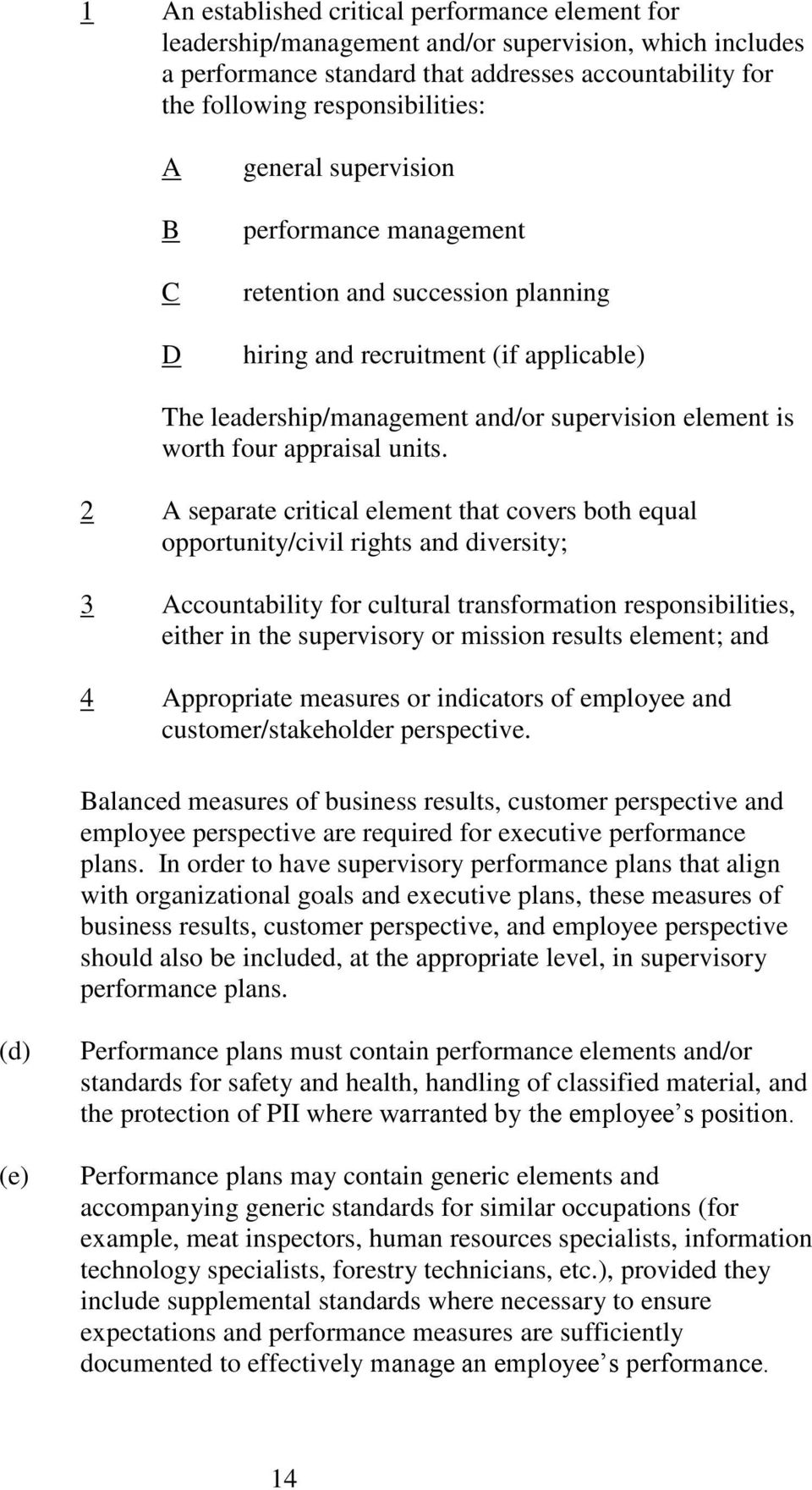
14 1 An established critical performance element for leadership/management and/or supervision, which includes a performance standard that addresses accountability for the following responsibilities: A B C D general supervision performance management retention and succession planning hiring and recruitment (if applicable) The leadership/management and/or supervision element is worth four appraisal units. 2 A separate critical element that covers both equal opportunity/civil rights and diversity; 3 Accountability for cultural transformation responsibilities, either in the supervisory or mission results element; and 4 Appropriate measures or indicators of employee and customer/stakeholder perspective. Balanced measures of business results, customer perspective and employee perspective are required for executive performance plans. In order to have supervisory performance plans that align with organizational goals and executive plans, these measures of business results, customer perspective, and employee perspective should also be included, at the appropriate level, in supervisory performance plans. (d) (e) Performance plans must contain performance elements and/or standards for safety and health, handling of classified material, and the protection of PII where warranted by the employee s position. Performance plans may contain generic elements and accompanying generic standards for similar occupations (for example, meat inspectors, human resources specialists, information technology specialists, forestry technicians, etc.), provided they include supplemental standards where necessary to ensure expectations and performance measures are sufficiently documented to effectively manage an employee s performance. 14
15 (f) All performance plans must be documented, in writing, on the appropriate AD-435 form or in an approved electronic system. See Exhibit 3 for a checklist to utilize when developing performance plans. (2) Performance Elements. (a) (b) (c) Performance elements and standards should be developed using such documents as the USDA Strategic Plan, Agency or Staff Office strategic plan, employee s position description, project proposals, goals, targets, job analysis, equal opportunity action plans, individual development plans, or any other source that assigns responsibility for the accomplishment of work. Each performance element must be designated as either critical or noncritical. Performance plans may not contain formal sub elements, such as would be given individual ratings and then rolled up to the element rating. This restriction does not preclude the use of multiple standards within an element, provided that only one rating level is assigned to each element. Rating officials should carefully consider the number of standards within a single element to avoid the potential for lower performance on one standard to diminish the overall rating of a very broad element, and therefore disproportionately impact the rating of record. (3) Performance Standards. At a minimum, performance standards must be developed for the Fully Successful level. At the Fully Successful level, the employee produces the expected quantity of work and meets expectations for completed work. (a) (b) Performance standards may be developed for both the Exceeds Fully Successful and Does Not Meet Fully Successful levels. The absence of written standards at the Exceeds Fully Successful level or the Does Not Meet Fully Successful level does not preclude the assignment of an element rating at those levels. Performance standards must include credible measures of performance that are observable, measurable and/or demonstrable. Specific measures of quality, quantity, timeliness, cost 15

16 effectiveness and/or manner of performance require supervisors and employees to identify which measures are appropriate. (c) (d) (e) (f) Measures must allow for a range of performance, and must allow for the means to attain the Exceeds Fully Successful element rating. If exceeding the top range of a measure defined at the Fully Successful level would not automatically contribute to the Exceeds Fully Successful element rating, the threshold should be specifically stated in the performance standard. Absolute standards, which allow for no errors, are prohibited unless a single failure could result in loss of life, injury, breach of national security, or great monetary loss. Backwards standards, which describe unacceptable performance rather than describe what level of performance is expected, are prohibited. Generic standards must ensure that expectations are representative of the employee s work, and are clearly and specifically communicated. Generic standards may be clarified via such things as supplemental standards, measures within the standards, memoranda, standard operating procedures, and checklists for office processes. Assigning generic critical elements to all employees, regardless of the type of work they do, may be risky if the generic element does not truly represent their work. (4) Employee Participation in the Performance Plan. Communication between the supervisor and the employee is an essential element of effective performance management. Establishing meaningful performance plans requires participation of both the supervisor and the employee. Rating officials are expected to involve employees in the development of their performance plans insofar as it is practicable, which means seeking and including employees ideas and opinions in the development of performance plans. However, the final authority for establishing performance plans rests with the rating official, with the reviewing official s concurrence. When jointly developing performance plans, the following techniques may be useful: (a) The employee and supervisor discuss and develop the performance plan together; 16

17 (b) (c) (d) The employee provides the supervisor with a draft performance plan; The employee comments on draft performance plan prepared by the supervisor; or Employees who occupy similar positions prepare draft performance plan(s), with the supervisor's approval. Employees must indicate in the appropriate block of their performance plan whether they were given the opportunity to participate in developing their plan. (5) Formally Communicating Expectations. The supervisor or rating official must provide each employee with a performance plan at the beginning of each performance year, or when the employee is assigned to a different position with substantially different duties and responsibilities (for example, promotion, reassignment or a detail or temporary promotion for 90 or more days). (a) Timeframes. Performance expectations must be communicated to employees before employees may be held accountable for them; therefore performance plans must be provided to employees as close to the beginning of the performance year, or the start of a new position, as is practicable. With proper planning, eligible employees should receive their performance plans: 1 Within the first week of a new performance year, but under no circumstances should eligible employees receive the plans after more than 30 days of the new performance year. 2 Within 15 days of starting a new position, detail, or temporary promotion of 90 or more days. If a detail or temporary promotion of fewer than 90 days is to be extended beyond 90 days, a performance plan must be given to the employee within 10 days of when the extension is decided to ensure the supervisor of the detail is compliant with the requirement to provide an interim rating for appraisal periods of 90 or more days. If it is likely a shorter detail or temporary promotion may be extended to a total period of 90 or more days, employees should be 17

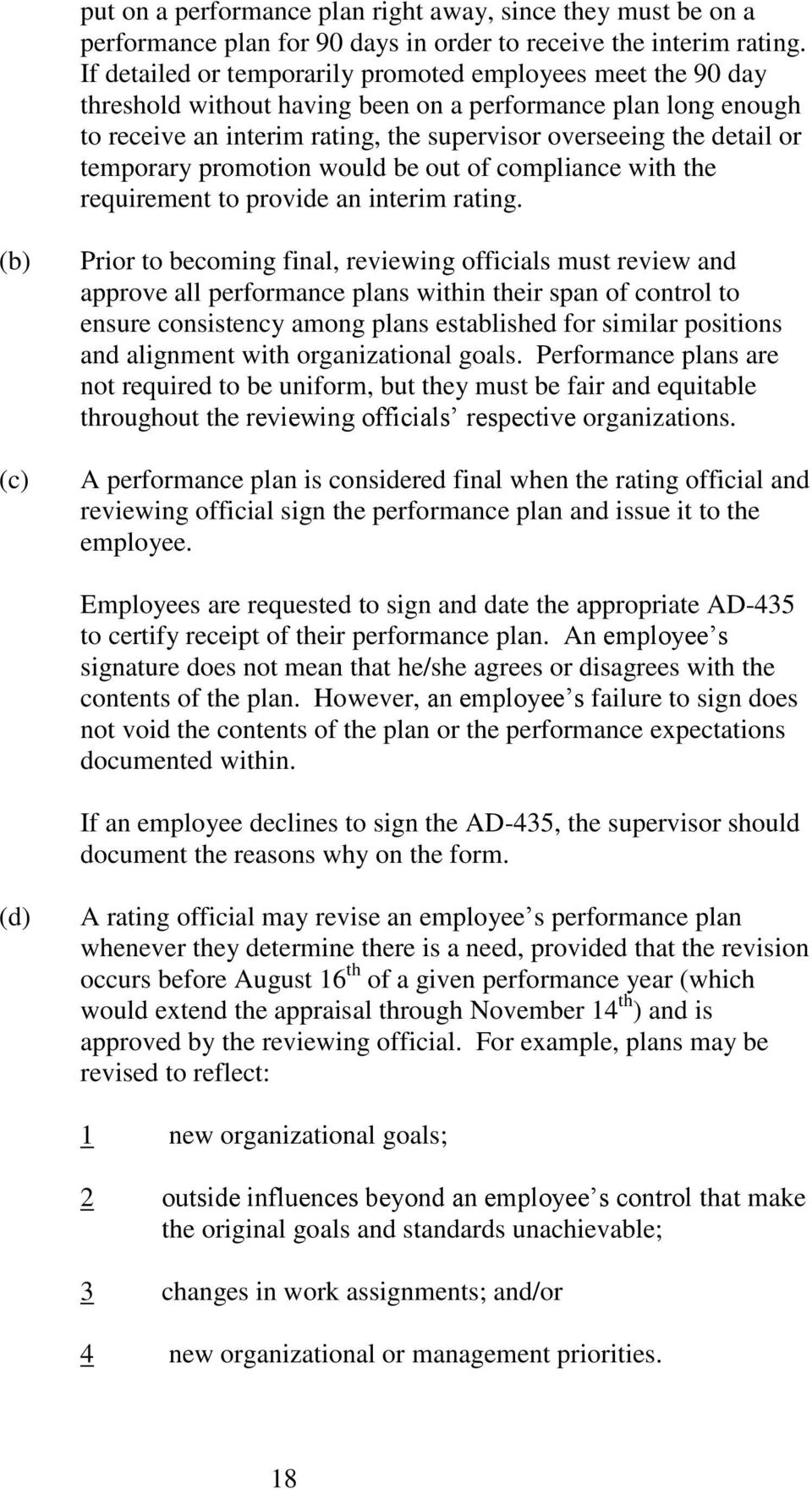
18 put on a performance plan right away, since they must be on a performance plan for 90 days in order to receive the interim rating. If detailed or temporarily promoted employees meet the 90 day threshold without having been on a performance plan long enough to receive an interim rating, the supervisor overseeing the detail or temporary promotion would be out of compliance with the requirement to provide an interim rating. (b) (c) Prior to becoming final, reviewing officials must review and approve all performance plans within their span of control to ensure consistency among plans established for similar positions and alignment with organizational goals. Performance plans are not required to be uniform, but they must be fair and equitable throughout the reviewing officials respective organizations. A performance plan is considered final when the rating official and reviewing official sign the performance plan and issue it to the employee. Employees are requested to sign and date the appropriate AD-435 to certify receipt of their performance plan. An employee s signature does not mean that he/she agrees or disagrees with the contents of the plan. However, an employee s failure to sign does not void the contents of the plan or the performance expectations documented within. If an employee declines to sign the AD-435, the supervisor should document the reasons why on the form. (d) A rating official may revise an employee s performance plan whenever they determine there is a need, provided that the revision occurs before August 16 th of a given performance year (which would extend the appraisal through November 14 th ) and is approved by the reviewing official. For example, plans may be revised to reflect: 1 new organizational goals; 2 outside influences beyond an employee s control that make the original goals and standards unachievable; 3 changes in work assignments; and/or 4 new organizational or management priorities. 18
19 Interim ratings must be prepared whenever performance plans are changed if the employee has performed work under the original plan for at least 90 days. The employee must be informed of all revisions made to the employee s performance plan before the changes are made effective. Supervisors should keep written records of all such conversations. b. Monitoring Performance. Monitoring performance includes offering regular and recurring feedback, conducting progress reviews, and providing and/or arranging for training. (1) Mid-Year Progress Reviews. At least once, at the midpoint of the performance year, or another appraisal period of at least 180 days, the employee s rating official must conduct a formal progress review to ensure that performance elements and standards are appropriate and to provide the employee with an assessment of current performance. The progress review does not usually result in either a new appraisal period or a rating. However, any significant changes to an employee s duties, responsibilities or work assignments should be reflected accurately within the critical elements of the position. If revisions to the performance plan are required, implementation must be completed within 15 days of the action. Progress reviews must be documented on the employee s performance plan, and in any tracking system used by the Agency or Staff Office to support established requirements for documentation and reporting. (2) If the appraisal period is fewer than 180 days (such as when an employee joins the Department after March 30), a formal mid-year progress review is not required. (3) Supervisors are expected to provide regular and recurring performance feedback throughout the appraisal period. While the mid-year is the only required formal progress review in a performance year, additional progress reviews are recommended. c. Developing Performance. Developing performance pertains to increasing an employee s capacity to perform through formal and informal training; rotational assignments that introduce new skills, higher levels of quality of quantity, or 19

20 higher levels or expanded areas of responsibility; improving work processes; or other appropriate methods. Developing performance is an ongoing part of the performance management process. Together with meaningful performance-related discussions that assist the employee by reinforcing strengths and addressing weaknesses, employee developmental opportunities may include classroom training, on-the-job-training, mentoring, special assignments, details/reassignments, participating in professional and technical organizations, group performance meetings, process improvement teams, and self-development activities. An IDP may contain any or all of these developmental opportunities. As appropriate, supervisors will encourage employees to seek professional and technical development opportunities to enhance their contribution to the Department and Agency or Staff Office goals. d. Evaluating Performance. Evaluating performance includes assessing the performance of employees in comparison to the communicated performance expectations and demonstrated results for the appraisal period. (1) Rating of Record Requirement. At the end of the specified appraisal period, the employee s rating official, with consideration of feedback provided by the employee and customers, as appropriate, must evaluate the employee s accomplishments and issue a rating of record. The rating official may assign a rating of record as long as there is supporting information and the employee has been under an established performance plan for the minimum appraisal period of 90 or more days. Ratings must be based on actual employee performance for the given appraisal period. A presumptive rating may not be assigned, nor may ratings of record be carried forward from a previous appraisal period. (2) Customer and Colleague Feedback. Rating officials are encouraged to obtain and consider feedback given by coworkers, team members and customers/clients pertaining to applicable performance standards of their employees. (3) Employee Accomplishment Report. Employees are encouraged to maintain a personal record of their accomplishments, achievements and performance throughout the appraisal period. Rating officials must provide employees with the opportunity to provide feedback or formal documentation on accomplishments covering their 20

21 performance and contributions to the organization for the current appraisal period. Accomplishments should be relative to individual performance expectations and performance measures, and Department and Agency or Staff Office goals. This input will assist the rating official in more fully evaluating the employee s performance and the results of that performance. (4) Assessing Supervisors Performance Management Responsibilities. (a) (b) Each supervisor and manager is accountable for managing the performance of their employees, and must be evaluated by the appropriate rating official on the accomplishment of their performance management responsibilities, including an assessment of how they plan, monitor, develop, evaluate and recognize subordinate employees performance in accordance with this directive. Supervisors full compliance with this directive should have a direct correlation to the respective supervisor s rating for the Leadership/ Management and/or Supervision element. While the element encompasses several supervisory factors, failure to meet the performance management deadlines established by OHRM and/or the supervisor s agency or staff office should, at a minimum, preclude an element rating of Exceeds Fully Successful. Failure to meet the requirements in the Performance Management category altogether should result in an element rating of Does Not Meet Fully Successful. Note: These provisions do not preclude consequences of noncompliance in the context of conduct, or if the matter should escalate to external governing review boards. (c) Likewise, the second-level supervisor s Leadership/Management and/or Supervision element rating should reflect the degree to which the first-line supervisor was held accountable for his or her performance management responsibilities. (5) Assessing Employee Performance. For ratings of record and interim ratings, each element contained in the performance plan must be evaluated. 21
22 At the end of the appraisal period, the rating official must prepare a narrative assessment describing that employee s accomplishments and contributions to the Department, Agency or Staff Office relative to performance expectations. The employee s rating official (supervisor) must document the employee s accomplishments and contributions on Form AD-435 or supplemental attachments to these forms. (a) The following element rating levels must be used in evaluating employee performance: 1 Exceeds Fully Successful. Performance in an element that, overall, exceeds the performance standards established for the Fully Successful level. The documentation on the AD- 435 must clearly show how the employee s accomplishments and contributions exceed the Fully Successful level. 2 Meets Fully Successful. Performance in an element that meets the standards established for the Fully Successful level, or exceeds the Fully Successful level in only some aspects. The employee is completing the work assigned at the expected level of performance. 3 Does Not Meet Fully Successful. Performance in an element that falls below the standards established at the Fully Successful level. The documentation on the AD-435 must clearly show how the employee s performance failed to meet the Fully Successful level. (b) After evaluating each performance element, the supervisor must calculate the summary rating using the Decision Table set forth on Form AD-435. The summary rating is derived by using the five rating levels and associated values assigned to each performance element. The following appraisal units must be assigned on Form AD-435: 1 Mission Results element: 4 appraisal units 2 Supervision or Leadership/Management element (if applicable): 4 appraisal units 22
23 3 Other critical elements: 2 appraisal units 4 Non-critical elements: 1 appraisal unit (c) Rating officials must provide an overall narrative justification of the summary rating and/or a written justification for each element rating. A thorough written justification is required for any element rated Does Not Meet Fully Successful, and for a summary rating of Outstanding. (d) The five summary rating levels are: 1 Outstanding (Level 5). A summary rating of Outstanding must be assigned when all performance elements are rated Exceeds Fully Successful. This summary rating should reflect: A B C D A level of performance for the appraisal period that shows exceptional contributions to the accomplishment of the Department and Agency or Staff Office mission; A demonstrated mastery of required technical skills and a thorough understanding of the mission of the organization; A level of effort which has had a fundamental impact on the completion of program objectives; and An exceptional quality and quantity of work produced significantly ahead of established schedules or deadlines and with very little or no supervision. 2 Superior (Level 4). A summary rating of Superior must be assigned when: A Not all elements are rated Exceeds Fully Successful; 23
24 B C The unit points in the Exceeds Fully Successful column on the AD-435 are greater than the unit points in the Meets Fully Successful column; and No elements are rated Does Not Meet Fully Successful. This summary level should reflect a level of performance which demonstrates a comprehensive understanding of the objectives of the job and the procedures for accomplishing them. At this level, the employee produces a very high quality and quantity of work ahead of established schedules or deadlines and with minimal supervision. 3 Fully Successful (Level 3). A summary rating of Fully Successful must be assigned when: A B The unit points in the Meets Fully Successful column on the AD-435 are greater than the number of points in the Exceeds Fully Successful column; and No elements are rated Does Not Meet Fully Successful. This summary level should reflect: A B C D A level of performance which shows quality work in support of the Department and Agency or Staff Office mission; That the employee effectively applied technical skills and organizational knowledge to successfully complete work products; That the employee successfully carried out regularly assigned duties as well as any special assignments; That the employee produced the expected quantity and/or quality of work and meets deadlines or schedules for completion of work. 24
25 4 Minimally Satisfactory (Level 2). A summary rating of Minimally Satisfactory must be assigned when no critical elements were rated Does Not Meet Fully Successful, but the level of performance in any non-critical element demonstrates the need for improvement to achieve a rating of Fully Successful. At this level, the employee s work products frequently need revision or adjustments, often requiring assistance from the supervisor and/or peers. Organizational goals and objectives are only met because of close supervision. If a performance plan does not contain any non-critical elements, this summary level will not be applicable. 5 Unacceptable (Level 1). A summary rating of Unacceptable must be assigned when the level of performance does not meet the established performance standards for Fully Successful in one or more of the employee s critical elements. At this level, the employee s work products do not meet the minimum requirements expected and corrective action must be taken consistent with the established procedures in Section 9, paragraph g, for Unacceptable performance. (e) Rating officials must ensure the assessment of employee performance is consistent with the organization s overall performance. (6) Interim Ratings and Advisory Assessments. Supervisors are required to prepare interim ratings for the following scenarios: (a) (b) (c) Permanent changes for the employee, including reassignment, promotion, transfer or resignation, if the employee served 90 or more days on a performance plan in the former position; A detail or temporary promotion of 90 or more days; and/or Permanent or temporary changes in supervisors, including details of more than 90 days, reassignments, retirements and resignations. 25
26 When details and temporary promotions last fewer than 90 days, the interim supervisor should provide an advisory assessment covering that time period. All interim ratings and advisory assessments should be completed within 15 days, and should be considered in deriving the employee's rating of record at the end of the appraisal period. The rating official, in consultation with the reviewing official, should consider the nature of assignments and the length of time covered by the interim rating(s) when determining the impact of the interim rating(s) on the element and summary ratings. (7) Rating of Record Parameters. (a) (b) Ratings of record must be completed and approved as soon as is practicable after the end of the appraisal period, but no later than 30 days after the end of the regular performance year (October 30), and no later than 15 days after the end of an extended appraisal period, whichever is later. Meaningful Distinctions. Rating officials are responsible for ensuring there are meaningful distinctions in ratings of records within the organizational unit, such that higher performing employees receive higher ratings than lower performing employees in the same unit. Reviewing officials are responsible for ensuring there are consistent, meaningful distinctions in ratings of record throughout the organizational units which are within their span of control. (c) (d) Forced Distribution. Placing limitations on the use of particular summary appraisal levels is prohibited when doing ratings of record. Review and Approval Process. Reviewing officials must review and approve the rating officials proposed ratings of record for subordinate employees, including ensuring the ratings are consistent with organizational performance, and that they are consistent across their respective organizational components. The rating officials may not communicate ratings of record to employees prior to approval. This does not preclude preliminary performance discussions between a supervisor and employee prior to the determination of the rating of record. 26
27 (f) (g) A summary rating is valid and becomes a rating of record when the rating official and reviewing official sign the rating of record and issue it to the employee. If the rating official erroneously communicates the rating to the employee prior to the reviewing official s review and signature, and the rating is then changed, the original rating communicated to the employee is considered invalid. Employee's Certification. The rating official must review the approved rating of record with the employee. The employee's signature on Form AD-435 will serve as certification that such a discussion took place, but does not necessarily signify that the employee agrees with the rating, and does not prevent the employee from following the provisions of paragraph (k) below. If this discussion cannot take place or the employee refuses to sign Form AD-435, the supervisor must document the reason for not having the employee s signature on Form AD-435. (h) (i) Disabled Veterans. The performance appraisal and resulting rating of record for a disabled veteran may not be lowered because the veteran has been absent from work to seek medical treatment as provided for in Executive Order 5396, dated July 17, Inability to Rate an Employee. When a rating of record cannot be prepared at the time specified, the appraisal period shall be extended, such as when the employee has not met the 90 day minimum rating period by the end of the performance year, provided the 90 day requirement is met by November 14 th. Once the conditions necessary to complete a rating of record have been met, a rating of record shall be prepared as soon as is practicable, but not more than 15 days after the end of the extended appraisal period, or 30 days after the end of the normal performance year, whichever is later. Performance may not be appraised if the employee has not spent at least 90 days on a performance plan. Note: The 90 days do not have to be consecutive. 1 If an employee is not on a plan as of August 16, and was not on a performance plan for 90 days at any point in the 27
28 performance year, an appraisal cannot be produced for that performance year. 2 If an employee is not on a plan as of August 16, but was on a plan for 90 days at some point during the performance year, and the plan covered work that is similar to the position of record, an interim rating prepared by the previous or temporary supervisor will serve as the final rating of record for the performance year. If an interim rating was not prepared at any point during the performance year, a rating of record cannot be produced for that performance year. 3 If an employee is on active duty or an extended leave of absence, such that he/she has not performed at least 90 days on a performance plan, a rating of record cannot be produced for that performance year. (j) Retroactively producing or changing a rating of record. Once the performance year or an extended appraisal period ends, rating and reviewing officials must complete the ratings of record by the deadlines described above. After December 1 of any given year, a rating of record that covers the previous performance year or an extended appraisal period may not be produced, except as permitted below. After December 1, a rating of record may only be changed or produced under the following circumstances: 1 Within 60 days of issuance based upon an informal request by the employee 2 As a result of a grievance, complaint or other formal proceeding permitted by law or regulation that results in a final determination by the appropriate authority that the rating of record must be changed or produced or as part of a bona fide settlement of a formal proceeding; or 3 Where the Agency or Staff Office determines that a rating of record was incorrectly recorded or calculated. (k) Grievances. A bargaining unit employee may challenge either the rating of record or a lack of a rating under the terms of the 28
29 applicable negotiated grievance procedure, as appropriate. A nonbargaining unit employee may challenge the rating of record or a lack of a rating under the terms of the administrative grievance procedure, as appropriate. e. Recognizing and Rewarding Performance. (1) Rating-Based Performance Awards. Performance awards must be linked to a rating of record based upon results achieved and documented on the AD-435. The granting of performance awards is discretionary, not an entitlement, subject to approval at the appropriate level. QSIs must be based on a rating of record of Outstanding. Rating-based cash and/or time off awards must be based on a rating of record of not less than Fully Successful. (2) Eligibility. Employees rated below Fully Successful are not eligible for rating-based performance awards. (3) Award Levels. Managers and supervisors are responsible for making meaningful distinctions in award levels such that higher performing employees receive larger awards than lower performing employees in the same unit at the same grade level. (4) Timing. Rating-based performance awards should be processed and paid out as close to the end of the performance year as possible, normally within days. f. Details, Temporary Promotions, Position Changes, Changes in Supervisors, Transfers and Resignations (1) Details and Promotions Made on a Temporary Basis. (a) If an employee is either detailed into a different position or temporarily promoted for fewer than 90 days, formal performance elements and standards are not required, but the performance expectations should still be documented informally and communicated to the employee. The supervisor responsible for the detail or temporary promotion must document the employee s accomplishments in an advisory assessment at the end of the detail or temporary promotion. It must be communicated to the employee and forwarded to the employee s supervisor of record for appropriate consideration in the final rating of record for the performance year. 29
30 (b) (c) (d) (e) If an employee is detailed into a different position or is temporarily promoted for 90 or more days, the supervisor responsible for overseeing the detail or temporary promotion must establish a formal performance plan. The expectations must be communicated to the employee in writing, as close to the beginning of the assignment as possible, and no more than 15 days after the start. An interim rating is required to document the employee's accomplishments at the end of the detail or temporary promotion of 90 or more days. It must be communicated to the employee and provided to the employee s supervisor of record within 15 days of the end of detail or temporary promotion for consideration in the final rating of record. If the detail or temporary promotion continues beyond September 30, the supervisor of the detail or temporary promotion must also provide an interim rating or advisory assessment, as appropriate, at the end of the performance year to the supervisor of record for appropriate consideration in the final rating of record for the performance year. When employees are detailed outside of the Department, the supervisor of record must make a reasonable effort to obtain appraisal information from the outside organization. If such information is unattainable, and the employee worked under a performance plan within USDA for fewer than 90 days in a performance year, a rating of record will not be produced for that performance year. A rating of record recommended by the external Department or Agency must be approved by the respective rating and reviewing officials, and entered in the applicable system. (Note: A pass/fail rating of record has no correlation with the USDA ratings, so the external organization must recommend a rating which is compatible with one of the five possible USDA summary ratings.) (2) Position Changes. If an employee is assigned to a new position through reassignment, transfer or appointment during the performance year, and the employee served under a performance plan for at least 90 days in the position from which the employee has changed, the former rating official will prepare an interim rating and forward it to the new rating official within 15 days for appropriate consideration in the final rating of record. 30
31 (3) Change in Supervisors. When an employee has a performance plan in place and works in the same position under different supervisors during the appraisal period, each supervisor of 90 or more days must prepare an interim rating and forward it to the employee s new rating official for appropriate consideration in the final rating of record. If a new rating official is not immediately identified, the outgoing supervisor must provide the interim rating(s) to the reviewing official. (4) Vacant Supervisory Position. If a supervisory position is unencumbered at the end of the performance year, the second-level supervisor will serve as the rating official, and the third-level supervisor will serve as the reviewing official. (5) New Supervisors. New supervisors may serve as rating officials provided the following: (a) (b) The subordinate employees have been under established performance plans for the minimum appraisal period of 90 days; The supervisor has had formal training in assessing and rating performance; and (c) If the supervisor has been in the supervisory role for fewer than 90 days, there is at least one interim rating to consider in the rating of record. If those provisions are not in place, the second-level supervisor will serve as the rating official, and the third-level supervisor will serve as the reviewing official. (6) Acting Supervisors. Individuals in acting supervisory roles at the end of the performance year, or at the end of an extended appraisal period, may serve as rating and/or reviewing officials provided the following: (a) (b) (c) The employees have been under established performance plans for the minimum appraisal period of 90 days; The acting supervisor is officially designated as acting for a period of at least 60 days, either by detail or temporary promotion; The acting supervisor has had formal training in assessing and rating performance; and 31
32 (d) If the acting supervisor has been in the acting supervisory role for fewer than 90 days, there is at least one interim rating to consider in the rating of record. If those provisions are not in place, the second-level supervisor will serve as the rating official, and the third-level supervisor will serve as the reviewing official. g. Addressing Performance Problems. (1) Supervisors and managers are encouraged to contact their servicing Human Resources Office for additional advice and guidance when addressing performance problems. (2) Unacceptable Performance. Regular and recurring feedback is a critical aspect of effective performance management, and is especially important in identifying and addressing shortcomings early in the appraisal period. At any time during the appraisal period that an employee s performance is determined to be less than Fully Successful in one or more critical elements, the rating official must: (a) (b) Notify the employee, in writing, of the critical element(s) for which performance is below the Fully Successful level; and Inform the employee of the performance requirement(s) or standard(s) that must be attained to demonstrate acceptable performance. The rating official should inform the employee that unless his/her performance in the critical element(s) improves to and is sustained at a satisfactory level, the employee may be reassigned, reduced in grade or removed. (3) Performance Improvement Plan. For each critical element in which the employee s performance would not attain the Fully Successful level, the rating official must afford the employee a reasonable opportunity to demonstrate acceptable performance commensurate with the duties and responsibilities of the employee s position, and place the employee on a PIP. (a) When an employee is placed on a PIP, the opportunity period must be at least 60 days. The PIP must clearly identify and describe the performance expectations in the performance elements and 32
33 standards for which the employee s performance does not attain the Meets Fully Successful level, such that the employee may clearly understand the required performance to bring the element(s) up to the Fully Successful level. If the rating official concludes that additional time is required to assess the employee s performance progress, the initial opportunity period may be extended. If the opportunity period is extended, the rating official must notify the employee, in writing, of the extension. (b) (c) If the employee does not demonstrate a satisfactory level of performance for a critical element during or following the opportunity period, the rating official may initiate a reassignment, reduction in grade, or removal action. If an employee has performed satisfactorily for one year from the beginning of an opportunity period and the employee s performance again falls below the Meets Fully Successful level in any critical element, the rating official must afford the employee an additional opportunity to demonstrate performance that attains the Meets Fully Successful level before determining whether to propose a reassignment, reduction in grade or removal action. A proposed action may be based upon instances of Unacceptable performance which occur within a 1-year period, ending on the date of the notice of proposed action. (d) A timely, formal rating of record must be given to an employee after the end of an appraisal period (in most cases, September 30). The fact that an employee may be currently serving a PIP will not preclude a supervisor from issuing a formal rating of record. This rating of record should reflect the entire appraisal period s performance (in most cases an entire performance year), including the employee's PIP performance through the end of the appraisal period (rather than through the end of the PIP). Note: There is no provision to change a rating of record if the employee successfully completes the PIP after the given appraisal period. (e) The requirements of subsection (2) to establish a PIP exclude employees as listed in 5 CFR, Section (f), including an employee in the competitive service who is serving a probationary or trial period under an initial appointment. 33
34 (4) Unacceptable Supervisory Performance. A supervisor s success in meeting the expectations of the Leadership/Management or Supervision element is fundamental to the performance of the entire organizational unit, and it is therefore necessary for second-level supervisors and managers to be particularly mindful in the selection process, and then to be proactive in overseeing and providing ongoing feedback to their subordinate supervisors. The following steps are applicable to improve the performance of any employee, but are especially important for managers to take with regard to subordinate supervisory positions: (a) (b) (c) (d) (e) (f) Ensure the expectations are clearly understood; Model the supervisory expectations; Work with the subordinate supervisor to identify developmental needs; Provide for effective accountability, including ongoing meetings to discuss challenges and deadlines; Address performance deficiencies immediately; and Require new supervisors, and those with performance deficiencies, to work with a suitable mentor. (5) Minimally Satisfactory Performance. Supervisors should provide assistance to employees with a Minimally Satisfactory summary rating of any kind, to raise their performance to a Fully Successful level. The rating official should inform the employee of the performance deficiencies and discuss efforts that both the supervisor and employee will take to assist the employee in overcoming the deficiencies, including ensuring the performance expectations to reach the Meets Fully Successful level in every element are documented and clearly communicated. (6) Performance-Based Actions. Subject to the provisions of 5 U.S.C., Chapter 43, Sec Actions based on unacceptable performance, and 5 CFR, Part 432, Performance Based Reduction In Grade and Removal Actions, an agency may reduce in grade or remove an employee for unacceptable performance. 34
35 Please refer to 5 U.S.C., Chapter 75, Adverse Actions, and 5 CFR, Part 752, Adverse Actions, for adverse actions. (7) Savings Provision. Administrative actions initiated against employees whose performance is Unacceptable under 5 U.S.C., section 4303 and the USDA Performance Management Program, or another program in existence prior to the effective date of this Program, shall continue to be processed consistent with that pre-established set of procedures and requirements. 10. LINKING PERFORMANCE TO OTHER PERSONNEL SYSTEMS The rating of record has a bearing on various other personnel actions, such as probationary periods, granting within-grade increases, promotions, training and development, pay increases and performance awards, and determining additional retention service credit in a reduction in force: a. Probationary Employees. (1) The rating official must evaluate a probationary employee to determine whether the employee has demonstrated the ability to perform the functions of the position successfully and their fitness for continued employment. Please refer to 5 CFR, Part 315, Subpart H, Probation on Initial Appointment to a Competitive Position. (2) An employee may be removed at any time during the probationary period when work performance fails to demonstrate fitness for or the qualifications necessary for continued employment. An employee s probationary period ends upon completion of the scheduled tour of duty on the day before the anniversary date of employee s appointment. If a probationary employee is to be terminated for performance reasons, the rating official must notify the employee, in writing, of the reason for termination, the effective date, and the official s conclusions as to the inadequacies of the employee s performance. b. Probationary Supervisors and Managers. (1) The rating official must evaluate a probationary supervisor or manager to determine whether he/she has demonstrated the ability to perform the functions of the position successfully. Please refer to 5 CFR, Part 315, Subpart I, Probation on Initial Appointment to a Supervisory or Managerial Position. An employee who, for reasons of supervisory or managerial performance, does not satisfactorily complete the probationary period is entitled, except as provided below, to be assigned to a position of 35
36 no lower grade and pay than the one the employee vacated to accept the supervisory or managerial position. (2) A new supervisor who does not satisfactorily complete the supervisory probationary period, who is also serving the probationary period for an initial appointment, may be removed at any time under the provisions of subsection (a) above. If he/she is not removed, he/she is not automatically entitled to be assigned to a position at a specific grade and pay. Such determinations should be made on a case-by-case basis in consultation with the servicing human resources office. (3) A non-supervisory or non-managerial employee who is demoted into a supervisory and/or managerial position for which a probationary period is required and who, for reasons of supervisory or managerial performance, does not satisfactorily complete the probationary period, is entitled to be assigned to a position at the same grade and pay as the position in which he or she was serving a probationary period. The rating official must notify the employee, in writing, of the decision to assign the employee to a different position. The employee is eligible for repromotion in accordance with the respective agency s promotion policy. (4) Form AD-773, Supervisory or Managerial Probationary Period Report is used to document the supervisory probationary period. If the supervisor does not satisfactorily complete the probationary period, block 15 must be completed. (If necessary, use additional sheets and attach.) c. Within-Grade Increase (WGI). (1) An eligible employee may be granted a within-grade increase only when the employee is rated Fully Successful or above. The basis for the decision to grant or withhold a WGI is the employee's rating of record within the appropriate waiting period. If a WGI decision is not consistent with the employee's most recent rating of record, a more current rating of record must be prepared. This may require the supervisor to prepare a new rating of record before the end of the appraisal period to document the appropriate level of performance at the time the WGI is due. (2) If an employee was rated Fully Successful on the most recent rating of record, and performance in any element falls below Fully Successful before the WGI is due, the employee should be notified immediately and given an opportunity to improve performance in that element. (3) Once a within-grade increase has been denied, a supervisor has the flexibility to approve a within-grade increase at any time thereafter once 36
37 the employee is determined to be performing at an acceptable level of competence, but the agency must consider the employee's performance at least every 52 weeks after the denial. d. Promotion. An employee s rating of record must be considered when evaluating that employee for promotion or reassignment to a position with promotion potential. No employee will receive a career promotion unless the employee s current rating of record is Fully Successful or above. e. Training and Development. Supervisors are responsible for meeting Department and Agency or Staff Office performance goals and for assisting employees in improving their performance. The appraisal process should be used as a tool that identifies opportunities for improving and enhancing knowledge, skills, abilities, and job performance. Employees are responsible for self-development, successfully completing and applying authorized training, and fulfilling any continued service agreements. Employees share the responsibility for identifying the training opportunities that will improve their performance and methods to meet those needs effectively and efficiently. f. Pay Increases and Rating-Based Performance Awards. Employees who receive a rating of record of Outstanding are eligible for QSIs. Employees who receive ratings of record of Outstanding, Superior or Fully Successful are eligible for incentive awards and recognition, as appropriate. Employees rated below Fully Successful are not eligible for rating-based performance awards. g. Reduction-in-Force (RIF). Ratings of record are used to establish service credit for reduction-in-force (RIF) purposes. For RIF purposes, the rating of record is the annual summary rating required at the time specified in this Departmental Regulation. A rating official may not assign an employee a new rating of record for the sole purpose of affecting their retention standing. Rating of records that were due before the date of specific RIF notices but were not officially approved and placed on record until on or after the date of the specific notices will not be used to determine additional service credit. Please refer to 5 CFR, Part 351, Reduction In Force. Subpart E - Retention Standing. 37
38 11. PERFORMANCE MANAGEMENT TRAINING REQUIREMENTS a. Training Requirements. (1) Supervisors and managers must receive formal performance management training: (a) (b) (c) Within the first three months of assuming the supervisory role; Before preparing or reviewing ratings of record for subordinate employees; and Not less than every two performance years for the remainder of their supervisory tenure. (2) Non-supervisory employees must receive performance management training within the first three months of employment, and not less than every two performance years thereafter. (3) All training must be recorded in AgLearn. b. Curriculum Requirements. Performance management training must include one or more of the following components: (1) The concepts and practical use of performance management; (2) Setting expectations; (3) Managing performance for results; (4) Linking individual performance to organizational goals; (5) Setting effective goals for individual performance; (6) Establishing and applying objective measures of performance; (7) The performance appraisal process; (8) Writing accomplishment reports; (9) Communicating organizational performance to employees; 38
39 (10) Giving and receiving feedback; (11) Using reward and recognition to achieve and sustain higher levels of performance; (12) Addressing performance deficiencies; and/or (13) Developing competencies. c. Training Methodologies. A variety of training methodologies may be used including: (1) Classroom; (2) Automated or online training modules such as AgLearn; (3) Distance learning programs; (4) Employee briefings; (5) Supervisory and leadership training; and (6) Employee orientation materials. 12. PERFORMANCE MANAGEMENT FORMS AND RECORDS a. Appraisal Forms. The rating official must use the following forms to prepare and document performance plans. Forms are accessible online at the Office of the Chief Information Officer website. (1) Form AD-435E, Performance Plan and Appraisal for Non-Supervisors; and (2) Form AD-435S, Performance Plan and Appraisal for Supervisors, Progress Review and Appraisal Worksheet. b. Digital Signatures. OPM requires the following for electronic signatures on performance-related documents: (1) The signal or symbol must be unique to the signer; 39
40 (2) The "signature" must be capable of being verified and must be linked to the data being transmitted, including the effective date; (3) Control features must be in place to ensure the authenticity of data on the form, including the electronic signature; and (4) Such controls must provide reasonable assurance that deliberate or inadvertent manipulation, modification or loss of data on the electronically stored form is detected. Digital signatures in USDA must also: (1) Comply with DR , Identity, Credential and Access Management; (2) Be created from the department s digital signature standard, via the USDA-approved PIV (LincPass), PIV-Derived or other USDA-approved credentials that offer cryptographic non-reputable assurance in the signer s identity; and (3) Be producible on a paper copy. c. Distribution. Upon completion of a rating of record, the rating official must: (1) Provide a copy of the completed rating to the employee; (2) Provide a copy of the completed rating and the supporting documentation to the servicing Human Resources Office for processing and maintenance; and (3) Retain one copy for the rating official s supervisory file. d. Rating Transfers. If an employee moves to a new organization within USDA or to another Federal Department or Agency, the ratings of record contained in the Official Personnel Folder (OPF) and the Employee Performance File (EPF) must be transferred to the new organization or Federal Department or Agency. e. Records Maintenance. Performance records must be maintained in accordance with the procedures set forth in 5 CFR, Part 293, Personnel Records; 5 CFR, Part 297, Privacy Act Procedures for Personnel Records; and any Departmental Directives associated with the Privacy Act and the Freedom of Information Act. Ratings of record, the supporting performance plans and other relevant documentation must be maintained for four years, or longer periods as required. Rating officials must regard performance records as confidential in their maintenance and distribution. 40
41 When an employee s OPF is sent to another servicing Human Resources Office within USDA, another Federal Department or Agency, or the National Personnel Records Center, the "losing" servicing Human Resources Office must include the last four years ratings of record and performance plans, including the most recent rating and the summary rating prepared when the employee changes positions. The "losing" servicing Human Resources Office will purge all ratings of record, performance plans, and the supporting performance-related documents that are more than four years old from the OPF or EPF. 41
42 Exhibit 1 Performance Year Cycle by Phase Phase Role Requirement Timeframe Reference Planning Rating Official (Supervisor of Record, unless the employee is detailed or temporarily promoted under a different supervisor) Establish a performance plan for each subordinate employee, involving employees in developing their respective plans Send the draft plan to the Reviewing Official for review and signature. Sign the approved performance plan and provide it to the employee, request employee s signature as certification of receipt. Update the plan as necessary (have the Reviewing Official approve the changes). Begin September 1; plan for the entire process to be complete in early October, but no later than October 30 November 1 August 16 Section 9 a(1) Section 9 a(5)(b) Section 9 a(5)(c) Section 9 a(5)(d) Reviewing Official Approve and sign the performance plan and any changes. Early October, no later than October 30 Section 9 a(5)(b) Employee Participate in developing the performance plan. Sign the approved performance plan as certification of receipt. September Upon receipt Section 9 a(4) Section 9 a(5)(c) Monitoring Supervisor Employee Provide regular and recurring feedback. Conduct at least one formal mid-year review. Seek feedback and clarification where necessary. Alert supervisor to any obstacles to accomplishing expectations. All year March 1 April 30 All year All year Section 9 b Section 9 b(1) Section 7 f(2) & (5) Section 7 f(4) Developing Supervisor Employee Work with the employee to determine any professional development needs to improve performance. Prepare an Individual Development Plan (IDP) and submit it to the supervisor for approval. Fulfill the provisions of the IDP, updating it as necessary. All year By October 31 All year Section 9 c 42
43 Supervisor (including those supervising detailees) Provide interim ratings in these circumstances: Employee promotions Major changes in employees position or responsibilities (which would generally precipitate an updated performance plan) Employees temporarily promoted or detailed to the work unit for 90 or more days If the supervisor leaves the position All year Section 9 d(6) Evaluating Rating Official (Supervisor of Record) Determine element ratings by comparing accomplishments against the expectations details in the performance plan. Use the decision table to determine the summary rating. Complete the AD-435, including documenting accomplishments, and submit to the Reviewing Official for approval. Third and fourth weeks in September Section 9 d(5)(a) Section 9 d(5)(b) Section 9 d(5) & d(5)(b) Upon approval, sign the rating of record and review it with the employee. Provide both positive and developmental feedback. After approval of reviewing official Section 9 d(7)(g) Reviewing Official Review recommended ratings of record for all positions within the scope of the Reviewing Official s organization. Ensure consistency and objectivity across organizational lines. Consider subordinate supervisors full and timely compliance with the performance management performance standard in determining the Supervisory element rating. First week in October Last week in September - first week in October Section 9 d(7)(d) Section 9 d(4)(b) Employee Provide documentation to the supervisor on accomplishments toward achieving performance expectations (Accomplishment Report) By mid- September Section 9 d(3) Recognizing & Rewarding Rating Official Reviewing Official Recommend employees for rating-based awards, ensuring meaningful distinctions in award levels. Review and approve award recommendations, ensuring both meaningful distinctions in award levels and general equity across the organization. October October Section 9 e DR Section 8 a(1) 43
44 Exhibit 2 Key Timeframes and Requirements Period of Performance Performance Plan Required Progress Review Required Rating Required Notes Performance Year (October 1 September 30) Yes Complete early October, no later than October 30 Yes March 1 April 30 Rating of Record Due early October, no later than October 30 Detail or Temporary Promotion < 90 days No formal plan; expectations must at least be documented informally No Advisory Assessment Due within 15 days of end of detail or temporary promotion Detail or Temporary Promotion 90 or more days Yes At least one performance element Within 15 days If more than 180 days, conduct progress review at halfway point Interim Rating Due within 15 days of end of detail or temporary promotion If the detail or temporary promotion carries over to a new performance year, a rating of record for the performance year still will be due at the regular deadline New position prior to July 1 Yes Within 15 days Yes, if appraisal period is at least 180 days Midpoint Rating of Record Due early October, no later than October 30 New position between July 1 early August Yes Within 15 days, no later than August 16 No Rating of Record Due within 15 days of the end of the period of performance; no later than December 1 The period of performance may be extended past September 30 to reach the full 90 days, through no later than November 14 New position after early August Yes Within 15 days If established after August 16, will carry through the next performance year Yes March 1 April 30 Rating of Record Due early October of the following year, no later than October 30 Period of performance will be slightly more than one year Note: Interim ratings are also required for the prior position when an employee is reassigned or promoted, and/or when there is a change in supervisor, provided the employee was working under a performance plan for at least 90 days. 44
45 Exhibit 3 Performance Plan Checklist Category Items Yes/No Does the plan have a mission-results element that is aligned with Department and Agency or Staff Office goals? Are there at least three critical elements? Are there no more than seven total elements? Does the performance plan cover the preponderance of the employee s responsibilities? Does each element include standards with credible measures? Does the non-supervisory plan incorporate EEO and Civil Rights responsibilities in at least one element? Does the non-supervisory plan incorporate customer perspectives in at least one element? Does the supervisory plan include a critical element for supervisory/managerial responsibilities? Does that element include standards for these responsibilities: Technical Requirements general supervisory performance management retention and succession planning hiring and recruitment (if applicable) Does the supervisory plan include a separate critical element for equal opportunity/civil rights and diversity? Does the supervisory plan include accountability for cultural transformation responsibilities, either in the supervisory or mission results element? Does the supervisory plan include appropriate measures or indicators of employee and/or customer/stakeholder feedback? Was the employee invited to participate in developing the performance plan? By being involved, employees will have a better understanding of what is expected of them, will understand the terminology used, will understand how their performance will be measured, and will be more likely to accept and trust the whole process. Are the measures in the standards the correct ones? Content Assessment Is the most appropriate and accurate way to measure the expectation(s) via quantity, quality, timeliness, cost savings or manner of performance? Are data for the measures attainable? Are the measures credible (i.e., observable, measurable, and/or demonstrable)? 45
46 Are the critical elements truly critical? Would failure on the critical element mean that the employee's overall performance is unacceptable? For instance, assigning generic critical elements to all employees, regardless of the type of work they do, can be risky if the generic element does not truly represent their work. As an example, if a research organization required that every employee's performance plan include a critical element about teamwork, and its worldrenowned research scientist, who independently made a scientific breakthrough, fails the teamwork element, would the organization be willing to rate the scientist as Unacceptable? Although teamwork may be important to the organization, it may not be important in this particular job. Supervisors should assign critical elements carefully. Is the meaning of acceptable performance clear? Are the expectations established in the elements and standards quantifiable, observable, and/or verifiable? Expectations that are specific and that clearly define what must be done, as well as how well it must be done, are more effective for managing and directing performance than vague or general expectations. In addition, MSPB and the courts have ruled that employees must know what they have to do and how well they have to do it to perform at an acceptable level. Both sound management principles and court rulings support this key criterion. For this reason, backwards standards are prohibited in USDA. Are the standards attainable? Are expectations reasonable? MSPB and the courts have ruled that, in most instances, performance standards at the Fully Successful level must not require absolute perfection. In addition, from a sound management perspective, research has shown that setting expectations that are impossible or nearly impossible to achieve can actually cause performance levels to drop because employees tend to give up if they perceive the goal as impossible. Are the standards challenging? Does the work unit or employee need to exert a reasonable amount of effort to reach the Fully Successful performance level? Or do they merely need to show up to work in order to be considered Fully Successful? Research has shown that setting expectations that are too easy (or too hard) leads to low performance. Because research also shows that specific, challenging expectations result in higher performance, the best Fully Successful standards will find a balance between being too hard or too easy. Are the standards fair? Are they comparable to expectations for other employees in similar positions? Applying different standards to employees doing the same work does not appear on its face to be fair or valid. Requiring the Reviewing Official to compare standards for similar work across an organization is one way of ensuring equity. In addition, do the standards allow for some margin of error? Requiring perfection is not fair, or acceptable, except for very rare instances. 46
47 Are the standards applicable? Can the Rating Official use the standards to appraise performance? The standards should clearly describe the factors that the supervisor would look for and how well those factors should be done (i.e., the quality, quantity, timeliness and costeffectiveness requirements). In addition, can the supervisor effectively use the data collected through the measurement process? If monitoring performance on the element is too costly or time-consuming, the standard might need to be altered to include measures that are more manageable. Will employees understand what is required? Elements and their standards should be written clearly and be specific to the job. If the standards are generic, they need to be supplemented with specific information so that employees know what they have to do to demonstrate performance at the Fully Successful level. Are the elements and standards flexible? Can they be adapted readily to changes in resources or objectives? Elements and standards can be modified during the appraisal period to meet changing organizational goals and other situations, as long as the employee works under the new standards for at least the 90 days before a rating of record is assigned. This flexibility allows performance plans to be used as management tools to manage employee performance on a day-to-day and week-to-week basis, rather than as a bothersome, meaningless paperwork exercise that is done once a year and never referred to again. Is the Fully Successful standard surpassable? Is it possible for an employee's performance to exceed it? If a performance plan includes Fully Successful standards that cannot be surpassed, it effectively eliminates the possibility of exceeding that level. 47
48 Exhibit 4 Performance Management Questions and Answers Category Questions and Answers Reference What is the difference between the minimum period and the appraisal period? The minimum period is the shortest length of time (90 days) that an employee must perform under a performance plan before a rating of record can be prepared. The full appraisal period is the length of time (one year) that is the usual basis for the rating of record. May one person serve as both the rating and reviewing official for the same performance plan and/or rating? No. One of the purposes of the reviewing official is to review and approve the performance plans and ratings of their subordinate rating officials for consistency, fairness, objectivity and completeness. If the rating official were to sign a performance plan and/or rating as the reviewing official as well, that level of accountability and program integrity would be absent. What are the differences among the terms appraisal, advisory assessment, interim rating, mid-year review and rating of record? Appraisal is the umbrella term covering the formal process under which performance is reviewed and evaluated against performance elements and standards. Section 8 c Section 7 d & e Section 8 b & 9 d(6)& (7) Program- Related Advisory Assessment is an informal, unofficial written record of an employee's performance while on assignment to another supervisor or program area for a period of fewer than 90 days. Advisory assessments must be based on clearly communicated and documented expectations, but not necessarily a formal performance plan. Any information which may be considered in assigning an interim rating or a rating of record must be provided to the rating official in writing. Interim Rating is a written appraisal of an employee s performance conducted before the end of the appraisal period. Interim appraisals are used to essentially close out logical segments of an employee s performance, and are required for situations such as changes in supervisors; promotions; significant changes in responsibilities; and details and temporary promotions of 90 or more days. Interim ratings must be based on expectations formally communicated in a performance plan. Mid-year Review is a formal progress review required for every employee. It is conducted halfway through the performance year, or at the midpoint of another appraisal period of at least 180 days (for example, if an employee joined the organization in January of a given performance year, or received a promotion in March). It is intended to provide a check-in to ensure that performance elements and standards are appropriate, and to advise an employee of current performance. Regular and recurring feedback is critical to effectively managing employee performance, and there should never be a period of longer than six months between 48
49 formal conversations about expectations and progress toward those goals. Rating of Record is the formal evaluation and summary rating of an employee's performance as compared to the elements and standards for performance over the entire appraisal period (usually one year, but no fewer than 90 days on a performance plan.) When is a formal performance plan required? A formal performance plan is always mandatory: Section 9 a(5) Planning At the beginning of a new performance year When an employee starts a new position When an employee is on a temporary detail or temporary promotion for at least 90 days Remember that employees cannot be held accountable for expectations until they are clearly communicated, so performance plans should always be in place as soon as possible. With proper planning, employees should receive their performance plans within the first week of any of the appraisal periods listed above, but under no circumstances should eligible employees receive the plans after more than 15 days from the start of a new position, detail or temporary promotion, or after 30 days from the beginning of a new performance year. Are performance standards negotiable? No. Case law establishes that performance elements and standards are nonnegotiable based on management's rights to direct employees and assign work through the establishment of performance plans. At the same time, supervisors are required to provide employees with the opportunity to be involved in the development of their performance plans. Employees are, in turn, strongly encouraged to be actively involved in the development stage, and to stay involved throughout the process. How many performance goals can be included in a performance plan? The term performance goal is not a formal component of the USDA performance system, so there is no particular requirement in terms of the number of goals that should be included in a performance plan. However, since it is a commonly used term, it has been defined for these purposes as a specific goal assigned to an employee by the rating official that establishes the results that are to be achieved. Performance goals are most often documented by describing the required outcome and associated performance measures. For practical purposes, then, the number of performance goals in a performance plan, should the rating official choose to articulate them as such, should be adequate to reflect the results and measures necessary to accomplish the expectations documented in the plan. opm.gov/po licy-dataoversight/pe rformancemanagemen t/faqs/ 49
50 Monitoring Evaluating Does an employee have to be on a performance plan for 90 days before receiving a mid-year progress review? No. An employee must only be working under a performance plan for 90 days before receiving either an interim rating or a rating of record. If an employee must be on a performance plan for at least 90 days before a rating of record can be produced, how long does a rating official have to supervise the employee before he or she can rate an employee? Government-wide regulations do not specify a minimum amount of time a supervisor must be on the job before he/she may rate an employee. USDA, however, has determined that putting some parameters in place will best support the integrity of the performance management program. See reference for details. What is the deadline for ratings of record? In most cases, ratings of record are prepared at the end of the performance year, which is September 30. Ratings should be completed as soon as possible, but not later than October 30. When there are extenuating circumstances, such as needing to extend the appraisal period for an employee to have at least 90 days on a performance plan (through no later than November 14), the ratings must be completed by December 1. After December 1, ratings of record can only be produced under very specific, limited conditions. Can a rating of record ever be given at a time other than the end of the appraisal period? Yes. A rating of record is: the summary rating completed at the end of the appraisal period (whether the minimum 90 days on a performance plan or the full performance year) that reflects performance over the entire period, or An off-cycle rating of record given when a within-grade increase (WGI) decision is not consistent with the employee's most recent rating of record and a more current rating of record must be prepared. These are the only times that a rating of record can be issued. Must the rating of record be derived and the summary level assigned only on the basis of appraisal of elements and standards in the employee's performance plan? Yes. Statute requires that employees be evaluated against their performance standards. Section 9 f(5) & (6) Section 9 d(7) & (7)(i) opm.gov/po licy-dataoversight/pe rformancemanagemen t/faqs/ 50
51 Performance Issues Can employees on approved annual or sick leave be held to a work performance standard in their performance appraisal? An agency may not hold an employee accountable for work that does not get done because of an absence for which the employee is on any type of approved leave. If there is a specific performance standard for the appraisal year, it may be prorated for the amount of time the employee was at work. Can employees who spend 100 percent of their time as employee representatives receive a rating of record? No. The regulations require that agency officials evaluate employee performance periodically against agency-assigned elements and standards. Since agencies cannot assign union work, this work cannot be included as elements and standards and is not subject to appraisal. As a result, employees who spend 100 percent of their time as employee representatives cannot receive a rating of record. Subsequently, since a rating of record is the basis for a performance or rating-based award, these employees are not eligible for performance-based awards. Can an employee receive a rating of Unacceptable without having failed a PIP? Yes. There is no requirement that an employee complete a PIP before receiving a rating of Unacceptable. If an employee has not completed the opportunity period before the end of the appraisal period, may the rating of record be delayed until the opportunity period is completed? No. A timely, formal rating of record must be given to an employee after the end of an appraisal period (which in most cases is September 30). The fact that an employee may be currently serving a PIP does not preclude the supervisor from issuing a formal rating of record. This underscores the necessity for addressing performance issues early in the performance year. If an employee receives a rating of record of less than Fully Successful in the middle of the opportunity period, and subsequently completes the PIP successfully, can the rating of record be changed? No. There is no provision to change a rating of record if the employee successfully completes the PIP after the end of the given appraisal period. Does an employee have to have an interim rating or a rating of record of Unacceptable before a performance-based action can be taken? No. Both an interim rating and a rating of record involve the evaluation of an employee's performance against all the elements and standards in the performance plan. At any time during the appraisal period, an agency can make the determination that an employee's performance is unacceptable on one or more critical elements. This determination is sufficient to begin the process that could lead to a performance-based action if the employee's performance fails to improve to an acceptable level. opm.gov/po licy-dataoversight/e mployeerelations/em ployeerelationsfaqs/ and opm.gov/po licy-dataoversight/e mployeerelations/ref erencematerials/pe rformanceissuefacts.pdf 51
52 What happens when a within-grade increase comes due right in the middle of an opportunity period? Technically, the within-grade increase determination is based on the most recent rating of record as long as it was issued within the last year. However, the regulations provide that a supervisor, in making an "acceptable level of competence" determination, may issue a new rating if the most recent rating does not reflect the employee's current performance. For example, consider the case where an employee's within-grade increase is due in 3 weeks, the last rating was Fully Successful, and the employee was given an opportunity to improve that began last month. The supervisor would need to decide whether the employee's current performance has come back up to Fully Successful, and if so, would approve the within-grade increase. However, it is more likely that the current performance is still below the acceptable level, in which case a new rating needs to be issued to support the denial of the within-grade increase. This underscores the importance of identifying and addressing performance issues as early as possible so employees have the opportunity to bring performance back to the Meets Fully Successful level before the performance issues begin to impact other considerations. Can an agency delay a within-grade determination while an employee completes a performance improvement period (PIP) if no rating of record was given at the beginning of the PIP? No. The regulations specifically restrict the delay of a within-grade determination to two conditions. Permitting the delay of a within-grade determination for employees completing a PIP would give an unfair advantage to an employee whose performance has been determined to be Unacceptable (a condition upon which the PIP is based) over employees whose most recent rating of record is Minimally Satisfactory and who are not eligible for a within-grade increase. There is no requirement to give an employee a rating of record before beginning a PIP. If a within-grade increase determination is due during an employee's PIP, the agency needs to make sure it reviews the employee's most recent rating of record and determine whether a new rating of record is needed to support the within-grade decision. If the last rating of record does not support a within-grade denial, a new rating of record must be given for that purpose. If the agency chooses to use the last rating of record of Fully Successful or better and grant the within-grade, they need to realize they are certifying the employee as performing at that level and jeopardizing any future performance-based action that might have been based on performance during that time period. 52
53 Would probationary/trial employees with performance issues be given an opportunity to improve? No. The law and regulations specifically exclude probationary/trial employees from the procedures that require the use of an opportunity to improve. This exclusion is because the entire probationary period is similar to an opportunity period. These employees should receive closer supervision, instruction, and training as needed during the first year of their employment. Is there a law that requires supervisors to allow an employee to bring a union representative into a meeting where I plan to issue an opportunity period notice? Unless a negotiated agreement specifies otherwise, because the meeting is not disciplinary or investigatory in nature, supervisors are not obligated to allow union representation. The purpose of the meeting is to explain the supervisor s expectations of the employee and describe any specific efforts the supervisor will be making to assist the employee in improving his or her performance. Although any employee who is being told that his or her work is unacceptable will view this as a negative process, it is a meeting to discuss methods of assisting an employee and is not disciplinary or punitive in nature. If a supervisor approves leave during an opportunity period, what happens to the deadlines that were set up? Once leave is approved, the employee cannot be held accountable for work that does not get done during the absence. In terms of short absences, the deadlines or requirements may not have to be adjusted at all. However, if the employee is out for an extended time during the opportunity period, the opportunity period may need to be extended for the time of the absence to ensure that the employee has a chance to perform acceptably. Depending upon the nature of the work, an opportunity period shortened by approved absence may be valid if the work assignments and expectations were such that the employee still had the chance to demonstrate improved performance. 53
54 Exhibit A Definitions The following definitions provide meanings for words as they are to be interpreted in the context of this directive. a. Absolute Standards. Performance standards which allow for no errors. These types of standards may be considered invalid by the Merit Systems Protection Board (MSPB) unless a single failure could result in loss of life, injury, breach of national security, or great monetary loss. b. Acceptable Performance. An employee s performance that meets the performance standard(s) and measures at the Fully Successful level for the respective critical element(s). c. Advisory Assessment. An informal, unofficial written record of an employee's performance while on assignment to another supervisor or program area for a period of fewer than 90 days. Advisory assessments must be based on clearly communicated and documented expectations, which will serve as an addendum to the employee s formal plan, but do not require a separate formal performance plan. Any information which may be considered in assigning an interim rating or a rating of record must be provided to the rating official in writing. d. Agency. An organizational unit of the Department, other than a staff office as defined below, whose head reports to an Under Secretary. (For the purposes of this DR only; see DR for the organizational definition of Agency in the context of 5 U.S.C.) e. Alignment. Employee performance plans align with and are designed to support organizational goals. Alignment should be clear and transparent so that employees can see how their performance plans support organizational goal achievement. f. Appraisal. The formal process under which performance is reviewed and evaluated against performance elements and standards. g. Appraisal Period. The period of time covered by a specific performance plan, during which performance will be evaluated against elements and standards, and for which a rating of record will be prepared. The minimum appraisal period is 90 days. The full appraisal period for USDA is October 1 September 30 (also referred to as the Performance Year.) h. Appraisal Program. The specific procedures, methods and requirements for planning, monitoring and rating performance. The program is established under the policies and parameters of USDA s performance appraisal system. i. Appraisal System. The framework of policies and parameters established by the Department as defined at 5 U.S.C. 4301(1) for the administration of performance appraisal programs under 5 U.S.C., Chapter 43, Subchapter I, and 5 CFR 430. j. Appraisal Unit. The unit of measure used to establish the relative weighted value of critical and non-critical performance elements. A-1
55 k. Backwards Standards. Standards which describe unacceptable performance rather than tell the employee what level of performance is expected. Backwards standards have been overturned by the Merit System Protection Board and the courts, and OPM considers it good practice to not use backwards standards. l. Balanced Measures. An approach to performance management that balances organizational results with the perspectives of stakeholders, including customers and employees. m. Competency. The measurable or observable knowledge, skills, abilities, behaviors and other characteristics an individual needs to perform a particular job or job function successfully. n. Credible Measures. Performance measures that are observable, measurable and/or demonstrable. o. Critical Element. An element of a performance plan which covers an aspect of a job for which an employee can be held individually accountable, and that must be done successfully in order for the organization to complete its mission. It is of such importance that failing to attain the Fully Successful level of the element would result in a determination that an employee s summary rating would be Unacceptable. Such elements must only be used to measure performance at the individual level, such that the critical element describes performance that is reasonably measured and controlled at the individual employee's level. p. Days. Calendar days, unless otherwise specified. q. Decision Table. A matrix used for deriving a summary rating from appraisal of individual performance elements. r. Element Rating. The level of performance assigned to a specific performance element, as measured by a comparison of accomplishments to the performance standards established for that element. The three possible element ratings are Meets Fully Successful, Exceeds Fully Successful and Does Not Meet Fully Successful. s. Employee Performance File (EPF). A folder containing an employee s ratings of record and the associated performance plans for the most recent four years. t. Generic Element and/or Standard. A performance element and/or standard which is written to cover a wide number or variety of positions. Supplemental standards may be necessary to ensure expectations and performance measures are sufficiently documented to effectively communicate expectations and manage an employee s performance. u. Government Performance and Results Act (GPRA). The law requiring agencies to set organizational goals pertinent to the agency mission as well as means to accurately measure them. Such goals should be cascaded through the organization and linked to the development of employee elements and standards. A-2
56 v. Individual Development Plan (IDP). An annual plan developed jointly by the employee and supervisor that identifies the employee s short- and long-term learning and developmental goals. This plan may contain approved elective and required training, education and developmental activities to acquire the competencies required to meet the organization s goals and/or employee s career goals. w. Interim Rating. A written appraisal of an employee s performance conducted before the end of the appraisal period. Interim ratings are required for situations such as changes in supervisors, promotions, significant changes in responsibilities, and details and temporary promotions of 90 or more days. Interim ratings must be based on expectations formally communicated in a performance plan. x. Manager. An individual in a management position who typically supervises one or more supervisors. In most cases, managers serve as the Reviewing Officials for the performance plans and appraisals for their subordinate supervisors staffs. y. Mid-year Review. A required progress review conducted halfway through the performance year, or at the midpoint of another appraisal period of at least 180 days, to ensure that performance elements and standards are appropriate, and to advise an employee of current performance. z. Minimum Appraisal Period. The minimum 90 day period of performance that must be completed on a performance plan before a rating of record may be prepared. Interim ratings may be based on 90 or more days of performance, and advisory assessments may be based on fewer than 90 days of performance in a detail or temporary promotion. aa. bb. cc. dd. Marginal Performance. The level of performance below Fully Successful but above Unacceptable that is sufficient to be retained in the position. In USDA, it is the summary rating Minimally Satisfactory, which is assigned when performance in a non-critical element is rated as Does Not Meet Fully Successful. Mission Results Element. A mandatory performance element which aligns performance expectations and outcomes directly to USDA and Agency or Staff Office mission, goals, initiatives and objectives. Commonly used mission results element names include Mission Results, Mission Support and Program Management. Non-Critical Element. An element of a performance plan which is related to a work assignment or responsibility that is important to the successful achievement of a position s performance expectations, but not of such importance that failing to attain the Meets Fully Successful performance level of the element would result in a determination that an employee s summary rating would be Unacceptable. A non-critical element may reflect group or team expectations. Opportunity Period. The period of time provided for an employee to demonstrate acceptable performance in a critical element(s) previously determined to not attain the Meets Fully Successful level, generally requiring a formal Performance Improvement Plan. The minimum period for USDA is 60 days. A-3
57 ee. ff. gg. hh. ii. jj. kk. Performance. The accomplishment of work described in the employee s performance plan. Performance Goals. Specific goals assigned to an employee by the rating official that establish the results that are to be achieved. These are most often documented by describing the required outcome, results and associated performance measures. Performance Improvement Plan. A written plan that provides an employee an opportunity to demonstrate the Meets Fully Successful level of performance in one or more critical elements previously rated as Does Not Meet Fully Successful. Performance Management. The systematic process by which the Department involves its employees in ensuring organizational effectiveness in the accomplishment of USDA mission and goals. It integrates the process the Department uses to communicate and clarify organizational goals to employees; identify individual and, where applicable, team accountability for accomplishing organizational goals; identify and address developmental needs; assess and improve individual, team and organizational performance; use appropriate measures of performance as the basis for recognizing and rewarding accomplishments; and use the results of the performance appraisal process as a basis for appropriate personnel actions. Performance Measures. Quantitative or qualitative assessments of an employee s work results, which appropriately address outputs or outcomes (products or services) for which the employee is responsible. General measures of performance include quality, quantity, timeliness, cost effectiveness and manner of performance. Activities or job duties themselves are not measures. Performance Plan. The written or automated document that communicates to the employee what is expected on the job. A plan must include all critical elements, non-critical elements if used, and their performance standards and measures on which the employee will be evaluated. Performance Standard. The expression of objective criteria to define how well an employee has to perform on the associated element in order to be appraised at a specific level. Standards must be attainable and verifiable. Performance standards must include credible performance measures. ll. Performance Year. The full 12 month appraisal period from October 1 September 30. mm. nn. Personally Identifiable Information (PII). Refers to information about an individual maintained by an agency, including, but not limited to, financial transactions, medical history, or criminal history and information which can be used to distinguish or trace an individual s identity, such as their name, social security number, date and place of birth, mother s maiden name, biometric records, etc., including any other personal information which is linked or linkable to an individual. Progress Review. Formal communication with the employee about progress in meeting the expectations documented in the performance standards for critical and non-critical elements. The mid-year review is the one required progress review during the performance year. A-4
58 oo. pp. qq. rr. ss. tt. uu. vv. ww. xx. Quality Step Increase (QSI). An optional one-step increase in pay granted to an employee based upon performance as reflected in the employee s most recent rating of record. A QSI requires certification that the employee s performance exceeds the normal requirements of the position, and, based upon the employee s past performance, that it is likely such high-quality performance will be sustained. An Outstanding rating of record is required for granting a QSI. Rating-Based Performance Award. A performance-based award granted to an employee on the basis of a current rating of record. Rating-based awards are granted in accordance with USDA s employee recognition policy. These include QSIs and cash and/or time off awards based on the rating of record. Cash and time off awards require a rating of record of at least Fully Successful. Rating Official. A representative of management, generally the employee s immediate supervisor, who establishes the employee s performance plan; provides progress reviews; and prepares an interim rating(s), as applicable. If the rating official is the employee s supervisor of record, he or she prepares the final rating of record at the end of the appraisal period. Rating of Record. The formal evaluation and summary rating of an employee's performance as compared to the elements and standards for performance over the entire appraisal period, Results. Measurable employee accomplishments, activities and demonstrated competencies linked to organizational and job-specific missions, goals, products and services, which take the form of an output or outcome. Reviewing Official. A representative of management, generally the employee s second-level supervisor, and in all cases at least one organizational level above the rating official, who reviews and approves the performance plan; interim rating(s), as applicable; and rating of record. The reviewing official is also responsible for ensuring consistency among similar positions and alignment with organizational goals. Staff Office. A Departmental administrative office whose head reports to the Secretary or an Assistant Secretary. Summary Rating. The overall rating (e.g., Outstanding) assigned to the summarization of the element ratings of employee performance. Supervisor. An individual employed in USDA having authority, in the interest of an Agency or Staff Office, to hire, direct, assign, promote, reward, transfer, furlough, layoff, recall, suspend, discipline and/or remove employees; to adjust their grievances or to effectively recommend such action, if the exercise of the authority is not merely routine or clerical in nature but requires the consistent exercise of independent judgment. Except with respect to any unit which includes firefighters or nurses, the term supervisor includes only those individuals who devote a preponderance of their employment time to exercising such authority. Supervisor of Record. The supervisor for the position of record. These individuals are responsible for ensuring the performance management provisions are carried out for employees A-5
59 who officially report to them (even if the employees are on detail elsewhere), and are responsible for the final rating of record. yy. zz. Supplemental Standards. Performance standards added to an element in an employee s performance plan when generic standards do not address a significant component of an employee s responsibilities or performance expectations and measures. Unacceptable Performance. An employee s performance that fails to meet established performance standards in one or more critical elements of such employee s position. -END- A-6
Department of Homeland Security Management Directives System MD Number: 3181 Issue Date: 3/23/2006 PERFORMANCE MANAGEMENT
 Department of Homeland Security Management Directives System MD Number: 3181 Issue Date: 3/23/2006 PERFORMANCE MANAGEMENT I. Purpose This Management Directive (MD) is an implementing directive as defined
Subpart D Executive Development
 Office of Personnel Management 430.102 Subpart D Executive Development 412.401 Continuing executive development. (a) Each agency must establish a program or programs for the continuing development of its
SMITHSONIAN DIRECTIVE 212, Federal Personnel Handbook, Chapter 430 NON-SENIOR-LEVEL PERFORMANCE APPRAISAL PROGRAM
 SMITHSONIAN DIRECTIVE 212, Federal Personnel Handbook, Chapter 430 September 30, 2010 NON-SENIOR-LEVEL PERFORMANCE APPRAISAL PROGRAM Purpose 1 Policy 1 Coverage 2 Exclusions 2 Definitions 3 Responsibilities
3 FAM 2820 PERFORMANCE APPRAISAL SYSTEM FOR GENERAL SCHEDULE AND PREVAILING RATE EMPLOYEES
 3 FAM 2820 PERFORMANCE APPRAISAL SYSTEM FOR GENERAL SCHEDULE AND PREVAILING RATE EMPLOYEES 3 FAM 2821 GENERAL 3 FAM 2821.1 Authorities (Office of Origin: HR/CSHRM) The authorities cited for this subchapter
PERFORMANCE MANAGEMENT PROGRAM
 Court Services and Offender Supervision Agency for the District of Columbia POLICY STATEMENT PERFORMANCE MANAGEMENT PROGRAM I. COVERAGE This Policy Statement covers all Court Services and Offender Supervision
5 CFR Ch. I (1 1 01 Edition) SOURCE: 60 FR 43943, Aug. 23, 1995, unless otherwise noted. otherwise noted.
 Pt. 430 appointment may not be used to fill an agency s regular positions on a continuing basis. (3) Schedule B appointments must be made in the same manner as merit staffing requirements prescribed for
SUBCHAPTER 430 PERFORMANCE MANAGEMENT TABLE OF CONTENTS. A. Purpose 430-1. B. Policy 430-1. C. Performance Appraisal 430-2. D.
 SUBCHAPTER 430 PERFORMANCE MANAGEMENT TABLE OF CONTENTS SECTIONS PAGE A. Purpose 430-1 B. Policy 430-1 C. Performance Appraisal 430-2 D. Awards 430-2 E. Responsibilities 430-2 APPENDIX A, DOD Performance
Director of Administration and Management ADMINISTRATIVE INSTRUCTION
 Director of Administration and Management ADMINISTRATIVE INSTRUCTION NUMBER 63 November 9, 2012 Change 1, Effective September 22, 2015 HRD, WHS SUBJECT: Performance Appraisal System for General Schedule,
Executive Performance Management System
 33 U.S. DEPARTMENT OF HEALTH AND HUMAN SERVICES Executive Performance Management System December 2010 Table of Contents 1.0 INTRODUCTION 1 1.1 Purpose... 1 1.2 Policy..2 1.3 Authority 2 1.4 References..
Interim Performance Management System for Positions Transitioning to the GS from NSPS. Department of the Navy Handbook. Version 2.
 Interim Performance Management System for Positions Transitioning to the GS from NSPS Department of the Navy Handbook Version 2.0 September 2010 Table of Contents INTRODUCTION 3 BACKGROUND 3 WHO IS COVERED?
NOAA PERFORMANCE MANAGEMENT PROGRAM
 NAO 202-430 NOAA PERFORMANCE MANAGEMENT PROGRAM Issued 2/13/98; Effective 2/6/98 (as amended: AM #1-9/25/98; AM #2-6/26/03 (also, certain pages were amended 6/10/98 - in truth, only a reissue in order
SUBCHAPTER 920 EXECUTIVE AND SENIOR PROFESSIONAL PAY AND PERFORMANCE SYSTEM TABLE OF CONTENTS
 SUBCHAPTER 920 EXECUTIVE AND SENIOR PROFESSIONAL PAY AND PERFORMANCE SYSTEM 1 SUBCHAPTER 920 TABLE OF CONTENTS SECTION TITLE PAGE 1 PURPOSE 4 2 APPLICABILITY 4 3 DEFINITIONS 5 4 POLICY 10 5 RESPONSIBILITIES
MEMORANDUM OF AGREEMENT Performance Management and Appraisal Program (PMAP)
 MEMORANDUM OF AGREEMENT Performance Management and Appraisal Program (PMAP) Section 1.0 The Agency retains the right to determine how much of its budget will be allocated for performance awards. Should
Department of Defense INSTRUCTION
 Department of Defense INSTRUCTION NUMBER 1400.25, Volume 430 August 5, 2014 USD(P&R) SUBJECT: DoD Civilian Personnel Management System: Performance Management References: See Enclosure 1 1. PURPOSE a.
How To Write An Appraisal Program
 Table of Contents Introduction 2 Instructions 3 Glossary 4 Program Information 5 1. Coverage 5 2. Appraisal Period 6 3. Minimum Appraisal Period 6 4. Summary Levels 7 5. Element Appraisal (Expectations)
DEPARTMENT OF THE NAVY HEADQUARTERS UNITED STATES MARINE CORPS 3280 RUSSELL ROAD QUANTICO, VIRGINIA 22134-5103 MCO 12430.2 MPO-30 29 DEC 1998
 DEPARTMENT OF THE NAVY HEADQUARTERS UNITED STATES MARINE CORPS 3280 RUSSELL ROAD QUANTICO, VIRGINIA 22134-5103 MCO 12430.2 MPO-30 MARINE CORPS ORDER 12430.2 From: Commandant of the Marine Corps To: Distribution
Performance Appraisal Handbook
 Working Smarter for America The Department of the Interior s Performance Appraisal Handbook A Guide for Managers/Supervisors and Employees Office of the Secretary Office of Human Resources 10/4/04 #370DM430HB-1
CHAPTER 9 TECHNICIAN PERFORMANCE APPRAISAL SYSTEM. Section I General. 1-2. Basic Requirements. This chapter requires that Performance Plans:
 CHAPTER 9 TECHNICIAN PERFORMANCE APPRAISAL SYSTEM Section I General 1-1. Purpose. This chapter establishes the Performance Appraisal Program for National Guard Technicians and is consistent with Title
Chapter 6. Performance Management Program
 Chapter 6 Performance Management Program This publication supersedes MSNG-HRR, Chapter 6, dated 1 October 2011. Table of Contents Section 1 Introduction 6-1. Purpose 6-2. Explanation of Terms 6-3. Responsibilities
U.S. DEPARTMENT OF THE INTERIOR SENIOR LEVEL AND SCIENTIFIC AND PROFESSIONAL PERFORMANCE AGREEMENT AND APPRAISAL SYSTEM.
 ` U.S. DEPARTMENT OF THE INTERIOR SENIOR LEVEL AND SCIENTIFIC AND PROFESSIONAL PERFORMANCE AGREEMENT AND APPRAISAL SYSTEM Table of Contents Page Section I. Authority and Purpose 1 Section II. Coverage
Guidance for Completing the Supervisory Employee Performance Appraisal Plan
 Guidance for Completing the Supervisory Employee Performance Appraisal Plan Establishing Critical Elements and Performance Standards Critical elements (at least one, but not more than five) must be established
Duty Station: Appraisal Period: From: To: Employee: Rating Official: Reviewing Official (if applicable*): Employee: Date: Rating Official: Date:
 U.S. DEPARTMENT OF THE INTERIOR Employee Performance Appraisal Plan Employee Name and Social Security Number: Title/Series/Grade: Duty Station: Appraisal Period: From: To: Part A-1: Notification of Standards:
DEPARTMENT OF DEFENSE OFFICE OF DEPENDENTS SCHOOLS 2461 EISENHOWER AVENUE ALEXANDRIA, VIRGINIA 22331-1100
 SUBJECT: DEPARTMENT OF DEFENSE OFFICE OF DEPENDENTS SCHOOLS 2461 EISENHOWER AVENUE ALEXANDRIA, VIRGINIA 22331-1100 DEPARTMENT OF DEFENSE Dependents SCHOOLS REGULATION SYSTEM TRANSMITTAL DS Regulation 5430.9
PERFORMANCE ASSESSMENT AND COMMUNICATION SYSTEM (PACS)
 PERFORMANCE ASSESSMENT AND COMMUNICATION SYSTEM (PACS) 1. DATE ISSUED CHAPTER S430_1 2. EMPLOYEES COVERED 3. LAW AND REGULATION 4. SSA DELEGATIONS OF AUTHORITY 5. SSA POLICY 5.1. Introduction 5.2. Overview
ARTICLE 26 - PERFORMANCE APPRAISAL
 ARTICLE 26 - PERFORMANCE APPRAISAL Page 1 The performance appraisal of employees in the AFGE bargaining unit shall he in accordance with this Article and VA Directive 5013 and VA handbook 5013. In the
PERFORMANCE APPRAISAL
 Aligns employee performance plans with organizational goals Focuses employees on achieving results Requires employee performance plans to include clear performance elements (expectations) with measurable
Bonneville Power Administration Performance Management Program Policy
 Bonneville Power Administration Performance Management Program Policy This document contains DOE Order 331.1C, Employee Performance Management and Recognition Program and Bonneville Power Administration
Senior Executive And Organizational Performance Management System
 U.S. DEPARTMENT OF HEALTH AND HUMAN SERVICES Senior Executive And Organizational Performance Management System July 2008 Revised 11/13/07 page 0 HHS Senior Executive and Organizational Performance Management
Department of Veterans Affairs VA HANDBOOK 5013/1. November 18, 2003 PERFORMANCE MANAGEMENT SYSTEMS
 Department of Veterans Affairs VA HANDBOOK 5013/1 Washington, DC 20420 Transmittal Sheet November 18, 2003 PERFORMANCE MANAGEMENT SYSTEMS 1. REASON FOR ISSUE: To revise Department of Veterans Affairs (VA)
How To Manage Performance
 Department of Defense INSTRUCTION NUMBER 1400.25-V2011 August 14, 2009 Incorporating Change 1, January 15, 2010 USD(P&R) SUBJECT: DoD Civilian Personnel Management System: Defense Civilian Intelligence
COLORADO DEPARTMENT PERFORMANCE MANAGEMENT PROGRAM IMPLEMENTATION PLAN STATE OF COLORADO PERFORMANCE MANAGEMENT SYSTEM OF TRANSPORTATION JANUARY 2016
 STATE OF COLORADO PERFORMANCE MANAGEMENT SYSTEM COLORADO DEPARTMENT OF TRANSPORTATION PERFORMANCE MANAGEMENT PROGRAM IMPLEMENTATION PLAN JANUARY 2016 Approved by Department of Personnel and Administration
U.S. NUCLEAR REGULATORY COMMISSION MANAGEMENT DIRECTIVE (MD) Personnel Management Performance Appraisals, Awards and Training
 U.S. NUCLEAR REGULATORY COMMISSION MANAGEMENT DIRECTIVE (MD) MD 10.67 Volume 10, Part 3: Approved By: GENERAL GRADE PERFORMANCE Personnel Management Performance Appraisals, Awards and Training Miriam Cohen
U.S. Department of Energy
 U.S. Department of Energy Supervisory/Non-supervisory Employee Performance Management and Recognition Program Desk Reference U.S. Department of Energy Office of the Chief Human Capital Officer October
Rules and Regulations
 Rules and Regulations Federal Register Vol. 80, No. 186 Friday, September 25, 2015 57693 This section of the FEDERAL REGISTER contains regulatory documents having general applicability and legal effect,
~~4 <l,.p. Human Resources Director
 Approved: City of Riverside, California Human Resources Policy and Procedure Manual ~~4
General Schedule Leader Grade Evaluation Guide
 General Schedule Leader Grade Evaluation Guide TABLE OF CONTENTS PART I - GENERAL SCHEDULE WORK LEADER POSITIONS... 2 COVERAGE OF PART I...2 EXCLUSIONS... 3 NOTE TO USERS... 4 GRADE LEVEL DETERMINATION...
Performance Appraisal Handbook (370 DM 430)
 U.S. Department of the Interior Performance Appraisal Handbook (370 DM 430) A Guide for Managers/Supervisors and Employees Performance Appraisal Handbook Table of Contents Timeline for the Performance
Senior Executive Service Performance Management System Department of the Interior
 Senior Executive Service Performance Management System Department of the Interior 1. System Coverage The Department of the Interior (hereafter referred to as the agency) Senior Executive Service (SES)
National Guard Technician Performance Appraisal Program
 Technician Personnel Regulation 430 Performance Management National Guard Technician Performance Appraisal Program Departments of the Army and the Air Force National Guard Bureau Arlington, VA 22202-3231
F. PERFORMANCE APPRAISAL AND DEVELOPMENT SYSTEM
 F. PERFORMANCE APPRAISAL AND DEVELOPMENT SYSTEM GENERAL POLICY It is the policy of Scott County to regularly evaluate the work performance of its employees and provide them with relevant feedback to enable
Department of Homeland Security Management Directive System MD Number: 3180 SENIOR EXECUTIVE SERVICE PERFORMANCE MANAGEMENT
 Department of Homeland Security Management Directive System MD Number: 3180 SENIOR EXECUTIVE SERVICE PERFORMANCE MANAGEMENT 1. Purpose This directive establishes Department of Homeland Security (DHS) policy
Senior Executive Service Performance Management System. [Agency Name]
![Senior Executive Service Performance Management System. [Agency Name]](/thumbs/25/5686485.jpg "Senior Executive Service Performance Management System. [Agency Name]") 1. System Coverage Senior Executive Service Performance Management System [Agency Name] The [Agency Name] (hereafter referred to as the agency) Senior Executive Service (SES) performance management system
1. System Coverage Senior Executive Service Performance Management System [Agency Name] The [Agency Name] (hereafter referred to as the agency) Senior Executive Service (SES) performance management system
NRCS PERFORMANCE MANAGEMENT IMPLEMENTATION GUIDANCE FOR NEW 5 LEVEL PERFORMANCE MANAGEMENT SYSTEM
 NRCS PERFORMANCE MANAGEMENT IMPLEMENTATION GUIDANCE FOR NEW 5 LEVEL PERFORMANCE MANAGEMENT SYSTEM INTRODUCTION This is an at-a-glance tool for establishing hardcopy performance plans, conducting midyear
Colorado Department of Human Services Performance Management Program Implementation Plan
 Colorado Department of Human Services Performance Management Program Implementation Plan Approved by Department of Personnel and Administration on October 2014 I. INTRODUCTION COLORADO DEPARTMENT OF HUMAN
Senior Executive Service Performance Management System. U.S. Nuclear Regulatory Commission
 Senior Executive Service Performance Management System U.S. Nuclear Regulatory Commission 1. System Coverage The Nuclear Regulatory Commission (hereafter referred to as the agency) Senior Executive Service
The Colorado Department of Regulatory Agencies (DORA) Performance Management Program Updated - April, 2009
 The Colorado Department of Regulatory Agencies (DORA) Performance Management Program Updated - April, 2009 Background This document provides details of the Department of Regulatory Agencies Performance
Performance Management System. For FSA, RMA, and FAS Offices (Except Foreign Service) SHORT REFERENCE. 5-PM (Revision 10)
 FFAS HANDBOOK Performance Management System For FSA, RMA, and FAS Offices (Except Foreign Service) SHORT REFERENE 5-PM (Revision 10) UNITED STATES DEPARTMENT OF AGRIULTURE Farm Service Agency Washington,
USDA New Supervisor Training Standard
 USDA Virtual University, College of Leadership and Professional Development United States Department of Agriculture Office of Human Resources Management Virtual University 1400 independence Avenue, SW
Guide for Writing USDA Performance Plans. Performance Elements and Measureable Standards
 Guide for Writing USDA Performance Plans Performance Elements and Measureable Standards Note: The following elements and standards exemplify the performance elements used in various USDA agencies. Please
COMPLIANCE WITH THIS PUBLICATION IS MANDATORY
 BY ORDER OF THE SECRETARY OF THE AIR FORCE AIR FORCE INSTRUCTION 36-1001 1 JULY 1999 Personnel MANAGING THE CIVILIAN PERFORMANCE PROGRAM COMPLIANCE WITH THIS PUBLICATION IS MANDATORY ACCESSIBILITY: Publications
Performance Management for DOI General Workforce. Nancy Miller Chief of Labor and Employee Relations Department of the Interior
 Performance Management for DOI General Workforce Nancy Miller Chief of Labor and Employee Relations Department of the Interior 202-208 208-6754 Background FY07 Marks the third year under DOI s five-level
Human Resources Manual Instruction 330-2: Career Transition Assistance Plan Issue Date: 01/29/2009
 1 Material Transmitted: Department of Health and Human Services (HHS) Instruction 330-2, Career Transition Assistance Plan, dated January 29, 2009. Material Superseded: This Instruction supersedes HHS
USDA Senior Level/Scientific or Professional (SL/ST) Performance Appraisal System
 USDA Senior Level/Scientific or Professional (SL/ST) Performance Appraisal System Windwalker Corporation/CI International June 2010 1 Objectives Enhance the understanding of pay-forperformance systems
TECHNICAL GUIDANCE PERFORMANCE MANAGEMENT
 TECHNICAL GUIDANCE PERFORMANCE MANAGEMENT Prepared by the Division of Human Resources in the Department of Personnel & Administration. Issued March 17, 2014. GENERAL This document is for use by human resources
Overview of the Executive Core Qualifications: Preparing for the Senior Executive Service (SES)
 Overview of the Executive Core Qualifications: Preparing for the Senior Executive Service (SES) Presenters: Cheryl Abram Senior Executive Resources and Performance Management UNITED STATES OFFICE OF PERSONNEL
FY 2015 Senior Professional (SP) Performance Appraisal System Opening Guidance
 Office of Executive Resources Office of the Chief Human Capital Officer U.S. Department of Energy FY 2015 Senior Professional (SP) Performance Appraisal System Opening Guidance Table of Contents Contents
Career Map for HR Specialist Position Classification
 Career Map for HR Specialist Position Classification General Information This document provides the recommendations within each of the career models for each of the identified HR functions. This includes
ADS Chapter 461 Employee Evaluation Program, Foreign Service and Senior Foreign Service
 Employee Evaluation Program, Foreign Service and Senior Foreign Service Document Quality Check Date: 11/09/2012 Partial Revision Date: 09/16/2011 Responsible Office: OHR/ELR File Name: 461_110912 Functional
Federal Authority for Government Human Resources
 Federal Authority for Government Human Resources Table of Content Introduction 3 I- General Framework 1- Principles 2- Scope 3- Objectives 4- EPMS Foundation 5- Definitions II- Key roles and responsibilities
Pueblo Community College Performance Management Program for Classified Employees Revised 7-22-15. I. Introduction
 Pueblo Community College Performance Management Program for Classified Employees Revised 7-22-15 I. Introduction The purpose of the Pueblo Community College Performance Management Program for classified
Performance Appraisal System
 SUPERVISORY MANUAL Performance Appraisal System For a New Century State Workforce State of Hawaii Department of Human Resources Development July 1, 2001 PERFORMANCE APPRAISAL SYSTEM POLICY STATEMENT Public
Core Leadership Competencies
 Core Leadership Competencies The following guidance further clarifies the distinctions between levels of performance for the 8 core competencies outlined in Element 1 of all DHS SES performance plans.
WINTHROP UNIVERSITY EMPLOYEE PERFORMANCE MANAGEMENT SYSTEM POLICY AND PROCEDURE
 WINTHROP UNIVERSITY EMPLOYEE PERFORMANCE MANAGEMENT SYSTEM POLICY AND PROCEDURE THIS DOCUMENT IS NOT A CONTRACT BETWEEN EMPLOYEES AND WINTHROP UNIVERSITY, EITHER EXPRESSED OR IMPLIED. THIS DOCUMENT DOES
ADMINISTRATIVE MEMORANDUM No. 92 Rev. 1. SUBJECT: Guidelines for the Performance Evaluation System
 ADMINISTRATIVE MEMORANDUM No. 92 Rev. 1 SUBJECT: Guidelines for the Performance Evaluation System I. BACKGROUND Article 39 of the General Standards, entitled "Work Performance Evaluation," states: Staff
COLORADO STATE UNIVERSITY - PUEBLO PERFORMANCE MANAGEMENT PROGRAM
 COLORADO STATE UNIVERSITY - PUEBLO PERFORMANCE MANAGEMENT PROGRAM Mission Statement: There is hereby established a University at Pueblo, to be known as Colorado State University Pueblo, which shall be
INFORMATION SHARING ENVIRONMENT GUIDANCE (ISE-G) INCLUSION OF INFORMATION SHARING PERFORMANCE EVALUATION ELEMENT IN EMPLOYEE PERFORMANCE APPRAISALS
 INFORMATION SHARING ENVIRONMENT GUIDANCE (ISE-G) INCLUSION OF INFORMATION SHARING PERFORMANCE EVALUATION ELEMENT IN EMPLOYEE PERFORMANCE APPRAISALS 1. Authority. The National Security Act of 1947, as amended
Fair Labor Standards Act Decision Under section 4(f) of title 29, United States Code
 Fair Labor Standards Act Decision Under section 4(f) of title 29, United States Code Claimant: Agency classification: Organization: Claim: OPM decision: OPM decision number: [claimant s name] Senior Program
Code of Conduct, Statement of Corporate Purpose, Managing Unsatisfactory Performance, SES Performance Management
 Policy Name: Status: Staff Performance Management Policy and Framework Current Policy Number: 4 Version Number: 3 File reference: Compliance Level: Applies to: Category: Summary Related Policies: ADM/3132P02
UNITED STATES DEPARTMENT OF AGRICULTURE AGRICULTURAL MARKETING SERVICE DIRECTIVE 4300.5 4/6/04 EQUAL EMPLOYMENT OPPORTUNITY PROGRAM
 UNITED STATES DEPARTMENT OF AGRICULTURE AGRICULTURAL MARKETING SERVICE DIRECTIVE 4300.5 EQUAL EMPLOYMENT OPPORTUNITY PROGRAM I. PURPOSE This Directive establishes policy, procedures and responsibilities
B. Probationary Evaluations
 A.R. Number: 5.7 Effective Date: 2/1/2007 Page: 1 of 9 I. PURPOSE A. This policy outlines the Employee Performance Evaluation System (EPES) and the process to be followed for evaluating City of Richmond
Checklist for Meeting Regulatory Requirements: Performance Appraisal Systems
 Performance Appraisal Systems INTRODUCTION There are a number of regulatory provisions that guide the design and development of performance appraisal systems. These provisions are presented on the following
Support Services Evaluation Handbook
 Support Services Evaluation Handbook for members of Paraprofessionals and School-Related Personnel (PRSP), Baltimore Teachers Union, Local 340 City Union of Baltimore (CUB), Local 800 Baltimore City Public
HUMAN RESOURCES. Revised: 04/30/03 Reviewed and Updated 11/11/10. To ensure a means by which employees and their supervisors can:
 HUMAN RESOURCES Revised: 04/30/03 Reviewed and Updated 11/11/10 Policy Statement 3: Performance Management Performance Management Program 1. Purpose To establish a Policy for implementing and managing
*This is a sample only actual evaluations must completed and submitted in PeopleSoft*
 *This is a sample only actual evaluations must completed and submitted in PeopleSoft* Employee information Employee name Position title/department Date of Hire Employee ID number Supervisor s name Today
Utica College Performance Review Form for LEADERSHIP
 Utica College Performance Review Form for LEADERSHIP EMPLOYEE NAME: DEPARTMENT: HIRE DATE: / / SUPERVISOR*: JOB TITLE: REVIEW PERIOD: *Supervisor is the person delivering the review From To INSTRUCTIONS
INDIAN AFFAIRS MANUAL Human Capital Management Chapter 451 Awards and Recognition Page 1
 Chapter 451 Awards and Recognition Page 1 1.1 Purpose. This policy defines the options and requirements for recognizing individual and group achievement and acknowledging contributions that lead to achievement
Career Map for HR Specialist Advanced Leader
 Career Map for HR Specialist Advanced Leader General Information This document provides the recommendations within each of the career models for each of the identified HR functions. This includes training,
Performance Factors and Campuswide Standards Guidelines. With Behavioral Indicators
 Performance Factors and Campuswide Standards Guidelines With Behavioral Indicators Rev. 05/06/2014 Contents PERFORMANCE FACTOR GUIDELINES... 1 Position Expertise... 1 Approach to Work... 2 Quality of Work...
DMA POLICY: 3-05-01-2013 NAME: PAY PLAN POLICY
 DMA POLICY: 3-05-01-2013 NAME: PAY PLAN POLICY EFFECTIVE DATE: September 1.2013 I. PURPOSE The purpose of this document is to summarize the Department program for implementing compensation under the broadband
Federally Mandated Training for Federal Employees
 Federally Mandated Training for Federal Employees Federally Mandated Training, as defined on the Standard Form (SF) 182 Authorization, Agreement and Certification of Training, is mandatory training for
Chapter 4302 Total Army Performance Evaluation System
 Army Regulation 690 400 Civilian Personnel Chapter 4302 Total Army Performance Evaluation System Headquarters Department of the Army Washington, DC 16 October 1998 UNCLASSIFIED SUMMARY of CHANGE AR 690
PERFORMANCE MANAGEMENT PROGRAM (PMP)
 PERFORMANCE MANAGEMENT PROGRAM (PMP) Revised April 2015 1 Introduction Performance management is an ongoing process of communication between a supervisor and an employee that occurs throughout the year,
User s Guide to Performance Management
 User s Guide to Performance Management University Human Resources Brown University Table of Contents 1 I. Overview 3 II. The Performance Management Cycle 4 III. Performance Management Forms..6 1. Goal
This policy provides establishes procedures for evaluating employees performance and communicating performance expectations.
 Revision Date: First Version Page: 1 of 10 I. SCOPE This policy applies to all salaried operational employees of the College of William and Mary, including the Virginia Institute of Marine Science (hereafter
National Transportation Safety Board Strategic Human Capital Plan FY 2011-2016
 National Transportation Safety Board Strategic Human Capital Plan FY 2011-2016 September 30, 2011 Strategic Human Capital Plan National Transportation Safety Board Fiscal Years 2011 through 2016 Prepared
Professional & Scientific Performance Appraisal
 Professional & Scientific Performance Appraisal Employee s Name: Employee s University ID #: Employee s Title: Department: Date Employee Began Current Position: Review Period: From: To: Supervisor s Name:
APPENDIX TOWN OF MONTAGUE PERFORMANCE APPRAISAL SYSTEM GUIDELINES
 Performance Appraisal Review APPENDIX TOWN OF MONTAGUE PERFORMANCE APPRAISAL SYSTEM GUIDELINES I. INTRODUCTION A. WHAT IS PERFORMANCE APPRAISAL? Performance appraisal is a process of assessing a person
TITLE: Employee Performance Evaluations
 Courage Responsibility Ethics Dedication - CREDibly serving the public safety of New Mexico ISSUE DATE: 11/08/85 REVIEW/REVISED: 02/23/15 EFFECTIVE DATE: 11/22/85 CD-032100 TITLE: Employee Performance
INTERIM EMPLOYEE DEVELOPMENT AND TRAINING POLICY
 INTERIM EMPLOYEE DEVELOPMENT AND TRAINING POLICY Corporate and Strategic Human Capital Initiatives NOAA - Workforce Management Office Issued June 2006 Revised March 2007 1 INTERIM EMPLOYEE DEVELOPMENT
Performance Management Guide
 Performance Management Guide Civil Service Bureau 1999 Contents Introduction Objectives of A Performance Management System Features of A Good Staff Performance Management System Conclusion Sources of Advice
MS 601 Administration of the Peace Corps Direct Hire Personnel System
 MS 601 Administration of the Peace Corps Direct Hire Personnel System Effective Date: January 7, 2013 Responsible Office: Human Resource Management (M/HRM) Supersedes: 5/25/12; 2/2/11; 7/27/10; 07/15/98;
USDA Senior Executive Performance Appraisal System
 USDA Senior Executive Performance Appraisal System Windwalker Corporation/CI International 1 Points of Contact If you need a workbook or have questions about the new SES performance appraisal systems,
Performance Management
 Performance Management PURPOSE... 1 POLICY STATEMENT... 2 WHO SHOULD KNOW THIS POLICY... 2 DEFINITIONS... 2 REGULATIONS... 3 1.0 TIMING AND FREQUENCY OF APPRAISALS... 3 2.0 PERFORMANCE PLANNING... 3 2.1
EFFECTIVE DATE: October 1, 2010 Page 1 of 12
 1093.0 PERFORMANCE EVALUATION 1093.0.1 Authorization: Act 688 of 2009 amends Arkansas Code Annotated 21-5-1101 to provide a performance-based merit increase pay system based on employee performance evaluation.