
[MS-SPEMAWS]: SharePoint Web Service Protocol. Intellectual Property Rights Notice for Open Specifications Documentation
|
|
|
- Spencer Hutchinson
- 10 years ago
- Views:
Transcription
1 [MS-SPEMAWS]: Intellectual Property Rights Notice for Open Specifications Documentation Technical Documentation. Microsoft publishes Open Specifications documentation for protocols, file formats, languages, standards as well as overviews of the interaction among each of these technologies. Copyrights. This documentation is covered by Microsoft copyrights. Regardless of any other terms that are contained in the terms of use for the Microsoft website that hosts this documentation, you may make copies of it in order to develop implementations of the technologies described in the Open Specifications and may distribute portions of it in your implementations using these technologies or your documentation as necessary to properly document the implementation. You may also distribute in your implementation, with or without modification, any schema, IDL s, or code samples that are included in the documentation. This permission also applies to any documents that are referenced in the Open Specifications. No Trade Secrets. Microsoft does not claim any trade secret rights in this documentation. Patents. Microsoft has patents that may cover your implementations of the technologies described in the Open Specifications. Neither this notice nor Microsoft's delivery of the documentation grants any licenses under those or any other Microsoft patents. However, a given Open Specification may be covered by Microsoft Open Specification Promise or the Community Promise. If you would prefer a written license, or if the technologies described in the Open Specifications are not covered by the Open Specifications Promise or Community Promise, as applicable, patent licenses are available by contacting [email protected]. Trademarks. The names of companies and products contained in this documentation may be covered by trademarks or similar intellectual property rights. This notice does not grant any licenses under those rights. For a list of Microsoft trademarks, visit Fictitious Names. The example companies, organizations, products, domain names, addresses, logos, people, places, and events depicted in this documentation are fictitious. No association with any real company, organization, product, domain name, address, logo, person, place, or event is intended or should be inferred. Reservation of Rights. All other rights are reserved, and this notice does not grant any rights other than specifically described above, whether by implication, estoppel, or otherwise. Tools. The Open Specifications do not require the use of Microsoft programming tools or programming environments in order for you to develop an implementation. If you have access to Microsoft programming tools and environments you are free to take advantage of them. Certain Open Specifications are intended for use in conjunction with publicly available standard specifications and network programming art, and assumes that the reader either is familiar with the aforementioned material or has immediate access to it. Preliminary Documentation. This Open Specification provides documentation for past and current releases and/or for the pre-release version of this technology. This Open Specification is final documentation for past or current releases as specifically noted in the document, as applicable; it is preliminary documentation for the pre-release versions. Microsoft will release final documentation in connection with the commercial release of the updated or new version of this technology. As the documentation may change between this preliminary version and the final version of this technology, there are risks in relying on preliminary documentation. To the extent that you incur additional 1 / 80
2 development obligations or any other costs as a result of relying on this preliminary documentation, you do so at your own risk. 2 / 80

3 Revision Summary Date Revision History Revision Class Comments 4/4/ Initial Availability 6/27/ Major Revised and edited the technical content 8/15/ Editorial Revised and edited the technical content 12/12/ Editorial Revised and edited the technical content 7/13/ Major Revised and edited the technical content 8/28/ Editorial Revised and edited the technical content 11/6/ Editorial Revised and edited the technical content 2/19/ Minor Updated the technical content 3/31/ Editorial Revised and edited the technical content 4/30/ Editorial Revised and edited the technical content 6/7/ Editorial Revised and edited the technical content 6/29/ Minor Clarified the meaning of the technical content. 7/23/ No Change No changes to the meaning, language, or formatting of the technical content. 9/27/ No Change No changes to the meaning, language, or formatting of the technical content. 11/15/ No Change No changes to the meaning, language, or formatting of the technical content. 12/17/ No Change No changes to the meaning, language, or formatting of the technical content. 3/18/ No Change No changes to the meaning, language, or formatting of the technical content. 6/10/ No Change No changes to the meaning, language, or formatting of the technical content. 1/20/ Major Significantly changed the technical content. 4/11/ No Change No changes to the meaning, language, or formatting of the technical content. 7/16/ No Change No changes to the meaning, language, or formatting of the technical content. 9/12/ No Change No changes to the meaning, language, or formatting of the technical content. 10/8/ Minor Clarified the meaning of the technical content. 2/11/ No Change No changes to the meaning, language, or formatting of the technical content. 7/30/ Minor Clarified the meaning of the technical content. 11/18/ No Change No changes to the meaning, language, or formatting of the technical content. 2/10/ No Change No changes to the meaning, language, or formatting of the technical content. 4/30/ Minor Clarified the meaning of the technical content. 7/31/ No Change No changes to the meaning, language, or formatting of the technical content. 10/30/ No Change No changes to the meaning, language, or formatting of the technical content. 3/16/ Major Significantly changed the technical content. 3 / 80
4 Table of Contents 1 Introduction Glossary References Normative References Informative References Overview Relationship to Other Protocols Prerequisites/Preconditions Applicability Statement Versioning and Capability Negotiation Vendor-Extensible Fields Standards Assignments Messages Transport Common Message Syntax Namespaces Messages Elements Complex Types ArrayOfString RequestInfo RequestResponse Simple Types ContactFlags DistributionGroupFlags guid RequestStatus Attributes Groups Attribute Groups Common Data Structures Protocol Details Sharepoint WSSoap Server Details Abstract Data Model Timers Initialization Message Processing Events and Sequencing Rules ChangeContactsMembershipInDistributionGroup Messages ChangeContactsMembershipInDistributionGroupSoapIn ChangeContactsMembershipInDistributionGroupSoapOut Elements ChangeContactsMembershipInDistributionGroup ChangeContactsMembershipInDistributionGroupResponse Complex Types Simple Types Attributes Groups Attribute Groups ChangeUsersMembershipInDistributionGroup Messages ChangeUsersMembershipInDistributionGroupSoapIn / 80

5 ChangeUsersMembershipInDistributionGroupSoapOut Elements ChangeUsersMembershipInDistributionGroup ChangeUsersMembershipInDistributionGroupResponse Complex Types Simple Types Attributes Groups Attribute Groups CreateContact Messages CreateContactSoapIn CreateContactSoapOut Elements CreateContact CreateContactResponse Complex Types Simple Types Attributes Groups Attribute Groups CreateDistributionGroup Messages CreateDistributionGroupSoapIn CreateDistributionGroupSoapOut Elements CreateDistributionGroup CreateDistributionGroupResponse Complex Types Simple Types Attributes Groups Attribute Groups DeleteContact Messages DeleteContactSoapIn DeleteContactSoapOut Elements DeleteContact DeleteContactResponse Complex Types Simple Types Attributes Groups Attribute Groups DeleteDistributionGroup Messages DeleteDistributionGroupSoapIn DeleteDistributionGroupSoapOut Elements DeleteDistributionGroup DeleteDistributionGroupResponse Complex Types Simple Types Attributes Groups Attribute Groups / 80

6 GetJobStatus Messages GetJobStatusSoapIn GetJobStatusSoapOut Elements GetJobStatus GetJobStatusResponse Complex Types Simple Types Attributes Groups Attribute Groups ModifyContact Messages ModifyContactSoapIn ModifyContactSoapOut Elements ModifyContact ModifyContactResponse Complex Types Simple Types Attributes Groups Attribute Groups ModifyDistributionGroup Messages ModifyDistributionGroupSoapIn ModifyDistributionGroupSoapOut Elements ModifyDistributionGroup ModifyDistributionGroupResponse Complex Types Simple Types Attributes Groups Attribute Groups RenameDistributionGroup Messages RenameDistributionGroupSoapIn RenameDistributionGroupSoapOut Elements RenameDistributionGroup RenameDistributionGroupResponse Complex Types Simple Types Attributes Groups Attribute Groups Timer Events Other Local Events Protocol Examples Create and Add a User to a Distribution List Create a Distribution List Add a User to a Distribution List Create and Add a Contact to a Distribution List Create a Contact / 80

7 4.2.2 Add a Contact to a Distribution List Modify a Contact Remove a Contact and Rename a Distribution List Remove a Contact from a Distribution List Delete a Contact Change the Name of a Distribution List Modify a Distribution List Delete a Distribution List Check the Status of a Deletion Request Delete a Distribution List Check the Status of a Job Security Security Considerations for Implementers Index of Security Parameters Appendix A: Full WSDL Appendix B: Product Behavior Change Tracking Index / 80
8 1 Introduction The is a SOAP-based protocol that enables system administrators to manage information about contacts and groups of contacts that are controlled by Active Directory Domain Services (AD DS) or a directory service that is compatible with AD DS. This protocol also enables system administrators to query the status of operations that are defined by this protocol. Sections 1.8, 2, and 3 of this specification are normative and can contain the terms MAY, SHOULD, MUST, MUST NOT, and SHOULD NOT as defined in [RFC2119]. Sections 1.5 and 1.9 are also normative but do not contain those terms. All other sections and examples in this specification are informative. 1.1 Glossary The following terms are specific to this document: Active Directory Domain Services (AD DS): A directory service (DS) implemented by a domain controller (DC). The DS provides a data store for objects that is distributed across multiple DCs. The DCs interoperate as peers to ensure that a local change to an object replicates correctly across DCs. For more information, see [MS-AUTHSOD] section and [MS-ADTS]. For information about product versions, see [MS-ADTS] section 1. See also Active Directory. authenticated user: A built-in security group specified in [MS-WSO] whose members include all users that can be authenticated by a computer. contact: A person, company, or other entity that is stored in a directory and is associated with one or more unique identifiers and attributes (2), such as an Internet message address or login name. directory service (DS): A service that stores and organizes information about a computer network's users and network shares, and that allows network administrators to manage users' access to the shares. See also Active Directory. distribution list: A collection of users, computers, contacts, or other groups that is used only for distribution, and addressed as a single recipient. domain account: A stored set of attributes (2) representing a principal used to authenticate a user or machine to an Active Directory domain. address: A string that identifies a user and enables the user to receive Internet messages. alias: A string which is the local-part of a mailbox as specified in [RFC2821]. endpoint: A communication port that is exposed by an application server for a specific shared service and to which messages can be addressed. globally unique identifier (GUID): A term used interchangeably with universally unique identifier (UUID) in Microsoft protocol technical documents (TDs). Interchanging the usage of these terms does not imply or require a specific algorithm or mechanism to generate the value. Specifically, the use of this term does not imply or require that the algorithms specified in [RFC4122] or [C706] must be used for generating the GUID. See also universally unique identifier (UUID). 8 / 80
![8, 2, and 3 of this specification are normative and can contain the terms MAY, SHOULD, MUST, MUST NOT, and SHOULD NOT as defined in [RFC2119]. Sections 1.5 and 1.](/docs-images/44/15175757/images/page_8.jpg "9 are also normative but do not contain those terms. All other sections and examples in this specification are informative. 1.")
9 Hypertext Transfer Protocol (HTTP): An application-level protocol for distributed, collaborative, hypermedia information systems (text, graphic images, sound, video, and other multimedia files) on the World Wide Web. Hypertext Transfer Protocol over Secure Sockets Layer (HTTPS): An extension of HTTP that securely encrypts and decrypts webpage requests. SOAP: A lightweight protocol for exchanging structured information in a decentralized, distributed environment. SOAP uses XML technologies to define an extensible messaging framework, which provides a message construct that can be exchanged over a variety of underlying protocols. The framework has been designed to be independent of any particular programming model and other implementation-specific semantics. SOAP 1.2 supersedes SOAP 1.1. See [SOAP1.2-1/2003]. SOAP action: The HTTP request header field used to indicate the intent of the SOAP request, using a URI value. See [SOAP1.1] section for more information. SOAP body: A container for the payload data being delivered by a SOAP message to its recipient. See [SOAP1.2-1/2007] section 5.3 for more information. SOAP fault: A container for error and status information within a SOAP message. See [SOAP1.2-1/2007] section 5.4 for more information. Web Services Description Language (WSDL): An XML format for describing network services as a set of endpoints that operate on messages that contain either document-oriented or procedure-oriented information. The operations and messages are described abstractly and are bound to a concrete network protocol and message format in order to define an endpoint. Related concrete endpoints are combined into abstract endpoints, which describe a network service. WSDL is extensible, which allows the description of endpoints and their messages regardless of the message formats or network protocols that are used. XML namespace: A collection of names that is used to identify elements, types, and attributes in XML documents identified in a URI reference [RFC3986]. A combination of XML namespace and local name allows XML documents to use elements, types, and attributes that have the same names but come from different sources. For more information, see [XMLNS-2ED]. XML schema: A description of a type of XML document that is typically expressed in terms of constraints on the structure and content of documents of that type, in addition to the basic syntax constraints that are imposed by XML itself. An XML schema provides a view of a document type at a relatively high level of abstraction. MAY, SHOULD, MUST, SHOULD NOT, MUST NOT: These terms (in all caps) are used as defined in [RFC2119]. All statements of optional behavior use either MAY, SHOULD, or SHOULD NOT. 1.2 References Normative References We conduct frequent surveys of the normative references to assure their continued availability. If you have any issue with finding a normative reference, please contact [email protected]. We will assist you in finding the relevant information. [MS-ADA1] Microsoft Corporation, "Active Directory Schema Attributes A-L". [MS-ADA3] Microsoft Corporation, "Active Directory Schema Attributes N-Z". 9 / 80
10 [RFC2119] Bradner, S., "Key words for use in RFCs to Indicate Requirement Levels", BCP 14, RFC 2119, March 1997, [RFC2616] Fielding, R., Gettys, J., Mogul, J., et al., "Hypertext Transfer Protocol -- HTTP/1.1", RFC 2616, June 1999, [SOAP1.1] Box, D., Ehnebuske, D., Kakivaya, G., et al., "Simple Object Access Protocol (SOAP) 1.1", May 2000, [SOAP1.2/1] Gudgin, M., Hadley, M., Mendelsohn, N., Moreau, J., and Nielsen, H.F., "SOAP Version 1.2 Part 1: Messaging Framework", W3C Recommendation, June 2003, [SOAP1.2/2] Gudgin, M., Hadley, M., Mendelsohn, N., Moreau, J., and Nielsen, H.F., "SOAP Version 1.2 Part 2: Adjuncts", W3C Recommendation, June 2003, part [WSDL] Christensen, E., Curbera, F., Meredith, G., and Weerawarana, S., "Web Services Description Language (WSDL) 1.1", W3C Note, March 2001, [XMLNS] Bray, T., Hollander, D., Layman, A., et al., Eds., "Namespaces in XML 1.0 (Third Edition)", W3C Recommendation, December 2009, [XMLSCHEMA1] Thompson, H., Beech, D., Maloney, M., and Mendelsohn, N., Eds., "XML Schema Part 1: Structures", W3C Recommendation, May 2001, [XMLSCHEMA2] Biron, P.V., Ed. and Malhotra, A., Ed., "XML Schema Part 2: Datatypes", W3C Recommendation, May 2001, Informative References [C706] The Open Group, "DCE 1.1: Remote Procedure Call", C706, August 1997, [MS-ADTS] Microsoft Corporation, "Active Directory Technical Specification". [MS-AUTHSOD] Microsoft Corporation, "Authentication Services Protocols Overview". [MS-WSO] Microsoft Corporation, "Windows System Overview", Windows System Overview [RFC2818] Rescorla, E., "HTTP Over TLS", RFC 2818, May 2000, [RFC2821] Klensin, J., "Simple Mail Transfer Protocol", RFC 2821, April 2001, [RFC3986] Berners-Lee, T., Fielding, R., and Masinter, L., "Uniform Resource Identifier (URI): Generic Syntax", STD 66, RFC 3986, January 2005, [RFC4122] Leach, P., Mealling, M., and Salz, R., "A Universally Unique Identifier (UUID) URN Namespace", RFC 4122, July 2005, [SOAP1.2-1/2003] Gudgin, M., Hadley, M., Mendelsohn, N., et al., "SOAP Version 1.2 Part 1: Messaging Framework", W3C Recommendation, June 2003, part / 80
![1", May 2000, http://www.w3.org/tr/2000/note-soap-20000508/ [SOAP1.2/1] Gudgin, M., Hadley, M., Mendelsohn, N., Moreau, J., and Nielsen, H.F., "SOAP Version 1.](/docs-images/44/15175757/images/page_10.jpg "2 Part 1: Messaging Framework\", W3C Recommendation, June 2003, http://www.w3.org/tr/2003/rec-soap12-part1-20030624 [SOAP1.2/2] Gudgin, M., Hadley, M., Mendelsohn, N., Moreau, J., and Nielsen, H.F., \"SOAP Version 1.")
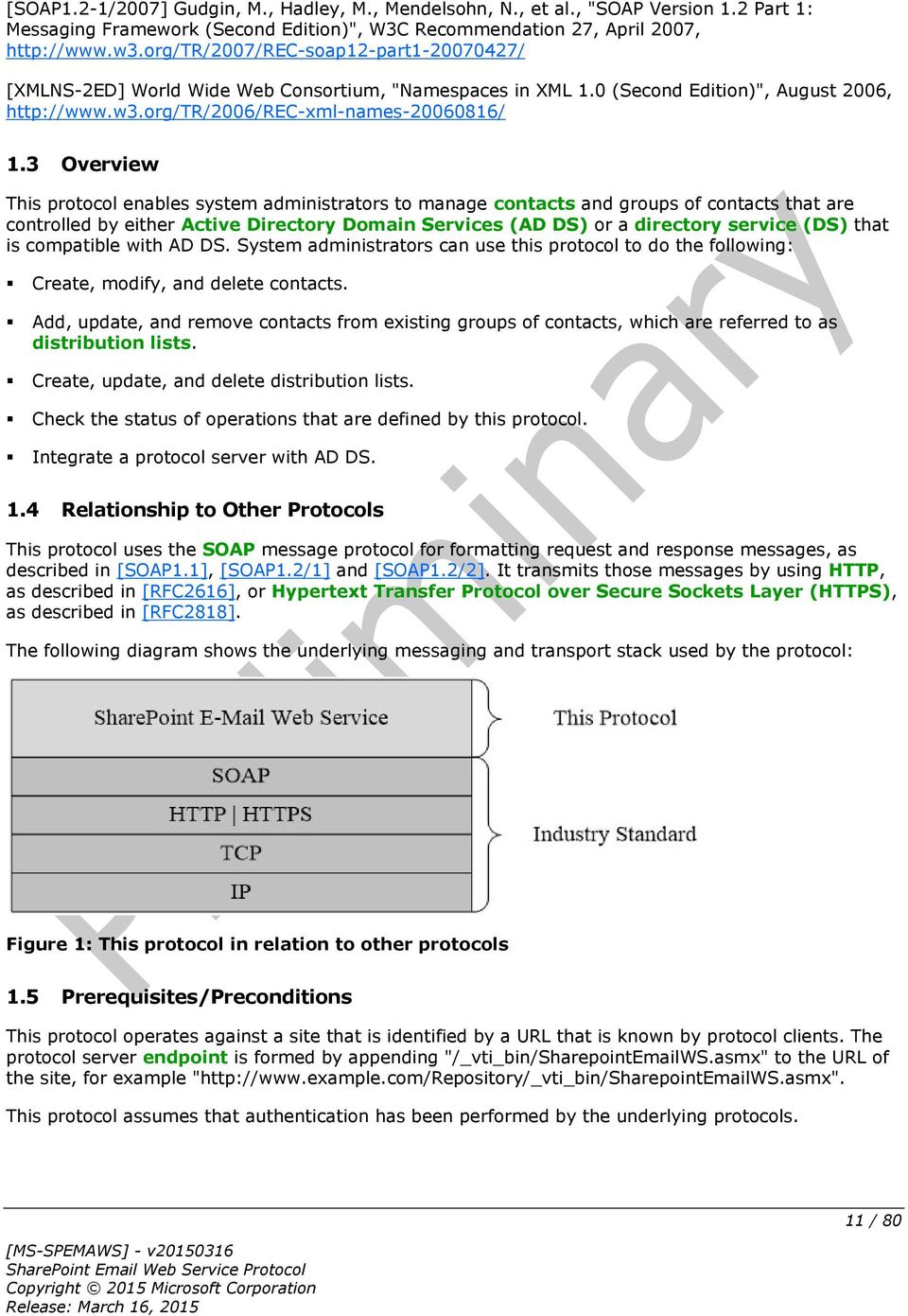
11 [SOAP1.2-1/2007] Gudgin, M., Hadley, M., Mendelsohn, N., et al., "SOAP Version 1.2 Part 1: Messaging Framework (Second Edition)", W3C Recommendation 27, April 2007, [XMLNS-2ED] World Wide Web Consortium, "Namespaces in XML 1.0 (Second Edition)", August 2006, Overview This protocol enables system administrators to manage contacts and groups of contacts that are controlled by either Active Directory Domain Services (AD DS) or a directory service (DS) that is compatible with AD DS. System administrators can use this protocol to do the following: Create, modify, and delete contacts. Add, update, and remove contacts from existing groups of contacts, which are referred to as distribution lists. Create, update, and delete distribution lists. Check the status of operations that are defined by this protocol. Integrate a protocol server with AD DS. 1.4 Relationship to Other Protocols This protocol uses the SOAP message protocol for formatting request and response messages, as described in [SOAP1.1], [SOAP1.2/1] and [SOAP1.2/2]. It transmits those messages by using HTTP, as described in [RFC2616], or Hypertext Transfer Protocol over Secure Sockets Layer (HTTPS), as described in [RFC2818]. The following diagram shows the underlying messaging and transport stack used by the protocol: Figure 1: This protocol in relation to other protocols 1.5 Prerequisites/Preconditions This protocol operates against a site that is identified by a URL that is known by protocol clients. The protocol server endpoint is formed by appending "/_vti_bin/sharepoint ws.asmx" to the URL of the site, for example " This protocol assumes that authentication has been performed by the underlying protocols. 11 / 80
12 1.6 Applicability Statement This protocol is designed to enable a protocol client to create, modify, or delete contacts and distribution lists that are controlled by either AD DS or a DS that is compatible with AD DS. It also enables a protocol server to require external approval for operations that are defined by this protocol. This protocol does not enable a protocol client to query the state of a DS. 1.7 Versioning and Capability Negotiation This protocol uses multiple transports as specified in section Vendor-Extensible Fields 1.9 Standards Assignments 12 / 80

13 2 Messages 2.1 Transport Protocol servers MUST support Simple Object Access Protocol (SOAP) over Hypertext Transfer Protocol (HTTP). Protocol servers SHOULD additionally support SOAP over Hypertext Transfer Protocol over Secure Sockets Layer (HTTPS) to help secure communications with protocol clients. Protocol messages MUST be formatted as specified in either [SOAP1.1] section 4 or [SOAP1.2/1] section 5. Server faults MUST be returned by using either HTTP status codes, as specified in [RFC2616] section 10, or SOAP faults, as specified in [SOAP1.1] section 4.4 or [SOAP1.2/1] section Common Message Syntax This section contains common definitions that are used by this protocol. The syntax of the definitions uses XML schema, as specified in [XMLSCHEMA1] and [XMLSCHEMA2], and WSDL, as specified in [WSDL] Namespaces This specification defines and references various XML namespaces using the mechanisms specified in [XMLNS]. Although this specification associates a specific XML namespace prefix for each XML namespace that is used, the choice of any particular XML namespace prefix is implementation-specific and not significant for interoperability. These namespaces are described in the following table. Prefix Namespace URI Reference Soap [SOAP1.1] Tns nt ws/ s1 S [XMLSCHEMA1] [XMLSCHEMA2] soap12 [SOAP1.2/1] [SOAP1.2/2] Wsdl [WSDL] 13 / 80
![Protocol messages MUST be formatted as specified in either [SOAP1.1] section 4 or [SOAP1.2/1] section 5.](/docs-images/44/15175757/images/page_13.jpg "Server faults MUST be returned by using either HTTP status codes, as specified in [RFC2616] section 10, or SOAP faults, as specified in [SOAP1.1] section 4.4 or [SOAP1.2/1] section 5.4. 2.")
14 2.2.2 Messages This specification does not define any common WSDL message definitions Elements This specification does not define any common XML schema element definitions Complex Types The following table summarizes the set of common XML schema complex type definitions defined by this specification. XML schema complex type definitions that are specific to a particular operation are described with the operation. Complex type Description ArrayOfString Stores an array of strings. RequestInfo Specifies information about a request to create, modify, or delete a distribution list. RequestResponse Contains return information for a request ArrayOfString The ArrayOfString complex type contains an array of string values. It is used by the ChangeContactsMembershipInDistributionGroup (section ) and ChangeUsersMembershipInDistributionGroup (section ) operations. <s:complextype name="arrayofstring"> <s:element name="string" type="s:string" nillable="true" minoccurs="0" maxoccurs="unbounded" /> string: A string variable that contains aliases of the contacts (3) or domain accounts for the users RequestInfo The RequestInfo complex type contains information about a request to create, modify, or delete a distribution list. It is used by the following operations: CreateDistributionGroup (section ) DeleteDistributionGroup (section ) ModifyDistributionGroup (section ) 14 / 80
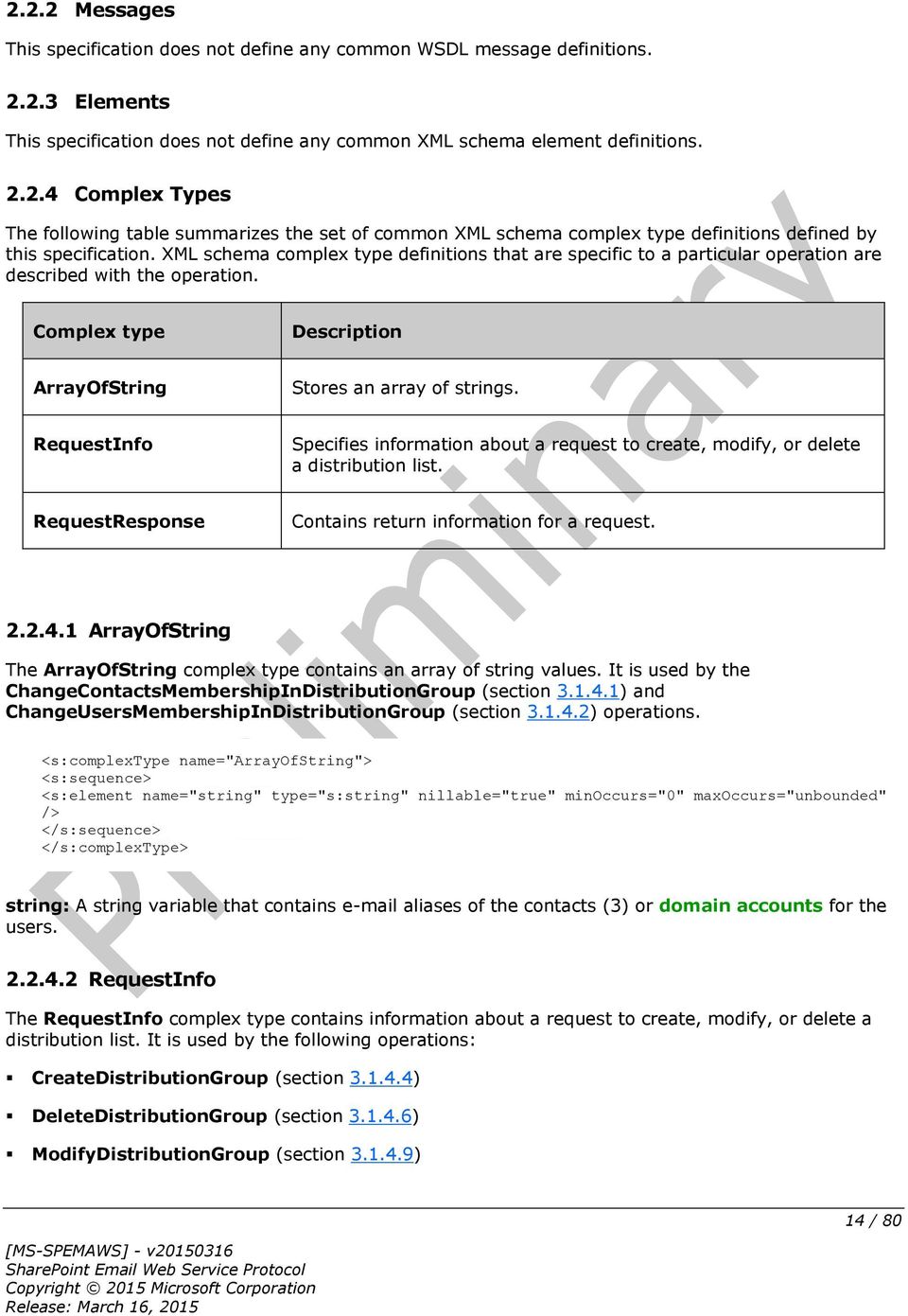
15 RenameDistributionGroup (section ) <s:complextype name="requestinfo"> <s:element name="requestor " type="s:string" /> <s:element name="justification" type="s:string" minoccurs="0" /> <s:element name="requestid" type="s1:guid" /> Requestor The address of the user who is attempting to create, modify, or delete the distribution list. This value MUST be 255 or fewer characters. Additional limitations on this value are defined in [MS-ADA1] section Justification: The requestor's reasons for making the request. This value MUST be 4,000 or fewer characters. RequestId: A GUID that identifies the request. This value MUST be ignored by the protocol server RequestResponse The RequestResponse complex type specifies return information for a request. It is used by the following operations: CreateDistributionGroup (section ) DeleteDistributionGroup (section ) GetJobStatus (section ) ModifyDistributionGroup (section ) RenameDistributionGroup (section ) <s:complextype name="requestresponse"> <s:element name="jobid" type="s:int" /> <s:element name="comment" type="s:string" minoccurs="0" /> <s:element name="jobstatus" type="tns:requeststatus" /> <s:element name="alias" type="s:string" minoccurs="0" /> JobID: An integer that identifies a newly created job or an existing job whose status is being retrieved by the GetJobStatus operation. If a new job was created, this value MUST be greater than 0. If the job creation failed and JobStatus equals AccessDenied, this value MUST be -1. Otherwise, if the job creation failed or the request was automatically approved, this value MUST be 0. Comment: A string that contains additional information about the request. JobStatus: A RequestStatus simple type (section ) that contains the status of the request. Alias: The alias of the contact or distribution list that the request applies to. 15 / 80
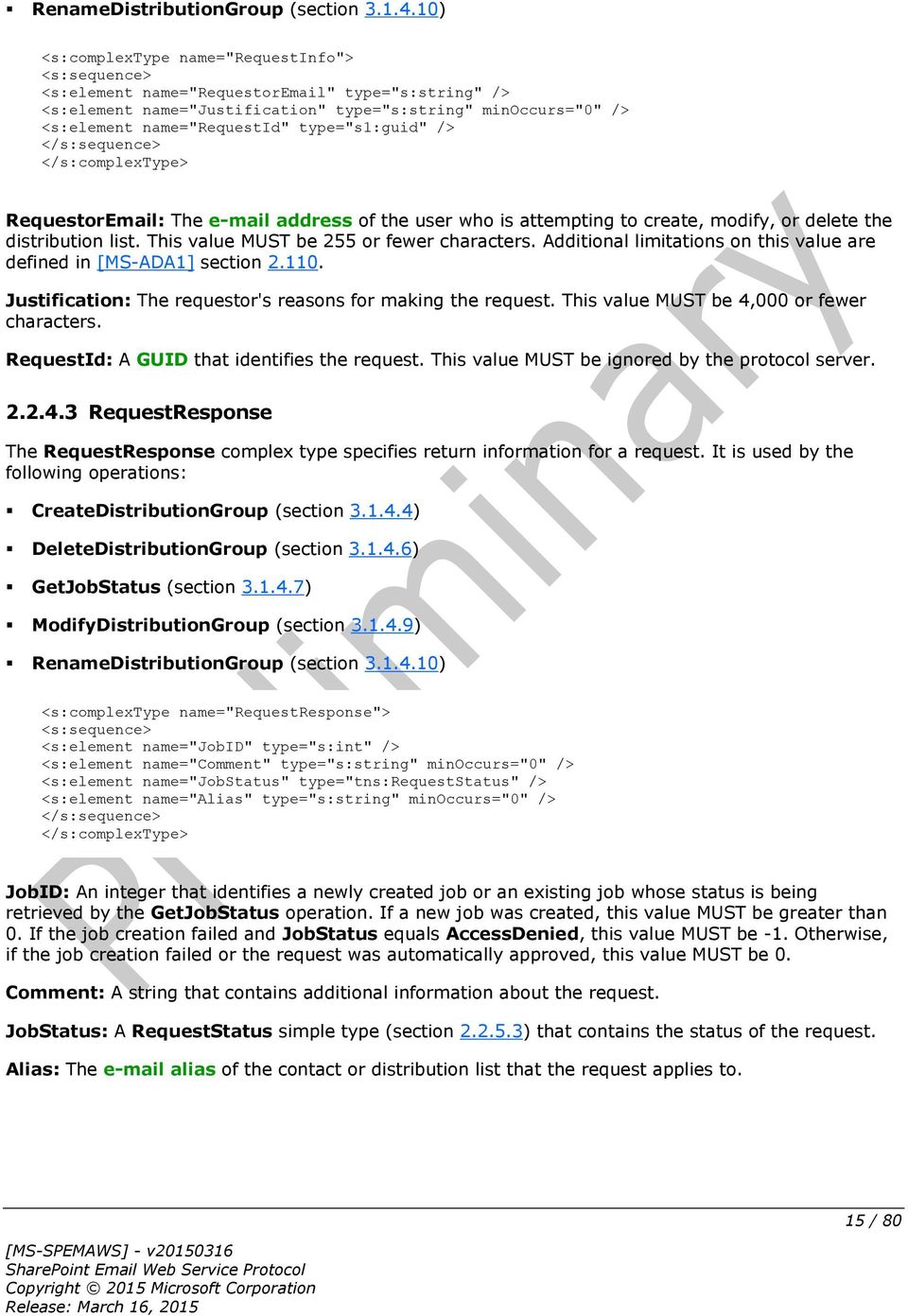
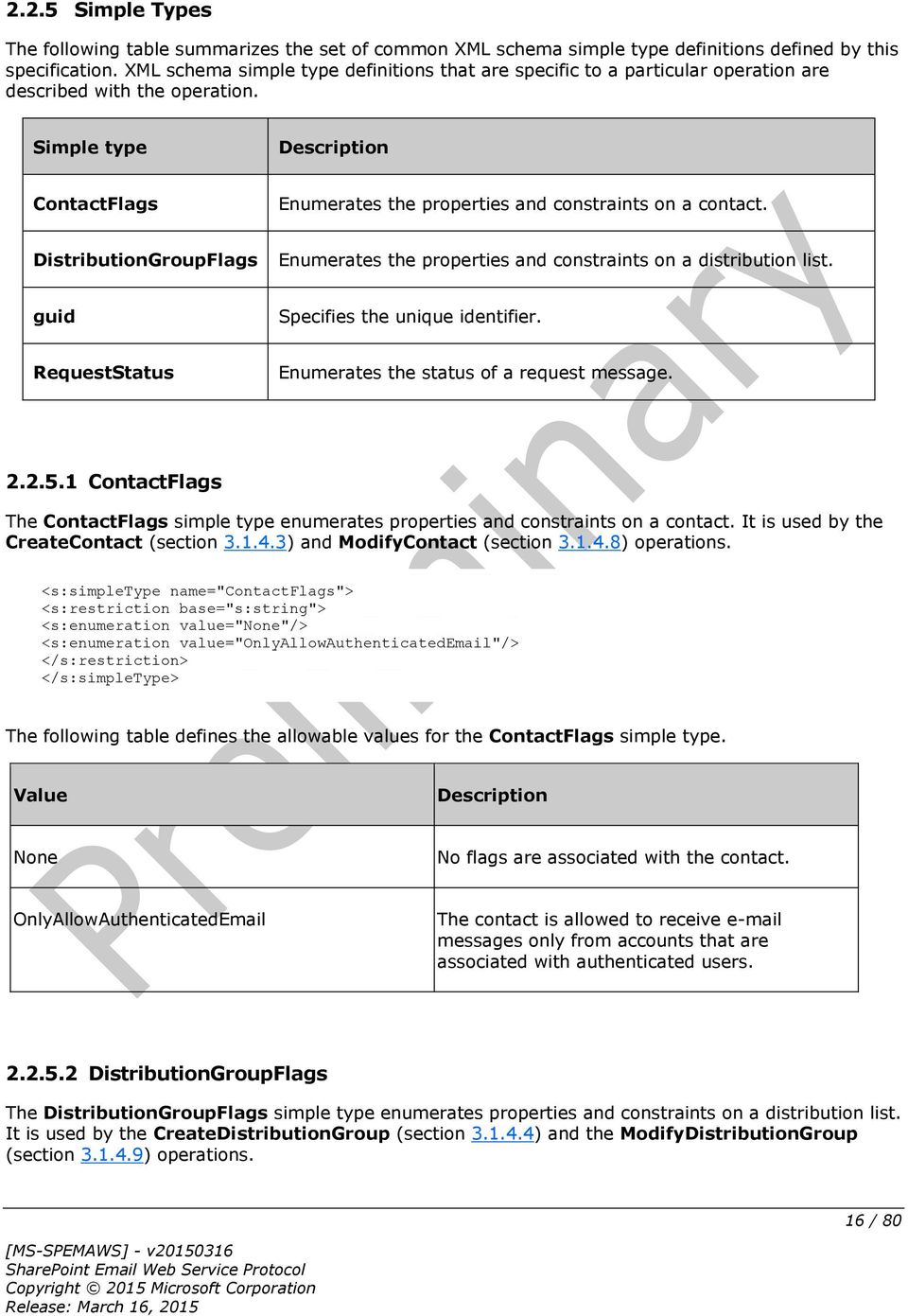
16 2.2.5 Simple Types The following table summarizes the set of common XML schema simple type definitions defined by this specification. XML schema simple type definitions that are specific to a particular operation are described with the operation. Simple type Description ContactFlags Enumerates the properties and constraints on a contact. DistributionGroupFlags Enumerates the properties and constraints on a distribution list. guid Specifies the unique identifier. RequestStatus Enumerates the status of a request message ContactFlags The ContactFlags simple type enumerates properties and constraints on a contact. It is used by the CreateContact (section ) and ModifyContact (section ) operations. <s:simpletype name="contactflags"> <s:restriction base="s:string"> <s:enumeration value="none"/> <s:enumeration value="onlyallowauthenticated "/> </s:restriction> </s:simpletype> The following table defines the allowable values for the ContactFlags simple type. Value Description None No flags are associated with the contact. OnlyAllowAuthenticated The contact is allowed to receive messages only from accounts that are associated with authenticated users DistributionGroupFlags The DistributionGroupFlags simple type enumerates properties and constraints on a distribution list. It is used by the CreateDistributionGroup (section ) and the ModifyDistributionGroup (section ) operations. 16 / 80
17 <s:simpletype name="distributiongroupflags"> <s:restriction base="s:string"> <s:enumeration value="none"/> <s:enumeration value="onlyallowauthenticated "/> </s:restriction> </s:simpletype> The following table defines the allowable values for the DistributionGroupFlags simple type. Value Description None No flags are associated with the distribution list. OnlyAllowAuthenticated The distribution list is allowed to receive messages only from authenticated users guid The guid simple type specifies the unique identifier.<1> <s:simpletype name="guid"> <s:restriction base="s:string"> <s:pattern value="[0-9a-fa-f]{8}-[0-9a-fa-f]{4}-[0-9a-fa-f]{4}-[0-9a-fa-f]{4}-[0-9a-fa- F]{12}" /> </s:restriction> </s:simpletype> RequestStatus The RequestStatus simple type enumerates the status of a request. It is used by the following operations: ChangeContactsMembershipInDistributionGroup (section ) ChangeUsersMembershipInDistributionGroup (section ) CreateContact (section ) DeleteContact (section ) ModifyContact (section ) It is also used by the RequestResponse complex type (section ). <s:simpletype name="requeststatus"> <s:restriction base="s:string"> <s:enumeration value="success"/> <s:enumeration value="pendingapproval"/> <s:enumeration value="approvaldenied"/> <s:enumeration value="duplicatealias"/> 17 / 80

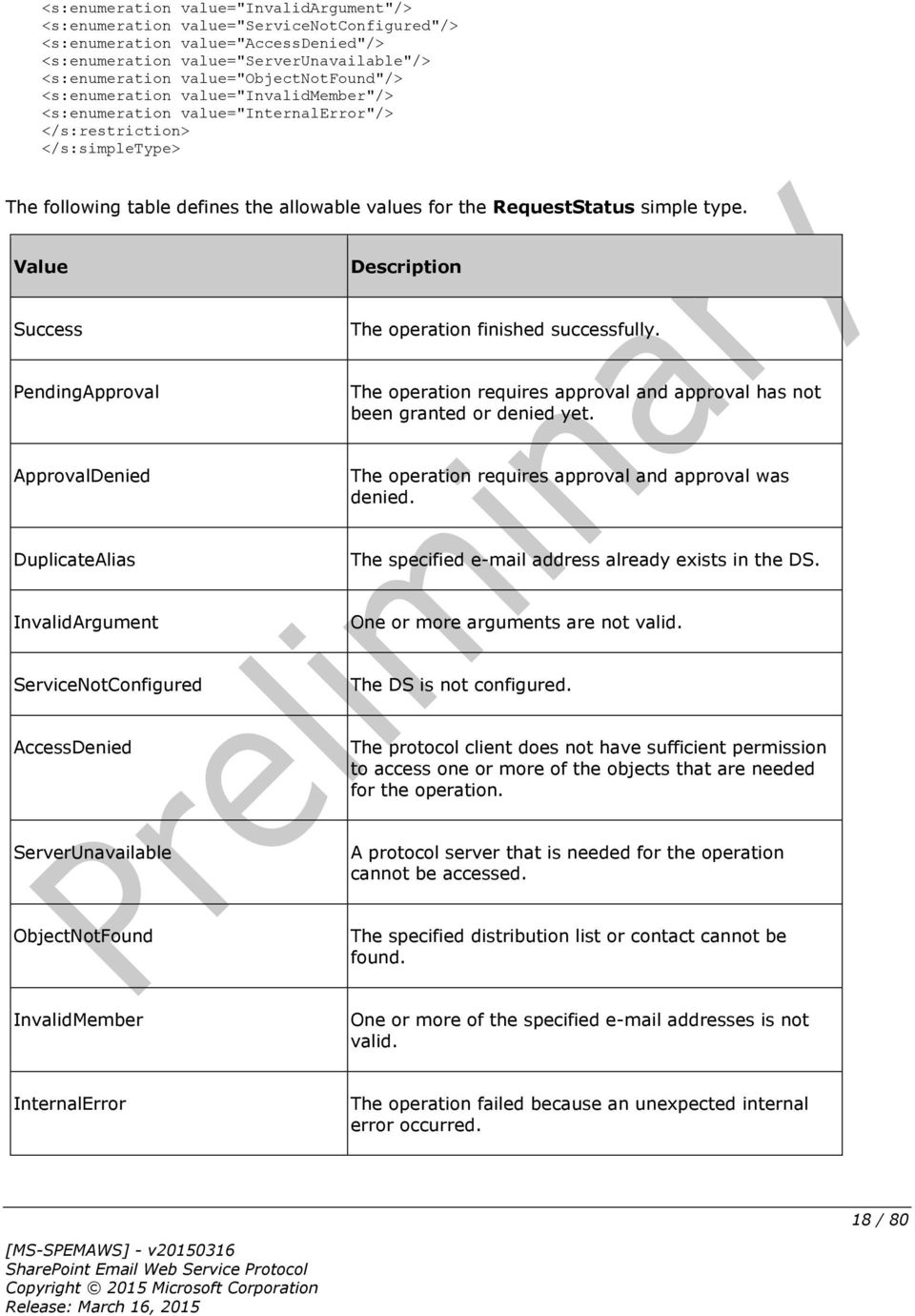
18 <s:enumeration value="invalidargument"/> <s:enumeration value="servicenotconfigured"/> <s:enumeration value="accessdenied"/> <s:enumeration value="serverunavailable"/> <s:enumeration value="objectnotfound"/> <s:enumeration value="invalidmember"/> <s:enumeration value="internalerror"/> </s:restriction> </s:simpletype> The following table defines the allowable values for the RequestStatus simple type. Value Description Success The operation finished successfully. PendingApproval The operation requires approval and approval has not been granted or denied yet. ApprovalDenied The operation requires approval and approval was denied. DuplicateAlias The specified address already exists in the DS. InvalidArgument One or more arguments are not valid. ServiceNotConfigured The DS is not configured. AccessDenied The protocol client does not have sufficient permission to access one or more of the objects that are needed for the operation. ServerUnavailable A protocol server that is needed for the operation cannot be accessed. ObjectNotFound The specified distribution list or contact cannot be found. InvalidMember One or more of the specified addresses is not valid. InternalError The operation failed because an unexpected internal error occurred. 18 / 80
19 2.2.6 Attributes This specification does not define any common XML schema attribute definitions Groups This specification does not define any common XML schema group definitions Attribute Groups This specification does not define any common XML schema attribute group definitions Common Data Structures This specification does not define any common XML schema data structures. 19 / 80
20 3 Protocol Details The client side of this protocol is simply a pass-through. That is, no additional timers or other state is required on the client side of this protocol. Calls made by the higher-layer protocol or application are passed directly to the transport, and the results returned by the transport are passed directly back to the higher-layer protocol or application. This protocol enables protocol servers to perform implementation-specific authorization checks and to notify protocol clients of authorization faults by using either HTTP status codes or SOAP faults. Except where specified otherwise, protocol clients SHOULD interpret HTTP status codes as specified in [RFC2616] section 10. Except where specified otherwise, SOAP faults are not significant for interoperability and protocol clients can interpret them in an implementation-specific manner. 3.1 Sharepoint WSSoap Server Details Abstract Data Model This section describes a conceptual model of possible data organization that an implementation maintains to participate in this protocol. The described organization is provided to facilitate the explanation of how the protocol behaves. This document does not mandate that implementations adhere to this model as long as their external behavior is consistent with that described in this document. The following diagram shows the server data structure. Figure 2: Data structure on a protocol server The back-end, data storage system maintains the following sets of data for this protocol. Contact: Contains information about contacts. Each contact (3) is uniquely identified by an alias that is assigned to it by a protocol client. DistributionGroup: Contains information about distribution lists. Each distribution list is uniquely identified by an alias that is assigned to it by a protocol client. Job: Contains information about changes that were requested by a protocol client. Each job is uniquely identified by a job identifier that is assigned to it by a protocol server. 20 / 80

21 DistributionGroupMembership: Contains information about contacts that are members of a distribution list Timers Initialization Message Processing Events and Sequencing Rules The following table summarizes the list of WSDL operations as defined by this specification: WSDL operation Description ChangeContactsMembershipInDistributionGroup Adds or removes contacts from a distribution list. ChangeUsersMembershipInDistributionGroup Adds or removes users from a distribution list. CreateContact Creates a new contact. CreateDistributionGroup Creates a new distribution list. DeleteContact Deletes a contact. DeleteDistributionGroup Deletes a distribution list. GetJobStatus Requests an update on the status of a request that was pending approval when it was last checked. ModifyContact Changes information about a contact. ModifyDistributionGroup Changes information about a distribution list. RenameDistributionGroup Changes the name of a distribution list. 21 / 80
22 ChangeContactsMembershipInDistributionGroup The ChangeContactsMembershipInDistributionGroup operation is used to add and remove contacts from a distribution list. <wsdl:operation name="changecontactsmembershipindistributiongroup"> <wsdl:input message="tns:changecontactsmembershipindistributiongroupsoapin" /> <wsdl:output message="tns:changecontactsmembershipindistributiongroupsoapout" /> </wsdl:operation> The protocol client sends a ChangeContactsMembershipInDistributionGroupSoapIn request message, and the protocol server responds with a ChangeContactsMembershipInDistributionGroupSoapOut response message. The following diagram shows the message sequence. Figure 3: Message sequence for a ChangeContactsMembershipInDistributionGroup operation Messages The following table summarizes the set of WSDL message definitions that are specific to this operation. Message Description ChangeContactsMembershipInDistributionGrou psoapin A request to initiate a ChangeContactsMembershipInDistri butiongroup operation. ChangeContactsMembershipInDistributionGrou psoapout A response from the protocol server at completion of the ChangeContactsMembershipInDistri butiongroup operation ChangeContactsMembershipInDistributionGroupSoapIn This is the request message for a ChangeContactsMembershipInDistributionGroup operation. The SOAP action value of the message is defined as follows. ibutiongroup 22 / 80
23 The SOAP body contains a ChangeContactsMembershipInDistributionGroup element ChangeContactsMembershipInDistributionGroupSoapOut This is the response message for a ChangeContactsMembershipInDistributionGroup operation. The SOAP action value of the message is defined as follows. ibutiongroup The SOAP body contains a ChangeContactsMembershipInDistributionGroupResponse element Elements The following table summarizes the XML schema element definitions that are specific to this operation. Element Description ChangeContactsMembershipInDistributionG roup Body of the ChangeContactsMembershipInDistribution GroupSoapIn message. ChangeContactsMembershipInDistributionG roupresponse Body of the ChangeContactsMembershipInDistribution GroupSoapOut message ChangeContactsMembershipInDistributionGroup The definition of the ChangeContactsMembershipInDistributionGroup element is as follows. <s:element name="changecontactsmembershipindistributiongroup"> <s:complextype> <s:element name="alias" type="s:string" /> <s:element name="addlistforcontacts" type="tns:arrayofstring" minoccurs="0" /> <s:element name="deletelistforcontacts" type="tns:arrayofstring" minoccurs="0" /> <s:element name="deleteallcurrentmembers" type="s:boolean" /> </s:element> Alias: The alias of the distribution list. This value MUST be 255 or fewer characters. Additional limitations on this value are specified in [MS-ADA1] section AddListForContacts: An array that contains the aliases of the contacts to add. DeleteListForContacts: An array that contains the aliases of the contacts to remove. DeleteAllCurrentMembers: A Boolean value that indicates whether to remove all members from the distribution list or only the contacts specified by the DeleteListForContacts element. If this value is true, the DeleteListForContacts element MUST be ignored by the server. 23 / 80
24 The addition of contacts to the distribution group MUST occur after all of the deletion requests are processed ChangeContactsMembershipInDistributionGroupResponse The definition of the ChangeContactsMembershipInDistributionGroupResponse element is as follows. <s:element name="changecontactsmembershipindistributiongroupresponse"> <s:complextype> <s:element name="changecontactsmembershipindistributiongroupresult" type="tns:requeststatus"/> </s:element> ChangeContactsMembershipInDistributionGroupResult: The protocol server MUST return a RequestStatus simple type (section ) in the response message. The response MUST contain one of the values described in the following table. Value Description RequestStatus.InvalidMember The value of the DeleteAllCurrentMembers element is "FALSE" and one of the aliases specified in the DeleteListForContacts element either cannot be found or is not a valid member of the distribution list. RequestStatus.ObjectNotFound The specified alias cannot be found. RequestStatus.AccessDenied The protocol client does not have sufficient permission to access one or more of the objects that are needed for the operation. RequestStatus.ServerUnavailable A protocol server that is required for the operation cannot be accessed. RequestStatus.InternalError The operation failed because an unexpected internal error occurred. RequestStatus.Success The operation finished successfully Complex Types Simple Types 24 / 80
25 Attributes Groups Attribute Groups ChangeUsersMembershipInDistributionGroup The ChangeUsersMembershipInDistributionGroup operation is used to add and remove users from a distribution list. <wsdl:operation name="changeusersmembershipindistributiongroup"> <wsdl:input message="tns:changeusersmembershipindistributiongroupsoapin" /> <wsdl:output message="tns:changeusersmembershipindistributiongroupsoapout" /> </wsdl:operation> The protocol client sends a ChangeUsersMembershipInDistributionGroupSoapIn request message and the protocol server responds with a ChangeUsersMembershipInDistributionGroupSoapOut response message. The following diagram shows the message sequence. Figure 4: Message sequence for a ChangeUsersMembershipInDistributionGroup operation Messages The following table summarizes the set of WSDL message definitions that are specific to this operation. Message Description ChangeUsersMembershipInDistributionGroupS oapin A request to initiate a ChangeUsersMembershipInDistributi ongroup operation. ChangeUsersMembershipInDistributionGroupS oapout A response from the protocol server at completion of the ChangeUsersMembershipInDistributi ongroup operation. 25 / 80
26 ChangeUsersMembershipInDistributionGroupSoapIn This is the request message for a ChangeUsersMembershipInDistributionGroup operation. The SOAP action value of the message is defined as follows. tiongroup The SOAP body contains a ChangeUsersMembershipInDistributionGroup element ChangeUsersMembershipInDistributionGroupSoapOut This is the response message for a ChangeUsersMembershipInDistributionGroup operation. The SOAP action value of the message is defined as follows. tiongroup The SOAP body contains a ChangeUsersMembershipInDistributionGroupResponse element Elements The following table summarizes the XML schema element definitions that are specific to this operation. Element Description ChangeUsersMembershipInDistributionGro up Body of the ChangeUsersMembershipInDistributionGro upsoapin message. ChangeUsersMembershipInDistributionGro upresponse Body of the ChangeUsersMembershipInDistributionGro upsoapout message ChangeUsersMembershipInDistributionGroup The definition of the ChangeUsersMembershipInDistributionGroup element is as follows. <s:element name="changeusersmembershipindistributiongroup"> <s:complextype> <s:element name="alias" type="s:string" minoccurs="0"/> <s:element name="addnt4namelist" type="tns:arrayofstring" minoccurs="0"/> <s:element name="deletent4namelist" type="tns:arrayofstring" minoccurs="0"/> <s:element name="deleteallcurrentmembers" type="s:boolean"/> 26 / 80
27 </s:element> Alias: The alias of the distribution list. This value MUST be 255 or fewer characters. Additional limitations on this value are specified in [MS-ADA1] section AddNt4NameList: An array that contains the domain accounts for the users to add. This can be NULL. DeleteNt4NameList: An array that contains the domain accounts for the users to remove. This can be NULL. DeleteAllCurrentMembers: A Boolean value that indicates whether to remove all users from the distribution list or only the users specified by the DeleteNt4NameList element. If this value is true, the DeleteListForContacts element MUST be ignored. The addition of users to the distribution group MUST occur after all of the deletion requests are processed ChangeUsersMembershipInDistributionGroupResponse The definition of the ChangeUsersMembershipInDistributionGroupResponse element is as follows. <s:element name="changeusersmembershipindistributiongroupresponse"> <s:complextype> <s:element name="changeusersmembershipindistributiongroupresult" type="tns:requeststatus"/> </s:element> ChangeUsersMembershipInDistributionGroupResult: The protocol server MUST return a RequestStatus simple type (section ) in the response message. The response MUST contain one of the values described in the following table. Value Description RequestStatus.ObjectNotFound The specified alias cannot be found in the DS. RequestStatus.AccessDenied The protocol client does not have sufficient permission to access one or more of the objects that are needed for the operation. RequestStatus.ServerUnavailable A protocol server that is required for the operation cannot be accessed. 27 / 80
28 Value Description RequestStatus.InternalError The operation failed because an unexpected internal error occurred or one of the aliases specified in the DeleteNt4NameList element either cannot be found or is not a valid member of the distribution list. RequestStatus.Success The valid specified accounts were added successfully. Invalid accounts were not added Complex Types Simple Types Attributes Groups Attribute Groups CreateContact The CreateContact operation is used to add a contact to a DS. <wsdl:operation name="createcontact"> <wsdl:input message="tns:createcontactsoapin" /> <wsdl:output message="tns:createcontactsoapout" /> </wsdl:operation> The protocol client sends a CreateContactSoapIn request message and the protocol server responds with a CreateContactSoapOut response message. The following diagram shows the message sequence. 28 / 80
29 Figure 5: Message sequence for a CreateContact operation Messages The following table summarizes the set of WSDL message definitions that are specific to this operation. Message Description CreateContactSoapIn A request to initiate a CreateContact operation. CreateContactSoapOut A response from the protocol server at completion of the CreateContact operation CreateContactSoapIn This is the request message for a CreateContact operation. The SOAP action value of the message is defined as follows. The SOAP body contains a CreateContact element CreateContactSoapOut This is the response message for a CreateContact operation. The SOAP action value of the message is defined as follows. The SOAP body contains a CreateContactResponse element Elements The following table summarizes the XML schema element definitions that are specific to this operation. 29 / 80
30 Element Description CreateContact Body of the CreateContactSoapIn message. CreateContactResponse Body of the CreateContactSoapOut message CreateContact The definition of the CreateContact element is as follows. <s:element name="createcontact"> <s:complextype> <s:element name="alias" type="s:string" /> <s:element name="firstname" type="s:string" /> <s:element name="lastname" type="s:string" /> <s:element name="forwarding " type="s:string" /> <s:element name="flags" type="tns:contactflags" /> </s:element> Alias: The alias of the contact. Limitations on this value are specified in [MS-ADA1] section Additionally, this value MUST consist of 255 or fewer characters. FirstName: The first name of the contact. Limitations on this value are specified in [MS-ADA1] section LastName: The last name of the contact. Limitations on this value are specified in [MS-ADA3] section Forwarding The address where messages are sent for the contact. Flags: A ContactFlags simple type (section ) that contains any additional properties or constraints on the contact CreateContactResponse The definition of the CreateContactResponse element is as follows. <s:element name="createcontactresponse"> <s:complextype> <s:element name="createcontactresult" type="tns:requeststatus"/> </s:element> CreateContactResult: The protocol server MUST return a RequestStatus simple type (section ) in the response message. The response MUST contain one of the values described in the following table. 30 / 80
31 Value Description RequestStatus.ServiceNotConfigured The DS is not configured. RequestStatus.InvalidArgument The specified alias contains zero characters or a semicolon (;). RequestStatus.DuplicateAlias The specified alias already exists in the DS. RequestStatus.AccessDenied The protocol client does not have sufficient permission to access one or more of the objects that are needed for the operation. RequestStatus.ServerUnavailable A protocol server that is needed for the operation cannot be accessed. RequestStatus.InternalError The operation failed because an unexpected internal error occurred. RequestStatus.Success The operation finished successfully Complex Types Simple Types Attributes Groups Attribute Groups CreateDistributionGroup The CreateDistributionGroup operation is used to create a distribution list in a DS. <wsdl:operation name="createdistributiongroup"> <wsdl:input message="tns:createdistributiongroupsoapin" /> <wsdl:output message="tns:createdistributiongroupsoapout" /> 31 / 80
32 </wsdl:operation> The protocol client sends a CreateDistributionGroupSoapIn request message and the protocol server responds with a CreateDistributionGroupSoapOut response message. The following diagram shows the message sequence. Figure 6: Message sequence for a CreateDistributionGroup operation Messages The following table summarizes the set of WSDL message definitions that are specific to this operation. Message Description CreateDistributionGroupSoapIn A request to initiate a CreateDistributionGroup operation. CreateDistributionGroupSoapOut A response from the protocol server at completion of the CreateDistributionGroup operation CreateDistributionGroupSoapIn This is the request message for a CreateDistributionGroup operation. The SOAP action value of the message is defined as follows. The SOAP body contains a CreateDistributionGroup element CreateDistributionGroupSoapOut This is the response message for a CreateDistributionGroup operation. The SOAP action value of the message is defined as follows. The SOAP body contains a CreateDistributionGroupResponse element. 32 / 80
33 Elements The following table summarizes the XML schema element definitions that are specific to this operation. Element Description CreateDistributionGroup Body of the CreateDistributionGroupSoapIn message. CreateDistributionGroupResponse Body of the CreateDistributionGroupSoapOut message CreateDistributionGroup The definition of the CreateDistributionGroup element is as follows. <s:element name="createdistributiongroup"> <s:complextype> <s:element name="alias" type="s:string" /> <s:element name="name" type="s:string" /> <s:element name="description" type="s:string" minoccurs="0" /> <s:element name="contactcn" type="s:string" minoccurs="0" /> <s:element name="info" type="tns:requestinfo" /> <s:element name="flags" type="tns:distributiongroupflags" /> </s:element> Alias: The alias of the distribution list. This value MUST be 255 or fewer characters. Additional limitations enforced on this value by the DS are specified in [MS-ADA1] section 2.110, which further restricts the number of characters to the "rangeupper" value. Name: The display name of the distribution list. This value MUST be 255 or fewer characters. Additional limitations on this value are specified in [MS-ADA1] section Description: The description of the distribution group. This value MUST be 4,000 or fewer characters. ContactCN: The alias of the contact to add to the distribution list. This value MUST be 255 or fewer characters. Additional limitations on this value are specified in [MS-ADA1] section Info: A RequestInfo complex type (section ) that contains additional information about the request to create the distribution list. Flags: A DistributionGroupFlags simple type (section ) that contains validation properties of the distribution list CreateDistributionGroupResponse The definition of the CreateDistributionGroupResponse element is as follows. <s:element name="createdistributiongroupresponse"> <s:complextype> 33 / 80
34 <s:element name="createdistributiongroupresult" type="tns:requestresponse" /> </s:element> CreateDistributionGroupResult: The protocol server MUST return a RequestResponse complex type (section ). The JobStatus element of the RequestResponse type MUST contain one of the values described in the following table. Value Description RequestStatus.ServiceNotConfigured The DS is not configured. RequestStatus.InvalidArgument The specified alias contains zero characters or a semicolon (;), or the Requestor element of the Info element is NULL. RequestStatus.DuplicateAlias The specified alias already exists in the collection of creation requests that are pending approval, or automatic approvals are enabled and the specified alias already exists in the DS. RequestStatus.AccessDenied Automatic approvals are enabled and the protocol client does not have sufficient permission to access one or more of the objects that are needed for the operation. RequestStatus.ServerUnavailable Automatic approvals are enabled and a protocol server that is needed for the operation cannot be accessed. RequestStatus.InternalError The operation failed because an unexpected internal error occurred. RequestStatus.ObjectNotFound Automatic approvals are enabled and the alias specified by the ContactCN element cannot be found in the DS. RequestStatus.PendingApproval Automatic approvals are disabled and a job was created for the request. RequestStatus.Success Automatic approvals are enabled and the operation finished successfully Complex Types 34 / 80
35 Simple Types Attributes Groups Attribute Groups DeleteContact The DeleteContact operation is used to delete a contact from a DS. <wsdl:operation name="deletecontact"> <wsdl:input message="tns:deletecontactsoapin" /> <wsdl:output message="tns:deletecontactsoapout" /> </wsdl:operation> The protocol client sends a DeleteContactSoapIn request message and the protocol server responds with a DeleteContactSoapOut response message. The following diagram shows the message sequence. Figure 7: Message sequence for a DeleteContact operation Messages The following table summarizes the set of WSDL message definitions that are specific to this operation. Message Description DeleteContactSoapIn A request to initiate a DeleteContact operation. DeleteContactSoapOut A response from the protocol server at completion of the DeleteContact operation. 35 / 80
36 DeleteContactSoapIn This is the request message for a DeleteContact operation. The SOAP action value of the message is defined as follows. The SOAP body contains a DeleteContact element DeleteContactSoapOut This is the response message for a DeleteContact operation. The SOAP action value of the message is defined as follows. The SOAP body contains a DeleteContactResponse element Elements The following table summarizes the XML schema element definitions that are specific to this operation. Element Description DeleteContact Body of the DeleteContactSoapIn message. DeleteContactResponse Body of the DeleteContactSoapOut message DeleteContact The definition of the DeleteContact element is as follows. <s:element name="deletecontact"> <s:complextype> <s:element name="alias" type="s:string" /> </s:element> Alias: The alias of the contact to delete from the DS. Limitations on this value are specified in [MS-ADA1] section Additionally, this value MUST consist of 255 or fewer characters. 36 / 80
37 DeleteContactResponse The definition of the DeleteContactResponse element is as follows. <s:element name="deletecontactresponse"> <s:complextype> <s:element name="deletecontactresult" type="tns:requeststatus"/> </s:element> DeleteContactResult: The protocol server MUST return a RequestStatus simple type (section ) in the response message. The response MUST contain one of the values described in the following table. Value Description RequestStatus.ServiceNotConfigured The DS is not configured. RequestStatus.InvalidArgument The specified alias contains zero characters or a semicolon (;). RequestStatus.ObjectNotFound The contact cannot be found in the DS. RequestStatus.AccessDenied The protocol client does not have sufficient permission to access one or more of the objects that are needed for the operation. RequestStatus.ServerUnavailable A protocol server that is needed for the operation cannot be accessed. RequestStatus.InternalError The operation failed because an unexpected internal error occurred. RequestStatus.Success The operation finished successfully Complex Types Simple Types Attributes 37 / 80
38 Groups Attribute Groups DeleteDistributionGroup The DeleteDistributionGroup operation is used to delete an existing distribution list from a DS. <wsdl:operation name="deletedistributiongroup"> <wsdl:input message="tns:deletedistributiongroupsoapin" /> <wsdl:output message="tns:deletedistributiongroupsoapout" /> </wsdl:operation> The protocol client sends a DeleteDistributionGroupSoapIn request message, and the protocol server responds with a DeleteDistributionGroupSoapOut response message. The following diagram shows the message sequence. Figure 8: Message sequence for a DeleteDistributionGroup operation Messages The following table summarizes the set of WSDL message definitions that are specific to this operation. Message Description DeleteDistributionGroupSoapIn A request to initiate a DeleteDistributionGroup operation. DeleteDistributionGroupSoapOut A response from the protocol server at completion of the DeleteDistributionGroup operation DeleteDistributionGroupSoapIn This is the request message for a DeleteDistributionGroup operation. The SOAP action value of the message is defined as follows. 38 / 80
39 The SOAP body contains a DeleteDistributionGroup element DeleteDistributionGroupSoapOut This is the response message for a DeleteDistributionGroup operation. The SOAP action value of the message is defined as follows. The SOAP body contains a DeleteDistributionGroupResponse element Elements The following table summarizes the XML schema element definitions that are specific to this operation. Element Description DeleteDistributionGroup Body of the DeleteDistributionGroupSoapIn message. DeleteDistributionGroupResponse Body of the DeleteDistributionGroupSoapOut message DeleteDistributionGroup The definition of the DeleteDistributionGroup element is as follows. <s:element name="deletedistributiongroup"> <s:complextype> <s:element name="alias" type="s:string" /> <s:element name="info" type="tns:requestinfo" /> </s:element> Alias: The alias of the distribution list to delete. This value MUST be 255 or fewer characters. Additional limitations enforced on this value by the DS are specified in [MS-ADA1] section 2.110, which further restricts the number of characters to the "rangeupper" value. Info: A RequestInfo complex type (section ) that contains additional information about the request to delete the distribution list DeleteDistributionGroupResponse 39 / 80
40 The definition of the DeleteDistributionGroupResponse element is as follows. <s:element name="deletedistributiongroupresponse"> <s:complextype> <s:element name="deletedistributiongroupresult" type="tns:requestresponse" /> </s:element> DeleteDistributionGroupResult: The protocol server MUST return a RequestResponse complex type (section ). The JobStatus element of the RequestResponse type MUST contain one of the values described in the following table. Value Description RequestStatus.ServiceNotConfigured The DS is not configured. RequestStatus.InvalidArgument The specified alias contains zero characters or a semicolon (;), or the Requestor element of the Info element is NULL. RequestStatus.ObjectNotFound The specified alias cannot be found in either the DS or the collection of distribution lists that are pending creation. RequestStatus.AccessDenied Automatic approvals are enabled and the protocol client does not have sufficient permission to access one or more of the objects that are needed for the operation. RequestStatus.ServerUnavailable Automatic approvals are enabled and a protocol server that is needed for the operation cannot be accessed. RequestStatus.InternalError The operation failed because an unexpected internal error occurred. RequestStatus.PendingApproval Automatic approvals are disabled and a job was created for the deletion request. RequestStatus.Success The operation finished successfully; the distribution group was deleted or a pending request to create the distribution group was cancelled Complex Types Simple Types 40 / 80
41 Attributes Groups Attribute Groups GetJobStatus The GetJobStatus operation is used to request an update on the status of an existing request that was created by any of the following operations: CreateDistributionGroup (section ) DeleteDistributionGroup (section ) ModifyDistributionGroup (section ) RenameDistributionGroup (section ) If the request was created by a CreateDistributionGroup operation, and the RequestStatus element (section ) returned by the GetJobStatus operation contains any value other than "PendingApproval" or "Success", both the job and the corresponding job identifier, as specified by the JobID element, are removed from the collection of jobs. If the request was created by any operation other than a CreateDistributionGroup operation, and the RequestStatus element (section ) returned by the GetJobStatus operation contains any value other than "PendingApproval", both the job and the corresponding job identifier, as specified by the JobID element, are removed from the collection of jobs. In all other cases, neither the job nor the corresponding job identifier is removed from the collection of jobs. <wsdl:operation name="getjobstatus"> <wsdl:input message="tns:getjobstatussoapin" /> <wsdl:output message="tns:getjobstatussoapout" /> </wsdl:operation> The protocol client sends a GetJobStatusSoapIn request message, and the protocol server responds with a GetJobStatusSoapOut response message. The following diagram shows the message sequence. 41 / 80
42 Figure 9: Message sequence for a GetJobStatus operation Messages The following table summarizes the set of WSDL message definitions that are specific to this operation. Message Description GetJobStatusSoapIn A request to initiate a GetJobStatus operation. GetJobStatusSoapOut A response from the protocol server at completion of the GetJobStatus operation GetJobStatusSoapIn This is the request message for a GetJobStatus operation. The SOAP action value of the message is defined as follows. The SOAP body contains a GetJobStatus element GetJobStatusSoapOut This is the response message for a GetJobStatus operation. The SOAP action value of the message is defined as follows. The SOAP body contains a GetJobStatusResponse element Elements The following table summarizes the XML schema element definitions that are specific to this operation. Element Description GetJobStatus Body of the GetJobStatusSoapIn message. GetJobStatusResponse Body of the GetJobStatusSoapOut message. 42 / 80
43 GetJobStatus The definition of the GetJobStatus element is as follows. <s:element name="getjobstatus"> <s:complextype> <s:element name="jobid" type="s:int" /> </s:element> JobId: The identifier that is returned in a RequestResponse type (section ) by the original operation, which is either a CreateDistributionGroup (section ), DeleteDistributionGroup (section ), ModifyDistributionGroup (section ), or RenameDistributionGroup (section ) operation. This identifier MUST be in the collection of jobs. If the identifier does not exist in the collection of jobs, the protocol server MUST return a SOAP fault exception GetJobStatusResponse The definition of the GetJobStatusResponse element is as follows. <s:element name="getjobstatusresponse"> <s:complextype> <s:element name="getjobstatusresult" type="tns:requestresponse" /> </s:element> GetJobStatusResult: The protocol server MUST return a RequestResponse complex type (section ) in the response message. The JobStatus element of the RequestResponse type MUST contain one of the values described in the following table. Value Description RequestStatus.AccessDenied The protocol client does not have sufficient permission to access one or more of the objects that are needed for the operation. RequestStatus.InvalidArgument The value of the JobId element is less than or equal to zero. RequestStatus.ApprovalDenied Approval was denied for the job specified by the JobId element. RequestStatus.PendingApproval Approval has been neither granted nor denied yet for the job specified by the JobId element. 43 / 80
44 Value Description RequestStatus.InternalError The operation failed because an unexpected internal error occurred. RequestStatus.Success Approval was granted for the job specified by the JobId element Complex Types Simple Types Attributes Groups Attribute Groups ModifyContact The ModifyContact operation is used to modify the properties of an existing contact in a DS. <wsdl:operation name="modifycontact"> <wsdl:input message="tns:modifycontactsoapin" /> <wsdl:output message="tns:modifycontactsoapout" /> </wsdl:operation> The protocol client sends a ModifyContactSoapIn request message, and the protocol server responds with a ModifyContactSoapOut response message. The following diagram shows the message sequence. Figure 10: Message sequence for a ModifyContact operation 44 / 80
45 Messages The following table summarizes the set of WSDL message definitions that are specific to this operation. Message Description ModifyContactSoapIn A request to initiate a ModifyContact operation. ModifyContactSoapOut A response from the protocol server at completion of the ModifyContact operation ModifyContactSoapIn This is the request message for a ModifyContact operation. The SOAP action value of the message is defined as follows. The SOAP body contains a ModifyContact element ModifyContactSoapOut This is the response message for a ModifyContact operation. The SOAP action value of the message is defined as follows. The SOAP body contains a ModifyContactResponse element Elements The following table summarizes the XML schema element definitions that are specific to this operation. Element Description ModifyContactStatus Body of the ModifyContactSoapIn message. ModifyContactResponse Body of the ModifyContactSoapOut message. 45 / 80
46 ModifyContact The definition of the ModifyContact element is as follows. <s:element name="modifycontact"> <s:complextype> <s:element name="oldalias" type="s:string" /> <s:element name="newalias" type="s:string" minoccurs="0"/> <s:element name="firstname" type="s:string" /> <s:element name="lastname" type="s:string" /> <s:element name="forwarding " type="s:string" minoccurs="0"/> <s:element name="flags" type="tns:contactflags" /> </s:element> OldAlias: The current alias of the contact. Limitations on this value are specified in [MS-ADA1] section Additionally, this value MUST consist of 255 or fewer characters. NewAlias: The new alias of the contact. If a value is not specified, the alias of the contact is not changed. Limitations on this value are specified in [MS-ADA1] section Additionally, this value MUST consist of 255 or fewer characters. FirstName: The first name of the contact (3). Limitations on this value are specified in [MS-ADA1] section LastName: The last name of the contact (3). Limitations on this value are specified in [MS-ADA3] section Forwarding The address where messages are forwarded for the contact (3). Flags: A ContactFlags simple type (section ) that contains any additional properties or constraints on the contact (3) ModifyContactResponse The definition of the ModifyContactResponse element is as follows. <s:element name="modifycontactresponse"> <s:complextype> <s:element name="modifycontactresult" type="tns:requeststatus"/> </s:element> ModifyContactResult: The protocol server MUST return a RequestStatus simple type (section ) in the response message. The response MUST contain one of the values described in the following table. Value Description RequestStatus.ServiceNotConfigured The DS is not configured. 46 / 80
47 Value Description RequestStatus.InvalidArgument The value of the OldAlias element contains zero characters, or the value of the OldAlias or NewAlias element contains a semicolon (;). RequestStatus.DuplicateAlias A value was specified by the NewAlias element and that value is not equal to the value of the OldAlias element, ignoring case. However, the value specified by the NewAlias element already exists in the DS. RequestStatus.AccessDenied The protocol client does not have sufficient permission to access one or more of the objects that are needed for the operation. RequestStatus.ServerUnavailable A protocol server that is needed for the operation cannot be accessed. RequestStatus.ObjectNotFound The value specified by the OldAlias element does not exist in the DS. RequestStatus.InternalError The operation failed because an unexpected internal error occurred. RequestStatus.Success The operation finished successfully Complex Types Simple Types Attributes Groups Attribute Groups 47 / 80
48 ModifyDistributionGroup The ModifyDistributionGroup operation is used to change properties of an existing distribution list in a DS. <wsdl:operation name="modifydistributiongroup"> <wsdl:input message="tns:modifydistributiongroupsoapin" /> <wsdl:output message="tns:modifydistributiongroupsoapout" /> </wsdl:operation> The protocol client sends a ModifyDistributionGroupSoapIn request message, and the protocol server responds with a ModifyDistributionGroupSoapOut response message. The following diagram shows the message sequence. Figure 11: Message sequence for a ModifyDistributionGroup operation Messages The following table summarizes the set of WSDL message definitions that are specific to this operation. Message Description ModifyDistributionGroupSoapIn A request to initiate a ModifyDistributionGroup operation. ModifyDistributionGroupSoapOut A response from the protocol server at completion of the ModifyDistributionGroup operation ModifyDistributionGroupSoapIn This is the request message for a ModifyDistributionGroup operation. The SOAP action value of the message is defined as follows. The SOAP body contains a ModifyDistributionGroup element ModifyDistributionGroupSoapOut This is the response message for a ModifyDistributionGroup operation. 48 / 80
49 The SOAP action value of the message is defined as follows. The SOAP body contains a ModifyDistributionGroupResponse element Elements The following table summarizes the XML schema element definitions that are specific to this operation. Element Description ModifyDistributionGroup Body of the ModifyDistributionGroupSoapIn message. ModifyDistributionGroupResponse Body of the ModifyDistributionGroupSoapOut message ModifyDistributionGroup The definition of the ModifyDistributionGroup element is as follows. <s:element name="modifydistributiongroup"> <s:complextype> <s:element name="alias" type="s:string" /> <s:element name="name" type="s:string" /> <s:element name="description" type="s:string" minoccurs="0" /> <s:element name="contactcn" type="s:string" minoccurs="0" /> <s:element name="info" type="tns:requestinfo" /> <s:element name="flags" type="tns:distributiongroupflags" /> </s:element> Alias: The alias of the distribution list. This value MUST be 255 or fewer characters. Additional limitations enforced on this value by the DS are specified in [MS-ADA1] section 2.110, which further restricts the number of characters to the "rangeupper" value. Name: The new display name of the distribution list. This value MUST be 255 or fewer characters. Additional limitations on this value are specified in [MS-ADA1] section Description: The new description of the distribution list. This value MUST be 4,000 or fewer characters. ContactCN: The alias of a contact to add to the distribution list. This value MUST be 255 or fewer characters. Additional limitations on this value are specified in [MS-ADA1] section Info: A RequestInfo complex type (section ) that contains additional information about the request. 49 / 80
50 Flags: A DistributionGroupFlags simple type (section ) that contains updated validation properties or constraints on the distribution list ModifyDistributionGroupResponse The definition of the ModifyDistributionGroupResponse element is as follows. <s:element name="modifydistributiongroupresponse"> <s:complextype> <s:element name="modifydistributiongroupresult" type="tns:requestresponse" /> </s:element> ModifyDistributionGroupResult: The protocol server MUST return a RequestResponse complex type (section ) in the response message. The value of the JobStatus element of the RequestResponse type MUST be one of the values described in the following table. Value Description RequestStatus.ServiceNotConfigured The DS is not configured. RequestStatus.InvalidArgument The value specified by the Alias element is not valid or the Requestor element of the Info element is NULL. RequestStatus.ObjectNotFound The value specified by the Alias element cannot be found in the DS or automatic approvals are enabled and the value specified by the ContactCN element cannot be found in the DS. RequestStatus.AccessDenied Automatic approvals are enabled but the protocol client does not have sufficient permission to access one or more of the objects that are needed for the operation. RequestStatus.ServerUnavailable Automatic approvals are enabled and a protocol server that is required for the operation cannot be accessed. RequestStatus.InternalError The operation failed because an unexpected internal error occurred. RequestStatus.PendingApproval Automatic approvals are disabled and a job was created for the request. RequestStatus.Success Automatic approvals are enabled and the operation finished successfully. 50 / 80
51 Complex Types Simple Types Attributes Groups Attribute Groups RenameDistributionGroup The RenameDistributionGroup operation is used to change the name of an existing distribution list in a DS. <wsdl:operation name="renamedistributiongroup"> <wsdl:input message="tns:renamedistributiongroupsoapin" /> <wsdl:output message="tns:renamedistributiongroupsoapout" /> </wsdl:operation> The protocol client sends a RenameDistributionGroupSoapIn request message, and the protocol server responds with a RenameDistributionGroupSoapOut response message. The following diagram shows the message sequence. Figure 12: Message sequence for a RenameDistributionGroup operation Messages The following table summarizes the set of WSDL message definitions that are specific to this operation. Message Description RenameDistributionGroupSoapIn A request to initiate a RenameDistributionGroup operation. 51 / 80
52 RenameDistributionGroupSoapOut A response from the protocol server at completion of the RenameDistributionGroup operation RenameDistributionGroupSoapIn This is the request message for a RenameDistributionGroup operation. The SOAP action value of the message is defined as follows. The SOAP body contains a RenameDistributionGroup element RenameDistributionGroupSoapOut This is the response message for a RenameDistributionGroup operation. The SOAP action value of the message is defined as follows. The SOAP body contains a RenameDistributionGroupResponse element Elements The following table summarizes the XML schema element definitions that are specific to this operation. Element Description RenameDistributionGroup Body of the RenameDistributionGroupSoapIn message. RenameDistributionGroupResponse Body of the RenameDistributionGroupSoapOut message RenameDistributionGroup The definition of the RenameDistributionGroup is as follows. <s:element name="renamedistributiongroup"> <s:complextype> <s:element name="oldalias" type="s:string" /> <s:element name="newalias" type="s:string" /> 52 / 80
53 <s:element name="info" type="tns:requestinfo" /> </s:element> OldAlias: The alias of the distribution list. This value MUST be 255 or fewer characters. Additional limitations enforced on this value by the DS are specified in [MS-ADA1] section 2.110, which further restricts the number of characters to the "rangeupper" value. NewAlias: The new alias for the distribution list. This value MUST be 255 or fewer characters. Additional limitations enforced on this value by the DS are specified in [MS-ADA1] section 2.110, which further restricts the number of characters to the "rangeupper" value. Info: A RequestInfo complex type (section ) that contains additional information about the request RenameDistributionGroupResponse The definition of the RenameDistributionGroupResponse element is as follows. <s:element name="renamedistributiongroupresponse"> <s:complextype> <s:element name="renamedistributiongroupresult" type="tns:requestresponse" /> </s:element> RenameDistributionGroupResult: The protocol server MUST return a RequestResponse complex type (section ) in the response message. The value of the JobStatus element of the RequestResponse type MUST be one of the values described in the following table. Value Description RequestStatus.ServiceNotConfigured The DS is not configured. RequestStatus.InvalidArgument The value specified by the OldAlias element or the NewAlias element contains zero characters or a semicolon (;), or the Requestor element of the Info element is NULL. RequestStatus.ObjectNotFound The value specified by the OldAlias element cannot be found in the DS. RequestStatus.DuplicateAlias The value specified by the NewAlias element already exists in the DS. RequestStatus.AccessDenied Automatic approvals are enabled and the protocol client does not have sufficient permission to access one or more of the objects that are needed for the operation. 53 / 80
54 Value Description RequestStatus.ServerUnavailable Automatic approvals are enabled and a protocol server that is required for the operation cannot be accessed. RequestStatus.InternalError The operation failed because an unexpected internal error occurred. RequestStatus.PendingApproval Automatic approvals are disabled and a job was created for the request. RequestStatus.Success Automatic approvals are enabled and the operation finished successfully Complex Types Simple Types Attributes Groups Attribute Groups Timer Events Other Local Events 54 / 80
55 4 Protocol Examples 4.1 Create and Add a User to a Distribution List This scenario demonstrates how to create a new distribution list, add a user to a distribution list, and verify that the requests were approved Create a Distribution List In this example, a new distribution list named "DistGroup01" is created on the protocol server, in response to a request from a protocol client. The alias of the distribution list is "DistGroup01". The protocol client sends the following request message: <soap:envelope xmlns:soap=" xmlns:xsi=" xmlns:xsd=" <soap:body> <CreateDistributionGroup xmlns=" <Alias>DistGroup01</Alias> <Name>DistGroup01</Name> <ContactCN /> <Info> <Requestor >[email protected]</Requestor > <RequestId> </RequestId> </Info> <Flags>None</Flags> </CreateDistributionGroup> </soap:body> </soap:envelope> The protocol server is configured to approve requests automatically. Therefore, it creates the distribution list and returns the status value "Success" in the following response message: <soap:envelope xmlns:soap=" xmlns:xsi=" xmlns:xsd=" <soap:body> <CreateDistributionGroupResponse xmlns=" <CreateDistributionGroupResult> <JobID>0</JobID> <JobStatus>Success</JobStatus> <Alias>DistGroup01</Alias> </CreateDistributionGroupResult> </CreateDistributionGroupResponse> </soap:body> </soap:envelope> Add a User to a Distribution List In this example, the user uniquely identified by the domain account "Example\smasters" is added to a distribution list named "addmembersdl". The protocol client sends the following request message: 55 / 80
56 <soap:envelope xmlns:soap=" xmlns:xsi=" xmlns:xsd=" <soap:body> <ChangeUsersMembershipInDistributionGroup xmlns=" <Alias>addmembersdl</Alias> <AddNt4NameList> <string>example\smasters</string> </AddNt4NameList> <DeleteNt4NameList /> <DeleteAllCurrentMembers>false</DeleteAllCurrentMembers> </ChangeUsersMembershipInDistributionGroup> </soap:body> </soap:envelope> The protocol server adds the domain account "Example\smasters" to the distribution list named "addmembersdl" and returns the status value "Success" in the following response message: <soap:envelope xmlns:soap=" xmlns:xsi=" xmlns:xsd=" <soap:body> <ChangeUsersMembershipInDistributionGroupResponse xmlns=" <ChangeUsersMembershipInDistributionGroupResult>Success</ChangeUsersMembershipInDistributionG roupresult> </ChangeUsersMembershipInDistributionGroupResponse> </soap:body> </soap:envelope> 4.2 Create and Add a Contact to a Distribution List This scenario demonstrates how to create a new contact and how to add a contact to an existing distribution list Create a Contact In this example, a contact named "Steve Masters" is added to the DS. The contact s alias is "Steve.Masters". The contact s forwarding address is "[email protected]". The protocol client sends the following request message: <soap:envelope xmlns:soap=" xmlns:xsi=" xmlns:xsd=" <soap:body> <CreateContact xmlns=" <Alias>Steve.Masters</Alias> <FirstName>Steve</FirstName> <LastName>Masters</LastName> <Forwarding >[email protected]</Forwarding > <Flags>None</Flags> </CreateContact> </soap:body> </soap:envelope> 56 / 80
57 The protocol server adds the contact "Steve Masters" to the DS and returns the status value "Success" in the following response message: <soap:envelope xmlns:soap=" xmlns:xsi=" xmlns:xsd=" <soap:body> <CreateContactResponse xmlns=" <CreateContactResult>Success</CreateContactResult> </CreateContactResponse> </soap:body> </soap:envelope> Add a Contact to a Distribution List In this example, a contact with the alias "Lori.Kane" is added to the distribution list named "AddMembersDL". The protocol client sends the following request message: <soap:envelope xmlns:soap=" xmlns:xsi=" xmlns:xsd=" <soap:body> <ChangeContactsMembershipInDistributionGroup xmlns=" <Alias>AddMembersDL</Alias> <AddListForContacts> <string>lori.kane</string> </AddListForContacts> <DeleteListForContacts> <string /> </DeleteListForContacts> <DeleteAllCurrentMembers>false</DeleteAllCurrentMembers> </ChangeContactsMembershipInDistributionGroup> </soap:body> </soap:envelope> The protocol server adds the contact to the distribution list and returns the status value "Success" in the following response message: <soap:envelope xmlns:soap=" xmlns:xsi=" xmlns:xsd=" <soap:body> <ChangeContactsMembershipInDistributionGroupResponse xmlns=" <ChangeContactsMembershipInDistributionGroupResult>Success</ChangeContactsMembershipInDistrib utiongroupresult> </ChangeContactsMembershipInDistributionGroupResponse> </soap:body> </soap:envelope> 4.3 Modify a Contact This scenario demonstrates how to modify an existing contact in a DS. The contact s (3) alias is changed from "steve.masters" to "steved.masters". The contact s (3) name is changed from "Steve 57 / 80
58 Masters" to "Steve D Masters". The contact s (3) forwarding address is changed from "[email protected]" to "[email protected]". The protocol client sends the following request message: <soap:envelope xmlns:soap=" xmlns:xsi=" xmlns:xsd=" <soap:body> <ModifyContact xmlns=" <OldAlias>steve.masters</OldAlias> <NewAlias>steved.masters</NewAlias> <FirstName>Steve D</FirstName> <LastName>Masters</LastName> <Forwarding >[email protected]</Forwarding > <Flags>None</Flags> </ModifyContact> </soap:body> </soap:envelope> The protocol server retrieves the existing contact, updates the requested properties of that contact (3), and returns the status value "Success" in the following response message: <soap:envelope xmlns:soap=" xmlns:xsi=" xmlns:xsd=" <soap:body> <ModifyContactResponse xmlns=" <ModifyContactResult>Success</ModifyContactResult> </ModifyContactResponse> </soap:body> </soap:envelope> 4.4 Remove a Contact and Rename a Distribution List This scenario demonstrates how to remove a contact from a distribution list, delete a contact (3), and rename a distribution list Remove a Contact from a Distribution List In this example, a contact with the alias "steved.masters" is removed from the distribution list named "AddMembersDL". The protocol client sends the following request message: <soap:envelope xmlns:soap=" xmlns:xsi=" xmlns:xsd=" <soap:body> <ChangeContactsMembershipInDistributionGroup xmlns=" <Alias>AddMembersDL</Alias> <AddListForContacts> <string /> </AddListForContacts> <DeleteListForContacts> <string>steved.masters</string> </DeleteListForContacts> 58 / 80
59 <DeleteAllCurrentMembers>false</DeleteAllCurrentMembers> </ChangeContactsMembershipInDistributionGroup> </soap:body> </soap:envelope> The protocol server removes the contact from the distribution list and returns the status value "Success" in the following response message: <soap:envelope xmlns:soap=" xmlns:xsi=" xmlns:xsd=" <soap:body> <ChangeContactsMembershipInDistributionGroupResponse xmlns=" <ChangeContactsMembershipInDistributionGroupResult>Success</ChangeContactsMembershipInDistrib utiongroupresult> </ChangeContactsMembershipInDistributionGroupResponse> </soap:body> </soap:envelope> Delete a Contact In this example, the contact with the alias "steved.masters" is deleted from the DS. The protocol client sends the following request message: <soap:envelope xmlns:soap=" xmlns:xsi=" xmlns:xsd=" <soap:body> <DeleteContact xmlns=" <Alias>steved.masters</Alias> </DeleteContact> </soap:body> </soap:envelope> The protocol server deletes the contact (3) with the specified alias, and returns the status value "Success" in the following response message: <soap:envelope xmlns:soap=" xmlns:xsi=" xmlns:xsd=" <soap:body> <DeleteContactResponse xmlns=" <DeleteContactResult>Success</DeleteContactResult> </DeleteContactResponse> </soap:body> </soap:envelope> Change the Name of a Distribution List In this example, a protocol client with the address "[email protected]" submits a request to change the alias of an existing distribution list from "DistGroup01" to "RenamedDG01". 59 / 80
60 The protocol client sends the following request message: <soap:envelope xmlns:soap=" xmlns:xsi=" xmlns:xsd=" <soap:body> <RenameDistributionGroup xmlns=" <OldAlias>DistGroup01</OldAlias> <NewAlias>RenamedDG01</NewAlias> <Info> <RequestId> </RequestId> </Info> </RenameDistributionGroup> </soap:body> </soap:envelope> The protocol server is not configured to approve requests automatically. Therefore, it creates a job for the request, stores the job as a RequestStatus simple type (section ) with the value "PendingApproval", and returns information about this job in the following response message: <soap:envelope xmlns:soap=" xmlns:xsi=" xmlns:xsd=" <soap:body> <RenameDistributionGroupResponse xmlns=" <RenameDistributionGroupResult> <JobID>76</JobID> <JobStatus>PendingApproval</JobStatus> <Alias>DistGroup01</Alias> </RenameDistributionGroupResult> </RenameDistributionGroupResponse> </soap:body> </soap:envelope> 4.5 Modify a Distribution List In this example, a protocol client with the address "[email protected]" submits a request to change the display name of an existing distribution list from "RenamedDG01" to "NewNameDG01". The protocol client sends the following request message: <soap:envelope xmlns:soap=" xmlns:xsi=" xmlns:xsd=" <soap:body> <ModifyDistributionGroup xmlns=" <Alias>RenamedDG01</Alias> <Name>NewNameDG01</Name> <Description>any description</description> <Info> <Requestor >[email protected]</Requestor > <RequestId> </RequestId> </Info> <Flags>None</Flags> </ModifyDistributionGroup> </soap:body> 60 / 80
61 </soap:envelope> The protocol server is not configured to approve requests automatically. Therefore, it creates a job for the modify request, stores that job as a RequestStatus simple type (section ) with the value "PendingApproval", and returns information about the job in the following response message: <soap:envelope xmlns:soap=" xmlns:xsi=" xmlns:xsd=" <soap:body> <ModifyDistributionGroupResponse xmlns=" <ModifyDistributionGroupResult> <JobID>78</JobID> <JobStatus>PendingApproval</JobStatus> <Alias>RenamedDG01</Alias> </ModifyDistributionGroupResult> </ModifyDistributionGroupResponse> </soap:body> </soap:envelope> 4.6 Delete a Distribution List In this example, a protocol client with the address "[email protected]" submits a request to delete an existing distribution list, which has the alias "RenamedDG01". The protocol client sends the following request message: <soap:envelope xmlns:soap=" xmlns:xsi=" xmlns:xsd=" <soap:body> <DeleteDistributionGroup xmlns=" <Alias>RenamedDG01</Alias> <Info> <Requestor >[email protected]</Requestor > <RequestId> </RequestId> </Info> </DeleteDistributionGroup> </soap:body> </soap:envelope> The protocol server is configured to approve requests automatically. Therefore, it deletes the distribution list and returns the status value "Success" in the following response message: <soap:envelope xmlns:soap=" xmlns:xsi=" xmlns:xsd=" <soap:body> <DeleteDistributionGroupResponse xmlns=" <DeleteDistributionGroupResult> <JobID>0</JobID> <JobStatus>Success</JobStatus> <Alias>RenamedDG01</Alias> </DeleteDistributionGroupResult> </DeleteDistributionGroupResponse> </soap:body> 61 / 80
62 </soap:envelope> 4.7 Check the Status of a Deletion Request This scenario demonstrates how to delete a distribution list and check the status of that request before and after the request is processed by the protocol server Delete a Distribution List In this example, a protocol client with the address "[email protected]" submits a request to delete the existing distribution list that has the alias "SorosalDL6". The protocol client sends the following request message: <soap:envelope xmlns:soap=" xmlns:xsi=" xmlns:xsd=" <soap:body> <DeleteDistributionGroup xmlns=" <Alias>SorosalDL6</Alias> <Info> <Requestor >[email protected]</Requestor > <RequestId> </RequestId> </Info> </DeleteDistributionGroup> </soap:body> </soap:envelope> The protocol server is not configured to approve requests automatically. Therefore, it creates a job for the request, stores that job as a RequestStatus simple type (section ) with the value "PendingApproval", and returns information about the job in the following response message: <soap:envelope xmlns:soap=" xmlns:xsi=" xmlns:xsd=" <soap:body> <DeleteDistributionGroupResponse xmlns=" <DeleteDistributionGroupResult> <JobID>108</JobID> <JobStatus>PendingApproval</JobStatus> <Alias>SorosalDL6</Alias> </DeleteDistributionGroupResult> </DeleteDistributionGroupResponse> </soap:body> </soap:envelope> Check the Status of a Job In this example, a protocol client submits a request to check the status of a job that is associated with the job identifier "108". The protocol client sends the following request message: 62 / 80
63 <soap:envelope xmlns:soap=" xmlns:xsi=" xmlns:xsd=" <soap:body> <GetJobStatus xmlns=" <JobId>108</JobId> </GetJobStatus> </soap:body> </soap:envelope> By referencing the JobID element of the RequestResponse complex type (section ) that stores information about the job, the protocol server finds the job, retrieves the status, and sends the following response message: <soap:envelope xmlns:soap=" xmlns:xsi=" xmlns:xsd=" <soap:body> <GetJobStatusResponse xmlns=" <GetJobStatusResult> <JobID>108</JobID> <Comment /> <JobStatus>PendingApproval</JobStatus> <Alias>SorosalDL6</Alias> </GetJobStatusResult> </GetJobStatusResponse> </soap:body> </soap:envelope> After the job completes successfully, the protocol server deletes it from the list of jobs and returns the following response message: <soap:envelope xmlns:soap=" xmlns:xsi=" xmlns:xsd=" <soap:body> <GetJobStatusResponse xmlns=" <GetJobStatusResult> <JobID>108</JobID> <Comment /> <JobStatus>Success</JobStatus> <Alias>SorosalDL6</Alias> </GetJobStatusResult> </GetJobStatusResponse> </soap:body> </soap:envelope> If a protocol client requests the status of the job after it is deleted, the protocol server returns the following error: System.Reflection.TargetInvocationException: Exception has been thrown by the target of an invocation. ---> System.Web.Services.Protocols.SoapException: Server was unable to process request. ---> Value does not fall within the expected range. at System.Web.Services.Protocols.SoapHttpClientProtocol.ReadResponse(SoapClientMessage message, WebResponse response, Stream responsestream, Boolean asynccall) at System.Web.Services.Protocols.SoapHttpClientProtocol.Invoke(String methodname, Object[] parameters) at WebSvcClient.Sharepoint WSProxy.Sharepoint WS.GetJobStatus(Int32 JobId) 63 / 80
64 --- End of inner exception stack trace --- at System.RuntimeMethodHandle._InvokeMethodFast(Object target, Object[] arguments, SignatureStruct& sig, MethodAttributes methodattributes, RuntimeTypeHandle typeowner) at System.RuntimeMethodHandle.InvokeMethodFast(Object target, Object[] arguments, Signature sig, MethodAttributes methodattributes, RuntimeTypeHandle typeowner) at System.Reflection.RuntimeMethodInfo.Invoke(Object obj, BindingFlags invokeattr, Binder binder, Object[] parameters, CultureInfo culture, Boolean skipvisibilitychecks) at System.Reflection.RuntimeMethodInfo.Invoke(Object obj, BindingFlags invokeattr, Binder binder, Object[] parameters, CultureInfo culture) at WebSvcClient.ProxyWrapper.WebMethodCallWorker() 64 / 80
65 5 Security 5.1 Security Considerations for Implementers 5.2 Index of Security Parameters 65 / 80
66 6 Appendix A: Full WSDL For ease of implementation, the full WSDL and schema are provided in this appendix. <?xml version="1.0" encoding="utf-8"?> <wsdl:definitions xmlns:soap=" xmlns:tm=" xmlns:soapenc=" xmlns:mime=" xmlns:tns=" xmlns:s1=" xmlns:s=" xmlns:soap12=" xmlns:http=" targetnamespace=" xmlns:wsdl=" <wsdl:documentation xmlns:wsdl=" Integration Web Service</wsdl:documentation> <wsdl:types> <s:schema elementformdefault="qualified" targetnamespace=" <s:import namespace=" /> <s:element name="createcontact"> <s:complextype> <s:element name="alias" type="s:string" /> <s:element name="firstname" type="s:string" /> <s:element name="lastname" type="s:string" /> <s:element name="forwarding " type="s:string" /> <s:element name="flags" type="tns:contactflags" /> </s:element> <s:simpletype name="contactflags"> <s:restriction base="s:string"> <s:enumeration value="none" /> <s:enumeration value="onlyallowauthenticated " /> </s:restriction> </s:simpletype> <s:element name="createcontactresponse"> <s:complextype> <s:element name="createcontactresult" type="tns:requeststatus" /> </s:element> <s:simpletype name="requeststatus"> <s:restriction base="s:string"> <s:enumeration value="success" /> <s:enumeration value="pendingapproval" /> <s:enumeration value="approvaldenied" /> <s:enumeration value="duplicatealias" /> <s:enumeration value="invalidargument" /> <s:enumeration value="servicenotconfigured" /> <s:enumeration value="accessdenied" /> <s:enumeration value="serverunavailable" /> <s:enumeration value="objectnotfound" /> <s:enumeration value="invalidmember" /> <s:enumeration value="internalerror" /> </s:restriction> </s:simpletype> <s:element name="deletecontact"> <s:complextype> <s:element name="alias" type="s:string" /> 66 / 80
67 </s:element> <s:element name="deletecontactresponse"> <s:complextype> <s:element name="deletecontactresult" type="tns:requeststatus" /> </s:element> <s:element name="modifycontact"> <s:complextype> <s:element name="oldalias" type="s:string" /> <s:element minoccurs="0" name="newalias" type="s:string" /> <s:element name="firstname" type="s:string" /> <s:element name="lastname" type="s:string" /> <s:element minoccurs="0" name="forwarding " type="s:string" /> <s:element name="flags" type="tns:contactflags" /> </s:element> <s:element name="modifycontactresponse"> <s:complextype> <s:element name="modifycontactresult" type="tns:requeststatus" /> </s:element> <s:element name="createdistributiongroup"> <s:complextype> <s:element name="alias" type="s:string" /> <s:element name="name" type="s:string" /> <s:element minoccurs="0" name="description" type="s:string" /> <s:element minoccurs="0" name="contactcn" type="s:string" /> <s:element name="info" type="tns:requestinfo" /> <s:element name="flags" type="tns:distributiongroupflags" /> </s:element> <s:complextype name="requestinfo"> <s:element name="requestor " type="s:string" /> <s:element minoccurs="0" name="justification" type="s:string" /> <s:element name="requestid" type="s1:guid" /> <s:element name="createdistributiongroupresponse"> <s:complextype> <s:element name="createdistributiongroupresult" type="tns:requestresponse" /> </s:element> <s:complextype name="requestresponse"> <s:element name="jobid" type="s:int" /> <s:element minoccurs="0" name="comment" type="s:string" /> <s:element name="jobstatus" type="tns:requeststatus" /> <s:element minoccurs="0" name="alias" type="s:string" /> <s:element name="deletedistributiongroup"> <s:complextype> <s:element name="alias" type="s:string" /> <s:element name="info" type="tns:requestinfo" /> 67 / 80
68 </s:element> <s:element name="deletedistributiongroupresponse"> <s:complextype> <s:element name="deletedistributiongroupresult" type="tns:requestresponse" /> </s:element> <s:element name="renamedistributiongroup"> <s:complextype> <s:element name="oldalias" type="s:string" /> <s:element name="newalias" type="s:string" /> <s:element name="info" type="tns:requestinfo" /> </s:element> <s:element name="renamedistributiongroupresponse"> <s:complextype> <s:element name="renamedistributiongroupresult" type="tns:requestresponse" /> </s:element> <s:element name="modifydistributiongroup"> <s:complextype> <s:element name="alias" type="s:string" /> <s:element name="name" type="s:string" /> <s:element minoccurs="0" name="description" type="s:string" /> <s:element minoccurs="0" name="contactcn" type="s:string" /> <s:element name="info" type="tns:requestinfo" /> <s:element name="flags" type="tns:distributiongroupflags" /> </s:element> <s:simpletype name="distributiongroupflags"> <s:restriction base="s:string"> <s:enumeration value="none" /> <s:enumeration value="onlyallowauthenticated " /> </s:restriction> </s:simpletype> <s:element name="modifydistributiongroupresponse"> <s:complextype> <s:element name="modifydistributiongroupresult" type="tns:requestresponse" /> </s:element> <s:element name="getjobstatus"> <s:complextype> <s:element name="jobid" type="s:int" /> </s:element> <s:element name="getjobstatusresponse"> <s:complextype> <s:element name="getjobstatusresult" type="tns:requestresponse" /> </s:element> <s:element name="changeusersmembershipindistributiongroup"> 68 / 80
69 <s:complextype> <s:element minoccurs="0" name="alias" type="s:string" /> <s:element minoccurs="0" name="addnt4namelist" type="tns:arrayofstring" /> <s:element minoccurs="0" name="deletent4namelist" type="tns:arrayofstring" /> <s:element name="deleteallcurrentmembers" type="s:boolean" /> </s:element> <s:complextype name="arrayofstring"> <s:element minoccurs="0" maxoccurs="unbounded" name="string" nillable="true" type="s:string" /> <s:element name="changeusersmembershipindistributiongroupresponse"> <s:complextype> <s:element name="changeusersmembershipindistributiongroupresult" type="tns:requeststatus" /> </s:element> <s:element name="changecontactsmembershipindistributiongroup"> <s:complextype> <s:element name="alias" type="s:string" /> <s:element minoccurs="0" name="addlistforcontacts" type="tns:arrayofstring" /> <s:element minoccurs="0" name="deletelistforcontacts" type="tns:arrayofstring" /> <s:element name="deleteallcurrentmembers" type="s:boolean" /> </s:element> <s:element name="changecontactsmembershipindistributiongroupresponse"> <s:complextype> <s:element name="changecontactsmembershipindistributiongroupresult" type="tns:requeststatus" /> </s:element> </s:schema> <s:schema elementformdefault="qualified" targetnamespace=" <s:simpletype name="guid"> <s:restriction base="s:string"> <s:pattern value="[0-9a-fa-f]{8}-[0-9a-fa-f]{4}-[0-9a-fa-f]{4}-[0-9a-fa- F]{4}-[0-9a-fA-F]{12}" /> </s:restriction> </s:simpletype> </s:schema> </wsdl:types> <wsdl:message name="createcontactsoapin"> <wsdl:part name="parameters" element="tns:createcontact" /> </wsdl:message> <wsdl:message name="createcontactsoapout"> <wsdl:part name="parameters" element="tns:createcontactresponse" /> </wsdl:message> <wsdl:message name="deletecontactsoapin"> <wsdl:part name="parameters" element="tns:deletecontact" /> </wsdl:message> <wsdl:message name="deletecontactsoapout"> <wsdl:part name="parameters" element="tns:deletecontactresponse" /> </wsdl:message> 69 / 80
70 <wsdl:message name="modifycontactsoapin"> <wsdl:part name="parameters" element="tns:modifycontact" /> </wsdl:message> <wsdl:message name="modifycontactsoapout"> <wsdl:part name="parameters" element="tns:modifycontactresponse" /> </wsdl:message> <wsdl:message name="createdistributiongroupsoapin"> <wsdl:part name="parameters" element="tns:createdistributiongroup" /> </wsdl:message> <wsdl:message name="createdistributiongroupsoapout"> <wsdl:part name="parameters" element="tns:createdistributiongroupresponse" /> </wsdl:message> <wsdl:message name="deletedistributiongroupsoapin"> <wsdl:part name="parameters" element="tns:deletedistributiongroup" /> </wsdl:message> <wsdl:message name="deletedistributiongroupsoapout"> <wsdl:part name="parameters" element="tns:deletedistributiongroupresponse" /> </wsdl:message> <wsdl:message name="renamedistributiongroupsoapin"> <wsdl:part name="parameters" element="tns:renamedistributiongroup" /> </wsdl:message> <wsdl:message name="renamedistributiongroupsoapout"> <wsdl:part name="parameters" element="tns:renamedistributiongroupresponse" /> </wsdl:message> <wsdl:message name="modifydistributiongroupsoapin"> <wsdl:part name="parameters" element="tns:modifydistributiongroup" /> </wsdl:message> <wsdl:message name="modifydistributiongroupsoapout"> <wsdl:part name="parameters" element="tns:modifydistributiongroupresponse" /> </wsdl:message> <wsdl:message name="getjobstatussoapin"> <wsdl:part name="parameters" element="tns:getjobstatus" /> </wsdl:message> <wsdl:message name="getjobstatussoapout"> <wsdl:part name="parameters" element="tns:getjobstatusresponse" /> </wsdl:message> <wsdl:message name="changeusersmembershipindistributiongroupsoapin"> <wsdl:part name="parameters" element="tns:changeusersmembershipindistributiongroup" /> </wsdl:message> <wsdl:message name="changeusersmembershipindistributiongroupsoapout"> <wsdl:part name="parameters" element="tns:changeusersmembershipindistributiongroupresponse" /> </wsdl:message> <wsdl:message name="changecontactsmembershipindistributiongroupsoapin"> <wsdl:part name="parameters" element="tns:changecontactsmembershipindistributiongroup" /> </wsdl:message> <wsdl:message name="changecontactsmembershipindistributiongroupsoapout"> <wsdl:part name="parameters" element="tns:changecontactsmembershipindistributiongroupresponse" /> </wsdl:message> <wsdl:porttype name="sharepoint wssoap"> <wsdl:operation name="createcontact"> <wsdl:input message="tns:createcontactsoapin" /> <wsdl:output message="tns:createcontactsoapout" /> </wsdl:operation> <wsdl:operation name="deletecontact"> <wsdl:input message="tns:deletecontactsoapin" /> <wsdl:output message="tns:deletecontactsoapout" /> </wsdl:operation> <wsdl:operation name="modifycontact"> <wsdl:input message="tns:modifycontactsoapin" /> <wsdl:output message="tns:modifycontactsoapout" /> </wsdl:operation> <wsdl:operation name="createdistributiongroup"> <wsdl:input message="tns:createdistributiongroupsoapin" /> <wsdl:output message="tns:createdistributiongroupsoapout" /> </wsdl:operation> 70 / 80
71 <wsdl:operation name="deletedistributiongroup"> <wsdl:input message="tns:deletedistributiongroupsoapin" /> <wsdl:output message="tns:deletedistributiongroupsoapout" /> </wsdl:operation> <wsdl:operation name="renamedistributiongroup"> <wsdl:input message="tns:renamedistributiongroupsoapin" /> <wsdl:output message="tns:renamedistributiongroupsoapout" /> </wsdl:operation> <wsdl:operation name="modifydistributiongroup"> <wsdl:input message="tns:modifydistributiongroupsoapin" /> <wsdl:output message="tns:modifydistributiongroupsoapout" /> </wsdl:operation> <wsdl:operation name="getjobstatus"> <wsdl:input message="tns:getjobstatussoapin" /> <wsdl:output message="tns:getjobstatussoapout" /> </wsdl:operation> <wsdl:operation name="changeusersmembershipindistributiongroup"> <wsdl:input message="tns:changeusersmembershipindistributiongroupsoapin" /> <wsdl:output message="tns:changeusersmembershipindistributiongroupsoapout" /> </wsdl:operation> <wsdl:operation name="changecontactsmembershipindistributiongroup"> <wsdl:input message="tns:changecontactsmembershipindistributiongroupsoapin" /> <wsdl:output message="tns:changecontactsmembershipindistributiongroupsoapout" /> </wsdl:operation> </wsdl:porttype> <wsdl:binding name="sharepoint wssoap" type="tns:sharepoint wssoap"> <soap:binding transport=" /> <wsdl:operation name="createcontact"> <soap:operation soapaction=" style="document" /> <wsdl:input> <soap:body use="literal" /> </wsdl:input> <wsdl:output> <soap:body use="literal" /> </wsdl:output> </wsdl:operation> <wsdl:operation name="deletecontact"> <soap:operation soapaction=" style="document" /> <wsdl:input> <soap:body use="literal" /> </wsdl:input> <wsdl:output> <soap:body use="literal" /> </wsdl:output> </wsdl:operation> <wsdl:operation name="modifycontact"> <soap:operation soapaction=" style="document" /> <wsdl:input> <soap:body use="literal" /> </wsdl:input> <wsdl:output> <soap:body use="literal" /> </wsdl:output> </wsdl:operation> <wsdl:operation name="createdistributiongroup"> <soap:operation soapaction=" roup" style="document" /> <wsdl:input> <soap:body use="literal" /> </wsdl:input> <wsdl:output> 71 / 80
72 <soap:body use="literal" /> </wsdl:output> </wsdl:operation> <wsdl:operation name="deletedistributiongroup"> <soap:operation soapaction=" roup" style="document" /> <wsdl:input> <soap:body use="literal" /> </wsdl:input> <wsdl:output> <soap:body use="literal" /> </wsdl:output> </wsdl:operation> <wsdl:operation name="renamedistributiongroup"> <soap:operation soapaction=" roup" style="document" /> <wsdl:input> <soap:body use="literal" /> </wsdl:input> <wsdl:output> <soap:body use="literal" /> </wsdl:output> </wsdl:operation> <wsdl:operation name="modifydistributiongroup"> <soap:operation soapaction=" roup" style="document" /> <wsdl:input> <soap:body use="literal" /> </wsdl:input> <wsdl:output> <soap:body use="literal" /> </wsdl:output> </wsdl:operation> <wsdl:operation name="getjobstatus"> <soap:operation soapaction=" style="document" /> <wsdl:input> <soap:body use="literal" /> </wsdl:input> <wsdl:output> <soap:body use="literal" /> </wsdl:output> </wsdl:operation> <wsdl:operation name="changeusersmembershipindistributiongroup"> <soap:operation soapaction=" ipindistributiongroup" style="document" /> <wsdl:input> <soap:body use="literal" /> </wsdl:input> <wsdl:output> <soap:body use="literal" /> </wsdl:output> </wsdl:operation> <wsdl:operation name="changecontactsmembershipindistributiongroup"> <soap:operation soapaction=" rshipindistributiongroup" style="document" /> <wsdl:input> <soap:body use="literal" /> </wsdl:input> <wsdl:output> <soap:body use="literal" /> </wsdl:output> 72 / 80
73 </wsdl:operation> </wsdl:binding> <wsdl:binding name="sharepoint wssoap12" type="tns:sharepoint wssoap"> <soap12:binding transport=" /> <wsdl:operation name="createcontact"> <soap12:operation soapaction=" style="document" /> <wsdl:input> <soap12:body use="literal" /> </wsdl:input> <wsdl:output> <soap12:body use="literal" /> </wsdl:output> </wsdl:operation> <wsdl:operation name="deletecontact"> <soap12:operation soapaction=" style="document" /> <wsdl:input> <soap12:body use="literal" /> </wsdl:input> <wsdl:output> <soap12:body use="literal" /> </wsdl:output> </wsdl:operation> <wsdl:operation name="modifycontact"> <soap12:operation soapaction=" style="document" /> <wsdl:input> <soap12:body use="literal" /> </wsdl:input> <wsdl:output> <soap12:body use="literal" /> </wsdl:output> </wsdl:operation> <wsdl:operation name="createdistributiongroup"> <soap12:operation soapaction=" roup" style="document" /> <wsdl:input> <soap12:body use="literal" /> </wsdl:input> <wsdl:output> <soap12:body use="literal" /> </wsdl:output> </wsdl:operation> <wsdl:operation name="deletedistributiongroup"> <soap12:operation soapaction=" roup" style="document" /> <wsdl:input> <soap12:body use="literal" /> </wsdl:input> <wsdl:output> <soap12:body use="literal" /> </wsdl:output> </wsdl:operation> <wsdl:operation name="renamedistributiongroup"> <soap12:operation soapaction=" roup" style="document" /> <wsdl:input> <soap12:body use="literal" /> </wsdl:input> <wsdl:output> <soap12:body use="literal" /> 73 / 80
74 </wsdl:output> </wsdl:operation> <wsdl:operation name="modifydistributiongroup"> <soap12:operation soapaction=" roup" style="document" /> <wsdl:input> <soap12:body use="literal" /> </wsdl:input> <wsdl:output> <soap12:body use="literal" /> </wsdl:output> </wsdl:operation> <wsdl:operation name="getjobstatus"> <soap12:operation soapaction=" style="document" /> <wsdl:input> <soap12:body use="literal" /> </wsdl:input> <wsdl:output> <soap12:body use="literal" /> </wsdl:output> </wsdl:operation> <wsdl:operation name="changeusersmembershipindistributiongroup"> <soap12:operation soapaction=" ipindistributiongroup" style="document" /> <wsdl:input> <soap12:body use="literal" /> </wsdl:input> <wsdl:output> <soap12:body use="literal" /> </wsdl:output> </wsdl:operation> <wsdl:operation name="changecontactsmembershipindistributiongroup"> <soap12:operation soapaction=" rshipindistributiongroup" style="document" /> <wsdl:input> <soap12:body use="literal" /> </wsdl:input> <wsdl:output> <soap12:body use="literal" /> </wsdl:output> </wsdl:operation> </wsdl:binding> </wsdl:definitions> 74 / 80
75 7 Appendix B: Product Behavior The information in this specification is applicable to the following Microsoft products or supplemental software. References to product versions include released service packs. The 2007 Microsoft Office system Microsoft Office 2010 suites Microsoft Office 2013 Windows SharePoint Services 3.0 Microsoft SharePoint Foundation 2010 Microsoft SharePoint Foundation 2013 Microsoft Office 2016 Preview Exceptions, if any, are noted below. If a service pack or Quick Fix Engineering (QFE) number appears with the product version, behavior changed in that service pack or QFE. The new behavior also applies to subsequent service packs of the product unless otherwise specified. If a product edition appears with the product version, behavior is different in that product edition. Unless otherwise specified, any statement of optional behavior in this specification that is prescribed using the terms SHOULD or SHOULD NOT implies product behavior in accordance with the SHOULD or SHOULD NOT prescription. Unless otherwise specified, the term MAY implies that the product does not follow the prescription. <1> Section : This type is available only in Office 2013 and SharePoint Foundation / 80
76 8 Change Tracking This section identifies changes that were made to this document since the last release. Changes are classified as New, Major, Minor, Editorial, or No change. The revision class New means that a new document is being released. The revision class Major means that the technical content in the document was significantly revised. Major changes affect protocol interoperability or implementation. Examples of major changes are: A document revision that incorporates changes to interoperability requirements or functionality. The removal of a document from the documentation set. The revision class Minor means that the meaning of the technical content was clarified. Minor changes do not affect protocol interoperability or implementation. Examples of minor changes are updates to clarify ambiguity at the sentence, paragraph, or table level. The revision class Editorial means that the formatting in the technical content was changed. Editorial changes apply to grammatical, formatting, and style issues. The revision class No change means that no new technical changes were introduced. Minor editorial and formatting changes may have been made, but the technical content of the document is identical to the last released version. Major and minor changes can be described further using the following change types: New content added. Content updated. Content removed. New product behavior note added. Product behavior note updated. Product behavior note removed. New protocol syntax added. Protocol syntax updated. Protocol syntax removed. New content added due to protocol revision. Content updated due to protocol revision. Content removed due to protocol revision. New protocol syntax added due to protocol revision. Protocol syntax updated due to protocol revision. Protocol syntax removed due to protocol revision. Obsolete document removed. Editorial changes are always classified with the change type Editorially updated. 76 / 80
77 Some important terms used in the change type descriptions are defined as follows: Protocol syntax refers to data elements (such as packets, structures, enumerations, and methods) as well as interfaces. Protocol revision refers to changes made to a protocol that affect the bits that are sent over the wire. The changes made to this document are listed in the following table. For more information, please contact [email protected]. Section 7 Appendix B: Product Behavior Tracking number (if applicable) and description Updated list of supported products. Major change (Y or N) Y Change type Content updated due to protocol revision. 77 / 80
78 9 Index A Abstract data model server 20 Add a contact to a distribution list example (section , section ) Applicability 12 ArrayOfString complex type 14 Attribute groups 19 Attributes 19 C Capability negotiation 12 Change the alias of a distribution list example 60 Change the name of a distribution list example 59 Change tracking 76 Check the status of a job example 62 Client overview 20 Common data structures 19 Complex types 14 ArrayOfString 14 RequestInfo 14 RequestResponse 15 ContactFlags simple type 16 Create a contact example 56 Create a distribution list example 55 D Data model - abstract server 20 Delete a contact example 59 Delete a distribution list example (section , section ) DistributionGroupFlags simple type 16 E Elements server ChangeContactsMembershipInDistributionGroup 23 ChangeContactsMembershipInDistributionGroup Response 24 ChangeUsersMembershipInDistributionGroup 26 ChangeUsersMembershipInDistributionGroupRes ponse 27 CreateContact 30 CreateContactResponse 30 CreateDistributionGroup 33 CreateDistributionGroupResponse 33 DeleteContact 36 DeleteContactResponse 37 DeleteDistributionGroup 39 DeleteDistributionGroupResponse 39 GetJobStatus 43 GetJobStatusResponse 43 ModifyContact 46 ModifyContactResponse 46 ModifyDistributionGroup 49 ModifyDistributionGroupResponse 50 RenameDistributionGroup 52 RenameDistributionGroupResponse 53 Events local - server 54 timer - server 54 Examples add a contact to a distribution list (section , section ) change the alias of a distribution list 60 change the name of a distribution list 59 check the status of a job 62 create a contact 56 create a distribution list 55 delete a contact 59 delete a distribution list (section , section ) modify a contact 57 remove a contact from a distribution list 58 F Fields - vendor-extensible 12 Full WSDL 66 G Glossary 8 Groups 19 guid simple type 17 I Implementer - security considerations 65 Index of security parameters 65 Informative references 10 Initialization server 21 Introduction 8 L Local events server 54 M Message processing server 21 Messages ArrayOfString complex type 14 attribute groups 19 attributes 19 common data structures 19 complex types / 80
79 ContactFlags simple type 16 DistributionGroupFlags simple type 16 elements 14 enumerated 14 groups 19 guid simple type 17 namespaces 13 RequestInfo complex type 14 RequestResponse complex type 15 RequestStatus simple type 17 server ChangeContactsMembershipInDistributionGroup SoapIn 22 ChangeContactsMembershipInDistributionGroup SoapOut 23 ChangeUsersMembershipInDistributionGroupSoa pin 26 ChangeUsersMembershipInDistributionGroupSoa pout 26 CreateContactSoapIn 29 CreateContactSoapOut 29 CreateDistributionGroupSoapIn 32 CreateDistributionGroupSoapOut 32 DeleteContactSoapIn 36 DeleteContactSoapOut 36 DeleteDistributionGroupSoapIn 38 DeleteDistributionGroupSoapOut 39 GetJobStatusSoapIn 42 GetJobStatusSoapOut 42 ModifyContactSoapIn 45 ModifyContactSoapOut 45 ModifyDistributionGroupSoapIn 48 ModifyDistributionGroupSoapOut 48 RenameDistributionGroupSoapIn 52 RenameDistributionGroupSoapOut 52 simple types 16 syntax 13 transport 13 Modify a contact example 57 N Namespaces 13 Normative references 9 O Operations ChangeContactsMembershipInDistributionGroup 22 ChangeUsersMembershipInDistributionGroup 25 CreateContact 28 CreateDistributionGroup 31 DeleteContact 35 DeleteDistributionGroup 38 GetJobStatus 41 ModifyContact 44 ModifyDistributionGroup 48 RenameDistributionGroup 51 Overview (synopsis) 11 P Parameters - security index 65 Preconditions 11 Prerequisites 11 Product behavior 75 Protocol Details overview 20 R References informative 10 normative 9 Relationship to other protocols 11 Remove a contact from a distribution list example 58 RequestInfo complex type 14 RequestResponse complex type 15 RequestStatus simple type 17 S Security implementer considerations 65 parameter index 65 Sequencing rules server 21 Server abstract data model 20 ChangeContactsMembershipInDistributionGroup operation 22 ChangeUsersMembershipInDistributionGroup operation 25 CreateContact operation 28 CreateDistributionGroup operation 31 DeleteContact operation 35 DeleteDistributionGroup operation 38 GetJobStatus operation 41 initialization 21 local events 54 message processing 21 ModifyContact operation 44 ModifyDistributionGroup operation 48 overview 20 RenameDistributionGroup operation 51 sequencing rules 21 Sharepoint WSSoap details 20 timer events 54 timers 21 Simple types 16 ContactFlags 16 DistributionGroupFlags 16 guid 17 RequestStatus 17 Standards assignments 12 Syntax messages - overview 13 T Timer events 79 / 80
80 server 54 Timers server 21 Tracking changes 76 Transport 13 Types complex 14 ArrayOfString 14 RequestInfo 14 RequestResponse 15 simple 16 ContactFlags 16 DistributionGroupFlags 16 RequestStatus 17 V Vendor-extensible fields 12 Versioning 12 W WSDL / 80
[MS-SPASA]: SharePoint Analytics Service Application Protocol. Intellectual Property Rights Notice for Open Specifications Documentation
![[MS-SPASA]: SharePoint Analytics Service Application Protocol. Intellectual Property Rights Notice for Open Specifications Documentation](/thumbs/29/13734554.jpg "[MS-SPASA]: SharePoint Analytics Service Application Protocol. Intellectual Property Rights Notice for Open Specifications Documentation") [MS-SPASA]: Intellectual Property Rights Notice for Open Specifications Documentation Technical Documentation. Microsoft publishes Open Specifications documentation for protocols, file formats, languages,
[MS-SPASA]: Intellectual Property Rights Notice for Open Specifications Documentation Technical Documentation. Microsoft publishes Open Specifications documentation for protocols, file formats, languages,
[MS-BDSRR]: Business Document Scanning: Scan Repository Capabilities and Status Retrieval Protocol
![[MS-BDSRR]: Business Document Scanning: Scan Repository Capabilities and Status Retrieval Protocol](/thumbs/33/13114852.jpg "[MS-BDSRR]: Business Document Scanning: Scan Repository Capabilities and Status Retrieval Protocol") [MS-BDSRR]: Business Document Scanning: Scan Repository Capabilities and Status Retrieval Protocol Intellectual Property Rights Notice for Open Specifications Documentation Technical Documentation. Microsoft
[MS-BDSRR]: Business Document Scanning: Scan Repository Capabilities and Status Retrieval Protocol Intellectual Property Rights Notice for Open Specifications Documentation Technical Documentation. Microsoft
[MS-CCEIP]: Corporate Customer Experience Improvement Program Client-to-Server Protocol
![[MS-CCEIP]: Corporate Customer Experience Improvement Program Client-to-Server Protocol](/thumbs/23/1993991.jpg "[MS-CCEIP]: Corporate Customer Experience Improvement Program Client-to-Server Protocol") [MS-CCEIP]: Corporate Customer Experience Improvement Program Client-to-Server Protocol Intellectual Property Rights Notice for Open Specifications Documentation Technical Documentation. Microsoft publishes
[MS-CCEIP]: Corporate Customer Experience Improvement Program Client-to-Server Protocol Intellectual Property Rights Notice for Open Specifications Documentation Technical Documentation. Microsoft publishes
[MS-DLX]: Distribution List Expansion Protocol. Intellectual Property Rights Notice for Open Specifications Documentation
![[MS-DLX]: Distribution List Expansion Protocol. Intellectual Property Rights Notice for Open Specifications Documentation](/thumbs/27/10293052.jpg "[MS-DLX]: Distribution List Expansion Protocol. Intellectual Property Rights Notice for Open Specifications Documentation") [MS-DLX]: Intellectual Property Rights Notice for Open Specifications Documentation Technical Documentation. Microsoft publishes Open Specifications documentation for protocols, file formats, languages,
[MS-DLX]: Intellectual Property Rights Notice for Open Specifications Documentation Technical Documentation. Microsoft publishes Open Specifications documentation for protocols, file formats, languages,
[MS-DVRD]: Device Registration Discovery Protocol. Intellectual Property Rights Notice for Open Specifications Documentation
![[MS-DVRD]: Device Registration Discovery Protocol. Intellectual Property Rights Notice for Open Specifications Documentation](/thumbs/27/12044814.jpg "[MS-DVRD]: Device Registration Discovery Protocol. Intellectual Property Rights Notice for Open Specifications Documentation") [MS-DVRD]: Intellectual Property Rights Notice for Open Specifications Documentation Technical Documentation. Microsoft publishes Open Specifications documentation for protocols, file formats, languages,
[MS-DVRD]: Intellectual Property Rights Notice for Open Specifications Documentation Technical Documentation. Microsoft publishes Open Specifications documentation for protocols, file formats, languages,
[MS-SAMLPR]: Security Assertion Markup Language (SAML) Proxy Request Signing Protocol
![[MS-SAMLPR]: Security Assertion Markup Language (SAML) Proxy Request Signing Protocol](/thumbs/38/17878197.jpg "[MS-SAMLPR]: Security Assertion Markup Language (SAML) Proxy Request Signing Protocol") [MS-SAMLPR]: Security Assertion Markup Language (SAML) Proxy Request Signing Protocol Intellectual Property Rights Notice for Open Specifications Documentation Technical Documentation. Microsoft publishes
[MS-SAMLPR]: Security Assertion Markup Language (SAML) Proxy Request Signing Protocol Intellectual Property Rights Notice for Open Specifications Documentation Technical Documentation. Microsoft publishes
[MS-ASMS]: Exchange ActiveSync: Short Message Service (SMS) Protocol
![[MS-ASMS]: Exchange ActiveSync: Short Message Service (SMS) Protocol](/thumbs/39/18194064.jpg "[MS-ASMS]: Exchange ActiveSync: Short Message Service (SMS) Protocol") [MS-ASMS]: Exchange ActiveSync: Short Message Service (SMS) Protocol Intellectual Property Rights Notice for Open Specifications Documentation Technical Documentation. Microsoft publishes Open Specifications
[MS-ASMS]: Exchange ActiveSync: Short Message Service (SMS) Protocol Intellectual Property Rights Notice for Open Specifications Documentation Technical Documentation. Microsoft publishes Open Specifications
[MS-SPACSOM]: Intellectual Property Rights Notice for Open Specifications Documentation
![[MS-SPACSOM]: Intellectual Property Rights Notice for Open Specifications Documentation](/thumbs/27/9549259.jpg "[MS-SPACSOM]: Intellectual Property Rights Notice for Open Specifications Documentation") [MS-SPACSOM]: Intellectual Property Rights Notice for Open Specifications Documentation Technical Documentation. Microsoft publishes Open Specifications documentation for protocols, file formats, languages,
[MS-SPACSOM]: Intellectual Property Rights Notice for Open Specifications Documentation Technical Documentation. Microsoft publishes Open Specifications documentation for protocols, file formats, languages,
[MS-FSDAP]: Forms Services Design and Activation Web Service Protocol
![[MS-FSDAP]: Forms Services Design and Activation Web Service Protocol](/thumbs/26/7786145.jpg "[MS-FSDAP]: Forms Services Design and Activation Web Service Protocol") [MS-FSDAP]: Forms Services Design and Activation Web Service Protocol Intellectual Property Rights Notice for Open Specifications Documentation Technical Documentation. Microsoft publishes Open Specifications
[MS-FSDAP]: Forms Services Design and Activation Web Service Protocol Intellectual Property Rights Notice for Open Specifications Documentation Technical Documentation. Microsoft publishes Open Specifications
[MS-FSADSA]: Active Directory Search Authorization Protocol Specification
![[MS-FSADSA]: Active Directory Search Authorization Protocol Specification](/thumbs/32/15702347.jpg "[MS-FSADSA]: Active Directory Search Authorization Protocol Specification") [MS-FSADSA]: Active Directory Search Authorization Protocol Specification Intellectual Property Rights Notice for Open Specifications Documentation Technical Documentation. Microsoft publishes Open Specifications
[MS-FSADSA]: Active Directory Search Authorization Protocol Specification Intellectual Property Rights Notice for Open Specifications Documentation Technical Documentation. Microsoft publishes Open Specifications
No Trade Secrets. Microsoft does not claim any trade secret rights in this documentation.
 [MS-EDCSOM]: Intellectual Property Rights Notice for Open Specifications Documentation Technical Documentation. Microsoft publishes Open Specifications documentation for protocols, file formats, languages,
[MS-OXDSCLI]: Autodiscover Publishing and Lookup Protocol. Intellectual Property Rights Notice for Open Specifications Documentation
![[MS-OXDSCLI]: Autodiscover Publishing and Lookup Protocol. Intellectual Property Rights Notice for Open Specifications Documentation](/thumbs/28/13038151.jpg "[MS-OXDSCLI]: Autodiscover Publishing and Lookup Protocol. Intellectual Property Rights Notice for Open Specifications Documentation") [MS-OXDSCLI]: Intellectual Property Rights Notice for Open Specifications Documentation Technical Documentation. Microsoft publishes Open Specifications documentation for protocols, file formats, languages,
[MS-OXDSCLI]: Intellectual Property Rights Notice for Open Specifications Documentation Technical Documentation. Microsoft publishes Open Specifications documentation for protocols, file formats, languages,
No Trade Secrets. Microsoft does not claim any trade secret rights in this documentation.
 [MS-SPWFCSOM]: Intellectual Property Rights Notice for Open Specifications Documentation Technical Documentation. Microsoft publishes Open Specifications documentation for protocols, file formats, languages,
[MS-MDM]: Mobile Device Management Protocol. Intellectual Property Rights Notice for Open Specifications Documentation
![[MS-MDM]: Mobile Device Management Protocol. Intellectual Property Rights Notice for Open Specifications Documentation](/thumbs/24/3221981.jpg "[MS-MDM]: Mobile Device Management Protocol. Intellectual Property Rights Notice for Open Specifications Documentation") [MS-MDM]: Intellectual Property Rights Notice for Open Specifications Documentation Technical Documentation. Microsoft publishes Open Specifications documentation for protocols, file formats, languages,
[MS-MDM]: Intellectual Property Rights Notice for Open Specifications Documentation Technical Documentation. Microsoft publishes Open Specifications documentation for protocols, file formats, languages,
[MS-MDE]: Mobile Device Enrollment Protocol. Intellectual Property Rights Notice for Open Specifications Documentation
![[MS-MDE]: Mobile Device Enrollment Protocol. Intellectual Property Rights Notice for Open Specifications Documentation](/thumbs/27/11103434.jpg "[MS-MDE]: Mobile Device Enrollment Protocol. Intellectual Property Rights Notice for Open Specifications Documentation") [MS-MDE]: Intellectual Property Rights Notice for Open Specifications Documentation Technical Documentation. Microsoft publishes Open Specifications documentation for protocols, file formats, languages,
[MS-MDE]: Intellectual Property Rights Notice for Open Specifications Documentation Technical Documentation. Microsoft publishes Open Specifications documentation for protocols, file formats, languages,
[MS-SAMLPR]: Security Assertion Markup Language (SAML) Proxy Request Signing Protocol Specification
![[MS-SAMLPR]: Security Assertion Markup Language (SAML) Proxy Request Signing Protocol Specification](/thumbs/27/11622204.jpg "[MS-SAMLPR]: Security Assertion Markup Language (SAML) Proxy Request Signing Protocol Specification") [MS-SAMLPR]: Security Assertion Markup Language (SAML) Proxy Request Signing Protocol Specification Intellectual Property Rights Notice for Open Specifications Documentation Technical Documentation. Microsoft
[MS-SAMLPR]: Security Assertion Markup Language (SAML) Proxy Request Signing Protocol Specification Intellectual Property Rights Notice for Open Specifications Documentation Technical Documentation. Microsoft
[MS-WSSDLIM2]: Windows SharePoint Services: Content Database Document and List Item Management Communications Version 2 Protocol Specification
![[MS-WSSDLIM2]: Windows SharePoint Services: Content Database Document and List Item Management Communications Version 2 Protocol Specification](/thumbs/30/14055005.jpg "[MS-WSSDLIM2]: Windows SharePoint Services: Content Database Document and List Item Management Communications Version 2 Protocol Specification") [MS-WSSDLIM2]: Windows SharePoint Services: Content Database Document and List Item Management Communications Version Intellectual Property Rights Notice for Open Specifications Documentation Technical
[MS-WSSDLIM2]: Windows SharePoint Services: Content Database Document and List Item Management Communications Version Intellectual Property Rights Notice for Open Specifications Documentation Technical
[MS-ACCDT]: Access Template File Format. Intellectual Property Rights Notice for Open Specifications Documentation
![[MS-ACCDT]: Access Template File Format. Intellectual Property Rights Notice for Open Specifications Documentation](/thumbs/39/18715078.jpg "[MS-ACCDT]: Access Template File Format. Intellectual Property Rights Notice for Open Specifications Documentation") [MS-ACCDT]: Intellectual Property Rights Notice for Open Specifications Documentation Technical Documentation. Microsoft publishes Open Specifications documentation for protocols, file formats, languages,
[MS-ACCDT]: Intellectual Property Rights Notice for Open Specifications Documentation Technical Documentation. Microsoft publishes Open Specifications documentation for protocols, file formats, languages,
[MS-WSSDM]: Windows SharePoint Services: Content Database Data Migration Communications Protocol Specification
![[MS-WSSDM]: Windows SharePoint Services: Content Database Data Migration Communications Protocol Specification](/thumbs/27/10207412.jpg "[MS-WSSDM]: Windows SharePoint Services: Content Database Data Migration Communications Protocol Specification") [MS-WSSDM]: Windows SharePoint Services: Content Database Data Migration Communications Protocol Specification Intellectual Property Rights Notice for Open Specifications Documentation Technical Documentation.
[MS-WSSDM]: Windows SharePoint Services: Content Database Data Migration Communications Protocol Specification Intellectual Property Rights Notice for Open Specifications Documentation Technical Documentation.
[MS-SSTP]: Secure Socket Tunneling Protocol (SSTP) Intellectual Property Rights Notice for Open Specifications Documentation
![[MS-SSTP]: Secure Socket Tunneling Protocol (SSTP) Intellectual Property Rights Notice for Open Specifications Documentation](/thumbs/39/19128691.jpg "[MS-SSTP]: Secure Socket Tunneling Protocol (SSTP) Intellectual Property Rights Notice for Open Specifications Documentation") [MS-SSTP]: Intellectual Property Rights Notice for Open Specifications Documentation Technical Documentation. Microsoft publishes Open Specifications documentation for protocols, file formats, languages,
[MS-SSTP]: Intellectual Property Rights Notice for Open Specifications Documentation Technical Documentation. Microsoft publishes Open Specifications documentation for protocols, file formats, languages,
[MS-RDPESC]: Remote Desktop Protocol: Smart Card Virtual Channel Extension
![[MS-RDPESC]: Remote Desktop Protocol: Smart Card Virtual Channel Extension](/thumbs/39/18744123.jpg "[MS-RDPESC]: Remote Desktop Protocol: Smart Card Virtual Channel Extension") [MS-RDPESC]: Remote Desktop Protocol: Smart Card Virtual Channel Extension Intellectual Property Rights Notice for Open Specifications Documentation Technical Documentation. Microsoft publishes Open Specifications
[MS-RDPESC]: Remote Desktop Protocol: Smart Card Virtual Channel Extension Intellectual Property Rights Notice for Open Specifications Documentation Technical Documentation. Microsoft publishes Open Specifications
[MS-GPAC]: Group Policy: Audit Configuration Extension
![[MS-GPAC]: Group Policy: Audit Configuration Extension](/thumbs/24/4079745.jpg "[MS-GPAC]: Group Policy: Audit Configuration Extension") [MS-GPAC]: Group Policy: Audit Configuration Extension Intellectual Property Rights Notice for Open Specifications Documentation Technical Documentation. Microsoft publishes Open Specifications documentation
[MS-GPAC]: Group Policy: Audit Configuration Extension Intellectual Property Rights Notice for Open Specifications Documentation Technical Documentation. Microsoft publishes Open Specifications documentation
[MC-IISA]: Internet Information Services (IIS) Application Host COM Protocol
![[MC-IISA]: Internet Information Services (IIS) Application Host COM Protocol](/thumbs/27/10118964.jpg "[MC-IISA]: Internet Information Services (IIS) Application Host COM Protocol") [MC-IISA]: Internet Information Services (IIS) Application Host COM Protocol Intellectual Property Rights Notice for Open Specifications Documentation Technical Documentation. Microsoft publishes Open
[MC-IISA]: Internet Information Services (IIS) Application Host COM Protocol Intellectual Property Rights Notice for Open Specifications Documentation Technical Documentation. Microsoft publishes Open
[MS-GPEF]: Group Policy: Encrypting File System Extension. Intellectual Property Rights Notice for Open Specifications Documentation
![[MS-GPEF]: Group Policy: Encrypting File System Extension. Intellectual Property Rights Notice for Open Specifications Documentation](/thumbs/30/14482686.jpg "[MS-GPEF]: Group Policy: Encrypting File System Extension. Intellectual Property Rights Notice for Open Specifications Documentation") [MS-GPEF]: Intellectual Property Rights Notice for Open Specifications Documentation Technical Documentation. Microsoft publishes Open Specifications documentation for protocols, file formats, languages,
[MS-GPEF]: Intellectual Property Rights Notice for Open Specifications Documentation Technical Documentation. Microsoft publishes Open Specifications documentation for protocols, file formats, languages,
[MS-FSRM]: File Server Resource Manager Protocol. Intellectual Property Rights Notice for Open Specifications Documentation
![[MS-FSRM]: File Server Resource Manager Protocol. Intellectual Property Rights Notice for Open Specifications Documentation](/thumbs/33/15820832.jpg "[MS-FSRM]: File Server Resource Manager Protocol. Intellectual Property Rights Notice for Open Specifications Documentation") [MS-FSRM]: Intellectual Property Rights Notice for Open Specifications Documentation Technical Documentation. Microsoft publishes Open Specifications documentation for protocols, file formats, languages,
[MS-FSRM]: Intellectual Property Rights Notice for Open Specifications Documentation Technical Documentation. Microsoft publishes Open Specifications documentation for protocols, file formats, languages,
No Trade Secrets. Microsoft does not claim any trade secret rights in this documentation.
 [MC-CSDL]: Intellectual Property Rights Notice for Open Specifications Documentation Technical Documentation. Microsoft publishes Open Specifications documentation for protocols, file formats, languages,
Common definitions and specifications for OMA REST interfaces
 Common definitions and specifications for OMA REST interfaces Candidate Version 1.0 11 Jan 2011 Open Mobile Alliance OMA-TS-REST_Common-V1_0-20110111-C OMA-TS-REST_Common-V1_0-20110111-C Page 2 (20) Use
[MS-RPCH]: Remote Procedure Call over HTTP Protocol. Intellectual Property Rights Notice for Open Specifications Documentation
![[MS-RPCH]: Remote Procedure Call over HTTP Protocol. Intellectual Property Rights Notice for Open Specifications Documentation](/thumbs/26/9233152.jpg "[MS-RPCH]: Remote Procedure Call over HTTP Protocol. Intellectual Property Rights Notice for Open Specifications Documentation") [MS-RPCH]: Intellectual Property Rights Notice for Open Specifications Documentation Technical Documentation. Microsoft publishes Open Specifications documentation for protocols, file formats, languages,
[MS-RPCH]: Intellectual Property Rights Notice for Open Specifications Documentation Technical Documentation. Microsoft publishes Open Specifications documentation for protocols, file formats, languages,
[MS-FAX]: Fax Server and Client Remote Protocol. Intellectual Property Rights Notice for Open Specifications Documentation
![[MS-FAX]: Fax Server and Client Remote Protocol. Intellectual Property Rights Notice for Open Specifications Documentation](/thumbs/28/12841440.jpg "[MS-FAX]: Fax Server and Client Remote Protocol. Intellectual Property Rights Notice for Open Specifications Documentation") [MS-FAX]: Intellectual Property Rights Notice for Open Specifications Documentation Technical Documentation. Microsoft publishes Open Specifications documentation for protocols, file formats, languages,
[MS-FAX]: Intellectual Property Rights Notice for Open Specifications Documentation Technical Documentation. Microsoft publishes Open Specifications documentation for protocols, file formats, languages,
[MS-GPAC]: Group Policy: Audit Configuration Extension. Intellectual Property Rights Notice for Open Specifications Documentation
![[MS-GPAC]: Group Policy: Audit Configuration Extension. Intellectual Property Rights Notice for Open Specifications Documentation](/thumbs/24/4079155.jpg "[MS-GPAC]: Group Policy: Audit Configuration Extension. Intellectual Property Rights Notice for Open Specifications Documentation") [MS-GPAC]: Intellectual Property Rights Notice for Open Specifications Documentation Technical Documentation. Microsoft publishes Open Specifications documentation for protocols, file formats, languages,
[MS-GPAC]: Intellectual Property Rights Notice for Open Specifications Documentation Technical Documentation. Microsoft publishes Open Specifications documentation for protocols, file formats, languages,
[MS-GPAC]: Group Policy: Audit Configuration Extension
![[MS-GPAC]: Group Policy: Audit Configuration Extension](/thumbs/34/13148891.jpg "[MS-GPAC]: Group Policy: Audit Configuration Extension") [MS-GPAC]: Group Policy: Audit Configuration Extension Intellectual Property Rights Notice for Open Specifications Documentation Technical Documentation. Microsoft publishes Open Specifications documentation
[MS-GPAC]: Group Policy: Audit Configuration Extension Intellectual Property Rights Notice for Open Specifications Documentation Technical Documentation. Microsoft publishes Open Specifications documentation
[MS-GPSB]: Group Policy: Security Protocol Extension. Intellectual Property Rights Notice for Open Specifications Documentation
![[MS-GPSB]: Group Policy: Security Protocol Extension. Intellectual Property Rights Notice for Open Specifications Documentation](/thumbs/27/9668874.jpg "[MS-GPSB]: Group Policy: Security Protocol Extension. Intellectual Property Rights Notice for Open Specifications Documentation") [MS-GPSB]: Intellectual Property Rights Notice for Open Specifications Documentation Technical Documentation. Microsoft publishes Open Specifications documentation for protocols, file formats, languages,
[MS-GPSB]: Intellectual Property Rights Notice for Open Specifications Documentation Technical Documentation. Microsoft publishes Open Specifications documentation for protocols, file formats, languages,
IBM SPSS Collaboration and Deployment Services Version 6 Release 0. Single Sign-On Services Developer's Guide
 IBM SPSS Collaboration and Deployment Services Version 6 Release 0 Single Sign-On Services Developer's Guide Note Before using this information and the product it supports, read the information in Notices
[MS-EVEN]: EventLog Remoting Protocol. Intellectual Property Rights Notice for Open Specifications Documentation
![[MS-EVEN]: EventLog Remoting Protocol. Intellectual Property Rights Notice for Open Specifications Documentation](/thumbs/26/9433661.jpg "[MS-EVEN]: EventLog Remoting Protocol. Intellectual Property Rights Notice for Open Specifications Documentation") [MS-EVEN]: Intellectual Property Rights Notice for Open Specifications Documentation Technical Documentation. Microsoft publishes Open Specifications documentation for protocols, file formats, languages,
[MS-EVEN]: Intellectual Property Rights Notice for Open Specifications Documentation Technical Documentation. Microsoft publishes Open Specifications documentation for protocols, file formats, languages,
Digital Signature Web Service Interface
 1 2 Digital Signature Web Service Interface 3 4 5 6 7 8 9 10 11 12 13 14 15 16 17 18 19 20 21 22 23 24 25 26 27 28 29 30 31 32 1 Introduction This document describes an RPC interface for a centralized
[MS-EVEN6]: EventLog Remoting Protocol Version 6.0. Intellectual Property Rights Notice for Open Specifications Documentation
![[MS-EVEN6]: EventLog Remoting Protocol Version 6.0. Intellectual Property Rights Notice for Open Specifications Documentation](/thumbs/27/11249018.jpg "[MS-EVEN6]: EventLog Remoting Protocol Version 6.0. Intellectual Property Rights Notice for Open Specifications Documentation") [MS-EVEN6]: Intellectual Property Rights Notice for Open Specifications Documentation Technical Documentation. Microsoft publishes Open Specifications documentation for protocols, file formats, languages,
[MS-EVEN6]: Intellectual Property Rights Notice for Open Specifications Documentation Technical Documentation. Microsoft publishes Open Specifications documentation for protocols, file formats, languages,
HTTP State Management
 HTTP State Management Candidate Version 1.1 27 Feb 2007 Open Mobile Alliance OMA-TS-HTTPSM-V1_1-20070227-C OMA-TS-HTTPSM-V1_1-20070227-C Page 2 (17) Use of this document is subject to all of the terms
Chapter 17. Transport-Level Security
 Chapter 17 Transport-Level Security Web Security Considerations The World Wide Web is fundamentally a client/server application running over the Internet and TCP/IP intranets The following characteristics
[MS-RDPEMT]: Remote Desktop Protocol: Multitransport Extension. Intellectual Property Rights Notice for Open Specifications Documentation
![[MS-RDPEMT]: Remote Desktop Protocol: Multitransport Extension. Intellectual Property Rights Notice for Open Specifications Documentation](/thumbs/40/21372087.jpg "[MS-RDPEMT]: Remote Desktop Protocol: Multitransport Extension. Intellectual Property Rights Notice for Open Specifications Documentation") [MS-RDPEMT]: Intellectual Property Rights Notice for Open Specifications Documentation Technical Documentation. Microsoft publishes Open Specifications documentation ( this documentation ) for protocols,
[MS-RDPEMT]: Intellectual Property Rights Notice for Open Specifications Documentation Technical Documentation. Microsoft publishes Open Specifications documentation ( this documentation ) for protocols,
Sage CRM Connector Tool White Paper
 White Paper Document Number: PD521-01-1_0-WP Orbis Software Limited 2010 Table of Contents ABOUT THE SAGE CRM CONNECTOR TOOL... 1 INTRODUCTION... 2 System Requirements... 2 Hardware... 2 Software... 2
Web Services for Management Perl Library VMware ESX Server 3.5, VMware ESX Server 3i version 3.5, and VMware VirtualCenter 2.5
 Technical Note Web Services for Management Perl Library VMware ESX Server 3.5, VMware ESX Server 3i version 3.5, and VMware VirtualCenter 2.5 In the VMware Infrastructure (VI) Perl Toolkit 1.5, VMware
Integration of Hotel Property Management Systems (HPMS) with Global Internet Reservation Systems
 Integration of Hotel Property Management Systems (HPMS) with Global Internet Reservation Systems If company want to be competitive on global market nowadays, it have to be persistent on Internet. If we
This Working Paper provides an introduction to the web services security standards.
 International Civil Aviation Organization ATNICG WG/8-WP/12 AERONAUTICAL TELECOMMUNICATION NETWORK IMPLEMENTATION COORDINATION GROUP EIGHTH WORKING GROUP MEETING (ATNICG WG/8) Christchurch New Zealand
Web Services Description Language (WSDL) Wanasanan Thongsongkrit
 Web Services Description Language (WSDL) Wanasanan Thongsongkrit WSDL Development History at W3C WSDL 1.1 was submitted as a W3C Note by Ariba, IBM and Microsoft March 2001 WSDL 2.0 Merging 3 previous
Management Reporter Integration Guide for Microsoft Dynamics AX
 Microsoft Dynamics Management Reporter Integration Guide for Microsoft Dynamics AX July 2013 Find updates to this documentation at the following location: http://go.microsoft.com/fwlink/?linkid=162565
Securing Web Services With SAML
 Carl A. Foster CS-5260 Research Project Securing Web Services With SAML Contents 1.0 Introduction... 2 2.0 What is SAML?... 2 3.0 History of SAML... 3 4.0 The Anatomy of SAML 2.0... 3 4.0.1- Assertion
Message Containers and API Framework
 Message Containers and API Framework Notices Copyright 2009-2010 Motion Picture Laboratories, Inc. This work is licensed under the Creative Commons Attribution-No Derivative Works 3.0 United States License.
Installation and configuration guide
 Installation and Configuration Guide Installation and configuration guide Adding X-Forwarded-For support to Forward and Reverse Proxy TMG Servers Published: May 2010 Applies to: Winfrasoft X-Forwarded-For
Web Services Security SOAP Messages with Attachments (SwA) Profile 1.1
 1 2 3 4 Web Services Security SOAP Messages with Attachments (SwA) Profile 1.1 OASIS Standard, 1 February 2006 5 6 7 8 9 10 11 12 13 14 15 16 17 18 19 20 21 22 23 24 25 26 27 28 29 30 31 Document identifier:
XML Document Management Architecture
 XML Document Management Architecture Candidate Version 2.0 02 Dec 2010 Open Mobile Alliance OMA-AD-XDM-V2_0-20101202-C OMA-AD-XDM-V2_0-20101202-C Page 2 (30) Use of this document is subject to all of the
SOAP Web Services Attacks
 SOAP Web Services Attacks Part 1 Introduction and Simple Injection Are your web applications vulnerable? by Sacha Faust Table of Contents Introduction... 1 Background... 1 Limitations...1 Understanding
e-filing Secure Web Service User Manual
 e-filing Secure Web Service User Manual Page1 CONTENTS 1 BULK ITR... 6 2 BULK PAN VERIFICATION... 9 3 GET ITR-V BY TOKEN NUMBER... 13 4 GET ITR-V BY ACKNOWLEDGMENT NUMBER... 16 5 GET RETURN STATUS... 19
Setup Guide Access Manager 3.2 SP3
 Setup Guide Access Manager 3.2 SP3 August 2014 www.netiq.com/documentation Legal Notice THIS DOCUMENT AND THE SOFTWARE DESCRIBED IN THIS DOCUMENT ARE FURNISHED UNDER AND ARE SUBJECT TO THE TERMS OF A LICENSE
T-110.5140 Network Application Frameworks and XML Web Services and WSDL 15.2.2010 Tancred Lindholm
 T-110.5140 Network Application Frameworks and XML Web Services and WSDL 15.2.2010 Tancred Lindholm Based on slides by Sasu Tarkoma and Pekka Nikander 1 of 20 Contents Short review of XML & related specs
[MS-EVEN6]: EventLog Remoting Protocol Version 6.0
![[MS-EVEN6]: EventLog Remoting Protocol Version 6.0](/thumbs/26/9350629.jpg "[MS-EVEN6]: EventLog Remoting Protocol Version 6.0") [MS-EVEN6]: EventLog Remoting Protocol Version 6.0 Intellectual Property Rights Notice for Open Specifications Documentation Technical Documentation. Microsoft publishes Open Specifications documentation
[MS-EVEN6]: EventLog Remoting Protocol Version 6.0 Intellectual Property Rights Notice for Open Specifications Documentation Technical Documentation. Microsoft publishes Open Specifications documentation
www.novell.com/documentation Policy Guide Access Manager 3.1 SP5 January 2013
 www.novell.com/documentation Policy Guide Access Manager 3.1 SP5 January 2013 Legal Notices Novell, Inc., makes no representations or warranties with respect to the contents or use of this documentation,
Sentinel EMS v7.1 Web Services Guide
 Sentinel EMS v7.1 Web Services Guide ii Sentinel EMS Web Services Guide Document Revision History Part Number 007-011157-001, Revision E. Software versions 7.1 and later. Revision Action/Change Date A
MXSAVE XMLRPC Web Service Guide. Last Revision: 6/14/2012
 MXSAVE XMLRPC Web Service Guide Last Revision: 6/14/2012 Table of Contents Introduction! 4 Web Service Minimum Requirements! 4 Developer Support! 5 Submitting Transactions! 6 Clients! 7 Adding Clients!
NFC Data Exchange Format (NDEF) Technical Specification NFC Forum TM NDEF 1.0 NFCForum-TS-NDEF_1.0 2006-07-24
 NFC Data Exchange Format (NDEF) Technical Specification NFC Forum TM NDEF 1.0 NFCForum-TS-NDEF_1.0 2006-07-24 RESTRICTIONS ON USE This specification is copyright 2005-2006 by the NFC Forum, and was made
Web Services Distributed Management: Management of Web Services (WSDM-MOWS) 1.1
 1 2 3 4 5 6 7 8 9 10 11 12 13 14 15 16 17 18 19 20 21 22 23 24 25 26 27 28 29 30 31 32 33 34 35 Web Services Distributed Management: Management of Web Services (WSDM-MOWS) 1.1 OASIS Standard, 01 August
Web Services Manageability Concepts (WS-Manageability)
 1 2 3 4 5 6 7 8 9 10 11 12 13 14 15 16 17 18 19 20 21 22 23 24 25 26 27 28 29 30 31 32 33 34 35 36 37 38 39 40 41 42 43 44 45 Web Services Manageability Concepts (WS-Manageability) Version 1.0 September
000-284. Easy CramBible Lab DEMO ONLY VERSION 000-284. Test284,IBM WbS.DataPower SOA Appliances, Firmware V3.6.0
 Easy CramBible Lab 000-284 Test284,IBM WbS.DataPower SOA Appliances, Firmware V3.6.0 ** Single-user License ** This copy can be only used by yourself for educational purposes Web: http://www.crambible.com/
Installation and configuration guide
 Installation and Configuration Guide Installation and configuration guide Adding X-Username support to Forward and Reverse Proxy TMG Servers Published: December 2010 Applies to: Winfrasoft X-Username for
Microsoft Office Communicator 2007 Getting Started Guide. Published: July 2007
 Microsoft Office Communicator 2007 Getting Started Guide Published: July 2007 Information in this document, including URL and other Internet Web site references, is subject to change without notice. Unless
Active Directory and Linux Identity Management
 Active Directory and Linux Identity Management Published by the Open Source Software Lab at Microsoft. December 2007. Special thanks to Chris Travers, Contributing Author to the Open Source Software Lab.
CRM to Exchange Synchronization
 CRM to Exchange Synchronization Product Registration Instructions VERSION 2.0 DATE PREPARED: 1/1/2013 DEVELOPMENT: BRITE GLOBAL, INC. 2012 Brite Global, Incorporated. All rights reserved. The information
Session Initiation Protocol (SIP) Registration Extensions
 [MS-SIPREGE]: Intellectual Property Rights Notice for Open Specifications Documentation Technical Documentation. Microsoft publishes Open Specifications documentation for protocols, file formats, languages,
NYSP Web Service FAQ
 1. For all requests, the NYSMessage must be sent as a document and not a string text. The response(s) that NYSP sends are asynchronous and within the SOAP Body the NYSMessage section is sent as a document
How to Secure a Groove Manager Web Site
 How to Secure a Groove Manager Web Site Information in this document, including URL and other Internet Web site references, is subject to change without notice. Unless otherwise noted, the companies, organizations,
Internationalization and Web Services
 Internationalization and Web Services 25 th Internationalization and Unicode Conference Presented by Addison P. Phillips Director, Globalization Architecture webmethods, Inc. 25 th Internationalization
Magensa Services. Administrative Account Services API Documentation for Informational Purposes Only. September 2014. Manual Part Number: 99810058-1.
 Magensa Services Administrative Account Services API Documentation for Informational Purposes Only September 2014 Manual Part Number: 99810058-1.01 REGISTERED TO ISO 9001:2008 Magensa I 1710 Apollo Court
Technology Primer. OPS Manager, Release 7.4. Integrating Your Directory Server with our Directory Service Solution
 Technology Primer OPS Manager, Release 7.4 Integrating Your Directory Server with our Directory Service Solution The Mitel Integrated Directory Services (IDS) application synchronizes the telephone directory
WS_FTP Server. User s Guide. Software Version 3.1. Ipswitch, Inc.
 User s Guide Software Version 3.1 Ipswitch, Inc. Ipswitch, Inc. Phone: 781-676-5700 81 Hartwell Ave Web: http://www.ipswitch.com Lexington, MA 02421-3127 The information in this document is subject to
Microsoft Lync Server 2010
 Microsoft Lync Server 2010 Scale to a Load Balanced Enterprise Edition Pool with WebMux Walkthrough Published: March. 2012 For the most up to date version of the Scale to a Load Balanced Enterprise Edition
Authentication and Single Sign On
 Contents 1. Introduction 2. Fronter Authentication 2.1 Passwords in Fronter 2.2 Secure Sockets Layer 2.3 Fronter remote authentication 3. External authentication through remote LDAP 3.1 Regular LDAP authentication
FileMaker Server 14. FileMaker Server Help
 FileMaker Server 14 FileMaker Server Help 2007 2015 FileMaker, Inc. All Rights Reserved. FileMaker, Inc. 5201 Patrick Henry Drive Santa Clara, California 95054 FileMaker and FileMaker Go are trademarks
FileMaker Server 11. FileMaker Server Help
 FileMaker Server 11 FileMaker Server Help 2010 FileMaker, Inc. All Rights Reserved. FileMaker, Inc. 5201 Patrick Henry Drive Santa Clara, California 95054 FileMaker is a trademark of FileMaker, Inc. registered
Transport Layer Security Protocols
 SSL/TLS 1 Transport Layer Security Protocols Secure Socket Layer (SSL) Originally designed to by Netscape to secure HTTP Version 2 is being replaced by version 3 Subsequently became Internet Standard known
Administration Quick Start
 www.novell.com/documentation Administration Quick Start ZENworks 11 Support Pack 3 February 2014 Legal Notices Novell, Inc., makes no representations or warranties with respect to the contents or use of
FileMaker Server 13. FileMaker Server Help
 FileMaker Server 13 FileMaker Server Help 2010-2013 FileMaker, Inc. All Rights Reserved. FileMaker, Inc. 5201 Patrick Henry Drive Santa Clara, California 95054 FileMaker and Bento are trademarks of FileMaker,
ATSC Standard: ATSC Security and Service Protection Standard
 ATSC Standard: ATSC Security and Service Protection Standard Doc. A/106 28 September 2015 Advanced Television Systems Committee 1776 K Street, N.W. Washington, D.C. 20006 202-872-9160 1 The Advanced Television
FileMaker Server 10 Help
 FileMaker Server 10 Help 2007-2009 FileMaker, Inc. All Rights Reserved. FileMaker, Inc. 5201 Patrick Henry Drive Santa Clara, California 95054 FileMaker, the file folder logo, Bento and the Bento logo
LabVIEW Internet Toolkit User Guide
 LabVIEW Internet Toolkit User Guide Version 6.0 Contents The LabVIEW Internet Toolkit provides you with the ability to incorporate Internet capabilities into VIs. You can use LabVIEW to work with XML documents,
BACKGROUND. Namespace Declaration and Qualification
 LOGISTICS MANAGEMENT INSTITUTE Recommended XML Namespace for Government Organizations GS301L1/AUGUST 2003 By Jessica L. Glace and Mark R. Crawford INTRODUCTION The Extensible Markup Language (XML) is rapidly
17 March 2013 NIEM Web Services API Version 1.0 URI: http://reference.niem.gov/niem/specification/web-services-api/1.0/
 17 March 2013 NIEM Web Serv vices API Version 1.0 URI: http://reference.niem.gov/niem/specification/web-services-api/1.0/ i Change History No. Date Reference: All, Page, Table, Figure, Paragraph A = Add.
Cisco TelePresence Authenticating Cisco VCS Accounts Using LDAP
 Cisco TelePresence Authenticating Cisco VCS Accounts Using LDAP Deployment Guide Cisco VCS X8.1 D14465.06 December 2013 Contents Introduction 3 Process summary 3 LDAP accessible authentication server configuration
Authoring for System Center 2012 Operations Manager
 Authoring for System Center 2012 Operations Manager Microsoft Corporation Published: November 1, 2013 Authors Byron Ricks Applies To System Center 2012 Operations Manager System Center 2012 Service Pack
Connection Broker Managing User Connections to Workstations and Blades, OpenStack Clouds, VDI, and more. Security Review
 Connection Broker Managing User Connections to Workstations and Blades, OpenStack Clouds, VDI, and more Security Review Version 8.1 March 31, 2016 Contacting Leostream Leostream Corporation http://www.leostream.com
ADMT v3 Migration Guide
 ADMT v3 Migration Guide Microsoft Corporation Published: November 2006 Abstract This guide explains how to use the Active Directory Migration Tool version 3 (ADMT v3) to restructure your operating environment.
Talk Internet User Guides Controlgate Administrative User Guide
 Talk Internet User Guides Controlgate Administrative User Guide Contents Contents (This Page) 2 Accessing the Controlgate Interface 3 Adding a new domain 4 Setup Website Hosting 5 Setup FTP Users 6 Setup
Appendix. Web Command Error Codes. Web Command Error Codes
 Appendix Web Command s Error codes marked with * are received in responses from the FTP server, and then returned as the result of FTP command execution. -501 Incorrect parameter type -502 Error getting
Copyright 2012, Oracle and/or its affiliates. All rights reserved.
 1 OTM and SOA Mark Hagan Principal Software Engineer Oracle Product Development Content What is SOA? What is Web Services Security? Web Services Security in OTM Futures 3 PARADIGM 4 Content What is SOA?