
[MS-SPASA]: SharePoint Analytics Service Application Protocol. Intellectual Property Rights Notice for Open Specifications Documentation
|
|
|
- Iris Bruce
- 10 years ago
- Views:
Transcription
1 [MS-SPASA]: Intellectual Property Rights Notice for Open Specifications Documentation Technical Documentation. Microsoft publishes Open Specifications documentation for protocols, file formats, languages, standards as well as overviews of the interaction among each of these technologies. Copyrights. This documentation is covered by Microsoft copyrights. Regardless of any other terms that are contained in the terms of use for the Microsoft website that hosts this documentation, you may make copies of it in order to develop implementations of the technologies described in the Open Specifications and may distribute portions of it in your implementations using these technologies or your documentation as necessary to properly document the implementation. You may also distribute in your implementation, with or without modification, any schema, IDL's, or code samples that are included in the documentation. This permission also applies to any documents that are referenced in the Open Specifications. No Trade Secrets. Microsoft does not claim any trade secret rights in this documentation. Patents. Microsoft has patents that may cover your implementations of the technologies described in the Open Specifications. Neither this notice nor Microsoft's delivery of the documentation grants any licenses under those or any other Microsoft patents. However, a given Open Specification may be covered by Microsoft Open Specification Promise or the Community Promise. If you would prefer a written license, or if the technologies described in the Open Specifications are not covered by the Open Specifications Promise or Community Promise, as applicable, patent licenses are available by contacting [email protected]. Trademarks. The names of companies and products contained in this documentation may be covered by trademarks or similar intellectual property rights. This notice does not grant any licenses under those rights. For a list of Microsoft trademarks, visit Fictitious Names. The example companies, organizations, products, domain names, addresses, logos, people, places, and events depicted in this documentation are fictitious. No association with any real company, organization, product, domain name, address, logo, person, place, or event is intended or should be inferred. Reservation of Rights. All other rights are reserved, and this notice does not grant any rights other than specifically described above, whether by implication, estoppel, or otherwise. Tools. The Open Specifications do not require the use of Microsoft programming tools or programming environments in order for you to develop an implementation. If you have access to Microsoft programming tools and environments you are free to take advantage of them. Certain Open Specifications are intended for use in conjunction with publicly available standard specifications and network programming art, and assumes that the reader either is familiar with the aforementioned material or has immediate access to it. Preliminary Documentation. This Open Specification provides documentation for past and current releases and/or for the pre-release version of this technology. This Open Specification is final documentation for past or current releases as specifically noted in the document, as applicable; it is preliminary documentation for the pre-release versions. Microsoft will release final documentation in connection with the commercial release of the updated or new version of this technology. As the documentation may change between this preliminary version and the final version of this technology, there are risks in relying on preliminary documentation. To the extent that you incur additional 1 / 122
2 development obligations or any other costs as a result of relying on this preliminary documentation, you do so at your own risk. 2 / 122

3 Revision Summary Date Revision History Revision Class Comments 1/20/ New Released new document. 4/11/ No Change No changes to the meaning, language, or formatting of the technical content. 7/16/ No Change No changes to the meaning, language, or formatting of the technical content. 9/12/ No Change No changes to the meaning, language, or formatting of the technical content. 10/8/ Major Significantly changed the technical content. 2/11/ No Change No changes to the meaning, language, or formatting of the technical content. 7/30/ No Change No changes to the meaning, language, or formatting of the technical content. 11/18/ No Change No changes to the meaning, language, or formatting of the technical content. 2/10/ No Change No changes to the meaning, language, or formatting of the technical content. 4/30/ No Change No changes to the meaning, language, or formatting of the technical content. 7/31/ No Change No changes to the meaning, language, or formatting of the technical content. 8/24/ Major Significantly changed the technical content. 3 / 122
4 Table of Contents 1 Introduction Glossary References Normative References Informative References Overview Relationship to Other Protocols Prerequisites/Preconditions Applicability Statement Versioning and Capability Negotiation Vendor-Extensible Fields Standards Assignments Messages Transport Common Message Syntax Namespaces Messages Elements Complex Types AnalyticsAction AnalyticsActor AnalyticsEventTypeDefinition AnalyticsItem AnalyticsItemData AnalyticsSignal AnalyticsTenantSettingsData ArrayOfAnalyticsItemData ArrayOfAnalyticsSignal ArrayOfint ArrayOfKeyValueOfstringstring Simple Types AnalyticsTenantSettingOptions char duration EventCountType EventOptions EventRollups guid Attributes Groups Attribute Groups Protocol Details Server Details Abstract Data Model Timers Initialization Message Processing Events and Sequencing Rules DeleteAllUsageDataForTenant Messages IAnalyticsServiceApplication_DeleteAllUsageDataForTenant_InputMessa ge / 122
5 IAnalyticsServiceApplication_DeleteAllUsageDataForTenant_OutputMess age Elements DeleteAllUsageDataForTenant DeleteAllUsageDataForTenantResponse Complex Types Simple Types Attributes Groups Attribute Groups DeleteCustomEventUsageDataForSite Messages IAnalyticsServiceApplication_DeleteCustomEventUsageDataForSite_Inp utmessage IAnalyticsServiceApplication_DeleteCustomEventUsageDataForSite_Out putmessage Elements DeleteCustomEventUsageDataForSite DeleteCustomEventUsageDataForSiteResponse Complex Types Simple Types Attributes Groups Attribute Groups DeleteCustomEventUsageDataForTenant Messages IAnalyticsServiceApplication_DeleteCustomEventUsageDataForTenant_I nputmessage IAnalyticsServiceApplication_DeleteCustomEventUsageDataForTenant_ OutputMessage Elements DeleteCustomEventUsageDataForTenant DeleteCustomEventUsageDataForTenantResponse Complex Types Simple Types Attributes Groups Attribute Groups DeleteRecommendationsDataForTenant Messages IAnalyticsServiceApplication_DeleteRecommendationsDataForTenant_In putmessage IAnalyticsServiceApplication_DeleteRecommendationsDataForTenant_O utputmessage Elements DeleteRecommendationsDataForTenant DeleteRecommendationsDataForTenantResponse Complex Types Simple Types Attributes Groups / 122

6 Attribute Groups DeleteStandardEventUsageDataForSite Messages IAnalyticsServiceApplication_DeleteStandardEventUsageDataForSite_In putmessage IAnalyticsServiceApplication_DeleteStandardEventUsageDataForSite_Ou tputmessage Elements DeleteStandardEventUsageDataForSite DeleteStandardEventUsageDataForSiteResponse Complex Types Simple Types Attributes Groups Attribute Groups DeleteStandardEventUsageDataForTenant Messages IAnalyticsServiceApplication_DeleteStandardEventUsageDataForTenant _InputMessage IAnalyticsServiceApplication_DeleteStandardEventUsageDataForTenant _OutputMessage Elements DeleteStandardEventUsageDataForTenant DeleteStandardEventUsageDataForTenantResponse Complex Types Simple Types Attributes Groups Attribute Groups GetAnalyticsEventTypeDefinition Messages IAnalyticsServiceApplication_GetAnalyticsEventTypeDefinition_InputMes sage IAnalyticsServiceApplication_GetAnalyticsEventTypeDefinition_OutputM essage Elements GetAnalyticsEventTypeDefinition GetAnalyticsEventTypeDefinitionResponse Complex Types Simple Types Attributes Groups Attribute Groups GetAnalyticsEventTypeDefinitions Messages IAnalyticsServiceApplication_GetAnalyticsEventTypeDefinitions_InputMe ssage IAnalyticsServiceApplication_GetAnalyticsEventTypeDefinitions_Output Message Elements / 122
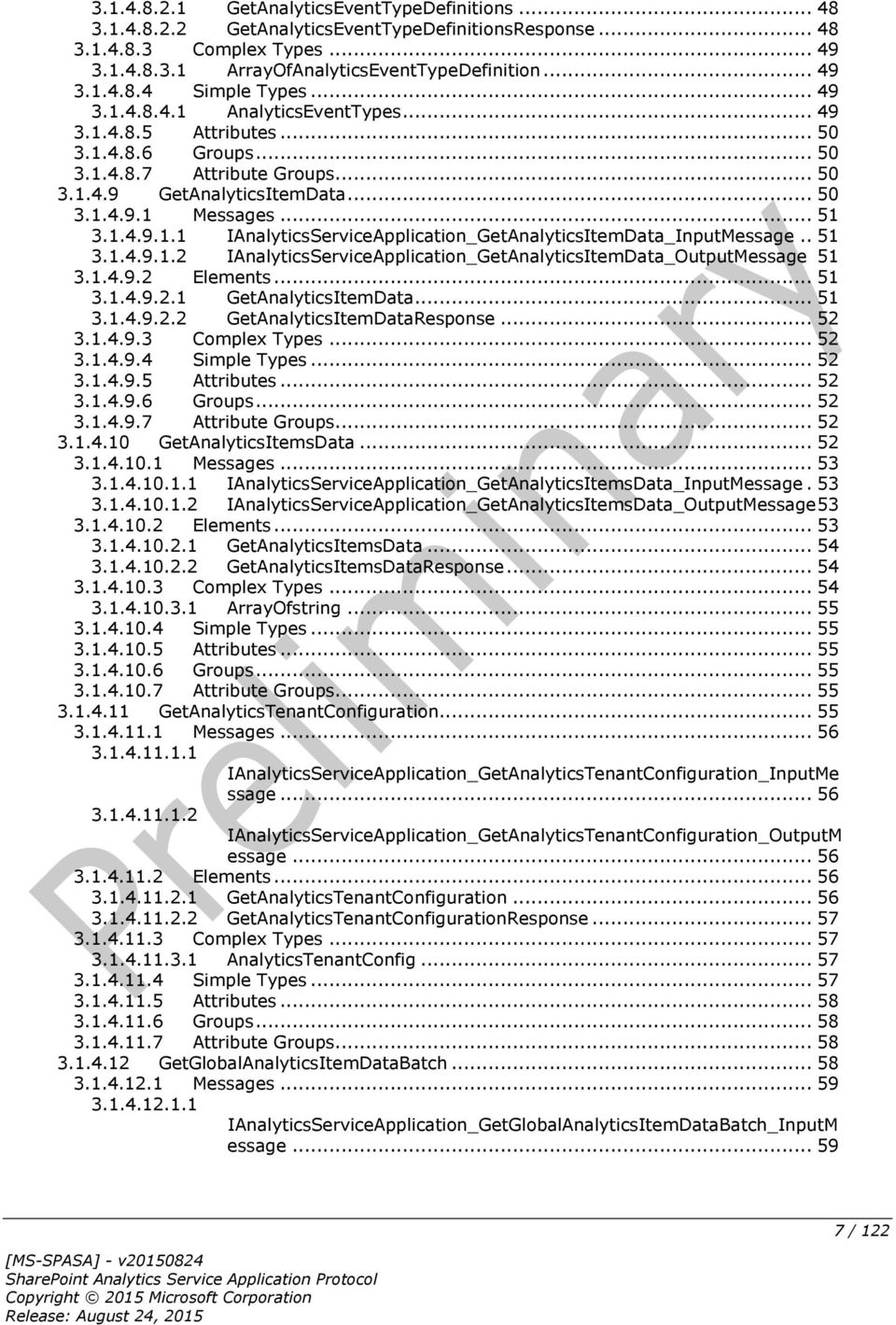
7 GetAnalyticsEventTypeDefinitions GetAnalyticsEventTypeDefinitionsResponse Complex Types ArrayOfAnalyticsEventTypeDefinition Simple Types AnalyticsEventTypes Attributes Groups Attribute Groups GetAnalyticsItemData Messages IAnalyticsServiceApplication_GetAnalyticsItemData_InputMessage IAnalyticsServiceApplication_GetAnalyticsItemData_OutputMessage Elements GetAnalyticsItemData GetAnalyticsItemDataResponse Complex Types Simple Types Attributes Groups Attribute Groups GetAnalyticsItemsData Messages IAnalyticsServiceApplication_GetAnalyticsItemsData_InputMessage IAnalyticsServiceApplication_GetAnalyticsItemsData_OutputMessage Elements GetAnalyticsItemsData GetAnalyticsItemsDataResponse Complex Types ArrayOfstring Simple Types Attributes Groups Attribute Groups GetAnalyticsTenantConfiguration Messages IAnalyticsServiceApplication_GetAnalyticsTenantConfiguration_InputMe ssage IAnalyticsServiceApplication_GetAnalyticsTenantConfiguration_OutputM essage Elements GetAnalyticsTenantConfiguration GetAnalyticsTenantConfigurationResponse Complex Types AnalyticsTenantConfig Simple Types Attributes Groups Attribute Groups GetGlobalAnalyticsItemDataBatch Messages IAnalyticsServiceApplication_GetGlobalAnalyticsItemDataBatch_InputM essage / 122
8 IAnalyticsServiceApplication_GetGlobalAnalyticsItemDataBatch_Output Message Elements GetGlobalAnalyticsItemDataBatch GetGlobalAnalyticsItemDataBatchResponse Complex Types ContinuationTokenItemData AnalyticsItemDataBatch Simple Types ContinuationTokenItemData.Scope Attributes Groups Attribute Groups GetRawAnayticsTenantSettings Messages IAnalyticsServiceApplication_GetRawAnayticsTenantSettings_InputMess age IAnalyticsServiceApplication_GetRawAnayticsTenantSettings_OutputMe ssage Elements GetRawAnayticsTenantSettings GetRawAnayticsTenantSettingsResponse Complex Types Simple Types Attributes Groups Attribute Groups GetRawAnalyticsTenantSettingsBatch Messages IAnalyticsServiceApplication_GetRawAnalyticsTenantSettingsBatch_Inp utmessage IAnalyticsServiceApplication_GetRawAnalyticsTenantSettingsBatch_Out putmessage Elements GetRawAnalyticsTenantSettingsBatch GetRawAnalyticsTenantSettingsBatchResponse Complex Types AnalyticsTenantSettingsDataBatch ArrayOfAnalyticsTenantSettingsData Simple Types Attributes Groups Attribute Groups GetRollupAnalyticsItemData Messages IAnalyticsServiceApplication_GetRollupAnalyticsItemData_InputMessage IAnalyticsServiceApplication_GetRollupAnalyticsItemData_OutputMessa ge Elements GetRollupAnalyticsItemData GetRollupAnalyticsItemDataResponse / 122

9 Complex Types Simple Types Attributes Groups Attribute Groups GetSearchReport Messages IAnalyticsServiceApplication_GetSearchReport_InputMessage IAnalyticsServiceApplication_GetSearchReport_OutputMessage Elements GetSearchReport GetSearchReportResponse Complex Types ArrayOfQueryReportData QueryReportData Simple Types Attributes Groups Attribute Groups GetTenantAnalyticsItemData Messages IAnalyticsServiceApplication_GetTenantAnalyticsItemData_InputMessag e IAnalyticsServiceApplication_GetTenantAnalyticsItemData_OutputMessa ge Elements GetTenantAnalyticsItemData GetTenantAnalyticsItemDataResponse Complex Types Simple Types Attributes Groups Attribute Groups SendAnalyticsUsageEvents Messages IAnalyticsServiceApplication_SendAnalyticsUsageEvents_InputMessage IAnalyticsServiceApplication_SendAnalyticsUsageEvents_OutputMessag e Elements SendAnalyticsUsageEvents SendAnalyticsUsageEventsResponse Complex Types ArrayOfAnalyticsUsageEvent AnalyticsUsageEvent Simple Types Attributes Groups Attribute Groups UpsertRawAnalyticsTenantSettings Messages IAnalyticsServiceApplication_UpsertRawAnalyticsTenantSettings_InputM essage / 122
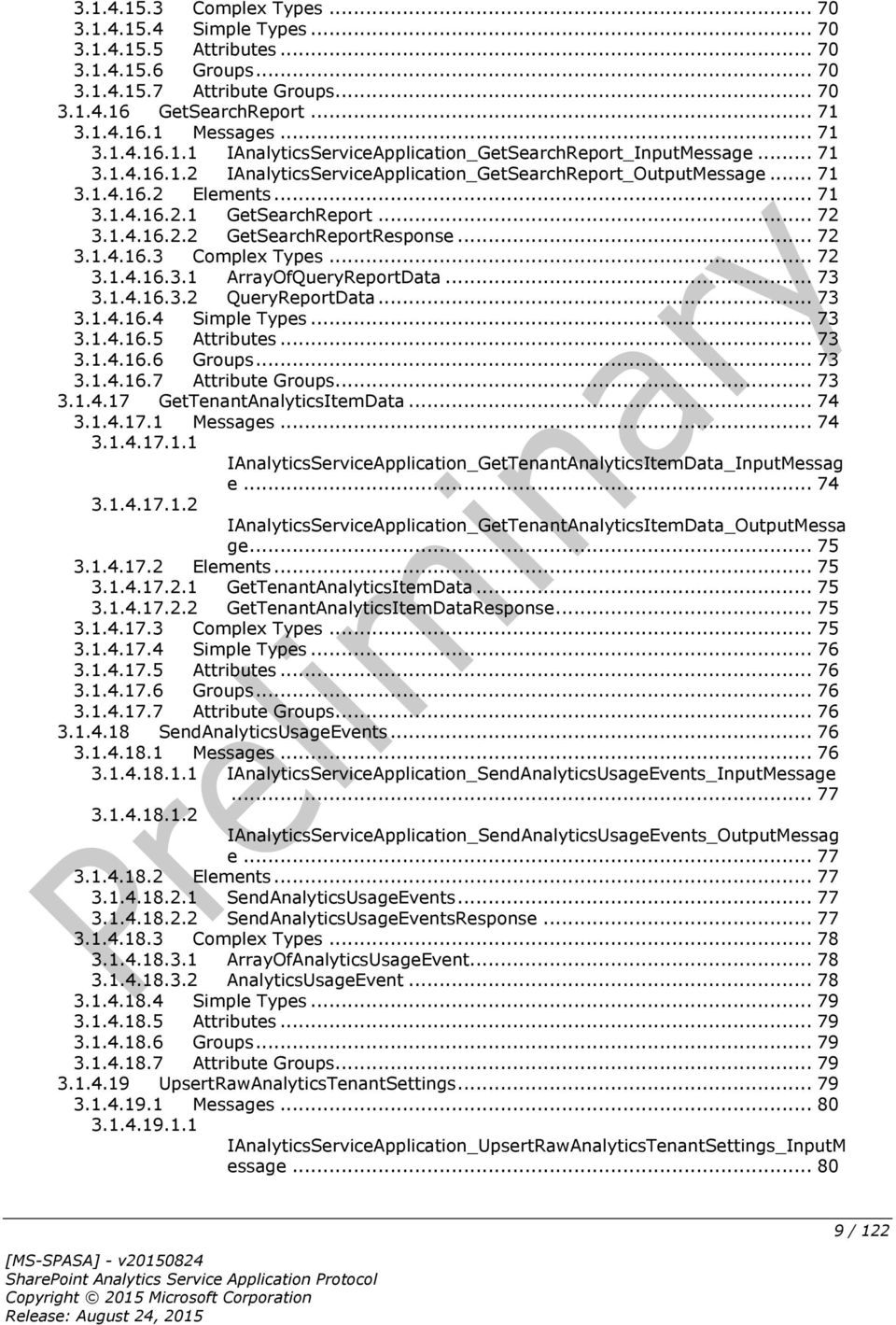
10 IAnalyticsServiceApplication_UpsertRawAnalyticsTenantSettings_Output Message Elements UpsertRawAnalyticsTenantSettings UpsertRawAnalyticsTenantSettingsResponse Complex Types Simple Types Attributes Groups Attribute Groups SendAnalyticsSignals Messages IAnalyticsServiceApplication_SendAnalyticsSignals_InputMessage IAnalyticsServiceApplication_SendAnalyticsSignals_OutputMessage Elements SendAnalyticsSignals SendAnalyticsSignalsResponse Complex Types Simple Types Attributes Groups Attribute Groups SendAnalyticsSignalsWithArguments Messages IAnalyticsServiceApplication_SendAnalyticsSignalsWithArguments_Inpu tmessage IAnalyticsServiceApplication_SendAnalyticsSignalsWithArguments_Outp utmessage Elements SendAnalyticsSignalsWithArguments SendAnalyticsSignalsWithArgumentsResponse Complex Types SignalStoreArguments SignalStoreResult Simple Types Attributes Groups Attribute Groups Timer Events Other Local Events Protocol Examples Delete All Usage Data for a Tenant Get an Analytics Event Type Definition Get Analytics Item Data Send Analytics Usage Events Security Security Considerations for Implementers Index of Security Parameters Appendix A: Full WSDL Appendix B: Full XML Schema Schema Schema / 122

11 7.3 Schema Schema Schema Schema Schema Appendix C: Product Behavior Change Tracking Index / 122
12 1 Introduction A protocol client uses the to send usage events for processing by a protocol server and to retrieve aggregated usage information from a protocol server. Sections 1.8, 2, and 3 of this specification are normative and can contain the terms MAY, SHOULD, MUST, MUST NOT, and SHOULD NOT as defined in [RFC2119]. Sections 1.5 and 1.9 are also normative but do not contain those terms. All other sections and examples in this specification are informative. 1.1 Glossary The following terms are specific to this document: globally unique identifier (GUID): A term used interchangeably with universally unique identifier (UUID) in Microsoft protocol technical documents (TDs). Interchanging the usage of these terms does not imply or require a specific algorithm or mechanism to generate the value. Specifically, the use of this term does not imply or require that the algorithms described in [RFC4122] or [C706] must be used for generating the GUID. See also universally unique identifier (UUID). Hypertext Transfer Protocol (HTTP): An application-level protocol for distributed, collaborative, hypermedia information systems (text, graphic images, sound, video, and other multimedia files) on the World Wide Web. Hypertext Transfer Protocol Secure (HTTPS): An extension of HTTP that securely encrypts and decrypts web page requests. In some older protocols, Hypertext Transfer Protocol over Secure Sockets Layer is still used (Secure Sockets Layer has been deprecated). For more information, see [SSL3] and [RFC5246]. rollup: A type of calculated value that is derived from the aggregated scores of child or descendant key performance indicators (KPIs) in a scorecard. search query: A complete set of conditions that are used to generate search results, including query text, sort order, and ranking parameters. site: A group of related pages and data within a SharePoint site collection. The structure and content of a site is based on a site definition. Also referred to as SharePoint site and web site. SOAP: A lightweight protocol for exchanging structured information in a decentralized, distributed environment. SOAP uses XML technologies to define an extensible messaging framework, which provides a message construct that can be exchanged over a variety of underlying protocols. The framework has been designed to be independent of any particular programming model and other implementation-specific semantics. SOAP 1.2 supersedes SOAP 1.1. See [SOAP1.2-1/2003]. SOAP action: The HTTP request header field used to indicate the intent of the SOAP request, using a URI value. See [SOAP1.1] section for more information. SOAP body: A container for the payload data being delivered by a SOAP message to its recipient. See [SOAP1.2-1/2007] section 5.3 for more information. SOAP fault: A container for error and status information within a SOAP message. See [SOAP1.2-1/2007] section 5.4 for more information. tenant: A protocol client or protocol server that accesses a partition in a shared service database. timestamp: A condition of a digital signature (2) that indicates whether the signature was created with a valid certificate (1) that has expired or was created with a certificate that had expired 12 / 122

13 already. If the certificate expired after the signature was created, the signature can be trusted. If it expired before the signature was created, it cannot be trusted. Transmission Control Protocol (TCP): A protocol used with the Internet Protocol (IP) to send data in the form of message units between computers over the Internet. TCP handles keeping track of the individual units of data (called packets) that a message is divided into for efficient routing through the Internet. Unicode: A character encoding standard developed by the Unicode Consortium that represents almost all of the written languages of the world. The Unicode standard [UNICODE5.0.0/2007] provides three forms (UTF-8, UTF-16, and UTF-32) and seven schemes (UTF-8, UTF-16, UTF-16 BE, UTF-16 LE, UTF-32, UTF-32 LE, and UTF-32 BE). Web Services Description Language (WSDL): An XML format for describing network services as a set of endpoints that operate on messages that contain either document-oriented or procedure-oriented information. The operations and messages are described abstractly and are bound to a concrete network protocol and message format in order to define an endpoint. Related concrete endpoints are combined into abstract endpoints, which describe a network service. WSDL is extensible, which allows the description of endpoints and their messages regardless of the message formats or network protocols that are used. website: (1) A group of related webpages that is hosted by a server on the World Wide Web or an intranet. Each website has its own entry points, metadata, administration settings, and workflows. Also referred to as site. (2) A group of related pages and data within a SharePoint site collection. The structure and content of a site is based on a site definition. Also referred to as SharePoint site and site. WSDL message: An abstract, typed definition of the data that is communicated during a WSDL operation [WSDL]. Also, an element that describes the data being exchanged between web service providers and clients. WSDL operation: A single action or function of a web service. The execution of a WSDL operation typically requires the exchange of messages between the service requestor and the service provider. XML namespace: A collection of names that is used to identify elements, types, and attributes in XML documents identified in a URI reference [RFC3986]. A combination of XML namespace and local name allows XML documents to use elements, types, and attributes that have the same names but come from different sources. For more information, see [XMLNS-2ED]. XML namespace prefix: An abbreviated form of an XML namespace, as described in [XML]. XML schema: A description of a type of XML document that is typically expressed in terms of constraints on the structure and content of documents of that type, in addition to the basic syntax constraints that are imposed by XML itself. An XML schema provides a view of a document type at a relatively high level of abstraction. MAY, SHOULD, MUST, SHOULD NOT, MUST NOT: These terms (in all caps) are used as defined in [RFC2119]. All statements of optional behavior use either MAY, SHOULD, or SHOULD NOT. 1.2 References Links to a document in the Microsoft Open Specifications library point to the correct section in the most recently published version of the referenced document. However, because individual documents in the library are not updated at the same time, the section numbers in the documents may not match. You can confirm the correct section numbering by checking the Errata. 13 / 122
14 1.2.1 Normative References We conduct frequent surveys of the normative references to assure their continued availability. If you have any issue with finding a normative reference, please contact [email protected]. We will assist you in finding the relevant information. [MS-SPSTWS] Microsoft Corporation, "SharePoint Security Token Service Web Service Protocol". [RFC2119] Bradner, S., "Key words for use in RFCs to Indicate Requirement Levels", BCP 14, RFC 2119, March 1997, [RFC2616] Fielding, R., Gettys, J., Mogul, J., et al., "Hypertext Transfer Protocol -- HTTP/1.1", RFC 2616, June 1999, [SOAP1.1] Box, D., Ehnebuske, D., Kakivaya, G., et al., "Simple Object Access Protocol (SOAP) 1.1", May 2000, [SOAP1.2/1] Gudgin, M., Hadley, M., Mendelsohn, N., Moreau, J., and Nielsen, H.F., "SOAP Version 1.2 Part 1: Messaging Framework", W3C Recommendation, June 2003, [WSDL] Christensen, E., Curbera, F., Meredith, G., and Weerawarana, S., "Web Services Description Language (WSDL) 1.1", W3C Note, March 2001, [XMLNS] Bray, T., Hollander, D., Layman, A., et al., Eds., "Namespaces in XML 1.0 (Third Edition)", W3C Recommendation, December 2009, [XMLSCHEMA1] Thompson, H., Beech, D., Maloney, M., and Mendelsohn, N., Eds., "XML Schema Part 1: Structures", W3C Recommendation, May 2001, [XMLSCHEMA2] Biron, P.V., Ed. and Malhotra, A., Ed., "XML Schema Part 2: Datatypes", W3C Recommendation, May 2001, Informative References [MS-SPTWS] Microsoft Corporation, "Service Platform Topology Web Service Protocol". [RFC2818] Rescorla, E., "HTTP Over TLS", RFC 2818, May 2000, [SOAP1.2/2] Gudgin, M., Hadley, M., Mendelsohn, N., Moreau, J., and Nielsen, H.F., "SOAP Version 1.2 Part 2: Adjuncts", W3C Recommendation, June 2003, part Overview This protocol enables a protocol client to send usage events to the protocol server. The protocol server performs implementation specific aggregation of those events and produces historical usage information based on those events. This protocol further enables a protocol client to retrieve the aggregated usage information from the protocol server. A typical scenario for using this protocol is a reporting application that allows the users to visualize the usage of an item during its lifetime. 1.4 Relationship to Other Protocols This protocol uses the SOAP message protocol for formatting request and response messages, as described in [SOAP1.1], [SOAP1.2/1] and [SOAP1.2/2]. It transmits those messages by using HTTP, 14 / 122
![[MS-SPSTWS] Microsoft Corporation, "SharePoint Security Token Service Web Service Protocol". [RFC2119] Bradner, S.](/docs-images/41/13734554/images/page_14.jpg ", \"Key words for use in RFCs to Indicate Requirement Levels\", BCP 14, RFC 2119, March 1997, http://www.rfc-editor.org/rfc/rfc2119.txt [RFC2616] Fielding, R., Gettys, J., Mogul, J., et al.")
![as described in [RFC2616], or Hypertext Transfer Protocol over Secure Sockets Layer (HTTPS), as described in [RFC2818].](/docs-images/29/13734554/images/15-0.png "The following diagram shows the underlying messaging and transport stack used by the protocol: Figure 1: This protocol in relation to other protocols 1.")
15 as described in [RFC2616], or Hypertext Transfer Protocol over Secure Sockets Layer (HTTPS), as described in [RFC2818]. The following diagram shows the underlying messaging and transport stack used by the protocol: Figure 1: This protocol in relation to other protocols 1.5 Prerequisites/Preconditions This protocol operates against a protocol server that exposes one or more endpoint URIs that are known by protocol clients. The endpoint URI of the protocol server and the transport that is used by the protocol server are either known by the protocol client or obtained by using the discovery mechanism that is described in [MS-SPTWS]. The protocol client obtains the requisite ApplicationClassId and ApplicationVersion values and the endpoint URI of the protocol server that provides the discovery mechanism, as described in [MS- SPTWS], by means that are independent of either protocol. This protocol requires the protocol client to have appropriate permission to call the methods on the protocol server. The protocol client implements the token-based security mechanisms that are required by the protocol server and related security protocols, as described in [MS-SPSTWS]. 1.6 Applicability Statement This protocol is intended for use by protocol clients and protocol servers that are connected by highbandwidth, low-latency network connections. The methods for sending data were designed to work with batches of 100 or fewer events. 1.7 Versioning and Capability Negotiation This document covers versioning issues in the following areas: Supported Transports: This protocol can be implemented by using transports that support sending SOAP messages, as specified in section 2.1. Protocol Versions: This protocol is not versioned. Capability Negotiation: This protocol does not support version negotiation. 1.8 Vendor-Extensible Fields 15 / 122

16 1.9 Standards Assignments 16 / 122

17 2 Messages 2.1 Transport Protocol servers MUST support SOAP over HTTP, HTTPS, or TCP. All protocol messages MUST be transported by using HTTP or TCP bindings at the transport level. Protocol messages MUST be formatted as specified in either [SOAP1.1] section 4 or [SOAP1.2/1] section 5. Protocol server faults MUST be returned by using HTTP status codes, as specified in [RFC2616] section 10, or SOAP faults, as specified in [SOAP1.1] section 4.4 or [SOAP1.2/1] section 5.4. If the HTTPS transport is used, a server certificate MUST be deployed. This protocol can transmit an additional SOAP header, the ServiceContext header, as described in [MS-SPSTWS]. This protocol does not define any means for activating a protocol server or protocol client. The protocol server MUST be configured and begin listening in an implementation-specific way. In addition, the protocol client MUST know the format and transport that is used by the server for example, the SOAP format over an HTTP transport. 2.2 Common Message Syntax This section contains common structures used by this protocol. The syntax of the structures uses XML schema, as specified in [XMLSCHEMA1] and [XMLSCHEMA2], and WSDL, as specified in [WSDL] Namespaces This specification defines and references various XML namespaces using the mechanisms specified in [XMLNS]. Although this specification associates a specific XML namespace prefix for each XML namespace that is used, the choice of any particular XML namespace prefix is implementation-specific and not significant for interoperability. Prefix Namespace URI Reference q1 q25 q soap [SOAP1.1] tns tns1 tns2 tns3 tns4 wsaw wsdl [WSDL] 17 / 122
![Protocol server faults MUST be returned by using HTTP status codes, as specified in [RFC2616] section 10, or SOAP faults, as specified in [SOAP1.1] section 4.](/docs-images/41/13734554/images/page_17.jpg "4 or [SOAP1.2/1] section 5.4. If the HTTPS transport is used, a server certificate MUST be deployed.")
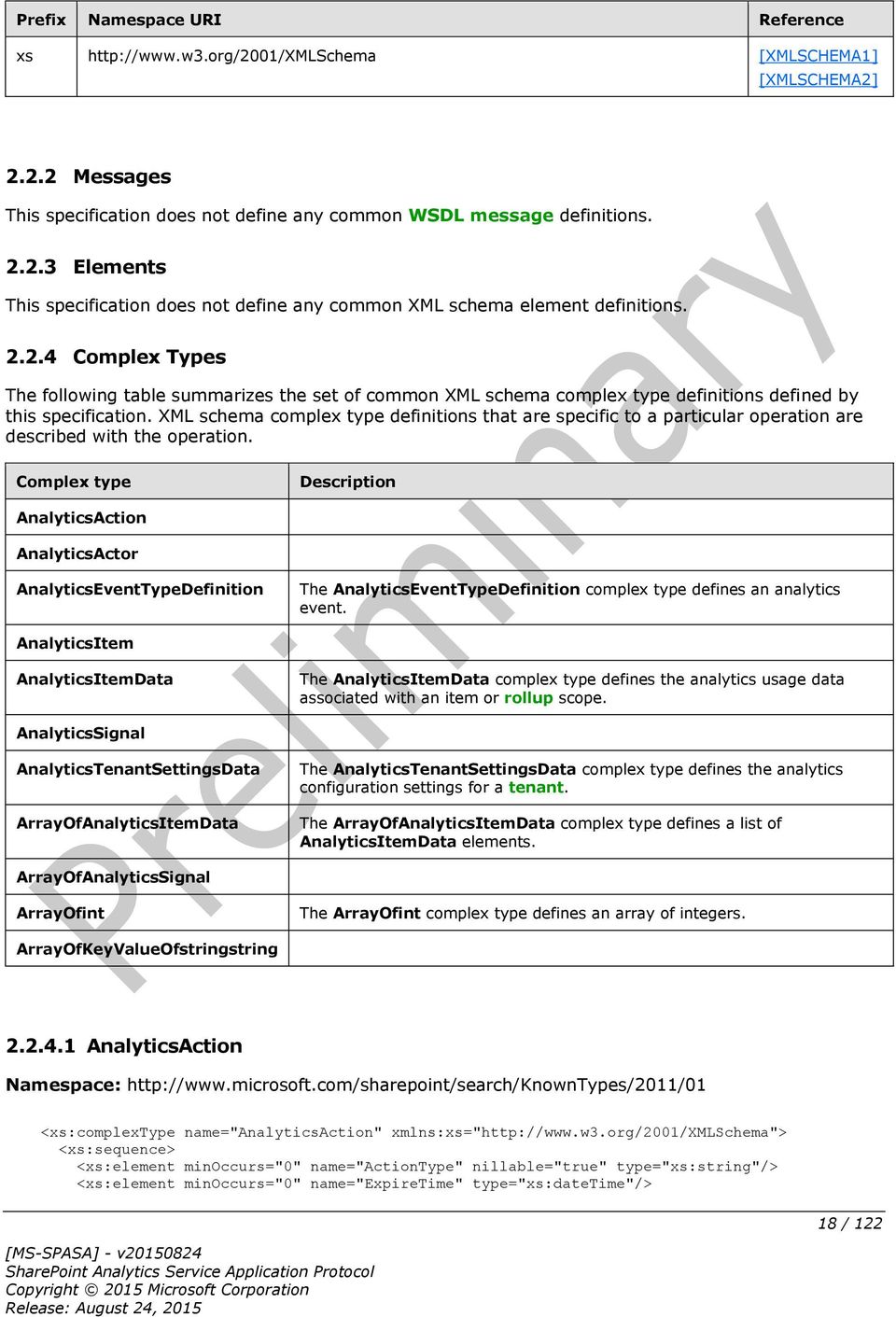
18 Prefix Namespace URI Reference xs [XMLSCHEMA1] [XMLSCHEMA2] Messages This specification does not define any common WSDL message definitions Elements This specification does not define any common XML schema element definitions Complex Types The following table summarizes the set of common XML schema complex type definitions defined by this specification. XML schema complex type definitions that are specific to a particular operation are described with the Complex type Description AnalyticsAction AnalyticsActor AnalyticsEventTypeDefinition The AnalyticsEventTypeDefinition complex type defines an analytics event. AnalyticsItem AnalyticsItemData The AnalyticsItemData complex type defines the analytics usage data associated with an item or rollup scope. AnalyticsSignal AnalyticsTenantSettingsData ArrayOfAnalyticsItemData The AnalyticsTenantSettingsData complex type defines the analytics configuration settings for a tenant. The ArrayOfAnalyticsItemData complex type defines a list of AnalyticsItemData elements. ArrayOfAnalyticsSignal ArrayOfint The ArrayOfint complex type defines an array of integers. ArrayOfKeyValueOfstringstring AnalyticsAction Namespace: <xs:complextype name="analyticsaction" xmlns:xs=" <xs:element minoccurs="0" name="actiontype" nillable="true" type="xs:string"/> <xs:element minoccurs="0" name="expiretime" type="xs:datetime"/> 18 / 122
19 <xs:element xmlns:tns1=" minoccurs="0" name="properties" nillable="true" type="tns1:arrayofkeyvalueofstringstring"/> <xs:element minoccurs="0" name="usertime" type="xs:datetime"/> ActionType: ExpireTime: Properties: UserTime: AnalyticsActor Namespace: <xs:complextype name="analyticsactor" xmlns:xs=" <xs:element minoccurs="0" name="id" nillable="true" type="xs:string"/> <xs:element xmlns:tns1=" minoccurs="0" name="properties" nillable="true" type="tns1:arrayofkeyvalueofstringstring"/> <xs:element minoccurs="0" name="tenantid" type="tns2:guid"/> Id: Properties: TenantId: AnalyticsEventTypeDefinition Namespace: The AnalyticsEventTypeDefinition complex type defines an analytics event. <xs:complextype name="analyticseventtypedefinition" xmlns:xs=" <xs:element xmlns:tns=" minoccurs="0" name="aggregationtype" type="tns:eventcounttype"/> <xs:element minoccurs="0" name="appeventtypeid" type="tns2:guid"/> <xs:element minoccurs="0" name="applicationname" nillable="true" type="xs:string"/> <xs:element minoccurs="0" name="eventname" nillable="true" type="xs:string"/> <xs:element minoccurs="0" name="eventtypeid" type="xs:int"/> <xs:element xmlns:tns=" minoccurs="0" name="options" type="tns:eventoptions"/> <xs:element minoccurs="0" name="recentpopularitytimeframe" type="xs:int"/> <xs:element minoccurs="0" name="recommendationweight" type="xs:int"/> <xs:element minoccurs="0" name="relevanceweight" type="xs:int"/> <xs:element xmlns:tns=" minoccurs="0" name="rollups" type="tns:eventrollups"/> <xs:element minoccurs="0" name="tailtrimming" type="xs:int"/> <xs:element minoccurs="0" name="tenantid" type="tns2:guid"/> 19 / 122
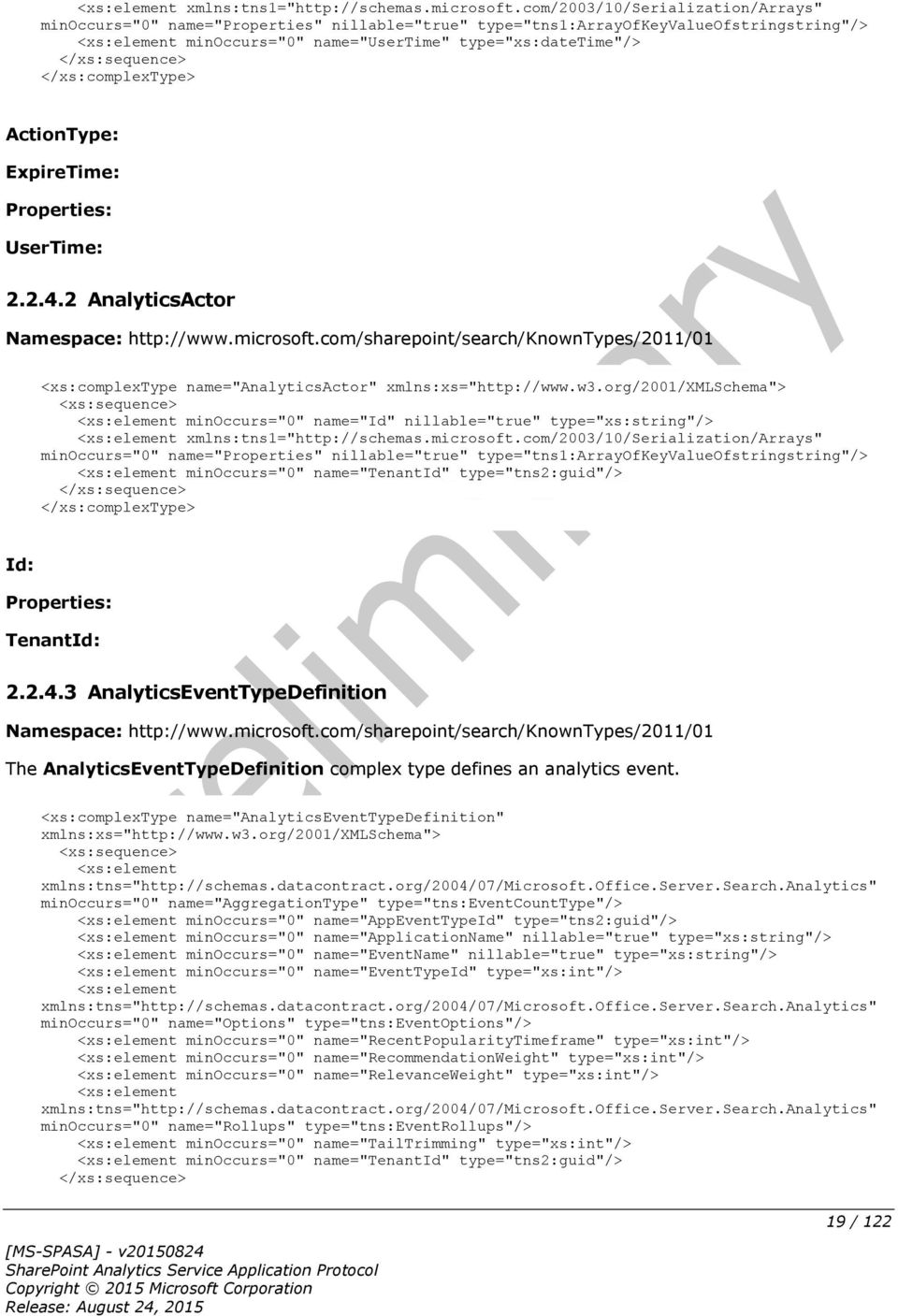
20 AggregationType: The type of aggregation to use for this event type. AppEventTypeId: The identifier of the application registering the event type. ApplicationName: The name of the application registering the event type. EventName: The human-readable name of the event type. EventTypeId: The identifier of the event type. Options: Additional options for this event type. RecentPopularityTimeframe: The timeframe for recent popularity for the event type. RecommendationWeight: The weight this event type is given when considered for calculating recommended items. RelevanceWeight: The weight this event type is given when considered for calculating relevant items. Rollups: The rollup aggregations that can be calculated for this event type. TailTrimming: The minimum number of events required to be considered at all for aggregations. TenantId: The identifier of the tenant associated with this event type AnalyticsItem Namespace: <xs:complextype name="analyticsitem" xmlns:xs=" <xs:element minoccurs="0" name="id" nillable="true" type="xs:string"/> <xs:element xmlns:tns1=" minoccurs="0" name="properties" nillable="true" type="tns1:arrayofkeyvalueofstringstring"/> Id: Properties: AnalyticsItemData Namespace: The AnalyticsItemData complex type defines the analytics usage data associated with an item or rollup scope. <xs:complextype name="analyticsitemdata" xmlns:xs=" <xs:element minoccurs="0" name="currentdate" type="xs:datetime"/> <xs:element xmlns:tns1=" minoccurs="0" name="dailyhits" nillable="true" type="tns1:arrayofint"/> <xs:element xmlns:tns1=" minoccurs="0" name="dailyuniqueusers" nillable="true" type="tns1:arrayofint"/> <xs:element minoccurs="0" name="eventtype" type="xs:int"/> 20 / 122

21 <xs:element minoccurs="0" name="itemid" nillable="true" type="xs:string"/> <xs:element minoccurs="0" name="lastprocessinghits" type="xs:int"/> <xs:element minoccurs="0" name="lastprocessingtime" type="xs:datetime"/> <xs:element minoccurs="0" name="lastprocessinguniqueusers" type="xs:int"/> <xs:element xmlns:tns1=" minoccurs="0" name="monthlyhits" nillable="true" type="tns1:arrayofint"/> <xs:element xmlns:tns1=" minoccurs="0" name="monthlyuniqueusers" nillable="true" type="tns1:arrayofint"/> <xs:element minoccurs="0" name="scopeid" nillable="true" type="tns2:guid"/> <xs:element minoccurs="0" name="siteid" type="tns2:guid"/> <xs:element minoccurs="0" name="tenantid" type="tns2:guid"/> <xs:element minoccurs="0" name="totalhits" type="xs:int"/> <xs:element minoccurs="0" name="totaluniqueusers" type="xs:int"/> CurrentDate: The date when the analytics usage data was retrieved. DailyHits: The raw historical hit data by day for the item or rollup scope. DailyUniqueUsers: The raw historical unique user data by day for the item or rollup scope. EventType: The identifier of the event type. ItemId: The identifier of the item. LastProcessingHits: The hit count for the associated item in the last processing interval. LastProcessingTime: The last time that events for the associated item were aggregated. LastProcessingUniqueUsers: The unique user count for the associated item in the last processing interval. MonthlyHits: The raw historical hit data by month for the item or rollup scope. MonthlyUniqueUsers: The raw historical unique user data by month for the item or rollup scope. ScopeId: The identifier of an application-specific rollup scope. SiteId: The identifier of the Web site (2). TenantId: The identifier of the tenant. TotalHits: The lifetime hit count. TotalUniqueUsers: The lifetime unique user count AnalyticsSignal Namespace: <xs:complextype name="analyticssignal" xmlns:xs=" <xs:element minoccurs="0" name="action" nillable="true" type="q1:analyticsaction"/> <xs:element minoccurs="0" name="actor" nillable="true" type="q1:analyticsactor"/> <xs:element minoccurs="0" name="item" nillable="true" type="q1:analyticsitem"/> <xs:element minoccurs="0" name="source" nillable="true" type="xs:string"/> Action: 21 / 122
22 Actor: Item: Source: AnalyticsTenantSettingsData Namespace: The AnalyticsTenantSettingsData complex type defines the analytics configuration settings for a tenant. <xs:complextype name="analyticstenantsettingsdata" xmlns:xs=" <xs:element minoccurs="0" name="eventfilters" nillable="true" type="xs:base64binary"/> <xs:element minoccurs="0" name="eventtypedefinitions" nillable="true" type="xs:base64binary"/> <xs:element minoccurs="0" name="lastupdatetime" type="xs:datetime"/> <xs:element minoccurs="0" name="options" type="q25:analyticstenantsettingoptions"/> <xs:element minoccurs="0" name="tenantid" type="tns2:guid"/> <xs:element minoccurs="0" name="version" type="xs:int"/> EventFilters: A serialized collection of all event filters for this tenant. EventTypeDefinitions: A serialized collection of event type definitions for this tenant. LastUpdateTime: A timestamp of the most recent time the configuration settings for the tenant were updated. Options: Configuration options for the tenant. This must be a combination of one or more of the values defined in the AnalyticsTenantSettingOptions simple type, as specified in Section TenantId: The identifier of the tenant. Version: The version number of the settings ArrayOfAnalyticsItemData Namespace: The ArrayOfAnalyticsItemData complex type defines a list of AnalyticsItemData elements. <xs:complextype name="arrayofanalyticsitemdata" xmlns:xs=" <xs:element minoccurs="0" maxoccurs="unbounded" name="analyticsitemdata" nillable="true" type="q1:analyticsitemdata"/> AnalyticsItemData: Analytics usage data associated with an item or rollup scope ArrayOfAnalyticsSignal Namespace: 22 / 122
23 <xs:complextype name="arrayofanalyticssignal" xmlns:xs=" <xs:element minoccurs="0" maxoccurs="unbounded" name="analyticssignal" nillable="true" type="q1:analyticssignal"/> AnalyticsSignal: ArrayOfint Namespace: The ArrayOfint complex type defines an array of integers. <xs:complextype name="arrayofint" xmlns:xs=" <xs:element minoccurs="0" maxoccurs="unbounded" name="int" type="xs:int"/> int: An integer ArrayOfKeyValueOfstringstring Namespace: <xs:complextype name="arrayofkeyvalueofstringstring" xmlns:xs=" <xs:element minoccurs="0" maxoccurs="unbounded" name="keyvalueofstringstring"> <xs:element name="key" nillable="true" type="xs:string"/> <xs:element name="value" nillable="true" type="xs:string"/> KeyValueOfstringstring: KeyValueOfstringstring.Key: KeyValueOfstringstring.Value: Simple Types The following table summarizes the set of common XML schema simple type definitions defined by this specification. XML schema simple type definitions that are specific to a particular operation are described with the Simple type AnalyticsTenantSettingOptions Description The AnalyticsTenantSettingOptions simple type defines options for tenant settings. 23 / 122
24 Simple type char duration EventCountType EventOptions EventRollups guid Description The char simple type represents a Unicode character. The duration simple type specifies the time interval or duration of time measured as positive or negative number of days, hours, minutes, seconds and fractions of a second. The EventCountType simple type defines the type of aggregation for an event type. The EventOptions simple type defines additional options for an event type. The EventRollups simple type defines the rollup aggregations that can be calculated. The guid simple type contains an identifier that is globally unique AnalyticsTenantSettingOptions Namespace: The AnalyticsTenantSettingOptions simple type defines options for tenant settings. The AnalyticsTenantSettingOptions MUST be a combination of one or more of the values in the following table: Value None AnalyticsDisabled DoNotHashUserName Meaning The Analytics Tenant Setting is not specified. The Analytics Tenant Setting is disabled. The Analytics Tenant Setting does not hash user name. <xs:simpletype name="analyticstenantsettingoptions" xmlns:xs=" <xs:list> <xs:simpletype> <xs:restriction base="xs:string"/> </xs:simpletype> </xs:list> </xs:simpletype> char Namespace: The char simple type represents a Unicode character. <xs:simpletype name="char" xmlns:xs=" <xs:restriction base="xs:int"/> </xs:simpletype> 24 / 122
25 duration Namespace: The duration simple type specifies the time interval or duration of time measured as positive or negative number of days, hours, minutes, seconds and fractions of a second. <xs:simpletype name="duration" xmlns:xs=" <xs:restriction base="xs:duration"> <xs:pattern value="\-?p(\d*d)?(t(\d*h)?(\d*m)?(\d*(\.\d*)?s)?)?"/> <xs:mininclusive value="-p dt2h48m s"/> <xs:maxinclusive value="p dt2h48m s"/> </xs:restriction> </xs:simpletype> EventCountType Namespace: The EventCountType simple type defines the type of aggregation for an event type. <xs:simpletype name="eventcounttype" xmlns:xs=" <xs:list> <xs:simpletype> <xs:restriction base="xs:string"> <xs:enumeration value="count"/> <xs:enumeration value="uniqueusers"/> </xs:restriction> </xs:simpletype> </xs:list> </xs:simpletype> The following table specifies the allowable values for the EventCountType simple type. Value Count UniqueUsers Meaning Aggregate by raw count. Aggregate by the number of unique users EventOptions Namespace: The EventOptions simple type defines additional options for an event type. <xs:simpletype name="eventoptions" xmlns:xs=" <xs:list> <xs:simpletype> <xs:restriction base="xs:string"> <xs:enumeration value="none"/> <xs:enumeration value="allowanonymouswrite"/> </xs:restriction> </xs:simpletype> </xs:list> </xs:simpletype> 25 / 122
26 The following table specifies the allowable values for the EventOptions simple type. Value None AllowAnonymousWrite Meaning No options are specified. Allow anonymous users to generate events of this event type EventRollups Namespace: The EventRollups simple type defines the rollup aggregations that can be calculated. <xs:simpletype name="eventrollups" xmlns:xs=" <xs:list> <xs:simpletype> <xs:restriction base="xs:string"> <xs:enumeration value="sitesubscriptionid"/> <xs:enumeration value="siteid"/> <xs:enumeration value="scopeid"/> </xs:restriction> </xs:simpletype> </xs:list> </xs:simpletype> The following table specifies the allowable values for the EventRollups simple type. Value SiteSubscriptionId SiteId ScopeId Meaning Site-subscription-level aggregation Site-level aggregation Scope-level aggregation guid Namespace: The guid simple type contains an identifier that is globally unique. <xs:simpletype name="guid" xmlns:xs=" <xs:restriction base="xs:string"> <xs:pattern value="[\da-fa-f]{8}-[\da-fa-f]{4}-[\da-fa-f]{4}-[\da-fa-f]{4}-[\da-fa- F]{12}"/> </xs:restriction> </xs:simpletype> Attributes This specification does not define any common XML schema attribute definitions. 26 / 122
27 2.2.7 Groups This specification does not define any common XML schema group definitions Attribute Groups This specification does not define any common XML schema attribute group definitions. 27 / 122
28 3 Protocol Details In the following sections, the schema definition might be less restrictive than the processing rules imposed by the protocol. The WSDL in the specification matches the WSDL that shipped with the product and provides a base description of the schema. The text that introduces the WSDL specifies additional restrictions that reflect protocol behavior. For example, the schema definition might allow for an element to be empty, null, or not present, but the behavior of the protocol as specified restricts the same elements to being non-empty, present and not null. The client side of this protocol is simply a pass-through. That is, no additional timers or other state is required on the client side of this protocol. Calls made by the higher-layer protocol or application are passed directly to the transport and the results returned by the transport are passed directly back to the higher-layer protocol or application. Except where specified, protocol clients SHOULD interpret HTTP status codes that are returned by the protocol server as specified in [RFC2616], section 10. This protocol allows protocol servers to notify protocol clients of application-level faults by using SOAP faults. Except where otherwise specified, these SOAP faults are not significant for interoperability and protocol clients can interpret them in an implementation-specific manner. This protocol allows protocol servers to perform implementation-specific authorization checks and to notify clients of authorization faults by using either HTTP status codes or SOAP faults, as specified previously in this section. 3.1 Server Details Abstract Data Model This section describes a conceptual model of possible data organization that an implementation maintains to participate in this protocol. The described organization is provided to facilitate the explanation of how the protocol behaves. This document does not mandate that implementations adhere to this model as long as their external behavior is consistent with that described in this document. The protocol server receives usage events, which represent actions performed on the protocol client; for example, a view event on a Web site (2). An event includes, among other things, an event type and an associated item. The protocol server maintains an event store, which provides persistent storage for events received by the protocol server. The protocol server maintains various configuration settings for each tenant. These settings include, among other things, a collection of definitions of event types. Some of the event types are predefined by the protocol server, such as Views; whereas other event types are registered for use by specific applications on the protocol client. The protocol server aggregates the events in the event store and stores the results of the processing in an aggregation store. The aggregation store keeps historic aggregated count of events of each event type for each item, as well as recommendations (related items), it determines based on the usage events. The protocol server also stores historic aggregated counts of search-related events for search queries, such as how many times a search query was issued. The protocol server also aggregates usage data by combining the events for multiple items from the same rollup scope, for example, items from the same Web site (2). Rollup scopes can be global, tenant, site, or specified by the application logging the event. 28 / 122
29 3.1.2 Timers Initialization Message Processing Events and Sequencing Rules The following table summarizes the list of operations as defined by this specification. Operation DeleteAllUsageDataForTenant DeleteCustomEventUsageDataForSite DeleteCustomEventUsageDataForTenant DeleteRecommendationsDataForTenant DeleteStandardEventUsageDataForSite DeleteStandardEventUsageDataForTenant GetAnalyticsEventTypeDefinition GetAnalyticsEventTypeDefinitions GetAnalyticsItemData GetAnalyticsItemsData GetAnalyticsTenantConfiguration GetGlobalAnalyticsItemDataBatch GetRawAnalyticsTenantSettingsBatch GetRawAnayticsTenantSettings GetRollupAnalyticsItemData GetSearchReport GetTenantAnalyticsItemData Description Initiates the deletion of aggregated data for a specified tenant. Initiates the deletion of aggregated data for a specified Web site (2) for an application-specific event type. Initiates the deletion of aggregated data for a specified tenant for an application-specific event type. Initiates the deletion of aggregated recommendations for the specified tenant. Initiates the deletion of aggregated data for a specified Web site (2) for a predefined event type. Initiates the deletion of aggregated data for a specified tenant for a predefined event type. Retrieves the definition of an event type for the specified tenant. Retrieves a filtered set of definitions of event types for the specified tenant. Retrieves aggregated usage data for a specified item for a specified event type. Retrieves aggregated usage data for multiple specified items for a specified event type. Retrieves the configuration settings for a specified tenant. Retrieves aggregated usage data for multiple items for a specified event type and a specified scope that have been processed since a specified time. Retrieves the configuration settings for multiple tenants. Retrieves the configuration settings for a specified tenant. Retrieves aggregated usage data for a rollup scope for events of a specified event type. Retrieves the aggregated top occurrences for the specified search event type within a scope. Retrieves aggregated usage data for a tenant for events of a specified event type. 29 / 122
30 Operation Description SendAnalyticsSignals SendAnalyticsSignalsWithArguments SendAnalyticsUsageEvents UpsertRawAnalyticsTenantSettings Sends usage events to the protocol server. Updates the configuration settings for a specified tenant DeleteAllUsageDataForTenant Initiates the deletion of aggregated data for a specified tenant. The following is the WSDL port type specification of the DeleteAllUsageDataForTenant WSDL <wsdl:operation name="deleteallusagedatafortenant" xmlns:wsdl=" <wsdl:input wsaw:action=" message="tns3:ianalyticsserviceapplication_deleteallusagedatafortenant_inputmessage" xmlns:wsaw=" <wsdl:output wsaw:action=" nse" message="tns3:ianalyticsserviceapplication_deleteallusagedatafortenant_outputmessage" xmlns:wsaw=" The protocol client sends an IAnalyticsServiceApplication_DeleteAllUsageDataForTenant_InputMessage WSDL message and the protocol server responds with an IAnalyticsServiceApplication_DeleteAllUsageDataForTenant_OutputMessage WSDL message as follows: The protocol server initiates the deletion of aggregated data for the specified tenantid. For example, the protocol server might synchronously delete the relevant aggregated data, or it might queue up the command and delete the relevant aggregated data as part of a periodic aggregation Messages The following table summarizes the set of WSDL message definitions that are specific to this Message IAnalyticsServiceApplication_DeleteAllUsageDataForTenant_InputMess age IAnalyticsServiceApplication_DeleteAllUsageDataForTenant_OutputMes sage Description The request WSDL message for the DeleteAllUsageDataForTena nt WSDL The response WSDL message for the DeleteAllUsageDataForTena nt WSDL 30 / 122
31 IAnalyticsServiceApplication_DeleteAllUsageDataForTenant_InputMessa ge The request WSDL message for the DeleteAllUsageDataForTenant WSDL The SOAP action value is: The SOAP body contains the DeleteAllUsageDataForTenant element IAnalyticsServiceApplication_DeleteAllUsageDataForTenant_OutputMess age The response WSDL message for the DeleteAllUsageDataForTenant WSDL The SOAP body contains the DeleteAllUsageDataForTenantResponse element Elements The following table summarizes the XML schema element definitions that are specific to this Element DeleteAllUsageDataForTenant DeleteAllUsageDataForTenantResponse Description The input data for the DeleteAllUsageDataForTenant WSDL The result data for the DeleteAllUsageDataForTenant WSDL DeleteAllUsageDataForTenant The DeleteAllUsageDataForTenant element specifies the input data for the DeleteAllUsageDataForTenant WSDL <xs:element name="deleteallusagedatafortenant" xmlns:xs=" <xs:element xmlns:tns2=" minoccurs="0" name="tenantid" type="tns2:guid"/> tenantid: The identifier of the tenant DeleteAllUsageDataForTenantResponse The DeleteAllUsageDataForTenantResponse element specifies the result data for the DeleteAllUsageDataForTenant WSDL <xs:element name="deleteallusagedatafortenantresponse" xmlns:xs=" <xs:sequence/> 31 / 122
32 Complex Types Simple Types Attributes Groups Attribute Groups DeleteCustomEventUsageDataForSite Initiates the deletion of aggregated data for a specified Web site (2) for an application-specific event type. The following is the WSDL port type specification of the DeleteCustomEventUsageDataForSite WSDL <wsdl:operation name="deletecustomeventusagedataforsite" xmlns:wsdl=" <wsdl:input wsaw:action=" e" message="tns3:ianalyticsserviceapplication_deletecustomeventusagedataforsite_inputmessage" xmlns:wsaw=" <wsdl:output wsaw:action=" eresponse" message="tns3:ianalyticsserviceapplication_deletecustomeventusagedataforsite_outputmessage" xmlns:wsaw=" The protocol client sends an IAnalyticsServiceApplication_DeleteCustomEventUsageDataForSite_InputMessage WSDL message, and the protocol server responds with an IAnalyticsServiceApplication_DeleteCustomEventUsageDataForSite_OutputMessage WSDL message as follows: The protocol server initiates the deletion of aggregated data on the Web site (2) corresponding to the specified tenantid and siteid for the application-specific event type corresponding to the specified appeventtypeid. For example, the protocol server might synchronously delete the relevant aggregated data, or it might queue up the command and delete the relevant aggregated data as part of a periodic aggregation Messages 32 / 122
33 The following table summarizes the set of WSDL message definitions that are specific to this Message IAnalyticsServiceApplication_DeleteCustomEventUsageDataForSite_ InputMessage IAnalyticsServiceApplication_DeleteCustomEventUsageDataForSite_ OutputMessage Description The request WSDL message for the DeleteCustomEventUsageData ForSite WSDL The response WSDL message for the DeleteCustomEventUsageData ForSite WSDL IAnalyticsServiceApplication_DeleteCustomEventUsageDataForSite_Inpu tmessage The request WSDL message for the DeleteCustomEventUsageDataForSite WSDL The SOAP action value is: The SOAP body contains the DeleteCustomEventUsageDataForSite element IAnalyticsServiceApplication_DeleteCustomEventUsageDataForSite_Out putmessage The response WSDL message for the DeleteCustomEventUsageDataForSite WSDL The SOAP body contains the DeleteCustomEventUsageDataForSiteResponse element Elements The following table summarizes the XML schema element definitions that are specific to this Element DeleteCustomEventUsageDataForSite DeleteCustomEventUsageDataForSiteResponse Description The input data for the DeleteCustomEventUsageDataForSite WSDL The result data for the DeleteCustomEventUsageDataForSite WSDL DeleteCustomEventUsageDataForSite The DeleteCustomEventUsageDataForSite element specifies the input data for the DeleteCustomEventUsageDataForSite WSDL <xs:element name="deletecustomeventusagedataforsite" xmlns:xs=" 33 / 122
34 <xs:element xmlns:tns2=" minoccurs="0" name="tenantid" type="tns2:guid"/> <xs:element xmlns:tns2=" minoccurs="0" name="siteid" type="tns2:guid"/> <xs:element xmlns:tns2=" minoccurs="0" name="appeventtypeid" type="tns2:guid"/> tenantid: The identifier of the tenant. siteid: The identifier of the Web site (2). appeventtypeid: The identifier of the application-specific event type. The identifier MUST correspond to an application-specific event type that is registered for this tenant DeleteCustomEventUsageDataForSiteResponse The DeleteCustomEventUsageDataForSiteResponse element specifies the result data for the DeleteCustomEventUsageDataForSite WSDL <xs:element name="deletecustomeventusagedataforsiteresponse" xmlns:xs=" <xs:sequence/> Complex Types Simple Types Attributes Groups Attribute Groups DeleteCustomEventUsageDataForTenant Initiates the deletion of aggregated data for a specified tenant for an application-specific event type. The following is the WSDL port type specification of the DeleteCustomEventUsageDataForTenant WSDL 34 / 122
35 <wsdl:operation name="deletecustomeventusagedatafortenant" xmlns:wsdl=" <wsdl:input wsaw:action=" ant" message="tns3:ianalyticsserviceapplication_deletecustomeventusagedatafortenant_inputmessage" xmlns:wsaw=" <wsdl:output wsaw:action=" antresponse" message="tns3:ianalyticsserviceapplication_deletecustomeventusagedatafortenant_outputmessage" xmlns:wsaw=" The protocol client sends an IAnalyticsServiceApplication_DeleteCustomEventUsageDataForTenant_InputMessage WSDL message, and the protocol server responds with an IAnalyticsServiceApplication_DeleteCustomEventUsageDataForTenant_OutputMessage WSDL message as follows: The protocol server initiates the deletion of aggregated data on the tenant corresponding to the specified tenantid for the application-specific event type corresponding to the specified appeventtypeid. For example, the protocol server might synchronously delete the relevant aggregated data, or it might queue up the command and delete the relevant aggregated data as part of a periodic aggregation Messages The following table summarizes the set of WSDL message definitions that are specific to this Message IAnalyticsServiceApplication_DeleteCustomEventUsageDataForTena nt_inputmessage IAnalyticsServiceApplication_DeleteCustomEventUsageDataForTena nt_outputmessage Description The request WSDL message for the DeleteCustomEventUsageDataF ortenant WSDL The response WSDL message for the DeleteCustomEventUsageDataF ortenant WSDL IAnalyticsServiceApplication_DeleteCustomEventUsageDataForTenant_I nputmessage The request WSDL message for the DeleteCustomEventUsageDataForTenant WSDL The SOAP action value is: The SOAP body contains the DeleteCustomEventUsageDataForTenant element IAnalyticsServiceApplication_DeleteCustomEventUsageDataForTenant_O utputmessage 35 / 122
36 The response WSDL message for the DeleteCustomEventUsageDataForTenant WSDL The SOAP body contains the DeleteCustomEventUsageDataForTenantResponse element Elements The following table summarizes the XML schema element definitions that are specific to this Element DeleteCustomEventUsageDataForTenant DeleteCustomEventUsageDataForTenantResponse Description The input data for the DeleteCustomEventUsageDataForTenant WSDL The result data for the DeleteCustomEventUsageDataForTenant WSDL DeleteCustomEventUsageDataForTenant The DeleteCustomEventUsageDataForTenant element specifies the input data for the DeleteCustomEventUsageDataForTenant WSDL <xs:element name="deletecustomeventusagedatafortenant" xmlns:xs=" <xs:element xmlns:tns2=" minoccurs="0" name="tenantid" type="tns2:guid"/> <xs:element xmlns:tns2=" minoccurs="0" name="appeventtypeid" type="tns2:guid"/> tenantid: The identifier of the tenant. appeventtypeid: The identifier of the application-specific event type. The identifier MUST correspond to an application-specific event type that is registered for this tenant DeleteCustomEventUsageDataForTenantResponse The DeleteCustomEventUsageDataForTenantResponse element specifies the result data for the DeleteCustomEventUsageDataForTenant WSDL <xs:element name="deletecustomeventusagedatafortenantresponse" xmlns:xs=" <xs:sequence/> Complex Types Simple Types 36 / 122
37 Attributes Groups Attribute Groups DeleteRecommendationsDataForTenant Initiates the deletion of aggregated recommendations for the specified tenant. The following is the WSDL port type specification of the DeleteRecommendationsDataForTenant WSDL <wsdl:operation name="deleterecommendationsdatafortenant" xmlns:wsdl=" <wsdl:input wsaw:action=" nt" message="tns3:ianalyticsserviceapplication_deleterecommendationsdatafortenant_inputmessage" xmlns:wsaw=" <wsdl:output wsaw:action=" ntresponse" message="tns3:ianalyticsserviceapplication_deleterecommendationsdatafortenant_outputmessage" xmlns:wsaw=" The protocol client sends an IAnalyticsServiceApplication_DeleteRecommendationsDataForTenant_InputMessage WSDL message, and the protocol server responds with an IAnalyticsServiceApplication_DeleteRecommendationsDataForTenant_OutputMessage WSDL message as follows: The protocol server initiates the deletion of aggregated recommendations for the tenant corresponding to the specified tenantid. For example, the protocol server might synchronously delete the relevant aggregated data, or it might queue up the command and delete the relevant aggregated data as part of a periodic aggregation Messages The following table summarizes the set of WSDL message definitions that are specific to this Message IAnalyticsServiceApplication_DeleteRecommendationsDataForTena nt_inputmessage IAnalyticsServiceApplication_DeleteRecommendationsDataForTena Description The request WSDL message for the DeleteRecommendationsDataF ortenant WSDL The response WSDL message for 37 / 122
38 Message nt_outputmessage Description the DeleteRecommendationsDataF ortenant WSDL IAnalyticsServiceApplication_DeleteRecommendationsDataForTenant_In putmessage The request WSDL message for the DeleteRecommendationsDataForTenant WSDL The SOAP action value is: The SOAP body contains the DeleteRecommendationsDataForTenant element IAnalyticsServiceApplication_DeleteRecommendationsDataForTenant_O utputmessage The response WSDL message for the DeleteRecommendationsDataForTenant WSDL The SOAP body contains the DeleteRecommendationsDataForTenantResponse element Elements The following table summarizes the XML schema element definitions that are specific to this Element DeleteRecommendationsDataForTenant DeleteRecommendationsDataForTenantResponse Description The input data for the DeleteRecommendationsDataForTenant WSDL The result data for the DeleteRecommendationsDataForTenant WSDL DeleteRecommendationsDataForTenant The DeleteRecommendationsDataForTenant element specifies the input data for the DeleteRecommendationsDataForTenant WSDL <xs:element name="deleterecommendationsdatafortenant" xmlns:xs=" <xs:element xmlns:tns2=" minoccurs="0" name="tenantid" type="tns2:guid"/> tenantid: The identifier of the tenant. 38 / 122
39 DeleteRecommendationsDataForTenantResponse The DeleteRecommendationsDataForTenantResponse element specifies the result data for the DeleteRecommendationsDataForTenant WSDL <xs:element name="deleterecommendationsdatafortenantresponse" xmlns:xs=" <xs:sequence/> Complex Types Simple Types Attributes Groups Attribute Groups DeleteStandardEventUsageDataForSite Initiates the deletion of aggregated data for a specified Web site (2) for a predefined event type. The following is the WSDL port type specification of the DeleteStandardEventUsageDataForSite WSDL <wsdl:operation name="deletestandardeventusagedataforsite" xmlns:wsdl=" <wsdl:input wsaw:action=" ite" message="tns3:ianalyticsserviceapplication_deletestandardeventusagedataforsite_inputmessage" xmlns:wsaw=" <wsdl:output wsaw:action=" iteresponse" message="tns3:ianalyticsserviceapplication_deletestandardeventusagedataforsite_outputmessage" xmlns:wsaw=" The protocol client sends an IAnalyticsServiceApplication_DeleteStandardEventUsageDataForSite_InputMessage WSDL message, and the protocol server responds with an IAnalyticsServiceApplication_DeleteStandardEventUsageDataForSite_OutputMessage WSDL message as follows: 39 / 122
40 The protocol server initiates the deletion of aggregated data for the Web site (2) corresponding to the specified tenantid and siteid for the predefined event type corresponding to the specified eventtype. For example, the protocol server might synchronously delete the relevant aggregated data, or it might queue up the command and delete the relevant aggregated data as part of a periodic aggregation Messages The following table summarizes the set of WSDL message definitions that are specific to this Message IAnalyticsServiceApplication_DeleteStandardEventUsageDataForSit e_inputmessage IAnalyticsServiceApplication_DeleteStandardEventUsageDataForSit e_outputmessage Description The request WSDL message for the DeleteStandardEventUsageDat aforsite WSDL The response WSDL message for the DeleteStandardEventUsageDat aforsite WSDL IAnalyticsServiceApplication_DeleteStandardEventUsageDataForSite_In putmessage The request WSDL message for the DeleteStandardEventUsageDataForSite WSDL The SOAP action value is: The SOAP body contains the DeleteStandardEventUsageDataForSite element IAnalyticsServiceApplication_DeleteStandardEventUsageDataForSite_Ou tputmessage The response WSDL message for the DeleteStandardEventUsageDataForSite WSDL The SOAP body contains the DeleteStandardEventUsageDataForSiteResponse element Elements The following table summarizes the XML schema element definitions that are specific to this Element DeleteStandardEventUsageDataForSite DeleteStandardEventUsageDataForSiteResponse Description The input data for the DeleteStandardEventUsageDataForSite WSDL The result data for the DeleteStandardEventUsageDataForSite WSDL 40 / 122
41 DeleteStandardEventUsageDataForSite The DeleteStandardEventUsageDataForSite element specifies the input data for the DeleteStandardEventUsageDataForSite WSDL <xs:element name="deletestandardeventusagedataforsite" xmlns:xs=" <xs:element xmlns:tns2=" minoccurs="0" name="tenantid" type="tns2:guid"/> <xs:element xmlns:tns2=" minoccurs="0" name="siteid" type="tns2:guid"/> <xs:element minoccurs="0" name="eventtype" type="xs:int"/> tenantid: The identifier of the tenant. siteid: The identifier of the Web site (2). eventtype: The identifier of the event type. The identifier MUST correspond to a predefined event type DeleteStandardEventUsageDataForSiteResponse The DeleteStandardEventUsageDataForSiteResponse element specifies the result data for the DeleteStandardEventUsageDataForSite WSDL <xs:element name="deletestandardeventusagedataforsiteresponse" xmlns:xs=" <xs:sequence/> Complex Types Simple Types Attributes Groups Attribute Groups 41 / 122
42 DeleteStandardEventUsageDataForTenant Initiates the deletion of aggregated data for a specified tenant for a predefined event type. The following is the WSDL port type specification of the DeleteStandardEventUsageDataForTenant WSDL <wsdl:operation name="deletestandardeventusagedatafortenant" xmlns:wsdl=" <wsdl:input wsaw:action=" enant" message="tns3:ianalyticsserviceapplication_deletestandardeventusagedatafortenant_inputmessage " xmlns:wsaw=" <wsdl:output wsaw:action=" enantresponse" message="tns3:ianalyticsserviceapplication_deletestandardeventusagedatafortenant_outputmessag e" xmlns:wsaw=" The protocol client sends an IAnalyticsServiceApplication_DeleteStandardEventUsageDataForTenant_InputMessage WSDL message, and the protocol server responds with an IAnalyticsServiceApplication_DeleteStandardEventUsageDataForTenant_OutputMessage WSDL message as follows: The protocol server initiates the deletion of aggregated data for the tenant corresponding to the specified tenantid for the predefined event type corresponding to the specified eventtype. For example, the protocol server might synchronously delete the relevant aggregated data, or it might queue up the command and delete the relevant aggregated data as part of a periodic aggregation Messages The following table summarizes the set of WSDL message definitions that are specific to this Message IAnalyticsServiceApplication_DeleteStandardEventUsageDataForTe nant_inputmessage IAnalyticsServiceApplication_DeleteStandardEventUsageDataForTe nant_outputmessage Description The request WSDL message for the DeleteStandardEventUsageData ForTenant WSDL The response WSDL message for the DeleteStandardEventUsageData ForTenant WSDL IAnalyticsServiceApplication_DeleteStandardEventUsageDataForTenant_ InputMessage The request WSDL message for the DeleteStandardEventUsageDataForTenant WSDL The SOAP action value is: 42 / 122
43 The SOAP body contains the DeleteStandardEventUsageDataForTenant element IAnalyticsServiceApplication_DeleteStandardEventUsageDataForTenant_ OutputMessage The response WSDL message for the DeleteStandardEventUsageDataForTenant WSDL The SOAP body contains the DeleteStandardEventUsageDataForTenantResponse element Elements The following table summarizes the XML schema element definitions that are specific to this Element DeleteStandardEventUsageDataForTenant DeleteStandardEventUsageDataForTenantResponse Description The input data for the DeleteStandardEventUsageDataForTenant WSDL The result data for the DeleteStandardEventUsageDataForTenant WSDL DeleteStandardEventUsageDataForTenant The DeleteStandardEventUsageDataForTenant element specifies the input data for the DeleteStandardEventUsageDataForTenant WSDL <xs:element name="deletestandardeventusagedatafortenant" xmlns:xs=" <xs:element xmlns:tns2=" minoccurs="0" name="tenantid" type="tns2:guid"/> <xs:element minoccurs="0" name="eventtype" type="xs:int"/> tenantid: The identifier of the tenant. eventtype: The identifier of the event type. The identifier MUST correspond to a predefined event type DeleteStandardEventUsageDataForTenantResponse The DeleteStandardEventUsageDataForTenantResponse element specifies the result data for the DeleteStandardEventUsageDataForTenant WSDL <xs:element name="deletestandardeventusagedatafortenantresponse" xmlns:xs=" <xs:sequence/> 43 / 122
44 Complex Types Simple Types Attributes Groups Attribute Groups GetAnalyticsEventTypeDefinition Retrieves the definition of an event type for the specified tenant. The following is the WSDL port type specification of the GetAnalyticsEventTypeDefinition WSDL <wsdl:operation name="getanalyticseventtypedefinition" xmlns:wsdl=" <wsdl:input wsaw:action=" message="tns3:ianalyticsserviceapplication_getanalyticseventtypedefinition_inputmessage" xmlns:wsaw=" <wsdl:output wsaw:action=" esponse" message="tns3:ianalyticsserviceapplication_getanalyticseventtypedefinition_outputmessage" xmlns:wsaw=" The protocol client sends an IAnalyticsServiceApplication_GetAnalyticsEventTypeDefinition_InputMessage WSDL message, and the protocol server responds with an IAnalyticsServiceApplication_GetAnalyticsEventTypeDefinition_OutputMessage WSDL message as follows: If the eventtype corresponds to a predefined event type, the protocol server returns the definition of that event type. If the eventtype corresponds to an application-specific event type that is registered for the tenant, the protocol server returns the definition of that event type. Otherwise, the protocol server returns a SOAP exception Messages The following table summarizes the set of WSDL message definitions that are specific to this 44 / 122
45 Message IAnalyticsServiceApplication_GetAnalyticsEventTypeDefinition_Input Message IAnalyticsServiceApplication_GetAnalyticsEventTypeDefinition_Output Message Description The request WSDL message for the GetAnalyticsEventTypeDefini tion WSDL The response WSDL message for the GetAnalyticsEventTypeDefini tion WSDL IAnalyticsServiceApplication_GetAnalyticsEventTypeDefinition_InputMes sage The request WSDL message for the GetAnalyticsEventTypeDefinition WSDL The SOAP action value is: The SOAP body contains the GetAnalyticsEventTypeDefinition element IAnalyticsServiceApplication_GetAnalyticsEventTypeDefinition_OutputM essage The response WSDL message for the GetAnalyticsEventTypeDefinition WSDL The SOAP body contains the GetAnalyticsEventTypeDefinitionResponse element Elements The following table summarizes the XML schema element definitions that are specific to this Element GetAnalyticsEventTypeDefinition GetAnalyticsEventTypeDefinitionResponse Description The input data for the GetAnalyticsEventTypeDefinition WSDL The result data for the GetAnalyticsEventTypeDefinition WSDL GetAnalyticsEventTypeDefinition The GetAnalyticsEventTypeDefinition element specifies the input data for the GetAnalyticsEventTypeDefinition WSDL <xs:element name="getanalyticseventtypedefinition" xmlns:xs=" <xs:element xmlns:tns2=" minoccurs="0" name="tenantid" type="tns2:guid"/> <xs:element minoccurs="0" name="eventtype" type="xs:int"/> 45 / 122
46 tenantid: The identifier of the tenant. eventtype: The identifier of the event type GetAnalyticsEventTypeDefinitionResponse The GetAnalyticsEventTypeDefinitionResponse element specifies the result data for the GetAnalyticsEventTypeDefinition WSDL <xs:element name="getanalyticseventtypedefinitionresponse" xmlns:xs=" <xs:element xmlns:q1=" minoccurs="0" name="getanalyticseventtypedefinitionresult" nillable="true" type="q1:analyticseventtypedefinition"/> GetAnalyticsEventTypeDefinitionResult: The definition of the event type Complex Types Simple Types Attributes Groups Attribute Groups GetAnalyticsEventTypeDefinitions Retrieves a filtered set of definitions of event types for the specified tenant. The following is the WSDL port type specification of the GetAnalyticsEventTypeDefinitions WSDL <wsdl:operation name="getanalyticseventtypedefinitions" xmlns:wsdl=" <wsdl:input wsaw:action=" 46 / 122
47 " message="tns3:ianalyticsserviceapplication_getanalyticseventtypedefinitions_inputmessage" xmlns:wsaw=" <wsdl:output wsaw:action=" Response" message="tns3:ianalyticsserviceapplication_getanalyticseventtypedefinitions_outputmessage" xmlns:wsaw=" The protocol client sends an IAnalyticsServiceApplication_GetAnalyticsEventTypeDefinitions_InputMessage WSDL message, and the protocol server responds with an._outputmessage WSDL message as follows: If the filter includes predefined event types, the protocol server returns the definitions of the predefined event type. If the filter includes application-specific event types, the protocol server returns the definition of any application-specific event types that are registered for the tenant. If the filter includes additional predefined event types, the protocol server returns the definition the additional predefined event types Messages The following table summarizes the set of WSDL message definitions that are specific to this Message IAnalyticsServiceApplication_GetAnalyticsEventTypeDefinitions_Inpu tmessage IAnalyticsServiceApplication_GetAnalyticsEventTypeDefinitions_Outp utmessage Description The request WSDL message for the GetAnalyticsEventTypeDefini tions WSDL The response WSDL message for the GetAnalyticsEventTypeDefini tions WSDL IAnalyticsServiceApplication_GetAnalyticsEventTypeDefinitions_InputMe ssage The request WSDL message for the GetAnalyticsEventTypeDefinitions WSDL The SOAP action value is: The SOAP body contains the GetAnalyticsEventTypeDefinitions element IAnalyticsServiceApplication_GetAnalyticsEventTypeDefinitions_Output Message The response WSDL message for the GetAnalyticsEventTypeDefinitions WSDL The SOAP body contains the GetAnalyticsEventTypeDefinitionsResponse element. 47 / 122
48 Elements The following table summarizes the XML schema element definitions that are specific to this Element GetAnalyticsEventTypeDefinitions GetAnalyticsEventTypeDefinitionsResponse Description The input data for the GetAnalyticsEventTypeDefinitions WSDL The result data for the GetAnalyticsEventTypeDefinitions WSDL GetAnalyticsEventTypeDefinitions The GetAnalyticsEventTypeDefinitions element specifies the input data for the GetAnalyticsEventTypeDefinitions WSDL <xs:element name="getanalyticseventtypedefinitions" xmlns:xs=" <xs:element xmlns:tns2=" minoccurs="0" name="tenantid" type="tns2:guid"/> <xs:element xmlns:q34=" minoccurs="0" name="filter" type="q34:analyticseventtypes"/> tenantid: The identifier of the tenant. filter: The filter of which definitions of event types to retrieve GetAnalyticsEventTypeDefinitionsResponse The GetAnalyticsEventTypeDefinitionsResponse element specifies the result data for the GetAnalyticsEventTypeDefinitions WSDL <xs:element name="getanalyticseventtypedefinitionsresponse" xmlns:xs=" <xs:element xmlns:q1=" minoccurs="0" name="getanalyticseventtypedefinitionsresult" nillable="true" type="q1:arrayofanalyticseventtypedefinition"/> GetAnalyticsEventTypeDefinitionsResult: A list of definitions of event types Complex Types The following table summarizes the XML schema complex type definitions that are specific to this 48 / 122
49 Complex type ArrayOfAnalyticsEventTypeDefinition Description A list of type AnalyticsEventTypeDefinition ArrayOfAnalyticsEventTypeDefinition Namespace: A list of definitions of event types. <xs:complextype name="arrayofanalyticseventtypedefinition" xmlns:xs=" <xs:element minoccurs="0" maxoccurs="unbounded" name="analyticseventtypedefinition" nillable="true" type="q1:analyticseventtypedefinition"/> AnalyticsEventTypeDefinition: The definition of an event type Simple Types The following table summarizes the XML schema simple type definitions that are specific to this Simple type AnalyticsEventTypes Description A filter used for retrieving event types AnalyticsEventTypes Namespace: A filter used for retrieving analytics event types. <xs:simpletype name="analyticseventtypes" xmlns:xs=" <xs:list> <xs:simpletype> <xs:restriction base="xs:string"> <xs:enumeration value="none"/> <xs:enumeration value="standard"/> <xs:enumeration value="custom"/> <xs:enumeration value="internal"/> <xs:enumeration value="all"/> <xs:enumeration value="allincludinginternal"/> </xs:restriction> </xs:simpletype> </xs:list> </xs:simpletype> The following table specifies the allowable values for the AnalyticsEventTypes simple type. 49 / 122
50 Value None Standard Custom Internal All AllIncludingInternal Meaning No event types Predefined event types Application-specific event types Additional predefined event types, generally event types that are not commonly shown to end users. All event types that are commonly shown to end users, including predefined and application-specific event types. All event types Attributes Groups Attribute Groups GetAnalyticsItemData Retrieves aggregated usage data for a specified item for a specified event type. The following is the WSDL port type specification of the GetAnalyticsItemData WSDL <wsdl:operation name="getanalyticsitemdata" xmlns:wsdl=" <wsdl:input wsaw:action=" message="tns3:ianalyticsserviceapplication_getanalyticsitemdata_inputmessage" xmlns:wsaw=" <wsdl:output wsaw:action=" message="tns3:ianalyticsserviceapplication_getanalyticsitemdata_outputmessage" xmlns:wsaw=" The protocol client sends an IAnalyticsServiceApplication_GetAnalyticsItemData_InputMessage request message and the protocol server responds with an IAnalyticsServiceApplication_GetAnalyticsItemData_OutputMessage response message as follows: The protocol server returns aggregated usage data for the item if it has data for the specified eventtype. Otherwise, the protocol server returns NULL Messages 50 / 122
51 The following table summarizes the set of WSDL message definitions that are specific to this Message IAnalyticsServiceApplication_GetAnalyticsItemData_InputMessage IAnalyticsServiceApplication_GetAnalyticsItemData_OutputMessage Description The request WSDL message for the GetAnalyticsItemData WSDL The response WSDL message for the GetAnalyticsItemData WSDL IAnalyticsServiceApplication_GetAnalyticsItemData_InputMessage The request WSDL message for the GetAnalyticsItemData WSDL The SOAP action value is: The SOAP body contains the GetAnalyticsItemData element IAnalyticsServiceApplication_GetAnalyticsItemData_OutputMessage The response WSDL message for the GetAnalyticsItemData WSDL The SOAP body contains the GetAnalyticsItemDataResponse element Elements The following table summarizes the XML schema element definitions that are specific to this Element GetAnalyticsItemData GetAnalyticsItemDataResponse Description The input data for the GetAnalyticsItemData WSDL The result data for the GetAnalyticsItemData WSDL GetAnalyticsItemData The GetAnalyticsItemData element specifies the input data for the GetAnalyticsItemData WSDL <xs:element name="getanalyticsitemdata" xmlns:xs=" <xs:element minoccurs="0" name="eventtype" type="xs:int"/> <xs:element xmlns:tns2=" minoccurs="0" name="tenantid" type="tns2:guid"/> <xs:element xmlns:tns2=" minoccurs="0" name="siteid" type="tns2:guid"/> <xs:element minoccurs="0" name="itemid" nillable="true" type="xs:string"/> 51 / 122
52 eventtype: The identifier of the event type. tenantid: The identifier of the tenant. siteid: The identifier of the Web site (2). itemid: The identifier of the item GetAnalyticsItemDataResponse The GetAnalyticsItemDataResponse element specifies the result data for the GetAnalyticsItemData WSDL <xs:element name="getanalyticsitemdataresponse" xmlns:xs=" <xs:element xmlns:q1=" minoccurs="0" name="getanalyticsitemdataresult" nillable="true" type="q1:analyticsitemdata"/> GetAnalyticsItemDataResult: The aggregated usage data for the item Complex Types Simple Types Attributes Groups Attribute Groups GetAnalyticsItemsData Retrieves aggregated usage data for multiple specified items for a specified event type. The following is the WSDL port type specification of the GetAnalyticsItemsData WSDL <wsdl:operation name="getanalyticsitemsdata" xmlns:wsdl=" <wsdl:input wsaw:action=" 52 / 122
53 message="tns3:ianalyticsserviceapplication_getanalyticsitemsdata_inputmessage" xmlns:wsaw=" <wsdl:output wsaw:action=" message="tns3:ianalyticsserviceapplication_getanalyticsitemsdata_outputmessage" xmlns:wsaw=" The protocol client sends an IAnalyticsServiceApplication_GetAnalyticsItemsData_InputMessage WSDL message, and the protocol server responds with an IAnalyticsServiceApplication_GetAnalyticsItemsData_OutputMessage WSDL message as follows: The protocol server returns aggregated usage data for each item corresponding to one of the specified itemids for which it has data for the specified eventtype Messages The following table summarizes the set of WSDL message definitions that are specific to this Message IAnalyticsServiceApplication_GetAnalyticsItemsData_InputMessage IAnalyticsServiceApplication_GetAnalyticsItemsData_OutputMessage Description The request WSDL message for the GetAnalyticsItemsData WSDL The response WSDL message for the GetAnalyticsItemsData WSDL IAnalyticsServiceApplication_GetAnalyticsItemsData_InputMessage The request WSDL message for the GetAnalyticsItemsData WSDL The SOAP action value is: The SOAP body contains the GetAnalyticsItemsData element IAnalyticsServiceApplication_GetAnalyticsItemsData_OutputMessage The response WSDL message for the GetAnalyticsItemsData WSDL The SOAP body contains the GetAnalyticsItemsDataResponse element Elements The following table summarizes the XML schema element definitions that are specific to this Element GetAnalyticsItemsData Description The input data for the GetAnalyticsItemsData WSDL 53 / 122
54 Element GetAnalyticsItemsDataResponse Description The result data for the GetAnalyticsItemsData WSDL GetAnalyticsItemsData The GetAnalyticsItemsData element specifies the input data for the GetAnalyticsItemsData WSDL <xs:element name="getanalyticsitemsdata" xmlns:xs=" <xs:element minoccurs="0" name="eventtype" type="xs:int"/> <xs:element xmlns:tns2=" minoccurs="0" name="tenantid" type="tns2:guid"/> <xs:element xmlns:tns2=" minoccurs="0" name="siteid" type="tns2:guid"/> <xs:element xmlns:tns1=" minoccurs="0" name="itemids" nillable="true" type="tns1:arrayofstring"/> eventtype: The identifier of the event type. tenantid: The identifier of the tenant. siteid: The identifier of the Web site (2). itemids: A list of identifiers of the items whose associated analytics data is to be retrieved GetAnalyticsItemsDataResponse The GetAnalyticsItemsDataResponse element specifies the result data for the GetAnalyticsItemsData WSDL <xs:element name="getanalyticsitemsdataresponse" xmlns:xs=" <xs:element xmlns:q1=" minoccurs="0" name="getanalyticsitemsdataresult" nillable="true" type="q1:arrayofanalyticsitemdata"/> GetAnalyticsItemsDataResult: A list of aggregated usage data associated for the specified items Complex Types The following table summarizes the XML schema complex type definitions that are specific to this Complex type ArrayOfstring Description An array of strings. 54 / 122
55 ArrayOfstring Namespace: A list of strings. <xs:complextype name="arrayofstring" xmlns:xs=" <xs:element minoccurs="0" maxoccurs="unbounded" name="string" nillable="true" type="xs:string"/> string: A non-empty sequence of characters Simple Types Attributes Groups Attribute Groups GetAnalyticsTenantConfiguration Retrieves the configuration settings for a specified tenant. The following is the WSDL port type specification of the GetAnalyticsTenantConfiguration WSDL <wsdl:operation name="getanalyticstenantconfiguration" xmlns:wsdl=" <wsdl:input wsaw:action=" message="tns3:ianalyticsserviceapplication_getanalyticstenantconfiguration_inputmessage" xmlns:wsaw=" <wsdl:output wsaw:action=" esponse" message="tns3:ianalyticsserviceapplication_getanalyticstenantconfiguration_outputmessage" xmlns:wsaw=" The protocol client sends an IAnalyticsServiceApplication_GetAnalyticsTenantConfiguration_InputMessage WSDL message, and the protocol server responds with an IAnalyticsServiceApplication_GetAnalyticsTenantConfiguration_OutputMessage WSDL message as follows: 55 / 122
56 The protocol server returns the configuration settings for the tenant corresponding to the specified tenantid Messages The following table summarizes the set of WSDL message definitions that are specific to this Message IAnalyticsServiceApplication_GetAnalyticsTenantConfiguration_Input Message IAnalyticsServiceApplication_GetAnalyticsTenantConfiguration_Outpu tmessage Description The request WSDL message for the GetAnalyticsTenantConfigura tion WSDL The response WSDL message for the GetAnalyticsTenantConfigura tion WSDL IAnalyticsServiceApplication_GetAnalyticsTenantConfiguration_InputMe ssage The request WSDL message for the GetAnalyticsTenantConfiguration WSDL The SOAP action value is: The SOAP body contains the GetAnalyticsTenantConfiguration element IAnalyticsServiceApplication_GetAnalyticsTenantConfiguration_OutputM essage The response WSDL message for the GetAnalyticsTenantConfiguration WSDL The SOAP body contains the GetAnalyticsTenantConfigurationResponse element Elements The following table summarizes the XML schema element definitions that are specific to this Element GetAnalyticsTenantConfiguration GetAnalyticsTenantConfigurationResponse Description The input data for the GetAnalyticsTenantConfiguration WSDL The result data for the GetAnalyticsTenantConfiguration WSDL GetAnalyticsTenantConfiguration The GetAnalyticsTenantConfiguration element specifies the input data for the GetAnalyticsTenantConfiguration WSDL 56 / 122
57 <xs:element name="getanalyticstenantconfiguration" xmlns:xs=" <xs:element xmlns:tns2=" minoccurs="0" name="tenantid" type="tns2:guid"/> tenantid: The identifier of the tenant GetAnalyticsTenantConfigurationResponse The GetAnalyticsTenantConfigurationResponse element specifies the result data for the GetAnalyticsTenantConfiguration WSDL <xs:element name="getanalyticstenantconfigurationresponse" xmlns:xs=" <xs:element xmlns:q25=" minoccurs="0" name="getanalyticstenantconfigurationresult" nillable="true" type="q25:analyticstenantconfig"/> GetAnalyticsTenantConfigurationResult: The configuration settings for the specified tenant Complex Types The following table summarizes the XML schema complex type definitions that are specific to this Complex type AnalyticsTenantConfig Description The analytics configuration for a tenant AnalyticsTenantConfig Namespace: The analytics settings for a tenant. <xs:complextype name="analyticstenantconfig" xmlns:xs=" <xs:element minoccurs="0" name="settings" nillable="true" type="q25:analyticstenantsettingsdata"/> Settings: The analytics settings for a tenant Simple Types 57 / 122
58 Attributes Groups Attribute Groups GetGlobalAnalyticsItemDataBatch Retrieves aggregated usage data for multiple items for a specified event type and a specified scope that have been processed since a specified time. The following is the WSDL port type specification of the GetGlobalAnalyticsItemDataBatch WSDL <wsdl:operation name="getglobalanalyticsitemdatabatch" xmlns:wsdl=" <wsdl:input wsaw:action=" message="tns3:ianalyticsserviceapplication_getglobalanalyticsitemdatabatch_inputmessage" xmlns:wsaw=" <wsdl:output wsaw:action=" esponse" message="tns3:ianalyticsserviceapplication_getglobalanalyticsitemdatabatch_outputmessage" xmlns:wsaw=" The protocol client sends an IAnalyticsServiceApplication_GetGlobalAnalyticsItemDataBatch_InputMessage WSDL message, and the protocol server responds with an IAnalyticsServiceApplication_GetGlobalAnalyticsItemDataBatch_OutputMessage WSDL message as follows: The protocol server examines the token.scopetype. If this value is Global: The protocol server returns the next batch of items that have been modified after the time specified in the since parameter. Tenant: The protocol server returns the next batch of items for the tenant corresponding to the specified token.tenantid after the time specified in the since parameter. Site: The protocol server returns the next batch of items for the Web site (2) corresponding to the specified token.tenantid and token.siteid after the time specified in the since parameter. If the number of items remaining to return is larger than batchsize, only the next batchsize number of items are returned. The protocol server sets the Token with the values corresponding to the last item returned in the batch of Items. 58 / 122
59 This method is a batch method, that is, the protocol server returns a Token that represents state that allows the protocol server to resume a subsequent batch of items to return if the current batch is constrained by the batchsize. The protocol server expects the protocol client to provide a default initial token for a first batch and to provide the state it returns from a previous call for subsequent calls Messages The following table summarizes the set of WSDL message definitions that are specific to this Message IAnalyticsServiceApplication_GetGlobalAnalyticsItemDataBatch_Inpu tmessage IAnalyticsServiceApplication_GetGlobalAnalyticsItemDataBatch_Outp utmessage Description The request WSDL message for the GetGlobalAnalyticsItemDataB atch WSDL The response WSDL message for the GetGlobalAnalyticsItemDataB atch WSDL IAnalyticsServiceApplication_GetGlobalAnalyticsItemDataBatch_InputM essage The request WSDL message for the GetGlobalAnalyticsItemDataBatch WSDL The SOAP action value is: The SOAP body contains the GetGlobalAnalyticsItemDataBatch element IAnalyticsServiceApplication_GetGlobalAnalyticsItemDataBatch_Output Message The response WSDL message for the GetGlobalAnalyticsItemDataBatch WSDL The SOAP body contains the GetGlobalAnalyticsItemDataBatchResponse element Elements The following table summarizes the XML schema element definitions that are specific to this Element GetGlobalAnalyticsItemDataBatch GetGlobalAnalyticsItemDataBatchResponse Description The input data for the GetGlobalAnalyticsItemDataBatch WSDL The result data for the GetGlobalAnalyticsItemDataBatch WSDL 59 / 122
60 GetGlobalAnalyticsItemDataBatch The GetGlobalAnalyticsItemDataBatch element specifies the input data for the GetGlobalAnalyticsItemDataBatch WSDL <xs:element name="getglobalanalyticsitemdatabatch" xmlns:xs=" <xs:element minoccurs="0" name="eventtype" type="xs:int"/> <xs:element minoccurs="0" name="since" type="xs:datetime"/> <xs:element minoccurs="0" name="batchsize" type="xs:int"/> <xs:element xmlns:q1=" minoccurs="0" name="token" nillable="true" type="q1:continuationtokenitemdata"/> eventtype: The identifier of the event type. since: A timestamp. batchsize: The maximum number of rows to be retrieved. MUST be less than token: A token that represents the end of the previous batch GetGlobalAnalyticsItemDataBatchResponse The GetGlobalAnalyticsItemDataBatchResponse element specifies the result data for the GetGlobalAnalyticsItemDataBatch WSDL <xs:element name="getglobalanalyticsitemdatabatchresponse" xmlns:xs=" <xs:element xmlns:q1=" minoccurs="0" name="getglobalanalyticsitemdatabatchresult" nillable="true" type="q1:analyticsitemdatabatch"/> GetGlobalAnalyticsItemDataBatchResult: A batch of aggregated usage data processed since the given time, plus a token that represents the end of the current batch Complex Types The following table summarizes the XML schema complex type definitions that are specific to this Complex type AnalyticsItemDataBatch ContinuationTokenItemData Description A batch of aggregated usage data, plus a token that represents the end of the batch. A token that represents the end of a batch of data. 60 / 122
61 ContinuationTokenItemData Namespace: A token that represents the end of a batch of data. <xs:complextype name="continuationtokenitemdata" xmlns:xs=" <xs:element minoccurs="0" name="endpartitionid" nillable="true" type="xs:base64binary"/> <xs:element minoccurs="0" name="itemhash" type="xs:int"/> <xs:element xmlns:tns=" minoccurs="0" name="scopetype" type="tns:continuationtokenitemdata.scope"/> <xs:element minoccurs="0" name="startpartitionid" nillable="true" type="xs:base64binary"/> EndPartitionId: Together with StartPartitionId defines the partition range for which the token is valid. ItemHash: If this is not the first batch to be retrieved, this is an implementation-specific hash code of the identifier of the last item from the previous batch. Otherwise, this MUST be 0. ScopeType: The scope of the batch. StartPartitionId: Together with EndPartitionId defines the partition range for which the token is valid AnalyticsItemDataBatch Namespace: A batch of aggregated usage data, plus a token that represents the end of the batch. <xs:complextype name="analyticsitemdatabatch" xmlns:xs=" <xs:element minoccurs="0" name="items" nillable="true" type="q1:arrayofanalyticsitemdata"/> <xs:element minoccurs="0" name="token" nillable="true" type="q1:continuationtokenitemdata"/> Items: The collection of analytics item data for each of the items in the batch. Token: The continuation token, provided so that the subsequent batch can be retrieved, if there is one Simple Types The following table summarizes the XML schema simple type definitions that are specific to this Simple type ContinuationTokenItemData.Scope Description The scope for the batch associated with that continuation token. 61 / 122
62 ContinuationTokenItemData.Scope Namespace: This value determines the scope of a batch. <xs:simpletype name="continuationtokenitemdata.scope" xmlns:xs=" <xs:restriction base="xs:string"> <xs:enumeration value="global"/> <xs:enumeration value="tenant"/> <xs:enumeration value="site"/> </xs:restriction> </xs:simpletype> The following table specifies the allowable values for the ContinuationTokenItemData.Scope simple type. Value Global Tenant Site Meaning The batch will contain all items. The batch will contain items from a specific tenant. The batch will contain items from a specific site Attributes Groups Attribute Groups GetRawAnayticsTenantSettings Retrieves the configuration settings for a specified tenant. The following is the WSDL port type specification of the GetRawAnayticsTenantSettings WSDL <wsdl:operation name="getrawanayticstenantsettings" xmlns:wsdl=" <wsdl:input wsaw:action=" message="tns3:ianalyticsserviceapplication_getrawanayticstenantsettings_inputmessage" xmlns:wsaw=" <wsdl:output wsaw:action=" onse" message="tns3:ianalyticsserviceapplication_getrawanayticstenantsettings_outputmessage" xmlns:wsaw=" 62 / 122
63 The protocol client sends an IAnalyticsServiceApplication_GetRawAnayticsTenantSettings_InputMessage WSDL message, and the protocol server responds with an IAnalyticsServiceApplication_GetRawAnayticsTenantSettings_OutputMessage WSDL message as follows: The protocol server returns the configuration settings for the tenant corresponding to the specified tenantid Messages The following table summarizes the set of WSDL message definitions that are specific to this Message IAnalyticsServiceApplication_GetRawAnayticsTenantSettings_InputMe ssage IAnalyticsServiceApplication_GetRawAnayticsTenantSettings_OutputM essage Description The request WSDL message for the GetRawAnayticsTenantSetti ngs WSDL The response WSDL message for the GetRawAnayticsTenantSetti ngs WSDL IAnalyticsServiceApplication_GetRawAnayticsTenantSettings_InputMess age The request WSDL message for the GetRawAnayticsTenantSettings WSDL The SOAP action value is: The SOAP body contains the GetRawAnayticsTenantSettings element IAnalyticsServiceApplication_GetRawAnayticsTenantSettings_OutputMe ssage The response WSDL message for the GetRawAnayticsTenantSettings WSDL The SOAP body contains the GetRawAnayticsTenantSettingsResponse element Elements The following table summarizes the XML schema element definitions that are specific to this Element GetRawAnayticsTenantSettings GetRawAnayticsTenantSettingsResponse Description The input data for the GetRawAnayticsTenantSettings WSDL The result data for the GetRawAnayticsTenantSettings WSDL 63 / 122
64 GetRawAnayticsTenantSettings The GetRawAnayticsTenantSettings element specifies the input data for the GetRawAnayticsTenantSettings WSDL <xs:element name="getrawanayticstenantsettings" xmlns:xs=" <xs:element xmlns:tns2=" minoccurs="0" name="tenantid" type="tns2:guid"/> tenantid: The identifier of the tenant GetRawAnayticsTenantSettingsResponse The GetRawAnayticsTenantSettingsResponse element specifies the result data for the GetRawAnayticsTenantSettings WSDL <xs:element name="getrawanayticstenantsettingsresponse" xmlns:xs=" <xs:element xmlns:q25=" minoccurs="0" name="getrawanayticstenantsettingsresult" nillable="true" type="q25:analyticstenantsettingsdata"/> GetRawAnayticsTenantSettingsResult: The configuration settings for the tenant Complex Types Simple Types Attributes Groups Attribute Groups 64 / 122
65 GetRawAnalyticsTenantSettingsBatch Retrieves the configuration settings for multiple tenants. The following is the WSDL port type specification of the GetRawAnalyticsTenantSettingsBatch WSDL <wsdl:operation name="getrawanalyticstenantsettingsbatch" xmlns:wsdl=" <wsdl:input wsaw:action=" ch" message="tns3:ianalyticsserviceapplication_getrawanalyticstenantsettingsbatch_inputmessage" xmlns:wsaw=" <wsdl:output wsaw:action=" chresponse" message="tns3:ianalyticsserviceapplication_getrawanalyticstenantsettingsbatch_outputmessage" xmlns:wsaw=" The protocol client sends an IAnalyticsServiceApplication_GetRawAnayticsTenantSettingsBatch_InputMessage WSDL message, and the protocol server responds with an IAnalyticsServiceApplication_GetRawAnayticsTenantSettingsBatch_OutputMessage WSDL message as follows: The protocol server returns the next batch of configuration settings for tenants that have identifiers greater than the lasttenantid. If the number of configuration settings remaining to return is larger than batchsize, only the next batchsize number of configuration settings are returned. The protocol server sets the LastPartitionId with the identifier of the tenant corresponding to the last configuration setting returned in the batch of Settings. This method is a batch method, that is, the protocol server returns a LastPartitionId that represents state that allows the protocol server to resume a subsequent batch of configuration settings to return if the current batch is constrained by the batchsize. The protocol server expects the protocol client to provide a default initial lastpartitionid for a first batch and to provide the state it returns from a previous call for subsequent calls Messages The following table summarizes the set of WSDL message definitions that are specific to this Message IAnalyticsServiceApplication_GetRawAnalyticsTenantSettingsBatch_ InputMessage IAnalyticsServiceApplication_GetRawAnalyticsTenantSettingsBatch_ OutputMessage Description The request WSDL message for the GetRawAnalyticsTenantSettin gsbatch WSDL The response WSDL message for the GetRawAnalyticsTenantSettin gsbatch WSDL 65 / 122
66 IAnalyticsServiceApplication_GetRawAnalyticsTenantSettingsBatch_Inp utmessage The request WSDL message for the GetRawAnalyticsTenantSettingsBatch WSDL The SOAP action value is: The SOAP body contains the GetRawAnalyticsTenantSettingsBatch element IAnalyticsServiceApplication_GetRawAnalyticsTenantSettingsBatch_Out putmessage The response WSDL message for the GetRawAnalyticsTenantSettingsBatch WSDL The SOAP body contains the GetRawAnalyticsTenantSettingsBatchResponse element Elements The following table summarizes the XML schema element definitions that are specific to this Element GetRawAnalyticsTenantSettingsBatch GetRawAnalyticsTenantSettingsBatchResponse Description The input data for the GetRawAnalyticsTenantSettingsBatch WSDL The result data for the GetRawAnalyticsTenantSettingsBatch WSDL GetRawAnalyticsTenantSettingsBatch The GetRawAnalyticsTenantSettingsBatch element specifies the input data for the GetRawAnalyticsTenantSettingsBatch WSDL <xs:element name="getrawanalyticstenantsettingsbatch" xmlns:xs=" <xs:element minoccurs="0" name="batchsize" type="xs:int"/> <xs:element xmlns:tns2=" minoccurs="0" name="lasttenantid" type="tns2:guid"/> batchsize: The maximum number of rows to be retrieved. MUST be less than lasttenantid: If this is not the first batch to be retrieved, this is the identifier of the tenant containing the last item from the previous batch. Otherwise, this MUST be the empty GUID GetRawAnalyticsTenantSettingsBatchResponse 66 / 122
67 The GetRawAnalyticsTenantSettingsBatchResponse element specifies the result data for the GetRawAnalyticsTenantSettingsBatch WSDL <xs:element name="getrawanalyticstenantsettingsbatchresponse" xmlns:xs=" <xs:element xmlns:q25=" minoccurs="0" name="getrawanalyticstenantsettingsbatchresult" nillable="true" type="q25:analyticstenantsettingsdatabatch"/> GetRawAnalyticsTenantSettingsBatchResult: A batch of configuration settings, plus the identifier of the tenant for the last configuration setting from the previous batch Complex Types The following table summarizes the XML schema complex type definitions that are specific to this Complex type AnalyticsTenantSettingsDataBatch ArrayOfAnalyticsTenantSettingsData Description A batch of configuration settings, plus the identifier of the tenant for the last configuration setting from the previous batch. A list of configuration settings AnalyticsTenantSettingsDataBatch Namespace: A batch of configuration settings, plus the identifier of the tenant for the last configuration setting from the previous batch. <xs:complextype name="analyticstenantsettingsdatabatch" xmlns:xs=" <xs:element minoccurs="0" name="lasttenantid" type="tns2:guid"/> <xs:element minoccurs="0" name="settings" nillable="true" type="q25:arrayofanalyticstenantsettingsdata"/> LastTenantId: The identifier of the tenant for the last configuration setting from the previous batch. Settings: A list of configuration settings ArrayOfAnalyticsTenantSettingsData Namespace: A list of configuration settings. 67 / 122
68 <xs:complextype name="arrayofanalyticstenantsettingsdata" xmlns:xs=" <xs:element minoccurs="0" maxoccurs="unbounded" name="analyticstenantsettingsdata" nillable="true" type="q25:analyticstenantsettingsdata"/> AnalyticsTenantSettingsData: The configuration settings for a tenant Simple Types Attributes Groups Attribute Groups GetRollupAnalyticsItemData Retrieves aggregated usage data for a rollup scope for events of a specified event type. The following is the WSDL port type specification of the GetRollupAnalyticsItemData WSDL <wsdl:operation name="getrollupanalyticsitemdata" xmlns:wsdl=" <wsdl:input wsaw:action=" message="tns3:ianalyticsserviceapplication_getrollupanalyticsitemdata_inputmessage" xmlns:wsaw=" <wsdl:output wsaw:action=" se" message="tns3:ianalyticsserviceapplication_getrollupanalyticsitemdata_outputmessage" xmlns:wsaw=" The protocol client sends an IAnalyticsServiceApplication_GetRollupAnalyticsItemData_InputMessage WSDL message, and the protocol server responds with an IAnalyticsServiceApplication_GetRollupAnalyticsItemData_OutputMessage WSDL message as follows: The protocol server determines the appropriate rollup scope as follows: Tenant: the siteid and scopeid are all equal to the tenantid. Web site: the siteid is the identifier of the Web site (2) and scopeid MUST be the empty GUID. 68 / 122
69 Application-specific rollup scope: the siteid is the identifier of the Web site (2) and scopeid is the application-specific rollup scope. The protocol server returns the aggregated usage data corresponding to that rollup scope Messages The following table summarizes the set of WSDL message definitions that are specific to this Message IAnalyticsServiceApplication_GetRollupAnalyticsItemData_InputMessag e IAnalyticsServiceApplication_GetRollupAnalyticsItemData_OutputMessa ge Description The request WSDL message for the GetRollupAnalyticsItemDat a WSDL The response WSDL message for the GetRollupAnalyticsItemDat a WSDL IAnalyticsServiceApplication_GetRollupAnalyticsItemData_InputMessag e The request WSDL message for the GetRollupAnalyticsItemData WSDL The SOAP action value is: The SOAP body contains the GetRollupAnalyticsItemData element IAnalyticsServiceApplication_GetRollupAnalyticsItemData_OutputMessa ge The response WSDL message for the GetRollupAnalyticsItemData WSDL The SOAP body contains the GetRollupAnalyticsItemDataResponse element Elements The following table summarizes the XML schema element definitions that are specific to this Element GetRollupAnalyticsItemData GetRollupAnalyticsItemDataResponse Description The input data for the GetRollupAnalyticsItemData WSDL The result data for the GetRollupAnalyticsItemData WSDL GetRollupAnalyticsItemData 69 / 122
70 The GetRollupAnalyticsItemData element specifies the input data for the GetRollupAnalyticsItemData WSDL <xs:element name="getrollupanalyticsitemdata" xmlns:xs=" <xs:element minoccurs="0" name="eventtype" type="xs:int"/> <xs:element xmlns:tns2=" minoccurs="0" name="tenantid" type="tns2:guid"/> <xs:element xmlns:tns2=" minoccurs="0" name="siteid" type="tns2:guid"/> <xs:element xmlns:tns2=" minoccurs="0" name="scopeid" type="tns2:guid"/> eventtype: The identifier of the event type. tenantid: The identifier of the tenant. siteid: This is the identifier of the tenant or Web site (2). scopeid: This is the identifier of the tenant, Web site (2), or application-specified rollup scope GetRollupAnalyticsItemDataResponse The GetRollupAnalyticsItemDataResponse element specifies the result data for the GetRollupAnalyticsItemData WSDL <xs:element name="getrollupanalyticsitemdataresponse" xmlns:xs=" <xs:element xmlns:q1=" minoccurs="0" name="getrollupanalyticsitemdataresult" nillable="true" type="q1:analyticsitemdata"/> GetRollupAnalyticsItemDataResult: The aggregated usage data for the rollup scope Complex Types Simple Types Attributes Groups 70 / 122
71 Attribute Groups GetSearchReport Retrieves the aggregated top occurrences for the specified search event type within a scope. The following is the WSDL port type specification of the GetSearchReport WSDL <wsdl:operation name="getsearchreport" xmlns:wsdl=" <wsdl:input wsaw:action=" message="tns3:ianalyticsserviceapplication_getsearchreport_inputmessage" xmlns:wsaw=" <wsdl:output wsaw:action=" message="tns3:ianalyticsserviceapplication_getsearchreport_outputmessage" xmlns:wsaw=" The protocol client sends an IAnalyticsServiceApplication_GetSearchReport_InputMessage WSDL message, and the protocol server responds with an IAnalyticsServiceApplication_GetSearchReport_OutputMessage WSDL message as follows: The protocol server returns the top maxrows search queries that have the most occurrence of the specified reporttype event for search queries performed within the Web site (2) specified by tenantid and siteid during the day or month (depending on bdaily) indicated by reportdate Messages The following table summarizes the set of WSDL message definitions that are specific to this Message IAnalyticsServiceApplication_GetSearchReport_InputMessage IAnalyticsServiceApplication_GetSearchReport_OutputMessage Description The request WSDL message for the GetSearchReport WSDL The response WSDL message for the GetSearchReport WSDL IAnalyticsServiceApplication_GetSearchReport_InputMessage The request WSDL message for the GetSearchReport WSDL The SOAP action value is: The SOAP body contains the GetSearchReport element IAnalyticsServiceApplication_GetSearchReport_OutputMessage The response WSDL message for the GetSearchReport WSDL 71 / 122
72 The SOAP body contains the GetSearchReportResponse element Elements The following table summarizes the XML schema element definitions that are specific to this Element GetSearchReport GetSearchReportResponse Description The input data for the GetSearchReport WSDL The result data for the GetSearchReport WSDL GetSearchReport The GetSearchReport element specifies the input data for the GetSearchReport WSDL <xs:element name="getsearchreport" xmlns:xs=" <xs:element minoccurs="0" name="reporttype" type="xs:int"/> <xs:element xmlns:tns2=" minoccurs="0" name="tenantid" type="tns2:guid"/> <xs:element xmlns:tns2=" minoccurs="0" name="siteid" type="tns2:guid"/> <xs:element minoccurs="0" name="reportdate" type="xs:datetime"/> <xs:element minoccurs="0" name="bdaily" type="xs:boolean"/> <xs:element minoccurs="0" name="maxrows" type="xs:unsignedint"/> reporttype: The identifier of the search event type. tenantid: The identifier of the tenant. siteid: The identifier of the Web site (2). reportdate: A timestamp that indicates the day (if bdaily is true) or month (if bdaily is false) to be reported on. bdaily: Whether the aggregation is for a day or a month. maxrows: The maximum number of queries to return GetSearchReportResponse The GetSearchReportResponse element specifies the result data for the GetSearchReport WSDL <xs:element name="getsearchreportresponse" xmlns:xs=" <xs:element xmlns:q1=" minoccurs="0" name="getsearchreportresult" nillable="true" type="q1:arrayofqueryreportdata"/> 72 / 122
73 GetSearchReportResult: A list of the queries with occurrence counts Complex Types The following table summarizes the XML schema complex type definitions that are specific to this Complex type ArrayOfQueryReportData QueryReportData Description A list of queries with an event count. A query and an event count ArrayOfQueryReportData Namespace: A list of queries with occurrence counts. <xs:complextype name="arrayofqueryreportdata" xmlns:xs=" <xs:element minoccurs="0" maxoccurs="unbounded" name="queryreportdata" nillable="true" type="q1:queryreportdata"/> QueryReportData: A query and an event count QueryReportData Namespace: Represents a query and its event count. <xs:complextype name="queryreportdata" xmlns:xs=" <xs:element minoccurs="0" name="count" type="xs:int"/> <xs:element minoccurs="0" name="query" nillable="true" type="xs:string"/> <xs:element minoccurs="0" name="scope" type="tns2:guid"/> Count: The number of times that the specified search event occurred. Query: The search query. Scope: The scope in which the search query was executed Simple Types Attributes 73 / 122
74 Groups Attribute Groups GetTenantAnalyticsItemData Retrieves aggregated usage data for a tenant for events of a specified event type. The following is the WSDL port type specification of the GetTenantAnalyticsItemData WSDL <wsdl:operation name="gettenantanalyticsitemdata" xmlns:wsdl=" <wsdl:input wsaw:action=" message="tns3:ianalyticsserviceapplication_gettenantanalyticsitemdata_inputmessage" xmlns:wsaw=" <wsdl:output wsaw:action=" se" message="tns3:ianalyticsserviceapplication_gettenantanalyticsitemdata_outputmessage" xmlns:wsaw=" The protocol client sends an IAnalyticsServiceApplication_GetTenantAnalyticsItemData_InputMessage WSDL message, and the protocol server MUST respond with an IAnalyticsServiceApplication_GetTenantAnalyticsItemData_OutputMessage WSDL message, as follows: The protocol server returns the aggregated usage data for the tenant specified by tenantid Messages The following table summarizes the set of WSDL message definitions that are specific to this Message IAnalyticsServiceApplication_GetTenantAnalyticsItemData_InputMessa ge IAnalyticsServiceApplication_GetTenantAnalyticsItemData_OutputMess age Description The request WSDL message for the GetTenantAnalyticsItemDa ta WSDL The response WSDL message for the GetTenantAnalyticsItemDa ta WSDL IAnalyticsServiceApplication_GetTenantAnalyticsItemData_InputMessag e The request WSDL message for the GetTenantAnalyticsItemData WSDL 74 / 122
75 The SOAP action value is: The SOAP body contains the GetTenantAnalyticsItemData element IAnalyticsServiceApplication_GetTenantAnalyticsItemData_OutputMessa ge The response WSDL message for the GetTenantAnalyticsItemData WSDL The SOAP body contains the GetTenantAnalyticsItemDataResponse element Elements The following table summarizes the XML schema element definitions that are specific to this Element GetTenantAnalyticsItemData GetTenantAnalyticsItemDataResponse Description The input data for the GetTenantAnalyticsItemData WSDL The result data for the GetTenantAnalyticsItemData WSDL GetTenantAnalyticsItemData The GetTenantAnalyticsItemData element specifies the input data for the GetTenantAnalyticsItemData WSDL <xs:element name="gettenantanalyticsitemdata" xmlns:xs=" <xs:element minoccurs="0" name="eventtype" type="xs:int"/> <xs:element xmlns:tns2=" minoccurs="0" name="tenantid" type="tns2:guid"/> eventtype: The identifier of the event type. tenantid: The identifier of the tenant GetTenantAnalyticsItemDataResponse The GetTenantAnalyticsItemDataResponse element specifies the result data for the GetTenantAnalyticsItemData WSDL <xs:element name="gettenantanalyticsitemdataresponse" xmlns:xs=" <xs:element xmlns:q1=" minoccurs="0" name="gettenantanalyticsitemdataresult" nillable="true" type="q1:analyticsitemdata"/> 75 / 122
76 GetTenantAnalyticsItemDataResult: The aggregated usage data for the tenant Complex Types Simple Types Attributes Groups Attribute Groups SendAnalyticsUsageEvents Sends usage events to the protocol server. The following is the WSDL port type specification of the SendAnalyticsUsageEvents WSDL <wsdl:operation name="sendanalyticsusageevents" xmlns:wsdl=" <wsdl:input wsaw:action=" message="tns3:ianalyticsserviceapplication_sendanalyticsusageevents_inputmessage" xmlns:wsaw=" <wsdl:output wsaw:action=" " message="tns3:ianalyticsserviceapplication_sendanalyticsusageevents_outputmessage" xmlns:wsaw=" The protocol client sends an IAnalyticsServiceApplication_SendAnalyticsUsageEvents_InputMessage request message and the protocol server responds with an IAnalyticsServiceApplication_SendAnalyticsUsageEvents_OutputMessage response message as follows: The protocol server persists the events in the event store Messages The following table summarizes the set of WSDL message definitions that are specific to this 76 / 122
77 Message IAnalyticsServiceApplication_SendAnalyticsUsageEvents_InputMessage IAnalyticsServiceApplication_SendAnalyticsUsageEvents_OutputMessag e Description The request WSDL message for the SendAnalyticsUsageEvent s WSDL The response WSDL message for the SendAnalyticsUsageEvent s WSDL IAnalyticsServiceApplication_SendAnalyticsUsageEvents_InputMessage The request WSDL message for the SendAnalyticsUsageEvents WSDL The SOAP action value is: The SOAP body contains the SendAnalyticsUsageEvents element IAnalyticsServiceApplication_SendAnalyticsUsageEvents_OutputMessag e The response WSDL message for the SendAnalyticsUsageEvents WSDL The SOAP body contains the SendAnalyticsUsageEventsResponse element Elements The following table summarizes the XML schema element definitions that are specific to this Element SendAnalyticsUsageEvents SendAnalyticsUsageEventsResponse Description The input data for the SendAnalyticsUsageEvents WSDL The result data for the SendAnalyticsUsageEvents WSDL SendAnalyticsUsageEvents The SendAnalyticsUsageEvents element specifies the input data for the SendAnalyticsUsageEvents WSDL <xs:element name="sendanalyticsusageevents" xmlns:xs=" <xs:element xmlns:q1=" minoccurs="0" name="entrieslist" nillable="true" type="q1:arrayofanalyticsusageevent"/> 77 / 122
78 entrieslist: A list of usage events SendAnalyticsUsageEventsResponse The SendAnalyticsUsageEventsResponse element specifies the result data for the SendAnalyticsUsageEvents WSDL <xs:element name="sendanalyticsusageeventsresponse" xmlns:xs=" <xs:sequence/> Complex Types The following table summarizes the XML schema complex type definitions that are specific to this Complex type AnalyticsUsageEvent ArrayOfAnalyticsUsageEvent Description A usage event. A list of usage events ArrayOfAnalyticsUsageEvent Namespace: A list of usage events. <xs:complextype name="arrayofanalyticsusageevent" xmlns:xs=" <xs:element minoccurs="0" maxoccurs="unbounded" name="analyticsusageevent" nillable="true" type="q1:analyticsusageevent"/> AnalyticsUsageEvent: A usage event AnalyticsUsageEvent Namespace: A usage event. <xs:complextype name="analyticsusageevent" xmlns:xs=" <xs:element minoccurs="0" name="customdata" nillable="true" type="xs:string"/> <xs:element minoccurs="0" name="eventtypeid" type="xs:int"/> <xs:element minoccurs="0" name="itemid" nillable="true" type="xs:string"/> <xs:element minoccurs="0" name="scopeid" type="tns2:guid"/> <xs:element minoccurs="0" name="sessionid" nillable="true" type="xs:string"/> <xs:element minoccurs="0" name="siteid" type="tns2:guid"/> <xs:element minoccurs="0" name="tenantid" type="tns2:guid"/> <xs:element minoccurs="0" name="timestamp" type="xs:datetime"/> 78 / 122
79 <xs:element minoccurs="0" name="userid" nillable="true" type="xs:string"/> <xs:element minoccurs="0" name="useridraw" nillable="true" type="xs:string"/> <xs:element minoccurs="0" name="weight" type="xs:int"/> CustomData: Reserved. MUST be NULL. EventTypeId: The identifier of the event type of the event. ItemId: The identifier of the item associated with this event. ScopeId: The identifier of an application-specific rollup scope. SessionId: The identifier of the user session. SiteId: The identifier for the Web site (2). TenantId: The identifier for the tenant. TimeStamp: The timestamp when the event occurred. UserId: The identifier of the user that triggered the associated event. UserIdRaw: The non-hashed identifier of the user that triggered the associated event. Weight: This is reserved and SHOULD be 1, but it MAY be used to indicate the number of times this event occurred repeatedly Simple Types Attributes Groups Attribute Groups UpsertRawAnalyticsTenantSettings Updates the configuration settings for a specified tenant. The following is the WSDL port type specification of the UpsertRawAnalyticsTenantSettings WSDL <wsdl:operation name="upsertrawanalyticstenantsettings" xmlns:wsdl=" <wsdl:input wsaw:action=" " message="tns3:ianalyticsserviceapplication_upsertrawanalyticstenantsettings_inputmessage" xmlns:wsaw=" 79 / 122
80 <wsdl:output wsaw:action=" Response" message="tns3:ianalyticsserviceapplication_upsertrawanalyticstenantsettings_outputmessage" xmlns:wsaw=" The protocol client sends an IAnalyticsServiceApplication_UpsertRawAnalyticsTenantSettings_InputMessage WSDL message, and the protocol server responds with an IAnalyticsServiceApplication_UpsertRawAnalyticsTenantSettings_OutputMessage WSDL message as follows: If configuration settings exist for the tenant specified by ts.tenantid, those settings are replaced with the values provided. Otherwise, configuration settings are initialized with the values provided Messages The following table summarizes the set of WSDL message definitions that are specific to this Message IAnalyticsServiceApplication_UpsertRawAnalyticsTenantSettings_Inp utmessage IAnalyticsServiceApplication_UpsertRawAnalyticsTenantSettings_Out putmessage Description The request WSDL message for the UpsertRawAnalyticsTenantSe ttings WSDL The response WSDL message for the UpsertRawAnalyticsTenantSe ttings WSDL IAnalyticsServiceApplication_UpsertRawAnalyticsTenantSettings_Input Message The request WSDL message for the UpsertRawAnalyticsTenantSettings WSDL The SOAP action value is: The SOAP body contains the UpsertRawAnalyticsTenantSettings element IAnalyticsServiceApplication_UpsertRawAnalyticsTenantSettings_Output Message The response WSDL message for the UpsertRawAnalyticsTenantSettings WSDL The SOAP body contains the UpsertRawAnalyticsTenantSettingsResponse element Elements 80 / 122
81 The following table summarizes the XML schema element definitions that are specific to this Element UpsertRawAnalyticsTenantSettings UpsertRawAnalyticsTenantSettingsResponse Description The input data for the UpsertRawAnalyticsTenantSettings WSDL The result data for the UpsertRawAnalyticsTenantSettings WSDL UpsertRawAnalyticsTenantSettings The UpsertRawAnalyticsTenantSettings element specifies the input data for the UpsertRawAnalyticsTenantSettings WSDL <xs:element name="upsertrawanalyticstenantsettings" xmlns:xs=" <xs:element xmlns:q25=" minoccurs="0" name="ts" nillable="true" type="q25:analyticstenantsettingsdata"/> ts: The configuration settings UpsertRawAnalyticsTenantSettingsResponse The UpsertRawAnalyticsTenantSettingsResponse element specifies the result data for the UpsertRawAnalyticsTenantSettings WSDL <xs:element name="upsertrawanalyticstenantsettingsresponse" xmlns:xs=" <xs:sequence/> Complex Types Simple Types Attributes Groups Attribute Groups 81 / 122
82 SendAnalyticsSignals The following is the WSDL port type specification of the SendAnalyticsSignals WSDL <wsdl:operation name="sendanalyticssignals" xmlns:wsdl=" <wsdl:input wsaw:action=" message="tns3:ianalyticsserviceapplication_sendanalyticssignals_inputmessage" xmlns:wsaw=" <wsdl:output wsaw:action=" message="tns3:ianalyticsserviceapplication_sendanalyticssignals_outputmessage" xmlns:wsaw=" Messages The following table summarizes the set of WSDL message definitions that are specific to this Message IAnalyticsServiceApplication_SendAnalyticsSignals_InputMessage IAnalyticsServiceApplication_SendAnalyticsSignals_OutputMessage Description The request WSDL message for the SendAnalyticsSignals WSDL The response WSDL message for the SendAnalyticsSignals WSDL IAnalyticsServiceApplication_SendAnalyticsSignals_InputMessage The request WSDL message for the SendAnalyticsSignals WSDL The SOAP action value is: The SOAP body contains the SendAnalyticsSignals element IAnalyticsServiceApplication_SendAnalyticsSignals_OutputMessage The response WSDL message for the SendAnalyticsSignals WSDL The SOAP body contains the SendAnalyticsSignalsResponse element Elements The following table summarizes the XML schema element definitions that are specific to this Element SendAnalyticsSignals Description The input data for the SendAnalyticsSignals WSDL 82 / 122
83 Element SendAnalyticsSignalsResponse Description The result data for the SendAnalyticsSignals WSDL SendAnalyticsSignals The SendAnalyticsSignals element specifies the input data for the SendAnalyticsSignals WSDL <xs:element name="sendanalyticssignals" xmlns:xs=" <xs:element xmlns:q1=" minoccurs="0" name="signals" nillable="true" type="q1:arrayofanalyticssignal"/> signals: SendAnalyticsSignalsResponse The SendAnalyticsSignalsResponse element specifies the result data for the SendAnalyticsSignals WSDL <xs:element name="sendanalyticssignalsresponse" xmlns:xs=" <xs:sequence/> Complex Types Simple Types Attributes Groups Attribute Groups SendAnalyticsSignalsWithArguments The following is the WSDL port type specification of the SendAnalyticsSignalsWithArguments WSDL 83 / 122
84 <wsdl:operation name="sendanalyticssignalswitharguments" xmlns:wsdl=" <wsdl:input wsaw:action=" s" message="tns3:ianalyticsserviceapplication_sendanalyticssignalswitharguments_inputmessage" xmlns:wsaw=" <wsdl:output wsaw:action=" sresponse" message="tns3:ianalyticsserviceapplication_sendanalyticssignalswitharguments_outputmessage" xmlns:wsaw=" Messages The following table summarizes the set of WSDL message definitions that are specific to this Message IAnalyticsServiceApplication_SendAnalyticsSignalsWithArguments_I nputmessage IAnalyticsServiceApplication_SendAnalyticsSignalsWithArguments_ OutputMessage Description The request WSDL message for the SendAnalyticsSignalsWithArg uments WSDL The response WSDL message for the SendAnalyticsSignalsWithArg uments WSDL IAnalyticsServiceApplication_SendAnalyticsSignalsWithArguments_Inpu tmessage The request WSDL message for the SendAnalyticsSignalsWithArguments WSDL The SOAP action value is: The SOAP body contains the SendAnalyticsSignalsWithArguments element IAnalyticsServiceApplication_SendAnalyticsSignalsWithArguments_Outp utmessage The response WSDL message for the SendAnalyticsSignalsWithArguments WSDL The SOAP body contains the SendAnalyticsSignalsWithArgumentsResponse element Elements The following table summarizes the XML schema element definitions that are specific to this Element SendAnalyticsSignalsWithArguments Description The input data for the SendAnalyticsSignalsWithArguments WSDL 84 / 122
85 Element SendAnalyticsSignalsWithArgumentsResponse Description The result data for the SendAnalyticsSignalsWithArguments WSDL SendAnalyticsSignalsWithArguments The SendAnalyticsSignalsWithArguments element specifies the input data for the SendAnalyticsSignalsWithArguments WSDL <xs:element name="sendanalyticssignalswitharguments" xmlns:xs=" <xs:element xmlns:q1=" minoccurs="0" name="signals" nillable="true" type="q1:arrayofanalyticssignal"/> <xs:element xmlns:tns=" minoccurs="0" name="arguments" nillable="true" type="tns:signalstorearguments"/> signals: arguments: SendAnalyticsSignalsWithArgumentsResponse The SendAnalyticsSignalsWithArgumentsResponse element specifies the result data for the SendAnalyticsSignalsWithArguments WSDL <xs:element name="sendanalyticssignalswithargumentsresponse" xmlns:xs=" <xs:element xmlns:tns=" minoccurs="0" name="sendanalyticssignalswithargumentsresult" nillable="true" type="tns:signalstoreresult"/> SendAnalyticsSignalsWithArgumentsResult: Complex Types The following table summarizes the XML schema complex type definitions that are specific to this Complex type Description SignalStoreArguments SignalStoreResult 85 / 122
86 SignalStoreArguments Namespace: <xs:complextype name="signalstorearguments" xmlns:xs=" <xs:sequence/> SignalStoreResult Namespace: <xs:complextype name="signalstoreresult" xmlns:xs=" <xs:sequence/> Simple Types Attributes Groups Attribute Groups Timer Events Other Local Events 86 / 122
87 4 Protocol Examples 4.1 Delete All Usage Data for a Tenant In this example, the protocol client sends a request as follows to delete all usage data associated with a specified tenant: <s:envelope xmlns:s=" xmlns:a=" xmlns:u="security"> <s:header> <a:action s:mustunderstand="1"> ant</a:action> <a:messageid>urn:uuid:0cc7e c-4d17-98ae-23a1fee6cfa1</a:messageid> <a:sequenceacknowledgement> <a:replyto> </a:sequenceacknowledgement> <ServiceContext xmlns=" xmlns:i=" <correlationid> </correlationid> <devdashboardisenabled>false</devdashboardisenabled> <language>en-us</language> <region>en-us</region> <scopeid> </scopeid> <sitesubscriptionid i:nil="true"> </sitesubscriptionid> <ulstraceoverridelevel>0</ulstraceoverridelevel> </ServiceContext> <a:to s:mustunderstand="1" u:id="_1"> </s:header> <s:body> <DeleteAllUsageDataForTenant xmlns=" <tenantid> </tenantid> </DeleteAllUsageDataForTenant> </s:body> </s:envelope> The protocol server responds as follows: <s:envelope xmlns:s=" xmlns:a=" xmlns:u="security"> <s:header> <a:action s:mustunderstand="1"> antresponse</a:action> <ActivityId CorrelationId="b42dec a e93b253" xmlns=" a75f-c ff5</activityid> <a:relatesto>urn:uuid:0cc7e c-4d17-98ae-23a1fee6cfa1</a:relatesto> <o:timestamp s:mustunderstand="1" xmlns:o=" <u:created u:id="_0"> <u:expires> t03:00:46.177z</u:expires> <u:length> t03:05:46.177z</u:length> </u:created> </o:timestamp> </s:header> <s:body> <DeleteAllUsageDataForTenantResponse xmlns=" </DeleteAllUsageDataForTenantResponse> </s:body> </s:envelope> 87 / 122
88 4.2 Get an Analytics Event Type Definition In the following example, the protocol client sends a request as follows to retrieve the definition of an event type for the specified tenant: <s:envelope xmlns:s=" xmlns:a=" xmlns:u="security"> <s:header> <a:action s:mustunderstand="1"> inition</a:action> <a:messageid>urn:uuid:9961c974-35fb-4f90-b27d-7d1c1824e308</a:messageid> <a:sequenceacknowledgement> <a:replyto> </a:sequenceacknowledgement> <ServiceContext xmlns=" xmlns:i=" <correlationid> </correlationid> <devdashboardisenabled>false</devdashboardisenabled> <language>en-us</language> <region>en-us</region> <scopeid> </scopeid> <sitesubscriptionid i:nil="true"> </sitesubscriptionid> <ulstraceoverridelevel>0</ulstraceoverridelevel> </ServiceContext> <a:to s:mustunderstand="1" u:id="_1"> </s:header> <s:body> <GetAnalyticsEventTypeDefinition xmlns=" <tenantid> </tenantid> <eventtype>1</eventtype> </GetAnalyticsEventTypeDefinition> </s:body> </s:envelope> The protocol server responds as follows: <s:envelope xmlns:s=" xmlns:a=" xmlns:u="security"> <s:header> <a:action s:mustunderstand="1"> initionresponse</a:action> <ActivityId CorrelationId="a79acb3e-c3eb-4ece-a523-e8f37f131efa" xmlns=" 895b-70a0ac42a170</ActivityId> <a:relatesto>urn:uuid:9961c974-35fb-4f90-b27d-7d1c1824e308</a:relatesto> <o:timestamp s:mustunderstand="1" xmlns:o=" <u:created u:id="_0"> <u:expires> t03:23:29.321z</u:expires> <u:length> t03:28:29.321z</u:length> </u:created> </o:timestamp> </s:header> <s:body> <GetAnalyticsEventTypeDefinitionResponse xmlns=" <GetAnalyticsEventTypeDefinitionResult xmlns:b=" xmlns:i=" <b:aggregationtype>count UniqueUsers</b:AggregationType> <b:appeventtypeid> </b:appeventtypeid> <b:applicationname> </b:applicationname> <b:eventname>views</b:eventname> 88 / 122
89 <b:eventtypeid>1</b:eventtypeid> <b:recentpopularitytimeframe>14</b:recentpopularitytimeframe> <b:recommendationweight>1</b:recommendationweight> <b:relevanceweight>1</b:relevanceweight> <b:rollups>sitesubscriptionid SiteId ScopeId</b:Rollups> <b:tailtrimming>2</b:tailtrimming> <b:tenantid> </b:tenantid> </GetAnalyticsEventTypeDefinitionResult> </GetAnalyticsEventTypeDefinitionResponse> </s:body> </s:envelope> 4.3 Get Analytics Item Data In the following example, the protocol client sends a request as follows to retrieve the aggregated data for views of the given item: <s:envelope xmlns:s=" xmlns:a=" xmlns:u="security"> <s:header> <a:action s:mustunderstand="1"> Action> <a:messageid>urn:uuid:59957de8-e997-4a19-afde-f0183a7f3b9a</a:messageid> <a:sequenceacknowledgement> <a:replyto> </a:sequenceacknowledgement> <ServiceContext xmlns=" xmlns:i=" <correlationid> </correlationid> <devdashboardisenabled>false</devdashboardisenabled> <language>en-us</language> <region>en-us</region> <scopeid> </scopeid> <sitesubscriptionid i:nil="true"> </sitesubscriptionid> <ulstraceoverridelevel>0</ulstraceoverridelevel> </ServiceContext> <a:to s:mustunderstand="1" u:id="_1"> </s:header> <s:body> <GetAnalyticsItemData xmlns=" <eventtype>1</eventtype> <tenantid> </tenantid> <siteid>a97351de-40a9-4e05-b ecf62e806</siteid> <itemid> </GetAnalyticsItemData> </s:body> </s:envelope> The protocol server responds as follows: <s:envelope xmlns:s=" xmlns:a=" xmlns:u="security"> <s:header> <a:action s:mustunderstand="1"> onse</a:action> <ActivityId CorrelationId="33ce d1-4fba-9a73-7f643f7533ae" xmlns=" a074-7d865ffb4400</activityid> <a:relatesto>urn:uuid:59957de8-e997-4a19-afde-f0183a7f3b9a</a:relatesto> <o:timestamp s:mustunderstand="1" xmlns:o=" 89 / 122
90 <u:created u:id="_0"> <u:expires> t03:30:29.873z</u:expires> <u:length> t03:35:29.873z</u:length> </u:created> </o:timestamp> </s:header> <s:body> <GetAnalyticsItemDataResponse xmlns=" <GetAnalyticsItemDataResult xmlns:b=" xmlns:i=" <b:dailyhits xmlns:c=" <c:int>126</c:int> </b:dailyhits> <b:dailyuniqueusers xmlns:c=" <c:int>15</c:int> </b:dailyuniqueusers> <b:eventtype>1</b:eventtype> <b:itemid> <b:lastprocessinghits>126</b:lastprocessinghits> <b:lastprocessingtime> t00:00:00</b:lastprocessingtime> <b:lastprocessinguniqueusers>15</b:lastprocessinguniqueusers> <b:monthlyhits xmlns:c=" <c:int>126</c:int> 90 / 122
91 </b:monthlyhits> <b:monthlyuniqueusers xmlns:c=" <c:int>15</c:int> </b:monthlyuniqueusers> <b:scopeid> </b:scopeid> <b:siteid>a97351de-40a9-4e05-b ecf62e806</b:siteid> <b:tenantid> </b:tenantid> <b:totalhits>126</b:totalhits> <b:totaluniqueusers>15</b:totaluniqueusers> </GetAnalyticsItemDataResult> </GetAnalyticsItemDataResponse> </s:body> 91 / 122
92 </s:envelope> 4.4 Send Analytics Usage Events In the following example, the protocol client sends a message as follows to add an event: <s:envelope xmlns:s=" xmlns:a=" xmlns:u="security"> <s:header> <a:action s:mustunderstand="1"> </a:action> <a:messageid>urn:uuid:c54875f6-014b-4e86-b863-8f9463e08aac</a:messageid> <a:sequenceacknowledgement> <a:replyto> </a:sequenceacknowledgement> <ServiceContext xmlns=" xmlns:i=" <correlationid> </correlationid> <devdashboardisenabled>false</devdashboardisenabled> <language>en-us</language> <region>en-us</region> <scopeid> </scopeid> <sitesubscriptionid i:nil="true"> </sitesubscriptionid> <ulstraceoverridelevel>0</ulstraceoverridelevel> </ServiceContext> <a:to s:mustunderstand="1" u:id="_1"> </s:header> <s:body> <SendAnalyticsUsageEvents xmlns=" <entrieslist xmlns:b=" xmlns:i=" <b:analyticsusageevent> <b:customdata> </b:customdata> <b:eventtypeid>1</b:eventtypeid> <b:itemid> <b:scopeid>f36a1ae4-7b87-44da-bb5b-77a9212d1204</b:scopeid> <b:sessionid> </b:sessionid> <b:siteid>a97351de-40a9-4e05-b ecf62e806</b:siteid> <b:tenantid> </b:tenantid> <b:timestamp> t19:37: :00</b:timestamp> <b:userid>username1</b:userid> <b:weight>1</b:weight> </b:analyticsusageevent> <b:analyticsusageevent> <b:customdata> </b:customdata> <b:eventtypeid>1</b:eventtypeid> <b:itemid> <b:scopeid>f36a1ae4-7b87-44da-bb5b-77a9212d1204</b:scopeid> <b:sessionid> </b:sessionid> <b:siteid>a97351de-40a9-4e05-b ecf62e806</b:siteid> <b:tenantid> </b:tenantid> <b:timestamp> t19:37: :00</b:timestamp> <b:userid>username1</b:userid> <b:weight>1</b:weight> </b:analyticsusageevent> </entrieslist> </SendAnalyticsUsageEvents> </s:body> 92 / 122
93 </s:envelope> The protocol server responds as follows: <s:envelope xmlns:s=" xmlns:a=" xmlns:u="security"> <s:header> <a:action s:mustunderstand="1"> Response</a:Action> <ActivityId CorrelationId="a059bc44-a54a-43b6-a6da-f13cd582274f" xmlns=" <a:relatesto>urn:uuid:c54875f6-014b-4e86-b863-8f9463e08aac</a:relatesto> <o:timestamp s:mustunderstand="1" xmlns:o=" <u:created u:id="_0"> <u:expires> t03:38:30.045z</u:expires> <u:length> t03:43:30.045z</u:length> </u:created> </o:timestamp> </s:header> <s:body> <SendAnalyticsUsageEventsResponse xmlns=" </SendAnalyticsUsageEventsResponse> </s:body> </s:envelope> 93 / 122
94 5 Security 5.1 Security Considerations for Implementers 5.2 Index of Security Parameters 94 / 122
95 6 Appendix A: Full WSDL For ease of implementation, the full WSDL is provided in this appendix. <?xml version="1.0" encoding="utf-8"?> <wsdl:definitions xmlns:xs=" xmlns:soap=" xmlns:tns3=" xmlns:wsaw=" targetnamespace=" xmlns:wsdl=" <wsdl:types> <xs:schema xmlns:tns4=" targetnamespace=" <xs:import namespace=" > <xs:import namespace=" <xs:import namespace=" <xs:import namespace=" <xs:import namespace=" <xs:import namespace=" <xs:import namespace=" </xs:schema> </wsdl:types> <wsdl:porttype name="ianalyticsserviceapplication"> <wsdl:operation name="sendanalyticsusageevents"> <wsdl:input wsaw:action=" message="tns3:ianalyticsserviceapplication_sendanalyticsusageevents_inputmessage"/> <wsdl:output wsaw:action=" " message="tns3:ianalyticsserviceapplication_sendanalyticsusageevents_outputmessage"/> <wsdl:operation name="sendanalyticssignals"> <wsdl:input wsaw:action=" message="tns3:ianalyticsserviceapplication_sendanalyticssignals_inputmessage"/> <wsdl:output wsaw:action=" message="tns3:ianalyticsserviceapplication_sendanalyticssignals_outputmessage"/> <wsdl:operation name="sendanalyticssignalswitharguments"> <wsdl:input wsaw:action=" s" message="tns3:ianalyticsserviceapplication_sendanalyticssignalswitharguments_inputmessage"/> <wsdl:output wsaw:action=" sresponse" message="tns3:ianalyticsserviceapplication_sendanalyticssignalswitharguments_outputmessage"/> <wsdl:operation name="getanalyticsitemdata"> <wsdl:input wsaw:action=" message="tns3:ianalyticsserviceapplication_getanalyticsitemdata_inputmessage"/> <wsdl:output wsaw:action=" message="tns3:ianalyticsserviceapplication_getanalyticsitemdata_outputmessage"/> <wsdl:operation name="getanalyticsitemsdata"> <wsdl:input wsaw:action=" message="tns3:ianalyticsserviceapplication_getanalyticsitemsdata_inputmessage"/> <wsdl:output wsaw:action=" message="tns3:ianalyticsserviceapplication_getanalyticsitemsdata_outputmessage"/> <wsdl:operation name="getglobalanalyticsitemdatabatch"> 95 / 122
96 <wsdl:input wsaw:action=" message="tns3:ianalyticsserviceapplication_getglobalanalyticsitemdatabatch_inputmessage"/> <wsdl:output wsaw:action=" esponse" message="tns3:ianalyticsserviceapplication_getglobalanalyticsitemdatabatch_outputmessage"/> <wsdl:operation name="getrollupanalyticsitemdata"> <wsdl:input wsaw:action=" message="tns3:ianalyticsserviceapplication_getrollupanalyticsitemdata_inputmessage"/> <wsdl:output wsaw:action=" se" message="tns3:ianalyticsserviceapplication_getrollupanalyticsitemdata_outputmessage"/> <wsdl:operation name="gettenantanalyticsitemdata"> <wsdl:input wsaw:action=" message="tns3:ianalyticsserviceapplication_gettenantanalyticsitemdata_inputmessage"/> <wsdl:output wsaw:action=" se" message="tns3:ianalyticsserviceapplication_gettenantanalyticsitemdata_outputmessage"/> <wsdl:operation name="getsearchreport"> <wsdl:input wsaw:action=" message="tns3:ianalyticsserviceapplication_getsearchreport_inputmessage"/> <wsdl:output wsaw:action=" message="tns3:ianalyticsserviceapplication_getsearchreport_outputmessage"/> <wsdl:operation name="getrawanayticstenantsettings"> <wsdl:input wsaw:action=" message="tns3:ianalyticsserviceapplication_getrawanayticstenantsettings_inputmessage"/> <wsdl:output wsaw:action=" onse" message="tns3:ianalyticsserviceapplication_getrawanayticstenantsettings_outputmessage"/> <wsdl:operation name="upsertrawanalyticstenantsettings"> <wsdl:input wsaw:action=" " message="tns3:ianalyticsserviceapplication_upsertrawanalyticstenantsettings_inputmessage"/> <wsdl:output wsaw:action=" Response" message="tns3:ianalyticsserviceapplication_upsertrawanalyticstenantsettings_outputmessage"/> <wsdl:operation name="getrawanalyticstenantsettingsbatch"> <wsdl:input wsaw:action=" ch" message="tns3:ianalyticsserviceapplication_getrawanalyticstenantsettingsbatch_inputmessage"/> <wsdl:output wsaw:action=" chresponse" message="tns3:ianalyticsserviceapplication_getrawanalyticstenantsettingsbatch_outputmessage"/ > <wsdl:operation name="getanalyticstenantconfiguration"> <wsdl:input wsaw:action=" message="tns3:ianalyticsserviceapplication_getanalyticstenantconfiguration_inputmessage"/> <wsdl:output wsaw:action=" esponse" message="tns3:ianalyticsserviceapplication_getanalyticstenantconfiguration_outputmessage"/> 96 / 122
97 <wsdl:operation name="getanalyticseventtypedefinition"> <wsdl:input wsaw:action=" message="tns3:ianalyticsserviceapplication_getanalyticseventtypedefinition_inputmessage"/> <wsdl:output wsaw:action=" esponse" message="tns3:ianalyticsserviceapplication_getanalyticseventtypedefinition_outputmessage"/> <wsdl:operation name="getanalyticseventtypedefinitions"> <wsdl:input wsaw:action=" " message="tns3:ianalyticsserviceapplication_getanalyticseventtypedefinitions_inputmessage"/> <wsdl:output wsaw:action=" Response" message="tns3:ianalyticsserviceapplication_getanalyticseventtypedefinitions_outputmessage"/> <wsdl:operation name="deleteallusagedatafortenant"> <wsdl:input wsaw:action=" message="tns3:ianalyticsserviceapplication_deleteallusagedatafortenant_inputmessage"/> <wsdl:output wsaw:action=" nse" message="tns3:ianalyticsserviceapplication_deleteallusagedatafortenant_outputmessage"/> <wsdl:operation name="deleterecommendationsdatafortenant"> <wsdl:input wsaw:action=" nt" message="tns3:ianalyticsserviceapplication_deleterecommendationsdatafortenant_inputmessage"/> <wsdl:output wsaw:action=" ntresponse" message="tns3:ianalyticsserviceapplication_deleterecommendationsdatafortenant_outputmessage"/ > <wsdl:operation name="deletestandardeventusagedatafortenant"> <wsdl:input wsaw:action=" enant" message="tns3:ianalyticsserviceapplication_deletestandardeventusagedatafortenant_inputmessage "/> <wsdl:output wsaw:action=" enantresponse" message="tns3:ianalyticsserviceapplication_deletestandardeventusagedatafortenant_outputmessag e"/> <wsdl:operation name="deletecustomeventusagedatafortenant"> <wsdl:input wsaw:action=" ant" message="tns3:ianalyticsserviceapplication_deletecustomeventusagedatafortenant_inputmessage"/ > <wsdl:output wsaw:action=" antresponse" message="tns3:ianalyticsserviceapplication_deletecustomeventusagedatafortenant_outputmessage" /> <wsdl:operation name="deletestandardeventusagedataforsite"> <wsdl:input wsaw:action=" ite" message="tns3:ianalyticsserviceapplication_deletestandardeventusagedataforsite_inputmessage"/ > 97 / 122
98 <wsdl:output wsaw:action=" iteresponse" message="tns3:ianalyticsserviceapplication_deletestandardeventusagedataforsite_outputmessage" /> <wsdl:operation name="deletecustomeventusagedataforsite"> <wsdl:input wsaw:action=" e" message="tns3:ianalyticsserviceapplication_deletecustomeventusagedataforsite_inputmessage"/> <wsdl:output wsaw:action=" eresponse" message="tns3:ianalyticsserviceapplication_deletecustomeventusagedataforsite_outputmessage"/> </wsdl:porttype> <wsdl:binding name="defaultbinding_ianalyticsserviceapplication" type="tns3:ianalyticsserviceapplication"> <soap:binding transport=" <wsdl:operation name="sendanalyticsusageevents"> <soap:operation soapaction=" style="document"/> <wsdl:input> <soap:body use="literal"/> </wsdl:input> <wsdl:output> <soap:body use="literal"/> </wsdl:output> <wsdl:operation name="sendanalyticssignals"> <soap:operation soapaction=" style="document"/> <wsdl:input> <soap:body use="literal"/> </wsdl:input> <wsdl:output> <soap:body use="literal"/> </wsdl:output> <wsdl:operation name="sendanalyticssignalswitharguments"> <soap:operation soapaction=" " style="document"/> <wsdl:input> <soap:body use="literal"/> </wsdl:input> <wsdl:output> <soap:body use="literal"/> </wsdl:output> <wsdl:operation name="getanalyticsitemdata"> <soap:operation soapaction=" style="document"/> <wsdl:input> <soap:body use="literal"/> </wsdl:input> <wsdl:output> <soap:body use="literal"/> </wsdl:output> <wsdl:operation name="getanalyticsitemsdata"> <soap:operation soapaction=" style="document"/> <wsdl:input> 98 / 122
99 <soap:body use="literal"/> </wsdl:input> <wsdl:output> <soap:body use="literal"/> </wsdl:output> <wsdl:operation name="getglobalanalyticsitemdatabatch"> <soap:operation soapaction=" style="document"/> <wsdl:input> <soap:body use="literal"/> </wsdl:input> <wsdl:output> <soap:body use="literal"/> </wsdl:output> <wsdl:operation name="getrollupanalyticsitemdata"> <soap:operation soapaction=" style="document"/> <wsdl:input> <soap:body use="literal"/> </wsdl:input> <wsdl:output> <soap:body use="literal"/> </wsdl:output> <wsdl:operation name="gettenantanalyticsitemdata"> <soap:operation soapaction=" style="document"/> <wsdl:input> <soap:body use="literal"/> </wsdl:input> <wsdl:output> <soap:body use="literal"/> </wsdl:output> <wsdl:operation name="getsearchreport"> <soap:operation soapaction=" style="document"/> <wsdl:input> <soap:body use="literal"/> </wsdl:input> <wsdl:output> <soap:body use="literal"/> </wsdl:output> <wsdl:operation name="getrawanayticstenantsettings"> <soap:operation soapaction=" style="document"/> <wsdl:input> <soap:body use="literal"/> </wsdl:input> <wsdl:output> <soap:body use="literal"/> </wsdl:output> <wsdl:operation name="upsertrawanalyticstenantsettings"> <soap:operation soapaction=" style="document"/> <wsdl:input> <soap:body use="literal"/> </wsdl:input> <wsdl:output> 99 / 122
100 <soap:body use="literal"/> </wsdl:output> <wsdl:operation name="getrawanalyticstenantsettingsbatch"> <soap:operation soapaction=" h" style="document"/> <wsdl:input> <soap:body use="literal"/> </wsdl:input> <wsdl:output> <soap:body use="literal"/> </wsdl:output> <wsdl:operation name="getanalyticstenantconfiguration"> <soap:operation soapaction=" style="document"/> <wsdl:input> <soap:body use="literal"/> </wsdl:input> <wsdl:output> <soap:body use="literal"/> </wsdl:output> <wsdl:operation name="getanalyticseventtypedefinition"> <soap:operation soapaction=" style="document"/> <wsdl:input> <soap:body use="literal"/> </wsdl:input> <wsdl:output> <soap:body use="literal"/> </wsdl:output> <wsdl:operation name="getanalyticseventtypedefinitions"> <soap:operation soapaction=" style="document"/> <wsdl:input> <soap:body use="literal"/> </wsdl:input> <wsdl:output> <soap:body use="literal"/> </wsdl:output> <wsdl:operation name="deleteallusagedatafortenant"> <soap:operation soapaction=" style="document"/> <wsdl:input> <soap:body use="literal"/> </wsdl:input> <wsdl:output> <soap:body use="literal"/> </wsdl:output> <wsdl:operation name="deleterecommendationsdatafortenant"> <soap:operation soapaction=" t" style="document"/> <wsdl:input> <soap:body use="literal"/> </wsdl:input> <wsdl:output> <soap:body use="literal"/> </wsdl:output> 100 / 122
101 <wsdl:operation name="deletestandardeventusagedatafortenant"> <soap:operation soapaction=" nant" style="document"/> <wsdl:input> <soap:body use="literal"/> </wsdl:input> <wsdl:output> <soap:body use="literal"/> </wsdl:output> <wsdl:operation name="deletecustomeventusagedatafortenant"> <soap:operation soapaction=" nt" style="document"/> <wsdl:input> <soap:body use="literal"/> </wsdl:input> <wsdl:output> <soap:body use="literal"/> </wsdl:output> <wsdl:operation name="deletestandardeventusagedataforsite"> <soap:operation soapaction=" te" style="document"/> <wsdl:input> <soap:body use="literal"/> </wsdl:input> <wsdl:output> <soap:body use="literal"/> </wsdl:output> <wsdl:operation name="deletecustomeventusagedataforsite"> <soap:operation soapaction=" " style="document"/> <wsdl:input> <soap:body use="literal"/> </wsdl:input> <wsdl:output> <soap:body use="literal"/> </wsdl:output> </wsdl:binding> <wsdl:message name="ianalyticsserviceapplication_deleteallusagedatafortenant_inputmessage"> <wsdl:part name="parameters" element="tns3:deleteallusagedatafortenant"/> </wsdl:message> <wsdl:message name="ianalyticsserviceapplication_deleteallusagedatafortenant_outputmessage"> <wsdl:part name="parameters" element="tns3:deleteallusagedatafortenantresponse"/> </wsdl:message> <wsdl:message name="ianalyticsserviceapplication_deletecustomeventusagedataforsite_inputmessage"> <wsdl:part name="parameters" element="tns3:deletecustomeventusagedataforsite"/> </wsdl:message> <wsdl:message name="ianalyticsserviceapplication_deletecustomeventusagedataforsite_outputmessage"> <wsdl:part name="parameters" element="tns3:deletecustomeventusagedataforsiteresponse"/> </wsdl:message> <wsdl:message name="ianalyticsserviceapplication_deletecustomeventusagedatafortenant_inputmessage"> <wsdl:part name="parameters" element="tns3:deletecustomeventusagedatafortenant"/> </wsdl:message> <wsdl:message name="ianalyticsserviceapplication_deletecustomeventusagedatafortenant_outputmessage"> <wsdl:part name="parameters" element="tns3:deletecustomeventusagedatafortenantresponse"/> </wsdl:message> 101 / 122
102 <wsdl:message name="ianalyticsserviceapplication_deleterecommendationsdatafortenant_inputmessage"> <wsdl:part name="parameters" element="tns3:deleterecommendationsdatafortenant"/> </wsdl:message> <wsdl:message name="ianalyticsserviceapplication_deleterecommendationsdatafortenant_outputmessage"> <wsdl:part name="parameters" element="tns3:deleterecommendationsdatafortenantresponse"/> </wsdl:message> <wsdl:message name="ianalyticsserviceapplication_deletestandardeventusagedataforsite_inputmessage"> <wsdl:part name="parameters" element="tns3:deletestandardeventusagedataforsite"/> </wsdl:message> <wsdl:message name="ianalyticsserviceapplication_deletestandardeventusagedataforsite_outputmessage"> <wsdl:part name="parameters" element="tns3:deletestandardeventusagedataforsiteresponse"/> </wsdl:message> <wsdl:message name="ianalyticsserviceapplication_deletestandardeventusagedatafortenant_inputmessage"> <wsdl:part name="parameters" element="tns3:deletestandardeventusagedatafortenant"/> </wsdl:message> <wsdl:message name="ianalyticsserviceapplication_deletestandardeventusagedatafortenant_outputmessage"> <wsdl:part name="parameters" element="tns3:deletestandardeventusagedatafortenantresponse"/> </wsdl:message> <wsdl:message name="ianalyticsserviceapplication_getanalyticseventtypedefinition_inputmessage"> <wsdl:part name="parameters" element="tns3:getanalyticseventtypedefinition"/> </wsdl:message> <wsdl:message name="ianalyticsserviceapplication_getanalyticseventtypedefinition_outputmessage"> <wsdl:part name="parameters" element="tns3:getanalyticseventtypedefinitionresponse"/> </wsdl:message> <wsdl:message name="ianalyticsserviceapplication_getanalyticseventtypedefinitions_inputmessage"> <wsdl:part name="parameters" element="tns3:getanalyticseventtypedefinitions"/> </wsdl:message> <wsdl:message name="ianalyticsserviceapplication_getanalyticseventtypedefinitions_outputmessage"> <wsdl:part name="parameters" element="tns3:getanalyticseventtypedefinitionsresponse"/> </wsdl:message> <wsdl:message name="ianalyticsserviceapplication_getanalyticsitemdata_inputmessage"> <wsdl:part name="parameters" element="tns3:getanalyticsitemdata"/> </wsdl:message> <wsdl:message name="ianalyticsserviceapplication_getanalyticsitemdata_outputmessage"> <wsdl:part name="parameters" element="tns3:getanalyticsitemdataresponse"/> </wsdl:message> <wsdl:message name="ianalyticsserviceapplication_getanalyticsitemsdata_inputmessage"> <wsdl:part name="parameters" element="tns3:getanalyticsitemsdata"/> </wsdl:message> <wsdl:message name="ianalyticsserviceapplication_getanalyticsitemsdata_outputmessage"> <wsdl:part name="parameters" element="tns3:getanalyticsitemsdataresponse"/> </wsdl:message> <wsdl:message name="ianalyticsserviceapplication_getanalyticstenantconfiguration_inputmessage"> <wsdl:part name="parameters" element="tns3:getanalyticstenantconfiguration"/> </wsdl:message> <wsdl:message name="ianalyticsserviceapplication_getanalyticstenantconfiguration_outputmessage"> <wsdl:part name="parameters" element="tns3:getanalyticstenantconfigurationresponse"/> </wsdl:message> <wsdl:message name="ianalyticsserviceapplication_getglobalanalyticsitemdatabatch_inputmessage"> <wsdl:part name="parameters" element="tns3:getglobalanalyticsitemdatabatch"/> </wsdl:message> <wsdl:message name="ianalyticsserviceapplication_getglobalanalyticsitemdatabatch_outputmessage"> <wsdl:part name="parameters" element="tns3:getglobalanalyticsitemdatabatchresponse"/> </wsdl:message> 102 / 122
103 <wsdl:message name="ianalyticsserviceapplication_getrawanalyticstenantsettingsbatch_inputmessage"> <wsdl:part name="parameters" element="tns3:getrawanalyticstenantsettingsbatch"/> </wsdl:message> <wsdl:message name="ianalyticsserviceapplication_getrawanalyticstenantsettingsbatch_outputmessage"> <wsdl:part name="parameters" element="tns3:getrawanalyticstenantsettingsbatchresponse"/> </wsdl:message> <wsdl:message name="ianalyticsserviceapplication_getrawanayticstenantsettings_inputmessage"> <wsdl:part name="parameters" element="tns3:getrawanayticstenantsettings"/> </wsdl:message> <wsdl:message name="ianalyticsserviceapplication_getrawanayticstenantsettings_outputmessage"> <wsdl:part name="parameters" element="tns3:getrawanayticstenantsettingsresponse"/> </wsdl:message> <wsdl:message name="ianalyticsserviceapplication_getrollupanalyticsitemdata_inputmessage"> <wsdl:part name="parameters" element="tns3:getrollupanalyticsitemdata"/> </wsdl:message> <wsdl:message name="ianalyticsserviceapplication_getrollupanalyticsitemdata_outputmessage"> <wsdl:part name="parameters" element="tns3:getrollupanalyticsitemdataresponse"/> </wsdl:message> <wsdl:message name="ianalyticsserviceapplication_getsearchreport_inputmessage"> <wsdl:part name="parameters" element="tns3:getsearchreport"/> </wsdl:message> <wsdl:message name="ianalyticsserviceapplication_getsearchreport_outputmessage"> <wsdl:part name="parameters" element="tns3:getsearchreportresponse"/> </wsdl:message> <wsdl:message name="ianalyticsserviceapplication_gettenantanalyticsitemdata_inputmessage"> <wsdl:part name="parameters" element="tns3:gettenantanalyticsitemdata"/> </wsdl:message> <wsdl:message name="ianalyticsserviceapplication_gettenantanalyticsitemdata_outputmessage"> <wsdl:part name="parameters" element="tns3:gettenantanalyticsitemdataresponse"/> </wsdl:message> <wsdl:message name="ianalyticsserviceapplication_sendanalyticssignals_inputmessage"> <wsdl:part name="parameters" element="tns3:sendanalyticssignals"/> </wsdl:message> <wsdl:message name="ianalyticsserviceapplication_sendanalyticssignals_outputmessage"> <wsdl:part name="parameters" element="tns3:sendanalyticssignalsresponse"/> </wsdl:message> <wsdl:message name="ianalyticsserviceapplication_sendanalyticssignalswitharguments_inputmessage"> <wsdl:part name="parameters" element="tns3:sendanalyticssignalswitharguments"/> </wsdl:message> <wsdl:message name="ianalyticsserviceapplication_sendanalyticssignalswitharguments_outputmessage"> <wsdl:part name="parameters" element="tns3:sendanalyticssignalswithargumentsresponse"/> </wsdl:message> <wsdl:message name="ianalyticsserviceapplication_sendanalyticsusageevents_inputmessage"> <wsdl:part name="parameters" element="tns3:sendanalyticsusageevents"/> </wsdl:message> <wsdl:message name="ianalyticsserviceapplication_sendanalyticsusageevents_outputmessage"> <wsdl:part name="parameters" element="tns3:sendanalyticsusageeventsresponse"/> </wsdl:message> <wsdl:message name="ianalyticsserviceapplication_upsertrawanalyticstenantsettings_inputmessage"> <wsdl:part name="parameters" element="tns3:upsertrawanalyticstenantsettings"/> </wsdl:message> <wsdl:message name="ianalyticsserviceapplication_upsertrawanalyticstenantsettings_outputmessage"> <wsdl:part name="parameters" element="tns3:upsertrawanalyticstenantsettingsresponse"/> </wsdl:message> </wsdl:definitions> 103 / 122
104 7 Appendix B: Full XML Schema Schema name Prefix Section /Microsoft.Office.Server.Search.Analytics tns tns tns tns q q q For ease of implementation, the following sections provide the full XML schema for this protocol tics Schema <?xml version="1.0" encoding="utf-8"?> <xs:schema xmlns:tns=" elementformdefault="qualified" targetnamespace=" tics" xmlns:xs=" <xs:import namespace=" <xs:complextype name="signalstorearguments"> <xs:sequence/> <xs:element name="signalstorearguments" nillable="true" type="tns:signalstorearguments"/> <xs:complextype name="signalstoreresult"> <xs:sequence/> <xs:element name="signalstoreresult" nillable="true" type="tns:signalstoreresult"/> <xs:simpletype name="continuationtokenitemdata.scope"> <xs:restriction base="xs:string"> <xs:enumeration value="global"/> <xs:enumeration value="tenant"/> <xs:enumeration value="site"/> </xs:restriction> </xs:simpletype> <xs:element name="continuationtokenitemdata.scope" nillable="true" type="tns:continuationtokenitemdata.scope"/> <xs:simpletype name="eventcounttype"> <xs:list> <xs:simpletype> <xs:restriction base="xs:string"> <xs:enumeration value="count"/> <xs:enumeration value="uniqueusers"/> </xs:restriction> </xs:simpletype> </xs:list> </xs:simpletype> <xs:element name="eventcounttype" nillable="true" type="tns:eventcounttype"/> <xs:simpletype name="eventoptions"> 104 / 122
105 <xs:list> <xs:simpletype> <xs:restriction base="xs:string"> <xs:enumeration value="none"/> <xs:enumeration value="allowanonymouswrite"/> </xs:restriction> </xs:simpletype> </xs:list> </xs:simpletype> <xs:element name="eventoptions" nillable="true" type="tns:eventoptions"/> <xs:simpletype name="eventrollups"> <xs:list> <xs:simpletype> <xs:restriction base="xs:string"> <xs:enumeration value="sitesubscriptionid"/> <xs:enumeration value="siteid"/> <xs:enumeration value="scopeid"/> </xs:restriction> </xs:simpletype> </xs:list> </xs:simpletype> <xs:element name="eventrollups" nillable="true" type="tns:eventrollups"/> </xs:schema> Schema <?xml version="1.0" encoding="utf-8"?> <xs:schema xmlns:tns1=" elementformdefault="qualified" targetnamespace=" xmlns:xs=" <xs:complextype name="arrayofkeyvalueofstringstring"> <xs:element minoccurs="0" maxoccurs="unbounded" name="keyvalueofstringstring"> <xs:element name="key" nillable="true" type="xs:string"/> <xs:element name="value" nillable="true" type="xs:string"/> <xs:element name="arrayofkeyvalueofstringstring" nillable="true" type="tns1:arrayofkeyvalueofstringstring"/> <xs:complextype name="arrayofint"> <xs:element minoccurs="0" maxoccurs="unbounded" name="int" type="xs:int"/> <xs:element name="arrayofint" nillable="true" type="tns1:arrayofint"/> <xs:complextype name="arrayofstring"> <xs:element minoccurs="0" maxoccurs="unbounded" name="string" nillable="true" type="xs:string"/> <xs:element name="arrayofstring" nillable="true" type="tns1:arrayofstring"/> </xs:schema> Schema <?xml version="1.0" encoding="utf-8"?> <xs:schema xmlns:tns2=" attributeformdefault="qualified" elementformdefault="qualified" 105 / 122
106 targetnamespace=" xmlns:xs=" <xs:element name="anytype" nillable="true" type="xs:anytype"/> <xs:element name="anyuri" nillable="true" type="xs:anyuri"/> <xs:element name="base64binary" nillable="true" type="xs:base64binary"/> <xs:element name="boolean" nillable="true" type="xs:boolean"/> <xs:element name="byte" nillable="true" type="xs:byte"/> <xs:element name="datetime" nillable="true" type="xs:datetime"/> <xs:element name="decimal" nillable="true" type="xs:decimal"/> <xs:element name="double" nillable="true" type="xs:double"/> <xs:element name="float" nillable="true" type="xs:float"/> <xs:element name="int" nillable="true" type="xs:int"/> <xs:element name="long" nillable="true" type="xs:long"/> <xs:element name="qname" nillable="true" type="xs:qname"/> <xs:element name="short" nillable="true" type="xs:short"/> <xs:element name="string" nillable="true" type="xs:string"/> <xs:element name="unsignedbyte" nillable="true" type="xs:unsignedbyte"/> <xs:element name="unsignedint" nillable="true" type="xs:unsignedint"/> <xs:element name="unsignedlong" nillable="true" type="xs:unsignedlong"/> <xs:element name="unsignedshort" nillable="true" type="xs:unsignedshort"/> <xs:element name="char" nillable="true" type="tns2:char"/> <xs:simpletype name="char"> <xs:restriction base="xs:int"/> </xs:simpletype> <xs:element name="duration" nillable="true" type="tns2:duration"/> <xs:simpletype name="duration"> <xs:restriction base="xs:duration"> <xs:pattern value="\-?p(\d*d)?(t(\d*h)?(\d*m)?(\d*(\.\d*)?s)?)?"/> <xs:mininclusive value="-p dt2h48m s"/> <xs:maxinclusive value="p dt2h48m s"/> </xs:restriction> </xs:simpletype> <xs:element name="guid" nillable="true" type="tns2:guid"/> <xs:simpletype name="guid"> <xs:restriction base="xs:string"> <xs:pattern value="[\da-fa-f]{8}-[\da-fa-f]{4}-[\da-fa-f]{4}-[\da-fa-f]{4}-[\da-fa- F]{12}"/> </xs:restriction> </xs:simpletype> <xs:attribute name="factorytype" type="xs:qname"/> <xs:attribute name="id" type="xs:id"/> <xs:attribute name="ref" type="xs:idref"/> </xs:schema> Schema <?xml version="1.0" encoding="utf-8"?> <xs:schema elementformdefault="qualified" targetnamespace=" xmlns:xs=" <xs:element name="sendanalyticsusageevents"> <xs:element xmlns:q1=" minoccurs="0" name="entrieslist" nillable="true" type="q1:arrayofanalyticsusageevent"/> <xs:element name="sendanalyticsusageeventsresponse"> <xs:sequence/> <xs:element name="sendanalyticssignals"> <xs:element xmlns:q1=" minoccurs="0" name="signals" nillable="true" type="q1:arrayofanalyticssignal"/> 106 / 122
107 <xs:element name="sendanalyticssignalsresponse"> <xs:sequence/> <xs:element name="sendanalyticssignalswitharguments"> <xs:element xmlns:q1=" minoccurs="0" name="signals" nillable="true" type="q1:arrayofanalyticssignal"/> <xs:element xmlns:tns=" minoccurs="0" name="arguments" nillable="true" type="tns:signalstorearguments"/> <xs:element name="sendanalyticssignalswithargumentsresponse"> <xs:element xmlns:tns=" minoccurs="0" name="sendanalyticssignalswithargumentsresult" nillable="true" type="tns:signalstoreresult"/> <xs:element name="getanalyticsitemdata"> <xs:element minoccurs="0" name="eventtype" type="xs:int"/> <xs:element xmlns:tns2=" minoccurs="0" name="tenantid" type="tns2:guid"/> <xs:element xmlns:tns2=" minoccurs="0" name="siteid" type="tns2:guid"/> <xs:element minoccurs="0" name="itemid" nillable="true" type="xs:string"/> <xs:element name="getanalyticsitemdataresponse"> <xs:element xmlns:q1=" minoccurs="0" name="getanalyticsitemdataresult" nillable="true" type="q1:analyticsitemdata"/> <xs:element name="getanalyticsitemsdata"> <xs:element minoccurs="0" name="eventtype" type="xs:int"/> <xs:element xmlns:tns2=" minoccurs="0" name="tenantid" type="tns2:guid"/> <xs:element xmlns:tns2=" minoccurs="0" name="siteid" type="tns2:guid"/> <xs:element xmlns:tns1=" minoccurs="0" name="itemids" nillable="true" type="tns1:arrayofstring"/> <xs:element name="getanalyticsitemsdataresponse"> <xs:element xmlns:q1=" minoccurs="0" name="getanalyticsitemsdataresult" nillable="true" type="q1:arrayofanalyticsitemdata"/> 107 / 122
108 <xs:element name="getglobalanalyticsitemdatabatch"> <xs:element minoccurs="0" name="eventtype" type="xs:int"/> <xs:element minoccurs="0" name="since" type="xs:datetime"/> <xs:element minoccurs="0" name="batchsize" type="xs:int"/> <xs:element xmlns:q1=" minoccurs="0" name="token" nillable="true" type="q1:continuationtokenitemdata"/> <xs:element name="getglobalanalyticsitemdatabatchresponse"> <xs:element xmlns:q1=" minoccurs="0" name="getglobalanalyticsitemdatabatchresult" nillable="true" type="q1:analyticsitemdatabatch"/> <xs:element name="getrollupanalyticsitemdata"> <xs:element minoccurs="0" name="eventtype" type="xs:int"/> <xs:element xmlns:tns2=" minoccurs="0" name="tenantid" type="tns2:guid"/> <xs:element xmlns:tns2=" minoccurs="0" name="siteid" type="tns2:guid"/> <xs:element xmlns:tns2=" minoccurs="0" name="scopeid" type="tns2:guid"/> <xs:element name="getrollupanalyticsitemdataresponse"> <xs:element xmlns:q1=" minoccurs="0" name="getrollupanalyticsitemdataresult" nillable="true" type="q1:analyticsitemdata"/> <xs:element name="gettenantanalyticsitemdata"> <xs:element minoccurs="0" name="eventtype" type="xs:int"/> <xs:element xmlns:tns2=" minoccurs="0" name="tenantid" type="tns2:guid"/> <xs:element name="gettenantanalyticsitemdataresponse"> <xs:element xmlns:q1=" minoccurs="0" name="gettenantanalyticsitemdataresult" nillable="true" type="q1:analyticsitemdata"/> <xs:element name="getsearchreport"> <xs:element minoccurs="0" name="reporttype" type="xs:int"/> <xs:element xmlns:tns2=" minoccurs="0" name="tenantid" type="tns2:guid"/> <xs:element xmlns:tns2=" minoccurs="0" name="siteid" type="tns2:guid"/> 108 / 122
109 <xs:element minoccurs="0" name="reportdate" type="xs:datetime"/> <xs:element minoccurs="0" name="bdaily" type="xs:boolean"/> <xs:element minoccurs="0" name="maxrows" type="xs:unsignedint"/> <xs:element name="getsearchreportresponse"> <xs:element xmlns:q1=" minoccurs="0" name="getsearchreportresult" nillable="true" type="q1:arrayofqueryreportdata"/> <xs:element name="getrawanayticstenantsettings"> <xs:element xmlns:tns2=" minoccurs="0" name="tenantid" type="tns2:guid"/> <xs:element name="getrawanayticstenantsettingsresponse"> <xs:element xmlns:q25=" minoccurs="0" name="getrawanayticstenantsettingsresult" nillable="true" type="q25:analyticstenantsettingsdata"/> <xs:element name="upsertrawanalyticstenantsettings"> <xs:element xmlns:q25=" minoccurs="0" name="ts" nillable="true" type="q25:analyticstenantsettingsdata"/> <xs:element name="upsertrawanalyticstenantsettingsresponse"> <xs:sequence/> <xs:element name="getrawanalyticstenantsettingsbatch"> <xs:element minoccurs="0" name="batchsize" type="xs:int"/> <xs:element xmlns:tns2=" minoccurs="0" name="lasttenantid" type="tns2:guid"/> <xs:element name="getrawanalyticstenantsettingsbatchresponse"> <xs:element xmlns:q25=" minoccurs="0" name="getrawanalyticstenantsettingsbatchresult" nillable="true" type="q25:analyticstenantsettingsdatabatch"/> <xs:element name="getanalyticstenantconfiguration"> <xs:element xmlns:tns2=" minoccurs="0" name="tenantid" type="tns2:guid"/> 109 / 122
110 <xs:element name="getanalyticstenantconfigurationresponse"> <xs:element xmlns:q25=" minoccurs="0" name="getanalyticstenantconfigurationresult" nillable="true" type="q25:analyticstenantconfig"/> <xs:element name="getanalyticseventtypedefinition"> <xs:element xmlns:tns2=" minoccurs="0" name="tenantid" type="tns2:guid"/> <xs:element minoccurs="0" name="eventtype" type="xs:int"/> <xs:element name="getanalyticseventtypedefinitionresponse"> <xs:element xmlns:q1=" minoccurs="0" name="getanalyticseventtypedefinitionresult" nillable="true" type="q1:analyticseventtypedefinition"/> <xs:element name="getanalyticseventtypedefinitions"> <xs:element xmlns:tns2=" minoccurs="0" name="tenantid" type="tns2:guid"/> <xs:element xmlns:q34=" minoccurs="0" name="filter" type="q34:analyticseventtypes"/> <xs:element name="getanalyticseventtypedefinitionsresponse"> <xs:element xmlns:q1=" minoccurs="0" name="getanalyticseventtypedefinitionsresult" nillable="true" type="q1:arrayofanalyticseventtypedefinition"/> <xs:element name="deleteallusagedatafortenant"> <xs:element xmlns:tns2=" minoccurs="0" name="tenantid" type="tns2:guid"/> <xs:element name="deleteallusagedatafortenantresponse"> <xs:sequence/> <xs:element name="deleterecommendationsdatafortenant"> <xs:element xmlns:tns2=" minoccurs="0" name="tenantid" type="tns2:guid"/> <xs:element name="deleterecommendationsdatafortenantresponse"> 110 / 122
111 <xs:sequence/> <xs:element name="deletestandardeventusagedatafortenant"> <xs:element xmlns:tns2=" minoccurs="0" name="tenantid" type="tns2:guid"/> <xs:element minoccurs="0" name="eventtype" type="xs:int"/> <xs:element name="deletestandardeventusagedatafortenantresponse"> <xs:sequence/> <xs:element name="deletecustomeventusagedatafortenant"> <xs:element xmlns:tns2=" minoccurs="0" name="tenantid" type="tns2:guid"/> <xs:element xmlns:tns2=" minoccurs="0" name="appeventtypeid" type="tns2:guid"/> <xs:element name="deletecustomeventusagedatafortenantresponse"> <xs:sequence/> <xs:element name="deletestandardeventusagedataforsite"> <xs:element xmlns:tns2=" minoccurs="0" name="tenantid" type="tns2:guid"/> <xs:element xmlns:tns2=" minoccurs="0" name="siteid" type="tns2:guid"/> <xs:element minoccurs="0" name="eventtype" type="xs:int"/> <xs:element name="deletestandardeventusagedataforsiteresponse"> <xs:sequence/> <xs:element name="deletecustomeventusagedataforsite"> <xs:element xmlns:tns2=" minoccurs="0" name="tenantid" type="tns2:guid"/> <xs:element xmlns:tns2=" minoccurs="0" name="siteid" type="tns2:guid"/> <xs:element xmlns:tns2=" minoccurs="0" name="appeventtypeid" type="tns2:guid"/> <xs:element name="deletecustomeventusagedataforsiteresponse"> <xs:sequence/> <xs:import namespace=" > 111 / 122
112 <xs:import namespace=" <xs:import namespace=" <xs:import namespace=" <xs:import namespace=" <xs:import namespace=" </xs:schema> Schema <?xml version="1.0" encoding="utf-8"?> <xs:schema xmlns:q1=" xmlns:tns2=" elementformdefault="qualified" targetnamespace=" xmlns:xs=" <xs:complextype name="arrayofanalyticsusageevent"> <xs:element minoccurs="0" maxoccurs="unbounded" name="analyticsusageevent" nillable="true" type="q1:analyticsusageevent"/> <xs:element name="arrayofanalyticsusageevent" nillable="true" type="q1:arrayofanalyticsusageevent"/> <xs:complextype name="analyticsusageevent"> <xs:element minoccurs="0" name="customdata" nillable="true" type="xs:string"/> <xs:element minoccurs="0" name="eventtypeid" type="xs:int"/> <xs:element minoccurs="0" name="itemid" nillable="true" type="xs:string"/> <xs:element minoccurs="0" name="scopeid" type="tns2:guid"/> <xs:element minoccurs="0" name="sessionid" nillable="true" type="xs:string"/> <xs:element minoccurs="0" name="siteid" type="tns2:guid"/> <xs:element minoccurs="0" name="tenantid" type="tns2:guid"/> <xs:element minoccurs="0" name="timestamp" type="xs:datetime"/> <xs:element minoccurs="0" name="userid" nillable="true" type="xs:string"/> <xs:element minoccurs="0" name="useridraw" nillable="true" type="xs:string"/> <xs:element minoccurs="0" name="weight" type="xs:int"/> <xs:element name="analyticsusageevent" nillable="true" type="q1:analyticsusageevent"/> <xs:complextype name="arrayofanalyticssignal"> <xs:element minoccurs="0" maxoccurs="unbounded" name="analyticssignal" nillable="true" type="q1:analyticssignal"/> <xs:element name="arrayofanalyticssignal" nillable="true" type="q1:arrayofanalyticssignal"/> <xs:complextype name="analyticssignal"> <xs:element minoccurs="0" name="action" nillable="true" type="q1:analyticsaction"/> <xs:element minoccurs="0" name="actor" nillable="true" type="q1:analyticsactor"/> <xs:element minoccurs="0" name="item" nillable="true" type="q1:analyticsitem"/> <xs:element minoccurs="0" name="source" nillable="true" type="xs:string"/> <xs:element name="analyticssignal" nillable="true" type="q1:analyticssignal"/> <xs:complextype name="analyticsaction"> <xs:element minoccurs="0" name="actiontype" nillable="true" type="xs:string"/> <xs:element minoccurs="0" name="expiretime" type="xs:datetime"/> <xs:element xmlns:tns1=" minoccurs="0" name="properties" nillable="true" type="tns1:arrayofkeyvalueofstringstring"/> <xs:element minoccurs="0" name="usertime" type="xs:datetime"/> <xs:element name="analyticsaction" nillable="true" type="q1:analyticsaction"/> <xs:complextype name="analyticsactor"> 112 / 122
113 <xs:element minoccurs="0" name="id" nillable="true" type="xs:string"/> <xs:element xmlns:tns1=" minoccurs="0" name="properties" nillable="true" type="tns1:arrayofkeyvalueofstringstring"/> <xs:element minoccurs="0" name="tenantid" type="tns2:guid"/> <xs:element name="analyticsactor" nillable="true" type="q1:analyticsactor"/> <xs:complextype name="analyticsitem"> <xs:element minoccurs="0" name="id" nillable="true" type="xs:string"/> <xs:element xmlns:tns1=" minoccurs="0" name="properties" nillable="true" type="tns1:arrayofkeyvalueofstringstring"/> <xs:element name="analyticsitem" nillable="true" type="q1:analyticsitem"/> <xs:complextype name="analyticsitemdata"> <xs:element minoccurs="0" name="currentdate" type="xs:datetime"/> <xs:element xmlns:tns1=" minoccurs="0" name="dailyhits" nillable="true" type="tns1:arrayofint"/> <xs:element xmlns:tns1=" minoccurs="0" name="dailyuniqueusers" nillable="true" type="tns1:arrayofint"/> <xs:element minoccurs="0" name="eventtype" type="xs:int"/> <xs:element minoccurs="0" name="itemid" nillable="true" type="xs:string"/> <xs:element minoccurs="0" name="lastprocessinghits" type="xs:int"/> <xs:element minoccurs="0" name="lastprocessingtime" type="xs:datetime"/> <xs:element minoccurs="0" name="lastprocessinguniqueusers" type="xs:int"/> <xs:element xmlns:tns1=" minoccurs="0" name="monthlyhits" nillable="true" type="tns1:arrayofint"/> <xs:element xmlns:tns1=" minoccurs="0" name="monthlyuniqueusers" nillable="true" type="tns1:arrayofint"/> <xs:element minoccurs="0" name="scopeid" nillable="true" type="tns2:guid"/> <xs:element minoccurs="0" name="siteid" type="tns2:guid"/> <xs:element minoccurs="0" name="tenantid" type="tns2:guid"/> <xs:element minoccurs="0" name="totalhits" type="xs:int"/> <xs:element minoccurs="0" name="totaluniqueusers" type="xs:int"/> <xs:element name="analyticsitemdata" nillable="true" type="q1:analyticsitemdata"/> <xs:complextype name="arrayofanalyticsitemdata"> <xs:element minoccurs="0" maxoccurs="unbounded" name="analyticsitemdata" nillable="true" type="q1:analyticsitemdata"/> <xs:element name="arrayofanalyticsitemdata" nillable="true" type="q1:arrayofanalyticsitemdata"/> <xs:complextype name="continuationtokenitemdata"> <xs:element minoccurs="0" name="endpartitionid" nillable="true" type="xs:base64binary"/> <xs:element minoccurs="0" name="itemhash" type="xs:int"/> <xs:element xmlns:tns=" minoccurs="0" name="scopetype" type="tns:continuationtokenitemdata.scope"/> <xs:element minoccurs="0" name="startpartitionid" nillable="true" type="xs:base64binary"/> <xs:element name="continuationtokenitemdata" nillable="true" type="q1:continuationtokenitemdata"/> <xs:complextype name="analyticsitemdatabatch"> <xs:element minoccurs="0" name="items" nillable="true" type="q1:arrayofanalyticsitemdata"/> <xs:element minoccurs="0" name="token" nillable="true" type="q1:continuationtokenitemdata"/> 113 / 122
114 <xs:element name="analyticsitemdatabatch" nillable="true" type="q1:analyticsitemdatabatch"/> <xs:complextype name="arrayofqueryreportdata"> <xs:element minoccurs="0" maxoccurs="unbounded" name="queryreportdata" nillable="true" type="q1:queryreportdata"/> <xs:element name="arrayofqueryreportdata" nillable="true" type="q1:arrayofqueryreportdata"/> <xs:complextype name="queryreportdata"> <xs:element minoccurs="0" name="count" type="xs:int"/> <xs:element minoccurs="0" name="query" nillable="true" type="xs:string"/> <xs:element minoccurs="0" name="scope" type="tns2:guid"/> <xs:element name="queryreportdata" nillable="true" type="q1:queryreportdata"/> <xs:complextype name="analyticseventtypedefinition"> <xs:element xmlns:tns=" minoccurs="0" name="aggregationtype" type="tns:eventcounttype"/> <xs:element minoccurs="0" name="appeventtypeid" type="tns2:guid"/> <xs:element minoccurs="0" name="applicationname" nillable="true" type="xs:string"/> <xs:element minoccurs="0" name="eventname" nillable="true" type="xs:string"/> <xs:element minoccurs="0" name="eventtypeid" type="xs:int"/> <xs:element xmlns:tns=" minoccurs="0" name="options" type="tns:eventoptions"/> <xs:element minoccurs="0" name="recentpopularitytimeframe" type="xs:int"/> <xs:element minoccurs="0" name="recommendationweight" type="xs:int"/> <xs:element minoccurs="0" name="relevanceweight" type="xs:int"/> <xs:element xmlns:tns=" minoccurs="0" name="rollups" type="tns:eventrollups"/> <xs:element minoccurs="0" name="tailtrimming" type="xs:int"/> <xs:element minoccurs="0" name="tenantid" type="tns2:guid"/> <xs:element name="analyticseventtypedefinition" nillable="true" type="q1:analyticseventtypedefinition"/> <xs:complextype name="arrayofanalyticseventtypedefinition"> <xs:element minoccurs="0" maxoccurs="unbounded" name="analyticseventtypedefinition" nillable="true" type="q1:analyticseventtypedefinition"/> <xs:element name="arrayofanalyticseventtypedefinition" nillable="true" type="q1:arrayofanalyticseventtypedefinition"/> <xs:import namespace=" > <xs:import namespace=" <xs:import namespace=" </xs:schema> Schema <?xml version="1.0" encoding="utf-8"?> <xs:schema xmlns:q34=" elementformdefault="qualified" targetnamespace=" xmlns:xs=" <xs:import namespace=" <xs:simpletype name="analyticseventtypes"> 114 / 122
115 <xs:list> <xs:simpletype> <xs:restriction base="xs:string"> <xs:enumeration value="none"/> <xs:enumeration value="standard"/> <xs:enumeration value="custom"/> <xs:enumeration value="internal"/> <xs:enumeration value="all"/> <xs:enumeration value="allincludinginternal"/> </xs:restriction> </xs:simpletype> </xs:list> </xs:simpletype> <xs:element name="analyticseventtypes" nillable="true" type="q34:analyticseventtypes"/> </xs:schema> Schema <?xml version="1.0" encoding="utf-8"?> <xs:schema xmlns:tns2=" xmlns:q25=" elementformdefault="qualified" targetnamespace=" xmlns:xs=" <xs:import namespace=" <xs:complextype name="analyticstenantsettingsdata"> <xs:element minoccurs="0" name="eventfilters" nillable="true" type="xs:base64binary"/> <xs:element minoccurs="0" name="eventtypedefinitions" nillable="true" type="xs:base64binary"/> <xs:element minoccurs="0" name="lastupdatetime" type="xs:datetime"/> <xs:element minoccurs="0" name="options" type="q25:analyticstenantsettingoptions"/> <xs:element minoccurs="0" name="tenantid" type="tns2:guid"/> <xs:element minoccurs="0" name="version" type="xs:int"/> <xs:element name="analyticstenantsettingsdata" nillable="true" type="q25:analyticstenantsettingsdata"/> <xs:simpletype name="analyticstenantsettingoptions"> <xs:list> <xs:simpletype> <xs:restriction base="xs:string"/> </xs:simpletype> </xs:list> </xs:simpletype> <xs:element name="analyticstenantsettingoptions" nillable="true" type="q25:analyticstenantsettingoptions"/> <xs:complextype name="analyticstenantsettingsdatabatch"> <xs:element minoccurs="0" name="lasttenantid" type="tns2:guid"/> <xs:element minoccurs="0" name="settings" nillable="true" type="q25:arrayofanalyticstenantsettingsdata"/> <xs:element name="analyticstenantsettingsdatabatch" nillable="true" type="q25:analyticstenantsettingsdatabatch"/> <xs:complextype name="arrayofanalyticstenantsettingsdata"> <xs:element minoccurs="0" maxoccurs="unbounded" name="analyticstenantsettingsdata" nillable="true" type="q25:analyticstenantsettingsdata"/> <xs:element name="arrayofanalyticstenantsettingsdata" nillable="true" type="q25:arrayofanalyticstenantsettingsdata"/> <xs:complextype name="analyticstenantconfig"> 115 / 122
116 <xs:element minoccurs="0" name="settings" nillable="true" type="q25:analyticstenantsettingsdata"/> <xs:element name="analyticstenantconfig" nillable="true" type="q25:analyticstenantconfig"/> </xs:schema> 116 / 122
117 8 Appendix C: Product Behavior The information in this specification is applicable to the following Microsoft products or supplemental software. References to product versions include released service packs. Microsoft SharePoint Server 2013 Microsoft SharePoint Server 2016 Preview Exceptions, if any, are noted below. If a service pack or Quick Fix Engineering (QFE) number appears with the product version, behavior changed in that service pack or QFE. The new behavior also applies to subsequent service packs of the product unless otherwise specified. If a product edition appears with the product version, behavior is different in that product edition. Unless otherwise specified, any statement of optional behavior in this specification that is prescribed using the terms SHOULD or SHOULD NOT implies product behavior in accordance with the SHOULD or SHOULD NOT prescription. Unless otherwise specified, the term MAY implies that the product does not follow the prescription. 117 / 122
118 9 Change Tracking This section identifies changes that were made to this document since the last release. Changes are classified as New, Major, Minor, Editorial, or No change. The revision class New means that a new document is being released. The revision class Major means that the technical content in the document was significantly revised. Major changes affect protocol interoperability or implementation. Examples of major changes are: A document revision that incorporates changes to interoperability requirements or functionality. The removal of a document from the documentation set. The revision class Minor means that the meaning of the technical content was clarified. Minor changes do not affect protocol interoperability or implementation. Examples of minor changes are updates to clarify ambiguity at the sentence, paragraph, or table level. The revision class Editorial means that the formatting in the technical content was changed. Editorial changes apply to grammatical, formatting, and style issues. The revision class No change means that no new technical changes were introduced. Minor editorial and formatting changes may have been made, but the technical content of the document is identical to the last released version. Major and minor changes can be described further using the following change types: New content added. Content updated. Content removed. New product behavior note added. Product behavior note updated. Product behavior note removed. New protocol syntax added. Protocol syntax updated. Protocol syntax removed. New content added due to protocol revision. Content updated due to protocol revision. Content removed due to protocol revision. New protocol syntax added due to protocol revision. Protocol syntax updated due to protocol revision. Protocol syntax removed due to protocol revision. Obsolete document removed. Editorial changes are always classified with the change type Editorially updated. Some important terms used in the change type descriptions are defined as follows: 118 / 122
119 Protocol syntax refers to data elements (such as packets, structures, enumerations, and methods) as well as interfaces. Protocol revision refers to changes made to a protocol that affect the bits that are sent over the wire. The changes made to this document are listed in the following table. For more information, please contact [email protected]. Section Tracking number (if applicable) and description Major change (Y or N) Change type 8 Appendix C: Product Behavior Updated list of supported products. Y Content updated due to protocol revision. 119 / 122
120 10 Index A Abstract data model server 28 AnalyticsAction complex type 18 AnalyticsActor complex type 19 AnalyticsEventTypeDefinition complex type 19 AnalyticsItem complex type 20 AnalyticsItemData complex type 20 AnalyticsSignal complex type 21 AnalyticsTenantSettingOptions simple type 24 AnalyticsTenantSettingsData complex type 22 Applicability 15 ArrayOfAnalyticsItemData complex type 22 ArrayOfAnalyticsSignal complex type 22 ArrayOfint complex type 23 ArrayOfKeyValueOfstringstring complex type 23 Attribute groups 27 Attributes 26 C Capability negotiation 15 Change tracking 118 char simple type 24 Complex types 18 AnalyticsAction 18 AnalyticsActor 19 AnalyticsEventTypeDefinition 19 AnalyticsItem 20 AnalyticsItemData 20 AnalyticsSignal 21 AnalyticsTenantSettingsData 22 ArrayOfAnalyticsItemData 22 ArrayOfAnalyticsSignal 22 ArrayOfint 23 ArrayOfKeyValueOfstringstring 23 D Data model - abstract server 28 Delete all usage data for a tenant example 87 duration simple type 25 E EventCountType simple type 25 EventOptions simple type 25 EventRollups simple type 26 Events local - server 86 timer - server 86 Examples Delete all usage data for a tenant 87 Get an analytics event type definition 88 Get analytics item data 89 Send analytics usage events 92 F Fields - vendor-extensible 15 Full WSDL 95 Full XML schema 104 G soft.office.server.search.analytics Schema tion/ Schema tion/arrays Schema Schema owntypes/2011/01 Schema owntypes/2011/05 Schema owntypes/2011/09 Schema 115 Get an analytics event type definition example 88 Get analytics item data example 89 Glossary 12 Groups 27 guid simple type 26 I Implementer - security considerations 94 Index of security parameters 94 Informative references 14 Initialization server 29 Introduction 12 L Local events server 86 M Message processing server 29 Messages AnalyticsAction complex type 18 AnalyticsActor complex type 19 AnalyticsEventTypeDefinition complex type 19 AnalyticsItem complex type 20 AnalyticsItemData complex type 20 AnalyticsSignal complex type 21 AnalyticsTenantSettingOptions simple type 24 AnalyticsTenantSettingsData complex type 22 ArrayOfAnalyticsItemData complex type 22 ArrayOfAnalyticsSignal complex type 22 ArrayOfint complex type / 122
121 N ArrayOfKeyValueOfstringstring complex type 23 attribute groups 27 attributes 26 char simple type 24 complex types 18 duration simple type 25 elements 18 enumerated 18 EventCountType simple type 25 EventOptions simple type 25 EventRollups simple type 26 groups 27 guid simple type 26 namespaces 17 simple types 23 syntax 17 transport 17 Namespaces 17 Normative references 14 O Operations DeleteAllUsageDataForTenant 30 DeleteCustomEventUsageDataForSite 32 DeleteCustomEventUsageDataForTenant 34 DeleteRecommendationsDataForTenant 37 DeleteStandardEventUsageDataForSite 39 DeleteStandardEventUsageDataForTenant 42 GetAnalyticsEventTypeDefinition 44 GetAnalyticsEventTypeDefinitions 46 GetAnalyticsItemData 50 GetAnalyticsItemsData 52 GetAnalyticsTenantConfiguration 55 GetGlobalAnalyticsItemDataBatch 58 GetRawAnalyticsTenantSettingsBatch 65 GetRawAnayticsTenantSettings 62 GetRollupAnalyticsItemData 68 GetSearchReport 71 GetTenantAnalyticsItemData 74 SendAnalyticsSignals 82 SendAnalyticsSignalsWithArguments 83 SendAnalyticsUsageEvents 76 UpsertRawAnalyticsTenantSettings 79 Overview (synopsis) 14 P Parameters - security index 94 Preconditions 15 Prerequisites 15 Product behavior 117 Protocol Details overview 28 R References 13 informative 14 normative 14 Relationship to other protocols 14 S Security implementer considerations 94 parameter index 94 Send analytics usage events example 92 Sequencing rules server 29 Server abstract data model 28 DeleteAllUsageDataForTenant operation 30 DeleteCustomEventUsageDataForSite operation 32 DeleteCustomEventUsageDataForTenant operation 34 DeleteRecommendationsDataForTenant operation 37 DeleteStandardEventUsageDataForSite operation 39 DeleteStandardEventUsageDataForTenant operation 42 GetAnalyticsEventTypeDefinition operation 44 GetAnalyticsEventTypeDefinitions operation 46 GetAnalyticsItemData operation 50 GetAnalyticsItemsData operation 52 GetAnalyticsTenantConfiguration operation 55 GetGlobalAnalyticsItemDataBatch operation 58 GetRawAnalyticsTenantSettingsBatch operation 65 GetRawAnayticsTenantSettings operation 62 GetRollupAnalyticsItemData operation 68 GetSearchReport operation 71 GetTenantAnalyticsItemData operation 74 initialization 29 local events 86 message processing 29 SendAnalyticsSignals operation 82 SendAnalyticsSignalsWithArguments operation 83 SendAnalyticsUsageEvents operation 76 sequencing rules 29 timer events 86 timers 29 UpsertRawAnalyticsTenantSettings operation 79 Simple types 23 AnalyticsTenantSettingOptions 24 char 24 duration 25 EventCountType 25 EventOptions 25 EventRollups 26 guid 26 Standards assignments 16 Syntax messages - overview 17 T Timer events server 86 Timers server 29 Tracking changes 118 Transport 17 Types complex 18 simple / 122
122 V Vendor-extensible fields 15 Versioning 15 W WSDL 95 X XML schema soft.office.server.search.analytics Schema tion/ Schema tion/arrays Schema Schema owntypes/2011/01 Schema owntypes/2011/05 Schema owntypes/2011/09 Schema / 122
[MS-SPEMAWS]: SharePoint Email Web Service Protocol. Intellectual Property Rights Notice for Open Specifications Documentation
![[MS-SPEMAWS]: SharePoint Email Web Service Protocol. Intellectual Property Rights Notice for Open Specifications Documentation](/thumbs/31/15175757.jpg "[MS-SPEMAWS]: SharePoint Email Web Service Protocol. Intellectual Property Rights Notice for Open Specifications Documentation") [MS-SPEMAWS]: Intellectual Property Rights Notice for Open Specifications Documentation Technical Documentation. Microsoft publishes Open Specifications documentation for protocols, file formats, languages,
[MS-SPEMAWS]: Intellectual Property Rights Notice for Open Specifications Documentation Technical Documentation. Microsoft publishes Open Specifications documentation for protocols, file formats, languages,
[MS-BDSRR]: Business Document Scanning: Scan Repository Capabilities and Status Retrieval Protocol
![[MS-BDSRR]: Business Document Scanning: Scan Repository Capabilities and Status Retrieval Protocol](/thumbs/33/13114852.jpg "[MS-BDSRR]: Business Document Scanning: Scan Repository Capabilities and Status Retrieval Protocol") [MS-BDSRR]: Business Document Scanning: Scan Repository Capabilities and Status Retrieval Protocol Intellectual Property Rights Notice for Open Specifications Documentation Technical Documentation. Microsoft
[MS-BDSRR]: Business Document Scanning: Scan Repository Capabilities and Status Retrieval Protocol Intellectual Property Rights Notice for Open Specifications Documentation Technical Documentation. Microsoft
[MS-DVRD]: Device Registration Discovery Protocol. Intellectual Property Rights Notice for Open Specifications Documentation
![[MS-DVRD]: Device Registration Discovery Protocol. Intellectual Property Rights Notice for Open Specifications Documentation](/thumbs/27/12044814.jpg "[MS-DVRD]: Device Registration Discovery Protocol. Intellectual Property Rights Notice for Open Specifications Documentation") [MS-DVRD]: Intellectual Property Rights Notice for Open Specifications Documentation Technical Documentation. Microsoft publishes Open Specifications documentation for protocols, file formats, languages,
[MS-DVRD]: Intellectual Property Rights Notice for Open Specifications Documentation Technical Documentation. Microsoft publishes Open Specifications documentation for protocols, file formats, languages,
[MS-SPACSOM]: Intellectual Property Rights Notice for Open Specifications Documentation
![[MS-SPACSOM]: Intellectual Property Rights Notice for Open Specifications Documentation](/thumbs/27/9549259.jpg "[MS-SPACSOM]: Intellectual Property Rights Notice for Open Specifications Documentation") [MS-SPACSOM]: Intellectual Property Rights Notice for Open Specifications Documentation Technical Documentation. Microsoft publishes Open Specifications documentation for protocols, file formats, languages,
[MS-SPACSOM]: Intellectual Property Rights Notice for Open Specifications Documentation Technical Documentation. Microsoft publishes Open Specifications documentation for protocols, file formats, languages,
[MS-DLX]: Distribution List Expansion Protocol. Intellectual Property Rights Notice for Open Specifications Documentation
![[MS-DLX]: Distribution List Expansion Protocol. Intellectual Property Rights Notice for Open Specifications Documentation](/thumbs/27/10293052.jpg "[MS-DLX]: Distribution List Expansion Protocol. Intellectual Property Rights Notice for Open Specifications Documentation") [MS-DLX]: Intellectual Property Rights Notice for Open Specifications Documentation Technical Documentation. Microsoft publishes Open Specifications documentation for protocols, file formats, languages,
[MS-DLX]: Intellectual Property Rights Notice for Open Specifications Documentation Technical Documentation. Microsoft publishes Open Specifications documentation for protocols, file formats, languages,
[MS-CCEIP]: Corporate Customer Experience Improvement Program Client-to-Server Protocol
![[MS-CCEIP]: Corporate Customer Experience Improvement Program Client-to-Server Protocol](/thumbs/23/1993991.jpg "[MS-CCEIP]: Corporate Customer Experience Improvement Program Client-to-Server Protocol") [MS-CCEIP]: Corporate Customer Experience Improvement Program Client-to-Server Protocol Intellectual Property Rights Notice for Open Specifications Documentation Technical Documentation. Microsoft publishes
[MS-CCEIP]: Corporate Customer Experience Improvement Program Client-to-Server Protocol Intellectual Property Rights Notice for Open Specifications Documentation Technical Documentation. Microsoft publishes
[MS-SAMLPR]: Security Assertion Markup Language (SAML) Proxy Request Signing Protocol
![[MS-SAMLPR]: Security Assertion Markup Language (SAML) Proxy Request Signing Protocol](/thumbs/38/17878197.jpg "[MS-SAMLPR]: Security Assertion Markup Language (SAML) Proxy Request Signing Protocol") [MS-SAMLPR]: Security Assertion Markup Language (SAML) Proxy Request Signing Protocol Intellectual Property Rights Notice for Open Specifications Documentation Technical Documentation. Microsoft publishes
[MS-SAMLPR]: Security Assertion Markup Language (SAML) Proxy Request Signing Protocol Intellectual Property Rights Notice for Open Specifications Documentation Technical Documentation. Microsoft publishes
[MS-ASMS]: Exchange ActiveSync: Short Message Service (SMS) Protocol
![[MS-ASMS]: Exchange ActiveSync: Short Message Service (SMS) Protocol](/thumbs/39/18194064.jpg "[MS-ASMS]: Exchange ActiveSync: Short Message Service (SMS) Protocol") [MS-ASMS]: Exchange ActiveSync: Short Message Service (SMS) Protocol Intellectual Property Rights Notice for Open Specifications Documentation Technical Documentation. Microsoft publishes Open Specifications
[MS-ASMS]: Exchange ActiveSync: Short Message Service (SMS) Protocol Intellectual Property Rights Notice for Open Specifications Documentation Technical Documentation. Microsoft publishes Open Specifications
No Trade Secrets. Microsoft does not claim any trade secret rights in this documentation.
 [MS-SPWFCSOM]: Intellectual Property Rights Notice for Open Specifications Documentation Technical Documentation. Microsoft publishes Open Specifications documentation for protocols, file formats, languages,
[MS-FSDAP]: Forms Services Design and Activation Web Service Protocol
![[MS-FSDAP]: Forms Services Design and Activation Web Service Protocol](/thumbs/26/7786145.jpg "[MS-FSDAP]: Forms Services Design and Activation Web Service Protocol") [MS-FSDAP]: Forms Services Design and Activation Web Service Protocol Intellectual Property Rights Notice for Open Specifications Documentation Technical Documentation. Microsoft publishes Open Specifications
[MS-FSDAP]: Forms Services Design and Activation Web Service Protocol Intellectual Property Rights Notice for Open Specifications Documentation Technical Documentation. Microsoft publishes Open Specifications
No Trade Secrets. Microsoft does not claim any trade secret rights in this documentation.
 [MS-EDCSOM]: Intellectual Property Rights Notice for Open Specifications Documentation Technical Documentation. Microsoft publishes Open Specifications documentation for protocols, file formats, languages,
[MS-MDM]: Mobile Device Management Protocol. Intellectual Property Rights Notice for Open Specifications Documentation
![[MS-MDM]: Mobile Device Management Protocol. Intellectual Property Rights Notice for Open Specifications Documentation](/thumbs/24/3221981.jpg "[MS-MDM]: Mobile Device Management Protocol. Intellectual Property Rights Notice for Open Specifications Documentation") [MS-MDM]: Intellectual Property Rights Notice for Open Specifications Documentation Technical Documentation. Microsoft publishes Open Specifications documentation for protocols, file formats, languages,
[MS-MDM]: Intellectual Property Rights Notice for Open Specifications Documentation Technical Documentation. Microsoft publishes Open Specifications documentation for protocols, file formats, languages,
[MS-MDE]: Mobile Device Enrollment Protocol. Intellectual Property Rights Notice for Open Specifications Documentation
![[MS-MDE]: Mobile Device Enrollment Protocol. Intellectual Property Rights Notice for Open Specifications Documentation](/thumbs/27/11103434.jpg "[MS-MDE]: Mobile Device Enrollment Protocol. Intellectual Property Rights Notice for Open Specifications Documentation") [MS-MDE]: Intellectual Property Rights Notice for Open Specifications Documentation Technical Documentation. Microsoft publishes Open Specifications documentation for protocols, file formats, languages,
[MS-MDE]: Intellectual Property Rights Notice for Open Specifications Documentation Technical Documentation. Microsoft publishes Open Specifications documentation for protocols, file formats, languages,
[MS-WSSDM]: Windows SharePoint Services: Content Database Data Migration Communications Protocol Specification
![[MS-WSSDM]: Windows SharePoint Services: Content Database Data Migration Communications Protocol Specification](/thumbs/27/10207412.jpg "[MS-WSSDM]: Windows SharePoint Services: Content Database Data Migration Communications Protocol Specification") [MS-WSSDM]: Windows SharePoint Services: Content Database Data Migration Communications Protocol Specification Intellectual Property Rights Notice for Open Specifications Documentation Technical Documentation.
[MS-WSSDM]: Windows SharePoint Services: Content Database Data Migration Communications Protocol Specification Intellectual Property Rights Notice for Open Specifications Documentation Technical Documentation.
[MS-FSADSA]: Active Directory Search Authorization Protocol Specification
![[MS-FSADSA]: Active Directory Search Authorization Protocol Specification](/thumbs/32/15702347.jpg "[MS-FSADSA]: Active Directory Search Authorization Protocol Specification") [MS-FSADSA]: Active Directory Search Authorization Protocol Specification Intellectual Property Rights Notice for Open Specifications Documentation Technical Documentation. Microsoft publishes Open Specifications
[MS-FSADSA]: Active Directory Search Authorization Protocol Specification Intellectual Property Rights Notice for Open Specifications Documentation Technical Documentation. Microsoft publishes Open Specifications
[MS-ACCDT]: Access Template File Format. Intellectual Property Rights Notice for Open Specifications Documentation
![[MS-ACCDT]: Access Template File Format. Intellectual Property Rights Notice for Open Specifications Documentation](/thumbs/39/18715078.jpg "[MS-ACCDT]: Access Template File Format. Intellectual Property Rights Notice for Open Specifications Documentation") [MS-ACCDT]: Intellectual Property Rights Notice for Open Specifications Documentation Technical Documentation. Microsoft publishes Open Specifications documentation for protocols, file formats, languages,
[MS-ACCDT]: Intellectual Property Rights Notice for Open Specifications Documentation Technical Documentation. Microsoft publishes Open Specifications documentation for protocols, file formats, languages,
[MS-SAMLPR]: Security Assertion Markup Language (SAML) Proxy Request Signing Protocol Specification
![[MS-SAMLPR]: Security Assertion Markup Language (SAML) Proxy Request Signing Protocol Specification](/thumbs/27/11622204.jpg "[MS-SAMLPR]: Security Assertion Markup Language (SAML) Proxy Request Signing Protocol Specification") [MS-SAMLPR]: Security Assertion Markup Language (SAML) Proxy Request Signing Protocol Specification Intellectual Property Rights Notice for Open Specifications Documentation Technical Documentation. Microsoft
[MS-SAMLPR]: Security Assertion Markup Language (SAML) Proxy Request Signing Protocol Specification Intellectual Property Rights Notice for Open Specifications Documentation Technical Documentation. Microsoft
[MS-WSSDLIM2]: Windows SharePoint Services: Content Database Document and List Item Management Communications Version 2 Protocol Specification
![[MS-WSSDLIM2]: Windows SharePoint Services: Content Database Document and List Item Management Communications Version 2 Protocol Specification](/thumbs/30/14055005.jpg "[MS-WSSDLIM2]: Windows SharePoint Services: Content Database Document and List Item Management Communications Version 2 Protocol Specification") [MS-WSSDLIM2]: Windows SharePoint Services: Content Database Document and List Item Management Communications Version Intellectual Property Rights Notice for Open Specifications Documentation Technical
[MS-WSSDLIM2]: Windows SharePoint Services: Content Database Document and List Item Management Communications Version Intellectual Property Rights Notice for Open Specifications Documentation Technical
[MS-OXDSCLI]: Autodiscover Publishing and Lookup Protocol. Intellectual Property Rights Notice for Open Specifications Documentation
![[MS-OXDSCLI]: Autodiscover Publishing and Lookup Protocol. Intellectual Property Rights Notice for Open Specifications Documentation](/thumbs/28/13038151.jpg "[MS-OXDSCLI]: Autodiscover Publishing and Lookup Protocol. Intellectual Property Rights Notice for Open Specifications Documentation") [MS-OXDSCLI]: Intellectual Property Rights Notice for Open Specifications Documentation Technical Documentation. Microsoft publishes Open Specifications documentation for protocols, file formats, languages,
[MS-OXDSCLI]: Intellectual Property Rights Notice for Open Specifications Documentation Technical Documentation. Microsoft publishes Open Specifications documentation for protocols, file formats, languages,
[MS-RDPESC]: Remote Desktop Protocol: Smart Card Virtual Channel Extension
![[MS-RDPESC]: Remote Desktop Protocol: Smart Card Virtual Channel Extension](/thumbs/39/18744123.jpg "[MS-RDPESC]: Remote Desktop Protocol: Smart Card Virtual Channel Extension") [MS-RDPESC]: Remote Desktop Protocol: Smart Card Virtual Channel Extension Intellectual Property Rights Notice for Open Specifications Documentation Technical Documentation. Microsoft publishes Open Specifications
[MS-RDPESC]: Remote Desktop Protocol: Smart Card Virtual Channel Extension Intellectual Property Rights Notice for Open Specifications Documentation Technical Documentation. Microsoft publishes Open Specifications
[MS-SSTP]: Secure Socket Tunneling Protocol (SSTP) Intellectual Property Rights Notice for Open Specifications Documentation
![[MS-SSTP]: Secure Socket Tunneling Protocol (SSTP) Intellectual Property Rights Notice for Open Specifications Documentation](/thumbs/39/19128691.jpg "[MS-SSTP]: Secure Socket Tunneling Protocol (SSTP) Intellectual Property Rights Notice for Open Specifications Documentation") [MS-SSTP]: Intellectual Property Rights Notice for Open Specifications Documentation Technical Documentation. Microsoft publishes Open Specifications documentation for protocols, file formats, languages,
[MS-SSTP]: Intellectual Property Rights Notice for Open Specifications Documentation Technical Documentation. Microsoft publishes Open Specifications documentation for protocols, file formats, languages,
[MS-RPCH]: Remote Procedure Call over HTTP Protocol. Intellectual Property Rights Notice for Open Specifications Documentation
![[MS-RPCH]: Remote Procedure Call over HTTP Protocol. Intellectual Property Rights Notice for Open Specifications Documentation](/thumbs/26/9233152.jpg "[MS-RPCH]: Remote Procedure Call over HTTP Protocol. Intellectual Property Rights Notice for Open Specifications Documentation") [MS-RPCH]: Intellectual Property Rights Notice for Open Specifications Documentation Technical Documentation. Microsoft publishes Open Specifications documentation for protocols, file formats, languages,
[MS-RPCH]: Intellectual Property Rights Notice for Open Specifications Documentation Technical Documentation. Microsoft publishes Open Specifications documentation for protocols, file formats, languages,
[MS-GPEF]: Group Policy: Encrypting File System Extension. Intellectual Property Rights Notice for Open Specifications Documentation
![[MS-GPEF]: Group Policy: Encrypting File System Extension. Intellectual Property Rights Notice for Open Specifications Documentation](/thumbs/30/14482686.jpg "[MS-GPEF]: Group Policy: Encrypting File System Extension. Intellectual Property Rights Notice for Open Specifications Documentation") [MS-GPEF]: Intellectual Property Rights Notice for Open Specifications Documentation Technical Documentation. Microsoft publishes Open Specifications documentation for protocols, file formats, languages,
[MS-GPEF]: Intellectual Property Rights Notice for Open Specifications Documentation Technical Documentation. Microsoft publishes Open Specifications documentation for protocols, file formats, languages,
[MS-FAX]: Fax Server and Client Remote Protocol. Intellectual Property Rights Notice for Open Specifications Documentation
![[MS-FAX]: Fax Server and Client Remote Protocol. Intellectual Property Rights Notice for Open Specifications Documentation](/thumbs/28/12841440.jpg "[MS-FAX]: Fax Server and Client Remote Protocol. Intellectual Property Rights Notice for Open Specifications Documentation") [MS-FAX]: Intellectual Property Rights Notice for Open Specifications Documentation Technical Documentation. Microsoft publishes Open Specifications documentation for protocols, file formats, languages,
[MS-FAX]: Intellectual Property Rights Notice for Open Specifications Documentation Technical Documentation. Microsoft publishes Open Specifications documentation for protocols, file formats, languages,
No Trade Secrets. Microsoft does not claim any trade secret rights in this documentation.
 [MC-CSDL]: Intellectual Property Rights Notice for Open Specifications Documentation Technical Documentation. Microsoft publishes Open Specifications documentation for protocols, file formats, languages,
[MC-IISA]: Internet Information Services (IIS) Application Host COM Protocol
![[MC-IISA]: Internet Information Services (IIS) Application Host COM Protocol](/thumbs/27/10118964.jpg "[MC-IISA]: Internet Information Services (IIS) Application Host COM Protocol") [MC-IISA]: Internet Information Services (IIS) Application Host COM Protocol Intellectual Property Rights Notice for Open Specifications Documentation Technical Documentation. Microsoft publishes Open
[MC-IISA]: Internet Information Services (IIS) Application Host COM Protocol Intellectual Property Rights Notice for Open Specifications Documentation Technical Documentation. Microsoft publishes Open
IBM SPSS Collaboration and Deployment Services Version 6 Release 0. Single Sign-On Services Developer's Guide
 IBM SPSS Collaboration and Deployment Services Version 6 Release 0 Single Sign-On Services Developer's Guide Note Before using this information and the product it supports, read the information in Notices
[MS-EVEN]: EventLog Remoting Protocol. Intellectual Property Rights Notice for Open Specifications Documentation
![[MS-EVEN]: EventLog Remoting Protocol. Intellectual Property Rights Notice for Open Specifications Documentation](/thumbs/26/9433661.jpg "[MS-EVEN]: EventLog Remoting Protocol. Intellectual Property Rights Notice for Open Specifications Documentation") [MS-EVEN]: Intellectual Property Rights Notice for Open Specifications Documentation Technical Documentation. Microsoft publishes Open Specifications documentation for protocols, file formats, languages,
[MS-EVEN]: Intellectual Property Rights Notice for Open Specifications Documentation Technical Documentation. Microsoft publishes Open Specifications documentation for protocols, file formats, languages,
[MS-GPAC]: Group Policy: Audit Configuration Extension
![[MS-GPAC]: Group Policy: Audit Configuration Extension](/thumbs/24/4079745.jpg "[MS-GPAC]: Group Policy: Audit Configuration Extension") [MS-GPAC]: Group Policy: Audit Configuration Extension Intellectual Property Rights Notice for Open Specifications Documentation Technical Documentation. Microsoft publishes Open Specifications documentation
[MS-GPAC]: Group Policy: Audit Configuration Extension Intellectual Property Rights Notice for Open Specifications Documentation Technical Documentation. Microsoft publishes Open Specifications documentation
HTTP State Management
 HTTP State Management Candidate Version 1.1 27 Feb 2007 Open Mobile Alliance OMA-TS-HTTPSM-V1_1-20070227-C OMA-TS-HTTPSM-V1_1-20070227-C Page 2 (17) Use of this document is subject to all of the terms
Sage CRM Connector Tool White Paper
 White Paper Document Number: PD521-01-1_0-WP Orbis Software Limited 2010 Table of Contents ABOUT THE SAGE CRM CONNECTOR TOOL... 1 INTRODUCTION... 2 System Requirements... 2 Hardware... 2 Software... 2
Common definitions and specifications for OMA REST interfaces
 Common definitions and specifications for OMA REST interfaces Candidate Version 1.0 11 Jan 2011 Open Mobile Alliance OMA-TS-REST_Common-V1_0-20110111-C OMA-TS-REST_Common-V1_0-20110111-C Page 2 (20) Use
[MS-GPAC]: Group Policy: Audit Configuration Extension
![[MS-GPAC]: Group Policy: Audit Configuration Extension](/thumbs/34/13148891.jpg "[MS-GPAC]: Group Policy: Audit Configuration Extension") [MS-GPAC]: Group Policy: Audit Configuration Extension Intellectual Property Rights Notice for Open Specifications Documentation Technical Documentation. Microsoft publishes Open Specifications documentation
[MS-GPAC]: Group Policy: Audit Configuration Extension Intellectual Property Rights Notice for Open Specifications Documentation Technical Documentation. Microsoft publishes Open Specifications documentation
[MS-FSRM]: File Server Resource Manager Protocol. Intellectual Property Rights Notice for Open Specifications Documentation
![[MS-FSRM]: File Server Resource Manager Protocol. Intellectual Property Rights Notice for Open Specifications Documentation](/thumbs/33/15820832.jpg "[MS-FSRM]: File Server Resource Manager Protocol. Intellectual Property Rights Notice for Open Specifications Documentation") [MS-FSRM]: Intellectual Property Rights Notice for Open Specifications Documentation Technical Documentation. Microsoft publishes Open Specifications documentation for protocols, file formats, languages,
[MS-FSRM]: Intellectual Property Rights Notice for Open Specifications Documentation Technical Documentation. Microsoft publishes Open Specifications documentation for protocols, file formats, languages,
Authoring for System Center 2012 Operations Manager
 Authoring for System Center 2012 Operations Manager Microsoft Corporation Published: November 1, 2013 Authors Byron Ricks Applies To System Center 2012 Operations Manager System Center 2012 Service Pack
[MS-GPAC]: Group Policy: Audit Configuration Extension. Intellectual Property Rights Notice for Open Specifications Documentation
![[MS-GPAC]: Group Policy: Audit Configuration Extension. Intellectual Property Rights Notice for Open Specifications Documentation](/thumbs/24/4079155.jpg "[MS-GPAC]: Group Policy: Audit Configuration Extension. Intellectual Property Rights Notice for Open Specifications Documentation") [MS-GPAC]: Intellectual Property Rights Notice for Open Specifications Documentation Technical Documentation. Microsoft publishes Open Specifications documentation for protocols, file formats, languages,
[MS-GPAC]: Intellectual Property Rights Notice for Open Specifications Documentation Technical Documentation. Microsoft publishes Open Specifications documentation for protocols, file formats, languages,
How to Secure a Groove Manager Web Site
 How to Secure a Groove Manager Web Site Information in this document, including URL and other Internet Web site references, is subject to change without notice. Unless otherwise noted, the companies, organizations,
Installation and configuration guide
 Installation and Configuration Guide Installation and configuration guide Adding X-Username support to Forward and Reverse Proxy TMG Servers Published: December 2010 Applies to: Winfrasoft X-Username for
This Working Paper provides an introduction to the web services security standards.
 International Civil Aviation Organization ATNICG WG/8-WP/12 AERONAUTICAL TELECOMMUNICATION NETWORK IMPLEMENTATION COORDINATION GROUP EIGHTH WORKING GROUP MEETING (ATNICG WG/8) Christchurch New Zealand
Internationalization and Web Services
 Internationalization and Web Services 25 th Internationalization and Unicode Conference Presented by Addison P. Phillips Director, Globalization Architecture webmethods, Inc. 25 th Internationalization
Digital Signature Web Service Interface
 1 2 Digital Signature Web Service Interface 3 4 5 6 7 8 9 10 11 12 13 14 15 16 17 18 19 20 21 22 23 24 25 26 27 28 29 30 31 32 1 Introduction This document describes an RPC interface for a centralized
Security Digital Certificate Manager
 IBM i Security Digital Certificate Manager 7.1 IBM i Security Digital Certificate Manager 7.1 Note Before using this information and the product it supports, be sure to read the information in Notices,
Content Protection in Silverlight. Microsoft Corporation
 Content Protection in Silverlight Microsoft Corporation April 2010 Contents Contents...2 Introduction...3 What is Content Protection?... 3 Why Should You Protect Online Content?... 3 Techniques for Protecting
Web Services Distributed Management: Management of Web Services (WSDM-MOWS) 1.1
 1 2 3 4 5 6 7 8 9 10 11 12 13 14 15 16 17 18 19 20 21 22 23 24 25 26 27 28 29 30 31 32 33 34 35 Web Services Distributed Management: Management of Web Services (WSDM-MOWS) 1.1 OASIS Standard, 01 August
Security Digital Certificate Manager
 System i Security Digital Certificate Manager Version 5 Release 4 System i Security Digital Certificate Manager Version 5 Release 4 Note Before using this information and the product it supports, be sure
Most common problem situations in direct message exchange
 Page 1 / 7 Message Exchange Direct Message Exchange Most common problem situations in direct message exchange v. 1.0, 11.8.2014 Page 2 / 7 Most common problem situations in direct message exchange This
DEPLOYMENT GUIDE Version 2.1. Deploying F5 with Microsoft SharePoint 2010
 DEPLOYMENT GUIDE Version 2.1 Deploying F5 with Microsoft SharePoint 2010 Table of Contents Table of Contents Introducing the F5 Deployment Guide for Microsoft SharePoint 2010 Prerequisites and configuration
New Features in Neuron ESB 2.6
 New Features in Neuron ESB 2.6 This release significantly extends the Neuron ESB platform by introducing new capabilities that will allow businesses to more easily scale, develop, connect and operationally
Understanding Slow Start
 Chapter 1 Load Balancing 57 Understanding Slow Start When you configure a NetScaler to use a metric-based LB method such as Least Connections, Least Response Time, Least Bandwidth, Least Packets, or Custom
igovt logon service Context Mapping Service (icms) Messaging Specification Release 9.6
 igovt logon service Context Mapping Service (icms) Messaging Specification Release 9.6 Subject Client Author Context Mapping Service Messaging Specification for the igovt logon service The Department of
[MS-GPSB]: Group Policy: Security Protocol Extension. Intellectual Property Rights Notice for Open Specifications Documentation
![[MS-GPSB]: Group Policy: Security Protocol Extension. Intellectual Property Rights Notice for Open Specifications Documentation](/thumbs/27/9668874.jpg "[MS-GPSB]: Group Policy: Security Protocol Extension. Intellectual Property Rights Notice for Open Specifications Documentation") [MS-GPSB]: Intellectual Property Rights Notice for Open Specifications Documentation Technical Documentation. Microsoft publishes Open Specifications documentation for protocols, file formats, languages,
[MS-GPSB]: Intellectual Property Rights Notice for Open Specifications Documentation Technical Documentation. Microsoft publishes Open Specifications documentation for protocols, file formats, languages,
Cisco TelePresence VCR Converter 1.0(1.8)
 Cisco TelePresence VCR Converter 1.0(1.8) Software release notes D14725.02 February 2011 Contents Contents Document revision history... 3 Introduction... 4 New features in version 1.0(1.8)... 5 Convert
FileMaker Server 15. Custom Web Publishing Guide
 FileMaker Server 15 Custom Web Publishing Guide 2004 2016 FileMaker, Inc. All Rights Reserved. FileMaker, Inc. 5201 Patrick Henry Drive Santa Clara, California 95054 FileMaker and FileMaker Go are trademarks
[MS-RDPEMT]: Remote Desktop Protocol: Multitransport Extension. Intellectual Property Rights Notice for Open Specifications Documentation
![[MS-RDPEMT]: Remote Desktop Protocol: Multitransport Extension. Intellectual Property Rights Notice for Open Specifications Documentation](/thumbs/40/21372087.jpg "[MS-RDPEMT]: Remote Desktop Protocol: Multitransport Extension. Intellectual Property Rights Notice for Open Specifications Documentation") [MS-RDPEMT]: Intellectual Property Rights Notice for Open Specifications Documentation Technical Documentation. Microsoft publishes Open Specifications documentation ( this documentation ) for protocols,
[MS-RDPEMT]: Intellectual Property Rights Notice for Open Specifications Documentation Technical Documentation. Microsoft publishes Open Specifications documentation ( this documentation ) for protocols,
Research on the Model of Enterprise Application Integration with Web Services
 Research on the Model of Enterprise Integration with Web Services XIN JIN School of Information, Central University of Finance& Economics, Beijing, 100081 China Abstract: - In order to improve business
Integration of Hotel Property Management Systems (HPMS) with Global Internet Reservation Systems
 Integration of Hotel Property Management Systems (HPMS) with Global Internet Reservation Systems If company want to be competitive on global market nowadays, it have to be persistent on Internet. If we
Oct 15, 2004 www.dcs.bbk.ac.uk/~gmagoulas/teaching.html 3. Internet : the vast collection of interconnected networks that all use the TCP/IP protocols
 E-Commerce Infrastructure II: the World Wide Web The Internet and the World Wide Web are two separate but related things Oct 15, 2004 www.dcs.bbk.ac.uk/~gmagoulas/teaching.html 1 Outline The Internet and
Axway API Gateway. Version 7.4.1
 O A U T H U S E R G U I D E Axway API Gateway Version 7.4.1 3 February 2016 Copyright 2016 Axway All rights reserved. This documentation describes the following Axway software: Axway API Gateway 7.4.1
How To Set Up A Load Balancer With Windows 2010 Outlook 2010 On A Server With A Webmux On A Windows Vista V2.2.5.2 (Windows V2) On A Network With A Server (Windows) On
 Load Balancing Exchange 2010 OWA for External Access using WebMux Published: April 2011 Information in this document, including URL and other Internet Web site references, is subject to change without
FileMaker Server 14. Custom Web Publishing Guide
 FileMaker Server 14 Custom Web Publishing Guide 2004 2015 FileMaker, Inc. All Rights Reserved. FileMaker, Inc. 5201 Patrick Henry Drive Santa Clara, California 95054 FileMaker and FileMaker Go are trademarks
Microsoft Lync Server 2010
 Microsoft Lync Server 2010 Scale to a Load Balanced Enterprise Edition Pool with WebMux Walkthrough Published: March. 2012 For the most up to date version of the Scale to a Load Balanced Enterprise Edition
Web Services Manageability Concepts (WS-Manageability)
 1 2 3 4 5 6 7 8 9 10 11 12 13 14 15 16 17 18 19 20 21 22 23 24 25 26 27 28 29 30 31 32 33 34 35 36 37 38 39 40 41 42 43 44 45 Web Services Manageability Concepts (WS-Manageability) Version 1.0 September
Semantic based Web Application Firewall (SWAF V 1.6) Operations and User Manual. Document Version 1.0
 Semantic based Web Application Firewall (SWAF V 1.6) Operations and User Manual Document Version 1.0 Table of Contents 1 SWAF... 4 1.1 SWAF Features... 4 2 Operations and User Manual... 7 2.1 SWAF Administrator
SQL Azure vs. SQL Server
 SQL Azure vs. SQL Server Authors Dinakar Nethi, Niraj Nagrani Technical Reviewers Michael Thomassy, David Robinson Published April 2010 Summary SQL Azure Database is a cloud-based relational database service
Message Containers and API Framework
 Message Containers and API Framework Notices Copyright 2009-2010 Motion Picture Laboratories, Inc. This work is licensed under the Creative Commons Attribution-No Derivative Works 3.0 United States License.
XML Document Management Architecture
 XML Document Management Architecture Candidate Version 2.0 02 Dec 2010 Open Mobile Alliance OMA-AD-XDM-V2_0-20101202-C OMA-AD-XDM-V2_0-20101202-C Page 2 (30) Use of this document is subject to all of the
WebSphere Portal Server and Web Services Whitepaper
 WebSphere Server and s Whitepaper Thomas Schaeck ([email protected]) IBM Software Group Abstract As web services will become the predominant method for making information and applications available programmatically
Web Services Security SOAP Messages with Attachments (SwA) Profile 1.1
 1 2 3 4 Web Services Security SOAP Messages with Attachments (SwA) Profile 1.1 OASIS Standard, 1 February 2006 5 6 7 8 9 10 11 12 13 14 15 16 17 18 19 20 21 22 23 24 25 26 27 28 29 30 31 Document identifier:
e-filing Secure Web Service User Manual
 e-filing Secure Web Service User Manual Page1 CONTENTS 1 BULK ITR... 6 2 BULK PAN VERIFICATION... 9 3 GET ITR-V BY TOKEN NUMBER... 13 4 GET ITR-V BY ACKNOWLEDGMENT NUMBER... 16 5 GET RETURN STATUS... 19
IVOA Single-Sign-On Profile: Authentication Mechanisms Version 2.0
 International Virtual Observatory Alliance IVOA Single-Sign-On Profile: Authentication Mechanisms Version 2.0 IVOA Proposed Recommendation 20151029 Working group http://www.ivoa.net/twiki/bin/view/ivoa/ivoagridandwebservices
Installation and configuration guide
 Installation and Configuration Guide Installation and configuration guide Adding X-Forwarded-For support to Forward and Reverse Proxy TMG Servers Published: May 2010 Applies to: Winfrasoft X-Forwarded-For
FileMaker Server 13. Custom Web Publishing with XML
 FileMaker Server 13 Custom Web Publishing with XML 2004 2013 FileMaker, Inc. All Rights Reserved. FileMaker, Inc. 5201 Patrick Henry Drive Santa Clara, California 95054 FileMaker and Bento are trademarks
Fairsail REST API: Guide for Developers
 Fairsail REST API: Guide for Developers Version 1.02 FS-API-REST-PG-201509--R001.02 Fairsail 2015. All rights reserved. This document contains information proprietary to Fairsail and may not be reproduced,
Developer Guide to Authentication and Authorisation Web Services Secure and Public
 Government Gateway Developer Guide to Authentication and Authorisation Web Services Secure and Public Version 1.6.3 (17.04.03) - 1 - Table of Contents Government Gateway 1 Developer Guide to Authentication
How To Reduce Pci Dss Scope
 WHITE PAPER Intel Expressway Tokenization Broker PCI DSS Reducing PCI DSS Scope: The Gateway Approach Challenge: Payment applications that handle credit card numbers pull connected systems into PCI DSS
SharePoint 2013 Logical Architecture
 SharePoint 2013 Logical Architecture This document is provided "as-is". Information and views expressed in this document, including URL and other Internet Web site references, may change without notice.
XML Document Management (XDM) Specification
 XML Document Management (XDM) Specification Approved Version 1.1 27 Jun 2008 Open Mobile Alliance OMA-TS-XDM_Core-V1_1-20080627-A OMA-TS-XDM_Core-V1_1-20080627-A Page 2 (39) Use of this document is subject
Web Services Implementation: The Beta Phase of EPA Network Nodes
 Web Services Implementation: The Beta Phase of EPA Network Nodes Connie Dwyer and Chris Clark U.S. Environmental Protection Agency, 1200 Pennsylvania Avenue, N. W., Washington, D.C. [email protected]
StreamServe Persuasion SP4 Service Broker
 StreamServe Persuasion SP4 Service Broker User Guide Rev A StreamServe Persuasion SP4 Service Broker User Guide Rev A 2001-2009 STREAMSERVE, INC. ALL RIGHTS RESERVED United States patent #7,127,520 No
This presentation discusses the new support for the session initiation protocol in WebSphere Application Server V6.1.
 This presentation discusses the new support for the session initiation protocol in WebSphere Application Server V6.1. WASv61_SIP_overview.ppt Page 1 of 27 This presentation will provide an overview of
Microsoft Office Communicator 2007 Getting Started Guide. Published: July 2007
 Microsoft Office Communicator 2007 Getting Started Guide Published: July 2007 Information in this document, including URL and other Internet Web site references, is subject to change without notice. Unless
Introduction to Web Services
 Department of Computer Science Imperial College London CERN School of Computing (icsc), 2005 Geneva, Switzerland 1 Fundamental Concepts Architectures & escience example 2 Distributed Computing Technologies
Technical Interface Description
 Technical Interface Description Version 2.4.1 28.04.2015 Table of Contents 1 Introduction... 6 1.1 Preamble... 6 1.2 Structure of the Document... 6 1.3 Referenced Documents... 7 1.4 List of Abbreviations...
Securing Web Services With SAML
 Carl A. Foster CS-5260 Research Project Securing Web Services With SAML Contents 1.0 Introduction... 2 2.0 What is SAML?... 2 3.0 History of SAML... 3 4.0 The Anatomy of SAML 2.0... 3 4.0.1- Assertion
Monitoring SharePoint 2007/2010/2013 Server Using Event Tracker
 Monitoring SharePoint 2007/2010/2013 Server Using Event Tracker White Paper Publication Date: June 2012 EventTracker 8815 Centre Park Drive Columbia MD 21045 www.eventtracker.com Overview EventTracker
Key Management Interoperability Protocol (KMIP)
 (KMIP) Addressing the Need for Standardization in Enterprise Key Management Version 1.0, May 20, 2009 Copyright 2009 by the Organization for the Advancement of Structured Information Standards (OASIS).
HexaCorp. White Paper. SOA with.net. Ser vice O rient ed Ar c hit ecture
 White Paper SOA with.net Ser vice O rient ed Ar c hit ecture Introduction SOA, a rich technology foundation designed for building distributed service-oriented applications for the enterprise and the web
Session Initiation Protocol (SIP) Registration Extensions
 [MS-SIPREGE]: Intellectual Property Rights Notice for Open Specifications Documentation Technical Documentation. Microsoft publishes Open Specifications documentation for protocols, file formats, languages,