
Staff safety in the workplace
|
|
|
- Charla O’Neal’
- 10 years ago
- Views:
Transcription
1 Staff safety in the workplace Guidelines for the prevention and management of occupational violence for Victorian Child Protection and community-based Juvenile Justice staff
2 Staff safety in the workplace Guidelines for the prevention and management of occupational violence for Victorian Child Protection and community-based Juvenile Justice staff Office for Children Department of Human Services

3 Published by the Office for Children, Victorian Government Department of Human Services, Melbourne, Victoria, Australia. June 2005 Copyright State of Victoria, Department of Human Services, This publication is copyright. No part may be produced by any process except in accordance with the provisions of the Copyright Act Authorised by the Victorian Government, 555 Collins Street, Melbourne. Printed by GT Graphics, 34 Stanley Street, Collingwood. ( ) Further information For further information about these guidelines, please contact: Office for Children Department of Human Services 555 Collins Street Melbourne, Victoria 3000 Telephone: (03)

4 Staff safety in the workplace iii Foreword Supporting and strengthening the workforce is an integral priority of the Department of Human Services. Staff safety in the workplace. Guidelines for the prevention and management of occupational violence forvictorian Child Protection and community-based Juvenile Justice staff forms part of the Office for Children s commitment to providing and maintaining a safe and healthy work environment for its staff and clients. The work conducted with children and young people is complex and demanding. The aim of Staff safety in the workplace is to provide consistent guidelines for all Child Protection and community-based Juvenile Justice employees, which promote safe practice and minimise the risk of employees encountering occupational violence. While serious incidents can occur, steps can be taken to identify hazards and reduce risks. Staff safety in the workplace provides a systematic and practical approach to preventing and managing occupational violence. It also proposes ways to incorporate safety precautions that complement practice in a way that does not compromise the crucial work conducted with clients and families. Please read Staff safety in the workplace. It is based on sound safety frameworks and valuable input from experienced practitioners. The document will be a helpful aid in orientating, supervising and training staff and will provide a reference point for experienced staff. This document should be used in conjunction with local regional safety guidelines. It is anticipated all Child Protection and community-based Juvenile Justice staff will be trained in these guidelines and once the guidelines have been implemented, their application will be evaluated. We encourage staff to make full use of this resource. Christina Asquini Director, Child Protection and Family Services and Jan Noblett Director, Juvenile Justice and Youth Services Department of Human Services 2005

5 Contents Foreword iii Part 1 Introduction Purpose of this document Department of Human Services Occupational Violence Prevention Policy Definitions of occupational violence Legislative context Supervision Defining the workplace Keeping safe Scope of this document Continual improvement Relevant departmental references Acknowledgements 5 Part 2 Risk management Departmental responsibilities Hazard identification approaches Information, instruction and supervision 7 Part 3 Hazard identification Hazardous situations Severe hazards Other serious hazards Hierarchy of control 9 Part 4 Risk assessment Preparing for contact Routine contacts Ongoing risk assessment 10 Part 5 Risk control Control plan for severe hazards Control plan for other serious hazards Risk control options and strategies 13 Part 6 Post-incident management and support Medical assistance Disease Injury Near Miss Accident and incident reports Support Employee Assistance Program Managing the perpetrator Making complaints to the police Return to work program Common personal reactions to occupational violence 24

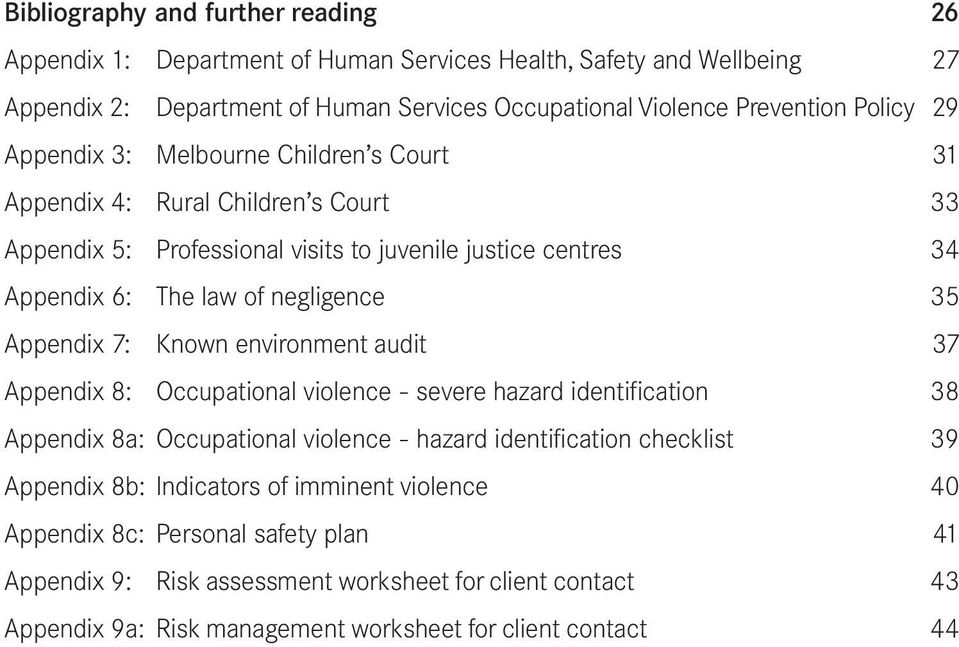
6 Bibliography and further reading 26 Appendix 1: Department of Human Services Health, Safety and Wellbeing 27 Appendix 2: Department of Human Services Occupational Violence Prevention Policy 29 Appendix 3: Melbourne Children s Court 31 Appendix 4: Rural Children s Court 33 Appendix 5: Professional visits to juvenile justice centres 34 Appendix 6: The law of negligence 35 Appendix 7: Known environment audit 37 Appendix 8: Occupational violence - severe hazard identification 38 Appendix 8a: Occupational violence - hazard identification checklist 39 Appendix 8b: Indicators of imminent violence 40 Appendix 8c: Personal safety plan 41 Appendix 9: Risk assessment worksheet for client contact 43 Appendix 9a: Risk management worksheet for client contact 44
7 Staff safety in the workplace 1 Part 1 Introduction 1.1 Purpose of this document The purpose of Staff safety in the workplace is to prevent and manage violence against staff. This document is a resource to assist staff and supervisors and managers at all levels to work safely while providing an effective service to clients. It is a tool to help prevent occupational violence and forms part of the Department of Human Services overarching approach to safety in the workplace (see Appendixes 1 and 2). Working in Child Protection and Juvenile Justice is very challenging. Clients involved in these programs can often present angry and frustrated. Unlike other welfare services, Child Protection and Juvenile Justice staff have a statutory obligation to provide services to clients who might behave in an aggressive manner. Both programs aim to provide respectful, proactive, flexible and responsive interventions with statutory clients. Particular skills are required to work effectively with this client group and these skills are acquired through a combination of training, observation and direct experience. Integral to these guidelines is a focus on a participatory (consultative) ongoing assessment of day-to-day occupational violence risks. This enables supervisors and staff to regularly and consistently identify hazards and risks, which means the controls to minimise the risks are relevant and current. This resource does not aim to cover every aspect of occupational violence, but does: articulate staff safety guidelines for the Office for Children provide a structured risk management approach to dealing with day-to-day identification, assessment and management of occupational violence risks associated with clients establish guidelines for staff safety, provide a focus for supervision and training activities and provide guidance on: preventing the occurrence of violence by identifying hazards and eliminating or controlling them establishing and maintaining a system to manage occupational violence available resources (for example, information, training and supervision, and tools such as mobile telephones). 1.2 Department of Human Services Occupational Violence Prevention Policy The following is edited text from the department s Occupational Violence Prevention Policy. The complete policy is at Appendix 2. The Department of Human Services is committed to creating a safe and productive workplace by improving health, safety and wellbeing at work. The client care and working environment will reflect the requirements of state and federal law, and community expectations for the protection of clients and staff. The department defines occupational assault as any incident in which employees are abused, threatened or assaulted in circumstances arising out of or in the course of their employment, including verbal, physical and psychological abuse. The department recognises that occupational assault injuries represent a significant proportion of overall injuries and aims to eliminate the risks associated with these injuries and to implement controlled solutions where elimination is not possible. This policy covers all facets of the Department of Human Services business where people are managing or are exposed to the risk of injury resulting from occupational assault. Legislation The department will comply with the requirements of the Occupational Health and Safety Act 2004 to provide a safe workplace, including safe systems of work. Principles Senior management commitment is critical to achieving improvements in the health, safety and wellbeing of employees. Consultation with stakeholders, including departmental management and employees, and employee representative organisations, will provide positive and effective workplace health and safety outcomes. Preventing health, safety and wellbeing risks in the workplace is the most effective way to reduce illness and injury. No work-related injury to employees is acceptable. The goal is zero injuries. Commitments All tasks and systems will be examined using the framework of hazard identification, assessment and control, and a monitored process of continuous improvement. Appropriate resources will be allocated to enable compliance with legislative requirement to provide a safe workplace, with priority allocation to highest risks. Consultation In line with the department s consultation policy, staff, occupational health and safety representatives and management will manage occupational assault issues through the consultative process.

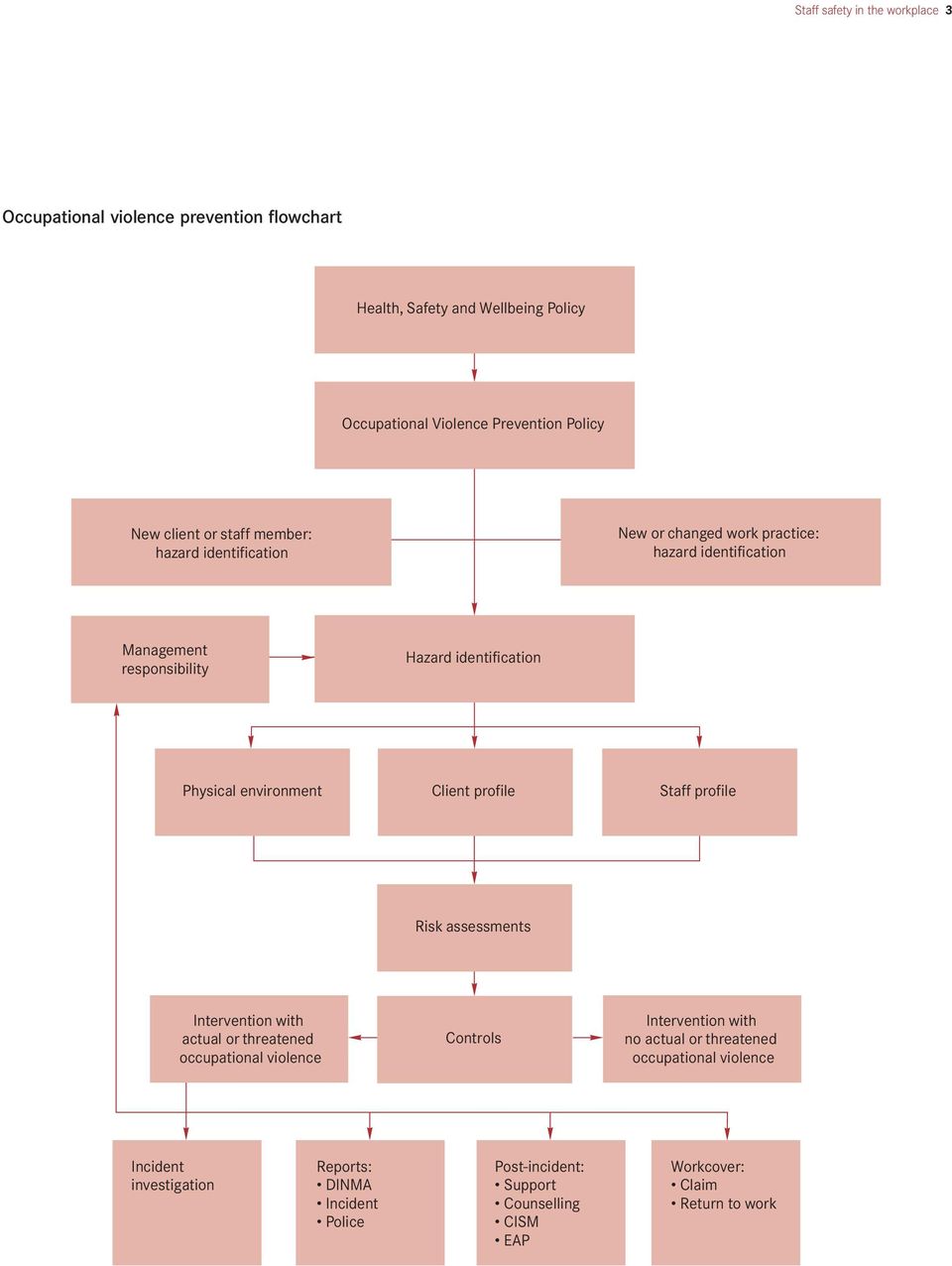
8 2 Staff safety in the workplace Systems of work Program-specific policies and procedures designed to reduce the risk of occupational assault hazards will be developed and implemented, with priority given to high-risk groups. Reporting systems for all incidents, including near misses, injuries and illness, will effectively promote early reporting. Client behaviour assessment and management Clients in the department s care will be assessed using existing systems, and behaviour management strategies will be developed and documented. Behaviour management strategies will be reviewed as required to maintain staff safety. Supervision Supervision will be provided by managers and other key personnel in relation to performance of work tasks and personal safety to reduce the risks of occupational assault injury. Supervisors will monitor employee skills and competencies in implementing client behaviour management strategies. Post-incident stress management Management will provide demobilisation and staff will be offered debriefing and defusing through the Critical Incident Stress Management (CISM) service, within recommended timelines. Monitoring implementation All departmental programs will have their safety performance monitored using the Safety Performance Management System. Responsibilities Senior managers are responsible for: ensuring implementation of the Safety Performance Management System ensuring policy commitments reduce occupational assault risks. Managers are responsible for: identifying, assessing and controlling occupational assault risks inducting and training employees in preventing occupational violence work practices working with employees and contractors to prevent and minimise occupational assault risks investigating all incidents and maintaining records of incident investigations maintaining staff training records providing immediate and ongoing support for employees exposed to occupational assault. Employees are responsible for: following work practices designed to reduce occupational assault risk identifying and reporting occupational assault risks to management working with management to prevent and minimise occupational assault risks reporting all incidents. 1.3 Definitions of occupational violence WorkSafe Victoria s publication, Prevention of bullying and violence at work: guidance note (2003) defines occupational violence as any incident where an employee is physically attacked or threatened in the workplace. Within this definition: threat means a statement or behaviour that causes a person to believe they are in danger of being physically attacked physical attack means the direct or indirect application of force by a person to the body of, or to clothing or equipment worn by, another person, where that application creates a risk to health and safety. The most common forms of assault against staff are verbal abuse and threats of harm. Verbal abuse includes shouting, intimidation, sarcasm and personal insults. Staff might also be subjected to sexual or racial harassment through offensive suggestions and remarks. The impact of verbal assaults on staff can be considerable and can affect their psychological wellbeing. The following flowchart depicts the systematic approach to managing occupational violence using a risk management strategy. Detailed procedures and tools to support this strategy and to provide direction to management and staff can be found in the Work Health Tool Kit (DHS, 2005).

9 Staff safety in the workplace 3 Occupational violence prevention flowchart Health, Safety and Wellbeing Policy Occupational Violence Prevention Policy New client or staff member: hazard identification New or changed work practice: hazard identification Management responsibility Hazard identification Physical environment Client profile Staff profile Risk assessments Intervention with actual or threatened occupational violence Controls Intervention with no actual or threatened occupational violence Incident investigation Reports: DINMA Incident Police Post-incident: Support Counselling CISM EAP Workcover: Claim Return to work
10 4 Staff safety in the workplace 1.4 Legislative context The principles of health and safety protection under the Occupational Health and Safety Act 2004 (Vic) stipulate: 1. The importance of health and safety requires that employees, other persons at work and members of the public be given the highest level of protection that is reasonably practicable in the circumstances. 2. Persons who control or manage matters that give rise to risks to health or safety are responsible for eliminating or reducing those risks as far as is reasonably practicable. 3. Employers and self-employed persons should be proactive and take all reasonably practicable measures to ensure health and safety at workplaces and in the conduct of undertakings. 4. Employers and employees should exchange information and ideas about risks to health and safety and measures that can be taken to eliminate or reduce those risks. 5. Employees are entitled, and should be encouraged, to be represented in relation to health and safety issues. Under the Act, the department, as an employer, has a responsibility to take all reasonably practicable measures to provide a safe working environment. The Office for Children recognises its responsibilities under this legislation for the safety of its employees. It provides all staff with induction, information, instruction, training and supervision to ensure they can carry out duties in a manner that is safe and without risk to health and have the necessary knowledge to contribute to work-related health and safety. 1.5 Supervision Supervision plays a critical role in staff health and safety. All staff safety issues, and the planning and checklist procedures outlined in this document, must be discussed in supervision. Health and safety is a regular agenda item of Child Protection supervision (see the Child Protection supervision standards (Department of Human Services 2005)). 1.6 Defining the workplace The definition of workplace is extended to all locations an employee visits during the course of their work. Therefore, the provisions of the occupational health and safety legislation apply to all environments in which work is conducted, such as home visits, meetings away from the office, court attendances and outreach. 1.7 Keeping safe The department has a statutory obligation to provide, so far as reasonably practicable, work environments that are safe for all staff. Effective measures for minimising the risk of occupational violence are: establishing and maintaining a culture of safety through the department s consultative processes maintaining routine work practices that enhance safety assessing the risks to staff safety before every client contact effectively managing conflict building and maintaining a skilled workforce. 1.8 Scope of this document The purpose of this document is to identify ways to enhance and manage staff safety regarding occupational violence in the workplace. It includes violence generated by clients and their families and carers in all areas where staff carry out their work. Staff-initiated assault is subject to separate procedures and processes. 1.9 Continual improvement This resource will be monitored and reviewed for continual improvement as understandings and practices in managing violence against staff and its impact are refined. It is anticipated all Child Protection and community-based Juvenile Justice staff will be trained in these guidelines and once the guidelines have been implemented, their application will be evaluated Relevant departmental references The department has an integrated approach to health and safety, which includes the following procedures, guidelines and publications: Health, safety and wellbeing policy Occupational violence prevention policy (a revision of the Occupational assault reduction policy) Incident reporting departmental instruction Critical incident stress management service guidelines Guidelines for employee assistance program Disease Injury Near Miss Accident (DINMA) reporting Occupational health and safety consultative Structure. User guide and summary

11 Staff safety in the workplace 5 Occupational health and safety accountability framework. User guide and summary Resolving claims of unacceptable behaviour Risk management framework Child Protection, Beginning Practice learning guide Work Health Tool Kit Acknowledgements Regional Child Protection and Juvenile Justice staff contributed to this resource. It is based on work developed in the department s Northern Metropolitan and Southern Metropolitan regions. The Staff Safety in the Workplace Reference Group and Child Protection and Juvenile Justice personnel gave advice and creative insight to these guidelines, and a range of people across the department made valuable input. These guidelines are also the result of extensive discussions with the Community Public Sector Union and WorkSafe Victoria.
12 6 Staff safety in the workplace Part 2 Risk management The safety of staff cannot be simply a function of situational responses or guesswork. Violence can often be predicted and prevented. A risk management approach provides a systematic framework for violence prevention and management planning. Awareness of high-risk situations allows for enhanced interventions with clients who might be violent. Staff safety in the workplace is based on a framework for controlling occupational health and safety risks in Australia. The framework has three steps: step one: hazard identification (identifying the extent and type of hazard) step two: risk assessment (identifying the factors that contribute to risk) step three: risk control (implementing necessary changes to eliminate or control the risk and monitoring and evaluating the risk control process). Certain tasks can increase the risk of violence; for example, removing a child or breaching an order. A systemic view of factors that might influence occupational violence can be helpful. First, the nature of the task and the client group should be considered, followed by the physical environment (for example, the location, such as an office, court, or client s home). Conducting this type of assessment helps to identify and assess risks and then allows decisions to be made about the best way to control (that is, remove or reduce) the risks. 2.1 Departmental responsibilities The department s Health, Safety and Wellbeing Policy outlines all staff members roles and responsibilities for staff health, safety and wellbeing (Appendix 1). Developing and implementing strategies to manage occupational violence is a management responsibility. Under the policy, all employees are responsible for observing, notifying about and acting on workplace hazards. The department provides an incident reporting system all employees should use so staff can be supported and hazards can be identified, managed and monitored. (Refer to section 6.2, Disease Injury Near Miss Accident (DINMA) and incident reports. 2.2 Hazard identification approaches The department has a number of systems in place to detect, consult on and record hazards. Child Protection and Juvenile Justice use the following mechanisms to identify hazards: alerts on clients electronic and paper files staff supervision and staff meetings (refer to section 2.2) critical incident reporting (refer to section 6.2 for DINMA and incident reports) the workload review and monitoring panel reports with health and safety representatives (refer to section 2.1) case reviews and audits psycho-social assessments of clients ongoing consultations with police, including criminal records checks employee climate survey.
13 Staff safety in the workplace Information, instruction and supervision The following forums provide staff with the information they need to function safely and effectively in the workplace. addressing occupational health and safety matters should also be an integral part of day-to-day management. Orientation and induction of new employees Where practical, employees must complete the induction process before commencing direct work with clients. The induction process should be used to: make new employees aware of the Victorian Public Sector Code of Conduct inform employees of the risks involved in their work, particularly any risks for occupational violence provide employees with the information and skills they require to understand and apply the preventative strategies being used to deal with the risks of occupational violence, and to manage potentially violent situations to the best of their ability ensure all employees are informed of the mechanisms and processes associated with health and safety (for example, occupational health and safety representatives and the DINMA system). Supervision and staff meetings Clients should be assessed for potential violence at the time their case is allocated to a case manager. This assessment can be done in discussions between the supervisor and the case manager. The supervisor and the case manager should consider all sources of information. Client assessment should be ongoing, and identified hazards and associated risks should be placed on client information systems. Supervision and regular staff meetings are integral to risk management and are important approaches to the early detection of risk to staff. As such, it is essential communication between staff members and the supervisor takes place. Training It is anticipated all Child Protection and community-based Juvenile Justice staff will be trained in these guidelines. This document should be read in conjunction with training material provided during employee orientation and safety or conflict management training. Child Protection New employees to the Child Protection program are required to complete a seven-week comprehensive induction called the Beginning Practice program, which includes both on- and off-the-job learning. Employees complete Beginning Practice prior to taking on case management responsibility for clients.

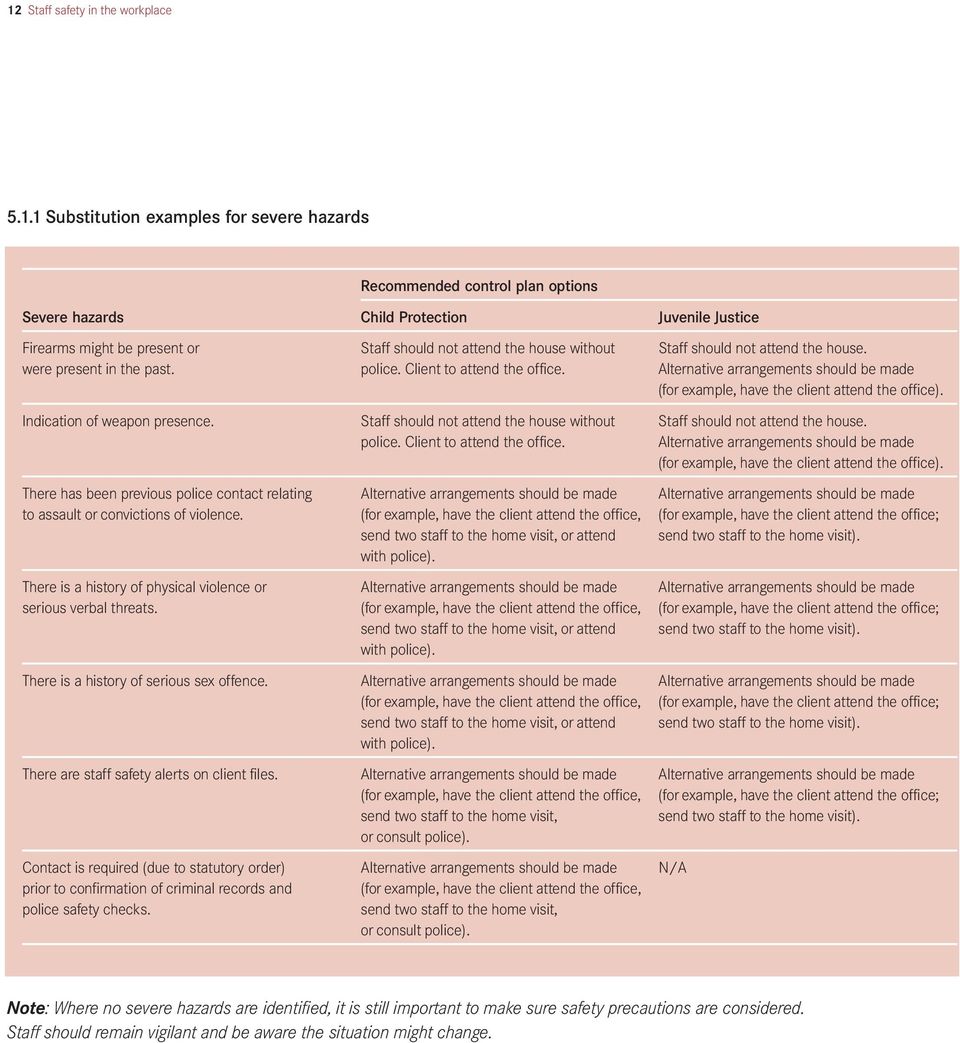
14 8 Staff safety in the workplace Part 3 Hazard identification To minimise the risk of occupational violence, staff must identify and assess the potential risks for violence using the checklists at Appendixes 8 and 8a. Hazard identification is the first step in the process of managing risk. If a hazard is not identified and consequently managed, its associated risk cannot be managed. A hazard is defined as anything that has the potential to harm the health and safety of a person. As well as identifying hazards prior to contact with the client, staff need to monitor the situation during contact for evidence of increased risk. The checklist at Appendix 8b will help the staff member to identify a hazard. The safety plan at Appendix 8c, which the supervisor and the staff member will develop, will identify how the risk is to be managed. 3.1 Hazardous situations The nature of the work environment and client group of Child Protection and Juvenile Justice predisposes staff to hazards and, consequently, to risks. It is therefore critical staff are made aware of hazards and their associated risks. A number of identified hazards for staff in Child Protection and Juvenile Justice increase the likelihood of their being exposed to occupational violence. These hazards include: applying legislation that relates to child protection and juvenile justice working in clients homes working after hours visiting clients in high-risk or isolated areas working and living within a client s community working with clients experiencing pain and anger associated with separation and loss working with clients whose behaviour is unpredictable (for example, clients affected by substance abuse or mental illness) being exposed to clients who are violent and use threats and intimidation. 3.2 Severe hazards The following hazards are identified as severe and the associated risks are considered high: Firearms might be present or were present in the past. There is an indication of weapon presence. There has been previous police contact relating to assault or convictions of violence. There is a history of physical violence or serious verbal threats. There is a history of serious sex offence. There are staff safety alerts on client files. (Child Protection) Client contact is necessary (due to statutory requirements) prior to confirmation of criminal records and firearms checks. Recommended control plan options to help manage these hazards are outlined in Part 5. Additional controls are documented in the Work Health Tool Kit (refer to Occupational violence prevention policy).
15 Staff safety in the workplace Other serious hazards The following are examples of other serious hazards that can intensify risk: There is a history of substance abuse. There is a history of mental health issues. The client or family member presents in an escalating state of crisis. The client has unknown or problematic associates. Visits are to isolated, remote or at-risk areas (for example, high rise flats, work sites, farms). The impact of the intervention is likely to precipitate violence (for example, breach of order). The client is involved with a multitude of services (for example, Child Protection, Juvenile Justice, mental health and disability services, and community service organisations). While the prevalence of these hazards is not extensive, they do represent regular situations staff encounter. All identified hazards should be subject to a risk assessment process and control plans to manage the established risks. 3.4 Hierarchy of control There are preferred options for managing and controlling hazards. Wherever possible, the best way to control and manage the effects of hazards is to simply eliminate them. Where this is not possible, the next preferred option would be to substitute a hazardous process for another less hazardous one and to keep doing this until the final level of control offers personal protection arrangements. This principle is called the hierarchy of control. The higher up the hierarchy a control option, the more preferable it is. To apply the hierarchy, it is vital to first identify the actual hazards facing staff. Certain tasks, such as removing a child or breaching an order, can increase the risk of violence. Similarly, the physical environment and location staff need to operate in can also impact on the level of hazard. Assessing the tasks a staff member has to take will help to identify the hazards that create the risks. Then, applying the hierarchy of control to the identified hazards will guide staff practice. The hierarchy is shown here, together with suggestions for its application: elimination. Eliminate or remove the hazard; for example, eliminate or defuse triggers for violence; remove a violent person from a situation substitution. Replace a hazardous process with a less hazardous one. Alter the system of work; for example, conduct an interview at the office rather than during a home visit; send two staff to visit the client; have a police or security guard presence engineering. Apply a physical intervention to minimise the hazard; for example, use a desk as a physical barrier in laying out the interview room or setting up an office administration. Implement policies and procedures for safe work practices; for example, conduct a risk assessment before engaging with a client; provide occupational health and safety guidelines, and information and training personal protective equipment. For example, use duress alarms and mobile telephones, think about worker presentation (clothing), involve two staff in the client contact. Note: It is not possible to eliminate most of the hazards in Child Protection and Juvenile Justice work because they are inextricably linked to the client. Therefore, the aim should be to manage the hazard and thereby manage the risk according to the guidelines in Part 5, Risk control.
16 10 Staff safety in the workplace Part 4 Risk assessment All client activities with the potential to cause harm must be subjected to a comprehensive risk assessment. Risk assessments are a systematic method for evaluating the likelihood of occupational violence and resulting consequences. Risk assessment is based on: the likelihood of an incident (frequency and exposure duration) how serious the injury will be if an incident occurs who might be affected by the incident determining the appropriate control measures. Supervisors, in conjunction with case managers, should complete the risk assessment worksheet for client contact (see Appendix 9) prior to the initial contact with the client. Assessing the potential for violence should be ongoing, and identified hazards and associated risks must be placed on client information systems. 4.1 Preparing for contact Planning for staff safety is an essential aspect of preventing occupational violence. Supervisors and staff should regard planning for client contact as an important safety strategy. While staff should always take routine precautions, they should take extra precautions when hazards have been identified. Staff safety should be addressed during supervision, as prescribed in program-specific supervision guidelines. Preparing for contact should occur whenever an employee is planning an initial contact appointment to find out facts, to seek clarification or to provide support or information; attending a routine home visit, supervising an access; going to court; participating in a client meeting or supervision at the office or other location; or organising an initial Child Protection investigation. 4.2 Routine contacts If contact is assessed as being routine and no hazards are identified, it is still important that safety precautions for routine contacts are considered. Supervisors and staff should always check electronic and paper client management systems for alerts before all client contact. During contact with clients, staff should be: observant aware of changes that indicate unanticipated safety concerns are developing prepared for the unexpected. 4.3 Ongoing risk assessment There are different ways in which an individual can indicate they are about to become violent, and some people become violent without warning. When engaged in client contact, an employee s assessment of the potential for violence should be ongoing. Indicators of imminent violence Staff should consider the following questions when evaluating potential risks and refer to the indicators of imminent violence checklist at Appendix 8b: Is the person showing any signs of atypical excitement or passivity? Are there weapons or similar cues to violence in the room? Is there a breakdown in the normal pattern of non-verbal communication? Is the person showing signs of rapid mood swings or increased irritability? Is the person oversensitive to suggestions or criticisms? The following violent behaviour scale identifies warning signs that might become evident before a violent outburst (Mayhew 2000): early potential: rapid shallow breathing, clenched fists, grinding teeth, flaring nostrils, flushing, panic, rising voice or chanting, restless and repetitive movements, pacing, violent gestures (for example, pointing, swearing excessively, using sexually explicit language), veiled threats, abusive language, unprovoked outbursts of anger or emotion, or sexual harassment escalated potential: argues frequently and intensely; blatantly disregards normal behaviour; hyper vigilant; obsessive thinking and behaviour; throws, sabotages or steals equipment or property; makes overt verbal threats to hurt staff; shows rage reactions to frustration; sends violent or sexual comments via , voic or letter; blames others for all difficulties urgent signs: fascination with weapons, substance abuse, severe stress, violent history, marked changes in psychological functioning, exotic claims (losing touch with reality), social isolation or poor peer relationships, poor personal hygiene and drastic changes in personality realised potential: destruction of property, involved in physical confrontation or commits assaults, displays or uses weapons, commits sexual assaults, arson or suicide. Note: The best indicator of a client s capacity for violence is a history of violence.

17 Staff safety in the workplace 11 Part 5 Risk control Risk control is a process of eliminating or minimising risk. In Child Protection and Juvenile Justice, the identified hazards are inextricably linked to the client and, as such, it is most unlikely they can be entirely eliminated. Therefore, once the risk is assessed, the safety plans that are devised should include precautions and preventative measures aimed at reducing the risk as far as is reasonably practicable to avoid placing staff in dangerous situations. Supervisors and staff should refer to section 5.3, Risk control options and strategies, for help in implementing the control plan and formulating strategies to manage the identified risks of severe and other hazards. Staff should also be constantly alert to the indicators of imminent violence. Management, in consultation with employees and their health and safety representatives, should review the range of controls available and identify the most suitable. They should consider the following hierarchy of control options when determining an appropriate risk management strategy: elimination: removing or eliminating the hazard from the work environment substitution: replacing a hazardous process with a less hazardous one, thereby limiting the opportunity for occupational violence engineering: using a physical intervention to minimise the hazard; making changes to the work environment administration: providing information about safe work practices personal protection: using, for example, mobile telephones and duress alarms, and thinking about worker presentation (clothing). 5.1 Control plan for severe hazards One of the most vulnerable situations staff can find themselves in is a client home visit. The following severe hazards of a client home visit are identified as high risk. Given it is not possible to eliminate the identified severe hazards because they are inextricably linked to the client, the control plan recommends substitution responses (for examples, refer to the table at 5.1.1). If any of the hazards outlined in the table at are present when planning client contact, supervisors and staff should, wherever possible, follow the recommended control plan options outlined in the table. If the recommended options are not reasonably practicable, the supervisor and the case manager should discuss the situation. They might need to consider alternative options. The supervisor and the case manager should complete the risk assessment worksheet for client contact (Appendix 9) and the risk management worksheet for client contact (Appendix 9a) at the time of client allocation to determine the level of risk and to manage hazards. The plan should be reviewed during supervision or as required. Note: Electronic and paper versions of client management systems for Child Protection and Juvenile Justice have provisions for documenting safety alerts. Staff should always check alerts before all client contact.
18 12 Staff safety in the workplace Substitution examples for severe hazards Recommended control plan options Severe hazards Child Protection Juvenile Justice Firearms might be present or Staff should not attend the house without Staff should not attend the house. were present in the past. police. Client to attend the office. Alternative arrangements should be made (for example, have the client attend the office). Indication of weapon presence. Staff should not attend the house without Staff should not attend the house. police. Client to attend the office. Alternative arrangements should be made (for example, have the client attend the office). There has been previous police contact relating Alternative arrangements should be made Alternative arrangements should be made to assault or convictions of violence. (for example, have the client attend the office, (for example, have the client attend the office; send two staff to the home visit, or attend send two staff to the home visit). with police). There is a history of physical violence or Alternative arrangements should be made Alternative arrangements should be made serious verbal threats. (for example, have the client attend the office, (for example, have the client attend the office; send two staff to the home visit, or attend send two staff to the home visit). with police). There is a history of serious sex offence. Alternative arrangements should be made Alternative arrangements should be made (for example, have the client attend the office, (for example, have the client attend the office; send two staff to the home visit, or attend send two staff to the home visit). with police). There are staff safety alerts on client files. Alternative arrangements should be made Alternative arrangements should be made (for example, have the client attend the office, (for example, have the client attend the office; send two staff to the home visit, send two staff to the home visit). or consult police). Contact is required (due to statutory order) Alternative arrangements should be made N/A prior to confirmation of criminal records and (for example, have the client attend the office, police safety checks. send two staff to the home visit, or consult police). Note: Where no severe hazards are identified, it is still important to make sure safety precautions are considered. Staff should remain vigilant and be aware the situation might change.
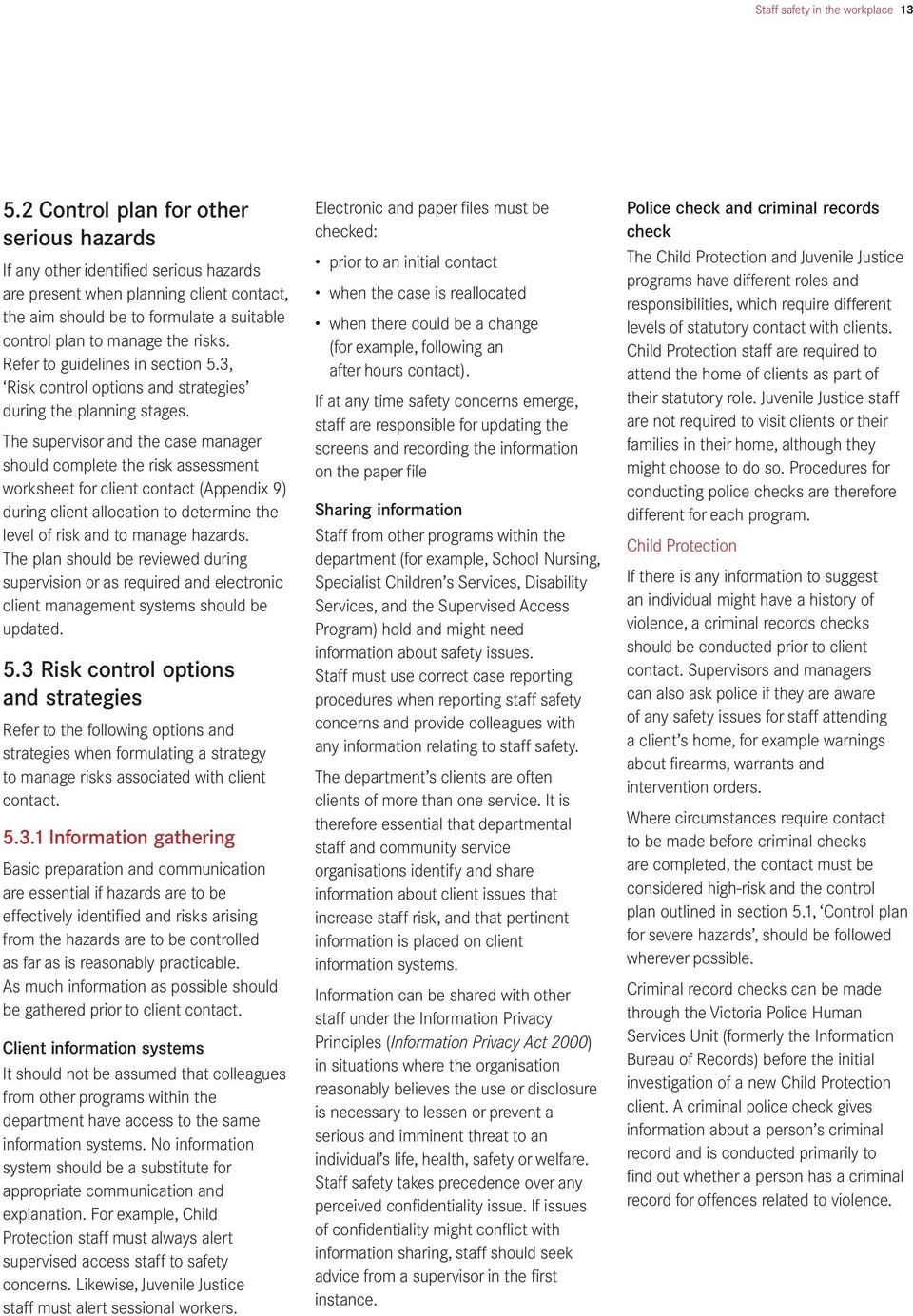
19 Staff safety in the workplace Control plan for other serious hazards If any other identified serious hazards are present when planning client contact, the aim should be to formulate a suitable control plan to manage the risks. Refer to guidelines in section 5.3, Risk control options and strategies during the planning stages. The supervisor and the case manager should complete the risk assessment worksheet for client contact (Appendix 9) during client allocation to determine the level of risk and to manage hazards. The plan should be reviewed during supervision or as required and electronic client management systems should be updated. 5.3 Risk control options and strategies Refer to the following options and strategies when formulating a strategy to manage risks associated with client contact Information gathering Basic preparation and communication are essential if hazards are to be effectively identified and risks arising from the hazards are to be controlled as far as is reasonably practicable. As much information as possible should be gathered prior to client contact. Client information systems It should not be assumed that colleagues from other programs within the department have access to the same information systems. No information system should be a substitute for appropriate communication and explanation. For example, Child Protection staff must always alert supervised access staff to safety concerns. Likewise, Juvenile Justice staff must alert sessional workers. Electronic and paper files must be checked: prior to an initial contact when the case is reallocated when there could be a change (for example, following an after hours contact). If at any time safety concerns emerge, staff are responsible for updating the screens and recording the information on the paper file Sharing information Staff from other programs within the department (for example, School Nursing, Specialist Children s Services, Disability Services, and the Supervised Access Program) hold and might need information about safety issues. Staff must use correct case reporting procedures when reporting staff safety concerns and provide colleagues with any information relating to staff safety. The department s clients are often clients of more than one service. It is therefore essential that departmental staff and community service organisations identify and share information about client issues that increase staff risk, and that pertinent information is placed on client information systems. Information can be shared with other staff under the Information Privacy Principles (Information Privacy Act 2000) in situations where the organisation reasonably believes the use or disclosure is necessary to lessen or prevent a serious and imminent threat to an individual s life, health, safety or welfare. Staff safety takes precedence over any perceived confidentiality issue. If issues of confidentiality might conflict with information sharing, staff should seek advice from a supervisor in the first instance. Police check and criminal records check The Child Protection and Juvenile Justice programs have different roles and responsibilities, which require different levels of statutory contact with clients. Child Protection staff are required to attend the home of clients as part of their statutory role. Juvenile Justice staff are not required to visit clients or their families in their home, although they might choose to do so. Procedures for conducting police checks are therefore different for each program. Child Protection If there is any information to suggest an individual might have a history of violence, a criminal records checks should be conducted prior to client contact. Supervisors and managers can also ask police if they are aware of any safety issues for staff attending a client s home, for example warnings about firearms, warrants and intervention orders. Where circumstances require contact to be made before criminal checks are completed, the contact must be considered high-risk and the control plan outlined in section 5.1, Control plan for severe hazards, should be followed wherever possible. Criminal record checks can be made through the Victoria Police Human Services Unit (formerly the Information Bureau of Records) before the initial investigation of a new Child Protection client. A criminal police check gives information about a person s criminal record and is conducted primarily to find out whether a person has a criminal record for offences related to violence.
20 14 Staff safety in the workplace The process for conducting a criminal records check is: 1. The supervisor or unit manager applies for a criminal records check. 2. To ensure the check includes other states in which a client has resided, the supervisor or unit manager includes details about periods of time the client has resided interstate. 3. The supervisor and case manager discuss the results. In high-risk situations, Child Protection supervisors must regularly repeat police checks in order to ensure the information on file is up-to-date. The Child Protection supervisor needs to assess the frequency of the repeat checks on a case-by-case basis in conjunction with managers. It is important to remember the absence of a criminal record or registered firearms does not rule out the possibility of a history of violence or the presence of firearms. Staff safety concerns can also be raised with the police by: contacting the Sexual Offences and Child Abuse Unit asking for issues to be raised at police and Department of Human Services liaison meetings. Juvenile Justice If a home visit is being considered and severe hazards are identified, Juvenile Justice case managers must discuss alternative options with their supervisor. There are two preferred options: (1) have the client attend the office, or (2) arrange an alternative site for contact Communication When a client home visit is required, a communication plan must be established between the supervisor and the staff member as part of a proactive risk management approach (see the Work Health Tool Kit, Occupational violence prevention policy, for guidance). Communicating with co-workers When working with a colleague during client contact, formulate a communication system. It is important to know if a co-worker believes it is necessary to end the contact or to obtain assistance, without the co-worker necessarily having to say it directly. Plan your excuses, your cues and your code words. Note: Working with a colleague is not a safety plan in itself. Supervisors must be involved in risk assessments. Communication strategies Where risks are identified, supervisors will initiate telephone contact to check or confirm safety. Plan communication strategies in advance and note the following: There must be at least one telephone safety check between the supervisor and staff. Staff and the supervisor should agree on an approximate time for the safety check. Preferably, the supervisor should initiate the safety check. Staff and the supervisor should develop a system for staff to signal for help without increasing client agitation. Supervisors should ask questions requiring a yes or no response to ascertain details about safety. The staff member should advise the client at the start of the interview that a telephone contact will be made during the interview and give reasons why (for example, to consult or to deal with an urgent matter). If the client expects the telephone contact, disruption can be minimised. Staff and the supervisor must discuss and agree on changes to the safety check, otherwise the supervisor can only assume whether or not the staff members are safe. If a staff member arrives at a destination later than expected, the staff member should inform the supervisor so the communication plan can be amended. When making contact with supervisors, staff should use agreed communication codes to confirm safety or to advise supervisors there are safety concerns. If the staff member does not make contact as agreed, the supervisor will initiate contact. If there is no response from the staff member, the supervisor will follow procedures outlined in section 5.3.3, Monitoring client contacts. Staff should carry an emergency taxi voucher in case their car breaks down or an unexpected situation arises which might place them at risk. Mobile/CDMA telephones Staff should check the area they are going to has mobile telephone reception and their telephone is charged. Rural staff might need to use a CDMA telephone or handheld radio to maximise the likelihood of telephone reception. Staff should ensure pertinent numbers, including emergency numbers, are programmed into the mobile phone in case of emergency.

21 Staff safety in the workplace 15 Police assistance Child Protection In cases in which the risks are deemed severe and the client cannot or will not attend the office, but yet there is a statutory requirement to visit the client, police assistance might be required (Refer to Protecting children: protocol between Department of Human Services and Victoria Police, DHS, 1998 for details). When police assistance is required, the staff member should inform police of the role, purpose, and likely length of the visit. Staff and police might have to negotiate when the visit will occur and consider the impact a police presence might have on the visit. Stand-by arrangements are when staff and the police make the decision to involve the police by having them wait outside the client s home or by having the staff member ring 000 (Emergency Communication Victoria). In critical high-risk situations, police will conduct their own safety assessments and might require a period of time to complete these before the visit. Police might also wish to assess the property and its occupants prior to departmental staff entering the property. In high-risk situations, staff should be guided by the police at all times. Executing a warrant to take a child or young person into safe custody can create additional high risks. Planning and managing warrant executions is a police responsibility, and departmental staff will take direction from the officer in charge. In some circumstances, it might be unsafe for staff to enter premises with police, and staff will need to await instruction. Juvenile Justice Juvenile Justice staff should not visit a client in a situation where police assistance is required. If an assessment determines a visit is high-risk to the degree police assistance is warranted, Juvenile Justice supervisors, in consultation with staff, will ensure an alternative site for the visit is arranged Monitoring staff safety Routine contacts Staff must always advise supervisors of their movements and the following information must be recorded prior to the staff member leaving the office to have client contact: the staff member s name their mobile telephone number the client s name the location of the contact the expected time of return. This applies to all contacts and is the minimum requirement. The recorded information must enable immediate contact if concerns develop for staff safety, for example, if a staff member fails to return to the office. Staff itineraries and arrangements must be known at all times. If the visit is likely to extend beyond normal working hours, it is important that arrangements for supervisor consultation are made. The overnight use of a vehicle might be arranged to avoid late returns to the office. Contacts with identified risk Staff movement will be closely monitored. Staff should take a mobile or CDMA telephone and make sure it is switched on and remains on. Staff should leave sufficient information to ensure helpful and appropriate assistance can be quickly made available if the need arises. Staff should record the following before a client contact: location of the visit or meeting names and contact details of people who will be present at the visit or meeting details of any safety concerns time of departure estimated start and finish times of the visit or meeting whether police, security or colleagues will be in attendance contact details of police, security or colleagues who will be in attendance name and contact details of the person monitoring the visit or meeting, if other than the supervisor planned communication strategies and agreed code words to confirm safety car registration details. Monitoring client contacts If a staff member fails to return to the office when expected, the supervisor will implement the following safety procedure to establish safety: 1. Call the staff member s mobile. 2. If there is no response, call the staff member on the client s home telephone number or the telephone number of the visit site. 3. If there is still no response, or if safety concerns are indicated, assess the safety risks and decide what action is required, including informing the supervisor s manager and arranging for the police to attend the client s house or visit site if necessary.
22 16 Staff safety in the workplace Safety in different situations All the suggested controls are fully developed in the Work Health Tool Kit. Completing the safety plan (see Occupational violence prevention policy, Work Health Tool Kit) will assist supervisors and staff in selecting the appropriate controls for a given situation. Guidelines for office and reception physical environments The department s Work Health Tool Kit (Occupational violence prevention policy) Known environment audit (see Appendix 6) and the Client Service Model Strategic Project Front End Redevelopment Project are safety guidelines pertinent to the physical environment of receptions and office areas. The safety guidelines can be used as a tool to review accommodation to create a safer and better environment for clients, the public and staff. Managing office contacts As discussed, it is not possible to eliminate most of the hazards in Child Protection and Juvenile Justice because the hazards are inextricably linked to the client. Therefore, the preferred option for managing risk associated with client contact is to conduct meetings and supervised access at the office. The following precautions should be considered: It is standard practice for staff not to arrange to have contact with a client when alone in the building. Staff should make sure the contact is not conducted in isolation and that supervisors, colleagues and reception staff are aware of the contact, including the estimated start and finish times. Staff should be checked on at regular intervals. Arrange for security guard assistance if available. Staff should use fixed and personal duress alarms, where available. Refer to regional office duress alarm procedures. Staff and their supervisor should develop a system for staff to signal for help without increasing client agitation. Staff should consult with office reception staff and follow their guidelines for dealing with threatening clients. If the regional office has interview rooms that are designed with viewing panels, staff should use these rooms whenever possible to conduct meetings with clients or family members. Staff should start the interview on time and keep waiting time to a minimum. If there is an unavoidable delay, staff should make sure the client is informed of the delay and of the likely duration. Staff should sit closest to the door, without blocking the exit, during the interview. If staff are moving around with clients (for example, escorting them to interview rooms) staff should always keep the clients in view. Staff should be aware of equipment that could be used as a weapon (for example, pens, chairs, the waste bin). If an incident occurs at the office, staff should contact the office manager, security or police. Refer to regional safety guidelines for further details. Home visits: approaching the house When approaching the house for a home visit, staff should: drive by the house and observe the premises for potential hazards (for example, locked gates) park facing the exit direction to ensure ease of exit never park in the driveway and always have access to car keys be alert and listen for potential staff safety issues (for example, raised voices, fighting, visitors, dogs) before making presence known stand to one side of the door when knocking and not enter until met at the door by the client on greeting the client, ask who else is home make a judgement about whether it is safe to do so if requested to remove shoes prior to entering the house be vigilant and aware of surroundings when conducting a client visit at a multistorey building meet police (if doing so) some distance from the house and confirm safety plan in cases where there appears to be an emergency, consult with their supervisor and discuss whether the staff member needs to call the police. Note: If it does not feel safe, staff should not enter the house and should contact their supervisor immediately.
23 Staff safety in the workplace 17 Home visits to isolated locations Supervisors will discuss visits and obtain contact details (for example, the address, land line and mobile telephone numbers of the client or family). If there are risk factors present, the supervisor and staff member should decide whether to organise for an additional worker to attend the home visit. They will decide this as part of completing the safety plan (see the Work Health Tool Kit, Occupational violence prevention policy). The staff member should: take their mobile telephone and a CDMA telephone to maximise the likelihood of telephone reception ensure their car has a full tank of petrol before leaving the office check where the nearest police station is located telephone their supervisor on arriving at the family home to advise the supervisor of their safe arrival telephone their supervisor to advise them of the time of leaving the family home and of the expected time of arrival back at the office if going directly to another visit, telephone their supervisor again on arriving at the next destination if travelling directly home after the home visit, telephone their supervisor to let them know, and then telephone them once home to confirm their safe arrival. Child Protection In identified high-risk visits, it is recommended staff follow the risk control plan outlined in the table in section Where required, staff should make arrangements with police to attend as a safety precaution. In situations where the risk does not require police attendance, staff should note where the home is and the distance to the closest police station, and consider the time it would take police to respond to an emergency. Staff should consult with police prior to making the visit. Juvenile Justice In identified high-risk visits, it is recommended staff follow the risk control plan outlined in the table in section If there are high-risk factors present or if the level of risk is unknown, staff should discuss other possible arrangements for the visit with their supervisor; for example, an alternative site for the visit. Inside the house Once inside the house, staff should: observe the exits in the house and stay close to exits in rooms not allow themselves to be blocked or locked in sit in a position that allows easy access to the door (preferably with their back to the wall) interview the client in the closest suitable room to the front door. Avoid the kitchen (potential weapons) and bedrooms (personal space, firearms) scan the environment for dangerous items or drug paraphernalia face the client during the interview not block a client s exit attempt to monitor what the client is doing at all times be aware of the location of the co-worker at all times consider whether it is safe to accept offers of food or drink stay alert to anything out of the ordinary, such as agitated people monitor the presence of threatening pets and request they be secured in another area of the premises if the staff member feels unsafe.
24 18 Staff safety in the workplace Terminating contact If unforeseen safety concerns develop or a potentially violent situation escalates, terminate the interview. Staff should stop contact at the first thought or feeling of concern for safety. The client can always be re-engaged. Staff should follow their personal instincts. If attending with a colleague, and one staff member feels unsafe and decides to leave, the other staff member must accompany their colleague without question or discussion. Neither worker should re-enter the house unless both agree it is safe to do so. If a staff member finds themself in an unsafe situation, they must leave, despite potential risk to children. The staff member should consider whether police intervention is necessary. Staff should use any reason to allow for a safe departure. When in a safe location, the staff member should park the car, contact their supervisor and report concerns. The staff member and the supervisor should agree on an immediate plan of action which ensures safety and allows client safety. Options include the staff member returning to the office and organising an office interview, or the staff member contacting police and re-attending the premises with the police. The staff member should record in the case notes that the interview was terminated, the reason for termination, and further action taken or required. The staff member should report the incident to their supervisor, complete a DINMA report and an incident report, and seek support. Conducting outreach visits Supervisors and staff must be fully informed of any potential safety hazards the staff member might encounter during the outreach visit and of safety check arrangements, including the visit location and actions for the safety check. Refer to section on communication strategies. Safety checks should be conducted in the following circumstances: when transporting clients to their home or placement when attending a client s residential address when trying to locate clients. The following items should be made available to staff during outreach: mobile telephone pocket first aid kit (in car) rubber gloves (in car) torch (in car). Attending court Refer to Appendix 3, Melbourne Children s Court security procedures. If there are known security risks, staff should make contact with the court registrar prior to the hearing date to instigate security measures. Staff should also inform their client s legal representative of their security concerns, either directly or through the department s legal representative. Staff should also ask the client s representative to request his or her client to maintain control. Staff should consider the following strategies as part of a court safety plan: Use car pooling to court. Use taxi vouchers, if available, when travelling to or from court. Do not walk alone to or from court. Melbourne Children s Court In addition to the above strategies, Melbourne Children s Court has additional security measures available. Consider: waiting in the Department of Human Services office at the court using the court-employed security guards who can assist if safety concern arise asking a security guard for permission to use the secure welfare area on the ground floor as a waiting area. Note: Staff orientation or induction must cover the Melbourne Children s Court and local court arrangements and be provided to staff before they commence duties. Rural staff should also refer to Appendix 4, Rural Children s Court security procedures.
25 Staff safety in the workplace 19 Visiting juvenile justice centres Refer to Appendix 5, Professional visits to juvenile justice centres. Juvenile justice centres have guidelines governing professional visits to clients. To ensure effective service delivery, it is imperative staff adhere to these guidelines. If there are known risks relating to professional visits, staff should contact the relevant juvenile justice centre unit manager to instigate security measures prior to the visit. Transporting clients Staff should assess the safety risks for passengers, themself and the public before agreeing to transport clients, including children and young people. Staff must not use their own cars to transport clients. Routine precautions Staff should: ensure there is enough petrol to complete the journey check there is a first aid kit and torch in the car put all personal items or objects considered dangerous in the boot consider whether there are any items within reach that could cause injury if thrown (for example, a street directory or pens). Remove the cigarette lighter keep doors locked when waiting in a stationary vehicle, particularly at night and in quiet areas remain in the car if it breaks down at night, lock the doors and windows, and use a mobile telephone to call for assistance make sure the correct child restraints or seats are securely fitted according to child restraint regulations refer to regional driver safety guidelines. Children and young people If the client needs transport to placements, court or access, and is or is likely to become distressed, agitated or aggressive, staff should follow these safety procedures to minimise the risks: Staff should consider the most suitable place to seat the client depending on their age and circumstance (for example, if there are two workers, seat one in the back with the client). If transporting a sibling group, staff should consider using more than one vehicle. If planning to use the child lock on rear doors, staff should consider that: for a young, active, suicidal or depressed child, this might prevent injury to them for a drug-affected or angry teenager, this might increase their risk of frustration. Staff should discuss their expectations about the journey with the client (for example, the destination, the need to wear a seat belt, the requirement for the client not to smoke, whether the child lock will be in use). During transit, staff should avoid conflict or discussing issues that are known to anger or distress the client. If a child or young person becomes agitated, aggressive or starts to move around the car and distracts the driver, the driver should pull over and stop the car. If a child or young person attempts to leave the car while it is moving, the driver should activate the central locking (if available) and pull over as soon as possible. Once the car has stopped, staff should assess and make a judgement about whether it is appropriate or safe to attempt to physically restrain the child or young person. Necessary or reasonable restraints, as general law provides, might be required in cases where the child or young person is actively attempting to harm themselves or others. If staff safety is at risk, the driver should stop the car and not continue to transport the client. The staff member should contact their supervisor and inform them of the situation and discuss alternative strategies, including abandoning the car or requesting police assistance. Child Protection If transporting a client to secure welfare, staff should consider placing two workers in the back: one on either side of the client. Staff should discuss alternative travel arrangements with their supervisor. If the risk issues are significant, the staff member and their supervisor should consider issuing a warrant under s. 265 of the Children and Young Persons Act1989. Parents or carers It is not the responsibility of staff to transport the parents or carers of Child Protection or Juvenile Justice clients; however, in situations where the parent or carer might require assistance with transport, consider how they could be assisted to travel to the destination (for example, by being given advice about public transport, by being provided with cab vouchers or public transport tickets, or by receiving an offer for the program area to pay for their petrol). If the safety assessment indicates risks associated with transport, do not transport the client.
26 20 Staff safety in the workplace Personal safety guidelines Protecting one s personal security The Office for Children supports all staff in endeavouring to ensure their personal security and safety. Protecting personal security and identity is essential, not only in situations where specific threats have been made, but as a general precaution. These simple strategies are suggested as a means of enhancing staff members personal safety: Become a silent voter. Obtain a silent telephone number. Carry a charged mobile telephone. Avoid calling clients from a personal telephone. If absolutely necessary, first dial 1831 to block the number display. Never give out home address or personal telephone number. Vary route to and from work. Avoid using a personal car to visit clients where possible. Keep car doors locked and windows shut. Keep valuables out of sight, either covered or in the boot. Park as near to the office building as possible in an area that will be well lit at night. Check the back seat of the car before getting in. If concerns arise about personal safety and security after work, alert a colleague or security officer if available and request assistance. If concerned a car is following, do not go home. Report the matter at a police station. Note: Under no circumstances should staff give out colleagues personal details to clients or others. Clothing Clothing can increase or decrease personal safety in a violent situation. Loose, comfortable and practical clothing allows easy movement and breathing and allows staff to flee from a situation. Flimsy or high-heeled shoes can restrict mobility and cause tripping. Long-sleeved garments offer some protection from bites. Avoid wearing necklaces, ties, scarves or security passes because they can be used for choking. Long dangling earrings can be torn from ears. Handbags, briefcases, document satchels and wallets can be used as weapons. Jewellery, watches, belt buckles or bunches of keys can cause injury if a scuffle develops. Wear a swipe card safely. Use a belt anchor instead of wearing the card around the neck, particularly when interviewing clients or their families. Revealing clothing can jeopardise worker safety. Given the precarious and impressionable nature of clients, a sensitive and practical approach to clothing is required. Professional attire is essential. Self-defence If threatened with an imminent physical attack, staff should leave the hostile situation. If unable to do so, self-defence might be necessary. If a self-defence act is required, staff should do whatever is necessary to get away using the minimum force required (refer to Appendix 6, The law of negligence ). Dealing with an angry client Clients of Child Protection and Juvenile Justice can present as angry and frustrated. In many instances, clients have limited skills in communicating this anger and frustration in acceptable ways. Specific defusing skills are required to work with this client group and such skills are learned through a combination of training, observing senior staff, and direct experience. When a client is hostile or verbally abusive, staff should keep in mind the following: Staff do not have to tolerate abusive or threatening behaviour. If safety concerns arise, staff should organise time out by terminating the contact entirely or for a short while. Staff should also: keep a safe distance from the aggressor avoid touching the person they are trying to calm down try to defuse the situation by listening to the client and remaining calm be quietly assertive, express facts calmly and avoid heated discussions be mindful of power struggles, and remain courteous and respectful be sincere in their attempt to help and avoid an aggressive response use simple, direct and brief statements. They should speak slowly and clearly discuss problems and issues in a straightforward manner use language the client will understand try to maintain empathy and paraphrase client s comments time their responses carefully
27 Staff safety in the workplace 21 help the client to focus on the issues or problems that are causing anger and to identify solutions demonstrate they are trying to find solutions to problems steer clear of potentially hurtful comments and avoid belittling client concerns acknowledge the client s feelings and try to place the anger in context. The client might have good cause to be angry. Acknowledging their feelings and trying to place the anger in context can help to contain the anger and prevent it from escalating consider using an interpreter if required avoid force and physical restraint, except for protecting oneself and others ensure the client views their involvement as professional and not personal arrange office security guard assistance, where available. Note: If an incident is occurring in an office reception, consult with reception staff and follow their guidelines for dealing with threatening clients (refer to Appendix 7, Known environment audit ). For further information, see Front End Redevelopment Project Report Guidelines for the Department of Human Services front end reception physical environment. Telephone calls Staff do not have to tolerate abusive or threatening behaviour. If threatened or verbally abused on the telephone, staff could consider these procedures: Listen to the caller. It might be a client who has a good cause to be angry, and acknowledging this might help contain their concerns. Try to calm down the caller and maintain composure. Explain the behaviour is not acceptable and ask the caller to stop. Be specific about what is unacceptable. Warn the caller the call will end if they do not stop the behaviour. If the behaviour continues, tell the caller you are not prepared to continue the conversation at this time and terminate the call. Invite the caller to call back when they have calmed down. Tell the client how, when and with whom they can resume contact. This will be decided on the basis of statutory requirements, duty of care, urgency, the staff member s relationship with the caller and the nature of the threats or abuse. On terminating the call, report actions to the supervisor, make a case note record and seek support. Complete a DINMA and incident report if the contact was abusive or threatening. Be aware of personal responses, including any residual reactions, and if necessary, talk over the incident further with the supervisor, or refer to section 6.3.3, Formal debriefing.
28 22 Staff safety in the workplace Part 6 Post-incident management and support Any incident involving staff in the department must be reported. The department provides various supports for staff who are affected. This guide focuses on preventing the risk of occupational violence occurring and managing and minimising its effects when it does occur. The department acknowledges the work staff do can be stressful and it often has an emotional impact (see section 6.8, Common personal reactions to occupational violence ). As well as ongoing supports, there might be times when staff need specific assistance to manage the emotional impact of their work. In accordance with departmental policy, supervisors should apply the information in the following sections as appropriate. 6.1 Medical assistance Following any incident, the immediate concern is staff wellbeing and providing any necessary medical treatment for any person involved. Where medical treatment is necessary, the staff member should obtain a written medical report or certificate from the medical practitioner. 6.2 Disease Injury Near Miss Accident and incident reports If staff are subjected to any form of assault at work, including threats and verbal abuse, staff must use the department s incident reporting system, Disease Injury Near Miss Accident (DINMA) and incident reports. Incidents are commonly under-reported for a variety of reasons. It is very important all incidents are reported and recorded in order to: ensure staff receive the support they need monitor the risks in the working environment improve risk minimisation strategies develop ongoing strategies to minimise risk. Staff must: inform their supervisor complete a DINMA report complete an incident report consider police involvement. Note: Staff involved in occupational violence must make a case note record and update staff safety alerts on the electronic case management system under Behavioural alert.
29 Staff safety in the workplace Support Assistance that can be provided to staff if they have been subjected to client-initiated abuse or assault includes formal debriefing, supervision, informal debriefing with peers, discussions of issues at team meetings, and reporting to their health and safety representative Culture of safety and support Practical and emotional supports might be needed if staff are involved in a specific incident or if a cumulative response to a series of minor incidents or stress arises. The culture of safety and support in the work environment will have a significant impact on how staff are likely to respond and can influence the likelihood of an incident occurring in the first place. A culture of safety and support is evident when: peers, managers and the organisation as a whole openly and actively recognise the realities of dealing with violent or potentially violent clients the often stressful nature of the work, and the impact of this, is recognised it is normal and automatic to raise any doubt, fear or uncertainty, however small, about a client or situation at an early stage all work is considered from a safety perspective before being undertaken safety is regularly raised and discussed at team meetings, user forums and supervision, not just after incidents it is recognised that when one worker is involved in an incident, whole teams and offices can be affected Supervisors In addition to offering staff direct and immediate support, supervisors will ensure support and assistance is provided in order to: help staff to deal with personal responses organise formal debriefing plan a response to the perpetrator involve the police if necessary manage client-related legal issues arising as a result of the incident (a court order might need to be changed) review safety procedures for future contact, either by the case manager or other staff review casework strategies for working with the client make sure formal reporting requirements are met (that is, a DINMA and incident report is completed and processed) manage team issues arising from the incident raise issues with the health and safety representative provide training and practice in all safety procedures during orientation, supervision and staff meetings Formal debriefing Critical Incident Stress Management service The Critical Incident Stress Management Service or CISM service can be accessed following any incident that causes staff distress. It is free and confidential and provided by appropriately trained staff. The CISM service can be conducted on a group or individual basis, depending on the nature of the incident and the people involved. It will help staff to: express emotions try to gain a better understanding of what has occurred understand normal reactions to such events receive immediate support put the incident into perspective and confirm they were not responsible for the incident successfully resolve the issue to allow closure Peer debriefing Peer debriefing provides individuals with an immediate opportunity to express their thoughts and feelings and to receive appropriate support from their own peer group. Supervisors will organise a formal debriefing for staff involved in an incident. Although staff are not obliged to attend, they will be encouraged to do so.
30 24 Staff safety in the workplace 6.4 Employee Assistance Program The Employee Assistance Program or EAP is a free and confidential counselling service provided by external counsellors. Staff can access the service if they are experiencing personal problems that are affecting their ability to perform at work. Whether or not a staff member uses EAP is a personal decision. Staff can find out more about EAP from the department s KnowledgeNet site or their supervisor or senior human resources advisor. 6.5 Managing the perpetrator Responding to the perpetrator is primarily the regional manager or unit manager s responsibility. This officer will arrange the response in conjunction with the relevant supervisor. The purpose of the response is to make sure staff are not further harmed, statutory requirements are met, and the client is safe. The response, which can be a letter or a telephone call to the client or the client s parents, will provide an opportunity to further discuss the incident and will aim to set clear boundaries for future contact. The regional manager or unit manager should consider consulting the police about managing clients who present with threatening and aggressive behaviours. 6.6 Making complaints to the police All staff members have the right to make a complaint to the police following assaults and serious threats of harm. If staff are assaulted or threatened (which includes any incident that might constitute a criminal offence, including threats to harm), they will be strongly encouraged to make a complaint. This applies whether the threats are made face-to-face or on the telephone. It is important to report incidents, even when it is not clear whether there is evidence to prosecute. The evidence might build up over time or the police might have other information. When reporting an incident, staff will be asked to make a statement. Senior managers should be informed if staff make a complaint to the police. This allows senior managers to make sure staff are supported in taking this action and to monitor the degree to which the department needs to be involved in discussions with the police about the case. The police decide whether there is a case to be prosecuted.consideration could also be given to an intervention order. 6.7 Return to work program The department is committed to providing a safe and healthy work environment for its employees and, if an injury occurs, to providing rehabilitation and return to work programs to help staff to return to work. The supervisor or manager works with injured employees, the regional coordinator and treating health practitioners to maintain injured employees at work where possible or, where the injured employee requires time off, to facilitate their safe and timely return to work. 6.8 Common personal reactions to occupational violence There is a range of common personal reactions to being exposed to assault and aggression at work. A person might react as a result of a single incident or a cumulative response to the impact of the work. Staff involved in occupational violence might react immediately after an incident or some time later and can experience any of the following: a fear of clients, and particularly of confronting clients a fear of coming to work a fear of reporting the incident crying disturbed sleep feelings of powerlessness self-blame and guilt anger at work and in personal relationships damaged professional self-image headaches anxiety or depression.
31 Staff safety in the workplace Managing a personal response Normal responses to threatening situations include anger and fear. The purpose of these responses is to quickly prepare us for flight or fight. It is important staff are aware of how to respond to threats. This will help them to monitor and control their responses and to use skills to manage the situation. Personal reactions are also an important risk indicator that should not be ignored because they give the individual clues about the potential for attack Physical responses When a person is threatened, the following physical cues might become evident: rapid, shallow breathing rapid, pounding heartbeat muscle tension (for example, in the stomach, chest, head or entire body) sweating clenching of jaw, teeth or fists pacing wanting to cry feeling ill trembling flushing of the face Resilience An individual s resilience at any given time influences their personal responses to occupational violence. People are more likely to experience a physical stress response if they are hungry, tired, sick, frustrated, or there are unacknowledged personal triggers present in the situation Personal triggers Nearly everyone has some previous experience of aggression and violence. These experiences can act as triggers in certain situations. Being aware of one s personal triggers will help to extend one s choices about ways of dealing with future episodes of aggression and violence. Staff should think about or discuss the following questions: What do you perceive as aggressive and violent behaviour? How do you deal with different types of aggression? Is your tendency to become confrontational or to give in or to stay calm? What groups of clients (for example, male adolescents, people with mental health problems, parents of abused children) give you most concern and why? What situations (for example, home visits, couples, groups, families) concern you? What might prevent you from recognising warning signals? What might prevent you from asking for support and protection?
32 26 Staff safety in the workplace Bibliography and further reading Bowie, V 1989, Coping with violence a guide for the human services, Karibuni Press, Sydney. Breakwell, GM 1989, Facing physical violence, British Psychological Society & Routledge, London. Cheshire County Council 2000, Guidance to staff on violence in the workplace, 3rd edn, Social Services, Cheshire County Council, Chester, United Kingdom. Cherry, D & Upston, B 1997 Managing violent and potentially violent situations: a guide for workers and organisations, Centre for Social Health, Melbourne. 1995, Human services minimum standards for the prevention and management of occupational assault, DHS, Melbourne. 1998, Protecting children: protocol between Department of Human Services and Victoria Police, DHS, Melbourne. 2000, Duty of care, DHS, Melbourne. 2001, Critical incident stress management service guidelines, DHS, Melbourne 2001, Health, safety and wellbeing policy, DHS, Melbourne. 2001, Occupational assault reduction policy, DHS, Melbourne. 2003, Child Protection Beginning Practice learning guide, DHS, Melbourne. 2004, Guidelines for employee assistance program, DHS, Melbourne. 2004, Incident reporting departmental Instruction, DHS, Melbourne. 2004, Resolving claims of unacceptable behaviour policy, DHS, Melbourne. 2004, Risk management framework, DHS, Melbourne. 2005, Front end redevelopment project report. Guidelines for the Department of Human Services front end reception physical environment, DHS, Melbourne. 2005, Occupational health and safety consultative structure. User guide and summary, DHS, Melbourne 2005, Occupational health and safety accountability framework. User guide and summary, DHS, Melbourne. 2005, Work health tool kit, DHS, Melbourne. Dyson, M 1999, Safety and wellbeing report, Youth and Family Services Northern Region, Department of Human Services, Melbourne. Katzenbach, J & Smith, D 1993, Crisis communication, Harper Collins, New York. Littlechild, B 1997, Dealing with aggression. A practitioner s guide, Venture press, Birmingham. Mayhew, C 2000, Preventing client initiated violence. A practical handbook, Australian Institute of Criminology, Research and Public Policy, series no. 30, Canberra. McLean, J 2000, Violence against social services staff, National Institute of Social Work, London. Occupational Services of Australia 1999, Managing conflict effectively. Department of Human Services participant training manual, OSA, Melbourne. Sheffield City Council 1998, Violence at work. Guidance pack for employees and guidance pack for managers, Social Services Directorate, Sheffield City Council, Sheffield, United Kingdom. Southwark Council 2000, Policy, procedures and guidelines on violence, aggressive behaviour and harassment towards employees, Southwark Council, London. 2003, Prevention of bullying and violence at work Guidance note, WorkSafe, Melbourne.
33 Staff safety in the workplace 27 Appendix 1: Department of Human Services Health, Safety and Wellbeing Policy The Department of Human Services is committed to creating a safe and productive workplace through improving health, safety and wellbeing at work. Recognising that employees are central to effective service delivery, the department can demonstrate the value it places on employees by implementing measures which actively protect and promote the health, safety and wellbeing of all staff. This policy contributes to the department s human resource management strategy, and is consistent with the departmental values which recognise the department s duty of care to staff and clients. An objective of this policy is to model within the department its own mission to protect and enhance health and social wellbeing and to ensure organisational practice is aligned with health and wellbeing philosophy and practice promoted to the Victorian community. Legislation The department will provide as far as is practicable a safe and healthy workplace for all employees, clients, contractors and visitors. Employer obligations in the Occupational Health and Safety Act 2004 and other relevant occupational health and safety regulations are the basis on which the department builds its health, safety and wellbeing management practice. Principles Senior management commitment is critical to achieving improvements in the health, safety and wellbeing of employees. Health, safety and wellbeing of employees is a core management responsibility as part of good people management and effective service delivery. Consultation with stakeholders, including Department of Human Service management and employees, and employee representative organisations, will provide positive and effective workplace health, safety and wellbeing outcomes. Prevention of workplace risks to health, safety and wellbeing is the most effective way to reduce occupational illness and injury. No work-related injury to employees is acceptable. The goal is zero injuries. Commitments Health, safety and wellbeing management will be integrated into departmental and local practices. Risks to health, safety and wellbeing will be reduced by identifying, assessing, controlling and evaluating risks in consultation with stakeholders. Where workplace prevention fails and injury or illness occurs, circumstances will be investigated and action taken to prevent a recurrence. Continuous improvement in the health, safety and wellbeing of employees will be managed by setting departmental and local performance improvement targets, monitoring health and safety performance and reporting on achievements. Policies and procedures for reducing risks to health, safety and wellbeing will be developed in consultation with stakeholders and reviewed at least every two years. Managers will be provided with the knowledge and skills to enable them to manage workplace health, safety and wellbeing issues in their area of accountability. Employees will be provided with the information, instruction, training and supervision necessary to enable them to work safely. Responsibilities Managers are responsible for identifying and managing local health and safety issues, allocating roles and responsibilities, monitoring performance and working with employees to achieve continuous improvement. Employees are responsible for co-operating with management to improve workplace health, safety and wellbeing, observing safe work practices they have been trained in and, as far as they are able, protecting their own and others health, safety and wellbeing in the work environment. Specific responsibilities for stakeholders are specified in the document, Implementation of the Health, Safety and Wellbeing Policy. Roles and responsibilities, available on the Work Health website <
34 28 Staff safety in the workplace Management roles and responsibilities Secretary Promote organisational values of health, safety and wellbeing as essential to good people management and effective service delivery. Sponsor health, safety and wellbeing policies that define departmental expectations in the provision of a safe and healthy working environment. Monitor organisational health, safety and wellbeing performance, and reward and recognise achievements. Directors, assistant directors and regional executives Ensure program and regional managers implement the organisational commitments stated in the Health, Safety and Wellbeing Policy. Include and assess health, safety and wellbeing strategies and performance targets in annual service delivery plans and senior management executive performance plans. Allocate resources to achieve health, safety and wellbeing performance improvement targets. Monitor health, safety and wellbeing performance against agreed performance targets. Senior management In consultation with employees, develop strategies for incorporating health, safety and wellbeing into service delivery and document strategies in the regional/program service delivery plan. Include and assess health, safety and wellbeing strategies and performance targets in management performance plans. Access resources to implement health, safety and wellbeing strategies to improve workplace risk prevention. Promote the Health, Safety and Wellbeing Policy and local implementation strategies through management and employee meetings and health and safety committees. Develop, implement and monitor systems to ensure compliance with statutory responsibilities to train employees in hazards and risks associated with their work. Monitor the implementation and performance outcomes of regional/program health, safety and wellbeing improvement strategies and report progress. Managers/supervisors Provide and maintain a healthy and safe local working environment. Consult with employees and health and safety representatives on workplace health and safety information, issues and opportunities for improvement. Identify local risks through workplace inspections, incident reports, DINMAs, accident investigations and workplace consultation. Develop and implement health and safety improvements in consultation with employees. Provide a business case for recommended improvements to senior managers to secure resources. Integrate health, safety and wellbeing strategies into work procedures and practices. Document health, safety and wellbeing improvement strategies and monitor for effectiveness. Report on progress and workplace health, safety and wellbeing to senior managers and employees. Other stakeholders roles and responsibilities Employees Participate with management in the development and implementation of health and safety systems. Participate in relevant health, safety and wellbeing training. Take care that activities undertaken or neglected do not cause a risk to health and safety of any person in the workplace. Report all work-related disease, injury, near misses or accidents to the department. Occupational health and safety representatives Represent their designated work group in local health and safety consultation processes. Provide feedback on health and safety issues to employees in their designated work group. Assist in the development of health, safety and wellbeing improvements. Use the issue resolution process to resolve local health and safety issues. Occupational Health and Safety Committee Provide a formal structure of consultation on health and safety issues and management strategies. Participate in the development of regional/program health and safety strategies. Analyse regional/program performance and monitor progress. Distribute information to employees on the outcomes of meetings. Work Health staff Provide specialist knowledge and expertise to build health, safety and wellbeing management into core service practice.
35 Staff safety in the workplace 29 Appendix 2: Department of Human Services Occupational Violence Prevention Policy Policy The Department of Human Services is committed to creating a safe and productive workplace through improving health, safety and wellbeing at work. The client care and working environment will reflect the requirements of state and federal law, and community expectations for the protection of clients and staff. The department defines occupational assault as any incident in which employees are abused, threatened or assaulted in circumstances arising out of or in the course of their employment, including verbal, physical and psychological abuse. The department recognises that occupational assault injuries represent a significant proportion of overall injuries and aims to eliminate the risks associated with these injuries and to implement controlled solutions where elimination is not possible. This policy covers all facets of human services business where people are managing or are exposed to the risk of injury resulting from occupational assault. Legislation The department will comply with the requirements of the Occupational Health and Safety Act 2004 to provide a safe workplace, including safe systems of work. Principles Senior management commitment is critical to achieving improvements in the health, safety and wellbeing of employees. Consultation with stakeholders, including Department of Human Services management and employees, and employee representative organisations, will provide positive and effective workplace health and safety outcomes. Prevention of health, safety and wellbeing risks in the workplace is the most effective way to reduce illness and injury. No work-related injury to employees is acceptable. The goal is zero injuries. Commitments All tasks and systems will be examined using the framework of hazard identification, assessment and control, using a monitored process of continuous improvement. Appropriate resources will be allocated to enable compliance with legislative requirement to provide a safe workplace, with priority allocation to highest risks. Consultation In line with the Department of Human Services Consultation Policy, staff, occupational health and safety representatives and management will manage occupational assault issues through the consultative process. Systems of work Program-specific policies and procedures designed to reduce the risk of occupational assault hazards will be developed and implemented, with priority to high-risk groups. Reporting systems for all incidents, including near misses, injuries and illness, will effectively promote early reporting. Client behaviour assessment and management Clients in the department s care will be assessed using existing systems, and behaviour management strategies will be developed and documented. Behaviour management strategies will be reviewed as required, to maintain staff safety. Supervision Supervision will be provided by managers and other key personnel, in relation to performance of work tasks and personal safety to reduce the risks of occupational assault injury. Supervisors will monitor employee skills and competencies in implementing client behaviour management strategies. Post-incident stress management Management will provide demobilisation, and staff will be offered debriefing and defusing through the Critical Incident Stress Management (CISM) service, within recommended timelines. Monitoring implementation All departmental programs will have their safety performance monitored using the Safety Performance Management System.
36 30 Staff safety in the workplace Service design Risks of occupational assault injury to employees will be eliminated where possible, or minimised when designing work. Elements to be considered are competencies, staffing levels, workloads, work patterns and work plans. Physical workplace design Design issues impacting on occupational assault risks will be incorporated into generic briefs and applied when building new facilities or modifying existing facilities. Worksite or client-specific design issues will be managed at a local level. Recruitment and selection Job applicants will be informed of inherent requirements through an accurate description of the activities involved in the job. Information, instruction and training Information and instruction will be provided in Department of Human Services systems and procedures, and use of equipment. This will be provided at commencement of employment and where there is a change in potential occupational assault risk or environment. Staff will be trained in identifying, assessing and planning for control of occupational assault hazards. Priority will be given to workplaces where increased risk of occupational assault injury is present. Instruction and training will be used in conjunction with other strategies to reduce the risk of injuries resulting from occupational assault. Relevant information and training relating to Department of Human Services workplace risks will be provided to contractors where appropriate. Responsibilities Senior managers are responsible for: ensuring implementation of the Safety Performance Management System ensuring policy commitments reduce occupational assault risks. Managers are responsible for: identifying, assessing and controlling occupational assault risks inducting and training employees in preventing occupational violence working with employees and contractors to prevent and minimise occupational assault risks investigating all incidents and maintaining records of incident investigations maintaining staff training records providing immediate and ongoing support for employees exposed to occupational assault. Employees are responsible for: following work practices designed to reduce occupational assault risk identifying and reporting occupational assault risks to management working with management to prevent and minimise occupational assault risks reporting all incidents.
37 Staff safety in the workplace 31 Appendix 3: Melbourne Children s Court The Children s Court of Victoria is a specialist court established under the Children and Young Person s Act It has two divisions the criminal division and the family division, which deal with matters relating to children and young people. Signage New signs have been installed in the ground floor entrance, the Family Division waiting area and the Criminal Division waiting area, advising the court is under constant video surveillance. Signs have been installed in the Department of Human Services room and the Court Advisory Unit room, advising staff of the number to call and the name of the location they are calling from in the case of needing urgent security assistance. Camera surveillance All domes are fitted with active video cameras. Chubb Security monitors the video screens. Security staff in the Melbourne Children s Court There are two groups of staff providing security services in the court: Chubb Security: Two Chubb Security staff are located at the ground floor reception desk. They provide a reception service and general building security service, including video surveillance. Protective services officers: Victoria Police employs two officers to constantly patrol all areas of the Children s Court building. Their role is to provide a proactive policing function to ensure the safety of all court users. Because of this responsibility, they are unable to provide a full-time bodyguard function to individuals. Additional, roving teams of protective services officers also patrol the Children s Court building on a regular basis. These teams can be called, on a planned basis or at short notice, to provide assistance in particular situations. Department of Human Services room The Department of Human Services room has been enlarged and now incorporates the adjoining waiting room area. The door to this room has been fitted with a keypad security lock and a window. Child Protection staff are requested not to use the old waiting room door, except in an emergency. To improve security, staff are also requested not to prop open the main door to the enlarged room. Secure welfare room The secure welfare room door can be locked on the inside or the outside. The key can be obtained from Chubb Security at the ground floor desk. Chubb Security monitors the secure welfare room via a video camera. The door will open automatically in the event of a fire. The current procedures for the supervision of young people at the court are outlined in a memorandum dated 12 May 2000, entitled: Young people recommended for secure welfare placements - supervision at Melbourne Children s Court and escorting young people to secure welfare. Procedures for requesting urgent assistance In an emergency, staff can contact Chubb Security or the protective services officers directly or call extension 778 or 727 for urgent assistance. Chubb Security s role on these occasions is to summons the protective services officers. Procedures for planning additional security assistance Child Protection and Juvenile Justice staff who are attending court for a matter where there are known or anticipated security issues should contact the Principal Registrar or the Deputy Registrar on telephone prior to the day of the court hearing wherever possible so that additional preparation can be made to manage the situation effectively. After the Child Protection staff have made initial contact, the Principal Registrar or Deputy Registrar will contact the protective services officer who will then make direct contact with the Child Protection staff to obtain details of the matter and discuss management of the situation. On the morning of a hearing, if additional security assistance is required and Child Protection or Juvenile Justice staff have not already contacted the court, they should speak with the Principal Registrar or the Deputy Registrar at the second floor counter. Staff are urged to consult with the Registrar or Deputy Registrar the day before the hearing wherever possible.
38 32 Staff safety in the workplace Remote witness facility The Melbourne Children s Court has the capacity to hear live evidence from witnesses, including family members, Child Protection staff and other professionals, from a remote facility. The courts set up to deal with remote witness evidence are Courts 1 and 5 (Family Division) and Court 6 (Criminal Division) located on the first floor. The witness gives their evidence from the remote witness room located elsewhere in the building. Staff who wish to use the remote witness facility should: contact the court coordinator at the earliest opportunity in the lead-up to the contest date, at which time the coordinator will note the request and arrange for the independent person to be placed on standby contact other parties legal representatives to advise them of the request request the department s legal representative to make an application to the court on the contest day for the facility to be used. If any of the parties object to the application, the magistrate will hear the argument on the contest day. While the Child Protection or Juvenile Justice staff member is giving evidence in the remote witness facility, they are required by legislation to be accompanied by an independent person who the court provides. The role of the independent person is to assist in the function of the remote witness court, to contribute to the wellbeing of witnesses, and to understand the needs of witnesses in special needs matters. The independent person is able to operate the remote witness equipment. Use of the Disease Injury Near Miss Accident (DINMA) report form book Any incident that has potential to affect the safety or health of Department of Human Services staff while on Department of Human Services business at the Children s Court is required to be reported in the DINMA book located in the Department of Human Services room, first floor, Children s Court, 477 Lonsdale Street, Melbourne. Child Protection and Juvenile Justice staff are encouraged to use the DINMA book to record any incident or injury. An example of this is any occupational assault that occurs in or around the Children s Court. The department defines occupational assault as any incident in which employees are abused, threatened or assaulted in circumstances arising out of or in the course of their employment, including verbal, physical and psychological abuse. The purpose of completing a DINMA form is to provide information to regions about an incident in which staff were threatened or injured in court, to provide information that will assist with the processing of a WorkCover claim if appropriate, and to provide information that will help the program and the court to develop better occupational health and safety strategies A DINMA book is in the Department of Human Services room so that departmental staff can report threats or injuries involving departmental staff in the court. The book has instructions for completing a DINMA report. If an incident occurs at court and the staff member does not immediately complete a DINMA report, they can complete the report at the regional office. Toilets Child Protection and Juvenile Justice staff can use the staff only toilet on the first floor. If staff are concerned about their safety, they can use the toilets on the ground floor near the pre-hearing conference rooms after advising Chubb Security staff at the ground floor counter of their intention to use these toilets. Security information and security procedures for Child Protection and Juvenile Justice staff. Information prepared by Child Protection and Juvenile Justice Branch and Melbourne Children s Court, March 2002.
39 Staff safety in the workplace 33 Appendix 4: Rural Children s Court The children s court of larger regional towns generally employs security staff. If there are known security risks, staff should contact the court registrar prior to the hearing date to instigate security measures. The children s court of smaller rural towns does not have security staff; however, a smaller rural town s children s court is often located in close proximity to a police station. If there are known security risks, staff should contact the court registrar or contact the nearest police station to arrange for police presence on the day of the hearing. Staff should inform the parent s legal representative of the staff member s security concerns either directly or through the department s legal representative. The staff member or the department s legal representative should ask the parent s legal representative to request his or her client to maintain control. If the court is in an isolated location and the parent s of the staff member s client require assistance to travel to the court, but there are safety concerns associated with transporting the parent, the staff member should check whether there is a family member or friend available to drive the client if the department pays for their petrol. The department is also able to pay for public transport for the parent if this is available. Staff should consider the following strategies as part of their safety plan: If attending court in an isolated location where there is a medium to high risk, consider requesting that your supervisor or another worker accompanies you. If you have arranged for police to be present at court, arrange to meet the police officer at the police station and ask them to accompany you to the court. Similarly, if you are attending a court that has security guards, ask them to meet you at the entrance of the court and accompany you inside. If there is a room in which you can wait for the matter to be called, advise the clerk of court s and the police officer (if applicable) of where you will be and then wait in this room. If using toilet facilities at the court, ask another worker to accompany you and to wait outside to ensure you are not accosted by the client in this restricted space. If the situation is high-risk, you should advise the police officer in attendance of your whereabouts at all times. If you have a client in your care during the court hearing and there is a high risk associated with the client having contact with his or her parents or other individuals, you should consider requesting that a police officer monitor the child while at court. When returning from court on isolated roads, be aware of the car the parents or other individuals travelled to court in and regularly check to see if this car is in sight or following you. Ring police immediately if you have any concerns about being followed or harassed while driving.
40 34 Staff safety in the workplace Appendix 5: Professional visits to juvenile justice centres Legal and policy mandate Children and Young Persons Act 1989 (s.139, s.252 and s.270) There are clear instructions in the Children and Young Persons Act 1989 regarding visitors to Juvenile Justice centres. Section 252 states that clients (subject to s. 270) are entitled to receive visits from parents, relatives, legal practitioners, people acting on behalf of legal practitioners and others. Section 270, which covers offences in relation to people held in centres, defines prohibited activities for visitors and the penalties they carry. Procedures Organising visits Visits should be arranged in advance. Professional visitors should book visits to suit all parties. On arrival Professional visitors must sign the visitor s book at each arrival and exit. Professional visitors should produce photo identification. Professional visitors must leave mobile telephones, wallets, handbags, cigarettes, lighters and other items not required in a designated visitor s locker and be given its key. Supervision of professional visits Unit coordinators will assess the risk level of each visit before it commences and determine the staffing and monitoring level required. Unit staff ensure that professional visits, particularly for protective services and Juvenile Justice staff, and legal matters have privacy. If the client or the professional visitor requests staff presence during a visit, staff should accommodate the request. If supervising staff have safety or security concerns for the client, visitor or any other person, the visit may be terminated by the supervising staff member. (Information prepared from Juvenile Justice centre operations manual (DHS, 2004)).
41 Staff safety in the workplace 35 Appendix 6: The law of negligence Assault can be internal to the workplace, or external, such as in a client s home. It can also occur to a client or visitor within the workplace. Assault at work can constitute a criminal assault. Assault is defined in s. 31(2) of the Crimes Act 1958 as: the direct or indirect application of force by a person to the body of, or the clothing or equipment worn by, another person where the application of force is: a) without lawful excuse; and b) with the intent to inflict or being reckless as to the infliction of bodily injury, pain, discomfort, damage, insult or the deprivation of liberty. In some programs, for example Child Protection and Juvenile Justice, there are statutory requirements to provide services in circumstances where there is a risk of occupational violence. Consequently, it is difficult to develop definitive strategies for prevention, control and harm minimisation and managers must be proactive in identifying, assessing and implementing control strategies. Workers also have a responsibility to continually monitor their work environment for indicators of potential violence. In addition to its duty of care under the Occupational Health and Safety Act 2004, the Department of Human Services owes a duty of care to anyone who is reasonably likely to be affected by the department s activities, whether they are clients, the family or carers of clients, staff, or other groups of people in the broader community who might be affected by the department s actions or failure to act. The department s Policy on the Law of Negligence (refer to the Duty of Care Policy at <knowledgenet/portfolio/legal/ duty_pol.htm>) provides full details of departmental and staff responsibilities in this area. In summary these are as follows: Restraint, force and self-defence The department has a duty of care to ensure staff are provided with adequate training, resources and appropriate systems of work to enable them to respond appropriately to situations of assault. Mechanisms, such as restraint, time out and sedation, should not be the primary approach to minimising the risks of assault in departmental workplaces. Such mechanisms should only be used to provide the necessary protection for staff and clients where the process of risk assessment and control have identified and put in place the range of appropriate controls, but some risk of assault still exists. Physical restraint should only be used where an immediate risk of injury exists and no other option for resolving the situation is available. The physical restraint used should be the minimum required. Reasonable force is the force that is sufficient to stop the assaulting person causing injury or harm to themselves or others-and no more. In addition to civil law where staff are provided with a duty of care to clients which justifies the use of physical restraint, staff owe a duty of care to protect clients from being assaulted or assaulting others. The use of reasonable force sufficient to prevent this is acceptable. This includes situations where there is an overriding necessity to protect someone. The emergency or rescue powers given to departmental workers provide the right (and responsibility) to rescue a person from a dangerous situation. There are situations the law excuses from being assault, such as: implied consent. Everyday activities of caring for clients require some physical contact between individuals. The department s clients have consented to the care provided and therefore to the physical contact involved in that caring. However, consent to such physical contact is not consent to restraint or seclusion. Part 5, Division 3 of the Mental Health Act 1986, s. 44 of the Intellectually Disabled Persons Services Act 1986, and ss. 256 (a), (b), and (c) of the Children and Young Persons Act 1989 provide specific detail on the use of restraint and seclusion in those settings and should be consulted and complied with in relation to the use of restraint and seclusion for such clients. Please note these Acts might have recently been amended and care should be taken to ensure the most recent version is consulted self-defence and defence of others. This is permitted where a direct care worker (or someone in care) is attacked or has a reasonable belief there is about to be an attack.training in selfdefence techniques, including evasive self-defence, provides employees with controlled physical intervention when all other non-physical strategies have failed. Services and programs in which staff work with clients who might display aggressive behaviour should provide adequate training for staff in containment and self-defence techniques reasonable force. The person responsible might be liable for prosecution for assault if an incident of aggressive behaviour occurs under provisions set down in the Victorian Crimes Act The main defence against assault actions available to staff is self-defence. Staff behaviour should therefore be defensive rather than aggressive, controlling rather than punitive, and use no more force than is
42 36 Staff safety in the workplace necessary in the given situation. The justification of self-defence relies on the argument that the level of force used is reasonable given the threat faced. The level of force considered appropriate for self-protection or to ensure the safety of others will remain a matter of judgement, depending on the context of the specific persons and the situation involved appropriate responses. Appropriate responses to aggressive incidents are: crisis communication and negotiation where staff are being verbally abused or verbally threatened evasive self-defence to the threat of assault and battery, such as where physical contact or injury might occur physical intervention and controlling self-defence to aggravated assault only where serious injury might be inflicted. Use of restraints General law provides that no person can be physically restrained against their will; however, in some instances it might be appropriate to place reasonable restraints on a client in a manner that is consistent with legal requirements. This applies only to the necessary and reasonable restraints or seclusion required to ensure the safety of the client and others, such as staff, other clients and visitors. Medication and sedation If medication is used outside the parameters of normal clinical practice and procedure and has no other clinical purpose or benefit other than sedation, then it is illegal and an assault against the person. Post-incident issues There are usually a number of relevant legal issues following incidents of occupational violence. These can include internal requirements, professional ethics, industrial issues, workers compensation matters, and civil or criminal actions. Management must ensure employees are aware of their rights (for example, their entitlement to claim compensation, and their right to report the assault to the police) and also the legal requirements and responsibilities placed on them under law by the organisation or with respect to professional ethics. Management should also make provision for employees who are involved in giving evidence in court (if relevant). These provisions should advise on the format of criminal court procedure and also provide debriefing following the trial (preferably on an individual basis). Managers can seek advice and assistance from the legal unit in relation to these matters.
43 Staff safety in the workplace 37 Appendix 7: Known environment audit Some risk factors might not apply in all situations and can be recorded by placing a tick in the N/A (not applicable) column or by putting a line through the section (for example, public places if the environment is a residential facility). Environment being assessed Assessor: Date Item Yes No N/A Action Timeframe Are there factors in the external environment which could increase the risk of assault by a client or other person, such as: Poor lighting Unsecured doors Unsecured windows Car park poorly lit, blind spots, distance from entrance Lack of seating/rest areas Lack of shaded and/or protected areas People smoking around doorways or verandas Access to potential weapons - garden tools, pot plants, pool/spa chemicals etc. Proximity to hotels or clubs High incidence of crime in the immediate neighbourhood Are there factors in the internal environment which could increase the risk of assault by a client or visitor, such as: Furniture or fittings that could be used as weapons Access to kitchens Access to sharps Access to chemicals Cluttered passageways Blocked exits Crowding and poor people movement No quiet areas Blind corners Sharp edges and hard corners High noise levels from people or radios In public access areas, are there risk factors that could increase the risk of assault by a client or person, such as: Money or drugs kept on the premises Facilities inadequate/access to cafés/toilets Poor signposting Poor separation of staff and clients over counters Inadequate waiting areas/chairs/décor/space Isolation of meeting rooms Lack of meeting rooms In the community, are there risk factors that could increase the risk of assault by a client, such as: Inadequate facilities to meet the needs of the client Recommendations Signature: (See Occupational violence prevention policy, Risk assessments - known clients/environments in the Work Health Tool Kit.)
44 38 Staff safety in the workplace Appendix 8: Occupational violence - severe hazard identification The following hazards are classified as severe, and highly recommended risk controls apply when one or more of the following exist. (See Appendix 9a, Risk management worksheet for client contact.) Yes No Firearms are present or have been present in the past. There is an indication of a weapon presence. There has been previous police contact relating to assault or convictions of violence. There is a history of physical violence or serious verbal threats. There is a history of serious sex offence. There are staff safety alerts on client files. (For Child Protection) Client contact is necessary (due to statutory requirements) prior to confirmation of criminal records and firearms checks.
45 Staff safety in the workplace 39 8a: Occupational violence - hazard identification checklist (To be used in conjunction with the Work Health Tool Kit, Occupational violence prevention policy Hazard identification checklist.) Yes No Does the client complain regularly about provision of services? Does the client have a history of substance abuse? Does the client have a history of mental health issues? Is the client or are the family members presenting in escalating state of crisis? Does the client have associates you do not know or whom you consider problematic? Are client visits to isolated, remote or vulnerable areas (for example, high-rise flats, farms, the client s workplace)? Is the impact of intervention likely to precipitate violence (for example, breach of order)? Is the client involved with a multitude of services (for example, Child Protection, Juvenile Justice, mental health, disability services or community service organisations)? Does the client refuse to cooperate? Does the client demonstrate cries for help in some way? Does the client sexually harass staff? Does the client have noticeable mood swings or unprovoked outbursts? Does the client make veiled treats? Does the client throw, sabotage or steal equipment or property? Does the client send violent or sexual comments via , voic or letter? Does the client threaten or verbally abuse staff? Does the client argue frequently and intensely? Does the client have a fascination with weapons or military hardware, or display or use weapons? Does the client have a condition that has been associated with an increased potential for violence (for example, paranoid schizophrenia)? Does the client have an unstable family life? Does the client tend to be solitary, with poor peer relationships? Does the client blame others for all difficulties? Does the client make strange and exotic claims (losing touch with reality)? Does the client have a history of violence? Does the client cause anxiety or unrest through aggressive behaviour? Does the client tell other clients about their plans to initiate violence? Does the client commit sexual assaults or arson? Does the client talk about self-harm or suicide?
46 40 Staff safety in the workplace 8b: Indicators of imminent violence (To be used in conjunction with the Work Health Tool Kit, Occupational violence prevention policy.) Yes No Does the client indicate a heightened level of anxiety or depression? Does the client have rapid breathing, clenched fists or teeth, flaring of nostrils, flushing, loud talking or chanting, restless and repetitive movements, pacing, or violent gestures, such as pointing? Is the client swearing excessively or using sexually explicit language? Is the client refusing to cooperate? Is the client showing signs of rapid mood swings? Is the client threatening violence? Note: A good indicator of a client s capacity for violence is a history of violence. (Refer to section 4.3, Indicators of imminent violence.)
47 Staff safety in the workplace 41 8c: Personal safety plan All personal risk assessments that result in the staff member rating a task or intervention as high or medium risk must have a safety plan. SAFETY PLAN for (your name) Task Location Time and date Name and agency if not a Department of Human Services employee Others (if any) involved in the task Person responsible for monitoring the task Name Telephone number Manager/team leader
48 42 Staff safety in the workplace Step 1: Acknowledge the risk Have you considered all the alternatives to undertaking this task? Will you be working alone? Others (if any) involved in the task: What is the nature of the potential violence? Yes No Step 2: Be prepared Who is the client? Who else (for example, family, friends, other clients, general public) might be present? What are the likely triggers? What are the hazards in the environment? Have you reviewed possible controls: exit strategy talk down procedures behaviour management plan other strategies? Your mobile telephone number is: Your car registration is: How long do you expect this task to take? Is your personal attire appropriate (jewellery, scarves, footwear)? Step 3: Control What is your contact routine? What is your communication strategy - cues with your co-worker? What are your backup options? Signed by you Signed by manager Step 4: Debrief Was this task completed without incident? Yes / No If yes, is there any other information that could be added to the client s file or to future safety plans for this task? If no, please review the safety plan with your manager or team leader and make any comments on it prior to filing. With the support of your manager or team leader, complete the necessary forms (DINMA, Workcover, incident report and police report) as appropriate. List the forms completed as a result of the incident: Remember, the impact of an incident might not affect you immediately. Ask for help if you need it. Signed by you Signed by manager (See Work Health Tool Kit, Occupational violence prevention policy Safety plan for full tool.)
49 Staff safety in the workplace 43 Appendix 9: Risk assessment worksheet for client contact Client allocation: Supervisor and allocated case manager should assess potential for violence based on all sources of information available prior to initial client contact. Where hazards are identified, the level of risk should be discussed and control plans and strategies formulated where necessary. Are the following hazards present? Assess the risks Action If yes, what is the likelihood If yes, how severe would Complete risk management Severe hazards No Yes of the risk occurring? the impact be? worksheet Could firearms be present or have they been present in the past? Is there any indication of weapon presence? Has there been previous police contact relating to assault or convictions of violence? Is there is a history of physical violence or serious verbal threats? Is there a history of serious sex offence? Are there staff safety alerts on client files? Is contact required (due to statutory order) prior to confirmation of criminal records and firearms checks? See recommended control plan. See recommended control plan. See recommended control plan. See recommended control plan. See recommended control plan. See recommended control plan. See recommended control plan. Other serious hazards Has the client got a history of substance abuse? Has the client got a history of mental health issues? Is the client or are the family members presenting in escalating state of crisis? Does the client have associates you do not know or whom you consider problematic? Are client visits to isolated, remote or vulnerable areas (for example, high-rise flats, farms, the client s workplace)? Is the impact of intervention likely to precipitate violence (for example, breach of order)? Is the client involved with a multitude of services (for example, Child Protection, Juvenile Justice, mental health, disability services or community service organisations)? Are there any other hazards? Formulate a risk management strategy. Formulate a risk management strategy. Formulate a risk management strategy. Formulate a risk management strategy. Formulate a risk management strategy. Formulate a risk management strategy. Formulate a risk management strategy. Formulate a risk management strategy. Risk control: If hazards are present, the supervisor and case manager must discuss safety concerns and develop a risk control plan with appropriate strategies to manage the risks. Refer to the document for options and strategies which might be appropriate. The safety concern must be documented in the electronic case management system and on the paper file.
50 44 Staff safety in the workplace 9a: Risk management worksheet for client contact Hierarchy of control: Elimination. Eliminate or remove the hazard (for example, eliminate or defuse triggers for violence; violent person is removed from situation). Substitution. Replace a hazardous process with a less hazardous one (for example, have the client attend the office, send two staff to visit home, have police or security guard presence). Engineering. Adjust physical surroundings to minimise the hazard (for example, use a desk as a physical barrier when laying out the interview room, create calm surroundings, improve security). Administration. Have policies and procedures for safe work practices (for example, conduct risk assessments before engaging with a client, have occupational health and safety guidelines, provide supervision and training). Personal protective equipment. Use duress alarms and mobile telephones, consider worker presentation (clothing). If yes: recommended risk control plan Alternative risk control plan - strategies Alternative strategies should be formulated through discussions Severe hazards No Yes Child Protection Juvenile Justice between the supervisor and case manager. Firearms might be present Staff should not attend Staff should not attend house. or were present in the past. house without police. Alternative arrangements should Client to attend office. be made (for example, have client attend office). There is an indication Staff should not attend Staff should not attend house. of weapon presence. house without police. Alternative arrangements should Client to attend office. be made (for example, have client attend office). There has been previous police Alternative arrangements Alternative arrangements contact relating to assault or should be made (for example, should be made (for example, convictions of violence. have client attend office, have client attend office, send two staff to the visit, send two staff to the visit). or attend with police). There is a history of physical violence Alternative arrangements Alternative arrangements or serious verbal threats. should be made (for example, should be made (for example, have client attend office, have client attend office, send two staff to the visit, send two staff to the visit). or attend with police). There is a history of serious sex offence. Alternative arrangements Alternative arrangements should be made (for example, should be made (for example, have client attend office, have client attend office, send two staff to the visit, send two staff to the visit). or attend with police). There are staff safety alerts on client files. Alternative arrangements Alternative arrangements should be made (for example, should be made (for example, have client attend office, have client attend office, send two staff to the visit, send two staff to the visit). or consult police). Contact is required Alternative arrangements N/A (due to statutory order) should be made (for example, prior to confirmation of have client attend office, criminal records and firearms checks. send two staff to the visit, or consult police).
51 Staff safety in the workplace 45 Other serious hazards No Yes If yes: risk control plan Has the client got a history of substance abuse? Has the client got a history of mental health issues? Is the client or are the family members presenting in an escalating state of crisis? Has the client got unknown or problematic associates? Are client visits to isolated, remote or vulnerable areas (for example, high-rise flats, farms, the client s workplace)? Is the impact of intervention likely to precipitate violence (for example, breach of order)? Is the client involved with a multitude of services (for example, Child Protection, Juvenile Justice, mental health, disability services or community service organisations)? Are there other identified hazards? Review: Supervisor and case manager must regularly review the risk management plan to determine if the control plan put in place is effective. Risk assessment and management plan prepared by: Case Manager: Supervisor: Date: Assessment no.:
52
Managing the Risk of Work-related Violence and Aggression in Healthcare
 Managing the Risk of Work-related Violence and Aggression in Healthcare Information Sheet November, 2014 The purpose of this information sheet is to provide information and guidance on managing the risk
Employer s Guide to. Best Practice Return to Work for a Stress Injury
 Employer s Guide to Best Practice Return to Work for a Stress Injury Employers Guide to Best Practice Return to Work for a Stress Injury 1. Early Intervention 2. Claim Lodged 3. Claim Acceptance 4. Return
Health and safety guidance for research undertaken in the community
 Health and safety guidance for research undertaken in the community Document control information Published document name: research-comm-gn.pdf Date issued: September 2012 Version: 3.0 Previous review dates:
Guidance on Lone Working in the Healthcare Sector
 Guidance on Lone Working in the Healthcare Sector Our vision: A national culture where all commit to safe and healthy workplaces and the safe and sustainable management of chemicals Contents 1. Introduction
Wide Bay Respite Services Supporting the caring role of families. Service Management Policy
 Service Management Policy Organisation Structure Flowchart Legislation / Industry Standards Department of Communities, Child Safety & Disability Services (Funding Body) Board of Management Other Agencies
WORKPLACE VIOLENCE PREVENTION. Definition. Definition Cont d. Health Care and Social Service Workers
 WORKPLACE VIOLENCE PREVENTION Health Care and Social Service Workers Definition Workplace violence is any physical assault, threatening behavior, or verbal abuse occurring in the work setting A workplace
Lone Working. A guide for safety representatives
 Lone Working A guide for safety representatives November 2009 The HSE says lone workers are those who work by themselves without close or direct supervision. A huge number of jobs can require people to
OAKPARK SECURITY SYSTEMS LIMITED. Health & Safety Policy. Requests or suggestions for amendment to this procedure
 OAKPARK SECURITY SYSTEMS LIMITED Requests or suggestions for amendment to this procedure should be submitted to the owner of the process PROCESS OWNER: MANAGEMENT TEAM Current version: PREVIOUS VERSION
Sample Emergency and Critical Incident Policy and Procedure
 Sample Emergency and Critical Incident Policy and Procedure 1. Purpose and Scope Emergencies and critical incidents in the workplace can affect people physically and psychologically, and affect program
Supporting the return to work of employees with depression or anxiety
 Supporting the return to work of employees with depression or anxiety Advice for employers Around one million Australian adults live with depression. Over two million have an anxiety disorder. On average,
SAMPLE WORKPLACE VIOLENCE POLICY
 1 SAMPLE WORKPLACE VIOLENCE POLICY Please note that this is a generic template. Bill 168 requires that each employer identify the specific risks associated with each of their worksites, develop procedures
PRSSO305A Manage conflict through negotiation
 PRSSO305A Unit descriptor Employability skills Application of the unit Manage conflict through negotiation This unit of competency specifies the outcomes required to use effective communication techniques
The Northwest Catholic District School Board
 The Northwest Catholic District School Board Section Number G 0 4 ADMINISTRATIVE PROCEDURES Title: Workplace Violence Preamble: The Northwest Catholic District School Board believes in the prevention of
Corporate Health and Safety Policy
 Corporate Health and Safety Policy November 2013 Ref: HSP/V01/13 EALING COUNCIL Table of Contents PART 1: POLICY STATEMENT... 3 PART 2: ORGANISATION... 4 2.1 THE COUNCIL:... 4 2.2 ALLOCATION OF RESPONSIBILITY...
Queensland State Emergency Service Operations Doctrine
 Queensland State Emergency Service Operations Doctrine Human Resources Business Management Directives Peer Support Version: 1.0 Valid from: 14/05/2008 BMH 19.0 1. PURPOSE To outline the scope and functions
SAFETY and HEALTH MANAGEMENT STANDARDS
 SAFETY and HEALTH STANDARDS The Verve Energy Occupational Safety and Health Management Standards have been designed to: Meet the Recognised Industry Practices & Standards and AS/NZS 4801 Table of Contents
STRESS POLICY. Stress Policy. Head of Valuation Services. Review History
 STRESS POLICY Title Who should use this Author Stress Policy All Staff SAC Approved by Management Team Approved by Joint Board Reviewer Head of Valuation Services Review Date 2018 REVIEW NO. DETAILS Review
Corporate Health and Safety Policy Issue 9
 Corporate Health and Safety Policy Issue 9 July 2011 1 Contents Foreword by the Chief Executive 3 1. General health and safety policy statement 4 a Our responsibilities 5 b Health and safety management
Injured Worker s Guide to. Best Practice Return to Work for a Stress Injury
 Injured Worker s Guide to Best Practice Return to Work for a Stress Injury The best practice return to work guidelines for a stress injury were developed by the Australian Services Union with the support
TAFE SA Student Alcohol and Other Drug Policy Under the umbrella of Drugs and Alcohol Policy (DFEEST OHS&IM 026)
 TAFE SA Student Alcohol and Other Drug Policy Under the umbrella of Drugs and Alcohol Policy (DFEEST OHS&IM 026) 1. Purpose of the policy The purpose of the Student Alcohol and Other Drug Policy is to
Campus and Workplace Violence Prevention
 Campus and Workplace Violence 1 Prevention SECTION I Policy SUNYIT is committed to providing a safe learning and work environment for the college community. The College will respond promptly to threats,
Six steps to Occupational Health and Safety
 Six steps to Occupational Health and Safety This booklet gives basic guidelines for workplace health and safety systems to help industry in NSW comply with the "duty of care" principle outlined in the
Violence against staff
 Violence against staff Introduction NHS staff should be able to come to work without fear of violence, abuse or harassment from patients or their relatives. In most cases, patients and their relatives
HEALTH AND SAFETY POLICY AND PROCEDURES
 HEALTH AND SAFETY POLICY AND PROCEDURES 1 Introduction 1. The Health and Safety at Work etc. Act 1974 places a legal duty on the University to prepare and revise as often as may be appropriate, a written
WORKPLACE VIOLENCE POLICY
 1.0 Policy Statement/Rationale The Northern Ontario School of Medicine (NOSM) is committed to instituting a zero tolerance workplace violence and will make every reasonable effort to ensure that no employee
CRITICAL/NON CRITICAL INCIDENT MANAGEMENT AND REPORTING PROCEDURE
 CRITICAL/NON CRITICAL INCIDENT MANAGEMENT AND REPORTING PROCEDURE This procedure must be read in conjunction and interpreted in line with the Critical/Non Critical Incident Management and Reporting policy.
THE CORPORATION OF THE CITY OF WINDSOR POLICY
 THE CORPORATION OF THE CITY OF WINDSOR POLICY Policy No.: HRHSPRO-00026(a) Department: Human Resources Approval Date: June 7, 2010 Division: Occupational Health & Safety Services Approved By: City Council
Are you aware of any similar incidents in the past? If yes, provide details:
 Vuteq Canada Inc. WORKPLACE VIOLENCE REPORTING FORM Part 1 - Employee Information (to be completed by employee) Name Department Date and time of incident Date and time incident reported Incident reported
Guidelines for Setting up Security Measures to Stop Domestic Violence in the Workplace
 Guidelines for Setting up Security Measures to Stop Domestic Violence in the Workplace As of June 15, 2010, all employers in Ontario are responsible for protecting workers when domestic violence follows
Walking a Tightrope. Alcohol and other drug use and violence: A guide for families. Alcohol- and Other Drug-related Violence
 Walking a Tightrope Alcohol and other drug use and violence: A guide for families Alcohol- and Other Drug-related Violence Alcohol and other drug use and family violence often occur together. Families
Violence Prevention Policy published. Supercedes the Prevention and Management of Aggressive Behaviour Policy
 Page 1 of 18 (S) REVISED / REVIEWED SUMMARY This section is presented up front to facilitate the reader in knowing the chronology of changes to a policy and the nature of the change(s). Accordingly, only
NOTTINGHAM UNIVERSITY HOSPITALS NHS TRUST POLICIES AND PROCEDURES MANAGEMENT OF ATTENDANCE AND SICKNESS ABSENCE POLICY. Documentation Control
 NOTTINGHAM UNIVERSITY HOSPITALS NHS TRUST POLICIES AND PROCEDURES MANAGEMENT OF ATTENDANCE AND SICKNESS ABSENCE POLICY Documentation Control Reference HR/P&C/003 Date approved 4 Approving Body Trust Board
Emergency and Critical Incident Policy and Procedure
 Emergency and Critical Incident Policy and Procedure 1. Purpose and scope Emergencies and critical incidents in the workplace can affect people physically and psychologically, and affect the business continuity
Corporate Health and Safety Policy
 Corporate Health and Safety Policy Publication code: ED-1111-003 Contents Foreword 2 Health and Safety at Work Statement 3 1. Organisation and Responsibilities 5 1.1 The Board 5 1.2 Chief Executive 5 1.3
Senior AOD Clinician - Counselling & Assessment POSCS3029
 POSITION DESCRIPTION Senior AOD Clinician - Counselling & Assessment POSCS3029 ISO9001 Approved by Neos Zavrou Next Revision: 02/09/15 Hours: Location: Classification: Reports To: Reports: 1 EFT Northern
RESPONDING TO STUDENT VIOLENCE TOWARDS STAFF
 ADMINISTRATIVE PROCEDURE Approval Date 2015 Review Date 2020 Contact Person/Department Superintendent of Safe and Accepting Schools Replacing All previous policies Page 1 of 13 Identification HR 4520 RESPONDING
Health and Safety Management in Healthcare
 Health and Safety Management in Healthcare Information Sheet Nov 2010 This information sheet gives guidance on the key elements of health and safety management in healthcare. It is intended for small employers
Human Services Quality Framework. User Guide
 Human Services Quality Framework User Guide Purpose The purpose of the user guide is to assist in interpreting and applying the Human Services Quality Standards and associated indicators across all service
QUICK REFERENCE GUIDE. Workplace Violence. What You Need to Know to Protect Yourself and Your Employees
 QUICK REFERENCE GUIDE Workplace Violence What You Need to Know to Protect Yourself and Your Employees Types of Workplace Violence: 2 Workplace Violence While the motivation and circumstances of each incident
What Employers Need to Know to Help
 Occupational Health & Safety Council of Ontario (OHSCO) WORKPLACE VIOLENCE PREVENTION SERIES Domestic Violence Doesn t Stop When Your Worker Arrives at Work: What Employers Need to Know to Help What is
Code of Practice for Social Service Workers. and. Code of Practice for Employers of Social Service Workers
 Code of Practice for Social Service Workers and Code of Practice for Employers of Social Service Workers 1 Code of Practice for Social Service Workers Introduction This document contains agreed codes of
Global framework. Safety, health and security for work-related international travel and assignments
 Global framework Safety, health and security for work-related international travel and assignments 3 Global framework Safety, health and security for work-related international travel and assignments International
Preventing Workplace Violence and Bill 168 A Guide for Employers
 Preventing Workplace Violence and Bill 168 A Guide for Employers May 2010 This Guide provides general information only and should not be relied on as legal advice or opinion. This publication is copyrighted
DEALING WITH WORKPLACE BULLYING - A WORKER S GUIDE NOVEMBER 2013
 DEALING WITH WORKPLACE BULLYING - A WORKER S GUIDE NOVEMBER 2013 Safe Work Australia is an Australian Government statutory agency established in 2009. Safe Work Australia consists of representatives of
State University of New York at Potsdam. Workplace Violence Prevention Policy and Procedures
 State University of New York at Potsdam Workplace Violence Prevention Policy and Procedures Revision Date: September 15, 2015 Page 1 of 7 TABLE OF CONTENTS Policy... 3 Statement... 3 Definitions... 3 Application
Policy Number: 054 Work Health and Safety July 2015
 Policy Number: 054 Work Health and Safety July 2015 TRIM Ref: TD14/318 Policy Details 1. Owner Manager, Business Operations 2. Compliance is required by Staff, contractors and volunteers 3. Approved by
Critical client incident management summary guide and categorisation table: 2011 For further information refer to the Department of Human Services
 Critical client incident management summary guide and categorisation table: 2011 For further information refer to the Department of Human Services Critical client incident management instruction: 2011
Community support services occupational health and safety compliance kit
 Community support services occupational health and safety compliance kit How to control the risk of workplace injuries in six areas of the community support services sector May 2011 MIA027/01/05.11 About
Incident Reporting Procedure
 Number 1. Purpose This outlines the process for reporting and investigating incidents that occur in the West Coast District Health Board (WCDHB) Services with a view to preventing recurrence. 2. Application
Reparation Protocol i
 Reparation Protocol i ii Contents: Aims and Objectives of Reparation 5 1 Health and Safety 6 2 Risk Management 6 3 Safeguarding 6 4 Code of Conduct 7 5 Information Sharing 8 6 Reparation Process 8 7 Expectation
HOSPITAL POLICY AND INFORMATION MANUAL Date Issued: Date Last Revised: Next Review Date: Approved By:
 Page 1 of 12 Policy Applies to: All Mercy Hospital staff. Compliance by Credentialed Specialists or Allied Health Professionals, contractors, visitors and patients will be facilitated by Mercy Hospital
Scope of Workplace Violence Program 2, 3. Types of Workplace Violence Events 4, 5. Preventative Measures 6, 7. Responding to Workplace Violence 8, 9
 TABLE OF CONTENTS Contents Page Introduction 1 Scope of Workplace Violence Program 2, 3 Types of Workplace Violence Events 4, 5 Preventative Measures 6, 7 Responding to Workplace Violence 8, 9 1 Shasta
Violence at work A guide for employers
 at work A guide for employers People who deal directly with the public may face aggressive or violent behaviour. They may be sworn at, threatened or even attacked. AT WORK a guide for employers This document
Disciplinary and Performance Management Policy & Procedure October 2010
 Disciplinary and Performance Management Policy & Procedure October 2010 Policy control Reference Disciplinary & Performance Management Policy & Procedure Date approved 18 October 2010 Approving Bodies
SAFE WORKPLACE VIOLENCE IN THE WORKPLACE
 PROCEDURE 421 Adopted June 10, 2010 Last Revised November 2014 Review Date November 2015 Annual Review SAFE WORKPLACE VIOLENCE IN THE WORKPLACE 1) PURPOSE Hastings and Prince Edward District School Board
a workplace for all Bargaining Equality Harassment and Violence
 a workplace for all Bargaining Equality G Harassment and Violence Just about anyone can be subjected to harassment and violence at work. But equality-seeking groups including women, workers of colour,
Lone Working Procedure
 Lone Working Procedure Procedure Revision : 2 Prepared by : S.Woolcott, Director Health, Safety & Wellbeing Ratified by (Group and Date): Health and Safety & Wellbeing Committee 15 th September 2010 University
POSITION DESCRIPTION
 POSITION DESCRIPTION POSITION TITLE REPORTS TO AWARD/AGREEMENT/CONTRACT POSITION TYPE HOURS PER WEEK Nurse Unit Manager Business Director of Ambulatory and Continuing Care Professional Executive Director
BODY STRESSING RISK MANAGEMENT CHECKLIST
 BODY STRESSING RISK MANAGEMENT CHECKLIST BODY STRESSING RISK MANAGEMENT CHECKLIST This checklist is designed to assist managers, workplace health staff and rehabilitation providers with identifying and
OHSMS Implementation Guide
 OHSMS Implementation Guide Developed by the Employee Health Unit, Department of Education and Early Childhood Development and Marsh Pty Ltd. Published by the Employee Health Unit, Department of Education
Health and Safety Policy
 Health and Safety Policy October 2014 1 October 2014 Contents: Introduction 1. STATEMENT OF INTENT AND POLICY OBJECTIVES 2. RESPONSIBILITIES AND ACCOUNTABILITIES FOR HEALTH AND SAFETY 2.1 The Director
Protecting children and supporting families. A guide to reporting child protection concerns and referring families to support services
 Protecting children and supporting families A guide to reporting child protection concerns and referring families to support services About this guide This guide has been developed for professionals working
NEWMAN UNIVERSITY DISCIPLINARY POLICY AND PROCEDURE
 1. Scope and Purpose NEWMAN UNIVERSITY DISCIPLINARY POLICY AND PROCEDURE 1.1 Newman University [hereafter referred to as the University] recognises disciplinary rules and procedures are necessary for the
Operational Risk Management Policy
 Operational Risk Management Policy This policy outlines strategies in the assessment and management of risks involved in the operations of Outward Bound Australia (OBA). The policy addresses Operational
Supervised Visitation
 Best practices A Public/Private Partnership with the New York State Unified Court System Supervised Visitation What Courts Should Know When Working with Supervised Visitation Programs Written by Samantha
GUIDELINES ISSUED UNDER PART 5A OF THE EDUCATION ACT 1990 FOR THE MANAGEMENT OF HEALTH AND SAFETY RISKS POSED TO SCHOOLS BY A STUDENT S VIOLENT
 GUIDELINES ISSUED UNDER PART 5A OF THE EDUCATION ACT 1990 FOR THE MANAGEMENT OF HEALTH AND SAFETY RISKS POSED TO SCHOOLS BY A STUDENT S VIOLENT BEHAVIOUR CONTENTS PAGE PART A INTRODUCTION AND STATEMENT
WORKPLACE VIOLENCE POLICY
 WORKPLACE VIOLENCE POLICY SUNY Canton is committed to providing a safe work environment for all employees that is free from intimidation, threats, and violent acts. The college will respond promptly to
SOCIAL WORK PRACTICE AND DOMESTIC VIOLENCE
 SOCIAL WORK PRACTICE AND DOMESTIC VIOLENCE Working with Children and Families Mary Kate Barry, IASW 2015 How are you? Grand Ask me In the hospital Please ask me In the clinic In the church Ask me, ask
COUNCIL OF EUROPE COMMITTEE OF MINISTERS
 COUNCIL OF EUROPE COMMITTEE OF MINISTERS Recommendation Rec(2006)8 of the Committee of Ministers to member states on assistance to crime victims (Adopted by the Committee of Ministers on 14 June 2006 at
Title: Hazard/Incident Reporting and Investigation Procedure
 Page Number: 1 of 7 1. Purpose: The hazard/incident reporting and investigation procedure provides guidance for the identification of potential hazards, and reporting and investigation of incidents by
Greenhead College Corporation ABSENCE POLICY
 Greenhead College Corporation ABSENCE POLICY - 1 - GREENHEAD COLLEGE SICKNESS ABSENCE AND ILL HEALTH POLICY Greenhead College values the contribution of its staff in the successful running of the college
TRUST BOARD - 25 April 2012. Health and Safety Strategy 2012-13. Potential claims, litigation, prosecution
 def Agenda Item: 8 (i) TRUST BOARD - 25 April 2012 Health and Safety Strategy 2012-13 PURPOSE: To present to the Board the Trust Health and Safety Strategy 2012-13 PREVIOUSLY CONSIDERED BY: Health and
Colorado Department of Human Services (CDHS) Preventing Violence in the Workplace: Model Program page 1 as reprinted on www.makeityourbusiness.
 Preventing Violence in the Workplace: Model Program page 1 This tool has been developed by the Colorado Department of Human Services. It addresses workplace violence in general. It can be adapted to meet
Reporting of Suspected or Actual Child Abuse and Neglect
 Reporting of Suspected or Actual Child Abuse and Neglect Protocol between the Ministry of Education, the New Zealand School Trustees Association and Child, Youth and Family 2009 Introduction The Ministry
GUIDANCE MATERIAL GUIDANCE ON THE USE OF POSITIVE PERFORMANCE INDICATORS TO IMPROVE WORKPLACE HEALTH AND SAFETY
 GUIDANCE MATERIAL GUIDANCE ON THE USE OF POSITIVE PERFORMANCE INDICATORS TO IMPROVE WORKPLACE HEALTH AND SAFETY Office of the Australian Safety and Compensation Council NOVEMBER 2005 IMPORTANT NOTICE The
Creating a Safe and Healthy Environment for Neighborhood Councils
 Creating a Safe and Healthy Environment for Neighborhood Councils Department of Neighborhood Empowerment Regional Roundtable and Training Day 2009 Patrick Prince, M.A. & Ann Phelps, Ph.D. PRINCE & PHELPS
How To Protect Yourself From Violence
 FAMILY VIOLENCE Violence takes many forms. It is unacceptable whenever it happens. Violence by a family member who is loved and trusted can be particularly devastating. Family violence happens where the
Health and Safety Policy
 Health & Safety Policy 1.Introduction Health and safety is the concern of everyone within Escape Community Arts (Escape). This policy is intended to provide a practical framework for the implementation
CRAIG HOSPITAL POLICY/PROCEDURE
 CRAIG HOSPITAL POLICY/PROCEDURE Approved: DD 3/06; SC, MEC, NPC 04/06; Effective Date: 06/98 P&P 5/06, 09/07; SC, 09/10; 10/10 P&P Attachments: None Revised Date: 03/02, 1/05, 4/06, 09/07, 09/10 Forms:
Risk Management Strategy
 Risk Management Strategy A Summary for Patients & Visitors This leaflet has been designed to provide information on the Trust s Risk Management Strategy and how we involve patients and the public in reducing
The National Occupational Standards. Social Work. Topss UK Partnership
 The National Occupational Standards for Social Work Topss UK Partnership May 2002.doc &.pdf files edition Every effort has been made to keep the file sizes of this document to a manageable size. This edition
Proactive Strategies for Promoting a Safe and Respectful Workplace
 Proactive Strategies for Promoting a Safe and Respectful Workplace Index Risks at Work... 1 2 Solutions at Work...3 CPI at Work...4 Tips at Work: Attention to Safety... 5 11 Tip #1: Promote a Workplace
Peninsula Health PO Box 52 Frankston Victoria 3199 Australia Telephone 03 9784 7777
 Peninsula Health PO Box 52 Frankston Victoria 3199 Australia Telephone 03 9784 7777 4 July 2011 DRUGS AND CRIME PREVENTION COMMITTEE Inquiry into Violence and Security Arrangements in Victoria Hospitals
The policy also aims to make clear the actions required when faced with evidence of work related stress.
 STRESS MANAGEMENT POLICY 1.0 Introduction Stress related illness accounts for a significant proportion of sickness absence in workplaces in the UK. Stress can also be a contributing factor to a variety
Policy for Preventing and Managing Critical Incident Stress
 Policy for Preventing and Managing Critical Incident Stress Document reference number HSAG 2012/3 Document developed by Revision number 1.0 Document approved by Consultation with 14 September 2012 Presented
National Objectives for Social Work Services in the Criminal Justice System: Standards - Throughcare
 National Objectives for Social Work Services in the Criminal Justice System: Standards - Throughcare CHAPTER 3: SOCIAL SERVICES IN PRISONS INTRODUCTION 34.Social work in prisons is part of the provision
Appendix A MF&RA Critical Incident Stress Management (CISM) Implementation Plan
 Appendix A MF&RA Critical Incident Stress Management (CISM) Implementation Plan 1. Introduction Merseyside Fire and Rescue Authority (MF&RA) have a responsibility to ensure as far as reasonably practicable,
Bullying. A guide for employers and workers. Bullying A guide for employers and workers 1
 Bullying A guide for employers and workers Bullying A guide for employers and workers 1 Please note This information is for guidance only and is not to be taken as an expression of the law. It should be
Glasgow Kelvin College. Disciplinary Policy and Procedure
 Appendix 1 Glasgow Kelvin College Disciplinary Policy and Procedure Document Control Information Status: Responsibility for Document and its implementation Responsibility for document review: Current version
School Focused Youth Service Supporting the engagement and re-engagement of at risk young people in learning. Guidelines 2013 2015
 School Focused Youth Service Supporting the engagement and re-engagement of at risk young people in learning Guidelines 2013 2015 Published by the Communications Division for Student Inclusion and Engagement
Getting the occupational safety basics organised
 Getting the occupational safety basics organised 10 important measures Introduction Occupational health and safety are the foundation of wellbeing at work. The employer is responsible for providing safe
Absence Management Policy
 Absence Management Policy 1. Policy Statement The University is committed to developing a working environment and working practices which help maintain and improve the health of our employees. As such,
Emergency Department Violence: An Overview and Compilation of Resources
 Definition of Workplace Violence World Health Organization (WHO): Incidents where staff are abused, threatened or assaulted in circumstances related to their work, including commuting to and from work,
Position Title: Team Leader GOALS and Stand By Me Supervisor: Team Leader GOALS Program
 Position Title: Team Leader GOALS and Stand By Me Supervisor: Team Leader GOALS Program Team: Family & Youth Programs Delegations and Authorities: In Line with Delegations Policy ORGANISATIONAL INFORMATION
Incident Reporting Policy
 Document Name: Incident Reporting Policy Issue Date: 11/12/2012 Adventist Aged Care Incident Reporting Policy 1. Introduction 2. Purpose 3. Scope 4. Legislative Obligations 5. Procedure 6. Documentation
CHC30112 Certificate III in Community Services Work
 CHC30112 Certificate III in Community Services Work Course information and vocational outcomes This nationally accredited qualification applies to community work that is delivered through a broad range
Ambulance Victoria Position Description
 Ambulance Victoria Position Description Position Title: Claims Management Coordinator Reports To: Injury & Claims Management Team Leader Division: People & Community Department: Health, Safety & Wellbeing
AFTRS Health and Safety Risk Management Policy
 AFTRS Health and Safety Risk Management Policy Responsible Officer Contact Officer Authorisation Director, Corporate and Student Services Head of Human Resources Chief Executive Officer Effective Date
EMERGENCY MANAGEMENT IN SCHOOLS
 EMERGENCY MANAGEMENT IN SCHOOLS Michelle Roberts and Mark Stephens Emergency and Security Management Branch Department of Education and Training Victoria Paper presented at the The Role of Schools in Crime