
January to June Interim Report
|
|
|
- Natalie Weaver
- 10 years ago
- Views:
Transcription
1 January to June 2015 Interim Report

2 Summary of Consolidated Results Change (2014/2015) Sales (EUR K) 26,856 20,213 44, % Operating performance (EUR K) 27,147 20,364 45, % Total operating revenues (EUR K) 28,310 21,293 47, % EBIT (EUR K) (2,275) (1,334) (3,015) (70.5)% EBIT margin (on sales) (8.5)% (6.6)% (6.8)% - EBIT margin (on total operating revenue) (8.0)% (6.3)% (6.4)% - EBITDA (EUR K) (693) (337) 37 (105.8)% EBT (EUR K) (2,306) (1,303 ) (2,987) (77.0)% Annual net income (EUR K) (2,909) (2,107) (1,870) 38.1% Earnings per share (weighted) (EUR)¹ (1.54) (1.11) (0.99) - Earnings per share (diluted) (EUR)² (1.53) (1.11) (0.99) - Equity ratio 46.3% 70.4% 68.4% - Net debt (EUR K) 9,046 (12,383) (9,041) (200.0)% The calculation is based on the average of 1,890,000 shares that had been issued on 30 June Subscription rights to 24,675 shares in all had been issued to Group employees as part of the share option scheme by 30 June On the reporting date, they were in the money. Using the rules for the exercise price for the options and their market value, the total number of shares needing to be taken into account was 1,896,709.

3 Inhalt 3 Inhalt 2 Summary of Consolidated Results A To the Shareholders C Consolidated Accounts 7 Letter from the Management Board 10 GK Software AG Shares 10 Basic Data 10 Summary/Share Performance 10 Shareholder Structure 11 Directors Dealings in Investor Relations B Interim Group Management Report 15 Financial Report 15 Business and General Conditions at GK Software 26 Explanation of the Business Results and an Analysis of the Assets, Financial and Earnings Situation 32 Report on Key Events 33 Report on the Risks, Prospects and Outlook for the GK Software Group 33 Risks 38 Opportunities 40 Outlook 45 Consolidated Balance Sheet 46 Consolidated Income Statement and other results 47 Group statement of changes in equity 48 Consolidated cash flow statement 50 Notes on the consolidated accounts 50 Principles of reporting 52 Balance sheet and assessment principles 56 Notes on the consolidated balance sheet 64 Notes on the consolidated income statement 68 Notes on the cash flow statement 68 Segment reporting 69 Other Information 73 Assurance by the Legal Representatives 74 Financial Calendar 75 Imprint/Notes

4

5 A To the Shareholders

6 7 Letter from the Management Board 10 GK Software AG Shares 10 Basic Data 10 Summary/Share Performance 10 Shareholder Structure 11 Directors Dealings in Investor Relations

7 Letter from the Management Board 7 Rainer Glaess Chief Executive Officer Letter from the Management Board Dear shareholders, We would like to take this opportunity of presenting you with the annual report for the first half of We are proud to announce that we have been able to continue the trend noted during the first quarter and increase our turnover to an enormous degree. At EUR million, turnover was almost one third higher than the comparative figure in the previous year (EUR million). This shows that our efforts to develop products, in our project business and in sales are providing long-term success stories. During the first six months of the year, for example, we were able to gain seven new customers in Great Britain, the United Arab Emirates, Russia and the USA. Three of the projects will be medium-sized in terms of their total volumes. We would particularly like to emphasise the new projects in the USA, as we have been able to penetrate this important market to an even greater degree. Overall, we will equip about two thousand new stores with our software solutions at our customers premises during the next few years. The first six months of 2015 have therefore demonstrated that our product and internationalisation strategy is bearing significant fruit.

8 8 A To the Shareholders The EBIT figures do not yet take into account the previous positive development in business as a result of the necessary investments in the USA and South Africa and the scheduled amortisation/depreciation in conjunction with the acquisition of the retail division of DBS Data Business Systems Ltd. and reached a figure of EUR (2.28) million during the first six months. The losses for the period in the first half of 2015 amounted to EUR (2.91) million, following a figure of EUR (2.11) million in the previous year. At EBITDA level (earnings before interest, taxes and depreciation and amortisation), the figure for the first half of 2015 amounted to EUR (0.69) million, following a figure of EUR (0.34) million in the previous year. The special effects, which weigh on the profits at the moment, are clearly visible here. We were also able to report an important acquisition in the field of our corporate development during the 1st quarter. We took over the highly profitable retail division of the US company DBS Inc. as part of an asset deal in March We view this as another important step along the pathway of tapping into North America, the largest retail market in the world. The area of the company that we have acquired is, on the one hand, geared towards project development and consultancy, and, on the other hand, towards creating solutions that 1 complement the GK Software products. The approximately 20 employees, who are focusing on implementing the store projects, have successfully introduced the former SAP POS (Travesty) many times during the past few years. The acquisition also included a software solution geared towards linking the wide variety of hardware and software in order to perform electronic payment transactions in North America. It will be simple to integrate this into our programme of solutions. The unit that has been taken over has been integrated into GK Software USA Inc. and it is already not only supporting its existing customers, but our ongoing activities in the USA too. Even if it is difficult to assess this kind of development after such a short time, we are delighted to be able to report that this acquisition is developing very well and is fulfilling our expectations, even just four months after the takeover. We will make every effort to continue the ongoing integration process in such a way that the strategic aspects, which led us to take this step will be achieved as soon as possible. We set up GK Software Africa (PTY) Ltd at the start of the reporting period in order to provide better support for our business in South Africa. This is partly to look after our major projects in southern Africa and it is also responsible for enabling further sales penetration work in this market. The strategic partnership with SAP is still developing very well and it is making an important contribution to the continued growth of the Company. We therefore assume that our international expansion will continue to be strongly influenced by this partnership. The number of installations with our software solutions grew even more strongly than in the previous year: the increase amounted to almost 19,000 units. We now have 206,753 productive systems (checkouts, portable devices, servers) in operation. This has enabled us to continue enhancing our leading position in Germany (>22 percent) and also in the international arena. The position of GK Software is also reflected in the fact that we now have business links with 20 percent of the TOP50 largest retailers in the world. Alongside the new installations, the majority of our existing projects continue to generate further revenue, as our customers are continually adapt- 1 In the following text, the name GK Software always refers to the Group. The same is true of the term the Company. Where GK Software AG is used, this exclusively refers to the individual company.
9 Letter from the Management Board 9 ing their solutions to the new demands of their business, developing markets in new countries, equipping new sales lines or opting to use additional solutions from our portfolio. In terms of research and development, the latest versions of our software once again passed the premium qualification standards set by SAP during the first half of the year and they are therefore available for SAP sales operations. We have also placed great importance on developing other modern applications based on HTML as part of the ongoing development work on our solutions. This trend, which is powered by SAP under the Fiori name, is enabling us to keep both our POS and our merchandise management solutions very slim and adapt them quickly to a wide variety of portable devices. A new version of our mobile checkout system based on HTML is currently being tested in pilot operations at one of our customers. Based on a very well filled pipeline both in our direct and our partner sales business, we are confident that our turnover will continue to grow significantly in 2015 as a whole and beyond. We are currently holding in-depth discussions with potential customers from Germany and abroad and believe that we are very well placed to win several ongoing tender procedures with our range of software solutions. We will continue to work hard in the medium term (i.e. the next three or four years) to achieve rapid growth in sales. We are looking to achieve a target margin of 15 percent for the entire business incorporating all segments. This forecast is naturally subject to the proviso that no extraordinary events take place, which could have a negative impact on the general economy or the retail sector. We are delighted that you are supporting the growth of GK Software AG and we would like to thank you for your sustained confidence in the Company. The Management Board Rainer Glaess Chief Executive Officer André Hergert Chief Financial Officer

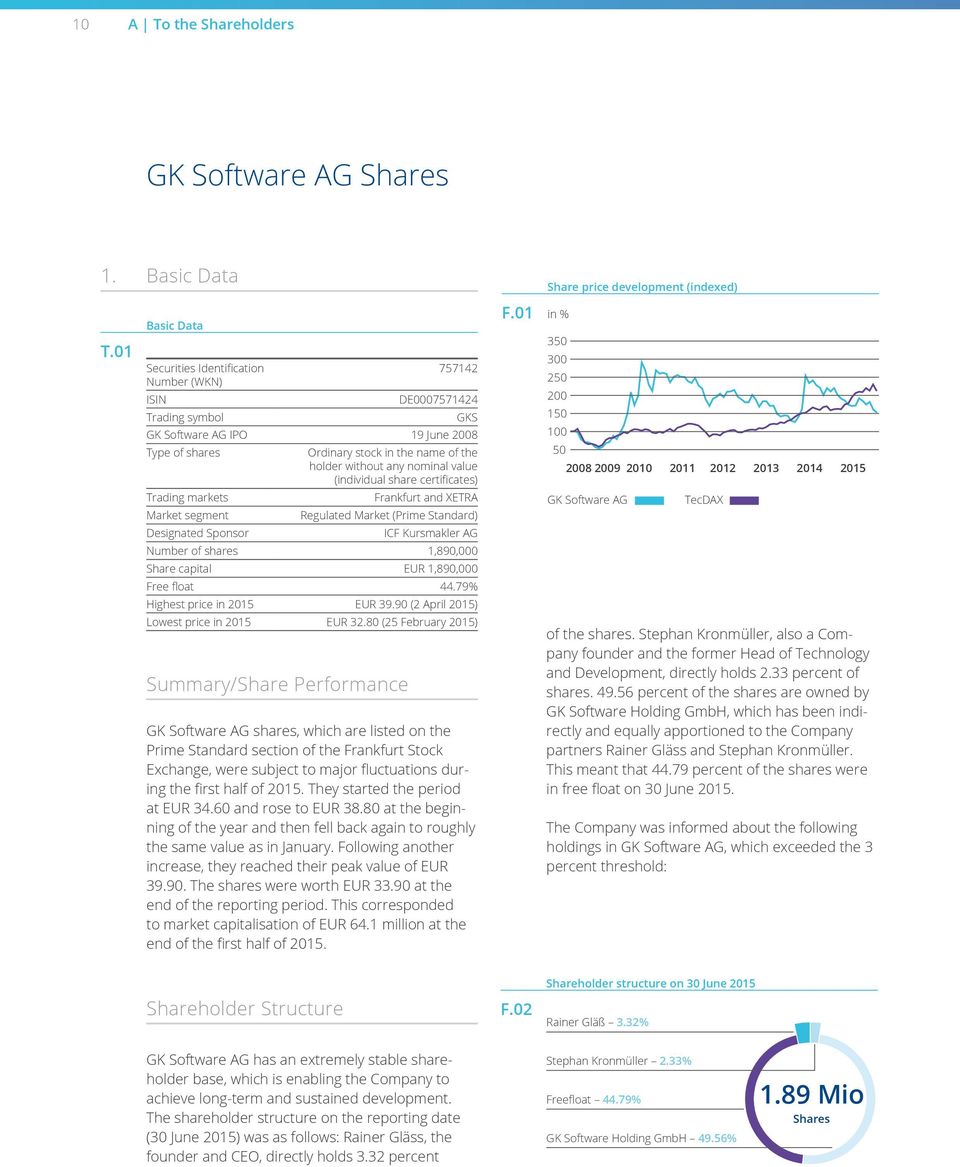
10 10 A To the Shareholders GK Software AG Shares 1. Basic Data T.01 Basic Data Securities Identification Number (WKN) ISIN DE Trading symbol GKS GK Software AG IPO 19 June 2008 Type of shares Ordinary stock in the name of the holder without any nominal value (individual share certificates) Trading markets Frankfurt and XETRA Market segment Regulated Market (Prime Standard) Designated Sponsor ICF Kursmakler AG Number of shares 1,890,000 Share capital EUR 1,890,000 Free float 44.79% Highest price in 2015 EUR (2 April 2015) Lowest price in 2015 EUR (25 February 2015) Summary/Share Performance GK Software AG shares, which are listed on the Prime Standard section of the Frankfurt Stock Exchange, were subject to major fluctuations during the first half of They started the period at EUR and rose to EUR at the beginning of the year and then fell back again to roughly the same value as in January. Following another increase, they reached their peak value of EUR The shares were worth EUR at the end of the reporting period. This corresponded to market capitalisation of EUR 64.1 million at the end of the first half of F.01 Share price development (indexed) in % GK Software AG TecDAX of the shares. Stephan Kronmüller, also a Company founder and the former Head of Technology and Development, directly holds 2.33 percent of shares percent of the shares are owned by GK Software Holding GmbH, which has been indirectly and equally apportioned to the Company partners Rainer Gläss and Stephan Kronmüller. This meant that percent of the shares were in free float on 30 June The Company was informed about the following holdings in GK Software AG, which exceeded the 3 percent threshold: Shareholder Structure F.02 Shareholder structure on 30 June 2015 Rainer Gläß 3.32% GK Software AG has an extremely stable shareholder base, which is enabling the Company to achieve long-term and sustained development. The shareholder structure on the reporting date (30 June 2015) was as follows: Rainer Gläss, the founder and CEO, directly holds 3.32 percent Stephan Kronmüller 2.33% Freefloat 44.79% GK Software Holding GmbH 49.56% 1.89 Mio Shares
11 GK Software AG Shares 11 Threshold Value Exceedances T.02 As of Shareholder Share in % Andreas Bremke GmbH, Arnsberg Scherzer & Co. AG, Cologne Deutsche Balaton Aktiengesellschaft, Heidelberg SAP AG, Walldorf 5.29 Directors Dealings in 2015 There were none during the 2015 financial year. Investor Relations For its IPO during the summer of 2008 GK Software chose to have its shares listed on the most strictly regulated sector of the Deutsche Börse, the Prime Standard. The highest possible degree of transparency towards its investors and all the other participants in the capital markets has been one of the most important company principles from the outset. André Hergert, the CFO, is responsible for the investor relations, which has been assigned its own department. This guarantees that any enquiries from investors and potential investors are answered immediately. GK Software AG also attaches great importance to providing an ongoing flow of information for the future. Among other things, this means drawing up quarterly, half-yearly and annual business reports in German and English, publishing a financial calendar and promptly publishing ad-hoc reports and corporate news items. The accounting system has been adapted to the international IFRS accounting standards and also meets investors requirements for information. As in previous years, GK Software AG is also planning to hold its annual analyst conference for 2015 during the Frankfurt Equity Capital Forum. Investor and press road shows also take place at regular intervals so that the Company remains in permanent contact with the capital markets.

12 12

13 B Interim Group Management Report
14 15 Financial Report 15 Business and General Conditions at GK Software 26 Explanation of the Business Results and an Analysis of the Assets, Financial and Earnings Situation 32 Report on Key Events 33 Report on the Risks, Prospects and Outlook for the GK Software Group 33 Risks 38 Opportunities 40 Outlook

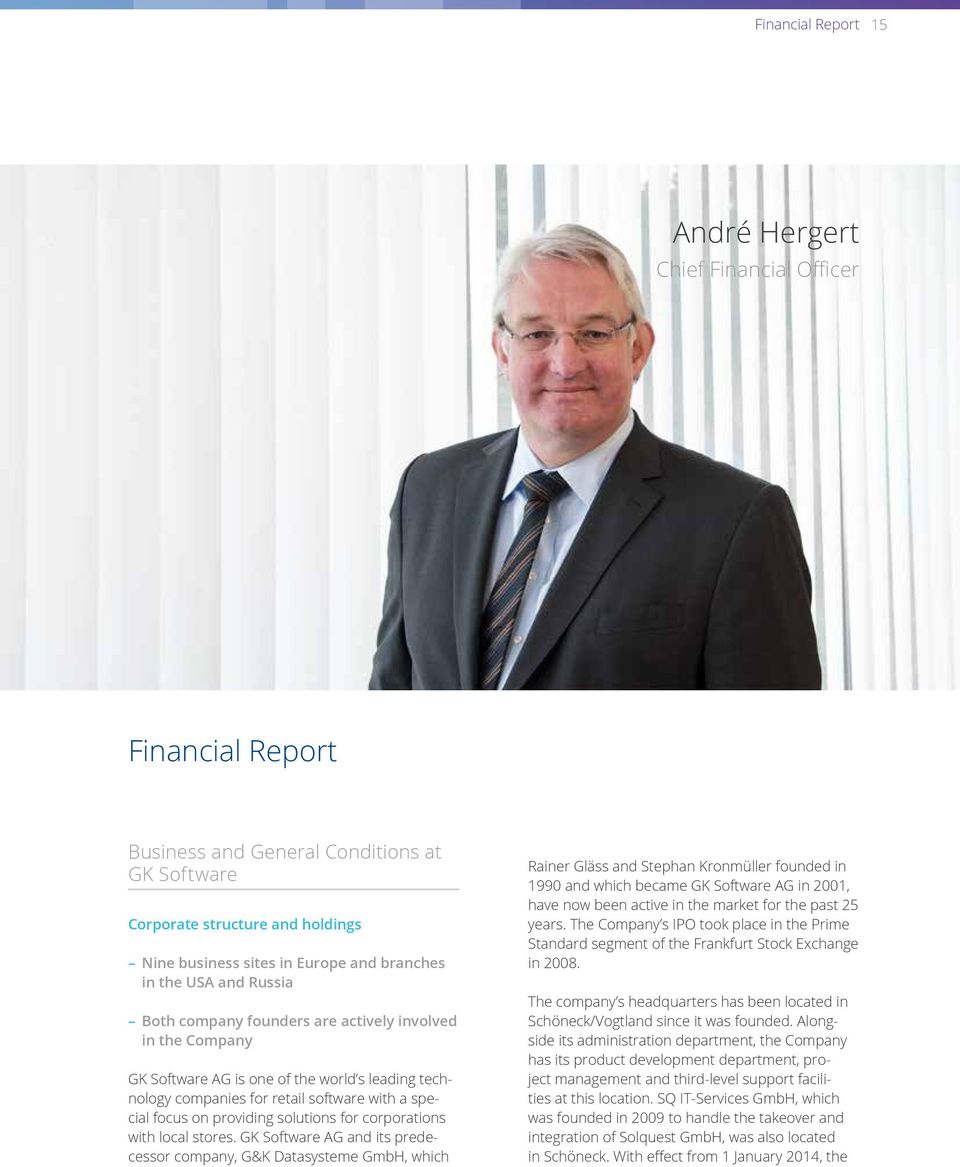
15 Financial Report 15 André Hergert Chief Financial Officer Financial Report Business and General Conditions at GK Software Corporate structure and holdings Nine business sites in Europe and branches in the USA and Russia Both company founders are actively involved in the Company GK Software AG is one of the world s leading technology companies for retail software with a special focus on providing solutions for corporations with local stores. GK Software AG and its predecessor company, G&K Datasysteme GmbH, which Rainer Gläss and Stephan Kronmüller founded in 1990 and which became GK Software AG in 2001, have now been active in the market for the past 25 years. The Company s IPO took place in the Prime Standard segment of the Frankfurt Stock Exchange in The company s headquarters has been located in Schöneck/Vogtland since it was founded. Alongside its administration department, the Company has its product development department, project management and third-level support facilities at this location. SQ IT-Services GmbH, which was founded in 2009 to handle the takeover and integration of Solquest GmbH, was also located in Schöneck. With effect from 1 January 2014, the
16 16 B Interim Group Management Report F.03 Group structure of GK SOFTWARE AG on 30 June % 100% 100% 100% 100% 100% 100% 100% OOO GK Software RUS GK Software USA Inc. GK Software Africa (Pty) Ltd. Storeweaver GmbH EURO- SOFTWARE s.r.o. SQ IT-Services GmbH AWEK GmbH Economically inactive legal units A Member of the GK Software Group 100% 100% 100% AWEK Microdata GmbH AWEK C-POS GmbH AWEK Hong Kong Ltd. company was dissolved without going into liquidation and merged with GK Software AG by means of a merger involving an acquisition (Section 2 No. 1 of the German Reorganisation Act). 1. Waldstrasse GmbH, which was founded to prepare for the takeover of new business activities, is another wholly owned subsidiary. GK Software AG has a branch next to Checkpoint Charlie in Berlin, which is primarily responsible for managing the marketing, sales and partner activities; the Company s userhelp desk is also based there. The Group s second largest business location has been situated in Plzen in the Czech Republic for more than fifteen years. The wholly owned subsidiary, EUROSOFTWARE s.r.o., is home to the software production and research & development departments. Major work on programming and further technological developments for the solutions provided by GK Software take place at the Plzen site. GK Software AG has another wholly owned subsidiary in Dübendorf in Switzerland called Store- Weaver GmbH. StoreWeaver GmbH has a German branch in St. Ingbert in the federal state of Saarland. The teams in St. Ingbert are responsible for the onward development of the StoreWeaver EE (Enterprise Edition) product group and handling the relevant customer projects; and they also look after the customers of the former Solquest GmbH company. The Company acquired two more business locations through the takeover of AWEK GmbH on 10 December 2012, and they form the IT Services department. The administration, hotline, dispatching, quality assurance, repairs and stores are located in Barsbüttel near Hamburg, while the software development department is based in Bielefeld. The service organization in the IT Services department also consists of mobile technicians who are spread across different parts of Germany. GK Software has its own sales organisation in Russia, GK Software RUS. GK Software USA Inc. was founded in the USA in December 2013 so that we can support the expected expansion of our North American business locally with an organisation of

17 Financial Report 17 our own. The retail segments of DBS Data Business Systems Inc., which was taken over in March 2015, has been incorporated into GK Software USA Inc. We set up GK Software Africa (PTY) Ltd at the start of 2015 in South Africa. The Management Board of GK Software AG consists of Company founder Rainer Gläss (CEO, Management, Marketing & Sales) and André Hergert (Finances and Personnel). The Management Board is supported by a Group Management Board, which consists of the following members: Stephan Kronmüller, Achim Sieren (COO), Michael Jaszczyk (CTO), Harald Kehl (Global Services) and Stefan Krueger (Sales). The three-man Supervisory Board at GK Software AG is led by the Chairman Uwe Ludwig. He has been a member of the Supervisory Board since Thomas Bleier was elected to the Supervisory Board in 2003 and Herbert Zinn in Personnel Further growth at all the business sites Trainee and further training programmes for members of staff A total of 707 people were employed within the Group on the reporting date of 30 June 2015 (excluding members of the Management Board and trainees). This means that there are 150 more employees than on the comparative date in the previous year (557). A large proportion of the Group s employees (221 - the figure 12 months ago was 182) continue to work at the Schöneck site. The Berlin branch has now 43 employees working in the sales & marketing, project and partner management, development and first-level support (hotline) departments (the number was 27 at the end of June 2014). F.04 Distribution of employees at group business locations (from 5 employees) on 30 June 2015 Berlin USA/Canada 25 3 South Africa 5 0 Hamburg Bielefeld Pilsen Cologne 14 7 Zurich/St.Ingbert Schöneck H H1 2014
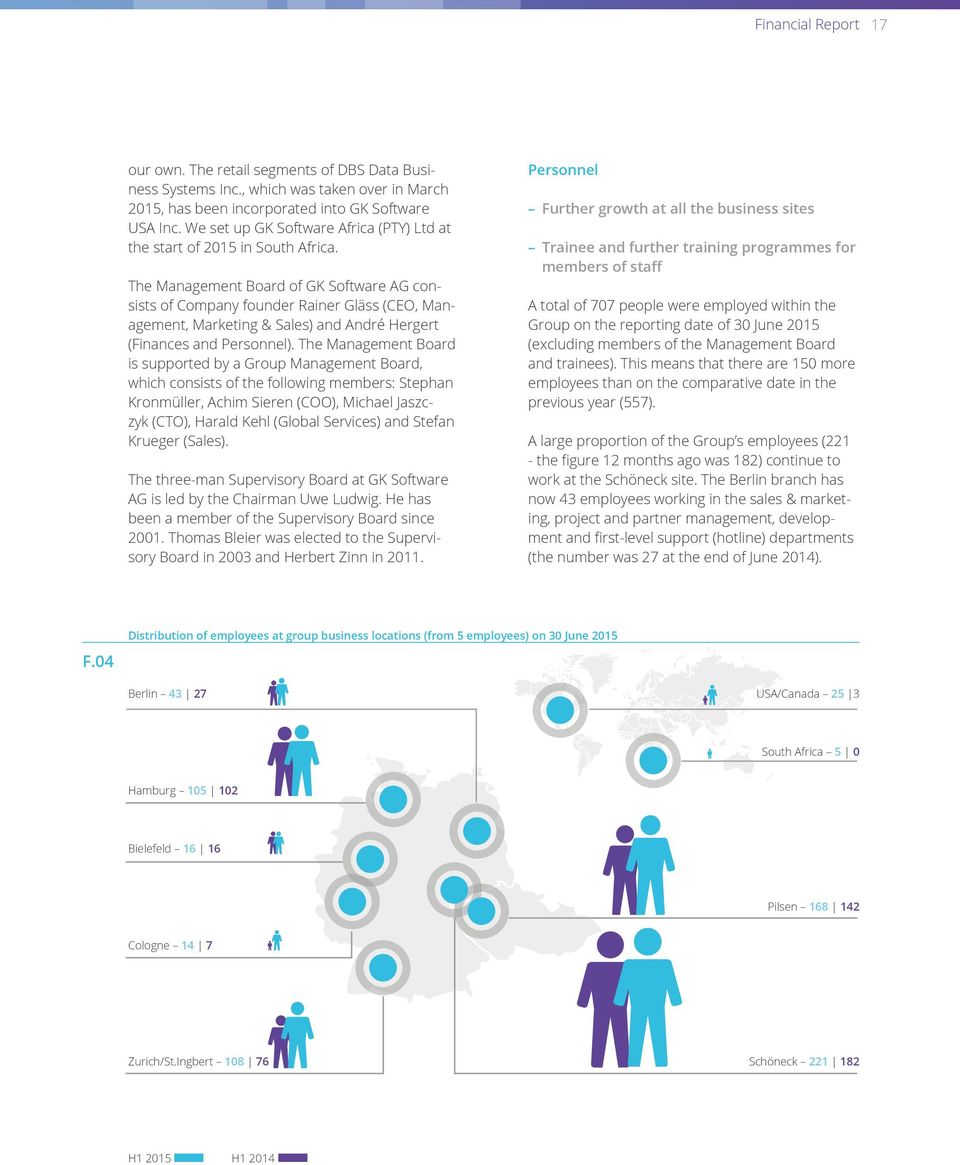
18 18 B Interim Group Management Report The number of employees working at the Czech subsidiary EUROSOFTWARE s.r.o. in Plzen grew by 26 from 142 on the reporting date in the previous year to 168 on 30 June At the end of the first half of 2015, there were 105 employees in the IT Services division at Hamburg (previous year: 102). These included a large number of mobile service technicians who are deployed at various locations throughout Germany. 16 people were working at the second IT Services site in Bielefeld on 30 June 2015; they mainly work on software development (the number was the same 12 months ago). Overall, the IT Services division has 221 employees (previous year: 118). 104 people were working at the business site in St. Ingbert at the end of the reporting period (72 in the previous year). 4 people were working in Dübendorf (Switzerland) at this time (previous year: 4). The branch in Cologne had 14 members of staff at the end of the reporting period, in comparison with 7 on the reporting date in As in the previous year, 2 people were employed at the Russian branch on the reporting date. 25 people were working for GK Software in the USA (3 in the previous year). The South African subsidiary employed five people on the reporting date. The Management Board expects the growth in employee numbers to continue at a moderate pace in future and the Company will primarily continue to look for highly qualified workers. Huge investments have been made in training and developing employees for years in order to be able to provide a foundation for and boost sales growth at GK Software AG in terms of human resources too. 3 trainees are also currently employed at GK Software AG The GK Software solution portfolio GK Software Simply Retail Omni-channel-solution portfolio GK Software is a leading, international provider of retail applications, i.e. a provider of fully integrated and complete solutions for the retail trade which meet all requirements without the need for any additional third-party software. The current claim simply retail stands for solutions which reduce complexity and will enable retailers to concentrate on their processes without being massively tied by IT. This claim represents an open architecture model with four levels which enable different types of software to be customised for different sales channels. Each application uses the same components and modules so that the development work is reduced and expensive parallel development work can be avoided. The Operations layer, which provides the fundamental basis for each application, forms the GK/Retail Infrastructure together with the Communications layer, which guarantees the complete exchange of information and data. This means that tried and tested methods and procedures which safeguard the technical operations are available in more than 193,000 installations for each of the different GK applications. The Retail Business Logic, which is formed by Core Retail Processes and Enhanced Retail Processes, is built on this infrastructure. While the core processes are mapped end-to-end by GK Software, with the enhanced processes, software modules provided by partner companies can also be used, as is specifically practised in collaborative work with SAP. The previously defined components of the various levels are linked to each other for the relevant fields of application and are merged into finished applications, which are available for various channels like the store, web store links or mobile retailing. Solutions for new channels or for integrating social media, for example, can be introduced on the identical architectural platform without the need to permanently redevelop the basis for the software each time. Using this flexible and forward-looking platform, GK Software is very well positioned to handle current and future issues like omni-channel retailing, cloud computing or inmemory data basing.

19 Financial Report 19 The various GK Software products are brought together in their concrete forms for the market in the GK/Retail Business Suite. All the solutions are fully based on the GK/Retail infrastructure and selected core and enhanced processes as well as on Java and open standards. That means that they are consistently not dependant on hardware or operating system. GK Software is currently marketing Version 12 of the GK/Retail Business Suite. The GK/Retail Business Suite is arranged into two main pillars. One of them involves the StoreWeaver Enterprise Edition (EE). The other one covers the Store Operations. StoreWeaver Enterprise Edition StoreWeaver Enterprise Edition comprises the Store Device Control and Mobile Store Processes components. It is closely linked to the solutions in the Store Operations area, but can be used in complete isolation from this. GK/Retail Store Device Control provides the endto-end link within the complete store peripheral equipment, for instance, tills, scales or reverse vending machines. The software ensures the automatic distribution of data to all the systems in a store with a direct link to the leading SAP system. This guarantees that changes to master data (e. g. prices) are available on the correct system within the store at the right time. At the same time, the software ensures that the central systems are supplied with what is known as transaction data (e. g. sales data). The link for the various subsystems in a store is provided through standardised peripheral heads, on to which solutions from different manufacturers can be docked. The Enterprise Storemanager guarantees the central management of the overall systems landscape. The Enterprise Cockpit handles the monitoring work across the systems. Both solutions can also be used outside the StoreWeaver Enterprise Edition in the field of Store Operations. The complete software component is marketed by SAP under the name SAP Store Device Control by GK. GK/Retail Mobile Merchandise Management Processes comprises the store management processes, which can be made available directly to mobile terminals on the shop floor or in the stock area. The processes, which can be used online or offline, are built on a leading central system like SAP. They allow the stores to be linked end-to-end with enterprise headquarters in almost real time and manage all the necessary business processes like deliveries, merchandise planning, inventories or automatic label printing. This software component is sold by SAP under the names SAP Offline Mobile Store by GK and SAP Label and Poster Printing by GK. Store Operations The GK/Retail Store Operations software provides solutions for use in stores and enterprise headquarters in the retail trade. They are designed to handle all the business processes at tills, shelves, in the stock areas or the back office in the best possible way and manage and monitor complex store structures from enterprise headquarters. All the software solutions are coordinated with each other and can be used by customers as a complete package or separately. The following solutions form part of this product line: GK/Retail POS is the market-leading solution for operating till systems. The application guarantees secure handling of all business processes at tills (POS = point of sale) and provides extensive back office functions for managing money, store administration and reporting purposes. A special edition of this software can also be used for self-checkout systems. SAP sells the software under the name SAP Point of Sale by GK. GK/Retail Mobile POS is an innovative software solution for till use on devices using the ios operating system (iphones, ipods, ipads). The company software manages all processes available on stationary tills and is already used productively by an important customer. Mobile POS is available in specific individual variations for ipods/iphones and ipads. GK/Retail Self Checkout is an enhancement of our POS software and was newly developed in It is fully based on our standard software and enables consumers to complete all the till processes themselves. Together with the associated ios app, consumer advisers can immediately respond to demands during the till process, e.g. age identification when purchasing alcoholic drinks, and they can offer consumers help and support quickly if required.

20 20 B Interim Group Management Report GK/Retail Open Scale is a new scales solution within the GK/Retail Business Suite. It is based on the same technical concepts as the other software solutions and is a self-contained application for all kinds of open PC scales. It enables the retail sector to use end-to-end IT structures and be free to select scales from any hardware supplier. This software has been certified for use by the PTB (Physikalisch-Technische Bundesanstalt Germany s national metrology institute). GK/Retail Taskmanagement ensures that information can be automatically distributed simultaneously and in a controlled fashion, e.g. regarding recalls of items, company-wide announcements and other information. The module, which has been specially designed for the needs of companies with many stores, allows a very fast and endto-end flow of information and can also be used on mobile units. The GK/Retail Lean Store Server allows all the back office servers to be centralized. This means that an important part of the IT systems can be moved out of the stores to enterprise headquarters. This opens up considerable potential for store-based corporations as they can use more powerful servers, for example, and servicing and maintenance costs can be significantly reduced. GK Software AG is the world s leading company for the centralisation of background systems for store-based companies. GK/Retail Enterprise Storemanager is the marketleading software providing administration and technical monitoring facilities for major store networks, including those operating across different countries. The software allows corporations to manage and monitor thousands of stores in many countries and is an important unique selling feature of the GK/Retail Business Suite. GK/Retail Enterprise Cockpit provides managers with a very fast summary of technical and specialist key performance indicators. This means that technical breakdowns in stores are recognised immediately and resolved as quickly as possible. This solution provides company-wide transparency with regard to the status of systems in stores. GK/Retail Sales Cockpit provides web-based business management information related to the current day s business. This means that managers constantly have a comprehensive overview of the course of business in real time. GK/Retail KPI Dashboard is a native ipad app with which important business parameters can be processed for different target groups in various aggregation stages. By using the KPI Dashboard, branch managers, district and regional managers or central management can immediately check the relevant data in their working area in real time and use it as the basis for their action. The KPI Dashboard is designed for use with in-memory technologies and works in conjunction with SAP HANA, SAP s inmemory appliance, for example. GK/Retail Enterprise Promotions Management is a complete solution for arranging, carrying out and managing corporate-wide promotions and special offers. It can be used, among other things, to manage discounts granted on customer card systems or the acceptance of many kinds of coupons at tills. GK/Retail Stored Value Server guarantees secure, company-wide administration services for all gift cards that have been issued. It provides a central database for supplying all the gift card information within the whole company and also handles all the processes related to electronic gift cards. GK/Retail Digital Content Management is the central software solution for distributing multimedia content to various output devices within the whole company. This means that photos, slide shows or videos can be distributed to the relevant systems within the company. The system also allows pure text messages to be sent (e.g. for electronic shelf labels). The SQRS software package When the Company acquired the assets of the former company Solquest GmbH, it also took over its software package Solquest Retail Solutions (SQRS), which is being used by eight customers with approximately 5,000 installations. The particular high-performance features of the software lie in the areas of SAP integration and mobile solutions. The SQRS software solutions are no longer being sold in order to keep the Group s product portfolio streamlined. But there are still permanent requirements, which are being handled by StoreWeaver

21 Financial Report 21 GmbH, to cover existing customer relations. Alongside this, a medium-term migration path has been developed in order to provide a long-term perspective for the customers of the former Solquest GmbH company. Transaction+ Through the acquisition of the retail division of DBS Business Systems Inc., GK Software has also taken over some of the solutions developed by this unit; Transaction+ is the most important of these. Transaction+ is firstly a payment solution for North America, which acts as an interface between the checkout solutions and the various payment providers in this region. More than 30 providers are already linked to it at the moment. On the other hand, Transaction+ has intelligent logics, which can route payments to different providers, depending on the time and place. This is particularly important in the USA, as different costs are incurred depending on these factors and it therefore provides considerable savings potential for retailers. Transaction+ is integrated into the GK/Retail portfolio as an independent solution and it enables companies to introduce projects in the USA faster and more cheaply and brings additional benefits to customers too. Product development During the whole of 2014, scheduled minor releases for GK/Retail 12 as well as an SAP version for the premium qualification process were handed off and these have expanded both the standard and the SAP product by providing additional solution components, functions and interfaces for subsystems in line with the roadmap. The major focuses were the omni-channel, clienteling and the further development of a cloud version of the cash till solution which will enhance the standard product with a new option. In March, the fifth premium qualification was successfully completed by SAP. New products and functionalities were tested by SAP as part of this form of product testing and in each case the current version was released for sale. AWEK sells software for mediumsized companies which complements the GK Software range and which is primarily aimed at the fashion sector. It provides support for an earlier version of this software used by several customers in German-speaking countries. Services In addition to its products, GK Software AG also provides comprehensive services. The most important component in this area involves customising and adapting developments during the initial projects and subsequently introducing change requests, which are a permanent element in most projects. This includes, for example, adapting software that is already in productive use to broader customer requirements, such as integrating new bonus systems in the till environment. Classic issues like consulting, project management or training courses come under the heading of services too. The group worked very hard in 2014 to fulfil the conditions to train implementation partners, which can then handle the introduction of GK/Retail themselves. In the medium term, these partners will primarily perform the basic parametrisation work, while development work within the field of adaptations (change requests) will continue to be handled by GK Software. Maintenance and services The group has been able to supplement its portfolio with high-value services by acquiring AWEK. For the first time, it is possible to offer full services to the retail trade in addition to software maintenance, which is subject to charges. This means that GK Software can now provide maintenance for third-party software and hardware made by a wide variety of manufacturers. About 40 mobile service technicians are available for this work and they can reach any store in Germany within set times. In addition to providing classic services, they can handle other options like rollout services or staging (the initial installation of systems). In addition, as part of the classic software maintenance services, the Group can eliminate errors and faults for all software solutions that are in use in the customer s business. Partner training The GK Partner Academy became fully operational during the past financial year in order to provide qualifications for implementing partners. In order
22 22 B Interim Group Management Report to achieve the status of Advanced Partner within the partner programme, an appropriate number of the partner s employees need to have passed the specified training programmes and courses, which are subject to charges. During the past year, several hardware partners have also paid to have their equipment certified by the GK Academy. Customers and projects Gaining major new international projects Initial sales successes in the USA Most of GK Software s customers continue to come from the retail sector. The market sectors, in which the Company is active, are primarily the food retail sector, drugstores & household goods, fashion & lifestyle. DIY & furniture and technology & cars. The products and services are geared towards companies of various sizes and are ideally suitable for customers with stores in several countries. New customer projects in 2015: Important pharmaceutical retailer (more than 1,000 business sites - gained in March 2015) International shoe manufacturer (approx. 50 business sites - gained in June 2015) Leading manufacturer of sports items (approx. 150 business sites in North and South America and Asia - gained in March 2015) Luxury franchise holder (30 business sites in the United Arab Emirates - gained in March 2015) Fashion provider (approx. 550 business sites in Poland - gained in June 2015) Supermarket operators (approx. 100 business sites in Russia - gained in June 2015) Fashion provider (approx. 50 business sites in Great Britain - gained in May 2015) In terms of existing projects, the first half of 2015 was dominated by successful pilot operations in several projects, rollouts and the final completion of one major project. We delivered and rolled out more country-specific versions in several ongoing projects. The migration of the last major existing customers to the latest software version is currently under way so that most of our customers have either switched to this or the switching process is already at an advanced stage. This is creating the conditions for ensuring that we have been able to continue consolidating our relations with our customers, which have existed for many years. We have also been able to sign further contracts with existing customers and they cover, for example, extensions to licencing agreements or developments to software or other services. The fact that there are now more than 29 joint customer projects where SAP has sold GK solutions is evidence of the active partnership with SAP. The strategic relationship between both companies for the store sector is also reflected in their joint activities at trade fairs, coordinated sales activities and close technological cooperation. Market and competitive environment A stable first half of the year Growth of approx. 1.5 percent expected in 2015 Investment needs for retail IT remain high Business developments at GK Software are significantly affected by the economic situation in the retail sector in Germany and Europe and increasingly in the USA too. Apart from the general need for investments in the retail sector and other factors, this forms an important basis for the forecasts covering the Company s ongoing opportunities. Following the successful year in 2014, the first six months of 2015 were positive for the retail sector in Germany too. With the exception of May, the other months exceeded the figures for the previous year on average by 2.4 percent in real terms and 2.2 percent in nominal terms. 1 Forecasts 1
23 Financial Report 23 envisage growth of 1.5 percent for the year The general economic conditions in GK Software s home market therefore continue to be positive. A glimpse at neighbouring countries reveals similar trends. The situation is similar in Austria, for example. Turnover there increased by 1.2 percent to a figure of EUR 27.2 million during the first six months of the year compared to the same period in the previous year, although the sales space in use fell for the second time in succession. 2 Growth in Switzerland was even stronger; turnover in the retail sector there increased by 4.9 percent in real terms (3.7 percent in nominal terms). 3 The overall prospects for the European retail sector indicate an ongoing upward trend overall. Turnover adjusted for inflation rose, for example, by between 1.8 and 2.7 percent on average in the months from January until May, in comparison with the figures from the previous year. 4 This development was not reflected in each country, however, and the crisis-hit countries in southern Europe in particular are still a long way off the significantly more positive developments. 5 There has been a continuous upward trend in retail sector turnover, however, in the USA since the middle of 2012 and this could trigger more movement in the world s largest retail sector market. 6 However, it is not possible to draw any linear conclusions from all these developments in terms of the readiness of retailers to invest, as they do not necessarily lead to higher IT budgets, as previous years have shown in Germany. However, they do form a basis, at least in the medium term, for making investments and not continuing to postpone them. According to the current EY retail barometer, only about 60 percent of German retailers described their situation as good or reasonably good, following a figure of 67 percent in the survey conducted in the previous year. In contrast, the number of those describing their situation as poor surprisingly rose from 3 to 7 percent. 7 Overall one retailer in two is expecting an improvement in its situation, while one in ten assumes the opposite. 8 On the consumer side, the data in Germany declined slightly in July 2015 according to the GfK consumer climate index for the first time since October 2014, which is primarily due to the developments in Greece. However, consumer expectations regarding incomes is at a record level since German reunification. Positive job prospects and an excellent financial situation lead to an increase in the willingness to consume. 9 Prospects continue to be very positive in the business to consumer e-commerce sector. Turnover here will continue to grow in 2015, 10 although the most attractive markets are the USA, China, Great Britain, Japan and Germany 11. Turnover amounting to EUR 43.6 billion is expected in Germany in The existing potential is clear from the fact that the average turnover per customer in Germany was about EUR 1,054 in 2014 and is forecast to rise to EUR 1,211 in 2015, which the increase will be even higher in the USA. 12 The challenges associated with this for the retail sector also cover the solutions provided by GK Software, as the Company s customers have to face them when remodelling and introducing new elements into their IT landscapes. Other new issues like home delivery are acting as further driving forces. There is much ground to be made up in Germany in the latter sector in particular. The market share of food retailers in the total 1 EinzelhandelJan2014.pdf,, p Trotz-Haendlersterben-und-weniger-Flaeche_Einzelhandelim-Plus?from=rss Eurostatistics Data for Short-term Economic Analysis, issue number 07/2015, p nit=1&language=de&pcode=teiis200&plugin= Ernst & Young Handelsbarometer, July 2015, p Ibid asset_publisher/87xbennhpz3d/content/globalretail-e-commerce-keeps-on-clicking/10192?_101_ INSTANCE_87xbENNHPZ3D_redirect=%2Fconsumer-products-retail%2Fe-commerce-index 12
24 24 B Interim Group Management Report online market is only 0.7 percent 1 in Germany, while it is already 5.0 percent in Great Britain with a value of EUR 12.4 billion (GBP 8.9 billion). 2 Test procedures are currently taking place in Germany again and cover different concepts like storebased deliveries, click-and-collect or central warehouse-based deliveries. New and replacement investments are generally subject to the premise that they must equip firms for future issues too. As the number of prime examples of genuine omni-channel integration is still very low and uncertainties about the strategy that should be pursued often persist, this is currently creating a situation where longer periods of time elapse before a decision is made to purchase software solutions. GK Software has been feeling the effects of this development in delays in sales cycles since the end of Overall, the need for investments in the retail sector remains high, as the current study by the EHI Retail Institute entitled 2015 IT trends in Retail shows. 88 percent of IT managers assume that their budget will remain constant or increase and attribute great importance to new technologies like cloud services and omni-channel systems. 3 The Forrester Study entitled The Retail CIO Agenda 2015: Secure and Innovative shows that the replacement investments are being increasingly dominated by the new issues already mentioned here. Omni-channel integration, the introduction of new merchandise management solutions and the use of analysis and business intelligence tools are viewed as the greatest challenges at the moment and are only surpassed by improvements in IT security in their strategic importance. 4 Interactive retailing with goods (e-commerce and the mail order business) generated turnover of EUR 12.3 billion in the second quarter of 2015, which amounted to growth of 11.8 percent (2014: EUR 11.0 billion) percent (EUR 10.8 billion) of these sales were generated online, 1.7 percent more than in the same period in the previous year (2014: EUR 9.5 billion). 5 The German E-Commerce and Distance Selling Trade Association (behv) is predicting total annual sales of EUR 51.6 billion, which corresponds to growth of 5.1 percent (2014: EUR 49.1 billion) 6. As a result, this trading sector could account for ten percent of the retail trade this year. The trend reflecting increasing numbers of multichannel traders to the detriment of pure online market places has continued to stabilise. During the first quarter of 2015, traders with both fixed building and online operations increased their online sales by 27.2 percent compared to the previous year s figure (EUR 5.05 million following EUR 3.97 million in the first quarter of 2014). As a result, they further increased their market share in interactive trading, which currently stands at 33 percent compared with only 29 percent in the first quarter of If this trend were to persist, this would suggest that brick and mortar retailers are successfully tapping into their advantages over pure online retailers, including brand strength, offering advice, goods presentation and service. To this end, fixed location retailers will need to upgrade the relevant technical infrastructure to an even greater extent a trend that has had a significant influence on the majority of project decisions in GK Software s business environment since the end of Notwithstanding the shifts within the segments, interactive trading is expected to grow more strongly than traditional fixed location business again this year. Accordingly, growth in online trading was approx. 10 percent during the first quarter of Overall, the conditions for the course of business at GK Software remain positive for the second half of And this is all the more so, because the company is assuming, on the basis of its partnership with SAP, that it will be able to continue to expand its base of potential customers in the 1 page UK-Grocery-Retailing/ 3 EHI Retail Institute, Study: IT Trends in the Retail Sector in Forrester Consulting, Study: The Retail CIO Agenda 2015: Secure And Innovative, p datum/2015/august/artikel/positiver-trend-setzt-sich-fortinteraktiver-handel-waechst-im-zweiten-quartal-zweistellig/ 6 datum/2015/maerz/artikel/bewegtes-jahr-2014-fuer-onlineund-versandhandel/ 7 datum/2015/mai/artikel/interaktiver-handel-startet-mitdeutlichem-plus-ins-neue-jahr/
25 Financial Report 25 international arena. But these trends are subject to the proviso that the global economic is not hugely disrupted by political or economic factors, which would have a negative effect on economic developments. GK Software continues to assume that the necessary investments in new systems needed in the short and medium term and the introduction of new issues within the retail sector will continue to offer sales potential in Germany and in the other markets that are being actively processed. There is also an expectation that the partnership with SAP in particular will create further success stories in the international marketplace and reinforce the company s potential in the long term. GK Software is currently in a very good position in several current tender procedures in Germany and abroad, both in direct sales and its partner business, and has significant advantages over its rivals because of its broad portfolio of products, the internationality of its solutions and its proven ability to handle projects quickly.
26 26 B Interim Group Management Report Explanation of the Business Results and an Analysis of the Assets, Financial and Earnings Situation Earnings Situation Turnover: EUR 26.9 million; EBIT: EUR (2.28) million. The first six months of 2015 revealed a welcome significant increase in turnover in comparison with the same period in the previous year. GK Software was able to increase its turnover to EUR million, following a figure of EUR million in the previous year. This corresponded to growth of 32.9 percent. Earnings before taxes and interest (EBIT) amounted to EUR (2.28) million, following a figure of EUR (1.33) million in the same reporting period in the previous year. These figures produced an EBIT margin in terms of turnover of (8.5) percent, which should be compared to (6.6) percent in the previous year. In comparison to the previous year, the results have been significantly affected by the assets identified as part of the provisional purchase price allocation arising from the acquisition of the retail division of DBS Data Business Systems Ltd and the scheduled amortisation as a result of this and by the increased expenditure involved in setting up the branches in the USA and South Africa, which are not yet generating sufficient turnover to compensate for this. At EBITDA level (earnings before interest, taxes and depreciation and amortisation), the figure amounts to EUR (0.69) million, following a figure of EUR (0.34) million in the previous year. Group losses in the first six months of the year amounted to EUR (2.91) million, compared to EUR (2.11) million in the previous year. The increase is largely due to the deterioration in the EBIT figure. If we relate these figures to the number of shares issued during the 1st six months of 2015, the undiluted earnings amounted to EUR (1.54) per share. The losses in the previous year amounted to EUR (1.11) per share. The growth in turnover of EUR 6.64 million was largely due to a renewed, significant expansion of the GK/Retail core segment. It was possible to extend this by EUR 7.72 million or more than fifty F.05 percent. While the SQRS segment was able to hold its ground at a level slightly above the previous year at EUR 0.53 million - which was better than expected - turnover in the business related to IT services declined by EUR 1.10 million to a figure of EUR 4.73 million. This strong growth in our core GK/Retail business provides us with optimism that it will be possible to achieve the envisaged strong expansion in this business segment for 2015 as a whole. Service revenues grew by almost 50 percent in the core business sector - by EUR 4.24 million to a figure of EUR million. The comparable figure for the previous year was EUR 8.72 million. However, we need to take into account that the turnover here amounting to EUR 0.93 million came from the acquisition of the retail division of Data Business Systems Ltd. But the remaining increase at EUR 3.31 million or somewhat more than one third was good news too. Overall, the rollout and expansion business related to GK/Retail contributed almost half the total turnover within the corporate group. It was also possible to increase other turnover revenues, which come from the sale of hardware to customers and preparatory services on these customer hardware, by EUR 0.37 million in comparison with the previous year. The cause for this can also be found in the contribution from our acquisition in the USA, which amounted to EUR 0.32 million. Licencing revenues in the GK/Retail sector exceeded the previous year s figure by percent and were worth EUR 2.45 million (including Quartaly sales development compared to previous years in EUR K 14,073 3M 9,332 9,067 26,856 H1 20,213 18,402 9M 30,562 28,650 FY 44,634 42,
27 Financial Report 27 a contribution of EUR 0.14 million, which must be ascribed to the US American acquisition), following a figure of EUR 1.15 million on 30 June This development was due to the deals signed with new customers during the reporting period. Maintenance revenues in the GK/Retail business also continued to grow (+42.2 percent) and accounted for 21.0 percent of total turnover in this segment at a figure of EUR 5.64 million. It was therefore possible to extend the service-related business by EUR 0.42 million; the remaining EUR 1.23 million were due to the extended installation base. However, the contribution made by our North American acquisition was considerable here too and amounted to EUR 0.32 million. Overall, the Group generated maintenance turnover amounting to EUR 9.64 million, following a figure of EUR 8.15 million in the same period in the previous year. The IT Services division contributed EUR 3.52 million to this process. This figure was EUR 0.20 million lower than the previous year s figure of EUR 3.71 million. This decline related to services revenues within servicing contracts, which were based on delays to replacing hardware and the maintenance revenues associated with this, which depend on quantities. A similar development was evident under Other Revenues in the IT services segment. Turnover here was EUR 1.36 million lower than the previous year s figure of EUR 1.82 million, which was also due to delays in replacement purchases by customers. Despite this significant shortfall in comparison with the previous year s figure, the Management Board continues to believe that the turnover figures for the previous year will be achieved again in the IT Services division. Turnover in the SQRS division held its ground against all expectations and even increased slightly. Revenues from services in this area were similar to the figure in the previous year at EUR 0.02 million. Turnover from maintenance also remained stable at EUR 0.48 million. T.03 The operating performance primarily rose by 33.3 percent because of the increase in turnover. Overall, it amounted to EUR million, compared to EUR million for the same period in Own work capitalised increased to EUR 0.29 million, following a figure of EUR 0.15 million during the first six months of 2014, and this was largely due to the ongoing development of our products and options within our solutions suite. The Group s total operating revenues rose by 33.0 percent to a figure of million (EUR million in the previous year). The share of turnover in total operating revenues was 94.4 percent, as in the previous year, while the share of own work capitalised, which covers the ongoing development of our software solutions, amounted to 1.1 percent, following a figure of 0.7 percent in the reporting period in the previous year. Total operating revenues Change EUR K in % EUR K in % EUR K in % Turnover 26, , , Own work capitalised Operating revenues 27, , , Other operating revenues 1, Total operating revenues 28, , , The Group is continuing to work on being able to more easily adapt its capacity to fluctuations in employee numbers. As a result, the Group is making greater use of outside workers. The expenditure for purchased services and raw materials and suppliers increased significantly to EUR 3.20 million, following a figure of EUR 1.84 million in the same period in the previous year. The increase of EUR 1.36 million is almost wholly due to the GK/Retail business division, as this is the only area where outside workers are used to a significant degree. Personnel expenditure rose by 34.5 percent or EUR 4.78 million. Overall, expenditure on personnel now amounts to EUR million. In addition to the need to underpin the process of internationalisation with relevant personnel, the strong services business is largely driving this development.
28 28 B Interim Group Management Report Depreciation and amortisation amounted to EUR 1.58 million, following a figure of EUR 1.00 million in the previous year. The increase by EUR 0.58 million (2014: EUR 0.53 million) is largely due to the assets identified as part of the purchase price allocation for our acquisition in the USA, which led to scheduled amortisation. Other operating expenditure amounted to EUR 7.13 million, following a figure of EUR 5.90 million in the previous year. This increase by EUR 1.23 million was dominated by a further rise in travel expenses by EUR 0.32 million - as in previous years - in order to keep up with global project and sales business. The increased expenditure on consultancy services for the North American acquisition should be viewed as one-off costs. This amounted to approx. EUR 0.27 million. A further EUR 0.29 million was due to the expansion and establishment of our African and US American subsidiaries. The expenditure on gaining and tying employees to the Group increased again too. This expenditure exceeded that of the previous year by EUR 0.13 million. If we view the first six months and omit the ancillary costs for making the acquisition (EUR 0.27 million) and the scheduled amortisation on the assets identified in the acquisition in North America Sales by segments T.04 H H Change FY 2014 EUR K in % EUR K in % EUR K in % EUR K in % Turnover with GK/Retail 21, , , , SQRS , IT Services 4, , (1,100) (18.9) 11, Total 26, , , , Licences 2, , , , GK/Retail 2, , , , SQRS IT Services Maintenance 9, , , , GK/Retail 5, , , , SQRS IT Services 3, , (195) (5.3) 7, Services 13, , , , GK/Retail 12, , , , SQRS (3) (12.0) IT Services , Other Business , (970) (51.8) GK/Retail , SQRS , IT Services , (1,363) (74.8) GK Academy GK/Retail SQRS IT Services (EUR 0.53 million), the Group achieved a modified EBITDA of EUR 0.11 million (EUR (0.34) million in the previous year). As a result, the Group generated earnings before interest and taxes (EBIT) of EUR (2.28) million, following an EBIT figure of EUR (1.33) million in the previous year. The financial results during the first six months of 2015 were EUR (0.03) million (EUR 0.03 million in the previous year). Expenditure on interest increased by EUR 0.7 million to EUR 0.11 million because of the new loans as part of the expenses for the acquisition in the USA, while
29 Financial Report 29 T.05 interest yields remained almost constant at EUR 0.08 million in comparison with the previous year. Financial result Change EUR K in % ¹ EUR K in % ¹ EUR K in % EBIT (693) (2.6) (337) (1.7) (356) EBT (2,275) (8.5) (1,334) (6.6) (941) 70.5 Consolidated earnings (2,306) (8.6) (1,303) (6.4) (1,003) on turnover The earnings before tax (EBT) therefore fell from EUR (1.30) million to EUR (2.31) million in comparison with the previous year. After tax, there was a shortfall for the period of EUR (2.91) million, following a figure of EUR (2.11) million in the previous year. Based on the 1,890,000 shares in circulation on the reporting date, this corresponds to losses per share of EUR (1.54) (undiluted; the figure in the previous year for the number of shares in circulation at the current time was EUR (1.11) per share). The diluted earnings per share amounted to EUR (1.53). Assets situation The consolidated balance sheet total amounted to EUR million on the reporting date and was therefore EUR million higher than the comparative figure of EUR million on 31 December The increase in the balance sheet total was due to the effects of the acquisition of the retail division at Data Business Systems Ltd during the 1st six months of Non-current assets rose by EUR million in all compared to the balance sheet total on the reporting date of 31 December 2014, while current assets, excluding cash and cash equivalents, were EUR 3.80 million higher than the value on the reporting date in the last business year. Stocks of cash and cash equivalents were, however, lower and remained behind the figure for 31 December 2014 by EUR 5.37 million. T.06 On the funding side of the balance sheet, it should be noted that equity capital - largely due to the Group losses in the first half of declined in absolute terms by EUR 3.09 million. The balance sheet total increased by the North American acquisition led to a reduced equity ratio of 46.3 percent along with this decline, after this figure had been 68.4 percent on 31 December The equity capital amounted to EUR million on 30 June GK Software s debts rose by EUR million compared to the reporting date in the previous year - non-current liabilities by EUR million to EUR million and current liabilities by EUR 7.31 million to EUR million. Assets situation (not audited) (audited) Change EUR K in % EUR K in % EUR K in % Non-current assets 32, , , Current assets or cash and cash equivalents 22, , , Cash and cash equivalents 4, , (5,373) (52.8) Assets 59, , , Equity 27, , (3,092) (10.1) Non-current liabilities 15, , , Current liabilities 16, , , Liabilities 59, , , The major changes on the assets side resulted from the acquisition of the retail division of Data Business Systems Ltd. The purchase price for this acquisition was largely allocated to intangible assets like orders in hand, customer relations, in-house developed software products and acquired goodwill. The accruals in detail concerned orders in hand at EUR 1.00 million, the acquired customers amounting to EUR 9.07 million and the value of the software products in the acquired unit amounting to EUR 2.61 million. EUR 3.45 million could not be entered as assets and were registered as goodwill. Noncurrent assets have increased overall through the purchase price allocation in the field of intangible
30 30 B Interim Group Management Report assets. At the same time, scheduled amortisation amounting to EUR 0.53 million was entered to cover the depreciable assets, with the result that there was an increase in non-current assets amounting to EUR million on the basis of the acquisition. Current assets without cash and cash equivalents rose by EUR 0.63 million because of the increase in stocks of finished goods. The cause here lies in acquired outside licences from Oracle, which were offered to customers of GK Software. While trade accounts receivable hardly changed in comparison with the reporting date of the 2014 business year (decline by EUR 0.11 million), receivables from work in progress increased by EUR 1.83 million to EUR 5.01 million based on the accruals and deferrals of the performed work according to the degree of completion. This rise was primarily due to North American projects, which contributed EUR 1.60 million to this increase. All the projects affected are assessed as being within the plan; any risks arising from intrinsic values, for which no provisions have been made, cannot be recognised at the moment. The increase in other assets is also due to GK Software USA. Stocks of cash and cash equivalents amounting to EUR 4.80 million, on the other hand, are lower than the value at the end of the 2014 business year to the tune of EUR 5.37 million, largely because of the North American transaction. The development of cash and cash equivalents is explained as part of the analysis of the financial situation. The development of the Group s debts was largely the result of the purchase of the retail division in the USA. The increase in non-current liabilities by EUR million was predominantly due to the growth in non-current bank liabilities. They had risen by EUR 9.90 million to a total figure of EUR million by the end of 2014 as a result of taking out a non-current loan amounting to EUR million. This was complemented by an increase in deferred taxes by EUR 0.48 million to a figure of EUR 1.86 million. The driving forces behind the change in non-current liabilities were the increase in non-current bank liabilities by EUR 2.82 million, advance payments received by EUR 1.85 million and other current liabilities by EUR 2.28 million. The increase in non-current bank liabilities was due to using current account overdraft facilities. The rise in other liabilities of EUR 2.28 million was primarily due to the increase in deferred accruals from earnings statements amounting to EUR 1.41 million. A further EUR 0.45 million was due to the increase in tax liabilities on account of value-added and income tax. Financial situation The cash flow due to operating activities amounted to EUR (0.37) million during the first half of 2015, following a figure of EUR 1.48 million during the same period in the previous year. The cash flow from operating activities in the narrower sense during the first half of 2015 was negative (EUR (0.89) million), as was total interest received and paid at EUR (0.03) million. The total income taxes did not provide any relief for the figures, in contrast to the previous year (EUR million). The changes in net current assets, however, did grant some relief (the balance amounted to EUR million). Investment activities weighed on the Group s cash flow at EUR million to a much greater degree than in the same period in the previous year, when payments for investments were made to the tune of EUR 0.55 million. This increase was due to payments in conjunction with the acquisition of the retail division of Data Business Systems Ltd. The outflow of funds from the operating business and investment activities was partially compensated for by financing activities. An inflow of EUR million was recorded in the funding balance by taking out a loan worth EUR million and repaying current loans at the same time through credit card loans totalling EUR 0.80 million. Overall, stocks of cash and cash equivalents fell significantly by EUR 5.37 million since 1 January 2015 to a figure of. EUR 4.80 million on the reporting date.
31 Financial Report 31 T.07 Financial and non-financial performance indicators Financial performance indicators. It should be noted that the key indicators, on which the financial data is based, are very much connected to each other. As a result, the development of these figures largely depends on the development of two key indicators. These are turnover and earnings. In order to normalise tax effects, GK Software uses diluted results before taxes and the financial results (diluted EBIT) to determine earnings or the diluted earnings before taxes and the financial results and depreciation and amortisation (diluted EBITDA) and the derived margins on the operating performance. In this respect, we refer to the forecast report for the development of these key figures. Financial performance indicators Gross earnings margin on turnover 93.5% 96.2% Personnel ratio 69.5% 68.7% EBITDA margin on operating performance (2.6)% (1.7)% EBIT margin on operating performance (8.4)% (6.6)% Equity ratio 46.3% 70.4% Investment ratio 54.2% 35.8% Excess amount of cash and cash equivalents over interestbearing liabilities (EUR K) (9,045) 9,041 If we assume that the forecast for the key performance indicators will be met, we can expect that the key indicators named here will provide a positive development to manage the earnings, financial and assets situation and will move again towards the figures recorded in Developments compared to planning assumptions are currently slightly below expectations. However, based on the current state of information, it should be assumed that the key performance indicators will move in the direction of the values forecast in the 2014 annual accounts. Non-financial performance indicators. The management team primarily watches key indicators in sales activities as far as non-financial performance indicators are concerned. There are two key values here: customer satisfaction and the number of customer contacts. They are not observed in a formalised manner, but are documented and assessed through regular reports about existing projects and sales activities with possible new customers presented to the responsible members of the Group Management Board and the Management Board. Decisions about ongoing actions and procedures are made at an individual case level. Overall we expect customer satisfaction to continue to improve. The changes introduced in March 2014 regarding the organisation of customer support by the introduction of client executives is designed to further intensify the overall support provided for customers and add commercial and consult support to the technical and specialist support provided in the past. The key figures mentioned above are used - alongside others - to analyse developments that deviate from the plan. The key figures listed above help with developments, which deviate from the plan, when analysing a particular development. For example, the personnel ratio is an important figure for analysing the development of the earnings situation. On the other hand, it largely depends on the Turnover key indicator and any deterioration in its value may express both wrongly established production apparatus and the failure to meet the Turnover key indicator target. However, this can be directly deduced. In this sense, these key indicators are important aids in analysing the development, but do not form any control parameters in themselves.
32 32 B Interim Group Management Report Report on Key Events after the end of the financial year Following the end of the first half of 2015, no major events have taken place that we need to report at this juncture.
33 Report on the Risks, Prospects and Outlook for the GK Software Group 33 Report on the Risks, Prospects and Outlook for the GK Software Group During its recent examination of the risks and opportunities facing the company, the Management Board did not discover any notable change to the statements made in previous years. Risks Risk management system GK Software deliberately takes entrepreneurial risks in order to benefit from the opportunities presented by the market. A risk management system was introduced over the past few years to recognise, manage and minimise the risks at an early stage. Among other things, the Management Board meets once a month to discuss possible risks and introduce countermeasures. In order to give all the business divisions the opportunity to outline their concerns, a Group Management Board was formed where the business units can continually report on their development and any risks and opportunities that arise. The composition of the Group Management Board ensures the all segments of the business activities are represented in the same way as the internal areas of product development and research & development, so facilitating appropriate consideration of the specific risks by the Group s managers. The Supervisory Board is informed of the results of these discussions. The risk management system is being continually updated. The risk early warning system focuses on recognising risks; it attempts to pick up any possible risks that might pose a threat to the company s existence. The risk management scheme does not pick up any positive opportunities. Due to the nature of the risk management system, the focus is on early recognition and reporting of emerging risks. For this purpose, informal discussions between members of the Group Management Board and employees who are responsible for the risk classes described below are encouraged, in order to eliminate avoidance strategies in communication as much as possible. This is because the management team is aware that the early recognition of risks requires open communication between upper management and those responsible, but that at the same time, people tend to avoid communicating unpleasant news, and managing risks by monitoring key figures alone is not possible. Nonetheless, the risk management system is being further developed regarding the expansion of economic key figures in particular, in order facilitate the verification of informal information. The most serious risk among the following is the risk of damage to the company s reputation if an individual project goes wrong. The risks that influence customer behaviour, such as the effects on demand because of a perception that the company has performed inadequately or delays in investments because of new market conditions or regulatory measures follow this in terms of their significance. There may well be connections between the two types of risks mentioned: changes in market conditions or regulatory requirements could increase the complexity of projects making it more likely that problems will arise during projects. The risks presented in the following section can be summarised as follows: Risks resulting from changes in the requirements of potential customers must first be summarised. These lead to increased sales cycles and therefore to a reduction in the number of realisable sales opportunities. At the same time, new requirements increase the complexity of projects, which increases the risk that project plans will fail. These risks increase the risk of damage to the Group s reputation because the lack of sales opportunities, above all caused by increased sales cycles, raises the significance of individual projects for the overall reputation of GK Software. Another
34 34 B Interim Group Management Report risk group is related to external risks such as macroeconomic developments, the development of regulatory framework conditions and shifting focusses in the customer and competitive environments. These risks cannot be controlled by the Group and can in part have the effect of enhancing the risks in the first group. A third group of risks relates to the development, usage and management of project capacities. The solution to the usage risk lies in increasing the flexibility of capacities; increased risks for project quality can result from this because more flexible capacity can only be accessed indirectly. Further risks are individual risks which result from large individual measures such as company acquisitions and their integration. Alongside these abovementioned operative risks are financial risks whose impact on projections is not currently estimated to be very significant. We have summarised the individual risks, which are the result of integrating the AWEK Group or the acquisition of other companies, in a separate risk category; this eliminates any general order of assessment. There is also a separate risk category related to the issue of tying employees to the company and gaining new ones. Risks and overall picture of the risk situation One major risk which cannot be influenced by the Group involves the business developments of GK Software s customers due to the development of the general economy and consumer sentiment. The actual developments in the 2015 financial year and the prospects for the 2016 financial year have been dominated by a generally calm, but constant growth process in many parts of the word. The impact of the crisis between the Ukraine and Russia is still completely unclear and this affects concrete markets in which GK Software operates. The threat that Greece will exit the eurozone and the resulting impact, as well as the uncertainties associated with this, could also have an effect on economic developments in Europe to a degree that cannot yet be determined. It is true that the forecasts presented by associations and analysts tend to suggest that the retail sector will enjoy relatively calm developments in a significantly calmer overall economic environment, but the psychological factors of the contradictory news situation in an environment that is hard to assess on the investment behaviour of customers of GK Software can only be guessed - as was the case last year. In the light of this general uncertainty, the Management Board continues to make every effort to provide itself with room to manoeuvre by keeping costs as flexible as possible and only deliberately incurring them if they are necessary. One major argument for the successful sales of GK Software solutions and the in many cases longstanding customer relationships is the consistently successful completion of customer projects in the past. However, any failures in the project business could do long-term damage to this positive reputation and even lead to a reversal of this positive sentiment towards GK Software. This kind of situation could pose a threat to the company s ongoing existence. As a result, the relevant project managers inform the responsible members of the Group Management Board about possible risks during the course of ongoing projects in order to enable an appropriate and timely response to these kinds of risks. GK Software views the degree of customer satisfaction and the number of new customer contacts as an important indicator for assessing risks. These two factors are therefore subject to particular monitoring and are regularly checked as part of the sales controlling processes. On the basis of its customer structure and the structure of its target market, the consolidated group business is repeatedly dominated by individual major projects with a relatively low number of customers, with the result that these business relations provide significant contributions to sales and results within a financial year. The Management Board anticipates that this will continue to be the case in the future too. If a business partner breaks off a project or falls into payment difficulties, this could have financial consequences for GK Software. However, this risk is restricted by regular payment plans or agreements for payments according to so-called project milestones. Another new risk results from the start of developments related to omni-channel approaches to
35 Report on the Risks, Prospects and Outlook for the GK Software Group 35 retailing. This fundamentally new way of thinking and the opportunity of introducing it can extend the sales cycles in comparison to current times, as customers view these developments as strategic and have to introduce a relevant process to achieve the full potential. This can lead to extended times for decisions with the corresponding effects on the sales opportunities for GK Software. The ongoing consolidation of the retail sector market may lead to a reduction in the number of store networks in the short term, which could lead to an increase in demand from the retail sector. The retail sector in Germany is generally dominated by price wars. Retail companies therefore seek to pass on the resulting pressure on prices to their suppliers and contractual partners. This process is also felt for investments in IT equipment and may have an effect on manufacturers of software for the retail sector. However, as GK Software provides strategically significant solutions for retail groups, these risks are not classified as a threat to the company s existence. The process of consolidation on the customer side is continuing, similar to that encountered at rival companies. This concentration is clear from the acquisition of direct competitors by globally important manufacturers of hardware, which then become universal providers for the retail sector. This combination could cause possible customers to purchase all their services from these rival firms. Although the management board anticipates that past market developments are leading to the separate purchase of hardware and software, a reversal of this trend and therefore a negative impact on GK Software s sales opportunities cannot be completely ruled out. The planned revenue expansion is also associated with certain financial risks. For the Group entities these mainly arise from preliminary payments for customer acquisition. This risk is increased by the extensions of the sales cycles outlined above in the report on the business situation. The increase in sales expenditure associated with longer sales cycles plays a role in part. But the need to maintain the ability to deliver products when deals are signed is of special importance. This can lead to idle capacity costs of a significant magnitude. In the course of any further expansion, the project business must also be scaled progressively, which should take place via partners. There are however other risks here due to the lack of control over partners. GK Software has thus set up a partner program with the certification of integration partners and so-called project coaches which is designed to guarantee the quality of project operations. The customer projects in Germany and abroad, which are increasingly becoming more complex as described in the analysis of the market and competitive environment, also contain risks for the ongoing development of GK Software and could lead to higher provisions for warranties and accommodating arrangements, not only for individual projects, but for all of them. The Management Board is however confident that it has steered development work for software in a direction that generally guarantees the quality standards used in the past. This quality risk in individual projects is managed by regular reporting by the responsible project manager to the responsible Group Management Board Members. A summary report of recognised risks is communicated to the Management Board in the standard monthly board meetings. GK Software does not exclude the possibility of expanding its product and sales base, partly by deliberate acquisitions of companies, with regard to the planned expansion of its business activities during the next few years; one example is the acquisition of the retail division of the US company DBS Data Business Inc. in March The consolidated group will exercise the maximum possible degree of prudence when preparing for and checking acquisitions. However, it is impossible to completely eliminate the risk that an acquisition may have negative effects on GK Software profits, for example, as part of the integration of the new components of a company. Even after only four months, we can state that the acquisition seems to be meeting the short-term expectations placed in it. However, it should be noted that the integration process has naturally not been completed yet, but still harbours some risks. The Management Board s expectations in terms of the AWEK group s complete integration into GK Software have been largely fulfilled. Market
36 36 B Interim Group Management Report integration has also been achieved here through the development of a service product. To ensure further growth, the consolidated companies need to attract additional, highly qualified employees. At the same time, the fact that members of staff in key positions will leave the Group companies cannot be excluded. For this reason, it will be an ongoing challenge for the Group to retain current staff in the Company and at the same time attract new, motivated specialists. The Group is making efforts to be an interesting employer for its existing employees and to become an interesting employer in the jobs market by providing a combination of interesting tasks, international fields of operation and innovative products. The IPO and the Company s reputation as an innovative IT corporation have made the Group considerably more attractive to the job market. Establishing a share option program for managers and leading employees in the Group, which was completed during this financial year, is expected to increase this existing attractiveness once again. A competence management scheme, which has been recently introduced, is designed to further increase the skills and proficiency of members of staff as they face their business tasks. Against the backdrop that the Group is managing its capital with the aim of guaranteeing that the Group will be able to service its loans and debts at all times and provide adequate liquidity to secure investment projects and through this is giving the greatest priority to maintaining capital, it is important to state the following further risks to business developments. The financial risks not only involve loan default risks and liquidity, but also market risks. We understand a credit default risk to be the risk of a loss for the Group if one contractual party does not meet its contractual obligations. In principle, the Group only maintains business relations with those contractual parties where any deviation from the contractual obligations does not appear to be probable. Trade receivables exist with the Group s current customers. The maximum credit risk corresponds to the carrying amount of the trade accounts receivable. All the Group s customers are companies with an outstanding position in their respective markets. The probability of any default on account of the impossibility of meeting the obligations agreed with the Group is therefore slight. This situation is monitored closely by observing the customer s payment behaviour, the market environment and drawing on external sources such as reports from the relevant specialist press. If this monitoring process gives rise to an assumption that the general economic situation for individual customers has changed, further measures are adopted in agreement with the management team in order to restrict any possible loss. Value adjustments may occur if customers believe that work has not been complete or is inadequate. In these cases, the Group basically carries out individual value adjustments for precautionary reasons to the degree that there is some expectation that settlements on a goodwill basis - without any recognition of legal grounds - might be made. A flatrate value adjustment on the complete item is also made to reflect the general default risk for trade accounts receivable. Interest revenues are not recorded from these depreciated financial assets. The default risk from liquid resources is slight, as the banks holding the accounts are all members of the German deposit protection scheme or they have an outstanding reputation with a corresponding credit rating. The Group is also exposed to credit risks, which are the result of financial guarantees granted to banks. The maximum risk of loss for the Group in this regard corresponds to the maximum sum the Group would have to pay if a claim was made against the guarantee. The Group controls the liquidity risks by having appropriate cash and cash equivalents, credit lines and similar credit facilities available and by monitoring the deviations between forecasts and actual cash flows. The maturity dates of financial obligations are monitored and the Group s fundamental ability to generate adequate finances from its operating business in order to be able to meet these obligations at any time. Based on the current structure of liabilities and the actual liquidity situation, the Management Board has not identified any liquidity risks.
37 Report on the Risks, Prospects and Outlook for the GK Software Group 37 Risk reporting in relation to the use of financial instruments The Group is exposed to risks associated with exchange rates and interest rates as a result of its business activities. The exchange rate risks result from the business sites maintained in different currency areas and increasingly from customer relations that go beyond the eurozone. The interest rates are the result of selected types of financing to enhance the Group s financial leeway. In order to have some protection against these market risks, the Group uses derivative financial instruments like interest rate caps to provide certain security against increases in the interest rate that are charged. Because of the minor scope of this business, we have foregone any quantitative analysis of the risks associated with this business. Exchange rate risks occur from the Group s exposure to Czech crowns, Swiss francs, Russian roubles and US dollars. The Group engages in payment obligations arising from work, renting and leasing contracts in all these currencies. The Group also purchases equipment and materials in all these currencies. On the balance sheet date the Group had only issued invoices for sales and services alongside the operational currency in Swiss francs, US dollars and Canadian dollars. To determine the risk of exposure to foreign currencies, the Group is carrying out a sensitivity analysis. The results of this analysis show an influence on the Group net result in terms of a ten percent increase and/or decrease in the value of the euro in comparison with these currencies to the amount of EUR 82 K (prior year: EUR 109 K) as a result of the exchange rate risks. After the balance sheet date, the movement of the euro against the Swiss franc and the US dollar has essentially been marked by even greater fluctuations than those portrayed in the sensitivity analysis. In the view of the management team, the sensitivity analysis does not, however, reflect the actual exchange rate risk, as the risk at the end of the reporting period only reflected the risk during the year to a certain extent. This was because of accounting fluctuations, particularly at the end of the first quarter of a financial year, for services which are valued in Czech crowns and US dollars, but which are only accounted for once a year. The Group is exposed to interest risks, as the Group s companies take out financial resources at fixed and variable interest rates. The risk is controlled by the Group by maintaining an appropriate ratio by taking out a mixture of fixed and variable interest rates on funds. This takes place by using interest rate caps. The interest risk on the Group s financial assets and financial liabilities is fully described in the section on managing the liquidity risk in the notes on the consolidated accounts. The interest risks are the result of interest payments agreed within the loan contracts. There is no link with the exchange rate risk here, because all the loans are nominated in euros. During the current year, interest payments of EUR 35 K were made and interest expenditure of EUR 126 K was recognised in the income statement. The interest rate on the loan with the DZ Bank is fixed over the complete term so that no interest risks arise from this contract. The interest rate is set quarterly at a rate of 1.9 percentage points above the 3-month EURIBOR rate in the case of the investment loans taken out with the Commerzbank to the value of EUR 750 K and EUR 450 K. The interest risk has been restricted by an interest rate cap of 1.0 percent p.a. The loan from the Commerzbank in Plauen also attracts an interest rate that is set quarterly at 1.8 percentage points above the 3-month EURIBOR rate. The risk here has been restricted to 4.0% p.a. throughout the term by means of an interest rate cap. There are no risks related to interest on deposits because of the current low interest rates for deposits. Despite this, the company is keeping a close eye on the development of interest on deposits. The investment strategy can be quickly adapted because only short-term investments are used. There are no other risk categories - because of the type of financial instruments used. The Management Board believed that there was no risk that could be called a threat to GK Software s continued existence at the first half of 2015.
38 38 B Interim Group Management Report Opportunities There are growth opportunities for the Group both in Germany and abroad. The issues targeted by the products of GK Software are key strategic IT projects that are high on the list of priorities at many retail companies. In order to be successful in the international market, the Group is well placed with references, not only from the German retail sector, but from having a technically well-developed product. GK Software products are already well represented on the international market and are being used at more than 206,000 installations in 38,500 stores in 38 countries. GK Software also has several major partners with excellent networks in the retail sector. The partnership with SAP here should make it easier to gain access to new customers in international markets like the USA and Asia. The Group can make use of the experience that it has gained with its German and international customers, as the solutions have already been successfully introduced in 38 countries and therefore can be quickly transferred to foreign customers. The growth prospects in Germany have also not yet been exhausted by a long way. The focus of GK Software AG will be on new areas in the future. They include, for example, fast food chains, which would significantly increase the target group of potential customers. Fairly small and mediumsized chains of stores, which have not been a prime target in the past, provide further huge potential, particularly if standardized solutions are sold. One of the major issues for the retail sector during the next few years will be to integrate their stationary business with other channels, e.g. web stores or mobile apps. Then there are the latest trends like home delivery, mobile payment or social networks, which need to be integrated on one platform. Other long-term issues like integrated and automated processes for optimizing stocks, scheduling and efficient customer management systems will continue to play an important role in reducing costs and increasing customer loyalty. As a result, the retail trade will almost certainly invest in solutions that integrate all the business processes. Without standardization and simplification of the processes, retail companies margins will come under pressure as well. Homogenised till systems and centralised data flows will therefore be very important to retailers in the future. GK Software AG can clearly benefit from this investment behaviour in the retail sector. The consolidation process in the software industry with sector solutions for the retail trade has already started. GK Software AG wants to play an active role in this process with its attractive range of products and solid financial backing. Internal monitoring and risk management systems with regard to the accounting process The tools contained in an internal checking system and risk management with regard to accounting pursue the goals of maintaining assets and recognizing risks in economic developments within society and the consolidated group in good time. The internal checking system for the accounts is particularly focused on ensuring compliance with the relevant rules in accounting law. The internal checking system is being continually developed and monitored by the Supervisory Board. The Management Board dictates the design and scope of the requirements placed on the internal checking system. It should be noted that no internal monitoring system can provide absolute certainty regardless of its scope and type but it must be designed in such a way that any major incorrect statements on the earnings, assets and financial situation of the Company or the Group can be prevented. This task is the responsibility of the finance department at GK Software, which is constantly developing the existing tools taking into account the development of the Company s and Group s business operations and the law and accounting standards. The tools cover general instructions and individual rules, which are designed to guarantee that accounting processes are handled properly. The members of staff in the finance department are being continually trained on how to comply with internal rules and legal stipulations. The constant increase in the speed of amendments to European international accounting laws and the additions which often contradict and
39 Report on the Risks, Prospects and Outlook for the GK Software Group 39 compete with national law and standards are proving to be an additional burden on any presentation of accounts and involve a number of risks with regard to conforming with standards; this goes far beyond what was normal in the past. The Group is trying to keep the expenditure on this level of conformity within a reasonable framework in proportion to the information benefits for those who will actually read the balance sheet. This not only involves trying to train employees who are familiar with accounting practices and who consult with external services providers, as described above, but also obtain the necessary information about adjustments to accounting law in good time and include this in the accounting processes in the appropriate manner. Compliance with instructions and individual rules is supported by unified notification processes and IT-supported reporting procedures and the ongoing further integration of accounting processes in unified IT systems. Defined, internal checks are embedded in the accounting process and they include measures like manual balancing, separating functions and the principle that four eyes are better than two. The Group accounts and the accounts of the individual companies are organised and handled inhouse. GK Software completes the accounts for the German subsidiaries or branches of subsidiaries as a service. The financial statements for the foreign Group companies are handled locally. The local annual accounts are then consolidated with the parent company s accounts by making suitable adjustments. The wage and salary accounts for the German companies and branches of the foreign subsidiaries are handled by GK Software internally. The accounts of the individual companies and the Group are handled with IT support and displayed on Microsoft Navision. The technical equipment and the number of people working in the department are arranged in such a way that it can complete its tasks in line with the size of company.
40 40 B Interim Group Management Report Outlook Developments at GK Software remain slightly behind expectations for the whole of Despite this, management believes that it will reach the targets that it has set for In this sense, the forecast for the ongoing course of business in 2015 remains unchanged in comparison with the forecast made in the financial statement for We are therefore repeating this here: From the point of view of the Group, the core task is to make it clear to potential customers that the opportunities greatly outweigh the challenges of the new rapidly changing retail world and that the products from GK Software are suitable for helping the retail trade to implement these advantages. Based on the information available so far, we are expecting the Group s financial and earnings situation to improve once again as a result of the ongoing expansion of business in 2015 and it does not expect any developments in its financial situation, which could pose a threat to the company s existence. However, this assessment is subject to the impact of developments, regardless of whether they are expected or come as a surprise, which the Group is unable to influence and which could have a major effect on this forecast. We remain committed to further pursuing our strategy of expanding the geographical scope of the Company through increasing our entry and further development in other geographical markets. The expansion into the North American market should increase the visibility for revenue by creating substitution options for shifting sales opportunities. At same time, the Company will continue to further penetrate the existing customer market. We want to ensure that in future, the ongoing expenses can be covered by the current sales revenues from project services, software maintenance and retail services, in order to eliminate the fluctuations in the earnings situation experienced over recent years. This can however only be achieved over a longer period of time, which we have set as three years. In general terms it should be noted: GK Software AG plans to return to the familiar profit margins of more than 15 percent (EBIT margin on turnover) in its core business. This is against the backdrop of the negative profit margin in the current financial year. With this, the expenses from expansion into new markets could hinder the development of this goal. In addition, short-term delays to customer projects could have a considerable impact on the earnings situation of the Group. It is precisely uncertainty about the realisation of individual sales prospects that, in conjunction with the size of the Group, leads to a forecast for the EBIT fraught with considerable uncertainties, as individual sales opportunities could involve a significant share of sales revenues with particularly high results margins. If we follow the estimates outlined at the beginning about the development of the economy in general and the retail sector in particular, it is probable that the GK/Retail s revenue will continue to grow slightly in In the medium term (three to five years) we anticipate that we will be able to increase revenue by one and a half compared with 2014 (EUR million in the reporting year). This development must not necessarily be in any way linear. In the context of the 2014 financial year, we anticipate a further decline in sales revenues of EUR 1.05 million at present for the SQRS business segment. In the services business segment, revenue is expected to be slightly higher than the EUR million revenue in the 2014 financial year. We cannot provide a forecast for profitability for individual years. Nonetheless we anticipate that, in the medium term (three to four years), our old target margin level (EBIT margin on turnover) for results before tax and interest will once again exceed 15 percent (the complete EBIT margin on the operating performance amounted to (6.7) percent in 2014). For 2015, however, it is quite conceivable that the results will be slightly negative, as the further development of the target markets just initiated is a high priority for the Group and could be linked to considerable costs. We expect the operating revenues will develop more slowly than revenue. It should be emphasised that the operating performance not only includes turnover, but also own work capitalised, which amounted to over 1.1 percent of turnover in the reporting year. We anticipate that the absolute and relative importance of own work capitalised
41 Report on the Risks, Prospects and Outlook for the GK Software Group 41 will continue to decline and therefore the operating performance will grow somewhat more slowly than turnover during the forecast period. Parallel to EBIT, EBITDA will further develop for the existing business, nonetheless the lower negative effect from the depreciation of own work capitalised will lead to a gradual acceleration in the EBIT development compared with that of the EBITDA. Individual needs for value adjustments on intangible assets could lead to additional burdens, even if they are not currently expected. We would explicitly repeat here that these estimates are valid provided that no external shock situations take place. The political and economic situation has rarely been subject to such a large number of problem areas, which are hard to assess. The ongoing lack of clarity about Greece, the pending question marks about whether Great Britain will remain within the European Union, the effects triggered by the Arab and African refugee crisis particularly on the southern borders of Europe from a political and economic point of view or what may happen in the so-called Ukraine crisis could all have considerable effects on the general economic climate. All this could affect the readiness of the retail sector to make investments and this could logically have a negative effect on the turnover and income potential at GK Software. The Management Board Rainer Glaess Chief Executive Officer André Hergert Chief Financial Officer
42 42 B Interim Group Management Report
43 C Consolidated Accounts
44 45 Consolidated Balance Sheet 46 Consolidated Income Statement and other results 47 Group statement of changes in equity 48 Consolidated cash flow statement 50 Notes on the consolidated accounts 50 Principles of reporting 52 Balance sheet and assessment principles 56 Notes on the consolidated balance sheet 64 Notes on the consolidated income statement 68 Notes on the cash flow statement 68 Segment reporting 69 Other Information 73 Assurance by the Legal Representatives 74 Financial Calendar 75 Imprint/Notes
45 Consolidated Balance Sheet 45 Consolidated Balance Sheet on 30 June 2015 Assets T.09 EUR Notes no (not audited) (audited) Property, plant and equipment 2.1.; ,530, ,969, Intangible assets 2.1.; 2.3.; ,007, ,473, Financial assets 1, , Active deferred taxes 2.1.; ,628, ,526, Total non-current assets 32,168, ,971, Raw materials and supplies 2.1.; ,809, ,159, Initial payments made 2.1.; , , Trade accounts receivable 2.1.; ,087, ,193, Income tax assets 2.1.; ,013, ,181, Income tax assets 2.1.; , , Accounts receivable from associated companies , , Other accounts receivable and assets 2.1.; ,287, ,562, Cash and cash equivalents 2.1.; ,800, ,172, Total current assets 27,130, ,701, Balance sheet total 59,298, ,672, Liabilities T.10 EUR Notes no (not audited) (audited) Subscribed capital 1,890, ,890, Capital reserves 18,294, ,197, Retained earnings 31, , Other reserves (OCI from introducing IAS , IAS 21) (515,437.35) (236,194.75) Accumulated profit 10,672, ,542, Shortfall for period (2,909,102.54) (1,870,095.61) Total equity 27,438, ,555, Provisions for pensions 2.1.; ,719, ,664, Non-current bank liabilities 2.1.; ,708, , Deferred government grants 2.1.; , ,008, Deferred tax liabilities 2.1.; ,860, ,379, Total non-current liabilities 15,275, ,865, Current provisions 2.1.; ,710, ,656, Current bank liabilities 2.1.; ,137, , Liabilities from trade payables 2.1.; ,879, ,633, Initial payments received 2.1.; ,350, , Income tax liabilities 2.1.; , , Other current liabilities 2.1.; ,599, ,323, Total current liabilities 16,560, ,251, Balance sheet total 59,298, ,672,560.81
46 46 C Consolidated Accounts Consolidated Income Statement and other results for the business year from 1 January until 30 June 2015 Consolidated profit and loss statement T.11 EUR Notes no (not audited) (not audited) (audited) Ongoing business divisions Sales revenues 2.2.; ,855, ,213, ,633, Own work capitalised 290, , , Other operating revenues ,163, , ,187, Sales revenues and other revenues 28,309, ,292, ,333, Cost of materials 4.4. (3,203,274.78) (1,840,593.19) (5,151,058.67) Personnel expenses 4.5. (18,667,840.23) (13,891,058.40) (28,748,609.09) Depreciation and amortisation 4.6. (1,581,768.82) (997,595.65) (3,051,762.33) Other operating expenditure 4.7. (7,132,020.77) (5,897,850.62) (13,397,229.22) Total operating expenses (30,584,904.60) (22,627,097.86) (50,348,659.31) Operating result (2,275,072.81) (1,334,473.17) (3,015,257.01) Financial income 4.8. (78,593.81) (69,826.37) 154, Financial expenses 4.8. (109,490.11) (37,924.27) (125,916.37) Financial results 4.8. (30,896.30) (31,902.10) 28, Income tax results (2,305,969.11) (1,302,571.07) (2,987,021.33) Income taxes (603,133.43) (803,954.46) 1,116, Consolidated loss for the period (2,909,102.54) (2,106,525.53) (1,870,095.61) Other results after income taxes Actuarial gains/ losses from defined benefit pension plans; changes in foreign exchange rates IAS 21 (279,242.60) 140, (439,357.45) Other results after tax (279,242.60) (140,977.00) (439,357.45) Overall results (3,188,345.14) (1,965,548.53) (2,309,453.06) Of which attributable to the owners of the parent company (3,188,345.14) (1,965,548.53) (2,309,453.06) Earnings per share (EUR/share) from the consolidated shortfall - undiluted (1.54) (1.11) (0.99) Earnings per share (EUR/share) from the consolidated shortfall - diluted (1.53) (1.11) (0.99)
47 Group statement of changes in equity 47 Group statement of changes in equity on 30 June 2015 Group statement of changes in equity T.12 EUR Subscribed capital Capital reserves Retained earnings Other reserves Consolidated balance sheet profit Total As per 1 January ,890, ,042, , , ,990, ,156, Stock option programme , , Allocation based on IAS (96,043.75) 0.00 (96,043.75) Consolidated loss for the period (2,106,525.53) (2,106,525.53) Figures on 30 June ,890, ,078, , (107,118.95) 10,883, ,990, Share option programme , , Allocation based on IAS (343,313.70) 0.00 (343,313.70) Dividend payments (447,500.00) (447,500.00) Share option programme , , Figures on 31 December ,890, ,197, , (236,194.75) 10,672, ,555, Share option programme , , Profits/losses from changes in exchange rates and pension plans (279,242.60) 0.00 (279,242.60) Consolidated shortfall for the period (2,909,102.54) (2,909,102.54) Figures on 30 June ,890, ,294, , (515,437.35) 7,763, ,438,396.53
48 48 C Consolidated Accounts Consolidated cash flow statement on 30 June 2015 Cash flows from operating business T.13 EUR K Notes no (not audited) (not audited) Cash flows from operating business Consolidated net result (2,909) (2,107) Share option programme (non-cash expenditure) Income taxes affecting results Interest income/expenses affecting results 30 (32) Profit/loss from the sale or disposal of property, plant and equipment (2) (1) Reversals of deferred public sector subsidies (21) 33 Write-downs recognised for receivables Write-ups recognised for receivables 0 (111) Depreciation and amortisation 1, Allocation OCI IAS 19, IAS 21 (279) (96) Other cash revenues and expenditure 1 2 Cash flows from operating business (886) (260) Changes in current assets Changes in trade receivables and other receivables (3,431) 3,430 Changes in inventories (627) (278) Changes in trade accounts payable and other liabilities 2,577 (820) Changes in initial payments received 1,847 (3) Changes in provisions 91 (224) Outflow of funds (previous year: inflow of funds) from operating activities (429) 1,845 Interest payments received Interest paid 5. (86) (22) Income taxes paid (359) Net outflow (previous year: net inflow of funds) from operating activities Carryover (366) 1,478
49 Consolidated cash flow statement 49 Cash flows from investment activities and financing activities, loans and means of payment T.14 EUR K Notes no (not audited) (not audited) Carryover Net outflow (previous year: net inflow of funds) from operating activities (366) 1,478 Cash flow from investment activities Payments for property, plant and equipment and non-current assets (17,676) (588) Proceeds from disposals of fixed assets 2 1 Disbursed loans (84) (17) Proceeds from the repayment of loans Net cash outflow for investment activities (17,721) (547) Cash flow from financing activities Loans taken out 10, Repayment instalments for loans (796) (1,637) Net inflow (previous year: net outflow) in cash from financing activities 9,785 (1,065) Net outflow of cash and cash equivalents (8,302) (134) Cash and cash equivalents at the beginning of the financial year ,173 13,742 Impact of changes in exchange rates on cash and cash equivalents Cash and cash equivalents at the end of the accounting year 1,871 13,608 Limited available funds
50 50 C Consolidated Accounts Notes on the consolidated accounts for the first half of Principles of reporting 1.1. General information GK Software AG (hereinafter called GK Software) is a joint-stock company based in Germany. The address of the registered headquarters and head office for business operations is Waldstrasse 7, Schöneck. GK SOFTWARE AG is registered in the Commercial Register at Chemnitz Local Court under reference number HRB The group s business involves the development and production and sales and trade in software and hardware. The group manages its capital which not only includes equity capital but all accounts receivable and accounts payable with the aim of guaranteeing the group s ability to service its loans and debts and provide sufficient liquidity to maintain collateral for investment projects at all times. These goals are monitored by tracking financial indicators (e.g. the current liquidity balance, net debts, capital turnover speed) for the target corridors. The aim of maintaining adequate capital is supported by investing cash and cash equivalents in a non-risk manner. Derivative financial instruments are only used to the extent that they are needed to hedge actual business deals. The consolidated group s major customers include: CJSC Trade House (X5 Retail Group) Coop Genossenschaft EDEKA Zentralhandelsgesellschaft mbh Galeria Kaufhof GmbH Hornbach-Baumarkt-AG Netto Marken-Discount AG & Co. KG Parfümerie Douglas GmbH Tchibo GmbH 1.2. Principles of presentation The abbreviated interim consolidated financial statement has been presented in line with the International Financial Reporting Standards (IFRS), as they are to be used in the European Union, and the commercial law regulations that also have to be taken into consideration according to Section 315 a Paragraph 1 of the German Commercial Code. Any standards or interpretations which have been published but are not yet in force have not been used as yet for the interim consolidated accounts. The company managers assume that the effects on the annual accounts during the year that they first apply will not be major International Financial Reporting Standards (IFRS) and Interpretations (IFRIC) used The IFRS covers the International Financial Reporting Standards (IFRS), International Accounting Standards (IAS) and the interpretations of the International Financial Reporting Interpretations Committee (IFRIC) and the previous Standing Interpretations Committee (SIC). We have taken into account all the IFRS published by the International Accounting Standards Board (IASB) and adopted by the European Commission for use in the EU, if they are already mandatory and relevant for the GK Group Published, but not yet mandatory accounting regulations that need to apply The following new and altered standards and interpretations were published within the 2014 reporting period but have not yet come into force. GK Software declined to make any voluntary, pre-
51 Notes on the consolidated accounts 51 mature use of them. These are applied to the GK Group at the required time. If not otherwise specified, the GK Group is currently checking the possible effects of the following standards and interpretations for its consolidated accounts. IFRS 9 Financial Instruments The regulations, which until now, had been found under IAS 39 Financial Instruments regarding recognition, assessment and derecognition as well as the hedge accounting, have been fully replaced by IFRS 9. The executive board anticipates that the future use of financial assets and liabilities could be affected. A reliable assessment of the impact caused by its adoption can only be provided when a detailed analysis has been conducted according to IFRS 14 Regulatory Deferred Accounts. As a result of this standard, any companies using IFRS for the first time are allowed to continue to record deferral accounts, if they had already entered these in their financial statements in the past according to the accounting principles used until that time. These amendments do not give rise to any changes in the presentation of the assets, financial and earnings situation for the GK Group. IFRS 15 Revenue from Contracts with Customers The International Accounting Standards Board (IASB) provisionally decided at its meeting on 28 April 2015 to postpone the time when the IFRS Revenue from Contracts with Customers need to be applied for the first time by one year. According to IFRS 15, statements shall be made in future to determine when and to what degree a company has to enter revenue. This standard must be used with the exception of the following contracts: leasing relationships, which come under IAS 17 Leases; financial instruments and other contractual rights or obligations, which come under IFRS 9 Financial Instruments, IFRS 10 Consolidated Financial Statements, IFRS 11 Joint Arrangements, IAS 27 Consolidated and Separate Financial Statements or IAS 28 Investments in Associates or Joint Ventures; and insurance contracts within the scope of IFRS 4 Insurance Contracts. In this sense, the possible scope is limited within the GK Group. We are currently examining affairs on the basis of the existing state of discussions to see what possible effects this might have on the presentation of the assets, financial and earnings situation of the GK Group. Amendments to IAS 16 Property Plant and Equipment and IAS 38 Intangible Assets Clarification of Permissible Depreciation/Amortisation Methods In publishing the amendments to IAS 16 Property Plant and Equipment and IAS 38 Intangible Assets in May 2014, the IASB circulated its clarification of acceptable depreciation/amortisation methods. The amendments concern additional guidelines in relation to permissible depreciation/amortisation methods for property, plant and equipment (IAS 16) and intangible assets (IAS 38). The amendment in IAS 16 forbids a company from registering depreciation on the basis of expected revenues. (Sales) revenues reflect the generation of the expected economic benefit arising from the business activity and not the use of the expected economic benefit of a tangible asset. As a result, any methods geared towards future expectations of revenues are not permissible according to IAS 16. In IAS 38, a relevant amendment was included as a refutable presumption. A revenue-based amortisation or depreciation method is not appropriate on a regular basis. The GK Group does not expect any effects on the presentation of its assets, financial and earnings situation from this clarification of the permissible depreciation/amortisation methods, as it does not make any use of depreciation/amortisation based on turnover Consolidated companies The consolidated accounts include GK Software AG and all the active companies in which GK Software AG has majority voting rights among the shareholders, either directly or indirectly. In addition to the parent company, the consolidated companies also include two domestic companies, which are 1 Waldstrasse GmbH, Schöneck/V. and AWEK GmbH, Barsbüttel, including its two subsidiaries, (AWEK C-POS GmbH, AWEK microdata GmbH), and five foreign companies (EUROSOFTWARE s.r.o., Plzen/Czech Republic, OOO GK Software RUS, Moscow/Russia, GK Soft-
52 52 C Consolidated Accounts ware USA Inc., Cape Coral/USA, GK Software Afrika (Pty) Ltd., StoreWeaver GmbH, Dübendorf/Switzerland with a German branch in St. Ingbert). AWEK Hong Kong Ltd., for which GK Software AG indirectly holds the majority of voting rights, has not been included in the consolidated companies, as it has not yet started its business activities. for the previous GK Software range. The purchase price was USD 17,500 K. The interim consolidated accounts on 30 June 2015 are dominated by the provisional purchase price that was set. The following overview provides a provisional representation of the acquired assets and debts at the time of the acquisition Principles of consolidation The consolidated accounts are prepared on the basis of the standard balance sheet and assessment methods used within the Group. Internal profits and losses within the group, sales, expenditure and earnings or the accounts receivable and payable, which exist between the consolidated companies, have been eliminated. The effects on taxes on profits have been taken into account in the consolidation procedures that affect the results and deferred taxes have been taken into consideration. T.15 Acquired assets and debts USD K Fair value Provisional PPA Non-current assets 13,795 Property, plant and equipment 24 Third-party licences 16 Acquired technology (software development) 2,917 Customer relationships 9,759 Orders on hand 1,079 Balance (=goodwill) 3,705 There were no major events to report after 30 June Currency Conversions The consolidated accounts have been presented in euros, the functional currency and the currency that the group uses in presentations. Each company within the group establishes its own functional currency. The items included in the annual accounts for each company are assessed using this functional currency. Foreign currency transactions are initially converted at the spot rate that is valid on the day of the business transaction in the functional currency. Monetary assets and monetary liabilities in a foreign currency are converted to the functional currency at the rate that applies on the balance sheet date Report on key events The following needs to be reported about significant events in the first half of the year. GK Software acquired the retail division of the US company DBS Data Business Systems, Inc. as part of an asset deal on 19 March As a result, the Company took over 21 employees in the USA as well as several complementary software solutions 2. Balance sheet and assessment principles 2.1. Principles of accounting and assessment In principle, the same balance sheet and assessment principles were used as in the consolidated accounts on 31 December Revenue recognition Sales revenues are evaluated at their fair value of the equivalent received or to be received and are reduced by expected customer returns, discounts and other similar deductions Selling goods Sales revenues from the sale of goods are entered, if the following conditions have been met cumulatively: The group has transferred the major risks and opportunities from the ownership of the goods to the purchaser.
53 Notes on the consolidated accounts 53 The group neither retains an ongoing right of disposal, such as is usually connected to ownership, nor does it have any effective power of disposal over the sold goods. The amount of sales revenues can be reliably determined. It is probable that the economic benefits from the business transaction will flow to the Group and the expenditure incurred or still to be incurred in connection with the sale can be reliably determined Providing Services Revenues from service contracts are entered according to the degree to which they have been completed. In more detail, revenue recognition takes place as follows: Revenues from licenses: Revenue recognition takes place at the time that the productive till system or a functioning software solution is handed over to a customer. Revenues from services (customizing) and revenues from adjustments outside the contractually agreed service (change request): The revenue recognition in principle takes place at the time when the agreed service is handed over to or accepted by the customer. The Services are valued according to IAS in conjunction with IAS in order to guarantee revenue recognition that meets the requirements of IFRS. In the case of service business, for which it was impossible to reliably assess the results particularly those where the degree of completion was hard to determine we only recorded this item in terms of expectations about the recovery of costs that were incurred (IAS 18.26). In the case of those projects where the results could be reliably assessed (IAS 18.20), revenues were entered in line with the degree of completion. Both the amount of revenues and the amount of costs incurred in the business and also the expected total costs of the business transaction can be reliably determined. It is also probable that the economic benefits will accrue for the group. The degree of completion is determined according to the degree of completion of the service being provided and prior to the first measurement date or between two measurement dates according to the actual costs already incurred and the planned work to complete the overall service until the next measurement date. The amount of contract revenues is determined from the agreed job amount for performing the work by the measurement date or prior to the first measurement date or between two measurement dates in proportion to the actual work performed in terms of the total work performance planned until the reporting date as a share of the contract amount prior to the next measurement date. Revenues from servicing work: Revenues from servicing work are included in the accounts at the contractually agreed rates for the number of hours that have been worked and any costs that have been directly incurred on a monthly basis. If there is no direct reference to specific work performed and payments are made for servicing work beyond the period of one month, revenue recognition takes place at a monthly pro rata rate Management Estimates and Appraisals When drawing up the interim accounts, assumptions and estimates have to be made to a certain degree, which have had an effect on the amount and presentation of the balance sheet assets and liabilities, revenue and expenditure. The assumptions and estimates largely relate to an assessment of the intrinsic value of intangible assets, a unified definition of the economic serviceable life of property, plant and equipment, the valuation of inventories and the accounting procedures and assessment of provisions. The assumptions and estimates are based on premises, which in turn are founded on the level of awareness that is available at the current time. Particularly with regard to the expected future business development, the circumstances that exist at the time when the net income for the period is prepared and a realistic assessment of the future development of the global and sector-based business environment form the basis of the estimates. The amounts that have been entered may deviate from the originally expected estimated values as a result of developments in these general conditions, which differ from the assumptions and lie beyond the sphere of influence of management. If actual developments differ from those that are expected, the
54 54 C Consolidated Accounts premises and, if necessary, the carrying amounts of the assets and liabilities that are affected will be adjusted accordingly. At the time when the interim accounts were drawn up, the assumptions and estimates on which they are based were not subject to any significant risks, so that from the current point of view, there is no need to make any major adjustment to the carrying amounts of assets presented on the balance sheet or liabilities during the following business year Main sources of uncertainty regarding estimates The following text indicates the most important assumptions made with regard to the future and the other major sources of uncertainty regarding estimates on the balance sheet date. A major risk could arise as a result of these and mean that a major adjustment to the assets and liabilities recorded here would be necessary. Intrinsic value of intangible assets developed in-house Management reassessed the value of intangible assets developed in-house resulting from the Group s software development work during the business year. Value adjustments have not been necessary. These intangible assets have been taken into account with a value of EUR 1,202 K on the consolidated balance sheet on 30 June The progress made in projects has continued to be very satisfactory and customer response has confirmed the previous estimates that the management board made regarding expected revenues from the projects. However, the Management Board is continuing to check its assumptions regarding future market shares and expected profit margins for its product. These checks have created a situation where the carrying amounts of this asset has been recognized at its full rate despite the possibility of lower revenues. The situation is being carefully monitored and, should the market situation demand it, adjustments will be made in subsequent business years, if this is appropriate. Intrinsic value of goodwill As a result of the acquisition of the operating business of Solquest GmbH by SQ IT-Services GmbH in 2009, the group has entered an intangible asset worth 6,403K euros as goodwill for the very first time. The recoverability of this goodwill was checked on 31 December 2014 and amortisation valued at EUR 870 K was made. This created a carrying amount of EUR 5,533 K on 31 December There were no indications that the expected and achievable influx of funds from the unit generating cash and cash equivalents being assigned to this goodwill figure might fall below the carrying amount of the goodwill on 30 June The calculation of the use value requires an estimate of future cash flows from the unit generating the cash and cash equivalents and an estimate of a suitable discount rate for calculating the cash value. Goodwill of EUR 244 K was entered on the balance sheet as a result of the corporate merger with AWEK as part of the final purchase price allocation on 10 December 2012 and as an accrual in the goodwill item on the consolidated balance sheet. The goodwill is fully attributed to the IT Services unit generating cash and cash equivalents. No events occurred during the reporting period which would necessitate another assessment of the intrinsic value of the goodwill prior to the regular one. As part of the acquisition of the retail division of DBS Data Business Systems Ltd., goodwill for this unit was entered for the first time; it was determined by way of a provisional purchase price allocation in March There have been no indications since then that the intrinsic value of the goodwill would need to be checked beyond the normal schedules. The first scheduled check will take place on 31 December Intrinsic value of accounts receivable from ongoing work The intrinsic value of the accounts receivable from ongoing work amounting to EUR 5,013 K entered on the balance sheet in line with IAS 11 in conjunction with IAS and IAS will be checked through ongoing project monitoring. The course of the projects concerned largely matches the planning work and even the opportunity arising from recognition difficulties has not created a situation where an adjustment of the intrinsic value of accounts receivable from ongoing work needs to be made.
55 Notes on the consolidated accounts 55 Intrinsic value of customer bases As a result of the acquisition of the operating business of Solquest GmbH by SQ IT-Services GmbH, the group entered an intangible asset worth EUR 777 K under customer base for the very first time in The customer base will be amortised in linear fashion over the expected period of use of seven years and was entered at a value of EUR 68 K on the interim consolidated balance sheet on 30 June There was no information indicating the need to make a valuation adjustment beyond this. When GK Software AG purchased the business shares of AWEK GmbH, the Group entered an intangible asset value of EUR 458 K for the customer base. The customer base is amortised in linear fashion over the expected period of use of five years and was entered with a value of EUR 340 K on the interim consolidated balance sheet on 30 June As part of acquiring the operating business of the retail division of DBS Data Business Systems Ltd., the customer base of this unit was entered at EUR 9,759 K (9,065 K) as part of a provisional purchase price allocation on 31 March The customer base is amortised in linear fashion over a period of use of 10 years and was entered with a value of EUR 8,801 K on 30 June There were no indications that it would be necessary to adjust the value beyond this. Intrinsic value of orders on hand Furthermore, the purchase of the business shares in AWEK GmbH by GK Software enabled the Group to enter intangible assets worth EUR 394 K as the value of orders on hand. The orders on hand are amortised in a linear fashion over the expected period of use of five years and are recognised as expenditure. The figure presented on the balance sheet date amounted to EUR 190 K (previous year: EUR 230 K). Impairment of active deferred taxes The impairment of active deferred taxes from loss carryforward relies on the assessment that the Group companies concerned will in future once again generate profits which allow for the utilisation of tax loss carryforwards. This is done by planning the economic development of the individual companies in the Group. Recognition and measurement of provisions The recognition and measurement of provisions in conjunction with pending legal disputes or other outstanding claims subject to settlement, mediation, arbitration or government regulation are linked with estimates by Group to a considerable extent. In this way the assessment of the probability that pending legal proceedings are successful or lead to a liability, or the quantification of the possible amount of payment obligations, is based on the assessment of the respective individual circumstances. In addition, the determination of provisions for taxes and legal risks are linked with considerable use of estimates. These estimates can change on the basis of new information. When collecting new information, the Group primarily uses the services of internal experts as well as the services of external advisers such as actuaries or legal consultants. Other sources of uncertainty regarding estimates exist with regard to the useful serviceable life of assets, the assessment of the intrinsic value of trade accounts receivable and the valuation of stocks. As part of acquiring the operating business of the retail division of DBS, the Group entered intangible assets amounting to EUR 1,002 K as orders in hand. The orders on hand are amortised in a linear fashion over the expected period of use of two years and are presented as expenditure amounting to EUR 856 K on the balance sheet reporting date.
56 56 C Consolidated Accounts 3. Notes on the consolidated balance sheet 3.1. Property, plant and equipment Property, plant and equipment T.16 EUR Real estate and buildings Operating and business equipment Initial payments made and facilities under construction Total Purchasing or production costs On 1 January ,761, ,356, , ,129, Accruals , , ,042, Disposals , , Figures on 30 June ,761, ,871, , ,106, Accumulated depreciation On 1 January ,114, ,045, ,159, Accruals 75, , , Disposals , , Figures on 30 June ,190, ,385, ,576, Carrying amounts on 30 June ,570, ,485, , ,530, Procurement obligations for other office and business equipment amounted to approx EUR 155 K (previous year approx. EUR 70 K) Intangible assets T.17 Intangible assets EUR Industrial Capitalised development property rights and similar costs rights and values Goodwill Customer base Orders in hand Total Purchasing or production costs On 1 January ,081, ,333, ,646, ,235, , ,690, Accruals 290, ,826, ,449, ,065, ,002, ,632, Figures on 30 June ,372, ,159, ,096, ,300, ,395, ,324, Accumulated depreciation On 1 January ,841, ,558, , , , ,216, Accruals 329, , , , ,100, Figures on 30 June ,170, ,836, , ,091, , ,317, Carrying amounts on 30 June ,201, ,323, ,226, ,209, ,046, ,007, The capitalised development costs depreciate according to plan in a linear fashion over an estimated serviceable life of six years. The depreciation starts in the year of capitalisation with the pro rata amount.
57 Notes on the consolidated accounts 57 The goodwill concerns the acquisition of the operating business of Solquest GmbH. The achievable amount was determined using the value of use. In order to assess the intrinsic value of the carrying amount of the goodwill, a detailed turnover and planning document for the unit generating the cash and cash equivalents is drawn up once a year and the ensuing flow of cash and cash equivalents is determined. If there are any indications that the discounted flow of cash and cash equivalents does not match the carrying amount, the turnover and cost planning document is prepared during the year too. There were no such indications on the reporting date on 30 June The acquired debts exceeded the identified assets by EUR 244 K in association with the acquisition of the AWEK Group, so that goodwill amounting to this sum was entered on the balance sheet as a result of this transaction on 31 December According to IAS 36.90, checks on the intrinsic value of the unit generating the cash and cash equivalents first took place on 31 December The unit generating the cash and cash equivalents forming the basis of the capitalised goodwill was assessed using the value of use, however no more than the purchase costs, determined as part of the purchase price, which cannot be attributed to the assets that can be capitalised. Acquired technologies are shown in the commercial copyright and similar rights and values in conjunction with the acquisition of the AWEK Group. They are amortised in a linear fashion over an estimated period of use of five years. The amortisation process started in the year of capitalisation with the proportionate amount. As part of the acquisition of the operating business of the retail division of the DBS retail unit, goodwill was entered for this unit, which was determined as part of a provisional purchase price allocation in March There have been no indications since then that the intrinsic value of the goodwill would need to be checked beyond the normal schedules Inventories T.18 Inventories EUR Raw materials and supplies 1,809, ,159, Advance payments on inventories 1, , Total 1,811, ,184, Trade accounts receivable The trade accounts receivable have a term of less than one year. Because of the short term involved, it is assumed that the fair value will equal the carrying amount. The number of value adjustments completed during the six months of the business year amounted to EUR 10 K in total (previous year: EUR 147 K). The value adjustments have been entered under other operating expenditure. Revenue from the cancellation of value adjustments was entered and amounted to EUR 13 K. Overall, value adjustments amounting to EUR 318 K (previous year: EUR 321 K) were entered on the reporting date. There were foreign currency receivables in Czech crowns amounting to EUR 8K (previous year: EUR 6 K) and EUR 676 K in South African rand (previous year: EUR 0 K) Income tax assets Customer orders, for which sales revenues have been realised according to IAS or according to IAS in conjunction with IAS 18.20, must be shown as assets. This item amounted to EUR 5,013, (previous year: EUR 3,181 K) Accounts receivable from associated companies On the balance sheet date, there were accounts receivable owed by associated companies amounting to EUR 9 K (previous year: EUR 6 K) from AWEK Hong Kong Ltd and EUR 6 K (previous year: EUR 30 K) from GK Software Holding GmbH, the main shareholder of the parent company. AWEK Hong Kong Ltd was not included among the consoli-
58 58 C Consolidated Accounts dated companies, as it had not yet started its business operations during the financial year Other accounts receivable, assets and income tax assets 3.9. Equity capital Please refer to the equity capital change calculations for more information on the change in equity capital for GK Software up until the reporting date of 30 June T.19 Other accounts receivable, assets and income tax assets EUR Loans paid to third parties 2,793, ,746, Income tax assets 116, , Accounts receivable from members of the Management Board 30, , Others 3,463, ,695, Thereof from legal claims 740, , Thereof from asset deferrals 788, , Total 6,403, ,932, The receivables from income tax claims largely contain receivables from corporation tax plus the solidarity surcharge and business tax advance payments. The company s share capital amounted to EUR 1,890, on 1 January 2015 and was divided into 1,890,000 individual share certificates. No shares were owned by GK SOFTWARE on the balance sheet date. Authorised capital. Based on the decision of the ordinary shareholders meeting on 28 June 2012, the Management Board was authorised to increase the company s ordinary shares on one or several occasions until 27 June 2017 with the approval of the Supervisory Board by up to EUR 895 K by issuing up to 895,000 new no-par value bearer shares (individual share certificates) in return for cash contributions and/or assets in kind (authorised capital in 2012). The accounts receivable with members of the Management Board concern payments in advance for travel expenses, which were granted free of interest. Other accounts receivable in Czech crowns existed on the reporting date and amounted to EUR 48 K (previous year: EUR 106 K), in Swiss francs EUR 5 K (in the previous year: EUR 3 K), in Russian roubles EUR 4 K (previous year: EUR 4 K), in US dollars EUR 1,444 K (previous year: EUR 0 K) and EUR 6 K in South African rand (previous year: EUR 0 K) Cash and cash equivalents Cash and cash equivalents are entered at their nominal value. The item contains cash holdings and current bank deposits with terms of less than three months. Bank deposits amounting EUR 11K (previous year: EUR 11K) were pledged as part of rent collateral for the bank providing the guarantee. The Management Board is expecting this guarantee to be taken up. On 13 December 2013 the Management Board decided to make use of this authorisation with the agreement of the Supervisory Board on the same day. It was decided to introduce a capital increase of EUR 100, through the issue of 100,000 new no-par shares made out to the holder. The increase was entered in the Commercial Register on 27 December This means that there is still a sum amounting to EUR 795, remaining from the authorised amount of Based on the decision of the ordinary shareholders meeting on 28 August 2014, the aforementioned authorisation was cancelled with effect from the time of the validity of the new decision on creating authorised capital, if at the time that this cancellation took effect, no use had yet been made of the authorisation. On 28 August 2014 the Annual General Meeting passed a resolution authorising the Management Board to increase the ordinary shares of the Company by issuing new, no-par value bearer shares (individual share certificates) in exchange for cash contributions and/or assets in kind by up to a total of EUR 945,000 on one or more occasions until 27
59 Notes on the consolidated accounts 59 August 2019, provided that the Supervisory Board approves (authorised capital in 2014). In principle, the subscription privilege must be granted to shareholders. However, the Management Board has the right to exclude the subscription right to one or several increases in capital as part of authorised capital in order to balance out fractional amounts, or in the case of increases in capital in return for assets in kind particularly when acquiring companies, or if the increase in capital takes place in exchange for cash deposits and the issue price does not fall far below the stock exchange price for shares that have already been issued and the ratio of new shares issued does not exceed 10 percent of the share capital and if the new shares have been offered for sale to Company employees or transferred to them with the exclusion of the subscription privilege according to Section 186 Paragraph 3 Sentence 4 of the German Stock Corporation Act (AktG). Contingent capital. According to Section 4a Paragraphs 1 and 2 of the Articles of Incorporation, the Management Board was entitled to grant purchase options on up to 37,000 individual share certificates to members of the Management Board, company managers where GK Software already has a direct or indirect shareholding ( associated companies ), and managers at the company and its associated companies on one or more occasions until 14 May 2013, provided that the Supervisory Board approves of these measures. During the 2011 financial year 9,450 share options were offered to employees of the Company and associated companies. They cannot be redeemed until 30 June 2015, if the redemption conditions are met. 16,175 stock options in all were offered to employees of the Company and associated companies in the 2012 financial year, they can be redeemed from 5 July 2016, if the redemption conditions are met. 3,875 share options, which were granted in 2011 and 2012, were forfeited during the course of the 2013 financial year. During the 2013 financial year, a total of 15,250 share options were issued to employees of the Company and associated companies, which can be redeemed for the first time on 9 May 2017, provided that the conditions for exercising them have been met. Each of the options gives the holder the right to exchange the option for a new, non-par value company share made out to the holder. The shares will be fully entitled to attract profits in the business year in which they are issued. The authorisation to issue share options from Conditional Capital I expired when the period of authorisation ended on 14 May According to Section 4a (4) of the Articles of Incorporation, the share capital has been conditionally increased by a further EUR 50,000, divided into 50,000 individual share certificates. The increase in share capital will only be carried out if holders of stock options, which were issued in the period up to 27 June 2017 on the basis of the resolution passed at the annual shareholders meeting on 28 June 2012, make use of their subscription rights to Company shares and the Company, which has the right to issue new shares, grants existing shares that have not met the conditions for the subscription rights. Members of the Management Board, managers of companies in which GK Software has an indirect or direct majority holding ( associated companies ) and managers of the Company and its associated companies are entitled to participate in the stock option program. The issue of subscription rights is the responsibility of the Management Board, together with approval from the Supervisory Board. Share options were issued to members of the group participating in this scheme for the first time during the course of the 2013 business year. 10,675 share options, which cannot be exercised until 26 August 2017 provided that the necessary conditions have been met, were issued to eligible persons. An additional 14,000 share options were issued to eligible persons, with the right to exercise these options for the first time on 10 November Share options were also issued to members of the Group participating in this scheme during the course of the 2014 financial year.
60 60 C Consolidated Accounts On 28 August 2014, 3,500 share options were issued to Company employees. These cannot be exercised until 28 November 2018, and only if the necessary conditions have been met. On 1 December 2014, a further 21,825 share options were offered to Company employees. These cannot be redeemed until 28 February 2019, provided that the criteria for redemption have been met. The revenue reserves item not only contains the adjustment to the legal provisions, but also differences in amounts due to the initial switch to IFRS Provisions for pensions GK Software and the subsidiaries AWEK GmbH and AWEK microdata GmbH have issued pensions benefit plans in the form of defined benefit plans. The pension benefit plans have been organised so that they form a life-long, fixed retirement pension, which is to be paid when a member of staff retires from the company upon reaching the age of 65. A contingent right to a widow s pension amounting to 60 percent of the old-age pension exists if the member of staff suffers invalidity or dies. The plans in Germany mean that the Group is normally exposed to the following actuarial risks: Investment risk, risk associated with changes in interest rates, longevity risk and salary risk and risks from inflation and pension increases. Investment risk. The cash value of the defined benefit obligation in the plan is determined by using a discount rate which is determined on the basis of the profits of high-grade corporate loans with a fixed interest rate. As soon as the yields from the plan asset fall below this interest rate, this creates a shortfall in cover for the plan. The plan currently has a relatively balanced investment portfolio of equity instruments, debt instruments and property. Because of the long term in the plan liabilities, the administration board of the pension fund believes that it is appropriate to invest a fitting part of the plan assets in equity capital instruments and property in order to gain the opportunity of increasing returns. Interest change risk. Any reduction in the loan interest rate will lead to an increase in the plan T.20 liability, but this is partially offset by an increased yield from the plan asset investment in debt instruments with fixed interest rates. Longevity risk. The cash value of the defined benefit obligation from the plan is determined on the basis of the best possible estimate of the probability of death for the employees benefiting from the scheme, both during their working relationship and also after this ends. Any increase in life expectancy on the part of the employees benefitting from the scheme leads to an increase in the plan liability. Salary risk. The cash value of the defined benefit obligation from the plan is determined on the basis of the future salaries of the employees benefiting from the scheme. As a result, any increases in salaries for the employees benefitting from the scheme create an increase in the plan liability. The cash value of the defined benefit obligation, the associated current service costs and the past service costs are determined using the current single premium method. The calculations are based on the following assumptions: Assumptions for calculations of cash value H FY 2014 Pensionable age (m/f) 60 65/ /60 65 Actuarial interest rate / discount as of 1 January 2.00% p.a. 3.50% p.a. Actuarial interest rate/discount on 30 June 1.84% p.a. 2.00% p.a. Salary development/ future salary increase 0.00% p.a. 0.00% p.a. Rate of pension increase 1.50% p.a. 1.50% p.a. Probability of fluctuation none none The calculations are based on the 2005 G Guideline Tables published by Klaus Heubeck. The assets of the associated plan assets in question here are 100 percent insurance policies (reinsurance policies). In this respect, it is not possible to provide any other information on investment categories.
61 Notes on the consolidated accounts 61 T.21 Reconciliation accounts of the opening and closing balances for the cash value of the defined benefit obligations with the reasons for the changes provide the following picture: Reconciliation account to determine the cash value EUR H FY 2014 As on 1 January: 3,277,278 2,444,471 + Interest expenditure 32,177 83,524 + Working period costs 40,557 38,191 + Working period costs to be additionally calculated 0 198,995 - Payment from lump-sum settlement 0 (110,031) Benefits paid out (55,177) 0 + Actuarial Losses 79, ,128 Of the current expenditure of EUR 58 K at the end of the six months (previous year EUR 266 K), interest income amounting to EUR 15 K (previous year: EUR 54 K) and interest expenditures amounting to EUR 32 K (previous year: EUR 83 K) were entered in the interest results and the remaining expenses amounted to EUR 41 K (previous year: EUR 237 K) as expenditure for old-age pensions. The reassessment of net debt from a defined benefit plan has been entered under other income. The cash value of the defined benefit obligation and the fair value of the plan assets have developed as follows: Figures on 30 June 3,374,480 3,277,278 The development of the plan assets is shown as follows: T.24 Development of the cash values of defined benefit obligations and plan assets EUR Cash value of defined benefit obligation Fair value of the plan assets Shortfall (-) surplus (+) T.22 T.23 Development of the plan assets EUR H FY 2014 Figures on 1 January: 1,612,827 1,532,422 + expected yields from plan assets 15,177 54,281 + Contributions 55, ,619 Benefits paid out (36,840) (73,679) Actuarial losses (-) / profits 8,864 (10,816) Figures on 30 June 1,655,338 1,612,827 Therefore there is a planned deficit of EUR 1,719,142 (previous year: EUR 1,664,451). The following amounts were entered in the overall results with regard to the defined benefit plans: Expenditure on pensions EUR K H FY 2014 Current service costs Past service costs Net interest expenditure Expenditure on retirement benefits Actual revenues from plan assets H ,374,480 1,655,338 (1,719,142) FY ,277,278 1,612,827 (1,664,451) FY ,444,471 1,532,422 (912,049) FY ,188,199 1,479,873 (1,708,326) FY , ,560 (193,014) FY , ,054 (335,970) FY ,606 86,544 (45,062) Non-current and current bank liabilities During the 2007 financial year two investment loans were taken out with the Commerzbank AG Plauen (original amounts: EUR 750 K and EUR 450 K). GK Software AG also took over a loan (EUR 225 K) from Gläß & Kronmüller OHG, Schöneck, as part of the merger in Security for the loans is provided through registered land charges on the business real estate, recorded in the land register for Schöneck, Plauen Local Court, page The loan, which was taken over during the course of the merger, was rescheduled during fiscal Two investment loans were taken out with the Commerzbank AG Plauen in the 2007 financial year. The loans are secured by the registered land charges on the company s real estate (Carrying amount 3,557K euros), recorded in the land register for Schöneck, Plauen Local Court, Page Two other loans were taken out (DZ Bank, KfW) during fiscal 2009 as a result of the extension of the new building, the above mentioned reschedul-
62 62 C Consolidated Accounts ing and the acquisition of Solquest. Land register debts were entered in the land register for Schöneck, Plauen Local Court, Pages 999, 1378 and 1895 as collateral for the DZ loan. These loans, which were valued at EUR 917 K (previous year: EUR 1,022 K) on the reporting date, are due for repayment with a total sum amounting to EUR 105 K (previous year: EUR 209 K) according to schedule on 31 December This share of repayment is entered under Current bank liabilities. In order to increase liquidity even further, a callable loan (amounting to EUR 3,000 K) was taken out from DZ Bank during On the reporting date this loan was valued at EUR 0 K. A non-current loan amounting to EUR 10,000 K was taken out with the IKB bank for the asset deal involving the retail division of the US company DBS Data Business Systems (according to paragraph 1.6). There are no repayments due on the loan until 30 June The current bank liabilities include a general loan agreement with the Sparkasse Vogtland bank for EUR 5,000 K. This was valued at EUR 2,929 K on the reporting date (previous year: EUR 0 K) Deferred government grants This item concerns investment subsidies subject to tax from the Free State of Saxony (provided by the Sächsische AufbauBank) as part of its regional business stimulus program and investment grants that are not subject to tax. The amortization of the subsidies and grants takes place in a linear fashion over the serviceable life of the assets that have been supported by public funds Deferred taxes Please refer to section 4.9.
63 Notes on the consolidated accounts Current provisions Current provisions T.25 EUR Human resources department Productiondepartment Other departments Total On 1 January , , , ,656, Amounts used 849, , , , Liquidation 1, , , , Additional funds 985, , , ,088, Figures on 30 June , , , ,710, The current provisions in the human resources department primarily concern bonuses and exclusively guarantees in the production department. The calculations for warranty provisions are based on warranty costs in the past and estimates regarding future costs. It was possible to reduce the existing provisions for warranties for projects amounting to EUR 77 K. Provisions for projects amounting to EUR 19 K were also newly formed for any expected expenditure on warranties Income tax liabilities This item includes liabilities arising from corporation tax, the solidarity surcharge and trade tax in Germany and the Czech Republic Other current liabilities The tax liabilities cover outstanding income tax payments and sales tax Liabilities from trade payables Trade payables are still due to be settled within one year. There were foreign currency trade payables amounting to EUR 41 K in Czech crowns on the balance sheet date (2014 business year: EUR 33 K), EUR 126 K in US dollars (2014 business year: EUR 0 K) and EUR 3 K in South African rand (previous year: EUR 0 K) Initial payments received As in the previous year the initial payments received have a term of less than one year. The company did not have any initial payments received in foreign currencies on the balance sheet date. T.26 There were foreign currency trade payables amounting to EUR 41 K in Czech crowns on the balance sheet date (2014 business year: EUR 33 K), EUR 126 K in US dollars (2014 business year: EUR 0 K) and EUR 3 K in South African rand (previous year: EUR 0 K). Other current liabilities EUR Tax liabilities 1,115, , Liabilities from wages and salaries 3,145, ,938, Other liabilities towards members of staff 21, , Others 2,316, , of which from deferrals 1,567, , Total 6,599, ,323,450.88
64 64 C Consolidated Accounts 4. Notes on the consolidated income statement 4.1. Sales revenues The sales revenues are exclusively the result of the sale of hardware and software and the provision of services for European customers. During the six months of the business year, turnover amounting to EUR 93 K (previous year: EUR 3,327 K) was entered, after it had been determined according to IAS Turnover amounting to EUR 2,071 K was generated for sales which were determined according to IAS during the reporting period. Overall, all the customer orders covered in this report had an assets-side balance and were entered with a figure in the Accounts Receivable from Ongoing Work section (cf. 3.4). As regards the make-up of the significant categories of revenues, we would refer to section 6 entitled Segment reporting. Overall, warranty provisions amounting to EUR 19 K were added for these revenues and EUR 78 K was used during the six months of the business year. This was worth EUR 554 K on the balance sheet reporting date (previous year: EUR 614 K) for expected warranty expenditure Own work capitalised Own work capitalised comprises the capitalised production costs for development work on the software that is produced in-house. Direct and indirect cost ratios are included in the production costs Other operating revenues T.27 Other operating revenues EUR H H Reversals of uncertain other liabilities or provisions 121, , Vehicle use 395, , Earnings from reversals of deferred public grants 14, , Employee contributions towards food allowances 27, , Earnings from investment grants 6, , Reduction value adjustments 12, , Others 584, , Total 1,163, , Cost of materials T.28 Cost of materials EUR H H Cost of raw materials and supplies 1,176, ,137, Expenditure on purchased services 2,026, , Total 3,203, ,840, Human resources expenditure T.29 Personnel expenses EUR H H Wages and salaries 15,899, ,906, Social security contributions 2,767, ,984, of which expenditure on retirement benefits 188, , Total 18,667, ,891, On average, 681 people were employed during the 2015 financial year (572 in the previous year). 707 people were employed on the reporting date of 30 June Depreciation and amortisation As in previous year this item exclusively covers scheduled depreciation on property, plant and equipment and the amortisation of intangible assets.
65 Notes on the consolidated accounts Other operating expenditure As in the previous year, these items largely covered legal and advisory costs, expenditure on warranties, advertising and travel expenses, office and operating costs as well as administrative and sales expenditure Financial results Financial result T.30 EUR H H Interest income 78, , Interest expenditures (109,490.11) (37,924.27) Account Balance (30,896.30) 31, Income taxes Income taxes T.31 EUR H H Current tax liabilities 107, , Deferred tax expenditure 495, , Account balance 603, , Deferred taxes were determined according to the company-specific tax rates in Germany, which were percent, percent and percent as a result of corporation tax, the solidarity surcharge and the business tax. The deferred taxes were based on an unchanged tax rate of 14 percent for Switzerland, 19 percent for the Czech Republic and 35 percent for the USA. The deferred taxes are included in the following items:
66 66 C Consolidated Accounts Deferred taxes T Assets Liabilities Assets Liabilities Loss carryforward 1,757, ,757, Fixed assets Intangible assets 228, , , , Provisions for guarantees , Provisions for pensions 523, , , , Changes in exchange rates 107, Income tax assets , , Other provisions 11, Total according to balance sheet 2,628, ,860, ,526, ,379, Deferred tax claims / liabilities result from: Deferred tax claims / liabilities T Initial balance Income statementrelated Not income statementrelated Final Balance Fixed assets Provisions for pensions 485, (16,847.48) 9, , Changes in exchange rates , , Provisions for guarantees 2, (2,954.63) Intangible assets in-house developed software (362,356.30) 11, (351,101.88) Intangible assets in-house developed software (development expenses AWEK) (171,703.67) 21, (149,784.05) Acquired intangible assets as part of the corporate acquisition (acquired technologies) 104, , Acquired Intangible Assets as Part of the Corporate Acquisition (Customer Relations) (106,880.30) 6, (100,129.97) Intangible assets acquired as part of the purchase of the company (orders on hand) (67,662.56) 11, (56,063.27) Intangible assets acquired through the Solquest purchase (customer relations) 121, , , Goodwill (5,889.95) (211,252.81) 0.00 (217,142.76) Income tax assets (610,898.26) (329,496.37) 0.00 (940,394.63) Other provisions , , Other assets 1,757, ,757, Total 1,146, (495,504.85) 117, ,009.77
67 Notes on the consolidated accounts Earnings per share The earnings per share are determined as a quotient from the total result and the weighted average of the number of shares in circulation during the business year. The average number of shares in circulation during the first six months of the 2015 business year was 1,896,709 (previous year: 1,896,709). The consolidated shortfall for the first six months of 2015 amounted to (EUR 2,909 K) (2014: EUR (1,870 K)). As a result, the earnings per share amounted to EUR (1.54) during the first half of 2015 (2014: EUR (0.99)). The calculation for the diluted earnings per share takes into account the number of shares where the share price on average lay above the exercise thresholds during the year. The company s equity price for 24,675 share options lay above the exercise thresholds in the annual average. These were taken into account when calculating the diluted weighted average for the ordinary shares on 30 June The diluted earnings per share amounted to EUR (1.53) (2014: EUR (0.99)) Initial Balance Income statementrelated Not income statementrelated Final balance Fixed Assets 270, (17,020.46) 232, , Provisions for pensions Changes in exchange rates 2, , Provisions for guarantees (429,469.92) 67, (362,356.30) Intangible assets in-house developed software (215,542.90) 43, (171,703.67) Intangible assets in-house developed software (development expenses AWEK) 104, , Acquired Intangible Assets as Part of the Corporate Acquisition (Acquired Technologies) (115,398.28) 8, (106,880.30) Acquired Intangible Assets as Part of the Corporate Acquisition (Customer Relations) (87,100.32) 19, (67,662.56) Intangible assets acquired as part of the purchase of the company (orders on hand) 119, , , Intangible assets acquired through the Solquest purchase (customer relations) (219,868.60) 213, (5,889.95) Goodwill (11,586.51) (599,311.75) 0.00 (610,898.27) Income tax assets 31, (30,829.46) Other provisions ,757, ,757, Other assets (550,431.04) 1,464, , ,146, Total
68 68 C Consolidated Accounts 5. Notes on the cash flow statement We have entered any interest and taxes that have been paid and any interest received in the cash flow from operating business. Any dividends paid are taken into account in the cash flow from financing activity. 6. Segment reporting The SQRS product line joined the main software solution marketed by the Group GK/Retail when the company took over the operating business of Solquest GmbH in 2009; dedicated resources ensure that the former product is available in the market place. The key components requiring controlling include the segment sales with third parties and the total operating performance of a segment and its earning power, which is determined on the basis of the results for financial yields and income taxes (EBIT). The group sells its GK/Retail and Solquest Retail Solutions (SQRS) products within a licensing framework and provides introductory and adjustment services and services related to servicing these products. The company also sells hardware for store IT solutions to a limited degree, but this is manufactured by third parties. The subdivision of sales according to fields of work is part of the reporting process. The IT services segment offers services for operating IT systems at store-based retailers. The services include user support and monitoring and maintaining hardware and software. The isolation of this segment is provisional and exclusively contains the business operations of the AWEK Group during this financial year. It is assumed that this business segment will change during the process of integrating the AWEK Group. A subdivision of sales in terms of products and fields of work provides the following general view:
69 Notes on the consolidated accounts 69 Sales by segments T.34 H GK/Retail SQRS IT services Eliminations Group H FY 2014 H H FY 2014 H H FY 2014 H H FY 2014 H H FY 2014 Sales with third parties 21,598 13,881 31, ,053 4,732 5,832 11, ,856 20,213 44,634 Licences 2,453 1,146 4, ,527 1,184 4,391 Maintenance 5,638 3,964 8, ,517 3,712 7, ,635 8,151 17,022 Services 12,966 8, , , ,669 9,006 22,504 GK Academy Other business , , Revenue reductions (16) (7) (16) (22) (28) (59) (38) (35) (75) Revenues with other segments (204) (280) (568) EBIT segment (2,142) (2,164) (4,255) (350) 703 1, (2,275) (1,336) (3,016) Assets 56,312 38,662 40,664 2,199 47,821 1,841 5,548 5,828 5,932 (4,762) (2,453) (3,764) 59,297 44,028 44,673 Debts 30,474 9,598 11, ,972 4,730 4,901 (3,984) (1,675) (2,986) 31,835 13,037 14,117 Cash and cash equivalents 3,076 11,780 9, , , ,800 13,608 10,173 In the GK/Retail segment, there was depreciation and amortisation amounting to EUR 1,373 K (previous year: EUR 2,691 K) and EUR 209 K for IT services (previous year: EUR 361 K). The company is standing by its decision to no longer sell the SQRS software solutions in the future, in order to streamline the Group s product portfolio. The retail division at DBS is shown in the GK/Retail segment at the moment. Separate reporting will take place from the 3rd quarter in Work based on servicing contracts, which are determined by the normal segment revenues in their outside markets, were charged between the segments. Administrative work is accounted for on the basis of general service contracts. The amount accounted for corresponds to the original costs of providing the administrative work based on our experience of estimating the time involved. The company generated sales of EUR 5,961 K with customers whose administration headquarters are located outside Germany (previous year: EUR 9,041 K). The share of turnover accounted for by the SQRS division amounted to EUR 66 K for IT Services (previous year: EUR 186 K). In addition, there were sales with customers, which have their headquarters in Germany, but which asked the company to render accounts to the relevant national companies receiving the services. These sales amounted to EUR 179 K (previous year: EUR 292 K). However, they are valued as domestic sales because of their contractual basis and have been fully assigned to the GK/Retail business segment. Turnover with customers, which accounted for more than 10 percent of total turnover, was achieved and amounted to EUR 2,934 K (previous year: EUR 4,991 K) or 10.9 percent (previous year: 11.2 percent) of total sales. These sales related to the GK/Retail segment with a customer. 7. Other Information 7.1. Contingent liabilities Contingent liabilities on the one hand present possible obligations, but their existence is only confirmed if one or several uncertain future events actually take place and there is no possibility of exercising complete control over these factors. On the other hand, the term also covers existing obligations, which will probably create no outflow of assets. According to IAS 37, contingent liabilities are not entered on the balance sheet. Contingent liabilities include one guaranteed credit amounting to EUR 34 K (previous year: EUR 34 K), which has been granted by Volksbank Vogtland e.g. The guarantee is part of the normal collateral for leasing payments at the Berlin office and
70 70 C Consolidated Accounts is secured by credit balances pledged as collateral which amount to EUR 11 K (previous year: EUR 10 K). The Management Board does not expect it to be necessary to make use of the guarantee 7.2. Operating Leasing Agreements The operating leasing agreements relate to vehicle leasing arrangements. The payments entered as expenditure for the first six months of the 2015 business year amounted to EUR 539 K (previous year: EUR 864 K). There are payment obligations arising from operating leasing contracts amounting to EUR 1,013 K (previous year: EUR 1,032 K). This includes EUR 570 K that are due within one year (previous year: EUR 580 K) and EUR 443 K within five years (previous year: EUR 452 K). There are no finance/leasing agreements 7.3. Subsidiaries regard to related parties or these items did not exist. Business transactions between GK Software and its consolidated subsidiaries have been eliminated as part of the consolidation process Parent company The direct parent company is GK Software Holding GmbH, Schöneck. Business relations existed as part of an agency agreement until 30 June The EUR 1 K income from this is included under the other operating income. Accounts receivable amounted to EUR 6 K on 30 June Management Board The following people are members respectively has been of the Management Board: Mr Rainer Gläss, Schöneck, CEO, engineering graduate Mr. André Hergert, Hamburg, CFO, business graduate Subsidiaries of GK Software AG T.35 Name of the subsidiary Headquarters Capital share % Voting right share % Main business EUROSOFTWARE s.r.o. Plzen/Czech Republic Software development, software programming StoreWeaver GmbH Dübendorf/Switzerland Software development, software programming 1. Waldstraße GmbH Schöneck Software development, software programming OOO GK Software RUS Moskow/Russian Federation Software development, software programming AWEK GmbH Barsbüttel IT services AWEK microdata GmbH Bielefeld Software development, software programming AWEK C-POS GmbH Barsbüttel IT service AWEK Hong Kong Ltd. Hong Kong/China IT service GK Software USA Inc. Cape Coral/USA Software development, software programming GK Software Afrika (Pty) Bedfordview/South Africa Software development, software programming All the companies named here with the exception of AWEK Hong Kong Ltd are fully consolidated in these consolidated accounts. AWEK Hong Kong Ltd was not included among the consolidated companies, as it had not yet started its business operations during the financial year Details of Associated Persons and Corporations There was no need for any expenditure on valuation adjustments or irrecoverable debts with The salaries of the Management Board amounted to EUR 525 K in all. This included EUR 330 K in fixed earnings, EUR 155 K in variable earnings and monetary benefits amounting to EUR 40 K. The variable earnings relate to the degree to which targets were met in the financial year and the previous year. The non-monetary benefits relate to company cars that were made available. Forfeitable share awards are granted as long-term share-based remuneration (stock options). When they are exercised, the options are serviced by
71 Notes on the consolidated accounts 71 the issue of new non-par value company shares made out to the holder with a calculated share in the share capital of one euro from the authorized capital without any additional payment by individuals. With regard to the arrangements for the stock awards, the same general conditions exist for the members of the Management Board as the senior employees; reference is hereby made to section 3.9 Equity capital in this respect. The Management Board held a total of 26,500 options on 30 June ,000 of these were allocated to the respective share option programmes for 2011, 6,000 options were allocated for 2012, 11,500 options 1 for 2013 and 6,000 options for 2014, each option with a fair value of EUR , EUR , EUR and EUR on the date of issue. The annual shareholders meeting on 29 June 2015 decided in line with Sections 286 Paragraph 5 and 314 Paragraph 2 Sentence 2 of the German Commercial Code to forego the disclosure of the individual salaries according to Sections 285 No. 9 Letter a) Sentences 5 8 and 314 Paragraph 1 No. 6 letter a) Sentences 5 8 of the German Commercial Code for the 2015 to 2019 business years. As a result, no detailed information is available here. The company created pension provisions amounting to EUR 289 K for former members of the Management Board and their surviving dependents (previous year: EUR 283 K). The sum required to cover this provision amounts to EUR 471 K (previous year: EUR 443 K) and the net plan assets have a fair value of EUR 182 K (previous year: EUR 160 K). Mr Gläss and Mr Kronmüller each held 468,350 shares indirectly through GK Software Holding GmbH on 30 June Supervisory Board The following people are members of the Supervisory Board: Mr Uwe Ludwig, Neumorschen, management consultant, Chairman of the Supervisory Board Mr Herbert Zinn, Ebersburg, trade and commerce expert Mr Thomas Bleier, Oelsnitz, businessman The total salaries for the Supervisory Board of GK Software AG for the first six months of the 2015 business year amounted to EUR 20 K (previous year: EUR 40 K) and they represent short-term due benefits. No other claims for remuneration exist. No agreements exist between members of the Supervisory Board and the parent company, which envisage severance payments or other benefits for the members of the Supervisory Board when they finish their membership of this body. There are no conflicts of interest between their obligations towards the company and their private interests or other obligations at the moment. There are no agreements with the company regarding pensions for the members of the Supervisory Board. T.36 People, who were or are members of the company s Management Board or Supervisory Board held the following shareholdings in GK Software during the 2015 business year on 30 June 2015: Shareholdings held by members of the Management Board and Supervisory Board Name Number of shares in % Rainer Gläss 62, Herbert Zinn 1, André Hergert T.37 Accounts receivable from associated corporations and persons EUR K Loans to associated companies, which are not part of the consolidated group 1,995 1,928 Other claims for members of the management team in key positions (Management Board members) Accounts receivable to other associated companies, which are not part of the consolidated group Total 2,245 2,182 1 Changes to the previous year s figures
72 72 C Consolidated Accounts Two loans were granted to closely related companies. One loan which provides credit amounting worth EUR 2,000 K (previous year: EUR 2,000 K) has been granted for an indefinite period, and can be terminated at the end of any year with a period of notice of three months. The interest payable amounts to 4% p.a.. This was worth EUR 1,995 K on the balance sheet reporting date (previous year: EUR 1,928 K). Salary claims from Mr Rainer Gläss and Mr Stephan Kronmüller to GK Software serve as collateral for the loan. The second loan was granted for an indefinite period with a current account credit line of up to EUR 20 K and is subject to an interest rate of 6%. The current balance amounts to EUR 0 K (previous year: EUR 0 K). The other accounts receivable towards members of the Management Board amounted to EUR 30 K (previous year: EUR 121 K) and include various advance payments for purchases, travel expenses and similar items and are therefore not subject to interest. These accounts receivable can be reclaimed at any time. In addition, there are tenancy arrangements with another closely related company. Lease expenditure incurred during the financial year amounted to EUR 26 K (previous year: EUR 53 K). Expenses for outside services were also incurred with closely related companies and these amounted to EUR 127 K (previous year: EUR 239 K). In addition to this, income was generated with closely related companies in connection with providing vehicles and other services. This amounted to EUR 2 K (previous year: EUR 12 K), and there were also expenses for additional services amounting to EUR 125 K (previous year: EUR 268 K). Furthermore, there were earnings generated from pension schemes amounting to EUR 74 K (previous year: EUR 189 K) and expenditure for the provision of project services amounting to EUR 167 K (previous year: EUR 454 K). Outstanding accounts receivable with this company were valued at EUR 220 K on the balance sheet reporting date (previous year: EUR 133 K). All the business transactions with closely related companies concern other related parties in line with the categorisation in IAS Auditor s fee Expenditure amounting to EUR 65 K was incurred for the account auditing services with the Group s auditor in The fee for tax advisor services by the Group s auditors amounted to EUR 46 K, and EUR 4 K for other services Fee in line with Section 37w Paragraph 5 Page 6 of the German Securities Trading Act The Group s interim accounts and the Group s interim progress report have not been subjected to any auditing or checked in line with Section 317 of the German Commercial Code Declaration of compliance The declaration on the German Corporate Governance Code according to Section 161 of the German Share Companies Act has been submitted and has been published on GK Software AG s home page at at section Corporate Governance Information after the annual accounts reporting date Any information about circumstances, which was available on the accounts reporting date, has been taken into account provided that the Management Board knew about it by 26 August Day on which the accounts are cleared for publication The Management Board cleared the Group accounts for forwarding to the Supervisory Board on 26 August The Supervisory Board has the job of checking the consolidated accounts and stating whether it endorses them or not. Schöneck, 26 August 2015 The Management Board
73 Assurance by the Legal Representatives 73 Assurance by the Legal Representatives We guarantee to the best of our knowledge that the consolidated accounts present a realistic view of the actual circumstances in the assets, financial and earnings situation at GK Software AG in line with the relevant accounting principles and that the consolidated annual report reveals the course of business including the business results and the situation within the consolidated group in such a way that it communicates a view, which reflects the actual circumstances, and describes the main opportunities and risks for probable developments at the company. Schöneck, 26 August 2015 The Management Board Rainer Glaess Chief Executive Officer André Hergert Chief Financial Officer
74 74 Financial Calendar November 2015 Analyst Conference in Frankfurt/M 26 November 2015 Interim report as of 30 September April 2016 Annual report May 2016 Interim report as of 31 March June 2016 Annual Shareholders Meeting 2016 in Schöneck/V. 30 August 2016 Interim report as of 30 June 2016 November 2016 Analyst Conference in Frankfurt/M 29 November 2016 Interim report as of 30 September 2016
75 Imprint/Notes 75 Imprint/Notes Imprint Publisher: GK Software AG Waldstraße Schöneck P: F: [email protected] Chairman of the Supervisory Board: Dipl.-Volkswirt Uwe Ludwig Management board: Dipl.-Ing. Rainer Glaess, CEO Dipl.-Kfm. André Hergert, CFO Amtsgericht Chemnitz HRB USt.-ID. DE Contact Investor Relations Notes Note to the Report This Annual Report is the English translation of the original German version. In case of deviations between these two the German version prevails. This Annual Reports is in both languages can be downloaded at Note regarding the rounding of figures Due to the commercial rounding of figures and percentages small deviations may occur. Disclaimer This annual report includes statements concerning the future, which are subject to risks and uncertainties. They are estimations of the Board of Management of GK Software AG and reflect their current views with regard to future events. Such expressions concerning forecasts can be recognised with terms such as expect, estimate, intend, can, will and similar terms relating to the Company. Factors, which can have an effect or influence are, for example (without all being included): the development of the retail and IT market, competitive influences including price changes, regulatory measures and risks with the integration of newly acquired companies and participations. Should these or other risks and uncertainty factors take effect or should the assumptions underlying the forecasts prove to be incorrect, the results of GK Software AG could vary from those, which are expressed or implied in these forecasts. The Company assumes no obligation to update such expressions or forecasts. GK Software AG Dr. René Schiller Friedrichstr Berlin P: F: [email protected]
76
Quarter Report 2014 ESSANELLE HAIR GROUP AG
 Quarter Report 2014 ESSANELLE HAIR GROUP AG Q1 2 Q1/2014 ESSANELLE HAIR GROUP KEY FIGURES for 1 January to 31 March 2014/2013 (IFRS) million 2014 2013 Change* Consolidated sales 32.3 30.8 +4.7% essanelle
HALF YEAR REPORT AS OF JUNE 30
 2 0 1 4 HALF YEAR REPORT AS OF JUNE 30 T O O U R S H A R E H O L D E R S Dear shareholders, ladies and gentlemen, The Nemetschek Group continued its successful development in the second quarter of 2014
How To Calculate Earnings In Euro
 3 MONTH REPORT AS AT 31 DECEMBER 2014 KEY FIGURES IFRS in KEUR 10/2014 12/2014 10/2013 12/2013 Difference in % Earnings situation Sales revenues 61,403 56,296 5,107 9% EBITDA 7,159 5,901 1,258 21% EBITDA
Semi-annual Report 01/2000
 Semi-annual Content Page 1. At a Glance 1 2. The Company 2 3. Business Trends 2 4. Group Profit and Loss 4 5. Group Balance Sheet 5 6. Group Cash Flow Statement 6 7. Development of Shareholders' Equity
Overview of the key figures for the first half of the year
 Half-Year Report 2015 Q2 Revenues increase in the first half of the year by 23% EBIT increased by 1.5 million euros compared to the previous year Order book is growing Overall annual forecast remains unchanged
Press Release Corporate News Vienna, 18 March 2015
 Press Release Corporate News Vienna, 18 March 2015 IMMOFINANZ with stable operating performance in the first three quarters, Net profit reduced New share buyback program resolved KEY FIGURES (in MEUR)
Q1 / 2015: INTERIM REPORT WITHIN THE FIRST HALF-YEAR OF 2015. Berentzen-Gruppe Aktiengesellschaft Haselünne / Germany
 Q1 / 2015: INTERIM REPORT WITHIN THE FIRST HALF-YEAR OF 2015 Berentzen-Gruppe Aktiengesellschaft Haselünne / Germany Securities Identification Number 520 163 International Securities Identification Numbers
CENIT AG Systemhaus. Industriestraße 52-54 D-70565 Stuttgart Tel: + 49 711 7825-30 Fax: + 49 711 7825-4000 Internet: http://www.cenit.
 9 Months Report 2007 CENIT AG Systemhaus Industriestraße 52-54 D-70565 Stuttgart Tel: + 49 711 7825-30 Fax: + 49 711 7825-4000 Internet: http://www.cenit.de Investor Relations: ISIN:DE0005407100 Fabian
Report on the nine-month period ended July 31, 2004 WKN: 330 410 ISIN: DE0003304101
 GERRY WEBER International AG Report on the first nine months of 2003/2004 Report on the nine-month period ended July 31, 2004 WKN: 330 410 ISIN: DE0003304101 The GERRY WEBER share: While the stock market
9-MONTHS REPORT. Stable development of business in Q3 Lila Logistik confirms full-year forecast
 /08 9-MONTHS REPORT Stable development of business in Q3 Lila Logistik confirms full-year forecast Key figures for the first three quarters of 2008 in accordance with IFRS 01.01. 01.01. Change in Change
2015 Quarterly Report II
 2015 Quarterly Report II 2 Key data Eckert & Ziegler 01 06/2015 01 06/2014 Change Sales million 69.0 61.9 + 11 % Return on revenue before tax % 16 % 9 % + 87 % EBITDA million 15.6 9.7 + 61 % EBIT million
Herzogenaurach, Germany, July 27, 2004 PUMA AG announces its consolidated nd
 P Quarter P Half-Year For immediate release MEDIA CONTACT: INVESTOR CONTACT: U.S.A.: Lisa Beachy, Tel. +1 617 488 2945 Europe: Ulf Santjer, Tel. +49 9132 81 2489 Dieter Bock, Tel. +49 9132 81 2261 Herzogenaurach,
Ströer continuing on its profitable course of digital growth in Q3 and significantly raising its guidance for both 2015 and 2016
 PRESS RELEASE Ströer continuing on its profitable course of digital growth in Q3 and significantly raising its guidance for both 2015 and 2016 Ströer anticipating consolidated revenue of between EUR 1.1b
TO OUR SHAREHOLDERS PROFITABLE GROWTH COURSE INTERNATIONALIZATION FURTHER EXTENDED US MARKET IN FOCUS
 QUARTERLY STATEMENT AS OF MARCH 31, 2015 TO OUR SHAREHOLDERS Patrik Heider, Spokesman of the Executive Board and CFOO The Nemetschek Group has made a dynamic start in the 2015 financial year and continues
Delticom AG: Company Presentation. Hanover, 13 November 2014
 Delticom AG: Hanover, 13 November 2014 Agenda 3-7 Delticom group overview 8-11 Replacement tyre business 12-15 Strategy 16-22 Financials 9M/14 23-25 Outlook 2014 Hanover, 13 November 2014 2 Agenda 3-7
TO OUR SHAREHOLDERS DYNAMIC FIRST HALF YEAR
 HALF YEAR REPORT AS OF JUNE 30, 2015 TO OUR SHAREHOLDERS Patrik Heider, Spokesman of the Executive Board and CFOO The Nemetschek Group maintained its dynamic development from the first quarter of 2015
Interim consolidated financial statements as of September 30, 2007
 1 Interim consolidated financial statements as of September 30, 2007 January 1 through September 30, 2007 MeVis Medical Solutions AG laying the foundation for further dynamic growth: Sales plus other operating
Unaudited Financial Report
 RECRUITING SERVICES Amadeus FiRe AG Unaudited Financial Report Quarter I - 2015 Temporary Staffing. Permanent Placement Interim Management. Training www.amadeus-fire.de Unaudited Amadeus FiRe Group Financial
Dear shareholders, TAKKT highlights during the first six months of 2001. The TAKKT group. Half-year report 2001
 Half-year report 2001 Stuttgart, July 2001 Dear shareholders, TAKKT AG continued its dynamic development during the first six months of 2001. Compared to the same period last year, the group increased
Ahlers AG, Herford. ISIN DE0005009708 and DE0005009732 INTERIM REPORT
 Ahlers AG, Herford ISIN DE0005009708 and DE0005009732 I N T E R I M R E P O R T for the first six months of the 2006/07 financial year (December 1, 2006 to May 31, 2007) BUSINESS DEVELOPMENT IN THE FIRST
2014/2015 The IndusTrIal Group
 Q2 2014/2015 Half-Year Interim Report 2014/2015 1 April to 30 September 2014 The Industrial Group The first six months of financial year 2014/2015 at a glance Incoming orders increased in the first half
Overview of the key figures for the first nine months
 Continued revenue growth: up 12% on previous year Results impacted by revenue structure and one-off effects High volume of orders: outlook remains optimistic Q3 Overview of the key figures for the first
INTERIM REPORT ON FIRST QUARTER OF 2015 201fehlungBild austauschen) Q1
 Interim Report Q1 2015 INTERIM REPORT ON FIRST QUARTER OF 2015 201fehlungBild austauschen) Q1 1 Interim Report Q1 2015 2 Letter from the Management Board Dear Shareholders, Ladies and Gentlemen, These
Quarterly Report P&I AG Inhaltsverzeichnis Lagebericht KONZERNBILANZ MORE VALUE 3-MONTHLY REPORT
 Quarterly Report P&I AG Inhaltsverzeichnis Lagebericht KONZERNBILANZ MORE VALUE 3-MONTHLY REPORT P&I PERSONAL & INFORMATIK AG 1 APRIL 2006-30 JUNE 2006 3-monthly Report P&I AG Foreword Dear shareholders,
FINANCIAL REPORT H1 2014
 FINANCIAL REPORT H1 2014 HIGH SPEED BY PASSION 02_Key Figures 03_Group Status Report 05_Consolidated Financial Statements 10_Notes 11_Declaration of the Legal Representatives 02 PANKL KEY FIGURES EARNING
The ReThink Group plc ( ReThink Group or the Group ) Unaudited Interim Results. Profits double as strategy delivers continued improved performance
 The ReThink Group plc ( ReThink Group or the Group ) Unaudited Interim Results Profits double as strategy delivers continued improved performance The Group (AIM: RTG), one of the UK s leading recruitment
HANA in Retail A major breakthrough for cloud based POS and Store solutions. Michael Jaszczyk, CTO GK SOFTWARE
 HANA in Retail A major breakthrough for cloud based POS and Store solutions Michael Jaszczyk, CTO GK SOFTWARE LEARNING POINTS SAP and GK a Strategic Partnership Our partnership with GK Software is an important
Quarterly Report Q1 Financial Year 2014 / 2015 NEW HORIZONS OPPORTUNITIES
 Quarterly Report Q1 Financial Year 2014 / 2015 150 NEW HORIZONS OPPORTUNITIES ISRA VISION Quarterly Report Q1 Financial Year 2014 / 2015 2 ISRA VISION AG: 1st Quarter 2014/2015 revenues rise by 9%, EBT
Semiannual Report of FJA AG
 www.fja.com Semiannual Report of FJA AG 01.01.2008-30.06.2008 Contact FJA AG Elsenheimerstrasse 65 80687 Munich GERMANY Investor Relations Phone: + 49 89 76901-274 or -7002 Fax: + 49 89 7698813 Email:
ATOSS Software AG Excellence in Workforce Management. 1 Christof Leiber, Member of the Board, ATOSS Software AG
 ATOSS Software AG Excellence in Workforce Management 1 Christof Leiber, Member of the Board, ATOSS Software AG 01 Business model and developments 2006 2014 and first half of 2015 02 ATOSS growth strategy
Talanx generates solid growth in 2014
 Talanx generates solid growth in 2014 Gross written premiums up 3.0 percent at EUR 29.0 billion EBIT rises to EUR 1.9 billion (+7.1 percent) Group net income improves by 5.0 percent to EUR 769 million
Nemetschek Group Company Presentation. July 2014
 Nemetschek Group Company Presentation July 2014 Agenda Nemetschek Group: In brief Strategy Internationalization Industry mega trends Innovations Financial data Q1 2014 Nemetschek share Why invest? 2 A
Ahlers AG, Herford. ISIN DE0005009708 and DE0005009732 INTERIM REPORT
 Ahlers AG, Herford ISIN DE0005009708 and DE0005009732 on the first nine months of fiscal 2005/06 (December 1, 2005, to August 31, 2006) BUSINESS DEVELOPMENT IN THE FIRST NINE MONTHS OF FISCAL 2005/06 According
O KEY GROUP ANNOUNCES AUDITED FINANCIAL RESULTS FOR 2014
 Press Release 19 March 2015 O KEY GROUP ANNOUNCES AUDITED FINANCIAL RESULTS FOR 2014 O KEY Group S.A (LSE: OKEY), a leading food retailer in Russia, today released audited consolidated financial results
Travel24.com AG. Quarterly Report Q1 2015
 Travel24.com AG Quarterly Report Q1 2015 2 Selected Key Group Data January 1 - March 31 Change In thousands of euro 2015 2014 % Revenue 4,494 7,810-42 % EBIT 806 1,231-35 % Net profit 66 518-87 % Earnings
METRO GROUP increases sales 2012 in a challenging consumer environment
 METRO GROUP increases sales in a challenging consumer environment Sales rose by 1.2% to 66.7 billion (adjusted for portfolio measures: +2.3%); EBIT before special items reached around 2.0 billion Operating
Interim report as at 31 March 2015
 Interim report as at 31 March 2015 Increase of unit sales, revenue and profit Dividend raises to 1.60 per share Fielmann expects continuation of positive business performance Fielmann Aktiengesellschaft
Consolidated Nine-month Report of Baader Bank AG as of 30 September 2012
 Consolidated Nine-month Report of Baader Bank AG as of 30 September 2012 Overview of key figures EARNINGS 1 Jan. - 30 Sept. 2012 1 Jan. - 30 Sept. 2011 Change % Net interest income thou. 4.06 4.66-13.0
Quarterly Financial Report 3 2014 / 2015
 Quarterly Financial Report 3 2014 / 2015 #CO NT ENTS 01 interim status report 3 2014/2015 05 General 05 Group Business and Structure 06 Market and Competitive Environment 07 Business Development and Group
Interim Report 2002/3
 Interim Report 2002/3 Highlights Financial results Turnover increased by 42% to 111.7m (2001: 78.6m) Profit before tax, goodwill and exceptional item increased by 2% to 15.3m (2001: 15.1m) Earnings per
Aalberts Industries realises strong growth in revenue (15%) and earnings per share (24%)
 date 23 February 2012 more information e-mail Jan Aalberts / John Eijgendaal [email protected] phone +31 (0)343 565 080 Press Release Aalberts Industries realises strong growth in revenue (15%) and earnings
BÖWE SYSTEC AG ends the 2002 business year with a new high in pre-tax results dividend increase to 1.25 euro
 Press release BÖWE SYSTEC AG Werner-von-Siemens-Str.1 D-86159 Augsburg Contact: Alfred Just Augsburg, 14 April, 2003 BÖWE SYSTEC AG ends the 2002 business year with a new high in pre-tax results dividend
Financial Report 9M 2014
 Financial Report 9M 2014 1 von 10 12.11.14 13:19 1. Financial Summary Income (in TEUR) 9M 2014 9M 2013 Revenues 9,485 9,992 Software & Subscriptions 8,668 8,127 Services 817 1,865 EBIT 2,926 1,051 as a
Performance Food Group Company Reports First-Quarter Fiscal 2016 Earnings
 NEWS RELEASE For Immediate Release November 4, 2015 Investors: Michael D. Neese VP, Investor Relations (804) 287-8126 [email protected] Media: Joe Vagi Manager, Corporate Communications (804) 484-7737
CONFERENCE CALL PRELIMINARY FIGURES FISCAL YEAR 2014
 WELCOME DÜRR AKTIENGESELLSCHAFT CONFERENCE CALL PRELIMINARY FIGURES FISCAL YEAR 2014 Ralf W. Dieter, CEO Ralph Heuwing, CFO Bietigheim-Bissingen, March 9, 2015 www.durr.com DISCLAIMER This presentation
InVision AG Workforce Management Cloud Services Call Center Training. Financial Report 9M 2014
 Financial Report 9M 2014 Seite 1 von 7 1. Financial Summary Income (in TEUR) 9M 2014 9M 2013 Revenues 9,485 9,992-5% Software & Subscriptions 8,668 8,127 +7% Services 817 1,865-56% EBIT 2,926 1,051 +178%
CONFERENCE CALL Q1-Q3 2010. 10 November 2010
 CONFERENCE CALL Q1-Q3 2010 10 November 2010 Agenda Overview Q1-Q3 Q3 2010 Dr Helmut Leube, Chairman of the Management Board Key financials i Q1-Q3 Q3 2010 Dr Margarete Haase, CFO Outlook Dr Helmut Leube,
Talanx posts a pleasing first quarter
 Talanx posts a pleasing first quarter Gross written premiums up 12.2 percent in first quarter at EUR 9.4 (8.4) billion EBIT improves by 16.1 percent to EUR 643 (554) million Group net income rises 16.2
GrandVision reports Revenue growth of 13.8% and EPS growth of 31.7%
 GrandVision reports Revenue of 13.8% and EPS of 31.7% Schiphol, the Netherlands 16 March 2015. GrandVision NV (EURONEXT: GVNV) publishes Full Year and Fourth Quarter 2015 results. 2015 Highlights Revenue
SANACORP PHARMAHOLDING AG. Interim Financial Report
 SANACORP PHARMAHOLDING AG Interim Financial Report for the period 1 January to 30 September 2012 Interim Financial Report 1 January to 30 September 2012 Sanacorp Pharmaholding AG 2 Interim Management Report
Company presentation. bet-at-home.com AG March 2016
 Company presentation bet-at-home.com AG March 2016 bet-at-home.com is a Europe-wide leading online gaming provider with offices in Austria, Germany, Malta and Gibraltar a listed company with 264 employees
ABB Q3: Solid performance across the business
 ABB Q3: Solid performance across the business Revenues 1 and operational EBITDA 2 higher in all divisions, net income up 10 percent Base orders 3 return to year-on-year growth, large project awards remain
ATOSS Software AG Excellence in Workforce Management Presentation January 30, 2015. 1 Christof Leiber, Member of the Board, ATOSS Software AG
 ATOSS Software AG Excellence in Workforce Management Presentation January 30, 2015 1 Christof Leiber, Member of the Board, ATOSS Software AG 01 Business model and developments 2006 2014 02 ATOSS growth
SOLTEQ PLC S INTERIM REPORT 1.1.-30.6.2013
 Stock Exchange Bulletin 1 (13) SOLTEQ PLC S INTERIM REPORT 1.1.-30.6.2013 Solteq Plc Stock Exchange Bulletin - Solteq Plc s turnover increased 2.2 per cent and totalled 19.7 million euros (19.3 million
GERRY WEBER International AG Report on the first three months of 2005/2006 Report on the three-month period ended January 31, 2006 ISIN: DE0003304101
 GERRY WEBER International AG Report on the first three months of 2005/2006 Report on the three-month period ended January 31, 2006 ISIN: DE0003304101 The GERRY WEBER share Building on its excellent price
Annual General Meeting of Fresenius SE on May 12, 2010. Speech of Dr. Ulf M. Schneider, Chairman of the Management Board
 Annual General Meeting of Fresenius SE on May 12, 2010 Speech of Dr. Ulf M. Schneider, Chairman of the Management Board The spoken word has precedence. Chart: Welcome Good morning, ladies and gentlemen.
Financial Summary. as a % of balance sheet total
 InVision AG Financial Report 6M 2015 Consolidated Interim Financial Statements of InVision AG as of 30 June 2015 in accordance with IFRS and 315a of the German Commercial Code as well as the Group management
Interim Report January 1 st March 31 st, 2003
 Interim Report January 1 st March 31 st, 2003 First Quarter 2003 Earnings before taxes increased by 23 per cent to 70 MSEK. Earnings after taxes increased by 36 per cent to 45 MSEK. Earnings per share
Nordex SE Conference Call 9M 2012. Hamburg, 13/11/2012
 Nordex SE Conference Call 9M 2012 Hamburg, 13/11/2012 AGENDA 1. Highlights 9M 2012 Dr. J. Zeschky 2. Financials 9M 2012 B. Schäferbarthold 3. Guidance 2012 and market outlook B. Schäferbarthold 4. Strategy
Consolidated Half-Year Report of Baader Bank AG as at 30.06.2014
 Consolidated Half-Year Report of Baader Bank AG as at 30.06.2014 OVERVIEW OF KEY FIGURES RESULTS OF OPERATIONS 01.01-30.06.2014 01.01-30.06.2013 Change in % Net interest income thousand 1,017 1,991-48.9
Wirecard AG Half year results 2014 Investor Presentation
 Wirecard AG Half year results 2014 Investor Presentation Aschheim, 13th August 2014 2014 Wirecard AG 1 Content 1. Key Figures H1 2014 / Highlights YTD 2. Products and Solutions 3. Growth Drivers, Strategy
Quarterly Financial Report
 3/2012 Quarterly Financial Report Sales up by over 27 % to more than 35 million EBIT improved by 20 % to 3.4 million Quarterly Financial Report 3/2012 Dear shareholders, employees, partners and friends
Q3/2010 Interim report as of September 30, 2010
 Q3/2010 Interim report as of September 30, 2010 Overview of key figures 01.01.-30.09.2010 01.01.-30.09.2009 Change in % Net fee and commission income EUR million 25,89 27,03-4,2 Net trading income EUR
News Release. Barry Callebaut reports results for fiscal year 2004/05: Strong volume and profit growth
 Barry Callebaut reports results for fiscal year 2004/05: Strong volume and profit growth Sales volume grew by 4.1% to 1,052,467 tonnes Strong fourth quarter for all business units As announced in July
Interim Report. January - September
 Interim Report January - September LETTER TO THE SHAREHOLDERS RIB SOFTWARE AG LETTER TO THE SHAREHOLDERS Dear Shareholders, With two strategic acquisitions in the third quarter of, we have taken a further
Interim report as at 30 September 2015
 Interim report as at 30 September 2015 Fielmann improves unit sales, revenue and profit Specialists of tomorrow: 3,000 apprentices Fielmann creates 500 new jobs Fielmann Aktiengesellschaft Group interim
Interim Report Period: 01-01-2007 to 30-06-2007
 Interim Report TABLE OF CONTENTS At a glance Key figures 3 Letter by the Management Board 4 Group Management Report 5 Focus on high-margin segments 5 International network a key success factor 6 Development
DATRON AG. Investor day supports our positive view. Buy (Buy) 12.50 EUR (12.50 EUR ) BANKHAUS LAMPE // 1 17/09/2015
 BANKHAUS LAMPE // 1 DATRON AG Investor day supports our positive view 17/09/2015 Buy (Buy) 12.50 EUR (12.50 EUR ) Close 15/09/2015 9.75 EUR Bloomberg: DAR GY WKN: A0V9LA Sector Engineering Share price
Key figures as of June 30, 2013 1st half
 Never standing still. Interim Report as of June 30, 2013 Contents 2 Key figures as of June 30, 2013 1st half 3 Key figures as of June 30, 2013 2nd quarter 6 Strong revenue growth 12 Consolidated interim
Quarterly Report Q2 Financial Year 2014 / 2015 NEW
 Quarterly Report Q2 Financial Year 2014 / 2015 150 NEW ISRA VISION Quarterly Report Q2 Financial Year 2014 / 2015 2 ISRA VISION AG: 1st half year 2014 / 2015 revenues rose by 9 %, EBT increased by 10 %
AUSTRIAN POST Q1 2012:
 AUSTRIAN POST Q1 2012: Revenue growth (+6.0%) and earnings improvement (EBITDA +7.0%) in Q1; outlook confirmed for 2012 Increased revenue Revenue up 6.0% above the prior-year quarter Good development in
GK SOFTWARE AG. Key figures Sales Net result. Retail software specialist GK at a bargain price - story intact, SAP as growth accelerator
 Date 14.11.2011 Vara Research GmbH Schweizer Straße 13 60594 Frankfurt am Main www.vararesearch.de Buy (old: Buy) PT: 53.45 (old: 52.70) Changes GK SOFTWARE AG Retail software specialist GK at a bargain
Consolidated Interim Report
 Consolidated Interim Report as of 31 March 2015 UNIWHEELS AG CONTENTS 1. Key performance data 2. Condensed group management report as of 31 March 2015 3. Condensed consolidated financial statements as
Interim report as at 31 March 2014. Unit sales, revenue and profit increase Dividend increases to 2.90 per share Stock split ratio of two-for-one
 Interim report as at 31 March 2014 Unit sales, revenue and profit increase Dividend increases to 2.90 per share Stock split ratio of two-for-one Fielmann Aktiengesellschaft Group interim report as at 31
TomTom reports first quarter 2012 results
 De Ruyterkade 154 1011 AC Amsterdam, The Netherlands corporate.tomtom.com [email protected] 25 April 2012 TomTom reports first quarter 2012 results Financial headlines - Group revenue of 233 million - Content
Sportingbet Plc. Unaudited results for the first quarter ended 31 October 2010
 Unaudited results for the first quarter ended 31 October 2010 Sportingbet Plc, a leading online sports betting and gaming group, announces its results for the quarter ended 31 October 2010. Key Highlights
Summary of Consolidated Financial Statements for the Second Quarter of Fiscal Year Ending March 31, 2012 (Japanese GAAP)
 This document is a translation of the Japanese financial statements and is not in conformity with accounting principles of the United States. Summary of Consolidated Financial Statements for the Second
WE ARE. SHOWROOMPRIVE.com FY2015 RESULTS February, 16 th 2016
 WE ARE SHOWROOMPRIVE.com FY2015 RESULTS February, 16 th 2016 I BUSINESS UPDATE AND 2015 RESULTS HIGHLIGHTS 2015: A YEAR FULL OF ACHIEVEMENTS A STRONG AND PROFITABLE GROWTH 443m net sales and 24m EBITDA
RTL Group reports strong digital growth and a record fourth quarter EBITA in 2014
 RTL Group reports strong digital growth and a record fourth quarter EBITA in 2014 Q4/2014: EBITA up 7.1 per cent to 466 million, driven by Mediengruppe RTL Deutschland and Groupe M6 Full-year revenue and
Revenues before loan loss provisions almost stable at EUR 2.3 bn despite seasonal effects
 Press release For business desks 7 November 2013 Commerzbank: operating profit of EUR 103 m in third quarter Revenues before loan loss provisions almost stable at EUR 2.3 bn despite seasonal effects Annual
Financial Repression: A Driving Force for Mergers and Acquisitions?
 Strategy / Investment Financial Repression: A Driving Force for Mergers and Acquisitions? International capital markets have seen a growing number of corporate mergers and acquisitions (M&A) over the past
Unaudited Nine Months Financial Report
 RECRUITING SERVICES Amadeus FiRe AG Unaudited Nine Months Financial Report January to September 2015 Temporary Staffing. Permanent Placement Interim Management. Training www.amadeus-fire.de Unaudited Nine
Media-Saturn posts strong increase in earnings METRO GROUP generates better operating performance net debt at record low
 10 February 2015 1/9 Media-Saturn posts strong increase in earnings METRO GROUP generates better operating performance net debt at record low EBIT before special items totals 1,024 million (Q1 2013/14:
Investor & Analyst Presentation Semi-Annual Report 2014. Dr. Cornelius Patt, CEO Andreas Grandinger, CFO August 19th, 2014
 Investor & Analyst Presentation Semi-Annual Report 2014 Dr. Cornelius Patt, CEO Andreas Grandinger, CFO August 19th, 2014 Safe Harbor Statement This document includes supplemental financial measures that
Results PostNL Q1 2015
 Results PostNL Q1 2015 On track to achieve full year 2015 outlook Financial highlights Q1 2015 Revenue at 1,058 million (Q1 2014: 1,033 million) Underlying cash operating income at 68 million (Q1 2014: