
Army Foundry Intelligence Training Program
|
|
|
- Calvin Cameron
- 10 years ago
- Views:
Transcription
1 Army Regulation Training Army Foundry Intelligence Training Program Headquarters Department of the Army Washington, DC 2 June 2015 UNCLASSIFIED

2 SUMMARY of CHANGE AR Army Foundry Intelligence Training Program This major revision, dated 2 June o Establishes a requirement to ensure all Foundry training is directly linked to a mission that is an Army priority, in support of a combatant commander, or tied to an integrated priority list capability requirement and/or request for forces or request for capability requirement (paras 1-9b and 3-3). o Revises the Foundry site director responsibilities (para 2-1f(10)). o Establishes requirement for participating commands to provide unit intelligence subject matter experts to man their installation Foundry site (paras 2-1f(10)(k), 2-3e, 2-6d, 2-6f(3), 2-7d, and 2-8d). o Changes the term priority of funding to priority of support (para 3-3). o Establishes the Foundry Program governance process (para 4-3). o Provides the Army service component command, Army command, Army National Guard, and/or direct reporting unit commanders the opportunity to conduct coalition training at the Foundry training sites (para 4-9). o Describes the intelligence readiness operational capability (chap 6). o Changes appendix title to Collective Training Planning Guidelines (app B).

3 Headquarters Department of the Army Washington, DC 2 June 2015 *Army Regulation Effective 2 July 2015 Training Army Foundry Intelligence Training Program H i s t o r y. T h i s p u b l i c a t i o n i s a m a j o r revision. Summary. This regulation consolidates policy and guidance on the preparation, r e v i e w, a n d a p p r o v a l f o r t h e A r m y Foundry Intelligence Training Program. Applicability. This regulation applies to t h e A c t i v e A r m y, t h e A r m y N a t i o n a l Guard/Army National Guard of the United States, and the U.S. Army Reserve, unless otherwise stated. It also applies to Department of the Army civilian employees. Proponent and exception authority. The proponent of this regulation is the Deputy Chief of Staff, G 2. The proponent has the authority to approve exceptions or waivers to this regulation that are consistent with controlling law and regulations. The proponent may delegate this approval authority, in writing, to a division chief within the proponent agency or its direct reporting unit or field operating agency, in the grade of colonel or the civilian equivalent. Activities may request a waiver to this regulation by providing justification that includes a full analysis of the expected benefits and must include f o r m a l r e v i e w b y t h e a c t i v i t y s s e n i o r legal officer. All waiver requests will be e n d o r s e d b y t h e c o m m a n d e r o r s e n i o r leader of the requesting activity and forwarded through their higher headquarters t o t h e p o l i c y p r o p o n e n t. R e f e r t o A R for specific guidance. Army internal control process. This regulation contains internal control provisions and identifies key internal controls that must be evaluated (see app C). S u p p l e m e n t a t i o n. S u p p l e m e n t a t i o n o f this regulation and establishment of command and local forms are prohibited without prior approval from the Deputy Chief o f S t a f f, G 2 ( D A M I P I ), 1000 A r m y Pentagon, Washington, DC Suggested improvements. Users are invited to send comments and suggested improvements on DA Form 2028 (Recomm e n d e d C h a n g e s t o P u b l i c a t i o n s a n d Blank Forms) directly to the Deputy Chief o f S t a f f, G 2 ( D A M I P I ), 1000 A r m y Pentagon, Washington, DC Committee management. The Department of the Army committee management official concurs in the establishment and/ or continuance of the committee(s) outlined herein. AR 15 1 requires the propon e n t t o j u s t i f y e s t a b l i s h i n g / c o n t i n u i n g c o m m i t t e e ( s ), c o o r d i n a t e d r a f t p u b l i c a - tions, and coordinate changes in committee status with the U.S. Army Resources and Programs Agency, Department of the A r m y C o m m i t t e e M a n a g e m e n t O f f i c e (AARP ZA), 9301 Chapek Road, Building 1458, Fort Belvoir, VA Further, if it is determined that an established group identified within this regulation, later takes on the characteristics of a committee, as found in the AR 15 1, t h e n t h e p r o p o n e n t w i l l f o l l o w a l l A R r e q u i r e m e n t s f o r e s t a b l i s h i n g a n d continuing the group as a committee. Distribution. This publication is available in electronic media only and is intended for command levels C, D, and E for the Active Army, the Army National Guard/Army National Guard of the United States, and the U.S. Army Reserve. Contents (Listed by paragraph and page number) Chapter 1 Introduction, page 1 Purpose 1 1, page 1 References 1 2, page 1 Explanation of abbreviations and terms 1 3, page 1 Responsibilities 1 4, page 1 Army intelligence training vision 1 5, page 1 Army Foundry Intelligence Training Program 1 6, page 1 Foundry outputs 1 7, page 1 *This regulation supersedes AR , dated 10 June AR June 2015 UNCLASSIFIED i

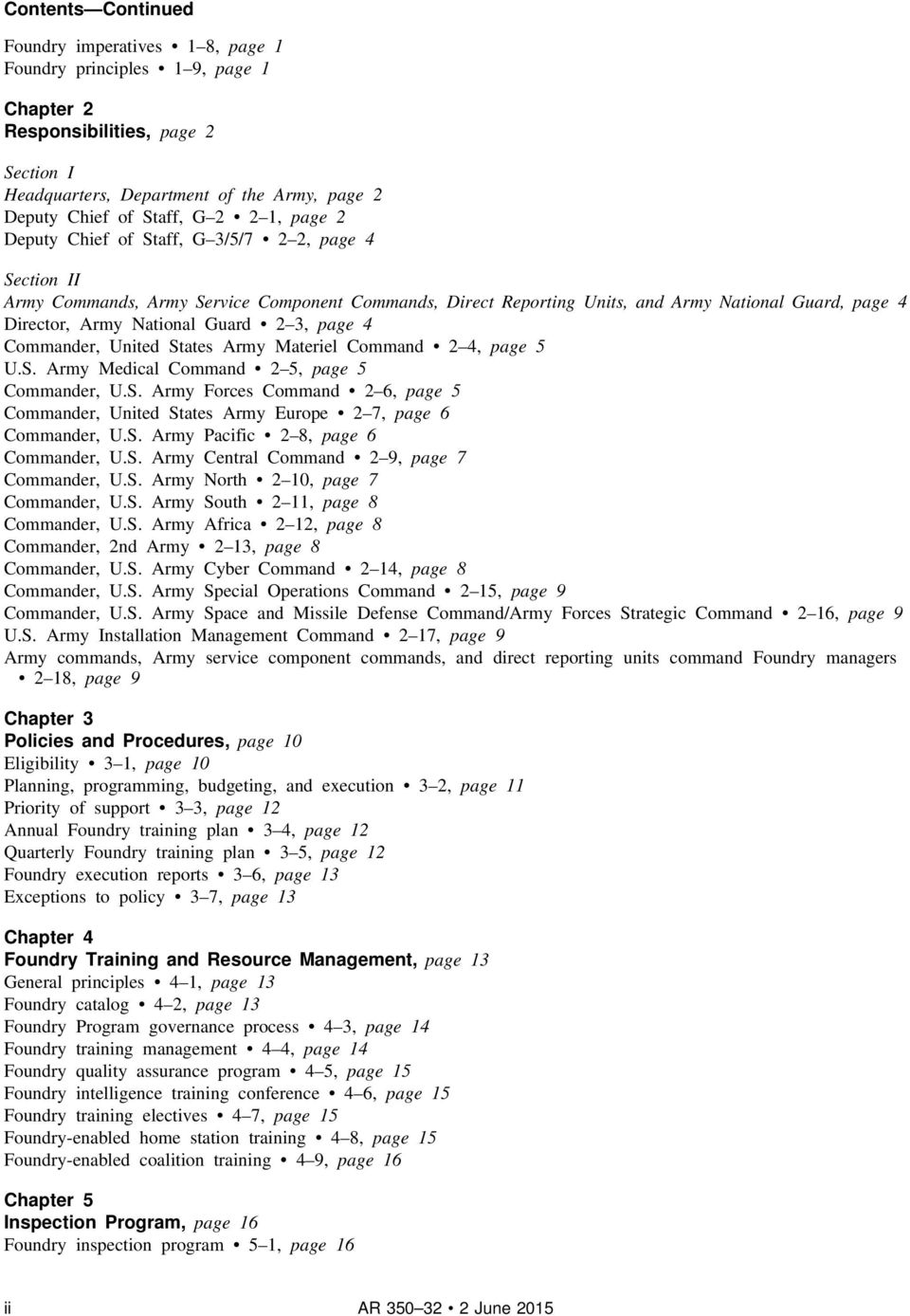
4 Contents Continued Foundry imperatives 1 8, page 1 Foundry principles 1 9, page 1 Chapter 2 Responsibilities, page 2 Section I Headquarters, Department of the Army, page 2 Deputy Chief of Staff, G 2 2 1, page 2 Deputy Chief of Staff, G 3/5/7 2 2, page 4 Section II Army Commands, Army Service Component Commands, Direct Reporting Units, and Army National Guard, page 4 Director, Army National Guard 2 3, page 4 Commander, United States Army Materiel Command 2 4, page 5 U.S. Army Medical Command 2 5, page 5 Commander, U.S. Army Forces Command 2 6, page 5 Commander, United States Army Europe 2 7, page 6 Commander, U.S. Army Pacific 2 8, page 6 Commander, U.S. Army Central Command 2 9, page 7 Commander, U.S. Army North 2 10, page 7 Commander, U.S. Army South 2 11, page 8 Commander, U.S. Army Africa 2 12, page 8 Commander, 2nd Army 2 13, page 8 Commander, U.S. Army Cyber Command 2 14, page 8 Commander, U.S. Army Special Operations Command 2 15, page 9 Commander, U.S. Army Space and Missile Defense Command/Army Forces Strategic Command 2 16, page 9 U.S. Army Installation Management Command 2 17, page 9 Army commands, Army service component commands, and direct reporting units command Foundry managers 2 18, page 9 Chapter 3 Policies and Procedures, page 10 Eligibility 3 1, page 10 Planning, programming, budgeting, and execution 3 2, page 11 Priority of support 3 3, page 12 Annual Foundry training plan 3 4, page 12 Quarterly Foundry training plan 3 5, page 12 Foundry execution reports 3 6, page 13 Exceptions to policy 3 7, page 13 Chapter 4 Foundry Training and Resource Management, page 13 General principles 4 1, page 13 Foundry catalog 4 2, page 13 Foundry Program governance process 4 3, page 14 Foundry training management 4 4, page 14 Foundry quality assurance program 4 5, page 15 Foundry intelligence training conference 4 6, page 15 Foundry training electives 4 7, page 15 Foundry-enabled home station training 4 8, page 15 Foundry-enabled coalition training 4 9, page 16 Chapter 5 Inspection Program, page 16 Foundry inspection program 5 1, page 16 ii AR June 2015
5 Contents Continued Inspection guidance 5 2, page 17 Foundry inspection penalties 5 3, page 17 Chapter 6 Intelligence Readiness and Operations Capability, page 17 Intelligence Readiness and Operations Capability definition 6 1, page 17 Intelligence Readiness and Operations Capability characteristics 6 2, page 17 Intelligence Readiness and Operations Capability support to mission command 6 3, page 17 Intelligence reach 6 4, page 18 Intelligence overwatch 6 5, page 18 Processing, exploitation, and dissemination 6 6, page 18 Intelligence Readiness and Operations Capability operational concept 6 7, page 18 Intelligence Readiness and Operations Capability mission orders process 6 8, page 19 Appendixes A. References, page 20 B. Collective Training Planning Guidelines, page 21 C. Internal Control Evaluation, page 22 Table List Table 3 1: Military intelligence occupational skills list, page 10 Glossary AR June 2015 iii

6

7 Chapter 1 Introduction 1 1. Purpose This regulation establishes Department of the Army (DA) policies, responsibilities and procedures for the Army Foundry Intelligence Training Program. Foundry enables Army intelligence personnel to sustain intelligence skills pertinent to their unit s mission, to improve their individual and collective technical and analytical skills, and to receive required accreditation and certification training to successfully execute intelligence missions in support of the unit s mission References Required and related publications and prescribed and referenced forms are listed in appendix A Explanation of abbreviations and terms Abbreviations and special terms used in this regulation are explained in the glossary Responsibilities Responsibilities are listed in chapter Army intelligence training vision Army intelligence training seeks to ensure no cold starts for military intelligence (MI) Soldiers and units in current or future mission sets primarily through the Foundry Program by providing technical accreditations and certifications on intelligence skills essential to maintaining readiness. As the Army prepares for future conflicts, the Intelligence Readiness and Operations Capability (IROC) will expand intelligence readiness capabilities to the next level, ensuring no MI Soldier at rest. IROC will enable commanders to leverage intelligence from any area of responsibility (AOR) to fully support the Army s regionally aligned force (RAF) concept and prepare for designated future deployments or contingencies in the Joint, interagency, intergovernmental and multinational environment of the future. Intelligence training and readiness through Foundry and IROC will continue to develop an agile, multi-disciplined MI force that is operationally adaptable and capable of supporting our Army s three strategic roles of prevent shape win Army Foundry Intelligence Training Program a. The Army Foundry Intelligence Training Program is a critical enabler to Army global readiness, providing commanders necessary resources to enhance the training of MI Soldiers and Civilians supporting operations at the tactical, operational, and strategic levels by providing access to the intelligence enterprise as they train. b. Foundry increases intelligence readiness, provides required accreditation and technical certification, enhances mission command proficiency, improves unit readiness and provides a venue to collectively certify MI individuals and units (team and higher) in full support of the Army Force Generation (ARFORGEN) cycle. c. Foundry enables available and ready MI individuals and units to conduct intelligence operations and activities in support of commanders executing assigned, allocated, apportioned, or distributed missions Foundry outputs The following are Foundry outputs: a. Increased intelligence Soldier capabilities. b. Improved collective task and/or mission essential task list proficiency. c. Improved support and enhancement of mission command. d. Unit and Army readiness Foundry imperatives The following are Foundry imperatives: a. Focus on echelon corps and below (ECB) and theater-reinforcing MI forces. b. Support RAFs, global response force (GRF), assigned, allocated, and other distributed missions. c. Support home station training Foundry principles a. Enables unit readiness. Foundry-enabled training provides commanders the capability to accredit and certify MI Soldiers and units in order to conduct intelligence operations and activities in support of RAF and GRF s assigned, allocated, apportioned, and other distributed missions. b. Linked to mission. All Foundry-enabled intelligence training is linked to a mission that is an Army priority in support of an Army service component command (ASCC) or combatant commander, or tied to an integrated priority list capability requirement or request for forces (RFF) or request for capability requirement. AR June

8 c. Reflects disciplined use of resources. Foundry is a critical training program for the Army that relies on limited resources. Units must prioritize Foundry-enabling capabilities required to complement their efforts aimed at achieving mission readiness. Carefully managing resources will ensure MI Soldiers and units are prepared to fully support operations. d. Integrates regional and functional intelligence enterprises. Foundry provides regional and functional linkage between the U.S. Army Intelligence and Security Command (INSCOM) and the combat support agencies to allow tactical units to acquire additional skills, specialties, and area expertise from operational and strategic intelligence sources for improved mission readiness and capabilities. Foundry offers prime opportunities to integrate tactics, techniques, and procedures for emerging capabilities and non-standard equipment into training and operations. e. Enhances the operational training domain. Foundry enhances individual and collective intelligence training for the Active Components (ACs) and Reserve Components (RCs). Foundry is designed to provide relevant and realistic training that is consistent with an adaptive operational environment. Chapter 2 Responsibilities Commanders of intelligence personnel are responsible for implementing the Foundry Program within their units. The Deputy Chief of Staff (DCS), G 2 Foundry Program funds are provided to AC, U.S. Army Reserve (USAR), and Army National Guard (ARNG) units. Units are allocated funds directly by DCS, G 2 through the planning, programming, budgeting, and execution (PPBE) process. Heads of Headquarters, Department of the Army (HQDA) agencies and unit commanders must have knowledge of this regulation, Army Regulation (AR) , and AR to successfully execute the Foundry Program. Section I Headquarters, Department of the Army 2 1. Deputy Chief of Staff, G 2 The DCS, G 2 will a. Provide program oversight, policy, and functional management. b. Provide guidance, direction, and oversee INSCOM and participating commands on Foundry Program execution. c. Establish policies for the Army Foundry Intelligence Training Program to include programming, administration, execution, and budgeting guidance. d. Chair the semi-annual general officer session. e. Appoint a Foundry Program manager who will serve as the DCS, G 2 Army staff point of contact for all Foundry policy issues. The DCS, G 2 Foundry Program manager will (1) Develop and publish Foundry Program policies, objectives, guidelines, and management controls. (2) Sponsor an annual meeting of the FITC that includes all Foundry Program stakeholders such as corps and division G 2s, Army command (ACOM), and ASCC Foundry Program managers. (3) Develop, maintain, and brief in coordination with the DCS, G 2 Resource Integration Directorate, and the general purpose intelligence readiness (GPIR) management decision package (MDEP) for the Foundry Program and monitor progress throughout the programming and budgeting cycles. (4) When required, obtain and finalize Foundry Program justification and resource-related data. (5) Manage and allocate Foundry Program funds to the participating commands in the AC and RC in accordance with this regulation and as established during the PPBE process in accordance with AR 1 1. (6) In conjunction with DCS, G 2 Resource Integration manager, conduct an annual Foundry inspection of the INSCOM Army Foundry Program office. The inspection focus area is fund allocation and expenditures to ensure compliance with this regulation, DCS, G 2 guidance, and established accountability procedures. (7) In coordination with the DCS, G 2 Operations and Plans system owner, direct the use of geospatial intelligence (GEOINT) Enterprise Tasking, Processing, Exploiting, and Disseminating Service (GETS) for all GEOINT operations and training within the Foundry Program. (8) In coordination with participating units, approve requests to establish new home station Foundry training sites. (9) Review and adjudicate contested exceptions to policy (ETPs). If required, the requesting command submitting the ETP will provide additional justification to the DCS, G 2 Foundry Program manager describing why the ETP should be approved. (10) Host a monthly Foundry budget meeting with the INSCOM Foundry Program administrator and DCS, G 2 MDEP manager and representative from the execution team. f. Commanding General, INSCOM. The Commander, INSCOM will 2 AR June 2015

9 (1) Implement the Foundry Program in accordance with DCS, G 2 guidance and Foundry Program policies and procedures. (2) Serve as the focal point for the administration and execution of Foundry training. (3) Enable Foundry training sites in support of training objectives in coordination with the DCS, G 2, ACOMs, ASCCs, direct reporting units (DRUs), USAR, and ARNG G 2s. Forward recommendations for approval for new home station Foundry training sites to the DCS, G 2. (4) Manage and provide oversight of the AC Foundry site directors. (5) Provide, maintain accountability of, and coordinate the sustainment and upgrade of systems at designated AC, ARNG, and USAR Foundry training sites. (6) Ensure Foundry equipment is maintained on the INSCOM property book. Any request to transfer Foundry property to a unit or installation property book requires INSCOM G 3 and G 4 approval. (7) Establish procedures for the procurement and accountability for, and sustainment of, nonstandard materiel in accordance with AR (8) INSCOM, through the functional commands, will (a) Certify all Foundry Program cadre. (b) Develop Foundry Program cadre qualifications. (c) Integrate Foundry Program cadre into the intelligence enterprise. (d) Develop, maintain, and standardize Foundry Program training electives. (9) In accordance with ASCC and ACOM training guidance, plan, coordinate, and execute a medium fidelity collective training event for ECB MI battalions and interrogation battalions at Camp Bullis, Texas, collective training facility prior to the units entering the available phase of the ARFORGEN cycle. (10) Ensure AC Foundry site directors: (a) Manage day-to-day operations at the Foundry training site in accordance with senior commander and senior intelligence officer (SIO) priorities and INSCOM G 3 guidance. (b) Meet with unit commanders and SIOs prior to entering the reset phase of the ARFORGEN cycle or as requested to explain the Foundry Program and to coordinate and integrate Foundry training into the unit s training plan. (c) Maintain accountability of the equipment assigned to the Foundry training site. Coordinate equipment repair with the INSCOM G 3 and G 4. (d) Facilitate individual and collective home station training, support intelligence overwatch and reach activities, and coordinate unit participation and training through the unit and SIO. (e) Provide mentorship to units participating in overwatch and reach operations. (f) Coordinate with the SIO to prioritize Foundry training resources and Foundry training site utilization. (g) Participate in the monthly synchronization session and other meetings as directed. (h) Enable home station individual and collective training and operational readiness for ECB units by providing equipment and mentorship. (i) In coordination with unit commanders and SIOs, ensure the garrison cryptologic activities Consolidated Cryptologic Program personnel are utilized by the Foundry Program to facilitate the home station execution of signals intelligence (SIGINT) training and operational readiness events. (j) Ensure that Foundry Program site cadre receives periodic training on the latest intelligence tactics, techniques, procedures, processes, and systems including GETS. (k) Coordinate Foundry training site manpower shortfalls. Continental U.S. sites will coordinate manning shortfalls with ACOM headquarters for guidance on unit subject matter experts (SMEs) to support Foundry sites prior to any dialogue with the installation. Outside continental U.S. sites will coordinate manning shortfalls with the installation SIO, or ASCC SIO, to acquire unit intelligence SMEs to serve as Foundry cadre to support Foundry individual and collective home station training. (l) Serve as the INSCOM Commander s Foundry-related intelligence oversight representative and intelligence operational readiness SME managing, the daily Foundry operations, integration of Foundry cadre into the Foundry site, Foundry enterprise resourcing, and Foundry enterprise best practices. (11) Publish a monthly Foundry newsletter. (12) Establish an Army Foundry Program office and appoint a Foundry Program administrator. The Foundry Program administrator will (a) Assist the ACOM, ASCC, DRU, and ARNG Foundry Program managers with the execution of program policies, objectives, guidelines, and management controls. (b) In coordination with DCS, G 2 Foundry Program manager and DCS, G 2, GPIR MDEP manager, assist in the development the GPIR program objective memorandum (POM) to identify operations and maintenance Army requirements in order to implement and execute the Foundry Program. (c) Participate in the DCS, G 2 Foundry Program manager s monthly budget meeting to review Foundry expenditures and activities in accordance with chapter 3. AR June

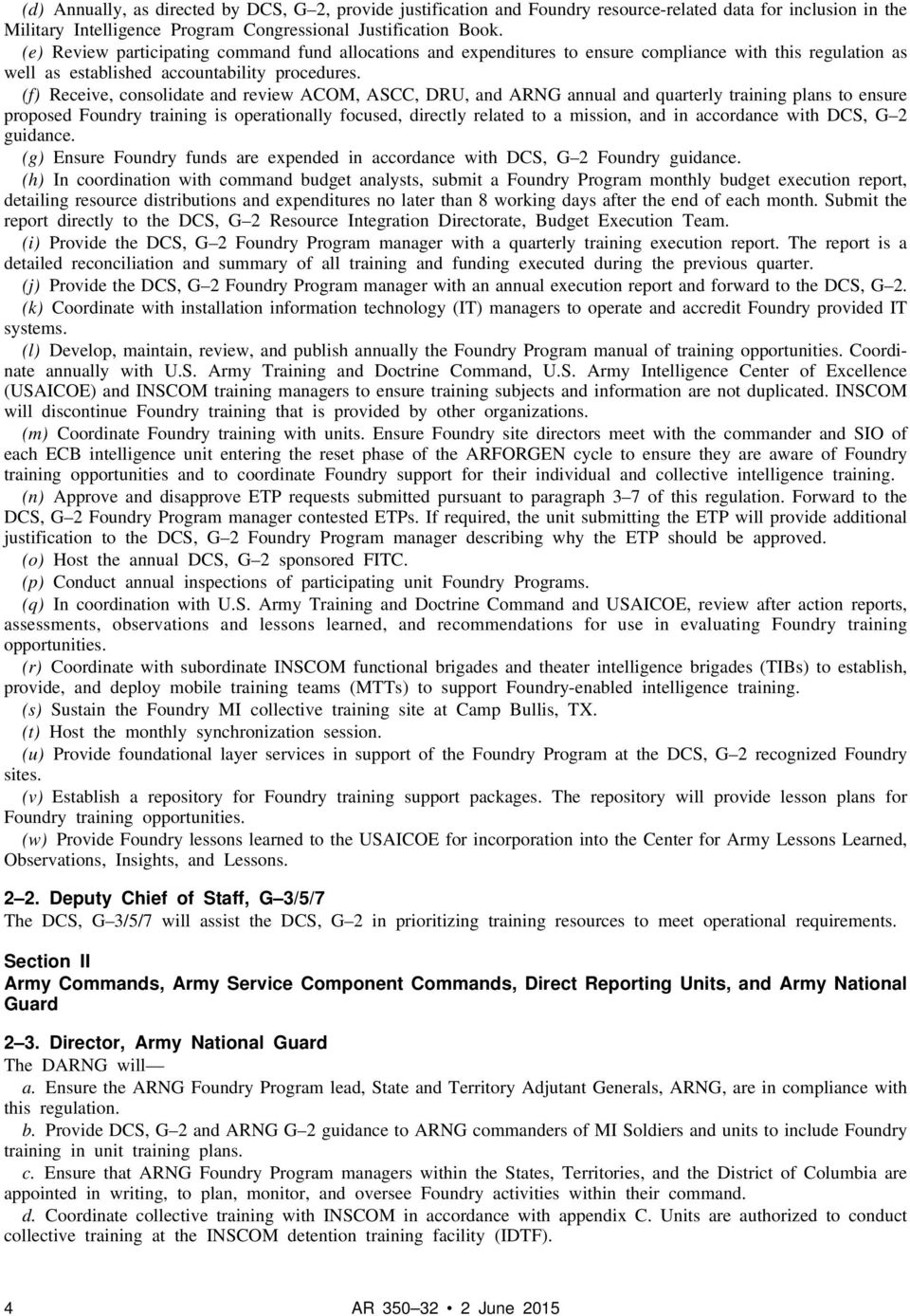
10 (d) Annually, as directed by DCS, G 2, provide justification and Foundry resource-related data for inclusion in the Military Intelligence Program Congressional Justification Book. (e) Review participating command fund allocations and expenditures to ensure compliance with this regulation as well as established accountability procedures. (f) Receive, consolidate and review ACOM, ASCC, DRU, and ARNG annual and quarterly training plans to ensure proposed Foundry training is operationally focused, directly related to a mission, and in accordance with DCS, G 2 guidance. (g) Ensure Foundry funds are expended in accordance with DCS, G 2 Foundry guidance. (h) In coordination with command budget analysts, submit a Foundry Program monthly budget execution report, detailing resource distributions and expenditures no later than 8 working days after the end of each month. Submit the report directly to the DCS, G 2 Resource Integration Directorate, Budget Execution Team. (i) Provide the DCS, G 2 Foundry Program manager with a quarterly training execution report. The report is a detailed reconciliation and summary of all training and funding executed during the previous quarter. (j) Provide the DCS, G 2 Foundry Program manager with an annual execution report and forward to the DCS, G 2. (k) Coordinate with installation information technology (IT) managers to operate and accredit Foundry provided IT systems. (l) Develop, maintain, review, and publish annually the Foundry Program manual of training opportunities. Coordinate annually with U.S. Army Training and Doctrine Command, U.S. Army Intelligence Center of Excellence (USAICOE) and INSCOM training managers to ensure training subjects and information are not duplicated. INSCOM will discontinue Foundry training that is provided by other organizations. (m) Coordinate Foundry training with units. Ensure Foundry site directors meet with the commander and SIO of each ECB intelligence unit entering the reset phase of the ARFORGEN cycle to ensure they are aware of Foundry training opportunities and to coordinate Foundry support for their individual and collective intelligence training. (n) Approve and disapprove ETP requests submitted pursuant to paragraph 3 7 of this regulation. Forward to the DCS, G 2 Foundry Program manager contested ETPs. If required, the unit submitting the ETP will provide additional justification to the DCS, G 2 Foundry Program manager describing why the ETP should be approved. (o) Host the annual DCS, G 2 sponsored FITC. (p) Conduct annual inspections of participating unit Foundry Programs. (q) In coordination with U.S. Army Training and Doctrine Command and USAICOE, review after action reports, a s s e s s m e n t s, o b s e r v a t i o n s a n d l e s s o n s l e a r n e d, a n d r e c o m m e n d a t i o n s f o r u s e i n e v a l u a t i n g F o u n d r y t r a i n i n g opportunities. (r) Coordinate with subordinate INSCOM functional brigades and theater intelligence brigades (TIBs) to establish, provide, and deploy mobile training teams (MTTs) to support Foundry-enabled intelligence training. (s) Sustain the Foundry MI collective training site at Camp Bullis, TX. (t) Host the monthly synchronization session. (u) Provide foundational layer services in support of the Foundry Program at the DCS, G 2 recognized Foundry sites. (v) Establish a repository for Foundry training support packages. The repository will provide lesson plans for Foundry training opportunities. (w) Provide Foundry lessons learned to the USAICOE for incorporation into the Center for Army Lessons Learned, Observations, Insights, and Lessons Deputy Chief of Staff, G 3/5/7 The DCS, G 3/5/7 will assist the DCS, G 2 in prioritizing training resources to meet operational requirements. Section II Army Commands, Army Service Component Commands, Direct Reporting Units, and Army National Guard 2 3. Director, Army National Guard The DARNG will a. Ensure the ARNG Foundry Program lead, State and Territory Adjutant Generals, ARNG, are in compliance with this regulation. b. Provide DCS, G 2 and ARNG G 2 guidance to ARNG commanders of MI Soldiers and units to include Foundry training in unit training plans. c. Ensure that ARNG Foundry Program managers within the States, Territories, and the District of Columbia are appointed in writing, to plan, monitor, and oversee Foundry activities within their command. d. Coordinate collective training with INSCOM in accordance with appendix C. Units are authorized to conduct collective training at the INSCOM detention training facility (IDTF). 4 AR June 2015
11 e. Provide a unit intelligence SME to serve as Foundry cadre. f. Coordinate Foundry training site personnel shortfalls with the local Foundry site director and the INSCOM G 3 Foundry Program administrator to identify the trainers by military occupational specialty (MOS) required for installation Foundry site cadre. g. C o o r d i n a t e f o r c a d r e c e r t i f i c a t i o n a n d i n t e g r a t i o n i n t o t h e i n t e l l i g e n c e d i s c i p l i n e - s p e c i f i c e n t e r p r i s e w i t h INSCOM. (1) Unit-provided Foundry cadre will incorporate into the installation Foundry site for execution of the Foundry Program. (2) Unit-provided Foundry cadre will participate in INSCOM functional command collaboration forums. (3) Unit-provided Foundry cadre will use the INSCOM enabled lesson plans for execution of Foundry training. h. Appoint a command Foundry Program manager in writing, to plan, monitor, and oversee Foundry activities within their command and provide a copy of the order to the Foundry Program office not later than 30 days after appointment. The ARNG command Foundry Program manager in addition to the responsibilities as stated in paragraph 2 18 will, in coordination with DCS, G 2 Foundry Program manager and the DCS, G 2 GPIR MDEP manager, assist in the development of the GPIR POM in order to identify Operations and Maintenance, National Guard and National Guard Personnel, Army requirements. i. Participate Foundry Program governance process other critical Foundry meetings to provide training feedback and training requirements. j. Direct all GEOINT Foundry cadre to maintain organizational public key infrastructure (PKI)-enabled GETS accounts in order to manage all GEOINT training and production through GETS Commander, United States Army Materiel Command Commander, AMC will a. Provide command guidance to subordinate units to include Foundry training in unit training plans. b. Review and approve or disapprove ETP requests submitted pursuant to paragraph 3 7 of this regulation. c. Appoint a command Foundry Program manager in writing, to plan, monitor, and oversee Foundry activities within their command and provide a copy of the order to the Foundry Program office not later than 30 days after appointment. The AMC command Foundry Program manager will fulfill the responsibilities stated in paragraph d. Participate Foundry Program governance process other critical Foundry meetings to provide training feedback and training requirements U.S. Army Medical Command Commander, MEDCOM will a. In coordination with INSCOM G 3/5/7, consistent with appendix B, provide behavior science personnel in support of intelligence collective training conducted at the IDTF. b. Appoint command Foundry Program managers in writing, to plan, monitor, and oversee Foundry activities within their command and provide a copy of the order to the Foundry Program office not later than 30 days after appointment. The MEDCOM Foundry Program manager will fulfill the responsibilities stated in paragraph c. Participate Foundry Program governance process other critical Foundry meetings to provide training feedback and training requirements Commander, U.S. Army Forces Command Commander, FORSCOM will a. Provide command guidance to subordinate units to include Foundry training in unit training plans. b. Coordinate with IMCOM on each installation to ensure IMCOM provides resources, sustainment, and improvements for office space, sensitive compartmented information facilities, infrastructure, and base operations support for Foundry training sites. c. Appoint a command Foundry Program manager in writing, to plan, monitor, and oversee Foundry activities within their command and provide a copy of the order to the Foundry Program office no later than 30 days after appointment. The FORSCOM command Foundry Program manager will fulfill the responsibilities stated in paragraph d. Provide unit intelligence SMEs to serve as Foundry cadre accounts in order to manage all GEOINT training and production through GETS. e. Direct FORSCOM senior commanders and their SIOs at the corps and division level participating in the Army Foundry Program to (1) Establish Foundry site mission, intent, and objectives to support intelligence warfighting functions (IWfFs) requirements. (2) Direct all Foundry site training and mission sets and delegate authority and responsibilities as appropriate. (3) Appoint a unit Foundry manager to coordinate Foundry training. (4) Add required Foundry training to unit training calendars and schedules. AR June

12 (5) Endorse ETP requests initiated by the unit Foundry manager. (6) Coordinate collective training with INSCOM in accordance with appendix C. Units are authorized to conduct collective training at the IDTF. f. The Military Intelligence Readiness Command Commander will (1) In coordination with HQDA DCS, G 2 Foundry Program manager and DCS, G 2 GPIR MDEP manager, assist in the development of the GPIR POM in order to identify Operations and Maintenance, Army Reserve and Reserve Personnel, Army requirements. (2) Coordinate with subordinate USAR commands and their Foundry Program managers to ensure proper coordination and execution of the Foundry Program within the USAR. The Army Reserve Intelligence Support Center training sites remain under the mission command of the USAR and follow program guidance as outlined in this regulation. (3) Ensure USAR units provide intelligence SMEs to serve as Foundry cadre. Units will coordinate Foundry training site personnel shortfalls with the local Foundry site director and the INSCOM G 3 Foundry Program administrator to identify the trainers by MOS required for the installation s Foundry site cadre. (4) Coordinate for cadre certification and integration into the discipline-specific enterprise with INSCOM. (5) Ensure unit-provided Foundry cadre incorporate into the installation Foundry site for execution of the Foundry Program, participate in INSCOM functional command collaboration forums, and use the INSCOM-enabled lesson plans for execution of Foundry training Commander, United States Army Europe The Commander, USAREUR will a. Develop Foundry training electives that will enable RAF and GRF units to gain knowledge of the theater s operational environment and intelligence cycle procedures. Submit new training electives and resourcing requirements into the Foundry governance process. b. Coordinate and direct Foundry implementation for theater and aligned units. Home station training via outside the continental U.S. Foundry sites will coordinate directly with the TIB. c. Coordinate and conduct Foundry-enabled coalition training in accordance with chapter 4. d. Provide unit intelligence SMEs to serve as Foundry cadre. e. Coordinate Foundry training site personnel shortfalls with the local Foundry site director and the INSCOM G 3 Foundry Program administrator to identify the trainers by MOS required for the installation Foundry site cadre. f. Coordinate for cadre certification and integration into the discipline enterprise with INSCOM. g. Direct all GEOINT Foundry cadre to maintain organizational PKI-enabled GETS accounts in order to manage all GEOINT training and production through GETS. h. Review and approve or disapprove ETP requests submitted pursuant to paragraph 3 7 of this regulation. i. Unit provided Foundry cadre will incorporate into the installation Foundry site for execution of the Foundry Program, will participate in INSCOM functional command collaboration forums, and will use the INSCOM enabled lesson plans for execution of Foundry training. j. Coordinate with IMCOM on each installation to ensure IMCOM provides resources, sustainment, and improvements for office space, sensitive compartmented information facilities, infrastructure, and base operations support for Foundry training sites. k. Oversee unit commanders and SIOs participating in the Army Foundry Program. Unit commanders and SIOs will (1) Appoint a unit Foundry manager to coordinate Foundry training. (2) Include plans to use the Foundry Program in annual training guidance. (3) Add required Foundry training to unit training calendars and schedules. (4) Endorse ETP requests initiated by the unit Foundry manager. (5) Establish Foundry site mission, intent, and objectives to IWfF requirements. (6) Direct all Foundry site training and mission sets and delegate any authority as appropriate. (7) Direct Foundry implementation for theater. In accordance with INSCOM s role in the Foundry Program, the TIB will execute Foundry training and administrative support of the Foundry site. (8) Appoint command Foundry Program managers in writing, to plan, monitor, and oversee Foundry activities within their command and provide a copy of the order to the Foundry Program office not later than 30 days after appointment. The USAREUR command Foundry Program manager will fulfill the responsibilities stated in paragraph l. Participate in the Foundry Program governance process other critical Foundry meetings to provide training feedback and training requirements Commander, U.S. Army Pacific The Commander, USARPAC will a. Develop Foundry training electives that will enable RAF and GRF units to gain knowledge of the theater s 6 AR June 2015

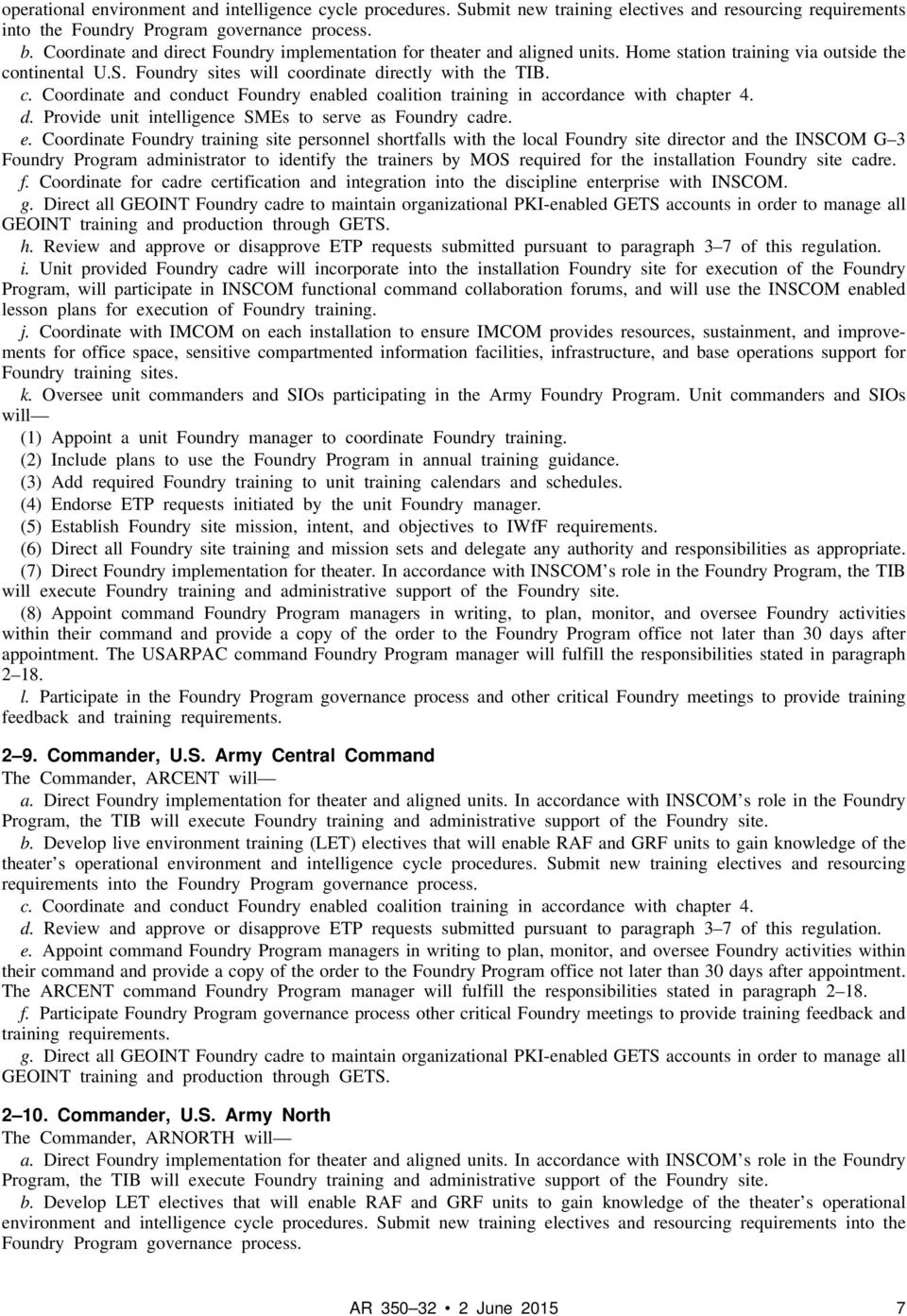
13 operational environment and intelligence cycle procedures. Submit new training electives and resourcing requirements into the Foundry Program governance process. b. Coordinate and direct Foundry implementation for theater and aligned units. Home station training via outside the continental U.S. Foundry sites will coordinate directly with the TIB. c. Coordinate and conduct Foundry enabled coalition training in accordance with chapter 4. d. Provide unit intelligence SMEs to serve as Foundry cadre. e. Coordinate Foundry training site personnel shortfalls with the local Foundry site director and the INSCOM G 3 Foundry Program administrator to identify the trainers by MOS required for the installation Foundry site cadre. f. Coordinate for cadre certification and integration into the discipline enterprise with INSCOM. g. Direct all GEOINT Foundry cadre to maintain organizational PKI-enabled GETS accounts in order to manage all GEOINT training and production through GETS. h. Review and approve or disapprove ETP requests submitted pursuant to paragraph 3 7 of this regulation. i. Unit provided Foundry cadre will incorporate into the installation Foundry site for execution of the Foundry Program, will participate in INSCOM functional command collaboration forums, and will use the INSCOM enabled lesson plans for execution of Foundry training. j. Coordinate with IMCOM on each installation to ensure IMCOM provides resources, sustainment, and improvements for office space, sensitive compartmented information facilities, infrastructure, and base operations support for Foundry training sites. k. Oversee unit commanders and SIOs participating in the Army Foundry Program. Unit commanders and SIOs will (1) Appoint a unit Foundry manager to coordinate Foundry training. (2) Include plans to use the Foundry Program in annual training guidance. (3) Add required Foundry training to unit training calendars and schedules. (4) Endorse ETP requests initiated by the unit Foundry manager. (5) Establish Foundry site mission, intent, and objectives to IWfF requirements. (6) Direct all Foundry site training and mission sets and delegate any authority and responsibilities as appropriate. (7) Direct Foundry implementation for theater. In accordance with INSCOM s role in the Foundry Program, the TIB will execute Foundry training and administrative support of the Foundry site. (8) Appoint command Foundry Program managers in writing, to plan, monitor, and oversee Foundry activities within their command and provide a copy of the order to the Foundry Program office not later than 30 days after appointment. The USARPAC command Foundry Program manager will fulfill the responsibilities stated in paragraph l. Participate in the Foundry Program governance process and other critical Foundry meetings to provide training feedback and training requirements Commander, U.S. Army Central Command The Commander, ARCENT will a. Direct Foundry implementation for theater and aligned units. In accordance with INSCOM s role in the Foundry Program, the TIB will execute Foundry training and administrative support of the Foundry site. b. Develop live environment training (LET) electives that will enable RAF and GRF units to gain knowledge of the theater s operational environment and intelligence cycle procedures. Submit new training electives and resourcing requirements into the Foundry Program governance process. c. Coordinate and conduct Foundry enabled coalition training in accordance with chapter 4. d. Review and approve or disapprove ETP requests submitted pursuant to paragraph 3 7 of this regulation. e. Appoint command Foundry Program managers in writing to plan, monitor, and oversee Foundry activities within their command and provide a copy of the order to the Foundry Program office not later than 30 days after appointment. The ARCENT command Foundry Program manager will fulfill the responsibilities stated in paragraph f. Participate Foundry Program governance process other critical Foundry meetings to provide training feedback and training requirements. g. Direct all GEOINT Foundry cadre to maintain organizational PKI-enabled GETS accounts in order to manage all GEOINT training and production through GETS Commander, U.S. Army North The Commander, ARNORTH will a. Direct Foundry implementation for theater and aligned units. In accordance with INSCOM s role in the Foundry Program, the TIB will execute Foundry training and administrative support of the Foundry site. b. Develop LET electives that will enable RAF and GRF units to gain knowledge of the theater s operational environment and intelligence cycle procedures. Submit new training electives and resourcing requirements into the Foundry Program governance process. AR June
14 c. Coordinate and conduct Foundry enabled coalition training in accordance with chapter 4. d. Review and approve or disapprove ETP requests submitted pursuant to paragraph 3 7 of this regulation. e. Appoint command Foundry Program managers in writing to plan, monitor, and oversee Foundry activities within their command and provide a copy of the order to the Foundry Program office not later than 30 days after appointment. The ARNORTH command Foundry Program manager will fulfill the responsibilities stated in paragraph f. Participate Foundry Program governance process other critical Foundry meetings to provide training feedback and training requirements. g. Direct all GEOINT Foundry cadre to maintain organizational PKI-enabled GETS accounts in order to manage all GEOINT training and production through GETS Commander, U.S. Army South The Commander, ARSOUTH will a. Direct Foundry implementation for theater and aligned units. In accordance with INSCOM s role in the Foundry Program, the TIB will execute Foundry training and administrative support of the Foundry site. b. Develop LET electives that will enable RAF and GRF units to gain knowledge of the theater s operational environment and intelligence cycle procedures. Submit new training electives and resourcing requirements into the Foundry Program governance process. c. Coordinate and conduct Foundry enabled coalition training in accordance with chapter 4. d. Review and approve or disapprove ETP requests submitted pursuant to paragraph 3 7 of this regulation. e. Appoint command Foundry Program managers in writing to plan, monitor, and oversee Foundry activities within their command and provide a copy of the order to the Foundry Program office not later than 30 days after appointment. The ARSOUTH command Foundry Program manager will fulfill the responsibilities stated in paragraph f. Participate Foundry Program governance process other critical Foundry meetings to provide training feedback and training requirements. g. Direct all GEOINT Foundry cadre to maintain organizational PKI-enabled GETS accounts in order to manage all GEOINT training and production through GETS Commander, U.S. Army Africa The Commander, USARAF will a. Direct Foundry implementation for theater and aligned units. In accordance with INSCOM s role in the Foundry Program, the TIB will execute Foundry training and administrative support of the Foundry site. b. Develop LET electives that will enable RAF and GRF units to gain knowledge of the theater s operational environment and intelligence cycle procedures. Submit new training electives and resourcing requirements into the Foundry Program governance process. c. Coordinate and conduct Foundry enabled coalition training in accordance with chapter 4. d. Review and approve or disapprove ETP requests submitted pursuant to paragraph 3 7 of this regulation. e. Appoint command Foundry Program managers in writing to plan, monitor, and oversee Foundry activities within their command and provide a copy of the order to the Foundry Program office not later than 30 days after appointment. The USARAF command Foundry Program manager will fulfill the responsibilities stated in paragraph f. Participate Foundry Program governance process other critical Foundry meetings to provide training feedback and training requirements. g. Direct all GEOINT Foundry cadre to maintain organizational PKI-enabled GETS accounts in order to manage all GEOINT training and production through GETS Commander, 2nd Army The Commander, 2nd Army will a. Appoint command Foundry Program managers in writing to plan, monitor, and oversee Foundry activities within their command and provide a copy of the order to the Foundry Program office not later than 30 days after appointment. The 2nd Army Foundry Program manager will fulfill the responsibilities stated in paragraph b. Provide unclassified and collateral information service and connectivity to Foundry sites. c. Participate Foundry Program governance process other critical Foundry meetings to provide training feedback and training requirements. d. Direct all GEOINT Foundry cadre to maintain organizational PKI-enabled GETS accounts in order to manage all GEOINT training and production through GETS Commander, U.S. Army Cyber Command The Commander, ARCYBER will a. Direct Foundry implementation for theater and aligned units. In accordance with INSCOM s role in the Foundry Program, the TIB will execute Foundry training and administrative support of the Foundry site. 8 AR June 2015

15 b. Develop LET electives that will enable RAF and GRF units to gain knowledge of the theater s operational environment and intelligence cycle procedures. Submit new training electives and resource requirements into the Foundry Program governance process. c. Coordinate and conduct Foundry enabled coalition training in accordance with chapter 4. d. Review and approve or disapprove ETP requests submitted pursuant to paragraph 3 7 of this regulation. e. Appoint command Foundry Program managers in writing to plan, monitor, and oversee Foundry activities within their command and provide a copy of the order to the Foundry Program office not later than 30 days after appointment. The ARCYBER command Foundry Program manager will fulfill the responsibilities stated in paragraph f. Participate Foundry Program governance process other critical Foundry meetings to provide training feedback and training requirements Commander, U.S. Army Special Operations Command The Commander, USASOC will a. Direct Foundry implementation for theater and aligned units. In accordance with INSCOM s role in the Foundry Program, the TIB will execute Foundry training and administrative support of the Foundry site. b. Develop LET electives that will enable RAF and GRF units to gain knowledge of the theater s operational environment and intelligence cycle procedures. Submit new training electives and resourcing requirements into the Foundry Program governance process. c. Coordinate and conduct Foundry enabled coalition training in accordance with chapter 4. d. Review and approve or disapprove ETP requests submitted pursuant to paragraph 3 7 of this regulation. e. Appoint command Foundry Program managers in writing to plan, monitor, and oversee Foundry activities within their command and provide a copy of the order to the Foundry Program office not later than 30 days after appointment. The USASOC command Foundry Program manager will fulfill the responsibilities stated in paragraph f. Participate Foundry Program governance process other critical Foundry meetings to provide training feedback and training requirements. g. Direct all GEOINT Foundry cadre to maintain organizational PKI-enabled GETS accounts in order to manage all GEOINT training and production through GETS Commander, U.S. Army Space and Missile Defense Command/Army Forces Strategic Command The Commander, SMDC/ARSTRAT will a. Direct Foundry implementation for theater and aligned units. In accordance with INSCOM s role in the Foundry Program, the TIB will execute Foundry training and administrative support of the Foundry site. b. Develop LET electives that will enable RAF and GRF units to gain knowledge of the theater s operational environment and intelligence cycle procedures. Submit new training electives and resourcing requirements into the Foundry Program governance process. c. Coordinate and conduct Foundry enabled coalition training in accordance with chapter 4. d. Review and approve or disapprove ETP requests submitted pursuant to paragraph 3 7 of this regulation. e. Appoint command Foundry Program managers in writing to plan, monitor, and oversee Foundry activities within their command and provide a copy of the order to the Foundry Program office not later than 30 days after appointment. The SMDC/ARSTRAT command Foundry Program manager will fulfill the responsibilities stated in paragraph f. Participate Foundry Program governance process other critical Foundry meetings to provide training feedback and training requirements. g. Direct all GEOINT Foundry cadre to maintain organizational PKI-enabled GETS accounts in order to manage all GEOINT training and production through GETS U.S. Army Installation Management Command The IMCOM Commander will a. Provide resources, sustainment, and improvements for office space, sensitive compartmented information facilities, infrastructure, and base operations support for Foundry training sites. b. E n s u r e f a c i l i t i e s, u t i l i t i e s, f u r n i t u r e, c o m m u n i c a t i o n s, a n d o t h e r i n f r a s t r u c t u r e m a i n t e n a n c e c o n f o r m t o t h e ACOMs Foundry training requirements. c. In coordination with FORSCOM, USAREUR, U.S. Army Pacific, and other ACOMs, ASCCs, and/or DRUs as necessary, identify existing installation facilities for potential Foundry training sites Army commands, Army service component commands, and direct reporting units command Foundry managers Command Foundry managers will a. Coordinate with the command SIO to enable unit participation in Foundry training. AR June

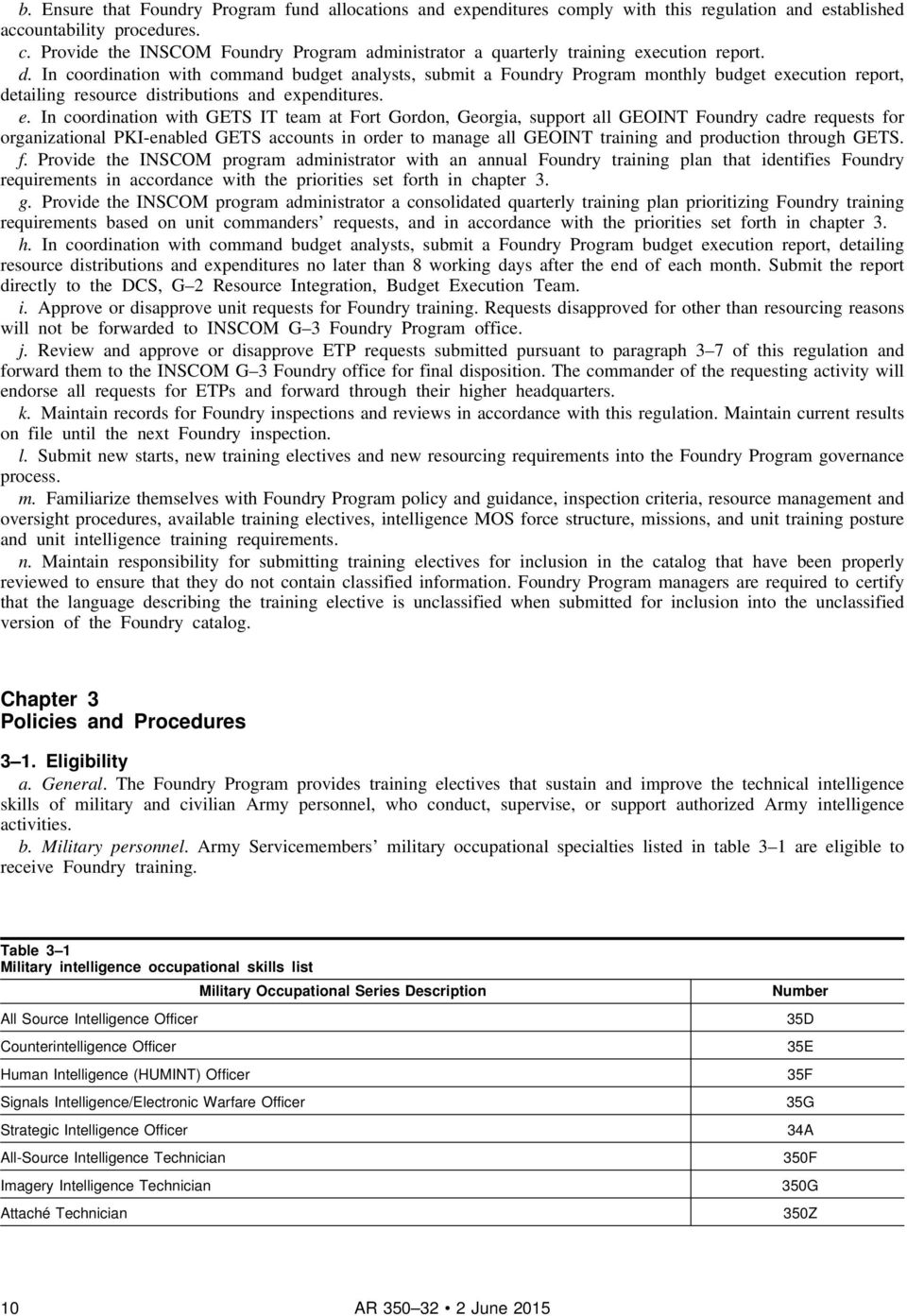
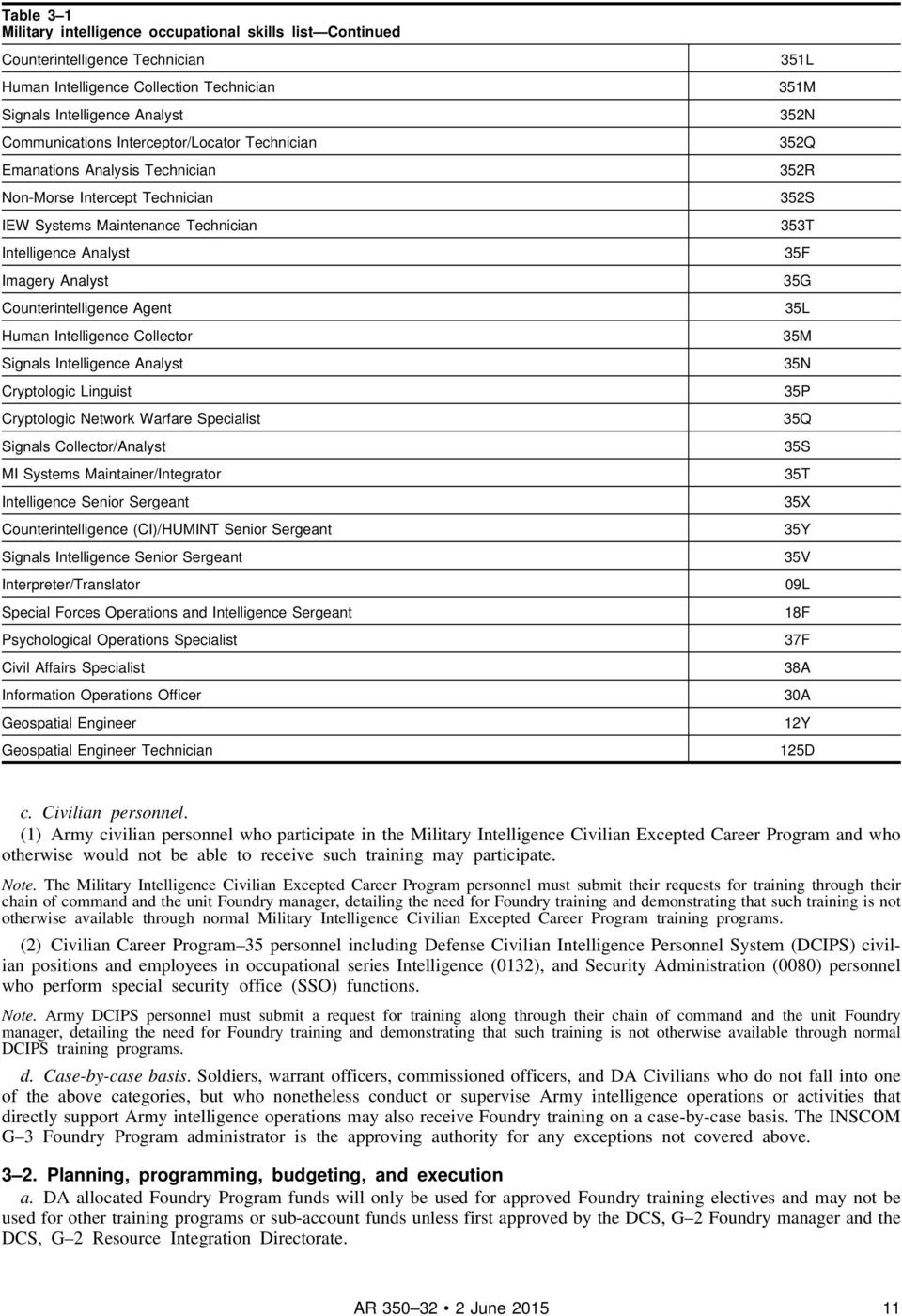
16 b. Ensure that Foundry Program fund allocations and expenditures comply with this regulation and established accountability procedures. c. Provide the INSCOM Foundry Program administrator a quarterly training execution report. d. In coordination with command budget analysts, submit a Foundry Program monthly budget execution report, detailing resource distributions and expenditures. e. In coordination with GETS IT team at Fort Gordon, Georgia, support all GEOINT Foundry cadre requests for organizational PKI-enabled GETS accounts in order to manage all GEOINT training and production through GETS. f. Provide the INSCOM program administrator with an annual Foundry training plan that identifies Foundry requirements in accordance with the priorities set forth in chapter 3. g. Provide the INSCOM program administrator a consolidated quarterly training plan prioritizing Foundry training requirements based on unit commanders requests, and in accordance with the priorities set forth in chapter 3. h. In coordination with command budget analysts, submit a Foundry Program budget execution report, detailing resource distributions and expenditures no later than 8 working days after the end of each month. Submit the report directly to the DCS, G 2 Resource Integration, Budget Execution Team. i. Approve or disapprove unit requests for Foundry training. Requests disapproved for other than resourcing reasons will not be forwarded to INSCOM G 3 Foundry Program office. j. Review and approve or disapprove ETP requests submitted pursuant to paragraph 3 7 of this regulation and forward them to the INSCOM G 3 Foundry office for final disposition. The commander of the requesting activity will endorse all requests for ETPs and forward through their higher headquarters. k. Maintain records for Foundry inspections and reviews in accordance with this regulation. Maintain current results on file until the next Foundry inspection. l. Submit new starts, new training electives and new resourcing requirements into the Foundry Program governance process. m. Familiarize themselves with Foundry Program policy and guidance, inspection criteria, resource management and oversight procedures, available training electives, intelligence MOS force structure, missions, and unit training posture and unit intelligence training requirements. n. Maintain responsibility for submitting training electives for inclusion in the catalog that have been properly reviewed to ensure that they do not contain classified information. Foundry Program managers are required to certify that the language describing the training elective is unclassified when submitted for inclusion into the unclassified version of the Foundry catalog. Chapter 3 Policies and Procedures 3 1. Eligibility a. General. The Foundry Program provides training electives that sustain and improve the technical intelligence skills of military and civilian Army personnel, who conduct, supervise, or support authorized Army intelligence activities. b. Military personnel. Army Servicemembers military occupational specialties listed in table 3 1 are eligible to receive Foundry training. Table 3 1 Military intelligence occupational skills list Military Occupational Series Description All Source Intelligence Officer Counterintelligence Officer Human Intelligence (HUMINT) Officer Signals Intelligence/Electronic Warfare Officer Strategic Intelligence Officer All-Source Intelligence Technician Imagery Intelligence Technician Attaché Technician Number 35D 35E 35F 35G 34A 350F 350G 350Z 10 AR June 2015
17 Table 3 1 Military intelligence occupational skills list Continued Counterintelligence Technician Human Intelligence Collection Technician Signals Intelligence Analyst Communications Interceptor/Locator Technician Emanations Analysis Technician Non-Morse Intercept Technician IEW Systems Maintenance Technician Intelligence Analyst Imagery Analyst Counterintelligence Agent Human Intelligence Collector Signals Intelligence Analyst Cryptologic Linguist Cryptologic Network Warfare Specialist Signals Collector/Analyst MI Systems Maintainer/Integrator Intelligence Senior Sergeant Counterintelligence (CI)/HUMINT Senior Sergeant Signals Intelligence Senior Sergeant Interpreter/Translator Special Forces Operations and Intelligence Sergeant Psychological Operations Specialist Civil Affairs Specialist Information Operations Officer Geospatial Engineer Geospatial Engineer Technician 351L 351M 352N 352Q 352R 352S 353T 35F 35G 35L 35M 35N 35P 35Q 35S 35T 35X 35Y 35V 09L 18F 37F 38A 30A 12Y 125D c. Civilian personnel. (1) Army civilian personnel who participate in the Military Intelligence Civilian Excepted Career Program and who otherwise would not be able to receive such training may participate. Note. The Military Intelligence Civilian Excepted Career Program personnel must submit their requests for training through their chain of command and the unit Foundry manager, detailing the need for Foundry training and demonstrating that such training is not otherwise available through normal Military Intelligence Civilian Excepted Career Program training programs. (2) Civilian Career Program 35 personnel including Defense Civilian Intelligence Personnel System (DCIPS) civilian positions and employees in occupational series Intelligence (0132), and Security Administration (0080) personnel who perform special security office (SSO) functions. Note. Army DCIPS personnel must submit a request for training along through their chain of command and the unit Foundry manager, detailing the need for Foundry training and demonstrating that such training is not otherwise available through normal DCIPS training programs. d. Case-by-case basis. Soldiers, warrant officers, commissioned officers, and DA Civilians who do not fall into one of the above categories, but who nonetheless conduct or supervise Army intelligence operations or activities that directly support Army intelligence operations may also receive Foundry training on a case-by-case basis. The INSCOM G 3 Foundry Program administrator is the approving authority for any exceptions not covered above Planning, programming, budgeting, and execution a. DA allocated Foundry Program funds will only be used for approved Foundry training electives and may not be used for other training programs or sub-account funds unless first approved by the DCS, G 2 Foundry manager and the DCS, G 2 Resource Integration Directorate. AR June
18 b. Foundry funds may not be mixed with, used instead of, or used to supplement funds specifically appropriated to pay for formal educational or MOS training (such as tuition fees at a civilian institution for the purpose of attaining a college degree, travel, and per diem costs to attend an MOS course, and so forth). c. The Foundry intelligence training program will use the GPIR MDEP as the program of record for Foundry training. d. Budget process. (1) Commands will establish account processing codes to identify and track Foundry Program expenses and execution of Foundry Program dollars. (2) The DCS, G 2 with DCS, G 2 Resource Integration manager will coordinate POM submission recommendations with the DCS, G 2 Foundry Program manager. The DCS, G 2 Foundry Program manager will coordinate POM requirements with INSCOM, ARNG, and the USAR. e. Budget procedures. (1) Command Foundry Program managers will identify and forecast annual funding requirements using their annual Foundry training plan and forward these forecasts through INSCOM G 3 Foundry Program administrator to the DCS, G 2 Foundry Program manager. (2) The DCS, G 2 Foundry Program manager will use projected training requirements, program support priorities, and recommendations from the INSCOM Foundry Program administrator to develop an annual Foundry spend plan. (3) The ARNG and the USAR will prioritize and recommend to the DCS, G 2 Foundry Program manager the projected funding for Foundry training to include Operations and Maintenance National Guard funds, National Guard Personnel, Army, Operations and Maintenance Army Reserve funds, and Reserve Personnel, Army allowances. Operations and Maintenance National Guard and National Guard Personnel, Army funding are the primary sources for executing ARNG Foundry training. Operations and Maintenance Army Reserve and Reserve Personnel, Army funds are the primary sources for executing USAR Foundry training. (4) The INSCOM Foundry Program administrator will keep command Foundry managers current on Foundry funding status. The INSCOM Foundry Program office will consolidate Foundry requirements and forward its recommendation to the DCS, G 2 Foundry Program manager in accordance with the priorities set forth in paragraph 3 3 for funding distribution. (5) Upon guidance from the DCS, G 2 Foundry Program manager, the DCS, G 2, Resource Integration will allocate funding directly to the ACOM, ASCC, DRU, ARNG, and USAR as established during the PPBE. (6) Command Foundry Program managers will distribute funds allocated by HQDA through a military interdepartmental procurement request or a funding authorization document based on the commands training plans Priority of support The DCS, G 2 Foundry Program manager, INSCOM program administrator, and command Foundry Program managers will use the following priorities when allocating Foundry resources: a. Priority 1 Deploying U.S. Army military intelligence Soldiers and units. This includes U.S. MI Soldiers and units in the trained and ready force pool with latest arrival dates for operational deployments, units on prepare-todeploy orders, U.S. Soldiers and units assigned to meet requirements for RFF or request for capability packages, forces on order to conduct contingency missions (allocated), and forward-deployed units in the Republic of Korea. This also includes RC units in the trained and ready phases 2 and 3 of the RC ARFORGEN cycle. b. Priority 2 U.S. global response forces and regional response forces. U.S. MI Soldiers and units in the reset and the trained and ready force pools (apportioned). By exception, this may also include RC units forecasted for priority 2 missions. c. Priority 3 U.S. military intelligence Soldiers and units conducting intelligence operations and activities in support of a combatant commander or an Army priority. Includes those forces and resources which have been placed under the command authority of a combatant commander Annual Foundry training plan a. The annual Foundry training plan is a proposed plan for the next fiscal year. It serves as the primary basis for developing an annual spend plan. b. Command Foundry Program managers will submit their annual Foundry training plans to the INSCOM Foundry Program administrator. The INSCOM Foundry Program administrator will receive and consolidate units annual training plans and forward them to the DCS, G 2 Foundry Program manager. Participating commands will brief their annual Foundry training plans at the annual FITC. c. The annual Foundry training plan format is available at the INSCOM Foundry Program office Quarterly Foundry training plan a. The quarterly Foundry training plan is a detailed plan of all proposed training requirements for the upcoming quarter. 12 AR June 2015

19 b. Command Foundry Program managers will consolidate these reports and submit them to the DCS, G 2 Foundry Program manager through the INSCOM Foundry Program administrator. c. The quarterly Foundry training plan format is available at the Foundry Program office Foundry execution reports a. General. The DCS, G 2 manages the Foundry Program and monitors the execution of training and resources in accordance with this regulation. b. Foundry monthly budget execution report. This report reconciles funds executed during the previous month. Command budget analysts will submit their execution reports directly to the DCS, G 2 Resource Integration Budget Execution Team. Monthly execution reports are due 8 working days after the end of each month. c. Foundry quarterly training execution report. This report is a reconciliation and detailed summary of all training and funding executed during the previous quarter. Command Foundry Program managers will submit their quarterly execution reports to INSCOM as requested. d. Annual training execution report. This report is a detailed summary of all Foundry training and funding executed during the fiscal year. The INSCOM Foundry Program administrator publishes information required in the annual execution report based on guidance from the DCS, G 2 Foundry Program manager. The INSCOM program administrator consolidates the participating units quarterly execution reports to develop the annual execution report. The INSCOM program administrator will submit the annual execution report to the DCS, G 2 Foundry Program manager. Command Foundry Program managers are not required to submit an annual Foundry execution report Exceptions to policy a. Expenditures not normally authorized under the Foundry Program require an ETP request. Examples of expenditure requests requiring an ETP request are (1) Courses that award an additional skill identifier or MOS. (2) Equipment purchases, including Foundry training equipment. (3) Training of non-target personnel. (4) Courses not validated as Foundry electives in the Foundry catalog. (5) Rental of equipment or facilities. (6) Contractor-nongovernment sponsored training events. (7) Conferences, seminars, symposia, workgroup, meetings, operational planning teams, or any other form of group gathering. Units will submit an ETP to attend Foundry and other intelligence-related conferences. b. Absent an approved ETP, unit Foundry funds may only be expended on approved and validated Foundry training events or those costs that directly support the program as outlined in chapter 3. c. Requests for an ETP must be initiated by a unit Foundry manager. The commander or SIO of the requesting activity will endorse all ETP requests and forward through their higher headquarters command Foundry Program manager to the INSCOM program administrator, who will approve or disapprove the request. Commands will not forward disapproved ETP requests. ETP procedures are as follows. ( 1 ) F o r w a r d t h e E T P t o t h e D C S, G 2 F o u n d r y P r o g r a m m a n a g e r t h r o u g h t h e I N S C O M F o u n d r y P r o g r a m administrator. (2) If required, the command submitting the ETP will provide additional justification to the DCS, G 2 Foundry Program manager describing why the ETP should be approved. d. As stated in chapter 2, the INSCOM G 3 Foundry Program administrator is the approval authority for an ETP request. The command Foundry Program manager must receive approval from the INSCOM G 3 Foundry Program administrator prior to making any purchases. e. The DCS, G 2 Foundry Program manager will review and adjudicate contested ETPs. Chapter 4 Foundry Training and Resource Management 4 1. General principles The command Foundry Program manager is the primary interpreter of what constitutes a Foundry training event. With proper management and synchronization between SIOs and Foundry site directors, Foundry sites are available to Soldiers and DOD Civilians of all components for training. However, the intent of this chapter is to ensure that Foundry training adheres to the Foundry characteristics and principles discussed in chapter Foundry catalog The catalog is available at the INSCOM Foundry Program office and contains a list of approved Foundry training AR June

20 electives sponsored by INSCOM and members of the intelligence community. A Foundry training elective is subject to deletion from the catalog if there is a low demand Foundry Program governance process The Foundry Program governance process will serve as a validation and endorsement system consisting of an advisory body of stakeholders responsible for the oversight and execution of the Foundry Program. The Foundry Program governance process consists of three separate distinct sessions; an action officer monthly synchronization session, quarterly session with senior intelligence officers (SIOs), and semi-annual general office session. a. Monthly synchronization session. INSCOM will host a monthly action officer session. The purpose is to synchronize Foundry Program resources and execution and to ensure the Foundry Program meets implementation standards and training requirements prescribed by the DCS, G 2. (1) The monthly synchronization session will make recommendations for introduction into the Foundry Program governance process. (2) The monthly synchronization session will submit new training electives and resourcing requirements during the quarterly SIO session. (3) The monthly synchronization session will act as the validation body, as directed by the DA G 2 and SIOs, to perform the following actions: (a) Validate Foundry training and resource requirements. (b) Validate new Foundry training electives. (c) Validate pending policy changes and updates. (d) Consolidate lessons learned, tactics, techniques, and procedures, after action reports, and storyboards. b. Quarterly senior intelligence officer session. DA G 2 will host a quarterly SIO session supported by SIOs representing ACOMs, ASCCs, DRUs, ARNG, and USAICOE. (1) The purpose of this session is to assist the general officer session accomplish its responsibility to oversee the Foundry Program and will forward appropriate issues to the general officer session. (2) The quarterly colonel session will ensure that the training provided to the MI force is executed in accordance with the DCS, G 2 guidance and is properly planned, resourced, and executed. (3) The quarterly SIO session will act as the endorsement body, as directed by the DA G 2, to perform the following actions: (a) Endorse quarter training plans and resource requirements. (b) Endorse recommended policy changes. (c) Endorse new Foundry training electives. (d) Endorse after action report comments to for reconciliation and incorporate lessons learned during each session to improve the process. (e) Endorse the Foundry budget execution status. (f) Present Foundry training execution reports. c. General officer session. DCS, G 2 will host a semi-annual general officer session supported by SIOs representing ACOMs, ASCCs, DRUs, ARNG, and USAICOE. The purpose of this session is for the DCS, G 2 to manage and provide oversight of the Foundry Program. (1) The DCS, G 2 will provide guidance on resourcing issues and prioritize resources and other training requirements in support of intelligence training. It will also present synchronized and integrated strategic resourcing methods and goals in support of MI force readiness. (2) The DCS, G 2 will also provide guidance on budget year execution and development of the Foundry POM. (3) The general officer session is supported by a quarterly session of SIOs or working groups. The DCS, G 2 will provide general and detailed guidance for each session of SIOs and working group prior to the beginning of each 6- month general officer cycle. (4) The Foundry Program manger and the INSCOM program administrator will update the general officer session on Foundry training activities to include, but not be limited to: (a) Participating command budget execution reports. (b) Participating command training execution reports. (c) Changes in the Foundry training requirements (Foundry catalog). (d) Resource requirements that support Foundry training sites. (e) Review any pending policy changes and updates Foundry training management a. The INSCOM Foundry Program office will establish a repository for Foundry training support packages. The repository will provide lesson plans for Foundry training electives. b. Foundry training opportunities are divided into four categories (levels 100 through 400) to enable intelligence readiness within the operational training domain: 14 AR June 2015

21 (1) 100 level Basic skills lesson plans to support unit training led by unit NCOs and first line supervisors. (2) 200 level Practical exercises supporting level 100 lesson plans. (3) 300 level Training courses executed by a certified Foundry SME cadre via home station, MTT, or at resident training location. (4) 400 level LET Foundry quality assurance program The INSCOM Foundry Program administrator will establish and maintain a database to serve as a repository for commanders and participant s after-action reports, assessments, lessons learned, and recommendations for use in evaluating training opportunities and for best practices for the Foundry Program Foundry intelligence training conference a. The DCS, G 2 Foundry Program manager will host an annual FITC attended by command ACOM, ASCC, DRU, ARNG G 2, SIO, and Foundry Program managers. b. The DCS, G 2 Foundry Program manager will invite additional representatives to attend the FITC whenever circumstances warrant expanded participation. c. The DCS, G 2 and INSCOM will solicit specific topics from the participating command SIO and Foundry Program managers to discuss during the annual meeting Foundry training electives a. The Foundry Program provides training electives that maintain and improve the intelligence or intelligencerelated skills of Army personnel (military and civilian) who conduct, supervise, or support authorized Army intelligence activities. The INSCOM Foundry Program office establishes Foundry training electives to improve technical intelligence skills required in an operational environment. Foundry electives provide home station cost-effective intelligence training skills and "train-the-trainer" programs. b. Foundry training electives will have the following characteristics: (1) Intelligence training events and courses that are designed to enhance intelligence skills or support a command s strategic or operational objectives. (2) Training is not provided by any other organization. (3) Supports the technical accreditation or certification of Soldiers. (4) Provided by an INSCOM functional brigade, TIB MTT, or Foundry training site SME. (5) Linked to a mission that is an Army priority, in support of a combatant commander, and tied to an integrated priority list capability requirement or RFF. (6) Conducted at home station whenever possible. c. A MTT is a full- or part-time task force organized to provide enhanced training to intelligence Soldiers. MTTs are organized and deployed at any echelon for the purpose of providing critical, MOS-related intelligence skills training to a target audience at home station. An MTT may instruct personnel from outside the target training population as long as the overall cost of the MTT is not increased. INSCOM functional brigades and TIBs will provide most of the MTTs offered by the Foundry Program. d. LET is a target and environment immersion elective at strategic, theater, and operational organizations to provide the ability for selected RAF and GRF units to gain knowledge of a theater s operational environment and intelligence cycle procedures. LETs are tailored to support the unit s mission and commander s intelligence requirements Foundry-enabled home station training a. Foundry standardizes individual and collective technical intelligence training for the AC and RC at home station. Foundry is based on a centralized training inclusive of course content, design, delivery, and quality assurance. Foundry is designed to provide relevant and realistic training that is consistent with a changing operational environment. b. A Foundry site is a general support intelligence training facility that provides resources and access not available within a unit s organic capability. c. Foundry training sites provide individual and collective intelligence training electives at home station, combat training centers (CTCs), and other collective training venues. The Foundry training sites offer intelligence Soldiers a cost effective capability to sustain and improve technical intelligence skills and receive required certifications and accreditations. d. At a minimum, Foundry sites will (1) Be recognized by the DCS, G 2. (2) Have suitable security and communications capabilities. e. Foundry sites may include the following: (1) A sensitive compartmented intelligence facility. AR June
22 (2) National Security Agency net, top secret, and/or sensitive compartmented information and secret communications architecture with linkage to the Joint, interagency, intergovernmental, and multinational environment. (3) The AC training sites provide a training staff composed of INSCOM Soldiers, civilians, contractors, and unit intelligence SMEs from the installation tenant units who are capable of enabling unit commanders, SIOs, and MI leaders to train and operationally certify MI Soldiers to conduct intelligence missions in support of operations. f. MI collective training site at Camp Bullis, Texas. The MI collective training site enables a commander to train and certify the intelligence disciplines in the MI battalions, interrogation battalions, brigade combat teams, MI companies, and teams. (1) The IDTF also serves as a multi-purpose Foundry training facility for conducting MI collective training. The IDTF environment is specifically designed to assist commanders by providing realistic scenarios to conduct a certification exercise (CERTEX) designed to evaluate the collective capabilities of SIGINT, HUMINT, document and media exploitation (DOMEX), and analytical basics within their organization. Addresses multi-function, HUMINT control, multi-mission SIGINT, and operational management team requirements. (2) Commanders can certify their interrogation battalions or Joint interrogation detention centers prior to entering the available phase of the ARFORGEN cycle. The IDTF will enable the command to exercise and integrate special staff (Judge Advocate General, behavior science, role players and linguists, and military police) into the exercise Foundry-enabled coalition training a. The objective of coalition training is to improve and maintain relations and mutual understanding between the United States and the country with which the training is conducted. Coalition training fosters: (1) Sharing of expertise between the participating units. (2) Validation, testing, exercising, and improving interoperability capacity. (3) Training incentives for units and individuals. b. Coalition units are permitted to use Foundry personnel, facilities, and equipment to enable intelligence training for coalition military personnel for the purpose of enhancing intelligence operations in accordance with the following criteria: (1) Coalition personnel will receive intelligence training only when it supports U.S. national security objectives. (2) Intelligence training will conform to current statutes, Executive orders, and DOD policies and be limited to: (a) Preparing non-u.s. persons to cope with threats to their respective country, to include counterdrug activities as authorized under current U.S. counternarcotics legislative authority. (b) Combat or operational intelligence and/or the management of combat or operational intelligence at any military staff level. (3) Coalition military personnel are permitted to participate in Foundry training as long as such participation does not incur additional Foundry costs and does not interfere with ongoing Army training or operations. (4) Units will not use Foundry funds to support coalition unit or individual travel, per diem, lodging, rental cars, or mess. (5) Units are permitted to use Foundry funded facilities to enable coalition intelligence training as long as coalition personnel use of the facilities does not preclude, prevent, or interfere with any U.S. training and the system program manager has approved the equipment for such use. (6) U.S. personnel participating with coalition military personnel intelligence training will be briefed on and comply with the provisions of AR (7) Disclosures of classified military information or controlled unclassified information in any manner (oral, visual, or documentary) to coalition military personnel must be in accordance with AR (8) Intelligence materials will be approved for disclosure and/or release by the cognizant and technical authority. The designated intelligence disclosure officials or foreign disclosure officer of the proponent doctrinal authority, Defense Agency, Military Department, or combatant command will approve intelligence training materials for release to their respective organizations. (9) Commands will include all Foundry-enabled coalition military personnel intelligence training and unit exchanges in the annual and quarterly training plans and quarterly training execution reports in accordance with chapter 3. Chapter 5 Inspection Program 5 1. Foundry inspection program Foundry Program inspections provide the means to monitor expenditures, command and unit Foundry Program execution, and the means to identify issues and problems. The DCS, G 2, INSCOM, ACOM, ASCC, DRU, and ARNG will develop and execute a Foundry inspection program in accordance with this regulation. 16 AR June 2015
23 5 2. Inspection guidance a. The DCS, G 2, the INSCOM Foundry Program office and command and unit Foundry managers will conduct annual inspections using the inspection checklist in appendix B. Command checklists and inspection reports are subject to review or spot inspection by the INSCOM G 3. b. The DCS, G 2 will evaluate the INSCOM Foundry Program administrator no later than the 4th quarter. c. The INSCOM program administrator will conduct annual Foundry inspections of ACOM, ASCC, DRU, and ARNG command Foundry Programs. The INSCOM Foundry Program administrator will provide an inspection summary and recommendations to the DCS, G 2 Foundry Program manager. d. The INSCOM Foundry Program administrator, ACOM, ASCC, DRU, USAR, and ARNG command and unit Foundry Program managers will maintain records for Foundry inspections and reviews in accordance with this regulation. They will maintain current results on file until the next Foundry inspection. e. Command Foundry Program managers will develop an inspection program for the participating units within their commands, conduct inspections annually, and maintain the results of the inspection until the next INSCOM Foundry inspection Foundry inspection penalties a. In accordance with this regulation, the improper use of Foundry funds may result in the following actions: (1) Withdrawal of Foundry funding or program participation. (2) Withholding or reallocation of Foundry funds. (3) Increased frequency of inspections. (4) Referral to external inspection or investigating agencies, for example, mandatory reporting to Army law enforcement officials (military police or Criminal Investigation Division) when there is a known or suspected criminal offense. b. The INSCOM commander and unit commanders may initiate other actions as recommended by the inspection team and determined appropriate non-judicial and judicial actions. Chapter 6 Intelligence Readiness and Operations Capability 6 1. Intelligence Readiness and Operations Capability definition IROC is operational mission support that builds upon Foundry training. IROC increases readiness of MI Soldiers and units through single source and multidiscipline reach, overwatch, processing, exploitation, and dissemination (PED) operations, and other augmentation to real-world intelligence activities in support of mission commanders requirements. IROC enables Soldiers to remain engaged in global intelligence operations, ensuring MI forces are continuously prepared to perform their validated missions Intelligence Readiness and Operations Capability characteristics a. The IROC is an enabling capability, designed to optimize and focus existing intelligence capabilities against tailored mission requirements and future threats. IROC leverages technology and employs Army component policy, processes, and procedures to actively engage the MI Soldier, regardless of whether or not the Soldier is deployed, in live environment operations. b. IROC (1) Is a capability, not a center or facility. (2) Is not a program that is part of an Army MDEP. (3) Builds on and can be enabled by the Foundry Program. (4) Is the Army s intelligence operations enabler, while Foundry is the Army s intelligence training enabler. c. The ARFORGEN cycle drives IROC iterations Intelligence Readiness and Operations Capability support to mission command a. IROC is a total Army concept. Each component contributes to the total MI effort. However, each military component will participate in IROC differently with regards to mobilization, orders, and funding. b. Commanders integrate and synchronize operations through mission command. The mission command warfighting function combines the five warfighting functions, one of which is the IWfF. IROC exercises the art of integrating information collection and intelligence analysis through real-world operations; thereby, providing ongoing operational experience that realistically integrates the IWfF with mission command warfighting functions. Continuously employing the core intelligence competencies through the IROC ensures effective and timely MI support to mission command. c. IROC minimizes ramp-up time for the IWfF by providing mission commanders, as well as the individual MI AR June
24 Soldier, with ongoing operational experience by realistically integrating their IWfF into AOR operations. Since IROC is typically a home station or reachback event, it also supports the RAF concept by limiting the footprint in the AOR Intelligence reach a. Intelligence reach is the process by which intelligence organizations proactively and rapidly access information from, receive support from, and conduct direct collaboration and information sharing with other units and agencies, both within and outside the area of operations, unconstrained by geographic proximity, echelon, or command. Intelligence reach supports distributed analysis. b. Intelligence reach by extension, IROC employs both push and pull data sharing principles. Enabled by all the existing intelligence-supported data networks, IROC support teams push intelligence or other relevant information to the supported elements. Conversely, through the use of these same seamless networks and architectures, IROC activities are able to pull information from the databases, electronic files, or other repositories of the supported element. Likewise, these communication architectures enable the forward deployed supported elements to pull data from IROCs. It is the technical architecture within IROC that enables the push and pull principles of information sharing an integral element of the IROC operational concept Intelligence overwatch a. Intelligence overwatch consists of standing fixed analytical intelligence capabilities that provide dedicated intelligence support to committed maneuver units. The overwatch element is connected via a shared intelligence network that can extract information from multiple sources and provide succinct answers, rather than megabytes of information, directly to supported units when time is critical. b. While reach provides dedicated support for term analysis and production, overwatch is specifically related to maneuver elements. The term overwatch applies when a unit makes contact with the unit it is designated to replace in a deployed theater for the purpose of enhancing situational awareness and improving operational exposure prior to deployment, thus increasing the knowledge and capabilities of the analysts. At a minimum, overwatch includes the sharing of standard operating procedures, reporting formats, battle rhythm, and target deck during a short training phase followed by a period when the continental U.S. based unit subordinates its IWfF to the forward element and conducts AOR specific intelligence activities in support of that forward deployed unit Processing, exploitation, and dissemination a. Processing and exploitation, in intelligence usage, is the conversion of collected information into forms suitable to the production of intelligence. Dissemination and integration, in intelligence usage, is the delivery of intelligence to users in a suitable form for the application of intelligence to appropriate missions, tasks, and functions. These two definitions are routinely combined into the acronym PED. PED is exclusive to single-source intelligence disciplines and fits within the larger all-source intelligence process. b. In general, PED activities flow into all-source intelligence, allowing for single-source intelligence to answer intelligence requirements. These activities are inextricably linked to the overarching intelligence architecture via the global information grid Intelligence Readiness and Operations Capability operational concept Intelligence Soldiers will typically leverage existing resources by conducting IROC missions at home station or reachback locations to gain experience and operational access to databases, as well as other resources. Thereby, IROC improves readiness, operational support, and mission command capabilities through a vital analytical reach or overwatch capability while maintaining ECB unit cohesion throughout the AFORGEN cycle. In addition to ECB units, IROC benefits those Soldiers and commands involved in other directed echelon above corps RAF aligned PED and reachback support missions. a. ACOM, ASCC, DRU, and ARNG headquarters staff elements are responsible for managing their respective IROC operations. b. IROC missions are developed to support the RAF concept and work within the ARFORGEN cycle. As the Army service force provider that leads the cycle, FORSCOM assigns ECB units to IROC iterations by installation and time period. The target window for IROC execution is during the unit s 12-month available phase, for example, after activities of the 9-month train and ready phases are completed. The 24-month ARFORGEN cycle also establishes the unit priority for IROC execution. c. In order to provide the continuous, sustainable and global support required by IROC end users, MI unit IROC management responsibilities include: (1) Receipt or identification of mission. (2) Identify requirements and resources to execute assigned responsibilities and functions. (3) Monitor resources used in performing assigned responsibilities and functions. (4) Develop, maintain, and report results of performance to respective commands. d. Foundry training may occur at the end of the ARFORGEN cycle train and ready phase, immediately followed by 18 AR June 2015
25 an IROC mission to reinforce previous training. Times and durations of IROC activities are flexible and dependent on mission requirements as well as unit, systems, or facility availability and can continue throughout the entire available phase if deemed appropriate or necessary by mission requirements. e. Participation by MI units in IROC-enabled operations is a collective event. The RAF construct and ARFORGEN cycle will identify the MI units required to support an IROC mission. Mission command will ensure requirements for IROC enablement are met. f. FORSCOM will ensure proper coordination and effective planning throughout ECB IROC operations by developing a coordinated process and support plans for transition from wartime to peacetime and/or contingency operations. g. INSCOM s TIBs support the IROC as anchor elements providing needed accesses to intelligence data repositor i e s, m i s s i o n g u i d a n c e, a n d o v e r s i g h t, a s w e l l a s t h e r e q u i r e d p r o d u c t i o n a u t h o r i t i e s t o d i s s e m i n a t e c o m p i l e d information. h. Special operations forces and conventional force integration and interoperability are key elements of IROC. MI units should identify special operations forces-conventional force gaps and take the necessary steps to eliminate them. RAF-aligned intelligence elements are encouraged to integrate with associated theater special operations commands Intelligence Readiness and Operations Capability mission orders process a. The IROC mission orders process employs one of three methods (two formal and one informal): RFF, intraservice augmentation request, or the informal local memorandum of understanding. (1) Request for forces. To initiate the RFF sequence, global force management process requires that a combatant command requesting support generate a mission and capabilities based RFF. (2) Intraservice augmentation request. The ASCC, anticipating the need for support, requests service augmentation through HQDA. The request is validated by the DCS, G 3/5/7 with subsequent validation by DCS, G 2. The authority to provide support is established via a HQDA tasking order and subsequent orders from applicable ACOMs, ASCCs, DRUs, or field activities. Direct liaison is authorized for planning between ACOMs, ASCCs, DRUs, and supporting commands when aligned by FORSCOM mission alignment order. (3) Memorandum of understanding. The informal memorandum of understanding process involves coordination through the command and supporting units. A memorandum of understanding between the supported element, the supporting element, and the supporting element s command is used to dedicate soldiers to an IROC mission. The memorandum of understanding must detail mission responsibilities, production requirements, and length of operations. b. Whether through an RFF, an intraservice augmentation request, or by memorandum of understanding, the identified intelligence support element is dedicated to the IROC mission for the entire period of the designated IROC iteration. AR June
26 Appendix A References Section I Required Publications AR 1 1 Planning, Programming, Budgeting, and Execution System (Cited in paras 2 1e(5), C 4c(2).) AR 11 2 Managers Internal Control Program (Cited in paras C 3, C 4c(3), C 4e.) AR Army Exercises (Cited in para B 2a(1).) AR Foreign Disclosure and Contacts with Foreign Representatives (Cited in para 4 9b(7).) AR U.S. Army Intelligence Activities (Cited in paras 4 9b(6), B 2a(1).) AR Nonstandard Materiel Policy and Procedures (U) (Cited in para 2 1f(7).) Intelligence Community Directive 119 Media Contacts (Cited in para B 3c.) (Available at Section II Related Publications A related publication is a source of additional information. Unless otherwise stated, Army publications are available at AR 15 1 Boards, Commissions, and Committees Committee Management AR The Army Publishing Program AR The Department of the Army Freedom of Information Act Program AR The Army Privacy Program DODD Under Secretary of Defense for Intelligence (Available at Section III Prescribed Forms This section contains no entries. Section IV Referenced Forms Unless otherwise indicated below, DA forms are available on the Army Publishing Directorate Web site ( apd.army.mil). DA Form 11 2 Internal Control Evaluation Certification 20 AR June 2015
27 DA Form 2028 Recommended Changes to Publications and Blank Forms Appendix B Collective Training Planning Guidelines B 1. Purpose The purpose of this appendix is to provide general planning guidance to coordinate a collective training event with INSCOM. B 2. Coordinating instructions a. Planning and execution. (1) Ensure all training and exercises are conducted in accordance with AR and AR (2) INSCOM will coordinate this process to include scoping of training requirements, validation of INSCOM enabler support, facilitation of manning and equipping resourcing, scheduling of and participation in progress reviews, and collecting after action reviews. (3) INSCOM support to MI collective training is accomplished in four phases: (a) Phase 1 Request. Unit identifies MI collective training requirement and submit a request for training support through their ACOM and/or ASCC G 3 to INSCOM G 3. The ACOM and/or ASCC G 3 validates the request prior to submission to INSCOM G 3. This phase ends when coordinating elements determine the appropriate venue, dates, and commander s training objectives and intent for the exercise. (b) Phase 2 Planning and Coordination. INSCOM G 3 validates the INSCOM enabler support requirements, timelines, and packing lists, facilitates manning and equipping resourcing, assists the training venue with coordination for external enabler support, and maintains communication with the requesting unit throughout the exercise planning cycle. This phase ends when INSCOM publishes a fragmentary order to the operations order tasking INSCOM enabler support to the collective training exercise. (c) Phase 3 Execution. INSCOM G 3 in coordination with the training venue and INSCOM major subordinate commands (MSCs) maintain situational awareness during the collective training exercise to address potential conflicts with enabler support and overall progress of the exercise. This phase ends upon completion of the collective training exercise. (d) Phase 4 Reset. INSCOM G 3 in coordination with the training venue confirms that the requesting unit, INSCOM enablers and equipping resources are cleared from the venue with no issues. INSCOM collects after action reviews from the training venue for lessons learned purposes. This phase ends upon publication and dissemination of the exercise after action reviews. (4) The INSCOM support to collective training events video teleconference is the forum for cross organizational coordination during the planning phase for MI collective training support. b. Unit planning and training sequence. (1) Submission of initial collective training requests by unit to INSCOM G 3 Operations and Training: D 180. (2) Re-publish INSCOM collective training support matrix: D 150. (3) Initial planning conference with exercise venue or host: D 120. (4) Linguist request submitted: D 100. (5) Finalize pre-requisite Foundry or quick reaction capability training: D 100. (6) Initial planning overview and enabler requirements confirmed by exercise venue: D 100. (7) Finalize command training objectives and training enablers: D 90. (8) Finalize and approve venue or host training plan: D 60. (9) Submit combat exercise message, if applicable: D 60. (10) Re-confirm enabler support: D 7. (11) Unit conducts collective training: D- to D+ to be determined. (12) Unit provides collective training after action review: D+60. (13) Unit provides mid-tour or mid-ready cycle after action review: D+270. B 3. Additional instructions a. Training unit visitors, military, media, and DOD Civilian personnel desiring to visit the training unit will coordinate with the training unit headquarters. The training unit is responsible for providing transportation, billeting, mess, escorts, and field equipment for unit visitors. Unit visitors must have the advanced combat helmet and load carrying equipment. b. All news media representatives attending the IDTF training activities will be escorted. Escorts may be either AR June
28 public affairs personnel or designated officers and noncommissioned officers from the 470th MI Brigade or the training unit staff. c. Units will report media contacts as covered matters in accordance with Intelligence Community Directive 119 in their semi-annual media contacts reports to DCS, G 2. d. Units will provide the information listed in the collective training event, Individual Enrollment Form to INSCOM G 3, Operations and Training no later than D 180. Appendix C Internal Control Evaluation C 1. Function The function covered by this evaluation is the conduct of the Foundry Program by command Foundry managers and other functional specialists supporting the Foundry Program. C 2. Purpose a. The purpose of this checklist is to assist Foundry Program managers in evaluating, assessing, and inspecting the key internal controls outlined below. b. Annually, Foundry Program managers must conduct a formal evaluation of key internal controls and certify results on DA Form 11 2, Internal Control Evaluation Certification. All answers must be based on the actual testing of key internal controls (for example, document analysis, direct observation, sampling, and/or other). C 3. Instructions Answers must be based upon the actual testing of key internal controls (for example, document analysis, direct observation, interviewing, sampling, simulation, and/or others). Answers that indicate deficiencies must be explained and the corrective action indicated in the supporting documentation. These internal controls must be evaluated at least once every 5 years and then certified on DA Form 11 2 (Internal Control Evaluation Certification) (see AR 11 2). C 4. Test questions Address all deficiencies and annotate corrective action in supporting documentation attached to DA Form a. Are command or unit Foundry Program managers designated in writing? b. Is the command Foundry Program manager roster of subordinate unit Foundry managers current? c. Do all command Foundry Program managers have access to the following publications and forms? (1) AR (2) AR 1 1. (3) AR (4) AR (5) AR (6) DA Form d. Do all Foundry Program managers have a current copy of all funding documentation, to include the military interdepartmental procurement request and the funding authorization document? e. Do the Foundry Program managers understand their responsibility for accountability of funds and resources in accordance with AR 11 2? Do they: (1) Ensure the unit resource manager submit the monthly budget execution report to the DCS, G 2 Resource Integration manager in accordance with established suspense? (2) Is the command submitting quarterly Foundry execution reports through its chain of command to the INSCOM Foundry Program administrator, in accordance with established suspense? (3) Has the command and/or unit Foundry Program manager established effective internal financial control policies? (4) Is there an accounting processing code used for control of Foundry funds? (5) Does the internal budget apparatus, established by the command Foundry Program manager, fully account for Foundry funds? (6) Are accountability structures adequate? (7) Is expenditure of funds in accordance with the restrictions identified in chapter 3 of this regulation? (8) Account for all Foundry equipment? (9) Ensure all property book records and hand receipts are in order and current. f. Did the command Foundry Program manager submit an annual Foundry training plan to the DCS, G 2? g. Is the INSCOM Foundry Program administrator submitting the consolidated quarterly execution report to the DCS, G 2 Foundry Program manager, in accordance with established suspense? 22 AR June 2015
29 h. Foundry inspections. (1) Are Foundry inspections conducted as required or in accordance with chapter 4 of this regulation? (2) Are the results of the inspections on file? i. Penalties. (1) Have penalties been imposed in cases of misuse or misapplication of Foundry funds? (2) What were the corrective actions? j. ETP. (1) Did command or unit Foundry Program managers submit an ETP when appropriate? (2) Are ETPs signed by the proper approval authority, maintained on file, and do they meet the spirit and intent of the regulation? (3) Does each ETP include the date it was approved by the INSCOM Foundry Program administrator? C 5. Supersession This evaluation replaces the evaluation for AR , dated 10 July C 6. Comments Help make this a better review tool. Submit comments to the DCS, G 2 (DAMI PI), 1000 Army Pentagon, Washington, DC AR June
30 Glossary Section I Abbreviations AC Active Component ACOM Army command ACSIM Assistant Chief of Staff for Installation Management AMC Army Materiel Command AOR area of responsibility AR Army regulation ARCENT U.S. Army Central Command ARCYBER U.S. Army Cyber Command ARFORGEN Army Force Generation ARNG Army National Guard ASCC Army service component command CI counterintelligence CTC combat training center DA Department of the Army DARNG Director, Army National Guard DCIPS Defense Civilian Intelligence Personnel System DCS Deputy Chief of Staff DODD Department of Defense directive DRU direct reporting unit 24 AR June 2015
31 ETP exception to policy FORSCOM Forces Command GEOINT geospatial intelligence GPIR general purpose intelligence readiness GRF global response force HQDA Headquarters, Department of the Army HUMINT human intelligence IMCOM Installation Management Command INSCOM Intelligence and Security Command IROC Intelligence Readiness and Operations Capability IT information technology LET live environment training MDEP management decision package MEDCOM Medical Command MI military intelligence MOS military occupational specialty MSC major subordinate command MTT mobile training team PKI public key infrastructure POM program objective memorandum AR June
32 PPBE planning, programming, budgeting, and execution RAF regionally aligned force RC Reserve Component RFF request for forces SIGINT signals intelligence SIO senior intelligence officer SME subject matter expert SSO special security office USAR U.S. Army Reserve USAREUR U.S. Army Europe USARPAC U.S. Army Pacific USASOC U.S. Army Special Operations Command Section II Terms annual training execution report The annual training execution report is a detailed summary of all previous Foundry training and funding executed during the prior fiscal year. Army Reserve Intelligence Support Center Secure training centers located throughout the continental United States near the RC intelligence units and public air transportation hubs. Each Army Reserve Intelligence Support Center is equipped and professionally staffed to provide technical and foreign language skill sustainment and enhancement training in a variety of intelligence disciplines. This training is primarily for RC tactical intelligence units and personnel during their weekend drills and annual training. Defense Civilian intelligence personnel career program 35 Career program 35, the intelligence career program, is a civilian career program for DA Civilians who work in a variety of intelligence- and security-related positions embedded at all levels of the Army from installations to headquarters. Defense Civilian Intelligence Personnel System DCIPS is a Title 10 excepted service human capital system and is jointly managed by the Assistant Secretary of the Army (Manpower and Reserve Affairs), and HQDA, DCS, G 2, Intelligence Personnel management office. DCIPS is an enterprise intelligence community personnel system that is a mission-focused and founded in Army policies that 26 AR June 2015
33 support employee performance, career development opportunities, awards and recognition. DCIPS offers Army leadership the flexibility to hire employees across the intelligence community and promotes a culture based upon employee performance. exception to policy An ETP is a request to provide training to a Soldier, warrant officer, commissioned officer, DA Civilian, or civilian in the MI Civilian excepted career program not otherwise authorized in this regulation or to use Foundry Program funds to pay for non-foundry Program training costs. Foundry training elective The Foundry Program provides electives that maintain and improve individual and collective technical intelligence or intelligence-related skills of Army personnel (military and civilian) who conduct, supervise, or support authorized Army intelligence activities. Foundry training site A Foundry site is a general support intelligence training facility that provides resources and access not available within a unit s organic capability. Foundry training sites provide individual and collective intelligence training electives at home station and the CTCs. The Foundry training sites offer intelligence Soldiers an effective capability to sustain and improve technical intelligence skills and receive required certifications and accreditations. Geospatial Intelligence Enterprise Tasking, Processing, Exploitation, and Dissemination Service GETS is a program of record system managed by DCS, G 2 (DAMI PI) to support all GEOINT PED operations. This software as a service system includes toolsets and interfaces required to support GEOINT at all echelons and within the Foundry sites. This enterprise system is integrated into the Ground Intelligence Support Agency sites to ensure availability and to facilitate continuity of operations. GETS provides services across the Department of Defense and intelligence community and disseminates finished reports to the distributed common ground system integrated backbone, the Library of National Intelligence, National System for GEOINT Exploitation System, and other systems throughout the intelligence community. immersion training or live-environment training Immersion training or LET is intelligence "hands on" training. It consists of on-the-job, (usually) temporary duty training conducted by intelligence units, teams, or individuals involving actual intelligence or security targets, operations, or situations. intelligence overwatch Intelligence overwatch is creating standing fixed analytical intelligence capabilities that provide dedicated intelligence support to committed maneuver units. The overwatch element is connected via a shared intelligence network that can extract information from multiple sources and provide succinct answers (vice megabytes of information) directly to supported units when time is critical. intelligence reach Intelligence reach is the activity by which intelligence organizations proactively and rapidly access information from, receive support from, and conduct direct collaboration and information sharing with other units and agencies, both within and outside the area of operations, unconstrained by geographic proximity, echelon, or command. Military Intelligence Civilian Excepted Career Program The Military Intelligence Civilian Excepted Career Program is a career intelligence personnel management system that provides qualified intelligence professionals who deploy in direct support to U.S. Army commanders, intelligence community staff offices, and Joint commands worldwide. Military Intelligence Program The term Military Intelligence Program refers to programs, projects, or activities that support the Secretary of Defense s intelligence and CI, and related responsibilities as outlined in Department of Defense Directive (DODD) The term excludes capabilities, programs, projects, and activities in the National Intelligence Program, and excludes intelligence activities that are associated with a weapons system whose primary mission is not intelligence. Military Intelligence Reserve Command The mission of the Military Intelligence Readiness Command is to enable the ongoing intelligence requirements of the Army, combatant commands, combat support agencies, and other Services by providing trained and ready Soldiers, mission-tailored teams and units, and state-of-the-art intelligence production and training facilities. AR June
34 monthly budget execution report The Foundry Program monthly budget execution report reconciles funds executed during the previous month. processing, exploitation, and dissemination Processing and exploitation is the conversion of collected information into forms suitable to the production of intelligence. Dissemination and integration is the delivery of intelligence to users in a suitable form and the application of the intelligence to appropriate missions, tasks, and functions. These two definitions are routinely combined into the acronym PED. PED is exclusive to single-source intelligence and fits within the larger intelligence cycle. program objective memorandum Resource document used to submit, validate, and request funding for Army programs of record. quarterly training execution report The Foundry Program quarterly training execution report is a detailed reconciliation and summary of all training and funding executed during the previous quarter. reachback The process of obtaining products, services, and applications or forces, equipment, or material from organizations that are not forward deployed. technical training Training conducted to ensure the capability of intelligence units or elements and individual Soldiers to perform their intelligence missions as described in tables of organization and equipment and MOS duty descriptions, respectively. Technical training includes unit and individual training in intelligence techniques and doctrine. Section III Special Abbreviations and Terms ARNORTH U.S. Army North ARSOUTH U.S. Army South CERTEX certification exercise DOMEX document and media exploitation ECB echelon corps and below FITC Foundry Intelligence Training Conference GETS GEOINT Enterprise Tasking, Processing, Exploiting, and Disseminating Service IDTF INSCOM detention training facility IKN Intelligence Knowledge Network IWfF intelligence warfighting function PED processing, exploitation, and dissemination 28 AR June 2015
35 SMDC/ARSTRAT U.S. Army Space and Missile Defense Command/Army Forces Strategic Command TIB theater intelligence brigade USAICOE U.S. Army Intelligence Center of Excellence USARAF U.S. Army Africa AR June
36 UNCLASSIFIED PIN
Army Leader Development Program
 Department of the Army Pamphlet 350 58 Training Army Leader Development Program Headquarters Department of the Army Washington, DC 8 March 2013 UNCLASSIFIED SUMMARY of CHANGE DA PAM 350 58 Army Leader
The Cost and Economic Analysis Program
 Army Regulation 11 18 Army Programs The Cost and Economic Analysis Program Headquarters Department of the Army Washington, DC 19 August 2014 UNCLASSIFIED SUMMARY of CHANGE AR 11 18 The Cost and Economic
Software Reprogramming Policy for Electronic Warfare and Target Sensing Systems
 Army Regulation 525 15 Military Operations Software Reprogramming Policy for Electronic Warfare and Target Sensing Systems Headquarters Department of the Army Washington, DC 23 July 2010 UNCLASSIFIED SUMMARY
Army Regulation 702 11. Product Assurance. Army Quality Program. Headquarters Department of the Army Washington, DC 25 February 2014 UNCLASSIFIED
 Army Regulation 702 11 Product Assurance Army Quality Program Headquarters Department of the Army Washington, DC 25 February 2014 UNCLASSIFIED SUMMARY of CHANGE AR 702 11 Army Quality Program This major
Army Retention Program
 Army Regulation 601 280 Personnel Procurement Army Retention Program Headquarters Department of the Army Washington, DC 1 April 2016 UNCLASSIFIED SUMMARY of CHANGE AR 601 280 Army Retention Program This
Military Personnel Requirements for Civilian Education
 Army Regulation 621 108 Education Military Personnel Requirements for Civilian Education Headquarters Department of the Army Washington, DC 26 March 2007 UNCLASSIFIED SUMMARY of CHANGE AR 621 108 Military
Army Training Support System
 Army Regulation 350 52 Training Army Training Support System Headquarters Department of the Army Washington, DC 17 January 2014 UNCLASSIFIED SUMMARY AR 350 52 Army Training Support System This new Department
U.S. Army Munitions Reporting System
 Army Regulation 700 19 Logistics U.S. Army Munitions Reporting System Headquarters Department of the Army Washington, DC 7 February 2008 UNCLASSIFIED SUMMARY of CHANGE AR 700 19 U.S. Army Munitions Reporting
Army Training and Leader Development
 Army Regulation 350 1 Training Army Training and Leader Development Headquarters Department of the Army Washington, DC 19 August 2014 UNCLASSIFIED SUMMARY of CHANGE AR 350 1 Army Training and Leader Development
Joint Oil Analysis Program
 Army Regulation 700 132 OPNAVINST 4731.2 AFI 21 131 Logistics Joint Oil Analysis Program Headquarters Departments of the Army, the Navy, and the Air Force Washington, DC 26 March 2014 UNCLASSIFIED SUMMARY
Military Human Resources Management
 Army Regulation 600 8 Personnel-General Military Human Resources Management Headquarters Department of the Army Washington, DC 11 April 2014 UNCLASSIFIED SUMMARY of CHANGE AR 600 8 Military Human Resources
Army Force Generation
 Army Regulation 525 29 Military Operations Army Force Generation Headquarters Department of the Army Washington, DC 14 March 2011 UNCLASSIFIED SUMMARY AR 525 29 Army Force Generation This new Department
Army Publishing Program
 Army Regulation 25 30 Information Management: Publishing and Printing Army Publishing Program Headquarters Department of the Army Washington, DC 3 June 2015 UNCLASSIFIED SUMMARY of CHANGE AR 25 30 Army
Designation, Classification, and Change in Status of Units
 Army Regulation 220 5 Field Organizations Designation, Classification, and Change in Status of Units Headquarters Department of the Army Washington, DC 15 April 2003 UNCLASSIFIED SUMMARY of CHANGE AR 220
Army Regulation 30 22. Food Program. Army Food Program. Headquarters Department of the Army Washington, DC 24 July 2012 UNCLASSIFIED
 Army Regulation 30 22 Food Program Army Food Program Headquarters Department of the Army Washington, DC 24 July 2012 UNCLASSIFIED SUMMARY of CHANGE AR 30 22 Army Food Program This major revision, dated
Army Regulation 525 28. Military Operations. Personnel Recovery. Headquarters Department of the Army Washington, DC 5 March 2010 UNCLASSIFIED
 Army Regulation 525 28 Military Operations Personnel Recovery Headquarters Department of the Army Washington, DC 5 March 2010 UNCLASSIFIED SUMMARY AR 525 28 Personnel Recovery This new Department of the
Department of Defense DIRECTIVE
 Department of Defense DIRECTIVE NUMBER 5105.77 October 30, 2015 DCMO SUBJECT: National Guard Bureau (NGB) References: See Enclosure 1 1. PURPOSE. Pursuant to the authority vested in the Secretary of Defense
Army Foreign Language Program
 Army Regulation 11 6 Army Programs Army Foreign Language Program Rapid Action Revision (RAR) Issue Date: 23 August 2013 Headquarters Department of the Army Washington, DC 31 August 2009 UNCLASSIFIED SUMMARY
Army Voting Assistance Program
 Army Regulation 608 20 Personal Affairs Army Voting Assistance Program Headquarters Department of the Army Washington, DC 22 April 2014 UNCLASSIFIED SUMMARY of CHANGE AR 608 20 Army Voting Assistance Program
SECRETARY OF THE ARMY WASHINGTON
 SECRETARY OF THE ARMY WASHINGTON 2 2 JUN 2016 MEMORANDUM FOR SEE DISTRIBUTION SUBJECT: Army Directive 2016-18 (Divesting Legacy Information Technology Hardware, Software, and Services in Support of the
The Army Body Composition Program
 Army Regulation 600 9 Personnel-General The Army Body Composition Program Headquarters Department of the Army Washington, DC 28 June 2013 UNCLASSIFIED SUMMARY of CHANGE AR 600 9 The Army Body Composition
Movement of Cargo by Scheduled Military Air Transportation
 Army Regulation 59 3 Air Transportation Movement of Cargo by Scheduled Military Air Transportation Headquarters Department of the Army Washington, DC 28 June 2013 UNCLASSIFIED SUMMARY of CHANGE AR 59 3
Force Development and Documentation
 Army Regulation 71 32 Force Development Force Development and Documentation Headquarters Department of the Army Washington, DC 1 July 2013 UNCLASSIFIED SUMMARY of CHANGE AR 71 32 Force Development and
Army Health Promotion
 Army Regulation 600 63 Personnel-General Army Health Promotion Headquarters Department of the Army Washington, DC 14 April 2015 UNCLASSIFIED SUMMARY of CHANGE AR 600 63 Army Health Promotion This major
Army Inspection Policy
 Army Regulation 1 201 Administration Army Inspection Policy Headquarters Department of the Army Washington, DC 4 April 2008 UNCLASSIFIED SUMMARY of CHANGE AR 1 201 Army Inspection Policy This major revision,
Comprehensive Soldier and Family Fitness
 Army Regulation 350 53 Training Comprehensive Soldier and Family Fitness Headquarters Department of the Army Washington, DC 19 June 2014 UNCLASSIFIED SUMMARY AR 350 53 Comprehensive Soldier and Family
Expendable/Durable Items (Except Medical, Class V, Repair Parts, and Heraldic Items)
 Common Table of Allowance 50 970 Expendable/Durable Items (Except Medical, Class V, Repair Parts, and Heraldic Items) Headquarters Department of the Army Washington, DC 28 January 2005 UNCLASSIFIED SUMMARY
Management of Army Individual Training Requirements and Resources
 Army Regulation 350 10 Training Management of Army Individual Training Requirements and Resources Headquarters Department of the Army Washington, DC 3 September 2009 UNCLASSIFIED SUMMARY of CHANGE AR 350
Comprehensive Soldier and Family Fitness Directive
 Comprehensive Soldier and Family Fitness Directive The Ready and Resilient Campaign is a far reaching and comprehensive campaign to enhance individual and collective resilience in order to improve readiness
Army Test, Measurement, and Diagnostic Equipment
 Army Regulation 750 43 Maintenance of Supplies and Equipment Army Test, Measurement, and Diagnostic Equipment Headquarters Department of the Army Washington, DC 24 January 2014 UNCLASSIFIED SUMMARY of
Army Unit Status Reporting and Force Registration Consolidated Policies
 Army Regulation 220 1 Field Organizations Army Unit Status Reporting and Force Registration Consolidated Policies Headquarters Department of the Army Washington, DC 15 April 2010 UNCLASSIFIED SUMMARY of
Department of Defense INSTRUCTION
 Department of Defense INSTRUCTION NUMBER 3305.15 August 13, 2015 USD(I) SUBJECT: DoD Human Intelligence (HUMINT) Training and Certification References: See Enclosure 1 1. PURPOSE. In accordance with the
FEDERAL RÉSUMÉ. Client Name PROFILE SUMMARY
 A d d r e s s C i t y, S t a t e Z i p FEDERAL RÉSUMÉ Client Name E m a i l A d d r e s s P h o n e N u m b e r Citizenship: U.S. Citizen Veteran Status: Retired Job Announcement Number: ABDC-4894892 Job
U.S. Army Continuity of Operations Program Policy and Planning
 Army Regulation 500 3 Emergency Employment of Army and Other Resources U.S. Army Continuity of Operations Program Policy and Planning Headquarters Department of the Army Washington, DC 18 April 2008 UNCLASSIFIED
The Army Safety Program
 Army Regulation 385 10 Safety The Army Safety Program Headquarters Department of the Army Washington, DC 23 August 2007 UNCLASSIFIED SUMMARY of CHANGE AR 385 10 The Army Safety Program This major revision
Foreign Disclosure and Contacts with Foreign Representatives
 Army Regulation 380 10 Security Foreign Disclosure and Contacts with Foreign Representatives Headquarters Department of the Army Washington, DC 14 July 2015 UNCLASSIFIED SUMMARY of CHANGE AR 380 10 Foreign
Army Information Technology Implementation Instructions
 Department of the Army Pamphlet 25 1 1 Information Management: Management of Subdisciplines Army Information Technology Implementation Instructions Headquarters Department of the Army Washington, DC 26
OPNAVINST 3000.15A USFF/CNO N3/N5 10 Nov 2014
 DEPARTMENT OF THE NAVY OFFICE OF THE CHIEF OF NAVAL OPERATIONS 2000 NAVY PENTAGON WASHINGTON, DC 20350-2000 OPNAVINST 3000.15A USFF/CNO N3/N5 OPNAV INSTRUCTION 3000.15A From: Chief of Naval Operations
The Army Physical Security Program
 Army Regulation 190 13 Military Police The Army Physical Security Program Distribution Restriction Statement. This publication contains technical or operational information that is for official Government
Department of Defense MANUAL
 Department of Defense MANUAL NUMBER 3305.09 May 27, 2014 USD(I) SUBJECT: Cryptologic Accreditation and Certification References: See Enclosure 1 1. PURPOSE. This manual: a. Provides accreditation guidance
Operational Contract Support Planning and Management
 Army Regulation 715 9 Procurement Operational Contract Support Planning and Management Headquarters Department of the Army Washington, DC 20 June 2011 UNCLASSIFIED SUMMARY of CHANGE AR 715 9 Operational
Department of Defense INSTRUCTION. Measurement and Signature Intelligence (MASINT)
 Department of Defense INSTRUCTION NUMBER 5105.58 April 22, 2009 USD(I) SUBJECT: Measurement and Signature Intelligence (MASINT) References: See Enclosure 1 1. PURPOSE. This Instruction reissues DoD Instruction
Army Regulation 600 20. Personnel General. Army Command Policy. Headquarters Department of the Army Washington, DC 6 November 2014 UNCLASSIFIED
 Army Regulation 600 20 Personnel General Army Command Policy Headquarters Department of the Army Washington, DC 6 November 2014 UNCLASSIFIED SUMMARY of CHANGE AR 600 20 Army Command Policy This administrative
Army Regulation 95 1. Aviation. Flight Regulations. Headquarters Department of the Army Washington, DC 11 March 2014 UNCLASSIFIED
 Army Regulation 95 1 Aviation Flight Regulations Headquarters Department of the Army Washington, DC 11 March 2014 UNCLASSIFIED SUMMARY of CHANGE AR 95 1 Flight Regulations This major revision, dated 11
Department of Defense INSTRUCTION
 Department of Defense INSTRUCTION NUMBER 1322.19 March 14, 2013 USD(P&R) SUBJECT: Voluntary Education Programs in Overseas Areas References: See Enclosure 1. 1. PURPOSE. This instruction: a. Reissues DoD
Promotion of Commissioned Officers and Warrant Officers Other Than General Officers
 Army Regulation 135 155 Army National Guard and U.S. Army Reserve Promotion of Commissioned Officers and Warrant Officers Other Than General Officers Headquarters Department of the Army Washington, DC
COMMAND, CONTROL, COMMUNICATIONS, COMPUTERS AND INFORMATION TECHNOLOGY (C4&IT) INFRASTRUCTURE MANAGEMENT POLICY
 Commandant United States Coast Guard 2100 Second Street, S.W. Washington, DC 20593-0001 Staff Symbol: CG-6 Phone: (202) 267-2767 Fax: (202) 267-2598 COMDTINST 5230.70 FEB 11 2005 COMMANDANT INSTRUCTION
Management and Recall to Active Duty of Retired Soldiers of the Army in Support of Mobilization and Peacetime Operations
 Army Regulation 601 10 Personnel Procurement Management and Recall to Active Duty of Retired Soldiers of the Army in Support of Mobilization and Peacetime Operations Headquarters Department of the Army
Department of Defense INSTRUCTION
 Department of Defense INSTRUCTION NUMBER 2205.02 June 23, 2014 USD(P) SUBJECT: Humanitarian and Civic Assistance (HCA) Activities References: See Enclosure 1 1. PURPOSE. This instruction: a. Reissues DoD
ADRP20 AUGUST201 HEADQUARTERS,DEPARTMENTOFTHEARMY
 ADRP20 I NTELLI GENCE AUGUST201 2 DI STRI BUTI ONRESTRI CTI ON: Appr ov edf orpubl i cr el eas e;di s t r i but i oni sunl i mi t ed. HEADQUARTERS,DEPARTMENTOFTHEARMY This publication is available at Army
Army Chaplain Corps Activities
 Army Regulation 165 1 Religious Activities Army Chaplain Corps Activities Headquarters Department of the Army Washington, DC 23 June 2015 UNCLASSIFIED SUMMARY of CHANGE AR 165 1 Army Chaplain Corps Activities
Army Chaplain Corps Activities
 Army Regulation 165 1 Religious Support Army Chaplain Corps Activities Headquarters Department of the Army Washington, DC 3 December 2009 UNCLASSIFIED SUMMARY of CHANGE AR 165 1 Army Chaplain Corps Activities
Official Mail and Distribution Management
 Army Regulation 25 51 Information Management: Records Management Official Mail and Distribution Management Headquarters Department of the Army Washington, DC 14 January 2015 UNCLASSIFIED SUMMARY of CHANGE
Department of Defense MANUAL
 Department of Defense MANUAL NUMBER 3115.11 March 24, 2015 USD(I) SUBJECT: DoD Intelligence and Security Training Standards References: See Enclosure 1 1. PURPOSE. In accordance with the authority in DoD
Army Medical Department Officer Development and Career Management
 Department of the Army Pamphlet 600 4 Personnel General Army Medical Department Officer Development and Career Management Headquarters Department of the Army Washington, DC 27 June 2007 UNCLASSIFIED SUMMARY
Department of Defense DIRECTIVE
 Department of Defense DIRECTIVE NUMBER 7045.14 January 25, 2013 USD(C) SUBJECT: The Planning, Programming, Budgeting, and Execution (PPBE) Process References: See Enclosure 1 1. PURPOSE. This Directive:
America s Force of Decisive Action
 Distribution A - Approved for public release, distribution is unlimited 2 Huachuca Training and Support Contract (HTASC) The United States Army Intelligence Center of Excellence (USAICoE) trains, develops,
Department of Defense DIRECTIVE
 Department of Defense DIRECTIVE NUMBER 5505.13E March 1, 2010 ASD(NII)/DoD CIO SUBJECT: DoD Executive Agent (EA) for the DoD Cyber Crime Center (DC3) References: See Enclosure 1 1. PURPOSE. This Directive:
Management of Army Business Operations
 Army Regulation 5 1 Management Management of Army Business Operations Headquarters Department of the Army Washington, DC 12 November 2015 UNCLASSIFIED SUMMARY of CHANGE AR 5 1 Management of Army Business
National Guard Interaction with State Defense Forces
 National Guard Regulation 10-4 Organization and Functions National Guard Interaction with State Defense Forces National Guard Bureau Arlington, VA 22204-1382 2 November 2011 UNCLASSIFIED SUMMARY OF CHANGE
Property Accountability Policies
 Army Regulation 735 5 Property Accountability Property Accountability Policies Rapid Action Revision (RAR) Issue Date: 22 August 2013 Headquarters Department of the Army Washington, DC 10 May 2013 UNCLASSIFIED
Department of Defense INSTRUCTION
 Department of Defense INSTRUCTION SUBJECT: National Defense Intelligence College University (NDIC NIU) NUMBER 3305.01 December 22, 2006 Incorporating Change 1, February 9, 2011 USD(I) References: (a) DoD
Department of Defense INSTRUCTION
 Department of Defense INSTRUCTION NUMBER 6440.02 May 29, 2014 USD(P&R) SUBJECT: Clinical Laboratory Improvement Program (CLIP) References: See Enclosure 1 1. PURPOSE. This instruction: a. Reissues DoD
SUBJECT: Privileged Access to Army Information Systems and Networks. a. Army Regulation (AR) 25-2, Information Assurance (IA), 23 March 2009.
 DEPARTMENT OF THE ARMY OFFICE OF THE SECRETARY OF THE ARMY 107 ARMY PENTAGON WASHINGTON DC 20310-0107 Office, Chief Information Officer/G-6 SAIS-CB AUG 11 2014 MEMORANDUM FOR SEE DISTRIBUTION 1. References.
Training of Military Personnel at Civilian Institutions
 Army Regulation 621 1 Education Training of Military Personnel at Civilian Institutions Headquarters Department of the Army Washington, DC 28 August 2007 UNCLASSIFIED SUMMARY of CHANGE AR 621 1 Training
Physical Security of Arms, Ammunition, and Explosives
 Army Regulation 190 11 Military Police Physical Security of Arms, Ammunition, and Explosives Distribution Restriction Statement. This publication contains technical or operational information that is for
Personnel Processing (In-, Out-, Soldier Readiness, and Deployment Cycle)
 Army Regulation 600 8 101 Personnel-General Personnel Processing (In-, Out-, Soldier Readiness, and Deployment Cycle) Headquarters Department of the Army Washington, DC 19 February 2015 UNCLASSIFIED SUMMARY
The Army Library Program
 Army Regulation 25 97 Information Management: Libraries- Information Centers The Army Library Program Headquarters Department of the Army Washington, DC 8 December 2014 UNCLASSIFIED SUMMARY of CHANGE AR
Army Community Service
 Army Regulation 608 1 Personal Affairs Army Community Service Headquarters Department of the Army Washington, DC 13 March 2013 UNCLASSIFIED SUMMARY of CHANGE AR 608 1 Army Community Service This major
Team Redstone Small Business
 Team Redstone Small Business March 30, 2015 Ms. Pamela Monroe Assistant to the Director, Subcontracting and Mentor Protégé Program Manager Mission Advise the Secretary of the Army and the Army leadership
Headquarters Department of the Army
 ATP 6-01.1 (FM 6-01.1) Techniques for Effective Knowledge Management MARCH 2015 DISTRIBUTION RESTRICTION. Approved for public release; distribution is unlimited. Headquarters Department of the Army This
Department of the Army TRADOC Regulation 350-40 Headquarters, United States Army Training and Doctrine Command Fort Eustis, Virginia 23604-5700
 Department of the Army TRADOC Regulation 350-40 Headquarters, United States Army Training and Doctrine Command Fort Eustis, Virginia 23604-5700 9 January 2014 Training Support ARMY TRAINING HELP DESK FEDERATION
Department of Defense INSTRUCTION
 Department of Defense INSTRUCTION NUMBER 1400.25, Volume 1100 January 3, 2014 USD(P&R) SUBJECT: DoD Civilian Personnel Management System: Civilian Human Resources Management Information Technology Portfolio
Department of Defense INSTRUCTION. Implementation and Management of the DoD-Wide Continuous Process Improvement/Lean Six Sigma (CPI/LSS) Program
 Department of Defense INSTRUCTION NUMBER 5010.43 July 17, 2009 DCMO SUBJECT: Implementation and Management of the DoD-Wide Continuous Process Improvement/Lean Six Sigma (CPI/LSS) Program References: See
Financial Liability Officer s Guide
 Department of the Army Pamphlet 735 5 Property Accountability Financial Liability Officer s Guide Headquarters Department of the Army Washington, DC 9 April 2007 UNCLASSIFIED SUMMARY of CHANGE DA PAM 735
The Army Safety Program
 Army Regulation 385 10 Safety The Army Safety Program Rapid Action Revision (RAR) Issue Date: 14 June 2010 Headquarters Department of the Army Washington, DC 23 August 2007 UNCLASSIFIED SUMMARY of CHANGE
Communications Security Monitoring
 Army Regulation 380 53 Security Communications Security Monitoring Rapid Action Revision (RAR) Issue Date: 17 January 2013 Headquarters Department of the Army Washington, DC 23 December 2011 UNCLASSIFIED
DEPARTMENT OF THE ARMY Office of the Chief of Chaplains 2700 Army Pentagon Washington DC 20310-2700
 DEPARTMENT OF THE ARMY Office of the Chief of Chaplains 2700 Army Pentagon Washington DC 20310-2700 REPLY TO ATTENTION OF DACH-ISZ 30 November 2011 MEMORANDUM FOR SEE DISTRIBUTION SUBJECT: Chaplaincy Multi
Department of Defense INSTRUCTION
 Department of Defense INSTRUCTION NUMBER 3115.10E March 24, 2006 USD(I) SUBJECT: Intelligence Support to Personnel Recovery References: (a) Title 10, United States Code (b) Title 50, United States Code
The Army Substance Abuse Program
 Army Regulation 600 85 Personnel General The Army Substance Abuse Program Headquarters Department of the Army Washington, DC 28 December 2012 UNCLASSIFIED SUMMARY of CHANGE AR 600 85 The Army Substance
Department of Defense DIRECTIVE
 Department of Defense DIRECTIVE NUMBER 8140.01 August 11, 2015 DoD CIO SUBJECT: Cyberspace Workforce Management References: See Enclosure 1 1. PURPOSE. This directive: a. Reissues and renumbers DoD Directive
GAO DEFENSE DEPARTMENT CYBER EFFORTS. More Detailed Guidance Needed to Ensure Military Services Develop Appropriate Cyberspace Capabilities
 GAO United States Government Accountability Office Report to Congressional Requesters May 2011 DEFENSE DEPARTMENT CYBER EFFORTS More Detailed Guidance Needed to Ensure Military Services Develop Appropriate
Simulation and Training Solutions
 Simulation and Training Solutions Strong Learning Experiences Available Nowhere Else Advancing Operational Readiness with Leading-Edge Simulation and Training The rapid evolution of military missions,
Department of Defense MANUAL
 Department of Defense MANUAL NUMBER 3305.10 May 27, 2014 USD(I) SUBJECT: DoD Geospatial Intelligence (GEOINT) Accreditation and Certification References: See Enclosure 1 1. PURPOSE. This manual: a. Provides
Threat Awareness and Reporting Program
 Army Regulation 381 12 Military Intelligence Threat Awareness and Reporting Program Headquarters Department of the Army Washington, DC 4 October 2010 UNCLASSIFIED SUMMARY of CHANGE AR 381 12 Threat Awareness
Army Regulation 27 55. Legal Services. Notarial Services. Headquarters Department of the Army Washington, DC 17 November 2003 UNCLASSIFIED
 Army Regulation 27 55 Legal Services Notarial Services Headquarters Department of the Army Washington, DC 17 November 2003 UNCLASSIFIED SUMMARY of CHANGE AR 27 55 Notarial Services This revision-- o Changes
Department of Defense INSTRUCTION
 Department of Defense INSTRUCTION NUMBER 3115.12 August 24, 2010 USD(I) SUBJECT: Open Source Intelligence (OSINT) References: See Enclosure 1 1. PURPOSE. This Instruction: a. Establishes policy, assigns
Alcoholism and Drug Abuse Program
 Technician Personnel Regulation 792 Alcoholism and Drug Abuse Alcoholism and Drug Abuse Program National Guard Bureau Arlington, VA 22202-3231 8 February 2011 UNCLASSIFIED SUMMARY of CHANGE TPR 792 Alcoholism
Department of Defense INSTRUCTION. Policy on Graduate Education for Military Officers
 Department of Defense INSTRUCTION NUMBER 1322.10 April 29, 2008 USD(P&R) SUBJECT: Policy on Graduate Education for Military Officers References: (a) DoD Directive 1322.10, Policy on Graduate Education
Duty Descriptions AS OF: 5/27/2006
 Duty Descriptions AS OF: 5/27/2006 Introduction Duty Description Pamphlet by ArmyToolbag.com The purpose of this pamphlet is to compile various duty descriptions for NCOERs and OERs. This is a work in
Department of Defense INSTRUCTION
 Department of Defense INSTRUCTION NUMBER 3305.09 June 13, 2013 USD(I) SUBJECT: DoD Cryptologic Training References: See Enclosure 1 1. PURPOSE. In accordance with the authority in DoD Directive 5143.01
Army Materiel Maintenance Policy
 Army Regulation 750 1 Maintenance of Supplies and Equipment Army Materiel Maintenance Policy Headquarters Department of the Army Washington, DC 12 September 2013 UNCLASSIFIED SUMMARY of CHANGE AR 750 1
Commissioned Officer Professional Development and Career Management
 Department of the Army Pamphlet 600 3 Personnel-General Commissioned Officer Professional Development and Career Management Headquarters Department of the Army Washington, DC 1 February 2010 UNCLASSIFIED
COMMAND AND CONTROL OF DETAINEE OPERATIONS
 FMI 3-63.6 COMMAND AND CONTROL OF DETAINEE OPERATIONS September 2005 Expires September 2007 HEADQUARTERS, DEPARTMENT OF THE ARMY DISTRIBUTION RESTRICTION: Approved for public release; distribution is unlimited.
Army s Career Program for Analysis, Modeling & Simulation
 Army s Career Program for Analysis, Modeling & Simulation Civilian Career Program Simulation Proponent Office 6/27/2011 Michael Truelove Civilian Program Manager [email protected] Approved
Department of Defense INSTRUCTION
 Department of Defense INSTRUCTION NUMBER 1300.26 November 20, 2013 USD(C)/CFO SUBJECT: Operation of the DoD Financial Management Certification Program References: See Enclosure 1 1. PURPOSE. This instruction:
Army Regulation 220 90. Field Organizations. Army Bands. Headquarters Department of the Army Washington, DC 14 December 2007 UNCLASSIFIED
 Army Regulation 220 90 Field Organizations Army Bands Headquarters Department of the Army Washington, DC 14 December 2007 UNCLASSIFIED SUMMARY of CHANGE AR 220 90 Army Bands This major revision, dated
Photographs for Military Human Resources Records
 Army Regulation 640 30 Personnel Records and Identification of Individuals Photographs for Military Human Resources Records Headquarters Department of the Army Washington, DC 18 September 2008 UNCLASSIFIED
Exceptional Family Member Program
 Army Regulation 608 75 Personal Affairs Exceptional Family Member Program Rapid Action Revision (RAR) Issue Date: 24 February 2011 Headquarters Department of the Army Washington, DC 22 November 2006 UNCLASSIFIED
Sample Data Collection
 Department of the Army Pamphlet 700 24 Logistics Sample Data Collection Headquarters Department of the Army Washington, DC 25 April 2013 UNCLASSIFIED SUMMARY of CHANGE DA PAM 700 24 Sample Data Collection