
INFORMATION & REQUIREMENTS FOR ELECTRIC SERVICE
|
|
|
- Johnathan Burns
- 10 years ago
- Views:
Transcription
1 IMPORTANT INFORMATION FOR BUILDERS AND CONTRACTORS NEED POWER (New Construction Electric) Includes installing new electric services, upgrading or moving a service and temporary disconnection of a service Phone Fax: DIG SAFE GENERAL CUSTOMER SERVICE Residential Customers Business Customers STREETLIGHT REPAIRS ENERGY EFFICIENCY Residential Business Cape Cod Only (Cape Light Compact) CLAIMS - voice mail box THEFT OF SERVICE INFORMATION & REQUIREMENTS FOR ELECTRIC SERVICE INFORMATION & REQUIREMENTS FOR ELECTRIC SERVICE CUSTOMERS ELECTRICIANS ARCHITECTS ENGINEERS BUILDERS INSPECTORS Revised 2009 Revised 2009
2 INTRODUCTION At NSTAR Electric, we are committed to serving our customers well, and providing them with safe, reliable electric service is one of our most important priorities.this handbook, Information & Requirements for Electric Service, was designed with that priority in mind, and it contains the requirements within which safe electric service can be supplied to our customers. Inside you will find answers to many of the questions customers, electricians, architects, engineers, builders, and inspectors frequently ask related to electric service.you will also find there have been a number of policy changes and other updates.we encourage you to carefully review this new edition of Information & Requirements for Electric Service. We understand that a handbook cannot always take the place of discussing a particular issue or question with someone.that is why the NSTAR New Customer Connect Tech Center is staffed and ready to respond to all of your power needs. Please call 888- NEED-PWR ( ) Monday through Friday from 7:30 a.m. to 4:30 p.m. for a quick response to questions about new construction, service upgrades, relocation, house moving or razing, or information regarding other NSTAR services. NSTAR also has a web site, which includes a host of topics for our residential and business customers, as well as builders and contractors. And because NSTAR regularly reviews this handbook, any updates or changes can be found on our web site for your convenience. 1
3 NSTAR ELECTRIC DISTRICTS North District South District Cambridge District Downtown Boston Network District South District Acushnet Aquinnah Barnstable Bourne Brewster Carver Chatham Chilmark Dartmouth Dennis Duxbury Eastham Edgartown Fairhaven Falmouth Freetown Harwich Kingston Lakeville Marion Marshfield Mashpee Mattapoisett New Bedford Oak Bluffs Orleans Pembroke Plymouth Plympton Provincetown Rochester Sandwich Scituate (Humarock) Tisbury Truro Wareham Wellfleet Westport West Tisbury Yarmouth NSTAR ELECTRIC DISTRICTS North District Acton Medway Allston Millis Arlington Milton Ashland Natick Bedford Needham Bellingham Newton Brighton Norfolk Brookline Roslindale Burlington Roxbury Canton Sharon Carlisle Sherborn Chelsea Somerville Dedham S. Boston Dorchester Stoneham Dover Sudbury East Boston Walpole Framingham Waltham Holliston Watertown Hopkinton Wayland Hyde Park Weston Jamaica Plain West Roxbury Lexington Westwood Lincoln Winchester Mattapan Woburn Maynard Medfield 2 Cambridge District Cambridge Downtown Boston Network District Back Bay Boston Charlestown Fenway South End 3

4 CHECKLIST A CHECKLIST TO GUIDE YOU TO PROMPT AND EFFICIENT SERVICE Sometimes, even the most important pieces of the electric service process may get overlooked. To help you determine if you ve covered all the bases when it comes to getting your electric service energized, we have created the following checklist of items. Their corresponding sections in this handbook also appear for more detailed information. Work Order Application completed? (form at Outside location of meters? (Article 704) Proper meter sockets in place? (Article 715) Cold sequenced meters? (Article 705) Two or more meters? (Article 708) Identification of Meter Sockets form completed? (Article 708) Are multi-sockets properly marked? (Article 708) Does a clear cover plate exist for wired sockets pending installation of a meter? (Article 716) Correct service attachment hardware installed? (Sketch 5) Fees paid? (Article 206 & current fees available with the Work Order Application form at Obtained wire inspector approval? (Article 207) TABLE OF CONTENTS TABLE OF CONTENTS Introduction NSTAR Electric Districts Electric Service Checklist Contact Us Safety Requirements Frequently Asked Questions Utility Authorization Process Article 100 General Information Introduction Scope Uniform Requirements Effective Date Enforcement of Rules Special Circumstances Advisory Service Rates Information Diversion of Electrical Energy Cities and Towns Served; City/Town (Inspector of Wires Information) Article 200 Application for New or Additional Service Where to Apply When to Apply Availability of Service Additional Loads

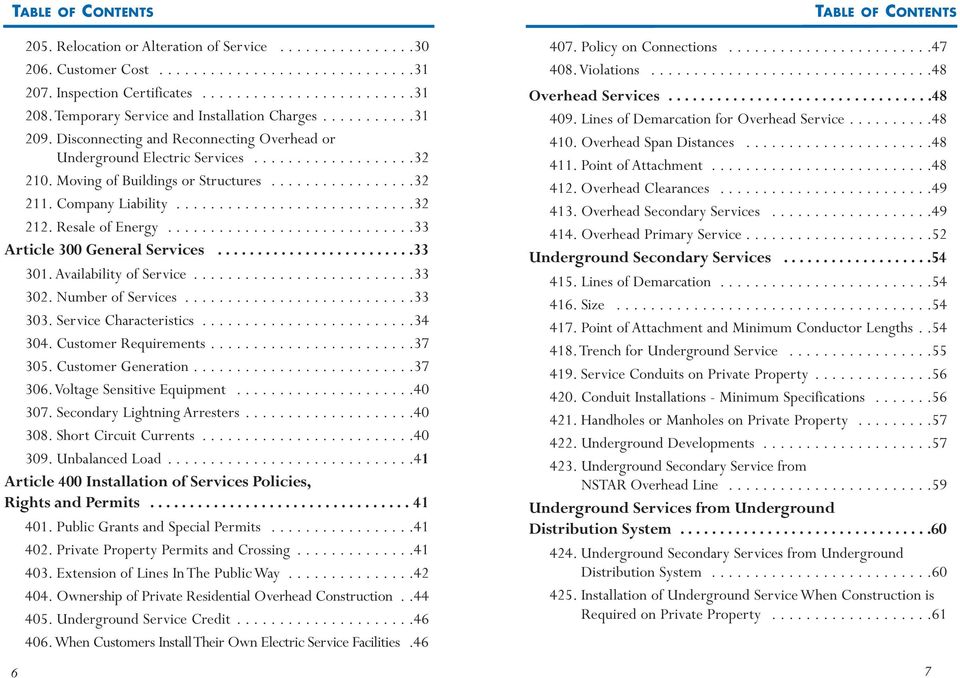
5 TABLE OF CONTENTS 205. Relocation or Alteration of Service Customer Cost Inspection Certificates Temporary Service and Installation Charges Disconnecting and Reconnecting Overhead or Underground Electric Services Moving of Buildings or Structures Company Liability Resale of Energy Article 300 General Services Availability of Service Number of Services Service Characteristics Customer Requirements Customer Generation Voltage Sensitive Equipment Secondary Lightning Arresters Short Circuit Currents Unbalanced Load Article 400 Installation of Services Policies, Rights and Permits Public Grants and Special Permits Private Property Permits and Crossing Extension of Lines In The Public Way Ownership of Private Residential Overhead Construction Underground Service Credit When Customers Install Their Own Electric Service Facilities.46 6 TABLE OF CONTENTS 407. Policy on Connections Violations Overhead Services Lines of Demarcation for Overhead Service Overhead Span Distances Point of Attachment Overhead Clearances Overhead Secondary Services Overhead Primary Service Underground Secondary Services Lines of Demarcation Size Point of Attachment and Minimum Conductor Lengths Trench for Underground Service Service Conduits on Private Property Conduit Installations - Minimum Specifications Handholes or Manholes on Private Property Underground Developments Underground Secondary Service from NSTAR Overhead Line Underground Services from Underground Distribution System Underground Secondary Services from Underground Distribution System Installation of Underground Service When Construction is Required on Private Property
6 TABLE OF CONTENTS 426. Customer-Elected Installation of Underground Service on Private Property Underground Connections Terminal Facilities/Terminal Boxes Grounding and Bonding Pole-Mounted Transformers Mat and Fence Substation Padmount Transformer Building Vault Article 500 General Service Requirements Customer-Owned Equipment Load Balance Separate Services Size of Conduits and Conductors Service Equipment Assigning Location of Service and Metering Equipment Unmetered Conductors Metered Conductors Overcurrent Protection of Feeders Fuses Bonding Service Equipment: Secondary Services Temporary Service Article 600 Wiring and.requirements Signs and Automatically Controlled Lighting Fluctuating Loads Grounding TABLE OF CONTENTS 604. Insulating Transformers (sometimes referred to as isolating transformers) Power Factor Power Factor Correction Capacitors Power Supply to Voltage Sensitive Equipment Power Quality Article 700 Meters General Requirements General Meter Tampering Standard Meter Installations Meter Locations A. Outdoor Meters B. Indoor Meters 705. Location of Service Disconnect and Current Limiting Protection A. Hot Sequence B. Cold Sequence C. Current Limiting Protection 706. Meter Mounting Clearances Identification of Meter Sockets and Customer Disconnecting Means for Multiple Meter Installations Moving or Removing Metering Equipment Meter Connections Security A. For Single Phase 3 wire, services B. Meter Seals 8 9

7 TABLE OF CONTENTS 712. Meter Accessories A.Telephone Line for Interval Data Metering Applications B. Optional Enhanced Metering Service Meter Sockets Meter Sockets for Self-Contained Meters A. Sockets with Manual Bypass B. 200 Amperes or Less C. 400 Amperes or Less (320 Amperes continuous Load Capacity) D. Sockets for 200 Amperes or Less Residential or Commercial Underground Services 716. Cover Plates Instrument Transformer Installation Instrument Transformers and Enclosures Use of Instrument Transformer Cabinets Pad-Mount Metering Primary Metering Metal-Enclosed Bus Duct Volts or Less General Metal-Enclosed Switchgear Over 600 Volts General Article 800 Utilization Equipment General Nameplate Data A. Definitions and Notes B. Limitation of Motor Size C. Single Phase Motors D.Three phase Motors E. Supply Voltage- Special 10 CONTACT US 803. Motor Protection Fluctuating Loads Article 900 Radio,Television, CATV & Carrier Installations Operation Installation of Eliminator or Trap Service Quality Requirements Prohibition of Attachment to Poles Clearance from Company Conductors Carrier Equipment Community Antenna Television (CATV) Systems Cellular Telephone Towers Town Owned Street Lights Appendix A Sketch Index and Sketches Appendix B Massachusetts General Laws CONTACT US During regular business hours (Monday thru Friday, 7:30 a.m. to 4:30 p.m.) please call NEEDPWR ( ) to speak with the NSTAR New Customer Connect Tech Center. Mailing address: NSTAR Electric One NSTAR Way Westwood, MA Attention: NSTAR New Customer Connect Tech Center You can also reach us online at 11

8 SAFETY REQUIREMENTS SAFETY REQUIREMENTS NSTAR has a number of requirements and tips to ensure your safety. Please make sure to read the following safety requirement highlights, and look for more throughout this booklet. The covering you may observe on some overhead electrical wires is not insulation, so please do not touch it. Any contact with our wires may cause serious injury or death. Upon request, NSTAR will install line-hose guards or erect other mechanical barriers to help protect against contact with electrical lines. In some cases, customer charges will apply for installation of line-hose guards. Heavy construction equipment such as cranes, derricks, backhoes, dump trucks, etc. should not be operated closer than 10 feet from energized power lines rated at 50 kv or below. For lines rated over 50 kv, the minimum clearance between the lines and any part of the equipment shall be 10 feet plus 0.4 inches for each kv over 50 kv as prescribed by OSHA Regulations (S1926 subpart N-550- (a) 15 (i) and (ii)). Massachusetts General Laws, Chapter 166, Sections 21A- 21G govern work in close proximity to high voltage lines. NSTAR strongly recommends that a minimum clearance of 10 feet be maintained. Swimming pools should not be installed beneath overhead facilities. Please contact NSTAR if you are planning to install a pool near overhead or underground lines.you can also check out the National and Massachusetts Electric Codes for clearance information. SAFETY REQUIREMENTS In general, antennas, banners, signs or similar customer equipment shall not be attached to our poles except by special permission from NSTAR. Such equipment when installed nearby shall be far enough away so contact with our facilities cannot take place during installation, removal, or by accident. All clearances shall be as required by State and National Safety Codes. To safeguard both your property and NSTAR, fuses or breakers or those of branch circuits should only be replaced with the proper size fuse or breakers for such installation. Please contact NSTAR for additional information. Consider adding ground fault interrupters to existing circuits as prescribed by the Massachusetts Electrical Code

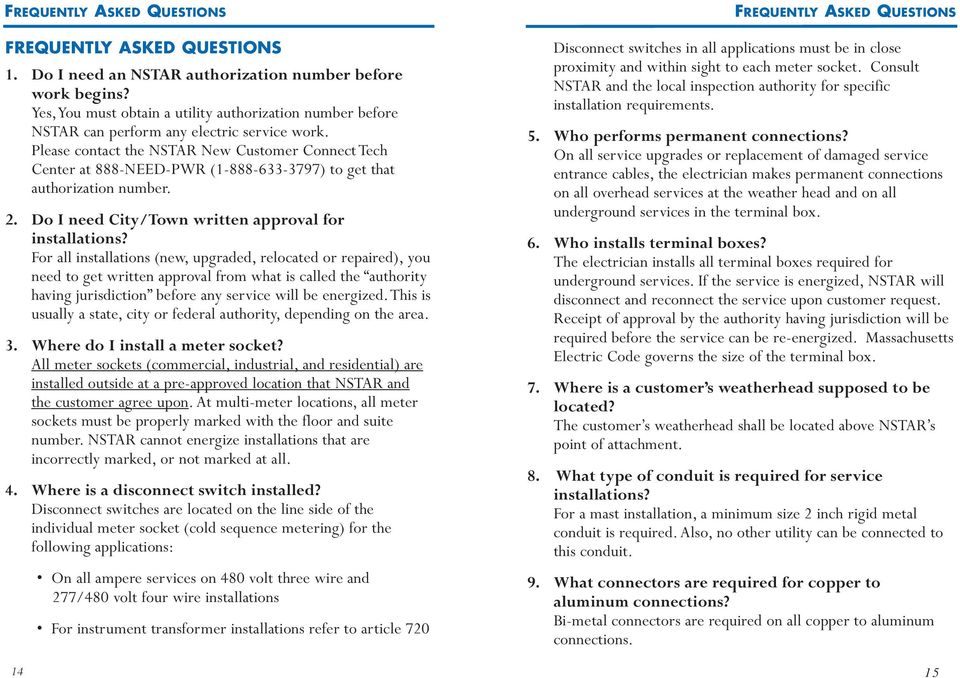
9 FREQUENTLY ASKED QUESTIONS FREQUENTLY ASKED QUESTIONS 1. Do I need an NSTAR authorization number before work begins? Yes,You must obtain a utility authorization number before NSTAR can perform any electric service work. Please contact the NSTAR New Customer Connect Tech Center at 888-NEED-PWR ( ) to get that authorization number. 2. Do I need City/Town written approval for installations? For all installations (new, upgraded, relocated or repaired), you need to get written approval from what is called the authority having jurisdiction before any service will be energized.this is usually a state, city or federal authority, depending on the area. 3. Where do I install a meter socket? All meter sockets (commercial, industrial, and residential) are installed outside at a pre-approved location that NSTAR and the customer agree upon. At multi-meter locations, all meter sockets must be properly marked with the floor and suite number. NSTAR cannot energize installations that are incorrectly marked, or not marked at all. 4. Where is a disconnect switch installed? Disconnect switches are located on the line side of the individual meter socket (cold sequence metering) for the following applications: On all ampere services on 480 volt three wire and 277/480 volt four wire installations For instrument transformer installations refer to article 720 FREQUENTLY ASKED QUESTIONS Disconnect switches in all applications must be in close proximity and within sight to each meter socket. Consult NSTAR and the local inspection authority for specific installation requirements. 5. Who performs permanent connections? On all service upgrades or replacement of damaged service entrance cables, the electrician makes permanent connections on all overhead services at the weather head and on all underground services in the terminal box. 6. Who installs terminal boxes? The electrician installs all terminal boxes required for underground services. If the service is energized, NSTAR will disconnect and reconnect the service upon customer request. Receipt of approval by the authority having jurisdiction will be required before the service can be re-energized. Massachusetts Electric Code governs the size of the terminal box. 7. Where is a customer s weatherhead supposed to be located? The customer s weatherhead shall be located above NSTAR s point of attachment. 8. What type of conduit is required for service installations? For a mast installation, a minimum size 2 inch rigid metal conduit is required. Also, no other utility can be connected to this conduit. 9. What connectors are required for copper to aluminum connections? Bi-metal connectors are required on all copper to aluminum connections
10 FREQUENTLY ASKED QUESTIONS 10. At what height should the meter socket be mounted? The minimum meter height from the finished grade is three feet to the center of the meter socket.the maximum height is six feet to the center of the meter socket. 11. What material do I use for a riser pole section? Once you have approval from the authority having jurisdiction, you can use minimum 3 inch schedule 80 PVC or rigid metal conduit for a riser pipe section on the utility pole. Please note, if rigid metal conduit is used a grounding bushing is required to be installed with the wire lead connected to the system ground. 12. For Three phase, three wire installations what meter socket should be used? For a three phase, three wire installation, a five-jaw meter socket with an approved bar-type bypass is required.this socket is designed to break A & C phases only. The fifth terminal must be permanently attached to B phase at the six o clock position. 13. When do I need a meter socket by-pass? A By-pass is currently required in all non-residential meter sockets regardless of ampacity. 14. If I cannot meet one of the requirements in this manual, what should I do? If you feel you cannot meet one or more of the requirements in this handbook, you may request exemption. Requests for exemptions should be formally submitted in writing to the NSTAR New Customer Connect Tech Center. Please include: A reference to the specific requirement and corresponding article number The exemption you need The reason for the exemption. UTILITY AUTHORIZATION PROCESS UTILITY AUTHORIZATION PROCESS Early contact with the NSTAR New Customer Connect Tech Center will assure that construction, service connections and metering are performed within the requested in-service date. Please be ready to provide complete customer name and service address information, load and technical requirements to obtain the necessary utility authorization number when requesting service. If construction is required (i.e. a new service drop, new or additional transformation, etc.), engineering designs are reviewed and completed during this stage. The service request will be approved by NSTAR s engineering group with any required rights and/or easements researched and obtained.the NSTAR New Customer Connect Tech Center will approve and collect any required customer charges. To check the status of a work order during any stage in the utility authorization process, please call the NSTAR New Customer Connect Tech Center at Receipt of approval by the authority having jurisdiction, (federal, state, and/or city) in addition to any customer charges, releases a utility authorization to the field for construction and the installation of metering equipment. Approval can be in the form of a City/Town wiring permit, or a letter of approval by the appropriate federal or state inspectional authority

11 ARTICLE ARTICLE 100 GENERAL INFORMATION 101. Introduction The Information and Requirements for Electric Service booklet is issued to provide a thorough understanding between NSTAR and its customers, architects, builders, electrical contractors, consulting engineers and municipal inspectors. It is also important to stay up to date on NSTAR s Schedule of Rates and its Terms and Conditions, as they are filed from time to time with the Massachusetts Department of Public Utilities (DPU) and which are subject to change Scope The information contained in this booklet applies primarily to electric service requirements for installations not exceeding 480 volts. Service requirements for installations at higher voltages are subject to special negotiations with the NSTAR New Customer Connect Tech Center Uniform Requirements Many of NSTAR s requirements are the same as those of other electric utilities that serve cities and towns in adjoining territories. However, differences in some requirements do exist.to avoid misunderstanding, it is essential that a copy of the local electric utility company s requirements be obtained and followed when work is to be done in its territory Effective Date This issue of Information and Requirements for Electric Service supersedes all previous issues for NSTAR Electric, Boston Edison, COMElectric and Cambridge Electric and is effective immediately for all new construction, with reasonable allowance for the completion of work in progress or already under contract. NSTAR reserves the right to revise, alter, amend, add or repeal this information when necessary or 18 ARTICLE 105 appropriate and will endeavor to notify all interested persons. It will be incumbent upon all interested persons to keep themselves informed as to such revisions, alterations, amendments, additions or repeals. NSTAR assumes no responsibility to notify persons relative to such revisions, alterations, amendments, additions or repeals Enforcement of Rules All wiring intended for connection to the electrical conductors of NSTAR shall be in accordance with requirements of the authority having jurisdiction, the Massachusetts Electrical Code and of NSTAR. Service connection to new customer wiring installations will not be made until notice of approval of the new wiring is received from the authority having jurisdiction. All connections to NSTAR s system shall be designed, installed and operated in a manner that will not cause undue disturbance to other customers, and will not restrict NSTAR from maintaining proper system conditions. NSTAR reserves the right to de-energize the service of any customer who, after proper notice from NSTAR, continues to use any equipment or apparatus that adversely affects the service of other customers or any service that has not received approval from the authority having jurisdiction. In those instances where the electrician has not satisfactorily fulfilled the requirements as stated in this manual, designated employees of NSTAR will, upon receiving approval from the customer, correct any omission or improper installation. A charge for any services rendered will be forwarded to the customer for payment. In those instances where the electrician has not satisfactorily fulfilled the requirement as stated in the Massachusetts 19

12 ARTICLE Electrical Code, designated employees of NSTAR will, upon receiving approval from both the authority having jurisdiction and the customer, correct any omission or improper installation. A notice of violation will be sent to the electrician, the authority having jurisdiction and the customer. A charge for any services rendered will be forwarded to the customer for payment. Any substantial changes shall be rectified by the electrician and inspected by the authority having jurisdiction before any service will be energized Special Circumstances NSTAR reserves the right to waive these requirements in special circumstances where conditions warrant. Any waiver of these requirements will be in writing and will not be considered as establishing a precedent nor be considered as affecting NSTAR s right to enforce any of the other requirements as outlined in this manual Advisory Service NSTAR will actively cooperate with architects, contractors and engineers. However, neither by inspection nor by the rendering of advisory service nor in any other way does NSTAR give any warranty, expressed or implied, as to the adequacy, safety or other characteristics of any equipment, wires, appliances or devices owned, used or maintained by customers Rates NSTAR furnishes its various services under tariffs and/or contracts ( Schedule of Rates ) promulgated in accordance with the provisions of M.G.L.c. 164, and MDPU decisions, orders and regulations. Copies of Rate Schedules are available upon request or from NSTAR s website at ARTICLE 109 NSTAR shall provide notice regarding its applicable rate schedules annually to all customers. NSTAR shall advise each new non-residential customer of the least expensive rate for distribution service based on available information in NSTAR s existing records or as a result of a field inspection by NSTAR when the customer provides information that is inconsistent with NSTAR s records. Upon receipt of adequate information concerning rates, selection of the rate is the responsibility of the customer. Each customer is responsible for accurately describing his or her electrical needs and equipment and for providing NSTAR with updated information as changes occur. Each customer is entitled to change from one applicable Distribution Service rate schedule to another upon written application to NSTAR. Any customer who has changed from one Distribution Service rate to another may not change again within one (1) year or a longer period as specified in the tariff under which the customer is receiving distribution service. A change in rate that is requested by the customer will not necessarily produce a retroactive billing adjustment Information The NSTAR New Customer Connect Tech Center coordinates all discussions with commercial, industrial, governmental and residential customers regarding electric service.the NSTAR New Customer Connect Tech Center shall provide information regarding NSTAR service policy, rate application, service request, status of service request, availability of service, service requirements, and applicable service charges to all customers. Please call for additional information

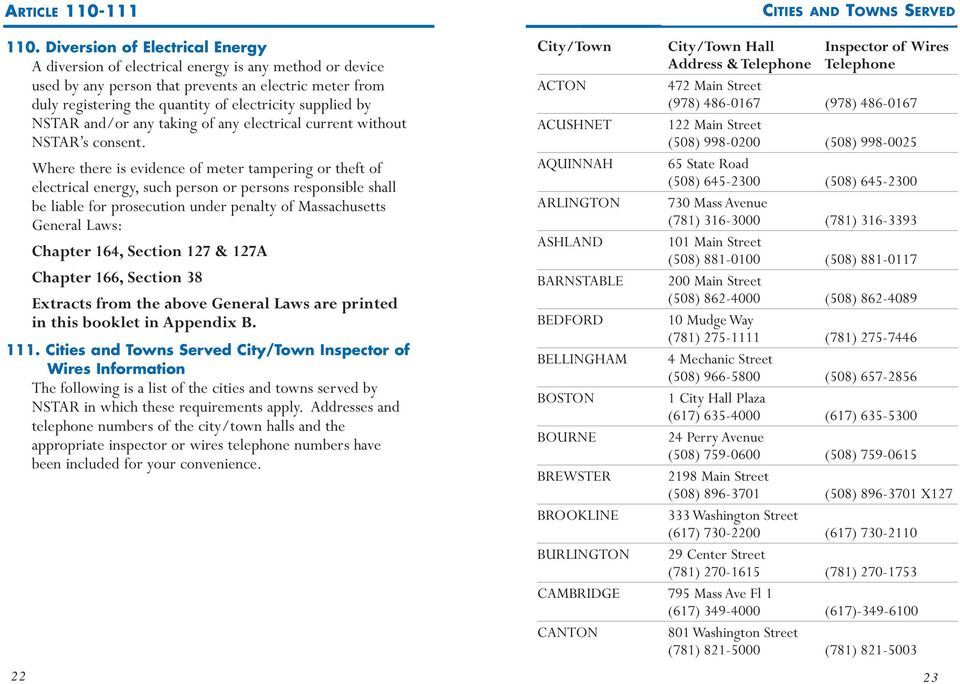
13 ARTICLE Diversion of Electrical Energy A diversion of electrical energy is any method or device used by any person that prevents an electric meter from duly registering the quantity of electricity supplied by NSTAR and/or any taking of any electrical current without NSTAR s consent. Where there is evidence of meter tampering or theft of electrical energy, such person or persons responsible shall be liable for prosecution under penalty of Massachusetts General Laws: 22 Chapter 164, Section 127 & 127A Chapter 166, Section 38 Extracts from the above General Laws are printed in this booklet in Appendix B Cities and Towns Served City/Town Inspector of Wires Information The following is a list of the cities and towns served by NSTAR in which these requirements apply. Addresses and telephone numbers of the city/town halls and the appropriate inspector or wires telephone numbers have been included for your convenience. CITIES AND TOWNS SERVED City/Town City/Town Hall Inspector of Wires Address & Telephone Telephone ACTON 472 Main Street (978) (978) ACUSHNET 122 Main Street (508) (508) AQUINNAH 65 State Road (508) (508) ARLINGTON 730 Mass Avenue (781) (781) ASHLAND 101 Main Street (508) (508) BARNSTABLE 200 Main Street (508) (508) BEDFORD 10 Mudge Way (781) (781) BELLINGHAM 4 Mechanic Street (508) (508) BOSTON 1 City Hall Plaza (617) (617) BOURNE 24 Perry Avenue (508) (508) BREWSTER 2198 Main Street (508) (508) X127 BROOKLINE 333 Washington Street (617) (617) BURLINGTON 29 Center Street (781) (781) CAMBRIDGE 795 Mass Ave Fl 1 (617) (617) CANTON 801 Washington Street (781) (781)
14 CITIES AND TOWNS SERVED CITIES AND TOWNS SERVED City/Town City/Town Hall Inspector of Wires Address & Telephone Telephone CARLISLE 66 Westford Street (978) (978) CARVER 108 Main Street (508) (508) CHATHAM 549 Main Street (508) (508) CHELSEA 500 Broadway (617) (617) CHILMARK PO Box 119 (508) (508) DARTMOUTH 400 Slocum Rd. (508) (508) DEDHAM 26 Bryant Street (781) (781) DENNIS 485 Main Street (508) (508) DOVER 5 Springdale Avenue (508) (508) X245 DUXBURY 878 Tremont Street (781) (781) EASTHAM 2500 State Highway (508) (508) X233 EDGARTOWN 70 Main Street (508) (508) FAIRHAVEN 40 Centre Street (508) (508) FALMOUTH 59 Town Hall Square (508) (508) FRAMINGHAM 150 Concord Street (508) (508) City/Town City/Town Hall Inspector of Wires Address & Telephone Telephone FREETOWN PO Box 438 Assonet MA (508) (508) HARWICH 732 Main Street (508) (508) HOLLISTON 703 Washington Street (508) (508) HOPKINTON 18 Main Street (508) (508) KINGSTON 26 Evergreen Street (781) (781) LAKEVILLE 346 Bedford Street (508) (508) LEXINGTON 1625 Mass Avenue (781) (781) X215 LINCOLN 16 Lincoln Road (781) (781) MARION 2 Spring Street (508) (508) MARSHFIELD 870 Moraine Street 9781) (781) MASHPEE 16 Great Neck Road (508) (508) MATTAPOISETT PO Box 435 (508) (508) MAYNARD 195 Main Street (978) (978) MEDFIELD 459 Main Street (508) (508) X603 MEDWAY 155 Village Street (508) (508)

15 CITIES AND TOWNS SERVED City/Town City/Town Hall Inspector of Wires Address & Telephone Telephone MILLIS 900 Main Street (508) (508) MILTON 525 Canton Avenue (617) (617) NATICK 13 East Central Street (508) (508) NEEDHAM 1471 Highland Avenue (781) (781) X210 NEW BEDFORD 133 William Street (508) (508) NEWTON 1000 Commonwealth Ave. (617) (617) NORFOLK One Liberty Lane (508) (508) OAK BLUFFS PO Box 1327 (508) (508) ORLEANS 19 School Road (508) (508) X343 PEMBROKE 100 Center Street (781) (781) PLYMOUTH 11 Lincoln Street (508) (508) PROVINCETOWN 260 Commercial Street (508) (508) X520 ROCHESTER 1 Constitution Way (508) (508) SANDWICH 130 Main Street (508) (508) CITIES AND TOWNS SERVED City/Town City/Town Hall Inspector of Wires Address & Telephone Telephone SCITUATE 600 Chief Justice Cushing Highway (781) (781) SHARON 90 South Main Street (781) (781) X10 SHERBORN 19 Washington Street (508) (508) SOMERVILLE 93 Highland Avenue (617) (617) X5634 STONEHAM 35 Central Street (781) (781) SUDBURY 288 Old Sudbury Road (978) (978) X1362 TISBURY PO Box 1239 (508) (508) TRURO 24 Town Hall Road (508) (508) WALPOLE 135 School Street (508) (508) WALTHAM 610 Main Street (781) (781) WAREHAM 54 Marion Road (508) (508) X3193 WATERTOWN 149 Main Street (617) (617) WAYLAND 41 Cochituate Road (508) (508) WELLFLEET 300 Main Street (508) (508)

16 CITIES AND TOWNS SERVED City/Town City/Town Hall Inspector of Wires Address & Telephone Telephone WESTON Town House Road (781) (781) X319 WESTPORT 816 Main Road (508) (508) WEST TISBURY PO Box 278 (508) (508) WESTWOOD 580 High Street (781) (781) WINCHESTER 71 Mount Vernon Street (781) (781) WOBURN 10 Common Street (781) (781) YARMOUTH 1146 Rte 28 (508) (508) X ARTICLE 200 APPLICATION FOR NEW OR ADDITIONAL SERVICE ARTICLE Where to Apply Application for new service or the addition or alteration to an existing service may be obtained by contacting the NSTAR New Customer Connect Tech Center at or online at Upon completion of the application process, a utility authorization number will be issued. This number shall be referenced for any service request inquiry When to Apply Application for any new service, temporary service, or the addition or alteration to an existing service should be made (preferably online or in writing) as far in advance as possible. This is to allow time for engineering, ordering of material, obtaining the necessary easement or grants of location, the scheduling of public hearings by the appropriate governmental agency, and scheduling and performing construction.written permission from the governmental agency or property owner must be obtained by NSTAR before construction can begin. A plot plan indicating the location of building(s) or addition(s) and proposed service location should be included with new electric load data. An application may be submitted online at in the business section under Builders and Contractors. By mail, for all districts, applications may be sent to: NSTAR Electric Attention: NSTAR New Customer Connect Tech Center One NSTAR Way Westwood, MA

17 ARTICLE Availability of Service Prior to ordering equipment or beginning any electrical wiring, it is important that the customer contact NSTAR to determine the availability of the type of service desired and if NSTAR has additional requirements for such service. Location of the service conductors, entrance and meter equipment, must be granted before the building wiring is started. NSTAR does not accept responsibility for information given orally about the type of service available at specific locations. This information must be confirmed in writing by an authorized representative of NSTAR Additional Loads NSTAR facilities are normally designed to meet customers initial requirements at the time the service is installed.when additional load is contemplated, NSTAR must be notified in writing as early as possible so that proper provisions can be made to furnish the additional service.the customer must not add additional load until notified by NSTAR in writing of the conditions under which it can supply the increased load.the customer will be held responsible for all damages caused by load being added without notice to NSTAR Relocation or Alteration of Service When relocation or alterations are to be made to an existing service, NSTAR must be notified sufficiently in advance to provide for the required change in service facilities and to determine the conditions under which such changes will be made. Any installation must conform to all requirements of NSTAR, Massachusetts Electric Codes, and to the authority having jurisdiction. Requests are processed in the order they are received. In most cases, service relocations are made at the customer s expense. 30 ARTICLE Customer Cost Information relative to the customer s portion of any service construction costs will be provided by the NSTAR New Customer Connect Tech Center. Payments are required prior to the commencement of any construction by NSTAR. Delaying of payment may adversely impact the construction completion date originally established Inspection Certificates NSTAR will not energize new, upgraded, relocated or repaired wiring until approval has been issued by the authority having jurisdiction. It is the responsibility of the customer or his representative to follow whatever procedure is required by the authority having jurisdiction so that NSTAR will receive the approval prior to the time the wiring must be energized Temporary Service and Installation Charges Temporary installations are made at the expense of the customer. Flat charge quotes for standard service drop installations may be obtained from the NSTAR New Customer Connect Tech Center. For more complex temporary service installations, design estimates are required and can be obtained from the NSTAR New Customer Connect Tech Center. All temporary services must be inspected by the authority having jurisdiction. In all instances, early contact with NSTAR will help to avoid unnecessary delays in receiving service. 31

18 ARTICLE Disconnecting and Reconnecting Overhead or Underground Electric Services When disconnecting overhead and underground services, contact the NSTAR New Customer Connect Tech Center for applicable charges. There is no charge to disconnect and reconnect a service if the customer is making the request for the purpose of replacing an existing terminal box. NSTAR requires advance notice to disconnect and reconnect a service at a mutually agreed upon scheduled time. No service will be reconnected until NSTAR receives approval from the authority having jurisdiction Moving of Buildings or Structures In order to accommodate house or building relocation, and provided that NSTAR has received written notification of the proposed route at least 30 days prior to moving, NSTAR at its expense will disconnect or remove wiring along the route. However, if NSTAR must remove or relocate poles or other support structures along the route, this work will be performed at the customer s expense. Costs may be obtained from the NSTAR New Customer Connect Tech Center. Municipal permits and moving schedule allowances by each town or city shall be the responsibility of the moving contractor along with all coordination between affected authorities and utilities as to route and work schedule to minimize inconvenience to customers NSTAR Liability NSTAR shall not be responsible for any failure to provide electric distribution service nor for interruption, reversal or abnormal voltage if such failure, interruption, reversal or abnormal voltage is without willful default or gross negligence on its part. Whenever the integrity of NSTAR s system or the 32 ARTICLE supply of electricity is threatened by conditions on its system or on the systems with which it is directly or indirectly interconnected, or whenever it is necessary or desirable to aid in the restoration of service, NSTAR may, in its sole judgment, curtail or interrupt electric distribution service or reduce voltage to some or all of its customers and such curtailment, interruption or reduction shall not constitute willful default by NSTAR Resale of Energy Electricity will not be delivered by NSTAR to any customer of NSTAR for resale or redistribution by the customer or for the use of others, without the prior approval of the Massachusetts Department of Public Utilities (DPU). ARTICLE 300 GENERAL SERVICES 301. Availability of Service The type and/or size of service requested by a customer may not be available at a given location. Please contact the NSTAR New Customer Connect Tech Center for information regarding availability of service prior to ordering new, additional or replacement equipment. In some cases service may be available only through special negotiation and at the expense of the customer Number of Services Only one alternating current service will be installed to a building, except that two services may be installed to provide single phase and three phase service.two or more services may also be installed at the option of NSTAR to provide suitable capacity, to supply special loads or to meet unusual conditions. Approval by the authority having jurisdiction will also be required. 33

19 ARTICLE 303 Installations for customer convenience will be installed at the customer s expense. In any event, prior to ordering equipment or starting a wiring installation involving both single phase and three phase operation, the NSTAR New Customer Connect Tech Center must be contacted regarding the characteristics of the service to be supplied.where electricity is delivered through more than one meter, the cost of energy delivered through each meter will be computed separately Service Characteristics The following describes the characteristics and nominal voltages of standard services, which are generally available.to determine the type of service available at your location, please contact the NSTAR New Customer Connect Tech Center. All secondary voltage values stated herein are nominal, and are subject to reasonable variations in accordance with the latest revision of ANSI C NOTE: The Downtown Boston Network District as mentioned in this book is defined as Boston proper, Back Bay, portions of the South End and the Fenway. (See map at front of book.) For the North districts -formally Boston Edison A. 120/240 volts, single phase, 3 wire, service & 240 volts, three phase, 3 wire, Delta service Generally available outside the Downtown Boston Network District. Single phase motors are limited to 5 horsepower or less.three phase service is required for motors exceeding 5 HP in size.the maximum combined single-and three phase load to be served from NSTAR facilities in the public way is limited to 150 kva where available. Customers requiring service beyond this limit ARTICLE 303 must provide suitable private property facilities for necessary transformation as coordinated by the NSTAR New Customer Connect Tech Center. B. 480 volts, three phase, 3 wire, Delta service Generally available where the customer provides suitable private property facilities for necessary transformation. C. 120/280 volts, single phase, 3 wire, service Normally available only in the Downtown Boston Network District for connected loads not greater than 200 amperes. This service may be available upon consultation with NSTAR. Larger services must be three phase, 4 wire. D. 120/208 volts, 3 phase, 4 wire,wye service Within the Downtown Boston Network District, some locations requiring loads up to 300 kva (800 amperes) of transformer capacity may be supplied from NSTAR facilities in the public way. In locations where transformer capacity in the public way is not readily available, the customer will be required to provide suitable private property facilities for the supply transformers. For loads exceeding 300 kva (800 amperes), the customer must provide suitable private property facilities for the supply transformers as coordinated by the NSTAR New Customer Connect Tech Center. Outside the Downtown Boston Network District, the customer may be requested to provide suitable private property facilities for necessary transformation. E. 277/480 volts, three phase, 4 wire,wye service Generally available except that the customer must provide suitable private property facilities for necessary transformation. Minimum demand loads are a requisite, typically 75 kva or larger. 35

20 ARTICLE 303 ARTICLE For the South and Cambridge Districts: A. 120/240 volts, single phase, 3 wire, service Most commonly used for residential customers and for small commercial customers with up to 400 ampere service entrance and with individual motors not over 5 HP. Larger service entrances or larger motors may be accepted with the specific approval of NSTAR. Customers requiring service beyond this limit must provide suitable private property facilities for necessary transformation as coordinated by the NSTAR New Customer Connect Tech Center. B. 120/208 volts, single phase, 3 wire, service May be provided as the available single phase service when the customer is located in a 120/208 volt, 4 wire, three phase network or spot network area, upon consultation with NSTAR. C. 120/208 volts, three phase, 4 wire,wye service Generally available except that the customer must provide suitable private property facilities for necessary transformation. Supplied to commercial and industrial customers with loads larger than can be served by single phase systems. This character of service is normally restricted to loads of 500 kva or less and not generally available for service capacity in excess of 1600 amperes. D. 277/480 volts, three phase, 4 wire,wye service Generally available except that the customer must provide suitable private property facilities for necessary transformation. Supplied to commercial and industrial customers with loads of 75 kva or larger. For all of NSTAR: Primary Voltage (15 kv or 25kV class) Customers requesting primary service are required to contact the NSTAR New Customer Connect Tech Center. NSTAR s approval must be obtained prior to purchase of any material and equipment associated with the electric service Customer Requirements In certain instances, NSTAR will issue specific customer engineering requirements.these requirements will be furnished to customers or their representatives through the NSTAR New Customer Connect Tech Center.To avoid unnecessary expense and delay, the customer shall ascertain these requirements prior to ordering equipment and/or beginning construction. Customers may be required to supply space for electrical equipment on private property and may be required to furnish and install non-electric facilities such as manholes, conduit, transformer pads or enclosures, etc., in accordance with specifications furnished by NSTAR and required by Massachusetts Electric Code. Customers will be required to provide an easement for any NSTAR equipment located on the customer s property. Initial tree trimming may also be required at the customer s expense Customer Generation The following general requirements apply to customer generating facilities designed to operate directly connected to NSTAR s electrical system (parallel operation One that DOES run in parallel with the NSTAR electrical grid) and those which are designed to operate isolated from NSTAR s system 36 37

21 ARTICLE 305 ARTICLE 305 (non-parallel operation One that does NOT run in parallel with the NSTAR grid). Requirements and specifications for various types and sizes of customer facilities shall be obtained from the NSTAR New Customer Connect Tech Center prior to installation. NOTE: Parallel Operation Generators are NOT allowed in the Network District (Downtown Boston, Cambridge and New Bedford). A. Emergency - Standby Generation (Non-Parallel Operation) Emergency (standby) generators are of the type that does NOT operate in parallel with the NSTAR electrical grid. The customer may install a standby generator to supply all or part of the load in the event of a service interruption. The customer s wiring shall be arranged to prohibit the interconnection of NSTAR s service and the customer s alternate source of supply.this will require the installation of a double-throw switch or its equivalent as approved by NSTAR. (Sketch 1 illustrates some typical installations of standby generating equipment) NOTE: Precautions must be taken where alternate means of generation are employed, whether emergency or otherwise, to eliminate the possibility of electrical connection between NSTAR s service and the customer s alternate source of supply (e.g., marinas with dockside service, truck docks, etc.).the customer must notify the NSTAR New Customer Connect Tech Center and provide electrical details of generator installation and isolation from NSTAR s system. B. Distributed Generation Systems Are types of generators that do operate in parallel with the NSTAR system. The more common types of distributed generation include the following but does not constitute a complete list: Photovoltaics (PV) Fuel Cells Wind Turbines IC Engine Cogeneration Systems Turbines Microturbines Prior to the installation of any generator facilities, the customer must notify the NSTAR New Customer Connect Tech Center and it is necessary for all customers to fill out and submit an interconnection application, regardless of the size, prior to the installation of any distributed generation systems. Interconnection applications as well as information about the interconnection process for distributed generation systems is available online at Customers can also call the NSTAR Customer Connect Tech Center to speak with an NSTAR representative about the interconnection process. After the receipt of the interconnection application, NSTAR takes the submitted information and ensures that the proper utility infrastructure is in place and that proper electrical protections have been approved by NSTAR. NOTE: The application process is mandatory and is for the safety of NSTAR personnel and the general public. It also ensures that the customer s installation will not affect the NSTAR system electrical reliability
22 ARTICLE NSTAR is no longer in the generation business. Any customer interested in selling electricity to NSTAR should contact the NSTAR New Customer Connect Tech Center. Further information regarding connecting distributed generation to the NSTAR electrical grid can be found at Voltage Sensitive Equipment Customers owning, or planning to purchase computers, reproduction, X-ray, or data processing equipment or similar devices should be aware that this type of equipment can be extremely sensitive to power system transients or loss of voltage. Customers should consult the manufacturer of their equipment for suitable devices to protect against these conditions. NSTAR cannot assume responsibility for voltage variations that may be caused by switching, lightning surges, motor vehicles hitting utility poles, or by other conditions normal or emergency in nature Secondary Lightning Arresters The customer may install secondary lightning protective devices.the customer will be solely responsible for the expense, installation, operation, maintenance and inspection of such devices. Lightning arresters shall not be mounted on meter sockets or metering equipment. Installation of lightning protective devices shall be done in accordance with the Massachusetts Electrical Code Short Circuit Currents Available fault currents will vary with each residential, commercial and industrial installation. It is the responsibility of architects, engineers and wiring contractors to select the proper service equipment to meet code requirements for short circuit ratings. Inquiries concerning the magnitudes of available fault currents for each particular location should be directed to the NSTAR New Customer Connect Tech Center. 40 ARTICLE Unbalanced Load The customer shall at all times take and use energy in such a manner that the load will normally be balanced to within 10 percent between phases on three phase services and between live conductors on single phase services. NSTAR reserves the right to require the customer to make necessary changes at the customer s expense to correct the unbalanced load conditions. ARTICLE 400 INSTALLATION OF SERVICES POLICIES, RIGHTS & PERMITS 401. Public Grants and Special Permits Before poles, wire, or cables can be installed in, under, along, and upon public ways and, in some cases, before they can be run over or through public ways, NSTAR must obtain public grants, state permits, and/or excavation or street opening permits. In some cases special permits must also be obtained from other companies maintaining facilities in such public ways. These grants and permits can be issued in some instances only after public hearings are held. Also, some municipalities may observe certain periods of the year when street opening permits are not granted. Under such circumstances, delays in connecting service can be minimized by applying for service at the earliest possible date. Charges may be incurred by the customer when, at the customer s request, NSTAR facilities need to be relocated Private Property Permits and Crossing Where it is required that a NSTAR-owned service be run through or over private property not owned by the customer, an easement, prepared by NSTAR, must be signed by the owner of such property before service can be installed. It is the customer s responsibility to negotiate with the property owner for said easement. 41
23 ARTICLE 403 ARTICLE 403 Where it is required that a Customer-owned service be run over or through property not owned by the customer requesting service, a service release, prepared by NSTAR, must be signed by both parties. A copy signed by both customers must be submitted to NSTAR before such service will be energized Extension of Lines in the Public Way A. Overhead Line Extensions for Residential, Commercial & Industrial Customers within the North District: Requests for electric service requiring the extension of NSTAR facilities in the public way will be subject to analysis by the NSTAR New Customer Connect Tech Center.They will determine whether or not the customer shall underwrite, guarantee, or secure payment when the delivery of service involves the use of NSTAR investment, which, in the judgment of NSTAR, would not be offset by the probable revenue obtained. Extension of NSTAR facilities in the public way solely for the convenience of the customer will be at the customer s expense. Installations of overhead services not requiring private property construction will normally be installed without charge, provided the point of attachment to the customer s building can be reached by one span of wire from NSTAR s nearest pole and that a right-of-way acceptable to NSTAR can be obtained.when the delivery of service involves the use of NSTAR investment, which in the judgment of NSTAR, would not be offset by the estimated revenue to be obtained, the customer shall underwrite, guarantee or secure payment of minimum amounts. Overhead secondary services requiring private property 42 construction from NSTAR underground lines will be furnished, installed, owned and maintained by the customer. It is the customer s responsibility to assure that all customer-owned equipment be tested and in working order. During cases where NSTAR is required to operate or install NSTAR-owned equipment into customer-owned gear, the customer will be responsible for any repair or replacement that is necessary due to failure of such customer-owned equipment to operate properly. B. Overhead Line Extensions for Residential Customers within the Cambridge & South Districts: It is NSTAR s policy to install at no charge to the customer, up to two wooden poles and three spans of wire, along a public road or private way for a new service to a single family dwelling. All construction along public or private ways to service residential customers under this policy will be performed by NSTAR or its agents. When required to extend its single phase overhead distribution lines, in excess of two poles, along a public or private way to a residential home, NSTAR will provide an overhead line extension in accordance with the provisions of the line extension policy and agreement. NSTAR will provide, install, own and maintain all facilities including the overhead service drop from its facilities to a residential home. Where it may also be necessary to install pole(s) on private property to service the premises, please refer to Article 404, Ownership of Private Residential Overhead Construction. Contact the NSTAR New Customer Connect Tech Center for details of the Single Phase Residential Overhead Line Extension Policy. 43
24 ARTICLE 404 ARTICLE 404 C. Overhead Line Extensions for Commercial & Industrial Customers within the Cambridge & South Districts: Whenever NSTAR is required to extend its single phase or three phase overhead distribution lines along a public way or private way to serve a commercial or industrial customer, the customer will provide a contribution-in-aidof-construction for all costs of said overhead line extension not supported by revenue. Along public ways, and at the option of the customer on private ways/property, all construction of an overhead line extension for servicing commercial or industrial customers will be done by NSTAR or its agent. NSTAR will own, maintain and provide the line extension along the public way and/or private ways including any tree trimming where an easement has been provided. NSTAR will also provide, own and maintain the overhead service drop from its facilities to a commercial/industrial customer. Contact the NSTAR New Customer Connect Tech Center for details of the Commercial/Industrial Line Extension Policy Ownership of Private Residential Overhead Construction Where existing pole lines are owned and maintained by the customer, the ownership and maintenance shall include, but not be limited to, the replacement of defective or damaged poles and fixtures, wires and the trimming of trees. Maintenance construction performed by a contractor under agreement with the customer shall conform to the requirements of the local authority and standard specifications 44 for materials and methods as furnished by NSTAR. Such construction is subject to approval by the authority having jurisdiction. For Cambridge & South Districts: Additionally, in order to address the concern expressed by the MDPU in its Hurricane Bob order DPU , regarding private poles and subject to the following conditions, NSTAR began a program to accept ownership of customer-owned pole lines located on the customer s property that were constructed prior to November 1, The requirements are: A. The pole line to be owned by NSTAR must be connected to an existing pole line owned by NSTAR. B. The pole line to be owned by NSTAR must be readily accessible by NSTAR s vehicles via a driveway or roadway to construct and maintain the line without special or unusual permission or circumstances. C. NSTAR is presented with legally valid easements, provided at no cost to NSTAR with (A) rights to own and maintain the pole line, including rights to trim trees as normally required and (B) rights that allow NSTAR to service other customers from the pole line, and to extend the pole line to serve other customers. D. The customer must pay to NSTAR the tax liability associated with the facilities to be acquired. The poles must meet these conditional guidelines: A. The pole must have more than 10 years of life left (based on a 30 year life expectancy), must be in good condition (i.e. no woodpecker holes, no ground or shell rot). 45
25 ARTICLE B. Poles must meet minimum NSTAR standards for pole size for the application. C. Cross arms must have more than 10 years of life left. Contact the NSTAR New Customer Connect Tech Center for details Underground Service Credit For Cambridge and South Districts only: For residential customers requesting installation of an underground service at customer s expense, a credit may be available to the customer. The credit is based on the cost NSTAR would normally incur to install up to two poles on private property to service a new single family dwelling. Contact the NSTAR New Customer Connect Tech Center for details of this policy When Customers Install Their Own Electric Service Facilities In certain instances, the customer may be allowed or required to employ a contractor to install on private property all or a portion of the necessary service construction under the following conditions: A. All material and construction shall conform to NSTAR standards. B. Only authorized NSTAR personnel are permitted to make any type of new electrical connection to NSTAR supply lines or equipment. C. Before the installation will be energized, authorized NSTAR representatives will inspect the installation for conformance to NSTAR construction standards. D. Prior to energizing the line, the customer must submit a copy of the as built plans and easements shall be ARTICLE 407 conveyed to NSTAR. In addition, the customer will be responsible for the tax liability on such construction. Please contact the NSTAR New Customer Connect Tech Center before beginning construction Policy on Connections NSTAR will connect customer s wiring to NSTAR facilities for final connections for permanent or temporary services and will not permit or tolerate unauthorized persons to connect to NSTAR conductors or equipment. NSTAR will allow licensed electricians to cut and reconnect single services for service upgrades at the customer's weather head or underground services in the customer's terminal box provided the steps listed below are observed: A. Contact the NSTAR New Customer Connect Tech Center to have the existing meter unlocked. Allow five working days. B. Notify the local inspection authority of the proposed work and obtain all necessary permits. No reconnection is permitted without prior approval of the local inspection authority. See Article 111 for information regarding your local inspection authority. C. The added load on the service shall not be utilized until NSTAR has completed all of its work. D. All conductors must be cut and reconnected on the customer s side of the existing connections. Proper connectors shall be used and three feet of extra conductor must be supplied to form a drip loop. E. The old meter should be used whenever possible to make the connection in the new socket. If jumpers are necessary, permission to install jumpers must be obtained from the NSTAR New Customer Connect Tech Center. 47
26 ARTICLE ARTICLE Violations When any of the requirements of this book are not followed, NSTAR will send a notice of violation to the electrician, with a copy forwarded to the authority having jurisdiction. If any damage occurs or metering equipment is lost as a result of the actions or lack of actions by the electrician, appropriate restitution may be sought. OVERHEAD SERVICES 409. Lines of Demarcation for Overhead Services All construction on the customer s premises beyond the point of attachment (normally, the anchor bolt) is a part of the private wiring system, which is furnished, installed, owned and maintained by the customer, with the exception of such metering equipment furnished by NSTAR. (See Sketch 2) 410. Overhead Span Distances The maximum single-span distance NSTAR will run its overhead residential service drop conductors to the point of attachment for amp service entrance is approximately 125 feet. Building heights, large conductors, the necessity for street, driveway, sidewalk crossings and other possible factors may reduce the maximum permissible spans. Contact the NSTAR New Customer Connect Tech Center for details on service entrances larger than 200 amperes Point of Attachment The service drop shall be attached to the building or other structure at a suitable point, determined and approved by NSTAR, which is not less than 12 feet nor more than 25 feet above the finished grade level. (See exceptions and details on Sketch 3). 48 The service drop shall be accessible from a ladder placed on a solid surface at ground level and shall meet the minimum clearance requirements specified by Article 412.The customer/contractor shall furnish and install suitable service support hardware. Refer to Sketches 4 and 5 for details of hardware installations. Contact the NSTAR New Customer Connect Tech Center for details on service entrances larger than 200 amperes Overhead Clearances Clearance requirements for overhead service conductors are set forth in section 23 of the National Electrical Safety Code and Articles 230-9, , and of the National Electrical Code and the Massachusetts Electrical Code. Sketch 3 graphically depicts NSTAR s minimum allowable clearance standards, some of which exceed the abovereferenced codes. Interpretation of the codes, questions concerning Sketch 3, or inquiries as to other clearance requirements should be directed to the NSTAR New Customer Connect Tech Center Overhead Secondary Services Overhead secondary services from the public way are restricted to installations where the service is 400 amperes or less single phase, 3 wire or three phase, 3 wire. All other loads and voltages require transformation on private property. See Article 414, Overhead Primary Services. Upon completion of the customer s wiring work, on all new services, NSTAR will make the final connection between the customer s service and NSTAR s distribution system.the customer shall furnish all connections larger than 500 KCMIL. For further details see Article 407, Policy on Connections. 49
27 ARTICLE 413 ARTICLE For the North District: The first section of wire, not to exceed 125 feet, shall be furnished, installed, owned, and maintained by NSTAR from the pole line in the public way. All other private property construction will be furnished, installed, owned and maintained by NSTAR at the customer s expense, subject to the following requirements: A. NSTAR is granted written permission from the property owner to install such poles, conductors, apparatus and attachments as required to provide electric service on private property. B. If the public pole line is on the opposite side of the street, NSTAR, at its own expense, will furnish, install, own and maintain the first pole on private property. C. The customer shall make provisions to guarantee NSTAR access to the private property facilities for installation and maintenance.these provisions will include plowing, paving, or whatever is necessary to ensure safe passage for NSTAR vehicles and personnel. D. When the customer has installed the private property construction, ownership will be transferred to NSTAR. Refer to Article 406,When Customers Install Their Own Electric Facilities. E. Any extension of private property construction required to provide service to another building on the same property, will be subject to the above requirements and will be at customer s expense. F. Any extension of private property construction required to provide service to another customer will require an easement from the private property owner. For the South & Cambridge Districts Residential Overhead Services from Overhead Lines: Where a NSTAR-owned distribution line exists along a public or private way, it is the general policy of NSTAR, subject to review in each case, to install at NSTAR s expense, up to two wooden service poles and three spans of overhead wires and appurtenances on the customer s property to serve a single family dwelling. Any additional construction that may be required will be at the customer s expense.the customer will pay to NSTAR the carrying charge on the cost of construction in excess of the first two poles and three spans of wire. NSTAR will bring residential overhead electric service to the nearest point of attachment on the house or building by the most direct practical route as determined by NSTAR. Where a NSTAR-owned distribution line does not exist and a line extension along a public or private way is necessary to serve the customer, the cost of the private property construction will be at the customer s expense. Please refer to the Residential Overhead Line Extension Policy or contact the NSTAR New Customer Connect Tech Center.All construction will be owned and maintained by NSTAR. NSTAR ownership of any poles on private property is effective only upon receipt of adequate legal protection as to property rights, trimming rights, and rights to extend the pole line to serve others, with associated documents to be approved by NSTAR counsel. Legally valid easements at no cost to NSTAR will be required whenever NSTAR-owned poles are located on private property. Under the Residential Overhead Line Extension Policy, the customer may elect to install an equivalent system approved by NSTAR but shall transfer said system to NSTAR for all of the 51
28 ARTICLE 414 ARTICLE 414 above purposes, at no cost to NSTAR.The customer will pay NSTAR the carrying charge on poles and lines in excess of the first two poles and three spans of wire Overhead Primary Services - Cambridge & South Districts: A. Overhead Primary Service for Residential Real Estate Developments: A developer or customer may request NSTAR to construct an overhead line extension to serve a residential real estate development. NSTAR will provide, own and maintain all facilities including the overhead service drop as each dwelling in the development is prepared to receive such service. Note: Some towns have bylaws that require all new developments to have underground utilities. The customer may elect to construct an overhead line extension per NSTAR s specifications and shall transfer such facilities to NSTAR for ownership and maintenance prior to energizing.the customer or developer will pay NSTAR the tax liability associated with NSTAR acquiring these facilities. Contact the NSTAR New Customer Connect Tech Center for details of the Overhead Line Extension Policy for Residential Real Estate Developments. B. Overhead Primary Service to Commercial & Industrial Customers: The customer may request NSTAR to construct an overhead line extension to provide service for commercial or industrial customers on a tract development or parcel of land.the customer will provide a contribution-in-aidof-construction for all costs of said overhead line extension not supported by revenue, per company policy. The customer may elect to construct an overhead line extension per NSTAR s specifications and transfer such facilities to NSTAR for ownership and maintenance prior to energizing.the customer will pay NSTAR the tax liability associated with NSTAR acquiring these facilities. Commercial and Industrial customers shall contact the NSTAR New Customer Connect Tech Center whenever an overhead line extension is required to serve a premise. For the North District: Residential, commercial and industrial customers whose total load exceeds the limits as outlined in Article 413 and Article 416 may be required to provide space on private property for NSTAR-owned transformers and protective equipment. NSTAR makes the final decision for the type and nature of the service. All construction by the customer on private property must be performed in accordance with NSTAR standards and will be inspected by a NSTAR representative for approval before service will be energized. Please contact the NSTAR New Customer Connect Tech Center for details. (See Sketch 10) Please contact the NSTAR New Customer Connect Tech Center for information regarding this policy in the South and Cambridge Districts
29 ARTICLE UNDERGROUND SECONDARY SERVICES 415. Lines of Demarcation On underground secondary services, all private property construction beyond the first point of attachment is a part of the private wiring system, which is furnished, installed, owned and maintained by the customer, with the exception of such metering equipment furnished by NSTAR Size Underground secondary services from the public way are restricted to installations where the total required demand load is: 54 A. For radial, the maximum combined single and three phase load to be served from NSTAR facilities in the public way is limited to 150 kva or less where available. In the South districts the single phase services are limited to 75 kva demand. Radial service is normally supplied outside the Downtown Boston Network District. B. For Downtown Boston Network, New Bedford Network or Cambridge Network service in the secondary network service area (which only includes services 300 kva or less, three phase, 4 wire, 120/208 volts) where available. All other loads and voltages require transformation on private property Point of Attachment & Minimum Conductor Lengths For all new installations NSTAR will make the connection to the first point of attachment to the customer s wiring system. In urban districts, a minimum length of 24 inches for each service entrance conductor shall be left at the terminal box; at handholes, sufficient cable to extend across the handhole and at least 3 feet above the top of the handhole opening is required to provide for connection to NSTAR ARTICLE 418 service conductors. If the service entrance conductors are 350 MCM or larger, the minimum length of each conductor shall be 3 feet from connections in terminal box. The final connections are the exclusive responsibility of NSTAR. In areas where padmount transformers are provided, a minimum length of 3 feet at handholes and 7 feet at padmount transformers shall be left to provide final connections to NSTAR facilities. The contractor shall leave the coil in the open trench outside NSTAR facilities or as coordinated with NSTAR. NSTAR shall make all final connections. Upon completion of the customer s wiring work, on all new or replaced services, NSTAR will make the final connection between the customer s service and NSTAR s distribution system.the customer shall furnish the following connectors: A. All aluminum connections. B. Copper connectors larger than 500 KCMIL. Contact the NSTAR New Customer Connect Tech Center for details Trench for Underground Service The trench for underground secondary service shall be deep enough to permit service conductors to be installed not less than 30 inches below finished grade or as required by the authority having jurisdiction. The trench bed shall have a uniform pitch and be free of large stones. Rock foundations shall be covered with 3 inches of fine compacted fill.when backfilling, the first 6 inches shall be fine fill and hand tamped. Large stones shall be removed from the final fill, which may be tamped with power tampers. All digging will be the customer s responsibility, and shall be subject to inspection by a NSTAR representative prior to backfilling. 55
30 ARTICLE ARTICLE Underground service conductors on private property for electric service, not in excess of 600 volts, shall be minimally sized for 100 amp service and shall meet the Massachusetts Electrical Code standards. Underground secondary services shall have a separation of at least 12 inches from water and gas systems. Underground secondary services may be installed with telephone conductors and in the same trench with water, gas or similar systems, provided the clearances are maintained (refer to the Massachusetts Electrical Code) Service Conduits on Private Property All service conduits installed on private property by the customer shall be constructed in accordance with NSTAR s specifications. Plans shall be submitted to NSTAR for approval prior to installation. Underground service conduits shall have a smooth interior, free from all burrs or sharp edges. Special care must be given the installation on non-metallic conduits. Information regarding approved types of conduits will be furnished upon request by the NSTAR New Customer Connect Tech Center Conduit Installations-Minimum Specifications Service conduits in urban underground systems shall not be smaller than 4 inch nominal pipe size. Unless otherwise approved, all service conduits shall be schedule 40 PVC. Service conduits shall be limited to lengths of 250 feet by the installation of suitable handholes as specified by NSTAR. Long sweep bends shall be required for change in direction of any conduit section. The bends in any conduit section, including those in the street, shall not total more than 180 degrees and such bends shall be made at a radius of not less than 20 inches. Any unusual bends, grades or conductor sizes shall be approved by NSTAR before proceeding with construction. Please contact the NSTAR Tech Center. Service conduit joints shall be made secure so that the sections will not be thrown out of line by the shifting ground. Metallic conduits may be joined by threaded couplings. Other types of couplings for metallic or non-metallic conduits shall be approved by NSTAR. Please contact the NSTAR New Customer Connect Tech Center. Service conduit shall be installed not less than 30 inches below finished grade, and where possible shall be installed to drain to the nearest handhole or manhole. The end of the conduit within a building shall be securely sealed around the outside of the conduit. Underground services may be installed in the same trench with telephone, water, and gas or similar services, provided the clearances specified in the preceding paragraph are maintained Handholes or Manholes on Private Property Handholes on private property, used as points of demarcation, are owned and maintained by NSTAR. All other handholes on private property are owned and maintained by the customer. All manholes/conduits on private property are owned and maintained by the customer Underground Developments Underground distribution systems, such as shopping centers, industrial parks, underground commercial development (UCD), underground residential developments (URD), etc. may be subject to special negotiations requiring a written 57
31 ARTICLE 422 ARTICLE 423 agreement. Contact the NSTAR New Customer Connect Tech Center for details on the electric line extension policies. Developers interested in an underground distribution system in a commercial project should contact the NSTAR New Customer Connect Tech Center at least one (1) year before the desired service date. Developers in the South district should refer to the following manuals: Underground Distribution System Specification (UDS) and Commercial Underground Distribution System Specification (CUDS) for more details. Residential: A developer may apply for an underground line extension to service a residential real estate development. Upon completion of the installation, all non-electric facilities installed by the customer in the future public way will be transferred to NSTAR for ownership and maintenance. In certain cases in the South districts where the customer installs conduit on private property to be used for primary cable and that conduit will always be accessible to NSTAR crews, ownership of that conduit will also be transferred to NSTAR. Transfer of ownership is subject to inspections and/or tests as required and approved by NSTAR. In the South districts, the developer may construct an underground line extension, including the electric facilities per NSTAR specifications using an NSTAR approved contractor and transfer these facilities to NSTAR for ownership and maintenance. The underground service cable from the customer s property line to the service entrance shall be owned and maintained by the customer. Commercial: The developer shall install, own and maintain all underground non-electric facilities and secondary service systems at the developer s expense. NSTAR will install, own and maintain the primary cable and transformers, when such facilities are required or in the South districts the developer may construct an underground line extension per NSTAR specifications and transfer the primary cable system to NSTAR for ownership and maintenance. Transfer of ownership is subject to inspections and/or tests as required and approved by NSTAR Underground Secondary Service from NSTAR Overhead Lines The entire expense of supplying the underground service conductors from the point of termination on the pole to the customer s building or structure, including installation of a handhole at the property line, shall be borne by the customer. The customer shall own and maintain the underground service from the property line or handhole to the building. NSTAR will assume ownership and maintenance responsibility from the pole to the handhole for residential services. NSTAR will make the final connections to its facilities after approval is received from the authority having jurisdiction for the customer-owned portion of the service. Some services will require a junction box. Contact the NSTAR New Customer Connect Tech Center for additional details. (See Sketches 6A and 6B) When more than one underground service is anticipated, NSTAR will provide the oversized wire to be installed from the handhole to the pole. Contact the NSTAR New Customer Connect Tech Center for additional details
32 ARTICLE Electrical contractors and customers will be responsible for any damage associated with work that they perform in the public way. Any related installations (e.g. handhole) will become the property of NSTAR at the time the line is energized. Access to these installations must be provided to NSTAR personnel for continued operation and maintenance by NSTAR. A warranty must be provided to NSTAR that all of the materials and workmanship meet NSTAR s specifications and shall be free from defects for a period of five years from the date the line is ready to be energized. UNDERGROUND SERVICES FROM UNDERGROUND DISTRIBUTION SYSTEM 424. Underground Secondary Services From Underground Distribution System In areas where NSTAR maintains an underground distribution system, service will be furnished, installed, owned and maintained by NSTAR, provided the total length of service conduit and cable on private property is not in excess of two feet. (See Sketch 8) This work shall not include cutting through or restoration of the foundation, floors or partitions.the customer must core drill or sleeve thru the foundation wall to connect 1-4 inch pvc per 400 amp of switch size (for example an 800 amp switch requires 2-4 inch sleeves thru the foundation wall). The terminal box shall be furnished and installed by the customer. See Article 428,Terminal Facilities / Terminal Boxes.When a new building is being constructed, an opening shall be provided through the foundation wall suitable for the conduit entrance. If additional service conduit and cable are required on private property to complete the service installation, they shall be installed in accordance with NSTAR procedures in this manual. ARTICLE Installation of Underground Service When Construction Is Required On Private Property NSTAR will install at its own expense such service up to a point two feet inside the property line if the estimated revenue to NSTAR offsets the cost. Before proceeding with the work, the customer shall consult the NSTAR New Customer Connect Tech Center as to the location of the service conduit at the property line. Beyond that point, the customer may elect to have NSTAR install the service conductors at the customer s expense up to the customer s first handhole, manhole or terminal box or the first point of attachment on private property.the customer may elect to perform this work under conditions outlined in the following section Customer-Elected Installation of Underground Service on Private Property Before proceeding with the work, the customer shall consult NSTAR as to the location of the service conduit at the property line.the customer shall install a handhole that complies with the Massachusetts Electrical Code or a manhole 2 feet inside the property line, at the location of NSTAR s service conduit, to provide means for connection to NSTAR s cable.the connection in the private property manhole will be made by NSTAR at the customer s expense. Service conduit and cable required beyond this manhole to the customer s building shall be installed by the customer Underground Connections Upon completion of the customer s service work and approval of the authority having jurisdiction, NSTAR shall make the final connection between the customer s cable and NSTAR s distribution system on all new services. At least 24 inches of each service entrance conductor shall be left extending into the 61
33 ARTICLE 428 terminal box to provide for connection to NSTAR service conductors.where the service entrance conductors are 350 KCMIL or larger, the minimum length for each conductor shall be 3 feet Terminal Facilities / Terminal Boxes Under all circumstances, terminal facilities shall be furnished, installed, owned and maintained by the customer. All terminal boxes shall be provided with a means for padlocking by NSTAR.The locking mechanism shall consist of two (2) locking hasps located on opposite sides of the terminal box. For services rated at amperes, see Sketch 9 for additional requirements. All terminal boxes shall be in accordance with the Massachusetts Electric Code.When an existing terminal box is to be replaced by the customer, NSTAR will, at customer request, de-energize the service at no cost. Upon completion of this replacement, and when approval has been received by the authority having jurisdiction, NSTAR will reenergize the service. Special Facilities: On installations requiring more than two service cables per phase, a special terminal facility may be required, especially in the Downtown Boston Network District of Boston.These installations, generally 800 amps and above, require the use of limiters as protective devices.the terminal facility is to be furnished, installed, owned and maintained by the customer under all circumstances. All special terminal facilities will be provided with a means for padlocking by NSTAR. Line-side connections will be made by NSTAR. All installations of this type will be coordinated through the NSTAR New Customer Connect Tech Center. See Sketch 9 for details. Installations greater than 1000 amps will require a limiter frame cabinet per ARTICLE NSTAR standards and must be coordinated through the NSTAR New Customer Connect Tech Center to arrange a site meeting with NSTAR Meter Operations. In addition, the customer must core drill or sleeve thru the foundation wall to connect 1-4 inch pvc per 400 amp of switch size (for example, an 800 amp switch requires 2-4 inch sleeves thru the foundation wall) Grounding and Bonding All secondary alternating current services having a grounded neutral shall have that neutral grounded on the customer s premises at the service equipment as required by the Massachusetts Electrical Code. CUSTOMER REQUIREMENTS FOR PRIVATE PROPERTY INSTALLATIONS: 430. Pole-Mounted Transformers Overhead services from a pole-mounted transformer on private property are restricted to installations where the required transformer capacity is 75 kva or less for single phase, or 150 kva or less for three phase. For installations exceeding the above values, a padmounted transformer is required Mat and Fence Substation This type of private property installation is no longer available for new customers. It will be the responsibility of the existing customer to maintain the concrete transformer mat, liquid retaining curb where required by the authorities having jurisdiction, buried ground grid, stone fill, fence, and cable structure(s). Each of these items must meet NSTAR standards, which are available from the NSTAR New Customer Connect Tech Center
34 ARTICLE Padmount Transformer This type of private property installation is available in both overhead and underground distribution areas. Size and location of the padmount transformer and secondary transclosure cabinet (where required) will be designated or approved by NSTAR. 64 General Requirements: The customer shall provide, own and maintain the following: A. In the South districts, a precast concrete transformer pad, buried ground grid, all conduit and stone fill or liquid curb where required by the authorities having jurisdiction. In the North districts, the customer may install a precast pad or pour a pad in place for three phase transformer installations. For single phase installations, NSTAR will supply a fiberglass pad for installation by the customer. B. Installation of multiple secondary cables and conduits must be coordinated through the NSTAR New Customer Connect Tech Center prior to the pouring of concrete for the pad.when an installation requires more than 8 sets of secondary conduits with conductor sizes up to 750 KCMIL copper or aluminum, a secondary cable transclosure cabinet must be provided and installed by the customer. The Company will install secondary cables into the transclosure to connect to the customer installed cables. This cabinet must be located a minimum of 10 feet from the transformer. C. NSTAR-approved protective guards, such as concrete-filled pipe, in areas where the transformer is subject to vehicular damage. Additional protection may be required for the padmount location (i.e., fences, barriers, etc.) by the authorities having jurisdiction. Padmounted equipment shall not be enclosed or obstructed by plantings, walls, etc. ARTICLE 432 Minimum clearances for all NSTAR districts shall be ten feet to the front and four feet to the remaining three sides. (See Sketches 10 and 11) D. All secondary cable. E. The customer shall furnish all approved secondary connectors. Additional installation equipment may also be required. NSTAR will make final connections at the transformer secondary terminals. Additional detailed standards and requirements for the South district are located in: 1. Specification , revised August 1998, Underground Distribution System (UDS) 2. Specification I-0796, revised May 1998 Commercial Underground Distribution System (CUDS) 3. Sketch 10 Required Clearances Around NSTAR Owned Facilities 4. Sketch 11 Padmounted Transformer protection from Vehicular Traffic F. Overhead Area Riser Pole On Public Way: The primary riser conduit, cable and the underground construction to a point 2 feet inside the property line will be furnished and installed by NSTAR at customer expense. A NSTAR-approved bonded contractor may install conduit and cable in the public way, provided NSTAR obtains the necessary rights. Contact the NSTAR New Customer Connect Tech Center for more information. For the North District: The customer shall pay the cost of furnishing and installing all primary cable beyond the 2-foot line to the padmount transformer. NSTAR shall maintain that portion on private property at customer expense. 65
35 ARTICLE For the South and Cambridge Districts: The customer may pay the cost of furnishing and installing all primary cable up to the padmount transformer. NSTAR will own and maintain the primary cable and transformer. For all of NSTAR: All other construction on private property including the terminal box, if any, will be installed, owned and maintained by the customer. If NSTAR is required to change the location of the pole on which an underground service originates, the necessary charges to the underground service shall be at the customer s expense. G. Overhead Area: Riser Pole On Private Property The primary conduit from the transformer pad to the riser pole, including the riser on the pole, will be furnished, installed (NSTAR s specifications), owned and maintained by the customer.the primary cable from the transformer pad to the riser pole will be furnished, installed and maintained by NSTAR at customer expense. H. Underground Area: For the North District: The primary conduit from the transformer pad to a point two feet inside the customer s property line at a point designated by NSTAR will be furnished, installed, owned, and maintained by the customer. NSTAR will extend this conduit to the underground system. NSTAR will install the first section of the primary cable from the street manhole to the padmount transformer on private property and charge the customer for furnishing and installing the primary cable beyond 2 feet inside the property line. NSTAR will maintain this portion of the cable at customer expense. ARTICLE For the South and Cambridge Districts: The customer will install the primary conduit from the transformer pad to NSTAR s distribution facility. NSTAR will install the first section of the primary cable from the street manhole to the padmount transformer on private property and may charge the customer for furnishing and installing the primary cable beyond 2 feet inside the property line. Contact the NSTAR New Customer Connect Tech Center to determine ownership and maintenance of this portion of the installation Building Vault This type of private property installation is available in both overhead and underground distribution areas in the North District, excluding the Downtown Boston Network District (for customer vaults in the Downtown Boston Network District please contact the NSTAR New Customer Connect Tech Center). A building vault is required when no space is available outside the building for a padmount transformer.the customer shall: A. Provide vault space within the building large enough to accommodate NSTAR s transformer(s) and protective equipment in an area free from moisture and other contaminants.where possible, the vault should be located on outside walls and have an outside entrance door for easy access.the vault size, grounding, ventilation, drainage, access and location must be approved by NSTAR and the authority having jurisdiction, and be in accordance with Massachusetts Electric Code. 67
36 ARTICLE B. Provide 24-hour access, lighting, convenience and phasing outlets, grounding systems, heat detection system, drainage and ventilation as required by NSTAR. C. Supply and install all secondary bus or conduit and cable to the vault. Final connection of the customer s secondary conductors to the secondary terminals of the transformers will be made by NSTAR. ARTICLE 500 GENERAL SERVICE REQUIREMENTS 501. Customer-Owned Equipment It is the customer s responsibility to assure that all customer owned equipment is tested and in working order. In situations where NSTAR is required to operate or attach to customer owned equipment, the customer will be responsible for any damages caused by the operating failure of such customer owned equipment Load Balance The customer s wiring system shall be arranged in order to give the best possible load balance on the service. Severely unbalanced customer loads that affect the stability of the distribution system will be disconnected until the customer makes the necessary improvements to eliminate the imbalance Separate Services Separate service entrances, conduits, and cables are required for each type of service. Only one service may be connected to one Overhead service run. Any new or upgraded overhead service feeding a single building with multiple meters shall be limited to one service cable or conduit with one weatherhead. With a required service upgrade, there shall remain one weatherhead with the service cable being upgraded. 68 ARTICLE Size of Conduits and Conductors Conduit and conductor sizes shall be in accordance with the Massachusetts Electrical Code Service Equipment One or more service switches or circuit breakers will be furnished, installed and maintained by the customer as part of the permit for wiring for each service entrance. These devices shall conform to the following: A. All service switches or circuit breakers shall be of a type approved by a qualified testing laboratory, by NSTAR, and by the authority having jurisdiction. B. All service equipment located on the line side of meters must be of the enclosed type, with facilities for locking by NSTAR. Fuse replacement or circuit breaker reset by the customer must be possible without disturbing the enclosure lock. C. Where multiple service equipment is provided, each disconnecting means shall be marked in a conspicuous, legible and permanent manner to indicate which portion of the installation it controls Assigning Location of Service & Metering Equipment The locations of service and metering equipment are designated by NSTAR and are subject to the approval of the authority having jurisdiction. This approval must be obtained before wiring begins. Contractors must notify NSTAR of their intent to do work at least two weeks in advance to allow time to assign locations. The point of service attachment should not be less than 12 feet nor more than 25 feet above the final grade level. For further clarification refer to Sketches 2, 3,6A and 6B. 69
37 ARTICLE ARTICLE Unmetered Conductors Unmetered conductors shall not be installed in the same raceway with metered conductors. When unmetered conductors are installed through private basements or other private areas not containing NSTAR equipment, they shall be enclosed in a continuous length of exposed rigid raceways or conduit as required by Massachusetts Electric Code. The installation of pull boxes, fittings or other similar devices is not permitted in such areas. In a block of stores, the unmetered conductors shall be enclosed in a rigid metal raceway or encased in concrete with the approval of the authority having jurisdiction Metered Conductors Metered conductors from two or more meters shall not be grouped in one raceway or distribution panel, except by written permission from NSTAR and as required by Massachusetts Electric Code Overcurrent Protection of Feeders Proper overcurrent protection of feeders shall be required by the Massachusetts Electrical Code Fuses NSTAR does not maintain a stock of fuses for customer-owned equipment. The contractor or customer shall supply and install all fuses. On installations where special types of fuses are used in service equipment, such as high interrupting capacity or current limiting fuses, it is very important that the customer maintain a replacement stock of required fuses. customer s premises at the service equipment. The systemgrounding conductor shall be connected to the neutral conductor. The system-grounding conductor shall provide an effective ground as required by the Massachusetts Electrical Code. Three phase, 3 wire Delta connected services shall not be grounded. Mobile Homes: Grounding and bonding of mobile homes is a special case covered by the Massachusetts Electrical Code Temporary Service A service will be considered a temporary service unless permanent service entrance equipment is installed. Unless otherwise approved by NSTAR in writing, temporary service shall be defined as any installation intended for removal upon completion of the job. The customer shall provide a service entrance which meets the requirements of a permanent installation with respect to service drop clearances, metering, grounding and safety.the service entrance may be installed on a pole set 3 feet or more in the ground or on a guyed or braced timber structure that meets the specifications and installation requirements of NSTAR.Where a 6 inch x 6 inch upright is to be assembled using three 2 inch x 6 inch planks, these planks should be bolted together at intervals not exceeding 4 feet. Installation of such temporary service is subject to the approval of the authority having jurisdiction. Refer to Article 208 for installation charges. (See Sketch 12) 511. Bonding Service Equipment Secondary Services: All secondary services having a grounded neutral shall have that neutral adequately grounded on the 70 71
38 ARTICLE ARTICLE 600 WIRING AND VOLTAGE REQUIREMENTS 601. Signs and Automatically Controlled Lighting Signs and automatically controlled lighting loads shall be wired 3 wire. Flashing signs shall be properly balanced throughout each portion of the flashing cycle.nstar shall be contacted in advance when signs or automatically controlled lighting are to be installed Fluctuating Loads Loads such as electric welders, furnaces, boilers, compressors, pumps, molding machines or similar equipment with load fluctuations shall not be installed, except under conditions specified by NSTAR. Please contact the NSTAR New Customer Connect Tech Center to advise of the proposed installation of this equipment.voltage dips caused by load fluctuations, regardless of their frequency, must not cause undue disturbance to other customers nor hinder the Company in maintaining proper voltage conditions. For customers served by a dedicated transformer on single phase lines, welders should conform to NEMA-EEI Standards and not draw more than 46 amperes at 240 volts. (Please see more specific details in Article 804) 603. Grounding All secondary services having a grounded neutral shall have that neutral adequately grounded on the customer s premises at the service equipment as required by the Massachusetts Electric Code Insulating Transformers (sometimes referred to as isolating transformers) Where lighting or other reduced voltage equipment from three phase, 3 wire, Delta service is permitted by NSTAR, insulating 72 ARTICLE 605 transformers having ANSI approved primary and secondary windings are required.the secondaries of these insulating transformers will be properly grounded and balanced in accordance with the Massachusetts Electrical Code.The minimum number of single phase transformers that may be used to serve the reduced voltage load on a three phase, 3 wire, service is shown in the table below: The minimum number of single phase transformers that may be used to serve the reduced voltage load on a three phase, 3 wire, service Reduced Voltage Load in Kilowatts or % of Total Demand on Service (whichever is Larger) Minimum Number Transformers Less than to 10 inclusive 2 More than 10 3 NSTAR should be contacted prior to buying insulating transformers for this type of installation Power Factor Maintenance of high power factor is of the utmost importance to both the customer and NSTAR in the operation of their distribution systems. Power factors of 90 percent or higher are advantageous for both the customer and NSTAR.The NSTAR New Customer Connect Tech Center should be contacted in advance regarding any installation likely to develop power factors of less than 90 percent. The Commonwealth of Massachusetts has addressed the issue of power factor in Massachusetts State Building Code, 780 CMR, 73
39 ARTICLE ARTICLE as amended. Section Power Factor: Utilization equipment greater than 1,000 watts and lighting equipment greater than 15 watts with an inductive reactive load component shall have a power factor of not less than 85 percent under rated load conditions. Power factor of less than 85 percent shall be corrected to at least 90 percent under rated load conditions. Power factor corrective devices, installed to comply with this code, shall be switched with the utilization equipment, except where this results in an unsafe condition or interferes with the intended operation of the equipment Power Factor Correction Capacitors When the customer desires to install capacitors for the purpose of power factor correction, the capacitors must be installed to prohibit inadvertent reverse current flow at low loads to NSTAR s system.they must also be sized and installed in such a manner as not to create harmonic interference on NSTAR s lines.the NSTAR New Customer Connect Tech Center must be contacted prior to the ordering and installation of such equipment. NSTAR will de-energize any service that creates voltage distortion or inadvertent current flow to its system Power Supply to Voltage Sensitive Equipment Customers who install computers, X-ray equipment, emergency devices or other voltage sensitive equipment are advised that auxiliary devices and relays must be employed to filter out voltage spikes and to adjust for voltage variations. NSTAR is not responsible for voltage variations that may be caused by switching, lightning surges, motor vehicles hitting utility poles or by other conditions beyond NSTAR s control Power Quality NSTAR delivers high quality power.the increased use of customer-owned equipment that can adversely affect the quality of electric service to other customers is of great concern. In order to maintain delivery of high quality power to all of our customers, the installation of customer-owned equipment that may affect NSTAR s electric system, shall meet NSTAR specifications. NSTAR reserves the right to withhold or disconnect service where installation of such loads or equipment is detrimental to NSTAR s service to other customers. For further information please contact the NSTAR New Customer Connect Tech Center. NSTAR has adopted IEEE Std , IEEE Recommended Practices and Requirements for Harmonic Control in Electric Power Systems. However, NSTAR reserves the right to enforce stricter guidelines than those outlined in IEEE , when in NSTAR s opinion, the harmonic contributions from a customer or group of customers contributes to a degradation in the quality of service to other customers on the system to an unacceptable level. NSTAR may require corrective actions be taken at the customer s expense. ARTICLE 700 METERS & GENERAL REQUIREMENTS 701. General All energy supplied by NSTAR shall, in general, be measured by appropriate meters for billing purposes. The installation of meters and metering equipment shall comply with the requirements set forth in this Article. Meters will be provided, maintained, installed, moved, and removed only by authorized NSTAR employees. No changes in metering equipment of any nature whatsoever are to be 74 75
40 ARTICLE 702 ARTICLE undertaken by any other persons except when special permission is first obtained from the NSTAR Meter Operations Department via the NSTAR New Customer Connect Tech Center. Meter boards, meter banks, sockets, and protective enclosures, where required, are to be furnished and installed by the customer or the customer s electrical contractor. It is the Customer s responsibility to assure that all customerowned equipment is tested and in working order. For cases where NSTAR is required to operate or install NSTAR-owned equipment into customer owned equipment, the customer will be responsible for any repair or replacement that is necessary due to failure of such customerowned equipment. Where, in the judgment of NSTAR, a meter installation may be subject to damage, the customer will be required to provide a NSTAR-approved enclosure or other protective device for the meter equipment or relocate the equipment at the customer s expense Meter Tampering Warning Do not tamper with meter, instrument transformers, or other metering devices or NSTAR wiring under penalty of law. Massachusetts law provides penalties for tampering with the meters or equipment of an electric utility. See Massachusetts General Laws, Chapter 164, Section 127 and Section 127A. NSTAR Revenue Assurance is responsible for the investigation of theft and unmetered electricity and all such information should be reported. The NSTAR Revenue Assurance Hotline number is and is available for anonymous calls regarding theft or unmetered service Standard Meter Installations The Meter Technical Department will specify the type and location of metering for each installation. Please contact the Meter Operations Department via the NSTAR New Customer Connect Tech Center for additional information. In general the following is standard: A. Self-contained single phase socket metering where the service capacity is 400 amperes or less. B. Self-contained polyphase socket metering where the service capacity is 400 amperes or less. C. Instrument transformer installation for all installations where the service capacity is more than 400 amperes. All exceptions from NSTAR s standard meter installations must be approved by NSTAR. All class 320 ampere self contained meter installations shall be pre-approved by the local inspection authority prior to starting work. Refer to section 705 for location of service disconnect. The secondary conductor length between the instrument transformers and the meter shall be kept to a minimum and shall not exceed 75 feet Meter Locations Outdoor meter locations are required for all new, rebuilt, relocated or extended (residential and commercial) installations. Exceptions to this requirement will be permitted only with specific prior approval of NSTAR. Each location shall be readily accessible to NSTAR representatives for meter reading, testing, and maintenance. Service will not be provided if reaching the meter requires 77
41 ARTICLE 704 ARTICLE 705 NSTAR employees to use adjacent property, climb fences or other obstructions, or cause damage to the customer s shrubbery or flower beds in gaining access to the meter. In areas subject to vandalism or damage, permission may be granted for indoor meters. All such indoor meters shall be in a readily accessible location next to the service entrance equipment. In multiple occupancy buildings, for residential or commercial use, permission may be granted for meters to be installed indoors in one common location accessible to all occupants. Metering equipment shall not be installed in locations subject to excessive moisture, dust, heat, chemical fumes or in locations which are hazardous or inaccessible. Meter locations are not permitted in living spaces, stairways or under stairways, display windows, attics, boiler rooms, elevator shafts; over doors, stoves or sinks; directly under, in the rear of, or close to, steam, gas, water or drain pipes or near moving machinery. In special circumstances, meter locations may be required to be changed to ensure the integrity of the metering equipment. A. Outdoor Meters Outdoor meter sockets should be mounted so that the face of the meter is less than 6 feet above the final grade. In no instance will any meter be installed with the center of the meter more than 6 feet, nor the center of the meter less than 3 feet above the final grade. A clear area of 3 feet is required in front of each meter.(see Sketch 13) Installation On Poles NSTAR does not permit the installation of meters on its poles, except for cable TV amplifiers. Specific approval shall be obtained by NSTAR for such installations and shall conform to Massachusetts Electrical Code requirements. (Refer to Article 907) Installation On Pedestal For residential and small commercial applications only, the installation of the meter socket shall be permitted to be mounted on a free-standing pedestal pending the approval of the authority having jurisdiction. The customer may be required to provide protective devices for and at the freestanding pedestal. (See Sketch 14) B. Indoor Meters Multiple meter bank-installed indoors shall be mounted so that the center of the top meter(s) is no more than 6 feet and the center of the bottom meter is no less than 3 feet above the floor level. A clear area of 3 feet is required in front of each meter Location of Service Disconnect and Current Limiting Protection A. Hot Sequence In general, the service disconnect shall be located on the load side of the meter (hot sequence metering).the service disconnecting means shall be installed at a readily accessible location nearest the point of entrance of the service entrance conductors. (See Sketch 15) B. Cold Sequence The service disconnect shall be located on the line side of the individual meter socket (cold sequence metering) for the following applications: 78 79
42 ARTICLE On all ampere services on 480 volt 3 wire and 277/480 volt 4 wire installations. 2. For all instrument transformer installations, each set of transformers installed must be cold sequenced and have its own service disconnect switch except in the case of padmount metering. (Refer to Article 720) The disconnect switch in all applications must be in close proximity and within sight to each meter socket. Contact NSTAR and the local inspection authority for specific installation requirements. C. Current Limiting Protection Current limiting protection shall be installed on the line side of any new or upgraded meter socket for the following application: 1. On all distribution underground network services both for residential and commercial applications. 2. In other specific instances where the available fault current exceeds 10,000 amperes. 3. Cold sequence may also be required when applying current limiting protection Meter Mounting Meter sockets and meter-breaker centers shall be mounted plumb and firmly secured to supports. Where supports are attached to masonry or concrete walls, expansion bolts or anchors shall be used. Wood plugs driven into holes in masonry, concrete, plaster, or similar materials are not acceptable. Wooden meter boards shall be constructed of 3/4 inch PT40 plywood or equal. ARTICLE Clearance Ample workspace shall be provided around meters to allow for testing, reading, and repairing. (See Sketch 13) A clear working space of 3 feet is required in all directions around the front of all meters and/or metering cabinets and equipment per the Massachusetts Electrical Code. All gas meters and associated equipment or propane cylinders must be a minimum of 3 feet from the electrical service and metering equipment Identification of Meter Sockets and Customer Disconnecting Means for Multiple Meter Installations For installations consisting of more than one meter, all meter sockets and customer disconnecting means shall be plainly and permanently marked both internally and externally for proper suite, floor, office, etc., by the electrical contractor or owner. Service will not be provided to a building that has unidentified meter sockets. Contact the NSTAR New Customer Connect Tech Center concerning information on meter socket markings. In apartment and office buildings viewed from the approach to the front entrance, mark each meter position LEFT or RIGHT, FRONT or REAR, FLOOR NUMBER, and NUMBER of apartment, office or suite. Note: The above markings and NSTAR s M-13 form shall be completed by the electrical contractor and verified by a representative of NSTAR. Contact the NSTAR New Customer Connect Tech Center or go to for a copy of the M-13 form. Service shall not be instituted until the above requirements have been completed. 81
43 ARTICLE Moving or Removing Metering Equipment Meters, instrument transformers, and other metering devices are the property of NSTAR. Relocation, removal or alteration for wiring or connection purposes must be performed by an authorized employee of NSTAR; except when specific permission is obtained from NSTAR.Violators will be prosecuted. When an existing service is upgraded, it is the responsibility of the electrician to ensure that removed meters and accessory equipment are accessible for return to NSTAR. If metering equipment is lost or destroyed, NSTAR reserves the right to seek restitution for all equipment Meter Connections The service or line side conductors are always connected to the top terminals of meter sockets or banks and the load side conductors to the bottom terminals. A number of typical connections for socket meter installations are shown in Sketches 16 through 21. These diagrams show the actual positions of the jaws for the socket meters Security No electrical contractor, electrician, or property owners shall by-pass a meter socket or install jumpers in a meter socket without first securing permission from the Meter Operations Department via the NSTAR New Customer Connect Tech Center. The contractor shall install a transparent polycarbonate cover and ring on the socket for the purpose of safety. NSTAR will install the proper metering once an application for service, a deposit (where required), and an inspection by the local inspection authority are all received. At the time permission is requested, the electrical contractor shall supply the following information to the NSTAR New Customer Connect Tech Center: ARTICLE 711 A. Customer s name and address B. Meter number C. Nature of work D. Electrician s name, telephone number, and license number When performing a service upgrade from a 2 wire to 3 wire, service, it will be the electrical contractor s responsibility to see that the meter is returned undamaged to NSTAR. An estimated bill for unmetered use will be rendered by NSTAR based on available data for the number of days the service is unmetered. Electrical contractors or other persons found bypassing services or using jumpers without prior permission will be held responsible for any expenses incurred by NSTAR, and may be subject to any other redress available to NSTAR. A. For Single Phase 3 wire, services Due to the use of an automated meter reading system, meters cannot be reinstalled by the electrical contractor without first contacting the NSTAR New Customer Connect Tech Center. B. Meter Seals Authority to cut meter seals or other sealing devices is restricted to authorized NSTAR employees. It is the responsibility of the electrical contractor to call the NSTAR New Customer Connect Tech Center and request meter removal or the cutting of any meter seal or other sealing device. Authority may be delegated to other than authorized NSTAR employees, but only by specific request for a specific installation. It is the responsibility of the electrical contractor to call the NSTAR New Customer Connect Tech Center, and request permission before removing or cutting any meter seal or other sealing device of NSTAR
44 ARTICLE Meter Accessories A. Telephone Line for Interval Data Metering Applications For interval data meter installations NSTAR may require an analog voice grade dedicated telephone line alongside the meter, terminated with a RJ-11 jack. The customer shall contact the NSTAR New Customer Connect Tech Center for determination of your applicable rate and application as to whether an interval data meter will be installed. B. Optional Enhanced Metering Service For metering, pulse output, remote access metering and interval data metering requests, refer to the applicable optional enhanced metering rate service tariff. METER SOCKETS 715. Meter Sockets for Self-Contained Meters Approved sockets for self-contained meters must be listed for the use by a recognized testing agency. See section A of this article for more specific details. To insure the accurate registration of energy usage, the meter socket must be of the proper type that matches the installed service from NSTAR s distribution system. 84 A. Sockets with Manual Bypass All non-residential and common area meter applications shall have sockets with manual bypasses. Bypasses are required to permit a meter change without customer service interruption with the following requirements: 1. Horn and automatic bypasses are not permitted. 2. NSTAR approved single-handle, manually operated, LOCKING jaw manual lever by-pass (commercial grade) with safety arc shields are required on all services. For services 100 amperes or less a non-locking manual lever by-pass is acceptable. ARTICLE After the meter is installed and the bypass handle is in the down position (not in bypass position), the mechanism must be visible in the open position with the cover off. 4. It must not be possible to replace the meter socket cover when the handle is in the bypass position. 5. A manual bypass is not to be used as a service disconnect. B. 200 Amperes or Less Self-contained socket metering is standard practice on single phase and three phase installations where the service capacity is not greater than 200 amperes and the voltage is not greater than 480 volts. All 480 volt, 3 wire and 4 wire sockets shall be equipped with acceptable safety arc shields. A disconnect is required ahead of and in close proximity to each meter socket and shall be within sight of the meter socket (cold sequence). If the disconnect switch is not visible at the meter location then it must be a lockable device. The following is a list of socket type metering requirements for services rated 200 amperes or less: 1. Single phase, 3 wire, 120/240 volt service: A 4 terminal meter socket is acceptable, except for residential services in Boston (Downtown/network area), Cambridge, Charlestown, a 5th terminal. (See Sketches 17 and 18) 2. Single phase, 3 wire, 120/208 volt service: A 5 terminal meter socket is required. (See Sketches 17 and 18) 85
45 ARTICLE Three phase, 3 wire delta, 240 and 480 volt service: A 5 terminal meter socket with manual bypass is required. (See Sketch 19) 4. Three phase, 4 wire wye, 120/208 and 277/480 volt service: A 7 terminal meter socket with manual bypass is required. (See Sketch 20) C. 400 Amperes or Less (320 Amperes Continuous Load Capacity) In general, self-contained socket metering (class 320) is standard practice on single phase and three phase installations where the service capacity is greater than 200 amperes and less than or equal to 400 amperes and the voltage is not greater than 480 volts. All class 320 meter installations shall be pre-approved by the local inspection authority prior to starting work. All approved class 320 meter sockets must be listed for use by a recognized testing agency and have a single lever type manually operated bypass, locking jaws, and safety shield. All 480 volt, 3 wire and 4 wire services shall be equipped with a disconnect switch ahead of each meter socket and shall be within sight of the meter socket (cold sequence). If the disconnect switch is not visible at the meter location then it must be a lockable device. The following is a list of socket meter requirements for class 320 meter sockets: 1. Single phase, 3 wire, 120/240 or 120/208 volts: A 5 terminal (in the 6 o clock position) meter socket with manual bypass is required. (See Sketch 21) 2. Three phase, 4 wire wye, 120/208 or 277/480 volts: A 7 terminal meter socket with manual bypass is required. (See Sketch 22) ARTICLE D. Sockets for 200 Amperes or Less Residential or Commercial Underground Services All 200 amperes or less 120/240 or 120/208 voltage residential or commercial underground services shall be ringless type with lugs on the left side of the meter socket and bus bar connections to the line side of the meter jaws: Residential Milbank CAT#U or equivalent cooper B-line CAT#EN20L44GRST or equivalent Siemans/Landis & Gyr CAT#SUAS877-PG or equivalent. Commercial-MILBANK CAT #U3924-XL or equivalent. Any conduit attaching to this meter socket should have expansion joints Cover Plates In those instances where the meter cannot be immediately installed upon completion of the wiring in the meter socket, the customer is responsible to have a rigid plastic transparent cover with blades installed in the meter socket. This cover shall prevent accidental contact with any energized parts of the socket as well as providing physical protection until the meter can be installed. Under no circumstances shall cardboard be substituted for the above described cover. INSTRUMENT TRANSFORMER INSTALLATION 720. Instrument Transformers and Enclosures It is the responsibility of the customer to contact the NSTAR New Customer Connect Tech Center or the NSTAR web site ( for the proper dimensions and mounting provisions for each set of metering current transformers. The customer will furnish and install: A. Current transformer cabinet with the following: 87
46 ARTICLE Double hinged doors. 2. A locking hasp for a padlock type seal. 3. Transformer mounting facility (Lee Products CT-800, Anchor 730 CP or equivalent). 4. For three wire installations, single phase or three phase, a bus bar shall be installed on the common phase or neutral, equipped with a 1/4 inch, 20 threaded screw for NSTAR metering only. 5. For four wire installations, a neutral block shall be installed on the bottom of the current transformer compartment for NSTAR metering only. (See Sketch 23) B. NSTAR transformer rated meter socket cabinet, which must have the NSTAR approved label. See Sketch 24 for location. NSTAR approved transformer rated meter sockets vendor part numbers (which are subject to change, refer to for most current) are: Single Phase Form 4S 6 Terminal Meters Milbank Cat#UC4964-O-WC-21-NST Meter Devices Cat#602-U3060A Three Phase, 3 Wire Form 5S 8 Terminal Meters Milbank Cat#UC WC-21-NST Meter Devices Cat#602-U3060A Landis & Gyr Siemens Cat # Three Phase, 4 Wire Form 9S 13 Terminal Meters Milbank Cat#UC WC-21-NST Meter Devices Cat#602-U3060A Landis & Gyr Siemens Cat# C. A 1 1/2 inch EMT, rigid metal conduit, schedule 40 conduit, or nipple with pull string shall be provided ARTICLE between the transformer cabinet and the meter test switch cabinet/enclosure for the instrument transformer secondaries. The secondary conductor length between the instrument transformers and the meter shall be kept to a minimum, and shall not exceed 75 feet. NSTAR will furnish and install: A. Meter and transformer secondary wiring from the current and potential transformers to the meter test switch. B. Current transformers and if potential transformers are required. Each set of current transformers and potential transformers installed must be cold sequence and have its own service disconnect switch except in the case of pad mount metering. Line side bus cables must be clearly phase identified. For additional information please contact the NSTAR New Customer Connect Tech Center Use of Instrument Transformer Cabinets Except for NSTAR-owned metering equipment, no instruments, meters or other equipment shall be placed in the transformer compartments or connected to the secondaries of metering transformers. Instrument transformers or their compartments shall not be used as junction boxes or junction points to supply other loads. Where voltage transformers are required and the service voltage does not exceed 600 volts, they may be installed in the current transformer compartment
47 ARTICLE Pad-Mount Metering Where a new single customer is supplied from a pad-mounted transformer, NSTAR Meter Operations Department will consider locating the instrument transformers on the padmounted distribution transformer. For location of meter socket and cabinet/enclosure, see Sketch 24. The customer will furnish and install: A. Transformer rated meter socket cabinet, which must have the NSTAR approved label. See Sketch 24 for location. NSTAR approved transformer rated meter sockets vendor part numbers (which are subject to change, refer to for most current) are: Single Phase Form 4S 6 Terminal Meters Milbank Cat#UC4964-O-WC-21-NST Meter Devices Cat#602-U3060A Three Phase, 3 Wire Form 5S 8 Terminal Meters Milbank Cat#UC WC-21-NST Meter Devices Cat#602-U3060A Landis & Gyr Siemens Cat # Three Phase, 4Wire Form 9S 13Terminal Meters Milbank Cat#UC WC-21-NST Meter Devices Cat#602-U3060A Landis &Gyr Siemens Cat# B. A 1 1/2-inch EMT, rigid metal conduit, schedule 40 conduit, or nipple with pull string shall be provided between the transformer cabinet and the meter test switch cabinet/enclosure for the instrument transformer secondaries. The secondary conductor length between the instrument transformers and the meter shall be kept to a minimum, and shall not exceed 75 feet. ARTICLE NSTAR will furnish and install meter and transformer secondary wiring from the current and potential transformers to the meter test switch Primary Metering Specifications and requirements for the delivery of and acceptance of service at the available primary voltage, including provisions for primary metering, will be furnished upon request. Please contact the NSTAR New Customer Connect Tech Center. METAL ENCLOSED BUS DUCT SWITCHGEAR 600 VOLTS OR LESS 730. General Please contact the NSTAR New Customer Connect Tech Center for proper dimensions and mounting provisions for metering current transformers for specific applications. Approved switchgear and other service equipment must have the following provisions: A. A barrier that physically isolates the instrument transformers from all other equipment. (See Sketches 25 and 26) B. A separate door for the instrument transformer compartment with padlocking facilities. C. Each set of current transformers installed must be cold sequence and have its own service disconnect. D. NSTAR will require mounting space for metering and auxiliary equipment. Refer to section 704 and 720. The secondary conductor length between the instrument transformers and the meter shall be kept to a minimum and not exceed 75 feet. A minimum 30 x 30 x 3/4 inch, 90 91
48 ARTICLE pressure treated or equal, plywood meter board is required for exclusive use by NSTAR. E. Except for NSTAR owned equipment, no instruments, meters or other equipment shall be placed in the instrument transformer compartments or connected to the secondaries of the instrument transformers. METAL ENCLOSED SWITCHGEAR OVER 600 VOLTS 740. General Please call the NSTAR New Customer Connect Tech Center for specific requirements for your installation. ARTICLE 800 UTILIZATION EQUIPMENT 801. General Electric service must not be used in such manner as to cause unusual fluctuations or disturbances in NSTAR s distribution system. In the case of a violation of this rule, NSTAR may discontinue service or require the customer to modify the installation with approved controlling devices. Motor and other installations connected to NSTAR s lines must be of a type to use minimum starting current and must conform to the requirements of NSTAR and the applicable electrical code with respect to wiring, kind of equipment and control devices Nameplate Data All motors must have manufacturer s nameplate specifying all information required by Article 430 of the Massachusetts Electrical Code. A. Definitions & Notes: 1. The terms starting current and locked rotor current are synonymous. 2. Total locked rotor current is defined as the steady state ARTICLE 802 current taken from the supply line with motor rotor(s) locked, with all other power consuming components, including a current reducing starter, if used, connected in the starting position and with rated voltage and frequency applied. 3. Where equipment contains more than one motor and some motors are arranged for coincident starting, the starting current is determined by the particular combination of motors simultaneously started that produces a higher starting current than any other combination. For sequential starting, the interval between successive steps shall not be less than 1/2 second. 4. The starting current for AC motors shall be in the order of four to six times the normal operating current. Even this condition may result in excessive voltage fluctuations and light flicker, which may be objectionable to the customer, as well as other customers supplied from the same lines. For this reason, the customer shall connect and start his motorized equipment so as not to exceed a 3 percent voltage drop in service voltage upon motor start as measured at the point of service entrance. 5. Maximum allowable starting current for motors up to and including 20 horsepower or 225,000 Btu/hr is tabulated on the next pages. These limits are based on not more than four starts per hour with long periods of continuous operation at maximum load. 6. Before purchasing and installing any motor equipment, the customer shall contact the NSTAR New Customer Connect Tech Center to verify the nominal utilization voltages, frequency and phase characteristics of the service to be supplied, the capacity available and the 93
49 ARTICLE 802 suitability of the proposed equipment for operation at the intended location. Attempting to operate a motor at other than its nameplate characteristics will result in unsatisfactory performance and, in certain instances, could cause injury to personnel and/or damage to equipment. B. Limitation of Motor Size NSTAR reserves the right to refuse service to the following: 1. Single phase motors larger than 5 hp. Single phase motors of larger rating may be permitted, provided NSTAR s facilities are adequate to supply the service and provided the use of such motor or motors does not interfere with the quality of service rendered to other customers. 2. Polyphase motors larger than 5 hp operated from a single phase service by use of a phase converter. 3. Motor installations aggregating less than 7 hp would typically be a single phase installation. Specific permission from NSTAR will be required in all cases involving polyphase motors of less than 7 hp. 4. NSTAR further reserves the right to limit the size of the largest motor, which may be operated on any part of the system. C. Single Phase Motors Volt Supply Motors with rating of 1/2 hp or less and window-type air conditioning units whose running load current does not exceed 7 amperes, with not more than forty starts per hour and with a locked rotor current not exceeding 50 amperes, may be connected to 120 volt supply. Motors having a full load running current of more than 7 amperes but less than 12 amperes, and conforming to the above locked rotor current limitations, may be connected 94 ARTICLE 802 to a 120 volt branch circuit only if such branch circuit supplies the one unit and does not supply lighting units or other appliances. It is strongly recommended that units drawing more than 7 amperes full-load running current be connected to 240 or 208 volt circuits or 240 Volt Supply Motors with ratings larger than 1/2 hp but less than 5 hp will be regularly supplied at 208 or 240 volts, provided the locked rotor current does not exceed the values given in Table No.1. In predominantly residential areas, and for small commercial installations, the NSTAR New Customer Connect Tech Center should be contacted before installing motors with ratings over 2 hp. 3. Maximum Locked Rotor Currents Single phase motors supplied from combined light and power secondary systems shall not have locked rotor current values in excess of those shown in Table No. 1. Motors having locked rotor current values in excess of those shown in the table shall be equipped with starters, which will limit the current to the values specified. Domestic laundry equipment, with operating cycles and electrical characteristics as currently available, is considered acceptable. Motors that start more than four times per hour are an exception to the above and may cause interference to other customers. Automatically and frequently started motors for general use, such as motors for refrigerators, oil burners, and similar devices shall not have a locked rotor current exceeding 23 amperes at 120 volts or 29 amperes at 240 volts. For multi-motored devices arranged for starting of motors one at a time, the locked rotor current limits shall apply to the individual motors. 95
50 ARTICLE Single Phase Motors on Three Phase Service Where single phase motors are supplied from a three phase service, they shall be properly balanced across the three phases. D. Three Phase Motors 1. Size of Motors In order that the proper capacity may be available to supply the load, the NSTAR New Customer Connect Tech Center shall be advised of all motors to be installed. 2. Maximum Locked Rotor Currents Three phase motors supplied from combined light and power secondary systems shall not have locked rotor current values in excess of those shown in Table No. 2. Starting compensators are ordinarily required for three phase motors 7 hp and larger. Exceptions to this practice will be allowed to the extent that local distribution facilities will permit. Motors having current values in excess of those shown in the Table No. 2 shall be equipped with starters that will limit the current to the values specified. Increment start motors must have not less than a one-half second interval between steps. E. Supply Voltage - Special 230 Volt and 230/208 Volt Motors Operated from a 208 Volt Supply: A nominal supply voltage of 208 volts can vary by 5%. Motors rated 230 volts and 230/208 volts will not operate satisfactorily at the lower limits of this range. For this reason, motors purchased for use on a 208 volt supply should be rated 208 volts. TABLE 1 Single Phase Motors ARTICLE 802 Maximum Locked Rotor Current Values in Amperes This table is based on not more than four starts per hour with long periods of continuous operation under maximum load conditions. Contact the NSTAR New Customer Connect Tech Center where these conditions cannot be met, or where equipment rating and/or starting characteristics exceed the following: A. Equipment with motors rated in horsepower Rated at Maximum locked rotor current 115 volt 50 amps 230 volts, single 60 amps phase 2 hp or less 2.5 to 5 hp Residential use Contact the NSTAR Tech Center Commercial use 60 amps plus 20 amps per hp in excess of 2 hp B. Air Conditioning or Heat Pump Equipment rated in btu per Hour Rated at Maximum locked rotor current 230 volts, single phase 60 amps 20,000 btu/h or less 21,000 30,000 btu/h 60 amps plus 3 amps per 1,000 btu/h in excess of 20,000 btu/h Over 30,000 btu/h Contact the NSTAR Tech Center 96 97
51 ARTICLE 802 TABLE 2 Three Phase Motors Maximum Locked Rotor Current Values in Amperes This table is based on not more than four starts per hour with long periods of continuous operation under maximum load conditions. Contact the NSTAR New Customer Connect Tech Center where these conditions cannot be met, or where equipment rating and/or starting characteristics exceed the following: A. Equipment with motors rated in horsepower Rated at Maximum locked rotor current 208* volts, three phase, 57.5 amps 2 hp or less 2.5 to 19.9 hp 57.5 amps per hp in excess of 2 hp Over 19.9 hp Contact the NSTAR Tech Center B. Air Conditioning or Heat Pump Equipment rated in btu per hour Rated at Maximum locked rotor current 208* volts, three phase, 57.5 amps 20,000 btu/h or less 21,000 50,000 btu/h 57.5 amps plus 1.15 amps per 1,000 btu/h in excess of 20,000 btu/h 51, ,000 btu/h 144 amps plus 1.15 amps per 1,000 btu/h in excess of 50,000 btu/h Over 225,000 btu/h Contact the NSTAR Tech Center ARTICLE Motor Protection A. Protective Devices General NSTAR strongly recommends that all motor installations be adequately protected to prevent improper operation, equipment damage and personal injury which might result from abnormal conditions occurring in NSTAR s service facilities or the customer s wiring system. B. Protection Against Single Phase Operation Three phase motors shall be protected against the possibility of loss of any phase of the supply circuit. NSTAR does not provide protection against loss of phase conditions. C. Undervoltage Protection All motors requiring protection against the application of full voltage at starting, or motors that would endanger life and/or property by restarting after a service interruption and a return to normal voltage shall be provided with undervoltage protection. Such protection devices should ensure that, with either undervoltage or no voltage, the motor will be disconnected from the line or the starter will be returned to the off position. NSTAR recommends the use of time-delay undervoltage protection since instantaneous undervoltage protection may operate on momentary voltage fluctuations. D. Overload Protection All motors shall be protected against overload by the installation of adequate overcurrent thermal protective devices or their equivalent, which operate to prevent excessive motor winding temperatures. * For 480 volts multiply current by
52 ARTICLE 804 E. Protection Against Phase Reversal Control apparatus equipped with reverse phase relays shall be installed by the customer on all polyphase motor installations for elevators, hoists, cranes and those manufacturing processes where accidental reversal of rotation is liable to cause injury to persons and damage to machinery, equipment or work in process. The operation of this relay and associated circuit breaker shall be instantaneous and shall be such that the circuit cannot be re-energized until the normal phase relations are restored. F. Installation of Undervoltage and Reverse Phase Protective Device Undervoltage relays and reverse phase devices, when required, shall be installed by the customer on the load side of meters. G. Protection of Synchronous Motors Information relative to the protection of synchronous motors shall be obtained from the NSTAR New Customer Connect Tech Center. H. Damage to Equipment NSTAR will not be responsible for damage caused to customer-owned equipment where such damage is caused by absence or failure of any of the above protective devices Fluctuating Loads Welders, X-Ray equipment, motors connected to variable load machinery, and other equipment having fluctuating load characteristics may, for satisfactory service, require special facilities. NSTAR reserves the right to withhold connection to such loads, which are considered detrimental to the service of other customers. The NSTAR New Customer Connect Tech Center will advise the customer in these applications. 100 ARTICLE 901 A. Arc Welders NSTAR reserves the right to refuse the supply or service to any AC arc welder, which could cause interference or disturb the quality of service to other customers. Customers may be charged for any additions to the electric distribution system required for continued operation of this equipment. B. Resistance Welding Machines Shall not be installed on NSTAR s lines without first obtaining NSTAR s permission. Customers may be charged for any additions to the electric distribution system required for continued operation of this equipment. C. Intermittently Operated Equipment Electric furnaces and boilers, heat pumps, X-ray equipment, compressors, pumps, molding machines, or similar equipment with load fluctuation at a frequency greater than four times per hour should not be installed except under conditions specified by NSTAR. ARTICLE 900 RADIO, TELEVISION, CATV CARRIER INSTALLATIONS 901. Operation Service for the operation of radio and television transmitting apparatus will be furnished under conditions specified by NSTAR. Please contact the NSTAR New Customer Connect Tech Center for additional information. Conditions of use of such service shall not cause disturbance to the power supply of other customers or handicap NSTAR in maintaining proper system conditions. NSTAR delivers a 60 hertz sinusoidal wave form subject to transients and other impurities consistent with normal service. The customer is responsible for protecting his equipment and devices from any adverse effects caused by these conditions. 101
53 ARTICLE ARTICLE Installation of Eliminator or Trap Where necessary, suitable eliminators or traps shall be installed by the customer in such a manner as to prevent radio, telephone and television interference feeding back into the supply circuit Service Quality Requirements Where service is required for a transmitting station or other high frequency equipment at specific locations, it is essential that the NSTAR New Customer Connect Tech Center be contacted during early planning. Detailed technical investigation will be necessary before giving assurance of service to meet exacting requirements Attachments to Poles Prohibited The attachment of antennae systems to poles carrying NSTAR s conductors is strictly prohibited due to the possibility of serious results from accidental contacts. Such attachments will be removed immediately upon discovery by NSTAR at customer expense Clearance from NSTAR Conductors Outdoor antennae, counterpoise and lead-in conductors shall not cross over, but may cross under electric power circuits provided that the requirements of both the Massachusetts General Laws Chapter 166, Sections 21A through 21G and the National Electrical Safety Code are met. These facilities shall be kept away from all such circuits so as to avoid the possibility of accidental contact by a falling antenna or lead-in wires Carrier Equipment If a customer s wiring is used for carrying current of a carrier system for remote control of power, communication, or signaling purposes, there must be installed suitable filter equipment approved by NSTAR to keep NSTAR s distribution system free of any high frequency component produced by the customer s equipment Community Antenna Television (CATV) Systems Community Antenna Television (CATV) Systems requests to install coaxial cable or poles for the distribution of high frequency signals employed in CATV systems shall be referred to NSTAR. Request for power supply to a CATV power pack or booster shall be referred to the NSTAR New Customer Connect Tech Center. All construction shall conform to the requirements of Massachusetts General Laws, Chapter 166A, Community Antenna Television Systems NSTAR Standards,The Massachusetts Electrical Code, Article 820, and any other regulations for CATV pole line attachments Cellular Telephone Towers Providers of cellular telephone service will be required to contact the NSTAR New Customer Connect Tech Center before the installation of any facilities Town Owned Street Lights Some of the communities that NSTAR serves have purchased the street lights and associated equipment from NSTAR. In communities where this sale has occurred, the town or any third party contractor of the town is responsible for the operation and maintenance of the street lights and associated equipment. NSTAR s only obligation is to make or break the connection to its distribution system. Please contact your NSTAR Account Executive if there are any questions concerning town owned street lighting
54 APPENDIX A - SKETCHES INDEX 1. Standby Generator Installation Schematic Connection Diagrams 2. Typical Overhead Service Entrance Facilities 3. Minimum Vertical Service Clearance Above Ground and Buildings 4. Service Mast Construction at Low Buildings 400 Amperes or Less Single Phase Maximum 5. Overhead Service Installation of Service Bolt 6A. Typical Residential Underground Service from Overhead Facilities on Same Side of Street 6B. Typical Residential Underground Service from Overhead Facilities on Opposite Side of Street 7. Typical Installation of Underground Service to a Single Building 400 Amperes or Less Fed From Overhead to Underground Only 8. Typical Installation of Underground Service To A Single Building 400 Amperes Or Less Fed From A Manhole System Ampere Special Terminal Box 10. Required Clearances Around NSTAR Owned Facilities 11. Padmounted Transformer Protection From Vehicular Traffic 12. Temporary Service Structure for Service 200 Amperes or Less 13. Minimum Clearances For All Self-Contained Meter Socket Installations 14. Residential or Small Commercial Meter Pedestal Installation For 120/240 Volt, 400 Amperes or Less Service 15. Hot and Cold Sequence Diagrams 104 APPENDIX A - SKETCHES INDEX 16. NSTAR Meter Socket/Connection Requirements 17. Meter Installation for 200 Amperes, Single Socket, Single Phase, 3 Wire, 120/240 or 120/208 Volt Service With 4 or 5 Terminal Meter Socket 18. Meter Installation for 200 Amperes, Multiple Sockets, Single Phase, 3 Wire, 120/240 or 120/208 Volt Services With 4 or 5 Terminal Meter Sockets 19. Meter Installation for 200 Amperes,Three Phase, 3 Wire, 240 or 480 Volt Service With 5 Terminal Meter Socket and Bypass 20. Meter Installation for 200 Amperes,Three Phase, 4 Wire, 120/208 or 277/480 Volt Service With 7 Terminal Meter Socket and Bypass 21. Meter Installation for 400 Amperes, Single Phase, 3 Wire, 120/240 or 120/208 Volts With 5 Terminal Meter Socket and Bypass 22. Meter Installation for 400 Amperes, 3 Phase, 4 Wire, 120/208 or 277/480 Volt Service With 7 Terminal Meter Socket and Bypass 23. Typical Meter Installation Involving Current Transformers One or More Cable Per Phase Each Cable No Larger Than 500 KCMIL 24. Transformer Rated Meter Installations With Meter Cabinet Located Outdoors 25. Mounting Provisions and Dimensions For Metering Current Transformers In Service Cubicles Rated 600 Volts, 1800 Amperes or Less 26. Mounting Provisions and Dimensions For Metering Current Transformers In Service Cubicles Rated 600 Volts, Amperes 105
55 SKETCH 1 SKETCH 2 Standby Generator Installation Schematic Connection Diagrams Typical overhead Service Entrance Facilities SERVICE DROP FURNISHED, INSTALLED, OWNED AND MAINTAINED BY NSTAR APPROVED WEATHERHEAD ENTIRE LOAD TRANSFERABLE ALLOW SUFFICIENT CONDUCTOR (3 FEET) TO FORM DRIP LOOPS. From Meter and Service Equipment Sealable, Non-Fused Double Throw Switch Distribution Transferable Load 12 FT MINIMUM WITH A MAXIMUM OF 25 FEET ALL FACILITIES, EXCEPT METER, BEYOND THE POINT OF CONNECTION IS FURNISHED, INSTALLED, OWNED AND MAINTAINED BY THE CUSTOMER CODE APPROVED CONDUCTORs IN CONDUIT OR SERVICE ENTRANCE CABLE Standby Generator OUTDOOR METER SOCKET 6' Max 3' Min BEARING PLATE PARTIAL LOAD TRANSFERABLE To Meter and Service Equipment Distribution Distribution SERVICE CABLE ATTACHMENT FURNISHED, INSTALLED, OWNED AND MAINTAINED BY CUSTOMER 106 Non-Transferable Load Sealable, Non-Fused Double Throw Switch Standby Generator Transferable Load 1. Service Cable Attachment - See detail on Sketch 5 2. NSTAR Stock Code Service Bracket with flat mounting surface Edison #4, without spool insulator. Bracket shall accommodate class 53-2 Spool Insulator. 3. NSTAR Stock Code Spool Insulator Class 53-2, approximate size shall be 3 1/8 inch diameter by 3 inches high. Preferred color is blue-gray. 4. Service attachment to be installed, not to cause service wire damage against structures and violate Massachusetts electrical safety codes/rules. 107
56 SKETCH 3 SKETCH 4 Minimum Vertical Service Clearance Above Ground and Buildings Service Mast Construction of Low Buildings Single Phase FIGURE "A" NOTE #4 NOTE#2 UNACCEPTABLE NOTE#8 12' 12' SPACES ACCESSIBLE TO PEDESTRIAN ONLY 12' OVER SW. 18' OVER STREET 16' DRIVEWAYS 16' NOTE #5 18" NOTE #3 8' (includes drip loop) over highest point of roofs, balconies or railings readily accessible to pedestrians and 3' from windows, fire escapes or similar locations 3' EXTENSION OF SERVICE ADAPTER ENTRANCE CABLE BARE NEUTRAL 4" MIN. A. Galvanized steel clamp and standard bracket furnished, installed, owned and maintaine by customer Or 3'-0" MAX. B. UNGUYED Approved insulators 1'-0" MIN. } and clamps supplied with mast kit. (All furnished, installed, owned and maintained by customer) 3'-0" MAX. WEATHERHEAD 1. These clearances apply to service of 300 volts to ground or less having cabled conductor with ground neutral. 2. This distance may be reduced to 10 feet if voltage is 150 volts or less to ground and no telephone or CATV service is present. The maximum height is 25 feet and must be accessible from a ladder positioned on a secure flat surface. 3. Vertical distance may be reduced to 3.5 feet if roof or projections are not readily accessible to pedestrian traffic. 4. Service connection located above building extension as represented in Figure A is not acceptable because the service connection cannot be reached from a ladder placed on the ground. 5. Where the voltage between conductors does not exceed 300 volts, a reduction in clearance over the roof to not less than 18 inches shall be permitted if, (1) the conductors do not pass over more than 4 feet of the overhead portion of the roof and (2) the conductors are terminated at a through-the-roof raceway or approved support. 6. The clearances above equal or exceed the requirements of the Massachusetts Electrical Safety Code and ANSI C2. 7. Locations of all services, new and rebuilt, must be approved by NSTAR. 8. Where the voltage exceeds 300 volts to ground but is less then 600 volts to ground, the clearances shall change to 15 feet. 108 FLAT OR SLANTED ROOF MAST MADE OF 2" GALVANIZED RIGID STEEL CONDUIT MINIMUM. DO NOT USE ALUMINUM CONDUIT. TO METER SEE NOTE #5 1. Mast fastenings to building & mast guys shall be designed for 1,000 LBS minimum force applied at service cable attachment. 2. The service drop span shall not exceed 100 feet. 3. The customer must assume the responsibility for the ability of the installation to support the service drop. 4. Service structures for road crossings must be of sufficient height to maintain an 18 feet minimum road clearance. If the service drop does not cross a street, or driveway clearance may be reduced to 12 feet. 5. Clearance of 15 feet preferred, 12 feet minimum above ground. 109
57 SKETCH 5 SKETCH 5 (NOTES) Overhead Service Installation of Service Bolt FRAME BUILDING VENEER SIDING 5/8" x 8" MACHINE BOLT 5/8" x 12" MACHINE BOLT BOLT HEAD COUNTERSUNK AT LEAST 3" 2" BOLT HEAD COUNTERSUNK AT LEAST 3" 2" CHECK NUT CHECK NUT BLOCK FASTENED SECURELY TO STUDDING STUDDING BOARDING SHINGLES OR OTHER FINISH STANDARD NUT & WASHER SPOOL AND CLEVIS BLOCK FASTENED SECURELY TO STUDDING BOARDING STUDDING VENEER SIDING STANDARD NUT & WASHER SPOOL AND CLEVIS 1. Bolts to be furnished and installed by customer in location to be specified by the company. 2. Bolts & nuts to be hot dipped galvanized, to have machine thread & to project 2 inches beyond outer face of building, except where otherwise specified. 3. Bolt may be put through studding or other suitable timber provided the location is correct for the service connection. 4. Service attachment to be installed, not to cause service wire damage against structures and violate Massachusetts electrical safety codes/rules. TOP VIEW AT LEAST 4" STUDDING LATHS WASHER BRICK BUILDING FURRING 5/8" x 12" MACHINE BOLT STANDARD NUT & WASHER SPOOL AND CLEVIS THIS NUT TO BE SET UP TIGHT AGAINST WALL TO PREVENT BOLT BACKING UP OR TURNING 2 1/2" AT LEAST 3"
58 SKETCH 6A SKETCH 6A (NOTES) Typical Residential Underground Service from Overhead Facilities on Same Side of Street 1. Local wiring authorities may have additional requirements to those shown here. 10' NSTAR OR JOINTLY OWNED POLE CONTRACTOR SHALL LEAVE A 20' LONG (UNCUT)COIL OF CABLE FOR NSTAR TO LATER CONNECT TO OVERHEAD SUPPLY RISER PIPE AND CONDUIT TO HAND-HOLE SEE NOTES Meter by NSTAR ONE LOOP OF CABLE IN HAND-HOLE OR USE SUBMERSIBLE-TYPE CONNECTOR U.G. SERVICE INSTALLED PER MASS. ELECT. CODE 6 FEET MAX 3 FEET MIN 2. If Customer s cable from the hand hole to the meter is direct buried, it should be slack in trench to allow for settling and frost. For sidewalk crossing section, unless there are stricter requirements by state or local ordinances, use minimum 3 inch diameter schedule 80 PVC from the handhole to the riser backfilled with clean sand and red ELECTRIC marker tape above it. 3. Riser pipe, sweep and conduit to hand-hole shall be minimum 3 inches steel (R.M.C.) or schedule 80 PVC conduit, R.M.C. requires a grounding connector for connection to #4 CU wire. SERVICE PANEL 4. Weather seal riser pipe opening around cables with duct sealing compound (UL R13335). POLE GROUND WIRE & CONNECTION BY NSTAR SEE NOTE 2 5. The service conduit exiting the hand-hole towards the meter requires a watertight seal around the cables. As required by Massachusetts Electric Code. Use product like 3M Co. Scotchcast #2135. MUNICIPAL PROPERTY ELEVATION PRIVATE PROPERTY ALL WORK IN THE PUBLIC WAY WILL BE PERFORMED BY NSTAR 6. If an NSTAR representative requires an oversized riser cable section to accommodate potential future loading, NSTAR will supply those materials at no charge. POLE CUSTOMER SHALL FURNISH AND INSTALL ENTIRE SERVICE EXCEPT FOR THE METER (BY NSTAR) ALTERNATE METER (PEDESTAL) LOCATION SIDEWALK CUSTOMER OWNS & MAINTAINS THIS PORTION NSTAR OWNS & MAINTAINS THIS PORTION, INCLUDING HAND-HOLE
59 SKETCH 6B SKETCH 6B (NOTES) Typical Residential Underground Service from Overhead Facilities on Opposite Side of Street 1. Local wiring authorities may have additional requirements to those shown here. 10' NSTAR OR JOINTLY OWNED POLE CONTRACTOR SHALL LEAVE A 20' LONG (UNCUT)COIL OF CABLE FOR NSTAR TO LATER CONNECT TO OVERHEAD SUPPLY RISER PIPE AND CONDUIT TO HAND-HOLE SEE NOTES Meter by NSTAR U.G. SERVICE INSTALLED PER MASS. ELECT. CODE ONE LOOP OF CABLE IN HAND-HOLE OR USE SUBMERSIBLE-TYPE CONNECTOR 6 FEET MAX 3 FEET MIN 2. If Customer s cable from the hand-hole to the meter is direct buried, it should be slack in trench to allow for settling and frost. For roadway crossing section, unless there are stricter requirements by state or local ordinances, use minimum 3 inch diameter schedule 80 PVC from the handhole to the riser backfilled with clean sand and red ELECTRIC marker tape above it. 3. Riser pipe, sweep and conduit to hand-hole shall be minimum 3 inches steel (R.M.C.) or schedule. 80 PVC conduit, R.M.C. requires a grounding connector for connection to #4 CU wire. POLE GROUND WIRE & CONNECTION BY NSTAR ELEVATION SERVICE PANEL SEE NOTE 2 4. Weather seal riser pipe opening around cables with duct sealing compound (UL R13335). 5. The service conduit exiting the hand-hole towards the meter requires a watertight seal around the cables. As required by Massachusetts Electric Code. Use product like 3M Co. Scotchcast #2135. POLE MUNICIPAL PROPERTY STREET PRIVATE PROPERTY ALL WORK IN THE PUBLIC WAY WILL BE PERFORMED BY NSTAR CUSTOMER SHALL FURNISH AND INSTALL ENTIRE SERVICE EXCEPT FOR THE METER (BY NSTAR) ALTERNATE METER (PEDESTAL) LOCATION 6. If an NSTAR representative requires an oversized riser cable section to accommodate potential future loading, NSTAR will supply those materials at no charge. CUSTOMER OWNS & MAINTAINS THIS PORTION NSTAR OWNS & MAINTAINS THIS PORTION, INCLUDING HAND-HOLE
60 SKETCH 7 Typical Installation of Underground Service to a Single Building 400 Amperes or Less Fed from Overhead to Underground Only SKETCH 8 Typical Installation of Underground Service to a Single Building 400 Amperes or Less Fed from a Manhole System METER CUSTOMER'S METER SOCKET METER CUSTOMER'S METER SOCKET 6'-0" MAX 3'-0" MIN TERMINAL BOX 6'-0" MAX 3'-0" MIN TERMINAL BOX GROUND LEVEL GROUND LEVEL CABLE IN CONDUIT CUSTOMER'S QUARTERBEND CABLE IN CONDUIT CUSTOMER'S QUARTERBEND 1. A clear area of 3 feet is required in front of the meter. 2. If a service disconnect is being installed, it is subject to the following: A.Installation is subject to the authority having jurisdiction. B. It shall be installed on the line side of the meter. C. The bottom of the disconnect switch shall be physically mounted no lower than 3 feet from the finished grade. 3. The bottom of the meter shall be no lower than 3 feet from the finished grade A clear area of 3 feet is required in front of the meter. 2. If a terminal box is being installed, it is subject to the following: A. Sized in accordance with the Massachusetts Electrical Code. B. The bottom of the terminal box shall be physically mounted no lower than 3 feet from the finished grade. 3. If a service disconnect is being installed, it is subject to the following: A. Installation is subject to the authority having jurisdiction. B. It shall be installed on the line side of the meter. C. The bottom of the disconnect switch shall be physically mounted no lower than 3 feet from the finished grade. 4.The bottom of the meter shall be no lower than 3 feet from the finished grade. 117
61 SKETCH 9 SKETCH Ampere Special Terminal Box Required Clearances Around NSTAR Owned Facilities NSTAR Facilities include: TERMINAL LUGS (SEE BELOW) ALL TERMINAL BOXES SHALL HAVE 1/4" DRAIN HOLES THROUGH BOTTOM OF TERMINAL BOX TERMINAL LUGS SERVICE ENTRANCE CABLES #14 GUAGE GALVANIZED STEEL (MIN) APPROVED NON-COMBUSTIBLE INSULATING SUPPORT, CENTER MOUNTED IN BOX FLAT BAR COPPER BUS CONDUCTOR OF PROPER CURRENT CAPACITY SPECIAL TERMINAL BOX TO BE SIZED PER THE MA ELECTRICAL CODE WITH A MINIMUM SIZE OF 48"X48"X20" TO CUSTOMER 1.Transformer/foundations, splice/junction boxes, manholes, switch gear/ foundations and, handholes/pedestals. 2. Shaded clearance area surrounding nstar facilities shall be clear of all plantings, uncontrolled growth,and the installation of unauthorized structures. This is to ensure that NSTAR will have the necessary clearance to operate and maintain their equipment. 4 FEET MIN. (NOTE 3) EDGE OF ROAD 4 FEET 2-4 INCHES ELECTRICAL FACILITY* (NOTE 1) EDGE OF PAVEMENT PLAN VIEW TELCO CATV LAYOUT SHADED AREA TO BE CLEAR OF ALL LANDSCAPING & ALL METERING EQUIPMENT SEE NOTE 2 4 FEET 1" 3" 1 1 /4" 1 1 /2" 3" CUSTOMER TO DRILL HOLES 7 /16" AND FURNISH 3 /8" -16 REQUIRED LENGTH BOLTS EACH WITH WASHER AND NUT. ALL SILICON BRONZE OR EQUIVALENT. THE COMPANY WILL CONNECT SERVICE ENTRANCE CABLES ONLY, USING CUSTOMER-SUPPLIED LUGS. 3. Meter pedestals for temporary or permanent services shall not be installed within a minimum of 4 feet of a transformer pad. 4. Handholes installed in paved surfaces shall be even, but not below, finished grade. 4 FEET 1/2 IN. ELEVATION TYPICAL TRANSFORMER (NOTE 4) 4 FEET ELEVATION TYPICAL HANDHOLE
62 SKETCH 11 Padmounted Transformer Protection From Vehicular Traffic SKETCH 12 Temporary Service Structure for Service 200 Amperes or Less Service Structure 3' Min. in Ground Approved Weatherhead Service Drop Cable (Max. Span 100') 4 APPROX. 4' TO TOP OF BRACE See Note Service Entrance Cable All Wood Braces 2"x4" Meter 10' MIN NSTAR Electric shall: A. Make service drop cable connection to its distribution system 1' Max. B. Furnish, install, and maintain the meter APPROX. 5' Ground Conductor APPROX. 5' Buried Ground Rod All Stakes (Wood) 2"x4"x3' 1. The above specified clear area distances to buildings or landscaping shall be maintained to: inspect, provide access, perform switching and ventilate the transformer. 2. If no curb exists, or transformer is located closer than 10 feet to the traveled way, protective vehicle posts shall be installed on exposed side as specified. 3. Vehicle posts shall be 4 inches galvanized steel pipe minimum, filled with concrete and extend 42 inches above and below grade. Larger diameter posts may be required for some installation. 4. Contact NSTAR to ensure transformer meets the minimum distances to doors windows, fire escapes, air intakes and walls inches X 6 inches timber shall extend into ground a minimum of 3 feet. 2. Service structures for road crossings must be of sufficient height to maintain an 18 feet minimum road clearance. If drop does not cross street, clearance may be reduced to 12 feet. 3. All timbers to be sound and free of knots. 4. Minimum of 4-10d nails or larger at each joint. 5. Grounding conductor shall be stapled to timber at frequent intervals. 6. Equivalent structure may be used with the approval of NSTAR. 7. Approved manual bypass required. 121
63 SKETCH 13 Minimum Clearances For All Self-Contained Meter Socket Installations SKETCH 14 Residential or Small Commercial Meter Pedestal Installation For 120/240 Volt, 400 Amperes or Less Service 1" MINIMUM OVERHANG OF PLYWOOD AROUND TROUGH EXPANSION JOINTS REQUIRED 3' HORIZONTAL SOCKETS OR BANKS INDOORS 1. A clear working space area of 3 feet is required in all directions around the front of all meters, and/or metering cabinets and equipment as required by Massachusetts Electrical Code to allow reading, testing, and repairing or replacing of such equipment. 2. All gas meters and associated equipment must be a minimum of 3 feet from the electrical service and metering equipment. 3. The 8 inch horizontal clearance must be maintained from an adjacent wall or from any equipment mounted on the wall. 4. Vertical & horizontal clearances between meters must be maintained when sockets are installed. 5. Taps to 5th terminal to be installed by contractor with a #12 solid copper or #10 solid aluminum AWG conductor depending on service conductor, insulated in a white jacket The entire pedestal including meter socket and service conductors furnished are owned and maintained by the customer. 2. A clear work area of three feet is required in all directions of the meter pedestal. 3. All terminal boxes to be sized per the Massachusetts Electrical Code (if applicable). 4. Pedestal must maintain a minimum clearance of 4 feet from utility poles, and transformers. 5. The 3/4 inch pressure treated or equal plywood panel board shall be sized to accommodate the meter socket, a terminal box and service disconnect device (if applicable). 6. A service disconnect may be required in accordance with Massachusetts Electric Code. If a service disconnect is being installed, it is subject to the following: a. Installation is subject to the authority having jurisdiction. b. It shall be installed on the line side of the meter. c. The bottom of the disconnect switch shall be physically mounted no lower than three feet from the finished grade. 7. Installation of pedestal subject to the approval of the authority having jurisdiction. 123
64 SKETCH 15 SKETCH 16 Hot and Cold Sequence Diagrams Company Meter Socket and Connection Requirements Service Number Location of Size Service Number Socket of Sketch Serv.Disconnect (Amps) (Volts) of Phases Wires Terminals Number (Hot or Cold Seq.) / ,18 H HOT SEQUENCE METERING LINE M METER COMPARTMENT SERVICE DISCONNECT SWITCH LOAD / ,18 H H C / H / C / H / H / H COLD SEQUENCE METERING LINE METER DISCONNECT SWITCH M LOAD METER COMPARTMENT / C 1. All sockets must be listed for use by a recognized testing agency. 2. For more specific details regarding location of service disconnect (hot or cold sequence) refer to section For locations where current limiting protection is required refer to section 705C. 4. For specifics regarding sockets with manual bypass refer to section
65 SKETCH 17 Meter Installation for 200 Amperes, Single Socket, Single Phase, 3 Wire, 120/240 or 120/208 Volt Service With 4 or 5 Terminal Meter Socket SKETCH 18 Meter Installation for 200 Amperes, Multiple Sockets, Single Phase, 3 Wire, 120/240 or 120/208 Volt Service With 4 or 5 Terminal Meter Socket HORIZONTAL VERTICAL SERVICE NEUTRAL LINE LINE LOAD LOAD 5TH TERMINAL LINE LOAD 1.There must be neutral terminals at each meter location. Taps to the fifth terminal to be installed by the contractor with a #12 solid copper or #10 solid aluminum AWG conductor depending on service conductor, insulated in a white jacket. 2. Drain hole in the bottom of meter socket must be punched out. 3. Refer to article 715 for by-pass requirements. 4. For network installation a 5th terminal 9 o clock position with the exception of residential gang installation. 5th terminal may be located at the 6 o clock position. 5. Commercial/Industrial installations 5th terminal shall be located at either the 9 or 6 o clock position with a manual bypass. LINE SERVICE NEUTRAL LOAD #1 3 WIRE Refer to Sketch 17 Notes. LOAD #2 3 WIRE GANG INSTALLATION LOAD #3 3 WIRE
66 SKETCH 19 Meter Installation for 200 Amperes, Three Phase, 3 Wire, 240 or 480 Volt Service With 5 Terminal Meter Socket and Bypass SKETCH 20 Meter Installation for 200 Amperes, Three phase, 4 Wire, 120/208 or 277/480 Volt Service With 7 Terminal Meter Socket and Bypass LINE LINE NA B C COMMON PHASE CONNECTION SERVICE NEUTRAL 5th TERMINAL BY-PASS LEVER IN BY-PASSING POSITION SERVICE NEUTRAL BONDED TO BOX BY-PASS LEVER IN BY-PASSING POSITION LOAD N A B C LOAD 1. COMMON PHASE CONNECTION MUST BE INSULATED FROM THE SOCKET. On Three Phase Delta only A & C phases are bypassed; B phase is always energized and 5th terminal permanently attached at 6 o clock position. 2. Drain hole in the bottom of meter socket must be punched out. 3. A manual, single handled bar with locking jaw bypass and safety arc shield is required. 4. 5th Terminal located at 6 o clock Drain hole in the bottom of meter socket must be punched out. 2. A manual, single handled bar with locking jaw by-pass and safety arc shield is required. 129
67 SKETCH 21 Meter Installation for 400 Amperes, Single phase, 3 Wire, 120/240 or 120/208 Volts With 5 Terminal Meter Socket and Bypass LINE SKETCH 22 Meter Installation for 400 Amperes, 3 Phase, 4 Wire, 120/208 or 277/480 Volt Service With 7 Terminal Meter Socket and Bypass LINE N A B C LINE BY-PASS LEVER in by-passing position 5th TERMINAL 7th TERMINAL NEUTRAL BAR Service neutral bonded to box NEUTRAL BAR LOAD N A B C 1. Meter socket must have a single handle lever operated bypass, locking jaws and flash shield. 2. Drain hole in the bottom of the meter socket must be punched out. 3. 5th terminal to be located at the 6 o clock position. 4.Taps to 5th terminal to be installed by contractor with a #12 solid copper or #10 solid aluminum AWG conductor depending on service conductor, insulated in a white jacket. Refer to Sketch 21 Notes
68 SKETCH 23 Typical Meter Installation Involving Current Transformers One or More Cable Per Phase Each Cable No Larger Than 500 KCMIL SKETCH 24 Transformer Rated Meter Installations With Meter Cabinet Located Outdoors METER SOCKET LOCATED OUTSIDE METER METER NOTE 2 1 1/2" CONDUIT METER SOCKET SERVICE SWITCH OR BREAKER LINE NEUTRAL BAR A D B CABLE CONNECTORS LOAD C - DEPTH SLIP METER RISER FOR PVC APPLICATION NOTE 3 FINISHED GRADE 6' - 0" 5' - 4" NOTE 4 1. See article 720 for more specific details on the requirements of the meter cabinet and associated equipment. TO NSTAR PADMOUNT XFMR SECONDARY SIDE 2 FOOT IN CONCRETE 1. All locations and installations are subject to NSTAR approval. 2. Customer to supply and install NSTAR approved transformer rated meter socket. See article 720 for more specific details on the requirements of the meter cabinet and associated equipment foot channel iron 3/8 inch, painted /2 inch EMT or PVC conduit with pull string. 5.The location of the meter cabinet shall be a minimum of 3 feet but not to exceed 75 feet from the padmounted transformer or switchgear. 6. A clear area of 3 feet is required in front of meter socket
69 SKETCH 25 Mounting Provisions and Dimensions For Metering Current Transformers In Service Cubicles Rated 600 Volts, 1800 Amperes or Less MIN. MIN. MIN. MIN. 4 1" 8 1" 8 1" 4 1" CLEARANCE TO NEAREST OBJECT FIGURE 1 FIGURE 2 BUS SPACING SIDE VIEW IN CUBICLE OF CUBICLE 1 1" 2 1" 1" 5 7" 8 SEE FIG. 3 & 4 7"MIN. 7"MIN. 1/4"-20 TAPPED HOLES ON LINE SIDE ONLY, AND ON NEUTRAL BUS 11" 2 1 1" 1" ALL MOUNTING HOLES 9/16" DIA. ACCESS DOOR OF CUBICLE 7" APPROX. MIN. 7" 8 1" 2 INSULATED BUS SUPPORTS 1 3" 4 10" 1 3" 4 ALL MOUNTING HOLES 9/16" DIA. FIGURE 3 FIGURE 4 225A-1200A (1400A TO SWITCH OR C/B 1800A SWITCH (WITH 1200A OR C/B) FRAME MAX.) 7" 8 SKETCH 25 (NOTES) 1. It is the responsibility of the customer to contact the Company for proper dimensions and mounting provisions for each set of metering current transformers. 2. Current transformers are to be supplied and mounted by NSTAR on the bus, on the load side of the service circuit breaker or switch. 3. Current transformers are to be mounted on the face of the bus toward the access door of the cubicle. If multiple busses are used, spacers will be furnished & installed by the manufacturer. 4. No physical supports other than the primary terminals are required for the current transformers. 5. The access door to the current transformer compartment must be hinged and have a locking hasp for a padlock type seal. 6. Figure 1 shows a 4 wire-3ø installation. On 3 wire 3Ø & 3 wire 1Ø installations, transformers are to be mounted on outside busses only & filler bus for the common phase or neutral will be furnished & installed by the manufacturer. 7. The manufacturer will furnish and install hex head machine bolts 1/2 inch 13 thread, nuts, washers for current transformer mounting, and 1/4 inch 20 potential screws. 8. The cubicle should be located in the switch room where there is a minimum clearance of 3 feet from the door of the cubicle to a wall or other obstruction. 9. Meters are to be located on the outside of the building. A 1-1/2 inch conduit for the secondary wiring will be required from the current transformer location to the meter location. This conduit is not to exceed 25 feet unless written permission has been obtained. A pull string is required for wiring installation. 10. Line side bus must be clearly identified
70 SKETCH 26 Mounting Provisions and Dimensions For Metering Current Transformers In Service Cubicles Rated 600 Volts, Amperes 6" MIN. 10" MIN. 10" MIN. 6" MIN. 1/4"-20 TAPPED HOLES ON LINE SIDE ONLY, AND ON NEUTRAL BUS 1 1" 2 1 1" 2 7"MIN. 8 1" 2 MIN. 7"MIN. 8 1" 2 1 3" 4 10" 1 3" 4 ACCESS DOOR OF CUBICLE INSULATED TRANSFORMER SUPPORTS CLEARANCE TO NEAREST OBJECT 9" 7" APPROX. MIN. INSULATED BUS SUPPORTS BUS & SPACING ALL 1" 4 FIGURE 1 FIGURE 2 ACCESS VIEW OF CUBICLE SIDE VIEW OF CUBICLE 7" 8 SKETCH 26 (NOTES) 1. It is the responsibility of the customer to contact the Company for proper dimensions and mounting provisions for each set of metering current transformers. 2. Current transformers will be supplied & mounted by NSTAR. Window type current transformers are to be mounted in the bus on the load side of the service circuit breaker or switch. 3. The manufacturer will furnish and install filler bus, hex head bolts, 1/2 inch 13 thread, nuts & washers for filler bus mounting, 1/4 inch 20 potential screws, and 3 inch wide insulated transformer supports. 4. Physical supports are required for the window type current transformers. 5. The access door to the current transformer compartment must be hinged & have a locking hasp for a padlock type seal. 6. Figure 1 shows a 4 wire - 3Ø installation. On 3 wire - 3Ø & 1Ø installations, transformers are to be mounted on the outside busses only. 7. The cubicle should be so located in the switch room that there is a minimum clearance of 3 feet from the door of the cubicle to a wall or other obstruction. 8. Meters are to be located the outside of the building. A 1-1/2 inch conduit for the secondary wiring will be required from the current transformer location to the meter location. This conduit is not to exceed 25 feet unless written permission has been obtained. A pull string is required for wiring installation. 9. Line side bus must be clearly identified. ALL MOUNTING HOLES 9/16" DIAM. FIGURE A, 3000A, 4000A, CURRENT TRANSFORMERS (2000A TO 6000A SWITCH OR C/B)
71 APPENDIX B GENERAL LAWS APPENDIX B GENERAL LAWS APPLICABLE GENERAL LAWS INTENTIONAL INJURY TO ELECTRIC METER OR OTHER PROPERTY M.G.L. Chapter 164, Section 127 Whoever unlawfully and with intent to avoid payment by himself or another person for a prospective or previously rendered service the charge or compensation for which is measured by a meter or other mechanical device injures or destroys, or suffers to be injured or destroyed, any meter, pipe, conduit, wire, line, pole, lamp or other apparatus belonging to a corporation engaged in the manufacture or sale of electricity or to any person or whoever unlawfully and with intent to avoid payment by himself or another person for a prospective or previously rendered service prevents an electric meter from duly registering the quantity of electricity supplied, or in any way interferes with its proper action or just registration, or without the consent of such corporation or person, unlawfully and intentionally diverts or suffers to be diverted any electrical current from any wire of such corporation or person, or otherwise unlawfully and intentionally uses or causes to be used, without the consent of such corporation or person, any electricity manufactured or distributed by such corporation, or charged to such person, shall be punished by a fine of not more than one thousand dollars or by imprisonment for not more than one year, or both. The existence of any of the conditions with reference to meters or attachments described in this section shall be prima facie evidence that a firm, corporation or other business entity, commercial or industrial, to whom such electricity is, at the time, being furnished by or through such meters or attachments has, with intent to defraud, created or caused to be created with reference to such meters or attachments, the condition so existing; provided, 138 however, that nothing in this paragraph shall be construed to limit the introduction of any other competent evidence bearing upon the question of whether or not the defendant was responsible for the acts alleged to have been committed; provided, further, that the prima facie evidence referred to in this paragraph shall not apply to a residential customer; provided, further, that the prima facie evidence referred to in this paragraph shall not apply to any firm, corporation or other business entity, commercial or industrial, so furnished with electricity for less than thirty-one days or until there has been at least one meter reading, whichever first occurs. THEFT OF ELECTRICITY; TRIPLE DAMAGES M.G.L. Chapter 164, Section 127A Whoever unlawfully and intentionally injures or destroys, or suffers to be injured or destroyed, any meter, pipe, conduit, wire, line, pole, lamp or other apparatus belonging to a corporation, including municipal corporations which own municipal lighting plants engaged in the manufacture or sale of electricity or gas or to any person, or unlawfully and intentionally prevents an electric or gas meter from duly registering the quantity of electricity or gas supplied, or in any way interferes with its proper action or just registration, or without the consent of such corporation or person, unlawfully and intentionally diverts or suffers to be diverted any electric current from any wire or gas from any pipe of such corporation or person, or otherwise unlawfully and intentionally uses or causes to be used, without the consent of such corporation or person, any electricity or gas manufactured or distributed by such corporation, or charged to such person shall be liable to such corporation or person for triple the amount of damages sustained thereby or one thousand dollars, whichever is greater. Damages shall include the value of the electricity or gas used and the cost of equipment repair and replacement. Any damages assessed under 139
72 GENERAL LAWS GENERAL LAWS the provisions of this section in excess of the actual damages sustained by the corporation or person manufacturing, distributing or selling such electricity or gas shall be paid to the commonwealth; provided, however, that if a municipal lighting plant brings an action pursuant to this section such damages in excess of the actual damages shall be paid to such municipal lighting plant. COMING INTO CLOSE PROXIMITY TO HIGH VOLTAGE LINES M.G.L. Chapter 166, Section 21A No person shall require or permit any employee to operate a crane, power shovel or other such types of construction equipment in close proximity to overhead high voltage lines; nor to enter upon any land, building or other premises to engage in construction work, including excavation, demolition, repair or other such work or to erect, install, operate or store in or upon such premises any machinery or construction equipment, including well drilling, pile driving or hoisting equipment, where it is intended to perform such work or operate such equipment in close proximity to overhead high voltage lines unless and until contact with said high voltage lines has been effectively guarded against in the manner hereinafter prescribed. For the purposes of this section and sections twenty-one B to twenty-one G the words in close proximity to overhead high voltage lines shall mean within six feet of such lines. PROTECTION OF OVERHEAD HIGH VOLTAGE LINES M.G.L. Chapter 166, Section 21B The operation or erection of any tools, machinery or equipment, or any part thereof capable of vertical lateral or swinging motion; the handling or storage of any supplies, materials or apparatus or the moving of any house or other building, or any part thereof, under, over, by or near overhead high voltage lines shall be prohibited, if at any time during such operation or other manipulation it is intended or necessary to bring such equipment, tools, materials, buildings or any part thereof within six feet of such overhead high voltage lines, except where such high voltage lines have been effectively guarded against danger from accidental contact, by either: 1. The erection of mechanical barriers to prevent physical contact with high voltage conductors; or 2. De-energizing the high voltage conductors and grounding where necessary. Only in the case of either of such exceptions may the six foot clearance required be reduced.the required six foot clearance shall not be provided by movement of the conductors through strains impressed by attachments or otherwise upon the structures supporting the overhead high voltage lines, nor upon any equipment, fixtures, or attachments thereon. If neither (1) or (2) are practicable in the opinion of the utility company or other owner or (operator) of such overhead lines, and it is necessary to temporarily relocate the high voltage conductors, mutually agreeable arrangements shall be made with the owner or operator of such lines for their temporary relocation. 3. In addition to (1) and (2), an insulated cage type guard or other effective protective device of a type approved by the commissioner of labor and industries shall be installed about the boom or arm of all hoisting or other such construction equipment, except backhoes or dippers, being operated in proximity of overhead high voltage lines. 4. All mechanical barriers and all insulated protective devices referred to herein shall be of such character and construction
73 GENERAL LAWS as are suited to work operations, and adequate for the electrical conditions to be encountered. 5. All mechanical barriers and all insulated protective devices shall be maintained in good functioning condition and shall be subject to periodic inspection. The provisions of this section and the preceding section, insofar as they require the erection of mechanical barriers or the de-energizing of high voltage conductors, shall not apply to the transportation of a crane, power shovel or other similar types of construction equipment upon a public way when such equipment is being transported to a construction site. WARNINGS; OPERATION OF EQUIPMENT NEAR HIGH VOLTAGE LINES M.G.L. Chapter 166, Section 21C The owner, agent or employer responsible for the operation of equipment shall post and maintain in plain view of the operator on each crane, derrick, power shovel, drilling rig, hay loader, hay stacker, pile driver, or similar apparatus, any part of which is capable of vertical lateral or swinging motion, an approved weather-resistant warning sign legible at twelve feet reading WARNING- Unlawful to operate this equipment within SIX FEET of high voltage lines. WARNING SIGNS; SIZE; POSTING M.G.L. Chapter 166, Section 21D Warning signs shall be placed: 1. Within the equipment readily visible to operators of cranes and other equipment when at the controls of such equipment. GENERAL LAWS 2. On the outside of equipment in such number and locations as to be readily visible to mechanics or other persons engaged in the work operations. Warning Signs shall be not less than five inches in height, nor less than seven inches in width. NOTIFICATION OF OPERATION NEAR HIGH VOLTAGE LINES M.G.L. Chapter 166, Section 21E Before any operations are to be performed within six feet of any overhead high voltage lines, the person or persons responsible for the work to be done shall promptly notify the utility or other company owning or operating the overhead high voltage lines. The work shall be performed only after satisfactory arrangements have been negotiated between the owner or operator of the lines and the contractor. EXEMPTIONS; DEFINITIONS M.G. L. Chapter 166, Section 21F The provisions of sections twenty-one A to twenty-one E, inclusive, shall not apply to the construction, reconstruction, operation and maintenance of overhead electrical conductors and their supporting structures and associated equipment by authorized electrical workers; nor to any authorized person engaged in the construction, reconstruction, operation and maintenance of overhead electrical or communications circuits or conductors and their supporting structures and associated equipment of rail transportation systems, electrical generating, transmission or distribution systems, or communications systems. As used in section twenty-one A to twenty-one F, inclusive, the words high voltage shall mean a voltage in excess of four hundred and forty volts, measured between conductors, or
74 GENERAL LAWS measured between the conductor and the ground; the words mechanical barrier shall mean, temporary devices for separating and preventing contact between material or equipment and overhead electrical conductors, such as: a. Series of poles or the equivalent; b. Non-conductive enclosures around conductors. De-energizing shall mean removing the voltage from electrical conductors. Temporary relocation shall mean: a. Removing electrical conductors from poles; b. Elevating electrical conductors from poles; c. Rerouting electrical conductors. Authorized Person shall mean: a. Employees of a light and power company with respect to the electrical system of such a company, and the employees of a transportation system with respect to the electrical circuits of such system; b. Employees of communication utilities, state, county or municipal agencies having authorized circuit construction on the poles or structures of an electric power company or transportation system or communication system; c. Employees of an industrial plant with respect to the electrical system of such plant. d. Employees of any electrical or communications contractor with respect to work under his supervision. GENERAL LAWS Warning Sign shall mean a weather resistant sign of not less than five inches by seven inches with a yellow background and black lettering reading as follows: WARNING Unlawful to operate this equipment within SIX FEET of high voltage lines. VIOLATIONS; PENALTIES M.G.L. Chapter 166, Section 21G A. Whoever violates any of the provisions of sections twentyone A to twenty-one F, inclusive, shall be punished by a fine of not less than one hundred dollars, nor more than one thousand dollars or by imprisonment for not more than one year, or both. B. If a violation of any of the provisions of sections twenty-one A to twenty-one F, inclusive, results in physical or electrical contact with any overhead high voltage line, the person, firm, corporation or association violating said provisions shall be liable to the owner or operator of such high voltage line for all damage resulting from such contact and for all liability incurred by such owner or operator as a result of any such contact. INTENTIONAL INJURY OR DESTRUCTION OF PROPERTY; PENALTY M.G.L. Chapter 166, Section 38 Whoever unlawfully and intentionally injures, molests or destroys any line, wire, pole, pier or abutment, or any of the materials or property of any street railway company, of any electric railroad company, or of any city or town engaged in the manufacture and sale of electricity for light, heat or power or of any company, owner or association described in sections twenty-one and fortythree shall be punished by a fine of not more than five hundred
75 GENERAL LAWS dollars or by imprisonment for not more than two years, or both; and whoever does any act prohibited by this section between the hours of four o clock in the afternoon and seven o clock in the forenoon shall be punished by a fine of not more than one thousand dollars or by imprisonment for not more than four years, or both. LARCENY; GENERAL PROVISIONS AND PENALTIES M.G.L. Chapter 266: Section 30 Whoever steals, or with intent to defraud obtains by a false pretence, or whoever unlawfully, and with intent to steal or embezzle, converts, or secretes with intent to convert, the property of another whether such property is or is not in his possession at the time of such conversion or secreting, shall be guilty of larceny, and shall if the value of the property stolen exceeds two hundred and fifty dollars, be punished by imprisonment in the state prison for not more than five years, or by a fine of not more than twenty-five thousand dollars and imprisonment in jail for not more than two years; or, if the value of the property stolen does not exceed two hundred and fifty dollars, shall be punished by imprisonment in jail for not more than one year or by a fine of not more than three hundred dollars. PERSONAL PROPERTY; MALICIOUS OR WANTON INJURIES M.G.L. Chapter 266, Section 127 Whoever destroys or injures the personal property of another in any manner or by any means not particularly described or mentioned in this chapter shall, if such destruction or injury is willful and malicious, be punished by imprisonment in the state prison for not more than ten years or by a fine of three thousand dollars or three times the value of the property so destroyed or injured, whichever is greater and imprisonment in jail for not more GENERAL LAWS than two and one-half years; or if such destruction or injury is wanton, shall be punished by a fine of fifteen hundred dollars or three times the value of the property so destroyed or injured, whichever is greater, or by imprisonment for not more than two and one-half years; if the value of the property so destroyed or injured is not alleged to exceed two hundred and fifty dollars, the punishment shall be by a fine of three times the value of the damage or injury to such property or by imprisonment for not more than two and one-half months; provided, however, that where a fine is levied pursuant to the value of the property destroyed or injured, the court shall, after conviction, conduct an evidentiary hearing to ascertain the value of the property so destroyed or injured.the words "personal property'', as used in this section, shall also include electronically processed or stored data, either tangible or intangible, and data while in transit. DIG SAFE LAW; EXCAVATIONS, NOTICE, PENALTY M.G.L. Chapter 82, Section 40 through Section 40E Section 40.The following words, as used in this section and sections 40A to 40E, inclusive, shall have the following meanings: Company, natural gas pipeline company, petroleum or petroleum products pipeline company, public utility company, cable television company, and municipal utility company or department that supply gas, electricity, telephone, communication or cable television services or private water companies within the city or town where such excavation is to be made. Description of excavation location, such description shall include the name of the city or town, street, way, or route number where appropriate, the name of the streets at the
76 GENERAL LAWS 148 nearest intersection to the excavation, the number of the buildings closest to the excavation or any other description, including landmarks, utility pole numbers or other information which will accurately define the location of the excavation. Emergency, a condition in which the safety of the public is in imminent danger, such as a threat to life or health or where immediate correction is required to maintain or restore essential public utility services. Excavation, an operation for the purpose of movement or removal of earth, rock or the materials in the ground including, but not limited to, digging, blasting, augering, backfilling, test boring, drilling, pile driving, grading, plowing in, hammering, pulling in, jacking in, trenching, tunneling, and demolition of structures, excluding excavation by tools manipulated only by human power for gardening purposes and use of blasting for quarrying purposes. Excavator, any entity including, but not limited to, a person, partnership, joint venture, trust, corporation, association, public utility, company or state or local government body which performs excavation operations. Premark, to delineate the general scope of the excavation or boring on the paved surface of the ground using white paint, or stakes or other suitable white markings on nonpaved surfaces. No premarking shall be acceptable if such marks can reasonably interfere with traffic or pedestrian control or are misleading to the general public. Premarking shall not be required of any continuous excavation that is over 500 feet in length. Safety zone, a zone designated on the surface by the use of standard color-coded markings that contains the width of the facilities plus not more than 18 inches on each side. GENERAL LAWS Standard color-coded markings, red electric power lines, cables, conduit or light cables; yellow gas, oil, street petroleum, or other gaseous materials; orange communication cables or conduit, alarm or signal lines; blue water, irrigation and slurry lines; green sewer and drain lines; white premark of proposed excavation. System, the underground plant damage prevention system as defined in section 76D of chapter 164. Section 40A. No excavator installing a new facility or an addition to an existing facility or the relay or repair of an existing facility shall, except in an emergency, make an excavation in any public or private way, any company right-of-way or easement or any public or privately owned land or way, unless at least 72 hours, exclusive of Saturdays, Sundays and legal holidays but not more than 30 days before the proposed excavation is to be made, such excavator has premarked not more than 500 feet of the proposed excavation and given an initial notice to the system. Such initial notice shall set forth a description of the excavation location in the manner as herein defined. In addition, such initial notice shall indicate whether any such excavation will involve blasting and, if so, the date and the location at which such blasting is to occur. The notice requirements shall be waived in an emergency as defined herein; provided, however, that before such excavation begins or during a life threatening emergency, notification shall be given to the system and the initial point of boring or excavation shall be premarked.the excavator shall ensure that the underground facilities of the utilities in the area of such excavation shall not be damaged or jeopardized. 149
77 GENERAL LAWS In no event shall any excavation by blasting take place unless notice thereof, either in the initial notice or a subsequent notice accurately specifying the date and location of such blasting shall have been given and received at least 72 hours in advance, except in the case of an unanticipated obstruction requiring blasting when such notice shall be not less than four hours prior to such blasting. If any such notice cannot be given as aforesaid because of an emergency requiring blasting, it shall be given as soon as may be practicable but before any explosives are discharged. Section 40B. Within 72 hours, exclusive of Saturdays, Sundays and legal holidays, from the time the initial notice is received by the system or at such time as the company and the excavator agree, such company shall respond to the initial notice or subsequent notice by designating the location of the underground facilities within 15 feet in any direction of the premarking so that the existing facilities are to be found within a safety zone. Such safety zone shall be so designated by the use of standard color-coded markings.the providing of such designation by the company shall constitute prima facie evidence of an exercise of reasonable precaution by the company as required by this section; provided, however that in the event that the excavator has given notice as aforesaid at a location at which because of the length of excavation the company cannot reasonably designate the entire location of its facilities within such 72 hour period, then such excavator shall identify for the company that portion of the excavation which is to be first made and the company shall designate the location of its facilities in such portion within 72 hours and shall designate the location of its facilities in the remaining portion GENERAL LAWS of the location within a reasonable time thereafter.when an emergency notification has been given to the system, the company shall make every attempt to designate its facilities as promptly as possible. Section 40C. After a company has designated the location of its facilities at the location in accordance with section 40B, the excavator shall be responsible for maintaining the designation markings at such locations, unless such excavator requests remarking at the location due to the obliteration, destruction or other removal of such markings.the company shall then remark such location within 24 hours following receipt of such request. When excavating in close proximity to the underground facilities of any company when such facilities are to be exposed, non-mechanical means shall be employed, as necessary, to avoid damage in locating such facility and any further excavation shall be performed employing reasonable precautions to avoid damage to the underground facilities including, but not limited to, any substantial weakening of structural or lateral support of such facilities, penetrating or destruction of any pipe, main, wire or conduit or the productive coating thereof, or damage to any pipe, main, wire or conduit. If any damage to such pipe, main, wire or conduit or its protective coating occurs, the company shall be notified immediately by the excavator responsible for causing such damage. The making of an excavation without providing the notice required by section 40A with respect to any proposed
78 GENERAL LAWS GENERAL LAWS excavation which results in any damage to a pipe, main, wire or conduit, or its protective coating, shall be prima facie evidence in any legal or administrative proceeding that such damage was caused by the negligence of such person. Section 40D. Nothing in this section shall affect or impair local ordinances or by-laws requiring a permit to be obtained before excavation in the public way or on private property; but notwithstanding any general or special law, ordinances or by law, to the extent that any permit issued under the provisions of the state building code or state fire code requires excavation by an excavator on a public way or on private property, the permit shall not be valid unless the excavator notifies the system as required pursuant to sections 40 and 40A, before the commencement of the excavation, and has complied with the permitting requirements of chapter 82A. Section 40E. Any person or company found by the Department of Public Utilities Telecommunications and Energy, after a hearing, to have violated any provision of sections 40A to 40E, inclusive, shall be fined $500 for the first offense and not less than $1,000 nor more than $5,000 for any subsequent offense within 12 consecutive months as set forth by the rules of said department; provided, however, that nothing herein shall be construed to require forfeiture of any penal sum by a state or local government body for violation of section 40A or 40C; and provided, further, that nothing herein shall be construed to require the forfeiture of any penal sum by a residential property owner for the failure to premark for an excavation of such person s residential property
Wellesley Municipal Light Plant. Standard Requirements for Electric Service
 Wellesley Municipal Light Plant Standard Requirements for Electric Service Index Section 1... General Information Section 2..General Requirements for Service Section 3. Types of Available Service Section
Please check with your local inspection authority for any additional requirements before installation.
 Specifications for Residential Overhead Electric Service Installation This brochure addresses most typical residential overhead service installations. Variances for the following specifications must be
Electric Service and Meter Installations Manual SCANA Corporation 2013
 Electric Service and Meter Installations Manual SCANA Corporation 2013 Revised: June 2013 On file with South Carolina Public Service Commission Table of Contents Section 1: Introduction 1 Customer Call
PRIMARY SERVICE LINE: The Company's conductors which connect the supply line with a transformer located on private property.
 INTRODUCTION These rules are issued for use by Customers, builders, electrical contractors, architects, engineers, etc. The rules require the installation of safe and adequate wiring and electrical equipment,
How To Get A Power Line Extension
 GUIDELINES FOR COMMERCIAL ELECTRIC SERVICE HOOKUP 1 Steps to Commercial Service Pay the Design Deposit Commercial Buildings: Up to 1, sq ft = $1,. 1, 5, sq ft = $2,. Over 5, sq ft = $3,. Commercial jobs
Portland General Electric Company P.U.C. Oregon No. E-18 Original Sheet No. C-1 RULE C CONDITIONS GOVERNING CUSTOMER ATTACHMENT TO FACILITIES
 P.U.C. Oregon No. E-18 Original Sheet No. C-1 RULE C CONDITIONS GOVERNING CUSTOMER ATTACHMENT TO FACILITIES 1. Acceptance of Electricity Service By establishing or requesting a POD or by continuing an
Electric Service Guide for Commercial Construction
 Electric Service Guide for Commercial Construction Contents Contacting KCP&L... 2 Voltages... 2 Temporary Service... 2 Customer-Provided Temporary Service... 2 KCP&L-Provided Temporary Service.... 2 Current
Electric Service Guide for Residential Construction
 Electric Service Guide for Residential Construction Table of Contents Contacting KCP&L... 2 Existing Home Remodeling or Additions... 2 Changing your electric service... 2 What you need to know before you
IRRIGATION PUMPING Table of Contents - Section 900
 IRRIGATION PUMPING Table of Contents - Section 900 PARAGRAPH 900.1 GENERAL 1 900.2 METERING REQUIREMENTS 1 900.3 CUSTOMER S CONTROL EQUIPMENT 2 900.4 SERVICE CONDUCTOR REQUIREMENTS 2 900.5 RECOMMENDATIONS
Information and Requirements for Electric Service. Chapters 1, 2, 4, 6 and Appendix
 Organization: Manual: Section: Electric Distribution Information and Requirements for Electric Service Chapters 1, 2, 4, 6 and Appendix Tracking Number: 05-077 Date: January 6, 2006 SME: Jim Calore Contact
3. TYPES OF SERVICE AVAILABLE. 3.1 Scope
 3. TYPES OF SERVICE AVAILABLE 3.1 Scope UI supplies 60 hertz, alternating current with different voltage and ampere ratings. Not all voltage and ampere ratings are available throughout the entire service
The Narragansett Electric Company d/b/a National Grid, Filing to Amend Terms and Conditions for Distribution Service Docket No.
 Jennifer Brooks Hutchinson Senior Counsel September 3, 2010 VIA HAND DELIVERY & ELECTRONIC MAIL Luly E. Massaro, Commission Clerk Rhode Island Public Utilities Commission 89 Jefferson Boulevard Warwick,
In the year Two Thousand Eleven.. Resolved by the City Council of the City of Burlington, as follows:
 1 2 3 4 5 6 7 8 9 10 11 12 13 14 15 16 17 18 19 20 21 22 23 24 25 26 27 28 29 30 31 APPROVAL OF AMENDMENTS TO BURLINGTON ELECTRIC DEPARTMENT S OPERATING GUIDELINES In the year Two Thousand Eleven.. Resolved
METER REQUIREMENTS GENERAL REQUIREMENTS SECTION D
 12 - ELECTRIC SERVICE HANDBOOK SECTION D METER REQUIREMENTS This chapter gives you information on Central Lincoln s metering requirements. It's divided into three sections: General requirements This section
4. REQUEST FOR ELECTRIC SERVICE. 4.1 General Service Information
 4. REQUEST FOR ELECTRIC SERVICE To establish an electric service, temporary or permanent, contact UI s Customer Care Center by calling: 1-800-722-5584 (7:00 a.m. 7:00 p.m., Monday Friday and 7:00 AM to
BUILDERS AND CONTRACTORS GUIDE FOR ELECTRIC SERVICE
 BUILDERS AND CONTRACTORS GUIDE FOR ELECTRIC SERVICE Toll Free Telephone Numbers Residential Services 800.454.3853 Commercial Services 800.653.5307 Utility Locating Company N.C. 800.632.4949 S.C. 888.721.7877
Requirements for the installation of. Electric Services. September 8, 2003. Specifications for Electric Installations
 Requirements for the installation of Electric Services & Meters September 8, 2003 Specifications for Electric Installations TABLE OF CONTENT Section I - Introduction... 1 Section II - Definitions... 3
POWER CORPORATION Requirements for Distribution Wires Access
 POWER CORPORATION Requirements for Distribution Wires Access Contact Information: ENMAX Power Corporation 8820 52 St SE Phone: 514-3700 Calgary, Alberta Fax: 514-3719 T2C 4E7 Version 3.0 January 2005 i
Danvers Electric. Electric Service Policy and Requirements Handbook
 Town of Danvers Department of Public Works Danvers Electric Electric Service Policy and Requirements Handbook 06-30-2012 2 BURROUGHS STREET DANVERS, MASSACHUSETTS 01923 Telephone: (978) 774 0005 1 P a
SPECIFICATIONS FOR ELECTRIC SERVICE GARLAND POWER & LIGHT
 FOREWORD This booklet is issued by the Electric Department of the City of Garland, herein after referred to Garland Power & Light or GP & L, to acquaint electric customers of Garland Power & Light, or
ELECTRIC SERVICE HANDBOOK General Information Residential Service Portable/Standby Generators Temporary Service Commercial Service Metering
 ELECTRIC SERVICE HANDBOOK General Information Residential Service Portable/Standby Generators Temporary Service Commercial Service Metering Requirements Clearance Requirements August 2015 A current version
Permit No. Permit Fee: $295.00. Permit Expires (D+90 days): Business Name: Applicants Name: Telephone Number: E-mail Address:
 City of Woodland Park Internet Service Provider (IPS) Permit for Installation of Telecommunication Infrastructure within City Owned Rights-of-Way (up to five locations per single permit) Permit No. Permit
Call the Experts at REA Energy Services for all of Your Electrical and HVAC Needs.
 Call the Experts at REA Energy Services for all of Your Electrical and HVAC Needs. REA Energy Services Sells and Installs: Heating and Air Conditioning Electrical Contracting Geothermal Heat Pumps Back-Up
INDUSTRIAL AND COMMERCIAL SERVICE TRANSFORMER & METERING INSTALLATION SPECIFICATION
 INDUSTRIAL AND COMMERCIAL SERVICE TRANSFORMER & METERING INSTALLATION SPECIFICATION February 2013 NOTE: If conflict exists between St. Thomas Energy s Conditions of Service and this document, the Conditions
Applying For New or Revised Electric Service
 Applying For New or Revised Electric Service Dear Customer: ComEd is happy to assist you in initiating new or revised electric service to your location. Please complete, sign and return the attached service
SOUTH CAROLINA. Standard for Interconnecting Small Generation 100 kw or Less with Electric Power Systems (EPS) (Interconnection Standard)
 SOUTH CAROLINA Standard for Interconnecting Small Generation 100 kw or Less with Electric Power Systems (EPS) (Interconnection Standard) 1. Overview: This Standard contains the requirements, in addition
Please Refer to Attached Sample Form
 Pacific Gas and Electric Company San Francisco, California U 39 Revised Cal. P.U.C. Sheet No. 29987-G Cancelling Revised Cal. P.U.C. Sheet No. 22381-G Gas Sample Form No. 62-0982 Distribution and Service
Hyperlinks are Inactive
 Prepared by: NIB/EOB PLANNING GUIDE FOR SINGLE CUSTOMER SUBSTATIONS SERVED FROM TRANSMISSION LINES 05503 Department: Electric T&D Section: T&D Engineering and Technical Support Approved by: G.O. Duru (GOD)
GENERAL RULES AND REGULATIONS FOR ELECTRIC SERVICE CUSTOMER'S UTILIZATION OF ELECTRIC SERVICE
 Filed with the I. U. B. Substitute Fourth Revised Sheet No. 217 ORIGINAL TARIFF NO. 1 Canceling Third Revised Sheet No. 217 SECTION 5 5.01 APPLICATION FOR SERVICE: Any person, firm, association, or corporation,
Electric Service Guide for Residential Construction
 Electric Service Guide for Residential Construction TABLE OF CONTENTS Contacting KCP&L... 2 Existing Home Remodeling or Additions... 2 Building a New Home... 3 KCP&L Services at a Glance... 4 Current Transformers...
CARROLL COUNTY ELECTRICAL DEPARTMENT SERVICE POLICIES. EFFECTIVE MARCH 1, 1995 Revised 1/01/2013
 CARROLL COUNTY ELECTRICAL DEPARTMENT SERVICE POLICIES EFFECTIVE MARCH 1, 1995 Revised 1/01/2013 CARROLL COUNTY ELECTRICAL DEPARTMENT 103 WEST PARIS ST. P. O. BOX 527 HUNTINGDON, TENNESSEE 38344 Telephone
Approved Meter Sockets and Cabinets
 Single Unit Residential Guide 1 PHASE, 120/240 VOLT S METERING (Metering sockets and cabinets are supplied by Customer). Outdoor meter mounting height is 1730 mm ( 5 8 ) to center of meter ± 100 mm ( 4
Changes in the 10/2/2013 Revision of the CNP Service Standards Book
 0 Changes in the 10/2/2013 Revision of the CNP Service Standards Book 1. Article 303 - Three Phase (Page 19). Revised 240/120V Delta, Added Max Load to Overhead and Underground 2. Article 408 - Service
Homeowner Information Guide Electrical Safety. British Columbia Safety Authority
 Homeowner Information Guide Electrical Safety British Columbia Safety Authority The following information should be carefully reviewed before performing any electrical work. The information contained in
Considering UNDERGROUND. tampaelectric.com
 Considering UNDERGROUND Electric Service? tampaelectric.com INTRODUCTION The majority of Tampa Electric s customers receive their electric service through overhead construction, which is the standard type
208.652.7431 Report power outage after hours: 866.887.8442. 1150 N. 3400 E. Ashton, ID 83420 www.frr ec.com. Ashton, Idaho Headquarters Building
 The aim of Fall River Rural Electric Cooperative, Inc. is to make electric energy available to its members at the lowest cost consistent with sound economy and good management. Ashton, Idaho Headquarters
4/1/2016 Revision of the CNP Service Standards Book (Effective Date 5-1-2016)
 0 4/1/2016 Revision of the CNP Service Standards Book (Effective Date 5-1-2016) 1. Article 422.1 Meter Pole Installations - Requirements (Page 59). Revised paragraph - Steel poles shall be truck accessible.
How To Install A Power Line In A Home Or Business
 New Business Addresses and Phone Numbers NEW JERSEY OFFICES DELAWARE OFFICES MARYLAND OFFICES Cape May Courthouse Operations New Castle Region Montgomery County Region 420 Rt. 9 N. 401 Eagle Run Road 201
PLEASE NOTE. For more information concerning the history of these regulations, please see the Table of Regulations.
 PLEASE NOTE This document, prepared by the Legislative Counsel Office, is an office consolidation of this regulation, current to August 1, 2013. It is intended for information and reference purposes only.
Underground Commercial Electric Service
 Underground Commercial Electric Service SCANA Corporation 2013 Revised: June 2013 Table of Contents SECTION PAGE I. Specification and Requirements 2 A. General B. Definition of Terms C. Company and Developer
ELECTRICAL CONTRACTORS THE UNIVERSITY OF TENNESSEE KNOXVILLE, TENNESSEE SECTION 16050 PAGE 1
 KNOXVILLE, TENNESSEE SECTION 16050 PAGE 1 PART 1 - GENERAL 1.01 RELATED DOCUMENTS: SECTION 16050 A. Drawings and general provisions of Contract, including General and Supplementary Conditions and Division-1
Electric Service Manual
 Table of Contents SECTION 1... 5 INTRODUCTION... 5 SECTION 2... 7 DEFINITIONS... 7 COMPANY... 7 CUSTOMER... 7 OVERHEAD SERVICE DROP... 7 UNDERGROUND SERVICE DROP... 7 SERVICE ENTRANCE... 7 SERVICE EQUIPMENT...
MASSACHUSETTS ACCESS TO JUSTICE COMMISSION
 Promoting Justice Why Massachusetts Needs Housing Courts Statewide MASSACHUSETTS ACCESS TO JUSTICE COMMISSION Briefing Paper Photo courtesy of the Boston Bar Association Attorneys volunteer at the Boston
DOCUMENT NAME: 20080207ITDH1 UTILITY EASEMENTS GRANTED (0904-02)
 Staff Summary Report Council Meeting Date: 02/07/08 Agenda Item Number: SUBJECT: Request Council approval authorizing the Mayor to execute an Agreement between the City of Tempe and Salt River Project
CUSTOMER INSTALLATION STANDARDS FOR ELECTRIC SERVICE
 CUSTOMER INSTALLATION STANDARDS FOR ELECTRIC SERVICE February 1, 2013 A transition period will exist in which installations may be approved and connected as long as they meet either the 2008 or the 2013
ARTICLE B. SERVICE RULES AND POLICIES. As adopted by the City of Naperville Council as
 ARTICLE B. SERVICE RULES AND POLICIES As adopted by the City of Naperville Council as Title 8: Public Utilities Chapter 1: Electricity Article B: Service Rules and Policies On April 01, 2014 TITLE 8 -
This Facilities Extension Agreement is entered into by and between Fmt B«nd Onmrt,
 Chapter 6: Company Specific Items Sheet No. 6.24 page } of 2 CenterPoint Energy Houston Electric, LLC Applicable: Entire Service Area CNP 8038 6.3 AGREEMENTS AND FORMS 6.3.1 FACILITIES EXTENSION AGREEMENT
Carolina Power & Light Company 51 d/b/a Progress Energy Carolinas, Inc. SERVICE REGULATIONS
 Carolina Power & Light Company 51 d/b/a Progress Energy Carolinas, Inc. 1. SERVICE AGREEMENT SERVICE REGULATIONS (d) (e) (f) Description: The Service Agreement (hereinafter sometimes termed "Agreement")
Policy and Guidelines for Electric Service
 Policy and Guidelines for Electric Service FRANKLIN MUNICIPAL POWER & LIGHT 1050 Pretlow Street Franklin, VA 23851 757-562-8568 757-562-7883 Fax January 2008 Franklin Power & Light HELPFUL TELEPHONE NUMBERS
Application for. Commercial New Service
 Application for Commercial New Service Welcome to Lake Country Power! In order to make your new service installation easy, we provide individualized help to process and install a new service. In order
Unitil Energy Systems, Inc. Interconnection Standards For Inverters Sized Up To 100 kva
 Unitil Energy Systems, Inc. Interconnection Standards For Inverters Sized Up To 100 kva Issued: August 2009 SIZED UP TO 100 KVA TABLE OF CONTENTS 1.0 Introduction... 1 1.1 Applicability... 1 1.2 Definitions...
REQUEST FOR ELECTRIC SERVICE Commercial
 This form should be completed if you are applying to have new electric facilities installed on your property for the purpose of providing electric service to a commercial entity. PROJECT CHECKLIST Below
Rules and Regulations of Johnson City Power Board (JCPB) Effective November 1, 2015
 Rules and Regulations of Johnson City Power Board (JCPB) Effective November 1, 2015 1) Application/Contract for Service Each prospective Customer desiring electricity, herein referred to as service, will
CONSTRUCTION STANDARD ELECTRIC OPERATIONS ORGANIZATION
 Page 1 of 11 ****This Standard Supercedes BECo CS2.13-2.3 & ComElectric OH Construction Manual, System Grounding Section, drawings CGND, GRDSUM, and C2**** 1.0 Bill of Materials GROUNDING AND BONDING POLE-MOUNTED
ELECTRIC SERVICE HANDBOOK
 ELECTRIC SERVICE HANDBOOK Revised July 2006 Table of Contents Electric Construction Title: Electric Service Handbook Page No. TOC Rev. July-06 Section 1: Introduction...1-010 Section 2: DP&L Offices...2-010
Contents. Section 1 General Information 2. 1.A Introduction 3 1.B Overview 3 1.C Pricing, Billing, and Payment Policies 6
 Contents Section 1 General Information 2 1.A Introduction 3 1.B Overview 3 1.C Pricing, Billing, and Payment Policies 6 Section 2 Engineering Design 7 2.A Introduction 8 2.B Pepco s Commercial Service
DISTRIBUTION SYSTEMS INDEX NOV 06 SECTION 2. Detroit...2-1-5 Ann Arbor...2-1-6 Mt. Clemens...2-1-7 Port Huron...2-1-8
 DISTRIBUTION SYSTEMS INDEX NOV 06 SECTION 2 Kinds and Uses of Service... 2-1-1 and 2-1-2 Wye Network Area Maps Detroit...2-1-5 Ann Arbor...2-1-6 Mt. Clemens...2-1-7 Port Huron...2-1-8 Transformer Connections
Requirements for the Attachment of Communication Cable Facilities on PPL Poles
 Page 99 of 137 Requirements for the Attachment of Communication Cable Facilities on Replaces: URS-3002 URS-3004 URS-101C-304 A-157649 Page 100 of 137 Reference Notes for Drawings: General 1. The term communication
Section 2 General Requirements
 Table of Contents Section 2. General Requirements Section 2 General Requirements A. SCOPE... 2-3 B. AVAILABILITY OF SERVICE... 2-3 C. APPLICATION FOR SERVICE... 2-4 D. SERVICE ENTRANCE LOCATION / METER
NEW SERVICE INSTALLATION STEPS. Common Slow Downs. Other Necessary Steps
 NEW SERVICE INSTALLATION STEPS Here is the step-by-step process required to fulfill your service installation request. Please take a few minutes to review the steps, become familiar with key milestones
We look forward to serving you!
 Dear Construction Customer: Enclosed you will find your DP&L Electric Construction Packet. This packet provides you with the information needed to obtain your new electric service or electric service change
MOBILE HOME SERVICE REQUIREMENTS GAS
 ELECTRIC AND GAS 1.0 INDEX 1.0 INDEX 2.0 PURPOSE 3.0 GENERAL 4.0 REFERENCE MATERIAL 5.0 TYPICAL UNDERGROUND UTILITY LAYOUT 6.0 METER PAD DETAILS 7.0 GENERAL INSTALLATION PROCEDURES 8.0 PEDESTAL SPECIFICATIONS
ELECTRIC EPB OF CHATTANOOGA Chattanooga, Tennessee SCHEDULE OF RULES AND REGULATIONS
 ELECTRIC EPB OF CHATTANOOGA Chattanooga, Tennessee SCHEDULE OF RULES AND REGULATIONS NOTE: EPB shall mean THE ELECTRIC POWER BOARD OF CHATTANOOGA whose main office is located in Chattanooga, Tennessee.
Guide for Electric Service and Meter Installations
 Guide for Electric Service and Meter Installations April 28, 2009 Preface This booklet is not intended to conflict with the National Electrical Safety Code, the National Electrical Code, or such state
GUIDELINES FOR UTILITY INSTALLATIONS Part 1 - Wire Lines and Communications Cables
 Engineering Department SEPTEMBER, 2007 GUIDELINES FOR UTILITY INSTALLATIONS Part 1 - Wire Lines and Communications Cables General Requirements This section applies to all public and private utilities,
Electric Service Rules
 2016 Electric Service Rules GENERAL INFORMATION TEMPORARY SERVICES OVERHEAD SERVICES UNDERGROUND SERVICES DISTRIBUTED GENERATION METERING HUD MANUFACTURED HOMES FARM SERVICES UTILITY/CATV SERVICES PRIMARY
SCHEDULE OF RULES AND REGULATIONS
 Lewisburg Electric System (LES) SCHEDULE OF RULES AND REGULATIONS 1. Application for Service: Each prospective Customer desiring electric service will be required to sign Lewisburg Electric System s standard
INDEPENDENCE POWER & LIGHT DEPARTMENT Independence, Missouri. Schedule NM-1 Customer-Generator Net Metering Contract Service Rider
 AVAILABLE Electric Service is available under this schedule in the entire area served by the Department s existing secondary and primary voltage distribution systems. APPLICABLE To any customer normally
Village Center Zoning
 Village Center Zoning What is Village Center Zoning? Village Center Zoning is the creation of a specific zoning district for the unique needs of a small scale mixed use commercial area. The current zoning
To complete the process for a net metering interconnection, please follow the steps below:
 We appreciate your interest in Pacific Power s net metering program. Before purchasing any net metering equipment, we recommend you review the requirements for interconnecting a net metering system to
Customer Guide for Electric Service Ohio
 Customer Guide for Electric Service Ohio March 2014 (Page Intentionally Blank) TABLE OF CONTENTS 1.0 INTRODUCTION...1 2.0 DEFINITIONS...2 3.0 GENERAL INFORMATION...5 3.1 Availability & Character of Service...
Photovoltaic Incentive Program
 Incentive type: Utility Rebate Program Eligible Technologies: Photovoltaic (PV) Photovoltaic Incentive Program Applicable Sector: Residential/Commercial/Industrial/Municipal System Maximum capacity: 20
PG&E Transmission Interconnection Handbook. Section L3: SUBSTATION DESIGN FOR LOAD-ONLY ENTITIES AND TRANSMISSION-ONLY ENTITIES
 Section L3: SUBSTATION DESIGN FOR LOAD-ONLY ENTITIES AND TRANSMISSION-ONLY ENTITIES PURPOSE This section provides substation design information for Load Entities interconnected at transmission voltage
BGE Service Application Guidelines Commercial & Industrial Projects
 BGE Service Application Guidelines Commercial & Industrial Projects To the Customer Following is important information to assist you in applying for BGE gas and/or electric service and in completing the
Please Refer to Attached Sample Form
 Pacific Gas and Electric Company San Francisco, California U 39 Revised Cal. P.U.C. Sheet No. 32104-E Cancelling Revised Cal. P.U.C. Sheet No. 28312-E Electric Sample Form No. 62-0685 Application for Service
How the National Grid System Operates. Chris Gorman Lead Account Executive Syracuse
 How the National Grid System Operates Chris Gorman Lead Account Executive Syracuse 2 Parts of the Electric System Parts of the Electric System 1. Generating Station: Produces Electricity. 2. Transmission
Chris Kilpatrick Director of Rates
 Original Sheet No. 1 P.S.C. Wyo. No. 12 Cancels in its entirety P.S.C. Wyo. No. 11 SCHEDULE OF RATES FOR ELECTRIC SERVICE AVAILABLE IN THE ENTIRE TERRITORY SERVED BY CHEYENNE LIGHT, FUEL & POWER COMPANY
Top Commercial / Residential Electrical Requirements *
 Department of Community Development Building Division 4800 West 92 nd Avenue Westminster, Colorado 80031 For Information call (303) 658-2075 Fax (303) 706-3922 www.westminsterpermits.com Top Commercial
LAFAYETTE TOWNSHIP SUSSEX COUNTY, NEW JERSEY ORDINANCE 2015-12
 LAFAYETTE TOWNSHIP SUSSEX COUNTY, NEW JERSEY ORDINANCE 2015-12 AN ORDINANCE GRANTING MUNICIPAL CONSENT TO THE ISSUANCE OF A FRANCHISE TO SERVICE ELECTRIC CABLE T.V. OF NEW JERSEY, INC., TO CONSTRUCT, OWN,
Requirements for Electric Service and Meter Installations
 Requirements for Electric Service and Meter Installations Florida service area Revised 2012 Amended 7/2013 2014 Duke Energy Corporation 140165 01/14 Section TABLE OF CONTENTS Page Number Committee Member
U.S. Department of Energy December 2014
 Fault Location, Isolation, and Service Restoration Technologies Reduce Outage Impact and Duration Page i Table of Contents Executive Summary... iii 1. Introduction... 1 2. Overview of the Featured SGIG
INFORMATION AND REQUIREMENTS FOR ELECTRIC SUPPLY BELOW 600 VOLTS
 INFORMATION AND REQUIREMENTS FOR ELECTRIC SUPPLY BELOW 600 VOLTS This publication supersedes similar publications previously issued by the Northeast Utilities System. 2009 EDITION INTRODUCTION This booklet
SUPPLEMENT TO SPECIFICATIONS FOR ELECTRICAL INSTALLATIONS
 SUPPLEMENT TO SPECIFICATIONS FOR ELECTRICAL INSTALLATIONS PRIMARY METER POLE ELECTRIC SYSTEM BULLETIN No. 753 JUNE 1993, 2 ND PRINTING APRIL 2002 (Supersedes issue dated March 1983 and incorporates Nov.
INFORMATION AND GUIDANCE FOR CUSTOMER ELECTRIC SERVICE
 INFORMATION AND GUIDANCE FOR CUSTOMER ELECTRIC SERVICE November 2009 November 2009 (PAGE INTENTIONALLY BLANK) CONTENTS INTRODUCTION... 1 DEFINITIONS... 2 GENERAL INFORMATION... 4 Availability & Character
Electrical Code Regulation
 Electrical Code Regulation St. Clair County has adopted the 2005 National Electrical Code in its entirety for the unincorporated areas of the county and all communities that have contracted with the county
REQUIREMENTS FOR CUSTOMER-OWNED PRIMARY SERVICES SUPPLIED AT 4 kv TO 35 kv PRIMARY GUIDE
 BC Hydro Distribution Standards REQUIREMENTS FOR CUSTOMER-OWNED PRIMARY SERVICES SUPPLIED AT 4 kv TO 35 kv PRIMARY GUIDE JUNE 2010 Changes Visible Edition This document shows all changes that have been
GROWTH MANAGEMENT DEPARTMENT 201 SE 3 rd ST, (Second Floor), Ocala, FL 34471 (352) 629-8421; FAX: (352) 629-8264
 BUILDING CODE GUIDELINES FOR ELECTRICAL INSPECTIONS Building Code compliance is the obligation of design professionals and/or contractors. Plan Review and Inspection Guidelines are intended to be used
TERMS AND CONDITIONS
 XXII. ELECTRIC LINE EXTENSIONS AND INSTALLATIONS A. The Company will make electric line extensions for normal service to permanent service locations in accordance with the provisions stated herein. B.
ELECTRICAL CONTRACTORS HANDBOOK (ECH)
 Chapter ECH- 0.0 Table of Contents ELECTRICAL CONTRACTORS HANDBOOK (ECH) Subject Table of Contents Effective: 12/02/2015 Revision Number: 2 Electric Rules and Regulations Effective Date 1.0 General Information
Residential Solar Service Agreement (RSSA) Customer Sited Solar Photovoltaic Systems
 Residential Solar Service Agreement (RSSA) Customer Sited Solar Photovoltaic Systems This Agreement is made and entered into this day of, 20, ( Effective Date ) by and between the Orlando Utilities Commission
Indianapolis Power & Light Company
 Indianapolis Power & Light Company Electric Service and Meter Manual The Electric Service & Meter Manual is not copyrighted and permission is hereby given to reproduce this document. However, the Indianapolis
Multiple Meter Installation - 200 Amperes Per Position -Single Phase, Self-contained
 Overhead Meters TABLE OF CONTENTS D D Consumer Service Pole for Mobile Home Park Temporary Service -wire Single Phase D. Overhead Meter Installation - Single Phase D. Connection Diagram - Single Phase