
CORPORATE VALUATION AND FINANCING
|
|
|
- Willis Newman
- 10 years ago
- Views:
Transcription
1 Prof. Hugues Pirotte SOLVAY BRUSSELS SCHOOL UNIVERSITÉ LIBRE DE BRUXELLES 50 AV. F. D. ROOSEVELT, CP145/ BRUXELLES CORPORATE VALUATION AND FINANCING COURSE OUTLINE 2014 GEST-D-408 (INGEST+Sciences) Brussels, September 15 th, 2014 COURSE SUMMARY Course Objectives The learning outcome of this course is to provide you with an advanced approach on the assessment of investment and financing decisions to be taken by corporations, bearing in mind their intimate relationship with financial markets and the links with the assessment of their exposures. This course is intended to students wishing to work in the financial community or aiming at jobs with financial responsibilities within large corporations. The course is divided in two parts. First, we examine the toolbox of financial evaluation of assets and the structuring of the liability side. Second, we focus on events of the entrepreneurial financial life of the company to apply the elements learned in the first part: IPOs (going public vs. going private), M&As & other restructuring operations, specialized debt financing & credit risk. Corporate governance, and the lessons learned from the financial crisis are an inherent part of the various developments of the course. Risk management, whilst an important part of the Treasury operations of multinationals, will be approached more deeply within the elective course Risk Management and Governance, taught in the second semester. Material The material comprises: available immediately on the shared dropbox with the students and through its final update: The slides: an additional copy of the slides with notes is saved after each course. The Excel complementary teaching notes. The Exercises (Travaux Pratiques TP) [see the session dates below] Mini-cases. 1
2 The readings: these pdf files are compulsory to read. Extra: facultative readings and additional elements of comprehension. Reference One of the two following references can be used together with the slides of the course, although you should be self-sufficient with the material distributed through the slides and articles: [modern reference in the same style than Brealey and Myers, or Ross, Westerfield and Jaffe] Berk & DeMarzo (2014), Corporate Finance, Pearson Education, 3 rd edition, ISBN: (BdM). Be careful about not buying the version called The Core. This version is an excerpt of the global one. If you already own the reference of one of the following groups of authors, keep it! Brealey and Myers (BM) Ross, Westerfield and Jaffe (RWJ). [more theoretical but deep and sound] Copeland, Weston & Shastri (2014), Financial Theory and Corporate Policy, Pearson Education, 4 th edition, ISBN: (CWS). For those who would want a concise complement and exercises in French (facultative): Farber, M. Laurent, K. Oosterlinck, H. Pirotte, Finance, 3 rd edition, Collection Synthex, Pearson Education, ISBN13: (3 rd edition to be published soon). For those of you willing to deepen even more their background, here are some additional references: Grinblatt, M. & Titman, S., Financial Markets and Corporate Strategy, Irwin/McGraw- Hill, Weston, Chung & Hoag, Mergers Restructuring and Corporate Control, Prentice Hall, For those who would like easy but exciting readings on the subjects covered here, I would suggest: Bernstein, Peter, Capital Ideas Evolving: The Improbable Origins of Modern Wall Street, John Wiley & Sons, Burrough & Helyar, Barbarians at the Gate, Harper & Row, Nora Dominique, Les possédés de Wall Street, Paris, Deno 1, Assistant Teaching assistant: Nicolas Degive will be providing support through the exercise sessions and through his availability at confirmed hours. Please be aware that support relates to the comprehension of the material, the principles and philosophy of the course, not to matters of precision in calculations or semantic details. 2
![[modern reference in the same style than Brealey and Myers, or Ross, Westerfield and Jaffe] Berk & DeMarzo (2014), Corporate Finance, Pearson Education, 3 rd edition, ISBN: 978-0- 273-79202-4 (BdM).](/docs-images/42/14737562/images/page_2.jpg "Be careful about not buying the version called The Core. This version is an excerpt of the global one. If you already own the reference of one of the following groups of authors, keep it!")
3 Pre-Requisites The previous course of Financial Theory or equivalently, the following topics that I consider you must be familiar with: 1. Present value, the term structure of interest rates, bonds valuation, and basic stock valuation. 2. Financial Statements Analysis 3. Capital budgeting (Net Present Value and Internal Rate of Return) & the Free Cash Flow Model (FCFM) 4. Portfolio theory & the Capital Asset Pricing Model (CAPM) 5. Option valuation (binomial model) ECTS The course has 5 ECTS which means that you should devote at least 125 hours to it: Classes: 25h. Exercise sessions (TPs): 25h. Cases to prepare, additional exercises and readings: 50 h Preparation exam: 25 h Exercise Sessions (TPs) 5 sessions + 1 review session will be organized. Please verify the scheduling on GeHol (ULB) and the update of the present outline. Simulation Game (contributed by GLG partners) Coordinator: Niels Pécriaux (GLG partners) Kickoff date: TBD All specifications of the game will be announced on that day, during one hour. All necessary documents and website will be updated accordingly. Exams and Grading Final grade = Final exam (70%) + Simulation Game (30%) + Bonus points (2) for class participation (You MUST bring a nametag with both firstname and LASTNAME on it). You will be requested to fill in your registration to this course additionally through the website of the course in the week from Monday September 30 th to Monday October 14 th included (compulsory). For the Solvay-GLG Challenge, you will need to define groups of 4-5 people using the same links provided on the website of the course for your registration. The final exam is a closed-book exam, with a personal summary of max. 5 full pages (rectoverso, 10 faces in total) handwritten allowed. Grades are carried-over to the second session according to the rules set by Solvay Business School. 3

4 Contact & Website Please follow strictly the following convention when sending an to us: the subject of your should be composed in the following way: MA1 > CoValFi > [subject]. or at Take a frequent look at your dropbox or at for news: 4
![MA1 > CoValFi > [subject]. hugues.pirotte@ulb.ac.be or at +32 2 650 65 21.](/docs-images/42/14737562/images/page_4.jpg "Take a frequent look at your dropbox or at for news: http://solvay.ulb.ac.")
5 OUTLINE All sessions will comply with the following time schedule: 12h10 13h Theory 13h00 13h10 Break 13h10 14h Case, applications. Extensions on Theory THE ASSET SIDE Theme 1 : Introduction 1 session Presentation of the outline and the spirit of the course The firm and its environment Asset Pricing (review) Valuation in certainty vs. uncertainty Asset pricing fundamentals: from the general equilibrium to the no-arbitrage pricing principle. The 3 layers of financial valuation. Evolutions, shortcomings and need for further development. Reference: CWS 1,2,3,4 BdM 3,4 Readings: Farber (2002), Binomial Option Pricing, Teaching Note Others might include: o Malkiel (2003), The Efficient Markets Hypothesis, Journal of Economic Perspectives, Volume 17, Number 1, Winter 2003, pages Theme 2 : Valuation: from DCF to Real Options 2 sessions Very quick review of valuation techniques Free cash flows, DCF valuation and IRR Limits? Using option pricing theory for corporate valuation. Examples of uses From the binomial model to the Black & Scholes model Simulations and cash flows at risk Reference: CWS 2 Investment Decisions: The Certainty Case CWS 7 Pricing Contingent Claims CWS 9 Multiperiod Capital Budgeting under Uncertainty BdM 20 Financial options BdM 21 Option valuation BdM 22 Real options BM 20 Spotting and Valuing Options BM 21 Real options RWJ 22 Options and Corporate Finance: Basic concepts RWJ 23 Options and Corporate Finance: Extensions Readings: Luehrman (1998), Investment Opportunities as Real Options Getting 5

6 Started on the Numbers, Harvard Business Review. Luehrman (1998), Strategy as a Portfolio of Real Options, Harvard Business Review. Grullon, Leandres & Zdhanov (2012), Real Options Volatility and Stock Returns, The Journal of Finance. Others might include: o Saenz-Diez (2008), Real Options Valuation - A Case Study of an E- commerce Company, Journal of Applied Corporate Finance. THE IMPACT OF THE LIABILITY SIDE Theme 3 : Principles of Investment Decision-Making (quick review) 2 sessions Criteria The FCF model: the DCF method applied. The Cost of Capital: a generalised approach ALM and the cost of capital: an introduction The various versions of WACC Modigliani-Miller (MM 1958, 1961, 1963) Miles-Ezzel (ME) Harris-Pringle (HP) References: CWS 15 Capital Structure and the Cost of Capital BdM 14 Capital Structure in a Perfect Market BdM 15 Debt and Taxes BdM 18 Capital Budgeting and Valuation with Leverage BM 14 An Overview of Corporate Financing RWJ 14 Long-Term Financing: An introduction RWJ 15 Capital Structure: Basic concepts RWJ 12 Risk, Cost of Capital and Capital Budgeting RWJ 17 Valuation and Capital Budgeting for the Levered Firm Readings: Miller (1998), The MM Propositions 40 years later, European Financial Management. Ruback, R. (2002), Capital Cash Flows: A Simple Approach to Valuing Risky Cash Flows, Financial Management. 6

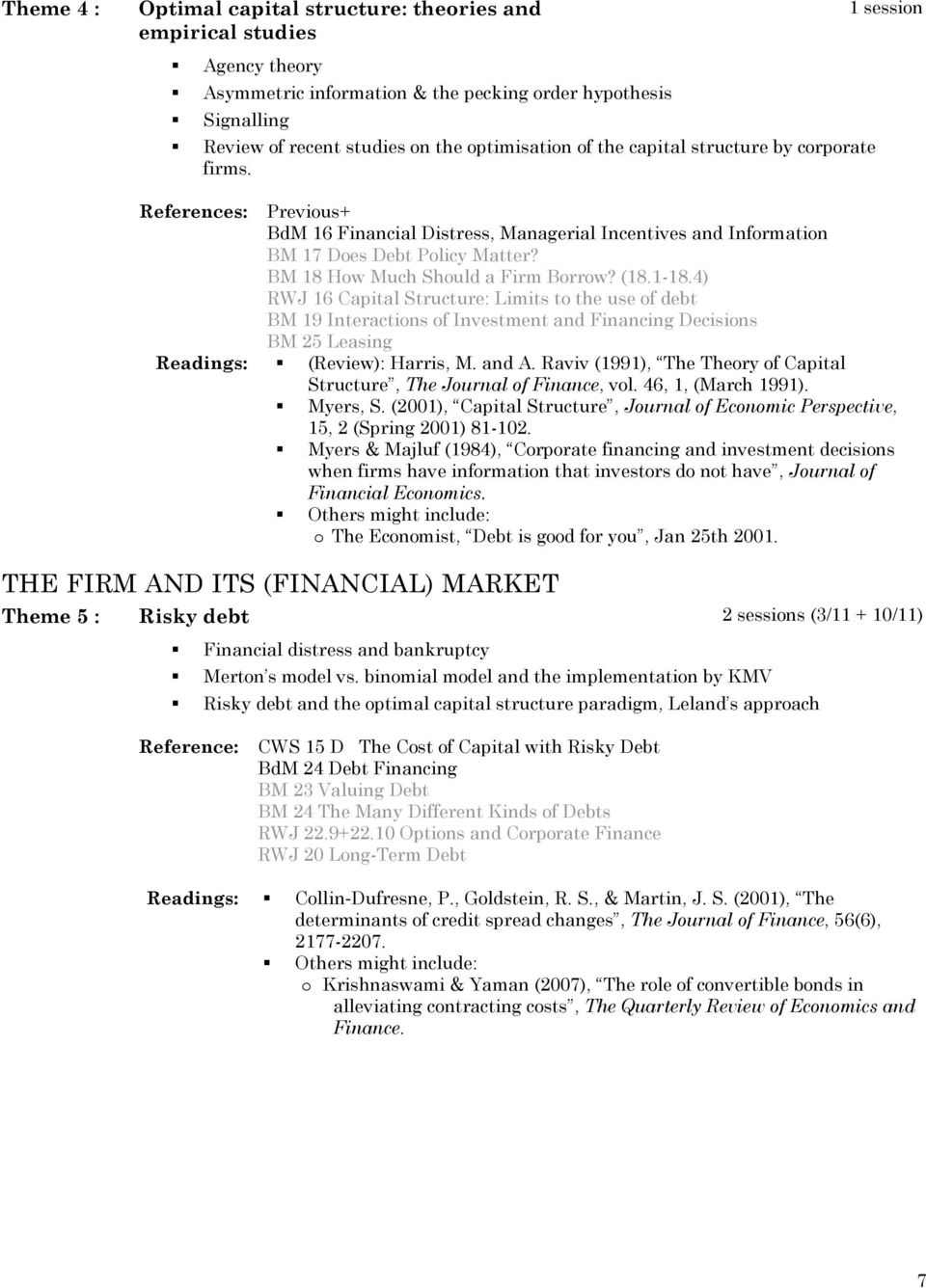
7 Theme 4 : Optimal capital structure: theories and empirical studies 1 session Agency theory Asymmetric information & the pecking order hypothesis Signalling Review of recent studies on the optimisation of the capital structure by corporate firms. References: Previous+ BdM 16 Financial Distress, Managerial Incentives and Information BM 17 Does Debt Policy Matter? BM 18 How Much Should a Firm Borrow? ( ) RWJ 16 Capital Structure: Limits to the use of debt BM 19 Interactions of Investment and Financing Decisions BM 25 Leasing Readings: (Review): Harris, M. and A. Raviv (1991), The Theory of Capital Structure, The Journal of Finance, vol. 46, 1, (March 1991). Myers, S. (2001), Capital Structure, Journal of Economic Perspective, 15, 2 (Spring 2001) Myers & Majluf (1984), Corporate financing and investment decisions when firms have information that investors do not have, Journal of Financial Economics. Others might include: o The Economist, Debt is good for you, Jan 25th THE FIRM AND ITS (FINANCIAL) MARKET Theme 5 : Risky debt 2 sessions (3/ /11) Financial distress and bankruptcy Merton s model vs. binomial model and the implementation by KMV Risky debt and the optimal capital structure paradigm, Leland s approach Reference: CWS 15 D The Cost of Capital with Risky Debt BdM 24 Debt Financing BM 23 Valuing Debt BM 24 The Many Different Kinds of Debts RWJ Options and Corporate Finance RWJ 20 Long-Term Debt Readings: Collin Dufresne, P., Goldstein, R. S., & Martin, J. S. (2001), The determinants of credit spread changes, The Journal of Finance, 56(6), Others might include: o Krishnaswami & Yaman (2007), The role of convertible bonds in alleviating contracting costs, The Quarterly Review of Economics and Finance. 7
8 Theme 6 : Convertible bonds and warrants 1 session (17/11+24/11) Issuing hybrid forms of securities to the market. Why? Understanding convertibles and warrants Reference: BM 22 Warrants and Convertibles RWJ 24 Warrants and Convertibles Readings: Mayers, D. (1998), Why firms issue convertible bonds: the matching of financial and real investment options, Journal of Financial Economics, 47(1), If time permits Theme 7 : Raising Capital, Going Public and IPOs 1 session From seed capital to going public The IPO process The undervaluation of IPOs IPOs and long run performance Reference: CWS 11 F Semi-strong form anomalies BdM 23 The Mechanics of Raising Equity Capital BM 13 Corporate Financing and the Six Lessons of Market Eff. BM 15 How Corporations Issue Securities RWJ 13 Corporate-Financing Decisions and Eff. Cap l Markets RWJ 19 Issuing Securities to the Public Readings: Ritter, J. and I. Welch (2002), A Review of IPO Activity, Pricing and Allocations, Journal of Finance, 57(4), August 2002, Theme 8 : Mergers and Acquisitions 1 session Ownership, control and restructuring Forms Theoretical explanations Special cases Protection & Shareholder value Reference: CWS 18 Acquisitions, Divestitures and Corporate Governance BdM 28 Mergers and Acquisitions BM 33 Mergers RWJ 29 Mergers and Acquisitions Readings: Hackbarth & Morellec (2008), Stock Returns in Mergers and Acquisitions, The Journal of Finance, vol. LXIII, no. 3, June Cases: RJR Nabisco 8

9 9

Financial Economics II (Corporate Finance)
 FINANCIAL ECONOMICS II (CORPORATE FINANCE) 1 Financial Economics II (Corporate Finance) Lecturer: Stanimir Morfov, Carsten Sprenger Class teacher: Stanimir Morfov, Carsten Sprenger Teaching objectives
Corporate Finance (ECON W4280)
 Tri Vi Dang Columbia University Email: [email protected] Spring 2014 Corporate Finance (ECON W4280) Meeting time: Tu, Th 4.10-5.25 Meeting place: IAB 410 Office address: IAB 1032 Office hours: Th 11.00-12.00
Module Description. Master Programme. International Business and Finance (M.A.)
 Fakultät für Wirtschaft Module Description Master Programme International Business and Finance (M.A.) (Version: 2014-10-01) Introduction: The official requirements for the degree program 'International
M.Sc. (cand.merc.) in Finance and Strategic Management (FSM) 2015/2016
 M.Sc. (cand.merc.) in Finance and Strategic Management (FSM) 2015/2016 Target Group and Prerequisites Candidates must have a BSc. in Economics and Business Administration or an equivalent degree. English
CORPORATE FINANCE INSTRUCTOR: ETTORE CROCI
 CORPORATE FINANCE INSTRUCTOR: ETTORE CROCI AA 2010-2011 LANGUAGE THE COURSE IS OFFERED IN ENGLISH EXAMS: QUESTIONS WILL BE IN ENGLISH, BUT IT IS POSSIBLE TO ANSWER THEM IN ITALIAN. Corporate Finance Advanced
Department of Accounting and Finance
 Department of Accounting and Finance Modules, other than Introductory modules may have pre-requisites or co-requisites (please, see module descriptions below) and a student must have undertaken and passed
BACHELOR IN ECONOMICS SECOND YEAR
 BACHELOR IN ECONOMICS SECOND YEAR Course Finance Code 802359 Module Transversal Education Area Status Credits 6 Compulsory Attendance 3.6 Non Attendance 2.4 Year 2º Semester 4 COORDINATION Business Management
Northwestern University Kellogg Graduate School of Management. Corporate Finance Fall 1996 Sections 61/62 Course Outline
 Northwestern University Kellogg Graduate School of Management Finance II (D41) -- Campus sections Mitchell Petersen Corporate Finance Fall 1996 Sections 61/62 Course Outline Course Readings: Brealey and
15.401 Finance Theory
 Finance Theory MIT Sloan MBA Program Andrew W. Lo Harris & Harris Group Professor, MIT Sloan School Lectures 10 11 11: : Options Critical Concepts Motivation Payoff Diagrams Payoff Tables Option Strategies
University of Notre Dame Mendoza College of Business MSM Corporate Finance: Preliminary Syllabus Clements Spring 2015
 Course & Contact Information: Meets Monday and Wednesday, 2:00 3:20PM Instructor: Walt Clements Office: 224 Mendoza Office Hours: regular times TBD, others by appt or stop by email: [email protected] Phone:
The Master of Science in Finance (English Program) - MSF. Department of Banking and Finance. Chulalongkorn Business School. Chulalongkorn University
 The Master of Science in Finance (English Program) - MSF Department of Banking and Finance Chulalongkorn Business School Chulalongkorn University Overview of Program Structure Full Time Program: 1 Year
Course Outline. FNCE 4110-3 Advanced Financial Management for Accountants (3,0,0)
 Calendar Description Course Outline Department of Accounting and Finance School of Business and Economics FNCE 4110-3 Advanced Financial Management for Accountants (3,0,0) Building on either FNCE 2120:
Course Title : Financial Management. Teaching Hours : 42 hours (3 hours per week)
 Course Title : Financial Management Course Code : BUS201 / BUS2201 No of Credits/Term : 3 Mode of Tuition : Sectional Approach Teaching Hours : 42 hours (3 hours per week) Category in major Programme :
University of Washington Foster School of Business FIN 502: Corporate Finance, Winter 2015 Professor Mark Westerfield
 University of Washington Foster School of Business FIN 502: Corporate Finance, Winter 2015 Professor Mark Westerfield Course Contact Information Professor: Mark Westerfield Office: PCAR 436 Office Hours:
Master of Business Administration Program in the Faculty of Business Administration and Economics
 Master of Business Administration Program in the Faculty of Business Administration and Economics The Faculty of Business Administration and Economics at Haigazian University offers a degree program leading
Master of Business Administration Program in the Faculty of Business Administration and Economics
 Master of Business Administration Program in the Faculty of Business Administration and Economics The Faculty of Business Administration and Economics at Haigazian University offers a degree program leading
MICPA Conversion Programme. Module Outline Business Strategy and Financial Management
 Module Outline Business Strategy and Financial Management BUSINESS STRATEGY AND FINANCIAL MANAGEMENT AIM To equip students with: 1. A good understanding of the organisation s environment, business strategy
FIN 394.1 Advanced Corporate Finance. Spring 2016. Jonathan Cohn
 FIN 394.1 Advanced Corporate Finance Spring 2016 Jonathan Cohn [email protected], phone 512-232-6827, office CBA 6.278 Office Hours: Tuesdays, 3:30pm to 4:30pm Wednesdays, 1:30pm to 3:00pm
Finance. Undergraduate Program of Study. Graduate Program of Study. Courses. Certificate in Risk Management and Insurance. Doctor of Philosophy
 University of Iowa 2015-16 General Catalog 1 Finance Chair Erik Lie Undergraduate major: finance (B.B.A.) Graduate degree: finance subprogram for the Ph.D. in business administration Faculty: http://tippie.uiowa.edu/finance/faculty.cfm
Applied Corporate Finance
 MBA Programme 2012 Period 3 May-June 2012 Applied Corporate Finance Professor: Massimo Massa [email protected] PMLS 2.06 Ext 4481 Assistant: Melanie Sebag [email protected] PMLSA 2.05 Ext
MW: Email: [email protected]
 MBA 637 Financial management & Valuation (3 hrs) Western Carolina University Syllabus, Spring 20xx MBA 637, Syllabus, Fall 20xx, P a g e 1 Meeting Room: 0xx Karpen Hall, UNCA Instructor Information: Meeting
MSc Finance and Economics detailed module information
 MSc Finance and Economics detailed module information Example timetable Please note that information regarding modules is subject to change. TERM 1 TERM 2 TERM 3 INDUCTION WEEK EXAM PERIOD Week 1 EXAM
Graduate program Economics and Finance. Syllabi of the academic year 2014/2015 - course units delivered in English
 1 Graduate program Economics and Finance Syllabi of the academic year 2014/2015 - course units delivered in English Università degli Studi di Padova Department of Economics and Management 2 Graduate program
Syllabus for Corporate Valuation Cases in Mergers and Acquisitions
 Syllabus for Corporate Valuation Cases in Mergers and Acquisitions Lecturer: Vyacheslav Ivanov Class teacher: Vyacheslav Ivanov Course Description Corporate Valuation Cases is a one-semester course which
On the Applicability of WACC for Investment Decisions
 On the Applicability of WACC for Investment Decisions Jaime Sabal Department of Financial Management and Control ESADE. Universitat Ramon Llull Received: December, 2004 Abstract Although WACC is appropriate
Economics 323: Finance Theory and Applications Wellesley College Fall 2008
 Economics 323: Finance Theory and Applications Wellesley College Fall 2008 Eric Hilt Department of Economics PNE 411 Email: [email protected] Office hours: Mondays, 1:00-2:00 PM; Wednesdays, 2:00-4:00
Graduate Business Programs SDSU College of Business Administration. MBA Program of Study Worksheet. Finance Specialization
 Graduate Business Programs SDSU College of Business Administration MBA Program of Study Worksheet Finance Specialization Program of Study Worksheet: MBA Finance Specialization The MBA requires a 30 48
Level 6 Advanced Diploma in Finance (531) 126 Credits
 Level 6 Advanced Diploma in Finance (531) 126 Credits Unit: Finance Theory Guided Learning Hours: 210 Exam Paper No.: 4 Prerequisites: Knowledge of Finance. Number of Credits: 21 Corequisites: A pass or
Leverage. FINANCE 350 Global Financial Management. Professor Alon Brav Fuqua School of Business Duke University. Overview
 Leverage FINANCE 35 Global Financial Management Professor Alon Brav Fuqua School of Business Duke University Overview Capital Structure does not matter! Modigliani & Miller propositions Implications for
Williams College Department of Economics. Economics 384: Corporate Finance
 Williams College Department of Economics Economics 384: Corporate Finance William M. Gentry Office: Fernald 3 Phone: 597-4257 e-mail: [email protected] Office hours: Monday 10:00 12:00 Wednesday 2:00
The Lee Kong Chian School of Business Academic Year 2012/13 Term 1
 The Lee Kong Chian School of Business Academic Year 2012/13 Term 1 FNCE101 FINANCE Instructor Name : Daniel A Stone Title : Adjunct Tel : Email Office : TBD : [email protected] COURSE DESCRIPTION This
Ch. 18: Taxes + Bankruptcy cost
 Ch. 18: Taxes + Bankruptcy cost If MM1 holds, then Financial Management has little (if any) impact on value of the firm: If markets are perfect, transaction cost (TAC) and bankruptcy cost are zero, no
CFS. Syllabus. Certified Finance Specialist. International benchmark in Finance profession
 CFS Certified Finance Specialist Syllabus International benchmark in Finance profession Certified Finance Specialist Summary: This award will provide candidates the opportunity to gain advanced level knowledge
SYLLABUS FOR CORPORATE FINANCE
 Professor: Daniel Sungyeon Kim Office: C-324 Office Hours: Monday, 11:00-12:00 Office Phone: 2603-5295 E-Mail: [email protected] Web Site: www.danskim.com COURSE DESCRIPTION SYLLABUS FOR CORPORATE
Corporate Finance II
 Corporate Finance II 2015/2016 Code: 102328 ECTS Credits: 6 Degree Type Year Semester 2501572 Business Administration and Management OB 3 2 2501573 Economics OT 4 0 Contact Name: Carlota Menéndez Plans
THE OPEN UNIVERSITY OF TANZANIA FACULTY OF BUSINESS MANAGEMENT MASTER OF BUSINESS ADMINISTRATION (MBA) OAF 623: ADVANCED CORPORATE FINANCE
 THE OPEN UNIVERSITY OF TANZANIA FACULTY OF BUSINESS MANAGEMENT MASTER OF BUSINESS ADMINISTRATION (MBA) OAF 623: ADVANCED CORPORATE FINANCE COURSE OUTLINE P. M. K. NGATUNI, Ph.D November 2010 1 1.0 Introduction
Michael G. Foster School of Business University of Washington. MBA Core Managerial Finance BA 500 Fall 2013. Thomas Gilbert.
 Michael G. Foster School of Business University of Washington MBA Core Managerial Finance BA 500 Fall 2013 Prof. Thomas Gilbert Syllabus Price is what you pay. Value is what you get. Warren Buffett This
Last update: December 19, 2013. Global Master of Finance Dual Degree Course Descriptions. Foundation Courses. FIN B62 510. Introduction to Finance
 Last update: December 19, 2013 Global Master of Finance Dual Degree Course Descriptions Foundation Courses FIN B62 510. Introduction to Finance The main topics to be covered in this course are (1) principles
INTERNATIONAL CORPORATE FINANCE Course Outline
 INTERNATIONAL CORPORATE FINANCE Course Outline Faculty: Economics Year: 2012/13 Course name: International Corporate Finance Level: Bachelor, 4 year Language of instruction: English Period: Module 2 Workload:
Corporate Finance I. Degree Type Year Semester. 2501572 Business Administration and Management OB 3 1. 2501573 Economics OT 3 1
 Corporate Finance I 2015/2016 Code: 102329 ECTS Credits: 6 Degree Type Year Semester 2501572 Business Administration and Management OB 3 1 2501573 Economics OT 3 1 2501573 Economics OT 4 0 Contact Name:
Module Description. Master Programme. International Business and Finance (M.A.)
 Fakultät für Wirtschaft Module Description Master Programme International Business and Finance (M.A.) (Version: 2014-10-01) Introduction: The official requirements for the degree program 'International
MSc Finance LM550 (REVAMPED)
 MSc Finance LM550 (REVAMPED) 1. Objectives The objectives of this 2-year part-time programme are two-fold: first to provide you with a strong foundation in both the theoretical principles and practice
Course Outline. FNCE 4130-3 Advanced Financial Management (3,0,0)
 Course Outline Department of Accounting and Finance School of Business and Economics FNCE 4130-3 Advanced Financial Management (3,0,0) Calendar Description Building on either FNCE 2120: Financial Management
Principles of Financial Management. 3 3 Lecture/Laboratory Hours
 COURSE OUTLINE BUS218 Course Number Principles of Financial Management Course Title Credits 3 3 Lecture/Laboratory Hours Course description: Principles of financial management as applied to the firm including
The Lee Kong Chian School of Business Academic Year 2015 /16 Term 1
 The Lee Kong Chian School of Business Academic Year 2015 /16 Term 1 FNCE101 FINANCE Instructor : Dr Chiraphol New Chiyachantana Tittle : Assistant Professor of Finance (Education) Tel : 6828 0776 Email
Capital Structure II
 Capital Structure II Introduction In the previous lecture we introduced the subject of capital gearing. Gearing occurs when a company is financed partly through fixed return finance (e.g. loans, loan stock
University of Chicago. Course Outline (provisional) FINANCE PP 320. Spring 2015 Mondays 3 to 5:30 PM Location:??, 1155 E 60th Street
 University of Chicago Course Outline (provisional) FINANCE PP 320 Spring 2015 Mondays 3 to 5:30 PM Location:??, 1155 E 60th Street Raaj Sah [email protected] Room 177, 1155 E 60th Street Mobile: +1 773
UNIVERSITY OF MASSACHUSETTS BOSTON COLLEGE OF MANAGEMENT AF 325 - Theory of Finance SYLLABUS Spring 2013
 UNIVERSITY OF MASSACHUSETTS BOSTON COLLEGE OF MANAGEMENT AF 325 - Theory of Finance SYLLABUS Spring 2013 Meeting time: Section 01 (1380) Mondays and Wednesdays, 4.00pm 5.15pm Room: McCormack 02-0404 Instructor:
USC Marshall Executive MBA Program-Los Angeles Theme 2 Financial Management Syllabus and Schedule
 USC Marshall Executive MBA Program-Los Angeles Theme 2 Financial Management Syllabus and Schedule Professor: Julia, mobile 310-528-6291 office 213-821-6798 e-mail: [email protected] Introduction
Michael G. Foster School of Business University of Washington. MBA Core Managerial Finance BA 500 Fall 2015 Prof. Thomas Gilbert.
 Michael G. Foster School of Business University of Washington MBA Core Managerial Finance BA 500 Fall 2015 Prof. Thomas Gilbert Syllabus Price is what you pay. Value is what you get. Warren Buffett This
Financial Markets and Valuation - Tutorial 6: SOLUTIONS. Capital Structure and Cost of Funds
 Financial Markets and Valuation - Tutorial 6: SOLUTIONS Capital Structure and Cost of Funds (*) denotes those problems to be covered in detail during the tutorial session (*) Problem 1. (Ross, Westerfield
Discounted Cash Flow Valuation. Literature Review and Direction for Research Composed by Ngo Manh Duy
 Discounted Cash Flow Valuation Literature Review and Direction for Research Composed by Ngo Manh Duy TABLE OF CONTENTS Acronyms DCF Valuation: definition and core theories DCF Valuation: Main Objective
FIN 301 SYLLABUS Corporate Finance Spring 2012
 FIN 301 SYLLABUS Corporate Finance Spring 2012 Professor: Hunter M. Holzhauer, Ph.D. Office Number: REDC 291 Office Phone: (814) 898-6326 E-mail: [email protected] Office Hours: MTW 3:15-4:30pm (and by appointment)
FDU-Vancouver Bachelor of Science in Business Administration - International Business concentration Course Descriptions
 FDU-Vancouver Bachelor of Science in Business Administration - International Business concentration Course Descriptions ACCT 2021 Intro Financial Accounting An introduction to the concepts underlying an
PHD PROGRAM IN FINANCE COURSE PROGRAMME AND COURSE CONTENTS
 PHD PROGRAM IN FINANCE COURSE PROGRAMME AND COURSE CONTENTS I. Semester II. Semester FINC 601 Corporate Finance 8 FINC 602 Asset Pricing 8 FINC 603 Quantitative Methods in Finance 8 FINC 670 Seminar 4
ADVANCED CORPORATE FINANCE I 2009 SPRING SEMESTER
 GEORGETOWN UNIVERSITY THE MCDONOUGH SCHOOL OF BUSINESS Course: ADVANCED CORPORATE FINANCE I 2009 SPRING SEMESTER FINC-555-30 R 6:30-9:45 P.M. CBN 204 Instructor: Office: Dr. Allan Eberhart 411 New North
Black Scholes Merton Approach To Modelling Financial Derivatives Prices Tomas Sinkariovas 0802869. Words: 3441
 Black Scholes Merton Approach To Modelling Financial Derivatives Prices Tomas Sinkariovas 0802869 Words: 3441 1 1. Introduction In this paper I present Black, Scholes (1973) and Merton (1973) (BSM) general
Value-Based Management
 Value-Based Management Lecture 5: Calculating the Cost of Capital Prof. Dr. Gunther Friedl Lehrstuhl für Controlling Technische Universität München Email: [email protected] Overview 1. Value Maximization
A Primer on Valuing Common Stock per IRS 409A and the Impact of Topic 820 (Formerly FAS 157)
 A Primer on Valuing Common Stock per IRS 409A and the Impact of Topic 820 (Formerly FAS 157) By Stanley Jay Feldman, Ph.D. Chairman and Chief Valuation Officer Axiom Valuation Solutions May 2010 201 Edgewater
MBA 6081, Corporate Finance Course Syllabus. Course Description. Course Textbook. Course Learning Outcomes. Credits.
 Course Syllabus Course Description Introduction to standard techniques and recent advances in a practical and intuitive way. Although a strong background in financial management is not required, a rudimentary
London School of Economics FM423 - FT - 2008-9. Course Syllabus
 London School of Economics FM423 - FT - 2008-9 Department of Finance Vayanos - Yuan - Zachariadis Course Syllabus Course Description This is the core investments course in the MSc Finance Full-Time Programme.
Syllabus CORPORATE FINANCE. Lecturer: Nikita K. Pirogov Class teachers: Nikita K. Pirogov, Maria S. Kokoreva. Course description:
 Syllabus CORPORATE FINANCE Lecturer: Nikita K. Pirogov Class teachers: Nikita K. Pirogov, Maria S. Kokoreva Course description: The course develops theoretical framework for understanding and analysing
COMM370: CORPORATE FINANCE
 COURSE GOALS The course aims to familiarize students with working knowledge of key corporate finance decisions that are important in the life of a corporation and, more generally, to help students acquire
Chapter 17 Corporate Capital Structure Foundations (Sections 17.1 and 17.2. Skim section 17.3.)
 Chapter 17 Corporate Capital Structure Foundations (Sections 17.1 and 17.2. Skim section 17.3.) The primary focus of the next two chapters will be to examine the debt/equity choice by firms. In particular,
Chapter 1: The Modigliani-Miller Propositions, Taxes and Bankruptcy Costs
 Chapter 1: The Modigliani-Miller Propositions, Taxes and Bankruptcy Costs Corporate Finance - MSc in Finance (BGSE) Albert Banal-Estañol Universitat Pompeu Fabra and Barcelona GSE Albert Banal-Estañol
Financial Management (F9)
 Financial Management (F9) This syllabus and study guide is designed to help with planning study and to provide detailed information on what could be assessed in any examination session. THE STRUCTURE OF
OPTIONS IN CORPORATE FINANCE FINA 763 Spring 2005
 OPTIONS IN CORPORATE FINANCE FINA 763 Spring 2005 Dr. William T. Moore Phone: 777-4905 (office) Office: BA 473 782-6434 (home) Office Hours: Open e-mail: [email protected] Objective This course is
Extent of work (hours)
 MBA Module: Finance Key words: Module number: Target group(s): ECTS credits: 8 Language of instruction: Responsible: Applied Corporate Finance, Corporate Finance, Financial Accounting, Management Accounting,
ECON 138 Financial and Behavioral Economics Spring 2008 TTh 11am-12:30pm, 70 Evans
 ECON 138 Financial and Behavioral Economics Spring 2008 TTh 11am-12:30pm, 70 Evans INSTRUCTOR Ulrike Malmendier, 643 Evans Hall, [email protected] OH: Th 12:30-2:30pm GSI Erin Syron OH: 4-6pm, 608-1
Finance. Corporate Finance. Additional information: See Moodle. Investments
 Finance Corporate Finance Yrityksen rahoitus Code: LASK3047 Credit Units: 6 ETCS Time: Autumn semester, periods I-II. Content: Overview of corporate finance including valuation of stocks and bonds, capital
Investment Portfolio Management and Effective Asset Allocation for Institutional and Private Banking Clients
 Investment Portfolio Management and Effective Asset Allocation for Institutional and Private Banking Clients www.mce-ama.com/2396 Senior Managers Days 4 www.mce-ama.com 1 WHY attend this programme? This
Capital Structure and Ownership Structure: A Review of Literature
 [The Journal of Online Education, New York, January 2009] Capital Structure and Ownership Structure: A Review of Literature by BOODHOO Roshan ASc Finance, BBA (Hons) Finance, BSc (Hons) Banking & International
Chapter 7. . 1. component of the convertible can be estimated as 1100-796.15 = 303.85.
 Chapter 7 7-1 Income bonds do share some characteristics with preferred stock. The primary difference is that interest paid on income bonds is tax deductible while preferred dividends are not. Income bondholders
Imperial College Business School. Asset Pricing and Derivatives [email protected]. Syllabus
 Imperial College Business School Asset Pricing and Derivatives Spring A. Buraschi [email protected] Syllabus I. Administrative: Homework: Web-based homeworks will be assigned every week. These
INTERVIEWS - FINANCIAL MODELING
 420 W. 118th Street, Room 420 New York, NY 10027 P: 212-854-4613 F: 212-854-6190 www.sipa.columbia.edu/ocs INTERVIEWS - FINANCIAL MODELING Basic valuation concepts are among the most popular technical
MSc Financial Economics - SH506 (Under Review)
 MSc Financial Economics - SH506 (Under Review) 1. Objectives The objectives of the MSc Financial Economics programme are: To provide advanced postgraduate training in financial economics with emphasis
Cost of Capital, Valuation and Strategic Financial Decision Making
 Cost of Capital, Valuation and Strategic Financial Decision Making By Dr. Valerio Poti, - Examiner in Professional 2 Stage Strategic Corporate Finance The financial crisis that hit financial markets in
FINANCE AND BUSINESS ECONOMICS. Elective Course Guide for Marshall Graduate Students. October 2013
 FINANCE AND BUSINESS ECONOMICS Elective Course Guide for Marshall Graduate Students 2014 October 2013 1 FINANCE AND BUSINESS ECONOMICS DEPARTMENT GRADUATE ELECTIVES 2014 Marshall graduate students are
MFIN6214 FINANCIAL THEORY AND POLICY. Course Outline Semester 1, 2014
 Australian School of Business School of Banking and Finance MFIN6214 FINANCIAL THEORY AND POLICY Course Outline Semester 1, 2014 Part A: Course-Specific Information TENTATIVE Please consult Part B for
DCF and WACC calculation: Theory meets practice
 www.pwc.com DCF and WACC calculation: Theory meets practice Table of contents Section 1. Fair value and company valuation page 3 Section 2. The DCF model: Basic assumptions and the expected cash flows
t = 1 2 3 1. Calculate the implied interest rates and graph the term structure of interest rates. t = 1 2 3 X t = 100 100 100 t = 1 2 3
 MØA 155 PROBLEM SET: Summarizing Exercise 1. Present Value [3] You are given the following prices P t today for receiving risk free payments t periods from now. t = 1 2 3 P t = 0.95 0.9 0.85 1. Calculate
CAPITAL STRUCTURE [Chapter 15 and Chapter 16]
![CAPITAL STRUCTURE [Chapter 15 and Chapter 16]](/thumbs/34/17057255.jpg "CAPITAL STRUCTURE [Chapter 15 and Chapter 16]") Capital Structure [CHAP. 15 & 16] -1 CAPITAL STRUCTURE [Chapter 15 and Chapter 16] CONTENTS I. Introduction II. Capital Structure & Firm Value WITHOUT Taxes III. Capital Structure & Firm Value WITH Corporate
Capital Structure [CHAP. 15 & 16] -1 CAPITAL STRUCTURE [Chapter 15 and Chapter 16] CONTENTS I. Introduction II. Capital Structure & Firm Value WITHOUT Taxes III. Capital Structure & Firm Value WITH Corporate
Indicative Content. 1.1.1 The main types of corporate form. 1.1.2 The regulatory framework for companies. 1.1.6 Shareholder Value Analysis.
 Unit Title: Corporate Finance Unit Reference Number: L/601/3900 Guided Learning Hours: 210 Level: Level 6 Number of Credits: 25 Learning Outcome 1 The learner will: Understand the role of the Corporate
1. What is a recapitalization? Why is this considered a pure capital structure change?
 CHAPTER 12 CONCEPT REVIEW QUESTIONS 1. What is a recapitalization? Why is this considered a pure capital structure change? Recapitalization is an alteration of a company s capital structure to change the
1. Basic Information Course Code and Title: FN5202 Advanced Corporate Finance
 Kazakhstan Institute of Management, Economics and Strategic Research Bang College of Business (BCB) Fall Semester 2013 Course Syllabus for: FN5202 Advanced Corporate Finance 1. Basic Information Course
Use the table for the questions 18 and 19 below.
 Use the table for the questions 18 and 19 below. The following table summarizes prices of various default-free zero-coupon bonds (expressed as a percentage of face value): Maturity (years) 1 3 4 5 Price
Opportunity in leveraged companies
 February 2015» White paper Opportunity in leveraged companies David L. Glancy Portfolio Manager Key takeaways Leverage can create attractive investment opportunities. Leveraged-company securities offer
FINANCIAL STATEMENT ANALYSIS AND VALUATION. Fall, 2013
 PROFESSOR NAME: Stephen Penman Professor Office Location: 612 Uris Hall Office Phone: 212 854 9151 E-mail: [email protected] Office Hours: Tuesdays, 3:30pm 5:00pm TEACHING ASSISTANTS TA: Hyung Il Oh [email protected]
CORE COURSE EXEMPTION PROCESS
 CORE COURSE EXEMPTION PROCESS The core curriculum at Fuqua provides a foundation for graduate business education. Faculty members expect each student to gain this basic core of knowledge; however, many
Tax-adjusted discount rates with investor taxes and risky debt
 Tax-adjusted discount rates with investor taxes and risky debt Ian A Cooper and Kjell G Nyborg October 2004 Abstract This paper derives tax-adjusted discount rate formulas with Miles-Ezzell leverage policy,
Financial Analysis FIN 513, Fall A 2011 University of Michigan, Ross School of Business
 Ing-Haw Cheng Assistant Professor of Finance University of Michigan 701 Tappan Street, Room R5466 Ann Arbor, Michigan 48109 [email protected] webuser.bus.umich.edu/ingcheng Financial Analysis FIN 513,
Programme Curriculum for Master Programme in Accounting and Finance
 Programme Curriculum for Master Programme in Accounting and Finance 1. Identification Name of programme Scope of programme Level Programme code Master Programme in Accounting and Finance 60 ECTS Master