
Annual Report maps traffic navigation
|
|
|
- Marian Higgins
- 10 years ago
- Views:
Transcription
1 Annual Report 2012 maps traffic navigation
2 Forward-looking statements/important notice This document contains certain forward-looking statements with respect to the financial condition, results of operations and business of TomTom and certain of the plans and objectives of TomTom with respect to these items. In particular the words expect, anticipate, estimate, may, should, believe and similar expressions are intended to identify forward-looking statements. By their nature, forward-looking statements involve risk and uncertainty because they relate to events and depend on circumstances that will occur in the future. Actual results may differ materially from those expressed in these forward-looking statements, and you should not place undue reliance on them. We have based these forward-looking statements on our current expectations and projections about future events, including numerous assumptions regarding our present and future business strategies, operations and the environment in which we will operate in the future. There are a number of factors that could cause actual results and developments to differ materially from those expressed or implied by these forward-looking statements. These factors include, but are not limited to, levels of customer spending in major economies, changes in consumer tastes and preferences, changes in law, the performance of the financial markets, the levels of marketing and promotional expenditures by TomTom and its competitors, raw materials and employee costs, changes in exchange and interest rates (in particular changes in the US dollar and GB pound versus the euro can materially affect results), changes in tax rates, future business combinations, acquisitions or disposals, the rate of technological changes, political and military developments in countries where TomTom operates and the risk of a downturn in the market. Statements regarding market share, including TomTom s competitive position, contained in this document are based on outside sources such as specialised research institutes, industry and dealer panels in combination with management estimates. Where full-year information regarding 2012 is not yet available to TomTom, those statements may also be based on estimates and projections prepared by outside sources or management. Market shares are based on sales in units unless otherwise stated. The forward-looking statements contained refer only to the date on which they are made, and we do not undertake any obligation to update any forward-looking statement to reflect events or circumstances after the date of this Annual Report.
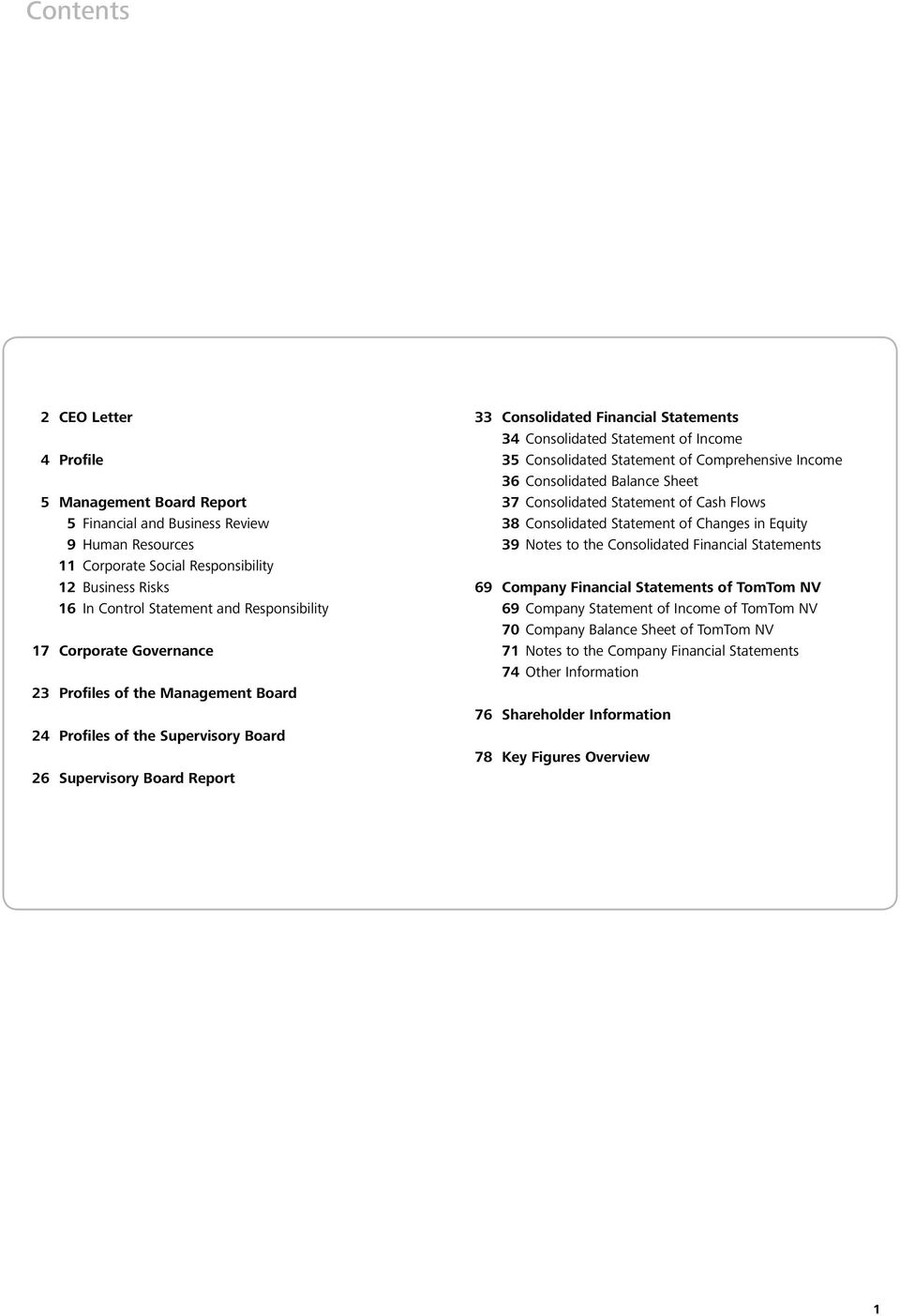
3 Contents 2 CEO Letter 4 Profile 5 Management Board Report 5 Financial and Business Review 9 Human Resources 11 Corporate Social Responsibility 12 Business Risks 16 In Control Statement and Responsibility 17 Corporate Governance 23 Profiles of the Management Board 24 Profiles of the Supervisory Board 26 Supervisory Board Report 33 Consolidated Financial Statements 34 Consolidated Statement of Income 35 Consolidated Statement of Comprehensive Income 36 Consolidated Balance Sheet 37 Consolidated Statement of Cash Flows 38 Consolidated Statement of Changes in Equity 39 Notes to the Consolidated Financial Statements 69 Company Financial Statements of TomTom NV 69 Company Statement of Income of TomTom NV 70 Company Balance Sheet of TomTom NV 71 Notes to the Company Financial Statements 74 Other Information 76 Shareholder Information 78 Key Figures Overview 1
4 CEO Letter During 2012 we focused our investment in our core map, traffic and navigation assets which underpin our roadmap of products and solutions for the future. Our financial performance was in line with expectations and we generated strong operating cash flows. Technology At the beginning of the year we introduced a new R&D structure consisting of 11 product units. The new structure reduces the interdependencies between our technologies, allowing innovations and products to be brought to the market faster. Our map, traffi c and navigation product units form the heart of our new R&D structure. We have directed much of our investment to these technologies over the past couple of years. The advancements we are making with innovation in these areas will be fundamental to the long term success of the company. It is part of our strategy to move towards becoming a content, software and services company. Innovation in our core assets is enabling us to license core technologies as individual components; selling map content, navigation software and HD Traffi c as standalone solutions. In the automotive market as a result we have positioned ourselves as a supplier of content, software and services for connected in-dash navigation. We need to take more steps to realise this strategy, which requires continued investment in our core assets. Strategy Our strategy is to restore revenue growth. This will be achieved through greater growth from non-pnd product sales while limiting revenue decline in the PND category. We have been working on establishing the foundations for our non-pnd related business since During 2012 we reached an important milestone in this regard: over 50% of group revenue was derived from non- PND sales. The new revenue structure does not compensate for the declining demand for PNDs, but we are getting closer to that point. Nonetheless, we believe that PND will remain a meaningful category in its own right for the foreseeable future. Working with Nike, we have made a successful step into the fi tness market and we will build on this positive momentum. Licensing also benefi ts from our strategy to sell modular components of a content, software and services company. Business Solutions operates an underpenetrated market. With its legacy-free, state of art, online fl eet management platform, its aim is to continue to signifi cantly outperform the growth of the market as a whole, helped by alliances in some of its newer markets. Major business developments Developments in the smartphone industry in recent years have been dominating the consumer electronics market, and locationbased services have become a core feature on smartphones today. As one of three global map companies in the world, TomTom is part of the battle for global smartphone platform dominance. There are rapid technological developments in consumer electronics. These are having major impacts in the consumer space, and the challenge for the automotive industry is to keep up with consumer expectations. The list of features and requirements for in-dash infotainment systems has grown, as have the complexity and costs involved in their manufacture. This makes it more diffi cult for a single supplier to deliver full infotainment solutions. To solve this problem, car manufacturers have been developing their own model-independent platforms, allowing specialists in certain areas to add specifi c applications and features to them. TomTom is positioning itself as the preferred location and navigation services supplier by offering maps, traffi c and navigation software as stand-alone components which are easy and cost effective to integrate by tier 1 suppliers and car manufacturers. Our deal with PSA Peugeot Citroen, who will include our components in its new infotainment solution, is one example of early success with our approach to the automotive market. Business Solutions is getting increased attention owning to its consistent strong track record of growth and because of increased activity in the industry it operates in. We envisage further growth opportunities beyond fl eet management services and are using our telematics technologies to enter new areas of business, such as car leasing and user based insurance markets. 2 TomTom Annual Report and Accounts 2012

5 Looking forward 2013 will be an exciting year as products based on our new technologies start to reach our customers. An uncertain macroeconomic environment will continue to bring us challenges. We will take further steps this year to develop our componentised technologies. These will provide the basis for our future growth. I would like to thank all our stakeholders: our shareholders for their continuous support in our journey in this dynamic and fast moving industry; our customers, who give us valuable feedback and the drive to improve ourselves every day; and fi nally our employees for their dedication and hard work. Harold Goddijn Chief Executive Offi cer, TomTom NV 3

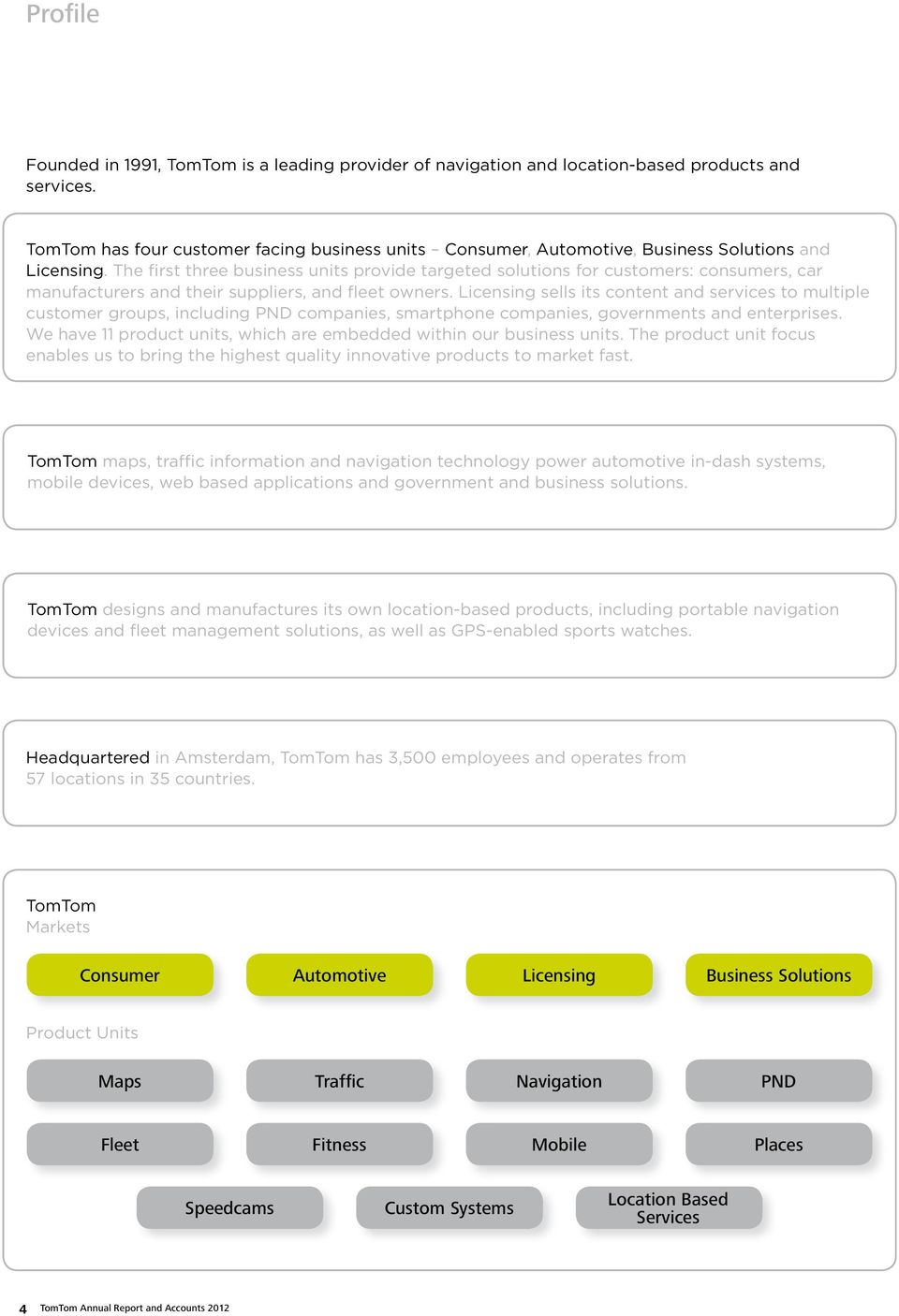
6 Profile Founded in 1991, TomTom is a leading provider of navigation and location-based products and services. TomTom has four customer facing business units Consumer, Automotive, Business Solutions and Licensing. The first three business units provide targeted solutions for customers: consumers, car manufacturers and their suppliers, and fleet owners. Licensing sells its content and services to multiple customer groups, including PND companies, smartphone companies, governments and enterprises. We have 11 product units, which are embedded within our business units. The product unit focus enables us to bring the highest quality innovative products to market fast. TomTom maps, traffic information and navigation technology power automotive in-dash systems, mobile devices, web based applications and government and business solutions. TomTom designs and manufactures its own location-based products, including portable navigation devices and fleet management solutions, as well as GPS-enabled sports watches. Headquartered in Amsterdam, TomTom has 3,500 employees and operates from 57 locations in 35 countries. TomTom Markets Consumer Automotive Licensing Business Solutions Product Units Maps Traffic Navigation PND Fleet Fitness Mobile Places Speedcams Custom Systems Location Based Services 4 TomTom Annual Report and Accounts 2012
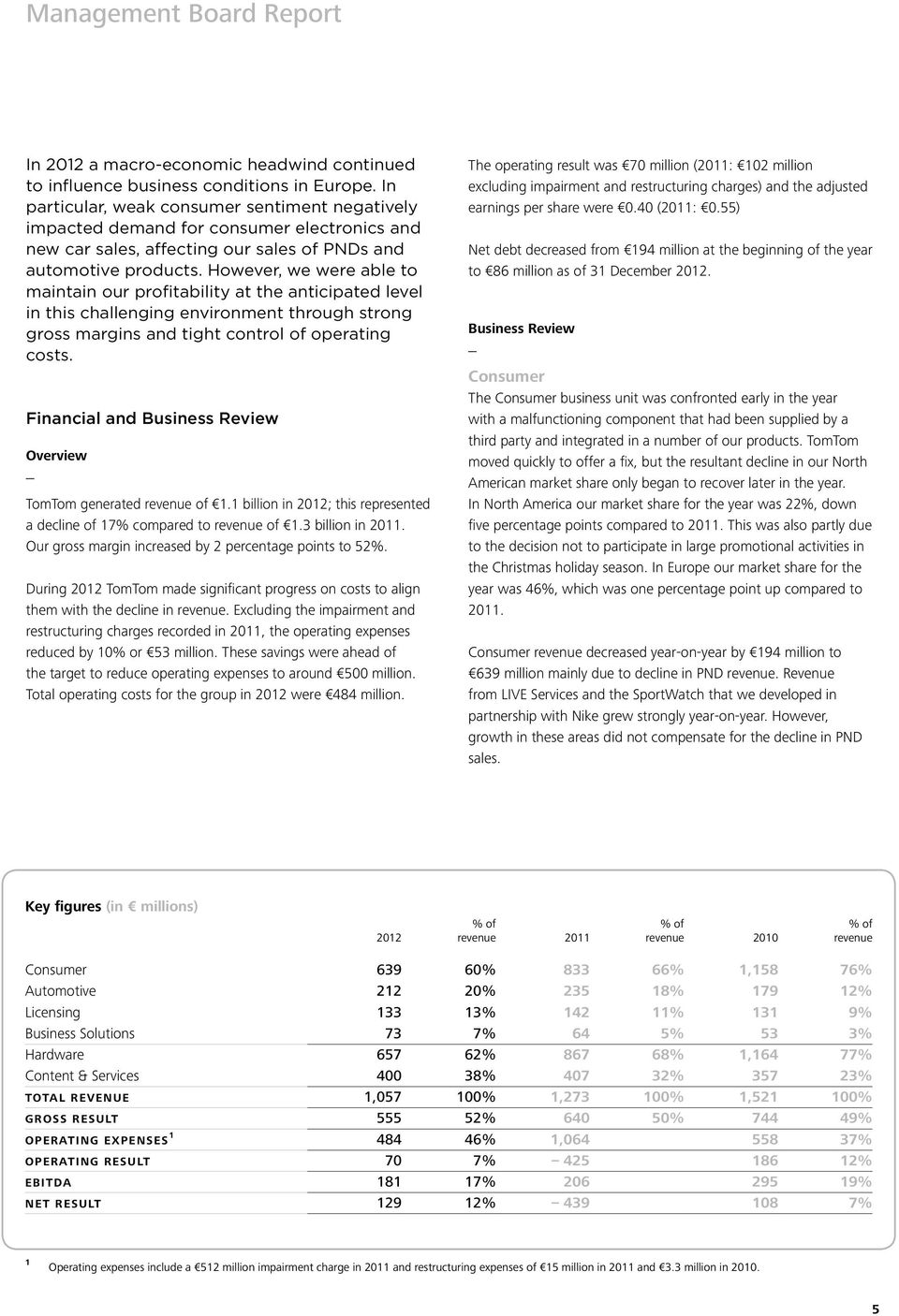
7 Management Board Report In 2012 a macro-economic headwind continued to influence business conditions in Europe. In particular, weak consumer sentiment negatively impacted demand for consumer electronics and new car sales, affecting our sales of PNDs and automotive products. However, we were able to maintain our profitability at the anticipated level in this challenging environment through strong gross margins and tight control of operating costs. Financial and Business Review Overview TomTom generated revenue of 1.1 billion in 2012; this represented a decline of 17% compared to revenue of 1.3 billion in Our gross margin increased by 2 percentage points to 52%. During 2012 TomTom made signifi cant progress on costs to align them with the decline in revenue. Excluding the impairment and restructuring charges recorded in 2011, the operating expenses reduced by 10% or 53 million. These savings were ahead of the target to reduce operating expenses to around 500 million. Total operating costs for the group in 2012 were 484 million. The operating result was 70 million (2011: 102 million excluding impairment and restructuring charges) and the adjusted earnings per share were 0.40 (2011: 0.55) Net debt decreased from 194 million at the beginning of the year to 86 million as of 31 December Business Review Consumer The Consumer business unit was confronted early in the year with a malfunctioning component that had been supplied by a third party and integrated in a number of our products. TomTom moved quickly to offer a fi x, but the resultant decline in our North American market share only began to recover later in the year. In North America our market share for the year was 22%, down fi ve percentage points compared to This was also partly due to the decision not to participate in large promotional activities in the Christmas holiday season. In Europe our market share for the year was 46%, which was one percentage point up compared to Consumer revenue decreased year-on-year by 194 million to 639 million mainly due to decline in PND revenue. Revenue from LIVE Services and the SportWatch that we developed in partnership with Nike grew strongly year-on-year. However, growth in these areas did not compensate for the decline in PND sales. Key figures (in millions) 2012 % of revenue 2011 % of revenue 2010 % of revenue Consumer % % 1,158 76% Automotive % % % Licensing % % 131 9% Business Solutions 73 7% 64 5% 53 3% Hardware % % 1,164 77% Content & Services % % % TOTAL REVENUE 1, % 1, % 1, % GROSS RESULT % % % OPERATING EXPENSES % 1, % OPERATING RESULT 70 7% % EBITDA % % NET RESULT % % 1 Operating expenses include a 512 million impairment charge in 2011 and restructuring expenses of 15 million in 2011 and 3.3 million in
8 Management Board Report continued During the year we refreshed our PND product range; new products included the TomTom Start 60 with an extra-large 6 inch touch screen and a voice controlled TomTom Via 130. Geographically we expanded sales of TomTom PNDs to Indonesia. We also enabled all our 60 million PNDs to receive free daily map changes via the TomTom Map Share community. This was previously available only on a limited number of PNDs. Revenue 2012 by business unit 20% 13% 60% Revenue 2011 by business unit 18% 11% 66% TomTom s navigation app for iphone continued to sell strongly; there were around half a million downloads during the year. For iphone, we also introduced a new speed camera app. Our navigation app for Android was introduced after the summer. During the year we also launched the TomTom Hands Free Car Kit for smart phones that enables our customers to make optimal use of smart phones in their cars. This product is available for iphones and micro USB compatible smart phones. 7% Consumer 639 million Automotive 212 million Licensing 133 million Business Solutions 73 million 5% Consumer 833 million Automotive 235 million Licensing 142 million Business Solutions 64 million In 2011 we had a positive response to our co-branded Nike+ SportWatch powered by TomTom. To capitalise on this, we introduced a broader range at different price points during Revenue 2012 by category Revenue 2011 by category Automotive Automotive generated revenue of 212 million in 2012, a 10% decrease year-on-year (2011: 235 million). The lower revenue mainly refl ects lower hardware sales due to reduced new car sales in the European markets. 38% 62% 32% 68% Our relationships with Renault, Mazda and Fiat were extended during the year. TomTom will be Renault s partner for a new integrated, connected infotainment system, R-Link, which will enter the market in Mazda has selected TomTom to provide connected navigation for the new Mazda6, in addition to the models TomTom is already supplying for. Abarth is the latest brand in Fiat Group Automobiles to offer TomTom navigation systems to its customers. Lexus became the fi rst high-end car brand to offer TomTom navigation. During the year the Automotive business unit achieved some of its fi rst concrete successes resulting from our new modular approach. The aim of the modular approach is to offer our core assets maps, traffi c and navigation individual components independently of the hardware or platform used by customers. This will provide a broader set of opportunities to increase our presence in automotive markets. Hardware 657 million Hardware 867 million Content & Services 400 million Content & Services 407 million Revenue 2012 Revenue 2011 by geography by geography 7% 6% 20% 73% 20% 74% We signed a deal with PSA Peugeot Citroën, which will offer its customers an infotainment system with TomTom s location and navigation content and services from early In addition, we also signed deals with Chinese car manufacturer Qoros Auto and electric vehicle manufacturer Fisker to supply content, software or services. Europe North America Rest of world 773 million 215 million 69 million Europe North America Rest of world 937 million 257 million 79 million 6 TomTom Annual Report and Accounts 2012

9 Licensing In the Licensing segment our revenue declined from 142 million in 2011 to 133 million in 2012, as a result of weaker sales to our third party PND and internet and mobile customers. We grew our sales to the GIS (geographical information system) market during the year. We demonstrated our commitment to the GIS markets by making our map database available in Esri s fi le geodatabase format and by being the fi rst to come to the market with fully map-integrated 2010 US Census boundary data. We provide GIS professionals with seamless access to rich Census information for a variety of purposes, including geocoding, geo-marketing, site selection, and comprehensive demographic studies. We continued to expand our maps coverage to more than 200 countries and territories globally, achieving navigable coverage in 112 countries and of 36.5 million kilometres of roads. We had several announcements in the highly dynamic smartphone arena a deal with Apple, who will license our maps and related content. Samsung decided to use our maps on its Wave3 smart phone, and RIM selected our real-time traffi c service for BlackBerry applications. In the year we won a good number of deals for our real-time and historical traffi c information. These included the Automobile Association in the UK and the cities of Berlin and Rome. Working with our local partner Autonavi, we began offering real-time traffi c information services to the Chinese market. We also launched a new Location Based Services (LBS) Platform and Developer Portal. This enables cloud-based LBS Platform developers to access TomTom s location and navigation services including map display, routing, traffi c and geocoding in order to create location-enabled applications for a variety of commercial and consumer markets. Business Solutions Business Solutions showed double digit growth during the year and generated revenue of 73 million. At the end of the year Business Solutions had 19,000 customers, the largest managed fl eet management systems customer base in the world, and an installed base of 239,000 subscribers. This compares to 15,000 customers and an installed base of 180,000 subscribers at the end of A new generation of WEBFLEET was introduced in the year. WEBFLEET customers were offered new reporting tools and a dispatching feature that helps businesses to respond more rapidly to customers. Some 87% of consumers experience late arrivals or deliveries from tradesmen and delivery fi rms. WEBFLEET services can now offer a signifi cant competitive advantage to service and delivery companies. During the year, Business Solutions began to leverage its technological capabilities further by moving into the insurance and car leasing markets. The unit supplies the technology to support a new insurance product that bases premiums on driving behaviour. Content & Services revenue reduced slightly from 407 million in 2011 to 400 million in 2012, or 38% of group revenue (2011: 32%). Licensing and Automotive map revenue decreased but we saw strong growth in Consumer s LIVE Services subscriptions revenue and also higher WEBFLEET revenue in Business Solutions. Revenue generated in EMEA accounted for 73% (2011:74%) of group revenue, while North America and the rest of the world contributed 20% (2011: 20%) and 7% (2011: 6%) respectively. Gross result The gross result decreased by 13% from 640 million in 2011 to 555 million in 2012 because of the decline in revenue. The gross margin increased by 2 percentage points to 52% year-on-year (2011: 50%), due to the higher proportion of Content & Services revenue in the overall revenue mix. The costs associated with rectifying a product issue and one-off releases in our provision balanced each other out, and together did not impact the gross margin. Operating expenses Total operating expenses for the year amounted to 484 million, a decrease of 580 million compared to Excluding the impact of a 512 million impairment charge and 15 million of restructuring charges recorded in 2011, the decrease was 53 million. This refl ected the success of cost reduction programmes across the company. R&D expenses declined by 4% from 173 million to 166 million (2011: 167 million excluding restructuring charges). We maintained our investment in R&D despite the overall reduction in operating costs. We focused our investments on our core technology assets and projects that support our modular product offering strategy. Marketing expenses decreased by 27% year-on-year from 78 million to 57 million (2011: 77 million excluding restructuring charges). While we scaled down our marketing spend this year in line with Consumer revenue development, we focused on campaigns on increasing awareness of the quality of our maps and traffi c information. 7

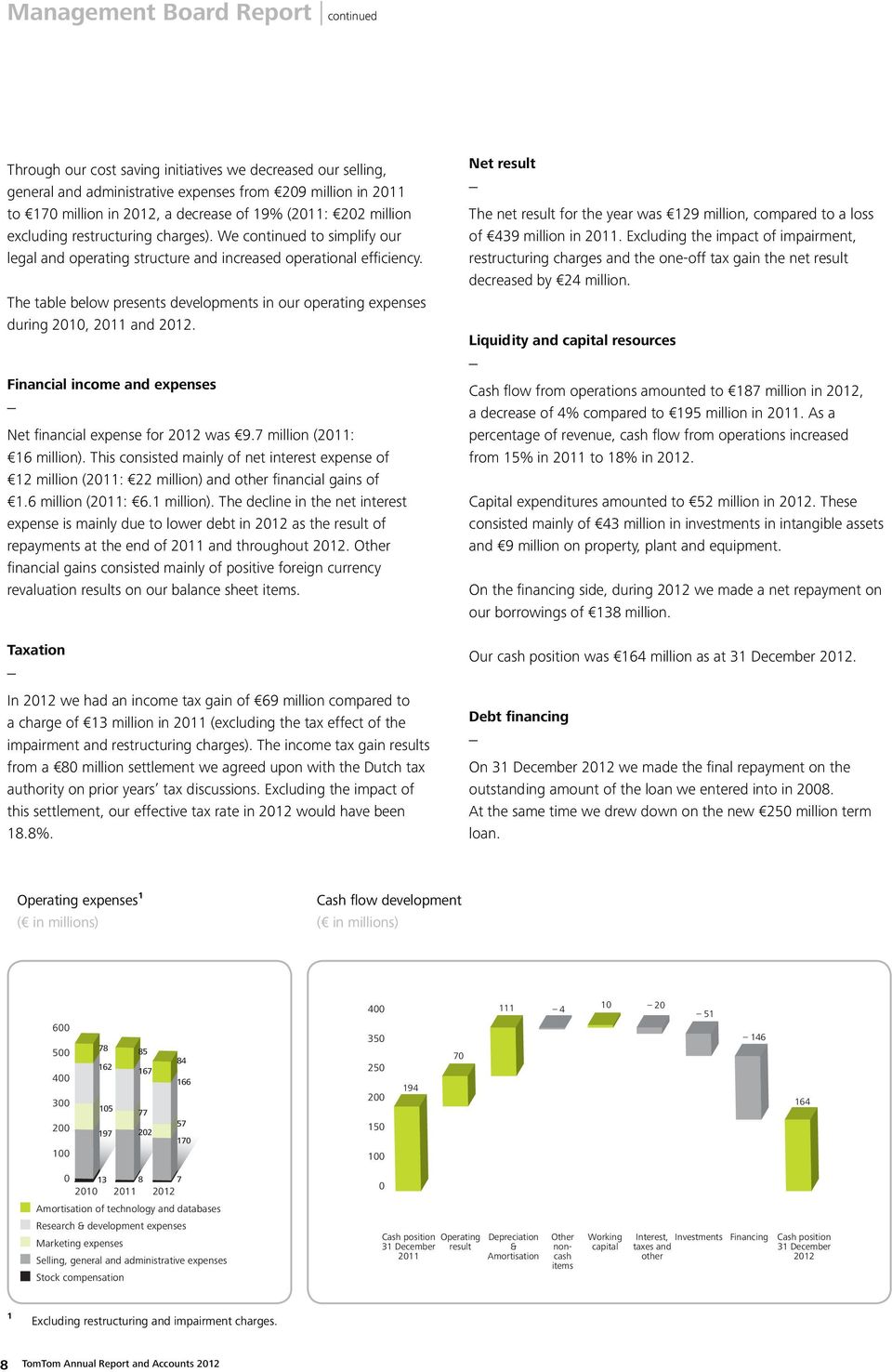
10 Management Board Report continued Through our cost saving initiatives we decreased our selling, general and administrative expenses from 209 million in 2011 to 170 million in 2012, a decrease of 19% (2011: 202 million excluding restructuring charges). We continued to simplify our legal and operating structure and increased operational effi ciency. The table below presents developments in our operating expenses during 2010, 2011 and Financial income and expenses Net fi nancial expense for 2012 was 9.7 million (2011: 16 million). This consisted mainly of net interest expense of 12 million (2011: 22 million) and other fi nancial gains of 1.6 million (2011: 6.1 million). The decline in the net interest expense is mainly due to lower debt in 2012 as the result of repayments at the end of 2011 and throughout Other fi nancial gains consisted mainly of positive foreign currency revaluation results on our balance sheet items. Taxation In 2012 we had an income tax gain of 69 million compared to a charge of 13 million in 2011 (excluding the tax effect of the impairment and restructuring charges). The income tax gain results from a 80 million settlement we agreed upon with the Dutch tax authority on prior years tax discussions. Excluding the impact of this settlement, our effective tax rate in 2012 would have been 18.8%. Net result The net result for the year was 129 million, compared to a loss of 439 million in Excluding the impact of impairment, restructuring charges and the one-off tax gain the net result decreased by 24 million. Liquidity and capital resources Cash fl ow from operations amounted to 187 million in 2012, a decrease of 4% compared to 195 million in As a percentage of revenue, cash fl ow from operations increased from 15% in 2011 to 18% in Capital expenditures amounted to 52 million in These consisted mainly of 43 million in investments in intangible assets and 9 million on property, plant and equipment. On the fi nancing side, during 2012 we made a net repayment on our borrowings of 138 million. Our cash position was 164 million as at 31 December Debt financing On 31 December 2012 we made the fi nal repayment on the outstanding amount of the loan we entered into in At the same time we drew down on the new 250 million term loan. Operating expenses 1 ( in millions) Cash flow development ( in millions) Amortisation of technology and databases Research & development expenses Marketing expenses Selling, general and administrative expenses Stock compensation 0 Cash position Operating 31 December result 2011 Depreciation & Amortisation Other noncash items Working capital Interest, taxes and other Investments Financing Cash position 31 December Excluding restructuring and impairment charges. 8 TomTom Annual Report and Accounts 2012
11 The new term loan is part of the forward-start facility arrangement we signed in April It includes a 150 million revolving credit facility, which remained unutilised on 31 December Netted with the transaction costs, the carrying amount of this 250 million loan at year end was 247 million. Our net debt position on 31 December 2012 was 86 million, down from 194 million at the end of Our leverage ratio reduced from 0.9 at the end of 2011 to 0.5 in Outlook We expect the macro-economic situation to remain challenging. In this environment Consumer will focus on broadening its revenue base consistent with its brand while limiting the revenue decline from PNDs. We expect our core PND markets to decline by 15 20% in volume year over year. Automotive revenue development will largely depend on the new car sales and take rates of our current partners. For Licensing we expect revenue to be broadly stable. Business Solutions is expected to continue to grow strongly. We will continue to maintain our efforts on and investments in technologies and projects that support our strategy and on further increasing our operational effi ciencies across all areas of our business. The number of employees in 2013 is expected to be broadly fl at compared with Human Resources The goal of TomTom s HR Strategy is to ensure that we employ highly talented people who are fully engaged in our business and who deliver high levels of personal performance at work. Our strategy is designed to enable all TomTom employees to work effectively and to enjoy their work. The strategy takes into account the fact that we operate in an ever changing, fast moving marketplace. It is therefore essential that we employ self-motivated people who have the skills and capabilities to deliver on challenging targets. Our HR department develops and manages the careers of approximately 3,500 employees in 57 locations across 35 countries. It is also responsible for the development and delivery of all initiatives to attract and recruit new talent to the company. TomTom believes in fairness. Our employment policies provide equal opportunities for all, regardless of age, gender, ethnicity, social background, religion, disability or sexuality. Employee engagement programme TomTom is currently operating several key HR initiatives as part of the company global employee engagement programme. The aim of these initiatives is to ensure that we are in a position to motivate and manage our employees proactively. They are: Career Development Communication Management & Leadership Organisation Workplace Process and Policies Compensation & Benefi ts Career development The aim of our career development initiative is to motivate and retain employees by providing them with career opportunities and challenging work. Our policy is to assist in the development of our employees careers by promoting from within the company rather than hiring outside, wherever possible. TomTom is committed to enabling our employees to develop their talents and realise their ambitions within the company. As part of this, we have a company-wide Talent Board in place which consists of senior executives. Its purpose is to assist in the development of succession plans and make key investment decisions relating to the career planning and talent development of the people who work for us. Our Succession Planning approach will enable us to identify and support a ready pipeline of talent that is capable of taking on challenging roles and management positions within the company in the future. Communication During 2012 we completed the implementation of our enterprise social media platform. The platform enables employees to communicate with each other and to share knowledge across the company in a direct and interactive manner. It allows employees to connect with experts inside the company, collaborate with remote colleagues and brainstorm new ideas and concepts. To address site needs and concerns, we have established a community of site leaders within the company. The community consists of employees who are responsible for the coordination of activities at each of our 57 sites. The community enables senior management to ensure that headquarters is able to manage communications consistently. It also gives site leaders the opportunity to provide feedback on global processes and policies that may need adapting for local conditions. 9

12 Management Board Report continued Management & leadership TomTom continues to place signifi cant emphasis on enabling our managers to manage people effectively. We fi rst introduced a consistent approach to training our managers in During 2012 we conducted workshops in America, Europe and Asia. To date, we have trained over 200 managers. As part of this initiative, we provide online access to a curriculum of training resources and seminars. During the year we also developed and ran a leadership development programme for executives from across the business. The programme was developed in close cooperation with a global training provider, as well as a number of academics from a leading European business school. We received considerable positive feedback on this, and intend to run another leadership programme in Organisation 2012 saw the introduction of an effective new way of working for our engineering teams. In January, we reorganised our three large functional units into 11 smaller product units. Each product unit is tasked with engineering a specifi c product and also has full responsibility for bringing that product to market. The new model has brought signifi cant improvements in accountability and transparency to our engineering teams. The leaders of the product units are assisted in their tasks by a product offi ce, which is led by TomTom s Chief Technology Offi cer. The product offi ce supplies them with advice on high-level strategic product planning, covering such areas as the competitive environment and roadmaps. The product offi ce also assists in identifying dependencies and challenges between product units, as well as sharing best practices between product units. During 2012, we continued to move a number of engineering and business support roles from the Netherlands to offi ces in Central Europe & India. As at the end of 2012, approximately 35% of our employees are based in the Netherlands. Overall, some 68% of our employees are based in EMEA, 21% in APAC and around 11% in the Americas. Workplace process and policies As a company, we believe that our work processes and employment policies should enable employees to work as effectively as possible. During 2012 we reviewed our employment policies and work processes. Where necessary, we realigned them with the company s strategic objectives. We established cross-business task teams to improve processes and policies that were not fully optimal. We improved reporting tools for line managers which enable them to interact with headquarters more effectively and signifi cantly improve senior management s ability to control the strategic direction of our business worldwide. These improved processes are managed through a new automated system that makes use of state-of-the-art human resources management software. This year we completed the implementation of our online recruitment portal. This ensures that all employees have access to information about vacancies within the company. The opportunities are also made more widely public through links to key social media websites Facebook and LinkedIn. The portal can be accessed at tomtom.jobs.com. Compensation and benefits We believe that our remuneration strategy is a key element in our ability as a company to attract and retain talent. We therefore aim to provide fair, competitive and responsible pay for each of our employees. We achieve this on the basis of a framework for compensation and benefi ts that ensures that packages are consistent worldwide, while taking into account local differences. Compensation Compensation at TomTom is determined by a framework of job ranks and salary structures that applies across the company worldwide. The framework and salary structure harmonises the compensation and benefi ts of all TomTom employees and ensures consistency and equity for each individual employee. The jobranking framework applies to all TomTom employees, while the salary framework is customised by country. Our job grades framework enables us to compare our compensation and benefi ts packages with the markets within which TomTom competes for talent. Salaries are determined objectively in relation to market practice in each country. Our benchmarking analysis on the basis of job grades and content ensures that our employee s compensation packages are competitive as compared to the other companies in our industry. Bonus programmes Our performance-related bonus plan was introduced in It links company performance to individual performance. Annual company fi nancial targets are set, and a bonus pool relating to these targets is determined. A bonus pool is determined on the basis of the annual fi nancial targets. If the company s fi nancial targets are met, eligible employees are allocated an amount from the bonus pool in proportion to their performance. The performance-related bonus plan is a signifi cant part of every employee s total cash compensation. The bonuses paid vary according to the job grade to and refl ect the level of infl uence of each role in the execution of TomTom s strategy. Our performance-related bonus plan is in line with TomTom s vision, which is that success for our business should also mean success for the individual employee. 10 TomTom Annual Report and Accounts 2012
13 Our benchmark analysis of the salary and bonus potential of each employee results in a new set of bonus targets each year. These are differentiated by region and fairly refl ect pay practice in each region, as well as matching our global remuneration policy. Long-term incentive programme Long-term incentives are part of our remuneration policy, both for the Management Board as well as for our employees. They are intended to attract and retain key talent to the company while aligning their interests with those of our shareholders. In 2011 we added two new long-term incentives plans to our existing share option plan. The performance share plan and restricted stock plan have enabled us to continue offering share incentives to eligible employees at a reduced risk of dilution. All long-term incentive plans have a vesting period of three years. Benefits TomTom s new benchmark analysis and job-grading framework have enabled us to harmonise the benefi ts packages enjoyed by our employees. The majority of our employees are now paid according to the same framework and principles. This assures them of equal opportunities within the company, as well as transparency as regards their own remuneration. TomTom is committed to offering all employees a secure pension, and health and disability cover. Accordingly, our benefi t programmes focus primarily on these aspects and their application worldwide. We are committed to ensuring that our employees have access to quality pension, health and disability products, and we offer a product discount programme worldwide as part of our benefi ts package. Corporate Social Responsibility (CSR) Our global strategy for CSR was set in 2011, and focuses on three key areas: Environmental impact. We aim to increase the positive impact of our products on carbon dioxide emissions as well as to manage our own carbon emissions as a company. Supply chain. We aim to ensure that we behave in a socially responsible way towards our consumers, business customers and suppliers. This includes setting targets to meet current industry standards for the electronics manufacturing industry. The areas we cover are: supply chain management, labour conditions, human rights, health, safety and environment. Community giving. We aim to focus on donating our navigation products to selected charitable organisations in order to enable and enhance their work. Environmental impact We believe that the overall impact of TomTom on society is positive. TomTom products enable customers to drive more safely, save fuel and use time more effi ciently. All of these elements together help our customers to reduce carbon dioxide emissions, which contributes to improving the environment. During 2012 we began quantifying the environmental impact of our products on the reduction of carbon dioxide emissions in The results were obtained using our own data and various public sources of information. We have an installed base of approximately 44 million PNDs and over 200,000 subscribers to Business Solutions technology. We estimate that in 2012 these products may have prevented more than 2.3 million metric tons of carbon dioxide from being emitted into the environment. This compares to an estimated 200,000 metric tons of expected average emissions that resulted from all of the company s activities that related to making and shipping these PNDs during the same period. The net saving in emission was therefore approximately 2.1 million metric tons of carbon dioxide. To arrive at a clear view of the net environmental impact of using TomTom products, we used the greenhouse gas accounting and reporting standards established by the World Business Council for Sustainable Development. TomTom has now developed a complete corporate greenhouse gas emission inventory covering all the company s activities. The activities included in our calculations include running our offi ces as well as employee travel. Also included are product lifecycle related emissions such as the manufacturing, transportation, the use of energy resources when charging a device and end-of-life recycling of TomTom products and their packaging. On this basis, we have established that the total emissions of greenhouse gas that result from our day-to-day operations amounted to over 120,000 metric tons in This comprehensive analysis has enabled us to quantify the positive impact of using TomTom products for the fi rst time. We believe that it demonstrates that the positive impact of our products is signifi cantly greater than our own organisational emissions. In 2012, we have taken signifi cant steps towards executing our strategy. 11
14 Management Board Report continued Supply chain TomTom outsources the manufacturing of all its PND and in-dash navigation systems, as well of its accessories and sportwatches. It also outsources its logistics and reverse logistics. Customer care and content production are partly outsourced. Our top 20 tier 1 suppliers operate in 13 countries. Up to 4,000 workers are involved in producing TomTom products. As a company, we are committed to continuous improvement in our supply chain management practices. We believe that it is important that we meet relevant industry standards for the electronics manufacturing supply chain. In 2012, we completed a review of international standards for the ethical management of supply chains. We concluded that membership of the Electronics Industry Citizenship Coalition (EICC) would be effective in enabling us to meet our strategic objectives. At the end of the year, our membership of EICC was approved. TomTom s membership of the EICC demonstrates that we are committed to fully supporting the mission, vision, goals, bylaws and membership requirements of that organisation, as well as its Code of Conduct. Membership of the EICC gives us access to upto-date research and methodologies with regard to international benchmarks on sustainability practices in the electronics industry. It will help us to progressively align our management of our supply chain with the most relevant standards for our industry. It will enable us to track our policies, targets and performance in relation to those standards and to calibrate them as they evolve. And fi nally, it will also allow us to participate with industry peers in key developments with regard to supply chain practices. Wherever possible, TomTom will seek to adopt the EICC approach and tools in practical ways and in the spirit of the industry s common goals. We note that the past four years have seen a dramatic growth in the adoption of new environmentally related product legislation. Compliance is crucial for our brand and business and we ensure that we always take suffi cient steps to achieve compliance. In 2012 we invested in a legislative tracking and management tool that comprehensively supports our internal processes for ensuring compliance with relevant environmental product legislation. Community giving In 2012, we piloted a programme focused on donating our products to charitable organisations that rely on vehicles to reach the communities they serve. All of the PNDs and/or map updates that were donated in 2012 were provided to charitable organisations that operate in areas that are related to our own business focus in some way: disaster emergency relief, the charitable care community, road safety and disadvantaged youth. As a result of our donations, TomTom products have enabled recipient charities to achieve their missions. TomTom PNDs are being used to enhance the response times of voluntary ambulance or community based nursing care services in a range of locations around the world including the UK, the United States and Switzerland. Using our navigation tools enables these organisations to administer critical care quickly and effi ciently. Though we initiated these donations relatively recently, they are already demonstrating the value and benefi t that TomTom products can have in assisting charitable organisations to save and enhance the lives. At the same time, our navigation tools also help them to be more effi cient, saving fuel and money. In 2011 we said that we were at the start of the next phase of our journey in CSR. This year we have established a solid foundation on which to build our CSR programmes. We will continue to drive the development and continuous improvement of these activities in line with our overall strategy. For more details on our CSR programme please refer to Business Risks Our group can be adversely affected by a variety of business risks and economic developments. A structured risk management process helps management to better understand how risks might impact the company and to take risks in a controlled manner. We update our business risk profi le every year in order to manage our most important risks. We do not quantify these risks or specify a list of the top fi ve risks as we believe that the careful management of all these risks is important and that singling out particular risks could be misleading to investors. The sequence of risks below in no way refl ects an order of importance, vulnerability or materiality. Approach to risk management Our Executive Committee determines the risk management priorities for the group. Lead ownership for each risk is taken on by an Executive Committee member, which helps to achieve clear accountability for the mitigating actions. The Business Assurance department facilitates the annual assessment of business risks, which ensures an appropriate level of objectivity in our assessment of risks. The business risk profi le is taken into account when establishing our annual business plans and budgets. 12 TomTom Annual Report and Accounts 2012
15 Group risk profile Below is an overview of the business risks that we believe are most relevant to the achievement of our long-term goals and strategy. This overview is not exhaustive and should be considered in connection with forward-looking statements. There may be risks not yet known to us or which are currently not deemed to be material, which could later turn out to have a signifi cant impact on our business or have a material adverse effect on TomTom s fi nancial condition, results of operations and liquidity. Strategic risks Changing competitive landscape We operate in a highly dynamic and competitive industry. Failure to adapt our organisation to industry trends or otherwise remain competitive could have a material adverse effect on our business and TomTom s fi nancial condition, results of operations and liquidity. Many of our current competitors are large, well-known organisations with greater fi nancial, technical and human resources than our group. They may have greater ability to fund product research and development and capitalise on potential market opportunities. New competitors interested in the same markets and products may also emerge. We have entered into a number of strategic partnerships and joint ventures to bring competitive product and service offerings to market. If any of our strategic partners fail to perform as planned or if we fail to fi nd suitable partners for our business activities, we may be unable to bring our products and services to the market and maintain a competitive market position. Global economics The majority of our sales are generated in Europe which makes us vulnerable to the economic challenges and fi scal austerity currently being experienced across the European Union in the wake of the global fi nancial crisis. The US is also an important market for us and any further deterioration in consumer demand as a result of the global economic climate would also have a negative impact on our fi nancial results. The majority of our purchases are made in USD. Any devaluation of the euro against the USD would therefore have a negative impact on our profi tability. Although we use foreign exchange contracts to hedge activities, these are short term in nature. The impact of global economic conditions on consumer demand could impair our ability to generate suffi cient cash fl ow to support our investment plans. These or other unforeseen macro-economic conditions may render us unable to implement our strategic agenda as planned and consequently could have a material adverse effect on TomTom s fi nancial condition, results of operations and liquidity. Geographical sustainability Currently the North American market offers substantial business opportunities to us, especially as regards sales of navigation solutions. We view maintaining and preferably growing market share as a vital element of being successful in the US market. However, macro-economic conditions and competitive effects may render us unable to maintain sales volume and profi ts in North America and retailer support for our products and services could decline, impacting our ability to maintain market share and average selling prices in the region. Our aspiration to grow in high growth markets such as India, China and Brazil will expose us to additional political, social and economic risks. We cannot be certain that our products and services will meet consumer acceptance in these markets and we may be unable to realise our growth objectives in these emerging markets. If we are unable to maintain our market share in North America or realise our growth plans in emerging markets our anticipated revenues and profi ts could be adversely affected. Automotive The automotive market is continuously evolving with respect to navigation. Although the navigation experience for our end-users is similar, whether the navigation system is built in the dash or provided on a PND, the dynamics of supplying to the automotive industry are very different from those for delivering mass-market consumer electronics. There are additional operational and technical challenges in growing our automotive business and maintaining profi tability over the longer term in such a rapidly evolving environment. Furthermore, new map providers may choose to enter the automotive market which could signifi cantly increase the level of competition we face. If we are unsuccessful in maintaining and growing a profi table automotive business, our fi nancial condition, results of operations and liquidity may be materially adversely affected. Brand All our products and services are brought to market under one brand. This leads to brand concentration risk. Brand value can be severely damaged even by isolated incidents affecting the reputation of our business or our products and services. Some of these incidents may be beyond our ability to control and can erode consumer confi dence in our products or services. Factors that negatively affect our reputation or brand image, such as adverse consumer publicity, inferior product quality or poor service, could have a material adverse effect on our fi nancial condition and results of operations. 13

16 Management Board Report continued Innovation Our markets are characterised by rapid technological change, which challenges us to deliver highly competitive products. We will continue to focus on producing high quality navigation solutions, but there can be no guarantee that our products will compete successfully against current or new market entrants or competing technologies. Our success depends on our ability to rapidly develop, market and commercialise new and upgraded products and services. The timing of our new product and service releases, our ability to accurately forecast market demand, our product mix relative to that of our competitors and our ability to understand and meet changing consumer preferences are vital to this effort. Not meeting these challenges could have a material adverse effect on our fi nancial condition and results of operations. We aim to bring the highest calibre people into our organisation. We have a rigorous recruitment process so that we can have high levels of confi dence in the people we hire. To retain talent within our organisation we monitor the organisational health of the company and have programmes in place to retain key employees. However, if we are unable to attract and retain the high calibre people we require, our ability to operate our business successfully could be signifi cantly impaired. Supply chain We depend on a limited number of third parties and, in certain instances, on sole suppliers for component supply and manufacturing. Any disruption to or termination of our relationships with third party manufacturers, suppliers or distributors, or any reduction in their ability to supply our needs would adversely affect our business. 14 Digital mapping The competitive environment requires continuous investment in new technology for creating and updating map databases. Maps need to be continuously updated for changes in the environment and we are continuously adding new geographies to our map database to be able to meet the needs of existing customers, bring out new products and expand into new markets. If we are unable to invest suffi ciently to compete in terms of both quality and coverage with other global map providers our business, our fi nancial condition, results of operations and liquidity may be materially adversely affected. Dependency on GPS satellites Our navigation products and services depend on GPS satellite transmissions that provide position data to our customers. GPS satellites are funded and maintained by the US government. We have no control over their maintenance, support or repair. The availability and free use of GPS signals to the level of accuracy required for commercial use remains at the sole discretion of the US government. GPS signals are carried on radio frequency bands. Any reallocation of, or interference with these bands could impair the functionality of our products. Alternate systems are in various stages of development, but again these systems remain under the control of sponsoring governments and we cannot be certain that our products and services will be compatible with these new systems. Operational risks Human resources In order to be a market leader in our industry you need to have the most talented people working effectively together. The success of our business depends on attracting, integrating and retaining highly skilled personnel in all business units and development centres. TomTom Annual Report and Accounts 2012 Our highest volume products rely on a system of dual-sourced production from two different manufacturing partners. However, our capacity to deliver innovative products to the market means that we will continue to be dependent to some extent on components that are only available from specifi c leading technology organisations. Single-source component risk will remain a part of our business model for the foreseeable future. If we are unable to source any critical components, particularly critical single-source components, our business could be signifi cantly impaired and our fi nancial condition, results of operations and liquidity could be materially adversely affected. Product quality Our industry is characterised by frequent technological advances. In order to remain competitive, we need to continuously innovate to introduce new and upgraded products and services. Diffi culties may be experienced that delay the development, introduction or market acceptance of our new or enhanced products. Furthermore, we develop complex hardware and software products which may experience material defects, errors or failure. We have internal quality control standards and procedures to mitigate these risks that require our contract manufacturers to conduct additional quality control testing according to our standards and guidelines. However, should any of our products fail to operate as intended or otherwise experience quality problems our reputation and brand value may suffer and we may be exposed to increased operating costs and the possibility of signifi cant consumer product liability which could adversely affect our fi nancial condition, results of operations and liquidity. Performance of real time services As part of our service to our customers, we provide real-time services such as WEBFLEET and HD Traffi c. To provide these services to our customers we rely on our own, as well as outsourced, information technology, telecommunications and other infrastructure systems.

17 A signifi cant disruption to the availability of these systems could cause interruptions in our service to customers, loss of, or delays in, our research and development work and/or product shipments. Any such service interruptions may occasion signifi cant reputational damage amongst customers and distributors and could have a material adverse effect on our fi nancial condition and results of operations. Navigation The navigation industry is shifting towards the provision of offthe-shelf map-based navigation components that require the minimum of integration effort and allow for differentiation by enabling these components to be combined and pre-integrated into proprietary Connected Navigation Systems. Consumers and automotive manufacturers will increasingly expect cars and in particular car infotainment systems to be connected to the cloud and to provide a seamless user experience across different devices (car, smartphone, web) and relevant content and services such as real-time traffi c and routing, remote car diagnostics and an application store. If we are unable to develop products that allow us to compete successfully in the emerging world of the connected car, our future growth potential, our fi nancial position and results of operations could be materially adversely affected. Disaster recovery planning We provide fl eet management services, live traffi c data and sales via our web store on a 24-hour basis. Unforeseen business disruptions could severely affect our business activities and the services we offer to our customers. Any permanent or temporary loss of these systems would result in reputational damage, loss of revenue and liabilities to our clients. In the case of a catastrophic disaster our company s success rests on our ability to restore our critical data and rebuild our IT business systems. We have business continuity and disaster recovery planning in place for certain systems and various eventualities. However, we are unable to plan for every possible disaster or incident. A major failure of a business critical system from which we are not able to quickly recover could have a material adverse effect on our fi nancial condition, results of operations and liquidity. Legal and compliance risks We may be faced with claims that we have infringed the intellectual property rights or patents of others, which if successfully asserted against us may result in us being ordered to pay substantial damages or forced to stop or delay the development, manufacture or sale of infringing products. Any such outcome could have a material adverse effect on our fi nancial condition, results of operations and liquidity. Furthermore, even if we were to prevail, any litigation could be costly and time-consuming. Privacy of customer data The focus of our business providing location-based products and services to individual customers, growing public awareness and increased scrutiny by regulatory authorities, particularly in the EU, means that compliance with privacy regulations and customer expectations is increasingly important in maintaining our competitive position. While we anonymise the trace data we collect from our individual customers, and while our privacy programme is intended to ensure TomTom s Privacy Principles are adhered to throughout our operations and in the design of our products and services, our reputation and brand may suffer if we fail to comply with privacy regulations or otherwise fail to meet our customers expectations in relation to privacy matters. Information security The integrity of our intellectual property and the continuity of our business operations are substantially dependent on our ability to maintain security over confi dential information regarding our customers, employees, suppliers, proprietary technologies and business processes. Our information security programme requires that we deploy controls, processes and tools in our operations and products to maintain the confi dentiality, availability and integrity of such confi dential information. However, the volume and sophistication of information security threats continues to grow. Leaks of confi dential information, unauthorised use of our systems and networks or defective products could adversely affect our business and could have a material adverse effect on our fi nancial conditions, results of operations and liquidity. Financial risks Financial risks are presented in the 2012 Financial Statements on pages 45 to 47. Intellectual property We rely on a combination of trademarks, trade names, patents, confi dentiality and non-disclosure clauses and agreements, copyrights and design rights to defend and protect our trade secrets and rights to the intellectual property in our products. Corporate Governance For the description of our corporate governance structure reference is made to the separate section on page

18 Management Board Report continued In Control Statement and Responsibility Statement The Management Board is responsible for TomTom s risk management and internal control systems. The Management Board believes that the company maintains an adequate and effective system of risk management and internal control that complies with the Dutch Corporate Governance Code (the Code). The internal control systems are designed to manage, rather than eliminate, the risk of failure to achieve business objectives and can provide reasonable, but not absolute, assurance against fi nancial loss or material misstatements in the fi nancial statements. TomTom views the management of risk as a management activity. The Management Board reviews the effectiveness of TomTom s systems of internal control relative to strategic, fi nancial, operational and compliance risks and discusses risk management and internal controls with the Audit Committee on at least a quarterly basis. TomTom embeds risk management in its strategic business planning. A top-down approach is followed in which management identifi es the major risks that could affect the company s business objectives and assesses the effectiveness of the processes and internal controls in place to manage and mitigate these risks. For an overview of our most important business risks, please refer to the Business Risks section on pages Assurance on the effectiveness of controls is obtained through management reviews, control self-assessments, internal audits and testing of certain aspects of the internal fi nancial control systems by the external auditors during their annual audit. This, however, does not imply that TomTom can provide certainty as to the realisation of business and fi nancial objectives, nor can the approach taken by the company to internal control over fi nancial reporting be expected to prevent or detect all misstatements, errors, fraud or violation of law or regulations. The key features of the systems of internal control are as follows: Clearly defi ned lines of accountability and delegation of authority are in place, together with comprehensive reporting and analysis against approved budgets. Operating risk is minimised by ensuring that the appropriate infrastructure, controls, systems and people are in place throughout the business. An organisational design is in place that supports business objectives and enables staff to be successful in their roles. Treasury operations manage cash balances and exposure to currency transaction risks through treasury policies, risk limits and monitoring procedures. A Code of Ethics is embedded in the TomTom culture and is accessible to all staff via the intranet. The key controls over fi nancial reporting policies and procedures include controls to ensure that: commitments and expenditures are appropriately authorised by the Management Board records are maintained which accurately and fairly refl ect transactions any unauthorised acquisition, use or disposal of TomTom s assets that could have a material effect on the Financial Statements are detected on a timely basis transactions are recorded as required to permit the preparation of fi nancial statements, and TomTom is able to report its fi nancial statements in compliance with IFRS. The Management Board believes, based on the activities performed in 2012 and in accordance with best practice provision II.1.5 of the Code, that the risk management and control systems with regard to the fi nancial reporting risks have functioned effectively in 2012, and that the risk management and control systems provide reasonable assurance that the 2012 fi nancial statements do not contain any errors of material importance. With reference to the statement within the meaning of article 5:25 (2c) of the Financial Supervision Act, the Management Board states that, to the best of its knowledge: the annual fi nancial statements give a true and fair view of the assets, liabilities, fi nancial position and profi t or loss of the company and the undertakings included in the consolidation taken as a whole; and that the Management Board Report includes a fair review of the development and performance of the business and the position of the company and the undertakings included in the consolidation taken as a whole, together with a description of the principal risks and uncertainties that the company faces. Amsterdam, 12 February 2013 The Management Board Harold Goddijn CEO Marina Wyatt CFO Alain De Taeye 16 TomTom Annual Report and Accounts 2012
19 Corporate Governance TomTom takes its commitments to all stakeholders seriously. These include consumers, shareholders, employees and business partners. We aim to be as transparent and accountable as possible in our way of doing business. For this reason, TomTom has a corporate governance structure in place, which we monitor closely. As a listed company, TomTom is subject to the Dutch Corporate Governance Code (the Code). Our Management Board and Supervisory Board have striven to comply with the guidelines laid down in the Code and will continue their efforts to do so. Any substantial change in TomTom s corporate governance structure will be explained to the shareholders at an Annual General Meeting. The Corporate Governance Code We apply all of the relevant provisions of the Code. There are two exceptions, which we explain below. Options granted to members of the Management Board under the 2005 Share Option Plan prior to 31 December 2005 vest unconditionally and can be exercised after a threeyear period following the grant date. No predetermined performance criteria were established for these share options, as the industry of portable navigation was at a relatively nascent stage and we believed that setting credible, predetermined performance criteria would not be practicable at that time. This is not in line with best practice provision II.2.4, which provides that the number of options granted shall be dependent on the achievement of challenging targets specifi ed beforehand. Options granted to the Management Board members in 2009 and 2010 under the TomTom Management Board Stock Option Plan 2009 vest as follows: one third of the options granted vest after one year, another one third vest after two years and the fi nal one third vests after three years following the grant date. This vesting timeline is not in line with best practice provision II.2.4. At the time the plan was introduced, we were operating in a rapidly changing environment that was highly competitive. The plan was designed to attract people of the highest calibre and retain key talent in the company. We also wanted to align TomTom s long-term incentives with common practice amongst international companies operating in the technology sector. To ensure that the plan fulfi lled this aim, in 2009 and 2010 the company opted for the vesting timeline outlined above. The vesting timeline of the plan was amended at the Annual General Meeting in 2011 (the Management Board Stock Option Plan) to emphasise the longterm retention element of the plan and align it with the Code. As a result, all options granted under the Management Board Stock Option Plan vest three years after the grant date. This is in line with the requirements of the Code. The number of options that vest is subject to the achievement of predetermined performance criteria. Options vested under this plan can be exercised during a period of seven years following the grant date. Best practice provision IV.1.1 provides that a company s General Meeting may pass a resolution to set aside the binding nature of a nomination for the appointment of a member of the Management Board or the Supervisory Board and/or a resolution to dismiss a member of the Management Board or of the Supervisory Board by an absolute majority of the votes cast. It may be provided that this majority should represent a given proportion of the issued capital, which proportion may not exceed one third of the issued share capital. TomTom s Articles of Association provide that a binding nomination for the appointment of members of the Management Board or of the Supervisory Board may only be set aside by a resolution of the General Meeting passed with a two-thirds majority representing more than 50% of its issued share capital. The same provision applies to any resolution to dismiss a member of the Management Board or of the Supervisory Board. The company deviates from the best practice provision outlined in the preceding paragraph because it believes that maintaining continuity in its Management Board and Supervisory Board is critical for delivering longterm shareholder value. The company would like to protect its stakeholders against a sudden change in management by maintaining the qualifi ed majority and voting quorum requirement, which is consistent with Dutch law. Management Board General The Management Board is responsible for the day-to-day management of the operations of the company. Its responsibilities involve setting and achieving the company s strategic objectives, managing the company s strategic risks, legal compliance and corporate social responsibility matters insofar as these are relevant to the company s business. In these areas the Management Board is accountable to the Supervisory Board and to the General Meeting. In performing its duties, the Management Board is guided by the interests of the company, taking into consideration the interests of the company s stakeholders as a whole. The Management Board must provide the Supervisory Board with all information necessary for the exercise of the duties of the Supervisory Board in a timely manner. Furthermore, the Management Board must consult with the Supervisory Board on important matters and submit important decisions to the Supervisory Board for its prior approval. 17

20 Corporate Governance continued Composition and appointment The Articles of Association provide that the Management Board must consist of at least two members. Each member of the Management Board is appointed for a maximum period of four years and may be re-appointed for another period of not more than four years. The General Meeting appoints the members of the Management Board, subject to the right of the Supervisory Board to make a binding nomination. The General Meeting may at all times, by a resolution passed with a majority of at least two-thirds of the votes cast, and representing more than 50% of the issued share capital, resolve that the nomination submitted by the Supervisory Board is not binding. In such a case, the General Meeting may appoint a member of the Management Board in contravention of the Supervisory Board s nomination by a resolution passed with a majority of at least two-thirds of the votes cast, representing more than 50% of the issued share capital. If the Supervisory Board fails to use its right to submit a binding nomination, the General Meeting may appoint members of the Management Board with a majority of at least two-thirds of the votes cast, representing more than 50% of the issued share capital. A resolution of the General Meeting to suspend or dismiss members of the Management Board requires a majority of at least two-thirds of the votes cast, representing more than 50% of the company s issued share capital. Members of the Management Board Biographies of the members of the Management Board, as well as other details relating to their careers can be found in the Profi les of the Management Board section on page 23. Remuneration Upon a proposal by the Remuneration Committee, the Supervisory Board determines the remuneration of the individual members of the Management Board in accordance with the Remuneration Policy for the Management Board. This policy was adopted in 2009 and amended by the Annual General Meeting in The Supervisory Board must present any plan providing for the remuneration of the members of the Management Board in the form of shares and options to the General Meeting for approval. For further information about the remuneration of the members of the Management Board, see the Remuneration Report included in the Supervisory Board Report, as well as note 7 to the consolidated fi nancial statements. Conflicts of interests Members of the Management Board must report any (potential) confl ict of interests to the Chairman of the Supervisory Board, and provide all relevant information. The Supervisory Board shall decide whether a confl ict of interests exists. The member of the Management Board who has the (potential) confl ict of interests may not be present at such meetings. During 2012, no such confl icts of interests were reported. Supervisory Board General The main task of the Supervisory Board is to supervise the activities of the Management Board and the company s general course of affairs and its business. The Supervisory Board may on its own initiative provide advice to the Management Board. The Management Board can also request the Supervisory Board s advice. The Supervisory Board acts in the interest of our company as well as that of its stakeholders as a whole in performing its duties. The Articles of Association require that certain decisions of the Management Board be subject to the approval of the Supervisory Board. Resolutions of the Management Board to issue shares, grant rights to acquire shares or to restrict or exclude pre-emptive rights require prior approval of the Supervisory Board. Other resolutions requiring such approval include amongst others (i) proposals to amend the Articles of Association; (ii) proposals to conclude a legal merger or a legal demerger; and (iii) proposals to reduce the issued share capital. Composition and appointment The Articles of Association provide that the Supervisory Board should consist of three or more members. Each member of the Supervisory Board is appointed for a maximum of four years. This appointment can be renewed for two additional periods of not more than four years. The General Meeting appoints the members of the Supervisory Board, subject to the right of the Supervisory Board to make a binding nomination. The General Meeting may at all times, by a resolution passed with a majority of at least two-thirds of the votes cast, and representing more than 50% of the issued share capital, resolve that the nomination submitted by the Supervisory Board is not binding. In such cases, the appointment of a member of the Supervisory Board in contravention of the nomination requires a resolution of the General Meeting adopted with a majority of at least two thirds of the votes cast, representing more than 50% of the issued share capital. The Supervisory Board appoints a Chairman and a Deputy Chairman from amongst its members. The members of the Supervisory Board retire periodically in accordance with a rotation plan. A resolution of the General Meeting to suspend or dismiss members of the Supervisory Board requires a majority of at least two-thirds of the votes cast, representing more than 50% of the issued share capital. The Supervisory Board has determined a profi le regarding its size and composition taking into account the nature of TomTom s 18 TomTom Annual Report and Accounts 2012
21 business, its activities and the desired expertise. The Supervisory Board aims for a diverse composition and will strive for a fair balance between experience, expertise, gender, age and background. When nominating a candidate for (re-)appointment, however, the qualifi cations of the candidate and the specifi c requirements of the positions to be fi lled will prevail. The Supervisory Board profi le and other rules and regulations covering its decision-making process are posted on TomTom s corporate website. Members of the Supervisory Board Biographies of the members of the Supervisory Board, as well as other details relating to their careers can be found in the Profi les of the Supervisory Board section on page 24. Shareholders Cyrte Investments BV and Janivo Holding BV together have the right to nominate a candidate for an additional seat on the Supervisory Board. This right was not exercised in The Supervisory Board confi rms that its current composition has the necessary experience, expertise and independence to ensure that its members are able to properly execute their duties. All appointments were made in accordance with the Supervisory Board profi le resulting in the current composition of the board. The Supervisory Board is of the opinion that the addition of a female Supervisory Board member would be greatly benefi cial to its functioning and would mirror the profi le of the company s Management Board and senior management. Therefore the Supervisory Board commits to doing its utmost to identify and nominate a female candidate on the company s Supervisory Board. The committees The Supervisory Board has established an Audit Committee, a Remuneration Committee and a Selection and Appointment Committee. Each of these committees is staffed by members of the Supervisory Board. The Audit Committee oversees all activities of the Management Board that relate to the company s internal risk management and control systems. These include the operation of codes of conduct, the provision of fi nancial information by the company, the performance of our external auditor and internal audit function, the policy of the company on tax planning, the fi nancing of the company and the use of information and communication technology. The Remuneration Committee formulates proposals for the Remuneration Policy for the Management Board, which it submits to the Supervisory Board. The Remuneration Committee also formulates proposals for the remuneration of the individual members of the Management Board and prepares the remuneration report that is included in the annual report. The Selection and Appointment Committee oversees the drawing up of selection criteria and appointment procedures for Supervisory Board members and Management Board members. It assesses the size and composition of the Supervisory Board and the Management Board, formulates proposals concerning the profi le and composition of the Supervisory Board and makes proposals for appointments and re-appointments. Succession planning for senior management in general, and related topics, are another focus of the Selection and Appointment Committee. The terms of reference of each committee can be found on our corporate website. Remuneration The remuneration of the Supervisory Board members and the additional remuneration for the Chairman and the members of its committees is determined by the General Meeting. Members of the Supervisory Board are not authorised to receive any payments under the company s pension or bonus schemes or under the option or share plans. The annual remuneration of the Supervisory Board and subcommittees membership remained unchanged during The annual remuneration of the Chairman of the Supervisory Board is 50,000; the other Supervisory Board members receive 40,000. The annual remuneration for the Chairman of the Audit Committee is 10,000, while the other members of the committee receive 7,000. The annual remuneration of the Chairman of the Remuneration Committee and of the Chairman of the Selection and Appointment Committee is 7,000, while the other members of these committees receive 4,000. The remuneration of Supervisory Board members and committee members is proportional to the number of months served. The aggregate remuneration of the Supervisory Board members in 2012 amounted to 304,000. For more detailed information about the remuneration of individual members of the Supervisory Board see note 7 to the consolidated fi nancial statements. Conflicts of interests Members of the Supervisory Board (excluding the Chairman) must report any (potential) confl ict of interests to the Chairman of the Supervisory Board, and provide all relevant information. Where the (potential) confl ict of interests involves the Chairman of the Supervisory Board it must be reported to the Deputy Chairman of the Supervisory Board. The Supervisory Board shall decide whether a confl ict of interests exists. The member of the Supervisory Board who has a (potential) confl ict of interest may not be present at such meetings. No member of the Supervisory Board may take 19
22 Corporate Governance continued part in any discussions or decision-making relating to a subject or a transaction in which he has a (potential) confl ict of interest with the company. Such transactions are disclosed in the annual report. No such confl icts of interest were reported during Shareholdings Rob van den Bergh owns 5,000 shares in the company. These shares are held as a long-term investment within the meaning of best practice provision III.7.2 of the Code and were not granted as part of his remuneration. General Meeting Functioning of the General Meeting The Annual General Meeting must be held within six months of the end of each fi nancial year. The compilation of the annual report is a recurring agenda item, as are the adoption of the annual accounts and the release from liability of the members of the Management Board and Supervisory Board. When the company s interests so require, an Extraordinary General Meeting may be convened by resolution of the Management Board or the Supervisory Board. Shareholders may appoint a proxy who is then empowered to vote on their behalf in the General Meeting. The minutes and the resolutions of the General Meeting are recorded in writing. The minutes will be made available to the shareholders on our corporate website no later than three months after the meeting. Voting rights Each of our ordinary shares and preferred shares is entitled to one vote. Shareholders may vote by proxy. The voting rights attached to any company shares held by the company are suspended as long as they are held in treasury. Resolutions of the General Meeting are adopted by an absolute majority of votes cast except where Dutch law or our Articles of Association provide for a special majority. According to our Articles of Association, the following decisions of the General Meeting require a majority of at least two thirds of the votes cast, representing more than 50% of our issued share capital: resolution to cancel a binding nomination for the appointment of a member of our Management Board or Supervisory Board; resolution to appoint a member of the Management Board or Supervisory Board in contravention of the list of nominees submitted by the Supervisory Board; and a resolution to dismiss or suspend a member of the Management Board or Supervisory Board. In addition, in accordance with Dutch law, our Articles of Association provide that, if less than 50% of our issued share capital is represented at the meeting, certain decisions of the General Meeting require a majority of at least two-thirds of the issued capital represented. This includes decisions of our General Meeting regarding: the restriction and exclusion of pre-emptive rights, or the designation of the Management Board as the authorised body to exclude or restrict such rights; the reduction of our issued share capital; and a legal merger or demerger of the company. Amendment of the Articles of Association The General Meeting may resolve to amend the Articles of Association of the company if it acts on a proposal by the Management Board that has also been approved by the Supervisory Board. A resolution of the General Meeting to amend the Articles of Association requires an absolute majority of votes cast irrespective of the share capital represented at the General Meeting. The capital structure The company s authorised share capital amounts to 180,000,000 and is divided in 600,000,000 ordinary shares with a nominal value of 0.20 each and 300,000,000 preferred shares, with a nominal value of 0.20 each. On 31 December 2012, a total of 221,895,012 ordinary shares were in issue. Issue of shares The Management Board has the power to issue shares or grant rights to acquire shares if so designated by the General Meeting or our Articles of Association. This Management Board resolution is subject to the prior approval of the Supervisory Board. No resolution of the General Meeting or the Management Board is required for an issue of shares pursuant to the exercise of a previously granted right to subscribe for shares. The Management Board continues to believe it is in the company s best interests that it should be in a position to react promptly when business opportunities arise that require the issue of ordinary shares. When such occasions arise, the Management Board therefore wishes to be authorised to issue ordinary shares and to grant rights to subscribe for such shares without the need to obtain prior approval from company shareholders at an Extraordinary General Meeting. Such meetings would take time to convene. They could also generate disruptive market speculation. In April 2012 the Annual General Meeting passed a resolution extending the Management Board s authorisation to resolve to issue ordinary shares or grant rights to subscribe for such shares until 26 October This authority is limited to 10% of the number of issued ordinary shares for general purposes (or limited 20 TomTom Annual Report and Accounts 2012
23 to 20% in case of a merger or acquisition) and to restrict or exclude the pre-emption rights for existing shareholders for such issue or grant of rights. Separately, the Management Board has been authorised to grant rights to subscribe for ordinary shares and to restrict or exclude the pre-emption rights for existing shareholders for those rights, up to 4,620,000 ordinary shares for the purpose of executing the TomTom Employee Stock Option Plan and the Management Board Stock Option Plan. The authorisation was subject to the prior approval of the Supervisory Board. It was granted for a period starting from the 2012 Annual General Meeting and ending with the Annual General Meeting to be held in In addition to the authorisations referred to above, the Management Board has been granted authority to issue preferred shares or to grant rights to subscribe for preferred shares and to restrict or exclude existing shareholders pre-emption rights for those rights. The authorisation was subject to the prior approval of the Supervisory Board and applies until 26 October For further information on this authority of the Management Board, see the protection mechanism section below. Repurchase by the company of its own shares During the 2012 Annual General Meeting, the Management Board was authorised to acquire shares in the capital of the company up to 10% of the issued share capital. The authorisation was granted for a period of 18 months, and will be in effect until 26 October Protection mechanism Foundation Continuity TomTom A foundation, the Stichting Continuïteit TomTom (the Foundation) was established on 26 May 2005 to act as an instrument that protects the company against hostile takeovers and to protect the company s interests in a variety of other situations. The purpose of the Foundation is to safeguard the company s interests and those of its subsidiaries, as well as the interests of all stakeholders of the organisation. It does so by ensuring that the company is in a position to resist infl uences which could affect its independence, continuity and/or corporate identity in any manner that would be in contravention of the interests of the company or its stakeholders. The company has granted the Foundation a call option (the Call Option) entitling it to subscribe for preferred shares. The authority is limited to 50% of the aggregate outstanding share capital (excluding issued and outstanding preferred shares) of the company at the time of issue. An issue of preferred shares in the manner described would cause substantial dilution to the voting power of any shareholder whose objective was to gain control of the company. We believe that such an issuance of preferred shares or the granting of rights to subscribe for preferred shares to the Foundation may help to prevent, discourage or otherwise delay unsolicited attempts to obtain (de facto) control of the company. We also believe that these measures will strengthen our position in relation to potential bidders, and allow us to seek alternatives. Currently there are no preferred shares outstanding. The Management Board of the company and the Board of the Foundation declare that the Foundation is independent vis à vis the company. Management Board authority to issue additional preferred shares As mentioned above, during the Annual General Meeting held in April 2012, a resolution was passed to extend the authority of the Management Board to issue preferred shares, to grant rights to subscribe for such shares and to restrict or exclude the pre-emption rights for existing shareholders for those rights until 26 October The aforementioned authority is limited to 50% of the aggregate outstanding share capital (excluding issued and outstanding preferred shares) of the company at the time of issue. The members of the Management Board believe that there may be circumstances in which they and the Supervisory Board feel that the interests of the company and its stakeholders require the issue of additional preferred shares. They may believe, for example, that the Foundation is not able to acquire a suffi cient number of preferred shares to be effective in its function. Also a situation could occur whereby the Foundation has already exercised its Call Option and subsequently the preferred shares have been cancelled. As with the instrument in place for the Foundation, any possible issuances of preferred shares will be temporary and subject to the company s Articles of Association and the legislation on takeovers. Pursuant to the Articles of Association, a resolution of our Management Board to issue preferred shares or to grant rights to subscribe for preferred shares, as a result of which the aggregate nominal value of the issued preferred shares will exceed 50% of the issued capital of ordinary shares at the time of issue, will at all times require the prior approval of the General Meeting. Upon the issue of preferred shares, subscribers for preferred shares must pay at least 25% of the nominal value of the preferred shares. Each transfer of preferred shares requires the approval of the Management Board and Supervisory Board. No resolution of the General Meeting or the Management Board is required for an issue of preferred shares pursuant to the exercise of a previously granted right to subscribe for preferred shares (including the right of the Foundation to acquire preferred shares pursuant to the Call Option). 21
24 Corporate Governance continued The issuance of preferred shares is intended as a temporary measure. Unless the preferred shares have been issued by a vote of the General Meeting, our Articles of Association require that a General Meeting be held within six months after the issue of preferred shares to consider their purchase or withdrawal. If no resolution on the purchase or withdrawal of the preferred shares is adopted at such a General Meeting, a General Meeting will be held every six months thereafter for as long as preferred shares remain outstanding. Mandatory statement within the meaning of the Governmental Decree of 20 March 2009 on Corporate Governance The Management Board states that all the information required under the Dutch Governmental Decree of 20 March 2009 on Corporate Governance is disclosed in the Corporate Governance section of this annual report to the extent that it is applicable to TomTom. Obligations of shareholders to disclose holdings Under the Financial Supervision Act, any person who acquires or disposes of certain threshold interests in the capital and/or the voting rights of the company, must give written notice of such acquisition or disposal. This applies where the percentage of capital interest and/or voting rights held by such a person as a result of such acquisition or disposal meets, exceeds or falls below 5%, 10%, 15%, 20%, 25%, 30%, 40%, 50%, 60%, 75% and 95% of the company s issued and outstanding share capital. The main characteristics of the company s internal risk management measures and control systems connected to its fi nancial reporting process are described in the Internal Control section of this annual report. To the best of our knowledge, as of 31 December 2012 no person or legal entity held an interest in our ordinary share capital and/or voting rights of more than 5% other than: Harold Goddijn 12% Corinne Goddijn-Vigreux 12% Pieter Geelen/Stichting Beheer Moerbei 12% Peter-Frans Pauwels/Stichting Beheer Pillar Arc 12% Flevo Deelnemingen IV BV (Cyrte/Janivo) 10% BNP Paribas Investment Partners SA 5% These fi gures are derived from the AFM register of substantial holdings. Decree Article 10 of the EU Takeover Directive The Management Board states that all the information required under Article 10 of the EU Takeover Directive Decree is disclosed in the Corporate Governance section of this annual report to the extent that it is applicable to TomTom. 22 TomTom Annual Report and Accounts 2012
25 Profiles of the Management Board HAROLD GODDIJN (52) Chief Executive Officer Nationality Dutch Year of first appointment 2001 Current term of office AGM 2009 AGM 2013 Education and former positions Having studied Economics at the University of Amsterdam, Harold started his career with a venture capital firm. He then founded Psion Netherlands BV in 1989 as a joint venture with Psion plc. He co-founded TomTom with Peter-Frans Pauwels and Pieter Geelen in In 1998 he was appointed Managing Director of Psion Computers and served on the Board of Psion plc from 1998 to MARINA WYATT (49) Chief Financial Officer Nationality British Year of first appointment 2005 Current term of office AGM 2009 AGM 2013 Education and former positions Marina is a Cambridge University graduate, a Chartered Accountant and a Fellow of the Institute of Chartered Accountants in England and Wales. Having spent nine years with Arthur Andersen in the UK and US, Marina joined Psion Plc as Group Controller in 1994 and became Chief Financial Officer in She was also a Non-Executive Director of Symbian and of the publishing company Blackwell Science. In 2002 Marina was appointed Chief Financial Officer of Colt Telecom plc. ALAIN DE TAEYE (55) Nationality Belgian Year of first appointment 2008 Current term of office AGM 2012 AGM 2016 Education and former positions Alain graduated from the University of Ghent as an engineer-architect. He founded Informatics & Management Consultants (I&M) where he continued his research work on digital map databases and routing, while continuing his IT consultancy work. I&M was integrated into the Dutch Tele Atlas group in From 1990 Alain headed the Tele Atlas group, successfully introducing the company on the Frankfurt and the Amsterdam Stock Exchanges. In 2008, TomTom acquired Tele Atlas. 23
26 Profiles of the Supervisory Board KAREL VUURSTEEN (71) Chairman Nationality Dutch Date of first appointment 25 April 2007 Current term of office AGM 2010 AGM 2014 Former positions Member, Vice Chairman and Chairman of the Executive Board of Heineken NV Current positions Member of the Board of Directors of Heineken Holding NV, Chairman of the Supervisory Board of Akzo Nobel NV and member of the Shareholders Committee of Henkel AG & Co. KGaA Committees Remuneration Committee, Selection and Appointment Committee (Chairman) DOUG DUNN (68) Deputy Chairman Nationality British Date of first appointment 13 May 2005 Current term of office AGM 2011 AGM 2015 Former positions Chief Executive Officer and President of ASML Holding NV Current positions Non-Executive Director of Soitec SA and Vice Chairman of the Supervisory Board of BE Semiconductor Industries NV Committees Audit Committee GUY DEMUYNCK (61) Nationality Belgian Date of first appointment 13 May 2005 Current term of office AGM 2012 AGM 2016 Former positions Member of the Board of Management of Koninklijke KPN NV, Chief Executive Officer of Kroymans Corporation BV and Chief Executive Director of Liquavista BV Current positions Non-Executive Director of Belgacom NV, member of the Supervisory Board of Apollo Vredestein BV, Xsens Holding BV, Teleplan International NV and Divitel BV and Chairman of the Supervisory Board of Aito BV Committees Remuneration Committee (Chairman), Selection and Appointment Committee 24 TomTom Annual Report and Accounts 2012
27 ROB VAN DEN BERGH (62) Nationality Dutch Date of first appointment 25 April 2007 Current term of office AGM 2011 AGM 2015 Former positions Member, Vice Chairman and Chairman of the Executive Board of VNU NV (currently Nielsen Media Research BV) Current positions Chairman of the Supervisory Board of NVDU Acquisition BV and Stichting Holding Isala Klinieken and member of the Supervisory Board of Koninklijke Ahold NV, Holding Nationale Goede Doelen Loterijen NV (Postcode Loterij) and Pon Holdings BV Committees Audit Committee BEN VAN DER VEER (61) Nationality Dutch Date of first appointment 1 October 2008 Current term of office AGM 2012 AGM 2016 Former positions Member and Chairman of the Board of Management KPMG Current positions Non-Executive Director of Reed Elsevier Group plc and Reed Elsevier plc and member of the Supervisory Board of Reed Elsevier NV, AEGON NV, Siemens Nederland NV and Koninklijke FrieslandCampina NV Committees Audit Committee (Chairman) PETER WAKKIE (64) Nationality Dutch Date of first appointment 28 April 2009 Current term of office AGM 2009 AGM 2013 Former positions Member of the Executive Board of Koninklijke Ahold NV Current positions Founding partner at SPINATH+WAKKIE, Deputy Chairman of the Supervisory Board of Wolters Kluwer NV and member of the Supervisory Board of ABN AMRO Group NV, ABN AMRO Bank NV and BCD Holdings NV Committees Remuneration Committee, Selection and Appointment Committee 25
28 Supervisory Board Report 26 General The Supervisory Board consists of the following six members: Karel Vuursteen (the Chairman), Doug Dunn, Guy Demuynck, Rob van den Bergh, Ben van der Veer and Peter Wakkie. The information as prescribed by art. III.1.3 of the Code can be found in the Profi les of the Supervisory Board section on page 24 and are as such part of this Supervisory Board Report. The Supervisory Board is responsible for supervising the activities and decisions of the Management Board. The Supervisory Board is also responsible for the supervision of the general conduct of the company s business. It may provide advice to the Management Board at the request of its members and on its own initiative. In performing its duties, the Supervisory Board is guided by the interests of the company and its businesses, taking into account the interests of TomTom s stakeholders as a whole and at the same time applying the principles of good entrepreneurship. The key elements of the role and responsibilities of the Supervisory Board are set out in the Supervisory Board rules and can be found on the TomTom website. In addition, the Audit Committee, the Remuneration Committee and the Selection and Appointment Committee prepare and assist in the decision-making process of the Supervisory Board. Each of these committees is composed of members of the Supervisory Board. The chairs of these committees work closely with senior management of the company and conduct regular face-to-face meetings to set the agendas and prepare all relevant information for the committee meetings. Meetings of the Supervisory Board are preceded by committee meetings. A summary of the deliberations and proposed resolutions of the committees is discussed at the beginning of every Supervisory Board meeting. The minutes of the committee meetings are distributed to all Supervisory Board members. A full description of the tasks of the committees can be found in the Corporate Governance section. The Supervisory Board confi rms that all its members are independent within the terms of best practice provision III.2.2 of the Dutch Corporate Governance Code (the Code). The requirements for the size and composition of the Supervisory Board are refl ected in the Supervisory Board profi le, which can be found on the TomTom website. Biographies of the members of the Supervisory Board, as well as other details relating to their careers can be found in the Profi les of the Supervisory Board section on page 24. The section also provides details on the committees of the Supervisory Board. TomTom Annual Report and Accounts 2012 Activities 2012 Meetings and meeting structure During 2012 the Supervisory Board held ten meetings. One meeting was focused on the company s governance and strategy. Nine meetings were attended by the Management Board. Four meetings were held by conference call. The conference calls were scheduled to discuss fi nancial updates and recent developments within the company in the months when there was no physical Supervisory Board meeting. The agenda for the meetings was prepared through consultation between the Chairman, the Management Board and the Company Secretary. The company s strategy features on the agenda of each of these meetings, as well as fi nancial reviews, (annual) budgets, press releases, operational updates and the R&D programme. To facilitate open and productive discussion, senior management provides the Supervisory Board with comprehensive quarterly reports that outline the developments, achievements, challenges and opportunities in each business unit of the company before each physical meeting. During the year senior management was frequently invited to make presentations on a range of topics to the Supervisory Board. Members of the Supervisory Board, the Management Board and senior management held several meetings that were not part of the formally scheduled meetings and calls. These informal consultations ensured that the Supervisory Board was well informed about the running of the business. The Supervisory Board held several discussions without the presence of members of the Management Board. These included meetings to review the composition and functioning of the Management Board and the performance and remuneration package of its individual members. Also discussed was the succession planning of the Management Board and the Supervisory Board. The meetings of the Supervisory Board achieved an overall average attendance rate of 85%. It was confi rmed by the Supervisory Board that the members were able to devote suffi cient attention to the company. No member was frequently absent from meetings of the Supervisory Board. Absences from meetings did not impact the functioning of the Supervisory Board. The Works Council met with two members of the Supervisory Board in April and October. The April meeting focused on the R&D structure, which was introduced to optimise the company s focus on its products. The focal point of the October meeting was the introduction of newly elected Works Council members and progress in realising the company s objectives. Feedback received from the Works Council during these meetings adds signifi cant value to the Supervisory Board s functioning.
29 2012 topics 2012 was an important transformational year for TomTom. The company embarked on a journey towards becoming a content, software and services supplier. This strategy aims at better monetising the company s core technology assets both on its own hardware and as individual components independently of the hardware or platform used by customers. Throughout this year, the Supervisory Board meetings provided feedback and input on the company s progress towards achieving a number of key objectives that will make this transformation possible. During discussions with the Management Board the company s technology strategy, the foundation for its future growth was a recurring theme. Specifi c attention was given to the focus of the various R&D projects, which were discussed and monitored at each quarterly meeting. The move towards a modular approach to the company s product offering opened many opportunities but also meant a substantial shift in focus was needed. The Supervisory Board played an active role in ensuring that the Management Board s ideas were challenged and tested in order to reach decisions that would underpin the company s long-term strategy. The assessment included reviews of the composition and expertise of the Supervisory Board, its time management, how they were supported by the company, the dynamics within the board and its succession planning. The Supervisory Board s oversight on the company s strategy, risk management and internal controls were also reviewed. On the basis of these reviews anonymous reports were compiled which were evaluated and discussed in a separate meeting of the complete Supervisory Board. No member of the Management Board was present at this meeting. Recommendations for improvement and suggestions for their implementation were recorded; amongst others gaining more in-depth market insight to keep up with the rapid technological developments. The evaluation of the Chairman was discussed by the entire Supervisory Board, without the Chairman present. The Supervisory Board intends to bring a third party in to assess its functioning every three years. At its quarterly meetings the Supervisory Board also discussed corporate governance matters, reviewed foreseeable and new legislation and their possible impact on the company. How to counteract the continuing decline in the volatile, consumer market and the associated decrease in revenue from the Consumer business unit was a topic of frequent and in-depth discussions with the Management Board. The company s strategic decision to aim to achieve ever greater growth from the non-pnd category meant that the directions of the other business units, such as Automotive and Licensing, and their positions in the respective markets featured regularly in the topics for discussion during the Supervisory Board meetings. Of strategic importance both for the business units but also for the company as a whole were a number of major new customer wins. The Supervisory Board feels these demonstrate that the company s shift in direction is starting to bear fruit. In the October meeting the company s legal compliance and its corporate social responsibility programmes were presented. The Supervisory Board was pleased to see substantial progress had been made on embedding a culture of Compliance and Social Responsibility in the organisation. In 2012 the Supervisory Board commissioned a third party to carry out an assessment of its functioning as well as that of its members, its committees and the Chairman. All Supervisory Board members completed online self-assessment questionnaires and the Management Board was also requested to provide feedback. Remuneration report The Remuneration Committee met four times in the course of 2012, with an overall attendance rate of 92%. Each meeting was also attended by Alain De Taeye and the VP Compensation and Benefi ts. Preparation meetings attended by the Chairman of the committee, VP Compensation and Benefi ts and the Company Secretary were held prior to each committee meeting. Activities The committee monitored the effectiveness and relevance of TomTom s Management Board Remuneration Policy throughout the year. It also considered the extent to which the individual remuneration packages of the Management Board members were in line with the company s policy. A scenario analysis was carried out within the terms of the best practice provision II.2.1 of the Code to evaluate the variable remuneration components of these remuneration packages. The August meeting focused on comparing the remuneration packages with industry peers. The committee compiled and discussed a benchmarking in preparation of this annual report to further improve the transparency of the company s remuneration policy, as well as its reporting on it. The committee also consulted various surveys from experienced and knowledgeable independent remuneration experts to evaluate the remuneration package of the Management Board. It concluded that the materials supported their committee s view that the company s remuneration policy is appropriate. 27
30 Supervisory Board Report continued The committee periodically reviewed the progress on the achievement of the key performance indicators (the KPIs) that had been set for the variable remuneration components. An independent third party carried out an assessment of the functioning of the committee. It was concluded that the continuous assessment and alignment of the KPIs to be included in the long-term incentive plan, with the company strategy is of utmost importance to ensure the effective execution of the Remuneration Policy. The committee agreed to continue its focus on this aspect moving forward. The base salary and short term incentive scheme of the Management Board were benchmarked in October against a peer group consisting of 105 Dutch companies. The majority of these were AEX and AMX listed. Among these companies were Aegon, AkzoNobel, ASML, Heineken, Ziggo and Nutreco (for further details see below). Remuneration Policy The company s Articles of Association state that the Supervisory Board must propose the Remuneration Policy for the members of the Management Board and that the Remuneration Policy must be adopted by the General Meeting. The Supervisory Board determines the remuneration of individual members of the Management Board on the basis of criteria established by the Remuneration Policy. It reviews this policy regularly in the light of internal and/or external developments. The full text of the policy can be found on the TomTom website. The company s Remuneration Policy must ensure that the company is able to attract and retain highly qualifi ed and expert executives to its Management Board. It must also ensure that the Management Board members remuneration is consistent with the company s strategy, its operational and fi nancial results and delivery of value to shareholders. Another aim of the policy is to apply a responsible and sustainable remuneration framework in line with the general result-driven remuneration principles and practices throughout the company. Our Remuneration Policy establishes that remuneration for the Management Board must consist of four components: base salary, short-term incentive, long-term incentive and pension. Application in 2012 The details of the individual remuneration of all members of the Management Board and its costs to the company are presented in note 7 to the consolidated fi nancial statements. The information described in best practice provision II.2.13 (d) of the Code is also provided there. 1. Base salary at median market level Fixed remuneration consists of base salary plus holiday allowance, where applicable and in accordance with market practice. The objective of this element of the policy is to align the base salary levels of TomTom Management Board members with median market practice in a measured way. The base salary levels are reviewed annually, taking into account developments in the pay market and the level of position as graded within the company. Using the outcome of the annual performed benchmarking as a base, the Supervisory Board concluded that Marina Wyatt s and Alain De Taeye s base salaries were in line with the median market level and did not need adjustment for Harold Goddijn s base salary is still under median market level but was not adjusted in the course of 2012 to bring it closer to the median level. The base salaries of all Management Board members comply with the Remuneration Policy. 2. Short-term incentive The intention of the percentage-of-salary bonus scheme is to ensure a uniform bonus structure throughout the organisation. It aligns the management bonus scheme with the bonus structure that applies to other staff within the company and with Dutch market practice. This component of Management Board remuneration was benchmarked against the same peer group as was used for the base salary comparison. The level of cash payment is determined according to predetermined criteria and objectives. TomTom s on-target bonus percentages are determined by the difference between the total cash payment at the third quartile minus the median base salary of our peer group companies. The on-target bonus percentage for the CEO position is calculated as 80% of his base salary. It is 64% of the base salary for the other members of the Management Board. The maximum bonus amount may be increased to 1.5 times the on-target bonus amounts. For example, in cases of excellent performance the CEO may receive 120% of his base salary, and the other members of the Management Board 96% of their base salaries. In addition to the incentive scheme based on pre-determined performance criteria the Supervisory Board may at its own discretion also decide to reward bonuses for exceptional individual performance. For 2012 it was decided to apply the same KPIs for the shortterm incentive plan as in the previous year: revenue, EBIT and cash fl ow. The Supervisory Board still believes that these fi nancial KPIs are the most effi cient way to foster revenue growth, control operating costs and maintain the company s ability to invest. In particular, it believes that in economically challenging times it is of the utmost importance to continue 28 TomTom Annual Report and Accounts 2012
31 to generate suffi cient cash and that costs remain fi rmly under control. The Supervisory Board therefore decided to increase the weighting for cash fl ow to 40% (2011: 20%) while reducing the weighting for revenue growth to 20% (2011: 40%). The EBIT KPI remains at the same weighting level of 40%. Applying the pre-determined performance criteria to the 2012 results of the company, the Supervisory Board has awarded an overall pay-out ratio of 69% of the target bonus under the short-term incentive scheme. The Supervisory Board is of the opinion that the continuous challenging economic environment and competitive market warranted strong fi nancial control and that therefore the strictly fi nancial nature of the KPIs set for 2012 were appropriate. 3. Long-term incentive The long-term incentive component is laid down in the TomTom Management Board Stock Option Plan 2009, as amended in 2011 (the Management Board Stock Option Plan). The Management Board Stock Option Plan is aimed at attracting and retaining key talent in order to ensure the company s continued high performance. It therefore aligns the company s long-term incentives with common practices within international companies operating in the technology sector. With regard to the Management Board Stock Option Plan, the number of options that vest is subject to the achievement of pre-determined performance criteria. The performance criteria are measured over a three year period that runs from January 1st of the calendar year in which the options are granted. The options will vest three years after the grant date if the performance conditions have been fulfi lled. With regard to the Management Board s long-term incentive scheme, the Supervisory Board decided to refl ect the company s vision and the corresponding strategic considerations for 2012 to 2014 as related to the performance criteria for the Management Board s long-term incentive scheme, by continuing to use the performance criteria established in the previous year. These criteria focus on the broadening of the group s revenue base and TomTom s position as a preferred employer applying more weighting to the fi nancial measures. A large part of the KPIs are related to achieving the company s objectives to grow as a solutions and services company and to maintain its position in the PND market throughout the world. No scaled achievement ranges for the long term KPIs were set. The specifi c targets are deemed commercially sensitive information and will not be disclosed. The Remuneration Committee reviewed and discussed whether the performance criteria for 2012 were validly set. It concluded that the relationship between the performance criteria and the strategic objectives was appropriate. As in previous years, the conditional grant of stock options to the Management Board members was based on a fi xed pay versus pay-at-risk ratio for To be consistent with general market practice, as well as the granting policy applicable to the other key company employees, this ratio was set at 1:2. Accordingly, each Management Board member was given a conditional grant of 175,000 stock options. 4. Pension plan contributions Members of the Management Board are eligible for and can opt to participate in the company s pension plans. The company s contribution to the pension of each member of the Management Board is capped at 10% of the annual base salary. Harold Goddijn has opted to waive his rights to take part in the company s pension plan and does not receive any contribution from the company. Marina Wyatt and Alain De Taeye do not participate in the company s pension plan and receive 10% of their respective gross annual base salary as a contribution to their respective pension plans. In addition to the above-mentioned remuneration components, the Management Board members are entitled to remuneration for items such as medical insurance, death and disability insurance. They also benefi t from directors and offi cers liability insurance coverage. These benefi ts are in line with market practice. The company does not provide loans to members of the Management Board. Outlook 2013 The Supervisory Board does not intend to change the Remuneration Policy in the foreseeable future. Following the outcome of the 2012 benchmarking exercise, the Remuneration Committee concluded that the base salaries of all Management Board members comply with the Remuneration Policy. The base salaries of Marina Wyatt and Alain De Taeye are at the median level of Dutch market pay and therefore do not need to be adjusted in The base salary of Harold Goddijn is currently under median market level. The aim of the Supervisory Board is to bring the CEO base salary closer to the median. Therefore the Supervisory Board decided to increase the base salary of the CEO for 2013 by 20% to 450,
32 Supervisory Board Report continued The Supervisory Board has decided to apply the same performance criteria and weighting for the short-term incentive scheme as in The focused nature of the KPIs refl ects the Supervisory Board s opinion that the current economic climate requires strong fi nancial guidance. The Supervisory Board has confi rmed that the long-term performance criteria for 2013 refl ect the company s strategy considerations. A set of KPIs will enable the Supervisory Board to measure the progress made in the execution of the company s strategy to restore revenue growth. This growth should be achieved by greater increase from non-pnd product sales while limiting the decline of PND sales. TomTom s position as a preferred supplier will also be measured. It was decided to set scaled achievement ranges for these long term KPIs with a maximum combined achievement level of 100%. The related targets are deemed commercially sensitive information and will therefore not be disclosed. Employee arrangements and severance agreements All members of the Management Board have an employment contract with the company. The employment contracts are entered into for an indefi nite period, but the term of offi ce of members of the Management Board is four years. After this period, they may be re-appointed for another term of not more than four years at a time. A notice period of 12 months is applicable for all members of the Management Board. In the event that the employment of a member of the Management Board is terminated by the company, or on its initiative, he or she shall be entitled to a fi xed amount of 50% of one year s base salary, including holiday allowance. The severance compensation due will be paid to members of the Management Board during the agreed notice period of 12 months in addition to the salary. These terms will not apply if the employment of a member of the Management Board is terminated for any reason as set out in articles 7:677 (1) and 7:678 of the Dutch Civil Code. In such situations the Management Board member will not be entitled to any severance compensation. A member of the Management Board will not be entitled to severance compensation if the employment is terminated by him or her or on his or her initiative. Members of the Supervisory Board are not entitled to any benefi ts upon the termination of their appointment. Selection and Appointment Committee report The Selection and Appointment Committee met four times during the course of 2012, with an overall attendance rate of 92%. The committee considered the composition and succession planning of the Supervisory Board and Management Board members. The nomination for re-appointment of two members of the Supervisory Board (Guy Demuynck and Ben van der Veer) and one member of the Management Board (Alain De Taeye) was discussed. Also the rotation plan was reviewed. The Act on Management and Supervision was adopted by the Dutch parliament in 2012 and the committee deliberated on the consequences of this new legislation for the company. In this respect the members of the committee confi rmed their various positions in Dutch and foreign companies. Further the committee supports the commitment of the Supervisory Board in doing its utmost to identify and nominate a female candidate on the company s Supervisory Board. An independent third party carried out an assessment of the functioning of the committee. It was concluded to gain better insight in the selection criteria for senior management. Audit Committee report The Audit Committee met four times during the course of 2012, with an overall attendance rate of 83%. The meetings were held prior to the publication of the quarterly fi nancial results. All meetings were attended by Marina Wyatt and the VP of Business Assurance in full or part during the year. Harold Goddijn and Alain De Taeye attended the meetings as required (for instance, where the most important group risks and internal controls were discussed). The external auditor attended all agenda items relevant to the publication of the quarterly fi nancial results. During the year the Audit Committee also invited senior management responsible for IT, Tax, Treasury, TechOps, the Product Offi ce, Corporate Security and Corporate Social Responsibility to provide updates on their businesses. The Audit Committee considers that it has suffi cient breadth, depth, industry-relevant knowledge, experience and expertise available to enable it to discharge its duties appropriately. In particular, it considers that the fi nancial skills and experience that can reasonably be expected of an Audit Committee in the discharge of its duties were available during the year. 30 TomTom Annual Report and Accounts 2012
33 Activities The Audit Committee assisted the Supervisory Board in overseeing the following areas of the business: the integrity of the company s quarterly fi nancial results and related press releases the integrity of the annual report, including the company s accounting and fi nancial reporting policies and processes the integrity of the company s disclosure controls and procedures relations with the external auditor, including the scope of their plans, assessment of their independence, approval of their remuneration, and their annual re-appointment the role and functioning of the Internal Audit department (part of the Business Assurance team that coordinates oversight of the company s business risk management) the maintenance of an effective system of risk management and internal control relating to strategic, fi nancial, operational and compliance risks compliance with the recommendations and observations of the internal and external auditors the company s approach to fi nancing, cash and foreign exchange management the fi nancing of the company the application of information and communication technology (ICT) the company s policy on tax planning the company s code of business conduct and ethics, as well as its approach to protecting and securing key company assets. In October 2012 the Audit Committee reviewed the Audit Committee Charter and resolved that no changes were necessary. The Audit Committee Charter is available on the TomTom website. An independent third party carried out an assessment of the functioning of the Audit Committee. It was concluded that it will continue to place emphasis on fi nancial reporting and risk assessment. Financial reporting The Supervisory Board and Audit Committee reviewed the quarterly fi nancial results and full year fi nancial statements prior to their release. Attention was paid to critical accounting policies, the valuation of goodwill and assets and the clarity of the rules for disclosure, as well as the company s compliance with accounting standards, the requirements of NYSE Euronext Amsterdam and other corporate governance, legal and regulatory bodies. Business assurance The company monitors its internal controls through a systematic approach to risk assessment and internal audit. The Business Assurance team assists in the independent review of the company s risk management controls. The VP of Business Assurance leads the department, reporting functionally to the Audit Committee and administratively to Marina Wyatt. During 2012 the VP of Business Assurance reported each quarter to the Audit Committee. He also ensured open communication between himself and the chairman of the Audit Committee. The audit programme covers key business processes, subsidiary offi ce reviews, the auditing of major ICT projects before go live and special requests. Working with management, Internal Audit selects the areas of the business to be audited during the year. Their selection has been presented to the Audit Committee and approved by them. Members of the Audit Committee and Management Board may at any time request Internal Audit to carry out an internal audit or special consulting service. During 2012 approximately thirty two per cent of the Internal Audit workload involved such special requests. We believe that this approach helps to keep the Internal Audit work schedule closely aligned with the dynamic nature of our business, as well as demonstrating Internal Audit s healthy working relationship with the rest of the business. Independence The Business Assurance department maintains a high-level of independence and objectivity within its team. This is based on the following principles: the Audit Committee Charter describes the purpose, authority and responsibilities of Internal Audit the VP of Business Assurance has unrestricted access to the Supervisory Board and Audit Committee and reports regularly to the Audit Committee, as well as maintaining a direct relationship with the Audit Committee Chairman all individual members of the Internal Audit department are qualifi ed professionals who uphold the ethical guidelines covering independence laid down by the professional bodies governing registered accountants and internal auditors the internal auditor s role is to provide assurance and advice to management, who are ultimately accountable for the effectiveness of the internal control and risk systems. External auditor The Audit Committee agrees the compensation of the external auditor and recommends the appointment of an external auditor to the Supervisory Board. Each new appointment is subject to the approval of the company s shareholders at the Annual General Meeting. Deloitte Accountants BV has acted as external auditor for the company since The Audit Committee has reviewed Deloitte s performance and independence during The Audit Committee recommends that the Supervisory Board re-appoint Deloitte for the 2013 fi nancial year-end audit, subject to the approval of shareholders at the Annual General Meeting. Deloitte have expressed their willingness to continue to provide this 31
34 Supervisory Board Report continued service to the company during Resolutions proposing their re-appointment will be submitted to the forthcoming Annual General Meeting. During 2012 the external auditor attended each of the four Audit Committee meetings to address agenda items relating to the external fi nancial reporting and related press releases. The Audit Committee and the external auditor also met separately, without the Management Board present, in order to facilitate free and open discussions. The Audit Committee reviewed the independence of the external auditor, taking into account qualitative and quantitative factors. The committee concluded that the external auditor has suffi cient objectivity and independence to perform the external audit function. Below a summary is provided of services performed by Deloitte Accountants BV, its network affi liates and the fees earned. Type of service in thousands 2012 % of total 2011 % of total Audit group % % Audit statutory % % Audit related services % 131 9% Tax compliance % % Total 1, % 1, % 1 2 During 2012 audit related services consisted of quarterly analytical procedures. Tax compliance comprises local tax compliance services including local tax filings and HR related compliance services. Financial Statements The consolidated annual Financial Statements of the company for 2012, as prepared by the Management Board, have been audited by Deloitte Accountants BV. The Supervisory Board has approved these Financial Statements for 2012 and all individual members of the Supervisory Board, together with the members of the Management Board, have signed the Financial Statements for The Supervisory Board recommends to the Annual General Meeting to adopt the Annual Accounts for The Annual Report for 2012 is available at the company s offi ces on request and on the company s website. Upon adoption of the Annual Accounts for 2012, and in accordance with article 2:394 of the Dutch Civil Code and article 5:25o of the Financial Supervision Act, the Management Board will fi le the Annual Accounts for 2012 with the AFM. The members of the Supervisory Board have signed the annual Financial Statements pursuant to the statutory obligation under article 2:101 (2) Dutch Civil Code. The Supervisory Board would like to thank the Management Board members and all employees for their dedication and hard work in Amsterdam, 12 February 2013 Supervisory Board Karel Vuursteen Doug Dunn Guy Demuynck Rob van den Bergh Ben van der Veer Peter Wakkie 32 TomTom Annual Report and Accounts 2012
35 Index to the 2012 Financial Statements Consolidated Financial Statements 34 Consolidated Statement of Income 35 Consolidated Statement of Comprehensive Income 36 Consolidated Balance Sheet 37 Consolidated Statement of Cash Flows 38 Consolidated Statement of Changes in Equity 39 Notes to the Consolidated Financial Statements Company Financial Statements of TomTom NV 69 Company Statement of Income of TomTom NV 70 Company Balance Sheet of TomTom NV 71 Notes to the Company Financial Statements 74 Other Information 33
36 Consolidated Statement of Income for the year ended 31 December ( in thousands) Notes REVENUE 5 1,057,134 1,273,217 Cost of sales 6 502, ,545 GROSS RESULT 554, ,672 OPERATING EXPENSES Research and development expenses 166, ,822 Amortisation of technology and databases 84,011 84,619 Marketing expenses 57,305 78,062 Selling, general and administrative expenses 169, ,917 Impairment charge ,936 Stock compensation expense 7,140 7,985 TOTAL OPERATING EXPENSES ,487 1,064,341 OPERATING RESULT 70, ,669 Interest result 9 12,084 21,862 Other fi nancial result 9 1,642 6,093 Result of associates RESULT BEFORE TAX 60, ,870 Income tax 10 68,660 1,919 NET RESULT 129, ,951 Attributable to: Equity holders of the parent 128, ,844 Non-controlling interests ,107 NET RESULT 129, ,951 EARNINGS PER SHARE (in ) 12 Basic Diluted Our operating expenses in 2011 include restructuring expenses of 14.8 million. The notes on pages 39 to 68 are an integral part of these consolidated fi nancial statements. 34 TomTom Annual Report and Accounts 2012
37 Consolidated Statement of Comprehensive Income for the year ended 31 December ( in thousands) NET RESULT 129, ,951 OTHER COMPREHENSIVE INCOME: Currency translation differences 1, Actuarial losses on defi ned benefi t obligations 1,352 0 Cash fl ow hedge 0 2,545 OTHER COMPREHENSIVE INCOME FOR THE YEAR 2,650 2,164 TOTAL COMPREHENSIVE INCOME FOR THE YEAR 126, ,787 Attributable to: Equity holders of the parent 126, ,324 Non-controlling interests 508 1,463 TOTAL COMPREHENSIVE INCOME FOR THE YEAR 126, ,787 The items in the statement above are presented net of tax. The notes on pages 39 to 68 are an integral part of these consolidated fi nancial statements. 35
38 Consolidated Balance Sheet as at 31 December ( in thousands) Notes ASSETS NON-CURRENT ASSETS Goodwill , ,569 Other intangible assets , ,528 Property, plant and equipment 14 26,770 32,555 Investments in associates 15 3,880 4,450 Deferred tax assets 25 13,610 10,493 TOTAL NON-CURRENT ASSETS 1,247,062 1,300,595 CURRENT ASSETS Inventories 16 44,383 65,502 Trade receivables , ,939 Other receivables and prepayments 18 35,294 51,242 Income taxes 10 82,968 0 Other fi nancial assets ,784 Cash and cash equivalents , ,579 TOTAL CURRENT ASSETS 477, ,046 TOTAL ASSETS 1,724,444 1,798,641 EQUITY AND LIABILITIES EQUITY Share capital 21 44,379 44,379 Share premium 975, ,260 Other reserves 159, ,213 Accumulated defi cit 342, ,852 EQUITY ATTRIBUTABLE TO EQUITY HOLDERS OF THE PARENT 835, ,000 Non-controlling interests 23 2,642 2,451 TOTAL EQUITY 838, ,451 NON-CURRENT LIABILITIES Borrowings ,437 0 Deferred tax liability , ,273 Provisions 26 48,268 50,114 Other long term liabilities ,130 12,720 TOTAL NON-CURRENT LIABILITIES 410, ,107 CURRENT LIABILITIES Trade payables 27 84, ,616 Income taxes 10 23,933 11,814 Other taxes and social security 9,330 9,128 Borrowings 24 73, ,810 Provisions 26 33,192 51,213 Accruals and other liabilities , ,502 TOTAL CURRENT LIABILITIES 475, ,083 TOTAL EQUITY AND LIABILITIES 1,724,444 1,798,641 1 In 2012, the non-current portion of deferred revenue is presented under Other long term liabilities. The 2011 comparative figures have been reclassified to conform to the current year s presentation. The notes on pages 39 to 68 are an integral part of these consolidated fi nancial statements. 36 TomTom Annual Report and Accounts 2012
39 Consolidated Statement of Cash Flows for the year ended 31 December ( in thousands) Notes CASH FLOWS FROM OPERATING ACTIVITIES Operating result 70, ,669 Financial (losses) gains 784 4,554 Amortisation of intangible assets 13 95,999 98,590 Depreciation of property, plant and equipment 14 14,671 20,507 Impairment charge ,936 Equity-settled stock compensation expense 22 5,700 7,996 Change in provisions 9,428 10,224 Changes in working capital: Change in inventories 13,819 27,915 Change in receivables and prepayments 47, ,384 Change in current liabilities (excluding provisions) 1 51, ,770 CASH GENERATED FROM OPERATIONS 186, ,219 Interest received 9 1,197 2,871 Interest paid 9 9,908 18,459 Corporate income taxes paid 11,025 5,456 NET CASH GENERATED FROM OPERATING ACTIVITIES 166, ,175 CASH FLOWS USED IN INVESTING ACTIVITIES Investments in intangible assets 13 42,990 57,918 Investments in property, plant and equipment 14 9,311 16,502 Dividend received 15 1,487 1,628 NET CASH USED IN INVESTING ACTIVITIES 50,814 72,792 CASH FLOWS USED IN FINANCING ACTIVITIES Repayment of borrowings , ,000 Proceeds of new term loan ,140 0 Dividends paid Proceeds on issue of ordinary shares Redemption of equity instruments 4,605 0 Acquisition of non-controlling interests 0 4,243 NET CASH USED IN FINANCING ACTIVITIES 145, ,519 NET DECREASE IN CASH AND CASH EQUIVALENTS 29, ,136 Cash and cash equivalents at the beginning of period 193, ,600 Effect of exchange rate changes on cash balances held in foreign currencies CASH AND CASH EQUIVALENTS AT THE END OF PERIOD 164, ,579 1 Includes movements in the non-current portion of deferred revenue presented under Other long term liabilities. The notes on pages 39 to 68 are an integral part of these consolidated fi nancial statements. 37
40 Consolidated Statement of Changes in Equity ( in thousands) Notes Share capital Share premium Other reserves 1 Accumulated deficit Total Noncontrolling interests Total equity BALANCE AS AT 31 DECEMBER , , , ,136,113 5,416 1,141,529 COMPREHENSIVE INCOME Result for the year , ,844 1, ,951 OTHER COMPREHENSIVE INCOME Currency translation differences Transfer to legal reserves ,846 21, Cash fl ow hedge 0 0 2, , ,545 TOTAL OTHER COMPREHENSIVE INCOME ,366 21,846 2, ,164 TOTAL COMPREHENSIVE INCOME , , ,324 1, ,787 TRANSACTIONS WITH OWNERS Dividend paid Change in non-controlling interests ,283 3, ,243 Stock compensation related charges ,347 18,343 7, ,996 Issue of share capital BALANCE AS AT 31 DECEMBER , , , , ,000 2, ,451 COMPREHENSIVE INCOME Result for the year , , ,193 OTHER COMPREHENSIVE INCOME Currency translation differences 0 0 1, , ,298 Transfer to legal reserves ,222 41, Actuarial losses on defi ned benefi t obligations ,352 1, ,352 TOTAL OTHER COMPREHENSIVE INCOME ,885-42,574 2, ,650 TOTAL COMPREHENSIVE INCOME ,885 86, , ,543 TRANSACTIONS WITH OWNERS Dividend paid Stock compensation related charges ,087 15,827 3, ,740 BALANCE AS AT 31 DECEMBER , , , , ,775 2, ,417 1 Other reserves include Legal reserves and the Stock compensation reserve. The notes on pages 39 to 68 are an integral part of these consolidated fi nancial statements. 38 TomTom Annual Report and Accounts 2012
41 Notes to the Consolidated Financial Statements 1. GENERAL TomTom NV (the company) has its statutory seat and headquarters in Amsterdam, the Netherlands. The activities of the company include the development and sale of location and navigation solutions. The consolidated fi nancial statements comprise the company and its subsidiaries (together referred to as the group). A condensed income statement is presented in the company fi nancial statements in accordance with section 402 of Part 9 of Book 2 of the Netherlands Civil Code. The fi nancial statements have been prepared by the Management Board and authorised for issue on 12 February The fi nancial statements will be submitted for approval to the Annual General Meeting on 23 April SUMMARY OF SIGNIFICANT ACCOUNTING POLICIES The principal accounting policies applied in the preparation of these consolidated fi nancial statements are set out below. These policies have been consistently applied to all the years presented, unless otherwise stated. Basis of preparation The consolidated fi nancial statements have been prepared in accordance with International Financial Reporting Standards (IFRS) and IFRIC interpretations as adopted by the European Union. The fi nancial statements have been prepared on the historical cost basis, except for fi nancial instruments (including derivatives) classifi ed at fair value through profi t or loss and derivatives used for hedging, which are stated at fair value. Income and expenses are accounted for on an accrual basis. New accounting standards and developments Effective from 1 January 2012, the group adopted IAS 19 Employee Benefi ts (as revised in June 2011) for our defi ned benefi t plans. This resulted in the recognition of the actuarial gains / losses of our defi ned benefi t plans directly in Other comprehensive income. As the impact of the actuarial gains / losses on the 2011 numbers is not material, the related comparative fi gures from 2011 were not adjusted. Other standards and interpretations that are issued and are effective from 1 January 2012 did not have a material impact on the group. All other standards and interpretations that were in issue but not yet effective for reporting periods beginning on 1 January 2012 have not yet been adopted and are not expected to have material impact on the group. Use of estimates The preparation of these fi nancial statements requires management to make certain assumptions, estimates and judgements that affect the reported amounts of assets, liabilities and disclosure of contingent assets and liabilities as of the date of the consolidated fi nancial statements and the reported amounts of revenues and expenses during the reporting period. Actual results may differ from those estimates. The areas involving higher degree of judgement or areas where assumptions and estimates are signifi cant to the fi nancial statements are disclosed in note 4. Foreign currencies The company s primary activities are denominated in euros. Accordingly, the euro is the company s functional currency, which is also the group s presentation currency. Items included in the fi nancial information of individual entities in the group are measured using the individual entity s functional currency, which is the currency of the primary economic environment in which the entity operates. Transactions and balances Foreign currency transactions are translated into the functional currency using the exchange rates prevailing on the dates of the transactions. At each balance sheet date, monetary items denominated in foreign currencies are retranslated at the rates prevailing at the balance sheet date. Non-monetary items that are measured in terms of historical cost in a foreign currency are not retranslated. Foreign exchange gains and losses resulting from the settlement of such transactions and from the translation at year-end exchange rates of monetary assets and liabilities denominated in foreign currencies are recognised in the income statement, except when deferred in equity as qualifying cash fl ow hedges. Foreign exchange gains and losses are presented under Other fi nancial result in the income statement. 39
42 Notes to the Consolidated Financial Statements continued 2. SUMMARY OF SIGNIFICANT ACCOUNTING POLICIES (CONTINUED) Group companies For consolidation purposes, the assets and liabilities of entities that have a functional currency other than the group s presentation currency are translated at the closing rate at the date of the balance sheet, whereas the income statement is translated at the average exchange rate for the period. Translation differences arising thereon are recognised in Other comprehensive income. Cash flow statements Cash fl ow statements are prepared using the indirect method. Cash fl ows from derivative instruments are classifi ed consistently with the nature of the instrument. Basis of consolidation The consolidated fi nancial statements incorporate the fi nancial statements of the company and entities controlled by the company (its subsidiaries). Control is achieved where the company has the power to govern the fi nancial and operating policies of an entity so as to obtain benefi ts from its activities. Where necessary, adjustments are made to the fi nancial statements of subsidiaries to bring their accounting policies in line with the group. All inter-company transactions, balances and unrealised gains and losses on transactions between group companies are eliminated. Transactions with non-controlling interests Transactions with non-controlling interests that do not result in loss of control are accounted for as equity transactions that is, as transactions with the owners. The difference between fair value of any consideration paid and the relevant share acquired or the carrying value of the net assets of the subsidiary is recorded in equity. Associates Associates are all entities over which the group has signifi cant infl uence but not control, generally accompanying a shareholding of between 20% and 50% of the voting rights, or other evidence of signifi cant infl uence. Investments in associates are accounted for using the equity method of accounting, and are initially recognised at cost. The group s investment in associates includes goodwill identifi ed on acquisition, net of any accumulated impairment loss. The group s share of its associates post-acquisition profi ts or losses is recognised in the income statement, and its share of post-acquisition movements in Other comprehensive income is recognised in Other comprehensive income. The cumulative post-acquisition movements are adjusted against the carrying amount of the investment. When the group s share of losses in an associate equals or exceeds its interest in the associate, including any other unsecured receivables, the group does not recognise further losses, unless it has incurred obligations or made payments on behalf of the associate. Unrealised gains on transactions between the group and its associates are eliminated to the extent of the group s interest in the associates. Unrealised losses are also eliminated, unless the transaction provides evidence of an impairment of the asset transferred. Accounting policies of associates have been changed where necessary to ensure consistency with the policies adopted by the group. Revenue recognition Revenue is measured as the fair value of the consideration received or receivable and represents amounts receivable for products and / or services delivered in the normal course of business. Revenue is reduced for estimated customer returns, rebates and other similar allowances whenever applicable based on historical data and expectations of future sales. For further details, refer to note 4, Critical accounting estimates and judgements. Sale of goods Revenue on the sale of goods is only recognised when the risks and rewards of ownership of goods are transferred to the customers, which include distributors, retailers, end-users and Original Equipment Manufacturers (OEMs). The risks and rewards of ownership are generally transferred at the time the product is shipped and delivered to the customer and, depending on the delivery conditions, title and risk have passed to the customer and acceptance of the product, when contractually required, has been obtained. In cases where contractual acceptance is not required, revenue is recognised when management has established that all aforementioned conditions for revenue recognition have been met. 40 TomTom Annual Report and Accounts 2012
43 2. SUMMARY OF SIGNIFICANT ACCOUNTING POLICIES (CONTINUED) Royalty revenue Royalty revenue is generated through licensing of geographic and/or other traffi c-/location-based content to customers. Revenue is recognised on an accrual basis based on the contractual terms and substance of the relevant arrangements with the customers. Sale of services Services revenue is generated from the selling of traffi c- and map update services, content sales and connected navigation and fl eet management services for commercial fl eets. The revenue relating to the service element is recognised over the agreed or estimated service period on a straight-line basis. Multiple-element arrangements The group s product and services offerings include arrangements that require the group to deliver equipment (e.g. navigation hardware) and/or a number of services (e.g. traffi c information services) under one agreement, or under a series of agreements that are commercially linked (referred to as multiple-element arrangements ). In such multiple-element arrangements, the consideration received is allocated to each separately identifi able element, based on the relative fair values of each identifi able element. In the absence of a stand-alone selling price the fair value of each element is estimated using other methods allowed under IFRS such as cost plus reasonable margin- or residual method. The amount of revenues allocated to the hardware element is recognised in line with the accounting policy for the sale of goods as described above. The revenue relating to the service element is recognised over the agreed or estimated service period on a straight-line basis. To the extent that there is a discount on the arrangement, such discount is allocated between the elements of the contract in such a manner as to refl ect the fair value of the elements. Interest income and expense Interest income and expense are recognised using the effective interest method. Leasing The group leases certain property, plant and equipment. Leases are classifi ed as fi nance leases whenever the terms of the lease transfer substantially all the risks and rewards of ownership to the group. All other leases are classifi ed as operating leases. Rentals payable under operating leases are charged to income on a straight-line basis over the term of the relevant lease. Benefi ts received and receivable as an incentive to enter into an operating lease are also spread on a straight-line basis over the lease term. Derivative financial instruments and hedging activities All derivative fi nancial instruments are classifi ed as current or non-current assets or liabilities based on their maturity dates and are accounted for at their trade date. Derivatives are initially and subsequently measured at fair value. The group measures all derivative fi nancial instruments using quoted prices for similar instruments or using valuation techniques with maximum use of market inputs. Gains or losses arising from changes in fair value of derivatives are recognised in the income statement, except for derivatives designated as hedging instruments, in a highly effective hedge relationship, for which cash fl ow hedge accounting is applied. Transaction costs are expensed in the income statement. Government grants The group receives government grants related to the research and development activities performed by the group. Government grants are recognised at their fair value when there is a reasonable assurance that the group will comply with the conditions attached to them, and that the grants will be received. Government grants that are receivable as compensation for expenses or losses already incurred, are recognised as a deduction of the related expense in the period in which they become receivable. Pension obligations and costs The group operates various defi ned contribution plans and a defi ned benefi t plan for a German subsidiary. This defi ned benefi t plan is unfunded and has no plan asset. For defi ned contribution plans, the group pays contributions to publicly or privately administered pension insurance plans on a mandatory, contractual or voluntary basis. The group has no further payment obligations once the contributions have been paid. The contributions are recognised as employee benefi t expenses when service has been rendered to the group. Prepaid contributions are recognised as an asset to the extent that a cash refund or reduction of future payments is available. 41
44 Notes to the Consolidated Financial Statements continued 2. SUMMARY OF SIGNIFICANT ACCOUNTING POLICIES (CONTINUED) In relation to the defi ned benefi t plan, the group recognised a liability on the balance sheet based on the present value of the defi ned benefi t obligation at the end of the reporting period. The defi ned benefi t obligation is calculated annually using the projected unit credit method. The present value of the defi ned benefi t obligation is determined by discounting the estimated future cash outfl ows using interest rates of high-quality corporate bonds that are denominated in the currency in which the benefi ts will be paid, and that have terms to maturity approximating to the terms of the related pension obligation. Service costs and interest costs are charged to the pension expenses while actuarial gains and losses are charged or credited to equity in Other comprehensive income in the period in which they arise. In Italy, employees are paid a staff leaving indemnity on termination of employment. This is a statutory payment based on Italian civil law. An amount is accrued each year based on the employee s remuneration and previously revalued accruals. The indemnity has the characteristics of a defi ned contribution obligation and is an unfunded, but fully provided liability. The costs of providing benefi ts under the plans are determined separately for each plan Stock compensation expense The group operates a number of equity-settled plans, as well as a cash-settled performance share plan Equity-settled plans Equity-settled share-based payments are measured at fair value at the date of grant. The fair value determined at the grant date of the equity-settled share-based payments is expensed on a straight-line basis over the vesting period. The costs are determined based on the fair value of the granted instruments and the number expected to vest. At each balance sheet date, the entity revises its estimates of the number of instruments expected to vest. Performance share plan Cash-settled share-based payments are initially recognised at the fair value of the liability and are expensed over the vesting period. The liability is remeasured at each balance sheet date to its fair value, with all changes recognised immediately as either a profi t or a loss. Taxation Income tax expense represents the sum of the tax currently payable and deferred tax. The group s income tax expense is calculated using tax rates that have been enacted or substantively enacted at the balance sheet date. Deferred taxes are calculated using the liability method. Deferred income taxes refl ect the net tax effects of temporary differences between the carrying amounts of assets and liabilities for fi nancial reporting purposes and the amounts used for income tax purposes. Deferred tax assets and liabilities are measured using the tax rates expected to apply to taxable income in the years in which those temporary differences are expected to be recovered or settled, using tax rates (and laws) that have been enacted or substantially enacted by the balance sheet date. The measurement of deferred tax liabilities and deferred tax assets refl ects the tax consequences that would follow from the manner in which the group expects, at the balance sheet date, to recover or settle the carrying amount of its assets and liabilities. Deferred tax assets are recognised when it is probable that suffi cient taxable profi ts will be available against which the deferred tax assets can be utilised. The carrying amounts of deferred tax assets are reviewed at each balance sheet date and reduced to the extent that it is no longer probable that suffi cient taxable profi ts will be available to allow all or part of the asset to be recovered. Current and deferred taxes are recognised as an expense or income in the profi t and loss account, except when they relate to items credited or debited directly to equity. In this case, the tax is also recognised directly in equity. Goodwill Goodwill represents the excess of the cost of an acquisition over the fair value of the group s share of the net identifi able assets of the acquired subsidiary/associate at the date of acquisition. Goodwill on acquisitions is tested at least annually for impairment and carried at cost less accumulated impairment losses. Goodwill is allocated to operating segments for the purpose of impairment testing. The allocation is made to those operating segments that are expected to benefi t from the business combination in which the goodwill arose. 42 TomTom Annual Report and Accounts 2012
45 2. SUMMARY OF SIGNIFICANT ACCOUNTING POLICIES (CONTINUED) Intangible assets other than goodwill Internally generated intangible assets Internal software development costs relating to core technology are recognised as an intangible asset if, and only if, all of the following have been demonstrated: the technical feasibility to complete the project; the intention to complete the intangible asset, and use or sell it; the ability to use or sell the intangible asset; how the intangible asset will generate probable future economic benefi ts; the availability of adequate resources to complete the project; and the cost of developing the asset can be measured reliably. Internally generated databases are capitalised until a level of completion is reached and ongoing activities focus on maintenance, at this point capitalisation is discontinued. The amount initially recognised for internally generated intangible assets is the sum of the expenditure incurred from the date when the intangible asset fi rst meets the recognition criteria listed above. All expenditures on research activities are expensed in the income statement as incurred. Internal software costs relating to development of non-core software with an estimated average useful life of less than one year and engineering costs relating to the detailed manufacturing design of new products are expensed in the period in which they are incurred. Acquired intangible assets Defi nite-lived intangible assets acquired separately are initially recognised at cost. The cost of assets acquired separately includes directly attributable costs to bring the asset to its intended use. Intangible assets acquired in a business combination are identifi ed and recognised separately from goodwill where they satisfy the defi nition of an intangible asset and their fair values can be measured reliably. The cost of such intangible assets is their fair value at the acquisition date. Subsequent to initial recognition, all intangible assets other than goodwill are carried at cost less accumulated amortisation and accumulated impairment losses. The amortisation is recorded on a straight-line basis over the following estimated useful lives Internally generated core technology Databases and tools Customer relationships Computer software Acquired technology 3-5 years 5-20 years years 2-5 years 4-5 years Customer relationships include customers for maps; there is a high cost to changing map providers and historically there is high customer retention. The group is required to use estimates, assumptions and judgements to determine the expected useful lives and future economic benefi ts of these assets. Such estimates are made on a regular basis, as they can be signifi cantly affected by changes in technology and other factors. Property, plant and equipment Property, plant and equipment are stated at historical cost less accumulated depreciation and impairment charges. Depreciation is recorded on a straight-line basis over the estimated useful lives of the assets as follows: Furniture and fi xtures 4-10 years Computer equipment and hardware 2-4 years Vehicles 4 years Tools and moulds 1-2 years Leasehold improvements 4-10 years The estimated useful lives, residual values and depreciation methods are reviewed at each year-end, with the effect that any changes in estimate are accounted for on a prospective basis. 43
46 Notes to the Consolidated Financial Statements continued 2. SUMMARY OF SIGNIFICANT ACCOUNTING POLICIES (CONTINUED) The gain or loss arising on disposal or retirement of an item of property, plant and equipment is determined as the difference between the sales proceeds and the carrying amount of the asset and is recognised in profi t or loss. Impairment of tangible and intangible assets Assets, such as goodwill, that have an indefi nite useful life which are not subject to amortisation and intangible assets not yet ready to use are tested annually for impairment. Assets that are subject to amortisation/depreciation are tested for impairment whenever events or changes in circumstances indicate that the carrying amount may not be recoverable. An impairment loss is recognised for the amount by which the asset s carrying amount exceeds its recoverable amount. The recoverable amount is the higher of an asset s fair value, less costs to sell and value in use. In estimating the fair value less costs to sell, the estimated future cash fl ows are discounted to their present value, using a post-tax discount rate that refl ects current market assessments of the time-value of money and the risks specifi c to the asset for which the estimates of future cash fl ows have not been adjusted. For the purposes of assessing impairment, assets are grouped at the lowest levels for which there are separately identifi able cash fl ows (cash-generating units). Goodwill is tested at the operating segment level. An impairment loss is recognised immediately in the income statement. Non-fi nancial assets, other than goodwill that suffered an impairment, are reviewed for possible reversal of the impairment at each reporting date. Financial assets The group classifi es its fi nancial assets in the following categories: at fair value through profi t or loss and loans and receivables. The classifi cation depends on the purpose for which the fi nancial assets were acquired. Management determines the classifi cation of its fi nancial assets at initial recognition. The classifi cation of the fi nancial instruments used by the group as well as the method to determine the fair value of instruments carried at fair value are disclosed in note 32. Financial assets at fair value through profit or loss Derivatives are categorised at fair value through profi t or loss unless they are designated as hedges. Derivatives are recorded as fi nancial assets when their fair value is a positive number; otherwise the derivative is classifi ed as a fi nancial liability. Financial assets are derecognised when the rights to receive cash fl ows from the investments have expired or have been transferred and the group has transferred substantially all risks and rewards of ownership. Loans and receivables Loans and receivables are non-derivative fi nancial assets with fi xed or determinable payments that are not quoted in an active market. They are included in current assets, except for those with maturities greater than twelve months after the balance sheet date, which are classifi ed as non-current assets. Loans and receivables are initially recognised at fair value and subsequently measured at amortised cost (if the effect of time value is material) using the effective interest method, less any impairment. The group s fi nancial assets classifi ed in the category loans and receivables comprise trade receivables and cash and cash equivalents in the balance sheet (notes 17 and 20). Trade receivables Trade receivables are initially recognised at fair value, and subsequently measured at amortised cost (if the time value is material), using the effective interest method, less provision for impairment. A provision for impairment of trade receivables is established when there is objective evidence that the group will not be able to collect all amounts due, according to the original terms of the receivables. The amount of the provision is the difference between the asset s carrying amount and the present value of estimated future cash fl ows, discounted at the original effective interest rate. The carrying amount of the asset is reduced through the use of an allowance account and the amount of the loss is recognised in the income statement within cost of sales. When a trade receivable is uncollectible, it is written off against the allowance account for trade receivables. Subsequent recoveries of amounts previously written off are credited against cost of sales in the income statement. 44 TomTom Annual Report and Accounts 2012
47 2. SUMMARY OF SIGNIFICANT ACCOUNTING POLICIES (CONTINUED) Cash and cash equivalents Cash and cash equivalents are stated at face value and comprise cash on hand, deposits held on call with banks, and other short-term highly liquid investments that are readily convertible to a known amount of cash and are subject to an insignifi cant risk of changes in value. Inventories Inventories are stated at the lower of cost and net realisable value. The cost of inventories comprises costs of purchase, assembly and conversion to fi nished products. The cost of inventories is determined using the fi rst-in, fi rst-out (FIFO) method, net of reserves for obsolescence and any excess stock. Net realisable value represents the estimated selling price less an estimate of the costs of completion and direct selling costs. Financial liabilities and equity instruments Financial liabilities and equity instruments issued by the group are classifi ed according to the substance of the contractual arrangements entered into, and the defi nitions of a fi nancial liability and an equity instrument. An equity instrument is any contract that evidences a residual interest in the assets of the group after deducting all of its liabilities. Equity instruments are recorded at the proceeds received, net of direct issue costs. Share capital Ordinary shares are classifi ed as equity. Share premium The share premium represents the amount by which the fair value of the consideration received exceeds the nominal value of shares issued. Incremental costs directly attributable to the issue of new shares or options are shown in equity as a deduction, net of tax, from the proceeds. Provisions Provisions are recognised when: the group has a present obligation as a result of a past event; it is probable that the group will be required to settle that obligation and the amount can be reliably estimated. Provisions are measured at management s best estimate of the expenditure required to settle the obligation at the balance sheet date, and are discounted to present value where the effect is material. Provisions for warranty costs are recognised at the date of sale of the relevant products, at management s best estimate of the expenditure required to settle the group s obligation. Warranty costs are recorded within cost of sales. Other provisions include legal claims, pension liabilities and tax risks for which it is probable that an outfl ow of resources will be required to settle the obligation. Borrowings Borrowings are recognised initially at fair value, net of transaction costs incurred. Subsequently, amounts are stated at amortised cost with the difference being recognised in the income statement over the period of the borrowings using the effective interest rate method. 3. FINANCIAL RISK MANAGEMENT Financial risk factors The group s activities result in exposure to a variety of fi nancial risks: including credit, foreign currencies, liquidity and interest rate risk. Management policies have been established to identify, analyse and monitor these risks, and to set appropriate risk limits and controls. Financial risk management is carried out in accordance with the Treasury Policy. The written principles and policies are reviewed periodically to refl ect changes in market conditions, the activities of the business and laws and regulations affecting our business. Credit Credit risk arises primarily from cash and cash equivalents held at fi nancial institutions, and, to a certain extent, from trade receivables relating to our wholesale customers. Cash balances are only held with counterparties that have a credit risk rating of at least A as rated by an acknowledged rating agency and a satisfactory credit default swap (CDS) pricing of our fi nancial counterparts. Moreover, to avoid signifi cant concentration of our exposure to particular fi nancial institutions, we ensure that transactions and businesses are properly spread among different counterparties. 45
48 Notes to the Consolidated Financial Statements continued 3. FINANCIAL RISK MANAGEMENT (CONTINUED) Our exposure to wholesale customers is managed through establishing proper credit limits, continuous credit risk assessments for each individual customer and the purchase of credit insurance to cover a large part of our exposure within our Consumer business. Our procedures include aligning our credit and trading terms and conditions with our assessment of the individual characteristics and risk profi le of each customer. This assessment is made based on our past experiences and independent ratings from external rating agencies whenever available. As of 31 December 2012, our total bad debt provision represented approximately 0.2% of our group revenue (2011: 0.1%). Foreign currencies We operate internationally and conduct our business in multiple currencies. Revenues are earned in euro, pound sterling, the US dollar and other currencies, and do not necessarily match our cost of sales and other costs which are largely in euro and the US dollar and to a certain extent in other currencies. Foreign currency exposures on our commercial transactions relate mainly to our estimated purchases and sales transactions that are denominated in currencies other than our reporting currency the euro ( ). We manage our foreign currency transaction risk through the buying and selling of options to cover forecasted net exposures and by entering into forward contracts for near term forecasts and commitments. We aim to cover our exposure for both purchases and sales for the relevant term based on our business characteristics. All such transactions are carried out within the guidelines set by the Treasury Policy. A 2.5% strengthening/weakening of the euro as of 31 December against the currencies listed below would have increased (decreased) profi t or loss by the amount shown below. This analysis assumes that all other variables remain constant. The analysis was performed on the same basis for Table with effect of strengthening/weakening of USD and GBP ( ) Strengthen Weaken Strengthen Weaken GBP 545, , , ,986 USD 326, , , ,068 Liquidity and loan covenant Our approach to managing liquidity is to ensure that we have suffi cient funds to meet our fi nancial obligations when they fall due under both normal and stressed conditions, without incurring unacceptable losses or risking damage to our reputation. To ensure we have suffi cient cash to meet expected operational expenses, including the servicing of fi nancial obligations we regularly monitor our actual and future cash fl ow requirements taking into account the maturity profi les of fi nancial assets and liabilities and the rolling forecast of the group s liquidity reserve, which comprises cash and cash equivalents and an undrawn credit facility of 150 million. This revolving credit facility together with a term loan of 250 million became effective as from 31 December 2012 and will mature on 31 March Under this facility agreement we are required to meet certain performance indicators relating to interest cover and leverage. In case of breach of our loan covenants, the banks are contractually entitled to request early repayment of the outstanding amount. We closely monitor the contractual performance indicators and based on the group s plan for 2013, management expects to be able to comply with the loan covenants during The contractual maturity of the principal and interest of our borrowings as of 31 December 2012 is presented below: ( in thousands) < 1 year 1-3 years > 3 years Loan principal 75,000 75, ,000 Interest 1 2,900 3, TOTAL 77,900 78, ,290 1 Interest on our variable rate borrowing is estimated assuming that the market interest and the required performance indicators remain constant based on the situation as at 31 December TomTom Annual Report and Accounts 2012
49 3. FINANCIAL RISK MANAGEMENT (CONTINUED) Interest rates Our interest rate risk arises primarily from the existing long-term borrowings. These borrowings have a fl oating interest coupon based on Euribor plus a spread which depends on leverage levels. Interest rate risk is hedged with appropriate hedging instruments whenever deemed necessary in accordance with the Treasury Policy. Based on our expectation of interest rate movements in the coming period and the acceptability of our potential exposure our current strategy is not to hedge the interest rate of our current borrowings. Accordingly changes in Euribor may have an impact on the group s results for the coming year. Market-related interest income is received on the cash balances. It is our intention to prioritise capital preservation to yield and earn a reasonable interest income using vanilla investment instruments like bank deposits and money market fund investments. All transactions and counterparty risk limits are governed by the Treasury Policy. Capital risk management The group s fi nancing policy aims to maintain a capital structure that enables the group to achieve its strategic objectives and daily operational needs, and to safeguard the group s ability to continue as a going concern. In order to maintain or adjust the capital structure, the group may issue new shares, adjust its dividend policy, return capital to shareholders or sell assets to reduce debt taking into account relevant interest cover and leverage covenants of our external borrowings as disclosed in note 24. As of 31 December 2012 our net debt amounted to 86 million (31 December 2011: 194 million). Further quantitative disclosures are included throughout these consolidated fi nancial statements. 4. CRITICAL ACCOUNTING ESTIMATES AND JUDGEMENTS The group makes estimates and assumptions concerning the future. The resulting accounting estimates will, by defi nition, seldom equal the related actual results. The estimates and assumptions that have a signifi cant risk of causing a material adjustment to the carrying amounts of assets and liabilities within the next fi nancial year are discussed below. A Revenue recognition When returns are probable, an estimate is made of the expected fi nancial impact of these returns. The estimate is based upon historical data on the return rates and information on the inventory levels in the distribution channel. The group reduces revenue for estimates of sales incentives. We offer sales incentives, including channel rebates and end-user rebates for our products. The estimate is based on our historical experience taking into account future expectations on rebate payments. If there is excess stock at retailers when a price reduction becomes effective, the group will compensate its customers on the price difference for their existing stock. Customers are eligible for compensation if certain criteria are met. To refl ect the costs related to known price reductions in the income statement, an accrual is created against revenue based on estimate of inventory levels in the channel and future price reductions. Multiple element arrangements require TomTom to deliver hardware and/or a number of services under one agreement and/or a number of services under one agreement which is commercially linked. Revenue recognition must be determined separately for each of the deliverables identifi ed, and for that purpose TomTom must estimate a reliable fair value to each deliverable. The fair value is estimated based on the relative stand-alone selling price or using of a combination of estimation and allocation methods allowed by IFRS such as cost plus reasonable margin or residual method if that combination best refl ects a transaction s substance. Total deferred revenue balance relating to the elements deferred under such multiple element arrangement as at 31 December 2012 amounted to 41 million (31 December 2011: 43 million). 47
50 Notes to the Consolidated Financial Statements continued 4. CRITICAL ACCOUNTING ESTIMATES AND JUDGEMENTS (CONTINUED) B Impairment of intangible assets The group reviews impairment of intangible assets at least on an annual basis. This requires an estimation of the fair value of the cash-generating units to which the intangible assets are allocated. Estimating the fair value amount requires management to make an estimate of the expected future cash fl ows from the cash-generating unit and also to determine a suitable discount rate in order to calculate the present value of those cash fl ows. For additional information on the impairment test reference is made to note 13. C Income taxes The group is subject to income taxes in numerous jurisdictions. The determination of the group s provision for income tax as well as deferred tax assets and liabilities involve signifi cant judgement and estimates on certain matters and transactions, for which the ultimate outcome may be uncertain. When the fi nal outcome differs from the group s estimates, such differences will impact the current and deferred income tax assets and liabilities in the period in which such determination is made. D Provisions For our critical accounting estimates and judgements on provisions, refer to note 26. E Internally generated technology, databases and tools Internally generated technology, databases and tools are capitalised in accordance with IAS 38. Assumptions and judgements are made with regard to assessing the expected future economic benefi ts, the economic useful life and the level of completion of the databases. At the point where activities no longer relate to development but to maintenance, capitalisation is discontinued. For additional information refer to note SEGMENT REPORTING The operating segments are identifi ed and reported on the basis of internal reports about components of the group that are regularly reviewed by the Management Board to assess the performance of the segments. The group s internal management reporting is structured based primarily upon the market segments in which the four operating segments Consumer, Automotive, Business Solutions and Licensing operate. Consumer generates revenue mainly from the sale of PNDs, maps and related navigation services to end customers. Automotive sells in-dash navigation solutions, as well as automotive grade map and other content and services to customers in the automotive segment. Business Solutions provides fl eet management services and related solutions to fl eet owners and Licensing generates revenue by licensing digital map- and other related content to customers in various different segments. Management assesses the performance of segments based on the measures of revenue and earnings before interest and taxes (EBIT), whereby the EBIT measure includes allocations of expenses from supporting functions within the group. Such allocations have been determined based on relevant measures that refl ect the level of benefi ts of these functions to each of the operating segments. As the four operating segments serve only external customers, there is no inter-segment revenue. The effects of non-recurring items such as impairment are excluded from management s measurement basis. Interest income and expenses and tax are not allocated to the segments. There is no measure of segment (non-current) assets and/or liabilities provided to chief operating decision-maker. Following the change in organisation structure as part of our reorganisation programme, the allocation keys used to allocate the operating expenses of shared functions to the four operating segments have been changed in Accordingly the comparative information of 2011 has been adjusted to refl ect this change and is, therefore, not necessarily comparable with the previously reported segment information. 48 TomTom Annual Report and Accounts 2012
51 5. SEGMENT REPORTING (CONTINUED) ( in thousands) REVENUE Consumer 639, ,714 Automotive 211, ,755 Licensing 133, ,188 Business Solutions 73,013 63,560 TOTAL 1,057,134 1,273,217 EBIT Consumer 1 40,516 86,312 Automotive 2 9,412 4,001 Licensing 8,299 12,702 Business Solutions 24,566 12,902 TOTAL 82, ,917 1 Consumer EBIT in 2012 includes one-off costs of 11.7 million relating to a malfunctioning GPS chip issue and a one-off gain of 10.5 million as a result of a change of estimate in our claims and litigation provision. 2 Automotive EBIT in 2012 includes a 7.2 million gain due to a change of estimate in our claims and litigation provision as well as our warranty provision. The EBIT measure includes the following amortisation and depreciation expenses: ( in thousands) AMORTISATION AND DEPRECIATION Consumer 20,063 27,629 Automotive 40,764 38,386 Licensing 48,295 51,635 Business Solutions 1,548 1,447 TOTAL SEGMENT AMORTISATION AND DEPRECIATION 110, ,097 A reconciliation of the segments performance measure (EBIT) to the group s result before tax is provided below. ( in thousands) TOTAL SEGMENT EBIT 82, ,917 Unallocated expenses 1 12,544 28,650 Impairment charge 0 511,936 Interest result 12,084 21,862 Other fi nance result 1,642 6,093 Result of associates RESULT BEFORE TAX 60, , Unallocated expense includes 14 million group-wide restructuring costs which were not allocated to the operating segments. Revenue from external customers is derived primarily from the sale of portable navigation devices and in-dash navigation systems and related content and services and the royalty income generated from licensing our map database. 49
52 Notes to the Consolidated Financial Statements continued 5. SEGMENT REPORTING (CONTINUED) A breakdown of the external revenue to types of products and services and to geographical areas is as follows: External revenue products and services ( in thousands) Sale of goods 656, ,703 Rendering of services 199, ,541 Royalty revenue 200, ,973 1,057,134 1,273,217 External revenue by geographical areas ( in thousands) Europe 772, ,483 North America 215, ,592 Rest of the world 68,908 79,142 1,057,134 1,273,217 The geographical split of our revenue from the sale of goods and services is based on the location of the customers while the split for royalty revenue is based on the coverage of our geographical map data and other content. Total revenue generated in the Netherlands during 2012 amounted to 77 million (2011: 79 million). The group has no signifi cant concentration of sales from a particular individual external customer. The non-current assets within TomTom include a signifi cant portion of the carrying value of the step up resulting from Tele Atlas acquisition in As this step up is not geographically allocated to the respective regions for internal management reporting, we believe that disclosure of geographic allocation would be highly judgmental and will not give a true representation of geographical spread of our assets. 6. COST OF SALES The group s cost of sales consists of material costs for goods sold to customers, royalty and license expenses and fulfi lment costs incurred on inventory sold during the year. 7. REMUNERATION FOR MEMBERS OF THE MANAGEMENT BOARD AND THE SUPERVISORY BOARD The Remuneration Policy for members of the Management Board is drawn up by the Supervisory Board and approved by the Annual General Meeting. In accordance with the Dutch Corporate Governance Code, the remuneration of Supervisory Board members does not depend on the results of the company. The company does not grant either stock options or shares to its Supervisory Board members and the company does not provide loans to them. The on-target bonus percentage is set at 64% of the base salary for members of the Management Board and 80% of the salary for the CEO, and the maximum annual incentive achievable is 96% of the annual base salary for members of the Management Board and for the CEO it is 120% of the annual base salary. The actual bonus pay-out depends on certain challenging fi nancial targets (revenue, EBIT and cash fl ow). The total direct remuneration to or on behalf of members of the Management Board for the year ended 31 December 2012, amounted to approximately 1.8 million (2011: 1.2 million), of which 31% represented bonus payments (2011: 0%). In 2012, the bonus achievement was 69% of the target bonus (2011: 0%). Overview of salaries, performance related bonuses and other emoluments of the Management Board The remuneration of the Management Board members comprises of the direct remuneration paid out or payable in relation to their employment in the year and other remuneration related expenses which comprises social security contributions and share based awards. The expenses recognised for share-based awards are determined in accordance with IFRS 2 and do not represent the amounts paid or payable to Management Board members. The expenses for the direct remuneration and other remuneration related expenses are presented on the next page. 50 TomTom Annual Report and Accounts 2012
53 7. REMUNERATION FOR MEMBERS OF THE MANAGEMENT BOARD AND THE SUPERVISORY BOARD (CONTINUED) Direct remuneration (in ) 2012 Salary Short-term benefits Bonus Other emoluments Post employment benefits Total Direct remuneration Harold Goddijn 375, , ,000 Marina Wyatt 400, , , ,640 Alain De Taeye 375, ,600 21,000 37, ,100 1,150, ,240 21,000 77,500 1,797, Harold Goddijn 375, ,000 Marina Wyatt 400, , ,000 Alain De Taeye 375, , ,491 1,150, ,491 1,237,491 Other remuneration related expenses (in ) Share-based expenses Other short-term expenses 1 Total including Other and Direct remuneration 2012 Harold Goddijn 278,744 45, ,983 Marina Wyatt 278,744 36, ,628 Alain De Taeye 278,744 66, , , ,082 2,782, Harold Goddijn 308,871 7, ,661 Marina Wyatt 310,589 65, ,734 Alain De Taeye 308,743 7, , ,203 80,725 2,246,419 1 Other short-term expenses in 2012 include the expenses incurred for Mr. Goddijn ( 37 thousand) and Mr. De Taeye ( 58 thousand) in relation to the crisis levy imposed by the Dutch government. Although these expenses do not represent actual benefits paid to Management Board, they have been included in the table above as the expenses were incurred in relation to the employment of the Management Board. The following tables summarise information about stock options granted to members of the Management Board. Stock option plan Outstanding Granted in 2012 Exercised in 2012 Expired in 2012 Outstanding Exercise price Expiry date Harold Goddijn 181, , Harold Goddijn 150, , Harold Goddijn 150, , Harold Goddijn 0 175, , Marina Wyatt 605, , Marina Wyatt 542, , Marina Wyatt 181, , Marina Wyatt 150, , Marina Wyatt 150, , Marina Wyatt 0 175, , Alain De Taeye 181, , Alain De Taeye 150, , Alain De Taeye 150, , Alain De Taeye 0 175, , ,592, , ,000 2,512,185 1 The options with expiry date 12 May 2017, 9 May 2018 and 9 May 2019 have not yet vested and contain certain performance conditions. 51
54 Notes to the Consolidated Financial Statements continued 7. REMUNERATION FOR MEMBERS OF THE MANAGEMENT BOARD AND THE SUPERVISORY BOARD (CONTINUED) For a description of the stock option plans reference is made to note 22: Share-based compensation. Overview of remuneration of members of the Supervisory Board ( ) Karel Vuursteen (Chairman) 61,000 61,000 Doug Dunn 47,000 47,000 Guy Demuynck 51,000 51,000 Rob van den Bergh 47,000 47,000 Ben van der Veer 50,000 50,000 Peter Wakkie 48,000 48, , , ADDITIONAL INFORMATION REGARDING OPERATING EXPENSES Included in the operating expenses are, amongst others, the following items: ( in thousands) Salaries 1 150, ,060 Social security costs 25,493 23,646 Pensions 7,068 8,474 Share-based compensation 7,140 7,985 Other 2 36,248 23,634 PERSONNEL EXPENSES 226, , Salaries in 2011 include an amount of 10.1 million related to restructuring expenses. Other personnel expenses include costs of secondary benefits such as health insurance, vehicle lease payments, sales commissions and bonuses. Pension costs include the costs of the defi ned contribution plans amounting to 6.8 million (2011: 8.2 million) and the cost of the German defi ned benefi t plan of 0.3 million (2011: loss of 0.2 million). The 2011 defi ned benefi t costs included actuarial gains of 0.5 million. The group s pension plans primarily comprise of defi ned contribution plans, limiting the employer s legal obligation to the amount it agrees to contribute during the period of employment. Employees in the United States are offered the opportunity to participate in the 401K pension plan, which involves no contribution or obligation from the group besides withholding and paying the employee contribution. Average number of employees The average number of employees in 2012 was 3,477 (2011: 3,698) spread across the following functional areas: Research and development 2,226 2,286 Marketing Sales, general and administrative 1,142 1,300 3,477 3,698 At 31 December 2012, the group had 3,490 (2011: 3,677) employees. During 2012, 2,208 of TomTom s employees worked outside The Netherlands (2011: 2,226). Operating expenses include an amount of 111 million for depreciation and amortisation expenses (2011: 119 million). ( in thousands) Amortisation 95,999 98,590 Depreciation 14,671 20,507 TOTAL AMORTISATION AND DEPRECIATION 110, ,097 The costs for operating leases in 2012 amounted to 13.7 million (2011: 18.5 million). 52 TomTom Annual Report and Accounts 2012
55 9. FINANCIAL INCOME AND EXPENSES Financial income and expenses include the following items: ( in thousands) Interest income 1,197 2,871 Interest expense 13,281 24,733 INTEREST RESULT 12,084 21,862 Other fi nancial result 216 1,497 Exchange rate result 1,426 4,596 OTHER FINANCIAL RESULT 1,642 6,093 The foreign exchange result includes results related to hedging contracts and balance sheet item revaluations. Hedging contracts are entered to protect the group from adverse exchange rate fl uctuations that may result from USD and GBP exposures. The interest expense relates mainly to interest paid on our borrowings and amortised transaction costs (see note 24). 10. INCOME TAX The activities of the group are subject to corporate income tax in several countries, depending on presence and activity. The applicable statutory tax rates vary between 12.5% and 41.0%. The different tax jurisdictions in which we operate can cause the effective tax rate to differ from the Dutch corporate tax rate. ( in thousands) Current tax Deferred tax INCOME TAX EXPENSE 54,956 9,876 13,704 11,795 68,660 1,919 The effective tax rate was 113.4% compared to 12.9% last year (excluding the effects of the 2011 impairment). The reconciliation between the tax charge on the basis of the Dutch tax rate and the effective tax rate is as follows: DUTCH TAX RATE 25.0% 25.0% Higher weighted average statutory rate on group activities 3.1% 8.2% Income exempted from tax 14.0% 8.8% Non tax deductible share options 1.1% 1.7% Utilisation of losses not previously capitalised 8.1% 5.9% Effect of prior years settlements and/or adjustments 122.3% 3.7% Other 1.8% 3.6% EFFECTIVE TAX RATE 113.4% 12.9% Effective tax rate including impairment 113.4% 0.4% Tax effect of impairment charge 0% 13.3% Effective tax rate excluding impairment 113.4% 12.9% Due to a 80 million one-off tax gain as a result of a settlement of prior years tax issues with the Dutch tax authority, the tax result was a gain of 68.7 million (2011: gain of 1.9 million). Excluding the impact of this settlement, the effective tax rate in 2012 would have been 18.8%. The income tax credited directly in equity in 2012 amounted to 0.5 million (2011: nil) which is related to the deferred tax effect on the actuarial gain recognised in Other comprehensive income as the result of applying IAS 19 Revised. 53
56 Notes to the Consolidated Financial Statements continued 11. GOVERNMENT GRANTS The group recognised income related to government grants of 7.0 million (2011: 9.9 million) in respect of research and development activities performed by the group. The group is not obliged to refund these amounts. Government grants are reported as deductions of the respective operating expenses. 12. EARNINGS PER SHARE The calculation of basic and diluted earnings per share is based on the following data: ( in thousands) EARNINGS Net result attributed to equity holders 128, ,844 ADJUSTED EARNINGS Net result attributed to equity holders 128, ,844 Impairment charge 0 511,936 Amortisation of acquired intangibles 52,171 63,529 Restructuring expenses 0 14,798 Tax effect of adjustments 13,043 30,699 Tax gain from settlement of prior years tax issues 80,000 0 ADJUSTED EARNINGS 87, , NUMBER OF SHARES Weighted average number of ordinary shares for basic earnings per share 221,895, ,874,248 EFFECT OF DILUTIVE POTENTIAL ORDINARY SHARES Share options and restricted stock 128,508 29,686 WEIGHTED AVERAGE NUMBER OF ORDINARY SHARES FOR DILUTED EARNINGS PER SHARE 222,023, ,903,934 EARNINGS PER SHARE (IN ) Basic Diluted ADJUSTED EARNINGS PER SHARE 2 (IN ) Basic Diluted In 2011, 29,686 potential diluted shares from assumed conversion were not taken into account as the effect would be anti-dilutive. Adjusted earnings per share is not an IFRS performance measure and hence is not comparable across companies. Basic earnings per share Basic earnings per share is calculated by dividing the profi t attributable to equity holders of the company by the weighted average number of ordinary shares outstanding during the year. Diluted earnings per share Diluted earnings per share is calculated by adjusting the weighted average number of ordinary shares outstanding to assume conversion of all potential dilutive ordinary shares arising from share options and other equity-settled share-based plans. For the share options, a calculation is performed to determine the number of shares that could have been acquired at fair value (determined as the average annual market share price of the company s shares), based on the monetary value of the subscription rights attached to outstanding share options. The number of shares calculated as above is compared with the number of shares that would have been issued, assuming the exercise of the share options. When the effect of the options and other equity-settled share based plans is anti-dilutive, the number is excluded from the calculation of diluted earnings. Adjusted earnings per share Adjusted earnings per share is calculated by dividing the adjusted earnings by the weighted average number of ordinary and diluted shares outstanding during the year. 54 TomTom Annual Report and Accounts 2012
57 13. INTANGIBLE ASSETS ( in thousands) Goodwill 381, ,569 Other intangible assets 821, ,528 TOTAL INTANGIBLE ASSETS 1,202,802 1,253,097 ( in thousands) Goodwill Database and tools Internally generated technology Other 1 Total Balance as at 31 December 2010 Investment cost 1,902, ,102 76, ,785 3,115,605 Accumulated amortisation and impairment 1,047, ,864 37, ,418 1,314, , ,238 38, ,367 1,800,976 MOVEMENTS Investments 0 25,116 29,274 4,022 58,412 Impairment charges 473, , ,936 Transfers between categories 0 0 9,759 8,148 1,611 Amortisation charges 0 49,509 25,161 23,920 98,590 Currency translation differences 0 2, , ,144 21,605 13,762 66, ,879 Balance as at 31 December 2011 Investment cost 1,902, , , ,605 3,177,869 Accumulated amortisation and impairment 1,520, ,078 62, ,130 1,924, , ,633 52,420 47,475 1,253,097 MOVEMENTS Investments 0 22,741 16,478 7,169 46,388 Amortisation charges 0 62,179 20,362 13,458 95,999 Currency translation differences ,043 3,801 6,451 50,295 Balance as at 31 December 2012 Investment cost 1,902, , , ,612 3,223,357 Accumulated amortisation and impairment 1,520, ,139 82, ,588 2,020, , ,590 48,619 41,024 1,202,802 1 Other intangible assets include technology, customer relationships, brand name and software. All intangible assets besides goodwill have fi nite useful lives. Goodwill has an indefi nite useful life. The database as acquired at acquisition date represents all stored routing data used for our digital maps and has a remaining useful life of 14 years and 5 months. The amortisation charges totalling to 96,0 million (2011: 98.6 million) are included in the following line items in the Income Statement: amortisation of technology and databases: 84.0 million (2011: 84.6 million); R&D expenses: 5.8 million (2011: 9.0 million); marketing expenses: 0.0 million (2011: 1.3 million) and selling, general and administrative expenses: 6.2 million (2011: 3.7 million). During 2012 the group reduced the estimated economic useful life of map production tools from 10 to 5 years to better refl ect faster technological change. This change resulted in an additional amortisation charge in the current year of approximately 7.5 million. The same level of impact is expected in the coming two years and will decline after that period as a major portion of these tools will be fully amortised in In 2011 we impaired 38.8 million of other intangibles mainly comprising of the customer relationships and the brand name of our Licensing segment. The impairment was recorded following the discontinuation of business relationships with certain customers and the decision to discontinue using the Tele Atlas brand name. The impairment amount recorded was based on the respective carrying amount of the assets. Impairment test for goodwill Goodwill is allocated to the group s operating segments identifi ed according to the core business activities as monitored by management. An impairment test on goodwill is performed at least on an annual basis or whenever management identifi es conditions that may trigger a risk of impairment. 55
58 Notes to the Consolidated Financial Statements continued 13. INTANGIBLE ASSETS (CONTINUED) A segment-level summary of the goodwill allocation for our segments in 2012 and 2011 is presented below: ( in thousands) Consumer 168, ,687 Automotive 83,389 83,389 Licensing 85,217 85,217 Business Solutions 44,276 44,276 TOTAL 381, ,569 The recoverable amount of a segment is determined based on the higher of the value in use or fair value less cost to sell calculations. The fair value less cost to sell resulted in a higher recoverable amount. The calculations of fair value less cost to sell use post-tax cash fl ow projections based on fi nancial forecasts approved by management covering a six year period ( forecasted period ). Management s cash fl ow projections for each of the segments in the forecasted period are based on management s assumptions on the expected revenue growth rate, gross margin and operating margin after allocation of operating expenses from shared units, taking into account management s expectation of market size and market share development. The expected revenue growth rate incorporates the high level of decline in the PND revenue but also the growth potential of other revenue streams within Consumer and other segments. Gross margin and operating margin projections were aligned with the expected revenue developments. The growth rates after the forecasted period as well as the discount rate used for each of the segments are presented below Consumer Automotive Licensing Business Solutions Revenue perpetual growth 1 1.0% 1.0% 0% 1.0% Operating expenses perpetual growth 1 1.0% 1.0% 0% 1.0% Discount rate % 10.0% 10.0% 9.5% 2011 Consumer Automotive Licensing Business Solutions Revenue perpetual growth 1 1.0% 1.0% 0% 1.0% Operating expenses perpetual growth 1 1.0% 1.0% 0% 1.0% Discount rate % 10.0% 10.0% 9.5% 1 2 Weighted average growth rate used to extrapolate cash flows beyond the forecasted and extrapolated period. Post-tax discount rate applied to the cash flow projections. Discount rates used are post-tax and refl ect specifi c risks relating to the relevant operating segments. Management considered the effects of applying a pre-tax approach and concluded that this will not materially change the outcome of the impairment test. Our expectations and input to the impairment calculation as well as the overall outcome have been compared with the available external information from various analysts. The impairment test performed resulted in no goodwill impairment for 2012 (2011: 473 million). The impairment charge recorded in 2011 was triggered by a faster than expected decline in the PND market size. Management performed a sensitivity analysis on the relevant key assumptions in our 2012 year-end annual impairment testing. A reasonably possible change in any of the above-mentioned key assumptions as well as assumptions in the forecasted period would not cause the fair value less costs to sell of each segment to fall below the level of their respective carrying value. 56 TomTom Annual Report and Accounts 2012
59 14. PROPERTY, PLANT AND EQUIPMENT ( in thousands) Furniture and fixtures Computer hardware 1 Other Total Balance as at 31 December 2010 Investment cost 16,503 65,414 47, ,143 Accumulated depreciation 13,522 51,326 25,318 90,166 2,981 14,088 21,908 38,977 MOVEMENTS Investments 1,321 9,065 5,470 15,856 Transfer between categories (net) 0 2,175 3,785 1,610 Depreciation charges 2,048 12,812 5,647 20,507 Currency translation differences ,645 4,023 6,422 Balance as at 31 December 2011 Investment cost 17,797 65,040 41, ,769 Accumulated depreciation 15,570 52,597 24,047 92,214 2,227 12,443 17,885 32,555 MOVEMENTS Investments 271 5,330 3,872 9,473 Transfer between categories (net) 0 1,504 1,504 0 Depreciation charges 935 7,004 6,732 14,671 Currency translation differences ,143 5,785 Balance as at 31 December 2012 Investment cost 18,069 70,703 43, ,155 Accumulated depreciation 16,340 58,404 30, ,385 1,729 12,299 12,742 26,770 1 Other assets as at 31 December 2012 mainly comprises of leasehold improvements with a carrying value of 5.8 million (31 December 2011: 6.0 million). No impairment of property, plant and equipment was identifi ed during the accounting period. The carrying value of fi xed assets held under fi nance leases at 31 December 2012 was nil (2011: nil). 15. INVESTMENTS IN ASSOCIATES The movements in the investments in associates can be specifi ed as follows: ( in thousands) BALANCE AS AT 1 JANUARY 4,450 7,720 Investments in associates Result associates Disposal of associate 0 29 Dividends received 1,487 1,628 Other direct equity movements 31 1,545 BALANCE AS AT 31 DECEMBER 3,880 4,450 57
60 Notes to the Consolidated Financial Statements continued 15. INVESTMENTS IN ASSOCIATES (CONTINUED) The estimated full year revenues and net profi ts of the associates and their aggregated assets (excluding goodwill) and liabilities are as follows: 2012 Name of associate ( in thousands) Place of incorporation Assets Liabilities Revenues full year Net result full year Interest held Infotech enterprises 1, 2, 3 India 193,408 33, ,442 22, % MapIT 1 South Africa 4, , % Beijing GoldenTom China 5,547 5,531 2, % WayTag 4 South Africa % 2011 Name of associate ( in thousands) Place of incorporation Assets Liabilities Revenues full year Net result full year Interest held Infotech enterprises 1, 2, 3 India 115,316 34, ,411 40, % MapIT 1 South Africa 7, ,552 2, % Beijing GoldenTom China 1,234 1, % These associates have a 31 March year-end. Data for calculating the result associate, based on the equity method, is obtained from January through to December. The summarised financial information presented above is based on financial statements for the year ending 31 March 2012 and 31 March Infotech is regarded as an associate as TomTom is represented in the Supervisory Board. The fair value of the investment in Infotech is 3.7 million ( million). Waytag is regarded as an associate as TomTom is represented in the Board of Directors. 16. INVENTORIES ( in thousands) Finished goods 26,036 33,969 Components and sub-assemblies 18,347 31,533 INVENTORIES 44,383 65,502 The amount of inventories recognised as an expense when the inventories are sold and included in cost of sales amounted to 355 million (2011: 432 million). As a result of the write-down of inventories to their net realisable value, the group recognised a cost of 10.8 million (2011: 11.2 million). The costs are included in cost of sales. 17. TRADE RECEIVABLES ( in thousands) Gross trade receivables 151, ,753 Allowance for doubtful receivables 1,863 1,814 TRADE RECEIVABLES (NET) 149, ,939 We expect to recover all receivables within a year. An allowance has been made for estimated unrecoverable amounts from the sale of goods. The carrying amount of trade receivables approximates their fair value. The group does not hold any collateral over these balances. 58 TomTom Annual Report and Accounts 2012
61 17. TRADE RECEIVABLES (CONTINUED) The group s exposure to credit risk is infl uenced mainly by the individual characteristics of each customer. There is some concentration of credit risk with certain of our large customers accounts. Management actively monitors the credit risk related to these customers and takes pro-active action to reduce credit limits if required. In our Consumer business, credit risk is to some extent further mitigated by the purchase of insurance, however it is not possible to insure all open credit exposures. Automotive, Licensing and Business Solutions customers are not insured for credit risk. The following summarises the movement in the allowance for doubtful trade receivables account: ( in thousands) Balance as at 1 January 1,814 3,360 Additional receivables impairment 1,856 2,597 Receivables written-off during the year as uncollectible 1,163 2,166 Unused amounts reversed 635 2,025 Currency translation differences 9 48 BALANCE AS AT 31 DECEMBER 1,863 1,814 The following table sets out details of the age of trade accounts receivable that are not overdue, as the payment terms specifi ed in the terms and conditions established with our customers have not been exceeded, and an analysis of overdue amounts and related provisions for doubtful trade accounts receivable: ( in thousands) Of which: Not overdue 117, ,060 Overdue < 3 months 32,583 17,617 3 to 6 months Over 6 months 1, Less provision 1,863 1,814 TRADE RECEIVABLES (NET) 149, ,939 The provisions recorded in 2012 and 2011 are mainly related to the overdue amounts. Trade accounts receivable include amounts denominated in the following major currencies: ( in thousands) EUR 60,464 81,228 GBP 19,490 16,618 USD 53,772 70,072 Other 16,108 17,021 TRADE RECEIVABLES (NET) 149, , OTHER RECEIVABLES AND PREPAYMENTS ( in thousands) Prepayments 6,102 7,545 VAT and other taxes 7,599 6,410 Unbilled revenue 7,758 19,689 Deferred cost of sales 9,495 3,175 Other receivables 4,340 14,423 35,294 51,242 The carrying amount of the other receivables and prepayments approximates their fair value. 59
62 Notes to the Consolidated Financial Statements continued 19. OTHER FINANCIAL ASSETS Other fi nancial assets include derivative fi nancial instruments carried at fair value through profi t or loss. ( in thousands) Assets Liabilities Assets Liabilities Derivatives at fair value through profi t or loss , Derivatives at fair value through profit or loss The notional principal amounts of the outstanding forward foreign exchange and option contracts at 31 December 2012 were 62 million (2011: 64 million). All our outstanding options and forwards have a contractual maturity of less than one year. 20. CASH AND CASH EQUIVALENTS ( in thousands) Cash at banks 140, ,861 Deposits 24, , ,579 Cash and cash equivalents consist of cash held by the group partly invested in short-term bank deposits with an original maturity of three months or less. The carrying amount of cash and cash equivalents approximates its fair value. All cash and cash equivalents are available for immediate use by the group. 21. SHAREHOLDERS EQUITY Number ( in thousands) Number ( in thousands) AUTHORISED Ordinary shares 600,000, , ,000, ,000 Preferred shares 300,000,000 60, ,000,000 60, ,000, , ,000, ,000 ISSUED AND FULLY PAID Ordinary shares 221,895,012 44, ,895,012 44,379 All shares have a par value of 0.20 per share (2011: 0.20 per share). Further information on the rights, restrictions and other conditions attached to ordinary and preferred shares is provided in the Corporate Governance section in the Annual Report. In 2012, no shares were issued following the exercise of stock options by employees (2011: 86,927). Our reserves are freely distributable except for million of legal reserves (2011: 70.1 million) Note 6 in our company fi nancial statements provides an overview of our non-distributable reserves. Protection mechanism The Corporate Governance section of this Annual Report provides a detailed description regarding the use of Stichting Continuiteit TomTom as a protection measure against hostile takeovers. Management is of the opinion that the call option does not represent a signifi cant value as meant in IAS 1, paragraph 31 due to the fact that the likelihood that the call option will be exercised is remote. In the remote event that the call option is exercised, the B preferred shares which are issued are intended to be cancelled shortly after issuance. The option is therefore not accounted for in the annual accounts nor is any additional information as meant in IAS 32 and 39 provided. 60 TomTom Annual Report and Accounts 2012
63 22. SHARE-BASED COMPENSATION There are a number of share-based compensation plans for TomTom employees. The purpose of the share-based compensation is to retain employees and align the interests of management and eligible employees with those of shareholders, by providing additional incentives to improve the group s performance on a long-term basis. Stock option plans The group has adopted stock option plans for members of management and eligible employees. Under the schemes, the Supervisory Board has granted options to members of the Management Board to subscribe for shares. The Management Board has granted options to eligible employees to subscribe for shares. Stock compensation reserve ( in thousands) Opening balance 61,090 71,662 Stock option expense 5,514 7,996 Transfer to retained earnings 17,786 18,343 Stock options exercised CLOSING BALANCE 48,818 61,090 Stock Option Plan 2005 The compensation under the plan qualifi es as Equity-settled share-based payments. The vesting period under the 2005 share option plan is three years followed by an exercise period of four years. These terms result in options under the plan that cannot be transferred, pledged or charged and may be exercised only by the option holder over a period of four years, starting three years after the date of the grant. Options expire seven years after the date of grant. The grants from 2006 and 2007 are under the conditions of the 2005 option plan. Stock Option Plan 2009 In May 2012 the group issued 4.3 million stock options under the 2009 stock option plans. The 2009 stock option plans were adopted for members of management and eligible employees. The plans aim to encourage members of the Management Board and selected employees to focus on the group s long-term success by providing such individuals an economic interest in any growth of equity value of the company, subject to terms and conditions of the 2009 Share Option Plans. The 2009 stock option plans qualifi es as Equity-settled share based payment plans. The options granted in 2011 and 2012 under the 2009 plans will vest after three years (cliff vesting) while the previously granted options in 2010 and 2009 vest in three equal annual portions, the fi rst third after one year, the second third after two years and the remaining third after three years from the grant date. These terms result in options under the plan that cannot be transferred, pledged or charged and may be exercised only by the option holder over a period of seven years from the grant date but only after completion of the vesting period. Options expire after the exercise period. The options will be covered at the time of exercise by issuing new shares. The following table summarises information about the stock options outstanding at 31 December 2012: Outstanding stock options Year of grant Number outstanding at Exercise price per share Weighted average remaining life Number exercisable at Weighted average exercise price ,639, ,639, , , ,895, ,895, ,179, ,786, ,729, na ,220, na 61
64 Notes to the Consolidated Financial Statements continued 22. SHARE-BASED COMPENSATION (CONTINUED) A summary of the group s stock option plans and the movements during the years 2012 and 2011 are presented below: Option plans 2012 Weighted average exercise price 2011 Weighted average exercise price Outstanding at the beginning of the year 16,724, ,188, Granted 4,335, ,164, Exercised 0 na 84, Expired 1,969, na Forfeited 1,407, ,544, OUTSTANDING AT THE END OF THE YEAR 17,682, ,724, Performance share plan The cash settled performance shares are conditional on the employee completing three years of service (the vesting period). On 31 December 2012 the liability with regard to the performance share plan was 1.8 million (2011: 0.3 million). The following table provides the movement in the number of performance shares. Performance share plans Outstanding at the beginning of the year 534, ,000 Exercised 4, ,390 Granted 1,054, ,800 Cancelled 0 24,833 Forfeited 176,100 94,910 OUTSTANDING AT THE END OF THE YEAR 1,407, ,667 Restricted stock plan In 2011 the group introduced a restricted stock plan to retain a selected group of young talented employees. Each restricted-stock unit gives the right to receive one TomTom share after a three-year vesting period and qualifi es as an equity-settled plan. In 2012 an additional grant with the same conditions was made. The costs that arise from this plan are spread over the vesting period and have been determined based on TomTom s share price on the grant date. Total 2012 stock compensation expenses charged to the stock compensation reserve for this plan amounted to 133 thousand (2011: 60 thousand). As this plan is not material, no further disclosures are provided. Valuation assumptions The fair value of the performance shares was determined using the applicable share price at the grant date and subsequent reporting date. The fair value of the share options granted in May 2012 and May 2011 was determined by the binomial tree model. This model contains the input variables, including the risk-free interest rate, volatility of the underlying share price, exercise price, and share price at the date of grant. The fair value calculated is allocated on a straight-line basis over the vesting period, based on the group s estimate of equity instruments that will eventually vest. The input into the stock option valuation model is as follows: Share price at grant date ( ) Weighted average exercise price ( ) Weighted average expected volatility 52% 50% Expected average option life Weighted average risk free rate 0.99% 2.82% Expected dividends Zero Zero The option valuation models require the input of highly subjective assumptions, including the expected stock price volatility. Volatility is determined using industry benchmarking for listed peer group companies, as well as the historic volatility of the TomTom NV stock. The group s employee stock options have characteristics signifi cantly different from those of traded options, and changes in the subjective input assumptions can affect the fair value estimate. 62 TomTom Annual Report and Accounts 2012
65 23. NON-CONTROLLING INTERESTS (MINORITY INTERESTS) The movements in the non-controlling interests were as follows: ( in thousands) Opening balance at 1 January 2,451 5,416 Non-controlling interest in the net result of subsidiaries 469 1,107 Dividends paid Change in share of non-controlling interests Currency translation differences CLOSING BALANCE AT 31 DECEMBER 2,642 2, BORROWINGS ( in thousands) Non-current 173,437 0 Current 73, ,810 TOTAL BORROWINGS 247, ,810 On 31 December 2012 our borrowings amounted to 250 million. This is made up of a term loan which was drawn down under the forward start facility entered into in April This replaced our previous loan facility which was fully repaid in December In addition to the 250 million term loan, the new facility also includes a revolving credit facility of 150 million which was unutilised at the end of The total amount repaid in 2012 amounted to 388 million. The carrying amount of the borrowings is denominated in euro and includes transaction costs of 2.9 million which will be amortised over the term of the loan. The interest is in line with market conditions and is based on Euribor plus a spread that depends on certain leverage covenants. The average interest percentage paid on the borrowings in 2012 was 1.9% (2011: 3.1%). Under the covenants of the new facility the group is required to meet certain performance indicators with regard to its interest cover (4.0) and leverage ratio (3.0) which are tested twice a year. Interest cover is defi ned as the ratio of the last twelve months ( LTM ) EBITDA to LTM interest expense for the relevant test period. The leverage ratio is defi ned as the ratio of total consolidated net debt as at the testing date to the consolidated LTM EBITDA in respect of the relevant period ending on that date. In case of a breach of these covenants the banks are contractually entitled to request early repayment of the outstanding amount. The new term loan has a notional amount of 250 million with a contractual repayment schedule of 75 million on each of 31 December 2013 and 2014 and the remaining 100 million on 31 March Based on this maturity profi le, the 75 million due on 31 December 2012 is presented as a current liability and the remaining 175 million as a non-current liability. As the proceeds of the borrowings were received on 31 December 2012 and because the contractual interest rate is based on market interest rates plus a certain margin, we estimate the fair value of the borrowings to approximate their carrying value. The fair value of the outstanding borrowings in 2011 were estimated to approximate their notional amount. 63
66 Notes to the Consolidated Financial Statements continued 25. DEFERRED INCOME TAX As at 31 December 2012, the group had a deferred tax liability of 171 million (2011: 182 million) and a deferred tax asset of 14 million (2011: 10 million). The deferred tax asset and liability result from timing differences between the tax and accounting treatment of the amortisation of intangible assets, tax-loss carry-forwards and certain provisions. ( in thousands) DEFERRED TAX To be realised after more than 12 months 157, ,621 To be realised within 12 months 256 3, , ,780 The movement of deferred tax is as follows: ( in thousands) Stock compensation expense Other Intangible assets Provisions Assessed losses Total BALANCE AS AT 31 DECEMBER , ,462 4,988 61, ,749 Charged / (released) to income 2, , ,463 11,795 Currency translation differences , ,345 5,174 BALANCE AS AT 31 DECEMBER ,089 4,150 48, ,780 Charged / (released) to income ,100 4,596 7,268 13,704 Charged / (released) to equity Currency translation differences , , BALANCE AS AT 31 DECEMBER ,129 9,115 40, ,299 Deferred tax balances are presented in the balance sheet as follows: ( in thousands) DEFERRED TAX Deferred tax assets 13,610 10,493 Deferred tax liabilities 170, , , ,780 The group has in some jurisdictions tax losses carried forward for which no deferred tax asset has been recognised. The amounts as well as the possible future utilisations of such losses may be subject to the outcome of certain discussions with the tax authorities and hence the estimated amounts are not included in these annual accounts. 26. PROVISIONS ( in thousands) Non-current 48,268 50,114 Current 33,192 51,213 81, ,327 The movements in each category of provision are as follows: ( in thousands) Warranty Claims & litigation Other Total BALANCE AT 1 JANUARY ,123 53,895 9, ,288 Increases in provisions 27,312 33, ,334 Utilised 27,861 4,805 1,062 33,728 Released 2,401 32, ,567 BALANCE AS AT 1 JANUARY ,173 50,429 7, ,327 Increases in provisions 25,138 10,435 2,462 38,035 Utilised 23,750 5, ,522 Released 8,770 18, ,380 BALANCE AS AT 31 DECEMBER ,791 36,439 9,230 81, TomTom Annual Report and Accounts 2012
67 26. PROVISIONS (CONTINUED) Warranty provision The group generally offers warranties for its navigation products. Management estimates the related provision for future warranty claims based on historical warranty claim information, as well as evaluating recent trends that might suggest that past cost information may differ from future claims. As recent trends show that the average return rate for our automotive products is declining, we have changed the assumption used to estimate the warranty provision. This resulted in a release of 5.7 million. Out of the total warranty provision of 35.8 million, we estimate that an amount of 22.1 million will be utilised within 12 months and the remaining amount is expected to be utilised within the 24 months thereafter. Claims and litigation The group made a provision for potential legal risks, potential tax penalties that may arise from various tax audits and other risks in various jurisdictions. The legal matters mainly consist of intellectual property infringement issues. In the normal course of business, the group receives claims relating to allegations that we have infringed intellectual property assets. In such cases the companies making the claims seek payments that may take the form of licences and/or damages. While these claims will be resisted, some are likely to be settled by negotiation and others are expected to result in litigation. The cases and claims against the group often raise diffi cult and complex factual and legal issues which are subject to many uncertainties and complexities, including but not limited to the facts and circumstances of each particular case and claim, the jurisdiction in which each suit is brought, and the differences in applicable law. In the normal course of business, management consults with legal counsel and certain other experts on matters related to such claims and litigation. The group accrues a liability when it is determined that an adverse outcome is more likely than not, and the amount of the loss can be reasonably estimated. If the likelihood of an adverse outcome is reasonably possible or an estimate is not determinable, the matter is disclosed, provided it is material. Management is of the opinion that the provision is adequate to resolve these claims. The methodology used to determine the amount of the liability requires signifi cant judgments and estimates regarding the costs of settling asserted claims. Due to the fact that there is limited historical data available, the estimated liability cannot be based upon recent settlement experience for similar types of claims. Developments in negotiations in some of our pending issues during 2012 resulted in a change in estimates which led to a 12 million release in our provision. Based on our best estimate, the portion of the claims & litigation provision expected to be settled in the coming twelve months amounted to approximately 8.9 million the remainder is expected to be settled between one and fi ve years. Other provision Other provisions include an amount of 6.6 million (2011: 4.6 million) related to the defi ned benefi t pension plan in Germany and the remainder relates mainly to a provision for onerous building leases. The amount of Other provision expected to be settled/utilised within the coming twelve months amounted to 2.2 million. This German defi ned benefi t plan was frozen in 2007 and is an unfunded plan. In the extraordinary event that the group is unable to meet its obligations, the participants will receive (partial) payments from a state-owned pension protection fund. The movement of the German defi ned benefi t obligation is presented below: ( in thousands) PRESENT VALUE OF OBLIGATION AS AT 1 JANUARY 4,603 4,845 Current service cost 5 6 Interest cost ,859 5,093 Remeasurements: Experience (gains)/losses due to change in demographical assumptions (Gain)/loss from change in fi nancial assumptions 1, , Benefi ts paid PRESENT VALUE OF OBLIGATION AS AT 31 DECEMBER 6,572 4,603 The service cost and the interest cost are recognised as pension costs while the actuarial (gains) losses are charged / credited to Other comprehensive income. 65
68 Notes to the Consolidated Financial Statements continued 26. PROVISIONS (CONTINUED) The signifi cant actuarial assumptions were as follows: Discount rate 3.40% 5.50% Average life expectancy The above average life expectancy is the average actual value for males and females retiring at age 65 set in accordance with the common German mortality tables Heubeck 2005 G. A 0.1% increase or decrease in discount rate would result in approximately a 0.1 million decrease or increase in the defi ned benefi t obligation and a 1 year increase or decrease in average life expectancy would result in 0.1 million increase or decrease in the defi ned benefi t obligation. 27. TRADE PAYABLES All trade payable balances have a contractual maturity of less than six months. 28. ACCRUALS AND OTHER LIABILITIES Accruals and other liabilities comprise of the following: ( in thousands) Deferred revenue 1 95,256 82,826 Margin related accruals 99, ,656 Operating expenses accruals 74,532 78, , ,222 1 Deferred revenue includes the non-current portion amounting to 18.1 million (2011: 12.7 million) presented under Other long term liabilities on the balance sheet. 29. COMMITMENTS AND CONTINGENT LIABILITIES The group has a number of long-term fi nancial commitments, which are not shown in the group s balance sheet as at 31 December Operating leases These are operating leases for buildings, cars and offi ce equipment, which consist of: ( in thousands) Commitments less than 1 year 13,902 16,833 Commitments between 1 5 years 34,918 31,966 Commitments longer than 5 years 732 5,214 49,552 54,013 No discount factor is used in determining the operating lease commitments. Purchase commitments Our contract manufacturers order the requisite component parts from their suppliers on the basis of our forecasts of the number of units we will require. Our manufacturers have commitments on these components. In certain circumstances, we have a contractual obligation to purchase these components from our manufacturers. Other commitments The group has contracts with third party suppliers or other business partners that include minimum royalty or revenue share payments over the duration of the contracts that range from 1 to 5 years. The total commitments under these contracts are presented below. ( in thousands) Commitments less than 1 year 11,583 14,372 Commitments between 1 5 years 12,287 19,290 23,870 33, TomTom Annual Report and Accounts 2011
69 29. COMMITMENTS AND CONTINGENT LIABILITIES (CONTINUED) Within the group a guarantee as described in article 479C of the UK Companies Act is given by TomTom NV for TomTom Software Ltd. Accordingly TomTom Software Ltd is exempted from the requirements of the Companies Act 2006 relating to audit by virtue of section 479A. Contingencies Please refer to note 26 for disclosures on tax and legal contingencies. Based on legal advice, there were no other contingencies that management expects to have a material adverse effect on the group s fi nancial position as at 31 December RELATED PARTY TRANSACTIONS The expenses relating to remuneration of key management personnel are presented in the following table: ( ) Salary and bonus 1 Other short term Post employment benefits 2 benefits Termination benefits Share-based payments Total Remuneration 2012 Management Board and senior management 3 3,416, ,583 97, ,637,012 5,475,454 Supervisory Board 304, , Management Board and senior management 3,473, , , ,542 2,758,405 6,900,702 Supervisory Board 304, , In 2012, the total bonus payment amounted to 1.0 million versus 0.3 million in In 2012 Other short term benefits of the Management Board and senior management include the employer s portion of social securities ( 105 thousand) and the crisis levy ( 198 thousand) as imposed by the Dutch government. Although the expenses relating to the crisis levy do not represent actual benefits paid to the Management Board and to senior management, they have been included in the above table as these expenses were incurred in relation to their employment. For consistent comparison, the 2011 numbers have been adjusted to include the social security contributions which amounted to 182 thousand. The composition of our senior management changed from 9 to 4 members following our reorganisation announcement in December Certain key management personnel also hold ownership interests in TomTom NV as disclosed under the Corporate Governance section on page 22. In the normal course of business, the group receives map development and support services from its associate Infotech Enterprises Ltd. (Infotech). Such transactions take place at normal market conditions and the total payments made for these services in 2012 amounted to 13.4 million (2011: 12.9 million). The outstanding payable due to Infotech as at 31 December 2012 was 1.2 million (31 December 2011: 1.1 million). 31. AUDITORS REMUNERATION The total remuneration to Deloitte Accountants BV for the statutory audit of 2012 for the group amounted to 440,000 (2011: 436,000). The total service fees paid to the Deloitte network amounted to 1,071,000 (2011: 1,429,000). Included in the total remuneration is an amount of 587,000 (2011: 712,000) invoiced by Deloitte Accountants BV, which includes an amount of 87,000 (2011: 154,000) for other statutory audits and 60,000 (2011: 122,000) for audit related services. Details of the audit, audit related and non audit fees paid to Deloitte can also be found in the Supervisory Board report. 67
70 Notes to the Consolidated Financial Statements continued 32. FINANCIAL INSTRUMENTS BY CATEGORY The following table presents the group s fi nancial instruments according to the categories as defi ned in IAS 39: ( in thousands) Loans and receivables Assets/liabilities at fair value through profit or loss Other financial assets/liabilities at amortised cost Total 31 DECEMBER 2012 ASSETS Other fi nancial assets derivatives Trade receivables 149, ,834 Cash and cash equivalents 164, ,459 TOTAL 314, ,737 LIABILITIES Trade payables ,162 84,162 Other fi nancial liabilities derivatives Borrowings , ,140 TOTAL , ,387 ( in thousands) 31 DECEMBER 2011 Loans and receivables Assets/liabilities at fair value through profit or loss Other financial assets/liabilities at amortised cost Total ASSETS Other fi nancial assets derivatives 0 2, ,784 Trade receivables 184, ,939 Cash and cash equivalents 193, ,579 TOTAL 378,518 2, ,302 LIABILITIES Trade payables , ,616 Other fi nancial liabilities derivatives Borrowings , ,810 TOTAL , ,542 Fair value estimation The group classifi es fair value measurements using a fair value hierarchy that refl ects the signifi cance of the inputs used in making the measurements. The fair value hierarchy should have the following levels: A Level 1: quoted prices (unadjusted) in active markets for identical assets and liabilities; B Level 2: inputs other than quoted prices that are observable for the asset or liability, either directly (for example, as prices) or indirectly (for example, derived from prices) and C Level 3: inputs for the asset or liability that are not based on observable market data. The fair value of fi nancial assets/liabilities carried at fair value through profi t or loss is the estimated amount that a bank would receive or pay to settle the contracts at the reporting date, taking into account current observable market inputs such as interest rates, current exchange rates and volatility. In accordance with the fair value hierarchy established by IFRS 7, these types of inputs classify as Level 2 inputs. 68 TomTom Annual Report and Accounts 2012
71 Company Statement of Income of TomTom NV for the year ended 31 December ( in thousands) Notes Result of subsidiaries after taxation 2 64, ,665 Other income and expenses after tax 3 64,280 34,179 NET RESULT 128, ,844 The notes on pages 71 to 73 are an integral part of these Company Financial Statements. 69
72 Company Balance Sheet of TomTom NV as at 31 December (before proposed appropriation of result) ( in thousands) Notes ASSETS NON-CURRENT ASSETS Investments in subsidiaries 2 2,842,149 2,773,263 Deferred tax asset Other fi nancial assets 0 0 TOTAL NON-CURRENT ASSETS 2,842,298 2,773,345 CURRENT ASSETS Receivables 89,143 55,418 Cash and cash equivalents 272 1,653 TOTAL CURRENT ASSETS 89,415 57,701 TOTAL ASSETS 2,931,713 2,830,416 EQUITY AND LIABILITIES SHAREHOLDERS EQUITY 5 Share capital 44,379 44,379 Share premium 975, ,260 Other reserves 6 159, ,213 Accumulated defi cit 471,599 7,008 Result for the year 128, ,844 TOTAL SHAREHOLDERS EQUITY 835, ,000 Borrowings 7 173,437 0 Inter-company payable 8 1,846,031 1,715,937 Provisions 66 3,915 Deferred tax liability ,048 TOTAL NON-CURRENT LIABILITIES 2,020,249 1,720,900 Borrowings 7 73, ,003 Other liabilities 1,986 1,513 TOTAL CURRENT LIABILITIES 75, ,516 TOTAL EQUITY AND LIABILITIES 2,931,713 2,830,416 The notes on pages 71 to 73 are an integral part of these Company Financial Statements. 70 TomTom Annual Report and Accounts 2012
73 Notes to the Company Financial Statements 1. PRESENTATION OF FINANCIAL STATEMENTS AND RECOGNITION AND MEASUREMENT PRINCIPLES The description of the activities of TomTom NV (the company) and the company structure, as included in the notes to the consolidated fi nancial statements, also applies to the company fi nancial statements. The company has prepared its company fi nancial statements in accordance with Part 9 of Book 2 of the Netherlands Civil Code, and specifi cally, in accordance with section 362 (8) of the Netherlands Civil Code. In doing so it has applied the principles of recognition and measurement as adopted in the consolidated fi nancial statements (IFRS). Investments in subsidiaries are accounted for using the equity method. For more information on the accounting policies applied, and on the notes to the consolidated fi nancial statements, please refer to page 39 to INVESTMENTS IN SUBSIDIARIES The movements in the Investments in subsidiaries were as follows: ( in thousands) Investments in subsidiaries BALANCE AS AT 31 DECEMBER ,173,829 MOVEMENTS 2011 Currency translation difference 25 Transfer to stock compensation reserve 7,562 Other direct equity movements 4,438 Result of subsidiaries 403,665 BALANCE AS AT 31 DECEMBER ,773,263 MOVEMENTS 2012 Currency translation difference 1,337 Transfer to stock compensation reserve 6,300 Other direct equity movements 521 Result of subsidiaries 64,444 BALANCE AS AT 31 DECEMBER ,842,149 A list of subsidiaries and affi liated companies prepared in accordance with the relevant legal requirements (the Netherlands Civil Code Book 2, Part 9, sections 379 and 414) is deposited at the offi ce of the Chamber of Commerce in Amsterdam, the Netherlands. 3. OTHER INCOME AND EXPENSES AFTER TAX The employees of the company comprise only of the members of the Management Board. Other income and expense consists of the remuneration of the Management Board and the Supervisory Board, the interest expense on the borrowings and the interest income on the company s outstanding cash balances. For the remuneration of the Management Board and Supervisory Board, please refer to note 7 of the consolidated fi nancial statements. 4. DEFERRED TAXATION As at 31 December 2012, the company has a deferred tax asset of 0.1 million (2011: 0.1 million) and a deferred tax liability of 0.7 million (2011: 1.0 million). The deferred tax asset and deferred tax liability result from temporary differences between the tax and accounting treatment of the stock compensation expenses and the borrowing cost respectively. The movement of the deferred tax positions during the year was the result of changes/reversals of temporary differences and has been charged/released to the income statement. 5. SHAREHOLDERS EQUITY For the statement of changes in consolidated equity for the year ended 31 December 2012, please refer to page 38 in the consolidated fi nancial statements. Additional information on the shareholders equity is disclosed in note 21 in the consolidated fi nancial statements. 71
74 Notes to the Company Financial Statements continued 6. OTHER RESERVES ( in thousands) Legal reserve participations Cumulative translation adjustment Total legal reserves Stock compensation reserve Total BALANCE AS AT 31 DECEMBER ,766 6,991 45,757 71, ,419 Currency translation differences Transfer from retained earnings 21, , ,846 Stock compensation expense ,996 7,996 Issue of share capital Release to retained earnings ,343 18,343 Cash fl ow hedges 2, , ,545 BALANCE AS AT 31 DECEMBER ,157 6,966 70,123 61, ,213 Currency translation differences 0 1,337 1, ,337 Transfer from retained earnings 41, , ,222 Stock compensation expense ,699 5,699 Release to retained earnings ,786 17,786 BALANCE AS AT 31 DECEMBER ,379 5, ,008 49, ,011 Legal reserves Legal reserves are the non-distributable reserves that are recorded for an amount equal to the restricted reserves of the company s subsidiaries and the cumulative translation adjustment reserve. Stock compensation reserve The stock compensation reserve represents the cumulative expense of issued share options that have been granted but not exercised. 7. BORROWINGS Please refer to note 24 in the consolidated fi nancial statements. Included in our borrowings in 2011 are amounts due to group companies of 17 million with similar conditions as the external borrowings (2012: nil). 8. INTERCOMPANY PAYABLE The intercompany payable comprises of loans provided by subsidiaries. The interest rate on the loan during 2012 is based upon LIBOR plus a margin of 0.7%. Although no repayment period has been agreed the loan has a long-term nature. 72 TomTom Annual Report and Accounts 2012
75 9. OFF-BALANCE SHEET COMMITMENTS The company has issued several declarations of joint and several liabilities for various group companies, in compliance with section 403 of Part 9 of Book 2 of the Netherlands Civil Code. Besides these declarations TomTom NV has given a guarantee as described in article 479C of the UK Companies Act for an UK subsidiary TomTom Software Ltd. Furthermore the company forms part of a fi scal unity for corporate income tax and transaction tax purposes with several of its Dutch subsidiaries. Each company within the fi scal unity is jointly and severally liable for the fi scal liability of the fi scal unity. Amsterdam, 12 February 2013 Amsterdam, 12 February 2013 Management Board Harold Goddijn Marina Wyatt Alain De Taeye Supervisory Board Karel Vuursteen Doug Dunn Guy Demuynck Rob van den Bergh Ben van der Veer Peter Wakkie TomTom NV Amsterdam 73
76 Other Information STATUTORY PROVISION WITH RESPECT TO APPROPRIATION OF RESULTS According to the company s Articles of Association, the company s result is freely at the disposal of the shareholders, provided that total shareholders equity exceeds the called-up and paid-up capital of the company, increased by legal and statutory reserves. PROPOSED APPROPRIATION OF RESULT The Management Board proposes to add the net result in full to the Accumulated defi cit. STICHTING CONTINUITEIT TOMTOM For a description of the Stichting Continuiteit TomTom, refer to the Corporate Governance section in the Annual Report. AUDITOR S REPORT Reference is made to the auditor s report on page TomTom Annual Report and Accounts 2012
77 Independent Auditor s Report To the Shareholders and Supervisory Board of TomTom NV REPORT ON THE FINANCIAL STATEMENTS We have audited the accompanying fi nancial statements 2012 of TomTom NV, Amsterdam. The fi nancial statements include the consolidated fi nancial statements and the company fi nancial statements. The consolidated fi nancial statements comprise the consolidated balance sheet as at 31 December 2012, consolidated statement of income, consolidated statement of comprehensive income, consolidated statement of changes in equity and consolidated statement of cash fl ows for the year then ended, and notes, comprising a summary of the signifi cant accounting policies and other explanatory information. The company fi nancial statements comprise the company balance sheet as at 31 December 2012, the company statement of income for the year then ended and the notes, comprising a summary of the accounting policies and other explanatory information. Management s responsibility Management is responsible for the preparation and fair presentation of these fi nancial statements in accordance with International Financial Reporting Standards as adopted by the European Union and with Part 9 of Book 2 of the Dutch Civil Code, and for the preparation of the management board report in accordance with Part 9 of Book 2 of the Dutch Civil Code. Furthermore management is responsible for such internal control as it determines is necessary to enable the preparation of the fi nancial statements that are free from material misstatement, whether due to fraud or error. Auditor s responsibility Our responsibility is to express an opinion on these fi nancial statements based on our audit. We conducted our audit in accordance with Dutch law, including the Dutch Standards on Auditing. This requires that we comply with ethical requirements and plan and perform the audit to obtain reasonable assurance about whether the fi nancial statements are free from material misstatement. An audit involves performing procedures to obtain audit evidence about the amounts and disclosures in the fi nancial statements. The procedures selected depend on the auditor s judgment, including the assessment of the risks of material misstatement of the fi nancial statements, whether due to fraud or error. In making those risk assessments, the auditor considers internal control relevant to the entity s preparation and fair presentation of the fi nancial statements in order to design audit procedures that are appropriate in the circumstances, but not for the purpose of expressing an opinion on the effectiveness of the entity s internal control. An audit also includes evaluating the appropriateness of accounting policies used and the reasonableness of accounting estimates made by management, as well as evaluating the overall presentation of the fi nancial statements. We believe that the audit evidence we have obtained is suffi cient and appropriate to provide a basis for our audit opinion. Opinion with respect to the consolidated financial statements In our opinion, the consolidated fi nancial statements give a true and fair view of the fi nancial position of TomTom NV as at 31 December 2012, its result and its cash fl ows for the year then ended in accordance with International Financial Reporting Standards as adopted by the European Union and with Part 9 of Book 2 of the Dutch Civil Code. Opinion with respect to the company financial statements In our opinion, the company fi nancial statements give a true and fair view of the fi nancial position of TomTom NV as at 31 December 2012 and of its result for the year then ended in accordance with Part 9 of Book 2 of the Dutch Civil Code. REPORT ON OTHER LEGAL AND REGULATORY REQUIREMENTS Pursuant to the legal requirement under Section 2:393 sub 5 at e and f of the Dutch Civil Code, we have no defi ciencies to report as a result of our examination whether the management board report, to the extent we can assess, has been prepared in accordance with Part 9 of Book 2 of this Code, and whether the information as required under Section 2:392 sub 1 at b-h has been annexed. Further we report that the management board report, to the extent we can assess, is consistent with the fi nancial statements as required by Section 2:391 sub 4 of the Dutch Civil Code. Amsterdam, 12 February 2013 Deloitte Accountants BV Signed by: B. E. Savert 75
78 Shareholder Information TomTom is committed to providing a high degree of transparency in its reporting and engages in open dialogues with investors. TomTom has an extensive communication programme with investors and sell side analysts, which includes the Annual General Meeting, roadshows, investor conferences and in-house meetings. TomTom strictly adheres to applicable rules and legislation on fair disclosure. It is our goal to inform investors as well as possible about the company and its management, our strategy, goals and expectations. Investors and analysts are invited to contact us with any information requests they have. We do not hold roadshows, attend conference or meet with investors or analysts shortly before the publication of our quarterly results. Listing TomTom NV (TOM2 / ISIN: NL ) has been listed on NYSE Euronext Amsterdam in the Netherlands since 27 May TomTom is included in Euronext s Amsterdam Mid-Cap Index (AMX). Share options of TomTom are traded on the Euronext Amsterdam Derivative Market. Financial calendar 23 April 2013 Publication Q results and Annual General Meeting 25 July 2013 Publication Q results 30 October 2013 Publication Q results Shares outstanding At the end of the year TomTom NV had 221,895,012 shares outstanding. The number of options outstanding was 17,682,662. The number of diluted shares outstanding was 222,235,303. Major shareholders At the end of 2012 the following shareholders with a holding (voting rights) of 5% or more were known to us: # shares % of shares outstanding Harold Goddijn 26,137,831 12% Corinne Vigreux 26,137,831 12% Pieter Geelen 26,137,831 12% Peter-Frans Pauwels 26,137,831 12% Flevo Deelnemingen IV BV 22,633,290 10% BNP Paribas Investment Partners SA 11,187,435 5% Protection mechanism In 2005 the Stichting Continuïteit TomTom (the Foundation) was established as an instrument of protection against hostile takeovers and to protect our interests in other situations. We have granted the Foundation a call option, entitling it to acquire from us preferred shares, up to a maximum of 50% of our total issued and outstanding share capital (excluding issued and outstanding preferred shares). The issue of preferred shares or the grant of rights to subscribe for preferred shares, may have the effect of preventing, discouraging or delaying an unsolicited attempt to obtain control and may help us to determine our position in relation to a bidder and its plans, and to seek alternatives. In addition to the call option, the Management Board has the right to issue preferred shares. The authority is limited to 50% of the aggregate issued and outstanding share capital (excluding issued and outstanding preferred shares) of the company at the time of issue. As with the instrument in place for the Foundation, any possible issuances of preferred shares will be temporary and subject to the company s Articles of Association and the legislation on takeovers. There are currently no preferred shares outstanding. More information on the protection mechanism can be found in the corporate governance section on pages 17 to TomTom Annual Report and Accounts 2012
79 Share information (In, unless stated otherwise) Share price at the start of the year Share price at the end of the year Highest share price Lowest share price Average daily volume shares traded (in thousands) 1,923 1,989 Diluted earnings per share (reported) Diluted earnings per share (adjusted) Diluted free cash fl ow per share Earnings per share Free cash fl ow per share Weighted average number of shares outstanding (in millions) Weighted average number of shares fully diluted (in millions) Information about our current share price is available on our website: ( Dividend policy TomTom has no current plans to distribute dividends. More information Our website contains a vast amount of up-to-date information: Investors can contact us via [email protected]. Our visiting address is: De Ruyterkade AC Amsterdam The Netherlands 77
80 Key Figures Overview (in millions, unless stated otherwise) INCOME AND EXPENSES Revenue 1,057 1,273 1,521 1,480 1,674 Gross result Operating result Net result DATA PER SHARE Earnings per share (in ) diluted Adjusted earnings per share (in ) basic 3, SHARES OUTSTANDING Average # basic shares outstanding (in millions) Average # diluted shares outstanding (in millions) REGIONAL REVENUE SPLIT Europe ,070 1,007 1,182 North America ROW CASH FLOW Cash generated from operations Net cash fl ow from operating activities Cash fl ow from investing activities ,903 Cash fl ow from fi nancing activities ,408 Net increase in cash and cash equivalents BALANCE SHEET Goodwill Intangible assets ,011 Inventories Trade receivables Cash and cash equivalents Provisions Borrowings ,388 Trade payables Total equity and liabilities 1,724 1,799 2,623 2,686 2,767 KEY RATIOS 5 Days sales of inventory (DSI) Days sales outstanding (DSO) Creditor days SHARE PRICE At end of period Volume (million) NUMBER OF EMPLOYEES At end of period (FTE) 3,490 3,677 3,487 3,089 3, TomTom Annual Report and Accounts 2012
81 ,737 1, ,396 1, , , Operating results excludes the impairment charges (2011: 512 million; 2008: 1,047 million) and restructuring charges (2011: 14.8 million; 2010: 3.3 million; 2009: 10.3 million; 2008: 16.5 million). Net result excludes the above mentioned impairment and restructuring charges and the related tax effects. The earnings per share number and the weighted average number of shares outstanding for all years before 2009 have been adjusted to reflect the impact of the right offering that took place in July Earnings per share adjusted for acquisition related amortisation, goodwill impairment and restructuring charges on a post tax basis, and a 80 million one-off tax gain in Calculated based on the sales / cost of sales and the number of days in the last three months of the year. 79
82
83
84 TomTom NV Oosterdoksstraat DK Amsterdam The Netherlands Tel: +31 (0)
TomTom reports first quarter 2012 results
 De Ruyterkade 154 1011 AC Amsterdam, The Netherlands corporate.tomtom.com [email protected] 25 April 2012 TomTom reports first quarter 2012 results Financial headlines - Group revenue of 233 million - Content
How To Report Third Quarter 2013 Results From Tomtom.Com
 De Ruyterkade 154 1011 AC Amsterdam, The Netherlands corporate.tomtom.com [email protected] 30 October 2013 TomTom reports third quarter 2013 results Financial summary Group revenue of 244 million (Q3 '12:
First quarter 2015 results
 First quarter 205 results FINANCIAL AND OPERATIONAL HIGHLIGHTS Financial summary Q '5 Group revenue of 205 million (Q '4: 205 million) Gross margin of 54% (Q '4: 57%) EBITDA of 2 million (Q '4: 30 million)
TomTom Q4 2012 results. Harold Goddijn CEO Marina Wyatt CFO 12 February 2013
 TomTom Q4 2012 results Harold Goddijn CEO Marina Wyatt CFO 12 February 2013 Summary of results Revenue of 1,057 million and adjusted EPS of 0.40 PND market performed as expected Automotive affected by
TomTom reports second quarter 2013 results
 De Ruyterkade 154 1011 AC Amsterdam, The Netherlands corporate.tomtom.com [email protected] 25 July 2013 TomTom reports second quarter 2013 results Financial summary - Group revenue decreased by 4% to 250
Forward-looking Statements/Important Notice
 ANNUAL REPORT 2013 Forward-looking Statements/Important Notice This document contains certain forward-looking statements with respect to the financial condition, results of operations and business of TomTom
ANNUAL REPORT AND ACCOUNTS THE AUTHORITY IN LOCATION AND NAVIGATION SOLUTIONS
 ANNUAL REPORT AND ACCOUNTS 2009 THE AUTHORITY IN LOCATION AND NAVIGATION SOLUTIONS CONTENTS REVIEW 01 Introduction 02 CEO letter 04 Profile and strategy 06 Our business units 06 Consumer 08 Automotive
BlackBerry Reports Strong Software Revenue and Positive Cash Flow for the Fiscal 2016 First Quarter
 FOR IMMEDIATE RELEASE June 23, BlackBerry Reports Strong Software Revenue and Positive Cash Flow for the Fiscal 2016 First Quarter Waterloo, ON BlackBerry Limited (NASDAQ: BBRY; TSX: BB), a global leader
Nokia Conference Call Third Quarter 2004 Financial Results. Jorma Ollila Chairman and CEO Rick Simonson Senior Vice President and CFO
 Nokia Conference Call Third Quarter 2004 Financial Results Jorma Ollila Chairman and CEO Rick Simonson Senior Vice President and CFO Ulla James Vice President, Investor Relations October 14, 2004 15.00
Performance Food Group Company Reports First-Quarter Fiscal 2016 Earnings
 NEWS RELEASE For Immediate Release November 4, 2015 Investors: Michael D. Neese VP, Investor Relations (804) 287-8126 [email protected] Media: Joe Vagi Manager, Corporate Communications (804) 484-7737
BLACKBERRY REPORTS THIRD QUARTER RESULTS FOR FISCAL 2014
 NEWS RELEASE FOR IMMEDIATE RELEASE December 20, 2013 BLACKBERRY REPORTS THIRD QUARTER RESULTS FOR FISCAL 2014 Waterloo, ON BlackBerry Limited (NASDAQ: BBRY; TSX: BB), a global leader in wireless innovation,
BlackBerry Reports Software and Services Growth of 106 Percent for Q4 and 113 Percent for Fiscal 2016
 April 1, FOR IMMEDIATE RELEASE BlackBerry Reports Software and Services Growth of 106 Percent for Q4 and 113 Percent for Fiscal Company reports positive free cash flow for eighth consecutive quarter and
Second Quarter Results of Operations
 PRESS RELEASE Besi Posts Strong Q2 and H1-15 Results. Significant Expansion of Net Cash Position vs. 14 Duiven, the Netherlands, July 23, - BE Semiconductor Industries N.V. (the Company" or "Besi") (Euronext
UNAUDITED CONDENSED INTERIM CONSOLIDATED FINANCIAL STATEMENTS FOR THE SIX MONTHS ENDED JUNE 30, 2015
 BE SEMICONDUCTOR INDUSTRIES N.V. DUIVEN, THE NETHERLANDS UNAUDITED CONDENSED INTERIM CONSOLIDATED FINANCIAL STATEMENTS FOR THE SIX MONTHS ENDED JUNE 30, 2015 Contents Unaudited Condensed Interim Consolidated
RESEARCH IN MOTION REPORTS YEAR-END AND FOURTH QUARTER RESULTS FOR FISCAL 2012
 FOR IMMEDIATE RELEASE March 29, 2012 RESEARCH IN MOTION REPORTS YEAR-END AND FOURTH QUARTER RESULTS FOR FISCAL 2012 Waterloo, ON Research In Motion Limited (RIM) (Nasdaq: RIMM; TSX: RIM), a world leader
Download Full Financial Release (PDF) Download Slides (PDF)
 Oct 30, 2012 Ford Earns Record Third Quarter 2012 Pre-Tax Operating Profit of $2.2 Billion, Net Income of $1.6 Billion+ Download Full Financial Release (PDF) Download Slides (PDF) Best-ever third quarter
Monster Worldwide Reports Third Quarter 2015 Results
 Monster Worldwide Reports Third Quarter 2015 Results Third Quarter Financial Highlights: o Company Exceeds Expectations on All Profitability Metrics For the 5th Consecutive Quarter Adjusted EBITDA Including
NXP Semiconductors Reports Third Quarter 2015 Results
 Q3 Revenue $1,522 million GAAP Gross margin 48.6% GAAP Operating margin 24.6% GAAP Diluted earnings per share $1.49 Non-GAAP Gross margin 49.1% Non-GAAP Operating margin 29.5% Non-GAAP Diluted earnings
2016 Interim Results Presentation 24 November 2015
 2016 Interim Results Presentation 24 November 2015 Disclaimer This presentation includes statements that are, or may be deemed to be, forward-looking statements. These forward-looking statements can be
Second quarter and H1 2014 results
 Second quarter and H1 2014 results Financial and operational highlights Financial summary Q2 '14 Revenue of 252 million (Q2 '13: 250 million) Gross margin of 56% (Q2 '13: 51%) EBIT of 10 million (Q2 '13:
FORD UNIVERSITY. Stuart Rowley Vice President and Controller
 FORD UNIVERSITY Stuart Rowley Vice President and Controller March 13, 2015 FORD UNIVERSITY Agenda for today s discussion: Warranty Reserves China JV Equity Earnings Venezuela Accounting Change Cash Drivers
SANDVINE REPORTS Q3 2015 RESULTS
 PRESS RELEASE SANDVINE REPORTS Q3 2015 RESULTS Waterloo, Canada; October 8, 2015 Sandvine, (TSX:SVC) a leading provider of intelligent network policy control solutions for fixed and mobile operators, today
Significant reduction in net loss
 press release 12 May 2015 Royal Imtech publishes first quarter 2015 results Significant reduction in net loss Order intake in Q1 at a satisfactorily level of 912 million Revenue 3% down excluding Germany
Consolidated Settlement of Accounts for the First 3 Quarters Ended December 31, 2011 [Japanese Standards]
![Consolidated Settlement of Accounts for the First 3 Quarters Ended December 31, 2011 [Japanese Standards]](/thumbs/37/17704792.jpg "Consolidated Settlement of Accounts for the First 3 Quarters Ended December 31, 2011 [Japanese Standards]") The figures for these Financial Statements are prepared in accordance with the accounting principles based on Japanese law. Accordingly, they do not necessarily match the figures in the Annual Report issued
The figures for these Financial Statements are prepared in accordance with the accounting principles based on Japanese law. Accordingly, they do not necessarily match the figures in the Annual Report issued
FOR IMMEDIATE RELEASE
 FOR IMMEDIATE RELEASE O-I REPORTS FULL YEAR AND FOURTH QUARTER 2014 RESULTS O-I generates second highest free cash flow in the Company s history PERRYSBURG, Ohio (February 2, 2015) Owens-Illinois, Inc.
RESEARCH IN MOTION REPORTS SECOND QUARTER RESULTS
 FOR IMMEDIATE RELEASE September 16, RESEARCH IN MOTION REPORTS SECOND QUARTER RESULTS Waterloo, ON Research In Motion Limited (RIM) (Nasdaq: RIMM; TSX: RIM), a world leader in the mobile communications
GAP INC. REPORTS THIRD QUARTER RESULTS
 GAP INC. REPORTS THIRD QUARTER RESULTS SAN FRANCISCO November 19, 2015 Gap Inc. (NYSE: GPS) today reported results for the third quarter of fiscal year 2015 and updated its full-year fiscal 2015 outlook.
*See note 4 to our Summary Financial Information table below concerning our current operational and reporting structure
 INTERIM REPORT 1(39) Nokia Corporation Interim Report for Q1 2014 FINANCIAL AND OPERATING HIGHLIGHTS First quarter 2014 highlights for continuing operations*: Nokia s non-ifrs diluted EPS in Q1 2014 of
OPTION REPORTS FULL YEAR 2013 RESULTS
 OPTION REPORTS FULL YEAR 2013 RESULTS Leuven, Belgium March 13, 2014 Option N.V. (EURONEXT Brussels: OPTI; OTC: OPNVY), a global leader in wireless connectivity, security and experience, today announced
Go Further 1Q 2015 FIXED INCOME REVIEW APRIL 28, 2015
 Go Further 1Q 2015 FIXED INCOME REVIEW APRIL 28, 2015 FORD CREDIT 1Q 2015 OPERATING HIGHLIGHTS* Another strong performance with pre-tax profit of $483 million and net income of $306 million Managed receivables
FOSSIL GROUP, INC. REPORTS FOURTH QUARTER AND FISCAL YEAR 2014 RESULTS; Fourth Quarter Net Sales of $1.065 Billion; Diluted EPS Increases 12% to $3.
 FOSSIL GROUP, INC. REPORTS FOURTH QUARTER AND FISCAL YEAR 2014 RESULTS; Fourth Quarter Net Sales of $1.065 Billion; Diluted EPS Increases 12% to $3.00 Fiscal Year 2014 Net Sales Increase 8% to $3.510 Billion;
GAP INC. REPORTS FOURTH QUARTER AND FISCAL YEAR 2014 RESULTS
 GAP INC. REPORTS FOURTH QUARTER AND FISCAL YEAR 2014 RESULTS Fourth Quarter 2014 Earnings Per Share Grew 10 Percent; Up 20 Percent Excluding Foreign Exchange Impact Fiscal Year 2014 Earnings Per Share
NOTES TO THE UK GAAP PARENT COMPANY FINANCIAL STATEMENTS FOR THE YEAR ENDED 31 DECEMBER 2008
 1. SIGNIFICANT ACCOUNTING POLICIES BASIS OF PREPARATION The Company s fi nancial statements are prepared on the historical cost basis, except for derivative fi nancial instruments which are stated at their
Verifone Reports Results for the Second Quarter of Fiscal 2016
 Verifone Reports Results for the Second Quarter of Fiscal 2016 SAN JOSE, Calif. (BUSINESS WIRE) Verifone (NYSE: PAY), a world leader in payments and commerce solutions, today announced financial results
for Analysing Listed Private Equity Companies
 8 Steps for Analysing Listed Private Equity Companies Important Notice This document is for information only and does not constitute a recommendation or solicitation to subscribe or purchase any products.
D.E MASTER BLENDERS 1753 N.V.
 UNAUDITED CONDENSED CONSOLIDATED INTERIM FINANCIAL STATEMENTS For the six months periods ended 31 December 2012 and 31 December 2011 TABLE OF CONTENTS UNAUDITED CONDENSED CONSOLIDATED INTERIM FINANCIAL
Media Contact: Mike Conway Director, Corporate Communications Sherwin-Williams Direct: 216.515.4393 Pager: 216.422.3751 mike.conway@sherwin.
 The Sherwin-Williams Company Reports First Quarter 2012 Financial Results Consolidated net sales increased 15.1% to a record $2.14 billion Diluted net income per common share increased 50.8% to a record
AND International Publishers NV 2015 Results
 Press Release AND International Publishers NV 2015 Results AND's 2015 revenue and profits boosted by investments in digital mapping AND already locks in marked increase of revenue in 2016 in millions of
Airbus Group Reports Improved Nine-Month (9m) Results 2014
 Airbus Group Reports Improved Nine-Month () Results Financial performance reflects operational progress, guidance confirmed Revenues increase four percent to 40.5 billion EBIT* before one-off rises 12
Brunswick Earnings Conference Call Q3, 2015
 Brunswick Earnings Conference Call Q3, 2015 Helping Active People Live Active Lives Forward-Looking Statements Certain statements in this presentation are forward-looking as defined in the Private Securities
Nokia Conference Call Third Quarter 2008 Financial Results October 16, 2008 15.00 Helsinki time 8.00 New York time
 Conference Call Third Quarter 2008 Financial Results October 16, 2008 15.00 Helsinki time 8.00 New York time Olli-Pekka Kallasvuo President & CEO Rick Simonson Executive Vice President & CFO Bill Seymour
Pioneer Announces Business Results for Fiscal 2014
 For Immediate Release May 12, 2014 Pioneer Announces Business Results for Fiscal 2014 Pioneer Corporation today announced its consolidated business results for fiscal 2014, the year ended March 31, 2014.
BlackBerry Reports 2015 Fiscal First Quarter GAAP Profitability
 NEWS RELEASE FOR IMMEDIATE RELEASE June 19, BlackBerry Reports 2015 Fiscal First Quarter GAAP Profitability Waterloo, ON BlackBerry Limited (NASDAQ: BBRY; TSX: BB), a global leader in mobile communications,
January 27, 2016 Consolidated Financial Results for the First Nine Months of the Fiscal Year Ending March 31, 2016 <under Japanese GAAP>
 Translation January 27, 2016 Consolidated Financial Results for the First Nine Months of the Fiscal Year Ending March 31, 2016 Company name: Alpine Electronics, Inc. Listing: First
Organic Growth and Strategic Acquisitions. Delivered record 66 million of validated cost savings to our customers
 2014 Preliminary Results For the year ended 31 December 2014 Organic Growth and Strategic Acquisitions Delivered record 66 million of validated cost savings to our customers Agenda Overview Financial highlights
Performance Food Group Company Reports Second-Quarter and First-Half Fiscal 2016 Results; Reaffirms Full-Year Fiscal 2016 Adjusted EBITDA Outlook
 NEWS RELEASE For Immediate Release February 3, 2016 Investors: Michael D. Neese VP, Investor Relations (804) 287-8126 [email protected] Media: Joe Vagi Manager, Corporate Communications (804) 484-7737
VOLEX INTERIM RESULTS TO OCTOBER 5 2014. Christoph Eisenhardt, CEO Nick Parker, CFO November 2014
 VOLEX INTERIM RESULTS TO OCTOBER 5 2014 Christoph Eisenhardt, CEO Nick Parker, CFO November 2014 Disclaimer This Presentation has been prepared by Volex PLC (the Company ) in connection with the publication
SUB: STANDARD CHARTERED PLC (THE "COMPANY") STOCK EXCHANGE ANNOUNCEMENT
 April 26, 2016 To, Ms. D'souza AVP, Listing Department National Stock Exchange of India Exchange Plaza Bandra Complex Bandra (East) 400 001 Limited SUB: STANDARD CHARTERED PLC (THE "COMPANY") STOCK EXCHANGE
ICONS by category DRIVE PRODUCT-RELATED FINANCE & STRATEGY SPORT FORWARD-LOOKING STATEMENTS/IMPORTANT NOTICE ACCOUNTING POLICIES CONNECTED CAR CAR
 ANNUAL REPORT 204 ICONS by category DRIVE CAR MOTORCYCLE CAMPER & CARAVAN TRUCK PRODUCT-RELATED CONNECTED CAR DIGITAL MAP MULTINET-R REAL-TIME TRAFFIC FINANCE & STRATEGY ACCOUNTING POLICIES SIGNIFICANT
Standard Chartered today releases its Interim Management Statement for the third quarter of 2015.
 Standard Chartered PLC Interim Management Statement 3 November 2015 Standard Chartered today releases its Interim Management Statement for the third quarter of 2015. Bill Winters, Group Chief Executive,
GrandVision reports 2.8 billion Revenue and 449 million EBITDA for 2014
 GrandVision reports 2.8 billion Revenue and 449 million EBITDA for 2014 Schiphol, the Netherlands 18 March 2015. GrandVision N.V. publishes Full Year and Quarter 2014 results. 2014 Highlights Revenue grew
Third-Quarter Financial Release Discussion Material
 Third-Quarter Financial Release Discussion Material 22 October 2015 Certain statements in this presentation relate to future events and expectations and are forward-looking statements within the meaning
HP Inc. Reports Hewlett-Packard Company Fiscal 2015 Full-Year and Fourth Quarter Results
 HP Inc. 1501 Page Mill Road Palo Alto, CA 94304 hp.com News Release HP Inc. Reports Hewlett-Packard Company Fiscal 2015 Full-Year and Fourth Quarter Results Editorial contacts HP Inc. Media Relations [email protected]
K3 BUSINESS TECHNOLOGY GROUP PLC ( K3 or the Group ) Announces. Unaudited Half Yearly Report For the six months to 30 June 2009.
 KBT 2 September K3 BUSINESS TECHNOLOGY GROUP PLC ( K3 or the Group ) Announces Half Yearly Report For the six months Key Points Encouraging results in more difficult trading environment demonstrate resilience
Risks and uncertainties
 Risks and uncertainties Our risk management approach We have a well-established risk management methodology which we use throughout the business to allow us to identify and manage the principal risks that
Results PostNL Q1 2015
 Results PostNL Q1 2015 On track to achieve full year 2015 outlook Financial highlights Q1 2015 Revenue at 1,058 million (Q1 2014: 1,033 million) Underlying cash operating income at 68 million (Q1 2014:
Ternium Announces First Quarter 2015 Results
 Sebastián Martí Ternium - Investor Relations +1 (866) 890 0443 +54 (11) 4018 2389 www.ternium.com Ternium Announces First Quarter 2015 Results Luxembourg, April 29, 2015 Ternium S.A. (NYSE: TX) today announced
1Q15 Earnings Release. April 29 th 2015 LG Electronics
 1Q15 Earnings Release April 29 th 2015 LG Electronics All information regarding management performance and financial results of LG Electronics (the Company ) during the 1 st quarter of 2015 as contained
Autobytel 2014 Q4 Results NASDAQ: ABTL February 26, 2015
 Autobytel 2014 Q4 Results NASDAQ: ABTL February 26, 2015 Copyright 2015 Autobytel Inc. Safe Harbor Statement and Non-GAAP Disclosures The statements made in the accompanying conference call or contained
RISK MANAGEMENt AND INtERNAL CONtROL
 RISK MANAGEMENt AND INtERNAL CONtROL Overview 02-09 Internal control the Board meets regularly throughout the year and has adopted a schedule of matters which are required to be brought to it for decision.
Interim report April-June 2003
 Interim report April-June 2003 Pre-tax profit for the second quarter amounted to SEK -34m, which is a SEK 30m improvement compared to last year (SEK -64m). Software revenue grew by 5% during the second
Q3 2013 Financial Highlights. October 16, 2013
 October 16, 2013 This presentation contains non-gaap measures relating to the company's performance. You can find the reconciliation of these measures to the nearest comparable GAAP measures in the appendix
Halma has a very long record of growing its dividend, increasing it by 5% or more for every one of the last 35 years.
 Financial Review Long-term model delivering widespread growth This is another set of record results with widespread growth in all sectors and all regions. High returns were maintained and good cash generation
Accenture Reports Third-Quarter Fiscal 2015 Results. -- Revenues of $7.8 billion, up 0.4% in U.S. dollars and 10% in local currency --
 Accenture Reports Third-Quarter Fiscal 2015 Results -- Revenues of $7.8 billion, up 0.4% in U.S. dollars and 10% in local currency -- -- EPS of $1.24 include a $0.06 non-cash pension settlement charge.
Report of the Executive Board. In millions of EUR 2014 2013
 Review Results from operating activities Revenue 19,257 19,203 income 93 226 Raw materials, consumables and services (12,053) (12,186) Personnel expenses (3,080) (3,108) Amortisation, depreciation and
Airbus Group Achieves Record Revenues, EBIT* And Order Backlog In 2014
 Airbus Group Achieves Record Revenues, EBIT* And Order Backlog In Revenues increase five percent to 60.7 billion Reported EBIT* up 54 percent to 4.0 billion with a 6.7% return on sales Earnings per share
Ford Credit Earns Full-Year 2014 Pre-Tax Profit of $1.9 Billion; Net Income of $1.7 Billion*
 Ford Credit Earns Full-Year Pre-Tax Profit of $1.9 Billion; Net Income of $1.7 Billion* DEARBORN, Mich., Jan. 29, 2015 Ford Motor Credit Company reported a pre-tax profit of $1.9 billion in, its highest
HP Q4 FY15 Earnings Announcement
 HP Q4 FY15 Earnings Announcement November 24, 2015 http://www.hp.com/investor/home Forward-looking statements This presentation contains forward-looking statements that involve risks, uncertainties and
Small Company Limited. Report and Accounts. 31 December 2007
 Registered number 123456 Small Company Limited Report and Accounts 31 December 2007 Report and accounts Contents Page Company information 1 Directors' report 2 Accountants' report 3 Profit and loss account
Forward Looking Statement
 Forward Looking Statement This presentation contains forward-looking statements which are statements that refer to expectations and plans for the future and include, without limitation, statements regarding
How To Profit From A Strong Dollar
 For Immediate Release MERCER INTERNATIONAL INC. REPORTS STRONG 2015 THIRD QUARTER RESULTS ANNOUNCES QUARTERLY CASH DIVIDEND OF $0.115 NEW YORK, NY, October 29, 2015 - Mercer International Inc. (Nasdaq:
The ReThink Group plc ( ReThink Group or the Group ) Unaudited Interim Results. Profits double as strategy delivers continued improved performance
 The ReThink Group plc ( ReThink Group or the Group ) Unaudited Interim Results Profits double as strategy delivers continued improved performance The Group (AIM: RTG), one of the UK s leading recruitment
Aastra Technologies Limited First Quarter ended March 31, 2003
 Aastra Technologies Limited First Quarter ended March 31, 2003 AASTRA TECHNOLOGIES LIMITED MESSAGE TO OUR SHAREHOLDERS First Quarter ended March 31, 2003 To our Shareholders: Aastra Technologies Limited
Financial Information
 Financial Information Solid results with in all key financial metrics of 23.6 bn, up 0.4% like-for like Adjusted EBITA margin up 0.3 pt on organic basis Net profit up +4% to 1.9 bn Record Free Cash Flow
2015 Second Quarter Earnings Conference Call. Dante C. Parrini, Chairman & CEO John P. Jacunski, EVP & CFO August 4, 2015 NYSE: GLT
 2015 Second Quarter Earnings Conference Call Dante C. Parrini, Chairman & CEO John P. Jacunski, EVP & CFO August 4, 2015 NYSE: GLT Forward-Looking Statements and Use of Non-GAAP Financial Measures Any
Strategic and Operational Overview May 11, 2016
 Strategic and Operational Overview May 11, 2016 Safe Harbor Statement This presentation contains several forward-looking statements. Forward-looking statements are those that use words such as believe,
Hydrogenics Reports Fourth Quarter and Full Year 2015 Results
 PRESS RELEASE Hydrogenics Reports Fourth Quarter and Full Year 2015 Results Kolon, Alstom, and China Wins Highlight 2015 Achievements Mississauga, Ontario. March 9, 2016 Hydrogenics Corporation (NASDAQ:
Citrix Reports Fourth Quarter and Fiscal Year Financial Results
 FOR IMMEDIATE RELEASE For media inquiries, contact: Eric Armstrong, Citrix Systems, Inc. (954) 267-2977 or [email protected] For investor inquiries, contact: Eduardo Fleites, Citrix Systems, Inc.
Consolidated sales of 6,347 million euros, up 10% on a like-for-like basis (7% as reported)
 14.18 Order intake surged 25% to 9.1 billion euros Sales came in at 6.3 billion euros, up 10% like for like (7% as reported) Operating margin (1) up 15% to 442 million euros, or 7.0% of sales Net income
FULL YEAR RESULTS 2015 YEAR ENDED 30 JUNE 2015
 FULL YEAR RESULTS 2015 YEAR ENDED 30 JUNE 2015 IVAN MENEZES Chief EXECUTIVE THE DIAGEO OPPORTUNITY A leader in an attractive, growing and profitable industry Broadest portfolio of leading brands and widest
Altus Group Reports First Quarter Financial Results for 2015
 Street Smart. World Wise. Altus Group Reports First Quarter Financial Results for 2015 Altus Group Delivers 14% Revenue Growth, Including 43% Increase in Recurring Revenues from GAIM Businesses TORONTO,
Regal Beloit Corporation Second Quarter 2014 Earnings Conference Call
 Regal Beloit Corporation Second Quarter 2014 Earnings Conference Call July 30, 2014 Mark Gliebe Chairman and Chief Executive Officer Jon Schlemmer Chief Operating Officer Chuck Hinrichs Vice President
Half Year 2015 Results
 Half Year 2015 Results Letter to shareholders LifeWatch First Half Highlights Revenue growth of 9.1% to USD 52.5 million Above-market growth of over 12% in core monitoring services resulting in market
Reed Elsevier Results 2013 Erik Engstrom, CEO Duncan Palmer, CFO
 Reed Elsevier Results Erik Engstrom, CEO Duncan Palmer, CFO FORWARD-LOOKING STATEMENTS This presentation contains forward-looking statements within the meaning of Section 27A of the US Securities Act of
Second Quarter 2015 Earnings Call July 22, 2015
 Second Quarter 2015 Earnings Call July 22, 2015 Forward-Looking Statements This presentation may contain statements, estimates or projections that constitute forward-looking statements as defined under
Intuit Reports Third-Quarter Results; Total Revenue Increases 13 Percent
 May 21, 2013 Intuit Reports Third-Quarter Results; Total Revenue Increases 13 Percent Small Business Group Grows Revenue 17 Percent MOUNTAIN VIEW, Calif.--(BUSINESS WIRE)-- Intuit Inc. (Nasdaq: INTU) today
Consolidated Earnings Report for the Second Quarter of Fiscal 2011 [Japanese GAAP]
![Consolidated Earnings Report for the Second Quarter of Fiscal 2011 [Japanese GAAP]](/thumbs/39/20260573.jpg "Consolidated Earnings Report for the Second Quarter of Fiscal 2011 [Japanese GAAP]") Consolidated Earnings Report for the Second Quarter of Fiscal 2011 [Japanese GAAP] October 27, 2010 Company Name: KOITO MANUFACTURING CO., LTD. Stock Listing: First Section, Tokyo Stock Exchange Code Number:
Consolidated Earnings Report for the Second Quarter of Fiscal 2011 [Japanese GAAP] October 27, 2010 Company Name: KOITO MANUFACTURING CO., LTD. Stock Listing: First Section, Tokyo Stock Exchange Code Number:
of Fiscal 2006 (Consolidated)
 Outline of Financial Results for the 3rd Quarter of Fiscal 2006 (Consolidated) Feb.3, 2006 For Immediate Release Company Name (URL http://www.fhi.co./jp/fina/index.html ) : Fuji Heavy Industries Ltd. (Code
Mediwatch plc. Interim Results for the six months to 30 April 2013
 3 June 2013 Mediwatch plc Interim Results for the six months to 30 April 2013 Mediwatch plc ("Mediwatch", "the Company" or "the Group", AIM: MDW), the innovative urological diagnostic company, is pleased
Net sales Operating income Ordinary income Net income
 MORITO CO., LTD. Financial Statement (Unaudited) For the Third Quarters of the Fiscal Year ended November 30, 2015 (Translated from the Japanese original) October 9, 2015 Corporate Information Code: 9837
Our results at a glance
 1Report 15 AkzoNobel I Report for the first quarter 2015 2 AkzoNobel around the world Revenue by destination (44 percent in high growth markets) A North America B Emerging Europe C Mature Europe D Asia