
GENERAL SHAREHOLDER S MEETING
|
|
|
- Jean Beasley
- 10 years ago
- Views:
Transcription
1 GENERAL SHAREHOLDER S MEETING BUDAPEST 28 April 2009, 10 a.m.

2 INVITATION TO GENERAL SHAREHOLDER S MEETING FHB Mortgage Bank Plc (registered seat: 1132 Budapest, Váci út 20., hereinafter referred to as Company) hereby, in accordance with its legal obligation, informs the shareholders and the investors of the Company, that the Board of Directors of the Company passed the resolution on its meeting of 26 March 2009 on calling the Annual Regular General Shareholder s Meeting (hereinafter referred to as General Meeting) of the Company. Date and time of the General Meeting: 28 April 2009 (Tuesday), 10 a.m. Venue of the Meeting: Danubius Health Spa Resort Helia Conference Hotel (H-1134 Budapest, Kárpát utca ) Agenda of the Meeting: 1. Report of the Board of Directors about the business activities, financial position, business policy and management of the Company in the year Report of the Supervisory Board on the business (HAS) and IFRS (consolidated) annual reports of the Company on the year Report of the Auditor on the business (HAS) and IFRS (consolidated) financial reports of the Company on the year Acceptance of the business reports and financial account (balance sheet report, profit and loss account, additional notes) prescribed by the Hungarian Accounting Law for the year 2008, decision on the utilization of the after tax profit, furthermore, acceptance of the consolidated reports and financial account according to the International Financial Reporting Standards for the year Report of the Supervisory Board on the fulfilment of conditions of the Share Compensation Programme in Presentation on the business plan of the Company for the year 2009 (verbal) 7. Amendment of the Statutes of the Company [Articles 8, 9, 10, 12, 14] 8. Decision on the conditional amendment of the articles of the Statutes relating to the increase of the share capital [Articles 7, 8, 9, 10, 12] and on the increase of the share capital 9. Authorization of the Board of Directors to acquire treasury shares (in Hungarian: saját részvény ) 10. Election and decision on the remuneration of the auditor 11. Approval of the Guidelines on Remuneration 12. Revocation of members of the Board of Directors, election of new members (verbal) 13. Revocation of members of the Supervisory Board, election of new members (verbal) 14. Decision on the remuneration of members of the Board of Directors and Supervisory Board 15. Acceptance of the Report on Corporate Governance 16. Approval of the amendment of the Rules of Procedure of the Supervisory Board
3 Way of holding the General Meeting The General Meeting will be held with the direct participation of the shareholders. Requirements for excercising voting rights A Pursuant to Article of the Statues of the Company, each share with a face value of HUF 100, i.e. One-hundred Hungarian Forints, entitles its shareholder to have one vote on the General Meeting. B Shareholders can exercise their rights attached to the respective shares on the General Meeting only in case they are owner of the shares on the effective date of the identification procedure (in Hungarian: Tulajdonosi megfeleltetés ), as specified in Act CXX of 2001 on Capital Markets (hereinafter referred to as Capital Markets Act), in the Rules of the Stock Exchange of Budapest and of the Central Clearing House and Depository (Budapest) Ltd. (hereinafter referred to as KELER Zrt.), and whose name is registered at the time of the closure of the register of shareholders on the effective date of the identification procedure in the register of shareholders. C The Company requests KELER Zrt. to conduct identification procedure as specified in the Capital Markets Act on the date of the General Meeting as corporate event. The effective date of the identification procedure is is 23 April Rules on the identification procedure are set forth in the effective by-law of KELER Zrt. D The Company deletes all effective data being registered in the register of shareholders on the date of the identification procedure, and simultaneously registers the data into the register of the shareholders according to the result of the identification procedure, than the Company closes the register of the shareholders on the effective date of the identification procedure. After the closure of the register of the shareholders, data affecting the ownership rights of a shareholder can be registered into the register of shareholders only on the successive working day of the closure of the General Meeting, at the earliest. E Pursuant to the Statues of the Company, the closure of the register of shareholders shall not limit the right of the shareholders entered therein to transfer their shares after such closure. Alienation of shares before the day of opening of the General Meeting does not exclude the right of the respective shareholder registered in the register of the shareholders to participate in the General Meeting and to exercise his/her rights attached to his/her shares. F Pursuant to Section 12.1 of the Statues of the Company a shareholder or a group of shareholders (that is, a group of persons whose acquisition of influence, pursuant to the Capital Markets Act, shall be summed up) may not exercise a higher voting right than 10 per cent of the voting rights attached to the shares representing all voting rights issued by the Company. That provision is applicable on the General Meeting, since the decrease of the interest held by the Hungarian State below fifty per cent had been entered into the Company s register of shareholders on 5 September G The shareholder registered in the Company s register of shareholder on the effective day of the identification procedure may exercise the rights attached to his/her shares on the General Meeting in person, trough a proxy (representative), or a person (nominee) authorized by the shareholder, as laid down in the Capital Markets Act. Members of the Board of Directors and the Supervisory
4 Board, the Company s senior employee, the Auditor and the Coverage Supervisor may not be authorized representatives. The authorization for representation shall be valid for one General Meeting, or for a definite term not exceeding 12 months. The authorization for representation will remain valid for the continued General Meeting in case of suspension and for a General Meeting called repeatedly due to a lack of quorum. The authorization shall be submitted to the Company in the form of notarial deed or private deed with full probative effect. The shareholder may appoint a proxy to represent him/her at the General Meeting by returning the form as contained by Annex 1 or Annex 2 of the Statutes of the Company and sent in case of expressed request of the shareholder thereon - by the Company electronically or by mail. The form shall be returned as a private deed with full probative effect not later than the end of the working day preceding the day of the General Meeting. In case the the authorization is made in abroad, the form of the authorization is to be complied with legal regulations on certification or re-certification of documents made in abroad. H If the requirements of participation on the General Meeting and excercising of voting rights are met, the shareholder or his/her authorized representative may request the electronic or other device for casting of votes on the venue of the General Meeting, after proving his/her identity and signing the attendance sheet. Quorum, Venue and Date of the Repeated General Meeting in case of inquorate Pursuant to article 11.6 of the Statutes, the General Meeting shall have a quorum if the attended shareholders represent more than half of the votes of the voting shares. If the General Meeting has not a quorum, the Company will hold the repeated general meeting in the venue of the original General Meeting on 28 April 2009 at 11 a.m. The repeated general meeting shall have a quorum in respect of the items of the agenda of the original General Meeting, regardless of the number of attendees. Disclosure of written materials and proposals for resolutions for the General Meeting In accordance with Section 11.2 of the Statutes of the Company, the Board of Directors of the Company will publish the material data of the reports and documents prepared according to the Accounting Law and written presentation relating to the respective items of the agenda of the General Meeting at least fifteen days prior to the date of the General Meeting. The disclosure will be made both in Hungarian and in English - in line with the provisions of the Statutes of the Company regarding the publication of announcements - on the official homepage of the Company ( on the web-based publication forum operated by the Hungarian Financial Supervisory Authority ( furthermore on the official home page of Budapest Stock Exchange ( After the publication, the written materials relating to the items of the agenda of the General Meeting will be available at the head office of the Company, and at the central customer service office of KELER Zrt. (1075 Budapest, Asbóth utca 9-11.). The Company s Board of Directors, based on articles 7.5 and 12.9 of the Statutes, with respect to the item No. 8 of the Agenda, hereby call on the Shareholders, that the affected Shareholders should express their opinion according to article 12.9 within 14 days from the disclosure of the written presentation on the approval of the planned amendment. FHB Mortgage Bank Co Plc

5 FHB PLC GENERAL SHAREHOLDER S MEETING No 1 Report of the Board of Directors about the business activities, financial position, business policy and management of the Company in the year 2008 Budapest, 28 April 2009, 10 a.m.

6 FHB MORTGAGE BANK PUBLIC LIMITED COMPANY ANNUAL REPORT FOR 2008
7 ANNUAL REPORT FOR 2008 OF FHB MORTGAGE BANK PLC. Table of contents 1 THE MACROECONOMIC ENVIRONMENT IN MORTGAGE LENDING CRISIS, GLOBAL RECESSION INTERNATIONAL OVERVIEW THE HUNGARIAN ECONOMY IN THE BANKING SECTOR IN RETAIL LENDING IN OWNERSHIP STRUCTURE OF FHB PLC FHB BANK GROUP REPORT ON THE 2008 BUSINESS ACTIVITY MAJOR FINANCIAL INDICATORS PRODUCTS Lending Refinancing SALES CHANNELS Branch network AGENTS ACTIVITY SYNDICATED LOANS PORTFOLIO ANALYSIS, IMPAIRMENT AND PROVISIONS COLLATERAL VALUATION MORTGAGE BOND ISSUE, MORTGAGE BOND COVER MORTGAGE BOND ISSUE THE MORTGAGE BOND MARKET MORTGAGE BOND COVER LIQUIDITY MANAGEMENT RISK MANAGEMENT PRINCIPLES RISK MANAGEMENT POLICY LENDING RISK Interest rate risk EXCHANGE RATE RISK LIQUIDITY RISK RISK MANAGEMENT INTERNAL BANKING REGULATION RESTRUCTURING AND STAFF FIGURES THE CONSOLIDATED FINANCIAL ACCOUNTS BALANCE SHEET STRUCTURE P/L STRUCTURE MAJOR EVENTS DURING THE ACCOUNTING PERIOD OTHER INFORMATION SHAREHOLDERS RIGHT BY THE STATUTES

8 ANNUAL REPORT FOR 2008 OF FHB MORTGAGE BANK PLC 7.2 ADDITIONAL RIGHTS RELATED TO B TYPE SHARES SHAREHOLDERS RESPONSIBILITY SHARE TRANSFER CRITERIA DELIMITATION OF VOTING RIGHTS ELECTION AND ESTABLISHMENT OF THE MANAGEMENT, AMENDMENT OF THE STATUTES THE COMPETENCE OF THE BOARD OF DIRECTORS MANAGEMENT AUDITORS ACTIVITY

9 ANNUAL REPORT FOR 2008 OF FHB MORTGAGE BANK PLC 1 The macroeconomic environment in Mortgage lending crisis, global recession In 2008 the macroeconomy was characterized by a crisis that first emerged in the mortgage market of the United States. The American subprime mortgage crisis grew to become a global economic crisis where the scale of losses and the speed of economic downturn was beyond expectations. After the industrially developed countries the problems rapidly spread to emerging countries. International portfolio reallocation and reinvesting funds into more secure instruments caused an exchange rate crisis in addition to a financial crisis. Concurrently, the economic output of developed countries has declined, thus emerging economies have been struggling in the double bind of rising costs of funds and a falling demand in external markets. Driven by a fear partly of loss of personal assets and partly of a recurrence of the total collapse of the Great Depression in the 1930s, people in developed economies have drastically cut spending and have postponed purchases until the economy rebounds. As a result, economic output and employment have plunged worldwide, which has exacerbated fears, which in turn leads to further cuts in spending. The world s leading economies devised massive bailout schemes to rescue the financial system. The federal government of the United States bailed out a total of 400 banks faced with a liquidity crisis in the hope that a direct capital injection into financial institutions would stabilize the financial system and allow banks to continue lending to corporate customers and consumers despite the current recession. In the autumn of 2008 a series of states announced their steps to curb the financial crisis, which also included substantial state guarantees to back interbank lending. The packages applied in the various countries differed in terms of their value and format but the overarching intent everywhere was to restore trust in the financial system. To this end governments offered differing extents of guarantees to support interbank and consumer deposits and took decisions to inject capital in, or possibly nationalize, financial institutions. The economic stimulus packages launched by governments amount in total to 1.5% of the GDP of the euro zone. In addition to guarantees and other actions by governments to support the banking sector and their populations national banks have also taken major steps to ease the crisis and enhance liquidity. Several national banks lowered the base rate in a coordinated action. 1.2 International overview The economy of the United States has been in recession since late After a modest 2% growth in 2006, the past year followed with barely a 1% increase in the GDP. In 2008 approximately 2.6 million jobs were lost, a figure unprecedented since World War II. Unemployment beat a 16-year-old record and reached 7.2%. Because of massive outstanding loans people try to save their shrinking income instead of indulging in consumption, a process reinforced by the outlook of falling inflation. 4

10 ANNUAL REPORT FOR 2008 OF FHB MORTGAGE BANK PLC Deflation is one of the major problems in addition to the downturn of the economy. In the summer of 2008 the American market was concerned about steep inflation coupled with an oil price around 150 dollars a barrel. By early 2009 the price of oil dropped by more than 70% and deflation set in. The FED adjusted its monetary policy to the economic downturn and falling inflation throughout 2008 and reduced the base rate from 4.25% to as low as 0.25%. The 2008 economic performance of the euro zone equalled to recession as the GDP fell (0.2%) in both Q3 and Q4 and as a result, the euro zone s growth in 2008 was approximately 1% as opposed to the 2.6% achieved in While the economic processes that characterize the United States are also valid for the European common currency zone, they tend to arise later and generally in an attenuated form. Inflation also followed the overseas trend: in the summer of 2008 European consumers were faced with the highest-ever (4%) price increase since the establishment of the euro zone as a result of the oil price boom. By the end of the year, however, the ECB s price stability criterion aiming to maintain inflation rates below, but close to, 2% in the medium term was achieved. Pursuing a conservative policy, in mid-2008 the ECB tried to curb inflationary expectations by increasing the key rate by 25 basis points. By the end of the year, however, it responded to inflation and the economic slowdown by reducing the key rate by 175 basis points (from 4.25% to 2.5%). 1.3 The Hungarian economy in 2008 Conspicuous by its extremely poor performance even before the financial crisis, the Hungarian economy hit rock bottom as a result of the global recession in the second half of Statistics in Q4 indicated a sharp slump and a double-digit decline in both exports and industrial production. Indicators GDP increase(%) 3,9 1,3 2,2 Industrial production growth (%) 10,1 8,1 6,2 Consumer prices (%) 3,9 8 6,3 Balance of Current Account (billion EUR) 5,8 5,1 5,3 Unemployment rate (%) 7,5 7,7 8 Budget deficit (billion HUF) Building, construction activity growth (%) 98,4 85,9 94 But 2008 was not only about a deepening economic crisis. The government securities market came to a crashing halt, the key interest rate was upped by 300 basis points as an extraordinary measure (on 22 October 2008), and the 20 billion euros stand-by loan by the IMF were events that occurred under the effect of the global financial crisis but were strongly influenced by the current state of the Hungarian economy. In the fall of 2008, after the collapse of the economy in Iceland, the Hungarian economy was pointed out by the international media and numerous 5

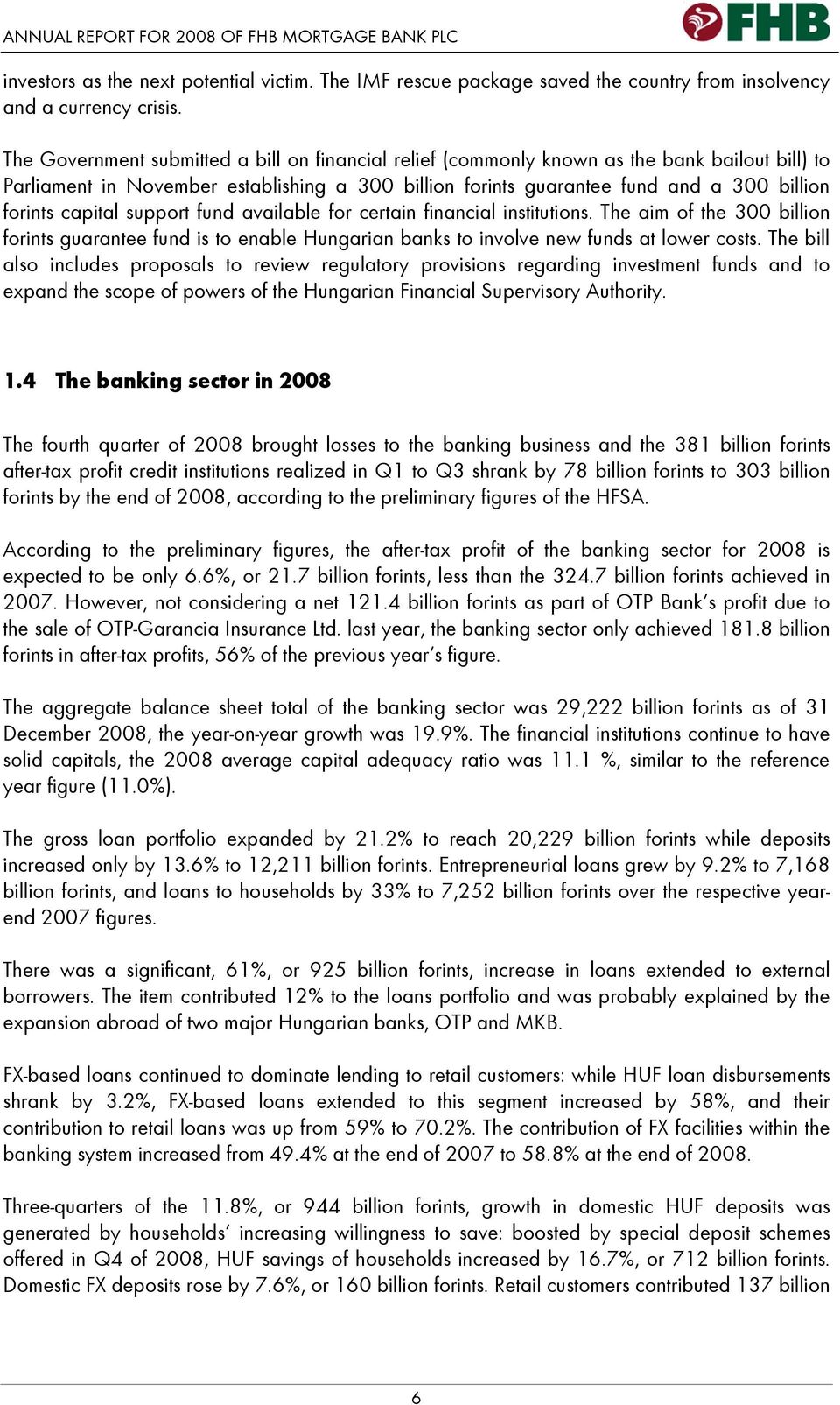
11 ANNUAL REPORT FOR 2008 OF FHB MORTGAGE BANK PLC investors as the next potential victim. The IMF rescue package saved the country from insolvency and a currency crisis. The Government submitted a bill on financial relief (commonly known as the bank bailout bill) to Parliament in November establishing a 300 billion forints guarantee fund and a 300 billion forints capital support fund available for certain financial institutions. The aim of the 300 billion forints guarantee fund is to enable Hungarian banks to involve new funds at lower costs. The bill also includes proposals to review regulatory provisions regarding investment funds and to expand the scope of powers of the Hungarian Financial Supervisory Authority. 1.4 The banking sector in 2008 The fourth quarter of 2008 brought losses to the banking business and the 381 billion forints after-tax profit credit institutions realized in Q1 to Q3 shrank by 78 billion forints to 303 billion forints by the end of 2008, according to the preliminary figures of the HFSA. According to the preliminary figures, the after-tax profit of the banking sector for 2008 is expected to be only 6.6%, or 21.7 billion forints, less than the billion forints achieved in However, not considering a net billion forints as part of OTP Bank s profit due to the sale of OTP-Garancia Insurance Ltd. last year, the banking sector only achieved billion forints in after-tax profits, 56% of the previous year s figure. The aggregate balance sheet total of the banking sector was 29,222 billion forints as of 31 December 2008, the year-on-year growth was 19.9%. The financial institutions continue to have solid capitals, the 2008 average capital adequacy ratio was 11.1 %, similar to the reference year figure (11.0%). The gross loan portfolio expanded by 21.2% to reach 20,229 billion forints while deposits increased only by 13.6% to 12,211 billion forints. Entrepreneurial loans grew by 9.2% to 7,168 billion forints, and loans to households by 33% to 7,252 billion forints over the respective yearend 2007 figures. There was a significant, 61%, or 925 billion forints, increase in loans extended to external borrowers. The item contributed 12% to the loans portfolio and was probably explained by the expansion abroad of two major Hungarian banks, OTP and MKB. FX-based loans continued to dominate lending to retail customers: while HUF loan disbursements shrank by 3.2%, FX-based loans extended to this segment increased by 58%, and their contribution to retail loans was up from 59% to 70.2%. The contribution of FX facilities within the banking system increased from 49.4% at the end of 2007 to 58.8% at the end of Three-quarters of the 11.8%, or 944 billion forints, growth in domestic HUF deposits was generated by households increasing willingness to save: boosted by special deposit schemes offered in Q4 of 2008, HUF savings of households increased by 16.7%, or 712 billion forints. Domestic FX deposits rose by 7.6%, or 160 billion forints. Retail customers contributed 137 billion 6
12 ANNUAL REPORT FOR 2008 OF FHB MORTGAGE BANK PLC forints to the growth. Corporate deposits increased by 2.1% to achieve 3,446 billion forints compared to In 2008 external funds increased by 43%, or 2,695 billion forints, to 8,944 billion forints and contributed 30.6% to the funds available in the banking system at the end of 2008 compared to 25.6% in The majority, 8,689 billion forints, was direct external funds, and the remaining 255 billion forints were mortgage bonds launched domestically and sold to foreign holders. Consequently, exposure of the Hungarian banking system to movements in the international money and capital markets in terms of involvement of funds has further increased. The banks portfolio deteriorated: the rate of subprime loans rose from 7.9% in 2007 to 10.1% in As regards income items, income from interest were 32% up and expenditure on interest were 52% up year-on-year, and resulted in a one percent increase in net income from interest, achieving billion forints in 2008 according to preliminary data. Income from sources other than interest dropped by 8.5% to billion forints, and operating costs increased by eight percent to billion forints. Extraordinary items added 16.4 billion forints to banks income across the board as opposed to 2007, when they deteriorated it by 2.8 billion forints. Earnings before taxes of the banking sector was billion forints in 2008, 11% less than in Foreign direct holdings in the banking sector increased from 82.0% to 86.4 year-on-year, and domestic direct holdings were up from 12.3% to 12.4%. The rate of preference, repurchased and non-identified shares dropped from 5.8% to 1.2%. 1.5 Retail lending in 2008 The banking sector s mortgage lending to retail customers was most affected by global financial processes. In the wake of mounting problems in the capital and money markets banks tightened their lending policies and suspended or discontinued some of their loan products (a large number of banks stopped CHF-denominated mortgage lending). As a result, there was a slump in mortgage lending in Q4 of As of 31 December 2008 mortgage loans to retail customers amounted to an aggregate 5,958.6 billion forints according to NBH data. Due to the impact of exchange rates this amount was billion forints (14.6%) above the Q3 of 2008 figure and 1,594.6 billion forints (36.5%) higher compared to the previous year s figure. The year-on-year expansion in the portfolio is considerably more dynamic in terms of its size and contribution than the billion forints, or 26.7%, growth recorded in 2007 compared to 31 December Excluding the impact of exchange rates, retail mortgage loans (calculated at the 31 December 2008 rate) increased by 1,164 billion forints, or 24.3%, year-on-year and by 207 billion forints (or 3.6%) over Q3 of The growth of the portfolio continues to be the driven by the dynamics of FX-denominated loans, which were 1,735.6 billion forints higher than the 2,644.3 billion forints achieved as of 31 December At the same time FX-denominated loans increased by billion forints 7
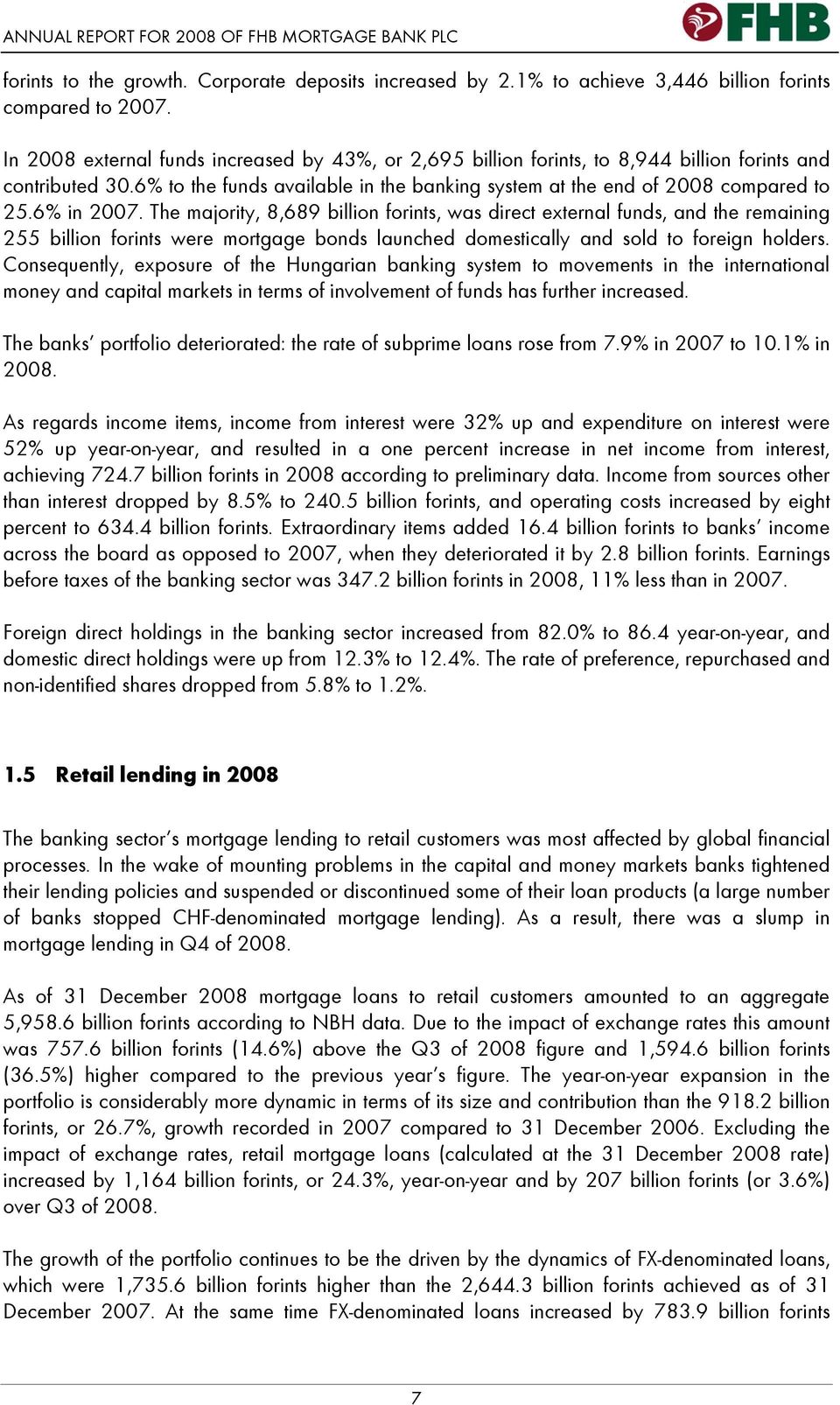
13 ANNUAL REPORT FOR 2008 OF FHB MORTGAGE BANK PLC compared to 30 September 2008 due to the volatility of exchange rates. HUF-denominated loans continued to shrink compared to the reference year and to Q3 of 2008, by 141 billion forints and 26 billion forints respectively. In Q4 of 2008 FX-denominated mortgage loans amounted to 4,380 billion forints and contributed 73.5% to the aggregate retail mortgage loans portfolio as opposed to 1,578.7 billion forints steadily shrinking HUF-denominated loans. The intensity of growth is marked by the fact that in 2007 the contribution of FX-based loans was only 60.6%. Retail mortgage loans (billion HUF, source: NBH) Q Q2 Housing loans 2007 Q Q Q Q Q Q4 General purpose mortgage loans Year-on-year growth in home loans extended to households was 24.9% or 782 billion forints. The annual growth was considerably above the 2007 figure of billion forints. The average growth per month was 65 billion forints with a large spread. The Q4 of 2008 growth was 416 billion forints over the Q3 figure. Excluding the impact of exchange rates, the home loans portfolio achieved a growth of 120 billion forints in Q4 of The increase in FX-based loans was greatly contributed to by soaring general-purpose mortgage loans. Compared to 1,189 billion forints contributing 45.0% to the overall retail loan portfolio as of 31 December 2007, the contribution of general purpose loans to retail lending grew to reach 45.8% by the end of the period of reporting due to general purpose loans 47.0% contribution to the growth of the loan portfolio over the past year. In Q1 of 2008 the growth in the portfolio of general-purpose loans to retail customers was 21.7% followed by a 0.7% drop in Q2, a 14.5% increase in Q3 and a 20.1% increase in Q4, and resulting in a 66.2% year-on-year growth. In 2008 the average monthly growth was 67.7 billion forints. Of the total amount of general-purpose loans 98.4% was disbursed in foreign exchange; the total portfolio value was nearly 2,006 billion forints as of 31 December General-purpose mortgage loans contributed 66.3% to total consumer loans as of 31 December 2008 as opposed to 58.2% in the reference year. This indicates a significant restructuring within the consumer loans product: the growth of consumer and personal loans is less and less dynamic and the growth of general-purpose loans continues to be strong. The main reason for the trend is the need for households to supplement their shrinking real income from cheap mortgage loans in order to maintain their level of consumption. 8
14 ANNUAL REPORT FOR 2008 OF FHB MORTGAGE BANK PLC 2 Ownership structure of FHB Plc. After the privatisation in 2007, the share of Hungarian State in the Bank dropped to 4.11%. Shares in circulation are owned by several professional and financial investors, with both domestic and foreign institutions among them. The significant investors (owning over 5% of total shares) as at 31 December, 2008 are (share % in brackets): Citibank Nominee (13.34%), RZB Austria (12.50%), VCP Finanz Holding Kft. (11.21%), A64 Vagyonkezelő Kft. (11.10%), Silvermist Estate SA (10.87%), HSBC Bank Plc (10.81%), Clearstream Nominee (10.72%). The ratios above are calculated on the listed ( A ordinary) series. Shareholders Series A ordinary shares Ownership share in the share Number of shares (pcs) capital Nemzeti Vagyonkezelő Zrt % 0.00% Domestic institutional investors / companies 32,425,272 28,492, % 43.17% Foreign institutional investors / companies 24,979,670 27,184, % 41.19% Private individuals 501, , % 1.44% FHB employees 84, , % 0.15% FHB Plc. 8,829 1,270, % 1.93% Series A total 58,000,010 58,000, % 87.88% Series B voting preference shares Nemzeti Vagyonkezelő Zrt. 2,714,300 2,714, % 4.11% Institutional investors 5,285,700 5,285, % 8.01% Series B total 8,000,000 8,000, % 12.12% Shares total 66,000,010 66,000, % % On 17th December 2007, VCP entered into a conditional share purchase agreement whom with VCP will conditionally be able to indirectly acquire in addition to the above a maximum number of 6,270,000 shares representing 9.5% indirect voting right in the Bank. By the date of this report, the Bank has not received any information that VCP purchased the shares nor the contract has been ceased. 9

15 ANNUAL REPORT FOR 2008 OF FHB MORTGAGE BANK PLC 3 FHB Bank Group Commenced in 2006, development of the Bank Group was essentially completed in 2007 and the Group companies were highly active in their respective areas of business in As parent company the Mortgage Bank exercises owner s supervision over the Group companies. The shareholder structure of FHB Bank group as at 31 December, 2008: Shareholder ratio in FHB Bank members Shareholders Commercial Bank Service Annuity Real Estate Mortgage Bank 90.0% 100.0% 95.3% 95.0% Service 10.0% 0.0% 4.7% 5.0% Total 100.0% 100.0% 100.0% 100.0% FHB Commercial Bank Ltd. FHB Commercial Bank Ltd. was established with an initial capital of 5,996 million forints including 3,996 million forints capital reserve and 2,000 million forints subscribed capital. In 2008 the shareholders increased the Commercial Bank s subscribed capital by 100 million forints and the capital reserve by 2,000 million forints. The court of registration registered the capital increase on 9 October Once the license of operation was issued the Commercial Bank started its business as a lending bank on 5 December 2006 at its Budapest head office. In the course of 2007, the existing and newly opened branches were gradually integrated into the expanding organizational network of the Commercial Bank. The Commercial Bank became increasingly active month after month: it stepped up its involvement in the sales of retail and corporate loan products; and on the other hand, it has expanded its product range on the liabilities side to include a variety of account and card related services. FHB Service Ltd. FHB Services Ltd. is entirely owned by FHB Mortgage Bank Plc. As of 31 December 2007 FHB Services subscribed capital was 1.5 billion forints and its capital reserve was 505 million forints. As a result of a capital increase registered in May 2008 the subscribed capital was increased to 1.6 billion forints and the capital reserve to 1.4 billion forints. The main object of FHB Services is to optimize the operation of the Group by providing the necessary infrastructure, back-office and IT services including book-keeping, data provision, payroll accounting and procurement. Besides, the Company manages the problem loans of FHB Mortgage Bank Plc. and FHB Commercial Bank Ltd. as an A type agent. FHB Services is a minority shareholder in the Commercial Bank and other Group companies. 10

16 ANNUAL REPORT FOR 2008 OF FHB MORTGAGE BANK PLC FHB Real Estate Ltd. FHB Real Estate was established on 7 February 2006 with 100 million forints subscribed capital. The shareholders increased the Service Company s capital increase in both 2007 and As a result, as of 31 December 2008 the subscribed capital was 120 million forints and its capital reserve was 120 million forints. In December 2008 the shareholders resolved to decrease the subscribed capital by 70 million forints against retained earnings. The relevant registration took place on 12 February The main business of FHB Real Estate Ltd. is three-fold: valuation for Group members and external partners, real estate agency activities, and real estate development. FHB Annuity Ltd. FHB Annuity Ltd. was established on 9 June 2006 with 100 million forints subscribed capital and commenced its business on 6 November In 2007 the shareholders increased the subscribed capital by 50 million forints and the capital reserve by 300 million forints as a result of which FHB Annuity had 150 million forints subscribed capital and 350 million forints capital reserve as of 31 December The Annuity Ltd. sells two products: an annuity product and, as an agent of FHB Mortgage Bank Plc., a reverse mortgage product. 11
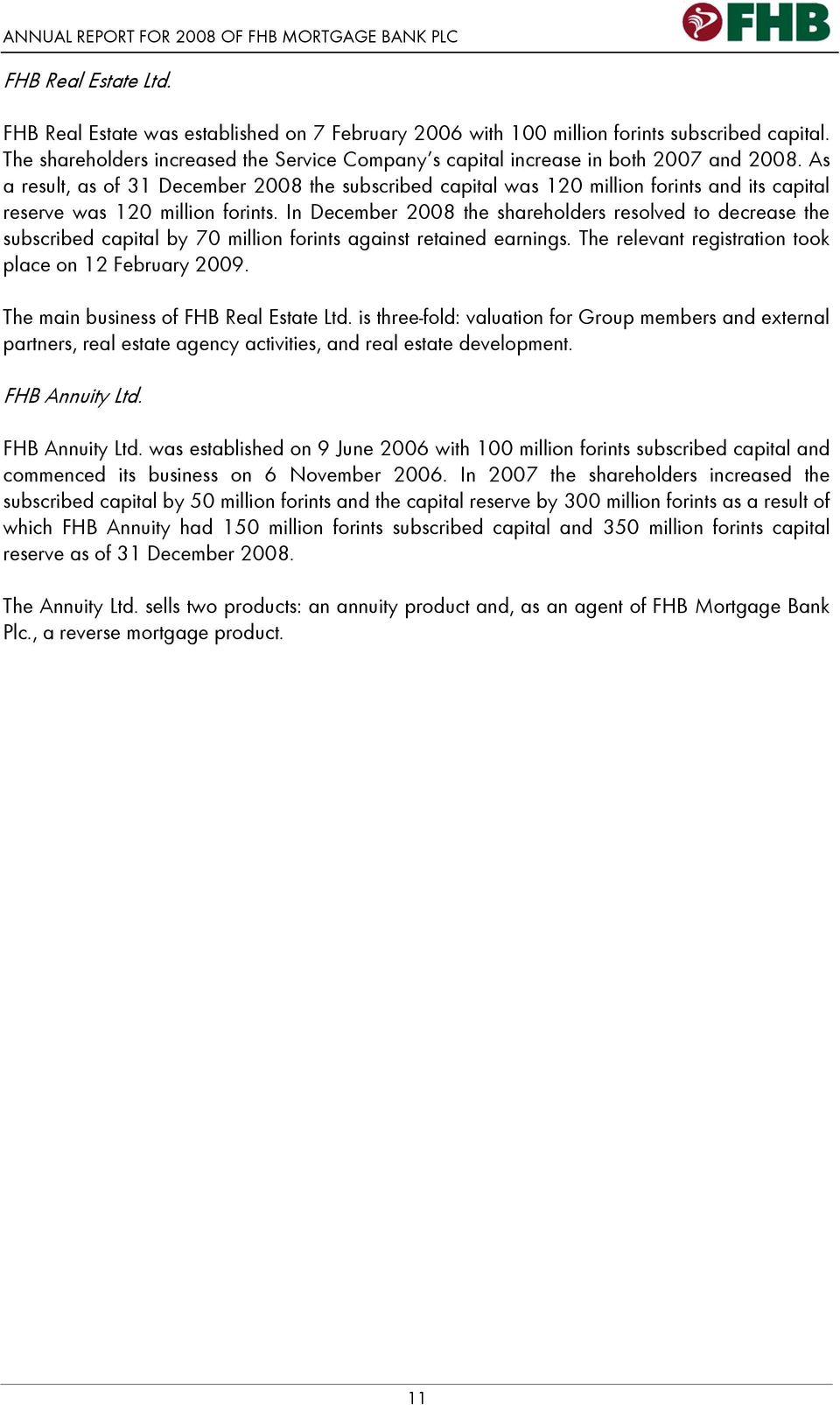
17 ANNUAL REPORT FOR 2008 OF FHB MORTGAGE BANK PLC 4 Report on the 2008 business activity 4.1 Major financial indicators The balance sheet total calculated on the basis of the Hungarian Accounting Act was 14.0% or 87.7 billion forints higher than the previous year s figure. The increase in the balance sheet total was mainly due to an expansion in receivables from refinanced banks, which generated 58.8 billion forints year-on-year growth. The 2008 balance sheet total exceeded 714 billion forints. Earnings before tax was 9.3 billion forints with a 3.7 billion forints year-on-year growth. The growth was mainly generated by decreasing fees paid in the wake of falling mortgage banking disbursements, a substantial profit on financial transactions, and lower operating costs. Share capital (based on earnings before dividend payment) increased by 7.6 billion forints yearon-year, or 23.3%, over a year from profit from operations. Major financial indicators FHB Morgtgage Bank Plc. 31 Dec Dec Dec / 31. Dec Balance sheet total (million HUF) 626, , % Book value of mortgage loans (million HUF) 537, , % Book value of mortgage bonds (million HUF) 477, , % Book value of bonds (million HUF) 47,000 62, % Shareholders equity (million HUF) 1 32,401 39, % Regulatory capital (million HUF) 1 28,625 32, % Capital adequacy % 15.13% 12.1% Earnings before tax (million HUF) 5,625 9, % After tax profit (million HUF) 4,560 7, % CIR (operating costs / gross operating profit) 49.60% 38.70% -22.0% EPS (HUF) % ROAA (return on average assets) 0.80% 1.20% 50.0% ROAE (return on average equity) % 22.20% 52.1% 1 Including profit of the year (before dividend paid) 12
18 ANNUAL REPORT FOR 2008 OF FHB MORTGAGE BANK PLC 4.2 Products Lending With the creation of FHB Group the Mortgage Bank s role gradually changed in The Bank s loans were increasingly sold through FHB Commercial Bank Ltd., and FHB Mortgage Bank Plc. s main focus became refinancing the loans extended by FHB Commercial Bank Ltd. and other partner banks, project lending and to raise funds in the capital market primarily through mortgage bond issues. FHB Commercial Bank Ltd. is a Type A agent of FHB Mortgage Bank Plc., i.e. it sells retail and corporate loan products for and on behalf of the Mortgage Bank, which are reported in the balance sheet of the Mortgage Bank. In accordance with the strategic goals the Mortgage Bank has limited its lending activity to subsidized housing loans, land development loans and reverse mortgage loans, and given the size of its adjusted capital, to large commercial mortgage loans and housing project loans. The Commercial Bank is primarily involved in selling non-subsidized retail loans extended on a market basis. As a result of the global financial crisis in Q4 of 2008 FHB Group tightened its exposure terms (for instance scoring and loan-to-collateral ratio), risk management processes (for instance central decision-making), and collection procedures (for instance involvement of branch staff in the early stage of collection, preventive sales for the purpose of loan repayment). In this context the interest of both retail and corporate loans was substantially increased (by 170 and 400 basis points respectively). Priority was shifted from the lending side to efficient collection that helps to maintain the quality of the portfolio, to raising funds from retail customers, and to liabilities side activities that generate income from fees and commission. The Bank has changed its lending forecast accordingly. More stringent lending terms resulted in a significant drop in new loans compared to plans, which is, however, in line with the revised forecast adjusted to the new terms and conditions. Over the past year up to 31 December 2008 the gross amount of loans sold by the Bank dropped by 2.9 billion forints, or 1.3% as a result of the joint impact of the growth of the Commercial Bank s business as well as scheduled and non-scheduled repayments. Disbursements amounted to 17.4 billion forints in 2008, 59.9% less than the 43.3 billion forints achieved in the preceding year, in accordance with Group-level restructuring of the lending business. FX-based loans contributed 49.8% to disbursements in 2008 compared to 66.3% in the reference year, due partly to a dominance of subsidized HUF loans and partly to the financial market events the result of which was more keenly felt in the second half of the reported year. 13

19 ANNUAL REPORT FOR 2008 OF FHB MORTGAGE BANK PLC Loan disbursements (billion HUF) HUF FX Housing loans continue to be the most popular loan product sold by the Mortgage Bank, the reason being that the Bank s mandate to extend subsidized loans continued in Subsidized housing loans contributed 43.8% in 2008 (as opposed to 45.6% in 2007) with total disbursements amounting to 7.6 billion forints in 2008 as opposed to 19.8 billion forints in The shrinking was caused primarily by loans extended for the purchase of existing homes, which plunged from 7.4 billion forints in 2007 to 0.9 billion forints in the reported year. New home purchase loans amounted to 1.8 billion forints (3.0 billion forints in the reference year), home building loans were 4.3 billion forints (7.5 billion forints in 2007) and contributed the most to housing loans. The housing loan portfolio amounted to billion forints as of 31 December 2008, 5.4% short of the year-end 2007 figure. General-purpose mortgage loans contributed 3.3% to the 2008 disbursements and amounted to 0.6 billion forints, denominated predominantly in foreign exchange, HUF based loans contributing only 3.7%. In 2008, disbursement of this product fell 94.2% short of the 10.0 billion forints achieved in 2007 due to the increasing activity of FHB Commercial Bank in the same field. At year-end the portfolio was 41.4 billion forints, 3.6% above the 31 December 2007 figure. Corporate lending lagged 35.3% behind the previous year s achievement. Of the 7.1 billion forints disbursed in this category, 5.5 billion forints were contributed by commercial real estate financing loans (with a 38.5% year-on-year decrease), while housing project financing loans achieved 1.7 billion forints disbursed, 22.5% less than the 2.2 billion forints achieved in Due to the fall in retail lending corporate loans contributed 41.1% to total disbursements in 2008 as opposed to 25.5% in the reference year. The year-end portfolio amounted to 19.3 billion forints with an annual growth of almost 45%. 14

20 ANNUAL REPORT FOR 2008 OF FHB MORTGAGE BANK PLC Disbursement by products in ,4% 9,7% 5,2% 3,3% 6,6% 43,8% home equity loans project loans reverse mortgage loans commercial real estate financing land development housing loans Land development loans achieved 0.9 billion forints in 2008, 48.8% below the 1.8 billion forints achieved in This product contributed 5.2% to the Mortgage Bank s 2008 disbursements. The land development portfolio amounted to 3.7 billion forints at the end of 2008, 23.0% above the previous year s figure. Launched in 2007, mortgage loans to senior citizens increased dynamically and achieved 1.1 billion forints in the year of reporting, exceeding the reference year s achievement of 0.7 billion forints by 61.4%. The market share of the Mortgage Bank was steadily shrinking throughout 2008 as the Commercial Bank was gradually taking over selling loan products from the Mortgage Bank. As a result, based on the retail loans portfolio, the Mortgage Bank s share was 3.43% in 2008 as opposed to 4.89% in The Mortgage Bank s share in general purpose loans was lower (2.2% at year-end of 2008 as opposed to 3.8% in 2007) due to the fact that the Commercial Bank focused its sales efforts on this product in Refinancing At the beginning of 2008 the Bank had effective cooperation agreements with nine partners in the business of refinancing through purchasing independent mortgage liens. However, the Mortgage Bank s biggest external refinancing partner suspended the refinancing of FX loans from April 2008 due to mounting costs of funds and the need to provide funds for its parent bank. As of 31 December 2008 the portfolio of refinanced loans showed a 19.1%, or 58.8 billion forints year-on-year increase and amounted to billion forints. Newly refinanced mortgage 15

21 ANNUAL REPORT FOR 2008 OF FHB MORTGAGE BANK PLC loans amounted to 88.0 billion forints in Newly financed mortgage loans exceeded the 2007 disbursements amounting to 83.2 billion forints by 5.8%. Refinancing extended to external banks amounted to 23.2 billion forints. In the refinancing business the Mortgage Bank transacted independent lien purchases in accordance with the cooperation agreement with FHB Commercial Bank Ltd. in the amount of 64.8 billion forints, over four times the 14.1 billion forints achieved in Refinanced loan disbursements (billion HUF) ,2 84,9 24,8 37,9 20,1 9,9 6,0 3, HUF FX Within the refinancing portfolio the proportion of FX-based loans continued their steady increase: after 2007, when already 92.8% of refinancing was denominated in foreign exchange, FX loan disbursements further increased in the reported year to reach 96.4%. The bulk of new disbursements were predominantly denominated in Swiss francs, amounting to 84.8 billion forints. The contribution of refinancing to total disbursements in 2008 was 83.5%. The same rate was 46.8% in 2005, 43.7% in 2006 and 65.7% in 2007; thus over the pas two years this product moved on a steep upward curve due partly to the volume of refinancing, which exceeded projections, and partly to the decline in the Mortgage Bank s own loan disbursements, in accordance with the Bank s strategy. Similarly to the previous year, clients early repayment intent was strong also in 2008: throughout the year prepayments amounted to 55.2 billion forints, which included 35.7 billion forints early repayment of refinanced loans. 4.3 Sales channels Branch network In accordance with the Group strategy, in 2007 the Mortgage Bank s regional branches were integrated into the organizational structure of the Commercial Bank. Consequently, the Mortgage 16
22 ANNUAL REPORT FOR 2008 OF FHB MORTGAGE BANK PLC Bank no longer has a network of branches and mortgage products are sold through the Commercial Bank in the context of a Type A agency agreement. After the network development clients are offered the Group s products and services through 19 branches in addition to the Budapest head office (Békéscsaba, Budapest Békásmegyer, Debrecen, Eger, Győr, Kaposvár, Kecskemét, Miskolc, Nyíregyháza, Pécs, Salgótarján, Szeged, Székesfehérvár, Szekszárd, Szolnok, Szombathely, Tatabánya, Veszprém, Zalaegerszeg). There was a 66.3%, or 7.0 billion forints, drop in year-on-year lending through the network of branches due to a large extent to more stringent lending terms and conditions in the wake of the financial crisis. The contribution of the network of branches to the Bank s own lending was 34.5% in 2008, higher than in the reference year (32.5%) Agents activity After 20.1 billion forints total disbursement of transactions in 2007, the network of agents only contributed 6.2 billion forints in 2008, almost 70.0% less than in the reference year, as planned. Together with the expansion of the Bank s network of branches, shrinking agency activity resulted in a drop in agents contribution to disbursements within the Bank s own lending activity, from 62.1% in 2007 to 60.6% in the year of reporting. A large portion, 4.6 billion forints, was disbursed in HUF, which is not more than half of the 2007 performance by agents (8.5 billion forints). As of 31 December 2008 the number of contracted partners was 1,724, and the number of agents selling the Bank s loan products was several thousand Syndicated loans The total amount of syndicated loans outstanding not yet due was 7.8 billion forints as of 31 December 2008, of which 3.2 billion forints (41.3%) of which was contributed by savings coops, 2.5 billion forints (28.6%) by financial enterprises, and 2.1 billion forints (27.1%) by commercial banks as partners. Analysis of the aggregate data for 2008 reveals that the total amount of syndicated disbursed or purchased HUF and FX loans was 0.5 billion forints. The contribution of syndicated loans to own lending dropped from 5.4% in 2007 to 4.9% in 2008 as a result of structural changes. Out of the disbursements resulting from syndicate agreements concluded in 2008, 95.4% was contributed by joint transactions from a financial enterprise as a syndicate partner. Considering the changed market situation and the portion of syndicated loans within the total portfolio of FHB Group, the Bank decided to discontinue this activity as of Syndicated agreements were terminated and the syndicated business ceased with effect from 1 February
23 ANNUAL REPORT FOR 2008 OF FHB MORTGAGE BANK PLC 4.4 Portfolio analysis, impairment and provisions As of 31 December 2008 the Bank s rated assets amounted to billion forints, pending commitments amounted to 5.8 billion forints, and future commitments (from swap transactions), to billion forints. CLASSIFICATION Figures in million HUF Breakdown of portfolio by classification, loss in value and provisions Total accounts receivable 31 December December 2007 Loss in value and provisions Ratio Total accounts receivable Loss in value and provisions Ratio Problem-free 1,005, % 833, % Watch 12, % 8, % Substandard 3, % 1, % Doubtful % 5,603 1, % Bad % % TOTAL 1,022,154 1, % 849,010 1, % Receivables from customers amounted to billion forints (33.8% of the loan portfolio) in addition to 5.8 billion forints disbursement commitment based on valid loan agreements (0.9%). Of these receivables 16.5 billion forints attached to 4,385 contracts and 0.1 billion forints commitments were classified in the categories watch to bad, with 1.49 billion forints total impairment and provisions. The refinancing loans portfolio amounted to billion forints (54.9%) classified as prime (problem-free). The Bank had term or at-sight deposits with 21 commercial banks amounting to 58.4 billion forints (8.7%). The Bank holds stakes in four companies: FHB Commercial Bank Ltd., FHB Services Ltd., FHB Real Estate Ltd, and FHB Annuity Ltd. The total amount of investment is 11.5 billion forints (1.7%), classified as problem-free. Future commitments amounting to billion at the balance sheet are classified as problemfree. As of 31 December 2008, 97.51% of the classified portfolio (excluding swaps) was problem-free (compared to 98.18% as of 31 December 2007). The combined rate of substandard, doubtful and bad debts was 0.66% (0.86% as of 31 December 2007), the rate of transactions on the watch list was 1.83% (as opposed to 0.96% as of 31 December 2007). 18
24 ANNUAL REPORT FOR 2008 OF FHB MORTGAGE BANK PLC The proportion of problem-free loans in the loan portfolio was 92.83% (as opposed to 93.76% as of 31 December 2007), the combined rate of substandard, doubtful and bad debts was 1.91% (as opposed to 3.06% as of 31 December 2007), and the rate of loans on the watch list was 5.26% (as opposed to 3.18% as of 31 December 2007). Average impairment stayed at the same rate (0.22%) in the entire portfolio excluding swaps and slightly increased since the previous year in the loan portfolio (0.64%). 4.5 Collateral valuation Compared to 34.7 thousand collateral valuations and reassessments conducted by 31 December 2007, the number of valuations as of 31 December 2008 was 33.0 thousand and included 30 thousand valuations and 3.0 thousand reassessments. The number of valuations in conjunction with the Bank s own lending was 17 thousand and the number of valuations by partner banks was approximately 16 thousand. The Bank generated million forints income from collateral valuation and reassessment fees in 2008 including million forints invoiced to the Commercial Bank. Valuation fees paid to FHB Real Estate Ltd. amounted to 1,184.7 million forints. Costs were 24.9% less than in the previous year. 4.6 Mortgage bond issue, mortgage bond cover Mortgage bond issue In 2008 the Bank involved funds in amount of approximately 164 billion forints, 44 billion forints more than in In terms of breakdown, mortgage bonds contributed billion forints to the funds involved, bonds contributed 15.4 billion forints, and the remaining 7.1 billion forints were other long-term liabilities. Mortgage bond repayments amounted to 73.9 billion forints (at NBH rate as at the day of repayment); the 2008 redemption value was 51.3 billion forints (at NBH rate as at the day of redemption); thus the net funds involved in 2008 amounted to 38.5 billion forints. In the first quarter of 2008 capital involvement was done exclusively through mortgage bond issues in the domestic market. The Mortgage Bank involved 31.1 billion forints gross, almost five billion forints more than in Q1 of Net funds involved in Q1 of 2008 amounted to 11.9 billion forints as 13.9 billion forints mortgage bonds matured and 5.3 billion forints of the Schuldschein loan were repaid. In the first quarter of 2008 the Bank s Issues Programme for 2007 and 2008 was authorized with a maximum total face value of 200 billion forints. The first series under the new Programme were launched in February and March. In Q2 of 2008 the Mortgage Bank involved funds amounting to 33.8 billion forints gross (including 13.7 billion forints in the form of bond issues). 19
25 ANNUAL REPORT FOR 2008 OF FHB MORTGAGE BANK PLC An event of major importance for the Bank was the definitive Aa rating of FHB s mortgage bonds by Moody s as of 1 April The FHB mortgage bonds were put on the negative watch only because of the possible implications of the privatization in August The mortgage bonds were downgraded from Aa2 to Aa3. FHB Mortgage Bank Plc. has undertaken more stringent cover and liquidity terms and conditions for its outstanding mortgage bonds than provided for by law. In Q3 of 2008 the Mortgage Bank involved funds amounting to 82.1 billion forints gross (including 1.7 billion forints in the form of bond issues), 75.1 billion forints more than in the reference quarter of The two-year Schuldschein loan of 50 million EUR nominal value taken out by the Bank in August of 2006 matured on 4 August The Bank renewed the facility for another two years as of 6 August 2008 in the value of 30 million EUR. In Q4 of 2008 a total of 19.4 billion forints mortgage bonds matured. The combined nominal EUR and HUF redemption value amounted to approximately 3.5 billion forints calculated at the official exchange rate on the day of transactions with the result that repayments exceeded the amount of funds raised during the quarter. In Q4 of 2008 there were no issues in the context of FHB Mortgage Bank Plc. s EMTN Programme. Face value of securities issued in 2008 (billion HUF) 15,4 13,7 47,0 141,5 61,9 66,5 62, Mortgage bonds Bonds The mortgage bond market The aggregate amount of outstanding mortgage bonds issued by the three Hungarian mortgage banks was 1,311.9 billion forints as of 31 December FHB s share of the mortgage bond market slightly dropped, from 31.5% in 2007 to 26.8% in the year of reporting. 20
26 ANNUAL REPORT FOR 2008 OF FHB MORTGAGE BANK PLC Face value of mortgage bond issued (billion HUF) Unicredit OTP FHB Mortgage bond cover In accordance with the relevant statutory provisions the Bank has undertaken to keep a stricter mortgage bond coverage ratio, i.e. to ensure a principal-to-principal adequacy at all times. Accordingly, the aggregate amount of ordinary collateral (net of loss in value) plus supplementary collateral principal exceeded each day the aggregate nominal value of outstanding mortgage bonds in circulation. The same adequacy rule prevailed with respect to interest-to-interest. In accordance with the provisions of the Act on Mortgage Loan Companies and Mortgage Bonds and in keeping with its Rules on Collateral Registration, the Bank monitored the loan cover situation and the compliance with the requirement of proportionality. In order to ensure appropriate mortgage bond cover the Bank verified, upon extension of the loan, whether the conditions for ordinary collateral were met. In the course of 2008 the number of mortgage loans classified by the property inspector as ordinary collateral was 2,087; 6,636 mortgage loans were cancelled from among ordinary collaterals due primarily to maturity, early repayment and repayment of advances, and 899 loans were reclassified from ordinary to neutral. By the end of the period of reporting the ordinary collateral portfolio included 56,857 items as opposed to 61,671 items in 2007, with 64,024 real estate properties involved as cover. The number of neutral collateral items is 596, or 0.97% of the entire mortgage loan portfolio as of 31 December In the refinancing segment a total of 105 independent lien contracts were repurchased in the course of 2008 involving 16,914 real estate properties securing 15,864 loan contracts. As a result of modifications following repurchase (release or replacement of collateral, change in the obligor, etc.) a total of 618 changes occurred that concerned the independent lien purchased. 21
27 ANNUAL REPORT FOR 2008 OF FHB MORTGAGE BANK PLC As of 31 December 2008 the net value of ordinary collateral covering the mortgage bonds issued by the Bank was billion forints, 6.8% above the billion forints achieved as of 31 December Value of assets involved as collateral as of 31 December 2008 (million forints): Outstanding mortgage bonds in circulation Face value: 506,078 Interest: 138,978 Total: 645,056 Ordinary collateral value (net, including impairment) Principal: 568,197 Interest: 405,369 Total: 973,566 Value of assets involved as supplementary collateral Deposit account at NBH (principal): 3,537 NBH bonds (principal): 10,000 State bonds (principal): 1,696 Interest: 0 Total: 15,232 As of 31 December 2007 the present value of mortgage bonds was billion forints and the present value of collateral was billion forints. The rate of cover was %. By contrast, as of 31 December 2008 the present value of mortgage bonds was billion forints, that of collateral was billion forints, and the rate of cover was %. Throughout the year the present value of collateral exceeded the value of mortgage bonds in circulation not yet repaid. The rate of the net aggregate value of ordinary and supplementary collateral to the nominal value of mortgage bonds in circulation not yet repaid was %; the rate of the net aggregate interest on ordinary and supplementary collateral to the interest on mortgage bonds in circulation not yet repaid was % as of 31 December Liquidity management In accordance with the Group s strategy the Mortgage Bank provides the funds needed to ensure the liquidity of the Group. Group level liquidity was stable throughout 2008, the Mortgage Bank smoothly provided cash as required by every member of the Group. The Bank s ongoing liquidity planning lay the basis for the Executive Management s scheduling and quantitative decisions in respect of long-term financing throughout the business year. The Bank s opening position in 2008 was balanced and normal. The first quarter of 2008 was characterized by a slip in the net position at Group level, which became a lasting trend while the Group managed to continuously maintain financing at an adequate level. This resulted from the fact that although on the liabilities side there was no change in the intensity of own lending, nor in 22
28 ANNUAL REPORT FOR 2008 OF FHB MORTGAGE BANK PLC the scheduling of refinancing deals compared to the previous year, the Bank s opportunities to raise funds became strictly dependent on the state of the market. The credit crunch had a strong impact on the market and caused investors to bide their time until international markets settle. Moody s kept mortgage bonds rating on watch. Amidst these circumstances it was impossible to sell large series in external markets, consequently the Bank returned to the domestic market and raised funds by selling smaller series. In the second quarter the liquidity was an almost constantly rising lending position. This was due to the fact that the Group s effort to stand on multiple legs. In the face of the extended crisis of the capital markets the Bank focussed on the retail segment and launched a successful campaign to attract term deposits through the Commercial Bank. The special high-interest deposit scheme was for a six-month term and as a result the Bank raised approximately 24 billion forints in deposits from retail customers. Besides changes in the liabilities side one major change occurred on the assets side as well: the contract with the partner refinancing the so far large FX funds was modified and led to a slowing of the outflow of funds attached to liabilities-side loans. The positive outcome of the deposit raising campaign in the retail segment and a more balanced outflow of funds shaped the conditions for increasing lending liquidity through domestic issues, so that the Bank could acquire the additional liquidity it had undertaken, in keeping with Moody s requirements, in order to maintain the international rating of its mortgage bonds. Q2 was characterized by the usual seasonal slackening of investment intentions. The Mortgage Bank attached repurchase facilities to its issues, which essentially resulted in portfolio swaps to lengthen maturity structure. HUF mortgage bond repurchases were important with a view to keeping in line with the structure of assets. As regards new outflow of funds on the assets side, efforts were made to replace some of the HUF funds by FX funds. In the second quarter the Bank managed to launch its planned significant size external FX issue, which meant that by the end of July the Bank was fully prepared to comply with Moody s requirements undertaken for the next period. The Bank opened the third quarter with high liquidity. With more frequent and smaller issues in the first half and careful consideration of the volatility of the market the Bank rescheduled its shortterm financing instruments on a continuous basis. Although fund raising in the capital market was no longer necessary after Q2, the Bank continued to closely manage currency swaps and their alignment with derivatives attached to issues of uncertain sizes. In the fourth quarter the impacts of recession added to the credit crunch became stronger. The resulting subsequent shortage of funds, lack of counterparties trust and the fact that currency markets almost totally seized up stressed the need for immediate adjustment to the crisis by seeking and implementing creative solutions, and for putting accurate liquidity management into focus in addition to the usual Treasury activities. Even more active involvement in the market than before became indispensable. This included exploring potential partners for currency swaps and continuous conversion of HUF liquidity to FX liquidity by means of domestic as well as external banks. Besides swap transactions securing revolving facilities was of utmost importance to ensure liquidity on an ongoing basis, as was the maintenance on interbank limits in an environment marked by a general lack of trust. The Bank updated short and medium term liquidity plans on a daily basis stressing the potential variables. 23
29 ANNUAL REPORT FOR 2008 OF FHB MORTGAGE BANK PLC As the capital and mortgage markets froze up virtually all of the Hungarian banks turned to seek funds from retail customers. Competition is keen for funds as well as for gaining and keeping customers trust. After the campaign launched earlier during the year the majority of term deposits placed with the Commercial Bank by retail customers matured in Q4 of Aware of mounting competition and the general state of the market environment the Bank has made every effort to keep its clients and has paid special attention to this products. The Bank also added different terms of deposit in order to expand the choice and spread the concentration of maturity. As a result of the new campaign surpassed the spring success and deposits exceeded the spring levels, amounting to 32.4 billion forints. Extreme movements of yield curves was a special problem. Pursuant to the ISDA agreements partners must comply with special margin deposit obligations based on monthly surveys in conjunction with swaps attached to mortgage bond issues. Accordingly, the Bank has concluded such deposits with a number of counterparties, where the rate of deposits is highly volatile under the effect of market movements. In Q4 the deposit obligation surpassed previous levels and reached 25 billion forints, approximately 90% of which had to be met in FX. Despite this extremely stressful market environment the Bank met its deposit obligations and at the same time ensured day-to-day liquidity. Volatility of exchange rates in the fourth quarter affected the margin as well as the mortgage bond-to-ordinary collateral ratio. It is to be emphasized that despite the highly volatile environment the Bank kept adequately structured liquid assets and managed to meet Moody s requirement of 113% security margin on an ongoing basis. 24
30 ANNUAL REPORT FOR 2008 OF FHB MORTGAGE BANK PLC 4.8 Risk management principles Risk management policy For 2008 FHB Group set the goal of prudent approach to risk and containment of exposure undertaken earlier. Due to the unfavourable macroeconomic environment portfolio management has become increasingly important and HUF-based lending is coming into focus. In the retail segment lending terms were tightened in 2008 in an effort to contain exposure, and in the SME segment lending was preceded by careful case-by-case assessment Lending risk Lending risk essentially stems from exposure related to the Bank s core business, which is lending. Lending risk is the risk of the Bank suffering losses because the borrowers do not service the loans they borrowed from the Bank. Lending consists primarily of extending loans with (mainly residential) real estate cover. Lending risk stems from exposure related to borrowers, to cover, or to partner risk involving partner banks refinanced through independent mortgage lien purchases. The Bank rates the creditworthiness of its clients and partners and classifies them into client or partner categories. Risk is only accepted if the client s rating is appropriate. The Bank monitors clients and partners rating on an ongoing basis and applies stringent regulations relating to determining the scope of collateral eligible for cover, their valuation and coverage ratio. Risks visà-vis partner banks are minimized by means of bilateral agreements and the assignment of the refinanced loan portfolio as prescribed by law. The following table illustrates the distribution of risk by rating categories and indicates past default rates. In the rating process retail customers are classified into five, and other counterparties (mainly credit institutions) are classified into seven categories. The two rating scales are merged in the table. Classification Default rates (%) 2008 Total Million HUF 2008 CLASS_1 0,00% CLASS_2 0,00% CLASS_3 0,27% CLASS_4 2,89% CLASS_5-7 1,89% Interest rate risk The principal characteristic feature of banking is the ratio of assets and liabilities in the balance sheet, which is of a determining nature. Due to the complexity of the business the characteristics of financing portfolios and their related liabilities can be highly different, thus every bank has to reckon with a certain amount of interest rate risk. 25
31 ANNUAL REPORT FOR 2008 OF FHB MORTGAGE BANK PLC Interest rate risk stems from interest rate changes, which affect the value of financial instruments. The Bank is also exposed to interest rate risk when the amounts of assets, liabilities and offbalance sheet instruments maturing or re-priced in a particular period are not in harmony. The Bank assesses interest rate risk on a continuous basis with the help of Gap-analysis, VaR calculations and sensitivity analysis. The Bank manages market risk mainly by natural hedging. In addition, active management tools such as repurchase of mortgage bonds, swap transactions as well as mortgage bond maturities and interest rates suited to assets are also involved in order to ensure the harmony between assets and liabilities. The following table illustrates the sensitivity of net interest earnings and equity to one basis point increase in interest rates. The change in net income from interest results from the change in net income from interest on floating rate financial assets and liabilities as of 31 December 2008 and re-priced within a year. Sensitivity of equity means the reassessment of assets, liabilities and offbalance sheet instruments in terms of maturity of assets-liabilities. Sensitivity of equity is based on the hypothesis that the yield curve moves in parallel. Analysis by maturity classes reflects sensitivity to non-parallel movements. Change vs. base point (2008, million HUF) FX Principal penetrability Net interest income months months HUF 0,4-1,1-0,7 10,1-54,3-45,9 EUR 0,4 0, ,3 CHF 1,9 0,4-0, , Exchange rate risk The Mortgage Bank is a specialized credit institution, which narrows the scope of business where exchange rate-related risks may arise. Moreover, the Bank s business policy is to keep currency related risk at a low level for both the Bank and the Group. The Bank strives to immediately hedge the exchange risks related to its core business, i.e. mortgage lending, refinancing and financing though mortgage bonds, as allowed by market circumstances. Therefore an open FX position can serve primarily for the purpose of liquidity management, settlements related to lending and refinancing, or active and passive accruals in currencies in which the Bank keeps a nostro account Liquidity risk Maintaining liquidity is an essential element of banking. The Bank maintains its liquidity by coordinating the maturity of its receivables and payables. At the same time, it applies maturity transformation regulated by limits in order to improve profitability while maintaining solvency at all times. The Bank regularly reviews prepayments by clients prior to term and takes into consideration their impact in managing market and liquidity risks. 26
32 ANNUAL REPORT FOR 2008 OF FHB MORTGAGE BANK PLC Risk management In the context of assets and liabilities management, the Bank contains risks by creating natural hedges, keeping open FX positions at a minimum, applying hedging transactions, and, in general, an active A/L management. Risk management was also involved in the repurchase and issuance of mortgage bonds in 2008 in order to develop an optimal interest and maturity structure. The Bank managed to secure the funds required for its growth in a hectic international capital market, albeit at a premium. The Group s prudent assets and liabilities management policies and practice, involvement of long-term funds and diversification in terms of date of renewal of funds have proven to be highly beneficial. The HFSA approved application of the IRB method in terms of lending risk by the Mortgage Bank with effect from 1 July 2008 after an appropriate phasing-in period, and application of the standards method by the entire Group in terms of operating risk with effect from 1 January Internal banking regulation In 2008 a total of 111 Bank-related instructions were issued by the Chief Executive Officer of the Mortgage Bank and 116 Group control instructions were also issued. The most important Group instructions issued in 2008 were as follows: o Strategic instructions regarding Group control; o Liquidity and risk management instructions; o Two amendments of the instructions regarding the standard contract forms applied for the Mortgage Bank s products, and amendment of the rules of procedure of refinancing; o Modification of complaints handling and of the rules of procedure in respect of client compliance with advance loan contract terms due to the amendment of the relevant statutory provisions; o Greater emphasis on the promotion of collection of outstanding loans through various means; o Two amendments of the instruction regarding the decision-making powers Restructuring and staff figures The Bank had 94 staff as of 31 December 2008 as opposed to 92 as of 31 December In 2008 the average statistical headcount was 104 as opposed to in The proportion of full-time staff was 61.6%. The Bank employed 38 part-time staff. Employees of the Bank participate in further training on a continuous basis. The Bank promotes further training through educational agreements. In addition, FHB operates its own in-service training system to deliver this knowledge. Within the framework of this, the Bank offers continuous training and further training facilities to those employees who work in the lending area, who have to take examinations from time to time, to improve their level of skills. 27
33 ANNUAL REPORT FOR 2008 OF FHB MORTGAGE BANK PLC Each member of the Board of Directors resigned from office with effect from 29 April The General Meeting elected Dr. Zoltán Spéder, Dr. Gábor Borsányi, Dániel Gyuris, László Harmati, Dr. Christian Riener, Dr. Károly Salamon, István Somkuti and Dr. Márton Vági members of the Board of Directors for a term of five years. At their meeting held following the General Meeting the members of the Board of Directors elected Dr. Zoltán Spéder chairperson of the Board. Of the members of the Supervisory Board, Róbert Somfai, Dr. Gyula Czok, Éva Baranyi and Márta Szántó resigned from office with effect from 29 April The General Meeting re-elected Róbert Somfai for a term of five years. At their meeting held following the General Meeting the members of the Supervisory Board elected Róbert Somfai chairperson of the Board. Jenő Siklós resigned from his position as chairperson of the Board of Directors of FHB Services Ltd. and FHB Real Estate Ltd. with effect from 1 September 2008, and his employment by FHB Mortgage Bank Plc. ceased on the same day. Since November 2008 the Group s Deputy Chief Executive Officer and Chief Financial Officer has been Gyula Köbli. Pursuant to the HFSA license dated 11 December 2008 the position of Deputy Chief Executive Officer and internal member of the Board of Directors of FHB Commercial Bank Ltd. is taken by Dr. Eszter Varga. 28
34 ANNUAL REPORT FOR 2008 OF FHB MORTGAGE BANK PLC 5 The consolidated financial accounts 5.1 Balance sheet structure As of 31 December 2008 the balance sheet total of the Bank was billion forints, 14.0% higher than in Of the annual increase in total assets 69.0% was generated by the 56.2 billion forints expansion of the mortgage loans portfolio including refinancing, and 15.5 billion forints increase in securities (35.7%). The growth in liabilities throughout the year was generated by an increase in the mortgage bond portfolio, which contributed 32.3%. The contribution of bonds issued was 17.5%, and interbank loans reduced the liabilities item by 5.9%. The expansion of owners equity and provisions contributed 9.0%, and other liabilities contributed 48.4% to the growth of liabilities. Assets LINE ITEM 31. Dec Dec Figures in million HUF Change 2008/2007 Interest earning assets (net value) 600, , % - Loans 227, , % - Refinanced loans 308, , % - Securities 20,724 16, % - Interbank 43,451 58, % Liquid assets % Investment 8,372 11, % Tangible assets % Intangible assets % Assets in course of construction Other assets 17,494 34, % Total Assets 626, , % Liabilities 29
35 ANNUAL REPORT FOR 2008 OF FHB MORTGAGE BANK PLC Interest bearing liabilities 566, , % - Mortgage bonds 477, , % - Bonds 47,000 62, % - Interbank loans received 39,594 34, % - Other interest bearing liabilities 2,023 2, % Other liabilities 24,792 66, % Share capital and provisions 1 35,071 42, % Total liabilities 626, , % 1 Before dividend payment a) Kamatozó eszközök The Bank s interest earning assets increased from billion forints as of 31 December 2007 by 11.2% to billion forints by the end of Refinanced loans increased by 19.1% year-on-year. Loans to retail customers sold by the Mortgage Bank through the Commercial Bank, its network of agents as well as by its syndicated partners were 1.2%, or 2.6 billion forints, down from the reference year figure and amounted to billion forints. Loans to retail customers contributed 33.7% net interest earning assets as opposed to 37.9% at the end of The aggregate portfolio of mortgage loans amounted to billion forints net as of 31 December 2008, 10.5% (or 56.2 billion forints) higher than the base period figure. The collateral value of real estate covering mortgage loan principal receivable amounted to 1,408.3 billion forints at the end of 2008, 5.1% above the reference period s figure (1,339.9 billion forints). Thus the average loan principle-to-value of coverage (LTV) ratio was 39.9% as of 31 December 2008, somewhat better than the 2007 LTV of 39.0%. b) Assets and investments The net value of fixed assets and intangible assets as of 31 December 2008 was million forints, somewhat higher than the reference period figure as business softweare purchased in 2008 increased the value of assets. The value of invested assets, currently 11.5 billion forints, increased compared to 8.4 billion forints in the reference year in the wake of capital contributions to the newly established companies. As of 31 December 2008 FHB Mortgage Bank s holdings in the affiliated companies were as follows: 7.8 billion forints in FHB Commercial Bank, 3.0 billion forints in FHB Services, million forints in FHB Annuity, and 230 million forints in FHB Real Estate. c) Other assets The Bank s other assets were significantly (97.8%, or 17.1 billion forints) above the 2007 value and amounted to 34.6 billion forints. The growth was mainly due to active accruals, in particular to accrued exchange rate gains from swap transactions (up from 7.9 billion forints in 2007 to 16.4 billion forints in 2008). In addition, growth in receivables from subsidized interest was also 30
36 ANNUAL REPORT FOR 2008 OF FHB MORTGAGE BANK PLC significant (as receivables from subsidized interest increased from 2.2 billion forints to 3.4 billion forints), as well as accrued loss on exchange rate related to mortgage bonds, which was 2.4 billion forints as opposed to 0.5 billion forints in As of 31 December 2008 the Bank had repurchased Treasury shares amounting to 1.1 billion forints as opposed to 18.9 million forints in the reference year. d) Interest bearing liabilities Mortgage bonds As of 31 December 2008, 83.8% of the interest bearing liabilities were contributed by the Bank s mortgage bonds portfolio that ensures long-term funding for mortgage loans. As of 31 December 2008, mortgage bonds issued by the Bank amounted to billion forints, 5.9% higher than the previous year s figure, and emerged as the balance of billion forints new mortgage bonds offered, 51.3 billion forints repurchase, and 73.9 billion forints principal repayment as well as the effect of exchange rate changes. Bonds Bonds issued to complement the securities activity of mortgage bond issues resulted in bonds with a book value of 62.4 billion forints as of the 31 December 2008 balance sheet date. Interbank funds Interbank loans received amounted to 34.4 billion forints as of 31 December The contribution of interbank deposits and revolving loans drawn was 76.9%, and included 26.5 billion forints short-term interbank loans (22.5 billion forints of which was received from the Commercial Bank), and long-term EUR-denominated revolving loans equivalent to 2.1 billion forints. The EUR-based club loan amounting to 11.0 billion forints drawn down at the end of 2007 was repaid in The Schuldschein loan amounted to 7.9 billion forints as of 31 December 2008 and contributed 23.1% to interbank loans received. The Bank handles nonmortgage bond facilities as supplementary funds to support and improve the Bank s liquidity. The aggregate value of deposits from clients on collateral accounts related to project loan transactions was million forints as of 31 December 2008, 5.6% higher than the million forints in the previous year. e) Other liabilities There was a significant, 41.3 billion forints, year-on-year growth in the other liabilities item, which amounted to 66.1 billion forints. This line item includes predominantly passive accruals (amounting to 64.8 billion forints). The increase was caused by accrued P/L on exchange rate of swaps, which amounted to 38.7 billion forints in
37 ANNUAL REPORT FOR 2008 OF FHB MORTGAGE BANK PLC f) Shareholders equity As of 31 December 2008 the Bank s share capital amounted to 40.0 billion forints, 23.3% higher than the 32.4 billion forints figure before dividend payment at the end of Of the increase, million forints were contributed by general reserve and 2.9 billion forints by retained earnings; reserve for the repurchase of Treasury shares increased by 1.1 billion forints, and profit before dividend payment by 2.8 billion forints year-on-year. Risk-weighted assets amounted to billion forints as of 31 December The Bank s adjusted capital based on earnings before dividend payment grew from 28.6 billion forints as of 31 December 2007 by 11.2% to reach 32.0 billion forints at the end of As of 31 December 2008 the capital adequacy ratio was 15.1%, taking into consideration the earnings for the year, 1.6 percentage points higher than the 2007 capital adequacy ratio before dividend payment. g) Off-balance sheet items Within the Bank s off-balance sheet items, available but uninvolved loans amounted to 2.9 billion forints, and contracted but not yet disbursed loans amounted to 4.6 billion forints. Future liabilities amounted to billion forints and consisted predominantly of hedge transactions relating to mortgage bonds issued. Liabilities from currency swaps amounted to billion forints including billion forints CHF swap, 55.8 billion forints HUF swap, and 10.8 billion forints EUR swap. Liabilities from interest swaps amounted to 3.9 billion forints, most of them (3.7 billion forints) contributed by HUF and the remainder (0.2 billion forints) contributed by CHF transactions. 32
38 ANNUAL REPORT FOR 2008 OF FHB MORTGAGE BANK PLC 5.2 P/L structure LINE ITEM 31. Dec Dec Figures in million HUF Change 2008/2007 Net interest income 16,148 14, % Net fees and commission income -1, % Net result of financial operations 1,003 2, % Other income and expenditure -1,893-1, % Gross operating income 13,580 15, % Operating costs -6,737-5, % Net operating income 6,843 9, % Net provisions and losses % General risk provision Extraordinary income and expenses % Earnings before tax 5,624 9, % Tax -1,064-1, % Profit after tax 4,560 7, % General reserve % Retained earnings 1 4,104 6, % 1 Before dividend payment The Bank s gross operating income was 15.0 billion forints as of 31 December 2008, 10.7% above the 31 December 2007 figure and also exceeded the budgeted figure. Net income from interest, a key component of gross operating income dropped by 13.1% against the 2007 figure. Operation throughout the year generated a total of 5.8 billion forints costs, which is 86.5% of the 2007 figure. a) Net income from interest The 14.0 billion forints net income from interest generated in 2008 emerged as the balance of 71.3 billion forints income from interest (18.2% higher than at the end of 2007) and 57.3 billion forints interest expenditure (29.6% growth). In 2008 interest and interest-type income from customers contributed 23.8% to income from interest, slightly decreasing compared to 24.0% in the previous year. Interest subsidy on loans to customers amounted to 7.7 billion forints, thus income from interest on loans to customers amounted to 24.6 billion forints. Income from interest on securities and interbank loans were up from 2.7 billion forints in 2007 to 4.2 billion forints in 2008; similarly, its contribution to income from interest increased to reach 5.9%. Income from interest on swaps contributed 24.7% to total income from interest as opposed to 13.9% in Refinancing generated 12.1 billion forints, and combined with the related interest subsidy it was 24.9 billion forints. Almost all of the expenditure on interest (60.9% in 2008 and 74.7% in 2007) was generated by interest paid on mortgage bonds. Interest charged on swaps was also significant, contributing 33
39 ANNUAL REPORT FOR 2008 OF FHB MORTGAGE BANK PLC 25.4% to the total expenditure on interest (as opposed to 19.9% in 2007). Interest expenditure on bonds amounted to 4.5 billion forints and contributed 7.8% to the item. The average net interest margin (NIM) was 2.73% as of 31 December 2007 and 2.24% as of 31 December The drop in NIM continues to be caused by two major factors. One is the Bank s transforming portfolio structure, which has a long-term impact on the Bank s own and refinanced loans structure. The contribution of subsidized loans within the refinanced portfolio has been steadily shrinking as new loans are denominated mainly in FX, thus scheduled repayments and early repayments exceed new loans and shrinking subsidized loans have been replaced by FX loans with lower interest margins. Another negative effect on the Bank s average margin is the re-pricing of subsidized loans, which takes place predominantly in A similar process is going on in the portfolio of own lending. The impact of falling EUR and CHF interst rates is expected in the first half of b) Net fees and commissions income In 2008 the net income from fees and commission amounted to 0.1 billion forints as opposed to 1.7 billion forints loss in In the course of 2007 the Bank achieved 3.2 billion forints income from fees and commission (12.8% more than in the base period) against substantially lower, 3.1 billion forints, expenditure on fees and commissions (31.1% less than the reference year s figure of 4.5 billion forints). The bulk of income from fees and commission resulted from collateral valuation fees, which amounted to million forints and contributed 26.0% compared to 31.4% in the reference year. The contribution of handling commission dropped from 17.3% to 11.5% as a result of a decline in state subsidies, and amounted to million forints in the reported year. In 2008 income from fees paid by financial institutions contributed 32.9% (1.2 billion forints) due primarily to an increase in early repayment of refinanced loans and the modification of contracts. Expenditure on fees increased mainly because of the Type A acquisition agency and loan management agreement concluded between the Mortgage Bank and the Commercial Bank. Under the agreement the Commercial Bank sells Mortgage Bank products through its network of branches and also manages the existing loans portfolio. The fee paid for these services amounted to 2.4 billion forints in 2008, significantly short of the 3.8 billion forints achieved in 2007, due to the Mortgage Bank s shrinking lending. Fees paid to acquisition agents amounted to million forints as opposed to million forints in The drop is explained by the fact that in 2008 a large portion of the fees was paid by the Commercial Bank. As a result of the expansion of the portfolio, the Mortgage Bank paid million forints to FHB Services for handling the rated loans portfolio as opposed to 69.7 million forints paid in Fees related to mortgage bonds sales amounted to million forints, and fees related to bond issues were 12,9 million forints. Fees paid to credit institutions and NBH amounted to 4.0 million forints in 2008 as opposed to 65.2 million forints in Acquisition fees paid to syndicate partners amounted to 14.6 million forints in
40 ANNUAL REPORT FOR 2008 OF FHB MORTGAGE BANK PLC c) Net profit from financial transactions The net result of financial transactions amounted to +2.6 billion forints in 2008, two and a half times the previous year s figure. The contribution of net exchange rate gains from mortgage bonds was million forints, twice the reference year s gains. The exchange rate gains from FX transactions amounted to 2.2 billion forints, triple the 2007 figure of 0.7 billion forints. The net result of other securities and financial transactions amounted to 68.1 million forints. d) Other income and expenditure Under the item of other earnings the Bank recorded 1.7 billion forints loss in 2008, 8.3% down from the 2007 figure. To the item of other income amounting to 0.6 billion forints in the year of reporting Almost half was contributed by intra-group invoicing. Income from rated loan sales amounted to 0.3 billion forints and contributed 53.3% to other earnings. The remaining items were related mainly to cost reimbursement to staff and asset sales. The item of other expenditures amounting to 2.3 billion forints included 1.6 billion forints taxes paid, of which the bank tax alone was 1.0 billion forints. Local business tax was million forints, innovation contribution 71.9 million forints, and supervisory fees paid to HFSA amounted to 65.9 million forints. The book value of receivables from mortgage loans sold was million forints, and collection costs amounted to 37.8 million forints. The book value of fees reinvoiced to Group companies was 0.3 billion forints related to sales of other assets and payment for mediated services. 35
41 ANNUAL REPORT FOR 2008 OF FHB MORTGAGE BANK PLC e) Operating costs Figures in million HUF LINE ITEM 31. Dec Dec Change 2008/2007 General administrative costs 6,601 5, % Personnel expenses 2,305 1, % - Wages and salaries % - Other personnel expenses % - Other payroll costs % Other administrative costs 2,632 2, % - including banking activity costs 1,738 1, % Costs of internal services 1,664 1, % Depreciation % TOTAL OPERATING EXPENSES 6,737 5, % The Bank s operating costs amounted to 5.8 billion forints in the course of 2008 as opposed to 6.7 billion forints in the reference year. Personnel costs contributed 43.4% to the decrease, and the contribution of other administrative costs was 40.0% (this item was 13.9% down from the reference year), and decreasing costs of internal services reduced costs by another 15.2%. Costto-income ratio (CIR) improved from 49.6% in 2007 to 38.7% as of 31 December There was a slight shift in the breakdown of operating costs. In 2008 personnel expenses contributed 32.8% as opposed to 34.2% in 2007 due to a 17.2% drop over the year in conjunction with staff transfers to other companies in the Group and measures aimed at improving cost effectiveness. Other administrative costs contributed 38.9% in 2008, largely the same as 39.1% in The item of costs of internal services includes rent and operating charges paid for equipment used in day-to-day operation as well as business administration and back office service fees paid to FHB Services Ltd. The item amounted to 1.5 billion forints and contributed 26.2% to the 2008 operating costs as opposed to 24.7% in Personnel expenses including employer s contributions amounted to 1.9 billion forints. Wages and salaries amounted to 994 million forints, 7.3% above the reference year figure. Other personnel costs were 467 million forints, 45.6% short of the previous year s figure, due mainly to the fact that the management share option was almost half of the reference year s million forints. Payroll expenditure amounted to 448 million forints in total, 14.0% less than the previous year s figure. Other administrative costs decreased by 13.9% over the base period figure. The 2.3 billion forints item includes 771 million forints other administrative costs, 13.8% less than the reference year figure. A significant portion of this amount, million forints, included the 2008 marketing and advertising fees and million forints aggregate amount of consulting fees, auditor s, property inspector s and attorney s fees and costs of other business administration activities. Real estate related costs amounted to 8.6 million forints. Data base license was 19.2 million forints, software costs amounted to 8.2 million forints, and the combined cost of postal and ITC network charges was 58.7 million forints in The contribution of special mortgage banking costs to the item of other administrative costs did not change significantly: the item was down from 25.8% in 2007 to 25.7% in 2008 as a result of 36
42 ANNUAL REPORT FOR 2008 OF FHB MORTGAGE BANK PLC a 13.9% drop in these costs year-on-year. Valuation costs amounted to 1.2 billion forints, significantly exceeding the million forints recorded in The contribution of life insurance premium payments related to loan cover amounted to million forints as opposed to 709 million forints in Depreciation was 7.4% below the 2007 figure. As the Bank concluded its new asset purchases depreciation will gradually decrease over the depreciation term. f) Loss in value and provision In 2008 the Bank recorded 159 million forints as net reserve for impairment and provisions, which emerged as the balance of 1,520 million forints provisions and 1,679 million forints charge. Of the provisions 254 million forints was the provision covering short-term swaps closed after the balance sheet date but expected to generate a loss on the basis of the market price on the balance sheet date. The Bank modified its accounting policy and has discontinued keeping a general risk reserve since 1 January Funds available on the item as of 1 January 2008 will be used for offsetting losses not covered by independent lending loss, impairment and provisions. 37
43 ANNUAL REPORT FOR 2008 OF FHB MORTGAGE BANK PLC 6 Major events during the accounting period On 27 February 2009 the Board of Directors of FHB Mortgage Bank Plc. decided to increase the capital on the Commercial Bank by 2,850 million forints. Based on the decision the combined value of the subscribed capital and the capital reserve of the Commercial Bank will be 10.9 billion forints once the court of registration has entered the capital increase in the Register of Companies. Pursuant to the decision of the Board of Directors of FHB Mortgage Bank Plc. passed on 3 March 2009 regarding transformation of FHB Real Estate Ltd. and FHB Annuity Ltd. into single-person companies, on 4 March 2009 FHB Mortgage Bank Plc. bought out the shares of FHB Services Ltd. in the two companies. The nominal value of the business shares in FHB Real Estate Ltd. is two million forints, and in FHB Annuity Ltd., seven million forints. 38
44 ANNUAL REPORT FOR 2008 OF FHB MORTGAGE BANK PLC 7 Other information 7.1 Shareholders right by the Statutes Shareholders may apply for crediting shares onto a securities account following payment of the total nominal value of their shares, or if the nominal value or the issue value are different, the payment of the total consideration of the latter. Shareholders shall have a right to a share of the after-tax profits of the Company in proportion to the nominal value of their shares (dividend), pursuant to the legal rules of accounting, ordered to be distributed by the General Meeting. In the case of the termination of the Company without a legal successor, shareholders are entitled to a portion of the assets that may be divided as a result of final accounting in proportion to their shares. Shareholders are entitled to attend the general meeting, to request information and to make remarks. The Board of Directors may refuse to provide information if it violated any bank and business secrets of the Company. Shareholders are entitled to make proposals and to exercise the rights provided by their shares. Shareholders shall be entitled to the minority rights provided by the Companies Act (Gt.). 7.2 Additional rights related to B type shares Holders of voting preference share B are entitled to partly or wholly sell, transfer, contribute to another company or alienate in any other way (for the purposes of this 7 Article: transfer) their voting preference shares B. The chairman of the General Meeting may also order secret voting in a given issue, if so requested by the simple majority of votes of the holders of series B voting preference shares. The General Meeting may only adopt a resolution regarding the following issues with the yes vote of the simple majority of the series B vote preference shares in attendance: o Amendment to the Statutes, including the change of the form of operation of the Company; o decision on the merger and consolidation of the Company into, or the de-merger from, another company limited by shares, or the transformation of the Company into another corporate form, furthermore of the increase and reduction of the registered capital; o election of the members of the Board of Directors and of the Auditor, o decision by the General Meeting on an issue not laid down in the Statutes as the exclusive competence of the General Meeting on the basis of a statutory provision or including on the agenda an issue falling within the competence of another body of the Company. 7.3 Shareholders responsibility The responsibility of shareholders against the Company shall extend to the provision of the nominal value or issue value of the share. The shareholder shall otherwise not be responsible for the obligations of the Company. 39
45 ANNUAL REPORT FOR 2008 OF FHB MORTGAGE BANK PLC During the existence of the Company, shareholders may not reclaim any pecuniary contribution made by them. With the exception of the case of reduction of the registered capital, it is prohibited to effect disbursements to shareholders on the basis of their membership legal relationship to the debit of the registered capital. 7.4 Share transfer criteria The shares of the Company may be freely transferred within the scope of the legal rules in force and the Statutes; they may only be acquired and transferred in the manner defined in a separate legal rule, solely through debiting and crediting onto securities accounts. 7.5 Delimitation of voting rights Pursuant to the Statues of the Company, on the General Shareholder s Meeting every share with a face value of 100 HUF, i.e. one-hundred HUF, entitles its holder to have one vote. Only those shareholders may exercise their rights on the General Shareholder s Meeting who are in possession of the shares on the effective date of owner identification which is at the same time the date of closure of the register of shareholders, as specified in the Act CXX of 2001 on Capital Markets (hereinafter: the Capital Markets Act), in the Rules of the Stock Exchange of Budapest and the Central Clearing House and Depository (Budapest) Ltd. (hereinafter: KELER Zrt.), and whom name is contained at the time of its closing on the effective date of owner identification by the shareholder s registry. Pursuant to the Statues of the Company a shareholder or a group of shareholders (that is, a group of persons whose acquisition of influence, pursuant to the Capital Markets Act, shall be summed up) may not exercise a higher voting right than 10% of the voting rights attached to the shares providing all voting rights issued by the Company. The shareholder registered in the shareholder s registry of the Company on the Effective Day may exercise the rights associated with the General Shareholder s Meeting in person, trough a proxy (representative), or a person (nominee) authorized by the shareholder pursuant to the Capital Market Act. Members of the Board of Directors and the Supervisory Board, the Company s senior employee, the Auditor or the the Coverage Supervisor may not be authorized representatives. The authorization for representation shall be valid for one General Shareholder s Meeting, or for a definite term not exceeding 12 months. The authorization for representation will remain valid for the continued General Shareholder s Meeting after suspension and for a General Shareholder s Meeting called repeatedly due to a lack of quorum. The authorization shall be submitted to the Company in the form of notarial deed or private document of full probative value. 7.6 Election and establishment of the management, amendment of the Statutes The establishment and amendment of the Statutes; election and establishment of the remuneration of the members of the Board of Directors; recall of the members of the Board of Directors shall fall within the exclusive competence of the General Meeting. The General Meeting may only adopt a resolution regarding the following issues with the yes vote of the simple majority of the series B vote preference shares in the amendment to the Statutes, including the change of the form of operation of the Company, and the election of the members of the Board of Directors and of the Auditor. 40
46 ANNUAL REPORT FOR 2008 OF FHB MORTGAGE BANK PLC 7.7 The competence of the Board of Directors a) Competences in relation to the strategy, business and financial activities of the Company: Approval of strategic and business policy objectives; Establishment and approval of annual business and financial plans, as well as the business policy; Analysis and assessment of the implementation of the business policy guidelines on the basis of the quarterly balance sheets of the Company; Management of the finances of the Company, approval of the Accounting Policy and the related internal rules; In connection with exercising rights related to redeemable shares, obtaining own shares, paying initial dividends, and increasing registered capital to the debit of assets beyond the registered capital, the Board of Directors is entitled to approve an interim balance sheet, and to pass resolutions on the payment of initial dividend with, however, the prior consent of the Supervisory Board; Establishment of risk management guidelines that ensure the assessment of risk factors as well as the suitability of internal control mechanisms and the regulatory and the supervisory systems for their management, and ensure legal compliance; Approval and regular revision of the strategies and rules (as for the rules containing the qualification and estimation processes relating to the credit and operating risks) regarding the separation of tasks inside the organization, the prevention of conflict of interest, taking, measureing, handling, tracing and reduction of risks; Approval the internal rules regarding the principles of disclosure in connection with risk management; Establishment of the strategy and procedure relating to the determination and permanent maintainance of the capital, the extent and composition thereof, required for covering the Company s current and future risks; Establishment of the decision-making competence (limits) relating to financial services; Decision on loan placements 10% over the guarantee capital of the Company (excluding inter-bank financial transactions); Decision on investments with a volume, which from an accounting perspective represents more than 5% of the prevailing equity capital; Decision on the commencement, suspension or termination of the performance of certain activities falling within the licensed sphere of activities of the Company (Article 4.); Determination of the terms and conditions of the contract of agency to be entered into with the property inspector; Establishment of the Treasury s operating procedures on the money and capital market, its rules for entering into and administering deals; Approval of rules for collateral registration, rules on risk taking and large-risk taking and security valuation; Decision on issues of receivables-property exchanges (forced investments) over HUF 200 million; Sales of individual bad debts of individual customers or customer groups with a loss over HUF 50 million. b) Duties and competences related to the operation and organisation of the Company: 41
47 ANNUAL REPORT FOR 2008 OF FHB MORTGAGE BANK PLC Convocation of the General Meeting of the Company; Maintaining contacts with the shareholders at a proper level and with the necessary frequency; Maintaining contacts with the Supervisory Board and preparation of reports to be submitted to the Supervisory Board Continuous monitoring of the efficiency of corporate management; Management of major conflicts of interest having an effect on the whole organisation or on the operation of the Company; Approval of significant organisational changes (discontinuation or establishment of units); Establishment of measures and the plan for taking measures which become necessary as a result of the findings of the Hungarian Financial Supervisory Authority and/or the National Bank of Hungary and/or the State Audit Office; Establishment of a financial incentive system; Approval of rules of employer s loans. c) Competences in relation to the increase of share capital and the acquisition of own shares: The Board of Directors is entitled upon basis of and according to the authorization set forth by the Statues - to increase the share capital of the Company; The Board of Directors is entitled to make decisions on transactions related to own shares upon, and to the extent of, authorisation by the General Meeting; The Board of Directors is entitled to make decisions on the acquisition of the Company s own shares without authorisation by the General Meeting provided such acquisition is required in order to avoid serious damage to the Company. d) Competences in relation to the management of the Group, foundation of companies and investment Decision on the acquisition or sales of a company or a business activity in cases where the volume of such transaction exceeds 100 million HUF and participation reaches the level of influence; Decision on the issues falling within the sphere of authority of the supreme body in respect of one-person businesses owned by the Company, and exercise of owner s rights; Exercise of member s rights as set forth in the Business Associations Act in the case of business associations under the controlling influence of the Company; Instruction to the boards of credit institutions, financial enterprises and subsidiary businesses in which the Company holds interest over fifty per cent in the interest of compliance with, and implementation of, joint supervisory provisions. e) Rights in relation to the representation of the Company: Development of, and monitoring compliance with, guidelines regarding the disclosure of information to be published pursuant to the relevant statutory provisions; Exercise of employer s rights over the chief executives (chief executives: the Chief Executive Officer and the Deputy Chief Executive Officers); Appointment of the employees authorized to sign for the Company to be entered in the Register of Companies, and approval of the internal rules containing the rules of 42
48 ANNUAL REPORT FOR 2008 OF FHB MORTGAGE BANK PLC procedure relating to the transfer of the joint right to signature of two internal members of the Board of Directors. f) Rights related to own operation Making proposals, as required, for the appointment of members to the Board of Directors, and for the remuneration of the members of the Board of Directors; Election and removal of the Chairman of the Board of Directors; Approval and modification of the rules of procedure of the body; entitled to form standing or ad hoc committees with the participation of board members and/or persons outside the Board (employees, external experts, etc.), and to give the necessary authorisations to these bodies; The Board of Directors is entitled to use the services of external consultants or experts for the implementation of its activity. Supervision of the execution of the resolutions passed by the Board of Directors. g) Other competences Decision in all matters delegated to the Board of Directors by the General Meeting; Decision in all matters delegated to the Board of Directors by legislation, or matters outside the exclusive competence of the General Meeting that are included by the Board within its own sphere of competence, or those that any member of the Board of Directors or the Supervisory Board wishes to discuss; Receipt of reports on current matters within its own competence. 7.8 Management Chairman of the Board of Directors: Dr. Zoltán Spéder Members of the Board of Directors: Dr. Gábor Borsányi Dr. Károly Salamon Dániel Gyuris László Harmati Dr.Márton Vági Dr. Christian Riener István Somkuti Chairman of the Supervisory Board: Róbert Somfai Members of the Supervisory Board: 43
49 ANNUAL REPORT FOR 2008 OF FHB MORTGAGE BANK PLC Dr. Erik Landgraf Mónika Kék Kata Orsolya Molnár Nguyen Hoang Viet Ágnes Winkler Senior officers Dániel Gyuris Chief Executive Officer László Harmati Deputy Chief Executive Officer Tamás Foltányi Deputy Chief Executive Office Gyula Köbli Deputy Chief Executive Office 44
50 ANNUAL REPORT FOR 2008 OF FHB MORTGAGE BANK PLC 7.9 Auditors activity The auditor of the company for the year 2008 was Ernst & Young Auditing Ltd. (20. Váci street, Budapest, 1132, registration number: ; audit chamber membership number: , HFSA financial instrument qualifying number T /94; in further: Auditor ). The auditing tasks were managed by Gabriella Virágh (mother name: Erzsébet Kiss; address: 74. Kiscelli street, Budapest, 1032; audit chamber membership number: ; HFSA financial instrument qualifying number: Ept /04; in further: auditing natural person in the name of the Auditor. Budapest, 27 March Dr. Zoltán Spéder Chairman of the Board of Director Dániel Gyuris Chief Executive Officer 45
51 FHB Mortgage Bank Co Plc Annual Report 31 December 2008 Balance Sheet Profit and Loss Statement Notes to Accounts Budapest, 27 March 2008
52 Cg Statistical code FHB Jelzálogbank Nyilvánosan Működő Részvénytársaság BALANCE SHEET (CREDIT INSTITUTIONS AND FINANCIAL VENTURES) Assets Data in thousand HUF 31 December Adjustments 31 December No. Description of the item 2007 for the previous 2008 year(s) a b c d e Liquid assets Government securities a) for trading b) for investment Receivables from credit institutions a) sight b) other receivables from financial services ba) ones becoming due within one year of which: - from associated enterprises from enterprises with participating interest from NBH bb) ones becoming due after the elapse of one year of which: - from associated enterprises from enterprises with participating interest from NBH 16. c) from investment services 17. of which: - from associated enterprises from enterprises with participating interest Receivables from customers a) from financial services aa) becoming due within one year of which: - from associated enterprises from enterprises with participating interest 24. ab) becoming due after the elapse of one year of which: - from associated enterprises from enterprises with participating interest 27. b) from investment services 28. of which: - from associated enterprises from enterprises with participating interest 30. ba) receivables from stock market investment services 31. bb) receivables from investment services out of the Stock Exchange 32. bc) receivables from customers deriving from investment services 33. bd) receivables from clearing houses 34. be) receivables from other investment services Debt securities, including fixed interest securities 36. a) securities issued by local governments and other agencies of state administration (excluding state securities) 37. aa) for trading 38. ab) for investment 39. b) securities issued by other issuers 40. ba) for trading 41. of which: - from associated enterprises from enterprises with participating interest own shares repurchased 44. bb) held for investment 45. of which: - from associated enterprises from enterprises with participating interest
53 Data in thousand HUF 31 December Adjustments 31 December No. Description of the item 2007 for the previous 2008 year(s) a b c d e Shares and other securities with variable yield 48. a) shares and participations for trading 49. of which: - from associated enterprises from enterprises with participating interest 51. b) securities with variable yield 52. ba) for trading 53. bb) for investment Shares and participations for investment 55. a) shares and participations for investment 56. of which: - participations in credit institutions 57. b) adjustment of the value of shares and participations for investment 58. of which: - participations in credit institutions Shares and participations in associated enterprises a) shares and participations for investment of which: - participations in credit institutions b) adjustment of the value of shares and participations for investment 63. of which: - participation in credit institutions Intangible assets a) intangible assets b) adjustment of the value of intangible assets Tangible assets a) tangible assets for financial and investment services aa) real estate ab) technological equipment, machines, appliances and vehicles ac) investments ad) advance payments made towards investments 73. b) tangible assets not directly held for financial and investment services 74. ba) real estate 75. bb) technological equipment, machines, appliances and vehicles 76. bc) investments 77. bd) advances given to investments 78. c) adjustment of the value of tangible assets Own shares Other assets a) inventories b) other receivables of which: - from affiliated enterprises from enterprises with participating interest Accrued income and deferred expenditures a) accrued income b) deferred costs and expenditures c) deferred expenditures 89. TOTAL ASSETS of which: CURRENT ASSETS (1+2a+3a+3ba+3c+4aa+4b+5aa+5ba+6a+6ba+11+12) INVESTED ASSETS (2b+3bb+4ab+5ab+5bb+6bb ) Budapest, 27 th March, 2009 Dániel Gyuris CEO Gyula Köbli Deputy CEO
54 Cg Statistical code FHB Földhitel- és Jelzálogbank Részvénytársaság BALANCE SHEER Liabilities Data in thousand HUF 31 December Adjustments 31 December No. Description of the item 2007 for the previous 2008 year(s) a b c d e Liabilities towards credit institutions a) on sight 92. b) from financial services and fixed for a predetermined term ba) falling due within one year of which: - liabilities to associated enterprises liabilities to enterprises with participating interest liabilities to NHB 97. bb) falling due after the elapse of one year 98. of which: - liabilities to associated enterprises liabilities to enterprises with participating interest liabilities to NHB 101. c) from investment services 102. of which: - liabilities to associated enterprises liabilities to enterprises with participating interest Liabilities to customers a) savings deposits 106. aa) sight 107. ab) liabilities falling due within one year 108. ac) liabilities falling due after the elapse of one year 109. b) other liabilities from financial services ba) sight liabilities of which: - liabilities to associated enterprises liabilities to enterprises with participating interest 113. bb) falling due within one year of which: - liabilities to associated enterprises liabilities to enterprises with participating interest 116. bc) falling due after the elapse of one year 117. of which: - liabilities to associated enterprises liabilities to enterprises with participating interest 119. c) from investment services 120. of which: - liabilities to associated enterprises liabilities to enterprises with participating interest 122. ca) liabilities from stock market investment services 123. cb) liabilities from OTC market investment services 124. cc) liabilities deriving from investment services 125. cd) liabilities to clearing houses 126. ce) liabilities from other investment services Liabilities from securities issued a) bonds issued aa) falling due within one year of which: - liabilities to associated enterprises liabilities to enterprises with participating interest 132. ab) falling due after the elapse of one year of which: - liabilities to associated enterprises liabilities to enterprises with participating interest 135. b) other debt securities issued 136. ba) falling due within one year 137. of which: - liabilities to associated enterprises liabilities to enterprises with participating interest
55 Data in thousand HUF 31 December Adjustments 31 December No. Description of the item 2007 for the previous 2008 year(s) a b c d e 139. bb) falling due after the elapse of one year 140. of which: - liabilities to associated enterprises liabilities to enterprises with participating interest 142. c) debt instruments treated as securities from the accounting aspect but not classified as securities under the Securities Act 143. ca) falling due within one year 144. of which: - liabilities to associated enterprises liabilities to enterprises with participating interest 146. cb) falling due after the elapse of one year 147. of which: - liabilities to associated enterprises liabilities to enterprises with participating interest Other liabilities a) falling due within one year of which: - liabilities to associated enterprises liabilities to enterprises with participating interest in case of credit institutions operating as cooperatives: other contributions in kind by their members 154. b) falling due after the elapse of one year 155. of which: - liabilities to associated enterprises liabilities to enterprises with participating interest Accrued expenditure and deferred income a) passive accrual of income b) accrued costs and expenditures c) deferred income Provisions a) provision for pensions and severance payments 163. b) risk reserve for pending and certain future liabilities c) general risk reserve d) other reserves Subordinated obligations 167. a) subordinated loan capital 168. of which: - liabilities to associated enterprises liabilities to enterprises with participating interest 170. b) for credit institutions operating as cooperatives, other property contribution of members 171. c) other subordinated liabilities 172. of which: - liabilities to associated enterprises liabilities to enterprises with participating interest Subscribed capital of which: - own shares repurchased at face value Subscribed and not yet paid-up capital (-) Capital reserve a) the outstanding balance between the face value of the participation and its placement value (premium) b) other General reserve Profit reserve (±) Fixed reserve Valuation reserve Profits as per balance sheet (±) TOTAL LIABILITIES of which: - SHORT TERM LIABILITIES (1.a.+1.ba+1.c.+2.aa+2.ab+2.ba+2.bb+2.c+3.aa+3.ba+3.ca+4.a) LONG TERM LIABILITIES (1.bb+2.ac+2.bc+3.ab+3.bb+3.cb+4.b+7) SHAREHOLDER S EQUITY ( ± ±15) OFF BALANCE SHEET ITEMS 31 December Adjustments 31 December No. Description of the item 2007 for the previous 2008 year(s) a b c d e 300. Pending liabilities Future liabilities Control number (items ) Budapest, 27th March, 2009 Dániel Gyuris CEO Gyula Köbli Deputy CEO
56 Cg Statistical code FHB Földhitel- és Jelzálogbank Részvénytársaság PROFIT & LOSS ACCOUNT (the form used by credit institutions and financial enterprises) 31 December Adjustments 31 December No. Description of the item 2007 for the previous 2008 year(s) a b c d e Interests and interest type revenues received a) interest received due on fixed interest debenture securities 3. of which: - from associated enterprises 4. - from enterprises with participating interest 5. b) other interests and interest-type revenues received of which: - from associated enterprises from enterprises with participating interest Interests paid and interest type payments of which: - to associated enterprises to enterprises with participating interest 11. INTEREST DIFFERENCE (1-2) Revenues from securities 13. a) revenues from shares and participations for trading (dividends, profit sharing) 14. b) revenues from participations in associated enterprises (dividends, profit sharing) 15. c) revenues from other participations (dividend, profit sharing) Commissions and fees received (due) a) revenues from other financial services of which: - from associated enterprises from enterprises with participating interest 20. b) from revenues of investment services (not including revenues from trading activities) 21. of which: - from associated enterprises from enterprises with participating interest Commission and fees paid payable a) to the debit of other financial services of which: - to associated enterprises to enterprises with participating interest 27. b) to the debit of investment services (not including the expenditure of trading activities) 28. of which: - to associated enterprises to enterprises with participating interest
57 31 December Adjustments 31 December No. Description of the item 2007 for the previous 2008 year(s) a b c d e Net profits on financial transactions (items 6.a - 6.b + 6.c - 6.d) a) originating from revenues of other financial services of which: - from associated enterprises from enterprises with participating interest 34. b) originating from expenditure of other financial services of which: - to associated enterprises to enterprises with participating interest 37. c) from the revenues of investment services (revenue of trading activities) 38. of which: - from associated enterprises from enterprises with participating interest reversal of impairment on securities for trading 41. d) originating from the expenditure of investment services (expenditure of commercial activities) 42. of which: - to associated enterprises to enterprises with participating interest loss of value of securities held for trading Other revenues from business activities a) revenues from non-financial and investment services of which: - from associated enterprises from enterprises with participating interest 49. b) other revenues of which: - from associated enterprises from enterprises with participating interest reversal of the loss of value of inventories General administrative costs a) personnel expenses aa) wages costs ab) other disbursements for the staff of which: - social security costs costs associated with pension ac) contributions payable on wages of which: - social security costs costs associated with pension b) other administrative costs (material type costs) Depreciation and amortization
58 31 December Adjustments 31 December No. Description of the item 2007 for the previous 2008 year(s) a b c d e Other expenditure of business activities a) expenditure on non-financial and investment services of which: - to associated enterprises to enterprises with participating interest 68. b) other expenditure of which: - to associated enterprises to enterprises with participating interest loss of value of inventories Loss of value of receivables and provision for pending and certain (future) liabilities 73. a) value loss on receivables b) provision for pending and certain (future) liabilities Reversal of the loss of value of receivables and the use of risk provision for pending and certain (future) liabilities 76. a) reversal of the loss of value of receivables b) use of risk reserve for pending and certain (future) liabilities Loss of value of debt securities held as investments and of shares and participations in affiliated and other associated enterprises Reversal of the loss of value of debt securities held as investments and of shares and participations in affiliated and other associated enterprises ORDINARY PROFITS ON OPERATING (BUSINESS) ACTIVITIES Of which: - PROFIT ON FINANCIAL AND INVESTMENT SERVICES ( ±6+7.b b ) PROFIT ON NON-FINANCIAL AND INVESTMENT SERVICES (7.a-10.a) Extraordinary revenues Extraordinary expenditure Extraordinary profit ( ) Pre-tax profit ( ± 15± 18 ) Tax payable Profit after taxes ( ± ) Setting up of general provisions and the use thereof ( ± ) Use of profit reserves for daying dividends and profitsharing Approved dividends and profit sharing 92. of which: - to associated enterprises to enterprises with participating interest Profits as per Balance Sheet (± 21 ± ) Budapest, 27th March, 2009 Dániel Gyuris CEO Gyula Köbli Deputy CEO
59 FHB Mortgage Bank Co Plc NOTES TO ACCOUNTS 31 December 2008
60 TABLE OF CONTENTS TO NOTES TO ACCOUNTS 31 December 2008 I. GENERAL PART I / 1 Presentation of FHB Mortgage Bank Co Plc 1 I / 2 Decisive elements of accounting policy 3 I / 3 Guiding information 6 I / 4 Changes in own equity 23 II. SPECIFIC PART II / 1 Changes in gross values of intangible and tangible assets 24 II / 2 Changes in accumulated depreciation of intangible and tangible assets 25 II / 3 Changes in net values of intangible and tangible assets 26 II / 4 Changes in depreciation of intangible and tangible assets in the subject year 27 II / 5 Portfolio of accounts receivable from credit institutions and customers broken 28 down by residual time to maturity (without sight ones) II / 6 Portfolio of accounts payable to credit institutions / customers and issued 29 securities broken down by residual times to maturity (without sight ones) II / 7 Items to modify corporate tax base 30 II / 8 /a Changes in provisions 31 II / 8 / b Change in value losses 31 II / 9 Cash-flow 32 II / 10 Maturities of major items of accrued interests and deferred costs and expenses 33 II / 11 Assets and liabilities in foreign currencies 34 III. INFORMATIVE PART III / 1 Informative data on participations of the bank 35 III / 2 Total emoluments payable to members of Board of Directors, Management 36 and Supervisory Board on business year III / 3 Loans granted to members of Board of Directors, Management and 37 Supervisory Board III / 4 Average statistical personnel staff broken down by staff groups 37 III / 5 Book value and nominal value of own securities 38 III / 6 Off-balance sheet items 39
61 I. GENERAL NOTES I/1. Description of FHB Land Credit and Mortgage Bank Public Limited Company FHB Mortgage Bank Public Limited Company was established on 21 October 1997 under the name of FHB Land Credit and Mortgage Bank Company. The Bank s share capital is HUF 6,600,001,000 Ft, the total amount of which was contributed in cash. The Bank s share capital is comprised of 66,000,010 registered shares of HUF 100 par value each. The share capital includes the following types of shares: - 58,000,010 ordinary Class A registered shares at a total par value of HUF 5,800,001,000; - 8,000,000 voting preference Class B registered shares at a total par value of HUF 800,000,000. FHB Plc. s ownership structure Shareholders Number of shares (pcs) Ownership share in the share capital Series A ordinary shares listed on the BSE Domestic institutional investors / companies 32,425,272 28,493, % Foreign institutional investors / companies 24,979,670 27,184, % Domestic private individuals 585,239 1,050, % 1.59 Foreign private individuals 1,000 2, % 0.00 FHB Plc. 8,829 1,270, % 1.93 Total 58,000,010 58,000, % 87.88% Series B voting preference shares ÁPV Rt. 2,714,300 2,714, % 4.11% Institutional investors 5,285,700 5,285, % 8.01% Total 8,000,000 8,000, % 12.12% Shares total 66,000,010 66,000, % % 1
62 The Bank s operations are provided for by Act CXII of 1996 on Credit Institutions and Financial Enterprises, as well as Act XXX of 1997 on Mortgage Loan Companies and Mortgage Bonds. The licence of operation, issued by the Hungarian Financial Supervisory Authority, specifies the Bank s activities and their conditions. The Bank s core business as a specialised credit institution includes provision of long-term loans secured by mortgaged properties as a collateral, and issue of special long-term securities (mortgage bonds). Years of successful operation, which had given rise to accumulated professional experience and funds for development enabled FHB Mortgage Bank Plc. to implement, in 2006, major product and institutional development that was closely related to its core business and was aimed at more efficient market access. The result was a significant expansion of FHB Bank Group. As of 31 December 2008 the members of FHB Bank Group were as follows: FHB Mortgage Bank Plc., FHB Commercial Bank Ltd., FHB Services Ltd., FHB Annuity and Real Estate Investment Ltd., FHB Real Estate Trading and Valuation Ltd. In accordance with the Group s strategy, business relations between the Group members broadened in the course of FHB Commercial Bank has entirely taken over direct lending as an agent of FHB Mortgage Bank. At the same time, a large portion of FHB Commercial Bank s own loans are refinanced by the Mortgage Bank. The framework agreements concluded between FHB Mortgage Bank and FHB Services Ltd., the Group s service centre, as well as the subsequent individual Service Level Contracts and individual property and other lease agreements and operation agreements concluded on their basis provide for the extension of resources required by the Group members. The scope of services include as follows: Full-fledged business administration services including accounting, taxation, HR, payroll accounting, statistics, statutory data provision; Provision of full-fledged material conditions in the context of lease and operation agreements; Use of the IT structure necessary for business and ancillary activities; Operation and maintenance of the IT infrastructure. FHB Services Ltd. manages and collects FHB Mortgage Bank s rated loans pursuant to a relevant agreement. FHB Annuity and Real Estate Investment Ltd. is involved in the sales of reverse mortgage products as the Mortgage Bank s agent. 2
63 FHB s operation for the past period is characterised by the following key data and indicators: Major financial indicators FHB data 31 Dec Dec 2008 Balance sheet total (million HUF) 626, Mortgage loans (million HUF) 537, Mortgage bonds outstanding (million HUF) 477, Own equity (million HUF) 32, Adjusted capital (million HUF) 28, Capital adequacy ratio (%) ,13 After-tax profit (million HUF) 4,560 7,555 CIR (operating costs / gross operating profit) (%) EPS (HUF) Liquidity ratio (current assets / short term liabilities) ROAA (return on average assets) (%) ROAE (return on average equity) (%) I/2. Key elements of the accounting policy The aim of the accounting policy is to set up the accounting of economic and financial events and establish the technicalities of accounting; to synchronise financial activities and their accounting; to determine the key operating principles and conditions of accounting in order to help the Bank s various investors understand and follow the company s actual financial position and profitability through the Bank s financial reports. The accounting policy is based on the provisions of Act C of It applies Government Decree No. 250/2000 on the Special Provisions regarding the Annual Reporting and Book- Keeping Obligations of Credit Institutions and Financial Enterprises, and also observes the provisions of Act CXII of 1996 on Credit Institutions and Financial Enterprises, Act XXX of 1997 on Mortgage Loan Companies and Mortgage Bonds, Act CXX of 2001 on the Capital Market, as well as relevant provisions of the Hungarian National Bank, the Hungarian Financial Supervisory Authority and the Ministry of Finance in order to assist the Bank in realising its primary objectives. The Bank s accounting policy determines the rules for the valuation of assets and liabilities, as well as the contents of the balance sheet, the profit and loss statement and the notes to the consolidated financial statement. In accordance with the provisions of the Accounting Act, the Bank applies double-entry book keeping and issues annual reports. 3
64 The balance sheet is prepared in accordance with Annex 1 of Government Decree No. 250/2000 and the profit and loss statement is made in a vertical format, as required by Annex 2 of the same Decree. The Bank s accounting systems The Bank uses BANKMASTER for client registration, accounting and basic transactions, which transfers data by controlled posting into the Bank s general ledger, SAP integrated company management system. Margins of error distorting true and fair view Errors identified in the course of audits performed by external bodies or the internal audit department shall be considered to be errors distorting true and fair view for the purposes of the Bank if the shareholders equity in the balance sheet of the business year before the year in which the error was disclosed changes by at least 20%. Margins of material and minor errors Errors identified in the course of various audits shall always be considered to be material for the purposes of the Bank, if the aggregate impact of such errors, in the year in which the errors were disclosed, result in any changes (increases or decreases) in the shareholders equity, financials or income in excess of 2% of the audited business year s balance sheet total. When the 2% of balance sheet total is in excess of HUF 500 million, the margin for the above errors is HUF 500 million. Balance sheet Within the scope of the accounting principles the Bank set forth the balance sheet date to be 31 st December of the year of reporting. The balance sheet is prepared on 31 January after the balance sheet date. Tangible Assets under the purchase value of HUF 50,000 shall be accounted in a lump sum by the Company as costs at the time of the purchase. In accordance with the Bank s accounting policy, individual market value shall only be calculated for Tangible Assets with a net book value of over HUF 150 million. Balance sheet and off balance sheet foreign exchange liabilities and receivables shall be recorded by the Bank at the NBH s (National Bank of Hungary) exchange rate valid as of the balance sheet date. Within accruals, apart from general terms, the Bank s special terms include the following: accrual of interest earned and owed, as well as accrual (for the time of maturity) of negative or positive variances (exchange rate variances) between the proceeds from the issue of interest-bearing securities and their par value. Accruals and deferrals shall be registered at contract value. 4
65 Liabilities to customers include interest and capital repayments paid in by customers but not yet due. Profit and Loss Statement In accordance with Annex 2 of the relevant Government Decree, the Bank prepares a Profit & Loss Statement in a vertical format. The Profit & Loss Statement calculates the retained profit of the year, while observing the provisions for the accumulation and accounting of credit institution reserves and losses. Depreciation on tangible and intangible assets is reported monthly pro rata temporis, by including changes that occur during the year. Notes to the Consolidated Financial Statements The notes to the consolidated financial statements contain the numerical data and narrative explanations, which help shareholders, investors and creditors to have a better understanding and analysis of certain lines in the balance sheet and the P/L statement. These notes provide additional information on the Bank s activities, as well as details on certain balance sheet and P/L data. Depending on their contents, data are grouped by the Bank in the Notes to the consolidated financial statement in the following sections: General notes, Specific notes, Information. Business Report Apart from the events of the accounting period, the Bank discusses issues and plans with significant present and future reference in its Business Report. The Business Report contains information on: the analysis of the Bank s activities and course of business with regards to the accounting period, as well as their future impact; significant events occurring after the balance sheet date; changes with an impact on the ownership structure; the human resources policy; and any additional information considered important by the Bank. 5
66 I/3. Information 1. Information on shareholders with significant or majority interest None of the Bank s shareholders has a majority interest under Act CXLIV of 1997 on Business Associations. 2. Information on the Bank s risks in excess Section 79 of Act CXII of 1996 on Credit Institutions and Financial Enterprises provides that risks are considered in excess when the total risks provided for a customer or group of customers exceeds 10% of the credit institution s solvency margin. As of 31 December 2008 the Bank had one client with risks in excess as described above. The receivable from this client amounts to EUR 19,821, (HUF 5,248,330 thousand). 3. Compliance with mortgage lending provisions Within the total balance of mortgage loans, 98.0% have a maturity of over five years compared with the minimum requirement of 80.0% as stipulated by Subsection (1) Section 5 of Act XXX of Total outstanding mortgage loan balance does not exceed 70% of the collateral value of real estate as provided for by subsection (3), Section 5 of Act XXX of The rate was 41.5% as of 31 December Compliance with the provisions on investment Up to 31 December 2008 the Bank made the following investment: FHB Commercial Bank Ltd., FHB Services Ltd., FHB Annuity and Real Estate Investment Ltd., and FHB Real Estate Trading and Valuation Ltd. All of the Bank s investment is in conformity with Section 9(1) of Act XXX of 1997 providing for the limitations of direct and indirect ownership. The aggregate value of investment by the Bank does not exceed 10% of the adjusted capital, as set forth by Section 9(2) of the Act. 5. Compliance with the provisions on the issue of mortgage bonds As of 31 December 2008, surpassing the provisions of Subsections (1, 2a) Section 14 of Act XXX of 1997, the Bank s collateral exceeded the nominal value HUF 506,077,505 thousand of mortgage bonds outstanding. At the end of the reported period this consisted of principle outstanding, net of impairment, amounting to HUF 568,197,433 thousand considered as ordinary collateral. 6
67 As of 31 December 2008, surpassing the provisions of Paragraphs (1, 2b) Section 14 of Act XXX of 1997, the Bank s interest on net ordinary collateral exceeded the interest on the nominal value of mortgage bonds outstanding, HUF 138,978,392 thousand. At the end of the period of reporting the interest on ordinary collateral net of impairment was HUF 405,369,532 thousand. As of 31 December 2008, the following supplementary collateral was involved pursuant to Paragraph (11) Section 14 of Act XXX of 1997: - Balance on a separate locked FEX account kept with NBH: HUF 3,536,700,000; - Balance of the principal of securities issued by the national banks of EU, EEA and OECD member states and by the ECB: HUF 10,000,000,000; - Principal of securities issued with the guarantee of the Hungarian State: HUF 1,695, HUF. Pursuant to Section 14(1) of the Act on Mortgage Banks and Mortgage Bonds mortgage banks must at all times have sufficient cover assets of a value higher than the sum of the face value of and the interest on outstanding mortgage bonds. Pursuant to the provisions of Section 29(4) of Act XLVIII of 2004, as of 1 January 2006 mortgage banks must also at all times ensure cover for mortgage bonds at present value. The rules of calculating the present value of assets used as cover for mortgage bonds are set forth by Decree 40 of 2005 (9 December) by the Minister of Finance. The Decree provides for the present value of mortgage bonds and cover assets to be assessed for each banking day. In cases where the present value of cover assets does not exceed the present value of outstanding mortgage bonds in circulation the mortgage bank must proceed to supplement the missing cover as stipulated in the rules of collateral registration. Since the statutory provisions described above entered into effect FHB has established, on a daily basis, the present value of mortgage bonds as well as collateral relying on the zero coupon yield curve determined from the actual yield curve at any time, and ensures their adequacy. As of 31 December 2008 the present value of ordinary collateral was HUF 633,995,810 thousand and that of mortgage bonds was HUF 537,137,204 thousand, which means the present value of cover assets exceeded the present value of outstanding mortgage bonds in circulation. Pursuant to the provisions of the Decree by the Minister of Finance cited above the Bank has applied a quarterly sensitivity test since 2006 to check the availability, at present value, of collateral exceeding the nominal value and interest in HUF in the case of changes in interest rates and/or exchange rates. The effect of changes in the interest rate on present value is examined statically, by parallel shifting of the zero coupon yield curve 250 base points upwards and downwards. The static method of analysis is also used in the assessment of exchange rate risk as provided for by the Decree of the Minister of Finance. 7
68 The sensitivity analysis conducted on 31 December 2008 showed the surplus cover of mortgage bonds as required by the relevant statutory provisions. 6. Information on mortgage bonds issued As of 31 December 2008 the aggregate mortgage lending value of real estate serving as ordinary collateral was HUF 1, 408,309,518 thousand. Liabilities from mortgage bonds issued by the Bank with a maturity exceeding five years amounted to HUF 87,477,850 thousand as of 31 December In 2008 the Bank repurchased some of its mortgage bonds through auctions and private transactions. The nominal value of repurchases was HUF 21,286,100 thousand HUF and EUR 129,000 thousand in total. As part of the active assets and liabilities management, the Bank successfully improved its maturity structure, reduced the repayment culminations of 2008, 2010 and 2013, as well as radically cut its financing costs through more beneficial yield premiums and commission structures. 7. Information on the rating of banking activities, accounting of impairment and provisions The Bank has carried out the rating of receivables and liabilities. On 31 December 2008, the portfolio of receivables and liabilities, which includes receivables from customers, off-balance contingencies, receivables from the loan bank and financial investments, was HUF 669,317,995 thousand in total. As a result of the rating, based on the Ministry of Finance decree and internal regulations, 97.51% of the total portfolio is problem-free prime, 1.82% is on the watch list, 0.57% is classified as sub-prime, 0.08% is rated as doubtful, and 0.01% as bad debt. As of 31 December 2008, the Bank recorded HUF 1,484,360 thousand impairment from receivables, and a risk provision of HUF 8,929 thousand for contingencies. 8. Information on the general risk provision As of 1 January 2008 the Bank discontinued the system of general risk provision and passed a decision to involve the general risk provision available as at 1 January 2008 if an asset written off as an investment or lending loss results in a loss when derecognized, or if an off-balance sheet liability generates a loss. There was no need to involve the general risk provision in the reported year. As of 31 December 2008, the general risk provision was HUF 2,655,463 thousand. 9. Impairment of other receivables As of 31 December 2008 no such losses were recorded by the Bank. 8
69 10. Information on the Bank s shares The Bank assigned KELER Ltd. to maintain the Register of Shares in accordance with the relevant legal provisions. Payment of dividends for the years 2003 through 2006 is also carried out by KELER Ltd. Unpaid dividends on the balance sheet date are as follows: 2003: HUF 28,908 thousand 2004: HUF 114,895 thousand 2005: HUF 110,419 thousand 2006: HUF 498 thousand Authorised by the General Meeting, the Bank s Supervisory Board has developed the detailed rules of a two-year free share-based incentive scheme for Directors, executives and certain members of the management. In accordance with the resolution of the General Meeting of 29 April 2008, in the first half of 2008 the Bank repurchased 1,446,092 shares (with a total par value of HUF 126,168,200 and a total repurchase value of HUF 1,403,424,275), of which 184,410 shares were granted for senior managers on 16 May The remaining 1,270,511 shares are Treasury shares of FHB Mortgage Bank. 11. Futures As of 31 December 2008 the following OTC hedging futures are recorded by the Bank: - Interest swaps (HUF), with 14 May 2008 as the starting date and 14 May 2013 as the maturity date, and a future liabilities value of HUF 3,743,376 thousand and related future liabilities of HUF 2,143,199 thousand; - Interest swaps (CHF), with 12 September 2005 as the starting date and 7 September 2010 as the maturity date, and the future liabilities value of HUF 199,536 thousand (CHF 1,122 thousand) and related future liabilities of HUF 147,602 thousand (CHF 830 thousand); - Foreign exchange swaps with future receivables of CZK 405,420 thousand (HUF 4,029,883 thousand), EUR 915,000 thousand (HUF 242,273,700 thousand) and HUF 83,758,870 thousand, and related future liabilities of CHF 1,609,948 thousand (HUF 286,216,558 thousand), EUR 40,720 thousand (HUF 10,781,756 thousand) and HUF 55,837,500 thousand In relation to the OTC hedging futures existing on 31 December 2008, the P/L statement already recorded HUF 3,960,008 thousand (EUR 14,956 thousand), HUF 123,317 thousand (CZK 12,406 thousand) and HUF 3,373,119 thousand accrued interest, as well as HUF 3,095,945 thousand (CHF 17,414 thousand), HUF 220,682 thousand (EUR 833 thousand) and HUF 2,361,284 thousand interest expenditure. Swaps for hedging purposes are based on mortgage bonds denominated in EUR, HUFdenominated bonds and EUR-denominated long-term interbank loans. The swap parameters (amount and type of foreign exchange, interest, maturity etc.) are identical with the parameters of the mortgage bond and FEX loan. 9
70 Non-hedge swaps involve HUF 29,261,300 thousand future receivables and HUF 9,777,900 thousand (CHF 55,000 thousand), HUF 18,534,600 thousand (EUR 70,000 thousand) and HUF 939,550 thousand (USD 5,000 thousand) future liabilities. Pursuant to the provisions of Section 23(2) of Government Decree No. 250 of 2000 the Bank examined the nature of profit or loss from futures for non-hedging purposes and reported HUF 253,800 thousand provisions for expected losses. 12. Other banking information In accordance with the relevant government Decree, the value of pending interest which is 2% of interest on receivables from customers, reported in 2008 was HUF 258,831 thousand as of 31 December 2008 and the value of pending interest type commission was HUF 43,380 thousand. During the reported year the Bank received HUF 145,597 thousand from interest that was pending before the year of reporting, of which HUF 71,884 thousand was accrued in the 2007 financial statement. The amount of absolute guaranty from customers backing the receivables from customers (private persons), was HUF 47,212,643 thousand and the amount of government guaranty was HUF 6, thousand. Receivables covered by life insurance taken out by debtors amounted to HUF 30,064,338 thousand. The portfolio of loan transactions with partner banks and savings cooperatives within syndicated lending was HUF 7,748,718 thousand HUF as of 31 December The cooperation agreement with the credit institutions includes a deficiency guaranty and loss sharing in favour of the Bank. Within the deficiency guaranty, the partner bank takes over a certain amount of liabilities, which the Bank recorded as non-recurring losses/provision on loans and advances. The partner bank undertakes deficiency guarantee to the extent of lending losses suffered by the Bank that cannot be recovered by any other means. According to the loss-sharing agreement, the syndicated partner undertakes 40-60% of losses/provision on loans and advances. As of 31 December 2008, there were 148 foreclosures initiated by the Bank. No new foreclosure auction was commenced within the period of reporting. In the year of reporting 50 foreclosures were concluded, one of which was a completed foreclosure auction, seven were concluded within foreclosure procedures but not through auctions, and 42 were sold by the Bank through tenders. After sales the Bank s involvement in the procedures ceased. As of 31 December 2008, the amount of principal repayment from mortgages for the reported year was HUF 87,862,334 thousand, of which HUF 31,913,949 thousand was mortgage repayment from customers and 55,948,384 thousand was repayment from credit institution refinancing. As set forth by the provisions of the relevant Government Decree, during the preparation of the balance sheet the Bank has to move the amount of receivables and liabilities that is 10
71 due in the year following the reported year from long term to short term receivables and liabilities. Accordingly, the Bank restructured HUF 16,382,276 thousand from longterm receivables from customers and HUF 16,689,779 thousand from long-term receivables from credit institutions into short-term receivables. From long-term liabilities due to issued mortgage bonds, HUF 61,765,495 thousand were moved to short-term liabilities, and HUF 7,943,400 thousand were likewise moved from long-term interbank liabilities to liabilities due in the year. Of the HUF 16,368,309 thousand reported by the Bank in the 31 December 2008 balance sheet as government securities HUF 6,407,049 thousand are listed securities. As of 31 December 2008, the Bank recorded inventories purchased for HUF 19,416 thousand in the line item if inventories. The Expenditures on investment services line item of the profit and loss statement recorded HUF 216,680 thousand sales expenditures related to the sales of mortgage bonds As a result of sales of services within the Group companies, as of 31 December 2008 the Bank had receivables from subsidiaries amounting to HUF 46,858 thousand in the following breakdown: FHB Services Ltd. HUF 29,026 thousand FHB Commercial Bank Ltd. HUF 17,694 thousand FHB Annuity Ltd. HUF 85 thousand FHB Real Estate Ltd. HUF 53 thousand The Bank recorded HUF 500,117 thousand liabilities for services extended by its subsidiaries in the following breakdown: FHB Services Ltd. HUF 62,138 thousand FHB Commercial Bank Ltd. HUF 187,024 thousand FHB Annuity Ltd. HUF 12,862 thousand FHB Real Estate Ltd. HUF thousand The Bank s assets also include EUR 1,800 thousand, CHF 91,526 thousand, USD 4,500 thousand and HUF 11,280,000 thousand interbank deposit with FHB Commercial Bank Ltd., and its liabilities include CHF 59 thousand, USD 200 thousand and HUF 24,300,000 thousand interbank deposit from FHB Commercial Bank Ltd. The above liabilities and receivables were financially settled by 28 February With the exception of FHB Real Estate Ltd., members of FHB Group are subject to group taxation headed by FHB Mortgage Bank Plc. No VAT is incurred by services extended within the tax group. 13. Negative information 11
72 The Bank has no pension payment obligations to its previous senior management members. The Bank did not provide long-term loans for its associated enterprise. The Bank did not maintain or use provisions for its subsidiary. The Bank did not record extraordinary revenues in The Bank did not record any export sales to countries within or outside of the European Union. The Bank did not receive any export subsidies. The Bank did not receive any disbursement without return from subsidy programmes. Subsidy programmes include subsidies and allocations disbursed from central government, local government and/or international funds, as well as other business enterprises for the upkeep and development of activities. The Bank did not engage in research and development activities in The Bank does not own any tangible assets intended for direct environmental protection purposes, nor any hazardous waste and pollutants. The Bank does not have any present or future environmental obligations or environmental protection costs. In 2008 the Bank was not a member of the National Deposit Insurance Fund nor of any voluntary deposit insurance fund, institution protection fund or investor protection fund. As of 31 December 2008 the Bank had no subordinated assets or liabilities. The Bank s assets are not encumbered with mortgage or any other similar rights. The Bank did not carry out any reverse transactions in Declaration on corporate governance Given that FHB Mortgage Bank Plc. s transferable securities have been admitted for trading on the regulated market of a European Economic Area state, the Bank is required to publish a declaration on corporate governance as part of its annual report as follows: The Bank has developed its corporate governance practices in accordance with the provisions of Act IV of 2006 on Business Associations (the Companies Act) and Act CXII of 1996 on Credit Institutions and Financial Enterprises (the Credit Institutions Act). When developing its rules of corporate governance the Company took into consideration the following specific provisions: (i). Companies Act: Titles 1, 2 and 3 of Chapter III (Supreme Body of Business Associations, Management of Business Associations, and Supervision of the Operations of Business Associations by the Owners and in the Public Interest respectively), and Chapter X (Companies Limited by Shares), with special regard to Title 3 (Public Limited Companies). (ii). Credit Institutions Act: certain subtitles of Chapter I (Personnel and Material Requirement; Internal Control Mechanisms and Risk Management Processes), Chapter IX (Management of Financial Institutions), Part III (Prudent Operation of Financial Institutions, in particular: XI. Capital Requirements, XII. Limitation of Exposures, Regulations on Transactions, XIII. Liquidity Requirements, XIV. Supervision on a Consolidated Basis). 12
73 The Company takes into consideration the Corporate Governance Recommendations of Budapest Stock Exchange (BSE), which are available on BSE s website ( Moreover, as a supervised institution the Company as well as the Group it heads observe the following recommendations of the Hungarian Financial Supervisory Authority (HFSA): Recommendation No. 4/2007 (31 October) of the Board of the Hungarian Financial Supervisory Authority on the assessment of fit and proper of managers, directors and owners of financial organisations; Recommendation No. 11/2006. (14 December) of the Board of the Hungarian Financial Supervisory Authority on setting up and using internal safeguards; Recommendation No. 7/2006 (28 September) of the Board of the Hungarian Financial Supervisory Authority on increasing the effectiveness of credit risk management; Methodological Guidelines No. 5/2008 of the Board of the Hungarian Financial Supervisory Authority on consolidated management and risk management of financial groups. The Bank has developed its corporate governance procedures in accordance with the statutory provisions. They are included in the Bank s Statutes and in the Rules of Procedure of the Board of Directors and of the Supervisory Board. These documents are public and available in Hungarian and English on the Company s website ( The Company prepares a report on corporate governance annually, which is approved by the General Meeting and subsequently disclosed on the Company s website. The Company discloses all information related to corporate governance in the given business year within 120 days from the balance sheet date in the Report on Corporate Governance prepared in accordance with BSE s Guidelines and approved by the General Meeting. As a financial institution that falls within the scope of the Credit Institutions Act, in compliance with Section 66 of the Credit Institutions Act and Article 15.6 of the Statutes, the Company has had no separate audit board since 1 July All functions of the audit board are carried out by the Supervisory Board through its independent members pursuant to Section 66 (8) of the Credit Institutions Act. Description of the Bank s internal control and risk management mechanism(s) in respect of the Annual Report: Internal control An independent internal audit organisation is an integral part of the internal control mechanism. By the operation of the law the Company, FHB Commercial Bank Ltd., and due to a decision to foster prudent operations FHB Services Ltd. now all run an independent auditing organisation and function. The independence of the Internal Audit organisations of the Bank Group is guaranteed by the rule that under the applicable regulations the internal audit/auditor may not be in charge of any other duty and may not participate in the operations and the decisions of the bank as an executive. The annual audit plan of the Internal Audit Department is approved of by the 13
74 Supervisory Board. Additional duties may only be prescribed by the Supervisory Board and the head of the Internal Audit Department as well as the Chief Executive Officer with simultaneous notification of the Supervisory Board. The professional oversight of the Internal Audit Department is carried out by the Supervisory Board of the organisation. The head of the Internal Audit Department reports to the Supervisory Board. The Internal Audit Departments shall inform the Supervisory Board and the Board of Directors as well as the Executive Management of the Company the senior manager responsible for the operations of the Bank Group on the findings of the audits conducted pursuant to the provisions of the Credit Institutions Act. The Internal Audit shall report to the Supervisory Board in every Supervisory Board meeting on its activities and shall report on the work of the control functions, the defects identified that could affect the performance of the Company and its ability to meet its objectives. The Internal Audit Department shall continuously monitor and check the implementation of measures taken to counter the defects identified. This effort is regularly reported to the Supervisory Board. The Internal Audit Department plans and implements its activities on the basis of risk assessment. The Internal Audit Department shall analyse and audit the full scale of business procedures. The Internal Audit Department has its own internal audit strategy, internal audit rules and internal audit manual approved of by the Supervisory Board, which includes the risk assessment methodology. The Internal Audit Department has unlimited authority to access all the required information and documents. The Internal Audit Department prepares its annual internal audit plan accordingly, which plan is approved of by the Supervisory Board. Risk management Risk management primarily aims to protect the financial standing and goodwill of the Bank Group and to contribute to the allocation of capital to profitable businesses that increase shareholder value. Protection of financial standing involves risk management to reduce the impact of unfavourable events to the capital and profits of the Bank Group. The value of the Group depends on its goodwill. That is why the protection of goodwill is essential. To meet its objectives risk management calculates and analyses the risk exposure of the Bank Group and of its stakeholders. The information this analysis produces will be processed, risk assumption rules will be created, risk management systems are run. This information also identifies the amount of capital risk exposure necessitates. The Company is in charge of overseeing the risk management of the Bank Group. The management of all companies of the Group shall report to the risk management organisation of the Company on their risk management practices and material changes that affect risk exposure may only be implemented after consultation. The risk management organisations of the Company and FHB Commercial Bank Ltd. work separately from the operational units. They are overseen by their respective chief executive officers. As a separate unit of the organisation and as an element of the Company s risk management functions, Credit Risk Control operates within the entire Bank Group to develop creditor and partner evaluation systems, to calculate the efficiency of these evaluation systems and to regularly assess the risk profile of the portfolio. The risk management function of the 14
75 Company is responsible for the identification of the calculated business (internal) capital requirements of the Bank Group in general and the two credit institutions of the Group in particular. Investors with substantial direct or indirect holdings in the Company s equity as at 31 December 2008: Citibank Custodian RZB Austria Custodian VCP Finanz Holding Kft. Shareholder 9.85 Allianz Hungária Biztosító Rt. Shareholder 9.82 A64 Vagyonkezelő Kft. Shareholder 9.75 Silvermist Estate SA Shareholder 9.55 HSBC BANK PLC Shareholder 9.50 Clearstream Custodian 9.42 Special control rights and their holders: Of the Company s 66,000,010 (sixty-six million ten) shares 8,000,000 (eight million) Series B preference shares of HUF 100 (one hundred forints) face value each, amounting to a total of HUF 800,000,000 (eight hundred million), represent special control rights. Series B shares represent 12.12% of the total shares of the Company. The General Meeting may only adopt a resolution regarding the following issues with the yes vote of the simple majority of the Series B preference shares attending: o Establishment and amendment of the Statutes including decision on the change of the form of operation of the Company; o Decision on the merger and consolidation, merger, demerger of the Company with another company limited by shares, or its termination without a legal successor, or the transformation of the Company into another corporate form, and capital increase or decrease; o Election of the members of the Board of Directors and of the Auditor; o Decision by the General Meeting on an issue not laid down in the Statutes as the exclusive competence of the General Meeting on the basis of a statutory provision or including on the agenda an issue falling within the competence of another body of the Company. Holders of Series B shares: o Allianz Hungária Biztosító Zártkörűen Működő Részvénytársaság, registered office: 1054 Budapest, Bajcsy-Zsilinszky út 52., Series B shares held: 66.07%; in proportion to shareholders equity: 8.01%. o Magyar Nemzeti Vagyonkezelő Zártkörűen Működő Részvénytársaság, registered office: 1133 Budapest, Pozsonyi út 56., Series B shares held: 33.93%; in proportion to shareholders equity: 4.11%. Limitation of shareholders rights 15
76 According to the Company s Statutes each share of a nominal value of HUF 100 (one hundred forints) entitles to one vote. At the General Meeting only those shareholders may exercise their rights that are entered in the register of shareholders as at the day of shareholder verification as per the relevant provisions of Act CXX of 2001 on Capital Markets and the rules of BSE and KELER Ltd., which is also the closing day of the register of shareholders. According to the Company s Statutes a shareholder or a group of shareholders (that is, a group of persons whose acquisition of influence, pursuant to the Capital Markets Act, shall be summed up) may not exercise a higher voting right than 10% of the voting rights attached to the shares providing all voting rights issued by the Company. Rules of election and removal of the Company s officers: Establishment and amendment of the Statutes of the Company, election and removal of the members of the Board of Directors and establishment of their remuneration is the exclusive competence of the General Meeting. In the matter of amending the Statutes the General Meeting shall pass a resolution with at least a three-quarters majority of the votes cast (qualified majority, 75% + 1 vote). In the matter of election of the members of the Board of Directors the General Meeting shall pass a resolution with the simple majority (50% + 1 vote) of the votes cast. The General Meeting may only adopt a resolution on the amendment of the Statutes, a change of the form of operation of the Company, and the election of the members of the Board of Directors with the yes vote of the simple majority of the Series B preference shares in attendance. Competence of the Company s officers, with special regard to their powers in respect of share issue and repurchase: Competence of the Board of Directors: (i) Competences in relation to the strategy, business and financial activities of the Company: Approval of strategic and business policy objectives; Establishment and approval of annual business and financial plans, as well as the business policy; Analysis and assessment of the implementation of the business policy guidelines on the basis of the quarterly balance sheets of the Company; Management of the finances of the Company, and in this context, approval of the accounting policy and related rules and regulations; In connection with exercising rights related to redeemable shares, obtaining own shares, paying initial dividends, and increasing registered capital to the debit of assets beyond the registered capital, the Board of Directors is entitled to approve an interim balance sheet, and to pass resolutions on the payment of interim dividend with, however, the prior consent of the Supervisory Board; 16
77 Establishment of risk management guidelines that ensure the assessment of risk factors as well as the suitability of internal control mechanisms and the regulatory and the supervisory systems for their management, and ensure legal compliance; Approval and regular review of strategies and mechanisms relating to separation of tasks within the organization, prevention of conflict of interest, and undertaking, monitoring and mitigating exposure (including rating and assessment procedures relating to lending and operating risks); Approval of the internal rules of disclosure; Development and at least annual review of strategies and procedures aimed at determining and maintaining the size and structure of capital required to cover the Company against current and future exposures; Establishment of the decision-making competence (limits) relating to financial services; Decision on loan placements 10% over the guarantee capital of the Company (excluding inter-bank financial transactions); Decision on capital expenditure that represents, in accounting terms, more than 5% of the equity at any time; Decision on the commencement, suspension or discontinuation of certain activities falling within the licensed sphere of activities of the Company; Determination of the terms and conditions of the contract of agency to be entered into with the property inspector; Establishment of the Treasury s operating procedures on the money and capital market, its rules for entering into and administering transactions; Approval of rules for collateral registration, exposure, large exposure and security valuation; Decision on issues of receivables-property exchanges (forced investments) over HUF 200 million; Sales of individual bad debts of individual customers or customer groups with a loss over HUF 50 million. (ii) Duties and competences related to the operation and organisation of the Company: Convocation of the General Meeting of the Company; Maintaining contacts with the shareholders at a proper level and with the necessary frequency; Maintaining contacts with the Supervisory Board and preparation of reports to be submitted to the Supervisory Board Continuous monitoring of the efficiency of corporate management; Management of major conflicts of interest having an effect on the whole organisation or on the operation of the Company; Approval of significant organisational changes (discontinuation or establishment of units); Establishment of measures and the plan for taking measures which become necessary as a result of the findings of the Hungarian Financial Supervisory Authority and/or the National Bank of Hungary and/or the State Audit Office; Establishment of a financial incentive system; Approval of rules of employer s loans. (iii) Competences in relation to the acquisition of Treasury shares: 17
78 Based on the relevant authorization set forth in the Statutes the Board of Directors is entitled to increase the Company s capital in the manner and with the limitations provided for in the Statutes; The Board of Directors is entitled to make decisions on transactions related to Treasury shares upon, and to the extent of, authorisation by the General Meeting; The Board of Directors is entitled to make decisions on the acquisition of the Company s Treasury shares without authorisation by the General Meeting provided such acquisition is required in order to avoid serious damage to the Company (iv) Competences in relation to the management of the Group, foundation of companies and investment: Decision on the acquisition or sales of a company or a business activity in cases where the volume of such transaction exceeds 100 million HUF and participation reaches the level of influence; Decision on the issues falling within the sphere of authority of the supreme body in respect of single-person businesses owned by the Company, and exercise of owner s rights; Exercise of member s rights as set forth in the Business Associations Act in the case of business associations under the controlling influence of the Company; Instruction to the boards of credit institutions, financial enterprises and subsidiary businesses in which the Company holds more than fifty percent share in the interest of compliance with, and implementation of, joint supervisory provisions. (v) Rights in relation to the representation of the Company: Development of, and monitoring compliance with, guidelines regarding the disclosure of information to be published pursuant to the relevant statutory provisions; Exercise of employer s rights over the chief executives (chief executives: the Chief Executive Officer and the Deputy Chief Executive Officers); Appointment of the employees authorized to sign for the Company to be entered in the Register of Companies, and approval of the internal rules containing the rules of procedure relating to the transfer of the joint right to signature of two internal members of the Board of Directors. (vi) Rights related to own operation: Making proposals, as required, for the appointment of members to the Board of Directors, and for the remuneration of the members of the Board of Directors; Election and removal of the Chairman of the Board of Directors; Approval and modification of the rules of procedure of the body; Entitled to form standing or ad hoc committees with the participation of board members and/or persons outside the Board (employees, external experts, etc.), and to give the necessary authorisations to these bodies; Entitled to use the services of external consultants or experts for the implementation of its activity; Quarterly supervision of the implementation of its decisions taken earlier. 18
79 (vii) Other competences: Decision in all matters delegated to the Board of Directors by the General Meeting; Decision in all matters delegated to the Board of Directors by legislation, or matters outside the exclusive competence of the General Meeting that are included by the Board within its own sphere of competence, or those that any member of the Board of Directors or the Supervisory Board wishes to discuss; Receipt of reports on current matters within its own competence. General Meeting The General Meeting is the supreme body of the Company. The General Meeting shall be convened by the Board of Directors by means of an announcement published in the media determined by the Statutes, at least 30 days prior to the initial date of the General Meeting. The Company shall disclose the material data of the financial statement prepared under the Accounting Act, and of the reports of the Board of Directors and the Supervisory Board, as well as the abstract of proposals to the agenda items and the draft resolutions on the Company s web site at least fifteen days prior to the General Meeting. The General Meeting has a quorum if more than half of the shareholders representing the votes embodied by the shares authorizing to vote are in attendance. If the General Meeting has no quorum, the second General Meeting convened on a date within fifteen days thereof shall have quorum regarding the issues included on the original agenda, irrespective of the persons in attendance. A General Meeting repeated due to lack of a quorum may be reconvened for the day of the original General Meeting. The person so invited by the Board of Directors shall proceed as chairman of the General Meeting. The mandate of the chairman of the General Meeting shall be valid for the given General Meeting as well as the repeated or continued General Meeting. Each share of a nominal value of HUF 100 (one hundred forints) entitles to one vote. At the General Meeting only those shareholders may exercise their rights that are entered in the register of shareholders as at the day of shareholder verification as per the relevant provisions of Act CXX of 2001 on Capital Markets and the rules of BSE and KELER Ltd., which is also the closing day of the register of shareholders. The date of shareholders verification shall fall within the period between the 7th and 3rd stock exchange days preceding the General Meeting. The following shall fall within the exclusive competence of the General Meeting: a) Establishment and amendment of the Statutes; b) Decision on the change of the form of operation of the Company; c) Increase and reduction of the registered capital, including authorization of the Board of Directors to increase the registered capital, as contained in Articles 7.3 and 7.4; 19
80 d) Decision on the merger and consolidation, merger, demerger of the Company with another company limited by shares, or its termination without a legal successor, or the transformation of the Company into another corporate form; e) Election and removal of the members of the Board of Directors and establishment of their remuneration; f) Election and removal of the members of the Supervisory Board and establishment of their remuneration; g) Election and removal of the Auditor and establishment of its remuneration; h) Election and removal of the members of the Audit Board; i) Acceptance of the report drawn up in accordance with the Accounting Act and making a decision on the use of after-tax profit; j) Decision on the payment of dividend and interim dividend, except for the case stipulated in e); k) Change of rights attached to the individual share series, and transformation of the individual share types and classes; l) Decision making on the issue of convertible bonds or bonds providing subscription right; m) Decision on exclusion of the priority of subscription; n) Decision on the acquisition of own shares, unless the acquisition of own shares is required in the interest of avoiding any serious damage threatening the Company, and on the acceptance of a public bid received for own share; o) Decision on steps to disturb a public bid procedure; p) Approval of the rules of procedure of the Supervisory Board; q) Approval of the report on corporate governance; r) Decision on preparing the establishment of a recognized group of companies and on the contents of the holding contract; s) Approval of the draft holding contract; t) Decision on the application for the cancellation of the shares of the Company from any stock exchange or subscription system, unless a shareholder who has at least a seventy-five percent voting right in respect of the share series intended to be cancelled exists, as in this case, the shareholder may decide himself/herself/itself on the cancellation of shares by a legal statement drawn up in a private deed with full probative force; u) Approval of the rules of remuneration, which shall be published on the Company s website within thirty days from its approval. v) Decision on all issues referred to the exclusive competence of the General Meeting by law or the Statutes. Board of Directors The Board of Directors is the representative and executive body of the Company; it represents the Company vis--vis third parties, courts and other authorities; it manages and controls the Company s business and finances, and ensures the conditions for its profitable operation. The organization and rules of procedure of the Board of Directors are governed by the Statutes and the Rules of Procedure of the Board of Directors. The Board of Directors adopts its own Rules of Procedure. The Statutes and the Rules of Procedure of the Board of Directors are available on the Company s website ( 20
81 The Board of Directors consists of at least five and of not more than eight members. Throughout most of 2008 and from the date of the 2008 Annual General Meeting the Board of Directors consisted of eight members. Pursuant to the Credit Institutions Act and the Statutes, in 2008 two members of the Board of Directors were employed by the Company (internal members), the Chief Executive Officer and the Deputy Chief Executive Officer Business. Members of the Board of Directors as of 31 December 2008: External members: Dr. Zoltán Spéder, Chairman of the Board of Directors Dr. Gábor Borsányi Dr. Christian Riener Dr. Károly Salamon István Somkuti Dr. Márton Vági Internal members: Dániel Gyuris, Chief Executive Officer László Harmati, Deputy Chief Executive Officer Executive Management of the Company As of 31 December 2008 the Company s Executive Management consisted of the following members: Chief Executive Officer: Dániel Gyuris Deputy Chief Executive Officer Business: László Harmati Deputy Chief Executive Officer Consolidation and Controlling: Gyula Köbli Deputy Chief Executive Officer Banking Operations and IT: Tamás Foltányi Supervisory Board Pursuant to Act IV of 2006 on Business Associations the Supervisory Board shall supervise the Executive Management of FHB Mortgage Bank Plc. (hereinafter: the Company) for the General Meeting. The organization and rules of procedure of the Supervisory Board (hereinafter: SB) are governed by the Statutes and the Rules of Procedure of the SB. The SB adopts its own Rules of Procedure, which must be approved by the General Meeting. The Statutes and the Rules of Procedure of the SB are available on the Company s website ( The Supervisory Board consists of at least three and at most nine persons the majority of whom must be independent persons as provided for by the Companies Act. The members of the Supervisory Board shall be elected by the General Meeting for a period not more than five years. 21
82 The SB consisted of the following members in the period from the 2008 Annual General Meeting and 31 December 2008: Róbert Somfai, Chairman of the SB Mónika Kék Kata Orsolya Molnár Ágnes Winkler Dr. Erik Landgraf Nguyen Hoang Viet 15. Other information FHB Mortgage Bank Plc. s books and accounts are kept by FHB Services Ltd. The accounting services agreement includes the management and direction of accounting and book keeping duties, preparation of the annual financial statements, taxation-related duties as well as generation and supply of data and information necessary on the part of the Company for the consolidated balance sheet of FHB Group, which is prepared by FHB Mortgage Bank Plc. FHB Service Ltd. s executive in charge of the technical supervision of accounting services is Gyula Köbli, Chairman of the Board of Directors, who is also responsible for the management and direction of accounting tasks related to FHB Mortgage Bank Plc. Public data on record: Gyula Köbli Registration number: Residence: 1192 Budapest, Szent Imre u. 4. Pursuant to Act C of 2000 on Accounting FHB Mortgage Bank Plc. is obliged to appoint an independent auditor. In the 2008 business year the auditor was Ernst & Young Kft. The auditor charged the following fees for its services: - Interim audit of 30 June 2008: HUF 11,910,000 - Audit of 31 December 2008: HUF 15,882,000 Other fees paid to the auditor for non-audit services in 2008: HUF After the balance sheet date, in March 2009 FHB Services Ltd. sold its shares in FHB Real Estate Ltd. and FHB Annuity Ltd. to FHB Mortgage Bank Plc., thus FHB Real Estate Ltd. and FHB Annuity Ltd. were transformed into single-member private limited companies. The following persons are authorised to represent FHB Mortgage Bank Public Limited Company and sign the Company s annual report: Dániel Gyuris, Chief Executive Officer 6795 Bordány, Dudás u. 89. Gyula Köbli, Deputy Chief Executive Officer 1192 Budapest, Szent Imre u. 4. The Bank s Annual Report can be inspected at the Company s registered office and on its website The Company s registered office: 1132 Budapest, Váci út
83 I /4. Changes in own equity 31 December 2008 Data in thousand HUF Subscibed Capital General Accumulated Fixed Balance Total capital reserve reserve profit reserve Sheet own reserve profit equty 31 December Creation of general reserve profit Creation of fixed reserve Remove from fixed reserve profit December
84 II. SPECIFIC PART II / 1. Changes in gross values of intangible and tangible assets 31 December 2008 Data in thousand HUF Description Balance Changes in gross values sheet line Opening Transfer from Increase in Decrease Closing balance opening balance the year in the year balance I. Intangible assets : a/ Valuable rigths b/ Intellectual products c/ Value of formation / reorganization - - Total intangible assets : II. Tangible assets of financial services: a/ Land and buildings 10. aa) b/ Plant, machinery 10. ab) installations, vehicles c/ Investments 10. ac) d/ Advances on investments 10. ad) - Total tangible assets of financial services: 10. a) III. Tangible assets of non-direct financial services: a/ Land and buildings 10. ba) - b/ Plant, machinery 10. bb) - installations, vehicles c/ Investments 10. bc) - d/ Advances on investments 10. bd) - Total tangible assets of non-direct financial services: 10. b)
85 II / 2. Changes in accumulated depreciation of intangible and tangible assets 31 December 2008 Data in thousand HUF Description Balance Changes in gross values sheet line Opening Transfer from Increase in Decrease Closing balance opening balance the year in the year balance I. Intangible assets : a/ Valuable rigths b/ Intellectual products c/ Value of formation / reorganization - - Total intangible assets : II. Tangible assets of financial services: a/ Land and buildings 10. aa) b/ Plant, machinery 10. ab) installations, vehicles c/ Investments 10. ac) d/ Advances on investments 10. ad) Total tangible assets of financial services: 10. a) III. Tangible assets of non-direct financial services: a/ Land and buildings 10. ba) - b/ Plant, machinery 10. bb) - installations, vehicles c/ Investments 10. bc) - d/ Advances on investments 10. bd) - Total tangible assets of non-direct financial services: 10. b)
86 II / 3. Changes in net values of intangible and tangible assets 31 December 2008 Data in thousand HUF Changes in Description Balance net values sheet line Opening Closing balance balance 26 I. Intangible assets : a/ Valuable rigths b/ Intellectual products c/ Value of formation / reorganization Total intangible assets : II. Tangible assets of financial services: a/ Land and buildings 10. aa) b/ Plant, machinery 10. ab) installations, vehicles c/ Investments 10. ac) d/ Advances on investments 10. ad) - - Total tangible assets of financial services: 10. a) III. Tangible assets of non-direct financial services: a/ Land and buildings 10. ba) b/ Plant, machinery 10. bb) - installations, vehicles c/ Investments 10. bc) d/ Advances on investments 10. bd) Total tangible assets of non-direct financial services: 10. b) -
87 II / 4. Changes in depreciation of intangible and tangible assets in the subject year Description 31 December 2008 Planned depreciations I. Intangible assets 1/ Valuable rights / Intellectual products / Value of formation / reorganization Total intangible assets II.1. Tangible assets of financial services: Data in thousand HUF Over-plan depreciations, refuse 27 1/ Land and buildings 63 2/ Plant, machinery 790 installations, vehicles 3/ Investments Total tangible assets of financial services: II.2. Tangible assets of non-direct financial services 1/ Land and buildings 2/ Plant, machinery installations, vehicles Total tangible assets of non-direct financial services: - III. Depreciation of tangible and intangible assets of a value below HUF 50,000 each accounted in a sum T o t a l :
88 II / 5. Portfolio of accounts receivable from credit institutions and customers broken down by residual time to maturity (without sight ones) 31 December 2008 Data in thousand HUF Balance Portfolio as on Portfolio of 31 December 2008 without value loss broken down by residual times to maturity D e s c r i p t i o n sheet 31 December 2008 Within Between 3 months Between 1 year Between 5 years Between 10 years More then line three months and one year and 5 years and 10 years and 15 years 15 years 1 = Accounts receivable from credit institutions : - Other short term 3. ba) Long term 3.bb) Accounts receivable from customers : - Short term 4. aa) Long term 4. ab) Accounted value loss from 4. ab) T o t a l :
89 II / 6. Portfolio of accounts payable to credit institutions / customers and issued securities broken down by residual times to maturity (without sight ones) 31 December 2008 Balance Portfolio as on Data in thousand HUF Portfolio of 31 December 2008 without value loss broken down by residual times to maturity D e s c r i p t i o n sheet 31 December 2008 Within Between 3 months Between 1 year Between 5 years Between 10 years More then line three months and one year and 5 years and 10 years and 15 years 15 years 1 = Accounts payable to credit institutions : - Short term 1. ba) Long term 1. bb) - Accounts payable to customers : - Short term 2. ab) bb) - Long term 2. ac)+ 2. bc) Accounts payable due to issued securities : - Short term 3.aa) Long term 3.ab) Subordinated accounts 7. payable T o t a l :
90 II / 7. Items to modify corporate tax base 31 December 2008 Data in thousand HUF Items to decrease pre-tax profit Amount Items to increase pre-tax profit Amount 1. Planned and over-plan depreciation Planned and over-plan depreciation applicable according to provisions accounted as cost according of Corporate Tax Act. to Accounting Act % of subject year s local trade tax Penalties and fines Donation granted to fund Services rendered without compensation, Incomes accounted in current year concerning the Expenses accounted in current year concerning the previous year previous year T o t a l : T o t a l : Pre-tax profit (19 of P&L statement): Items to increase / decrease tax base: % solidarity tax Corporate tax base: Tax payable (20 of P&L statement ):
91 II / 8 / a. Changes in provisions 31 December 2008 Data in thousand HUF Description Opening Writing off of Creation of Writing back Closing balance credit losses privision of provision balance 1. Provision for securities 2. Provision for accounts receivable 3. Provision for inventories 4. Provision for financial investments 5. Provision for off-balance-sheet items Provision for general risks Other provisions Total provisions : ( ) II / 8 / b. Changes in value losses Description Opening Writing back of Writing back Value losses Closing balance value losses of of value losses accounted in balance previous year in subject year subject year 1. Value loss of accounts receivable from credit institutions 2. Value loss of accounts receivable from customers Value loss of shares for investment purposes 4. Value loss of accounts receivable Total value losses: ( )
92 II / 9. CASH-FLOW Data in thousand HUF No. 31 December 31 December D e s c r i p t i o n Interest received Incomes from other financial services Other incomes (without use of provision and writing back of surplus provision, value loss of inventories and over-plan depreciation Incomes from investment services (except for writing back of value loss of securities) Incomes from services other than financial or investment Dividend received Extraordinary income Interest paid Expenses on other financial services (without value loss of securities) Other expenses (except for creation of provision and value loss, over-pla Expenses on investment services (without value loss of securities) Expenses on services other than financial and investment ones General administration costs Extraordinary expenses (without taxation in subject year) Corporate tax payable in subject year Dividend paid 17. Operating cash flow ( lines ) ± Changes in accounts payable ± Changes in accounts receivable ± Changes in inventories ± Changes in portfolio of securities indicated as current 21. assets ± Changes in financial investments ± Changes in portfolio of investments (including advances) ± Changes in portfolio of intangible assets ± Changes in portfolio of tangible assets (without investments) ± Changes in accruals ± Changes in deferrals Issue of shares at selling price + Funds received without compensation according to 29. relevant rules of law + Funds handed over without compensation according 30. to relevant rules of law Nominal value of withdrawn own shares, property bonds 32. NET CASH FLOW ( lines ) Out of which: - changes in cash changes in bank money (accounting and other sight deposit with NBH) 32
93 II / 10. Maturities of major items of accrued interests and deferred costs and expenses 31 December 2008 Data in thousand HUF Balance Items of 31 December 2008 broken down by maturities Description sheet within 3 Between 3 months more then 1 year more then 31 December line months and one year but, less then 2 2 years = Accrued interest From 13. a) - Accrued interests on redeemed own securities Accrued interests from accounts receivable from customers - Accrued interests from credit institutions from refinancing loans - Accrued interests of interbank deposits Deferred interest on hedge transactions Accrued interests of discount securities Commission for arrangement of state subsidies Deferred costs and expenses From 5. b) - Deferred interest on issued mortgage bonds Deferred interest on hedge transactions Deferred interest on interbank loans
94 II / 11. Assets and liabilities in foreign currencies 31 December 2008 Data in thousand HUF ASSETS Amount in balance Of which in foreign currency, LIABILITIES Amount in balance Of which in foreign currency, sheet value in HUF sheet value in HUF 1. Cash b. Liabilities towards credit institutions from financial services and fixed for a predetermined term a. Receivables from credit institutions - sight b. Other liabilities to customers from financial services b. Other receivables from financial services Liabilities from securities issued a. Receivables from customers from financial services a. Other liabilities falling due within one year b. Other receivables a. Passive accrual of income a. Accrued income b. Accrued costs and expenditures b. Deferred costs and expenditures b. risk reserve for pending and certain future liabilities
95 III. INFORMATIVE PART III / 1. Informative data on participations of the bank 31 December 2008 Data in thousand HUF 35 Registered value Enterprise's Name of the enterprice\ Share in of the investmen Own equity Subscribed Subscribed Profit Capital Valuation 2008 Registered office property capital and not yet paid reserve reserve reserve profit FHB Szolgáltató Zrt. 100% Budapest Váci u. 20. FHB Ingatlan Zrt. 95% Budapest Váci u. 20. FHB Kereskedelmi Bank Zrt. 90% Budapest Váci u. 20. FHB Életjáradék Zrt. 95% Budapest Váci u. 20. Total
96 III / 2. Total emoluments payable to members of Board of Directors and Supervisory Board on business year 31 December 2008 Description Number of persons receiving emoluments Amount of emoluments payable (thousand HUF) Board of Directors Supervisory Board T o t a l : Total emoluments payable to Management Description Number of persons receiving emoluments Amount of emoluments payable (thousand HUF) Management
97 III / 3. Loans granted to members of Board of Directors, Management and Supervisory Board 31 December 2008 Data in thousand HUF D e s c r i p t i o n Paid Re - paid Principal Essential conditions, interests-bearing to be re-pad 1. Internal loans - Board of Directors 0 Structure according to announcement - Management % of Central Bank base interest 0 Central Bank base interest Structure as set out in announcement under preferential conditions - Supervisory Boars Central Bank base interest Structure as set out in announcement under preferential conditions 1. Total: III / 4 Average statistical personnel staff broken down by staff groups 31 December 2008 Average statistical personnel staff P E R I O D Blue collar White collar Total
98 III / 5. Book value and nominal value of own securities 31 December 2008 Type of securities Book value Data in thousand HUF Nominal value I. Current assets a) Government bonds b) Treasury Bills c) MNB bonds d) Re-deemed own shares (repurchased by the Bank) Total current assets II. Financial investments, interests in other enterprises a) participations in credit institutions b) participations in other enterprises Total financial investments: TOTAL (I. + II.)
99 III / 6. Off-balance sheet items 31 December 2008 Data in thousand HUF D e s c r i p t i o n s 31 December December Pending obligations - Available credit facility on credits extended Loans committed in contract but not yet extended Commitment to extend a loan - Credit to be purchased from partner bank (consortium loans) Future obligations T o t a l : Budapest, 27 March 2008 Dániel Gyuris CEO Gyula Köbli Deputy CEO
100 FHB MORTGAGE BANK PUBLIC LIMITED COMPANY ANNUAL REPORT FOR 2008 CONSOLIDATED BY THE IFRS
101 CONSOLIDATED ANNUAL REPORT FOR 2008 OF FHB MORTGAGE BANK PLC (BY IFRS) Table of contents 1 THE MACROECONOMIC ENVIRONMENT IN MORTGAGE LENDING CRISIS, GLOBAL RECESSION INTERNATIONAL OVERVIEW THE HUNGARIAN ECONOMY IN THE BANKING SECTOR IN RETAIL LENDING IN DEPOSIT MARKET IN OWNERSHIP STRUCTURE OF FHB PLC FHB BANK GROUP REPORT ON THE 2008 BUSINESS ACTIVITY MAJOR FINANCIAL INDICATORS PRODUCTS OWN LENDING REFINANCING BANK ACCOUNT AND DEPOSIT SERVICES ANNUITY SCHEMES THE BANK S SALES CHANNELS OWN NETWORK AGENTS ACTIVITY SYNDICATED LOANS PORTFOLIO ANALYSIS, IMPAIRMENT AND PROVISIONS COLLATERAL VALUATION MORTGAGE BOND ISSUE, MORTGAGE BOND COVER MORTGAGE BOND ISSUE THE MORTGAGE BOND MARKET MORTGAGE BOND COVER LIQUIDITY MANAGEMENT RISK MANAGEMENT PRINCIPLES RISK MANAGEMENT POLICY LENDING RISK INTEREST RATE RISK EXCHANGE RATE RISK LIQUIDITY RISK RISK MANAGEMENT INTERNAL BANKING REGULATION ASSETS IN THE COURSE OF CONSTRUCTION RESTRUCTURING AND STAFF FIGURES THE CONSOLIDATED FINANCIAL ACCOUNTS (BY IFRS) P/L STRUCTURE BALANCE SHEET STRUCTURE MAJOR EVENTS DURING THE ACCOUNTING PERIOD OTHER INFORMATION
102 CONSOLIDATED ANNUAL REPORT FOR 2008 OF FHB MORTGAGE BANK PLC (BY IFRS) 7.1 SHAREHOLDERS RIGHT BY THE STATUTES ADDITIONAL RIGHTS RELATED TO B TYPE SHARES SHAREHOLDERS RESPONSIBILITY SHARE TRANSFER CRITERIA DELIMITATION OF VOTING RIGHTS ELECTION AND ESTABLISHMENT OF THE MANAGEMENT, AMENDMENT OF THE STATUTES THE COMPETENCE OF THE BOARD OF DIRECTORS MANAGEMENT AUDITORS ACTIVITY
103 CONSOLIDATED ANNUAL REPORT FOR 2008 OF FHB MORTGAGE BANK PLC (BY IFRS) 1 The macroeconomic environment in Mortgage lending crisis, global recession In 2008 the macroeconomy was characterized by a crisis that first emerged in the mortgage market of the United States. The American subprime mortgage crisis grew to become a global economic crisis where the scale of losses and the speed of economic downturn was beyond expectations. After the industrially developed countries the problems rapidly spread to emerging countries. International portfolio reallocation and reinvesting funds into more secure instruments caused an exchange rate crisis in addition to a financial crisis. Concurrently, the economic output of developed countries has declined, thus emerging economies have been struggling in the double bind of rising costs of funds and a falling demand in external markets. Driven by a fear partly of loss of personal assets and partly of a recurrence of the total collapse of the Great Depression in the 1930s, people in developed economies have drastically cut spending and have postponed purchases until the economy rebounds. As a result, economic output and employment have plunged worldwide, which has exacerbated fears, which in turn leads to further cuts in spending. The world s leading economies devised massive bailout schemes to rescue the financial system. The federal government of the United States bailed out a total of 400 banks faced with a liquidity crisis in the hope that a direct capital injection into financial institutions would stabilize the financial system and allow banks to continue lending to corporate customers and consumers despite the current recession. In the autumn of 2008 a series of states announced their steps to curb the financial crisis, which also included substantial state guarantees to back interbank lending. The packages applied in the various countries differed in terms of their value and format but the overarching intent everywhere was to restore trust in the financial system. To this end governments offered differing extents of guarantees to support interbank and consumer deposits and took decisions to inject capital in, or possibly nationalize, financial institutions. The economic stimulus packages launched by governments amount in total to 1.5% of the GDP of the euro zone. In addition to guarantees and other actions by governments to support the banking sector and their populations national banks have also taken major steps to ease the crisis and enhance liquidity. Several national banks lowered the base rate in a coordinated action. 1.2 International overview The economy of the United States has been in recession since late After a modest 2% growth in 2006, the past year followed with barely a 1% increase in the GDP. In 2008 approximately 2.6 million jobs were lost, a figure unprecedented since World War II. Unemployment beat a 16-year-old record and reached 7.2%. Because of massive outstanding loans people try to save their shrinking income instead of indulging in consumption, a process reinforced by the outlook of falling inflation. 4
104 CONSOLIDATED ANNUAL REPORT FOR 2008 OF FHB MORTGAGE BANK PLC (BY IFRS) Deflation is one of the major problems in addition to the downturn of the economy. In the summer of 2008 the American market was concerned about steep inflation coupled with an oil price around 150 dollars a barrel. By early 2009 the price of oil dropped by more than 70% and deflation set in. The FED adjusted its monetary policy to the economic downturn and falling inflation throughout 2008 and reduced the base rate from 4.25% to as low as 0.25%. The 2008 economic performance of the euro zone equalled to recession as the GDP fell (0.2%) in both Q3 and Q4 and as a result, the euro zone s growth in 2008 was approximately 1% as opposed to the 2.6% achieved in While the economic processes that characterize the United States are also valid for the European common currency zone, they tend to arise later and generally in an attenuated form. Inflation also followed the overseas trend: in the summer of 2008 European consumers were faced with the highest-ever (4%) price increase since the establishment of the euro zone as a result of the oil price boom. By the end of the year, however, the ECB s price stability criterion aiming to maintain inflation rates below, but close to, 2% in the medium term was achieved. Pursuing a conservative policy, in mid-2008 the ECB tried to curb inflationary expectations by increasing the key rate by 25 basis points. By the end of the year, however, it responded to inflation and the economic slowdown by reducing the key rate by 175 basis points (from 4.25% to 2.5%). 1.3 The Hungarian economy in 2008 Conspicuous by its extremely poor performance even before the financial crisis, the Hungarian economy hit rock bottom as a result of the global recession in the second half of Statistics in Q4 indicated a sharp slump and a double-digit decline in both exports and industrial production. Indicators GDP increase(%) Industrial production growth (%) Consumer prices (%) Balance of Current Account (billion EUR) Unemployment rate (%) 7.5 7,7 8 Budget deficit (billion HUF) 2,034 1, Building, construction activity growth (%) But 2008 was not only about a deepening economic crisis. The government securities market came to a crashing halt, the key interest rate was upped by 300 basis points as an extraordinary measure (on 22 October 2008), and the 20 billion euros stand-by loan by the IMF were events that occurred under the effect of the global financial crisis but were strongly influenced by the current state of the Hungarian economy. In the fall of 2008, after the collapse of the economy in Iceland, the Hungarian economy was pointed out by the international media and numerous investors as the next potential victim. The IMF rescue package saved the country from insolvency and a currency crisis. 5
105 CONSOLIDATED ANNUAL REPORT FOR 2008 OF FHB MORTGAGE BANK PLC (BY IFRS) The Government submitted a bill on financial relief (commonly known as the bank bailout bill) to Parliament in November establishing a 300 billion forints guarantee fund and a 300 billion forints capital support fund available for certain financial institutions. The aim of the 300 billion forints guarantee fund is to enable Hungarian banks to involve new funds at lower costs. The bill also includes proposals to review regulatory provisions regarding investment funds and to expand the scope of powers of the Hungarian Financial Supervisory Authority. 1.4 The banking sector in 2008 The fourth quarter of 2008 brought losses to the banking business and the 381 billion forints aftertax profit credit institutions realized in Q1 to Q3 shrank by 78 billion forints to 303 billion forints by the end of 2008, according to the preliminary figures of the HFSA. According to the preliminary figures, the after-tax profit of the banking sector for 2008 is expected to be only 6.6%, or 21.7 billion forints, less than the billion forints achieved in However, not considering a net billion forints as part of OTP Bank s profit due to the sale of OTP-Garancia Insurance Ltd. last year, the banking sector only achieved billion forints in after-tax profits, 56% of the previous year s figure. The aggregate balance sheet total of the banking sector was 29,222 billion forints as of 31 December 2008, the year-on-year growth was 19.9%. The financial institutions continue to have solid capitals, the 2008 average capital adequacy ratio was 11.1 %, similar to the reference year figure (11.0%). The gross loan portfolio expanded by 21.2% to reach 20,229 billion forints while deposits increased only by 13.6% to 12,211 billion forints. Entrepreneurial loans grew by 9.2% to 7,168 billion forints, and loans to households by 33% to 7,252 billion forints over the respective yearend 2007 figures. There was a significant, 61%, or 925 billion forints, increase in loans extended to external borrowers. The item contributed 12% to the loans portfolio and was probably explained by the expansion abroad of two major Hungarian banks, OTP and MKB. FX-based loans continued to dominate lending to retail customers: while HUF loan disbursements shrank by 3.2%, FEX-based loans extended to this segment increased by 58%, and their contribution to retail loans was up from 59% to 70.2%. The contribution of FX facilities within the banking system increased from 49.4% at the end of 2007 to 58.8% at the end of Three-quarters of the 11.8%, or 944 billion forints, growth in domestic HUF deposits was generated by households increasing willingness to save: boosted by special deposit schemes offered in Q4 of 2008, HUF savings of households increased by 16.7%, or 712 billion forints. Domestic FEX deposits rose by 7.6%, or 160 billion forints. Retail customers contributed 137 billion forints to the growth. Corporate deposits increased by 2.1% to achieve 3,446 billion forints compared to In 2008 external funds increased by 43%, or 2,695 billion forints, to 8,944 billion forints and contributed 30.6% to the funds available in the banking system at the end of 2008 compared to 6
106 CONSOLIDATED ANNUAL REPORT FOR 2008 OF FHB MORTGAGE BANK PLC (BY IFRS) 25.6% in The majority, 8,689 billion forints, was direct external funds, and the remaining 255 billion forints were mortgage bonds launched domestically and sold to foreign holders. Consequently, exposure of the Hungarian banking system to movements in the international money and capital markets in terms of involvement of funds has further increased. The banks portfolio deteriorated: the rate of subprime loans rose from 7.9% in 2007 to 10.1% in As regards income items, income from interest were 32% up and expenditure on interest were 52% up year-on-year, and resulted in a one percent increase in net income from interest, achieving billion forints in 2008 according to preliminary data. Income from sources other than interest dropped by 8.5% to billion forints, and operating costs increased by eight percent to billion forints. Extraordinary items added 16.4 billion forints to banks income across the board as opposed to 2007, when they deteriorated it by 2.8 billion forints. Earnings before taxes of the banking sector was billion forints in 2008, 11% less than in Foreign direct holdings in the banking sector increased from 82.0% to 86.4 year-on-year, and domestic direct holdings were up from 12.3% to 12.4%. The rate of preference, repurchased and non-identified shares dropped from 5.8% to 1.2%. 1.5 Retail lending in 2008 The banking sector s mortgage lending to retail customers was most affected by global financial processes. In the wake of mounting problems in the capital and money markets banks tightened their lending policies and suspended or discontinued some of their loan products (a large number of banks stopped CHF-denominated mortgage lending). As a result, there was a slump in mortgage lending in Q4 of As of 31 December 2008 mortgage loans to retail customers amounted to an aggregate 5,958.6 billion forints according to NBH data. Due to the impact of exchange rates this amount was billion forints (14.6%) above the Q3 of 2008 figure and 1,594.6 billion forints (36.5%) higher compared to the previous year s figure. The year-on-year expansion in the portfolio is considerably more dynamic in terms of its size and contribution than the billion forints, or 26.7%, growth recorded in 2007 compared to 31 December Excluding the impact of exchange rates, retail mortgage loans (calculated at the 31 December 2008 rate) increased by 1,164 billion forints, or 24.3%, year-on-year and by 207 billion forints (or 3.6%) over Q3 of The growth of the portfolio continues to be the driven by the dynamics of FX-denominated loans, which were 1,735.6 billion forints higher than the 2,644.3 billion forints achieved as of 31 December At the same time FX-denominated loans increased by billion forints compared to 30 September 2008 due to the volatility of exchange rates. HUF-denominated loans continued to shrink compared to the reference year and to Q3 of 2008, by 141 billion forints and 26 billion forints respectively. In Q4 of 2008 FX-denominated mortgage loans amounted to 4,380 billion forints and contributed 73.5% to the aggregate retail mortgage loans portfolio as opposed to 1,578.7 billion forints steadily shrinking HUF-denominated loans. The intensity of growth is marked by the fact that in 2007 the contribution of FX-based loans was only 60.6%. 7
107 CONSOLIDATED ANNUAL REPORT FOR 2008 OF FHB MORTGAGE BANK PLC (BY IFRS) Retail mortgage loans (billion HUF, source: NBH) Q Q Q Q Q Q Q Q4 Housing loans General purpose mortgage loans Year-on-year growth in home loans extended to households was 24.9% or 782 billion forints. The annual growth was considerably above the 2007 figure of billion forints. The average growth per month was 65 billion forints with a large spread. The Q4 of 2008 growth was 416 billion forints over the Q3 figure. Excluding the impact of exchange rates, the home loans portfolio achieved a growth of 120 billion forints in Q4 of The increase in FX-based loans was greatly contributed to by soaring general-purpose mortgage loans. Compared to 1,189 billion forints contributing 45.0% to the overall retail loan portfolio as of 31 December 2007, the contribution of general purpose loans to retail lending grew to reach 45.8% by the end of the period of reporting due to general purpose loans 47.0% contribution to the growth of the loan portfolio over the past year. In Q1 of 2008 the growth in the portfolio of general-purpose loans to retail customers was 21.7% followed by a 0.7% drop in Q2, a 14.5% increase in Q3 and a 20.1% increase in Q4, and resulting in a 66.2% year-on-year growth. In 2008 the average monthly growth was 67.7 billion forints. Of the total amount of general-purpose loans 98.4% was disbursed in foreign exchange; the total portfolio value was nearly 2,006 billion forints as of 31 December Generalpurpose mortgage loans contributed 66.3% to total consumer loans as of 31 December 2008 as opposed to 58.2% in the reference year. This indicates a significant restructuring within the consumer loans product: the growth of consumer and personal loans is less and less dynamic and the growth of general-purpose loans continues to be strong. The main reason for the trend is the need for households to supplement their shrinking real income from cheap mortgage loans in order to maintain their level of consumption. 8
108 CONSOLIDATED ANNUAL REPORT FOR 2008 OF FHB MORTGAGE BANK PLC (BY IFRS) 1.6 Deposit market in 2008 As of 31 December the banking sector had term deposits in excess of 5,617 billion forints, 6.1% higher than the previous month s figure. The growth is considerable compared to the yearend 2007 figure of 4589 billion forints and results from retail customers inclination to opt for riskfree types of investment. The aggregate portfolio includes 83.2% HUF deposits, which indicates that growth does not stem from exchange rate impacts, and also that as opposed to lending, neither retail customers nor banks favoured FX products on the liabilities side. Conversely, sight deposits shrank compared to the reference year (from 1,729 billion forints to 1,574 billion forints). Similarly to term deposits, this product was likewise dominated by HUF deposits with a contribution of 91.2% as of 31 December
109 CONSOLIDATED ANNUAL REPORT FOR 2008 OF FHB MORTGAGE BANK PLC (BY IFRS) 2 Ownership structure of FHB Plc. After the privatisation in 2007, the share of Hungarian State in the Bank dropped to 4.11%. Shares in circulation are owned by several professional and financial investors, with both domestic and foreign institutions among them. The significant investors (owning over 5% of total shares) as at 31 December, 2008 are (share % in brackets): Citibank Nominee (13.34%), RZB Austria (12.50%), VCP Finanz Holding Kft. (11.21%), A64 Vagyonkezelő Kft. (11.10%), Silvermist Estate SA (10.87%), HSBC Bank Plc (10.81%), Clearstream Nominee (10.72%). The ratios above are calculated on the listed ( A ordinary) series. Shareholders Series A ordinary shares Ownership share in the share Number of shares (pcs) capital Nemzeti Vagyonkezelő Zrt % 0.00% Domestic institutional investors / companies 32,425,272 28,492, % 43.17% Foreign institutional investors / companies 24,979,670 27,184, % 41.19% Private individuals 501, , % 1.44% FHB employees 84, , % 0.15% FHB Plc. 8,829 1,270, % 1.93% Series A total 58,000,010 58,000, % 87.88% Series B voting preference shares Nemzeti Vagyonkezelő Zrt. 2,714,300 2,714, % 4.11% Institutional investors 5,285,700 5,285, % 8.01% Series B total 8,000,000 8,000, % 12.12% Shares total 66,000,010 66,000, % % On 17th December 2007 VCP entered into a conditional share purchase agreement whom with VCP will conditionally be able to indirectly acquire in addition to the above a maximum number of 6,270,000 shares representing 9.5% indirect voting right in the Bank. By the date of this report, the Bank has not received any information that VCP purchased the shares nor the contract has been ceased. 10
110 CONSOLIDATED ANNUAL REPORT FOR 2008 OF FHB MORTGAGE BANK PLC (BY IFRS) 3 FHB Bank Group Commenced in 2006, development of the Bank Group was essentially completed in 2007 and the Group companies were highly active in their respective areas of business in As parent company the Mortgage Bank exercises owner s supervision over the Group companies. The shareholder structure of FHB Bank group as at 31 December, 2008: Shareholder ratio in FHB Bank members Shareholders Commercial Bank Service Annuity Real Estate Mortgage Bank 90,0% 100,0% 95,3% 95,0% Service 10,0% 0,0% 4,7% 5,0% Total 100,0% 100,0% 100,0% 100,0% FHB Commercial Bank Ltd. FHB Commercial Bank Ltd. was established with an initial capital of 5,996 million forints including 3,996 million forints capital reserve and 2,000 million forints subscribed capital. In 2008 the shareholders increased the Commercial Bank s subscribed capital by 100 million forints and the capital reserve by 2,000 million forints. The court of registration registered the capital increase on 9 October Once the license of operation was issued the Commercial Bank started its business as a lending bank on 5 December 2006 at its Budapest head office. In the course of 2007, the existing and newly opened branches were gradually integrated into the expanding organizational network of the Commercial Bank. The Commercial Bank became increasingly active month after month: it stepped up its involvement in the sales of retail and corporate loan products; and on the other hand, it has expanded its product range on the liabilities side to include a variety of account and card related services. FHB Service Ltd. FHB Service Ltd. is entirely owned by FHB Mortgage Bank Plc. As of 31 December 2007 FHB Services subscribed capital was 1.5 billion forints and its capital reserve was 505 million forints. As a result of a capital increase registered in May 2008 the subscribed capital was increased to 1.6 billion forints and the capital reserve to 1.4 billion forints. The main object of FHB Service is to optimize the operation of the Group by providing the necessary infrastructure, back-office and IT services including book-keeping, data provision, payroll accounting and procurement. Besides, the Company manages the problem loans of FHB Mortgage Bank Plc. and FHB Commercial Bank Ltd. as an A type agent. FHB Services is a minority shareholder in the Commercial Bank and other Group companies. 11
111 CONSOLIDATED ANNUAL REPORT FOR 2008 OF FHB MORTGAGE BANK PLC (BY IFRS) FHB Real Estate Ltd. FHB Real Estate was established on 7 February 2006 with 100 million forints subscribed capital. The shareholders increased the Service Company s capital increase in both 2007 and As a result, as of 31 December 2008 the subscribed capital was 120 million forints and its capital reserve was 120 million forints. In December 2008 the shareholders resolved to decrease the subscribed capital by 70 million forints against retained earnings. The relevant registration took place on 12 February The main business of FHB Real Estate Ltd. is three-fold: valuation for Group members and external partners, real estate agency activities, and real estate development. FHB Annuity Ltd. FHB Annuity Ltd. was established on 9 June 2006 with 100 million forints subscribed capital and commenced its business on 6 November In 2007 the shareholders increased the subscribed capital by 50 million forints and the capital reserve by 300 million forints as a result of which FHB Annuity had 150 million forints subscribed capital and 350 million forints capital reserve as of 31 December The Annuity Ltd. sells two products: an annuity product and, as an agent of FHB Mortgage Bank Plc., a reverse mortgage product. 12
112 CONSOLIDATED ANNUAL REPORT FOR 2008 OF FHB MORTGAGE BANK PLC (BY IFRS) 4 Report on the 2008 business activity 4.1 Major financial indicators The major financial indicators for 2008 were in keeping with projections despite a volatile market and increasingly keen competition in retail lending. The consolidated balance sheet total calculated in accordance with the International Financial Reporting Standards (IFRS) was 11.8% higher than the previous year s figure, and was in keeping with the 2008 plans. The increase in the balance sheet total was mainly due to an upsurge in own lending, which led to a considerable increase in receivables from clients and refinanced banks, and jointly generated 62.0 billion forints annual growth. At the end of 2008 the consolidated balance sheet total was nearly 690 billion forints. Shareholders equity (based on earnings before dividend payment) increased from operating profit by 8.3 billion forints, or 26.0%, year-on-year. The consolidation applies to FHB Mortgage Bank Plc., FHB Services Ltd., FHB Commercial Bank Ltd., FHB Annuity Ltd., and FHB Real Estate Ltd. Earnings before tax were 38.0% up from the 2007 figure. The increase is mainly attributed to growing income from fees and commission, and profit from financial transactions due to the volatility of exchange rates. Consolidated figures by IFRS Major financial indicators 31. Dec / 31 Dec Dec Dec Balance sheet total (million HUF) 616, , % Book value of mortgage loans (million HUF) 559, , % Book value of mortgage bonds (million HUF) 493, , % Shareholders equity (million HUF) 1 31,895 40, % Earnings before tax (million HUF) 7,290 10, % After tax profit (million HUF) 5,132 6, % CIR (operating costs / gross operating profit) 61.4% 55.6% -9.5% EPS (HUF) % Tier 1 capital 1 27,009 30, % Total capital adequacy 12.0% 12.4% 3.6% ROAA (return on average assets) 0,9% 1.0% 11.1% ROAE (return on average equity) 1 16,2% 17.8% 12.0% 1 Excluding cash flow hedge reserve and taking the profit for the year into consider 13
113 CONSOLIDATED ANNUAL REPORT FOR 2008 OF FHB MORTGAGE BANK PLC (BY IFRS) 4.2 Products In 2008 the business of the Group focused on four main areas: own lending, refinancing, deposit and account services, and sales of annuity schemes Own lending With the creation of FHB Group the Mortgage Bank s role gradually changed in The Bank s loans were increasingly sold through FHB Commercial Bank Ltd., and FHB Mortgage Bank Plc. s main focus became refinancing the loans extended by FHB Commercial Bank Ltd. and other partner banks, project lending and to raise funds in the capital market primarily through mortgage bond issues. FHB Commercial Bank Ltd. is a Type A agent of FHB Mortgage Bank Plc., i.e. it sells retail and corporate loan products for and on behalf of the Mortgage Bank, which are reported in the balance sheet of the Mortgage Bank. In accordance with the strategic goals the Mortgage Bank has limited its lending activity to subsidized housing loans, land development loans and reverse mortgage loans, and given the size of its adjusted capital, to large commercial mortgage loans and housing project loans. The Commercial Bank is primarily involved in selling non-subsidized retail loans extended on a market basis. As a result of the global financial crisis in Q4 of 2008 FHB Group tightened its exposure terms (for instance scoring and loan-to-collateral ratio), risk management processes (for instance central decision-making), and collection procedures (for instance involvement of branch staff in the early stage of collection, preventive sales for the purpose of loan repayment). In this context the price of both retail and corporate loans was substantially increased (by 170 and 400 basis points respectively). Priority was shifted from the lending side to efficient collection that helps to maintain the quality of the portfolio, to raising funds from retail customers, and to liabilities side activities that generate income from fees and commission. The Bank has changed its lending forecast accordingly. More stringent lending terms resulted in a significant drop in new loans compared to plans, which is, however, in line with the revised forecast adjusted to the new terms and conditions. As of 31 December 2008 year-on-year growth of the net amount of mortgage loans sold by the Bank was 61.5 billion forints, or 23.2%. Disbursements amounted to 72.7 billion forints in 2008, with a 91.6% year-on-year increase over the 79.4 billion forints achieved in the reference year. In keeping with the general trend in the mortgage loans market, FX-based loans gained ground, and contributed 87.9% to disbursements in 2008 compared to 81.3% in the reference year. 14
114 CONSOLIDATED ANNUAL REPORT FOR 2008 OF FHB MORTGAGE BANK PLC (BY IFRS) Own lending (billion HUF) HUF loans FX loans General-purpose mortgage loans continue to be the most popular loan product sold by the Bank, with a 55.9% contribution to disbursements. A total of 40.6 billion forints were disbursed, denominated virtually entirely in FX. The rate of HUF-based loans was only 0.3%. In keeping with market trends, in 2008 general-purpose loan disbursements were 13.3% higher than the 36.1 billion forints achieved in At year-end the portfolio was billion forints, 64.0% above the 31 December 2007 figure. At the same time, the demand for housing loans continued to decline: as opposed to 37.3% in 2007, the contribution of this product in 2008 was only 30.4%, and the amount disbursed was 22.1 billion forints as opposed to 29.6 billion forints in The category of housing loans is dominated by loans extended for the purchase of existing homes with an achievement of 13.5 billion forints in 2008 (as opposed to 16.3 billion forints in 2007). New home purchase loans amounted to 3.4 billion forints (3.8 billion forints in 2007), home building loans were 4.3 billion forints (7.5 billion forints in 2007). The housing loan portfolio amounted to billion forints as of 31 December 2008, 4.2% higher than the year-end 2007 figure. Corporate lending significantly lagged behind the previous year s achievement: in 2008, corporate loans fell 31.8% short of the 2007 figure. Of the 7.9 billion forints disbursed in this category, 5.9 billion forints were contributed by commercial real estate financing loans (with a 35% year-on-year decrease), while housing project financing loans achieved 1.7 billion forints disbursed, 22.5% short of the 2.2 billion forints achieved in Corporate loans contributed 10.9% to total disbursements in The year-end portfolio amounted to 20.1 billion forints, 5% below the 2007 figure. The Directorate for Small and Medium Sized Enterprises started operation on 30 September Its main function is to provide the full range of assets and liabilities side products and services to SMEs. Due to the deterioration of the macroeconomic environment companies willingness to take out loans has been lagging and the corporate sector responded to forecasts of shrinking demand by postponing capital expenditure projects. As a result of the tightening of the risk profile necessitated by the Company s declining profitability, the 277 million forints lending performance was less dynamic than planned. 15
115 CONSOLIDATED ANNUAL REPORT FOR 2008 OF FHB MORTGAGE BANK PLC (BY IFRS) Disbursement by products in ,9% 0,4% 30,4% 8,1% 2,3% 1,2% 1,6% general purpose mortgage loans commercial real estate financing project loans land development reverse mortgage loans housing loans SME Land development loans achieved 0.9 billion forints in 2008, half of the 1.8 billion forints achieved in This product contributed 1.2% to the Group s 2008 disbursements. The land development portfolio amounted to 3.7 billion forints as of 31 December 2008, 23.0% higher than the previous year s figure. Launched in 2007, mortgage loans to senior citizens increased dynamically and achieved 1.1 billion forints in the year of reporting and contributed 1.6% to the Bank s performance. Since Q4 of 2007 the Bank has offered this product denominated in euro but similarly to 2007, 2008 was dominated by forint-denominated loans (94.9%). The market share of the Commercial Bank was steadily increasing throughout 2008 as the Commercial Bank was gradually taking over selling loan products from the Mortgage Bank. As a result, based on the retail loans portfolio, the Commercial Bank s share was 1.62% in 2008 as opposed to 0.81% in The Commercial Bank s share in general purpose loans was higher (3.5% at year-end of 2008 as opposed to 2.11% in 2007) due to the fact that the Commercial Bank focused its sales efforts on this product in The market share based on annual growth (between December 2007 and December 2008) was 3.84% in the retail loans segment, two basis points less than at the end of 2007; and 5.6% in the general purpose loans segment, exceeding the reference year s achievement by 22 basis points Refinancing At the beginning of 2008 the Bank had effective cooperation agreements with nine partners in the business of refinancing through purchasing independent mortgage liens. However, in April 2008 the Mortgage Bank s biggest external refinancing partner suspended the refinancing of FX loans from April 2008 due to mounting costs of funds and the need to provide funds for its parent bank. As of 31 December 2008 the consolidated portfolio of refinanced loans shrank by 2.8%, or 8.3 billion forints year-on-year and amounted to billion forints. Newly refinanced mortgage 16
116 CONSOLIDATED ANNUAL REPORT FOR 2008 OF FHB MORTGAGE BANK PLC (BY IFRS) loans amounted to 23.2 billion forints in Newly financed mortgage loans amounted to only a third of the 2007 disbursements of 69.1 billion forints. In accordance with the cooperation agreement with FHB Commercial Bank Ltd., the Mortgage Bank has transacted refinancing deals within FHB Group on a continuous basis. The independent liens purchased in the course of the reported year amounted to 64.8 billion forints, more than quadrupling the reference year s performance of 14.1 billion forints. This performance in not reported in the consolidated figures. Refinanced loan disbursements (billion HUF) 67,52 44,9 47,8 24,8 37,9 61,6 23,3 20,1 20,3 9,9 5,9 3, HUF FX Within the refinancing portfolio the proportion of FX-based loans continued to have a substantial contribution. After 2007, when 91.5% of refinancing was denominated in foreign exchange, the contribution of FX based disbursements somewhat dropped in the reported year to reach 86.8%. The bulk of new disbursements were predominantly denominated in Swiss francs, amounting to 20.1 billion forints. The contribution of refinancing to total disbursements in 2008 was 24.2%. The same rate was 46.5% in 2007; thus the contribution of refinancing to total disbursements dropped by half yearon-year. Similarly to the previous year, clients early repayment intent was strong also in 2008: throughout the year prepayments amounted to 57.1 billion forints, which included 33.9 billion forints early repayment of refinanced loans. The average loan size stayed around the 2007 level: at year-end of 2008 the combined average size of own and refinanced loans was 4.1 million forints Bank account and deposit services In 2008 the Bank took a major step forward in selling liabilities side products. Deposit boosting schemes offered in the course of the year resulted in an expansion of the portfolio of deposits and 17
117 CONSOLIDATED ANNUAL REPORT FOR 2008 OF FHB MORTGAGE BANK PLC (BY IFRS) concomitantly, the number of cards and accounts also increased. As a result, the number and value of transactions as well as the related income from banking charges was boosted. At the end of 2008 the number of retail sight accounts was over 30,000. This included 24.5 thousand accounts with a combined positive balance of 2.6 billion forints. The seven thousand retail term deposit accounts had a combined balance of 26.7 billion forints. HUF deposits dominate in the retail segment of both sight and term accounts. The balance of FX deposits was equivalent to 112 million forints. As of 31 December 2008 the number of debit cards exceeded 17 thousand. The Bank launched credit cards as a new product in Q3 of 2008 and issued 166 by 31 December The Bank s own ATM was installed at the Budapest head office at the end of The total value of transactions up to 31 December 2008 was nearly 22 billion forints. Thanks to attractive interest rates on deposits and a keen acquisition activity, as of 31 December 2008 the number of corporate accounts kept with the Bank reached 157 including 78 with a combined positive sight balance of 275 million forints. Corporate term deposit accounts had a combined balance of 2,851 million forints. Similarly to retail deposit accounts, corporate deposits were also dominated by HUF with only a minimal contribution by FX deposits. Surety deposits covering corporate loans amounted to 995 million forints as of 31 December The Group s market share in terms of term deposits of retail customers was around 0.5% in This share emerged in May 2008 and stayed virtually at the same level. The Group s market share in terms of sight deposits was 0.2% Annuity schemes As of 31 December 2008 FHB Annuity signed 290 annuity contracts as a result of which approximately 4.5 billion forints real estate was transferred to the Company. The number of contracts falls short of the 400 planned but since the average value of properties was higher than foreseen, the combined real estate value attached to the contracts is not far from the five billion forints budgeted. From the foundation of the Company until 31 December 2008 a total of 389 annuity contracts were signed with six billion forints combined real estate value attached. In 2008, 196 of the 290 contracts (50.3%) involved index linked annuity payment and eight clients (2.8%) opted for a 13th month annuity payment. The Company s monthly disbursement commitment on the annuity contracts signed up to 31 December 2008 amounts to 13.1 million forints. Taking into consideration lump sum payments including personal income tax withholding, aggregate annuity disbursements in 2008 amounted to 1.67 billion forints, and since the establishment of the Company, to 2.2 billion forints. The financial crisis and lack of trust in the market induced clients to be less willing to enter into contracts; some clients prefer to wait until the crisis is resolved or have postponed contracting for an indefinite period. The average age of customers who signed an annuity contract by 31 December 2008 is 69.9 years. The average market value of real estate acquired by FHB through the annuity contracts is 18
118 CONSOLIDATED ANNUAL REPORT FOR 2008 OF FHB MORTGAGE BANK PLC (BY IFRS) 15.4 million forints (the most valuable being approximately 100 million forints). Almost half of the properties are located in Budapest or in the Budapest conurbation. Since November 2008 annuity clients have been required to open an account with FHB Commercial Bank. FHB Annuity Ltd. sells the reverse mortgage product pursuant to a contract concluded with the Mortgage Bank. In 2008, 211 new contracts were signed and as a result the total number of contracts reached 381. The aggregate value of loans in 2008 was 1.28 billion forints and disbursements totalled 1.1 billion forints. Since the product was launched the total value of contracts has been 2.4 billion forints with 1.87 billion forints aggregate disbursement. 4.3 The Bank s sales channels Own network In accordance with the Group strategy, in 2007 the Mortgage Bank s regional branches were integrated into the organizational structure of the Commercial Bank. Consequently, the Mortgage Bank no longer has a network of branches and mortgage products are sold through the Commercial Bank in the context of a Type A agency agreement. After the network development clients are offered the Group s products and services through 19 branches in addition to the Budapest head office (Békéscsaba, Budapest Békásmegyer, Debrecen, Eger, Győr, Kaposvár, Kecskemét, Miskolc, Nyíregyháza, Pécs, Salgótarján, Szeged, Székesfehérvár, Szekszárd, Szolnok, Szombathely, Tatabánya, Veszprém, Zalaegerszeg). There was a 33.8%, or 11.5 billion forints, drop in year-on-year retail lending through the network of branches due primarily to declining demand. As a result, the contribution of the network of branches to the Bank s own lending was 34.7% in 2008, slightly less than in the reference year (38.1%) Agents activity After 39.0 billion forints total disbursement of transactions in 2007, the network of agents only achieved 3.1 billion forints, or 7.8% more in Together with the decline in the performance of the Bank s network of branches, agency activity contributed 64.6% to disbursements within the Bank s own lending activity in the reported year compared to 59.4% in A large portion, 37.3 billion forints, was disbursed in FX, which is 37.1% (or 32.0 billion forints) more than the 2007 performance by agents. As of 31 December 2008 the number of contracted partners was 1,700, and the number of agents who passed a licensing examination to broker the Bank s loan products was several thousand Syndicated loans The total amount of syndicated loans outstanding not yet due was 7.8 billion forints as of 31 December 2008, of which 3.2 billion forints (41.3%) of which was contributed by savings coops, 2.5 billion forints (28.6%) by financial enterprises, and 2.1 billion forints (27.1%) by commercial banks as partners. 19
119 CONSOLIDATED ANNUAL REPORT FOR 2008 OF FHB MORTGAGE BANK PLC (BY IFRS) Analysis of the aggregate data for 2008 reveals that the total amount of syndicated disbursed or purchased HUF and FX loans was 0.5 billion forints. The contribution of syndicated loans to own lending dropped from 3.0% in 2007 to 2.6% in 2008 as a result of structural changes. Out of the disbursements resulting from syndicate agreements concluded in 2008, 95.4% was contributed by joint transactions from a financial enterprise as a syndicate partner. Considering the changed market situation and the portion of syndicated loans within the total portfolio of FHB Group, the Bank decided to discontinue this activity as of Syndicated agreements were terminated and the syndicated business ceased with effect from 1 February Portfolio analysis, impairment and provisions The quality of the portfolio continues to be good notwithstanding the slight decrease in the rate of problem-free disbursements compared to the reference year and to Q3 of As of 31 December 2008 the value of the portfolio (interbank loans, refinanced loans, retail and corporate loan portfolio) according to the IFRS was billion forints as opposed to billion forints as of 30 September 2008 and billion forints as of 31 December As of 31 December 2008 the rate of non-performing loans within the portfolio for which the Bank reported impairment was 1.46% as opposed to 1.37% on 30 September 2008 and 1.03% on 31 December Impairment was 0.29% as of 31 December 2008, 0.23% as of 30 September 2008, and 0.16% as of 31 December Impairment amounted to 1.8 billion forints at the end of the reported period, 1,029 million forints more than as of 31 December Overall and periodic impairment is shown in the following table: Figures in 000 HUF Item 31 December December 2007 Impairment as at 1 January Growth in the period FX change of impairment Release/charge in the period Impairment as at end of period Net effect of charge and release Loans written off 0 0 Loss on loans sold Loss on terminated loans Charge/(release) on commitments Losses on loans and advances
120 CONSOLIDATED ANNUAL REPORT FOR 2008 OF FHB MORTGAGE BANK PLC (BY IFRS) 4.5 Collateral valuation Compared to 34.7 thousand collateral valuations and reassessments conducted by 31 December 2007, the number of valuations as of 31 December 2008 was 33.0 thousand and included 30.2 thousand valuations and 2.9 thousand reassessments. The number of valuations in conjunction with the Bank s own lending was approximately 13.7 thousand and the number of valuations by partner banks was approximately 14.3 thousand. In 2008 the Group recorded 44 million forints net income as the balance of income from valuation fees received and valuation fees paid to external service providers. Because of toughening competition the Bank launched several campaigns of free valuation to attract clients in Mortgage bond issue, mortgage bond cover Mortgage bond issue In 2008 the Bank involved funds in amount of approximately 164 billion forints, 44 billion forints more than in In terms of breakdown, mortgage bonds contributed billion forints to the funds involved, bonds contributed 15.4 billion forints, and the remaining 7.1 billion forints were other long-term liabilities. Mortgage bond repayments amounted to 73.9 billion forints (at NBH rate as at the day of repayment); the 2008 redemption value was 51.3 billion forints (at NBH rate as at the day of redemption); thus the net funds involved in 2008 amounted to 38.5 billion forints. In the first quarter of 2008 capital involvement was done exclusively through mortgage bond issues in the domestic market. The Mortgage Bank involved 31.1 billion forints gross, almost five billion forints more than in Q1 of Net funds involved in Q1 of 2008 amounted to 11.9 billion forints as 13.9 billion forints mortgage bonds matured and 5.3 billion forints of the Schuldschein loan were repaid. In the first quarter of 2008 the Bank s Issues Programme for 2007 and 2008 was authorized with a maximum total face value of 200 billion forints. The first series under the new Programme were launched in February and March. In Q2 of 2008 the Mortgage Bank involved funds amounting to 33.8 billion forints gross (including 13.7 billion forints in the form of bond issues). An event of major importance for the Bank was the definitive Aa rating of FHB s mortgage bonds by Moody s as of 1 April The FHB mortgage bonds were put on the negative watch only because of the possible implications of the privatization in August The mortgage bonds were downgraded from Aa2 to Aa3. FHB Mortgage Bank Plc. has undertaken more stringent cover and liquidity terms and conditions for its outstanding mortgage bonds than provided for by law. 21
121 CONSOLIDATED ANNUAL REPORT FOR 2008 OF FHB MORTGAGE BANK PLC (BY IFRS) In Q3 of 2008 the Mortgage Bank involved funds amounting to 82.1 billion forints gross (including 1.7 billion forints in the form of bond issues), 75.1 billion forints more than in the reference quarter of The two-year Schuldschein loan of 50 million EUR nominal value taken out by the Bank in August of 2006 matured on 4 August The Bank renewed the facility for another two years as of 6 August 2008 in the value of 30 million EUR. In Q4 of 2008 a total of 19.4 billion forints mortgage bonds matured. The combined nominal EUR and HUF redemption value amounted to approximately 3.5 billion forints calculated at the official exchange rate on the day of transactions with the result that repayments exceeded the amount of funds raised during the quarter. In Q4 of 2008 there were no issues in the context of FHB Mortgage Bank Plc. s EMTN Programme. Face value of securities issued in 2008 (billion HUF) 15,4 13,7 47,0 141,5 61,9 66,5 62, Mortgage bonds Bonds The mortgage bond market The aggregate amount of outstanding mortgage bonds issued by the three Hungarian mortgage banks was 1,311.9 billion forints as of 31 December FHB s share of the mortgage bond market slightly dropped, from 31.5% in 2007 to 26.8% in the year of reporting. 22
122 CONSOLIDATED ANNUAL REPORT FOR 2008 OF FHB MORTGAGE BANK PLC (BY IFRS) Face value of mortgage bond issued (billion HUF) Unicredit OTP FHB Mortgage bond cover In accordance with the relevant statutory provisions the Bank has undertaken to keep a stricter mortgage bond coverage ratio, i.e. to ensure a principal-to-principal adequacy at all times. Accordingly, the aggregate amount of ordinary collateral (net of loss in value) plus supplementary collateral principal exceeded each day the aggregate nominal value of outstanding mortgage bonds in circulation. The same adequacy rule prevailed with respect to interest-to-interest. In accordance with the provisions of the Act on Mortgage Loan Companies and Mortgage Bonds and in keeping with its Rules on Collateral Registration, the Bank monitored the loan cover situation and the compliance with the requirement of proportionality. In order to ensure appropriate mortgage bond cover the Bank verified, upon extension of the loan, whether the conditions for ordinary collateral were met. In the course of 2008 the number of mortgage loans classified by the property inspector as ordinary collateral was 2,087; 6,636 mortgage loans were cancelled from among ordinary collaterals due primarily to maturity, early repayment and repayment of advances, and 899 loans were reclassified from ordinary to neutral. By the end of the period of reporting the ordinary collateral portfolio included 56,857 items as opposed to 61,671 items in 2007, with 64,024 real estate properties involved as cover. The number of neutral collateral items is 596, or 0.97% of the entire mortgage loan portfolio as of 31 December In the refinancing segment a total of 105 independent lien contracts were repurchased in the course of 2008 involving 16,914 real estate properties securing 15,864 loan contracts. As a result of modifications following repurchase (release or replacement of collateral, change in the obligor, etc.) a total of 618 changes occurred that concerned the independent lien purchased. As of 31 December 2008 the net value of ordinary collateral covering the mortgage bonds issued by the Bank was billion forints, 4.9% higher than the billion forints of ordinary collateral as of 30 September 2008 and 6.8% above the billion forints achieved as of 31 December
123 CONSOLIDATED ANNUAL REPORT FOR 2008 OF FHB MORTGAGE BANK PLC (BY IFRS) Value of assets involved as collateral as of 31 December 2008 (million forints): Outstanding mortgage bonds in circulation Face value: 506,078 Interest: 138,978 Total: 645,056 Ordinary collateral value (net, including impairment) Principal: 568,197 Interest: 405,369 Total: 973,566 Value of assets involved as supplementary collateral Deposit account at NBH (principal): NBH bonds (principal): 3,537 10,000 State bonds (principal): 1,696 Interest: 0 Total: 15,232 As of 31 December 2007 the present value of mortgage bonds was billion forints and the present value of collateral was billion forints. The rate of cover was %. By contrast, as of 31 December 2008 the present value of mortgage bonds was billion forints, that of collateral was billion forints, and the rate of cover was %. Throughout the year the present value of collateral exceeded the value of mortgage bonds in circulation not yet repaid. The rate of the net aggregate value of ordinary and supplementary collateral to the nominal value of mortgage bonds in circulation not yet repaid was %; the rate of the net aggregate interest on ordinary and supplementary collateral to the interest on mortgage bonds in circulation not yet repaid was % as of 31 December Liquidity management In accordance with the Group s strategy the Mortgage Bank provides the funds needed to ensure the liquidity of the Group. Group level liquidity was stable throughout 2008, the Mortgage Bank smoothly provided cash as required by every member of the Group. The Bank s ongoing liquidity planning lay the basis for the Executive Management s scheduling and quantitative decisions in respect of long-term financing throughout the business year. The Bank s opening position in 2008 was balanced and normal. The first quarter of 2008 was characterized by a slip in the net position at Group level, which became a lasting trend while the Group managed to continuously maintain financing at an adequate level. This resulted from the fact that although on the liabilities side there was no change in the intensity of own lending, nor in the scheduling of refinancing deals compared to the previous year, the Bank s opportunities to raise funds became strictly dependent on the state of the market. The credit crunch had a strong impact on the market and caused investors to bide their time until international markets settle. Moody s kept mortgage bonds rating on watch. Amidst these circumstances it was impossible to sell large series in external markets, consequently the Bank returned to the domestic market and raised funds by selling smaller series. 24
124 CONSOLIDATED ANNUAL REPORT FOR 2008 OF FHB MORTGAGE BANK PLC (BY IFRS) In the second quarter the liquidity was an almost constantly rising lending position. This was due to the fact that the Group s effort to stand on multiple legs. In the face of the extended crisis of the capital markets the Bank focussed on the retail segment and launched a successful campaign to attract term deposits through the Commercial Bank. The special high-interest deposit scheme was for a six-month term and as a result the Bank raised approximately 24 billion forints in deposits from retail customers. Besides changes in the liabilities side one major change occurred on the assets side as well: the contract with the partner refinancing the so far large FX funds was modified and led to a slowing of the outflow of funds attached to liabilities-side loans. The positive outcome of the deposit raising campaign in the retail segment and a more balanced outflow of funds shaped the conditions for increasing lending liquidity through domestic issues, so that the Bank could acquire the additional liquidity it had undertaken, in keeping with Moody s requirements, in order to maintain the international rating of its mortgage bonds. Q2 was characterized by the usual seasonal slackening of investment intentions. The Mortgage Bank attached repurchase facilities to its issues, which essentially resulted in portfolio swaps to lengthen maturity structure. HUF mortgage bond repurchases were important with a view to keeping in line with the structure of assets. As regards new outflow of funds on the assets side, efforts were made to replace some of the HUF funds by FX funds. In the second quarter the Bank managed to launch its planned significant size external FX issue, which meant that by the end of July the Bank was fully prepared to comply with Moody s requirements undertaken for the next period. The Bank opened the third quarter with high liquidity. With more frequent and smaller issues in the first half and careful consideration of the volatility of the market the Bank rescheduled its short-term financing instruments on a continuous basis. Although fund raising in the capital market was no longer necessary after Q2, the Bank continued to closely manage currency swaps and their alignment with derivatives attached to issues of uncertain sizes. In the fourth quarter the impacts of recession added to the credit crunch became stronger. The resulting subsequent shortage of funds, lack of counterparties trust and the fact that currency markets almost totally seized up stressed the need for immediate adjustment to the crisis by seeking and implementing creative solutions, and for putting accurate liquidity management into focus in addition to the usual Treasury activities. Even more active involvement in the market than before became indispensable. This included exploring potential partners for currency swaps and continuous conversion of HUF liquidity to FX liquidity by means of domestic as well as external banks. Besides swap transactions securing revolving facilities was of utmost importance to ensure liquidity on an ongoing basis, as was the maintenance on interbank limits in an environment marked by a general lack of trust. The Bank updated short and medium term liquidity plans on a daily basis stressing the potential variables. As the capital and mortgage markets froze up virtually all of the Hungarian banks turned to seek funds from retail customers. Competition is keen for funds as well as for gaining and keeping customers trust. After the campaign launched earlier during the year the majority of term deposits placed with the Commercial Bank by retail customers matured in Q4 of Aware of mounting competition and the general state of the market environment the Bank has made every effort to keep its clients and has paid special attention to this products. The Bank also added different terms of deposit in order to expand the choice and spread the concentration of maturity. As a result of 25
125 CONSOLIDATED ANNUAL REPORT FOR 2008 OF FHB MORTGAGE BANK PLC (BY IFRS) the new campaign surpassed the spring success and deposits exceeded the spring levels, amounting to 32.4 billion forints. Extreme movements of yield curves was a special problem. Pursuant to the ISDA agreements partners must comply with special margin deposit obligations based on monthly surveys in conjunction with swaps attached to mortgage bond issues. Accordingly, the Bank has concluded such deposits with a number of counterparties, where the rate of deposits is highly volatile under the effect of market movements. In Q4 the deposit obligation surpassed previous levels and reached 25 billion forints, approximately 90% of which had to be met in FX. Despite this extremely stressful market environment the Bank met its deposit obligations and at the same time ensured day-to-day liquidity. Volatility of exchange rates in the fourth quarter affected the margin as well as the mortgage bond-to-ordinary collateral ratio. It is to be emphasized that despite the highly volatile environment the Bank kept adequately structured liquid assets and managed to meet Moody s requirement of 113% security margin on an ongoing basis. 26
126 CONSOLIDATED ANNUAL REPORT FOR 2008 OF FHB MORTGAGE BANK PLC (BY IFRS) 4.8 Risk management principles Risk management policy For 2008 FHB Group set the goal of prudent approach to risk and containment of exposure undertaken earlier. Due to the unfavourable macroeconomic environment portfolio management has become increasingly important and HUF-based lending is coming into focus. In the retail segment lending terms were tightened in 2008 in an effort to contain exposure, and in the SME segment lending was preceded by careful case-by-case assessment Lending risk Lending risk essentially stems from exposure related to the Bank s core business, which is lending. Lending risk is the risk of the Bank suffering losses because the borrowers do not service the loans they borrowed from the Bank. Lending consists primarily of extending loans with (mainly residential) real estate cover. Lending risk stems from exposure related to borrowers, to cover, or to partner risk involving partner banks refinanced through independent mortgage lien purchases. The Bank rates the creditworthiness of its clients and partners and classifies them into client or partner categories. Risk is only accepted if the client s rating is appropriate. The Bank monitors clients and partners rating on an ongoing basis and applies stringent regulations relating to determining the scope of collateral eligible for cover, their valuation and coverage ratio. Risks vis- -vis partner banks are minimized by means of bilateral agreements and the assignment of the refinanced loan portfolio as prescribed by law. The following table illustrates the distribution of risk by rating categories and indicates past default rates. In the rating process retail customers are classified into five, and other counterparties (mainly credit institutions) are classified into seven categories. The two rating scales are merged in the table. Classification Default rates (%) 2008 Total Million HUF 2008 CLASS_1 0,00% CLASS_2 0,00% CLASS_3 0,40% CLASS_4 3,44% CLASS_5-7 3,09% Interest rate risk The principal characteristic feature of banking is the ratio of assets and liabilities in the balance sheet, which is of a determining nature. Due to the complexity of the business the characteristics of financing portfolios and their related liabilities can be highly different, thus every bank has to reckon with a certain amount of interest rate risk. Interest rate risk stems from interest rate changes, which affect the value of financial instruments. The Bank is also exposed to interest rate risk when the amounts of assets, liabilities and off-balance 27
127 CONSOLIDATED ANNUAL REPORT FOR 2008 OF FHB MORTGAGE BANK PLC (BY IFRS) sheet instruments maturing or re-priced in a particular period are not in harmony. The Bank assesses interest rate risk on a continuous basis with the help of Gap-analysis, VaR calculations and sensitivity analysis. The Bank manages market risk mainly by natural hedging. In addition, active management tools such as repurchase of mortgage bonds, swap transactions as well as mortgage bond maturities and interest rates suited to assets are also involved in order to ensure the harmony between assets and liabilities. The following table illustrates the sensitivity of net interest earnings and equity to one basis point increase in interest rates. The change in net income from interest results from the change in net income from interest on floating rate financial assets and liabilities as of 31 December 2008 and re-priced within a year. Sensitivity of equity means the reassessment of assets, liabilities and offbalance sheet instruments in terms of maturity of assets-liabilities. Sensitivity of equity is based on the hypothesis that the yield curve moves in parallel. Analysis by maturity classes reflects sensitivity to non-parallel movements. Change vs. base point (2008, million HUF) Principal penetrability FX Net interest income 0-6 months 6-12 months 1-5 year Above 5 years Total HUF 2,2-0,4-0,9 8,7-54,3-46,9 EUR 0,4 0,3 0,0 0,0 0,0 0,3 CHF 0,5-2,1-0,7 0,0 0,0-2, Exchange rate risk The Mortgage Bank is a specialized credit institution, which narrows the scope of business where exchange rate-related risks may arise. Moreover, the Bank s business policy is to keep currency related risk at a low level for both the Bank and the Group. The Bank strives to immediately hedge the exchange risks related to its core business, i.e. mortgage lending, refinancing and financing though mortgage bonds, as allowed by market circumstances. Therefore an open FX position can serve primarily for the purpose of liquidity management, settlements related to lending and refinancing, or active and passive accruals in currencies in which the Bank keeps a nostro account Liquidity risk Maintaining liquidity is an essential element of banking. The Bank maintains its liquidity by coordinating the maturity of its receivables and payables. At the same time, it applies maturity transformation regulated by limits in order to improve profitability while maintaining solvency at all times. The Bank regularly reviews prepayments by clients prior to term and takes into consideration their impact in managing market and liquidity risks Risk management In the context of assets and liabilities management, the Bank contains risks by creating natural hedges, keeping open FX positions at a minimum, applying hedging transactions, and, in general, 28
128 CONSOLIDATED ANNUAL REPORT FOR 2008 OF FHB MORTGAGE BANK PLC (BY IFRS) an active A/L management. Risk management was also involved in the repurchase and issuance of mortgage bonds in 2008 in order to develop an optimal interest and maturity structure. The Bank managed to secure the funds required for its growth in a hectic international capital market, albeit at a premium. The Group s prudent assets and liabilities management policies and practice, involvement of long-term funds and diversification in terms of date of renewal of funds have proven to be highly beneficial. Due to the development of the Bank Group and the ensuring expansion of products and lines of business new risk aspects appeared in day-to-day business and require risk management from product development, to introduction and sales. The HFSA approved application of the IRB method in terms of lending risk by the Mortgage Bank with effect from 1 July 2008 after an appropriate phasing-in period, and application of the standards method by the entire Group in terms of operating risk with effect from 1 January Internal banking regulation In 2008 a total of 111 Bank-related instructions were issued by the Chief Executive Officer of the Mortgage Bank and 116 Group control instructions were also issued. The most important Group instructions issued in 2007 were as follows: - Strategic instructions regarding Group control; - Liquidity and risk management instructions; - Two amendments of the instructions regarding the standard contract forms applied for the Mortgage Bank s products, and amendment of the rules of procedure of refinancing; - Modification of complaints handling and of the rules of procedure in respect of client compliance with advance loan contract terms due to the amendment of the relevant statutory provisions; - Greater emphasis on the promotion of collection of outstanding loans through various means; - Two amendments of the instruction regarding the decision-making powers. 29
129 CONSOLIDATED ANNUAL REPORT FOR 2008 OF FHB MORTGAGE BANK PLC (BY IFRS) 4.10 Assets in the course of construction Based on the approved strategy, coordination of the Group s capital expenditure projects was transferred to FHB Services Ltd. The strategic programme was concluded in In 2008 capex amounted to 3.2 billion forints of which 97.0%, or 3.1 billion forints, are reported as assets in the course of construction. The remaining 0.1 billion forints are reported as cost towards the 2008 earnings. Capex projects included, in the main, replacement of assets required for regular operation, expansion of the vehicle fleet and investment in conjunction with office buildings as well as further development of existing software and new business solutions Restructuring and staff figures As a result of restructuring the different functions of the Group were allocated to the newly formed companies. Thus the core business of the Mortgage Bank is focussed on mortgage lending and mortgage bond issue; and the Commercial Bank Ltd. undertakes deposit accumulation, current accounts-related loans and other banking services. The Chief Executive Officer of the Commercial Bank is László Harmati, and the number of staff was 288 as of 31 December Staff of the branches (168 persons) is employed entirely by the Commercial Bank. FHB Annuity Ltd. s core business is to pay annuities and sell reverse mortgage products. As of 31 December 2008 FHB Annuity had 14 staff. The Chief Executive Officer is András Hodorics. The core business of FHB Real Estate Ltd. is valuation of cover assets as well as real estate management and sales. As of 31 December 2008 the average headcount in terms of full-time staff was Miklós Tóth-Deme acted as Chief Executive Officer from April 2008 to 31 October Currently The Chief Executive Officer of the Company is Zoltán Várszegi. The core business of FHB Services Ltd. is to provide the tools necessary for the operation of the Group members and to extend IT, business management and back-office services. The Chief Executive Officer is Tamás Foltányi, end-of-year headcount was 179. The Mortgage Bank had 81 staff as of 31 December 2008 as opposed to 92 as of 31 December As of 31 December 2008 the consolidated head count was 581, 9.2% higher than the 532 as of the end of Employees of the Bank participate in further training on a continuous basis. The Bank promotes further training through educational agreements. In addition, FHB operates its own in-service training system to deliver this knowledge. Within the framework of this, the Bank offers continuous training and further training facilities to those employees who work in the lending area, who have to take examinations from time to time, to improve their level of skills. 30
130 CONSOLIDATED ANNUAL REPORT FOR 2008 OF FHB MORTGAGE BANK PLC (BY IFRS) Officers and executives Each member of the Board of Directors resigned from office with effect from 29 April The General Meeting elected Dr. Zoltán Spéder, Dr. Gábor Borsányi, Dániel Gyuris, László Harmati, Dr. Christian Riener, Dr. Károly Salamon, István Somkuti and Dr. Márton Vági members of the Board of Directors for a term of five years. At their meeting held following the General Meeting the members of the Board of Directors elected Dr. Zoltán Spéder chairperson of the Board. Of the members of the Supervisory Board, Róbert Somfai, Dr. Gyula Czok, Éva Baranyi and Márta Szántó resigned from office with effect from 29 April The General Meeting re-elected Róbert Somfai for a term of five years. At their meeting held following the General Meeting the members of the Supervisory Board elected Róbert Somfai chairperson of the Board. Jenő Siklós resigned from his position as chairperson of the Board of Directors of FHB Services Ltd. and FHB Real Estate Ltd. with effect from 1 September 2008, and his employment by FHB Mortgage Bank Plc. ceased on the same day. Since November 2008 the Group s Deputy Chief Executive Officer and Chief Financial Officer has been Gyula Köbli. 31
131 CONSOLIDATED ANNUAL REPORT FOR 2008 OF FHB MORTGAGE BANK PLC (BY IFRS) 5 The consolidated financial accounts (by IFRS) 5.1 P/L structure LINE ITEM 31. Dec Dec Figures in million HUF Change 2008/2007 Net interest income 16,602 16, % Net fees and commission income 1,631 2, % Net result of financial operations 1,172 3, % Other income and expenditure 364 1, % Gross operating income 19,769 24, % Operating costs -12,129-13, % Net operating income 7,640 10, % Losses from lending % Earnings before tax 7,290 10, % Taxes -2,158-3, % Profit after tax 5,132 6, % The Bank s 2008 consolidated profit after tax according to IFRS was 6.7 billion forints, 30,2% up from the 2007 figure. Earnings before tax was 10.0 billion forints, 38.0% above the 2007 EBT. a) Net interest income The 16.7 billion forints net income from interest emerged as the balance of 73.7 billion forints income from interest (121.7% of the 2007 figure) and 57.0 billion forints interest expenditure (129.7% of the 2007 figure). Interest expenditure grew faster than income from interest, mainly as a result of the negative capital market trends in the second half of In 2008, within the item of income from interest, the contribution of loans disbursed by the Group was 40.7%. Income from interest on refinancing contributed 31.3% to this line item. The combined income from interest on securities and interbank deposits contributed 4.2%. Income from interest on derivatives contributed 23.9% to the total item. The earlier trend seems to be continued in terms of the breakdown of this item: the contribution of interest on refinancing dropped approximately 8.4 percentage points, and that of derivative transactions was up by 10 percentage points yearon-year. The contribution of subsidized interest (subsidized interest on mortgage bonds and supplementary interest subsidy) to income from interest was 29.6% in 2008 compared to 44.0% in The decline in the contribution of income from interest on subsidized loans and concurrent increase in the contribution of income from customers indicates the advancement of non-subsidized loans (primarily FX-denominated general-purpose loans) within the loans portfolio. On the side of expenditure on interest, 61.0% was generated by interest paid on mortgage bonds, and 7.9% by bonds in the reported year. Interest paid on interbank loans did not have a significant contribution. On the other hand, interest paid on derivative transactions contributed 32
132 CONSOLIDATED ANNUAL REPORT FOR 2008 OF FHB MORTGAGE BANK PLC (BY IFRS) 25.6%. Interest paid on newly involved funds was insignificant in 2007; interest on deposits contributed 3.2% in the reference year. As of 31 December 2007 the average net interest margin (NIM) was 2.84%, which dropped to 2.53% by 31 December The drop in the net interest margin over the past year is attributed to two main factors. One is the long term transformation in the loan portfolio structure. As a resulft of the process, the Bank s own loans and refinanced loans portfolio structure is changing. Within the refinanced portfolio the contribution of subsidized loans has been steadily decreasing due to the fact that new loans are typically denominated in FX, thus scheduled loan principal repayments and prepayments exceed new disbursements. The shrinking subsidized loan portfolio is replaced by FX-denominated refinancing loans with lower interest margins. Another negative impact on the Bank s total average margin is re-pricing of subsidized loans, which took place predominantly in A similar transformation is conspicuous in the portfolio of loans extended by the Bank. Here an additional negative effect is caused by an upswing in EUR and CHF yield curves and an increase in the cost of funds, the latter exacerbated by the international capital market situation, which is currently unfavourable for both mortgage bonds issue and the involvement of non-hedged funds. b) Net fees and commissions income In 2008 the net income from fees and commission amounted to 2.0 billion forints, which is 23.1% higher than the 1.6 billion forints achieved in Its contribution to the Bank s gross operating income was 8.2% in 2008 compared to 8.3% in the reference year. Income from fees and commission amounted to 2.5 billion forints in 2008, 31.9% higher than the 2007 figure. Handling fees amounted to 363 million forints, and early repayment fees amounted to 1,741 million forints. Expenditure on fees included 15 million forints paid to syndicate partner banks (contributing 3.2% of total expenditure on fees); fees paid in conjunction with the trading of securities amounted to 277 million forints (60.4%), and commission paid to acquisition agents amounted to 123 million forints and contributed 27.0% to the item. Expenditure on the issuance of cards amounted to 24 million forints. c) Net profit from financial tansactions The net result of financial transactions amounted to +3.9 billion forints in 2008, 232.5% higher than the previous year s figure. The contribution of net exchange rate gains was 3.4 billion forints, almost one and a half times the reference year s figure of 1.4 billion forints and reflected FX rate changes throughout the period of reporting. As of 31 December 2008 the positive balance of million forints of securities transactions, which emerged as the balance of exchange rate gains and losses from mortgage bonds issues and repurchase transactions. Loss on derivatives amounted to 55.1 million forints, 13% of the million forints loss incurred in
133 CONSOLIDATED ANNUAL REPORT FOR 2008 OF FHB MORTGAGE BANK PLC (BY IFRS) d) Other income and expenditure As of 31 December 2008 the balance of other income and expenditure was 1,889.8 million forints, arising from 1,975.0 million forints income net of 85.2 million forints expenditure. A large portion of the other income item, 1,899.2 million forints, was realized in conjunction with the activities of FHB Annuity Ltd. and resulted from valuation of properties comes from annuity contracts owned by the Bank. Approximately 90% of the other expenditure item included VAT refund, annuity settlements (23.0 million forints) as well as various donations, late payment interest and settlement with the tax authorities reported here. e) Operating costs Figures in million HUF LINE ITEM 31. Dec Dec Change 2008/2007 General administrative costs 9,873 10, % Personnel expenses 4,574 5, % Other administrative costs 5,298 5, % - including banking activity costs % Taxes paid 1,004 1, % Depreciation 1,252 1, % TOTAL OPERATING EXPENSES 12,129 13, % In the course of 2008, operating costs amounted to 13.6 billion forints 12.2% higher than the 12.1 billion forints achieved in the reference year. Out of the increase 55.7% was contributed by personnel expenses, and 39.6% by depreciation (developments put into operation). General administrative costs contributed 2.3%. Infrastructure developments were well below the previous year s figure, which, together with restructuring and organizational changes, resulted in an improved cost/income ratio, from 61.4% to 55.6% by 31 December There was a slight change in the breakdown of costs. Personnel expenses contributed 39.7% in 2008 as opposed to 35.6% in 2007, with a 18.1% year-on-year increase, due primarily to head office staff increase. Other administrative costs dropped from 41.2% as of 31 December 2007 to 39.2% as of 31 December Personnel expenses including social insurance contributions amounted to 5,399.9 million forints. Wages and salaries were a total of 3,387.5 million forints, 24.0% up from the previous year s figure mainly because of greater head count in the wake of structural changes at the Commercial Bank and expansion related to new areas of business. Contributions amounted to 1,225.9 million forints and were 24.1% higher than in There were major changes within the other administrative costs item in the reported period. In 2008 rents amounted to million forints, four-fifths of the 1,144.0 million forints in Consequently, in 2008 the contribution of rents to other administrative costs was 17.4% in the reported period as opposed to 21.6% in the reference year. 34
134 CONSOLIDATED ANNUAL REPORT FOR 2008 OF FHB MORTGAGE BANK PLC (BY IFRS) Marketing and advertising costs amounted to 1,058.4 million forints as of 31 December 2008, 19.2% higher than in the reference year. Higher marketing costs resulted from the launch of new products, the campaigns related to branch openings, and periodical advertising of traditional products. Consultants fees amounted to million forints in 2008, 28.2% down from the 2007 figure of million forints. As of 31 December 2008, the contribution of consultants fees was 15.2% to other administrative costs, the fourth largest within the item (compared to second largest in 2007). Within other administrative costs, general and administrative costs amounted to 1,256.1 million forints in 2008, 71.9% higher than the million forints incurred in The contribution of banking activity costs to the item of other administrative costs changed to a large extent (from 16.0% to 10.9%). Year-on-year decrease of this item was 31.3%. An important component of banking activity costs is contribution of life insurance premium payments related to loan cover, which contributed 83.9% to the special mortgage banking costs item in 2007, but only 49.7% in the reported year. The drop is imputed to the year-on-year decline in the value of this item, from million forints to million forints, or to 40.4% of the 2007 figure. Costs related to the card business (card manufacturing costs and transaction costs) amounted to 95 million forints in 2008 and contributed 16.4% to special banking costs. Depreciation was 1.8 billion forints in the reported period, 47.0% higher than the 2007 figure. The difference was caused by the extra depreciation incurred on newly acquired tangible and intangible assets capitalized. Of depreciation 67.8% was related to intangible assets and 32.2% to tangible assets. Taxes paid were marginally higher year-on-year: in 2007 and 2008, taxes amounted to 1.0 billion forints with only a 36 million forints increase in A large portion of taxes paid is bank tax. This new tax was approximately 1.0 billion forints in the period of reporting and contributed 7.1% to costs. 35
135 CONSOLIDATED ANNUAL REPORT FOR 2008 OF FHB MORTGAGE BANK PLC (BY IFRS) 5.2 Balance sheet structure The Bank s consolidated balance sheet total according to the IFRS as of 31 December 2008 was million forints, 72.7 billion forints, or 11.8%, higher than the balance sheet total in LINE ITEM 31. Dec Dec Figures in million HUF Change 2008/2007 Cash % Receivables from NBH 191 4, % Interbank loans extended 11,892 26, % Securities available for sale 21,710 18, % Refinanced mortgage loans 294, , % Loans 265, , % Real value of derivatives 6,289 3, % Real estate investment 1,507 5, % Tangible assets 2,499 2, % Intangible assets 7,019 8, % Assets in the course of construction Other assets 5,222 4, % Total assets 616, , % Total liabilities 584, , % - Interbank loans received 31,346 14, % - Mortgage bonds 493, , % - Bonds 47,417 62, % - Deposits 3,599 33, % - Real value of derivatives 3,878 27, % - Liabilities from annuity 360 1, % - Other commitments 4,393 4, % Shareholders equity 31,895 40, % - Subscribed capital 6,600 6, % - Own equity repurchased , % - Share premium 1,709 1, % - General reserve 3,059 3, % - Cash flow hedge reserves -1,970 1, % - Reserve for share option % - Change in the real value of liquid financial assets % - Retained earnings 22,344 28, % Total liabilities 616, , % Compared to the 31 December 2007 reference figure, the increase in assets was generated by the synergy of several factors. While the expansion of the loan portfolio contributed 53.9 billion forints to growth, receivables from the National Bank of Hungary reduced it by 4.6 billion forints. Interbank lending also contributed substantially to the increase in assets with 15 billion forints, while securities presented 3.3 billion forints year-on-year decrease. The year-on-year increase in tangible assets was also significant, 5.7 billion forints including 4.5 billion forints contributed by the value of real estate passed into the Group s possession by way of annuity contracts. 36
136 CONSOLIDATED ANNUAL REPORT FOR 2008 OF FHB MORTGAGE BANK PLC (BY IFRS) On the liabilities side, growth in 2008 was no longer attributed primarily to the expansion of the mortgage bonds portfolio, which was 12.1 billion forints higher than in the reference year. A predominant portion of the 2008 increase was contributed by a dynamic, 30 billion forints, growth in deposits, and reduced by interbank borrowings amounting to 17.1 billion forints. Interbank borrowings were shrinking as retail deposits soared. First issued in 2007, bonds constituted a new type of assets and contributed 15.1 billion forints to liabilities. Real value of derivatives contributed 23.3 billion forints, and change in equity contributed 8.1 billion forints to liabilities. a) Interest earning assets The Group s interest earning assets increased from billion forints, exceeding the reference year s figure by 11.7% (or 69.7 billion forints). Loans to retail customers disbursed by the Bank were 23.4% higher as of 31 December 2008 than a year earlier but fell slightly short of plans. Impairment to cover for losses from lending grew from million forints in 2007 to 1,848.3 million forints in Refinanced loans dropped 2.8% year-on-year. As of 31 December 2007 refinancing and the Bank s own loans contributed 94.3% to interest earning assets. This contribution dropped to reach 92.5% by 31 December The loan collateral value of real estate covering ordinary collateral amounted to 1,408.3 billion forints as of 31 December 2008, 5.1% higher than the reference year s figure (1,339.9 billion forints). The LTV ratio (loan principal receivable to collateral value) was 39.9% as of 31 December 2008, somewhat worse than the 39.0% ratio in the reference year. The portfolio of NBH and other interbank deposits amounted to 31.1 billion forint as of 31 December 2008, and their contribution to interest earning assets was 4.7%. NBH lending increased from 0,2 billion forints in 2007 to 4.8 billion forints. Interbank deposits continue to serve primarily for the purpose of liquidity. In conjunction with the receivables from NBH, the value of the securities portfolio of the Bank shrank from 21.7 billion forints as of 31 December 2007 to 18.4 billion forints as of 31 December The contribution of securities to interest earning assets was 2.8%. NBH discount bonds replacing NBH deposits contributed 10.0 billion forints to securities, and the contribution of discount treasury bills was 4.9 billion forints and government bonds contributed the remaining 3.5 billion forints. The Bank s securities portfolio continues to serve exclusively as a liquidity reserve. b) Own assets The net value of tangible and intangible assets amounted to 9.6 billion forints as of 31 December This amount increased to reach 10.8 billion forints by the end of reported period due primarily to new hardware and other tangible assets as well as software, in accordance with the strategic programme. The value of real estate transferred to the Bank s possession as a result of the 2008 annuity sales was approximately 6.0 billion forints as of 31 December
137 CONSOLIDATED ANNUAL REPORT FOR 2008 OF FHB MORTGAGE BANK PLC (BY IFRS) c) Other assets Other assets amounted to 4.9 billion forints as of 31 December 2008, somewhat lagging behind the 5.2 billion forints achieved in the reference year. The main items include 3.4 billion forints settlements (of interest subsidies) with the Hungarian State (the reference year balance was 2.2 billion forints), 0.7 billion forints surety for cards, and 0.5 billion forints active accruals. d) Interest bearing liabilities Mortgage bonds Mortgage bonds issued by the Bank contributed 82.1% to the Bank s interest bearing liabilities in the reported period. The billion forints book value of mortgage bonds as of 31 December 2008 was 2.5% higher than the year-end of 2007 value, the billion forints year-on-year increase was contributed by billion forints new issues, 73.9 billion forints repayments and 51.3 billion forints repurchase including related exchange rate adjustments. Bonds Since September 2007 the Bank has raised long-term uncovered funds in the form of bond issues. As of the 31 December 2008 accounting date the book value of bonds issued was 62.4 billion forints. Interbank funds As of 31 December 2008 the 14.2 billion forints interbank portfolio contained interbank drawdown amounting to 6.3 billion forints and a Schuldschein loan equivalent to 7.9 billion forints denominated in euro. The Bank has used the syndicated loan facility as supplementary funds. Deposits As of 31 December 2008 deposits amounted to 33.8 billion forints including nearly 1.0 billion forints surety deposits covering corporate loans and 29.9 billion forints deposits from retail and corporate costumers of FHB Commercial Bank. Deposits from retail and corporate costumers of FHB Commercial Bank amounted to 2.9 billion forints. As of 31 December 2007 deposits amounted to only 3.6 million forints. 38
138 CONSOLIDATED ANNUAL REPORT FOR 2008 OF FHB MORTGAGE BANK PLC (BY IFRS) e) Liabilities related to annuity Provisions for future annuity payments on contract amounted to 1.1 billion forints as of 31 December 2008, almost triple the million forints achieved in f) Other liabilities The Bank s other liabilities amounting to 4.6 billion forints include, among others, debts to suppliers contributing 6.5% as of 31 December 2008 (compared to 33.1% as of 31 December 2007) and amounting to 300 million forints, considerably less than the reference year s figure. Passive accruals amounted to 0.6 billion forints as of 31 December 2008 and contributed 12.6%, with a 21.6% decrease compared to the previous year. Deferred taxes contributed 1.2 billion forints, double the reference year s figure. Liabilities from settlement with customers were also substantial, 1.1 billion forints contributing 24.8% to other liabilities compared to 25.4% in g) Shareholders equity The year-on-year increase in shareholders equity was 25.5% (8.3 billion forints), reaching 40.2 billion forints as of 31 December The increase was predominantly contributed by a 5.7 billion forints rise in retained earnings. The 3.1 million forints increase in the real value of cash-flow hedge reserve and the 0.8 billion forints increase in general reserve had a positive impact on shareholders equity and resulted from changes in yield and exchange rates. Conversely, the 1.1 billion forints increase in repurchased Treasury shares had a negative effect on equity. Risk-weighted assets amounted to billion forints as of 31 December The annual growth of 35.7 billion forints was almost entirely generated by balance sheet items, predominantly the change in the loan portfolio. The Bank s adjusted capital was 30.7 billion forints at the end of the period of reporting. As of 31 December 2008 the capital adequacy ratio was 12.4%, taking into consideration the audited earnings for the year as opposed to 12.0% at the end of h) Off-balance sheet items Off-balance sheet items included credit lines not yet drawn down amounting to 8.8 billion forints and loans contracted but not yet disbursed amounting to 2.9 billion forints. Future liabilities amounted to billion forints and consisted predominantly of swaps relating to mortgage bonds issued. Liabilities from other currency swaps amounted to 2.9 billion forints. 39
139 CONSOLIDATED ANNUAL REPORT FOR 2008 OF FHB MORTGAGE BANK PLC (BY IFRS) 6 Major events during the accounting period On 27 February 2009 the Board of Directors of FHB Mortgage Bank Plc. decided to increase the capital on the Commercial Bank by 2,850 million forints. Based on the decision the combined value of the subscribed capital and the capital reserve of the Commercial Bank will be 10.9 billion forints once the court of registration has entered the capital increase in the Register of Companies. Pursuant to the decision of the Board of Directors of FHB Mortgage Bank Plc. passed on 3 March 2009 regarding transformation of FHB Real Estate Ltd. and FHB Annuity Ltd. into single-person companies, on 4 March 2009 FHB Mortgage Bank Plc. bought out the shares of FHB Services Ltd. in the two companies. The nominal value of the business shares in FHB Real Estate Ltd. is two million forints, and in FHB Annuity Ltd., seven million forints. 40
140 CONSOLIDATED ANNUAL REPORT FOR 2008 OF FHB MORTGAGE BANK PLC (BY IFRS) 7 Other information 7.1 Shareholders right by the Statutes Shareholders may apply for crediting shares onto a securities account following payment of the total nominal value of their shares, or if the nominal value or the issue value are different, the payment of the total consideration of the latter. Shareholders shall have a right to a share of the after-tax profits of the Company in proportion to the nominal value of their shares (dividend), pursuant to the legal rules of accounting, ordered to be distributed by the General Meeting. In the case of the termination of the Company without a legal successor, shareholders are entitled to a portion of the assets that may be divided as a result of final accounting in proportion to their shares. Shareholders are entitled to attend the general meeting, to request information and to make remarks. The Board of Directors may refuse to provide information if it violated any bank and business secrets of the Company. Shareholders are entitled to make proposals and to exercise the rights provided by their shares. Shareholders shall be entitled to the minority rights provided by the Companies Act (Gt.). 7.2 Additional rights related to B type shares Holders of voting preference share B are entitled to partly or wholly sell, transfer, contribute to another company or alienate in any other way (for the purposes of this 7 Article: transfer) their voting preference shares B. The chairman of the General Meeting may also order secret voting in a given issue, if so requested by the simple majority of votes of the holders of series B voting preference shares. The General Meeting may only adopt a resolution regarding the following issues with the yes vote of the simple majority of the series B vote preference shares in attendance: o Amendment to the Statutes, including the change of the form of operation of the Company; o decision on the merger and consolidation of the Company into, or the de-merger from, another company limited by shares, or the transformation of the Company into another corporate form, furthermore of the increase and reduction of the registered capital; o election of the members of the Board of Directors and of the Auditor, o decision by the General Meeting on an issue not laid down in the Statutes as the exclusive competence of the General Meeting on the basis of a statutory provision or including on the agenda an issue falling within the competence of another body of the Company. 7.3 Shareholders responsibility The responsibility of shareholders against the Company shall extend to the provision of the nominal value or issue value of the share. The shareholder shall otherwise not be responsible for the obligations of the Company. During the existence of the Company, shareholders may not reclaim any pecuniary contribution made by them. With the exception of the case of reduction of the registered capital, it is prohibited to effect disbursements to shareholders on the basis of their membership legal relationship to the debit of the registered capital. 41
141 CONSOLIDATED ANNUAL REPORT FOR 2008 OF FHB MORTGAGE BANK PLC (BY IFRS) 7.4 Share transfer criteria The shares of the Company may be freely transferred within the scope of the legal rules in force and the Statutes; they may only be acquired and transferred in the manner defined in a separate legal rule, solely through debiting and crediting onto securities accounts. 7.5 Delimitation of voting rights Pursuant to the Statues of the Company, on the General Shareholder s Meeting every share with a face value of 100 HUF, i.e. one-hundred HUF, entitles its holder to have one vote. Only those shareholders may exercise their rights on the General Shareholder s Meeting who are in possession of the shares on the effective date of owner identification which is at the same time the date of closure of the register of shareholders, as specified in the Act CXX of 2001 on Capital Markets (hereinafter: the Capital Markets Act), in the Rules of the Stock Exchange of Budapest and the Central Clearing House and Depository (Budapest) Ltd. (hereinafter: KELER Zrt.), and whom name is contained at the time of its closing on the effective date of owner identification by the shareholder s registry. Pursuant to the Statues of the Company a shareholder or a group of shareholders (that is, a group of persons whose acquisition of influence, pursuant to the Capital Markets Act, shall be summed up) may not exercise a higher voting right than 10% of the voting rights attached to the shares providing all voting rights issued by the Company. The shareholder registered in the shareholder s registry of the Company on the Effective Day may exercise the rights associated with the General Shareholder s Meeting in person, trough a proxy (representative), or a person (nominee) authorized by the shareholder pursuant to the Capital Market Act. Members of the Board of Directors and the Supervisory Board, the Company s senior employee, the Auditor or the the Coverage Supervisor may not be authorized representatives. The authorization for representation shall be valid for one General Shareholder s Meeting, or for a definite term not exceeding 12 months. The authorization for representation will remain valid for the continued General Shareholder s Meeting after suspension and for a General Shareholder s Meeting called repeatedly due to a lack of quorum. The authorization shall be submitted to the Company in the form of notarial deed or private document of full probative value. 7.6 Election and establishment of the management, amendment of the Statutes The establishment and amendment of the Statutes; election and establishment of the remuneration of the members of the Board of Directors; recall of the members of the Board of Directors shall fall within the exclusive competence of the General Meeting. The General Meeting may only adopt a resolution regarding the following issues with the yes vote of the simple majority of the series B vote preference shares in the amendment to the Statutes, including the change of the form of operation of the Company, and the election of the members of the Board of Directors and of the Auditor. 7.7 The competence of the Board of Directors a) Competences in relation to the strategy, business and financial activities of the Company: Approval of strategic and business policy objectives; 42
142 CONSOLIDATED ANNUAL REPORT FOR 2008 OF FHB MORTGAGE BANK PLC (BY IFRS) Establishment and approval of annual business and financial plans, as well as the business policy; Analysis and assessment of the implementation of the business policy guidelines on the basis of the quarterly balance sheets of the Company; Management of the finances of the Company, approval of the Accounting Policy and the related internal rules; In connection with exercising rights related to redeemable shares, obtaining own shares, paying initial dividends, and increasing registered capital to the debit of assets beyond the registered capital, the Board of Directors is entitled to approve an interim balance sheet, and to pass resolutions on the payment of initial dividend with, however, the prior consent of the Supervisory Board; Establishment of risk management guidelines that ensure the assessment of risk factors as well as the suitability of internal control mechanisms and the regulatory and the supervisory systems for their management, and ensure legal compliance; Approval and regular revision of the strategies and rules (as for the rules containing the qualification and estimation processes relating to the credit and operating risks) regarding the separation of tasks inside the organization, the prevention of conflict of interest, taking, measureing, handling, tracing and reduction of risks; Approval the internal rules regarding the principles of disclosure in connection with risk management; Establishment of the strategy and procedure relating to the determination and permanent maintainance of the capital, the extent and composition thereof, required for covering the Company s current and future risks; Establishment of the decision-making competence (limits) relating to financial services; Decision on loan placements 10% over the guarantee capital of the Company (excluding inter-bank financial transactions); Decision on investments with a volume, which from an accounting perspective represents more than 5% of the prevailing equity capital; Decision on the commencement, suspension or termination of the performance of certain activities falling within the licensed sphere of activities of the Company (Article 4.); Determination of the terms and conditions of the contract of agency to be entered into with the property inspector; Establishment of the Treasury s operating procedures on the money and capital market, its rules for entering into and administering deals; Approval of rules for collateral registration, rules on risk taking and large-risk taking and security valuation; Decision on issues of receivables-property exchanges (forced investments) over HUF 200 million; Sales of individual bad debts of individual customers or customer groups with a loss over HUF 50 million. b) Duties and competences related to the operation and organisation of the Company: Convocation of the General Meeting of the Company; Maintaining contacts with the shareholders at a proper level and with the necessary frequency; Maintaining contacts with the Supervisory Board and preparation of reports to be submitted to the Supervisory Board 43
143 CONSOLIDATED ANNUAL REPORT FOR 2008 OF FHB MORTGAGE BANK PLC (BY IFRS) Continuous monitoring of the efficiency of corporate management; Management of major conflicts of interest having an effect on the whole organisation or on the operation of the Company; Approval of significant organisational changes (discontinuation or establishment of units); Establishment of measures and the plan for taking measures which become necessary as a result of the findings of the Hungarian Financial Supervisory Authority and/or the National Bank of Hungary and/or the State Audit Office; Establishment of a financial incentive system; Approval of rules of employer s loans. c) Competences in relation to the increase of share capital and the acquisition of own shares: The Board of Directors is entitled upon basis of and according to the authorization set forth by the Statues - to increase the share capital of the Company; The Board of Directors is entitled to make decisions on transactions related to own shares upon, and to the extent of, authorisation by the General Meeting; The Board of Directors is entitled to make decisions on the acquisition of the Company s own shares without authorisation by the General Meeting provided such acquisition is required in order to avoid serious damage to the Company. d) Competences in relation to the management of the Group, foundation of companies and investment Decision on the acquisition or sales of a company or a business activity in cases where the volume of such transaction exceeds 100 million HUF and participation reaches the level of influence; Decision on the issues falling within the sphere of authority of the supreme body in respect of one-person businesses owned by the Company, and exercise of owner s rights; Exercise of member s rights as set forth in the Business Associations Act in the case of business associations under the controlling influence of the Company; Instruction to the boards of credit institutions, financial enterprises and subsidiary businesses in which the Company holds interest over fifty per cent in the interest of compliance with, and implementation of, joint supervisory provisions. e) Rights in relation to the representation of the Company: Development of, and monitoring compliance with, guidelines regarding the disclosure of information to be published pursuant to the relevant statutory provisions; Exercise of employer s rights over the chief executives (chief executives: the Chief Executive Officer and the Deputy Chief Executive Officers); Appointment of the employees authorized to sign for the Company to be entered in the Register of Companies, and approval of the internal rules containing the rules of procedure relating to the transfer of the joint right to signature of two internal members of the Board of Directors. f) Rights related to own operation Making proposals, as required, for the appointment of members to the Board of Directors, and for the remuneration of the members of the Board of Directors; Election and removal of the Chairman of the Board of Directors; Approval and modification of the rules of procedure of the body; 44
144 CONSOLIDATED ANNUAL REPORT FOR 2008 OF FHB MORTGAGE BANK PLC (BY IFRS) entitled to form standing or ad hoc committees with the participation of board members and/or persons outside the Board (employees, external experts, etc.), and to give the necessary authorisations to these bodies; The Board of Directors is entitled to use the services of external consultants or experts for the implementation of its activity. Supervision of the execution of the resolutions passed by the Board of Directors. g) Other competences Decision in all matters delegated to the Board of Directors by the General Meeting; Decision in all matters delegated to the Board of Directors by legislation, or matters outside the exclusive competence of the General Meeting that are included by the Board within its own sphere of competence, or those that any member of the Board of Directors or the Supervisory Board wishes to discuss; Receipt of reports on current matters within its own competence. 7.8 Management Chairman of the Board of Directors: Dr. Zoltán Spéder Members of the Board of Directors: István Somkuti Dr. Gábor Borsányi Dr. Károly Salamon Dániel Gyuris László Harmati Dr.Márton Vági Dr. Christian Riener Chairman of the Supervisory Board: Róbert Somfai Members of the Supervisory Board: Ágnes Winkler Mónika Kék Kata Orsolya Molnár Dr. Erik Landgraf Nguyen Hoang Viet Senior officers Dániel Gyuris Chief Executive Officer László Harmati Deputy Chief Executive Officer Tamás Foltányi Deputy Chief Executive Office Gyula Köbli Deputy Chief Executive Office 45
145 CONSOLIDATED ANNUAL REPORT FOR 2008 OF FHB MORTGAGE BANK PLC (BY IFRS) 7.9 Auditors activity The auditor of the company for the year 2008 was Ernst & Young Auditing Ltd. (20. Váci street, Budapest, 1132, registration number: ; audit chamber membership number: , HFSA financial instrument qualifying number T /94; in further: Auditor ). The auditing tasks were managed by Gabriella Virágh (mother name: Erzsébet Kiss; address: 74. Kiscelli street, Budapest, 1032; audit chamber membership number: ; HFSA financial instrument qualifying number: Ept /04; in further: auditing natural person in the name of the Auditor. Budapest, 7 April Dr. Zoltán Spéder Chairman of the Board of Director Dániel Gyuris Chief Executive Officer 46
146 FHB Mortgage Bank Public Limited Company FHB Mortgage Bank Public Limited Company Consolidated Financial Statements Prepared in Accordance with the International Financial Reporting Standards For the period 1 January 2008 to 31 December 2008 All figures in tables are in HUF 000 The Accounting Policy and Notes form an inseparable part of the Financial Statements 1
147 FHB Mortgage Bank Public Limited Company Consolidated Financial Statements Prepared in Accordance with the International Financial Reporting Standards 31 December 2008 Table of Contents Page(s) Independent Auditor s Report Consolidated P/L Statement...5 Consolidated Balance Sheet...6 Consolidated Cash Flow Statement...7 Consolidated Statement of Shareholders Equity...9 Notes to the Consolidated Financial Statements All figures in tables are in HUF 000 The Accounting Policy and Notes form an inseparable part of the Financial Statements 2
148 FHB Mortgage Bank Public Limited Company GENERAL DATA Members of the Board of Directors Dr. Zoltán Spéder (Chairman of the Board of Directors) Dr. Gábor Borsányi Dániel Gyuris (Chief Executive Officer) László Harmati (Deputy Chief Executive Officer) Dr. Christian Riener Dr. Károly Salamon István Somkuti Dr. Márton Vági Auditor Ernst & Young Kft. Executive Management of the Bank Dániel Gyuris (Chief Executive Officer) László Harmati (Deputy Chief Executive Officer Business) Gyula Köbli (Chief Financial and Consolidation Officer) Tamás Foltányi (Deputy Chief Executive Officer IT) Large Shareholders Liaison Officer and Secretary Dr. Bálint Csere Small Shareholders Liaison Officer Béla Kappéter Seat of the Bank Budapest. Váci út All figures in tables are in HUF 000 The Accounting Policy and Notes form an inseparable part of the Financial Statements 3
149 Ernst & Young Kft. H-1132 Budapest, Váci út Budapest 62 Pf. 632, Hungary Tel: , Fax: Cg This is a translation of the Hungarian Report Independent Auditors' Report To the Shareholders of FHB Jelzálogbank Nyrt. 1.) We have audited the accompanying 2008 consolidated annual financial statements of FHB Jelzálogbank Nyrt. ( the Company ), which comprises the consolidated balance sheet as at 31 December showing a balance sheet total of HUF thousands and a profit for the year of HUF thousands -, the related consolidated profit and loss account for the year then ended, changes in shareholder s equity, consolidated cash flows for the year then ended and the summary of significant accounting policies and other explanatory notes. 2.) We issued an unqualified opinion on the Company s consolidated annual financial statements prepared in accordance with the International Financial Reporting Standards as adopted by EU as at 31 December 2007 on 14 April Management s Responsibility for the Consolidated Financial Statements 3.) Management is responsible for the preparation and fair presentation of these consolidated financial statements in accordance with the International Financial Reporting Standards as adopted by EU. This responsibility includes: designing, implementing and maintaining internal control relevant to the preparation and fair presentation of consolidated financial statements that are free from material misstatement, whether due to fraud or error; selecting and applying appropriate accounting policies; and making accounting estimates that are reasonable in the circumstances. Auditor s Responsibility 4.) Our responsibility is to express an opinion on these consolidated financial statements based on the audit and to assess whether the consolidated business report is consistent with the consolidated financial statements. We conducted our audit in accordance with Hungarian National Auditing Standards and with applicable laws and regulations in Hungary. Those standards require that we comply with ethical requirements and plan and perform the audit to obtain reasonable assurance whether the consolidated financial statements are free from material misstatement. 5.) An audit involves performing procedures to obtain audit evidence about the amounts and disclosures in the consolidated financial statements. The procedures selected depend on the auditor's judgment, including the assessment of the risks of material misstatement of the consolidated financial statements, whether due to fraud or error. In making those risk assessments the auditor considers internal control relevant to the entity s preparation and fair presentation of the consolidated financial statements in order to design audit procedures that are appropriate in the circumstances but not for the purpose of expressing an opinion on the effectiveness of the entity's internal control. An audit also includes evaluating the appropriateness of accounting policies used and the reasonableness of accounting estimates made by management, as well as evaluating the overall presentation of the consolidated financial statements. Our work regarding the consolidated business report is restricted to assessing whether the consolidated business report is consistent with the consolidated financial statements and does not include reviewing other information originated from non-audited financial records. 6.) We believe that the audit evidence we have obtained is sufficient and appropriate to provide a basis for our audit opinion.
150 Ernst & Young Kft. H-1132 Budapest, Váci út Budapest 62 Pf. 632, Hungary Tel: , Fax: Cg Opinion 7.) We have audited the elements of and disclosures in the consolidated annual financial statements, along with underlying records and supporting documentation, of FHB Jelzálogbank Nyrt. in accordance with Hungarian National Auditing Standards and have gained sufficient and appropriate evidence that the consolidated annual financial statements have been prepared in accordance with the International Financial Reporting Standards as adopted by EU. In our opinion the consolidated annual financial statements give a true and fair view of the equity and financial position of FHB Jelzálogbank Nyrt. as at 31 December 2008 and of the results of its operations for the year then ended. The consolidated business report corresponds to the disclosures in the consolidated financial statements. Budapest, 7 April 2009 Virágh Gabriella Ernst & Young Kft. Registered Auditor Registration No Chamber membership No.:
151 FHB Mortgage Bank Public Limited Company Consolidated Profit and Loss Statement 31 December 2008 Notes 31 December December 2007 (Restated) Interest income 3 73,662,853 60,539,912 Interest expense 3 (56,981,236) (43,937,507) Net interest income 16,681,617 16,602,405 Fee and commission income 4 2,467,129 1,869,944 Fee and commission expense 4 (459,422) (239,008) Net fee and commission income 2,007,707 1,630,936 Gains from foreign exchange transactions 3,425,450 1,379,658 Change in fair value of derivatives 28 (55,102) (427,604) Gains from securities 525, ,582 Other operating income 15 1,974, ,572 Other operating expense 5 (85,204) (479,034) Operating income 24,474,590 19,768,515 Credit loss expense 13 (805,043) (349,814) Operating costs 6 (13,612,110) (12,128,636) Earnings before tax 10,057,437 7,290,065 Income tax 8 (3,374,658) (2,158,135) Profit 6,682,779 5,131,930 Earnings per share (HUF 100 face value) Ordinary shares (HUF) Diluted earnings per share (HUF) All figures in tables are in HUF 000 The Accounting Policy and Notes form an inseparable part of the Financial Statements 5
152 FHB Mortgage Bank Public Limited Company Consolidated Balance Sheet 31 December 2008 Assets Notes 31 December December 2007 (Restated) Cash 554, ,887 Dues from National Bank of Hungary 9 4,794, ,428 Due from banks 10 26,348,388 11,891,998 Securities available for sale 11 18,393,204 21,709,922 Refinanced mortgage loans ,612, ,719,978 Loans ,134, ,102,077 Investment Investment property 15 5,980,066 1,507,287 Tangible and intangible assets 16 10,837,441 9,645,369 Derivative financial assets 28 3,954,087 6,288,603 Deferred tax receivable 8-344,381 Other assets 17 4,902,671 4,877,163 Total assets 689,512, ,766,737 Liabilities Due to banks 18 14,232,707 31,345,977 Mortgage bonds ,021, ,879,144 Bonds 20 62,429,220 47,416,562 Deposits 21 33,766,465 3,599,089 Derivative financial liabilities 28 27,134,286 3,877,636 Reserve for annuity payments 22 1,105, ,867 Deferred taxes payable 8 1,221,325 - Other liabilities 23 3,413,794 4,393,299 Total liabilities 649,325, ,871,574 Shareholders equity Share capital 24 6,600,001 6,600,001 Treasury shares 24 (1,154,718) (18,871) Share premium 1,709,014 1,709,014 General reserve 26 3,815,078 3,059,537 Cash flow hedge reserve 28 1,114,355 (1,970,360) Share option reserve 25 85, ,110 Change in fair value of financial assets available for sale (22,794) (10,604) Retained earnings 28,040,177 22,344,336 Total shareholders equity 40,186,903 31,895,163 Total liabilities and shareholders equity 689,512, ,766,737 Budapest, 7 April 2009 Dániel Gyuris Chief Executive Officer Gyula Köbli Deputy Chief Executive Officer All figures in tables are in HUF 000 The Accounting Policy and Notes form an inseparable part of the Financial Statements 6
153 FHB Mortgage Bank Public Limited Company Consolidated Cash Flow Statement 31 December December December 2007 (Restated) Cash flow from operation Net profit 6,682,779 5,131,930 Non cash adjustments to net profit from: Depreciation 1,839,734 1,251,868 Change in fair value of Investment property (1,899,165) (665,757) Provision for losses 879, ,220 Loss on tangible assets derecognized 35,397 76,278 Share option reserve (96,320) (61) Share-based payment 36,179 4,734 Derivatives in P/L 28,675,881 (3,221,684) Present value of annuity payments 745, ,867 Operating profit before change in operating assets 36,899,898 3,125,395 Decrease in operating assets: Refinanced mortgage loans 8,107,466 (25,529,798) Loans (62,880,618) (53,600,665) Other assets 318,873 (153,348) Increase in operating liabilities: Deposits 30,167,376 3,599,089 Due to banks (12,389,170) 10,093,148 Other liabilities 210, ,402 Net cash flow from operation 434,611 (62,361,777) Cash flow from investment related activities Securities available for sale 3,304,528 (18,859,857) Proceed from sales of tangible assets 11,119 9,218 Purchase of tangible and intangible assets (3,078,322) (4,466,764) Purchase of Investment property (2,573,614) (841,530) Net cash flow from investment related activities (2,336,289) (24,158,933) Cash flow from financing Proceed from mortgage bonds issued 138,275, ,333,684 Principal repayment on mortgage bonds (111,120,215) (25,558,430) Treasury shares purchased (1,403,424) (525,595) Long term loans repayment (4,724,100) (23,496,000) Dividend paid - (2,112,000) All figures in tables are in HUF 000 The Accounting Policy and Notes form an inseparable part of the Financial Statements 7
154 FHB Mortgage Bank Public Limited Company Net cash flow from financing 21,027,742 59,641,659 Net (decrease) increase in cash and cash equivalents 19,126,064 (26,879,051) Opening balance of cash and cash equivalents 12,571,313 39,450,364 Closing balance of cash and cash equivalents 31,697,377 12,571,313 Breakdown of cash and cash equivalents: Cash at hand 554, ,887 Receivables from National Bank of Hungary 4,794, ,428 Due from banks with a maturity of less than 90 days 26,348,388 11,891,998 Closing balance of cash and cash equivalents 31,697,377 12,571,313 Supplementary data Tax paid (1,236,146) (1,298,678) Interest received 68,420,272 58,266,119 Interest paid (53,978,745) (41,850,315) All figures in tables are in HUF 000 The Accounting Policy and Notes form an inseparable part of the Financial Statements 8
155 FHB Mortgage Bank Public Limited Company Consolidated Statement of Shareholders Equity 31 December 2008 Notes Share capital Treasury shares Capital reserve General reserve Cash flow hedge reserve Share option reserve Change in fair value of fin. assets available for sale Retained earnings Shareholder s equity 1 January ,600,001 (11,988) 1,209,562 2,603,494 (1,883,929) 182,171 (6,003) 20,793,880 29,487,188 Transfer to general reserve 456,043 (456,043) - Fair Value change in cash flow hedge reserve (86,431) (86,431) Purchase of treasury shares (525,595) (525,595) Share-based payment , ,452 (145,667) (1,013,430) (140,933) 2006 dividend paid (2,112,000) (2,112,000) Change in share option reserve 145, ,606 Change in fair value of financial assets available for sale (4,601) (4,601) Earnings for the reported period (modified) 5,131,930 5,131, December 2007 / 1 January 2008 (modified) 6,600,001 (18,871) 1,709,014 3,059,537 (1,970,360) 182,110 (10,604) 22,344,337 31,895,164 Transfer to general reserve 755,541 (755,541) - Fair Value change in cash flow hedge reserve 3,084,715 3,084,715 Purchase of treasury shares (1,403,424) (1,403,425) Share-based payment ,577 (182,110) (231,398) (145,931) Change in share option reserve 85,790 85,790 Change in fair value of financial assets available for sale (12,190) (12,190) Earnings for the reported period 6,682,779 6,682, December ,600,001 (1,154,718) 1,709,014 3,815,078 1,114,355 85,790 (22,794) 28,040,177 40,186,903 All figures in tables are in HUF 000 The Accounting Policy and Notes form an inseparable part of the Financial Statements 9
156 Notes to the Consolidated Financial Statements FHB Mortgage Bank Public Limited Company 1. DESCRIPTION OF THE BANK FHB Mortgage Bank Public Limited Company ( FHB or the Bank ) was established by the Hungarian State on 21 October 1997 as a limited liability company with a share capital of HUF 3 billion. The Bank provides mortgage-banking services through its Head Office and regional representative offices located within the Republic of Hungary. The Bank also refinances mortgage loans provided by commercial banks to their customers. The Bank also uses the branch network of other Hungarian commercial banks to offer its products to the retail sector. The Bank received its license to operate as a specialized financial institution in accordance with the provisions of Act CXII of 1996 on Credit Institutions and Financial Enterprises Act XXX of 1997 on Mortgage Loan Companies and on Mortgage Bonds on 6 March The Bank commenced operations as of 16 March The first loans were approved and disbursed during the second half of On 31 October 2003 the Hungarian Financial Supervisory Authority (HFSA) granted permission for Land Credit and Mortgage Bank to issue a prospectus to introduce its shares to the Budapest Stock Exchange. Following a public and private placement of the Bank s shares, a total of 2,500,000 ordinary shares were sold in the context of public offering along with an additional 1,324,899 ordinary shares sold to institutional investors in the context of private placement. A total of a further 588,570 voting preference shares were sold to the Bank s priority strategic partners in the context of private placement. The ordinary shares were listed on the Budapest Stock Exchange on 24 November The Bank introduced its New Strategic Plan in February 2006 to expand its banking activity and branch network. The Bank set up new subsidiaries besides the already existing FHB Services Ltd., specifically FHB Commercial Bank Ltd, FHB Real Estate Trading and Valuation Ltd., and FHB Annuity and Real Estate Investment Ltd. At the same time the Bank changed its name to FHB Mortgage Bank Plc. FHB Mortgage Bank Plc. is the parent company of the group. The Bank and its subsidiaries are jointly referred to as the Group or Bank Group. The third quarter of 2007 brought a major change in the Bank s ownership structure. On 29 August 2007 the Hungarian Privatization and State Holding Company (ÁPV Zrt.) formerly holding a 54.11% majority share in the Bank sold its packet of Series A ordinary shares of 50% + 1 vote in the Hungarian and international capital market in the context of accelerated book building. The transaction was administered by HSBC Plc. investment service company. As a result of the sale ÁPV s share in the Bank dropped to 4.11% held exclusively in the form of Series B preference shares. (Note 24) In 2008 the Group companies continued the Group s expanding activities in accordance with the Strategic Plan and built their respective operating environments and clientele. The Commercial Bank Ltd. became stepped up its activity in selling retail and corporate loan products, and also started raising funds by offering a variety of account and card services and thereby gradually expanding its All figures in tables are in HUF 000 The Accounting Policy and Notes form an inseparable part of the Financial Statements 10
157 FHB Mortgage Bank Public Limited Company product range on the liabilities side. This means the Commercial Bank has almost entirely taken over the direct lending business from the Mortgage Bank. In accordance with the Plan, FHB Services Ltd., another Group company, signed a contract to buy a 100% stake in Central European Credit Ltd. The contract has not entered into effect yet. The consolidated financial statements for the year ended 31 December 2008 were authorized for issue in accordance with a resolution of the Board of Directors on 7 April MAJOR ACCOUNTING PRINCIPLES BASIS OF PRESENTATION The consolidated financial statements have been prepared on a historical cost basis, except for investments available for sale, investment property, derivative financial instruments and financial liabilities held at fair value hedges as well as reserves for annuity payment, and have been measured at fair value as required by IAS 39 Statement of compliance The consolidated financial statements of the Bank have been prepared in accordance with International Financial Reporting Standards (IFRS) as adopted by the European Union Changes in the accounting policy The accounting policy adopted is consistent with those of the previous financial year except that the Group has adopted those new or revised standards and IFRIC rules mandatory for the financial years beginning on or after 1 January 2008 if applicable. These changes in accounting policy result from adoption of the following new or revised standards: IAS 39 and IFRS 7 amendment Reclassification of financial assets IFRIC 11 - IFRS 2 Group and Treasury share transactions IFRIC 12 - Service Concession Arrangements IFRIC 14 - The Limit on a Defined Benefit Asset, Minimum Funding Requirements and their Interaction IFRIC 16 - Hedges of a Net Investment in a Foreign Operation The above amendments had no bearing on the Group s financial performance or position but provided grounds for the presentation of new items in the Notes. IFRS standards and IFRIC interpretations not yet effective The Bank has not applied the following IFRS standards and IFRIC interpretations issued but not yet effective: International Financial Reporting Standards (IFRS) IAS 1R Presentation of Financial Statements IAS 23R Borrowing Costs All figures in tables are in HUF 000 The Accounting Policy and Notes form an inseparable part of the Financial Statements 11
158 Amendment of IAS 27 Amendment of IAS 32 and IAS 1 Amendment of IFRS 1 and IAS 27 Amendment of IFRS 2 IFRS 3R IFRS 8 IFRIC 13 IFRIC 15 FHB Mortgage Bank Public Limited Company Consolidated and Separate Financial Statements Puttable Financial Instruments and Obligations Arising on Liquidation Cost of an Investment in a Subsidiary, Jointly Controlled Entity or Associate Vesting Conditions and Cancellations Business Combinations Segments of operation Customer Loyalty Programmes Agreements for the Construction of Real Estate It is expected that the adoption of the pronouncements listed above will have no significant impact on the Group s financial statements in the period of their initial application. 2.3 Currency of the annual financial statements Unless otherwise stated, the consolidated financial statements are presented in thousands of Hungarian forint (HUF or Ft), which is the functional and presentation currency used by the Group and each of its companies. 2.4 Consolidation The consolidated financial statements comprise the financial statements of the Bank and all its subsidiaries as at 31 December Control is presumed to exist where the Bank holds, directly or indirectly, more than 50% of the registered capital or where the Bank can exercise more than 50% of the voting rights or where the Bank can appoint or dismiss the majority of the members of the Board of Directors. The effects of all material inter company balances and transactions are eliminated. The Bank has four fully owned (directly and indirectly) subsidiaries, all registered in Hungary, all of which have been included in the Group s consolidated financial statements. Group companies signed agency agreements with each other in order to promote efficient sale of their respective products. Companies included in the consolidation Shareholder Core business FHB Services Ltd. FHB 100% Business administration, accounting, back-office and IT services provided exclusively within the Group FHB Commercial Bank FHB 90.5% Ltd. Services 9.5% Universal banking services FHB Real Estate Trading and Valuation Ltd. FHB Annuity and Real Estate Investment Ltd. FHB 95.3% Services 4.7% FHB 95% Services 5% Real estate valuation services primarily in conjunction with the Group s business Annuity products to senior clients All figures in tables are in HUF 000 The Accounting Policy and Notes form an inseparable part of the Financial Statements 12
159 2.5 Main accounting policy FHB Mortgage Bank Public Limited Company a) Cash and cash equivalents For the purpose of the Consolidated Cash Flow Statement, cash and cash equivalents include cash at hand, receivables from the National Bank of Hungary, and receivables from banks with an original maturity of not more than 90 days. b) Securities available for sale Based on data supplied by the subsidiaries, the Bank reassesses securities available for sale at market value. In cases where the unrealised gains and losses resulting from reassessment are not part of a hedging transaction, they are reported in the balance sheet against the shareholders equity. When the financial statements are prepared the Group verifies any objective evidence for loss in value of any security available for sale. If the impairment test shows a potential significant loss that is expected to prevail over a long term, the Bank derecognizes loss in value under the shareholders equity item and reports it directly in the P/L statement. If the market value of securities available for sale rose in the coming years, the loss in value will be reversed. c) Refinanced mortgage loans The Bank has a substantial refinanced loans portfolio. As part of the refinancing arrangements, partner banks sell the Bank independent liens, which are used as security for housing loans. The Bank in turn refinances the long-term loans granted by the partner banks to their customers. Based on the contract entered into the same time as into the refinancing contract, the independent liens are repurchased. The repurchase is scheduled to follow the principal repayment schedule of the particular mortgage loan but will be effected irrespective of whether or not the partner bank receives repayments from its client. Refinanced loans are classified as problem-free given that by purchasing the independent lien the Bank extends a long-term loan to the partner commercial bank and client risk is entirely borne by the partner bank. The individual loans that are refinanced are in conformity with the relevant statutory provisions, classification is made and impairment is reported by the partner bank. Refinanced loans are presented at amortised cost less impairment losses. d) Loans and advances Loans extended directly to clients are reported under the item of loans and advances to customers and are stated at amortized cost less any impairment losses. All loans and advances are included in the assets upon their disbursement. e) Loan impairment On the balance date the Bank reviews loans and advances to clients and determines whether it is necessary to recognize impairment. Impairment on a particular loan or a group of similar loans is recognized if their book value is greater than the estimated recoverable amount. The recoverable amount is the present value of expected future cash flows, including amounts recoverable from guarantees and collaterals, discounted based on the loan s original effective interest rate. In the case of loans of significant amounts impairment is assessed on a loan-by-loan basis. For loans that are of lesser amounts the Bank assesses All figures in tables are in HUF 000 The Accounting Policy and Notes form an inseparable part of the Financial Statements 13
160 FHB Mortgage Bank Public Limited Company impairment on a portfolio basis, taking into consideration the type and classification of loan, non-performance history and losses. The Bank writes off loss loans and advances when borrowers are unable to fulfil their obligations to the Bank and when relevant evidence has been obtained from the appropriate court. Loans and advances are written off against the reversal of the related impairment losses. Subsequent recoveries are credited to profit and loss upon receipt. f) Investment property Investment properties are initially reported at cost, taking transaction costs into consideration. Cost includes purchase price and any other direct expense related to the transaction. Direct expenses include, for instance, fees paid for legal services, property transfer tax and other transaction costs. At the end of subsequent years, the initial value of the real estate is adjusted to the market value by means of the fair value model based on the data (value assessment) provided by Group companies. Revaluation is always done by a qualified and experienced valuation agent. Change in value is recognized in profit and loss. Investment property does not depreciate. Dwellers in homes presented as investment property have lifelong usufruct, thus the sale of these properties is limited. For the duration of usufruct FHB Annuity and Real Estate Investment Ltd. undertakes maintenance of such investment properties. g) Tangible and intangible assets Tangible (fixed) and intangible assets are stated at cost, less accumulated depreciation. Depreciation is charged to the statement of income in the period to which it relates. Depreciation is computed using the straight-line method over the estimated useful lives of the assets considering residual value, as follows: Building 6% Equipment and furniture 9% % Software 16.7% Hardware 33% Vehicles 20% - 33% Other fixed assets 9% % h) Project accounting applied when establishing the Bank Group The Bank and FHB Services are responsible for group strategy implementation and for ensuring the asset base and technology to Group operations. The Bank has identified the deliverable products of strategic Group projects based on the tasks, milestones and other information laid down in the Program Foundation Documents (PAO by its Hungarian acronym). As part of this process, the Bank also considered IAS 38 Intangible assets. According to the Standard, products are separately identifiable intangible assets that have an attributable value, generate probable future economic benefits to and are controlled by the Bank Group. Based on the project plans submitted, the Bank s Board of Directors passed a decision on launching the projects and provided for the availability of the necessary funds. The Board also made decisions regarding the necessity and feasibility of tasks under the projects, and stated its intent to conclude the projects in the form of Board resolutions. Since the initial decision to launch the projects the Directors invited the Bank s management to report on progress at Board All figures in tables are in HUF 000 The Accounting Policy and Notes form an inseparable part of the Financial Statements 14
161 FHB Mortgage Bank Public Limited Company meetings. The Directors also checked actual use of funds against the project budgets and established the projects can be completed from the funds committed, and declared the need to continue with the work. Certain intellectual products (such as concepts, guidelines) cannot be capitalized. These items do not generate future economic benefits nor serve as basis of services offered but are necessary for the preparation of other products. The expenses attributable to such products are recognized in the relevant year's profit and loss in accordance with IAS 38. i) Derivatives A derivative transaction is a financial contract between two parties where payments are dependent upon movements in price in one or more underlying financial instrument, reference yield or index. Derivatives include forwards, futures, swaps and options. Types of derivative transactions Swaps are contractual agreements between two parties to exchange interest or foreign currency differentials based on a specific notional amount. In case of interest rate swaps, counterparties generally exchange fixed and floating rate interest payments based on a notional value in a single currency. For cross-currency swaps, fixed interest payments and notional amounts are exchanged in different currencies. For cross-currency interest rate swaps, notional amounts and fixed and floating interest payments are exchanged in different currencies. The Group companies hedge their risks in different ways depending on their risk management policy, for example by off-balance sheet derivative deals, typically swap transactions. Derivatives are stated at fair value. The fair value of a derivative is the equivalent of the unrealised gain or loss from mark to market derivatives using prevailing market rates or internal pricing models. Derivatives with a positive fair value are recognized under receivables (unrealized gains), and those with a negative fair value are recognized under liabilities (unrealized loss). The Group also concludes hedge transactions with specific criteria with a view to avoid special risks. For the purposes of hedge accounting, hedges are classified into two categories: (a) Fair value hedges which hedge the exposure to changes in the fair value of a recognized asset or liability; and (b) Cash flow hedges which hedge exposure to variability in cash flows that is either attributable to a particular risk associated with a recognized asset or liability or a forecasted transaction. The following lines in the profit and loss statement contain the profit or loss in connection with the hedging instruments of hedges (swaps): (a) accrued interest at interest income or interest expense (b) accrued foreign exchange at gains from foreign exchange transactions (c) the remaining change from fair value change at change in fair value of derivatives Upon concluding the hedge contract the Group drafts the hedge document that sets forth the relationship between the transaction and the instrument hedged. The document describes the nature of risk as well as the risk management goals and strategies. The document also sets forth the method of measuring hedge effectiveness. Once the hedge is established, the Bank assesses whether the hedge transaction is expected to be effective in the long term in meeting the fair value attributable to the risk hedged or in All figures in tables are in HUF 000 The Accounting Policy and Notes form an inseparable part of the Financial Statements 15
162 FHB Mortgage Bank Public Limited Company offsetting cash flow changes. Hedges are reviewed on a quarterly basis. A hedge transaction is considered effective if, as a result, the fair value attributable to the risk hedged or the cash flow change offset by the hedge is within a range of % in the period to which the hedge refers. In relation to cash flow hedges, which meet the conditions for hedge accounting, the portion of the gain or loss on the hedging instrument that is determined to be an effective hedge is recognized initially in equity. The gains or losses on effective cash flow hedges recognized initially in equity are either transferred to the P/L statement in the period in which the hedged transaction affects the P/L statement, or are included in the initial measurement of the cost of the non-financial related asset or liability. The ineffective portion is recognized in the statement of income. For hedges, which do not qualify for hedge accounting, any gains or losses arising from changes in the fair value of the hedging instrument are taken directly to the P/L statement for the period. Hedge accounting is discontinued when the hedging instrument expires or is sold, terminated or exercised, or no longer qualifies for hedge accounting. At that point in time, any cumulative gain or loss on the hedging instrument recognized in equity remains in equity until the forecasted transaction occurs. Where the hedged transaction is no longer expected to occur, the net cumulative gain or loss recognized in equity is transferred to the net profit/loss for the period. j) Deferred taxes The Bank calculates deferred taxes as temporary differences between the taxable value and book value of assets and liabilities. All deferred taxes payable are reported. Deferred tax receivables are reported only to the extent that they are likely to be involved against taxable earnings. Receivable and payable deferred taxes are determined using the tax rate applicable for the period in which the amounts are expected to be received or paid. k) Current tax Of taxes, current taxes include the corporate tax, special tax, local business tax and innovation contribution payable and refundable for the current and prior year and are measured at the amount expected to be recovered from or paid to the tax authorities. The rates applied are in accordance with the provisions of the Hungarian taxation laws. l) Liabilities The Bank raises the bulk of the funds required for the Group s business by issuing mortgage bonds and bonds. The issued securities and due to banks are recognized as other financial liabilities. They are reported at amortised cost after initial recognition, with the exception of mortgage bonds, bonds and due to banks that are economically closely related to the swaps transacted to mitigate risks after 1 January The securities involved in such transactions are reported at fair value, and changes in fair value are recognized in the profit/loss. m) Short-term employee benefits According to current Hungarian legislation, the employer must allow employees to take their regular annual leave in the relevant period. Accordingly, the expected leave accrual requirement of IAS 19 is not applicable to the Bank. All figures in tables are in HUF 000 The Accounting Policy and Notes form an inseparable part of the Financial Statements 16
163 n) Pensions FHB Mortgage Bank Public Limited Company In the normal course of business the Bank pays fixed contributions into the Hungarian State and private pension funds on its employees. The Bank itself does not offer a pension scheme or post-retirement benefit plan, and consequently has no legal or contractual obligation to make further contributions if the funds do not hold sufficient assets to pay all employee benefits relating to employee service in the current and prior periods. o) Repurchased treasury shares Treasury shares represents the cost of shares of the Bank repurchased and is displayed as a reduction of shareholders equity. Premiums and discounts on repurchase and subsequent disposal are credited and debited directly to retained earnings. p) Share option The Bank reports share option benefits extended in shares at fair value, in accordance with IFRS 2. The fair value of shares involved in the share option scheme but not yet delivered is recognized as expenditure (other personnel costs) as a separate line item against share option reserve under shareholders equity. q) Annuity payment reserve An annuity contract is an insurance contract for regular annuity payments. In accordance with IFRS 4 the Bank sets up a reserve for the calculated value of future payments under annuity contracts (calculated at present value and in consideration of death statistics). The value of the reserve is determined on a quarterly basis using the actuary method. The change is reported in the P/L statement (in other operating expense or income). Annuity payments made are recognized as expenditure in the annuity payment reserve item. All fees, expenses and cost of funds with respect to the beneficiary of annuity or the real estate involved in the annuity contract are recognized as operating costs in the period they emerge. r) Income and expenditure Interest income and interest expenditure (vis-á-vis clients as well as the interest subsidy received from the Hungarian State) are recognized time-proportionately by means of the effective interest rate method. Interest income and interest expense include the amortized discount or premium on securities. Interest income includes loan disbursement fees also amortized with the effective interest rate method during the loan term. The effective interest rate is the rate which exactly discounts estimated future cash payments or receipts through the expected life of the financial instrument or a shorter period, where appropriate, to the net carrying amount of the financial asset or financial liability. The calculation takes into account all contractual terms of the financial instrument (for example prepayment options) and includes any fees or incremental costs that are directly attributable to the instrument and are an integral part of the effective interest rate, but not future credit losses. The carrying amount of the financial asset or financial liability is adjusted if the Bank revises its estimates of payments or receipts. The adjusted carrying amount is calculated based on the original effective interest rate and the change in carrying amount is recorded as interest income or expense. Fee and commission income as well as fee and commission expense are also reported. Fees directly related to loans are reported in the calculation of effective interest rate. Fees referring All figures in tables are in HUF 000 The Accounting Policy and Notes form an inseparable part of the Financial Statements 17
164 FHB Mortgage Bank Public Limited Company only to a particular period are accrued. Fees attached to particular deliveries are considered as a lump sum once the criteria are met. s) Contingent liabilities / contingent assets Consequent to the Group s business, contingent liabilities are not recognized in the financial statements but are presented in the Report. They are disclosed unless the possibility of an outflow of resources embodying financial gains is remote. Contingent liabilities are reported in the balance sheet at their due date. Likewise, a contingent asset is not recognized in the financial statements but disclosed when an inflow of financial gains is probable. t) Estimates The preparation of financial statements in conformity with IFRS requires using of estimates and assumptions that affect the amounts reported in the financial statements and notes thereto. Although these estimates are based on management s best knowledge of current event and actions the actual results may differ from those estimates. Estimates are applied in the following areas: - Fair value of financial instruments (Note 28) - Share option (Note 25) - Annuity payment reserve (Note 22, accounting policy) - Deferred tax on assets (Note 8) - Loan impairment test and its result (accounting policy) - Impairment of assets (IAS 36) (Note 13) - Investment property marked to market (IAS 40) (Note 15) u) Post-balance sheet date events Post-balance sheet date events that provide additional information about a Group s position at the balance sheet date (adjusting events) are reflected in the financial statements. Post-period-end events that are not adjusting events are disclosed in the Notes when material. v) Segment information The Bank has analyzed its business operations with the aim to be presented under IAS 14, Segment Reporting and has concluded that its operations cannot be further broken down to distinguishable components that are engaged either in providing products or services (business segment), or in providing products or services within a particular economic environment (geographical segment). A business segment is a clearly delineated organizational unit that provides individual services or groups of interrelated services, and that are distinctly different from other business segments in terms of risks and yields. The Bank takes the following factors into consideration when determining whether services are interconnected: nature of services, type or group of clients buying the services, methods applied in the course of service provision, and the regulatory environment. The Bank presents each segment whose contribution to (internal and external) revenue, earnings or balance sheet total is at least 10%, in consideration of other material provisions of IAS 14. The data related to the business segments thus established, i.e. own lending and refinancing, are separated in the balance sheet (under Notes 10 and 11) and in the profit and loss statement (under Note 3). All figures in tables are in HUF 000 The Accounting Policy and Notes form an inseparable part of the Financial Statements 18
165 w) Offset FHB Mortgage Bank Public Limited Company The Group offsets financial assets against financial liabilities and reports the net value in the balance sheet only if such offset is based on an enforceable right and the Group intends to net such financial assets and liabilities when settling, or wishes to realize receivables and settle dues simultaneously. When a financial asset is posted in a way that is not in conformity with the conditions of derecognition the Group does not offset the asset so posted against the related liability. x) Foreign currency transactions The functional and reporting currency of the Bank and of its subsidiary is the Hungarian forint (HUF). Assets and liabilities denominated in foreign currencies are translated into HUF at exchange rates quoted by the National Bank of Hungary as at the date of the balance sheet. Income and expenses arising in foreign currencies are converted at the rate of exchange on the transaction date. Resulting foreign exchange gains or losses are reported in profit for the period. y) Trade date and settlement date accounting A regular purchase or sale of a financial asset is recognized on the date of delivery. Exemptions are derivatives where recognition of purchase is done on the day when the deal is contracted. The date of settlement is the day on which the Company takes possession of the asset. A regular sale or purchase transaction is a transaction where the asset sold and purchased must be delivered within a set interval prescribed by law or as customary in the market 2.6 Reclassifications The following reclassifications have been made in order to assure comparability: 1. Innovation contribution and local business tax were reallocated from operating costs and are reported in the income tax in This resulted in the following changes in the comparative 2007 figures: Operating costs: -724,590 Income tax: 724, Modifications The impact of the erroneously unreported deferred tax and of the erroneously twice entered fair value of annuity payments in the reference year was rectified, thus in the balance sheet the annuity payment reserve as of 31 December 2007 was reduced by 25,308 thousand forints, and deferred tax receivable by 187,533 thousand forints. Accordingly, retained earnings were also reduced by 162,225 thousand forints. In the 31 December 2007 P/L statement the error effect caused a 25,308 thousand forints reduction in net operating expenditure, and a 187,533 thousand forints increase in deferred tax expenditure, the overall effect being a 162,225 thousand forints reduction of profit. All figures in tables are in HUF 000 The Accounting Policy and Notes form an inseparable part of the Financial Statements 19
166 2.8 Post-balance sheet date events FHB Mortgage Bank Public Limited Company On 27 February 2009 the Board of Directors of FHB Mortgage Bank Plc. decided to increase the capital of the Commercial Bank by 2,850 million forints. Subscribed capital increase was 228 million forints and the capital reserve was increased by 2,622 million forints. Once the capital increase is entered on record by the court of registration the Commercial Bank s subscribed capital will amount to 2,328 million forints, and its capital reserve will be 8,518 million forints. Decision was made in 2008 to decrease the subscribed capital of FHB Real Estate Ltd. in order to redress the equity-to-subscribed capital rate. However, as the relevant entry by the court of registration was only effected in 2009 the impact does not appear in the balance sheet as at 31 December Pursuant to the decision of the Board of Directors of FHB Mortgage Bank Plc. passed on 3 March 2009 regarding transformation of FHB Real Estate Ltd. and FHB Annuity Ltd. into single-person companies, on 4 March 2009 FHB Mortgage Bank Plc. bought out the shares of FHB Services Ltd. in the two companies. The nominal value of the business shares in FHB Real Estate Ltd. is two million forints, and in FHB Annuity Ltd., seven million forints. The contracted purchase price of the share in FHB Real Estate Ltd. was 3.1 million forints and for the share in FHB Annuity Ltd., 99.6 million forints. The price was established on the basis of the equity-to-subscribed capital ratio as of 31 December None of the post-balance sheet date events influence the consolidated financial statements. 3. INTEREST AND SIMILAR INCOME AND EXPENSE 31 December December 2007 Interest income Loans 29,966,030 26,059,823 Refinanced mortgage loans 23,029,824 23,986,648 Due from banks 1,177, ,901 Securities available for sale 1,905,807 1,392,735 Interest on derivative transactions 17,583,230 8,375,805 Total 73,662,853 60,539,912 All figures in tables are in HUF 000 The Accounting Policy and Notes form an inseparable part of the Financial Statements 20
167 FHB Mortgage Bank Public Limited Company 31 December December 2007 Interest expense Mortgage bonds 34,762,259 33,007,925 Due to banks 1,248,556 1,444,938 Interest paid on deposits 1,846,844 82,412 Interest on bonds 4,474, ,041 Interest on derivative transactions 14,559,453 8,809,879 Other interest paid 89, ,312 Total 56,981,236 43,937,507 Interest income for the period ended as at 31 December 2008 includes interest subsidies of HUF 20,471 million from the Hungarian State (2007: HUF 26,643 million). a) Interest subsidy Interest subsidy is available to debtors who have been granted loans in accordance with the specific provisions of Government Decree 12 of 2001 (31 January). There are two types of interest subsidy: mortgage bond s interest subsidy and additional interest subsidy. Both methods are designed to reduce the interest payable by the customer, the first mortgage bond s interest subsidy being based indirectly on the bank s costs (mortgage bond s interest subsidy) and the second additional interest subsidy on the actual amount of interest payable by the customer (asset side subsidy). Both types of subsidies are presented in the Bank s revenues, thus the Bank only passes on these subsidies to the customers as they pay a lower-than-market interest rate to the Bank. The interest subsidy is available for a period not exceeding the first 20 years of a loan. A new Hungarian legislation became effective from 1 st of January, 2007 under which a 5% tax is to be paid for the interest income on subsidized mortgage loans. This additional tax is reported in operating costs. ab) Mortgage bond interest subsidy The mortgage bond interest subsidy is available for housing loans up to the stipulated amounts and based on conditions as specified in the decree and calculated in accordance with the criteria. Furthermore the maximum interest percentage payable by the customer also has to be met. The subsidy is available for housing loans eligible for subsidy as specified in the decree such as: i. Mortgage loans granted by the Bank or with syndicate partners; and ii. Independent liens purchased by the Bank then repurchased by the partner bank under refinancing arrangements, and for receivables from the repurchased part(s) of lien packages. All figures in tables are in HUF 000 The Accounting Policy and Notes form an inseparable part of the Financial Statements 21
168 FHB Mortgage Bank Public Limited Company The subsidy is available on a monthly basis up to the total of mortgage bonds outstanding in the given month. The underlying calculation is based on the daily balance of subsidized loans or mortgage bonds. ac) Supplementary interest subsidy The amount of supplementary interest subsidy and the underlying calculation method thereof (reflecting the maximum interest) are laid down in the contract between the Bank and the customer. The monthly interest subsidy is one-twelfth of the prevailing subsidized outstanding principal as determined by the amount of the non-due repayable principal as of the date of the transaction. 4. FEE AND COMMISSION INCOME AND EXPENSE 31 December December 2007 Fee and commission income Mortgage loans of the Bank 699, ,086 Refinanced mortgage loans 1,183, ,698 Handling commission 363, ,077 Deposit business 74,007 31,216 Card business 32,071 1,974 Other 114,835 51,893 Total 2,467,129 1,869, December December 2007 Fee and commission expense Mortgage loans 4,000 8,000 Securities business 218,484 83,884 Agents commission 138,417 68,259 Card business 24,303 1,384 Other 74,218 77,481 Total 459, ,008 All figures in tables are in HUF 000 The Accounting Policy and Notes form an inseparable part of the Financial Statements 22
169 5. OTHER OPERATING EXPENSE FHB Mortgage Bank Public Limited Company 31 December December 2007 Fair value of reserve for annuity payment (1,721,358) (463,810) Loss of annuity payments 1,697, ,719 Tax penalty, default penalty 29,371 12,469 Assets given without consideration 26,455 12,623 Assets sold 16, ,711 Mediated services 3,876 61,109 Retired assets 2,723 84,323 Other 29,599 42,890 Total 85, , OPERATING COSTS Note 31 December December 2007 Staff costs 7 5,399,947 4,574,116 Valuation fees 31,961 0 Marketing and advertising 1,058, ,746 General and administrative costs 1,256, ,612 Rent 929,359 1,143,953 Depreciation 16 1,839,734 1,251,868 Consultancy fees 812,325 1,131,107 Maintenance costs 521, ,968 Other taxes paid 1,040,248 1,004,314 Insurance premiums 317, ,282 Information expenses 180, ,385 Other 224, ,285 Total 13,612,110 12,128,636 Valuation fees paid by the Bank for the independent collateral valuations are recharged to the customers. Therefore valuation expense of HUF 529,294 thousand (2007: HUF 554,586 thousand) has been netted off against the valuation income from customers in the amount of HUF 497,333 thousand (2007: HUF 576,299 thousand). All figures in tables are in HUF 000 The Accounting Policy and Notes form an inseparable part of the Financial Statements 23
170 7. STAFF COSTS FHB Mortgage Bank Public Limited Company 31 December December 2007 Wages and salaries 3,387,485 2,730,977 Social security contribution 1,225, ,496 Other personnel related payments 786, ,643 Total 5,399,947 4,574,116 Social security is payable by the Bank based on gross wages and salaries paid to employees. The average head count of the Bank during the period was 618 (2007: 496). The calculated amount of share-based payment reserve (HUF 85,790 thousand) is recorded in the other personal payments. (2007: HUF 182,110 thousand). 8. INCOME TAX 31 December December 2007 Current tax payable 2,645,686 1,789,063 Deferred tax expense 728, ,072 Total 3,374,658 2,158,135 Reconciliation of expected tax based on book earnings and actual tax paid is presented as follows: Since 1 January 2007, the Bank has been liable to pay 20% corporate income tax (16% pursuant to the Corporate Tax Act and 4% solidarity tax pursuant to Act LIX of 2006). 31 December December 2007 Earnings before tax 10,057,437 7,290,066 Corporate income tax (20%) 2,011,487 1,458,013 Local business tax and innovation contribution 854, ,590 Effect of LBT and IC on tax payable (170,989) (144,918) Items modifying the Hungarian tax base (78,487) (60,563) P/L of subsidiaries 801, ,586 Tax on share option (69,590) (131,929) Effect of other modifications 25,483 (71,644) Total 3,374,658 2,158,135 All figures in tables are in HUF 000 The Accounting Policy and Notes form an inseparable part of the Financial Statements 24
171 Deferred tax receivable FHB Mortgage Bank Public Limited Company 31 December December 2007 Assets Liabilities Net Effect Assets Liabilities Net Effect Depreciation difference from consolidation (23,614) (23,614) (9,439) (14,174) (14,174) (10,127) Disbursement fee (250,118) (250,118) (242,784) (7,334) (7,334) (156,684) Share option 17,158 17,158 (48,397) 65,555 65,555 29,121 Annuity payment adjusted to fair value Re-valuation of annuity related real estate 5,112 5,112 6,392 (1,280) (1,280) (1,280) (512,984) (512,984) (379,833) (133,151) (133,151) (133,151) Annuity costs 31,966 31,966 31,966 Derivatives at fair value 64,157 64,157 (60,491) 124, ,648 85,521 Impairment (222,317) (222,317) (39,846) (182,472) (182,472) (182,472) Input of contingent interest (59,622) (59,622) (59,622) Cash flow hedge (271,062) (271,062) (271,062) 492, , ,590 Net deferred tax receivable 118,393 (1,339,718) (1,221,324) (1,073,116) 682,792 (338,411) 344, ,517 All figures in tables are in HUF 000 The Accounting Policy and Notes form an inseparable part of the Financial Statements 25
172 9. DUES FROM THE NATIONAL BANK OF HUNGARY FHB Mortgage Bank Public Limited Company 31 December December 2007 Short term deposits 3,538,622 - NBH nostro account 1,245, ,772 Accrued interest for the period 9,711 2,656 Total 4,794, , DUE FROM BANKS 31 December December 2007 Nostro accounts 905, ,926 Term deposits 25,411,066 11,618,204 Accrued interest for the period 32,243 15,868 Total 26,348,388 11,891, SECURITIES AVAILABLE FOR SALE 31 December December 2007 Government bonds 3,541, ,491 Discounted Treasury bills 4,890,078 4,219,128 NBH discounted bonds 9,961,260 16,981,303 Total 18,393,204 21,709, REFINANCED MORTGAGE LOANS Act L of 2001, which amended other acts providing for financial organizations, introduced substantial changes to Act XXX of 1997 on Mortgage Loan Companies and Mortgage Bonds, modifying the role of commercial banks in the provision of mortgage loans. The amendment has introduced the possibility for using the mortgages as collateral cover for covered mortgage bonds and, at the same time, the possibility of their sale and purchase. Thus mortgage banks are now able to refinance the mortgage loans of commercial banks. The Bank signed contracts with the several major Hungarian commercial banks to refinance mortgage loans; hence the mortgage loans are available through the entire network. The balance as at 31 December 2008 includes loans disbursed to 63,778 individual retail customers (2007: 69,505). The refinanced mortgage loans are provided to 8 partner institutions. All figures in tables are in HUF 000 The Accounting Policy and Notes form an inseparable part of the Financial Statements 26
173 13. LOANS FHB Mortgage Bank Public Limited Company 31 December December 2007 Real estate purchase loans 120,402, ,110,594 Housing construction 51,650,805 51,119,531 Remodelling 4,622,022 4,639,375 Expansion 11,062,833 12,003,582 Other loans secured by real estate 135,267,211 83,510,987 Loans not secured by real estate 331,495 56,824 Loans to employees 2,107,642 1,664,978 Loans gross 325,444, ,105,871 Including: Loans to retail customers 304,335, ,752,094 Loans to other borrowers 21,108,570 14,353,777 Loan loss provision (1,848,262) (999,701) Accrued interest 1,476, ,238 Amortized origination cost 2,061,566 36,669 Loan portfolio reported 327,134, ,102,077 Impairment for losses based on individual rating: HUF 120,013 thousand (2007: HUF 95,088 thousand), based on portfolio rating: HUF 1,728,249 thousand (2007: HUF 904,613 thousand) Changes in impairment for credit losses: 31 December December 2007 Impairment as at 1 January 999, ,296 Increase in the period 4,566,372 2,498,456 Exchange rate change of impairment 221,067 (744) Reverse of impairment for the period (3,938,878) (2,317,307) Impairment as at end of period 1,848, ,701 Net effect of charge and release Change of impairment in the period 628, ,149 Loss on loans sold 115, ,367 Loss on terminated loans 31,072 18,363 Charge/(release) for commitments 30,308 7,935 Losses on loans and advances 805, ,814 All figures in tables are in HUF 000 The Accounting Policy and Notes form an inseparable part of the Financial Statements 27
174 FHB Mortgage Bank Public Limited Company The aggregate amount of non-performing loans was HUF 10,229 million as of 31 December 2008 (31 December 2007: HUF 7,433 million). Within the total balance of mortgage loans 97.6% have maturity over five years (31 December 2007: 97.7%). The total outstanding mortgage loan principle does not exceed 70% of the aggregate collateral value of real estate cover that is required by the Section 5(3) of Act XXX of 1997 on Mortgage Loan Companies. As of 31 December 2008, LTV is 41.5% (31 December 2007: 39.6%). As of 31 December 2008 the total collateral value of real estate involved as ordinary collateral is HUF 1,408,310 million (31 December 2007: HUF 1,339,929 million). 14. INVESTMENT The HUF 673 thousand investment reported is the SWIFT membership share (31 December 2007: HUF 644 thousand). The investment resulted in a holding under 1%. 15. INVESTMENT PROPERTY Investment properties are reported in conjunction with the Bank s annuity services. 31 December December 2007 Gross value Opening balance 841,531 - Increase 2,573, ,531 Closing balance 3,415, ,531 Revaluation adjustment Opening balance 665,756 - Increase 1,899, ,756 Closing balance 2,564, ,756 Net value 5,980,066 1,507,287 Of HUF 1,974,964 thousand other operating income, HUF 1,899,164 thousand (31 December 2007: HUF 665,756 thousand) is the re-valuation of Investment property. All figures in tables are in HUF 000 The Accounting Policy and Notes form an inseparable part of the Financial Statements 28
175 FHB Mortgage Bank Public Limited Company 16. TANGIBLE AND INTANGIBLE ASSETS 31 December 2008 Leasehold improvement Office equipment Software Intangible assets Total Gross value Opening balance 881,776 3,281,529 7,918, ,551 12,672,606 Increase 50, ,699 2,525, ,661 3,078,322 Decrease (13,785) (67,785) - (1,600) (83,170) Closing balance 918,386 3,593,443 10,444, ,612 15,667,758 Depreciation Opening balance 117,981 1,418,671 1,265, ,256 3,027,237 Depreciation for the period 65, ,604 1,131, ,530 1,839,734 Decrease (2,165) (34,489) - - (36,654) Closing balance 181,594 1,911,786 2,397, ,786 4,830,317 Net value 736,792 1,681,657 8,047, ,826 10,837,441 TANGIBLE AND INTANGIBLE ASSETS 31 December 2007 Leasehold improvement Office equipment Software Intangible assets Total Gross value Opening balance 388,223 2,418,906 5,015, ,403 8,326,952 Increase 557, ,730 2,904, ,663 4,466,119 Decrease (63,457) (31,107) (1,386) (24,515) (120,465) Closing balance 881,776 3,281,529 7,918, ,551 12,672,606 Depreciation Opening balance 74, , , ,899 1,810,338 Depreciation for the period 51, , ,179 98,265 1,251,868 Decrease (8,129) (13,513) (419) (12,908) (34,969) Closing balance 117,981 1,418,671 1,265, ,256 3,027,237 Net value 763,795 1,862,858 6,653, ,295 9,645,369 All figures in tables are in HUF 000 The Accounting Policy and Notes form an inseparable part of the Financial Statements 29
176 FHB Mortgage Bank Public Limited Company In the context of the impairment test of intangible assets the Group reviewed assets in the course of construction but not yet capitalized by 31 December The Bank established that each project relating to intangible assets is progressing according to plan. Exploitation of the products that are the expected outcome of the projects is certain, and none of the projects will be terminated without generating the expected outcome. No depreciation is reported on intangible assets in the course of construction. 17. OTHER ASSETS 31 December December 2007 Active accruals 468, ,898 Reclaimable taxes 71, ,317 Settlements with the Hungarian State 3,370,517 2,187,094 Receivables from customers 181, ,075 Surety given 666, ,543 Other 142, ,236 Total 4,902,671 4,877,163 The balance of settlements with the Hungarian State includes two months interest subsidy due from the State and not yet settled as of 31 December 2008 (one month s in 2007). Surety was provided in conjunction with MasterCards offered. 18. DUE TO BANKS 31 December December 2007 Long term loans received 8,054,039 11,046,079 Short term loans received 6,118,240 20,045,154 Accrued interest 60, ,744 Total 14,232,707 31,345, MORTGAGE BONDS Mortgage bonds are transferable registered or bearer securities and, pursuant to Act XXX of 1997 on Mortgage Loan Companies and on Mortgage Bonds, can be issued only by mortgage banks. Prior to their issue, a property supervisor reviews if the Bank has adequate collateral for the issue. These collaterals may be (i) ordinary collaterals such as the principal and interest receivable (including interest subsidies) from mortgage loans provided in accordance with the standard collateral requirements, the repurchase price of an independent lien and the related refinancing interest, and (ii) additional collateral such as, All figures in tables are in HUF 000 The Accounting Policy and Notes form an inseparable part of the Financial Statements 30
177 FHB Mortgage Bank Public Limited Company typically, government bonds and related interest and any principal and interest receivable guaranteed by the government. According to the Act, if the amount of principal receivable exceeds 60% of the collateral value of related property offered, only the principal receivable amounting to 60% of the collateral value and the proportionate amount of interest can be considered as an ordinary collateral. The Act governs the proportionate between ordinary and additional collaterals: at least 80% of all collateral must be ordinary collateral. In addition to the statutory requirements, the Bank s internal policies regulate that the following limits also need to be met: (i) Cover for the nominal value: the nominal value of the ordinary collateral (the underlying principal excluding the provision for any impairment loss and interest) should exceed 100% of the not yet repaid nominal value of the mortgage bonds outstanding; (ii) If point (i) is not met, the Bank has to acquire additional collateral to the extent that the sum of the nominal values of the ordinary and additional collaterals always exceed 100% of the not yet repaid minimal value of the mortgage bonds outstanding; (iii) Cover for the interest: the interest on the nominal value of the ordinary and supplementary collaterals should exceed 100% of the interest on the not yet repaid nominal value of the mortgage bonds outstanding. In addition to assessment of the nominal value of the cover for mortgage bonds the Mortgage Loans Act also provides for assessment of mortgage bonds cover at present value. The fair value of hedges exceeded the present value of mortgage bonds outstanding not yet repaid throughout the period. Of the total outstanding mortgage bonds as at 31 December 2008 HUF 87,478 million has a maturity exceeding five years (31 December 2007: HUF 149,160 million). a) Mortgage bonds carried at amortised cost 31 December December 2007 Net book value Nominal value Net book value Nominal value Non-listed mortgage bonds Fixed interest 157,383, ,975, ,197, ,731,250 Floating interest 42,629,198 42,640,460 49,006,645 49,027,750 Listed mortgage bonds Fixed interest 106,322, ,841, ,857, ,127,290 Floating interest 56,116,908 56,240,955 56,713,539 56,885, ,452, ,697, ,775, ,771,470 Accrued interest 12,884,973 16,179,409 Item reported 375,337, ,954,674 All figures in tables are in HUF 000 The Accounting Policy and Notes form an inseparable part of the Financial Statements 31
178 FHB Mortgage Bank Public Limited Company b) Mortgage bonds carried at fair value 31 December December 2007 Net book value Nominal value Net book value Nominal value Non-listed mortgage bonds Fixed interest 7,645,363 7,943,400 7,212,323 7,600,500 Floating interest 25,119,569 26,478,000 31,517,354 31,668,750 Listed mortgage bonds Fixed interest 37,730,029 39,020, Floating interest 56,686,489 56,927,700 17,665,042 17,734, ,181, ,369,550 56,394,719 57,003,750 Accrued interest 3,502, ,751 Item reported 130,683,891 56,924,470 c) Mortgage bonds total (carried at amortized cost and at fair value) 31 December December 2007 Non-listed mortgage bonds Net book value Nominal value Net book value Nominal value Fixed interest 165,029, ,918, ,410, ,331,750 Floating interest 67,748,767 69,118,460 80,523,999 80,696,500 Listed mortgage bonds Fixed interest 144,052, ,861, ,857, ,127,290 Floating interest 112,803, ,168,655 74,378,581 74,619, ,634, ,067, ,169, ,775,220 Accrued interest 16,387,414 16,709,160 Item reported 506,021, ,879, BONDS In 2007 the Bank launched bonds for the first time in addition to mortgage bonds. Bonds are registered dematerialized securities. Pursuant to the provisions of Act CXX of 2001 on Capital Markets as amended and of Government Decree No. 285 of 2001 (26 December) the Bank generates a document containing the data of the bond series. The document, which itself is not a security, is then deposited with KELER (Central Clearing House and Depository Ltd.). All figures in tables are in HUF 000 The Accounting Policy and Notes form an inseparable part of the Financial Statements 32
179 FHB Mortgage Bank Public Limited Company Bonds incorporate the Bank s direct, unconditional, non-subordinate unsecured liabilities. Bonds are equal in rank to the Bank s other outstanding unsecured non-subordinate liabilities at any time in the hierarchy of repayment in the event of bankruptcy, voluntary liquidation or foreclosure except for liabilities which have precedence on the basis of the governing laws on voluntary liquidation or other relevant statutory provisions. They include liabilities related to mortgage bonds issued by the Bank, which, pursuant to Sections 20 and 21 of the Act on Mortgage Loan Companies, are given precedence over all other unsecured non-subordinate liabilities in bankruptcy or foreclosure procedures instituted against the Bank. As of 31 December 2008 the Bank s bond portfolio is HUF billion (31 December 2007: HUF 47 billion), of which 10.5 billion (31 December 2007: HUF 10.5 billion) matures in 2009 and HUF billion (31 December 2007: HUF 36.5 billion) matures in 2010 or a) Bonds carried at amortized cost 31 December December 2007 Net book value Nominal value Net book value Nominal value Non-listed bonds Fixed interest Floating interest Listed bonds Fixed interest 8,247,618 8,370,000 3,977,707 4,000,000 Floating interest ,247,618 8,370,000 3,977,707 4,000,000 Accrued interest 182,167 59,932 Item reported 8,429,785 4,037,639 b) Bonds carried at fair value 31 December December 2007 Net book value Nominal value Net book value Nominal value Non-listed bonds Fixed interest 25,170,118 26,000,000 26,136,832 26,000,000 Floating interest Listed bonds Fixed interest 27,536,975 28,000,000 16,788,327 17,000,000 Floating interest ,000,000 42,925,159 43,000,000 Accrued interest 1,292, ,764 Item reported 53,999,435 43,378,923 All figures in tables are in HUF 000 The Accounting Policy and Notes form an inseparable part of the Financial Statements 33
180 FHB Mortgage Bank Public Limited Company c) Bonds total (carried at amortized cost and at fair value) 31 December December 2007 Net book value Nominal value Net book value Nominal value Non-listed bonds Fixed interest 25,170,118 26,000,000 26,136,832 26,000,000 Floating interest Listed bonds Fixed interest 35,784,593 36,370,000 20,766,034 21,000,000 Floating interest ,370,000 46,902,866 47,000,000 Accrued interest 1,474, ,696 Item reported 62,429,220 47,416, DEPOSITS As a lending institution the Bank holds deposits from clients. The deposit portfolio is as follows: 31 December December 2007 Sight deposits 3,714,908 3,093,387 Term deposits 29,523, ,702 Accrued interest 527,598 - Total 33,766,465 3,599, RESERVE FOR ANNUITY PAYMENTS 31 December December 2007 Opening balance 359,867 - Increase 2,467, ,677 Fair value of reserve for annuity payments (1,721,358) (463,810) Closing balance 1,105, ,867 All figures in tables are in HUF 000 The Accounting Policy and Notes form an inseparable part of the Financial Statements 34
181 23. OTHER LIABILITIES FHB Mortgage Bank Public Limited Company 31 December December 2007 Taxes payable 795, ,191 Creditors 301,380 1,452,850 Accrued expenses 583, ,899 Provision for commitments 46,560 15,526 Customer loan prepayments 1,147,990 1,117,387 Liabilities to shareholders 254, ,850 Other 284, ,596 Total 3,413,794 4,393,299 Liabilities to shareholders includes dividend due but not yet received by shareholders. 24. SHARE CAPITAL As of 31 December 2008 the Bank s share capital consists of 58,000,010 authorized, issued and fully paid ordinary shares of HUF 100 par value each and 8,000,000 authorized, issued and fully paid voting preference shares of HUF 100 par value each, i.e. a total of 66,000,010 shares of HUF 100 par value each. The ownership structure of the Bank as at 31 December 2008 and 31 December 2007 is as follows: All figures in tables are in HUF 000 The Accounting Policy and Notes form an inseparable part of the Financial Statements 35
182 FHB Mortgage Bank Public Limited Company 31 December December 2007 Shareholder Holding % Shares pc Holding % Shares pc Ordinary shares (Series A ) Hungarian State Domestic institutional investors ,493, ,425,272 Foreign institutional investors ,184, ,979,670 Private investors ,052, ,239 Treasury shares ,270, , ,000, ,000,010 Voting preference shares (Series B ) Hungarian State ,714, ,714,300 Institutional investors ,285, ,285, ,000, ,000,000 Total shares ,000, ,000,010 In 2007 there was a major change in the Bank s ownership structure as the Hungarian State sold its entire packet of ordinary shares. See Note 1 for details. Earning per share is calculated as the profit attributable to shareholders of the Bank divided by the weighted average number of shares outstanding during the period excluding treasury shares. There were no potentially diluting securities in existence at 31 December 2008 and 31 December Shares to managers on the context of the share-based payment are allocated from Treasury shares and require no new issues and thus have no bearing on EPS. a) The following amounts were used in the calculation of earnings per share: 31 December December 2007 Profit 6,682,779 5,131,930 Transfer to retained earnings (755,541) (456,042) Attributable profit 5,927,238 4,675,888 Weighted average number of shares 65,639,861 65,972,959 All figures in tables are in HUF 000 The Accounting Policy and Notes form an inseparable part of the Financial Statements 36
183 b) Voting preference shares FHB Mortgage Bank Public Limited Company Voting preference shares are similar in nature to the ordinary shares in respect of rights to dividend payments. The General Meeting of the Bank may only adopt a resolution regarding the following issues with the yes vote of the simple majority of the series B vote preference shares in attendance: i. Amendment to the Statutes, including the change of the form of operation of the Company; ii. Decision on the merger and consolidation of the Company into, or the de-merger from, another company limited by shares, or the transformation of the Company into another corporate form, furthermore of the increase and reduction of the registered capital; iii. Election of the members of the Board of Directors and of the auditor; iv. Decision by the General Meeting on an issue not laid down in the Statutes as the exclusive competence of the General Meeting on the basis of a statutory provision or including on the agenda an issue falling within the competence of another body of the Company. The voting preference right can only be exercised in the General Meeting in person or by proxy. c) Treasury shares purchased 31 December December 2007 Opening balance 18,871 11,988 Purchase 1,403, ,595 Share-based payment (267,577) (518,712) Closing balance 1,154,718 18, SHARE-BASED PAYMENTS The Bank s 2004 Annual General Meeting approved a two-year ( ) share-based incentive scheme for members of the Board of Directors, the executives and selected members of the management in which the shares may be granted free of charge. In the framework of the scheme the first share award has been completed in May 2005 and April The 2006 Annual General Meeting resolved to extend the scheme. Shares were granted in the context of the new scheme in May 2007 and May In consideration of the stipulations of the Management Share-based Payment and pursuant to the resolution passed by the AGM on 27 April 2007 the Bank repurchased 1,446,092 Treasury shares in 2008 (par value: HUF 144,609,200, price: HUF 1,403,424,275). On 16 May 2008 the Bank All figures in tables are in HUF 000 The Accounting Policy and Notes form an inseparable part of the Financial Statements 37
184 FHB Mortgage Bank Public Limited Company offered 184,410 shares of HUF 100 par value each to its managers. After completion the number of Treasury shares held by the Bank was 1,270,511. Treasury share data (numbers of shares) 31 December December 2007 Opening number 8,829 8,674 Shares purchased 1,446, ,755 Shares-based payment (184,410) (242,600) Closing number 1,270,511 8,829 The Bank s 2008 Annual General Meeting concluding the year 2007 approved a new twoyear ( ) share-based incentive scheme. Out of the Series A ordinary shares repurchased or newly issued not more than thousand can be allocated to designated executive managers each year at a preferential price (25% of the value of allocated shares) provided the performance of the Bank s shares on BSE meets at least three of the following four criteria: Increase in profit after tax (reported year/previous year): minimum 20% Average ROE: minimum 20% Average ROA: minimum 1.2% BUX performance of the Bank s shares (relative market price and trade frequency) is in accordance with the programme terms (combined BUX indicator). Description of the methodology applied for the valuation of the management share incentive scheme: Criteria of drawdown: - Simulation of share price movements is based on a binomial model (Cox-Ross-Rubinstein), where the coefficient for the increase or decrease in share prices can be calculated using standard deviations of yields, while the risk free yield is used to calculate the probability of the increase in share prices; - The price movements for each share have been defined by random numbers independent from each other and the probabilities of the successive days were also independent; - Model calculations are performed 10,000 times. Determination of the drawdown price: - The hypothetical dates of drawdown were and The average share price before dividend adjustment has been defined as 75% of the riskfree drawing price (i.e. the portion above the price paid by those who are involved in the share benefit scheme) if the drawdown criterion was fulfilled, otherwise 0 was used, always provided the participants in the share-based payment are also be eligible for dividend in the current year. Assessment of the turnover and profit criteria: - The assessment of the turnover criteria has been performed using statistical methods and expert estimation, as a result 5% or less is shown as the probability of non-fulfilment; All figures in tables are in HUF 000 The Accounting Policy and Notes form an inseparable part of the Financial Statements 38
185 FHB Mortgage Bank Public Limited Company - Fulfilment of the profit criterion and financial indicators is based on executive estimation and the correlation between the criteria. The following items have been accounted for in the Shareholders Equity in connection with sharebased payments: 31 December December 2007 Share-based payments provided 267, ,712 At the time of providing share-based payment, the removal of the reserve for treasury share option (182,110) (145,667) Share premium 0 499,452 Share-based payment in current year accounted in Equity (231,398) (1,013,430) Change in Shareholders Equity from share-based payment (145,931) (140,933) 26. GENERAL RESERVE In accordance with statutory requirements, the Bank and other credit institutions belonging to the Group are required to set up a non-distributable general reserve equal to 10% of net income after tax. Increases in the general reserve are treated as appropriations from retained earnings, as calculated under Hungarian regulatory rules, and thus are not charged against income. In previous years the Bank set up a general reserve provision. The amount set aside is 1.25% of the assets risk weighted balance sheet total plus off-balance sheet items. In this Report the provision is set aside from retained earnings, with a view of compliance with the International Financial Reporting Standards. The Bank decided to end increasing its general reserve provisions as of 1 January In 2008 the general risk provision amounted to HUF 2,655 million, the same as the 31 December 2007 amount. 27. COMMITMENTS Off-balance sheet commitments comprise of loans not drawn and loans obliged to purchase to the extent of HUF 11,692 million (2007: HUF 13,301 million). 28. FAIR VALUE OF FINANCIAL INSTRUMENTS The following methods and assumptions were used to estimate the fair value of the on- and offbalance sheet financial assets and liabilities: All figures in tables are in HUF 000 The Accounting Policy and Notes form an inseparable part of the Financial Statements 39
186 FHB Mortgage Bank Public Limited Company Financial instruments stated at book value: Due to short-term maturity profiles, the carrying values of certain financial assets and liabilities were assumed to approximate their fair values. These include cash and deposits with banks and with the Central Bank of Hungary as well as deposits from banks. The value of the HUF 673 thousand (31 December 2007: HUF 644 thousand) SWIFT membership share disclosed under investment is reported at cost as its fair value cannot be established. Securities available for sale: Securities available for sale held for liquidity purposes are marked to market. For investments traded in organised financial markets, fair value is determined by reference to Stock Exchange quoted market bid prices at the close of business on the balance sheet date. For investments where there is no quoted market price, a reasonable estimate of the fair value is determined by reference to the current market value of another instrument which is substantially the same, or is based on the expected discounted cash flows. a) Loans and refinanced mortgage loans: The Bank calculates the amortized cost of loans and refinanced loans on an individual basis. The applied valuation model takes into account the following: The scheduled and calculated repayments; The interest and interest type revenues until maturity, including the interest subsidies of the loans and their unique legal regulation; In addition, the loans qualifying for subsidy based on the rules valid before 16 June 2003 and between June 16 and 22 December 2003 according to the Law previously referred to are treated by the model as practically non re-priced for 20 years due to the fix interest ceiling of 5-6%; Also due to the interest ceiling the subsidy cash flows related to the loans mentioned above have been calculated until maturity of the deals but for a maximum of 20 years; In case of loans re-priced the model treats the loans as matured at the date of re-pricing, thus the Bank does not calculate with interest or subsidy further on. The cash flow series calculated in this way are discounted with the yield curve applied in the Bank s evaluation. The net value of assets, i.e. the fair value of the total portfolio of loans is determined by combining and exchanging to HUF the FX values. 31 December December 2007 Gross book value Fair value Gross book value Fair value Refinanced mortgage loans 286,612, ,837, ,351, ,098,885 Loans 328,982, ,610, ,890, ,574,004 Gross book values do not include the decreasing effect of impairment. The information for 2007 contain only the non-consolidated data of FHB Mortgage Bank Plc. b) Mortgage bonds: All figures in tables are in HUF 000 The Accounting Policy and Notes form an inseparable part of the Financial Statements 40
187 FHB Mortgage Bank Public Limited Company The fair value of mortgage bonds is calculated by the Bank on a cash flow basis. During the calculations the Bank identifies the forint amounts of the cash flows of the mortgage bonds recorded in the prospectus discounted by the valuation yield curve. This is considered as the fair value of mortgage bonds. In case of floating rate mortgage bonds the expected interest rates are estimated on a forward basis including interest premium. The interest cash flow calculated and the principal repayments are discounted to present value using the valuation yield curve. The limits of the market and liquidity risks merge into one another at current market circumstances, they cannot be separated. ba) Mortgage bonds carried at amortized cost 31 December December 2007 Gross book value Fair value Gross book value Fair value Non-listed mortgage bonds Fixed interest 164,084, ,776, ,073, ,136,954 Floating interest 43,090,631 42,598,542 49,551,240 49,434,224 Listed mortgage bonds Fixed interest 110,506, ,754, ,114, ,332,795 Floating interest 57,656,946 56,293,706 58,215,633 58,419,227 Total 375,337, ,422, ,954, ,323,200 Gross book values include accrued interest as well. c) Bonds issued: The Bank calculates the fair value of bonds on a cash flow basis. During the calculations the Bank identifies the forint amounts of the cash flows of the bonds recorded in the prospectus discounted by the valuation yield curve. This is considered as the fair value of bonds. In case of floating rate bonds the expected interest rates are estimated on a forward basis including interest premium. The interest cash flow calculated and the principal repayments are discounted to present value using the valuation yield curve. The limits of the market and liquidity risks merge into one another at current market circumstances, they cannot be separated. All figures in tables are in HUF 000 The Accounting Policy and Notes form an inseparable part of the Financial Statements 41
188 FHB Mortgage Bank Public Limited Company ca) Bonds issued carried at amortized cost 31 December December 2007 Gross book value Fair value Gross book value Fair value Listed bonds Fixed interest 8,429,785 8,228,578 4,037,639 4,024,110 Floating interest Item reported 8,429,785 8,228,578 4,037,639 4,024,110 d) Fair value of other items of the balance sheet No estimation is made in respect of the fair value of assets and liabilities that are not considered to be financial instruments, such as fixed assets and other assets and liabilities. Given the use of subjective judgement and uncertainties, the fair values should not be interpreted as being realisable in an immediate settlement of the instruments. e) Fair value of derivative transactions Derivatives designated as cash-flow hedges Positive fair value of cash flow hedges Negative fair value of cash flow hedges Trading swaps by IAS 39 Positive fair value of trading swaps Negative fair value of trading swaps Fair value Notional amount of liability 31 December December December December ,691,031-52,177, (2,655,840) - 52,177, ,056 6,288,603 12,542, ,344,770 (27,134,286) (1,221,796) 317,367,415 46,882,006 Total derivative financial assets Total derivative financial liabilities 3,954,087 6,288,603 64,720, ,344,770 27,134,286 3,877, ,367,415 99,059,506 The fair value of derivative deals is also calculated based on a cash flow basis by the Bank, the derivatives are broken down to elementary cash flows and the present value is calculated. All figures in tables are in HUF 000 The Accounting Policy and Notes form an inseparable part of the Financial Statements 42
189 FHB Mortgage Bank Public Limited Company The present value of the future cash flows of fixed interest rate deals is calculated by the Bank using the yield curve corresponding to the appropriate currency. The fair value of swap deals is the difference of the present value of the two cash flows not yet due (incoming and outgoing). In the case of floating rate deals the expected interest rates are estimated on a forward basis including interest premium. The interest cash flow calculated and the principal payments are discounted to present value using the valuation yield curve. The fair value of the deal is the aggregate of the present values. Cash flow hedge transactions as defined by IAS 39 have been performed in order to eliminate the risk of foreign currency in case of EUR denominated covered mortgage bond issuances, thus the cash-flow in currency of booking can be fixed. The main conditions of these swap contracts (maturity, notional amount, currency, interest rate and payment dates, etc.) and consequently the cash flows are identical to those of the underlying hedged instruments. Swap contracts used for trading purposes under the terms of IAS 39 are also tied to EUR covered mortgage bonds. The conditions of the EUR side of the swap is identical to the mortgage bond as in the case of cash-flow hedge transactions, however, the interest type concerning the liabilities of the swap may be different and the currency is not necessarily the currency of booking. f) Cash flow relating to cash flow (CF) hedge transactions (discounted values) Year Cash outflow Cash inflow Net CF Net interest CF 2009 (28,152,563) 28,175,377 22,814 (2,257,809) 2010 (11,357,035) 12,406,554 1,049,520 (801,198) 2011 (960,359) 628,418 (331,941) (331,941) 2012 (892,537) 606,457 (286,080) (286,080) 2013 (828,892) 584,760 (244,132) (244,132) 2014 (769,996) 562,915 (207,081) (207,081) 2015 (10,751,273) 14,439,204 3,687,931 (174,915) Total (53,712,655) 57,403,685 3,691,031 (4,303,156) g) Values relating to cash flow (CF) hedge transactions reported in earnings or equity Reported in net income Non-effective portion reported in net income Reported in equity (224,497) - (86,431) (2,443,814) (37,636) 3,122,351 In 2007 no gains were generated due to non-effectiveness as the effectiveness of every CF hedge transaction is 100%. All figures in tables are in HUF 000 The Accounting Policy and Notes form an inseparable part of the Financial Statements 43
190 FHB Mortgage Bank Public Limited Company In 2008 a loss of HUF 37,636 thousand was reported due to non-effectiveness of CF hedges. h) Fair value of financial instruments carried at fair value The following table shows an analysis of financial instruments recorded at fair value, between those whose fair value is based on quoted market prices, those involving valuation techniques where all the model inputs are observable in the market, and those where the valuation techniques involves the use of non-market observable inputs. 31 December 2008 Quoted market price Valuation technique market observable inputs Valuation technique nonmarket observable inputs Assets Securities available for sale 18,393,204 Fair value of derivatives 3,954,087 Total assets at fair value 18,393,204 3,954,087 Liabilities Due to banks 8,054,039 Mortgage bonds 130,683,891 Bonds issued 53,999,435 Fair value of derivatives 27,134,286 Annuity payment reserve 1,105,713 Total liabilities at fair value 219,871,651 1,105,713 All figures in tables are in HUF 000 The Accounting Policy and Notes form an inseparable part of the Financial Statements 44
191 FHB Mortgage Bank Public Limited Company 31 December 2007 Quoted market price Valuation technique market observable inputs Valuation technique non-market observable inputs Assets Securities available for sale 21,709,922 Fair value of derivatives 6,288,603 Total assets at fair value 21,709,922 6,288,603 Liabilities Due to banks 11,046,079 Mortgage bonds 56,924,470 Bonds issued 43,378,923 Fair value of derivatives 3,877,636 Annuity payment reserve 359,867 Total liabilities at fair value 115,227, ,867 i) Reserve for annuity payment Reserve for annuity payment by contract is reported in liabilities. The present value of open contracts is individually determined at the end of each month. When assessing the present value the calculated age of contracted clients at the time of assessment is taken into consideration, which is used in the internal demographic model for establishing the probability of mortality for each month. The demographic model applies the mortality statistics of the Central Statistical Office but also takes into consideration the deviation of contracted clients from the average Hungarian population (selectivity effect) as well as the expected future increase in life expectancy. The number of annuity contracts concluded so far has not made possible to review the demographic parameters. Exchange rates do not affect the fair value assessment process. The annuities due in the future (not yet paid) are adjusted by the probability of mortality per contract. (In the case of inflation-linked annuities, the timeline is adjusted by the hypothetical inflation rates.) The fair value is the cumulative discounted cash-flow of the expected annuities payable. Discount relies on the swap yield curve, which in the month of assessment is adjusted with the premium applied in the month when the amount of annuity was determined. All figures in tables are in HUF 000 The Accounting Policy and Notes form an inseparable part of the Financial Statements 45
192 FHB Mortgage Bank Public Limited Company 29. RISK MANAGEMENT a) Overview The risks inherent in the Group s business are managed by the Group. The primary purpose of risk management is to protect the Group s financial strength and goodwill, and to support the deployment of capital in competitive business activities which contribute to the increase of the value of shares. The Bank Group applies uniform risk management principles for both the parent bank and the subsidiary bank as well as the subsidiary companies. Risk management identifies, evaluates and analyses the exposure of the Group and its members. It processes the information gained and develops risk guidelines and acceptable exposure limits, and operates risk management systems. The Group is basically exposed to lending, liquidity, market, and risks from operation. As a result of the global financial crisis in Q4 of 2008 FHB Group tightened its exposure terms (for instance scoring and loan-to-collateral ratio), risk management processes (for instance central decision-making), and collection procedures (for instance involvement of branch staff in the early stage of collection, preventive sales for the purpose of loan repayment). In this context the premium of both retail and corporate loans was substantially increased (by 170 and 400 basis points respectively). Priority was shifted from the lending side to efficient collection that helps to maintain the quality of the portfolio, to raising funds from retail customers, and to liabilities side activities that generate fee and commission income. The Bank has changed its lending forecast accordingly. More stringent lending terms resulted in a significant drop in new loans compared to plans, which is, however, in line with the revised forecast adjusted to the new terms and conditions. 30. Risk management structure Board of Directors The Board of Directors is responsible for the Group s risk management policy and strategy. The Board of Directors develops the basic framework rules for risk management and guidelines of applicable methodologies. Based on the reports of the Director responsible for the Group s prudent operation and on regular risk exposure reports, the Board of Directors evaluates the Group s operation, and specifically its risk management activities and the level of exposure. If the level of exposure undertaken by the Group does not correspond to the strategy the Board takes measures to contain risks. Supervisory Board The Supervisory Board is responsible for monitoring the overall risk and risk management processes within the Bank. In this context it supervises and monitors the suitability of methods and systems applied by the Bank in order to ensure compliance with the statutory capital adequacy requirements. All figures in tables are in HUF 000 The Accounting Policy and Notes form an inseparable part of the Financial Statements 46
193 FHB Mortgage Bank Public Limited Company Group Assets and Liabilities Management Committee (GALCO) GALCO makes Group level decisions with respect to assets and liability management, risk management, liquidity management and pricing issues. Department of Risk Management Risk Management is responsible for determining the requirements necessary for the Group s prudent operation. It develops the risk guidelines and manages lending and operating risk for the Group as a whole and for each company belonging to the Group. Department of Risk Analysis and Control The Department is responsible for independent lending risk control. In this context it undertakes tasks related to the development, supervision, validation and review of customer and partner rating systems. Furthermore, it evaluates and estimates risk parameters. It sets the liquidity, interest and exchange rate exposure limits for the Group and monitors compliance with the limits. Bank Treasury Bank Treasury is responsible for ensuring the Bank s and the Group s short-term and long-term liquidity, and for the operative management of liquidity, interest and exchange rate related risks. Internal Audit Risk management processes throughout the Bank are audited annually by the internal audit function that examines both the adequacy of the procedures and the Bank s compliance with the procedures. Internal Audit reports its findings to the Supervisory Board and the Management. It operates the internal control system which consists of management control and management information system incorporated in processes, and an independent internal control unit. This function encompasses all Group companies and all organizational units and is incorporated in day-to-day operation. It is traceable and provides feedback to the appropriate levels of management and control. Property supervisor Prior to their issue, the property supervisor reviews whether the Bank is in possession of adequate collateral for the issue and makes a statement accordingly. Risk evaluation and reporting system In areas of risk exposure where appropriate empirical data are available the Group applies statistical methods for the evaluation of risks. Statistical models are used for estimating expected and unexpected losses in most areas of exposure. Losses are evaluated according to a variety of stress scenarios. In terms of liquidity as well as interest and exchange rate risks, risks are essentially monitored and controlled by means of setting up limits of acceptable exposure. The limits reflect the Bank s strategy, willingness to undertake risks, and the market environment. The Group collects and analyses data about losses related to risk from operation. All figures in tables are in HUF 000 The Accounting Policy and Notes form an inseparable part of the Financial Statements 47
194 FHB Mortgage Bank Public Limited Company As a result of risk assessment the Group determines the level of capital justified by the level of acceptable exposure. GALCO evaluates the report on lending risk on a monthly basis. It reviews the reports on compliance with liquidity management limits and assets and liabilities management limits. Reports on risk from operation risk are submitted on a quarterly basis. The Board of Directors evaluates the risk reports every quarter and exercises professional control over all components of the system through demanding reports from Management. The Supervisory Board evaluates the reports on risks on a quarterly basis. It exercises its function of ongoing control through the Department of Internal Audit under its professional supervision. 31. Risk mitigation Interest rate and exchange rate risks The Bank manages interest rate and exchange rate risks through derivative transactions. Lending risk Lending risk is the risk of the Bank suffering losses because the borrowers (clients or partners) fail to meet their contractual obligation to the Bank. The Group rates the creditworthiness of its clients and partners and classifies them into client or partner categories. Risk is only accepted if the client s or partner s rating is appropriate. The Bank monitors client and partner rating on an ongoing basis. Lending consists primarily of extending loans with (mainly residential) real estate cover. Lending risk stems from risks related to borrowers, to cover, or to partner risk involving partner banks refinanced through independent mortgage lien purchases. Product development gave rise to standardized loan schemes, which allows simplification of lending risk management. The client portfolios of the resulting products are characterized by large numbers of clients and small amounts of individualized loans. This diversification reduces the level of exposure compared to portfolio size. The Bank applies stringent regulations relating to determining the scope of collaterals eligible for coverage, their valuation and coverage ratio. The collateral value of real estate covering mortgage loans is established by FHB also for the refinanced loans portfolio. Risks vis-á-vis partner banks are minimized by means of bilateral agreements and the assignment of the refinanced loan portfolio as prescribed by law. Lending risk relating to hedge swaps is limited to the amount of positive fair value over and above margin accounts. All figures in tables are in HUF 000 The Accounting Policy and Notes form an inseparable part of the Financial Statements 48
195 Gross maximum lending risk exposure: FHB Mortgage Bank Public Limited Company 31 December December 2007 Receivables from National Bank of Hungary 4,794, ,428 Due from banks 26,348,388 11,891,998 Securities available for sale 18,393,204 21,709,922 Refinanced mortgage loans 286,612, ,719,978 Loans 328,982, ,101,778 Fair value of derivative transactions 3,954,087 6,288,603 Other assets 4,902,671 4,877,165 Total 673,987, ,780,872 Off-balance sheet commitments 11,692,140 13,300,887 Total 11,692,140 13,300,887 Total lending exposure 685,679, ,081, Loan portfolio quality The following tables present the Bank s and FHB Commercial Bank Ltd. s receivables and commitments. The refinanced mortgage loans item comprises consolidated data. Due from banks and loans are unconsolidated. Due from banks and refinanced mortgage loans Portfolio of loans not in default and unimpaired Portfolio of loans in default or impaired Total HUF million HUF million HUF million 312, , Lending exposure 304, , , To corporate customers 22, , , To retail customers 281, , , Total 616, , , As of 31 December 2008 the Company has HUF 69,256 million to cover for loans in default or impaired. All figures in tables are in HUF 000 The Accounting Policy and Notes form an inseparable part of the Financial Statements 49
196 FHB Mortgage Bank Public Limited Company Portfolio of loans not in default and unimpaired Portfolio of loans in default or impaired Total Due from banks and refinanced mortgage loans HUF million HUF million HUF million 338, , Lending exposure 266, , , To corporate customers 19, , To retail customers 246, , , Total 604, , , As of 31 December 2007 the Company has HUF 12,656 million to cover for loans in default or impaired. Lending risk exposure of the Group in terms of internal risk classification Class Historic default rate (%) Uncovered HUF million Total HUF million CLASS_ ,398 33,958 CLASS_ ,555 35,990 CLASS_ , ,849 CLASS_ ,067 CLASS_ , ,438 Class Historic default rate 2007 (%) Uncovered 2007 HUF million Total 2007 HUF million CLASS_ CLASS_ ,561 1,561 CLASS_ , ,902 CLASS_ , ,407 CLASS_ , ,594 The table shows the Bank gross outstanding loans portfolio (due from banks, refinanced mortgage loans and loans) less default principal. In the calculation of risk capital, in accordance with its risk management policy, the Bank classifies its loan portfolio and its weighted off-balance items in different rating categories. Consolidated data All figures in tables are in HUF 000 The Accounting Policy and Notes form an inseparable part of the Financial Statements 50
197 FHB Mortgage Bank Public Limited Company based on the Hungarian accounting standards are used in the classification. Retail customers are rated into five categories (classes). Other partners (mainly credit institutions) are rated into seven categories. The Bank consolidated the two sets of classes in the above table, in this way the historical default rates of the entire portfolio are combined and broken down in terms of rating classes. The effectiveness of rating systems is reviewed annually. Appropriateness of classification is reviewed on a quarterly basis. Age analysis of loans in default but unimpaired 5-90 days days HUF million HUF million Due from banks and refinanced mortgage loans - Loans 26, ,007.2 Corporate customers 1, Retail customers 25, ,007.2 Total 26, ,007.2 According to the internal policy of the Bank, it is mandatory to set up provision for impairment for transactions that have been in default for at least 90 days. Collaterals are also included in the calculation of impairment. In accordance with the Company s internal rules and regulations transactions under HUF 10 thousand and in default for less than five days (2007: 31 days) are considered transactions in technical default. 33. Covers and other means for improving the loans portfolio Covers for lending risk applied by FHB Group: Real estate cover The Bank extends or purchases loans only if secured by (independent or collateral) mortgage on real estate of a durable value and located in Hungary, and purchases independent liens on such real estate. Real estate is valued by independent valuation agents who are not involved in decision making regarding the loan. The Bank takes real estate into consideration at a conservatively established collateral value. State guarantee All instances of State guarantee accepted by the Bank involve joint and several liability set forth by law. It was not necessary to conclude guarantee agreements with the Hungarian State as the rules governing the guarantee are laid down in the relevant statutory provisions. The Bank applies this type of cover in the following two cases: o Loans extended to private individuals employed in the public sector; and o Housing loans extended to young clients partially covered by State guarantee. All figures in tables are in HUF 000 The Accounting Policy and Notes form an inseparable part of the Financial Statements 51
198 FHB Mortgage Bank Public Limited Company Surety Surety can take the form of cash or bank deposit, Government securities or debt securities issued by a credit institution. The Bank accepts surety on bank accounts as cover for housing and commercial property development project financing, and for loans extended with commercial real estate cover. In addition to the above the Group also accepts joint and several guarantee by third party (where the third party is other than the Hungarian State), as well as assigned claims, lien on claims, home savings assigned to the Bank; insurance (for example property and life insurance) assigned to the Bank, and lien, surety or option on holding or share possessed by the borrower giving the right to participate in company capital. 34. Market risk Due to the nature of its business as a mortgage bank and to the special legal regulation relating to it, FHB Plc. has a distinctive assets and liabilities structure within the Hungarian banking system as its assets and liabilities are essentially long-term and raises most of its funds in the capital market. In terms of liquidity and market risk, as leading member of the Group, it is the Bank s duty to provide the necessary funds and manage risks for the Group as a whole and for each Group company. Exposure of A/L and off-balance sheet items to maturity, interest rate and exchange rate risks is kept at a low level. 35. Interest rate risk Interest rate risk stems from interest rate changes, which affect the value of financial instruments. The Bank is also exposed to interest rate risk when the amounts of assets, liabilities and off-balance sheet instruments maturing or re-priced in a particular period are not in harmony. The Bank assesses interest rate risk on a continuous basis with the help of Gap-analysis, VaR calculations and sensitivity analysis. The Bank manages market risk mainly by natural hedging. In addition, active management tools such as repurchase of mortgage bonds, swap transactions as well as mortgage bond maturities and interest rates suited to assets are also involved in order to ensure the harmony between assets and liabilities. All figures in tables are in HUF 000 The Accounting Policy and Notes form an inseparable part of the Financial Statements 52
199 FHB Mortgage Bank Public Limited Company Average portfolio of interest earning assets and interest bearing liabilities of the Bank Plc. in the period: 31 December December 2007 Average net A/L Average interest rate % Average net A/L Average interest rate % Interest earning assets Due from banks and receivables from NBH 20,608, ,483, Refinanced mortgage loans 290,869, ,593, Securities available for sale 22,209, ,122, Loans 290,634, ,522, Total interest earning assets 624,321, ,722, Interest bearing liabilities Due to banks 22,839, ,854, Mortgage bonds 521,122, ,121, Deposits 20,955, , Total interest bearing liabilities 564,918, ,935, Interest rate risk exposure sensitivity analysis (figures in HUF million) Sensitivity of interest from income months Sensitivity of equity (2008) 6-12 months 1-5 years Over 5 years Total HUF 2.2 (0.4) (0.9) 8.7 (54.3) (46.9) EUR CHF 0.5 (2.1) (0.7) - - (2.8) Sensitivity of interest from income months Sensitivity of equity (2007) 6-12 months 1-5 years Over 5 years Total HUF (0.4) 0.5 (0.8) (12.9) (10.4) (23.5) EUR (0.4) (0.4) (0.4) CHF (4.3) All figures in tables are in HUF 000 The Accounting Policy and Notes form an inseparable part of the Financial Statements 53
200 FHB Mortgage Bank Public Limited Company Sensitivity of net income is the estimated effect of one base point increase in interest rates to net interest income realized in advance over a period of half a year, based on floating rate financial assets and liabilities or A/L to be re-priced next year carried as of 31 December Sensitivity of equity means the re-valuation of all financial assets and liabilities and off-balance sheet positions. This has been done in terms of A/L maturity. Full-fledged sensitivity of shareholders equity is based on the presumption that the yield curve moves in parallel, while analysis by maturity groups highlights sensitivity to non-parallel movements. 36. Exchange rate risk management The Mortgage Bank is a specialized credit institution, which narrows the scope of business where exchange rate-related risks may arise. Moreover, the Bank s business policy is to keep exchange rate risk at a low level. The Bank strives to immediately hedge the exchange risks related to its core business, i.e. mortgage lending, refinancing and financing though mortgage bonds, as allowed by market circumstances. Therefore an open FX position can serve primarily for the purpose of liquidity management, settlements related to lending and refinancing, or active and passive accruals in currencies in which the Bank keeps a nostro account. FX risk (in the case of 1% increase in exchange rate), HUF million FX Effect on EBT ( ) Effect on capital ( ) Effect on EBT ( ) Effect on capital ( ) EUR (8.65) 8.56 (2.0) (1.64) CHF (35.08) 37. Prepayment risk Prepayment risk means the potential risk that the Bank may suffer losses when clients and refinancing partners partially or entirely repay their outstanding mortgage loans or refinanced loans respectively before the due date in the loan agreement. The impact of prepayment risk on both assets and liabilities is presented in the statement. The following method was applied to quantify the effect on net interest income: An annual prepayment rate (annualized in the course of the year) was determined on the basis of actual amounts prepaid and gross average receivables from outstanding loans. Then interest income was netted of internal settlement interest. The resulting net interest income was geared to the amount of outstanding loans for the year and this resulted in the average interest margin on loans for the All figures in tables are in HUF 000 The Accounting Policy and Notes form an inseparable part of the Financial Statements 54
201 FHB Mortgage Bank Public Limited Company year. The series of average loans, average prepayment rate and average net interest margin for the period shows the projected effect of prepayments on net interest income. The following method was applied to quantify the effect on shareholders equity: The effect on net interest income was adjusted by the actual income from prepaid fees for the period. The effect on corporate income tax was disregarded. The 31 December 2008 disclosures include consolidated figures. Prepayment risk of the Group: Effect on net interest income Effect on shareholders equity Effect on net interest income Effect on shareholders equity HUF million HUF million HUF million HUF million Loans (930) (339) (666) (285) HUF (560) (276) (501) (252) EUR (11) 4 (19) (11) CHF (359) (67) (146) (22) Refinanced mortgage loans (495) 350 (582) 250 HUF (424) 275 (544) 198 EUR (2) 2 (1) 1 CHF (69) 73 (37) 51 Total (1,425) 11 (1,248) (35) 38. Liquidity and maturity risk Maintaining liquidity is an essential element of banking. The Bank maintains its liquidity by coordinating the maturity of its receivables and payables. At the same time, it applies maturity transformation regulated by limits in order to improve profitability while maintaining solvency at all times. The Bank regularly reviews prepayments by clients prior to term and takes into consideration their impact in managing market and liquidity risks. All figures in tables are in HUF 000 The Accounting Policy and Notes form an inseparable part of the Financial Statements 55
202 FHB Mortgage Bank Public Limited Company Age analysis of the Group s assets and liabilities according to maturity of principal as of 31 December 2008 Banking assets At sight Within 3 months 3-12 months 1 5 years 5 10 years years Over 15 year Total Cash 554, ,755 Due from banks 905,080 25,443,308 26,348,388 National Bank of Hungary deposits 1,255,612 3,538,622 4,794,234 Securities available for sale 10,060,488 5,188,670 3,144,046 18,393,204 Refinanced mortgage loans 4,068,293 10,731,489 60,275,975 83,318,326 80,580,391 47,638, ,612,512 Loans (gross) 2,458,830 2,980,738 11,424,353 62,840,967 79,469,155 66,843,845 99,426, ,444,368 Total banking assets 5,174,277 46,091,449 27,344, ,260, ,787, ,424, ,064, ,147,461 Banking liabilities Due to banks(nominal 6,118,240 7,943,400 14,061,640 value) Mortgage bonds (nominal value) 14,974,050 50,456, ,159,380 69,557,250 17,920, ,067,505 Bonds (nominal value) 10,500,000 51,870,000 62,370,000 Deposits 3,714,908 6,373,886 23,100,480 49,593 33,238,867 Total banking liabilities 3,714,908 27,466,176 84,056, ,022,373 69,557,250 17,920, ,738,012 Net position 1,459,369 18,625,273 (56,712,193) (273,761,385) 93,230, ,503, ,064,518 59,409,449 Cumulative position All figures in tables are 1,459,369 in HUF ,084,642 (36,627,551) (310,388,936) (217,158,705) (87,655,069) 59,409,449 The Accounting Policy and Notes form an inseparable part of the Financial Statements 56
203 FHB Mortgage Bank Public Limited Company Age analysis of the Bank s assets and liabilities according to maturity of principal as of 31 December2007: Total banking assets Total banking liabilities At sight Within 3 months 3-12 months 1 5 years 5 10 years years Over 15 year Total 1,551,228 38,144,483 24,948, ,391, ,949, ,812, ,955, ,754,135 3,102,811 18,904,650 26,555,970 57,159, ,569, ,468,400 17,692, ,452,581 Net position (1,551,583) 19,239,833 (1,607,566) 68,232,296 (147,619,795) 5,344,587 92,263,782 34,301,554 Cumulative position (1,551,583) 17,688,250 16,080,684 84,312,980 (63,306,815) (57,962,228) 34,301,554 The temporary mismatch in the 1 to 5 years and 5 to 10 years periods is managed by the Bank in the following ways: - in accordance with the possibilities (demand) of the Hungarian mortgage bond market the Bank is aiming to maximize the maturity of its issued mortgage bonds; - concentration of the maturity of the mortgage bonds is restricted by limits set in the Bank s internal regulations; - the Bank is an active player of the mortgage bond markets (repurchasing bonds issued by the Bank). The table above shows an age analysis of the Bank s assets and liabilities based on the remaining maturity calculated from the balance sheet date. The mortgage bonds and bonds issued by the Bank are presented at actual due principal amounts disclosed in the related information memoranda and programs and are not affected by exchange rate gains and losses or by any valuation difference arising on derivatives. In practice, the maturity of assets and liabilities may depart from the contracted terms. Banking liabilities are not affected by accrued interest. All figures in tables are in HUF 000 The Accounting Policy and Notes form an inseparable part of the Financial Statements 57
204 39. Management of risk from operation FHB Mortgage Bank Public Limited Company Risk from operation is managed primarily by improving internal rules and regulations, training of staff involved in the various processes, and further enhancement of built-in control mechanisms. The Bank s management considers feedback to be particularly important in terms of operations-related risk management, as this is the tool to check the effectiveness of measures taken to eliminate risks. 40. Calculation of regulatory capital, capital adequacy and ROAE The calculation of regulatory capital based on the proposed banking and capital adequacy directive of the European Union and the guidelines of the Committee of European Banking Supervisors (Guidelines on prudential filters for regulatory capital) cash flow reserve should be ignored, thus ensuring the soundness of the comparison with previous periods. Based on the guidelines of the Committee of European Banking Supervisors (CEBS) the Bank will omit the effect of the cash flow hedge reserve in the future with respect to equity based financial indicators. Due to the fact that the cash flow hedge reserve can cause significant variances between the regulatory capital and shareholders equity compared to the previous period, the Bank will also disclose the regulatory capital and the indicators calculated based on the regulatory capital separately. In 2008 the relevant statutory provisions changed, therefore the 2008 calculation of risk weighted assets was different from the 2007 calculation. The Hungarian Financial Supervisory Authority has given permission to the FHB group to apply at gradual implementation (a) the IRB (internal qualifying) method for credit risk from 1 July 2008 and (b) the standard method for operational risk from 1 January 2008 regarding the calculation of solvency margin. The Tier 1 capital adequacy ratio calculated accordingly was 18.1% as of 31 December 2008 as opposed to 11.9% as of 31 December All figures in tables are in HUF 000 The Accounting Policy and Notes form an inseparable part of the Financial Statements 58
205 FHB Mortgage Bank Public Limited Company DESCRIPTION 31 December December 2007 Risk weighted assets Balance sheet items 166, ,625 Off-balance sheet items 2,001 9,298 Total risk weighted assets 168, ,923 Tier 1 Share capital 6,600 6,600 Repurchased treasury shares (1,155) (19) Share premium 1,709 1,709 General reserve 3,815 3,060 Share option reserve Retained earnings 28,040 22,344 Change in fair value of financial assets available for sale (23) (11) Total Tier 1 capital excluding cash flow hedge reserve 39,072 33,865 Intangible assets (8,419) (7,019) Total regulatory capital 30,653 26,849 Capital adequacy (%) ROAE (return on average equity %) The Bank applies the Hungarian accounting standards regarding risk weighted assets and IFRS standards regarding Tier 1 items. 39. TRANSACTIONS WITH MEMBERS AND ASSOCIATED ENTERPRISES An enterprise is regarded associated if it has the power of control over, or has a significant influence in, decisions relating to the finances and operation of another enterprise. For the purposes of this Report, associated parties also include shareholders whose holding in the Bank exceeds 10%, and the Bank s Management and members of the Board of Directors and of the Supervisory Board. The Bank enters into transactions with associated parties on a market basis. All figures in tables are in HUF 000 The Accounting Policy and Notes form an inseparable part of the Financial Statements 59
206 FHB Mortgage Bank Public Limited Company 31 December December 2007 Loans to executives, members of the Board of Directors and Supervisory Board 52,200 82,853 Remuneration Salary 185, ,994 Bonus 33, ,343 Premium 7,622 - Honorarium 40,680 47,487 Shares 121, ,402 Total remuneration 388, ,226 All figures in tables are in HUF 000 The Accounting Policy and Notes form an inseparable part of the Financial Statements 60
207 FHB PLC GENERAL SHAREHOLDER S MEETING No 2 Report of the Supervisory Board on the business (HAS) and IFRS (consolidated) annual reports of the Company on the year 2008 Budapest, 28 April 2009, 10 a.m.
208 Report of the Supervisory Board of FHB Mortgage Bank Plc. on the Company s Annual Report for 2008 The (i) independent an non-independent members of the Supervisory Board jointly, as well as (ii) the independent members of the Supervisory Board in their capacity of members undertaking audit board functions pursuant to Section 66 subsection 8 of the Act 112 of 1996 on the Credit Institutions and Financial Enterprises (hereinafter jointly referred to as the Supervisory Board) examined the Company s Annual Report for 2008 and the Financial Statements for 2008 business year consisting of the Balance Sheet, the Profit and Loss Statement and the Notes. Based on the Auditor s Report, the Supervisory Board has established that the Company had kept its books and accounts, and prepared the financial statements in accordance with the relevant statutory provisions. The Supervisory Board proposes that the General Meeting approve the Company s Annual Report (Balance Sheet, Profit and Loss Statement and Notes) for the year ending on 31 December 2008 prepared according to the Hungarian Accounting Standards with a balance sheet total of HUF thousand. The Supervisory Board proposes to the General Meeting to place the balance sheet profit for 2008 amounting to HUF 6,799,867,000 in capital reserve when resolving on the appropriation of profit. Furthermore, the Supervisory Board proposes the approval of the Annual Report for The Supervisory Board proposes for the General Meeting to approve the Company s Consolidated Annual Report for 2008 prepared according to the International Financial Reporting Standards (IFRS) with a balance sheet total of HUF 689,512,165,000, and earnings after tax of HUF 6,682,779,000 forints. Róbert Somfai 2
209 FHB PLC GENERAL SHAREHOLDER S MEETING No 3 Report of the Auditor on the business (HAS) and IFRS (consolidated) financial reports of the Company on the year 2008 Budapest, 28 April 2009, 10 a.m.
210 Ernst & Young Kft. H-1132 Budapest, Váci út Budapest 62 Pf. 632, Hungary Tel: , Fax: Cg This is a translation of the Hungarian Report Independent Auditors' Report on the annual financial statements presented to the shareholders meeting for approval To the Shareholders of FHB Jelzálogbank Nyrt. 1.) We have audited the accompanying 2008 annual financial statements of FHB Jelzálogbank Nyrt. ( the Company ), which comprises the balance sheet as at 31 December showing a balance sheet total of HUF thousands and a profit for the year of HUF thousands -, the related profit and loss account for the year then ended and the summary of significant accounting policies and other explanatory notes. 2.) We issued an unqualified opinion on the Company s annual financial statements as at 31 December 2007 on 7 March, Management s Responsibility for the Financial Statements 3.) Management is responsible for the preparation and fair presentation of these financial statements in accordance with the Hungarian Accounting Law and generally accepted accounting principles in Hungary. This responsibility includes: designing, implementing and maintaining internal control relevant to the preparation and fair presentation of financial statements that are free from material misstatement, whether due to fraud or error; selecting and applying appropriate accounting policies; and making accounting estimates that are reasonable in the circumstances. Auditor s Responsibility 4.) Our responsibility is to express an opinion on these financial statements based on the audit and to assess whether the business report is consistent with the financial statements. We conducted our audit in accordance with Hungarian National Auditing Standards and with applicable laws and regulations in Hungary. Those standards require that we comply with ethical requirements and plan and perform the audit to obtain reasonable assurance whether the financial statements are free from material misstatement. 5.) An audit involves performing procedures to obtain audit evidence about the amounts and disclosures in the financial statements. The procedures selected depend on the auditor's judgment, including the assessment of the risks of material misstatement of the financial statements, whether due to fraud or error. In making those risk assessments the auditor considers internal control relevant to the entity s preparation and fair presentation of the financial statements in order to design audit procedures that are appropriate in the circumstances but not for the purpose of expressing an opinion on the effectiveness of the entity's internal control. An audit also includes evaluating the appropriateness of accounting policies used and the reasonableness of accounting estimates made by management, as well as evaluating the overall presentation of the financial statements. Our work regarding the business report is restricted to assessing whether the business report is consistent with the financial statements and does not include reviewing other information originated from non-audited financial records. 6.) We believe that the audit evidence we have obtained is sufficient and appropriate to provide a basis for our audit opinion. Opinion 7.) We have audited the elements of and disclosures in the annual financial statements, along with underlying records and supporting documentation, of FHB Jelzálogbank Nyrt. in accordance with Hungarian National Auditing Standards and have gained sufficient and appropriate evidence that the annual financial statements have been prepared in accordance with the Hungarian Accounting Law and with generally accepted accounting principles in Hungary. In our opinion the annual financial A member firm of Ernst & Young Global Limited
211 Ernst & Young Kft. H-1132 Budapest, Váci út Budapest 62 Pf. 632, Hungary statements give a true and fair view of the equity and financial position of FHB Jelzálogbank Nyrt. as at 31 December 2008 and Tel: , Fax: of the results of its operations for the year then ended. The business report corresponds to the disclosures in the financial statements. Cg ) Without qualifying our opinion, we draw attention to the fact that this independent auditor s report has been issued for consideration by the forthcoming shareholders meeting for decision making purposes and, as such, does not reflect the impact, if any, of the resolutions to be adopted at that meeting. Accordingly, the accompanying annual financial statements and this independent auditor s report are not suitable, nor should be used, for statutory reporting and disclosure purposes. Budapest, 27 March, 2009 Virágh Gabriella Ernst & Young Kft. Registered Auditor Registration No Chamber membership No.: A member firm of Ernst & Young Global Limited
212 FHB PLC GENERAL SHAREHOLDER S MEETING No 4 Acceptance of the business reports and financial account (balance sheet report, profit and loss account, additional notes) prescribed by the Hungarian Accounting Law for the year 2008, decision on the utilization of the after tax profit, furthermore, acceptance of the consolidated reports and financial account according to the International Financial Reporting Standards for the year 2008 Budapest, 28 April 2009, 10 a.m.
213 PROPOSED RESOLUTION relating to Item 4 of the Agenda a.i. The General Meeting accepts the Company s Business Report in accordance with the Hungarian Accounting Law on the year a.ii. The General Meeting accepts the Company s Accounts (Balance Sheet, Profit/Loss Statement and Notes to Account) on the year The General Meeting establishes the Company s - balance sheet total in HUF thousand, - after tax profit HUF thousand, - balance sheet profit HUF thousand. a.iii. The General Meeting decides on the utilization of the after tax profit: - dividend shall not be paid on Series A and series B shares from the 2008 after tax profit. - The 2008 balance sheet profit shall be placed in the Company s profit reserve. b.i. The General Meeting accepts the Company s Consolidated Business Report in accordance with the International Financial Reporting Standards on the year b.ii. The General Meeting accepts the Company s Consolidated Accounts in accordance with the International Financial Standards on the year The General Meeting establishes the balance sheet and after tay profit of the Company in accordance with the International Financial Standards as follows: - consolidated balance sheet total in HUF thousand, - consolidated after tax profit in HUF thousand, 2
214 FHB PLC GENERAL SHAREHOLDER S MEETING No 5 Report of the Supervisory Board on the fulfilment of conditions of the Share Compensation Programme in 2008 Budapest, 28 April 2009, 10 a.m.
215 PROPOSAL Concerning the Fulfilment of the Conditions of the Management Share Compensation Program in 2008 I. Recitals The shareholders of FHB Mortgage Bank Plc. (hereinafter: the Company or FHB or FHB Plc. ) introduced a Management Share Compensation Programme (hereinafter: the Programme ) in 2004, in harmony with the listing of the Company on the Stock Exchange. As announced, the Programme seeks to create an incentive for management to increase share price and thereby enterprise value on an ongoing basis. After the first successfully concluded two-year Programme, the 2006 Ordinary General Meeting put the same issue on its agenda and passed the decision in favour of renewing the Programme for an additional period of two more years. After the second successfully concluded two-year Programme, the 2008 Ordinary General Meeting put the same issue on its agenda and passed Resolution No. 11/2008. (04.29.) (hereinafter: Resolution of the General Meeting ) in favour of renewing the Programme for an additional period of two more years ( ) (see also Appendix No. 1). At the same time, the General Meeting called upon the Board of Directors to develop and approve the detailed rules of the Programme. II. Programme Terms (for ) 1. Development of the detailed rules The Board of Directors of the Company approved the detailed rules of the Programme (hereinafter: Policy ) on its meetings of 1 August 2008 and considering the proposals of the Supervisory Board on the amendments 18 September 2008 (see also Appendix No. 2). By retaining the detailed regulations governing for the past period of the Programme, which are applicable for the Programme for year that was approved by the Supervisory Board of the Company, the Policy takes into account and builds in the amendments of the main conditions of the Programme made by the General Meeting of The Resolution of the General Meeting amended the rules of the previous between 2006 and 2008 Programme as follows: - The General Meeting decided that the condition of the share option benefit was that the FHB Bank group were to achieve the majority of the performance requirements (financial and stick exchange indicators) recorded for the given year. The purpose of the Programme is to increase the performance of the FHB Bank group, respectively to harmonize the individual efforts supporting it. The financial and the share performance indicators mean the aggregate of the supreme strategic goals. - The condition of the share option benefit and the individual eligibility is that the individual contribution to the performance of the FHB Bank group must be evaluated and controlled in case of the employee participants (employees) in the Programme. The purpose of the Programme is, besides the increase of the performance of the FHB Bank group, to 2
216 acknowledge the work of the people involved in the Programme differently in accordance with their individual efforts and results supporting this increase. - The number of shares that can be granted annually under the Programme was increased from 275,000 to 300,000 and for the entire term of the Programme from 550,000 to 600, With a view to the transformation of FHB into a banking group, the scope of key managers eligible for earning benefits was increased from 25 to The purpose of the share option benefit is to create a permanent employee shareholder interest; therefore, once shares are granted as a benefit, the recipient loses the right to sell such shares for a period of six months. - An additional purpose of the share option benefit is to increase the performance-linked incentive, this way the eligible person along the aimed performance of the FHB Bank group is granted a significant discount on the purchase: the grant of shares is also conditional upon payment of 25% of the counter value of the shares by the entitled party, such party has the right to receive (as calculated using the market price of the shares at grant date) to the Company within five (5) bank business days. Only 75% of the shares a person qualifies for can be granted free of charge (contrary to the previous 100%). 2. Approval of the Individual Performance Evaluation Policy According to the Resolution of the General Meeting, in case of the members of management (the Chief Executive and Deputy Chief Executives of the Company) covered by the Programme may exercise their option depending on the result of the evaluation of their individual performance and contribution to the profits of the FHB Bank Group. The performance of the Chief Executive and the Deputy Chief Executives is evaluated by the Board, and the CEO is authorized to evaluate the performance of other employees covered by the Programme. The evaluation of the performance shall be performed according to the Policy accepted by the Board of Directors and approved by the Supervisory Board. The Board of Directors accepted the Individual Performance Evaluation Policy related to the Programme on its meeting held on 18 September 2008 (see also Appendix No.3). 3. Opinion of the Supervisory Board The General Meeting of 2008 called the Supervisory Board to check the accord between the policy establishing the detailed rules of the management share compensation programme as set forth by the Board of Directors and this resolution of the General Meeting with the above mentioned Resolution No. 11/2008 (04.29). The Supervisory Board, in compliance with the Resolution of the General Meeting, reviewed the accordance between the policy set forth by the Board of Directors on its meeting held on 4 August 2008 and the Resolution of the General Meeting No. 11/2008 (04.29). 14. In the course thereof the Supervisory Board suggested few amendments regarding the Policy, which were acceoted by the Board of Directors and built in the Policy on its meeting held on 18 September Afterwards, the Supervisory Board, on the meeting of 14 November 2008, reviewed the accordance between the policy set forth by the Board of Directors on 18 September 2008 and the Resolution of the General Meeting, furthermore, the Individual Performance Evaluation Policy. The members of the Supervisory Board in attendance did not raise any objection against the Policy. 3
217 III. Evaluation of the compliance of certain programme terms There are altogether four criteria set as the term of the share option benefit (three financial performance indicators and a consolidated stock exchange term) and at least three of four ratios must be completed in order to provide the preferential purchase of shares. Contrary to the programmes of previous years, no share option benefit may be granted in case of partial compliance. 1. Financial performance ratios (IFRS) Increase of the after-tax profit (actual year/previous year): minimum 20% Return on average equity (ROAE): minimum 20% Return on average assets (ROAA): minimum 1,2% 31 Dec Dec 2008 Variance 2008/200 7 Condition Fulfilled? After-tax profit (in million HUF) 5,294 6, % Min. 20% Yes The profit of 2008 according to the report of the Company (IFRS consolidated) was more than the expected 20% compared to After-tax profit (in million HUF) Average equity (without CF hedge reserves) (in million HUF) ROAE Condition Fulfilled? ROAE 6,683 37, % Min. 20% No The Return on Average Equity (ROAE) was 2 percentile lower for year 2008 than the performance criteria. After-tax profit (in million HUF) Average balance sheet amount ROAA Condition Fulfilled? ROAA 6, , % Min. 1.2% No The Return on Average Assets (ROAA) was lower for year 2008 than the performance criteria. 4
218 2. Consolidated ratio regarding the performance of the Company on the Budapest Stock Exchange: Judged by the percentage change (increase or decrease) of market price between two measurement dates, Series A FHB Plc. shares are ranked higher than the shares of one-third of the companies included in the BUX basket. This ratio can be taken into account if Series A FHB Plc. shares are eligible for inclusion in the BUX basket in respect of at least three of the following review criteria applied by the BSE. Frequency of trading [number of stock exchange days/number of days with trading in FHB] current limit: min. 95%; Ratio of cross trades to total number of trades [cross trades/total number of FHB trades] current limit: max. 50 %; Trades ratio [total of trades/fhb trades] current limit: min. 0,5 % min. 0,5% or min. HUF 5 Mrd The tables below summarize performance of trading terms: Number of days traded Frequency of trading Max. Frequency number of trade of exchan ge days Fulfils condition? limit: min. 95 % % Yes % Yes Average of the two periods 100% Yes Proportion of cross trades Cross trades to total number of trades Cross trades of the largest cross trader to total number of trades Fulfils condition? limit: max. 50 % % Yes % Yes Average of the two periods 5.28% Yes 5
219 Total trades Trades ratio Ratio of Fulfils FHB trades condition? limit: min. 0,5 % , % Yes , % Yes Average of the two periods 1.29% Yes Volume ratio Traded volume Ratio of total HUF Fulfils condition? volume limit: min. 0,5 % v. min 5 Mrd Ft ,778,771, % Yes ,538,915, % Yes Average of the two periods 7,658,843, % Yes Summary of performance against BSE volume criteria Frequency of trading fulfilled? Yes Proportion of cross trades fulfilled? Yes Volume ratio fulfilled? Yes Trades ratio fulfilled? Yes Number of BSE volume criteria fulfilled 4 Required to fulfil BSE volume criteria 3 BSE volume criteria fulfilled? Yes The outcome of the last two BSE reviews of the BUX basket suggested that FHB fulfilled all four of the review criteria. As a result, the following terms on the rate may be considered: 6
220 Q1 of 2008 Q1 of 2009 Increase(+)/ Decrease(-) FHB outperformed FHB ,2% SYNERGON ,7% Yes OTP ,3% Yes PHYLAXIA ,8% Yes RABA ,2% Yes TVK ,0% Yes FOTEX ,2% No ECONET ,1% No MOL ,3% No PANNERGY ,0% No EGIS ,1% No MTELEKOM ,2% No RICHTER ,6% No EMASZ ,9% No Disregarding FHB, thirteen companies were included in the BUX index during the entire period monitored (from 1 January 2008 to 31 March 2009). FHB outperformed the increase in market price achieved by five of these companies based on a comparison of average share prices in Q to average share prices in Q The ratio (5/13 = 38.5%) calculated from the number of outperformed companies to the total number of benchmark companies is larger than the threshold ratio (of 1/3=33%) set as a criterion for the Condition on the Increase in Market Price. Summary of performance against the Increase in Market Price (1) Number of companies that FHB 5 outperformed the increase in market price (2) Number of companies to be 13 considered (1)/(2) Ratio 38.5% Required ratio to fulfil Condition % Condition on the Increase in Market Yes Price fulfilled? 3. Summary evaluation Condition Criteria Fulfilled? 1. Increase of the after-tax profit (actual year/previous min. 20% Yes year): 2. Return on average equity (ROAE): min. 20% No 3. Return on average assets (ROAA): Min. 1.2% No 4. Stock market performance market price and volume Yes 7
221 Number of conditions fulfilled 2 Number of conditions required for granting 3 Shares grantable? No A detailed evaluation of each condition confirms that the conditions of the Management Share Compensation Programme were not fulfilled in year 2008 as set forth in the table above, accordingly, the persons covered by the Programme have not acquired the right to obtain the shares held in the Programme pool for allocation. 8
222 Appendix No. 1. Resolution of the General Meeting No. 11/2008 (04.29) The General Meeting with 24,139,738 yes votes, 12,626 no votes and 6,601,883 abstention, in the interest of increasing the market price of the Company's shares, resolved that the members of the Board of Directors, the managing directors and the key managers of the Company became entitled to be granted shares under the following terms and conditions: 1. The term of the renewed Share Compensation Programme is 2 years ( ). 2. Type of shares available for granting: Series A FHB Plc. ordinary shares with face value at HUF Method of granting: FHB Plc. transfers shares free of charge to entitled parties 4. Eligible persons and the number of shares available for grant purposes: The value of the maximum entitlement of each of the Chairman of the Board of Directors, the Chief Executive Officer and Deputy CEOs of FHB Plc. the latter two based on individual performance evaluation is a package of shares with total face value at HUF 1,600,000 (or maximum 16,000 shares/person), The value of the maximum entitlement of each non-executive member of the Board of FHB Plc. is a package of shares with total face value at HUF 800,000 (or maximum 8,000 shares/person), The value of the maximum entitlement of each of the maximum 27 senior managers of the FHB Bank Group delegated by the CEO of FHB Plc. is a package of shares with total face value at HUF 900,000 based on individual performance evaluation (maximum 9,000 shares/person), (The number of shares to be used for Programme purposes may not be higher than 300,000 shares in a year and 600,000 shares for the whole term). 5. The conditions of earning share benefits: Shares may be granted on condition that according to the International Financial Reporting Standards (IFRS) the performance of the FHB Banking Group reaches the targets set by this Program in respect of at least three of the four ratios consisting of three financial ratios and one consolidated ratio regarding the performance of the Company on the Budapest Stock Exchange, described in detail in sections 5.1 and 5.2 below, with the impacts of this Share Compensation Programme taken into account Financial performance ratios (under IFRS): Increase of the after-tax profit (actual year/previous year): minimum 20% Return on average equity (ROAE): minimum 20% Return on average assets (ROAA): minimum 1,2% 5.2. Consolidated ratio regarding the performance of the Company on the Budapest Stock Exchange: Judged by the percentage change (increase or decrease) of market price between two measurement dates, Series A FHB Plc. shares are ranked higher than the shares of one-third of the companies included in the BUX basket. This ratio can be taken into account if Series A FHB Plc. shares are eligible for inclusion in the BUX basket in respect of at least three of the following review criteria applied by the BSE. Frequency of trading [number of stock exchange days/number of days with trading in FHB] current limit: min 95 %; Ratio of cross trades to total number of trades [cross trades/total number of FHB trades] current limit: max. 50 %; 9
223 Trades ratio [total of trades/fhb trades] current limit: min. 0,5 % Volume ratio [total HUF volume/fhb volume at traded price] current limit: 0,5% If at least three of the four ratios consisting of three financial ratios and one consolidated ratio regarding the performance of the Company on the Budapest Stock Exchange specified in sections 5.1 and 5.2 are achieved, the non-executive members of the Board can exercise their option under the terms of the Programme. According to the Resolution of the General Meeting in case of the members of management (the Chief Executive and Deputy Chief Executives of the Company) covered by the Programme may exercise their option depending on the result of the evaluation of their individual performance and contribution to the profits of the FHB Bank Group. The performance of the Chief Executive and the Deputy Chief Executives is evaluated by the Board, and the CEO is authorized to evaluate the performance of other employees covered by the Programme. The evaluation of the performance shall be performed according to the Policy accepted by the Board of Directors and approved by the Supervisory Board. 6. The grant of shares is also conditional upon payment by the entitled party of 25% of the counter value of the shares such party has the right to receive (as calculated using the market price of the shares at grant date) to the Company within five (5) bank business days (i.e. only 75% of the shares a person qualifies for can be granted free of charge). 7. Once shares are granted as a benefit, the recipient loses the right to sell such shares for a period of six (6) months. 8. Members of the Board of Directors who otherwise meet grant conditions but are prohibited by law to acquire FHB shares will be entitled to the cash equivalent of the discount calculated by multiplying the number of shares such a person would be entitled to with the daily average price of the share quoted on the BSE at the end of the annual period of the Share Compensation Programme. 9. In the event that the title of an entitled external (non-executive) member of the Board of Directors terminates before the date such party may exercise the right to take receipt of the shares earned, such party shall also lose the right to participate in the program as an individual. Any deviation from this rule requires a separate resolution of the Board of Directors of the Company in its competence. In the event the employment relationship of an entitled party employed either by the Company or by any member of FHB Banking Group terminates before the date such party may exercise the right to take receipt of the shares earned, such party shall also lose the right to participate in the program as an individual. Any deviation from this rule requires a separate resolution of the Chief Executive Officer of the Company in his competence. 10. The General Meeting calls upon the Board of Directors of the Company to develop the detailed rules of the management Share Compensation Programme by no later than 31 July The General Meeting calls upon the Supervisory Board to check the accord between the policy establishing the detailed rules of the management Share Compensation Programme as set forth by the Board of Directors and this resolution of the General Meeting. 10
224 Appendix No. 2. T h e F H B M o r t g a g e B a n k P r i v a t e L i m i t e d C o m p a n y R e s o l u t i o n o f t h e B o a r d o f D i r e c t o r s N o. 6 3 / ( ) O n t h e d e t a i l e d r e g u l a t i o n s o f t h e M a n a g e m e n t S h a r e C o m p e n s a t i o n P r o g r a m m e o f t h e C o m p a n y f o r y e a r Approved by: The Resolution of the Board of Directors of FHB Mortgage Bank Plc. No. 63/2008 (09.18) Promulgation: 18 September 2008 II. DETAILED REGULATIONS OF THE PROGRAMME 1. Scope of parties entitled to participate in the Programme 1.1. The following executives of FHB Plc. may be granted share benefit according to the programe, who are in the following executive positions in the annual period of the Programme: The Chairman of the Board of Directors The non-executive members of the Board of Directors The CEO and the deputy CEOs of the Company Maximum 27 senior managers, who are appointed from the senior managers of the FHB Banking Group by the CEO - annually on basis of the evaluation of their work performance (hereinafter: Appointed Manager or Appointed Managers ) No share benefit may be granted in the framework of the Programme to that person, who is entitled according to Article 1, but for whom at the time of the evaluation of the annual period of the Programme the grant of share benefit is excluded by law If the exclusion factor specified in Article 1.2 concerns the Chairman of the Board of Directors or the members of the Board of Directors, who otherwise meet grant conditions will be entitled to the cash equivalent in accordance with Article 3.5 of the Share Compensation Programme. 1.4 In the event the that the title of an entitled external (non-executive) member of the Board of Directors, respectively the CEO, any deputy CEOs employed by the Company terminates before the date such party may exercise the right to take receipt of the shares earned (Article 5.1), such party shall also lose the right to participate in the Programme as an individual. Any deviation from this rule requires a separate resolution of the Board of Directors of the Company in its competence. 1.5 In the event the employment relationship of an Appointed Manager (see also Article 1.1.4) employed either by the Company or by any member of FHB Banking Group terminates before the date such party may exercise the right to take receipt of the shares earned (Article 1.5), such party shall also lose the right to participate in the Programme as an individual. Any deviation from this rule requires a separate resolution of the Chief Executive Officer of the Company in his competence. 1.6 In the event that the title of an entitled external (non-executive) member of the Board of Directors, respectively the CEO, any deputy CEOs or any Appointed Managers - according to Articles 1.4 and 1.5 terminates, the termination of the right to participate in the Programme shall not concern the grant of share benefit according to the rules after the elapse of the first period of the Programme (Article 2.1). 2. Annual periods of the Programme 2.1. The first period shall be between 29 April 2008 and the date of the annual Ordinary General Meeting closing year The second period shall be between the working day after the last day of the first period and the date of the annual Ordinary General Meeting closing year
225 2.3. The Appointed Managers receiving share benefit on basis of Article shall be specified by the CEO of the Company in such a way that out of the 27 people who could receive share benefit the managers in CEO positions and maximum four executive department managers per corporations shall be specified in the beginning of the annual period, while the rest of the managers who could be appointed within the specified number shall be specified at the end of the annual period. The CEO, on the Appointed Managers specified by him, shall be obliged to inform the Board of Directors within 60 days after the last day of the annual period. 3. The value of share benefits 3.1. The entitled parties may be granted the following amount of Series A FHB Plc. shares on discount: Chairman of the Board of Directors: a package of shares with total face value at HUF 1,600,000 per year Non-executive members of the Board of Directors: a package of shares with total face value at HUF 800,000 per year and per person CEO and deputy CEOs: a package of shares with total face value at HUF 1,600,000 per year and per person Appointed Managers: a package of shares with total face value at maximum HUF 900,000 per year and per person specified by the CEO 3.2. (The number of shares to be used for Programme purposes may not be higher than 300,000 shares in a year and 600,000 shares for the whole term) The actual amount of shares grantable for the Appointed Managers in accordance with Article 3.1.4, by taking the limits of the Resolution of the General Meeting into consideration, the CEO, at the same time the Appointed Managers are specified by him, shall be entitled and obliged to define and inform the Board of Directors within 60 days after the last day of each annual period If the commencement of a legal relationship that results a right defined in Article 1.1. in case of one person is after the starting date of the annual period or during the annual period, this person can be entitled to participate in the Program on basis of a preliminary decision regarding a given period. In order to make such decisions the Board of Directors is authorized in case of the external member of the Board, the CEO and the deputy-ceo, furthermore the CEO is authorized in case of the Appointed Manager The following regulations shall be observed in the event of the performance of cash equivalent of the grant: Parties who otherwise meet grant conditions but are prohibited by law to acquire FHB shares (Article 1.2.) will be entitled to the cash equivalent calculated by multiplying the number of shares such a person would be entitled to with 75% of the daily average price of the share quoted on the BSE at the end of the annual period of the Share Compensation Programme (Article 2.) The package of shares with total face value substituted by the cash equivalent shall be considered as it was granted in the framework of the Programme. 4. The conditions of earning share benefits: 4.1 Shares may be granted on condition that according to the International Financial Reporting Standards (IFRS) the performance of the FHB Banking Group reaches the targets set by this Program in respect of at least three of the four ratios consisting of three financial ratios and one consolidated ratio regarding the performance of the Company on the Budapest Stock Exchange, described in detail in sections and below, with the impacts of this Share Compensation Programme taken into account Financial performance ratios (under IFRS): Increase of the after-tax profit (actual year/previous year): minimum 20% Return on average equity (ROAE): minimum 20% Return on average assets (ROAA): minimum 1,2% Consolidated ratio regarding the performance of the Company on the Budapest Stock Exchange: Judged by the percentage change (increase or decrease) of market price between two measurement dates, Series A FHB Plc. shares are ranked higher than the shares of one-third of the companies included in the BUX basket. This ratio can be taken into account if Series A FHB Plc. shares are eligible for inclusion in the BUX basket in respect of at least three of the following review criteria applied by the BSE. 12
226 Frequency of trading [number of stock exchange days/number of days with trading in FHB] current limit: min 95 %; Ratio of cross trades to total number of trades [cross trades/total number of FHB trades] current limit: max. 50 %; Trades ratio [total of trades/fhb trades] current limit: min. 0,5 % Volume ratio [total HUF volume/fhb volume at traded price] current limit: 0,5% 4.2 In the course of taken account of the condition (performance of the Company on the Budapest Stock Exchange ) specified in Article and the review of the annual performance the following regulations shall be applied: Regarding the change of market price, the market price serving a basis of the measurement in both years of the Programme shall be the average market price of Q1 of 2008 (the arithmetic mean of daily closing market prices on the trading days in the given quarter) At the time of the review of the change of the market price the second time for measurement shall be the average market price of Q1 of the year of maturity of the annual period (2009 and 2010) of the Programme (according to the calculation method prescribed in Article 4.2.1) In the rank mentioned above in Article those listed companies may be taken into consideration, which were included in the BUX basket between the two measurement dates continuously, without any discontinuance. The scope of listed companies to be taken into consideration in the rank shall be specified annually according to the status at the end of the given quarter concerned by the second measurement date of the change of the market price If the number of the listed companies may be taken into consideration in the rank mentioned in Article changes by 30% compared to the status at the end of Q1 of 2008, then the Board of Directors shall be entitled and obliged to reregulate the scope of listed companies taken into consideration in the course of the review of the change of market price In the course of the annual review of the fulfillment of the review criteria of the Budapest Stock Exchange, the arithmetic mean of the values reported for two six-monthly periods (i.e. between 29 February 2008 and 31 August 2008 and between 31 August 2008 and 28 February 2009) affecting the BSE s business year to date must be taken into consideration for each annual period. 4.3 If at least three of the four ratios consisting of three financial ratios and one consolidated ratio regarding the performance of the Company on the Budapest Stock Exchange specified in sections and are achieved, the non-executive members of the Board can exercise their option under the terms of the Programme. 4.4 According to the Resolution of the General Meeting in case of the Chief Executive, the Deputy Chief Executives and the Appointed Managers of the Company covered by the Programme may exercise their option beyond as specified in Article 4.2 depending on the result of the evaluation of their individual performance and contribution to the profits of the FHB Bank Group. The performance of the Chief Executive and the Deputy Chief Executives is evaluated by the Board, and the CEO is authorized to evaluate the performance of the appointed managers covered by the Programme. The evaluation of the performance shall be performed according to the Policy accepted by the Board of Directors and approved by the Supervisory Board. 4.5 the grant of shares is also conditional upon payment by the entitled party of 25 % of the counter value of the shares such party has the right to receive (as calculated using the market price of the shares at grant date) to the Company within five (5) bank business days. In the event the party entitled for the grant of shares fails to fulfill his obligation to pay and fails to pay or transfer the amount of money to be paid within 5 (five) bank working days to the Company, then the party concerned lose the entitlement for the grant of shares in the Programme in that given period. 4.6 The General Meeting shall be informed on the fulfillment of the conditions by the Board of Directors on the ordinary general meeting closing the business year concerned by the annual period of the Programme. 5. Date of the grant of shares 5.1 The option to buy the shares grantable in the framework of the Programme, and the cash equivalent calculated according to Article 3.5 of the shares grantable as specified in Article 1.3 if all conditions 13
227 were fulfilled according to Article 4 shall be provided for all entitled parties at the same time within 30 (thirty) days by taken the same market price as basis. 5.2 The commencement date of the 30 days deadline specified in Article 5.1 shall be the day of the annual ordinary General Meeting discussing the report of the Board of Directors according to Article 4.6 closing the business year concerned by the given annual period of the Programme. 6. Sale of shares 6.1 Once shares are granted as a benefit, the recipient loses the right to sell such shares for a period of six (6) months. 6.2 In the event of violation of the prohibition specified in Article 6.1 the party concerned shall be obliged to pay the whole amount of the discount back to the Company as lost purchase price in one amount. This payment obligation is due on the deadline specified in the written payment notice sent by the Company. III. Closing Provisions 1. This policy was approved by the Resolution of the Board of Directors No. 63/2008 (09.18). 2. This policy shall enter into force on the day of approval of the Board of Directors. 14
228 Appendix No. 3. INDIVIDUAL PERFORMANCE EVALUATION POLICY Evaluation of the employees involved in the Management Share Compensation Programme of FHB Mortgage Bank Plc. Accepted by: The Resolution of the Board of Directors of FHB Mortgage Bank Plc. No. 63/2008 (09.18) Approved by: The Resolution of the Supervisory Board of FHB Mortgage Bank Plc. No. /2008 ( ) Promulgation: Introduction I. General terms The Company s Management Share Compensation Programme for year regulates the conditions of the grant of shares furthermore the scope of entitled parties to be granted. 1. group: People not employed by the Company 2. group: The CEO and the deputy CEOs of the Company 3. group: The second level executives (the managing directors of FHB Mortgage Bank Plc, the deputy CEOs of FHB Commercial Bank Limited, the deputy CEOs of FHB Service Limited, the CEO of FHB Life Annuity Limited, the CEO of FHB Real Estate Limited) according to the Appendix No. 2 of the valid Employment Policy at the members of the Banking group. The appointment of this scope of executives and the information on their participation in the programme shall take place in the beginning of the annual period. Their number cannot be more than 50% of the parties entitled to the grant of benefit. 4. group: The third level executives (the head of departments of FHB Mortgage Bank Plc, the managing directors of FHB Commercial Bank Limited, the deputy CEOs of FHB Real Estate Limited) furthermore the head of departments of the members of the Banking group according to the Appendix No. 2 of the valid Employment Policy at the members of the Banking group. This scope of executives compete for the vacant positions not filled by Group 3; on basis of their mid-year performance at the end of the annual period the CEO of the Company decides on their involvement in the Programme. The executives concerned shall be informed about this option in the beginning of the period. Key executives employed during the year may also be involved in this scope. The number of people in the group if possible shall be the double of the vacant places. (The groups in detail are shown in the tables attached.) 1.2. Purpose of the instruction The selection of the parties to be involved in the programme, respectively to receive share option benefit shall be objective, the performance of the parties shall also be evaluated formally Material scope of instruction The sum of regulations to be applied and considered in the course of evaluations concerning the employees involved in the Share Compensation Programme Personal scope of instruction 15
229 The personal scope of this instruction applies to the employees of the banking group listed in group 2-4 in Article I Related material The Management Share Compensation Programme of FHB Mortgage Bank Plc. for year , what was accepted by the Resolution of the Board of Directors No. 52/2008 (08.01.). II. Evaluation of performance 2.1. Party performing the evaluation According to Article I.1.1 of this policy Regarding Group 2: Board of Directors of FHB Mortgage Bank Plc. Regarding Group 3-4: Chief Executive Officer of FHB Mortgage Bank Plc Process of evaluation Preparation, notification The valuating party considers then informs the parties concerned on the duties of the banking group for the given period and the key duties of each field of professions to be specially considered in the course of evaluation Monitoring conversation in the period They evaluate the partial performances achieved; review the further duties and focuses, talk about the problems and seek for solution in the interest of achieving the goal, furthermore the valuating party takes actions if required and reasonable Closing of evaluation At the end of the period on basis of the evaluation viewpoints (see also Article II.2.3) the valuating party makes a decision on the followings: Regarding Group 2-3: Is the evaluated party entitled for share option benefit and be appointed for the next period as well? If he/she is, then the goals for the next year are also set. Regarding Group 4.: Shall the evaluated party be involved in the scope of people who may receive share option benefit, shall he/she be entitled for share option benefit? 2.3. Evaluation viewpoints Weighting 1. The fulfillment of duties defined as the bonus target 60 % 2. The evaluation of the management and professional work and competence provided during 20 % the year 3. The solution and the management of the previously unplanned high volume duties occurring 20 % during the period The fulfillment of duties defined as the bonus target 100% fulfillment of the bonus target specified in compliance with the financial incentive system means 60% according to this policy. (In the event the performance is less than 100% it shall be proportioned, for example in the event of 80% performance that is 48% according to this policy /0.6*0.8*100/) Evaluation of the executive and professional work, competence In the course of the evaluation the following questions shall be answered and evaluated on a scale form 1 to 5 (1=the worst, 5=the best): 1) Do you know and accept the strategy and the business policy interests of the Banking group? Do you determine the goals and the expectations to be achieved by the organizational unit governed by you in accordance with that? 2) Do you present such goals what the management and the organization it governs can identify themselves with? 3) Do you recognize the business opportunities, seek and search for the new solutions in your work? 16
230 4) Can you fast, flexibly and properly react to the changes occurring due to external circumstances? 5) Do you keep contact with the external partners (co-departments), create proper working relationship with the related departments? Do you strive for the constructive solution of problems? 6) Do you motivate your colleagues for more efficient working performance? Do you encourage and structure the work so it constantly provides learning while working? 7) Do you provide possibilities for your personnel for personal development, education? 8) Do you appreciate the performance of your personnel? Can you and will you make expectations on your personnel? 9) Do you inform you personnel constantly, plan your and your colleagues work efficiently and harmonize them in the interest of achieving the targeted goals? Do you set priorities? 10) Do your instructions show cost awareness? Do you use the available sources efficiently? The total points mean the following percentage ratio: Total points in % Less than 20 5 % between % between % between % more than % Solution of duties occurring during the period In our rapidly changing environment usually such duties may occur, which have a significant effect on the Company that are not known at the time of the goal setting. The qualification and the value of the solution of these duties are also part of a successful evaluation Documentation of individual evaluation The evaluation shall be done on the Evaluation sheet attached. The evaluation sheet shall be signed by the employee concerned and the evaluated manager. The direct manager of the employee can be involved into the evaluation. The HR department of FHB Mortgage Bank Plc. contributes in the compilation of the documentation and their safekeeping in accordance with the regulations The scope of people to receive share option benefit In the event the conditions of the Programme specified in Article I.1.5. are fulfilled the executives appointed in the beginning of the period (Article I.1.1. group 2-3.) may be granted benefit, it their total performance achieves 80%. The executives specified in Article I.1.1. in group 4. may get into the people to receive share option benefit in the rank of their performances' evaluation (the one having the highest performance of % gets into them first), if their total performance achieves 80 %. III. Closing Provisions This policy shall enter into force on the day of announcement and its provisions shall be applied in connection with the Management Share Benefit Programme of the Company for year
231 EVALUATION SHEET Name: Result of evaluation: total of partial results I-III. % I. Fulfillment of the duties specified as bonus target % fulfillment of the bonus target: % to be considered according to this policy: II. Evaluation of the executive and professional work, competence 1) Do you know and accept the strategy and the business policy interests of the Banking group? Do you determine the goals and the expectations to be achieved by the organizational unit governed by you in accordance with that? 2) Do you present such goals what the management and the organization it governs can identify themselves with? Point 3) Do you recognize the business opportunities, seek and search for the new solutions in your work? 4) Can you fast, flexibly and properly react to the changes occurring due to external circumstances? 5) Do you keep contact with the external partners (co-departments), create proper working relationship with the related departments? Do you strive for the constructive solution of problems? 6) Do you motivate your colleagues for more efficient working performance? Do you encourage and structure the work so it constantly provides learning while working? 7) Do you provide possibilities for your personnel for personal development, education? 8) Do you appreciate the performance of your personnel? Can you and will you make expectations on your personnel? 9) Do you inform you personnel constantly, plan your and your colleagues work efficiently and harmonize them in the interest of achieving the targeted goals? Do you set priorities? 10) Do your instructions show cost awareness? Do you use the available sources efficiently? Total points value in percentage (according to Article II.2.3.2) III. The solution for the duty occurred during the period % Name of the duty: Grounds of evaluation: Budapest, Valuating Party Evaluated Party Comments: 18
232 PROPOSED RESOLUTION relating to Item 5 of the Agenda The General Meeting accepts the report on the fulfilment of the conditions of the approved Management Share Compensation Programme for year 2008 designed to increase the market price of the Company s shares. 19
233 FHB PLC GENERAL SHAREHOLDER S MEETING No 6 Presentation on the business plan of the Company for the year 2009 (verbal) Budapest, 28 April 2009, 10 a.m.
234 FHB PLC GENERAL SHAREHOLDER S MEETING No 7 Amendment of the Statutes of the Company [Articles 8, 9, 10, 12, 14] Budapest, 28 April 2009, 10 a.m.
235 PROPOSAL Amendment of the Statutes (Articles 8, 9, 10, 12, 14) According to Act 4 of 2006 on Business Associations (hereinafter referred to as Company Act) the General Meeting is exclusively entitled to adopt the amendments of the Statutes. The Board of Directors of the Company summarizes its proposals for amendment of the Statutes of the Company as follows. I. General argumentation The last amendment of the Statutes of the Company was approved by the General Meeting in There are several reasons concerning the below presented amendment of the Statutes, from which the most relevant proposals are the transformation of the series B voting preference shares into series A ordinary shares in a way that one B share is to be transformed into one A share (one-to-one transformation) and all B shares will be transformed into A shares, as well as the deletion from the Statutes the provision according to which a shareholder or a group of shareholders (that is, a group of persons whose acquisition of influence, pursuant to the Capital Markets Act, shall be summed up) may not exercise a higher voting right than 10% of the voting rights attached to the shares providing all voting rights in the Company. The reason of the above proposals for modification is that as a consequence of the above modifications the restrictions connecting to the voting right attached to the series A ordinary shares would be eliminated, and these modifications would have a positive effect on the trade of these shares on the Budapest Stock Exchange. II. Detailed presentation of the proposed modifications Article 8.2 Due to the one-to-one transformation of series B voting preference shares, it is necessary to delete the provision on the amount of these shares, furthermore, it is necessary to amend the provision on the amount of series A ordinary shares, since the preference shares are to be transformed into ordinary shares. Article 9.1 This amendment is reasonable due to the one-to-one transformation of the series B preference shares. Article 9.9 It is necessary to delete the provision set forth in this article due to the one-to-one transformation of the series B preference shares. 2
236 Article It is necessary to delete the provision set forth in this article due to the one-to-one transformation of the series B preference shares. Article 10.3 Since certain agreements referred by this provision may contain business secrets of the other party contracting with the Company it is proposed that this provision should be deleted. However, with respect to Section 27 subsection 2 of the Company Act, this modification does not harm the right of the shareholders for obtaining information. Article 12.1 It is necessary to delete the provision set forth in this article due to the one-to-one transformation of the series B preference shares. It is necessary to delete the provision set forth in this article due to the cancellation of the restriction on the exercise of voting rights. Article 12.2 It is necessary to delete the provision set forth in this article due to the one-to-one transformation of the series B preference shares. Article 12.6 It is necessary to delete the provision set forth in this article due to the one-to-one transformation of the series B preference shares. Article and The text proposed to be deleted is the repetition of the relevant rule of the Company Act. 3
237 PROPOSED RESOLUTION relating to Item 7 of the Agenda The General Meeting passed the amendments of the Statutes of the Company regarding article 8 (Shares), article 9 (Transfer and registration of shares), 10 (Rights and obligations of shareholders), 12 (A Competence of the General Meeting, order of adoption of resolutions and exercise of the voting right), article 14 (Board of Directors) in accordance with the written proposal disclosed by the Board of Directors, as contained in the Annex attached to the resolution. The General Meeting may decide on the proposed amendments of the Statutes in one single resolution or in several resolutions according to the articles to be amended. 4
238 ANNEX of the Resolution.../2009 (28.04) of FHB Mortgage Bank Plc s Annual General Meeting held on 28 April Article 8 (Shares) of the Statutes of the Company is to be amended as follows (deleted text is marked with italic, deleted characters, modified text is marked with italic, underlined characters): 8.2 Division of the registered capital in a breakdown by share types and share classes: - 58,000,010 (say fifty eight million ten) 66,000,010 (say sixty six million ten) pieces of series A ordinary shares at nominal value of HUF 100 (say one hundred forints) each, of a total nominal value of HUF 5,800,001,000 (say five billion eight hundred million one thousand forints) 6,600,001,000 (say six billion six hundred million one thousand forints); - 8,000,000 (say eight million) series B voting preference shares of a total nominal value of HUF 800,000,000 (say eight hundred million forints). 2. Article 9 (Transfer and registration of shares) of the Statutes of the Company is to be amended as follows (deleted text is marked with italic, deleted characters, modified text is marked with italic, underlined characters): 9.1 The ordinary shares of the Company may be freely transferred within the scope of the legal rules in force and the present Statutes; they may only be acquired and transferred in the manner defined in a separate legal rule, solely through debiting and crediting onto securities accounts Holders of voting preference share B are entitled to partly or wholly sell, transfer, contribute to another company or alienate in any other way (for the purposes of this Article: transfer) their voting preference shares B. 3. Article 10 (Rights and obligations of shareholders) of the Statutes of the Company is to be amended as follows (deleted text is marked with italic, deleted characters, modified text is marked with italic, underlined characters): The holders of voting preference rights shall be entitled to all powers related to ordinary shares, as well as the extra rights defined in the present Statutes The contract concluded between the Company and its shareholder shall be deposited among the Company s document at the Court of Registry within thirty days counted from its signing, except for those contracts concluded between the Company and its shareholder that belong to the Company s scope of activities and are of a usual magnitude. In general, contracts qualify as being of a usual magnitude if the contracted value is less than 10% of the Company s registered capital. In the business sphere of business activities implemented by the sale/purchase of independent liens, a lien purchase or 5
239 re-purchase contract is of a usual magnitude if the purchase price stated therein (less interests) does not exceed 100%. 4. Article 12 (A Competence of the General Meeting, order of adoption of resolutions and exercise of the voting right) of the Statutes of the Company is to be amended as follows (deleted text is marked with italic, deleted characters, modified text is marked with italic, underlined characters): 12.1 Each ordinary share of a nominal value of HUF 100 (say one hundred forints) shall give right to one vote at the General Meeting. That shareholder may only exercise his/her/its membership rights at the General Meeting who is the holder of the share on the date of shareholders verification which is at the same time the date of closure of the register of shareholders as defined by the Capital Markets Act, the Stock Exchange Rules and in the Rules of KELER Zrt., and whose name is entered in the register of shareholders as of its closure. The turning date of owner s compliance may only fall on the period between the 7th and 3rd stock exchange days preceding the General Meeting. A shareholder or a group of shareholders (that is, a group of persons whose acquisition of influence, pursuant to the Capital Markets Act, shall be summed up) may not exercise a higher voting right than 10% of the voting rights attached to the shares providing all voting rights issued by the Company. This provision shall be applied from the date when the publication disclosed as extraordinary information pursuant to the Capital Markets Act and announcing the drop, below 50%, of the Hungarian State s interest the Company is first published in any of the disclosure media specified in Article The General Meeting shall adopt a resolution on the matters included on the agenda in open voting, using a computerized vote counter, by producing the voting-paper, or in any other manner suitable for counting votes. The chairman of the General Meeting may also order secret voting in a given issue, if so requested by the simple majority of votes of the holders of series B voting preference shares. In the absence of any different decision by the General Meeting, voting shall be effected in a breakdown by draft resolutions. The parties vested with the right of vote shall first vote about the amending draft resolutions, and then about the original draft resolutions. The proposal shall be considered rejected in case of tie. If tie exists in any issue in which a decision shall be taken, on a compulsory basis, through a provision of a legal rule, the issue must be included on the agenda again The General Meeting may only adopt a resolution regarding the following issues with the yes vote of the simple majority of the series B vote preference shares in attendance: a) Amendment to the Statutes, including the change of the form of operation of the Company; b) b) decision on the merger and consolidation of the Company into, or the demerger from, another company limited by shares, or the transformation of the 6
240 Company into another corporate form, furthermore of the increase and reduction of the registered capital; c) election of the members of the Board of Directors and of the Auditor, d) decision by the General Meeting on an issue not laid down in the Statutes as the exclusive competence of the General Meeting on the basis of a statutory provision or including on the agenda an issue falling within the competence of another body of the Company. The vote preference right may only be exercised in the General Meeting in person, or in the case of presence through a representative. 5. Article 14 (Board of Directors) of the Statutes of the Company is to be amended as follows (deleted text is marked with italic, deleted characters, modified text is marked with italic, underlined characters): The competence of the Board of Directors Competences in relation to the strategy, business and financial activities of the Company: ( ) e) In connection with exercising rights related to redeemable shares, obtaining own shares, paying initial dividends, and increasing registered capital to the debit of assets beyond the registered capital, the Board of Directors is entitled to approve an interim balance sheet, and to pass resolutions on the payment of initial dividend with, however, the prior consent of the Supervisory Board; ( ) In connection with exercising rights connected to redeemable shares, acquisition of own shares, payment of interim dividend and the raising of the registered capital from the assets held in addition to the registered capital, the Board of Directors is entitled to make resolutions with a three quarter majority regarding the approval of an interim balance sheet and the payment of interim dividend; such decisions, however, require an approval of the Supervisory Board received in advance. This authorization is granted to the Board of Directors as of January 1,
241 FHB PLC GENERAL SHAREHOLDER S MEETING No 8 Decision on the conditional amendment of the articles of the Statutes relating to the increase of the share capital [Articles 7, 8, 9, 10, 12] and on the increase of the share capital Budapest, 28 April 2009, 10 a.m.
242 PROPOSAL Decision on the conditional amendment of the Statutes regarding the increase of share capital (Articles 7., 8., 9., 10. and 12.) and on the increase of the share capital I. RECITALS The Act 104 of 2008 on the strengthening the stabilisation of the financial intermediary system (hereinafter referred to as Stabilisation Act) established the legal ground for the Hungarian State to increase share capital in credit institution registered in Hungary except for credit institution operating as branch office - or assumed guarantee for the liabilities of credit institution against creditors, based on the request of the credit institution, subject to a special agreement concluded with the credit institution. In case of increase of the share capital of the credit institution either on request of the credit institution or with its consent, the credit institution issues special dividend preference share according to Section 10 subsection 1 of the Stabilisation Act, and special voting preference shares ensuring veto, according to Section 13 subsection 1 of the Stabilisation Act. II. CONDITIONS OF THE CAPITAL INCREASE The Ministry of Finance acting on behalf of the Hungarian State and FHB Mortgage Bank Plc signed an agreement on 31 March, According to the agreement, the State increases, in line with the Stabilisation Act, the share capital of the Company by HUF 30 billion, subject to the terms and conditions of the agreement. The shares issued due to the capital increase represent a participation of per cent, consequently the interest of the State will increase up to 43,57 per cent from 4.11 per cent interest which the State had at the end of The special dividend preference shares do not have voting right, therefore, the proportion of voting rights does not change within the Company. The Company, based on its increased share capital, will increase - either in several steps or at once - the share capital of FHB Commercial Bank Ltd. From January this year, several negotiations were held between the Ministry of Finance, the National Bank of Hungary, the Hungarian Financial Supervisory Authority and the Company about the matter how is it possible to involve domestic credit institutions into the consolidation of the financial sector by using the instruments provided by the Stabilisation Act and other relevant legal regulations. As a result of these negotiations, prior to the decision on the capital increase, on 25 March, 2009, the Ministry of Finance and the Company signed an agreement on granting a loan in an amount of EUR 400 million for the Company. Through the funds provided by the State, FHB Banking Group might have the potential to preserve the current level of its retail lending activity on the domestic lending market, and, furthermore, connecting to the state guarantee programs, it might support the lending activity towards SME sector. Consequently, the State might mitigate the effects of the crisis of the Hungarian economy. 2
243 The capital adequacy ratio of FHB Banking Group is above the average of banks. As a result of its prudent lending activity and risk-management, the quality of the credit portfolio of FHB Banking Group is above average. Nonetheless, due to the capital increase the background of the further growth of FHB banking Group can be established in order to support the stabilisation and consolidation of the financial sector, the satisfaction of existing but unsatisfied claims of retail and SME clients through acquisitions of assets. With regard to the capital increase, the Company undertakes that it will - take part in the stabilisation of the mortgage lending and mortgage bond markets, as well as in the strengthening the financing of SMEs; - increase the share capital of FHB Commercial Bank Ltd. form the increased capital in an amount not exceeding HUF 25 billion either at once or in several steps, which can support the growth of the commercial bank; - ensure, in line with the law, that one person delegated by the Ministry of Finance acting on behalf of the State may be elected into the Board of Directors and one person into the Supervisory Board; - not change the structure of the Share Compensation Programme approved by the General Meeting, furthermore, implement restrictions concerning the remuneration of the senior executives; - fulfil its obligation on providing information and data regularly with the State, as it is prescribed in the agreement. Moreover, the capital increase contributes to the improvement of the stability of FHB Banking Group, and so to strengthening its role in the capital market and the restoration of investors towards Hungary. Furthermore, the capital increase provides possibility for the Company to enrich the instruments necessary for the protection against the extreme effects of macroeconomic (exchange rate) risks. In accordance with the Stabilisation Act, the capital increase will be carried out by issuance of 1 piece of special voting preference share giving veto right, and pieces special dividend preference shares, embodying no voting right. The new shares to be issued will be subscribed by the Ministry of Finance, acting on behalf of the State, and it will perform contribution in cash for the Company as a consideration for the shares. The issue value of the shares will amount HUF 650-, which means the share capital will be increased by HUF 4.615,4 mn, while HUF ,7 mn will be placed into capital reserve. After the issuance of the special preference dividend shares the State as owner of these shares will be entitled until the existence thereof for dividend from the after-tax profit generated in the respective business year, the extent of which is 10,49 per cent reflected to the issue value. 3
244 None of the new shares to be issued will be listed in the Budapest Stock Exchange, so the amount of shares listed in BSE will not change. None of the new shares to be issued can be transformed into ordinary shares, and after the 5th year from their issuance they will be practically withdrawn. Therefore, the capital increase does not cause delution. III. EXECUTION OF THE CAPITAL INCREASE, CONDITIONAL AMENDMENT OF THE STATUTES The Board of Directors proposes for the General Meeting to amend the Statutes of the Company with regard to the proposed capital increase on the last day of period within the State shall make its declaration on the obligation of subscription the shares -, subject to the result of the completionof the above obligation. The Board of Directors proposes for the General Meeting to appoint, based on Section 255 subsection 2 of the Company Act, the Hungarian State to subscribe the new shares to be issued under the capital increase. On 31 March, 2009, the Minister of Finance acting on behalf of the Hungarian State has made the preliminary declaration as part of the agreement on the obligation to subscribe the shares to be issued and to pay up the consideration altogether HUF 30,000,100,000 for the shares, in line with Section 255 subsection 3 of the Company Act. Considering that, according to Section 11 subsection 2 and Section 14 subsection 2 of the Stabilisation Act, the Hungarian State is exclusively entitled to subscribe the special dividend preference shares as well as the special voting preference share embodying veto right, hence the preference right laid down in article 7.7 of the Statutes relating the subscription of these shares cannot be exercised by law. 4
245 PROPOSED RESOLUTION relating to Item 8 of the Agenda 1. The General Meeting decided to amend the Statutes of FHB Mortgage Bank Plc ( Company ) with regard to the capital increase on the last day of period whithin the State shall make its declaration on the obligation of subscription the shares or on the date of receipt of the mentioned declaration in case the date of receipt of such declaration preceds the date of expiration of the given period within the declaration can be made -, subject to the result of the completment of the above obligation as follows: (The General Meeting may decide on the proposed amendments of the Statutes in one single resolution or in several resolutions according to the articles to be amended.) 1.1. Section 7 (Registered Capital) of the Statutes of the Company will be amended as follows (deleted text is indicated as italic deleted, the amendment is indicated as italic underlined letter type): 7.1 The registered capital of the Comany is HUF 6,600,001,000 that is Six billion six hundred million one thousand Hungarian forints HUF 11,215,401,000 that is Eleven billion two hundred fifteen million four hundred and one thousand Hungarian forints, consisiting of cash contribution only. 7.8 In case the Company acquires the serie C special dividend preference shares set forth in Section 10 of Act CIV of 2008 on the strengthening the stabilisation of the financial intermediary system (hereinafter referred to as Stabilisation Act) in the cases determined in Section 12 of the Stabilisation Act, all rights connecting to the serie C special dividend preference shares and the serie D special voting prefence share shall terminate and such shares shall be compulsory withdrawn by the Company with a simultaneous registered capital decrease in accordance with Section 267 Subsection (3) of the Companies Act without resolution of the general meeting. If the the Company acquires the serie C special dividend preference shares in cases determined in Section 12 of the Stabilisation Act, the Board of Directors is obliged to transact the withdrawal of the shares and the decrease of the registered capital, furthermore, to amend the Statutes relating to the withdrawal of the shares and the decrease of the registered capital within 30 days from the acquistion of the shares Section 8 (Shares) of the Statutes of the Company will be amended as follows (deleted text is indicated as italic deleted, the amendment is indicated as italic underlined letter type): 8.2 Division of the registered capital in a breakdown by share types and share classes: - ( ) 5
246 pieces, that is Fourty six million one hundred and fifty three thousand nine hundred ninety nine pieces of serie C special dividend preference shares as defined in the Stabilisation Act with a nominal value of HUF 100, that is One hundred Hungarian forints per each; - 1 piece of serie D special voting prefence share giving veto right with a nominal value of HUF 100, that is One hundred Hungarian forints in accordance with Section 13 of the Stabilisation Act Section 9 (Transfer and Registration of Shares) of the Statutes of the Company will be amended as follows (deleted text is indicated as italic deleted, the amendment is indicated as italic underlined letter type): 9.9. Serie C special dividend preference shares can only be acquired by the Company in the cases determined in Section 12 of the Stabilisation Act. The exclusive owner of serie C special dividend preference shares is the Hungarian State, which is not entitled to charge and alienate the special dividend preference shares except for the cases set forth in Section 12 of the Stabilisation Act Serie D special voting preference shares ensuring veto is untransferrable, the agreement on charge and alienation thereof is null and void. The exclusive owner of serie D piece of special voting prefence share giving veto right is the Hungarian State Section 10 (Rights and Obligations of Shareholders) of the Statutes of the Company will be amended as follows (deleted text is indicated as italic deleted, the amendment is indicated as italic underlined letter type): The owner of the serie C special dividend preference shares and serie D special voting preference share ensuring veto is entitled to the rights of the shareholders with the excursions set forth int he Statutes and the Stabilisation Act Section 12 (Competence of the General Meeting, Order of Adoption of Resolutions, and Exercise of the Voting Right) of the Statutes of the Company will be amended as follows (deleted text is indicated as italic deleted, the amendment is indicated as italic underlined letter type): 12.6 After the issuance of the special dividend preference shares, the owner of special dividend preference shares will be entitled until the existence thereof for dividend from the after-tax profit generated in the respective business year, the extent of which is 10,49 per cent that is ten point fourty nine per cent reflected to the issue value of each special dividend preference share. If dividend basis payable from the after tax profit after creation of general reserve of the respective year does not reach the extent of dividend payable for the special dividend preference shares determined in accordance with the 6
247 present section, only the owner of the special dividend preference shares will be entitled to dividend up to the determined amount of dividend payable. If dividend basis of the respective year does not reach the extent of dividend payable for the special dividend preference shares determined in accordance with the present section, the difference cannot be compensated from the after tax profit of the following years. If dividend basis payable from the after tax profit after creation of general reserve exceeds the extent of dividend payable for the special dividend preference shares determined in accordance with the present section, the other shareholders than the owner of the special dividend preference shares are entitled to freely dispose of the difference, i.e. the right set forth in section 12.7 cannot be excercised regarding the way of using the amount exceeding the dividend payable. Special dividend preference shares are not embodying voting rights. Subsections (2) and (3) of section 187 of the Companies Act are not applicable in case of special dividend preference shares The special voting preference share giving veto right ensures veto right for the shareholder being present on the General Meeting against decisions of the General Meeting a) concerning payment of dividend, b) bound to the prior yes-vote of the simple majority of preference voting shares, c) to be passed with thirdquartered majority. The special voting preference shares ensuring veto is not embodying right for dividend and the issuance thereof does not affect the rights of other shareholders for dividend. The veto determined in the present section cannot be excercised in case of decisions on (i) increase of the share capital of the Company, issuance of transformable bond, bond ensuring right of subscription or other financial instrument in accordance with Act on Investment Enterprises (competence of the general meeting section 12.3 c) and l)) (ii) the Company shares entering into or deletion from regulated market in accordance with Capital Market Act (competence of the general meeting section 12.3 t)). Subsection b) of the above new article 12.7 of the Statutes, according to which The special voting preference share giving veto right ensures veto right for the shareholder being present on the General Meeting against decisions of the General Meeting bound to the prior yes-vote of the simple majority of preference voting shares enters into effect only if the General Meeting has not transformed the series B preference voting shares into series A ordinary shares. 7
248 2. The General Meeting of the Company decided on the increase of the share capital, which is currently HUF 6,600,001,000, that is Six billion sixhundred million onethousand Hungarian Forints, to HUF 11,215,401,000, that is Eleven billion twohundred fifteen million fourhundred thousand Hungarian Forints. Extent of the increase of share capital: HUF 4,615,400,000, that is Four billion Sixhundredfifteen million fourhundred thousand Hungarian Forints. 3. Method of the increase of the share capital: close issuance of new shares. The capital increase occurs by way of close issuance of (i) pieces, that is Fourty six million one hundred and fifty three thousand nine hundred ninetynine pieces of registered dematerialized, serie C special dividend preference shares as defined in Section 10 of Act 104 of 2008 on strengthening the stabilisation of the financial intermediary system (hereinafter referred to as Stabilisation Act) with a nominal value of HUF 100, that is One hundred Hungarian forints and an issue value of HUF 30,000,099,350, that is Thirty million ninety nine thousand three hundred fifty Hungarian forints altogether, furthermore, (ii) 1 piece of registered, serie D special voting preference share giving veto right with a nominal value of HUF 100, that is One hundred Hungarian forints and issue value of HUF 650, that is Six hundred fifty Hungarian forints in accordance with Section 13 of the Stabilisation Act. 4. The difference between the nominal value and the issuance value of the issued share will be placed into the capital reserve of the Company. 5. Considering the preliminary declaration priorly received by the Board of Directos of the Company, the General Meeting appoints the Hungarian State to subscribe all of the series C special dividend preference shares and the serie D special voting prefence share set forth in section 3 of the present resolution. 6. The Hungarian State is to provide the Company s Board of Directors with its declaration on the its obligation of subscription the shares in writing within 8 days from passing the present resolution. 7. The consideration (issue value) of the subscribed shares, i.e. altogether HUF 30,000,100,000 that is Thirty billion one hundred thousand Hungarian forints is to be transferred to the Company s bank account No held by the National Bank of Hungary within 8 days from passing the present resolution. 8
249 FHB PLC GENERAL SHAREHOLDER S MEETING No 9 Authorization of the Board of Directors to acquire treasury shares (in Hungarian: saját részvény ) Budapest, 28 April 2009, 10 a.m.
250 PROPOSAL Authorization of the Board of Directors to purchase treasury shares By virtue of Resolution No. 12/2008 (29.04.) passed by the Annual General Meeting of FHB Mortgage Bank Plc ( Company ) on 29 April 2008, the General Meeting authorized the Board of Directors to acquire the Company s own shares (treasury shares, saját részvény in Hungarian), pursuant to Section 224 of the Act IV of 2006 on Business Associations ( the Company Act ). The authorization given to the Board of Directors is valid until 30 September The goals regarding the acquisition of the treasury shares continue to prevail as resolved earlier. Furthermore, in case the Hungarian State increase the share capital of the Company in accordance with the Act 104 of 2008 on the strengthening the stability of the financial intermediatory system ( Stabilisation Act ), the Company will have call option on the special dividend preference shares issued according to the Stabilisation Act from the Hungarian State. Excercising the above call option, legally the Company would acquire treasury shares. Therefore, it is reasonable for the General Meeting to authorize the Board of Directors to purchase such shares as well. Based upon the above, the Board of Directors of the Company proposes that the General Meeting resolve to reissue the authorization for the Board of Directors, valid until 30 September 2010, including specification of the scope, extent, purpose, method and pricing mechanism of such acquisition, pursuant to Section 224 of the Company Act. Note: the authorization for acquiring series B voting preference shares contained int he below proposal for resolution shall prevail if the General Meeting would not resolve the transformation of series B voting preference shares into series A ordinary shares within the discussion of item 7 of the Agenda ont he amendment of the Statutes of the Company. 2
251 PROPOSED RESOLUTION relating to Item 9 of the Agenda Pursuant to the provisions of Section 224 of Act 4 of 2006 on the Business Associations ( Company Act ) the General Meeting authorizes the Board of Directors to acquire the Company s own shares (treasury shares, saját részvény in Hungarian), subject to the following conditions: 1. Type and number of treasury shares that can be acquired: (i) Serie A ordinary shares, the maximum number of which in total with regard to the same date shall not exceed 25 per cent of the total nominal value of serie A ordinary shares; (ii) serie B voting preference shares, in case these shares are being in circulation under the term of the present authorization, in total amount; (iii) serie C special dividend preference shares, in total amount, purchasing either in instalments or purchasing the total amount at once. 2. Purpose of acquisition of treasury shares: - In case of serie A ordinary shares, the implementation of the Share Compensation Programme and the business strategy of the Company as planned; - in case of series B voting preference shares, the protection of the Company s neutrality; - in case of serie C special dividend preference shares the excercise of call option right provided by the Act 104 of 2008 on the strengthening the stability of the financial intermediatory system. 3. Method of acquisition of own shares: - In case of serie A ordinary shares: on the Stock Exchange or on the OTC market, for consideration; - in case of serie B voting preference shares: on the OTC market, for consideration; - in case of serie C special dividend preference shares: on the OTC market, for consideration, by the terms and conditions set forth in the Stabilisation Act and the agreement made between the Company and the Hungarian State. 4. The minimum and maximum amount of consideration payable for one own share: - In case of serie A ordinary shares, the minimum purchase price shall be one forint, and the maximum purchase price shall be between 75% and 125% of the average price of the shares weighted by volume of trading on the Stock Exchange over the three months preceding the transaction; - in case of serie B voting preference shares, the minimum purchase price shall be 4.3 times the face value per share, and the maximum purchase price shall not exceed 125% of the average price of the shares weighted by volume of trading on the Stock Exchange over the month preceding the transaction; - in case of serie C special dividend preference shares the amount equal to the original issue valu of these shares. 5. This authorization shall be valid until 30 September, Other conditions of acquisition of own shares shall be governed by the relevant provisions of the Companies Act. 3
252 FHB PLC GENERAL SHAREHOLDER S MEETING No 10 Election and decision on the remuneration of the auditor Budapest, 28 April 2009, 10 a.m.
253 PROPOSAL Election and remuneration of the Auditor The General Meeting of FHB Mortgage Bank Plc. ( Company ) held on 29 April 2008 elected Ernst & Young Könyvvizsgáló Kft ( Ernst & Young Kft. ) as auditor of the Company until the date of the Annual General Meeting concluding the 2009 business year, but not later than 31 May Given that the elected auditor s mandate expires on the day of 28 April 2009, the General Meeting shall elect new auditor and establish the auditor s remuneration. Over the last years Ernst & Young Kft. as elected auditor has gained an in-depth knowledge of the tasks and activities of the Company, its special mortgage banking rules and internal system of accounting as well as the technical background of data processing. Ernst & Young Kft. is fully familiar with FHB Banking Group, as Ernst & Young Kft. was the elected auditor at each member company of FHB Banking Group. The sole shareholder of the member companies of FHB Banking Group and the Annual General Meeting of FHB Commercial Bank Ltd. re-elected Ernst & Young Kft. as the auditor of these companies. The independent members of the Supervisory Board discussed and agreed with the re-election of Ernst & Young Kft., and prepared the agreement to be concluded with the auditor. The (i) independent members and non-independent members of the Supervisory Board, as well as (ii) the independent members of the Supervisory Board in their capacity of members fulfilling the functions of the audit comittee pursuant to Section 66 subsection 8 of the Act 112 of 1996 on the Credit Institutions and Financial Enterprises (hereinafter jointly: the Supervisory Board) propose to the General Meeting to elect Ernst & Young Kft. as auditor for the 2009 financial year, effective form the successive day of the 2008 Annual General Meeting until the day of the General Meeting concluding the 2009 business year but not later than 31 May Furthermore, the Supervisory Board proposes to the General Meeting that in the event of reelecting Ernst & Young Kft. as auditor of the Company, the General Meeting should accept the appointment of Gabriella Virágh registered auditor as auditor liable in person. The auditor was entitled to HUF 13,235,000 + VAT remuneration for the audit of the 2009 business year. The Supervisory Board proposes to the General Meeting that the remuneration of the auditor for auditing the Company s Annual Report including the Annual Report prepared according to the Hungarian Accounting Standards and the consolidated Annual Report according to the International Financial Reporting Standards should be HUF 13,235,000 + VAT. 2
254 PROPOSED RESOLUTION relating to Item 10 of the Agenda 1. The General Meeting elected Ernst & Young Ltd. (registered office: 1132 Budapest, Váci út 20.; Register of Companies number: ; Chamber of Auditors registration number: ; HFSA registration number: T /94) as auditor for the 2009 financial year and at the same time accept the appointment of registered auditor of Gabriella Virágh (mother s name: Erzsébet Kiss; residence: 1032 Budapest, Kiscelli utca 74.; Chamber of Auditors number: ; HFSA registration number: Ept /04) as auditor liable in person. 2. The mandate of the auditor shall be effective from the successive day of the 2008 Annual General Meeting until the day of the General Meeting concluding the 2009 business year but not later than 31 May The remuneration of the auditor for auditing the Company s Annual Report including the Annual Report prepared according to the Hungarian Accounting Standards and the Annual Report consolidated according to the International Financial Reporting Standards should be HUF 13,235,000 + VAT. 4. The General Meeting authorizes the Chief Executive Officer of the Company and the Deputy Chief Executive Officer leading the Controlling and Consolidation Directorate of the Company to conclude the contract with the auditor subject to the above terms and conditions. 3
255 FHB PLC GENERAL SHAREHOLDER S MEETING No 11 Approval of the Guidelines on Remuneration Budapest, 28 April 2009, 10 a.m.
256 PROPOSAL Concerning the Remuneration Policy of FHB Plc. I. Recitals The General Meeting of FHB Mortgage Bank Plc (hereinafter referred to as Company) held on 29 April, 2008 approved the Guidelines of Remuneration on Senior Executives (CEO, Deputy- CEOs) and on the Members of the Board of Directors and the Supervisory Board. II. Proposal The reasons for the amendment of the Guidelines of Remuneration are the changes occurred in the domestic and international financial circumstances, the the fact that it is much more difficult to make business plan for longer term and therefore it is more difficult to determine annual incentive targets. Major proposals for amendment: 1/ When evaluating the performance of the Senior Executives (CEO, Deputy-CEOs) the quarterly and individual performances will have more significant emphasize, which means 30 % of the annual bonus will depend on the result of the Banking Group (achievement of annual target numbers), and 70 % will depend on individual performance in the respective business year on individual performance in each quarter. 2/ Earmarked reward is to be cancelled from the elements of remuneration of the Senior Executives, and the maximum amount of bonus, with regard to the previous extent of remuneration, can be extended to an amount of 100 per cent of the basic annual wages. 2
257 PROPOSED RESOLUTION relating to Item 11 of the Agenda The General Meeting adopts the amendments of the Guidelines of Remuneration of the Company as set forth in the written proposal. 3
258 III Guidelines of Remuneration With reference to the recommendations laid down in the BSE Corporate Governance Recommendations based on Commission Recommendation 2004/913/EC, the General Meeting of FHB Mortgage Bank Plc. establishes a set of guidelines of remuneration (hereinafter: Guidelines ) for the purposes of evaluating the performance of and remunerating the members of the managing, governing and controlling bodies of the Company and the companies affiliated to the FHB Banking Group under the following terms. A/ Scope and Effect 1. Personal scope: The scope and effect of the Guidelines covers the Chief Executive Officer of the Company and each Deputy Chief Executive Officer (hereinafter: Chief Executive or Executives ), as well as all the members of the Board of Directors and the Supervisory Board of the Company and the affiliates of the FHB Banking Group (hereinafter: Officers ). 2. Material scope: The scope and effect of these Guidelines covers: a) the evaluation of the performance of Executives, b) the principles of remunerating Executives, c) the rules of remunerating the costs incurred by Executives, d) the terms of employing Executives and the contracts concluded under Section 3(6) of the Labour Code, e) the principles of remunerating Officers, f) the management share option scheme. 3. Term: These Guidelines shall have full force and effect as of the date of approval by the General Meeting until they are rescinded by the body holding the power to do so from time to time. B/ Guidelines 1. Evaluation of the performance of Executives Achieving the budgeted annual targets of the Company shall mean a predominant factor in determine 70% of the evaluation of the annual performance of Executives. Moreover, the evaluation shall take into account the progress made in implementing long term strategy, strategic thinking, the capacity to identify, discover and respond to business opportunities, establishing and maintaining relations with the market participants/business community as well as the skills of motivating, stimulating and managing peer managers and associates. 4
259 2. Principles of remunerating the Executives Basic wages: The rate of increase shall be identical to the indicative rate of increasing average wages at the Company. Annual bonuses: Bonuses may be distributed for each business year with reference to annual performance at the rate set forth in the Guidelines (hereinafter: Bonus ). Bonus requirements are set by the Board of Directors, in line with the followings:. 1) 30 % depending on the result of the Banking Group (achievement of annual target numbers) 2) 50 % depending on individual performance in the respective business year 3) 20 % depending on individual performance in each quarter The Bonus of a business year shall be set on a case by case basis at the same time the business plan is adopted for the same year, or, if reasonable, thereafter. The Board resolution on determining the Bonus shall contain the maximum Bonus rate, the duties to be performed and the portion of the Bonus distributable against performing each subset of the duties, the date at which the payment Bonus advances, if any, may be effected, the date of evaluation and the body person holding the power to determine the amount and the disbursement of advance payments against the Bonus Bonus rate can be maximum 8050 per cent of basic annual wages in case of certain Executive Officers and 100 per cent of basic annual wages in case of other Executive Officers, with respect to the direct effect of the respective Executive Officer on the result of the Banking Group, as well as on his/her multiemployment relationships within the Banking Group.except for Executives holding two employment positions in the FHB Banking Group, whose bonus rate may be lower Bonus entitlement is established by the following factors with the weights set out below (the highest attainable bonus is considered to represent 100%): a) The business plan adopted by the Board of Directors shall lay down all the material circumstances and ratios that reflect the profitability of the core business and the profits/losses of financial operations of the Company and influence the impression the Company makes on independent. The section concerning Bonus determination in the Board resolution on the annual business plan shall specify case by case the weights associated with accomplishing each budgeted figure and ratio set in the business plan as a condition precedent to the disbursement of a portion of the Bonus. b) If a review of the attainment of Bonus requirements establishes that budgeted figures and ratios set in Board resolution on the annual business plan approved by the Board of Directors as a condition precedent to the disbursement of a portion of the Bonus established by the Board of Directors finds that the targets have been achieved, Bonus payments of no more than 7030 % of the highest achievable Bonus may be effected. 5
260 c) The Board of Directors may establish individual bonus requirements in line with the principles described in section B/1 for 3070 % of the highest achievable Bonus. d) In the event the Company is loss-making, the highest amount achievable and distributable in Bonuses shall not surpass 50% of annual basic wages Advance Bonus payments may be made upon a Board resolution to that effect after closing the balance sheet of the Company for the first six months of a given year, provided that based on the interim annual development of the budgeted figures and ratios identified in the Board resolution on the annual business plan as conditions precedent to the payment of a portion of the Bonus it can reasonably be assumed that the conditions precedent to the disbursing Bonuses have been fulfilled. The amount payable as an advance may not exceed 50% of the annual Bonus In the event the budgeted figures and ratios identified in the Board resolution on the annual business plan as conditions precedent to the payment of the Bonus are not fulfilled, any advanced Bonus amounts disbursed shall be repaid, or, if no repayment is made, the provisions of Section 161(2) of the Labour Code may be applied. Bonus requirements are evaluated and payments are settled upon the approval of the closing balance sheet of a business year. The partial performance of Bonus requirements shall be ignored The Board of Directors has the discretion to make adjustments if Bonus requirements remain unfulfilled due to external circumstances beyond human control (natural disaster, market crashes and material changes in the regulatory environment) and other justified cases No Bonus payments shall occur if: a. the consolidated profit before taxation of the Company falls 3015 % short of the budgeted figure; b. the Company has outstanding and overdue public payment liabilities If the employment of an Executive is terminated in the course of the year, Bonuses due to the Executive may be settled pro rata after the ordinary general meeting convened to close the business year. Earmarked reward: may be set by the Board of Directors to promote the attainment of the strategy and business objectives of the Company and the FHB Banking Group in an amount not exceeding 3 months average wages. Reward: may be given in the amount approved for employees to recognize performance in arrears. 6
261 The annual policy of financial remuneration shall contain provisions to specify the bonus conditions, the opportunities when earmarked rewards may be set and rewards for the year as approved by the Board of Directors. 3. Reimbursement of the Costs of and Benefits to Executives 3.1. The Chief Executive a. may use a car owned by the Banking Group for both official and personal purposes in compliance with the internal policy on car use and the tax regulations in effect from time to time, b. may receive 150% of per diem on business trips, may use first class means of transport and accommodation and is entitled to travel related insurance covers and to the reimbursement of apparel costs at 10% of the Executive s average annual wage as specified in the Executive s employment contract; c. may use a mobile phone owned by the Banking Group for job related purposes, d. is entitled to the welfare and social benefits (e.g. contribution to voluntary pension and health insurance funds, lunch benefits) granted to non-executive employees in line with the provisions of Instruction 120/2007 issued by the Chief Executive Officer. 4. Terms of Employing Executives and the Contracts Concluded under Section 3(6) of the Labour Code 4.1. Terms of employing Executives: Exercising fundamental employer s rights in respect of Executives (including the conclusion, termination and modification of contracts of employment, determining remuneration) is reserved for the body specified under law and in the Articles of Association as the holder of such powers Notice period: In the event the employment of an Executive is terminated by the entity entitled to exercise employer s rights by ordinary notice of termination as specified in Section 87(1) b) of the Labour Code, the notice period shall be: - 2 months if the term of employment is no more than a year; - 6 months if the term of employment is no more than two years; - 8 months if the term of employment is longer than two years The Company may exempt an Executive of job related duties during the whole notice period. Section 93(3) of the Labour Code provides that Executives are entitled to average wages during the period of exemption Severance pay: In the event the employment of an Executive employed for an indefinite term is terminated by the entity entitled to exercise employer s rights by ordinary notice of termination as specified in Section 87(1) b) of the Labour Code, the Executive shall be entitled to severance pay as specified in Section 95 of the Labour Code at: - 3 months average wages if the term of employment is at least one year; - 4 months average wages if the term of employment is at least two years. 7
262 4.5. Benefits due upon terminating fixed term employment: Executives employed for a fixed term are entitled to the benefits specified in Section 88(2) of the Labour Code. NO deviations from this provision may be made in favour of the Executive Agreement concluded with reference to Section 3(6) of the Labour Code: this agreement may be concluded with reference to the true and fair economic interests of the Company taking market conditions into account primarily in conjunction with the termination of employment. The consideration provided in such an agreement shall be proportionate to the weight of the economic interest. 5. Principles of Remunerating Officers 5.1. The General Meeting has the sole authority to determine the remuneration of Officers. The amount of the remuneration shall be fixed and payable monthly. The remuneration of Officers shall be determined in a manner to ensure that the rate of remuneration reflects the degree of responsibility, does not represent excessive burden for the Company, is proportionate to the job performed by the Officer, to the economic performance of the Company in the preceding year and that it corresponds to the social recognition and the position and role in the economy of the office held Executives are entitled to wage increase at a rate identical to the indicative rate of increasing average wages at the Company Executives are entitled to reimbursement of their justified costs incurred in connection with their position in addition to remuneration. 6. Share Options The General Meeting has the sole authority to approve the Management Share Option Programme ( Programme ), including the determination of its scope, the persons covered and any related conditions. The General Meeting may authorize the Supervisory Board to develop the detailed terms of the Programme. The Company publishes the terms of the Programme at its official website. 7. Closing Provisions 7.1. The General Meeting of the Company has the competence to adopt these Guidelines The effective date of these Guidelines shall be the date of approval set in the resolution of the General Meeting These Guidelines shall be published at the official website of the Company ( 8
263 FHB PLC GENERAL SHAREHOLDER S MEETING No 12 Revocation of members of the Board of Directors, election of new members (verbal) Budapest, 28 April 2009, 10 a.m.
264 FHB PLC GENERAL SHAREHOLDER S MEETING No 13 Revocation of members of the Supervisory Board, election of new members (verbal) Budapest, 28 April 2009, 10 a.m.
265 FHB PLC GENERAL SHAREHOLDER S MEETING No 14 Decision on the remuneration of members of the Board of Directors and Supervisory Board Budapest, 28 April 2009, 10 a.m.
266 PROPOSAL Remuneration of the members of the Board of Directors and the Supervisory Board The Board of Directors proposes for the General Meeting not to modify the current extent of remuneration of the members of the Board of Directors and of the Supervisory Board. The reason for the proposal is the recent negative changes in the macroeconomic environment that affected the Company and FHB Banking Group as a whole, and the impact of such changes on the Company s profitability. 2
267 PROPOSED RESOLUTION relating to Item 14 of the Agenda The General Meeting approves the proposal of the Board of Directors not to modify the current extent of remuneration of the members of the Board of Directors as well as of the members of the Supervisory Board for the year
268 FHB PLC GENERAL SHAREHOLDER S MEETING No 15 Acceptance of the Report on Corporate Governance Budapest, 28 April 2009, 10 a.m.
269 PROPOSAL Acceptance of the report on Corporate Governance Companies being present on the stock exchange are obliged to prepare and publich the Corporate Governance Report based upon the Recommendations on Corporate Governance defined by the Budapest Stock Exchange, wich, according to the Companies Act, is to be approved by the General Meeting. According to the guide of BSE, the recommendations can be considered as a supplementation of the Hungarian legislation (basicly of the Companies Act), primarily for public companies being present in the stock exchange and having their registered seat in Hungary. The recommendations suggest proposals for the recommended practice. It is recommended to comply with the proposals as defined in the Recommendations, however it is not compulsory for the companies. Companies being present in the stock exchange are to report on their practice on corporate governance in two ways. In the first part of the report the practice on corporate governance applied in the respective business year is to be presented in a precise, comprehensive and unambiguous way, expressing the corporate governance policy as well as particular circumstances, if any. In the second part of the report the compliance with the concrete recommendations is to be shown in accordance with the principle of "comply or explain", furthermore, information are to be given wether the concrete proposals defined in the Recommendations are applied. Companies being present in the stock exchange are to prepare and publish their Report on Corporate Governance within 120 days from the end of the respective business year (in the case of companies defining business year identical with the calendar year the deadline is 29 April). The present proposal gives proposal for approving the Corporate Governance Report of FHB Mortgage Bank Plc on the year 2008, as contained in the attached annex. 2
270 PROPOSED RESOLUTION relating to Item 15 of the Agenda The General Meeting approved the Corporate Governance Report of the Company as set forth in the written proposal. 3
271 ANNEX Corporate Governance Report of FHB Mortgage Bank Plc. for the business year of 2008 April
272 1. Operations of the Board of Directors. Liabilities and the Division of Labour of the Board and the Management Presentation of the Board of Directors, the Supervisory Board and the Management Board of Directors Supervisory Board The Management of the Company Activities of the Board of Directors and the Supervisory Board in Activities of the Board of Directors in Summary of the work of the Board of Directors Cooperation of the Board of Directors with other Bodies Activities of the Supervisory Board in Summary of the Work of the Supervisory Board Operations of the Supervisory Board Cooperation of the Supervisory Board with other Bodies Internal Safeguards in 2008 and evaluation of the 2008 business Summary of Risk Management Guidelines Risk Management Organisation Audits and Feedback Activities of the Auditor Disclosure Policy, Insider Trading Policy Disclosure Insider Trading Policy Exercising Shareholder Rights and the General Meeting Exercising Shareholder Rights Summary of General Meeting Rules Remuneration Statement Remuneration Principles for the year / Remuneration Practice and Principles for the Management / Principles of Remuneration for Members of the Board of Directors and the Supervisory Board / Share Option Plan Remuneration Statement / Members of the Management / Officers / Share Options Corporate Governance Declaration on Compliance with the Corporate Governance Recommendations Level of compliance with the Recommendations Level of compliance with the Suggestions
273 1. Operations of the Board of Directors. Liabilities and the Division of Labour of the Board and the Management The Board, acting as the legal representative and executive body of FHB Mortgage Bank Plc. (hereinafter referred to as: Company ) represents the Company in dealing with third parties, courts of law and other authorities. The Board manages and organises the business activities and operations of the Company. The Board makes sure that all conditions required for profitable operations are satisfied. The structure and operations of the Board are provided for under the Statutes and the Board Rules of Procedure. The Board has the competence to set its own Rules of Procedure. Both the Statutes and the Board Rules of Procedure are available from the official homepage of the Company ( The Board is made up of at least five and no more than eight members. In most of 2008 the Board had eight members (from 1 January 2008 until 29 April 2008 seven, from 29 April 2008 until 31 December 2008 eight members). The Board is elected by the General Meeting from the shareholders or from other persons. In 2008 two members of the Board (the chief executive officer and the chief business officer) were permanently employed by the Company (internal members) in accordance with the provisions of Act CXII. of 1996 on Credit Institutions and Financial Enterprise ( Credit Institutions Act.) and the provisions of the Rules of Procedure. Pursuant to the provisions of the Civil Code, Board members are liable for any harm caused to the Company by the culpable breach of the laws, the Rules of Procedure, the General Meeting resolutions or their duties. The Board as a body bears joint and several liability for any harm so caused. Any Board member who did not participate in the passage of the resolution or voted against the resolution and communicated this fact to the Supervisory Board within fifteen days from the passage of the resolution shall be exempted from liability in case the harm is caused by the resolution of the Board. The Board shall make all of its decisions objectively, for the best interest of all shareholders, attempting to act free from the influence of the management or particular shareholders. In this capacity Board members may not be instructed by a shareholder of the Company or by his employer. The Board shall work pursuant to an annual or semi-annual work plan. The Board shall meet as frequently as needed but at least once in every three months. The Board shall dicuss all issues in its competence accoring to written submissions. The Board shall make its decisions by passing resolutions based on the resolution proposal submitted by the rapporteur. The submissions and the associated resolution proposals are prepared for the Board by the management. The head of the department preparing the submission and the management (chief executive officer or deputy CEO) who professionally supervises the area are liable for the accuracy and exactitude of the submissions. Board members shall receive written notification of the time and the agenda of the board meeting 8 working days prior to the meeting. The written submissions are delivered to Board members not later than 3 working days before the meeting. The Board meeting has a quorum in case more than half of the members are in attendance. Except for the cases identified by the Board Rules of Procedure, the Board passes its resolutions 6
274 by open vote with a simple majority. A Board member may not vote in any issue in case he is personally affected by the issue under discussion. In case of equality of votes the vote of the Chairman shall decide. The Chairman of the Board may call a secret ballot in case any Board member so requests. In urgent cases the Board may pass valid resolutions by telephone, fax or any other similar means in case the Company delivers to the Board membership at least electronically the written submission on the issue to be decided and more than half of the Board membership incorporate their vote in a private deed with full probative effect and sends it to the seat of the Company in two days. The Chairman of the Supervisory Board or a Supervisory Board member delegated by the Chairman shall attend the Board meetings under a standing invitation. The Chairman of the Board of Directors may invite the auditor, controller or any other person to attend the Board meeting with consultative powers. In 2008 the Auditor and the Hungarian Financial Supervisory Authority s (HFSA) supervisor liable for the supervision of the Company were invited to attend the Board meetings in all cases. Board members shall elect the Chairman from their own ranks. The work of the Board is chaired by the Chairman. The functions of the Chairman shall be performed by the chief executive officer in the absence of the Chairman. The duties and the competences of the Board of Directors are identified in detail by the Statutes and the Board Rules of Procedure. The competence of the Board of Directors shall include the strategy, business and financial activities of the Company as well as the operations and the organisation of the Company, the rights related to capital increases and own shares, the management of FHB Bank Group, establishment of companies, investments, representation of the Company as well as the functioning of the Board of Directors itself. The management of the Company shall comprise of the senior executives of the Company including: the Chief Executive Officer, the Chief Business Officer, the Deputy Director of the Consolidation and Controlling Directorate as well as the Chief Officer responsible for Banking and Information Technology. The Chief Executive Officer and the Chief Business Officer are internal members of the Board at the same time. For the members of the management the rights of the employer shall be exercised by the Board of Directors. The Chief Executive Officer is employed by the Company under a labour contract. He is the top ranking senior employee. The Chief Executive Officer shall carry out his functions regarding the management and the supervision of the daily operative activities of the Company under a labour relationship; whereas his functions regarding his membership of the Board of Directors shall be carried out under a legal relationship under corporate law. Consequently, his employment shall be governed by the Labour Code; whereas his election to the Board and his board membership shall be governed by the Credit Institutions Act, as well as the Act IV of 2006 on Business Associations ( Companies Act ) and the provisions of the Civil Code on mandate agreements. The functions of the Board and the Chief Executive Officer are separated as follows. The daily activities of the Company are managed and supervised by the Chief Executive Officer within the confines of the laws, the Statutes of the Company as well as the resolutions of the General 7
275 Meeting and the Board of Directors. The Chief Executive Officer is competent to decide all issues unless they are referred to the exclusive jurisdiction of the General meeting or the Board of Directors. The Chief Executive Officer shall regularly inform the Board of Directors, or the chairman of the Board of Directors between the meetings, on the questions concerning the operation of the Company and the FHB Banking Group. This division of labour shall not affect the liability of the Board of Directors and Board members as provided for under laws. Except for the Chief Officers, the Chief Executive Officer exercises the rights of the employer over all the employees of the Company. The division of labour and competences of the Chief Executive Officer and the Chief Officers are outlined by the Organisational and Operational Bylaws of the Company, which shall be approved of by the Board of Directors. 2. Presentation of the Board of Directors, the Supervisory Board and the Management 2.1. Board of Directors The Board of Directors of the Company were made up of the following persons from 29 April 2008 to 31 December 2008: Independent external members who have no legal relationship with the Company other than under corporate law: Dr. Zoltán Spéder Chairman External member and chairman of the Company s Board of Directors as of 29 April Between 1991 and1995 he was a member of the Board of Directors, between 1995 and 2007 he was vice president, from 1996 deputy CEO, as well as head of Strategic and Financial Division of OTP Bank Plc. As of 2007 he is the managing director of A64 Vagyonkezelő Ltd. Dr. Márton Vági External member of the Board of Directors since 2002, chairman of the Board of Directors between 2002 and 2005 and between March 2007 and April Chairman of the Supervisory Board between 1999 and He is the chairman of the National Development Agency. Dr. Gábor Borsányi External member of the Board of Directors of the Company since April 2006, before his election to the Board of Directors he was a member of the Supervisory Board from He is managing director of Allianz Bank Zrt. Dr. Károly Salamon External member of the Board of Directors of the Company since April 2006, before his election to the Board of Directors he was a member of the Supervisory Board from Mr. István Somkuti 8
276 External member of the Board of Directors of the Company since April He is the Deputy CEO for Portfolio Management of Hungarian State Holding Company. Dr. Christian Riener External member of the Board of Directors of the Company as of 29 April Partner, member of the board of directors and managing director of VCP Capital Partners and managing director of VCP Finanz Holding Kft. External (independent) members of the Board of Directors in 2008 also included Mr. Zoltán Szedlacskó (date of resignation: 29 April 2008). Internal Board Members, who are employed by the Company: Mr. Dániel Gyuris - Chief Executive Officer He has been an internal member of the Board of Directors and the Chief Executive Officer of the Company since January He is the Board of Directors executive member responsible for prudent operation of FHB Bank Group, as a group under joint supervision under Section 90 of the Credit Institutions Act. He is an external member and Chairman of the Board of Directors of FHB Commercial Bank Ltd. Currently, he is chairman of the Supervisory Board of FHB Real Estate Ltd. and member of the Supervisory Board of FHB Life Annuity Ltd. In 2008 he was member of the Board of Directors of FHB Life Annuity and member and then chairman of the Board of Directors of FHB Real Estate Ltd. Mr. László Harmati Deputy Executive Officer Internal member of the Board of Directors and the Chief Business Officer of the Company since July He is the Chief Executive Officer of FHB Commercial Bank Ltd. and an internal member of the Board of Directors. Currently, he is chairman of the Supervisory Board of FHB Life Annuity Ltd. and member of the Supervisory Board of FHB real Estate Ltd. In 2008 he was chairman of the Board of Directors of FHB Life Annuity Ltd and member of the Board of Directors of FHB Real Estate Ltd Supervisory Board The Supervisory Board of the Company was made up of the following persons from 29 April 2008 to 31 December 2008: Independent members who have no legal relationship with the Company other than under corporate laws: Mr. Róbert Somfai - Chairman Member of the Supervisory Board since July 2002 and Chairman of the Board since December 1st, Chairman of the Supervisory Board of FHB Commercial Bank Ltd. He is the chief executive officer of Capital Pénzügyi Tanácsadó Zrt.. 9
277 Ms. Mónika Kék Member of the Supervisory Board since May She is Head of Financial Services Department of the Ministry of Finance. Ms. Kata Orsolya Molnár Member of the Supervisory Board since May She is deputy managing director of the secretariat of the Chief HR and Administrative Officer of Hungarian State Holding Company. Ms. Ágnes Winkler Member of the Supervisory Board since July She currently works as a senior advisor at B. Swan Partners. Non-independent (employee) delegates to the Supervisory Board: Dr. Erik Landgraf Member of the Supervisory Board since April 2006.He is the Chief Legal Counsel of the Company. Mr. Nguyen Hoang Viet Member of the Supervisory Board since April He is the Head of the Risk Analysis Department of the Company The Management of the Company The management of the Company was made up of the following persons as of 31 December 2008: Chief Executive Officer: Mr. Dániel Gyuris Internal member of the Board of Directors. Introduction in Section 2.1. Chief Business Officer: Mr. László Harmati Internal member of the Board of Directors. Introduction in Section 2.1. Chief Controlling and Consolidation Officer: Mr. Gyula Köbli Since November 2008 he is Deputy Chief Officer managing the Company s Controlling and Consolidation Directorate. Currently he is the chairman of the Supervisory Board of FHB Service Ltd. Between 10 November 2008 and 27 February 2009 he was the chairman of the Board of Directors of FHB Services Ltd. 10
278 Until 31 August 2008 the Chief Controlling and Consolidation Officer of the Company, furthermore, chairman of the Board of Directors of FHB Service Ltd and FHB Real Estate Ltd was Mr. Jenő Siklós. Chief Bank and Information Technology Officer: Mr. Tamás Foltányi Since September 2005, he is the Chief Bank and Information Officer of the Company. He is the Chief Executive Officer of FHB Service Ltd. The detailed presentation of thecareer of the members of the Board of Directors, Supervisory Board and Management shall be announced on the homepage of the Company ( 3. Activities of the Board of Directors and the Supervisory Board in Activities of the Board of Directors in Summary of the work of the Board of Directors In 2008 the Board of Directors carried out its functions under a semi-annual action plan (first and second half of 2008). The Board of Directors held a total of eleven meetings in 2008, two of which were joint meetings with the Supervisory Board. In addition to the scheduled meetings the Board of Directors passed resolutions off scheduled meetings at seven times. All meetings and outof-the meeting decision making procedures were duly held and the Board of Directors had a quorum in all cases. In addition to the tasks identified by the work plan the Board of Directors meetings and the written out-of-the meeting resolutions allowed the Board of Directors to decide on issues in their competence despite the fact that they were not listed in the work plan. In most cases the agenda of the Board of Directors meetings included written reports, information and other submissions prepared by the management and the head of the affected technical area. The Board of Directors discussed all the issues on its agenda thoroughly. Members of the Board routinely added their own professional comments, observations and clarifications to the submission. When required, they formulated modification proposals. The following topics discussed by the Board of Directors in 2008 shall be emphasized: Similarly to the practice of previous years, as a standing point on the agenda the 2008 Board of Directors meetings always discussed the management report on the business and financial status of the Company and the FHB Bank Group. This allowed the Board to continuously monitor the operations and financial position of the Company. This practice allowed the Board to have sufficient information all through the year on internal and external factors that affected the Company s operations. The Board could assess the unfavourable situations and take the required action to counter them and to support the management with professional advice. In 2008, especially in the second half of the year, the Board of Directors gave particular attention to the analysis and protection of the quality of the granted credit portfolio and to 11
279 the method of measures preventing the deterioration of the portfolio. Within the framework thereof effective measures have been taken for the centralisation and rationalization of the lending process, and for improving more efficiency of the treatment and recovery of defaulted loans. In 2008 the Board of Directors regularly discussed the management s report on funding risks of the Company and operational risks of the FHB Banking Group on a regular, quarterly basis. All management proposals on the amendment of internal rules that fell in the jurisdiction of the board were found appropriate and all these proposals were approved of according to the resolution proposal or with some minor amendments. In 2008 the Board continued to follow up on the inspections by other authorities (Hungarian Tax Authority ( APEH ), HFSA) as well as the elaboration and implementation of the action plan related to the findings of these inspections. None of the inspections found any irregularity or voiced any criticism on the operations of the Board of Directors. According to the resolution No. 11/2008. (04.29.) of the General Meeting, the Board of Directors drew up and accepted the detailed rules of the Management Share Compensation Programme accepted by the above resolution of the General Meeting. The consistency of these detailed rules and the said resolution of the General Meeting was controlled by the Supervisory Board. In 2008, the Board of Directors based on the authorisation of the General Meeting decided several times on the authorisation of the management to purchase own shares. After the 2008 Annual General Meeting the Board of Directors authorised the management five times to purchase own shares. The own share transactions were always published on the publication places specified in the Statutes. The Board of Directors constantly obtained information about the operation, business and financial situation of the members of FHB Banking Group through the regular business and financial reports of the management and within the framework of unique items on the agenda. The Board of Directors, as the body exercising shareholder s rights in the name of the Company over certain members of FHB Banking Group, exercised its shareholder rights at the annual general meetings of the member companies in accordance with the law. Within the framework of the general meetings, the Board adopted the business reports, annual reports of the companies and the made necessary decisions. In addition, the Board of Directors adopted resolutions in its shareholder competence with regard to the operation of the member companies in many cases. The management provided regular information for the Board of Directors on the implementation of previous resolutions of the Board of Directors. The management also provided information on the internal rules (instructions) entered into force in the banking group quarterly Cooperation of the Board of Directors with other Bodies The Board of Directors continues to have a cooperative and fair relationship with both the Supervisory Board and the management. With the exception of one meeting the Chief Executive Officer of the Company participated in all Board of Directors meetings. He gave presentations on the topical issues affecting the operations of the Company in detail. He also gave exhaustive answers to the questions raised during the discussion of the agenda. The Chairman of the 12
280 Supervisory Board was always invited to attend the meetings of the Board of Directors to express his vies and proposals. This arrangement allowed the shareholders to continuously have a say in the operations of the Company. The chairpersons of these two bodies and the Chief Executive Officer held regular consultations and discussions in between the meetings, too Activities of the Supervisory Board in Summary of the Work of the Supervisory Board In 2008 the Supervisory Board carried out its functions under an approved semi-annual action plan. The action plans included duties from the proprietary functions of the Supervisory Board as well as the inspections of the internal audit arm (hereinafter referred to as: Internal Audit Department ) of the Company. The Supervisory Board held a total of six meetings in 2008, two of which was a joint meeting with the Board of Directors. In addition, the Supervisory Board passed resolutions out-of-the meeting at two times. In addition to supervising the activities pursuant to the Companies Act and the Credit Institutions Act, the Supervisory Board continuously monitored the business and financial position of the Company, the most important topical issues that affected the operations, the meetings of the Board of Directors as well as the resolutions passed by the Board of Directors. In addition to the functions above the Supervisory Board inspected, discussed and evaluated issues at its own initiative including but not limited to: Proposals to the annual general meeting, Implementation of the recommendations of the internal audit reports, Evaluation of the receivables of the Company, Concept of the financial plan of the Company for the year 2009, Consistency between the Management Share Compensation Programme s detailed rules accepted by the Board of Directors and the resolution of the General Meeting. In 2008 the Supervisory Board continued to follow up on the inspections by HFSA and other authorities as well as the elaboration and implementation of the action plan related to the findings of these inspections. None of the inspections found any irregularity or voiced any criticism on the operations of the Supervisory Board. The Supervisory Board had detailed discussions on the findings of the Internal Audit Department in various issues. Example might be the implementation of comprehensive review process defined by the regulations of the government decrees on capital requirement and managing of credit risk, concerning the Internal Based Approach (IRB) in respect of the fulfilment of all the minimum requirements, experiences of comprehensive examinations of branch offices, the question of IT access permissions (rights), complaints, etc. The general summary conclusion of all these audits was, in compliance with the findings of inspections of third parties that the Company abided by the laws and its own internal rules on its business operations and asset management. In compliance with the provisions of the Credit Institutions Act the Internal Audit Department continuously informed the Supervisory Board, the Board of Directors, the management and the senior officer in charge of the operations of the Bank 13
281 Group on its findings and the action taken. The Department provided information on how the control functions worked, on what defects were disclosed that could affect operations and the ability of the Company to meet its objectives. The Supervisory Board paid special attention to the availability of a comprehensive and effective audit mechanism. In 2008 the entire Bank Group supplemented and further developed the system of internal controls earlier approved by the Supervisory Board in compliance with the applicable laws, the Corporate Governance Recommendations and the recommendation of HFSA on the operations of internal safeguards. The Internal Audit Department of the Company is in possession of own medium-term strategical objective for the years which was approved by the Supervisory Board in The risk map which is the basis of the planning of the Internal Audit Department is annexed to such objective. Due to the changes in the working procedures of FHB Banking Group together with the time elapsed (according to IIA standards a review is necessary in every two years) the approved operational risk map was reviewed and updated in 2008, that was approved by the Supervisory Board. As a financial institution, the Company falls under the jurisdiction of the Credit Institutions Act. In compliance with Section 66 of Credit Institutions Act and Article 15.6 of the Statutes of the Company no separate audit commission works since 1 July All functions of the audit commission are carried out by the Supervisory Board through its independent members pursuant to Section 66, Subsection (8) of the Credit Institutions Act. Under the approved rules of procedure of the Supervisory Board the non-independent members of the Supervisory Board may not discuss or vote on issues in the competence of the audit commission. Their presence shall be disregarded for the calculation of the quorum Operations of the Supervisory Board All Supervisory Board meetings were duly convoked and conducted and the Supervisory Board had a quorum in all cases. The out-of-the meeting decision making procedures were duly held, as well. The agenda of the Supervisory Board meetings mostly included written reports and submissions. There existed no formal division of duties between Supervisory Board members. Due to their different professional competences and experiences individual members of the Supervisory Board held different aspects for the evaluation of particular inspections Cooperation of the Supervisory Board with other Bodies The Supervisory Board fosters a continuous, objective and effective relationship with the Board of Directors, the management and the auditor of the Company. The Chairman of the Supervisory Board has a standing invitation to the meetings of the Board of Directors. This allowed him to express his views on behalf of the Supervisory Board. The Chief Executive Officer or the Chief Officers attended every meeting and provided sufficient information to the members of the Supervisory Board by giving exhaustive answers to all the questions raised. 14
282 The Chairman of the Board of Directors and the Supervisory Board as well as the Chief Executive Officer held regular consultations and discussions in between the meetings, too. The auditor of the Company had a standing invitation to the meetings of the Supervisory Board to enable him to assist the work of the Supervisory Board with his professional comments. 15
283 4. Internal Safeguards in 2008 and evaluation of the 2008 business In 2008 the entire Bank Group supplemented and further developed its internal audit system in compliance with the applicable laws, the Corporate Governance Recommendations and the recommendation of the financial regulator on the operations of internal safeguards. This internal audit system includes risk management, compliance functions, the checks embedded in the process, the control by management and the independent internal audit function (internal audit organisation). As part of the corporate governance efforts the management of the Company coordinates the activities of various control functions, checks compliance with the principles, receives the reports of the control functions and in its decisions provide feedback to the findings and experiences of particular control functions Summary of Risk Management Guidelines With a view to prudent operations and to limit risk exposure the Company wrote and published on its home page the risk management guidelines and methodology of FHB Bank Group. The risk management guidelines are consistent in the entire FHB Banking Group and include the risk management concepts of the Companyas controlling credit institution, the FHB Commercial Bank Ltd. and the subsidiary companies of FHB Banking Group. The Board of Directors of the Company discussed and approved of the risk policy and strategy of the FHB Banking Group. The Board passed its resolution on the basic rules and methodologies that identify the basic guidelines of risk management. Through the report by the Board member responsible for prudent operations, as well as the regular risk reports, the Board of Directors evaluates the operations of the FHB Banking Group including the risk management activities and the risk exposure as well. In case the exposure of the FHB Banking Group is not compliant with the risk strategy, the Board of Directors will take action to reduce risk exposure. Prudent exposure to risk is a basic value of the FHB Banking Group. Risk management primarily aims to protect the financial standing and goodwill of the FHB Banking Group and to contribute to the allocation of capital to profitable businesses that increase shareholder value. Protection of financial standing involves risk management to reduce the impact of unfavourable events to the capital and profits of the FHB Banking Group. The value of the Group depends on its goodwill. That is why the protection of goodwill is essential. To meet its objectives risk management calculates and analyses constantly the risk exposure of the FHB Banking Group and of its stakeholders. The information this analysis produces will be processed, risk assumption rules will be created, risk management systems are run. This information also identifies the amount of capital risk exposure necessitates Risk Management Organisation 16
284 The Company is in charge of overseeing the risk management of the FHB Banking Group. The management of all companies of the FHB Banking Group shall report to the risk management organisation of the Company on their risk management practices and material changes that affect risk exposure may only be implemented after consultation. The risk management organisations of the Company and FHB Commercial Bank Ltd. work separately from the operational units. They are overseen by the chief executive officer of the particular bank. As a separate unit of the risk management functions, the department operates within the entire FHB Banking Group to develop creditor and partner evaluation systems, to calculate the efficiency of these evaluation systems and to regularly assess the risk profile of the portfolio. The risk management function of the Company is responsible for the identification of the calculated business (internal) capital requirements of the FHB Banking Group in general and the two credit institutions of the FHB Banking Group in particular. From 1 July 2008, based on the authorization of HFSA, the FHB Banking Group calculates capital requirements for credit risk using the internal ratings based approach, while from 1 January 2008 capital requirements for operational risk is calculated by using the standardized approach Audits and Feedback To minimise its risks the Company operates the elements of the internal safeguards in compliance with applicable laws and the recommendations of the regulator. In addition to running the risk management organisation this effort includes: a) compliance with laws, internal regulations, the principles and requirements in other professional standards and practices, recommendations directives and resolutions by authorities, as well as the prevention of the breach and infringement thereof with the department of the Company that is responsible for the compliance with laws (hereinafter referred to as: Compliance Officer ), and b) running the internal audit system whose elements (embedded control by the management and independent internal auditing organisation) cover the activities of the Company and all the organisational units of the entire FHB Banking Group which is integrated in the daily activities, possible to monitor and provides regular feedback to the appropriate levels of management and control. ad a) As a seperate unit of FHB Banking Group, the Compliance Officer began its operation in 2008, and exercises its functions in the whole banking group under the direct control of the Board member responsible for prudent operation of FHB Banking Group. The function of the Compliance Officer is regulated by internal rules (instructions) in accordance with the related recommendation of HFSA. The function of conformity control is exercised under a detailed annual function plan approved by the Board member responsible for prudent operation of FHB Banking Group. The aim of compliance operation is to be a filter in the safety-net that guarantees the safe operation of the organisation, especially, to promote the prudent, responsible, effective and required operation of the organization(s), the safeguarding of the organization s assets, the economic interests and social objectives of the owners and customers and through the above to promote the effective and smooth operation of the organization and the reservation of confidence 17
285 of the organisation, furthermore, to avoid the legal sanctions (supervisory and competition law sanctions, damages, etc.), significant financial losses and defamation. In 2008, besides the establisment of conformity policy and determination of control points, the inspections were related to certain priority topics. Special emphasis was given to the topics of monitoring of legislation, consumer protection and transmission of data in the inspections in order to ensure the optimal adequacy to the law. (In the topic of AML the Internal Audit Department carried out a comprehensive thematic audit in 2008, which experiences could be utilized by the Compliance Officer e.g. in case of determination of control points.) The Compliance Officer exercised regular preliminary conformity control by way of giving opinion on advertisement drafts. The Compliance Officer informed the Board member responsible for prudent operation of FHB Banking Group, the Board of Directors and the Supervisory Board as required (at least in every half year) on his operation. ad b) Checks embedded in the process and elements of the control by management are incorporated in the job descriptions and the rules of procedure. The principles of application are set out by internal orders on control systems and the organisational and operational rules. The principles of application were written to assist the Company in effective operations, in meeting its objectives, compliance with laws, and disclosure of risks as well as to provide adequate responses to such risks. An independent internal audit organisation is an integral part of the internal control mechanism. By the operation of the law, the Company, FHB Commercial Bank Ltd., and due to a decision to foster prudent operations, FHB Services Ltd. now all run an independent auditing organisation and function. The independence of the Internal Audit organisations of the FHB Banking Group is guaranteed by the rule that under the applicable regulations the internal audit/auditor may not be in charge of any other duty and may not participate in the operations and the decisions of the bank as an executive. The annual audit plan of the Internal Audit Department is approved of by the Supervisory Board. Additional duties may only be prescribed by the Supervisory Board and the head of the Internal Audit Department as well as the Chief Executive Officer with simultaneous notification of the Supervisory Board. The professional oversight of the Internal Audit Department is carried out by the Supervisory Board of the company. The head of the Internal Audit Department reports to the Supervisory Board. The Internal Audit Departments shall inform the Supervisory Boards of FHB Banking Group s credit institutions as well as the management of the Company and the senior manager responsible for the operations of the FHB Banking Group on the findings of the audits conducted pursuant to the provisions of the Credit Institutions Act. The Internal Audit shall report to the Supervisory Board in every Supervisory Board meeting on its activities and shall report on the work of the control functions, the defects identified that could affect the performance of the Company and its ability to meet its objectives. The Internal Audit Department shall continuously monitor and check the implementation of measures taken to counter the defects identified. This effort is regularly reported to the Supervisory Board. The Internal Audit Department plans and implements its activities on the basis of risk assessment. The Internal Audit Department shall analyse and audit the full scale of business procedures. The Internal Audit Department has its own internal audit strategy, internal audit rules and internal audit manual approved of by the Supervisory Board which includes the risk assessment methodology. The Internal Audit Department has unlimited authority to access all the required information and 18
286 documents. The Internal Audit Department prepares its annual internal audit plan accordingly, which plan is approved of by the Supervisory Board. In 2008 the principal objective and duty of the Internal Audit Department was to promote the strategic objectives of the Company and the FHB Banking Group, orderly operation and the consolidation of control system, furthermore, to comply with the expectations and duties of the executive and inspection bodies of the Company. Furthermore, in accordance with the fulfilment of the capital requirement of credit and operational risk and based on the experiences of the investigations of 2007 in 2008 the principal objective of the Internal Audit Department was to establish and terminate the deficiencies in the checking within the process and management control with relation to the establishment of the FHB Banking Group, and the examinations may promote the substantive and efficient operation of the control systems. The Bank Group employed four full-time internal auditors and one internal IT supervisor to carry out its internal audit duties. The Internal Audit Department carried out its approved action plan duties completely and carried out 54 audits of the entire banking group. The 42 audits included 27 targeted audits, 13 thematic audits, 8 general audits and 6 follow-up audits. Where defects were identified, with the agreement of the Supervisory Board and the approval of the senior officer responsible for prudent operations an action plan was formulated to remedy the exposed defects. The duties in the action plan were carried out by the prescribed time and they were followed up by the Supervisory Board through the Internal Audit Department. The statements made during the audits fundamentally related to the new activities and processes due to the implementation of the strategic objectives as well as the satisfaction of the operating conditions of these activities and processes Activities of the Auditor In the 2008 business year the Company employed Ernst & Young Könyvvizsgáló Kft. (seated: 1132 Budapest, Váci út 20., corporate registration number: ; auditors chamber id: ; Hungarian Financial Supervisory Authority id: T /94; hereinafter referred to as: Auditor ) to act as its auditor. The personally appointed auditor of the auditing company was Ms. Gabriella Virágh (mother s name: Erzsébet Kiss; address: 1032 Budapest, Kiscelli u. 74.; auditors chamber id: ; Hungarian Financial Supervisory Authority id: Ept /04; hereinafter referred to as: personally assigned auditor ). In additon to the performance of the annual audit in 2008, the Auditor also performed the audi of the semi-annual reports and the financial due diligence of Central European Real Estate Credit (in Hungarian: Ingatlanhitel) Limited, furthermore, the audit of the data of issueance prospectus in connection with the issuance of the mortgage bonds of the Company. The Auditor performed these assignments in conformity with the contracts, which was duly certified by the Company. The Auditor did not get any other assignments from the Company in Disclosure Policy, Insider Trading Policy 5.1. Disclosure 19
287 In corporate governance the Board of Directors of the Company gives top priority to transparent operations since the disclosure policy of the Company will fundamentally affect the Company s perception. Disclosure that credibly reports on efficient operations will provide a strategic edge as it reinforces the trust of shareholders and stakeholders in the Company. The Company shall satisfy all of its reporting and disclosure obligations in compliance with the laws in the format and by the time prescribed. In addition to the statutory reporting obligation the Company and its employees shall also prevent anybody from even suspecting any information abuse. The organised disclosure of information to all shareholders shall make sure that everybody receives the same information at the same time. The management shall make sure that the disclosure policy of the Company complies with the principles identified by the Board of Directors. The Company makes sure that the information disclosed is truthful, unambiguous and easy to understand. Confidential business information shall be adequately protected. Proper management of confidential information and the adequate and accurate timing of the disclosure should prevent unauthorised access to information and exclude any information abuse. Market players, investors and shareholders shall all be informed about the events affecting the Company in a regulated and public procedure at the same time. The disclosure policy of the Company gives priority attention to: Key objectives of the Company; Company policy on key activities, business ethics, partners, competitors and other affected parties; Profitability of the Company s business activities; Risk factors affecting the operations and the business of the Company as well as the risk management principles of the Company; Professional careers of the Company s senior officers and the management as well as the principles of their remuneration; Corporate governance practice and structure; Ownership structure. The Company continuously discloses on its homepage the disclosure principles as approved of by the Board of Directors of information that relate to the Company. The efficiency of publication processes is examined by the Compliance Officer Insider Trading Policy In compliance with applicable laws and stock exchange regulations the Company has established its policy on trading with Company papers by persons who qualify as insiders for the securities issued by the Company and traded on regulated markets (shares, debentures). No transaction with insider information may be concluded for any securities issued by the Company or giving an order to conclude a transaction or pass insider information to third parties for the purposes of transacting. 20
288 Insider information includes all information the Company shall regularly or irregularly disclose especially including information on the financial, business or legal status of the Company or on any anticipated change thereof; information on the issue of securities, major transactions, organisational changes, bankruptcy or liquidation initiatives; information on Company shareholders with substantial ownership stakes, information on subsidiaries as well as information indicating intention to buy out companies. The Board of Directors, the Supervisory Board as well as the management shall report any transaction related to the Company shares. The holdings of Company securities by these persons as well as their holdings in the Share Option Plan shall be referred to in the annual report. A separate set of rules apply to the persons who qualify as insiders of the Company, which includes provisions on the governing rules of procedure. The rules are available from the homepage of the Company. 6. Exercising Shareholder Rights and the General Meeting 6.1. Exercising Shareholder Rights Shareholders may exercise their shareholder rights if they are in possession of the ownership certificate prescribed by the laws on shares and securities. A holder s certificate is not required for exercising the shareholders rights in cases where eligibility is established through the shareholder s verification under the Capital Markets Act and in compliance with the provisions of the Statutes. In addition to the foregoing, entry in the register of shareholders is also required to exercise the rights of shareholders in connection with the General Meeting. Shareholder s rights may be exercised personally or by proxy (through a representative) or through a shareholder nominee under the Capital Markets Act. Members of the Board of Directors and of the Supervisory Board, the Company s senior employees, the Auditor and the Controller may not act as representatives. The shareholder may appoint a proxy to represent him at the General Meeting by returning the form included in Annex 1 or Annex 2 to the Statutes and supplied by the Company electronically or by mail. The form shall be returned as a private deed with full probative effect not later than by the end of the working day preceding the day of the General Meeting. Shareholders shall have a right to a share of the after-tax profits of the Company in proportion to the nominal value of their shares (dividend), pursuant to the laws on accounting, and ordered to be distributed by the General Meeting. Shareholders who are registered in the Company s Register of shareholders on the balance sheet day determined by the General Meeting for dividend payment are entitled to receive dividend. At least 20 business days shall lapse between the date when the resolution on the initial date of dividend payment is passed and the initial date of dividend payment itself. In case the Company ceases without a legal successor, shareholders are entitled to the assets that shall be divided at the end of the voluntary dissolution pro rata with their shares. 21
289 Shareholders are entitled to attend the general meeting, request information and make observations. The Board of Directors may refuse to provide information if such disclosure would breach any bank or business confidential information of the Company. Shareholders are entitled to make proposals and to exercise the rights arising from their shares. Shareholders shall be entitled to all the minority rights provided for by the Companies Act. The holders of voting preference shares shall be entitled to all powers attached to ordinary shares as well as the extra rights defined in the Statutes Summary of General Meeting Rules The General Meeting is the supreme organ of the Company. The General Meeting shall be convoked by the Board of Directors by means of an announcement published in the media identified by the Statutes at least 30 days prior to the initial date of the General Meeting. Shareholders who indicate in writing their preference to that effect shall also be sent electronic notification of the convocation of the General Meeting in addition to the general media of notification. The Company shall disclose the material data of the financial statements prepared under the Accounting Act and of the reports of the Board of Directors and the Supervisory Board, as well as the abstracts of proposals to the agenda items and the draft resolutions on the notification media at least fifteen days prior to the General Meeting. If the General Meeting has been called in violation of the applicable rules, it may not adopt resolutions unless all shareholders entitled to vote are in attendance and only if none of the shareholders objects to holding the General Meeting. The General Meeting has a quorum if more than half of the voting shares are in attendance. If the General Meeting has no quorum, the second General Meeting, convoked on a date within fifteen days thereof shall have quorum regarding the issues included on the original agenda, irrespective of the number of shares in attendance. A General Meeting repeated due to the lack of a quorum may be reconvened to the day of the original General Meeting. The Chairman may suspend the General Meeting not more than once. In such a case the General Meeting shall resume within thirty days. In such instances the rules for the convocation of the General Meeting and the election of officers shall not apply. Each share of a nominal value of HUF 100 (say one hundred forints) shall give right to one vote at the General Meeting. A shareholder may only exercise his membership rights at the General Meeting if he owns the share on the date of shareholders verification as defined by the Capital Markets Act, the Stock Exchange Rules and in the Rules of KELER Zrt., and whose name is entered in the register of shareholders as of its closure. The shareholders verification date may only fall within the period between the 7th and 3rd stock exchange days preceding the General Meeting. Closure of the register of shareholders shall not limit the right of the holder entered therein to transfer shares after such closure. Nor does the transfer of shares before the day of opening of 22
290 the General Meeting exclude the right of the holder on the register to participate in the General Meeting and exercise his shareholder rights. A shareholder or a group of shareholders (that is, a group of persons whose acquisition of influence shall be summed up pursuant to the Capital Markets Act) may not exercise a higher voting right than 10% of the voting rights attached to the shares providing all voting rights issued by the Company. The General Meeting shall adopt a resolution on the issues included on the agenda by open voting, using a computerized vote counter, by producing the ballot-paper, or in any other way suitable for counting votes. The chairman of the General Meeting may also order secret voting in a given issue if so requested by the simple majority of the holders of series B voting preference shares. Unless the General Meeting resolves otherwise, every draft resolution shall be separately voted on. The General Meeting shall first vote on the amendment of the draft resolutions, and then on the original draft resolutions. In case of equality of votes the proposal shall be considered rejected. If a tie exists in any issue that shall be decided pursuant to laws the issue shall be put on the agenda again. In the issues specified in Article 12.5, the General Meeting shall pass a resolution with at least a three-quarters majority of the votes cast (qualified majority, 75% + 1 vote). In any other issues a simple majority (50% + 1 vote) of the votes cast is sufficient to adopt a resolution. Abstention shall qualify as no vote. The General Meeting may only adopt a resolution in the following with the yes vote of the simple majority of the series B vote preference shares in attendance: a) amendment to the Statutes, including the change of the form of operation of the Company; b) decision on the merger or consolidation of the Company into, or the de-merger from, another company limited by shares, or the transformation of the Company into another corporate form, furthermore of the increase and reduction of the share capital; c) election of the members of the Board of Directors and of the Auditor, d) decision by the General Meeting on an issue not referred by the Statutes to the exclusive competence of the General Meeting, on the basis of a statutory provision or by the discussion of an issue falling within the competence of another body of the Company. The preference voting right may only be exercised in the General Meeting by attending in person or by attendance by proxy. The detailed rules on the operations of the General Meeting are identified by Article 12. of the Statutes. 7. Remuneration Statement 7.1. Remuneration Principles for the year
291 1/ Remuneration Practice and Principles for the Management Members of the management are the managing directors of the Company employed under a labour agreement (in compliance with Annex 2. paragraph III/21. of the Credit Institutions Act), that is to say the Chief Executive Officer and the Chief Officers. The remuneration (pay package) of the management is made up of the following elements: 1. basic salary 2. managerial allowance and cost reimbursement (company car and mobile phone, clothing allowance, 150% per diem for travels abroad as well as 1 st class travel) 3. employee welfare and social benefits (employer contribution to voluntary pension fund and health funds, food and holiday allowance, health screening, group accident insurance pursuant to the relevant company rules) 4. management bonus (capped at 80% of the basic salary) 5. targeted bonus (capped at 3 months of average income) 6. performance award (in acknowledgement of past performance and at the amount provided for employees) Elements 1 to 3 are invariable, whereas elements 4 to 6 are variable and depend on the performance of the FHB Banking Group and the individual. Simultaneously with the approval of the annual business plan or sometimes even at a later time the body that exercises the rights of the employer sets the quantitative and qualitative objectives in compliance with the categories and values included in the Remuneration Plan as approved of by the Board of Directors of the Company. The satisfaction of these objectives is assessed upon the closing of the business year when the annual balance is discussed. 2/ Principles of Remuneration for Members of the Board of Directors and the Supervisory Board Setting the remuneration of the members of the Board of Directors and the Supervisory Board is the exclusive competence of the General Meeting. The remuneration shall be a fixed amount payable on a monthly basis. The remuneration of the members of the Board of Directors and the Supervisory Board shall be determined in such a manner that the amount thereof should be adapted to the relevant responsibility, should not result in an extreme charge to be borne by the Bank, should be proportionate to the performances of the members of the Board of Directors and the Supervisory Board and the profits generated by the Bank in the previous year, the number of employees and should also correspond to the social recognition and economic importance of the position concerned. 3/ Share Option Plan The General Meeting has exclusive competence to approve of the management share allocation plan, including the effect of the share allocation plan as well as the affected persons and all the terms and conditions thereof. The General Meeting may empower the Supervisory Board to elaborate the detailed rules of the Share Option Plan. The Company shall disclose the terms and conditions of the Share Option Plan on its webpage. 24
292 7.2. Remuneration Statement / Members of the Management Members of the management received remuneration consistently with the provisions of the guidelines of remuneration accepted by the General Meeting, except for the the premium and the targeted bonus. In this respect the Board of Directors decided at the end of 2008 that, although the Company has fulfilled the main indicators of the approved plan and the prognosis in 2008, the Company considering the interim changes in the conditions of the approved financial incentive system, the financial and economical situation and the eliminating of the differences between problems arising from the evaluation and real performance shall not pay an advance premium. In December 2008, 50 per cent of the amount determined in % of the 2008 basic gross salary was paid as bonus for the employees eligible for premium including employees (CEO, deputy executive officers) are within the competence of the Board of Directors with regard to the exercising of employer s rights. The condition of the above was that the employees had to unambiguously and expressly accept the withdrawal of the premium determined for 2008 in writing. In case of the fulfillment of objectives for the year 2008, 50 per cent of the related targeted bonus was paid for the entitled persons. All employees entitled of the Company and of the FHB Banking Group for premiuim gave their approval for the above withdrawal. The chief executive officer and the chief officers also accepted the withdrawal of the premium determined for 2008, consequently, 50 % of the premium and the targeted bonus was paid for them too. 2/ Officers In 2008, the members of the Board of Directors and Supervisory Board of FHB Mortgage Bank Plc. received a remuneration established by the Company s Annual General Meeting in 2008, which was the same as the remuneration established in Members of the Boards of Directors and Supervisory Boards of member companies of the Banking Group received in 2007 a remuneration established by the respective company s annual general meeting, in compliance with the guidelines on the remuneration of members of the Boards of Directors and Supervisory Boards of member companies of the Banking Group adopted by the Company s Board of Directors. The Board of Directors, with its resolution of 94/2008 (18.12), determined new guidelines in respect of the remuneration of the members of the board of directors and supervisory board of FHB Banking Group. This means that the honorarium of members of the board of directors and those members of supervisory boards who are employed by any member of the FHB Banking Group is proposed for the supreme bodies of the companies by the Board of Directors as a token amount of HUF 100 per month with effect from 1 January 2009; the quidelines were standardized with minimum changes. 3/ Share Options 25
293 The General Meeting renewed with its resolution of 11/2008 ( ) the Share Compensation Programme ( Programme ) of the Company for two years ( ). The detailed rules of the Programme are available on the official website of the Company ( Based on the request of the General Meeting, the Board of Directors worked out the detailed rules of the Programme, in which it is set forth that from those people who can take part in the Programme, the executive officers, furthermore, four executive employees from each members of FHB Banking Group shall be designated at the beginning of the period, while the other executive employees shall be designated in the end of the period based on their annual efficiency. For the evaluation of the employees taking part in the Programme, the Board of Directors worked out and approved the Individual Evaluation Rules. The Supervisory Board audited the consistency between the detailed rules worked out by the Board of Directors and the Programme approved by the General Meeting in accordance with the request of the General Meeting, furthermore, approved the Individual Evaluation Rules. It should be noted that considering the global economic and financial market crisis that is strongly influences the operation of the FHB Banking Group, the focus was relocated in favour of treatment of the negative tendencies arising from the crisis, and, contrary to previous course of business, the tasks not pursued earlier came to the front. Consequently, those who were eligible for share compensation were not designated in advance and the objectives were not determined. The Annual General Meeting of 2008 has laid down that the conditions of share compensation for the year 2008 determined by the General Meeting have been fulfilled in 75 per cent. Consequently, parties affected by the Programme received shares in 2008 in accordance with the 75 per cent completement of the approved Programme. 26
294 Corporate Governance Declaration on Compliance with the Corporate Governance Recommendations FHB Mortgage Bank Plc. (registered office: Hungary-1132 Budapest, Váci út 20.; registration number: ; hereinafter referred to as: Company ) as part of the Corporate Governance Report, by completing the following tables, declares to what extent it applied in its own practice of corporate governance the recommendations and suggestions formulated in the different points of the Corporate Governance Recommendations ( FTA ) published by the Budapest Stock Exchange Ltd. Level of compliance with the Recommendations The company should indicate whether it applies the relevant recommendation or not, and in the case of a negative answer, it should provide the reasons for not applying the given recommendation. R The Managing Body ensured that shareholders received access to information in time to enable them to exercise their rights. Yes (Complies) No (Please explain) R The Company applies the "one share - one vote" principle. Yes (Complies) No (Pursuant to the Statues a shareholder or a group of shareholders (that is, a group of persons whose acquisition of influence, pursuant to the Capital Markets Act, shall be summed up) may not exercise a higher voting right than 10 per cent of the voting rights attached to the shares representing all voting rights issued by the Company. R The Company ensures that shareholders must meet the same requirements in order to attend at the general meeting. Yes (Complies) No (Please explain) R Items on the general meeting agenda only include subjects which are correctly detailed and summarized clearly and unambiguously. Yes (Complies) No (Please explain) The proposals included the suggestions of the Supervisory Board and a detailed explanation of the effects of the decision. Yes (Complies) No (The proposals included the suggestions of the Supervisory Board each time. A detailed explanation of the effects of the decision is given by the Board of Directors by answering the concrete questions asked during the General Meeting.) R Shareholders' comments on and supplements to the items on the agenda were published at least two days prior to the general meeting. 27
295 Yes (Complies) No (In 2008 the Company did not receive any comments on and supplements to the items on the agenda.) R Comments on the items of the agenda were made available to shareholders simultaneously with registration at the latest. Yes (Complies) No (In 2008 the Company did not receive any comments on and supplements to the items on the agenda.) Written comments made on the items on the agenda were published two working days prior to the general meeting. Yes (Complies) No (In 2008 the Company did not receive any comments on andsupplements to the items on the agenda.) R The election and dismissal of executives took place individually and by separate resolutions. Yes (Complies) No (Please explain) R The responsibilities of the Managing Body include those laid out in Yes (Complies) No (Please explain) R The Managing Body held meetings regularly, at times designated in advance. Yes (Complies) No (Please explain) The Supervisory Board held meetings regularly, at times designated in advance. Yes (Complies) No (Please explain) The rules of procedure of the Managing Body provide for unscheduled meetings and decisionmaking through electronic communications channels. Yes (Complies) No (Please explain) The rules of procedure of the Supervisory Board provide for unscheduled meetings and decisionmaking through electronic communications channels. Yes (Complies) No (Please explain) R The Management Board of the company has a sufficient number of independent members to ensure the impartiality of the board. Yes (Complies) No (Please explain) 28
296 R At regular intervals (in connection with the CG Report) the Managing Body requested a confirmation of their independent status from those members considered independent. Yes (Complies) No (According to the Act on Credit Institutions (hereinafter referred to as: Hpt.) and the Statutes of the Company the majority of the members of the Board of Directors compulsory shall be external, namely that except for their membership with the Company they do not have relationship with other companies and each member of the Supervisory Board bears the permission of the FSAP.) R At regular intervals (in connection with the CG Report) the Supervisory Board requested a confirmation of their independent status from those members considered independent. Yes (Complies) No (Please explain) R The company disclosed on its website the guidelines on the independence of the Managing Body and the Supervisory Board, as well as the criteria applied for assessing independence. Yes (Complies) No (The Company has not disclosed a single document on the independence of the members of the Board of Directors and the Supervisory Board, but the rules of procedures of both the Board of Directors and the Supervisory Board includes the conflict-ofinterest and the independency criteria in connection to its members. Both rules of procedures are disclosed on the website of the Company.) R Members of the Managing Body informed the Managing Body (Supervisory Board/Audit Committee) if they (or any other person in a close relationship to them) had a significant personal stake in a transaction of the company (or the company's subsidiary). Yes (Complies) No (Please explain) R Transactions between board and executive management members (and persons in close relationship to them) and the company (or its subsidiary) were conducted according to general rules of practice of the company, but with stricter transparency rules in place. Yes (Complies) No (Please explain) Transactions which according to 2.6.2, fell outside the normal course of the company s business, and their terms and conditions were approved by the Supervisory Board (Audit Committee). Yes (Complies) No (The Supervisory Board was informed on the transactions which fell outside the normal course of the business according to 2.6.2,. The transparency of these transactions is ensured by Credit Institutions Act and internal rules based on Credit Institutions Act.) R Board members informed the Supervisory Board/Audit Committee if they received an offer of Board membership or an offer of an executive management position in a company which is not part of the company group. 29
297 Yes (Complies) No (According to the rules of procedures of the Company, members of the Board of Directors or the Supervisory Board has to notify the chairman of the given board. In 2008 no member of the Board of Directors notified the Chairman of the Board of Directors of being elected as officer of other business organization.) R The Managing Body established its guidelines on information flow within the company and the handling of insider information, and monitored compliance with those guidelines. Yes (Complies) No (Please explain) The Managing Body established its guidelines regarding insiders' trading in securities and monitored compliance with those guidelines. Yes (Complies) No (Please explain) R The Managing Body formulated remuneration guidelines regarding the evaluation and remuneration of the work of the Managing Body, the Supervisory Board and the executive management. Yes (Complies) No (Please explain) The Supervisory Board formed an opinion on the remuneration guidelines. Yes (Complies) No (Please explain) The guidelines regarding the remuneration for the Managing Body and the Supervisory Board and the changes in those guidelines were approved by the general meeting, as a separate item on the agenda. Yes (Complies) No (Please explain) R The Managing Body prepared an evaluation of the work it carried out in the given business year. The Supervisory Board prepared an evaluation of the work it carried out in the given business year. Yes (Complies) No (Please explain) R It is the responsibility of the Managing Body to monitor the performance of and determine the remuneration for the executive management. Yes (Complies) No (Please explain) The frameworks of benefits due to members of the executive management that do not represent normal practice, and the changes in those benefits were approved by the general meeting as a separate agenda item. Yes (Complies) No (Please explain) 30
298 R The structure of share-incentive schemes were approved by the general meeting. Yes (Complies) No (Please explain) Prior to the decision by the general meeting on share-incentive schemes, shareholders received detailed information (at least according to those contained in 2.7.4). Yes (Complies) No (Please explain) R The Remuneration Statement was prepared by the company and submitted to the general meeting. Yes (Complies) No (Please explain) The Remuneration Statement includes information about the remuneration of individual members of the Managing Body, the Supervisory Board, and the executive management. Yes (Complies) No (Please explain) R The Managing Body or the committee operated by it is responsible for monitoring and controlling the company's entire risk management. Yes (Complies) No (Please explain) The Managing Body requests information on the efficiency of risk management procedures at regular intervals. Yes (Complies) No (Please explain) The Managing Body took the necessary steps to identify the major risk areas. Yes (Complies) No (Please explain) R The Managing Body formulated the principles regarding the system of internal controls. Yes (Complies) No (From the internal controls the strategy and principles of risk management were approved by the Board of Directors, while the principles regarding the independent internal audit were approved by the Supervisory Board, in accordance with the Hpt.) The system of internal controls established by the executive management guarantees the management of risks affecting the activities of the company, and the achievement of the company's performance and profit targets. Yes (Complies) No (Please explain) R When developing the system of internal controls, the Managing Body took into consideration the viewpoints included in
299 Yes (Complies) No (Developing the system of internal controls except for risk management belongs to the competence of the Supervisory Board according to the Hpt. When accomplishing its duties the Supervisory Board took into consideration the viewpoints included in ) R It is the duty and responsibility of the executive management to develop and maintain the system of internal controls. Yes (Complies) No (It is partially true in respect for the Company, since developing and maintaining risk management including credit risks, operational risks, market risks etc. and the compliance function belongs to the competence of the management, while developing and maintaining the system of independent internal controls belongs to the competence of the Supervisory Board in accordance with the Hpt.) R The Company created an independent Internal Audit function which reports to the Audit Committee. Yes (Complies) No (Please explain) The Internal Audit reported at least once to the Audit Committee on the operation of risk management, internal control mechanisms and corporate governance functions. Yes (Complies) No (No internal audit group operates at the Company. The independent internal audit department regularly reports on the operation of risk management, internal control mechanisms and corporate governance to the Supervisory Board.) R The internal audit activity is carried out by the Internal Audit function based onauthorisation from the Audit Committee. Yes (Complies) No (Please explain) As an organisation, the Internal Audit function is independent from the executive management. Yes (Complies) No (Please explain) R The Internal Audit schedule was approved by the Managing Body (Supervisory Board) based on the recommendation of the Audit Committee. Yes (Complies) No (The annual internal audit schedule is approved by the Supervisory Board at the Company, based on the proposal of the independent internal audit department.) R The Managing Body prepared its report for shareholders on the operation of internal controls. Yes (Complies) No (Please explain) The Managing Body developed its procedures regarding the receipt, processing of reports on the operation of internal controls, and the preparation of its own report. 32
300 Yes (Complies) No (The Board of Directors shall keep the risk management and the operation of conformity function from the internal controls under its review and these departments shall report to the Board of Directors with determined periodicity. The operation of independent internal audit department is reviewed by the Supervisory Board, in accordance with the Hpt. The Board of Directors presents the operation of the internal contolls in every year in the Corporate Governance Declaration.) R The Managing Body identified the most important deficiencies or flow in the system of internal controls, and reviewed and re-evaluated the relevant activities. Yes (Complies) No (The Board of Directors did not lay down any relevant deficiencies in respect of the system of internal controls in 2008.) R The Managing Body, the Supervisory Board and the Audit Committee were notified in all cases when an assignment given to the auditor may have resulted in significant additional expense, caused a conflict of interest, or affected normal business practices significantly in any other way. Yes (Complies) No (The auditor of the Company was not given any assignment in 2008, that may have resulted in significant additional expense, caused a conflict of interest, or affected normal business practices significantly in any other way.) R The Managing Body informed the Supervisory Board of any assignment given to the external auditor or an external advisor in connection with any event which held significant bearing on the operations of the company. Yes (Complies) No (The auditor of the Company was not given any assignment in 2008, that may have i significantinfluence to the operation of the Company.) The Managing Body pre-determined in a resolution what circumstances constitute "significant bearing". Yes (Complies) No (The Board of Directors considers the events listed in the relevant legal regulation, i.e. in Annex 4 of Decree No. 24/2008 (08.15.) of the Ministry of Finance as events that based on the individual inspection of the events may have significant influence to the Operation of the Company.) R On its website, the company disclosed duties delegated to the Audit Committee, the Nomination Committee and the Remuneration Committee, as well as the committees' targets, rules of procedure, composition (indicating the name, brief biography and the date of appointment of members). Yes (Complies) No (In 2008, committees did not operate in the Company separately, the Board of Directors and the Supervisory Board (according to the Hpt.) accomplished these functions.) R The Audit Committee monitored the efficiency of risk management, the operation of internal controls, and the activity of the Internal Audit. 33
301 Yes (Complies) No (The independent members of the Supervisory Board performing the functions of the Audit Comittee at the Company monitored continuously the efficiency of risk management, the operation of internal controls, and the activity of the Internal Audit.) R The Audit Committee received accurate and detailed information on the work schedule of the Internal Auditor and the independent auditor, and received the auditor's report on problems discovered during the audit. Yes (Complies) No (The independent members of the Supervisory Board performing the functions of the Audit Comittee at the Company received accurate and detailed information on the work programme of the internal auditor, and received the auditor s report on problems discovered during the audit.) R The Audit Committee requested the new candidate for the position of auditor to submit the disclosure statement according to Yes (Complies) No ( The independent members of the Supervisory Board performing the functions of the Audit Comittee at the Company requested the new candidate for the position of auditor for the submission of the disclosure statementdeclaration according to ) R There is a Nomination Committee operating at the company. Yes (Complies) No (In 2008, there were no separated Nomination Committee operating at the Company, its duties were accomplished by the Board of Directors.) R The Nomination Committee provided for the preparation of personnel changes. Yes (Complies) No (In 2008, there were no separated Nomination Committee operating at the Company, its duties were accomplished by the Board of Directors. The Board of Directors ensured the preparation of personnel changes.) The Nomination Committee reviewed the procedures regarding the election and appointment of members of the executive management. Yes (Complies) No (In 2008, there were no separated Nomination Comittee operating at the Company, its duties were accomplished by the Board of Directors. The election and appointment of members of the management is in the competence of the Board of Directors, that performs this task according to the relevant privisions of Hpt. and the recommendation No. 4/2007. (10.31.) of HFSA.) The Nomination Committee evaluated the activity of board and executive management members. Yes (Complies) No (In 2008, there were no separated Nomination Comittee operating at the Company, its duties were accomplished by the Board of Directors. The Board of Directors evaluated the activity of Board and executive management members each year, also in the year 2008.) 34
302 The Nomination Committee examined all the proposals regarding the nomination of board members which were submitted by shareholders or the Managing Body. Yes (Complies) No (In 2008, there were no separated Nomination Comittee operating at the Company, its duties were accomplished by the Board of Directors. In 2008, the Board of Directors examined all the proposals regarding the nomination of board members.) R There is a Remuneration Committee operating at the company. Yes (Complies) No (In 2008, there were no separated Remuneration Committee operating at the Company, its duties were accomplished by the Board of Directors.) R The Remuneration Committee made a proposal for the system of remuneration for the boards and the executive management (individual levels and the structure of remuneration), and carries out its monitoring. Yes (Complies) No(In 2008, there were no separated Remuneration Committee operating at the Company, its duties were accomplished by the Board of Directors. In 2008, the Board of Directors made a proposal for the General Meeting on the remuneration for the boards, furthermor, established and approved the system of remuneration of the management) R The remuneration of the executive management was approved by the Managing Body based on the recommendation of the Remuneration Committee. Yes (Complies) No (In 2008, there were no separated Remuneration Committee operating at the Company, its duties were accomplished by the Board of Directors. The remuneration of the executive management was established by the Board of Directors.) The remuneration of the Managing Body was approved by the general meeting based on the recommendation of the Remuneration Committee. Yes (Complies) No (In 2008, there were no separated Remuneration Committee operating at the Company, its duties were accomplished by the Board of Directors. The remuneration of the members of the Board of Directors was established by the General Meeting based on the recommendation of the Board of Directors.) The Remuneration Committee also monitored the share option, cost reimbursement and other benefits in the remuneration system. Yes (Complies) No (In 2008, there were no separated Remuneration Committee operating at the Company, its duties were accomplished by the Board of Directors. In 2008, the Supervisory Board evaluated the fulfillment of the Share Compensation Programme implemented at the Company for the year 2007 and informed the General Meeting thereon.) R The Remuneration Committee made proposals regarding remuneration guidelines and the remuneration of individual persons. 35
303 Yes (Complies) No (In 2008, there were no separated Remuneration Committee operating at the Company, its duties were accomplished by the Board of Directors. In 2008 as in each year the remuneration guidelines were approved by the Board of Directors, based on a proposal of the management.) The Remuneration Committee reviewed the terms and conditions of contracts concluded with the members of the executive management. Yes (Complies) No (In 2008, there were no separated Remuneration Committee operating at the Company, its duties were accomplished by the Board of Directors. The Board of Directors as the body exercising the employer s rights over the members of the management reviewedthe terms and conditions of contracts concluded with the members of the executive management.) The Remuneration Committee ascertained whether the company fulfilled its disclosure obligations regarding remuneration issues. Yes (Complies) No (In 2008, there were no separated Remuneration Committee operating at the Company, its duties were accomplished by the Board of Directors. The Board of Directors controled through the management whether the Company published the Remuneration Guidelines on its webpage in 2008.) R The majority of the members of the Remuneration Committee are independent. Yes (Complies) No (In 2008, there were no separated Remuneration Committee operating at the Company, its duties were accomplished by the Board of Directors. The majority of members of the Board of Directors are independent.) R The Managing Body disclosed its reasons for combining the Remuneration and Nomination Committees. Yes (Complies) No (In 2008, there were no separate Remuneration or Nomitaion Committee operating at the Company.) R The Managing Body carried out the duties of the Remuneration and Nomination Committees and disclosed its reasons for doing so. Yes (Complies) No (In 2008 the duties of the Remuneration and Nomitaion Committee were accomplished by the Board of Directors. Information on the reasons therorf will be provided at the General Meeting in case of questions of the shareholders in this respect.) R In its disclosure guidelines, the Managing Body established those principles and procedures which ensure that all relevant information about the operations of the company and circumstances influencing its share price are disclosed and made available accurately, in a timely fashion and in full. Yes (Complies) No (Please explain) 36
304 R The Company ensured in its disclosure activities that all shareholders and market participants were treated equally. Yes (Complies) No (Please explain) R The Company's disclosure guidelines include the procedures governing electronic, online disclosure. Yes (Complies) No (Please explain) The company develops its website taking into consideration disclosure guidelines and the provision of information to investors. Yes (Complies) No (Please explain) R The Managing Body assessed the efficiency of disclosure processes. Yes (Complies) No (The Board of Directors has set up the principles of disclosure processes and monitors compliance through the management.) R The Company published its corporate events calendar on its website. Yes (Complies) No (Please explain) R In the annual report and on the website of the company, the public was informed about the company's corporate strategy, its main business activities, business ethics and its policies regarding other stakeholders. Yes (Complies) No (Please explain) R In the annual report the Managing Body disclosed the character and size of any other assignments given by the company or its subsidiaries to the auditing firm responsible for auditing the financial statements. Yes (Complies) No (The auditor of the Company was not given any other assignments in 2008.) R In the annual report and on the website the company discloses information on the professional career of the members of the Managing Body, the Supervisory Board and the executive management. Yes (Complies) No (Please explain) R The Company provided information on the internal organisation and operation of the Managing Body and the Supervisory Board and on the criteria considered when evaluating the work of the Managing Body, the executive management and the individual members thereof. Yes (Complies) No (The Company provided information on the internal organisation and operation of the Board of Directors and the Supervisory Board. The Company provides 37
305 information on the evaluation criteria on request of the shareholders at the Annual General Meeting of 2009.) R In the annual report and in the Remuneration Statement on the company's website, the company informed the public about the applied remuneration guidelines, including the remuneration and fees provided for members of the Managing Body, the Supervisory Board and the executive management. Yes (Complies) No (Please explain) R The Managing Body disclosed its risk management guidelines, including the system of internal controls, the applied risk management principles and basic rules, as well as information about major risks. Yes (Complies) No (Please explain) R In order to provide market participants with information, the company publishes its report on corporate governance at the same time that it publishes its annual report. Yes (Complies) No (Please explain) R The Company discloses its guidelines governing insiders' trading in the company's securities on its website. Yes (Complies) No (Please explain) The company published in the annual report and on its website ownership in the company's securities held by the members of the Managing Body, the Supervisory Board and the executive management, as well as any interests held in share-incentive schemes. Yes (Complies) No (Please explain) R In the annual report and on its website, the company disclosed any relationship between members of the Managing Body and the executive management with a third party, which might have an influence on the operations of the company. Yes (Complies) No (In 2008, such situation did not occur.) 38
306 Level of compliance with the Suggestions The company should indicate whether the relevant suggestion of the CGR is applied or not (Yes / No). S The Company has an investor relations department. Yes / No S The company published on its website the summary document regarding the conducting of the general meeting and the exercise of shareholders' rights to vote (including voting via proxy) Yes / No S The Company's articles of association are available on the company's website. Yes / No S The Company disclosed on its website information according to (on the record date of corporate events). Yes / No S Information and documents according to regarding general meetings (invitations, proposals, draft resolutions, resolutions, minutes) were published on the company's website. Yes / No S The general meeting of the Company was held in a way that ensured the greatest possible shareholder participation. Yes / No S Additions to the agenda were published within 5 days of receipt, in the same manner as the publication of the original invitation for the general meeting. Yes / No (In 2008, the amendment of the invitaion to the General Meeting was not necessary.) S The voting procedure applied by the Company ensured unambiguous, clear and fast decisionmaking by shareholders. Yes / No S At the shareholders' request, the company also provided information on the general meeting electronically. 39
307 Yes / No (In 2008,no shareholder requested the electronic transmission of the informations relating to the General Meeting.) S The identity of the chairman of the general meeting was approved by the company's general meeting prior to the discussion of the items on the agenda. Yes / No S The Managing Body and the Supervisory Board were represented at the general meeting. Yes / No S The Company's articles of association render possible that at the initiation of the chairman of the Managing Body or the shareholders of the company, a third party be invited to the company's general meeting and be granted the right of participation in the discussion of the relevant items on the agenda. Yes / No S The Company did not prevent shareholders attending the general meeting from exercising their rights to request information, make comments and proposals, and did not set any pre-requisites to do so. Yes (the Company did not prevent exercising shareholder s voting rights) / No S The Company published on its website within three days its answers to those questions which it was unable to answer satisfactorily at the general meeting. Where the company declined to give an answer it published its reasons for doing so. Yes / No (Every questions of the shareholders were replied in the Annual General Meeting of 2008.) S The chairman of the general meeting and the company ensured that in answering the questions raised at the general meeting, national laws and regulations of the Stock Exchange pertaining to disclosure were complied with. Yes / No S The Company published a press release and held a press conference on the decisions passed at the general meeting. Yes / No S The Company's general meeting decided on the different amendments of the articles of association in separate resolutions. Yes / No 40
308 S The minutes of the general meeting containing the resolutions, the presentation of draft resolutions, as well as the most important questions and answers regarding the draft resolutions were published by the company within 30 days of the general meeting. Yes / No S The dividend was paid within 10 days to those shareholders who had provided all the necessary information and documentation. Yes / No (In 2008, the Company did not pay dividend for the shareholders.) S The Company disclosed its policy regarding anti-takeover devices. Yes / No S The rules of procedure define the composition of the Managing Body and all procedures and protocols for the preparation and holding of meetings, the drafting of resolutions and other related matters. Yes / No S The rules of procedure and the work schedule of the Supervisory Board gives a detailed description of its operation and duties, as well as procedures and processes which the Supervisory Board followed. Yes / No S Board members had access to the proposals of a given meeting at least five days prior to the board meeting. Yes / No (Board members receive the proposals of a given meeting three days prior to the board meeting.) S The rules of procedure regulate the regular or occasional participation at board meetings of persons who are not members of the boards. Yes / No S The election of the members of the Managing Body took place in a transparent way, information on candidates was made public at least five days prior to the general meeting. Yes / No S The composition of boards and the number of members complies with the principles specified in Yes / No 41
309 S Newly elected, non-executive board members were able to familiarize themselves with the structure and operations of the company, as well as their duties as board members through a tailored induction programme. Yes / No S The separation of the responsibilities of the Chairman of the Managing Body from those of the Chief Executive Officer has been outlined in the basic documents of the company. Yes / No S The Company has published a statement about the means it uses to ensure that the Managing Body gives an objective assessment of the executive management's work where the functions of Chairman and CEO are combined. Yes / No S The Company's Supervisory Board has no member who held a position in the Managing Body or the executive management of the company in the three years prior to his nomination. Yes / No S The development of the remuneration system of the Managing Body, the Supervisory Board and the executive management serves the strategic interests of the company and thereby those of the shareholders. Yes / No S In the case of members of the Supervisory Board, the company applies a fixed amount of remuneration and does not apply a remuneration component related to the share price. Yes / No S The Managing Body developed its risk management policy and regulations with the cooperation of those executives who are responsible for the design, maintenance and control of risk management procedures and their integration into the company's daily operations. Yes / No S When evaluating the system of internal controls, the Managing Body took into consideration the aspects mentioned in Yes / No (It belongs to the competence of the Supervisory Board.) S The Company's auditor assessed and evaluated the company's risk management systems and the risk management activity of the executive management, and submitted its report on the matter to the Audit Committee. 42
310 Yes / No (however the auditor is invited to all meetings of the Board of Directors, this way it has the possibility to assess and evaluate the Company's risk management systems and the risk management activity of the executive management. S The rules of procedure of the Managing Body, the Supervisory Board and the committees cover the procedure to be followed when employing an external advisor. Yes / No S The Managing Body may invite the company's auditor to participate in those meetings where it debates general meeting agenda items. Yes / No S The Company's Internal Audit function co-operated with the auditor in order to help it successfully carry out the audit. Yes / No (It is not allowed by law.) S The chairmen of the Audit Committee, Nomination Committee, Remuneration Committee (and any other committees operating at the company) regularly inform the Managing Body about the meetings of the committee, and the committees prepared at least one report for the Managing Body and the Supervisory Board in the given business year. Yes / No (Independent committees do not operate at the Company.) S The company's committees are made up of members who have the capabilities, professional expertise and experience required to perform their duties. Yes / No (Independent committees do not operate at the Company. The members of the Board of Directors and Supervisory Board have appropriate skills, competence and experience necessary for carrying out their duties.) S The rules of procedure of committees operating at the company include those aspects detailed in Yes / No (Independent committees do not operate at the Company.) S The members of the Audit Committee were fully informed about the accounting, financial and operational peculiarities of the company. Yes / No (In case of the request of the independent members of the Supervisory Board, the Company gives any related information for the independent members.) S The Nomination Committee prepared at least one evaluation for the chairman of the Managing Body on the operation of the Managing Body and the work and suitability of the members of the Managing Body. 43
311 Yes / No (Independent committees do not operate at the Company. The Board of Directors evaluated its own activity, and the chairman of the board had appropriate information about the members activity arisen from their membership.) S The majority of the members of the Nomination Committee are independent. Yes / No (Independent committees do not operate at the Company. The majority of members of the Board of Directors are independent.) S The rules of procedure of the Nomination Committee includes those details contained in Yes / No (Independent committees do not operate at the Company.) S The Remuneration Committee prepared the Remuneration Statement. Yes / No (Independent committees do not operate at the Company. However, the Board of Directors ensured the preparation of the remuneration declaration.) S The Remuneration Committee exclusively consists of non-executive members of the Managing Body. Yes / No (Independent committees do not operate at the Company. The non-operational members are in majority in the Board of Directors.) S The disclosure guidelines of the company at least extend to those details contained in Yes / No The Managing Body informed shareholders in the annual report on the findings of the investigation into the efficiency of disclosure procedures. Yes / No S The Company's financial reports followed IFRS guidelines. Yes / No S The Company also prepares and releases its disclosures in English. Yes / No 44
312 FHB PLC GENERAL SHAREHOLDER S MEETING No 16 Approval of the amendment of the Rules of Procedure of the Supervisory Board Budapest, 28 April 2009, 10 a.m.
313 PROPOSAL Approval of the amendment of the Rules of Procedure of the Supervisory Board FHB Mortgage Bank Plc ( Company ) has undertaken - under the agreement concluded between the Hungarian State and the Company on 25 March, 2009, relating to the loan of EUR 400,000,000 granted by the Hungarian State for the Company the following undertaking: The Company will propose for the General Meeting to approve the Rules of Procedure of the Supervisory Board, in compliance with the followings: a) The Board of Directors, through the CEO, informs the Supervisory Board at least quarterly on the performance of undertakings of the Company under the agreement, and b) the Company s business plan may enter into effect only if the Supervisory Board approved it. Considering the above, it is required that the General Meeting approves the Rules of Procedure of the Supervisory Board in compliance with the abovementioned agreement. According to the proposal Article 4 of the Rules of Procedure of the Supervisory Board would be complemented with the following provisions: 4.2. The Supervisory Board assesses the information on the performance undertaken by the Company under the agreement concluded between the Hungarian State and the Company on 25 March, 2009, relating to the loan of EUR 400,000,000 granted by the Hungarian State for the Company. The Supervisory Board is to be provided with information regarding this matter by the Company s Chief Executive Officer, at least quarterly The Supervisory Board has exclusive right to approve the Company s business plan. Any business plan without the approval of the Supervisory Board shall not be valid. The Annex attached to the present proposal contains the amended Rules of Procedure of the Supervisory Board. 2
314 PROPOSED RESOLUTION relating to Item 16 of the Agenda The General Meeting approved the Rules of Procedures of the Supervisory Board with the amendments contained in the written proposal. 3
315 ANNEX Rules of Procedure of the Supervisory Board of FHB Mortgage Bank Plc. Budapest, 14 April April,
316 1. General provisions According to Act IV of 2006 on Business Associations, the Supervisory Board shall supervise the management of FHB Mortgage Bank Plc. (hereinafter: the Company) on behalf of the general shareholders meeting. It shall perform its operations and activities primarily on the basis of the Statutes of the Company, on Act IV of 2006 on Business Associations, Act CXII of 1996 on Credit Institutions and Financial Enterprises, Act XXX of 1997 on Mortgage Banks, and on other legislation applicable to the Company, and on the present rules of procedure. 2. The organisational structure of the Supervisory Board, the formation and termination of membership of the Supervisory Board 2.1. Only natural persons may be members of the Supervisory Board The Supervisory Board shall consist of a minimum of three and a maximum of nine members. Supervisory Board members are elected by the general shareholders meeting, for a maximum period of five years. The chairman of the Supervisory Board shall be recommended by the State Audit Office. The person elected on the basis of the recommendation of the State Audit Office shall be considered as a member nominated by the owners, and the provisions pertaining to supervisory board members nominated by employees shall be appropriately applied to their activities and their revocation Members of the Supervisory Board (with the exception of employee members delegated by the Works Council) may be revoked at any time and may be re-elected after the expiration of their appointment A person elected as member of the Supervisory Board shall, within 15 days of accepting the position, inform in writing those business associations at which he is already a member of the supervisory board. If a person becomes an executive officer or a supervisory board member in another business association during his term as supervisory board member at FHB, he shall notify the chairman of the Supervisory Board within 15 days of accepting such position. If the chairman of the Supervisory Board finds that a conflict of interest arises in relation to such position, he shall immediately request the member to terminate that position. If the member concerned fails to meet such request within 30 days, the chairman of the Supervisory Board shall inform the shareholders of that fact Membership of the Supervisory Board shall cease upon the expiration of the mandate, the removal of the supervisory board member, the occurrence of statutory grounds for disqualification, the resignation, the death of the member, or in case of employee member the termination of his/her employment relationship Members of the Supervisory Board may resign from their membership by submitting a written declaration addressed to the chairman of the Supervisory Board. Following the receipt of the declaration, the chairman of the Supervisory Board shall immediately inform the chairman of the Board of Directors and the CEO of the Company of the fact 5
317 of the resignation. However, if so required for the continued operation of the Supervisory Board including, in particular, if due to the resignation, the actual number of Supervisory Board members should fall below three such resignation shall only take effect on the sixtieth day after the announcement thereof, unless the general shareholders meeting has already provided for the election of the new member within that period of time. 3. The chairman of the Supervisory Board and his responsibilities: 3.1. Members of the Supervisory Board shall elect a chairman from among themselves. State Audit Office shall make a proposal regarding the person of the Chairman of the Supervisory Board. The person elected for Chairman upon basis of the proposal of the State Audit Office shall be regarded as member proposed by the shareholders, and the regulation concerning the members of the Supervisory Board proposed by the employees shall be applied on his/her activity and recall. The voting procedure shall be governed by the provisions of Article At the general shareholders meeting, members of the Supervisory Board participate with a consultative right, where the findings of the Supervisory Board are presented by the chairman According to the Statutes of the Company, the chairman, or a member of the Supervisory Board appointed by him, may participate at the meetings of the Board of Directors as a permanent invitee, with a consultative right In the case of the expiration of the chairman s mandate, the Supervisory Board, having regard Article 3.1., shall elect a new chairman. To that end, the Company s management or any member is entitled to convene a meeting of the Supervisory Board. 4. The competence and the duties of the Supervisory Board: 4.1. The Supervisory Board supervises the management of the Company. As part of this activity, it may request reports or information from the members of the Board of Directors or the managers of the Company, and may examine the documents and the books of the Company or may commission experts to examine such documents. During its activities, in justified cases, the Supervisory Board may as necessary at the expense of the Company use an external expert. The Supervisory Board shall keep itself informed on a continuous basis of the performance of the annual plan as approved by general shareholders meeting, for which the necessary information shall be provided by the Board of Directors The Supervisory Board assesses the information on the performance undertaken by the Company under the agreement concluded between the Hungarian State and the Company on 25 March, 2009, relating to the loan of EUR 400,000,000 granted by the Hungarian State for the Company. The Supervisory Board is to be provided with information regarding this matter by the Company s Chief Executive Officer, at least quarterly The Supervisory Board is required to examine all material business policy reports submitted to the general shareholders meeting, the financial statements prepared 6
318 according to Act C of 2000 on Accounting, the proposal regarding the distribution of after-tax profits, as well as all other submissions that are related to issues within the exclusive competence of the general shareholders meeting. The outcome of this examination shall be presented by the chairman of the Supervisory Board. The general shareholders meeting may adopt a valid resolution regarding the financial statements prepared according to the Accounting Act and the distribution of after-tax profits only in the possession of the written report of the Supervisory Board The Supervisory Board has exclusive right to approve the Company s business plan. Any business plan without the approval of the Supervisory Board shall not be valid The duties of the Supervisory Board in addition to the above include in particular: Ensuring that the Company has a comprehensive control system, one that is suitable for effective operation; Valuation of financial accounting system s operation and making a recommendation regarding necessary arrangements; Making a recommendation to the general shareholder s meeting regarding the person and the remuneraton of the auditor, preparing the auditor s contract; Following with attention the enforcing of technical requirements and conflict-ofinterest-regulations to the auditor, providing the duties in cooperation with the auditor; Offering an opinion in connection with the report according to Act C of 2000 on Accounting; Supervision of the Company s annual and interim financial statements; Management of the internal auditor organisation, including: (a) approval of the annual audit plan of Internal Audit, (b) discussion of the reports prepared by Internal Audit at least every six months, and verification of the implementation of the necessary measures, (c) assisting the work of Internal Audit by engaging the services of an external expert as necessary, (d) making a recommendation regarding the modification of the headcount of Internal Audit; Preparation of recommendations and proposals based on the findings of the audits of the internal audit organisation; Checking and monitoring, through the Internal Audit organization, the appropriate application of the Bank s methods and systems in the interest of meeting the capital requirements prescribed by law Monitoring the effectiveness of further parts of the internal controlling lines apart from internal audit (i.e. risk management, compliance function) and evaluation thereof at least once a year. 7
319 4.6. The Supervisory Board is entitled to assign audit duties for Internal Audit, in addition to the annual audit plan Prior consent is required from the Supervisory Board regarding decision making concerning the formation and the termination of the employment of managers and employees of the internal audit organisation, and regarding the determination of their remuneration The Supervisory Board shall act as a body. The supervisory board may entrust any of its members to fulfil certain supervisory tasks, or may divide supervisory duties among its members on a permanent basis. Such division of supervisory duties shall not concern the responsibility of the Supervisory Board member, or his right to extend his supervision to other activities falling within the supervisory duties of the Supervisory Board If the Supervisory Board becomes aware of any fact or act of negligence that violates the law, the Statutes of the Company or the resolutions of the general shareholders meeting, it shall immediately inform the Board of Directors of such cases. If, in the judgment of the Supervisory Board, the activity of the Board of Directors or of the management violates the law, the Statutes of the Company or the resolutions of the general shareholders meeting, or otherwise infringes on the interests of the Company or its shareholders, the Supervisory Board shall call an extraordinary general shareholders meeting and shall propose its agenda The Supervisory Board shall establish its rules of procedure itself, which shall be approved by the general shareholders meeting The chairman of the Supervisory Board shall within ten days following the meeting of the Supervisory Board send to the Hungarian Financial Supervisory Authority those minutes of meetings, submissions and reports that are related to such agenda items discussed by the Supervisory Board that address serious violation of the Company s internal regulations or serious irregularity in the management or governance of the Company The Supervisory Board, or its chairman, may propose in writing, via the chairman of the Board of Directors the convening of a meeting of the Board of Directors and putting specific topics on its agenda. 5. The rights and responsibilities of the members of the Supervisory Board 5.1. Members of the Supervisory Board may exercise their rights and responsibilities only in person, representation is not allowed Members of the Supervisory Board may not be instructed in their capacity as such by the General Shareholders Meeting or by the Board of Directors Members of the Supervisory Board may participate at the General Shareholders Meeting with a consultative right, and may propose its agenda Members shall treat information received regarding the business of the Company as confidential information. 8
320 5.5. Members of the Supervisory Board shall comply with legal regulations concerning the prohibition of insider trading. Members of the Supervisory Board shall not use, transfer or make known to unauthorised persons information related to the operation and the customers of the Company that has become known to them in connection with their position on the Supervisory Board Members of the Supervisory Board shall announce to the Board of Directors of the Company shares in their possession issued by the Company Members of the Supervisory Board shall immediately, but no later than two days following the transaction, announce transactions they entered into in person or by proxy involving shares issued by the Company or other financial instruments whose value is dependent on the value or the share price of such shares, to the Hungarian Financial Supervisory Authority and publicly disclose in places stipulated in Paragraph (5) of Section 34 of the Capital Markets Act (as a general rule, in a daily newspaper of national circulation, or on the website of the Bank, the securities distributor or the BSE, and in Magyar Tőkepiac journal). Such announcement shall include: o o o o o the description of the financial instrument involved in the transaction, the volume of the financial instrument involved in the transaction, the price of the financial instrument involved in the transaction, the date of the transaction, the name of the investment broker who carried out the transaction Members of the Supervisory Board are not allowed to enter into transactions involving securities issued by the Company (i.e. shares of the Company, or publicly traded mortgage bonds issued by the Company): (a) in the period between the balance sheet date of the current year and the disclosure of an abstract of the annual report which shall at a minimum include the contents of the quick reports (except in the case of a public offering); (b) within 30 days prior to the last day of the deadline set for the disclosure of the semi-annual quick report; (c) within 15 days prior to the last day of the deadline set for the disclosure of the quarterly quick report; (d) (only concerning persons defined in Points 1.1.a-b. above) within three days prior to the disclosure of the conclusion of a contract subject to extraordinary disclosure requirements. This prohibition is lifted on the day when the quick report or the annual report is published or when the extraordinary disclosure is made Members of the Supervisory Board shall immediately make an announcement to the Hungarian Financial Supervisory Authority if a) they are elected members of the Board of Directors or the Supervisory Board at another financial institution, or if he terminates such a position, b) they acquire a qualifying holding in an enterprise, or if they terminate such a holding, 9
321 c) legal proceedings set forth in Paragraph (6) of Section 44 of Act CXII of 1996 on Credit Institutions and Financial Enterprises (Hpt.) are brought against them With the exception of acquiring shares in a public company limited by shares, members of the Supervisory Board may not acquire interest in another business association pursuing an activity identical to that of the Company, and may not be an executive officer in another business association pursuing an activity identical to that of the Company, unless rendered possible by the Charter of the Company or if consent is received from the General Shareholders Meeting of the Company Member of the Supervisory Board or their close relatives [Paragraph b) of Section 685 of the Civil Code] may not conclude transactions falling within the scope of activities of the business association in his own name or to his own benefit, unless expressly permitted in the Charter of the Company Members of the Supervisory Board shall bear joint and several liability, according to the rules of civil law, for any damage caused to the Company resulting from violating their supervisory duties. 6. Operation of the Supervisory Board 6.1. The Supervisory Board shall prepare an annual or semi-annual work plan and perform its activities on the basis of that plan The chairman may invite to the meetings of the Supervisory Board the auditor or a representative of the Hungarian Financial Supervisory Authority The Supervisory Board shall have a meeting within 30 days prior to the General Shareholders Meeting of the Company, and shall have other meetings as necessary, but at least three times a year The convening of the Supervisory Board indicating the reason and purpose thereof may be requested in writing from the chairman by any member of the Supervisory Board, or by the chairman or any two members of the Board of Directors. The chairman shall, within 8 days after the receipt of such request, call a meeting scheduled within a period of thirty days. If the chairman fails to comply with such request, the member shall have the right to convene the meeting The Supervisory Board shall be convened by the chairman, with an indication of the agenda points. Members shall be notified of the date of the meeting eight days prior to the meeting, written submissions shall be sent to them at least three days prior to the meeting. The chairman of the Supervisory Board may depart from these deadlines in the case of the convening of an extraordinary meeting At the meetings of the Supervisory Board, apart from its members based on the decision of the chairman of the Supervisory Board experts and other parties may be present with a consultative right whose presence is necessary for a given point on the agenda The chairman of the Board of Directors of the Company, the chief executive officer or his delegate are permanent invitees to the meetings of the Supervisory Board. 10
322 6.8. The Supervisory Board shall constitute a quorum if at least three members are present. The Supervisory Board shall adopt its resolutions by simple majority, through open ballot. If so requested by any member, the chairman may order a secret ballot prior to adopting a resolution. In the course of setting out the decisiveness and the result of the voting in connection with the decision-making in issues of Articles 4.3.3, and 4.3.5, shall be taken notice of the votes only of the attended independent members of the Supervisory Board. Independent is the member of the Supervisory Board, if has no other legal connection with the Company, except the membership of the Supervisory Board Minutes shall be prepared of all Supervisory Board meetings, which shall include: the location, date and time of the Supervisory Board meeting, the names of the participating members of the Supervisory Board, the names of the submitters, the motions put forward, the decisions made, and objections against such decisions, the number of votes for and votes against motions. The minutes shall record all facts or opinions that were put forward by the members. Any minority or dissenting opinions, or objections must be recorded in the minutes in every case, or they shall be attached to the minutes in writing. The result of the voting shall be recorded, along with the opinions of those voting against a motion. The minutes shall be prepared within 15 days after the meeting. The minutes shall be authenticated by the chairman and he shall forward it to the members and to those persons who were invited to the meeting The Supervisory Board acting on a request from any member or from the management, if justified by especially strong interest may adopt a resolution outside a meeting, based on the decision of the chairman. Such resolutions are valid and effective if at least two-thirds of the members return (via fax or by a similar means) a vote in favour in the form of a private record representing conclusive evidence to the Company headquarters within 2 business days following the request for such vote and if the votes received are unanimous Resolutions of the Supervisory Board shall be filed bearing a consecutive number each, and with the year indicated. Administrative duties related to the operation of the Supervisory Board shall be performed by the Company s organizational unit in charge of secretarial duties. Budapest, 14 April April, 2009 Róbert Somfai Chairman of the Supervisory Board 11
STATUTES THE MAGYAR NEMZETI BANK CONSOLIDATED WITH CHANGES
 Non-official translation STATUTES OF THE MAGYAR NEMZETI BANK CONSOLIDATED WITH CHANGES Chapter 1 COMPANY DATA 1.1 Name of the company: Magyar Nemzeti Bank (hereinafter referred to as MNB ) In accordance
CIG PANNONIA LIFE INSURANCE PLC.
 CIG PANNONIA LIFE INSURANCE PLC. QUARTERLY PROSPECTUS II. QUARTER 2011. 25 August 2011. 1. Summary CIG Pannonia Life Insurance Plc. (hereinafter: Issuer) publishes its quarterly prospectus today. The purpose
KAZAKHSTAN LAW ON JOINT STOCK COMPANIES
 KAZAKHSTAN LAW ON JOINT STOCK COMPANIES Important Disclaimer This does not constitute an official translation and the translator and the EBRD cannot be held responsible for any inaccuracy or omission in
REPORT OF THE SUPERVISORY BOARD ON OPERATION IN 2013 AND ORIENTATION FOR 2014
 JSC BANK FOR FOREIGN TRADE OF VIET NAM Address: 198 Tran Quang Khai St, Ha No Business Registration No. 0100112437 (8 th revision dated 1 st August, 2013) SOCIALIST REPUBLIC OF VIETNAM Independence - Freedom
Words from the President and CEO 3 Financial highlights 4 Highlights 5 Export lending 5 Local government lending 6 Funding 6 Results 6 Balance sheet
 Words from the President and CEO 3 Financial highlights 4 Highlights 5 Export lending 5 Local government lending 6 Funding 6 Results 6 Balance sheet 7 Events after the balance sheet date 8 Income statement
OPEN JOINT STOCK COMPANY AGENCY FOR HOUSING MORTGAGE LENDING. Agency for Housing Mortgage Lending OJSC INFORMATION POLICY GUIDELINES.
 OPEN JOINT STOCK COMPANY AGENCY FOR HOUSING MORTGAGE LENDING APPROVED: by decision of the Supervisory Council (minutes No 09 of 21 December 2007) Agency for Housing Mortgage Lending OJSC INFORMATION POLICY
Financial Overview INCOME STATEMENT ANALYSIS
 In the first half of 2006, China s economy experienced steady and swift growth as evidenced by a 10.9% surge in GDP. In order to prevent the economy from getting overheated and to curb excess credit extension,
Housing Finance beyond Subprime
 Housing Finance beyond Subprime First Session: Guarantors of stability in times of crises / FXdenominated mortgage loans in Hungary 17 May, 21 András Gábor BOTOS, Secretary General, Association of Hungarian
Consolidated Settlement of Accounts for the First 3 Quarters Ended December 31, 2011 [Japanese Standards]
![Consolidated Settlement of Accounts for the First 3 Quarters Ended December 31, 2011 [Japanese Standards]](/thumbs/37/17704792.jpg "Consolidated Settlement of Accounts for the First 3 Quarters Ended December 31, 2011 [Japanese Standards]") The figures for these Financial Statements are prepared in accordance with the accounting principles based on Japanese law. Accordingly, they do not necessarily match the figures in the Annual Report issued
The figures for these Financial Statements are prepared in accordance with the accounting principles based on Japanese law. Accordingly, they do not necessarily match the figures in the Annual Report issued
EVLI SWEDEN EQUITY INDEX FUND
 EVLI SWEDEN EQUITY INDEX FUND FUND-SPECIFIC RULES The fund rules consist of fund-specific rules and common rules based on the UCITS IV Directive. 1 The Fund The name of the mutual fund will be Sijoitusrahasto
HSBC North America Holdings Inc. 2015 Comprehensive Capital Analysis and Review and Annual Company-Run Dodd-Frank Act Stress Test Results
 2015 Comprehensive Capital Analysis and Review and Annual Company-Run Dodd-Frank Act Stress Test Results Date: March 5, 2015 TABLE OF CONTENTS PAGE 1. Overview of the Comprehensive Capital Analysis and
Logwin AG. Interim Financial Report as of 31 March 2015
 Logwin AG Interim Financial Report as of 31 March 2015 Key Figures 1 January 31 March 2015 Earnings position In thousand EUR 2015 2014 Revenues Group 274,433 278,533 Change on 2014-1.5% Solutions 101,821
RISK FACTORS AND RISK MANAGEMENT
 Bangkok Bank Public Company Limited 044 RISK FACTORS AND RISK MANAGEMENT Bangkok Bank recognizes that effective risk management is fundamental to good banking practice. Accordingly, the Bank has established
Final Assessment 1 of Spain's eligibility for an EFSF/ESM loan to recapitalize certain financial institutions
 Final Assessment 1 of Spain's eligibility for an EFSF/ESM loan to recapitalize certain financial institutions Background On 25 June 2012, the Spanish Government applied for external financial assistance
ARTICLES OF INCORPORATION. Miba Aktiengesellschaft. I. General provisions. Section 1 Name and seat of the company
 ARTICLES OF INCORPORATION of Miba Aktiengesellschaft I. General provisions Section 1 Name and seat of the company (1) The name of the company is Miba Aktiengesellschaft (2) The company is based in Laakirchen,
Sberbank Group s IFRS Results for 6 Months 2013. August 2013
 Sberbank Group s IFRS Results for 6 Months 2013 August 2013 Summary of 6 Months 2013 performance: Income Statement Net profit reached RUB 174.5 bn (or RUB 7.95 per ordinary share), a 0.5% decrease on RUB
Project LINK Meeting New York, 20-22 October 2010. Country Report: Australia
 Project LINK Meeting New York, - October 1 Country Report: Australia Prepared by Peter Brain: National Institute of Economic and Industry Research, and Duncan Ironmonger: Department of Economics, University
POSTBANK GROUP INTERIM MANAGEMENT STATEMENT AS OF MARCH 31, 2015
 POSTBANK GROUP INTERIM MANAGEMENT STATEMENT AS OF MARCH 31, 2015 PRELIMINARY REMARKS MACROECONOMIC DEVELOPMENT BUSINESS PERFORMANCE PRELIMINARY REMARKS This document is an interim management statement
Taiwan Life Insurance Report 2011
 一 Business Overview of the Industry ( 一 )Business Overview Taiwan Life Insurance Report 2011 The Taiwan life insurance sector reported TWD 2,198.2 billion in premium income in 2011, down by 4.96% when
CONSOLIDATED RESULTS AS AT 30 JUNE 2012
 CONSOLIDATED RESULTS AS AT 30 JUNE 2012 THE IMPLEMENTATION OF THE PROJECT TO SIMPLIFY THE GROUP CORPORATE STRUCTURE CONTINUES, WITH POSITIVE EFFECTS ON CAPITAL AND SYNERGIES FURTHER IMPROVEMENT IN THE
X. INTERNATIONAL ECONOMIC DEVELOPMENT 1/
 1/ X. INTERNATIONAL ECONOMIC DEVELOPMENT 1/ 10.1 Overview of World Economy Latest indicators are increasingly suggesting that the significant contraction in economic activity has come to an end, notably
Strategic Planning and Organizational Structure Standard
 Table of contents Strategic Planning and Organizational Structure Standard 1. General provisions Grounds for application of the Standard Provisions of the Standard 2. Contents of the Standard 3. Corporate
2.5 Monetary policy: Interest rates
 2.5 Monetary policy: Interest rates Learning Outcomes Describe the role of central banks as regulators of commercial banks and bankers to governments. Explain that central banks are usually made responsible
FOR FINANCE LEASING INSTITUTIONS
 OPERATING GUIDELINES FOR FINANCE LEASING INSTITUTIONS BANKING SUPERVISION DEPARTMENT BANK OF SIERRA LEONE FREETOWN JANUARY 2011 Table of Content No. Heading Page 1 Authority 1 2 Definition 1 3 Application
SAGICOR FINANCIAL CORPORATION
 Interim Financial Statements Nine-months ended September 30, 2015 FINANCIAL RESULTS FOR THE CHAIRMAN S REVIEW The Sagicor Group recorded net income from continuing operations of US $60.4 million for the
mr. M.G.F.M.V. Janssen Secretary to the Managing Board T: +31 20 557 52 30 I: www.kasbank.com
 Date: 27 August 2015 For information: mr. M.G.F.M.V. Janssen Secretary to the Managing Board T: +31 20 557 52 30 I: www.kasbank.com Growth of 20% in net result, excluding non-recurring items, to EUR 8.3
THE GREAT DEPRESSION OF FINLAND 1990-1993: causes and consequences. Jaakko Kiander Labour Institute for Economic Research
 THE GREAT DEPRESSION OF FINLAND 1990-1993: causes and consequences Jaakko Kiander Labour Institute for Economic Research CONTENTS Causes background The crisis Consequences Role of economic policy Banking
The Federal Reserve System. The Structure of the Fed. The Fed s Goals and Targets. Economics 202 Principles Of Macroeconomics
 Economics 202 Principles Of Macroeconomics Professor Yamin Ahmad The Federal Reserve System The Federal Reserve System, or the Fed, is the central bank of the United States. Supplemental Notes to Monetary
Taiwan Life Insurance Market Report for First Half of 2013
 Taiwan Life Insurance Market Report for First Half of 2013 I. Life Insurance Financial and Business Overview A. Business Statistics and Overview In the first half of 2013, Taiwan life insurance companies
Inflation. Credit. Coincident indicator (Ita-coin) and Italian GDP (1) (percentage changes)
 NUMBER 16 FEBRUARY 216 Economic activity and employment Foreign trade and competitiveness Inflation Credit The Public Finances Macroeconomic projections 1 7 8 11 12 Directorate general for economics, statistics
Postbank Group Interim Management Statement as of September 30, 2013
 Postbank Group Interim Management Statement as of September 30, 2013 Preliminary Remarks Macroeconomic Development Business Performance Preliminary Remarks This document is an interim management statement
ECONOMIC ACTIVITY AND EMPLOYMENT FOREIGN TRADE AND COMPETITIVENESS INFLATION CREDIT THE PUBLIC FINANCES
 NUMBER 99 JULY 21 ECONOMIC ACTIVITY AND EMPLOYMENT FOREIGN TRADE AND COMPETITIVENESS INFLATION CREDIT THE PUBLIC FINANCES MACROECONOMIC PROJECTIONS 1 7 8 11 12 Directorate general for economics, statistics
INTERIM FINANCIAL STATEMENTS OF THE POWSZECHNA KASA OSZCZĘDNOŚCI BANK POLSKI SA GROUP FOR THE FIRST QUARTER OF 2009
 PKO BANK POLSKI SPÓŁKA AKCYJNA INTERIM FINANCIAL STATEMENTS OF THE POWSZECHNA KASA OSZCZĘDNOŚCI BANK POLSKI SA GROUP FOR THE FIRST QUARTER OF 2009 Prepared in accordance with International Financial Reporting
Commerzbank: Strategy successful net profit of over 1 billion euros and dividend
 IR release 12 February 2016 Commerzbank: Strategy successful net profit of over 1 billion euros and dividend Operating profit in 2015 more than doubled to EUR 1,909 m (2014: EUR 689 m) Operating profit
The Return of Saving
 Martin Feldstein the u.s. savings rate and the global economy The savings rate of American households has been declining for more than a decade and recently turned negative. This decrease has dramatically
Citibank Japan, LTD ( CJL ) 2-3-14 Higashi-shinagawa, Shinagawa-ku, Tokyo Representative Director, President & CEO Darren Buckley
 Financial Publication for Fiscal Year Ended March 31, 2009 June 30, 2009 Citibank Japan, LTD ( CJL ) 2-3-14 Higashi-shinagawa, Shinagawa-ku, Tokyo Representative Director, President & CEO Darren Buckley
Agreement between the Ministry of Finance and Central Bank of Iceland on Treasury debt management
 Agreement between the Ministry of Finance and Central Bank of Iceland on Treasury debt management 1. Foundation of the Agreement Under Article 1 of Act No. 43/1990 on the National Debt Management Agency,
NN Group N.V. 30 June 2015 Condensed consolidated interim financial information
 Interim financial information 5 August NN Group N.V. Condensed consolidated interim financial information Condensed consolidated interim financial information contents Condensed consolidated interim
UAE Banking sector overview June 2015
 UAE Banking sector overview June 2015 Comprising of some 23 local and 26 foreign banks, with 957 branches between them, the banking sector in the UAE has for quite some time benefitted from being in a
1. Issuer: FHB Mortgage Bank Co. Plc. (FHB Jelzálogbank Nyilvánosan Működő Részvénytársaság)
 FHB Mortgage Bank Co. Plc. PUBLIC OFFERING The FHB Mortgage Bank Co. Plc s (registration number: 01-10-043638, date of registration: 18 March 1998, head office: 1082 Budapest, Üllői út 48.) (hereafter:
Minutes of the annual General meeting of Shareholders. of Joint-Stock Company "Kazkommertsbank" The location of the Bank in Almaty, Gagarin Ave 135 J.
 Minutes of the annual General meeting of Shareholders of Joint-Stock Company "Kazkommertsbank" The location of the Bank in Almaty, Gagarin Ave 135 J. Place of holding the meeting in Almaty, Gagarin Ave
Ádám Banai, Zsuzsanna Hosszú, Gyöngyi Körmendi and Bence Mérő: Impact of base rate cuts on bank profitability*
 Ádám Banai, Zsuzsanna Hosszú, Gyöngyi Körmendi and Bence Mérő: Impact of base rate cuts on bank profitability* The adequate long-term earnings potential of the financial intermediary system is essential
PERSONAL RETIREMENT SAVINGS ACCOUNT INVESTMENT REPORT
 PENSIONS INVESTMENTS LIFE INSURANCE PERSONAL RETIREMENT SAVINGS ACCOUNT INVESTMENT REPORT FOR PERSONAL RETIREMENT SAVINGS ACCOUNT () PRODUCTS WITH AN ANNUAL FUND MANAGEMENT CHARGE OF 1% - JULY 201 Thank
Liquidity and Funding Resources
 112 Allianz Group Annual Report Liquidity and Funding Resources Organization The liquidity management of the Allianz Group is based on policies and guidelines approved by the Board of Management of Allianz
Ownership of Australian Equities and Corporate Bonds
 Ownership of Australian Equities and Corporate Bonds Susan Black and Joshua Kirkwood* Australian financial and non-financial companies tap capital markets particularly equity and bond markets to source
MINISTRY OF FOREIGN AFFAIRS AND EUROPEAN INTEGRATION CROATIAN PARLIAMENT
 CROATIAN PARLIAMENT 3136 Pursuant to Article 88 of the Constitution of the Republic of Croatia, I hereby issue the DECISION PROMULGATING THE ACT ON AMENDMENTS TO THE COMPANIES ACT I hereby promulgate the
Debt Portfolio Management Quarterly Report
 Ministry of Finance Debt and Financial Assets Management Department Debt Portfolio Management Quarterly Report First Half of 2015 17 July 2015 Ministry of Finance Debt Portfolio Management Quarterly Report
ARTICLES OF ASSOCIATION OF QUMAK JOINT-STOCK COMPANY I. GENERAL PROVISIONS
 Appendix No 1 to the Resolution No 13 of the General Meeting of 11 June 2015 (Consolidated text) ARTICLES OF ASSOCIATION OF QUMAK JOINT-STOCK COMPANY I. GENERAL PROVISIONS 1 1. The name of the Company
SBERBANK GROUP S IFRS RESULTS. March 2015
 SBERBANK GROUP S IFRS RESULTS 2014 March 2015 SUMMARY OF PERFORMANCE FOR 2014 STATEMENT OF PROFIT OR LOSS Net profit reached RUB 290.3bn (or RUB 13.45 per ordinary share), compared to RUB 362.0bn (or RUB
Consolidated Financial Summary for the Six Months Ended September 30, 2008
 Member of Financial Accounting Standards Foundation Consolidated Financial Summary for the Six Months Ended September 30, 2008 Date: November 11, 2008 Name of Listed Company: NOK Corporation Securities
SUMMARY Belfius Financing Company (LU) NOK Step Up 2 due 7 April 2020
 SUMMARY Belfius Financing Company (LU) NOK Step Up 2 due 7 April 2020 The following summary is established in accordance with Articles 24 and 28 of the Belgian Law of 16 June 2006 on the public offer of
We also assign a D- bank financial strength rating (BFSR) to the bank. The rationale for this rating mirrors that for the BCA.
 Moody s Investors Service Ltd CREDIT OPINION MORTGAGE AND LAND BANK OF LATVIA Summary Rating Rationale In accordance with Moody s rating methodology for government-related issuers (GRIs), we assign A2/Prime-1
News Release January 28, 2016. Performance Review: Quarter ended December 31, 2015
 News Release January 28, 2016 Performance Review: Quarter ended December 31, 20% year-on-year growth in total domestic advances; 24% year-on-year growth in retail advances 18% year-on-year growth in current
HSBC Mutual Funds. Simplified Prospectus June 8, 2015
 HSBC Mutual Funds Simplified Prospectus June 8, 2015 Offering Investor Series, Advisor Series, Premium Series, Manager Series and Institutional Series units of the following Funds: HSBC Global Corporate
Chapter 3 Financial Year
 [PART 6 FINANCIAL STATEMENTS, ANNUAL RETURN AND AUDIT Chapter 1 Preliminary 269. What this Part contains and use of prefixes - Companies Act and IFRS. 270. Overall limitation on discretions with respect
ARTICLES OF ASSOCIATION NEUROSEARCH A/S. (CVR-no. 12546106)
 Unauthorised translation ARTICLES OF ASSOCIATION OF NEUROSEARCH A/S (CVR-no. 12546106) Name, registered office and objects Article 1. The name of the company is NeuroSearch A/S. Article 2. The objects
The recent Asset quality review on non-performing loans conducted by the Bank of Italy: Main features and results
 The recent Asset quality review on non-performing loans conducted by the Bank of Italy: Main features and results 1. Introduction In the last few years the Italian economy has been under considerable strain.
Swiss Balance of Payments and International Investment Position 2014
 Swiss Balance of Payments and International Investment Position 214 Swiss Balance of Payments and International Investment Position 214 Volume 1 Contents Page 1 Overview 4 Innovations 4 Changes in the
THE CENTRAL BANK OF THE REPUBLIC OF ARMENIA BOARD RESOLUTION No. 39
 THE CENTRAL BANK OF THE REPUBLIC OF ARMENIA BOARD RESOLUTION No. 39 Adopted on February 9, 2007 ON APPROVAL OF REGULATION 2 ON REGULATION OF BANKING, PRUDENTIAL STANDARDS FOR BANKING By virtue of the Law
LINAMAR HUNGARY RT. INTERIM REPORT FOR THE QUARTER ENDED MARCH 31, 2004. LINAMAR HUNGARY RT. Orosháza, 5901 Csorvási út 27.
 LINAMAR HUNGARY RT. INTERIM REPORT FOR THE QUARTER ENDED MARCH 31, 2004 LINAMAR HUNGARY RT. Orosháza, 5901 Csorvási út 27. To the Shareholders LINAMAR HUNGARY RT. PPaaggee 44...11 Sales for the quarter
The EMU and the debt crisis
 The EMU and the debt crisis MONETARY POLICY REPORT FEBRUARY 212 43 The debt crisis in Europe is not only of concern to the individual debt-ridden countries; it has also developed into a crisis for the
Articles of Association
 (Unauthorized English translation) (May 20, 2015) Articles of Association of Genmab A/S (CVR-nr. 21023884 Formerly A/S registration no.: 248.498) Page 2 of 46 Name, Registered Office, Objects and Group
ARTICLES OF ASSOCIATION NEUROSEARCH A/S. (CVR-no. 12546106)
 Unauthorised translation ARTICLES OF ASSOCIATION OF NEUROSEARCH A/S (CVR-no. 12546106) Name, registered office and objects Article 1. The name of the company is NeuroSearch A/S. Article 2. The objects
Articles of Association
 (Unauthorized English translation) (August 19, 2015) Articles of Association of Genmab A/S (CVR-nr. 21023884 Formerly A/S registration no.: 248.498) Page 2 of 47 Name, Registered Office, Objects and Group
Check against delivery. Hans Dieter Pötsch Speech at the Annual Media Conference and Investor Conference on March 13, 2014.
 Check against delivery Hans Dieter Pötsch Speech at the Annual Media Conference and Investor Conference on March 13, 2014 Part II Good morning, Ladies and Gentlemen, I, too, would like to wish you a very
Convenience Translation the German version is the only legally binding version. Articles of Association. Linde Aktiengesellschaft.
 Convenience Translation the German version is the only legally binding version Articles of Association Linde Aktiengesellschaft Munich 9 March 2015 Page 1 of 12 I. General Rules 1. Company Name, Principal
Daily Income Fund Retail Class Shares ( Retail Shares )
 Daily Income Fund Retail Class Shares ( Retail Shares ) Money Market Portfolio Ticker Symbol: DRTXX U.S. Treasury Portfolio No Ticker Symbol U.S. Government Portfolio Ticker Symbol: DREXX Municipal Portfolio
NOTICE ON THE TERMS AND CONDITIONS OF SPOT SWISS FRANC SALE TENDERS RELATED TO FORINT CONVERSION OF FOREIGN CURRENCY NON-MORTGAGE CONSUMER LOANS
 Unofficial translation only! The official version is the Hungarian one! NOTICE ON THE TERMS AND CONDITIONS OF SPOT SWISS FRANC SALE TENDERS RELATED TO FORINT CONVERSION OF FOREIGN CURRENCY NON-MORTGAGE
The Bundesbank's credit register for loans of 3 million Deutsche Mark or more
 The 's credit register for loans of 3 million Deutsche Mark or more Changes in the reporting procedure The credit register maintained by the Deutsche records all loans of three million Deutsche Mark or
2013 Taiwan Life Insurance Market Overview I. Life Insurance Business and Financial Overview
 2013 Taiwan Life Insurance Market Overview I. Life Insurance Business and Financial Overview 1. Business Statistical Overview In 2013, life insurers in Taiwan reported NTD2,583.5 billion in premium income,
Series of Shares B, B-6, E, F, F-6, O B, E, F, O O A, B
 No securities regulatory authority has expressed an opinion about these securities and it is an offence to claim otherwise. The Funds and their securities offered under this Annual Information Form are
Closing Announcement of First Quarter of the Fiscal Year Ending March 31, 2009
 Member of Financial Accounting Standards Foundation Closing Announcement of First Quarter of the Fiscal Year Ending March 31, 2009 Name of Listed Company: Arisawa Mfg. Co., Ltd. Listed on the 1st Section
Financial Status, Operating Results and Risk Management
 Financial Status, Operating Results and Risk Management 87 Financial Status 88 89 90 90 90 95 95 Operating Results Cash Flow Effects of Major Capital Expenditures in the Most Recent Fiscal Year on Financial
T he restrictions of Sections 23A and Regulation W
 BNA s Banking Report Reproduced with permission from BNA s Banking Report, 100 BBR 109, 1/15/13, 01/15/2013. Copyright 2013 by The Bureau of National Affairs, Inc. (800-372-1033) http://www.bna.com REGULATION
HSBC Mutual Funds. Simplified Prospectus June 15, 2016
 HSBC Mutual Funds Simplified Prospectus June 15, 2016 Offering Investor Series, Advisor Series, Premium Series, Manager Series and Institutional Series units of the following Funds: Cash and Money Market
The Kansai Electric Power Company, Incorporated and Subsidiaries
 The Kansai Electric Power Company, Incorporated and Subsidiaries Consolidated Financial Statements for the Years Ended March 31, 2003 and 2002 and for the Six Months Ended September 30, 2003 and 2002 The
Management s Discussion and Analysis
 Management s Discussion and Analysis of Financial Conditions and Results of Operations For the quarter and six months ended June 30, 2012 All figures in US dollars This Interim Management s Discussion
1 (a) Net present value of investment in new machinery Year 1 2 3 4 5 $000 $000 $000 $000 $000 Sales income 6,084 6,327 6,580 6,844
 Answers Fundamentals Level Skills Module, Paper F9 Financial Management June 2013 Answers 1 (a) Net present value of investment in new machinery Year 1 2 3 4 5 $000 $000 $000 $000 $000 Sales income 6,084
ING Bank N.V. Certificates Programme
 FOURTH SUPPLEMENT DATED 9 MAY 2014 UNDER THE CERTIFICATES PROGRAMME ING Bank N.V. (Incorporated in The Netherlands with its statutory seat in Amsterdam) Certificates Programme This Supplement (the Supplement
Table of Contents. 1. Company description 1-1 1.1 Organization structure 1-1
 Clal Insurance Enterprises Holdings Ltd Financial Statements As At September 30,, 2014 Board of Directors' Report..11 Condensed consolidated interim financial statements....21 Financial data from the consolidated
BALANCE SHEET AND INCOME STATEMENT
 BANCOLOMBIA S.A. (NYSE: CIB; BVC: BCOLOMBIA, PFBCOLOM) REPORTS CONSOLIDATED NET INCOME OF COP 1,879 BILLION FOR 2014, AN INCREASE OF 24% COMPARED TO 2013. Operating income increased 23.8% during 2014 and
BALANCE OF PAYMENTS AND FOREIGN DEBT
 BALANCE OF PAYMENTS AND FOREIGN DEBT V 1. BALANCE OF PAYMENTS In 1997, the external current account deficit was 8.1 billion krónur, corresponding to 1. percent of GDP. It declined from 8.9 b.kr., or 1.8