
Federal Election Commission Campaign Guide
|
|
|
- Conrad Fox
- 10 years ago
- Views:
Transcription
1 Federal Election Commission Campaign Guide Political Party Committees August 2013

2 About this Guide This guide replaces the 2009 edition of the Campaign Guide for Political Party Committees. It summarizes the laws applicable to party committees as of August 2013, and includes the updated contribution limits for elections, as well as revised regulations on federal candidates participation in nonfederal fundraising events, Federal Election Activity and coordinated communications. Federal Election Commission Washington, DC Commissioners: Ellen L. Weintraub, Chair Donald F. McGahn II, Vice Chairman Caroline C. Hunter Matthew S. Petersen Steven T. Walther Staff Director: Alec Palmer Prepared by the Information Division of the Office of Communications Greg J. Scott, Director Zainab S. Smith, Editor i
3 ii

4 INTRODUCTION This campaign guide has been written to help political party committees at all levels national, state, district and local comply with federal campaign finance laws. These laws regulate the money raised and spent to elect candidates to the U.S. Congress and the U.S. Presidency. (Unregistered party organizations should consult the FEC brochure on Local Party Activity. ) This publication provides guidance on certain aspects of federal campaign finance law. It is not intended to replace the law or to change its meaning, nor does this publication create or confer any rights for or on any person or bind the Federal Election Commission (Commission) or the public. The reader is encouraged also to consult the Federal Election Campaign Act of 1971, as amended (52 U.S.C et seq.), Commission regulations (Title 11 of the Code of Federal Regulations), Commission advisory opinions and applicable court decisions. Defined Terms Definitions of key terms used in this guide appear in Appendix H. Citations Most of the citations in this guide refer to Federal Election Commission regulations. FEC regulations are located in Title 11 of the Code of Federal Regulations, Parts and FEC advisory opinions (AOs) are also cited. (More on AOs below.) Getting More Help Toll-Free Line Many questions on the federal campaign finance law can be answered informally by FEC staff. Call the FEC at: 800/ / (Washington, DC area) 202/ (TDD) Hearing-impaired persons may reverse the charges when calling long-distance on the TDD number. Questions may also be submitted by electronic mail to [email protected]. Free Publications In addition to this guide, the FEC publishes a series of brochures and other publications on several aspects of the federal campaign finance law, all available free of charge. Subscriptions to the Commission s newsletter, the Record, are also available at no charge. Call the FEC to place your order. All FEC publications are available on the Commission s website (see below). FEC Website Filing forms and other informational materials such as advisory opinions and recent changes in the FEC regulations are also available on the FEC website ( Faxline The FEC maintains a free automated fax-ondemand service, Faxline. Documents available on Faxline include selected parts of Title 52 of the U.S. Code, FEC regulations, advisory opinions (1990 present), forms and schedules, brochures and other documents regarding campaign finance. To receive documents from the Faxline, call 202/ and follow the voice prompts. Advisory Opinions FEC advisory opinions (AOs) respond to questions on the legality of specific activities. Individuals and organizations involved in an activity that does not differ in any material aspects from that addressed in an AO may rely on the opinion for legal guidance. AOs are available on the Commission s website. Copies of AOs may also be ordered from the FEC s Public Records Office; there is a small copying charge. iii

5 Anyone may request an AO on his or her own proposed or ongoing activity. Requests presenting only general questions of law, past activity, hypothetical questions or the activities of others do not qualify. The Commission has 60 calendar days after receiving a request to issue the AO. In certain situations, a 20-day expedited response is available to candidates (or their authorized committees or agents) (b). However, if the Commission requires further information from the requester, the beginning of the 60-day period may be postponed. AO requests should be addressed to the Office of General Counsel at: Federal Election Commission 999 E Street, NW Washington, DC iv

6 CONTENTS Introduction CHAPTER 1 Getting Started 1 1. Who Should Use This Guide 1 2. Committee Registration 1 3. Types of Funds 2 4. Agents and Entities of the Committee 2 5. Committee Bank Accounts 4 6. Committee Treasurer 6 7. FEC Registration Form 7 8. Incorporating the Committee 9 CHAPTER 2 Contributions and Other Sources of Funds Types of Contributions Prohibited Contributions Limits on Contributions Received by the Committee Affiliation and the Contribution Limits Bank Loans and Overdrafts Interest and Dividends Other Sources of Funds State Tax Checkoff Funds and Other State Proceeds 18 CHAPTER 3 Fundraising Procedures Solicitation Notices Forwarded Contributions Treasurer s Receipt Federal Candidates and Nonfederal Fundraising Prohibited Fundraising Activity Handling Illegal Contributions Joint Fundraising Procedures 25 CHAPTER 4 Other Committee Resources Legal and Accounting Services Volunteer Activity Transportation Expenses Vendor Discounts Corporate / Labor Exceptions 29 iii 6. Use of Corporate/Labor Facilities and Resources Fundraisers For Candidates Independent Expenditures Electioneering Communications 33 CHAPTER 5 Contributions to Candidates and Committees Overview Contributions to Candidates How the Candidate Limits Work Designating Contributions to Candidates Contributions to PACs Restrictions on Making, Directing or Soliciting Funds 41 CHAPTER 6 Earmarked Contributions Conduits Contribution Limits Forwarding Earmarked Contributions Reporting Conduit Activity Contents of Transmittal Reports Reporting Instructions for Political Committee Conduits 45 CHAPTER 7 Other Candidate Support Activities Coordinated Party Expenditures Exempt Party Activities Phone Banks Support of Presidential Nominee Use of Candidates Names in Special Projects Indirect Candidate Support 51 CHAPTER 8 Federal Election Activity What Federal Election Activity Is What Federal Election Activity Is Not Funding Federal Election Activity Levin Funds Reporting Requirements 58 v

7 CHAPTER 9 Communications Party Coordinated Communications Communications Coordinated with a Party Committee Independent Expenditures Communications that are Federal Election Activity Electioneering Communications Disclaimer Notices on Communications 64 CHAPTER 10 Keeping Records Treasurer s Duties Receipts Disbursements Treasurer s Best Efforts 69 CHAPTER 11 Filing FEC Reports Treasurer s Duties Reporting Deadlines Monthly Reporting Quarterly Reporting Special Elections Electronic Filing Where to File Public Review of Reports 77 CHAPTER 12 Completing FEC Form 3X Reporting Forms Itemized Receipts: Schedule A Reporting Receipts: The Detailed Summary Page Itemized Disbursements Reporting Disbursements: The Detailed Summary Page Contribution Refunds Made and Received Reporting Reimbursed Advances of Personal Funds Investments Coordinated Party Expenditures Independent Expenditures Reporting Loans Reporting Debts Other Than Loans Levin Funds / Federal Election Activity The Summary Page Filing Amendments 100 CHAPTER 13 Allocating Certain Federal and Nonfederal Expenses Who Must Allocate What Expenses to Allocate Allocation Methods Payment of Allocated Expenses Reporting Allocated Administrative, Voter Drive Activity and Exempt Party Activity Expenses Reporting Allocated Committee Fundraising Expenses Candidate Support Activities as In-Kind Contributions Transfers and Payments Covering Different Categories Refunds and Rebates of Allocable Expenses Prohibited In-Kind Donations for Allocable Administrative and Fundraising Activities 111 CHAPTER 14 Reporting Federal Election Activity What to Report When to File Reporting Receipts and Disbursements of Levin Funds Allocation Between Federal and Levin Funds Reporting Unallocated Federal Election Activity Reporting Allocated Expenses 118 CHAPTER 15 Termination and Debt Settlement Committees with No Outstanding Debts Committees with Outstanding Debts: Debt Settlement Committees with Outstanding Debts: Administrative Termination 124 vi

8 APPENDIX A Nonmajor Political Parties Benefits of Political Party Status Qualifying as Political Party Qualifying as National Committee Qualifying as State Party Committee Qualifying as District or Local Party Committee or Subordinate Committee 129 APPENDIX B Joint Fundraising Introduction Restrictions Fundraising Representative Written Agreement Separate Depository Statements of Organization Start-Up Costs Joint Fundraising Notice Screening Contributions Recordkeeping Allocating Gross Proceeds Allocating Expenses Calculating Net Proceeds Reporting Exception for Party Committees and Organizations 136 APPENDIX C Partnership Contributions Contribution Limits Attribution Among Partners Prohibited Partnership Contributions Contributions from Professional Corporations Reporting Partnership Contributions Partnership Contribution Plans Partnership PACs 139 APPENDIX D National Convention Delegates Delegates and Delegate Committees Funds Raised and Spent for Delegate Activity Contribution Prohibitions and Limits Expenditures Affiliation 144 APPENDIX E Federal and Nonfederal Campaign Laws When Federal Campaign Finance Law Takes Precedence When Federal Campaign Finance Law Does Not Take Precedence Levin Funds 148 APPENDIX F Lobbyist Bundled Contributions What is a Bundled Contribution? Who are Lobbyist/Registrants and Lobbyist/Registrant PACs? Filing Reports 151 APPENDIX G Compliance with Other Laws Ballot Access Laws Tax Laws Communications Act Hatch Act 157 APPENDIX H Definitions 159 vii

9

10 CHAPTER 1 GETTING STARTED 1. WHO SHOULD USE THIS GUIDE This guide is written for party committees that have registered (or may need to register) as federal political committees. This guide is not intended for local party groups that engage in only limited federal activity and do not have to register as federal political committees. However, those groups remain subject to several FEC regulations. All funds raised and spent by unregistered political party organizations (regardless of the aggregate amount) in connection with federal elections are subject to the limitations and prohibitions of the Federal Election Campaign Act (the Act). For more information on these limitations, see Chapter 2. See also the FEC brochure on Local Party Activity. In this guide, the term party committee refers to a party unit that has qualified as a political committee under federal law, with attendant registration and reporting requirements The term party organization refers to a party unit that has not triggered federal registration and reporting requirements COMMITTEE REGISTRATION A party organization becomes a political committee under the Act when its activity in connection with a federal election exceeds one of the registra- tion thresholds explained below. The committee then has 10 days to file an FEC registration form (FEC Form 1) (a) and (c); 102.1(d). A newly registered political committee must begin disclosing its financial activity in FEC reports. Registration Thresholds State and National Organizations A party organization at the state or national level 2 becomes a political committee when, during a calendar year, it: Spends more than $1,000 in contributions and other expenditures; or Raises more than $1,000 in contributions (a). Local Organizations A local party organization becomes a political committee when, during a calendar year, it: Raises more than $5,000 in contributions; Spends more than $5,000 on exempt party activities; 3 Makes more than $1,000 in contributions; or Spends more than $1,000 in other expenditures (c). Permissible Funds Note that party organizations must finance all of their activity in connection with federal elections with funds that comply with the federal contribution limits and prohibitions (b). 1 See especially 11 CFR 100.5(a) and (c) definition of political committee; definition of contribution; definition of expenditure; 102.5(a) and (b) organizations financing activity in connection with federal and nonfederal elections; 102.6(a)(1) and (2) transfers of funds; allocation of federal and nonfederal activity by party committees; and contribution limits; 110.4, , and prohibited contributions; party committee expenditure limits; (a) communications; and and (a) - federal election activity. For more information on unregistered party organizations, call the FEC. 2 Please note that certain criteria must be met before a committee qualifies as a national party committee or state party committee; see Appendix A. 3 See Chapter 7 for more information on exempt party activities. 4 Note that the terms contribution and expenditure mean money, loans, advances, goods, services or anything of value given for the purpose of influencing federal elections (a) and (a). 1

11 $1,000 Threshold for Contributions/ Expenditures Made A party organization must register as a political committee once it makes contributions or expenditures that exceed $1,000 per calendar year. Note that the $1,000 threshold is an aggregate one it applies to all contributions and expenditures made by the organization during the year, including transfers to a party committee (i.e., a federal account) (a). $1,000 and $5,000 Thresholds for Contributions Received The contributions received threshold is $1,000 for state and national organizations and $5,000 for local party organizations. Funds specifically solicited or donated for the purpose of influencing federal elections count against this threshold, as do funds received in response to a solicitation that indicates receipts will be used to support or oppose a clearly identified federal candidate Funds (including loans) transferred in from a party committee (i.e., a federal account) also count against the threshold if they are used by the recipient party organization for federal activity. $5,000 Threshold for Exempt Activities This threshold applies only to local party organizations. Spending in excess of $5,000 per year on exempt party activities triggers political committee status. However, if the exempt activity supports both federal and nonfederal candidates, only the portion of the expense allocable to federal candidates counts against the $5,000 threshold. For more information on exempt party activities, see page TYPES OF FUNDS State, district and local party committees may raise and spend as many as three different types of funds: Federal These funds are subject to the limits, prohibitions and reporting requirements of the Act and are used to finance activities in connection with federal elections. Only federal funds count against the registration thresholds described above; Nonfederal These funds are subject to state law, but may not be permissible under federal law. Nonfederal funds are generally used to finance state and local election activities; and Levin This category of funds is used to finance certain types of federal election activity (FEA). Levin funds may include donations from some sources ordinarily prohibited by federal law (e.g. corporations, unions and federal contractors) but permitted by state law. Levin donations are limited to $10,000 per calendar year from any source or to the limits set by state law whichever limit is lower. For more information on FEA and Levin funds, see Chapter 8. National parties may not solicit, raise, direct or spend funds, or anything of value, that are not subject to the prohibitions, limitations and reporting requirements of the Act. This prohibition of nonfederal and Levin funds also applies to any agent or officer acting on behalf of the national party committee or any entity that is directly or indirectly established, financed, maintained or controlled by a national party committee (a)-(c). For information on committee agents and entities, see below. 4. AGENTS AND ENTITIES OF THE COMMITTEE Any prohibitions that apply to political party committees also apply to any agent or officer acting on behalf of the party committee or any entity that is directly or indirectly established, financed, maintained or controlled by a party committee. Agents of a Committee An agent is any person who has actual authority, either expressed or implied, to engage in certain activities on behalf of the committee. 5 5 Additional definitions of agent appear in the glossary, Appendix H. 11 CFR Chapter 1
12 State, District and Local Party Committees In the case of state, district and local party committees, these activities are: Expending or disbursing any funds for federal election activity; Transferring or accepting transfers of funds for federal election activity; Engaging in joint fundraising activity if any part of the funds are to be used for federal election activity; or Soliciting any funds for, or making or directing any donations to, any tax-exempt 501(c) organization or 527 organization that is not also a political committee, a party committee or a campaign committee (b)(2). National Party Committees In the case of the national party committees, these activities are: Soliciting, directing or receiving a contribution, donation or transfer of funds; or Soliciting any funds for, or making or directing contributions to, any tax-exempt 501(c) organization or 527 organization that is not also a political committee, a party committee or a campaign committee (b)(1). Definition of Solicit To solicit means to ask, request or recommend, either explicitly or implicitly, orally or in writing, that another person contribute, donate or transfer funds or otherwise provide anything of value. A solicitation may be made directly or indirectly. In order to qualify as a solicitation, a communication must be reasonably understood in the context in which it is made to contain a clear message asking, requesting or recommending that another person make a contribution, donation or transfer of funds or otherwise provide something of value. Context includes the conduct of those involved in the communication. Solicitation does not include mere statements of support or guidance as to the applicability of a particular law or regulation (m). Definition of Direct To direct means to guide, either directly or indirectly, a person who has expressed an intent to make a contribution, donation, transfer of funds or otherwise provide anything of value, by identifying a candidate, political committee or organization for the receipt of such funds or things of value. The contribution, donation, transfer or thing of value may be made directly or through a conduit or intermediary. Direction does not include merely providing information or guidance as to the applicability of a particular law or regulation (n). Entities of a Committee To determine whether or not an organization is an entity of a party committee (meaning that it is established, financed, maintained or controlled by a party committee), a number of factors may be taken into account. Each is examined within the context of the overall relationship between the sponsor and the entity. These factors include whether the sponsor: Directly or indirectly owns a controlling interest in the voting stock or securities of the entity; Directly or indirectly has the authority or ability to direct or participate in governing the entity. This authority may come from bylaws, constitutions, contracts or other rules, or through formal or informal practices; Directly or indirectly has the authority or ability to hire, fire or otherwise control the decision-making members of the entity; Has overlapping membership with the entity which indicates a formal or ongoing relationship between them; Has overlapping officers or employees with the entity that indicates a formal or ongoing relationship between them; Has any members, officers or employees who were members, officers or employees of the entity that indicates a formal or ongoing relationship between them; Directly or indirectly provides funds or goods in a significant amount or on an ongoing basis to the entity. This does not include transfers of an allocated share of joint fundraising activity; Directly or indirectly causes or arranges for funds in a significant amount or on an ongoing basis to be provided for the entity. Again, this does not include transfers of an allocated share of joint fundraising activity; Directly or indirectly had an active or significant role in the formation of the entity; and Has similar patterns of receipts or disbursements with the entity that indicate a formal or ongoing relationship between them (c) 3 Chapter 1

13 5. COMMITTEE BANK ACCOUNTS State, district and local party committees that engage in both federal and nonfederal activities must follow certain rules to ensure that federal activity is financed with funds that comply with the limitations, prohibitions and reporting requirements of the Act. Federal activities include, for example: Contributions and other spending on behalf of specific federal candidates; The federal portion of allocable expenses, such as administrative expenses and generic voter drive costs; Certain transfers of funds to other party committees; Contributions to federally registered PACs; and Certain federal election activity (FEA), described in Chapter 8. Any state, district or local party committee that finances activity in connection with federal elections must maintain a federal account. A committee that finances activity in connection with both federal and nonfederal elections can choose to: Maintain only a federal account; Maintain a federal account used exclusively for federal activity and a nonfederal account used for nonfederal activity; or Maintain a federal account, a nonfederal account and a Levin account used for certain FEA (c)2. Maintaining a Federal Account A committee may choose to set up one or more federal bank accounts for all of its activity, both federal and nonfederal. All funds deposited into this account must comply with the limitations and prohibitions of the Act, regardless of whether the funds are used to pay for federal activity, nonfederal activity or FEA. Such an account cannot accept Levin funds (c)(1) and 102.5(a)(1)(ii). Additionally, all receipts and disbursements must be reported, including those that involve nonfederal activity and federal election activity (a)(1)(ii). The committee s nonfederal activity is subject to nonfederal law (see below). Maintaining Both Federal and Nonfederal Accounts A committee may choose to set up both federal and nonfederal accounts. Again, only funds permissible under the Act may be deposited into the federal account. The committee must use the federal account or an allocation account, as described below for all disbursements, contributions, expenditures or transfers in connection with any federal election (a)(1)(i). By contrast, funds in the nonfederal account may not be used to finance any federal activity. The nonfederal account has no registration or reporting obligations under federal law but is subject to nonfederal laws, such as state registration and reporting requirements. The nonfederal account may be used for nonfederal activity and, if the committee chooses to raise Levin funds, it may also be used for the Levin component of allocable FEA. The committee must demonstrate through a reasonable accounting process that it has adequate Levin funds in the nonfederal account to cover any payments for the Levin component of allocable FEA that come from this combined account (a)(3) and (c) (3). Receipts and disbursements of Levin funds from the nonfederal/levin account are subject to the disclosure provisions of the Act. See Chapter 8 for discussion of FEA and Levin funds. Because administrative and other mixed federal/ nonfederal expenses cannot be paid from a nonfederal account, the committee may transfer funds from the nonfederal account to the federal account to cover the nonfederal share of allocable expenses (a)(1)(i) and 106.7(f); (b)(3)(v). No other nonfederal-to-federal transfers are permissible. Alternatively, a committee may choose to establish a special account, called an allocation account, solely for the purpose of paying mixed federal/ nonfederal expenses. Funds are then transferred from the federal and nonfederal accounts into the allocation account to pay for allocable activity. Once a party committee establishes such an allocation account, all allocable expenses must be paid for from that account as long as it exists (f). No funds from an allocation account may be transferred to any other account maintained by the committee or organization (b)(4)(v). 4 Chapter 1
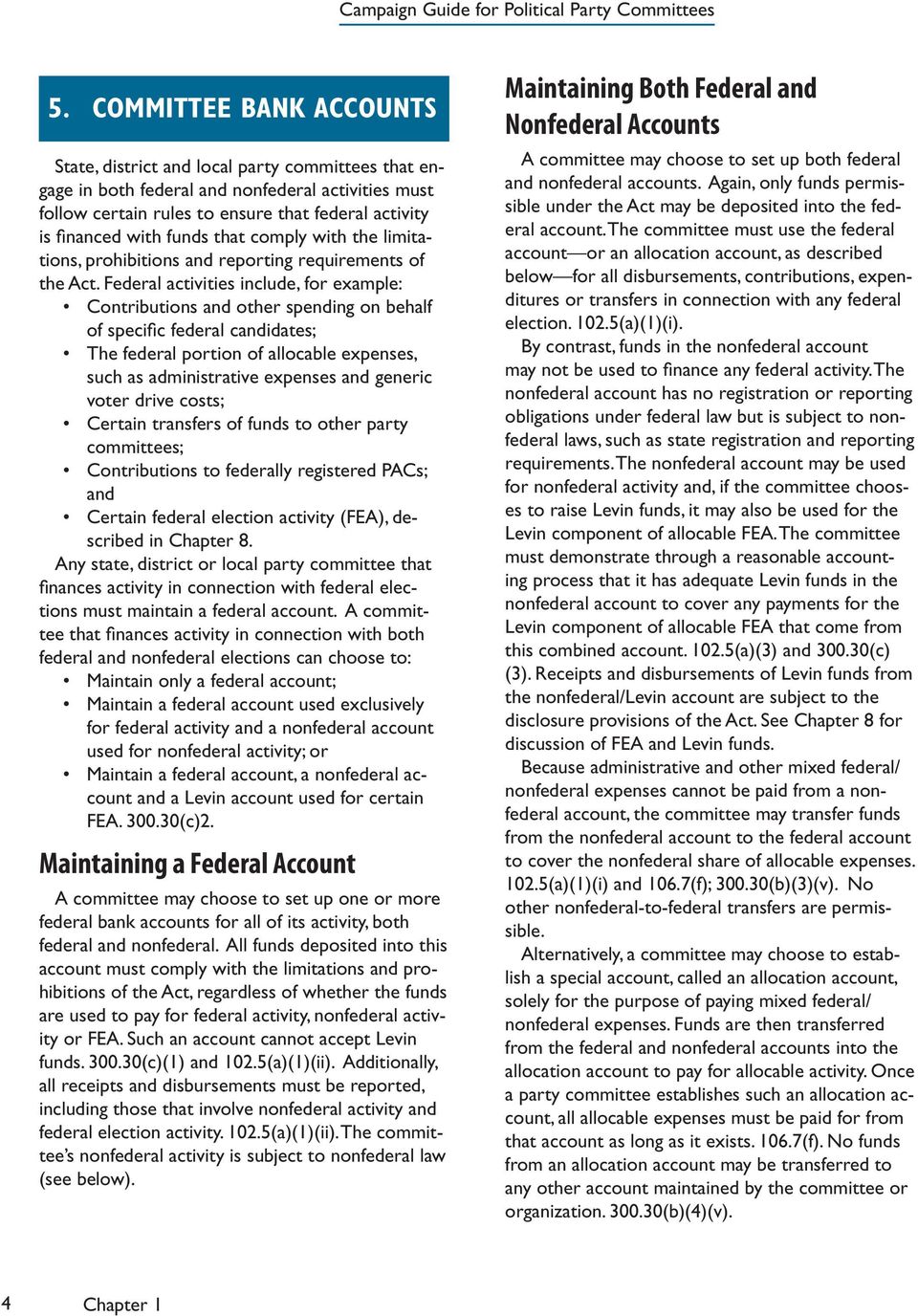
14 Maintaining Federal, Nonfederal and Levin Accounts In addition to maintaining federal and nonfederal accounts, as described above, a state, district or local party committee can also choose to set up one or more Levin accounts used for certain FEA (c)(2). In this case, payments for FEA must be paid from the federal account or from an FEA-specific allocation account, which is separate from any federal/nonfederal allocation account. If the federal account pays the expenses, the committee may transfer funds from its Levin account to cover the allocable share. If an FEA-specific allocation account is used, the committee must transfer funds from both its federal and Levin accounts to cover the allocable expenses (c). No other transfers of Levin funds are permissible (b). Receiving and Depositing Federal Contributions Contributions deposited in either a federal account or an account used for both federal and nonfederal activity must meet certain conditions. All contributions deposited into the federal account are subject to the limitations and prohibitions of the Act. Only contributions solicited and received according to the following conditions may be deposited in a federal account: Contributions must be designated by the contributors for the federal account; The solicitation must expressly state that contributions may be used wholly or in part in connection with a federal election; or The contributor must be informed that all contributions are subject to the limitations and prohibitions of the Act (a)(2) and (b)(3)(ii). See also Solicitation Notices, page 21. COMMITTEE REGISTRATION (PART 1) FEC FORM 1 1. NAME OF COMMITTEE (in full) Freedom Party State Committee ADDRESS (number and street) (Check if address is changed) 3. FEC IDENTIFICATION NUMBER I certify that I have examined this Statement and to the best of my knowledge and belief it is true, correct and complete. Type or Print Name of Treasurer Signature of Treasurer NOTE: Submission of false, erroneous, or incomplete information may subject the person signing this Statement to the penalties of 52 U.S.C Office Use Only STATEMENT OF ORGANIZATION (Check if name is changed) CITY COMMITTEE'S ADDRESS (Please provide only one address) 2. DATE (Check if address is changed) COMMITTEE'S WEB PAGE ADDRESS (URL) (Check if address is changed) X 123 Washington Street Example:If typing, type over the lines. 4. IS THIS STATEMENT NEW (N) OR AMENDED (A) C STATE Date ANY CHANGE IN INFORMATION SHOULD BE REPORTED WITHIN 10 DAYS. For further information contact: Federal Election Commission Toll Free Local FE4M5 Office Use Only City ST [email protected] John Responsible Soliciting Levin Funds ZIP CODE FEC FORM 1 (Revised 02/2009) Levin funds must be raised under unique rules. For information on how to raise Levin funds, see page 57. Nonfederal Laws Apply Contributions received and disbursements made in connection with a nonfederal election are subject to all relevant state or local laws. Committees should therefore seek guidance from the appropriate election officials for information on nonfederal activity. See also Appendix E. 5 Chapter 1
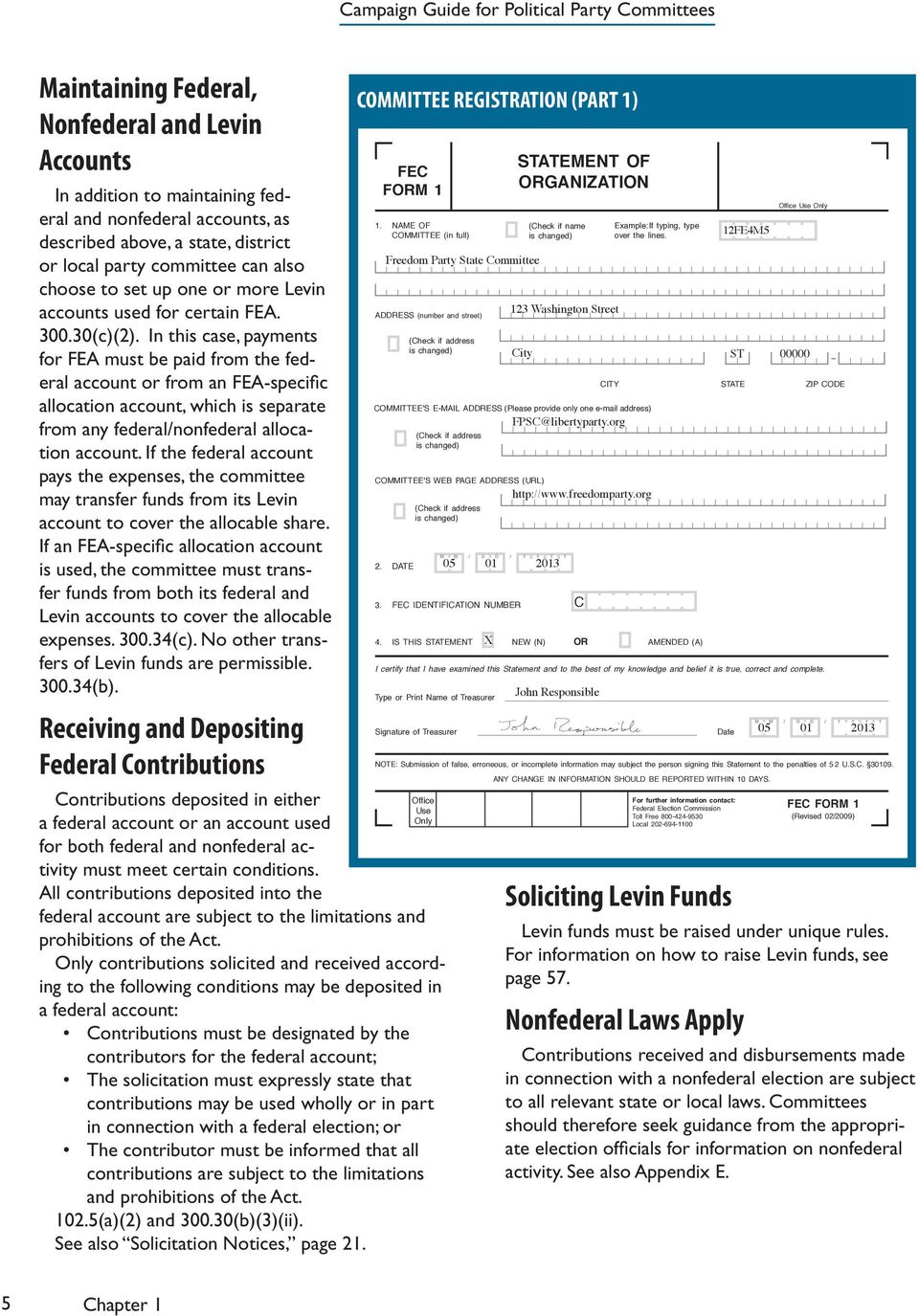
15 COMMITTEE REGISTRATION (PART 2) FEC Form 1 (Revised 02/2009) Page 2 5. TYPE OF COMMITTEE Candidate Committee: (a) (b) Name of Candidate Candidate Party Affiliation (c) Name of Candidate This committee is a principal campaign committee. (Complete the candidate information below.) This committee is an authorized committee, and is NOT a principal campaign committee. (Complete the candidate information below.) This committee supports/opposes only one candidate, and is NOT an authorized committee. Party Committee: (National, State (d) X This committee is a State or subordinate) committee of the Freedom Political Action Committee (PAC): 6. COMMITTEE TREASURER Treasurer Required The committee must have a treasurer before it accepts contributions or makes expenditures (a) and (b). Also, only a treasurer or an assistant treasurer designated on the committee s FEC Statement of Organization (FEC Form 1) may sign FEC reports and statements (a), 104.1(a) and (a). Treasurer s Duties The treasurer is responsible for: (Democratic, Republican, etc.) Party. (e) This committee is a separate segregated fund. (Identify connected organization on line 6.) Its connected organization is a: (f) Corporation Membership Organization Office Sought: House Senate President In addition, this committee is a Lobbyist/Registrant PAC. This committee supports/opposes more than one Federal candidate, and is NOT a separate segregated fund or party committee. (i.e., nonconnected committee) Joint Fundraising Representative: (g) (h) In addition, this committee is a Lobbyist/Registrant PAC. Corporation w/o Capital Stock Trade Association In addition, this committee is a Leadership PAC. (Identify sponsor on line 6.) State District Labor Organization Cooperative This committee collects contributions, pays fundraising expenses and disburses net proceeds for two or more political committees/organizations, at least one of which is an authorized committee of a federal candidate. Committees Participating in Joint Fundraiser This committee collects contributions, pays fundraising expenses and disburses net proceeds for two or more political committees/organizations, none of which is an authorized committee of a federal candidate. FEC ID number FEC ID number FEC ID number FEC ID number C C C C Signing all reports and statements (a), 104.1(a) and (a). Filing complete and accurate reports and statements on time (a) and (d). Monitoring contributions to ensure compliance with the Act s limits and prohibitions (b). Depositing receipts in the committee s designated bank within 10 days (a). Authorizing expenditures and appointing authorized agents (either orally or in writing) to receive contributions and make expenditures (c) and Keeping all required records of receipts and disbursements and (b). Treasurer s Liability Treasurers are responsible for carrying out the duties listed above and should understand these responsibilities (as well as his or her personal liability for fulfilling them) before taking them on. When the Commission brings an enforcement action against a political committee, the treasurer is usually named as a respondent along with the committee itself. The treasurer can be named and found liable in his or her official capacity as a representative of the committee. Also, the treasurer can be named and found liable in his or her personal capacity if he or she knowingly and willfully violates the Act or intentionally deprives himself or herself of the operative facts giving rise to the violation. Even when an enforcement action alleges violations that occurred during the term of a previous treasurer, the Commission usually names the current treasurer as a respondent in the action. See the Statement of Policy Regarding Treasurers Subject to Enforcement Proceedings, 70 Fed. Reg. 3 (January 3, 2005). Vacancy in Office A committee cannot raise or spend funds when there is a vacancy in the office of treasurer (a) and (b). For that reason, the Commission urges 6 Chapter 1

16 every committee to designate an assistant treasurer on its Statement of Organization who may assume the treasurer s duties when the treasurer s office becomes temporarily vacant or when the treasurer is unavailable. The assistant treasurer should be apprised of any filing requirements and, if the committee files electronically, should obtain an electronic filing password as well. The committee must report any change in the treasurer s status within 10 days by amending Form (a) (1)(iv) and 102.2(a)(2). See Updating Registration Information below. New Treasurer If a committee appoints a new treasurer, the committee must file an amended Statement of Organization (Form 1) naming the new treasurer within 10 days of the change. If the committee files electronically, it must submit the amendment electronically. (Committees filing electronically should consult Chapter 11, Section 6 on Obtaining a Password: New Treasurers for more information.) If the committee files on paper, then the change may be made by filing an amended Form 1 or by submitting a letter containing the same information. The new treasurer should sign the amendment. In cases where a committee s treasurer resigns and a new treasurer is not appointed, the outgoing treasurer should notify the Commission of his or her resignation by submitting a letter to the FEC requesting an amendment to the committee s Statement of Organization reflecting the resignation and noting the date the resignation is to take effect. From that date forward, the committee would be rendered dormant until a new treasurer is named using the procedures outlined above. Again, the committee would not be able to raise or spend funds while there is a vacancy in the office of treasurer (a) and (b). COMMITTEE REGISTRATION (PART 3) FEC Form 1 (Revised 02/2009) Page 3 Write or Type Committee Name 6. Name of Any Connected Organization, Affiliated Committee, Joint Fundraising Representative, or Leadership PAC Sponsor 7. Freedom Party State Committee Douglas County Freedom Party Relationship: Connected Organization Affiliated Committee Joint Fundraising Representative 8. Treasurer: List the name and address (phone number -- optional) of the treasurer of the committee; and the name and address of any designated agent (e.g., assistant treasurer). Full Name of Treasurer Title or Position CITY CITY Telephone number STATE STATE ZIP CODE Custodian of Records: Identify by name, address (phone number -- optional) and position of the person in possession of committee books and records. Full Name Title or Position Treasurer Treasurer 222 Mission Road City ST John Responsible 111 Dock St. John Responsible X City ST Dock St. CITY Telephone number STATE Leadership PAC Sponsor ZIP CODE ST ZIP CODE FEC REGISTRATION FORM Within 10 days of exceeding a registration threshold and triggering political committee status, a party committee must file a Statement of Organization (FEC Form 1) (d). Line-by-line instructions are provided below, and with the form itself. Line-by-Line Instructions Line 1. Name and Address of the Committee Enter the full, official name of the committee and its mailing address. This address is considered 7 Chapter 1

17 COMMITTEE REGISTRATION (PART 4) FEC Form 1 (Revised 02/2009) Page 4 Full Name of Designated Agent Title or Position Assistant Treasurer 9. Banks or Other Depositories: List all banks or other depositories in which the committee deposits funds, holds accounts, rents safety deposit boxes or maintains funds. Name of Bank, Depository, etc. Name of Bank, Depository, etc. Alice Second 111 West Ventura City ST STATE the committee s address of record (a)(1)(i). In addition, a committee must include its Internet website, if it maintains a site, and its address (a)(i)(vii). CITY STATE A party committee s name cannot include the name of any candidate. Furthermore, a party committee cannot use the name of any candidate in the name of a special communication, such as a fundraising project, unless the project name shows unambiguous opposition to the candidate, as explained on page (a) and (b)(3). Line 2. Date Enter the date when the committee officially became a political committee that is, the date when the committee exceeded a registration threshold. Line 3. FEC Identification Number Leave this space blank. The committee will be notified of its FEC ID number by mail a few weeks after filing Form 1. From then on, the ID number should be included on reports, statements and other communications (c). If a committee must file a report before it has received an ID number, it should leave that space blank on the reporting form (FEC Form 3X, line 2). Line 4. Is This Statement New or an Amendment? Check new. (Amendments are discussed under Updating Registration Information, page 9.) CITY Sun Island Bank 111 Milan Street CITY Telephone number STATE ZIP CODE City ST ZIP CODE ZIP CODE Line 5. Type of Committee A party committee checks box (d) and identifies itself as either a national, state or subordinate (local) committee of a particular party (a)(1)(i). National and state party committee status is determined by the Commission through the advisory opinion process and (a). Line 6. Affiliated Committees List the names and addresses of any affiliated committees (a)(1)(ii). See 102.2(b)(1)(ii)(B). Affiliated committees share the same limits on contributions received and made; see page 16. A district or local party committee lists the state party committee as an affiliate. Local committees are presumed to be under the direction and control of the state committee and thus affiliated with the state committee unless they can demonstrate otherwise. See 110.3(b)(3). A state party committee lists all affiliated local party committees. (It should not list local party organizations.) See 110.3(b)(3). A national party committee lists any committees it has established, financed, maintained or controlled. However, a national committee does not list state or local party committees, since they are not considered affiliated with the national committee for purposes of the contribution limits. A party s Senate and House campaign committees are also not considered affiliated with the national committee for purposes of the contribution limits (b)(1) and (b)(2). Line 7. Custodian of Records Enter the name and address of the person who has actual possession of the committee s financial records. The committee s treasurer, assistant treasurer or another person (such as an accountant or bookkeeper) may serve as the custodian of records (a)(1)(iii). (Recordkeeping rules are discussed in Chapter 10.) 6 However, the Democratic and Republican national committees and their respective Senate campaign committees share the same limit on contributions to Senate campaigns (e). See page Chapter 1

18 Line 8. Treasurer and Assistant List the name and mailing address of the treasurer (a)(1)(iv). As previously discussed in Section 6, the Commission urges all political committees to list an assistant treasurer as well. Line 9. Banks or Other Depositories List the name and address of each bank where the committee deposits funds. The committee must have at least one checking account for the deposit of receipts (a)(1)(vi) and Signing and Dating the Form The treasurer or assistant treasurer must sign and date the form on the bottom line (a)(1). The signer s name must also be typed or printed where indicated. Filing the Form A party committee must file its Statement of Organization with the FEC within 10 days of becoming a political committee (d). The Statement of Organization must be filed with the FEC and with the filing office of the state in which the committee has its headquarters, unless that state received a waiver from the requirement to maintain copies of FEC statements and reports For more information and for a list of states and territories granted waivers, visit gov/pages/statefiling.shtml. Updating Registration Information Whenever any of the information on the Statement of Organization (Form 1) changes, the committee must report the change within 10 days by filing an amended Form 1 or a letter containing the same information (for paper filers only). The amount of information required on an amended Statement of Organization depends on whether the committee files on paper or electronically. If the committee files electronically, it must submit a fully completed Form 1. In the case of paper filers, the Form 1 or letter needs to include only: The name and address of the committee (Form 1, Line1); The date the change took effect (Line 2); The FEC ID number (Line 3); An indication that the statement is an amendment to the Statement of Organization (Line 4); The changed information (appropriate line number); and The name and signature of the treasurer (or assistant treasurer) and the date signed (a)(2). 8. INCORPORATING THE COMMITTEE If a party committee incorporates for liability purposes only, its outgoing contributions and other expenditures are not subject to the prohibition on corporate contributions and expenditures (a). See also AO The treasurer, however, remains liable for the committee s compliance with the federal campaign finance law. Liability for debts is generally governed by state law. See AO and opinions cited therein. See also Karl Rove and Company v. Thornburgh, 39 F.3d 1273 (5th Cir. 1994). 7 As of 2013, all 50 states, American Samoa and the U.S. Virgin Islands have been granted waivers from the Commission. 9 Chapter 1

19

20 CHAPTER 2 CONTRIBUTIONS AND OTHER SOURCES OF FUNDS 1. TYPES OF CONTRIBUTIONS A contribution is defined as anything of value given for the purpose of influencing a federal election (a). 1 Contributions are subject to the limits and prohibitions of the Federal Election Campaign Act (the Act), as explained later in this chapter. The most common types of contributions are: Gifts of money; Gifts of goods and services (in-kind contributions); Loans (other than bank loans meeting certain conditions); and Guarantees or endorsements of bank loans. Gifts of Money Cash contributions are limited to $100 per contributor. Contributions of more than $100 must be made by check or other written instrument (c). (See also page 15.) Sales or Lease Proceeds Sale of Fundraising Items and Tickets The full purchase price of a fundraising item or ticket to a fundraising event is considered a contribution. For example, when a person buys a $50 ticket to a fundraising dinner, the amount of the contribution is $50, regardless of how much the meal costs the committee A person who buys several tickets to a fundraiser makes a contribution in the amount of the total purchase unless the contribution is intended as a joint contribution (see page 15). Sale of Committee Assets When a committee sells or leases an asset (such as a mailing list), the full amount received from the 1 The definition of contribution also includes the payment by any person of compensation for the personal services of another person if those services are rendered without charge to a political committee for any purpose, except for legal and accounting services under certain conditions (see Chapter 4 and and ) See also AO purchaser is generally considered a contribution to the committee unless: The committee had purchased or developed the asset for the committee s own use rather than as a fundraising item; The asset has an ascertainable market value; Rental of the asset comprises only a small percentage of the committee s overall use; and The purchaser pays the usual and normal charge. (Any payment in excess of that amount is considered a contribution.) See, for example, AOs , , and For more information on leasing a party mailing list, see AO Under certain conditions, the Commission has also concluded that a contribution does not result from a sale that is an isolated disposal or sale of unwanted and depreciated committee assets (such as office furniture). For more information, see AOs and In-Kind Contributions Definition In-kind contributions include: Goods and services offered free of charge; Goods and services offered at less than the usual and normal charge (unless the discount is offered in the ordinary course of business see, for example, AO ); Payments, by a third party, of committee bills; and Advances of personal funds (d), and 116.5(b). Value The dollar value of an in-kind contribution is subject to limits. The value is determined as follows: Goods (such as equipment, supplies, facilities and mailing lists) are valued at their normal purchase or rental price at the time of the contribution. 11 Chapter 2

21 Services (such as advertising, printing and consulting) are valued at the prevailing commercial rate at the time the services are rendered. Discounts are valued at the difference between the usual or normal charge and the amount paid by the committee (d). Advances of Personal Funds General Rule When an individual uses his or her personal funds (or personal credit card) to pay for a committee expense, that payment is generally considered a contribution from that individual if he or she is not reimbursed by the committee within certain time limits: 30 days after payment by cash or personal check; or 60 days after the closing date of the billing statement on which the charges first appear, if the amount was charged to a personal credit card (b). For example, an in-kind contribution results if a committee staff member or volunteer pays for postage, office supplies or campaign materials with his or her personal funds and is not reimbursed. (The special reporting rules that apply to advances of personal funds are explained on page 90.) Travel Exception When an individual uses personal funds to pay for his or her own travel expenses (transportation, food and lodging), the payments are not considered contributions if they fall under the travel exception: Exempt Travel. An individual may spend up to $2,000 per calendar year on his or her own transportation expenses for party-related travel without making a contribution, and a volunteer may spend unlimited amounts for his or her normal subsistence expenses (food and lodging) while volunteering and 116.5(b)(1). See pages for more information on reporting travel expenses. Loans A loan to a committee is a contribution to the extent that it remains outstanding (b)(2). (Loans from banks are not contributions if they meet certain conditions; see page 16.) Repayments made on a loan reduce the amount charged against the lender s contribution limit. However, a loan that exceeds the lender s limit is unlawful even if repaid in full (b)(1). Endorsements and Guarantees of Bank Loans An endorsement or guarantee of a bank loan is a contribution. The amount guaranteed counts against the endorser s or the guarantor s limit only to the extent that the loan remains outstanding. Repayments on the loan proportionally reduce the amount charged against each endorser s (or guarantor s) contribution limit. If a loan agreement does not stipulate the amount for which each endorser or guarantor is liable, then the contribution amount of each endorser or guarantor is determined by dividing the total amount of the loan by the number of endorsers or guarantors (b)(3) and (c). 2. PROHIBITED CONTRIBUTIONS Acceptance of Prohibited Contributions A political committee is prohibited from knowingly accepting a contribution that violates the prohibitions on contributions (g), 110.4(b)(1) (iv), 114.2(d) and 115.2(c). See also For information on how to handle possibly illegal contributions, see page 23. For information on how to handle in-kind donations from prohibited sources for mixed federal/ nonfederal activities, see page 111. Corporations and Labor Organizations The Act prohibits corporations and labor organizations from making contributions in connection with federal elections (b). This prohibition applies to all types of incorporated organizations, except political committees that incorporate only for liability purposes (a), National banks and federally chartered corporations, such as federal savings and loan associations, are prohibited from 2 A corporation or labor organization may pay the expenses of setting up, administering and soliciting contributions for its own political committee, called a separate segregated fund (or PAC) (a)(2)(iii). A party committee may accept contributions from a corporate or labor PAC registered with the FEC. 12 Chapter 2
22 making contributions in connection with state and local as well as federal elections (a). Contribution Reimbursements A corporation or labor organization may not reimburse individuals who make contributions to a political committee, for example, through a bonus, expense account or other direct or indirect compensation. See 114.5(b)(1) and (c)(1)(ii); see also 110.4(b). Extensions of Credit An extension of credit to a political committee by an incorporated commercial vendor is a prohibited contribution unless the credit is extended in the ordinary course of business with terms substantially similar to those given to nonpolitical clients of similar risk. A prohibited contribution can also result if a corporate vendor extends credit for longer than the normal practice in the vendor s business or if the vendor fails to make a commercially reasonable effort to collect payment on the debt and 116.3(b) and (c). Forgiveness or settlement of a debt owed by a political committee must comply with the debt settlement procedures explained in Chapter 15. Discounts If an incorporated commercial vendor sells goods or services to a committee at a price below the usual or normal charge, a prohibited contribution results in the amount of the discount (d) (1). (There is, however, an exception for discounts offered by vendors of food and beverage; see page 28.) A reduced price is not considered a prohibited discount; however, if it is offered by the vendor in the ordinary course of business at the same amount charged to nonpolitical clients. See AOs , and Compensation for Services If a corporation or labor organization pays for services rendered to a committee, a prohibited contribution results A corporation or labor organization may, however, provide free legal and accounting services to a party committee See page 27 for more information. 3 The prohibition does not generally apply to activities related to state ballot measures. See First National Bank v. Bellotti, 435 U.S. 765 (1978) and AO Federal Government Contractors Federal government contractors are prohibited from making contributions or expenditures in connection with federal elections (a). See AO For example, a contribution from a partnership with a government contract would be prohibited As another example, a contribution from the personal or business funds of an individual or a sole proprietor with a government contract would be prohibited However, employees, individual stockholders and officers of federal contractors may make contributions or expenditures from their personal assets (c) and Also, the spouse of an individual who is a federal contractor may make a personal contribution or expenditure in his or her own name Foreign Nationals Foreign nationals are prohibited from making contributions, donations or expenditures, either directly or through any other person, in connection with any election federal, state or local. See (b), (c) and (f). (See also Appendix E for information on how this prohibition applies to state and local elections.) In addition, foreign nationals may not donate to any party committee building fund, or fund electioneering communications or independent expenditures (d)-(f). The Act prohibits knowingly soliciting, accepting or receiving contributions or donations from foreign nationals (g). In this context, knowingly means that a person: Has actual knowledge that the funds solicited, accepted or received are from a foreign national; Is aware of facts that would lead a reasonable person to conclude that there is a substantial probability that the funds solicited, accepted or received are likely to be from a foreign national; or Is aware of facts that would lead a reasonable person to inquire whether the source of the funds solicited, accepted or received is a foreign national, but the person failed to conduct a reasonable inquiry (a)(4). For examples of facts which may be pertinent, see (a)(5). It is also unlawful to knowingly provide substantial assistance to foreign nationals making contributions 13 Chapter 2
23 or donations in connection with any U.S. election (h). Substantial assistance refers to active involvement in the solicitation, making, receipt or acceptance of a foreign national contribution or donation with the intent of completing the transaction successfully. 4 This prohibition includes, but is not limited to, individuals who act as conduits or intermediaries. Definition of Foreign National The following entities are considered foreign nationals and are therefore subject to the prohibition: foreign governments; foreign political parties; foreign corporations; foreign associations; foreign partnerships; and individuals with foreign citizenship unless they have green cards indicating they have been lawfully admitted for permanent residence (a)(3). Safe Harbor Provision In some cases, a committee may have questions regarding whether or not a contribution is from a foreign national. For example, the contributor may have a foreign address or bank. In this case, a committee has made reasonable assurances that the individual is not a foreign national if the committee obtains current and valid U.S. passport papers for the contributor (a)(7). The safe harbor cannot be relied on if the committee has actual knowledge the contribution is from a foreign national (a)(7). PACs of Domestic Subsidiaries of Foreign Corporations A political party committee may accept contributions from the PAC (separate segregated fund) of a U.S. corporation that is a subsidiary of a foreign corporation as long as: The foreign parent does not finance the PAC s activities through the subsidiary; and No individual foreign national participates in the operation of the PAC (including the selection of persons to run the PAC) or makes any decisions regarding PAC contributions or expenditures (i). See also AOs , , , , , and Corporate Donations for Nonfederal Activity A domestic subsidiary of a foreign corporation (or a domestic corporation owned by foreign nationals) may donate funds in connection with state or local elections (including nonfederal accounts of political parties) so long as the funds do not come from the foreign parent or owner, and individual foreign nationals are not involved in any way in the making of donations to nonfederal candidates or committees. Please note that many states place additional restrictions on donations made to nonfederal candidates and committees. See AOs and Contributions in the Name of Another Contributions made by one person in the name of another person are prohibited, and no one may assist someone in making such a contribution (b). 3. LIMITS ON CONTRIBUTIONS RECEIVED BY THE COMMITTEE Political committees are prohibited from accepting contributions that violate the contribution limits For information on how to handle excessive contributions, see page 23. State and Local Committees A state party committee may receive up to $10,000 per calendar year from individuals and from non-multicandidate political committees (c)(5). As explained later in this chapter, this limit is shared with all district and local party committees within the state unless a district or local committee can demonstrate it is not affiliated with the state committee. (A district or local party committee that has demonstrated its independence from the state party committee may receive up to $5,000 from an individual.) Additionally, a state party committee may receive up to $5,000 per year from multicandidate political committees (d). 4 See Contribution Limitations and Prohibitions, 67 Fed. Reg , (Nov. 19, 2002). 14 Chapter 2
24 National Party Committees A national party committee may receive up to $15,000 per calendar year from a multicandidate committee and $32,400 5 per calendar year from non-multicandidate committees and individual contributors (c)(1), 110.1(c)(3) and110.2(c)(3). Biennial Limit for Individuals In addition to the limits on individual contributions to a particular political committee, there is an overall biennial limit. During a two-year calendar year cycle (January 1 of an odd-numbered year through December 31 of an even-numbered year), an individual may contribute a total of $123,200 to all political committees combined. 6 This amount may not go entirely to any one type of political committee. Only $48,600 may be contributed to candidate committees. The remaining $74,600 may be contributed to PACs and party committees, but only $48,600 of that amount may go to state and local parties and PACs. The remaining $26,000 is reserved for national party committees (b). Candidate Limit May Apply A contribution received by a party committee may count against the contributor s contribution limit for a particular candidate if: The contributor knows that a substantial portion of his or her contribution will be given to or spent on behalf of a particular candidate; or The contributor retains control over the funds after making the contribution (for example, the contributor earmarks the contribution for a particular candidate) (h), 110.2(h) and Contributions from Affiliated PACs Political action committees (PACs) that are affiliated with one another share the same set of contribution limits. For example, affiliated nonmulticandidate PACs may contribute a combined 5 The limit is indexed in odd-numbered years to account for inflation. 6 The biennial limit is indexed in odd-numbered years to account for inflation. Note that the biennial limit applies only to individuals. total of $10,000 per year to a state party committee (and its district and local affiliates) (a) and 110.1(c)(5). Affiliated multicandidate PACs may contribute a combined total of $5,000 per year to a state party committee (and its district and local affiliates) (d). Contributions from Spouses A husband and wife each have separate contribution limits, even if only one spouse has an income (i). A couple may make a joint contribution (part of which would be attributed to each), as explained below. Joint Contributions A joint contribution is a contribution that is made by more than one person using a single check or other written instrument. A joint contribution represents the personal funds of each donor, so each donor must sign either the check or an accompanying statement (k)(1). For the purposes of the contribution limits, a joint contribution is attributed equally to each donor, unless an accompanying statement indicates that the funds should be divided differently (k) (2). See Excess Contributions: Reattributions, page 24. Partnership Contributions A contribution from a partnership counts against the partnership s limit and also counts proportionally against the limits of each participating partner (e). See Appendix C for more information on contributions from partnerships. $100 Limit on Cash Contributions Contributions of currency from any one source are limited to $100. A cash contribution in excess of that limit must be returned to the contributor (c)(1) and (2). $50 Limit on Anonymous Contributions An anonymous contribution is limited to $50. Any amount in excess of $50 must be promptly disposed of, and may be used for any lawful purpose unrelated to any federal election, candidate or campaign (c)(3). 15 Chapter 2
25 4. AFFILIATION AND THE CONTRIBUTION LIMITS State and Local Committees General Rule A state party committee and local party committees within that state are presumed to be affiliated. That is, all contributions received and made by local party committees count against the state committee s limits (b)(3). This means that the state committee and local committees together may receive a maximum of $10,000 per calendar year from any one individual or non-multicandidate committee contributor (c)(5). Similarly, the state committee and local committees together may not contribute more than $5,000 to a candidate per election, assuming the state party committee has qualified as a multicandidate committee (see page 35) (b)(1). To avoid exceeding the contribution limits, a state party committee should set up a centralized monitoring system to ensure that all contributions made and received by local party committees are within the limits. See 103.3(b) and Independent Local Committees A local party committee may operate under its own separate set of contribution limits if the committee s independence can be demonstrated. An independent party committee has the same set of contribution limits as a PAC. Thus, for example, an independent local party committee that has multicandidate committee status may contribute up to $5,000 to a federal candidate, while an independent local party committee that is a non-multicandidate committee may contribute up to $2,600 7 to a federal candidate. For more information, see 110.3(b) (3). See also AOs , and National Party Committees A national party committee operates under its own set of contribution limits (b)(1)(i). Only federally permissible funds may be raised and spent by the national parties The limit is indexed in odd-numbered years to account for inflation. The Democratic and Republican parties each have three national party committees: a national committee, a House campaign committee and a Senate campaign committee. Each of these committees has a separate set of contribution limits, except for a special limit on contributions to Senate campaigns; see page (e) and 110.3(b)(2). 5. BANK LOANS AND OVERDRAFTS Bank Loans Unlike other loans, a loan or line of credit from a bank is not considered a contribution if the conditions set forth below are satisfied. If a loan fails to meet any of these conditions, it is considered a prohibited contribution from the lending institution. Conditions A committee may obtain a loan or line of credit from a bank provided that the loan: 1. Bears the bank s usual and customary interest rate for the category of loan involved; 2. Is evidenced by a written instrument; 3. Is subject to a due date or amortization schedule; and 4. Is made on a basis which assures repayment (a)(1)-(4). Methods of Assuring Repayment A loan is made on a basis which assures repayment if it is obtained using one or more of the following authorized methods of securing the loan: Collateral. A loan may be secured using assets of the committee, such as real estate, personal property, negotiable instruments and stocks. The fair market value of the assets pledged must, on the date of the loan, equal or exceed the amount of the loan and any senior liens. The committee must ensure that the bank has established a perfected security interest in the collateral (that is, taken steps to legally protect its interest in the collateral in the event that the committee defaults on the loan) (e)(1)(i). Guarantees or Endorsements. A loan may also be secured using guarantors or endorsers, who agree to repay the loan should the committee default. As previously stated, an endorsement or guarantee of a bank loan is considered a contribu- 16 Chapter 2
26 tion by the endorser or guarantor to the extent the loan remains outstanding, and is therefore subject to the law s prohibitions and limits on contributions (c) and (e)(1)(ii). Pledge of Future Receipts. A committee may pledge its future receipts as security for the loan; the amount of the loan must not exceed a reasonable estimate of anticipated receipts, based on documentation provided by the committee (such as cash flow charts or fundraising plans). Future receipts may include, for example, anticipated contributions or interest income. The loan agreement must require the committee to deposit the pledged funds into a separate account established for this purpose. If the account is established at a depository other than the lending institution, the committee must assign the account s funds to the lender and notify the depository of the assignment (e)(2). Other Methods of Assuring Repayment The Commission may, on a case-by-case basis, approve other methods of assuring repayment (e)(3). A committee may wish to request an advisory opinion from the Commission before entering into an alternative repayment agreement. Overdrafts If a bank honors a check written by a committee with insufficient funds in its account, no contribution from the bank results as long as the overdraft: Is made on an account subject to automatic overdraft protection; Is subject to the usual and customary interest rate; and Is subject to a repayment schedule (d). An overdraft that does not meet the above conditions is a prohibited contribution. Overdraft protection secured through a line of credit is subject to the rules on bank loans. 6. INTEREST AND DIVIDENDS A committee may earn interest and dividends on funds invested in, for example, a savings account, money market fund or certificate of deposit. Interest and dividends are not contributions. Disclosure of Bank on Statement of Organization Any bank where the committee deposits funds must be listed on the Statement of Organization (Form 1) or an amendment (a)(1)(vi). Other institutions holding committee investments (such as stocks, bonds, mutual funds, etc.) are not disclosed on Form 1. Before disbursing such funds, however, the committee must transfer them to a checking account maintained at one of the committee s campaign depositories (a). See also AOs , and Taxes A committee must generally pay taxes on interest and dividend income. See Appendix G for IRS information. 7. OTHER SOURCES OF FUNDS Offsets to Operating Expenditures Offsets to operating expenditures, such as returns of deposits, refunds and rebates, are not considered contributions. Rebates, however, must be offered in the ordinary course of business and on the same terms and conditions as those offered to nonpolitical entities. Otherwise, the rebate may be considered a contribution a prohibited contribution if the vendor is a corporation. See, for example, AOs and Transfers from Other Party Committees A party committee may receive unlimited transfers of permissible funds from other party committees and party organizations. A party organization making such transfers, however, may trigger federal registration (a)(1)(ii), (iv) and (a)(2). Transfers of Candidate Campaign Funds A candidate s authorized committee may transfer unlimited campaign funds to a party committee or organization (c). Any nonfederal law that would prohibit such a transfer to a party organization is preempted by federal law. AO Chapter 2
27 Loan Repayments If a party committee makes a loan to any person, the loan repayments received are not contributions but must be composed of permissible funds. Any interest charged on the loan must also be paid with permissible funds. Interest payments are not considered contributions unless they exceed the prevailing interest rates (b)(5). Ballot Access Payments Fees paid to a party committee as a condition of ballot access are not contributions. This exemption covers ballot access fees paid by federal candidates as a requirement of state law and those paid to state and subordinate party committees by delegates and delegate committees. Such fees must be paid with permissible funds, except that individual delegates may use funds that are not subject to the limits and (c)(1)(i) and (2). See Appendix D for information on delegate activity. Building Fund Donations State, district and local party committees may accept unlimited funds donated specifically to defray the costs of constructing or purchasing a party office building (but not to influence any particular federal election). Such building fund donations are not considered contributions and are not subject to any limits or prohibitions, other than the prohibition against donations from foreign nationals , 114.1(a)(2)(ix) and This exemption does not apply to national party committees because they are prohibited from raising or spending funds not subject to the limitations, prohibitions and reporting requirements of the Act (a)(2) (ix) and (d). A party committee must deposit such donations in a nonfederal account, since they do not meet the requirements for deposit in a federal account (see pages 4 5) and 102.5(a)(2). Federal funds may also be used to construct or purchase a party office building. If federal funds are used for this purpose, the limitations and prohibitions of the Act apply. If nonfederal funds are used, they are subject to the limits and prohibitions of state law. State party committees may need to report such activity under state law (b)(1). See also AO Note that this exemption does not apply to funds used to pay rent, operating costs, property taxes or other administrative expenses of a party office building. (See AOs and ) Leasing a Portion of the Office Building A state or local party committee may lease a portion of its office building at the usual and normal charge. If the building is purchased or constructed with any nonfederal funds, all rental income must be treated as nonfederal funds. If the building is purchased or constructed solely with federal funds, the income may be deposited in the federal account (c). 8. STATE TAX CHECKOFF FUNDS AND OTHER STATE PROCEEDS State and local party committees in some states may receive funds derived from state tax checkoffs or fees paid for a state service (e.g., fees for personalized license plates). This section explains when these funds may be deposited in a federal account and, if so, when they are considered contributions rather than miscellaneous receipts. Deposit in Federal Account As a general rule, if the funds in question are from permissible sources (e.g., individuals) rather than from persons prohibited from making contributions under federal law (e.g., corporations, labor organizations, foreign nationals), the funds may be deposited into a federal account. For example, in several advisory opinions, the Commission concluded that proceeds from state income tax checkoff programs (whereby individual taxpayers designate funds for political parties) and fees for personalized licenses plates were permissible funds and could therefore be deposited into a federal account. AOs (Ohio checkoff), (Kentucky checkoff), (Virginia checkoff), (Indiana license plate fees), (North Carolina checkoff) and (Iowa checkoff). In another opinion, AO , a state party committee was allowed to deposit into its federal 8 AO also determined that federal law preempted an Ohio law barring the party committee from depositing checkoff proceeds into an allocation account. 18 Chapter 2
28 account ballot fees and party assessments paid to the state of Florida by federal candidates. However, because state law allowed nonfederal candidates to accept funds that would be considered prohibited or excessive under federal law, fees and assessments from nonfederal candidates could not be deposited into the federal account. Treatment as Contributions In the above cited advisory opinions, checkoff funds that did not increase the taxpayer s liability or decrease his or her refund were not considered contributions. Nor were the personalized license plate fees. In these situations, the funds were considered miscellaneous receipts (reportable as other receipts see page 85). However, in AO (Virginia checkoff), the checkoff funds represented taxpayer refunds. Under those circumstances where the money would otherwise be refunded to the taxpayer the funds were considered contributions if deposited into a federal account. Because the amount of each contribution was only $2 per taxpayer, the contributions were reportable as unitemized contributions from individuals (see page 80). 19 Chapter 2
29
30 CHAPTER 3 FUNDRAISING PROCEDURES 1. SOLICITATION NOTICES Federal Election Purpose Solicitations must inform potential contributors that their contributions will be used in connection with federal elections or that they are subject to the limits and prohibitions of the Federal Election Campaign Act (the Act) (a)(2)(ii) and (iii). Disclaimer Notice Solicitations for the party committee must include a disclaimer stating who has paid for the communication and must contain the following information: If the communication is authorized by a candidate, candidate s committee or agent of either entity, but paid for by any other person, the disclaimer must state the communication is paid for by the third party and is authorized by the candidate, authorized committee or agent. Example: Paid for by XYZ State Party Committee and authorized by Joe Smith for Congress (b)(2). If the communication is not authorized by a candidate, authorized committee or agent of either, the disclaimer must include who paid for the communication, the permanent street address, telephone number or website address of the person paying for the communication and that the communication was not authorized by any candidate (b)(3). Example: Paid for by the XYZ State Party Committee ( and not authorized by any candidate or candidate s committee (b)(3). For additional information concerning disclaimers, see page 64 or consult the FEC s brochure Special Notices on Political Ads and Solicitations. Best Efforts Notice Party committees and their treasurers must make best efforts to obtain, maintain and report the name, address, occupation and employer of each contributor who gives more than $200 in a calendar year , 102.9(a), (d). Reports filed with the Commission will be considered to be in compliance with the Act when the treasurer shows that best efforts have been used to obtain, maintain and submit the information required by the Act , In order to show that the committee has made best efforts, solicitations must specifically request that information and inform contributors that the committee is required by law to undertake best efforts to report it (b)(1). For details, see Treasurer s Best Efforts, page 69. IRS Notice Section 6113 of the Internal Revenue Code requires political committees whose gross annual receipts normally exceed $100,000 to include a special notice on solicitations informing solicitees that their contributions are not tax deductible. There are substantial penalties for failure to comply with this provision. Contact the IRS for more information (see Appendix G). FCC Notice Check with the Federal Communications Commission for information on required notices for political ads aired on radio or television (see Appendix G). 2. FORWARDED CONTRIBUTIONS Time Limits Any person who receives contributions for a party committee must forward the contributions, together with certain information about the contributors (see Chapter 6), to the committee treasurer within the following time periods: Contributions of $50 or less within 30 days after receiving the funds; 21 Chapter 3
31 Contributions of more than $50 within 10 days after receiving the funds (b). 1 No Commingling with Personal Funds Contributions and other committee receipts must not be deposited in a personal account or otherwise commingled with personal funds TREASURER S RECEIPT Deposit or Return Contributions within 10 Days Within 10 days of receipt by the treasurer, a contribution or other receipt must be deposited in the committee s campaign depository or returned to the source (see footnote 1 below) (a). Determining Legality The committee treasurer is responsible for examining all contributions to ensure that they are neither prohibited nor excessive. In order to determine whether a contribution exceeds the contributor s limit, the contribution must be aggregated with any others made by the contributor to the committee or its affiliates during the calendar year (b). Contributions of questionable legality must be handled as described in Section 6 below. 4. FEDERAL CANDIDATES AND NONFEDERAL FUNDRAISING Federal candidates, officeholders and their agents may not raise funds for federal elections, including funds for FEA, outside the limits, prohibitions and reporting requirements of the Act. In addition, federal candidates, officeholders and their agents may only raise funds in connection with nonfederal elections in amounts and from sources that are consistent with state law and within the limits 1 The receipt of a contribution by an authorized agent (that is, a person authorized by the treasurer to receive contributions and make expenditures for the committee 102.9) is the equivalent of the treasurer s receipt and triggers the 10-day deposit period at 103.3(a). AO and prohibitions of the Act and In 2010, the Commission revised its rules regarding participation by federal candidates and officeholders in state, district and local party fundraising events. The following rules apply to participation by federal candidates and officeholders at all nonfederal fundraising events (and in related publicity) that are in connection with an election for federal office or any nonfederal election. Participation at Nonfederal Fundraising Events A federal candidate or officeholder may attend, speak at and be a featured guest at a nonfederal fundraiser (b)(1). He or she is also free to solicit funds at the fundraising event, provided that the solicitation for funds is within the limitations and prohibitions of the Act and are consistent with state law , (b)(2). Such a solicitation should either be explicitly limited or should be limited by displaying at the fundraiser a clear and conspicuous written notice, or by making a clear and conspicuous oral statement, that the solicitation is not for Levin funds (when applicable) and does not seek funds in excess of federally permissible amounts or from corporations, labor organizations, national banks, federal government contractors and foreign nationals (b) (2)(i-ii). If the federal candidate or officeholder chooses to make an oral statement, it need only be made once. Publicity for Nonfederal Fundraising Events FEC regulations also address the publicity for nonfederal fundraisers including, but not limited to, ads, announcements or pre-event invitation materials, regardless of format or medium of the communication (c). If the publicity does not contain a solicitation or solicits only federally permissible funds, then the federal candidate or officeholder (or agent of 2 These restrictions apply to the solicitation, receipt, directing, transfer, spending, and disbursement of funds. They also apply to entities that are directly or indirectly established, financed, maintained or controlled by a federal candidate or officeholder, including leadership PACs and ; see also 300.2(c) and Chapter 3
32 either) is free to consent to the use of the name or likeness of the federal candidate or officeholder in the publicity for the nonfederal fundraiser (c) (1)-(2). If the publicity contains a solicitation for funds outside the limitations or prohibitions of the Act or Levin funds, the federal candidate or officeholder (or agent of either) may consent to the use the name or likeness of the federal candidate or officeholder in the publicity, only if: The federal candidate or officeholder is identified in a manner not specifically related to fundraising, such as a featured guest, honored guest, special guest, featured speaker or honored speaker; and The publicity includes a clear and conspicuous oral or written disclaimer that the solicitation is not being made by the federal candidate or officeholder (c)(3)(i). Examples of disclaimers are provided in the regulation at (c)(iv). However, a federal candidate or officeholder (or agent of either) may not agree to the consent of his or her name or likeness in publicity that contains a solicitation of funds outside the limitations and prohibitions of the Act or of Levin funds if: The federal candidate or officeholder is identified as serving in a manner specifically related to fundraising, such as honorary chairperson or member of a host committee; or is identified in the publicity as extending the invitation to the event; or The federal candidate or officeholder signs the communication. These restrictions apply even if the publicity contains a disclaimer (c)(v). In addition, the federal candidate or officeholder is prohibited from disseminating publicity for nonfederal fundraisers that contains a solicitation of funds outside the limitations or prohibitions of the Act or of Levin funds (c)(vi). 5. PROHIBITED FUNDRAISING ACTIVITY 501(c) and 527 Organizations National, state, district and local party committees, and their officers, agents and entities of a committee, 3 may not solicit any funds for or make or direct any donations of nonfederal funds (including Levin funds) to the following organizations: 501(c) tax-exempt organizations that make expenditures or disbursements in connection with a federal election, including for federal election activity (FEA). This prohibition applies even if the organization has only applied for tax-exempt status (a)(1) and (2); (a)(1) and (2); (a)(1) and (2); and (a)(1) and (2); or 527 organizations which are not political committees, state, district or local party committees or authorized campaign committees of a state or local candidate (a)(3), (a)(3), (a)(3) and (a)(3). See also McConnell v. FEC, 540 U.S. 93, (2003). However, state, district and local party committees may make or direct donations to a state political committee that supports only state and local candidates, and does not make any expenditures or disbursements in connection with federal elections, including for federal election activity (FEA). See Chapter (a)(3)(iv) and (a)(3)(iv). Certification of 501(c) and 527 Organizations When determining whether a 501(c) or 527 organization makes expenditures or disbursements in connection with a federal election, including for FEA, the party committee may rely on a certification by the organization (c) and (d); (c) and (d); (c) and (d); and (c) and (d). For more on the certification requirements, see page HANDLING ILLEGAL CONTRIBUTIONS Depositing Questionable Contributions Within 10 days of receiving a contribution that appears to be excessive or prohibited, the committee treasurer must either return the contribution or deposit it (b)(1). 3 This includes entities directly or indirectly established, financed, maintained or controlled by the party committee or the party committee s agents. 23 Chapter 3
33 If it is deposited, the treasurer must: Keep enough money in the committee s account to cover the potential refund or establish a separate account for such contributions. Keep a record explaining why the contribution may be illegal and include this explanation on Schedule A if the contribution has to be itemized before its legality is established. In the case of an excessive contribution, obtain a redesignation or reattribution of the excessive portion or refund it to the contributor (see below). In the case of a possibly prohibited contribution, confirm its legality or refund it (see below) (b)(1), (3), (4) and (5). Excessive Contributions: Reattributions In addition to return or refund, a committee may remedy an excessive joint contribution through reattribution by the contributors or through presumptive reattribution by the committee, as described below. Reattribution By Contributor With a reattribution, the contributor instructs the committee in writing to attribute the excessive portion of a joint contribution to the other individual joining in the contribution. For example, if the committee receives an excessive contribution drawn on a joint checking account, but signed by only one account holder, the committee may seek a signed reattribution of the excessive amount to the other account holder (k)(3)(ii)(A). (A joint contribution shall be attributed equally to each contributor, if the amount to be attributed is not indicated, but may also be reattributed so that a different amount is attributed to each contributor, if instructed by the contributors.) Note that a joint contribution must represent the personal funds of each contributor because contributions made in the name of another are prohibited. See 110.4(b). When requesting reattributions, the committee must also inform contributors that they may, alternatively, ask for a refund of the excessive portions of their contributions (k)(3)(ii)(A). Requesting Reattribution If the written instrument has more than one name imprinted on it, the treasurer may ask the contributor whether the contribution was intended to be a joint contribution from more than one person. The treasurer must inform the contributor that he or she may instead request a refund of the excessive portion. The treasurer should also inform contributors that a reattribution must be signed by each participating contributor and indicate the amount attributed to each contributor, if equal attribution is not intended (k)(3)(ii)(A). (This scenario would not be presumptive reattribution). Receive Reattribution or Make Refund Within 60 days of receiving the original contribution, the treasurer must receive a proper reattribution, presumptively reattribute (if applicable) or refund the excessive portion (b)(3) and 110.1(k)(3)(ii)(A)(2) and (B)(3). Presumptive Reattribution By Committee Under certain circumstances, a committee may reattribute an excessive contribution without first receiving a written request from the contributors. When a committee receives an excessive contribution made via a written instrument with more than one individual s name imprinted on it, but only one signature, the committee may attribute the permissible portion to the signer. The committee may make a presumptive reattribution of the excessive portion to the other individual whose name is imprinted on the written instrument, without obtaining a second signature, so long as the reattribution does not cause the contributor to exceed any other contribution limit (k)(3)(ii)(B)(1). The committee is required to notify the contributors of the reattribution within 60 days of the treasurer s receipt of the contribution, and must offer the contributor the option to receive a refund instead. Example of Presumptive Reattribution A state party committee receives an $11,000 check that is drawn on a joint account but signed by only one account holder. The treasurer deposits the check and attributes $10,000 to the signer and $1,000 to the other account holder. Within 60 days of receiving the original contribution, the treasurer sends a letter informing the contributors of the reattribution and of their right to a refund. Assuming neither contributor objects, the committee may now keep the full $11, Chapter 3
34 Prohibited Contributions Questionable Source If a committee treasurer deposits a contribution that appears to come from a prohibited source, he or she has 30 days from the date of the contribution s receipt to: Confirm the legality of the contribution; or Refund the contribution (b)(1). As evidence of legality, the treasurer should obtain a written statement from the contributor explaining why the contribution is legal. Alternatively, the treasurer may obtain an oral explanation by telephone and keep a written record of the conversation (b)(1). Late Discovery Of Prohibited Contribution If a treasurer discovers that a previously deposited contribution came from a prohibited source, he or she must refund the contribution within 30 days of making the discovery. This situation might arise, for example, if the treasurer learned that a past contribution was made by a foreign national. If the committee does not have sufficient funds to refund the contribution when the illegality is discovered, the treasurer must use the next funds the committee receives (b)(2). 7. JOINT FUNDRAISING PROCEDURES Party committees may engage in joint fundraising with other political committees and organizations. See Appendix B. 25 Chapter 3
35
36 CHAPTER 4 OTHER COMMITTEE RESOURCES In addition to receiving contributions and other funds (see Chapter 2), party committees may receive certain goods and services without any contribution resulting. In many cases, no reporting is required. 1. LEGAL AND ACCOUNTING SERVICES A party committee may receive, without limit, free legal and accounting services as long as: The services do not directly further the election of a specific federal candidate; The person paying for the service is the regular employer of the individual performing the service; The employer does not hire additional employees to free regular employees to perform the service; The employer does not hire new employees to perform the service directly; and The committee reports the value of the service (the amount paid by the employer), as well as the name of each person who performed the service and the date the service was provided , 104.3(h) and 114.1(a) (2)(vi). If an individual personally volunteers legal or accounting services without compensation, the above restrictions do not apply. See Volunteer Activity: Personal Services, below. 2. VOLUNTEER ACTIVITY Personal Services An individual may volunteer uncompensated personal services to a party committee without making a contribution Volunteer activity is not reportable. Note, however, that if volunteers are paid for their services by someone other than the party committee, the activity is no longer considered volunteering, and the payments result in in-kind contributions to the party committee Generally, if an individual provides services to a party committee during paid working hours (other than incidental or isolated activity which is discussed in more detail below), the employer makes a contribution to the committee. However, legal and accounting services, if they meet the conditions described in the above section, are an exception to this rule. For further exceptions, see (a)-(c). Volunteer s Living Expenses While volunteering, an individual may pay for normal subsistence expenses (meals and lodging) without making a contribution. These payments are not reportable (b). Activities in Home, Church, Community Room Individuals, in the course of volunteering personal services, may use their homes or the recreation room of the apartment complex where they live for activities to support a party committee without making a contribution. Volunteers may also use a church or community room for party-support activities as long as the facility is regularly used for noncommercial purposes by members of the community without regard to political affiliation. (A nominal fee paid by the individual for the use of a recreation or community room is not a contribution and is not reportable.) and For more information on political activity by religious organizations, contact the IRS tax exempt organizations division. See Appendix G. Food, Drink, Invitations at Home Event Individuals may volunteer to hold fundraising receptions or other types of party-support activities in their homes or in churches or community rooms. An individual may purchase food, beverages and invitations for the event without making a contribution as long as such spending does not exceed 27 Chapter 4
37 $2,000 per calendar year on behalf of all political committees of the same party. (A husband and wife may together spend up to $4,000 per year.) Any amount spent in excess of $2,000 per person, however, must be reported by the party committee as an in-kind contribution. (Otherwise, the activity is not reportable.) Note that any expenses paid by a nonresident co-host of an activity are considered in-kind contributions to the party committee benefiting from the event. AO Corporate/Labor Volunteers An employee, stockholder or member of a corporation or labor organization may make occasional, isolated or incidental use of the organization s facilities for volunteer work on behalf of a party committee (or candidate), subject to the rules and practices of the organization. However, the volunteer may have to reimburse the corporation or labor organization in some cases (a)(1) and (b) (1). The rules for this type of volunteer activity are discussed under Use of Corporate/Labor Facilities and Resources, page 31. Uncompensated Internet Activity An individual or group of individuals may engage in Internet activity for the purpose of influencing a federal election without making an expenditure or a contribution. The activity must be uncompensated, and the exemption does not include payments for lists. The individual or group need not own the computer(s) used for the activity and is permitted to pay a nominal fee for the use of another person s web site without the amount paid being considered a contribution TRANSPORTATION EXPENSES Unreimbursed Travel Expenses The rules described below apply only to an individual s payments for his or her own travel expenses; if an individual uses personal funds to pay the travel expenses of another, an in-kind contribution results. $2,000 Transportation Exemption An individual working for a party committee (including a paid staff member or a volunteer) may voluntarily spend up to $2,000 for unreimbursed transportation expenses on behalf of all political committees of the same party without making a contribution. Payments for transportation expenses that exceed $2,000 per year, however, are considered contributions unless they are reimbursed by the party committee in a timely manner (see below) (a). Reimbursed Travel Expenses When an individual working on behalf of the party committee pays transportation and subsistence expenses while traveling, no contribution will result if the committee reimburses the individual within the following time limits: If the expense was paid with cash or a personal check, within 30 days from the date the expense was incurred. If the expense was paid with a credit card, within 60 days of the closing date on the credit card billing statement where the charge first appears. Outside of these time limits, the payments are inkind contributions (b). See Reporting Reimbursed Advances of Personal Funds on page 90 for reporting rules. 4. VENDOR DISCOUNTS A vendor of food or beverages (even if incorporated) may sell food and beverages to a party committee at a discount. The amount charged must at least equal the vendor s cost for the items. If the value of the discount the difference between the normal charge and the amount paid by the committee does not exceed $2,000 per calendar year on behalf of all the committees of one political party, the discount is not considered a contribution. Discounts exceeding $2,000, however, must be reported as in-kind contributions by the party committee. A corporate vendor may not exceed the discount limit since corporate contributions are prohibited and 114.1(a)(2)(v). 28 Chapter 4
38 5. CORPORATE / LABOR EXCEPTIONS Although corporations (including incorporated trade associations and membership organizations) and labor organizations are prohibited from using their treasury funds to make contributions in connection with federal elections, they are permitted to: Establish separate segregated funds (popularly referred to as PACs), which can support federal candidates and party committees (114.1(a)(2)(iii)); Provide certain free legal and accounting services to a campaign or party committee (See Section 1 above); Allow employees, stockholders and members to make incidental use of their facilities for volunteer campaign work 1 (see Section 2 above); Sponsor communications to the restricted class (e.g., a corporation s executives and stockholders and their families; a labor organization s members and their families) that contain express advocacy and may be coordinated with a candidate or party committee; and Sponsor certain election-related communications to other employees and/or the general public as long as they are not coordinated with a candidate or party committee. See Citizens United v. FEC. This section focuses on the last two items. Restricted Class A corporation s restricted class consists of its executive and administrative personnel, its stockholders and the families of those two groups. A labor organization s restricted class consists of its members, executive and administrative personnel and the families of those two groups. A membership organization s restricted class generally includes the executive and administrative personnel of the organization, the organization s members and the families of those two groups. (Note: If a member is incorporated, a membership organization or trade association would communicate with the personnel of the member corporation with whom they normally conduct business. See the Campaign Guide for Corporations and Labor Organizations for more information.) Coordination with a Candidate or Party Committee An expenditure that is coordinated between a candidate, the candidate s campaign or a political party committee and a third party is considered an in-kind contribution to the candidate or party committee, which must be reported as a contribution received and an expenditure made (a), (b) and (b). Because the Act prohibits corporations and labor organizations from making contributions, it is important to avoid coordinating with corporations and labor organizations regarding communications outside the restricted class except to the extent permitted under FEC regulations at 11 CFR Coordination Defined An expenditure is coordinated if it is made in cooperation, consultation or concert with, or at the request or suggestion of, a candidate, a candidate s authorized committee, or their agents, or a political party committee or its agents (a). FEC regulations provide for a three-part test to determine whether a communication is coordinated, and thus, represents an in-kind contribution (unless it is otherwise exempt under FEC regulations). See and Chapter 9, Communications. Communications to Restricted Class As noted above, a corporation may use its general treasury funds to pay for independent expenditures and electioneering communications. See Citizens United v. FEC. In addition, under Commission regulations a corporation may make certain communications to its restricted class, as described below. Coordination A corporation or labor organization may communicate with its restricted class in a manner that expressly advocates the election or defeat of a 1 For information on a campaign or party committee s use of corporate/labor facilities, see Section 6, this chapter. 2 For the purposes of 11 CFR part 109 only, agent is defined at 11 CFR Chapter 4
39 clearly identified candidate, and the organization may coordinate these communications with a candidate or party committee without making a prohibited contribution. While such coordination does not transform the restricted class communication into an in-kind contribution, it may provide evidence that could jeopardize the independence of future communications to those outside the restricted class by the organization or its SSF (c) and 114.3(a)(1). Permitted Restricted Class Communications Corporations and labor organizations may engage in certain types of communications to the restricted class provided they follow the guidelines contained in the FEC regulations. The pertinent regulations and some examples are listed below. Publications. A corporation or labor organization may produce and distribute publications that endorse or solicit funds for a candidate or party (as long as the publications are not reproductions of the candidate s campaign materials and the organization does not actually collect the funds) (f)(4)(ii) and 114.3(a) and (c)(1). Web Pages and s. A corporation or labor organization may endorse or solicit funds for a candidate or party committee through an directed solely to members of its restricted class. Likewise, a corporation or labor organization may set up a web page, accessible only by its restricted class, which may contain express advocacy or solicitations. Note that in either case the organization may not actually collect the funds, but may provide the address of the campaign or party committee to which contributions may be sent (f)(4)(ii) and 114.3(a). See also AOs and Candidate and Party Appearances. A candidate or party representative may make an appearance before the restricted class. He or she may solicit and accept contributions before, during or after the appearance (c)(2). Get-Out-The-Vote and Voter Registration Drives and Phone Banks. The corporation or labor organization may run voter drives and phone banks urging the restricted class to vote for a particular candidate or to register with a particular party (c)(3) and (4). Endorsements. Endorsements may be announced during a candidate appearance or in a publication to the restricted class (c) and 114.4(c)(6) Communications to Those Outside the Restricted Class As noted above, a corporation may use its general treasury funds to pay for independent expenditures and electioneering communications. See Citizens United v. FEC. In addition, under Commission regulations a corporation may make certain communications to individuals outside the restricted class, as described below. Disbursements by corporations and labor organizations for election-related activities described in 11 CFR [i.e., communications that reach beyond the restricted class] will not cause those activities to be contributions or expenditures, even when coordinated with any candidate or party committee to the extent permitted in that section (c). Note that any election-related communications made to those outside the restricted class may also be made to the restricted class. Types of Communications Corporations and labor organizations may engage in the following types of election-related communications that go beyond the restricted class provided they follow the guidelines contained in the FEC regulations. The pertinent regulations are listed below. Appearances Before All Employees and Their Families. A candidate or party committee, but not the sponsoring organization, may ask for support and may solicit contributions. Note, however, that the candidate or party committee may not accept contributions, but may leave envelopes and campaign materials for the audience (b)(1). Coordination between the candidate and the corporation or labor organization may include discussions regarding the structure, format and timing of the appearance, and the candidate s position on issues, but may not include any discussion of the candidate s plans, projects or needs relating to his or her campaign (b)(1)(vii). 3 See 114.4(b)(1)(vii), 114.4(c)(2), 114.4(c)(3)(v), 114.4(c)(4), 114.4(c)(5)(i) and (ii), 114.4(c)(6)(ii) and 114.4(d)(1). 30 Chapter 4
40 Appearances at Schools, Colleges or Universities. A candidates or party committee may appear at an educational institution at no charge or at less than the usual and normal charge without the appearance being a prohibited contribution, provided that the school makes a reasonable effort to ensure that the appearance is in an academic setting (such as a speech or a question/answer setting) rather than a campaign setting (such as a rally or event) and the school does not expressly advocate the election or defeat of, nor favor, any specific candidate or party committee. Alternatively, the facilities of the school may be provided to the committee provided that the usual and normal rental charge is paid in the ordinary course of business. For more information on such appearances, see 114.4(c) (7)(i) and (ii). Candidate Debates. Candidate debates may be sponsored by a broadcaster, bona fide newspaper, magazine or other periodical or a nonprofit organization (i.e., those organizations under 501(c)(3) or (c)(4) of the Internal Revenue Code), in accordance with section of the FEC regulations. In particular, a debate must include at least two candidates and should not be structured to promote or advance one candidate over the other. Endorsements. The corporation or labor organization may, without coordinating with the candidate or his or her campaign, publicly announce endorsements through a press release and press conference conducted through its normal media contacts. The endorsement may also be posted on a web page that is accessible to the general public if the corporation or labor organization normally posts its press releases online and the release is posted along with all other corporate or organization press releases (c)(6)(i) and (ii); see AO USE OF CORPORATE/LABOR FACILITIES AND RESOURCES When using the facilities and resources of a corporation (including an incorporated trade association or membership organization) or labor organization, a party committee must pay the organization according to the rules described below. Otherwise, the use may result in a prohibited contribution from the corporation or labor organization. Facilities If a party committee uses the facilities of a corporation or labor organization, the party committee must reimburse the organization within a commercially reasonable time and at the usual and normal rental charge. Use of facilities may include, for example, the use of telephones, typewriters or office furniture (d). If another political committee or an individual reimburses a corporation or labor organization for the campaign-related use of its facilities, the payment is considered an in-kind contribution from that committee or individual to the campaign. (In the case of a political committee sponsored by the organization providing the facilities, it is also advisable that payment be made to the organization in advance in order to avoid a prohibited contribution from the organization.) Note, however, that employees, stockholders and members of a corporation or labor organization may make incidental use of an organization s facilities, subject to the corporation or labor organization s own rules, for volunteer work without having to reimburse the organization (except for any increased overhead), as explained in Section 2 of this chapter (a) and (b). Meeting Rooms Usual and Normal Rental Rate Candidates and political parties may, at the discretion of the organization, rent a corporation or labor organization s meeting rooms at the usual and normal rate, provided reimbursement is made within a commercially reasonable time (d). 31 Chapter 4
41 Provided by Organization s Political Committee As with other facilities, if the organization s political committee pays for the room as an in-kind contribution, it is advisable that payment be made in advance to avoid a prohibited contribution from the organization. For Free or at a Discount A candidate or party committee may be able to use the rooms for free or at a discount under the following conditions: The corporation or labor organization customarily makes its meeting rooms available to civic and community groups; The corporation or labor organization makes the rooms available to other political committees upon request; and The corporation or labor organization makes the rooms available to the candidate or political committee on the same terms given to other groups (i.e., for free or at a discount if those are the terms offered to other groups) Use of Corporate/Labor Name or Trademark A corporation or a labor organization may not use the corporation s names, trademarks, or service marks to facilitate the making of contributions to a federal political committee, and a federal political committee may not knowingly accept or receive such facilitated contributions. For example, a campaign or party committee may not recognize the corporate (or labor) employers of individual contributors in connection with a fundraising event. These restrictions do not apply to the use of a name as part of the name of a political committee (d) and (f). See AO FUNDRAISERS FOR CANDIDATES Restricted Class Events Under the exemptions at 114.3(c)(2) permitting candidate or party appearances before the restricted class (summarized in Section 5 of this chapter), the corporation or labor organization may allow a candidate or party committee to solicit its restricted class at an event without the related costs for the event counting as a contribution. The candidate may also collect funds at the appearance. However, corporate or labor organization staff are prohibited from collecting funds for the campaign, with a limited exception discussed in the next paragraph (f) and 114.3(c)(2)(ii) and (iii). Collection of Funds An exception to the general prohibition on corporate or labor organization staff s collection of funds at a candidate s fundraising event exists in cases where the fundraiser is a restricted-class only event and the funds collected are treated not only as contributions to the candidate, but also as contributions both to and from the SSF of the corporation/labor organization (f)(2)(iii) and (4)(iii). In this case, the event may not raise funds in excess of the SSF s candidate contribution limit ($5,000 for a multicandidate PAC). Alternatively, the campaign may collect the funds. Events Beyond the Restricted Class Event Sponsored by Corporate/Labor SSF Because the organization s SSF may make communications to the general public using the funds it has raised, it may sponsor fundraising events for a candidate or party committee and invite outside individuals and political committees (i). All related costs paid for by the SSF, including staff time, mailing, room rental and catering charges, may count as an-kind contribution to the candidate or party committee, depending on whether the event is coordinated with the candidate or party committee (b) and100.52(d). Note that, as with other uses of corporate/labor facilities, the SSF must pay in advance for any use of corporate/labor staff, food service or mailing lists. Additionally, it is advisable that the SSF pay for rooms and equipment in advance to avoid a prohibited contribution from the organization. Use of Corporate/Labor Staff, Food Services and Mailing Lists for Events Beyond the Restricted Class A corporation or labor organization may only allow its food services and mailing lists to be used for candidate or party fundraisers if it receives payment 32 Chapter 4
42 in advance at the fair market value for the goods or services (f)(1) and (2). Likewise, a corporation or labor organization may direct its personnel to work on these fundraisers, so long as employees are not coerced into providing on-the-job fundraising services if they do not wish to perform them. In all cases, advance payment by a source who may legally make a contribution or expenditure (such as the campaign, party committee or the organization s SSF) is required in order to avoid a prohibited contribution by the organization. FEC regulations specifically require advance payments for: The services of corporate or labor personnel directed to carry out fundraising activities as part of their job; The use of catering or other food services arranged for or provided by the corporation or labor organization; and The use of the organization s list of clients, customers, vendors or other persons outside the restricted class for purposes of soliciting contributions or distributing invitations (f)(2)(i)(A), (C) and (E). Note, however, that if a corporation is providing the services (such as catering or personnel) in its ordinary course of business as a commercial vendor, payment does not have to be made in advance as long as: (1) the payment is at the usual and normal charge; and (2) the payment schedule conforms to normal business practice. Otherwise, a prohibited contribution results (d)(1) and (2); 114.2(f) (1); 116.3; see also, for example, AOs and Collection of Funds As with restricted-class only events, corporate or labor organization staff may not collect contributions at an event that is coordinated, unless the funds collected are treated not only as contributions to the candidate, but also as contributions both to and from the SSF of the corporation/labor organization (f)(2)(iii) and (4)(iii). Alternatively, the campaign or party committee may collect the funds. Reporting If the campaign or party committee makes the advance payment for the costs of the event, it must report the cost as an expenditure. If the advance payment is made by any other source, such as the corporation or labor organization s SSF or an individual, the campaign or party committee must report it as an in-kind contribution received, where the event s costs are required to be treated as an in-kind contribution, as described above (a) and (b). 8. INDEPENDENT EXPENDITURES An independent expenditure is an expenditure for a communication that expressly advocates the election or defeat of a clearly identified candidate and which is not made in coordination with any candidate or his or her campaign or political party , and Independent expenditures are not subject to any limits but are subject to reporting requirements. (The campaign of a candidate benefiting from an independent expenditure has no reporting obligation.) See Citizens United v. FEC and AOs and Appendix D of the Campaign Guide for Congressional Candidates and Committees provides detailed information on independent expenditures. The appendix may be reproduced and distributed by a campaign or party committee to anyone who requests FEC guidelines on independent spending. Committee staff should pay special attention to the section Coordinated Communications which explains when the independence of an expenditure is compromised through contact with a campaign or party committee and thus results in an in-kind contribution, subject to contribution limits, to the committee. If a corporation or labor organization funds the coordinated expenditure, it results in a prohibited contribution. 9. ELECTIONEERING COMMUNICATIONS Any broadcast, cable or satellite communication that is publicly distributed within 30 days of a primary or 60 days of a general election, refers to a clearly identified federal candidate and is targeted to the relevant electorate is an electioneering communication (a). If a registered political committee makes an electioneering communication, it must report it as it reports an expenditure or independent expenditure under the Act (c)(3); (b). 33 Chapter 4
43 Coordination of Electioneering Communications If a communication is considered coordinated under the Commission s three-part test, it results in an in-kind contribution subject to contribution limitations, source prohibitions and reporting. To avoid receiving an illegal excessive or prohibited contribution, campaigns and party committees should avoid certain interactions with those making electioneering communications. See (d) and Appendix D, Section 2 of the Campaign Guide for Congressional Candidates and Committees for more information. 34 Chapter 4
44 CHAPTER 5 CONTRIBUTIONS TO CANDIDATES AND COMMITTEES 1. OVERVIEW Contributions to influence federal elections are subject to the limits (and prohibitions) of the Act. A contribution that exceeds the limits is a violation of the Act Types of Contributions The contributions made by a political committee commonly take the form of: Gifts of money, including the full purchase price of fundraising items or tickets to fundraisers; In-kind contributions (gifts of goods or services); Loans (other than bank loans); and Guarantees and endorsements of bank loans. See Chapter 2 for more details. Affiliation Party committees within one state are generally subject to the state party s limits on contributions received and made (see page 16). 2. CONTRIBUTIONS TO CANDIDATES Limits on Contributions to Candidates As a general rule, the limits on contributions to federal candidates and candidate committees apply separately to each election in which a candidate participates primary, runoff or general. $2,600 Per Election 1 For elections held during the election cycle, a committee may contribute up to $2,600 to a candidate, per election, unless it has qualified as a multicandidate committee (b)(1). $5,000 Per Election: Multicandidate Status A multicandidate committee may contribute up to $5,000 per candidate, per election (see below) (b)(1). National Committee s $45,400 Limit for Senate Candidates 2 For elections held in the election cycle, a national party committee is entitled to contribute up to $45,400 to a U.S. Senate candidate. Unlike the per-election limits, this limit applies to contributions made during the entire campaign period (e.g., the primary and general elections). The Democratic and Republican national committees share this limit with their parties national Senate campaign committees (e). Multicandidate Status Qualification Criteria A political committee becomes a multicandidate committee with its higher per-candidate contribution limit when it: 1. Has been registered as a political committee for at least six months; 2. Receives contributions (of any amount) from at least 51 contributors; and 3. Makes contributions (of any amount) to at least five federal candidates (e)(3). There is no time limit for satisfying the second and third criteria. A state party committee becomes a multicandidate committee when it satisfies the first two criteria (e)(3). Qualifying by Affiliation A party committee that is affiliated with a qualified multicandidate committee automatically shares that committee s $5,000 per candidate, per election contribution limit (since affiliated committees share the same limits on contributions received and made) (a)(1); AOs and For example, a newly registered local party committee affiliated with the state party committee auto- 1 This figure is indexed for inflation in odd-numbered years. 2 This figure is indexed for inflation in odd-numbered years. 35 Chapter 5
45 matically qualifies as a multicandidate committee if the state party committee has already achieved multicandidate status. The local committee should file Form 1M along with its Statement of Organization (Form 1). Multicandidate Status Notification: FEC Form 1M Once a committee qualifies as a multicandidate committee, it is required to certify its status by filing Form 1M within 10 days (a)(3). Each affiliated committee must file its own Form 1M. FEC Form 3X A committee must also indicate that it has qualified as a multicandidate committee on Form 3X. Written Notice to Recipient Candidates When making contributions, a multicandidate committee must give written notice of its qualified status as a multicandidate committee to recipient candidate committees (a)(2). For convenience, committees may choose to print the statement on their checks, letterhead or other appropriate materials. In-Kind Contributions Value The amount of an in-kind contribution counts against the contribution limits in the same way as a gift of money (d). (See page 11 for information on valuation of in-kind contributions.) The donor committee must notify the recipient candidate committee of the amount of an in-kind contribution. The recipient needs this information in order to monitor the donor s aggregate contributions and to report the correct amount (a)(1). MULTICANDIDATE STATUS (Form 1M) NOTIFICATION OF MULTICANDIDATE STATUS (See reverse side for instructions) This form should be filed after the Committee qualifies as a multicandidate committee. 1. (a) NAME OF COMMITTEE IN FULL Local Freedom Party (b) Number and Street Address 111 Bryce St. (c) City, State and ZIP Code Flatpoint, ST STATE PARTY X OTHER I certify that one of the following situations is correct (complete line 4 or 5): 4. STATUS BY AFFILIATION: The committee submitted its Statement of Organization (FEC FORM 1) on 12/01/2013 and simultaneously qualified as a multicandidate committee through its affiliation with: Committee Name: Freedom Party State Committee C FEC Identifi cation Number:. 5. STATUS BY QUALIFICATION: (a) Candidates: The committee has made contributions to the fi ve (5) federal candidates listed below (ONLY State party committees may leave this blank.): I certify that I have examined this Statement and to the best of my knowledge and belief it is true, correct and complete. TYPE OR PRINT NAME OF TREASURER SIGNATURE OF TREASURER NOTE: Submission of false, erroneous, or incomplete information may subject the person signing this Statement to the penalties of 52 U.S.C ANY CHANGE IN INFORMATION SHOULD BE REPORTED WITHIN 10 DAYS. FE1AN048 (i) (ii) (iii) (iv) (v) For further information contact: Federal Election Commission, Washington, DC Toll-free Local FEC IDENTIFICATION NUMBER 3. TYPE OF COMMITTEE (check one) Name Office Sought State/District Date (b) Contributors: The committee received a contribution from its 51st contributor on:. (c) Registration: The committee has been registered for at least 6 months. FEC FORM1 was submitted on:. (d) Qualification: The committee met the above requirements on:. Larry Halladay C Allocation Among Candidates 4 When an in-kind contribution is made on behalf of more than one candidate, the amount must be allocated among the candidates in proportion to the benefit reasonably expected to be derived by each candidate (a)(1). The allocated amount to each candidate is the amount of the committee s contribution. In the case of a fundraiser held on behalf of several candidates, the portion of the costs allocated as an in-kind contribution to a particular candidate is based on the ratio of the funds received for that candidate to total funds received for all candidates. DATE 12/01/2013 FEC FORM 1M (Revised 1/2001) 3 Committees that notified the FEC of their multicandidate status on Form 3X prior to January 1, 1994, do not have to file Form 1M. 4 These allocation rules also apply to coordinated party expenditures and exempt party activities. 36 Chapter 5
46 CONTRIBUTION LIMITS for Donors Recipients Special Limits Candidate Committee PAC 1 State, District and Local Party Committee 2 National Party Committee 3 Individual $2,600* $5,000 per election 4 per year $10,000 per year combined limit $32,400* per year Biennial Limit of $123,000* ($48,600 to all candidates and $74,600 5 to all PACs and parties) State, District and Local Party Committee National Party Committee $5,000 per election combined limit $5,000 per election $5,000 per year combined limit $5,000 per year Unlimited transfers to other party committees <none> $45,400* to Senate candidate per campaign 6 PAC $5,000 Multicandidate 7 per election $5,000 per year $5,000 per year combined limit $15,000 per year <none> PAC Not Multicandidate $2,600* per election $5,000 per year $10,000 per year combined limit $32,400* per year <none> Authorized Campaign Committee $2,000 $5,000 per election 8 per year no limit no limit <none> * These limits are indexed for inflation in odd-numbered years. 1 These limits apply both to separate segregated funds (SSFs) and political action committees (PACs). Affiliated committees share the same set of limits on contributions made and received. 2 A state party committee shares its limits with local and district party committees in that state unless a local or district committee s independence can be demonstrated. These limits apply to multicandidate committees only. 3 A party s national committee, Senate campaign committee and House campaign committee are each considered national party committees, and each have separate limits, except with respect to Senate candidates see Special Limits column. 4 Each of the following is considered a separate election with a separate limit: primary election, caucus or convention with the authority to nominate, general election, runoff election and special election. 5 No more than $48,600 of this amount may be contributed to state and local parties and PACs. 6 This limit is shared by the national committee and the Senate campaign committee. 7 A multicandidate committee is a political committee that has been registered for at least six months, has received contributions from more than 50 contributors and with the exception of a state party committee has made contributions to at least five federal candidates. 8 A federal candidate s authorized committee(s) may contribute no more than $2,000 per election to another federal candidate s authorized committee(s). 52 U.S.C (e)(3)(B) and 11CFR (c)(2). 37 Chapter 5
47 Similarly, in the case of a publication or broadcast supporting several candidates, the allocation is based on the ratio of space or time devoted to each candidate to total space or time for all candidates (a); 106.1(a) and (b). For attributions to a candidate who is clearly identified in mass mailings that expressly advocate the election of that clearly identified federal candidate and refer to other candidates of the party only generically (e.g. Vote for John Doe and our great Freedom Party team ), see AO Note that expenses for opinion polls are subject to the allocation rules at For more on allocation, see Chapter 13. Earmarked Contributions A party committee may receive earmarked contributions, or a contribution that a contributor directs (either orally or in writing) to a clearly identified candidate or authorized committee through an intermediary or conduit. An earmarked contribution does not count against the party committee s limit for the candidate unless the party committee exercises direction or control over the contributor s choice of candidate (d). Chapter 6 explains the rules for transmitting and reporting earmarked contributions. Supporting Nonfederal Candidates Contributions to nonfederal candidates are subject to relevant state and local law. See page HOW THE CANDIDATE LIMITS WORK House and Senate Candidates As explained earlier, the limits on contributions to U.S. House and Senate candidates apply separately to each election in which a candidate participates. In House and Senate races, each primary election, general election and runoff is considered a separate election with a separate limit. A special election which may be a primary, general or runoff also counts as a separate election for the purposes of the contribution limits , 110.1(j) (1) and 110.2(i)(1). Party Caucus or Convention A party caucus or convention constitutes a separate election only if it has the authority under state law to select a nominee for federal office (e.g., Utah and Connecticut). Otherwise, there is no separate limit for a caucus or convention; it is considered part of the primary election (e). See AOs , and Candidates Not Running in an Election A candidate is entitled to receive contributions for a particular election only if he or she seeks office in that election. Thus, for example, a candidate who loses the primary (or otherwise does not participate in the general election) is not entitled to contributions for the general election (e), 110.1(b)(3)(i) and 110.2(b)(3)(i). Unopposed Candidates A candidate has a separate contribution limit for an election in which he or she is running even if: The candidate is unopposed; A primary or general election for a particular office is not held because the candidate is unopposed; or The general election is not held because the candidate received a majority of votes in the previous election. (The date on which the election would have been held is considered the date of the election.) 110.1(j)(2) and (3); 110.2(i)(2) and (3). Presidential Candidates All elections held during a calendar year for the office of President (except a general election for that office) are considered to be one election (j)(1) and 110.2(i)(1). Thus, for example, a multicandidate committee may give only $5,000 to a Presidential candidate s primary campaign, regardless of the number of separate state Presidential primaries in which the candidate participates. In the general election, contributions to the campaign of a Democratic or Republican nominee receiving public funding are not permitted. Therefore, state and local parties must be careful that their activities do not constitute a contribution. However, contributions may be made to the candidate s compliance fund to defray certain costs like legal and accounting services to ensure compliance with federal law (a)(1) and (2). 38 Chapter 5
48 A nonmajor party nominee may receive partial general election public financing based on the results of the last Presidential election The nominee may supplement that funding with private contributions up to the expenditure limits described in (c)(3), but the nominee is otherwise subject to the same contribution limits that apply to House candidates. If the Presidential nominee does not receive public funding, then the general election contributions received by the nominee of a nonmajor party are subject to the same contribution limits that apply to House candidates, but there is no limit on total contributions received. See also page (j)(1) and 110.2(i)(1). Recounts A party committee may establish a recount fund to conduct recount activities in support of the party s federal candidate. Although they are not considered contributions under the Act, any funds solicited, received, directed, transferred or spent in connection with a recount of an election are subject to the amount limitations, source prohibitions and reporting requirements of the Act. See and (b)(3)(iii). This means that the normal contribution limits, reporting requirements and source restrictions apply. Donations to the party committee s recount fund, however, will not be aggregated with contributions from the same individuals to the party committee for the calendar year. Similarly, the aggregate biennial contribution limits do not apply to individuals donations to recount funds. 52 U.S.C (a)(3). For more information and reporting instructions, see AOs , , , and DESIGNATING CONTRIBUTIONS TO CANDIDATES Designated Contributions The Commission encourages committees, when contributing to candidates, to designate their contributions in writing for a particular election (for example, primary or general). The designation may be made either on the contribution check or in a signed statement accompanying the contribution (b)(2)(i), (b)(4) and 110.2(b)(2)(i), (b)(4). Undesignated Contributions An undesignated contribution automatically counts against the limits for the next scheduled election (b)(2)(ii) and 110.2(b)(2)(ii). Therefore, if a committee wishes to make a contribution for any election other than the next one, the contribution must be designated in writing, as explained below. When Designation is Required Future Elections A written designation is required when a committee wants a contribution to apply toward a future election other than the next one. For example, a committee may make a contribution to a candidate s general election campaign before the primary election has taken place, but the committee s check (or an accompanying statement) must say General in order to count toward the general election limit. Past Elections (Debt Retirement) A committee must similarly designate a contribution for the appropriate election when making a contribution to retire a candidate s debt from a past election campaign. The committee should be certain that the contribution, when aggregated with other contributions from the committee for that same election, does not exceed the committee s perelection limit. A candidate committee may accept a contribution only if the campaign has net debts outstanding with respect to the designated election on the day it receives the contribution (b)(3)(i) and (iii) and 110.2(b)(3)(i) and (ii). Effect of Date Made Designated Contributions A candidate committee may accept a designated contribution if it is made before the designated election, regardless of whether the candidate has outstanding debts from that election. However, a designated contribution is subject to the net debts outstanding rule, described above, if it is made after the election for which it is designated (b)(3) (i), (ii) and (iii) and 110.2(b)(3)(i) and (ii). 39 Chapter 5
49 Undesignated Contributions A committee may make an undesignated contribution on or before the day of the election regardless of whether the candidate has debts, even if the candidate does not receive the check until after the election has passed. An undesignated contribution made after the election has passed, however, must be applied to the donor s limit for the next election (b)(2)(ii) and 110.2(b)(2)(ii). For the purposes of the per-election limits, then, it is important to distinguish the date a contribution is made from the date it is received by a candidate. Determining the Date Made The date a contribution is made is the date when the contributor relinquishes control of the funds. Therefore: An in-kind contribution is made on the date that the goods or services are provided to the recipient committee. A mailed contribution is made on the date of the postmark. A hand-delivered contribution is considered made on the date it is delivered to the campaign committee or to an agent of the campaign (such as the candidate) (b)(6) and 110.2(b)(6). Redesignation A candidate committee may ask a committee to redesignate a contribution (or a portion of it) for a different election. Redesignation permits the donor to remedy an excessive contribution so that the excessive portion counts against a different election limit (b)(5) and 110.2(b)(5). A committee may comply with a request for redesignation by returning a signed statement redesignating the contribution. The candidate committee must receive the redesignation within 60 days of its receipt of the original contribution. Otherwise, the candidate must refund the excessive portion to the committee. In some cases, an authorized committee may presumptively redesignate an excessive primary contribution to the general election if the redesignation would not result in another excessive contribution (b)(5)(ii)(B). Note that authorized committees may presumptively redesignate a contribution from non-multicandidate committees, but not from multicandidate committees. For more information on presumptive redesignation, see the Campaign Guide for Congressional Candidates and Committees. The committee may always request a refund from the candidate instead of providing the redesignation (b)(3), 110.1(b)(5)(ii) and 110.2(b)(5)(ii). 5. CONTRIBUTIONS TO PACs In addition to contributing directly to candidate committees, a party committee may support PACs and other unauthorized committees, that is, committees that are not authorized committees of candidates. Limits on Contributions to Unauthorized Committees General Rule A party committee may make contributions of up to $5,000 per calendar year to a PAC or other unauthorized committee (d) and 110.2(d). Candidate Limits May Apply A contribution to an unauthorized committee may count against the contributing committee s limit for a candidate if: The recipient committee is a single-candidate committee (i.e., an unauthorized committee that supports only one candidate); The contributing committee knows that a substantial portion of its contribution will be given to or spent on behalf of a particular candidate; or The contributing committee retains control over the contribution (h) and110.2(h). Contributions to Delegates and Delegate Committees The limits on contributions to delegates and delegate committees are discussed in Appendix D. 40 Chapter 5
50 6. RESTRICTIONS ON MAKING, DIRECTING OR SOLICITING FUNDS Party committees may not solicit any funds for, or make or direct any donations of nonfederal funds (or Levin funds) to the following organizations: 501(c) tax-exempt organizations that make expenditures or disbursements in connection with a federal election, including for federal election activity (FEA). This prohibition applies even if the organization has only applied for tax-exempt status; 527 organizations that are not political committees, state, district or local party committees or authorized campaign committees of a state or local candidate (a), (a), (a) and (a). See also McConnell v. FEC, 540 U.S. 93, (2003). However, state, district and local party committees may make or direct donations to a state political committee that supports only state and local candidates, and does not make any expenditures or disbursements in connection with federal elections, including for FEA. See Chapter (a)(3)(iv) and (a)(3)(iv). 501(c) Certification When determining whether a 501(c) organization makes expenditure or disbursements in connection with federal elections or for FEA, a party committee may rely on a certification by the organization if the certification: Is a signed written statement by an authorized representative of the organization who has knowledge of the organization s activities; States that within the current election cycle the organization has not made, and does not intend to make, any such expenditures or disbursements; and States that the organization does not intend to pay debts incurred in the past election cycle from those expenditures or disbursements. If the party committee or any of their agents or entities knows the certification to be false, it may not be relied upon (c)-(e), (c)-(e), (c)-(e) and (c)-(e). 527 Certification When determining whether a 527 organization is a state-registered political committee that supports only state and local candidates and does not make expenditures or disbursements in connection with federal elections, including for FEA, a party committee may rely on the same certification requirements of 501(c) organizations described in the section above (c)(2) and (c)(2). 41 Chapter 5
51
52 CHAPTER 6 EARMARKED CONTRIBUTIONS An earmarked contribution is one which the contributor directs (either orally or in writing) to a clearly identified candidate or candidate s committee through an intermediary or conduit. Earmarking may take the form of a designation, instruction or encumbrance and may be direct or indirect, express or implied (b)(1). In addition to the disclosure requirements regarding earmarked contributions discussed below, political party committees may be required to disclose information concerning certain bundled contributions that are forwarded by, or received and credited to lobbyists, registrants and political committees established or controlled by a lobbyist or registrant. See Appendix F for more information. 1. CONDUITS Who is a Conduit? Anyone who receives and forwards an earmarked contribution to a candidate committee is considered a conduit or intermediary (b)(2). (The terms conduit and intermediary are interchangeable; conduit will be used in the remainder of this chapter.) Political committees (such as party committees and PACs), unregistered organizations (such as party organizations), individuals and partnerships are among those who may act as conduits for earmarked contributions. Persons Not Considered Conduits For the purposes of the earmarking rules, certain individuals and organizations are not considered conduits even though they may participate in activities to raise money for a candidate. These persons include: An employee or full-time volunteer working for a candidate committee; An individual who occupies a significant position in a candidate s campaign and who is expressly authorized to raise money on behalf of the candidate; A committee affiliated with the candidate committee; A fundraising representative conducting a joint fundraiser with the candidate committee; and A commercial fundraising firm retained by the candidate committee (b)(2)(i). Prohibitions Apply No corporation, labor organization, foreign national or other entity prohibited from making contributions in connection with federal elections may act as a conduit for an earmarked contribution (b)(2)(ii). Furthermore, no individual may receive a contribution on behalf of a candidate (as a conduit or otherwise) while acting as the representative of a corporation, labor organization or other entity prohibited from making contributions (b)(2) (i)(a) and (E). See AO CONTRIBUTION LIMITS Contributor s Limit An earmarked contribution counts against the contributor s limit for the recipient candidate (a). Conduit s Limit Direction or Control The conduit s contribution limit is affected when the conduit exercises direction or control over the contributor s choice of the recipient candidate. 1 A corporation, labor organization or separate segregated fund (SSF) may, however, solicit earmarked contributions to be collected and forwarded by the SSF. However, any such contributions solicited by the corporation or labor organization must be treated as contributions received and made by the SSF (as well as contributions made by the individual contributors to the designated candidates) and count against the limits of both the contributor and the SSF (f)(2)(iii) and (4)(iii). 43 Chapter 6
53 In that case, the full amount of the contribution counts against the limits of both the original contributor and the conduit, even though the candidate receives only one check (d)(2). For examples of how the Commission has viewed the direction or control rule in specific situations, see AOs , , and Solicitation Costs for Earmarked Contributions If a committee s solicitation is coordinated with the recipient campaign or its agents, then the direct costs of the solicitation constitute in-kind contributions to the named candidates. If the solicitation is not coordinated, however, the costs will be considered independent expenditures. AO and Effect on Unregistered Organization An unregistered organization acting as a conduit should be aware that conduit activity could result in contributions by the organization if it exercises direction or control over earmarked contributions or if solicitation costs for earmarked contributions result in in-kind contributions to candidates. Such contributions may trigger registration and reporting requirements (a) (c). 3. FORWARDING EARMARKED CONTRIBUTIONS A person who receives a contribution of any amount for an authorized political committee, or a contribution greater than $50 for a political committee that is not an authorized committee, must generally forward the contribution, along with a transmittal report, to the intended recipient no later than 10 days after receipt (a) and (b)(2), and 110.6(c)(1)(iii) and (iv). The Commission allows an exception to the 10-day time period for forwarding contributions if the contribution is earmarked to a presumptive candidate, rather than to a named candidate. In AO , the Commission determined that a political committee could solicit and receive contributions earmarked for a prospective candidate and delay forwarding those contributions until no later than 10 days after the candidate had registered a campaign committee, rather than within 10 days after the political committee s receipt of the contribution. The Commission also determined that the political committee could forward the contribution to a named party committee in the event the intended candidate did not register with the Commission. See also AO Note that an earmarked contribution counts against the contributor s limits in effect during the election cycle in which the contribution is actually made by the contributor, regardless of the year in which the contribution is eventually forwarded to the recipient candidate or committee (c)(1); 110.1(b) (6). See AO REPORTING CONDUIT ACTIVITY A conduit discloses information on earmarked contributions on two reports. Report for Recipient Candidate Committee A conduit must provide a transmittal report to the recipient candidate committee when it forwards an earmarked contribution (c)(1)(i). Report Filed with the Government Registered Political Committee A political committee acting as a conduit must include information on an earmarked contribution on its next regularly scheduled FEC report (c) (1)(i) and (ii). Unregistered Entity An individual or other unregistered entity acting as a conduit must disclose information on an earmarked contribution in a letter to the FEC within 30 days after forwarding the earmarked contribution (c)(1)(ii). 44 Chapter 6
54 EARMARKED CONTRIBUTIONS SCHEDULE A (FEC Form 3X) ITEMIZED RECEIPTS Any information copied from such Reports and Statements may not be sold or used by any person for the purpose of soliciting contributions or for commercial purposes, other than using the name and address of any political committee to solicit contributions from such committee. NAME OF COMMITTEE (In Full) Full Name (Last, First, Middle Initial) A. FEC ID number of contributing federal political committee. Name of Employer Receipt For: Primary Other (specify) 5. CONTENTS OF SUBTOTAL of Receipts This Page (optional)... Purpose of Disbursement TOTAL This Period (last page this line number only)... Candidate TRANSMITTAL Name REPORTS Category/ FE3AN037.PDF Office Sought: Freedom Party State Committee Bob Stevens 112 Brooks Road City ST RadioCorp Inc. General C Occupation Aggregate Year-to-Date Date of Receipt Amount of Each Receipt this Period,, Earmarked for Jay Meyer, House, ST., District 6 Full Name (Last, First, Middle Initial) B. Date of Receipt SCHEDULE B (FEC Form 3X) FOR LINE NUMBER: PAGE OF Use separate schedule(s) (check only one) 1 1 ITEMIZED DISBURSEMENTS for each category of the 21b 22 City State Detailed Summary Zip CodePage X a 28b 28c 29 30b Amount of Each Receipt this Period Any information copied from such Reports and Statements may not be sold or used by any person for the purpose of soliciting contributions or for FEC commercial ID number purposes, of contributing other than using the name and address of any political committee to solicit contributions from such committee. federal political committee. C NAME OF COMMITTEE (In Full) Name of Employer Occupation Full Name (Last, First, Middle Initial) Receipt For: A. Aggregate Year-to-Date Date of Disbursement Primary General Friends of Jay Meyer Other (specify) Full Name (Last, First, Middle Initial) C. Purpose of Disbursement City Candidate Name State Zip Code Office FEC ID Sought: number of contributing House federal political committee. Senate President State: Name of EmployerDistrict: Amount of Each, Receipt, this Period. Earmarked by Bob Stevens and transmitted,, by committee. check. Full Name (Last, First, Middle Initial) B. Receipt For: Aggregate Year-to-Date Date of Disbursement Primary General Mailing Other Address (specify) X Freedom Party State Committee House Senate Disbursement For: Primary Use separate schedule(s) for each category of the Detailed Summary Page Vice-president 111 East Egg Street City ST Contribution 011 Jay Meyer X Disbursement For: CPrimary X General Other (specify) ST 6 Occupation General Category/ Type FOR LINE NUMBER: (check only one) Date of Receipt President Other (specify) Both State: conduit District: reports must disclose the following Full Name (Last, First, Middle Initial) information: C. Date of Disbursement Mailing The Address name and mailing address of each contributor and, if the contribution exceeds $200, the Purpose of Disbursement contributor s occupation and employer. Candidate Name Category/ Type The amount of each earmarked contribution Office Sought: House Disbursement For: Senate Primary General and the date the conduit received it. President Other (specify) State: District: The intended recipient designated by the contributor. It suggested that the conduit also SUBTOTAL of Disbursements This Page (optional)... TOTAL This Period (last page this line number only)... include the election for which the contribution FE3AN037.PDF was designated (if any), the office sought by the candidate (state and, if applicable, Congressional district) and the name and address of the recipient candidate committee. The date the earmarked contribution was forwarded to the recipient committee. How the contribution was forwarded (by cash, contributor s check or conduit s check). A statement indicating that the conduit s limit was also affected, if applicable (c)(1)(iv) and (d)(2). Type X PAGE 11a 11b 11c 12 1 OF Amount of Each Disbursement this Period Amount of Each Disbursement this Period FEC Schedule A (Form 3X) Rev. 02/2003 Amount of Each Disbursement this Period FEC Schedule B (Form 3X) Rev. 02/2003 Schedule A 6. REPORTING INSTRUCTIONS FOR POLITICAL COMMITTEE CONDUITS Using Schedules A and B A political committee acting as a conduit itemizes information on earmarked contributions in its regular FEC reports using Schedules A and B. Note that if a committee forwards earmarked contributions in the form of the contributors checks, without depositing them, it must itemize the earmarked contributions as memo entries on Schedules A and B (c)(1)(v). Alternatively, instead of labeling each entry as a memo entry, the committee may itemize the contributions on Schedules A and B clearly labeled as memo entry schedules. A conduit committee reports the following information on Schedule A for each earmarked contribution: Contributor information (name, address and, if applicable, occupation and employer). The date of receipt and amount of the contribution. The name of the designated candidate. Schedule B A conduit committee reports the following information on Schedule B: The designated candidate and, preferably, the office sought by the candidate and the name and address of the candidate committee. The amount of the contribution, the date it was forwarded and, preferably, the election (if any) designated by the contributor. A notation as to how the contribution was forwarded (cash, contributor check, committee check). A statement that the conduit s limit was also affected, if applicable. 45 Chapter 6
55
56 CHAPTER 7 OTHER CANDIDATE SUPPORT ACTIVITIES In addition to making contributions, party committees may support federal candidates through the activities described below. In general, any candidate-support activities must be paid with federally permissible funds. 1. COORDINATED PARTY EXPENDITURES 1 A national party committee and state party committees may make special expenditures in connection with the general election campaigns of federal candidates These coordinated party expenditures do not count against the contribution limits but are subject to a different set of limits, as explained below. Additionally, coordinated party expenditures must be made with federally permissible funds only. Committees Authorized to Make Coordinated Party Expenditures National Committee Only a national party committee has a coordinated party spending limit for the party s Presidential nominee (a). A national party committee also has a coordinated party expenditure limit for the party s House and Senate candidates in the general election (b). State Committee A state party committee has its own separate spending limit for each of the party s House and Senate nominees in that state (b). Local Committees A district or local party committee or organization may make coordinated party expenditures only if authorized to do so by the national or state committee. District and local party units do not have any coordinated party spending authority of their own. Assigning Spending Limits General Rule A national or state party committee may assign all or part of its coordinated party spending authority to another party committee The assigning committee must first authorize the spending in a written agreement and must specify the amount the designated committee may spend. In this way, for example: State, district and local party committees may spend against the national committee s Presidential spending limit; and A district and local party committee may spend against the state committee s limits for House and Senate candidates. Authorizing Committee s Responsibility A state party committee must ensure the entire state party organization complies with the coordinated party expenditure limits, for example by monitoring and disclosing party expenditures made by local committees within the state party structure. A state committee may use an FEC-recommended plan for this purpose (see pages 93) or some other method approved in advance by the Commission (b). National party committees should also monitor and disclose coordinated party expenditures made by party committees with assigned authority to spend within the national party committee spending limits. 1 Coordinated party expenditures are also called 441a(d) expenditures because they are provided for in Section 441a(d) of the Federal Election Campaign Act. 47 Chapter 7
57 Formulas for Coordinated Party Expenditure Limits Coordinated party expenditure limits are calculated as follows: House Candidate: 2 $10,000 increased by the Cost of Living Adjustment (COLA) 3 or, in states with only one representative, the same as the Senate limit. Senate Candidate: state voting age population x 2 cents, increased by the COLA; or $20,000 increased by the COLA, whichever is greater. Presidential Candidate: National voting age population x 2 cents, increased by the COLA Every election year, the Commission publishes the dollar amounts of the coordinated party expenditure limits in its newsletter, the Record. Party Expenditures vs. Contributions In making a coordinated party expenditure, the party committee pays for goods or services in coordination with a candidate but does not give the money directly to the candidate or candidate committee. For example, the payment of a campaign bill could be treated and reported as a coordinated party expenditure, while a check payable to the candidate committee could not it would have to be treated as a contribution (b). Similarities Coordinated party expenditures, then, are similar to in-kind contributions in that both represent payments for goods or services that benefit a federal candidate. A coordinated expenditure in connection with a general election campaign may count against either the coordinated party expenditure limit or the contribution limit for the candidate. It is up to the party committee to decide (assuming it has authority to make a coordinated party expenditure). 2 The limit also applies to candidates for Delegate (District of Columbia, Guam, U.S. Virgin Islands, American Samoa, Northern Mariana Islands) and Resident Commissioner (Puerto Rico) (b)(2)(ii). 3 The Cost of Living Adjustment has more than tripled the limits since 1974, the base year. In 2013, the coordinated party expenditure limit for House nominees in states with only one representative is $93,100. In other states, the limit for each House nominee was $46,600. The 2013 Senate limits ranged from $93,100 to $2,682,200. Differences Coordinated party expenditures differ from contributions in the following ways: Coordinated party expenditures may be made in connection with the general election only, whereas contributions may be made in connection with any election. Coordinated party expenditures count against a separate limit, distinct from the contribution limits. There is only one coordinated party expenditure limit per candidate (it applies only to the general election candidate), 4 whereas there is a separate contribution limit for each election in which a candidate participates. The coordinated party expenditure limits are much larger than the contribution limits. Coordinated party expenditures are reported by the party committee only, while contributions are reported by both the party committee and the recipient candidate committee. Communications Coordination If a communication is coordinated with a candidate and paid for by a party committee, then the payment is either an in-kind contribution to that candidate or it is a coordinated party expenditure (b). A communication is coordinated if it satisfies a three-pronged test. For more on determining coordination, see Chapter 9. Disclaimers Disclaimers on coordinated party communications must identify the committee that actually paid for the communication, regardless of whether the committee is spending against its own limit or against an amount assigned to it by another committee (d)(1)(i). When a coordinated party communication is distributed before the date of the party s nomination, the communication need only state who paid for it; no authorization statement is required (d) 4 In a few states, if an election does not result in the selection of a final winner because none of the candidates wins a majority of the votes, a second election is held between the top two vote getters. In this situation, however, only one coordinated party expenditure limit applies to both elections. Democratic Senatorial Campaign Committee v. FEC, 918 F. Supp.1 (DDC 1994). 48 Chapter 7
58 (1)(ii). However, a post-nomination coordinated party communication approved by a candidate or candidate s committee must state also that it is authorized by the nominee or nominee s committee (d)(2). These post-nomination coordinated party expenditures must also comply with the additional disclaimer requirements explained on pages For more on candidate appearances in their communications, see the Campaign Guide for Congressional Candidates. Allocation Among Candidates A coordinated party expenditure made on behalf of more than one candidate must be allocated in proportion to the benefit each candidate is expected to receive. The amount allocated to a candidate counts against the coordinated spending limit (or contribution limit) for that candidate. Allocation procedures are the same as those used to allocate in-kind contributions; see pages 36 and (a); 106.1(a) and (b). Pre-Nomination Expenditures Party committees may make coordinated party expenditures in connection with the general election campaign before or after the party s candidate has been nominated. All pre-nomination coordinated expenditures are subject to the coordinated party expenditure limitations, whether or not the candidate on whose behalf they are made receives the party s nomination EXEMPT PARTY ACTIVITIES State and local party committees may spend unlimited amounts for certain activities called exempt party activities that benefit federal candidates but that are exempt from the definitions of contribution and expenditure. (A national party committee is not entitled to these exemptions.) Generally, party committees must report spending on exempt activities as operating expenditures. (Exempt party activities are not reportable by the committees of federal candidates benefiting from the activity.) In many instances, however, these activities will qualify as federal election activity (FEA), triggering specific payment and disclosure requirements discussed in the next chapter. In cases where exempt party activities qualify as FEA, the party must finance it as FEA and not as exempt activity. See Chapter 8 for more information on FEA. Disclaimers Public communications authorized by a candidate, candidate committee, or a party committee that qualify as exempt party activities are required to carry a paid for by disclaimer. However, the disclaimer does not need to state whether the communication is authorized by a candidate, or any authorized committee or agent of any candidate. See further discussion of the disclaimer rules at page (e). Slate Cards and Sample Ballots A state or local party committee may prepare and distribute a slate card, sample ballot, palm card or other printed list naming candidates for any public office. The payments are not considered contributions or expenditures on behalf of any federal candidate listed, as long as the following conditions are met: The list names at least three candidates running for election to any public office in the state in which the committee is organized. The list is not distributed through broadcast stations, newspapers, magazines and similar types of public political advertising (for example billboards). Direct mail, however, is an acceptable method of distributing a slate card or sample ballot. AO The content is limited to the identification of each candidate (pictures may be used), the office or position currently held, the office sought and party affiliation. Additional descriptions, designs, images and photographs must not provide supplemental biographical information, descriptions of candidates positions on the issues or statements of party philosophy. Certain voting information, however, may be given, such as time, place and instructions on voting a straight party ticket. See AOs and Costs allocable to federal candidates are paid with permissible funds ; For information on how to allocate exempt activity expenses, see page Chapter 7
59 Volunteer Activity A state or local party committee may prepare and distribute campaign materials such as pins, bumper stickers, handbills, brochures, posters and yard signs. The payments are not considered contributions or expenditures if the following conditions are met: The activity is conducted on behalf of the party s nominees or presumptive nominees. See AO The materials are distributed by volunteers. The materials are not distributed through public political advertising such as television, radio, newspapers, magazines, billboards or direct mail (i.e. mailings by a commercial vendor or from commercial lists). The party committee does not use materials purchased by the national party committee or money transferred from the national committee for the purchase of such materials. The party committee does not use funds designated for a particular federal candidate. A payment from a nonfederal campaign to help pay for the materials does not exceed its allocated share of the expenses. Costs allocable to federal candidates are paid with permissible funds ; For information on how to allocate exempt activity expenses, see page 104. Voter Drives for Presidential Nominee A state or local party committee may conduct a voter registration or get-out-the-vote drive on behalf of the party s Presidential and Vice Presidential nominees without the payments being considered contributions or expenditures as long as the following conditions are met: The activity does not involve the use of public political advertising such as television, radio, newspapers, magazines, billboards or direct mail (mailings by a commercial vendor or from commercial lists). Phone banks are operated by volunteers (although paid professionals may design the system, develop calling instructions and train supervisors). The party committee does not use funds transferred by the national party committee for such voter drive activities. The party committee does not use funds designated for a particular federal candidate. Cost allocable to federal candidates are paid with permissible funds. For information on how to allocate exempt activity expenses, see page 104. Any reference to a U.S. House or Senate candidate must be incidental to the overall activity; otherwise, the cost allocable to the House or Senate candidate is an in-kind contribution or coordinated party expenditure on behalf of that candidate , and 106.1(c)(3). 3. PHONE BANKS In some cases, phone banks are governed by unique allocation rules. These unique rules apply to a phone bank conducted by a national, state, district or local party committee that: Refers to a clearly identified federal candidate; Does not refer to any other clearly identified federal or nonfederal candidate; Includes another reference that generically refers to other candidates of the federal candidate s party without clearly identifying them (i.e., Come out and vote for President John Doe and our great Party team. ); Does not solicit any contribution or donation or any other funds from any person; and Is not exempt from the definition of contribution or expenditure (a). If the phone bank satisfies all of these conditions, then 50 percent is attributed to the federal candidate as an in-kind contribution or coordinated party expenditure (or may be reimbursed by the candidate or the candidate s authorized committee) and must be paid for with federal funds. The remaining 50 percent is not attributed to any candidate, but must also be paid for with federal funds (b). 5 See and for these exemptions. 50 Chapter 7
60 4. SUPPORT OF PRESIDENTIAL NOMINEE Contributions to Major Party Nominees No Contributions to General Election Campaign of Publicly Funded Candidate Major party nominees who opt to receive public funding for the general election may not accept any campaign contributions and must limit campaign spending to the amount of the public funding grant. 6 Thus, a Republican or Democratic party committee may not make any contributions to the general election campaign of its Presidential and Vice Presidential nominees if those nominees accept public funding (a)(2). Contributions to Compliance Fund Publicly funded nominees and individuals seeking a major party nomination may, however, accept contributions designated for a general election legal and accounting compliance fund (GELAC fund), a special account used to pay legal and accounting expenses incurred in complying with the campaign finance law. Contributions to a GELAC fund are subject to the Act s prohibitions and the per-election contribution limits. (Contributions are limited to $2,600 or, in the case of a multicandidate committee, $5,000.) (a). Contributions to Nonmajor Party Nominees General election contributions to the Presidential nominee of a nonmajor party are subject to the per-election contribution limits (j)(1) and 110.2(i)(1). A minor or new party candidate in the Presidential general election may qualify for partial public funding if the party s nominee in the previous Presidential election received at least 5 percent of the popular vote or if the current nominee received at least 5 percent of the vote The nominee may accept contributions (subject to the limits and prohibitions) to pay for expenses 6 If there is a deficiency in the Presidential Election Campaign Funds, nominees may solicit contributions to the extent necessary to make up the deficiency (b)(1). in excess of the public funding grant. (The candidate is subject to the same spending limit as a major party nominee.) (b) and (c)(1). Exempt Activities State and local party committees may support the party s Presidential ticket through the exempt party activities listed earlier in this chapter. Coordinated Party Expenditures As stated earlier, only a national party committee has a coordinated party spending limit for the party s Presidential nominee. Other party committees may spend against this limit if they have the national committee s prior written authorization (which must include the amount that may be spent) USE OF CANDIDATES NAMES IN SPECIAL PROJECTS As explained on page 8, a party committee cannot include the name of any candidate in its own name. FEC rules also prohibit a party committee (or any unauthorized committee) from using a candidate s name in the name of a special communication, such as a fundraising or advertising project, unless the name clearly shows opposition to the identified candidate (a) and (b)(3). Candidate names may, however, be used in the text of the communication. A special project that opposes a candidate (e.g., a fundraiser entitled Defeat Jones in 08 ) is considered an in-kind contribution, a coordinated party expenditure or an independent expenditure on behalf of the candidate s opponent. (See Chapter 9.) 6. INDIRECT CANDIDATE SUPPORT A party committee may perform certain activities and pay expenses which indirectly benefit a candidate, but which are not directly attributable to any clearly identified candidate. These forms of indirect candidate support are not considered contributions or coordinated party expenditures and, therefore, do not count against those limits. Nevertheless, 51 Chapter 7
61 party committees with separate federal, Levin and nonfederal accounts must allocate a portion of such costs as federal expenses, payable with permissible funds (c)(1) and (2), 106.1(e); 106.7(b)-(d). (For information on setting up federal and nonfederal accounts, see page 4. See Chapter 13 for details on allocation.) The specific types of indirect support activities described below must be allocated (or paid for entirely with federal funds). Administrative Expenses Expenses for rent, personnel, overhead and other day-to-day costs of running the committee are not considered contributions or coordinated party expenditures as long as the expenses are not directly attributable to a clearly identified candidate. As explained above, however, some of these expenses are allocable (c)(1) and 106.7(c)(2). Generic Voter Drive Costs Activities that urge the general public to register, to vote or to support candidates of a particular party or associated with a particular issue, without mentioning a specific candidate, are not considered contributions or coordinated party expenditures. However, costs for this type of activity are allocable (c)(2) and 106.7(c)(5). In many instances, these activities will qualify as federal election activity, triggering specific payment and disclosure requirements discussed in the next chapter. 52 Chapter 7
62 CHAPTER 8 FEDERAL ELECTION ACTIVITY 1. WHAT FEDERAL ELECTION ACTIVITY IS Federal election activity (FEA) is a specifically defined term of art for activity by state, district or local party committees and organizations (whether registered as political committees with the Commission or not) that triggers special payment and reporting requirements. As a general rule, FEA must be paid for with federal funds. However, under certain circumstances Levin funds may be used to pay a portion of some types of FEA. No nonfederal funds may be used for FEA. There are four types of FEA: I. Voter registration activity during the period 120 days before a regularly scheduled federal election including the election day itself; II. Voter identification, get-out-the-vote and generic campaign activity conducted in connection with an election in which a candidate for federal office appears on the ballot; 1 III. A public communication that refers to a clearly identified candidate for federal office and that promotes, attacks, supports or opposes (PASOs) a candidate for that office. The communication need not expressly advocate the election or defeat of the federal candidate to qualify as FEA; and IV. Services provided during any given calendar month by an employee of a state, district or local party committee who spends more than 25 percent of his or her compensated time during that month on activities in connection with a federal election, including FEA mentioned above (b). 1 In connection with an election in which a federal candidate appears on the ballot means the period beginning on the filing deadline for primary election ballot access for federal candidates under state law or January 1st of the election year for states that do not hold primaries and ending on the day of the general election (or of the general election runoff if one is held). For special elections, it means the period beginning on the day that the date is set for the special election and ending on the day of that election. 2 The salaries, wages and fringe benefits of employees who Type I FEA: Voter Registration Activity Time Period: 120 days before a regularly scheduled federal election. In regard to federal election activity, voter registration activity means: Encouraging or urging potential voters to register to vote, whether by mail (including direct mail), , in person, by telephone (including pre-recorded telephone calls, phone banks and messaging such as SMS and MMS) or by any other means; Preparing and distributing information about registration and voting; Distributing voter registration forms or instructions to potential voters; Answering questions about how to complete or file a voter registration form, or assisting potential voters in completing or filing such forms; Submitting or delivering a completed voter registration form on behalf of a potential voter; Offering or arranging to transport, or actually transporting, potential voters to a board of elections or county clerk s office for them to fill out voter registration forms; or Any other activity that assists potential voters to register to vote (a)(2). Exception: Brief, Incidental Exhortations Brief exhortations to register to vote (regardless of the forum or medium) will not be considered voter registration activity as long as the exhortation is incidental to a communication, activity or event (a)(2)(ii). Exhortations must be both brief and incidental to qualify for the exception. Examples: A phone call for a state party committee fundraiser that provides recipients with informaspend 25 percent or less of their compensated time in a given month on FEA or on activities in connection with a federal election may be paid for with federal funds or allocated as administrative costs. Employees who spend no time on FEA or on activities in connection with a federal election may be paid with nonfederal funds (d)(1) and (3). For more information, see Chapter Chapter 8
63 tion about the event, solicits donations and concludes by reminding the listener, Don t forget to register to vote, would qualify for the exception because the exhortation is brief and incidental. An exhortation to register to vote that occupies a large amount of space on a mailer would not qualify for the exception because it would not be brief. A communication stating only Register to Vote by October 1st! and containing no other text would not qualify for the exception because it would not be incidental. Note: The exception will not inoculate speeches or events that otherwise would meet the definition of voter registration activity. Type II FEA: Voter ID, GOTV, Generic Campaign Activity Time Period: In connection with an election in which a federal candidate is on the ballot. 3 Voter Identification With regard to federal election activity, this means acquiring information about potential voters, including, but not limited to, obtaining voter lists and creating or enhancing voter lists by verifying or adding information about the voters likelihood of voting in an upcoming election or voting for specific candidates (a)(4). A purchase of a voter list before the FEA period begins may be made with an allocated mix of federal and nonfederal funds. Also, any subsequent use of the voter list during the FEA period will not be considered a separate FEA cost unless the political party is also enhancing the voter list by verifying or adding information. 4 3 For a regularly scheduled election, the time period begins on the day of the earliest federal office filing deadline for primary election ballot access under state law (or on January 1st in even years for states that do not hold primaries). The time period ends on the day of the general election (or on the day of a general election runoff, if applicable). The time period in connection with a special election begins on the day that the date is set for a special election and ends on the day of that election (a)(1). 4 See, Definition of Federal Election Activity, 71 Fed. Reg. 8926, (Feb. 22, 2006). Get-Out-The-Vote In regard to federal election activity, GOTV activity means: Encouraging or urging potential voters to vote, whether by mail (including direct mail), , in person, by telephone (including prerecorded telephone calls, phone banks and messaging such as SMS and MMS), or by any other means; Informing potential voters, whether by mail (including direct mail), , in person, by telephone (including pre-recorded telephone calls, phone banks and messaging such as SMS and MMS), or by any other means, about the hours or location of polling places, or about early voting or voting by absentee ballot; Offering or arranging to transport, or actually transporting, voters to the polls; Any other activity that assists potential voters in voting (a)(3). Exception: Brief, Incidental Exhortations Brief exhortations to vote (regardless of the forum or medium) will not be considered GOTV so long as the exhortation is incidental to a communication, activity or event (a)(3)(ii). Exhortations must be both brief and incidental to qualify for this exception. Examples: A mailer praising the public service record of a mayoral candidate and/or discussing the candidate s platform that concludes by reminding the recipients to Vote for [mayoral candidate] in November! would qualify for the exception because the exhortation is both brief and incidental. A message in a mailer that stated only Vote on Election Day! with no other text would not be incidental and would not qualify for the exception. Note: The exception will not inoculate speeches or events that otherwise would meet the definition of GOTV. 54 Chapter 8
64 Generic Campaign Activity Generic campaign activity is a public communication that promotes or opposes a political party and does not promote or oppose a clearly identified federal candidate or a nonfederal candidate Type III FEA: Public Communication that PASOs a Federal Candidate Time Period: Any time during the calendar year. Type III FEA covers public communications that refer to a clearly identified candidate for federal office, regardless of whether a candidate for state or local election is also mentioned or identified, and that promote, support, attack or oppose (PASO) any candidate for federal office. Such public communications are FEA whether or not the communication expressly advocates a vote for or against a federal candidate (b)(3). However, a public communication that merely identifies an individual who is a federal candidate does not, in itself, PASO that candidate. See, e.g., AO Type IV FEA: Employee Services Time Period: Any time during the calendar year. Services provided during any month by an employee of a state, district or local committee of a political party who spends more than 25 percent of that individual s compensated time during that month on activities in connection with a federal election (b)(4). 2. WHAT FEDERAL ELECTION ACTIVITY IS NOT FEA does not include any amount expended by a state or local party committee for: A public communication that refers solely to clearly identified candidates for nonfederal office and does not PASO a federal candidate. 5 A public communication is a communication by means of any broadcast, cable or satellite communication, newspaper, magazine, outdoor advertising facility, mass mailing (more than 500 pieces of mail of substantially similar nature within any 30 day period) or telephone bank (more than 500 calls of a substantially similar nature within any 30-day period) to the general public, or any other form of general public political advertising. The term general public political advertising does not include communications made over the internet, except for communications placed for a fee on another person s website , , However, the communication may be FEA if it otherwise qualifies as voter registration activity, generic campaign activity, get-out-the-vote activity or voter identification; A contribution to a candidate for state or local office, provided that it is not designated to pay for the FEA described above; Costs of a state or local political convention, meeting or conference; Costs of grassroots campaign materials (such as buttons, bumper stickers, yard signs, handbills, brochures and posters) that name or depict only candidates for state and local office; Voter ID conducted solely in connection with a nonfederal election held on a date on which no federal election is held, and which is not used in a subsequent election in which a federal candidate appears on the ballot; GOTV activity conducted solely in connection with a nonfederal election held on a date on which no federal election is held, provided that any communications made as part of such activity refer exclusively to: Nonfederal candidates participating in the nonfederal election, if the nonfederal candidates are not also federal candidates; Ballot referenda or initiatives scheduled for the date of the nonfederal election; or The date, polling hours, and locations of the nonfederal election; De minimis costs associated with the following: Placing voter registration forms or absentee ballot applications obtained from the board of elections at the office of a party committee or an association of state or local candidates; or On the website of a party committee or an association of state or local candidates: Posting a hyperlink to a state or local election board s web page containing information on voting or registering to vote; Enabling visitors to download a voter registration form or absentee ballot application; or Posting information about voting dates and/or polling locations and hours of operation (c). 55 Chapter 8
65 FEDERAL ELECTION ACTIVITY FEA TYPE Time Period Payment Examples TYPE I: Voter Registration Activity 120 days before regularly scheduled federal election Federal Funds or Allocate between Federal / Levin Funds Mass mailing voter registration forms to potential voters, or submitting completed voter registration forms to the state or local voter registration office Voter ID: Verifying a voter s likelihood of voting for specific candidates and updating the party committee s voter list. TYPE II: Voter ID, GOTV, Generic Campaign Activity in connection with an election on which a candidate for federal office appears on the ballot 1 Federal Funds or Allocate between Federal / Levin Funds GOTV: Driving a sound truck through a neighborhood and playing a message urging listeners to Vote next Tuesday at the Main Street community center or making telephone calls (including robocalls) reminding the recipient of the times the polls are open on election day. Generic Campaign Activity: Paying for a television ad campaign encouraging support for a party committee. TYPE III: Public Communication 2 that PASOs a Federal Candidate Any time during the calendar year Federal Funds Only Paying for a phone bank that encourages support for a clearly identified federal candidate. TYPE IV: Services of Employee who Spends over 25% of Compensated Time per Month on FEA Any time during a calendar year Federal Funds Only Employee spending over 25 percent of her time preparing materials for use in voter registration drives and then validating and turning in completed voter registration forms. See AO In connection with an election in which a federal candidate appears on the ballot means the period beginning on the filing deadline for primary election ballot access for federal candidates under state law or January 1st of the election year for states that do not hold primaries and ending on the day of the general election (or of the general election runoff if one is held). For special elections, it means the period beginning on the day that the date is set for the special election and ending on the day of that election (a)(1). 2 A public communication is a communication by means of any broadcast, cable or satellite communication, newspaper, magazine, outdoor advertising facility, mass mailing (more than 500 pieces of mail of substantially similar nature within any 30 day period) or telephone bank (more than 500 calls of a substantially similar nature within any 30-day period) to the general public, or any other form of general public political advertising. The term general public political advertising does not include communications made over the Internet, except for communications placed for a fee on another person s website , , Chapter 8
66 3. FUNDING FEDERAL ELECTION ACTIVITY The first and second types of FEA may generally be allocated between federal and Levin funds according to fixed percentages described in Chapter 14. The third and fourth types of FEA above must be paid for solely with federal funds. Levin funds may not be used to pay for any part of FEA if the activity refers to a clearly identified federal candidate. In addition, Levin funds may not be used to pay for any part of the cost of any broadcasting, cable or satellite communication (unless the communication refers solely to a clearly identified state or local candidate) (c)(2). 6 Disbursements for allocable federal election activity may be paid for either entirely with federal funds or with a combination of federal funds and Levin funds (c)(4), See Chapter 14 for information about reporting FEA. Unregistered party organizations should note that, unless the payments otherwise qualify as expenditures, payments of federal funds or Levin funds for FEA by a state, district or local party committee do not constitute expenditures for the purpose of determining registration requirements (a)(2). Exempt Party Activity that is also Federal Election Activity If an exempt party activity also meets one or more of the definitions of FEA described above, the activity is subject to the FEA funding rules/restrictions Levin funds may not be used to fund any activity that refers to a clearly identified federal candidate. As a result, any exempt party activity that qualifies as FEA and refers to a clearly identified federal candidate must be funded entirely with federal funds. See Prohibited and Excessive Contributions: Non-Federal Funds or Soft Money Final Rule, 67 Fed. Reg , 49069, (July 29, 2002). See 6 If a party committee pays to produce Internet content that would qualify as FEA e.g., a video that PASOs a clearly identified federal candidate and pays to post that content on another person s website, then the entire cost of production and publication of the content must be paid for with federal funds (a)(3) and (a)(2). See also Internet Communications, 71 Fed. Reg , (Apr. 12, 2006). page 49 for a discussion of exempt party activities and see Section 3 below for a discussion of Levin funds. 4. LEVIN FUNDS As noted in Chapter 1, Levin funds are a category of funds that can be used for certain types of FEA. State, district and local party committees may raise Levin funds in limited amounts and use them to pay for certain federal election activities (i), and Levin funds may be kept in an account with other nonfederal funds or may be placed in an account exclusively for Levin funds (c)(2) and (3). For more on committee bank accounts and Levin funds, see Chapter 1 and Chapter 12, Section 13, Levin Funds/Federal Election Activity. Raising Levin Funds Limitations A party committee may not solicit or accept Levin funds which aggregate to more than $10,000 per donor in a calendar year. If the laws of the state in which the committee is organized limit donations to that committee to less than $10,000, that lower limit would apply (d)(1)-(2). Certain sources that cannot contribute federal funds (e.g. corporations and labor organizations) may contribute Levin funds, so long as the applicable state law permits it (c). Levin fund donations are not subject to the normal aggregation requirements based on affiliation between committees. While other contributions to state and local committees aggregate toward the same limit, donations of Levin funds do not (d)(3). Similarly, while state, district and local parties can typically transfer among themselves without limit, Levin funds cannot be transferred. Any Levin funds expended or disbursed by a committee must have been raised solely by that committee (a), (b). A state, district or local party committee must itself raise the federal component of an expenditure or disbursement allocated between federal and Levin funds (a)(1). Moreover, when making allocated payments for FEA, a committee must be able to show that the 57 Chapter 8
67 federal and Levin funds it uses to make a disbursement for FEA do not include federal funds transferred to it by any other party committee (a) (2). Additionally, Levin funds may not be raised via a joint fundraiser with any other party committee (f). Also see Appendix B for more information on joint fundraising. Fundraising Expenses Expenditures to raise only federal funds which are to be used for FEA must be made with federal funds. However, expenditures to raise Levin funds which are to be used for FEA must be made with either entirely federal funds or Levin funds (a)(3) and (4). These fundraising expenses include the cost of solicitation and the administration and planning for the event. A party committee may use federal funds raised in a federal/nonfederal fundraiser for FEA if proper allocation is used (a)(3). See page 102 for the funds received allocation method for federal/nonfederal fundraising. Prohibited Sources Party committees may not accept donations to their Levin accounts which were solicited, received, transferred or spent by, or in the name of: A national committee of a political party, including their national congressional campaign committee, any officer or agent acting on behalf of the national party committee, or any entity that is directly or indirectly established, financed, maintained or controlled by the national party committee; A federal candidate or officeholder, an agent of a federal candidate or office holder, or an entity directly or indirectly established, financed, maintained or controlled by, or acting on behalf of, one or more federal candidates or individuals holding federal office; or A foreign national (c) and (e). Corporate and union donations and donations from federal government contractors are permissible, as long as state law does not prohibit them (c). Spending Levin Funds In addition to the FEA expenses identified above, state, district and local party committees may use Levin funds to pay for any activity that is lawful in the state where the party committee is organized (b)(2). Bear in mind, however, that state, district and local party committees may not spend Levin funds on: Any part of the cost of any broadcast, cable or satellite communication unless it refers solely to a clearly identified candidate for state or local office; Services provided by an employee of a state, district or local party committee who devotes over 25 percent of his or her compensated time to activity in connection with federal elections; and FEA which refers to a clearly identified federal candidate (c). 5. REPORTING REQUIREMENTS Party committees must report their federal election activity, including all expenditures of Levin funds. Reporting requirements are explained in Chapter Chapter 8
68 CHAPTER 9 COMMUNICATIONS In addition to contributions and other financial assistance, party committees may also distribute communications which support candidates. This chapter discusses the varied types of communications, how they must be paid for and the disclaimer requirements that apply. 1. PARTY COORDINATED COMMUNICATIONS When a party committee pays for a communication that is coordinated with a candidate, the communication is either an in-kind contribution or a coordinated party expenditure. (On the other hand, when a non-party committee pays for a communication that is coordinated with a political party committee, the communication is an in-kind contribution to the party committee.) Coordination Defined Coordinated means made in cooperation, consultation or concert with, or at the request or suggestion of, a candidate, a candidate s authorized committee, or their agents, or a political party committee or its agents Determining Coordination There is a three-pronged test to determine whether a communication is a party coordinated communication. A communication must satisfy all three prongs of the test to be considered a party coordinated communication (a). Political party committees are subject to a coordination test similar to, but not the same as, that which would be applied to communications paid for by other persons. Compare109.21(a) with109.37(a). 1 For the purposes of 11 CFR part 109 only, agent is defined at The three prongs of the test consider: The source of payment (payment prong); The subject matter of the communication (content prong); and The interaction between the person paying for the communication and the candidate or political party committee (conduct prong). Payment Prong A coordinated communication is paid for, in whole or in part, by a political party committee or its agent (a)(1). Content Prong A communication that meets any one of these three standards meets the content prong: A public communication that republishes, disseminates or distributes candidate campaign materials, unless the activity meets one of the exceptions at (b); A public communication that expressly advocates the election or defeat of a clearly identified candidate for federal office; or A public communication that: Refers to a clearly identified House or Senate candidate and is publicly distributed in the identified candidate s jurisdiction within 90 days of the candidate s primary or general election; or Refers to a clearly identified Presidential or Vice Presidential candidate and is publicly distributed in a jurisdiction during the period starting 120 days before the primary election in that jurisdiction and ending on the date of the general election (a)(2). Conduct Prong The purpose of the conduct prong is to determine when interaction between the campaign and the person paying for the communication might constitute coordination. When the conduct prong, the content prong and the payment prong are all satisfied, then the communication is a party coordinated communication and results in an in-kind 59 Chapter 9
69 contribution or a party coordinated expenditure. A communication that satisfies any one of the conduct standards described below satisfies the conduct prong. 1) Request or Suggestion This conduct standard has two parts, and satisfying either satisfies the standard. The first part is satisfied if the person creating, producing or distributing the communication does so at the request or suggestion of a candidate, authorized committee, or agent of any of these. A communication satisfies the second part of the request or suggestion conduct standard if the person paying for the communication suggests the creation, production or distribution of the communication to the candidate, authorized committee, or agent of any of the above, and the candidate assents to the suggestion (d)(1). 2) Material Involvement This conduct standard is satisfied if a candidate, candidate committee, or an agent of any of these is materially involved in decisions regarding any of the following aspects of a public communication paid for by the party committee: Content of the communication; Intended audience; Means or mode of the communication; Specific media outlet used; Timing or frequency of the communication; or Size or prominence of a printed communication or duration of a communication by means of broadcast, cable or satellite (d)(2). 3) Substantial Discussion A communication meets this conduct standard if it is created, produced or distributed after one or more substantial discussions between the person paying for the communication, or the person s agents, and the candidate clearly identified in the communication or that candidate s committee, that candidate s opponent or opponent s committee, or an agent of the above. A discussion is substantial if information about the plans, projects, activities or needs of the candidate that is material to the creation, production or distribution of the communication is conveyed to the person paying for the communication (d)(3). 4) Employment of Common Vendor The conduct standard provides that the use of a common vendor in the creation, production or distribution of a communication satisfies the conduct standard if: The person paying for the communication contracts with, or employs, a commercial vendor to create, produce or distribute the communication; 2 and The commercial vendor, including any officer, owner or employee of the vendor, has provided to the candidate or that candidate s opponent at least one of nine specific services related to campaigning and campaign communications. 3 Note that these services would have to have been rendered during the previous 120 days before the production of the communication; and The commercial vendor uses or conveys information about the campaign plans, projects, activities or needs of the candidate or that candidate s opponent, or information previously used by the commercial vendor in serving the candidate or that candidate s opponent, to the person paying for the communication, and that information is material to the creation, production or distribution of the communication (d)(4). 5) Former Employee/Independent Contractor This conduct standard applies to communications paid for by a person (or the employer of a person) who has previously been an employee or an independent contractor of a candidate s campaign committee or that candidate s opponent during the previous 120 days. This standard requires that the former employee use or convey information about the campaign plans, projects, activities or needs of the candidate or that candidate s opponent, or information used by the former employee in serving the candidate or that candidate s opponent, to the person paying for the communication, and the information is material to the creation, production or distribution of the communication (d)(5). 4 2 The term commercial vendor is defined at 116.1(c). 3 See (d)(4)(ii). 4 Under the rules, a candidate with whom a party coordinated communication is coordinated would not receive or accept an in-kind contribution that resulted only from conduct described in the Employment of Common Vendor and Former Employee/Independent Contractor sections (a) (3) and (b)(2). 60 Chapter 9
70 Special Rules Regarding Dissemination, Distribution or Republication of Campaign Material A communication that republishes, disseminates or distributes campaign material only satisfies the first three conduct standards on the basis of the candidate s conduct or that of his or her committee or agents that occurs after the original preparation of the campaign materials that are disseminated, distributed or republished (d)(6). 5 The following uses of campaign materials do not constitute a contribution to the candidate who prepared the materials pursuant to the exceptions at (b): The campaign material is disseminated, distributed or republished by the candidate or authorized committee of the candidate who prepared the material; The campaign material is incorporated in a communication that advocates the defeat of the candidate who prepared it; The campaign materials is disseminated, distributed or republished in a news story, commentary or editorial that is described in and ; The campaign material used consists of a brief quote of materials that demonstrate a candidate s position as part of a person s expression of its own views; or A national, state or local political party pays for the communication using coordinated expenditure authority (b). Agreement or Formal Collaboration. Neither agreement (defined as a mutual understanding on any part of the material aspect of the communication or its dissemination) nor formal collaboration (defined as planned or systematically organized work) is necessary for a communication to be a coordinated communication (e). 5 Please note that the financing of the distribution or republication of campaign materials, while considered an in-kind contribution by the person making the expenditure, is not considered an expenditure (or an accepted contribution) by the candidate s authorized committee unless the dissemination, distribution or republication of campaign materials is a party coordinated communication (a). Safe Harbor Provisions to the Conduct Prong Safe Harbor for Responses to Inquires about Legislative or Policy Issues A candidate s response to an inquiry about that candidate s positions on legislative or policy issues, which does not include discussion of campaign plans, projects, activities or needs, will not satisfy any of the conduct standards (a)(3). Safe Harbor for Publicly Available Information Using information that was obtained from a publicly available source to create, produce or distribute a communication would not, in and of itself, satisfy the conduct standard unless the public communication itself was a request or suggestion by the candidate s committee (d)(2); (d)(3); (d)(4)(iii); (d)(5)(ii). Safe Harbor for the Establishment and Use of a Firewall The conduct standard for coordination is not met if a commercial vendor, former employee or political committee establishes a firewall to prohibit the flow of information between employees or consultants of the person paying for the communication and employees or consultants currently or previously providing services to the candidate who is clearly identified in the communication or an opponent of the candidate mentioned in the communication. The firewall must be described in a written policy that is distributed to all relevant employees, consultants and clients affected by the policy (h)(1) and (2). Safe Harbor for Candidate Endorsements and Solicitations A federal candidate may endorse or solicit funds for a candidate for federal or nonfederal office in a public communication without the communication being considered a coordinated communication with respect to the endorsing or soliciting candidate, so long as the communication does not promote or support the candidate making the endorsement or solicitation and does not attack or oppose his/her opponent. The safe harbor described in this paragraph also covers candidate solicitations for other political committees (including 61 Chapter 9
71 party committees) and candidate solicitations for certain tax-exempt organizations. For permissible tax-exempt organizations, see (g)(1) and (2). In-Kind Contribution vs. Party Coordinated Expenditure Party coordinated communications must be treated by the party committee as either an in-kind contribution to the candidate or as a coordinated party expenditure to the general election campaign of the candidate (b). See page COMMUNICATIONS COORDINATED WITH A PARTY COMMITTEE In addition to the rules regarding party coordinated communications discussed above, there are also rules governing communications that are paid for by an outside group or individual and are coordinated with a party committee. If these communications meet the three-pronged test for coordination, then the payment for the communication is an in-kind contribution to the party committee (a). In 2010, the Commission revised the content prong under to cover public communications that are the functional equivalent of express advocacy. See the Campaign Guide for Congressional Candidates and Committees, Appendix D, for more information. Determining Coordination Communications that are coordinated with a party committee satisfy a similar three-pronged test for coordination. However, there are six important differences: First, the communication must be paid for in whole or in part by a person other than the political party committee (a)(1). Second, electioneering communications will satisfy the content prong (c)(1). Third, the content prong includes a standard that addresses references to political parties. If the public communication refers to a political party, does not refer to a clearly identified federal candidate and is publicly distributed or otherwise publicly disseminated in a jurisdiction where one or more candidates of that political party will appear on the ballot, then the content standard for a communication that is coordinated with a party committee will be met (c)(4)(iii). Fourth, a public communication that is the functional equivalent of express advocacy will satisfy the content prong if the communication is susceptible of no reasonable interpretation other than as an appeal to vote for or against a clearly identified federal candidate (c)(5). 6 Fifth, the coordination rules establish an additional safe harbor for communications identifying a candidate only in his or her capacity as the owner or operator of a business (i) Finally, coordinated communications under are treated as in-kind contributions, and are not under the coordinated party expenditure limits. 3. INDEPENDENT EXPENDITURES Party committees may support (or oppose) candidates by making independent expenditures. Independent expenditures are not contributions and are not subject to contribution limits. Independent expenditures must be paid for with federally permissible funds and must be reported to the Commission. Reporting requirements are explained on page 93. Defined An independent expenditure is an expenditure for a communication, such as a website, newspaper, TV or direct mail advertisement, that: Expressly advocates the election or defeat of a clearly identified federal candidate; and Is not coordinated with a candidate, candidate s committee, party committee or their agents. (See above.) (a). 6 This content standard applies without regard to the timing of the communication or the targeted audience. In applying the test, the Commission will follow the Supreme Court s reasoning in FEC v. Wisconsin Right to Life, Inc., 551 U.S. 449 (2007) and Citizens United v. FEC, 130 S.Ct. 876 (2010). 62 Chapter 9
72 Clearly Identified Candidate A candidate is clearly identified if the candidate s name, nickname or image appears, or the identity of the candidate is otherwise apparent. Examples include: the President, your Congressman, the Democratic presidential nominee, the Republican candidate for Senate in the State of Georgia Express Advocacy Express advocacy means that the communication includes a message that unmistakably urges election or defeat of one or more clearly identified candidate(s). There are two ways that a communication can be considered express advocacy Explicit Words of Advocacy of Election or Defeat The following words are examples of those that convey a message of express advocacy (see (a) for more examples): Vote for the President, re-elect your Congressman, support the Democratic nominee, cast your ballot for the Republican challenger for the U.S. Senate in Georgia, Smith for Congress, Bill McKay in 94 ; Words urging action with respect to candidates associated with a particular issue, e.g., vote Pro-Life / vote Pro-Choice, when accompanied by names or photographs of candidates identified as either supporting or opposing the issue; Defeat accompanied by a photograph of the opposed candidate, the opposed candidate s name or reject the incumbent; and Campaign slogan(s) or word(s), e.g., on posters, bumper stickers and advertisements, that in context can have no other reasonable meaning than to support or oppose a clearly identified candidate, for example, Nixon s the One, Carter 76, Reagan/Bush (a). Only Reasonable Interpretation Test In the absence of such explicit words of advocacy of election or defeat, express advocacy is found in a communication that, when taken as a whole and with limited reference to external events, such as the proximity to the election, can only be interpreted by a reasonable person as containing advocacy of the election or defeat of one or more clearly identified candidate(s) (b)(1) and (2). This test requires an electoral portion of the communication that is unmistakable, unambiguous and suggestive of only one meaning (b)(1). Note that the author s intent is irrelevant. The test is how a reasonable receiver of the communication objectively interprets the message. If reasonable minds could not differ as to whether it encourages actions to elect or defeat a clearly identified candidate, it is express advocacy regardless of what the author intended (b)(2). Disclaimer Notice Required A communication representing an independent expenditure must display a disclaimer notice. See Disclaimers section later in this chapter for more information. Allocation among Candidates When an independent expenditure is made on behalf of more than one clearly identified candidate, the committee must allocate the expenditure among the candidates in proportion to the benefit that each is expected to receive. For example, in the case of a published or broadcast communication, the attribution should be determined by the proportion of space or time devoted to each candidate in comparison with the total space or time devoted to all the candidates (a). 4. COMMUNICATIONS THAT ARE FEDERAL ELECTION ACTIVITY The funding of certain activities is restricted under the Act when those activities qualify as federal election activity (FEA). The funding restrictions cover certain communications. A public communication that refers to a clearly identified candidate for federal office and that promotes, attacks, supports or opposes any candidate for federal office is FEA. The communication does not need to expressly advocate the election or defeat of the federal candidate to qualify as federal election activity. FEA requires specific payment methods. For further information on all types of federal election activity, see Chapter Chapter 9
73 5. ELECTIONEERING COMMUNICATIONS An electioneering communication is any broadcast, cable or satellite communication that 1) refers to a clearly identified federal candidate, 2) is publicly distributed within 60 days of a general election or 30 days of a primary and 3) in the case of House and Senate candidates, is targeted to the relevant electorate (a). Individuals and other persons, including corporations, labor organizations and unregistered 527 organizations, may make electioneering communications. Certain communications by unregistered party organizations may qualify as electioneering communications, and may thus be subject to the reporting requirements of the Act. However, if a communication that meets the three requirements discussed above is made by a registered party committee, it must be reported as an expenditure or independent expenditure that is required to be reported accordingly under the Act (b). Electioneering communications must include disclaimers (as described below) and are subject to disclosure requirements. Unregistered political organizations report electioneering communications aggregating over $10,000 in a calendar year on Form 9. However, registered political party committees simply report their communications as disbursements on Form 3X. For more information on electioneering communications, see the Campaign Guide for Congressional Candidates and Committees, Appendix D. 6. DISCLAIMER NOTICES ON COMMUNICATIONS Any public communication made by a political committee including communications that do not expressly advocate the election or defeat of a clearly identified federal candidate or solicit a contribution must display a disclaimer. As explained below, disclaimers must also appear on political committees Internet websites and in certain communications (a)(1). Please note that solicitations must meet additional disclaimer requirements. See page 21. Types of Communications The disclaimer requirements apply to public communications, including communication by means of any broadcast, cable or satellite communication, newspaper, magazine, outdoor advertising facility, mass mailing or telephone bank to the general public, or any other form of general public political advertising A mass mailing is defined as more than 500 pieces of mail of an identical or substantially similar nature within a 30-day period These requirements also apply to political committees websites available to the general public, to s of more than 500 substantially similar communications, to paid web ads and to any electioneering communication (a). Wording of Disclaimer How the disclaimer is worded depends on the type of communication, and whether or not it was authorized by a candidate. There are additional visibility requirements for the disclaimers, as explained below. Communications Not Authorized by a Candidate Communications not authorized by a candidate or his/her campaign committee, including any solicitation, must disclose the full name and permanent street address, telephone number or website address of the person who paid for the communication, and also state that the communication was not authorized by any candidate (b) and (d)(3). Example: Paid for by the XYZ State Party Committee ( and not authorized by any candidate or candidate s committee. For a radio or television communication that is not authorized by a candidate or the candidate s authorized committee, a representative of the individual or group paying for the communication must state, either on-screen or in voice-over, that XXX is responsible for the content of this advertising, where XXX is the name of the political committee or other person who paid for the communication. If applicable, the name of the sponsoring committee s connected organization is also required in 64 Chapter 9
74 the disclaimer. 7 A television communication must also include a similar statement in clearly readable writing at the end of the communication (c) (4)(iii). Communications Authorized by a Candidate The disclaimer for a communication authorized by a candidate or candidate s committee, but paid for by any other person, must state both who paid for the communication and that it was authorized by that candidate (b)(2). Example: Paid for by the XYZ State Party Committee and authorized by the John Doe for Congress Committee. Authorized by Multiple Candidates If an advertisement lists several candidates, the disclaimer may state that the advertisement was authorized by the candidates identified in the ad or, if only some candidates have authorized it, by those candidates identified with an asterisk. AO Example: Paid for by the Civil Republic PAC and authorized by the candidates marked with an asterisk. Coordinated Party Expenditures On a communication that is made as a coordinated party expenditure before a nominee is officially chosen, the disclaimer notice need only identify the committee that paid for the message (d)(1) (ii). Example: Paid for by the XYZ State Party Committee. Once a candidate has been nominated for the general election, the disclaimer notice must also state who authorized the communication and comply with the other applicable requirements listed below. Example: Paid for by the XYZ State Party Committee and authorized by John Doe for Congress Committee (d)(2). Exempt Party Activity On an exempt activity communication such as slate cards, sample ballots, or get-out-the-vote 7 In addition, communications by political committees transmitted through telephone banks, defined by 11 CFR as more than 500 substantially similar calls within 30 days, must carry this same disclaimer statement made by a representative of the individual or group paying for the communication (a); materials, the disclaimer notice must identify the committee that paid for the message, but need not state whether the communication is authorized by a candidate (e). Example: Paid for by the XYZ State Party Committee. Visibility Requirements All disclaimers must be clear and conspicuous regardless of the medium in which the communication is transmitted. A disclaimer is not clear and conspicuous if it is difficult to read or hear, or if its placement is easily overlooked (c)(1). Specific Requirements for Radio and Television Communications For radio and television communications authorized by a candidate, the candidate must deliver an audio statement identifying himself or herself, and stating that he or she has approved the communication (c)(3)(i) and (ii). For example, the candidate could state My name is John Doe, I m running for Senate, and I approved this message. 8 See AO For a television communication, this disclaimer must be conveyed by either: A full-screen view of the candidate making the statement; or A clearly identifiable photographic or similar image of the candidate that appears during the candidate s voice-over statement (c)(3)(ii)(A) and (B). In the case of a televised ad not authorized by a candidate, the disclaimer must include a statement indicating the political committee or person paying for the ad, that is conveyed by a full screen view of a representative of the political committee or other person making the statement, or a voice-over by the representative (c)(4)(i) and (ii). See AO Both authorized and unauthorized television communications must also contain a clearly readable written statement that appears at the end of the communication, with a reasonable degree of color contrast between the background and the disclaimer statement. The written statement must 8 This is an example of an acceptable statement that would satisfy the spoken statement requirements of (c)(3) with respect to a radio, television, or other broadcast, cable or satellite communication but it is not the only allowable statement. See (c)(3)(iv). 65 Chapter 9
75 occupy at least four percent of the vertical picture height, and it must be shown for a period of four seconds (c)(3)(iii) and (c)(4)(iii). Safe Harbors for Television Communication Disclaimers A still picture of the candidate shall be considered clearly identifiable if it occupies at least 80 percent of the vertical screen height (c)(3) (ii)(b). Disclaimers that are printed in black text on a white background, as well as disclaimers that have at least the same degree of contrast with the background color as the degree of contrast between the background color and the color of the largest text used in the communication, will satisfy the color contrast requirement (c)(3)(iii)(C). Specific Requirements for Printed Communications Printed materials must contain a disclaimer in a printed box that is set apart from the contents in the communication. The disclaimer print in this box must be of sufficient type size to be clearly readable by the recipient of the communication, and the print must have a reasonable degree of color contrast between the background and the printed statement (c)(2)(i-iii). The regulations contain a safe harbor that establishes a fixed, twelve-point type size as a sufficient size for disclaimer text in newspapers, magazines, flyers, signs and other printed communications that are no larger than the common poster size of 24 X (c)(2)(i). Disclaimers for larger communications will be judged on a case-by-case basis. The regulations additionally provide two safe harbor examples that would comply with the colorcontrast requirement: The disclaimer is printed in black text on a white background; or The degree of contrast between the background color and the disclaimer text color is at least as great as the degree of contrast between the background color and the color of the largest text in the communication (c)(2)(iii). 9 Multiple-Paged Document A disclaimer need not appear on the front page or cover of a multiple-paged document so long as it appears somewhere within the communication (c)(2)(iv). Package of Materials Each communication that would require a disclaimer if distributed separately must still display the disclaimer when included in a package of materials (c)(2)(v). For example, if a campaign poster is mailed with a solicitation for contributions, separate disclaimers must appear on the solicitation and the poster. When Disclaimer Not Required A disclaimer is not required: When it cannot be conveniently printed (e.g., pens, bumper stickers, campaign pins, campaign buttons and similar small items). When its display is not practicable (e.g., clothing, water towers and skywriting). When the item is of minimal value, does not contain a political message and is used for administrative purposes (e.g., checks and receipts) (f). See AOs and Please note these examples do not constitute the only ways to satisfy the color contrast requirement. 66 Chapter 9
76 CHAPTER 10 KEEPING RECORDS 1. TREASURER S DUTIES The treasurer is responsible for complying with recordkeeping requirements, even if someone else keeps the committee s records. See AO The treasurer s responsibilities include: Keeping required records on all receipts and disbursements (a) and (b)(1); see also 104.3(a)(2), (a)(4), (b)(1) and (b)(3). (Specific requirements are explained below.) Retaining a copy of each statement, disclosure report and notice filed under the Federal Election Campaign Act (the Act), along with original backup records relevant to the report or notice (such as bank statements, paid invoices, etc.) (b)(1) and (2). Preserving the above records for 3 years after the related report or statement is filed and making them available to the Commission upon request (c) and (b)(3). Exercising best efforts to obtain, maintain and report required information and keeping a complete written record on such efforts for the required 3-year period (d). See page RECEIPTS Records Needed With respect to receipts, the Act requires that records be kept only for contributions. Nevertheless, committees are advised to keep records on all receipts in order to comply with the reporting requirements (Chapter 11). All Receipts For each receipt, a treasurer must record the following information: Amount received; Date of receipt; and Name and address of source. See 102.9(a) and (a)(1). Contributions Aggregating Over $200 Records must additionally identify the occupation and employer of an individual contributor whose contribution exceeds $200 or aggregates over $200 when added to previous contributions made during the calendar year and 102.9(a)(2). Contributions Over $50 In addition to any other recordkeeping requirements, committees must retain a full-size photocopy or digital image of the check for any contribution over $ (a)(4). See also 102.9(a)(1). Small Contributions Collected at Fundraising Event When a committee receives a large number of contributions of $50 or less at a fundraising event, records need identify only the name of the event and the total amount received on each day of the event. AOs and These amounts are reported under the category unitemized contributions from individuals (see page 84). Small Contributions Collected through Tax Checkoff When a committee receives small contributions in the form of state tax checkoff funds (see page 18), records on individual contributors are not required. The contributions are reported as unitemized contributions from individuals. AO However, the committee must keep a record of the state government source, the date of receipt and the amount received. Contributions through Online Banking Services When a committee receives a contribution from a contributor who used an online banking service to issue a physical check bearing the signature of an authorized bank official, the treasurer is not required to send a follow-up letter to the contributor in order to obtain a written signature if all of the necessary contributor information is included on the check. However, where the check does not include all of the necessary contributor information and the treasurer does not have accurate and 67 Chapter 10
77 up-to-date contributor information on file for the individual on whose account the check is drawn, the treasurer must use best efforts to obtain such information. (See Treasurer s Best Efforts opposite.) 102.9(d). See AO Contributions by Text Message Recipient committees are solely responsible for ensuring that contributions sent by text messages are lawful under the Act and Commission regulations. Committees should work with the text messaging application provider to collect the name, address, occupation and employer of individuals making contributions that aggregate over $200 in a calendar year. Committees must return or refund any contribution that comes from a prohibited source. For more information on contributions by text, see AOs , , , Reattributed Contributions For each reattributed contribution, a committee must keep a copy of the reattribution as well as documentation verifying that the reattribution was received within 60 days after the committee s receipt of the original contribution. If these records are not kept, the reattribution is not effective (f); 110.1(k)(3)(ii)(A); 110.1(l)(3), (5) and (6). Possibly Illegal Contributions A committee must keep a written record noting the basis for concern for each deposited contribution that: Requires a written reattribution from the contributor; or Requires confirmation that it is not from a prohibited source (b)(5). See Handling Illegal Contributions, page 23. Date of Receipt General Rule A contribution s date of receipt is the date on which the person receiving the contribution on behalf of the committee obtains possession of it (b)(2). That is the date used for recordkeeping and reporting. The date of receipt may be earlier than the date the committee treasurer receives the money, since a person collecting contributions (other than an authorized agent) has 10 days (or 30 days for contributions of $50 or less) in which to forward them to the treasurer (b). (See Forwarded Contributions, page 21.) Contributions Charged on Credit Cards When the committee receives contributions through credit card charges, the date of receipt is the date on which the committee receives the contributor s signed authorization to charge the contribution. The treasurer should retain a copy of the authorization form in the committee s records. See AOs and Contributions Sent by Text Message The date of receipt for contributions sent by text message is the date the contributor opts-in, or confirms that he or she intends to make the contribution and certifies his or her eligibility. AO In-Kind Contributions The date of receipt for an in-kind contribution is the date the goods or services are provided to the committee, even if the contributor pays the bill for the goods or services after they are provided. See 110.1(b)(6). (For information on how to determine the value of an in-kind contribution, see page 11.) Deposit of Receipts Once the treasurer (or authorized agent) receives a contribution or other receipt, he or she must deposit it within 10 days. Contributions not deposited within 10 days must be returned to their donors (a). 3. DISBURSEMENTS Check and Cash Disbursements Disbursements must be made by check or similar draft drawn on an account maintained at the committee s designated campaign depository and 103.3(a). A committee may make disbursements from a petty cash fund, but petty cash payments to one person for any one purchase or transaction may not exceed $ Regardless of whether a disbursement is made by check or from a petty cash fund, the required recordkeeping information must be maintained. 68 Chapter 10
78 Records Needed All Disbursements Each disbursement must be identified by: Date; Amount of payment; Name and address of payee; and Purpose of disbursement (a brief explanation of why the disbursement was made, such as dinner expenses or postage ) (b)(1). Disbursements Exceeding $200 For each disbursement of more than $200, the committee must keep a receipt, invoice or canceled check (in addition to the information above) (b)(2). Contributions and Expenditures on Behalf of Candidates In addition to the records discussed above for all disbursements, a committee must keep the following records on expenditures made on behalf of candidates: Name of candidate and office sought by candidate, including the state and, for House candidates, Congressional district (102.9(b)(1)(iii); and Election for which a contribution was made (to facilitate reporting). Credit Card Transactions For each credit card transaction, a committee must retain a monthly billing statement or customer receipt and the canceled check used to pay the account (b)(2)(ii). Credit Union Checks or Share Drafts A committee may use carbon copies of share drafts or checks drawn on a credit union account provided it also retains the monthly account statement (showing that the draft or check was paid by the credit union) (b)(2)(iii). 4. TREASURER S BEST EFFORTS Party committees and their treasurers must make best efforts to obtain, maintain and report the information required by law with respect to itemized receipts and disbursements (d). When reporting information is incomplete, the committee and the treasurer will be in compliance with the law if they can demonstrate that they used best efforts in trying to obtain and report the needed information (a). The criteria for making best efforts vary, depending on the type of transaction. Contributor Information If an individual who has contributed more than $200 during the calendar year fails to provide the required recordkeeping information (i.e., name, address, occupation and employer), the committee must be able to show that it made best efforts to obtain and report that information. To demonstrate best efforts, the committee must be able to show that it requested the information first, in the solicitation materials that prompted the contribution and, second, in a follow-up request. Furthermore, if requested information is not received until after the contribution has been reported, the committee must report the information using one of the procedures described under File Amendments if Necessary, below. Solicitation Materials 2 To satisfy the best efforts standard, solicitation materials must include an accurate and clear statement of the law s requirements for the collection and reporting of contributor information. The following examples are acceptable wording that may be included in the solicitations (other statements of similar meaning may also be used): Federal law requires us to use our best efforts to collect and report the name, mailing address, occupation and name of employer of individuals whose contributions exceed $200 in a calendar year. 1 A list of acceptable/unacceptable descriptions of purpose was published in a Policy Statement at 72 Fed. Reg. 887 (January 9, 2007). This notice and an updated list of unacceptable purpose statements are available online at fec.gov/law/policy.shtml#purpose. 2 Any contribution which is reported by a committee with all required contributor information will meet the reporting requirements, whether or not the committee asked for the information or used the language specified under Solicitation Materials. See the Explanation and Justification published with the final rule, 58 Fed. Reg , (October 27, 1993). 69 Chapter 10
79 To comply with federal law, we must use best efforts to obtain, maintain and submit the name, mailing address, occupation and name of employer of individuals whose contributions exceed $200 per calendar year. The request and the statement must appear in a clear and conspicuous manner on both the committee s solicitations and response materials. The request and statement will not be considered to be clear and conspicuous if: The request and statement are printed in smaller type than the solicitation and response materials; The printing is difficult to read; or The request and statement are placed where they may be easily overlooked (b)(1). Follow-Up Request within 30 Days If the contributor does not provide sufficient reporting information when making a contribution, in order to satisfy best efforts standards, the committee must make at least one request for the information after the contribution is received. This follow-up request must be made for any solicited or unsolicited contributions that aggregate in excess of $200 per calendar year and lacks the necessary information (see Contributions Aggregating over $200 on page 67). The request must be made within 30 days of receipt of the contribution; it may not include an additional solicitation or material on any other subject, but it may thank the contributor. The followup request may be made orally or in writing, but a written request must be accompanied by a preaddressed postcard or envelope for the response. Requests made by telephone must be documented in a memorandum. A political committee may also use to request missing contributor information. AOs and Committees must retain records of follow-up requests (d) and 104.7(b)(2). The follow-up request must, like the solicitation, include a clear and conspicuous statement of the Act s requirement for the collection and reporting of contributor information, such as stated in the examples above. Use of Information from Prior Records If the contributor does not respond to the follow-up request, but the committee possesses the information in its contributor records, fundraising records or prior reports filed during the same twoyear election cycle, then the committee must use that information when disclosing the contribution (b)(3). File Amendments if Necessary If requested information about a contribution is received after the contribution has been disclosed on a report, the committee must either: File amendments to the original reports; or File a memo Schedule A with its next regularly scheduled report, listing all contributions for which new contributor information has been received. In either case, the entries must cross-reference to the prior reports to which they relate. However, the committee is only required to submit the information for contributions received during the current two-year election cycle (b)(4). See Filing Amendments on page 100 for instructions on filing amendments. Documenting a Contribution s Legality In order to determine whether a contribution of questionable legality was made by a permissible source and was not excessive, the treasurer may deposit the contribution, within a 10-day window for depositing contributions, and make at least one written or oral request for evidence of the contribution s legality. If the contribution cannot be determined to be legal, the treasurer must refund the contribution within thirty days of receipt (b) (1). See also page 23, Handling Illegal Contributions. Documenting Disbursements If a treasurer fails to receive a receipt, invoice or canceled check (required for disbursements exceeding $200), he or she must make at least one written effort per transaction to obtain a duplicate copy of the needed documentation in order to show he or she used best efforts (d). 70 Chapter 10
80 CHAPTER 11 FILING FEC REPORTS Once an organization has triggered political committee status, it must begin to file reports of receipts and disbursements on FEC Form 3X and supporting schedules. This chapter explains when and where to file FEC reports. 1. TREASURER S DUTIES The treasurer of a committee has the following reporting responsibilities: Signing and filing complete, accurate reports and statements on time (a) and (d). Making best efforts to obtain and report required information (see page 69) (d) and Retaining a copy of each report (and pertinent backup records) for 3 years (c) and (b). Continuing to file required reports until the committee has filed a termination report and the FEC notifies the party committee that the termination report has been accepted (a). In case of the treasurer s absence, a committee should designate an assistant treasurer to assume the duties and responsibilities of the treasurer. Note that no contribution may be accepted or expenditure made at a time when there is a vacancy in the office of treasurer (b). Only an assistant treasurer designated on the committee s Statement of Organization may sign reports and assume the treasurer s duties. See 102.7(a); 102.9; See page 6 for more information. 2. REPORTING DEADLINES Report on Time Committee treasurers must file reports on time (d). The Commission does not have statutory authority to grant extensions to reporting deadlines. Filing reports late or not at all may result in enforcement action, including administrative fines. See below. Filing Date Unless sent by registered or certified mail, priority or express mail having a delivery confirmation or an overnight delivery service with an online tracking system, a report is considered to be filed on time if it reaches the appropriate federal and state filing offices by close of business on the filing date and 104.5(e). Thus, reports filed by first class mail or by hand delivery must be received by the FEC by the filing date. A filing date is not extended even if it falls on a weekend or holiday, when filing offices are closed. In such cases, the report must reach the filing offices by the last working day before the filing date. Registered, Certified, Priority or Express Mailing Date If a report is sent by registered or certified mail, or by priority or express mail having a delivery confirmation, it is considered filed on time if postmarked by the filing date. Exception: In the case of a pre-election report, the report must be postmarked at least three days before the filing date (b) and 104.5(e). Overnight Delivery Date If a report is sent by overnight delivery service with an online tracking system and is scheduled to be delivered the next business day, it is considered filed on time if delivered to the overnight service and postmarked by 11:59 p.m. Eastern Standard/ Daylight Time on the filing date. Committees should keep the mailing receipt with its postmark, or a similar document if a private overnight delivery service is used, as proof of filing (b). Exception: In the case of a pre-election report, the report must be delivered to the overnight service and postmarked at least 15 days before the date of the election (b)(1)(ii) and 104.5(e). 71 Chapter 11
81 Electronic Filing An electronic report is considered filed when it is received and validated by the Commission s computer system on or before 11:59 p.m. (Eastern time) on the filing date. Incomplete or inaccurate reports that do not pass the FEC s validation program will not be considered filed (c). The Commission will notify the filer if the report is not accepted (e)(2). If the report is accepted, the Commission will send the filer a receipt. An electronic filer that files its report on paper, instead of electronically, is considered a nonfiler (a)(2). Administrative Fines for Late Filers and Nonfilers The Commission has implemented an Administrative Fine Program, based on amendments to the Federal Election Campaign Act, 1 for assessing civil money penalties for violations involving: Failure to file reports on time; Failure to file reports at all; and Failure to file 48-hour notices (campaign committees) ; see also 52 U.S.C (a). If the Commission finds reason to believe (RTB) that a committee and its treasurer violated the law, the Commission will notify them in writing of its finding and the amount of the civil money penalty. 2 The committee has 40 days to either pay the penalty or submit a written challenge to the Commission action. If the committee does not respond to the Commission s original RTB finding, the Commission will make a final determination with an appropriate civil money penalty. If the committee challenges the finding, the Commission will turn the case over to an independent reviewing officer 1 Treasury and General Government Appropriations Act of 2000, Pub. L. No , 640, 113 Stat. 430, (1999). See also Act of October 16, 2008, Pub. L. No , 1(a), 122 Stat. 4971, which extends the Administrative Fines Program to include most reports that cover activity between January 1, 2000 and December 31, The civil money penalty is calculated according to a set schedule that may be viewed at the FEC s website gov and at 11 CFR In those cases where the report in question has not been filed, the civil money penalty included with the RTB finding will be based upon the estimated level of activity (a)(2). who was not involved in the RTB finding. After the Commission considers the reviewing officer s recommendation and the committee and treasurer s response to it, the Commission will make a final determination whether the committee violated 52 U.S.C (a) and, if so, will assess a civil money penalty based on the schedule of penalties. The committee will then have 30 days to pay the penalty or seek court review of the case. If the committee loses the court challenge, it will have 30 days after the final disposition to pay the civil money penalty (b). For more information on the Administrative Fine Program, see to Information on Reporting Dates General rules on when to file reports are outlined below. To ensure timely filing, treasurers should read the FEC reporting notices sent two weeks before most reporting deadlines. They should also consult the FEC s newsletter, the Record, and the FEC s website ( for upcoming reporting dates. While others occasionally fill out reports for treasurers, the treasurer must sign and is ultimately responsible for ensuring that all reports are filed completely and timely (d). 3. MONTHLY REPORTING All national party committees file monthly, as does any state, district or local party committee that engages in reportable federal election activity (FEA) (c)(4) and (c). All committees, including those which file monthly, must file a year-end report due January 31st of the next year. Also, in even-numbered years (election years), party committees that generally file monthly reports file pre-general and post-general election reports in lieu of the reports otherwise due in November and December. State, district and local party committees that do not engage in reportable FEA may file quarterly in election years and semiannually in nonelection years, or they may choose to file monthly (c). See Chapter 8. Monthly Filing Schedule A committee filing on a monthly schedule files reports covering each month s activity by the 20th of the following month. For example, January activity is 72 Chapter 11
82 filed in the monthly report due February 20. There are, however, certain exceptions to this schedule in both election and nonelection years (c)(3)(ii). Election Year Reporting In an election year, the last regularly scheduled monthly report is the one covering September activity (due October 20). In lieu of the reports due in November and December, the committee files a 12-day pre-general election report and a 30-day post-general election report. The last report of the year, covering activity that occurred from the closing date of the post-general report through December 31, is the year-end report, due by January 31 of the following year (c)(3)(ii); see also 52 U.S.C (a)(4)(b). Nonelection Year Reporting In nonelection years, there is one exception to the monthly filing schedule. The final report of the year, normally covering December activity, is called a year-end report and is due January (c)(3) (i) (ii); see also 52 U.S.C (a)(4)(B). In the event of a special election in an odd-numbered year, the committee should file its usual monthly report and is not required to file a special election report (h). Changing the Filing Schedule Committees that are not required to file monthly may change their filing schedule from monthly to quarterly (or vice versa) only once per calendar year. The treasurer must notify the FEC in writing at the time it files a required report under its current filing schedule before changing its filing schedule. The committee will then be required to file the next report under its new filing schedule. Electronic filers must file this notification electronically (c). 4. QUARTERLY REPORTING Election Year Reporting for Quarterly Filers Election years are years in which there are regularly scheduled federal elections (i.e., evennumbered years). Quarterly Reporting The following reports are required from state, district and local party committees filing on a quarterly schedule during an election year: Three Quarterly Reports Under the quarterly schedule, a committee must file three quarterly reports, due respectively on the 15th of April, July and October. A quarterly report covers activity that occurred after the closing date of the previous report through the end of the calendar quarter (i.e., through March 31, June 30 and September 30) (c)(1)(i)(A) (B). The Commission will waive a quarterly report if a pre-election report (see below) is due between the 5th through the 15th of the month following the close of the calendar quarter 104.5(c)(1)(i)(C). Committees should check with the FEC to verify a quarterly report waiver. Year-End Report A year-end report, covering activity from the close of the previous report through December 31, is due on January 31 of the following year. All committees are required to file a year-end report (c)(1)(i)(A) (B). Primary Election Reporting 12-Day Pre-Primary (or Runoff) Report In addition to filing quarterly and year-end reports, a committee may have to file pre-primary reports. A pre-primary report is required if the committee makes contributions or expenditures in connection with a primary election during the coverage dates for the primary report: the day following the close of books of the previous report through the 20th day before the primary. The report is due no later than the 12th day before the primary election. If sent by registered or certified mail, by priority or express mail having a delivery confirmation or by overnight mail, the report must be postmarked no later than the 15th day before the election (c)(1)(ii). To avoid the pre-primary filing obligation, a committee may change from a quarterly to a monthly filing schedule (c). For information on changing a committee s filing schedule, see Section 3 above Note that the FEC does not automatically send party committee treasurers notices and forms for 73 Chapter 11
83 pre-primary reports. The treasurer is responsible for determining whether the committee must file a pre-election report. Example A committee files its first quarterly report, covering activity through the March 31 closing date. On May 17, the committee makes a contribution to a candidate running in a June 7 primary. Because the May 17 contribution falls within the coverage dates for the pre-primary report, i.e., from April 1 (day after the closing date of previous report) through May 18 (20 days before election), the committee must file the pre-primary report. The report must reach the appropriate state and federal filing offices by May 26 (12 days before election). If sent by registered or certified mail, or priority or express mail having a delivery confirmation, the report must be postmarked by May 23 (15 days before election). The committee s next report is the second quarterly report, due July 15. It should cover activity from May 19 (day after closing date of pre-primary report) through June 30. Because this is not a preelection report, the report may be postmarked as late as the July 15 filing date if sent by registered or certified mail, or priority or express mail having a delivery confirmation. No Post-Primary Report There is no requirement for a post-primary report. By contrast, all party committees must file a post-general election report, as explained below. General Election Reporting 12-Day Pre-General Election Report A committee must file a pre-general election report covering activity that occurred after the closing date of the previous report through the 20th day before the general election if the committee makes contributions or expenditures in connection with the general election during that period. The report is due no later than the 12th day before the general election unless sent by registered or certified mail, or priority or express mail having a delivery confirmation, in which case the report must be postmarked no later than the 15th day before the election (c)(1)(ii). 30-Day Post-General Election Report Regardless of its activity, a party committee must file a post-general election report. The report covers activity that occurred after the closing date of the previous report through the 20th day after the general election. The report is due 30 days after the election (c)(1)(iii). Example A party committee that does not engage in federal election activity (FEA) files its third quarterly report, covering activity through September 30. On October 1, the committee makes a coordinated party expenditure on behalf of a candidate running in the general election. (For purposes of this example, the general election is on November 5.) The committee must therefore file a pre-general election report to disclose the October 1 expenditure. The report covers activity from October 1 (day after closing date of previous report) through October 16 (20 days before election). It is due by October 24 (12 days before election). Because it is a pre-election report, it must be postmarked no later than October 21 (15 days before election) if sent by registered or certified mail, or priority or express mail having a delivery confirmation. Although the committee does not make any further contributions or expenditures in connection with the general election, it is still required to file a post-general election report. The report covers activity from October 17 (day after closing date of pre-election report) through November 25 (20 days after the November 5 election). It must be received by the appropriate federal filing office by December 5 (30 days after election) or postmarked by that date if sent by registered or certified mail, or priority or express mail having a delivery confirmation. Nonelection Year Reporting for Quarterly Filers Nonelection years are years in which there are no regularly scheduled federal elections (i.e., oddnumbered years). During a nonelection year, party committees that file quarterly automatically switch to a semiannual reporting schedule. Two semiannual reports are required: The mid-year report, covering activity from January 1 through June 30, must be filed by July 31; and The year-end report, covering activity from July 1 through December 31, must be filed by January 31 of the following year (c)(2)(i). If the committee makes contributions or expen- 74 Chapter 11
84 ditures in connection with a special election, it may have additional reporting responsibilities, as explained below. 5. SPECIAL ELECTIONS Committees making contributions or expenditures in connection with a special election may be required to file special election reports. Filing dates for special elections are published in the Federal Register and whenever possible-- the FEC Record newsletter (h)(1). A regularly scheduled report may be waived by the Commission if a committee must file a special election report within 10 days of the regularly scheduled report filing date. The Commission will notify all affected committees if their report has been waived. Committees filing on a monthly basis are not required to file special election reports (h)(2). 6. ELECTRONIC FILING A committee must file all reports and statements electronically if it receives contributions that exceed $50,000 or makes expenditures that exceed $50,000 in any calendar year, or expects to do so. Committees that are required to file electronically, but that file on paper or fail to file, will be considered nonfilers and may be subject to enforcement action (a)(1) and (2). See page 72, Administrative Fines for Late Filers and Nonfilers. Since electronic filing is more efficient and cost effective than paper filing, even committees that do not meet the $50,000 threshold requirements are encouraged to file electronically. Please note, however, that voluntary electronic filers must continue to file electronically for the remainder of the calendar year unless the Commission determines that extraordinary and unforeseeable circumstances make continued electronic filing impracticable (b). Methods of Electronic Filing Most committees filing electronically find it convenient to do so via an Internet connection with a password (see Treasurer s Duties on page 6). Committees may, however, submit their electronic reports on 3.5 floppy diskettes or on CDs (either hand delivered or sent by a delivery service). Electronic filers must file all their reports electronically, and the reports must adhere to the FEC s Electronic Filing Specifications Requirements (d). Committees filing electronically on diskette or on CD must also submit a written certification - signed by the treasurer or assistant treasurer - either on paper (e.g. a signed first page of FEC Form 3X) or as a separate file with the electronic report, verifying that the treasurer has examined the documents and that, to the best of his or her knowledge, the report is true, correct and complete (g). Calculating the Threshold Committees should use the following formulas to determine if their total expenditures or total contributions are over $50,000 per calendar year: or Total Contributions Received 3 - Refunds of Contributions + Transfers from Affiliated or Other Party Committees = Total Contributions Total Federal Expenditures + Federal Contributions Made + Transfers to Affiliated Federal Committees or Other Party Committees + Independent Expenditures + Coordinated Party Expenditures = Total Expenditures Have Reason to Expect to Exceed the Threshold Once committees actually exceed the $50,000 yearly threshold, they have reason to expect to exceed the threshold in the following two calendar years (a)(3)(i). Consequently, committees must continue to file electronically for the next two calendar years (January through December). Committees with No History New committees with no history of campaign finance activity have reason to expect to exceed the $50,000 yearly threshold if: 3 This amount includes the outstanding balance of any loans received during that reporting period. 75 Chapter 11
85 The committee receives contributions or makes expenditures that exceed one-quarter of the threshold amount in the first calendar quarter of the calendar year (i.e., exceeds $12,500 by the end of March); or The committee receives contributions or makes expenditures that exceed one-half of the threshold amount in the first half of the calendar year (i.e., exceeds $ 25,000 by the end of June) (a)(3)(ii). Verification Requirements The political committee s treasurer must verify the electronically filed reports by: Using a personal password from the FEC (see below); Submitting a signed certification on paper along with the diskette or CD; or Submitting a digitized copy of the signed certification as a separate file in an electronic submission. The signed verification must certify that the treasurer or assistant treasurer has examined the submitted report, and that, to the best of his or her knowledge, the report is true, correct and complete (g). Obtaining a Password Requesting a Password A committee s treasurer or assistant treasurer can request or change an electronic password online at For security purposes, the committees will have to provide information to verify its identity. Additionally, the committee must have an official address listed on its Statement of Organization filed with the FEC. The Commission will use that address to validate the change. Registered committees that have not previously used the online system should contact the FEC s Electronic Filing Office at 202/ for assistance. New Treasurers When a committee appoints a new treasurer, it must amend its Statement of Organization to disclose the change. In order to do so electronically, the new treasurer must request a password following the instructions above. Once a password is received, the new treasurer can file the amended Form 1 to indicate the change of position. Lost or Forgotten Password The Commission cannot provide a treasurer s password to a treasurer or committee if a treasurer forgets or loses the password because the passwords are encrypted. Instead, the treasurer must ask for a new password, repeating the process described above. Special Requirements The following documents have special signature and submission requirements: Schedule C1 (Loans and Line of Credit), including copies of loan agreements; and Form 8 (Debt Settlement Plan). Schedule C1 and Form 8, in addition to being included in the electronic report, must be submitted on paper or in a digitized format (submitted as a separate file in the electronic report) (h). 7. WHERE TO FILE Party committees file reports and statements with the Federal Election Commission, 999 E Street, NW, Washington, DC, Exception: Party committees supporting only Senate candidates file their reports and statements with the Secretary of the Senate, Office of Public Records, P.O. Box 77578, Washington, DC Notices of last-minute expenditures (24 and 48- hour Reports of Independent Expenditures) supporting or opposing House, Senate or Presidential candidates must be filed with the FEC and State Filing Except as provided above, all reports must be filed with the FEC and with the filing office of the state in which the committee has its headquarters, unless that state received a waiver from the requirement to maintain copies of FEC statements and reports Note: As of 2013, all 50 states, American Samoa and the U.S. Virgin Islands have been granted waivers from the Commission. For more information and for a list of states and territories granted waivers, visit statefiling.shtml. 76 Chapter 11
86 8. PUBLIC REVIEW OF REPORTS All reports filed by political committees are available for public inspection and copying in the FEC s Public Records Office. They are also available on the Commission s website ( Copies of reports may also be purchased by mail. For more information, call 800/ or 202/ Sale or Use Restriction The Act prohibits anyone from selling or using the names and addresses of individual contributors copied from FEC reports for commercial purposes or for the purpose of soliciting funds. This sale or use restriction, however, does not apply to the names and addresses of political committees that are disclosed in FEC reports and AO Sale or Use of Committee s Contributor List The sale or use restriction does not prevent a committee from compiling its own list of contributors and distributing it to others. Under certain conditions, a committee may donate, sell, trade or rent its own contributor list to other committees and organizations. AOs , and For more information, see the Commission s brochure Sale and Use of Campaign Information at Salting Reports to Detect Misuse A committee may salt a report with up to 10 fictitious contributors (referred to under the law as pseudonyms ) to detect impermissible uses of individual contributor information by other organizations (e)(1) and (e)(2). The committee must subtract the dollar amount of the fictitious contributions from the total amount listed on line 11(a) of the Detailed Summary Page: Unitemized contributions from individual persons other than political committees. In this way, the committee will overstate the amount of itemized contributions received and will understate (by the same amount) the unitemized contributions received (e)(3). On or before the day the committee files the report, it must send the list of the fictitious names used in the report under separate cover directly to the FEC s Reports Analysis Division, 999 E Street, NW, Washington, DC (The list should not be sent to any other filing office.) The FEC will not make the list public (e)(5). If a solicitation or commercial mailing is sent to the fictitious names, the committee will know that someone has illegally used the names of contributors disclosed in the report. The committee may then file a complaint with the FEC. See the Filing a Complaint brochure at 77 Chapter 11
87
88 CHAPTER 12 COMPLETING FEC FORM 3X 1. REPORTING FORMS FEC paper forms should be typed; printing in ink is also acceptable as long as the forms are legible. Because filings will be photocopied several times before being placed on the public record, the documents filed with the Commission (or Secretary of the Senate, if appropriate) should be the originals. Committees submitting illegible documents will be required to refile. The treasurer must retain a photocopy of each report filed with the Commission, along with the appropriate records, for three years (c), (b)(1), (2) and (3). Form 3X and Schedules FEC Form 3X is the form used by party committees to disclose receipts and disbursements. The same form is used for all types of reports, including quarterly reports, semiannual reports, pre- and post-election reports and termination reports. The Form 3X booklet contains: The Summary Page The Detailed Summary Page Schedule A Itemized Receipts Schedule B Itemized Disbursements Schedule C Loans Schedule C-1 Loans and Lines of Credit from Lending Institutions Schedule D Debts and Obligations Schedule E Independent Expenditures Schedule F Itemized Coordinated Party Expenditures Schedules H1-H6 Allocation of Federal Nonfederal and Levin Expenses (See Chapter 13 for information on the allocation schedules.) Schedules L, L-A and L-B. Receipts and Disbursements of Levin Funds Information entered on the Summary Page and Detailed Summary Page is based on information from the schedules. The schedules, therefore, are normally filled out first. The instructions in this chapter begin with Schedule A. Electronic Filing A party committee must file all reports and statements electronically if it raises or spends, or has reason to expect to raise or spend, more than $50,000 in any calendar year (a). Reports may be filed electronically on a 3.5 floppy disk or a CD, or via modem or the Internet. For more information about electronic filing, including the mandatory electronic filing requirements that apply to some committees, see page 75 of this guide or contact the FEC. While what follows in this chapter applies to both paper and electronic filers, electronic filers should consult their software providers for additional information. Computerized Forms A committee that files on paper may use computer-produced versions of the Schedules included in Form 3X, but they must first be submitted to the Commission for approval. This rule applies even if the committee is using commercial software advertised as approved for FEC reporting (d). Committees may also submit computer-generated Summary and Detailed Summary Pages, but these pages must be reproductions of the original FEC forms. See AO The committee should send samples of its proposed forms and schedules to the FEC s Reports Analysis Division (d); FEC Directive 37. Forms Available on Faxline and FEC Website Faxline The reporting forms are available on the FEC s fax-on-demand service, Faxline, at 202/ Below are the document numbers of the reporting forms for party political committees: Form 1 Statement of Organization #801 Form 3X Financial Reporting for Unauthorized Committees #804 Schedule A Itemized Receipts #825 Schedule B Itemized Disbursements #826 Schedule C and C-1 Loans # Chapter 12
89 Schedule D Debts and Obligations #828 Schedule E Independent Expenditures--#829 Schedule F Itemized Coordinated Party Expenditures -- #830 Schedule H1-H6 Allocation -- #831 Schedules L, L-A, L-B Aggregation Page, Receipts and Disbursements of Levin Funds -- #832 Website All FEC reporting forms are also available on the FEC website ( 2. ITEMIZED RECEIPTS: SCHEDULE A When to Itemize Receipts Regardless of Amount Several types of receipts must be itemized on Schedule A regardless of amount. They include: Contributions from political committees and similar organizations; Transfers from other party committees and party organizations; Transfers from nonfederal accounts and of Levin funds; Loans received; Loan payments received; and Refunded contributions received from political committees (a)(4). $200 Threshold A receipt in any of the following categories must be itemized if it exceeds $200 per calendar year, either by itself or when aggregated with other receipts from the same source: Contributions from individuals and groups other than political committees; Offsets to operating expenditures (rebates, refunds and returns of deposits); and Other receipts (such as interest and dividends earned on invested funds) (a)(4). Itemizing Receipts When Not Required A committee that chooses to itemize all its receipts, regardless of the $200 threshold, should use a separate Schedule A to itemize the receipts that do not aggregate over $200. The committee should include those receipts in the total for Line 11a(ii) on the Detailed Summary Page (see page 84). Categorizing Receipts Before beginning to itemize the committee s receipts, separate them into the different categories listed on the Detailed Summary Page ( Contributions from Individuals, Contributions from Political Committees, etc.; an illustration of a completed Detailed Summary Page appears on page 84). The receipts in each category must be itemized on a separate Schedule A designated for that category. Indicate the type of receipt itemized on a particular Schedule A by entering the corresponding line number from the Detailed Summary Page where indicated in the upper right corner of the schedule. The appropriate category of receipt may also be written at the top of each page. Some categories may require several pages. The total for each category should be entered on the bottom line of the last page for that category. Memo Entry Use a memo entry on a schedule (a dollar amount with the designation memo ) to provide information about a particular transaction when the amount of that transaction is not to be included in the total figure for that schedule (and the corresponding line number on the Detailed Summary Page). For example, a memo entry is used to disclose a reattribution of a contribution whose dollar amount has already been included in the total for Line 11. Negative Entry A negative entry is usually shown as a dollar amount in parentheses. The amount is always deducted from the total for that schedule (and the corresponding line number on the Detailed Summary Page). A negative entry is used, for example, when a contributor s check bounces or is returned to the contributor without having been deposited in the committee s account. In this case, there must also be a report of the receipt of the check or the committee s cash on hand will be deflated. See Refunds Made by the Committee and Refunds Received by the Committee on Page 89. Itemized Information For each itemized receipt, provide: The full name and mailing address (including zip code) of the contributor or other source; 80 Chapter 12
90 The name of the contributor s employer (if the contributor is an individual); The contributor s occupation (if the contributor is an individual); The date of receipt; The amount; The aggregate, year-to-date total of all receipts (within the same category) from the same source (a)(4) and 104.8; and The committee ID number of the contributor, if appropriate. (The space indicating the election for which a contribution is made ( Receipt For ) should be left blank by a party committee unless the receipt is a refund of a contribution made to a candidate.) Special Employer Information If a contributor is self-employed, that should be recorded in the Employer space. If a contributor is not employed, the Employer space should be left blank, but the Occupation space should always be completed (e.g., unemployed, retired, homemaker ). IN-KIND CONTRIBUTIONS SCHEDULE A (FEC Form 3X) ITEMIZED RECEIPTS Any information copied from such Reports and Statements may not be sold or used by any person for the purpose of soliciting contributions or for commercial purposes, other than using the name and address of any political committee to solicit contributions from such committee. NAME OF COMMITTEE (In Full) Freedom Party State Committee Barnes, John 111 Gettysburg Ave. City ST Full Name (Last, First, Middle Initial) A. FEC ID number of contributing federal political committee. Name of Employer HBE, Inc. Receipt For: Primary Other (specify) General Full Name (Last, First, Middle Initial) C Occupation Aggregate Year-to-Date,, ,, In-kind party supplies B. Date of Receipt Itemize Mailing in-kind Address contributions on both Schedules A and B Mso M as / not D D to / Yinflate Y Y Y the cash on City hand balance. State Zip Code FEC ID number of contributing federal political committee. 111 Gettysburg Ave. C City ST C Date of Receipt Amount of Each Receipt this Period Amount of Each Receipt this Period President Other (specify) SUBTOTAL of Receipts This Page (optional)... State: District: Full Name (Last, First, Middle Initial) TOTAL This Period (last page this line number only)... B. Date of Disbursement PAGE 1 OF 1 SCHEDULE Name of Employer B (FEC Form 3X) Occupation FOR LINE NUMBER: Use separate schedule(s) (check only one) ITEMIZED DISBURSEMENTS for each category of the Receipt For: Aggregate Detailed Year-to-Date Summary Page X 21b Primary General 27 28a 28b 28c 29 30b Any information Other (specify) copied from such Reports and Statements may not be sold or used by any person for the purpose of soliciting contributions or for commercial purposes, other than using the name and address of any political committee to solicit contributions from such committee. Full NAME Name OF (Last, COMMITTEE First, Middle (In Full) Initial) C. Date of Receipt Freedom Party State Committee Full Name (Last, First, Middle Initial) A. Date of Disbursement Barnes, John / / Y of M M Amount 07 D D Each Receipt 04 Y Y this Period 2014 Y FEC ID number of contributing federal political committee.,,. Name of Employer Purpose of Disbursement Party Supplies Receipt For: Candidate Primary Name Other (specify) Office Sought: General House Senate Service Manager Occupation Aggregate Year-to-Date Disbursement For: Primary Use separate schedule(s) for each category of the Detailed Summary Page General Category/ Type FOR LINE NUMBER: (check only one) X PAGE 11a 11b 11c 12 1 OF Amount of Each Disbursement this Period,, in-kind Best Efforts Required Apply best efforts to obtain and report the information listed above. See page 69 for information. In-Kind Contributions When determining whether to itemize an in-kind contribution, follow the same guidelines listed under When to Itemize Receipts, page 80. See page 11 for information on how to determine the dollar value of an in-kind contribution. In addition, add the value of the in-kind contribution to the operating expenditures total on Line 21b (in order to avoid inflating the cash-on-hand amount) (a)(2). If the in-kind contribution must be itemized on Schedule A, then it must also be itemized on a Schedule B for operating expenditures (see illustration). Appreciated Goods When a committee receives an in-kind contribution of an item to be liquidated whose value may appreciate over time, such as stock, bonds, artwork, etc., special reporting rules apply: Itemize the initial gift as a memo entry on Schedule A. Under Amount, report the fair market value of the contribution on the date the item was received. (Reminder: the amount is subject to applicable contribution limits.) Do not include that amount in the total for Line 11a(i) on the Detailed Summary Page. Once the item is sold, report the sale price as a contribution from the purchaser on Line 11a(i) if the purchaser is known. Report the sale price as an other receipt on Line 17 if the purchaser is unknown (e.g. if the stock is sold through an established market mechanism where the purchaser s name is not known by the committee). Itemize the transaction on Schedule A. If the purchase price exceeds $200, report the name of employer and occupation if the purchaser is known (b). Any expenses incurred from the liquidation of appreciated goods must be reported as operating expenditures. See AOs and FE3AN037.PDF Chapter 12 Purpose of Disbursement FEC Schedule A (Form 3X) Rev. 02/2003 Amount of Each Disbursement this Period
91 Joint Contributions A joint contribution is made by a single check (or other written instrument) that bears two signatures. A check with one signature may also be a joint contribution if an accompanying form or letter, signed by both contributors, instructs the committee to treat it as a joint contribution. (A check drawn on a joint bank account but signed by only one person does not qualify as a joint contribution absent an accompanying form or letter signed by the second person. Attribute the full amount of such a check only to the person who signed it. Alternatively, the committee may reattribute the contribution using the procedures described below.) For the purposes of itemization, report a joint contribution as though the joint contributors had given separately. A joint contribution is itemized in the illustration (entries A and B). The committee received a $1,000 check from Mr. and Mrs. Cochran, signed by both. Because there were no instructions as to how to attribute the check, the committee must divide it equally between the two spouses $500 from each (k)(2). Reattributions This section describes how to report contributions for which the committee has requested reattributions from contributors. (See page 24.) Receipt of Original Contribution When itemizing a contribution that must be reattributed to correct an excessive amount, include a statement on Schedule A noting that a reattribution has been requested (b)(5). Receipt of Reattribution In the report covering the period during which the reattribution is received, itemize as memo entries: Information on the contribution as it was previously disclosed; and Information on the contribution as it was reattributed, including the date the reattribution was received (d)(3). JOINT CONTRIBUTIONS SCHEDULE A (FEC Form 3X) ITEMIZED RECEIPTS Any information copied from such Reports and Statements may not be sold or used by any person for the purpose of soliciting contributions or for commercial purposes, other than using the name and address of any political committee to solicit contributions from such committee. NAME OF COMMITTEE (In Full) REATTRIBUTION REQUESTED Name of Employer SCHEDULE A (FEC Form 3X) ITEMIZED Receipt For: RECEIPTS Any information Other (specify) copied from such Reports and Statements may not be sold or used by any person for the purpose of soliciting contributions or for commercial purposes, other than using the name and address of any political committee to solicit contributions from such committee. NAME OF COMMITTEE (In Full) TOTAL Full Name This Period (Last, First, (last page Middle this Initial) line number only)... A. FE3AN037.PDF FEC ID number of contributing federal political committee. Name of Employer Receipt For: B. Date of Receipt The entry should note that the committee has requested a reattribution to show that it has taken corrective action for an excessive contribution. FE3AN037.PDF Freedom Party State Committee Full Name (Last, First, Middle Initial) A. Cochran, Dan 1472 Loleta Street City ST FEC ID number of contributing federal political committee. Name of Employer Grimbridge and Associates Receipt For: Primary Other (specify) Freedom Party State Committee Williams, George 111 Camino La Costa BMI Detective Agency Primary Other (specify) General Full Name (Last, First, Middle Initial) C Occupation Aggregate Year-to-Date FEC ID number of contributing federal political committee. Name of Employer Receipt For: Primary Other (specify) General Full Name (Last, First, Middle Initial) C. C Occupation C,, 15, Aggregate Year-to-Date FEC ID number of contributing federal political committee. Name of Employer Receipt For: Primary Other (specify) General Full Name (Last, First, Middle Initial) B. Cochran, Linda 1472 Loleta Street General Aggregate Year-to-Date Occupation Use separate schedule(s) for each category of the Aggregate Year-to-Date Detailed Summary Page City ST Owner and CEO Occupation,, Aggregate Year-to-Date SUBTOTAL of Receipts This Page (optional)... TOTAL This Period (last page this line number only)... C Occupation FEC ID number of contributing federal political committee. Name of Employer Receipt For: Primary Other (specify) General Full Name (Last, First, Middle Initial) C. C Occupation Aggregate Year-to-Date FEC ID number of contributing federal political committee. Primary General General Manager City ST Starker High School C Teacher Use separate schedule(s) for each category of the Detailed Summary Page,, SUBTOTAL of Receipts This Page (optional)... FOR LINE NUMBER: (check only one) X FOR LINE NUMBER: (check only one) X Date of Receipt Amount of Each Receipt this Period Date of Receipt Date of Receipt FEC Schedule A (Form 3X) Rev. 02/2003 Amount of Each Receipt this Period,, 15, Amount of Each Receipt this Period Date of Receipt,, Amount of Each Receipt this Period Date of Receipt PAGE 11a 11b 11c 12,, Amount of Each Receipt this Period PAGE 11a 11b 11c 12 Amount of Each Receipt this Period 1 OF OF Reattribution requested. FEC Schedule A (Form 3X) Rev. 02/ Chapter 12
92 REATTRIBUTION RECEIVED SCHEDULE A (FEC Form 3X) ITEMIZED RECEIPTS Any information copied from such Reports and Statements may not be sold or used by any person for the purpose of soliciting contributions or for commercial purposes, other than using the name and address of any political committee to solicit contributions from such committee. NAME OF COMMITTEE (In Full) Freedom Party State Committee Full Name (Last, First, Middle Initial) A. Williams, George 111 Camino La Costa City ST FEC ID number of contributing federal political committee. Name of Employer BMI Detective Agency Receipt For: Primary Other (specify) General Full Name (Last, First, Middle Initial) B. Williams, George 111 Camino La Costa Use memo SUBTOTAL entries of Receipts This to Page show (optional) reattributions... of excessive contributions FE3AN037.PDF RETURNED/BOUNCED CHECK C Occupation Aggregate Year-to-Date City ST FEC ID number of contributing federal political committee. Name of Employer BMI Detective Agency Receipt For: Primary Other (specify) General Full Name (Last, First, Middle Initial) C. Williams, Claudia 111 Camino La Costa C Occupation C,, 15, Aggregate Year-to-Date City ST FEC ID number of contributing federal political committee. Name of Employer Sidney Aaron LLP Receipt For: Primary Other (specify) General Occupation,, 10, Aggregate Year-to-Date Use separate schedule(s) for each category of the Detailed Summary Page Owner and CEO Owner and CEO,, 5, TOTAL This Period (last page this line number only)... SCHEDULE A (FEC Form 3X) ITEMIZED RECEIPTS Attorney 111 Insolvency Lane City ST C Aggregate Year-to-Date,, FOR LINE NUMBER: (check only one) X Date of Receipt Amount of Each Receipt this Period,, 15, MEMO - Originally disclosed in June Monthly Report. See $5, reattribution below. Date of Receipt Amount of Each Receipt this Period Date of Receipt PAGE 11a 11b 11c 12,, -5, Amount of Each Receipt this Period,, 5, OF MEMO - Reattribution below MEMO - Reattribution. FEC Schedule A (Form 3X) Rev. 02/ Any information copied from such Reports and Statements may not be sold or used by any person for the purpose of soliciting contributions or for commercial purposes, other than using the name and address of any political committee to solicit contributions from such committee. NAME OF COMMITTEE (In Full) Freedom Party State Committee Full Name (Last, First, Middle Initial) A. Deadbeat, John Date of Receipt FEC ID number of contributing federal political committee. Name of Employer Self-Employed Receipt For: Primary Other (specify) General Occupation Writer Use separate schedule(s) for each category of the Detailed Summary Page FOR LINE NUMBER: (check only one) X PAGE 11a 11b 11c Amount of Each Receipt this Period 1 OF 1,, Bounced check, Originally disclosed in April Monthly Report. Refund of Excessive Portion If the committee does not receive the reattribution instruction from the contributors, the committee must refund the excessive portion within 60 days of the treasurer s receipt of the contribution (k). Disclose the refund on the next report (b)(3) and (5); 104.8(d) (4). See also Refunds Made by the Committee, page 89 and Reattributions on page 82. Bounced Checks If a committee reports the receipt of a check and later finds it cannot be negotiated because of insufficient funds in the donor s account, the committee deducts the amount from its next report as follows: If the receipt was not itemized in a previous report, deduct the amount of the check from the total for unitemized contributions (Line 11a(ii)) on the Detailed Summary Page). If the receipt was itemized previously, itemize the return of the check as a negative entry on a Schedule A for the appropriate line number. Checks received and returned by the bank in the same reporting period do not need to be reported. Full Name (Last, First, Middle Initial) B. Date of Receipt FEC ID number of contributing federal political committee. Name of Employer C Occupation Amount of Each Receipt this Period 83 Receipt For: Primary Other (specify) Chapter 12 General Aggregate Year-to-Date Full Name (Last, First, Middle Initial) C. Date of Receipt
93 3. REPORTING RECEIPTS: THE DETAILED SUMMARY PAGE Listed below are the categories of receipts found on the Detailed Summary Page. For each category, enter a total for the current period and for the year to date. Line 11. Contributions Report total monetary and in-kind contributions received, both itemized and unitemized. Line 11a: Contributions from Individuals and Other Groups Use Line 11a to report contributions from individuals and groups other than political committees (such as partnerships). Itemize contributions that exceed the $200 aggregate threshold on Schedule A; enter the total on Line 11a(i). Enter total unitemized contribution on Line 11a(ii). Enter total itemized and unitemized contributions from individuals/others on Line 11a(iii). Line 11b: Political Party Committees Leave this line blank: party committees report funds received from other party committees and party organizations as transfers-in on Line 12; see below. Line 11c: Other Political Committees Itemize contributions from nonparty political committees on Schedule A, regardless of amount, and enter the total on Line 11c. Line 11d: Total Contributions Enter the total of Lines 11a c on Line 11d. THE DETAILED SUMMARY PAGE Report Covering the Period: From: M M 04 D 01 Y Y 2014 To: M M 04 D D 30 Y Y 2014 / D / Y Y / / Y Y 11. Contributions (other than loans) From: (a) Individuals/Persons Other Than Political Committees (i) Itemized (use Schedule A)... FE3AN037.PDF DETAILED SUMMARY PAGE FEC Form 3X (Rev. 02/2003 ) of Receipts Page 3 Write or Type Committee Name Freedom Party State Committee I. Receipts (ii) Unitemized... (iii) TOTAL (add Lines 11(a)(i) and (ii)... (b) Political Party Committees... (c) Other Political Committees (such as PACs)... (d) Total Contributions (add Lines 11(a)(iii), (b), and (c)) (Carry Totals to Line 33, page 5) Transfers From Affiliated/Other Party Committees All Loans Received Loan Repayments Received Offsets To Operating Expenditures (Refunds, Rebates, etc.) (Carry Totals to Line 37, page 5) Refunds of Contributions Made to Federal Candidates and Other Political Committees Other Federal Receipts (Dividends, Interest, etc.) Transfers from Non-Federal and Levin Funds (a) Non-Federal Account (from Schedule H3)... (b) Levin Funds (from Schedule H5)... (c) Total Transfers (add 18(a) and 18(b)). 19. Total Receipts (add Lines 11(d), 12, 13, 14, 15, 16, 17, and 18(c)) Total Federal Receipts (subtract Line 18(c) from Line 19)... COLUMN A Total This Period,, 20, ,, 12, ,, 33, ,, 5, ,, 38, ,, 5, ,, 15, ,, ,, 1, ,, ,, 2, ,, 6, ,, 9, ,, 69, ,, 60, COLUMN B Calendar Year-to-Date,, 97, ,, 5, ,, 102, ,, 15, ,, 15, ,, ,, 1, ,, ,, 7, ,, 6, ,, 14, ,, 149, ,, 135, Chapter 12
94 Line 12. Transfers-In Itemize any transfers of funds received from other party committees or party organizations on a Schedule A (see example). Enter the total on Line 12. Line 13. Loans Received Itemize any loans received on a Schedule A. Enter the total amount on Line 13. Committees receiving loans must also file Schedules C and C-1. See page 95 for more information. Line 14. Loan Repayments Received Itemize any repayments received on loans made by the committee on a Schedule A. Enter the total on Line 14. Committees receiving loan repayments must also file Schedule C. See page 96. Line 15. Offsets to Operating Expenditures Refunds, rebates and returns of deposits are considered offsets to operating expenditures. Itemize offsets on a Schedule A once the committee receives more than $200 from the same source during a calendar year (see example). Enter the total on Line 15. Line 16. Refunds of Contributions Made Itemize refunds of contributions made by the committee on a Schedule A regardless of their amount. Enter the total on Line 16. See also page 89. Line 17. Other Federal Receipts This category includes interest and dividends C. earned on investments. Itemize these receipts on a Schedule A once the committee receives more than $200 from the same source during a calendar year. Enter the total under this category on Line 17. See page 17 for more information on interest and dividends. TRANSFERS IN SCHEDULE A (FEC Form 3X) ITEMIZED RECEIPTS Any information copied from such Reports and Statements may not be sold or used by any person for the purpose of soliciting contributions or for commercial purposes, other than using the name and address of any political committee to solicit contributions from such committee. NAME OF COMMITTEE (In Full) Freedom Party State Committee Full Name (Last, First, Middle Initial) A. National Freedom Party 111 Key Ave. Washington DC FEC ID number of contributing federal political committee. Name of Employer Receipt For: Primary Other (specify) General Full Name (Last, First, Middle Initial) B. Local Freedom Party 111 Grassroots St. C. Date of Receipt Itemize Mailing all Address transfers from other party committees and organizations, regardless of amount. City Transfers from a committee s State nonfederal Zip Code account, however, are itemized Amount of Each Receipt this Period on line 18. FE3AN037.PDF NAME OF COMMITTEE (In Full) C Occupation Aggregate Year-to-Date Dover ST FEC ID number of contributing federal political committee. Name of Employer Receipt For: Primary Other (specify) General Full Name (Last, First, Middle Initial) FEC ID number of contributing federal political committee. Name of Employer C Occupation C,, 5, Aggregate Year-to-Date Occupation Use separate schedule(s) for each category of the Detailed Summary Page ,, Receipt For: Aggregate Year-to-Date OFFSETS Primary TO OPERATING General EXPENDITURES Other (specify) SCHEDULE A (FEC Form 3X) Use separate schedule(s) SUBTOTAL of Receipts This Page (optional)... ITEMIZED RECEIPTS for each category of the Detailed Summary Page TOTAL This Period (last page this line number only)... C Aggregate Year-to-Date,, FOR LINE NUMBER: (check only one) Date of Receipt Amount of Each Receipt this Period Date of Receipt PAGE 11a 11b 11c 12 1 OF 1 X ,, 1, Amount of Each Receipt this Period,, PAGE 1 OF 1, X,. Any information copied from such Reports and Statements may not be sold or used by any person for the purpose of soliciting contributions or for commercial purposes, other than using the name and address of any political committee to solicit contributions from such committee. Freedom Party State Committee Full Name (Last, First, Middle Initial) A. Campaign Mailing Services 1016 La Posada City ST FEC ID number of contributing federal political committee. Name of Employer Receipt For: Primary Other (specify) General Occupation FEC Schedule A (Form 3X) Rev. 02/2003,, Refund of overcharge Original Disbursement 8/30/14 Full Name (Last, First, Middle Initial) Itemize B. offsets to operating expenditures when they aggregate Date of Receipt over $200 per calendar year from the same source. FEC ID number of contributing federal political committee. Name of Employer Receipt For: Primary Other (specify) General Full Name (Last, First, Middle Initial) C Occupation Aggregate Year-to-Date C FEC ID number of contributing federal political committee. Name of Employer Receipt For: Primary Other (specify) General Occupation Aggregate Year-to-Date SUBTOTAL of Receipts This Page (optional)... TOTAL This Period (last page this line number only)... FOR LINE NUMBER: (check only one) 11a 11b 11c Date of Receipt Amount of Each Receipt this Period Amount of Each Receipt this Period Date of Receipt Amount of Each Receipt this Period 85 Chapter 12 FE3AN037.PDF FEC Schedule A (Form 3X) Rev. 02/2003
95 Line 18. Transfers from Nonfederal Account and Levin Funds If the committee maintains a nonfederal account for state and local election activities, or a Levin account for federal election activity (FEA), the federal account (or the allocation account, if applicable) may accept funds transferred by the nonfederal or Levin account in order to pay its share of certain allocable expenses (f)(1) and (d)(1). Report the total amount transferred from the nonfederal or Levin account during the period (i.e., the total from Schedule H3 or H5) on Line 18. Other rules concerning these transfers are explained in Chapters 13 and ITEMIZED DISBURSEMENTS When to Itemize Disbursements Regardless of Amount The disbursements listed below must be itemized, regardless of amount, on Schedule B (or indicated schedule): Shared federal/nonfederal operating expenditures (itemized on Schedule H4 see Chapter 13); Expenditures for allocated FEA; 1 Contributions to candidates and political committees; Coordinated party expenditures (itemized on Schedule F); Loan repayments; Loans made by the committee; and Transfers to other party committees and party organizations. Note that refunds of contributions (Line 26 of the Detailed Summary Page) must be itemized on Schedule B only if the incoming contribution had to be itemized on Schedule A, as explained on page 88. Other Disbursements: $200 Threshold A disbursement that does not fall under one of the categories listed above (such as a federal operating expenditure or an independent expenditure) must 1 Expenditures in excess of $200 for FEA which are made entirely with federal funds must be itemized on a Schedule B. The total is reported on Line 30(b) of the Detailed Summary Page. be itemized if it exceeds $200 when aggregated with other disbursements made to the same payee during the calendar year. (Please note that independent expenditures are itemized on Schedule E; see page 93.) Disbursements that do not meet this threshold do not have to be itemized, but must be reported on the Detailed Summary Page. How to Itemize Disbursements Separate Categories of Disbursements Before beginning to itemize the committee s disbursements, separate them into the different categories listed on the Detailed Summary Page ( Operating Expenditures, Contributions to Federal Candidates, etc.; an illustration of a completed Detailed Summary Page appears on page 88). The disbursements in each category must be itemized on a separate Schedule B designated for that category. Indicate the type of disbursement itemized on a particular Schedule B by entering the corresponding line number from the Detailed Summary Page in the upper right corner of the schedule. The appropriate category of disbursement may also be written at the top of each page. Some categories may require several pages. The total for each category should be entered on the bottom line of the last page for that category. Itemized Information Itemized disbursement information includes: Name of payee; Address of payee; Purpose of disbursement (a brief but specific description of why the disbursement was made see Schedule B instructions and 104.3(b)(3)(i)(B)); Date of payment; and Amount (b)(3); Contributions to Candidates: Additional Information Further information is required when itemizing a contribution to a candidate committee on Schedule B. Include the candidate s name and the office sought (including the state and, if applicable, Congressional district). When itemizing a contribution or loan to a candidate committee, specify the election for which the payment was made by checking the appropriate category in the election designation box (b)(3) (v). See example on page Chapter 12
96 87 CONTRIBUTIONS TO CANDIDATES SCHEDULE B (FEC Form 3X) FOR LINE NUMBER: Use separate schedule(s) PAGE OF ITEMIZED DISBURSEMENTS for each category of the Detailed Summary Page X (check only one) 21b a 28b 28c 29 30b Any information copied from such Reports and Statements may not be sold or used by any person for the purpose of soliciting contributions or for commercial purposes, other than using the name and address of any political committee to solicit contributions from such committee. NAME OF COMMITTEE (In Full) Freedom Party State Committee Full Name (Last, First, Middle Initial) A. Date of Disbursement Friends of Kate Dawson 111 Speedway Street City ST Purpose of Disbursement Contribution Candidate Name Kate Dawson X Office Sought: House Senate President Other (specify) State: ST District: 6 State: District: SUBTOTAL of Disbursements This Page (optional)... Full Name (Last, First, Middle Initial) B. Date of Disbursement TOTAL This Period (last page this line number only)... Senate Chapter 12 Category/ Type Disbursement For: Primary General Amount of Each Disbursement this Period,, 5, Full Name (Last, First, Middle Initial) B. Date of Disbursement ORIGINAL DESIGNATION Purpose of Disbursement SCHEDULE B (FEC Form 3X) Use separate schedule(s) Candidate Name ITEMIZED DISBURSEMENTS for each category of the Detailed Summary Page Office Sought: House Disbursement For: FOR LINE NUMBER: Amount of Each Disbursement PAGE this OF Period (check only one) Category/ Type 21b X Any information copied from Senate such Reports and Statements Primary may not be General sold or used by any person for the purpose of soliciting contributions or for commercial purposes, President other than using the name Other and (specify) address of any political committee to solicit contributions from such committee. State: NAME OF COMMITTEE District: (In Full) Full Name (Last, First, Middle Initial) C. Freedom Party State Committee Date of Disbursement Full Name (Last, First, Middle Initial) Y Y Y Y A. M M / D D / Date of Disbursement Mailing City Address State Zip Code City Purpose of Disbursement State Zip Code Candidate Purpose of Name Disbursement Office Candidate Sought: Name Office Sought: State: FE3AN037.PDF House Senate X House President District: Senate President X Jim Roth for Congress Committee 111 Freedom Hill Ave. City ST Contribution Jim Roth Category/ 011 Type Disbursement For: Category/ Primary General Type Disbursement Other For: (specify) Primary General Other (specify) SUBTOTAL of Disbursements President This Page (optional)... Other (specify) State: District: Amount of Each Disbursement this Period TOTAL Full Name This Period (Last, First, (last page Middle this Initial) line number only)... B. Date of Disbursement,, 10, Amount of Each Disbursement this Period FE3AN037.PDF FEC Schedule B (Form 3X) Rev. 02/2003 REDESIGNATION, City MARCH MONTHLY State Zip Code REPORT Purpose of Disbursement Amount of Each Disbursement this Period SCHEDULE Candidate NameB (FEC Form 3X) Category/ FOR LINE NUMBER: PAGE 1 OF 1 Use separate schedule(s) (check Type only one) ITEMIZED DISBURSEMENTS for each category of the Office Sought: House Disbursement For: 21b 22 Detailed Summary Page X Senate Primary General 27 28a 28b 28c 29 30b Any information copied from President such Reports and Statements Other may (specify) not be sold or used by any person for the purpose of soliciting contributions or for State: commercial purposes, District: other than using the name and address of any political committee to solicit contributions from such committee. Full NAME Name OF (Last, COMMITTEE First, Middle (In Full) Initial) C. Date of Disbursement Mailing Full Name Address (Last, First, Middle Initial) A. Date of Disbursement City Jim Roth for Congress Committee State Zip Code Purpose of Disbursement Amount of Each Disbursement this Period Candidate City Name ST Category/ Purpose of Disbursement Type Office Sought: House Disbursement For: 011 Amount of Each Disbursement this Period State: Office Sought: ST 4 Freedom Party State Committee 111 Freedom Hill Ave. Contribution Candidate Name Jim Roth X District: House Senate Purpose of Disbursement Candidate Name Office Sought: X 2014 Senate Primary General Category/ President Other (specify) Type Disbursement For: House Disbursement For: Senate Primary Primary General President Other (specify) State: ST District: 4 Category/ Type General a 28b 28c 29 30b ,, 10, MEMO- As originally reported in February, Monthly, Report. FEC Schedule B (Form 3X) Rev. 02/2003 Amount of Each Disbursement this Period,, 5, MEMO - Redesignation Full Name (Last, First, Middle Initial) C. Date of Disbursement Purpose of Disbursement Amount of Each Disbursement this Period Candidate Name Category/ Type Office Sought: ST 4 State: District: House President X Jim Roth for Congress Committee 111 Freedom Hill Ave. City ST Contribution Jim Roth X X 2014 Disbursement For: Primary General Other (specify) Redesignations of Contributions Made Use memo entries to show any redesignations of contributions made by the committee (explained on page 40). If a contribution to a candidate is redesignated for a different election after the close of books, show the redesignation on the next report and indicate the report on which the original contribution was itemized. In this illustration, the committee originally made a $10,000 contribution to a candidate s campaign, intending half of it to count toward the general election. The committee itemized the contribution in its February monthly report. The following month, the campaign requested that the committee redesignate the excessive $5,000 for the general election campaign. The committee itemized the redesignation in its March monthly report. 5. REPORTING DISBURSEMENTS: THE DETAILED SUMMARY PAGE Line-by-line instructions for filling out the Disbursements portion of the Detailed Summary Page are given below. See previous page for information on how to itemize disbursements on Schedule B. More information on reporting loans, debts and independent expenditures appears later in this chapter. Line 21. Operating Expenditures Line 21a: Allocated Federal/ Nonfederal Activity Report the total federal and nonfederal portions of shared operating expenditures separately on Lines 21a(i) and (ii). The numbers are taken from the bottom of Schedule H4. Line 21a is not used if the committee maintains only one account for
97 federal and nonfederal activities or if the committee is not involved in nonfederal election activities. Line 21b: Other Federal Operating Expenditures Report all operating expenditures other than shared operating expenditures on Line 21b. Itemize them on a Schedule B for Line 21b once payments to any payee exceed $200 in a calendar year. Line 21c: Total Operating Expenditures Report the total of Lines 21a and 21b on Line 21c. Line 22. Transfers-Out Itemize transfers to party committees and party organizations, regardless of amount, on a Schedule B for Line 22. Enter the total from that schedule on the Detailed Summary Page. Line 23. Contributions to Federal Candidates and Other Political Committees Itemize all monetary and in-kind contributions made to candidate FE3AN037.PDF committees and other federal political committees, regardless of amount, on a Schedule B for Line 23. Report the total from that schedule on the Detailed Summary Page. Examples of itemized contributions to candidates are provided on previous page. Line 24. Independent Expenditures Disclose independent expenditures on Schedule E (see page 93). Enter the Schedule E total of itemized and unitemized independent expenditures on Line 24. Line 25. Coordinated Party Expenditures Disclose coordinated party expenditures on Schedule F (see page 92). Enter the Schedule F total on Line 25. DETAILED SUMMARY PAGE 21. Operating Expenditures: (a) Allocated Federal/Non-Federal Activity (from Schedule H4) (i) Federal Share... (ii) Non-Federal Share... (b) Other Federal Operating Expenditures... (c) Total Operating Expenditures (add 21(a)(i), (a)(ii), and (b)) Transfers to Affiliated/Other Party Committees Contributions to Federal Candidates/Committees and Other Political Committees Independent Expenditures (use Schedule E) Coordinated Party Expenditures (52 U.S.C (d)) (use Schedule F) Loan Repayments Made Loans Made Refunds of Contributions To: (a) Individuals/Persons Other Than Political Committees... (b) Political Party Committees... (c) Other Political Committees (such as PACs)... (d) DETAILED SUMMARY PAGE FEC Form 3X (Rev. 02/2003 ) of Disbursements Page 4 II. Disbursements Total Contribution Refunds (add Lines 28(a), (b), and (c)) Other Disbursements Federal Election Activity (52 U.S.C (20)) (a) Allocated Federal Election Activity (from Schedule H6) (i) Federal Share... (ii) "Levin" Share... (b) Federal Election Activity Paid Entirely With Federal Funds... (c) Total Federal Election Activity (add Lines 30(a)(i), 30(a)(ii) and 30(b)) Total Disbursements (add Lines 21(c), 22, 23, 24, 25, 26, 27, 28(d), 29 and 30(c)) Total Federal Disbursements (subtract Line 21(a)(ii) and Line 30(a)(ii) from Line 31)... COLUMN A Total This Period,, 6, ,, 15, ,, 9, ,, 14, ,, 1, ,, 17, ,, 0.00.,, 24, ,, 2, ,, 18, ,, ,, 2, ,, 31, ,, 40, ,, 2, ,, 18, ,, ,, ,, ,, ,, ,, ,, ,, 6, ,, 5, ,, 15, COLUMN B Calendar Year-to-Date,, ,, 6, ,, 5, ,, 15, ,, 78, ,, 110, ,, 62, ,, 89, Line 26. Loan Repayments See page 96 for information on how to itemize the payments on Schedules B and C. Enter the total paid on loans on Line 26. Line 27. Loans Made See page 96 for information on how to report loans made by the committee on Schedules B and C. Enter the total amount loaned during the period on Line 27. Line 28. Refunds of Contributions Itemize a refund made by the committee only if the original contribution was itemized. Other rules for reporting contribution refunds made by the committee are described on page 89. Enter the 88 Chapter 12
98 total amount refunded during the period on Line 28. Line 29. Other Disbursements Other disbursements include donations made by the committee to nonfederal candidates and committees. Itemize other disbursements on a Schedule B for Line 29 when they exceed $200 to the same payee during a calendar year. Enter the total of itemized and unitemized other disbursements on the Detailed Summary Page. Line 30. Federal Election Activity State, district and local party committees making disbursements for FEA must enter figures on Line 30. Line 30(a): Allocated Federal Election Activity Report the total federal and Levin portions of allocated federal election activity separately on Lines 30(a)(i) and (ii). The numbers are taken from Schedule H6. Line 30(b): FEA Paid Entirely with Federal Funds Expenditures of $200 or more for FEA which are made entirely with federal funds must be itemized on Line 30(b). Line 30(c): Total Federal Election Activity Report the total of Lines 30(a) and 30(b) on Line 30(c). For further information on FEA, see below and in chapter 8. For information on allocating these disbursements, see Chapter 14. CONTRIBUTIONS TO NONFEDERAL CANDIDATES (OTHER DISBURSEMENTS) SCHEDULE B (FEC Form 3X) ITEMIZED DISBURSEMENTS Any information copied from such Reports and Statements may not be sold or used by any person for the purpose of soliciting contributions or for commercial purposes, other than using the name and address of any political committee to solicit contributions from such committee. NAME OF COMMITTEE (In Full) Full Name (Last, First, Middle Initial) A. Date of Disbursement Purpose of Disbursement Candidate Name Office Sought: State: Full Name (Last, First, Middle Initial) B. Date of Disbursement Itemize other disbursements such as nonfederal donations, once they exceed $200 per payee per calendar year. Purpose of Disbursement Candidate Name Office Sought: State: FE3AN037.PDF 6. CONTRIBUTION REFUNDS MADE AND RECEIVED Category/ Type Refunds House Disbursement Made For: by the Committee President Other (specify) District: When a committee refunds a contribution to a donor, the committee must include, the disbursement in the total for the appropriate, category,. of,. refund on the Detailed Summary Page FEC Schedule (Line B (Form 3X) Rev. 28(a), 02/2003 (b) or (c)). If the committee previously itemized the incoming contribution on Schedule A, then it must itemize the refund on a Schedule B for the appropriate line number (d)(4). A committee may return a contribution to the donor without depositing it, although the return must be made within 10 days of the treasurer s receipt of the contribution (a). In this case, the committee does not have to report either the receipt or the return of the contribution. SUBTOTAL of Disbursements This Page (optional)... TOTAL This Period (last page this line number only)... Amount of Each Disbursement this Period,, 1, Amount of Each Disbursement this Period Full Name (Last, First, Middle Initial) C. Date of Disbursement House Senate President District: House Senate President District: Use separate schedule(s) for each category of the Detailed Summary Page Disbursement For: Primary Other (specify) Disbursement For: Primary Other (specify) General General Purpose of Disbursement Candidate Name Office Sought: State: Freedom Party State Committee Michelle Johnson for Governor 111 Mulberry Street City ST Nonfederal Contribution 011 Michelle Johnson Senate Primary General FOR LINE NUMBER: PAGE 1 OF 1 (check only one) 21b a 28b 28c 29 30b Category/ Type Category/ Type Amount of Each Disbursement this Period Refunds Received by the Committee If a committee receives a refund of a contribution it has made, it must report the refund in one of two ways, depending on the circumstances described below (d)(4). Original Check Not Deposited If a previously reported check to a candidate committee or other political committee is not deposited (e.g., if it is returned uncashed or is X Chapter 12
99 REFUNDED CONTRIBUTION SCHEDULE A (FEC Form 3X) FOR LINE NUMBER: PAGE OF Use separate schedule(s) (check only one) ITEMIZED RECEIPTS for each category of the 11a 11b 11c 12 Detailed Summary Page X Any information copied from such Reports and Statements may not be sold or used by any person for the purpose of soliciting contributions or for commercial purposes, other than using the name and address of any political committee to solicit contributions from such committee. NAME OF COMMITTEE (In Full) Full Name (Last, First, Middle Initial) A. B. Date of Receipt Unlike returned contributions, contributions refunded by a check from the recipient are reported as receipts. Name of Employer RETURNED CONTRIBUTION Receipt For: Aggregate Year-to-Date Primary General SCHEDULE Other (specify) B (FEC Form 3X),, FOR. LINE NUMBER: PAGE 1 OF 1 Use separate schedule(s) ITEMIZED DISBURSEMENTS for each category of the Full Name (Last, First, Middle Initial) Detailed Summary Page X (check only one) C. Date of Receipt Any Mailing information Address copied from such Reports and Statements may not be sold or used by any person for the purpose of soliciting contributions or for commercial purposes, other than using the name and address of any political committee to solicit contributions from such committee. City NAME OF COMMITTEE (In Full) State Zip Code Amount of Each Receipt this Period Freedom Party State Committee FEC ID number of contributing Full Name (Last, First, Middle Initial) federal political committee. C,, A. Date of Disbursement. Name Howard of Employer Beale for Senate Occupation M M 09 D D 29 Y Y 2014 / / Y Y Receipt 111 For: Ritchie Street Aggregate Year-to-Date State Zip Code City Primary General Other City (specify) ST, 00000,. Purpose of Disbursement Voided Check - Original Contribution 6/1/ Amount of Each Disbursement this Period Candidate Name Category/ SUBTOTAL of Receipts This Page (optional)... Howard Beale Type,, -5, Office Sought: House Disbursement For: TOTAL This Period (last page this line number only)...,, X Senate Primary X General Voided Check President Other (specify). ST 2014 State: District: FE3AN037.PDF Freedom Party State Committee Walter Eckland for Senate Date of Receipt 111 Matalava Blvd. M 04 D D 04 Y Y 2014 M / / Y Y City ST Amount of Each Receipt this Period C,, 1, Occupation Refund of contribution itemized in February Monthly Report. Aggregate Year-to-Date Primary X General Other (specify) 2014,, 1, FEC ID number of contributing federal political committee. Name of Employer Receipt For: Full Name (Last, First, Middle Initial) FEC ID number of contributing federal political committee. Full Name (Last, First, Middle Initial) B. Date of Disbursement lost), report the amount as a negative entry on a Schedule B for Line 23, Contributions to Federal Purpose of Disbursement Candidates and Other Political Committees. (The Candidate Name Category/ Type amount is subtracted from the total for Line 23.) Office Sought: House Senate Disbursement For: Primary General President Other (specify) Refunded State: by District: Recipient s Check Full Name (Last, First, Middle Initial) If the recipient committee deposits the contribution and then refunds it with its own check, itemize the refund, regardless of amount, on a Schedule A Purpose of Disbursement for Line 16, Refunds of Contributions. President Other (specify) State: District: 7. REPORTING REIMBURSED SUBTOTAL of Disbursements This Page (optional)... TOTAL ADVANCES This Period (last page this line number OF only)... PERSONAL FE3AN037.PDF FUNDS Amount of Each Disbursement this Period When a volunteer or a committee staff member uses his or her personal funds or personal credit to pay a vendor for an expense and is later reimbursed by the committee, special reporting rules apply. C. Date of Disbursement Candidate Name Office Sought: House Senate C Occupation Disbursement For: Primary General Category/ Type Amount of Each Receipt this Period 21b a 28b 28c 29 30b FEC Schedule A (Form 3X) Rev. 02/2003 Amount of Each Disbursement this Period 1 1 FEC Schedule B (Form 3X) Rev. 02/2003 Travel Expenses Reimbursed within 30 or 60 Days When an individual is traveling on behalf of a party committee, no contribution results when the committee reimburses the individual for travel expenses within the following time periods: If the individual paid with cash or a personal check, within 30 days from the date the expense was incurred. If the individual paid with a credit card, within 60 days of the closing date on the credit card billing statement (b)(2). Reimbursed within Time Limit and in Same Reporting Period When the committee makes a reimbursement within these time limits, the committee reports the advance and reimbursement as follows: The original advance is not reported; and The reimbursement is reported as an operating expenditure on Line 21(b). AO Reimbursed within Time Limit but in Later Reporting Period Note that, if the reimbursement is made within the appropriate time limit but not within the reporting period in which the advance was made, the committee must report the advance on Schedule D as a debt if it exceeds $ (c) and (b). Once the reimbursement is actually made, the committee reports it as an operating expenditure and itemizes it on Schedule B if reimbursements to any one person exceed $200 for the calendar year. Travel Advances Not Reimbursed within 30 or 60 Days Not Reimbursed within Time Limit but within Same Reporting Period Travel advances that are not reimbursed within the appropriate 30-or 60- day time limit (116.5(b)) but that are reimbursed within the reporting period in which the advance is made are considered 90 Chapter 12
100 contributions and must be reported as follows: Report the original advance as a memo entry contribution on Schedule A if the total of the advance plus any other contributions made by the same person within the calendar year, minus any reimbursements made in the reporting period, exceeds $200; and Report the reimbursement as an operating expenditure and, if reimbursements to that person exceed $200 in the calendar year, itemize it on Schedule B (with a crossreference to the memo entry on Schedule A for the advance if the advance was itemized). Not Reimbursed within Time Limit and Not within Same Reporting Period Travel advances that are not reimbursed within the appropriate 30 -or 60- day time limit and that are not reimbursed within the reporting period in which the advance was made must be reported as follows: Report the original advance as a memo entry contribution on Schedule A if the total of the advance plus any other contributions made by the same person within the calendar year, minus any reimbursements made in the reporting period, exceeds $200; Report the amount of the advance outstanding at the end of the reporting period as a debt on Schedule D if it exceeds $500 or has been outstanding for more than 60 days; and Report the reimbursement as an operating expenditure and, if reimbursements to that person exceed $200 in the calendar year, itemize it on Schedule B (with a cross-reference to the memo entry on Schedule A for the advance if the advance was itemized) (b) and (c), and ADVANCES FROM PERSONAL FUNDS SCHEDULE A (FEC Form 3X) ITEMIZED RECEIPTS Any information copied from such Reports and Statements may not be sold or used by any person for the purpose of soliciting contributions or for commercial purposes, other than using the name and address of any political committee to solicit contributions from such committee. NAME OF COMMITTEE (In Full) Freedom Party State Committee Full Name (Last, First, Middle Initial) A. Suranez, Alex FEC ID number of contributing federal political committee. Name of Employer Receipt For: Primary Other (specify) General Full Name (Last, First, Middle Initial) Aggregate Year-to-Date B. Date of Receipt Unreimbursed advances that aggregate to over $200 appear as memo entries on Schedule City A for Line 11 (a)(i). State Zip Code 111 Vicksburg Ave. City C ST Reimbursement for airfare Occupation Full Name (Last, First, Middle Initial) The reimbursement B. is reported as an operating expenditure Date of Disbursement on, Schedule, B,. with a TOTAL This Period (last page this line number only)... cross reference to the corresponding Schedule A. FE3AN037.PDF C Occupation C,, State: District: SUBTOTAL of Receipts This Page (optional)... Date of Receipt Amount of Each Receipt this Period,, Amount of Each Receipt this Period,, PAGE. OF 1 1 FEC ID number of contributing SCHEDULE federal political B committee. (FEC Form 3X) FOR LINE NUMBER: Use separate schedule(s) ITEMIZED Name of Employer DISBURSEMENTS Occupation for each category of the Detailed Summary Page (check X only one) 21b a 28b 28c 29 30b Receipt For: Aggregate Year-to-Date Any information copied from such Reports and Statements may not be sold or used by any person for the purpose of soliciting contributions Primary General or using the name and of political to solicit contributions from such committee. for commercial purposes, other than Other (specify) NAME OF COMMITTEE (In Full) address, any, committee. Full Name (Last, First, Middle Initial) C. Date of Receipt Full Name (Last, First, Middle Initial) A. M M / D D / Date of Disbursement Y Y Y Y City FEC ID number of contributing State Zip Code federal political committee. Purpose of Disbursement Name of Employer Candidate Name Receipt For: Primary Office Sought: Other (specify) FE3AN037.PDF General House Senate President Use separate schedule(s) for each category of the Detailed Summary Page Aggregate Year-to-Date Disbursement For: Primary General Other (specify) FOR LINE NUMBER: (check only one) Amount of Each Receipt this Period FEC Schedule A (Form 3X) Rev. 02/2003 Amount of Each Disbursement this Period Nontravel Advances Category/ Made and Type House Disbursement For: Senate Primary General Reimbursed President Other (specify) within Same Reporting District: Period Nontravel advances that are made and reimbursed within the same reporting period are Amount of Each Disbursement this Period Category/ considered contributions and must be reported as Type House Disbursement For: follows: Senate Primary General President Other (specify) District: Do not report the original advance unless, at the end of the reporting period,, the, amount. of previous contributions in the calendar year FEC Schedule B (Form 3X) Rev. 02/2003 from the person making the advance plus the amount of the advance minus the amount of the reimbursement is greater than $200 (i.e., previous contributions + the advance - the reimbursement > $200). In that case, report the advance as a memo entry contribution on Schedule A; and Report the reimbursement as an operating expenditure and, if reimbursements to that X PAGE 11a 11b 11c 12 1 OF Vicksburg Ave City ST Freedom Party Purpose of Disbursement Candidate Name Office Sought: Regional Director SUBTOTAL of Disbursements This Page (optional)... TOTAL This Period (last page this line number only)... MEMO - Airfare to be Reimbursed Amount of Each Disbursement this Period,, See Schedule A, December 2013 Monthly Report State: Full Name (Last, First, Middle Initial) C. Date of Disbursement Purpose of Disbursement Candidate Name Office Sought: State: Freedom Party State Committee Suranez, Alex 002 Category/ Type Chapter 12
101 person exceed $200 in the calendar year, itemize it on Schedule B (with a cross-reference to the memo entry on Schedule A for the advance if the advance was itemized) (d). See AO Nontravel Advances Made and Reimbursed in Different Reporting Periods Nontravel advances that are to be reimbursed in a later reporting period must be reported as follows: Do not report the original advance unless, at the end of the reporting period, the amount of previous contributions in the calendar year from the person making the advance plus the amount of the advance minus the amount of the reimbursement is greater than $200 (i.e. previous contributions + the advance - the reimbursement > $200). In that case, report the advance as a memo entry contribution on Schedule A; Report the amount of the advance outstanding at the end of the reporting period as a debt on Schedule D if it exceeds $500 or has been outstanding for more than 60 days (see example at left); and Report the reimbursement, once made, as an operating expenditure and, if reimbursements to that person exceed $200 in the calendar year, itemize it on Schedule B (with a crossreference to the memo entry on Schedule A for the advance if the advance was itemized) (d). See AO Special Rule for Reporting Reimbursements to Staff (for Travel and Subsistence Advances) If the total amount reimbursed to the staff member is $500 or less, the committee should report the staff member as the payee. If the total amount exceeds $500 and payments to any one vendor used for the expenses total over $200 for the calendar year, additional information is required to achieve full disclosure. In this instance the committee must: Report the staff member as payee; and Report the payments aggregating over $200 to any one vendor as memo entries on Schedule B. See AO , footnote INVESTMENTS Principal When the committee invests funds in a savings account, money market fund, certificate of deposit or similar type of account, the principal deposited must be included in the committee s cash-on-hand total. The committee does not report this type of investment as a disbursement because the money is still a committee asset. Any other committee investments valued at cost are also included in cash-on-hand because they would be a conversion of one form of cash-on-hand to another (a) (1); AOs , and Investment Income Report investment income received or lost during the reporting period in the Other Receipts category (Line 17) of the Detailed Summary Page. If investment income from one source aggregates over $200 during a calendar year, itemize the interest on a Schedule A for Line (a)(4)(vi). Losses are indicated by negative entries. (See Interest and Dividends, page 17.) Income Tax Include income taxes paid by the committee as other disbursements on Line 21. Itemize income tax payments on Schedule B only if they aggregate over $200 per year to the same payee i.e., the local, state or federal government. 9. COORDINATED PARTY EXPENDITURES Schedule F Itemize all coordinated party expenditures on Schedule F. (See opposite.) Enter the Schedule F total on Line 25 of the Detailed Summary Page. 92 Chapter 12
102 COORDINATED PARTY EXPENDITURE SCHEDULE F (FEC Form 3X) ITEMIZED COORDINATED PARTY EXPENDITURES MADE BY POLITICAL PARTY COMMITTEES OR DESIGNATED AGENT(S) PAGE OF ON BEHALF OF CANDIDATES FOR FEDERAL OFFICE 1 1 (52 U.S.C (d)) (To be used only by Political Committees in the General Election) FOR LINE 25 OF FORM 3X NAME OF COMMITTEE (In Full) Freedom Party State Committee Has your committee been designated to make coordinated expenditures by a political party committee? YES X NO If YES, name the designating committee: Full Name (Last, First, Middle Initial) of Each Payee Amount Name of Federal Candidate Supported Office Sought: X House State: Jay Meyer Senate District: ST 6 Presidential 20, Aggregate General Election Expenditure for this Candidate Full Name (Last, First, Middle Initial) of Each Payee Full Name of Subordinate Committee City Press 111 Industrial Ave. City ST City State ZIP Code,, 35, Expenditures by Designated Agents Date Purpose of Expenditure Newspaper Ad Date Purpose of Expenditure designating party committee. The designating committee, in addition to filing its own Schedule F, attaches those forwarded by designated agents as memo entries. (The memo entry expenditures are not included in the Line 25 total on the Detailed Summary Page.) Check if 24-hour notice Category/ Type Limit Raised Due to Opponent s Spending (2 U.S.C. 441a(i)/441a 1) Category/ Type Itemize any independent expenditure which, by itself or when added to other independent expenditures made to the same payee during the same calendar year, exceeds $200. The date that a communication is publicly distributed or otherwise publicly disseminated serves as the date the expenditure is made and that a committee must use to determine whether the total amount of independent expenditures has, in the aggregate exceeded the threshold reporting amount of $ Independent expenditures are itemized on Sched- A state Name of Federal party Candidate committee Supported Office Sought: that House has designated State: Amount Senate District: other party committees to make Presidential coordinated party Aggregate General Election expenditures must ensure that the designated Expenditure for this Candidate Limit Raised Due to Opponent s ule E. A subtotal for itemized independent expenditures is entered on Line (a). Independent Spending (2 U.S.C. 441a(i)/441a 1) Full Name (Last, First, Middle Initial) of Each Payee Purpose of Expenditure party groups do not exceed the Category/ expenditure limits for the candidates supported (see page 47). To Type Date INDEPENDENT EXPENDITURES Name of Federal Candidate Supported Office Sought: House State: Amount this end, the FEC recommends the Senate District: SCHEDULE E (FEC Form 3X) Presidential ITEMIZED reporting method outlined below,, INDEPENDENT,. EXPENDITURES PAGE 1 OF 1 Aggregate General Election Limit Raised Due to Opponent s FOR LINE 24 OF FORM 3X Expenditure for this Candidate NAME Spending OF COMMITTEE (2 U.S.C. 441a(i)/441a 1) (In Full) FEC IDENTIFICATION NUMBER although a committee may use its Freedom Party State Committee SUBTOTAL of Expenditures This Page (optional)... own method of controlling and reporting coordinated party expen- C Check if 24-hour notice 48-hour notice TOTAL This Period (last page this line number only)... Full Name, (Last,, First, Middle. Initial) of Payee Date FE3AN037.PDF FEC Morning Schedule F News (Form 3X) Rev. 02/ ditures made by designated agents 111 First Ave. Amount if the method receives advance,, 5, approval from the FEC (b). City ST Purpose of Expenditure Category/ Office Sought: House State: Type 004 X ST Under the recommended Newspaper Ad Senate District: 4 Name of Federal Candidate Supported or Opposed by Expenditure: President method, each designated party Check One: Support Oppose Joe Voterfriend X committee itemizes its coordinated Calendar Year-To-Date Per Election Disbursement For: Primary General for Office Sought,, 8, X. Other (specify) party expenditures on Schedule F. Full Name (Last, First, Middle Initial) of Payee Date The committee files Schedule F with its own report but also forwards a copy to the expendi- Amount City tures made Stateprior Zip Code to payment should be disclosed as Calendar Year-To-Date Per Election for Office Sought (a) SUBTOTAL of Itemized Independent Expenditures... (b) SUBTOTAL of Unitemized Independent Expenditures... (c) TOTAL Independent Expenditures... Under penalty of perjury I certify that the independent expenditures reported herein were not made in cooperation, consultation, or concert with, or at the request or suggestion of, any candidate or authorized committee or agent of either, or (if the reporting entity is not a political party committee) any political party committee or its agent. Signature 10. INDEPENDENT EXPENDITURES Schedule E memo entries on Schedule E and on Schedule D as Purpose of Expenditure Category/ Office Sought: House State: a reportable debt Type under Senate District: Name of Federal Candidate Supported or Opposed by Expenditure: President Check One: Support Oppose Disbursement For: Primary General Other (specify) 2 Independent expenditures such as yard signs, mini-billboards, handbills, t-shirts, hats and buttons are, publicly, disseminated on any reasonable date starting with the date the filer. receives or exercises control over the, items in, the. usual and normal course of dissemination, up to and, including,. the date that the communications are actually disseminated to the public. For more information, see the FEC s Interpretive Rule on when Certain Independent Expenditures are Publicly Disseminated for Reporting Purposes at gov/law/cfr/ej_compilation/2011/notice_ pdf. Date 93 Chapter 12 FE3AN037.PDF FEC Schedule E (Form 3X) Rev. 02/2003
103 Independent expenditures of $200 or less do not need to be itemized, though the committee must report the subtotal of those expenditures on Line (b) (b)(3)(vii)(C) and 104.4(a). Enter the total of itemized and unitemized independent expenditures on Line (c) of Schedule E and on Line 24 of the Detailed Summary Page. 48-Hour Independent Expenditure Reports Political committees and other persons who make independent expenditures at any time during a calendar year up to and including the 20th day before an election must disclose this activity within 48 hours each time that the expenditures aggregate $10,000 or more. This reporting requirement is in addition to the requirement to file 24-hour reports of independent expenditures each time that disbursements for independent expenditures aggregate at or above $1,000 during the last 20 days up to 24-hours before an election. 52 U.S.C (b), (d) and (g);104.4(b), (c). For information on such last-minute independent expenditure reports, see below. Note: expenditures that have already been disclosed in a previous report do not have to be included on the 48-hour notice. Independent Expenditures Aggregating Less than $10,000 Committees must report on Schedule E independent expenditures that aggregate less than $10,000 with respect to a given election during the calendar year that are made up to and including the 20th day before an election. The report must be filed no later than the filing date of the committee s next regularly-scheduled report (a) and (b)(1). Independent Expenditures Aggregating $10,000 and Above Once an individual s or committee s independent expenditures reach or exceed $10,000 in the aggregate with respect to a given election during the calendar year at any time up to and including the 20th day before an election, they must be reported within 48 hours of the date that the expenditure is publicly distributed or otherwise publicly disseminated. All 48-hour reports must be filed with and received by the Commission by 11:59 p.m. Eastern Time on the second day after the independent expenditure is publicly distributed. Electronic filers must file these reports electronically. Paper filers may file by fax or . Additionally, electronic filers and paper filers may file 48-hour reports using the FEC website s online program (b)(2), (c) and (d)(3). Aggregating Independent Expenditures for Reporting Purposes Independent expenditures are aggregated toward the various reporting thresholds on a per-election and per-office sought basis within the calendar year. Consider, as examples, the following scenarios, all of which occur outside of the 20-day window before an election when 24-hour notices are required: If a committee makes $5,000 in independent expenditures with respect to a Senate candidate, and $5,000 in independent expenditures with respect to a House candidate, then the committee is not required to file 48-hour reports, but must disclose this activity on its next regularly scheduled report. If the committee makes $5,000 in independent expenditures with respect to a clearly identified federal candidate in the primary, and an additional $5,000 in independent expenditures with respect to the same candidate in the general, then again no 48-hour report is required and the expenditures are disclosed on the committee s next report. If the committee makes $6,000 in independent expenditures supporting a Senate candidate in the primary election and $4,000 opposing that Senate candidate s opponent in the same election, then the committee must file a 48-hour report. The date that a communication is publicly distributed or otherwise publicly disseminated serves as the date that the independent expenditure is made and thus the date that a committee must use to determine whether the total amount of independent expenditures with respect to a given election has, in the aggregate, reached or exceeded the threshold reporting amounts of $10,000. Please note that a committee must aggregate its independent expenditures each time the communication is publicly distributed or otherwise publicly disseminated to see if the threshold has been reached (f). Independent expenditures publicly distributed or otherwise publicly disseminated prior to payment should be disclosed as memo entries on 94 Chapter 12
104 95 Schedule E and on Schedule D as a reportable debt under The calculation of the aggregate amount of the independent expenditures must include both disbursements for independent expenditures and all contracts obliging funds for disbursements of independent expenditures. A 48-hour notice is required for each additional $10,000 in aggregate expenditures in connection with a given election (f). Expenditures that have already been disclosed in a previous report do not have to be included on the 48-hour notice. Last-Minute Independent Expenditure Reports (24-Hour Reports) Any independent expenditures aggregating $1,000 or more and made after the 20th day but more than 24 hours before the day of an election must be reported and the report must be received by 11:59 p.m. Eastern Time on the day following the day the expenditure is made. A 24-hour notice is required for each independent expenditure that aggregates $1,000 or more. The 24-hour report must be filed on a Schedule E. Twenty-four hour reports must be filed with the appropriate federal and state filing offices. (Please note that state filing is only required in Puerto Rico and Guam since all other states, territories and possessions have qualified for a A. waiver from the Commission (c) and 104.5(g)). The date that a communication is publicly distributed or otherwise publicly disseminated serves as the date that the independent expenditure is made and thus the date that a committee must use to determine whether the total amount B. of independent expenditures with respect to a given election has, in the aggregate, reached or exceeded the threshold reporting amount of $1,000. The committee must report a last-minute expenditure a second time on a Schedule E C. filed with its next regular report (a). Electronic filers must file these reports electronically, and paper filers may file by fax or . Additionally, electronic filers and paper filers may file 24-hour reports using the FEC website s online program (c). Chapter 12 Verification INITIAL RECEIPT OF LOAN FE3AN037.PDF All 24- and 48-hour reports must contain, among other things, a verification under penalty of perjury as to whether the expenditure was made in cooperation, consultation or concert with a candidate, a candidate s committee, a political party committee or an agent of any of these (d) and (e) (1)(v). For reports filed on paper, the treasurer must sign the Schedule E. For reports filed by , the treasurer must type his or her name on the Schedule E following the certification (d). 11. REPORTING LOANS Continuously itemize all loans received and made by the committee until they are repaid. All repayments made or received on a loan must also be itemized (a)(4)(iv); 104.3(b)(3)(iii) and (vi); 104.3(d); Procedures for reporting loans and loan repayments are explained below. SCHEDULE A (FEC Form 3X) ITEMIZED RECEIPTS Any information copied from such Reports and Statements may not be sold or used by any person for the purpose of soliciting contributions or for commercial purposes, other than using the name and address of any political committee to solicit contributions from such committee. NAME OF COMMITTEE (In Full) Freedom Party State Committee Full Name (Last, First, Middle Initial) Second National Bank FEC ID number of contributing federal political committee. Name of Employer Receipt For: Primary Other (specify) General Full Name (Last, First, Middle Initial) LOAN PAYMENT C Occupation Aggregate Year-to-Date C,, 5, Fiduciary St. City C ST Occupation Loan Repayment 009,, 5, PAGE 1 OF 1 Date of Receipt Full Mailing Name Address (Last, First, Middle Initial) A. Date of Disbursement Date of Receipt Amount of Each Receipt this Period Date of Receipt Amount of Each Receipt this Period FEC ID number of contributing federal political committee. SCHEDULE B (FEC Form 3X) FOR LINE NUMBER: Use separate schedule(s) Name of Employer Occupation (check only one) ITEMIZED DISBURSEMENTS for each category of the 21b Detailed Summary Page X a 28b 28c 29 30b Receipt For: Aggregate Year-to-Date Any information Primarycopied from General such Reports and Statements may not be sold or used by any person for the purpose of soliciting contributions or for commercial purposes, other than using the name and address of any political committee to solicit contributions from such committee. Other (specify) NAME OF COMMITTEE (In Full) Full Name (Last, First, Middle Initial) City FEC ID number of contributing State Zip Code federal political committee. Purpose Name of of Employer Disbursement Candidate Name Receipt For: Primary Office Other Sought: (specify) General House Aggregate Year-to-Date Use separate schedule(s) for each category of the Detailed Summary Page FOR LINE NUMBER: (check only one) Amount of Each Receipt this Period State: District: SUBTOTAL of Receipts This Page (optional)... Full Name (Last, First, Middle Initial) B. TOTAL This Period (last page this line number only)... Date of Disbursement X PAGE 11a 11b 11c 12 1 OF Fiduciary St City ST Freedom Party State Committee Second National Bank Senate President Disbursement For: Primary Other (specify) General Purpose of Disbursement Category/ Type Receipt of Loan Amount of Each Disbursement this Period,, 2, FEC Schedule A (Form 3X) Rev. 02/2003 Amount of Each Disbursement this Period
105 96 Reminder: Loans are considered contributions to the extent of the outstanding balance of the loan (b)(2). Loans from banks, however, are not considered contributions if made in the ordinary course of business. Endorsements and guarantees of bank loans do count as contributions (b)(3) and (c). Loans Received by the Committee Schedule A: Initial Receipt of Loan Itemize the receipt of a loan, regardless of amount, on a separate Schedule A for Line 13 ( Loans Received ). Schedule B: Interest and Principal Payments Report the interest paid on a loan as an operating expenditure, itemizing the payment on a Schedule B for Line 21(b) ( Operating Expenditures ) once interest payments to the payee aggregate over $200 in a calendar year (b) and 104.3(b)(3)(i). Payments to reduce the principal must be itemized, regardless of amount, on a separate Schedule B for Line 26 ( Loan Repayments Made ) (b) (3)(iii). CONTINUOUS REPORTING OF LOAN SCHEDULE C (FEC Form 3X) LOANS NAME OF COMMITTEE (In Full) Freedom Party State Committee LOAN SOURCE Full Name (Last, First, Middle Initial) Second National Bank 111 Fiduciary St. City City State ST ZIP Code List All Endorsers or Guarantors (if any) to Loan Source 1. Full Name (Last, First, Middle Initial) Steinbeck, Charley Each reporting period, a committee uses Schedule OccupationC to report both the original loan and payments made to repay the principal Amount on the loan. Loans must be City State ZIP Code Guaranteed continually reported on Schedule C until repaid. Outstanding: Schedule C: Continuous Reporting 4. Full Name (Last, First, Middle Initial) Name of Employer In addition, report both the original loan and payments made to repay the loan on Schedule Amount C each Occupation Guaranteed Outstanding: reporting period until the loan is repaid (d) SUBTOTALS This Period This Page (optional)... Chapter 12 TOTALS This Period (last page in this line only)... Use separate schedule(s) for each category of the Detailed Summary Page Name of Employer PAGE Election: Primary General Other (specify) 1 OF 1 Original Amount of Loan Cumulative Payment To Date Balance Outstanding at Close of This Period,, 5, ,, 2, ,, 3, TERMS Date Incurred / Y Date Due D / Interest Rate Secured: / Y M / Y M M 11 D D 01 Y Y 2013 M 11 D 01 Y Y Y % (apr) X Yes Authors and Publishers, Inc. Occupation Executive Vice-President 1961 Rocinante Street Amount City City State ST ZIP Code Guaranteed Outstanding:,, 3, Full Name (Last, First, Middle Initial) 3. Full Name (Last, First, Middle Initial) Name of Employer Name of Employer Occupation FOR LINE 13 OF FORM 3X Amount City State ZIP Code Guaranteed Outstanding: City State ZIP Code Carry outstanding balance only to LINE 3, Schedule D, for this line. If no Schedule D, carry forward to appropriate line of Summary. and Instructions on the back of Schedule C explain what information must be disclosed. Use separate Schedule C forms to itemize loans received and loans made. The Schedule C balance of the total amount owed on loans is entered on Line 10 of the Summary Page ( Debts and Obligations Owed by the Committee ) or, if the committee has other debts, the balance is carried over to Schedule D. Schedule C-1: Additional Information for Bank Loans A committee that obtains a loan from a bank must also file Schedule C-1 with the first report due after a new loan or line of credit has been established (d)(1). A new Schedule C-1 must also be filed with the first report due after any terms of the loan or line of credit are restructured. Additionally, in the case of a committee that has obtained a line of credit, a new Schedule C-1 must be filed with the next report whenever the committee draws on the line of credit (d)(1) and (3). Line-by-line instructions for filling out the schedule appear on the back of Schedule C-1. The committee treasurer or designated assistant treasurer must sign the schedule on Line G and attach a copy of the loan agreement (d)(2). Electronic filers must submit a signed Schedule C-1 and a copy of the loan agreement in addition to filing the schedules electronically. The loan agreement may be filed on paper, or as a digitized document on disk, CD or , by the close of business on the filing date Finally, an authorized representative of the lending institution must sign the statement on Line I. No Schedule D: Debt and Obligations Excluding Loans A committee that fails to make interest payments on a loan must report the accumulated unpaid interest as a debt on Schedule D (see page 97). See MUR Loans Made by the Committee Schedule B: Outgoing Loan When making a loan to another organization, itemize the disbursement, regardless of amount, on a Schedule B for Line 27 ( Loans Made ) (b) (3)(vi).
106 ADDITIONAL INFORMATION ON BANK LOANS AND LINES OF CREDIT SCHEDULE C 1 (FEC Form 3X) LOANS AND LINES OF CREDIT FROM LENDING INSTITUTIONS Federal Election Commission, Washington, D.C NAME OF COMMITTEE (In Full) Freedom Party State Committee LENDING INSTITUTION (LENDER) Full Name Second National Bank Date Incurred or Established 111 Fiduciary St. Date Due City ST A. Has loan been restructured? X No Yes If yes, date originally incurred FE3AN037.PDF Amount of Loan B. If line of credit, Total Outstanding Amount of this Draw:,, 5, Balance: C. Are other parties secondarily liable for the debt incurred? No X Yes (Endorsers and guarantors must be reported on Schedule C.) D. Are any of the following pledged as collateral for the loan: real estate, personal property, goods, negotiable instruments, certificates of deposit, chattel papers, stocks, accounts receivable, cash on deposit, or other similar traditional collateral? No X Yes If yes, specify: Cash on deposit E. Are any future contributions or future receipts of interest income, pledged as collateral for the loan? X No Yes If yes, specify: A depository account must be established pursuant to 11 CFR (e)(2) and (e)(2). Date account established: G. COMMITTEE TREASURER Typed Name John Responsible Signature H. Attach a signed copy of the loan agreement. AUTHORIZED REPRESENTATIVE Typed Name Mortimer Pennypacker Signature Location of account: Address: City, State, Zip: Title Asst. Vice-President Schedule C-1 must be filed with the first report after the committee obtains a bank loan or line of credit. Schedule C-1 must again be filed if the terms of loan or line of credit are restructured. Schedule A: Interest and Principal Payments Received Report interest received on a loan on a Schedule A for Line 17 ( Other Receipts ) if the payments aggregate over $200 from the same source during the calendar year. Itemize payments received that reduce the principal owed on a separate Schedule A for Line 14 ( Loan Repayments Received ), regardless of amount. Schedule C: Continuous Reporting The original amount loaned and repayments received on it must be itemized on Schedule C each reporting period until the loan is repaid in full. Schedule C instructions (see back of schedule) explain what information must be disclosed. (Note C Supplementary for Information found on Page Interest Rate (APR). %,, of Schedule C FEC IDENTIFICATION NUMBER What is the value of this collateral? Does the lender have a perfected security interest in it? No X Yes What is the estimated value? F. If neither of the types of collateral described above was pledged for this loan, or if the amount pledged does not equal or exceed the loan amount, state the basis upon which this loan was made and the basis on which it assures repayment. DATE M M 11 D D 01 Y Y 2013 / / Y Y I. TO BE SIGNED BY THE LENDING INSTITUTION: I. To the best of this institution s knowledge, the terms of the loan and other information regarding the extension of the loan are accurate as stated above. II. The loan was made on terms and conditions (including interest rate) no more favorable at the time than those imposed for similar extensions of credit to other borrowers of comparable credit worthiness. III. This institution is aware of the requirement that a loan must be made on a basis which assures repayment, and has complied with the requirements set forth at 11 CFR and in making this loan. DATE FEC Schedule C-1 (Form 3X) Rev. 02/2003 that separate Schedule C forms are used to itemize loans received and loans made. Filers should label the forms accordingly.) The Schedule C balance of the total outstanding loans owed to a committee is entered on Line 9 of the Summary Page ( Debts and Obligations Owed to the Committee ) unless other types of debts are owed to the committee. In that case, the Schedule C total is carried over to Schedule D. 12. REPORTING DEBTS OTHER THAN LOANS Unpaid bills and written contracts or agreements to make expenditures are considered debts Report debts and obligations (other than loans) on Schedule D according to the following rules: A debt of $500 or less is reportable as of the time the payment is made or not later than 60 days after the date the debt is incurred (the date of the transaction, not the date the bill is received, whichever comes first. The debt is disclosed on the next regularly scheduled report. A debt exceeding $500 must be reported on the next report filed after the debt is incurred (d); Use separate Schedule D forms for debts owed by the committee and debts owed to the committee. Label each schedule accordingly. Regularly recurring administrative expenses, like rent and salaries, do not have to be treated as debts until payment is due (b); see also 116.6(c). Debts Owed by the Committee Use Schedule D to report: The outstanding amount owed on a debt or obligation including any unpaid interest accrued on a debt; and Payments made to reduce the debt. 97 Chapter 12
107 DEBTS OWED BY THE COMMITTEE SCHEDULE D (FEC Form 3X) DEBTS AND OBLIGATIONS Excluding Loans NAME OF COMMITTEE (In Full) Freedom Party State Committee A. Full Name (Last, First, Middle Initial) of Debtor or Creditor Democracy Action Consulting 111 High Street City ST Outstanding Balance Beginning This Period,, 1, Amount Incurred This Period Schedule D instructions explain what additional information is required. Outstanding Balance Beginning This Period Enter the Schedule D total of outstanding debts, plus the balance Amount Incurred of This Period loans owed Payment by This the Periodcommit- tee (carried, over, from. Schedule, C,, as explained. C. Full Name (Last, First, Middle Initial) of Debtor or Creditor above) on Line 10 of the Summary Page. Note that payments to reduce debts must also be reported under the appropriate category of disbursement Outstanding Balance Beginning This Period on the Detailed,, Summary. Page (for example, Line Amount Incurred This Period Payment This Period 21(b) for a payment on a bill for an operating expenditure). 1) SUBTOTALS This Period This Page (optional)... Settlement of Debts Payment This Period 2) TOTALS This Period (last page this line number only)... 3) TOTAL OUTSTANDING LOANS from Schedule C (last page only)... Special 4) ADD 2) rules and 3) and carry apply forward to to appropriate debts line of Summary that Page are (last page forgiven only) or settled for less than their full amount. See page 121 FE3AN037.PDF for more information. Special Debt Reporting Problems (Use separate schedule(s) for each numbered line) Nature of Debt (Purpose): Outstanding Balance at Close of This Period 0.00,, ,, B. Full Name (Last, First, Middle Initial) of Debtor or Creditor Nature of Debt (Purpose): Outstanding Balance at Close of This Period Nature of Debt (Purpose): PAGE 1 OF 1 FOR LINE NUMBER: (check only one) 9 10 Radio advertisement for Jay Meyer for Congress Outstanding Balance at Close of This Period X FEC Schedule D (Form 3X) Rev. 02/2003 Disputed Debts A disputed debt is a bona fide disagreement between the creditor and the committee as to the existence of a debt or the amount owed by the committee Until the creditor and committee resolve the dispute (assuming the creditor did provide something of value), the committee must disclose: The amount the committee admits it owes; The amount the creditor claims is owed; and Any amounts the committee has paid the creditor. Debts Owed to the Committee Report a debt owed to a committee on Schedule D if the debt exceeds $500 or has been outstanding 60 days. Such debts must be continuously reported by a committee until they are extinguished (d) and Payments on the debt are also reported on Schedule D for the reporting period in which they are received until the debt is retired. The payments must also be reported on the appropriate line number of the Detailed Summary Page and itemized on Schedule A if necessary. Enter the Schedule D total of outstanding debts owed to a committee, plus the balance of outstanding loans carried over from Schedule C, on Line 9 of the Summary Page. Debts of Unknown Amount If the exact amount of a debt is not known, report the estimated amount of the debt. The committee must amend the report once a correct figure is known or include the correct figure in a later report (b). Unpayable Debts If a debt cannot be paid because the creditor has gone out of business or cannot be located, the committee may write to the FEC to request permission to discontinue reporting the debt. The letter must demonstrate that the debt is at least two years old and that the committee has exercised reasonable diligence to reach the creditor. The committee must continue to report the debt until the Commission determines that the debt is unpayable LEVIN FUNDS / FEDERAL ELECTION ACTIVITY What Must Be Reported If a committee has less than $5,000 of aggregate receipts and disbursements for FEA in a calendar year, it is required only to report receipts and disbursements of federal funds for FEA (b)(1). If the committee has $5,000 or more of aggregate receipts and disbursements for FEA in a calendar year, it must disclose all receipts and disbursements for FEA, including Levin funds, on Schedules L, H5 and H6. (Schedules H5 and H6 are discussed in Chapter 14.) Note: Once a committee crosses this threshold, it must file on a monthly basis (b) (2). See Monthly Reporting in the previous chapter. 98 Chapter 12
108 Schedule L State, district and local party committees use Schedule L to aggregate receipts and disbursements of Levin funds for the reporting period and for the calendar year-to-date. Schedules L-A and L-B Committees itemize receipts and disbursements of Levin funds of $200 or more on Schedules L-A and L-B. Committees without a Separate Levin Account If a committee has Levineligible funds in its nonfederal account, the committee is not required to report them as Levin funds until it characterizes them as such. When reporting these funds, the date of receipt is the date that the committee received them under state law, even though they are itemized on Schedule L-A in a later reporting period. 14. THE SUMMARY PAGE THE SUMMARY PAGE 6. (a) Cash on Hand January 1, (b) 2014,, 64, Y Y Y Y Cash on Hand at Beginning of Reporting Period... (c) Total Receipts (from Line 19)... (d) OF RECEIPTS AND DISBURSEMENTS FEC Form 3X (Rev. 02/2003 ) Page 2 Write or Type Committee Name Subtotal (add Lines 6(b) and 6(c) for Column A and Lines 6(a) and 6(c) for Column B) Total Disbursements (from Line 31) Cash on Hand at Close of Reporting Period (subtract Line 7 from Line 6(d)) Debts and Obligations Owed TO the Committee (Itemize all on Schedule C and/or Schedule D) Debts and Obligations Owed BY the Committee (Itemize all on Schedule C and/or Schedule D)... SUMMARY PAGE Report Covering the Period: From: To: X Freedom Party State Committee COLUMN A This Period,, 118, ,, 69, ,, 188, ,, 78, ,, 110, ,, 5, This committee has qualified as a multicandidate committee. (see FEC FORM 1M) For further information contact: Federal Election Commission 999 E Street, NW Washington, DC Toll Free Local COLUMN B Calendar Year-to-Date,, 120, ,, 185, ,, 92, ,, 93, Line 1. Name and Address Fill in the committee s full name (including any abbreviations used) and mailing address. If the address has changed, check the appropriate box. (See page 7, Name and Address of the Committee. ) Line 2. ID Number FE3AN037.PDF Enter the committee s FEC identification number on Line 2. If the committee is filing its first report, it may not have yet received an ID number; in that case, the committee should leave this space blank. Once a committee has received its FEC identification number, it must include that identification number in all reports, statements, notices and other written communication with the FEC. Line 3. New or Amended Report Check the appropriate box to indicate whether the report is new (N) or amended (A). Line 4. Type of Report Check the appropriate box under (a) indicating the type of disclosure report being filed (e.g., quarterly; see Chapter 11). 99 Chapter 12
109 Line 5. Coverage Dates The period covered by the report begins the day after the close of books of the last report filed by the committee. If the report is the first one filed by a committee, then the reporting period begins with the date of the committee s first activity. Line 6. Cash on Hand What is Cash on Hand Cash on hand includes funds held in checking and savings accounts, certificates of deposit, petty cash funds, traveler s checks, treasury bills and other investments valued at cost (a)(1). Line 6(a) Cash on Hand January 1 On this line, enter cash on hand as of January 1st of the reporting year. Line 6(b) Cash on Hand at Beginning of Reporting Period The amount entered on this line should be the same as your cash on hand at the close of books of your last report. First Report Beginning cash on hand i.e., money that the committee had in its possession at the time of registration is subject to the contribution limits, prohibitions and disclosure requirements of federal law. (The committee must exclude any contributions that are not permissible under federal law and remove such contributions from its federal account.) The committee may have to itemize contributions and other receipts included in the beginning cashon-hand balance. See When to Itemize Receipts on page Treasurer s Name and Signature The treasurer must sign and date Form 3X at the bottom of the page 1. Only a treasurer or assistant treasurer designated on Form 1 (Statement of Organization) may sign the report (see page (a). See Chapter 1 for more information on a treasurer s responsibilities. See also Electronic Filing on page FILING AMENDMENTS The committee must file an amended report if it: Discovers that an earlier report contained erroneous information; or Does not obtain required reporting information concerning a particular transaction until after the transaction has been reported (b)(4). Paper Filers When filing an amendment to an original report, complete the Summary Page (including the treasurer s signature), indicating on Line 3 that the document is an amended report. In addition to the Summary Page, submit a corrected version of the schedule that contained the incomplete or incorrect itemized information in the earlier report, along with a revised Detailed Summary Page, if appropriate. Transactions originally reported correctly do not have to be itemized again. The Commission recommends that the treasurer attach a cover letter explaining the changes. Electronic Filers Electronic filers must resubmit the entire report as amended. 3 With respect to contributor information received after a report has been filed, paper filers may, as an alternative, submit the information on a memo Schedule A attached to the next paper report filed after the necessary information has been received. See File Amendments if Necessary on page Chapter 12
110 CHAPTER 13 ALLOCATING CERTAIN FEDERAL AND NONFEDERAL EXPENSES 1. WHO MUST ALLOCATE State, district or local party committees--or party organizations that do not meet the definition of political committees 1 --that have established a nonfederal account may allocate certain expenses between their federal and nonfederal accounts. An allocation formula determines the federal and nonfederal portions of an expense. The federal portion must be paid from funds subject to the limits and prohibitions of the Act (b). National party committees may not allocate any expenses because all disbursements by national party committees must be paid entirely with federal funds (a), (a). See Committee Bank Accounts, pages 4 5, for further information on federal, nonfederal and Levin accounts. For information on allocation of expenses for federal election activity (FEA), see the following chapter. Note that Type I and Type II FEA expenses are not allocable between federal and nonfederal accounts; they must be paid for either entirely with federal funds or with a mixture of federal and Levin funds. If the FEA refers to a clearly identified federal candidate, or if the funds used pay for any part of the costs of a broadcast, cable or satellite communication (and the communication does not refer solely to a clearly identified state or local candidate), only federal funds may be used to pay for the FEA.,106.7(e)(3), (c)(1) and (2). See Funding Federal Election Activity on page 57 and Spending Levin Funds on page 58. Also note that the following expenses are not allocable between the federal and nonfederal accounts and must be paid with all federal funds: Public communications that promote, attack, support or oppose a clearly identified federal candidate, regardless of whether or not 1 See 11 CFR 100.5(a) and (c) for the definition of political committee. See also page 1. they mention a state candidate (Type III FEA) (c). Disbursements for activities that refer only to one or more candidates for federal office (e)(1). Salaries and wages (including fringe benefits) of employees who spend more than 25 percent of their compensated time in a given month in connection with a federal election (Type IV FEA) (2). 2. WHAT EXPENSES TO ALLOCATE The categories of expenses listed below are subject to allocation. A committee may finance any of the following activities either through the allocation methods specified in Section 3 or with 100 percent federal funds. Administrative Expenses Administrative expenses may be allocated, including rent, utilities and office supplies, except when such expenses are directly attributable to a clearly identified candidate (c)(2). If administrative expenses are not allocated, they must be paid for with all federal funds. Note that salaries are only allocable as administrative expenses for employees who spend 25 percent or less of their compensated time on activities in connection with a federal election or FEA (c)(1). (See Section 3 below for this allocation.) 2 2 If an employee spends 25 percent or less of his or her compensated time on activities in connection with a federal election or FEA, the costs may be paid with federal funds or allocated as administrative expenses between federal funds and nonfederal funds per the rules described in this chapter. Employees who spend no time on activities in connection with a federal election or FEA may be paid with all nonfederal funds (d)(1) and (3). 101 Chapter 13
111 Voter Drive Activities Unless they otherwise qualify as federal election activity, expenses for voter registration, voter identification, get-out-the-vote drives or any other activity that urges the general public to register or to vote or that promotes or opposes a political party without promoting or opposing any federal or nonfederal candidate may be allocated between federal and nonfederal accounts (c)(5). Please note that salaries and wages do not qualify as voter drive activity. Exempt Party Activity State, district and local party committees may allocate from their federal and nonfederal accounts expenses for exempt party activities that are conducted in conjunction with nonfederal activity and are not federal election activity from their federal and nonfederal accounts (c)(3). Fundraising Expenses When one program or event is held for the purpose of collecting both federal funds (i.e., funds to be used in federal elections) and nonfederal funds (i.e., funds to be used in nonfederal elections), the sponsoring committee may allocate the direct costs of the activity, including planning, administrative and solicitation costs. The direct costs may be paid by a combination of federal and nonfederal funds. Such expenses must be allocated pursuant to the funds received method. This method is described in detail below (d)(4). Candidate Support Expenses Expenses for activities that are conducted on behalf of (or in opposition to) specific federal and nonfederal candidates would be allocated or paid for with 100 percent federal funds (a)(2). Depending on the circumstances of the candidate support expenses, the amount attributed to a federal candidate is considered: An in-kind contribution; A coordinated party expenditure; An independent expenditure; or A disbursement for an exempt party activity. If a state, district or local party committee s payment on behalf of both a federal candidate and a nonfederal candidate is for FEA, the committee must pay the cost with all federal funds. See Chapter (a)(2). 3. ALLOCATION METHODS Fixed Percentage Ratio Used For: Administrative expenses, voter drive activities, exempt party activities and certain staff salaries (see Section 2). Note: any of the above activities that qualify as federal election activity must be paid for under unique rules. See Chapter 14 for more information. Calculation: Under this allocation ratio, the minimum percentage of federal funds depends upon which federal offices appear on the ballot during the relevant even-numbered election year (and in the preceding year): If both a Presidential candidate and a Senate candidate appear on the ballot, then at least 36 percent of the expenses must be allocated to the federal account; If a Presidential candidate, but not a Senate candidate, appears on the ballot, then at least 28 percent of the expenses must be allocated to the federal account; If a Senate candidate, but not a Presidential candidate, appears on the ballot, then at least 21 percent of the expenses must be allocated to the federal account; and If neither a Presidential candidate nor a Senate candidate appears on the ballot, then at least 15 percent of the expenses must be allocated to the federal account (d)(2)-(3) Funds Received Ratio Fundraising Expenses Used For: The direct costs of each fundraising program or event in which the committee collects both federal and nonfederal funds. See 106.7(d)(4). This method is also used to allocate the direct expenses of a fundraiser for multiple federal and nonfederal candidates. See 106.1(a). Calculation: Costs are allocated according to the ratio of federal funds received to total receipts for the program or event. 102 Chapter 13
112 To determine the portion of the costs attributable as an in-kind contribution or coordinated party expenditure, if applicable on behalf of a particular federal candidate, divide the amount received for the federal candidate by total receipts for all candidates (a) and (2) and 106.7(d)(4). The allocation ratio is estimated before making payments for the program or event, based on a reasonable prediction of receipts. The committee has up to 60 days after the ending date of the program or event to: Adjust the ratio based on the actual funds received; and Transfer funds from the nonfederal account to the federal (or allocation) account based on the adjusted allocation percentage. Should additional federal receipts come in after the 60-day period, further ratio adjustments and reimbursements from the federal account to the nonfederal account will be necessary. The committee must note the initial ratio and adjustments in its reports. (Federal law permits the federal account to pay more than its share of an allocable expense. However, overpayments by the nonfederal account are illegal. See Payment of Allocated Expenses: Transfers from Federal Account below.) For purposes of the 60-day time period, the last day of an event is either the final day of a telemarketing campaign or the day on which final direct mail solicitations are mailed (d)(4)(ii). Unique Identifier: Because the allocation ratios will vary with each fundraising activity, committees are required to assign a unique title or code to each program or event and to use that identifier consistently when reporting the activity (b)(1)(iii). Time or Space Ratio Used For: Communications that are direct candidate support activities for federal and nonfederal candidates, and that do not otherwise qualify as FEA or exempt party activity. Note: Many communications will be considered FEA or exempt party activity or both. In those cases, the committee may not use the time/space allocation ratio to pay for the communication. Calculation: Costs are allocated according to the ratio of space or time devoted to federal candidates compared with the total space or time devoted to all candidates, federal and nonfederal. In the case of a phone bank, the ratio is determined by the number of questions or statements devoted to federal candidates compared with the total number of questions or statements for all candidates (or elections) (a)(1). To determine the portion of the costs attributable as an in-kind contribution, coordinated party expenditure or independent expenditure on behalf of (or in opposition to) a particular federal candidate, divide the space/time devoted to that candidate by the total space/time devoted to all candidates (a)(1). Unique Identifier: Because the allocation ratios will vary with each candidate support activity, committees are required to assign a unique title or code to each activity and to use that identifier consistently when reporting the activity (a)(1). 4. PAYMENT OF ALLOCATED EXPENSES Payment from Federal or Allocation Account There are two ways to make payments for allocated expenses: A party committee may pay the entire amount of the expense from the federal account. It may then transfer funds from the nonfederal account to the federal account solely to cover the nonfederal share of each allocable expense (f)(1)(i); or A party committee may establish a separate federal account called an allocation account solely for the purpose of paying allocable expenses. The committee transfers funds from its federal and nonfederal accounts to the allocation account in amounts equal to the federal and nonfederal shares of each allocable expense (f)(1)(ii). 103 Chapter 13
113 Transfers from Nonfederal Account Transfers from the nonfederal account to pay the nonfederal portion of an allocable expense must be made within a 70-day window: no more than 10 days before or 60 days after the day the federal account (or allocation account) makes the payment (f)(2). Transfers of nonfederal funds to the federal account must be reported on Schedule H3 of Form 3X. Transfers of Levin funds to the federal account must be reported on Schedule H5. Exception: If the nonfederal account transfers additional funds to the federal or allocation account due to an adjusted allocation ratio for a fundraising event, the transfer must be made within 60 days after the date of a fundraising program or event (d)(4)(ii). Note that transfers from a nonfederal account to pay its allocated share of expenses are an exception to the overall ban on nonfederal transfers to a federal or allocation account. See 102.5(a)(1)(i). Transfers from Federal Account If an adjusted ratio for a fundraising event results in an increased federal portion, the federal account must transfer to the nonfederal account, as necessary, the increased share of federal fundraising payments. This is required because a nonfederal overpayment of an allocated expense, if left uncorrected, is a violation of the Act (d)(4)(ii). 5. REPORTING ALLOCATED ADMINISTRATIVE, VOTER DRIVE ACTIVITY AND EXEMPT PARTY ACTIVITY EXPENSES Allocation Ratio (H1) A state or local party committee uses Schedule H1 to state its fixed percentage allocation ratio at the beginning of each calendar year. Nonfederal Transfers (H3) Each reporting period, the committee discloses transfers from the nonfederal account to the federal (or allocation) account to pay the allocated nonfederal portion of administrative, voter drive and exempt activity costs. As previously noted, transfers must be made within a 70-day window (no more than 10 days before or 60 days after an allocated payment is made). The total amount of transfers itemized on Schedule H3 is entered on Line 18(a) of the Detailed Summary Page. ALLOCATION RATIO FOR ADMINISTRATIVE/GENERIC VOTER DRIVE AND EXEMPT PARTY ACTIVITY EXPENSES (H1) SCHEDULE H1 (FEC Form 3X) METHOD OF ALLOCATION FOR: ALLOCATED FEDERAL AND NONFEDERAL ADMINISTRATIVE, GENERIC VOTER DRIVE AND EXEMPT ACTIVITY COSTS ALLOCATED FEDERAL AND LEVIN FUNDS FEDERAL ELECTION ACTIVITY EXPENSES (State, District and Local Party Committees Only) ALLOCATED PUBLIC COMMUNICATIONS THAT REFER TO ANY POLITICAL PARTY (BUT NOT A CANDIDATE) (Separate Segregated Funds And Nonconnected Committees Only) NAME OF COMMITTEE (In Full) Freedom Party State Committee A. State and Local Party Committees Fixed Percentage (select one) USE ONLY ONE SECTION, A or B Presidential-Only Election Year (28% Federal) Presidential and Senate Election Year (36% Federal) X Senate-Only Election Year (21% Federal) Non-Presidential and Non-Senate Election Year (15% Federal) Required Forms Schedule H1 Allocation Ratio for Administrative, Voter Drive Expenses, Exempt Activity Costs and Federal Election Activity Schedule H3 Transfers from Nonfederal Account Schedule H4 Payments for Allocable Expenses TRANSFER FROM NONFEDERAL ACCOUNT (H3) SCHEDULE H3 (FEC Form 3X) TRANSFERS FROM NON-FEDERAL ACCOUNTS FOR PAGE SHARED FEDERAL / NON-FEDERAL ACTIVITY 1 OF 1 FOR LINE 18a OF FORM 3X NAME OF COMMITTEE (In Full) Freedom Party State Committee NAME OF ACCOUNT DATE OF RECEIPT TOTAL AMOUNT TRANSFERRED Nonfederal Account M M 05 D 10 Y Y / D / Y Y BREAKDOWN OF TRANSFER RECEIVED i) Total Administrative... ii) Generic Voter Drive... iii) Exempt Activities... iv) Direct Fundraising (List Activity or Event Identifier),, Chapter 13 a) b) c) Total Amount Transferred For Direct Fundraising...
114 ALLOCATED PAYMENT (H4) SCHEDULE H4 (FEC Form 3X) DISBURSEMENT FOR SHARED FEDERAL/NON-FEDERAL ACTIVITY SCHEDULE NAME OF COMMITTEE (In Full) Payments (H4) Required Forms Purpose of Disbursement: Each reporting period, the committee uses Schedule D D / Y Y Y Y H4 to itemize all payments for administrative, M M / Activity or Event Identifier: Category/ Type Date FEDERAL SHARE + NON-FEDERAL SHARE = TOTAL AMOUNT voter drive and exempt activity costs, showing the,, allocated C. Full Name federal (Last, First, Middle and Initial) nonfederal shares. Allocated Activity or Event:. Administrative Fundraising Exempt The Mailing federal Address and nonfederal payment totals that Voter Drive Direct Candidate Support Allocated Activity or Event Year-To-Date appear on Schedule H4 are entered on Lines 21a(i) Purpose of Disbursement: and (ii) of the Form 3X Detailed Summary Activity or Event Identifier: Category/ Type Date Page. M / D D / Y Y Y Y ESTIMATED FUNDRAISING RATIO (H2) M Phone Banks FEDERAL SHARE NON-FEDERAL SHARE In some cases,,, phone. banks have,, their. own allocation FEDERAL rules. SHARE See page 50. FE3AN037.PDF 6. REPORTING ALLOCATED COMMITTEE FUNDRAISING EXPENSES Example Freedom Party State Committee A. Full Name (Last, First, Middle Initial) Clifford Sanders Realty 111 Brooks Road City ST Purpose of Disbursement: Rent 001 Activity or Event Identifier: FEDERAL SHARE,, 1, ,, 3, ,, 5, B. Full Name (Last, First, Middle Initial) FEDERAL SHARE TOTAL This Period for the Non-Federal Share SUBTOTAL of Allocated Federal and Non-Federal Activity This Page + = TOTAL This Period (last page for each line only)(federal share to 21(a)(i) and Non-Federal share to 21(a)(ii)) Category/ Type + NON-FEDERAL SHARE = + NON-FEDERAL SHARE = NON-FEDERAL SHARE The Freedom Party State Committee raises money for its federal and nonfederal accounts at a banquet called Memorial Day Gala (the unique identifier). People buying tickets must designate their checks as either federal contributions (subject to the limits and prohibitions of the Act) or nonfederal contributions (subject to applicable state law). People wishing to contribute to both accounts must write separate checks to each account. The Freedom Party State Committee spends $50,000 on Memorial Day Gala. Allocated Activity or Event: X PAGE 1 OF 1 FOR LINE 21a OF FORM 3X Administrative Fundraising Exempt Voter Drive Direct Candidate Support Allocated Activity or Event Year-To-Date Date,, 5, TOTAL AMOUNT Allocated Activity or Event: Administrative Fundraising Exempt Voter Drive Direct Candidate Support Allocated Activity or Event Year-To-Date TOTAL AMOUNT Schedule H2 Allocation Ratios Schedule H3 Transfers from Nonfederal Account Schedule H4 Payments for Allocable Expenses Estimated Fundraising Ratio (H2) A committee raising money for both its federal and nonfederal accounts through the same fundraising activity allocates the costs directly associated with the program or event according to the funds received method (ratio of federal funds received to total funds received). In the first reporting period in which money is spent on Memorial Day Gala, the Freedom Party State Committee estimates the ratio on Schedule H2, as shown in the illustration. The committee must continue to file Schedule SCHEDULE H2 (FEC Form 3X) TOTAL ALLOCATION AMOUNT RATIOS NAME OF COMMITTEE (In Full) TOTAL AMOUNT Freedom Party State Committee RATIOS FOR ALLOCABLE FUNDRAISING EVENTS AND DIRECT CANDIDATE SUPPORT ACTIVITIES APPEARING ON THIS REPORT. Methods of allocation: I. FUNDRAISING activities are allocated using the ìfunds received methodî where the federal proportion of expenses must FEC Schedule H4 (Form equal 3X) the Rev. federal 02/2003proportion of monies raised. II. Shared DIRECT CANDIDATE SUPPORT activities are allocated according to benefit expected to be derived, where the federal proportion of disbursements is based on the benefit derived by federal candidates from the activity. ACTIVITY OR EVENT IDENTIFIER Memorial Day Gala (event date 4/28/14) ACTIVITY IS: X Fundraising CHECK IF THE RATIO IS: X Direct Candidate Support New Revised Same as Previously Reported ACTIVITY OR EVENT IDENTIFIER ACTIVITY IS: Fundraising Direct Candidate Support CHECK IF THE RATIO IS: TRANSFER FROM NONFEDERAL ACCOUNT (H3) New Revised Same as Previously Reported ACTIVITY OR EVENT IDENTIFIER SCHEDULE H3 (FEC Form 3X) TRANSFERS ACTIVITY IS: FROM NON-FEDERAL ACCOUNTS FOR SHARED FEDERAL Fundraising / NON-FEDERAL Direct CandidateACTIVITY Support CHECK IF THE RATIO IS: NAME OF COMMITTEE New (In Revised Full) Same as Previously Reported Freedom Party State Committee ACTIVITY OR EVENT IDENTIFIER NAME OF ACCOUNT BREAKDOWN New OF TRANSFER RevisedRECEIVED Same as Previously Reported i) Total Administrative... ACTIVITY OR EVENT IDENTIFIER ACTIVITY ii) Generic IS: Voter Drive... Fundraising Direct Candidate Support CHECK IF THE RATIO IS: iii) Exempt Activities... New Revised Same as Previously Reported ACTIVITY iv) DirectOR Fundraising EVENT IDENTIFIER (List Activity or Event Identifier) ACTIVITY IS: a) Fundraising CHECK IF THE RATIO IS: New Revised Same as Previously Reported c) Total Amount Transferred For Direct Fundraising... FE3AN037.PDF PAGE 1 OF 1 FEDERAL % NON-FEDERAL % % % FEDERAL % NON-FEDERAL %. %. % FEDERAL % NON-FEDERAL % PAGE. 1 OF %. 1 % FOR LINE 18a OF FORM 3X FEDERAL TOTAL % AMOUNT TRANSFERRED NON-FEDERAL % ACTIVITY IS: Nonfederal Account Fundraising Direct Candidate Support , %, 35, % CHECK IF THE RATIO IS: b) DATE OF RECEIPT Memorial Day Gala (4/28/14) Direct Candidate Support,, 35, FEDERAL % NON-FEDERAL %. %. % FEDERAL % NON-FEDERAL %. %. %,, 35, FEC Schedule H2 (Form 3X) Rev. 02/2003 v) Candidate Support (List Activity or Event Identifier) a) 105 Chapter 13 b) c) Total Amount Transferred For Direct Candidate Support...
115 106 ALLOCATED PAYMENT (H4) SCHEDULE H4 (FEC Form 3X) DISBURSEMENT FOR SHARED FEDERAL/NON-FEDERAL ACTIVITY SCHEDULE NAME OF COMMITTEE (In Full) Freedom Party State Committee A. Full Name (Last, First, Middle Initial) Champagne Jam Party Planners 112 Meadow Drive City ST Purpose of Disbursement: Fundraising Consulting 003 Activity or Event Identifier: Memorial Day Gala (event date 4/28/14) FEDERAL SHARE,, 15, ,, 35, ,, 50, B. Full Name (Last, First, Middle Initial) Using Schedule,, H3,. the Freedom,, Party. State (The total amount of transfers itemized on Sched- FEDERAL SHARE + NON-FEDERAL SHARE = TOTAL AMOUNT ule H3 is entered,, on. Line 18(a), of, the Detailed. SUBTOTAL of Allocated Federal and Non-Federal Activity This Page FEDERAL SHARE + NON-FEDERAL SHARE = NON-FEDERAL SHARE The TOTAL committee This Period for the Non-Federal discloses Share the, federal,. and nonfederal FE3AN037.PDF shares of Memorial Day Gala Chapter 13 Category/ Type + NON-FEDERAL SHARE = Allocated Activity or Event: TOTAL This Period (last page for each line only)(federal share to 21(a)(i) and Non-Federal share to 21(a)(ii)) Payments FEDERAL (H4) SHARE PAGE 1 OF 1 FOR LINE 21a OF FORM 3X Administrative Fundraising Exempt Voter Drive Direct Candidate Support Allocated Activity or Event Year-To-Date,, 50, Allocated Activity or Event: C. Full Name (Last, First, Middle Initial) Allocated Activity or Event: Committee reports the transfer received from Administrative the Fundraising Exempt Voter Drive Direct Candidate Support Allocated Activity or Event Year-To-Date Memorial Purpose of Disbursement: Day Gala ($35,000). The unique identifier is Activity again or Event noted. Identifier: See page 105. Category/ M M / D Date D Y / Y Y Y Type Date TOTAL AMOUNT Administrative Fundraising Exempt Voter Drive Direct Candidate Support H2 with each report disclosing a disbursement for Allocated Activity or Event Year-To-Date Memorial Day Gala. Purpose of Disbursement: Activity or Event Identifier: Category/ Type Date Nonfederal Transfer FEDERAL SHARE + (H3) NON-FEDERAL SHARE = X TOTAL AMOUNT nonfederal account to pay the nonfederal portion of Summary Page.) payments on Schedule H4, again using the unique identifier. See example above. (The federal and nonfederal payments totals that appear on Schedule H4 are entered on Lines 21a(i) and (ii) of the Detailed Summary Page.) Adjusted Ratio (H2) Within 60 days after the last day of the program or event, the committee needs to adjust the allocation ratio to reflect the actual ratio of federal receipts to total receipts. The committee reports the adjusted ratio on Schedule H2. Note that the committee must disclose the date of a fundraising program or event when reporting an adjustment to the ratio. (Further ratio adjustments will be necessary if additional receipts come in.) TOTAL AMOUNT TOTAL AMOUNT FEC Schedule H4 (Form 3X) Rev. 02/2003 Federal Transfer (H4) If the adjusted ratio increases the federal portion, the federal (or allocation) account must make a transfer to the nonfederal account for the nonfederal overpayment. See Payment of Allocated Expenses: Transfers from Federal Account above. The date of the program or event must be noted when reporting a transfer based on an adjusted ratio. Adjusted Ratio (H2) Nonfederal Transfer (H3) If the adjusted ratio increases the nonfederal portion, the nonfederal account may transfer the additional amount to the federal account if it does so within 60 days after the date of the event. Nonfederal transfers are itemized on Schedule H3. The date of the program or event must be noted when reporting a ratio adjustment or a corrective transfer. ADJUSTED,, RATIO:. FEDERAL PERCENTAGE INCREASED (H2) SCHEDULE H2 (FEC Form 3X) ALLOCATION RATIOS NAME OF COMMITTEE (In Full) RATIOS FOR ALLOCABLE FUNDRAISING EVENTS AND DIRECT CANDIDATE SUPPORT ACTIVITIES APPEARING ON THIS REPORT. Methods of allocation: I. FUNDRAISING activities are allocated using the funds received method where the federal proportion of expenses must equal the federal proportion of monies raised. II. Freedom Party State Committee Shared DIRECT CANDIDATE SUPPORT activities are allocated according to benefit expected to be derived, where the federal proportion of disbursements is based on the benefit derived by federal candidates from the activity. ACTIVITY OR EVENT IDENTIFIER Memorial Day Gala (event date 4/28/14) ACTIVITY IS: X Fundraising CHECK IF THE RATIO IS: Direct Candidate Support New Revised Same as Previously Reported ACTIVITY OR EVENT IDENTIFIER ACTIVITY IS: FEDERAL TRANSFER Fundraising (H4) Direct Candidate Support CHECK IF THE RATIO IS: New Revised Same as Previously Reported SCHEDULE H4 (FEC Form 3X) ACTIVITY OR EVENT IDENTIFIER DISBURSEMENT FOR SHARED FEDERAL/NON-FEDERAL ACTIVITY IS: SCHEDULE NAME OF COMMITTEE Fundraising (In Full) CHECK IF THE RATIO IS: Direct Candidate Support New Revised Same as Previously Reported B. Full Name (Last, First, Middle Initial) ACTIVITY OR EVENT IDENTIFIER ACTIVITY IS: X Freedom Party State Committee Fundraising Direct Candidate Support State Zip City Code CHECK IF THE RATIO IS: Purpose of New Disbursement: Revised Same as Previously Reported PAGE 1 OF 1 FEDERAL % NON-FEDERAL % % % FEDERAL % NON-FEDERAL %. %. % FEDERAL % PAGE NON-FEDERAL 1 OF 1% FOR LINE 21a OF FORM 3X. %. % A. Full Name (Last, First, Middle Initial) Allocated Activity or Event: ACTIVITY Nonfederal OR EVENT Account IDENTIFIER Administrative X Fundraising Exempt FEDERAL % NON-FEDERAL % ACTIVITY IS: Voter Drive Direct Candidate Support 123 Washington Street City Fundraising Direct Candidate State Support Zip Code Allocated. Activity % or Event Year-To-Date. % CHECK City IF THE RATIO IS: ST New Revised Same as Previously Reported,, 50, Purpose of Disbursement:. Ratio Adjustment Transfer 003 Activity ACTIVITY or Event OR EVENT Identifier: IDENTIFIER Category/ Date Type Memorial Day Gala (4/28/14) FEDERAL % NON-FEDERAL % ACTIVITY IS: FEDERAL SHARE + NON-FEDERAL SHARE = TOTAL AMOUNT Fundraising Direct Candidate Support. %. % CHECK IF THE RATIO IS: New,, 15, Revised. Same as Previously, Reported, ,, 15, Allocated Activity or Event: Administrative Fundraising Exempt FEDERAL % NON-FEDERAL % Voter Drive Direct Candidate Support or Event Allocated. Activity % Year-To-Date. % Activity or Event Identifier: Category/ Date
116 ADJUSTED RATIO: NONFEDERAL PERCENTAGE INCREASED (H2) SCHEDULE H2 (FEC Form 3X) ALLOCATION RATIOS NAME OF COMMITTEE (In Full) RATIOS FOR ALLOCABLE FUNDRAISING EVENTS AND DIRECT CANDIDATE SUPPORT ACTIVITIES APPEARING ON THIS REPORT. Methods of allocation: FE3AN037.PDF b) 7. CANDIDATE SUPPORT ACTIVITIES AS IN-KIND TOTAL CONTRIBUTIONS This Period (Administrative)... TOTAL This Period (Direct Fundraising Amount)... This section discusses how to report direct TOTAL This Period (Direct Candidate Support)... candidate support that is an in-kind contribution. TOTAL This Period (Exempt Activities)... However, direct candidate support may instead be a TOTAL This Period (Total Amount Transferred)... coordinated party expenditure, independent expenditure or exempt party activity. Each type should be reported accordingly. Example Freedom Party State Committee I. FUNDRAISING activities are allocated using the funds received method where the federal proportion of expenses must equal the federal proportion of monies raised. II. Shared DIRECT CANDIDATE SUPPORT activities are allocated according to benefit expected to be derived, where the federal proportion of disbursements is based on the benefit derived by federal candidates from the activity. ACTIVITY OR EVENT IDENTIFIER Memorial Day Gala (event date 4/28/14) ACTIVITY IS: X Fundraising CHECK IF THE RATIO IS: Direct Candidate Support New Revised Same as Previously Reported ACTIVITY OR EVENT IDENTIFIER ACTIVITY IS: Fundraising Direct Candidate Support NONFEDERAL CHECK IF THE TRANSFER RATIO IS: (H3) New Revised Same as Previously Reported SCHEDULE ACTIVITY OR H3 EVENT (FEC IDENTIFIER Form 3X) TRANSFERS FROM NON-FEDERAL ACCOUNTS FOR ACTIVITY IS: SHARED FEDERAL / NON-FEDERAL ACTIVITY Fundraising Direct Candidate Support CHECK IF THE RATIO IS: NAME OF COMMITTEE (In Full) New Revised Same as Previously Reported ACTIVITY OR EVENT IDENTIFIER Over the course of several weeks, the Freedom Party State Committee, two federal candidates (a U.S. House candidate and a U.S. Senate candidate) and three nonfederal candidates, meet to discuss plans for a mailer urging support for the candidates. The Freedom Party State Committee pays $1,000 to design and mail the 300 letters. PAGE 1 OF 1 FEDERAL % NON-FEDERAL % FEDERAL % NON-FEDERAL % FEDERAL % NON-FEDERAL % ii) Generic Voter Drive... ACTIVITY IS: Fundraising Direct Candidate Support. %. % CHECK iii) Exempt IF THE Activities RATIO IS:... New Revised Same as Previously Reported iv) Direct Fundraising (List Activity or Event Identifier) ACTIVITY OR EVENT IDENTIFIER ACTIVITY a) IS: Fundraising X Direct Candidate Support CHECK IF THE RATIO IS: b) New Revised Same as Previously Reported % %. %. % FEDERAL % NON-FEDERAL % PAGE 1 OF 1. % FOR LINE 18a. OF FORM % 3X NAME ACTIVITY OF OR ACCOUNT EVENT IDENTIFIER DATE OF RECEIPT TOTAL AMOUNT TRANSFERRED FEDERAL % NON-FEDERAL % ACTIVITY Nonfederal IS: Account ,, 20, Fundraising Direct Candidate Support. %. % CHECK IF THE RATIO IS: BREAKDOWN OF TRANSFER RECEIVED New Revised Same as Previously Reported FE3AN037.PDF Freedom Party State Committee i) Total Administrative... Memorial Day Gala (4/28/14),, 20, c) Total Amount Transferred For Direct Fundraising... v) Candidate Support (List Activity or Event Identifier) a) TOTAL This Period (Generic Voter Drive)... c) Total Amount Transferred For Direct Candidate Support... TOTALS FOR BREAKDOWN OF TRANSFER RECEIVED FEDERAL % NON-FEDERAL %. %. %,, 20, FEC Schedule H2 (Form 3X) Rev. 02/2003 FEC Schedule H3 (Form 3X) Rev. 02/2003 Note: Because the mailing is less than 500 letters in 30 days, it does not qualify as a public communication. Had the communication qualified as a mass mailing and supported a federal candidate, then it would have been considered FEA and its cost would be paid for entirely with federal funds. Required Forms Schedule H2 Allocation Ratios Schedule H3 Transfers from Nonfederal Account Schedule H4 Payments for Allocable Expenses Schedule B for Line 23 Contributions to Federal Candidates Allocation Ratio (H2) The committee uses Schedule H2 to disclose the allocation ratio for June Mailing (the unique identifier). The federal allocation percentage is calculated using the time/space method (ratio of time/ space devoted to federal candidates to total time/space devoted to all candidates). In this case, 40 percent of the total space is devoted to federal candidates, so the ratio is 40 percent federal and 60 percent nonfederal. Nonfederal Transfer (H3) The committee discloses the transfer from the nonfederal account to pay the allocated nonfederal portion of June Mailing costs. As previously noted, a transfer must be made no more than 10 days before or 60 days after payment is made. The total amount of transfers itemized on Schedule H3 is entered on Line 18(a) of the Detailed Summary Page. Payments (H4 and B) The committee uses Schedule H4 to itemize the two payments (the federal payment and the nonfederal payment) for June Mailing. Because the allocated federal shares result in contributions inkind, they are itemized as memo entries with cross references to Schedule B for Line 23, where the in-kind contributions are itemized. 107 Chapter 13
117 CANDIDATE SUPPORT RATIO (H2) SCHEDULE H2 (FEC Form 3X) ALLOCATION RATIOS NAME OF COMMITTEE (In Full) RATIOS FOR ALLOCABLE FUNDRAISING EVENTS AND DIRECT CANDIDATE SUPPORT ACTIVITIES APPEARING ON THIS REPORT. Methods of allocation: ACTIVITY OR EVENT IDENTIFIER ACTIVITY IS: Fundraising Direct Candidate Support TRANSFER FROM NONFEDERAL ACCOUNT (H3) ACTIVITY OR EVENT IDENTIFIER SCHEDULE H3 (FEC Form 3X) TRANSFERS ACTIVITY IS: FROM NON-FEDERAL ACCOUNTS FOR SHARED Fundraising FEDERAL / NON-FEDERAL Direct Candidate ACTIVITY Support CHECK IF THE RATIO IS: NAME OF COMMITTEE (In Full) New Revised Same as Previously Reported Freedom Party State Committee ACTIVITY OR EVENT IDENTIFIER NAME OF ACCOUNT DATE OF RECEIPT FE3AN037.PDF Purpose of Disbursement: June Mailing,, PAGE OF. % FOR LINE 18a. OF FORM % 3X TOTAL AMOUNT TRANSFERRED FEDERAL % NON-FEDERAL % Nonfederal Account M M 07 D 25 Y Y 2014,, / D / Y Y CHECK IF THE RATIO IS: BREAKDOWN OF TRANSFER RECEIVED New Revised Same as Previously Reported i) Total Administrative... ACTIVITY OR EVENT IDENTIFIER TOTAL This Period (Administrative)... TOTAL This Period (Generic Voter Drive)... TOTALS FOR BREAKDOWN OF TRANSFER RECEIVED TOTAL This Period (Direct Fundraising Amount)... SCHEDULE H4 (FEC Form 3X) TOTAL This Period (Direct Candidate Support)... DISBURSEMENT FOR SHARED FEDERAL/NON-FEDERAL ACTIVITY SCHEDULE TOTAL This Period (Exempt Activities)... NAME OF COMMITTEE (In Full) TOTAL This Period (Total Amount Transferred)... FEDERAL % NON-FEDERAL %... ii) Generic Voter Drive ACTIVITY IS: Fundraising Direct Candidate Support. CHECK iii) Exempt IF THE Activities RATIO IS:... %,,.. % New Revised Same as Previously Reported ACTIVITY iv) Direct OR Fundraising EVENT IDENTIFIER (List Activity or Event Identifier) ACTIVITY a) IS: Fundraising CHECK IF THE RATIO IS: b) New Revised Same as Previously Reported FE3AN037.PDF I. FUNDRAISING activities are allocated using the funds received method where the federal proportion of expenses must equal the federal proportion of monies raised. II. Freedom Party State Committee Shared DIRECT CANDIDATE SUPPORT activities are allocated according to benefit expected to be derived, where the federal proportion of disbursements is based on the benefit derived by federal candidates from the activity. c) Total Amount Transferred For Direct Fundraising... v) Candidate Support (List Activity or Event Identifier) a) b) Fundraising CHECK IF THE RATIO IS: X Direct Candidate Support New Revised Same as Previously Reported ACTIVITY OR EVENT IDENTIFIER ACTIVITY IS: CHECK IF THE RATIO IS: ACTIVITY IS: June Mailing New Revised Same as Previously Reported Fundraising X Direct Candidate Support Direct Candidate Support c) Total Amount Transferred For Direct Candidate Support... ALLOCATED PAYMENT (H4) Freedom Party State Committee A. Full Name (Last, First, Middle Initial) David Jacoby 111 Harborside Ave. PAGE 1 OF 1 FEDERAL % NON-FEDERAL % % % FEDERAL % NON-FEDERAL %. % FEDERAL % NON-FEDERAL %. % 1 1 FEDERAL % NON-FEDERAL %. % FEC Schedule H2 (Form 3X) Rev. 02/2003 PAGE 1 OF 1 Allocated Activity or Event:. %. %. % FOR LINE 21a OF FORM 3X Administrative Fundraising Exempt Voter Drive Direct Candidate Support Allocated Activity or Event Year-To-Date City ST 00000,, Graphics Design 011 June Mailing (See Schedule B, Line 23) Category/ Date 06 Type FEDERAL SHAREMEMO + NON-FEDERAL SHARE = TOTAL AMOUNT,, ,, ,, Activity or Event Identifier: B. Full Name (Last, First, Middle Initial) Purpose of Disbursement: X FEC Schedule H3 (Form 3X) Rev. 02/2003 Allocated Activity or Event: Administrative Fundraising Exempt Voter Drive Direct Candidate Support Allocated Activity or Event Year-To-Date The entries in Schedule B on page 109 include the amounts allocable to each federal candidate, also based on the time/ space method. In this case, the committee allocates 50 percent of the federal payment to each candidate. Nonfederal payments disclosed on Schedule H4 are entered on Line 21a(ii) of the Form 3X Detailed Summary Page. The Schedule B total is entered on Line TRANSFERS AND PAYMENTS COVERING DIFFERENT CATEGORIES The sample forms in this section show: How to report a nonfederal transfer that covers nonfederal payments for several allocable activities; and How to report a payment to one vendor for several categories of expenses. Schedule H3 The Schedule H3 on page 109 shows how to report transfers received from a nonfederal account to pay for different categories of allocable expenses. The $4,000 transfer covers the following allocable expenses: A direct fundraising event ( Big Event ); and An exempt party activity ( Johnson/ Smith Posters ). Schedule H4 The Schedule H4 on page 110 shows how to report a payment covering expenses for: The voter registration drive (as a voter drive activity); The Big Event fundraiser; and The Johnson/Smith Posters exempt party activity. 108 Activity or Event Identifier: Category/ Type Date FEDERAL SHARE + NON-FEDERAL SHARE = TOTAL AMOUNT C. Full Name (Last, First, Middle Initial) Allocated Activity or Event: Chapter 13 Administrative Fundraising Exempt Voter Drive Direct Candidate Support Allocated Activity or Event Year-To-Date
118 ALLOCATION OF IN-KIND CONTRIBUTION (B) SCHEDULE B (FEC Form 3X) FOR LINE NUMBER: Use separate schedule(s) PAGE OF ITEMIZED DISBURSEMENTS for each category of the Detailed Summary Page X (check only one) 21b a 28b 28c 29 30b Any information copied from such Reports and Statements may not be sold or used by any person for the purpose of soliciting contributions or for commercial purposes, other than using the name and address of any political committee to solicit contributions from such committee. NAME OF COMMITTEE (In Full) Freedom Party State Committee Full Name (Last, First, Middle Initial) A. Date of Disbursement David Jacoby 111 Harborside Ave. City ST Purpose of Disbursement Graphics Design 011 Candidate Name June Mailing Office Sought: House Senate President State: District: SUBTOTAL of Disbursements This Page (optional)... TOTAL This Period (last page this line number only)... Amount of Each Disbursement this Period,, See allocation below. Full Name (Last, First, Middle Initial) B. Date of Disbursement Purpose of Disbursement Candidate Name Category/ Type Disbursement For: Primary General Other (specify) Category/ Type Amount of Each Disbursement this Period Office Sought: House Disbursement For: Senate Primary X General President Other (specify) State: ST District: 6 Full Name (Last, First, Middle Initial) C. Date of Disbursement Purpose of Disbursement Candidate Name Jay Meyer for Congress 111 East Egg Street City ST Contribution Jay Meyer X Bob Voterfriend for Congress 111 Bond Street City ST Contribution Bob Voterfriend X Office Sought: House Senate President State: ST District: 5 Category/ Type Disbursement For: Primary Other (specify) X General ,, MEMO Amount of Each Disbursement this Period,, MEMO 9. REFUNDS AND REBATES OF ALLOCABLE EXPENSES If a committee receives a refund or a rebate of an allocable expense, the refund or rebate must be deposited in the federal or allocation account. The refund or rebate must then be allocated between the federal and nonfederal accounts according to the same allocation ratio used to allocate the original disbursement. The federal account must transfer the nonfederal portion to the nonfederal account. Example A committee receives a $400 rebate on office equipment from the Acme Office Store. The original purchase was an administrative expense allocated according to the following ratio: 36 percent federal; 64 percent nonfederal. Reporting Method 1 on page 111 illustrates how this rebate would be reported according to the method approved in AO FE3AN037.PDF FEC Schedule B (Form 3X) Rev. 02/2003 SCHEDULE H3 (FEC Form 3X) TRANSFERS FROM NON-FEDERAL ACCOUNTS FOR SHARED FEDERAL / NON-FEDERAL ACTIVITY NONFEDERAL TRANSFER (H3) NAME OF COMMITTEE (In Full) Freedom Party State Committee SCHEDULE H3 (FEC Form 3X) NAME OF ACCOUNT DATE OF RECEIPT TOTAL AMOUNT TRANSFERRED TRANSFERS FROM NON-FEDERAL ACCOUNTS FOR M M / SHARED Nonfederal FEDERAL Account / NON-FEDERAL ACTIVITY 08 D D 31 Y Y 2014, PAGE, 1 4, OF. 1 / Y Y FOR LINE 18a OF FORM 3X NAME BREAKDOWN OF COMMITTEE OF TRANSFER (In Full) RECEIVED Freedom Party State Committee i) Total Administrative... TOTAL AMOUNT TRANSFERRED Nonfederal Account M M 08 D D 31 Y Y 2014,, 4, / / Y Y NAME OF ACCOUNT DATE OF RECEIPT ii) Generic Voter Drive... iii) Exempt Activities... BREAKDOWN OF TRANSFER RECEIVED iv) Direct Fundraising (List Activity or Event Identifier) i) Total Administrative... a) Big Event 2, ii) Generic Voter Drive... b) iii) Exempt Activities... c) Total Amount Transferred For Direct Fundraising... PAGE 1 OF 1 FOR LINE 18a OF FORM 3X 2, Chapter 13 iv) Candidate Direct Fundraising Support (List Activity or Event Identifier) a) a) b) b) Big Event,, 2, c) Total Amount Transferred For Direct Candidate Support... c) Total Amount Transferred For Direct Fundraising... TOTALS FOR BREAKDOWN OF TRANSFER RECEIVED v) Candidate Support (List Activity or Event Identifier) TOTAL This Period (Administrative)... TOTAL This a) Period (Generic Voter Drive)... b) Johnson / Smith Posters Johnson / Smith Posters TOTAL This Period (Direct Fundraising Amount)... TOTAL This Period (Direct Candidate Support)... c) Total Amount Transferred For Direct Candidate Support... TOTAL This Period (Exempt Activities)... TOTAL This Period (Total Amount Transferred)... TOTALS FOR BREAKDOWN OF TRANSFER RECEIVED TOTAL This Period (Administrative)... TOTAL This Period (Generic Voter Drive)... FE3AN037.PDF TOTAL This Period (Direct Fundraising Amount)... TOTAL This Period (Direct Candidate Support)... 2,000.00,, 2, ,000.00,,, 2,000.00,..,, 2, ,, 2, ,, 2, ,, 2, FEC Schedule H3 (Form 3X) Rev. 02/2003,, 2, ,, 4,
119 Reporting Method 2 shows how the rebate would be reported under an alternative method. Reporting Method 1 Using the method of reporting described in AO , the committee discloses the receipt of the rebate and the federal and nonfederal shares on Schedule H4. The amounts are negative entries subtracted from total shared federal and nonfederal disbursements for the reporting period (disclosed on Lines 21a(i) and (ii) of the Detailed Summary Page). Reporting Method 2 Under the alternative method, the committee reports the receipt of the $400 rebate under the category Offsets to Operating Expenditures on Line 15 of the Form 3X Detailed Summary Page. The committee uses Schedule H4 to disclose the federal account s $256 transfer to the nonfederal account for the nonfederal share. ALLOCATED PAYMENT (H4) SCHEDULE H4 (FEC Form 3X) DISBURSEMENT FOR SHARED FEDERAL/NON-FEDERAL ACTIVITY SCHEDULE NAME OF COMMITTEE (In Full) Freedom Party State Committee A. Full Name (Last, First, Middle Initial) Acme Printing 111 Gutenburg St. City ST Purpose of Disbursement: Printing (see below) Activity or Event Identifier:,, 4, ,, 2, PAGE 1 OF 1 FOR LINE 21a OF FORM 3X, MEMO, 11, ,, 5, ,, 3, ,, 2, ,, 5, C. Full Name (Last, First, Middle Initial) FEDERAL SHARE B. Full Name (Last, First, Middle Initial) Acme Printing 111 Gutenburg St. City ST Purpose of Disbursement: Printing Invitations Big Event Activity or Event Identifier: FEDERAL SHARE Acme Printing 111 Gutenburg St. City ST Purpose of Disbursement: Printing Activity or Event Identifier: Johnson / Smith Posters FEDERAL SHARE SUBTOTAL of Allocated Federal and Non-Federal Activity This Page FEDERAL SHARE NON-FEDERAL SHARE TOTAL This Period for the Non-Federal Share,, 4, ,, 6, ,, 6, TOTAL AMOUNT,, 7, ,, 4, ,, 11, TOTAL This Period (last page for each line only)(federal share to 21(a)(i) and Non-Federal share to 21(a)(ii)) FEDERAL SHARE,, 7, Category/ Type + NON-FEDERAL SHARE = 003 Category/ Type + NON-FEDERAL SHARE = Category/ Type + NON-FEDERAL SHARE = + = NON-FEDERAL SHARE 004 Allocated Activity or Event: Allocated Activity or Event: Allocated Activity or Event Year-To-Date Date Administrative Fundraising Exempt Voter Drive Allocated Activity or Event: Administrative Fundraising Exempt Voter Drive Direct Candidate Support Allocated Activity or Event Year-To-Date Date Administrative Fundraising Exempt Voter Drive TOTAL AMOUNT Direct Candidate Support Allocated Activity or Event Year-To-Date Date X TOTAL AMOUNT Direct Candidate Support TOTAL AMOUNT TOTAL AMOUNT X ,, 11, FE3AN037.PDF FEC Schedule H4 (Form 3X) Rev. 02/ Although AO is no longer applicable to national party committees as of 2002, it may still apply to state, district and local party committees. 110 Chapter 13
120 FE3AN037.PDF FEC Schedule H4 (Form 3X) Rev. 02/2003 Campaign Guide for Political Party Committees ALLOCATION OF REBATE (H4) (METHOD 1) SCHEDULE H4 (FEC Form 3X) DISBURSEMENT FOR SHARED FEDERAL/NON-FEDERAL ACTIVITY SCHEDULE NAME OF COMMITTEE (In Full) Freedom Party State Committee A. Full Name (Last, First, Middle Initial) Acme Office Supplies 111 Paddenpencil St. City ST 00000,, 6, Rebate 001 Category/ Purpose of Disbursement: Activity or Event Identifier: FEDERAL SHARE,, ,, ,, B. Full Name (Last, First, Middle Initial) NAME OF COMMITTEE (In Full) C. Full Name (Last, First, Middle Initial) Full Mailing Name Address (Last, First, Middle Initial) A. Acme Office Supplies City Purpose of Disbursement: State Zip Code Activity or Event Identifier: FEC ID number of contributing federal political committee. FEDERAL SHARE Name of Employer Receipt For: Aggregate Year-to-Date SUBTOTAL Primary of Allocated Federal Generaland Non-Federal Activity This Page Other (specify) FEDERAL SHARE + NON-FEDERAL SHARE = + NON-FEDERAL SHARE = RECEIPT City OF REBATE (A/LINE State15) (METHOD Zip Code 2) Purpose of Disbursement: Category/ Type + NON-FEDERAL SHARE = Occupation PAGE 1 OF 1 FOR LINE 21a OF FORM 3X Amount of Each Receipt this Period Rebate. TOTAL AMOUNT Full Name (Last, First, Middle Initial) B. TOTAL This Period (last page for each line only)(federal share to 21(a)(i) and Non-Federal share to Date 21(a)(ii)) of Receipt FEDERAL SHARE M M / DTOTAL D AMOUNT / Y Y Y Y City State NON-FEDERAL Zip Code NONFEDERAL TRANSFER (H4) (METHOD 2) SHARE TOTAL This Period for the Non-Federal Share FEC ID number of contributing federal political committee. C SCHEDULE H4 (FEC Form 3X) FE3AN037.PDF DISBURSEMENT Name of Employer FOR SHARED FEDERAL/NON-FEDERAL Occupation ACTIVITY SCHEDULE Type Allocated Activity or Event: Allocated Activity or Event: Voter Drive Direct Candidate Support Date of Receipt Allocated Activity or Event Year-To-Date Date Administrative Fundraising Exempt Voter Drive Direct Candidate Support Allocated Activity or Event Year-To-Date Date TOTAL AMOUNT Allocated Activity or Event: Administrative Fundraising Exempt Voter Drive Direct Candidate Support Allocated Activity or Event Year-To-Date SCHEDULE A (FEC Form 3X) FOR LINE NUMBER: M M / D PAGE D / OF Y Y Y Y Use separate schedule(s) Activity or Event Identifier: Category/ (check only one) Type Date ITEMIZED RECEIPTS for each category of the 11a 11b 11c 12 Detailed Summary Page FEDERAL SHARE + NON-FEDERAL SHARE = TOTAL XAMOUNT Any information copied from such Reports and Statements may not be sold or used by any person for the purpose of soliciting contributions or for commercial purposes, other than using the name and address of any political committee to solicit contributions from such committee. Freedom Party State Committee 111 Paddenpencil St. City ST Receipt For: NAME OF COMMITTEE (In Full) Primary General Other (specify) A. Full Name (Last, First, Middle Initial) Full Name (Last, First, Middle Initial) C. C Aggregate Year-to-Date X Administrative Fundraising Exempt,, TOTAL AMOUNT FEC Schedule H4 (Form 3X) Rev. 02/2003 Voter M M Drive / D Direct / YCandidate Y Y Support Y D City ST Amount of, Each Receipt, 6, this Period. Transfer of Nonfederal Share of C Rebate 001 (See Schedule A) Category/ 03, 15, FEC ID number of contributing federal Activity political or Event committee. Identifier: Name of Employer Receipt For: Freedom Party State Committee Freedom Party State Committee Nonfederal Account 111 Politics St. Purpose of Disbursement: Primary FEDERAL SHARE Aggregate Year-to-Date, General, ,, 0.00.,, Other (specify) B. Full Name (Last, First, Middle Initial) Type Occupation + NON-FEDERAL SHARE = SUBTOTAL of Receipts This Page (optional)... TOTAL This Period (last page this line number only)... Purpose of Disbursement: Amount of Each Receipt this Period Allocated Activity or Event: X Administrative Fundraising Exempt Date of Receipt 1 1 PAGE 1 OF 1 FOR LINE 21a OF FORM 3X Allocated Activity or Event Year-To-Date Date TOTAL AMOUNT Allocated Activity or Event: Administrative Fundraising Exempt Voter Drive Direct Candidate Support Allocated Activity or Event Year-To-Date 10. PROHIBITED IN- KIND DONATIONS FOR ALLOCABLE ADMINISTRATIVE AND FUNDRAISING ACTIVITIES While contributions from corporations, labor organizations and federal government contractors to a party committee s federal account are prohibited under federal law, some states permit such donations for nonfederal activity. If that is the case, donations from corporations, labor organizations and federal government contractors may be accepted into a nonfederal account for strictly nonfederal activity. However, the situation is more complicated when donations of goods or services from such sources are made in connection with allocable activity, such as a fundraiser at which both federal and nonfederal funds are collected. The acceptance of nonfederal goods or services has been limited to allocable administrative or fundraising activity. See AO Advance Payment of Federal Share To avoid the receipt of a prohibited contribution, the federal account must pay the nonfederal account for the federal share of the in-kind donation. This payment a transfer to the nonfederal account must be made in advance or on the date the goods or services are received. 111 FE3AN037.PDF Activity or Event Identifier: C. Full Name (Last, First, Middle Initial) FEDERAL SHARE Purpose of Disbursement: Activity or Event Identifier: FEDERAL SHARE Chapter 13 TOTAL This Period for the Non-Federal Share SUBTOTAL of Allocated Federal and Non-Federal Activity This Page FEDERAL SHARE + NON-FEDERAL SHARE = TOTAL This Period (last page for each line only)(federal share to 21(a)(i) and Non-Federal share to 21(a)(ii)) FEDERAL SHARE Category/ Type + NON-FEDERAL SHARE = Category/ Type + NON-FEDERAL SHARE = NON-FEDERAL SHARE Date M M FEC / Schedule D D A / (Form Y 3X) Y Rev. Y Y02/ In AO , the Commission explained how a party committee can legally accept an in-kind donation from a prohibited source in connection with an allocable administrative,, TOTAL AMOUNT. or fundraising activity. Note that the AO explicitly did not apply this allowance to the acceptance by nonfederal accounts of in-kind corporate donations for voter drive activity, direct candidate support, or exempt activities. Although,, TOTAL AMOUNT. AO no longer applies to national party committees, it may still apply to state, district and local party committees in certain circumstances. Allocated Activity or Event: Allocated Activity or Event Year-To-Date Date TOTAL AMOUNT Administrative Fundraising Exempt Voter Drive Direct Candidate Support TOTAL AMOUNT
121 112 Per-Transaction Transfers The federal transfer may be made on a per-transaction basis that is, shortly before or on the same day the in-kind donation is received. Escrow Transfers Alternatively, the federal account may make bulk transfers to cover the federal share of anticipated in-kind donations. Under this escrow arrangement, a committee makes a good faith estimate of the amount of in-kind donations that it expects to receive and transfers sufficient funds from the federal account to cover the federal share. Adjustments Should the federal account pay more than its share of an in-kind donation, adjustment transfers from the nonfederal account are permissible. Basic Reporting of In-Kind Donations: Example On October 1, a state party committee receives a $5,000 in-kind donation of flowers from a corporation for a federal/nonfederal fundraiser ( Chairman s Gala ). The estimated allocation ratio for the fundraiser is 50 percent federal and 50 percent nonfederal. That same day, the federal account transfers its share of the in-kind donation ($2,500) to the nonfederal account. Required Forms Schedule H2 Allocation Ratios Schedule H3 Transfers from Nonfederal Account Schedule H4 Payments for Allocable Expenses Schedule H3 Receipt of In-Kind Donation The committee reports the receipt of the in-kind donation as a transfer from the nonfederal account for the Chairman s Gala fundraiser. The date used here is the date the committee received the flowers. Disbursement of In-Kind Donation (H4) Like in-kind contributions, in-kind donations must be reported as both receipts and disbursements so as not to inflate the cash-on-hand balance. (The disbursement Chapter 13 side reflects the use or expenditure of the resources.) Schedule H4 is used for the disbursement entry, which shows the $5,000 in-kind donation as a 100 percent nonfederal disbursement. The donor s name and address is disclosed in the box generally used for payees. Transfer from Federal Account (H4) The second entry on Schedule H4 shows the contemporaneous transfer of $2,500 (the federal share of the donation) from the federal account to the nonfederal account. The explanation of the transfer is described in the Purpose box, with a reference to the previous entry. RECEIPT OF IN-KIND DONATION (H3) SCHEDULE H3 (FEC Form 3X) TRANSFERS FROM NON-FEDERAL ACCOUNTS FOR SHARED FEDERAL / NON-FEDERAL ACTIVITY NAME OF COMMITTEE (In Full) Freedom Party State Committee NAME OF ACCOUNT Chairman's Gala - In Kind,, 5, FE3AN037.PDF Activity or Event Identifier: DATE OF RECEIPT SCHEDULE H4 (FEC Form 3X) DISBURSEMENT a) FOR SHARED FEDERAL/NON-FEDERAL ACTIVITY SCHEDULE NAME OF b) COMMITTEE (In Full) PAGE 1 OF 1 FOR LINE 18a OF FORM 3X TOTAL AMOUNT TRANSFERRED Nonfederal Account M M 10 D D 01 Y Y 2014,, 5, / / Y Y BREAKDOWN OF TRANSFER RECEIVED i) Total Administrative... ii) Generic Voter Drive... iii) Exempt Activities... iv) Direct Fundraising (List Activity or Event Identifier) a) b) DISBURSEMENT c) Total Amount OF Transferred IN-KIND For Direct Fundraising DONATION;... FEDERAL TRANSFER (H4) v) Candidate Support (List Activity or Event Identifier) Freedom Party State Committee c) Total Amount Transferred For Direct Candidate Support... A. Full Name (Last, First, Middle Initial) Allocated Activity or Event: Pretty Flowers, Inc. TOTALS FOR BREAKDOWN OF TRANSFER RECEIVED Voter Drive Direct Candidate Support 111 West Meadow Lane Allocated Activity or Event Year-To-Date City ST 00000,, 5, Flowers - In Kind 003 Chairman's Gala Category/ Type, Date, M M 10. D 01 Y Y 2014 / D / Y Y FEDERAL SHARE + NON-FEDERAL SHARE =,, TOTAL. AMOUNT,, 0.00.,, 5, ,,,, 5, Allocated or Freedom Party State Committee Activity, Event: X,. 111 Washington St. Allocated Activity or Event Year-To-Date City ST Transfer of Federal Share of Flowers--In Kind 003 Chairman's Gala Category/ Type Date FEDERAL SHARE + NON-FEDERAL SHARE = TOTAL AMOUNT,, 2, ,, 2, TOTAL City This Period (Administrative)... State Zip Code TOTAL Purpose This of Period Disbursement: (Generic Voter Drive)... Activity or Event Identifier: TOTAL This Period (Direct Fundraising Amount)... TOTAL This Period (Direct Candidate Support)... TOTAL This Period (Exempt Activities)... B. Full Name (Last, First, Middle Initial) TOTAL This Period (Total Amount Transferred)... Purpose of Disbursement: C. Full Name (Last, First, Middle Initial) Purpose of Disbursement: PAGE 1 OF 1 FOR LINE 21a OF FORM 3X X Administrative Fundraising Exempt Administrative Fundraising Exempt Voter Drive Direct Candidate Support M FEC M Schedule / D D H3 (Form / Y 3X) Y Rev. Y 02/2003 Y Allocated Activity or Event: Administrative Fundraising Exempt Voter Drive Direct Candidate Support Allocated Activity or Event Year-To-Date Activity or Event Identifier: Category/ Date
122 Alternative Reporting Method To minimize entries and avoid duplication, a committee may use alternative methods to report transactions relating to in-kind donations. The committee may use one entry on Schedule H3 to show the receipt of all in-kind donations made within the same reporting period for a particular fundraising program or event (or administrative activity). The committee may also use one entry on Schedule H4 to show total federal payments (transfers) made on the same day for the federal share of in-kind donations. Example A committee receives two in-kind donations from prohibited sources for a mixed federal/nonfederal fundraising event, July Fundraiser : Invitations donated by XYZ Printing (value: $3,000) received on July 1; and Balloons donated by Balloons!, Inc. (value: $1,000) received on July 15. The fundraising ratio for July Fundraiser is 50 percent federal, 50 percent nonfederal. The federal account transfers its $2,000 share of the two donations on July 1. Schedule H3 Receipt of In-Kind Donations The committee uses one entry on Schedule H3 to show the total in-kind donations for July Fundraiser received during the reporting period. The date of receipt shows the period during which the committee received the contributions. The July Fundraiser entry cross references the Schedule H4 entries showing the disbursement of the donations and the identity of the contributors. Schedule H4 Disbursement of Donations; Federal Transfer Schedule H4 shows the disbursement of the two in-kind donations by the nonfederal account, each entry identifying the donor and the dates the donations were received. RECEIPT OF IN-KIND DONATION (H3) SCHEDULE H3 (FEC Form 3X) TRANSFERS FROM NON-FEDERAL ACCOUNTS FOR SHARED FEDERAL / NON-FEDERAL ACTIVITY NAME OF COMMITTEE (In Full) Freedom Party State Committee NAME OF ACCOUNT B. Full Name (Last, First, Middle Initial) FE3AN037.PDF DATE OF RECEIPT,, 4, PAGE 1 OF 1 FOR LINE 18a OF FORM 3X TOTAL AMOUNT TRANSFERRED Nonfederal Account M M 07 D D 01 Y Y 2014,, 4, / / Y Y BREAKDOWN OF TRANSFER RECEIVED i) Total Administrative... ii) Generic Voter Drive... iii) Exempt Activities... iv) Direct Fundraising (List Activity or Event Identifier) a) b) c) Total Amount Transferred For Direct Fundraising... v) Candidate Support (List Activity or Event Identifier) a) b) July Fundraiser - In-kind see H4, p. 1, entries A&B c) Total Amount Transferred For Direct Candidate Support... SCHEDULE H4 (FEC Form 3X) DISBURSEMENT FOR SHARED FEDERAL/NON-FEDERAL TOTALS FOR BREAKDOWN OF TRANSFER RECEIVED ACTIVITY SCHEDULE NAME TOTAL OF This COMMITTEE Period (Administrative) (In Full)... TOTAL This Period (Generic Voter Drive)... A. Full Name (Last, First, Middle Initial) TOTAL This Period (Direct Fundraising Amount)... TOTAL This Period (Direct Candidate Support)... TOTAL Purpose This of Period Disbursement: (Exempt Activities)... TOTAL Activity This or Period Event (Total Identifier: Amount Transferred)... Category/ Type Date July Fundraiser FEDERAL SHARE + NON-FEDERAL SHARE =,, 4, DISBURSEMENT OF IN-KIND DONATION; FEDERAL TRANSFER (H4) FE3AN037.PDF Freedom Party State Committee XYZ Printing 111 Pulp Street City ST Invitations - In-kind,, Purpose of Disbursement: Activity or Event Identifier: C. Full Name (Last, First, Middle Initial) PAGE OF FOR LINE 21a OF FORM 3X, Allocated, Activity or. Event Year-To-Date,,,, 3, , 01, 2014.,, 3, ,, 3, Allocated Activity or Event: FEC Schedule H3 (Form 3X) Rev. 02/2003 Administrative Fundraising Exempt Freedom Party State Committee Nonfederal Account X 123 Washington St. Allocated Activity or Event Year-To-Date City ST Transfer of Federal Share of In-kind 003 July Fundraiser M M Category/ Date 07 Type D D 01 Y Y 2014 / / Y Y FEDERAL SHARE + NON-FEDERAL SHARE = TOTAL AMOUNT,, 2, ,, 2, Purpose of Disbursement: Activity or Event Identifier: SUBTOTAL of Allocated Federal and Non-Federal Activity This Page FEDERAL SHARE + NON-FEDERAL SHARE = TOTAL This Period for the Non-Federal Share TOTAL This Period (last page for each line only)(federal share to 21(a)(i) and Non-Federal share to 21(a)(ii)) FEDERAL SHARE NON-FEDERAL SHARE Allocated Activity or Event: Administrative Fundraising Exempt X Voter Drive Direct Candidate Support TOTAL AMOUNT Voter Drive Direct Candidate Support Allocated Activity or Event Year-To-Date Allocated Activity or Event: Administrative Fundraising Exempt Voter Drive Direct Candidate Support TOTAL AMOUNT TOTAL AMOUNT 1 1 Balloons! Inc. X 99 Luft St. City ST 00000,, 1, Balloons - In-kind 003 Category/ Date July Fundraiser Type FEDERAL SHARE + NON-FEDERAL SHARE = TOTAL AMOUNT 0.00,, 1, ,, 1, FEC Schedule H4 (Form 3X) Rev. 02/ Chapter 13
123 The third entry shows the federal account s payment for its 50 percent share of the two donations and the date of the transfer to the nonfederal account. The entry refers to the previous two entries to show the transfer relates to those transactions. Escrow Transfer Advance transfers from the federal account to the nonfederal account to pay the federal share of anticipated in-kind donations for allocable activities are reported on Schedule H4 as federal share payments. If known, the particular activity (fundraising program/event or administrative) to which the transfer applies should be noted. Any adjustment payments made from the nonfederal account to the federal account would appear on Schedule H3, noting the previous H4 entries to which they relate. 114 Chapter 13
124 CHAPTER 14 REPORTING FEDERAL ELECTION ACTIVITY 1. WHAT TO REPORT If a state, district or local party committee s combined annual receipts and disbursements for federal election activity (FEA) are $5,000 or more, then it must disclose all receipts and disbursements for FEA, including those of Levin funds (b)(2). State, district and local party committees that have less than $5,000 in receipts and disbursements for FEA are required to disclose only their federal receipts and disbursements for FEA (b)(1). 2. WHEN TO FILE A state, district or local party committee that has had any federal receipts or disbursements for FEA or any reportable Levin receipts and disbursements must file monthly (c)(1). Once a committee triggers the monthly filing requirement, it must file the next regularly scheduled monthly report and must continue to file monthly for the RECEIPT OF LEVIN FUNDS (L-A) SCHEDULE L A (FEC Form 3X) ITEMIZED RECEIPTS OF LEVIN FUNDS Any information copied from such Reports and Statements may not be sold or used by any person for the purpose of soliciting contributions or for commercial purposes, other than using the name and address of any political committee to solicit contributions from such committee. NAME OF COMMITTEE (In Full) Freedom Party State Committee Full Name (Last, First, Middle Initial) / Full Organization Name A. Globo-Chem Industries 111 Conglomerate Ave. City ST Name of Employer or Principal Place of Business Occupation Full Name (Last, First, Middle Initial) / Full Organization Name B. Lira, Max 111 Tribute Street City ST Name of Employer or Principal Place of Business Globo-Chem Industries Director of Acquisitions Occupation Full Name (Last, First, Middle Initial) / Full Organization Name C. PAGE 1 OF 1 Use separate schedule(s) for each category of the FOR LINE NUMBER: Aggregation Page (check only one) 1a 2 Date of Receipt Amount of Each Receipt this Period,, 2, Aggregate Year-to-Date Date of Receipt,, 2, Amount of Each Receipt this Period Date of Receipt LEVIN FUND AGGREGATION PAGE (L) FE3AN037.PDF,, 3, Aggregate Year-to-Date SCHEDULE L (FEC Form 3X) AGGREGATION PAGE: LEVIN FUNDS NAME OF COMMITTEE (In Full) Freedom Party State Committee NAME OF ACCOUNT Freedom Party State Committee Levin Account 1. RECEIPTS FROM PERSONS (a) Itemized... (Use Schedule L A) X ,, 3, (b) Unitemized... (c) Total OTHER RECEIPTS TOTAL RECEIPTS... (Add Lines 1c and 2) 4. TRANSFERS TO FEDERAL OR ALLOCATION ACCOUNT (Use Schedule L B),, 5, ,, 5, ,, 6, ,, 6, ,, 11, ,, 11, remainder of the calendar year. During the next year, if a committee would like to return to a quarterly filing schedule and, is, eligible. to do so,, it, must. file a request with the, Commission.,. Committees filing electronically must, file, the. request, in an, electronic. format (c). (a) Voter Registration... (b) Voter ID... (c) GOTV... (d) Generic Campaign... (e) Total OTHER DISBURSEMENTS TOTAL DISBURSEMENTS... (Add Lines 4e and 5) COLUMN A TOTAL THIS PERIOD 3. REPORTING RECEIPTS AND DISBURSEMENTS OF LEVIN FUNDS 7. BEGINNING CASH ON HAND... (for Column B, use cash as of January 1st) 8. RECEIPTS... (from Line 3) 9. SUBTOTAL... (Add Lines 7 and 8) 10. DISBURSEMENTS... (From Line 6) 11. ENDING CASH ON HAND... (Subtract Line 10 From Line 9),, 11, ,, 11, COLUMN B YEAR-TO-DATE Schedule L Aggregation Page FEC Schedule L (Form 3X) Rev. 02/2003 Aggregate receipts and disbursements of Levin Funds are reported on Schedule L. The L Schedules are memo schedules and do not affect totals on the Summary and Detailed Summary Pages. Line 1: Receipts from Persons Report total Levin fund donations received from individuals, committees and other entities that aggregate to $200 or more on Line 1(a). Unitemized receipts are reported on Line 1(b). The committee must itemize any receipts of Levin funds aggregating $200 or more in a calendar year on Schedule L-A (b)(2)(iv). Line 2: Other Receipts Report any receipts which are not donations, such as refunds, interest dividends, etc. 115 Chapter 14 Name of Employer or Principal Place of Business Occupation Amount of Each Receipt this Period Aggregate Year-to-Date
125 Line 3: Total Receipts Enter the total of Lines 1 and 2 on Line 3. Line 4: Transfers to Federal or Allocation Account Itemize any Levin fund transfers into the federal or allocation account on Schedule L-B. Report the amount for each disbursement category, on Lines 4a-d. Enter the total on Line 4e. Line 5: Other Disbursements Enter the total amount of all other Levin fund disbursements. Any disbursements of $200 or more are also itemized on Schedule L-B. Line 6: Total Disbursements Enter the total of Lines 4e and 5 on Line 6. Line 7: Beginning Cash on Hand Enter the total amount of Levin funds on hand at the beginning of the reporting period. For Column B, enter the total amount of cash on hand as of January 1 of the calendar year. Line 8: Total Receipts Repeat the total from Line 3. Line 9: Subtotal Add lines 7 and 8. Line 10: Disbursements Repeat the total from Line 6 Line 11: Ending Cash on Hand Subtract Line 10 from Line 9 to determine the Levin funds on hand at the end of the reporting period. Schedule L-A - Levin Fund Receipts Itemize any receipt of $200 or more on Schedule L-A (b)(2)(iv). Committees must categorize their receipts between donations, which are reported on Line 1a of the Levin fund aggregation page, and other receipts such as refunds or uncashed checks which are reported on Line 2. Use separate Schedules for the different categories of receipts and note the Line number in the upper-right corner. Schedule L-B Levin Fund Disbursements Itemize any disbursement of $200 or more on Schedule L-B. Committees must categorize their transfers on Line 4 by what type of federal election activity was allocated voter registration, voter identification, get out the vote activity or generic campaign activity. Other disbursements must be itemized when they aggregate $200 or more per entity in the calendar year. Use separate Schedules for each category of disbursement and note the Line number in the upper-right corner. 4. ALLOCATION BETWEEN FEDERAL AND LEVIN FUNDS What Federal Election Activity May Be Allocated As discussed in Chapter 8, state, district and local party committees may allocate between their federal and their Levin funds expenses arising from two types of FEA: Voter registration activity between 120 days before a regularly scheduled federal election and the date of the election (a)(1); and Voter identification, get-out-the-vote activity or generic campaign activity conducted in connection with an election in which a federal candidate appears on the ballot (a)(2). However, no Levin funds may be used to pay for: Any FEA that refers to a clearly identified candidate (300.32(c)(1); or Any broadcast, cable or satellite communication unless it refers solely to a clearly identified candidate for state or local office (c)(2). See Funding Federal Election Activity on page 57 and Spending Levin Funds on page 58. Other types of FEA must be paid for entirely with federal funds, including: Public communications that refer to a clearly identified federal candidate and that promote, attack, support or oppose any federal candidate (b)(3), (c)(1); and Salaries, wages, and fringe benefits of state, district and local party committee employees who spend more than 25 percent of their compensated time in a given month on federal election activity or in connection with a 116 Chapter 14
126 federal election or for FEA. 1 (Salaries and wages of employees who spend no time in connection with a federal election or on FEA may be paid for with 100 percent nonfederal funds) (d)(2). State, district and local party committees that raise federal and nonfederal funds through a single fundraising event must either pay the direct costs of fundraising entirely with federal funds or allocate the direct costs according to the funds received method if any of the federal funds raised will be used for FEA (a)(3). Disbursements for direct fundraising costs incurred by state, district and local party committees and organizations for Levin funds only may be paid for with either federal funds or Levin funds. Nonfederal funds may not be used to raise Levin funds (a)(4). Allocation Ratio When allocating FEA, committees must use a fixed minimum percentage of federal funds. 2 The minimum percentage of federal funds depends upon which federal offices appear on the ballot during the election year: If both a Presidential candidate and a Senate candidate appear on the ballot, then at least 36 percent of the expenses must be allocated to the federal account; If a Presidential candidate, but not a Senate candidate, appears on the ballot, then at least 28 percent of the expenses must be allocated to the federal account; If a Senate candidate, but not a Presidential candidate, appears on the ballot, then at least 21 percent of the expenses must be allocated to the federal account; and 1 The salaries and wages of employees who spend 25 percent or less of their compensated time in a given month in connection with a federal election or on FEA may be allocated as administrative costs under 106.7(d)(2) using federal and nonfederal funds (thus using the same fixed percentages as described on page 102) (d)(1). 2 Please note that disbursements for fundraising costs require using the funds-received method described in the previous chapter. UNALLOCATED FEA COMMUNICATION (B/LINE 30B) SCHEDULE B (FEC Form 3X) ITEMIZED DISBURSEMENTS Any information copied from such Reports and Statements may not be sold or used by any person for the purpose of soliciting contributions or for commercial purposes, other than using the name and address of any political committee to solicit contributions from such committee. NAME OF COMMITTEE (In Full) Full Name (Last, First, Middle Initial) A. Date of Disbursement Use separate schedule(s) for each category of the Detailed Summary Page Purpose of Disbursement Candidate Name Office Sought: State: Freedom Party State Committee M. Robbins Communications 111 Big Iron Rd. City ST Television Advertisement Guy Blank House Senate President District: Disbursement For: Primary Other (specify) General State: District: SUBTOTAL of Disbursements This Page (optional)... Full Name (Last, First, Middle Initial) B. Date of Disbursement TOTAL This Period (last page this line number only)... If neither a Presidential candidate nor a Senate candidate appears on the ballot, then at FEC Schedule B (Form 3X) Rev. 02/2003 least 15 percent of the expenses Amount of Each Disbursement must this Period be Category/ allocated to the federal Type account., (b),. Disbursement For: (1)-(4). Primary General FE3AN037.PDF FOR LINE NUMBER: PAGE 1 OF 1 (check only one) 21b a 28b 28c 29 30b Category/ Type Amount of Each Disbursement this Period,, 5, Full Name (Last, First, Middle Initial) B. Date of Disbursement RAISING FEDERAL FUNDS FOR FEA (B) FOR LINE NUMBER: Amount of Each PAGE OF Purpose of Disbursement SCHEDULE B (FEC Form 3X) Disbursement 1 this Period 1 Use separate schedule(s) (check only one) ITEMIZED Candidate Name DISBURSEMENTS for each category of the Category/ Detailed Summary Page Type X 21b 22, 23 24, a 28b 28c 29 30b Office Sought: House Disbursement For: Any information copied from such Reports and Statements may not be sold or used by any person for the purpose of soliciting contributions Senate Primary General or for commercial purposes, other than using the name and address of any political committee to solicit contributions from such committee. President Other (specify) NAME OF COMMITTEE (In Full) State: District: Full C. Name (Last, First, Middle Initial) Freedom Party State Committee Date of Disbursement Full Name (Last, First, Middle Initial) A. M M / D D / Disbursement Date of Y Y Y Y Special Events, Ltd. M M 03 D 20 Y Y 2014 / D / Y Y Purpose of Disbursement Purpose of Disbursement Candidate Name Candidate Name Office Sought: Office Sought: State: Purpose of Disbursement Candidate Name FE3AN037.PDF House Senate House President Senate District: President Disbursement For: Primary Disbursement For: Other (specify) Primary Other (specify) General 004 Category/ Type Category/ Type Amount of Each Disbursement this Period Amount of Each Disbursement this Period Office Sought: House Senate President Other (specify) State: District: Full Name (Last, First, Middle Initial) C. Date of Disbursement General,, 1, REPORTING UNALLOCATED FEDERAL ELECTION ACTIVITY Purpose of Disbursement Candidate Name Office Sought: State: 111 Dinero Ln. City ST Fundraising Event Planning 003 Category/ Type House Disbursement For: Senate Report disbursements Primary General for unallocated FEA (FEA President Other (specify) District: paid for entirely with federal funds) on Schedule B for Line 30(b) of the Detailed Summary,, Page.. This includes payments for public communications that FEC Schedule B (Form 3X) Rev. 02/2003 promote, attack, support or oppose any candidate for federal office. Any Type I or Type II FEA that refers to a clearly identified federal candidate must be paid with all federal funds. See Chapter 8 for specific definition of FEA and rules regarding spending Levin funds. SUBTOTAL of Disbursements This Page (optional)... TOTAL This Period (last page this line number only)... X Amount of Each Disbursement this Period 117 Chapter 14
127 ALLOCATION RATIO FOR LEVIN ACTIVITY (H1) SCHEDULE H1 (FEC Form 3X) METHOD OF ALLOCATION FOR: ALLOCATED FEDERAL AND NONFEDERAL ADMINISTRATIVE, GENERIC VOTER DRIVE AND EXEMPT ACTIVITY COSTS ALLOCATED FEDERAL AND LEVIN FUNDS FEDERAL ELECTION ACTIVITY EXPENSES (State, District and Local Party Committees Only) ALLOCATED PUBLIC COMMUNICATIONS THAT REFER TO ANY POLITICAL PARTY (BUT NOT A CANDIDATE) (Separate Segregated Funds And Nonconnected Committees Only) NAME OF COMMITTEE (In Full) Freedom Party State Committee A. State and Local Party Committees LEVIN TRANSFER (H5) Fixed Percentage (select one) USE ONLY ONE SECTION, A or B Presidential-Only Election Year (28% Federal) Presidential and Senate Election Year (36% Federal) X Senate-Only Election Year (21% Federal) Non-Presidential and Non-Senate Election Year (15% Federal) SCHEDULE H5 (FEC Form 3X) TRANSFERS OF LEVIN FUNDS RECEIVED FOR ALLOCATED FEDERAL ELECTION ACTIVITY (To be used by State, District and Local Party Committees Only) PAGE 1 OF 1 FOR LINE 18b OF FORM 3X NAME OF COMMITTEE (In Full) Freedom Party State Committee NAME OF ACCOUNT DATE OF RECEIPT TOTAL AMOUNT TRANSFERRED Levin Account M M 05 D D 15 Y Y 2014,, 7, / / Y Y BREAKDOWN OF THIS TRANSFER i) Voter Registration Total Amount Transferred for Voter Registration... ii) Voter ID Total Amount Transferred for Voter ID... iii) GOTV Total Amount Transferred for GOTV... VOTER REGISTRATION iv) Generic Campaign Activity Total Amount Transferred for Generic Campaign Activity... LEVIN TRANSFER (L-B/LINE 4b) VOTER ID,, 7, GOTV GENERIC CAMPAIGN ACTIVITY NAME OF ACCOUNT DATE OF RECEIPT TOTAL AMOUNT TRANSFERRED SCHEDULE L B (FEC Form 3X) FOR LINE NUMBER: Use separate schedule(s) ITEMIZED BREAKDOWN DISBURSEMENTS OF THIS TRANSFER for each category of the 4a 4c 5 (check only one) Aggregation VOTER PageREGISTRATION OF LEVIN i) FUNDS Voter Registration X 4b 4d Any information copied Total Amount from such Transferred Reports and for Voter Statements Registration may not... be sold or used, by any, person for. the purpose of soliciting contributions or for commercial purposes, other than using the name and address of any political committee to solicit contributions from such committee. VOTER ID NAME OF ii) COMMITTEE Voter ID (In Full) Total Amount Transferred for Voter ID..., Freedom Party State Committee,. GOTV Full Name iii) (Last, GOTV First, Middle Initial) / Full Organization Name A. Total Amount Transferred for GOTV..., Freedom Party State Committee, Federal Account Date of, Disbursement. / / Y GENERIC M M iv) Generic Campaign Activity 05 CAMPAIGN D D 15 ACTIVITY Y Y 2014 Y 123 Washington Total Amount Street Transferred for Generic Campaign Activity... State Zip Code City Amount of Each Disbursement this Period City ST BREAKDOWN TRANSFER TOTALS FOR OF RECEIVED (Last Page Only) Purpose of Disbursement Transfer of Levin Funds PAGE 1 OF 1,, 7, Full Name (Last, First, Middle Initial) / Full Organization Name TOTAL This Period (Voter Registration)... B. Date of Disbursement TOTAL This Period (Voter ID)... (GOTV) State Zip Code City TOTAL This Period... Amount of Each Disbursement this Period Purpose of Disbursement TOTAL This Period (Generic Campaign Activity)...,,,,.. Full Name (Last, First, Middle Initial) / Full Organization Name C. TOTAL This Period (Total Amount of Transfers Received)... Date of Disbursement FEC Schedule H5 (Form 3X) Rev. 02/2003 FE3AN037.PDF 6. REPORTING ALLOCATED EXPENSES Required Forms Schedule H1 - Allocation Ratio for Administrative, Generic Voter Drive and Exempt Activity Costs, Federal Election Activity and public communications that refer to any political party (but not a candidate); Schedule H5 Transfers of Levin Funds Received for Allocated Federal Election Activity; and Schedule H6 Disbursements of Federal and Levin Funds for Allocated Federal Election Activity. Allocation Ratio (H1) A state, district or local party committee uses Schedule H1 to determine its allocation ratio at the beginning of each calendar year. Levin Transfers (H5) Each reporting period, the committee discloses transfers from the Levin account to the federal (or allocation) account to pay the allocated portion of allocable federal election activity costs. Transfers must be made within a 70-day window (no more than 10 days before or 60 days after an allocated payment is made) (e)(2). Levin fund transfers are itemized on Schedule L-B. The total amount of transfers itemized on Schedule H5 is entered on Line 18(b) of the Detailed Summary Page. Amount of Each Disbursement this Period Purpose of Disbursement Full Name (Last, First, Middle Initial) / Full Organization Name D. Date of Disbursement Amount of Each Disbursement this Period Purpose of Disbursement 118 Full Name (Last, First, Middle Initial) / Full Organization Name E. Date of Disbursement Chapter 14
128 Payments (H6) Each reporting period, the committee uses Schedule H6 to itemize all payments for allocable federal election activity costs, showing the allocated federal and Levin shares. The federal and Levin payment totals that appear on Schedule H6 are entered on Line 30(a) of the Form 3X Detailed Summary Page (federal share on Line 30(a)(i) and Levin share on Line 30(a)(ii)). ACCOUNTING FOR LEVIN TRANSFER ON AGGREGATION PAGE (L) SCHEDULE L (FEC Form 3X) AGGREGATION PAGE: LEVIN FUNDS NAME OF COMMITTEE (In Full) Freedom Party State Committee NAME OF ACCOUNT Freedom Party State Committee Levin Account 1. RECEIPTS FROM PERSONS (a) Itemized... (Use Schedule L A) (b) Unitemized... (c) Total OTHER RECEIPTS TOTAL RECEIPTS... (Add Lines 1c and 2) COLUMN A TOTAL THIS PERIOD COLUMN B YEAR-TO-DATE 4. TRANSFERS TO FEDERAL OR ALLOCATION ACCOUNT (Use Schedule L B) 5. OTHER DISBURSEMENTS... SCHEDULE H6 (FEC Form 3X) DISBURSEMENTS 6. TOTAL DISBURSEMENTS OF FEDERAL... AND LEVIN (Add Lines 4e and 5), FUNDS,. FOR ALLOCATED FEDERAL ELECTION ACTIVITY FE3AN037.PDF (a) Voter Registration... (b) Voter ID... (c) GOTV... (d) Generic Campaign... LEVIN PAYMENT (H6) (e) Total...,, 7, ,, 10, (To be used by State, District and Local Party Committees Only) 7. BEGINNING CASH ON HAND... NAME OF (for COMMITTEE Column B, use (In cash Full) as of January 1st) 8. RECEIPTS Freedom... Party State Committee (from Line 3) A. Full Name (Last, First, Middle Initial) / Full Organization Name PAGE OF,, 1. 1 X Voter ID (Add Lines 7 and 8) Voter Strategies Allocated or 111 (From Line Data 6) Rd. Activity,, Event Year-To-Date,., 10, City ST M M, / D D, / Y Y. Y (Subtract Line 10 From Line 9) Category/ Date Voter ID Calls Type Y FEDERAL SHARE + LEVIN SHARE = TOTAL AMOUNT,, 2, ,, 7, ,, 10, SUBTOTAL Mailing DISBURSEMENTS Address ENDING CASH ON HAND... Purpose of Disbursement B. Full Name (Last, First, Middle Initial) / Full Organization Name FOR LINE 30a OF FORM 3X Type of Allocated Activity or Event: Voter Registration GOTV Type of Allocated Activity or Event: Generic Campaign Voter Registration FEC Schedule L (Form GOTV 3X) Rev. 02/2003 Voter ID Generic Campaign Allocated Activity or Event Year-To-Date Purpose of Disbursement FEDERAL SHARE Category/ Date Type + LEVIN SHARE = TOTAL AMOUNT C. Full Name (Last, First, Middle Initial) / Full Organization Name Type of Allocated Activity or Event: Voter Registration GOTV Voter ID Generic Campaign Allocated Activity or Event Year-To-Date Purpose of Disbursement FEDERAL SHARE Category/ Date Type + LEVIN SHARE = TOTAL AMOUNT SUBTOTAL of Shared Federal and Levin Activity This Page FEDERAL SHARE + LEVIN SHARE = TOTAL This Period (last page for each line only)(federal share to 30(a)(i) and Levin share to 30(a)(ii)) FEDERAL SHARE TOTAL This Period for the Levin Share FE3AN037.PDF LEVIN SHARE TOTAL AMOUNT TOTAL AMOUNT FEC Schedule H6 (Form 3X) Rev. 02/ Chapter 14
129
130 CHAPTER 15 TERMINATION AND DEBT SETTLEMENT 1. COMMITTEES WITH NO OUTSTANDING DEBTS A party committee may terminate its registration and reporting obligations by filing a termination report, provided that: The committee will no longer receive contributions, make expenditures or make any disbursements that would otherwise qualify it as a political committee (a)(1); The committee seeking to terminate has no outstanding debts or obligations (102.3(a)(1)); and The committee is not involved in an enforcement action (e.g., Matter Under Review (MUR)), an audit or litigation with the FEC. Termination Report A party committee that meets the above criteria may file a termination report at any time. The treasurer must check the Termination Report box on Line 4 of the Form 3X Summary Page. The termination report must disclose: All receipts and disbursements not previously reported, including an accounting of debt retirement; and The purposes for which any remaining committee funds will be used (a). A party committee may use its remaining funds for any lawful purpose, including refunding them to their donors or giving them to certain charities. See , and AO When to Stop Reporting Before a committee can stop filing with the FEC, it must file a termination report with the Commission. See A committee must continue to file reports until the Commission notifies it in writing that its termination report has been accepted. 2. COMMITTEES WITH OUTSTANDING DEBTS: DEBT SETTLEMENT Eligibility for Debt Settlement A committee that has outstanding debts but wants to terminate may be permitted to settle its debts for less than the full amount owed to the creditors if the creditors agree and meet certain requirements. This option is available only to a terminating committee i.e., a committee that, in preparing to file a termination report, has stopped making or accepting contributions and making expenditures other than for the purpose of paying winding-down administrative expenses (if any) and retiring debts (a) and 116.2(a). An ongoing committee i.e., a committee that does not qualify as a terminating committee may not settle any outstanding debts for less than the entire amount owned and must continuously report debts until they are extinguished (d), 116.1(b) and 116.2(b). However, the committee may resolve their disputed debts, and may request a Commission determination that such debts are not payable. Creditors also may forgive debts owed by ongoing committees under certain limited circumstances , and Debts Subject to Settlement The types of debts that are subject to debt settlement requirements include: Amounts owed to commercial vendors; Debts arising from advances by individuals 1 (e.g., staff using personal funds or credit to purchase goods and services on behalf of the committee); 1 Advances of personal funds for committee expenses are treated as contributions under most circumstances. See and page 12 for more information. 121 Chapter 15
131 Salary owed to committee employees; and Loans owed to political committees or individuals (including candidates) (b). Debts Not Subject to Settlement The debt settlement rules do not apply to: Public funds that a party committee may be entitled to receive, for example for the purpose of defraying Presidential nominating convention expenses.116.7(c)(1). Disputed debts, which are covered by other rules (see below) (c)(2) and Bank loans and lines of credit. AO Debt Settlement Rules DEBT SETTLEMENT, PART 1 A commercial vendor (incorporated or unincorporated) may X forgive or settle debts owed by a committee without making a contribution if: Credit was initially extended FE1AN061 in the ordinary course of business, and the terms of the credit are substantially similar to those observed by the vendor when extending credit to a nonpolitical debtor of similar risk and size of obligation and 116.4(d)(1); The committee undertook all reasonable efforts to satisfy the outstanding debt, such as fundraising, reducing overhead costs and liquidating assets (d)(2); and The vendor made the same efforts to collect the debt as those made to collect debts from a nonpolitical debtor in similar circumstances. Such efforts might include, for example, requests for payment, withholding delivery of additional goods until overdue debts are satisfied, late fee charges, referral to a debt collection agency or litigation (d)(3). NAME OF COMMITTEE Freedom Party State Committee ADDRESS CITY, STATE AND ZIP CODE DEBT SETTLEMENT PLAN PART I COMMITTEE SUMMARY INFORMATION 1. CASH ON HAND AS OF 04/01/ TOTAL AMOUNT OF DEBTS OWED BY THE COMMITTEE 1, TOTAL ASSETS TO BE LIQUIDATED TOTAL NUMBER OF CREDITORS OWED 2 3. TOTAL (ADD 1 AND 2) NUMBER OF CREDITORS IN PART II OF THIS PLAN 1 4. YEAR TO DATE RECEIPTS 9. TOTAL AMOUNT OF DEBTS OWED TO THE CREDITORS IN PART II OF THIS PLAN YEAR TO DATE DISBURSEMENTS 10. TOTAL AMOUNT TO BE PAID TO CREDITORS IN PART II 1, OF THIS PLAN IS THE COMMITTEE TERMINATING ITS ACTIVITIES? YES NO IF YES, WHEN DOES THE COMMITTEE EXPECT TO FILE A TERMINATION REPORT? IF NO, COMMITTEE IS NOT ELIGIBLE TO FILE A DEBT X SETTLEMENT PLAN (SEE INSTRUCTIONS). X 123 Washintgton St. City, ST, IF THIS IS AN AUTHORIZED COMMITTEE, DOES THE CANDIDATE HAVE OTHER AUTHORIZED COMMITTEES? YES NO IF YES, LIST BELOW. 13. DOES THE COMMITTEE HAVE SUFFICIENT FUNDS TO PAY THE TOTAL AMOUNT INDICATED IN THIS PLAN? YES NO IF NO, WHAT STEPS WILL BE TAKEN TO OBTAIN THE FUNDS? 14. HAS THE COMMITTEE FILED PREVIOUS DEBT SETTLEMENT PLANS? YES NO X 15. AFTER DISPOSING OF ALL THE COMMITTEE S DEBTS AND OBLIGATIONS, WILL THERE BE ANY RESIDUAL FUNDS? YES NO IF YES, HOW WILL THE FUNDS BE DISBURSED? I certify, to the best of my knowledge, that the information contained in this Debt Settlement Plan is true, correct and complete. SIGNATURE OF TREASURER OF COMMITTEE If the committee or the creditor fails to take these steps, the difference between the amount owed and the amount actually paid may be considered a contribution (a) and (d). Creditor s Rights No commercial vendor or other creditor is required to forgive or settle debts owed by committees (e). Debt Settlement Plans FEC I.D. NUMBER C When we receive notification that the FEC has reviewed the debt settlement plan, we will immediately pay the settlement amount, pay any other debts and file a termination report. 04/10/14 Once a terminating committee has reached an agreement with a creditor, the treasurer should file a debt settlement plan on FEC Form 8. Debt settlement plans must include the signature of all DATE FEC FORM 8 (Revised 1/2001) 122 Chapter 15
132 creditors listed in Part I of Form 8. The treasurer may use a separate form for each debt or may combine several debt settlements in one plan (e). The terms of the debt settlement, as well as a signed statement from each creditor indicating agreement to the terms of the settlement owed to that creditor, must be provided in the debt settlement plan (e)(iv). Completing Form 8 Step-by-step instructions for completing Form 8 are included with the form. The treasurer must sign and date the first page, Part I. Commission Review The Commission reviews each debt settlement plan to ensure compliance with the rules discussed above and with the criteria listed in Commission regulations (f). After reviewing the plan, the Commission sends a written notification to the committee. Payment to Creditors The committee must postpone paying the creditors included in a plan until the Commission has completed its review (a). Reporting Debts Undergoing Settlement General Rule Debts undergoing settlement must be continuously reported until the Commission has completed its review of the committee s debt settlement plan (d). The committee may file a termination report once all debts have been paid, settled, forgiven, determined to be unpayable, or otherwise extinguished (a). Disputed Debts A disputed debt is an actual or potential debt owed by a committee where there is a bona fide disagreement between the creditor and the committee as to the existence of a debt or the amount DEBT SETTLEMENT, PART 2 DEBT SETTLEMENT PLAN PART II NAME OF COMMITTEE FEC I.D. NUMBER PAGE OF Freedom Party State Committee C FULL NAME AND MAILING ADDRESS OF CREDITOR Lessor Campaign Services 111 Usury St. City, ST, TYPE OF CREDITOR: X INCORPORATED COM- MERCIAL VENDOR CREDITOR SUMMARY INFORMATION (FILL OUT FOR EACH CREDITOR IN PLAN) owed by the committee (d). See page 98 for information on how to report a disputed debt on Schedule D. When filing a debt settlement plan, a terminating committee must describe the nature of the dispute and the committee s efforts to resolve it on Part II of Form The committee may also note that the disclosure of a disputed debt does not constitute an admission of liability or a waiver of any claims the committee may have against the creditor (a). Unpayable Debts DATE INCURRED AMOUNT OWED TO CREDITOR UNINCORPORATED COM- MERCIAL VENDOR CANDIDATE COMMITTEE EMPLOYEE OTHER INDIVIDUAL A. TERMS OF THE INITIAL EXTENSION OF CREDIT AND NATURE OF THE DEBT B. EFFORTS MADE BY THE COMMITTEE TO PAY THE DEBT C. STEPS TAKEN BY THE CREDITOR TO COLLECT THE DEBT As a representative of the creditor, I hereby accept the settlement offer made to me by the committee and upon payment agree to consider the debt satisfi ed (or attach a copy of the signed settlement). SIGNATURE OF CREDITOR OR REPRESENTATIVE FE1AN061 AMOUNT OF- FERED IN SETTLE- MENT D. WAS THE EFFORT MADE BY THE CREDITOR TO COLLECT THE DEBT SIMILAR TO OTHER DEBT COLLECTION EFFORTS AGAINST NONPOLITICAL DEBTORS? YES NO IF NO, PLEASE EXPLAIN X E. ARE THE TERMS OF THE DEBT SETTLEMENT COMPARABLE TO OTHER SETTLEMENTS MADE BY THE CREDITOR WITH OTHER NONPOLITICAL DEBTORS? YES NO IF NO, PLEASE EXPLAIN X CREDITOR SECTION (TO BE FILLED OUT BY CREDITOR) 10/02/ Debt was incurred for production of radio advertisements. Half of total owed was to be paid up front with the balance due after the general election. The committee has attempted to raise additional funds, but its contributor base has eroded. Creditor sent bills 10, 30 and 60 days after services were rendered, following its normal practice. They filed suit in superior court on February 15, 2012, seeking the total unpaid balance. DATE 04/10/14 Both terminating and ongoing committees may obtain a determination from the Commission that a debt is unpayable for purposes of the Act be- 123 Chapter 15
133 DEBT SETTLEMENT, PART 3 DEBT SETTLEMENT PLAN PART III NAME OF COMMITTEE FEC I.D. NUMBER PAGE OF Freedom Party State Committee C AMOUNT OWED A. FULL NAME, MAILING ADDRESS AND ZIP CODE OF CREDITOR AMOUNT EXPECTED TO CREDITOR TO PAY/OFFER Shylock National Bank 111 Lender St. City, ST, TYPE OF CREDITOR: INCORPORATED X UNINCORPORATED CANDIDATE COMMERCIAL VENDOR COMMERCIAL VENDOR (Final payment on Bank COMMITTEE EMPLOYEE OTHER INDIVIDUAL loan) IS THIS A DISPUTED DEBT? YES X NO AMOUNT OWED B. FULL NAME, MAILING ADDRESS AND ZIP CODE OF CREDITOR AMOUNT EXPECTED TO CREDITOR TO PAY/OFFER TYPE OF CREDITOR: INCORPORATED UNINCORPORATED CANDIDATE COMMERCIAL VENDOR COMMERCIAL VENDOR COMMITTEE EMPLOYEE IS THIS A DISPUTED DEBT? YES NO OTHER INDIVIDUAL C. FULL NAME, MAILING ADDRESS AND ZIP CODE OF CREDITOR AMOUNT OWED AMOUNT EXPECTED TO CREDITOR TO PAY/OFFER TYPE OF CREDITOR: INCORPORATED UNINCORPORATED CANDIDATE COMMERCIAL VENDOR COMMERCIAL VENDOR COMMITTEE EMPLOYEE IS THIS A DISPUTED DEBT? YES NO OTHER INDIVIDUAL D. FULL NAME, MAILING ADDRESS AND ZIP CODE OF CREDITOR AMOUNT OWED AMOUNT EXPECTED TO CREDITOR TO PAY/OFFER TYPE OF CREDITOR: INCORPORATED UNINCORPORATED CANDIDATE COMMERCIAL VENDOR COMMERCIAL VENDOR COMMITTEE EMPLOYEE IS THIS A DISPUTED DEBT? YES NO OTHER INDIVIDUAL E. FULL NAME, MAILING ADDRESS AND ZIP CODE OF CREDITOR AMOUNT OWED AMOUNT EXPECTED TO CREDITOR TO PAY/OFFER TYPE OF CREDITOR: INCORPORATED UNINCORPORATED CANDIDATE COMMERCIAL VENDOR COMMERCIAL VENDOR COMMITTEE EMPLOYEE IS THIS A DISPUTED DEBT? YES NO OTHER INDIVIDUAL DOES THE COMMITTEE HAVE SUFFICIENT FUNDS TO PAY THE REMAINING AMOUNTS TO BE PAID OR OFFERED? YES NO IF NO, WHAT STEPS WILL BE TAKEN TO OBTAIN THE FUNDS? X FE1AN061 LIST REMAINING DEBTS cause the creditor has gone out of business and no other entity has the right to be paid or because the committee, despite exercising reasonable diligence, could not locate the creditor. A debt must be outstanding for at least 24 months for the Commission to consider whether a debt is unpayable. The committee must continue to report the debt until the Commission determines that the debt is unpayable COMMITTEES WITH OUTSTANDING DEBTS: ADMINISTRATIVE TERMINATION An inactive committee that wants to terminate but still has outstanding debts must make efforts to settle the debts under the procedures described above. If debt settlement efforts fail, however, such a committee may seek administrative termination by the FEC. (The Commission may also, at its own initiative, administratively terminate a committee s reporting status.) Criteria for Administrative Termination When determining a committee s eligibility for administrative termination, the Commission will consider the following factors: The committee is not involved in any matter before the Commission (such as a MUR, an audit, litigation or an Administrative Fine case). The committee s aggregate reported financial activity in one year is less than $5,000. The committee s reports disclose no receipt of contributions for the previous year. The committee s last report disclosed minimal expenditures. The committee s primary purpose for filing its reports has been to disclose outstanding debts and obligations. The committee has failed to file reports for the previous year. The committee s last report disclosed that the debts owed to the committee were not substantial. The committee s last report disclosed that the committee s outstanding debts and obligations do not appear to present a possible violation of the Act s contribution prohibitions and limitations. 124 Chapter 15
134 The committee s outstanding debts and obligations exceed the total of the committee s reported cash-on-hand balance (a). Procedures for Requesting Administrative Termination When requesting administrative termination, the committee s treasurer should set forth the committee s eligibility in writing, based on the factors listed above (b). In addition, with respect to any outstanding debts, the committee s request should describe its compliance with debt settlement procedures: The terms and conditions of the initial extension of credit; Steps taken by the committee to repay the debt; and Efforts made by the creditors to obtain payment. Requests should be addressed to the Commission s Reports Analysis Division. Once the Commission completes its review of the request, the committee will be sent a written notification of the Commission s approval or disapproval. Committees must continue to file regular reports until the request for administrative termination has been approved. 125 Chapter 15
135
136 APPENDIX A Nonmajor Political Parties This appendix has been written for groups that have formed a minor political party or who wish to start one. Federal law confers benefits on party committees at the local, state and national levels, but only groups meeting specific criteria may take advantage of those benefits. 1. BENEFITS OF POLITICAL PARTY STATUS Party committees are entitled to spend more money in coordinated support of their candidates for federal office than other political groups. In addition to making contributions, local party committees may spend unlimited amounts for certain candidate-support activities called exempt party activities (see page 49). State party committees may also pay for unlimited exempt party activities. Additionally, state party committees may spend limited but substantial amounts on coordinated party expenditures to support their U.S. House and Senate candidates in the general election (see page 47). Coordinated party expenditures do not count against the contribution limits. While national committees are not entitled to the exempt party activities benefit, they have other advantages. They can make coordinated party expenditures on behalf of House, Senate and Presidential nominees. Moreover, they enjoy higher limits on the contributions they raise than other committees. 1 1 With respect to public funding benefits, a national committee of a minor party may receive some federal funding for the party s Presidential nominating convention if, in the preceding general election, the party s Presidential candidate received at least five percent of the popular vote. 11 CFR (d), (b) and Any organization that wants to become a political party should keep in mind unique regulations. First, national party committees may not accept or direct any funds outside the limits and prohibitions of federal law. See Chapter 1, Sections 3 and 4. Second, certain activity by state, district and local committees, termed federal election activity, is uniquely regulated. See Chapters 8 and 14. Third, party committees are restricted in how they may support certain tax exempt organizations. See Chapter 3, Section QUALIFYING AS POLITICAL PARTY The benefits of political party status apply only to organizations that qualify as political parties. Federal Law The federal campaign finance law defines political party as a committee or organization whose nominated or selected candidates for federal office appear on the ballot as the party s candidates However, ballot access is governed by state law. State Law The laws in each state determine when a political organization qualifies as a political party entitled to have its candidates names appear as partydesignated candidates on the general election ballot. While the laws differ from state to state, they generally all require a nonmajor party to demonstrate sufficient voter support such as by filing a petition for party recognition signed by a representative number of voters in order to qualify for ballot access in the general election. Moreover, the party must receive a sufficient number of votes in the election in order to sustain its qualified status. In nearly all states, a party can achieve limited recognition as a political party for a specific general election by being named as the organization represented by the candidate in his or her nominating petition. Contact the Secretary of State s office (or equivalent office) in each state for specific information on achieving political party status under state law. 127 Appendices
137 3. QUALIFYING AS NATIONAL COMMITTEE Federal law defines a national committee as an organization which, by virtue of the bylaws of a political party, is responsible for the day-to-day operation of the party at the national level, as determined by the Commission A committee should seek an FEC advisory opinion (AO) to verify that it has attained national committee status before taking advantage of the expanded contribution and expenditure limits that apply to a qualified national committee. The Commission will decide whether the committee or the party has demonstrated sufficient national-level activity to qualify, based on the criteria listed below. See AOs , , and Nominating Candidates for Federal Office in Numerous States The party s ballot access efforts must extend beyond the Presidential races to races for the U.S. Congress. The party must have a sufficient number of party-designated federal candidates on the ballot in a sufficient number of states in different geographic areas to meet this requirement. See AOs , , and and those cited below. For example, in the 1992 elections, a party s Presidential and Vice Presidential candidates achieved ballot access in several states, but the party s ballot access activity with respect to candidates for U.S. Congress nine candidates in three states was considered too limited to meet this criterion. AO The same party, in the 1994 election cycle, expanded its efforts, achieving ballot access for 14 Congressional candidates in six states located in different sections of the country. This was considered sufficient activity to meet the ballot access requirement. AO See also AO Conducting Activities on Ongoing Basis The committee must engage in activities such as voter registration drives on an ongoing basis (rather than with respect to a particular election). See, for example, AO Publicizing Issues Nationwide A national committee must publicize, on a national basis, issues of importance to the party and its adherents such as through print or on a party website. This activity might involve publishing the party s philosophy and positions, issuing press releases and distributing a national newsletter. See, for example, AOs and Other Criteria Other factors which indicate that a party committee has attained national status include holding a national convention; setting up national headquarters; and establishing state party committees. See, for example, AO QUALIFYING AS STATE PARTY COMMITTEE A state party committee is the organization that by virtue of the bylaws of a political party or by the operation of state law is part of the official party structure and is responsible for the day-to-day operation of a political party at the state level, including any entity established, maintained, financed or controlled by the organization (a). Whether an organization qualifies as a state party committee is determined by the Commission. Committees desiring such a determination should submit an AO request to the Commission. Three requirements must be met in order for a committee to qualify as a state party committee: First, the committee must have at least one candidate for Federal office whose name appears on the ballot as a candidate of the committee; Second, the committee must possess an official party structure; Third, the relationship between the political party and the committee must be based on an agreement that requires the committee to perform activities commensurate with the dayto-day operation of the party on a state level (such as raising contributions; assisting candidates fundraising efforts; conducting voter registration drives; holding state conventions; and nominating candidates for state and federal office). See AOs , and Appendices
138 5. QUALIFYING AS DISTRICT OR LOCAL PARTY COMMITTEE OR SUBORDINATE COMMITTEE A district or local party committee is the organization that by virtue of the bylaws of a political party or by the operation of state law is part of the official party structure. It is responsible for the day-to-day operation of a political party at the level of city, county, neighborhood, ward, district, precinct or any other subdivision of a state (b). A subordinate committee is a committee that operates in any subdivision of a state or is an organization under the control or direction of a state committee and is directly or indirectly established, financed, directed or controlled by a state, district or local committee (c). 129 Appendices
139
140 APPENDIX B Joint Fundraising 1. INTRODUCTION What is Joint Fundraising Joint fundraising is fundraising conducted jointly by a political committee and one or more other political committees or unregistered organizations. Who Must Observe Joint Fundraising Rules The rules described in this appendix apply to political committees and unregistered organizations engaged in joint fundraising. 1 The participants in joint fundraising activity may include Party committees; Party organizations not registered as political committees; Federal and nonfederal candidate committees; Nonparty political committees (e.g., federal PACs); and Unregistered nonparty organizations (e.g., nonfederal PACs) (a)(1)(i) and (a)(2). Overview of Rules All participants in a joint fundraising effort, including unregistered organizations, must: Create or select a political committee to act as the fundraising representative; Agree to a formula for allocating proceeds and expenses; Enter into a written agreement naming the fundraising representative and stating the allocation formula; Establish a separate account for joint fundraising receipts and disbursements; Notify the public of the allocation formula and certain other information (detailed below) when soliciting contributions; Screen contributions to make sure they comply with the limits and prohibitions of the Federal Election Campaign Act; and Report allocated proceeds and expenses (applies to political committees only) The committee named as the fundraising representative has additional responsibilities, as explained below. 2. RESTRICTIONS Participation in a joint fundraiser does not exempt any participants from any restrictions on their ability to raise funds outside the limits and prohibitions of federal law (a). Soft Money Ban National party committees may not participate in any joint fundraiser where nonfederal or Levin funds are raised Federal Candidate Fundraising Federal candidates may not raise funds outside the limits and prohibitions of the Act. This ban limits their ability to participate in joint fundraisers with organizations that can raise nonfederal funds and For more information, see Chapter 3, Section 4 on Federal Candidates and Nonfederal Fundraising. Levin Fundraising State and local party committees may not raise Levin funds through joint fundraising activity with any other state or local party committee. This prohibition applies to committees in different states as well. However, state and local party committees may jointly raise funds which are not used for federal election activity (f). 1 The joint fundraising rules do not, however, apply to fundraising by collecting agents and separate segregated funds. (A collecting agent is an organization that solicits and collects contributions for a separate segregated fund.) (a)(3). See 102.6(b). 131 Appendices
141 3. FUNDRAISING REPRESENTATIVE Joint fundraising participants must either establish a new political committee (using a Statement of Organization, FEC Form 1) or select a participating political committee to act as the fundraising representative. This committee is responsible for: collecting and depositing joint fundraising contributions; paying expenses; allocating proceeds and expenses to each participant; keeping records; and reporting overall joint fundraising activity. Any federal candidate participating in the fundraiser must designate the fundraising representative as an authorized candidate committee (using a Statement of Candidacy, FEC Form 2) (a)(1)(i), (b)(1) and (b)(2). New Committee If a new committee is established, it collects all the contributions (b)(1). Note that a new committee may not itself be a participant in any other joint fundraising effort, though it may conduct more than one event or activity on behalf of the participants (a)(1)(i). Participating Committee If a participating committee acts as a fundraising representative, the other participants may also collect contributions, but they must forward them to the fundraising representative as required under of FEC regulations (b)(2). Commercial Firm Although participants may hire a commercial fundraising firm or other type of agent to assist the joint fundraiser, they are still required to establish or select a fundraising representative (a)(1)(ii). 4. WRITTEN AGREEMENT Before conducting a joint fundraiser, all participants must enter into a written agreement that identifies the fundraising representative and states the allocation formula the percentages or amounts used to allocate joint fundraising proceeds and expenses among participants. The fundraising representative must retain a copy of the written agreement for three years and make it available to the FEC upon request (c)(1). 5. SEPARATE DEPOSITORY Establishing the Account Joint fundraising participants must establish a separate account for the receipt and disbursement of all joint fundraising proceeds. Each participating political committee must amend its Statement of Organization (FEC Form 1) to show the account as an additional depository (c)(3)(i). Depositing Contributions The fundraising representative must deposit contributions into the account within 10 days after receiving them. Only contributions permissible under the Federal Election Campaign Act (the Act) may be deposited in the joint fundraising account. If any participant is an unregistered organization which may, under state law, accept prohibited contributions, the participants may either establish a second account for such contributions or forward them directly to the participants that may accept them (c)(3)(i) and (ii). 6. STATEMENTS OF ORGANIZATION Joint Fundraising Representatives If the joint fundraising committee is a new committee, it must file a Statement of Organization (FEC Form 1). If, on the other hand, the representative is an existing committee, it must amend its Statement of Organization. In either instance, the Statement of Organization must: Identify the committee as the joint fundraising representative (check box 5(f)); List the names and addresses of all federal committees participating in the joint fundraising effort in box 6; and Name the depository institution being used by the joint fundraising committee. In the case of a representative which is an existing 132 Appendices
142 committee, the depository is named only if it is different from the depository named on the committee s current Statement of Organization. Other Joint Fundraising Participants Committees (other than the joint fundraising representative) that are participating in the joint fundraising effort must amend their Statements of Organization (FEC Form 1). On the form the committees must: Provide the name and address of the Joint Fundraising Representative and identify it as the JFR ; and State the name and address of the depository institution holding the joint fundraising account, if it is different from the depository named on their current Statements of Organization. 7. START-UP COSTS Participants may advance funds to the fundraising representative for start-up costs of the fundraiser. The amount advanced by a participant should be in proportion to the agreed upon allocation formula. Any amount advanced in excess of a participant s proportionate share is considered a contribution and must not exceed the amount the participant may contribute to the other participants (b) (3)(i) and (ii). (However, an exception is made for funds transferred between party committees under 110.3(c)(1) and 102.6(a)(1)(ii); see Section 15). Example Committees A, B and C determine they need $2,000 in start-up costs. According to their allocation formula (Committees A and B, 25 percent each; Committee C, 50 percent), Committees A and B each advance $500 to the fundraising representative, and Committee C, $1,000. If, however, Committee C advances the entire $2,000, it has made a $500 contribution to each of the other committees. Unregistered Organizations An unregistered organization must use funds that are permissible under the Act when advancing money for start-up costs (c)(3)(i). If an unregistered participant advances more than its share of start-up costs and thus makes a contribution, the contributed amount may trigger registration and reporting requirements under the Act JOINT FUNDRAISING NOTICE General Rule In addition to any notice required under Disclaimer Notices on Communications (page 64) and Solicitation Notices (page 21), participants or the joint fundraising committee must include a joint fundraising notice with every solicitation for contributions. The notice must contain the following information: The names of all participants, regardless of whether they are registered political committees or unregistered organizations; The allocation formula (the amount or percentage of each contribution that will be allocated to each participant); A statement informing contributors that they may designate contributions for a particular participant (notwithstanding the formula); and A statement that the allocation formula may change if any contributor makes a contribution that exceeds the amount he or she may lawfully give to any participant (c)(2)(i). Special Situations In two situations, participants must include additional information in the joint fundraising notice: If a participant is engaging in the joint fundraiser to pay off outstanding debts, the notice must state that the allocation formula may change if the participant receives enough funds to pay its debts. If, under state law, any unregistered participant is permitted to receive contributions prohibited under the Act, the notice must say that such contributions will be given only to participants that may legally accept them (c)(2)(ii). 133 Appendices
143 9. SCREENING CONTRIBUTIONS The fundraising representative and participants must screen all contributions to make sure they are neither prohibited by the Act nor in excess of the Act s contribution limits. (Any prohibited contributions must be allocated to any unregistered participants in compliance with applicable state law.) The maximum amount a contributor may give to a joint fundraiser is the total amount he or she may contribute to all participants without exceeding any limits (less any amounts that the contributor has otherwise contributed to any of the participants). To facilitate screening, participants must make their contributor records available to the fundraising representative so that the representative can determine whether a donor has exceeded the contribution limits (c)(4)(i) and (c)(5). 10. RECORDKEEPING Receipts With regard to gross proceeds, the fundraising representative must collect the following contributor information and later forward it to the participating political committees: For contributions exceeding $50: the amount, date of receipt and the contributor s name and address. For contributions exceeding $200: the amount, date of receipt and the contributor s name, address, occupation and employer (a) and (b); (c)(4)(ii). The date of receipt is the date the fundraising representative receives the contribution (c) (3)(iii). Prohibited Contributions The fundraising representative must also keep a record of the total amount of prohibited contributions received, if any, and of any transfers containing prohibited funds made to participants that may accept them (c)(4)(ii). Disbursements The fundraising representative must retain, for three years, records on all disbursements made for the joint fundraiser. The required recordkeeping information is described on page 67. If a commercial fundraising firm or agent is used, it must forward required records on disbursements to the fundraising representative (c)(4)(iii). 11. ALLOCATING GROSS PROCEEDS The fundraising representative may make payments for fundraising expenses from gross proceeds collected at the fundraiser (and from funds advanced by the participants) (c)(7)(iii). Nevertheless, it must allocate (but not transfer) gross proceeds among the participants. The transfer is not made until after the net proceeds are determined. (See Section 13 Calculating Net Proceeds. See also AO ) Generally, the fundraising representative must allocate gross proceeds according to the allocation formula. However, the formula may change if the allocation results in: An excessive contribution from a contributor to one of the participating committees; or A surplus for a participant raising money solely to pay off campaign debts. Reallocation under these circumstances must be based on the other participants proportionate shares under the allocation formula. If reallocation results in a contributor s exceeding contribution limits for the remaining participants, the fundraising representative must return the excess amount to the contributor (c)(6)(i). Example Using the same example mentioned above (allocation formula: Committees A and B, 25 percent each; Committee C, 50 percent), the participants receive a $2,000 contribution from a donor who had previously contributed up to his limit to Committee C. If the fundraising representative were to divide the contribution according to the allocation formula, Committee C would receive an excessive contribution of $1,000. Instead, the excess $1,000 is divided equally between Committees A and B, since their proportionate shares under the alloca- 134 Appendices
144 tion formula are equal. Each receives an extra $500, bringing their total allocation to $1,000 apiece. If, however, Committee A can accept only $800 from the contributor without exceeding the limit, the excess $200 is allocated to Committee B. If Committee B cannot accept the money for the same reason, the $200 must be returned to the contributor. Designated Contributions Designated or earmarked contributions which exceed the contributor s limit for a participant may not be reallocated without the written consent of the contributor (c)(6)(ii). Prohibited Contributions Prohibited contributions must be distributed only to the unregistered participants that may lawfully accept them; they do not have to be distributed according to the allocation formula (c)(6)(iii). 12. ALLOCATING EXPENSES After gross proceeds are allocated, the joint fundraising representative must calculate each participant s share of expenses based on its actual share of gross proceeds. (Prohibited contributions may be excluded from the gross proceeds when making this calculation.) (c)(7)(i)(A). (An exception is made for party committees; see below.) The final allocation formula may differ from the original formula if receipts had to be reallocated see example below. Expenses for a series of fundraising events must be allocated on a per-event basis (c)(7)(i)(C). Example At the start of the fundraiser, Committees A, B and C agree to allocate 25 percent of proceeds and expenses to Committee A, 25 percent to Committee B and 50 percent to Committee C. However, because the fundraising representative must reallocate some contributions, Committee A is actually allocated 20 percent of gross proceeds; Committee B, 35 percent; and Committee C, 45 percent. The fundraising representative must allocate the joint fundraising expenses, $10,000, on the same basis: $2,000 to Committee A, $3,500 to Committee B and $4,500 to Committee C. Excess Payment If a participant pays for more than its allocated share of expenses, the excess payment is considered a contribution to the other participants, subject to the Act s limits (see Start-Up Costs earlier in this appendix) (c)(7)(i)(B). (Party committees are excepted from this rule as explained earlier because they may make unlimited transfers to other party committees.) Remember, if an unregistered participant makes or receives such a contribution, the payment may trigger registration and reporting requirements for that organization CALCULATING NET PROCEEDS The fundraising representative may delay transferring net proceeds to participants until after it receives all contributions and pays all expenses for the fundraiser. To determine net proceeds, the fundraising representative subtracts the participant s share of expenses from its share of gross proceeds (c)(3)(ii) and (c)(7)(i)(a). For example, Committees A, B and C raise $50,000 in gross proceeds and spend $10,000 in expenses, leaving $40,000 in net proceeds. The fundraising representative allocates $10,000 (20 percent) in gross proceeds to Committee A and $2,000 (20 percent) in expenses; Committee A s net proceeds equal $8, REPORTING Fundraising Representative The fundraising representative reports all joint fundraising proceeds in the reporting period in which they are received. If any prohibited contributions are received for an unregistered organization, the fundraising representative must report them as memo entries. Each Schedule A used to itemize contributions must clearly indicate that the receipts are joint fundraising proceeds (c)(3)(iii) and (c)(8)(i)(a). The fundraising representative must also report all disbursements made for the joint fundraiser 135 Appendices
145 in the reporting period in which they are made (c)(8)(ii). Electronic Filing A joint fundraising representative must file electronically if its total yearly contributions or total yearly expenditures exceed, or are expected to exceed, $50, Political committees are encouraged to file electronically even if they have not met the $50,000 threshold. For more information on electronic filing, see page 75. Participants After the fundraising representative distributes the net proceeds, each participating political committee reports its share as a transfer-in from the fundraising representative. Using the records received from the fundraising representative, a participating committee itemizes its share of gross receipts as contributions from the original donors (to the extent required by the rules on itemization see page 80) on memo entry Schedules A. When itemizing gross contributions, the participant must report the date of receipt as the day the fundraising representative received the contribution (c)(3)(iii); (c)(8)(i)(b). Note that, if the fundraising representative is one of the participating committees (rather than a committee established solely for the joint fundraiser), it must report its own share of gross receipts in addition to reporting total fundraising proceeds. Termination / When to Stop Reporting If the joint fundraising participants registered a new political committee as the fundraising representative, then they must follow the procedure in Chapter 15 to terminate the committee. Before a committee can stop filing with the FEC, it must file a termination report with the Commission. See A committee must continue to file reports until the Commission notifies it in writing that its termination report has been accepted. 15. EXCEPTION FOR PARTY COMMITTEES AND ORGANIZATIONS 2 Payments made by a party committee (that is, a political committee) on behalf of another party committee are considered transfers of funds rather than contributions. Because there is no limit on transfers between party committees of the same political party, a party committee may pay any amount of another party committee s allocated start-up costs and fundraising expenses. Moreover, if all the participants in the fundraiser are party committees, start-up costs and fundraising expenses need not be allocated at all (a)(1)(ii); (b)(3)(iii) and (c)(7)(ii). The same exception also applies to party organizations (that is, unregistered party groups). They must use funds permissible under the Act when making payments for start-up costs and fundraising expenses. Furthermore, such payments by a party organization on behalf of a registered party committee count against the $1,000 contribution/ expenditure threshold for registration as a political committee. (See Chapter 1.) 100.5(a) and (c); 102.6(a)(1)(iv) and (a)(2); (c)(7)(ii). 2 This section also applies to nonparty committees and organizations that are affiliated. (See Appendix H for the definition of affiliated committee. ) 136 Appendices
146 APPENDIX C Partnership Contributions Outlined below are special rules concerning contributions from partnerships to party committees. 1. CONTRIBUTION LIMITS Contributions Made by Partnership A partnership may make contributions aggregating up to $10,000 per calendar year to the state, district and local party committees of a particular state party (combined limit) and up to $32,400 to a national party committee. A contribution from a partnership is attributed to the partnership and to each partner either proportionally according to each partner s share of the firm s profits, or by agreement of the partners (see below) (c) and (e). Contributions Made by Individual Partners Each partner may make contributions aggregating up to $10,000 per calendar year to the state, district and local party committees in a particular state (combined limit) and up to $32,400 to a national party committee (c). Contributions made by individual partners from their own funds do not count against the partnership s limit. Limited Liability Companies In some cases, limited liability companies (LLCs) are treated as partnerships. For the purposes of contribution limitations and prohibitions, an LLC is treated as a partnership if: It does not have publicly traded shares; and It has chosen to file, under IRS rules, as a partnership; or It has made no choice, under IRS rules, as to whether it is a corporation or a partnership (g)(2) and (3) 1 See the Contribution Limits chart on page 37. Under these conditions, this appendix would apply to those LLCs. 2. ATTRIBUTION AMONG PARTNERS Formula A portion of the partnership contribution must be attributed to each contributing partner. If all partners within the organization are contributing, the partnership may attribute the contribution according to each partner s share of the firm s profits. However, if the partnership attributes a contribution on another basis agreed to by the partners, the following rules must be observed: Only the profits of the partners to whom the contribution is attributed are reduced (or losses increased); and The profits (or losses) of only the contributing partners are reduced (or losses increased) in proportion to the contribution attributed to each of them. The portion attributed to each partner, when aggregated with other contributions from that person, must not exceed the individual partner s contribution limit (e). See also Partnerships with Corporate Members, below. Notice to Recipient Committee Because a contribution from a partnership is a joint contribution, the partnership must provide to the recipient committee, along with the contribution, a written notice listing the names of the contributing partners and the amount to be attributed to each. However, unlike other joint contributions, the signature of each contributing partner is not required (k)(1). 3. PROHIBITED PARTNERSHIP CONTRIBUTIONS Partnerships with Corporate Members Because contributions from corporations are prohibited, a partnership with corporate members may not attribute any portion of a contribution to 137 Appendices
147 the corporate partners (e) and 114.2(b). A partnership composed solely of corporate partners may not make any contributions. Partnerships with Foreign National Members Because contributions from foreign nationals are prohibited, a partnership may not attribute any portion of a contribution to a partner who is a foreign national (See page 13 for further information on the foreign national prohibition.) Partnerships with Federal Government Contracts A partnership which is negotiating a contract with the federal government or which has not completed performance of such a contract is prohibited from making contributions. However, an individual partner in such a firm may make contributions from personal funds (rather than from funds drawn on the partnership s account) See also AOs and Also, an individual partner who is a federal contractor in his or her own right may not make contributions using any funds (business or personal) under his control PARTNERSHIP CONTRIBUTION SCHEDULE A (FEC Form 3X) ITEMIZED RECEIPTS Any information copied from such Reports and Statements may not be sold or used by any person for the purpose of soliciting contributions or for commercial purposes, other than using the name and address of any political committee to solicit contributions from such committee. NAME OF COMMITTEE (In Full) FE3AN037.PDF Freedom Party State Committee Full Name (Last, First, Middle Initial) A. RMN Partners 111 Skyline Drive City ST FEC ID number of contributing federal political committee. Name of Employer RMN Partners Receipt For: Primary Other (specify) General Full Name (Last, First, Middle Initial) B. Rogers, Henry 112 Sunset Circle C Occupation Aggregate Year-to-Date City ST FEC ID number of contributing federal political committee. Name of Employer RMN Partners Receipt For: Primary Other (specify) General Full Name (Last, First, Middle Initial) C. Kissinger, Bill 126 Linden Street C Occupation C,, Aggregate Year-to-Date City ST FEC ID number of contributing federal political committee. Name of Employer RMN Partners Receipt For: Primary Other (specify) General Attorney Occupation Attorney,, Aggregate Year-to-Date Use separate schedule(s) for each category of the Detailed Summary Page,, SUBTOTAL of Receipts This Page (optional)... TOTAL This Period (last page this line number only)... FOR LINE NUMBER: (check only one) Date of Receipt Amount of Each Receipt this Period,, SEE MEMOS BELOW Date of Receipt Amount of Each Receipt this Period Date of Receipt PAGE 1 OF 1 11a 11b 11c ,, Amount of Each Receipt this Period,, ,, ,, FEC Schedule A (Form 3X) Rev. 02/ REPORTING PARTNERSHIP CONTRIBUTIONS X MEMO MEMO 4. CONTRIBUTIONS FROM PROFESSIONAL CORPORATIONS Although law firms, doctors practices and similar groups are often organized as partnerships, some of these groups may instead be professional corporations. Unlike a partnership, a professional corporation is prohibited from making any contributions because contributions from corporations are unlawful (b). Included in Total Figure Partnership contributions are included in the total figure reported for contributions from individuals/persons other than political committees on the Detailed Summary Page of Form 3X. Itemization If a partnership contribution exceeds $200 or aggregates over $200 during a calendar year, the committee must itemize the contribution on a Schedule A used for Contributions from Individuals/Persons Other Than Political Committees (Line 11a(i)). 138 Appendices
148 Additionally, if an individual partner s share of the contribution exceeds $200 when combined with other contributions received from that partner in the same calendar year, the committee must disclose, as a memo entry, itemized information on the partner (name, address, occupation, date contribution received, partner s share of contribution and aggregate year-to-date total of contributions made by that partner) and 110.1(e). In-Kind Contributions A committee reports the value of an in-kind contribution from a partnership in the same way it reports a monetary contribution. In addition, as with all in-kind contributions, the committee must report the value of the in-kind contribution as an operating expenditure. Moreover, an in-kind contribution itemized on Schedule A must also be itemized on a Schedule B for operating expenditures and 110.1(e). (See page 81.) However, any information about a partner itemized as a memo entry on Schedule A does not have to be reported on Schedule B. contributions to the committee. See AO For more information on PACs sponsored by partnerships, see the Campaign Guide for Nonconnected Committees. 6. PARTNERSHIP CONTRIBUTION PLANS In several advisory opinions (AOs), the Commission has said that a partnership may set up an internal plan to facilitate contributions from individual partners or the partnership as a whole to candidates or political committees (other than a nonconnected committee sponsored by the firm see below). Incidental expenses incurred to administer such plans do not trigger a requirement, on the part of the firm, to register as a political committee. See AOs , , and for more information. 7. PARTNERSHIP PACS A partnership may form its own political committee (a nonconnected committee) which, in turn, may make contributions to a party committee, subject to the applicable limits. In this case, any administrative and solicitation costs paid by the partnership on behalf of its committee count as in-kind 139 Appendices
149
150 APPENDIX D National Convention Delegates This appendix explains FEC rules governing the financing of delegate selection activity with respect to a national nominating convention. Much of the information presented here does not apply to party committees, particularly the material on expenditures and affiliation. The appendix is included because it may be of value to party committee staff and other individuals who plan to seek selection as delegates. The Commission also offers a reprint of this appendix as a separate handout. To order, call 800/ DELEGATES AND DELEGATE COMMITTEES Definitions Delegate The term delegate means an individual who is seeking selection as a delegate, or who has already been selected as a delegate, at any level of the delegate selection process (local, state or national) (b)(1). Delegate Committee A delegate committee 1 is a group that raises or spends funds to influence the selection of one or more delegates. A delegate committee may be a group of delegates (defined above) or a group that supports delegates (b)(2). FEC Reporting By Registered Delegate Committee A delegate committee becomes a political committee under federal law once it receives contribu- 1 Unlike the rest of the guide, in this appendix the term committee refers to unregistered organizations as well as political committees registered with the FEC. tions or makes expenditures exceeding $1,000 in a calendar year (a) and (e)(5). At that point, the committee must register with the FEC within 10 days and begin filing periodic FEC reports on its receipts and disbursements (d) and 104.1(a). All pre-registration activity must be disclosed in the first report (a) and (b). Note that a delegate committee that has triggered status as a federal political committee must include the word delegate or delegates in its name. It may also include the name of the Presidential candidate it supports (b)(1). By Individual Delegates and Unregistered Delegate Committees Individual delegates and delegate committees that have not qualified as political committees under federal law are not required to register or file regular reports. But, if they make independent expenditures exceeding $250, they must disclose the expenditures on FEC Form (b). (Independent expenditures are discussed later in this appendix.) 2. FUNDS RAISED AND SPENT FOR DELEGATE ACTIVITY With certain exceptions, funds raised and spent for delegate selection are considered contributions and expenditures made for the purpose of influencing a federal election 2 and are therefore subject to the federal law s prohibitions and limits (c). For example, a delegate must use funds permissible under federal law to pay for travel to attend the national convention and related food and lodging expenses (e); AO See also AO The next two sections discuss contributions and expenditures in detail. 2 A national nominating convention is considered a federal election (e). 3 Ballot access fees paid by an individual delegate to a state or subordinate political party are not considered contributions or expenditures; nor are administrative payments made by a state or subordinate party committee (including an unregistered organization) for sponsoring a convention or caucus to select delegates. Nevertheless, the funds used to pay these expenses are subject to the law s prohibitions (c). 141 Appendices
151 3. CONTRIBUTION PROHIBITIONS AND LIMITS Please note that the prohibitions and limits apply to contributions of goods and services (in-kind contributions) as well as monetary contributions (c)-(d). Prohibitions Individual delegates and delegate committees may not accept any contributions from prohibited sources (c)(2). The following entities are prohibited from making contributions: Any corporations (including nonprofit corporations); Labor organizations; National banks; Foreign nationals, that is, those who are not U.S. citizens, or U.S. nationals, or lawfully admitted to the U.S. for permanent residence ( green card holders); and Federal government contractors (such as individuals, partnerships and sole proprietors with federal contracts) ; 114.2(a) and (b); 115.2; 115.4; Limits on Contributions to Delegates Contributions to a delegate committee are subject to an aggregate limit of $5,000 per calendar year (d) and (m)(2); (g)(1). Contributions to an individual delegate are not subject to any per delegate limit (m)(1); (d)(1). Note that contributions to a delegate from the committee of a Presidential candidate receiving public funds count against the candidate s expenditure limits (d)(2). Contributions from an individual to a delegate or delegate committee count against the donor s biennial limit on total contributions (e); (d)(1) and (g)(2). 4 Presidential primary candidates receiving public funding must comply with an overall spending limit and a spending limit in each state Limits on Contributions Made by Delegates to Candidates When a delegate or delegate committee makes an expenditure that benefits a Presidential or other federal candidate, 5 the expenditure may result in an in-kind contribution to that candidate (as explained under Dual-Purpose Expenditures for Communications, below). Such contributions (including anything of value given to the candidate) count against the applicable contribution limits (a). A delegate or delegate committee may contribute a maximum of $2,600 (indexed for inflation in odd-numbered years) to a federal candidate, per election (b)(1). The primary and general are considered separate elections but, in the case of Presidential candidates, the entire primary season is considered only one election (j)(1). 6 Note that a contribution to a candidate must be reported by the candidate s committee. For this reason, when making an in-kind contribution, a delegate or delegate committee should notify the candidate s committee of the monetary value. Note also that in-kind contributions generally count against a publicly funded Presidential candidate s expenditure limits. 4. EXPENDITURES Expenditures for Delegate Selection Only Expenditures made by delegates and delegate committees solely to further their selection are not considered contributions to any candidate and are not chargeable to a publicly funded candidate s spending limits. This type of expenditure might include, for example: A communication which advocates the selection of delegates only; 5 A federal candidate is a candidate seeking nomination for election, or election, to the Presidency, the Vice Presidency, the U.S. Senate or the U.S. House of Representatives , No contribution may be made to a publicly funded major party candidate in the general election except to that candidate s GELAC fund (a); Appendices
152 Travel and subsistence expenses related to the delegate selection process and the national nominating convention (e)(1) and (h)(1). Dual-Purpose Expenditures for Communications An individual delegate or a delegate committee may pay for communications that both: Advocate the selection of an individual delegate or the delegates promoted by the delegate committee; and Refer to, provide information on, or expressly advocate the election or defeat of a Presidential candidate (or candidate for any public office) (f) and (i). As explained in more detail below, a portion of a dual-purpose expenditure may have to be allocated as an in-kind contribution or an independent expenditure on behalf of any federal candidate mentioned in the ad. Moreover, the communication may have to include a disclaimer notice (also explained below). Materials Distributed by Volunteers Dual-purpose expenditures for campaign materials such as pins, bumper stickers, handbills, brochures, posters and yard signs are not considered in-kind contributions on behalf of the federal candidate mentioned in the materials as long as the materials are used in connection with volunteer activities (i.e., are distributed by volunteers) and are not conveyed through public political advertising (f)(1) and (i)(1). Public Ads: In-Kind Contributions A portion of a dual-purpose expenditure is considered an in-kind contribution to the referenced candidate if the communication: Is conveyed through public political advertising (or is not distributed by volunteers); and Is made in cooperation or consultation with, or at the request or suggestion of (i.e., is co- 7 For purposes of the delegate selection regulations, public political advertising means political advertising conveyed through broadcasting, newspapers, magazines, billboards, direct mail or similar types of general public communication (f)(2) and (i)(2). Direct mail means mailings by commercial vendors or mailings made from lists not developed by the individual delegate or delegate committee (f) (4) and (i)(4). ordinated with), the Presidential candidate (or other federal candidate) or the candidate s campaign The contribution counts against a publicly funded Presidential candidate s expenditure limits (i) (2)(i); see also (f)(2)(i). Public Ads: Independent Expenditures A portion of a dual-purpose expenditure for a communication that is conveyed through public political advertising is considered an independent expenditure (rather than an in-kind contribution) on behalf of the candidate if the communication: Expressly advocates the election (or defeat) of a clearly identified candidate; and Is not coordinated with the candidate or the candidate s campaign Independent expenditures are not subject to the contribution limits and are not chargeable to a publicly funded Presidential candidate s expenditure limits (f)(2)(ii) and (i)(2)(ii). Note that independent expenditures must carry a disclaimer notice (see below). Note also the reporting requirements for individual delegates and unregistered delegate committees at the beginning of this appendix. For more information on independent expenditures, consult 11 CFR Part 109. Allocation of Dual-Purpose Expenditures The amount of a dual-purpose expenditure allocated as an in-kind contribution or independent expenditure on behalf of a candidate must be in proportion to the benefit the candidate receives, based on factors such as the amount of space or time devoted to the candidate compared with total space or time (a)(1). Expenditures to Reproduce Candidate Materials Expenditures by a delegate or delegate committee to reproduce (in whole or in part) or to disseminate materials prepared by a Presidential candidate s committee (or other federal candidate s committee) are considered in-kind contributions to the candidate. Although subject to contribution limits, this type of contribution is not chargeable to a publicly funded Presidential candidate s spending limits as long as the expenditure was not coordinated with the candidate or the candidate s campaign (f)(3) and (i)(3). If the materials are conveyed through public political advertising, they may have to include a disclaimer notice. 143 Appendices
153 Disclaimer Notices Any public communication made by a political committee including communications that do not expressly advocate the election or defeat of a clearly identified federal candidate or solicit a contribution must display a disclaimer (a) (1). In addition, any public communication by any person that expressly advocates the election or defeat of a clearly identified federal candidate must carry a disclaimer (a)(2). Printed materials must contain a printed box that is set apart from the contents in the communication. The disclaimer print in this box must be of sufficient type size to be clearly readable by the recipient of the communication, and the print must have a reasonable degree of color contrast between the background and the printed statement (c)(2)(i) - (iii). A disclaimer is not required when it cannot be conveniently printed (e.g., pens, bumper stickers, campaign pins, campaign buttons and similar small items) (f). Authorized by Candidate If the communication, including any solicitation, is paid for by a delegate or delegate committee and authorized by the candidate s campaign, it must display the following notice: Paid for by [full name of delegate or delegate committee] and authorized by [name of candidate s committee] (b)(2). Not Authorized by Candidate If the communication, including any solicitation, is not authorized by the candidate s campaign (as in the case of independent expenditures), it must display the following notice: Paid for by [full name of delegate or delegate committee] and not authorized by any candidate or candidate s committee (b)(3). Communications not authorized by a candidate or his/her campaign committee, including any solicitation, must disclose the permanent street address, telephone number or web site address of the person who paid for the communication (b)(3). 5. AFFILIATION Delegate committees including unregistered committees need to determine whether they are affiliated with another delegate committee or a candidate s committee because affiliated committees are considered one political committee for purposes of the contribution limits they share the same limits on contributions received and made (a) (1). (There is, however, no limit on funds transferred between affiliated committees (a)(1)(i).) Between Delegate and Presidential Committees Factors Indicating Affiliation In determining whether a delegate committee and a Presidential committee are affiliated, the Commission may consider, among other factors, whether: The Presidential campaign 8 played a significant role in forming the delegate committee. Any delegate associated with a delegate committee has been or is on the staff of the Presidential committee. The committees have overlapping officers or employees. The Presidential committee provides funds or goods to the delegate committee in a significant amount or on an ongoing basis (not including a transfer of joint fundraising proceeds). The Presidential campaign suggests or arranges for contributions to be made to the delegate committee. The committees show similar patterns of contributions received. One committee provides a mailing list to the other committee. The Presidential campaign provides ongoing administrative support to the delegate committee. The Presidential campaign directs or organizes the campaign activities of the delegate committee. 8 Campaign refers to the candidate, his or her authorized committee and other persons associated with the committee. 144 Appendices
154 The Presidential campaign files statements or reports on behalf of the delegate committee (j). See for example, AO Effect on Expenditure Limits If a delegate committee is affiliated with the committee of a Presidential candidate receiving public funds, all of the delegate committee s expenditures count against the Presidential candidate s expenditure limits. Between Delegate Committees Delegate committees established, financed, maintained or controlled by the same person or group are affiliated. Factors that indicate affiliation between delegate committees are found at 100.5(g) (4) of FEC regulations (k). 145 Appendices
155
156 APPENDIX E Federal and Nonfederal Campaign Laws Political parties generally support candidates for federal office and for state and local offices. The laws governing campaign financing in federal elections may differ from state and local laws. For example, the Federal Election Campaign Act (the Act) generally prohibits corporations and labor organizations from making contributions to influence federal elections, while many states permit corporate and labor donations to candidates. 1 Occasionally the federal and nonfederal laws overlap. This appendix explains when federal law takes precedence in those situations, and when it does not. For more detailed information, order the FEC brochure Federal and State Campaign Finance Laws, available for free from the FEC. 1. WHEN FEDERAL CAMPAIGN FINANCE LAW TAKES PRECEDENCE Where federal and state campaign finance laws overlap, the Federal Election Campaign Act (the Act) and Commission regulations take precedence with respect to: Prohibitions on election-financing activities by foreign nationals (b); Prohibitions on election-financing activities by national banks and federally chartered corporations (a); and Laws that pertain to the financing of federal elections (a). 1 Portions of this chapter may be affected by the Supreme Court s decision in Citizens United v. FEC, 130 S. Ct. 876 (2010). Essentially, the Court s ruling permits corporations and labor organizations to use treasury funds to make independent expenditures in connection with federal elections and to fund electioneering communications. The ruling did not affect the ban on corporate or union contributions or the reporting requirements for independent expenditures and electioneering communications. Foreign Nationals The Act prohibits foreign nationals from making contributions or expenditures in connection with any United States election (federal, state or local), either directly or through another person (b). For further information, see page 13. National Banks and Federally Chartered Corporations The Act also prohibits national banks and corporations organized by authority of any law of Congress (for example, federal savings banks) from making contributions or expenditures in connection with any election federal, state or local (a). They may, however, set up separate segregated funds (also called PACs) for this purpose (a) (2)(iii) and (b), 114.2(a)(1) and (2); AO (Consult state laws as to the permissibility of election-related activity conducted by state-chartered banks.) Federal Campaign Financing With respect to the financing of federal elections, federal law specifically supersedes nonfederal law in the following areas: The organization and registration of political committees supporting federal candidates; The disclosure of receipts and expenditures by federal candidates and political committees; and The limits on contributions and expenditures regarding federal candidates and political committees (a) and (b). 2. WHEN FEDERAL CAMPAIGN FINANCE LAW DOES NOT TAKE PRECEDENCE The Act and FEC regulations do not supersede nonfederal laws governing the following areas: Methods of qualifying candidates and political party organizations for the ballot; Dates and places of elections; 147 Appendices
157 Voter registration; 2 Prohibitions on false registration, voting fraud, theft of ballots and similar offenses; Candidates disclosure of their personal finances; 3 and Funds for the purchase or construction of a state or local party office building to the extent described in (c). 3. LEVIN FUNDS All donations of Levin funds must be lawful under the laws of the state in which the committee is organized. Levin funds may include donations from sources ordinarily prohibited by federal law but permitted by state law (b) and (c). A state, district or local committee may not solicit or accept Levin funds which aggregate to more than $10,000 per source in a calendar year. If the state in which the committee is organized limits donations to that committee to less than $10,000, then the state limit has priority. However, if the state permits higher amounts, the $10,000 limit still applies (d)(1)-(2). Similarly, federal law does not prohibit corporate or union donations of Levin funds, but if state law does, then that ban would apply. For further information of Levin funds and federal election activity, see Chapters 8 and The National Voter Registration Act, a federal law adopted in 1993 and known as the Motor-Voter Act, requires states to implement specific voter registration procedures, including registration of individuals applying for driver s licenses, registration by mail, and registration at certain government agencies. 3 The Ethics Reform Act of 1989 requires personal financial disclosure reports from federal candidates. 148 Appendices
158 APPENDIX F Lobbyist Bundled Contributions The Honest Leadership and Open Government Act (HLOGA) of 2007, 1 requires political party committees to disclose information about lobbyists, registrants and lobbyist/registrant PACs that provide two or more bundled contributions that exceed the reporting threshold within a covered period (b)(1) WHAT IS A BUNDLED CONTRIBUTION? A bundled contribution is a term of art for a certain type of contribution triggering special reporting requirements (a)(6). There are two types of bundled contributions: Type 1: Contributions Forwarded by the Lobbyist/Registrant or Lobbyist/ Registrant PAC The first type of bundled contribution is a contribution forwarded from the contributor(s) to the party committee by a lobbyist/registrant or lobbyist/registrant PAC (a)(6)(i). The contribution may be delivered or transmitted by physical or electronic means to the party committee by the lobbyist/registrant or lobbyist/registrant PAC, or by any person that the party committee knows to be forwarding such contribution on behalf of a lobbyist/registrant or lobbyist/registrant PAC (a) 1 Honest Leadership and Open Government Act of 2007, Pub. L. No , 121 Stat Although HLOGA requires all authorized candidate committees, Leadership PACs and party committees (reporting committees) to disclose information about certain lobbyist bundled contributions, this guide will only address party committees that receive lobbyist bundled contributions. For more information on authorized candidate committees and Leadership PACs that receive lobbyist bundled contributions, consult the FEC website at (6)(i). Contributions forwarded electronically include contributions received by a lobbyist/registrant or lobbyist/registrant PAC in the form of checks that are deposited into the lobbyist/registrant s or lobbyist/registrant PAC s account and then transmitted electronically to the party committee. A lobbyist/registrant or lobbyist/registrant PAC may also receive contributions via credit card, debit card or electronic check, and then transmit the contributions in the form of a check or via credit card to the party committee. 3 Note that a contribution delivered by a lobbyist/ registrant s or lobbyist/registrant PAC s employee, colleague, friend or courier service falls under this provision if the party committee knows that the contribution is being forwarded on behalf of the lobbyist/registrant or lobbyist/registrant PAC. Type 2: Contributions Credited to the Lobbyist/Registrant or Lobbyist/ Registrant PAC The second type of bundled contribution covers contributions received by the party committee from a contributor, but credited to the lobbyist/ registrant or lobbyist/registrant PAC through records, designations or other means of recognizing that a certain amount of money has been raised by the lobbyist/registrant or lobbyist/registrant PAC (a)(6)(ii). In this case, the contribution must be 1) received by the party committee and 2) credited to a lobbyist/registrant or lobbyist/registrant PAC to satisfy the definition of bundled contribution. Crediting Contributions Crediting recognizes that a certain amount of money has been raised by the lobbyist/registrant or lobbyist/registrant PAC (a)(6)(ii). Examples of crediting include: Maintaining records or using any method to retain written evidence pertaining to the committee s crediting. Records include paper, electronic, digital, audio, and video records, and records in any other format, including 3 See Reporting Contributions Bundled by Lobbyists, Registrants and the PACs of Lobbyists and Registrants, 74 Fed. Reg. 7285, 7292 (Feb. 17, 2009), 149 Appendices
159 informal items such as hand-written notations on a business card (a)(6)(ii)(A). See Reporting Contributions Bundled by Lobbyists, Registrants and the PACs of Lobbyists and Registrants, 74 Fed. Reg. 7285, 7293 (Feb. 17, 2009). Providing designations and other benefits to the lobbyist/registrant or lobbyist/registrant PAC, including giving honorary titles, tracking identifiers, access or invitations to events for people who raised a certain amount of money, mementos such as photographs with the candidate and autographed copies of books authored by the candidate (a) (6)(ii)(A). Crediting a Prohibited Source Under the Lobbyist Disclosure Act (LDA) of 1995, 4 lobbyist/registrants may include lobbying organizations that would be prohibited sources of contributions under FECA (e.g. corporations, labor organizations, federal government contractors). Party committees may give credit to a lobbyist/registrant who is a prohibited source; however, party committees may not accept contributions from, or that have been forwarded by, a prohibited source (b)(2)(ii), , 114.2, Contributions from a Lobbyist/ Registrant or Lobbyist/Registrant PAC Note that the definition of bundled contribution does not include contributions made by a lobbyist/registrant PAC or from the personal funds of the lobbyist/registrant who forwards or is credited with raising the contributions or from the personal funds of that lobbyist/registrant s spouse (a) (6)(iii). 2. WHO ARE LOBBYIST/ REGISTRANTS AND LOBBYIST/ REGISTRANT PACS? A lobbyist/registrant is a person who, at the time a contribution is forwarded to, or received by, a party committee, is a current registrant under Section 4(a) of the LDA; or an individual who is named on a current registration or report filed under Section 4(b)(6) or 5(b)(2)(C) of the LDA (a)(2). A lobbyist/registrant PAC is any political committee that a lobbyist/registrant established or controls (e)(7) and (a)(3). For the purposes of these rules, a lobbyist/registrant established or controls a political committee if he or she is required to make a disclosure to that effect to the Secretary of the Senate or Clerk of the House of Representatives under the LDA (a)(4)(i). If a political committee is not able to obtain definitive guidance from the Senate or House regarding whether it is established or controlled by a lobbyist or registrant under the LDA, then it must consult additional criteria in FEC regulations at (a)(4) (ii). Under these criteria, a political committee is a lobbyist/registrant PAC if: It is a separate segregated fund whose connected organization is a current registrant under the LDA (104.22(a)(4)(ii)(A)); or A lobbyist/registrant had a primary role in the establishment of the political committee or directs the governance or operations of the political committee. Note that the mere provision of legal compliance services or advice by a lobbyist/registrant would not by itself meet these criteria (a)(4)(ii)(B) (1) and (2). Identifying Lobbyists/Registrants or Lobbyist/Registrant PACs In order to determine whether a person is reasonably known to be a lobbyist/registrant or lobbyist/registrant PAC, a party committee must search the list of lobbyist/registrants and lobbyist/registrant PACs on each of the following websites: 4 Lobbyist Disclosure Act (LDA) of 1995, Pub. L. No , 109 Stat For more information on the LDA or for registration and filing requirements under the LDA, contact the Secretary of the Senate or the Clerk of the House of Representatives. 150 Appendices
160 Clerk of the House of Representatives (lobbyingdisclosure.house.gov); Secretary of the Senate (senate.gov/legislative/public_disclosure/ LDA_reports.htm); and The Federal Election Commission ( shtml) for lobbyist/registrant PACs. If the party committee does not find the name of the person for whom it is searching it may retain a computer printout or screen capture from each website indicating that the name of the person or PAC sought was not listed in the results of the search. This will constitute conclusive evidence that the party committee consulted the websites and did not find the name sought (b)(2)(ii). Note that these are not the exclusive means by which the party committee may provide evidence that it has consulted the websites and not found the name of the person sought. Additionally, a party committee is subject to the reporting requirements if it has actual knowledge that, at the time a contribution was forwarded or received, the person whose name is sought was FEC FORM 3L required to be listed on any registration or report under the LDA (b)(2)(iii). 3. FILING REPORTS Reporting Threshold Party committees must file Form 3L if they have received two or more bundled contributions (as defined in Section 1, above), forwarded by or credited to a particular lobbyist/registrant or lobbyist/ registrant PAC, that aggregate in excess of the reporting threshold within a covered period. The threshold is indexed for inflation annually. The reporting threshold for 2013 is $17, (b)(1) and (g) and (e)(2). 1. NAME OF COMMITTEE (in full) ADDRESS (number and street) FORM 3L Check if different than previously reported. (ACC) 2. FEC IDENTIFICATION NUMBER 5. TYPE OF REPORT (Choose One) (a) Quarterly Reports: April 15 Quarterly Report (Q1) July 15 Quarterly Report (Q2) and/or Semi-annual Report October 15 Quarterly Report (Q3) January 31 Year-End Report (YE) and/or Semi-annual Report July 31 Mid-Year Report (Non-election Year - PAC/Party) (MY) and/or Semi-annual Report 6. Covered Period(s) Covered Periods The covered periods for disclosing lobbyist bundling activity include the semi-annual periods of January 1 through June 30, and July 1 through December 31, plus the periods that coincide with a party committee s quarterly or monthly campaign finance reporting schedule under (a) (5). See chart on Page 155. Quarterly Filing Schedule Party committees that file FEC reports on a quarterly basis must file lobbyist bundling disclosure reports for the following covered periods: During an election year (i.e. evennumbered year): 1. Semi-annual periods of January 1 through June 30, and July 1 through December 31; 2. Quarters beginning on January 1, April 1, July 1, October 1; 3. Any applicable pre/post-election reporting periods (see below); and 4. Any applicable special election reporting periods (see below). During a non-election year (i.e. oddnumbered year): Example: If typing, type 12FE4M5 1. Semi-annual periods of January 1 through June 30, over the lines. and July 1 through December 31; and 2. Any applicable special election reporting periods. REPORT OF CONTRIBUTIONS BUNDLED BY LOBBYISTS/REGISTRANTS AND LOBBYIST/REGISTRANT PACs C X TYPE OR PRINT (b) Monthly Report Due On: CITY STATE ZIP CODE Feb 20 (M2) May 20 (M5) Aug 20 (M8) Mar 20 (M3) Jun 20 (M6) Sep 20 (M9) Apr 20 (M4) Jul 20 (M7) and/or Semi-annual Report Primary (12P) General (12G) Convention (12C) Oct 20 (M10) Runoff (12R) I certify that I have examined this Report and to the best of my knowledge and belief it is true, correct and complete. Type or Print Name of Treasurer (c) 12-Day PRE-Election Report for the: Election on 7. Total Reportable Bundled Contributions by Lobbyists/Registrants or Lobbyist/Registrant PACs 3. IS THIS NEW AMENDED REPORT (N) OR (A) Special (12S) in the State of (d) 30-Day POST-Election General (30G) Runoff (30R) Special (30S) Report for the: M / D D / Y Y Y Y in the M Election on State of (a) Quarterly/Monthly/Pre-/Post-Election Covered Period / / Y Y This report covers M M 04 D D 01 Y Y 2014 through M M 06 D 30 Y 2014 / D / Y Y Y (a) Quarterly/Monthly/Pre-/Post-Election Covered Period,,. 4. STATE DISTRICT For Candidates Only Nov 20 (M11) (Non-Election Year Only) Dec 20 (M12) (Non-Election Year Only) Jan 31 (YE) and/or Semi-annual Report This report also covers the semi-annual period See Line 6(b) This report also covers the semi-annual period See Line 6(b) (b) Semi-annual Covered Period X January 1 - June 30 and/or July 1 - December 31 (b) Semi-annual Covered Period,,. Signature of Treasurer Date 151 Appendices NOTE: Submission of false, erroneous, or incomplete information may subject the person signing this Report to the penalties of 2 U.S.C. 437g. Office Use Only FEC FORM 3L 02/2009
161 152 Monthly Filing Schedule For party committees that file FEC reports on a monthly basis, the covered periods are: During an election year (i.e. evennumbered year): 1. Semi-annual periods of January 1 through June 30, and July 1 through December 31; 2. Monthly reporting periods (report due on the 20th of each month); 3. Pre/post-election reporting periods (in lieu of November and December reporting periods); and 4. Any applicable special election reporting periods. During a non-election year (i.e. oddnumbered year): 1. Semi-annual periods of January 1 through June 30, and July 1 through December 31; 2. Monthly reporting periods (report due on the 20th of each month); and 3. Any applicable special election reporting periods. Monthly filers may elect to file form 3L on a quarterly basis by notifying the Commission in writing, but may only change their filing schedule once per year (a)(5)(iv). See Chapter 11. Pre/Post-Election Reports A political party committee must file Form 3L for the pre- and post-election reports if it receives bundled contributions in excess of the reporting threshold during those periods. Special/Run-Off Election Reports Political party committees that receive two or more bundled contributions from a lobbyist/registrant or lobbyist/registrant PAC in B. Full connection with a special or run-off election that aggregate more than the reporting Appendices FORM 3L, SCHEDULE A threshold must file FEC Form 3L at the same time PAC, if applicable. that the party committee files its campaign finance Name of Employer report for the special or run-off election. The covered period for reporting bundled contributions in C. Full connection with a special or run-off election is the same as the reporting periods for special and runoff elections under 104.5(h) (a)(5)(v). For more information on filing special election reports, see Chapter 11, Section 5. Form 3L Each party committee must file Form 3L if it has received two or more bundled contributions (as described in Section 1, above), forwarded by or credited to a particular lobbyist/registrant or lobbyist/registrant PAC, aggregating in excess of the reporting threshold during any covered period (b)(1) The report must include: The name and address of the lobbyist/registrant or lobbyist/registrant PAC The employer of each lobbyist/registrant (if an individual); and The aggregate amount of bundled contributions forwarded by or received and credited to each lobbyist/registrant or lobbyist/registrant PAC during the covered period. (See below). Party committees must file Form 3L with the first campaign finance report that they file following the end of each covered period (e). Example Lenny Kosnowski, a registered lobbyist for the Schotz Brewing Company, forwards two checks for SCHEDULE A (FEC Form 3L) REPORTABLE BUNDLED CONTRIBUTIONS FORWARDED BY OR CREDITED TO LOBBYISTS/REGISTRANTS AND LOBBYIST/REGISTRANT PACs Any information copied from such Reports and Statements may not be sold or used by any person for the purpose of soliciting contributions or for commercial purposes, other than using the name and address of any political committee to solicit contributions from such committee. NAME OF COMMITTEE (In Full) Freedom Party Committee A. Full Name of Lobbyist/Registrant (Last, First, Middle Initial) or Lobbyist/Registrant PAC Lenny Kosnowski 100 Knapp Street, Apartment #1A Milwaukee WI FEC ID number of Lobbyist/Registrant PAC, if applicable. Name of Employer Name of Lobbyist/Registrant (Last, First, Middle Initial) or Lobbyist/Registrant PAC FEC ID number of Lobbyist/Registrant Name of Lobbyist/Registrant (Last, First, Middle Initial) or Lobbyist/Registrant PAC FEC ID number of Lobbyist/Registrant PAC, if applicable. Name of Employer D. Full Name of Lobbyist/Registrant (Last, First, Middle Initial) or Lobbyist/Registrant PAC C Schotz Brewing Company C C Reportable Bundled Contributions during: Quarterly / Monthly / Pre-Election or Post-Election Covered Period Semi-annual Covered Period Reportable Bundled Contributions during: Quarterly / Monthly / Pre-Election or Post-Election Covered Period Semi-annual Covered Period Reportable Bundled Contributions during: Quarterly / Monthly / Pre-Election or Post-Election Covered Period Semi-annual Covered Period Reportable Bundled Contributions during: Quarterly / Monthly / Pre-Election or Post-Election Covered Period 20, ,000.00
162 $10,000 each (neither of which is from Kosnowski or his spouse) to the Freedom Party Committee on June 1, The committee, a monthly filer, must file Form 3L because the party received two or more bundled contributions from a registered lobbyist during the covered period aggregating in excess of the $17,100 disclosure threshold. Note that the committee reports bundled contributions received during the June covered period (June 1-June 30) as well as during the semi-annual covered period (January 1-June 30). The information for both covered periods is reported on the monthly report filed in July. Returned Contributions If a bundled contribution is not deposited by the party committee and is returned, then it does not aggregate toward the reporting threshold for disclosure of bundled contributions and it is not reported on Form 3L. 6 Refunded Contributions If the bundled contribution is received, deposited and later refunded, then the bundled contribution aggregates toward the reporting threshold for the covered period in which it was received, and must be reported on Form 3L if the reporting threshold is exceeded for that covered period. If the receipt of the bundled contribution is reported on Form 3L, then the refund of the bundled contribution should also be reported on Form 3L for the covered period in which the refund occurred. 7 Where to File Party committees file reports and statements with the Federal Election Commission, 999 E Street, NW, Washington, DC However, party committees that support only Senate candidates must file reports and statements with the Secretary of the Senate, Office of Public Records, P.O. Box 77578, Washington, DC When filing a document with the Secretary of the Senate, it is not necessary to send a copy to the FEC (d). 6 See Reporting Contributions Bundled by Lobbyists, Registrants and the PACs of Lobbyists and Registrants, 74 Fed. Reg. 7285, 7298 (Feb. 17, 2009), 7 See Reporting Contributions Bundled by Lobbyists, Registrants and the PACs of Lobbyists and Registrants, 74 Fed. Reg. 7285, 7298 (Feb. 17, 2009). Recordkeeping Political party committees must maintain records of any bundled contributions forwarded by or received and credited to a lobbyist/registrant or lobbyist/registrant PAC that aggregate in excess of the reporting threshold for any covered period for three years after filing (f). Fundraisers Fundraising events will be treated like any other fundraising activity: Political party committees must disclose the actual amounts of all bundled contributions credited to, or forwarded by, a lobbyist/ registrant or lobbyist/registrant PAC, that aggregate in excess of the reporting threshold within the relevant covered period. Note that contributions forwarded by a lobbyist/registrant or lobbyist/ registrant PAC at a co-hosted fundraiser count as contributions bundled by the lobbyist/registrant or lobbyist/registrant PAC that forwarded the contributions, regardless of whether the lobbyist/registrant or lobbyist/registrant PAC is a co-host of the fundraiser or an attendee. 8 Examples Note: In each of these examples, the party committee must check the appropriate websites to determine whether the individuals who have forwarded or are credited with raising the funds are lobbyist/registrants. 9 If the party committee knows that the person forwarding contributions is doing so on behalf of a lobbyist/registrant or a lobbyist/ registrant PAC, disclosure will be triggered where the contributions exceed the threshold in a covered period. Also, where disclosure is triggered in each example, the committee must disclose the lobbyist bundling on FEC Form 3L twice, once on the report covering the time frame and a second time on the committee s semi-annual bundling report. A fundraising event is co-hosted by registered Lobbyists A, B and C. The event generates $20,000 in contributions. The party commit- 8 See Reporting Contributions Bundled by Lobbyists, Registrants and the PACs of Lobbyists and Registrants, 74 Fed. Reg. 7285, 7295 (Feb. 17, 2009). 9 Lobbyist/registrants are listed with the Clerk of the House and the Secretary of the Senate. If contributions are forwarded by a PAC, the party committee must check the FEC website to determine whether the committee is a lobbyist registrant PAC. See Section 2, above, for details. 153 Appendices
163 tee believes that Lobbyist A raised the entire $20,000 and thus credits Lobbyist A with the entire $20,000 raised at the event, and does not credit Lobbyists B or C. The party committee must disclose the $20,000 that has been credited to Lobbyist A. The party committee need not disclose any information regarding Lobbyist B and C, because neither Lobbyist B nor C has been credited with any bundled contributions. A fundraising event is co-hosted by registered Lobbyists A and B, as well as three nonlobbyist hosts. The event generates $20,000 in contributions. The party committee gives each host credit for raising $20,000. The party committee must disclose the $20,000 of bundled contributions that has been credited to Lobbyist A and also report the $20,000 of bundled contributions that has been credited to Lobbyist B because the party committee has credited the full amount to each lobbyist. The party committee may, if it chooses, include a memo entry in the space provided on FEC Form 3L to indicate that, although only a total of $20,000 was raised at the event, that full $20,000 was credited to each of the lobbyist co-hosts. A fundraiser is co-hosted by registered Lobbyist A and several non-lobbyist hosts. Registered Lobbyist B (who is not a co-host of the fundraiser) approaches the candidate for whom funds are being raised and hands the candidate $20,000 in contributions from other individuals. Because these are contributions that have been forwarded by Lobbyist B, the party committee must disclose the $20,000 of bundled contributions that were forwarded by Lobbyist B irrespective of any amount of credit given to Lobbyist B. If the party committee also credits Lobbyist A, a co-host of the fundraiser, $20,000 for having raised the contributions forwarded by Lobbyist B (because the contributions were received during the fundraising event), the party committee must then also disclose that $20,000 of bundled contributions has been credited to Lobbyist A. Even though the party committee must disclose the entire $20,000 as having been forwarded by Lobbyist B, the party committee must also report that same $20,000 of bundled contributions has been credited to Lobbyist A. For additional examples, please see Reporting Contributions Bundled by Lobbyists, Registrants and the PACs of Lobbyists and Registrants, 74 Fed. Reg. 7285, (Feb. 17, 2009). Lobbyist Bundled Contributions v. Earmarked Contributions Note that the Lobbyist Bundling regulations do not change a party committee s reporting obligations under the rules for earmarked contributions. Party committees that receive earmarked contributions through a conduit, or that receive and forward earmarked contributions to a candidate s authorized committee, are still required to report such conduit activity on their regularly scheduled FEC report (c)(1) and (c)(2). For more information on earmarked contributions, see Chapter 6. In addition to filing regularly scheduled FEC reports, a party committee must file Form 3L if it received two or more bundled contributions from a lobbyist/registrant or lobbyist/registrant PAC aggregating in excess of the reporting threshold during the covered periods as listed in the table on page Appendices
164 Form 3L Covered Periods and Filing Deadlines Monthly Filer COVERED PERIOD FILING DEADLINE February January 1-31 February 20 March February 1-28 March 20 April March 1-31 April 20 May April 1-30 May 20 June May 1-31 June 20 July June 1-30 July 20 First Semi-annual January 1-June 30 July 20 August July 1-31 August 20 September August 1-31 September 20 October September 1-30 October 20 November October 1-31 November 20 December November 1-30 December 20 Year-End December 1-31 January 31 Second Semi-annual July 1-December 31 January 31 Pre/post-election report if necessary Quarterly Filer April Quarterly January 1-March 31 April 15 July Quarterly April 1-June 30 July 15 First Semi-annual January 1-June 30 July 15 October Quarterly July 1-September 30 October 15 Year-End October 1-December 31 January 31 Second Semi-annual July 1-December 31 January 31 Pre/post-election report if necessary 155 Appendices
165
166 APPENDIX G Compliance with Other Laws In addition to complying with the Federal Election Campaign Act, party committees must observe laws and rules outside the Commission s jurisdiction. 1. BALLOT ACCESS LAWS The process by which candidates and political parties appear on the ballot is subject to state law. For more information, contact the state s election authority. For a list of state disclosure and election offices, consult the Combined Federal/State Disclosure and Election Directory at: 3. COMMUNICATIONS ACT For information on rules concerning rates for purchasing broadcast time, equal access to broadcast media and procedures for filing complaints in this area, contact the Federal Communications Commission, Political Programming Staff, th Street, SW, Washington, DC (phone: 202/ or 888/ ; web: 4. HATCH ACT For information on the Hatch Act, which regulates political activity by federal employees, contact the Office of Special Counsel, 1730 M Street, Suite 218, NW, Washington, DC (800/ or 202/ or at 2. TAX LAWS Party committees and organizations should be aware that they have to comply with federal and state laws on income tax. For information on federal tax laws, see the Internal Revenue Service website at Questions may be directed to the IRS by telephone (toll-free) at 877/ Committees also need to obtain a Federal Tax ID (EIN) number. The IRS website provides information on how to do this, including online filing information; go to and type EIN in the search box on any page. Party committees should also consult the appropriate state agency for information on state income tax laws. Note that, under the Internal Revenue Code, a committee may have to include a special solicitation notice. See IRS Notice, page Appendices
167
168 APPENDIX H Definitions Act The Federal Election Campaign Act of 1971 (52 U.S.C et seq.), as amended Prior to September 1, 2014, the Act appeared in Title 2 of the U.S. Code. A conversion table is available on FEC.gov. Administrative Expenses Rent, utilities, office equipment, office supplies, routine building maintenance and other operating costs not attributable to a specific candidate. In addition, salaries and wages for state party employees who spend 25 percent or less of their compensated time in a given month on federal elections may be allocated as administrative expenses.106.7(c) (1), 106.7(c)(2), (d)(1)(i), and (d)(1). Advisory Opinion (AO) A formal Commission response regarding the legality of a specific activity proposed in an advisory opinion request (AOR). 11 CFR Part 112. For information on requesting an AO, see page iii. Affiliated Committees Committees and organizations that are considered one committee for purposes of the contribution limits (g); 110.3(a)(1). A state party committee and local party committees and organizations within that state are presumed to be affiliated unless the party committees can demonstrate otherwise (b)(3). See also AO All committees authorized by the same candidate for the same election (g)(1); 110.3(a)(1)(i). Committees or organizations established, financed, maintained or controlled by the same corporation, labor organization, person or group (g)(2); 110.3(a)(1)(ii). Allocation Account A separate federal account into which funds from either a committee s federal and nonfederal accounts, or from its federal and Levin accounts, are deposited solely to pay expenses that must be allocated. (A committee must have separate allocation accounts for its federal/nonfederal allocation and for its federal/levin allocation.) 106.7(f) and (d). Agent (of a party) An agent is any person who has actual authority, either expressed or implied, to engage in certain activities on behalf of the committee. In the case of state, district and local party committees, these activities are 1) expending or disbursing any funds for federal election activity; 2) transferring or accepting transfers of funds for federal election activity; 3) engaging in joint fundraising activity if any part of the funds are to be used for federal election activity; or 4) soliciting any funds for, or making or directing any donations to, any tax-exempt 501(c) organization or 527 organization that is not also a political committee, a party committee or an authorized campaign committee (b)(2). In the case of the national party committees, these activities are 1) soliciting, directing or receiving a contribution, donation or transfer of funds; or 2) soliciting any funds for, or making or directing donations to, any tax-exempt 501(c) organization or 527 organization that is not also a political committee, a party committee or an authorized campaign committee (b)(1). In the case of communications, for all party committees, the activities include requesting or suggesting that a communication be created, produced or distributed; creating, producing or distributing any communication at the request of a candidate; or being materially involved in the content or distribution of a communication.109.3(a). Agent (of a candidate) An agent is any person that on behalf of a campaign has actual authority, either expressed or implied, to: Solicit, receive, direct, transfer or spend funds in connection with any election (b)(3) (See definitions of solicit and direct); or Request or suggest that a communication be created, produced or distributed; to create, produce or distribute any communication at 159 Appendices
169 the request of a candidate; or to be materially involved in the content or distribution of a communication.109.3(b). (Note: For additional activities agents may perform, consult ) Authorized Committee Any political committee, including the principal campaign committee, authorized in writing by a federal candidate to receive contributions and make expenditures on his or her behalf (f)(1). Authorized committees are often called candidate committees or campaign committees. Bank A state bank, a federally chartered depository institution (including a national bank) or a depository institution insured by the Federal Deposit Insurance Corporation or the National Credit Union Administration (a)-(d); (a)-(d) and Bundled Contribution A contribution forwarded to a reporting committee by a lobbyist/ registrant or lobbyist/registrant PAC, or received by a reporting committee and credited to a lobbyist/registrant or lobbyist/registrant PAC. See See also Appendix F. Candidate An individual seeking nomination for election, or election to federal office becomes a candidate when he or she (or agents acting on his or her behalf) raise contributions that exceed $5,000 or make expenditures that exceed $5, Candidate Committee See Authorized Committee. Clear and Conspicuous A disclaimer is clear and conspicuous if the print is not difficult to read and the placement cannot be easily overlooked (c)(1). Clearly Identified Candidate A candidate is clearly identified when his or her name, nickname, photograph or drawing appears, or when his or her identity is otherwise apparent through an unambiguous reference such as the President, your Congressman, or the incumbent, or through an unambiguous reference to his or her status as a candidate such as the Democratic presidential nominee or the Republican candidate for Senate in the State of Georgia Commercial Vendor Any person providing goods or services to a candidate or political committee whose usual and normal business involves the sale, rental, lease or provision of those goods or services (c). Contribution A gift, subscription, loan, advance, or deposit of money or anything of value made by any person for the purpose of influencing a federal election (a). This term also includes the payment by any person of compensation for the personal services of another person if those services are rendered without charge to a political committee for any purpose Coordinated Made in cooperation, consultation or concert with, or at the request or suggestion of, a candidate, a candidate s authorized committee or their agents, or a political party committee or its agents (a). Coordinated Communication A communication that satisfies a three-prong test: The communication must be paid for by a person other than a federal candidate, authorized committee or a political party committee, or any agents of the aforementioned entities with whom the communication is coordinated; One or more of the five content standards set forth in (c) must be satisfied; and One or more of the five conduct standards set forth in (d) must be satisfied. A payment for a communication satisfying all three prongs is an in-kind contribution to the candidate or political party committee with which it was coordinated See Chapter 9. See also Party Coordinated Communication below. Coordinated Party Expenditures Formerly referred to as a 441a(d) expenditure for its derivation from 2 U.S.C. 441a(d) (now 52 U.S.C (d), this is a special type of expenditure that can only be made by a national or state 160 Appendices
170 political party committee in connection with the general election of a candidate. These expenditures are subject to a separate set of limits and do not count against the party s normal contribution limits with respect to each candidate and Corporation Any separately incorporated entity (other than a political committee that has incorporated for liability purposes only) (l) and (a). The term covers both for-profit and nonprofit incorporated organizations and includes nonstock corporations, incorporated membership organizations, incorporated cooperatives, incorporated trade associations, and professional corporations. Covered Period For the purposes of 11 CFR , the covered period for disclosing lobbyist bundling activity generally includes the semiannual periods of January 1 through June 30, and July 1 through December 31, plus the periods that coincide with a reporting committee s regular quarterly or monthly reporting schedule. Note that the covered period may also include the reporting periods for any special or runoff elections. Reporting committees that file campaign finance reports on a monthly basis can choose to file reports pursuant to the quarterly covered period by notifying the Commission in writing. For more information, see Appendix F, AO Date Contribution is Made The date the contributor relinquishes control over a contribution. A contribution that is mailed is considered made on the date of the postmark. In the case of an in-kind contribution, a contribution is made on the date the goods or services are provided by the contributor (b)(6). Date Contribution is Received The date the political committee (or its agent, intermediary or conduit) takes possession of the contribution. This date is used for FEC reporting Delegate An individual who is or seeks to become a delegate to a national nominating convention or to a state, district or local convention, caucus or primary held to select delegates to a national nominating convention (b)(1). Delegate Committee A group organized for the purpose of influencing the selection of one or more delegates. The term includes a group of delegates, a group of individuals seeking to become delegates and a group of individuals supporting delegates (b)(2). Direct For the purposes of 11CFR Part 300, to direct means to guide, directly or indirectly, a person who has expressed an intent to make a contribution, donation, transfer of funds, or otherwise provide anything of value, by identifying a candidate, political committee or organization for the receipt of such funds, or things of value. The contribution, donation, transfer or thing of value may be provided directly or through an intermediary. Direction does not include merely providing information or guidance as to the applicability of a particular law or regulation (n). Disbursement Any purchase or payment made by a political committee or any other person that is subject to the Act (d). District Party Committee See Local Party Committee. Earmarked Contribution A contribution that the contributor directs (either orally or in writing) to a clearly identified candidate or authorized committee through an intermediary or conduit. Earmarking may take the form of a designation, instruction or encumbrance, and it may be direct or indirect, express or implied See Chapter 6. Election Any one of several processes by which an individual seeks nomination for election, or election, to federal office. They include: a primary election, including a caucus or convention that has authority to select a nominee; a general election; a runoff election; and a special election held to fill a vacant seat Election Cycle The period beginning the day after the previous general election for a given federal office and ending on the date of the general election for that office. The number of years in an election cycle differs according to the federal office sought. The election cycle spans: 161 Appendices
171 Two years for House candidates; Four years for Presidential candidates; and Six years for Senate candidates. See 100.3(b). Election Year A year in which there are regularly scheduled elections for federal office (i.e., even-numbered years). Electioneering Communication Any broadcast, cable or satellite communication that 1) refers to a clearly identified federal candidate; 2) is publicly distributed within certain time periods before an election; and 3) is targeted to the relevant electorate (a). See Chapter 9. Exempt Party Activities Certain candidatesupport activities that state and local party groups may undertake without making a contribution or expenditure, provided specific rules are followed ; ; ; ; ; Expenditure A purchase, payment, distribution, loan, advance, deposit, or gift of money or anything of value made for the purpose of influencing a federal election. A written agreement to make an expenditure is considered an expenditure (a); ; 114.1(a). Express Advocacy Unambiguously advocating the election or defeat of a clearly identified federal candidate. There are two ways that a communication can be defined as express advocacy (candidate advocacy): by use of certain explicit words of advocacy of election or defeat and by the only reasonable interpretation test See Chapter 9 for further detail. FECA The Federal Election Campaign Act of 1971, as amended (52 U.S.C ) Sometimes referred to as the Act. FEC Identification Number Number assigned to a political committee upon registration with the FEC. Used for identification purposes with the FEC only. This number is not a taxpayer identification number. Federal Election Activity (FEA) Activity by entities, including state, district and local party committees, which may be paid for with federal or in the case of the first two types a combination of federal and Levin funds. The four types of federal election activity are as follows: 1) Voter registration activity during the period 120 days before a primary or general election and ending on election day itself; 2) Voter identification, get-out-the-vote and generic campaign activity conducted in connection with an election in which a federal candidate appears on the ballot; 3) A public communication that refers to a clearly identified candidate for federal office and that promotes, attacks, supports or opposes any candidate for federal office. The communication does not need to expressly advocate the election or defeat of the federal candidate to qualify as federal election activity; and 4) Services provided during a month by an employee of a state, district or local party committee who spends more than 25 percent of his or her compensated time during that month on activities in connection with a federal election including FEA (b). Federal Funds Funds that comply with the limitations, prohibitions and reporting requirements of the Federal Election Campaign Act (FECA) (g). Corporations, unions, foreign nationals, national banks and federal government contractors are prohibited from making contributions in connection with a federal election. 52 U.S.C , and See also 52 U.S.C prohibiting contributions in the name of another. Permissible sources of funds for contributions to federal political committees include individuals and entities that are not otherwise prohibited. Federal Office Includes President, Vice President, Senator, and the following members of the House of Representatives: Representative, Delegate (the District of Columbia, American Samoa, Guam, Northern Mariana Islands, Virgin Islands) and Resident Commissioner (Puerto Rico) Appendices
172 Foreign National (1) an individual who is not a citizen of the United States or a national of the United States and has not been lawfully admitted to the U.S. for permanent residence, as defined in 8 U.S.C. 1101(a)(20); or (2) a foreign principal, as defined in 22 U.S.C. 611(b) (a)(3). Generic Campaign Activity A type of federal election activity, as distinguished from voter drive activity (see below). Generic campaign activity is a public communication that promotes or opposes a political party and does not promote or oppose a clearly identified federal candidate or a nonfederal candidate Get-Out-The-Vote (GOTV) Activity In regard to federal election activity, GOTV activity encompasses all means of assisting, encouraging or urging potential voters to vote. This activity includes, but is not limited to: Encouraging or urging potential voters to vote, whether by mail (including direct mail), , in person, by telephone (including prerecorded telephone calls, phone banks and messaging such as SMS and MMS), or by any other means; Informing potential voters, whether by mail (including direct mail), , in person, by telephone (including pre-recorded telephone calls, phone banks and messaging such as SMS and MMS), or by any other means, about the hours or location of polling places, or about early voting or voting by absentee ballot; Offering or arranging to transport, or actually transporting voters to the polls; Any other activity that assists potential voters in voting (a)(3). For more information, see Chapter 8. HLOGA The Honest Leadership and Open Government Act of 2007, Pub. L. No , 121 Stat. 735, which amended parts of the FECA. Identification For purposes of recordkeeping and reporting, a person s full name and address, and, in the case of an individual, his or her occupation (principal job title or position) and employer (organization or person by whom an individual is employed) , and Independent Expenditure An expenditure for a communication which expressly advocates the election or defeat of a clearly identified candidate and which is not made in cooperation, consultation, or concert with, or at the request or suggestion of any candidate, or his or her authorized committees or agents, or a political party committee or its agents See Chapter 9. In-Kind Contribution A contribution of goods, services or property offered free or at less than the usual and normal charge. The term also includes payments made on behalf of, but not directly to, candidates and political committees (d). Joint Contribution A contribution made by more than one person on a single check or other written instrument (k)(1). Joint Fundraising Fundraising conducted jointly by a political committee and one or more other committees. See Appendix B. Labor Organization Any organization, or any agency or employee representative committee or plan, in which employees participate and which deals with employers on grievances, labor disputes, wages, hours of employment or working conditions (d). Levin Funds A category of funds raised by state, district and local party committees that may be spent for certain federal election activities. Levin funds are donations from sources ordinarily prohibited by federal law but permitted by state law and See Chapters 1 and 8. Lobbyist/Registrant A person who is: A current registrant under Lobbying Disclosure Act; or An individual who is named on a current registration or report filed under the Lobbying Disclosure Act. See See also Appendix F. Lobbyist/Registrant PAC Any political committee that a lobbyist/registrant established or controls as defined in See Appendix F. 163 Appendices
173 Local or District Party Committee A political committee that, by virtue of the bylaws of a political party, is responsible for the day-to-day operation of a political party at a level lower than the state level (e.g., city, county, ward) (b). Local Party Organization Same as Local Party Committee except that a local party organization is not a political committee. Major Party A political party whose candidate in the preceding Presidential election received, as the candidate of such party, 25 percent or more of the popular vote ; (c). Memo Entry Supplemental or explanatory information on a reporting schedule. The dollar amount of a memo entry is not included in the total figure for the schedule. A memo entry is often used to disclose additional information about an itemized transaction that is included in the total receipts or disbursements for the current report or a previous report. Minor Party A political party whose candidate in the preceding Presidential election received, as the candidate of such party, 5 percent or more, but less than 25 percent, of the popular vote ; (d). Multicandidate Committee A political committee that has been registered at least 6 months; has more than 50 contributors; and, with the exception of state party committees, has made contributions to at least 5 candidates for federal office (e)(3). MUR (Matter Under Review) An FEC enforcement action, initiated by a sworn complaint or by an internal administrative action. National Committee An organization that, by virtue of the bylaws of a political party, is responsible for the day-to-day operation of the political party at the national level, as determined by the Commission National Party Committee A political committee established and maintained by a national political party. A party s national committee, House campaign committee and Senate campaign committee are considered national party committees, as determined by the Commission (c)(2); 110.2(c)(2); 110.3(b)(2). Negative Entry A negative amount, shown in parentheses on a reporting schedule. The amount is subtracted from the total for that schedule. Net Debts Outstanding The total of a campaign s unpaid debts incurred with respect to an election plus estimated costs to liquidate the debts plus costs of terminating political activity (if appropriate) minus cash on hand and receivables (b)(3)(ii); 110.2(b)(3)(ii). New Party A political party that is neither a major party nor a minor party ; (f). Nonconnected Committee Any committee that conducts activities in connection with an election, but that is not a party committee, an authorized committee of any candidate for federal election, or a separate segregated fund (a). Nonelection Year A year in which there is no regularly scheduled federal election (i.e., an oddnumbered year). Nonfederal Account An account established solely for activity in connection with nonfederal (state and local) elections (a)(1)(i). Nonfederal Election An election for state or local office. Nonmajor Party A political party that is either a minor party or a new party. Ongoing Committee A political committee that has not terminated and does not qualify as a terminating committee (b). Operating Expenditures A committee s day-to-day expenditures for items such as rent, overhead, administration, personnel, equipment, travel, advertising and fundraising (c). Organization Generally used in this guide to mean a group that is not a political committee. 164 Appendices
174 PAC Acronym for political action committee. Party Committee A political committee that represents a political party and is part of the official party structure at the national, state or local level (e)(4). Party Coordinated Communication A communication that satisfies a similar threeprong test as for a coordinated communication (see above), except that the first prong requires that the communication be paid for by a political party committee or its agents. A payment for a communication satisfying all three prongs is either an in-kind contribution to, or a coordinated party expenditure on behalf of, the candidate with whom it was coordinated Party Organization Same as Party Committee except that a party organization is not a political committee. Permissible Funds Funds that do not violate the Act s limits or prohibitions. See Federal Funds. Person An individual, partnership or any group of persons (such as a political committee, corporation or labor organization), not including the federal government Political Action Committee (PAC) Popular term for a political committee that is neither a party committee nor an authorized committee of a candidate. PACs directly or indirectly established, administered, or financially supported by a corporation or labor organization are called separate segregated funds (SSFs). Other PACs are called non-connected committees. Political Committee An entity that meets one of the following conditions: A state party committee or nonparty committee (e.g., a nonconnected committee), club, association or other group of persons that receives contributions or makes expenditures, either of which aggregate over $1,000 during a calendar year. A local unit of a political party that: (1) receives contributions aggregating over $5,000 during a calendar year; (2) makes contributions or expenditures that aggregate over $1,000 during a calendar year; or (3) makes payments aggregating over $5,000 during a calendar year for exempt party activities. An authorized committee of a candidate (see definition of candidate and candidate committee ). Any separate segregated fund upon its establishment (a) (d). Political Party An association, committee, or organization that nominates or selects a candidate for election to federal office whose name appears on the election ballot as the candidate of the organization Principal Campaign Committee An authorized committee designated by a candidate as the principal committee to raise contributions and make expenditures for his or her campaign for federal office (e)(1). See Authorized Committee Prohibited Sources Those entities that are prohibited from making contributions or expenditures in connection with, or for the purpose of influencing, a federal election , , and See Chapter 2. Public Communication A communication by means of any broadcast, cable, or satellite communication, newspaper, magazine, outdoor advertising facility, mass mailing (more than 500 pieces of mail of substantially similar nature within any 30-day period) or telephone bank (more than 500 calls of a substantially similar nature within any 30-day period) to the general public, or any other form of general public political advertising. The term general public political advertising does not include communications made over the Internet, except for communications placed for a fee on another person s web site , and Reattributed Contribution The portion of an excessive contribution that has been attributed in writing to another contributor and signed by both contributors (k)(3)(ii). See Chapter 3. Receipt Anything of value (money, goods, services or property) received by a political committee. 165 Appendices
175 Redesignated Contribution With regard to contributions made to candidates, the portion of a contribution that has been designated by the contributor, in writing, to an election other than the one for which the funds were originally given (b)(5). See Chapter 5. Refunded Contribution A contribution is refunded when the recipient committee deposits the contribution and sends the contributor a check for the amount (or a portion) of the contribution (b). Compare with Returned Contribution. Reporting Committee For the purposes of 11 CFR , a reporting committee is an authorized committee of a federal candidate, a Leadership PAC, or a party committee See Appendix F. Restricted Class The executive and administrative personnel, members and stockholders (and the families of each) of a corporation or labor organization (j). Returned Contribution A contribution is returned when the recipient committee sends the original check (or other negotiable instrument) back to the contributor, without depositing it (a). Compare with Refunded Contribution. Runoff Election An election held after a primary or a general election when no candidate wins the previous election (d). Separate Segregated Fund (SSF) A political committee established, administered or financially supported by a corporation or labor organization, popularly called a corporate or labor political action committee or PAC (a) (2)(iii). Solicit With regard to 11 CFR, part 300, to solicit means to ask, request or recommend, explicitly or implicitly, that another person make a contribution, donation, transfer of funds or otherwise provide anything of value. A solicitation is an oral or written communication that, construed as reasonably understood in the context in which it is made, contains a clear message asking, requesting or recommending that a person make a contribution, donation, transfer of funds or otherwise provide anything of value. A solicitation may be made directly or indirectly. The context includes the conduct of persons involved in the communication. A solicitation does not include mere statements of political support or mere guidance as to the applicability of a particular law or regulation (m). Special Election A primary, general or runoff election which is not a regularly scheduled election and which is held to fill a vacancy in the U.S. House of Representatives or the U.S. Senate (f). State Party Committee An organization that by virtue of the bylaws of a political party or the operation of state law is part of the official party structure and is responsible for the day-to-day operation of the political party at the state level, including an entity that is directly or indirectly established, financed, maintained or controlled by that organization, as determined by the Commission (a). See Appendix A for information on qualifying as a state party committee. Subordinate Party Committee Any organization that is at the level of city, county, neighborhood, ward, district, precinct or any subdivision of a state, or any organization under the direction or control of the state committee, and is directly or indirectly established, financed, maintained or controlled by the state, district or local committee (c). Telephone Bank More than 500 telephone calls of an identical or substantially similar nature within any 30-day period. This does not include or other Internet communications transmitted over telephone lines See Public Communication. Terminating Committee A political committee that is winding down its activities in preparation for filing a termination report. A terminating committee has ceased to make or receive contributions (other than to receive contributions for debt retirement purposes) or make expenditures other than for payment of debts and windingdown costs (a). 166 Appendices
176 Transfer A payment by one party committee to an affiliated committee or to another party committee or party organization (a)(i) (ii) and 110.3(c)(1). Unauthorized Committee A political committee which has not been authorized in writing by any candidate to solicit or receive contributions or to make expenditures on behalf of a candidate, or which has not been disavowed under 100.3(a)(3) (f)(2). Unauthorized Single-Candidate Committee A political committee not authorized by any candidate, which makes contributions or expenditures on behalf of only one candidate (e) (2) and (f)(2). Usual and Normal Charge With regard to goods, the price of the goods in the market from which they ordinarily would have been purchased at the time they were provided. With regard to services, other than those provided by an unpaid volunteer, the hourly or piecework charge for the services at the commercially reasonable rate prevailing at the time the services were rendered (d)(2). register to vote. This activity includes, but is not limited to: Encouraging or urging potential voters to register to vote, whether by mail (including direct mail), , in person, by telephone (including pre-recorded telephone calls, phone banks and messaging such as SMS and MMS), or by any other means; Preparing and distributing information about registration and voting; Distributing voter registration forms or instructions to potential voters; Answering questions about how to complete or file a voter registration form, or assisting potential voters in completing or filing such forms; Submitting or delivering a completed voter registration form on behalf of a potential voter; Offering or arranging to transport, or actually transporting potential voters to a board of elections or county clerk s office for them to fill out voter registration forms; or Any other activity that assists potential voters to register to vote (a)(2). For more information, see Chapter 8. Voter Drive Activity Voter identification, voter registration and get-out-the-vote-drives, or any other activities that urge the general public to register or vote, or that promote or oppose a political party, without promoting any federal or nonfederal candidate, that do not qualify as FEA. This is a category of allocable activity for mixed federal/nonfederal party activity sometimes also referred to as a generic voter drive (c)(5). Voter Identification With regard to federal election activity, this means acquiring information about potential voters, including, but not limited to, obtaining voter lists and creating or enhancing voter lists by verifying or adding information about the voters likelihood of voting in an upcoming election or voting for specific candidates (a)(4). Voter Registration Activity In regard to federal election activity, voter registration activity encompasses all means of contacting potential voters to assist, encourage or urge them to 167 Appendices
177
Congressional Candidates and Committees
 Federal Election Commission Campaign Guide Congressional Candidates and Committees June 2014 Congressional Candidates and Committees June 2014 Editor s Note: In January 2010, the Supreme Court announced
REPORT OF RECEIPTS AND DISBURSEMENTS For Other Than An Authorized Committee
 FEC FORM 3X REPORT OF RECEIPTS AND DISBURSEMENTS For Other Than An Authorized Committee Office Use Only 1. NAME OF COMMITTEE (in full) TYPE OR PRINT Example: If typing, type over the lines. 12FE4M5 ADDRESS
How To Get Paid For A Political Contribution
 Federal Election Commission Campaign Guide Corporations and Labor Organizations January 2007 Introduction About this Guide This Guide replaces the June 2001 edition of the Campaign Guide for Corporations
TEXAS ETHICS COMMISSION
 TEXAS ETHICS COMMISSION CAMPAIGN FINANCE GUIDE FOR CANDIDATES AND OFFICEHOLDERS WHO FILE WITH LOCAL FILING AUTHORITIES This guide is for candidates for and officeholders in the following positions: county
A GUIDE TO CAMPAIGN DISCLOSURE
 A GUIDE TO CAMPAIGN DISCLOSURE STATE BOARD OF ELECTIONS STATE OF ILLINOIS 1 TABLE OF CONTENTS I INTRODUCTION 3 II WHO IS COVERED BY THE ACT? 3 WHO IS NOT COVERED BY THE ACT? NOTICE OF OBLIGATION WHERE
Committee Treasurer Duties and Responsibilities
 Illinois Campaign Financing Act Committee Treasurer Duties and Responsibilities STATE BOARD OF ELECTIONS CAMPAIGN DISCLOSURE DIVISION This brochure is not a complete or fully detailed digest, but an overview
Political Committee and Political Fund Handbook Last Revised 7/2/2015
 Minnesota Campaign Finance and Public Disclosure Board www.cfboard.state.mn.us (651) 539-1180 (800) 657-3889 Political Committee and Political Fund Handbook Last Revised 7/2/2015 Welcome... 3 Starting
CAMPAIGN FINANCE GUIDE
 CAMPAIGN FINANCE GUIDE Candidates for Municipal Office Office of Campaign and Political Finance Commonwealth of Massachusetts T his brochure is designed to introduce candidates for elected municipal office
Missouri Ethics Commission Campaign Finance Frequently Asked Questions UPD 04/01/2013
 : Defining a Committee. 2 Establishing a Committee. 3 Where to Report. 5 Maintaining a Committee. 7 Reporting/Filing Deadlines.. 8 Electronic Filing.. 9 Reporting Requirements General.. 10 Reporting Requirements
Summary of Laws and Policies Candidate Campaign Committees
 Summary of Laws and Policies Candidate Campaign Committees DEPARTMENT OF ELECTIONS 1100 BANK STREET, FIRST FLOOR RICHMOND, VIRGINIA 23219-3497 Toll-free within Virginia 800-552-9745 or 804-864-8901 Fax
Summary of Laws and Policies Candidate Campaign Committees
 Summary of Laws and Policies Candidate Campaign Committees DEPARTMENT OF ELECTIONS 1100 BANK STREET, FIRST FLOOR RICHMOND, VIRGINIA 23219-3497 Toll-free within Virginia 800-552-9745 or 804-864-8901 Fax
Colorado Secretary of State Rules Concerning Campaign and Political Finance [8 CCR 1505-6]
![Colorado Secretary of State Rules Concerning Campaign and Political Finance [8 CCR 1505-6]](/thumbs/25/5847703.jpg "Colorado Secretary of State Rules Concerning Campaign and Political Finance [8 CCR 1505-6]") Colorado Rules Concerning Campaign and Political Finance [8 CCR 1505-6] Table of Contents Rule 1. Definitions... 2 Rule 2. Candidates and Candidate Committees... 4 Rule 3. Political Committees and Small
Colorado Rules Concerning Campaign and Political Finance [8 CCR 1505-6] Table of Contents Rule 1. Definitions... 2 Rule 2. Candidates and Candidate Committees... 4 Rule 3. Political Committees and Small
PHILADELPHIA BOARD OF ETHICS REGULATION NO. 1 CAMPAIGN FINANCE. Table of Contents
 PHILADELPHIA BOARD OF ETHICS REGULATION NO. 1 CAMPAIGN FINANCE Table of Contents Subpart A. Scope; Definitions Subpart B. Contribution Limits Subpart C. Excess Pre-Candidacy Contributions; Excess Post-Candidacy
Federal Election Commission. Special Notices on Political Ads and Solicitations
 Federal Election Commission Special Notices on Political Ads and Solicitations FEC Building in downtown Washington, D.C. FEDERAL ELECTION COMMISSION Chairman Vice Chair Commissioners Staff Director General
ACCOUNTING and REPORTING MANUAL for CANDIDATES and CAMPAIGN TREASURERS
 ACCOUNTING and REPORTING MANUAL for CANDIDATES and CAMPAIGN TREASURERS Prepared and Published by Commissioner of Political Practices 1205 Eighth Avenue Post Office Box 202401 Helena, MT 59620-2401 Telephone:
Compliance Manual for Continuing Political Committees (CPCs) Legislative Leadership Committees (LLCs) Political Party Committees (PPCs)
 2015 Compliance Manual for Continuing Political Committees (CPCs) Legislative Leadership Committees (LLCs) Political Party Committees (PPCs) Summary of Requirements Contribution Limits Chart Registration
REPORT OF RECEIPTS AND DISBURSEMENTS For Other Than An Authorized Committee Office Use Only
 Image# 28931061877 FEC FORM 3X REPORT OF RECEIPTS AND DISBURSEMENTS For Other Than An Authorized Committee Office Use Only 04/07/2008 10 : 37 1. NAME OF USE FEC MAILING LABEL COMMITTEE (in full) OR TYPE
How to Use This Manual
 Please Read This First How to Use This Manual The Compliance Manual for Candidates is applicable to candidates participating in an election. Note that a person who is a write-in is considered to be a candidate
TEXAS ETHICS COMMISSION
 TEXAS ETHICS COMMISSION CANDIDATE/OFFICEHOLDER CAMPAIGN FINANCE REPORT FORM C/OH INSTRUCTION GUIDE Revised April 29, 2015 Texas Ethics Commission, P.O. Box 12070, Austin, Texas 78711 (512) 463-5800 FAX
Public Act No. 15-15
 Public Act No. 15-15 AN ACT AMENDING THE CODE OF ETHICS FOR LOBBYISTS TO REDEFINE "EXPENDITURE" AND RAISE THE THRESHOLD FOR LOBBYIST REGISTRATION. Be it enacted by the Senate and House of Representatives
CAMPAIGN FINANCE GUIDE
 CAMPAIGN FINANCE GUIDE State Ballot Question Committees Office of Campaign and Political Finance Commonwealth of Massachusetts Revised 08/2016 T his guide is designed to introduce the state campaign finance
Municipal Lobbying Ordinance
 Municipal Lobbying Ordinance Los Angeles Municipal Code Section 48.01 et seq. Prepared by City Ethics Commission CEC Los Angeles 00 North Spring Street, 4 th Floor Los Angeles, CA 9001 (13) 978-1960 TTY
CAMPAIGN FINANCE AND BALLOT MEASURE GUIDE
 NEVADA CAMPAIGN FINANCE AND BALLOT MEASURE GUIDE These resources are current as of 9/14/10: We do our best to periodically update these resources and welcome any comments or questions regarding new developments
Chapter V: Special Rules for Establishing and Operating a Super PAC that is a Nonconnected Committee
 Chapter V: Special Rules for Establishing and Operating a Super PAC that is a Nonconnected Committee The Connection Strategies for Creating and Operating 501(c)(3)s, 501(c)(4)s and Political Organizations
Guide to Vermont s Campaign Finance Law
 Guide to Vermont s Campaign Finance Law Published by: Office of the Vermont Secretary of State 2014 Revisions Updated with 2014 Legislative Changes Table of Contents Quick View - Reporting Entities, Filing
California Fair Political Practices Commission Frequently Asked Questions: Campaign Activity
 Frequently Asked Questions: Campaign Activity Getting Started..Page 2 Ballot Measure Committees Page 4 Fundraising... Page 5 Expenditures.. Page 6 Communications.. Page 7 24-Hour Contribution Reports...
LOBBYIST REGISTRATION FORM
 OFFICE OF THE CLERK AND RECORDER CITY CLERK DEPARTMENT 201 W. Colfax Ave. Dept 101 Denver, Colorado 80202 [email protected] LOBBYIST REGISTRATION FORM CHECK ONE: I am: New registration: INDIVIDUAL
1BYLAWS OF ARLINGTON ALLIANCE FOR YOUTH, INC. A NON-PROFIT CORPORATION (with amendments 1, 2, & 3)
 1BYLAWS OF ARLINGTON ALLIANCE FOR YOUTH, INC. A NON-PROFIT CORPORATION (with amendments 1, 2, & 3) These Bylaws of the Arlington Alliance for Youth, Inc. ( Bylaws ) are subject to, and governed by the
CITY OF TUCSON 2015 ELECTIONS CAMPAIGN FINANCE RECORD KEEPING MANUAL FOR CANDIDATES
 CITY OF TUCSON 2015 ELECTIONS CAMPAIGN FINANCE RECORD KEEPING MANUAL FOR CANDIDATES PREPARED BY THE OFFICE OF THE CITY CLERK 255 W. Alameda, P.O. Box 27210 Tucson, Arizona 85726-7210 (520) 791-4213 September
1. The organization mission or most significant activities that you wish to highlight this year:
 Form 990 Questionnaire For All Organizations Core Form Heading & Pt I Summary 1. The organization mission or most significant activities that you wish to highlight this year: 2. Total number of volunteers
Burleson Independent School District
 Burleson Independent School District PTO/Booster Club Guidelines 11/1/2014 The following guidelines are to be used for student support activity groups (Parent Teacher Organizations, Booster Clubs, etc.)
BYLAWS OF SCHNAUZER & FRIENDS RESCUE, INC. A NONPROFIT CORPORATION PREAMBLE
 BYLAWS OF SCHNAUZER & FRIENDS RESCUE, INC. A NONPROFIT CORPORATION PREAMBLE These bylaws are subordinate to and governed by the provisions of the articles of incorporation of this corporation. Section
2014 Campaign Finance Manual
 2014 Campaign Finance Manual A guide for ensuring compliance 1 Table of Contents SUMMARY OF 2013 LAW CHANGES... 6 DEFINITIONS... 9 Advertisement... 9 Aggregated Non-Media Expenditures... 9 Board... 9 Broadcasting
Colorado Campaign and Political Finance Manual
 Colorado Campaign and Political Finance Manual Published by COLORADO SECRETARY OF STATE Revised July 2015 1 P a g e Colorado Campaign and Political Finance Manual Using the Campaign and Political Finance
MEDIA ALLIANCE BYLAWS Proposal to Board May 4, 2012 1
 MEDIA ALLIANCE BYLAWS Proposal to Board May 4, 2012 1 MEDIA ALLIANCE BYLAWS Proposal to board 5-4-2012 Article I. Offices Section 1. Principal Office The principal office of Media Alliance is located in
LOBBYING REGISTRATION AND REPORTING IN COLORADO Davis Graham & Stubbs LLP Joel Benson and Erik Estrada 1
 Last Updated: January 2010 LOBBYING REGISTRATION AND REPORTING IN COLORADO Davis Graham & Stubbs LLP Joel Benson and Erik Estrada 1 Table of Contents 1. Federal Registration and Reporting 2. Colorado Registration
94-270 COMMISSION ON GOVERNMENTAL ETHICS AND ELECTION PRACTICES MAINE CLEAN ELECTION ACT AND RELATED PROVISIONS
 94-270 COMMISSION ON GOVERNMENTAL ETHICS AND ELECTION PRACTICES Chapter 3: MAINE CLEAN ELECTION ACT AND RELATED PROVISIONS SECTION 1. APPLICABILITY This chapter applies to candidates running for Governor,
TO: MEMORANDUM FEDERAL ELECTION COMMISSION. April 8, 20 I0. The Commission
 FEDERAL ELECTION COMMISSION WASHINGTON, D.C. 20463 April 8, 20 I0 MEMORANDUM TO: FROM: Subject: The Commission Chairman Matthew S. Petersen Commissioner Caroline C. Hunter Commissioner Donald F. McGahn
Political Consultant Form Requirements for Campaign Finance
 Statement of Organization Packet The Statement of Organization Packet is required for candidates in order to establish a committee with the appropriate Board of Elections. Required forms are the Statement
TITLE X PRIVATE STUDENT LOAN IMPROVEMENT
 122 STAT. 3478 PUBLIC LAW 110 315 AUG. 14, 2008 (E) MINORITY BUSINESS. The term minority business includes HUBZone small business concerns (as defined in section 3(p) of the Small Business Act (15 U.S.C.
Loans to Insiders Policy FIRST NATIONAL BANK OF THE GULF COAST - POLICY. LOANS TO INSIDERS POLICY Board Approved: 10/29/09 Revised: Page 1 of 12
 Loans to Insiders Policy FIRST NATIONAL BANK OF THE GULF COAST - POLICY LOANS TO INSIDERS POLICY Board Approved: 10/29/09 Revised: Page 1 of 12 1. DIRECTOR S BRIEFING Regulatory Risk Issue(s) Insider abuse
BYLAWS OF SCIOPEN RESEARCH GROUP, Inc. (a Delaware Non Stock Corporation) ARTICLE I NAME AND OFFICE
 BYLAWS OF SCIOPEN RESEARCH GROUP, Inc. (a Delaware Non Stock Corporation) ARTICLE I NAME AND OFFICE Section 1 Name. The name of this corporation is SciOpen Research Group, Inc. (hereinafter referred to
FINANCIAL MANAGEMENT GUIDE FOR NON-PROFIT ORGANIZATIONS
 FINANCIAL MANAGEMENT GUIDE FOR NON-PROFIT ORGANIZATIONS NATIONAL ENDOWMENT FOR THE ARTS OFFICE OF INSPECTOR GENERAL SEPTEMBER 2008 Questions about this guide may be directed to the National Endowment for
LLC Operating Agreement With Corporate Structure (Delaware)
 LLC Operating Agreement With Corporate Structure (Delaware) Document 1080B www.leaplaw.com Access to this document and the LeapLaw web site is provided with the understanding that neither LeapLaw Inc.
Illinois Campaign Financing Act. Contribution Limits STATE BOARD OF ELECTIONS CAMPAIGN DISCLOSURE DIVISION
 Illinois Campaign Financing Act Contribution Limits STATE BOARD OF ELECTIONS CAMPAIGN DISCLOSURE DIVISION Contribution limits for Illinois political committees went into effect on January 1, 2011. There
BYLAWS OF BOCA RATON AMATEUR RADIO ASSOCIATION, INC. ARTICLE 1 - OFFICES SECTION 1. PRINCIPAL OFFICE
 BYLAWS OF BOCA RATON AMATEUR RADIO ASSOCIATION, INC. ARTICLE 1 - OFFICES SECTION 1. PRINCIPAL OFFICE The principal office of the corporation is located at 21512 Woodchuck Lane, Boca Raton FL 33428 SECTION
Charitable Registration State Provisions
 Charitable Registration State Provisions Client and Company will perform their respective obligations under the Agreement in compliance with the following applicable state and commonwealth provisions:
The Missouri Chapter of Association of Air Medical Services Bylaws Approved June 23, 2008
 Name The Missouri Chapter of Association of Air Medical Services Bylaws Approved June 23, 2008 ARTICLE I Name The name of this association shall be: The Missouri Chapter of the Association of Air Medical
Code of Ethics for the Illinois
 Republican State Central Committee's Code of Ethics Code of Ethics for the Illinois Republican State Central Committee Prologue: Ethics, Integrity, and Transparency in Government It is fundamental to the
BYLAWS OF CHAMPIONS MADE FROM ADVERSITY A GEORGIA NONPROFIT CORPORATION
 BYLAWS OF CHAMPIONS MADE FROM ADVERSITY A GEORGIA NONPROFIT CORPORATION TABLE OF CONTENTS ARTICLE I INTRODUCTORY... 1 Section 1.1 Name... 1 Section 1.2 Purpose... 1 Section 1.3 Offices... 1 Section 1.4
Computershare Trust Company BYDSsm Buy Direct Stock
 Computershare Trust Company BYDSsm Buy Direct Stock All correspondence and inquiries concerning the Program should be directed to: Computershare Trust Company P.O. Box A3309 Chicago, Illinois 60690-3309
Business Babes By-Laws
 Business Babes By-Laws ARTICLE I. Name of the Organization This group shall be known as the Business Babes Society (BBS), Chapter 1. ARTICLE II. Purpose Business Babes is a support and networking group
52ND LEGISLATURE - STATE OF NEW MEXICO - SECOND SESSION, 2016
 HOUSE BILL ND LEGISLATURE - STATE OF NEW MEXICO - SECOND SESSION, INTRODUCED BY 1 1 AN ACT RELATING TO SECRETARY OF STATE REPORTS; ESTABLISHING REQUIREMENTS FOR THE ELECTRONIC REPORTING AND PUBLIC ACCESSIBILITY
BY-LAWS OF ILLINOIS CHAPTER OF THE NATIONAL SCHOOL PUBLIC RELATIONS ASSOCIATION Revised: January 2015 Approved: By NSPRA November 2015
 BY-LAWS OF ILLINOIS CHAPTER OF THE NATIONAL SCHOOL PUBLIC RELATIONS ASSOCIATION Revised: January 2015 Approved: By NSPRA November 2015 ARTICLE I: NAME AND MISSION The name of this organization shall be
GENERAL INFORMATION ABOUT RUNNING FOR PUBLIC OFFICE
 GENERAL INFORMATION ABOUT RUNNING FOR PUBLIC OFFICE Please note that the information contained in this document is subject to change without notice in the event of the passage of amendatory legislation.
By-Laws of the Society for Information Management Chicago Area Chapter. Article 1. Purpose and Activities
 By-Laws of the Society for Information Management Chicago Area Chapter Article 1 Purpose and Activities Section 1. Purpose. This Chapter shall be known as the Society for Information Management ( Society
BY-LAWS HUMANE SOCIETY AND SPCA OF CLAYTON COUNTY, INC. ARTICLE 1. NON-PROFIT CORPORATION STATUS
 BY-LAWS OF HUMANE SOCIETY AND SPCA OF CLAYTON COUNTY, INC. ARTICLE 1. NON-PROFIT CORPORATION STATUS The provisions of Code Section 14-3-101 through 14-3-1703 ( Georgia Nonprofit Corporation Code ) are
Automatic Dividend Reinvestment and Stock Purchase Plan
 Automatic Dividend Reinvestment and Stock Purchase Plan The Automatic Dividend Reinvestment and Stock Purchase Plan ("the Plan") of Media General, Inc. provides all registered holders of its Class A Common
FLORIDA STATUTES ON POLITICAL ADVERTISEMENTS
 FLORIDA STATUTES ON POLITICAL ADVERTISEMENTS Section 106.011(17), F.S. Definition of political advertisement. Political advertisement means a paid expression in any communications media prescribed in subsection
BYLAWS ARIZONA PSYCHOLOGY TRAINING CONSORTIUM. an Arizona nonprofit corporation. ARTICLE I Offices
 BYLAWS OF ARIZONA PSYCHOLOGY TRAINING CONSORTIUM an Arizona nonprofit corporation ARTICLE I Offices Section 1. Organization. ARIZONA PSYCHOLOGY TRAINING CONSORTIUM (the "Corporation") is a nonprofit corporation
State of New Jersey ELECTION LAW ENFORCEMENT COMMISSION. Respond to: P.O. Box 185 Trenton, New Jersey 08625-0185
 RONALD DEFILIPPIS Chairman WALTER F. TIMPONE Vice Chairman AMOS C. SAUNDERS Commissioner State of New Jersey ELECTION LAW ENFORCEMENT COMMISSION Respond to: P.O. Box 185 Trenton, New Jersey 08625-0185
UNITED WAY OF GREATER GREENSBORO, INC. CODE OF ETHICS
 UNITED WAY OF GREATER GREENSBORO, INC. CODE OF ETHICS The Board of Directors of the United Way of Greater Greensboro, Inc. (the Organization ) has adopted the following Code of Ethics, which applies to
Legal Concerns In Setting Up A Ballot Measure Committee February 2014
 Committee Organization A ballot measure committee is basically a bank account set up to support or oppose an initiative or referendum on the state or local level, and the people who make decisions about
PROSPECTUS August 15, 2011 INTRICON CORPORATION. Summary of the 2007 Employee Stock Purchase Plan
 PROSPECTUS August 15, 2011 INTRICON CORPORATION Summary of the 2007 Employee Stock Purchase Plan This document constitutes part of a prospectus covering securities that have been registered under the Securities
UNITED STATES OF AMERICA CONSUMER FINANCIAL PROTECTION BUREAU
 2014-CFPB-0006 Document 1 Filed 02/12/2015 Page 1 of 18 UNITED STATES OF AMERICA CONSUMER FINANCIAL PROTECTION BUREAU ADMINISTRATIVE PROCEEDING File No. 2015-CFPB-0006 In the Matter of: CONSENT ORDER Flagship
Disclosure Report of Political Contributions by Investment Management Firm
 Completed form should be submitted electronically to: [email protected] STATE OF NEW JERSEY DEPARTMENT OF THE TREASURY DIVISION OF INVESTMENT Disclosure Report of Political Contributions by Investment
SOCIETY FOR FOODSERVICE MANAGEMENT FOUNDATION. (a Delaware nonprofit, non-stock corporation) Bylaws ARTICLE I NAME AND PURPOSE
 SOCIETY FOR FOODSERVICE MANAGEMENT FOUNDATION (a Delaware nonprofit, non-stock corporation) Bylaws ARTICLE I NAME AND PURPOSE Section 1.1. Name. The name of the Corporation is Society for Foodservice Management
SEP IRA. For the self-employed and businesses with few employees
 SEP IRA P L A N E S T A B L I S H M E N T G U I D E For the self-employed and businesses with few employees Features many of the same tax advantages as other plans Funded solely by Employer contributions