
Annual report 2014 NSI NV
|
|
|
- Janice Robbins
- 10 years ago
- Views:
Transcription
1 Annual report 2014 NSI NV

2 Annual report 2014 NSI NV

3 General data Supervisory Board H.W. Breukink, Chairman H.J. van den Boschy G.L.B. de Greef L.A.S. van der Ploeg N. Tates, Vice Chairman Management Board J. Buijs, CEO D.S.M. van Dongen, CFO General Meeting of Shareholders The General Meeting of Shareholders will be held on Thursday 30 April 2015 at 2.00 pm in HNK The Hague. The agenda for this meeting is available from the company. Financial Calendar 2015 Publications AGM 30 April 2015 Publication trading update first quarter May 2015 Publication first half year results July 2015 Publication trading update third quarter October 2015 Dividend distribution Setting of final dividend for April 2015 Listing ex-dividend 5 May 2015 Record date 6 May 2015 Payment of final dividend for May 2015 Setting of interim dividend July 2015 Listing ex-dividend 4 August 2015 Record date 5 August 2015 Payment of interim dividend August NSI Annual report 2014

4 Table of contents Message from the CEO 4 Chapter 1 NSI at a glance 9 Key figures 12 Chapter 2 Supervisory Board 13 Report of the Supervisory Board 14 Remuneration Committee and remuneration report 18 Selection and Appointment Committee 20 Audit Committee 21 Real estate advisory Committee 22 Details of the Supervisory Board 24 Details of the Management Board 26 Chapter 3 Report of the Management Board 27 Cases in Objective and strategy 30 Dividend 36 Prospects 37 Financial results 43 Financing 48 Portfolio trends 55 - Trends in the Dutch Portfolio 60 - Trends in the Belgian Portfolio 70 Management & Organisation 74 Corporate Social Responsibility 77 Corporate Governance 79 Risk Management 84 NSI shares 88 Epra key performance measures 89 Chapter 4 Financial statements Consolidated statement of comprehensive income 94 Consolidated statement of financial position 95 Consolidated statement of cash flow 96 Consolidated statement of changes in equity 97 Notes to the consolidated annual financial statements Company balance sheet 136 Company profit and loss account 137 Notes to the company financial statements Chapter 5 Other data 142 Independent auditor s report 143 Advisors 146 List of real estate investments on 1 January NSI Annual report

5 NSI at a glance Message of the CEO Johan Buijs Strategy on track NSI has gone through another exciting year. We were successful on multiple fronts, but had to wrestle with a persistently unruly letting market. The active management of the portfolio is proving its strength. In 2014, NSI refined its vision for the portfolio. NSI wants to invest in high-quality properties that are a good fit for our core portfolio, and of which we believe that demand will continue. And in value-add properties to which we add value through means of active management. For example, through means of redevelopment into HNK The New Office properties. The properties that do not fit into our vision, the non-core properties, we will let go. NSI exclusively invests time and capital in properties that will give us the best possible return. In 2014, we were successful in this respect. In less than a year we said farewell to the so-called non-core properties in the office portfolio. Furthermore, we also let go of office properties whose value had been optimised, as well as the last of our residential properties and three industrial properties. NSI also improved the quality of the portfolio in other ways. Key in this respect was the redevelopment of the Zuidplein shopping centre. This investment made it possible to attract new tenants, such as Primark and Dirk; and furthermore this shopping centre is now fully let. NSI also added value to the portfolio by opening four new HNK properties in Amsterdam, Groningen, The Hague and Apeldoorn. We are more successful with the HNK concept than we expected. HNK revenues now represent 10% of the total Dutch office portfolio. In HNK properties NSI succeeds in finding new tenants twice as fast, while rent levels are higher than those in our traditional offices. Leases are furthermore signed well ahead of the opening. Of the two newest HNKs in Ede and Den Bosch due to be delivered in mid-2015, over one third has already been let. The downward valuation of our properties was absolutely disappointing. Although the effect is non-cash, the negative revaluations do limit our opportunities for acquisitions, and it also affect the share price development. When it comes to making predictions for the Dutch office market, we are cautious. We are more optimistic about the retail market. Consumer spending is increasing somewhat and the residential market is recovering. Finally, after six years of declining revenues, retail sales are once again on the rise. As said, 2014 was an exciting year. Because in spite of difficult conditions, NSI once again succeeded in letting vacant space at twice the market rate. We recorded a respectable 24,000 sqm in new lettings. In addition, the occupancy rate of our total portfolio increased. Even without an economic tail wind, NSI succeeds in exploiting the opportunities that present themselves. Johan Buijs Managing Director 4 NSI Annual report 2014

6 In spite of difficult conditions, NSI once again succeeded in letting vacant space at twice the market rate. NSI Annual report

7 Interview Johan Buijs, Daniël van Dongen Building on the Future After a turbulent year in 2013, the focus in 2014 was on building. The strengthened balance sheet provided the necessary room. Room to strengthen NSI s foundation and to build on the future. CEO Johan Buijs and CFO Daniël van Dongen tell us about this. 6 NSI Annual report 2014

8 NSI is increasingly working with tenants to come up with solutions What are the key results for 2014? Johan: We spent a great deal of time with the entire company defining our new strategy. What is our position today? Where do we want to own real estate? Which properties do we want to invest in and which properties do we want to dispose? In 2014, NSI took major steps in formulating and implementing its asset rotation strategy, resulting in being half way of our strategic program already, which runs until year-end Properties at the bottom-end of the portfolio have been sold, some 60,000 sqm in total, representing approximately 10% of the office portfolio. Daniël: In the area of financing, the refinancing of 80% of our loans was very important; it is the largest refinancing ever undertaken by NSI. With better rates and longer terms we lower our financing costs and we improve our risk profile. NSI is working on converting mortgage secured financing to balance sheet financing, step by step. We want to become less dependent on banks. In addition, aside from our close collaboration with a small group of banks, we are looking for a different type of financier. Over 100 million has since been attracted from institutional parties. We are on the right path. Unfortunately the economic recovery in 2014 was limited. Real estate values continued to be under pressure as well. Do you feel like you are fighting a losing battle? Daniël: It forces us to stay in motion. To make plans and to adopt a different approach. We significantly differ from traditional landlords in this respect. We are open to new developments, trends and thinking in terms of partnerships. NSI differentiates itself from others in how it manages real estate. We truly are front runners. That gives you energy. Johan: Sometimes it does feel as if we are taking two steps forward and one step back. But the desire to be more successful than our competitors is motivating. We do this by fighting hard, but with our brains. A hamster wheel comes to mind here. You can run faster and faster in that wheel, but that won t get you any further ahead. You can also consciously decide to step out of that wheel. Take a step off to the side and think about a different approach. Such as? Johan: HNK! A new HNK The New Office website was developed in On this site tenants can view properties, reserve a workplace or a meeting room with lunch. This led to the development of a more selling website for NSI as well, with immediate letting options and supported by clear letting information. The same applies to NSI s shopping centres. We believe that it is important that the offer in shopping centres can also be ordered online. Especially for local entrepreneurs setting up an online order point is too much of an undertaking. So, NSI assumes this responsibility. One of our employees is currently working on this on a fulltime basis. We will start up a pilot of this online platform early NSI Annual report

9 NSI at a glance NSI is in motion. What does this mean for employees? Daniël: That they are challenged to think outside the box. There is room for entrepreneurship and good ideas. And customers? Do they benefit from this? Daniël: More than ever. NSI is increasingly working with tenants to come up with solutions and we also deliver custom work. In HNK properties you let the floor area you require. This has turned into a major success. HNK precisely shows us what today s customer is prepared to pay for. That is not always a workplace, it can also be the rental of a postal address. HNK gives us ideas. We can apply the things that are catching on to our other offices as well. Johan: In under two years time HNK has become a fully fledged business unit. To be honest, I have to say that the success surpassed our expectations. We were targeting the SME segment with the HNK concept. But larger companies are now knocking on our doors as well. In addition to their head office they are looking for flexible workplaces, spread across the country. They do not want to be tied down by fixed contracts and huge office areas. It is of course wonderful when a new plan catches on like this. Daniël van Dongen CFO Johan Buijs CEO 8 NSI Jaarverslag 2014

10 Chapter 1 NSI at a glance NSI at a glance 9 Key figures 12 NSI Annual report

11 NSI at a glance General - NSI N.V. is a listed real estate company with invested capital in the amount of 1.7 billion. NSI s statutory seat is in Amsterdam and its principal place of business is in Hoofddorp. The company is registered in the Trade Register under number Brief History NSI was incorporated on 1 March Since 3 April 1998, NSI has been listed on the Official Market of the stock exchange maintained by Euronext N.V. in Amsterdam. On 14 October 2011, NSI merged with VastNed Offices Industrial N.V. (VNOI), as a result of which its portfolio increased by over 60%. Furthermore, as a result of the merger with VastNed, NSI now holds shares in the Belgian real estate company Intervest Offices & Warehouses (50.2% as at 31 December 2014). Mission NSI creates - with and for its customers - inspiring environments to meet, work and do business. Activities and Markets NSI invests primarily in offices and retail located at highquality and bustling sites in the Netherlands and in offices and logistics real estate in Belgium. NSI is an active landlord and manager of its own real estate portfolio. In making its investments, NSI focuses on properties to which it can add value on the basis of its active management strategy. Strategy The strategy is designed to add value to the portfolio through the right investment focus, active portfolio management and asset rotation, based on the following: NSI s investment focus is on high yielding real estate NSI s total return strategy is focused on value development in the portfolio and the share price as well as dividend returns Actively buying and selling assets (asset rotation) in order to reinvest resources in a property whose value potential can be further exploited by NSI. Client driven approach in operational management of the portfolio Adding value through active management and (re) development NSI carries out the active management of its portfolio in-house, aiming for operational excellence In terms of financing, the basic premise is to in principle finance 40% to 50% of the portfolio with loan capital, to maintain a level of interest rate hedging of at least 70%, and to diversify financing sources. NSI manages a 1.7 billion real estate portfolio of which 1.1 billion is located in the Netherlands and 0.6 billion in Belgium. 10 NSI Annual report 2014

12 1 Management NSI s management consists of a team of experienced real estate professionals, headed up by Management Board (CEO, CFO and CIO), with a broad range of real estate knowledge and competencies, including commercial and technical real estate management, asset management, business development, marketing, finance and treasury. This enables NSI to proactively manage its portfolio and to optimise the value of its real estate properties. Fiscal structure NSI is zero-rated for corporate income tax on its investment result, since it qualifies as a fiscal investment institution (FBI) in the sense of Article 28 of the Dutch Corporation Tax Act 1969 (Wet Vpb 1969). The Act stipulates certain conditions for this, such as a limited ratio between debt and fiscal capital of at most 60%, maximum ownership of shares by one legal entity or natural person, and the obligation to pay out the total fiscal profit as dividends. Effective 1 January 2014, new legislation went into effect that allows an FBI to perform enterprise-type business activities within certain limits. These activities must be carried out by a normal taxable subsidiary and must be of service to the operation of the FBI s own real estate. Changes to the Financial Supervision Act (Wft) The Financial Supervision Act (Wft) was amended pursuant to the implementation of the 2011/61/EU European Directive concerning Alternative Investment Fund Managers (the AIFMD ). Pursuant to this amendment, NSI is not an (alternative) investment fund in the sense of the Financial Supervision Act (Wft) (the same applies to the other Dutch listed real estate companies). As a result of this, NSI s permit as an investment institution was terminated by operation of law effective 22 July The regulations for listed institutions, as provided for under the Financial Supervision Act (Wft), for example, will continue to apply in full. Stock exchange listing NSI provides everyone the opportunity to invest in an international, diversified, high-quality real estate portfolio by purchasing its shares. NSI s shares are listed on the NYSE Euronext Amsterdam stock exchange and registered under code (ISIN-code: NL , ticker symbol NSI ) Options on the NSI share are traded via the Euronext Liffe financial options and futures exchange. Real estate investments outside the Netherlands may be subject to local taxation. NSI Annual report
13 NSI at a glance Key Figures Results (x 1,000) Gross rental income 133, , , , ,170 Net rental income 109, , , ,497 88,685 Direct investment result 48,451 46,272 63,405 56,030 52,398 Indirect investment result - 185, , ,522 6,675-27,314 Result after tax - 136, , ,117 62,705 25,084 Occupancy rate (%) Balance sheet data (x 1,000) Real estate investments 1,.668,176 1,808,768 2,106,091 2,321,813 1,360,689 Equity 788, , , , ,626 Shareholders equity attributable 801, , , ,626 to NSI shareholders 632,758 Net debt to credit institutions (excluding other investments) 815, ,854 1,226,432 1,329, ,188 Loan-to-value (debts to credit institutions/real estate investments (%)) Issued share capital (number of shares) ultimo Ordinary shares with a nominal value 143,201, ,201,841 68,201,841 60,282,917 43,286,677 of 0.46 Average number of outstanding ordinary shares 143,201,841 75,804,581 64,288,818 46,978,800 41,561,680 Data per average outstanding ordinary share (x 1) Direct investment result Indirect investment result Total investment result Data per share (x 1) (Interim) dividend Net asset value EPRA net asset value Average stock-exchange turnover (shares per day, without double counting) 177, ,858 92,580 77,675 58,713 High price Low price Closing price NSI Annual report 2014

14 Chapter 2 Report of the supervisory board Supervisory Board 13 Report of the Supervisory Board 14 Remuneration Committee and remuneration report 18 Selection and Appointment Committee 20 Audit Committee 21 Real estate advisory committe 22 Details of the Supervisory Board 24 Details of the Management Board 26 NSI Annual report

15 Report of the Supervisory Board Report of the Supervisory Board The Supervisory Board is charged with supervising the policies pursued by the Management Board and the general performance of the Company and its associated companies. The Supervisory Board assists the Management Board with advice. To the General Meeting of Shareholders We present to you the annual report of NSI N.V. (NSI) prepared by the Management Board for the 2014 financial year. The financial statements have been audited by KPMG Accountants N.V. who issued an unqualified audit opinion (page ). We will recommend adoption of the financial statements in the General Meeting of Shareholders. The discharge of responsibility of the Management Board for the policy pursued in 2014 and of the Supervisory Board for the supervision it provided in 2014, without prejudice to the legal provisions in this regard will be addressed as separate agenda items in the General Meeting of Shareholders on 30 April Tasks of the Supervisory Board The Supervisory Board is charged with supervising the policies pursued by the Management Board and the general performance of the Company and its associated companies. The Supervisory Board assists the Management Board with advice. In the exercise of its duties, the Supervisory Board focuses on the interests of the company and its associated companies, taking the interests of the company s stakeholders into consideration. The Supervisory Board feels it is important to report that it takes the interests of all stakeholders into consideration in discharging its tasks and in its deliberations. The way in which the Supervisory Board discharges its duties and the interaction between the Board and other company bodies is described in further detail in the chapter on Corporate Governance. Composition of the Supervisory Board The Supervisory Board of NSI is a separate body, independent of the Management Board within the framework of the two-tier system. The composition of the Supervisory Board should be such that the board is able to carry out its duties properly (Principle III.3 of the Corporate Governance Code). All Supervisory Board members must be capable of assessing the main principles of the overall policy of the company. The Supervisory Board as a whole must be composed such that its members in relation to one another, the Management Board and any particular interest whatsoever can in fact operate independently and critically. Furthermore, each supervisory director must have specific areas of expertise that are relevant to the Company. The areas of expertise that are required are described in a profile of the Supervisory Board, which is available on NSI s website. The specific expertise of the current members of the Supervisory Board is as follows: Mr Breukink: financial reporting and financing of large corporations, risk management and financing structures, human resources and organisation expertise, supervision and corporate governance. Mr Van den Bosch: financial reporting and financing of large corporations and real estate companies, risk management and funding structures, tax matters, corporate governance, remuneration and ICT. Mr De Greef: investment in real estate and project development, including the operation and letting of real estate. Mr Van der Ploeg: financial reporting and financing of large corporations and real estate companies, risk management and funding structures, tax and legal matters, corporate governance and ICT. Mr Tates: investment in real estate and project development, including the operation and letting of real estate. In principle, Supervisory Board members are appointed for a period of four years and step down at the General Meeting of Shareholders held during the fourth year after their appointment. A supervisory director may not be reappointed more than twice. 14 NSI Annual report 2014

16 2 The schedule of retirement is as follows: First Appointment End of Current Term Latest Possible Term Mr Van den Bosch Mr De Greef Mr Breukink Mr Van der Ploeg Mr Tates Mr Van den Bosch was reappointed for a period of four years by the General Meeting of Shareholders of 25 April Following the completion of this term in 2018 Mr Van den Bosch will no longer be eligible for reappointment. Messrs Van der Ploeg and Tates were appointed for their first term by the General Meeting of Shareholders of 25 April Effective 25 April 2014, the Supervisory Board was composed of five persons. This number meets the provision in the company s articles of association. The Supervisory Board is furthermore of the opinion that the Board is composed such that it is able to carry out its duties properly. With due consideration to the evaluation of the role and composition of the Board and its committees conducted in 2013, the Board s profile was adjusted. Pursuant to this profile, two vacancies needed to be filled, for which both male and female qualified candidates have been approached in order to achieve a more balanced gender representation in the Supervisory Board. The expertise of the members to be recruited had to be related to real estate investment and the legal/financial professions. The candidates who best suited the Board s profile have been selected, resulting in the appointment of Messrs Van der Ploeg and Tates as supervisory directors of the company The company is compliant with the Corporate Governance Code III.2.1 in the opinion of the Supervisory Board, and all board members are independent. Meetings and activities of the Supervisory Board; Attendance The Supervisory Board met on seven occasions for regular meetings during the reporting year and participated in four telephone conferences. The Supervisory Board was fully represented on all occasions during these meetings, except for one supervisory director on one occasion and another supervisory director on two occasions. All meetings were attended by members of the Management Board, except during the Supervisory Board s preparatory meeting, which is always held in the absence of the Management Board. Substance of Deliberations The general state of affairs and the Company s financial position were discussed at all regular meetings. Furthermore, there were discussions with the Management Board on various occasions regarding the targets, shareholder relations, and the strategy and its implementation. Developments in the real estate markets and the effects on the national and international composition of the real estate portfolio and the occupancy rate were extensively discussed and evaluated. Issues such as the valuations of real estate and the valuation methodology, the system of internal controls and risk control procedures and corporate governance policy also have the continuous attention of the Supervisory Board. The meetings of the Supervisory Board are structured so that in addition to the general topics mentioned above, a specific theme is discussed at each meeting. These are as follows: Meeting Held in February March April May August November December Theme Results of the past year Meeting with the auditor to discuss the financial statements Annual report, preparation for the General Meeting of Shareholders General Meeting of Shareholders First quarter results Half-year results and strategy update Results of the first three quarters Evaluation of the Board and its committees Strategy of the company, long-term plan and the budget for the coming year NSI Annual report

17 Report of the Supervisory Board Evaluation In February 2015, the Board evaluated its performance, as well as that of its committees and individual supervisory directors over the year under review. With due consideration to the elaborate evaluation conducted by the Supervisory Board at the end of 2012/beginning of 2013 with the assistance of an external expert, which was reported in the 2012 Annual Report, the most recent evaluation was conducted through means of a self-assessment on the basis of a questionnaire. During this process, the Supervisory Board evaluated the performance of the Board as a whole and that of the members individually, the composition of the Board, which was also reviewed on the basis of the Board s profile, the quality and efficiency of the meetings and the provision of information, the performance of the Board s Chairman and the collaboration with the Management Board. This evaluation led the Board to the conclusion that the composition of the Board is adequate since the new appointments in April However, the Board believes that it should continue to aim for a more balanced distribution of women and men in the Board when vacancies arise. Furthermore, the Board believes that it can further enhance its performance through improvement of the quality in the exchange of information. The focus on operational risks and the supervision thereon is an attention point for the Board. During the reporting year, no transactions took place that should be specified here within the scope of the conflict of interest regulations. No situations as referred to in provisions III.6.1 to III.6.4 of the Corporate Governance Code occurred during the reporting year. There were no transactions between the Company and a shareholder owning 10% or more of the Company s shares. The Supervisory Board has established four committees in order to optimise the operation of the Board. The Audit Committee, the Remuneration Committee, the Selection and Appointment Committee, and the Real Estate Advisory Committee all report on their activities below. In October 2013, the Supervisory Board decided that all committees would exclusively comprise supervisory board members and that the Investment Advisory Board existing at the time would be converted into a Real Estate Advisory Committee. These decisions were implemented in Recruitment CIO On 29 August 2014, NSI in a press release announced that the Chief Operating Officer, Mark Siezen, had decided to leave NSI in order to take up a position elsewhere. The recruitment of a replacement will be completed in the near future. It was found that the task and responsibilities of this position is better suited to the CIO title ( Chief Investment Officer ). The tasks of the CIO consist of the further elaboration of the company s strategy in close collaboration with the CEO and the CFO and to provide day-to-day direction to the management of NSI s portfolio. The appointment of a new CIO will be submitted to the shareholders for approval. Corporate governance The Supervisory Board attaches value to a transparent structure, a clear policy and reporting to its shareholders and other stakeholders. The further development and implementation of the company s corporate governance structure is therefore a permanent focus of attention. The Supervisory Board continuously and carefully checks that NSI complies with all the best-practice provisions of the Dutch Corporate Governance Code. The Supervisory Board is of the opinion that the Company meets all the requirements of the Dutch Corporate Governance Code, except provision III.6.5, final full sentence. For an explanation see page 79. NSI s articles were submitted to the General Meeting of Shareholders for amendment on two occasions in The first amendment of the articles of association was related to scrapping references to the Investment Advisory Board in the articles of association. For an explanation see page 79. The second amendment of the articles of association, submitted to an Extraordinary General Meeting of Shareholders on 11 December 2014, was related to abolishing the investment company with variable capital status. For an explanation see page 79. Both amendments to the articles of association were approved by the shareholders. 16 NSI Annual report 2014

18 2 Dividend policy and proposed final dividend for 2014 Commencing with the reporting year, the dividend policy established by General Meeting of Shareholders is as follows: A dividend policy that distributes at least 75% of the direct result in cash. Retaining a portion of the direct result for reinvestment in the portfolio combined with a dividend in cash will ultimately yield the highest total return for shareholders. Given the changing dynamics in the real estate market it is crucial to keep or bring the existing portfolio up to the required quality level. In this context and following a fundamental analysis of the portfolio, NSI prepared a long-term investment plan for its existing portfolio that focuses on anticipating the changed needs of the tenant s market and creating value within the portfolio. NSI has investigated how the required investments can be financed in ways that provide maximum added value. The conclusion is that the partial reinvestment of the direct result is the most efficient way. For practical reasons, the dividend will be distributed on two separate occasions each year: an interim divided after the first six months of the year and a final dividend. Final dividend 2014 Conclusion After the year 2013, which was characterised by the required recapitalisation of the company, NSI in the reporting year once again was able to fully focus on its core activity: offering space and associated services that enable NSI s customers to completely focus on their own core activities. In February 2014, NSI has announced its refined strategy. The focus is on operational performance and transforming the current portfolio to a high quality core portfolio and a 'value add' portfolio. The company has made significant progress. Thus the entire Dutch non-core office portfolio has been sold, several successful redevelopments in the retail portfolio were completed, the rollout of HNK is on schedule and shows strong operational performance. In 2015, NSI will continue to focus on the further implementation of its customer centric strategy. The Supervisory Board would like to take this opportunity to express its appreciation for the efforts made by the Management Board and employees during the reporting year. Hoofddorp, 17 March 2015 The Supervisory Board, H.W. Breukink, Chairman H.J. van den Bosch G.L.B. de Greef MRE L.A.S. van der Ploeg RA RC N. Tates, Vice Chairman In line with the applicable dividend policy (pay-out of at least 75% of the direct result), NSI is proposing a final dividend of 0.12 per share in cash. This brings the total dividend for 2014 to 0.25 per share of which 0.13 was already distributed as an interim dividend. NSI Annual report
19 Report of the Supervisory Board Remuneration Committee and remuneration report The tasks of the remuneration Committee are as follows: To submit a proposal to the Supervisory Board concerning the remuneration policy to be pursued; To submit a proposal concerning the remuneration of the individual members of the Management Board for adoption by the Supervisory Board, which at a minimum addresses the following: i) the remuneration structure and ii) the amount of the fixed remuneration, the shares and/or options and/or other variable remuneration components to be awarded, pension rights, severance arrangements and other remuneration, as well as the performance criteria and their application; To prepare an annual remuneration report. The Remuneration Committee met twice during the reporting year. The topics discussed during these meetings included the remuneration of the Supervisory Board, the remuneration of the CFO, the Management Board s long-term share plan, and the amendments to the pension legislation and the consequences for NSI s pension scheme. Remuneration Report Remuneration of the Supervisory Board The remuneration of the members of the Supervisory Board is adopted by the General Meeting of Shareholders. The remuneration of the Supervisory Board members is not dependent on NSI s results. In 2014, the CEO, Mr Buijs, received a fixed salary in the amount of 458,100. The CFO, Mr Van Dongen, received a fixed salary in the amount of in In line with the experience and performance of Mr Van Dongen, the Supervisory Board decided to increase the CFO s fixed annual remuneration from 266,000 to 300,000 effective 1 July This increase fits within the framework of the remuneration policy. Mr Siezen was appointed as COO in the shareholders' meeting of April 25, 2014 and left NSI by 30 September The remuneration for the period from 1 January 2014 until 30 September 2014 amounted to 225,000. Remuneration of the Management Board The currently applicable remuneration policy for the Management Board was adopted in the Annual General Meeting of Shareholders held on 27 April The remuneration policy s integral text can be viewed on NSI s website. The objectives of the remuneration policy are as follows: To be able to recruit, retain and motivate qualified Management Board members in order to realise the Company s goals; T o provide remuneration such that the members of the Company s Management Board are remunerated in accordance with the weight of their position; and To stimulate value creation for the Company and its stakeholders. 18 NSI Annual report 2014

20 2 The Management Board s remuneration consists of a fixed annual salary, a variable remuneration and secondary conditions of employment. In 2014, the CEO, Mr Buijs, received a fixed salary in the amount of 458,100. The CFO, Mr Van Dongen, received a fixed salary in the amount of in In line with the experience and performance of Mr Van Dongen, the Supervisory Board decided to increase the CFO s fixed annual remuneration from 266,000 to 300,000 effective 1 July This increase fits within the framework of the remuneration policy. Mr Siezen was appointed as COO in the shareholders' meeting of April 25, 2014 and left NSI by 30 September The remuneration for the period from 1 January 2014 until 30 September 2014 amounted to 225,000. As of 1 January 2012, the variable part exclusively consists of a long-term share plan (LTSP). The short-term variable remuneration granted each year prior to 2012 has been abolished. The LTSP covers a period of three years. A maximum applies to payment pursuant to the LTSP: for the CEO this maximum has been set at 120% of the average fixed annual salary over the term of the LTSP; for the CFO the maximum has been set at 90%. 80% of the remuneration achievable under the LTSP is based on the total shareholder return (TSR) over the term of the LTSP. This TSR takes into account NSI s share price at the beginning and at the end of the period as well as dividends distributed during the period. Then, NSI s TSR is compared with the TSR of a benchmark. This benchmark consists of Corio, Wereldhave, VastNed Retail, Alstria, Befimmo, Confinimmo and Eurocommercial Properties. Depending on NSI s relative performance in relation to the benchmark, the amount of the remuneration pursuant to the LTSP is determined. A sliding scale will be used for this purpose. 20% of the LTSP-remuneration is based on personal targets for the relevant member of the Management Board to be determined and judged by the Supervisory Board. The current LTSP period for the CEO and CFO expired on 31 December In view of NSI s share price trends in comparison to the share price trends of the companies included in the benchmark, the quantitative portion of the LTSP does not result in a payment. The qualitative portion of the LTSP is related to the achievement of personal goals of the Management Board. For the past three years period , the Supervisory Board has set this part of the LTAP on 18% of the annual salary of the CEO (or 80,000) and 18% of the annual salary of the CFO (or 49,000). The LTAP will be extended within the framework of the current remuneration policy for a new three-year period up to Payment of the remuneration pursuant to the LTSP shall be in cash. The relevant director is obliged to purchase NSI shares amounting to 2/3 of the net amount to be paid. These shares will be subject to a three-year lock-up period. Hoofddorp, 17 March 2015 Remuneration Committee H.W. Breukink H.J. van den Bosch NSI Annual report

21 Report of the Supervisory Board Selection and Appointment Committee The tasks of the Selection and Appointment Committee are as follows: To regularly evaluate the size and composition of the Supervisory Board and the Management Board and to submit a proposed profile of the Supervisory Board; To prepare the selection criteria and appointment procedures concerning Supervisory Board members and members of the Management Board; To regularly evaluate the performance of individual Supervisory Board members and members of the Management Board and to report on this to the Supervisory Board; To submit appointment/reappointment proposals, in which is aimed for a balanced gender representation in the Supervisory Board and Management Board ; and To supervise the policy pursued by the Management Board concerning the selection criteria and appointment procedures for higher management. The Selection and Appointment Committee met twice during the reporting year. The key topic discussed during these meetings was the recruitment and selection procedure for a new Chief Operating Officer following the departure of Mr Siezen. Furthermore, the committee had contact regularely regarding recruitment and selection and selection interviews have been held. Hoofddorp, 17 March 2015 Selection and Appointment Committee H.W. Breukink N. Tates 20 NSI Annual report 2014
22 2 Audit Committee The duty of the Audit Committee is to prepare the decisionmaking of the Supervisory Board in the following areas: The operation of the internal risk management and control systems, including supervising the enforcement of relevant laws and regulations and supervising the operation of the codes of conduct; The provision of financial information by the Company (valuation issues, choice of accounting policies, application and assessment of the effects of new rules, information about the treatment of estimated items in the financial statements, forecasts, the related work of external auditors, etc.); Compliance with recommendations and observations made by external auditors; Company policy with regard to tax planning; The relationship with the external auditor, including in particular his independence and compensation and any non-audit work carried out for the Company; The Company s funding and treasury policy; The application of information and communication technology. The Audit Committee met on six occasions during the reporting year. One of these meetings was a joint meeting of the Real Estate Advisory Committee and the Audit Committee. The CEO, CFO, the Chief Audit and Administration and the Corporate Secretary were present at all of these meetings. The Treasurer was present at two of these meetings. The company s auditor was present at one of these meetings. The auditor s report was discussed with the external auditor by the Audit Committee in part without the presence of the Management Board. In addition to the general duties described above, in 2013 the Audit Committee was particularly involved in the assessment of: The existing organisation and the internal risk management and control systems Refinancing of the loan portfolio Revaluations Investment analyses The treasury policy The liquidity position and forecast The dividend policy The management reports to the Supervisory Board. Up until the General Meeting of Shareholders of 25 April 2014 the Audit Committee consisted of Messrs Van den Bosch and Breukink. After the General Meeting of Shareholders, Mr Van der Ploeg took over from Mr Breukink. Hoofddorp, 17 March 2015 Audit Committee H.J. van den Bosch RA, Chairman L.A.S. van der Ploeg RA RC NSI Annual report
23 Report of the Supervisory Board Real estate advisory Committee Investment Advisory Board Until 25 April 2014, The Investment Advisory Board advised the Supervisory Board in its statutory task of approving decisions by the Management Board concerning the acquisition or disposal of real estate or associated rights as described in Article 14 paragraph 5 sub a under (i) of the Company s Articles of Association. The Investment Advisory Board was a statutory committee and had not been instituted by the Supervisory Board. The status and composition of this Advisory Board was unusual. This is why the Supervisory Board submitted a proposal to the General Meeting of Shareholders to scrap the provision concerning the Investment Advisory Board in the articles of association Article 14 paragraph 6 of the articles of association subject to the simultaneous institution of the Real Estate Advisory Committee. Since 25 April 2014, the duties of Investment Advisory Board are carried out by the Real Estate Advisory Committee. In 2014, the Investment Advisory Board met on one occasion with the Management Board. The Real Estate Advisory Committee The Real Estate Advisory Committee supports the Supervisory Board in the execution of its supervising responsibilities regarding real estate related matters in the broadest sense and it prepares the decision-making of the Supervisory Board in this respect. Moreover, the Real Estate Advisory Committee functions as a sounding board for the Management Board. The Supervisory Board has delegated the decision-making for planned decisions of the Management Board concerning real estate transactions (acquisitions, disposals, investments) valued at between 1.5 million and 7.5 million to the Real Estate Advisory Committee. Decisions concerning planned decisions of the Management Board related to real estate transaction valued above 7.5 million are taken by the Supervisory Board after the Supervisory Board receives advice from the Real Estate Advisory Committee in relation to these transactions. The Real Estate Advisory Committee focuses on portfolio management, in which real estate allocation is central. In actual practice this means that the Real Estate Advisory Committee not only discusses acquisitions, disposals and investments with the Management Board, but larger letting transactions as well. This consultation naturally also takes account of general trends and developments in the real estate market and regional developments that affect the portfolio of NSI. As such the Real Estate Advisory Committee is the sounding board for the Management Board in the area of real estate. The Real Estate Advisory Committee has drawn up new regulations, which were adopted by the Supervisory Board on 21 August Composition Membership of the Real Estate Advisory Committee is limited to members of the Supervisory Board. The members of the Real Estate Advisory Committee are appointed and dismissed by the Supervisory Board. Members of the Real Estate Advisory Committee are selected on the basis of their real estate expertise. Activities The Real Estate Advisory Committee was created on 25 April At the General Meeting of Shareholders held on that day the Investment Advisory Board was disbanded and the Real Estate Advisory Committee was established. The Real Estate Advisory Committee met on seven occasions with the Management Board during the reporting year. In addition, there was a joint meeting of the Real Estate Advisory Committee and the Audit Committee. The discussions conducted by the Real Estate Advisory Committee are reported to the Supervisory Board. Hoofddorp, 17 March 2015 The real estate advisory committee, N. Tates, Chairman G.L.B. de Greef 22 NSI Annual report 2014
24 From meeting room to classroom NSI is successful in transforming office space: a key tool to reduce vacant office space. In 2014, NSI renovated two office properties in Amsterdam. It converted one building into a school and the other building into a hotel. At the present time the transformation of two office properties into (student) residences is in the preparation stage. The office building that NSI converted into a school is located at the Arlandaweg in Sloterdijk Teleport. The municipality of Amsterdam was dealing with a vacancy rate of approximately 20% in this region. The municipality has created a project group to actively deal with the vacancy issue in Sloterdijk. By adding new functions, such as living, going out and education, the area is becoming increasingly livelier. According to Roland Leurs, involved in the renovation of the office building at the Arlandaweg as NSI s tenant manager, collaboration with the municipality ran smoothly. NSI succeeded in transforming the office building into a school building over a period of seven months. Classrooms and computer rooms were constructed in the building for students of the Houten Meubileringscollege (Wood and Furniture-making College). The schedule was very tight, but thanks to the excellent collaboration with the municipality, NSI succeeded in completing construction prior to the start of the new school year. Government and Business Community join forces There is an excess supply of office space in the Netherlands. Currently the average vacancy rate is approximately 17%. And the average vacancy rate is still on the rise. Economic growth is partially solving the vacancy issue. Indeed, the trends are clear: the potential working population is declining and new forms of working (such as NSI s HNK concept) are gaining ground. Government, as well as different market parties consider tackling the vacancy issue a joint responsibility and are joining forces. In June 2012, Kantorentop an organisation comprising government and market parties created to address the office vacancy issue signed the Office Vacancy Action Plan Covenant. The Kantorentop organisation comprises the Association of Netherlands Municipalities (VNG), the Association of Provincial Authorities (IPO), the State (the Ministry of the Interior and Kingdom Relations and the Ministry of Infrastructure and the Environment) and market parties, including NSI. NSI Annual report
25 Report of the Supervisory Board Details of the Supervisory Board Foto Mr H.W. Breukink (1950) Chairman Nationality Dutch Current position professional supervisor and coach Previous positions Financial and management positions at F&C Asset Management Plc., Boer & Croon, Royal Dutch Shell and supervisory board member of VastNed Offices/Industrials Additional positions Coach for senior executives Supervisory Board positions ING Groep, Heembouw Holding, Brink Groep and Hogeschool Inholland (Chairman). First appointment 2011 Current term To 2017 Foto Mr H.J. van den Bosch RA (1949) Nationality Dutch Current position Independent management consultant Previous positions Financial director of Blokker B.V. Additional positions Director of maatschap Alliance, Director foundation t Loo and Chairman of audit committee of Bugaboo Holding B.V. Supervisory Board positions Terberg Group B.V. (Chairman), Antea Participaties IV (Chairman) and Wooninvest First appointment 2006 Current term To 2018 Foto Mr G.L.B. de Greef (1959) Nationality Dutch Current position independent entrepreneur in the field of real estate investments and project development, and partner in Gemini Development B.V. Previous positions Various board positions at Jones Lang Wootton, MDC (Multi Vastgoed), William Properties and Fortis Vastgoed Ontwikkeling First appointment 2008 Current term To NSI Annual report 2014
26 2 Foto Mr L.A.S. van der Ploeg (1970) Nationality Current position Previous positions Additional positions Supervisory Board positions Dutch First appointment 2014 Current term To 2018 Director-owner Real Return B.V. CFO and CEO a.i Vesteda Investment Management B.V., CFO Multi Corporation B.V., several accountancy positions at Ernst & Young in the Netherlande, Australia and the United States. Member of Governors Certified Management Controlling Erasmus School of Accounting & Assurance, Lecturer Executive Programme Erasmus School of Accounting & Assurance, Member of committee of Association of Supervisors housing corporations Dunea N.V., Housing association Buitenlust in Oegstgeest and Alrijne Care Group 0 0 Foto Mr N. Tates (1956) Vice Chairman Nationality Dutch Current position European Strategic Advisor at Aberdeen Asset Management (until 1 May 2015) Previous positions Head of direct real estate Continental Europe at Aberdeen Asset Management, Founder and CEO at Aberdeen Property Investors Europe B.V, several positions at ABN, Aegon, SPP Reim, and Celexa Real Estate Investment Management Board member IVBN First appointment 2014 Current term To 2018 NSI Annual report
27 Report of the Supervisory Board Details of the Management Board Mr J. Buijs (1965) CEO of NSI Nationality Previous positions Education Dutch First appointment 2008 Statutory Director of Wereldhave NV, Head of the Construction Department and Statutory Director of Wereldhave Management Holding BV, Project Manager and Managing Director of D3BN Rotterdam and Managing Director of D3BN Infrastructure, Structural Engineer/Project Manager at Royal Haskoning, Structural Engineer at D3BN Civil Engineers Consultancy Civil engineering at the Delft University of Technology Current term Until 31 December 2016 Mr D.S. M. van Dongen (1971) CFO of NSI Nationality Dutch Previous positions Group controller Wereldhave NV (member of the management team), Senior controller Wereldhave NV, Finance manager TNT Logistics France, Financial controller TNT Logistics Netherlands & TNT Italy, Manager corporate finance TNT Post Group, Corporate finance advisor KPN Education Business school, specialisation corporate finance, at the universities of Groningen and Salamanca (Spa, in) Post graduate education Certified Controller, University of Amsterdam, Supervisory Board & Governance course, Erasmus University Rotterdam First appointment 2009 Current term Until 31 December NSI Annual report 2014
28 Chapter 3 Report of the Management Board Report of the Management Board 27 Cases in Objective and strategy 30 Dividend 36 Prospects 37 Financial results 43 Financing 48 Portfolio trends 55 - Trends in the Dutch Portfolio 60 - Trends in the Belgian Portfolio 70 Management & Organisation 74 Corporate Social Responsibility 77 Corporate Governance 79 Risk Management 84 NSI shares 88 Epra key performance measures 89 NSI Annual report
29 Report of the Management Board Cases in 2014 NSI made progress in executing its strategy in The following cases show how NSI improved the quality of the portfolio through its active management. These cases are explained in more detail further on in the report. Zuiderterras busy and lively pagina 51 One of the finest stores From meeting room to classroom 28 NSI Annual report 2014 pagina 23 Disposals in return for quality pagina 83
30 The office of the future pagina 38 Court rejects VEB claims Entrepreneurs in Zevenkamp once again see increase in their revenues pagina 74 In November 2013, NSI issued 300 million in new shares to a group of qualified investors. With this placement, NSI at the time availed itself of the best available option to achieve the necessary strengthening of its balance sheet. NSI made this decision in the interest of NSI and all of its shareholders. The Dutch Association of Stockholders (VEB) disagreed with this placement of shares and turned to the Court with a request that the Court issue a ruling declaring that NSI had acted wrongfully with this placement. On 26 November 2014, the Amsterdam District Court ruled in the legal proceedings that VEB had instituted against NSI. The Court rejected all of VEB s claims and ordered VEB to pay the costs of the proceedings. The period in which an appeal could be filed has expired, which means that the ruling of the Court as done on November 26, 2014 is now irrevocable. t Loon off to a new start pagina 68 NSI Annual report
31 Report of the Management Board Objective and strategy NSI s Mission - NSI creates - with and for its customers - inspiring environments to meet, work and do business. Markets and Activities - NSI investment focus is on offices and retail in the Netherlands, and on offices and logistics real estate in Belgium. The Netherlands The property markets in the Netherlands are highly dynamic. The demand for real estate is changing dramatically. The key theme is changing customer needs. In a market in which supply outstrips demand, this means that the customer is in a strong negotiating position. NSI has a clear focus in the markets in which it operates: Office Portfolio in the Netherlands Trends, such as the New Way of Working and changing technology have created a greater demand for greater flexibility, more services and less space per employee. This is why NSI is pursuing a multi-tenant strategy in the Dutch office portfolio. With its Het Nieuwe Kantoor which means The New Office (HNK) concept NSI is specifically focusing on the growing need for full-service and flexible concepts. At year-end NSI had 7 HNKs in operation in its portfolio. NSI will continue to roll out the HNK concept to at least 20 buildings by 2016, giving it national coverage. Also in the rest of the office portfolio NSI aims to accommodate multiple tenants in an asset. This so called 'multi-tenant' approach increases the lettability and spreads the risk of large contract expirations in the portfolio. The size of the buildings that fit within this strategy ranges from 5,000 sqm to 10,000 sqm. With regard to its Dutch office portfolio, NSI concentrates mainly on the growth regions in the Netherlands. Retail Portfolio in the Netherlands In the retail landscape, NSI is focused on the consumer who opts for convenience for his/her day-to-day shopping needs; the district shopping centre. The district shopping centres vary from approximately 5,000-7,500 sqm for a small service area to 7,500-12,500 sqm for a larger region to 12,500-17,500 sqm for a city (sub-) centre. NSI aims for a good balance between national retail chains and local entrepreneurs, with a comprehensive offer for daily shopping needs, including at least 2 supermarkets. This focus provides for a daily flow of visitors, which is essential for the dynamics and success of a shopping centre, and enhances the profile in order to be the most attractive retail centre in the catchment area. Belgium Office Portfolio in Belgium The Belgian office portfolio concentrates on strategic locations along the Antwerp - Mechelen - Brussels axis. With the concepts RE:flex and turn-key solutions, the increasing need for flexibility and services is being anticipated. Logistics Portfolio in Belgium The Belgian logistics real estate portfolio is concentrated along the strategically important logistics Antwerp - Brussels, Antwerp - Limburg - Liège, Antwerp - Ghent and Walloon axes. The portfolio consists of modern business buildings that are fully geared to the needs of the user. Intervest Offices & Warehouses is aiming to further increase the share of logistics real estate in its portfolio to at least 60% of its portfolio. Customer-driven and Stakeholder focused As a listed real estate company, NSI has two types of customers: its tenants and its shareholders. The tenants are the key focus of the primary real estate management business process. Without rental income there are no returns. Customer-orientation is crucial in order to be successful in a changing market. NSI has anchored this in all of its business processes and systems. NSI uses a proactive, integral approach whereby the interaction between the customer, techniques and commerce make the difference. By integrally managing all real estate aspects, the organisation is effectively able to anticipate tenants needs. In its customercentred approach, NSI positions itself as advisor to its tenants for their accommodation issues, to enable tenants to better run their businesses.. As a listed company, NSI aims to offer a total return on shares by offering a sustainable dividend and by creating value within the portfolio and the share price. NSI s dividend policy is focused on the payment of a sustainable dividend with due consideration to the financing and investment requirements of NSI s existing portfolio. To be able to meet its organic investment needs, NSI applies a dividend policy with a pay-out of at least 75% of the direct result. 30 NSI Annual report 2014
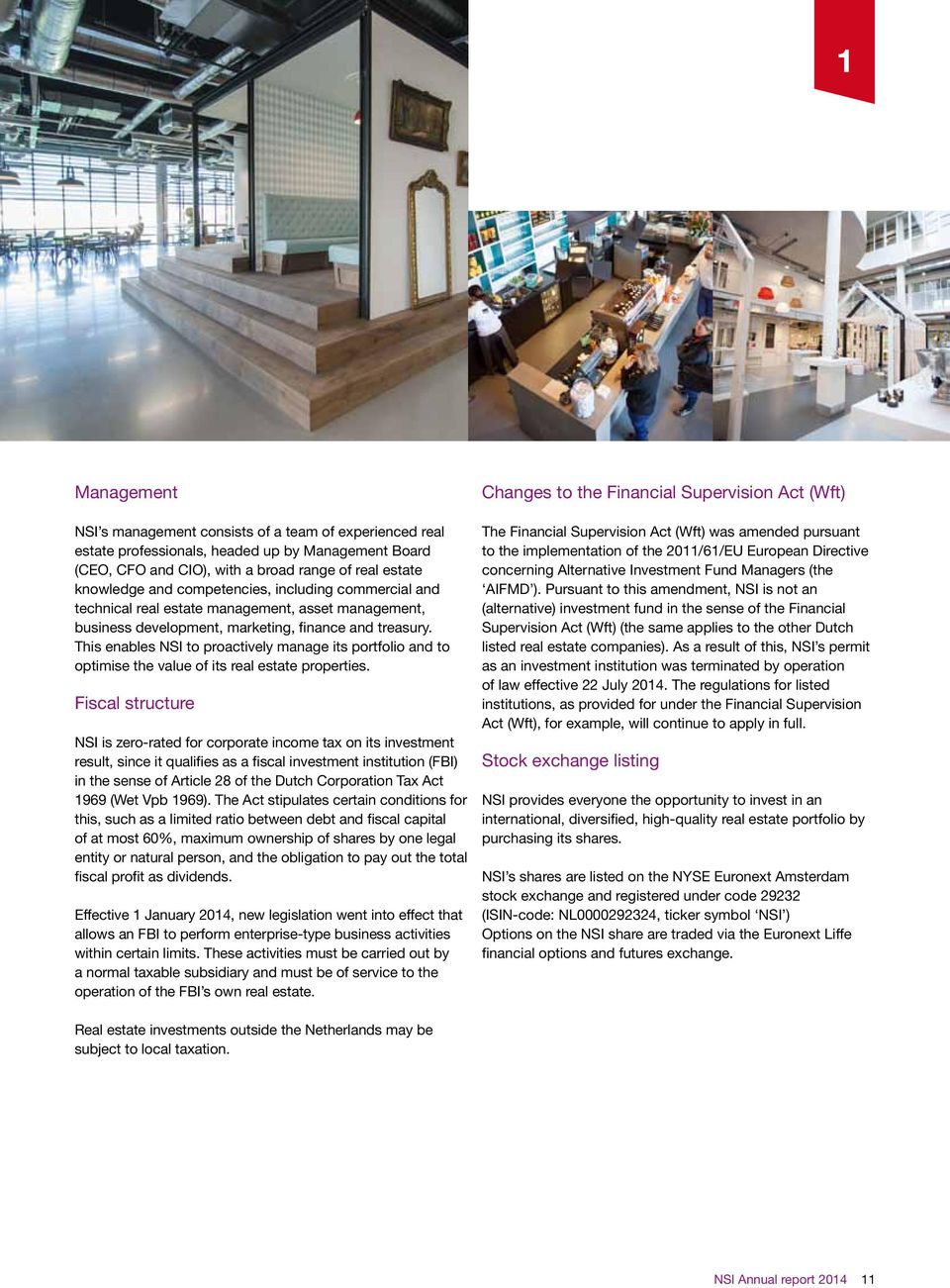
32 3 Division of gross rental income Division of real estate investments Division of square meters In NSI s business model, which calls for the real estate portfolio to be fully managed in-house, success is to a large degree determined by the quality and effort expended by employees. NSI strives to be an attractive employer. NSI invests in training and encourages its employees to develop themselves, in an environment in which employees are also compensated on the basis of their performance. Strategy and Objectives Offices Belgium 21% Logistics Belgium 16% Offices the Netherlands 34% Retail the Netherlands 26% Industrial 4% the Netherlands Offices Belgium 18% Logistics Belgium 12% Offices the Netherlands 43% Retail the Netherlands 22% Industrial 5% the Netherlands Offices Belgium 14% Logistics Belgium 27% Offices the Netherlands 36% Retail the Netherlands 16% Industrial 7% the Netherlands The strategy is designed to add value to the portfolio with the right investment focus, active portfolio asset management and asset rotation. The following fundamental choices are at the root of this: NSI s investment focus is on high yielding real estate, while anticipating the asset value development cycle of the real estate. Inherent to this is an active acquisition and disposal policy. NSI s total return strategy, with a focus on value development, as well as dividend return, is implemented on the basis of a core portfolio and a value-add portfolio. The core portfolio supplies a solid cash flow that generates the dividend return, as well as the funds needed to invest in the value-add portfolio. The value-add portfolio comprises properties whose value can be further developed through active management and/or investments. Asset rotation (actively buying and selling properties); properties for which NSI is unable to develop sufficient value potential, either because the buildings have already been optimised or because additional investment is not going to produce the desired returns, will be sold in order to reinvest resources in a property whose value potential can be further exploited by NSI. The key focus of the operational management of NSI s portfolio is on the customer. This translates into the organisation s design (integral management) and is anchored in systems and processes. By bringing letting, technical management, construction and development, marketing, and asset management expertise together in an integral strategy, the organisation is effectively able to anticipate tenants needs. Based on its demand-based, rather than supply-based approach, NSI is able to provide a differentiating product. NSI does this in various ways, for example by introducing new letting concepts and propositions to the market that better match the needs of specific user groups. Part of active portfolio management is the pursuit of value creation in the portfolio by actively managing, developing and redeveloping properties. What comes to mind here is the expansion, transformation and repositioning of shopping centres and office buildings, as well as making them more sustainable, with a view to increasing rental income and real estate values. NSI carries out the active management of its own portfolio in-house and aims for operational excellence in this respect. This means that NSI has invested in all positions and competencies required to be a successful real estate company and to optimise the value of its real estate this way. To optimally exploit the selected business model involving a fully equipped operational platform, and to be attractive to the financial markets, the portfolio requires a critical mass. The current portfolio with a scope of 1.7 billion meets this requirement. In terms of financing, the basic premise is to in principle finance maximum to approx. 50% with loan capital, to have at least 70% of the loan capital at a fixed interest rate, and to diversify financing sources. NSI Annual report
33 Report of the Management Board Progress of Strategic Objectives in 2014 In the publication of the 2013 results, NSI announced its refined strategy and its strategic priorities. NSI s focus in the years has been and will remain on operational performance and asset rotation. Quality improvement portfolio through asset rotation: Entire non-core office portfolio (52,619 sqm) sold In total for 24.4 million of Dutch assets sold Transformation of 22,705 sqm office space to alternative use 25.7 million invested in portfolio Expansion in the Belgian logistics portfolio through acquisitions Significant progress in value creation through operational performance Roll out HNK on schedule; opening of 4 HNK s in 2014 brings total HNK in operation to 7 (HNK represents now approximately 10% of the Dutch office portfolio) Redevelopment projects in retail portfolio completed Refinancing in the Neterlands Agreement reached on refinancing of 80% of Dutch loan portfolio ( 550 million, subject to documentation) Funding at approximately 2% interest lowers the average cost of debt to approximately 4.4% after effectuation in the 2nd quarter of 2015 (4.6% at year end 2014) Extending maturity of loan portfolio from 2.0 years to approx. 4.0 years Quality improvement through asset rotation - disposals In February 2014 NSI announced its redefined strategy. NSI s focus is on operational performance and transforming the current portfolio into a high quality core portfolio and a value add portfolio. The core portfolio will safeguard a solid cash flow (and dividend) that will enable the company to fund its investments in the value add portfolio. In combination with the stable performance of the core portfolio, unlocking the value potential in the value add portfolio will ultimately deliver the highest total returns. Key in this process value creation is transforming value-add properties into core properties by upgrading these properties and addressing customer needs and market trends. In 2014, NSI has sold the entire non-core portfolio, involving 52,619 sqm (approx. 10% of the Dutch office portfolio in sqm) of non-performing office space. These properties had an average vacancy of over 80%, a negative cash flow and lacked the perspective within the strategy of NSI to be redeveloped in a profitable way. Furthermore, NSI sold properties of which the value under NSI s management was optimized (6,433 sqm), after these assets were fully let out. Action Properties sqm Sale of non-core: Offices Uraniumweg 23, Amersfoort * Hettenheuvelweg 12, Amsterdam * Hettenheuvelweg 14, Amsterdam * Paasheuvelweg 15, Amsterdam * Rivium Boulevard , Capelle a/d IJssel * Keulenstraat 6, Deventer * Snipperlingsdijk, Deventer * Hanzeweg 5, Gouda * Adelbert van Scharnlaan , Maastricht * Touwslagerstraat 17, Ridderkerk * Volmerlaan 7, Rijswijk * Van Houten Industriepark 23, Weesp * Zaagmolenlaan 12, Woerden * Engelandlaan , Zoetermeer * 6,658 2,347 2,367 1,929 1,875 3,571 1,208 5,855 3,937 1,711 5,499 1,309 1,662 2,681 Kobaltweg, Utrecht 10,009 Total offices 52, NSI Annual report 2014
34 3 Action Properties sqm Sale of non-core Industrial Tijnmuiden, Amsterdam 1,883 Beemsterweg, Almere 10,926 Dukaat, Deurne 2,722 Total Industrial 15,531 Residential Zevenkampsering, Rotterdam 48 units Total Residential Total non-core 68,150 Sale of value add: Offices Max Euwelaan, Rotterdam 1,100 Luchthavenweg, Eindhoven 1,972 Bovendonk, Roosendaal* 3,361 Total Value add 6,443 *) Transfer in 2015 NSI sold for 24.5 million of assets in 2014, of which 12.3 million of assets will be delivered in With the above mentioned transactions NSI has made a clear step in migrating to a higher quality in the portfolio. The sale of the non-core portfolio came with a book loss ( 8.1 million), but has a positive effect on the direct result. The value-add properties were sold at book values. Quality improvement through asset rotation transformations In 2014, NSI transformed two office buildings (into a school and a hotel) and the transformation of two office properties into (student) housing are currently being prepared. These transformations involved in total 22,705 sqm, representing approximately 4% of the Dutch office portfolio. Prior to transformation, NSI concluded long-term leasing contracts in these assets. The weighted average lease length amounts to 12.6 years. Action Properties sqm Transformations into: Hotel Delftlandlaan, Amsterdam 7,500 School Arlandaweg, Amsterdam 4,205 (Student)housing 2 assets in Amsterdam 11,000 Total 22,705 NSI Annual report
35 Report of the Management Board Quality improvement through asset rotation acquisitions Intervest Offices & Warehouses (IOW) is aiming to further increase the share of logistics real estate in its portfolio to at least 60%. In 2014, IOW acquired a logistics site of approximately 77,000 sqm in Opglabbeek. With this key transaction, IOW significantly reinforced its already strong position along the Antwerp - Liège logistics axis. Due to this acquisition, the logistics portfolio increased by 14%. Furthermore, Intervest Offices & Warehouses announced the acquisition of a logistical site (52,000 sqm) in Terstal on 5 February When including these acquisitions, the logistical portfolio accounts now for 48% of the portfolio of Intervest Offices & Warehouses, progressing towards the strategic target of 60%. Value creation through operational performance HNK The roll out of HNK to 20 properties by the year 2016 in the office Dutch office portfolio is progressing according to schedule. In 2014, four new HNK properties have been opened, bringing the HNK s in operation to 7 as per year end NSI invested 5.1 million in HNK in 2014, bringing the total cumulative investments in the HNK roll-out to 11.7 million, out of the total 3-years investment plan of 31.0 million. Action Properties sqm Transformations into: HNK completed Oude Middenweg, Den Haag 15,000 Van Diemenstraat, Amsterdam 10,000 Zernikepark, Groningen 3,500 Boogschutterstraat, Apeldoorn 14,000 HNK in progress Bennekomseweg, Ede 10,331 Europalaan, Den Bosch 7,500 Arthur van Schendelstraat, Utrecht 9,200 Value creation through operational performance Redevelopment and investments NSI completed the redevelopment of the Zuiderterras, part of the Zuidplein shopping centre in Rotterdam, ahead of schedule, in This redevelopment has clearly borne fruit. Due to a well-thought-out approach NSI achieved a significant increase in quality on the basis of a single renovation project. In parallel to the work to be performed for the arrival of the new tenant Primark, the parking facilities were modernised and the layout of the units was improved, which has increased the letting potential. In November, NSI welcomed the new tenants Primark (6,700 sqm), the supermarket Dirk (1,500 sqm) and Q-Park (100 parking spaces). With these lettings the Zuiderterras is almost fully let and the average Zuiderterras letting term increased from 2.3 to 13.8 years. Furthermore, Primark and supermarket Dirk are important additions to the tenant mix to increase the flow of visitors. In the retail portfolio, offering the consumer convenience is part of the strategy. The modernised parking facilities are an important element in this. The reconstructed t Loon shopping centre was reopened on 5 March Following the partial demolition of the shopping centre as mandated by the municipality of Heerlen at the end of 2011, NSI used the reconstruction as an opportunity to put the shopping centre back on the map. The reconstruction started with a breaking ground ceremony on 18 December The opening of the new C&A on 5 March 2015 was used as an occasion to celebrate the completion of the reconstruction and modernisation of the t Loon shopping centre. 34 NSI Annual report 2014
36 3 Portfolio targets 2016 Due to the above actions, the Dutch portfolio in 2014 progressed as follows towards the targets set for 2016 Dutch office portfolio 41% 56% 3% 52% 48% 70% 30% target 2014 Dutch retail portfolio target 2016 Core Value add Non core In 2014, significant progress is made in evolving towards the desired core / value ratio (70% / 30%) in the Dutch office portfolio, and is therefore well on track towards the 2016 target. As anticipated, the change in the Dutch retail portfolio was limited in In 2014 NSI has thoroughly reviewed its retail portfolio and assessed how the changing retail landscape should be anticipated. This analysis has resulted in the decision to fully focus on the daily shopping needs segment in which convenience for the consumer is crucial. In addition, NSI has worked on a strategy in which NSI can support its retailers online in their business. This refocus in the retail strategy has led to redefined targets: 42% 44% 46% 42% 44% 46% 50% 49% 46% 8% 7% 8% 42% 44% 70% Core Value add Non core This refocus resulted in is a larger category assets that do not fit this strategy. These include the large-scale retail assets and assets where there is shared ownership. NSI will divest these assets over time. Refinancing Following the strengthening of the balance sheet after the private placement in November 2013, NSI has further implemented its financing strategy in The main objectives were to achieve greater diversification of funding sources, to extend the average maturity of the loan portfolio and to reduce financing costs. Moreover NSI sought a simplification and standardization of the loan documentation and structure. The agreed facility of 550 million (subject to documentation) gives substance to all above mentioned objectives. Characteristics of the new facility are: Diversification of funding sources through participation of international banks and the introduction of 100 million institutional facility Simplification of the financing structure of NSI: 2 syndicated facilities and several bilateral agreements are merged into one single loan document The average maturity of the facility is five years, which increases the average duration of the entire loan portfolio from 2.0 to approximately 4.0 years Funding at 2.0% interest in the facility will lead to structurally lower average financing costs to approximately 4.4% when the facility takes effect (begin Q2 2015) compared to 4.6% (year-end 2014) The new facility will take effect after completion of the full loan documentation in the 2nd quarter of 2015 The new facility explicitly provides the possibility of releasing securities over time, after which the largest part of the facility will continue as corporate facility. The applicable conditions provide flexibility to the implementation of the strategy of NSI, including asset rotation. 50% 49% 46% 50% 36% 30% 8% 7% 8% 8% 19% target target 2016 NSI Annual report
37 Report of the Management Board Dividend Dividend policy In accordance with the dividend policy adopted in the Shareholders Meeting of 25 April 2014, NSI distributes at least 75% of the direct result in cash. With this policy NSI complies with its distribution obligation as FBI (Fiscal Investment Insititution). The retained part of the direct result will be used for reinvestment in the portfolio, which will in combination with a cash dividend ultimately yield the highest possible return for shareholders. In the changing dynamics of the real estate market, it is crucial to maintain or upgrade the standing portfolio to required quality levels. Especially in the office market, which faces a situation of structural oversupply, tenants must be tempted with a distinctive and appealing product. The best alternative for price competition is offering quality and uniqueness, which is demonstrated by e.g. HNK, showing above average rental levels and take-up, but accompanied by a higher level of regular investments. This also demonstrates however that the office market requires a structural higher level of regular capital expenditures. On the basis of this analysis it was concluded that this could be largely achieved through the pay-out of 75%. NSI distributes a dividend twice each year; an interim dividend is distributed after the publication of the semiannual figures and the final dividend is distributed after the adoption of the proposed final dividend in the Shareholders Meeting Final Dividend Based on the currently applicable dividend policy, NSI is proposing a final dividend of 0.12 per share in cash. This brings the total dividend over 2014 to 0.25 per share of which 0.13 per share was paid out as an interim dividend after the publication of the half year results. 36 NSI Annual report 2014
38 3 Prospects The modest economic growth of 2014 is expected to continue in 2015 with a forecasted growth rate of 1.5%. The consumer confidence is growing, and thanks to increased purchasing power and the recovery of the housing market, consumer spending is expected to increase after years of contraction. Also on the labour market a tipping point seems to be reached. The unemployment rate has reached its peak in 2014 and is expected to decline in (source: CPB) Despite these positive economic indicators, the letting market will remain challenging due to a number of structural dynamics, among others the changing demand of customers, the continuing housing rationalization of corporates and online shopping. Success on the letting market is therefore primarily determined by the ability to respond to the changing demand rather then by the business cycle. NSI has in both its office and retail portfolio a clear proposition that is anticipating these changing requirements. In 2015 NSI will therefore continue to focus on the further execution of its customer-centered strategy. In the office portfolio, NSI will remain focused on the rollout of HNK. In its objective to evolve to a higher quality in the portfolio, NSI will remain focused on selling non-strategic properties. In the retail portfolio, NSI will increase its focus on convenience in its local neighbourhood shopping centres. This new focus will fully determine the execution of the asset rotation strategy in the retail portfolio. NSI Annual report
39 Report of the Management Board Entrepreneurs opt for the office of the future Start-up entrepreneurs or established companies? In any event, they have one thing in common: they would like to keep fixed costs, such as the cost of accommodation, as low as possible. HNK, The New Office, NSI s flexible office concept, offers a solution to this. From now on, empty offices and unused meeting rooms are a thing of the past. HNK tenants choose the exact space they need. HNK stands for Het Nieuwe Kantoor, (which means The New Office ) and offers an inspiring environment with stylish workplaces, office spaces, meeting areas, catering facilities and various supporting services. Bread rolls to go with a brainstorming session, ICT support during dazzling presentations or a telephone service for entrepreneurs who spend a lot of time on the road. The possibilities are endless; a workplace for half a day, a small office space for a shortterm project or a fully fitted up office space on a long-term lease; the HNK concept can accommodate all of this and more. HNK always takes the tenant s wishes as the starting point; this applies equally to selfemployed workers without employees or multinationals. And if the tenant s requirements change in the interim, then HNK moves along with the entrepreneur's wishes. In brief: a tailor-made office in a representative environment where tenants meet each other and work together. You will hear HNK tenants often say Networking virtually occurs automatically here. In addition, the modern office user wants to work in a pleasant environment. And NSI s office concept anticipates this as well, for example with the Grand Café, a central meeting place in all HNK buildings. 38 NSI Annual report 2014
40 Ready-made Office MT&V specialises in the placement of professionals within the construction, civil engineering and engineering sectors, and in housing associations, and operates from a managed office in HNK Utrecht and in HNK Rotterdam. A managed office is immediately ready for use, including chairs and desks. Operating Director Annemarieke Blancke: NSI s national ambition was decisive for us in choosing the HNK concept. We work throughout the country and from a cost perspective it is efficient for us to operate from multiple HNKs. We are a young, dynamic organisation in a market that is affected by cyclical trends, which means that flexibility is extremely important to us. We encounter this flexibility in the HNK concept, for example, in flexible leases; this means we are not stuck with a five-year contract. Which really is a bit old-fashioned these days. NSI Annual report
41 Report of the Management Board Tea in the HNK Grand Café In the HNK Grand Café The Hague, the culinary junction for the employees who work here, Vera Winkel and Esther Vergeer are preparing for an appointment while enjoying a cup of fresh mint tea. Both are entrepreneurs active in guiding people to work that suit their capabilities. NSI s editors are curious about their experience. Esther: We like to work close to our customers at different locations throughout the country. This is why this type of office solution is really ideal for us. For example, today we are in The Hague, but next week we have scheduled an HNK day in Rotterdam. Vera: Where and with whom we have appointments determines the location of our workplace. Sometimes customers will come to see us as well. We take all of this into account, including transportation. For example, HNK Rotterdam is easily accessible by public transportation or by bicycle. On the other hand, HNK The Hague is easily accessible by motorway. Esther: We also find the fit-up very appealing; HNKs have a warm atmosphere and their interior design is home-like. For example, HNK The Hague s layout is spacious and is favourably located, right near the A4 motorway. By contrast, in the HNK Rotterdam you experience rather more of the city s hustle and bustle. In any event, this gives us a great deal of energy to work in different places. We feel perfectly at home here. 40 NSI Annual report 2014
42 3 Enjoying working in HNK VNO-NCW Midden (Confederation of Netherlands Industry and Employers), the largest association of entrepreneurs in the Central and Eastern Netherlands, together with its peer organisations, AWVN, Bouwend Nederland-Oost, FME and MKB Nederland, has leased a shared office space on the 10th floor of the HNK Apeldoorn since December In this tailor-made office, over 50 fulltime workers share their workplaces in a 580 sqm area. Win-win for Tenant and Landlord alike The HNK concept anticipates the challenging letting market by putting the focus on the tenant s wishes. At the same time this increases the lettability of NSI s buildings; a win-win situation for NSI and its tenants. The flexible letting term and floor area and a range of services provide the basis for an interesting pricing schedule for the user. Furthermore, the multi-tenant character provides for a better financial risk spread. Ron van Gent, Director VNO-NCW Midden: HNK offers us many opportunities to improve the way we work together with colleagues, members and executive directors in our field of work. This is why HNK is our joint location for appointments and meetings; it facilitates our mutual coordination. In addition, HNK s dynamic environment offers lots of opportunities to work efficiently. The central meeting space, the flexible workplaces and the range of services enable us to effectively anticipate the changing number of people at the office. And something not to be overlooked: in a recent survey three quarters of people indicated that they enjoyed working in the HNK environment. We are naturally proud of this. NSI Annual report
43 Report of the Management Board Rising income trend In 2014, the rental income from vacant space in HNK was twice as high as that in the traditional letting portfolio and HNK achieved a significantly higher average rental income per square metre. HNK throughout the country The HNK formula will be rolled out throughout the Netherlands. Currently there are HNK branches in Rotterdam, Amsterdam, The Hague, Utrecht, Hoofddorp and Groningen. Ede and Den Bosch will follow in the near future. By 2016, NSI s portfolio will include at least 20 HNK buildings. Amsterdam Second HNK Amsterdam Groningen Hoofddorp Apeldoorn Den Haag Ede Den Bosch Second HNK Utrecht huidige vestigingen toekomstige vestigingen Utrecht 42 NSI Annual report 2014 Rotterdan
44 3 Financial results Total Investment Result The total investment result consisting of the balance of the direct and indirect investment result in 2014 amounted to million (2013: million), primarily due to a positive operating result and negative revaluations. The charts below give an overview of the evolution of the investment result over the past 5 years. Investment result per share (x 1) Investment result (x 1 million) direct indirect direct indirect Direct Investment Result NSI uses the direct result (rental income minus operating costs, service costs not charged to tenants, general costs and financing costs) as a measure for its core activities and for its dividend policy. Rental Income The gross rental income in 2014 decreased from million in 2013 to million, primarily due to the loss of rental income due to disposals ( 5.4 million) and lettings at lower rent levels. The direct investment result rose by 5% to 48.5 million in 2014 (2013: 46.3 million), primarily due to the lower financing costs that compensated for the lower rental income. NSI Annual report
45 Report of the Management Board This decrease is explained in the following table. Gross rental income per segment in the Netherlands, Switzerland and Belgium: x 1, Purchases Disposals Organic growth 2014 The Netherlands Offices 57, ,364 54,659 Retail 38, ,855-4,779 32,138 Industrial 6, ,416 Residential Total 103, ,596-6,279 93,333 Switzerland* Offices Retail Total 1, , Belgium Offices 24, ,740 Industrial 15, ,526 Total 40, ,266 Total NSI 144, ,447-5, ,599 * The last remaining Swiss assets were sold in 2013 Acquisitions In 2014, a logistics site was acquired in Ooglabbeek (Belgium, 77,000 sqm) for 33.0 million. Disposals In 2014, 3 office buildings, 48 apartments and 3 industrial buildings were sold in the Netherlands. A semi-industrial building was sold in Belgium. The properties sold represented an annual rental income of 2.3 million. Organic Growth The occupancy rate in the entire portfolio rose from 79.5% as at 31 December 2013 to 79.9% as at 31 December As at 31 December 2014 the financial occupancy rate by sector was as follows: 74.4% in Offices, 88.4% in Industrial Buildings and 87.7% in Retail. The financial occupancy rates by country were as follows: 77.1% in the Netherlands and 86.0 % in Belgium. New lease agreements increased rental income by 5.1 million in the Netherlands and by 2.9 million in Belgium. The increased vacancy rate resulted in a decrease in rental income of 12.8 million of which 10.6 million was in the Netherlands and 2.2 million in Belgium. Indexation ( 1.2 million), rent-free periods and rent discounts ( 1.4 million), other changes, for example resulting from rent reductions, changes and let floor areas ( 3.4 million) resulted in a negative trend of the organic rental income, which declined by 5.6 million. The offices like-for-like rental trend was - 1.7%. In 2014, the organic (like-for-like) rental trend in the retail portfolio was to an important degree influenced by the redevelopment of the Zuidplein and t Loon shopping centres. In the Zuidplein shopping centre, the impact of the strategic early termination of the contract with MediaMarkt Saturn (effective 1 January) in order to facilitate the arrival of Primark (effective 1 November) amounted to approximately - 1 million. The impact of t Loon shopping centre on organic growth was approximately million. The negative organic growth in the large-scale retail sector is largely ( 0.7 million) due to an (earlier announced) rent discount provided to a home furniture store. 44 NSI Annual report 2014
46 3 Operating Costs x Municipal taxes 4,135 3,935 Insurance premiums Maintenance costs 4,175 3,801 Contribution to owner associations Property management (including attributed administrative expenses) 4,676 5,060 Letting costs 2,975 2,557 Other expenses 1,182 1,419 Total 18,611 18,050 Operating costs increased slightly to 18.6 million in 2014 (2013: 18.1 million), mainly as a result of higher maintenance costs and increased letting costs. The increased letting costs are evidence of the increased effort required to attract new tenants. However, they are also a reflection of the increase in smaller contractual and shorter terms. NSI also experienced a decrease in the provision for bad debts. The operating costs, expressed as a percentage of the gross rental income rose from 12.5% to 13.9%. Property management costs are part of the operating costs. These costs consist of external costs and administrative costs that are allocated to the operating costs (3.5% of the gross rental income). Service costs not recharged In 2014, the service costs not charged to tenants increased to 5.8 million (2013: 4.7 million). This increase is in part due to the start-up costs of new HNK establishments and the fragmented vacancy in multi-tenant buildings. Financing Result The total financing costs in 2014 totalled 42.4 million (2013: 58.1 million). Financing costs significantly dropped in 2014 due to the lower debt following the redemption of loans combined with the proceeds of the placement of shares in November 2013 and the resulting related improved financing conditions. Administrative Expenses Administrative expenses increased to 10.0 million in 2014 (2013: 9.0 million) in part due to the costs of the VEB lawsuit and other consulting costs. Development of the direct investment result per average outstanding share (x 1) Rental income Service costs not charged to tenants Operating costs Net revenue from operations Administrative expenses Financing result Total Direct investment result Non-controlling interests Direct investment result per average outstanding share NSI Annual report
47 Report of the Management Board Indirect Investment Result The indirect investment result in 2014 totalled negative million (2013: negative million). The indirect investment result consists of both realised revaluations (sales results on investments sold) and unrealised revaluations. These unrealised revaluations concern changes in the market value of real estate investments ( million). X 1, Revaluation of real estate investments - 183, , ,079-37,753-24,761 Revaluation of other investments - - 3, ,443 1,283 Net result on sales of investments - 1,358-3,649-7, Movements in fair value of derivatives - 1,842 25,705-19,369-13, Exchange rate differences Allocated management costs - 2,261-2,546-2,554-1,592-1,303 Acquisition costs ,141-1,283 Result from bargain purchase ,161 - Corporate income tax , Total - 188, , ,473 4,641-27,314 Non-controlling interests 3,192 4,864 7,951 2,034 - Indirect Investment Result - 185, , ,522 6,675-27,314 Revaluation of real estate Investments An important part of the indirect result is the value development of the real estate portfolio. The revaluation of the real estate investments (excluding elimination of incentives) amounted to million (2013: million). The value of the Dutch portfolio continued to be under pressure and resulted in revaluations amounting to million in 2014, of which million was attributed to the Dutch office portfolio, million to the Dutch retail and large-scale retail portfolio and million to the Dutch industrial buildings portfolio. A change in market yields accounted for the largest impact on the revaluations of the Dutch offices as well as retail portfolios. In addition, there were a number of special situations in the 2nd half of 2014 In 2014, NSI reached agreement on the disposal of a portfolio of non-core buildings, for which a book loss ( 8.1 million) has been included in the revaluations because the sale had not yet been completed as at 31 December The t Loon shopping centre had a major impact on the retail portfolio ( 13.3 million). The opening of an entirely renovated C&A retail outlet on 5 March 2015 will mark the completion of the reconstruction of the t Loon shopping centre. In the largescale retail sector the revaluation was primarily due to the persistent challenging market conditions, which resulted in pressure on market rents and specifically due to a rent discount provided to an interior designer. 46 NSI Annual report 2014
48 3 Revaluation results of real estate in the Netherlands (x 1,000) FY 2014 HY HY FY 2013 HY HY * Offices - 122,519-63,010-59, ,658-68,951-62, ,090-31,400 Retail - 41,604-19,232-22,371-38,812-25,395-13,417-11, Large scale retail - 13,645-7,486-6,159-11,284-7,689-3,595-5, Industrial ,024-7,178-3,845-6,094-1,351 Residential Total - 177,876-90,487-87, , ,703-83, ,763-33,238 *) In accordance with IFRS the figures prior to the merger with VNOI (first three quarters of 2011) have not been amended and represent only NSI. As of the fourth quarter of 2011 all results of NSI and VNOI are fully consolidated. In the Belgian portfolio, a negative revaluation in the office portfolio in 2014 (- 7.0 million) was partially offset by a positive revaluation of the logistics portfolio ( 1.8 million), as a result of which the net revaluation of the total Belgian portfolio was negative 5.2 million. Revaluation results of real estate in the Belgium (x 1,000) FY 2014 HY HY Q Offices - 6,971-4,845-2,126-19,308-21, Industrial 1,773 2, ,513 7, Total - 5,198-2,627-2,572 1,205-13, Net Result on Sales The net result on sales (- 1.4 million) includes the result on sales for 3 office buildings and 3 industrial buildings in the Netherlands and one semi-industrial building in Belgium. Movements in Fair Value of Derivatives The effect of derivatives on the indirect investment result totalled million in 2014 as a result of lower Euribor rates. NSI uses interest rate derivatives exclusively to limit operating interest rate risks. The nominal value of derivatives is lower than the nominal values of the interestbearing debt. There is no over hedging and NSI is not exposed to margin calls and is not required to make any additional cash payments in case of a change in the value of these instruments. The value of the financial derivatives automatically reverts to zero at the end of the term of these instruments. NSI Annual report
49 Report of the Management Board Financing Following the strengthening of the balance sheet through means of the placement of shares in November 2013, NSI further shaped its financing strategy in The key objectives consisted of achieving greater diversification of financing sources, extending the average term of the loan portfolio and reducing financing costs. Furthermore, NSI s aim was to simplify and standardise loan documentation and its structure. In 2014, NSI largely completed this task. When it published the provisional 2014 annual figures in February 2015, NSI announced the largest refinancing initiative in its history amounting to 550 million (subject to documentation). The financing will significantly extend the average term, further reduce interest expenses and increase the share of non-bank-related financing. Furthermore, there is a possibility over time to largely move towards non-mortgage debt and the new facility provides room for further diversification. Treasury Policy NSI pursues an active treasury policy that is subservient to its core activities: the lease, commercial operation and acquisition and sale of properties. The treasury policy is focused on controlling risks in the area of financing and on increasing the predictability and stability of cash flows. The objective of the treasury policy is to optimise the Company s results, subject to the condition of a conservative financing structure at competitive rates. No speculative positions are taken. Following the strengthening of the balance sheet in November 2013, NSI further refined its financing strategy. Objectives of the strategy are to (i) diversify financing sources; (ii) create uniform loan documentation; (iii) reduce interest charges; (iv) extend the average term of the financing portfolio; (v) acquire financing at the group level; and (vi) make it possible to migrate from secured financing to unsecured financing. A financing structure that meets the above-referenced characteristics enhances NSI s clout and flexibility in terms of the implementation of its strategy, as well as in terms of negotiating new financing and refinancing. In 2014, NSI took important steps in this area. In 2014, NSI held meetings and conducted negotiations with a group of banks concerning their participating in a syndicate on the basis of the above-referenced principles. In parallel to this, opportunities were explored with institutional parties concerning their participation in an institutional facility (European Private Placement). These discussions have resulted in the announcement in February 2015, that agreement has been reached on the conditions for a refinancing of 550 million, representing 80% of the Dutch loan portfolio. The refinancing consists of a bank financing of 450 million by an international bank syndicate and an institutional facility of 100 million. The completion of this refinancing is subject to the completion of the loan documentation. Interest Rate Policy The majority of NSI s financing is currently at a variable interest rate. The objective of the interest rate policy is to control interest costs. To achieve this goal, NSI hedges part of the variable interest rate by making use of fixed-rate loans, interest rate derivatives and collars (instrument that defines the bandwidth within which the interest rate fluctuates). Of the consolidated portfolio at least 70% and at most 100% of the underlying loan portfolio must be hedged against interest rate risk. No speculative positions are taken. Financing Policy NSI considers it important to continuously stay in discussion with its financiers. Through means of open, frequent and transparent communications, including during times that the Company does not require financing, the relationship banks keep abreast of the conditions within NSI, which enables them to more effectively anticipate NSI s banking needs. The participation of international banks and the introduction of a 100 million institutional facility mean that the diversification of financing has been achieved. The financing structure is simplified due to the fact that two syndicated facilities and multiple bilateral agreements are merged into a single financing facility. By adding an institutional facility, the average term of the loan portfolio is significantly extended (from approximately 2.0 years to 4.0 years). The reduction of the interest rate margins on this facility will result in structurally lower average financing costs. Furthermore, the new facility explicitly creates the possibility of releasing securities over time and the largest part of the financing will be continued as a corporate facility. As a result of this and as a result of the migration of loans from the property level to the portfolio level, there is greater flexibility in terms of implementing NSI s strategy, including asset rotation. The new facility is expected to go into effect in the second quarter of 2015, following the completion of the full loan documentation. 48 NSI Annual report 2014
50 3 The new facility largely covers the refinancing for the Netherlands for In addition, the facility also refinances the financing for Intervest Offices & Warehouses in April 2014 successfully placed 2 bond loans for a total of 60 million. The terms are 5 years ( 25 million, 3.430% interest rate) and 7 years ( 35 million, 4.057% interest rate), respectively. These bond loans will replace the currently outstanding bond loan ( 75 million, 5.1% interest rate) maturing on 29 June The proceeds of the two bond loans were used to repay the temporarily committed bank financing. Until the bond loan is repaid in 2015, financing costs will be higher in In addition, in Belgium, refinancing of 59 million that was to expire in 2016 was completed. The financing terms were extended to 2018, 2019 and Loan Maturity Dates (x 1,000) Netherlands Belgium The graph above does not yet reflect the agreements reached in February 2015 concerning the 550 facility (subject to documentation). The average remaining term of the loans at 31 December 2014 was 2.0 years (31 December 2013: 2.2 years). This will be significantly extended to approximately 4.0 years due to the announced refinancing (subject to documentation). The graph below provides a pro forma expiry calendar after the new facility has been implemented: The total loan portfolio decreased from million at yearend 2013 to million at year-end The fixed-rate portion of the mortgage loans, including the interest rate derivatives, increased from 82.4% as at 31 December 2013 to 89.7% as at 31 December This is primarily due to the above-referenced pre-financing in Belgium on the basis of the placement of two bond loans. The total hedged interest rate has an average term of 3.1 years (2013: 3.8 years). X 1,000 Fixed Interest Variable Interest Total Loans CreditFacility Variable Swaps Fixed Interest Interest Rate % Rate Loans Rate Loans Exchanged for Fixed Interest Rate after Swaps % Netherlands 73, , ,334 48, , % 4.9% Belgium 141, , ,538 15, , % 4.0% 2014 Total 214, , ,872 63, , % 4.6% 2013 Total 244, , ,879 72, , % 4.8% NSI Annual report
51 Report of the Management Board No margin calls apply to the derivative contracts that would require cash payments to be made in case of changes in the market value of derivatives. Credit Facilities The funding available to the company under the credit facilities committed as at 31 December 2014 amounted to million (31 December 2013: million). In addition to its mortgage loans and bond financing, NSI at year-end 2014 had current account credit facilities in the amount of 63.3 million (year-end 2013: 72.4 million). These credit facilities offer the company a large degree of flexibility in its financing. They are used to absorb short-term financing deficits and as bridging loans until such time as new equity capital is raised or long-term loan capital is acquired. As at 31 December 2014, 32.8 million of the credit facilities was drawn down (2013: 21.2 million). Financing Expenses Financing costs significantly dropped to 42.4 million in 2014 compared to 58.0 million in 2013, due to the lower debt and derivative portfolio following the redemption of loans combined with the proceeds of the placement of shares in November 2013 and the resulting related improved financing conditions. The weighted average interest rate of the loans and interest rate hedging instruments decreased from 4.8% as at 31 December 2013 to 4.6% as at 31 December This is based on the current interest rate margins as at year-end, which does not reflect the average interest margin over the period. It is expected that the new refinancing will be implemented in the 2nd quarter of 2015, following the completion of the loan documentation. The lower interest rate margins on this facility will result in structurally lower average financing costs from approximately 4.4% following the facility s implementation compared to 4.6% (31 December 2014) and to approximately 4% effective interest rate at the beginning of 2016 (assuming all other things being unchanged). The interest rate coverage ratio was 2.6 on 31 December Loan-to-Value development NSI s policy is to keep loan-to-value ratio to between 40% and 50%. At 31 December 2014, the value of the real estate investments amounted to 1,668.2 million (2013: 1,808.8 million). In 2014, NSI sold buildings in the amount of 15.1 million, and in addition sold buildings in the amount of 12.3 million that will be delivered in A substantial portion of the proceeds was used for investments in The loan-to-value ratio at a net debt of million at 31 December 2014 (31 December 2013: million) was 48.9% (2013: 45.4%). Development of Covenants The framework of covenants, which differs by financial institution and agreement, and that are related to the loans are closely monitored by NSI. The loan agreements stipulate that the Company must regularly report on the status of specific agreements (covenants) to its financial institutions. On this basis, financial institutions maintain insight into how the Company s creditworthiness evolves over the term of the financings. NSI is also required to regularly report the status of its covenants to its lenders. NSI s policy is to comply with all agreed-upon covenants at all times. In line with its financing policy, NSI applies a proactive monitoring approach here as well. Aside from the realised covenants, the potential impact of the strategic decisions and changed market conditions on the future outcomes of the covenants is monitored on a monthly basis (and if necessary even more frequently). The new 550 million facility (subject to documentation) will constitute the refinancing of various bilateral financing arrangements and syndicates. This will reduce the diversity of covenants and simplify the management of these covenants. For 2014 NSI met all agreed-upon covenants arising from all individual loan agreements. Shareholders Equity Shareholders equity decreased to million (31 December 2013: million), primarily due to the loss of million, the payment of dividend in cash ( 31.5 million) and the increase in minority interests ( 24.4 million). Intervest Warehouses & Offices on 22 December 2014, issued new shares in the amount of 26 million for the acquisition of the logistics site in Opglabbeek. (EPRA) Net Asset Value per Share The net asset value per share (including the market value of derivatives) declined to 4.42 as at 31 December 2014 in comparison to 5.59 as at December 2013 (30 June 2014: 5.02). Excluding the market value of derivatives (EPRA-based net asset value), the net asset value per share was 4.69 (31 December 2013: 5.85; 30 June 2014: 5.31). Share Capital The number of shares in issue was million as at year-end NSI Annual report 2014
52 Zuiderterras once again busy and lively We managed to do the virtually impossible. Frans Abels, Senior Asset Manager Retail at NSI looking back on the redevelopment of Zuiderterras, part of the Zuidplein shopping centre. Over a period of nine months NSI renovated 8,200 sqm of retail space and a parking garage. The renovation started in February 2014 and the deadline of the official opening was set at 12 November A day of festivities on which the new tenants Primark, Dirk and Q-Park opened their doors all at the same time. It may sound exaggerated, but the fact that we succeeded in meeting this schedule is unbelievable, says Frans Abels. It was a very complex project. The shopping centre stayed open as usual during the renovation and there was no room to create a construction site. We used the parking garage for this purpose. Getting the ball rolling According to Abels, the Zuiderterras did not make a very good impression over the past few years. Since the bankruptcy of It s Electronics in 2011, the retail space on the ground floor stood empty. In addition, MediaMarkt Saturn located on the first and second floors was not doing well. When NSI found out that Primark was interested in this space, the ball started rolling. Good move In consultation with Saturn, the lease was terminated, after which NSI was able to enter into discussion with Primark concerning adjustments to this space. In addition to Primark s retail space, NSI decided to modernise the parking garage, as well as the rest of Zuiderterras. That turned out to be a good move. Following on to the crowd puller Primark, Dirk supermarket and Q-Park also opted for the renovated Zuiderterras. NSI made use of the expertise of its own employees for the redevelopment. NSI formed a special working group of employees with retail, construction, development and technology expertise to deal with Zuiderterras. The team developed a well thought-out plan which made it possible to achieve a significant improvement in quality all at once. NSI Annual report
53 Report of the Management Board I never expected it to be this beautiful. We escaped the carnival, cousins Joyce and Natasja said with a laugh. They felt more like taking the afternoon to go shopping in Primark. Isa, Natasja s daughter, also wanted to come along. From their home near Breda it took half an hour by car to get to the Zuidplein shopping centre. Joyce was surprised by the shop s appearance. I never expected it to be this beautiful. It was always very crowded In the past, when Ria was still living in Charlois, she went shopping in the Zuidplein shopping centre every week. It was always very crowded on weekends. After that things quieted down. Ria: The arrival of Primark is an improvement for Zuidplein and also attracts new people. But she has to get going. I am looking for a shirt for my granddaughter with the Eiffel Tower on it. 52 NSI Annual report 2014
54 Customers consider this one of the most beautiful shops They are very proud. Urshley works in Primark Zuidplein s warehouse and Irma is a salesperson. Customers consider this one of the most beautiful Primark shops they have ever seen. And that it is! I was able to find everything quickly Robert comes out of Primark with a bag full. How long did he spend inside? Ten minutes, he grins. I never go on elaborate shopping trips. I am very focused in my shopping. So this was perfect, I was able to find everything quickly. And because of the low prices, Primark is ideal for me as a student. NSI Annual report
55 Report of the Management Board I will never forget that day The new supermarket at Zuidplein is the Dirk supermarket chain s 14th location. The official opening took place on 13 November 2014, at the same time as the Primark fashion chain. I will never forget that day, said Supermarket Manager Edwin van der Wagt. It was unbelievably busy. I never saw so many people together in one place. Each day is different I was really ready for a new challenge, and very much wanted to work in this new branch, said Steffeny Daniëls, Dirk s Checkout Team leader. I developed myself over a short period of time and have already learned a great deal, such as ordering items. Before this she worked in Dirk s supermarket at Hellevoetstraat. This shop had a lot of regular customers. Due to its location in Zuidplein shopping centre, this is a very different branch. Because of the Ahoy events accommodation centre and the nearby schools, the shopping public here is highly diverse. Each day is different. 54 NSI Annual report 2014
56 3 Portfolio Trends The Real Estate Market in 2014 There are many forces that exert an influence on the real estate market, including the influence of real economic trends, trends on the (international) capital market and trends on the occupiers market. In 2014, economic growth in the Eurozone was 1.3% and 0.8% in Euro countries, a rate with which the Netherlands, at a growth rate of approximately 0.8%, kept pace. The recovery was tempered by geopolitical tensions and a slowdown in the growth of the global economy. While consumer spending was on the rise, it stayed at a persistently low level. The expectation for 2015 is that the Dutch economy will experience a stronger recovery with an expected growth rate of 1.5%. For the first time in years, consumption is also expected to grow, in part due to a favourable purchasing power trend and an improved housing market. The job market in the Netherlands is experiencing a slight recovery and it is expected that unemployment peaked mid Job growth in the 4 th quarter of 2014 was higher than it has been in the last 3.5 years. Projections call for jobs to increase in 2015 and for unemployment to decline somewhat. The low interest rates combined with a high level of available capital and the value trend of Dutch real estate resulted in a higher volume of investment in Dutch real estate in The transaction volume in the Netherlands in 2014 was close to 10 billion, almost double that of 2013 ( 5.5 billion). In 2014, 2.9 billion was invested in offices, compared to 1.9 billion in Investments in retail outlets also more than doubled: from 600 million in 2013 to 1.5 billion in There were major variances within the different real estate markets, however, with further polarisation at the bottom and top ends of the market. And the changes in the user market have everything to do with this. The world is changing and the real estate market has to keep pace. Quickly anticipating changes that are occurring in rapid succession is crucial. Fifteen years ago it was inconceivable to think that a smartphone would become an integral part of daily living. Today its use largely determines how people work and shop. People do not work exclusively at the office and they make increasingly fewer of their purchases in a physical shop. The increasing urbanisation means that cities continue to grow at the expense of the peripherally situated regions. These trends exert a strong influence on the demand for real estate and the attendant requirements. The NSI Property Portfolio NSI invests in offices and retail in the Netherlands (63% of the total portfolio), and in offices and logistics real estate in Belgium (37% of the total portfolio). The retail share of the portfolio remained stable (26%). The share of offices declined slightly from 56% to 54%, while the share of the logistics portfolio rose from 18% to 20% due to expansions and an acquisition within the Belgian portfolio. In 2014, the value of the total property portfolio declined by million to 1,668.2 million (31 December 2013: 1,808.8 million). This decline is the result of revaluations ( million), disposals ( 16.2 million), invest ments ( 25.7 million) and acquisitions ( 33.0 million). NSI s asset rotation strategy, among other things, means that buildings to which NSI is unable to add more value will be sold. Pursuant to this strategy, NSI in 2014 sold three office buildings whose maximum value was achieved under NSI management after the buildings were completely let. In addition, the noncore office portfolio (52,619 sqm) was sold. With the disposal of these non-core buildings, NSI bade farewell to real estate that, due to an average occupancy rate of approximately 20%, had a negative cash flow. This has improved the average occupancy rate and the quality of the total portfolio. In addition, in 2014, NSI sold the last remaining residential assets in its portfolio and also sold 3 industrial buildings. Overall, sales transactions involving the disposal of buildings in the Netherlands amounting to a total of 13.1 million were completed. For another 12.3 million in buildings, the sales agreements have been signed, but the buildings will only be delivered after the balance sheet date. These buildings are classified as held for sale in the annual accounts. In December 2014, a 77,000 sqm logistics site was acquired in Opglabbeek in Belgium ( 33.0 million). In addition, Intervest Offices & Warehouses on 5 February 2015 announced the acquisition of a 52,000 sqm logistics site in Liège. Furthermore, in 2014, a semi-industrial building (Riyadstraat, Meer) in the Belgian portfolio was sold. NSI Annual report
57 Report of the Management Board Number of Lettable Theoretical Occupancy Rate Market Value % Properties sqm Annual Rent % (x 1,000) Netherlands , , ,056, Belgium ,521 54, , Total 249 1,668, , ,668, Retail ,420 32, , Large-scale retail 6 90,061 6, ,865 4 Offices , , , Industrial buildings ,391 28, , Total 249 1,668, , ,668, Value Trend of the NSI Property Portfolio NSI determines the market value of the investment properties on the basis of a professional appraisal management system. The entire Dutch portfolio is appraised externally each year by reputable appraisers (50% at 30 June and 50% at 31 December). On the basis of the external valuation, the remainder of the portfolio (50%) is also appraised internally twice a year. NSI has configured its process on the basis of the good practice provisions of the PTA (Appraisers & Auditors Platform). One of the consequences of this in 2014 was that all buildings were rotated among the appraisers. These external valuations are compared with the internal valuations and an analysis of the used methods, assumptions and outcomes is being made.the Belgian portfolio is appraised externally each quarter. The value of the Dutch portfolio continued to be under pressure and resulted in revaluations amounting to million in 2014, although the pressure decreased somewhat in comparison to 2013 ( million). In the Dutch office portfolio revaluations amounted to million (2013: million); in the Dutch retail portfolio million (2013: million) and in the large-scale retail portfolio million (2013: million). The value of the Dutch industrial buildings portfolio stayed more or less stable. A change in market yields accounted for the largest impact on the revaluations of the office as well as retail portfolios. In addition, there were a number of special situations in In 2014, NSI reached agreement on the disposal of a portfolio of non-core buildings, for which a book loss ( 8.1 million) has been included in the revaluations because the sale had not yet been completed as at 31 December Adjusted for this extraordinary item, the Dutch office portfolio experienced a lower downward valuation in the 2nd half of the year in comparison to the 1st half of the year. The negative revaluation of shopping cente t Loon had a major impact on the retail portfolio ( 13.3 million). The opening of an entirely renovated C&A retail outlet on 5 March 2015 marked the completion of the reconstruction of t Loon shopping centre. In the large-scale retail sector the revaluation was primarily due to the persistent challenging market conditions, which resulted in pressure on market rents, and specifically due to a rent discount provided to an interior designer. In the Belgian portfolio, a negative revaluation in the office portfolio in 2014 (- 7.0 million, 2013: million) was partially offset by a positive revaluation of the logistics portfolio ( 1.8 million, 2013: 20,5 million)), as a result of which the net revaluation of the total Belgian portfolio was million (2013: 1.2 million). Revaluation of the Property Portfolio Netherlands X 1,000 Belgium X 1,000 Total X 1,000 Gross Yield % Net Yield % Retail - 41,604-41, Large-scale retail - 13,645-13, Offices - 122,519-6, , Industrial buildings ,773-1, Total - 177,876-5, , NSI Annual report 2014
58 3 Lease expiry calendar for the Dutch portfolio (x 1,000 rental income) Lease expiry calendar for the Belgian portfolio (x 1,000 rental income) 16,000 9,000 14,000 12,000 10,000 8,000 6,000 4,000 8,000 7,000 6,000 5,000 4,000 3,000 2,000 2,000 1, e.v e.v. retail offices industrial offices logistics Improvements, Expansions and Redevelopment NSI s strategy is focused on value development within the portfolio, in part by making improvements and realising expansions and redevelopments. Within NSI s integral letting strategy the use of its own development/redevelopment strength often reinforces and supports letting efforts. In its role as accommodation partner, NSI aims to optimally facilitate the tenant s primary process by ensuring that the real estate suits the client s needs technically as well as operationally. Within the office portfolio, redevelopment is primarily focused on transformations into the HNK concept, renovations, on improving the letting proposition or it is focused on a specific lease. In the retail portfolio, redevelopments for the most part are focused on expansion, revitalisation and optimisation. In many cases, the relationship with the municipality or the province plays a role, for example in the area of permits. NSI s knowledge and expertise in this area is sometimes decisive in terms of identifying and realising new opportunities. NSI s development and redevelopment projects often arise from specific tenants requests, such as requests for expansions, the anticipation of market trends, such as the New Way of Working and the increasing demand for fullservice and flexible letting concepts, or transformations arising from NSI s vision for its portfolio. NSI Annual report
59 Report of the Management Board Improvements, expansions and redevelopments within the office portfolio in 2014 The following office properties were under development or redevelopment by NSI in Properties being expanded, renovated and/or transformed Office Portfolio Investment X 1,000 Expansion/Renovation Expected Delivery sqm HNKs Van Diemenstraat (Y-tech) Amsterdam Boogschutterstraat (La Tour) Apeldoorn 1,678 1, Oude middenweg The Hague 1,553 1, Zernikepark Groningen Bennekomseweg Ede Europalaan Arthur van Schendelstraat s Hertogenbosch Utrecht 2,365 3, Arthur van Schendelstraat Utrecht 3, HNK Transformations HNK stands for Het Nieuwe Kantoor, (which means The New Office ); NSI s full-service, flexible letting concept. In 2014, four assets (Amsterdam Houthavens, Apeldoorn, The Hague and Groningen) totalling approximately 45,000 sqm were transformed into HNKs. Furthermore, preparatory work was completed in 2014 for HNK transformations in Ede and s Hertogenbosch that are to be completed in the first half of NSI invested in the expansion of the number of Managed Offices in HNK Rotterdam. In 2014, NSI invested 5.1 million in HNK. This brings the cumulative investment in the HNK rollout to 11.7 million in a total three-year investment plan (up to the end of 2016) of 31.0 million. Expansions and redevelopments within the retail portfolio in 2014 The following retail properties were under development or redevelopment by NSI in Properties being expanded, renovated and/or transformed Retail Portfolio Investment X 1,000 Expansion/Renovation Expected Delivery sqm Zuidplein Rotterdam 1,800 6, Zevenkamp Rotterdam t Loon Heerlen 8,000 2, /2015 Keizerslanden Deventer 11, De Heeg Maastricht 810 3, t Plateau Spijkenisse 1, Lage Land Rotterdam 1, De Issel Ulft Zuiderterras shopping centre Rotterdam Due to a well-thought-out and proactive approach NSI achieved a significant increase in quality on the basis of the renovation of the Zuiderterras shopping centre in Rotterdam. By prematurely terminating the contract with MediaMarkt Saturn, Primark could be brought into Zuidplein. In parallel to the specific work to be performed for the arrival of the new tenant Primark, the parking facilities were modernised and the layout was improved. For example, the shops frontage was completely renewed and the layout of the ground floor was redesigned. Aside from the crowd puller, Primark (6,700 sqm), this enabled NSI to improve the tenant mix with the arrival of Dirk (1,500 sqm) and Q-Park (100 parking spaces). As a result, Zuiderterras is now virtually fully let. 58 NSI Annual report 2014
60 3 This redevelopment demonstrates the added value of NSI s strategy. Due to active management, whereby the commercial, as well as the technical process is managed inhouse, NSI has succeeded in having plans interact in smart ways. (See page for additional information about the Zuiderterras shopping centre.) t Loon shopping centre in Heerlen Following the partial demolition of the shopping centre as mandated by the municipality of Heerlen at the end of 2011, NSI used the reconstruction of t Loon shopping centre as an opportunity to put it back on the map. It did this in part by reconstructing and renovating the space occupied by t Loon s largest tenant C&A. The renovated t Loon shopping centre and the new C&A retail outlet were opened on 5 March 2015 in a festive atmosphere. The work on the C&A retail outlet proceeded in phases. The newly constructed segment was handed over in mid After that, the existing shop was renovated and then merged with the newly constructed segment. C&A has configured the new shop (4,000 sqm) on the basis of the latest C&A store concept. In addition, the routing and the layout of the shopping centre were improved and the entrance was renovated. The reconstruction was completed on schedule and within budget. (See page for additional information about the renovated t Loon shopping centre.) Expansion of Keizerslanden shopping centre in Deventer In the past few years, the Municipality of Deventer, NSI and the housing association Ieder1 have jointly worked on a redevelopment plan for the Keizerslanden shopping centre. In a joint decision, it was concluded that the original plan does not effectively meet the current changed market demand. On the basis of the insights gained during this process, the parties are currently working on a more compact plan with a varied retail offer that is consistent with the changed market needs. Zevenkamp shopping centre Rotterdam; resolving vacancy by facilitating existing tenants and adding a new tenant Through means of collaboration among NSI, the municipality and entrepreneurs, the conditions of the Zevenkamp shopping centre in Rotterdam were improved. With limited investments (approx. 0.3 million), NSI has significantly improved the occupancy rate, for example by moving existing tenants. This created the space required to facilitate the need for expansion expressed by some existing tenants and to attract new tenants. The shopping centre s profile was significantly strengthened following the realisation of these changes and this is something that benefits all retailers and consumers in the Zevenkamp shopping centre. Technical Building Management (TBM) NSI performs the Technical Building Management (TBM) function in-house. The benefits of insourcing technical management relate to the commercial as well as the technical aspects. Regular contact between technical management and tenants contributes to better knowledge and insight into tenants; this is essential for retaining tenants. Expansions and Redevelopments within the Belgian Portfolio in 2014 Intervest Offices & Warehouses strategy is to further grow the logistics real estate share of the total property portfolio to 60% (45% as at 31 December 2014). Acquisition of logistics site of approximately 77,000 sqm in Limburg for 33 million In the context of its strategy to continue to grow the logistics real estate share of the total property portfolio, Intervest Offices & Warehouses in the 4 th quarter of 2014 expanded its property portfolio through the acquisition of a Machiels Real Estate NV logistics site of approximately 77,000 sqm in Opglabbeek for 33,0 million. This acquisition was financed through the issue of new shares, in which NSI has participated. As a result, NSI s stake in Intervest Offices & Warehouses decreased from 54.0% to 50.2%. This site is a modern logistics complex comprising warehouses with limited office facilities and a spacious exterior site in the logistics hotspot Genk-Opglabbeek in the Antwerp-Limburg-Liège logistics corridor, with easy access from the E314 motorway. The site furthermore offers additional development opportunities for the construction of approximately 55,000 sqm in warehouse space with corresponding office space for which Intervest Offices & Warehouses holds a pre-emptive right. Intervest Offices & Warehouses and Machiels Real Estate will combine their commercial strengths for these future developments. Announcement after the balance sheet date: acquisition of logistics site of approximately 52,000 sqm in Herstal In addition, Intervest Offices & Warehouses on 5 February 2015 announced the acquisition of a 52,000 sqm logistics site in Herstal near Liege. Including these acquisitions, the logistics portfolio represents 48% of Intervest Offices & Warehouses portfolio; thus growing towards the 60% strategic objective. NSI Annual report
61 Report of the Management Board Trends in the Dutch Portfolio The user market in the office as well as the retail segment, continued to be unabatedly challenging in The Dutch real estate market is characterised by a number of trends that will fundamentally change the real estate market. Living, working and shopping preferences are changing. People are concentrating on areas with an optimal combination, which is further stimulating movement to the city. Due to increasing digitisation, working and shopping are increasingly less location-bound and the work/personal life boundaries are blurring. These market conditions demand a differentiating and creative approach that anticipates these changes. Office Real Estate Market Trends in the Office Market In spite of the fact that there was a slight economic recovery, the office letting market remained just as challenging in There is over 17% of vacant space in the Dutch office market; approximately 10 times as much as the annual take-up. Due to the persistent low economic growth, companies are looking for cost reduction measures, for example by working more effectively in smaller spaces. However, in addition, the office market is affected by a number of structural trends that have an even greater impact than the economic trends. The key themes in the changing office landscape are as follows: changing customer requirements and needs; a changed customer profile; higher concentration of activity; and increased customer negotiating power. Changed Needs The modern office user is less time and location-bound. That imposes new requirements on real estate. The New Way of Working, supported by technology results in less required work space and a greater need for flexibility. The office has increasingly become a meeting place in which communication and collaboration are key aspects. This imposes different requirements in terms of the layout and functions of office space. Organisations that facilitate the New Way of Working opt for fewer workplaces than the number of employees they employ as a result of which the space requirement per employee decreases. The expectation is that over the coming years, economic growth will not be sufficient to offset this effect. This is contrasted by a greater need for flexibility and services. Due to this trend, the demand for conventional office space will continue to be under pressure, while there are opportunities to develop propositions that effectively anticipate these changes, such as NSI s HNK concept. HNK; The New Office With The New Office (HNK) office letting concept, NSI focuses on facilitating the office user s current need for services and flexibility. HNK demonstrates that success can also be achieved outside the G4 cities. In 2014, NSI continued to roll out its HNK concept; from 3 sites in 2013 to 7 in In 2014, HNK Amsterdam Houthavens, HNK Groningen, HNK Apeldoorn and HNK The Hague opened their doors. In 2015, the Den Bosch and Ede sites will be delivered, as well as a second site in Utrecht, among others, that are partially let in advance (see page for additional information about HNK). HNK continues to perform well commercially. Of all the new letting transactions in NSI s portfolio, 44% involve HNK buildings. HNK is performing at a take-up/supply ratio of 26%; twice as high as the market average. At 188 per sqm the effective rent level of new lettings is clearly higher than that of the conventional office portfolio. In addition, the significantly higher conversion ratio of interest into a transaction underlines the fact that HNK is a strong proposition. The HNK sites have demonstrated their ability to achieve high occupancy rates in a relatively short period of time. For example, the occupancy rate in the HNK Utrecht at the Weg der Verenigde Naties (Road of the United Nations) rose from 0% to 71% in The average HNK occupancy rate as at 31 December 2014 was 56.6%. HNK experienced organic (like-for-like) growth of 33.7%, and 13.6% in the 4th quarter in comparison to the 3rd quarter of HNK s gross rental income rose to 5.4 million in 2014; this represents 9.9% of the gross rental income of the Dutch office portfolio in NSI Annual report 2014
62 3 Changed Customer Profile The Dutch economy comprises an increasingly larger variety of forms of enterprise. While large organisations have reduced their personnel complement as a result of the prolonged crisis and changed business processes and services, amongst other through internet, the number of self-employed workers without employees has increased considerably. According to Statistics Netherlands (CBS), the number of one-person companies has increased by almost 40% over a period of ten years. This means that about one in ten persons of the total working population is self-employed. Self-employed individuals and smaller organisations are increasingly partnering in diverse forms of enterprise. This movement translates into a decreased demand for large office areas and an increased demand for smaller and more flexible office areas with supporting services. Concentration of Economic Activity The migration to urban areas is a global trend. In the Netherlands, this urbanisation means a larger migration to the Randstad conurbation. Over 40% of the take-up of office space in 2014 was realised in the G4 (Amsterdam, The Hague, Rotterdam and Utrecht). The increasing urbanisation means that cities continue to grow at the expense of the peripherally situated regions. This trend is expected to persist; projections for 2015 are than the G4 will account for 50% of new lettings in Tenant s Negotiating Power Tenants are aware of their negotiating position given the high supply of available space in the office market. This is why it is crucial to offer a distinctive product that provides added value to customers and for which they are prepared to pay. Transformation of surplus office space is not resulting in a decline in office supply The current Dutch office supply is too large in relation to the total demand for office space. Indeed, the transaction volume is primarily determined by replacement demand. This means that the effective take-up is declining. To reduce the surplus office supply, the transformation of offices into other functions, such as homes and hotels can form part of the solution. However, this is not expected to be sufficient. To get the market back into balance, it is also important to withdraw offices from the market, for example through means of transformations and demolition. In spite of many initiatives this has not yet resulted in a significant decline of the office supply in 2014, during which the decline was a mere 0.2%. NSI s offices are withdrawn from the office supply through means of demolition and transformation. In 2014, NSI s office portfolio represented approximately 1.2% of the office supply in the Netherlands. In 2014, NSI actively contributed to improving the quality of office space within the real estate supply through disposal or letting, which has resulted in demolition or transformation. For example, the office at the Reactorweg /Kobaltweg in the Lage Weide industrial park in Utrecht was sold and demolished, and subsequently rezoned into small commercial lots. The rezoning was the result of a collaborative effort between Utrecht Development Corporation (OMU) and IeVeMa Beheer BV. In addition, the Shi Hotel Group let the full office building at Delftlandlaan 15 in Amsterdam from NSI and has transformed it into a hotel. And last but not least, Hout- en Meubileringscollege (Wood and Furnituremaking College) took up residence at Arlandaweg in Amsterdam. In 2015 NSI aims to continue to pursue this active approach to collaboration and a focus on alternative uses of vacant office space in its portfolio (see page 23 for more information). Trends in NSI s Dutch Office Portfolio The value of NSI s Dutch office portfolio at 31 December 2014 was million (31 December 2013: million). In 2014, the office portfolio was once again subject to considerable revaluations ( million), albeit somewhat lower than the revaluation in 2013 ( million). This downward valuation can in part be explained by the 8.1 million loss on the sale of the non-core portfolio. In 2014, NSI reached agreement on the disposal of this portfolio, for which a book loss ( 8.1 million) has been included in the revaluations because the sale had not yet been completed as at 31 December Adjusted for this extraordinary item, the Dutch office portfolio experienced a lower downward valuation in the 2 nd half of the year in comparison to the 1 st half of the year. A change in market yields accounted for the largest impact on the revaluations, which is an indicator of the persisting pessimistic market sentiment. NSI Letting Trends Take-up in 2014 The total take-up of office space in the Netherlands amounted to 1.06 million square metres in 2014; representing an increase of 1.2% in comparison to With a take-up of 24,000 sqm 2.4% of the national take-up NSI performed above market average, as NSI s portfolio represents 1.2% of the market. The take-up/supply ratio in NSI s portfolio was 13.3% in comparison to a national take-up/supply ratio of 12.8%. NSI Annual report
63 Report of the Management Board G4 cities account for an increasingly larger share of the take-up In line with the take-up trend in the Netherlands, 38% of NSI s take-up occurred in the G4. Outside the G4 region, NSI performed relatively better than the market. Smaller floor space and greater flexibility Aside from the visible trend concerning location, the market is also displaying a trend in terms of the size of the letting transactions. Office users want more flexibility, shorter leases and the ability to easily reduce or increase the size of the area let; 55% of the take-up consisted of office space smaller than 500 sqm, representing 93% of the number of transactions. While only 7% of the number of letting transactions was greater than 500 sqm, this segment continues to represent 45% of the total take-up. In NSI s office portfolio, the average area declined from approximately 350 sqm per transaction to approximately 200 sqm. By contrast, the number of transactions increased from 106 to 137. This trend in part explains HNK s success in NSI s portfolio. As much as 44% of the total take-up was HNK-related and the take-up/supply ratio at 26% was more than twice as high as the market average (12.8%). Trend in the Occupancy Rate As at 31 December 2014, the occupancy rate had dropped to 71.2% in comparison to year-end 2013 (72.1%), partly due to the expiry of a number of large leases at year-end 2014 (including Rijksgebouwendienst (5,000 sqm), ROC Amsterdam (5,000 sqm) and ProRail (9,000 sqm). This also negatively affected the retention rate (47%). These large lease expirations confirm NSI s strategy to increasingly focus on a multi-tenant approach thus reducing the portfolio s risk profile. On the other hand, by proactively engaging in discussions with existing tenants, NSI also succeeded in negotiating long-term extensions for a number of large leases (41,000 sqm). The average HNK occupancy rate as at 31 December 2014 was 56.6%. The HNK sites have demonstrated their ability to achieve high occupancy rates in a relatively short period of time. For example, the occupancy rate in the HNK Utrecht at the Weg der Verenigde Naties rose from 0% to 71% in Lease expiry calendar of office leases in the Netherlands (x 1,000 rental income) 16,000 14,000 12,000 10,000 8,000 6,000 4,000 2, e.v. Rent Levels and Lease Terms Trends Tenants are aware of their favourable position in a market with shrinking demand and increasing supply. In 2014, while market rent declined somewhat (1% according to DTZ), NSI was able to maintain a rising trend in the effective rent level of new lettings in its portfolio to 128 per sqm in This is significantly higher than the 2013 level ( 106 per sqm), in part due to the higher HNK share of new lettings. The average rent of new HNK lettings was 188 per sqm in The effective rent level across the entire portfolio as at 31 December 2014 amounted to 134 per sqm compared to 144 per sqm as at 31 December. The average lease term of the portfolio was 3.8 years as at 31 December The gross rental income declined from 57.9 million in 2013 to 54.7 million in 2014, due to disposals ( 0.9 million) and relettings at lower rent levels. The like-for-like rental growth was -1.7%. HNK experienced organic (like-for-like) growth of 33.7%, and 13.6% in the 4 th quarter in comparison to the 3 rd quarter of HNK s gross rental income rose to 5.4 million in 2014; this represents 9.9% of the gross rental income of the Dutch office portfolio in In 2015, 18% of these leases will expire. In part due to the early renegotiations of leases, well before the expiry date, NSI is generating a better lease expiry spread. 62 NSI Annual report 2014
64 3 Office Gross Rental Income HNK gross rental income (x 1,000) 2013 gross rental income 57,915 Purchases in 2014 and Disposals in 2014 and Like-for-like, indexation and other rent movements gross rental income 54,659 (x 1,000) 2013 gross rental income 1,511 Purchases in 2014 and ,784 Disposals in 2014 and Like-for-like, indexation and other rent movements 1, gross rental income 5,389 The 10 largest tenants in the Dutch office portfolio are as follows: Name Annual Rent (x 1 million) # locations % Government Real Estate Building agency Stichting de Thuiszorg Icare Spaces Rode Olifant Imtech Municipality Heerlen Ziggo Hewitt Associations B.V Lloyd s Register EMEA me 1.3 Shi Hotel Exploitatie B.V Ontwikkelingsbedrijf Rotterdam Total Regional division Dutch office portfolio (in value) Zuid-Holland, Zeeland 43% Noord-Holland 13% Noord-Brabrant, Limburg 13% Utrecht 8% Gelderland 10% Overijssel 9% Friesland, Groningen, 4% Flevolnand, Drenthe Amsterdam 8% Rotterdam 18% Den Haag 6% Utrecht 4% Other 64% Overview Offices Netherlands Lettable area (sqm) 596,459 Occupancy rate (%) 71.5 Portfolio market value (x 1,000) 561,265 Total theoretical rent ( 1,000) 76,317 Effective rent per sqm per year ( ) 149 NSI Annual report
65 Report of the Management Board Industrial Buildings Market The industrial buildings market in the Netherlands performed well this past year. Economic growth in 2014 to a significant degree was driven by export, from which the logistics (real estate) market profited. The take-up consequently increased by 14% in 2014 in comparison to 2013, involving over 2.8 million sqm. Trends in the Industrial Real Estate Market Although the take-up increased, the number of transactions declined. This indicates that the size of the transactions is also increasing. In addition, there is a clear movement towards concentration in the southern Netherlands, whereby the Province of Noord-Brabant appears to be very popular. Due to an increasing combination of production and assembly, logistics service providers are looking for increased scale. Because this will increasingly focus on hotspots, a scarcity of high-quality real estate will emerge over time. Nowadays, new distribution centres are sometimes developed at the developer s risk. Although takeup is increasing, the supply is not expected to decrease. This entails the risk of future vacancies. (Source: DTZ) Trends in NSI s Dutch Industrial Buildings Portfolio The occupancy rate in NSI s Dutch industrial buildings portfolio decreased from 81.0% as at 31 December 2013 to 76.6% as at 31 December 2014, in part due to the expiry or a number of large contracts and the disposal of fully let properties. The gross rental income of the Dutch industrial buildings portfolio increased to 6.4 million in spite of a negative effect of 0.7 million due to disposals, and due to lettings at a better rent level. The average rent level of the portfolio increased from 64 per sqm to 66 per sqm. The value of NSI s Dutch industrial buildings portfolio as at 31 December 2014 was 64.3 million compared to 70.0 million as at 31 December The decline is primarily due to disposals ( 5.6 million). Overview of Industrial Buildings Lettable area (sqm) 124,904 Occupancy rate (%) 76.6 Portfolio market value (x 1,000) 64,300 Total theoretical rent ( 1,000) 7,764 Effective rent per sqm per year ( ) 66 Gross Rental Income for Industrial Buildings (x 1,000) 2013 gross rental income 6,212 Purchases in 2014 and Disposals in 2014 and Like-for-like, indexation and other rent movements gross rental income 6,416 Lease expiry calendar of industrial building leases in the Netherlands (x 1,000 rental income) 3,000 2,500 2,000 1,500 1, e.v. Retail Real Estate Market Trends in the Retail Real Estate Market Consumer confidence is improving and a growth in consumer spending is expected for the first time in years in Nevertheless, the years of crises and the rapidly growing online business have structurally changed consumer behaviour and, furthermore, the recovery over the coming years is not expected to be robust. Consumers have become more price-conscious due to the transparency provided by the internet. The demand more from retailers. Many retailers are still fighting to survive. Due to the many years of low consumer spending, the retail sector has very few resources left to make it through the necessary transition, because the Dutch retail market is changing at an extremely rapid pace. Retailers that are unable to successfully adapt to this will disappear from the retail landscape. The credo is to stay relevant as retailer. 64 NSI Annual report 2014
66 3 The key trends in the retail market are as follows: Everyone is online Purchases are increasingly made via the internet and are growing in all product categories. More than 75% of consumers makes online purchases. Projections are that the transaction volume over the internet will have doubled by 2020 to approximately 36%. Shopping is becoming increasingly independent of time and location. Online and offline sales channels will become increasingly interwoven. Urbanisation The Randstad conurbation and the large cities traditionally were the most favourite shopping locations. Due to the increased importance of the internet, the slight economic growth and the increasing urbanisation, whereby younger people are migrating to the city, the gap between attractive and less attractive retail sites is becoming increasingly larger. For many shopping centres, particularly in the peripheral regions, this makes it more difficult to remain attractive and to attract sufficient customers. Towns that are located in the shadow of a large city are also experiencing difficult times. Added value: experience or convenience If consumers decide to visit a physical shop, they look for a certain added value. The offer in shopping centres is undergoing a polarisation. Shopping centres in the high-end segment serve customers who want to be inspired and who are looking for an experience, with the full range of offer that goes along with a day out. Shopping must be fun. At the other end of the spectrum is the shopping focused on functionality. The offer is primarily focused on daily shopping needs and facilities are focused on providing convenience. Such as an efficient infrastructure and good parking facilities, but also connected to an online channel. These trends show that shopping centres in the midsegment or without an explicit positioning will increasingly face difficulties. Market Trends The above-referenced trends, in particular the continued growth in shopping via the internet and the continued lack of spending, create a surplus of retail areas at less desirable locations. For the seventh consecutive year in a row, the vacancy rate in the Dutch retail market has increased, from 6.9% to 7.5% (source: Locatus). NSI Retail Portfolio Trends The changed retail landscape will create a different (future) demand for retail locations. The local type of shopping centre has traditionally been well represented in NSI s portfolio; the type of shopping centre that perfectly fits into the above-referenced convenience spectrum. This is where NSI s strength lies and what gives it a strong foundation to further reinforce its position in this segment. This means a focus on functionality, an effective layout and the right offer. The presence of 2 supermarkets is essential in the offering of a complete range of daily needs for food and drinks, to guarantee the daily flow of visitors. NSI in its shopping centres focuses on a combination of national retail formulas and local entrepreneurs. The national retail formulas act as crowd pullers and offer stability. The local entrepreneurs give a shopping centre greater identity, stimulate local entrepreneurship and often are a good addition to the diversity of supply. Furthermore, NSI strives for a representation of at least 2 supermarkets in its shopping centres, preferably a fullservice supermarket and a discount formula. Supermarkets provide for a daily flow of visitors, which is essential for the dynamics and success of a shopping centre. Furthermore, the development of specialty food shops and supermarkets is traditionally more stable. In the recent years with negative economic growth, the supermarket sector managed to continue to realise growth in revenues. NSI focuses on shopping centres with a strong district or regional function (urban district and district shopping centres). In addition to the high level of diversification, the strength of these centres is their proximity to the consumer, their social function and their convenience. The value of NSI s Dutch retail portfolio as at 31 December 2014 was million (31 December 2013: million), further subdivided into retail and 63.9 large-scale retail. In its refined portfolio strategy for the retail portfolio, NSI has indicated that it will focus even more specifically on the district shopping centre segment, which, among other things, means that large-scale retail does not form part of the strategic portfolio. The value of the Dutch portfolio continued to be under pressure in This resulted in revaluations amounting to million (2013: million) in the retail portfolio and million (2013: million) in the large-scale retail portfolio. A change in market yields accounted for the largest impact on the revaluation of the retail portfolio. In addition, there were a number of special situations in 2014, including t Loon shopping centre in Heerlen ( 13.3 million impact). The opening of an entirely renovated C&A retail outlet on 5 March 2015 marked the completion of the reconstruction of t Loon shopping centre. In the large-scale retail sector the revaluation was primarily due to the persistent challenging market conditions, which resulted in pressure on market rents, and specifically due to a rent discount provided to an interior designer. NSI Annual report
67 Report of the Management Board There were no acquisitions or disposals within the retail portfolio in At year-end 2014 the retail portfolio constituted 26% (2013: 26%) of NSI s total property portfolio, further subdivided into 22% retail and 4% large-scale retail. In the retail portfolio (excluding large-scale retail) the effective rent level was 182 per sqm. In 2014, new lettings in this portfolio were concluded at 169 per sqm. In the large-scale retail segment, the effective rent level was 84 per sqm. In 2014, the theoretical rent was 32.1 million in the retail portfolio (2013: 32.3 million) and 6.7 million (2013: million) in the large-scale retail portfolio. Large-scale retail Retail Lettable area (sqm) 90, ,420 Occupancy rate (%) Portfolio market value (x 1,000) 63, ,210 Total theoretical rent ( 1,000) 6,703 32,140 Effective rent per sqm per year ( ) NSI Retail Letting Trends in 2013 The financial occupancy rate of the retail portfolio improved from 87.8% as at 31 December 2014 to 88.4%. (30 September 2014: 88.8%). The key improvement in 2014, was due to the completion of the Zuiderterras, after which NSI was able to welcome three new tenants, including the crowd puller Primark and Dirk supermarket. In parallel to the work to be performed for the arrival of the new tenant Primark, NSI modernised parking facilities and improved the layout, which has increased the letting potential. In the large-scale retail segment, the occupancy rate at 84.5% stayed virtually the same (31 December 2013: 84.7%). The 10 largest tenants (retail/large-scale retail) are: Name Annual Rent (x 1 million) # locations % of Total Retail Rental Income Ahold Vastgoed Blokker Lidl Nederland GmbH Primark Netherlands B.V A.S. Watson Property continental Europe B.V Eijkeramp Veenendaal B.V Jumbo Action Non Food Aldi Goedhart Bouwmarkt Total NSI is targeting at least two supermarkets per retail centre in the retail portfolio and is aiming for a balanced distribution between full-service supermarkets and discount formulas within retail areas. In 2014, the share of supermarkets of the total rental income increased from 18% (36,456 sqm) in 2013 to 23% (38,089 sqm). The table below displays the supermarket locations for the most important tenants in the retail portfolio. 66 NSI Annual report 2014
68 3 Supermarket Locations (numbers) sqm Ahold 10 16,003 Aldi 2 1,788 Bas van der Heijden, Dirk van der Broek 2 3,362 Jumbo 1 2,025 Lidl 5 6,040 Plus 1 1,195 Other 8 7,646 Total 29 38,059 The total gross rental income of the retail portfolio decreased from 32.2 million in 2013 to 28.8 million in Of the decline, 1.9 million is due to properties sold in In 2014, the organic (like-for-like) rental trend in the retail portfolio (-11.0%) was for approximately 70% influenced by the redevelopment of two properties, namely the Zuiderterras shopping centre in Rotterdam and t Loon shopping centre in Heerlen. In the Zuiderterras shopping centre, the impact of the strategic early termination of the contract with MediaMarkt Saturn (effective 1 January) in order to facilitate the arrival of Primark (effective 1 November) amounted to approximately million. The impact of t Loon shopping centre was approximately million. The gross rental income of the large-scale retail portfolio decreased from 6.6 million in 2013 to 5.4 million in This was largely due to a rent discount provided to a home furniture store. Retail gross rental income (x 1,000) Large-scale retail (x 1.000) (x 1.000)Retail 2013 gross rental income 6,591 32,181 Purchases in 2014 and Disposals in 2014 and ,855 Like-for-like, indexation and other rent movements 1,255-3, gross rental income 5,366 28,772 Lease expiry calendar of retail leases in the Netherlands (x 1,000 rental income) 12,000 10,000 8,000 6,000 4,000 2, e.v. NSI Annual report
69 Report of the Management Board t Loon off to a new start t Loon shopping centre is back in business. And how! The festive opening of the renovated shopping centre at the beginning of March was a special moment, particularly for retailers. t Loon Shopping Centre in Heerlen went through some turbulent times in which retailers were really put to the test. In December 2011, an old mine shaft caused a column in the parking garage to suddenly subside. The municipality consequently ordered the partial demolition of the shopping centre. NSI wanted to put the shopping centre solidly back on the map. The return of C&A, the largest tenant and the most important attraction in t Loon, was decisive: NSI was able to start work on the new construction plans. In the second construction phase, the C&A retail outlet was completely renovated. An imposing retail outlet covering as much as 4,000 sqm is the result. The remainder of the shopping centre was also dealt with. t Loon now has a new main entrance, a new layout, a different routing and a larger parking garage. In addition, the square at the front of t Loon has been transformed into a real showpiece with new paving and wooden benches. The new square is also more playful. For example, openings have been created that provide a view of the parking garage below the shopping centre. And in a little while, in the spring and the summer, new trees and plants will create even more atmosphere. 68 NSI Annual report 2014
70 Pals Brust, directeur C&A Nederland overhandigt een cheque aan storemanager Armand Charlier Renewed t Loon is a beautiful addition to the city of Heerlen. When in September 2014, the first part of the shop opened its doors, customers were astounded. The employees too are very enthusiastic about the new construction. They call it a small miracle. Indeed, NSI s architect has designed a fantastic shop. With a lot of room, high ceilings and a beautiful open space. The large windows provide lots of daylight, which, combined with LED lighting, creates a nice atmosphere. That atmosphere is perfect fit with C&A s newest store concept, in which it is all about experience and inspiration. Fashion and accessories are attractively presented in a spacious and well organized store. Trends are clearly visible and complete outfits are shown on special displays to inspire customers. With our strong collections for men, women and children, this new concept and this beautiful store we are going to attract a lot of customers; I am convinced of it. The renovated t Loon shopping centre is a beautiful addition to the city of Heerlen. NSI Annual report
71 Report of the Management Board Trends in the Belgian Portfolio Belgian Real Estate Market The Belgian office market is facing an excess supply, in part due to the shrinking requirement for sqm per employee. Vacancies in the logistics real estate market are limited, the return on investment is relatively high and maintenance costs are relatively low. The number of players is limited. Compared to office buildings, logistics real estate has a longer life cycle. Given the structural condition of the office market and the growth prospects for the Belgian logistics market within Europe, Intervest Offices & Warehouses wants to shift the emphasis within the portfolio to logistics real estate and grow the share of the logistics portfolio to 60%. Belgian Office Real Estate Market The Antwerp-Brussels axis continues to be the most important and most liquid office region in Belgium. In 2014, the total up-take increased by one third, but is still 5% below the ten-year average. Particularly the Brussels periphery is faced with an excess supply of offices as a result of which the market is highly competitive, even though there are signs of a slight recovery. To be decisive in a competitive letting market it is important to approach the letting market in an innovative and serviceoriented way. Trends in the Intervest Offices & Warehouses Office Portfolio In terms of its investment policy, Intervest Offices & Warehouses is focused on high-quality operational real estate with due consideration to the risk diversification criteria in its real estate portfolio, in terms of type of building, geographical location and the type of tenants. The value of the Belgian office portfolio at 31 December 2014 was million (31 December 2013: million). (x 1,000) 2013 gross rental income 24,807 Purchases in 2014 and Disposals in 2014 and Like-for-like, indexation and other rent movements gross rental income 24,740 Overview Offices Belgium Lettable area (sqm) 232,034 Occupancy rate (%) 82.7 Portfolio market value (x 1,000) 334,316 Total theoretical rent ( 1,000) 32,957 Effective rent per sqm per year ( ) 136 The gross rental income of the Belgian office portfolio remained stable at 24.7 million (31 December 2013: 24.8 million). 70 NSI Annual report 2014
72 3 Trends in Letting Offices by Intervest Offices & Warehouses The occupancy rate of the Belgian office portfolio in comparison to 31 December 2013 (81.5%) rose to 82.7% due to lettings in the three office regions in the portfolio (Antwerp, Mechelen, Brussels periphery). In 2014, new leases were signed for a total floor area of 3,932 sqm in the office portfolio of Intervest Offices & Warehouses involving 11 new tenants, particularly in Mechelen. Furthermore, a total floor area of 29,465 sqm in current leases was renegotiated or extended through means of 25 transactions. The largest transaction in 2014 was with Hewlett-Packard Belgium, tenant of the Mechelen Business Tower (13,574 sqm), with whom a lease was signed that will go into effect when the existing lease expires in March The new lease runs until 2025, with break options in 2019 and 2022, and has been concluded on an arm s length basis. Hewlett- Packard Belgium is the third largest tenant and represents approximately 6% of the total annual rental income. Deloitte Campus 1 & 2 In December 2012, the tenant Deloitte announced that over time it intended to leave its buildings in Diegem (Deloitte Campus 1 and 2 and Hermes Hills, in total approx. 20,000 sqm). The leases with Deloitte run until 2015, 2016 and At the beginning of 2015, Intervest Offices & Warehouses reached agreement with Deloitte to coincide the departure date for the 3 buildings and to set this date at 31 December This provides clarity in terms of the dates on which the buildings are once again available for letting and this means that work can start on defining a specific function. In view of the location of this site close to Diegem station and the quality of the buildings (BREEAM - Very Good), these buildings offer an excellent starting point for a new function. Intervest Offices & Warehouses initial focus is on reletting the entire building or a significant area of the building. The required initiatives have been taken to communicate the opportunities offered by this campus to the large estate agent firms at an early stage. The buildings could also be redeveloped into a multi-tenant campus with extensive services in line with the example realised in Mechelen using RE:flex. In a single-tenant scenario, the 3 buildings could be linked together. A specific subscription has already been prepared for this. However, Intervest Offices & Warehouses only wants to specifically elaborate such a scenario as a second option. RE:flex Accommodation for some companies is increasingly less about sqm. Companies are increasingly looking for a total solution in which services are key. Many employers are reverting from pure teleworking and are looking for mixed forms of accommodation in which social contact on the shop floor is combined with requirements in the area of mobility and flexibility. Turnkey solutions provide a valued solution to these companies. On the other hand, with RE:flex Intervest Offices & Warehouses meets the needs of mobile and flex workers. RE:flex, flexible business hub perfectly fits into Intervest Offices & Warehouses strategy of anticipating trends in the area of mobile and flexible working. This co-working lounge with a conference centre was opened in mid-2012 on the ground floor of the Mechelen Campus Tower. RE:flex represents a high-technology, innovative concept around working, meeting and organising events. Furthermore, it is a good example of Intervest Offices & Warehouses turnkey solutions approach. RE:flex was drawn up and designed internally. In terms of the furnishings, Intervest Offices & Warehouses worked in partnership with Steelcase, one of the largest producers of office furniture. RE:flex on the one hand anticipates the growing need for flexibility and partnering in a professional environment. Based on a membership card (various formulas are possible), access is provided to a flexible third party workplace and a range of facilities and services that are billed in accordance with actual use. Mechelen s central location is a major factor in this respect (accessibility, parking facilities, fewer traffic jams, etc.). In 2014, 34 memberships were signed. In January 2015, the concept will be expanded to the 1 st floor. The expansion will create room for 34 additional workspaces. On the other hand, RE:flex also provides state-of-the-art conference and meeting facilities that are a good supplement to the existing offer of services for customers located at sites throughout Mechelen. The rooms are furthermore suited for seminars, receptions, product presentations, team meetings, etc. In 2014, on average 3 seminars or workshops were facilitated each week. For larger groups, adjusted facilities are available on the 10 th floor. The Mechelen Campus Tower also houses a business centre on the 12 th and 14 th floors where MC Square relets small office areas with full service facilities to starting or smaller enterprises. A further expansion to the 11 th floor was completed in the last quarter of Continuing to build on RE:flex s success, the possibilities of expanding this successful concept for mobile and flexible working are being studied for expansion to other locations. NSI Annual report
73 Report of the Management Board Turnkey Solutions Turnkey Solutions is a service that provides tenants in the initial stages of their search for office space with the possibility of allowing themselves to be guided in the layout and adjustment of their offices. Turnkey Solutions enables Intervest Offices & Warehouses to further anticipate the increasing demand for creating a personalised office environment on the part of existing and new customers. Lease expiry calendar of Office Leases in Belgium (x 1,000 rental income) 9,000 8,000 7,000 6,000 5,000 4,000 3,000 2,000 1, e.v. Belgian Market for Logistics Real Estate The market for logistics real estate performs significantly better than the difficult office market, although it did not perform as well in 2014 in comparison to Most of the activity took place along the Antwerp-Brussels axis, where a third of transactions took place (source: JLL). However, the Belgian logistics market suffers from a competitive disadvantage in relation to surrounding countries, due to the wage costs, the labour market s lack of flexibility and the problem of congestion around Antwerp and Brussels. In terms of letting logistics buildings, aside from the location s and the building s quality, flexibility concerning the lease instalments primarily remains of major importance. The customers of logistics service providers are increasingly offering shorter service contracts and at the same time are demanding greater flexibility in terms of volume. As a result, logistics service providers attempt to let smaller surface areas for a limited period in order to absorb this demand for temporary flexibility. At the same time these service providers as much as possible try to bundle their different contracts so that they are also able to absorb the necessary volume changes internally. A similar erratic behaviour in demanded volumes is also evident in logistics solutions for e-commerce applications. Trends in the Intervest Offices & Warehouses Logistics Portfolio The value of the Belgian logistics portfolio at 31 December was million compared to million as at 31 December In 2014, Intervest Offices & Warehouses expanded its logistics portfolio with the acquisition of the logistics site in Opglabbeek ( 33.0 million). This has enabled Intervest Offices & Warehouses to further strengthen its position as a major market player in logistics real estate. (x 1,000) 2013 gross rental income 15,412 Purchases in 2014 and Disposals in 2014 and Like-for-like, indexation and other rent movements gross rental income 15,526 Overview logistics Belgium Lettable area (sqm) 444,487 Occupancy rate (%) 91.2 Portfolio market value (x 1,000) 276,510 Total theoretical rent ( 1,000) 21,155 Effective rent per sqm per year ( ) NSI Annual report 2014
74 3 Trends in Letting Intervest Offices & Warehouses Logistics Buildings At 91.2% the occupancy rate of the logistics portfolio stayed the same in comparison to 31 December ,33 (91.3%), primarily due to additional lettings in logistics sites along the Antwerp-Mechelen axis, and in spite of the disposal of the semi-industrial building in Meer in the first quarter of The Meer building s occupancy rate was 100%. In 2014, 3 transactions involving leases for a total floor area of 13,014 sqm were concluded (in a logistics portfolio of approximately 445,000 sqm). Furthermore, current leases were expanded for a floor area of 118,483 sqm on the basis of 8 transactions. This is significantly higher than 2013, when 3 transactions representing a floor area of 10,268 sqm were concluded to renew, expand or extend existing leases. Lease Expiry Calendar of Logistics Leases in Belgium (x 1,000 rental income) 4,500 4,000 3,500 3,000 2,500 2,000 1,500 1, The key transactions were related to the reletting of Nike Europe and CEVA Logistics. A lease for Herentals Logistics 2 (50,912 sqm) was signed with Nike Europe to cancel the interim expiry dates in the original contract for the availability of the site, in exchange for a market-based discount on the annual rental fee, so that the agreement now has a fixed term to 2018 (for 25,670 sqm) and 2019 (for 25,242 sqm). Nike Europe is the fourth largest tenant and represents approximately 5% of the total annual rental income. A lease (24,721 sqm) was signed with CEVA Logistics Belgium in Boom Krekelenberg to cancel an interim expiry date in 2014 in the original contract for the availability of the site, in exchange for a market-based discount on the annual rental fee, so that the next interim expiry date now falls in CEVA Logistics Belgium is the tenth largest tenant and represents approximately 2% of the total annual rental income e.v. Furthermore, a long-term extension of the lease with Sofidel in Duffel was realised, whereby the tenant will fully integrate its production site with Intervest Offices & Warehouses warehouse space. NSI Annual report
75 Report of the Management Board Management & Organisation Focusing on the operation and striving for operational excellence are important pillars that support NSI s strategy to be able to optimally serve tenants. NSI chose an operational model for this purpose with all real estate disciplines needed for proactive and integral real estate management available in-house. In recent years NSI has successfully worked on developing this customer-oriented organisation in various ways, such as by investing in the capacity and specialisation of the letting teams, creating a construction and development team, and by insourcing previously externally outsourced maintenance management. Furthermore, NSI invested in knowledge and capacity in the field of Marketing and Business Intelligence. The aim for operational excellence requires a culture in which the continuous aim for further improvements and professionalisation is anchored. In 2014, NSI has further improved its systems and processes in its HR management to support this, including the launch of a formalized system for all aspects related to salary, including performance based variable pay, and evaluation & review. NSI encourages employees to develop themselves by offering training opportunities and by stimulating advancement within the organisation. As of 31 December 2014, the activities of HNK are administered in a separate company, NSI HNK BV, which is a logical step in the growth path of HNK. NSI s Management Board comprises three directors appointed by the General Meeting of Shareholders: Mr Johan Buijs is Managing Director (CEO) and Mr Daniël van Dongen is Financial Director (CFO). The position of COO is being filled in on an interim basis since October 2014, but the search for a permanent successor is expected to be finalised soon. The title of this position has been changed into CIO (Chief Investment Officer) as this title better reflects the tasks and responsibilities of this position. The tasks of the CIO consist of the further elaboration of the company s strategy in close collaboration with the CEO and the CFO and to provide day-to-day direction to the management of NSI s portfolio. As at year-end 2014, NSI employed 68 employees (65,9 FTEs) in the Netherlands, compared to 70 (64.4 FTE) in Nearly 50% of employees are women (32 women to 36 men). The management team consists of 1/3 women and 2/3 men. There are no significant changes in staffing anticipated. Belgium Organisation Financial management Management Board Corporate services - General counsel - IR -Treasury The 50.2% majority interest in Intervest Offices & Warehouses in Belgium is considered a controlling interest; however, it has its own organization. As at year-end 2014, Intervest Offices & Warehouses employed 23 employees compared to 21 employees as at year-end 2013, of which 17 employees are in responsible for the real estate management and 6 employees are in responsible for the fund management. The number of directors is 4, of which the CEO of NSI (Johan Buijs) holds a position as unpaid director. NSI Netherlands Operational Control HNK Offices Retail Technical building management Construction & Development 74 NSI Annual report 2014
76 3 Entrepreneurs in Zevenkamp once again see increase in their revenues At the beginning of 2014, the Zevenkamp shopping centre found itself in a precarious position. With an occupancy rate of 54%, it became increasingly quieter in this Rotterdam shopping centre and retailer revenues declined. NSI, the municipality of Rotterdam and retailers got together to develop a plan a campaign to inject new life into the Zevenkamp shopping centre. We decided to adjust the retail diversification and to clearly focus on daily shopping needs, says Rogier van den Dool, NSI Asset Manager. Lidl and Wibra, two existing tenants, are strong crowd pullers, attracting residents from other towns such as Nieuwerkerk aan Den IJssel and Nesselande to the shopping centre. In order to further strengthen the offering in the shopping centre, we decided to significantly expand Lidl s and Wibra s retail space. This expansion made it necessary to relocate four other shops. In proper consultation, several shops, including the bakery and the CIGO convenience shop, were moved to another location within the shopping centre. The arrival of six new tenants, including Big Bazar, Taco Mundo and the Fitness Lounge is indicative of the breath of fresh air flowing through the Zevenkamp shopping centre. According to Rogier van den Dool, an exceptional result was achieved in record time. In under six months, the Zevenkamp shopping centre was successfully put back on the rails. The collaboration with the sub-municipality and the entrepreneurs was second to none. However, this also demonstrates the added value of our active management and the effective collaboration among the various departments. This enables NSI to act quickly. NSI Annual report
77 Report of the Management Board Things are going well again at Zevenkamp Entrepreneur Rens Huis never lost faith in Zevenkamp s strength. For seven years he has been running the Huis florist shop. Not only people from the district, but also people from throughout the region purchase their flowers here. Zevenkamp has a lot of plus points, he says enthusiastically. It is easily accessible. The shopping centre even has a metro station right in the middle of the shopping centre! In addition, there is free parking all around the shopping centre. Not to forget the fantastic square, where people sit, children play and where we, as retailers association, organise all kinds of activities. He laughs. Things are going well again at Zevenkamp. The number of visitors is increasing and sales are on the upswing. That means that there also is more money to organise fun events. 76 NSI Annual report 2014
78 3 Corporate Social Responsibility Sustainable Supply and Use Real estate literally and figuratively stands at the centre of society and the real estate sector therefore has an important social responsibility. Buildings determine the appearance and cohesion of the environment and as such exercise major influence on our living and working climate. Furthermore, vacant offices and shops are becoming an increasingly more important theme, as a result of which the coordination of real estate supply and demand requires even greater attention. NSI s strategy is focused on a number of elements, including the better alignment of existing real estate with changed user requirements by making focused investments. Sustainability is also interwoven with a number of trends in the use of buildings: different user requirements related to location, facilities and workstations require a new view of real estate. In addition, the real estate sector has another key responsibility in the area of energy consumption and CO2 emissions. Mission NSI creates - with and for its customers - inspiring environments to meet, work and do business. As a real estate investor with an active asset management strategy, NSI implements its mission on the basis of 3 different perspectives, namely in its role as landlord, owner and investor. NSI s responsibility for sustainability is translated as follows: As landlord, NSI in consultation with tenants strives to optimise energy efficiency. Since NSI has the in-house expertise needed to realise energy label improvements, this aspect is proactively discussed with new as well as existing tenants. This way NSI provides insight to its tenants into how investments pay off in terms of cost savings. NSI has the vision to enhance connection in its retail and office portfolio by facilitating a social heart. Especially HNK is an example of this. As owner, NSI supports various social goals by making an active contribution to initiatives that increase the attractiveness of the living and working environment, but also by temporarily making space available for social activities, for example. Focus Points NSI not only focuses on its own properties and the surrounding public spaces in relation to sustainability, but also on collaboration with tenants and market players. NSI s approach is based on a number of pillars: creating a sustainable real estate portfolio, by increasing the energy performance and user quality of properties and by lowering their environmental burden; advice and services to tenants, with a focus on a sustainable relationship with tenants and by providing advice on how to make their business operations sustainable; supply chain collaboration with strategic partners, as a means of making the entire real estate chain sustainable and encouraging innovation; supporting social projects, with the objective of making the environment more attractive and increasing local solidarity. Creating a Sustainable Portfolio Making the properties in the NSI portfolio sustainable demands specific actions in the area of energy efficiency, greening of the energy supply and limiting the environmental burden. NSI s aim is to achieve the following objectives with its property portfolio by 2020: 30% in energy savings (on average 3% per year); 20% of energy from sustainable sources; 30% reduction in CO2 emissions. Advice and Services to Tenants By informing and advising our tenants, we create greater insight into and awareness of their energy consumption and business operations. NSI s activities are focused on the following: identification of tenant sustainability-related requirements; informing tenants in relation to energy saving opportunities and sustainable business operations; monitoring, benchmarking and evaluating the energy performance of the portfolio and the consumption data of our tenants. As investor, NSI aims for optimal investment value, in which the focus on the environment and the surroundings, tenant satisfaction and value development are balanced in responsible ways. NSI actively collaborates with all parties in the real estate market in this respect: tenants, government, market players and sector organisations. NSI Annual report
79 Report of the Management Board Chain Collaboration with Strategic Partners On the basis of its chain responsibility, NSI as a real estate owner wants to stimulate initiatives that make the total real estate chain sustainable and implement initiatives with other parties by: strategic partnering with suppliers, consultants and knowledge institutes in order to develop new services, concepts and products for our tenants; knowledge development and exchange with market parties and sector organisations in order to conduct research and apply best practices; carrying out pilots with sustainable products, concepts and applications in collaboration with tenants and market players focused on energy savings and making (the use of) properties sustainable. Support of Social Projects NSI aims to improve the attractiveness of the living and working environment and to contribute to increased local solidarity through various means, such as: a continuous dialogue with tenants, municipalities and social organisations; social solidarity, by investing in (neighbourhood) shopping centres with a local orientation. contributing to local initiatives and activities, focused on stimulating activities and liveliness, and increasing the level of provisions in and around NSI properties. Creating a Sustainable Portfolio This past year, NSI also invested in sustainable applications at various locations, such as the installation of LED lighting in office buildings and parking garages, and the application of smart technologies for presence detection and heat recovery. Examples of this include the redevelopment of a number of large shopping centres in the portfolio, such as t Loon in Heerlen and Zuiderterras in Rotterdam, where, for example, lighting was replaced by LED lighting and technical installations were modernised. In addition, the parking garage of the De Driehoek shopping centre in Oldenzaal was completely equipped with LED lighting, which has resulted in energy savings of approximately 50%. In the office portfolio, the energy performance of various buildings has also been significantly improved, resulting in major jumps in energy labels. At the portfolio level, the energy consumption was reduced by more than 5% compared to last year, well above the annual 3% target. In 2014, NSI once again opted to purchase green electricity for the period This has reduced the portfolio s CO2 footprint. In addition to energy solutions, other measures designed to reduce the burden imposed on the environment by our buildings were also implemented: at the t Loon shopping centre, the façade of the new C&A retail outlet is made of the sustainable and environmentally friendly Accoya Wood, while a green (sedum) roof of approx. 5,000 sqm was installed on the Zuiderterras shopping centre in Rotterdam. NSI has been working for years with energy consultants in relation to labelling, monitoring and benchmarking the portfolio. Almost all power connections are currently digitally metered and consumption data can be viewed and compared in real time via an energy monitoring system. This monitoring system also creates greater awareness among our tenants of their energy consumption and opportunities for savings. Advice and Services to Tenants NSI proactively encourages and advises its tenants to make their business operations sustainable. This can be done in various ways, for example by incorporating sustainability into the propositions that NSI offers its tenants as part of existing as well as new lettings. Pursuant to this, feasibility studies are carried out in consultation with tenants concerning sustainability investments combined with energy label improvements and lower operating costs. In addition, NSI s knowledge and expertise in the area of savings opportunities and payback periods are applied in order to realise savings for tenants during the tenancy period. Chain Collaboration with Strategic Partners On the basis of its chain responsibility, NSI as a property owner ultimately wants to stimulate initiatives that make the total real estate chain sustainable. NSI therefore actively seeks out the collaboration of knowledge institutes and market players, united in the Association of Institutional Property Investors in the Netherlands (IVBN) and the Dutch Green Building Council. Support of Social Projects NSI supported various social initiatives in 2014 in collaboration with tenants and other stakeholders, with the objective of increasing the attractiveness of and social solidarity within the environment. For a shopping centre this also includes supporting initiatives that promote the flow of visitors and the shopping centre s reputation. In 2014, NSI has facilitated several cultural projects in its shopping centre. In its retail asset at the Wal in Oss, window space was made available for the art exhibition "Jan Cunen in the city." The art pieces (furniture) were made by more than 800 high school students. Furthermore, NSI supported the project 'Art in the window' in shopping centre Driehoek, a cultural event in the city centre of Oldenzaal, and neighbourhood theatre project Zavel in shopping centre de Leesten in Zutphen. In de Plantage in Utrecht space was made available for a folk opera and the projects Movies that Matter and Residence de la Mode were supported in Hof ter Hage in The Hague. 78 NSI Annual report 2014
80 3 Corporate Governance Introduction NSI is a public limited liability company which is listed on NYSE Euronext Amsterdam. It has a Management Board and an independent Supervisory Board (two-tier structure). The Company s highest authority is the General Meeting of Shareholders which is held at least once a year. The General Meeting of Shareholders appoints the managing and supervisory directors and sets their remuneration. The Management Board and the Supervisory Board are responsible for NSI s compliance with corporate governance requirements, among other things. As a Dutch public limited liability company, NSI is subject to the Dutch Corporate Governance Code. Corporate governance provides for good business conduct, including transparency in all actions by the Management Board and proper supervision thereof, as well as being accountable for the exercise of this supervision. Expiry of investment company with variable capital status A decision to amend NSI s articles of association was taken in the Extraordinary General Meeting of Shareholders held on 11 December 2014 as a result of which the investment company with variable capital status expired. NSI was an investment company with variable capital (IVC) which, among other things, meant that the Management Board was authorised to issue shares and to buy back shares. As a result of changes in financial legislation in the context of the implementation of the Alternative Investment Fund Managers Directive (AIFMD), NSI N.V. no longer qualified as an IVC. As a result of the amended legislation the authority to issue shares is now attributed to the General Meeting of Shareholders. This required the articles of association to be amended accordingly. Corporate Governance Code The major source for the principles of corporate governance, in addition to Dutch Law, is the Dutch Corporate Governance Code. In accordance with best practice I.1, this section gives a general description of the company s corporate governance structure. Management Board The Management Board is responsible for the management of the company, which includes the strategy and associated risk profile, the realisation of the objectives of the company, the development of the results and the social aspects of operating a business relevant to the company. The Management Board reports to the Supervisory Board and the General Meeting of Shareholders. In the exercise of its duties, the Management Board focuses on the interests of the company and its associated companies, taking the interests of the company s stakeholders into consideration. The Management Board is responsible for compliance with relevant laws and regulations, the management of the risks involved in the company s business and the financing of the company. The Management Board reports on these matters and discusses the internal risk management and control systems with the Supervisory Board and the Audit Committee. The Management Board consists of at least two directors under the articles of association, who are appointed by the General Meeting of Shareholders. The Management Board currently comprises two members, a CEO and a CFO. The division of duties of the Management Board as well as its operating procedures are established in the articles of association and the Board s regulations. The articles of association and the regulations are available on NSI s website. In the course of 2015, a proposal will be submitted to the shareholders to add a third director (operational director) under the articles of association to fulfil a vacancy. The Management Board currently consists of at least two directors under the articles of association, who are appointed by the General Meeting of Shareholders. The Management Board comprises two members, a CEO and a CFO. The division of duties of the Management Board as well as its operating procedures are established in the articles of association and the Board s regulations. The articles of association and the regulations are available on NSI s website. A proposal will be submitted to the shareholders in the near future to add a third director under the articles of association, a COO. NSI Annual report
81 Report of the Management Board The remuneration of the members of the Management Board is established in accordance with NSI s policy regarding the remuneration of directors. The remuneration policy regarding the Management Board is submitted to the General Meeting of Shareholders for approval. The Supervisory Board prepared a remuneration policy in 2008 which was adopted by the General Meeting of Shareholders. A revised remuneration policy for the Management Board was adopted by the General Meeting of Shareholders of 27 April This remuneration policy is still in full force. A decision by the General Meeting of Shareholders for the dismissal or suspension of a director can be taken by a two-thirds majority of votes in a meeting at which over 50% of the issued capital is represented. Supervisory Board The primary duty of the Supervisory Board is to supervise the management as exercised by the Management Board and the general developments at the company and its associated company, and to advise the Management Board. In the exercise of its duties, the Supervisory Board focuses on the interests of the company, taking the interests of those involved in the company into consideration. The Supervisory Board is also involved in the social aspects of business operation relevant to the company. In its monitoring, the Supervisory Board focuses on the achievement of the targets and the strategy which have been established for this purpose. The Supervisory Board also monitors the proper execution of risk management and internal control systems, the real estate and financial reporting process and compliance with laws and regulations. Lastly, the Supervisory Board proposes the company s remuneration policy and determines the individual remuneration of managing directors within the framework of the, by the AGM adopted, remuneration policy. The Supervisory Board strives to achieve a situation in which the experience and expertise of its members are appropriate to the operations and strategy of NSI. The Supervisory Board is composed such that its members can operate independently and critically with regard to each other, the Management Board and any other interest group. All of the Supervisory Board members are currently independent. A supervisory director is considered to be independent if the dependence criteria stated in the code do not apply. A profile has been prepared for the Supervisory Board, which is available on the NSI website. Currently, the Supervisory Board continually monitors the Board s composition from the perspective of diversity, heterogeneity, competences, qualities and expertise in order to further improve compliance with the Management and Supervision Act. The Supervisory Board, which consists of at least three members, is responsible for the quality of its own operation. With due consideration to the evaluation of the role and composition of the Board conducted in 2013, the role and composition of the Board s committees and the Board s profile were adjusted as a result of which the Supervisory Board now comprises five members. Pursuant to this profile, two vacancies needed to be filled at the beginning of The expertise of the new members had to be related to real estate investment and the legal/financial professions. This requirement was met following the appointment of two supervisory directors at the Annual General Meeting held on 25 April The Supervisory Board is also responsible for decisionmaking regarding actual and potential conflicts of interest of directors, supervisory directors and the external auditor in relation to the company. In accordance with the Financial Supervision Act and the IFRS, the financial statements, under affiliated parties, report on transactions between the company and affiliated parties, including the managing directors and supervisory directors, as well as transactions involving one or more affiliated parties. The extent to which the transactions were carried out on an arm s length basis is also reported. No such situations occurred during the 2014 reporting year. The General Meeting of Shareholders appoints the supervisory directors and sets their remuneration. Proposals to the General Meeting of Shareholders for appointment or reappointment are supported by adequate grounds. In case of a reappointment, account is taken of the performance and operation of the candidate in his or her capacity of supervisory director. The articles of association and the regulations applying to the Supervisory Board state that a supervisory director can be a member of the Supervisory Board for a maximum of twelve years. A decision by the General Meeting of Shareholders for the dismissal or suspension of a supervisory director can be taken by a two-thirds majority of votes in a meeting at which over 50% of the issued capital is represented. The division of duties of the Supervisory Board as well as its operating procedures are established in the articles of association of the company and the regulations of the Supervisory Board. These are available on the company s website. The Supervisory Board has appointed a Remuneration Committee, a Selection and Appointment Committee, an Audit Committee and a Real Estate Advisory Committee. The regulations of these committees can also be accessed via the website. 80 NSI Annual report 2014
82 3 The Supervisory Board meets at least four times a year according to a fixed schedule. Generally there are more than four meetings. There is also a special meeting at which the Supervisory Board discusses its own operation and that of its appointed committees, its relationship with the Management Board and the composition, evaluation and remuneration of the Management Board, without the Management Board being present. The profile which supervisory directors should meet is evaluated annually and amended if necessary. In view of its size, the company has no internal audit department. The Audit Committee and the Supervisory Board discuss the findings of the external auditor regarding the company s internal control environment with the Management Board and the external auditor. The Supervisory Board monitors the internal control structure and procedures and the assessment of the risks faced by the company and its subsidiaries. During the financial year there were no reasons that raised doubt as to whether the operation of the systems and procedures was in accordance with their intended aims. Shareholders General Meetings of Shareholders are convened by the Management Board or the Supervisory Board. The Management Board is obliged to convene a general meeting within six weeks after the shareholders, collectively representing at least 10% of the issued capital, request such a meeting in writing stating the subjects to be dealt with by the meeting. Two shareholders meetings were held in 2014, with the regular annual meeting taking place on 25 April The following issues were discussed at these shareholders meetings: the annual report, the application of the remuneration policy, the adoption of the financial statements, the appropriation of the profit, the discharge of the Management Board and Supervisory Board and decisions regarding any vacancies and other agenda items. An Extraordinary General Meeting of Shareholders was held on 11 December 2014 to address the following topics: amendment of the articles of association to abolish the status of an investment company with variable capital, various authorities granted by the General Meeting of Shareholders to the Management Board and the Supervisory Board to issue a limited number of shares subject to certain conditions and subject to the restriction or exclusion of pre-emptive rights, and the authorisation, subject to certain conditions, to purchase a limited number of shares. Shareholders have the right to cast one vote for each ordinary share they hold and may cast their votes by proxy if desired. Decisions of the General Meeting of Shareholders are taken by a simple majority of votes, unless a different majority is required by law or the articles of association. To give shareholders who want to cast their vote remotely sufficient opportunity to complete a thorough analysis, a legal term of at least 42 days applies between the convocation date of a Meeting of Shareholders and the actual date of the meeting. The draft minutes of the General Meeting of Shareholders will be placed on the company's website within three months after the meeting. Shareholders will be invited to submit comments on the draft minutes during a three-month period. After this period, the minutes will be adopted by the Supervisory Board at its next meeting, taking account of any comments made. The Management Board and the Supervisory Board will provide the General Meeting of Shareholders with all required information, unless compelling company interests oppose this. External Auditor The external auditor is appointed by the General Meeting of Shareholders and attends the meeting of the Supervisory Board with the Management Board at which the financial statements are discussed and adopted. Up until and including the reporting year the quarterly figures published in quarterly statements were not audited by the external auditor, but were subjected to review. This methodology was changed effective from 1 January NSI will only publish audited annual and semi-annual figures that will form the basis for establishing the dividend. NSI will publish a trading update for the 1st and 3rd quarters. The General Meeting of Shareholders is entitled to ask questions of the external auditor regarding auditor s report concerning the reliability of the financial statements. The external auditor is entitled to address the shareholders meeting on this subject. Compliance with the Code In response to and as a result of the Dutch Corporate Governance Code, the company has drawn up various codes and regulations and has implemented these, both for the company and its subsidiaries. The question of whether the company meets the requirements of the Corporate Governance Code is regularly addressed and compliance is then ensured. The company complies with all but one of the best practice provisions of the Code. The best practice provision that the company does not fully comply with, or for which an explanation is required, is: NSI Annual report
83 Report of the Management Board Regulations regarding ownership of and transactions in securities other than those of the company (III.6.5 of the Code) In deviation from best practice provision III.6.5, NSI has decided not to implement a separate regulation for managing or supervisory directors regarding ownership of or transactions in securities other than those issued by the company. Regulations are already in place for ownership of and transactions in securities issued by the company under the Financial Supervision Act, with a reporting requirement for managing and supervisory directors. These regulations have a wide scope and are not limited to transactions in securities issued by the company. The regulations prohibit any transaction that could appear to be based on the use of price-sensitive information. A separate regulation on this issue is consequently considered to be excessive. Further information within the meaning of Decision Article 10 Takeover Directive NSI has an authorised capital consisting of 216,453,385 ordinary shares. On 31 December 2013, as well as at 31 December 2014, 143,201,841 shares with a nominal value of 0.46 were issued and fully paid up. One share gives entitlement to one vote. The company does not apply any limitation to the transfer of its shares. Notification pursuant to the Dutch Major Holdings Listed Companies Disclosure Act (Wet melding zeggenschap in ter beurze genoteerde vennootschappen) has been received from a holder of ordinary shares representing more than 3% of the company s capital. According to the most recent notification, this interest was as follows: Cohen & Steers Capital Management, Inc. 12,3% Habas H.Z. Investments (1960) Ltd. 6,4% CBRE Clarion Securities, LLC 5,9% Mayer (Kesher) Real Estate Ltd * 4,3% Phoenix Insurance Company Ltd. 3,7% BNP Paribas Investment Partners SA 3,5% Voya Financial Inc 3,0% BlackRock inc. 3.0% *< 3% since 6 Feburary 2015 A resolution to amend the articles of association or to dissolve the company may only be adopted by the General Meeting of Shareholders by a qualified majority. The agreements that NSI has with its financiers include the provision that, in the event of a change in the control of NSI, the financiers have the possibility of demanding that the loans be redeemed early. This would for instance come into effect after a successful public offer for the NSI shares. 82 NSI Annual report 2014
84 Disposals in return for quality In one year s time, NSI sold the entire none-core office portfolio in the Netherlands. It improved the quality of the portfolio by bidding farewell to almost 53,000 m2 of poorly performing real estate. A major step in migrating to a higher quality in the portfolio The Kobaltweg, located in the Lage Weide industrial park in Utrecht, currently is a bare plain. One of the office buildings that no longer had a future in NSI s view was located here. A 10,000 sqm obsolete office building in an industrial park, says Thijs Peek, NSI s Asset Manager. Today s office users no longer want such a location. NSI sold the building to levema Beheer BV. The Ontwikkelingsmaatschappij Utrecht (Development Corporation) (OMU), a subsidiary of the Province of Utrecht provided the necessary financing. The building has since been demolished and preparations are being made for the construction of a new industrial building. According to Thijs Peek, this is an interesting example of how government and market parties are collaborating on improving the quality of an area. NSI is conscious of its social responsibility to find a solution to obsolete properties, but we can not do it alone. Government played an active role in this transaction. The Province of Utrecht really stuck out its neck to make this redevelopment possible. OMU was founded in 2011 with the Province of Utrecht as the sole shareholder. It intends to restructure at least 50 hectares in industrial sites prior to The restructuring involves intensive collaboration with municipalities, entrepreneurs, developers and property owners, such as NSI. A new industrial property will be built at the bare plain at the Kobaltweg. The construction activities are expected to commence mid By selling the Dutch non-core office portfolio, NSI delivered on its most important asset rotation objective for The 14 sold properties will have a different future with a new owner. For example, through means of redevelopment or rezoning. In case of the building at the Kobaltweg in Utrecht that meant demolition to make room for new development. NSI Annual report
85 Report of the Management Board Risk Management NSI monitors the risks to which it is exposed. These are strategic risks, operational risks, financial risks and compliance risks. The strategic risks largely pertain to the real estate sector and country allocation, and to the timing of purchases, investments and sales and the corresponding financing arrangements. Operational risks include, amongst other things, the selection of properties and lessees, the technical condition of properties, tax-related risks, as well as the performance of NSI s organisation and its systems. The financial risks concern interest-rate, liquidty and credit risks as well as (re)financing risks. NSI has an adequate risk management and internal control system. An important element of the internal control system is a management structure that can take decisions effectively and on the basis of consultation. Strict procedures are followed for the regular preparation of monthly, quarterly and annual figures based on the company s accounting principles. Monthly meetings are held between the Management Board and local directors to discuss the results per country versus budgets and the long-term financial planning. The internal management reporting system is designed to follow developments in rental income, the value of investments, rent arrears and doubtful accounts, vacancies, the progress of (re)development and expansion projects, and the development of the financial results for the review period in comparison with the budget and on a per share basis. These data are generated by means of electronic data processing in an automated information system. There is a back-up and recovery plan to ensure that data will not be lost in case of emergencies.. The audit committee discusses the findings of the external auditor regarding the company s internal control environment with the Management Board and the external auditor. The audit committee monitors the internal control structure and procedures and the assessment of the risks faced by the company and its subsidiaries. Policy with regard to risk management NSI has a long-term investment strategy for its real estate investments and monitors the risks that follow from its investment policy. Control measures have been implemented with regard to the implementation of this policy and the monitoring of the consequent results and effects. A system of policy, guidelines, reporting systems and segregation of duties has been set up and put into operation in order to execute the above-mentioned control measures. The organisational structure and corporate strategy are focused on maximum shareholder value at minimal risks. All important decisions with regard to the purchase and sale of properties are discussed and assessed with the Management Board during regular meetings of the Investment Advisory Board. This board, which consists of real estate experts, is involved in the assessment of purchases, disposals and major expansion investments. Strategic Risks The strategy is evaluated by the Management Board each year, reformulated as necessary and established in a business plan. The strategy considers a period of five years, with detailed budget proposals elaborated in the first year. The strategy is then translated into concrete tasks and actions. During this process, opportunities and important business risks are identified, and the company s objectives and strategy are evaluated and adjusted if appropriate. The strategy is discussed with and approved by the Supervisory Board. Portfolio Risk NSI invests in the Netherlands and Belgium. The company invests mainly in retail and office real estate in relatively prosperous and stable economies and thus limits economic and political risks to a minimum. By restricting the number of countries and sectors in which it invests, the Management Board of NSI has excellent understanding of and insight into the performance of its properties, thereby limiting the risks. Risks are also reduced through diversification, which is achieved by investing within these countries in different cities and sectors and also through the spread across a large number of lessees, with relatively minor exposure to individual lessees (the largest exposure to a single lessee is 2.3% of total portfolio rentals). The business plan formulates criteria regarding the investment policy, designed to diversify and manage these risks as effectively as possible: Country selection: in principle, it has been decided to invest in two core countries, namely the Netherlands and Belgium. Both countries offer political and economic stability. Type of real estate: it has been decided to invest in the long term in offices, retail and logistics. In the Netherlands, investments will be made in offices and retail, in Belgium in offices and logistics. Timing of investments: we will attempt to time the investments as effectively as possible using local and corporate knowledge of economic and real estate cycles, plus market research. This concerns portfolio renewal as well as the growth of the real estate portfolio. 84 NSI Annual report 2014
86 3 Operational Risks Operational risks are involved in asset management, property management and financing, as well as in supporting processes such as information management and tax matters. Asset management Purchase and Sales Risk NSI applies a thorough selection and decision-making procedure for investments and divestments. All purchases, investments, expansions, (re)developments and sales are evaluated on the basis of a specific proposal. All investment and divestment decisions are being discussed with the Investment Advisory Board, plus, in the case of an international investment, investments are being approved by the Supervisory Board. NSI uses an internal calculation model to determine the expected future return from an object under consideration for acquisition, expansion or (re)development. This expected return is then compared to the return the Management Board requires on the basis of the estimated risk profile. Before making a purchase or initiating an expansion or (re) development project, the Management Board subjects the potential investment to a thorough due diligence investigation that focuses on the technical risks and letting potential. The Management Board may be assisted in this process by external parties such as real estate consultants, lawyers, appraisers and tax consultants. Valuation Risk Since 1 January 2014, NSI appraises its portfolio externally twice a year - approximately 50% of the portfolio as at 30 June and 50% as at 31 December (previously 25% per quarter). Each half year, the valuations of assets that were not externally appraised at that date are updated on the basis of the net initial yields, taking account of substantial changes in the market and letting situation. For the external valuations, assignments are given to various expert and reputable appraisers. NSI has configured its process on the basis of the good practice provisions of the PTA (Appraisers & Auditors Platform). These valuations are compared with the internal valuations and analysed with regard to the methods and assumptions used and the results. Internal valuations are based on a consistent and uniform method, in terms of both time and country. These valuations are part of an integrated ERP system that links up with letting registers and other supporting business data. The risk relating to the development of the value of the real estate is a potential decline in value that would negatively affect the equity position of NSI. A 1% revaluation of the real estate portfolio would have an effect of approximately 16.7 million on the indirect investment result (based on the number of shares outstanding at year-end 2014, approx per share). The Belgian portfolio is appraised externally each quarter. Portfolio Management Letting and Debtor Risks These risks are managed by timely anticipation of approaching maturities and contract and rent reviews, screening new tenants for creditworthiness and actively monitoring debtor balances and the tenant mix. NSI applies a strict policy with regard to debtor management and payment collection. NSI limits the potentially negative effects of non-compliance by tenants by requiring guarantee deposits, prepayments or bank guarantees to cover the payment of rent over a certain period. Technical Risks NSI has a technical department which is responsible for the technical and further quality of the properties and the provision of timely maintenance and investments, as well as for complying with changing laws and regulations relating to these properties. The asset manager is responsible for controlling the operating and service costs. Maintenance consists of works that are compulsory under legislation or other regulations, measures necessary for security reasons, works that maintain the sustainability and long-term value, and works that are advisable from a commercial point of view and that therefore directly or indirectly lead to a higher operating cash flow. Risk of expansion and (re)development of properties Expansions and renovations will only take place if a relevant licence has been obtained, appropriate financial arrangements have been made, leases have been concluded for most of the property, and major appealing lessees have committed themselves. The Construction & Development department receives assistance and advice from an external project team. Construction work is outsourced to a contractor with a solid reputation. NSI takes out supplementary general and liability insurance policies for the duration of the works. Disaster Risk NSI is insured against damage to its real estate, liability and loss of rent during periods of reconstruction and letting on terms common in the industry. Insurance against terrorism, floods and earthquakes is limited due to the current market situation. The cover of risks is compared against the premium costs on an annual basis. Tax NSI continually monitors the main risks relating to its tax position. In the Netherlands, NSI has the status of fiscal investment institution on the basis of Dutch legislation. Retaining this status is a continuing focus of attention for the Management Board. The distribution requirement, the composition of the shareholder base and the finance limits are calculated regularly and when refinancing occurs. During 2014 NSI amply complied with the requirements associated with the status of fiscal investment institution. NSI Annual report
87 Report of the Management Board Financial Risks Credit Risk NSI minimises the risks associated with possible non-compliance by counterparties by entering into transactions with well-known and reputable banks for its loans and derivative instruments. The counterparty risk arising from these transactions is limited to the costs of replacing these contracts at the current market rate in the event of non-compliance. NSI considers the risk of losses as a result of non-compliance to be extremely low. Interest Rate Risk In view of NSI's policy to hold investments for the long term, the loans used to fund this are also taken with long maturities (preferably three to four years). NSI uses interest-rate swaps to manage its interest-rate risk. NSI's policy regarding the hedging of interest-rate risk is defensive in nature, with the objective of protecting itself against rising interest rates. NSI is hedged at an average rate of 4.6%, while only 5.8% of the existing loans involve variable interest. If interest rates rise by one per cent, the effect on the direct investment result would be 0.9 million ( 0.01 per share, on the basis of shares outstanding at year-end 2014). Liquidity Risk To limit its liquidity risks, NSI applies a strategy of diversifying the maturity profile of its loans and the repayment dates. NSI also has access to flexible long-term loans (under which penalty-free redemption and drawdown of funds to agreed amounts are permitted) and committed credit facilities. An analysis of the risks relating to movements in the fair value of future cash flows of financial instruments due to market movements is given in note 20 (financial instruments) to the consolidated financial statements. Compliance Risk NSI complies with the Dutch Corporate Governance Code and the Financial Supervision Act (Wet op het financieel toezicht). All employees are familiar with these regulations, and procedures have been set up which guarantee that they comply with them. To prevent conflicts of interest and raise appropriate awareness, employees and new managing and supervisory directors are informed on their appointment of the applicable rules, including the Code of Conduct, the Compliance Code and the regulations applying to the Management and Supervisory Boards. This is subsequently monitored. Financial Reporting NSI prepares an annual budget for each country, which budget is compared with actual results on a quarterly basis. Investment budgets and liquidity forecasts are also prepared. The quarterly figures are reviewed by the external auditor prior to their publication by means of a press release. The financial statements are audited by the external auditor, and the quarterly and semi-annual figures are subjected to a limited review by the external auditor. International Financial Reporting Standards (IFRS) In accordance with European and Dutch laws and regulations, NSI has prepared its financial statements for the 2014 financial year on the basis of IFRS. The IFRS profit after tax (total investment result) for the 2014 financial year declined from million in 2013 to million for the 2014 financial year. The IFRS profit after tax includes unrealised movements in the value of real estate, deferred taxes, movements in the fair value of derivative instruments. Aside from the IFRS result, however, NSI has decided to continue to report both the direct and indirect investment results, since it believes that these should be clearly distinguished. In the view of the Management Board, the direct investment result provides a better insight into the structural underlying results of the company than the IFRS result, which also includes non-realised movements. These separate results are included in an overview that does not constitute part of the IFRS statements. 86 NSI Annual report 2014
88 3 Statements In Control Statement In the context of the Dutch Financial Supervision Act and the Conduct Supervision of Financial Institutions Decree (Besluit gedragstoezicht financiële ondernemingen), the company declares that it has a description of its administrative organisation and internal control systems that meets the requirements of the Act and the Decree. During 2014 NSI reviewed various aspects of its administrative organisation and internal control systems. This review did not lead to any findings that would suggest that the description of the structure of the administrative organisation and internal controls did not meet the requirements as specified in the Decree and related regulations. Also, there have been no indications that the company s administrative organisation and internal control systems failed to operate effectively and in accordance with the description during The company declares with a reasonable degree of certainty that the conduct of business has been effective and in accordance with the description. No significant changes to the structure of the administrative organisation and internal controls of NSI are expected for the 2015 financial year. Because of its nature and limited size, there are limitations inherent in the company s internal controls, including the limited possibility of segregation of duties, disproportionately high costs in relation to the benefits of internal controls, and the risk of disasters, collusion and the like. Although risk management and internal control systems reduce the risks to acceptable levels, no absolute guarantees can be given due to these limitations. The Management Board is of the opinion that the internal risk management and control systems for financial reporting provide a reasonable degree of certainty that (i) the company s financial statements for 2014, as included in this annual report, do not contain any material errors, and that (ii) the internal risk management and control systems as referred to above functioned properly during the year under review. There are no indications that this would be any different in Statement of the Management Board With reference to the EU Transparency Directive and the Dutch Financial Supervision Act, the Management Board declares that to the best of its knowledge: the consolidated financial statements for the year ended 31 December 2014 fairly reflect the assets, liabilities, financial position and results of NSI and its consolidated subsidiaries; the additional management information provided in the annual report fairly reflect the situation on the balance sheet date and the state of affairs at NSI and its consolidated subsidiary companies during the financial year; and the significant risks to which NSI is exposed are described in the annual report. For a description of these risks, see the section on risk management. Sensitivity analysis Increase/ Decrease Estimated impact on investment result Effect on direct result per share Effect on indirect result per share Occupancy rate 1% 1.7 million 0.01 Interest rate* 1% 0.9 million 0.01 Revaluation real estate investments 1% 16.7 million 0.12 *) at current level of derivatives and financing NSI Annual report
89 Report of the Management Board NSI Shares NYSE Euronext Listing The NSI share has been listed on the NYSE Euronext Amsterdam since 3 April 1998 (registered under code 29232; ISIN code: NL ; Ticker symbol: NSI). In 2013, the NSI share also acquired an option listing on the Euronext Liffe, the derivatives stock exchange of the NYSE Euronext (Ticker symbol: NSI). The NSI Share The total number of shares issued at year-end 2014 remained unchanged at 143,201,841 with a nominal value of 0.46 each. The share price at year-end 2014 closed at 3.68, compared to 4.60 ultimo The proposed dividend amounts 0.25 per share for 2014 (of which 0.13 has been distributed as an interim dividend, 0.12 per share will be proposed as final dividend in the Annual General Meeting of Shareholders). The dividend yield was 6%, based on the closing price on 31 December 2014 and the dividend paid in The average turnover of the shares 2014 was 177,660 shares per day(2013: 199,858 shares per day. At year-end 2014, the market capitalisation on the basis of the stock market quotation came to million compared to million at year-end The highest closing price in 2014 was 5.04 and the lowest closing price was Indices The NSI share is included in the AMX Index (Amsterdam Mid Cap Index). NSI is included in this index with a weight of 1.57%. Inclusion in the mid cap index generally contributes to the share s marketability and liquidity, partly because the share then also becomes accessible to institutional investors who only trade in funds that are included in the NYSE Euronext AMX or AEX indices. In addition, the NSI share is also included in other indices, including the European Public Real Estate Association (EPRA) Index. Dividend policy Investor Relations NSI strives for a high degree of transparency and continuous communication with existing and potential shareholders, as well as other stakeholders. The Company attaches value to providing information through means of road shows, presentations, press releases, quarterly reports, annual reports and other publications, as well as providing information via the Company s website. The annual reports and all relevant publications are available from the Company in Dutch and English, and are all placed on the website. Publication of Price-sensitive Information It is the policy of NSI to inform all shareholders and other parties in the financial market in an equal manner and at the same time. Price-sensitive information is always disclosed to the general public through press releases as well as being reported to the financial authorities (AFM and NYSE Euronext) and placed on the website www. nsi.nl. This also applies to regular financial reports and other press releases. Only information that has already been made public is commented upon in contacts with the press, individual investors and analysts. When NSI publishes its semiannual and annual figures, it holds a meeting for analysts. There are no analysts meetings, presentations to investors or direct meetings with investors in the period immediately preceding the publication of the financial reports. Analysts NSI is currently being followed by (sell-side) analysts of the following banks: ABN AMRO, Amsterdam; ING, Amsterdam; Kempen & Co, Amsterdam; PeterCam, Amsterdam. Major Shareholders An overview of shareholders holding a stake of more than 3% according to the register of the Netherlands Authority for the Financial Markets (AFM) can be found on page 82 in the Corporate Governance chapter. In accordance with the dividend policy adopted in the Shareholders Meeting of 25 April 2014, NSI distributes at least 75% of the direct result in cash. Withholding part of the direct result for reinvestment in the portfolio, combined with a cash dividend will ultimately yield the highest possible return for shareholders. 88 NSI Annual report 2014
90 3 epra key performance measures EPRA best practices-recommendations In December 2014, EPRA s Reporting and Accounting Committee published the updated EPRA Best Practices Recommendations (BPR). The BPRs contain recommendations concerning the determination of key performance indicators for measuring the performance of the property portfolio. NSI endorses the importance of standardising the reporting of performance indicators from the perspective of comparability and improving the quality of information provided to investors and other users of the annual report. For this reason, NSI has decided to include the key performance indicators in a separate chapter of the annual report. The statements included in this chapter are presented in euros; amounts are rounded off to thousands of euros, unless stated differently. The EPRA BPR Checklist is available on NSI s website: EPRA best practices-recommendations EPRA performance-indicators 1) Page Table x 1,000 per share (x 1) x 1,000 per share (x 1) EPRA Earnings (direct investment result) 1 48, , EPRA NAV 2 672, , EPRA NNNAV 2 640, , EPRA Gross Initial Yield 3 7.6% 7.5% EPRA Net Initial Yield (NIY) 3 6.5% 6.3% EPRA topped-up NIY 3 6.6% 6.5% EPRA Vacancy Rate % 22.3% EPRA Cost Ratio 5 1) The EPRA performance indicators are calculated on the basis of the definitions published by the EPRA. 1. EPRA Earnings (direct investment result) EPRA Earnings (direct investment result) Reported earnings from the core operational activities, being the direct investment result. Direct investment result The direct investment result consists of rental income minus operating costs, service costs not recharged to tenants, administrative costs, direct financing costs, corporate income tax on the direct result, and the direct investment result attributable to non-controlling interest. Indirect investment result The indirect investment result consists of revaluations of real estate investments, net result on sales of investments, movements in markt value of financial derivatives, exchange-rate differences, allocated management costs, corporate income tax on the indirect result, and the indirect result attributable to non-controlling interest. NSI Annual report
91 Report of the Management Board Consolidated direct and indirectinvestment result (x 1,000) Gross rental income 133, ,564 Service costs not recharged to tenants - - 4,723 5,828 Operating costs - 18,611-18,050 Net rental income 109, ,791 Financing income Financing costs - 42,391-58,042 Administrative costs - - 6,458 7,711 Direct investment result before tax 59,234 57,768 Corporate income tax Direct investment result after tax 59,123 57,647 Direct investment result attributable to non-controlling interest - 10,672-11,375 Direct investment result 48,451 46,272 Revaluation of real estate investments - 183, ,314 Elimination of rental incentives ,049 Revaluation of other investments - 3,536 - Net result on sales of investments - 1,358-3,649 Movements in market value of financial derivatives - 1,842 25,705 Exchange-rate differences Allocated management costs - 2,261-2,546 Indirect investment result before tax - 188, ,578 Corporate income tax Indirect investment result after tax - 188, ,483 Indirect investment result attributable to non-controlling interest - 3,192-4,864 Indirect investment result - 185, ,347 Total investment result - 136, ,075 Data per average outstanding share (x 1) Direct investment result Indirect investment result Total investment result NSI Annual report 2014
92 3 2. EPRA NAV and EPRA NNNAV The EPRA NAV reflects fair value of net assets on an ongoing, long-term basis. Assets and liabilities that are not impacting the company on the long-term, as the fair value of financial derivatives and deferred taxes, are therefore excluded. EPRA NNNAV is the EPRA NAV adjusted for the inclusion of the fair values of financial instruments, debt and deferred taxes x 1,000 per share (x 1) x 1,000 per share (x 1) Shareholders equity attributable to NSI shareholders ,42 801, Fair value of financial derivatives ,27 37, EPRA NAV ,69 838, Fair value of financial derivatives ,27-37, Fair value of debt ,05 4, EPRA NNNAV ,47 805, EPRA Net Initial Yield and EPRA topped-up Net Initial Yield EPRA Net Initial Yield is the annualised rental income based on the cash rents passing at the balance sheet date, less non-recoverable property operating expenses, divided by the market value of the property, increased with (estimated) purchasers costs. EPRA topped-up Net Initial Yield is calculated as the EPRA NIY adjusted for expiring rent incentives. (x 1,000) Netherlands Belgium Total Real estate investments 1,056,730 1,226, , ,679 1,668,176 1,808,768 Real estate investments under development - 17,330-10, ,950-11,190 Real estate investments in operation 1,039,400 1,215, , ,059 1,650,226 1,797,578 Estimated transaction costs 72,758 85,086 15,237 14,518 87,995 99,604 Investment value of real estate investments in operation (B) 1,112,158 1,300, , ,577 1,738,221 1,897,182 Annualised gross rental income 87, ,058 43,413 41, , ,457 Non-recoverable property operating - 18,351-18,493-3,784-3,731-22,135-22,224 expenses Annualised net rental income (A) 69,503 81,565 39,629 37, , ,233 Effect of rent-free periods and other rent incentives 1,624 1,406 2,831 2,101 3,507 4,455 Topped-up annualised net rental income (C) 71,127 82,971 42,460 39, , ,740 EPRA Gross Yield 7.9% 7.7% 6.9% 6.9% 7.6% 7.5% (i) EPRA net initial yield (A/B) 6.2% 6.3% 6.3% 6.3% 6.3% 6.3% (ii) EPRA topped-up net initial yield (C/B) 6.4% 6.4% 6.8% 6.7% 6.5% 6.5% NSI Annual report
93 Report of the Management Board 4. EPRA Vacancy Rate EPRA vacancy rate is calculated as estimated Market Rental Value (ERV) of vacant space divided by ERV of the whole portfolio. In % Netherlands Belgium Total Residential Offices Retail Industrial Total EPRA Cost Ratio (x 1,000) Administrative costs 7,711 6,458 Operating costs 18,611 18,050 Service costs not recharged 5,828 4,723 Ground rent costs EPRA costs (including direct vacancy costs) (A) 31,907 28,978 Direct vacancy costs EPRA costs (excluding direct vacancy costs) (B) 31,380 28,289 Gross rental income less ground rent costs 133, ,311 EPRA gross rental income (C) 133, ,311 EPRA Cost Ratio (including direct vacancy costs) (A/C) 23.9% 20.1% EPRA Cost Ratio (excluding direct vacancy costs) (B/C) 23.5% 19.6% Overhead and operating costs capitalized NSI Annual report 2014
94 Chapter 4 Financial statements Consolidated statement of comprehensive income 94 Consolidated statement of financial position 95 Consolidated cash flow statement 96 Consolidated statement of movements in shareholders equity 97 Notes to the consolidated annual financial statements Corporate balance sheet 136 Corporate income statement 137 Notes to the corporate financial statements 138
95 Financial statements Consolidated statement of comprehensive income (x 1,000) Notes Gross rental income 2 133, ,564 Service costs recharged to tenants 21,104 22,016 Service costs - 26,932-26,739 Service costs not recharged 2-5,828-4,723 Operating costs 3-18,611-18,050 Net rental income 2 109, ,791 Revaluation of investments 4-183, ,801 Net result on sales of investments 14, ,035 Book value at time of sale - 16, ,684 Net result on sales of investments 5-1,358-3,649 Total net proceeds from investments - 75,327-76,659 Administrative expenses 6-9,972-9,004 Financing income Financing expenses 7-42,072-58,270 Movements in market value of financial derivatives 7-2,157 25,859 Net financing result - 43,985-32,147 Result before tax - 129, ,810 Corporate income tax Result after tax - 129, ,836 Exchange-rate differences on foreign participations Total non-realised result Total realised and non-realised result - 129, ,837 Result after tax attributable to: NSI shareholders - 136, ,075 Non-controlling interest 7,480 16,239 Result after tax - 129, ,836 Total realised and non-realised results attributable to: NSI shareholders - 136, ,076 Non-controlling interest 7,480 16,239 Total comprehensive income - 129, ,837 Data per average outstanding share (x 1) Diluted as well as non-diluted result after tax NSI Financial statements 2014
96 4 Consolidated statement of financial position Before proposed profit appropriation 2014 (x 1,000) Notes Assets Real estate investments 10 1,645,271 1,808,768 Intangible assets 11 8,449 8,481 Tangible fixed assets 12 1,952 2,865 Financial derivatives Total fixed assets 1,655,672 1,820,348 Assets held for sale 13 22,905 - Debtors and other accounts receivable 14 11,374 14,291 Cash 15 10,235 13,204 Total current assets 44,514 27,495 Total assets 1,700,186 1,847,843 Shareholders equity Issued share capital 16 65,872 65,872 Share premium reserve , ,435 Other reserves ,652-54,073 Retained earnings - 136, ,075 Total shareholders equity attributable to shareholders 632, ,159 Non-controlling interest 156, ,756 Total shareholders equity 788, ,915 Liabilities Interest-bearing loans , ,300 Financial derivatives 20 37,866 36,857 Total long-term liabilities 529, ,157 Redemption requirement long-term liabilities , ,579 Financial derivatives 20 1, Debts to credit institutions 18 32,846 21,179 Other accounts payable and deferred income 19 46,224 42,496 Total current liabilities 381, ,771 Total liabilities 911, ,928 Total shareholders equity and liabilities 1,700,186 1,847,843 NSI Financial statements
97 Financial statements Consolidated cash flow statement (x 1,000) Notes Result after tax - 129, ,836 Adjusted for: Revaluation of real estate investments 4 183, ,314 Net result on sales of investments 5 1,358 3,649 Book profit on divestment tangible fixed assets Net financing expenses 7 43,985 32,147 Deferred tax liabilities Depreciation , ,785 Movements in debtors and other accounts receivable 2,903 5,850 Movements in other liabilities, accrued expenses and deferred income 1, Interest received Interest paid - 39,773-59,603 Tax paid 465 1,522 Cash flow from operations 64,206 59,341 Purchases of real estate and investments in existing properties 10-58,717-18,221 Proceeds of sale of real estate investments 14, ,035 Investments in tangible fixed assets Divestments of tangible fixed assets Investments in intangible assets Cash flow from investments - 43, ,156 Dividend paid 16-38,415-27,882 Costs related to optional dividend Share issue 16 23, ,341 Repurchase of own shares ,487 Unwinding of derivatives ,122 Drawdown of loans ,325 34,248 Redemption of loans , ,757 Amortisation financing costs Cash flow from financing activities - 35,557-89,059 Net cash flow 14,636 71,438 Exchange-rate differences Cash and debts to credit institutions as of - 7,975-79,112 1 January Cash and debts to credit institutions as of 31 December - 22,611-7, NSI Financial statements 2014
98 4 Consolidated statement of movements in shareholders equity (x 1,000) The development of the item shareholders equity 2014 was as follows: Note Issued share Share Other Retained Total share- Controlling Shareholder s capital premium reserves earnings holders interest equity reserve equity attributable to shareholders Balance as of 1 Januari , ,435-54, , , , ,915 Result after tax book year , ,897 7, ,417 Total comprehensive income , ,897 7, ,417 Final cash dividend for , ,888-6,911-19, profit appropriation , , Distributed cash interimdividend , ,616-18,616 Issue of shares ,865 23,865 Total contributions by and to shareholders , ,075-31,504 16,954-14,550 Balance as of 31 December , , , , , , ,948 The development of the item shareholders equity in 2013 was as follows: Note Issued share Share Other Retained Total share- Controlling Shareholder s capital premium reserves earnings holders interest equity reserve equity attributable to shareholders Balance as of 1 January , ,912 80, , , , ,788 Result after tax book year , ,075 16, ,836 Exchange rate differences on foreign participations Total comprehensive income , ,076 16, ,837 Final cash dividend , ,502-7,421-14,923 Costs related to optional dividend profit appropriation , , Distributed cash interim , , ,959 dividend 2013 Issue of sahres 16 34, ,523-11, , ,854 Total contributions by and to shareholders 34, , , , ,385-7, ,964 Balance as of 31 December , ,435-54, , , , ,915 NSI Financial statements
99 Financial statements Notes to the consolidated annual financial statements 2014 General information NSI N.V. (hereinafter "NSI", or the company ), having its office in Hoofddorp and statutory seat in Amsterdam, is a closed-end real estate investment company with variable capital. The consolidated financial statements 2014 refer to the Company and its subsidiaries (together referred to as the "Group"). The annual financial statements have been prepared by the Management Board and approved by the Supervisory Board on 17 March The financial statements will be submitted to the General Meeting of Shareholders for approval on 30 April With reference to NSI s parent company financial statements, use is made of the exemption on the basis of Article 402, Book 2 of the Dutch Civil Code. The financial statements have been prepared in accordance with the Financial Supervision Act (Wet op het financiële toezicht). The company has a licence based on the Dutch Financial Supervision Act (Wet op het financiële toezicht). NSI NV is listed on NYSE Euronext in Amsterdam. Main principles The consolidated financial statement are prepared in accordance with the International Reporting Standards (IFRS), as adopted by the European Union, and Title 9 Book 2 of the Civil Code. Also the annual report is prepared in accordance with Title 9 Book 2 of the Civil Code. The annual financial statements are given in thousands of euros, rounded off to the nearest thousand, unless stated otherwise. Valuation principles The annual financial statements are prepared on the basis of historical cost price, with the exception of the following assets and liabilities, which are valued at fair value through the profit and loss accounts: real estate investments, other investments and derivative instruments. Use of estimates and opinions The preparation of the annual financial statements in accordance with the International Financial Reporting Standards (IFRS) requires that the Management Board forms opinions, estimates and assumptions that affect the application of accounting principles and reported figures for assets, liabilities, income and expenses. The estimates and related assumptions are based on experience and various other factors that are considered appropriate. Actual results could differ from these estimates. The estimates and underlying assumptions are continually assessed. 98 NSI Financial statements 2014
100 4 Assumptions and estimation uncertainties Measurement of fair values A number of the accounting policies and disclosure require the measurement of fair values, for both financial as non-financial assets and liabilities. The company has established a control framework with respect to the measurement of fair values. This includes a valuation team that has overall responsibility for overseeing all significant fair value measurements, including Level 3 fair values, and reports directly to the Board of Management. The valuation team regularly reviews significant unobservable inputs and valuation adjustments. If third party information is used to measure fair values, then the valuation team assesses the evidence obtained from the third parties to support the conclusion that such valuations meet the requirements of IFRS, including the level in the fair value hierarchy in which such valuations should be classified. Significant valuation issues are reported to the audit committee. When measuring the fair value of an asset or a liability, the company uses observable market data as much as possible. Fair values are categorised into different levels in a fair value hierarchy based on the inputs used in the valuation techniques as follows: Level 1: valuation on the basis of quoted prices in active markets; Level 2: values based on (external) observable information; Level 3: values based wholly of partially on not (external) observable information. If the inputs used to measure the fair value of an asset or a liability might be categorized in different levels of the fair value hierarchy, then the fair value measurement is categorized in its entirety in the same level of the fair value hierarchy as the lowest level input that is significant to the entire measurement, The company recognizes transfers between levels of the fair value hierarchy at the end of the reporting period during which the change has occurred. Further information about the assumptions made in measuring fair values is included in the following notes: Note 10 Real Estate Investments; and Note 20 Financial instruments Main principles for financial reporting Principles for consolidation Subsidiary companies Subsidiary companies are companies over which NSI exercises decisive control. There is a situation of decisive control if the company exercises direct or indirect control over the financial and operating policy of the subsidiary. In the determination of the degree of control, potential voting rights that can be exercised as of the balance sheet date are taken into consideration. Non-controlling interests are separately classified in the balance sheet and the shareholders equity. Non-controlling interests are also separately classified in the statement of comprehensive income. The financial statements of subsidiary companies are included in the consolidated financial statements from the date of commencement of a controlling interest until the date on which this ends. Changes in the interest of a subsidiary company that does not lead to loss of control are accounted for as equity transactions. NSI Financial statements
101 Financial statements The consolidated financial statements concern NSI N.V. and the following subsidiaries: Interest 2014 Interest 2013 NSI Bedrijfsgebouwen B.V. Hoofddorp, the Netherlands 100% 100% NSI Beheer B.V Hoofddorp, the Netherlands 100% 100% NSI Beheer II B.V. Hoofddorp, the Netherlands 100% 100% NSI Development B.V. Hoofddorp, the Netherlands 100% 100% NSI German Holding B.V. Hoofddorp, the Netherlands 100% 100% NSI International B.V. Hoofddorp, the Netherlands 100% 100% NSI Kantoren B.V. Hoofddorp, the Netherlands 100% 100% NSI Management B.V. Hoofddorp, the Netherlands 100% 100% NSI Monument B.V. Hoofddorp, the Netherlands 100% 100% NSI Volumineuze Detailhandel B.V. Hoofddorp, the Netherlands 100% 100% NSI Winkels B.V. Hoofddorp, the Netherlands 100% 100% NSI Woningen B.V. Hoofddorp, the Netherlands 100% 100% VastNed Offices Benelux Holding B.V. Rotterdam, the Netherlands 100% 100% VastNed Offices Monumenten B.V. Rotterdam, the Netherlands 100% 100% De Rode Olifant B.V. Rotterdam, the Netherlands 100% 100% VastNed Industrial B.V. Rotterdam, the Netherlands 100% 100% VastProduct C.V. Rotterdam, the Netherlands 100% 100% NSI HNK B.V. (formerly VastNed PPF) Rotterdam, the Netherlands 100% 100% NSI Services HNK B.V. (formerly Munuvius B.V.) Rotterdam, the Netherlands 100% 100% VastNed Offices Belgium Holdings B.V. Rotterdam, the Netherlands 100% 100% NSI Luxembourg Holding S.à.r.l. Luxembourg, Luxembourg 100% 100% NSI Switzerland S.à.r.l. Luxembourg, Luxembourg 100% 100% Hans-Böckler-Straße S.à.r.l. Luxembourg, Luxembourg 99.7% 99.7% Nieuwe Steen Investments (Swiss) II AG Zug, Switzerland 100% 100% Nieuwe Steen Investments (Swiss) III AG Zug, Switzerland 100% 100% Nieuwe Steen Investments (Swiss) IV AG Zug, Switzerland 100% 100% Nieuwe Steen Investments (Swiss) V AG Zug, Switzerland 0% 100% NSI Management Switzerland GmbH Zug, Switzerland 100% 100% Intervest Offices N.V. Antwerp, Belgium 50.2% 54.0% VastNed Offices Belgium N.V. Antwerp, Belgium 100% 100% Cocoon Offices Park N.V. Antwerp, Belgium 100% 100% Belle Etoile N.V. Antwerp, Belgium 100% 100% Aartselaar Business Center N.V. Antwerp, Belgium 49.7% 53.5% Mechelen Business Center N.V. Antwerp, Belgium 49.7% 53.5% Mechelen Research Park N.V. Antwerp, Belgium 50.1% 53.9% Duffle Real Estate N.V. Antwerp, Belgium 0% 53.9% VastNed Management Deutschland GmbH Frankfurt, Germany 0% 100% Hans-Böckler-Straße GmbH & Co KG Frankfurt, Germany 94.9% 94.9% 100 NSI Financial statements 2014
102 4 Elimination of intragroup transactions Intragroup balances and transactions as well as any non realised profits and losses on transactions within NSI or assets and liabilities from such transactions have been eliminated in the preparation of the consolidated financial statements. Non realised profits from transactions with investments processed according to the equity method are eliminated in proportion to the interest that NSI holds in the investment. Non realised losses are eliminated in the same way as non realised profits, but only insofar as there is no indication for asset impairment. Foreign currency Conversion of foreign currency Assets and liabilities denominated in foreign currency are converted into euros on the balance sheet date at the exchange rate prevailing on the balance sheet date. Transactions in foreign currency are converted into euros at the exchange rate prevailing on the transaction date. Exchange-rate differences arising from the conversion are recognised in the total result statement. Real estate investments Real estate investments consist of real estate in operation that is held in order to generate rental income or value appreciation, or a combination thereof. Real estate investments are entered in the accounts at the time of purchase at the full cost price (including all costs involved in the purchase, for example legal costs, transfer tax, estate agent fees, costs of due diligence investigations, capitalized interest and other transaction costs) to the first reporting date (each half year, 30 June and 31 December), from which date the fair value is applied. The value of the real estate investment is supplemented by the investments made, followed by modification of the fair value as of the subsequent reporting date. Investment properties are stated at fair value at the balance sheet date. In Belgium, all investment properties are appraised by independent appraisers on a quarterly basis. The Dutch investments are externally appraised twice a year, 50% on 30 June and 50% at 31 December, by independent professional appraisers. These valuations are compared with the internal valuations and an analysis of the used methods, assumptions and outcomes is made. If there is no external valuation available at balance sheet date, internal valuations are being used. If an existing real estate investment is renovated and/or expanded for continued use as a real estate investment, valuation is also made at fair value. The renovation costs consist of all the directly attributable costs required to complete the project. The fair value is based on the market value (with costs to the purchaser, therefore corrected for purchase costs such as real estate transfer tax) which means that the estimated price on the date of valuation at which a property could reasonably be exchanged between a seller and a purchaser willing to enter into an objective, at arm s length transaction preceded by sound negotiations by well informed parties. There are no write-downs on real estate investments, given that they are entered at the fair value. Changes to the fair value of the real estate investments are included in the profit and loss accounts in the period in which they are made. Profits or losses in the sale of a real estate investment are entered in the period in which the sale occurs as the difference between the net sale revenue and the fair value most recently determined by NSI. If the use of the real estate changes and reclassification as tangible fixed assets is necessary, the fair value as of the date of reclassification will become the cost price for administrative processing. If no current prices on an active market are available, the valuation will be done on the basis of a net initial yield calculation, whereby the net market rents are capitalised. The returns used are specific for the country, property type, location, state of repair and letting potential for each property. The returns are determined on the basis of comparable transactions, in conjunction with knowledge of the market and circumstances specific to the property. NSI Financial statements
103 Financial statements The determination of value also takes account of future (maintenance) investments. Assumptions are made for each tenant and for each vacant unit regarding the probability of (re)letting, letting costs, duration of vacancy and incentives. Corrections are made for the cash value of the differences between the market rents and the contractual rents. Valuation is made after deduction of transaction costs paid by the buyer. Appraisal management To determine the fair value of its investments, NSI uses an appraisal management system whereby the fair value of all properties is determined internally each quarter in a uniform and consistent way. The main features of the appraisal management system are: Once half year, 50% of the portfolio is fully appraised by an independent, external appraiser. This means that the whole portfolio is appraised externally at least once a year. This external appraisal is the basis for the valuation in the half year the appraisal is performed, and is used for comparison and control for the internal valuations during the other quarters. The company has developed a model for the internal valuation of all properties. This model is directly linked to real estate and accounting system. These internal valuations are updated semi-annually on the basis of capitalisation. Recent market transactions involving similar properties at similar locations to those held by the group are also taken into consideration. The valuation thus produced is published by the company in its in the annual and semi-annual report. Real estate under development Real estate under development is referred to as real estate in development for future rent. Real estate under development of which a substantial part of the project risks are reduced or eliminated and for which the fair value can be reliably established, will be valued at fair value. Project risks are considered to be reduced if all necessary permissions have been obtained, binding contracts have been concluded with the major contractors and the property is prelet to a substantial extent. In other cases, real estate under development is valued at cost, including capitalised interest, less any cumulative impairment losses. The costs associated with real estate under development consist of all the directly attributable costs required to complete the project. Real estate held for sale Certain real estate investments will be reclassified into real estate held for sale in case it is to be expected that its book value will be recovered by a disposal and not by further use. This is only possible when the real estate asset is available for immediate disposal, but taking into account the common conditions for sale of this type of real estate assets; moreover, the possibility of a sale must be highly likely. This means that it must be actively offered to the market at a price that is in reasonable proportion to the current market price and the sale should be expected to be effectuated within 12 months after 31 December When reclassified, a real estate investment valued at fair value will be continued to be valued on this basis. Intangible fixed assets and goodwill Goodwill Goodwill is the difference between the acquisition price of acquired activities and the fair value of the identifiable assets and liabilities of the acquired activity. Negative goodwill is reported in profit and loss. After inclusion in the balance sheet, goodwill is reported as an intangible asset and valued at cost price, less any special impairment losses. Goodwill is assessed for impairment loss annually, or in the interim if there is reason to do so. Special impairment losses are not reversed. Capitalised software Development and implementati on costs relating to purchased and/or developed software are capitalised on the basis of the costs of acquisition of the software and taking it into operation. The capitalised costs are depreciated over the estimated economic life (10 years). Tangible fixed assets Tangible fixed assets consist of the real estate (office building) used by the company, its office equipment and transport fleet. Valuation is made at cost, after application of depreciation and any impairment losses. If a property used by the company changes into a real estate investment this property is revalued based on fair value and it is reclassified as a real estate investment. 102 NSI Financial statements 2014
104 4 Depreciation is applied on a linear basis to profit and loss on the basis of expected length of use and the residual value of the asset concerned. Depreciation is not applied to land. The estimated length of use is as follows: real estate 25 years office equipment 3-10 years transport fleet 5 years The applied methodology of depreciation, lenght of use and the residual value is assessed at the end of every book year and adapted if necessary. Impairments Non-financial assets At each reporting date, the carrying value of non-financial assets of the group, excluding investment properties and deferred tax assets, are reviewed to determine whether there are indications for impairment. If any such indication exists, an estimate is made of the recoverable amount of the asset. At each reporting date, an estimate of the recoverable amount is made of goodwill and intangible assets with indefinite use. The recoverable amount of an asset or cash-generating unit is the higher of fair value less costs of disposal and value in use. In assessing value in use, the present value of the estimated future cash flows is calculated using a discount rate pre-tax that reflects both current market assessments of the time value of money and the risks specific to the asset or cash-generating unit. An impairment loss is recognized if the carrying amount of the asset or cash-generating unit to which the asset belongs, is higher than the estimated recoverable book value. Impairment losses are recognized in profit or loss. They are first deducted from the carrying amount of any goodwill allocated to the cash generating unit and then deducted from the carrying amount of other assets of the cash-generating unit on a pro rata basis. Impairment losses on goodwill are not reversed. For other assets, an impairment loss is reversed only to the extent that the asset's carrying amount does not exceed the book value, net of depreciation or amortization that would have been determined if no impairment loss had been recognized. Non-derivative financial assets Financial assets not classified as at fair value through profit or loss, are assessed at each reporting date to determine whether there is objective evidence of impairment. Objecti ve evidence that financial assets are impaired includes: default or delinquency by a debtor; restructuring of an amount due to the Group on terms that the Group would not consider otherwise; indications that a debtor or issuer will enter bankruptcy; adverse changes in the payment status of borrowers or issuers; the disappearance of an active market for a security; observable data indicating that there is measurable decrease in expected cash flows from a group of financial assets. For an investment in an equity security, objective evidence of impairment includes a significant or prolonged decline in its fair value below its cost. The Group considers a decline of 20% to be significant and a period of nine months to be prolonged. Financial assets measured at amortised costs The Group considers evidence of impairment for these assets at both an individualasset and a collective level. All individually significant assets are individually assessed for impairment. Those found not to be impaired are then collectively assessed for any impairment that has been incurred but not yet individually identified. Assets that are not individually significant are collectively assessed for impairment. Collective assessment is carried out by grouping together assets with similar risk characteristics. NSI Financial statements
105 Financial statements In assessing collective impairment, the Group uses historical information on the timing of recoveries and the amount of loss incurred, and makes an adjustment if current economic and credit conditions are such that the actual losses are likely to be greater or lesser than suggested by historical trends. An impairment loss is calculated as the difference between an asset's carrying amount and the present value of the estimated future cash flows discounted at the asset s original effective interest rate. Losses are recognised in profit or loss and reflected in an allowance account. When the Group considers that there are no realistic prospects of recovery of the asset, the relevant amounts are written off. If the amount of impairment loss subsequently decreases and the decrease can be related objectively to an event occurring after the impairment was recognised, then the previously recognised impairment loss is reversed through profit or loss. Financial instruments NSI classifies non-derivative financial assets in the following categories: financial assets that are classified as investment property, loans, receivables, real estate held for sale and cash. NSI has the following non-derivative financial liabilities: interest-bearing liabilities, bank borrowings and other payables and accruals. Non-derivative financial assets and financial liabilities NSI recognises loans and receivables initially on the date they occur. All other financial assets (including assets designated as at fair value with fair value changes in other comprehensive income) and financial liabilities are initially recognized at the transaction date. NSI no longer recognizes a financial asset in the balance sheet when the contractual rights to the cash flows from the asset expire, or if NSI transfers the contractual rights to receive cash flows from the financial asset through a transaction in which substantially all the risks and benefits related to the ownership of the asset are transferred, then as NSI neither transfers or retains the risks and benefits related to ownership of the asset, but either has no control over the transferred asset. If NSI does not retain or create an interest in transferred financial assets, it is recognised as a separate asset or liability. NSI no longer recognises a finanial liability in the balance sheet when the contractual obligations are waived, canceled or expired. Financial assets and liabilities are only offset and the resulting net amount is only presented in the balance sheet if NSI has a legally enforceable right to offset and if it intends to settle on a net basis or it intends to settle the asset and the liability simultaneously. Non-derivative financial assets - valuation Loans and receivables Such assets are measured at first recognition at fair value plus any directly attributable transaction charges. After first recognition, loans and receivables are measured at amortised cost using the effective interest method less any impairment losses. Cash and cash equivalents Cash and cash equivalents consist of cash and bank balances. Current account overdrafts that are payable on demand, and which form an integral part of NSI s cash management, are in the cash flow statement part of the cash and cash equivalents and amounts owed to credit institutions. 104 NSI Financial statements 2014
106 4 Non-derivative financial liabilities - valuation Interest-bearing debt Interest-bearing debt is initially included at fair value, after deduction of attributable transaction costs. After first inclusion, interestbearing debt is reported at amortised cost, using the effective interest method. The total interest-bearing debt includes both fixed and variable interest mortgage loans. In principle, the fair value of the variable interest loans is equal to the cost price after amortisation. Part of the interest-rate risk on the variable interest loans can be hedged through interest-rate swaps and interest caps. In principle, the fair value of the fixed interest loans is not equal to the amortised cost. The fair value of the fixed-interest loans is reported in the note to the item interest-bearing debt. The fair value of the fixed interest loans is calculated using the net cash value method, at the market interest rates prevailing on 31 December 2014 (including margin). Any redemptions of interest-bearing debt within one year are recognised under current liabilities. Other payables and accrued liabilities Other payables and accrued liabilities are measured at first recognition at fair value plus any directly attributable transaction charges. After the initial recognition, these financial liabilities are measured at amortised cost using the effective interest method. Derivative financial instruments NSI uses derivative financial instruments (derivatives) to wholly or partially hedge the interest-rate risks associated with its operation s, finance and investment activities. These derivative financial instruments are not held or granted for trading purposes. Derivative financial instruments are initially included at cost. After initial inclusion, derivatives are valued at fair value. Profits or losses arising from changes in the fair value of derivative financial instruments are immediately recognised in profit and loss. Hedge accounting is not applied. The fair value of the financial instruments is the amount the group would expect to pay or receive if the financial derivatives were to be liquidated at balance sheet date, taking account of the market interest rate on the balance sheet date and the current credit risk of the counterparties concerned. The payable interest is incorporated in the item other payables. A derivative financial instrument is reported as a current asset or current liability if its remaining term to maturity is less than one year, or it is expected that it will be liquidated or settled within one year. Embedded derivatives Embedded derivatives are separated from the host contract and accounted for separately if the economic characteristics and risks of the host contract and the embedded derivative are not closely related, a separate instrument with the same terms as the embedded derivative would meet the definition of a derivative, and the combined instrument is not measured at fair value through profit or loss. Equity Ordinary shares are classified as shareholders equity. External costs that can be attributed directly to the issuance of new shares are deducted from the earnings reserve. The increase of the issued share capital related to the stock dividend programme is deducted from the share capital reserve as well as the expenses related to the stock dividend. When repurchasing NSI shares, the payment for these shares and incurred costs are recorded as mutation in the shareholders equity. Cash dividends are deducted from the other reserves in the period in which the dividends are determined. NSI Financial statements
107 Financial statements Income Rental income The rental income from property investments let on the basis of actual lease agreements is recognised in the income statement evenly over time over the duration of the lease agreement through profit and loss. Rent-free periods, rent rebates and other rent incentives are reported as an integral part of the total net rental income, and are amortised over the life of the lease agreement until the first moment on which the lease agreement can be terminated. The accrued balance sheet items that result from this are corrected to the fair value of the real estate investments concerned. Compensations received for leases ended prematurely are recognised in profit and loss in the period in which the compensation is obtained. Net result on sales of investments Sales proceeds from real estate investments are recognised when: a) important rights and economic benefits as well as all major risks related to the real estate investment have been transferred to the purchaser; b) there is no continued involvement regarding the real estate investment sold and the real estate investment is not at de facto disposal as to the utilisation of the property; c) the amount of the proceeds can be reliably determined; d) it is likely that the economic benefits regarding the transaction will become available to NSI; e) costs already incurred and future costs related to the transaction can be reliably determined. The profits or losses on the sale of real estate investments are measured as the difference between the net sale proceeds and the book value of the real estate investments as of the last-published (interim) balance sheet. Costs Service costs not recharged NSI acts as principal in relation to service costs and costs incurred are recharged to tenants. Service costs relate to the costs of gas, water and electricity, cleaning, security and the like, which on the basis of the lease agreement can be recharged to tenants. The service costs not recharged relate to costs in the event of vacant premises and/ or other uncollectible service costs as a result of contractual limitations or service costs not recoverable from tenants. Operating costs The operating costs consist of costs directly related to the operation of the real estate investments, such as property management, municipal taxes, insurance premiums, maintenance costs, letting costs and other operating costs. These costs are charged to the result when they occur. Financing income/expenses The financing income and expenses item consists of the interest expenses on loans and debts, and interest income on outstanding loans and receivables allocated to the period, including interest income and expenses based on interest-rate swaps and dividend revenues. As a result of the valuation of interest-bearing debt on the basis of amortised cost, the financing expenses include the interest accrued on the interest-bearing debt on the basis of the effective interest rate for each loan. Financing expenses directly attributable to purchase, renovation or extension of a real estate investment is capitalised as a part of the integral cost price of a property involved. The applied interest rate is the average interest paid by the Group in the currency involved. 106 NSI Financial statements 2014
108 4 Dividend revenues are included in the profit and loss accounts at the time that the right of the entity to payment is established. In the case of listed stocks, this is normally the ex-dividend date. Financing income and expenses also includes the profits and losses arising from changes in the fair value of the derivative instruments and the other investments. Exchange-rate profits and losses are recognised on a net basis. Administrative expenses Administrative expenses include advisory costs, office expenses, the remuneration of supervisory directors and the costs of fund management. Costs relating to the commercial, technical and administrative management of real estate are included in the operating costs. Costs relating to supervision and monitoring of investment projects are capitalised on the basis of hours spent. Remuneration Committed pension arrangement Liabilities regarding pension arrangements of the defined contributions kind are recognised in profit and loss during the period the employees involved are employed by the company. The pension arrangements are insured externally. Tax on profits Tax status NSI N.V. has the status of a fiscal investment institution within the meaning of Article 28 of the 1969 Corporate Income Tax Act (Wet op de Vennootschapsbelasting 1969), also known as Dutch REIT. This means that no corporate income tax is payable, subject to certain conditions. The principal conditions concern the investment requirement, the distribution of the taxable earnings as dividend, limitations on the financing of investments with outside capital and the composition of the shareholder base. Profits from the disposal of investments are not included in the distributable earnings. As far as the Management Board is aware, the company meets the statutory requirements. As long as the company continues to meet the conditions and therefore maintains the status of fiscal investment institution, tax will not be taken into account in the determination of either the profit or the reserves. Corporate income tax may be payable on the fiscal results of the Dutch (NSI Development BV) and foreign subsidiary companies which do not possess this tax-exempted status of a fiscal investment institution. Tax on profits Tax on the annual result consists of payable and deferred tax liabilities, and is reported in profit and loss. The tax payable consists of the sum of the expected tax payable or receivable on the taxable results for the year, taking account of earnings elements exempt from tax and non-deductible costs and whereby the tax rates applied are those prevailing on the balance sheet date or changed tax rates already known on the balance sheet date. The tax payable also includes any changes to the tax payments in previous years. Cash flow statement Operating cash flows are reported on the basis of the indirect method. Cash and debts to credit institutions also include overdraft facilities which are part of NSI's cash management policy. Exchange-rate differences relating to cash are shown separately. NSI Financial statements
109 Financial statements Segment information An operating segment is an entity of NSI that performs operating activities that can result in revenues and costs, including revenues and costs in connection with transactions with other entities of NSI. All operating results of an operating segment are periodically assessed by the management for the benefit of the decision-making concerning the granting of resources to the segment and for an assessment of the performance, on the basis of available confidential financial information. New standards and interpretations not yet applied A number of new standards, changes to standards and interpretations have only taken effect after 1 January 2014 and therefore have not been applied to this consolidated annual statements. New standards that might be relevant for NSI are described below. NSI does not plan to apply this standard ahead of time. The Group expects that the changes listed below will not have material effect on its results and financial position. IFRS 9 Financial Instruments IFRS 9, published in July 2014, is intended to replace the existing directive IAS 39 Financial Instruments: Recognition and Measurement. IFRS 9 contains revised guidance on the classification and measurement of financial assets, including a new expected credit loss model for calculating impairment, and new general hedge accounting requirements. Furthermore, IFRS 9 shall apply the provisions of IAS 39 for recognising and derognising financial instruments. IFRS 9 is effective for fiscal years beginning on or after 1 January Early application is permitted. The group is currently assessing the potential impact of the adoption of IFRS 9 on the consolidated financial statements. IFRS 15 Revenue from contracts with customers IFRS 15 provides a comprehensive framework to determine whether, how and when revenue should be recognized. The standard is intended to replace the existing provisions for processing yields, including IAS 18 Revenue, IAS 11 Construction contracts and IFRIC 13 Loyaliteitsporgramma programs. IFRS 15 is effective for fiscal years beginning on or after 1 January Earlier application is permitted. The group is currently assessing the potential impact of the adoption of IFRS 15 on the consolidated financial statements. The following new or amended standards have to expectations no significant effect on the consolidated financial statements of the group. IFRS 14 Regulatory Deferral Accounts. Accounting for acquisitions of interests in joint operations (Amendments to IFRS 11). Explanation acceptable depreciation blemish keep (Amendments to IAS 16 and IAS 38). Defined benefit plans; employee contributions (Amendments to IAS 19). Annual improvements to IFRS. 108 NSI Financial statements 2014
110 4 1. Segmented information NSI has three segments for which reports are compiled and which together constitute the strategic business units of NSI. The strategic business units operate in various countries and are separately managed because they demand different market strategies. Management reports are drawn up for all the strategi c business units, which are assessed by the management each quarter or more often. An overview is included below of the results and the balance sheet items of each of the reporting segments. Per country The Netherlands Switzerland Belgium Total Gross rental income 93, ,208-1,137 40,266 40, , ,564 Service costs recharged to tenants 12,422 12, ,682 8,880 21,104 22,016 Service costs - 17,449-16, ,483-9,691-26,932-26,739 Operating costs - 16,253-17, , ,611-18,050 Net rental income 72,053 81, ,067 39, , ,791 Revaluation result - 177, , ,815 1, , ,801 Net result on sales , , ,947-1,358-3,649 Segment result - 106, , ,831 30,663 42,885-75,327-76,659 Administrative costs - 7,932-5, ,015-3,601-9,972-9,004 Net financing costs - 32,087-23, ,900-8,066-43,985-32,147 Result before tax - 146, , ,225 16,748 31, , ,810 Corporate income tax Result after tax - 146, , ,077 16,617 31, , ,836 Minority interests ,480-16,239-7,480-16,239 Investment income attributable to shareholders - 146, , ,077 9,138 14, , ,075 Per country The Netherlands Switzerland Belgium Total Real estate investments 1,056,730 1,226, , ,679 1,668,176 1,808,768 Other assets 18,372 25,910 3,883 3,869 9,618 8,893 31,874 38,672 Non-allocated assets Total assets 1,700,186 1,847,843 Long-term liabilities 353, , , , , ,157 Current liabilities 253,073 93, ,904 76, , ,658 Non-allocated liabilities Total liabilities 911, ,928 Purchases and investments in existing properties 22,125 11, ,592 6,365 58,717 18,221 NSI Financial statements
111 Financial statements 2. Net rental income Gross rental income Service costs not Operating costs Net rental income recharged The Netherlands 93, ,208 5,027 3,862 16,253 17,768 72,053 81,578 Switzerland - 1, Belgium 40,266 40, , ,067 39,304 Total 133, ,564 5,828 4,723 18,611 18, , ,791 The gross rental income 2014 does not include received rental guarantees (2013: non). Net rental income includes a sum of million (2013: million) in rent guarantees. NSI leases its real estate investments on the basis of operating leases with various maturities. The lease specifies the space, the rent, the other rights and obligations of the landlord and the tenant, including notice periods, options to extend the rental period and provisions relating to service costs. In general, the rent is indexed during the life of the rental agreement on an annual basis. The future total minimum annual rent to be received from operating lease agreements for the first five years is as follows: First year million million Second to fourth year million million Fifth year million million 3. Operating costs Municipal taxes 4,135 3,935 Insurance premiums Maintenance costs 4,175 3,801 Contributions to owner associations Property management (including attributed administrative expenses) 4,676 5,060 Letting costs 2,975 2,557 Other expenses 1,182 1,419 Total 18,611 18,050 Attributable to leased properties 18,084 17,361 Attributable to vacant properties Total 18,611 18,050 Other expenses includes write-downs related to debtors. 3,5% of gross rental income, representing external property management costs and administrative expenses are allocated to property management. 110 NSI Financial statements 2014
112 4 4. Reclassification of real estate investments positive negative 2014 total positive Negative 2013 total Real estate investments in operation 17, , ,075 27, , ,314 Elimination of rent incentives ,049 Impairment - - 3,536 Total 17, , ,129 27, , , Net result on sales of investments Sales of real estate investments 15, ,173 Book value at time of sale 16, ,684 Total - 1, Sales costs ,138 Total - 1,358-3,649 Sales costs include costs of real estate agents and legal costs. 6. Administrative costs Management costs 12,599 12,729 Audit costs Consultancy costs 1, Appraisal costs Compensation of supervisory directors Other costs Total 15,598 14,984 Allocated to the operating costs - 5,326-5,520 Allocated to real estate portfolio Total 9,972 9,004 Where management costs are directly related to the operation of the real estate portfolio, they are recharged to the operating costs. Where management costs are directly related to the development of the real estate portfolio, they are capitalised. The attributed management costs to asset management (=indirect result) amounted to 2.3million (2013: 2.5 million). NSI Financial statements
113 Financial statements Notes on the management costs These costs relate to: management; asset management; property management; administration; secretarial services. The composition of the management costs was as follows: Salaries 7,086 7,147 Social insurance costs 989 1,031 Pension costs Other staff costs Depreciation of tangible fixed assets Other operating costs 2,910 2,668 Total 12,599 12, employees (in FTE) worked for NSI during the reporting year, including the Management Board (2013: 64). A defined contribution pension scheme is provided for employees. 7. Net financing expenses Financing income Loans and receivables Exchange rate differences Total Financing expenses Interest costs 42,072 58,196 Exchange rate differences - 74 Total 42,072 58,270 Movement in value of financial derivatives Non realised movement in fair value of derivatives 2,157-25,859 Total 2,157-25,859 Total net financing expenses 43,985 32, NSI Financial statements 2014
114 4 8. Corporate income tax Corporate income tax payable over the reporting period Current book year NSI qualifies as a fiscal investment institution (fiscale beleggingsinstelling) as referred to in article 28 of the 1969 Corporate Income Tax Act (Wet op de Vennootschapsbelasting 1969), also known as Dutch REIT. This means that its profits in the Netherlands are conditionally exempt from corporate income tax. These conditions primarily concern the investment requirement, the fiscal financing ratios, the composition of the shareholder pool and the timely distribution of the fiscal result as a cash dividend. The subsidiary company NSI Development B.V. and NSI HNK Service B.V. are not part of the fiscal investment institution NSI N.V. for tax purposes, and as such it is liable for corporate income tax. In Belgium, the majority of the real estate is held by Intervest Offices & Warehouses, an investment company with fixed capital (Bevak). A Bevak effectively has tax-exempt status, as a result of which no tax is owed on profit in Belgium. The conditions for the Bevak are comparable to those for Dutch fiscal investment institutions. A small part of the Belgian property is held by companies with an effective tax obligation. The nominal tax rate is 33.99%. The taxable net rental income realized in these companies is reduced by write-downs, interest and other costs. Movement in deferred tax liabilities As a result of: Movements in value of real estate investments Relation to effective tax burden Result before tax - 129, ,810 Tax at the rate in the Netherlands 25.0% - 32, % - 29,452 Exempt due to fiscal status 36,459 37,297 Tax of subsidiary companies under other tax regimes - 4,005-7,819 Total NSI Financial statements
115 Financial statements 9. Earnings per share The earnings per share on 31 December 2014 is established on the basis of the profit to be allocated to ordinary shareholders of million (2013: - 134,1 million) and a weighted average number of outstanding ordinary shares during 2014 of 143,201,841 (2013: 75,804,581). Weighted average number of ordinary shares on 31 December Situation as of 1 January 143,201,841 68,201,841 Effect of own shares acquired - 7,602,740 Weighted average number of ordinary shares 143,201,841 75,804,581 Number of ordinary shares outstanding on 31 December 143,201, ,201,841 earnings 2014 diluted earnings earnings 2013 diluted earnings Direct investment result Indirect investment result Total investments result Real estate investments The category of the real estate investments in operation and under development was as follows: Real estate investments in operation 1,627,321 1,797,578 Real estate investments under development 17,950 11,190 Total 1,645,271 1,808,768 Real estate investments in operation and real estate investments under development are accounted for at fair value. The fair value is determined on the basis of one of the following levels in the hierarchy: Level 1: valuation on the basis of quoted prices in active markets; Level 2: values based on (external) observable informati on; Level 3: values based wholly of partially on not (external) observable information. Investment properties are level 3. All real estate investments in Belgium are quarterly appraised by independent appraisers. The fair value of the Dutch real esate investments is appraised externally twice a year; 50% on 30 June and 50% at 31 December by independent professional appraisers. These valuations are compared with the internal valuations and an analysis of the used methods, assumptions and outcomes is made. If external valuations of investment properties are available, these are recorded in the balance sheet. Per 31 December 2014, 66.5% (2013: 43.5%) of the real estate investments have been externally appraised by an independent, certified appraiser and all other properties have been externally appraised within the year. Possible discrepancies between internal and external appraisals are limited, and are explained and substantiated on a half year basis. The fair value is based on market value (purchasing costs payable by purchaser, thus adjusted for acquisition costs like real estate transfer tax), which is the estimated amount for which a real estate investment can be traded on the valuation date between a buyer willing to enter into a transaction and a seller in an at arms length transaction preceded by sound negotiations in which the parties are properly informed and were willing to enter the transaction. 114 NSI Financial statements 2014
116 4 When no actual market value in an active market is available, valuations are being determined on the basis of a net initial yield calculation, in which the net market rents are being capitalized. The yields applied are specific to the country, property type, location, state of maintenance and lettability of each asset. The basis for the determination of the yields is based on comparable transactions, complemented by market-and asset-specific knowledge. The table below summarises the valuation technique which is used for determining the fair value, as well as the significant unobservable inputs being used. Valuation technique Significant non-observable input Interrelationship between significant unobservable inputs and measurement of the fair value Net Initial Yield calculation. The valuation model considers the present value of cash flow from investments, taking into account the expected increases in rent levels, periods of vacancy, the occupancy rate, letting costs, such as rent-free periods and other rent incentives not being paid by the tenant. The expected net cash flows are discounted using a risk-adjusted discount rate. In estimating the discount rate, among other things, the quality and location of the object, the creditworthiness of the tenant and the lease conditions are taken into account. Forecasted growth of the market rent Periods of vacancy. Improved occupancy rate. Rent-free period. Net theoretical yield The estimated fair value would increase (decrease) if: The expected growth of market rent were higher (lower) The periods of vacancy were shorter (longer). The occupancy rate turn higher (lower) The rent-free periods were shorter (longer). Net yield is lower (higher) The returns represent market practice and are calculated by the (theoretical) net rent of the real estate property divided by the fair value expressed as a percentage. The total net theoretical yields as of 31 December % (2013: 8.5%). The net theoretical yields were 9.0% for the Netherlands (2013: 9.0%), and 8.1% for Belgium (2013: 8.2%). The yields are specific to the country, real estate type, location, state of repair and leasability of the object. The basis for determining the yields are comparable transactions supplemented with market and property-specific knowledge. These varied between 5.9% and 14.8% for the Netherlands (2013: 5.2% and 11.5%) and 6.1% and 9.0% for Belgium (2013: 5.6% and 14.2%)). Comparable transactions in the market were also taken into account in the valuation. NSI Financial statements
117 Financial statements The most important valuation assumptions are: The Netherlands Belgium Average effective contractual rent per m² (in ) Offices Retail Industrial Average market rent per m² (in ) Offices Retail Industrial Average theoretical gross yield (in %) Average theoretical net yield (in %) Vacancy Assumptions are made per property, per tenant and per vacant unit based upon the possibility of (re)letting, expected duration of vacancy, incentives and letting costs. Real estate investments in operation The development of the real estate investments in operation per country was as follows: The 2014 The 2013 Netherlands Belgium Total Netherlands Belgium Total Balance at 1 January 1,215, ,059 1,797,578 1,437, ,860 2,020,869 Purchases - 33,033 33, Investments 22,125 3,559 25,684 11,665 6,366 18,031 Reclassification into assets under development , ,050 Reclassification into assets held for sale - 22, , Reclassification of tangible fixed assets , ,665 Reclassification into tangible fixed assets ,512-2,512 Sales - 12,107-2,627-14,734-41,725-12,402-54,127 Revaluation - 175,622-5, , ,227 4, ,992 Balance at 31 December 1,016, ,826 1,627,321 1,215, ,059 1,797,578 The fair value per 31 December 2014 includes: The Netherlands Belgium Total 2014 The Netherlands Belgium Total 2013 Prepayment and accrued income in relation to incentives 6,742 4,002 10,744 7,304 4,171 11, NSI Financial statements 2014
118 4 Development of the investments by real estate type: Retail Offices Industrial Residential Total 2014 Balance at 1 January ,960 1,006, ,161 3,750 1,797,578 Purchases ,033-33,033 Investments 12,364 12,024 1,296-25,684 Reclassification into assets under developments - - 9, ,515 Reclassification into assets held for sale , ,905 Sales - - 2,730-8,254-3,750-14,734 Revaluation - 55, ,235 1, ,820 Balance at 31 December , , ,380-1,627,321 The composition of the real estate portfolio by percentage is as follows: Real estate investments in operation The Netherlands 64% 68% Belgium 36% 32% Total 100% 100% Retail /large-scale retail) 26% 26% Offices 53% 56% Industrial 21% 18% Residential en apartments - - Total 100% 100% Security On 31 December 2014, properties with a book value of 1,031.2 million (2013: 1,194.7 million) were mortgaged as security for loans taken out and credit facilities at banks amounting to million at the end of 2014 (2013: million). It is possible to vary the level of securitisation within the banking arrangements, enabling NSI to create additional loan capacity within the existing facilities or allocate the securities partly to a different facility. Estimates The value of the real estate investments implies a net initial yield of 8.7% (2013: 8.5%). If on 31 December 2014 the returns used for the valuation of the real estate investments had been 100 basis points higher than those currently used, the value of the real estate investments would increase by 13.0% (2013: 13.4%). NSI s equity would in this case be million (2013: million) higher. The loan-to-value would then decrease from 48.9% (2013: 45.4%) to 43.3% (2013: 40.1%). If, on 31 December 2014 the yields that were used in the valuations would have been 100 basis points higher than currently applied, the value of the real estate investments would decrease by 10.3% (2013: 10.6% ). NSI s Equity NSI would in that situation be 172 million (2013: 191 million) lower. The loan-to-value would in that case increase from 48.9% (2013: 45.4%) to 54.5% (2013: 50.8%) NSI Financial statements
119 Financial statements Real estate investments under development Balance at 1 January 11,190 15,245 Reclassification into real estate in operation 10,515 1,050 Investments - 45 Sales - 1, Revaluations - 2,255-5,150 Situation at 31 December - 17,950 11,190 Real estate investments under development includes two offices, one industrial and two land positions per 31 December The value of the land position Luchthavenlaan in Vilvoorde, Belgium, has been appraised by an independent, certified expert. The value of the land position Cosunpark in Breda, the Netherlands, was determined internally. 11. Intangible assets Goodwill Balance at 1 January 8,205 8,205 Impairment losses - - Balance at 31 December 8,205 8,205 The goodwill exists due to the acquisition of the external property management organisation in 2007 and mainly relates to cost savings in relation to external property management as a result of the acquisition. The company reviews the goodwill for impairment loss annually by evaluating the relevant cash-flow generating business element. The impairment test of the cash-flow generating business element is based on the savings realised on external property management. The discount rate applied amounted to 12.0% at the end of 2014 (2013: 11.9%). A growth factor has been included implicitly in the discount rate. No final date has been determined for the cash flow. Capitalised software Balance at 1 January Investments Depreciation Balance at 31 December External implementation costs related to a new management information system were capitalised in 2010 and The management information system came in operation in 2010 and will be further developed in the years to come. 118 NSI Financial statements 2014
120 4 12. Tangible fixed assets Tangible fixed assets relate to the transport fleet, office equipment and inventory, as well as the offices of the company at Antareslaan 69-75, Hoofddorp Book value at 1 January 2,865 3,750 Investments Divestments Depreciation Reclassification of into tangible fixed assets - 1,665 Reclassification of real estate investments - - 2,512 Book value at 31 December 1,952 2, Real estate investments held for sale Real esate investments held for sale include 18 properties ast at per 31 December The focus of NSI is on improving the operational performance and transforming the current portfolio into a high quality core portfolio and a value add portfolio. The core portfolio ensures a solid cash flow (and dividends), enabling the group to invest in the value add portfolio. In combination with the stable performance of the core portfolio, utilising the potential value in the value add portfolio ultimately delivers the highest total return. This includes that no management time and capital will be spent properties where the group cannot add value. These properties are classified under real estate investments held for sale and are expected to be sold within a year. Real esate investments held for sale include 18 properties ast at per 31 December The focus of NSI is on improving the operational performance and transforming the current portfolio into a high quality core portfolio and a 'value add' portfolio. The core portfolio ensures a solid cash flow (and dividends), enabling the group to invest in the 'value add' portfolio. In combination with the stable performance of the core portfolio, utilising the potential value in the 'value add' portfolio ultimately delivers the highest total return. This includes that no management time and capital will be spent properties where the group cannot add value. These properties are classified under "real estate investments held for sale" and are expected to be sold within a year. The book value of real estate investments held for sale equals the expected sales proceeds, representing fair value Balance on 1 January - 69,977 Reclassification of real estate in operation 22,905 - Investments Sales ,557 Revaluation Exchange-rate differences Balance at 31 December 22,905 - NSI Financial statements
121 Financial statements 14. Debtors and other accounts receivable Debtors 5,201 4,110 Prepayments for extensions and purchases 153 1,934 Corporate income tax 1,610 1,623 Value added tax (VAT) 8 4 Tenant loans 448-1,061 Other accounts receivable and accrued income 3,954 5,559 Total 11,374 14,291 The item 'receivables' contains items with a maturity longer than one year for an amount of 4.0 million (2013: 6.2 million). This increase is due to the inclusion of an item other receivables and accruals related tot eh expected insurance settlement in connection to shopping centre t Loon in Heerlen. The 'debtors' item concerns receivables from tenants which are overdue and is reported after deduction of a provision for special impairments. 15. Cash Bank balances 10,232 13,202 Cash 3 2 Total 10,235 13,204 The bank balance refers to moneys that are freely available. 16. Equity attributable to shareholders Issued capital The authorised share capital is divided into 216,453,385 ordinary shares with a nominal value of 0.46, of which 143,201,841 shares were placed and fully paid up on 31 December 2014 (2013: 143,201,841) Balannce at 1 January 65,872 31,372 Share issue - 34,500 Balannce at 31 December 65,872 65, NSI Financial statements 2014
122 4 Number of shares placed: Balannce at 1 January 143,201,841 68,201,841 Share issue - 75,000,000 Balannce at 31 December 143,201, ,201,841 The holders of ordinary shares are entitled to receive the quarterly dividend distributed by the company and to exercise one vote per share at the General Meeting of Shareholders. Share premium reserve Balannce at 1 January 923, ,912 Share premium reserve on placement of new shares - 265,523 Balannce at 31 December 923, ,435 The share premium reserve consists of the capital paid-up for ordinary shares in excess of the nominal value. The share premium reserve qualifies as fiscally recognised paid-up capital for Dutch tax purposes. Other reserves Balannce at 1 January - 54,073 80,683 Profit appropriation for 2013 and 2012 respectively - 134, ,117 Cash final dividend 2013 and 2012 respectively - 12,888-7,502 Cash interim dividend 2014 and 2013 respectively - 18,616-12,959 Share issue costs ,169 Costs of optional dividend Exchange-rate differences Situation on 31 December - 219,652-54,073 Dividend The following final dividend to be distributed as cash, stock or a combination of both, was proposed by the Management Board after the balance sheet date, subject to approval by the General Meeting of Shareholders on 30 April This proposal is not included as a liability in the balance sheet on 31 December per share total 2014 per share total 2013 Interim dividend paid , ,959 Proposed final dividend , ,888 Total , ,847 The 2014 distribution requirement amounts to 36 million (2013: 26 million). NSI Financial statements
123 Financial statements Capital management NSI s objective in relation to the management of its capital (as presented in the financial statements) is to secure the group's continuity, to provide a return to shareholders, to add value for other stakeholders and to maintain a capital structure that will optimise the total costs of capital. NSI moreover monitors its fiscal capital to ensure that fiscal legislation and regulations are complied with. NSI has the option of adjusting the amount of dividend, repaying capital to shareholders, issuing new shares or disposing of assets in order to maintain or adjust the company's capital structure. The management monitors the return on equity, which is defined by NSI as the direct investment result divided by the equity. The management also monitors the level of dividend to be paid to ordinary shareholders. The management strives for a balance between a higher return that could be achieved through a higher level of borrowed capital on the one hand, and the benefits and security of a healthy financial position on the other. In addition, the management monitors the capital by watching the relationship between loans and real estate values and the proportion of debts owed to credit institutions and equity. The proportion of debts to credit institutions and equity on 31 December 2014 was 48.9% (2013: 45.4%). The proportion between debts to credit institutions (minus other investments) and equity on 31 December 2014 was: 49%-51% (2013: 53%-47%). All bank covenants are monitored periodically. The most common ratios that are used in the loan agreements are: Loan-to-Value the interest coverage ratio Solvency The statutory regulations and requirements related to the fiscal regime differ per jurisdiction, more so where special regimes like the Dutch FBI-regime and the Belgian Bevak-regime apply. Furthermore, loans differ regarding securities provided, (public) transferability and possible other characteristics like conversion, links to indexes and inflation. In NSI s case it is relevant that NSI N.V. as well as her Belgian majority stake participation Intervest are stock exchange listed. Therefore, Intervest publishes interim statements in which it gives an account of covenants relevant to Intervest. Loan-to-Value In relation to LtV, NSI has two types of covenants: 1. LtV regarding self-reliant financing arrangements with specific collateral. The maximal individual LtVs are related to this specific collateral and must be in a range between 60% - 80%;2. 2. LtV regarding NSI s total portfolio. This amounts to 65% at max. The following table provides a split of LtVs per country and on group level: Country LtV in % Individual LtVs are compliant? um. Yes Belgium 46,6 Yes The Netherlands 50.9 Yes NSI group level 48.9 Yes NSI and its subsidiaries were in compliance with both individual as well as LtV requirements on consolidated level agreed in NSI Financial statements 2014
124 4 LtV and Dutch REIT status The Dutch Real Estate Investment Trust regime has a number of requirements. One of these is a maximum LtV ratio ( 60%). The basis for calculating this LtV differs fundamentally from the way LtV is calculated by banks which is based on commercial figures and reporting. Fiscal LtV is based on fiscal figures. The LtV related to the Dutch REIT status is therefore significantly lower than the commercial LtV. Interest Coverage Ratio In relation to ICR, NSI has two covenants: 1. ICR regarding self-reliant financing arrangements. The maximal individual ICRs are in a range between for Dutch financial arrangements and for Belgian financial arrangements; 2. The ICR for NSI s whole portfolio. This should be at least The table below provides a split between ICRs on country level: Country ICR Compliant um. Yes Belgium 3,1 Yes The Netherlands 2.4 Yes NSI group level 2.6 Yes NSI and its subsidiaries were in compliance with all ICR requirements both on an individual as well as on a consolidated level in Solvency The adjusted shareholders equity at group level based on these covenants should amount to at least 40%. In 2014 this was 48.5% (2013: 52.3%) and is compliant. No changes have been implemented to NSI s capital management approach. Apart from the FBI-requirements, NSI nor its subsidiaries are subject to any externally imposed capital requirements. 17. Interest-bearing debt Loans The development of the loans in the reporting year was as follows: Situation on 1 January 813,879 1,147,319 Drawdowns 116,325 31,653 Redemptions - 138, ,554 Amount designated as derivative Deutsche Bank financing Exchange-rate differences Situation on 31 December 792, ,879 Redemption obligation on long-term debt 300, ,579 Situation on 31 December 492, ,300 The remaining debt on the loans after 5 years is 18.4 million (2013: 4,0 million). The part of the index-linked loan (in total 54.0 million) that has been designated as amortisation of the Deutsche Bank financing is 0.1 million (2013: 0.2 million). NSI Financial statements
125 Financial statements The remaining maturities of the loans were as follows: Fixed interest Variable interest 2014 total Fixed interest Variable interest 2013 total Up to 1 year 75, , ,826 28,122 78, ,579 From 1 to 2 years 54, , ,233 74,715 70, ,541 From 2 to 5 years 42, , , , , ,197 From 5 to 10 years 41,474 13,461 54,936-8,562 8,562 More than 10 years Total loans 214, , , , , ,879 Average interest rate (excluding interest-rate swaps) 4.3% 2.3% 4.2% 2.6% Secured loans Unsecured loans 2014 total Secured loans Unsecured loans 2013 total Loans with variable interest 451, , , , , ,950 Loans with fixed interest 73, , , ,255 75, ,255 Costs of loans - - 1,178-1,178-1, ,326 Total loans 524, , , , , ,879 In 2015 financing in the amount of million (2013: million) expired. The two syndicated facilities and several bilateral agreements are combined into one facility in As a result, the majority of the in 2015 maturing loans (2014: 23.5 million) are covered in this new facility. The commitments for this new facility were received in February The mortgage loans are loans from banks with an average remaining maturity of 2.0 years (2013: 2.2 years). The weighted average interest on outstanding mortgages and interest-rate swaps at the end of 2014 was 4.6% per annum including margin (end 2013: 4.8%). During the financial year 2014, 0.9 million of financing costs is capitalized. The financing costs are recognized in the profit and loss account on a straight-line basis over the term of the financing. As collateral for loans ( million) and the current account facilities ( 48.2 million), mortgages are registered on real estate with a value of 1,031.2 million (2013: 1,194.7 million) together with possessory liens on the rental income in some cases. On 31 December 2014 the company s unused available loan facilities amounted to a total of million (2013: million). The fair value of the loans on 31 December 2014 was 800 million (2013: 819 million). The fair value is calculated as the cash value of the cash flows discounted by the relevant interest rates including surcharge 3.5% (2013: 2.0%). 124 NSI Financial statements 2014
126 4 18. Debts to credit institutions The item debts to credit institutions concerns cash loans and current account overdrafts at banks. NSI has concluded credit agreements with a number of banks. Where te group makes use of cash-pool arrangements, cash and debts to credit institutions are being offset. The weighted average interest on available credit facilities was 1.7% (2013: 1.8%) per annum including margin Credit facilities 63,250 72,429 Of which unused 30,404 51,250 Situation on 31 December 32,846 21, Other accounts payable and deferred income Creditors 3,410 4,348 Tax 3,211 3,838 Dividend Interest 9,038 6,738 Operating costs 14,256 9,958 Deposits 2,410 2,042 Payable on purchases and other investments 1,067 1,530 Prepaid rent 10,394 10,918 Other accounts payable 2,251 2,951 Total 46,224 42, Financial instruments fair values and risk management Applicable categories and fair value The table below summarizes the book values and fair values of financial assets and liabilities, including the applicable level within the fair value hierarchy. The table does not include the fair value of financial assets and liabilities not being measured at fair value if the book value is a reasonable reflection of the fair value. NSI Financial statements
127 Financial statements Note Fair value Book value Fair value Book value Level total level total Financial assets at fair value Derivative financial instruments Financial assets not valued at fair value Debtors and other accounts receivables 14-11,374-14,291 Cash 15-10,235-13,204 Financial liabilities valued at fair value Interest-bearing liabilities , ,879 Derivative financial instruments , ,374 Financial liabilities not valued at fair value Debts to credit institutions 18-32,846-21,179 Other accounts payable and deferred income 19-46,224-42,496 Financial risks In the normal conduct of its business, the company is subject to credit risk, liquidity risk, interest-rate risk and currency risk. The overall risk management is designed to minimise the potentially negative effects of the unpredictability of the financial markets on the company s business performance. The company monitors the financial risks associated with its business and the financial instruments it holds closely. The company is a long-term investor in real estate and therefore applies the principle that the financing of the investments should also be long-term in nature in accordance with the risk profile of its business. For the risks associated with the valuation of real estate investments, please refer to note 11. The policy and monitoring of the risks are regularly being reviewed and adjusted, if required, to reflect changes in the market conditions and the activities of the group. Credit risk Credit risk is defined as the risk of an unforeseen decline in the value of an asset as a result of counterparties failing to meet their obligations. The book value of the financial assets represents the maximum credit risk. The maximum credit risk on the balance date was as follows: Notes Debtors and other accounts receivable 14 11,374 14,291 Cash 15 10,235 13,204 Total 21,609 27, NSI Financial statements 2014
128 4 Banks The risks associated with possible non-performance by counterparties are minimised by entering into transactions for loans and derivative instruments with various reputable banks. These banks have credit ratings of at least Moody s A or Standard & Poor s A1. The management is actively involved in monitoring the credit ratings. Tenants The creditworthiness of tenants is closely monitored by careful screening in advance and active monitoring of debtor balances. In addition, rent is generally paid in advance and tenants are required to provide security for rent payments for a limited period in the form of guarantee payments or bank guarantees. Since the tenant base consists of a large number of different parties, there is no concentration of credit risk. The age structure of the debtors was as follows: The Netherlands 1, Switzerland 19 8 Belgium 3,861 3,802 Total 5,201 4, Up to 1 month expired 3,117 3,654 1 month to 3 months expired 1, months to 1 year expired More than 1 year expired Total 5,201 4,110 Aside from bank guarantees, security deposits for 2.4 million (2013: 2.0 million) were posted with regard to the debtors. The change in the provision for asset impairment for debtors is as follows: Situation on 1 January 4,668 3,433 Addition to the provision 755 1,059 Write down of dubious debtors - 2, Situation on 31 December 3,325 4,668 The impairment losses on 31 December 2014 are connected to various tenants that have indicated that they do not expect to be able to repay outstanding balances due to the economic circumstances, due to historical payment behaviours and detailed analyses of the assessments of underlying creditworthiness of the tenants. NSI takes the opinion that the amounts that are more than one month expired that have not undergone impairment are still receivable. NSI Financial statements
129 Financial statements Liquidity risk Liquidity risk involves the risk that the company runs into problems related to fulfilling its obligations to be settled in cash or other financial assets. The basic principle of liquidity risk management is that sufficient resources should be kept available to be able to fulfil current and future liquidity obligations, this under normal and difficult circumstances and without unacceptable losses to be incurred or the reputation of the company to be harmed. Management of liquidity risk involves ensuring the availability of adequate credit facilities. To diversify its liquidity risk, the company has funded its operations with various loans and with shareholders equity. Furthermore, measures have been taken to ensure a higher occupancy rate and to prevent financial losses resulting from bankruptcies of tenants. Fluctuations in the liquidity requirement are absorbed by undrawn, committed credit facilities of million (2013: million). Based on these undrawn, committed credit facilities, prologation of loans and lease agreements, interest obligations and redemption requirements are assured for Maturity dates are spread over time to limit liquidity risk. The average remaining maturity of long-term debt is 2.0 years (2013: 2.2 years). At year-end 2014, NSI had for 63.3 million credit facilities in overdrafts at banks at its disposal, of which 32.8 million was drawn. The undrawn committed credit facilities of the interest-bearing loans amounted to million at 31 December 2014, totalling the total unused credit facilities to million at 31 December Below are the contractual terms of the financial liabilities, including the estimated interest payments, and excluding the effect of settlement agreements: Book value Contractual cash flow 6 months or less 6 to 12 months 1 to 2 years 2 to 5 years >5 years Non-derivative financial liabilities Mortgage loans 792, , , , , ,063 56,648 Debts to credit institutions 32,846 32,846 32, Other liabilities and accrued items 46,224 47,224 46, Total 871, , , , , ,063 56,648 Derivative financial liabilities To cover Interest rate swaps 39,296 40,942 6,721 6,384 10,575 11,674 5,588 Total 911, , , , , ,737 62, Book value Contractual cash flow 6 months or less 6 to 12 months 1 to 2 years 2 to 5 years >5 years Non-derivative financial liabilities Mortgage loans 813,879 1,016,917 81,271 46, , ,388 6,246 Debts to credit institutions 21,179 21,179 21, Other liabilities and accrued items 42,456 43,456 42, Total 877,514 1,081, ,906 47, , ,388 6,246 Derivative financial liabilities To cover Interest rate swaps 37,374 45,358 6,836 6,528 11,480 18,052 2,462 Total 914,888 1,126, ,742 53, , ,440 8, NSI Financial statements 2014
130 4 The gross inflow / (- outflow) shows in the table above show the non-discounted contractual cash flows related to the derivative financial liabilities held for risk management purposes that are generally not terminated before the end of the contractual term. The information shows the net cash flow amounts for derivatives that are net settled in cash and the gross cash inflows and outflows for derivatives that are simultaneously settled in gross cash. The interest payments in the table above show loans with variable interest rates and interest rate swaps used for hedging purposes, based on market rates at the end of the reporting period of which amounts may change due to change in market interest rates. It is not expected that the cash flows assumed in the maturity analysis will occur earlier or at significantly different amounts. Market risk Market risk is the risk that changes in rents, number of months of vacancy and incentives affect the income of the group or the value of the investments. The objective of market risk management is to manage and control market risk exposures within acceptable limits in relation to optimizing the returns simultaneously. The group uses derivatives to control the market risk of interest rates. Such transactions take place within the guidelines laid down in the treasury policy. Interest-rate risk NSI must at all times meet its obligations under the mortgage loans, partly in terms of the interest coverage ratio. The interest coverage ratio is calculated as the net rental income divided by the interest costs, and may not fall below 2.0. In addition, NSI must comply with the requirements set in terms of its loan-to-value ratio (debts to credit institutions as a proportion of the investments). The total loans drawn may not exceed 65% of the underlying real estate value. If the loan to value ratio becomes under pressure, interest costs will rise. The ratios to which the company has committed itself in the loan agreements are monitored on a regular basis, at least once each quarter. If NSI would not be able to meet these criteria and does not reach an agreement with the financiers involved it could be in a situation that financing arrangements would have to be renegotiated, terminated or prematurely redeemed. At the end of 2014, the interest coverage ratio was 2.6 (end of 2013: 2.1), which is higher than the 2.0 level agreed with the banks. Intervest Offices & Warehouses interest coverage ratio stood at 3.1 which is higher than the required 2 to 2.5 in its local financing arrangements. At the end of 2014, the loan-to-value was 48.9% (end of 2013: 45.4%), which means that NSI is in compliance with all the covenants in the outstanding loan agreements. Variable-interest loans expose NSI to uncertainty regarding interest expenses, whereas fixed-interest loans reduce this uncertainty. NSI uses derivative instruments to manage its interest-rate risk. No margin calls were agreed. On 31 December 2014, NSI held financial derivatives with a nominal value of million (2013: million) for the purpose of managing the interest-rate risk on its loans. If the variable interest rate as of 31 December 2014 were to rise 1%, the interest expenses for 2014 with no changes to the portfolio or the funding including margins would increase by 0.9 million (2013: 1.2 million) in the result. The financial derivatives are discounted in this calculation, but potential changes to the fair value of the derivatives are not included. NSI Financial statements
131 Financial statements Analysis of effective interest rate and interest rate revisions The table below shows the effective interest rate (the variable interest is based on Euribor/Libor on 31 December) of financial assets and liabilities for which interest is payable as of balance sheet date, together with the dates when the rates will be revised Effective interest % Total < 1 year 1 to 2 years 2 to 5 years >5 years Fixed interest mortgage loans ,213 75,605 54,582 42,552 41,474 Variable interest mortgage loans , , Swaps (fixed interest paid)* ,625 50,000 92, ,000 79,300 Total , , , , ,774 Redemption obligations 300, , Balance on 31 December 492,046-43, , , , Effective interest % Total < 1 year 1 to 2 years 2 to 5 years >5 years Fixed interest mortgage loans 4,2 244,211 28,122 74, ,374 - Variable interest mortgage loans 2,6 83,043 83, Swaps (fixed interest paid)* 3,1 486,625 40,000 50, ,325 99,300 Total 4,8 813, , , ,699 99,300 Redemption obligations 106, , Balance on 31 December 707,300 44, , ,699 99,300 *Swap interest excluding margin Fair value of financial instruments The categories of financial instruments according to IAS 39 are: A. financial assets at fair value through profit and loss, B. loans and receivables, C. available-for-sale financial assets, D. cash and cash equivalents and E. financial liabilities measured at amortised costs. The book value of the financial instruments in the balance sheet is as follows: Notes IAS39 category Book value 2014 fair value Book value 2013 fair value Financial assets Assets held for sale 13 A 22,905 22, Debtors and other accounts 14 B 11,374 11,374 14,291 14,291 Cash 15 D 10,235 10,235 13,204 13,204 Total 44,514 44,514 27,495 27,495 Financial liabilities Interest-bearing debt 17 E 792, , , ,692 Financial derivatives 20 A 39,296 39,296 37,374 37,374 Current liabilities 18, 19 E 79,070 79,070 63,675 63,675 Total 911, , , , NSI Financial statements 2014
132 4 Fair value hierarchy The table below analyses recurring fair value measurements for financial assets and financial liabilities. These fair value measurements are categorized into different levels in the fair values hierarchy based on the inputs to valuation techniques used. The different levels are defined as follows. Level 1: valuation on the basis of quoted prices in active markets; Level 2: values based on (external) observable information; Level 3: values based wholly of partially on not (external) observable information. Level 2 apply to all derivative financial instruments; the counterparty uses a model in which fair value is determined on the basis of direct or indirect observable market data. Level 2 fair values for simple over-the-counter derivative financial instruments are based on broker quotes. These quotes are tested for reasonableness by discounting expected future cash flows using market interest rate for a similar instrument at the measurement date. Fair values reflect the credit risk of the instrument and include adjustments to take account of the credit risk if the Group entity and counterparty when appropriate. The derivative financial instruments had the following terms on the balance sheet date: Maturity Number of contracts Nominal Fair value assets Fair value liabilities Number of contracts Nominal Fair value assets Fair value liabilities Up to 1 year 5 50,000-1, , From 1 to 5 years ,325-22, ,325-28,130 From 5 to 10 years 3 79,300-15, ,300-8,727 Total swaps ,625-39, ,625-37,374 Total derivatives index-linked loan 2 54, , Total derivatives ,625-39, , ,374 NSI limits its interest-rate risk by swapping the majority of the variable interest it pays on its loans into a fixed interest rate, by means of contracts with fixed interest rates varying from % to 4.613% (2013: % to 4.613%) and with maturity dates between 2015 and 2022 (2013: between 2014 and 2022). The weighted average remaining maturity of the derivatives is 3.1 years (2013: 3.8 years). NSI is hedged at a weighted average interest rate of 3.1% (2013: 3.1%), excluding margin. 5.8% (2013: 10.3%) of the current loans are subject to variable interest and are therefore not hedged. 21. Investment obligations In June 2011, the municipality of Deventer, housing association Ieder, Multi and NSI have signed an agreement for the redevelopment and expansion of shopping centre 'Keizerslanden' in Deventer. The implementation of the plan has a phased approach. Due to the current market conditions, it is currently being evaluated if the planned total investment of 11.0 million still is viable. 22. Liabilities not appearing in the balance sheet Exit tax The Belgian subsidiary Intervest Offices & Warehouses has a difference of opinion with the Belgian tax authority about assessments imposed on it with regard to the exit tax of a total of 4.0 million. The difference of opinion concerns the question of whether the securitisation premiums are subject to the exit tax. Intervest Offices N.V. disputes this. Furthermore, several former owners have issued guarantees. NSI Financial statements
133 Financial statements The Belgian tax authority has established a mortgage of about 3.0 million on one of the buildings of Intervest Offices N.V. and withheld over 1.0 million in tax returns. During 2013 the tax authorities rejected one of Intervest s objections. Intervest appealed subsequently and the court hearing will be scheduled in the first trimester of The proceedings regarding the other objections of Intervest have been adjourned until the court has ruled on the appeal. In 2010, a ruling was handed down in favour of the tax payer in a similar procedure. NSI, together with its advisors holds the opinion that there is a significant chance that Intervest Offices & Warehouses will also win the dispute and therefore does not consider it to be necessary to establish a provision for these tax claims. Receivable resulting from claims Additional transfer tax assessments have been imposed on VastNed Offices/Industrial N.V. ( VNOI ) by the Dutch tax authority as well as additional corporate tax assessments concerning supposed tax obligations of companies acquired by VNOI in the past. In the fourth quarter of 2007, a settlement was reached with the tax authority for a total amount of 4.2 million. NSI is endeavouring to recoup this amount from a guarantor and is currently involved in a legal procedure against the seller of the companies involved. In a lawsuit against the guarantor with regard to the transfer tax, the court awarded the claim of a total of 3.3 million to VNOI in full in December NSI is endeavouring to collect the awarded amounts. The District Court of Amsterdam will rule shortly in the court case against the seller. Divestment obligations End December 2014 purchase agreements were concluded for the delivery of 15 office buildings. The delivery is expected to end in March 2015 occur. The total purchase price amounts to 12.3 million. Shopping centre t Loon Heerlen In the beginning of December 2011 a large local subsidence occurred below shopping centre t Loon. This subsidence has been designated the sinkhole. As a result of this sinkhole, the municipality of Heerlen ordered the demolition of a part of the shopping centre (5,041 m 2 of the original 25,312 m 2 ). After a short phase of reconstructing the façade, the placement of a new entrance and parking deck, and the restoration of the attractiveness for the public, 40 out of 50 shops opened to the public again on 11 February After this initial and stressful period, the Owners Association of t Loon, NSI being a member, focussed on discovering the causes for the occurrence of the sinkhole and the redevelopment for the shopping centre. In November 2012 the Owners Association presented the results of the investigation. The investigation and all related documents and findings have been published via The conclusion is that the sinkhole could occur due to shallow mining activities by Oranje-Nassau mine which resulted in large gaps after mining activities closed down in the 1950s. After the mining activities ended, the roof of the mine was brought to collapse which resulted in vertical and diagonal fractures in the ground below t Loon. That the sinkhole could occur is a result of the displacement of ground material in the vertical fractures. NSI submitted a request for a building permit to reconstruct the demolished part of the shopping centre in the beginning of The shopping centre was upgraded simultaneously with the reconstruction activities. NSI occurred losses due to the occurrence of the sinkhole and the consequential demolition order. The most important part of these losses is related to the real estate value of the demolished part and loss of rental income. The losses resulting from the demolition are currently under determination by experts. The loss of rental income during the period December 2011 and December 2012 amounts to 1.5 million. NSI intends to seek compensation for its losses. Liable parties are the municipality of Heerlen, the insurance companies involved and the former mining company. The winding-up of damage between the parties involved could be a long-lasting process, however, of limited expenses to NSI. Conditional rights Intervest Offices & Warehouses has a conditional right to different parties regarding receiving refurbishment and compensation fees related to the departure of a major tenant. The amount of the fees is highly dependent on a number of precendent conditions which may or may not be materialize in the coming years. The total fee will be in the range between 4.0 million and a maximum of 7.5 million. This fee will be used as much as possible for the refurbishment and renovation of the properties. 132 NSI Financial statements 2014
134 4 23. Related parties The following parties qualify as related parties: the company and its group companies, its Supervisory Board, directors and Investment Advisory Board. Interests of major investors Under the Act on the Disclosure of Major Interests in Securities-Issuing Institutions of the Netherlands Authority for the Financial Markets (AFM), notifications of shareholdings more than 3% were disclosed. According to the AFM register the following shareholders hold a stake of more than 3% Cohen & Steers Capital Management, Inc. 12.3% Habas H.Z. Investments (1960) Ltd. 6.4% CBRE Clarion Securities, LLC 5.9% Mayer (kesher) Real Estate Ltd. 4.3% Phoenix Insurance Company Ltd. 3.7% BNP Paribas Investment Partners SA 3.5% Voya Financial Inc. 3.0% Black Rock Inc. 3.0% Supervisory and managing directors The members of the Supervisory and Management Boards of NSI N.V. have no personal interest in the investments made by NSI N.V., nor did they have such an interest at any time in the past year. The company is not aware of any real estate investment transactions with persons or institutions that could be considered to have a direct relationship with the company in the reporting year. Remuneration of the supervisory board H.W. Breukink (Chairman) H.J. van den Bosch G.L.B. de Greef L.A.S. van der Ploeg 28 - N. Tates 31 - H. Habas (until ) - 26 W.M. Steenstra Toussaint (until ) - 11 Totaal The compensation of supervisory directors includes the payment they receive as a member of the Audit, the Remuneration Committee and the Selection & Appointment Committee. The supervisory directors did not hold any shares in the company as of the end of 2014 (2013: non). NSI Financial statements
135 Financial statements Compensation of the Management Board 2014 salary variable pension costs social security (crisis tax included)* total equity holding end 2014 in number of shares J. Buijs ,023 D.S.M. van Dongen ,061 M.R. Siezen Total ,267 73,084 Mr. M. R. Siezen was appointed at the shareholders' meeting of April 25, 2014 to Operations Officer (COO) and by September 30, 2014 leaving NSI. The remuneration in the table above relates to the period from 1 January 2014 until 30 September salary variable Pension costs social security (crisis tax included*) total equity holding end 2012 in number of shares J. Buijs ,023 D.S.M. van Dongen ,061 Total ,084 Remuneration of the Management Board The Annual General Meeting of Shareholders (AGM) of 27 April 2012 adopted an amended remuneration policy for the Management Board. The reasons for amending the existing remuneration policy were the strongly increased size and scale of the company and the general notion in society regarding the remuneration of Management Board members, in particular regarding short term variable remuneration. Moreover, there was the need to link the remuneration closer to shareholder return. The Management Board remuneration will consist of a fixed annual salary, a variable remuneration and secondary conditions of employment. As of 1 January 2012, the variable part will exclusively consist of a long-term share plan (LTSP). The LTSP will cover a three year period and is capped: the maximum LTSP-remuneration to be rewarded to the CEO is 120% of the average fixed annual salary during the period of the LTAP and for the CFO this maximum is 90%. 80% of the remuneration achievable under the LTSP is based upon the total shareholder return (TSR). This TSR takes into account NSI s share price at the beginning and at the end of the period as well as dividends distributed during the period. Then, NSI s TSR is compared with the TSR of a benchmark. This benchmark consists of Corio, Wereldhave, VastNed Retail, Alstria, Befimmo, Confinimmo and Eurocommercial Properties. The level of the LTSP-remuneration will be determined depending of the relative performance of NSI in relation to the benchmark. 20% of the LTSP-remuneration is based on personal targets to be determined and judged by the Supervisory Board. Payment of the LTAP-remuneration will be done in cash with the obligation for the Management Board member concerned to buy NSI shares in the market for at least 2/3 of the net amount involved. A lock-up period of three years will be applicable. The reservation regarding the LTSP for the financial year 2014 has been 129,000 (2013: nil). No share options and no loans Neither the managing nor the supervisory directors own option rights to shares in NSI. No loans, advances or guarantees have been provided to managing or supervisory directors. 134 NSI Financial statements 2014
136 4 24. Estimates and opinions The Management Board consulted with the Audit Committee regarding the development, selection and means of the provision of information regarding the main principles for financial reporting and estimates, as well as the application of these principles and estimates. Critical estimates and assumptions Valuation estimates and assumptions mentioned in this section are considered to be the most critical for the interpretation of the financial statements, because they relate to significant estimations and uncertainties. With regard to all these estimations, the Management Board wishes to point out that future events almost never turn out exactly as predicted and that even the best estimations usually require further adjustment. Essenti al assumptions in the application of the accounting policies Assumptions with regard to real estate investments The assets of the company and its group companies consist almost entirely of real estate investments. No official quotations or price lists are available for the determination of the value of the properties in this portfolio. A valuation on the basis of fair value is a time-specific and location-specific estimate. This estimate is the price at which under normal circumstances two well-informed parties could conclude a transaction for that specific property on the date of valuation. A property's fair value in the market can only be stated with certainty at such time as the property is actually sold. The external appraiser bases his estimate of fair value on his knowledge of the market and information, supplemented by detailed information from NSI where necessary. The valuation prepared by the external appraiser is verified by NSI and the valuation is established by NSI. The number of real estate transactions in the market declined significantly since the start of the financial crisis and this resulted in less comparison material for the determination of market circumstances in the valuation of real estate. Therefore, the influence of assumptions has increased in the valuations. Forced sales can never be a basis for comparison of real estate values in a going concern situation. NSI s financial situation is sound and therefore NSI can establish its real estate values on a going concern basis. 25. Cost ratio (previously total expense ratio) Under the Dutch Financial Supervision Act NSI is required to report the ratio of expenses to its net asset value. This ratio is 4.0% (2013: 4.2%). The total expense ratio is calculated as the total expenses (operational costs, non-recharged service costs, administrative expenses and tax on profits) divided by the weighted average net asset value over the latest book financial year. NSI Financial statements
137 Financial statements Corporate balance sheet before proposed 2014 profit appropriation (x 1,000) notes Assets Financial fixed assets 3 1,064,982 1,263,929 Intangible fixed assets Tangible fixed assets Financial derivatives Total fixed assets 1,056,276 1,264,819 Other investments Cash 3,042 1,621 Total current assets 3,190 1,751 Total assets 1,068,466 1,266,570 Shareholders equity Issued share capital 4 65,872 65,872 Share premium reserve 4 923, ,435 Reserve participations 4 55, ,145 Reserve for exchange-rate differences Earnings reserve 4-275, ,023 Result from financial year 4-136, ,075 Total shareholders equity attributable to shareholders 632, ,159 Liabilities Interest-bearing liabilities 194, ,988 Financial derivatives 21,831 21,303 Total long-term liabilities 216, ,291 Required redemption of long-term debt 203,388 65,858 Financial derivatives Debts to credit institutions 9,481 - Other accounts payable and deferred income 6,256 8,262 Total current liabilities 219,539 74,120 Total liabilities 435, ,411 Total equity and liabilities 1,068,466 1,266, NSI Financial statements 2014
138 4 Corporate income statement (x 1,000) note Corporate result after tax - 30,538-25,174 Result from investments 3-106, ,901 Result after tax - 136, ,075 NSI Financial statements
139 Financial statements Notes to the corporate financial statements 1. General NSI N.V. exclusively performs holding activities. NSI s structure as described in the notes to the consolidated financial statements also applies to the corporate financial statements. The corporate financial statements have been prepared in accordance with the provisions of Title 9, Book 2 of the Dutch Civil Code regarding financial reporting. In accordance with Article 402, Book 2 of the Dutch Civil Code, the company's income statement shows only the results of the subsidiary companies as a separate item. In the preparation of its financial statements, the company has also applied the provisions for the contents of financial reporting by investment institutions pursuant to the Dutch Financial Supervision Act. 2. Principles for valuation and determination of the result The corporate financial statements have been prepared in accordance with Article 362 Paragraph 8 Book 2 of the Dutch Civil Code. This means that the principles for the processing and valuation of assets and liabilities and the determination of the result as described in the disclosure to the consolidated financial statements also apply to the corporate financial statements, unless stated otherwise. For a description of these principles, reference is made to the pages 99 to 109 If required notes have been incorporated in the consolidated financial statements, these notes have not been incorporated here. Financial fixed assets The investments are valued at net asset value. To determine the net asset value, with the application of the facility in Article 362 Paragraph 8 last sentence in Book 2 of the Dutch Civil Code, all assets, liabilities and profits and losses are subject to accounting principles used for the consolidated financial statements. 3. Financial fixed assets Net asset value of investments - 216,563-21,042 Loans to participations 1,281,545 1,284,971 Total 1,064,982 1,263,929 The movements in interests in group companies were as follows: investments receivables 2014 investments receivables 2013 Situation on 1 January - 21,042 1,284,971 1,263,929 98,634 1,275,812 1,374,446 Result from investments - 106, , , ,901 Dividend received from investments - 89, ,162-10, ,775 Movements in claims - - 3,426-3,426-9,159 9,159 Situation on 31 December - 216,563 1,281,545 1,064,982-21,042 1,284,971 1,263,929 The majority of the loans provided to investments are long term, and the average interest rate is 4.6% (2013: 4.8%). 138 NSI Financial statements 2014
140 4 Net asset value of investments Costs on 31 December 314, ,411 Cumulative results from investments - 530, ,453 Total - 216,563-21, Equity The development of the item shareholders equity in the financial year under review was as follows: issued share share premium other statutory earnings result total share- capital reserve reserves reserve reserve year end holders - exchange- equity rate differences Balance as of 31 December , , , , , ,159 Result , ,897 Total comprehensive income , ,897 Final cash dividend for , , profit appropriation , , ,075 - Cash interim dividend paid in , ,616 Balance as of 31 December , ,435 55, , , ,758 The development of the shareholders equity entry for the previous fiscal year was as follows: issued share share other reserves statutory earnings result total share- capital premium reserve reserve year end holders - reserve exchange- equity rate differences Balance as of 1 January , , , , , ,850 Result , ,075 Exchange rate differences on foreign participations Total comprehensive income , ,076 Final cash dividend for , ,502 Costs related to optional dividend profit appropriation , , ,117 - Distributed cash interim dividend , ,959 Issue of shares 34, , , ,854 Balance as of 31 December , , , , , ,159 Both the earnings reserve and the share premium reserve are available for distribution as dividend. For further details of movements in owners' equity, please refer to the consolidated financial statements (see disclosure 16 to the consolidated financial statements). NSI Financial statements
141 Financial statements Statutory reserves The statutory reserves in the corporate balance sheet are reserves which must be retained pursuant to the Dutch Civil Code and consist of revaluation reserves and the reserve for exchange-rate differences. (Statutory) revaluation reserve The revaluation reserve relates to real estate investments and consists of the cumulative positive (unrealised) revaluations of these investments. The (statutory) revaluation reserve is an undistributable reserve in accordance with the Dutch Civil Code. The revaluation reserve at end 2014 and 2013 was established at property level. (Statutory) reserve for exchange-rate differences The exchange-rate differences item contains all exchange-rate differences as a result of the conversion of the annual financial statements of international activities in Swiss francs and the conversion of liabilities and transactions designated as hedges of exchange-rate differences on the net amounts invested in the investments in Switzerland and the conversion differences on results in foreign currency (difference between year-end rates and average rates). Dividend Taking the previously distributed interim dividend of 0.13 (2013: 0.19) per share into consideration, a final cash dividend of 0.12 (2013: 0.09) per share is proposed in cash, in stock or in a combination of both million (2013: 46.4 million) will be added to the revaluation reserve, which is determined at individual property level. The remainder of the result will be added to the earnings reserve. 5. Liabilities not appearing in the balance sheet Liability NSI N.V. has issued guarantees for a number of its 100%-owned subsidiary companies in accordance with Article 403, Book 2 of the Dutch Civil Code. NSI N.V. is part of a tax group for corporate income tax and Dutch sales tax, and is therefore jointly and severally liable for the tax payable by the tax group as a whole. 6. Audit costs The following honoraria of KPMG Accountants N.V. are included at the expense of NSI and its subsidiaries: Review of financial statements Other reviews (review of quarterly figures and prospectus) Tax advisory services - - Other non-audit services - - Total Hoofddorp, 17 March 2015 The Management Board Mr J. Buijs, CEO Mr D.S.M. van Dongen RC, CFO 140 NSI Financial statements 2014 The Supervisory Board H.W. Breukink, Chairman H.J. van den Bosch G.L.B. de Greef L.A.S. van der Ploeg N. Tates, Vice Chairman
142 Chapter 5 Other data Other data 142 Independent auditor s report 143 Advisors 146 List of real estate investments on 1 January
143 Other data Other data Articles of Association rules governing profit appropriation The profit appropriation is subject to article 21 of the company s articles of association. The profit is at the disposal of the General Meeting of Shareholders. The company may only make distributions to shareholders to the extent that the owners equity exceeds the amount of the company s paid-up and called-up capital, plus the reserves that must be held in accordance with either statute or the articles of association. To the extent possible and considered justified, the company may distribute interim dividends as proposed by the Management Board, subject to the approval of the Supervisory Board. Proposed profit appropriation The articles of association of NSI N.V. state that the allocation of the result after tax for the financial year is established by the General Meeting of Shareholders. With the approval of the Supervisory Board, the Management Board proposes to distribute a final dividend in cash for the 2014 financial year of 0.12 per share in addition to the interim cash dividends of 0.13 per share, resulting in a total dividend of 0.25 per share for The total amount of the final dividend, based on the number of outstanding shares (143,201,841) is 17.2m and will be withdrawn from the earnings reserve. The development of the proposed profit appropriation is as follows: (x 1,000) Result ,897 Final dividend ,184 Net addition to the earnings reserve - 154,081 NSI will offer shareholders, if they approve this proposal, a final dividend in cash. The non-allocated result after tax over the period under review is accounted for as result in the period under review in equity in anticipation of the decision by the General Meeting. Events after the Balance sheet date Divestment obligations In 2015 NSI agreed on the sale and NSI agreed on the sale and delivery of 2 office buildings. The delivery is expected to take place in March The total purchase price amounts to 12.2 million. Refinancing Mid-February 2015 NSI reached agreement on the refinancing of 80% of its Dutch loan portfolio. The agreed facility ( 450 million from international banks and 100 million from institutional investors) is subject to the completion of the loan documentation. This financing will extend the average maturity of the loan portfolio to approximately 4.0 years and reduces financing costs. 142 NSI Other data 2014
144 5 Independent auditor s report To: The General Meeting of shareholders of NSI N.V. Report on the audit of the financial statements 2014 Our opinion We have audited the financial statements 2014 of NSI N.V., based in Hoofddorp (registered seat in Amsterdam). The financial statements include the consolidated financial statements and the company financial statements. In our opinion: the consolidated financial statements give a true and fair view of the financial position of NSI N.V. as at 31 December 2014, and of its result and its cash flows for 2014 in accordance with International Financial Reporting Standards as adopted by the European Union (EU-IFRS) and with Part 9 of Book 2 of the Dutch Civil Code. the company financial statements give a true and fair view of the financial position of NSI N.V. as at 31 December 2014, and of its result for 2014 in accordance with Part 9 of Book 2 of the Dutch Civil Code. The consolidated financial statements comprise: the consolidated statement of financial position as at 31 December 2014; the following consolidated statements for 2014: the income statement, the statements of comprehensive income, changes in equity and cash flows; and the notes comprising a summary of the accounting policies and other explanatory information. The company financial statements comprise: the company balance sheet as at 31 December 2014; the company profit and loss account for 2014; and the notes comprising a summary of the significant accounting policies and other explanatory information. Basis for our opinion We conducted our audit in accordance with Dutch law, including the Dutch Standards on Auditing. Our responsibilities under those standards are further described in the Our responsibilities for the audit of the financial statements section of our report. We are independent of NSI N.V. in accordance with the Verordening inzake de onafhankelijkheid van accountants bij assurance-opdrachten (ViO) and other relevant independence requirements in the Netherlands. Furthermore, we have complied with the Verordening gedrags- en beroepsregels accountants (VGBA). We believe that the audit evidence we have obtained is sufficient and appropriate to provide a basis for our opinion. Materiality Misstatements can arise from fraud or errors and are considered material if, individually or in the aggregate, they could reasonably be expected to influence the economic decisions of users taken on the basis of these financial statements. The materiality affects the nature, timing and extent of our audit procedures and the evaluation of the effect of identified misstatements on our opinion. Based on our professional judgement we determined the materiality for the financial statements as a whole at EUR 7,800,000. The materiality is based on 1% of the group equity. We consider this benchmark as the most relevant benchmark given the nature and volume of the operating activities of NSI N.V. We have also taken into account misstatements and/or possible misstatements that in our opinion are material for qualitative reasons for the users of the financial statements. We report the uncorrected misstatements which are identified during the audit in excess of EUR 400,000 to the Supervisory Board, as well as smaller misstatements that in our view must be reported on qualitative grounds. NSI Other data
145 Other data Scope of the group audit NSI N.V. is head of a group of entities. The group operates in the Netherlands and Belgium. The financial information of this group is included in the financial statements of NSI N.V. Because we are ultimately responsible for the opinion, we are also responsible for directing, supervising and performing the group audit. In that respect we have determined the nature and extent of the audit procedures to be carried out for the components. Decisive were the size and/or risk profile of the components. On this basis, we selected components for which an audit had to be carried out on the complete set of financial statements. We performed all the audit work ourselves, except for the audit of the financial statements of the subsidiary Intervest Offices & Warehouses N.V. ( Intervest ). A local auditor audited the figures of Intervest. We sent instructions to the local auditor, discussed the audit risks with the management of Intervest and the local auditor, performed a file review of the work of the local auditor and attended the final audit meeting of Intervest. By performing the procedures mentioned above at group entities, together with additional procedures at group level, we have been able to obtain sufficient and appropriate audit evidence about the group s financial information to provide an opinion about the financial statements. Our key audit matters Key audit matters are those matters that, in our professional judgement, were of most significance in our audit of the financial statements. We have communicated the key audit matters to the Supervisory Board. The key audit matters are not a comprehensive reflection of all matters discussed. These matters were addressed in the context of our audit of the financial statements as a whole and in forming our opinion thereon, and we do not provide a separate opinion on these matters. Valuation of the investment property has a significant effect on the financial statements Investment property makes up 96.0% of the balance sheet total of NSI N.V. as at 31 December Investment property is measured at fair value. The fair value of the investment property depends to a large extent on estimates, which is why this item is important for our audit. NSI N.V. has a process of internal and external valuations, with the value of the investment property being measured by independent external surveyors at least once a year. Some 50% of the investment property is valued externally as at 30 June. As at 31 December, the valuation of this investment property is substantiated with internal surveys. The remaining investment property is valued externally as at 31 December and analysed by NSI N.V. against the outcomes of the internal surveys. The investment property in Belgium is valued externally every quarter by independent external surveyors. These valuations are based on, among other things, assumptions, such as future rents, occupation, rent-free periods and yields. Our audit work includes evaluating the quality and the objectivity of the valuation process and the independence and expertise of the external surveyors. We also evaluated the accuracy of the property data provided by NSI N.V. to the independent external surveyors, which are used as input for the external survey. We engaged our own specialist surveyors in the analysis of the internal and external valuations, the underlying assumptions and the applied methods. We are satisfied with the outcomes of the valuation as included in the financial statements and established that the valuation methods and principles are adequately disclosed in the paragraph Main accounting principles and note 10 Investment property. The monitoring of debt and liquidity position is relevant to the continuity of NSI N.V. As explained in note 17 Interest-bearing liabilities, the interest-bearing liabilities amount to 46.6% of the balance sheet total and the repayment obligation for 2015 is EUR million. NSI N.V. has to manage the risk of refinancing in respect of this repayment obligation. The combination of declining property valuations and the increasingly tight capital market demands that the management actively monitor the outstanding financing, the liquidity and compliance with the financing covenants. Future compliance with the financing covenants and monitoring the liquidity position are important aspects for our audit since it can have a major impact on the going-concern assumption, on the basis of which the financial statements are prepared. 144 NSI Other data 2014
146 5 Substantiation of future compliance with the financing covenants and monitoring the liquidity position are based on assumptions about future market and/or economic conditions, etc. We evaluated the assumptions applied by the management for preparing the covenant and liquidity forecasts, as well as the sensitivity analyses prepared in this context. We did this evaluation with reference to budgets and the underlying substantiations. We also performed a retrospective evaluation of prior covenants and liquidity forecasts. Based on our audit, we agree with the management conclusion that the financial statements were prepared on the basis of the going-concern assumption, as disclosed in note 24 estimates and judgements. Responsibilities of management and the Supervisory Board for the financial statements Management is responsible for the preparation and fair presentation of the financial statements in accordance with EU-IFRS and Part 9 of Book 2 of the Dutch Civil Code and for the preparation of the management board report in accordance with Part 9 of Book 2 of the Dutch Civil Code. Furthermore, management is responsible for such internal control as management determines is necessary to enable the preparation of the financial statements that are free from material misstatement, whether due to errors or fraud. As part of the preparation of the financial statements, management is responsible for assessing the company s ability to continue as a going concern. Based on the financial reporting frameworks mentioned, management should prepare the financial statements using the going concern basis of accounting unless management either intends to liquidate NSI N.V. or to cease operations, or has no realistic alternative but to do so. Management should disclose events and circumstances that may cast significant doubt on the company s ability to continue as a going concern in the financial statements. The Supervisory Board is responsible for overseeing the company s financial reporting process of NSI N.V. Our responsibilities for the audit of the financial statements Our objective is to plan and perform the audit assignment in a manner that allows us to obtain sufficient and appropriate audit evidence for our opinion. Our audit has been performed with a high, but not absolute, level of assurance, which means we may not have detected all errors and fraud. We have exercised professional judgement and have maintained professional skepticism throughout the audit, in accordance with Dutch Standards on Auditing, ethical requirements and independence requirements. Our audit included e.g.: Identifying and assessing the risks of material misstatement of the financial statements, whether due to errors or fraud, designing and performing audit procedures responsive to those risks, and obtaining audit evidence that is sufficient and appropriate to provide a basis for our opinion. The risk of not detecting a material misstatement resulting from fraud is higher than for one resulting from errors, as fraud may involve collusion, forgery, intentional omissions, misrepresentations, or the override of internal control. Obtaining an understanding of internal control relevant to the audit in order to design audit procedures that are appropriate in the circumstances, but not for the purpose of expressing an opinion on the effectiveness of the company s internal control. Evaluating the appropriateness of accounting policies used and the reasonableness of accounting estimates and related disclosures made by management. Concluding on the appropriateness of management s use of the going concern basis of accounting, and based on the audit evidence obtained, whether a material uncertainty exists related to events or conditions that may cast significant doubt on the company s ability to continue as a going concern. If we conclude that a material uncertainty exists, we are required to draw attention in our auditor s report to the related disclosures in the financial statements or, if such disclosures are inadequate, to modify our opinion. Our conclusions are based on the audit evidence obtained up to the date of our auditor s report. However, future events or conditions may cause the company ceasing to continue as a going concern. Evaluating the overall presentation, structure and content of the financial statements, including the disclosures; and Evaluating whether the financial statements represent the underlying transactions and events in a manner that achieves fair presentation. NSI Other data
147 Other data We communicate with the Supervisory Board regarding, among other matters, the planned scope and timing of the audit and significant audit findings, including any significant findings in internal control that we identify during our audit. We provide the Supervisory Board with a statement that we have complied with relevant ethical requirements regarding independence, and to communicate with them all relationships and other matters that may reasonably be thought to bear on our independence, and where applicable, related safeguards. From the matters communicated with the Supervisory Board, we determine those matters that were of most significance in the audit of the financial statements of the current period and are therefore the key audit matters. We describe these matters in our auditor s report unless law or regulation precludes public disclosure about the matter or when, in extremely rare circumstances, not mentioning it is in the public interest. Report on other legal and regulatory requirements Report on the management board report and the other information Pursuant to legal requirements of Part 9 of Book 2 of the Dutch Civil Code (concerning our obligation to report about the management board report and other information),: We have no deficiencies to report as a result of our examination whether the management board report, to the extent we can assess, has been prepared in accordance with Part 9 of Book 2 of the Dutch Civil Code, and whether the information as required by Part 9 of Book 2 of the Dutch Civil Code has been annexed. We report that the management board report, to the extent we can assess, is consistent with the financial statements. Engagement We were appointed by the General Meeting of Shareholders on 26 March 2009 as the auditor of NSI N.V. with effect from the audit of the 2009 financial year. We have served as the auditor of NSI N.V. since that financial year. Amstelveen, 17 March 2015 KPMG Accountants N.V. H.D. Grönloh RA 146 NSI Other data 2014
148 5 Advisors Tax Loyens & Loeff NV Frederik Roeskestraat ED Amsterdam Appraisers The following independent external appraisers are used for the valuation of the investments: CB Richard Ellis, Amsterdam Cushman & Wakefield, Amsterdam DTZ Zadelhoff, Utrecht Jones Lang LaSalle, Amsterdam Troostwijk, Amsterdam Stadim, Antwerpen Paying agent ABN AMRO Bank N.V. Gustav Mahlerlaan PP Amsterdam Liquidity provider Kempen & Co N.V. Beethovenstraat WZ Amsterdam The shares listed on NYSE Euronext Centrum voor Fondsenadministratie BV under code 2923 ISIN-code: NL Financial information leaflet A financial information leaflet with information on the product (NSI shares) and its associated costs and risks is available from the company on request. NSI Other data
149 List of real estate investments on 1 January 2014 (Amounts x 1,000) Offices location name streetname year of year of number m² parking occupancy annual rent construction of leases spaces rate (%) or renovation Amersfoort Hoefse Wing Printerweg , Orion Spaceshuttle , Stationsplein Fläkt-gebouw Uraniumweg , Amsterdam Gebouw Westhaghe Anthony Fokkerstraat , Solaris Eclips Arlandaweg** , Burg, Stramanweg , ,804 Cruquiusweg , Point West Delflandlaan** , Donauweg** , Hettenheuvelweg** , Hettenheuvelweg** , Hettenheuvelweg** , Hettenheuvelweg** , Hogehilweg** , Karel du Jardinstraat , Koningin Wilhelminaplein**/**** , Osdorperban** , Paasheuvelweg** , Strekkerweg** , HNK Van Diemenstraat** , ,532 Apeldoorn HNK Boogschutterstraat , ,887 Le Beaufort De Linie , Arnhem L'Aimant Delta , Mr, E,N, van Kleffensstraat , Assen Spectrium Industrieweg , Balkendwarsweg , Breda Cosunpark , Cosunpark , Gebouw Londen Lage Mosten , Gebouw Frankfurt Lage Mosten , NSI Other data 2014
150 5 Continuation offices location name streetname year of year of number m² parking occupancy annual rent construction of leases spaces rate (%) or renovation Capelle a/d IJssel Rivium Boulevard , Rivium Boulevard , Rivium Westlaan Delft Delftechpark Delftechpark , De Meern Rijnzathe Rijnzathe , Den Bosch HNK Europalaan , ,068 Pettelaarpark , Den Haag Bezuidenhoutseweg , Laan Copes van Cattenburch , Koninginnegracht , Neuhuyskade , HNK Oude Middenweg , ,127 Parkstraat , De Rode Olifant Zuid-Hollandlaan , ,716 Deventer Hanze Staede D Zutphenseweg , Ijsselveer Keulenstraat , Le Coin Snipperlingsdijk , Doetinchem Terborgseweg , Dordrecht Burg, De Raadtsingel , Ede HNK Bennekomseweg , ,391 De Vallei Copernicuslaan , Pallazo Cathedrale, Pallazo Alfa Horapark , ,629 Elst Aamsestraat , Emmen Boermarkeweg , Eindhoven Beukenlaan , ,005 Hooghuisstraat , ,928 Keizersgracht Fellenoord , Larixplein , Enschede Hoedemakerplein , Goes Stationsplein , NSI Other data
151 Continuation offices location name streetname year of year of number m² parking occupancy annual rent construction of leases spaces rate (%) or renovation Gouda Molenwieck Groningerweg , Hanzeweg , Hanzepoort Hanzeweg , Kampenringweg Hanzeweg , Stavorenweg Groningen HNK Zernikepark , TTR Gebouw Zernikelaan , Haarlem Leidsevaart , Heemstede Berkenhof Herenweg , Heerhugowaard Waarderpoort Gildestraat , Heerlen Geerstraat , Geleenstraat , ,025 Hengelo De Baron Demmersweg , Hoevelaken De Wel , ,297 Hoofddorp City House II Antareslaan , HNK Antareslaan , Kruisweg Kruisweg , Beukenhaghe Neptunusstraat , Wegalaan , Hoogeveen Dr, G,H, Amshoffweg , Hoorn Nieuwe Staete Nieuwe Steen , Houten De Molen , De Molen , Kokermolen , Leiden Archimedes Archimedesweg** , Haagse Schouwweg , Stationade II Schipholweg , Lelystad Veerstaete Meentweg , NSI Other data 2014
152 5 Continuation offices location name streetname year of year of number m² parking occupancy annual rent construction of leases spaces rate (%) or renovation Leusden Plesmanstraat , Maastricht Adelbert van Scharnlaan , Maarssen High Flex Center Industrieweg , Meppel Blankenstein , ,351 Naarden De Aalscholver Gooimeer , Nieuwegein Krijtwal , Palazzo d'ufficio Villawal , La Residence Weverstede , Nieuwekerk a/d IJssel De Saffier Kleinpolderlaan , Ridderkerk Nikkelstraat , Touwslagerstraat , Rijswijk Volmerlaan , Roosendaal Bovendonk , Rotterdam Albert Plesmanweg** , Folkert Elsingastraat , Haringvliet , Hoofdveste Hoofdweg** , Port Alexander Hoofdweg** , Park Office K,P, van der Mandelelaan** , ,218 Max Euwelaan** , Max Euwelaan** , Vareseweg** , HNK Vaste Land , ,374 Veerhaven , Veerkade , ,224 Westblaak** , ,304 Schiedam Nieuwpoortweg** , Son Ekkersrijt , Science Park , NSI Other data
153 Continuation offices location name streetname year of year of number m² parking occupancy annual rent construction of leases spaces rate (%) or renovation Tilburg Dr, Hub van Doorneweg , Utrecht HNK HNK Arthur van Schendelstraat**/**** , Kanaalweg , Weg der Verenigde Naties** , Velp Arnhemsestraatweg , Venlo Paviljoengebouw Prinsessingel , Kopgebouw Prinsessingel , Vianen Le Marronnier Lange Dreef , Vlaardingen Churchillsingel** , Weesp Van Houten Industriepark , Woerden Korenmolenlaan , Pelmolenlaan , Pelmolenlaan , Zaagmolenlaan , Zeist Montaubanstraat , Utrechtseweg Zoetermeer Eleanor Rooseveltlaan , Eleanor Rooseveltlaan , Engelandlaan , Il Classico Europaweg , Europaweg , ,082 Koraalrood , Zutphen Vijverstaete Piet Heinstraat , Zwaagdijk-Oost Agri-gebouw Graanmarkt , Zwolle Leickert Dr, Klinkertweg , Monet Dr, Spanjaardweg , Frans Hals Dr, Van Deenweg , Le Verseau Dr, Van Deenweg , ,167 Total offices ,459 10,755 76, NSI Other data 2014
154 5 Industrial location name streetname year of year of number m² parking occupancy annual rent construction of leases spaces rate (%) or renovation Almere Antenneweg , Palmpolstraat , Amersfoort Beeldschermweg , Hardwareweg , Barendrecht Zuideinde , Breda Zinkstraat , Capelle a/d IJssel Hoofdweg , Den Bosch Ertveldweg , Ertveldweg , Ertveldweg , Dedemsvaart Marconistraat , Deventer Roermondstraat , Deventerweg Diemen Stammerhove , Stammerkamp Duiven TSC Duiven Impact , Eersel Meerheide , ,562 Gorinchem Techniekweg , Hoofddorp Kruisweg , Moordrecht Westbaan , Nieuwegein Groningenhaven , Marconibaan , Ravenswade , Rotterdam Cairostraat**/**** , Weesp Pampuslaan , Wormerveer Premium Point Vrijheidsweg , Zeewolde Edisonweg , Total industrial ,904 1,017 8,159 NSI Other data
155 Large scale retail location name streetname year of year of number m² parking occupancy annual rent construction of leases spaces rate (%) or renovation Alphen a/d Rijn Novicenter Euromarkt , ,157 Apeldoorn Het Rietveld Het Rietveld , ,691 Leiderdorp Meubelplein , Middelburg Mortiere Torenweg , ,703 Roosendaal Oostplein Oostplein , Veenendaal Einsteinstraat , Total large scale retail 47 90,061 6,703 Retail location name streetname year of year of number m² parking occupancy annual rent construction of leases spaces rate (%) or renovation Almelo Hagenborgh Hagenborgh , Amsterdam Ganzenpoort Annie Romeinplein* , ,225 Bijlmerdreef* Harriet Freezerstraat* Apeldoorn Brinklaan , Beverwijk Breestraat , Raadhuisstraat Meerstraat Capelle a/d IJssel Oostgaarde Schermerhoek , Den Haag Houtwijk Hildo Kroplaan , Hof ter Haghe Kerkplein , Nobelstraat Torenstraat Deventer Keizerslanden Karel de Groteplein , ,408 Hardonk T,G, Gibsonstraat , Harderwijk De Bleek De Bleek , Luttekepoortstraat 154 NSI Other data 2014
156 5 Continuation retail location name streetname year of year of number m² parking occupancy annual rent construction of leases spaces rate (%) or renovation Heerlen Geleenstaat , t Loon Apollolaan , ,291 Homerusplein Laren Hamdorff De Brink , Nieuweweg Zomertuin Maastricht De Heeg Roserije , Oldenzaal De Driehoek De Driehoek , ,910 Markt Nagelstraat Oss De Wal De Wal , Walstraat Raalte De Wal en Het Schip Grote Markt , Marktstraat De Waag Ridderkerk Jorishof Sint Jorisplein , ,768 Rijswijk In de Boogaard Pr, J,F, Promenade , ,901 Pr, W,A, Promenade Steenvoordelaan Rotterdam Zevenkamp Ambachtsplein** , ,603 Griendwerkerstraat** Imkerstraat ** Spinet** Rietdekkerweg** Zevenkampsering** Beverwaard Fleringenstraat* , ,139 Loevesteinsingel* Oude Watering* Rhijnauwensingel* Kreeftstraat** , Voermanweg** Mariniersweg** Het Lage Land Samuel Esmeyerplein , Zevenkampsering ** , NSI Other data
157 Other data Continuation retail location name streetname year of year of number m² parking occupancy annual rent construction of leases spaces rate (%) or renovation Rotterdam Zuidplein Zuidplein** , ,009 Zuidplein Zuidplein Hoog** , Zuidplein Zuidplein Hoog** Zuiderterras Zuiderterras , ,945 Boulevard-Zuid Beijerlandselaan , Schiedam Nieuwland Mgr, Nolenslaan* , Spijkenisse t Plateau t Plateau , Ulft De Issel Kerkstraat , Middelgraaf Utrecht De Plantage Amsterdamsestraatweg , ,011 Minosastraat Ondiep Zuidzijde Plantage Vasco da Gama Columbuslaan , Marco Pololaan Vasco da Gamalaan Zutphen De Leesten Rudolf Steinerlaan , Total retail ,420 32,140 Total the Netherlands 991, , NSI Other data 2014
158 5 Belgium*** Offices location name streetname year of year m² parking construction renavation Aartselaar Aartselaar Kontichsesteenweg , Antwerpen Gateway House Brusselstraat , Berchem Sky Building Uitbreidingstraat , Diegem Hermess Hill Berkenlaan , Deloitte Campus 2 Berkenlaan , Deloitte Campus 1 Berkenlaan , Park Station Woluwelaan , Dilbeek Inter Access Park Pontbeekstraat , Edegem De Arend Prins Boudewijnlaan , Hoeilaart Park Rozendal Terhulpsesteenweg , Mechelen Mechelen Business Tower Blarenberglaan , Intercity Business Park Generaal de Wittelaan ,542 1,049 Mechelen Campus Schaliënhoevedreef ,107 1,601 Sint-Stevens Woluwe Woluwe Garden Woluwedal , Strombeek-Bever Brussels 7 Nijverheidslaan , Vilvoorde Cocoon Park Luchthavenlaan , T Estate Luchthavenlaan , Zelik Exiten Zuiderlaan , Totaal kantoren 232,034 5,823 NSI Other data
159 Industrial location name streetname year of year m² parking construction renavation Aartselaar Dijkstraat ,865 - Boom Krekelenberg Industrieweg ,721 - Duffel Duffel Stockletlaan Stocletlaan ,386 - Duffel Notmeir Walemstraat ,214 - Herentals Herentals Logistics 2 Atealaan , Herentals Logistics 1 Atealaan ,346 - Houthalen Europark , Huizingen Gustave Demeurslaan , Mechelen Ragheno Dellingstraat , Intercity Industrial Park Oude Baan ,341 - Merchtem Merchtem Cargo Center Preenakker ,268 - Oevel Oevel 1 Nijverheidsstraat , Oevel 2 Nijverheidsstraat** ,179 - Oevel 3 Nijverheidsstraat ,036 - Opglabbeek Weg naar Zwartberg ,442 - Puurs Puurs Logistics Center Veurtstraat ,534 - Schelle Molenberglei ,323 - Sint-Agatha-Berchem Berchem Technology center Technologiestraat , Wilrijk Wilrijk Neerland 1 en 2 Geleenstraat ,539 - Wommelgem Koralenhoeve ,180 - Total industrial 444, Total Belgium 676,521 6,247 Total real estate investments 1,668, NSI Other data 2014
160 5 * The shops are part of a shopping centre, The shops are 100% owned, ** Leasehold, not owned in perpetuity, *** NSI stake in Intervest Offices & Warehouses represents 50,2% of the issued share capital,, **** These concern real estate investments under development, All properties are located on own gound, unless mentioned otherwise, The annual rent and and square metres are based upon ownership by NSI, The annyal rent (turnover of dated rents excluded) reflects the contractual rent effective on 1 January 2013, For vacant space the actual market rent is added, The occupancy rate is calculated based on financial occupancy and reflects the rental situation per 1 January 2013, Real estate investments under development The Netherlands Breda Cosunpark ground Belgium*** Vilvoorde Luchthaven ground NSI Other data
161 This version of NSI s annual report is a translation of the original Dutch version. In case of discrepancies between the English and the Dutch version, the Dutch version will prevail. Colophon This annual report is a publication by NSI. NSI Antareslaan P.O. Box KA Hoofddorp T F E [email protected] Editing and texts NSI Design and layout Monter, Amsterdam Photography Wiebke Wilting Thiemi Higashi Prints Tesink, Zutphen Paper This publication is printed on FSC certified paper.
162 Antareslaan P.O. Box KA Hoofddorp T F
Ordina does not have a one-tier board. In view of the above, a limited number of the Code s best practices do not apply.
 CORPORATE GOVERNANCE STATEMENT This is a statement regarding corporate governance as meant in article 2a of the decree on additional requirements for annual reports (Vaststellingsbesluit nadere voorschriften
Analyst meeting Full year results. Rotterdam 15 February 2013
 Analyst meeting Full year results Rotterdam 15 February 2013 Portfolio & Strategy Focus on Netherlands and Belgium Exit strategy Switzerland; 70% assets sold; sale of 2 remaining assets ongoing High Yield
Press release first quarter figures 2010
 Press release first quarter figures 2010 VASTNED RETAIL REALISES DIRECT INVESTMENT RESULT OF 17.1 MILLION IN SPITE OF DIFFICULT LETTING MARKET; VALUE MOVEMENTS IN PROPERTY PORTFOLIO BACK INTO BLACK AFTER
Trading update Q1 2016
 Trading update Q1 2016 NSI N.V. Highlights Strategie NSI further increased its portfolio focus on the Dutch office market in the 1st quarter of 2016: Sale of almost entire industrial buildings portfolio
CORPORATE GOVERNANCE. I. Enforcement and application of the Code. The Board of Management
 CORPORATE GOVERNANCE Rood Testhouse International N.V. (hereinafter referred to as RoodMicrotec) considers the application of the Dutch Code of Corporate governance (hereinafter referred to as the Code)
Corporate Governance Guidelines
 Corporate Governance Guidelines 1. Introduction Entra ASA ( Entra ), and together with its subsidiaries, ( the group ) will be subject to the reporting requirements on corporate governance set out in 3
German Corporate Governance Code
 (as amended on May 26, 2010) Government Commission German Corporate Governance Code 1. Foreword 1 This German Corporate Governance Code (the "Code") presents essential statutory regulations for the management
CORPORATE GOVERNANCE PRINCIPLES ZEAL NETWORK SE. (as adopted by the Supervisory Board and Executive Board on 19 November 2014)
 CORPORATE GOVERNANCE PRINCIPLES OF ZEAL NETWORK SE (as adopted by the Supervisory Board and Executive Board on 19 November 2014) FOREWORD ZEAL Network SE ("Company") transferred its registered office from
Nieuwe Steen Investments N.V.
 Agenda and shareholders circular March 2010 Nieuwe Steen Investments N.V. 2010 2010 2010 2010 General Meeting of Shareholders of Nieuwe Steen Investments NV (Investment company with variable capital) to
Agenda. 1 Opening and notifications
 The Annual General Meeting of Fugro N.V. will be held on Thursday 30 April 2015 at 2pm (CET) at the Crowne Plaza Den Haag Promenade hotel in The Hague, The Netherlands Agenda 1 Opening and notifications
mr. M.G.F.M.V. Janssen Secretary to the Managing Board T: +31 20 557 52 30 I: www.kasbank.com
 Date: 27 August 2015 For information: mr. M.G.F.M.V. Janssen Secretary to the Managing Board T: +31 20 557 52 30 I: www.kasbank.com Growth of 20% in net result, excluding non-recurring items, to EUR 8.3
STANDARD LIFE INVESTMENTS PROPERTY INCOME TRUST LIMITED
 This document is issued by Standard Life Investments Property Income Trust Limited (the "Company") and is made available by Standard Life Investments (Corporate Funds) Limited (the AIFM ) solely in order
Rolls Royce s Corporate Governance ADOPTED BY RESOLUTION OF THE BOARD OF ROLLS ROYCE HOLDINGS PLC ON 16 JANUARY 2015
 Rolls Royce s Corporate Governance ADOPTED BY RESOLUTION OF THE BOARD OF ROLLS ROYCE HOLDINGS PLC ON 16 JANUARY 2015 Contents INTRODUCTION 2 THE BOARD 3 ROLE OF THE BOARD 5 TERMS OF REFERENCE OF THE NOMINATIONS
The items 3, 4, 5, 7, 8, a, b, c, 9, 11, 12 a, b, c, d, 13, 14, 15 and 16 on the agenda are items which will be put to the vote of the AGM.
 EXPLANATORY NOTES TO THE AGENDA for the Annual General Meeting of Shareholders ( AGM ) of ASML Holding N.V. (the Company or ASML ) to be held on Wednesday March 28, 2007 The items 3, 4, 5, 7, 8, a, b,
The Dutch corporate governance code. Principles of good corporate governance and best practice provisions
 The Dutch corporate governance code Principles of good corporate governance and best practice provisions Corporate Governance Committee 9 December 2003 1 CONTENTS THE DUTCH CORPORATE GOVERNANCE CODE Preamble
Corporate Governance in D/S NORDEN
 Corporate Governance in D/S NORDEN Contents: 1. The role of the shareholders and their interaction with the management of the company... 2 2. The role of the stakeholders and their importance to the company...
Report on compliance with the Corporate Governance Rules of the Warsaw Stock Exchange for the year 2008 in Cinema City International N.V.
 Report on compliance with the Corporate Governance Rules of the Warsaw Stock Exchange for the year 2008 in Cinema City International N.V. Introduction In compliance with 29 sec. 5 of the Warsaw Stock Exchange
Corporate Governance Guidelines
 Corporate Governance Guidelines Fuji Heavy Industries Ltd. Chapter 1. General Provisions Article 1. Purpose These guidelines set out the basic policy, framework and operating policy of the corporate governance
How To Manage A Board In The Kandijan Germany
 GEMALTO N.V. (THE "COMPANY") 1. Functions of the Board BOARD CHARTER (Amended in March 2015) The Company shall be managed by a one-tier Board, comprising one Executive Board member, i.e. the Chief Executive
Corporate Governance Charter
 BHF Kleinwort Benson Group SA Public limited liability company Avenue Louise 326 1050 Brussels RLE n 0866.015.010 Corporate Governance Charter Last amended as of 24 March 2015 Contents 1 Board of Directors...
Declaration to the Annual General Shareholder Meeting 23 April 2012
 Declaration to the Annual General Shareholder Meeting 23 April 2012 This document is a translation of the Dutch original and is provided as a courtesy only. In the event of any disparity, the Dutch version
Roche Finance Europe B.V. - Financial Statements 2013
 Roche Finance Europe B.V. - Financial Statements 2013 0 Financial Statements 2011 Roche Finance Europe B.V. Management Report 1. Review of the year ended 31 December 2013 General Roche Finance Europe B.V.,
WSP GLOBAL INC. AMENDED AND RESTATED CORPORATE GOVERNANCE GUIDELINES
 WSP GLOBAL INC. AMENDED AND RESTATED CORPORATE GOVERNANCE GUIDELINES MARCH 2015 TABLE OF CONTENTS 3 WSP GLOBAL INC. 3 INTRODUCTION 3 A.BOARD RESPONSIBILITIES 3 B. EXPECTATIONS OF DIRECTORS 4 C. BOARD ORGANIZATION
THE GROUP S CODE OF CORPORATE GOVERNANCE
 THE GROUP S CODE OF CORPORATE GOVERNANCE REVISED SEPTEMBER 2012 CONTENTS INTRODUCTION..... p. 4 A) RULES OF OPERATION OF UNIPOL GRUPPO FINANZIARIO S.p.A. s MANAGEMENT BODIES....... p. 6 A.1 BOARD OF DIRECTORS....
Report on compliance of AB S.A. with the Corporate Governance Rules
 Report on compliance of AB S.A. with the Corporate Governance Rules Contents 1. Indication of corporate governance rules applicable to AB S.A.... 3 2. Indication of corporate governance rules which have
NET INCOME FOR 2014 OF 557 MILLION (2013: 431 MILLION) NET ASSET VALUE INCREASES BY 380 MILLION
 Press release HAL NET INCOME FOR 2014 OF 557 MILLION (2013: 431 MILLION) NET ASSET VALUE INCREASES BY 380 MILLION Net income of HAL Holding N.V. for 2014 amounted to 557 million ( 7.64 per share) compared
German Corporate Governance Code. (as amended on June 24, 2014 with decisions from the plenary meeting of June 24, 2014)
 (as amended on June 24, 2014 with decisions from the plenary meeting of June 24, 2014) 1 Foreword 1 The German Corporate Governance Code (the "Code") presents essential statutory regulations for the management
Progen Pharmaceuticals Limited ABN 82 010 975 612
 Progen Pharmaceuticals Limited ABN 82 010 975 612 Corporate Governance - 2015 Progen Pharmaceuticals Limited (the Company or Progen ) is a dual listed Australian company. Our primary listing is on the
Remuneration Policy BinckBank N.V.
 Remuneration Policy BinckBank N.V. This document is a translation of the Dutch original and is provided as a courtesy only. In the event of any disparity, the Dutch version shall prevail. No rights may
Corporate Governance Statement
 Corporate Governance Statement The Board of Directors of Sandon Capital Investments Limited (Sandon or the Company) is responsible for the corporate governance of the Company. The Board guides and monitors
Corporate Governance Statement 2015. REA Group Corporate Governance Statement 2015 1
 Corporate Governance Statement 2015 REA Group Corporate Governance Statement 2015 1 2 REA Group Corporate Governance Statement 2015 Corporate Governance Statement 2015 Introduction REA Group is committed
STATEMENT OF COMPLIANCE WITH CORPORATE GOVERNANCE PRINCIPLES
 STATEMENT OF COMPLIANCE WITH CORPORATE GOVERNANCE PRINCIPLES The Board of Impexmetal S.A., pursuant to Article 91 Section 5 and 4 of the 19 February 2009 Regulation of the Minister of Finance Regarding
INTERNAL REGULATIONS OF THE BOARD OF DIRECTORS. Updated by decisions of the Board of Directors dated 16 January 2015
 CERENIS THERAPEUTICS HOLDING Limited liability company with share capital of 679,078.10 Headquarters: 265, rue de la Découverte, 31670 Labège 481 637 718 RCS TOULOUSE INTERNAL REGULATIONS OF THE BOARD
Coventry Resources Inc. Corporate Governance Statement (current as at 30 June 2015)
 Coventry Resources Inc. Corporate Governance Statement (current as at 30 June 2015) The Board of Directors are responsible for the overall strategy, governance and performance of Coventry Resources Inc.
Danisco A/S. Corporate Governance Policy
 Danisco A/S Corporate Governance Policy Introduction and conclusion Below is a detailed review of Danisco s compliance with the Committee on Corporate Governance s recommendations for corporate governance
GREAT PLAINS ENERGY INCORPORATED BOARD OF DIRECTORS CORPORATE GOVERNANCE GUIDELINES. Amended: December 9, 2014
 GREAT PLAINS ENERGY INCORPORATED BOARD OF DIRECTORS CORPORATE GOVERNANCE GUIDELINES Amended: December 9, 2014 Introduction The Board of Directors (the Board ) of Great Plains Energy Incorporated (the Company
NIEUWE STEEN INVESTMENTS N.V. ANNUAL REPORT 2005
 NIEUWE Nieuwe STEEN Steen INVESTMENTS Investments N.V. n.v. ANNUAL REPORT 2005 Jaarverslag 2003 NIEUWE STEEN INVESTMENTS N.V. ANNUAL REPORT 2005 NIEUWE STEEN INVESTMENTS N.V. ANNUAL REPORT 2005 Entrance
The Scottish Investment Trust PLC
 The Scottish Investment Trust PLC INVESTOR DISCLOSURE DOCUMENT This document is issued by SIT Savings Limited (the Manager ) as alternative investment fund manager for The Scottish Investment Trust PLC
Corporate Governance Report
 Corporate Governance Report Chairman s introduction From 1 January 2015 until 31 December 2015, the company applied the 2014 edition of the UK Corporate Governance Code (the Code ). 1. BOARD COMPOSITION
Report on the compliance of AB S.A. with the corporate governance rules
 Report on the compliance of AB S.A. with the corporate governance rules Contents 1. Indication of corporate governance rules applicable to AB S.A.... 3 2. Indication of corporate governance rules which
OMRON Corporate Governance Policies
 This document has been translated from the Japanese original for reference purposes only. Where there are any discrepancies between the Japanese original and the translated document, the original Japanese
Documents and Policies Pertaining to Corporate Governance
 Documents and Policies Pertaining to Corporate Governance 3.1 Charter of the Board of Directors IMPORTANT NOTE Chapter 1, Dream, Mission, Vision and Values of the CGI Group Inc. Fundamental Texts constitutes
Announcement of Financial Results 1999. for. Den Danske Bank Group
 Announcement of Financial Results 1999 for Den Danske Bank Group 2 Den Danske Bank Group Highlights Core earnings and net profit for the year (DKr million) 1999 1998 1997 1996 1995 Net interest income,
CORPORATE GOVERNANCE CODE
 Contents PART I. THE BOARD OF DIRECTORS AND ITS MEMBERS... 2 PART II. OPERATIONAL RISK MANAGEMENT... 5 PART III. INTERNAL AUDIT FUNCTION... 6 PART IV. INVESTOR RELATIONS... 8 PART V. REMUNERATIONS... 10
IDENTIFY THE CHANCES SHAPE THE FUTURE
 Status: june 2015 Complete text of Memorandum and Articles of Association of DMG MORI Aktiengesellschaft Bielefeld IDENTIFY THE CHANCES SHAPE THE FUTURE 1 (1) The Company exists under the name DMG MORI
Corporate Governance Code for Shareholding Companies Listed on the Amman Stock Exchange
 Corporate Governance Code for Shareholding Companies Listed on the Amman Stock Exchange CONTENTS Topic Page Preamble 3 Chapter One: Definitions 5 Chapter Two: The Board of Directors of the Shareholding
DRAFT TEMPLATE FOR DISCUSSION CORPORATE GOVERNANCE COMPLIANCE STATEMENT
 DRAFT TEMPLATE FOR DISCUSSION CORPORATE GOVERNANCE COMPLIANCE STATEMENT This template is designed for those companies wishing to report on their compliance with the Code of Corporate Governance of the
NedSense enterprises n.v. Condensed consolidated Interim financial statements
 NED NEDSENSE enterprises n.v. NedSense enterprises n.v. Condensed consolidated Interim financial statements 30 June 2012 NedSense enterprises n.v. Half-year Report 2012 (unaudited) Report of the Board
BRITISH SKY BROADCASTING GROUP PLC MEMORANDUM ON CORPORATE GOVERNANCE
 BRITISH SKY BROADCASTING GROUP PLC MEMORANDUM ON CORPORATE GOVERNANCE INTRODUCTION British Sky Broadcasting Group plc ( the Company ) endorses the statement in the UK Corporate Governance Code ( the Corporate
A Guide to Corporate Governance for QFC Authorised Firms
 A Guide to Corporate Governance for QFC Authorised Firms January 2012 Disclaimer The goal of the Qatar Financial Centre Regulatory Authority ( Regulatory Authority ) in producing this document is to provide
PRESS RELEASE KENDRION N.V.
 PRESS RELEASE KENDRION N.V. Important developments in 2004 - Financial restructuring completed successfully - Positive development of core activities has continued in fourth quarter - Organic growth in
RECOMMENDATIONS ON CORPORATE GOVERNANCE. COMMITTEE ON CORPORATE GOVERNANCE MAY 2013 Updated November 2014
 RECOMMENDATIONS ON CORPORATE GOVERNANCE COMMITTEE ON CORPORATE GOVERNANCE MAY 2013 Updated November 2014 CORPORATE GOVERNANCE 1 CONTENTS Preface... 3 Introduction...4 1. The Committee s work...4 2. Target
Corporate Governance Guidelines. Apartment Investment and Management Company. Adopted as of March 8, 2004 (last updated July 2010)
 Corporate Governance Guidelines of Apartment Investment and Management Company Adopted as of March 8, 2004 (last updated July 2010) Corporate Governance Guidelines of Apartment Investment and Management
CORPORATE GOVERNANCE GUIDELINES OF THE HOME DEPOT, INC. BOARD OF DIRECTORS. (Effective February 28, 2013)
 CORPORATE GOVERNANCE GUIDELINES OF THE HOME DEPOT, INC. BOARD OF DIRECTORS (Effective February 28, 2013) 1. MISSION STATEMENT The Board of Directors (the Board ) of The Home Depot, Inc. (the Company )
BMW Group. Corporate Governance Code. Principles of Corporate Governance.
 BMW Group Corporate Governance Code. Principles of Corporate Governance. - 2 - Contents Page Introduction 3 1. Shareholders and Annual General Meeting of BMW AG 5 1.1 Shareholders of BMW AG 5 1.2 The Annual
19 November 2008 PLAZA CENTERS N.V. THIRD QUARTER INTERIM MANAGEMENT STATEMENT
 19 November 2008 PLAZA CENTERS N.V. THIRD QUARTER INTERIM MANAGEMENT STATEMENT Plaza Centers N.V. ( Plaza / Company / Group ), a leading emerging markets property developer, today announces its interim
ANNUAL REPORT SYNGENTA FINANCE N.V. AMSTERDAM. on the financial statements 31 December 2013
 ANNUAL REPORT SYNGENTA FINANCE N.V. AMSTERDAM on the financial statements 31 December 2013 TABLE OF CONTENTS Directors report 3 Financial statements Balance sheet 6 Profit and loss account 8 Cash flow
CORPORATE GOVERNANCE TREASURY WINE ESTATES ANNUAL REPORT FY2014 / 33
 CORPORATE GOVERNANCE This corporate governance statement outlines the corporate governance framework that has been established by Treasury Wine Estates Limited (the Company) and its group of companies
ULTRA CLEAN HOLDINGS, INC. a Delaware corporation (the Company ) Corporate Governance Guidelines As Amended and Restated on February 8, 2012
 ULTRA CLEAN HOLDINGS, INC. a Delaware corporation (the Company ) Corporate Governance Guidelines As Amended and Restated on February 8, 2012 1. Composition of the Board and Board Membership Criteria The
中 國 通 信 服 務 股 份 有 限 公 司
 中 國 通 信 服 務 股 份 有 限 公 司 CHINA COMMUNICATIONS SERVICES CORPORATION LIMITED (A joint stock limited company incorporated in the People s Republic of China with limited liability) (Stock Code: 552) AUDIT COMMITTEE
CORPORATE GOVERNANCE POLICY
 CORPORATE GOVERNANCE POLICY A. Preamble The corporate objective of New World Resources Plc ( NWR ), its subsidiaries and NWR Group as a whole (the Group ) is to create long term value through the discovery,
Part II Corporate Governance System and the Duties of the Board of Directors, etc
 Note: This is a translation of the Japanese language original for convenience purposes only, and in the event of any discrepancy, the Japanese language original shall prevail. Corporate Governance Policy
How To Run A Company
 Recommendations on Corporate Governance Committee on Corporate Governance August 2011 1 Contents Preface... 3 1. The Committee s work... 3 2. Target group... 3 3. Soft law and its implications... 3 4.
corporategovernance twothousandfourteen
 corporategovernance twothousandfourteen 2014 1 Corporate governance This Corporate Governance Statement for IOOF Holdings Limited (IOOF) sets out as required by the ASX Listing Rules details of IOOF s
Intertrust N.V. announces the indicative price range, offer size, start of offer period and publication of prospectus of its planned IPO
 This press release and the information contained herein are not for distribution in or into the United States of America (including its territories and possessions, any state of the United States of America
TUXIS CORPORATION TUX. SEMI-ANNUAL REPORT June 30, 2004. American Stock Exchange Symbol: www.tuxis.com
 TUXIS CORPORATION SEMI-ANNUAL REPORT June 30, 2004 American Stock Exchange Symbol: TUX www.tuxis.com American Stock TUXIS CORPORATION Exchange Symbol: TUX 11 Hanover Square, New York, NY 10005 www.tuxis.com
Corporate Governance Regulations
 Corporate Governance Regulations Contents Part 1: Preliminary Provisions Article 1: Preamble... Article 2: Definitions... Part 2: Rights of Shareholders and the General Assembly Article 3: General Rights
BOARD OF DIRECTORS MANDATE
 BOARD OF DIRECTORS MANDATE Board approved: May 7, 2014 This mandate provides the terms of reference for the Boards of Directors (each a Board ) of each of Economical Mutual Insurance Company ( Economical
2008 annual results. Presentation on 18 February 2009
 2008 annual results Presentation on 18 February 2009 1 2008: Continued growth Sustained business activity Lettings up by 9% in a market down 14%, including the pre-letting of two buildings under construction
PRINCIPLES FOR PERIODIC DISCLOSURE BY LISTED ENTITIES
 PRINCIPLES FOR PERIODIC DISCLOSURE BY LISTED ENTITIES Final Report TECHNICAL COMMITTEE OF THE INTERNATIONAL ORGANIZATION OF SECURITIES COMMISSIONS FEBRUARY 2010 CONTENTS Chapter Page 1 Introduction 3 Uses
Controls and accounting policies
 Controls and accounting policies Controls and procedures Management s responsibility for financial information contained in this Annual Report is described on page 92. In addition, the Bank s Audit and
Corporate Governance Report
 The Company is committed to maintaining a high standard of corporate governance to enhance shareholders interests and promote sustainable development. The Company emphasises a quality board of directors
INTEGRATED SILICON SOLUTION, INC. CORPORATE GOVERNANCE PRINCIPLES. Effective January 9, 2015
 INTEGRATED SILICON SOLUTION, INC. CORPORATE GOVERNANCE PRINCIPLES Effective January 9, 2015 These principles have been adopted by the Board of Directors (the "Board") of Integrated Silicon Solution, Inc.
QIAGEN N.V. Corporate Governance
 118 QIAGEN N.V. Corporate Governance Corporate Governance 119 Corporate Governance Decl ar ation of Com pliance of Q IAGEN N.V. regarding the Ger m an Corpor ate Governance Code In QIAGEN s 2001 Annual
Redemption of Shares Class A Sales Charge Waivers beginning on page 37 of the Fund s Statement of Additional Information.
 USA Mutuals Takeover Targets Fund Trading Symbols: Institutional Class Shares (TOTIX) Investor Class Shares (TOTNX) Class A Shares (TOTAX) Class C Shares (TOTCX) Summary Prospectus July 29, 2015 Before
UNAUDITED CONDENSED INTERIM CONSOLIDATED FINANCIAL STATEMENTS FOR THE SIX MONTHS ENDED JUNE 30, 2015
 BE SEMICONDUCTOR INDUSTRIES N.V. DUIVEN, THE NETHERLANDS UNAUDITED CONDENSED INTERIM CONSOLIDATED FINANCIAL STATEMENTS FOR THE SIX MONTHS ENDED JUNE 30, 2015 Contents Unaudited Condensed Interim Consolidated
Corporate governance. 1. Implementation and reporting on corporate governance. 2. IDEX s business. 3. Equity and dividends
 Corporate governance Update resolved by the board of directors of IDEX ASA on 16 April 2015. This statement outlines the position of IDEX ASA ( IDEX or the Company ) in relation to the recommendations
SEDP MBA By Laws. ACGS Manual. ACGS Manual
 E. Responsibilities of the Board E.1 Board Duties and Responsibilities / E.1.1 Clearly defined board responsibilities and corporate governance policy Does the company disclose its corporate governance
Appendix 14 CORPORATE GOVERNANCE CODE AND CORPORATE GOVERNANCE REPORT
 Appendix 14 CORPORATE GOVERNANCE CODE AND CORPORATE GOVERNANCE REPORT The Code This Code sets out the principles of good corporate governance, and two levels of recommendations: code provisions; and recommended
Statement on the application of Warsaw Stock Exchange corporate governance rules
 Date:21 July 2015 Statement on the application of Warsaw Stock Exchange corporate governance rules The Board of Directors of ASTARTA Holding N.V. with its corporate seat in Amsterdam, the Netherlands (the
Corporate governance report Sandvik 2006
 Corporate governance report Sandvik 2006 Effective and transparent corporate governance enhances the confidence of Sandvik s stakeholders and also heightens focus on business value and shareholders value.
RULES FOR THE BOARD OF DIRECTORS WRIGHT MEDICAL GROUP N.V. ST\ASD\13635703.1
 RULES FOR THE BOARD OF DIRECTORS OF WRIGHT MEDICAL GROUP N.V. These Rules were adopted by the Board of Directors on 26 August 2010 and have been amended on 30 April 2013, 29 October 2013 and 1 October
CONSOLIDATED INTERIM FINANCIAL STATEMENTS
 CONSOLIDATED INTERIM FINANCIAL STATEMENTS AND GROUP INTERIM MANAGEMENT REPORT SECOND QUARTER OF 2008 JUNE 30, 2008 FRANCONOFURT AG FRANKFURT AM MAIN FRANCONOFURT AG, FRANKFURT AM MAIN CONSOLIDATED INTERIM